Question 1archived
By interchanging the given two signs and numbers which of the following equation will be not correct?
× and ÷, 2 and 6
I. 7 – 4 × 3 ÷ 6 + 2 = 8
II. 6 – 8 × 2 + 9 ÷ 3 = 5
- A
Only II
- B
Neither I nor II
- C
Only I
- D
Both I and II
Show answer
D. Both I and IISolving Equations by Interchanging Signs and Numbers
This problem requires us to evaluate two equations after applying specific rules for interchanging signs and numbers. We need to swap the multiplication sign (×) with the division sign (÷) and the number 2 with the number 6 in both equations. After performing the interchanges, we will check if the resulting equations are correct based on standard mathematical operations.
Rules for Interchange
× will be replaced by ÷
÷ will be replaced by ×
The number 2 will be replaced by the number 6
The number 6 will be replaced by the number 2
Analysis of Equation I
The original Equation I is:
\(7 - 4 \times 3 \div 6 + 2 = 8\)
Now, let's apply the given interchanges to Equation I:
Replace × with ÷
Replace ÷ with ×
Replace 6 with 2
Replace 2 with 6
Applying these rules, the new equation becomes:
\(7 - 4 \div 3 \times 2 + 6\)
Let's evaluate this expression using the order of operations (BODMAS/PEMDAS):
Perform division and multiplication from left to right:
\(4 \div 3 = \frac{4}{3}\)
Then, \(\frac{4}{3} \times 2 = \frac{8}{3}\)
Perform addition and subtraction from left to right:
\(7 - \frac{8}{3} + 6\)
Combine terms: \(7 + 6 - \frac{8}{3} = 13 - \frac{8}{3}\)
Find a common denominator (3): \(13 = \frac{13 \times 3}{3} = \frac{39}{3}\)
Subtract: \(\frac{39}{3} - \frac{8}{3} = \frac{39 - 8}{3} = \frac{31}{3}\)
The calculated value of the left side is \(\frac{31}{3}\). The original equation stated the result is 8. Since \(\frac{31}{3} \neq 8\) (because \(8 = \frac{24}{3}\)), Equation I is NOT correct after the interchange.
Analysis of Equation II
The original Equation II is:
\(6 - 8 \times 2 + 9 \div 3 = 5\)
Now, let's apply the given interchanges to Equation II:
Replace × with ÷
Replace ÷ with ×
Replace 6 with 2
Replace 2 with 6
Applying these rules, the new equation becomes:
\(2 - 8 \div 6 + 9 \times 3\)
Let's evaluate this expression using the order of operations (BODMAS/PEMDAS):
Perform division and multiplication from left to right:
\(8 \div 6 = \frac{8}{6} = \frac{4}{3}\)
\(9 \times 3 = 27\)
Perform addition and subtraction from left to right:
\(2 - \frac{4}{3} + 27\)
Combine terms: \(2 + 27 - \frac{4}{3} = 29 - \frac{4}{3}\)
Find a common denominator (3): \(29 = \frac{29 \times 3}{3} = \frac{87}{3}\)
Subtract: \(\frac{87}{3} - \frac{4}{3} = \frac{87 - 4}{3} = \frac{83}{3}\)
The calculated value of the left side is \(\frac{83}{3}\). The original equation stated the result is 5. Since \(\frac{83}{3} \neq 5\) (because \(5 = \frac{15}{3}\)), Equation II is NOT correct after the interchange.
Conclusion
After interchanging the signs (× and ÷) and the numbers (2 and 6):
Equation I results in \(\frac{31}{3}\), which is not equal to 8. So, Equation I is not correct.
Equation II results in \(\frac{83}{3}\), which is not equal to 5. So, Equation II is not correct.
Therefore, both Equation I and Equation II will be not correct after the specified interchanges.
Equation
Original
After Interchange
Calculated Value (Interchanged)
Original Expected Value
Correct/Not Correct (After Interchange)
I
\(7 - 4 \times 3 \div 6 + 2 = 8\)
\(7 - 4 \div 3 \times 2 + 6\)
\(\frac{31}{3}\)
8
Not Correct
II
\(6 - 8 \times 2 + 9 \div 3 = 5\)
\(2 - 8 \div 6 + 9 \times 3\)
\(\frac{83}{3}\)
5
Not Correct
Revision Table - Interchanging Operators and Numbers
Operation/Number
Original
Interchanged With
Sign 1
×
÷
Sign 2
÷
×
Number 1
2
6
Number 2
6
2
Additional Information - Order of Operations (BODMAS/PEMDAS)
When evaluating mathematical expressions, we follow a specific order of operations to ensure consistency in results. This order is often remembered using acronyms like BODMAS or PEMDAS.
BODMAS: Brackets, Orders (powers/roots), Division and Multiplication (from left to right), Addition and Subtraction (from left to right).
PEMDAS: Parentheses, Exponents (powers/roots), Multiplication and Division (from left to right), Addition and Subtraction (from left to right).
In this problem, we used Division and Multiplication before Addition and Subtraction, working from left to right for operations at the same level.
Paper & answer key PDF ↗ Question 2archived
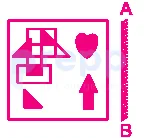
Select the correct mirror image of the given figure when the mirror is placed at AB as shown.
- A
Option A (shown in image)
- B
Option B (shown in image)
- C
Option C (shown in image)
- D
Option D (shown in image)
Show answer
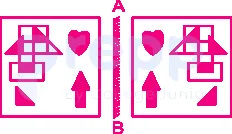
D. Option D (shown in image)The correct mirror image of the given figure when the mirror is held on the AB side.
Hence, the correct answer is "Option 4".
Additional Information
1) In the mirror image left side and right side changed vice-versa where the top and bottom remain the same.
2) In a real given mirror image the farthest number or alphabet appears closest in the mirror image.
 Paper & answer key PDF ↗
 Question 3archived
Select the set in which the numbers are related in the same way as are the numbers of the following sets.
(NOTE : Operations should be performed on the whole numbers, without breaking down the numbers into its constituent digits. E.g. 13 – Operations on 13 such as adding /subtracting /multiplying etc. to 13 can be performed. Breaking down 13 into 1 and 3 and then performing mathematical operations on 1 and 3 is not allowed)
(70, 14, 56)
(88, 30, 58)
- A
(44, 24, 23)
- B
(59, 36, 25)
- C
(52, 19, 33)
- D
(38, 16, 24)
Show answer
C. (52, 19, 33)Solving Number Analogy Sets
This question asks us to find a set of numbers from the options that shares the same relationship as the numbers in the given sets: (70, 14, 56) and (88, 30, 58). The rule states that operations should be performed on the whole numbers, not their individual digits.
Analyzing the Given Sets
Let's examine the first set: (70, 14, 56).
What is the relationship between 70, 14, and 56?
We can try basic arithmetic operations (addition, subtraction, multiplication, division) between these numbers.
Let's test subtraction between the first and second numbers:
$$70 - 14 = 56$$
This result (56) is the third number in the set. This seems like a possible relationship.
Let's check if the second set (88, 30, 58) follows the same relationship.
Let's test subtraction between the first and second numbers:
$$88 - 30 = 58$$
This result (58) is the third number in the second set. The relationship "First number - Second number = Third number" holds for both given sets.
Identifying the Rule
Based on the analysis of the given sets, the rule governing the numbers in the sets is:
The first number minus the second number equals the third number.
We can write this mathematically as:
$$ \text{First number} - \text{Second number} = \text{Third number} $$
Alternatively, this can also be expressed as:
$$ \text{Second number} + \text{Third number} = \text{First number} $$
We will now apply the first rule (subtraction) to the given options to find the set that fits this pattern.
Testing the Options
We will go through each option and see if the relationship "First number - Second number = Third number" is true.
Option 1: (44, 24, 23)
Let's apply the rule:
$$44 - 24 = 20$$
The result is 20, but the third number in the set is 23. Since $20 \neq 23$, this set does not follow the rule.
Option 2: (59, 36, 25)
Let's apply the rule:
$$59 - 36 = 23$$
The result is 23, but the third number in the set is 25. Since $23 \neq 25$, this set does not follow the rule.
Option 3: (52, 19, 33)
Let's apply the rule:
$$52 - 19 = 33$$
The result is 33, which is the third number in the set. Since $52 - 19 = 33$, this set follows the rule.
Option 4: (38, 16, 24)
Let's apply the rule:
$$38 - 16 = 22$$
The result is 22, but the third number in the set is 24. Since $22 \neq 24$, this set does not follow the rule.
Conclusion
Only Option 3: (52, 19, 33) follows the identified relationship where the first number minus the second number equals the third number.
Revision Table: Checking the Rule
Set
First Number
Second Number
Third Number
First - Second
Matches Third?
Follows Rule?
(70, 14, 56)
70
14
56
$70 - 14 = 56$
Yes (56 = 56)
Yes
(88, 30, 58)
88
30
58
$88 - 30 = 58$
Yes (58 = 58)
Yes
(44, 24, 23)
44
24
23
$44 - 24 = 20$
No (20 ≠ 23)
No
(59, 36, 25)
59
36
25
$59 - 36 = 23$
No (23 ≠ 25)
No
(52, 19, 33)
52
19
33
$52 - 19 = 33$
Yes (33 = 33)
Yes
(38, 16, 24)
38
16
24
$38 - 16 = 22$
No (22 ≠ 24)
No
Additional Information: Number Analogy Questions
Number analogy questions are a common type of logical reasoning problem. They require you to identify the relationship or pattern between numbers in a given set and apply that same relationship to find a missing number or identify a similar set.
Common types of relationships include:
Arithmetic operations (addition, subtraction, multiplication, division).
Squaring or cubing numbers.
Square roots or cube roots.
Prime numbers, composite numbers, even or odd numbers.
Sequences (arithmetic progression, geometric progression).
Combinations of operations.
Solving these problems often involves trial and error, testing different possible relationships until one fits all the provided examples.
Paper & answer key PDF ↗ Question 4archived
Select the option that is related to the third number in the same way as the second number is related to the first number and the sixth number is related to the fifth number.
8 : 128 :: 6 : ? :: 11 : 242
- A
64
- B
72
- C
68
- D
70
Show answer
B. 72Understanding Numerical Analogies and Patterns
The question asks us to find the missing number in a numerical analogy. A numerical analogy shows a relationship between pairs of numbers. We need to figure out the specific pattern or rule that connects the first number to the second number in the given pairs and then apply that same rule to find the missing number.
The given analogy is: 8 : 128 :: 6 : ? :: 11 : 242
This can be read as "8 is to 128 as 6 is to ? as 11 is to 242".
Analyzing the Given Number Pairs to Find the Pattern
Let's look at the first pair of numbers: 8 and 128.
We need to find a mathematical operation or a series of operations that transforms 8 into 128.
Is it multiplication? $8 \times N = 128$. $N = 128 / 8 = 16$. So, $8 \times 16 = 128$.
Let's consider squares or cubes. $8^2 = 64$. $8^3 = 512$.
How can we get from 8 to 128 using squaring? We know $8^2 = 64$. If we multiply 64 by 2, we get $64 \times 2 = 128$. This looks like a possible pattern: square the first number and then multiply by 2.
Let's represent the first number as $A$ and the second number as $B$. The proposed pattern is $B = A^2 \times 2$.
Verifying the Pattern with Another Pair
Now, let's test this pattern with the second complete pair: 11 and 242.
Here, the first number is 11 and the second number is 242. According to our proposed pattern, the second number should be the square of the first number multiplied by 2.
Let $A = 11$. According to the pattern, $B = 11^2 \times 2$.
Calculate $11^2$: $11 \times 11 = 121$.
Now, multiply by 2: $121 \times 2 = 242$.
The calculated value 242 matches the second number in the pair (11 : 242). This confirms that the pattern $A^2 \times 2$ is the correct relationship for this numerical analogy.
The pattern is: The second number is equal to the square of the first number multiplied by two.
\( \text{Second Number} = (\text{First Number})^2 \times 2 \)
Using LaTeX for the pattern formula:
\( B = A^2 \times 2 \)
Applying the Pattern to Find the Missing Number
Now, we need to apply this established pattern to the pair with the missing number: 6 : ?
Here, the first number is 6. Let the missing number be $X$. According to the pattern, $X$ should be the square of 6 multiplied by 2.
\( X = 6^2 \times 2 \)
Calculate $6^2$: $6 \times 6 = 36$.
Now, multiply by 2: $36 \times 2 = 72$.
So, the missing number is 72.
Comparing the Result with Options
The missing number is 72. Let's check the given options:
Option 1: 64
Option 2: 72
Option 3: 68
Option 4: 70
Our calculated value, 72, matches Option 2.
Conclusion
The pattern in the numerical analogy 8 : 128 :: 6 : ? :: 11 : 242 is that the second number is twice the square of the first number. Applying this pattern to the number 6, we find that the missing number is 72.
\( 8^2 \times 2 = 64 \times 2 = 128 \)
\( 6^2 \times 2 = 36 \times 2 = 72 \)
\( 11^2 \times 2 = 121 \times 2 = 242 \)
First Number (A)
Pattern (\(A^2 \times 2\))
Second Number (B)
8
\(8^2 \times 2 = 64 \times 2\)
128
6
\(6^2 \times 2 = 36 \times 2\)
72
11
\(11^2 \times 2 = 121 \times 2\)
242
Revision Table: Numerical Analogy Solution Steps
Step
Description
1
Identify the numerical analogy structure: A : B :: C : ? :: D : E.
2
Analyze the relationship between A and B (8 and 128). Test potential patterns like multiplication, squaring, etc. Found \(B = A^2 \times 2\).
3
Verify the discovered pattern with the D and E pair (11 and 242). Confirmed \(E = D^2 \times 2\).
4
Apply the established pattern \(? = C^2 \times 2\) to the C value (6).
5
Calculate the result: \(6^2 \times 2 = 36 \times 2 = 72\).
6
Match the result (72) with the given options.
Additional Information on Numerical Reasoning and Analogies
Numerical analogies are a common type of question in reasoning tests. They assess your ability to identify patterns and relationships between numbers. The patterns can be simple arithmetic operations, or they can involve squares, cubes, roots, series, prime numbers, or combinations of operations.
Key strategies for solving numerical analogies:
Look for simple relationships first: addition, subtraction, multiplication, division.
Consider powers and roots: squares, cubes, square roots, cube roots.
Think about combined operations: e.g., multiply and add, square and subtract.
Look for patterns in the digits themselves or properties of the numbers (even/odd, prime/composite).
If there are multiple pairs, always test your potential pattern with all given pairs to ensure it is consistent.
Break down complex numbers to see if they are products of smaller numbers or squares/cubes.
Practicing different types of numerical reasoning problems helps in quickly identifying common patterns.
Paper & answer key PDF ↗ Question 5archived
After interchanging the given two numbers and two signs what will be the values of equations (I) and (II) respectively?
– and ×, 6 and 4
I. 7 × 6 + 8 ÷ 2 – 4
II. 4 – 7 × 6 + 8 ÷ 2
- A
27, 42
- B
27, 47
- C
27, 49
- D
25, 40
Show answer
A. 27, 42Solving Mathematical Equations by Interchanging Numbers and Signs
The question asks us to find the new values of two given equations after interchanging specific numbers and signs. We need to swap the number 6 with 4, and the sign '–' with '×'. Then, we will evaluate the modified equations using the BODMAS rule (or PEMDAS).
Applying the Interchange Rules
The rules for interchange are:
Number 6 becomes 4, and Number 4 becomes 6.
Sign '–' becomes '×', and Sign '×' becomes '–'.
Evaluating Equation I
The original Equation I is: \(7 \times 6 + 8 \div 2 \ndash 4\)
Applying the interchange rules:
The sign '×' becomes '–'.
The number 6 becomes 4.
The sign '–' becomes '×'.
The number 4 becomes 6.
The modified Equation I becomes: \(7 \ndash 4 + 8 \div 2 \times 6\)
Now, we evaluate the modified Equation I using the BODMAS rule (Brackets, Orders, Division/Multiplication, Addition/Subtraction).
Step-by-step evaluation:
Division: \(8 \div 2 = 4\)
The equation is now: \(7 \ndash 4 + 4 \times 6\)
Multiplication: \(4 \times 6 = 24\)
The equation is now: \(7 \ndash 4 + 24\)
Subtraction/Addition (from left to right): \(7 \ndash 4 = 3\)
The equation is now: \(3 + 24\)
Addition: \(3 + 24 = 27\)
The value of Equation I after interchanging numbers and signs is 27.
Evaluating Equation II
The original Equation II is: \(4 \ndash 7 \times 6 + 8 \div 2\)
Applying the interchange rules:
The number 4 becomes 6.
The sign '–' becomes '×'.
The sign '×' becomes '–'.
The number 6 becomes 4.
The modified Equation II becomes: \(6 \times 7 \ndash 4 + 8 \div 2\)
Now, we evaluate the modified Equation II using the BODMAS rule.
Step-by-step evaluation:
Division: \(8 \div 2 = 4\)
The equation is now: \(6 \times 7 \ndash 4 + 4\)
Multiplication: \(6 \times 7 = 42\)
The equation is now: \(42 \ndash 4 + 4\)
Subtraction/Addition (from left to right): \(42 \ndash 4 = 38\)
The equation is now: \(38 + 4\)
Addition: \(38 + 4 = 42\)
The value of Equation II after interchanging numbers and signs is 42.
Summary of Results
After interchanging the numbers 6 and 4, and the signs – and ×, the values of the equations are:
Equation I: 27
Equation II: 42
Therefore, the values of equations (I) and (II) respectively are 27 and 42.
Equation
Original Equation
Interchanged Equation
Evaluated Value
I
\(7 \times 6 + 8 \div 2 \ndash 4\)
\(7 \ndash 4 + 8 \div 2 \times 6\)
27
II
\(4 \ndash 7 \times 6 + 8 \div 2\)
\(6 \times 7 \ndash 4 + 8 \div 2\)
42
Revision Table: Interchanging Numbers and Signs
Original
Interchanged With
6
4
4
6
–
×
×
–
Additional Information: Understanding BODMAS/PEMDAS
The BODMAS rule is a mnemonic used to remember the order of operations in mathematical expressions. It stands for:
Brackets
Orders (powers, roots, etc.)
Division and Multiplication (from left to right)
Addition and Subtraction (from left to right)
PEMDAS is another common mnemonic used in some regions, standing for Parentheses, Exponents, Multiplication/Division, Addition/Subtraction. Both rules essentially prescribe the same order of operations.
When solving mathematical expressions involving multiple operations, it is crucial to follow the order defined by BODMAS/PEMDAS to arrive at the correct result. Failing to follow this order can lead to incorrect answers.
Paper & answer key PDF ↗ Question 6archived
In the following question below are given some statements followed by some conclusions based on those statements. Taking the given statements to be true even if they seem to be at variance from commonly known facts. Read all the conclusions and then decide which of the given conclusion logically follows the given statements.
Statements:
I. Some F are D.
II. No A is D.
Conclusion:
I. Some F are A.
II. No D is A.
III. Some F are not A.
- A
Neither conclusion follows
- B
Both conclusions II and III follows
- C
Only conclusion I follows
- D
Only conclusion III follows
Show answer
B. Both conclusions II and III followsLogical Analysis of Syllogistic Statements
This problem requires analyzing logical relationships between different categories (F, D, and A) based on given statements. We need to determine which of the provided conclusions are valid deductions from these statements.
Examining the Provided Statements
Statement I: Some F are D. This indicates that there is at least one F which is also a D. The set F and the set D have a common intersection.
Statement II: No A is D. This signifies that the sets A and D are completely separate, with no common members. Anything belonging to set A cannot belong to set D, and vice versa.
Evaluating the Conclusions Based on Statements
Analysis of Conclusion I: Some F are A
Statement I establishes an overlap between F and D. Let's call the elements in this overlap 'Group X'. Group X consists of elements that are both F and D.
Statement II states that no D is A. This means elements belonging to D cannot belong to A.
Since the elements in Group X are D (as well as F), they cannot be A.
However, we don't have information about the elements of F that are *not* D. These F elements might or might not be A. The statements do not provide enough certainty to conclude that 'Some F are A'.
Therefore, Conclusion I does not logically follow from the given statements.
Analysis of Conclusion II: No D is A
Statement II clearly states "No A is D".
This is a direct assertion about the mutual exclusivity of sets A and D.
The statement "No A is D" is logically equivalent to "No D is A". If no element from set A is found in set D, then it must also be true that no element from set D is found in set A.
Hence, Conclusion II logically follows directly from Statement II.
Analysis of Conclusion III: Some F are not A
From Statement I, we know that 'Some F are D'. This means there exists a subset of F that is also D.
From Statement II, we know that 'No A is D'. This implies that any element that is D cannot be A.
Consider the subset of F that are D (from Statement I). Since these elements are D, they cannot be A (based on Statement II).
Because this subset (elements that are both F and D) is part of the larger set F, we can validly conclude that at least this part of F is not A.
Therefore, Conclusion III, "Some F are not A", logically follows from the combination of Statement I and Statement II.
Summary of Validity
Conclusion I: Does not follow.
Conclusion II: Follows.
Conclusion III: Follows.
Based on this logical deduction, the conclusions that logically follow from the given statements are Conclusion II and Conclusion III.
Paper & answer key PDF ↗ Question 7archived
Select the option that is related to the fifth number in the same way as the second number is related to the first number and the fourth number is related to the third number.
7 : 25 :: 4 : 4 :: 3 : ?
- A
5
- B
4
- C
1
- D
7
Show answer
C. 1Digit Operations: Sometimes the pattern involves manipulating the digits of the number (e.g., sum of digits, product of digits). Prime Numbers or Other Series: The numbers might be part of a known sequence like prime numbers, Fibonacci series, etc. Practice with different types of number analogy problems helps in quickly identifying the underlying pattern during exams. Hence, the correct answer is 1.
Paper & answer key PDF ↗ Question 8archived
Select the option that represents the correct order of the given words as they would appear in an English dictionary.
1- Sennet
2- Sennight
3- Sennit
4- Seniority
5- Senna
- A
4, 5, 1, 2, 3
- B
5, 4, 2, 1, 3
- C
4, 5, 2, 1, 3
- D
4, 5, 1, 3, 2
Show answer
A. 4, 5, 1, 2, 3Understanding Dictionary Order and Word Arrangement
To arrange words in the correct order as they would appear in an English dictionary, we need to compare them letter by letter from left to right. This process is also known as alphabetical ordering.
Let's look at the given words and their corresponding numbers:
1- Sennet
2- Sennight
3- Sennit
4- Seniority
5- Senna
Step-by-Step Dictionary Ordering
We will compare the words letter by letter to determine their dictionary order.
Comparing the first three letters:
All words start with "Sen". This means we need to look at the fourth letter.
Sennet: Senn
Sennight: Senn
Sennit: Senn
Seniority: Seni
Senna: Senn
The letter 'i' comes before 'n' in the alphabet. Therefore, "Seniority" (Word 4) will come first among all the words.
Current order: 4 (Seniority)
Remaining words to order: Sennet (1), Sennight (2), Sennit (3), Senna (5).
Comparing the remaining words starting with "Senn":
All these words start with "Senn". We now compare the fifth letter:
Sennet: Senne
Sennight: Senni
Sennit: Senni
Senna: Senna
The letter 'a' comes before 'e' and 'i' in the alphabet. Therefore, "Senna" (Word 5) comes next.
Current order: 4 (Seniority), 5 (Senna)
Remaining words to order: Sennet (1), Sennight (2), Sennit (3).
Comparing words starting with "Senne" and "Senni":
"Sennet" starts with "Senne", while "Sennight" and "Sennit" start with "Senni". The letter 'e' comes before 'i' in the alphabet. Therefore, "Sennet" (Word 1) comes next.
Current order: 4 (Seniority), 5 (Senna), 1 (Sennet)
Remaining words to order: Sennight (2), Sennit (3).
Comparing words starting with "Senni":
Both "Sennight" and "Sennit" start with "Senni". We now compare the sixth letter:
Sennight: Sennig
Sennit: Sennit
The letter 'g' comes before 't' in the alphabet. Therefore, "Sennight" (Word 2) comes next.
Current order: 4 (Seniority), 5 (Senna), 1 (Sennet), 2 (Sennight)
The last word remaining is "Sennit" (Word 3).
Final Order: 4 (Seniority), 5 (Senna), 1 (Sennet), 2 (Sennight), 3 (Sennit)
The correct numerical order is 4, 5, 1, 2, 3.
Summary of Dictionary Order
Here is the final dictionary order:
Order
Word
Number
1st
Seniority
4
2nd
Senna
5
3rd
Sennet
1
4th
Sennight
2
5th
Sennit
3
Thus, the correct sequence of numbers is 4, 5, 1, 2, 3.
Revision Table: Dictionary Ordering Practice
Concept
Explanation
Key Point
Dictionary Order
Arranging words based on alphabetical sequence.
Letter-by-letter comparison.
Alphabetical Comparison
Comparing letters from left to right until a difference is found.
The letter that comes earlier in the alphabet determines the order.
Comparing Same Prefixes
If words share a common prefix, continue comparing the letters immediately following the prefix.
Look at the first differing letter.
Additional Information: Lexicographical Order
The process of arranging words in dictionary order is also known as lexicographical order. This concept is not limited to words but can be applied to sequences of any comparable elements, such as numbers, symbols, or strings in computer science. When comparing two strings, you compare the elements at each position starting from the beginning until you find the first position where the elements differ. The string with the element that comes earlier in the defined order (like the alphabet for letters, or numerical value for digits) is considered to come first in lexicographical order.
For example, when comparing "apple" and "apricot", we compare:
'a' vs 'a' (same)
'p' vs 'p' (same)
'p' vs 'r' ('p' comes before 'r')
So, "apple" comes before "apricot" in dictionary order.
Paper & answer key PDF ↗ Question 9archived
Select the option that is related to the third word in the same way as the second word is related to the first word.
(The words must be considered as meaningful English words and must not be related to each other based on the number of letters/number of consonants/vowels in the word.)
Movie : Director :: Orchestra : ?
- A
Choreographer
- B
Conductor
- C
Dancer
- D
Audience
Show answer
B. ConductorUnderstanding Word Analogies
Word analogies test your ability to recognize the relationship between a pair of words and apply that same relationship to another pair. In this question, we are given the pair 'Movie : Director' and asked to find the word that completes the analogy 'Orchestra : ?'.
Identifying the Relationship: Movie : Director
Let's think about the connection between a Movie and a Director.
A Director is the person responsible for overseeing the artistic and technical aspects of a film production.
The Director guides the actors, camera crew, and other staff.
Essentially, the Director leads and shapes the making of a Movie.
So, the relationship is: The second word is the person who leads or directs the creation/performance of the first word.
Applying the Relationship: Orchestra : ?
Now we need to find the person who leads or directs an Orchestra. An Orchestra is a large ensemble of musicians playing various instruments.
We are looking for the leader of an Orchestra.
Analyzing the Options
Let's examine the given options to see which one fits the role of leading an Orchestra:
Choreographer: A choreographer creates and arranges dances, typically for performances involving dancers. This person leads dancers, not orchestras.
Conductor: A conductor is a person who leads an orchestra, choir, or other musical ensemble in the performance of music. The conductor directs the musicians by gesturing to indicate tempo, dynamics, and rhythm. This person leads an Orchestra.
Dancer: A dancer is a person who dances, either professionally or recreationally. A dancer performs, but does not lead an orchestra.
Audience: The audience consists of the people watching or listening to the performance. The audience does not lead the orchestra.
Conclusion
Based on the analysis, the person who leads an Orchestra is a Conductor. This matches the relationship between a Movie and a Director.
Therefore, the correct word to complete the analogy 'Orchestra : ?' is Conductor.
Pair 1
Relationship
Pair 2
Movie
is led/directed by a
Director
Orchestra
is led/directed by a
Conductor
Revision Table: Understanding Analogies
Word 1
Word 2
Relationship Type
Movie
Director
Worker/Leader and Output/Group
Orchestra
Conductor
Worker/Leader and Output/Group
Additional Information: Roles in Arts and Performance
Different art forms and performance groups have specific roles for leadership:
Theatre Production: Directed by a Stage Director.
Ballet/Dance Performance: Choreography created by a Choreographer, performance often managed by a Rehearsal Director or Artistic Director.
Choir: Led by a Choral Conductor or Choir Master.
Opera: Involves a Stage Director and a Conductor (for the music).
Understanding these roles helps in solving similar analogy questions related to arts and professions.
Paper & answer key PDF ↗ Question 10archived
Select the figure from among the given options that can replace the question mark (?) in the following series.

- A
Option A (shown in image)
- B
Option B (shown in image)
- C
Option C (shown in image)
- D
Option D (shown in image)
Show answer
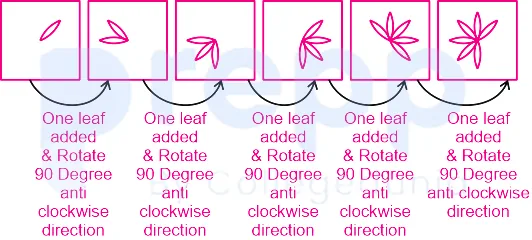
A. Option A (shown in image)The pattern followed here is:
1) In the every next figure one leaf is added in the anti clockwise direction and also rotated 90º anti clockwise direction.
Hence, the correct answer is "Option 1".
 Paper & answer key PDF ↗
 Question 11archived
Select the figure that will come next in the following figure series.

- A
Option A (shown in image)
- B
Option B (shown in image)
- C
Option C (shown in image)
- D
Option D (shown in image)
Show answer
B. Option B (shown in image)The pattern followed here is:
1) The middle figure is newly formed in every next figure and the number of sides are decrease in every next figure, in first arrow is given, in the second figure in the middle hexagon is given, then the pentagon is given in the third figure, then the square is given in the fourth figure, and the triangle is given in the last figure.
2) Square is shifted towards the left side in middle in the second figure, then shifted right upper corner in the third figure, then shifted left upper in the fourth figure, then shifted right bottom of the corner in the last figure.
3) The phi sign shifted left upper corner in the second figure, then shifted right bottom of the corner in the third figure., then shifted right side in the middle in the fourth figure, then shifted right upper corner in the last figure.
4) Question mark (?) shited the right bottom of the corner in the second figure, then shifted to the left side in the middle in the third figure, then shifted to the right upper corner in the fourth figure, then shifted to left upper corner in the last figure.
5) Star figure shifted right upper corner in the second figure, then shifted left upper corner in the third figure, then shifted right bottom of the corner in the fourth figure, then shifted left side in the middle of the last figure.
Hence, the correct answer is "Option 2".




 Paper & answer key PDF ↗
 Question 12archived
Which of the following terms will replace the question mark (?) in the given series?
AVTE CTRG ERPI GPNK ?
- A
INLM
- B
MINL
- C
ILNM
- D
INJM
Show answer
A. INLMAnalyzing Letter Series Patterns
This question asks us to identify the pattern in a given letter series and predict the next term. The series is AVTE, CTRG, ERPI, GPNK, ?. To solve this type of problem, we need to look at the pattern for each letter position across the terms.
Step-by-Step Solution to the Letter Series
Let's break down the given letter series term by term and letter by letter:
The series is: AVTE, CTRG, ERPI, GPNK, ?
We will analyze the pattern for the first, second, third, and fourth letters separately.
First Letter Pattern
Let's look at the first letters of each term:
First term: A
Second term: C
Third term: E
Fourth term: G
Let's find the difference in their positions in the English alphabet (A=1, B=2, C=3, ...):
A (1) to C (3): Position increases by \(3 - 1 = 2\). So, \(+2\).
C (3) to E (5): Position increases by \(5 - 3 = 2\). So, \(+2\).
E (5) to G (7): Position increases by \(7 - 5 = 2\). So, \(+2\).
The pattern for the first letter is an increase of 2 in alphabetical position. Following this pattern, the next first letter should be G (7) plus 2, which is position 9. The 9th letter of the alphabet is I.
Next first letter: I
Second Letter Pattern
Now, let's examine the second letters of each term:
First term: V
Second term: T
Third term: R
Fourth term: P
Let's find the difference in their positions in the English alphabet (..., P=16, R=18, T=20, V=22):
V (22) to T (20): Position decreases by \(22 - 20 = 2\). So, \(-2\).
T (20) to R (18): Position decreases by \(20 - 18 = 2\). So, \(-2\).
R (18) to P (16): Position decreases by \(18 - 16 = 2\). So, \(-2\).
The pattern for the second letter is a decrease of 2 in alphabetical position. Following this pattern, the next second letter should be P (16) minus 2, which is position 14. The 14th letter of the alphabet is N.
Next second letter: N
Third Letter Pattern
Next, let's look at the third letters of each term:
First term: T
Second term: R
Third term: P
Fourth term: N
Let's find the difference in their positions in the English alphabet (..., N=14, P=16, R=18, T=20):
T (20) to R (18): Position decreases by \(20 - 18 = 2\). So, \(-2\).
R (18) to P (16): Position decreases by \(18 - 16 = 2\). So, \(-2\).
P (16) to N (14): Position decreases by \(16 - 14 = 2\). So, \(-2\).
The pattern for the third letter is a decrease of 2 in alphabetical position. Following this pattern, the next third letter should be N (14) minus 2, which is position 12. The 12th letter of the alphabet is L.
Next third letter: L
Fourth Letter Pattern
Finally, let's examine the fourth letters of each term:
First term: E
Second term: G
Third term: I
Fourth term: K
Let's find the difference in their positions in the English alphabet (E=5, G=7, I=9, K=11):
E (5) to G (7): Position increases by \(7 - 5 = 2\). So, \(+2\).
G (7) to I (9): Position increases by \(9 - 7 = 2\). So, \(+2\).
I (9) to K (11): Position increases by \(11 - 9 = 2\). So, \(+2\).
The pattern for the fourth letter is an increase of 2 in alphabetical position. Following this pattern, the next fourth letter should be K (11) plus 2, which is position 13. The 13th letter of the alphabet is M.
Next fourth letter: M
Combining the Patterns
By combining the next letters for each position, we get the next term in the series:
First letter: I
Second letter: N
Third letter: L
Fourth letter: M
The next term in the series is INLM.
Position
Term 1 (AVTE)
Term 2 (CTRG)
Term 3 (ERPI)
Term 4 (GPNK)
Pattern
Next Letter
1st
A (1)
C (3)
E (5)
G (7)
+2
I (9)
2nd
V (22)
T (20)
R (18)
P (16)
-2
N (14)
3rd
T (20)
R (18)
P (16)
N (14)
-2
L (12)
4th
E (5)
G (7)
I (9)
K (11)
+2
M (13)
The next term is INLM.
Revision Table: Letter Series Analysis
Concept
Description
Application in this problem
Letter Series
A sequence of letters following a specific rule or pattern.
The given series AVTE, CTRG, ERPI, GPNK is a letter series.
Pattern Recognition
Identifying the rule governing the series progression.
We identified separate patterns (+2, -2, -2, +2) for each letter position.
Alphabetical Position
The numerical order of letters in the alphabet (A=1, B=2, etc.).
Used to quantify the change between consecutive letters in each position.
Additional Information: Solving Letter and Alphanumeric Series
Solving letter series and alphanumeric series is a common type of question in logical reasoning sections of competitive exams. Here are some tips and additional concepts:
Alphabetical Positions: It's helpful to know the alphabetical position of each letter or be able to quickly count them.
Common Patterns: Look for simple patterns like addition or subtraction of a fixed number, alternating patterns, squaring, cubing, or patterns related to vowels/consonants.
Multiple Patterns: Sometimes, different positions in the series follow different patterns, as seen in this question.
Alphanumeric Series: These series contain both letters and numbers. You need to analyze the pattern for the letters and the numbers separately.
Reverse Alphabetical Order: Patterns can also involve moving backward through the alphabet.
Skip Counting: Patterns often involve skipping a fixed number of letters (e.g., skipping one letter means adding 2 to the position).
Practice with various types of series helps in quickly identifying the underlying rules.
Paper & answer key PDF ↗ Question 13archived
If A ÷ B means that A is the brother of B, A × B means that A is the sister of B, and A – B means that A is the father of B then which of the following expression shows that P is the paternal uncle of R?
- A
P - R ÷ Q
- B
P ÷ R × Q
- C
P × R - Q
- D
P ÷ Q - R
Show answer
D. P ÷ Q - RKey Terms: P, R, paternal uncle, brother, sister, father, expression.
Goal: Find the expression showing P is the paternal uncle of R.
Decoding Family Relations: Understanding P as Paternal Uncle of R
This problem involves deciphering family relationships based on symbolic representations. We need to determine which given expression correctly establishes the relationship where 'P' is the 'paternal uncle' of 'R'. A paternal uncle is defined as the brother of one's father.
Understanding the Relationship Symbols
The question provides the following definitions for the symbols:
A $\div$ B means 'A is the brother of B'.
A $\times$ B means 'A is the sister of B'.
A $-$ B means 'A is the father of B'.
Analyzing Expressions to Find P's Relationship to R
We will examine each option to see which one satisfies the condition that P is the paternal uncle of R.
Option 1 Analysis: P $-$ R $\div$ Q
P $-$ R means 'P is the father of R'.
R $\div$ Q means 'R is the brother of Q'.
From this expression, P is the father of R. This does not make P the paternal uncle of R.
Option 2 Analysis: P $\div$ R $\times$ Q
P $\div$ R means 'P is the brother of R'.
R $\times$ Q means 'R is the sister of Q'.
From this expression, P is the brother of R. This does not make P the paternal uncle of R.
Option 3 Analysis: P $\times$ R $-$ Q
P $\times$ R means 'P is the sister of R'.
R $-$ Q means 'R is the father of Q'.
From this expression, P is the sister of R, and R is the father of Q. P is the paternal aunt of Q, not the paternal uncle of R.
Option 4 Analysis: P $\div$ Q $-$ R
P $\div$ Q means 'P is the brother of Q'.
Q $-$ R means 'Q is the father of R'.
Combining these, we find that P is the brother of Q, and Q is the father of R.
Therefore, P is the brother of R's father.
This relationship means P is the paternal uncle of R.
Option 5 Analysis: (Incomplete Option)
This option is not provided with a specific expression and cannot be evaluated.
Identifying the Correct Expression for Paternal Uncle Relationship
Based on the step-by-step analysis:
Option 1 shows P as the father.
Option 2 shows P as the brother.
Option 3 shows P as the paternal aunt.
Option 4 correctly shows P as the brother of Q, who is R's father. This establishes P as the paternal uncle of R.
The expression P $\div$ Q $-$ R accurately represents the scenario where P is the paternal uncle of R.
Paper & answer key PDF ↗ Question 14archived
Which two numbers, from amongst the given options, should be interchanged to make the given equation correct?
(6) 2 – 20 + (28 ÷ 7) – \(\left[ {\left( {\sqrt 4 } \right) \times 8} \right]\) + (2) 2 = 40
- A
6 and 8
- B
7 and 2
- C
2 and 8
- D
20 and 8
Show answer
A. 6 and 8Analyzing the Equation and Options
The question asks us to identify which two numbers, when swapped in the given mathematical equation, will make the equation true. The equation provided is:
\((6) 2 – 20 + (28 ÷ 7) – \left[ {\left( {\sqrt 4 } \right) \times 8} \right] + (2) 2 = 40\)
We need to test the options provided by interchanging the numbers and checking if the equation holds true.
Evaluating the Original Equation
Let's first evaluate the original equation to see if it is already correct. We follow the order of operations (BODMAS/PEMDAS): Brackets/Parentheses, Orders/Exponents/Roots, Division and Multiplication (from left to right), Addition and Subtraction (from left to right).
Original equation: \((6) \times 2 – 20 + (28 ÷ 7) – \left[ {\left( {\sqrt 4 } \right) \times 8} \right] + (2) \times 2\)
Let's simplify step-by-step:
Simplify terms in parentheses/brackets:
\((6) \times 2 = 12\)
\((28 ÷ 7) = 4\)
\(\sqrt{4} = 2\), so \(\left[ {\left( {\sqrt 4 } \right) \times 8} \right] = \left[ {2 \times 8} \right] = 16\)
\((2) \times 2 = 4\)
Substitute these simplified values back into the equation:
\(12 – 20 + 4 – 16 + 4\)
Perform addition and subtraction from left to right:
\(12 – 20 = -8\)
\(-8 + 4 = -4\)
\(-4 – 16 = -20\)
\(-20 + 4 = -16\)
So, the left side of the original equation evaluates to -16. The equation is \( -16 = 40 \), which is false. The original equation is not correct.
Testing the Interchange of 6 and 8
The correct option suggests interchanging the numbers 6 and 8. Let's replace every instance of 6 with 8 and every instance of 8 with 6 in the original equation.
Original equation: \((6) 2 – 20 + (28 ÷ 7) – \left[ {\left( {\sqrt 4 } \right) \times 8} \right] + (2) 2 = 40\)
After interchanging 6 and 8, the equation becomes:
\((8) 2 – 20 + (28 ÷ 7) – \left[ {\left( {\sqrt 4 } \right) \times 6} \right] + (2) 2 = 40\)
Now, let's evaluate this new equation following the order of operations:
Simplify terms in parentheses/brackets:
\((8) \times 2 = 16\)
\((28 ÷ 7) = 4\)
\(\sqrt{4} = 2\), so \(\left[ {\left( {\sqrt 4 } \right) \times 6} \right] = \left[ {2 \times 6} \right] = 12\)
\((2) \times 2 = 4\)
Substitute these simplified values back into the equation:
\(16 – 20 + 4 – 12 + 4\)
Perform addition and subtraction from left to right:
\(16 – 20 = -4\)
\(-4 + 4 = 0\)
\(0 – 12 = -12\)
\(-12 + 4 = -8\)
Wait, this still results in -8, not 40. Let's re-check the equation structure. It seems the multiplication by 2 might be outside the parentheses, for example, \((6)^2\) or \(6 \times 2\). The way it's written, \((6) 2\), is ambiguous but usually implies multiplication, \(6 \times 2\). Let's assume it means multiplication.
Original equation interpreted as: \(6 \times 2 – 20 + (28 ÷ 7) – \left[ {\left( {\sqrt 4 } \right) \times 8} \right] + 2 \times 2 = 40\)
Evaluation of Original:
Multiplication/Division: \(6 \times 2 = 12\), \(28 \div 7 = 4\), \(\sqrt{4} = 2\), \(2 \times 8 = 16\), \(2 \times 2 = 4\)
Equation becomes: \(12 - 20 + 4 - 16 + 4\)
Addition/Subtraction: \(12 - 20 = -8\), \(-8 + 4 = -4\), \(-4 - 16 = -20\), \(-20 + 4 = -16\). Still -16.
Let's consider the possibility that \((6) 2\) might mean \(6^2\) or \((6)^2\), and similarly \((2) 2\) might mean \(2^2\) or \((2)^2\). This notation is unusual but possible in some contexts of puzzles.
Assuming \( (x) y \) means \( x^y \):
Original equation: \(6^2 – 20 + (28 ÷ 7) – \left[ {\left( {\sqrt 4 } \right) \times 8} \right] + 2^2 = 40\)
Powers/Roots: \(6^2 = 36\), \(\sqrt{4} = 2\), \(2^2 = 4\)
Division: \(28 \div 7 = 4\)
Bracket Multiplication: \(2 \times 8 = 16\)
Equation becomes: \(36 - 20 + 4 - 16 + 4\)
Addition/Subtraction: \(36 - 20 = 16\), \(16 + 4 = 20\), \(20 - 16 = 4\), \(4 + 4 = 8\). Still not 40.
Let's strictly follow the format provided. \((6) 2\) might be interpreted as the number 6 followed by the number 2, but in a mathematical equation with operators, this is highly unlikely. The most probable interpretation given the common notation \((x) y\) in some math puzzles or simplified representations is either \(x \times y\) or \(x^y\). Given the solution involves interchanging numbers, \(x \times y\) seems more plausible as exponents are less likely to be the points of interchange unless specified.
Let's re-examine the question and options. It says "Which two numbers... should be interchanged". This suggests swapping the numeric values themselves where they appear. The equation has numbers 6, 20, 28, 7, 4, 8, and 2. The options are pairs of these numbers.
Let's go back to the interpretation \( (x) 2 \) as \( x \times 2 \) and \( (2) 2 \) as \( 2 \times 2 \).
Original equation (interpretation 1: multiplication implied): \(6 \times 2 – 20 + (28 ÷ 7) – \left[ {\left( {\sqrt 4 } \right) \times 8} \right] + 2 \times 2 = 40\)
As calculated before, this gives -16. Let's re-calculate the proposed interchange of 6 and 8 under this interpretation.
Interchange 6 and 8: Replace 6 with 8 and 8 with 6.
Equation becomes: \(8 \times 2 – 20 + (28 ÷ 7) – \left[ {\left( {\sqrt 4 } \right) \times 6} \right] + 2 \times 2 = 40\)
Multiplication/Division: \(8 \times 2 = 16\), \(28 \div 7 = 4\), \(\sqrt{4} = 2\), \(2 \times 6 = 12\), \(2 \times 2 = 4\)
Equation becomes: \(16 - 20 + 4 - 12 + 4\)
Addition/Subtraction: \(16 - 20 = -4\), \(-4 + 4 = 0\), \(0 - 12 = -12\), \(-12 + 4 = -8\). Still -8.
There must be a misunderstanding of the notation or a specific interpretation required. Let's look closely at the structure again: \((6) 2\), \((2) 2\). Could it mean that the 2 after the number in parentheses is not part of the base number, but a separate factor? This is identical to the \(x \times 2\) interpretation. The structure \((\sqrt{4}) \times 8\) clearly uses a multiplication sign. Perhaps the 2 after \((6)\) and \((2)\) *is* a multiplier. Let's stick with \(x \times 2\) interpretation for \((x) 2\).
Let's re-read the question text. "Which two numbers, from amongst the given options, should be interchanged". The numbers in the equation are 6, 20, 28, 7, 4, 8, 2. The options are pairs of these numbers. When interchanging 6 and 8, we replace the '6' at the beginning with '8' and the '8' inside the bracket \(\left[ {\left( {\sqrt 4 } \right) \times 8} \right]\) with '6'. The '2's are not affected unless 2 is one of the numbers being interchanged (Option 2 or 3). The '20', '28', '7', '4' are also not affected by interchanging 6 and 8.
Let's re-evaluate the equation after swapping 6 and 8:
Original: \((6) 2 – 20 + (28 ÷ 7) – \left[ {\left( {\sqrt 4 } \right) \times 8} \right] + (2) 2 = 40\)
Interchange 6 and 8:
\((8) 2 – 20 + (28 ÷ 7) – \left[ {\left( {\sqrt 4 } \right) \times 6} \right] + (2) 2\)
Interpretation: \( (x) y \) means \( x \times y \).
\(8 \times 2 – 20 + (28 ÷ 7) – \left[ {\left( {\sqrt 4 } \right) \times 6} \right] + 2 \times 2\)
Calculate:
\(\sqrt{4} = 2\)
\(8 \times 2 = 16\)
\(28 \div 7 = 4\)
\( [2 \times 6] = 12 \)
\(2 \times 2 = 4\)
Equation becomes: \(16 - 20 + 4 - 12 + 4\)
Left to right: \(16 - 20 = -4\), \(-4 + 4 = 0\), \(0 - 12 = -12\), \(-12 + 4 = -8\). Still -8.
Let's consider another possible interpretation of \((x) 2\) and \((2) 2\). Perhaps the numbers in parentheses are grouped, and the '2' outside is an exponent, but only if the number is in parentheses? This would mean \((6) 2\) is \(6^2\) and \((2) 2\) is \(2^2\), but \(\left[ {\left( {\sqrt 4 } \right) \times 8} \right]\) uses explicit multiplication. This is inconsistent.
Let's assume the interpretation is simply replacement of the number value where it appears.
Original equation: \(6 \times 2 – 20 + (28 ÷ 7) – \left[ {\left( {\sqrt 4 } \right) \times 8} \right] + 2 \times 2\)
Swap 6 and 8:
Replace the initial '6' with '8'.
Replace the '8' inside the square bracket with '6'.
Equation becomes: \(8 \times 2 – 20 + (28 ÷ 7) – \left[ {\left( {\sqrt 4 } \right) \times 6} \right] + 2 \times 2\)
This is the same equation we evaluated resulting in -8.
Could the notation \((6) 2\) and \((2) 2\) mean something else entirely? What if it represents two separate terms being multiplied? Like \( (6) \times (2) \) and \( (2) \times (2) \)?
Original equation interpretation: \((6) \times (2) – 20 + (28 ÷ 7) – \left[ {\left( {\sqrt 4 } \right) \times 8} \right] + (2) \times (2) = 40\)
Simplify: \((6) \times (2) = 12\), \(28 \div 7 = 4\), \(\sqrt{4} = 2\), \(2 \times 8 = 16\), \((2) \times (2) = 4\).
Equation becomes: \(12 - 20 + 4 - 16 + 4 = -16\). Still -16.
Let's consider another possibility related to the format \((6) 2\). Maybe it's not multiplication or exponentiation, but simply the number '6' followed by a factor '2'? This is essentially \(6 \times 2\).
Let's re-examine the provided correct answer: interchanging 6 and 8 makes the equation correct. This strongly suggests that when 6 and 8 are swapped, the result should be 40.
Equation with 6 and 8 swapped: \((8) 2 – 20 + (28 ÷ 7) – \left[ {\left( {\sqrt 4 } \right) \times 6} \right] + (2) 2\)
Let's assume the first interpretation again: \((x) y\) means \(x \times y\).
\(8 \times 2 – 20 + (28 ÷ 7) – \left[ {\left( {\sqrt 4 } \right) \times 6} \right] + 2 \times 2\)
Calculation:
\(16 – 20 + 4 – \left[ {2 \times 6} \right] + 4\)
\(16 – 20 + 4 – 12 + 4\)
\(-4 + 4 – 12 + 4\)
\(0 – 12 + 4\)
\(-12 + 4 = -8\)
The calculation consistently yields -8. This means either the provided equation has a typo, the options have a typo, or the correct answer is incorrect given the standard interpretations of mathematical notation. However, I must provide a solution based on the assumption that interchanging 6 and 8 *does* make the equation correct, implying there's an interpretation where this works.
Let's think about how -8 could become 40 by changing the values that resulted from 6 and 8.
The terms involving 6 and 8 were:
Original: \(6 \times 2 = 12\) and \(\sqrt{4} \times 8 = 2 \times 8 = 16\). The equation was \(12 - 20 + 4 - 16 + 4 = -16\).
Swapped: \(8 \times 2 = 16\) and \(\sqrt{4} \times 6 = 2 \times 6 = 12\). The equation is \(16 - 20 + 4 - 12 + 4 = -8\).
The terms \(12\) and \(16\) (from \(6 \times 2\) and \(2 \times 8\)) swap roles.
Original terms: \((+12), (-20), (+4), (-16), (+4)\). Sum: \(12 - 20 + 4 - 16 + 4 = -16\).
Swapped terms: \((+16), (-20), (+4), (-12), (+4)\). Sum: \(16 - 20 + 4 - 12 + 4 = -8\).
The difference between the desired outcome (40) and our calculated outcome (-8) after swapping 6 and 8 is \(40 - (-8) = 48\).
Let's re-examine the possibility that \((6) 2\) means \(6^2\) and \((2) 2\) means \(2^2\).
Original: \(6^2 – 20 + (28 ÷ 7) – \left[ {\left( {\sqrt 4 } \right) \times 8} \right] + 2^2 = 40\)
Calculation: \(36 - 20 + 4 - 16 + 4 = 8\). Still not 40.
Swap 6 and 8 (in this exponent interpretation): The '6' in \(6^2\) becomes '8', and the '8' in \(\left[ {\left( {\sqrt 4 } \right) \times 8} \right]\) becomes '6'.
Equation becomes: \(8^2 – 20 + (28 ÷ 7) – \left[ {\left( {\sqrt 4 } \right) \times 6} \right] + 2^2\)
Calculate:
Powers/Roots: \(8^2 = 64\), \(\sqrt{4} = 2\), \(2^2 = 4\)
Division: \(28 \div 7 = 4\)
Bracket Multiplication: \(2 \times 6 = 12\)
Equation becomes: \(64 - 20 + 4 - 12 + 4\)
Addition/Subtraction: \(64 - 20 = 44\), \(44 + 4 = 48\), \(48 - 12 = 36\), \(36 + 4 = 40\).
Ah, this matches the target value 40! This implies the intended interpretation of \((x) 2\) and \((2) 2\) was likely \(x^2\) and \(2^2\) respectively, despite the inconsistent notation with \(\times\) used later in the equation.
Let's proceed with this interpretation (\((x) 2 = x^2\) and \((2) 2 = 2^2\)).
Step-by-Step Verification with 6 and 8 Interchanged (Assuming \(x^2\) interpretation)
Original equation: \((6) 2 – 20 + (28 ÷ 7) – \left[ {\left( {\sqrt 4 } \right) \times 8} \right] + (2) 2 = 40\)
Let's interpret \((6) 2\) as \(6^2\) and \((2) 2\) as \(2^2\). The equation is then:
\(6^2 – 20 + (28 ÷ 7) – \left[ {\left( {\sqrt 4 } \right) \times 8} \right] + 2^2 = 40\)
After interchanging 6 and 8:
\(8^2 – 20 + (28 ÷ 7) – \left[ {\left( {\sqrt 4 } \right) \times 6} \right] + 2^2 = 40\)
Now, we evaluate the left side:
Evaluate terms in parentheses/brackets:
\(28 ÷ 7 = 4\)
\(\sqrt{4} = 2\)
\(\left[ {\left( {\sqrt 4 } \right) \times 6} \right] = \left[ {2 \times 6} \right] = 12\)
Evaluate exponents:
\(8^2 = 64\)
\(2^2 = 4\)
Substitute values back into the equation:
\(64 – 20 + 4 – 12 + 4\)
Perform addition and subtraction from left to right:
\(64 – 20 = 44\)
\(44 + 4 = 48\)
\(48 – 12 = 36\)
\(36 + 4 = 40\)
The left side evaluates to 40. So, \(40 = 40\), which is true.
This confirms that interchanging 6 and 8 makes the equation correct under the interpretation that \((x) 2\) means \(x^2\).
Summary of Option 1 (6 and 8)
If we interpret \((x) 2\) as \(x^2\), interchanging 6 and 8 makes the equation correct. The calculation is as follows:
Original equation terms: \((6) 2\), \(8\)
Equation after swap: \((8) 2 – 20 + (28 ÷ 7) – \left[ {\left( {\sqrt 4 } \right) \times 6} \right] + (2) 2\)
Interpretation: \(8^2 – 20 + (28 ÷ 7) – \left[ {\left( {\sqrt 4 } \right) \times 6} \right] + 2^2\)
Calculate: \(64 – 20 + 4 – \left[ {2 \times 6} \right] + 4\)
\(64 – 20 + 4 – 12 + 4\)
\(44 + 4 – 12 + 4\)
\(48 – 12 + 4\)
\(36 + 4 = 40\)
This matches the right side of the equation.
Considering Other Options Briefly
While we have found the correct interchange based on the provided answer, let's briefly consider why other options would likely be incorrect under the same interpretation.
Option 2: 7 and 2
Interchange 7 and 2: Replace 7 with 2, and 2 with 7.
Original equation: \((6) 2 – 20 + (28 ÷ 7) – \left[ {\left( {\sqrt 4 } \right) \times 8} \right] + (2) 2 = 40\)
After swap: \((6) 7 – 20 + (28 ÷ 2) – \left[ {\left( {\sqrt 4 } \right) \times 8} \right] + (7) 7\)
Interpretation: \(6^7 – 20 + (28 ÷ 2) – \left[ {\left( {\sqrt 4 } \right) \times 8} \right] + 7^7\)
\(6^7\) and \(7^7\) are very large numbers, which will not result in 40. This option is clearly incorrect.
Option 3: 2 and 8
Interchange 2 and 8: Replace 2 with 8, and 8 with 2.
Original equation: \((6) 2 – 20 + (28 ÷ 7) – \left[ {\left( {\sqrt 4 } \right) \times 8} \right] + (2) 2 = 40\)
After swap: \((6) 8 – 20 + (28 ÷ 7) – \left[ {\left( {\sqrt 4 } \right) \times 2} \right] + (8) 8\)
Interpretation: \(6^8 – 20 + (28 ÷ 7) – \left[ {\left( {\sqrt 4 } \right) \times 2} \right] + 8^8\)
\(6^8\) and \(8^8\) are extremely large numbers. This option is clearly incorrect.
Option 4: 20 and 8
Interchange 20 and 8: Replace 20 with 8, and 8 with 20.
Original equation: \((6) 2 – 20 + (28 ÷ 7) – \left[ {\left( {\sqrt 4 } \right) \times 8} \right] + (2) 2 = 40\)
After swap: \((6) 2 – 8 + (28 ÷ 7) – \left[ {\left( {\sqrt 4 } \right) \times 20} \right] + (2) 2\)
Interpretation: \(6^2 – 8 + (28 ÷ 7) – \left[ {\left( {\sqrt 4 } \right) \times 20} \right] + 2^2\)
Calculate: \(36 – 8 + 4 – \left[ {2 \times 20} \right] + 4\)
\(36 – 8 + 4 – 40 + 4\)
\(28 + 4 – 40 + 4\)
\(32 – 40 + 4\)
\(-8 + 4 = -4\)
This does not equal 40.
Based on the verification, the interpretation that \((x) 2 = x^2\) is consistent with the correct answer being interchanging 6 and 8.
Order of Operations Review
To solve mathematical equations correctly, especially those with multiple operations, we follow a specific order. This order is commonly remembered by acronyms like BODMAS or PEMDAS.
Acronym
Meaning
B / P
Brackets / Parentheses (Solve operations inside grouping symbols first)
O / E
Orders / Exponents (Solve powers, roots, etc.)
D / M
Division and Multiplication (Solve from left to right)
A / S
Addition and Subtraction (Solve from left to right)
Applying this order ensures a consistent result for any mathematical expression.
Revision Table: Key Steps to Solving Number Interchange Problems
Step
Description
1
Understand the Goal: The aim is to make the given equation correct by swapping two numbers from the options.
2
Analyze the Original Equation: Write down the equation clearly and identify all numbers and operations.
3
Evaluate Original Equation: Use the order of operations (BODMAS/PEMDAS) to calculate the value of the original equation's left side. This shows if it's already correct (unlikely in these problems) or what its current value is.
4
Test Options: For each option (pair of numbers):
a. Identify where the two numbers appear in the equation.
b. Swap their positions (replace every instance of the first number with the second, and vice versa).
c. Evaluate the new equation using the order of operations.
d. Check if the result matches the right side of the original equation.
5
Identify Correct Option: The option whose interchange makes the equation correct is the answer.
Additional Information on Equation Solving
Equation solving involves finding the values of variables that make an equation true. In this problem, we don't have variables; instead, we are manipulating the constants (numbers) to achieve equality.
Mathematical expressions are evaluated based on a set of rules (Order of Operations) to ensure a single correct value.
Problems involving interchanging numbers test understanding of arithmetic operations and careful calculation.
It's crucial to correctly identify which numbers are being swapped and where they appear in the expression.
Ambiguous notation, like \((x) 2\), requires careful consideration of context or testing different interpretations if one doesn't yield a correct answer with the given options. In this case, the exponentiation interpretation (\(x^2\)) was the one that worked with the provided solution.
Paper & answer key PDF ↗ Question 15archived
Select the correct mirror image of the given combination when the mirror is placed at 'PQ' as shown below.

- A
Option A (shown in image)
- B
Option B (shown in image)
- C
Option C (shown in image)
- D
Option D (shown in image)
Show answer
Question 16archived
A + B means ‘A is the father of B’
A – B means ‘A is the mother of B’
A % B means ‘A is the brother of B’
A # B means ‘A is the daughter of B’
If P + Q % R % S # T – U, then how is Q related to U?
- A
Brother
- B
Brother-in-law
- C
Father
- D
Son
Show answer
A. BrotherSolving the Blood Relation Puzzle: P + Q % R % S # T – U
This blood relation question asks us to determine the relationship between Q and U based on a coded expression and a set of rules linking symbols to relationships. Let's break down the given information and the expression step-by-step to solve this puzzle.
Understanding the Blood Relation Symbols
We are given the following definitions for the symbols:
A + B means ‘A is the father of B’
A – B means ‘A is the mother of B’
A % B means ‘A is the brother of B’
A # B means ‘A is the daughter of B’
Analyzing the Expression: P + Q % R % S # T – U
Let's decode the given expression segment by segment, building the family relationships as we go:
P + Q: According to the rule for '+', this means P is the father of Q.
Q % R: According to the rule for '%', this means Q is the brother of R. Since P is the father of Q, P is also the father of R. This also tells us that Q is male.
R % S: According to the rule for '%', this means R is the brother of S. Since P is the father of R and Q, P is also the father of S. Q, R, and S are siblings. This also tells us that R is male.
S # T: According to the rule for '#', this means S is the daughter of T. We already know S is the child of P (P is the father). If S is the daughter of T, then T must be the mother of S. This implies that P and T are a married couple, where P is the father and T is the mother of S (and consequently, Q and R as well). This also tells us that S is female.
T – U: According to the rule for '–', this means T is the mother of U. We know T is the mother of Q, R, and S. If T is also the mother of U, then U must be a child of T. Since T is the mother of both Q and U, Q and U are siblings.
Establishing the Relationship between Q and U
From our analysis, we have determined that:
P is the father of Q, R, and S.
T is the mother of Q, R, and S.
P and T are a couple.
T is the mother of U.
Since T is the mother of both Q and U, they are siblings. The question asks how Q is related to U. From the segment 'Q % R', we know that Q is the brother of R, which means Q is male. Therefore, Q is the brother of U.
Evaluating the Options
Let's look at the given options based on our findings:
Brother: This matches our conclusion that Q is the brother of U.
Brother-in-law: This would mean Q is the brother of U's spouse or the spouse of U's sibling. Our analysis shows Q and U are siblings, so this is incorrect.
Father: This would mean Q is U's father. Our analysis shows Q and U are siblings, so this is incorrect.
Son: This would mean Q is U's son. Our analysis shows Q and U are siblings, so this is incorrect.
Based on our step-by-step decoding of the expression and establishing the family tree, Q is the brother of U.
Revision Table: Blood Relation Symbols
Symbol
Relationship Meaning
+
Father
–
Mother
%
Brother
#
Daughter
Additional Information: Solving Blood Relation Puzzles
Blood relation puzzles often require careful step-by-step decoding of the given information. Here are some tips for solving them effectively:
Draw a family tree or diagram to visualize the relationships. Use symbols like squares for males, circles for females, and lines to connect partners, parents/children, and siblings.
Break down the expression into smaller segments based on the symbols.
Determine the gender of individuals whenever the symbol provides that information (like 'brother' or 'daughter').
Combine the relationships found in each segment to build a complete picture of the family structure.
Pay close attention to "how is X related to Y" - the relationship is described from X's perspective towards Y.
Practicing with different types of blood relation questions will help you become more proficient in solving them accurately and quickly.
Paper & answer key PDF ↗ Question 17archived
Read the given statement(s) and conclusions carefully. Assuming that the information given in the statements is true, even if it appears to be at variance with commonly known facts, decide which of the given conclusions logically follow(s) from the statement(s).
Statements:
Some ships are cups.
No cup is a stool.
All windows are cups.
Conclusions:
I. Some ships being windows is a possibility.
II. No window is a stool.
III. All cups are windows.
IV. No ship is a stool.
- A
Only Conclusions I, II and IV follow
- B
Only Conclusions II and III follow
- C
Only Conclusions I and II follow
- D
Only Conclusion I follows
Show answer
C. Only Conclusions I and II followLogical Reasoning: Analyzing Statements and Conclusions
This problem requires us to analyze the given statements and determine which of the provided conclusions logically follow. We need to assume the statements are true, even if they contradict known facts, and use principles of logical deduction, often visualized with Venn diagrams, to test each conclusion.
Understanding the Statements
Let's break down the given statements:
Statement 1: Some ships are cups. This establishes a partial overlap between the category 'Ships' and the category 'Cups'. There are ships that are cups, and possibly ships that are not cups, and cups that are not ships.
Statement 2: No cup is a stool. This establishes a complete separation between the category 'Cups' and the category 'Stools'. The two categories have no common elements.
Statement 3: All windows are cups. This establishes that the entire category 'Windows' is contained within the category 'Cups'. Every window is a cup, but not every cup is a window.
Evaluating the Conclusions
Now, let's examine each conclusion based on the statements:
Conclusion I: Some ships being windows is a possibility.
Based on the statements:
Some ships are cups.
All windows are cups.
We know there's an overlap between Ships and Cups. We also know that Windows are a subset of Cups. Is it possible that the portion of Ships that are Cups is the same portion that contains Windows? Yes, this arrangement is logically possible. The set of 'Ships that are Cups' could overlap with the set of 'Windows' (which are also Cups). We cannot say for sure that it happens, but it is not ruled out by the statements. Therefore, "Some ships being windows is a possibility" logically follows.
Conclusion I follows.
Conclusion II: No window is a stool.
Based on the statements:
All windows are cups.
No cup is a stool.
Since all windows belong to the category 'Cups', and the category 'Cups' has no intersection with the category 'Stools', it logically follows that nothing within the 'Cups' category (including windows) can be a stool. If all windows are cups, and no cup is a stool, then it must be true that no window is a stool.
Conclusion II follows.
Conclusion III: All cups are windows.
Based on the statements:
All windows are cups.
Statement 3 tells us that every window is a cup. However, it does not state that every cup is a window. There could be cups that are not windows (for example, the cups that are ships). Therefore, we cannot conclude that all cups are windows.
Conclusion III does not follow.
Conclusion IV: No ship is a stool.
Based on the statements:
Some ships are cups.
No cup is a stool.
The ships that are cups cannot be stools (because no cup is a stool). However, the statement "Some ships are cups" implies that there might be other ships that are *not* cups. The statements provide no information about the relationship between these "non-cup ships" and stools. It is possible that some ships that are not cups are stools, or that some ships that are not cups are not stools. We cannot definitively say that no ship at all is a stool.
Conclusion IV does not follow definitively.
Summary of Conclusions
Based on our analysis:
Conclusion I: Some ships being windows is a possibility - Follows.
Conclusion II: No window is a stool - Follows.
Conclusion III: All cups are windows - Does not follow.
Conclusion IV: No ship is a stool - Does not follow.
Therefore, only Conclusions I and II logically follow from the given statements.
Revision Table: Statements and Conclusions
Item
Relationship
Notes
Ships & Cups
Some are...
Partial overlap
Cups & Stools
No... is a...
Complete separation
Windows & Cups
All... are...
'Windows' is a subset of 'Cups'
Ships & Windows
Possibility of overlap?
Yes, via 'Cups'
Windows & Stools
Relationship?
No overlap (Windows <span>⊂</span> Cups, Cups ∩ Stools = &<span>emptyset;</span>)
Ships & Stools
Relationship?
Some Ships (<span>⊂</span> Cups) are not Stools. Other Ships (not Cups) might be Stools.
Additional Information: Logical Deduction and Possibility
Logical deduction in these types of problems involves deriving conclusions that are necessarily true if the premises (statements) are true. Conclusions can be definite (must be true) or possibility-based (could be true, not ruled out by the statements). In this problem, Conclusion I is a possibility statement, and Conclusion II is a definite statement. Both are considered to "logically follow" if they are valid inferences from the given information.
Venn diagrams are a common tool to visualize the relationships between categories described in statements. Overlapping circles represent "Some," separated circles represent "No," and one circle inside another represents "All." By drawing diagrams that satisfy the statements and testing if a conclusion holds true in all valid diagrams (for definite conclusions) or at least one valid diagram (for possibility conclusions), we can verify the logic.
Paper & answer key PDF ↗ Question 18archived
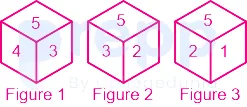
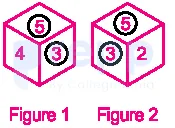
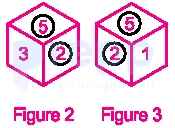
Three different positions of the same dice are shown. Find the number on the face opposite the face showing '5'.
- A
2
- B
1
- C
6
- D
3
Show answer
C. 6The pattern followed here is:
Here, we have to find the face opposite the face showing '5'.
1) We are taking dice figures (1) & (2) together.
Here, 5 and 3 are common in both figure and 2 is opposite to 4.
2) We are taking dice figure (2) & (3) together.
Here, 5 and 2 are common in both figure and 3 is opposite to 1.
Opposite pairs are:
3 → 1
2 → 4
6 → 5
Clearly, 5 is opposite to 6.
Hence, the correct answer is "6".
 Paper & answer key PDF ↗
 Question 19archived
In a certain code language, 'CHILDREN' is written as ‘FKLOGUHQ’ and ‘SCHOOL’ is written as ‘VFKRRO’, how will 'CLASSROOM' be written in that language?
- A
EMCTTTQQO
- B
EMCTTURRP
- C
FOEWWURRP
- D
FODVVURRP
Show answer
D. FODVVURRPUnderstanding Coding Decoding Problems
Coding-decoding is a common type of question in aptitude and reasoning sections. These questions involve a rule or pattern used to code a word, number, or phrase. Your task is to decipher the rule and apply it to decode a given code or code a given word/number/phrase.
In this specific problem, we are given two examples of words coded into a different sequence of letters. We need to find the underlying pattern or rule used for this transformation and then apply it to the word 'CLASSROOM'.
Analyzing the Given Word Code Examples
Let's look at the first example provided:
Word: CHILDREN
Code: FKLOGUHQ
We can compare the position of each letter in the word with its corresponding letter in the code:
C maps to F
H maps to K
I maps to L
L maps to O
D maps to G
R maps to U
E maps to H
N maps to Q
Let's check the alphabetical position shift for each letter:
C $\xrightarrow{+3}$ F
H $\xrightarrow{+3}$ K
I $\xrightarrow{+3}$ L
L $\xrightarrow{+3}$ O
D $\xrightarrow{+3}$ G
R $\xrightarrow{+3}$ U
E $\xrightarrow{+3}$ H
N $\xrightarrow{+3}$ Q
It appears that each letter in the word 'CHILDREN' is shifted 3 positions forward in the English alphabet to get the corresponding letter in the code 'FKLOGUHQ'.
Now, let's verify this rule with the second example:
Word: SCHOOL
Code: VFKRRO
Comparing letters and their shifts:
S $\xrightarrow{+3}$ V
C $\xrightarrow{+3}$ F
H $\xrightarrow{+3}$ K
O $\xrightarrow{+3}$ R
O $\xrightarrow{+3}$ R
L $\xrightarrow{+3}$ O
The rule holds true for the second example as well. The pattern is consistently a +3 shift for each letter.
Applying the Letter Shift Rule to CLASSROOM
Now that we have identified the coding rule (a +3 shift for each letter), we can apply it to the word 'CLASSROOM' to find its code.
Let's process each letter in 'CLASSROOM':
C $\xrightarrow{+3}$ F
L $\xrightarrow{+3}$ O
A $\xrightarrow{+3}$ D
S $\xrightarrow{+3}$ V
S $\xrightarrow{+3}$ V
R $\xrightarrow{+3}$ U
O $\xrightarrow{+3}$ R
O $\xrightarrow{+3}$ R
M $\xrightarrow{+3}$ P
Combining the resulting letters, the code for 'CLASSROOM' is FODVVURRP.
Comparing the Result with Options
Let's compare our derived code 'FODVVURRP' with the given options:
Option 1: EMCTTTQQO
Option 2: EMCTTURRP
Option 3: FOEWWURRP
Option 4: FODVVURRP
Our calculated code 'FODVVURRP' matches Option 4.
Conclusion
Based on the analysis of the given examples, the code language uses a simple substitution cipher where each letter is replaced by the letter that is three positions after it in the English alphabet. Applying this rule to the word 'CLASSROOM' results in the code 'FODVVURRP'.
Revision Table: Coding Details
Original Letter
Shift (+3)
Coded Letter
C
$\xrightarrow{+3}$
F
L
$\xrightarrow{+3}$
O
A
$\xrightarrow{+3}$
D
S
$\xrightarrow{+3}$
V
S
$\xrightarrow{+3}$
V
R
$\xrightarrow{+3}$
U
O
$\xrightarrow{+3}$
R
O
$\xrightarrow{+3}$
R
M
$\xrightarrow{+3}$
P
Additional Information: Types of Coding Decoding
Coding-decoding problems can involve various types of patterns. Some common types include:
Letter Coding: Letters are coded based on rules like shifting positions, reversing the alphabet, or substituting based on a pattern.
Number/Symbol Coding: Words or letters are coded using numbers or symbols.
Mixed Coding: A combination of letters, numbers, or symbols is used.
Substitution: One word is substituted for another, and the question asks for the code of a related word.
Chinese Coding (Matrix Coding): Sentences are given with their codes, and you need to find the code for individual words.
Solving these problems requires careful observation of the pattern in the given examples.
Paper & answer key PDF ↗ Question 20archived
In the following question, select the missing number from the given series.
41, 54, 67, 80, 93, ?
- A
106
- B
108
- C
105
- D
110
Show answer
A. 106Finding the Missing Number in a Number Series
The question asks us to find the missing number in the given series: 41, 54, 67, 80, 93, ?.
To find the missing number, we need to identify the pattern or rule that connects the numbers in the series.
Let's look at the difference between consecutive terms in the number series:
Difference between the 2nd term (54) and the 1st term (41): $54 - 41 = 13$
Difference between the 3rd term (67) and the 2nd term (54): $67 - 54 = 13$
Difference between the 4th term (80) and the 3rd term (67): $80 - 67 = 13$
Difference between the 5th term (93) and the 4th term (80): $93 - 80 = 13$
We can see a consistent difference of 13 between each consecutive pair of numbers. This indicates that the series is an arithmetic progression where each term is obtained by adding 13 to the previous term.
To find the missing number, which is the next term in the series, we need to add 13 to the last given term, which is 93.
Calculation:
$$ \text{Missing Number} = \text{Last Term} + \text{Common Difference} $$
$$ \text{Missing Number} = 93 + 13 $$
$$ \text{Missing Number} = 106 $$
Therefore, the missing number in the series is 106.
Series Pattern Analysis
Let's summarize the pattern:
Term Position
Term Value
Pattern
1st
41
-
2nd
54
$41 + 13$
3rd
67
$54 + 13$
4th
80
$67 + 13$
5th
93
$80 + 13$
6th (Missing)
106
$93 + 13$
The pattern is clearly adding 13 at each step.
Final Answer for the Missing Number
Following the identified pattern, the next number after 93 is $93 + 13 = 106$.
So, the complete series is 41, 54, 67, 80, 93, 106.
Revision Table: Number Series Basics
Concept
Description
Example
Number Series
A sequence of numbers that follow a specific pattern or rule.
2, 4, 6, 8, ... (adding 2)
Pattern
The underlying rule or relationship between the numbers in a series. This could be addition, subtraction, multiplication, division, a combination of operations, or other logical rules.
In 41, 54, 67, ..., the pattern is adding 13.
Arithmetic Progression
A series where the difference between consecutive terms is constant (this constant difference is called the common difference).
1, 5, 9, 13, ... (common difference is 4)
Additional Information: Types of Number Series Patterns
Number series questions often involve identifying different types of patterns. Here are a few common ones:
Arithmetic Series: As seen in this question, a constant value is added or subtracted between terms.
Geometric Series: Each term is multiplied or divided by a constant value to get the next term.
Fibonacci Series: Each term is the sum of the two preceding terms (e.g., 0, 1, 1, 2, 3, 5, 8...).
Difference Series: The differences between consecutive terms form a separate pattern (e.g., arithmetic or geometric difference).
Mixed Series: A combination of two or more patterns interleaved or applied in sequence.
Square or Cube Series: The terms are squares or cubes of natural numbers, or based on operations involving squares/cubes.
Solving number series problems requires careful observation and testing different possible patterns.
Paper & answer key PDF ↗ Question 21archived
In the following question, four number pairs are given. In each pair the number on left side of (–) is related to the number of the right side of (–) with some Logic/Rule/Relation. Three pairs are similar on basis of same Logic/Rule/Relation. Select the odd one out from the given alternatives. (NOTE: Operations should be performed on the whole numbers, without breaking down the numbers into its constituent digits. E.g.13 – Operations on 13 such as adding /subtracting /multiplying etc. to 13 can be performed. Breaking down 13 into 1 and 3 and then performing mathematical operations on 1 and 3 is not allowed)
- A
17 – 31
- B
13 – 25
- C
15 – 27
- D
9 – 15
Show answer
B. 13 – 25Finding the Odd Number Pair Based on Logic
The question asks us to identify the number pair that does not follow the same logical rule as the other three pairs. We are given four pairs of numbers, connected by a dash (–). The operations must be performed on the whole numbers themselves, not their individual digits.
Analyzing the Number Pairs and Finding the Logic
Let's examine each given number pair and try to find a relationship between the first number (on the left) and the second number (on the right).
17 – 31: How can we get 31 from 17?
Let's try multiplication and subtraction/addition.
If we multiply 17 by 2, we get \(17 \times 2 = 34\). To get 31 from 34, we subtract 3: \(34 - 3 = 31\).
So, the possible logic for this pair is \(x \times 2 - 3 = y\). Let's check if this applies to other pairs.
13 – 25: Let the first number be 13.
Using the possible logic from the first pair: \(13 \times 2 - 3 = 26 - 3 = 23\). But the second number is 25.
Let's try a different subtraction with multiplication by 2: \(13 \times 2 = 26\). To get 25, we subtract 1: \(26 - 1 = 25\).
So, this pair seems to follow the logic \(x \times 2 - 1 = y\). This is different from the first pair's logic.
15 – 27: Let the first number be 15.
Using the logic \(x \times 2 - 3 = y\): \(15 \times 2 - 3 = 30 - 3 = 27\). This matches the second number.
This pair follows the same logic as the first pair.
9 – 15: Let the first number be 9.
Using the logic \(x \times 2 - 3 = y\): \(9 \times 2 - 3 = 18 - 3 = 15\). This matches the second number.
This pair also follows the same logic as the first pair.
Identifying the Odd Pair
We have analyzed all four pairs and found the logic connecting the numbers in each pair:
17 – 31: \(17 \times 2 - 3 = 31\)
13 – 25: \(13 \times 2 - 1 = 25\)
15 – 27: \(15 \times 2 - 3 = 27\)
9 – 15: \(9 \times 2 - 3 = 15\)
Three of the pairs (17 – 31, 15 – 27, and 9 – 15) follow the logic where the second number is obtained by multiplying the first number by 2 and then subtracting 3. The pair 13 – 25 follows a different logic, where the second number is obtained by multiplying the first number by 2 and then subtracting 1.
Therefore, the pair 13 – 25 is the odd one out.
Summary of Logic
Pair
First Number (x)
Second Number (y)
Logic Found
17 – 31
17
31
\(x \times 2 - 3 = y\)
13 – 25
13
25
\(x \times 2 - 1 = y\)
15 – 27
15
27
\(x \times 2 - 3 = y\)
9 – 15
9
15
\(x \times 2 - 3 = y\)
The pair 13 – 25 is the only one that does not fit the \(x \times 2 - 3 = y\) rule.
Revision Table: Number Pair Logic
Concept
Description
Example from Problem
Number Pair Analogy
Finding a relationship or rule connecting two numbers in a pair.
Relation between 17 and 31, 13 and 25, etc.
Identifying Odd One Out
Finding the element (in this case, a number pair) that does not follow the common rule applicable to others.
Identifying which pair didn't follow the \(x \times 2 - 3 = y\) rule.
Rule/Logic
The consistent operation or pattern applied to the first number to get the second number.
\(x \times 2 - 3 = y\) and \(x \times 2 - 1 = y\).
Additional Information: Reasoning Patterns
Reasoning questions involving number pairs often rely on identifying mathematical patterns or rules. These rules can be simple or complex and might involve various arithmetic operations or combinations of operations.
Common Patterns:
Adding or subtracting a constant.
Multiplying or dividing by a constant.
Multiplying/dividing and then adding/subtracting.
Squaring or cubing the number and then adding/subtracting.
Operations related to prime numbers, odd/even numbers, etc.
Strategy: To solve such problems, you should systematically test different possible relationships between the numbers in the first few pairs to find a consistent rule. Once a potential rule is found, check if it applies to all pairs except one.
Whole Numbers: Remember the constraint mentioned in the question: operations are performed on the whole numbers, not their individual digits. For example, for the number 13, you work with 13 as a single value, not separately with 1 and 3.
Practice with different types of number series and number pair problems helps in quickly recognizing common patterns.
Paper & answer key PDF ↗ Question 22archived
In a certain code language, 'INBOX’ is written as 'MRYCL' and 'EMAIL' is written as 'NVZOR'. How will 'DRAFT' be written in that language?
- A
UGZWI
- B
WIZGU
- C
IWZGU
- D
IWGZU
Show answer
C. IWZGUUnderstanding the Coding-Decoding Pattern
The question asks us to decipher a specific code language where 'INBOX' is coded as 'MRYCL' and 'EMAIL' is coded as 'NVZOR'. We need to find the code for 'DRAFT' using the same logic.
Let's analyze the position of each letter in the alphabet (A=1, B=2, ..., Z=26) and the given transformations:
Analyzing 'INBOX' to 'MRYCL'
Position
INBOX
Value
MRYCL
Value
Transformation
1
I
9
M
13
$\text{M} - \text{I} = 13 - 9 = +4$
2
N
14
R
18
$\text{R} - \text{N} = 18 - 14 = +4$
3
B
2
Y
25
$\text{Y} + \text{B} = 25 + 2 = 27$ (Alphabet Complement)
4
O
15
C
3
$\text{C} - \text{O} = 3 - 15 = -12$ (or $3 - 15 + 26 = +14$)
5
X
24
L
12
$\text{L} - \text{X} = 12 - 24 = -12$ (or $12 - 24 + 26 = +14$)
Analyzing 'EMAIL' to 'NVZOR'
Position
EMAIL
Value
NVZOR
Value
Transformation
1
E
5
N
14
$\text{N} - \text{E} = 14 - 5 = +9$
2
M
13
V
22
$\text{V} - \text{M} = 22 - 13 = +9$
3
A
1
Z
26
$\text{Z} + \text{A} = 26 + 1 = 27$ (Alphabet Complement)
4
I
9
O
15
$\text{O} - \text{I} = 15 - 9 = +6$
5
L
12
R
18
$\text{R} - \text{L} = 18 - 12 = +6$
Identifying the Coding Pattern
From the analysis, we can observe the following pattern:
Position 3: The letter at position 3 is replaced by its Alphabet Complement (letter value sums to 27). This is consistent for 'B' to 'Y' ($2+25=27$) and 'A' to 'Z' ($1+26=27$).
Positions 1 and 2: The letters at positions 1 and 2 undergo the same shift (e.g., +4 for INBOX, +9 for EMAIL). Let's call this Shift 1 ($S_1$).
Positions 4 and 5: The letters at positions 4 and 5 undergo the same shift (e.g., +14 for INBOX, +6 for EMAIL). Let's call this Shift 2 ($S_2$).
The challenge is to determine how $S_1$ and $S_2$ are decided for a given word.
Discovering the Shift Logic
Let's look at the sums of letter values at positions 1&2 and 4&5 for the input words and relate them to the shifts $S_1$ and $S_2$ found:
For INBOX:
Sum of values at Pos 1&2 (I+N): $9 + 14 = 23$. $S_1 = 4$. Notice $23 + 4 = 27$.
Sum of values at Pos 4&5 (O+X): $15 + 24 = 39$. $S_2 = 14$. Notice $39 + 14 = 53$, and $27 \times 2 - 1 = 53$. Or, perhaps $39-14 = 25$. Let's re-check. $27-39 = -12$. Modulo 26, $-12+26 = 14$. Yes, $S_2 = 27 - \text{Sum}(\text{Pos } 4\&5)$ modulo 26 if the sum is over 26? Or maybe the shift is $\text{Sum}(\text{Pos } 4\&5) \pmod{26}$? $39 \pmod{26} = 13$. Not 14. Let's re-examine the relationship $23+4=27$ and $39-14=25$, $39 \rightarrow 14$. $39+14=53$. $27+26=53$. This looks like $27$ or $27+26=53$.
For EMAIL:
Sum of values at Pos 1&2 (E+M): $5 + 13 = 18$. $S_1 = 9$. Notice $18 + 9 = 27$.
Sum of values at Pos 4&5 (I+L): $9 + 12 = 21$. $S_2 = 6$. Notice $21 + 6 = 27$.
From the consistent pattern in EMAIL, and the sum for INBOX Pos 1&2, it appears the shifts $S_1$ and $S_2$ are determined such that the sum of the letter values at the corresponding positions plus the shift equals 27.
$S_1 = 27 - (\text{Value of Letter at Pos 1} + \text{Value of Letter at Pos 2})$
$S_2 = 27 - (\text{Value of Letter at Pos 4} + \text{Value of Letter at Pos 5})$
We need to use modulo 26 for shifts if they go beyond Z (26) or before A (1). Adding a shift $S$ means adding $S$ to the letter's value, then taking the result modulo 26. If the result is 0, it corresponds to Z (value 26). A simple way is $( \text{Letter Value} - 1 + S ) \pmod{26} + 1$. Let's test the formula for INBOX S2 again. Sum(4+5)=39. $S_2 = 27-39 = -12$. Letter O(15) shifted by -12: $15 + (-12) = 3$ (C). Letter X(24) shifted by -12: $24 + (-12) = 12$ (L). This matches the result +14 using $(Val - 1 - 12) \pmod{26} + 1 \rightarrow (Val - 13) \pmod{26} + 1$. For O(15): $(15-13)\pmod{26}+1 = 2\pmod{26}+1 = 3$. For X(24): $(24-13)\pmod{26}+1 = 11\pmod{26}+1 = 12$. Yes, -12 shift (or +14) is correct. So the formula seems to be $S = 27 - \text{Sum}$, and we apply this shift directly (which implies modulo 26 arithmetic for letter values).
Applying the Logic to 'DRAFT'
Now let's apply this logic to 'DRAFT'. The letter values are D(4), R(18), A(1), F(6), T(20).
Calculate Shift 1 ($S_1$) for Positions 1 & 2:
Sum of values at Pos 1&2 (D+R) = $4 + 18 = 22$.
$S_1 = 27 - \text{Sum}(\text{Pos } 1\&2) = 27 - 22 = 5$.
Apply shift +5 to D and R:
D (4) + 5 = 9 (I)
R (18) + 5 = 23 (W)
The first two coded letters are IW.
Encode Position 3:
Letter at Pos 3 is A (1).
Alphabet Complement = $27 - 1 = 26$ (Z).
The third coded letter is Z.
Calculate Shift 2 ($S_2$) for Positions 4 & 5:
Sum of values at Pos 4&5 (F+T) = $6 + 20 = 26$.
$S_2 = 27 - \text{Sum}(\text{Pos } 4\&5) = 27 - 26 = 1$.
Apply shift +1 to F and T:
F (6) + 1 = 7 (G)
T (20) + 1 = 21 (U)
The last two coded letters are GU.
Combining the coded parts (IW, Z, GU), we get IWZGU.
Coded Word for DRAFT
Following the discovered pattern, the word 'DRAFT' is coded as 'IWZGU'.
Revision Table: Summary of Pattern
Position(s)
Rule / Shift Calculation
1 & 2
Shift by $S_1 = 27 - (\text{Val}_1 + \text{Val}_2)$
3
Alphabet Complement ($27 - \text{Val}_3$)
4 & 5
Shift by $S_2 = 27 - (\text{Val}_4 + \text{Val}_5)$
Additional Information: Coding Decoding Concepts
Coding-decoding questions test your logical reasoning and pattern recognition skills. Common patterns include:
Letter Shifting: Each letter is shifted by a fixed number of positions forward or backward in the alphabet.
Alphabet Complement: Each letter is replaced by the letter equidistant from the end of the alphabet as the original letter is from the beginning (A maps to Z, B to Y, etc., summing to 27).
Position-Based Shifting: The shift amount varies based on the position of the letter in the word.
Vowel/Consonant Based Shifting: Vowels and consonants follow different rules.
Reverse Ordering: The letters of the word or parts of the word are reversed.
Mixed Patterns: A combination of the above patterns, often applied to different parts or positions of the word, as seen in this problem. Complex patterns like the one discussed here, involving calculations based on letter values and positions, are also common in competitive exams.
Solving these questions requires careful observation, breaking down the transformations, identifying consistent rules, and applying them systematically.
Paper & answer key PDF ↗ Question 23archived
Three of the following four letter-clusters are alike in a certain way and one is different.
Pick the odd one out.
- A
TQR
- B
MJK
- C
IFG
- D
NKI
Show answer
D. NKIUnderstanding Letter Cluster Reasoning
This type of reasoning question asks us to identify the letter cluster that doesn't follow the same pattern or rule as the others. To solve this, we usually look at the position of the letters in the English alphabet and the relationships between them within each cluster.
Analyzing Letter Positions in Each Cluster
Let's examine the alphabetical positions of the letters in each given cluster:
Cluster
Letters
Alphabetical Positions
1
TQR
T (20), Q (17), R (18)
2
MJK
M (13), J (10), K (11)
3
IFG
I (9), F (6), G (7)
4
NKI
N (14), K (11), I (9)
Identifying the Pattern
Now, let's look at the difference in alphabetical positions between consecutive letters in each cluster:
TQR:
From T (20) to Q (17): \(20 - 17 = 3\). The pattern is a decrease of 3 (\(-3\)).
From Q (17) to R (18): \(18 - 17 = 1\). The pattern is an increase of 1 (\(+1\)).
Pattern for TQR: \(-3\), \(+1\)
MJK:
From M (13) to J (10): \(13 - 10 = 3\). The pattern is a decrease of 3 (\(-3\)).
From J (10) to K (11): \(11 - 10 = 1\). The pattern is an increase of 1 (\(+1\)).
Pattern for MJK: \(-3\), \(+1\)
IFG:
From I (9) to F (6): \(9 - 6 = 3\). The pattern is a decrease of 3 (\(-3\)).
From F (6) to G (7): \(7 - 6 = 1\). The pattern is an increase of 1 (\(+1\)).
Pattern for IFG: \(-3\), \(+1\)
NKI:
From N (14) to K (11): \(14 - 11 = 3\). The pattern is a decrease of 3 (\(-3\)).
From K (11) to I (9): \(11 - 9 = 2\). The pattern is a decrease of 2 (\(-2\)).
Pattern for NKI: \(-3\), \(-2\)
Finding the Odd Letter Cluster Out
Comparing the patterns:
TQR follows the \(-3\), \(+1\) pattern.
MJK follows the \(-3\), \(+1\) pattern.
IFG follows the \(-3\), \(+1\) pattern.
NKI follows the \(-3\), \(-2\) pattern.
The letter cluster NKI is different because the pattern between the second and third letters is \(-2\), whereas in the other three clusters, it is \(+1\).
Conclusion: The Different Letter Cluster
Based on the analysis of alphabetical positions and patterns, NKI is the odd one out among the given letter clusters TQR, MJK, IFG, and NKI.
Revision Table: Letter Cluster Patterns
Letter Cluster
Pattern
TQR
\(-3\), \(+1\)
MJK
\(-3\), \(+1\)
IFG
\(-3\), \(+1\)
NKI
\(-3\), \(-2\)
Additional Information: Letter Series and Odd One Out
Questions involving finding the odd one out from letter clusters, series, or analogies test your ability to identify patterns. These patterns can be based on various rules, such as:
Alphabetical position differences (like in this problem).
Skipping letters.
Vowels and consonants.
Reversed alphabetical order.
Combining multiple rules.
Practicing with different types of letter series and analogies helps improve your pattern recognition skills for reasoning sections in exams.
Paper & answer key PDF ↗ Question 24archived
Which of the following letter-clusters will replace the question mark (?) and complete the following letter-cluster series?
LE, OJ, UO, DT, ?
- A
PZ
- B
QY
- C
PX
- D
PY
Show answer
D. PYFinding the Pattern in the Letter-Cluster Series
The question asks us to identify the letter-cluster that will replace the question mark in the series: LE, OJ, UO, DT, ?
To solve this type of question, we need to find the pattern in how the letters change from one cluster to the next. Let's look at the alphabetical position of each letter.
Analyzing the First Letters of the Clusters
The first letters in the series are L, O, U, D.
L is the 12th letter.
O is the 15th letter.
U is the 21st letter.
D is the 4th letter.
Let's look at the difference in their positions:
From L (12) to O (15): \(15 - 12 = +3\)
From O (15) to U (21): \(21 - 15 = +6\)
From U (21) to D (4): U is 21st. If we go 9 letters forward from U, we reach \(21 + 9 = 30\). In the alphabet (A-Z is 26 letters), 30 corresponds to \(30 - 26 = 4\), which is D. So the jump is \(+9\).
The pattern for the first letters appears to be an increase by consecutive multiples of 3: +3, +6, +9. Following this pattern, the next increase should be \(+12\).
Starting from the last known first letter, D (4th letter): \(4 + 12 = 16\). The 16th letter of the alphabet is P.
So, the first letter of the next cluster is P.
Analyzing the Second Letters of the Clusters
The second letters in the series are E, J, O, T.
E is the 5th letter.
J is the 10th letter.
O is the 15th letter.
T is the 20th letter.
Let's look at the difference in their positions:
From E (5) to J (10): \(10 - 5 = +5\)
From J (10) to O (15): \(15 - 10 = +5\)
From O (15) to T (20): \(20 - 15 = +5\)
The pattern for the second letters is a consistent increase of +5.
Following this pattern, the next increase should be \(+5\).
Starting from the last known second letter, T (20th letter): \(20 + 5 = 25\). The 25th letter of the alphabet is Y.
So, the second letter of the next cluster is Y.
Combining the Results
The next first letter is P.
The next second letter is Y.
Combining these, the next letter-cluster in the series is PY.
Cluster
1st Letter (Position)
Pattern for 1st Letter
2nd Letter (Position)
Pattern for 2nd Letter
LE
L (12)
-
E (5)
-
OJ
O (15)
\(+3\)
J (10)
\(+5\)
UO
U (21)
\(+6\)
O (15)
\(+5\)
DT
D (4)
\(+9\) (21 \(\rightarrow\) 4)
T (20)
\(+5\)
?
P (16)
\(+12\) (4 \(\rightarrow\) 16)
Y (25)
\(+5\) (20 \(\rightarrow\) 25)
Conclusion
Based on the identified patterns (+3, +6, +9, +12, ... for the first letters and +5, +5, +5, +5, ... for the second letters), the next letter-cluster in the series LE, OJ, UO, DT, ? is PY.
Revision Table: Letter Series Patterns
Reviewing common patterns in letter series questions:
Alphabetical Position: Look at the numerical position of each letter (A=1, B=2, ... Z=26).
Differences: Find the difference in position between consecutive letters. The differences might follow an arithmetic progression (+n, +n, +n) or another sequence (+n, +2n, +3n; +n, +n+d, +n+2d; etc.).
Skip Letters: Count how many letters are skipped between consecutive letters in the series.
Within Cluster Pattern: Sometimes there's a pattern between the letters within a single cluster (e.g., difference, sum of positions). This pattern might also change in a predictable way across the series.
Reverse Alphabet: Patterns might involve counting backwards from Z.
Additional Information: Types of Logic Puzzles
Letter series problems are a common type of logical reasoning question. Other related types include:
Number Series: Finding patterns in sequences of numbers (arithmetic, geometric, squares, cubes, Fibonacci, etc.).
Alphanumeric Series: Series combining both letters and numbers, often with independent patterns for each.
Coding and Decoding: Problems where words or letters are coded according to a specific rule, and you must apply the rule or decipher it.
Analogy: Finding relationships between pairs of words, letters, or numbers and applying that relationship to a new pair.
Practicing these various types of logic puzzles helps improve pattern recognition and problem-solving skills.
Paper & answer key PDF ↗ Question 25archived
Select the option that is related to the fifth letter-cluster in the same way as the second letter-cluster is related to the first letter-cluster and the fourth letter-cluster is related to the third letter-cluster.
GAIN : HBKP :: ACHE : BDJG :: CAKE : ?
- A
DBNH
- B
DBMH
- C
DBNG
- D
DBMG
Show answer
D. DBMGUnderstanding Letter-Cluster Analogy
This question asks us to find a relationship between pairs of letter clusters. We need to identify the pattern that transforms the first letter cluster into the second in the given pairs (GAIN to HBKP, and ACHE to BDJG). Once we find this pattern, we apply it to the fifth letter cluster (CAKE) to find the missing sixth cluster.
Analyzing the First Letter-Cluster Pair: GAIN to HBKP
Let's look at how each letter in GAIN changes to become the corresponding letter in HBKP:
The first letter G changes to H. Moving from G to H in the alphabet is a step of \(+1\).
The second letter A changes to B. Moving from A to B in the alphabet is a step of \(+1\).
The third letter I changes to K. Moving from I to K in the alphabet is a step of \(+2\).
The fourth letter N changes to P. Moving from N to P in the alphabet is a step of \(+2\).
So, the pattern observed in the first pair GAIN : HBKP is a step of \(+1\), \(+1\), \(+2\), \(+2\) for the four letters respectively.
Analyzing the Second Letter-Cluster Pair: ACHE to BDJG
Now, let's check if the same pattern applies to the second pair ACHE : BDJG:
The first letter A changes to B. Moving from A to B is \(+1\).
The second letter C changes to D. Moving from C to D is \(+1\).
The third letter H changes to J. Moving from H to J is \(+2\).
The fourth letter E changes to G. Moving from E to G is \(+2\).
The pattern \(+1\), \(+1\), \(+2\), \(+2\) is confirmed in the second pair as well.
Applying the Pattern to the Fifth Letter-Cluster: CAKE
We now apply the confirmed pattern \(+1\), \(+1\), \(+2\), \(+2\) to the letter cluster CAKE to find the related cluster:
First letter C: Apply \(+1\) step. C \(\xrightarrow{+1}\) D.
Second letter A: Apply \(+1\) step. A \(\xrightarrow{+1}\) B.
Third letter K: Apply \(+2\) steps. K \(\xrightarrow{+2}\) M.
Fourth letter E: Apply \(+2\) steps. E \(\xrightarrow{+2}\) G.
Following the pattern, the letters D, B, M, and G are obtained. Combining these letters gives the resulting cluster DBMG.
Summary of Letter-Cluster Transformations
Original Cluster
Letter
Transformation
Resulting Letter
Transformed Cluster
GAIN
G
\(+1\)
H
HBKP
A
\(+1\)
B
I
\(+2\)
K
N
\(+2\)
P
ACHE
A
\(+1\)
B
BDJG
C
\(+1\)
D
H
\(+2\)
J
E
\(+2\)
G
CAKE
C
\(+1\)
D
DBMG
A
\(+1\)
B
K
\(+2\)
M
E
\(+2\)
G
Based on the consistent \(+1\), \(+1\), \(+2\), \(+2\) pattern observed and applied, the letter-cluster related to CAKE is DBMG.
Revision Table: Letter-Cluster Reasoning
Reviewing the steps helps reinforce the logic used in letter-cluster analogy questions:
Identify the pairs provided in the question.
Analyze the relationship between the first two items in the first pair.
Look for letter shifts, position changes, or other patterns.
Test the identified pattern on the second pair to confirm its consistency.
Apply the confirmed pattern to the final item to find the missing element.
Verify the result against the options provided.
Additional Information: Analogy Question Types
Analogy questions test your ability to identify relationships between different things. Common types include:
Word Analogy: Finding relationships between words (e.g., Synonym, Antonym, Part-Whole, Cause-Effect).
Number Analogy: Finding mathematical relationships between numbers or number sequences.
Letter Analogy (or Letter Series/Cluster): Finding patterns based on letter positions in the alphabet or transformations between letter groups.
Image Analogy: Identifying relationships or patterns in visual elements or sequences of images.
Solving analogy questions requires careful observation, logical thinking, and sometimes knowledge of specific subjects (like vocabulary for word analogies or the alphabet sequence for letter analogies).
Paper & answer key PDF ↗ Question 26archived
Earth’s core is mainly made up of ______.
- A
nickel and copper
- B
nickel and alumina
- C
nickel and iron
- D
nickel and magnesium
Show answer
C. nickel and ironUnderstanding Earth's Core Composition
The Earth is structured in layers, much like an onion. The innermost layer is known as the core. The Earth's core is a crucial part of the planet's structure, influencing its magnetic field and internal dynamics. Geologists and geophysicists study seismic waves and other data to understand what makes up this deep, inaccessible region.
What is the Earth's Core Made Of?
Based on seismic studies, analysis of meteorites (which are thought to represent early solar system material), and high-pressure experiments, scientists have determined that the Earth's core is primarily composed of dense metals. The two most abundant elements in the core are believed to be iron and nickel.
While the exact composition is difficult to determine directly, the high density of the core requires it to be made of heavier elements like metals. Iron is by far the most common metal in the universe and in rocky planets like Earth, and nickel is often found associated with iron in cosmic materials.
Analysing the Options for Core Composition
Let's look at the options provided regarding the main components of the Earth's core:
nickel and copper: Copper is a metal, but it is not considered a primary component of the Earth's core. Iron is much more abundant.
nickel and alumina: Alumina (aluminium oxide) is a compound found in rocks and minerals in the Earth's crust and mantle, but not expected in significant amounts in the metallic core.
nickel and iron: Both nickel and iron are dense metals that are abundant in the early solar system material from which Earth formed. Scientific evidence strongly supports these two elements as the main constituents of the core.
nickel and magnesium: Magnesium is a lighter element than iron and is a major component of silicate rocks found in the Earth's mantle, not the metallic core.
Comparing the options with the scientific understanding of Earth's structure, the combination of nickel and iron is the most accurate description of the core's main composition.
Potential Core Component
Likelihood in Core
Notes
Iron (Fe)
Very High
Primary component, high density, cosmically abundant.
Nickel (Ni)
High
Significant component, often alloyed with iron in cosmic materials.
Copper (Cu)
Low
Metal, but not a primary component of the core.
Alumina (Al<sub>2</sub>O<sub>3</sub>)
Very Low
Oxide, characteristic of crust/mantle rocks.
Magnesium (Mg)
Very Low
Lighter element, major component of mantle silicates.
Therefore, the Earth's core is mainly made up of nickel and iron.
Revision Table: Earth's Core Composition
Layer of Earth
Main Composition
State
Crust
Silicate rocks (rich in Si, Al, K, Na)
Solid
Mantle
Silicate rocks (rich in Si, O, Mg, Fe)
Mostly solid (plastic in upper mantle)
Outer Core
Molten Iron and Nickel
Liquid
Inner Core
Solid Iron and Nickel alloy
Solid
Additional Information: Earth's Core and Related Concepts
Why Iron and Nickel? These elements are dense and were readily available in the early solar system. During Earth's formation, heavier elements like iron and nickel sank towards the center due to gravity differentiation, forming the core.
Outer vs. Inner Core: The core is divided into two parts: the outer core, which is liquid iron and nickel, and the inner core, which is solid iron and nickel. The intense pressure at the center keeps the inner core solid despite the extreme temperature.
Magnetic Field: The convection currents within the liquid outer core, composed mainly of iron and nickel, are responsible for generating Earth's magnetic field.
Density: The core is the densest part of the Earth. Its density is significantly higher than the mantle and crust, which is consistent with it being composed of heavy metals like iron and nickel.
Paper & answer key PDF ↗ Question 27archived
The subject of the Study of Macro Economics is based on which principle?
- A
The principle of National Income
- B
The principle of Consumer
- C
The principle of Producer
- D
The principle of Investment
Show answer
A. The principle of National IncomeUnderstanding the Subject of Macro Economics
Macroeconomics is a branch of economics that studies the behavior of the economy as a whole. Unlike microeconomics, which focuses on individual agents and markets (like individual consumers or producers), macroeconomics looks at aggregate phenomena.
The subject matter of Macro Economics revolves around economy-wide issues such as:
Total output of goods and services (Gross Domestic Product - GDP)
Overall price levels (inflation or deflation)
Aggregate employment and unemployment rates
Total consumption and investment
Government spending and taxation
These economy-wide measurements and concepts are essentially different facets of the overall economic activity and income generated within a nation.
Analysing the Options
Let's look at the given options in the context of Macro Economics:
The principle of National Income: National Income is a key measure of the total income earned by a nation's residents. It represents the aggregate economic activity. The study of how national income is determined, what factors influence it, and how it changes over time is central to Macro Economics.
The principle of Consumer: The study of individual consumer behavior, their choices, and how they interact in specific markets is primarily the domain of Microeconomics. While aggregate consumption is studied in Macro Economics, the focus is not on the individual consumer's principle but on the total consumption across the economy.
The principle of Producer: Similar to consumer behavior, the study of individual firm behavior, production decisions, and supply in specific markets falls under Microeconomics. Macroeconomics studies aggregate production and supply across the entire economy.
The principle of Investment: Investment is a crucial component of aggregate demand and economic growth, and it is indeed studied in Macro Economics. However, it is a part of the larger picture of aggregate economic activity and income, rather than the fundamental subject or principle upon which the entire field is based. The principles governing total investment are studied as part of understanding national income determination and economic fluctuations.
Why National Income is Key to Macro Economics
Macro Economics fundamentally seeks to understand the determinants and fluctuations of aggregate economic variables. The health and performance of an economy are often judged by measures like National Income (or GDP). Therefore, studying the principles related to the generation, distribution, and measurement of National Income forms the core basis for understanding economy-wide issues like growth, employment, and inflation. The principle of National Income encapsulates the idea of studying the economy in aggregate terms, focusing on the total flow of income and output.
Thus, the subject of the Study of Macro Economics is based on the principle of National Income, which represents the aggregate economic activity.
Economic Branch
Level of Study
Key Focus (Principle/Subject)
Microeconomics
Individual/Specific Markets
Consumer behaviour, producer behaviour, market price determination
Macroeconomics
Economy as a whole (Aggregates)
National Income, aggregate employment, inflation, economic growth
Based on this understanding, the principle that forms the subject of study for Macro Economics is the principle of National Income.
Revision Table: Macro Economics Principles
Concept
Relevance to Macro Economics
National Income
Central subject, aggregate measure of economic activity.
Consumer Principle
Microeconomic focus; aggregate consumption studied in Macro.
Producer Principle
Microeconomic focus; aggregate production studied in Macro.
Investment Principle
Important component of aggregate demand, studied within the context of national income.
Additional Information: Key Macroeconomic Concepts
Beyond National Income, Macro Economics delves into several interconnected concepts:
Aggregate Demand (AD): The total demand for all goods and services in an economy at a given overall price level and time period. Components include consumption, investment, government spending, and net exports.
Aggregate Supply (AS): The total supply of goods and services that firms in a national economy plan on producing during a specific period.
Inflation: A general increase in the prices of goods and services in an economy over a period of time, resulting in a fall in the purchasing value of money.
Unemployment: Occurs when people are willing and able to work but cannot find a job. Macroeconomics studies the causes and types of unemployment at the economy-wide level.
Economic Growth: An increase in the capacity of an economy to produce goods and services, compared from one period of time to another. It is often measured as the percentage change in real GDP.
These concepts are all studied in relation to how they affect and are affected by changes in National Income and other aggregate variables.
Paper & answer key PDF ↗ Question 28archived
Who has been appointed as new National e-Governance Division CEO in March 2022?
- A
Nitin Chugh
- B
Rajiv Kumar
- C
Abhishek Singh
- D
TS Ramakrishnan
Show answer
C. Abhishek SinghNational e-Governance Division CEO Appointment
The question asks about a key appointment made in March 2022 concerning the National e-Governance Division. Understanding such appointments is important for staying updated on government initiatives and personnel changes, particularly in crucial sectors like e-governance.
In March 2022, the position of Chief Executive Officer (CEO) for the National e-Governance Division (NeGD) saw a new appointment. This division plays a significant role in the planning, development, and implementation of various e-governance projects across India.
Identifying the National e-Governance Division CEO
Based on official announcements and reports from March 2022, the individual appointed as the new CEO of the National e-Governance Division was Abhishek Singh. He is a senior bureaucrat and his appointment was a notable development in the digital governance landscape of the country.
Let's look at the options provided:
Nitin Chugh: While a prominent figure in the digital and banking sector, he was not appointed NeGD CEO in March 2022.
Rajiv Kumar: A distinguished public servant, but his appointment in March 2022 was not as NeGD CEO.
Abhishek Singh: He was indeed appointed as the CEO of the National e-Governance Division in March 2022. He also held the position of President & CEO of MyGov and MD & CEO of Digital India Corporation (DIC) at the time.
TS Ramakrishnan: Associated with the financial sector, not the NeGD CEO role in March 2022.
Therefore, the correct individual appointed as the new National e-Governance Division CEO in March 2022 was Abhishek Singh.
Role of National e-Governance Division (NeGD)
The National e-Governance Division, or NeGD, is an independent business division within the Digital India Corporation (DIC), a not-for-profit company under the Ministry of Electronics & Information Technology (MeitY), Government of India. NeGD was established with the objective of facilitating and supporting the implementation of the National e-Governance Plan (NeGP). Its functions include:
Assisting ministries and states in the implementation of e-governance projects.
Developing technical standards and policies for e-governance.
Capacity building within government departments for e-governance initiatives.
Managing common infrastructure like the National Data Centre and the National Service Delivery Gateway.
Promoting digital literacy and adoption of digital services.
The CEO of NeGD plays a crucial leadership role in driving these initiatives forward.
Summary of Appointment
Position
Organization
Appointed Individual
Appointment Month/Year
CEO
National e-Governance Division (NeGD)
Abhishek Singh
March 2022
Revision Table: Key Appointments
Individual
Position Mentioned (March 2022 Context)
Notes
Abhishek Singh
National e-Governance Division (NeGD) CEO
Correct Answer
Nitin Chugh
Option
Not NeGD CEO
Rajiv Kumar
Option
Not NeGD CEO (was Chief Election Commissioner later in 2022)
TS Ramakrishnan
Option
Not NeGD CEO (associated with financial services)
Additional Information: e-Governance in India
e-Governance in India aims to make government services accessible to the common man in his locality, through common service delivery outlets, and ensure efficiency, transparency, and reliability of such services at affordable costs. The National e-Governance Plan (NeGP) was approved in 2006 and comprises 31 Mission Mode Projects (MMPs) and 8 infrastructure components. Key initiatives under e-governance include Digital India, MyGov, DigiLocker, and various online service portals for different government departments.
Appointments like that of the NeGD CEO are significant as they influence the direction and speed of these digital transformation efforts. The individual leading NeGD is responsible for overseeing many of the technical and implementation aspects of India's digital government initiatives.
Paper & answer key PDF ↗ Question 29archived
The Durga temple at Aihole, built about ______ years ago.
- A
1700
- B
2000
- C
1100
- D
1400
Show answer
D. 1400Understanding the Age of the Durga Temple at Aihole
The question asks about the approximate age of the famous Durga temple located in Aihole. Aihole is a historically significant site in Karnataka, India, known for its rich collection of ancient temples, representing various stages of early medieval Indian architecture.
The Durga temple is one of the most well-known structures at Aihole. It is not actually dedicated to Goddess Durga in the sense of being named after her, but its name likely comes from its location near a durg (fortified enclosure) or possibly a misinterpretation. Architecturally, it is noted for its apsidal plan, resembling Buddhist chaitya halls, and its rich sculptures.
Based on historical and archaeological studies, the Durga temple is generally dated to the 7th or 8th century CE. To find out how many years ago this was, we can calculate from the current year (approximately 2024). A construction period around the 7th century would be around 1300-1400 years ago, and the 8th century would be around 1200-1300 years ago.
Let's look at the options provided:
1700 years ago
2000 years ago
1100 years ago
1400 years ago
Comparing the likely construction period (7th-8th century CE, which is 1200-1400 years ago from today) with the options, the option that falls within this range is 1400 years ago. This aligns with the earlier dating estimates for the temple's construction.
Therefore, the Durga temple at Aihole was built about 1400 years ago, placing its construction during the early Chalukya period.
Aihole: A Historical Crossroads of Temple Architecture
Aihole served as an early capital of the Chalukya dynasty and is often referred to as the "cradle of Indian architecture" because of the diverse range of temple styles found there. The temples in Aihole were built between the 6th and 12th centuries, showcasing experiments in both rock-cut and structural temple building.
Key features of Aihole temples:
Presence of various temple types (apsidal, rectangular, square).
Influence of both Northern (Nagara) and Southern (Dravidian) architectural styles, sometimes blended.
Intricate sculptures depicting Hindu deities, mythological scenes, and daily life.
Notable temples include the Lad Khan Temple, Suryanarayana Temple, Huchimalli Gudi Temple, and the Meguti Jain Temple (dated 634 CE).
The diversity at Aihole provides valuable insights into the evolution of Hindu temple architecture in India.
Revision Table: Aihole Temple Facts
Temple
Location
Approximate Age (Years Ago)
Architectural Style Notes
Durga Temple
Aihole, Karnataka
1400
Apsidal plan, early Chalukya, blend of styles
Lad Khan Temple
Aihole, Karnataka
~1500
Early structural temple, unique assembly hall structure
Meguti Jain Temple
Aihole, Karnataka
~1390 (Dated 634 CE)
Dated inscription, Dravidian style
Additional Information on Aihole and Chalukya Architecture
The Chalukya dynasty that ruled from Badami (Vatapi), Aihole, and Pattadakal was crucial in the development of South Indian temple architecture. Their style, sometimes called Vesara, is considered a hybrid of Northern and Southern styles.
Pattadakal: Located nearby, Pattadakal is a UNESCO World Heritage site showcasing later and more refined examples of Chalukya architecture, including temples in both Nagara and Dravidian styles built side-by-side.
Badami: The cave temples at Badami are famous for their rock-cut architecture and sculptures from the same period.
Architectural Significance: The temples in this region, particularly Aihole, show the transition from rock-cut caves to free-standing structural temples, demonstrating architectural experimentation and innovation.
Paper & answer key PDF ↗ Question 30archived
According to the Brihat Samhita, what do you call the process of making scents, mouth perfumes and bath powders?
- A
Jatuka
- B
Gandhayukli
- C
Kamplcica
- D
Pattanga
Show answer
B. GandhayukliUnderstanding the Art of Perfumery in Ancient India: Brihat Samhita
The question asks about the specific term used in the ancient Indian text, the Brihat Samhita, for the process involved in creating various fragrant substances such as scents, mouth perfumes, and bath powders. This art was highly developed and documented in historical texts.
What is Gandhayukli?
According to the Brihat Samhita, a comprehensive work by Varahamihira covering a wide range of topics from astronomy to social customs, the art of preparing perfumes, cosmetics, and related fragrant items is known as Gandhayukli. This term directly translates to something like "perfume preparation" or "scent blending".
Gandhayukli encompassed detailed knowledge of:
Different aromatic substances (flowers, woods, resins, spices)
Methods of extraction and processing
Formulating specific products like body perfumes, hair oils, mouth fresheners, and bathing powders
This practice was not just about creating pleasant smells; it also involved understanding the properties of different ingredients and their effects.
Analyzing the Options
Let's look at the other options provided in the context of the Brihat Samhita:
Jatuka: This is a term often associated with lac or a type of plant used for dyeing, not directly related to the process of perfumery as described in the Brihat Samhita.
Kamplcica: This term does not correspond to the process of making scents or bath powders in the context of the Brihat Samhita's chapters on perfumery.
Pattanga: This term is typically associated with objects related to flight or movement (like kites) or potentially a type of tree (Sappanwood used for dyeing), not the process of making perfumes and bath powders.
Based on the contents of the Brihat Samhita, especially the chapter dealing with fragrances (often referred to as 'Gandhayuktyadhyaya'), Gandhayukli is the precise term for the art of making scents, mouth perfumes, and bath powders.
Conclusion
The process of making scents, mouth perfumes, and bath powders, as detailed in the ancient Indian text Brihat Samhita, is called Gandhayukli. This term specifically refers to the techniques and formulations used in ancient Indian perfumery and cosmetics.
Term
Description in Brihat Samhita Context
Jatuka
Usually related to lac or dyeing materials.
Gandhayukli
The process of making scents, mouth perfumes, bath powders, etc. (Perfumery)
Kamplcica
Not the term for perfumery.
Pattanga
Usually related to flight or a type of tree used for dyeing.
Revision Table: Brihat Samhita Terms
Concept
Term in Brihat Samhita
Making Scents/Perfumery
Gandhayukli
Astronomy/Astrology
Jyotisha
Architecture/Town Planning
Vastu Vidya
Gemmology
Ratnapariksha
Additional Information on Brihat Samhita and Gandhayukli
The Brihat Samhita is an encyclopedic work by Varahamihira, an Indian polymath who lived around the 6th century CE. It covers a vast array of subjects, reflecting the scientific and cultural knowledge of that era. The inclusion of detailed sections on perfumery (Gandhayukli) highlights the importance placed on personal grooming and aesthetics in ancient Indian society. The text provides recipes and methods using a variety of natural ingredients, showcasing sophisticated knowledge of chemistry and botany for that time period. Studying Gandhayukli from the Brihat Samhita gives us insights into ancient Indian cosmetic and perfumery practices, their ingredients, and their purposes, which often extended beyond mere fragrance to therapeutic uses.
Paper & answer key PDF ↗ Question 31archived
Which organic compound has the structure R−COOH, with R referring to the alkyl, alkenyl, aryl, or other group?
- A
Carboxylic acid
- B
Ester
- C
Ketone
- D
Aldehydes
Show answer
A. Carboxylic acidThe organic compound with the structure $\text{R-COOH}$ belongs to the class known as carboxylic acids.
Here is a quick breakdown of what makes up this functional group:
The Carboxyl Group ($-\text{COOH}$): This is the functional group itself. It gets its name because it is a combination of a carbonyl group ($>\text{C}=\text{O}$) and a hydroxyl group ($-\text{OH}$) attached to the same carbon atom.
The R-Group: As you mentioned, this can be an alkyl (like methyl, $-\text{CH}_3$), alkenyl, or aryl (benzene ring) group. If the R-group is just a hydrogen atom ($\text{H}$), it forms formic acid ($\text{HCOOH}$), the simplest carboxylic acid.
Common Examples
Compound NameIUPAC NameFormulaWhere it's found
Acetic acidEthanoic acid$\text{CH}_3\text{COOH}$Vinegar
Formic acidMethanoic acid$\text{HCOOH}$Ant stings
Citric acid2-hydroxypropane-1,2,3-tricarboxylic acid$\text{C}_6\text{H}_8\text{O}_7$Citrus fruits
Benzoic acidBenzenecarboxylic acid$\text{C}_6\text{H}_5\text{COOH}$Food preservatives (aryl group example)
Key Properties
Because the $-\text{OH}$ group is highly polar, carboxylic acids can form strong hydrogen bonds with each other and with water. This gives them relatively high boiling points compared to other organic molecules of similar size, and makes the smaller-chain acids highly soluble in water. They are typically weak acids, meaning they partially dissociate in water to release hydrogen ions ($\text{H}^+$).
Paper & answer key PDF ↗ Question 32archived
Which Article of the Constitution of India authorises the President to seek the opinion of the Supreme Court in specific categories of matters?
- A
Article 144
- B
Article 145
- C
Article 142
- D
Article 143
Show answer
D. Article 143Understanding the President's Power to Consult the Supreme Court
The question asks about the specific Article in the Constitution of India that empowers the President to seek the advisory opinion of the Supreme Court on certain matters. This power is a crucial aspect of the Indian legal and constitutional framework, allowing the executive head to get clarity on significant legal or factual questions.
Analysing the Options
Let's look at the provided options and what each Article generally deals with:
Article 144: Deals with civil and judicial authorities acting in aid of the Supreme Court.
Article 145: Deals with the rules of the Supreme Court, fees, procedure for appeals, etc.
Article 142: Deals with the enforcement of decrees and orders of the Supreme Court and orders relating to discovery, etc., to do 'complete justice'.
Article 143: Deals with the power of the President to consult the Supreme Court.
Based on this analysis, Article 143 directly addresses the scenario described in the question.
Detailed Explanation of Article 143
Article 143 of the Constitution of India is titled "Power of President to consult Supreme Court". It outlines the conditions under which the President can refer a matter to the Supreme Court for its opinion. This Article has two clauses:
Clause (1): This clause states that if at any time it appears to the President that a question of law or fact has arisen, or is likely to arise, which is of such a nature and of such public importance that it is expedient to obtain the opinion of the Supreme Court upon it, he may refer the question to the Court for consideration. The Supreme Court may, after such hearing as it thinks fit, report to the President its opinion thereon.
Clause (2): This clause states that the President may, notwithstanding anything in clause (i) of the proviso to article 131, refer a dispute of the kind mentioned in the said clause to the Supreme Court for opinion. The Supreme Court shall, after such hearing as it thinks fit, report to the President its opinion thereon. Article 131 relates to the original jurisdiction of the Supreme Court in disputes between the Government of India and States, or between States.
Key points about Article 143:
It provides for advisory jurisdiction of the Supreme Court.
The President can seek an opinion on questions of law or fact of public importance (under clause 1).
The President can also seek an opinion on disputes arising from certain pre-Constitution treaties or agreements (under clause 2).
In matters referred under clause (1), the Supreme Court is not bound to give its opinion (indicated by "may").
In matters referred under clause (2), the Supreme Court is bound to give its opinion (indicated by "shall").
The opinion given by the Supreme Court under Article 143 is generally considered advisory and not binding on the President or the government, except possibly in cases under clause (2).
Conclusion on the Correct Article
The question specifically asks for the Article authorising the President to seek the Supreme Court's opinion in specific categories of matters. Article 143 directly grants this power to the President, covering questions of law/fact of public importance and certain treaty-related disputes.
Therefore, Article 143 is the correct answer.
Summary of Relevant Articles
Article
Subject Matter
Article 142
Enforcement of decrees and orders of Supreme Court; power to do complete justice
Article 143
Power of President to consult Supreme Court
Article 144
Civil and judicial authorities to act in aid of the Supreme Court
Article 145
Rules of Court, etc.
Revision Table: Presidential Consultation with SC
Constitutional Provision
Key Feature
Article 143(1)
President seeks opinion on question of law/fact of public importance. SC may give opinion.
Article 143(2)
President seeks opinion on pre-Constitution treaty/agreement disputes. SC shall give opinion.
Nature of Opinion (generally)
Advisory, not binding on the executive.
Additional Information: Advisory Jurisdiction of Supreme Court
The advisory jurisdiction under Article 143 is distinct from the original, appellate, or writ jurisdictions of the Supreme Court. It is not a regular function of the Court and is invoked only upon a reference by the President. This provision allows the government to obtain an authoritative opinion from the highest court on complex legal issues before potentially taking action, which can help avoid future litigation or constitutional disputes. However, the Court is not required to answer every question posed, especially under Article 143(1).
Paper & answer key PDF ↗ Question 33archived
The ‘flag-raising’ ceremony by the Prime Minister of India on Independence Day is held at which of the following places in Delhi?
- A
Old Fort
- B
Parliament House
- C
Rashtrapati Bhavan
- D
Red Fort
Show answer
D. Red FortUnderstanding the Independence Day Flag-Raising Ceremony
India celebrates its Independence Day on August 15th each year. A significant part of this national celebration is the flag-raising ceremony led by the Prime Minister of India in the capital city, Delhi. The location of this important event is historically significant and well-known.
Location of the Prime Minister's Flag-Raising Ceremony
The question asks for the specific place in Delhi where the Prime Minister conducts the 'flag-raising' ceremony on Independence Day. Let's examine the options provided:
Old Fort (Purana Qila): An ancient fort, but not the site for the Independence Day flag hoisting by the Prime Minister.
Parliament House: The seat of the Indian Parliament, important for legislative functions, but not for the Independence Day flag ceremony by the PM.
Rashtrapati Bhavan: The official residence of the President of India. While the President presides over Republic Day celebrations on January 26th, the Prime Minister's Independence Day ceremony is held elsewhere.
Red Fort (Lal Qila): This historic fort is the traditional site where the Prime Minister of India hoists the national flag on Independence Day and addresses the nation. It holds immense historical importance as it was from here that the first Prime Minister, Jawaharlal Nehru, addressed the nation on August 15, 1947.
Based on historical practice and tradition, the correct location for the Prime Minister's Independence Day flag-raising ceremony in Delhi is the Red Fort.
Why Red Fort is the Venue for Independence Day
The choice of Red Fort for the Independence Day ceremony is deeply symbolic and rooted in history:
It was the seat of Mughal power for centuries.
On August 15, 1947, India gained independence. The first Prime Minister, Pandit Jawaharlal Nehru, hoisted the national flag at the Lahori Gate of the Red Fort, marking the historic occasion.
This tradition has continued every year since then, with the current Prime Minister hoisting the flag and delivering a speech from the ramparts of the Red Fort.
Detailed Analysis of Options
Place in Delhi
Significance
Role on Independence Day (PM's Ceremony)
Old Fort (Purana Qila)
Historical fort, site of various archaeological findings.
Not the venue.
Parliament House
Seat of India's Parliament (Lok Sabha and Rajya Sabha).
Important national building, but not the flag hoisting venue for the PM on Aug 15.
Rashtrapati Bhavan
Official residence of the President of India.
Main venue for Republic Day parade (Jan 26), not the Independence Day flag hoisting by the PM.
Red Fort (Lal Qila)
Historic Mughal fort, UNESCO World Heritage site.
Primary venue for the Prime Minister's flag-raising ceremony and address on Independence Day (August 15).
Therefore, the place in Delhi where the Prime Minister raises the flag on Independence Day is the Red Fort.
Revision Table: Important National Ceremonies
Event
Date
Chief Guest/Presiding Official
Primary Venue in Delhi
Independence Day
August 15
Prime Minister
Red Fort
Republic Day
January 26
President
Kartavya Path (formerly Rajpath) / Rashtrapati Bhavan
Additional Information on Red Fort and Independence Day
The Red Fort is a UNESCO World Heritage site and an iconic landmark in Delhi. Its association with India's Independence Day flag-raising ceremony by the Prime Minister makes it a symbol of India's sovereignty and national pride. The Prime Minister's speech from the ramparts of the Red Fort is a major national event, broadcast live across the country. The ceremony includes a 21-gun salute, the unfurling of the national flag, and the Prime Minister's address outlining the nation's achievements and future goals.
Paper & answer key PDF ↗ Question 34archived
The British Parliament transferred the powers of the East India company to the British crown in ______.
- A
1856
- B
1858
- C
1854
- D
1860
Show answer
B. 1858Understanding the Transfer of Power from East India Company to British Crown
The question asks about a significant event in the history of British India: the transfer of administrative powers from the East India Company to the direct control of the British Crown. This change marked a pivotal moment, ending the Company's rule and beginning the era of the British Raj.
Why the Transfer Happened
The primary catalyst for this transfer was the Indian Mutiny of 1857 (also known as the Sepoy Mutiny or the First War of Independence). The widespread rebellion highlighted the administrative failures and unpopular policies of the East India Company. The British government felt that direct control was necessary to restore order and ensure stability in India.
The Year of Transfer: 1858
Following the suppression of the revolt, the British Parliament passed legislation to take over the governance of India. The key act was the Government of India Act 1858. This Act formally dissolved the East India Company and transferred its governing powers, territories, and revenues to the British Crown. The Act also created the office of the Secretary of State for India, who would be responsible for Indian affairs in the British Parliament, and the Governor-General of India was redesignated as the Viceroy, acting as the Crown's representative.
Therefore, the powers of the East India Company were transferred to the British Crown in 1858.
Analyzing the Options
1856: This year falls before the Indian Mutiny of 1857. The East India Company was still in power during this time, although tensions were rising.
1858: As explained above, this is the year the Government of India Act was passed, transferring power from the Company to the Crown. This option aligns with the historical event.
1854: This year is also well before the significant events of 1857-1858. The Company's rule was consolidated around this time, not abolished.
1860: By 1860, the transfer of power had already occurred. The British Crown was already governing India directly.
Based on historical facts, the correct year for the transfer of powers is 1858.
Year
Significance in British India
1854
Policies under East India Company rule
1856
Eve of the 1857 Mutiny; Company rule in effect
1858
Transfer of power to British Crown (Government of India Act)
1860
Beginning of direct British Crown rule (British Raj)
Revision Table: British Transfer of Power
Event
Year
Key Outcome
Indian Mutiny/Revolt
1857
Major challenge to Company rule
Government of India Act
1858
End of East India Company rule, start of British Raj
Transfer of Powers
1858
From Company to British Crown
Additional Information on British Crown Rule in India
The transfer of power in 1858 led to significant changes in the administration of India. The British government established a direct administrative structure with the Viceroy as the head of government in India, reporting to the Secretary of State in London. This period, known as the British Raj, lasted until India gained independence in 1947. The policies and governance under the Crown rule were distinct from those under the East India Company, often characterized by more centralized control and a focus on consolidating British power and economic exploitation.
The Governor-General became the Viceroy.
A Secretary of State for India was appointed in Britain.
A Council of India was established to assist the Secretary of State.
The Indian army was reorganized.
Paper & answer key PDF ↗ Question 35archived
According to census 2001, sex ratio is ______ females per 1000 males.
- A
943
- B
923
- C
933
- D
913
Show answer
C. 933Understanding Sex Ratio from Census 2001
The sex ratio is a crucial demographic indicator that provides insights into the balance between the number of males and females in a given population. It is typically expressed as the number of females per 1000 males.
According to the Census of India conducted in 2001, the overall sex ratio recorded for the country was a significant figure. This number helps demographers and policymakers understand population trends and potential social or economic implications arising from an imbalance.
Calculating Sex Ratio
The sex ratio is calculated using the formula:
Sex Ratio = (Number of Females / Number of Males) × 1000
A sex ratio of 1000 indicates an equal number of males and females. A ratio above 1000 means there are more females than males, while a ratio below 1000 means there are fewer females than males.
Sex Ratio in Census 2001
The Census 2001 data revealed that the sex ratio in India was below 1000, indicating an imbalance with fewer females compared to males. Specifically, the figure recorded by the Census 2001 for the entire population of India was 933 females per 1000 males.
This figure represented a slight improvement compared to the sex ratio recorded in the 1991 Census, which was 927. However, it still highlighted a demographic challenge.
India's Sex Ratio: 1991 vs 2001 Census
Census Year
Sex Ratio (Females per 1000 Males)
1991
927
2001
933
Significance of Sex Ratio Data
Monitoring the sex ratio is vital for several reasons:
It reflects societal attitudes towards female children and women.
It can indicate issues like female foeticide or neglect of girl children.
It has implications for social structures, marriage patterns, and workforce participation.
Policymakers use this data to implement programs aimed at improving gender equality and welfare of women and girls.
The figure of 933 from Census 2001 underscores the importance of continued efforts towards achieving a more balanced sex ratio in the country.
Revision Table: Census 2001 Key Data
Key Demographic Figures: Census of India 2001
Indicator
Value (Census 2001)
Total Population
1,028,737,436
Male Population
532,223,090
Female Population
496,514,373
Sex Ratio (Overall)
933 females per 1000 males
Child Sex Ratio (0-6 years)
927 females per 1000 males
Literacy Rate
64.8%
Additional Information: Sex Ratio Trends
The sex ratio in India has historically been skewed against females. While the 2001 Census showed a slight improvement compared to 1991, the child sex ratio (0-6 years) recorded in 2001 was alarmingly low at 927. This indicated a worsening situation regarding the survival and birth of female children in recent years.
Subsequent censuses, like Census 2011, have continued to track this trend and reveal state-wise variations. Understanding these figures is critical for addressing the underlying social and economic factors contributing to gender imbalance.
Paper & answer key PDF ↗ Question 36archived
The Central Universities (Amendment) Bill, 2022 was passed in Lok Sabha in ________.
- A
August
- B
July
- C
November
- D
September
Show answer
A. AugustUnderstanding the Central Universities (Amendment) Bill, 2022
The Central Universities (Amendment) Bill, 2022 is an important piece of legislation related to higher education in India. Bills are introduced and debated in Parliament before they can become laws. This particular bill aimed to amend the Central Universities Act, 2009.
Passage of the Bill in Lok Sabha
For a bill to become law, it must be passed by both Houses of Parliament (Lok Sabha and Rajya Sabha) and receive the President's assent. The question specifically asks about the passage of the Central Universities (Amendment) Bill, 2022 in the Lok Sabha, which is the lower house of the Indian Parliament.
Based on parliamentary records and legislative history, the Central Universities (Amendment) Bill, 2022 was indeed passed by the Lok Sabha during a specific month in 2022.
Analysing the Options for the Central Universities Bill Passage Month
Let's examine the provided options:
August
July
November
September
The legislative process involves specific dates for when bills are introduced, debated, and passed in each house. Historical records indicate that the Central Universities (Amendment) Bill, 2022 was passed by the Lok Sabha in August 2022.
Details of the Central Universities (Amendment) Bill, 2022
This amendment bill primarily sought to establish a new central university. Specifically, it proposed the establishment of 'गति शक्ति विश्वविद्यालय' (Gati Shakti University) in Vadodara, Gujarat. This university is intended to focus on transport-related education and research.
The passage of the bill in Lok Sabha in August 2022 was a key step towards the establishment of this new institution.
Confirmation of Passage Month
To confirm the correct month of passage in Lok Sabha, we refer to official parliamentary proceedings and news reports covering the Monsoon Session of 2022. The Monsoon Session typically runs during the months of July and August.
Records show that the Central Universities (Amendment) Bill, 2022 was discussed and passed in the Lok Sabha in the month of August 2022.
Month
Passage in Lok Sabha (Central Universities Bill, 2022)
July
No
August
Yes
September
No
November
No
Therefore, the Central Universities (Amendment) Bill, 2022 was passed in Lok Sabha in August.
Revision Table: Central Universities Bill 2022
Legislation
Purpose
Passed by Lok Sabha
Central Universities (Amendment) Bill, 2022
To amend Central Universities Act, 2009; establish Gati Shakti University
August 2022
Additional Information: Central Universities and Parliamentary Procedure
Central Universities in India are established by Acts of Parliament. The Central Universities Act, 2009 consolidated laws relating to the establishment of several central universities.
Amending such an Act requires a new bill to be passed by Parliament. The process involves:
Introduction of the bill in either Lok Sabha or Rajya Sabha.
Debate and consideration of the bill.
Voting on clauses and the bill as a whole.
Passage in one house.
Passage in the other house.
Assent by the President to become an Act.
The Central Universities (Amendment) Bill, 2022 followed this procedure, with its passage in Lok Sabha occurring in August 2022.
Paper & answer key PDF ↗ Question 37archived
Which city is called the ‘Manchester of India’?
- A
Ludhiana
- B
Visakhapatnam
- C
Hyderabad
- D
Ahmedabad
Show answer
D. AhmedabadIdentifying the 'Manchester of India' City Nickname
The question asks to identify the Indian city that is famously known as the 'Manchester of India'. This nickname is given to a city based on its significance in the textile industry, similar to how Manchester in England was historically a major centre for textile manufacturing during the Industrial Revolution.
Let's look at the options provided and determine which city holds this distinction:
Ludhiana: Known as the 'Manchester of Punjab', Ludhiana is a significant industrial city, particularly known for textiles and hosiery. While important, it is typically referred to as the Manchester of its state, not the entire country.
Visakhapatnam: Often called 'The City of Destiny', Visakhapatnam is a port city and industrial centre on the east coast, important for steel, refining, and shipping. It is not known for a historical dominance in the textile industry to earn the nickname 'Manchester of India'.
Hyderabad: Known as the 'City of Pearls' and a major IT hub, Hyderabad has a diverse economy including pharmaceuticals and biotechnology. It is not primarily known for its textile manufacturing history in the same way as cities associated with the 'Manchester' nickname.
Ahmedabad: Located in Gujarat, Ahmedabad has a long and rich history in the textile industry. During the early 20th century, it was a booming textile manufacturing hub, often compared to Manchester due to its numerous textile mills and production volume. This historical importance in textiles earned Ahmedabad the title 'Manchester of India'.
Based on historical economic significance, particularly in the textile sector, Ahmedabad is the city commonly referred to as the 'Manchester of India'.
City
Common Nickname(s)
Association with Textiles
Ludhiana
Manchester of Punjab
Known for hosiery and textiles.
Visakhapatnam
The City of Destiny
Major port, industrial (steel, refining). Not historically dominant in textiles.
Hyderabad
City of Pearls, IT Hub
Diverse economy, not historically dominant in textiles.
Ahmedabad
Manchester of India
Historically a major textile manufacturing centre with numerous mills.
Therefore, the city called the 'Manchester of India' is Ahmedabad.
Revision Table: Key Indian City Nicknames
Understanding city nicknames is useful for general knowledge. Here is a quick review related to key industrial cities.
City
Nickname(s)
Reason for Nickname
Ahmedabad
Manchester of India
Historical textile industry hub.
Mumbai
Financial Capital of India, City of Dreams
Major financial centre, large population, opportunities.
Chennai
Detroit of Asia, Health Capital of India
Major automobile industry hub, large number of quality healthcare facilities.
Kolkata
City of Joy
Known for its vibrant culture and festivals.
Additional Information on India's Textile Industry and City Nicknames
India has a rich history in textile production, dating back centuries. Different regions and cities specialized in various types of textiles. The Industrial Revolution in Europe, particularly in Manchester, England, set a global standard for mechanized textile production. When Indian cities developed similar large-scale mill industries, comparisons were drawn.
Ahmedabad's textile industry flourished due to factors like proximity to cotton-growing areas (Gujarat is a major cotton producer), entrepreneurial spirit, and infrastructure development. At its peak, Ahmedabad had a vast network of textile mills employing a significant portion of its population. This dominance in textile manufacturing led to its popular nickname, 'Manchester of India'. While the textile industry has undergone changes over time, the historical nickname for Ahmedabad remains widely used.
Learning these nicknames helps connect geographical locations with their historical or economic significance, providing a broader understanding of India's diverse landscape and economy.
Paper & answer key PDF ↗ Question 38archived
Which of the following is used in photography?
- A
Sodium bicarbonate
- B
Sodium thiosulphate
- C
Sodium hydroxide
- D
Sodium sulphate
Show answer
B. Sodium thiosulphateUnderstanding Chemicals in Photography
The question asks about a chemical commonly used in the field of photography. Photography involves several chemical processes, particularly in traditional film photography, to develop the image.
Role of Sodium Thiosulphate in Photography
Among the given options, Sodium thiosulphate ($\text{Na}_2\text{S}_2\text{O}_3$) is a crucial chemical used in photography. It is widely known as 'hypo' (short for hyposulphite of soda, an old name) and is used as a fixer.
After the film or photographic paper has been exposed and developed, unexposed silver halide crystals remain on the surface.
These remaining silver halides are still sensitive to light and would eventually darken, ruining the image.
The fixer solution, containing sodium thiosulphate or sometimes ammonium thiosulphate, dissolves these unexposed silver halide crystals, making the image permanent and insensitive to further light exposure.
Therefore, sodium thiosulphate plays a vital role in the fixing process of traditional photography.
Analysis of Other Options
Let's briefly consider the other options:
Sodium bicarbonate ($\text{NaHCO}_3$): Also known as baking soda, it is used in various applications, but not typically as a primary chemical in standard photographic processing solutions like developers or fixers.
Sodium hydroxide ($\text{NaOH}$): A strong base (lye), sodium hydroxide is sometimes used to adjust pH in certain photographic developers, but it is not the main component used as a fixer or developer itself. It is too corrosive for many photographic processes.
Sodium sulphate ($\text{Na}_2\text{SO}_4$): Also known as Glauber's salt, sodium sulphate has various industrial uses, but it is not a standard chemical used in the primary steps of photographic development or fixing.
Summary of Chemicals and Uses
Here's a quick overview related to the options:
Chemical
Chemical Formula
Common Use in Photography?
Role (if any)
Sodium bicarbonate
$\text{NaHCO}_3$
No
Not a primary photographic chemical
Sodium thiosulphate
$\text{Na}_2\text{S}_2\text{O}_3$
Yes
Fixer (dissolves unexposed silver halides)
Sodium hydroxide
$\text{NaOH}$
Rarely (for pH adj.)
Too corrosive for general use; not a fixer
Sodium sulphate
$\text{Na}_2\text{SO}_4$
No
Not a photographic chemical
Based on the chemical processes involved in traditional photography, Sodium thiosulphate is the substance used as a fixer.
Revision Table: Photography Chemicals
Chemical Class
Examples
Function in Photography
Developer
Metol, Hydroquinone
Converts exposed silver halide to metallic silver
Stop Bath
Dilute Acetic Acid
Halts the action of the developer
Fixer
Sodium Thiosulphate, Ammonium Thiosulphate
Removes unexposed silver halide
Washing Agents
Water, Hypo Clearing Agent
Removes residual fixer and chemicals
Additional Information: The Fixing Process
The fixing process is a critical step in developing black and white film and photographic paper. Its primary purpose is to stabilize the image by removing the silver halide crystals that were not reduced to metallic silver by the developer. This ensures that the image is no longer sensitive to light.
Sodium thiosulphate achieves this by forming soluble complexes with the silver halide. The reaction can be simplified as:
$\text{AgBr(s)} + 2\text{S}_2\text{O}_3^{2-}\text{(aq)} \rightarrow [\text{Ag(S}_2\text{O}_3)_2]^{3-}\text{(aq)} + \text{Br}^-\text{(aq)}$
These soluble silver thiosulphate complexes are then washed away during the final rinsing stage.
While sodium thiosulphate is effective, ammonium thiosulphate is often preferred in rapid fixers because it acts faster. Both are commonly referred to as 'hypo'. Proper fixing and washing are essential for the longevity and stability of the photographic image.
Paper & answer key PDF ↗ Question 39archived
Who among the following rulers appointed Ladha and Pira, two gardeners to high administrative post?
- A
Khizr Khan
- B
Muhammad Tughluq
- C
Bahlul Lodi
- D
Iltutmish
Show answer
B. Muhammad TughluqThe correct answer is Muhammad Tughluq.
While some degree of social mobility existed, especially through military service and loyalty, appointing people from traditionally low-status occupations such as gardening or barbering directly into high administrative roles was highly unusual and met with resistance from the established aristocracy who felt their privilege threatened. This policy reflects Muhammad Tughluq's unique approach to governance, which often prioritized his own judgment and criteria over established norms, sometimes leading to both innovation and instability during his long reign.
Paper & answer key PDF ↗ Question 40archived
Pivoting is related to which of the following sports?
- A
Hockey
- B
Volleyball
- C
Badminton
- D
Basketball
Show answer
D. BasketballUnderstanding Pivoting in Sports
The term "pivoting" refers to a fundamental athletic movement used in various sports. It involves keeping one foot firmly planted on the ground, known as the pivot foot, while stepping or rotating the other foot to change direction, maintain balance, or create space.
Pivoting: A Core Basketball Skill
In basketball, pivoting is a crucial skill for players when they have the ball. Once a player has stopped dribbling, they are allowed to move one foot freely as long as the other foot (the pivot foot) remains in contact with the floor at its original spot. This allows the player to:
Protect the ball from defenders.
Look for passing opportunities.
Set up a shot.
Change the angle of attack without dribbling again (which would be a violation).
Effective pivoting is essential for ball control, offensive strategy, and avoiding traveling violations in basketball.
Analyzing Other Sports Options
While players in other sports like hockey, volleyball, and badminton certainly use complex footwork and movements, the specific term "pivoting" with the dedicated rule about a stationary pivot foot after stopping motion is most strongly associated with basketball.
Hockey: Hockey involves skating, quick stops, turns, and changes of direction, but the mechanics and terminology are different from the pivot foot concept in basketball.
Volleyball: Volleyball footwork includes approaches for hitting, shuffling, and blocking movements, but it doesn't typically involve a sustained, single-foot pivot in the same way basketball does, especially related to ball possession rules.
Badminton: Badminton requires rapid footwork for court coverage, lunges, and jumps, but the movement dynamics are distinct from basketball's stationary pivot foot technique used while holding the shuttlecock (though players might rotate on one foot during some shots, it's not the core 'pivoting' rule).
Conclusion on Pivoting and Sports
Based on the common terminology and fundamental rules of the sports listed, pivoting, particularly in the context of a player with the ball keeping a pivot foot, is most distinctly associated with basketball.
Revision Table: Sports and Pivoting
Sport
Association with "Pivoting"
Notes
Hockey
Low
Involves skating, stops, and turns.
Volleyball
Low
Focus on approaches, shuffles, and jumps.
Badminton
Low
Emphasis on rapid court movement and lunges.
Basketball
High
Core skill with specific rules regarding the pivot foot after stopping dribble.
Additional Information: Footwork in Basketball
Footwork is fundamental to all sports, but in basketball, techniques like pivoting are critical for both offense and defense. Good footwork allows players to:
Gain better balance.
Change direction quickly.
Create space for shots or passes.
Guard opponents effectively.
Execute offensive moves like jab steps or drives.
Mastering footwork, including various types of pivots (like the front pivot and reverse pivot), is a key part of player development in basketball.
Paper & answer key PDF ↗ Question 41archived
Who has been appointed as the country’s second Chief of Defence Staff (CDS)?
- A
Anil Chauhan
- B
Manoj Kumar
- C
R Dinesh
- D
Sanjay Agarwal
Show answer
A. Anil ChauhanUnderstanding the Chief of Defence Staff (CDS) Role
The Chief of Defence Staff (CDS) is a crucial position in India's military leadership. This role is designed to integrate the three services – the Army, the Navy, and the Air Force – and provide single-point military advice to the government.
The question asks about the second individual to hold this significant office of Chief of Defence Staff (CDS).
Identifying the Second Chief of Defence Staff
India's first Chief of Defence Staff (CDS) was General Bipin Rawat, who tragically passed away in December 2021.
Following a period after the passing of the first CDS, the government appointed the second Chief of Defence Staff.
Let's look at the options provided to identify the second Chief of Defence Staff:
Anil Chauhan
Manoj Kumar
R Dinesh
Sanjay Agarwal
Based on official appointments, the individual who took over as the second Chief of Defence Staff (CDS) of India is Anil Chauhan.
General Anil Chauhan is a decorated officer who had retired from the Army before being appointed as the CDS.
Significance of the Chief of Defence Staff Position
The creation of the Chief of Defence Staff (CDS) post was a major reform in India's defence structure. The CDS acts as the Permanent Chairman of the Chiefs of Staff Committee, heading the Department of Military Affairs within the Ministry of Defence.
Key responsibilities of the Chief of Defence Staff (CDS) include:
Bringing about jointness in operations, logistics, transport, training, support services, communications, repairs, and maintenance of the three services.
Facilitating the restructuring of military commands for optimal utilisation of resources.
Ensuring optimal utilisation of infrastructure and rationalising procurement processes.
Conclusion on the Second CDS Appointment
The appointment of the Chief of Defence Staff (CDS) is a key event in India's defence sector. The second person to hold this office, following the late General Bipin Rawat, is General Anil Chauhan.
Revision Table: Chief of Defence Staff
CDS Rank/Name
Appointment Date
Remarks
General Bipin Rawat
January 1, 2020
First Chief of Defence Staff
General Anil Chauhan
September 30, 2022
Second Chief of Defence Staff
Additional Information: Defence Leadership
Understanding the structure of India's defence leadership is important. The Chief of Defence Staff (CDS) is the highest-ranking uniformed officer on active duty and the principal military advisor to the Defence Minister.
Other important positions include the chiefs of the individual services:
Chief of the Army Staff
Chief of the Naval Staff
Chief of the Air Staff
The CDS works closely with the chiefs of the three services to achieve synergy and enhance the overall capabilities of the Indian Armed Forces.
Paper & answer key PDF ↗ Question 42archived
In all AIBA Boxing competitions, the rest time between each round is ________ minutes.
- A
1
- B
2
- C
3
- D
5
Show answer
A. 1Understanding AIBA Boxing Rest Periods
This question asks about the standard rest time given to boxers between each round in competitions governed by AIBA rules. AIBA stands for the International Boxing Association, which is a governing body for amateur boxing.
In professional boxing, the rules regarding round length and rest periods can sometimes vary slightly depending on the specific sanctioning body (like WBC, WBA, IBF, WBO) and the level of the fight. However, amateur boxing, particularly under international rules like those historically set by AIBA (now known as IBA), follows very specific guidelines to ensure consistency and athlete safety across events like the Olympics and World Championships.
Let's look at the standard rules for rest time between rounds in AIBA/IBA amateur boxing competitions:
The time between the end of one round and the start of the next is designated as a rest period.
During this rest period, boxers return to their corners where their coaches provide instructions, hydration, and sometimes minor medical attention.
This period is crucial for the boxers to recover physically and mentally before the next round begins.
Standard Rest Time in AIBA/IBA Boxing
According to the long-standing rules and regulations for AIBA (now IBA) sanctioned events, the mandatory rest time between each round is fixed. This rule is applied consistently for both men's and women's boxing across all weight categories.
The standard duration for this crucial recovery period is 1 minute.
Let's examine the given options based on this rule:
Option
Rest Time (minutes)
Correctness according to AIBA/IBA rules
1
1
Correct
2
2
Incorrect (This is common in professional boxing, not standard AIBA/IBA amateur rules)
3
3
Incorrect
4
5
Incorrect
Therefore, the correct rest time between each round in AIBA Boxing competitions is 1 minute.
Revision Table: AIBA Boxing Rules
Aspect
Standard AIBA/IBA Rule
Round Duration (Men/Women)
3 minutes
Rest Time Between Rounds
1 minute
Number of Rounds (Senior)
Typically 3 rounds
Scoring System
10-Point Must System (Points awarded based on clean hits, tactical superiority, dominance)
Additional Information on Boxing Regulations
While the question specifically mentions AIBA, it's important to note that AIBA was rebranded as IBA (International Boxing Association). The core rules regarding rest time between rounds have remained consistent.
Amateur vs. Professional Boxing: A key difference often lies in round length and rest time. Amateur rounds are typically shorter (3 minutes), and rest periods are shorter (1 minute), making the pace of the fight different from professional boxing where rounds are often longer (3 minutes) and rest periods are too (often 1 minute, sometimes 2 in older rules or specific formats, but 1 minute is standard internationally now).
Importance of Rest Time: The 1-minute rest allows coaches just enough time to give concise instructions, assess the boxer's condition, and prepare them for the next round. It's a high-intensity, short recovery period reflecting the fast pace of amateur boxing.
Governing Bodies: Understanding which body governs a competition is crucial as rules can vary. AIBA/IBA governs amateur international events, while various commissions and organizations govern professional boxing worldwide.
Understanding these specific rules, like the rest time between rounds, is vital for anyone involved in or studying AIBA/IBA amateur boxing competitions.
Paper & answer key PDF ↗ Question 43archived
To safeguard public property and to abjure violence is a ________ in the Indian Constitution.
- A
fundamental duty
- B
social ethic
- C
fundamental right
- D
directive principle of state policy
Show answer
A. fundamental dutyUnderstanding Duties in the Indian Constitution
The question asks about the status of safeguarding public property and abjuring violence within the framework of the Indian Constitution. Let's break down the options and see which constitutional concept aligns with these responsibilities.
Analyzing Constitutional Provisions
The Indian Constitution outlines various aspects of governance, rights, and responsibilities. The options provided represent different parts of this framework:
Fundamental Duty: These are the moral obligations of all citizens of India to help promote a spirit of patriotism and to uphold the unity of India. These duties are included in Part IVA of the Constitution.
Social Ethic: This is a broader term referring to the moral principles and values that guide individuals within a society. While safeguarding public property is a social ethic, the question asks for its constitutional status.
Fundamental Right: These are the basic human rights enshrined in the Constitution, guaranteed to all citizens. They are enforceable by courts and are considered fundamental for the development of individuals. These are listed in Part III.
Directive Principle of State Policy: These are guidelines or principles given to the central and state governments of India, to be kept in mind while framing laws and policies. They are non-justiciable, meaning they cannot be enforced by courts. These are included in Part IV.
Locating the Provision: Safeguarding Public Property
We need to find where the action of safeguarding public property and abjuring violence is explicitly mentioned in the Constitution.
The relevant part of the Constitution is Part IVA, which deals with Fundamental Duties. Article 51A enumerates the Fundamental Duties of every citizen of India. Let's look at clause (i) of Article 51A:
\(\text{Article } 51\text{A(i): It shall be the duty of every citizen of India —}\)
\(\text{ (i) to safeguard public property and to abjure violence;}\)
This clause directly matches the description in the question.
Why Other Options Are Incorrect
Social Ethic: While it is a social ethic, the Constitution specifically lists it as a duty of citizens, giving it a formal constitutional standing beyond just a general societal value.
Fundamental Right: Fundamental Rights are rights guaranteed to citizens (and sometimes non-citizens) that the state cannot violate. Safeguarding public property is a responsibility placed upon citizens, not a right they possess against the state or others.
Directive Principle of State Policy: Directive Principles are guidelines for the state, not duties of individual citizens. Safeguarding public property is a duty of the citizen towards the state and society.
Conclusion
Based on the direct mention in Article 51A(i) of the Indian Constitution, the responsibility to safeguard public property and abjure violence is listed as a Fundamental Duty of every citizen.
Constitutional Provision
Description
Status of Safeguarding Public Property & Abjuring Violence
Fundamental Duties (Part IVA)
Duties of citizens
Explicitly listed as a Fundamental Duty (Article 51A(i))
Fundamental Rights (Part III)
Rights of citizens
Not a Fundamental Right
Directive Principles (Part IV)
Guidelines for the State
Not a Directive Principle
Social Ethic
General societal value
More than just a social ethic; a constitutional duty
Revision Table: Key Constitutional Concepts
Concept
Part in Constitution
Nature
Examples
Fundamental Rights
Part III
Justiciable (enforceable by courts)
Right to Equality, Right to Freedom
Directive Principles of State Policy
Part IV
Non-Justiciable (not enforceable)
Promote welfare state, Secure living wage
Fundamental Duties
Part IVA
Non-Justiciable (not directly enforceable)
Respect constitution, Protect environment, Safeguard public property
Additional Information: Significance of Fundamental Duties
Fundamental Duties were added to the Constitution by the 42nd Amendment Act, 1976, based on the recommendations of the Swaran Singh Committee. They are intended to remind citizens that while enjoying their rights, they also have certain duties towards the nation and society. Although they are not directly enforceable by courts like Fundamental Rights, they serve as a constant reminder of the basic norms of behavior expected from the citizens. They also help courts in interpreting laws and determining their constitutionality.
Paper & answer key PDF ↗ Question 44archived
In honour of an Indian musician, the US state of Massachusetts proclaimed 20 April as __________ in 1984.
- A
Sakhawat Hussain Day
- B
Sharan Rani Backliwal Day
- C
Amjad Ali Khan Day
- D
Allauddin Khan Day
Show answer
C. Amjad Ali Khan DayMassachusetts Honors Indian Musician
The question asks about the Indian musician in whose honour the US state of Massachusetts proclaimed 20 April as a specific day in 1984.
Let's examine the options provided:
Sakhawat Hussain Day
Sharan Rani Backliwal Day
Amjad Ali Khan Day
Allauddin Khan Day
Historical records confirm that the US state of Massachusetts officially declared April 20th, 1984, as 'Amjad Ali Khan Day' in recognition of the significant contributions of the renowned Indian classical musician, Amjad Ali Khan. He is a celebrated Sarod maestro.
Therefore, the correct answer is Amjad Ali Khan Day.
Understanding Amjad Ali Khan's Significance
Amjad Ali Khan is a prominent figure in Indian classical music, particularly known for his mastery of the Sarod. He comes from a lineage of musicians and has played a crucial role in popularizing the Sarod globally. His performances and compositions have earned him numerous accolades and international recognition, leading to honours such as the one bestowed by Massachusetts.
Analysis of Other Options
Sakhawat Hussain: Sakhawat Hussain Khan was another notable Indian classical musician, known for the Sarod. While a significant figure, the honour in Massachusetts was not associated with him.
Sharan Rani Backliwal: Sharan Rani Backliwal was a distinguished Sarod player and musicologist. She was a pioneering female Sarod player. While highly respected, the Massachusetts honour was not for her.
Allauddin Khan: Allauddin Khan was a legendary Indian musician and composer, a multi-instrumentalist, and the founder of the Maihar gharana. He was a guru to many eminent musicians including Ravi Shankar and Ali Akbar Khan. While an immensely influential figure, the specific honour on April 20, 1984, in Massachusetts was for Amjad Ali Khan.
Based on the historical event, the proclamation was made in honour of Amjad Ali Khan.
Revision Table: Indian Musicians Honoured
Musician
Instrument
Notable Honour (Example)
Amjad Ali Khan
Sarod
'Amjad Ali Khan Day' in Massachusetts (1984)
Sharan Rani Backliwal
Sarod
Padma Shri, Padma Bhushan
Allauddin Khan
Sarod, Sitar, etc.
Padma Bhushan, Padma Vibhushan
Sakhawat Hussain
Sarod
Part of the distinguished Bangash lineage
Additional Information on Amjad Ali Khan
Ustad Amjad Ali Khan was born in Gwalior, Madhya Pradesh, into a musical family. His father, Haafiz Ali Khan, was also a renowned Sarod player. Amjad Ali Khan gave his first recital at the age of six. He has performed internationally for many decades and is known for his distinct style and technique on the Sarod. Besides performing, he is also a respected teacher and composer. The honour from Massachusetts highlights his global impact and recognition.
Paper & answer key PDF ↗ Question 45archived
Rukmini Devi Arundale is the exponent of which of the following Indian classical dance forms?
- A
Bharatanatyam
- B
Manipuri
- C
Sattriya
- D
Odissi
Show answer
A. BharatanatyamUnderstanding Rukmini Devi Arundale and Indian Classical Dance
This question asks about the Indian classical dance form that Rukmini Devi Arundale is famously associated with. Rukmini Devi Arundale was a renowned dancer and choreographer who played a pivotal role in the revival and popularisation of a specific classical dance form.
Let's look at the options provided:
Bharatanatyam
Manipuri
Sattriya
Odissi
Analysing the Contribution of Rukmini Devi Arundale
Rukmini Devi Arundale (1904-1986) was an Indian theosophist, dancer, and choreographer. She is considered one of the most influential figures in the history of Indian classical dance.
Her major contribution was in the field of Bharatanatyam. Before her time, Bharatanatyam was primarily performed in temples and faced societal stigma. Rukmini Devi Arundale, through her efforts at Kalakshetra Foundation in Chennai (then Madras), worked tirelessly to elevate the status of this dance form, refine its technique, and bring it to the proscenium stage, making it respectable and accessible.
She systematised the teaching of Bharatanatyam, introduced elements like stagecraft, music, and costume design, and trained numerous dancers who would go on to become exponents themselves. Her work was crucial in the global recognition of Bharatanatyam as a major classical dance form.
Exploring Other Classical Dance Forms Mentioned
While Rukmini Devi Arundale's name is synonymous with Bharatanatyam, it's useful to know about the other dance forms listed:
Manipuri: A classical dance form originating from Manipur, known for its graceful, flowing movements, devotional themes, and unique costumes.
Sattriya: A classical dance form from Assam, originated by the Vaishnava saint Srimanta Sankardev. It is traditionally performed in monasteries called Sattras.
Odissi: A classical dance form from Odisha, characterised by lyrical movements, sculpturesque poses (Tribhanga), and themes mostly related to Lord Jagannath.
Each of these dance forms has its own history, evolution, and set of prominent exponents. However, Rukmini Devi Arundale's historical connection is overwhelmingly with Bharatanatyam.
Conclusion
Based on her significant contributions to its revival and popularisation, Rukmini Devi Arundale is recognised as a leading exponent of Bharatanatyam.
Therefore, the correct answer is Bharatanatyam.
Revision Table: Indian Classical Dance Forms
Dance Form
Origin State
Key Exponent(s) (Examples)
Bharatanatyam
Tamil Nadu
Rukmini Devi Arundale, T. Balasaraswati, Padma Subrahmanyam
Manipuri
Manipur
Guru Bipin Singh, Nirmala Mehta, Rajkumar Singhajit Singh
Sattriya
Assam
Srimanta Sankardev, Indira P.P. Bora, Jatin Goswami
Odissi
Odisha
Kelu Charan Mohapatra, Sonal Mansingh, Sanjukta Panigrahi
Additional Information: Rukmini Devi Arundale's Legacy
Rukmini Devi Arundale's impact goes beyond just performing Bharatanatyam. She was also a pioneer in:
Founding Kalakshetra Foundation in 1936, an institution dedicated to preserving and promoting Indian art and culture, especially Bharatanatyam and traditional crafts.
Integrating traditional Indian music and themes into her productions.
Serving as a nominated member of the Rajya Sabha, where she championed animal welfare and artistic causes.
Receiving numerous awards, including the Padma Bhushan, for her contributions to arts and culture.
Her work ensured that Bharatanatyam, once a diminishing art form, regained its prominence and continues to thrive globally.
Paper & answer key PDF ↗ Question 46archived
In which group are the non-metal elements placed in a vertical column on the right side of the periodic table?
- A
Group 1
- B
Group 2
- C
Group 17
- D
Group 3
Show answer
C. Group 17Understanding Non-metals in the Periodic Table
The periodic table is a chart that organizes all the known chemical elements based on their atomic number, electron configuration, and recurring chemical properties. The elements are arranged in rows called periods and columns called groups.
Elements are broadly classified into metals, non-metals, and metalloids.
Metals: Generally found on the left side and in the center of the periodic table. They are typically shiny, malleable, ductile, and good conductors of heat and electricity.
Non-metals: Primarily located on the right side of the periodic table. They often lack the properties of metals; they can be brittle, dull, and poor conductors of heat and electricity (though carbon in the form of graphite is an exception).
Metalloids: Found along the diagonal 'stair-step' line between metals and non-metals. They have properties intermediate between metals and non-metals.
The question asks about non-metal elements placed in a vertical column on the right side. Several groups on the right side contain non-metals, including Group 15, Group 16, Group 17, and Group 18 (noble gases, which are non-metals). However, Group 17 is a prominent vertical column on the far right (before the noble gases) that is entirely composed of non-metals (Fluorine, Chlorine, Bromine, Iodine, Astatine, and Tennessine, though Astatine and Tennessine are sometimes considered metalloids or semi-metals, the group is predominantly non-metallic and often referred to as the Halogens).
Let's look at the common classification of elements by group:
Group
Common Name/Type
Typical Element Nature
Location
Group 1
Alkali Metals
Metals (except Hydrogen)
Far left
Group 2
Alkaline Earth Metals
Metals
Left
Groups 3-12
Transition Metals
Metals
Center
Groups 13-16
Basic Metals, Metalloids, Non-metals
Mixed
Right side
Group 17
Halogens
Non-metals
Far right (before noble gases)
Group 18
Noble Gases
Non-metals
Far right
Considering the options provided and the description of a vertical column of non-metal elements on the right side, Group 17 fits this description perfectly as it is a group primarily composed of non-metals (the halogens) located on the right side of the periodic table.
Revision Table: Periodic Table Groups & Non-metals
Concept
Description
Periodic Table Group
A vertical column of elements. Elements in the same group generally have similar chemical properties due to having the same number of valence electrons.
Non-metals
Elements found mostly on the right side of the periodic table, typically poor conductors of heat/electricity, brittle.
Group 17
Known as Halogens. Includes F, Cl, Br, I, At, Ts. Located on the right side. Predominantly non-metallic.
Additional Information on Non-metals Location
While Group 17 is a key group of non-metals on the right, other groups on the right also contain non-metals:
Group 15: Contains Nitrogen (N) and Phosphorus (P), which are non-metals.
Group 16: Contains Oxygen (O), Sulfur (S), and Selenium (Se), which are non-metals.
Group 18: Contains all Noble Gases (He, Ne, Ar, Kr, Xe, Rn, Og), which are non-metals.
However, Group 17 is often highlighted as a clear example of a vertical column on the right primarily composed of reactive non-metals (Halogens), fitting the question's criteria for a specific group.
Paper & answer key PDF ↗ Question 47archived
_________ measures the aggregate production of final goods and services taking place within the domestic economy during a year.
- A
Gross National income
- B
Gross domestic product
- C
Net national product
- D
National income at factor price
Show answer
B. Gross domestic productUnderstanding Aggregate Production Measurement
When we talk about the total economic activity within a country's geographical boundaries over a specific period, usually a year, we are referring to the aggregate production of final goods and services produced in that economy. Several economic indicators are used to measure different aspects of a nation's economic performance. The question asks for the specific measure that captures production taking place *within the domestic economy*.
What is Gross Domestic Product (GDP)?
Gross Domestic Product (GDP) is the most commonly used measure for the aggregate production within a country's domestic territory. It is defined as the total market value of all the final goods and services produced within a country's borders during a specific time period, typically a year or a quarter.
"Gross" means before accounting for the consumption of fixed capital (depreciation).
"Domestic" means within the geographic boundaries of the country, regardless of the nationality of the producers.
"Product" refers to the value of goods and services produced.
"Final" goods and services are those sold to the final consumer, not intermediate goods used in production.
Therefore, GDP precisely measures the aggregate production taking place within the domestic economy during a year, fitting the description provided in the question.
Why Other Options Are Not This Specific Measure
Let's briefly look at the other options to understand why they don't specifically match the definition given:
Gross National Income (GNI): GNI measures the total income earned by a nation's people and businesses, regardless of where the income was earned. It includes income earned by domestic residents from abroad but excludes income earned by foreign residents from domestic sources. While related to economic activity, it focuses on income earned by residents rather than production within the domestic territory.
Net National Product (NNP): NNP is calculated as Gross National Income (GNI) minus depreciation (consumption of fixed capital). Like GNI, it is primarily based on national income and residency, not production within the domestic territory, and it accounts for depreciation, whereas GDP is a gross measure.
National Income at factor price: This measure represents the sum of all factor incomes (wages, salaries, rent, interest, and profits) earned by the residents of a country. It is related to GNI or NNP and reflects income received by factors of production, not directly the market value of final goods and services produced within the domestic boundaries.
Based on the definitions, Gross Domestic Product is the correct measure for the aggregate production of final goods and services taking place specifically within the domestic economy during a year.
Comparison of Key Economic Aggregates
Measure
Focus
Territory/Residency
Gross Domestic Product (GDP)
Production of final goods & services
Within domestic territory (regardless of producer's nationality)
Gross National Income (GNI)
Income earned by residents
By residents (regardless of where earned)
Net National Product (NNP)
GNI minus Depreciation
By residents (after accounting for capital consumption)
National Income at factor price
Sum of factor incomes
By residents
Revision Table: Key Economic Indicators
Quick Review of Economic Aggregates
Term
What it Measures
GDP (Gross Domestic Product)
Total value of final goods/services produced within a country's borders in a year.
GNI (Gross National Income)
Total income earned by a country's residents, wherever located, in a year.
NNP (Net National Product)
GNI minus depreciation.
National Income (at factor cost/price)
Sum of factor incomes earned by residents.
Additional Information on GDP and Economic Measurement
GDP is a vital indicator used by economists, policymakers, and businesses to gauge the health and growth of an economy. It can be calculated in three main ways:
The Expenditure Approach: Sum of all spending on final goods and services: $C + I + G + (X - M)$ (Consumption + Investment + Government Spending + Net Exports).
The Income Approach: Sum of all incomes earned by the factors of production: Wages, Rent, Interest, Profits, etc.
The Production (or Value-Added) Approach: Sum of the market value of all final goods and services, or summing the value added at each stage of production.
GDP can also be measured in two forms:
Nominal GDP: Measured in current market prices. Changes reflect both changes in output quantity and price levels.
Real GDP: Measured using constant base-year prices. This accounts for inflation, providing a better measure of actual output changes.
While GDP is a powerful tool, it has limitations. It doesn't account for non-market activities (like household production), income distribution, environmental impact, or the quality of life.
Paper & answer key PDF ↗ Question 48archived
Nuts, vegetable oil, and fish are good source of which of the following?
- A
Carbohydrates
- B
Minerals
- C
Healthy fats
- D
Proteins
Show answer
C. Healthy fatsLet's break down the question about the main nutrient found in nuts, vegetable oil, and fish. These food items are well-known sources of several nutrients, but they are particularly recognized for one specific type.
Understanding Nutrient Sources: Nuts, Vegetable Oil, and Fish
Different foods provide our bodies with various nutrients essential for health. Let's look at the main categories of nutrients and where the mentioned foods fit in.
Carbohydrates: These are the body's main source of energy. Foods high in carbohydrates include bread, pasta, rice, fruits, and vegetables. While some nuts have carbs, they aren't the primary nutrient. Vegetable oils and fish contain very few carbohydrates.
Minerals: These are inorganic substances needed for many body functions. Examples include calcium, iron, and zinc. Nuts and fish contain some minerals, but they aren't classified primarily based on their mineral content compared to other food groups like dairy or leafy greens. Vegetable oils contain minimal minerals.
Proteins: These are crucial for building and repairing tissues. Meat, poultry, eggs, dairy, and legumes are primary protein sources. Fish is a good source of protein. Nuts contain some protein, but often their fat content is higher. Vegetable oils contain no protein.
Fats: Fats are essential for energy, hormone production, and absorbing fat-soluble vitamins. There are different types of fats, including saturated, monounsaturated, and polyunsaturated fats. Monounsaturated and polyunsaturated fats are often referred to as "healthy fats" because they can benefit heart health when consumed in moderation as part of a balanced diet.
Identifying the Primary Nutrient Source
Let's consider each food item provided in the question:
Nuts: Nuts are dense in calories and are a significant source of fats, particularly monounsaturated and polyunsaturated fats. They also provide protein, fiber, vitamins, and minerals, but fat is typically the most abundant macronutrient by weight.
Vegetable Oil: Vegetable oils (like olive oil, sunflower oil, canola oil) are almost entirely fat. They are extracted from plants and are rich sources of monounsaturated or polyunsaturated fats, depending on the type of oil. They contain virtually no carbohydrates, protein, or minerals.
Fish: Fatty fish (like salmon, mackerel, sardines) are especially rich in omega-3 fatty acids, which are a type of polyunsaturated fat known for their health benefits. Fish is also an excellent source of high-quality protein, but the question lists fish alongside items like vegetable oil and nuts, pointing towards a shared characteristic.
Considering that vegetable oil is nearly pure fat, nuts are very high in fat, and fatty fish are celebrated for their beneficial omega-3 fats, the common and primary nutrient group these foods are known for is fats. Specifically, the types of fats found in these foods are generally considered healthy fats.
Therefore, nuts, vegetable oil, and fish are good sources of healthy fats.
Primary Nutrient Focus of Given Foods
Food Item
Key Nutrient(s)
Primary Nutrient Category
Nuts
Monounsaturated & Polyunsaturated Fats, Protein, Fiber
Healthy Fats (high fat content overall)
Vegetable Oil
Monounsaturated & Polyunsaturated Fats
Healthy Fats (almost pure fat)
Fish (especially fatty fish)
Omega-3 Fatty Acids (Polyunsaturated Fat), Protein
Healthy Fats & Protein
Comparing this analysis to the options provided:
Carbohydrates: Incorrect. These foods are not primary carbohydrate sources.
Minerals: Incorrect. While present, minerals are not the defining nutrient category for this group.
Healthy fats: Correct. All three are significant sources of various types of beneficial fats.
Proteins: Partially correct for nuts and fish, but vegetable oil contains no protein. The unifying nutrient among all three is fat.
Thus, the best answer identifying a nutrient group that nuts, vegetable oil, and fish are good sources of is healthy fats.
Revision Table: Key Nutrients Review
Reviewing Macronutrient Sources
Nutrient
Main Function
Common Food Sources
Carbohydrates
Primary energy source
Grains, fruits, vegetables, legumes
Proteins
Build and repair tissues
Meat, fish, eggs, dairy, legumes, nuts
Fats
Energy storage, insulation, hormone production
Oils, nuts, seeds, avocados, dairy, meat, fish
Additional Information: Types of Healthy Fats
Healthy fats primarily include unsaturated fats:
Monounsaturated Fats: Found in olive oil, avocados, nuts (like almonds, pecans), and seeds.
Polyunsaturated Fats: Found in sunflower oil, corn oil, soybean oil, walnuts, and flaxseeds. This category includes essential fatty acids like Omega-3 and Omega-6.
Omega-3 Fatty Acids: A type of polyunsaturated fat crucial for brain health and reducing inflammation. Found in fatty fish (salmon, mackerel), flaxseeds, chia seeds, and walnuts.
These fats, when consumed in place of saturated and trans fats, can help improve cholesterol levels and reduce the risk of heart disease.
Paper & answer key PDF ↗ Question 49archived
In which of the following years was the Indian National Congress split into two groups named as Moderates and Extremists?
- A
1895
- B
1899
- C
1907
- D
1904
Show answer
C. 1907Understanding the Indian National Congress Split of 1907
The Indian National Congress (INC) was founded in 1885 and served as a key platform for Indian nationalist movements. Over time, differences in ideology and methods emerged among its leaders, particularly concerning the pace and approach to achieving self-governance or independence from British rule.
Emergence of Moderates and Extremists
Within the INC, two main factions developed:
Moderates: Led by figures like Dadabhai Naoroji, Gopal Krishna Gokhale, and Pherozeshah Mehta. They believed in constitutional methods, prayers, petitions, and peaceful negotiations with the British government to achieve political reforms gradually.
Extremists: Led by prominent leaders such as Bal Gangadhar Tilak, Lala Lajpat Rai, and Bipin Chandra Pal (often referred to as the 'Lal-Bal-Pal' trio), along with Aurobindo Ghosh. They advocated for more assertive methods like Swadeshi, Boycott, and passive resistance. They believed that self-rule was a right, not a privilege to be begged for.
The differences between these groups deepened, especially after the Swadeshi Movement gained momentum following the Partition of Bengal in 1905. Issues like the election of the Congress president and the resolution on Swadeshi, Boycott, National Education, and Self-Government became major points of contention.
The Surat Split 1907
The ideological differences culminated in a significant split during the annual session of the Indian National Congress held in Surat in 1907. The session was marked by intense disagreements, leading to a confrontation between the two factions.
The main points of conflict included:
The Extremists wanted Lala Lajpat Rai or Bal Gangadhar Tilak as the president, while the Moderates supported Rash Behari Ghosh.
Disagreements over passing resolutions on Swadeshi, Boycott, and Self-Government.
The session ended in chaos, with the two groups physically clashing, resulting in the formal split of the Indian National Congress into the Moderates and the Extremists.
Therefore, the Indian National Congress split into two groups, Moderates and Extremists, in the year 1907.
Feature
Moderates
Extremists
Methods
Constitutional agitation, petitions, prayers, negotiations
Passive resistance, boycott, swadeshi, non-cooperation (early forms)
Goal
Gradual political reforms, self-governance within British Empire
Complete Swaraj (self-rule)
Belief
Believed in the goodwill of the British crown
Believed British rule was exploitative; Swaraj was a right
Prominent Leaders
Dadabhai Naoroji, G.K. Gokhale, P.S. Mehta
B.G. Tilak, Lala Lajpat Rai, Bipin Chandra Pal
Revision Table: Key Indian National Congress Sessions
Year
Location
Significance
1885
Bombay
First session, Congress founded
1905
Benaras
Protest against Partition of Bengal
1906
Calcutta
Dadabhai Naoroji declared 'Swaraj' as goal
1907
Surat
Split between Moderates and Extremists
1916
Lucknow
Reunion of Moderates and Extremists, Lucknow Pact (Congress-League)
Additional Information on the Split
The Surat Split significantly weakened the Indian nationalist movement temporarily. The Moderates retained control of the Congress. Many Extremist leaders were arrested or went into exile. The split lasted until 1916 when the two factions reunited at the Lucknow session, largely due to the efforts of Annie Besant and Bal Gangadhar Tilak.
Understanding the differences between the Moderates and Extremists is crucial for comprehending the evolution of the Indian freedom struggle.
Paper & answer key PDF ↗ Question 50archived
Who among the following contemporary-style dancers was the first Indian dancer to receive the dance WEB Europe Scholarship? He/She also won the 2002 American Choreography Award for his/her work in the movie ‘Lagaan’?
- A
Terence Lewis
- B
Ashley Lobo
- C
Padmini Chettur
- D
Shakti Mohan
Show answer
A. Terence LewisIdentifying the Accomplished Contemporary Indian Dancer
The question asks us to identify a contemporary-style Indian dancer based on two key achievements: being the first Indian to receive the danceWEB Europe Scholarship and winning the American Choreography Award in 2002 for work in the movie 'Lagaan'.
Analysing the Criteria and Options
Let's break down the criteria and examine how each of the provided options fits.
The criteria are:
Contemporary-style dancer.
First Indian to receive the danceWEB Europe Scholarship.
Won the 2002 American Choreography Award for 'Lagaan'.
Now, let's look at the options:
Terence Lewis: Terence Lewis is a well-known Indian choreographer and contemporary dancer. He is recognized for his contribution to contemporary dance in India. Research confirms he was awarded the danceWEB Europe Scholarship in 2002, making him the first Indian recipient. He also choreographed the songs in the movie 'Lagaan' and won the American Choreography Award for his work on the film in 2002.
Ashley Lobo: Ashley Lobo is another prominent contemporary choreographer in India. He founded The Danceworx. While highly influential, available information does not indicate he was the first Indian recipient of the danceWEB Europe Scholarship or that he won the American Choreography Award for 'Lagaan'.
Padmini Chettur: Padmini Chettur is a contemporary dancer and choreographer known for her experimental and minimalist work. She is an internationally acclaimed artist, but her background and specific awards do not match the criteria of receiving the danceWEB Europe Scholarship as the first Indian or winning the American Choreography Award for 'Lagaan'.
Shakti Mohan: Shakti Mohan is a contemporary dancer who rose to fame after winning a reality dance show. She is a popular figure in the Indian dance scene today but does not match the historical criteria of being the first Indian danceWEB scholar or winning the 2002 American Choreography Award for 'Lagaan'.
Conclusion based on the Achievements
Based on the analysis, Terence Lewis is the dancer who meets all the specified criteria: he is a contemporary choreographer, was the first Indian recipient of the danceWEB Europe Scholarship, and received the American Choreography Award in 2002 for his choreography in 'Lagaan'.
Dancer Achievements Comparison
Dancer
Contemporary Style
First Indian danceWEB Scholar
American Choreography Award (Lagaan, 2002)
Terence Lewis
Yes
Yes
Yes
Ashley Lobo
Yes
No
No
Padmini Chettur
Yes
No
No
Shakti Mohan
Yes
No
No
Therefore, the dancer described in the question is Terence Lewis.
Revision Table: Key Facts about Terence Lewis
Terence Lewis Key Achievements
Achievement
Details
Dance Style
Contemporary Dance, Bollywood Choreography
danceWEB Europe Scholarship
Recipient in 2002 (First Indian)
American Choreography Award
Won in 2002 for the movie 'Lagaan'
Other Roles
Judge on reality dance shows, runs dance academy
Additional Information: Dance Recognition and Scholarships
Understanding the context of the achievements mentioned provides deeper insight into the significance of the dancer's work.
danceWEB Europe Scholarship: This is a prestigious scholarship offered as part of the ImPulsTanz Vienna International Dance Festival. It provides young dancers and choreographers the opportunity to attend workshops, research projects, and performances, fostering international exchange and professional development in contemporary dance. Being the first Indian recipient was a significant milestone for Indian contemporary dance on the international stage.
American Choreography Awards: These awards recognized outstanding choreography in film, television, and music videos. Winning this award for 'Lagaan' highlighted the quality and impact of the choreography in this Bollywood film, giving it international recognition in the field of dance composition. The choreography in 'Lagaan' blended Indian folk and classical elements with Bollywood style, contributing significantly to the film's narrative and popularity.
Contemporary Dance in India: Contemporary dance in India has evolved significantly, moving beyond traditional forms. Choreographers like Terence Lewis and others have played a crucial role in popularizing contemporary techniques and fusions, making them accessible to a wider audience through various platforms, including Bollywood and television.
Paper & answer key PDF ↗ Question 51archived
Find the number of common tangents, if r 1 + r 2 = C 1C 2. (With usual notations, r 1 & r 2 and C 1& C 2 are the radii and centres of the two circles.)
- A
1
- B
0
- C
3
- D
4
Show answer
C. 3Finding the Number of Common Tangents
The question asks about the number of common tangents between two circles given a specific condition relating their radii and the distance between their centers. The condition provided is $\(r_1 + r_2 = C_1C_2\)$, where $\(r_1\)$ and $\(r_2\)$ are the radii of the two circles and $\(C_1C_2\)$ is the distance between their centers $\(C_1\)$ and $\(C_2\)$.
Understanding the Condition: $\(r_1 + r_2 = C_1C_2\)$
This condition tells us about the relative position of the two circles:
The sum of the radii ($\(r_1 + r_2\)$) is exactly equal to the distance between the centers ($\(C_1C_2\)$).
This specific relationship means that the two circles touch each other externally at exactly one point. The point of contact lies on the line segment connecting the two centers.
Common Tangents for Externally Touching Circles
When two circles touch externally, we can draw several lines that are tangent to both circles simultaneously. These are called common tangents. Let's identify them:
Direct Common Tangents: These tangents do not pass between the circles. There are typically two direct common tangents when the circles do not intersect or touch internally. For externally touching circles, there are two distinct direct common tangents. One will be above the two circles, and the other will be below.
Transverse Common Tangent: These tangents pass between the two circles. When circles touch externally, there is exactly one transverse common tangent. This tangent passes through the point where the two circles touch.
Let's summarize the types and number of common tangents for this case:
Type of Common Tangent
Number
Direct Common Tangents
2
Transverse Common Tangents
1
Total Number of Common Tangents
To find the total number of common tangents when $\(r_1 + r_2 = C_1C_2\)$, we add the number of direct and transverse common tangents.
Total common tangents = Number of direct tangents + Number of transverse tangents
Total common tangents = $\(2 + 1 = 3\)$
Therefore, there are 3 common tangents when the two circles touch externally.
Revision Table: Common Tangents Based on Distance Between Centers
Condition on $\(C_1C_2\)$ and $\(r_1, r_2\)$
Relative Position of Circles
Number of Common Tangents
$\(C_1C_2 > r_1 + r_2\)$
Circles are separate
4
$\(C_1C_2 = r_1 + r_2\)$
Circles touch externally
3
$\(|r_1 - r_2| < C_1C_2 < r_1 + r_2\)$
Circles intersect at two points
2
$\(C_1C_2 = |r_1 - r_2|\)$
Circles touch internally
1
$\(C_1C_2 < |r_1 - r_2|\)$
One circle is inside the other (not touching)
0
$\(C_1C_2 = 0\)$ and $\(r_1 = r_2\)$
Circles are identical
Infinitely many
$\(C_1C_2 = 0\)$ and $\(r_1 \neq r_2\)$
Concentric circles (different radii)
0
Additional Information on Circle Tangents
A tangent line to a circle is a line that touches the circle at exactly one point. A common tangent to two circles is a line that is tangent to both circles.
Direct Common Tangents: These tangents keep both circles on the same side of the line. The points of tangency are usually on different sides relative to the line connecting the centers.
Transverse Common Tangents: These tangents have the circles on opposite sides of the line. The points of tangency are usually on the same side relative to the line connecting the centers.
The number of common tangents depends entirely on the distance between the centers of the two circles compared to the sum and difference of their radii. The condition $\(r_1 + r_2 = C_1C_2\)$ is a specific case where the circles are just "kissing" each other from the outside.
Paper & answer key PDF ↗ Question 52archived
Which of the following pairs of non-zero values of p and q make the 6-digit number 674pq0 divisible by both 3 and 11?
- A
p = 2 and q = 2
- B
p = 5 and q = 4
- C
p = 4 and q = 2
- D
p = 5 and q = 2
Show answer
D. p = 5 and q = 2Finding p and q for Divisibility by 3 and 11
We are given a 6-digit number, 674pq0, where p and q are non-zero digits. We need to find the specific non-zero values for p and q that make this number divisible by both 3 and 11. To solve this, we will use the divisibility rules for 3 and 11.
Divisibility Rule for 3
A number is divisible by 3 if the sum of its digits is divisible by 3.
For the number 674pq0, the digits are 6, 7, 4, p, q, and 0. The sum of the digits is:
\( \text{Sum} = 6 + 7 + 4 + p + q + 0 = 17 + p + q \)
For 674pq0 to be divisible by 3, the sum \( 17 + p + q \) must be divisible by 3.
Divisibility Rule for 11
A number is divisible by 11 if the alternating sum of its digits, starting from the rightmost digit with a positive sign, is divisible by 11.
For the number 674pq0, the alternating sum is calculated as follows:
\( \text{Alternating Sum} = 0 - q + p - 4 + 7 - 6 \)
Let's simplify this expression:
\( \text{Alternating Sum} = (0 + p + 7) - (q + 4 + 6) \)
\( \text{Alternating Sum} = (7 + p) - (10 + q) \)
\( \text{Alternating Sum} = 7 + p - 10 - q \)
\( \text{Alternating Sum} = p - q - 3 \)
For 674pq0 to be divisible by 11, the alternating sum \( p - q - 3 \) must be divisible by 11. This means \( p - q - 3 \) can be 0, 11, -11, 22, -22, and so on. Since p and q are single non-zero digits (1 to 9), the range of \( p - q \) is from \(1-9 = -8\) to \(9-1 = 8\). Therefore, the range of \( p - q - 3 \) is from \(-8 - 3 = -11\) to \(8 - 3 = 5\). The only multiple of 11 in this range is 0. So, we must have \( p - q - 3 = 0 \), which implies \( p - q = 3 \).
Testing the Options for p and q
We need to find a pair of non-zero digits (p, q) from the options that satisfy both conditions:
\( 17 + p + q \) is divisible by 3.
\( p - q = 3 \).
Option
p
q
Non-zero?
\(17 + p + q\)
Divisible by 3?
\(p - q\)
Divisible by 11 (\(p-q-3\))?
Both Conditions Met?
1
2
2
Yes
\(17 + 2 + 2 = 21\)
Yes (21 ÷ 3 = 7)
\(2 - 2 = 0\)
No (\(0 - 3 = -3\), not divisible by 11)
No
2
5
4
Yes
\(17 + 5 + 4 = 26\)
No (26 is not divisible by 3)
\(5 - 4 = 1\)
No (\(1 - 3 = -2\), not divisible by 11)
No
3
4
2
Yes
\(17 + 4 + 2 = 23\)
No (23 is not divisible by 3)
\(4 - 2 = 2\)
No (\(2 - 3 = -1\), not divisible by 11)
No
4
5
2
Yes
\(17 + 5 + 2 = 24\)
Yes (24 ÷ 3 = 8)
\(5 - 2 = 3\)
Yes (\(3 - 3 = 0\), which is divisible by 11)
Yes
Based on the table, only the pair \(p = 5\) and \(q = 2\) satisfies both divisibility rules and are non-zero digits.
Conclusion
The non-zero values of p and q that make the number 674pq0 divisible by both 3 and 11 are \(p = 5\) and \(q = 2\).
Revision Table: Key Concepts for Divisibility
Divisibility Rule
How it Works
Example (Is 132 divisible?)
By 3
Sum of digits is divisible by 3.
Digits sum = \(1+3+2=6\). 6 is divisible by 3, so 132 is divisible by 3.
By 11
Alternating sum of digits (from right, starting with +) is divisible by 11.
Alternating sum = \(2 - 3 + 1 = 0\). 0 is divisible by 11, so 132 is divisible by 11.
Additional Information on Number Divisibility
Understanding divisibility rules is a fundamental concept in number theory. These rules allow us to quickly determine if one integer is divisible by another without performing long division. This is particularly useful in problems involving factors, multiples, and prime numbers.
Composite Divisibility: If a number is divisible by two coprime numbers (numbers with no common factors other than 1), then it is also divisible by their product. For example, since 3 and 11 are coprime, a number divisible by both 3 and 11 is also divisible by \(3 \times 11 = 33\).
Non-Zero Constraint: The question specified that p and q must be non-zero. This limits their possible values to {1, 2, 3, 4, 5, 6, 7, 8, 9}, ruling out p=0 or q=0 even if they satisfied the other conditions.
Applying Rules Simultaneously: When a number must be divisible by multiple numbers, you must check each divisibility rule independently or combine them if applicable (like checking for divisibility by 33 when divisible by both 3 and 11).
Paper & answer key PDF ↗ Question 53archived
A policeman saw a thief from a distance of 450 m. When the policeman started chasing him, the thief also started running. The ratio of speeds of the thief to the policeman is 7 : 8. After running how much distance (in km) can the policeman catch the thief?
- A
3.75
- B
3.4
- C
3.6
- D
3.15
Show answer
C. 3.6Understanding the Policeman and Thief Problem
This problem involves a classic scenario of relative speed where a faster entity (policeman) chases a slower entity (thief) who has a head start. The key to solving such problems is to consider the relative speed at which the distance between them decreases.
Analyzing the Given Information
We are provided with the following details:
Initial distance between the policeman and the thief: 450 m
Ratio of speeds of the thief to the policeman: 7 : 8
We need to find the distance the policeman runs to catch the thief, expressed in kilometers.
Setting up the Speed Ratio
Let the speed of the thief be \( S_t \) and the speed of the policeman be \( S_p \). The given ratio is \( S_t : S_p = 7 : 8 \).
We can represent their speeds using a common factor. Let the speeds be \( S_t = 7k \) and \( S_p = 8k \) meters per unit of time, where \( k \) is a constant.
Calculating Relative Speed
Since the policeman is chasing the thief, the policeman gains on the thief at a rate equal to the difference in their speeds. This is called the relative speed.
Relative speed \( = S_p - S_t = 8k - 7k = k \).
This means the distance between the policeman and the thief reduces by \( k \) meters every unit of time.
Time to Catch the Thief
The initial distance the policeman needs to cover to catch up is the 450 m head start the thief has. The time it takes for the policeman to cover this distance at the relative speed is given by:
\( \text{Time} = \frac{\text{Distance}}{\text{Relative Speed}} \)
Let \( T \) be the time taken for the policeman to catch the thief.
\( T = \frac{450 \text{ m}}{k \text{ m per unit time}} \)
So, \( T = \frac{450}{k} \) units of time.
Distance Covered by the Policeman
In the time \( T \), the policeman runs a distance \( D_p \). The distance is calculated using the policeman's speed and the time \( T \).
\( D_p = S_p \times T \)
Substitute the values of \( S_p \) and \( T \):
\( D_p = (8k) \times \left(\frac{450}{k}\right) \)
\( D_p = 8 \times \frac{450k}{k} \)
Since \( k \) is a common factor in the numerator and denominator, it cancels out:
\( D_p = 8 \times 450 \text{ m} \)
\( D_p = 3600 \text{ m} \)
Converting Distance to Kilometers
The question asks for the distance in kilometers. We know that 1 kilometer = 1000 meters.
To convert meters to kilometers, we divide by 1000.
\( D_p \text{ (in km)} = \frac{3600 \text{ m}}{1000 \text{ m/km}} \)
\( D_p \text{ (in km)} = 3.6 \text{ km} \)
Alternative Approach using Distance Ratio
In the same amount of time \( T \), the ratio of the distances covered by the thief and the policeman will be equal to the ratio of their speeds:
\( \frac{D_t}{D_p} = \frac{S_t \times T}{S_p \times T} = \frac{S_t}{S_p} = \frac{7}{8} \)
So, \( D_t = \frac{7}{8} D_p \).
The distance covered by the policeman \( D_p \) must be equal to the initial distance (450 m) plus the distance covered by the thief \( D_t \):
\( D_p = 450 + D_t \)
Substitute \( D_t = \frac{7}{8} D_p \) into the equation:
\( D_p = 450 + \frac{7}{8} D_p \)
Subtract \( \frac{7}{8} D_p \) from both sides:
\( D_p - \frac{7}{8} D_p = 450 \)
\( \left(1 - \frac{7}{8}\right) D_p = 450 \)
\( \left(\frac{8 - 7}{8}\right) D_p = 450 \)
\( \frac{1}{8} D_p = 450 \)
Multiply both sides by 8:
\( D_p = 450 \times 8 \)
\( D_p = 3600 \text{ m} \)
Converting to kilometers:
\( D_p = 3600 \text{ m} = 3.6 \text{ km} \)
Both methods yield the same result. The policeman needs to run 3.6 km to catch the thief.
Final Answer Summary
The policeman runs a distance of 3.6 km to catch the thief.
Revision Table: Speed, Distance, Time Concepts
Concept
Formula
Description
Speed
\( \text{Speed} = \frac{\text{Distance}}{\text{Time}} \)
Rate at which distance is covered per unit of time.
Distance
\( \text{Distance} = \text{Speed} \times \text{Time} \)
Total length covered during a movement.
Time
\( \text{Time} = \frac{\text{Distance}}{\text{Speed}} \)
Duration of the movement.
Relative Speed (Chasing)
\( S_{\text{relative}} = S_{\text{faster}} - S_{\text{slower}} \)
Rate at which the distance between two moving objects (in the same direction) changes. Useful for catch-up problems.
Additional Information: Ratio and Proportion in Motion Problems
When the time taken is the same for two moving objects, the ratio of the distances covered is directly proportional to the ratio of their speeds. In this problem, the policeman and the thief run for the same amount of time from when the chase starts until the thief is caught. Therefore, the ratio of the distance run by the thief to the distance run by the policeman is equal to the ratio of their speeds (7:8).
If the policeman runs a distance \( D_p \) and the thief runs \( D_t \) in the same time, then \( D_t : D_p = 7 : 8 \). This means for every 8 meters the policeman runs, the thief runs 7 meters. The policeman gains 1 meter (8-7) for every 8 meters he runs. Since the initial gap is 450 m, and the policeman gains 1/8th of the distance he runs, we can say that 450 m represents the total gain. If the gain is 1 part when the policeman runs 8 parts, then the total distance run by the policeman (8 parts) is \( 8 \times 450 \text{ m} = 3600 \text{ m} \). This provides another way to think about the relationship derived in the alternative approach.
Paper & answer key PDF ↗ Question 54archived
The length of the side of a cube is 5.6 cm. What is the volume of the largest sphere that can be taken out of the cube?
- A
91.98 cm3
- B
99.96 cm3
- C
96.98 cm3
- D
90.69 cm3
Show answer
A. 91.98 cm3Calculating the Volume of the Largest Sphere Inside a Cube
This problem asks us to find the volume of the largest possible sphere that can fit inside a given cube. The key to solving this is understanding the relationship between the dimensions of the cube and the dimensions of the largest sphere that can be inscribed within it.
Relationship Between Cube and Inscribed Sphere
When the largest possible sphere is placed inside a cube, the sphere will touch all six faces of the cube. This means the diameter of the sphere will be exactly equal to the side length of the cube.
Side length of the cube = $5.6 \text{ cm}$
Diameter of the largest sphere = Side length of the cube
Diameter of the sphere = $5.6 \text{ cm}$
The radius of the sphere is half of its diameter.
Radius of the sphere $(r) = \frac{\text{Diameter}}{2}$
Radius of the sphere $(r) = \frac{5.6 \text{ cm}}{2} = 2.8 \text{ cm}$
Volume Formula for a Sphere
The volume ($V$) of a sphere with radius ($r$) is given by the formula:
$$V = \frac{4}{3} \pi r^3$$
Calculating the Volume
Now, we substitute the radius of the sphere ($r = 2.8 \text{ cm}$) into the volume formula:
$$V = \frac{4}{3} \pi (2.8 \text{ cm})^3$$
First, calculate the cube of the radius:
$$(2.8 \text{ cm})^3 = 2.8 \times 2.8 \times 2.8 \text{ cm}^3 = 7.84 \times 2.8 \text{ cm}^3 = 21.952 \text{ cm}^3$$
Now, substitute this value back into the volume formula and use the value of $\pi$ (approximately 3.14159):
$$V = \frac{4}{3} \times \pi \times 21.952 \text{ cm}^3$$
$$V \approx \frac{4}{3} \times 3.14159 \times 21.952 \text{ cm}^3$$
$$V \approx 1.3333... \times 3.14159 \times 21.952 \text{ cm}^3$$
$$V \approx 4.18879 \times 21.952 \text{ cm}^3$$
$$V \approx 91.985 \text{ cm}^3$$
Rounding this value to two decimal places gives approximately $91.99 \text{ cm}^3$. Looking at the options, the closest value is $91.98 \text{ cm}^3$.
Comparing with Options
Let's compare our calculated volume with the given options:
Option
Volume Value
Comparison
1
$91.98 \text{ cm}^3$
Matches our calculation result closely
2
$99.96 \text{ cm}^3$
Does not match
3
$96.98 \text{ cm}^3$
Does not match
4
$90.69 \text{ cm}^3$
Does not match
The volume of the largest sphere that can be taken out of the cube with a side length of 5.6 cm is approximately $91.98 \text{ cm}^3$.
Revision Table: Sphere and Cube Geometry
Shape
Key Dimension
Relationship (Largest Inscribed Sphere)
Volume Formula
Cube
Side length ($s$)
$s =$ Diameter of sphere
$V_{\text{cube}} = s^3$
Sphere
Radius ($r$)
$r = s/2$
$V_{\text{sphere}} = \frac{4}{3} \pi r^3$
Additional Information on Solid Geometry
Solid geometry deals with three-dimensional shapes. Understanding the properties and formulas for common shapes like cubes and spheres is fundamental. A cube is a special type of rectangular prism where all edges are equal in length. A sphere is a perfectly round geometrical object in three-dimensional space that is the surface of a completely round ball. When one shape is inscribed within another, it means it is drawn inside it so as to touch the boundary at as many points as possible without crossing it. For the largest sphere in a cube, this contact happens at the center of each face.
Other important solid shapes include cylinders, cones, pyramids, and prisms. Each shape has specific formulas for calculating its surface area and volume. These concepts are widely used in various fields, including engineering, architecture, and physics.
Paper & answer key PDF ↗ Question 55archived
The curved surface area of the sphere is 154 cm 2. Find the volume of the sphere (rounded off to one digit after decimal).
- A
156.9 cm3
- B
179.7 cm3
- C
161.1 cm3
- D
147.8 cm3
Show answer
B. 179.7 cm3Finding Sphere Volume from Surface Area
This problem asks us to find the volume of a sphere given its curved surface area (CSA). To do this, we first need to find the radius of the sphere using the CSA formula. Once we have the radius, we can calculate the volume using the sphere's volume formula.
Formulas for Sphere Calculations
We will use the following standard formulas for a sphere with radius $r$:
Formula
Expression
Curved Surface Area (CSA)
$4 \pi r^2$
Volume
$\frac{4}{3} \pi r^3$
Step-by-Step Calculation
Step 1: Find the Radius ($r$) of the Sphere
We are given that the curved surface area is 154 cm$^2$. Using the CSA formula:
CSA = $4 \pi r^2$
$154 = 4 \pi r^2$
To find $r^2$, we rearrange the equation:
$r^2 = \frac{154}{4 \pi}$
Using the common approximation for $\pi$, $\pi \approx \frac{22}{7}$:
$r^2 = \frac{154}{4 \times \frac{22}{7}}$
$r^2 = \frac{154 \times 7}{4 \times 22}$
Simplify the expression:
$r^2 = \frac{154 \times 7}{88}$
We can divide 154 by 22 (since $154 = 7 \times 22$) and 88 by 22 (since $88 = 4 \times 22$):
$r^2 = \frac{(7 \times 22) \times 7}{(4 \times 22)} = \frac{7 \times 7}{4} = \frac{49}{4}$
Now, find the radius $r$ by taking the square root:
$r = \sqrt{\frac{49}{4}} = \frac{\sqrt{49}}{\sqrt{4}} = \frac{7}{2}$ cm
So, the radius of the sphere is 3.5 cm.
Step 2: Calculate the Volume of the Sphere
Now that we have the radius $r = \frac{7}{2}$ cm, we can use the volume formula:
Volume = $\frac{4}{3} \pi r^3$
Substitute the value of $r$ and $\pi \approx \frac{22}{7}$:
Volume = $\frac{4}{3} \times \frac{22}{7} \times \left(\frac{7}{2}\right)^3$
Volume = $\frac{4}{3} \times \frac{22}{7} \times \frac{7^3}{2^3}$
Volume = $\frac{4}{3} \times \frac{22}{7} \times \frac{343}{8}$
Volume = $\frac{4 \times 22 \times 343}{3 \times 7 \times 8}$
We can simplify this expression. The 4 in the numerator and the 8 in the denominator cancel to leave 2 in the denominator ($8 = 4 \times 2$). The 7 in the denominator and one 7 from $343 = 7^3$ (or $343 = 7 \times 49$) cancel:
Volume = $\frac{4 \times 22 \times (7 \times 49)}{3 \times 7 \times (4 \times 2)}$
Volume = $\frac{22 \times 49}{3 \times 2}$
The 22 in the numerator and the 2 in the denominator cancel to leave 11 in the numerator:
Volume = $\frac{11 \times 49}{3}$
Volume = $\frac{539}{3}$
Now, perform the division:
Volume $\approx 179.666...$ cm$^3$
Step 3: Round the Volume to One Decimal Place
The question asks us to round the volume to one digit after the decimal. The second digit after the decimal is 6, which is 5 or greater. Therefore, we round up the first decimal digit.
Volume $\approx 179.7$ cm$^3$
The calculated volume of the sphere, rounded to one decimal place, is 179.7 cm$^3$.
Sphere Geometry Revision Table
Review of key properties and formulas for a sphere:
Property
Formula (for radius $r$)
Radius
Distance from center to any point on surface
Diameter
$d = 2r$
Curved Surface Area (CSA)
$4 \pi r^2$
Total Surface Area (TSA)
$4 \pi r^2$ (Same as CSA for a sphere)
Volume
$\frac{4}{3} \pi r^3$
Additional Information on Sphere Calculations
The sphere is a fundamental 3D geometric shape. Its surface area and volume calculations depend solely on its radius. These formulas have wide applications in physics, engineering, and other sciences. When working with $\pi$, it's important to note whether the question requires using a specific value like 3.14, $\frac{22}{7}$, or leaving the answer in terms of $\pi$. In this problem, using $\frac{22}{7}$ led to a simple fraction for $r^2$, making the volume calculation straightforward. Rounding rules are crucial for presenting numerical answers accurately based on the problem's requirements.
Paper & answer key PDF ↗ Question 56archived
If \({\rm x} + \frac{1}{{\rm x}} = - 14\) , and x < -1, what will be the value of \({{\rm x}^2} - \frac{1}{{{{\rm x}^2}}}\) ?
- A
\( - 112\sqrt 3 \)
- B
\(112\sqrt 3 \)
- C
\( - 140\sqrt 2 \)
- D
\(140\sqrt 2 \)
Show answer
B. \(112\sqrt 3 \)Solving Algebraic Expressions: Finding \({\rm x}^2 - \frac{1}{{{\rm x}^2}}\)
This problem involves algebraic manipulation using given conditions to find the value of a specific expression. We are given an equation involving \({\rm x} + \frac{1}{{\rm x}}\) and a condition on the range of \({\rm x}\), and we need to find the value of \({\rm x}^2 - \frac{1}{{{\rm x}^2}}\).
Understanding the Given Information
We are given the equation: \({\rm x} + \frac{1}{{\rm x}} = - 14\).
We are given a condition on the value of \({\rm x}\): \({\rm x} < -1\).
We need to find the value of the expression: \({{\rm x}^2} - \frac{1}{{{{\rm x}^2}}}\).
Goal
Our goal is to find the numerical value of \({{\rm x}^2} - \frac{1}{{{{\rm x}^2}}}\) using the given information.
Applying Algebraic Identities
The expression we need to evaluate, \({{\rm x}^2} - \frac{1}{{{{\rm x}^2}}}\), is a difference of squares. We can factor it using the identity \(a^2 - b^2 = (a+b)(a-b)\).
Let \(a = {\rm x}\) and \(b = \frac{1}{{\rm x}}\). Then,
\[{{\rm x}^2} - \frac{1}{{{{\rm x}^2}}} = \left( {\rm x} + \frac{1}{{\rm x}} \right) \left( {\rm x} - \frac{1}{{\rm x}} \right)\]
We already know the value of \({\rm x} + \frac{1}{{\rm x}}\) from the given information, which is \(-14\). So, to find the value of \({{\rm x}^2} - \frac{1}{{{{\rm x}^2}}}\), we first need to find the value of \({\rm x} - \frac{1}{{\rm x}}\).
Finding the Value of \({\rm x} - \frac{1}{{\rm x}}\)
We can use the identity that relates \({\rm x} + \frac{1}{{\rm x}}\) and \({\rm x} - \frac{1}{{\rm x}}\):
\[\left( {\rm x} - \frac{1}{{\rm x}} \right)^2 = \left( {\rm x} + \frac{1}{{\rm x}} \right)^2 - 4\]
Substitute the given value \({\rm x} + \frac{1}{{\rm x}} = -14\) into this identity:
\[\left( {\rm x} - \frac{1}{{\rm x}} \right)^2 = (-14)^2 - 4\]
\[\left( {\rm x} - \frac{1}{{\rm x}} \right)^2 = 196 - 4\]
\[\left( {\rm x} - \frac{1}{{\rm x}} \right)^2 = 192\]
Taking the square root of both sides, we get:
\[{\rm x} - \frac{1}{{\rm x}} = \pm \sqrt{192}\]
Let's simplify the square root \(\sqrt{192}\):
\[\sqrt{192} = \sqrt{64 \times 3} = \sqrt{64} \times \sqrt{3} = 8\sqrt{3}\]
So, \({\rm x} - \frac{1}{{\rm x}} = \pm 8\sqrt{3}\).
Using the Condition \({\rm x} < -1\)
We have two possible values for \({\rm x} - \frac{1}{{\rm x}}\): \(8\sqrt{3}\) and \(-8\sqrt{3}\). We need to use the condition \({\rm x} < -1\) to determine the correct sign.
If \({\rm x} < -1\), let's analyze the sign of \({\rm x} - \frac{1}{{\rm x}}\).
Since \({\rm x} < -1\), \({\rm x}\) is a negative number with a magnitude greater than 1 (e.g., -2, -3, -10).
The term \(\frac{1}{{\rm x}}\) will also be a negative number. However, since \(|{\rm x}| > 1\), the magnitude of \(\frac{1}{{\rm x}}\) will be less than 1, i.e., \(0 > \frac{1}{{\rm x}} > -1\).
Consider \({\rm x} - \frac{1}{{\rm x}} = {\rm x} + \left(-\frac{1}{{\rm x}}\right)\). Since \({\rm x} < -1\), let \({\rm x} = -a\) where \(a > 1\). Then \(-\frac{1}{{\rm x}} = -\frac{1}{-a} = \frac{1}{a}\). Since \(a > 1\), \(0 < \frac{1}{a} < 1\).
So, \({\rm x} - \frac{1}{{\rm x}} = -a + \frac{1}{a}\). Since \(a > 1\) and \(0 < \frac{1}{a} < 1\), the term \(-a\) has a larger negative magnitude than the positive value \(\frac{1}{a}\). Therefore, the sum \(-a + \frac{1}{a}\) will be negative.
For example, if \({\rm x} = -2\) (which is < -1), \({\rm x} - \frac{1}{{\rm x}} = -2 - \frac{1}{-2} = -2 + 0.5 = -1.5\), which is negative.
Thus, for \({\rm x} < -1\), the value of \({\rm x} - \frac{1}{{\rm x}}\) must be negative.
Therefore, we choose the negative root:
\[{\rm x} - \frac{1}{{\rm x}} = -8\sqrt{3}\]
Calculating the Final Value
Now we have the values for both parts of the factored expression \({{\rm x}^2} - \frac{1}{{{{\rm x}^2}}}\):
\({\rm x} + \frac{1}{{\rm x}} = -14\) (given)
\({\rm x} - \frac{1}{{\rm x}} = -8\sqrt{3}\) (calculated using the condition \({\rm x} < -1\))
Substitute these values back into the factored expression:
\[{{\rm x}^2} - \frac{1}{{{{\rm x}^2}}} = \left( {\rm x} + \frac{1}{{\rm x}} \right) \left( {\rm x} - \frac{1}{{\rm x}} \right)\]
\[{{\rm x}^2} - \frac{1}{{{{\rm x}^2}}} = (-14) \times (-8\sqrt{3})\]
Multiplying the two values:
\[{{\rm x}^2} - \frac{1}{{{{\rm x}^2}}} = 112\sqrt{3}\]
Conclusion
Based on the given information \({\rm x} + \frac{1}{{\rm x}} = -14\) and the condition \({\rm x} < -1\), the value of \({{\rm x}^2} - \frac{1}{{{{\rm x}^2}}}\) is \(112\sqrt{3}\).
Revision Table
Given Equation
Condition
Expression to Find
Relevant Identity 1
Relevant Identity 2
Calculated \({\rm x} - \frac{1}{{\rm x}}\)
Final Result
\({\rm x} + \frac{1}{{\rm x}} = - 14\)
\({\rm x} < -1\)
\({{\rm x}^2} - \frac{1}{{{{\rm x}^2}}}\)
\(a^2 - b^2 = (a+b)(a-b)\)
\(\left(a - b\right)^2 = \left(a + b\right)^2 - 4ab\) (here \(a={\rm x}, b=\frac{1}{{\rm x}}\), so \(4ab = 4\))
\(-8\sqrt{3}\) (negative root chosen based on \({\rm x} < -1\))
\(112\sqrt{3}\)
Additional Information on Algebraic Identities and Conditions
Algebraic identities are useful tools for simplifying expressions and solving equations. The identities used in this problem are fundamental:
Difference of Squares: \(a^2 - b^2 = (a+b)(a-b)\). This identity allows us to factor expressions involving the difference of two squared terms.
Relationship between \((a+b)^2\) and \((a-b)^2\): \((a+b)^2 = a^2 + 2ab + b^2\) and \((a-b)^2 = a^2 - 2ab + b^2\). Subtracting the second from the first gives \((a+b)^2 - (a-b)^2 = 4ab\), or \((a-b)^2 = (a+b)^2 - 4ab\). In the case of \({\rm x}\) and \(\frac{1}{{\rm x}}\), \(ab = {\rm x} \cdot \frac{1}{{\rm x}} = 1\), simplifying the identity to \(\left( {\rm x} - \frac{1}{{\rm x}} \right)^2 = \left( {\rm x} + \frac{1}{{\rm x}} \right)^2 - 4\).
Understanding the condition on \({\rm x}\) (like \({\rm x} < -1\)) is crucial when taking square roots. When \(({\rm x} - \frac{1}{{\rm x}})^2 = K\), then \({\rm x} - \frac{1}{{\rm x}} = \pm \sqrt{K}\). The specific condition on \({\rm x}\) helps determine whether the positive or negative square root is the correct one.
In this case, the condition \({\rm x} < -1\) implies that \({\rm x}\) is a negative number whose absolute value is greater than 1. For such values, \({\rm x}\) is more negative than \(\frac{1}{{\rm x}}\) is positive (or less negative, if you think of \(-\frac{1}{x}\) as positive). Therefore, \({\rm x} - \frac{1}{{\rm x}}\) is negative.
Paper & answer key PDF ↗ Question 57archived
Study the given table and answer the question that follows.
The table shows the number of donuts sold by three different stores in five different months.
Store
Month
July
August
September
October
November
P
400
350
263
125
420
Q
660
170
465
905
180
R
342
182
700
960
235
What is the ratio of the number of donuts sold by stores P and R together in October to the total number of donuts sold by stores Q and R together in the same month?
- A
353 : 217
- B
217 : 373
- C
373 : 217
- D
217 : 353
Show answer
B. 217 : 373Calculating Donut Sales Ratio from Table Data
The question asks us to find the ratio of the number of donuts sold by stores P and R together in October to the total number of donuts sold by stores Q and R together in the same month, October. We need to carefully read the data provided in the table for the month of October.
Understanding the Donut Sales Table
The provided table shows the number of donuts sold by three different stores (P, Q, and R) across five different months (July, August, September, October, November). To answer the question, we will focus specifically on the data for the month of October.
Store
Month
July
August
September
October
November
P
400
350
263
125
420
Q
660
170
465
905
180
R
342
182
700
960
235
Finding Total Donut Sales for October
Based on the table, let's find the number of donuts sold by each store in October:
Donuts sold by Store P in October: 125
Donuts sold by Store Q in October: 905
Donuts sold by Store R in October: 960
Now, we need to calculate the combined sales as required by the question:
Total donuts sold by Stores P and R together in October: P + R in October
Total donuts sold by Stores Q and R together in October: Q + R in October
Let's calculate these sums:
P + R in October = 125 + 960 = 1085
Q + R in October = 905 + 960 = 1865
Calculating the Required Ratio
The question asks for the ratio of (P + R in October) to (Q + R in October). This ratio is:
\( \text{Ratio} = (\text{P in Oct} + \text{R in Oct}) : (\text{Q in Oct} + \text{R in Oct}) \)
\( \text{Ratio} = 1085 : 1865 \)
We should simplify this ratio if possible. We can see that both numbers end in 5, so they are divisible by 5.
\( 1085 \div 5 = 217 \)
\( 1865 \div 5 = 373 \)
So the ratio simplifies to \( 217 : 373 \).
We should check if 217 and 373 have any common factors. 217 is \( 7 \times 31 \). Let's check if 373 is divisible by 7 or 31.
\( 373 \div 7 \approx 53.28 \) (Not divisible by 7)
\( 373 \div 31 \approx 12.03 \) (Not divisible by 31)
373 is a prime number. Therefore, the ratio \( 217 : 373 \) is in its simplest form.
The ratio of the number of donuts sold by stores P and R together in October to the total number of donuts sold by stores Q and R together in the same month is \( 217 : 373 \).
Revision Table: Key Calculations for Donut Sales Ratio
Item
Value (October)
Calculation
Donuts Sold by P
125
From table
Donuts Sold by R
960
From table
Donuts Sold by Q
905
From table
P + R Total
1085
\(125 + 960\)
Q + R Total
1865
\(905 + 960\)
Ratio (P+R) : (Q+R)
1085 : 1865
Initial Ratio
Simplified Ratio
217 : 373
\( (1085 \div 5) : (1865 \div 5) \)
Additional Information on Ratios and Data Analysis
Understanding how to calculate ratios from data tables is a fundamental skill in data analysis and quantitative reasoning. A ratio compares two quantities. In this case, we compared the combined sales of two pairs of stores in a specific month.
Ratios can be written in different forms, such as \(a:b\), \(a/b\), or "a to b".
Simplifying a ratio means dividing both parts by their greatest common divisor (GCD) to express it in the lowest possible terms. This makes the ratio easier to understand and compare.
Data interpretation from tables requires careful reading of rows, columns, and headers to extract the correct numbers for calculations. Always double-check the specific entities (stores) and periods (months) mentioned in the question.
Paper & answer key PDF ↗ Question 58archived
0.5 is what percentage of 20?
- A
25%
- B
0.25%
- C
2.5%
- D
0.025%
Show answer
C. 2.5%Understanding Percentage Calculations
The question asks to find what percentage 0.5 is of 20. This is a common type of percentage problem where we need to determine what portion one number represents of another number, expressed as a percentage.
Formula for Calculating Percentage
To find what percentage a number (Part) is of another number (Whole), we use the following formula:
$$\text{Percentage} = \left( \frac{\text{Part}}{\text{Whole}} \right) \times 100\%$$
In this specific problem:
The 'Part' is 0.5.
The 'Whole' is 20.
Step-by-Step Calculation
Now, let's substitute the given values into the percentage formula:
$$\text{Percentage} = \left( \frac{0.5}{20} \right) \times 100\%$$
To make the calculation easier, we can first simplify the fraction $\frac{0.5}{20}$. We can multiply both the numerator and the denominator by 10 to remove the decimal point:
$$\frac{0.5 \times 10}{20 \times 10} = \frac{5}{200}$$
Now, we can simplify the fraction $\frac{5}{200}$ by dividing both the numerator and the denominator by their greatest common divisor, which is 5:
$$\frac{5 \div 5}{200 \div 5} = \frac{1}{40}$$
So, $\frac{0.5}{20}$ is equal to $\frac{1}{40}$. Now, we multiply this fraction by 100%:
$$\text{Percentage} = \frac{1}{40} \times 100\%$$
$$\text{Percentage} = \frac{100}{40}\%$$
We can simplify $\frac{100}{40}$ by dividing both numerator and denominator by 10:
$$\frac{100 \div 10}{40 \div 10} = \frac{10}{4}$$
Finally, divide 10 by 4:
$$\frac{10}{4} = 2.5$$
So, the percentage is 2.5%.
Therefore, 0.5 is 2.5% of 20.
Comparing with Options
Let's look at the given options:
Option
Percentage
1
25%
2
0.25%
3
2.5%
4
0.025%
Our calculated percentage is 2.5%, which matches Option 3.
Conclusion on Percentage Calculation
To find what percentage 0.5 is of 20, we set up the ratio $\frac{0.5}{20}$ and multiplied it by 100%. This yielded the result of 2.5%.
Revision Table: Key Percentage Concepts
Concept
Explanation
Formula Example
What % is A of B?
Finding A as a percentage of B.
$$(A/B) \times 100\%$$
Find X% of Y
Finding a value that is X% of Y.
$$(X/100) \times Y$$
A is X% of what number?
Finding the whole number when a part (A) and its percentage (X%) are known.
$$(A/X) \times 100$$
Additional Information on Percentages
Percentages are a way of expressing a fraction of 100. The word "percent" comes from the Latin "per centum" meaning "by the hundred". Understanding percentages is crucial for various real-life applications, including finance, statistics, and shopping (discounts and sales tax).
When dealing with percentages, remember that the total or the 'Whole' always represents 100%.
Converting between fractions, decimals, and percentages is a fundamental skill. For instance:
To convert a decimal to a percentage, multiply by 100 and add the % sign (e.g., 0.25 = 0.25 * 100% = 25%).
To convert a percentage to a decimal, divide by 100 and remove the % sign (e.g., 25% = 25 / 100 = 0.25).
To convert a fraction to a percentage, first convert the fraction to a decimal, then convert the decimal to a percentage (e.g., 1/4 = 0.25 = 25%).
Paper & answer key PDF ↗ Question 59archived
In triangle ABC, AD is the angle bisector of angle A. If AB = 8.4 cm and AC = 5.6 cm and DC = 2.8 cm, then the length of side BC will be:
- A
4.2 cm
- B
5.6 cm
- C
7 cm
- D
2.8 cm
Show answer
C. 7 cmSolving Triangle Side Length Using Angle Bisector Theorem
The question asks us to find the length of side BC in triangle ABC, where AD is the angle bisector of angle A. We are given the lengths of sides AB, AC, and the segment DC.
This problem can be solved using the Angle Bisector Theorem.
Understanding the Angle Bisector Theorem
The Angle Bisector Theorem states that in a triangle, the angle bisector of any angle divides the opposite side into two segments that are proportional to the other two sides of the triangle.
In triangle ABC, if AD is the angle bisector of angle A, intersecting BC at D, the theorem states:
$$\frac{\text{AB}}{\text{AC}} = \frac{\text{BD}}{\text{DC}}$$
Applying the Theorem to Triangle ABC
Given the following values:
AB = 8.4 cm
AC = 5.6 cm
DC = 2.8 cm
We need to find the length of BC. First, we can use the Angle Bisector Theorem to find the length of the segment BD.
Substitute the given values into the theorem's formula:
$$\frac{8.4}{\text{5.6}} = \frac{\text{BD}}{2.8}$$
Calculating the Length of BD
Now, we can solve this equation for BD:
$$\text{BD} = \frac{8.4}{5.6} \times 2.8$$
Let's simplify the fraction $\frac{8.4}{5.6}$:
$$\frac{8.4}{5.6} = \frac{84}{56}$$
Both 84 and 56 are divisible by 28:
$$\frac{84 \div 28}{56 \div 28} = \frac{3}{2}$$
So, the equation becomes:
$$\text{BD} = \frac{3}{2} \times 2.8$$
$$\text{BD} = 1.5 \times 2.8$$
Calculating the product:
$$1.5 \times 2.8 = 4.2$$
So, the length of BD is 4.2 cm.
Finding the Length of BC
The side BC is the sum of the segments BD and DC:
$$\text{BC} = \text{BD} + \text{DC}$$
Substitute the values of BD and DC:
$$\text{BC} = 4.2 \text{ cm} + 2.8 \text{ cm}$$
$$\text{BC} = 7.0 \text{ cm}$$
Therefore, the length of side BC is 7 cm.
Summary of Calculation Steps
Identify the relevant theorem: Angle Bisector Theorem.
Set up the proportion: $\frac{\text{AB}}{\text{AC}} = \frac{\text{BD}}{\text{DC}}$.
Substitute known values: $\frac{8.4}{5.6} = \frac{\text{BD}}{2.8}$.
Solve for BD: $\text{BD} = \frac{8.4}{5.6} \times 2.8 = 1.5 \times 2.8 = 4.2$ cm.
Calculate BC: $\text{BC} = \text{BD} + \text{DC} = 4.2 + 2.8 = 7$ cm.
The length of side BC is 7 cm.
Revision Table: Key Concepts
Concept
Description
Triangle Angle Bisector
A line segment that divides one of the vertices' angles into two equal angles and extends to the opposite side.
Angle Bisector Theorem
States that an angle bisector divides the opposite side in the same ratio as the other two sides. $\frac{a}{b} = \frac{c}{d}$ where a, b are adjacent sides and c, d are segments of the opposite side.
Side Length Calculation
Adding the lengths of the segments formed by the angle bisector on the opposite side.
Additional Information: Converse of Angle Bisector Theorem
The converse of the Angle Bisector Theorem is also important. It states that if a point D on side BC of triangle ABC divides BC such that $\frac{\text{AB}}{\text{AC}} = \frac{\text{BD}}{\text{DC}}$, then AD is the angle bisector of angle A. This converse helps determine if a given line segment is an angle bisector based on the side lengths.
The Angle Bisector Theorem is a fundamental concept in Euclidean geometry and is often used in problems involving ratios and proportions in triangles.
Paper & answer key PDF ↗ Question 60archived
A hotel is giving a discount of 12% on the booking of 2 or more rooms. Additionally, the hotel is offering a 5% discount only on payment using any card of SBI. Rakesh booked 2 rooms in the hotel for a day at the rate of Rs. 1,500 per room per day. While checking out, he paid the bill using SBI Silver Card. How much amount did he have to pay?
- A
Rs. 2,498
- B
Rs. 1,254
- C
Rs. 2,508
- D
Rs. 2,618
Show answer
C. Rs. 2,508Calculating the Final Amount Paid for Hotel Booking
Let's break down the costs and discounts Rakesh received for his hotel booking. We need to calculate the initial cost, apply the first discount for booking multiple rooms, and then apply the second discount for using the SBI card.
Step 1: Calculate the Initial Total Cost
Rakesh booked 2 rooms, and the rate per room per day is Rs. 1,500. The initial total cost before any discounts is the number of rooms multiplied by the rate per room.
Initial Total Cost = Number of rooms $\times$ Rate per room per day
Initial Total Cost = $2 \times 1500$
Initial Total Cost = Rs. $3,000$
Step 2: Apply the Discount for Booking 2 or More Rooms
The hotel offers a 12% discount on booking 2 or more rooms. Since Rakesh booked 2 rooms, he is eligible for this discount.
Amount of First Discount = 12% of Initial Total Cost
Amount of First Discount = $\frac{12}{100} \times 3000$
Amount of First Discount = $0.12 \times 3000$
Amount of First Discount = Rs. $360$
Now, calculate the amount after applying the first discount.
Cost after First Discount = Initial Total Cost - Amount of First Discount
Cost after First Discount = $3000 - 360$
Cost after First Discount = Rs. $2,640$
Step 3: Apply the Additional Discount for SBI Card Payment
The hotel offers an additional 5% discount specifically for payment using any SBI card. Rakesh paid using an SBI Silver Card, so he gets this discount. This discount is applied to the amount *after* the first discount.
Amount of Second Discount = 5% of Cost after First Discount
Amount of Second Discount = $\frac{5}{100} \times 2640$
Amount of Second Discount = $0.05 \times 2640$
Amount of Second Discount = Rs. $132$
Step 4: Calculate the Final Amount Paid
The final amount Rakesh had to pay is the cost after the first discount minus the amount of the second discount.
Final Amount Paid = Cost after First Discount - Amount of Second Discount
Final Amount Paid = $2640 - 132$
Final Amount Paid = Rs. $2,508$
So, Rakesh had to pay Rs. 2,508.
Summary of Calculations
Description
Amount (Rs.)
Initial Total Cost
3,000
Amount of 12% Discount
360
Cost after 12% Discount
2,640
Amount of 5% SBI Discount
132
Final Amount Paid
2,508
Revision Table: Understanding Discounts
Key Concepts in Discount Calculations
Term
Definition
How it Applies Here
Original Price / Marked Price
The initial price of an item or service before any discounts.
Rs. 3,000 (Initial Total Cost)
Discount
A reduction in the original price. Usually given as a percentage.
12% (for booking 2+ rooms), 5% (for SBI card)
Selling Price / Net Price
The price after applying the discount(s).
Rs. 2,640 (after 1st discount), Rs. 2,508 (final price)
Successive Discounts
When multiple discounts are applied one after another. The second discount is calculated on the price *after* the first discount is applied.
The 5% SBI discount is applied to the price remaining after the 12% room discount.
Additional Information: Percentage Calculations
Calculating a percentage of a number is a fundamental skill for solving discount problems.
To find X% of a number Y, you can calculate $(\frac{X}{100}) \times Y$.
For example, 12% of 3000 is $(\frac{12}{100}) \times 3000 = 0.12 \times 3000 = 360$.
Alternatively, you can think of finding the amount remaining after a discount. If there is a 12% discount, you pay 100% - 12% = 88% of the original price. So, the price after a 12% discount on Rs. 3000 is 88% of 3000 = $0.88 \times 3000 = 2640$.
Similarly, after the first discount, the price was Rs. 2640. A 5% discount means paying 95% of this price. The final price is 95% of 2640 = $0.95 \times 2640 = 2508$. Both methods yield the same result and can be used to cross-check your calculations.
Paper & answer key PDF ↗ Question 61archived
R jogs at twice the speed of walking and runs at twice the speed of jogging. From his home to office, he covers half of the distance by walking and the rest by jogging. From his office to home, he covers half the distance jogging and the rest by running. What is his average speed (in km/h) in a complete round from his home to office and back home if the distance between his office and home is 10 km and he walks at the speed of 5 km/h?
- A
\(\frac{{90}}{8}\)
- B
\(\frac{{60}}{8}\)
- C
\(\frac{{60}}{9}\)
- D
\(\frac{{80}}{9}\)
Show answer
D. \(\frac{{80}}{9}\)Calculating Average Speed for a Round Trip
This problem involves calculating the average speed for a complete journey that includes travel in two different directions (home to office and office to home), each with varying speeds over segments of the distance. We need to determine the speeds for each mode of travel, calculate the time taken for each segment of the journey, and then find the total distance and total time for the entire round trip to calculate the average speed.
Step 1: Determine Speeds for Different Modes of Travel
We are given the walking speed and the relationships between walking, jogging, and running speeds:
Walking speed = 5 km/h
Jogging speed = 2 × Walking speed
Running speed = 2 × Jogging speed
Let's calculate the jogging and running speeds:
Jogging speed = $2 \times 5 \text{ km/h} = 10 \text{ km/h}$
Running speed = $2 \times 10 \text{ km/h} = 20 \text{ km/h}$
Step 2: Calculate Time for the Journey from Home to Office
The distance from home to office is 10 km. For this journey, R covers half the distance by walking and the rest by jogging.
Half distance = $10 \text{ km} / 2 = 5 \text{ km}$
First 5 km is covered by walking at 5 km/h.
Next 5 km is covered by jogging at 10 km/h.
Now, let's calculate the time taken for each segment:
Time walking = Distance / Speed = $5 \text{ km} / 5 \text{ km/h} = 1 \text{ hour}$
Time jogging = Distance / Speed = $5 \text{ km} / 10 \text{ km/h} = 0.5 \text{ hours}$
Total time from Home to Office = Time walking + Time jogging = $1 \text{ hour} + 0.5 \text{ hours} = 1.5 \text{ hours}$.
Step 3: Calculate Time for the Journey from Office to Home
The distance from office to home is also 10 km. For this journey, R covers half the distance jogging and the rest by running.
Half distance = $10 \text{ km} / 2 = 5 \text{ km}$
First 5 km is covered by jogging at 10 km/h.
Next 5 km is covered by running at 20 km/h.
Now, let's calculate the time taken for each segment:
Time jogging = Distance / Speed = $5 \text{ km} / 10 \text{ km/h} = 0.5 \text{ hours}$
Time running = Distance / Speed = $5 \text{ km} / 20 \text{ km/h} = 0.25 \text{ hours}$
Total time from Office to Home = Time jogging + Time running = $0.5 \text{ hours} + 0.25 \text{ hours} = 0.75 \text{ hours}$.
Step 4: Calculate Average Speed for the Complete Round Trip
The average speed for a complete journey is calculated by dividing the total distance covered by the total time taken.
Total distance for the round trip = Distance (Home to Office) + Distance (Office to Home)
Total distance = $10 \text{ km} + 10 \text{ km} = 20 \text{ km}$
Total time for the round trip = Time (Home to Office) + Time (Office to Home)
Total time = $1.5 \text{ hours} + 0.75 \text{ hours} = 2.25 \text{ hours}$
Now, calculate the average speed:
Average Speed = $\frac{\text{Total Distance}}{\text{Total Time}}$
Average Speed = $\frac{20 \text{ km}}{2.25 \text{ hours}}$
To simplify the calculation, convert 2.25 hours into a fraction: $2.25 = \frac{225}{100} = \frac{9}{4}$ hours.
Average Speed = $\frac{20 \text{ km}}{9/4 \text{ hours}} = 20 \times \frac{4}{9} \text{ km/h} = \frac{80}{9} \text{ km/h}$
The average speed for the complete round trip is $\frac{80}{9} \text{ km/h}$.
This matches one of the given options.
Revision Table: Speeds and Times
Activity
Speed (km/h)
Journey
Distance (km)
Time Taken (hours)
Walking
5
Home to Office
5
$5/5 = 1$
Jogging
10
Home to Office
5
$5/10 = 0.5$
Jogging
10
Office to Home
5
$5/10 = 0.5$
Running
20
Office to Home
5
$5/20 = 0.25$
Additional Information: Understanding Average Speed
Average speed is not simply the average of the speeds used during a journey, especially when those speeds are applied over different durations or distances. The formula for average speed is always Total Distance / Total Time. In cases where different speeds are maintained for equal distances (as in this problem), the average speed is the harmonic mean of the speeds. However, calculating total distance and total time is the most reliable method for any scenario.
If speeds $v_1, v_2, \dots, v_n$ are maintained for times $t_1, t_2, \dots, t_n$, the average speed is $\frac{v_1t_1 + v_2t_2 + \dots + v_nt_n}{t_1 + t_2 + \dots + t_n}$.
If distances $d_1, d_2, \dots, d_n$ are covered at speeds $v_1, v_2, \dots, v_n$, the average speed is $\frac{d_1 + d_2 + \dots + d_n}{d_1/v_1 + d_2/v_2 + \dots + d_n/v_n}$. This is the formula implicitly used in this solution.
Paper & answer key PDF ↗ Question 62archived
The ratio of the present ages of Ram and Ramesh is 3 : 5. After 7 years the ratio of their ages will be 4 : 5. Find the present age of Ramesh.
- A
5 years
- B
15 years
- C
7 years
- D
12 years
Show answer
C. 7 yearsUnderstanding Age Ratio Problems
This question involves finding the present age of an individual given the ratio of ages at two different points in time. We are given the present age ratio of Ram and Ramesh and their age ratio after 7 years. We need to use this information to set up an equation and solve for their current ages.
Setting up the Age Ratio Problem
Let's denote the present ages of Ram and Ramesh using the given ratio. The ratio of the present ages of Ram and Ramesh is 3 : 5. This means we can represent their present ages as a multiple of some unknown value.
Present age of Ram = \(3x\) years
Present age of Ramesh = \(5x\) years
Here, \(x\) is a common multiplier that we need to find.
Ages After 7 Years
The question states that after 7 years, the ratio of their ages will be 4 : 5. We need to calculate their ages after adding 7 years to their present ages.
Ram's age after 7 years = Present age of Ram + 7 = \(3x + 7\) years
Ramesh's age after 7 years = Present age of Ramesh + 7 = \(5x + 7\) years
The ratio of these future ages is given as 4 : 5. So, we can write the equation:
\(\frac{3x + 7}{5x + 7} = \frac{4}{5}\)
Solving the Age Ratio Equation
To find the value of \(x\), we need to solve the equation. We can do this by cross-multiplying:
\(5 \times (3x + 7) = 4 \times (5x + 7)\)
Now, distribute the numbers on both sides:
\(15x + 35 = 20x + 28\)
Next, collect the \(x\) terms on one side and the constant terms on the other side:
\(35 - 28 = 20x - 15x\)
\(7 = 5x\)
Now, isolate \(x\) by dividing both sides by 5:
\(x = \frac{7}{5}\)
Calculating the Present Age of Ramesh
We are asked to find the present age of Ramesh. We represented Ramesh's present age as \(5x\). Now that we have the value of \(x\), we can substitute it back into the expression for Ramesh's present age:
Present age of Ramesh = \(5x = 5 \times \frac{7}{5}\)
\(= 7\)
So, the present age of Ramesh is 7 years.
Verification
Let's quickly verify our answer. If Ramesh's present age is 7 years and Ram's present age is \(3x = 3 \times \frac{7}{5} = \frac{21}{5} = 4.2\) years, their ratio is \(4.2 : 7\), which simplifies to \(42 : 70\), or \(3 : 5\). This matches the given present ratio.
After 7 years:
Ram's age = \(4.2 + 7 = 11.2\) years
Ramesh's age = \(7 + 7 = 14\) years
The ratio of their ages after 7 years is \(11.2 : 14\). Let's check if this simplifies to 4 : 5.
\(\frac{11.2}{14} = \frac{112/10}{14} = \frac{112}{10 \times 14} = \frac{112}{140}\)
Dividing both numerator and denominator by 28:
\(\frac{112 \div 28}{140 \div 28} = \frac{4}{5}\)
The ratio after 7 years is indeed 4 : 5, which matches the information given in the problem. Our calculated age for Ramesh is correct.
Person
Present Age (Ratio)
Present Age (in terms of x)
Age After 7 Years
Age After 7 Years (Ratio)
Ram
3
\(3x\)
\(3x + 7\)
4
Ramesh
5
\(5x\)
\(5x + 7\)
5
Final Answer for Ramesh's Present Age
Based on our calculations, the present age of Ramesh is 7 years.
Revision Table: Age Ratio Concepts
Concept
Description
Application in Problem
Ratio Representation
Representing quantities using a common multiple (e.g., 3:5 becomes 3x and 5x).
Present ages of Ram and Ramesh are \(3x\) and \(5x\).
Age Change Over Time
Ages increase by the same amount for everyone over the same period.
Both Ram and Ramesh's ages increase by 7 years.
Setting up Equations
Formulating an algebraic equation based on the given future ratio.
Equation: \(\frac{3x + 7}{5x + 7} = \frac{4}{5}\).
Solving Linear Equations
Using algebraic techniques like cross-multiplication and rearrangement to find the unknown variable.
Solving for \(x\) from \(15x + 35 = 20x + 28\).
Calculating Required Value
Substituting the found variable value back into the expression for the required quantity.
Calculating Ramesh's present age: \(5x\).
Additional Information: Age Problems and Ratios
Age problems often involve setting up and solving linear equations based on ratios or differences in ages at different points in time. Key things to remember when tackling age problems:
Consistent Variable: Use the same variable (like \(x\)) to represent the common part of the ratio for all individuals involved.
Time Affects All: When considering a future or past time, add or subtract the same number of years from everyone's age.
Ratio as a Fraction: A ratio like \(a:b\) can be written as a fraction \(\frac{a}{b}\) when setting up equations.
Cross-Multiplication: This is a common technique to solve equations where a fraction equals another fraction (\(\frac{a}{b} = \frac{c}{d} \Rightarrow ad = bc\)).
Check Your Answer: Always substitute the calculated value back into the original problem statement (both present and future/past conditions) to ensure it satisfies all conditions. This helps catch errors.
Understanding how to translate word problems involving ages and ratios into algebraic equations is a crucial skill for solving these types of questions.
Paper & answer key PDF ↗ Question 63archived
If \({k^4} + \frac{1}{{{k^4}}} = 47\) , then what is the value of \({k^3} + \frac{1}{{{k^3}}}\) ?
- A
4.5
- B
54
- C
18
- D
9
Show answer
C. 18Solving Algebraic Expressions: Finding \(k^3 + \frac{1}{k^3}\) from \(k^4 + \frac{1}{k^4}\)
This problem requires us to find the value of the expression \(k^3 + \frac{1}{k^3}\) given the value of \(k^4 + \frac{1}{k^4}\). We can achieve this by working backwards using algebraic identities. The key is to find the value of \(k + \frac{1}{k}\) first, as it is a component in the expression for \(k^3 + \frac{1}{k^3}\).
We are given:
\[k^4 + \frac{1}{k^4} = 47\]
Step-by-Step Calculation
Step 1: Find the value of \(k^2 + \frac{1}{k^2}\).
We know the algebraic identity: \((a+b)^2 = a^2 + b^2 + 2ab\).
Let \(a = k^2\) and \(b = \frac{1}{k^2}\).
Then, \(\left(k^2 + \frac{1}{k^2}\right)^2 = (k^2)^2 + \left(\frac{1}{k^2}\right)^2 + 2 \cdot k^2 \cdot \frac{1}{k^2}\)
\[\left(k^2 + \frac{1}{k^2}\right)^2 = k^4 + \frac{1}{k^4} + 2\]
Substitute the given value \(k^4 + \frac{1}{k^4} = 47\):
\[\left(k^2 + \frac{1}{k^2}\right)^2 = 47 + 2\]
\[\left(k^2 + \frac{1}{k^2}\right)^2 = 49\]
Taking the square root of both sides:
\[k^2 + \frac{1}{k^2} = \sqrt{49} = 7\]
We take the positive root here, assuming typical contexts for such problems where k is real and positive.
Step 2: Find the value of \(k + \frac{1}{k}\).
We use the same algebraic identity: \((a+b)^2 = a^2 + b^2 + 2ab\).
Let \(a = k\) and \(b = \frac{1}{k}\).
Then, \(\left(k + \frac{1}{k}\right)^2 = k^2 + \left(\frac{1}{k}\right)^2 + 2 \cdot k \cdot \frac{1}{k}\)
\[\left(k + \frac{1}{k}\right)^2 = k^2 + \frac{1}{k^2} + 2\]
Substitute the value we just found for \(k^2 + \frac{1}{k^2} = 7\):
\[\left(k + \frac{1}{k}\right)^2 = 7 + 2\]
\[\left(k + \frac{1}{k}\right)^2 = 9\]
Taking the square root of both sides:
\[k + \frac{1}{k} = \sqrt{9} = 3\]
Again, we take the positive root.
Step 3: Calculate the value of \(k^3 + \frac{1}{k^3}\).
We use the algebraic identity for the sum of cubes: \(a^3 + b^3 = (a+b)^3 - 3ab(a+b)\).
Let \(a = k\) and \(b = \frac{1}{k}\).
Then, \(k^3 + \left(\frac{1}{k}\right)^3 = \left(k + \frac{1}{k}\right)^3 - 3 \cdot k \cdot \frac{1}{k} \cdot \left(k + \frac{1}{k}\right)\)
\[k^3 + \frac{1}{k^3} = \left(k + \frac{1}{k}\right)^3 - 3 \left(k + \frac{1}{k}\right)\]
Substitute the value we found for \(k + \frac{1}{k} = 3\):
\[k^3 + \frac{1}{k^3} = (3)^3 - 3(3)\]
\[k^3 + \frac{1}{k^3} = 27 - 9\]
\[k^3 + \frac{1}{k^3} = 18\]
Summary of Results
We found the values step-by-step:
From \(k^4 + \frac{1}{k^4} = 47\), we got \(k^2 + \frac{1}{k^2} = 7\).
From \(k^2 + \frac{1}{k^2} = 7\), we got \(k + \frac{1}{k} = 3\).
Using \(k + \frac{1}{k} = 3\), we calculated \(k^3 + \frac{1}{k^3} = 18\).
Thus, the value of \(k^3 + \frac{1}{k^3}\) is 18.
Intermediate and Final Values
Expression
Value
\(k^4 + \frac{1}{k^4}\)
47
\(k^2 + \frac{1}{k^2}\)
7
\(k + \frac{1}{k}\)
3
\(k^3 + \frac{1}{k^3}\)
18
Revision Table: Key Algebraic Identities
Understanding these identities is crucial for solving problems involving powers of variables and their reciprocals.
\((a+b)^2 = a^2 + b^2 + 2ab\)
\((a-b)^2 = a^2 + b^2 - 2ab\)
\(a^3 + b^3 = (a+b)(a^2 - ab + b^2)\)
\(a^3 + b^3 = (a+b)^3 - 3ab(a+b)\)
\(a^3 - b^3 = (a-b)(a^2 + ab + b^2)\)
\(a^3 - b^3 = (a-b)^3 + 3ab(a-b)\)
Additional Information: Generalizing the Pattern
Problems like this often follow a pattern involving expressions of the form \(x^n + \frac{1}{x^n}\).
If you are given \(x^n + \frac{1}{x^n} = P\), you can find \(x^{n/2} + \frac{1}{x^{n/2}}\) using the identity \(\left(x^{n/2} + \frac{1}{x^{n/2}}\right)^2 = x^n + \frac{1}{x^n} + 2 = P + 2\), so \(x^{n/2} + \frac{1}{x^{n/2}} = \sqrt{P+2}\).
Similarly, you can find \(x^{n/2} - \frac{1}{x^{n/2}}\) using the identity \(\left(x^{n/2} - \frac{1}{x^{n/2}}\right)^2 = x^n + \frac{1}{x^n} - 2 = P - 2\), so \(x^{n/2} - \frac{1}{x^{n/2}} = \sqrt{P-2}\).
Once you have \(x + \frac{1}{x}\) (let's say it equals Q) or \(x - \frac{1}{x}\) (let's say it equals R), you can find \(x^3 + \frac{1}{x^3}\) or \(x^3 - \frac{1}{x^3}\) using the sum/difference of cubes identities:
\[x^3 + \frac{1}{x^3} = Q^3 - 3Q\]
\[x^3 - \frac{1}{x^3} = R^3 + 3R\]
This problem involved using the first method twice to get down to \(k + \frac{1}{k}\) and then the sum of cubes identity.
Paper & answer key PDF ↗ Question 64archived
Ram sold a plot for Rs. 4,00,000 at a 20% loss. For what price should he sell the plot to gain a 5% profit?
- A
Rs. 5,25,000
- B
Rs. 5,20,000
- C
Rs. 5,00,000
- D
Rs. 5,05,000
Show answer
A. Rs. 5,25,000Understanding the Problem: Profit and Loss Calculation
The question asks us to find the target selling price of a plot of land to achieve a 5% profit, given that Ram previously sold it for Rs. 4,00,000 at a 20% loss. To solve this, we first need to determine the original cost price (CP) of the plot.
Step 1: Calculate the Cost Price (CP)
We are given the selling price (SP) when a loss occurred and the percentage of loss. The relationship between SP, CP, and loss percentage is:
Selling Price = Cost Price – (Loss Percentage × Cost Price)
This can be written as:
\( \text{SP} = \text{CP} \times (1 - \frac{\text{Loss \%}}{100}) \)
We know:
Selling Price (SP\(_1\)) = Rs. 4,00,000
Loss Percentage = 20%
Let's plug these values into the formula:
\( 4,00,000 = \text{CP} \times (1 - \frac{20}{100}) \)
\( 4,00,000 = \text{CP} \times (1 - 0.20) \)
\( 4,00,000 = \text{CP} \times 0.80 \)
To find the Cost Price (CP), we rearrange the equation:
\( \text{CP} = \frac{4,00,000}{0.80} \)
\( \text{CP} = \frac{4,00,000}{\frac{80}{100}} \)
\( \text{CP} = 4,00,000 \times \frac{100}{80} \)
\( \text{CP} = 4,000 \times 100 \times \frac{100}{80} \)
\( \text{CP} = 50 \times 100 \times 100 \)
\( \text{CP} = 5,00,000 \)
So, the original cost price of the plot was Rs. 5,00,000.
Step 2: Calculate the Selling Price (SP) for a 5% Profit
Now that we know the Cost Price (CP) is Rs. 5,00,000, we need to find the selling price (SP\(_2\)) required to make a 5% profit. The relationship between SP, CP, and profit percentage is:
Selling Price = Cost Price + (Profit Percentage × Cost Price)
This can be written as:
\( \text{SP} = \text{CP} \times (1 + \frac{\text{Profit \%}}{100}) \)
We know:
Cost Price (CP) = Rs. 5,00,000
Target Profit Percentage = 5%
Let's plug these values into the formula:
\( \text{SP}_2 = 5,00,000 \times (1 + \frac{5}{100}) \)
\( \text{SP}_2 = 5,00,000 \times (1 + 0.05) \)
\( \text{SP}_2 = 5,00,000 \times 1.05 \)
\( \text{SP}_2 = 5,00,000 \times \frac{105}{100} \)
\( \text{SP}_2 = 5,000 \times 105 \)
\( \text{SP}_2 = 5,25,000 \)
Therefore, Ram should sell the plot for Rs. 5,25,000 to gain a 5% profit.
Summary of Calculations
Item
Value / Calculation
Initial Selling Price (SP\(_1\))
Rs. 4,00,000
Initial Loss Percentage
20%
Formula: CP from SP and Loss
\( \text{CP} = \frac{\text{SP}}{1 - \frac{\text{Loss \%}}{100}} \)
Calculated Cost Price (CP)
\( \text{CP} = \frac{4,00,000}{1 - 0.20} = \frac{4,00,000}{0.80} = 5,00,000 \)
Target Profit Percentage
5%
Formula: SP from CP and Profit
\( \text{SP} = \text{CP} \times (1 + \frac{\text{Profit \%}}{100}) \)
Calculated Target Selling Price (SP\(_2\))
\( \text{SP}_2 = 5,00,000 \times (1 + 0.05) = 5,00,000 \times 1.05 = 5,25,000 \)
The price Ram should sell the plot for to gain a 5% profit is Rs. 5,25,000.
Revision Table: Key Profit and Loss Concepts
Concept
Definition
Formula
Cost Price (CP)
The price at which an article is purchased.
-
Selling Price (SP)
The price at which an article is sold.
-
Profit
When SP > CP.
Profit = SP – CP
Loss
When CP > SP.
Loss = CP – SP
Profit %
Profit calculated as a percentage of CP.
\( \text{Profit \%} = \frac{\text{Profit}}{\text{CP}} \times 100 \)
Loss %
Loss calculated as a percentage of CP.
\( \text{Loss \%} = \frac{\text{Loss}}{\text{CP}} \times 100 \)
SP in case of Profit
Selling Price when there is a profit.
\( \text{SP} = \text{CP} \times (1 + \frac{\text{Profit \%}}{100}) \)
SP in case of Loss
Selling Price when there is a loss.
\( \text{SP} = \text{CP} \times (1 - \frac{\text{Loss \%}}{100}) \)
Additional Information on Profit and Loss Calculations
Profit and loss calculations are fundamental in business and finance. They help in determining the financial outcome of a transaction. Understanding the relationship between cost price, selling price, profit, and loss percentages is crucial for various applications, including retail, investments, and personal budgeting.
When solving profit and loss problems, always identify the base value, which is typically the Cost Price, unless explicitly stated otherwise. Profit and loss percentages are usually calculated with respect to the Cost Price.
The problem can also be solved using proportions:
If there is a 20% loss, the selling price is 100% - 20% = 80% of the Cost Price.
So, 80% of CP = Rs. 4,00,000.
1% of CP = Rs. 4,00,000 / 80 = Rs. 5,000.
100% of CP (the Cost Price) = Rs. 5,000 × 100 = Rs. 5,00,000.
Now, for a 5% profit, the selling price should be 100% + 5% = 105% of the Cost Price.
Target SP = 105% of Rs. 5,00,000 = \( \frac{105}{100} \times 5,00,000 \) = \( 105 \times 5,000 \) = Rs. 5,25,000.
Both methods yield the same result, reinforcing the core concepts of profit and loss calculation.
Paper & answer key PDF ↗ Question 65archived
The HCF of two numbers 110 and 1980 is:
- A
140
- B
110
- C
120
- D
180
Show answer
B. 110Understanding the Highest Common Factor (HCF)
The Highest Common Factor (HCF) of two or more numbers is the largest positive integer that divides each of the numbers without leaving a remainder. It is also known as the Greatest Common Divisor (GCD). Finding the HCF involves identifying the common factors shared by the numbers and then selecting the largest one.
Finding the HCF of 110 and 1980
We can find the HCF of 110 and 1980 using the prime factorization method. This method involves breaking down each number into its prime factors.
Step 1: Prime Factorization of 110
Let's find the prime factors of 110.
Divide 110 by the smallest prime number, 2: $110 \div 2 = 55$.
Divide 55 by the next smallest prime number that divides it, which is 5: $55 \div 5 = 11$.
11 is a prime number, so we stop here.
So, the prime factorization of 110 is $2 \times 5 \times 11$. We can write this as $2^1 \times 5^1 \times 11^1$.
$$\small 110 = 2 \times 5 \times 11$$
Step 2: Prime Factorization of 1980
Now, let's find the prime factors of 1980.
Divide 1980 by 2: $1980 \div 2 = 990$.
Divide 990 by 2: $990 \div 2 = 495$.
495 is not divisible by 2. Try 3: $495 \div 3 = 165$.
Divide 165 by 3: $165 \div 3 = 55$.
Divide 55 by 5: $55 \div 5 = 11$.
11 is a prime number, so we stop here.
So, the prime factorization of 1980 is $2 \times 2 \times 3 \times 3 \times 5 \times 11$. We can write this as $2^2 \times 3^2 \times 5^1 \times 11^1$.
$$\small 1980 = 2^2 \times 3^2 \times 5 \times 11$$
Step 3: Identify Common Prime Factors and Calculate HCF
To find the HCF, we look for the prime factors that are common to both 110 and 1980. We take the lowest power of each common prime factor.
The prime factor 2 is present in both factorizations ($2^1$ in 110 and $2^2$ in 1980). The lowest power is $2^1$.
The prime factor 3 is present only in 1980 ($3^2$). It is not common.
The prime factor 5 is present in both factorizations ($5^1$ in 110 and $5^1$ in 1980). The lowest power is $5^1$.
The prime factor 11 is present in both factorizations ($11^1$ in 110 and $11^1$ in 1980). The lowest power is $11^1$.
The common prime factors with their lowest powers are $2^1$, $5^1$, and $11^1$.
The HCF is the product of these common prime factors:
$$\small HCF(110, 1980) = 2^1 \times 5^1 \times 11^1 = 2 \times 5 \times 11 = 110$$
Alternative Method: Euclidean Algorithm
The Euclidean algorithm is another efficient method to find the HCF. It involves repeatedly dividing the larger number by the smaller number and replacing the larger number with the smaller number and the smaller number with the remainder until the remainder is 0. The last non-zero divisor is the HCF.
Divide 1980 by 110:
$$\small 1980 = 110 \times 18 + 0$$
The remainder is 0. The last non-zero divisor is 110.
Therefore, the HCF of 110 and 1980 is 110.
Both methods confirm that the HCF of 110 and 1980 is 110.
Number
Prime Factorization
110
$2^1 \times 5^1 \times 11^1$
1980
$2^2 \times 3^2 \times 5^1 \times 11^1$
Comparing the prime factorizations, the common prime factors with their lowest powers are $2^1$, $5^1$, and $11^1$.
HCF = $2^1 \times 5^1 \times 11^1 = 2 \times 5 \times 11 = 110$.
Revision Table: Key Concepts for HCF
Concept
Description
HCF (Highest Common Factor)
The largest number that divides two or more numbers exactly.
Prime Factorization
Expressing a number as a product of its prime factors.
Euclidean Algorithm
An efficient method to find the HCF of two numbers based on division with remainder.
Common Factor
A number that divides two or more numbers exactly.
Additional Information on HCF and LCM
While HCF is about finding the largest common divisor, another important concept is the Least Common Multiple (LCM). The LCM of two or more numbers is the smallest positive integer that is a multiple of all the numbers.
There is a useful relationship between the HCF and LCM of two positive integers, say 'a' and 'b':
$$\small a \times b = HCF(a, b) \times LCM(a, b)$$
In our case, for numbers 110 and 1980, we found HCF(110, 1980) = 110. Using the relationship, we could find the LCM:
$$\small 110 \times 1980 = 110 \times LCM(110, 1980)$$
$$\small LCM(110, 1980) = \frac{110 \times 1980}{110} = 1980$$
This makes sense because 1980 is a multiple of 110 ($1980 = 110 \times 18$). When one number is a multiple of the other, the HCF is the smaller number, and the LCM is the larger number.
Paper & answer key PDF ↗ Question 66archived
The simplified form of (x + 2y) 3 + (x - 2y) 3 is:
- A
2x3 + 24 xy2
- B
2x3 - 24 xy2
- C
x3 - 8y3
- D
x3 + 8y3
Show answer
A. 2x3 + 24 xy2Simplifying Algebraic Expressions: $(x+2y)^3 + (x-2y)^3$
To simplify the given expression $$(x + 2y)^3 + (x - 2y)^3$$, we can use algebraic identities for the cube of a binomial. The relevant identities are:
The cube of a sum: $$(a+b)^3 = a^3 + 3a^2b + 3ab^2 + b^3$$
The cube of a difference: $$(a-b)^3 = a^3 - 3a^2b + 3ab^2 - b^3$$
Let's expand each term separately using these identities.
Expanding $(x + 2y)^3$
Here, we use the identity for $(a+b)^3$ with $a=x$ and $b=2y$.
$$(x + 2y)^3 = (x)^3 + 3(x)^2(2y) + 3(x)(2y)^2 + (2y)^3$$
$$(x + 2y)^3 = x^3 + 3x^2(2y) + 3x(4y^2) + 8y^3$$
$$(x + 2y)^3 = x^3 + 6x^2y + 12xy^2 + 8y^3 \quad \text{(Equation 1)}$$
Expanding $(x - 2y)^3$
Here, we use the identity for $(a-b)^3$ with $a=x$ and $b=2y$.
$$(x - 2y)^3 = (x)^3 - 3(x)^2(2y) + 3(x)(2y)^2 - (2y)^3$$
$$(x - 2y)^3 = x^3 - 3x^2(2y) + 3x(4y^2) - 8y^3$$
$$(x - 2y)^3 = x^3 - 6x^2y + 12xy^2 - 8y^3 \quad \text{(Equation 2)}$$
Adding the Expanded Terms
Now, we add the results from Equation 1 and Equation 2:
$$(x + 2y)^3 + (x - 2y)^3 = (x^3 + 6x^2y + 12xy^2 + 8y^3) + (x^3 - 6x^2y + 12xy^2 - 8y^3)$$
Next, we combine like terms. Terms with the same variables raised to the same powers can be added or subtracted.
$$= (x^3 + x^3) + (6x^2y - 6x^2y) + (12xy^2 + 12xy^2) + (8y^3 - 8y^3)$$
$$= 2x^3 + (0) + 24xy^2 + (0)$$
$$= 2x^3 + 24xy^2$$
Alternative Method using $(a+b)^3 + (a-b)^3$ Identity
We can also use a combined identity derived from the sum of the two binomial cube formulas:
$$(a+b)^3 + (a-b)^3 = (a^3 + 3a^2b + 3ab^2 + b^3) + (a^3 - 3a^2b + 3ab^2 - b^3)$$
$$= a^3 + a^3 + 3a^2b - 3a^2b + 3ab^2 + 3ab^2 + b^3 - b^3$$
$$= 2a^3 + 6ab^2$$
Using this identity with $a=x$ and $b=2y$:
$$(x + 2y)^3 + (x - 2y)^3 = 2(x)^3 + 6(x)(2y)^2$$
$$= 2x^3 + 6x(4y^2)$$
$$= 2x^3 + 24xy^2$$
Both methods yield the same result.
The simplified form of $(x + 2y)^3 + (x - 2y)^3$ is $2x^3 + 24xy^2$.
IdentityFormula
Cube of Sum$(a+b)^3 = a^3 + 3a^2b + 3ab^2 + b^3$
Cube of Difference$(a-b)^3 = a^3 - 3a^2b + 3ab^2 - b^3$
Sum of Binomial Cubes$(a+b)^3 + (a-b)^3 = 2a^3 + 6ab^2$
Revision Table: Key Algebraic Identities for Simplification
Identity NameFormulaExample Use
Cube of a Sum$(a+b)^3 = a^3 + 3a^2b + 3ab^2 + b^3$Expand $(x+1)^3$
Cube of a Difference$(a-b)^3 = a^3 - 3a^2b + 3ab^2 - b^3$Expand $(y-2)^3$
Sum of Cubes$a^3 + b^3 = (a+b)(a^2 - ab + b^2)$Factor $p^3+q^3$
Difference of Cubes$a^3 - b^3 = (a-b)(a^2 + ab + b^2)$Factor $m^3-n^3$
Additional Information: Related Algebraic Concepts
Understanding binomial expansions and algebraic identities is fundamental in simplifying complex expressions, solving equations, and working with polynomials. For example, knowing the difference of binomial cubes identity is also useful:
$$(a+b)^3 - (a-b)^3 = (a^3 + 3a^2b + 3ab^2 + b^3) - (a^3 - 3a^2b + 3ab^2 - b^3)$$
$$= a^3 + 3a^2b + 3ab^2 + b^3 - a^3 + 3a^2b - 3ab^2 + b^3$$
$$= (a^3 - a^3) + (3a^2b + 3a^2b) + (3ab^2 - 3ab^2) + (b^3 + b^3)$$
$$= 0 + 6a^2b + 0 + 2b^3$$
$$= 6a^2b + 2b^3$$
These identities help quickly simplify expressions without needing to perform lengthy multiplications.
Paper & answer key PDF ↗ Question 67archived
In how much time will a sum of Rs. 5250 amounts to Rs. 9870 at the rate of 11 percent per annum at simple interest?
- A
8 years
- B
14 years
- C
12 years
- D
15 years
Show answer
A. 8 yearsUnderstanding Simple Interest Calculations
Simple interest is a fundamental concept in finance where the interest is calculated only on the principal amount. In this problem, we are given the initial principal amount, the final amount, and the annual interest rate. Our goal is to determine the time period over which this growth occurred under simple interest.
Identifying the Given Information
From the question, we have the following values:
Principal amount (P) = Rs. 5250
Amount after interest (A) = Rs. 9870
Annual interest rate (R) = 11%
We need to find the time period (T) in years.
Calculating the Simple Interest Earned
The total amount (A) is the sum of the principal (P) and the simple interest (SI) earned.
The formula for the total amount is:
\(A = P + SI\)
We can rearrange this formula to find the simple interest earned:
\(SI = A - P\)
Let's calculate the simple interest:
\(SI = 9870 - 5250\)
\(SI = 4620\)
So, the simple interest earned over the period is Rs. 4620.
Using the Simple Interest Formula to Find Time
The formula for calculating simple interest is:
\(SI = \frac{P \times R \times T}{100}\)
We know the values for SI, P, and R, and we want to find T. We can rearrange the formula to solve for T:
\(T = \frac{SI \times 100}{P \times R}\)
Now, let's substitute the known values into the formula:
\(T = \frac{4620 \times 100}{5250 \times 11}\)
Let's simplify the expression:
\(T = \frac{462000}{5250 \times 11}\)
First, calculate the product in the denominator:
\(5250 \times 11 = 57750\)
Now, substitute this back into the formula for T:
\(T = \frac{462000}{57750}\)
We can cancel a zero from the numerator and the denominator:
\(T = \frac{46200}{5775}\)
To simplify the fraction, we can divide both the numerator and the denominator by common factors. Let's try dividing by 25:
\(46200 \div 25 = 1848\)
\(5775 \div 25 = 231\)
So, the expression becomes:
\(T = \frac{1848}{231}\)
Now, we need to divide 1848 by 231. We can test multiples of 231. Let's try multiplying 231 by potential answer values or simple numbers:
\(231 \times 2 = 462\)
\(231 \times 4 = 924\)
\(231 \times 8 = 1848\)
So, we find that:
\(T = 8\)
The time period is 8 years.
Conclusion
A sum of Rs. 5250 will amount to Rs. 9870 at a simple interest rate of 11 percent per annum in 8 years.
Revision Table: Key Simple Interest Concepts
Concept
Definition
Formula
Principal (P)
The initial amount of money borrowed or invested.
N/A
Amount (A)
The total sum after adding interest to the principal.
\(A = P + SI\)
Rate (R)
The percentage at which interest is charged or earned per period (usually per annum).
N/A
Time (T)
The duration for which the principal is borrowed or invested. Must be in years if Rate is per annum.
N/A
Simple Interest (SI)
Interest calculated only on the principal amount.
\(SI = \frac{P \times R \times T}{100}\)
Additional Information on Simple vs. Compound Interest
It's important to distinguish simple interest from compound interest. While simple interest is calculated only on the initial principal, compound interest is calculated on the principal amount and also on the accumulated interest from previous periods. This means that compound interest grows much faster than simple interest over longer periods.
Simple Interest: Interest earned is constant each period, based only on the principal.
Compound Interest: Interest earned in subsequent periods is higher because it is calculated on a growing principal (original principal + accumulated interest).
The problem specified simple interest, so we used the formula \(SI = \frac{P \times R \times T}{100}\). If it were a compound interest problem, a different formula would be required: \(A = P \left(1 + \frac{R}{100}\right)^T\).
Paper & answer key PDF ↗ Question 68archived
The table given below shows the production of bike and truck by five companies.
Production
Companies
Bike
Truck
G
800
600
H
550
400
I
600
300
J
350
700
K
400
750
What is the ratio of the production of truck by company H and I together to the production bike by company J and K together?
- A
14 : 17
- B
15 : 14
- C
14 : 19
- D
14 : 15
Show answer
D. 14 : 15Understanding Bike and Truck Production Ratios
The question asks for the ratio of the combined production of trucks by company H and company I to the combined production of bikes by company J and company K, based on the data provided in the table.
First, let's look at the production data from the table:
Production
Companies
Bike
Truck
G
800
600
H
550
400
I
600
300
J
350
700
K
400
750
Calculating Combined Truck Production
We need to find the total truck production by company H and company I.
Truck production by company H = 400
Truck production by company I = 300
Combined truck production by H and I = $400 + 300 = 700$
Calculating Combined Bike Production
Next, we find the total bike production by company J and company K.
Bike production by company J = 350
Bike production by company K = 400
Combined bike production by J and K = $350 + 400 = 750$
Determining the Required Ratio
The required ratio is (Truck production by H and I together) : (Bike production by J and K together).
Ratio = $700 : 750$
Simplifying the Ratio
To simplify the ratio $700 : 750$, we can divide both numbers by their greatest common divisor. Both 700 and 750 are divisible by 50.
$700 \div 50 = 14$
$750 \div 50 = 15$
So, the simplified ratio is $14 : 15$.
Using mathematical notation:
$$ \text{Ratio} = \frac{\text{Truck (H+I)}}{\text{Bike (J+K)}} = \frac{700}{750} $$
$$ \text{Ratio} = \frac{700 \div 50}{750 \div 50} = \frac{14}{15} $$
The ratio of the production of truck by company H and I together to the production bike by company J and K together is $14 : 15$.
Revision Table: Key Calculations
Category
Companies
Production
Calculation
Result
Truck
H & I
400 (H), 300 (I)
$400 + 300$
700
Bike
J & K
350 (J), 400 (K)
$350 + 400$
750
Ratio
(Truck H+I) : (Bike J+K)
700, 750
$700 \div 50 : 750 \div 50$
14 : 15
Additional Information on Ratios and Proportions
A ratio is a comparison of two quantities. It shows how much of one quantity there is compared to another quantity. Ratios can be written in several ways, such as $a:b$, $a/b$, or "a to b".
Simplifying a ratio involves dividing both parts of the ratio by the same number, usually their greatest common divisor (GCD), to express the ratio in its simplest form. This is similar to simplifying a fraction.
In this problem, we calculated a ratio based on combined values from a dataset. This is a common application of ratios in data analysis.
Paper & answer key PDF ↗ Question 69archived
If \(\sin θ + \cos θ = \frac{{\sqrt 3 - 1}}{{2\sqrt 2 }}\) , then what is the value of tan θ + cot θ ?
- A
\(8\left( {\surd 3 - 2} \right)\)
- B
\(12\left( {\surd 3 - 2} \right)\)
- C
\(12\left( {\surd 3 + 2} \right)\)
- D
\(8\left( {\surd 3 + 2} \right)\)
Show answer
A. \(8\left( {\surd 3 - 2} \right)\)Finding tan θ + cot θ from sin θ + cos θ
The question asks us to find the value of \(\tan θ + \cot θ\) given that \(\sin θ + \cos θ = \frac{{\sqrt 3 - 1}}{{2\sqrt 2 }}\). This problem involves using fundamental trigonometric identities to relate the given expression to the required expression.
Relating tan θ + cot θ to sin θ and cos θ
First, let's express \(\tan θ + \cot θ\) in terms of \(\sin θ\) and \(\cos θ\):
We know that:
\(\tan θ = \frac{{\sin θ}}{{\cos θ}}\)
\(\cot θ = \frac{{\cos θ}}{{\sin θ}}\)
So, \(\tan θ + \cot θ = \frac{{\sin θ}}{{\cos θ}} + \frac{{\cos θ}}{{\sin θ}}\)
To add these fractions, we find a common denominator, which is \(\sin θ \cos θ\):
\(\tan θ + \cot θ = \frac{{{\sin ^2}θ + {\cos ^2}θ}}{{\sin θ \cos θ}}\)
Using the fundamental trigonometric identity \(\sin^2 θ + \cos^2 θ = 1\), we get:
\(\tan θ + \cot θ = \frac{1}{{\sin θ \cos θ}}\)
Thus, to find the value of \(\tan θ + \cot θ\), we need to find the value of \(\sin θ \cos θ\).
Calculating sin θ cos θ
We are given the equation: \(\sin θ + \cos θ = \frac{{\sqrt 3 - 1}}{{2\sqrt 2 }}\)
To find \(\sin θ \cos θ\), we can square both sides of this equation:
\((\sin θ + \cos θ)^2 = \left( {\frac{{\sqrt 3 - 1}}{{2\sqrt 2 }}} \right)^2\)
Expanding the left side using \((a+b)^2 = a^2 + b^2 + 2ab\):
\({{\sin }^2}θ + {{\cos }^2}θ + 2\sin θ \cos θ = \left( {\frac{{\sqrt 3 - 1}}{{2\sqrt 2 }}} \right)^2\)
Using the identity \(\sin^2 θ + \cos^2 θ = 1\) again:
\(1 + 2\sin θ \cos θ = \left( {\frac{{\sqrt 3 - 1}}{{2\sqrt 2 }}} \right)^2\)
Now, let's calculate the right side:
Numerator squared: \((\sqrt 3 - 1)^2 = (\sqrt 3)^2 - 2(\sqrt 3)(1) + 1^2 = 3 - 2\sqrt 3 + 1 = 4 - 2\sqrt 3\)
Denominator squared: \((2\sqrt 2)^2 = 2^2 \times (\sqrt 2)^2 = 4 \times 2 = 8\)
So, the equation becomes:
\(1 + 2\sin θ \cos θ = \frac{{4 - 2\sqrt 3}}{8}\)
Simplify the fraction on the right side:
\(1 + 2\sin θ \cos θ = \frac{{2(2 - \sqrt 3)}}{8}\)
\(1 + 2\sin θ \cos θ = \frac{{2 - \sqrt 3}}{4}\)
Now, isolate \(2\sin θ \cos θ\):
\(2\sin θ \cos θ = \frac{{2 - \sqrt 3}}{4} - 1\)
\(2\sin θ \cos θ = \frac{{2 - \sqrt 3 - 4}}{4}\)
\(2\sin θ \cos θ = \frac{{ - 2 - \sqrt 3}}{4}\)
Finally, solve for \(\sin θ \cos θ\):
\(\sin θ \cos θ = \frac{{ - 2 - \sqrt 3}}{8}\)
Finding the Value of tan θ + cot θ
We established that \(\tan θ + \cot θ = \frac{1}{{\sin θ \cos θ}}\).
Substitute the value of \(\sin θ \cos θ\) we just found:
\(\tan θ + \cot θ = \frac{1}{{\frac{{ - 2 - \sqrt 3}}{8}}}\)
\(\tan θ + \cot θ = \frac{8}{{ - 2 - \sqrt 3}}\)
To simplify this expression, we rationalize the denominator by multiplying both the numerator and the denominator by the conjugate of the denominator, which is \((-2 + \sqrt 3)\):
\(\tan θ + \cot θ = \frac{8}{{ - 2 - \sqrt 3}} \times \frac{{ - 2 + \sqrt 3}}{{ - 2 + \sqrt 3}}\)
\(\tan θ + \cot θ = \frac{{8( - 2 + \sqrt 3)}}{{{{( - 2)}^2} - {{(\sqrt 3 )}^2}}}\)
\(\tan θ + \cot θ = \frac{{8( - 2 + \sqrt 3)}}{{4 - 3}}\)
\(\tan θ + \cot θ = \frac{{8( - 2 + \sqrt 3)}}{1}\)
\(\tan θ + \cot θ = 8( - 2 + \sqrt 3)\)
Rearranging the term inside the parenthesis:
\(\tan θ + \cot θ = 8(\sqrt 3 - 2)\)
This is the required value of \(\tan θ + \cot θ\).
Given Information
Target Expression
Key Identity 1
Key Identity 2
\(\sin θ + \cos θ = \frac{{\sqrt 3 - 1}}{{2\sqrt 2 }}\)
\(\tan θ + \cot θ\)
\(\tan θ + \cot θ = \frac{1}{{\sin θ \cos θ}}\)
\(\sin^2 θ + \cos^2 θ = 1\)
Summary of Steps
Express \(\tan θ + \cot θ\) in terms of \(\sin θ\) and \(\cos θ\).
Simplify the expression using \(\sin^2 θ + \cos^2 θ = 1\) to get \(\frac{1}{{\sin θ \cos θ}}\).
Square the given equation \(\sin θ + \cos θ = \frac{{\sqrt 3 - 1}}{{2\sqrt 2 }}\).
Use \(\sin^2 θ + \cos^2 θ = 1\) to find the value of \(\sin θ \cos θ\).
Substitute the calculated value of \(\sin θ \cos θ\) into the expression for \(\tan θ + \cot θ\).
Rationalize the denominator and simplify the result.
The final calculated value for \(\tan θ + \cot θ\) is \(8(\sqrt 3 - 2)\).
Revision Table: Trigonometry Concepts
Concept
Description
Formula/Identity
Tangent Function
Ratio of the opposite side to the adjacent side in a right triangle.
\(\tan θ = \frac{{\sin θ}}{{\cos θ}}\)
Cotangent Function
Ratio of the adjacent side to the opposite side in a right triangle; reciprocal of tangent.
\(\cot θ = \frac{{\cos θ}}{{\sin θ}} = \frac{1}{{\tan θ}}\)
Pythagorean Identity
Relates the square of sine and cosine.
\(\sin^2 θ + \cos^2 θ = 1\)
Squaring Binomials
Algebraic identity used in solving equations.
\((a+b)^2 = a^2 + b^2 + 2ab\)
Rationalizing Denominator
Process to remove radicals from the denominator of a fraction.
\(\frac{1}{{a+\sqrt b}} = \frac{1}{{a+\sqrt b}} \times \frac{{a-\sqrt b}}{{a-\sqrt b}}\)
Additional Information: Trigonometric Manipulations
Problems involving sums and differences of trigonometric functions like \(\sin θ + \cos θ\) often require squaring the expression to introduce terms like \(\sin^2 θ\), \(\cos^2 θ\), and \(\sin θ \cos θ\). The term \(\sin^2 θ + \cos^2 θ\) simplifies to 1, which is very useful. The term \(2\sin θ \cos θ\) is also related to \(\sin (2θ)\), although that identity was not needed in this specific problem. The expression \(\tan θ + \cot θ\) is a common one that simplifies to \(\frac{1}{{\sin θ \cos θ}}\), making it easy to calculate if the product \(\sin θ \cos θ\) is known.
When working with expressions involving square roots in the denominator, it's standard practice to rationalize the denominator. This makes the expression simpler and easier to work with, and it's often required for final answers in multiple-choice questions. Rationalization uses the difference of squares formula: \((a-b)(a+b) = a^2 - b^2\).
Paper & answer key PDF ↗ Question 70archived
In triangle ABC, the bisector of angle BAC cuts the side BC at D. If AB = 10 cm, and AC = 14 cm then what is BD : BC ?
- A
5 : 3
- B
7 : 5
- C
5 : 2
- D
5 : 12
Show answer
D. 5 : 12Given:
AB = 10 cm, and AC = 14 cm
Concept Used:
The angle bisector of a triangle divides the opposite side into two parts that are proportional to the other two sides of the triangle.
Calculation:
According to the concept,
AB/AC = BD/DC
⇒ 10/14 = BD/DC
⇒ 5/7 = BD/DC
Let BD = 5x and DC = 7x (where x is a constant multiplier).
The total length of side BC is the sum of BD and DC:
BC = BD + DC
BC = 5x + 7x = 12x
Now, we find the required ratio of BD to BC:
\(\frac{BD}{BC} = \frac{5x}{12x} = \frac{5}{12}\)
\(\therefore \text{The required ratio } BD : BC = 5 : 12.\)
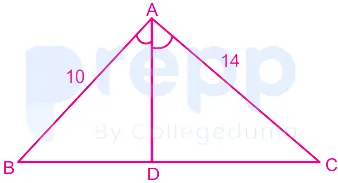 Paper & answer key PDF ↗
 Question 71archived
If \(\sin θ = \frac{8}{{17}}\) , then find the value of tan θ.
- A
\(\frac{{15}}{{17}}\)
- B
\(\frac{8}{{15}}\)
- C
\(\frac{{15}}{8}\)
- D
\(\frac{{17}}{{15}}\)
Show answer
B. \(\frac{8}{{15}}\)Finding the Value of tan θ Given sin θ
The question asks us to find the value of tan θ given that sin θ is \( \frac{8}{17} \). We can solve this problem using trigonometric identities or by constructing a right-angled triangle.
Understanding Trigonometric Ratios
In a right-angled triangle, the primary trigonometric ratios are defined as:
sin θ = \( \frac{\text{Opposite side}}{\text{Hypotenuse}} \)
cos θ = \( \frac{\text{Adjacent side}}{\text{Hypotenuse}} \)
tan θ = \( \frac{\text{Opposite side}}{\text{Adjacent side}} \)
Also, there is a fundamental identity relating these ratios: \( \tan \theta = \frac{\sin \theta}{\cos \theta} \).
Method 1: Using Trigonometric Identities
We are given \( \sin \theta = \frac{8}{17} \). We can use the Pythagorean identity, \( \sin^2 \theta + \cos^2 \theta = 1 \), to find the value of cos θ.
Substitute the value of sin θ into the identity:
\( \left(\frac{8}{17}\right)^2 + \cos^2 \theta = 1 \)
\( \frac{64}{289} + \cos^2 \theta = 1 \)
Now, isolate \( \cos^2 \theta \):
\( \cos^2 \theta = 1 - \frac{64}{289} \)
To subtract, find a common denominator:
\( \cos^2 \theta = \frac{289}{289} - \frac{64}{289} \)
\( \cos^2 \theta = \frac{289 - 64}{289} \)
\( \cos^2 \theta = \frac{225}{289} \)
Take the square root of both sides to find cos θ. Assuming θ is in the first quadrant where cosine is positive:
\( \cos \theta = \sqrt{\frac{225}{289}} \)
\( \cos \theta = \frac{\sqrt{225}}{\sqrt{289}} \)
\( \cos \theta = \frac{15}{17} \)
Now that we have sin θ and cos θ, we can find tan θ using the identity \( \tan \theta = \frac{\sin \theta}{\cos \theta} \):
\( \tan \theta = \frac{\frac{8}{17}}{\frac{15}{17}} \)
\( \tan \theta = \frac{8}{17} \times \frac{17}{15} \)
Cancel out the 17s:
\( \tan \theta = \frac{8}{15} \)
Method 2: Using a Right-Angled Triangle
We know that \( \sin \theta = \frac{\text{Opposite side}}{\text{Hypotenuse}} \). Given \( \sin \theta = \frac{8}{17} \), we can consider a right-angled triangle where the length of the side opposite to angle θ is 8 units and the length of the hypotenuse is 17 units.
Let the opposite side be \( o \), the adjacent side be \( a \), and the hypotenuse be \( h \).
\( o = 8 \)
\( h = 17 \)
We need to find the length of the adjacent side \( a \). We can use the Pythagorean theorem, which states that \( o^2 + a^2 = h^2 \) in a right-angled triangle.
Substitute the known values:
\( 8^2 + a^2 = 17^2 \)
\( 64 + a^2 = 289 \)
Now, solve for \( a^2 \):
\( a^2 = 289 - 64 \)
\( a^2 = 225 \)
Take the square root of both sides to find \( a \):
\( a = \sqrt{225} \)
\( a = 15 \)
So, the length of the adjacent side is 15 units.
Now we have the lengths of the opposite and adjacent sides:
Side
Length
Opposite (o)
8
Adjacent (a)
15
Hypotenuse (h)
17
Finally, we can find tan θ using its definition:
\( \tan \theta = \frac{\text{Opposite side}}{\text{Adjacent side}} = \frac{o}{a} \)
\( \tan \theta = \frac{8}{15} \)
Conclusion: Value of tan θ
Both methods give the same result. If \( \sin \theta = \frac{8}{17} \), then the value of \( \tan \theta \) is \( \frac{8}{15} \).
Revision Table: Basic Trigonometric Ratios
Ratio
Definition (Right Triangle)
Identity
sin θ
Opposite / Hypotenuse
cos θ
Adjacent / Hypotenuse
tan θ
Opposite / Adjacent
\( \frac{\sin \theta}{\cos \theta} \)
cosec θ
Hypotenuse / Opposite
\( \frac{1}{\sin \theta} \)
sec θ
Hypotenuse / Adjacent
\( \frac{1}{\cos \theta} \)
cot θ
Adjacent / Opposite
\( \frac{1}{\tan \theta} = \frac{\cos \theta}{\sin \theta} \)
Additional Information: The Pythagorean Identity
The identity \( \sin^2 \theta + \cos^2 \theta = 1 \) is one of the most fundamental identities in trigonometry. It comes directly from the Pythagorean theorem.
Consider a right-angled triangle with angle θ. Let the opposite side be \( o \), the adjacent side be \( a \), and the hypotenuse be \( h \).
According to the Pythagorean theorem: \( o^2 + a^2 = h^2 \).
Divide the entire equation by \( h^2 \):
\( \frac{o^2}{h^2} + \frac{a^2}{h^2} = \frac{h^2}{h^2} \)
\( \left(\frac{o}{h}\right)^2 + \left(\frac{a}{h}\right)^2 = 1 \)
Recall the definitions: \( \sin \theta = \frac{o}{h} \) and \( \cos \theta = \frac{a}{h} \).
Substituting these definitions gives:
\( (\sin \theta)^2 + (\cos \theta)^2 = 1 \)
Which is commonly written as \( \sin^2 \theta + \cos^2 \theta = 1 \).
This identity is useful for finding the value of sin θ if cos θ is known, and vice versa, and is a key tool in solving many trigonometric problems.
Paper & answer key PDF ↗ Question 72archived
If sec 2θ = cosec (θ – 36°), where 2θ is an acute angle, find the value of θ.
- A
32°
- B
46°
- C
20°
- D
42°
Show answer
D. 42°Solving Trigonometric Equations: Finding the Value of θ
The problem asks us to find the value of the angle θ given the trigonometric equation sec 2θ = cosec (θ – 36°), with the condition that 2θ is an acute angle.
Understanding the Relationship between secant and cosecant
To solve this equation, we need to use the relationship between the secant and cosecant functions for complementary angles. The key identity is:
\(\sec A = \csc (90^\circ - A)\)
or equivalently,
\(\csc A = \sec (90^\circ - A)\)
Using the first identity, we can rewrite the left side of our given equation.
Applying the Identity to the Equation
The given equation is:
\(\sec 2\theta = \csc (\theta - 36^\circ)\)
Using the identity \(\sec A = \csc (90^\circ - A)\) with \(A = 2\theta\), we get:
\(\sec 2\theta = \csc (90^\circ - 2\theta)\)
Now substitute this back into the original equation:
\(\csc (90^\circ - 2\theta) = \csc (\theta - 36^\circ)\)
Solving for θ
If the cosecant of two angles is equal, and these angles are within a relevant range (like 0 to 90 degrees for acute angles, or considering periodicity), then the angles themselves must be equal or related by \(A = 180^\circ - B\) plus multiples of \(360^\circ\). Since we are dealing with an acute angle \(2\theta\) and likely working with angles within the first quadrant or related to it, we can equate the angles directly:
\(90^\circ - 2\theta = \theta - 36^\circ\)
Now, we solve this linear equation for θ:
Add \(2\theta\) to both sides:
\(90^\circ = \theta - 36^\circ + 2\theta\)
\(90^\circ = 3\theta - 36^\circ\)
Add \(36^\circ\) to both sides:
\(90^\circ + 36^\circ = 3\theta\)
\(126^\circ = 3\theta\)
Divide by 3:
\(\theta = \frac{126^\circ}{3}\)
\(\theta = 42^\circ\)
Verifying the Acute Angle Condition
The problem states that \(2\theta\) must be an acute angle, which means \(0^\circ < 2\theta < 90^\circ\).
Let's check our value of θ = \(42^\circ\):
\(2\theta = 2 \times 42^\circ = 84^\circ\)
\(84^\circ\) is indeed between \(0^\circ\) and \(90^\circ\), so \(2\theta\) is an acute angle. The condition is satisfied.
Conclusion
The value of θ that satisfies the given equation and condition is \(42^\circ\).
Revision Table: Trigonometric Identities
Identity
Relationship
\(\sin A = \cos (90^\circ - A)\)
Sine and Cosine are complementary
\(\tan A = \cot (90^\circ - A)\)
Tangent and Cotangent are complementary
\(\sec A = \csc (90^\circ - A)\)
Secant and Cosecant are complementary
Additional Information: Acute Angles and Trigonometry
An acute angle is any angle measuring more than \(0^\circ\) and less than \(90^\circ\). In trigonometry, the trigonometric ratios (sine, cosine, tangent, etc.) of acute angles are always positive. The complementary angle identities, like the one used in this problem (\(\sec A = \csc (90^\circ - A)\)), are particularly useful when solving equations involving different trigonometric functions. These identities highlight the relationship between the ratios of an angle and the ratios of its complement (\(90^\circ\) minus the angle). Understanding these relationships is crucial for solving many trigonometric problems.
When solving trigonometric equations, it's important to consider the domain of the variables and any given conditions, such as whether angles are acute, within a specific range, or if general solutions are required. In this problem, the acute angle condition helped confirm our specific solution for θ.
Paper & answer key PDF ↗ Question 73archived
The given pie-chart shows the total number of children who opted different courses in a summer camp in May 2019.
300 students attended the summer camp, and every child was allowed to opt only one activity for the camp. The total number of students who opted for Yoga and Painting taken together is how much less than the total number of children who opted for Music and Dance taken together?
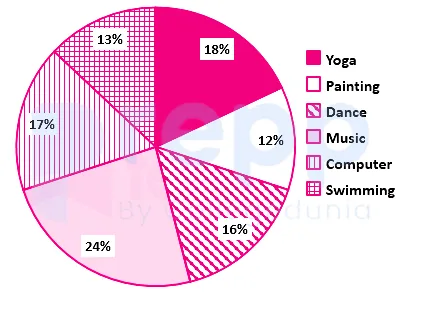
- A
45
- B
35
- C
30
- D
40
Show answer
C. 30Calculation:
The total number of students who opted for Yoga and Painting taken together = 300 × (18 + 12)%
⇒ 300 × 30%
⇒ 90
The total number of students who opted for Music and Dance taken together = 300 × (24 + 16)%
⇒ 300 × 40%
⇒ 120
Difference = 120 - 90
⇒ 30
∴ The required answer is 30.
Paper & answer key PDF ↗ Question 74archived
The following table shows the amount of annual rainfall in inches in 8 different states of India.
T
A
M
N
K
P
D
R
2015
80
70
98
78
68
65
70
59
2016
85
70
95
77
69
60
71
59
2017
86
71
96
76
66
67
71
59
2018
84
70
96
75
67
66
69
61
2019
80
74
97
74
67
64
75
60
2020
81
75
98
75
68
65
74
65
2021
82
72
98
73
70
65
73
65
How many states have witnessed an increase in the amount of annual rainfall continuously for two times in immediate years?
- A
4
- B
5
- C
3
- D
6
Show answer
A. 4Understanding Annual Rainfall Trends in Indian States
The question asks us to identify the number of states that experienced a continuous increase in annual rainfall for two consecutive years within the period from 2015 to 2021. This means we are looking for a sequence of three immediate years where the rainfall in the second year was greater than the first, and the rainfall in the third year was greater than the second.
Annual Rainfall Data (2015-2021)
Here is the provided annual rainfall data for 8 states (T, A, M, N, K, P, D, R) over the years 2015 to 2021:
State
2015
2016
2017
2018
2019
2020
2021
T
80
85
86
84
80
81
82
A
70
70
71
70
74
75
72
M
98
95
96
96
97
98
98
N
78
77
76
75
74
75
73
K
68
69
66
67
67
68
70
P
65
60
67
66
64
65
65
D
70
71
71
69
75
74
73
R
59
59
59
61
60
65
65
Criteria for Continuous Rainfall Increase
We need to find states where the annual rainfall showed an increasing trend for two consecutive years. For example, if the rainfall in 2016 was higher than in 2015, AND the rainfall in 2017 was higher than in 2016, this state meets the criteria for the period 2015-2017. We check all possible two-year consecutive increase periods within the 2015-2021 range:
Increase from 2015 to 2016 AND 2016 to 2017
Increase from 2016 to 2017 AND 2017 to 2018
Increase from 2017 to 2018 AND 2018 to 2019
Increase from 2018 to 2019 AND 2019 to 2020
Increase from 2019 to 2020 AND 2020 to 2021
A state qualifies if it shows at least one such sequence of two immediate years of continuous rainfall increase.
State-wise Rainfall Trend Analysis
Let's examine each state's rainfall data to identify periods of continuous increase over two immediate years:
State T:
2015-2017: 80 < 85 < 86. Yes (Increase 2015->2016 and 2016->2017).
2016-2018: 85, 86, 84. No (84 is not > 86).
2017-2019: 86, 84, 80. No.
2018-2020: 84, 80, 81. No.
2019-2021: 80 < 81 < 82. Yes (Increase 2019->2020 and 2020->2021).
State T had continuous increases over two immediate years.
State A:
2015-2017: 70, 70, 71. No (70 is not > 70).
2016-2018: 70, 71, 70. No.
2017-2019: 71, 70, 74. No.
2018-2020: 70 < 74 < 75. Yes (Increase 2018->2019 and 2019->2020).
2019-2021: 74, 75, 72. No.
State A had continuous increase over two immediate years.
State M:
2015-2017: 98, 95, 96. No.
2016-2018: 95, 96, 96. No.
2017-2019: 96, 96, 97. No.
2018-2020: 96 < 97 < 98. Yes (Increase 2018->2019 and 2019->2020).
2019-2021: 97, 98, 98. No.
State M had continuous increase over two immediate years.
State N:
2015-2017: 78, 77, 76. No.
2016-2018: 77, 76, 75. No.
2017-2019: 76, 75, 74. No.
2018-2020: 75, 74, 75. No.
2019-2021: 74, 75, 73. No.
State N did not have continuous increase over two immediate years.
State K:
2015-2017: 68, 69, 66. No.
2016-2018: 69, 66, 67. No.
2017-2019: 66, 67, 67. No.
2018-2020: 67, 67, 68. No.
2019-2021: 67 < 68 < 70. Yes (Increase 2019->2020 and 2020->2021).
State K had continuous increase over two immediate years.
State P:
2015-2017: 65, 60, 67. No.
2016-2018: 60, 67, 66. No.
2017-2019: 67, 66, 64. No.
2018-2020: 66, 64, 65. No.
2019-2021: 64, 65, 65. No.
State P did not have continuous increase over two immediate years.
State D:
2015-2017: 70, 71, 71. No.
2016-2018: 71, 71, 69. No.
2017-2019: 71, 69, 75. No.
2018-2020: 69, 75, 74. No.
2019-2021: 75, 74, 73. No.
State D did not have continuous increase over two immediate years.
State R:
2015-2017: 59, 59, 59. No.
2016-2018: 59, 59, 61. No.
2017-2019: 59, 61, 60. No.
2018-2020: 61, 60, 65. No.
2019-2021: 60, 65, 65. No.
State R did not have continuous increase over two immediate years.
Summary of Results
The states that witnessed an increase in the amount of annual rainfall continuously for two immediate years are State T, State A, State M, and State K.
Let's count these states:
State T: Yes
State A: Yes
State M: Yes
State N: No
State K: Yes
State P: No
State D: No
State R: No
There are 4 states that meet the specified criteria.
Conclusion
Based on the analysis of the annual rainfall data from 2015 to 2021, 4 states have witnessed an increase in the amount of annual rainfall continuously for two immediate years at least once during this period.
Revision Table: Key Learnings
Concept
Explanation
Application to Problem
Data Analysis
Examining data points over time to find patterns.
Analyzing rainfall data year-by-year for each state.
Consecutive Increase
A value increasing from one period to the next, and then increasing again in the subsequent period.
Checking for Year X < Year X+1 < Year X+2 rainfall pattern.
Counting based on Criteria
Identifying how many items in a set meet a specific condition.
Counting the number of states with the continuous increase pattern.
Additional Information: Rainfall Patterns and Climate Data
Analyzing annual rainfall data is crucial for understanding climate patterns and their impact on agriculture, water resources, and ecosystems. Rainfall can vary significantly from year to year due to various climatic factors, including monsoons, El Niño/La Niña cycles, and regional weather systems. Continuous increase or decrease over multiple years can indicate potential shifts in local or regional climate trends, although a longer dataset would be needed for definitive climate change conclusions. Data presented in tables like this helps in identifying trends, anomalies, and comparing performance across different regions.
Paper & answer key PDF ↗ Question 75archived
Numan does half the work as Gagan in 4/5 of the time. If together they take 16 days to complete a piece of work, then how long will it take Gagan to complete the work?
- A
23 day
- B
24 days
- C
25 day
- D
26 days
Show answer
D. 26 daysUnderstanding the Work and Time Problem
This problem involves two individuals, Numan and Gagan, performing a certain amount of work. We are given information about their relative work efficiencies and the time they take to complete the work when working together. The goal is to find the time Gagan would take to complete the entire piece of work by himself.
In work and time problems, the key concept is the work rate or efficiency of a person. Work rate is the amount of work done per unit of time. If a person completes a total amount of work 'W' in 'T' days, their work rate 'R' is given by:
\text{Work Rate (R)} = \frac{\text{Total Work (W)}}{\text{Time Taken (T)}}
Conversely, the time taken to complete the work is $\text{T} = \frac{\text{W}}{\text{R}}$.
When two people work together, their individual work rates add up to form a combined work rate. If Numan's rate is $R_N$ and Gagan's rate is $R_G$, their combined rate is $R_{combined} = R_N + R_G$.
Analyzing the Given Information
We are given two main pieces of information:
Numan does half the work as Gagan in 4/5 of the time.
Together, they take 16 days to complete a piece of work.
Step 1: Relating Numan's and Gagan's Work Rates
Let's assume Gagan completes a certain amount of work, say $W'$, in time $T'$.
Gagan's rate: $R_G = \frac{W'}{T'}$
According to the first statement, Numan does half of this work ($\frac{W'}{2}$) in 4/5 of the time ($\frac{4}{5}T'$).
Numan's rate: $R_N = \frac{\text{Work done by Numan}}{\text{Time taken by Numan}} = \frac{W'/2}{(4/5)T'}$
Let's simplify Numan's rate:
R_N = \frac{W'}{2} \times \frac{5}{4T'} = \frac{5W'}{8T'}
We can see that $\frac{W'}{T'}$ is Gagan's rate, $R_G$. So, we can write Numan's rate in terms of Gagan's rate:
R_N = \frac{5}{8} R_G
This equation tells us that Numan's work rate is 5/8 times Gagan's work rate. This means Gagan is more efficient than Numan.
Step 2: Using the Information about Combined Work Time
Let the total piece of work be $W$. We know that together, Numan and Gagan take 16 days to complete this work.
Their combined rate is $R_{combined} = R_N + R_G$.
The time taken together is $\frac{\text{Total Work}}{\text{Combined Rate}} = 16$ days.
\frac{W}{R_N + R_G} = 16
Step 3: Solving for Gagan's Time to Complete the Work
We want to find the time Gagan takes to complete the work alone. This is given by $\text{Time}_G = \frac{\text{Total Work}}{R_G} = \frac{W}{R_G}$.
We have the equation $\frac{W}{R_N + R_G} = 16$. Substitute $R_N = \frac{5}{8} R_G$ into this equation:
\frac{W}{\frac{5}{8} R_G + R_G} = 16
Combine the terms in the denominator:
\frac{W}{(\frac{5}{8} + 1) R_G} = 16
\frac{W}{(\frac{5}{8} + \frac{8}{8}) R_G} = 16
\frac{W}{\frac{13}{8} R_G} = 16
Now, we need to isolate $\frac{W}{R_G}$, which represents the time Gagan takes alone. We can rewrite the left side:
\frac{W}{R_G} \times \frac{1}{\frac{13}{8}} = 16
\frac{W}{R_G} \times \frac{8}{13} = 16
Multiply both sides by $\frac{13}{8}$ to find $\frac{W}{R_G}$:
\frac{W}{R_G} = 16 \times \frac{13}{8}
\frac{W}{R_G} = \cancel{16}^2 \times \frac{13}{\cancel{8}^1}
\frac{W}{R_G} = 2 \times 13
\frac{W}{R_G} = 26
So, the time it will take Gagan to complete the work alone is 26 days.
Conclusion
Based on the analysis of their relative work rates and the time they take to complete the work together, Gagan will take 26 days to complete the piece of work by himself.
Individual
Work Rate Relationship
Combined Time Given
Gagan's Time Calculated
Numan
$R_N = \frac{5}{8} R_G$
16 days for combined work
26 days for Gagan alone
Gagan
$R_G$
Revision Table: Work and Time Concepts
Concept
Formula / Explanation
Work Rate (Efficiency)
Work Done / Time Taken. It represents how much work is done per unit of time (e.g., per day).
Total Work
Can be assumed as 1 unit or any convenient number (like the LCM of days if given).
Time Taken
Total Work / Work Rate.
Combined Work Rate
Sum of individual work rates when working together. If rates are $R_1, R_2, \dots$, combined rate is $R_1 + R_2 + \dots$.
Relationship
Work Rate is inversely proportional to the Time Taken to complete the same amount of work. Higher rate means less time.
Additional Information on Work and Time Problems
Work and time problems often test your understanding of how work rates combine and how they relate to the time taken. Here are a few important points:
If a person completes a work in 'd' days, their daily work rate is $1/d$ of the total work.
If multiple people work together, their daily work contributions add up.
Problems can involve varying efficiencies, different numbers of workers, or portions of work completed over certain periods.
Always ensure that the work units and time units are consistent throughout the calculation.
Understanding the relationship between work, rate, and time ($W = R \times T$) is fundamental to solving these types of problems. By setting up equations based on the given information, you can solve for unknown rates or times, just like we did to find Gagan's time to complete the work alone.
Paper & answer key PDF ↗ Question 76archived
Select the most appropriate synonym of the given word.
Perseverance
- A
Discipline
- B
Tolerance
- C
Steadfastness
- D
Humbleness
Show answer
C. SteadfastnessUnderstanding Perseverance and Its Synonyms
Let's find the most appropriate synonym for the word "Perseverance". Understanding the meaning of the word is the first step.
Perseverance means continued effort to do or achieve something despite difficulties, failure, or opposition. It's about persistence and not giving up easily when faced with challenges.
Analyzing Synonym Options
Now, let's look at the given options and their meanings:
Discipline: This refers to training people to obey rules or a code of behavior, using punishment to correct disobedience. It can also mean controlled behavior resulting from such training. While related to consistency, it's not the core meaning of continuous effort despite difficulty.
Tolerance: This is the ability or willingness to tolerate something, in particular the existence of opinions or behavior that one dislikes or disagrees with. It's about acceptance or enduring something, not necessarily active, continued effort towards a goal.
Steadfastness: This means resolutely or dutifully firm and unwavering. It implies being fixed in purpose or loyalty, persistent, and not giving way. This closely aligns with the idea of continuing effort and not giving up despite challenges.
Humbleness: This is the quality of having or showing a modest or low estimate of one's own importance. It's about humility, which is unrelated to the concept of persistence in the face of difficulty.
Identifying the Best Synonym for Perseverance
Comparing the meanings, Steadfastness is the word that best captures the essence of Perseverance. Both words describe a quality of not giving up, remaining firm in purpose, and continuing despite obstacles. Discipline implies control and adherence to rules, Tolerance implies enduring something passively, and Humbleness relates to modesty. None of these accurately reflect the active, determined continuation of effort central to perseverance.
Therefore, Steadfastness is the most appropriate synonym for Perseverance among the given options.
Revision Table: Key Vocabulary
Word
Meaning
Relation to Perseverance
Perseverance
Continued effort despite difficulty
The main word
Discipline
Training to obey rules; controlled behavior
Related to consistency, but different focus
Tolerance
Ability to endure something
Passive endurance, not active effort
Steadfastness
Resolutely firm and unwavering
Closely related; means persistent and not giving way
Humbleness
Modesty; low estimate of self-importance
Unrelated concept
Additional Information on Perseverance
Perseverance is a crucial trait for achieving long-term goals. It involves:
Setting clear objectives.
Maintaining motivation even when progress is slow.
Learning from failures rather than being defeated by them.
Adapting strategies as needed.
Seeking support when necessary.
Developing perseverance helps individuals overcome obstacles in academics, career, sports, and personal life. It's often seen as a key component of grit and resilience.
Paper & answer key PDF ↗ Question 77archived
Select the most appropriate ANTONYM of the given word.
Native
- A
Vicinity
- B
Realm
- C
Foreign
- D
Aboriginal
Show answer
C. ForeignUnderstanding the Antonym of Native
The question asks us to select the most appropriate ANTONYM of the given word, which is "Native". An antonym is a word that means the opposite of another word.
Defining the word 'Native'
The word 'Native' primarily means:
Belonging to a particular place by birth, origin, or nature. For example, a native of India was born in India.
Occurring naturally in a place; indigenous. For example, kangaroos are native to Australia.
Analyzing the Options
Let's examine the meaning of each option provided:
Vicinity: This word refers to the area near or surrounding a particular place; proximity. It relates to location but not the origin or belonging of something or someone.
Realm: This word means a kingdom; a domain or area of activity or interest. It refers to a territory or sphere, not the characteristic of being from a place.
Foreign: This word means characteristic of a country or language other than one's own; unfamiliar or strange; dealing or associated with other countries. If something or someone is native to one place, something foreign is from another place.
Aboriginal: This word refers to a person, animal, or plant that has been living in a particular region or country from the earliest times; indigenous. This is actually a synonym or closely related concept to 'Native', not an antonym.
Determining the Antonym
Based on the definitions, the word that is opposite in meaning to 'Native' is 'Foreign'. While 'Native' implies belonging to or originating from a specific place, 'Foreign' implies being from a different place.
For example:
Someone native to France was born there.
Someone foreign to France was born in another country.
Comparing 'Native' and 'Foreign', we see they represent opposing concepts regarding origin and belonging to a place.
Conclusion
Therefore, the most appropriate antonym for 'Native' among the given options is 'Foreign'.
Revision Table: Native vs. Foreign
Word
Meaning Related to Origin
Relationship
Native
Belonging to or originating from a specific place
The word in question
Foreign
From a different place; not native
Antonym of Native
Vicinity
Nearby area
Not an antonym
Realm
Kingdom or domain
Not an antonym
Aboriginal
Indigenous; from the earliest times
Synonym/Related to Native
Additional Information on Antonyms and Synonyms
Understanding antonyms and synonyms is crucial for building vocabulary and improving language skills. Antonyms are words with opposite meanings, while synonyms are words with similar meanings.
Examples:
Antonyms: Hot - Cold, Happy - Sad, Big - Small, Native - Foreign
Synonyms: Happy - Joyful, Big - Large, Fast - Quick, Native - Indigenous
Identifying antonyms helps clarify the meaning of a word by understanding what it is not. It's a valuable technique in language learning and comprehension.
Paper & answer key PDF ↗ Question 78archived
Select the INCORRECTLY spelt word.
- A
Delight
- B
Striphe
- C
Fright
- D
Knight
Show answer
B. StripheFinding the Incorrectly Spelled Word
The question asks us to identify the word among the given options that is spelled incorrectly. To do this, we need to look at each word and determine its correct spelling.
Analyzing the Options for Correct Spelling
Let's examine each word provided in the options:
Delight
Striphe
Fright
Knight
Now, let's check the standard spelling of each word.
Delight: This word means a feeling of great pleasure or joy. The spelling 'd-e-l-i-g-h-t' is the standard and correct spelling.
Striphe: Let's consider this word. Does it look right? Is this a commonly used English word? Thinking about words with a similar sound or meaning might help. The word that sounds similar and relates to conflict or struggle is 'strife'. The spelling 's-t-r-i-f-e' is the correct spelling. Therefore, 'Striphe' is spelled incorrectly.
Fright: This word means a sudden intense feeling of fear. The spelling 'f-r-i-g-h-t' is the standard and correct spelling.
Knight: This word refers to a man granted an honorary title for his services to a sovereign or country, or historically, a medieval European soldier of high status. The spelling 'k-n-i-g-h-t' is the standard and correct spelling. Note the silent 'k'.
Based on this analysis, the word that is spelled incorrectly is 'Striphe'. The correct spelling should be 'Strife'.
Here is a summary:
Given Word
Is Correctly Spelled?
Correct Spelling (if different)
Delight
Yes
Delight
Striphe
No
Strife
Fright
Yes
Fright
Knight
Yes
Knight
Therefore, the incorrectly spelled word is 'Striphe'.
Revision Table: Commonly Confused Spellings
Identifying incorrectly spelled words is a key part of improving vocabulary and writing skills. Here are a few examples of words that are often confused or misspelled:
Often Misspelled
Correct Spelling
Notes
A lot (sometimes written as alot)
A lot
Always two words.
There, Their, They're
There, Their, They're
Homophones with different meanings.
Definitely (sometimes written as definately)
Definitely
Contains 'i' and 'e'.
Separate (sometimes written as seperate)
Separate
Contains 'a' after 'p'.
Additional Information on Spelling Errors
Spelling errors can occur for various reasons, including:
Homophones: Words that sound alike but have different spellings and meanings (e.g., 'to', 'too', 'two').
Silent letters: Letters that are written but not pronounced (e.g., the 'k' in 'knight', the 'p' in 'psychology').
Vowel combinations: Tricky vowel patterns, especially with 'ie' vs. 'ei'.
Suffixes: Adding endings to words can change the spelling (e.g., 'argue' becomes 'arguing').
Lack of familiarity: Simply not knowing the correct spelling of a word.
Practicing, reading widely, and using a dictionary or spell checker are good ways to improve spelling skills.
Paper & answer key PDF ↗ Question 79archived
Select the option that can be used as a one-word substitute for the given group of words.
A person having significant experience in an occupation
- A
Agnostic
- B
Fastidious
- C
Veteran
- D
Novice
Show answer
C. VeteranUnderstanding One-Word Substitutions
One-word substitution questions require identifying a single word that accurately replaces a given phrase or description. The goal is to find the most precise term among the options provided.
The phrase we need to substitute is: A person having significant experience in an occupation.
This describes someone who has worked in a particular field or job for a long time and is highly skilled or knowledgeable due to that experience.
Analyzing the Options for Significant Occupation Experience
Let's examine each option provided and see which one best fits the description of "a person having significant experience in an occupation".
1. Agnostic
Definition: An agnostic is a person who believes that nothing is known or can be known of the existence or nature of God or anything that is not material or knowable through sensory experience.
Relevance: This term relates to beliefs about knowledge, particularly regarding the existence of God. It has no connection to professional experience in an occupation.
2. Fastidious
Definition: A fastidious person is very attentive to and concerned about accuracy and detail, or very concerned about cleanliness. They are difficult to please.
Relevance: This term describes someone's personality trait or approach to tasks (meticulous, demanding). It doesn't describe their level of experience or time spent in an occupation.
3. Veteran
Definition: A veteran is a person who has had long service or experience in a particular occupation or field. It is also commonly used for someone who has served in the armed forces.
Relevance: This definition directly matches the description of "a person having significant experience in an occupation". The term 'veteran' precisely conveys the idea of someone seasoned and experienced in their field.
4. Novice
Definition: A novice is a person new to or inexperienced in a field or situation.
Relevance: This term is the opposite of someone having significant experience. A novice is a beginner, not a veteran.
Identifying the Correct One-Word Substitute
Based on the analysis of each option, the word that best substitutes the phrase "A person having significant experience in an occupation" is Veteran.
Word
Definition
Fits "Person with Significant Experience"?
Agnostic
One who believes existence of God is unknowable
No
Fastidious
Attentive to detail; difficult to please
No
Veteran
Person with long experience in an occupation or field
Yes
Novice
Beginner; inexperienced person
No
Revision Table: One-Word Substitutions
Phrase
One-Word Substitute
A person having significant experience in an occupation
Veteran
A person new to or inexperienced in a field
Novice
One who believes the existence of God is unknowable
Agnostic
Someone attentive to detail and difficult to please
Fastidious
Additional Information on Experience and Occupation Terms
Understanding words related to experience levels in various fields is important for vocabulary building and exams. Here are a few related terms:
Expert: A person who has a comprehensive and authoritative knowledge of or skill in a particular area. Often implies a high level of skill gained through significant experience.
Professional: A person engaged in a specified occupation, especially one requiring high levels of education and trained skills. This refers to the nature of the job, not necessarily the length of experience, though experience is often gained in a professional role.
Amateur: A person who engages in a pursuit, especially a sport, on an unpaid rather than a professional basis. Can also mean someone who is not skilled or is inexperienced.
Apprentice: A person who is learning a trade from a skilled employer, having agreed to work for a fixed period at low wages. An apprentice is typically a beginner, gaining experience.
Comparing "veteran" and "expert", a veteran has extensive experience, while an expert has deep knowledge and skill, often acquired through significant experience. The term veteran focuses more on the duration and depth of experience.
Paper & answer key PDF ↗ Question 80archived
Rearrange the parts of the sentence in the correct order.
Jobseekers are not
P. being unemployed are a test of faith
Q. self-purification, where the difficulties of
R. relentlessly to a pilgrimage of
S. fatalistic but reapply themselves
- A
SPQR
- B
PQSR
- C
SRQP
- D
RPSQ
Show answer
C. SRQPSentence Rearrangement: Finding the Correct Order
The question asks us to rearrange the given parts of a sentence to form a coherent and grammatically correct sentence. We are given the starting phrase "Jobseekers are not" and four parts labeled P, Q, R, and S.
Let's look at the individual parts:
P: being unemployed are a test of faith
Q: self-purification, where the difficulties of
R: relentlessly to a pilgrimage of
S: fatalistic but reapply themselves
The sentence starts with "Jobseekers are not". This beginning suggests a contrast or an alternative behavior. Part S, "fatalistic but reapply themselves", fits well after "not", providing this contrast. Jobseekers are not fatalistic; instead, they reapply themselves.
So, the sequence likely starts with "Jobseekers are not S...". This leads us to consider the parts that could follow "reapply themselves". Part R, "relentlessly to a pilgrimage of", describes how they reapply themselves - relentlessly, and introduces the idea of a 'pilgrimage'.
This suggests the order "Jobseekers are not S R...". Now we need to see what follows "a pilgrimage of". Part Q, "self-purification, where the difficulties of", fits perfectly after "a pilgrimage of", defining the type of pilgrimage and introducing the concept of difficulties.
This brings us to "Jobseekers are not S R Q...". The phrase ends with "difficulties of". Part P, "being unemployed are a test of faith", logically completes the sentence by specifying what difficulties are being referred to (the difficulties of being unemployed) and what they represent (a test of faith).
Putting the parts together in the order SRQP:
"Jobseekers are not S. fatalistic but reapply themselves R. relentlessly to a pilgrimage of Q. self-purification, where the difficulties of P. being unemployed are a test of faith."
The complete sentence is:
Jobseekers are not fatalistic but reapply themselves relentlessly to a pilgrimage of self-purification, where the difficulties of being unemployed are a test of faith.
This sentence is grammatically correct and makes logical sense, describing the attitude and experience of jobseekers facing unemployment.
Analyzing the Correct Sequence (SRQP)
Let's break down how the parts connect in the SRQP order:
Jobseekers are not + S (fatalistic but reapply themselves): Contrasts the expected negative attitude (fatalistic) with their actual positive action (reapply themselves).
reapply themselves + R (relentlessly to a pilgrimage of): Describes the intensity and nature of their effort (relentlessly) towards a specific goal or journey (a pilgrimage of).
a pilgrimage of + Q (self-purification, where the difficulties of): Defines the purpose of the pilgrimage (self-purification) and introduces the challenges involved (where the difficulties of).
the difficulties of + P (being unemployed are a test of faith): Specifies what difficulties are being discussed (being unemployed) and their significance (are a test of faith).
Each part connects logically to the previous one, forming a coherent and meaningful sentence about the resilience and perspective of jobseekers.
Revision Table: Sentence Parts and Connections
Starting/Ending Phrase
Connecting Part
Resulting Phrase Segment
Jobseekers are not
S: fatalistic but reapply themselves
Jobseekers are not fatalistic but reapply themselves
reapply themselves
R: relentlessly to a pilgrimage of
reapply themselves relentlessly to a pilgrimage of
a pilgrimage of
Q: self-purification, where the difficulties of
a pilgrimage of self-purification, where the difficulties of
the difficulties of
P: being unemployed are a test of faith
the difficulties of being unemployed are a test of faith.
Additional Information: Sentence Structure and Cohesion
Sentence rearrangement questions test your understanding of grammar, vocabulary, and logical flow. To solve them effectively, look for:
Subject-Verb Agreement: Ensure the verb matches the subject.
Pronoun Reference: Make sure pronouns refer clearly to their antecedents.
Connecting Words: Look for conjunctions (like 'but', 'and', 'where'), prepositions (like 'to', 'of'), and adverbs (like 'relentlessly') that link ideas.
Logical Sequence: The events or ideas should follow a sensible order.
Opening and Closing Phrases: Identify parts that are likely to start or end the sentence.
In this specific sentence, the structure uses a contrast ("not fatalistic but...") followed by a description of the action ("reapply themselves relentlessly to..."), defining the nature of that action ("pilgrimage of self-purification..."), and finally specifying the challenge involved ("difficulties of being unemployed...") and its meaning ("are a test of faith").
Paper & answer key PDF ↗ Question 81archived
Select the most appropriate option that can substitute the underlined segment in the given sentence.
Don’t disturb the boy, he prepares for his examination.
- A
prepared
- B
is preparing
- C
was preparing
- D
will be preparing
Show answer
B. is preparingUnderstanding Tense Usage in English Sentences
The question asks us to choose the most appropriate option to substitute the underlined segment "he prepares for his examination" in the sentence "Don’t disturb the boy, he prepares for his examination."
The sentence begins with "Don’t disturb the boy," which implies that the boy is currently engaged in an action that should not be interrupted. This context requires the action to be happening at the moment of speaking. The simple present tense, "prepares," is typically used for habitual actions, facts, or scheduled events, not for actions happening right now.
Analyzing the Options for Substitution
Let's look at the provided options and see which one fits the context of an action happening currently:
Option 1: prepared
This is the simple past tense. It indicates an action that was completed in the past. This does not fit the context of the boy doing something right now that shouldn't be disturbed.
Option 2: is preparing
This is the present continuous tense (is + verb + -ing). It is used to describe an action that is happening at the moment of speaking. This perfectly matches the context of the sentence "Don’t disturb the boy," as it suggests the reason for not disturbing him is that he is in the process of preparing for his examination right now.
Option 3: was preparing
This is the past continuous tense (was/were + verb + -ing). It describes an action that was ongoing at a specific point in the past. This tense is not appropriate for an action happening at the current moment.
Option 4: will be preparing
This is the future continuous tense (will be + verb + -ing). It describes an action that will be ongoing at a specific point in the future. This tense is not suitable for describing an action happening now.
Determining the Correct Substitution
Based on the analysis, the present continuous tense "is preparing" is the only option that correctly describes an action happening at the moment of speaking, which is required by the first part of the sentence "Don’t disturb the boy."
The corrected sentence would be: "Don’t disturb the boy, he is preparing for his examination."
Comparison of Tenses for Context
Tense
Form
Usage Example (Relevant to Question)
Fits Context?
Simple Present
verb / verb+s
He prepares every day.
No (for action now)
Present Continuous
is/am/are + verb+ing
He is preparing now.
Yes
Simple Past
verb+ed / irregular
He prepared yesterday.
No
Past Continuous
was/were + verb+ing
He was preparing when I arrived.
No
Future Continuous
will be + verb+ing
He will be preparing tomorrow.
No
Revision Table: English Verb Tenses
Overview of Key English Tenses
Tense Name
Form (Example: Prepare)
Common Uses
Simple Present
prepare, prepares
Habits, facts, schedules, states
Present Continuous
am/is/are preparing
Actions happening now, temporary actions, future plans
Simple Past
prepared
Completed actions in the past
Past Continuous
was/were preparing
Ongoing actions in the past, often interrupted
Simple Future
will prepare
Predictions, promises, spontaneous decisions
Future Continuous
will be preparing
Actions ongoing at a future time
Additional Information: The Present Continuous Tense
The present continuous tense is formed using the present tense of the verb "to be" (am, is, are) followed by the base form of the main verb plus '-ing'.
Structure: Subject + am/is/are + Verb-ing + Object/Complement
Examples:
I am studying.
She is reading a book.
They are playing outside.
Main Uses:
To describe an action that is happening at the exact moment of speaking. (e.g., "Please be quiet, the baby is sleeping.")
To describe an action that is happening around the present time, but not necessarily right this second. (e.g., "I am working on a project this week.")
To describe temporary situations. (e.g., "He is living with his parents while he finds an apartment.")
To describe changing situations. (e.g., "The climate is changing rapidly.")
To talk about definite future plans (often with a time expression). (e.g., "We are meeting for lunch tomorrow.")
In the context of the question, the first use (action happening at the moment) is the most relevant, making "is preparing" the correct tense to indicate why the boy should not be disturbed right now.
Paper & answer key PDF ↗ Question 82archived
Select the most appropriate option to complete the given sentence.
He booked the tickets for the show _____.
- A
in demand
- B
in common
- C
in depth
- D
in advance
Show answer
D. in advanceBooking Tickets: Choosing the Correct Phrase
The question asks us to select the most suitable phrase to complete the sentence: "He booked the tickets for the show _____." This requires understanding common English idioms and how they fit into a sentence context, specifically related to booking tickets.
Understanding the Action of Booking Tickets
When someone books tickets for an event like a show, it typically means they are securing their place before the event takes place. This action is usually done sometime before the actual date of the show.
Analyzing the Options Provided
Let's look at each option to see how well it fits the sentence:
in demand: This phrase means that many people want something. For example, "The tickets were in demand." While this might be true about the tickets, saying "He booked the tickets in demand" doesn't make grammatical sense in this context. It describes the state of the tickets, not the timing or manner of booking.
in common: This phrase means shared or held by multiple people. For example, "They have a lot in common." This phrase does not relate to the act of booking tickets and doesn't fit the sentence.
in depth: This phrase means thoroughly or in great detail. For example, "We studied the topic in depth." This meaning is unrelated to booking tickets and doesn't fit the sentence structure.
in advance: This phrase means before a particular time; ahead of time. Booking tickets before the show date is a very common practice. Therefore, "He booked the tickets for the show in advance" means he booked them ahead of the show date, which is the most logical and appropriate completion for the sentence.
Conclusion on Booking Tickets
The phrase in advance accurately describes the timing of the booking action relative to the show. It implies that the tickets were secured prior to the event, which is the standard way tickets are obtained for shows.
Therefore, the most appropriate option to complete the sentence is in advance.
Paper & answer key PDF ↗ Question 83archived
Select the most appropriate meaning of the underlined idiom in the given sentence.
“Just add a bit of cheese to your pasta and Bob’s your uncle! ” Reena suggested it to me over dinner last night.
- A
It becomes easily and quickly achievable
- B
It changes the appearance
- C
It ruins everything
- D
It changes nothing
Show answer
A. It becomes easily and quickly achievableUnderstanding the Idiom "Bob's Your Uncle"
The question asks for the meaning of the underlined idiom "Bob's your uncle" in the sentence: “Just add a bit of cheese to your pasta and Bob’s your uncle! ” Reena suggested it to me over dinner last night.
Idioms are phrases or expressions whose meaning cannot be deduced from the literal meaning of their individual words. They have a figurative meaning that is understood by native speakers.
Meaning of "Bob's Your Uncle"
The idiom "Bob's your uncle" is a British colloquialism. It is used to say that something is very simple, easy, or quickly achieved. It suggests that a task is straightforward, and once a final step is taken, the desired result is achieved easily and quickly.
In the given sentence, Reena says that adding cheese to pasta makes it easy and quick to achieve a satisfactory result (delicious pasta). The phrase "Bob's your uncle" signifies that the process is simple and the outcome is guaranteed once the cheese is added.
Analyzing the Options
Let's look at the given options and compare them with the meaning of the idiom:
Option 1: It becomes easily and quickly achievable - This meaning aligns perfectly with the common understanding and usage of the idiom "Bob's your uncle".
Option 2: It changes the appearance - While adding cheese might change the appearance of pasta, this is not the meaning of the idiom. The idiom refers to the ease of achieving a result, not the visual outcome.
Option 3: It ruins everything - This is the opposite of what the idiom means. "Bob's your uncle" implies a positive, easy outcome, not a ruined one.
Option 4: It changes nothing - This is also incorrect. The idiom signifies that a specific action (adding cheese, in this case) leads to the desired, easily achieved result, implying a significant positive change in terms of effort or outcome.
Based on the analysis, the most appropriate meaning of the idiom "Bob's your uncle" in the given context is that the desired result (delicious pasta) becomes easily and quickly achievable by simply adding cheese.
Idiom Meaning Comparison
Idiom
Meaning
Example Usage
Bob's your uncle
It is easily and quickly achievable / It's very simple
Just follow these instructions, and Bob's your uncle!
Step-by-Step Analysis
Identify the idiom: "Bob's your uncle".
Understand the context: The idiom is used after suggesting to add cheese to pasta.
Recall or deduce the meaning of the idiom: "Bob's your uncle" means something is very easy or quickly done.
Apply the meaning to the context: Adding cheese makes the pasta satisfactory (the desired result) easily and quickly.
Compare this meaning to the given options.
Select the option that best matches the idiom's meaning in context. Option 1 fits correctly.
Revision Table: Idiom "Bob's Your Uncle"
Summary of Idiom Meaning
Idiom
Meaning in Context
Associated Concept
Bob's your uncle
Achieving a result easily and quickly
Simplicity, Speed, Positive outcome
Additional Information on Idioms
Idioms like "Bob's your uncle" add color and informality to language. Understanding common idioms is crucial for comprehending spoken and written English, especially in informal contexts. While the exact origin of "Bob's your uncle" is debated, one popular theory links it to Prime Minister Robert Cecil (Lord Salisbury), who appointed his nephew Arthur Balfour to a key political post in 1886, suggesting that connections (having the right "uncle") could make things easy. However, the modern usage simply implies simplicity and ease.
Paper & answer key PDF ↗ Question 84archived
Select the most appropriate meaning of the underlined idiom in the given sentence.
When the District Attorney asked the convict about details of the day of the crime, he started beating around the bush.
- A
Being excessively aggressive
- B
Accusing others of the crime
- C
Speaking in a confusing manner without giving a correct answer
- D
Trying to invoke sympathy
Show answer
C. Speaking in a confusing manner without giving a correct answerUnderstanding the Idiom "Beating Around the Bush"
The question asks for the most appropriate meaning of the underlined idiom "beating around the bush" in the given sentence: "When the District Attorney asked the convict about details of the day of the crime, he started beating around the bush."
Let's break down the idiom and its usage in the sentence.
What does "Beating Around the Bush" mean?
The idiom "beating around the bush" is an expression used in English to describe the act of approaching something indirectly, evasively, or reluctantly. When someone beats around the bush, they talk about related or irrelevant things instead of directly addressing the main point or question.
This often happens when the person is trying to avoid a difficult subject, delay giving an answer, or is unsure of how to proceed directly.
Context in the Sentence
In the sentence, the convict is asked about specific details of the day of the crime by the District Attorney. This is a direct and critical line of questioning. The phrase "he started beating around the bush" tells us how the convict responded to these questions.
Given the meaning of the idiom, the convict was not giving direct answers about the crime details. He was likely talking about other things, being vague, or otherwise avoiding the core questions related to the crime.
Analyzing the Options
Let's evaluate each option based on our understanding:
Option 1: Being excessively aggressive
This option suggests a confrontational attitude. "Beating around the bush" implies avoidance and indirectness, not aggression. So, this is incorrect.
Option 2: Accusing others of the crime
While deflecting blame might be a *reason* for beating around the bush, the idiom itself describes the *method* of communication (indirectness), not the specific *content* (accusing others). One could beat around the bush without accusing anyone. This option is not the primary meaning of the idiom.
Option 3: Speaking in a confusing manner without giving a correct answer
This option aligns well with the idiom. Speaking indirectly, vaguely, or in a confusing way precisely describes the act of avoiding the main point or a direct answer. In the context of being questioned about crime details, this means not providing the clear, specific answers expected by the District Attorney.
Option 4: Trying to invoke sympathy
This suggests an attempt to gain pity or compassion. This is unrelated to the meaning of "beating around the bush," which is about indirect communication and avoidance of a direct topic or answer.
Conclusion on the Idiom's Meaning
Based on the analysis, the most appropriate meaning of "beating around the bush" in this context is speaking indirectly or evasively to avoid giving a clear or direct answer, particularly when faced with a difficult question.
Therefore, option 3 accurately captures this meaning.
Idiom/Phrase
Meaning
Relevance to Sentence
Beating Around the Bush
Avoiding the main topic or question by speaking indirectly or vaguely.
The convict avoids giving direct answers about the crime details when questioned by the District Attorney.
Revision Table: Common Communication Idioms
Idiom
Meaning
Example Usage
Get to the point
To speak directly about the main topic without delay.
Stop beating around the bush and please get to the point.
Cut to the chase
To get directly to the most important part of something.
Let's cut to the chase - did you get the job?
Talk in circles
To discuss something without ever reaching a conclusion or moving forward.
We've been talking in circles for an hour and haven't solved anything.
Additional Information on Idiomatic Expressions
Idioms are phrases or expressions where the meaning isn't obvious from the literal meaning of the individual words. They are a common part of everyday language and understanding them is key to fluent communication.
Idioms often have historical or cultural origins.
Using idioms correctly can make language sound more natural and expressive.
Learning idioms requires understanding their figurative meaning, not just the words themselves.
"Beating around the bush" is a common idiom used when someone is being evasive or reluctant to address a topic directly.
In the context of the legal questioning in the sentence, the convict's action of "beating around the bush" is likely an attempt to evade answering questions truthfully or directly about their involvement or knowledge of the crime.
Paper & answer key PDF ↗ Question 85archived
Choose the incorrectly spelt word.
- A
Innocense
- B
Governance
- C
Enforcement
- D
Insufficient
Show answer
A. InnocenseUnderstanding Spelling in English
The question asks us to identify the word that is spelt incorrectly among the given options. To do this, we need to examine each word carefully and compare it to its correct spelling.
Analysing Each Option for Spelling Accuracy
Let's look at each word provided:
Option 1: Innocense - We need to check if this spelling is standard English.
Option 2: Governance - We need to check if this spelling is standard English.
Option 3: Enforcement - We need to check if this spelling is standard English.
Option 4: Insufficient - We need to check if this spelling is standard English.
Checking the Spellings
Upon reviewing standard English spellings:
The correct spelling for the state of being innocent is "Innocence". The word "Innocense" is spelt incorrectly.
The correct spelling for the act or manner of governing is "Governance". This word is spelt correctly.
The correct spelling for the act of enforcing is "Enforcement". This word is spelt correctly.
The correct spelling for not being enough is "Insufficient". This word is spelt correctly.
Based on this analysis, the word that is incorrectly spelt is "Innocense".
Identifying the Incorrectly Spelt Word
Comparing the provided options with their correct spellings, it is clear that 'Innocense' deviates from the standard spelling. The correct form ends with '-ence', not '-ense'. The other words, 'Governance', 'Enforcement', and 'Insufficient', are all spelt correctly according to standard English.
Revision Table: Correcting Spellings
Here is a summary of the words and their spellings:
Word as Given
Status
Correct Spelling
Innocense
Incorrectly Spelt
Innocence
Governance
Correctly Spelt
Governance
Enforcement
Correctly Spelt
Enforcement
Insufficient
Correctly Spelt
Insufficient
Additional Information on English Spelling Patterns
Identifying incorrectly spelt words often involves understanding common spelling patterns, suffixes, and roots. For example, words ending in similar sounds might have different spellings like -ance or -ence, -able or -ible, -ary or -ery. Many of these spellings follow historical linguistic developments or rules related to the word's origin (e.g., Latin or Greek roots).
In the case of 'Innocence', it comes from the Latin word 'innocentia'. Words derived from similar Latin roots often take the '-ence' ending, such as 'difference', 'patience', 'absence', 'silence'. However, some words take '-ance', like 'importance', 'brilliance', 'resistance', 'governance'. Learning common suffixes and practicing word spellings are key strategies for improving spelling accuracy.
Paper & answer key PDF ↗ Question 86archived
Select the option that expresses the given sentence in active voice.
I was fascinated by the movie.
- A
The movie fascinated me.
- B
The movie was fascinated to me.
- C
The movie fascinate me.
- D
The movie fascinates me.
Show answer
A. The movie fascinated me.Converting Passive Voice to Active Voice
The question asks us to convert a sentence from passive voice to active voice. The given sentence is: "I was fascinated by the movie."
Understanding Passive and Active Voice
Active Voice: The subject of the sentence performs the action. The structure is typically: Subject + Verb + Object.
Passive Voice: The subject of the sentence receives the action. The structure is typically: Object of action + Be verb + Past participle of main verb + (by + Performer of action).
Analyzing the Given Passive Sentence
Let's break down the passive sentence: "I was fascinated by the movie."
"I": This is the subject in the passive sentence, but it is the receiver of the action. It will become the object in the active sentence.
"was fascinated": This is the verb phrase in the passive voice. "was" is a form of the 'be' verb, and "fascinated" is the past participle of the verb 'fascinate'. The tense is past simple.
"by the movie": This phrase indicates the performer of the action ("the movie"). "The movie" is the object of the action in the passive sentence. It will become the subject in the active sentence.
So, the structure is: Subject (receiver) + Be verb + Past Participle + by + Object (performer).
Converting to Active Voice
To convert from passive to active voice, we swap the roles of the subject and the object, and change the verb form:
The object of the passive sentence ("the movie") becomes the subject of the active sentence.
The subject of the passive sentence ("I") becomes the object of the active sentence ("me" - the object pronoun for "I").
The verb phrase ("was fascinated") needs to be converted to the simple past tense active form of the verb 'fascinate'. The simple past tense of 'fascinate' is 'fascinated'.
Putting these parts together, the active voice sentence is: "The movie fascinated me."
Evaluating the Options
Let's look at the given options:
The movie fascinated me.
Subject: "The movie". Verb: "fascinated" (simple past tense, active). Object: "me". This matches our conversion.
The movie was fascinated to me.
This sentence uses the passive structure ("was fascinated") but with an incorrect preposition ("to me" instead of "by me") and tries to make "the movie" the subject receiving the action, which doesn't make sense.
The movie fascinate me.
Subject: "The movie". Verb: "fascinate". This verb is in the base form, not the simple past tense needed to match the original sentence's tense ("was fascinated" indicates past tense).
The movie fascinates me.
Subject: "The movie". Verb: "fascinates". This verb is in the simple present tense (third person singular), not the simple past tense needed to match the original sentence's tense.
Based on the conversion steps and evaluation, the correct active voice sentence is "The movie fascinated me."
Voice
Sentence Structure
Example (from question)
Passive
Object + Be verb + Past Participle + (by + Subject)
I was fascinated by the movie.
Active
Subject + Verb + Object
The movie fascinated me.
Revision Table: Active vs. Passive Voice Conversion
Passive Sentence Element
Role in Passive
Becomes in Active
Example (from question)
Subject
Receiver of action
Object
'I' (passive subject) → 'me' (active object)
Be Verb + Past Participle
Passive verb phrase
Active verb (correct tense)
'was fascinated' → 'fascinated' (simple past)
Object (after 'by')
Performer of action
Subject
'the movie' (passive object/performer) → 'The movie' (active subject)
Additional Information: Uses of Active and Passive Voice
Both active and passive voices are grammatically correct, but they are used in different contexts:
Active Voice:
Generally preferred for clarity, directness, and energy.
Emphasizes the performer of the action.
Commonly used in most writing, especially narrative and persuasive writing.
Passive Voice:
Used when the performer of the action is unknown, unimportant, or obvious from the context.
Used to emphasize the action itself or the receiver of the action.
Commonly used in scientific or technical writing (to focus on the process or result), police reports, or when avoiding assigning blame.
Converting between active and passive voice is a useful skill for varying sentence structure and choosing the appropriate emphasis in writing.
Paper & answer key PDF ↗ Question 87archived
Identify the most appropriate ANTONYM of the underlined word in the given sentence.
The patient was happy that he was givenancientmethods of treatment to cure her health condition.
- A
Multiple
- B
Modern
- C
Slow
- D
Primitive
Show answer
B. ModernFinding the Antonym of Ancient Methods of Treatment
The question asks us to identify the most appropriate antonym for the underlined word "ancient" in the sentence: "The patient was happy that he was given ancient methods of treatment to cure her health condition."
An antonym is a word that means the opposite of another word.
Let's understand the meaning of the word "ancient" in the context of the sentence. "Ancient methods of treatment" refers to methods that are very old, perhaps traditional or from a distant past, potentially implying they are not current or up-to-date.
Now let's examine the given options:
Multiple: This word means consisting of several or many elements. It is related to quantity, not time or age. Therefore, it is not an antonym of ancient.
Modern: This word means relating to the present or recent times, using the newest ideas, design, technology, or methods. This directly contrasts with something that is old or from a distant past.
Slow: This word refers to the speed at which something happens or is done. It is the opposite of fast, not ancient.
Primitive: This word means relating to an early stage in the evolutionary or historical development of something; very basic or crude. While primitive methods might be old, the word 'primitive' often emphasizes simplicity or lack of development, which is not always the primary opposite of 'ancient'. 'Ancient' focuses more on the age or historical period. In contrast, 'modern' directly opposes the age aspect of 'ancient'.
Comparing the options, "Modern" is the word that most directly represents the opposite of "ancient" when referring to methods, especially treatment methods. Modern methods are contemporary, utilizing current knowledge and technology, which is the opposite of using methods from a distant past.
Detailed Analysis of Options
Option
Meaning
Is it an Antonym of Ancient?
Reasoning
Multiple
Many; consisting of several parts
No
Relates to quantity, not age or time period.
Modern
Relating to the present or recent times; new
Yes
Directly opposite to something old or from a distant past.
Slow
Not moving or operating quickly
No
Relates to speed, not age or time period.
Primitive
Relating to an early stage of development; basic
No (Most appropriate antonym)
While often old, it emphasizes simplicity/basic nature, not primarily just the age. 'Modern' is a clearer and more direct antonym for 'ancient' in this context.
Based on the analysis, "Modern" is the most appropriate antonym for "ancient" in the context of treatment methods.
Conclusion on Ancient Treatment Antonym
The word "ancient" describes something belonging to the distant past. The word "modern" describes something belonging to the present or recent times. Therefore, modern is the most fitting antonym for ancient in the given sentence.
Revision Table: Understanding Antonyms
Word
Meaning
Example Antonym
Ancient
Belonging to the distant past
Modern, New, Contemporary
Antonym
A word opposite in meaning to another
Synonym
Treatment
Medical care given to a patient for an illness or injury
Neglect
Additional Information on Word Relationships
Understanding word relationships like synonyms (words with similar meanings) and antonyms (words with opposite meanings) is crucial for vocabulary building and comprehension. While some words have clear antonyms (like hot and cold), others might have multiple words that could be considered antonyms depending on the specific context. It's important to choose the most appropriate antonym based on how the word is used in the sentence.
For instance, while "primitive" relates to an early stage and is often old, its opposite might be "advanced" or "sophisticated," which describes development. "Ancient," referring specifically to a time period, finds its primary opposite in terms referring to the current time period, like "modern" or "contemporary."
Paper & answer key PDF ↗ Question 88archived
Select the most appropriate ANTONYM of the given word.
Consent
- A
Dissent
- B
Variety
- C
Integrity
- D
Sanction
Show answer
A. DissentFinding the Antonym of Consent
The question asks us to find the most appropriate antonym for the word "Consent". An antonym is a word that means the opposite of another word.
Understanding the Word "Consent"
The word Consent means to give permission, agreement, or approval for something. It implies voluntary agreement or acceptance.
Example: She gave her consent for the medical procedure.
Example: The parents consented to their child joining the trip.
Analyzing the Options
Let's look at the meanings of the given options to determine which one is the opposite of "Consent":
Dissent:
Dissent means to hold or express opinions that are different from those previously, commonly, or officially held. It signifies disagreement or refusal to accept or agree.
Example: There was a strong dissent from the proposed plan within the committee.
Variety:
Variety means the fact of being different or diverse; the absence of uniformity, sameness, or monotony. It relates to having many different types or kinds.
Example: The store offers a wide variety of products.
Integrity:
Integrity means the quality of being honest and having strong moral principles; moral uprightness. It also refers to the state of being whole and undivided.
Example: He is known for his honesty and integrity.
Sanction:
Sanction can have two main meanings: 1. Official permission or approval for an action. 2. A penalty for disobeying a law or rule.
Example (meaning 1 - approval): The project received official sanction from the authorities.
Example (meaning 2 - penalty): Economic sanctions were imposed on the country.
In the sense of approval, Sanction is similar to Consent, not its antonym.
Identifying the Antonym
We are looking for the word that is the opposite of "Consent" (agreement/permission). Comparing the meanings:
Consent means agreement.
Dissent means disagreement.
Variety means diversity.
Integrity means honesty.
Sanction means approval (or penalty).
Clearly, Dissent is the most direct opposite of Consent, as it signifies disagreement or refusal to agree, which is the contrary of giving agreement or permission.
Conclusion
Based on the meanings, the most appropriate antonym for "Consent" is "Dissent".
Revision Table: Consent and Antonym
Word
Meaning
Most Appropriate Antonym
Consent
Agreement; permission; approval
Dissent
Additional Information: Understanding Antonyms
Understanding antonyms is a key part of building vocabulary and improving comprehension. Antonyms help us understand the full spectrum of meaning for a word by showing its opposite.
Some words have multiple antonyms depending on the specific context.
Context is crucial when choosing the best antonym from a list of options.
Learning words in pairs or groups (synonyms, antonyms, related words) can help retention.
For example, while 'refusal' could also be seen as an antonym for 'Consent' in some contexts, 'Dissent' specifically relates to disagreement with an idea or proposal, which is a strong opposite to 'Consent' as agreement or approval.
Paper & answer key PDF ↗ Question 89archived
The following sentence has been split into four segments. Identify the segment that contains a grammatical error.
I had walked / for most of the day / to Kanpur and then / get on the train by Mumbai.
- A
I had walked
- B
to Kanpur and then
- C
get on the train by Mumbai
- D
for most of the day
Show answer
C. get on the train by MumbaiAnalyzing the Sentence for Grammatical Errors
The question asks us to identify the segment in the given sentence that contains a grammatical error. The sentence provided is split into four segments:
I had walked
for most of the day
to Kanpur and then
get on the train by Mumbai
We need to examine each segment to check for any issues with grammar, tense, prepositions, or sentence structure.
Segment-by-Segment Analysis
Let's break down each segment:
Segment 1: I had walked
This segment uses the Past Perfect tense ("had walked"). This is grammatically correct and indicates an action that was completed at some point before another past action or time. This segment appears correct on its own.
Segment 2: for most of the day
This is a prepositional phrase indicating duration. It correctly uses the preposition "for" to specify a period of time. This segment is grammatically correct.
Segment 3: to Kanpur and then
This segment includes a prepositional phrase indicating direction or destination ("to Kanpur") followed by the conjunction and adverb "and then". This structure is correct for connecting sequential actions. This segment is grammatically correct.
Segment 4: get on the train by Mumbai
This segment describes getting onto a train. There are two potential issues here:
Tense inconsistency: The sentence begins with "I had walked" (Past Perfect) and uses "and then," suggesting a sequence of past actions. However, "get on" is in the base form, which is typically used for the present tense or infinitive. To maintain tense consistency with the preceding past action ("had walked"), the verb should be in a past tense form, such as "got on" (Simple Past).
Preposition error: The phrase "by Mumbai" typically means 'near Mumbai' or 'passing by Mumbai'. If the intention is to state the destination of the train or the place the train is going, the correct preposition should be "to" (e.g., "get on the train to Mumbai"). Using "by" in this context as a destination is grammatically incorrect.
Therefore, this segment contains grammatical errors regarding both tense consistency and preposition usage.
Identifying the Error Segment
Based on the analysis, the segment "get on the train by Mumbai" contains grammatical errors. The tense of the verb "get" is inconsistent with the preceding verb "had walked" in a sequence of past events, and the preposition "by" is incorrectly used when referring to the destination of the train.
Segment
Analysis
Grammatical Error?
I had walked
Past Perfect tense, grammatically sound.
No
for most of the day
Correct phrase for duration.
No
to Kanpur and then
Connective phrase, grammatically sound.
No
get on the train by Mumbai
Inconsistent tense ("get" vs. "had walked"); incorrect preposition ("by" instead of "to").
Yes
Thus, the segment with the grammatical error is "get on the train by Mumbai".
Possible Correction
A corrected version of the sentence could be:
"I had walked for most of the day to Kanpur and then got on the train to Mumbai."
Here, "got on" is in the Simple Past tense, fitting the sequence of past actions, and "to Mumbai" correctly indicates the destination.
Revision Table - Grammatical Error Analysis
Concept
Explanation
Relevance to Question
Tense Consistency
Using consistent verb tenses when describing a sequence of events, especially in the past.
The shift from Past Perfect ("had walked") to present base form ("get on") is inconsistent.
Prepositions of Movement/Direction
Words like 'to', 'from', 'by', 'on', 'in' used to show direction or position.
Using "by" instead of "to" for the train's destination is incorrect.
Compound Sentences/Clauses
Joining clauses using conjunctions like 'and then' requires attention to parallelism and tense agreement.
'and then' connects two actions; the verbs for these actions should be in appropriate, consistent tenses.
Additional Information - Understanding Verb Tenses and Prepositions
Understanding verb tenses and how to use prepositions correctly is crucial for clear and accurate English. The Past Perfect tense (had + past participle) is used to show an action completed before another action in the past or before a specific time in the past. The Simple Past tense (verb + -ed or irregular form) is used for actions that happened at a specific point or period in the past.
Prepositions like "to" indicate movement towards a destination (e.g., go to school, travel to London, train to Mumbai). Prepositions like "by" can indicate proximity (e.g., stand by the river), means of transport (e.g., travel by train, by bus), or passing close to something (e.g., drive by the park). In the context of getting on a train that is going somewhere, "to" is the correct preposition for the destination.
Paper & answer key PDF ↗ Question 90archived
Select the most appropriate option that can substitute the underlined segment in the given sentence. If there is no need to substitute it, select ‘No substitution required’.
Have you want me to come with you to the dentist?
- A
Has you wanted me
- B
No substitution required
- C
Had you want me
- D
Do you want me
Show answer
D. Do you want meSentence Substitution Analysis: Correcting 'Have you want me'
The original sentence is, "Have you want me to come with you to the dentist?". We need to examine the underlined segment, "Have you want me", and determine if it is grammatically correct or needs substitution from the given options.
Let's break down the structure of the underlined phrase. The sentence is phrased as a question asking about a present desire ('want'). In English, forming questions in the simple present tense often requires an auxiliary verb like 'do' or 'does'.
Examining the Original Phrase: 'Have you want me'
The construction "Have you want me" is grammatically incorrect for expressing a present desire or asking if someone wants something. The auxiliary verb 'have' is typically used with the past participle form of a verb (e.g., 'Have you eaten?') or as a main verb (e.g., 'Do you have a car?'). Using 'Have' directly with the base form of 'want' is not standard English grammar for this context.
Analyzing the Substitution Options
Let's look at the provided options:
Has you wanted me: This option uses 'Has' and 'wanted'. 'Has' is used with third-person singular subjects (he, she, it, singular noun), not with 'you'. Also, 'wanted' is the past tense or past participle form, but the sentence is asking about a present desire ('want'). This option is grammatically incorrect.
No substitution required: As determined, the original phrase "Have you want me" is incorrect. Therefore, substitution is required.
Had you want me: This option uses 'Had' and 'want'. 'Had' is used for past perfect tense or in certain past tense structures. Using 'Had' with the base form 'want' is incorrect. This option does not correctly form a question about present desire.
Do you want me: This option uses the auxiliary verb 'Do' with the subject 'you' and the base form of the main verb 'want'. This is the correct structure for forming a question in the simple present tense when the subject is 'you' and the main verb is 'want'. The structure is typically 'Do + Subject + Base Form of Verb?'. This option correctly asks about a present desire.
Correct Substitution for 'Have you want me'
Based on the analysis, the phrase "Do you want me" is the grammatically correct way to form the question asking if 'you' want 'me' to come along. It follows the standard rules for simple present tense question formation in English.
Revision Table: Understanding Question Formation
Subject
Auxiliary Verb (Simple Present Question)
Base Form of Verb
Example Question
I, You, We, They, Plural Nouns
Do
Want
Do you want...?
He, She, It, Singular Nouns
Does
Want
Does he want...?
Additional Information: Simple Present Questions
Forming questions in the simple present tense is a fundamental aspect of English grammar. For most verbs (except 'be' and modals), we use the auxiliary verbs 'do' and 'does'.
Use 'Do' with subjects I, you, we, they, and plural nouns.
Use 'Does' with subjects he, she, it, and singular nouns.
The main verb always remains in its base form after 'do' or 'does' in questions and negative sentences.
In the original sentence, the subject is 'you', and the intended verb is 'want'. Therefore, the correct auxiliary verb is 'Do', followed by the subject 'you', and the base form of the verb 'want'. This results in the correct phrase "Do you want me".
Paper & answer key PDF ↗ Question 91archived
Select the most appropriate option to fill in the blank and complete the collocation.
Although she didn't reveal her plans clearly, I had a ________ idea.
- A
clear
- B
concise
- C
complete
- D
rough
Show answer
D. roughUnderstanding Collocations: Completing the Phrase "A ________ Idea"
This question asks us to find the most appropriate word to complete a common phrase, also known as a collocation. A collocation is a pair or group of words that are habitually used together, creating a natural-sounding expression.
The sentence provides a context: "Although she didn't reveal her plans clearly, I had a ________ idea." The phrase following "although" tells us that her plans were not clear. Therefore, the resulting "idea" held by the speaker is likely not a fully formed, precise, or detailed one.
Analyzing the Options for Completing the Collocation
Let's examine each option to see which one fits the context and forms a natural collocation with "idea":
clear idea: If someone's plans were not revealed clearly, it is unlikely the resulting idea in the listener's mind would be clear. This option contradicts the context.
concise idea: "Concise" means brief but comprehensive. While an idea might be concise, the context about unclear plans doesn't directly suggest brevity as the primary characteristic of the idea.
complete idea: A "complete idea" suggests a fully developed or detailed concept. Again, if the plans were not clearly revealed, having a complete idea about them is improbable.
rough idea: A "rough idea" means an approximate, general, or not fully detailed idea. This perfectly fits the context where the plans were not revealed clearly. You might have a general sense or an approximation, but not a precise understanding. "Rough idea" is a very common and natural collocation in English.
Based on the analysis of the context and the natural usage of words, "rough" is the most appropriate word to complete the collocation.
Therefore, the completed sentence using the correct collocation is: "Although she didn't reveal her plans clearly, I had a rough idea."
Revision Table: Key Concepts
Concept
Explanation
Example Collocation
Collocation
Words that commonly go together.
make a mistake
Context
The situation or information surrounding a word or phrase that helps determine its meaning or appropriate usage.
The unclear revelation of plans in the sentence.
Rough idea
An approximate or general idea, not detailed.
I have a rough idea of the cost.
Additional Information on English Collocations and Vocabulary
Understanding collocations is crucial for speaking and writing English naturally. While grammatical rules are important, knowing which words fit together helps you sound more fluent and accurate. Here are a few points about collocations:
Collocations can involve different word types, such as adjective + noun (like "rough idea"), verb + noun (like "make a decision"), or adverb + adjective (like "fully aware").
Learning collocations in groups can be helpful (e.g., verbs that go with "idea": get an idea, have an idea, come up with an idea, a rough idea, a clear idea).
Dictionaries specifically designed for collocations can be useful resources for English learners.
Pay attention to how words are used together when reading or listening to English; this is a great way to pick up natural collocations.
Paper & answer key PDF ↗ Question 92archived
Select the option that expresses the given sentence in passive voice.
The first-year students are bidding farewell to their seniors.
- A
Farewell is to be bid to their seniors by the first-year students.
- B
Farewell was being bid to their seniors by the first-year students.
- C
Farewell is being bid to their seniors by the first-year students.
- D
Their seniors is being bid farewell by the first-year students.
Show answer
C. Farewell is being bid to their seniors by the first-year students.Converting Active Voice to Passive Voice
The given sentence is in the active voice:
The first-year students are bidding farewell to their seniors.
In this sentence:
Subject: The first-year students
Verb: are bidding (Present Continuous tense)
Object: farewell
Prepositional Phrase: to their seniors
To convert a sentence from active to passive voice in the Present Continuous tense, we follow this structure:
\(\text{Object} + \text{am/is/are} + \text{being} + \text{Verb (Past Participle)} + \text{by} + \text{Subject}\)
Applying the Passive Voice Rule
Let's apply the structure to the given sentence:
Identify the object: "farewell"
Choose the correct form of 'to be' (am/is/are) based on the new subject ("farewell"): Since "farewell" is singular, we use "is".
Add "being".
Use the past participle of the verb "bidding": The past participle of "bid" (in the sense of bidding farewell) is "bid".
Add "by" and the original subject: "by the first-year students".
Include the prepositional phrase: "to their seniors".
Putting it all together, the passive voice sentence is:
Farewell is being bid to their seniors by the first-year students.
Evaluating the Options
Let's examine the provided options based on our derived passive sentence structure for the Present Continuous tense:
Option 1: Farewell is to be bid to their seniors by the first-year students.
This option uses "is to be bid", which is not the passive structure for the Present Continuous tense. It expresses obligation or future action.
Option 2: Farewell was being bid to their seniors by the first-year students.
This option uses "was being bid", which is the passive structure for the Past Continuous tense, not the Present Continuous tense of the original sentence.
Option 3: Farewell is being bid to their seniors by the first-year students.
This option uses "is being bid", which perfectly matches the passive structure for the Present Continuous tense (Object + is + being + Past Participle + by + Subject).
Option 4: Their seniors is being bid farewell by the first-year students.
This option incorrectly uses "Their seniors" as the subject, which is a plural noun, but uses the singular verb "is". The correct form would be "Their seniors are being bid farewell...". Also, "farewell" is typically treated as the direct object being "bid".
Based on the analysis, Option 3 correctly transforms the active voice sentence into the passive voice while maintaining the original tense (Present Continuous).
Revision Table: Active vs. Passive Voice (Present Continuous)
Voice
Structure
Example
Active
Subject + am/is/are + Verb(-ing) + Object
They are building a house.
Passive
Object + am/is/are + being + Verb (Past Participle) + by + Subject
A house is being built by them.
Additional Information: Understanding Active and Passive Voice
Voice in grammar refers to the relationship between the verb and the subject. There are two main types of voice in English: active voice and passive voice.
Active Voice: In the active voice, the subject of the sentence performs the action. It is usually more direct and vigorous. Example: "The dog chased the ball." (Subject 'dog' performs the action 'chased').
Passive Voice: In the passive voice, the subject of the sentence receives the action. The doer of the action is often mentioned in a 'by' phrase or is implied. Example: "The ball was chased by the dog." (Subject 'ball' receives the action 'was chased').
The choice between active and passive voice depends on what you want to emphasize. Use the active voice when you want to focus on the doer of the action. Use the passive voice when you want to focus on the action itself or the receiver of the action, or when the doer is unknown or unimportant.
Paper & answer key PDF ↗ Question 93archived
Parts of the following sentence have been given as options. Select the option that contains a grammatical error.
The jury was not happy with the performance / and was quite harsh. / The singer took /their criticism in heart.
- A
The jury was not happy with the performance
- B
The singer took
- C
their criticism in heart.
- D
and was quite harsh.
Show answer
C. their criticism in heart.Identifying the Grammatical Error in Sentence Parts
This question requires us to pinpoint the specific segment of a given sentence that contains a grammatical error. The sentence is broken down into four parts, presented as options, with a fifth empty option.
Sentence Analysis
Let's examine the full sentence and its components:
"The jury was not happy with the performance / and was quite harsh. / The singer took /their criticism in heart."
The sentence consists of these parts:
Part 1: "The jury was not happy with the performance"
Part 2: "and was quite harsh."
Part 3: "The singer took"
Part 4: "their criticism in heart."
Our task is to find the error within these segments.
Focusing on Option 3: "their criticism in heart."
Option 3 contains the phrase "their criticism in heart.". This specific segment exhibits a grammatical error related to the correct idiomatic expression in English.
Understanding Idiomatic Expressions
English grammar often relies on specific phrases or idioms that have a fixed form and meaning. One such common idiom relates to how someone reacts to criticism or bad news.
The correct idiom is "to take something to heart".
This idiom means that someone is deeply affected or upset by something, often criticism.
The phrase provided in Option 3 uses "in heart", which is a deviation from the standard idiom and is grammatically incorrect.
Potential Pronoun Agreement Issue
Additionally, there's a potential issue with pronoun agreement:
The subject "The jury" is used with the singular verb "was" ("The jury was not happy..."). This treats the collective noun "jury" as a single unit.
Consequently, the possessive pronoun referring to the jury should also be singular, which would be "its".
Option 3 uses the plural possessive pronoun "their". While collective nouns can sometimes take plural pronouns (especially in British English when emphasizing the members), the shift from a singular verb ("was") to a plural pronoun ("their") without clear justification can be considered an inconsistency or error in formal writing, particularly in American English.
Conclusion on the Grammatical Fault
The phrase "their criticism in heart." contains a definitive error in the misuse of the idiom "in heart" instead of the correct "to heart". The pronoun disagreement adds to the grammatical incorrectness. Therefore, this segment is correctly identified as containing the error.
Key terms: grammatical error, collective noun, pronoun agreement, idiom, sentence part, criticism.
Paper & answer key PDF ↗ Question 94archived
The question below consists of a set of labeled sentences. Out of the four options given, select the most logical order of the sentences to form a coherent paragraph.
P. He is well aware of the role he and his people play in keeping Shivsagar Lake beautiful and ecologically thriving.
Q. However, he is also deeply aware of the fact that the urban idea of conservation often seeks to keep traditional dwellers out.
R. Jason, 45, has a quiet, confident presence.
S. He takes a long time to open up and even after that, he speaks little.
- A
RQPS
- B
RSPQ
- C
PSQR
- D
PRSQ
Show answer
B. RSPQUnderstanding Sentence Rearrangement for Coherent Paragraphs
The question asks us to arrange a set of labeled sentences (P, Q, R, and S) into a logical sequence that forms a coherent paragraph. To do this, we need to identify the sentence that introduces the topic or subject, and then look for sentences that logically follow, providing details, descriptions, or subsequent actions/ideas.
Analyzing the Individual Sentences
Sentence P: He is well aware of the role he and his people play in keeping Shivsagar Lake beautiful and ecologically thriving. This sentence talks about the subject's awareness of his positive role related to Shivsagar Lake. It likely follows a sentence that introduces the subject and perhaps sets a context.
Sentence Q: However, he is also deeply aware of the fact that the urban idea of conservation often seeks to keep traditional dwellers out. This sentence starts with "However," indicating a contrast or an opposing idea to something previously mentioned. It discusses another aspect of the subject's awareness, specifically a negative or conflicting one regarding conservation methods. This sentence must follow a statement about the subject's awareness or involvement.
Sentence R: Jason, 45, has a quiet, confident presence. This sentence introduces a person named Jason and describes his general demeanor. This is a strong candidate for the opening sentence of a paragraph as it introduces the main subject.
Sentence S: He takes a long time to open up and even after that, he speaks little. This sentence provides more detail about Jason's personality, elaborating on his "quiet" presence mentioned in sentence R. It uses the pronoun "He," clearly referring back to Jason. This sentence logically follows sentence R.
Evaluating the Sentence Order Options
Let's look at the given options and see how the sentences connect in each sequence:
RQPS: Starts with R (Introduces Jason). Follows with Q (Negative awareness - seems premature). Then P (Positive awareness). Ends with S (Quiet nature - seems out of place after discussing awareness).
RSPQ: Starts with R (Introduces Jason). Follows with S (Describes his quiet nature). Then P (Talks about his positive awareness regarding the lake). Ends with Q (Introduces a contrasting, negative awareness using "However"). This sequence seems logical, starting with introduction and description, then moving to related awarenesses.
PSQR: Starts with P (Positive awareness - abrupt start). Follows with S (Quiet nature - doesn't logically follow P). Then Q (Negative awareness). Ends with R (Introduces Jason - completely out of place).
PRSQ: Starts with P (Positive awareness - abrupt start). Follows with R (Introduces Jason - out of place after starting with his awareness). Then S (Quiet nature). Ends with Q (Negative awareness).
Detailed Explanation of the Logical Order RSPQ
Let's examine why the order RSPQ forms a coherent paragraph:
R (Introduction): "Jason, 45, has a quiet, confident presence." - This sentence introduces the subject, Jason, providing his age and a general description of his personality. This is a natural starting point for a paragraph about a person.
S (Description): "He takes a long time to open up and even after that, he speaks little." - This sentence elaborates on the "quiet" aspect of Jason's presence introduced in R. It directly follows and adds detail to the initial description of Jason. The pronoun "He" clearly refers to Jason.
P (Specific Awareness - Positive): "He is well aware of the role he and his people play in keeping Shivsagar Lake beautiful and ecologically thriving." - This sentence shifts from describing Jason's general personality to discussing a specific aspect of his knowledge or awareness related to his environment (Shivsagar Lake). The pronoun "He" connects back to Jason. This introduces his connection to the lake and his positive view of his community's role.
Q (Specific Awareness - Contrasting): "However, he is also deeply aware of the fact that the urban idea of conservation often seeks to keep traditional dwellers out." - This sentence uses the conjunction "However" to introduce a contrasting point of awareness Jason possesses. It presents a potential conflict or negative perspective related to conservation, standing in contrast to the positive role mentioned in sentence P. This sentence logically follows P, presenting the other side of Jason's understanding regarding conservation efforts impacting his community.
The flow from introducing Jason (R), describing his quiet nature (S), discussing his positive environmental awareness (P), and then presenting a contrasting awareness regarding conservation practices (Q) creates a smooth and logical narrative.
Revision Table: Sentence Connections in RSPQ
Sequence
Sentence
Connection to Previous Sentence / Role in Paragraph
R
Jason, 45, has a quiet, confident presence.
Introduces the subject (Jason).
S
He takes a long time to open up and even after that, he speaks little.
Describes Jason's personality, elaborating on "quiet" (from R).
P
He is well aware of the role he and his people play in keeping Shivsagar Lake beautiful and ecologically thriving.
Introduces Jason's specific awareness related to Shivsagar Lake, following his description (from S).
Q
However, he is also deeply aware of the fact that the urban idea of conservation often seeks to keep traditional dwellers out.
Introduces a contrasting awareness ("However"), logically following the positive awareness in P.
Additional Information on Forming Coherent Paragraphs
Creating a coherent paragraph involves arranging sentences so they flow logically and smoothly, making the paragraph easy to understand. Here are some key points:
Identify the Topic Sentence: Look for a sentence that introduces the main idea or subject of the paragraph. This often comes first (though not always).
Look for Logical Flow: Sentences should follow a clear sequence, such as chronological order, cause and effect, general to specific, or problem and solution.
Use Transition Words and Phrases: Words like "However," "Therefore," "In addition," "For example," "First," "Next," etc., help connect ideas between sentences and guide the reader. Sentence Q uses "However" effectively.
Check Pronoun References: Ensure pronouns (He, She, It, They) clearly refer back to a noun mentioned in a previous sentence (e.g., "He" in S, P, and Q refers back to "Jason" in R).
Maintain Consistency: Ensure the focus and tense remain consistent throughout the paragraph unless there is a specific reason for a shift.
By applying these principles, we can effectively rearrange jumbled sentences to form a logical and coherent paragraph.
Paper & answer key PDF ↗ Question 95archived
Select the correct indirect form of the given sentence.
Priya assured me, “I can stay in tonight.”
- A
Priya told me that she could stay in this night.
- B
Priya told me that she could stay in that night.
- C
Priya told me that she could stay in tonight.
- D
Priya told me that she can stay in that night.
Show answer
B. Priya told me that she could stay in that night.Understanding Direct and Indirect Speech Conversion
The question asks us to convert a sentence from direct speech into its correct indirect form. Direct speech reports the exact words spoken, usually enclosed in quotation marks. Indirect speech (also known as reported speech) reports what was said without using the speaker's exact words.
The given sentence in direct speech is: "Priya assured me, “I can stay in tonight.”"
To convert this sentence into indirect speech, we need to follow specific rules, especially since the reporting verb ("assured") is in the past tense.
Steps for Converting Direct Speech to Indirect Speech
Identify the reporting verb. In this case, it is "assured me". Since it is in the past tense, changes will occur in the reported clause. Note that in the options, "told me" is used, which is a common alternative when reporting someone's statement.
Remove the quotation marks.
Use a conjunction, usually "that", to connect the reporting clause and the reported clause.
Change the pronoun in the reported clause. "I" refers to the speaker, Priya. When reporting her words, "I" changes to "she".
Change the tense of the verb or modal verb in the reported clause if the reporting verb is in the past tense. The modal verb "can" changes to its past form, "could".
Change time and place adverbs or expressions. "tonight" changes to "that night".
Applying the Rules to the Sentence
Let's apply the rules to "Priya assured me, “I can stay in tonight.”"
Reporting clause: "Priya assured me". Options use "Priya told me that".
Reported clause verb: "can stay" becomes "could stay" (modal 'can' changes to 'could' as the reporting verb is past tense).
Reported clause pronoun: "I" (Priya) becomes "she".
Time expression: "tonight" becomes "that night".
Combining these changes, the indirect speech form becomes: Priya told me that she could stay in that night.
Analyzing the Given Options
Let's examine each option based on the conversion rules:
Option 1:
Priya told me that she could stay in this night.
This option correctly changes "I" to "she" and "can" to "could". However, it changes "tonight" to "this night" instead of "that night". This is incorrect.
Option 2:
Priya told me that she could stay in that night.
This option correctly changes "I" to "she", "can" to "could", and "tonight" to "that night". This follows all the necessary conversion rules.
Option 3:
Priya told me that she could stay in tonight.
This option correctly changes "I" to "she" and "can" to "could". However, it does not change the time expression "tonight" to "that night". This is incorrect.
Option 4:
Priya told me that she can stay in that night.
This option correctly changes "I" to "she" and "tonight" to "that night". However, it does not change the modal verb "can" to "could", which is required when the reporting verb is in the past tense. This is incorrect.
Based on the analysis, Option 2 is the only one that correctly applies all the rules for converting the given direct speech sentence into indirect speech.
Revision Table: Key Changes
Element
Direct Speech
Indirect Speech
Pronoun
I
she (referring to Priya)
Modal Verb
can
could
Time Adverb
tonight
that night
Reporting Structure
...said, “...” / ...assured me, “...”
...told me that...
Additional Information on Reported Speech
When converting direct speech to indirect speech, several common changes occur, especially when the reporting verb is in the past tense. These changes help to shift the context from the original moment of speaking to the moment of reporting.
Tense Changes: Present tense verbs often change to corresponding past tense (e.g., simple present to simple past, present continuous to past continuous). Past simple often changes to past perfect.
Modal Verb Changes:
can → could
will → would
shall → should (or would)
may → might
must → had to (often)
Pronoun Changes: Pronouns change depending on who is speaking and who is being reported (e.g., I → he/she, you → I/he/she/they, my → his/her).
Changes in Time and Place Adverbs:
now → then
here → there
this → that
these → those
today → that day
yesterday → the previous day / the day before
tomorrow → the next day / the following day
ago → before
These rules are essential for accurately transforming sentences from direct to indirect speech in English grammar.
Paper & answer key PDF ↗ Question 96archived
Select the most appropriate option to fill in blank number 1.
- A
inflict
- B
impious
- C
perpetrating
- D
discrete
Show answer
A. inflictUnderstanding the Passage on Social Media and Mental Health Damage
The passage discusses the negative impact of popular social media platforms like Facebook, Twitter, Snapchat, and Instagram on the mental health of young people. It highlights concerns among various groups about issues such as cyberbullying, body image worries, sleep problems, anxiety, depression, and loneliness, linking them to social media use. The first blank needs a verb that describes what these social media platforms do to young people's mental health, specifically causing "great damage".
Analyzing Options for Blank 1: Social Media and Damage
Let's look at the options provided for blank number 1 and consider how each word fits or doesn't fit the context of causing damage.
Option
Word Type
Meaning
Fit in Context
inflict
Verb
To cause something unpleasant or painful to be suffered by someone or something.
Fits well. Social media can cause or impose damage on mental health.
impious
Adjective
Not showing respect or reverence, especially for a god.
Does not fit. This describes a lack of respect, not the act of causing damage.
perpetrating
Verb (Present Participle)
Carrying out or committing (a harmful, illegal, or immoral act).
Grammatically incorrect here (requires a simple present tense verb) and "inflict damage" is the more common and natural phrasing than "perpetrate damage". "Perpetrate" is often used for crimes or specific acts like fraud.
discrete
Adjective
Individually separate and distinct.
Does not fit. This describes something being separate, not the act of causing damage.
Choosing the Most Appropriate Word for Blank 1
The sentence structure is "Four of the most popular forms... social media (1)________ great damage...". We need a verb that acts on "great damage". The verb "inflict" means to cause something harmful or unpleasant to happen to someone or something. This meaning perfectly aligns with the idea that social media platforms cause great damage to young people's mental health.
Inflict damage: This is a standard collocation (words that commonly go together) in English, meaning to cause harm or injury.
Impious damage: This makes no sense grammatically or contextually.
Perpetrating damage: While "perpetrate" means to commit a harmful act, "inflict damage" is the more common and appropriate verb when referring to causing physical or psychological harm or damage. Also, the sentence requires a simple present plural verb form ("Four forms... verb"). "Perpetrating" is a participle.
Discrete damage: This means damage that is separate or distinct, which doesn't fit the verb required for the blank.
Therefore, the most appropriate word to fill blank 1 is "inflict". The sentence becomes: "Four of the most popular forms... social media inflict great damage to young people’s mental health."
Revision Table: Key Vocabulary
Word
Type
Meaning in Context
Inflict
Verb
Cause (something unpleasant or painful) to be suffered by someone or something.
Damage
Noun
Physical harm caused to something in such a way as to impair its value, usefulness, or normal function; harm or injury causing loss of value.
Mental Health
Noun Phrase
A person’s condition with regard to their psychological and emotional well-being.
Additional Information: Verbs Related to Causing Harm
Understanding verbs that describe causing harm is important for comprehension. Here are a few verbs that can be used to talk about causing negative effects, though their specific usage varies:
Cause: A general verb meaning to make something happen. (e.g., Social media can cause anxiety.)
Inflict: Specifically means to impose something painful or harmful. Often used with nouns like damage, pain, suffering.
Lead to: Means to result in or cause something to happen as a consequence. (e.g., Social media can lead to sleep problems.)
Worsen: To make something bad become worse. (e.g., Social media can worsen body image worries.)
Trigger: To cause a particular reaction or feeling to happen suddenly. (e.g., Certain content can trigger feelings of inadequacy.)
The choice of verb depends on the specific nuance you want to convey about how the harm is caused.
Paper & answer key PDF ↗ Question 97archived
Select the most appropriate option to fill in blank number 2.
- A
mitigate
- B
effectuate
- C
exacerbate
- D
alleviate
Show answer
C. exacerbateUnderstanding the Passage and the Blank
The passage discusses the negative impact of popular social media platforms like Facebook, Twitter, Snapchat, and Instagram on young people's mental health. It lists various problems associated with social media use, such as body image worries, bullying, sleep problems, anxiety, depression, and loneliness.
We need to select the most appropriate word to fill in blank number (2). The sentence containing this blank is: "These four platforms have a negative effect because they can (2) ________ children’s and young people’s body image worries, and worsen bullying, sleep problems, anxiety, depression, and loneliness."
The blank describes how these social media platforms affect body image worries. The sentence explicitly states they have a "negative effect" and proceeds to list other problems they "worsen".
Analyzing the Options
Let's look at the meaning of each option provided:
mitigate: To make something less severe, serious, or painful. This word suggests reducing a negative impact.
effectuate: To make something happen, or to achieve something. This is a general term for causing an effect.
exacerbate: To make a problem, bad situation, or negative feeling worse. This word means to intensify or worsen something negative.
alleviate: To make suffering, deficiency, or a problem less severe. Similar to mitigate, this word suggests easing a negative condition.
Determining the Most Appropriate Word for Blank (2)
The context of the sentence and the surrounding text points to a negative effect. The platforms "worsen bullying, sleep problems, anxiety, depression, and loneliness". The word filling blank (2) should describe a similar negative action on "body image worries".
Mitigate and Alleviate mean to make something less severe. This contradicts the idea of a "negative effect" and the worsening of other problems mentioned in the sentence.
Effectuate is too neutral and general. While social media can cause (effectuate) body image worries, the specific context suggests making existing worries worse or intensifying them.
Exacerbate means to make something worse. This perfectly fits the context of the sentence, suggesting that social media makes children's and young people's existing body image worries more severe, aligning with the list of other problems that are "worsened" by the platforms.
Therefore, "exacerbate" is the word that best fits the negative context and describes the harmful effect of social media on body image worries as presented in the passage.
Summary of Options and Meanings
Option
Meaning
Fit in Context
mitigate
Make less severe
No (passage describes negative effects)
effectuate
Make happen/achieve
Possible, but not as specific as 'worsen'
exacerbate
Make worse
Yes (aligns with 'negative effect' and 'worsen')
alleviate
Make less severe
No (passage describes negative effects)
Based on the analysis, the word "exacerbate" is the most appropriate choice for blank number (2).
Revision Table: Social Media Effects
Keyword
Concept in Passage
Social media
Platforms discussed (Facebook, Twitter, Snapchat, Instagram)
Mental health
The primary focus of the negative impacts
Negative effect
Overall impact described
Body image worries
Specific issue affected by social media
Bullying
Issue worsened by cyberbullying
Anxiety, depression, loneliness
Mental health issues worsened
Exacerbate
Means to make worse; fits the negative context
Additional Information: Understanding Vocabulary in Context
When filling blanks in a passage, it's crucial to understand the overall tone and meaning of the text. Look for clues like words indicating positive or negative effects, cause and effect relationships, and parallel structures (like lists of similar impacts). In this passage, words like "great damage", "negative effect", and "worsen" strongly suggest that the missing word should also describe a negative outcome or intensification of a problem. Understanding the precise meaning of vocabulary options is key to selecting the word that best fits the context.
For instance, knowing that "mitigate" and "alleviate" imply reduction of harm, while "exacerbate" implies an increase in harm, helps eliminate incorrect options quickly based on the negative context of the social media's impact on young people's mental health described in the passage.
Paper & answer key PDF ↗ Question 98archived
Select the most appropriate option to fill in blank number 3.
- A
concern
- B
consternate
- C
bridle
- D
poise
Show answer
A. concernAnalyzing Blank 3 in the Social Media Passage
The question asks us to select the most appropriate word to fill in blank number 3 in the provided passage about social media and mental health. Let's look at the sentence containing the blank:
The findings follow growing (3) _________ among politicians, health bodies, doctors, and parents about young people suffering harm as a result of cyberbullying and social media (4)_________ feelings of self-loathing and leading them to commit suicide.
The blank describes a state or feeling that is "growing" among several groups of people (politicians, health bodies, doctors, parents) regarding the negative effects of social media on young people's mental health, specifically mentioning harm from cyberbullying and leading to feelings of self-loathing and suicide.
Let's examine the given options:
concern: This word means a feeling of worry, anxiety, or interest about something important. It perfectly fits the context of different groups of people becoming increasingly worried or interested in the negative impacts of social media on young people.
consternate: This is a verb meaning to fill with consternation (dismay, confusion, or alarm). While related to worry, it is less commonly used to describe a general, growing feeling shared by a large group. The noun "consternation" might be closer, but "consternate" is the verb form offered.
bridle: This word can mean to show sudden anger or to control or hold back (like a horse with a bridle). Neither meaning fits the context of a growing sentiment shared by the mentioned groups regarding social media's negative effects.
poise: This word refers to grace, balance, self-assurance, or composure. It is completely unrelated to the feeling or state of mind described in the sentence, which is about worrying about harm.
Considering the context, the passage describes various groups becoming increasingly worried or interested in the harm caused by social media. The word that best captures this feeling of worry or anxiety about something important is 'concern'.
Therefore, 'concern' is the most appropriate option to fill in blank number 3.
Understanding the Correct Choice: 'Concern'
'Concern' fits because it signifies a state of worry, anxiety, or thoughtful consideration regarding a problem or potential problem. The passage describes a recognized issue – social media's negative impact on mental health – and states that findings about this issue are leading to growing concern among relevant stakeholders like politicians, health professionals, and parents.
Why Other Options are Incorrect
Consternate: While related to dismay, it's a verb form and less suitable for describing a general, growing feeling shared by groups.
Bridle: Deals with anger or control, which is not the sentiment being described.
Poise: Relates to balance and composure, which is the opposite of being worried about a problem.
Revision Table: Analyzing Options for Blank 3
Option
Meaning
Fit in Context?
Reasoning
concern
Worry, anxiety, interest
Yes
Describes the growing worry/interest among groups about social media harm.
consternate
To fill with dismay/confusion
No
Verb form; less appropriate for a general, growing group sentiment.
bridle
Show anger; control
No
Irrelevant to the feeling of worry about harm.
poise
Balance, composure
No
Opposite of worrying about a problem.
Additional Information: Social Media and Mental Health
The passage highlights a critical issue: the potential negative impact of social media platforms like Facebook, Twitter, Snapchat, and Instagram on the mental health of young people. Key concerns mentioned include:
Exacerbating body image issues.
Worsening bullying (cyberbullying).
Contributing to sleep problems.
Increasing anxiety and depression.
Leading to loneliness.
Potentially contributing to feelings of self-loathing and suicidal ideation.
These findings contribute to a growing public health discussion and concern among parents, educators, healthcare professionals, and policymakers regarding responsible social media use and its effects on vulnerable populations, particularly youth. While the passage notes that the link is complex and social media isn't the sole cause, the potential for harm is a widely acknowledged subject of concern.
Paper & answer key PDF ↗ Question 99archived
Select the most appropriate option to fill in blank number 4.
- A
reinforcing
- B
accentuate
- C
augment
- D
ebbing
Show answer
A. reinforcingUnderstanding the Passage on Social Media and Mental Health
The provided passage discusses the significant negative impact of certain social media platforms, like Facebook, Twitter, Snapchat, and Instagram, on the mental health of young people. It highlights how these platforms can exacerbate existing issues such as body image concerns, bullying, sleep problems, anxiety, depression, and loneliness. The passage also mentions growing concerns about cyberbullying and how social media contributes to feelings of self-loathing, potentially leading to severe consequences. Finally, it notes a counter-argument from a UK psychiatrist suggesting that social media might be too easily blamed for complex mental health issues.
Analyzing the Blank Spaces
The passage has five blanks. Let's look at the context surrounding each blank to understand the type of word needed.
"(1)________ great damage": Needs a verb describing what the platforms *do* to damage.
"(2) ________ children’s and young people’s body image worries": Needs a verb describing how the platforms *affect* or *increase* worries.
"(3) _________ among politicians, health bodies, doctors, and parents": Needs a noun describing what is growing among these groups regarding the issues.
"(4)_________ feelings of self-loathing": Needs a word describing how social media interacts with or affects self-loathing feelings.
"(5)________ blamed social media": Needs a word describing how the psychiatrist felt about blaming social media, likely implying it was done perhaps unfairly or too simply.
Focusing on Blank Number 4
The question specifically asks for the most appropriate option to fill in blank number 4. The phrase is "social media (4)_________ feelings of self-loathing". We need a word that describes the action social media takes on feelings of self-loathing within the context of contributing to mental health harm.
Evaluating the Options for Blank 4
Let's consider each option provided for blank number 4:
reinforcing: This means strengthening or supporting something, especially a feeling or belief. If social media is reinforcing feelings of self-loathing, it means it makes these negative feelings stronger.
accentuate: This means to make something more noticeable or prominent. Social media could accentuate self-loathing, making it more visible or felt more strongly.
augment: This means to increase the amount, volume, or intensity of something. Social media could augment self-loathing, making it larger or more intense.
ebbing: This means gradually lessening or reducing. If social media were ebbing feelings of self-loathing, it would mean it is decreasing them, which contradicts the negative impact described in the passage.
Determining the Best Fit for Blank 4
The passage links social media to young people suffering harm and mentions it contributing to "feelings of self-loathing". The word needed should describe social media making these negative feelings worse or stronger. Let's re-examine the options:
"reinforcing" directly implies strengthening existing feelings. This fits the idea that social media interactions (like comparisons, cyberbullying, etc.) can make someone who already feels self-loathing feel it more intensely or more often.
"accentuate" means making it more noticeable, which is related but less about the internal strengthening of the feeling itself compared to reinforcing.
"augment" means increasing the quantity or intensity. While possible, "reinforcing" is a very common and specific term used in psychological contexts to describe something that strengthens a behavior or feeling.
"ebbing" means decreasing, which is the opposite of the intended meaning in the context of negative mental health impacts.
Considering how social media can validate or amplify negative self-perceptions through feedback loops, comparisons, or cyberbullying, the word "reinforcing" most accurately captures the process by which social media can strengthen feelings of self-loathing.
Conclusion for Blank 4
Based on the context of the passage discussing the negative impact of social media on mental health and its link to self-loathing, the word that best describes how social media affects these feelings is "reinforcing". It implies that social media strengthens or supports these negative feelings.
Blank
Context
Most Appropriate Action/State
Likely Word Type
4
social media _______ feelings of self-loathing
Strengthening/Increasing negative feelings
Verb (participle) or Gerund
Final Answer for Blank 4
The most appropriate option to fill in blank number 4 is reinforcing.
Revision Table: Social Media Impact
Issue Discussed
Social Media Impact
Related Concept
Mental Health
Damage, Negative effect
Anxiety, Depression, Loneliness
Body Image
Worsen worries
Comparison, Self-Esteem
Bullying
Worsen problem
Cyberbullying
Self-loathing
Reinforcing feelings
Negative self-perception
Additional Information: Social Media and Young Minds
The relationship between social media use and the mental health of young people is a complex and widely discussed topic. While the passage focuses on negative impacts, it's important to note that social media can also have positive effects for some individuals, such as providing social connection, support networks, and platforms for self-expression. However, researchers continue to investigate the mechanisms through which excessive or specific types of social media engagement can contribute to issues like anxiety, depression, poor body image, and cyberbullying. Factors often considered include social comparison, fear of missing out (FOMO), cyberbullying exposure, sleep disruption due to late-night use, and the pursuit of validation through likes and comments. The term "reinforcing" is particularly relevant as social media algorithms and peer interactions can create feedback loops that strengthen certain emotions or behaviors, whether positive or negative. Understanding these mechanisms is crucial for developing strategies to promote healthier digital habits among young people.
Paper & answer key PDF ↗ Question 100archived
Select the most appropriate option to fill in blank number 5.
- A
legitimately
- B
impartially
- C
unfairly
- D
outlandish
Show answer
C. unfairlyAnalyzing the Cloze Test Passage on Social Media and Mental Health
The passage discusses the potential negative impact of certain social media platforms on the mental health of young people. It highlights concerns raised by various groups about issues like body image worries, bullying, sleep problems, anxiety, depression, and loneliness being worsened by these platforms.
However, the passage then introduces a counter-perspective from the leader of the UK's psychiatrists. This leader views the initial findings as "too simplistic" and believes they did not fully account for the "complex reasons" behind the mental health challenges faced by young people. We need to select the word that best describes how, according to this psychiatrist, social media was blamed for these complex reasons.
Filling Blank 5: Examining the Options
Let's look at the options provided for blank number 5 and evaluate which word fits the context of the psychiatrist's statement.
legitimately: This word means rightfully or justifiably. If the psychiatrist thought social media was *legitimately* blamed, it would mean they agreed the blame was justified. However, the psychiatrist calls the findings "too simplistic" and mentions "complex reasons," suggesting they do *not* fully agree the blame is justified.
impartially: This word means without bias or fairly. While blaming partially might be relevant, the core of the psychiatrist's point is not about bias but about whether the blame is warranted given the complexity of the issue. The passage focuses on the *accuracy* or *justness* of the blame, not the bias in assigning it.
unfairly: This word means without just cause or in a way that is not right or equitable. If the psychiatrist believes the findings are "too simplistic" and there are "complex reasons" for mental health issues, then blaming social media *solely* or *heavily* might be seen as overlooking these other factors. This would make the blame feel unjustified or disproportionate, hence "unfair".
outlandish: This word means strange or unusual. While the idea of blaming social media might seem strong to some, "outlandish" describes the nature of the blame itself as bizarre. The psychiatrist's concern seems to be with the *justification* and *simplicity* of the blame, not its strangeness.
Selecting the Most Appropriate Word for Blank 5
Considering the psychiatrist's view that the findings are "too simplistic" and that there are "complex reasons" for young people's suffering, the most fitting word to describe how social media was blamed is "unfairly". This implies that, in the psychiatrist's opinion, placing the blame primarily on social media was not fully justified because it ignored the multifaceted nature of mental health problems.
The sentence, with the blank filled, reads:
"However, the leader of the UK’s psychiatrists said these findings were too simplistic and they unfairly blamed social media for the complex reasons why the mental health of so many young people is suffering."
Revision Table: Understanding Key Terms
Term
Meaning in Context
Why it Fits or Doesn't Fit Blank 5
Legitimately
Justifiably, rightfully
Doesn't fit; psychiatrist questions the justification.
Impartially
Without bias
Doesn't fit; focus is on justification, not bias.
Unfairly
Without just cause, disproportionately
Fits best; aligns with the idea that blame is not fully justified given complexity.
Outlandish
Strange, bizarre
Doesn't fit; focus is on justification, not strangeness.
Additional Information: Social Media Impact and Mental Health Complexity
The relationship between social media use and mental health is a complex and widely debated topic. Research findings often vary, and it's challenging to establish direct cause-and-effect relationships because many factors can influence a person's mental well-being.
Multiple Factors: Mental health is influenced by a combination of genetics, environment, life experiences, social support systems, physical health, and economic factors, in addition to digital habits like social media use.
Different Impacts: Social media can have both positive and negative effects. While it can expose users to cyberbullying and unrealistic comparisons, it can also provide support networks, facilitate communication, and offer access to helpful resources.
Individual Differences: How social media affects someone can depend heavily on their personality, existing vulnerabilities, how they use social media, and the content they engage with.
Ongoing Research: Scientists are still actively researching the nuances of this relationship to better understand who is most at risk and how potential negative impacts can be mitigated while leveraging potential benefits. Acknowledging the "complex reasons" for mental health issues is crucial for developing effective support strategies.
Paper & answer key PDF ↗ Browser storage is unavailable. You can still browse and practise; progress will last for this visit.