Question 1archived
In a certain code language, 'EDUCATION' is written as 'GFWCATKQP' and ‘PROFESSOR’ is written as ‘RTQFESUQT’. How will 'FACULTIES' be written in that language?
- A
HCEWLTIGU
- B
HCEWNVKGU
- C
HCEULTKGU
- D
HCEULVKGU
Show answer
C. HCEULTKGUDecoding the Code Language Pattern
The question asks us to decode a specific pattern used in a code language and apply it to a new word. We are given two examples:
'EDUCATION' is coded as 'GFWCATKQP'
'PROFESSOR' is coded as 'RTQFESUQT'
We need to find the code for 'FACULTIES' using the same pattern.
Identifying the Encoding Pattern
Let's examine the first example, 'EDUCATION' to 'GFWCATKQP'. We compare each letter of the original word with the corresponding letter in the coded word.
Original Letter
Coded Letter
Shift (Position)
E
G
+2
D
F
+2
U
W
+2
C
C
+0
A
A
+0
T
T
+0
I
K
+2
O
Q
+2
N
P
+2
From the table, it appears there's a specific pattern based on the letter's position in the 9-letter word 'EDUCATION'. The first three letters (E, D, U) are shifted by +2 positions in the alphabet. The next three letters (C, A, T) are shifted by +0 positions (stay the same). The last three letters (I, O, N) are shifted by +2 positions.
The pattern seems to be: +2, +2, +2, +0, +0, +0, +2, +2, +2 for the 9 letters.
Verifying the Pattern with PROFESSOR
Let's check if the same pattern applies to the second example, 'PROFESSOR' to 'RTQFESUQT'. 'PROFESSOR' also has 9 letters.
Original Letter
Coded Letter
Shift (Position)
P
R
+2
R
T
+2
O
Q
+2
F
F
+0
E
E
+0
S
S
+0
S
U
+2
O
Q
+2
R
T
+2
The pattern holds true for 'PROFESSOR' as well. The first three letters (P, R, O) are shifted by +2, the middle three letters (F, E, S) by +0, and the last three letters (S, O, R) by +2.
Applying the Pattern to FACULTIES
Now we apply this established pattern (+2, +2, +2, +0, +0, +0, +2, +2, +2) to the word 'FACULTIES'. 'FACULTIES' also has 9 letters.
Position
Original Letter
Pattern
Coded Letter
1
F
+2
H
2
A
+2
C
3
C
+2
E
4
U
+0
U
5
L
+0
L
6
T
+0
T
7
I
+2
K
8
E
+2
G
9
S
+2
U
Applying the pattern, we get the coded word 'HCEULTKGU'.
Comparing with Options
Let's compare the resulting coded word 'HCEULTKGU' with the given options:
Option 1: HCEWLTIGU
Option 2: HCEWNVKGU
Option 3: HCEULTKGU
Option 4: HCEULVKGU
The coded word 'HCEULTKGU' matches Option 3.
Revision Table: Code Language Practice
Original Word
Code Pattern Applied
Coded Word
EDUCATION
+2, +2, +2, +0, +0, +0, +2, +2, +2
GFWCATKQP
PROFESSOR
+2, +2, +2, +0, +0, +0, +2, +2, +2
RTQFESUQT
FACULTIES
+2, +2, +2, +0, +0, +0, +2, +2, +2
HCEULTKGU
Additional Information: Letter Coding in Reasoning
Letter coding is a common type of question in reasoning tests. It involves understanding the rule or pattern by which letters in a word are replaced by other letters or symbols. These patterns can be based on:
Alphabetical Position Shift: Adding or subtracting a fixed number from the alphabetical position of each letter (like the +2 shift here). The shift can be constant or vary based on position, vowel/consonant status, etc.
Reversing the Word: Writing the word backward.
Substituting Letters: Replacing letters with specific other letters or symbols based on a given key.
Position-based Patterns: The pattern might change for different positions within the word, as seen in this problem (first 3, middle 3, last 3).
To solve such problems, it's crucial to observe the given examples carefully, identify the consistent rule or pattern, and then apply it systematically to the word in question. Writing down the letters and their positions or shifts often helps in visualizing the pattern.
Paper & answer key PDF ↗ Question 2archived
By interchanging the given two signs and numbers which of the following equation will be correct?
+ and ×, 1 and 2
- A
8 × 3 – 4 ÷ 2 + 1 = 7
- B
2 × 3 – 8 ÷ 1 + 9 = 18
- C
8 × 3 – 4 ÷ 2 + 1 = 3
- D
2 × 3 – 8 ÷ 1 + 2 = 5
Show answer
C. 8 × 3 – 4 ÷ 2 + 1 = 3Understanding the Mathematical Operation Interchange Problem
This question asks us to determine which mathematical equation becomes correct when two specific mathematical signs and two specific numbers are interchanged according to a given rule. The interchange rule is that the '+' sign is swapped with the '×' sign, and the number '1' is swapped with the number '2'. We need to apply this rule to each of the given options and then evaluate the resulting expression using the standard order of operations (BODMAS/PEMDAS) to see if it equals the value on the right side of the original equation.
Applying the Interchange Rule: + <--> ×, 1 <--> 2
The rule requires us to make the following substitutions in each equation:
Replace every '+' with '×'.
Replace every '×' with '+'.
Replace every '1' with '2'.
Replace every '2' with '1'.
Other signs (–, ÷) and numbers remain unchanged.
Evaluating Each Option After Interchange
Let's apply the interchange rule to each given option and then calculate the result. Remember to follow the BODMAS/PEMDAS rule: Brackets, Orders (powers/roots), Division and Multiplication (from left to right), Addition and Subtraction (from left to right).
Option 1 Analysis
Original Equation: \(8 \times 3 \ndash 4 \div 2 + 1 = 7\)
Applying the interchange rule (+ <--> ×, 1 <--> 2):
\(8 + 3 \ndash 4 \div 1 \times 2\)
Now, evaluate the expression:
\(8 + 3 \ndash 4 \div 1 \times 2\)
Perform Division:
\(8 + 3 \ndash 4 \times 2\)
Perform Multiplication:
\(8 + 3 \ndash 8\)
Perform Addition:
\(11 \ndash 8\)
Perform Subtraction:
\(3\)
The result is 3. The original equation stated the result should be 7. Since \(3 \neq 7\), this equation is not correct after the interchange.
Option 2 Analysis
Original Equation: \(2 \times 3 \ndash 8 \div 1 + 9 = 18\)
Applying the interchange rule (+ <--> ×, 1 <--> 2):
\(1 + 3 \ndash 8 \div 2 \times 9\)
Now, evaluate the expression:
\(1 + 3 \ndash 8 \div 2 \times 9\)
Perform Division:
\(1 + 3 \ndash 4 \times 9\)
Perform Multiplication:
\(1 + 3 \ndash 36\)
Perform Addition:
\(4 \ndash 36\)
Perform Subtraction:
\(\ndash 32\)
The result is -32. The original equation stated the result should be 18. Since \(\ndash 32 \neq 18\), this equation is not correct after the interchange.
Option 3 Analysis
Original Equation: \(8 \times 3 \ndash 4 \div 2 + 1 = 3\)
Applying the interchange rule (+ <--> ×, 1 <--> 2):
\(8 + 3 \ndash 4 \div 1 \times 2\)
Now, evaluate the expression:
\(8 + 3 \ndash 4 \div 1 \times 2\)
Perform Division:
\(8 + 3 \ndash 4 \times 2\)
Perform Multiplication:
\(8 + 3 \ndash 8\)
Perform Addition:
\(11 \ndash 8\)
Perform Subtraction:
\(3\)
The result is 3. The original equation stated the result should be 3. Since \(3 = 3\), this equation is correct after the interchange.
Option 4 Analysis
Original Equation: \(2 \times 3 \ndash 8 \div 1 + 2 = 5\)
Applying the interchange rule (+ <--> ×, 1 <--> 2):
\(1 + 3 \ndash 8 \div 2 \times 1\)
Now, evaluate the expression:
\(1 + 3 \ndash 8 \div 2 \times 1\)
Perform Division:
\(1 + 3 \ndash 4 \times 1\)
Perform Multiplication:
\(1 + 3 \ndash 4\)
Perform Addition:
\(4 \ndash 4\)
Perform Subtraction:
\(0\)
The result is 0. The original equation stated the result should be 5. Since \(0 \neq 5\), this equation is not correct after the interchange.
Conclusion
After applying the given interchange rule (+ <--> ×, 1 <--> 2) to each equation, only the equation in Option 3 results in a correct mathematical statement.
Revision Table: Understanding BODMAS/PEMDAS
The order of operations is crucial for evaluating mathematical expressions correctly. The acronyms BODMAS or PEMDAS help remember the sequence.
BODMAS
PEMDAS
Operation
B
P
Brackets / Parentheses
O
E
Orders (powers, square roots, etc.) / Exponents
D
DM
Division and Multiplication (from left to right)
M
DM
Division and Multiplication (from left to right)
A
AS
Addition and Subtraction (from left to right)
S
AS
Addition and Subtraction (from left to right)
Additional Information: Types of Mathematical Reasoning Questions
Mathematical reasoning questions often involve applying specific rules or patterns to numbers, signs, or equations. Common types include:
Sign Interchange: Swapping two arithmetic signs (+, –, ×, ÷) to make an equation correct.
Number Interchange: Swapping two numbers to make an equation correct.
Sign and Number Interchange: Swapping both signs and numbers simultaneously, as seen in this problem.
Equation Correction: Identifying which sign(s) or number(s) need to be changed to correct a given incorrect equation.
Finding the Missing Term: Determining the correct sign or number that should be placed in a blank to satisfy a mathematical relationship.
Practicing these different types helps build proficiency in applying rules and evaluating expressions accurately.
Paper & answer key PDF ↗ Question 3archived
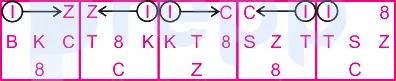
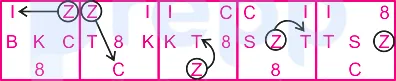
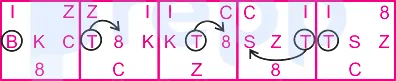
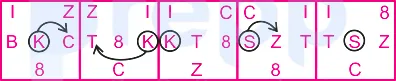
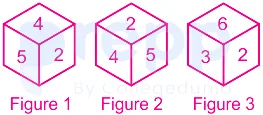
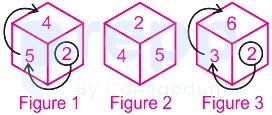
Three different positions of the same dice are shown. Find the number on the face opposite the face showing ‘2’.
- A
5
- B
4
- C
3
- D
1
Show answer
D. 1The logic followed here is :-
From the given three different cubes, figure 1 and figure 3 , the adjacent sides are as shown below :
As 2 is common in both figure 1 and figure 3, it is clear that 3, 4, 5 and 6 are adjacent to it, and the remaining number i.e., 2 will be opposite to it.
Opposite pairs:
3 → 5
4 → 6
2 → 1
So, the opposite side of "2" will be side "1".
Hence, the correct answer is "1".
 Paper & answer key PDF ↗
 Question 4archived
Select the set in which the numbers are related in the same way as are the numbers of the following set.
( NOTE : Operations should be performed on the whole numbers, without breaking down the numbers into their constituent digits. E.g. 13 – Operations on 13 such as adding / subtracting / multiplying etc. to 13 can be performed. Breaking down 13 into 1 and 3 and then performing mathematical operations on 1 and 3 is not allowed.)
(6, 22, 14)
(8, 30, 19)
- A
(12, 46, 27)
- B
(4, 18, 11)
- C
(7, 26, 17)
- D
(9, 34, 22)
Show answer
B. (4, 18, 11)Number Analogy: Understanding the Problem
The question asks us to identify the relationship between the numbers in the given sets: (6, 22, 14) and (8, 30, 19). We need to find a set from the options where the numbers share the exact same relationship. A key rule is that operations must be performed on the whole numbers themselves, not by breaking them down into individual digits.
Pattern Identification: Analyzing the Given Sets
Let's examine the relationship in the first set (6, 22, 14). Let the three numbers be A, B, and C, where A=6, B=22, and C=14. We need to find a rule that connects these three numbers.
Consider sums, differences, or products of the numbers.
$A + C = 6 + 14 = 20$. The middle number is 22. $20 + 2 = 22$. This suggests a possible rule: $A + C + 2 = B$. Let's check the second set.
Now, let's check this possible rule $A + C + 2 = B$ with the second set (8, 30, 19). Here, A=8, B=30, and C=19.
$A + C + 2 = 8 + 19 + 2 = 27 + 2 = 29$. The middle number is 30. Since $29 \neq 30$, this rule is incorrect.
Let's look for another pattern. Let's try combinations of multiplication and addition/subtraction.
Maybe the middle number (B) is related to A and C by multiplication and then addition/subtraction.
Consider the form $xA + yC = B$. Let's use the two given sets to form equations:
Set 1: (6, 22, 14) → $6x + 14y = 22$
Set 2: (8, 30, 19) → $8x + 19y = 30$
We now have a system of two linear equations with two variables, $x$ and $y$:
$6x + 14y = 22$ (Equation 1)
$8x + 19y = 30$ (Equation 2)
Let's simplify Equation 1 by dividing by 2:
$3x + 7y = 11$ (Equation 3)
Now, we can solve for $x$ and $y$ using substitution or elimination. Let's use elimination. Multiply Equation 3 by 8 and Equation 2 by 3:
$(3x + 7y = 11) \times 8 \implies 24x + 56y = 88$
$(8x + 19y = 30) \times 3 \implies 24x + 57y = 90$
Subtract the first new equation from the second new equation:
$(24x + 57y) - (24x + 56y) = 90 - 88$
$y = 2$
Now substitute $y=2$ back into Equation 3 ($3x + 7y = 11$):
$3x + 7(2) = 11$
$3x + 14 = 11$
$3x = 11 - 14$
$3x = -3$
$x = -1$
So the relationship appears to be $A \times (-1) + C \times 2 = B$, which can be written as $2C - A = B$. Let's verify this rule with the original sets.
For (6, 22, 14): $2 \times 14 - 6 = 28 - 6 = 22$. This matches the middle number.
For (8, 30, 19): $2 \times 19 - 8 = 38 - 8 = 30$. This also matches the middle number.
The rule is consistently $B = 2C - A$.
Testing Options: Applying the Number Set Rule
Now we apply the rule $B = 2C - A$ to each of the given options to find the set that follows the same pattern.
Option 1: (12, 46, 27)
A=12, B=46, C=27
Calculate $2C - A = 2 \times 27 - 12 = 54 - 12 = 42$
The calculated value (42) is not equal to B (46). This option does not follow the rule.
Option 2: (4, 18, 11)
A=4, B=18, C=11
Calculate $2C - A = 2 \times 11 - 4 = 22 - 4 = 18$
The calculated value (18) is equal to B (18). This option follows the rule.
Option 3: (7, 26, 17)
A=7, B=26, C=17
Calculate $2C - A = 2 \times 17 - 7 = 34 - 7 = 27$
The calculated value (27) is not equal to B (26). This option does not follow the rule.
Option 4: (9, 34, 22)
A=9, B=34, C=22
Calculate $2C - A = 2 \times 22 - 9 = 44 - 9 = 35$
The calculated value (35) is not equal to B (34). This option does not follow the rule.
Based on the analysis, only Option 2 follows the identified rule $B = 2C - A$.
Conclusion: Identifying the Correct Set
The set (4, 18, 11) is related in the same way as the sets (6, 22, 14) and (8, 30, 19), following the rule $B = 2C - A$.
Number Analogy Revision Table
Set (A, B, C)
Check Rule: $B = 2C - A$?
Calculation
Result
Follows Rule?
(6, 22, 14)
$22 = 2 \times 14 - 6$?
$28 - 6 = 22$
$22 = 22$
Yes
(8, 30, 19)
$30 = 2 \times 19 - 8$?
$38 - 8 = 30$
$30 = 30$
Yes
(12, 46, 27)
$46 = 2 \times 27 - 12$?
$54 - 12 = 42$
$46 \neq 42$
No
(4, 18, 11)
$18 = 2 \times 11 - 4$?
$22 - 4 = 18$
$18 = 18$
Yes
(7, 26, 17)
$26 = 2 \times 17 - 7$?
$34 - 7 = 27$
$26 \neq 27$
No
(9, 34, 22)
$34 = 2 \times 22 - 9$?
$44 - 9 = 35$
$34 \neq 35$
No
Additional Information on Number Analogy
Number analogy questions are common in logical reasoning and quantitative aptitude sections of competitive exams. They test your ability to observe numbers and identify the underlying pattern or relationship. Common patterns include:
Basic arithmetic operations (addition, subtraction, multiplication, division).
Operations involving squares or cubes of numbers.
Combinations of different operations.
Relationships between the first and second number, first and third, or all three.
Rules applied sequentially or simultaneously.
The key to solving these problems is a systematic approach:
Analyze the given examples carefully.
Try simple relationships first (sums, differences, basic multiples).
If simple methods don't work, look for more complex combinations (like $xA + yC = B$).
Once a potential rule is found, test it against ALL given examples to ensure it holds consistently.
Apply the validated rule to each option to find the matching set.
Practicing different types of number analogy problems helps in recognizing patterns more quickly.
Paper & answer key PDF ↗ Question 5archived
Select the set in which the numbers are related in the same way as are the numbers of the following sets.
( NOTE: Operations should be performed on the whole numbers, without breaking down the numbers into its constituent digits. E.g. 13 – Operations on 13 such as adding / subtracting / multiplying etc. to 13 can be performed. Breaking down 13 into 1 and 3 and then performing mathematical operations on 1 and 3 is NOT allowed)
(63, 81, 7)
(84, 49, 12)
- A
(99, 121, 9)
- B
(76, 234, 12)
- C
(12, 125, 56)
- D
(78, 14, 56)
Show answer
A. (99, 121, 9)Finding the Pattern in Number Sets
The question asks us to identify the mathematical relationship between the numbers in the given sets and then find the option set that follows the exact same relationship. We are told that operations should be performed on the whole numbers as they are, without breaking them down into individual digits.
Analyzing the Given Number Sets
Let's look at the first given set: (63, 81, 7).
The numbers are 63, 81, and 7.
We need to find a pattern connecting these three numbers.
Notice that 81 is a perfect square. \(81 = 9^2\).
Let's see if we can obtain 9 from the other two numbers, 63 and 7.
If we divide the first number (63) by the third number (7), we get \(63 \div 7 = 9\).
Now, if we square this result (9), we get \(9^2 = 81\).
This matches the second number in the set.
So, a possible relationship is: (First number / Third number)$^2$ = Second number.
Let's test this relationship with the second given set: (84, 49, 12).
The numbers are 84, 49, and 12.
Let's apply the same relationship: (First number / Third number)$^2$ = Second number.
Calculate (First number / Third number): \(84 \div 12 = 7\).
Now, square the result: \(7^2 = 49\).
This matches the second number (49) in the set.
The relationship (First number / Third number)$^2$ = Second number holds true for both given sets.
Applying the Number Relationship to Options
Now, we will check each option to see which one satisfies the relationship: \((\text{First number} / \text{Third number})^2 = \text{Second number}\).
Option 1: (99, 121, 9)
First number = 99
Second number = 121
Third number = 9
Let's calculate (First number / Third number): \(99 \div 9 = 11\).
Now, square the result: \(11^2 = 121\).
Does this equal the Second number? Yes, 121 = 121.
Option 1 follows the identified number relationship.
Option 2: (76, 234, 12)
First number = 76
Second number = 234
Third number = 12
Let's calculate (First number / Third number): \(76 \div 12\). This does not give a whole number. \(76 \div 12 = \frac{76}{12} = \frac{19}{3}\).
Squaring this would be \((\frac{19}{3})^2 = \frac{361}{9}\), which is not equal to 234.
Option 2 does not follow the identified number relationship.
Option 3: (12, 125, 56)
First number = 12
Second number = 125
Third number = 56
Let's calculate (First number / Third number): \(12 \div 56 = \frac{12}{56} = \frac{3}{14}\).
Squaring this would be \((\frac{3}{14})^2 = \frac{9}{196}\), which is not equal to 125.
Also, 125 is not a perfect square, which is required for the second number based on the pattern.
Option 3 does not follow the identified number relationship.
Option 4: (78, 14, 56)
First number = 78
Second number = 14
Third number = 56
Let's calculate (First number / Third number): \(78 \div 56 = \frac{78}{56} = \frac{39}{28}\).
Squaring this would be \((\frac{39}{28})^2 = \frac{1521}{784}\), which is not equal to 14.
Also, 14 is not a perfect square, which is required for the second number based on the pattern.
Option 4 does not follow the identified number relationship.
Conclusion
Based on the analysis, only Option 1, (99, 121, 9), follows the same number relationship as the given sets (63, 81, 7) and (84, 49, 12). The relationship is \((\text{First number} / \text{Third number})^2 = \text{Second number}\).
Set
Calculation (First number / Third number)$^2$
Result
Second number
Follows Pattern?
(63, 81, 7)
\( (63 \div 7)^2 \)
\( 9^2 = 81 \)
81
Yes
(84, 49, 12)
\( (84 \div 12)^2 \)
\( 7^2 = 49 \)
49
Yes
(99, 121, 9)
\( (99 \div 9)^2 \)
\( 11^2 = 121 \)
121
Yes
(76, 234, 12)
\( (76 \div 12)^2 \)
\( (19/3)^2 = 361/9 \)
234
No
(12, 125, 56)
\( (12 \div 56)^2 \)
\( (3/14)^2 = 9/196 \)
125
No
(78, 14, 56)
\( (78 \div 56)^2 \)
\( (39/28)^2 = 1521/784 \)
14
No
Revision Table: Key Concepts Reviewed
This question involves understanding and identifying mathematical patterns within sets of numbers. Key concepts include:
Basic arithmetic operations: Division and squaring.
Identifying relationships: Looking for how numbers in a set are connected.
Applying patterns: Using a discovered relationship to test other sets.
Checking conditions: Ensuring operations are on whole numbers, not digits.
Additional Information: Number Pattern Recognition
Number pattern recognition is a common type of question in logical reasoning and quantitative aptitude tests. These questions assess your ability to observe, identify, and extend patterns in sequences or sets of numbers. The patterns can involve various mathematical operations or logical rules. Some common types of patterns include:
Arithmetic progression (constant difference)
Geometric progression (constant ratio)
Squares or cubes of numbers
Combinations of operations (like the pattern in this question)
Fibonacci-like sequences
Practicing different types of number pattern problems helps in developing skills to quickly identify the underlying rule. It often requires trial and error, testing different operations or combinations of numbers within the set.
Paper & answer key PDF ↗ Question 6archived
Select the set in which the numbers are NOT related in the same way as are the numbers of the given set.
( NOTE: Operations should be performed on the whole numbers, without breaking down the numbers into its constituent digits. E.g. 13 – Operations on 13 such as adding / substracting / multiplying etc. to 13 can be performed. Breaking down 13 into 1 and 3 and then performing mathematical operations on 1 and 3 is not allowed)
(22, 9, 198)
- A
(19, 7, 133)
- B
(26, 5, 130)
- C
(28, 7, 196)
- D
(17, 9, 157)
Show answer
D. (17, 9, 157)Understanding the Number Relation Question
The question asks us to identify the set of numbers among the given options that does NOT follow the same relationship as the numbers in the provided set (22, 9, 198). We are also told that operations must be performed on the whole numbers themselves, not their individual digits.
Analyzing the Given Set (22, 9, 198)
Let's examine the relationship between the numbers in the set (22, 9, 198). We have three numbers. Let's see if there is a simple arithmetic relationship between the first two numbers and the third number.
Adding the first two numbers: $22 + 9 = 31$. This is not equal to 198.
Subtracting the first two numbers: $|22 - 9| = 13$. This is not equal to 198.
Multiplying the first two numbers: $22 \times 9$. Let's calculate this.
Calculating $22 \times 9$:
We can multiply 22 by 9:
$\qquad 22 \times 9 = (20 + 2) \times 9 = (20 \times 9) + (2 \times 9) = 180 + 18 = 198$
Alternatively, using vertical multiplication:
22
x 9
----
198
The result $22 \times 9 = 198$ matches the third number in the set. Therefore, the relationship in the given set is: First Number \(\times\) Second Number = Third Number.
Checking the Options Against the Pattern
Now, we will apply this rule to each of the options provided and see which one does not fit the pattern.
Option Set
Check: First \(\times\) Second
Is it equal to the Third?
Follows the Pattern?
(19, 7, 133)
$19 \times 7$
$19 \times 7 = 133$. Yes.
Yes
(26, 5, 130)
$26 \times 5$
$26 \times 5 = 130$. Yes.
Yes
(28, 7, 196)
$28 \times 7$
$28 \times 7 = 196$. Yes.
Yes
(17, 9, 157)
$17 \times 9$
$17 \times 9 = 153$. No, it is not 157.
No
As shown in the table, Options 1, 2, and 3 follow the established pattern where the product of the first two numbers equals the third number. Option 4, the set (17, 9, 157), does not follow this pattern because $17 \times 9 = 153$, which is not equal to 157.
Identifying the Set NOT Related in the Same Way
The question asks for the set in which the numbers are NOT related in the same way as the given set. Based on our analysis, the set (17, 9, 157) is the one that does not share the same multiplicative relationship.
Conclusion
The set (17, 9, 157) is the one where the numbers are NOT related in the same way as the numbers of the given set (22, 9, 198).
Revision Table: Key Concepts Recap
Concept
Explanation
Number Relation
A mathematical or logical connection between numbers in a set.
Pattern Recognition
Identifying the underlying rule or relationship in a sequence or set of numbers.
Analogous Sets
Sets that follow the same pattern or relationship between their elements.
Non-Analogous Set
A set that does NOT follow the pattern established by other sets or a given set.
Additional Information: Solving Number Pattern Questions
Number pattern questions, like this one, often appear in logical reasoning and quantitative aptitude tests. Here are some tips for solving them:
Look for Simple Operations: Start by checking for basic arithmetic operations like addition, subtraction, multiplication, or division between the numbers.
Consider Relationships Between Pairs: How does the first number relate to the second? How do the first two relate to the third?
Test Different Operations: If simple operations don't work, consider squares, cubes, roots, or combinations of operations.
Apply the Rule Consistently: Once you identify a potential rule from the given example set, test it rigorously on all the options.
Pay Attention to Constraints: Note any specific rules mentioned, such as operating on whole numbers only, as in this question.
Look for Differences: Remember whether the question asks for the set that *follows* the pattern or the set that *does NOT* follow the pattern.
Practicing different types of number relation and pattern questions can help you become quicker at identifying the underlying rules.
Paper & answer key PDF ↗ Question 7archived
A + B means ‘A is the father of B’
A – B means ‘A is the mother of B’
A @ B means ‘A is the son of B’
A # B means ‘A is the daughter of B’
If A # B – C @ D + E, then how is A related to E?
- A
Sister-in-law
- B
Mother
- C
Sister
- D
Daughter
Show answer
C. SisterUnderstanding Blood Relations and Solving the Code
This question involves decoding a set of relationships given in a coded form and then determining the relationship between two individuals based on a complex expression.
First, let's break down the meaning of each symbol provided:
Symbol
Meaning
+
A + B means ‘A is the father of B’
–
A – B means ‘A is the mother of B’
@
A @ B means ‘A is the son of B’
#
A # B means ‘A is the daughter of B’
Now, let's decode the given expression: A # B – C @ D + E.
We will break this down step by step:
A # B: This means A is the daughter of B. This tells us A is female and B is her parent.
B – C: This means B is the mother of C. Since B is the parent of A and the mother of C, A and C are siblings (children of B). B is female.
C @ D: This means C is the son of D. This tells us C is male and D is his parent. Since B is the mother of C and D is the father of C, B and D are the parents of C, and B and D are a couple.
D + E: This means D is the father of E. This tells us D is male and E is his child. Since D is a parent of C (and A), A, C, and E share a common parent, D.
Let's summarize the relationships derived:
B is the mother of A and C.
D is the father of C and E.
Since B is mother of C and D is father of C, B and D are parents of C and are a couple.
Since B is mother of A and B and D are a couple, D must also be the father of A.
So, B and D are parents of A and C.
D is also the father of E.
Therefore, A, C, and E are children of D. A and C are also children of B.
We are asked to find how A is related to E.
A is a child of D.
E is a child of D.
A and E share the same father, D. Thus, A and E are siblings.
From A # B, we know that A is the daughter, meaning A is female.
Since A is female and is a sibling of E, A is the sister of E.
Analyzing the Relationship Between A and E
Based on the decoding of the expression A # B – C @ D + E, we established the following family structure:
B is the mother of A and C.
D is the father of A, C, and E.
B and D are a married couple.
A is female (daughter).
C is male (son).
The gender of E is not specified, but it does not affect the relationship of A to E.
Both A and E are children of D. This makes A and E siblings. Since we know A is female, A is the sister of E.
Conclusion on A's Relationship to E
Following the step-by-step deduction from the coded relationships, we have concluded that A is the sister of E.
Let's check the given options:
Sister-in-law - Incorrect. A and E are siblings.
Mother - Incorrect. A is a child of E's father, D.
Sister - Correct. A is a female sibling of E.
Daughter - Incorrect. A is a sibling of E, not a child of E.
The relationship of A to E is sister.
Revision Table: Coded Relationships
Code
Relationship
A + B
A is father of B
A – B
A is mother of B
A @ B
A is son of B
A # B
A is daughter of B
Additional Information: Solving Blood Relation Puzzles
Blood relation questions test your ability to understand and decipher relationships between family members. These questions often use coded language or diagrams.
Key strategies for solving blood relation problems:
Decode Symbols: Carefully note down the meaning of each symbol used for relationships.
Break Down the Expression: Solve the given expression step by step, typically working from left to right or segment by segment (e.g., A # B, then B - C, etc.).
Draw a Family Tree: Visualizing the relationships can be very helpful. Use symbols for gender (e.g., '+' for male, '-' for female) and lines to connect generations and relationships (e.g., horizontal line for siblings, double horizontal line for married couple, vertical line for parent-child).
Determine Genders: Pay close attention to codes that indicate gender (like 'son' or 'daughter', 'father' or 'mother').
Combine Information: Integrate the relationships from each part of the expression to build a complete family structure.
Answer the Specific Question: Once the family structure is clear, identify the direct relationship asked for (e.g., how is X related to Y). Be careful about the direction of the relationship (Is it X to Y, or Y to X?).
Practice with different types of blood relation problems will improve your speed and accuracy.
Paper & answer key PDF ↗ Question 8archived
Three Statements are given followed by Three conclusions numbered I, II and III. Assuming the statements to be true, even if they seem to be at variance with commonly known facts, decide which of the conclusions logically follow(s) from the statements.
Statements:
All spoons are forks.
All knives are forks.
All forks are plates.
Conclusions:
I. All knives are plates.
II. All plates are spoons.
III. Some plates are knives.
- A
All conclusions follow.
- B
Both conclusions II and III follow.
- C
Both conclusions I and II follow.
- D
Both conclusions I and III follow.
Show answer
D. Both conclusions I and III follow.Syllogism Statements and Conclusions Analysis
This question asks us to evaluate three conclusions based on three given statements. In syllogism problems, we assume the statements are true, even if they contradict common knowledge, and then determine which conclusions logically follow from these statements.
Analyzing the Statements
We have the following statements:
Statement 1: All spoons are forks.
Statement 2: All knives are forks.
Statement 3: All forks are plates.
Let's represent these relationships using symbols. We can use set notation or implication logic:
SPOON $\subseteq$ FORK (All spoons are a subset of forks) or SPOON $\rightarrow$ FORK
KNIFE $\subseteq$ FORK (All knives are a subset of forks) or KNIFE $\rightarrow$ FORK
FORK $\subseteq$ PLATE (All forks are a subset of plates) or FORK $\rightarrow$ PLATE
From these statements, we can infer relationships by combining them:
Combining Statement 1 and Statement 3: If all spoons are forks, and all forks are plates, then it logically follows that all spoons are plates. (SPOON $\rightarrow$ FORK $\rightarrow$ PLATE implies SPOON $\rightarrow$ PLATE).
Combining Statement 2 and Statement 3: If all knives are forks, and all forks are plates, then it logically follows that all knives are plates. (KNIFE $\rightarrow$ FORK $\rightarrow$ PLATE implies KNIFE $\rightarrow$ PLATE).
It's important to note that while all spoons and all knives are forks, and all forks are plates, this doesn't tell us anything about the relationship between spoons and knives directly, nor does it tell us about the inverse relationship (e.g., if all spoons are forks, it doesn't mean all forks are spoons).
Evaluating the Conclusions
Let's examine each conclusion based on our analysis of the statements.
Conclusion I: All knives are plates.
From Statement 2, we know "All knives are forks" (KNIFE $\rightarrow$ FORK). From Statement 3, we know "All forks are plates" (FORK $\rightarrow$ PLATE). Combining these two statements, we deduce that if something is a knife, it must be a fork, and if it is a fork, it must be a plate. Therefore, if something is a knife, it must be a plate. This conclusion logically follows from the statements.
Conclusion II: All plates are spoons.
From Statement 3, we know "All forks are plates" (FORK $\rightarrow$ PLATE). From Statement 1, we know "All spoons are forks" (SPOON $\rightarrow$ FORK). This tells us that spoons are a type of fork, and forks are a type of plate. So, spoons are also a type of plate (SPOON $\rightarrow$ PLATE). However, the conclusion says "All plates are spoons" (PLATE $\rightarrow$ SPOON). This is the reverse relationship. The statements do not provide enough information to conclude that every plate is also a spoon. There could be plates that are forks but not spoons, or plates that are not forks at all (unless stated otherwise). Therefore, this conclusion does not logically follow.
Conclusion III: Some plates are knives.
We concluded that "All knives are plates" from Conclusion I. If it is true that all members of one category (knives) are included in another category (plates), and assuming that the category of knives is not empty (which is a standard assumption in typical syllogism problems unless specified), then there must exist some items that are both plates and knives. These items are the knives themselves. Therefore, if all knives are plates, it must be true that some plates are knives. This conclusion logically follows from the statements (specifically, via the deduction for Conclusion I).
Summary of Conclusions
Based on the analysis:
Conclusion I: All knives are plates - Follows.
Conclusion II: All plates are spoons - Does not follow.
Conclusion III: Some plates are knives - Follows.
Therefore, both Conclusion I and Conclusion III logically follow from the given statements.
Statement/Conclusion
Relationship
Follows?
Statement 1
All spoons are forks (SPOON $\rightarrow$ FORK)
N/A (Given)
Statement 2
All knives are forks (KNIFE $\rightarrow$ FORK)
N/A (Given)
Statement 3
All forks are plates (FORK $\rightarrow$ PLATE)
N/A (Given)
Conclusion I
All knives are plates (KNIFE $\rightarrow$ PLATE)
Yes (from Statement 2 & 3)
Conclusion II
All plates are spoons (PLATE $\rightarrow$ SPOON)
No
Conclusion III
Some plates are knives
Yes (from Conclusion I)
Revision Table: Syllogism Rules
Understanding basic rules of syllogism can help solve these types of problems.
If "All A are B" and "All B are C", then "All A are C". (This applies to KNIFE $\rightarrow$ FORK $\rightarrow$ PLATE).
If "All A are B", then "Some B are A" (assuming A is not an empty set). (This applies to KNIFE $\rightarrow$ PLATE implies Some PLATE are KNIFE).
Statements about "All" do not necessarily imply the reverse "All" relationship. (e.g., "All spoons are forks" does not mean "All forks are spoons").
Statements about "All" do not imply a "Some" relationship in the reverse direction for the first term. (e.g., "All plates are spoons" does not follow from the given statements).
Additional Information: Venn Diagrams for Syllogisms
Venn diagrams are a useful tool to visualize syllogism problems. Each term (spoons, forks, knives, plates) can be represented by a circle. The relationships are shown by how the circles overlap or are contained within each other.
"All A are B" means the circle for A is entirely inside the circle for B.
In this problem, we would have a circle for Knives inside a circle for Forks, a circle for Spoons inside a circle for Forks, and the entire circle for Forks inside a circle for Plates.
The circle for Knives would therefore be inside the circle for Plates (supporting Conclusion I).
Since the Knives circle is inside the Plates circle, there is an overlap between Plates and Knives where the Knives circle is (supporting Conclusion III).
However, the Plates circle would contain the Forks circle, which in turn contains the Spoons circle. This doesn't mean the entire Plates circle is inside the Spoons circle; it's the other way around (Spoons are inside Plates). This visual confirms Conclusion II does not follow.
Paper & answer key PDF ↗ Question 9archived
Which of the following numbers will replace the question mark (?) in the given series?
?, 11, 35, 107, 323
- A
4
- B
5
- C
8
- D
3
Show answer
D. 3Understanding the Number Series Problem
The question asks us to find the number that should replace the question mark (?) in the given series: ?, 11, 35, 107, 323.
This is a common type of number series question in reasoning or quantitative aptitude sections of competitive exams. To solve this, we need to identify the underlying pattern connecting the consecutive numbers in the series.
Analyzing the Pattern in the Series
Let's look at the relationship between the known numbers in the series: 11, 35, 107, and 323. We can examine the differences between consecutive terms or look for a pattern involving multiplication and addition/subtraction.
Difference between 35 and 11: $35 - 11 = 24$
Difference between 107 and 35: $107 - 35 = 72$
Difference between 323 and 107: $323 - 107 = 216$
The differences are 24, 72, 216. We can observe a pattern here:
$72 = 24 \times 3$
$216 = 72 \times 3$
This suggests a pattern related to multiplication by 3. Let's try to find a direct relationship between consecutive terms using multiplication and addition/subtraction.
From 11 to 35: $11 \times 3 = 33$. Adding 2 gives $33 + 2 = 35$.
From 35 to 107: $35 \times 3 = 105$. Adding 2 gives $105 + 2 = 107$.
From 107 to 323: $107 \times 3 = 321$. Adding 2 gives $321 + 2 = 323$.
The pattern is consistent: Each term is obtained by multiplying the previous term by 3 and then adding 2.
The pattern is: Next Term = (Previous Term $\times$ 3) + 2.
Finding the Missing Number
We need to find the first term, let's call it 'x'. According to the pattern, the second term (11) must be obtained from 'x' using the identified rule.
So, we can set up the equation:
$x \times 3 + 2 = 11$
Now, we solve for x:
$\qquad 3x + 2 = 11$
Subtract 2 from both sides:
$\qquad 3x = 11 - 2$
$\qquad 3x = 9$
Divide by 3:
$\qquad x = \frac{9}{3}$
$\qquad x = 3$
So, the missing number that replaces the question mark is 3.
Verifying the Series with the Found Number
Let's check if the series holds true with 3 as the first term:
Starting with 3: $3 \times 3 + 2 = 9 + 2 = 11$ (Matches the second term)
Starting with 11: $11 \times 3 + 2 = 33 + 2 = 35$ (Matches the third term)
Starting with 35: $35 \times 3 + 2 = 105 + 2 = 107$ (Matches the fourth term)
Starting with 107: $107 \times 3 + 2 = 321 + 2 = 323$ (Matches the fifth term)
The series is therefore 3, 11, 35, 107, 323.
Conclusion
The number that replaces the question mark (?) in the given series is 3.
Series with missing number?, 11, 35, 107, 323
Identified PatternNext Term = (Previous Term $\times$ 3) + 2
CalculationLet the missing number be x. $x \times 3 + 2 = 11 \implies 3x = 9 \implies x = 3$
Complete Series3, 11, 35, 107, 323
Revision Table: Number Series Concepts
Concept
Description
Common Patterns
Arithmetic Series
Difference between consecutive terms is constant.
$a, a+d, a+2d, \dots$
Geometric Series
Ratio between consecutive terms is constant.
$a, ar, ar^2, \dots$
Mixed Series
Combine arithmetic and geometric operations, or other rules.
Addition/subtraction, multiplication/division, powers, squares, cubes, combinations like $( \text{term} \times n ) \pm k$.
Difference Series
The differences between consecutive terms follow a pattern (e.g., arithmetic, geometric).
Analysing the series of differences: $d_1, d_2, d_3, \dots$ where $d_i = T_{i+1} - T_i$.
Additional Information on Finding Number Series Patterns
Solving number series problems often requires practice and recognizing common patterns. Here are some tips for finding the missing number:
Look at the differences between consecutive terms. See if they form an arithmetic series, geometric series, or another identifiable pattern.
Look at the ratio between consecutive terms. This can reveal a geometric progression or a pattern involving multiplication/division.
Consider patterns involving squares, cubes, or prime numbers.
Sometimes the pattern involves two interleaved series.
Try combining operations, like multiplication followed by addition or subtraction, as seen in this problem ($ \times 3 + 2 $).
For more complex series, look at the differences between the differences (second-order differences, third-order differences, etc.).
Test your hypothesized pattern with all the given numbers in the series before applying it to find the missing number.
Identifying the correct pattern is the key step to solving any number series or logic series question.
Paper & answer key PDF ↗ Question 10archived
In the following question below are given some statements followed by some conclusions based on those statements. Taking the given statements to be true even if they seem to be at variance from commonly known facts. Read all the conclusions and then decide which of the given conclusion logically follows the given statements.
Statements:
I. All P are Q.
II. All R are Q.
Conclusion:
I. All Q are R.
II. All P are R.
- A
Neither conclusion follows
- B
Only conclusion I follows
- C
Only conclusion II follows
- D
Both conclusions I and II follows
Show answer
A. Neither conclusion followsUnderstanding the Logical Reasoning Problem
This question asks us to analyze given statements and determine which of the provided conclusions logically follow. We must treat the statements as absolutely true, even if they contradict general knowledge. This type of problem is common in logical reasoning and tests our ability to deduce information based strictly on the provided premises.
Analyzing the Statements: All P are Q, All R are Q
We are given two statements:
Statement I: All P are Q. This means that every single member of the set P is also a member of the set Q. In terms of sets, P is a subset of Q. We can represent this relationship as \(P \subseteq Q\) or \(P \rightarrow Q\) (if P exists, it is Q).
Statement II: All R are Q. Similarly, this means every member of the set R is also a member of the set Q. R is a subset of Q. We can represent this as \(R \subseteq Q\) or \(R \rightarrow Q\) (if R exists, it is Q).
Let's visualize these statements using a Venn diagram. Imagine a large circle representing the set Q. Inside this large circle, there are two other circles (or regions): one for P and one for R. Both the P circle and the R circle must be completely contained within the Q circle. The statements tell us nothing definitive about the relationship between P and R. P and R could be entirely separate within Q, they could overlap, or one might even be contained within the other, as long as both remain within Q.
Evaluating the Conclusions based on the Statements
Now, let's examine each conclusion to see if it is necessarily true based on our statements and visualization.
Conclusion I: All Q are R
This conclusion states that every member of the set Q is also a member of the set R. Looking at our Venn diagram or the set relationships (\(P \subseteq Q\) and \(R \subseteq Q\)), we see that Q is the larger set containing both P and R. For "All Q are R" to be true, the circle for Q would have to be inside the circle for R, or they would have to be the same circle. This contradicts the statements which say P (which is part of Q) might not be R, and R is only a part of Q (unless Q and R are the same set, but we cannot assume this). Therefore, Conclusion I does not logically follow from the given statements.
Example: If Q is 'Animals', P is 'Cats', and R is 'Dogs'. Statements become "All Cats are Animals" and "All Dogs are Animals". Conclusion I becomes "All Animals are Dogs", which is false.
Conclusion II: All P are R
This conclusion states that every member of the set P is also a member of the set R. Our statements (\(P \subseteq Q\) and \(R \subseteq Q\)) place both P and R inside Q, but they provide no direct link between P and R. P could be 'Cats' and R could be 'Dogs' (both inside Q='Animals'). In this case, "All Cats are Dogs" is false. The statements do not give us enough information to conclude that all P must be R.
Therefore, Conclusion II does not logically follow from the given statements.
Determining the Final Answer for the Conclusions
Based on our analysis of both conclusions:
Conclusion I ("All Q are R") does not follow.
Conclusion II ("All P are R") does not follow.
Since neither of the given conclusions can be logically derived from the provided statements, the correct assessment is that neither conclusion follows.
Revision Table: Key Concepts in Syllogisms
Statement: A premise given as true, forming the basis for deduction.
Conclusion: A judgement or decision reached by reasoning from statements.
Syllogism: A form of logical reasoning where a conclusion is derived from two or more premises.
Venn Diagram: A visual tool using overlapping circles to represent sets and their relationships, useful for analyzing syllogisms.
Logically Follows: A conclusion logically follows if it must be true whenever the statements are true.
Additional Information: Extending Your Logical Reasoning Skills
To improve your logical reasoning skills, especially with syllogisms, practice interpreting different types of statements like "Some P are Q", "No P are Q", and "Some P are not Q". Understand how to draw Venn diagrams for these different statement types and how combining them affects the possible relationships between sets. Pay close attention to what the statements *do not* say, as conclusions must be based *only* on the information provided in the statements. Remember that "All P are Q" does not mean "All Q are P" (the converse is not necessarily true), and it doesn't tell you anything about the relationship between P and other sets not directly mentioned in the statement (like R in this case, except that R is also in Q).
Paper & answer key PDF ↗ Question 11archived
Select the figure that will replace the question mark (?) in the following figure series.

- A
Option A (shown in image)
- B
Option B (shown in image)
- C
Option C (shown in image)
- D
Option D (shown in image)
Show answer
Question 12archived
Select the option that represents the correct order of the given words as they would appear in an English dictionary.
1. Lesage
2. Laudatory
3. Laureate
4. Latitude
5. Legacy
6. Laudanum
7. Launder
- A
4, 6, 7, 3, 2, 1, 5
- B
4, 6, 7, 2, 3, 1, 5
- C
4, 6, 2, 7, 3, 5, 1
- D
4, 6, 2, 3, 7, 1, 5
Show answer
C. 4, 6, 2, 7, 3, 5, 1Understanding Dictionary Order for Words
Arranging words in the order they appear in an English dictionary is a common task that requires careful comparison of letters from left to right. This process is also known as alphabetical order.
We are given the following words:
Lesage
Laudatory
Laureate
Latitude
Legacy
Laudanum
Launder
To find the correct dictionary order, we compare the words letter by letter, starting from the first letter.
Step-by-Step Alphabetical Sorting
Let's compare the words based on their letters:
All words begin with the letter 'L'.
Now, let's look at the second letter:
Lesage (1): 'e'
Laudatory (2): 'a'
Laureate (3): 'a'
Latitude (4): 'a'
Legacy (5): 'e'
Laudanum (6): 'a'
Launder (7): 'a'
'a' comes before 'e' in the alphabet. So, the words starting with 'La' will come before the words starting with 'Le'.
Words starting with 'La': 2, 3, 4, 6, 7
Words starting with 'Le': 1, 5
Ordering the 'La' Words (2, 3, 4, 6, 7)
Let's look at the third letter for these words:
Laudatory (2): 'u'
Laureate (3): 'u'
Latitude (4): 't'
Laudanum (6): 'u'
Launder (7): 'u'
't' comes before 'u'. So, word 4 (Latitude) comes first in this group.
Now, let's order the words starting with 'Lau' (2, 3, 6, 7) based on the fourth letter:
Laudatory (2): 'd'
Laureate (3): 'r'
Laudanum (6): 'd'
Launder (7): 'n'
Comparing 'd', 'r', 'n': 'd' comes first, then 'n', then 'r'.
Let's order the words starting with 'Laud' (2, 6) based on the fifth letter:
Laudanum (6): 'a'
Laudatory (2): 't'
'a' comes before 't'. So, word 6 (Laudanum) comes before word 2 (Laudatory).
Current order for 'Laud' words: 6, 2.
Word 7 (Launder - Laun) comes next as 'n' follows 'd'.
Word 3 (Laureate - Laur) comes last in the 'Lau' group as 'r' follows 'n'.
Order of 'Lau' words: 6, 2, 7, 3.
Combining the 'Lat' word (4) and 'Lau' words (6, 2, 7, 3):
Order of 'La' words: 4, 6, 2, 7, 3.
Ordering the 'Le' Words (1, 5)
Let's look at the third letter for these words:
Lesage (1): 's'
Legacy (5): 'g'
'g' comes before 's'. So, word 5 (Legacy) comes before word 1 (Lesage).
Order of 'Le' words: 5, 1.
Combining the Groups
'La' words come before 'Le' words. So, we put the 'La' group order first, followed by the 'Le' group order.
Final dictionary order of the word numbers:
4, 6, 2, 7, 3, 5, 1
Word Number
Word
Step 1: Compare 2nd letter
Step 2: Compare 3rd letter
Step 3: Compare 4th letter
Step 4: Compare 5th letter
Final Order
4
Latitude
La (a)
Lat (t)
-
-
1st (among 'La' group)
6
Laudanum
La (a)
Lau (u)
Laud (d)
Lauda (a)
2nd (among 'La' group)
2
Laudatory
La (a)
Lau (u)
Laud (d)
Laudat (t)
3rd (among 'La' group)
7
Launder
La (a)
Lau (u)
Laun (n)
-
4th (among 'La' group)
3
Laureate
La (a)
Lau (u)
Laur (r)
-
5th (among 'La' group)
5
Legacy
Le (e)
Leg (g)
-
-
1st (among 'Le' group)
1
Lesage
Le (e)
Les (s)
-
-
2nd (among 'Le' group)
Combining the ordered 'La' words (4, 6, 2, 7, 3) and 'Le' words (5, 1) gives the sequence 4, 6, 2, 7, 3, 5, 1.
Revision Table: Dictionary Order
Reviewing the key steps for arranging words alphabetically:
Compare words letter by letter from the beginning.
If letters are the same, move to the next letter.
The word with the letter that comes earlier in the alphabet is placed first.
If one word is a prefix of another (e.g., 'cat' and 'catalog'), the shorter word comes first. (Not applicable in this question).
Additional Information: Mastering Alphabetical Sorting
Understanding dictionary order is fundamental for using dictionaries, indexes, and other reference materials efficiently. It's also a common type of question in verbal ability and reasoning tests. Practice with different sets of words helps improve speed and accuracy in alphabetical sorting.
Paper & answer key PDF ↗ Question 13archived
Which of the following terms will replace the question mark (?) in the given series?
VTHJ ? TRJL SQKM RPLN
- A
USIP
- B
UZIK
- C
USIK
- D
USLK
Show answer
C. USIKFinding the Missing Term in a Letter Series
This question asks us to identify the term that completes the given letter series: VTHJ ? TRJL SQKM RPLN. To solve this, we need to analyze the pattern or rule governing the sequence of letters in each term of the series.
The series is:
VTHJ, ?, TRJL, SQKM, RPLN
Each term consists of four letters. Let's examine the progression of letters at each position (first, second, third, and fourth) across the known terms of the series.
Analyzing the First Letter Pattern
The first letters of the terms are V, ?, T, S, R.
Let's look at the alphabetical positions of these letters:
V is the 22nd letter.
T is the 20th letter.
S is the 19th letter.
R is the 18th letter.
Observing the known sequence T, S, R (20, 19, 18), we see a decrease of 1 at each step. Assuming this pattern continues, the sequence for the first letter should be decreasing by 1 consistently. To find the letter before T (20) that follows V (22), the missing letter should be the 21st letter, which is U. The sequence would be V(22), U(21), T(20), S(19), R(18).
So, the first letter of the missing term is U.
Analyzing the Second Letter Pattern
The second letters of the terms are T, ?, R, Q, P.
Let's look at the alphabetical positions of these letters:
T is the 20th letter.
R is the 18th letter.
Q is the 17th letter.
P is the 16th letter.
Observing the known sequence R, Q, P (18, 17, 16), we see a decrease of 1 at each step. Assuming this pattern continues, the sequence for the second letter should be decreasing by 1 consistently. To find the letter before R (18) that follows T (20), the missing letter should be the 19th letter, which is S. The sequence would be T(20), S(19), R(18), Q(17), P(16).
So, the second letter of the missing term is S.
Analyzing the Third Letter Pattern
The third letters of the terms are H, ?, J, K, L.
Let's look at the alphabetical positions of these letters:
H is the 8th letter.
J is the 10th letter.
K is the 11th letter.
L is the 12th letter.
Observing the known sequence J, K, L (10, 11, 12), we see an increase of 1 at each step. Assuming this pattern continues, the sequence for the third letter should be increasing by 1 consistently. To find the letter after H (8) that comes before J (10), the missing letter should be the 9th letter, which is I. The sequence would be H(8), I(9), J(10), K(11), L(12).
So, the third letter of the missing term is I.
Analyzing the Fourth Letter Pattern
The fourth letters of the terms are J, ?, L, M, N.
Let's look at the alphabetical positions of these letters:
J is the 10th letter.
L is the 12th letter.
M is the 13th letter.
N is the 14th letter.
Observing the known sequence L, M, N (12, 13, 14), we see an increase of 1 at each step. Assuming this pattern continues, the sequence for the fourth letter should be increasing by 1 consistently. To find the letter after J (10) that comes before L (12), the missing letter should be the 11th letter, which is K. The sequence would be J(10), K(11), L(12), M(13), N(14).
So, the fourth letter of the missing term is K.
Combining the Letters
By combining the letters found for each position (U, S, I, K), the missing term in the series is USIK.
Verification
Let's check if USIK fits the pattern perfectly:
Series: VTHJ, USIK, TRJL, SQKM, RPLN
First letters: V → U → T → S → R (Decrease by 1: 22 → 21 → 20 → 19 → 18) - Correct
Second letters: T → S → R → Q → P (Decrease by 1: 20 → 19 → 18 → 17 → 16) - Correct
Third letters: H → I → J → K → L (Increase by 1: 8 → 9 → 10 → 11 → 12) - Correct
Fourth letters: J → K → L → M → N (Increase by 1: 10 → 11 → 12 → 13 → 14) - Correct
The term USIK fits the identified pattern for all four letter positions.
Comparing with Options
Let's compare USIK with the given options:
Option 1: USIP (Mismatch in the fourth letter)
Option 2: UZIK (Mismatch in the second letter)
Option 3: USIK (Matches)
Option 4: USLK (Mismatch in the third letter)
The term USIK matches Option 3.
Position
VTHJ
?
TRJL
SQKM
RPLN
Pattern
1st Letter
V (22)
U (21)
T (20)
S (19)
R (18)
Decrease by 1
2nd Letter
T (20)
S (19)
R (18)
Q (17)
P (16)
Decrease by 1
3rd Letter
H (8)
I (9)
J (10)
K (11)
L (12)
Increase by 1
4th Letter
J (10)
K (11)
L (12)
M (13)
N (14)
Increase by 1
The correct answer is USIK.
Revision Table: Letter Series Patterns
Solving letter series questions often involves identifying patterns based on alphabetical order, skipping letters, or combinations of rules. Here's a summary of common patterns:
Incremental/Decremental Step: Each letter position changes by a fixed number of steps in the alphabet (e.g., +1, -2, +3, etc.). This is what we observed in the given problem.
Alternating Step: The step size or direction changes for alternate letters or alternate terms.
Skipping Letters: Letters might be skipped in a sequence (e.g., A, C, E, G skipping one letter).
Reverse Alphabetical Order: The series might move backward through the alphabet.
Combination of Rules: Different positions within the term might follow different rules (as seen in this problem, some positions decrease while others increase).
Additional Information: Strategies for Solving Letter Series
When tackling letter series or alphanumeric series problems, consider these steps:
Write Down the Alphabet: Having the alphabet handy (A-Z) and maybe even their positional values (A=1, B=2, ...) can be very helpful.
Analyze Position by Position: If the terms have multiple letters/numbers, analyze the sequence for each position separately.
Calculate Differences: Find the difference in alphabetical position between corresponding letters in consecutive terms. Look for patterns in these differences.
Look for Cycles or Repetitions: Sometimes patterns might repeat after a few terms.
Check Options: Once you think you've found a pattern and the missing term, check if that term is among the options. If so, verify that it consistently fits the pattern throughout the entire series.
These techniques help in systematically breaking down the letter series and finding the underlying logic or rule.
Paper & answer key PDF ↗ Question 14archived
Select the odd group of numbers. (NOTE: Operations should be performed on the whole numbers, without breaking down the numbers into its constituent digits. E.g. 13 – Operations on 13 such as adding / subtracting / multiplying etc. to 13 can be performed. Breaking down 13 into 1 and 3 and then performing mathematical operations on 1 and 3 is not allowed)
- A
(90 –93 –96)
- B
(84 –87 –90)
- C
(44 –49 –52)
- D
(58 –61 –64)
Show answer
C. (44 –49 –52)Understanding the Odd Group of Numbers Question
This question asks us to identify the group of numbers that does not follow the same pattern as the others. We are given four groups, each containing three numbers. The rule is to perform operations on the whole numbers as they are, without breaking them down into individual digits.
To find the odd group, we need to look for a relationship or pattern that holds true for most of the groups but is different in one of them.
Analyzing Each Group to Find the Pattern
Let's examine the relationship between the numbers within each group. A common way to analyze a sequence of numbers is to look at the difference between consecutive terms.
Group 1: (90 – 93 – 96)
Let's calculate the differences between the numbers:
Difference between the second and first number: $93 - 90 = 3$
Difference between the third and second number: $96 - 93 = 3$
In this group, there is a constant difference of 3 between consecutive numbers.
Group 2: (84 – 87 – 90)
Let's calculate the differences for this group:
Difference between the second and first number: $87 - 84 = 3$
Difference between the third and second number: $90 - 87 = 3$
Similar to Group 1, this group also has a constant difference of 3 between consecutive numbers.
Group 3: (44 – 49 – 52)
Now let's calculate the differences for this group:
Difference between the second and first number: $49 - 44 = 5$
Difference between the third and second number: $52 - 49 = 3$
In this group, the differences between consecutive numbers are 5 and 3, which is not a constant difference.
Group 4: (58 – 61 – 64)
Finally, let's calculate the differences for the last group:
Difference between the second and first number: $61 - 58 = 3$
Difference between the third and second number: $64 - 61 = 3$
This group also shows a constant difference of 3 between consecutive numbers, just like Groups 1 and 2.
Conclusion: Identifying the Odd Group
Let's put our findings into a table to compare the patterns easily:
Group
Numbers
Difference 1 (2nd – 1st)
Difference 2 (3rd – 2nd)
Pattern
1
90, 93, 96
3
3
Constant difference of 3
2
84, 87, 90
3
3
Constant difference of 3
3
44, 49, 52
5
3
Differences are 5 and 3 (not constant)
4
58, 61, 64
3
3
Constant difference of 3
Groups 1, 2, and 4 follow the same pattern where each number is 3 more than the previous number. Group 3 is different because the first difference is 5 and the second difference is 3. Therefore, Group (44 – 49 – 52) is the odd group out as it does not follow the constant difference pattern seen in the other groups.
Revision Table: Number Pattern Concepts
Concept
Description
Application in Question
Arithmetic Progression
A sequence where the difference between consecutive terms is constant.
Groups 1, 2, and 4 are examples of short arithmetic progressions.
Identifying Patterns
Finding the underlying rule that connects numbers or elements in a set.
The main task was to identify the difference pattern in each group.
Odd One Out Reasoning
Selecting the element in a set that does not fit the pattern or rule followed by the others.
This question is a classic example of an odd one out reasoning problem based on number patterns.
Additional Information: Strategies for Finding Number Patterns
When tackling number pattern questions, especially in reasoning or aptitude tests, consider these strategies:
Look for Differences: Calculate the differences between consecutive numbers. Check if the differences are constant or follow a pattern themselves (e.g., increasing or decreasing).
Look for Ratios: If the numbers are increasing or decreasing rapidly, check for a constant ratio between consecutive terms (multiplication or division).
Check for Squares or Cubes: See if the numbers are perfect squares, cubes, or related to them (e.g., $n^2 \pm 1$, $n^3 \pm 1$).
Combine Operations: The pattern might involve a combination of operations (e.g., multiply by 2 and add 1).
Check Digit Properties: (Be careful with the question's rules, as in this case). Sometimes the pattern involves the sum, product, or arrangement of the digits within the numbers.
Systematic analysis of differences or ratios is often the first step and can quickly reveal the pattern, as it did in this odd group question.
Paper & answer key PDF ↗ Question 15archived
If L × M means that L is the mother of M, L – M means that L is the father of M, L ÷ M means that L is the sister of M, then which of the following expression shows that P is the father of R?
- A
Q – P × R
- B
P – Q ÷ R
- C
P – Q × R
- D
R – P × Q
Show answer
B. P – Q ÷ RBlood Relations Explained: Finding the Father-Child Link
This guide will help you decode the logic puzzle presented. The goal is to identify the correct family relationship expression among the choices provided, specifically finding the one that signifies 'P is the father of R'. We'll use the definitions given for the relationship symbols.
Understanding the Symbols: The Key to the Puzzle
First, let's clarify the meaning of each symbol as defined in the question:
'×' (Multiplication Symbol): Represents 'is the mother of'. So, L × M means L is the mother of M.
'–' (Minus Symbol): Represents 'is the father of'. So, L – M means L is the father of M.
'÷' (Division Symbol): Represents 'is the sister of'. So, L ÷ M means L is the sister of M.
Remember, the person on the left side of the symbol holds the relationship described.
Step-by-Step Analysis of Each Option
We will now examine each expression to determine the relationship between P and R:
Option 1: Analyzing Q – P × R
The first part, Q – P, means 'Q is the father of P'.
The second part, P × R, means 'P is the mother of R'.
Result: In this case, P is the mother of R. This does not match our goal ('P is the father of R').
Option 2: Analyzing P – Q ÷ R
The first part, P – Q, means 'P is the father of Q'.
The second part, Q ÷ R, means 'Q is the sister of R'.
Result: P is the father of Q. Q is the sister of R, meaning Q and R are siblings. If P is the father of Q, he is also the father of Q's sibling, R. This matches our goal ('P is the father of R').
Option 3: Analyzing P – Q × R
The first part, P – Q, means 'P is the father of Q'.
The second part, Q × R, means 'Q is the mother of R'.
Result: P is the father of Q, and Q is the mother of R. This makes P the father of R's mother, which means P is the maternal grandfather of R. This does not match our goal.
Option 4: Analyzing R – P × Q
The first part, R – P, means 'R is the father of P'.
The second part, P × Q, means 'P is the mother of Q'.
Result: R is the father of P, and P is the mother of Q. This makes R the paternal grandfather of Q. This expression does not show P as the father of R.
Final Conclusion: The Correct Family Expression
After evaluating all the options based on the provided symbol definitions:
Option 1 implies P is the mother of R.
Option 2 clearly shows that P is the father of R.
Option 3 implies P is the maternal grandfather of R.
Option 4 implies R is the father of P.
Therefore, the expression that correctly shows 'P is the father of R' is P – Q ÷ R.
Paper & answer key PDF ↗ Question 16archived
Which figure should replace the question mark (?) if the series were to be continued?

- A
Option A (shown in image)
- B
Option B (shown in image)
- C
Option C (shown in image)
- D
Option D (shown in image)
Show answer
Question 17archived
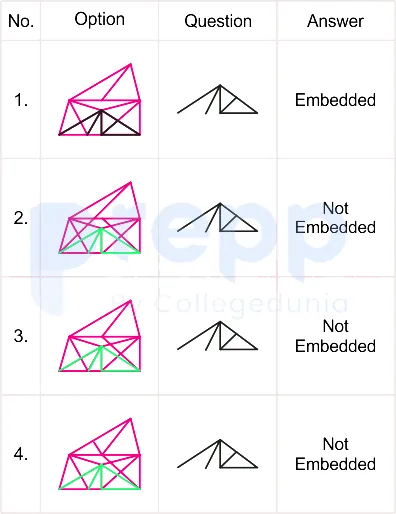
Select the option figure in which the given figure (X) is embedded as its part (rotation is NOT allowed).

- A
Option A (shown in image)
- B
Option B (shown in image)
- C
Option C (shown in image)
- D
Option D (shown in image)
Show answer
A. Option A (shown in image)Given:
The image must not to be rotated
Hence, the correct answer is "Option - (1)" .

 Paper & answer key PDF ↗
 Question 18archived
Select the option that is related to the third word in the same way as the second word is related to the first word. (The words must be considered as meaningful English words and must not be related to each other based on the number of letters / number of consonants / vowels in the word.)
Bee ∶ Beehive ∶∶ Dog ∶ ?
- A
Kennel
- B
Stable
- C
Pen
- D
Shed
Show answer
A. KennelUnderstanding Word Analogies in Reasoning
Word analogies are a common type of reasoning question that tests your ability to identify the relationship between a pair of words and apply that same relationship to another word to find the missing fourth word. The key is to determine the exact connection between the first two words.
Analyzing the Bee and Beehive Relationship
The first pair of words given is "Bee" and "Beehive". Let's think about the relationship between these two:
A Bee is an insect.
A Beehive is a structure.
Bees live in a Beehive. The Beehive is the dwelling or home of a Bee.
So, the core relationship is: The second word is the home or dwelling of the first word.
Applying the Analogy to Dog
Now we need to apply this same "dwelling of" relationship to the third word, "Dog". We need to find the place where a Dog lives from the given options.
The question is: Dog is to what?
We are looking for the dwelling place of a Dog.
Evaluating the Options for Dog's Dwelling
Let's examine the provided options:
Kennel: A kennel is a small shelter for a dog, or a place where dogs are bred or kept. This is a common dwelling for a Dog.
Stable: A stable is a building where horses are kept. It is not typically where a Dog lives.
Pen: A pen is a small enclosure for domestic animals. While a Dog might be temporarily kept in a pen, it's a general term and "Kennel" is more specific to a Dog's housing. Pens are more commonly associated with livestock like pigs or sheep.
Shed: A shed is typically a simple structure used for storage or as a workshop. While a Dog might shelter in a shed, it's not its designated or common dwelling in the same way a Beehive is for a Bee or a Kennel is for a Dog.
Identifying the Correct Dwelling for a Dog
Comparing the options, the word that best fits the description of being the home or dwelling place of a Dog, similar to how a Beehive is the home of a Bee, is a Kennel.
Reasoning Conclusion
The analogy is based on the dwelling place of the animal. A Bee lives in a Beehive. Similarly, a Dog lives in a Kennel.
Therefore, the correct option to complete the analogy "Bee : Beehive :: Dog : ?" is Kennel.
Word 1
Word 2
Relationship
Bee
Beehive
Dwelling/Home of
Dog
?
Dwelling/Home of
Revision Table: Analogy Review
Concept
Explanation
Analogy
Comparison between two things, typically for the purpose of explanation or clarification, especially in reasoning tests.
Word Analogy
A type of analogy where the relationship between two words must be identified and applied to another pair.
Identifying Relationship
Crucial first step; look for connections like part-whole, cause-effect, tool-user, dwelling, synonym, antonym, etc.
Applying Relationship
Use the relationship found in the first pair to determine the missing word in the second pair.
Additional Information on Animal Dwellings
Understanding the specific names for animal homes can be helpful in solving dwelling-based analogies. Here are a few examples:
Bird : Nest
Lion : Den
Spider : Web
Horse : Stable
Pig : Sty
Cow : Shed/Barn
Remember that sometimes multiple terms might apply (e.g., a Dog might also live in a house with humans), but in analogy questions, look for the most common or specific dwelling provided by the options or the analogy structure itself.
Paper & answer key PDF ↗ Question 19archived
Select the word - pair that best represents a similar relationship to the one expressed in the given pair of words.
(The words must be considered as meaningful English words and must not be related to each other based on the number of letters / number of consonants / vowels in the word)
Tailor ∶ Sewing machine
- A
Electrician ∶ Expensive
- B
Farmer ∶ Plants
- C
Scissors ∶ Hair
- D
Police ∶ Handcuffs
Show answer
D. Police ∶ HandcuffsThe question asks us to find a word pair that shares a similar relationship to the pair "Tailor $\ratio$ Sewing machine". We need to analyse the relationship between the words in the given pair and then apply that understanding to the given options.
Understanding the Analogy: Tailor and Sewing Machine
Let's look closely at the relationship between a Tailor and a Sewing machine.
A Tailor is a person who makes or mends clothes.
A Sewing machine is a mechanical tool or device used by a tailor to stitch fabric together, which is essential for their work.
So, the relationship is between a professional or person and a primary tool or equipment they use to perform their job.
Analysing the Options
Now let's examine each option to see which pair exhibits a similar "person/professional $\ratio$ tool" relationship.
Electrician $\ratio$ Expensive
An Electrician is a professional who works with electrical systems. "Expensive" is an adjective describing cost. This pair is a person and a characteristic (cost), not a person and a tool. This does not match the Tailor $\ratio$ Sewing machine relationship.
Farmer $\ratio$ Plants
A Farmer is a person who grows crops. Plants are the objects that a farmer cultivates. While plants are central to a farmer's work, they are not the tools the farmer uses. Tools for a farmer include things like a plough, hoe, or tractor. This pair is a person and the object of their work, not a person and a tool. This does not match the Tailor $\ratio$ Sewing machine relationship.
Scissors $\ratio$ Hair
Scissors are a tool used for cutting. Hair is what might be cut using scissors. This pair is a tool and the object it acts upon. The order is also reversed compared to the original pair (Tailor $\ratio$ Sewing machine, which is Person $\ratio$ Tool). This does not match the Tailor $\ratio$ Sewing machine relationship.
Police $\ratio$ Handcuffs
Police are professionals who maintain law and order. Handcuffs are a tool used by police officers to restrain individuals, an essential piece of equipment for their duty. This pair represents a professional and a primary tool they use in their profession. This relationship (Person $\ratio$ Tool) is the most similar to the Tailor $\ratio$ Sewing machine relationship.
Conclusion
Based on the analysis of each option, the pair "Police $\ratio$ Handcuffs" best represents a similar relationship to "Tailor $\ratio$ Sewing machine". Both pairs show a professional and a key tool or equipment used by that professional to carry out their work.
Revision Table: Analogy Relationships
Word Pair
Relationship Type
Similar to Tailor $\ratio$ Sewing machine?
Tailor $\ratio$ Sewing machine
Person $\ratio$ Tool
Base Relationship
Electrician $\ratio$ Expensive
Person $\ratio$ Attribute
No
Farmer $\ratio$ Plants
Person $\ratio$ Object of Work
No
Scissors $\ratio$ Hair
Tool $\ratio$ Object
No
Police $\ratio$ Handcuffs
Person $\ratio$ Tool
Yes
Additional Information: Understanding Analogies
Analogy questions test your ability to recognise relationships between pairs of words. These relationships can be of many types, such as:
Part $\ratio$ Whole (e.g., Finger $\ratio$ Hand)
Cause $\ratio$ Effect (e.g., Sun $\ratio$ Heat)
Antonym (e.g., Hot $\ratio$ Cold)
Synonym (e.g., Happy $\ratio$ Joyful)
Worker $\ratio$ Tool (e.g., Tailor $\ratio$ Sewing machine)
Worker $\ratio$ Workplace (e.g., Teacher $\ratio$ School)
Tool $\ratio$ Purpose (e.g., Knife $\ratio$ Cut)
Action $\ratio$ Object (e.g., Read $\ratio$ Book)
When solving analogies, always try to define the relationship in the given pair first. Then, examine the options to find the pair with the most similar relationship. Pay attention to the order of the words in the pair.
Paper & answer key PDF ↗ Question 20archived
In a certain code language, STEAMER is coded as 81, and CRUISE is coded as 75. How will SUBMARINE be coded in that language?
- A
102
- B
109
- C
100
- D
115
Show answer
A. 102This is a coding-decoding question where words are assigned numerical values based on a specific pattern. We need to identify the pattern used for the words STEAMER and CRUISE and then apply it to find the code for SUBMARINE.
Analyzing the Coding Pattern for STEAMER and CRUISE
Let's look at the given examples:
STEAMER is coded as 81.
CRUISE is coded as 75.
In many coding-decoding questions involving letters and numbers, the pattern relates to the positional values of letters in the English alphabet. The positional values are A=1, B=2, C=3, ..., Z=26.
Let's calculate the sum of the positional values for the letters in STEAMER:
S is the 19th letter.
T is the 20th letter.
E is the 5th letter.
A is the 1st letter.
M is the 13th letter.
E is the 5th letter.
R is the 18th letter.
Sum for STEAMER = 19 + 20 + 5 + 1 + 13 + 5 + 18
\( \text{Sum} = 19 + 20 + 5 + 1 + 13 + 5 + 18 = 81 \)
This matches the given code for STEAMER.
Now let's calculate the sum of the positional values for the letters in CRUISE:
C is the 3rd letter.
R is the 18th letter.
U is the 21st letter.
I is the 9th letter.
S is the 19th letter.
E is the 5th letter.
Sum for CRUISE = 3 + 18 + 21 + 9 + 19 + 5
\( \text{Sum} = 3 + 18 + 21 + 9 + 19 + 5 = 75 \)
This matches the given code for CRUISE.
The pattern is clear: the code for a word is the sum of the positional values of its letters in the English alphabet.
Applying the Pattern to SUBMARINE
Now, we will apply the same pattern to find the code for the word SUBMARINE.
Let's list the positional values for each letter in SUBMARINE:
S is the 19th letter.
U is the 21st letter.
B is the 2nd letter.
M is the 13th letter.
A is the 1st letter.
R is the 18th letter.
I is the 9th letter.
N is the 14th letter.
E is the 5th letter.
Now, let's calculate the sum of these positional values:
Sum for SUBMARINE = 19 + 21 + 2 + 13 + 1 + 18 + 9 + 14 + 5
\( \text{Sum} = 19 + 21 + 2 + 13 + 1 + 18 + 9 + 14 + 5 \)
\( \text{Sum} = (19 + 21) + (2 + 13) + (1 + 18) + (9 + 14) + 5 \)
\( \text{Sum} = 40 + 15 + 19 + 23 + 5 \)
\( \text{Sum} = 55 + 19 + 23 + 5 \)
\( \text{Sum} = 74 + 23 + 5 \)
\( \text{Sum} = 97 + 5 \)
\( \text{Sum} = 102 \)
So, the coded value for SUBMARINE is 102.
Positional Values of Letters
LetterPositionLetterPosition
A1N14
B2O15
C3P16
D4Q17
E5R18
F6S19
G7T20
H8U21
I9V22
J10W23
K11X24
L12Y25
M13Z26
Revision Table: Coding Decoding Summary
WordLettersPositional ValuesSumCoded Value
STEAMERS, T, E, A, M, E, R19, 20, 5, 1, 13, 5, 18\(19+20+5+1+13+5+18\)81
CRUISEC, R, U, I, S, E3, 18, 21, 9, 19, 5\(3+18+21+9+19+5\)75
SUBMARINES, U, B, M, A, R, I, N, E19, 21, 2, 13, 1, 18, 9, 14, 5\(19+21+2+13+1+18+9+14+5\)102
Additional Information: Types of Letter Coding
Letter coding is a common type of reasoning question. Here are some common patterns used:
Positional Value Sum: As seen in this problem, the code is the sum of the numerical positions of the letters (A=1, B=2, ...).
Positional Value Manipulation: The code might involve multiplying, dividing, adding, or subtracting from the sum or individual positional values.
Reverse Positional Value: Using reverse order positional values (A=26, B=25, ... Z=1). The sum or manipulation of these values could be the code.
Consonants/Vowels: Different rules might apply to vowels and consonants. For example, vowels might be assigned values 1, 2, 3... or consonants might be coded differently.
Skipping Letters: The code might involve moving a fixed number of steps forward or backward in the alphabet.
Opposite Letters: Letters might be replaced by their opposite letters (A opposite is Z, B opposite is Y, etc.). Their positional values or some other logic might then be used.
Solving these questions requires careful observation of the given examples and testing different common patterns.
Paper & answer key PDF ↗ Question 21archived
Which of the following letter-clusters will replace the question mark (?) in the given series?
RLV, PNS, NPP, ?, JTJ
- A
MSN
- B
LRM
- C
KQN
- D
KTM
Show answer
B. LRMSolving Letter Series Reasoning Questions
This question asks us to identify the missing letter-cluster in a given series: RLV, PNS, NPP, ?, JTJ. To solve this type of problem, we need to find the pattern or rule that connects consecutive letter-clusters in the series.
Identifying the Pattern in the Letter Series
Let's examine the relationship between the letters at the corresponding positions in the adjacent clusters.
Step 1: Analyze the transition from RLV to PNS
First letter: R (18th letter) to P (16th letter). The position decreases by 2 ($18 - 16 = 2$).
Second letter: L (12th letter) to N (14th letter). The position increases by 2 ($14 - 12 = 2$).
Third letter: V (22nd letter) to S (19th letter). The position decreases by 3 ($22 - 19 = 3$).
The pattern for the first transition is a change in letter position of (-2, +2, -3).
Step 2: Analyze the transition from PNS to NPP
Let's check if the same pattern holds true for the next pair.
First letter: P (16th letter) to N (14th letter). The position decreases by 2 ($16 - 14 = 2$).
Second letter: N (14th letter) to P (16th letter). The position increases by 2 ($16 - 14 = 2$).
Third letter: S (19th letter) to P (16th letter). The position decreases by 3 ($19 - 16 = 3$).
The pattern for the second transition is also a change in letter position of (-2, +2, -3). This confirms the pattern.
Applying the Pattern to Find the Missing Letter-Cluster
Now we apply the consistent pattern (-2, +2, -3) to the letter-cluster NPP to find the missing term.
First letter of the missing term: Start with N (14th letter). Decrease the position by 2. $14 - 2 = 12$. The 12th letter is L.
Second letter of the missing term: Start with P (16th letter). Increase the position by 2. $16 + 2 = 18$. The 18th letter is R.
Third letter of the missing term: Start with P (16th letter). Decrease the position by 3. $16 - 3 = 13$. The 13th letter is M.
So, the missing letter-cluster is LRM.
Verifying the Pattern with the Last Term
Let's apply the pattern (-2, +2, -3) to LRM to see if we get JTJ, the last term in the series.
First letter: L (12th letter) - 2 positions = 10th letter, which is J.
Second letter: R (18th letter) + 2 positions = 20th letter, which is T.
Third letter: M (13th letter) - 3 positions = 10th letter, which is J.
This results in JTJ, which matches the last term in the series. The pattern is verified.
Conclusion
The pattern in the letter series RLV, PNS, NPP, ?, JTJ is a position change of (-2, +2, -3) for the first, second, and third letters respectively, in each consecutive cluster. Applying this pattern to NPP gives us LRM.
The letter-cluster that will replace the question mark (?) in the given series is LRM.
Revision Table: Letter Series Analysis
Transition
First Letter Change
Second Letter Change
Third Letter Change
Pattern (Position Change)
RLV → PNS
R (18) → P (16)
L (12) → N (14)
V (22) → S (19)
(-2, +2, -3)
PNS → NPP
P (16) → N (14)
N (14) → P (16)
S (19) → P (16)
(-2, +2, -3)
NPP → LRM
N (14) → L (12)
P (16) → R (18)
P (16) → M (13)
(-2, +2, -3)
LRM → JTJ
L (12) → J (10)
R (18) → T (20)
M (13) → J (10)
(-2, +2, -3)
Additional Information on Letter Series Reasoning
Letter series problems are common in reasoning and aptitude tests. They require you to identify a logical rule that governs the sequence of letters or letter-clusters.
Common types of patterns include:
Alphabetical Position: Changes based on the letter's position in the English alphabet (A=1, B=2, ..., Z=26). This is the pattern used in this problem.
Skipping Letters: Skipping a fixed number of letters (e.g., A, D, G - skipping 2 letters each time).
Reverse Alphabetical Order: Patterns moving backward through the alphabet.
Vowel/Consonant Patterns: Sequences based on vowels and consonants.
Combination of Patterns: Sometimes, different positions within a letter-cluster follow different rules simultaneously, as seen in this example where there's a combination of decrement and increment rules.
Cycles: Patterns that repeat after a certain number of terms.
To solve these problems, it's helpful to write down the letter positions or the alphabet sequence. Practice with different types of series helps in quickly recognizing the underlying logic.
Paper & answer key PDF ↗ Question 22archived
Select the correct combination of mathematical signs to replace the * signs and balance the given equation.
66 * 6 * 12 * 3 * 15 = 12
- A
÷, −, ×, +
- B
+, −, ÷, ×
- C
÷, ×, +, −
- D
×, −, ÷, +
Show answer
B. +, −, ÷, ×Balancing Mathematical Equations: Finding the Correct Signs
The problem asks us to find the correct combination of mathematical signs (+, −, ÷, ×) to replace the asterisks (*) in the equation \(66 * 6 * 12 * 3 * 15 = 12\) so that the equation holds true. We need to test each option provided, applying the order of operations (BODMAS/PEMDAS) to evaluate the expression on the left side.
Checking Each Option to Balance the Equation
Let's evaluate the equation using the sequence of signs given in each option:
Option 1: ÷, −, ×, +
Replacing the asterisks with these signs in order, the equation becomes:
\(66 \div 6 - 12 \times 3 + 15\)
Following the order of operations (Division and Multiplication first, then Addition and Subtraction):
Calculate the division: \(66 \div 6 = 11\)
Calculate the multiplication: \(12 \times 3 = 36\)
Substitute these values back: \(11 - 36 + 15\)
Perform subtraction and addition from left to right: \(11 - 36 = -25\)
Then: \(-25 + 15 = -10\)
The result is -10. Since \(-10 \ne 12\), this combination of signs is incorrect.
Option 2: +, −, ÷, ×
Replacing the asterisks with these signs in order, the equation becomes:
\(66 + 6 - 12 \div 3 \times 15\)
Following the order of operations (Division and Multiplication first, from left to right; then Addition and Subtraction from left to right):
Calculate the division: \(12 \div 3 = 4\)
Calculate the multiplication: \(4 \times 15 = 60\)
Substitute these values back: \(66 + 6 - 60\)
Perform addition and subtraction from left to right: \(66 + 6 = 72\)
Then: \(72 - 60 = 12\)
The result is 12. Since \(12 = 12\), this combination of signs balances the given equation.
Option 3: ÷, ×, +, −
Replacing the asterisks with these signs in order, the equation becomes:
\(66 \div 6 \times 12 + 3 - 15\)
Following the order of operations (Division and Multiplication first, from left to right; then Addition and Subtraction from left to right):
Calculate the division: \(66 \div 6 = 11\)
Calculate the multiplication: \(11 \times 12 = 132\)
Substitute these values back: \(132 + 3 - 15\)
Perform addition and subtraction from left to right: \(132 + 3 = 135\)
Then: \(135 - 15 = 120\)
The result is 120. Since \(120 \ne 12\), this combination of signs is incorrect.
Option 4: ×, −, ÷, +
Replacing the asterisks with these signs in order, the equation becomes:
\(66 \times 6 - 12 \div 3 + 15\)
Following the order of operations (Multiplication and Division first, from left to right; then Addition and Subtraction from left to right):
Calculate the multiplication: \(66 \times 6 = 396\)
Calculate the division: \(12 \div 3 = 4\)
Substitute these values back: \(396 - 4 + 15\)
Perform subtraction and addition from left to right: \(396 - 4 = 392\)
Then: \(392 + 15 = 407\)
The result is 407. Since \(407 \ne 12\), this combination of signs is incorrect.
Based on the evaluation of all options, the combination of signs +, −, ÷, × is the only one that correctly balances the equation \(66 * 6 * 12 * 3 * 15 = 12\).
Revision Table for Equation Balancing
Option
Signs
Equation
Calculation Steps
Result
Balances?
1
÷, −, ×, +
\(66 \div 6 - 12 \times 3 + 15\)
\(11 - 36 + 15 = -10\)
-10
No
2
+, −, ÷, ×
\(66 + 6 - 12 \div 3 \times 15\)
\(66 + 6 - 4 \times 15 = 66 + 6 - 60 = 72 - 60 = 12\)
12
Yes
3
÷, ×, +, −
\(66 \div 6 \times 12 + 3 - 15\)
\(11 \times 12 + 3 - 15 = 132 + 3 - 15 = 135 - 15 = 120\)
120
No
4
×, −, ÷, +
\(66 \times 6 - 12 \div 3 + 15\)
\(396 - 4 + 15 = 392 + 15 = 407\)
407
No
Additional Information on Order of Operations
When solving mathematical expressions that involve multiple operations, it's crucial to follow a specific order to ensure a consistent and correct result. This order is commonly remembered using acronyms like BODMAS or PEMDAS.
BODMAS: Brackets, Orders (powers/roots), Division and Multiplication (left to right), Addition and Subtraction (left to right).
PEMDAS: Parentheses, Exponents, Multiplication and Division (left to right), Addition and Subtraction (left to right).
Both acronyms represent the same order of priority. Division and multiplication have equal priority and are performed from left to right as they appear in the expression. Similarly, addition and subtraction have equal priority and are performed from left to right after multiplication and division.
In this equation balancing problem, we followed this order strictly to evaluate the expression for each given set of signs.
Paper & answer key PDF ↗ Question 23archived
Which two numbers, from amongst the given options, should be interchanged to make the given equation correct?
54 - (3 × 12) ÷ (8)\({{1} \over 3}\)+ (11 × 4) + 6 = 69
- A
11 and 6
- B
4 and 12
- C
6 and 4
- D
3 and 4
Show answer
D. 3 and 4Solving Equation by Interchanging Numbers
The problem asks us to find two numbers from the given options that, when swapped in the equation, will make the equation mathematically correct. The given equation is:
\(54 - (3 \times 12) \div (8)\({{1} \over 3}\)+ (11 \times 4) + 6 = 69\)
The notation \((8)\({{1} \over 3}\)\) is unusual. Based on testing the options and the target value, this notation likely represents \(8^{\frac{1}{3}}\), which is the cube root of 8.
Let's clarify the equation using this interpretation: \(8^{\frac{1}{3}} = \sqrt[3]{8} = 2\). So, the equation becomes:
\(54 - (3 \times 12) \div 2 + (11 \times 4) + 6 = 69\)
Let's first evaluate the original equation with this interpretation to see if it is already correct:
\(54 - (3 \times 12) \div 2 + (11 \times 4) + 6\)
\(54 - 36 \div 2 + 44 + 6\)
\(54 - 18 + 44 + 6\)
\(36 + 44 + 6\)
\(80 + 6 = 86\)
Since \(86 \neq 69\), the original equation is incorrect, and we need to interchange two numbers.
Testing the Interchange Options
We will test the given options to see which pair of numbers, when swapped, makes the equation equal to 69.
Testing Option 4: Interchange 3 and 4
According to this option, we need to swap the positions of the numbers 3 and 4 in the equation. The original number 3 will be replaced by 4, and the original number 4 will be replaced by 3.
The equation after interchanging 3 and 4 becomes:
\(54 - (4 \times 12) \div (8^{\frac{1}{3}}) + (11 \times 3) + 6 = 69\)
Step-by-Step Calculation after Interchanging 3 and 4
Now, let's evaluate the left side of the new equation following the order of operations (BODMAS/PEMDAS - Brackets, Orders/Exponents, Division/Multiplication, Addition/Subtraction).
Calculate expressions within Brackets and Orders (Exponents):
The first bracket is \((4 \times 12)\). \(4 \times 12 = 48\).
The order/exponent term is \((8^{\frac{1}{3}})\). \(8^{\frac{1}{3}} = \sqrt[3]{8} = 2\).
The second bracket is \((11 \times 3)\). \(11 \times 3 = 33\).
The equation is now: \(54 - 48 \div 2 + 33 + 6\)
Perform Division and Multiplication (from left to right):
We have one division: \(48 \div 2\). \(48 \div 2 = 24\).
The equation is now: \(54 - 24 + 33 + 6\)
Perform Addition and Subtraction (from left to right):
\(54 - 24 = 30\)
\(30 + 33 = 63\)
\(63 + 6 = 69\)
The left side of the equation evaluates to 69.
So, \(69 = 69\).
Since the left side equals the right side after interchanging 3 and 4, this interchange makes the equation correct.
Testing other options would show that they do not result in the equation evaluating to 69.
Revision Table: Understanding Equation Solving
Concept
Description
Relevance to Problem
Order of Operations (BODMAS/PEMDAS)
Rules dictating the sequence in which mathematical operations should be performed: Brackets/Parentheses, Orders/Exponents, Division and Multiplication (from left to right), Addition and Subtraction (from left to right).
Crucial for correctly evaluating the equation after interchanging numbers.
Exponents and Roots
An exponent indicates how many times a number is multiplied by itself. A fractional exponent like \(\frac{1}{n}\) indicates the \(n\)-th root.
Understanding \(8^{\frac{1}{3}} = \sqrt[3]{8}\) was key to interpreting the equation correctly.
Equation
A mathematical statement that asserts the equality of two expressions. Solving or verifying involves evaluating both sides to see if they are equal.
The goal is to make the given statement of equality true by manipulating the numbers.
Additional Information on Number Interchange Problems
Number interchange problems are common in reasoning and quantitative aptitude tests. They require careful evaluation of equations and systematic testing of options.
Systematic Testing: The most reliable way to solve these problems is to test each given option.
Careful Calculation: Ensure you follow the correct order of operations at every step to avoid errors.
Understanding Notation: Be prepared for slightly unusual or unconventional mathematical notation and try to interpret it logically based on the context and options.
Simplification: Simplify parts of the equation (like calculations within brackets or exponents) before combining them according to the order of operations.
Paper & answer key PDF ↗ Question 24archived
Three of the following letter-clusters are alike in some manner and hence form a group. Which letter-cluster does not belong to that group?
- A
EQVK
- B
RDIX
- C
QFJV
- D
IMRO
Show answer
C. QFJVFinding the Odd Letter Cluster Out
This question asks us to identify the letter cluster that does not follow the same pattern as the other three. To solve this type of problem, we need to look for a relationship or rule that applies to the letters within each cluster, typically based on their alphabetical positions.
Analyzing Letter Clusters and Alphabetical Positions
Let's assign numerical values to each letter based on its position in the English alphabet (A=1, B=2, ..., Z=26). Then, we can examine the relationship between the letters in each cluster.
Letter Cluster
Alphabetical Positions
EQVK
E(5), Q(17), V(22), K(11)
RDIX
R(18), D(4), I(9), X(24)
QFJV
Q(17), F(6), J(10), V(22)
IMRO
I(9), M(13), R(18), O(15)
Identifying the Pattern
Let's look for a consistent relationship between consecutive letters or pairs of letters within each cluster. A common pattern involves the difference in alphabetical positions. Let's examine the differences between the second and third letters in each cluster:
For EQVK: The second letter is Q (17) and the third is V (22). The difference is $\text{22 - 17 = +5}$.
For RDIX: The second letter is D (4) and the third is I (9). The difference is $\text{9 - 4 = +5}$.
For QFJV: The second letter is F (6) and the third is J (10). The difference is $\text{10 - 6 = +4}$.
For IMRO: The second letter is M (13) and the third is R (18). The difference is $\text{18 - 13 = +5}$.
Based on this analysis, three of the letter clusters (EQVK, RDIX, and IMRO) show a difference of +5 between the alphabetical positions of their second and third letters. The letter cluster QFJV, however, shows a difference of +4 between its second (F) and third (J) letters.
Conclusion
The pattern observed is that the difference in alphabetical position between the second and third letter in the cluster is +5 for EQVK, RDIX, and IMRO. QFJV does not follow this pattern as the difference is +4.
Therefore, QFJV is the letter cluster that does not belong to the group.
Revision Table: Letter Cluster Analysis
Letter Cluster
2nd Letter
3rd Letter
Position of 2nd Letter
Position of 3rd Letter
Difference (3rd - 2nd)
Follows +5 Pattern?
EQVK
Q
V
17
22
+5
Yes
RDIX
D
I
4
9
+5
Yes
QFJV
F
J
6
10
+4
No
IMRO
M
R
13
18
+5
Yes
Additional Information: Letter Series Reasoning
Letter series and letter cluster reasoning questions are common in various competitive exams. They test a candidate's ability to identify patterns based on:
Alphabetical positions (forward or backward).
Differences or sums of positions.
Vowel/consonant sequences.
Skipping letters.
Reverse order of the alphabet.
Combinations of these patterns.
Practicing different types of letter series and cluster problems helps improve pattern recognition skills.
Paper & answer key PDF ↗ Question 25archived
Select the option figure in which the given figure is embedded (rotation is NOT allowed).

- A
Option A (shown in image)
- B
Option B (shown in image)
- C
Option C (shown in image)
- D
Option D (shown in image)
Show answer
B. Option B (shown in image)Given:
The image must not to be rotated
Hence, the correct answer is "Option - (2)" .

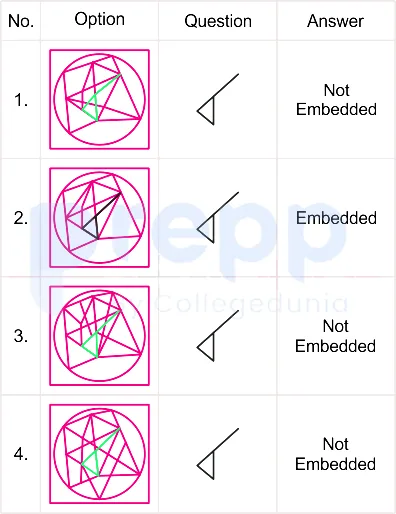 Paper & answer key PDF ↗
 Question 26archived
The arms Act which disallowed Indians from having arms was passed in ______.
- A
1878
- B
1925
- C
1920
- D
1855
Show answer
A. 1878Understanding the Arms Act 1878 in British India
The question asks about the year the Arms Act was passed, which specifically prevented Indians from possessing arms without a license. This act was a significant piece of legislation during the British Raj, reflecting the colonial administration's policies regarding control and security.
What was the Arms Act?
The Arms Act of 1878 was a law enacted by the British government in India. Its main purpose was to control the possession and trade of firearms and ammunition within the country. A key discriminatory aspect of this act was that it required Indians to obtain a license to possess arms, while Europeans and Eurasians were generally exempted from this requirement. This created a clear distinction between the colonial rulers and the Indian population.
Why was the Arms Act 1878 Passed?
The act was passed following the Indian Rebellion of 1857 (also known as the Sepoy Mutiny). The British government felt the need to disarm the Indian population to prevent any future uprisings and to maintain control over the vast territory. By making it difficult for Indians to access arms, the British aimed to strengthen their grip on power and minimize potential threats to their authority.
Analysing the Options for the Arms Act Year
Let's look at the years provided in the options:
1878: This is the year the Arms Act was officially passed by the British government in India.
1925: This year falls well after the passage of the original Arms Act. While arms regulations continued and evolved, 1878 is the year of the foundational discriminatory act mentioned.
1920: Similar to 1925, this year is much later than the enactment of the discriminatory Arms Act.
1855: This year is before the significant events of 1857 that largely prompted the British to pass such a restrictive law like the Arms Act.
Based on historical records, the Arms Act which disallowed Indians from having arms without a license was indeed passed in 1878.
Conclusion on the Arms Act Passage Year
The Arms Act, which implemented strict control over arms possession for Indians and was discriminatory in nature, was enacted in the year 1878.
Revision Table: Key Facts about the Arms Act
Aspect
Detail
Name of Act
Arms Act
Year of Passage
1878
Passed by
British Government in India (during the time of Lord Lytton)
Key Provision
Required Indians to obtain a license to possess arms; exempted Europeans/Eurasians
Reason for Passage
Fear of Indian uprisings, control after the 1857 Rebellion
Additional Information on Colonial Laws and Arms Control
The Arms Act of 1878 was one of several laws passed by the British administration that were seen as discriminatory or repressive by the Indian population. Other such acts included the Vernacular Press Act of 1878, which aimed to censor the Indian-language press.
The control over arms was a sensitive issue, highlighting the power imbalance and mistrust between the rulers and the ruled. The act remained in effect, with amendments, for a considerable period during the British Raj.
Understanding acts like the Arms Act helps in comprehending the nature of colonial rule and the various methods employed by the British to maintain control over India.
Paper & answer key PDF ↗ Question 27archived
Roquefortine C is found in:
- A
Meat
- B
chicken
- C
Egg
- D
cheese
Show answer
D. cheeseUnderstanding Roquefortine C and Its Source
Roquefortine C is a substance produced by certain types of fungi. Specifically, it is a mycotoxin, which means it is a toxic compound produced by mold (fungi).
One of the main fungi that produces Roquefortine C is Penicillium roqueforti. This fungus is widely used in the production of blue cheeses, such as Roquefort, Gorgonzola, and Danish Blue. The characteristic blue veins in these cheeses are actually colonies of Penicillium roqueforti.
Because Penicillium roqueforti is intentionally used in the making of these cheeses, Roquefortine C is commonly found in them. While present, the levels are generally monitored to ensure they remain within safe limits according to food safety regulations.
Let's look at the options provided:
Meat: While meat can sometimes be contaminated with other molds, Roquefortine C is specifically associated with the fungus used in blue cheese production.
Chicken: Similar to meat, chicken is not a typical source of Roquefortine C.
Egg: Eggs are also not known to contain Roquefortine C.
Cheese: As explained, blue cheeses specifically, and sometimes other cheeses contaminated with the relevant fungi, can contain Roquefortine C.
Therefore, based on its origin from the fungi used in blue cheese production, Roquefortine C is found in cheese.
Revision Table: Roquefortine C Facts
Aspect
Description
What it is
A mycotoxin (toxic compound from mold)
Produced by
Certain Penicillium species, notably Penicillium roqueforti
Found in
Primarily blue cheeses (Roquefort, Gorgonzola, etc.)
Significance
Food safety concern if present at high levels
Additional Information on Mycotoxins in Food
Mycotoxins are a diverse group of toxic secondary metabolites produced by filamentous fungi. They can contaminate various food and feed crops, both in the field and during storage.
Common foods prone to mycotoxin contamination include grains (like corn, wheat, rice), nuts (especially peanuts and tree nuts), dried fruits, and spices. Different fungi produce different mycotoxins.
For example:
Aflatoxins are often found in peanuts, corn, and tree nuts, produced by *Aspergillus* species.
Ochratoxin A can be found in cereals, coffee, and dried fruits, produced by *Aspergillus* and *Penicillium* species.
Fumonisins are common in corn, produced by *Fusarium* species.
Patulin is often found in moldy apples and apple products, produced by *Penicillium*, *Aspergillus*, and *Paecilomyces* species.
Exposure to mycotoxins through contaminated food can cause various adverse health effects in humans and animals, ranging from acute poisoning to long-term effects like immune deficiency and cancer. Therefore, controlling fungal growth and mycotoxin production in food chains is a critical aspect of food safety.
Paper & answer key PDF ↗ Question 28archived
The Mohiniyattam dance form originated from which state?
- A
Kerala
- B
Karnataka
- C
Tamil Nadu
- D
Maharashtra
Show answer
A. KeralaThe correct answer is Kerala.
The Mohiniyattam dance form originated from the state of Kerala. The Sangeet Natak Akademi currently recognizes eight classical dance forms: Bharatanatyam (Tamil Nadu) Kathak (Uttar Pradesh) Kathakali (Kerala) Kuchipudi (Andhra Pradesh) Odissi (Odisha) Sattriya (Assam) Manipuri (Manipur) Mohiniyattam (Kerala) These dance forms differ in their origin, movements, costumes, makeup, and accompanying music, yet they all share common foundations in rhythm (Tala) and melody (Raga), and express emotions (Bhava).
Paper & answer key PDF ↗ Question 29archived
The body of the ______ is circular in cross-section, hence, the name roundworms. They may be free living, aquatic and terrestrial or parasitic in plants and animals.
- A
Platyhelminthes
- B
Ctenophores
- C
Mollusca
- D
Aschelminthes
Show answer
D. AschelminthesAschelminthes
Understanding Roundworms and Aschelminthes Classification The question asks to identify the group of animals whose body is circular when viewed in cross-section, leading to their common name "roundworms".
Paper & answer key PDF ↗ Question 30archived
Which French chemist was one of the first scientists to synthesise organic compounds such as formic acid, methane and acetylene from their elements?
- A
Jacob Berzelius
- B
Auguste Laurent
- C
Marcellin Berthelot
- D
Antoine Lavoisier
Show answer
C. Marcellin BerthelotUnderstanding Organic Synthesis from Elements
The question asks us to identify the pioneering French chemist who was among the first to synthesize simple organic compounds like formic acid, methane, and acetylene directly from their constituent elements or very simple inorganic sources. This work was crucial in challenging the prevailing scientific belief of the time, known as vitalism.
The Challenge to Vitalism
Before these breakthroughs, many chemists believed that organic compounds could only be produced by living organisms because they contained a mysterious 'vital force'. Synthesizing organic compounds in the laboratory, especially from inorganic precursors, began to dismantle this theory. Early syntheses, like Wöhler's synthesis of urea from ammonium cyanate in 1828, were significant steps. However, the synthesis of organic compounds directly from elements or simple inorganic substances represented an even more direct challenge to vitalism.
Marcellin Berthelot's Contributions
Marcellin Berthelot (1827–1907) was a prominent French chemist and politician. He conducted extensive research in thermochemistry and organic synthesis. Berthelot was determined to synthesize organic compounds from inorganic materials to definitively disprove vitalism. His groundbreaking work included synthesizing several simple organic molecules:
Methane (\(\text{CH}_4\)): Synthesized from carbon disulfide and hydrogen sulfide, or from carbon and hydrogen at high temperatures.
Acetylene (\(\text{C}_2\text{H}_2\)): Synthesized by passing electric sparks through a mixture of hydrogen and carbon vapor. This was a direct synthesis from elements.
Formic acid (\(\text{HCOOH}\)): Synthesized from carbon monoxide and water under pressure, or indirectly from other inorganic precursors.
Berthelot's work demonstrated that the complex structures of organic chemistry could be built up from simpler inorganic building blocks and even directly from elements, without the need for a 'vital force'. His systematic approach and successful syntheses were pivotal in the development of organic chemistry and the final rejection of vitalism.
Evaluating Other Options
Jacob Berzelius: A Swedish chemist known for developing chemical notation, discovering elements, and proposing the vital force theory, which Berthelot later helped to disprove. He was not known for synthesizing organic compounds from elements.
Auguste Laurent: A French chemist who made significant contributions to organic chemistry, particularly regarding classification and structure, but his primary fame is not linked to the initial synthesis of organic compounds from elements in the way Berthelot's is.
Antoine Lavoisier: A French chemist considered the father of modern chemistry for his work on combustion, conservation of mass, and chemical nomenclature. His work predates the major debates around vitalism and the synthesis of organic compounds from elements.
Conclusion
Based on the historical evidence and his specific achievements in synthesizing organic compounds like formic acid, methane, and acetylene directly or indirectly from elements and simple inorganic substances, Marcellin Berthelot is the correct answer. His work was fundamental in establishing that organic compounds obey the same chemical laws as inorganic compounds and can be synthesized in the laboratory.
Summary of Chemists and Contributions
Chemist
Nationality
Key Contributions (Relevant Context)
Jacob Berzelius
Swedish
Developed chemical notation, advocated vitalism
Auguste Laurent
French
Organic chemistry structure and classification
Marcellin Berthelot
French
Pioneering synthesis of organic compounds (methane, acetylene, formic acid) from elements/inorganic sources, challenged vitalism
Antoine Lavoisier
French
Father of modern chemistry, combustion theory, conservation of mass
Revision Table: Key Concepts
Revision Table: Organic Synthesis & Vitalism
Term
Explanation
Organic Synthesis
The construction of organic molecules from simpler precursors.
Synthesis from Elements
Creating compounds directly from their constituent elements (e.g., \(\text{C} + 2\text{H}_2 \rightarrow \text{CH}_4\)).
Vitalism
The discredited theory that organic compounds can only be produced by living organisms due to a non-physical 'vital force'.
Marcellin Berthelot
French chemist famous for synthesizing organic compounds from inorganic substances and elements, disproving vitalism.
Additional Information: Impact of Berthelot's Work
Marcellin Berthelot's success in synthesizing simple organic compounds from inorganic sources and elements had a profound impact beyond just disproving vitalism. It opened up entirely new avenues in organic chemistry research. It showed that organic chemistry was a field governed by standard chemical principles and reactions, just like inorganic chemistry. This foundational work paved the way for the massive expansion of synthetic organic chemistry that occurred in the late 19th and 20th centuries, leading to the development of countless new compounds, including dyes, pharmaceuticals, and polymers. His syntheses of compounds like acetylene were also industrially significant, as acetylene became an important starting material for synthesizing other organic chemicals.
Paper & answer key PDF ↗ Question 31archived
For which year was Manna Dey honored with the Dadasaheb Phalke Award?
- A
2015
- B
2019
- C
2007
- D
2001
Show answer
C. 2007The correct answer is 2007.
The award includes a Swarna Kamal (Golden Lotus) medallion, a shawl, and a cash prize. It is presented by the President of India at the National Film Awards ceremony. Recipients of the Dadasaheb Phalke Award represent the pinnacle of achievement in various aspects of filmmaking, including acting, directing, producing, music composition, and playback singing, among others. Manna Dey's recognition highlights the significant role of music in Indian cinema.
Paper & answer key PDF ↗ Question 32archived
Ugadi is celebrated in which of the following states?
- A
Madhya Pradesh
- B
Andhra Pradesh
- C
Himachal Pradesh
- D
Kerala
Show answer
B. Andhra PradeshThe correct answer is Andhra Pradesh.
This dish is a mix of six tastes (sweet, sour, salty, bitter, pungent, and spicy), symbolizing the different experiences one might encounter in the coming year – happiness, sadness, anger, fear, disgust, and surprise. Tasting this symbolic dish together is a way to acknowledge and accept life's diverse flavors. Families decorate their homes with mango leaves and rangoli, wear new clothes, and visit temples. The day is considered auspicious for starting new ventures.
Paper & answer key PDF ↗ Question 33archived
Who has been appointed as the Chief Executive Officer of NITI Aayog in June 2022?
- A
Avinash Kulkarni
- B
Krishna Srinivasan
- C
Vivek Kumar
- D
Parameswaran Iyer
Show answer
D. Parameswaran IyerUnderstanding the NITI Aayog CEO Appointment
The question asks about the individual appointed as the Chief Executive Officer (CEO) of NITI Aayog in June 2022. This is a factual query related to key appointments in the Indian government.
Identifying the Correct NITI Aayog CEO
Based on the information regarding appointments made in June 2022, the person who took charge as the CEO of NITI Aayog is Parameswaran Iyer.
Let's look at the options provided:
Avinash Kulkarni
Krishna Srinivasan
Vivek Kumar
Parameswaran Iyer
Among these options, Parameswaran Iyer was indeed appointed to this significant position in June 2022.
Details of the Appointment
Parameswaran Iyer, a former Secretary in the Department of Drinking Water and Sanitation, was appointed as the CEO of NITI Aayog in June 2022. He succeeded Amitabh Kant, whose tenure ended. This appointment was for a period of two years or until further orders.
NITI Aayog (National Institution for Transforming India) is the premier policy 'Think Tank' of the Government of India, providing directional and policy inputs.
Therefore, the correct individual appointed as NITI Aayog CEO in June 2022 is Parameswaran Iyer.
Position
Appointed Individual
Appointment Month/Year
CEO of NITI Aayog
Parameswaran Iyer
June 2022
Revision Table: Key Appointments
Organization/Body
Position
Key Appointee (June 2022 Context)
NITI Aayog
Chief Executive Officer (CEO)
Parameswaran Iyer
NITI Aayog
Former CEO (prior to Iyer)
Amitabh Kant
Additional Information on NITI Aayog
NITI Aayog was established on January 1, 2015, replacing the Planning Commission.
Its objective is to achieve Sustainable Development Goals and enhance cooperative federalism by involving State Governments of India in the economic policy-making process.
The Chairperson of NITI Aayog is the Prime Minister of India.
It includes a Governing Council comprising the Chief Ministers of all States and Lieutenant Governors of Union Territories.
It also has a Vice-Chairperson and full-time members.
Paper & answer key PDF ↗ Question 34archived
Which special knowledge or practical experience is NOT a condition for being nominated to Rajya Sabha by the President of India?
- A
Science
- B
Art
- C
Eloquence
- D
Literature
Show answer
C. EloquenceUnderstanding Rajya Sabha Nomination by the President
The Rajya Sabha, also known as the Council of States, is the upper house of the Parliament of India. Its composition includes members elected by the legislative assemblies of the states and union territories, and members nominated by the President of India. The question specifically asks about the criteria for nomination by the President.
Article 80 of the Constitution of India deals with the composition of the Council of States. Clause (3) of Article 80 states that the members to be nominated by the President shall consist of persons having special knowledge or practical experience in respect of such matters as the following:
Literature
Science
Art
Social service
The purpose of these nominations is to provide representation in the Rajya Sabha to persons who have achieved eminence in various fields of activity and whose presence can contribute to the debates and functioning of the House. These nominated members are not subject to the process of election.
Analyzing the Given Options for Rajya Sabha Nomination
Let's look at the options provided in the question and compare them against the fields specified in Article 80 of the Constitution:
Option
Is it a condition for nomination as per Article 80?
Science
Yes
Art
Yes
Eloquence
No
Literature
Yes
Based on Article 80(3), the specific areas listed are Literature, Science, Art, and Social Service. The option 'Eloquence' is not mentioned in this list as a specific criterion for nomination. While eloquence might be a valuable trait for any public figure, it is not the prescribed 'special knowledge or practical experience' required for Presidential nomination to the Rajya Sabha according to the Constitution.
Therefore, special knowledge or practical experience in 'Eloquence' is NOT a condition for being nominated to Rajya Sabha by the President of India.
Key takeaway on Rajya Sabha Nomination
The President's power to nominate members to the Rajya Sabha is based on their contributions or expertise in specific, constitutionally defined fields: Literature, Science, Art, and Social Service. Any other skill or experience, no matter how valuable in other contexts, is not listed as a formal basis for this specific type of nomination.
Revision Table: Rajya Sabha Nomination Fields
Constitutional Nomination Field
Mentioned in Question Options?
Literature
Yes
Science
Yes
Art
Yes
Social Service
No (but relevant constitutional field)
Eloquence
Yes (but NOT a constitutional field)
Additional Information: Rajya Sabha Composition and Nomination
The maximum strength of the Rajya Sabha is fixed at 250 members. Of these, 238 are representatives of the States and Union Territories, elected by the method of indirect election. The remaining 12 members are nominated by the President of India.
Elected Members: Elected by the elected members of the Legislative Assemblies of the respective States and by the members of the Electoral College for that Union Territory, in accordance with the system of proportional representation by means of the single transferable vote.
Nominated Members: Nominated by the President from persons having special knowledge or practical experience in Literature, Science, Art, and Social Service.
The nominated members bring diverse expertise and perspectives to the Rajya Sabha, enriching its deliberations. They participate in the proceedings of the House in the same way as elected members, except that they cannot vote in the election of the President of India.
Paper & answer key PDF ↗ Question 35archived
Achievement of self-reliance and removal of poverty were twin objectives of which five-year plan?
- A
Third
- B
Fifth
- C
Fourth
- D
Second
Show answer
B. FifthThe correct answer is Fifth.
In the Fifth Plan, it was emphasized to reduce dependence on foreign aid, especially after the economic challenges faced in the late 1960s and early 1970s. This involved promoting domestic production across various sectors and focusing on import substitution where feasible. Understanding the specific historical and economic context surrounding each plan helps in appreciating the rationale behind their stated objectives and identifying the plan associated with particular goals like self-reliance and poverty removal.
Paper & answer key PDF ↗ Question 36archived
Who said the following words?
“Sarfaroshi ki tamanna ab hamare dil me hai, dekhna hai zor kitna baazu-e-qaatil me hai”
- A
Ramprasad Bismil
- B
Bhagat Singh
- C
Ras Bihari Bose
- D
Subhash Chandra Bose
Show answer
A. Ramprasad BismilUnderstanding the Famous “Sarfaroshi ki tamanna” Quote
The question asks about the author or speaker of a very famous couplet from the Indian independence movement: “Sarfaroshi ki tamanna ab hamare dil me hai, dekhna hai zor kitna baazu-e-qaatil me hai”. This translates roughly to “The desire for sacrifice is now in our hearts, let us see how much strength is in the arms of the killer.”
This powerful verse became a rallying cry for revolutionaries fighting for India's freedom.
Identifying the Speaker: Ramprasad Bismil
While the original poem containing this couplet was written by Bismil Azimabadi, a poet from Patna, Bihar, the couplet was widely popularized and made famous by the revolutionary freedom fighter, Ramprasad Bismil. He recited it before his execution in connection with the Kakori Conspiracy case. Because of his prominent use of the lines and his significant role in the freedom struggle, these words are most famously associated with him.
Freedom Fighter
Primary Association with the Quote
Ramprasad Bismil
Widely credited with popularizing and reciting this specific couplet, making it synonymous with his name.
Bhagat Singh
A prominent revolutionary, inspired by figures like Bismil, but this specific quote is not his most famous one.
Ras Bihari Bose
Revolutionary involved in movements like the Ghadar Mutiny and later in Japan; not primarily associated with this quote.
Subhash Chandra Bose
Leader of Forward Bloc and Indian National Army; famous for slogans like "Give me blood and I will give you freedom"; not associated with this quote.
Therefore, based on historical context and popular association, Ramprasad Bismil is the correct answer as the figure who popularized these words and made them iconic in the freedom struggle.
Revision Table: Key Figures and Slogans
Freedom Fighter
Known For
Ramprasad Bismil
Kakori Conspiracy, Poet, Popularized "Sarfaroshi ki tamanna..."
Bhagat Singh
Revolutionary, “Inquilab Zindabad”, Central Assembly Bombing
Ras Bihari Bose
Ghadar Mutiny, Indian Independence League, INA formation link
Subhash Chandra Bose
“Give me blood and I will give you freedom”, Azad Hind Fauj (INA), “Jai Hind”
Additional Information on Indian Freedom Struggle Quotes
Many slogans and quotes became powerful tools during India's fight for independence. These words helped to unite people, inspire courage, and articulate the goals of the movement. Each leader or group often had specific phrases or couplets that resonated with their philosophy or actions.
“Inquilab Zindabad” (Long Live the Revolution) was popularized by Bhagat Singh.
Mahatma Gandhi's call was often associated with non-violence and sayings like “Do or Die” during the Quit India Movement.
Jawaharlal Nehru's famous speech included the phrase “Tryst with Destiny.”
These quotes serve not just as historical records but continue to inspire patriotic feelings.
Paper & answer key PDF ↗ Question 37archived
Which of the following pairs of countries will host the 2023 FIFA Women’s World Cup?
- A
Canada and Mexico
- B
New Zealand and Austria
- C
France and Canada
- D
New Zealand and Australia
Show answer
D. New Zealand and AustraliaUnderstanding the 2023 FIFA Women's World Cup Hosts
The question asks about the countries that jointly hosted the FIFA Women's World Cup in 2023. This major international football tournament brings together national teams from around the world to compete for the title.
Identifying the host countries is key to understanding the logistics and global reach of the event. FIFA's decision on hosts is based on a bidding process where countries or pairs of countries present their proposals to host the tournament.
The Host Nations for 2023
For the 2023 edition of the FIFA Women's World Cup, two countries from different confederations came together to co-host the event. This was the first time the tournament was hosted by more than one country.
Following a comprehensive bidding process, FIFA announced the successful bid. The joint bid from two specific countries was selected over others.
Analyzing the Options
Let's look at the provided options in the context of the 2023 FIFA Women's World Cup hosts:
Canada and Mexico: These countries, along with the USA, are hosting the FIFA World Cup (Men's) in 2026, but not the Women's World Cup in 2023.
New Zealand and Austria: Austria was not one of the host nations for the 2023 tournament.
France and Canada: France hosted the previous FIFA Women's World Cup in 2019. Canada has also hosted the tournament before (in 2015) but was not a co-host in 2023.
New Zealand and Australia: These two countries submitted a joint bid and were successfully chosen to host the 2023 FIFA Women's World Cup. The tournament was held across multiple cities in both countries.
Based on the selection made by FIFA, the correct pair of countries that hosted the 2023 FIFA Women's World Cup is New Zealand and Australia.
Confirming the 2023 FIFA Women's World Cup Hosts
The 2023 FIFA Women's World Cup was a landmark event, being the first to be co-hosted by nations from two different confederations (AFC for Australia and OFC for New Zealand) and the first to be held in the Oceania region. The joint bid was chosen in June 2020.
Tournament Year
Host Country/Countries
2015
Canada
2019
France
2023
New Zealand and Australia
Revision Table: FIFA Women's World Cup Hosts
Edition
Year
Host Nations
9th
2023
New Zealand and Australia
8th
2019
France
7th
2015
Canada
Additional Information on the 2023 Tournament
The 2023 FIFA Women's World Cup was also significant because it was the first edition to feature 32 teams, expanded from the previous 24-team format. This expansion allowed more countries to participate and showcase their talent on the global stage. Matches were played in various cities across both New Zealand and Australia, including Auckland, Dunedin, Hamilton, Wellington in New Zealand, and Adelaide, Brisbane, Melbourne, Perth, and Sydney in Australia.
Paper & answer key PDF ↗ Question 38archived
Which force is responsible for the motion of the moon around earth?
- A
Van der Waals
- B
Centrifugal
- C
Frictional
- D
Centripetal
Show answer
D. CentripetalThe correct answer is Centripetal.
For the Earth-Moon system, this gravitational force is significant and acts as the centripetal force required for the Moon's orbit. Orbital motion is a balance between the object's inertia (tendency to move in a straight line) and the centripetal force pulling it inwards. If the centripetal force were removed (e.g., if Earth's gravity suddenly disappeared), the Moon would move off into space in a straight line tangent to its orbit at that point, due to its inertia.
Paper & answer key PDF ↗ Question 39archived
Who took oath as the 49 th Chief Justice of India in August 2022?
- A
Sanjiv Kapoor
- B
Ajay Kumar Sood
- C
Uday Umesh Lalit
- D
Rajiv Ranjan
Show answer
C. Uday Umesh LalitUnderstanding the Chief Justice of India
The Chief Justice of India (CJI) is the head of the judiciary of India and the Chief Judge of the Supreme Court of India. The CJI is appointed by the President of India. The role of the Chief Justice of India is very important in upholding the Constitution and administering justice in the country.
The question asks about the individual who took oath as the 49th Chief Justice of India in August 2022. Identifying the correct person requires knowledge of the appointments made to this significant position.
Analysis of the Options for 49th Chief Justice
Let's examine the provided options to determine who among them became the 49th Chief Justice of India in August 2022:
Sanjiv Kapoor: Sanjiv Kapoor is associated with the aviation sector in a leadership role, not the judiciary.
Ajay Kumar Sood: Ajay Kumar Sood is a prominent scientist and served as Principal Scientific Adviser to the Government of India. He is not a judge.
Uday Umesh Lalit: Uday Umesh Lalit was a judge of the Supreme Court of India. He was appointed as the 49th Chief Justice of India and took office in August 2022.
Rajiv Ranjan: While Rajiv Ranjan is a name associated with the legal field and bureaucracy, he was not appointed as the 49th Chief Justice of India.
Identifying the 49th Chief Justice of India
Based on the appointments made to the Supreme Court and the position of the Chief Justice of India, Justice Uday Umesh Lalit was appointed as the 49th Chief Justice of India. He succeeded Justice N. V. Ramana and served a relatively short tenure before being succeeded by Justice D. Y. Chandrachud.
Justice Uday Umesh Lalit took oath as the 49th Chief Justice of India on August 27, 2022.
Conclusion on 49th CJI Appointment
The individual who took oath as the 49th Chief Justice of India in August 2022 was Uday Umesh Lalit. His appointment was a significant event in the Indian judiciary.
Revision Table: Chief Justices of India (Recent)
Number
Name
Took Office
48th
N. V. Ramana
24 April 2021
49th
Uday Umesh Lalit
27 August 2022
50th
D. Y. Chandrachud
9 November 2022
Additional Information: Role and Appointment of CJI
The Chief Justice of India and other Supreme Court judges are appointed by the President of India under Article 124(2) of the Constitution.
The outgoing CJI recommends their successor, typically the seniormost judge of the Supreme Court.
The CJI holds office until they attain the age of 65 years.
The CJI presides over the proceedings of the Supreme Court and has the power to allocate cases and constitute benches.
Paper & answer key PDF ↗ Question 40archived
Identify the animal that is NOT a non-chordate.
- A
Reptiles
- B
Arthropods
- C
Porifera
- D
Arachnids
Show answer
A. ReptilesIdentifying Non-Chordates: Understanding Animal Classification
The question asks to identify the animal from the given options that is NOT a non-chordate. To answer this, we first need to understand what non-chordates and chordates are and how animals are classified into these groups.
What are Non-Chordates and Chordates?
The animal kingdom is broadly divided into two major groups: chordates and non-chordates. This division is based on the presence or absence of certain fundamental characteristics, particularly the presence of a notochord.
Non-chordates: This group includes a vast majority of animals that do not possess a notochord at any stage of their life cycle. They also lack other key chordate features like a dorsal hollow nerve cord, pharyngeal slits, and a post-anal tail. Examples include sponges, insects, worms, molluscs, and starfishes.
Chordates: This group includes animals that possess a notochord, a dorsal hollow nerve cord, pharyngeal slits, and a post-anal tail at some point during their development. This phylum includes vertebrates (fish, amphibians, reptiles, birds, mammals) and some invertebrates (like tunicates and lancelets).
Analyzing the Options
Let's examine each option provided in the question:
Reptiles: Reptiles are animals like snakes, lizards, turtles, and crocodiles. They belong to the Class Reptilia, which is part of the Phylum Chordata. Reptiles possess all the characteristic features of chordates, such as a notochord during embryonic development (which is replaced by a vertebral column in adults), a dorsal hollow nerve cord, pharyngeal slits in embryonic stages, and a post-anal tail (though it may be reduced in some adults). Therefore, reptiles are chordates, not non-chordates.
Arthropods: Arthropods are a large phylum of non-chordate animals that include insects, spiders, crustaceans, and myriapods. They are characterized by a segmented body, jointed appendages, and an exoskeleton. They do not possess a notochord.
Porifera: Porifera is a phylum of non-chordate animals commonly known as sponges. They are simple multicellular organisms that lack true tissues and organs. They do not possess a notochord.
Arachnids: Arachnids are a class of arthropods that include spiders, scorpions, ticks, and mites. Since Arachnids are part of the Phylum Arthropoda, which is a non-chordate phylum, arachnids themselves are non-chordates. They lack a notochord.
Based on this analysis, three of the options (Arthropods, Porifera, and Arachnids) are examples of non-chordates, while one option (Reptiles) is an example of a chordate.
The question asks to identify the animal that is NOT a non-chordate. This means we are looking for a chordate among the options.
Comparing our findings with the options:
Reptiles: Chordate
Arthropods: Non-chordate
Porifera: Non-chordate
Arachnids: Non-chordate
Therefore, Reptiles are the animal group from the list that is NOT a non-chordate.
Classification Summary
Animal Group
Phylum
Chordate or Non-Chordate
Reptiles
Chordata
Chordate
Arthropods
Arthropoda
Non-Chordate
Porifera
Porifera
Non-Chordate
Arachnids
Arthropoda (Class Arachnida)
Non-Chordate
The only group in the options that belongs to the Phylum Chordata is Reptiles. The other groups belong to phyla within the non-chordates.
Revision Table: Key Differences Between Chordates and Non-Chordates
Feature
Chordates
Non-Chordates
Notochord
Present at some stage
Absent
Dorsal Nerve Cord
Dorsal, hollow
Ventral, solid (usually) or absent
Pharyngeal Slits
Present at some stage
Absent (except in some specific groups not typically called 'non-chordates' in broad classification)
Post-anal Tail
Present at some stage
Absent
Circulatory System
Closed (typically ventral heart)
Open or closed (dorsal heart or scattered)
Additional Information: Diversity within Chordates and Non-Chordates
The non-chordate group is incredibly diverse, encompassing a vast range of animal phyla from simple organisms like sponges and jellyfish to more complex invertebrates like insects, molluscs, and echinoderms. They represent the majority of animal species on Earth.
The Phylum Chordata, while fewer in number of species compared to non-chordates, includes animals with a more complex body plan. It is divided into three subphyla:
Urochordata (Tunicates): Marine filter feeders; notochord and nerve cord present only in larval stage.
Cephalochordata (Lancelets): Small, marine, fish-like animals; notochord and nerve cord persist throughout life.
Vertebrata: Animals with a vertebral column (backbone) that replaces the notochord; includes fish, amphibians, reptiles, birds, and mammals. Reptiles fall under this subphylum.
Understanding this classification helps in distinguishing between different animal groups based on their fundamental biological characteristics.
Paper & answer key PDF ↗ Question 41archived
Asiad is regulated by ______.
- A
International Olympic Council
- B
Commonwealth Games Federation
- C
Indian Olympic Council
- D
Olympic Council of Asia
Show answer
D. Olympic Council of AsiaUnderstanding Asiad Regulation
The question asks about the governing body responsible for regulating the Asiad, also known as the Asian Games. This is an important multi-sport event held every four years among athletes from all over Asia. Like other major international sports events, the Asian Games have a specific organization that oversees their planning, management, and execution.
Analyzing the Options for Asiad Regulation
Let's look at the options provided and consider which organization is responsible for the Asiad:
International Olympic Council: This body governs the Olympic Games. While the Asiad is related to the Olympic movement, the International Olympic Committee (IOC) is not the direct regulator of the regional Asian Games.
Commonwealth Games Federation: This organization is responsible for the Commonwealth Games, a multi-sport event involving athletes from the Commonwealth nations. This is a different set of countries than those participating in the Asiad.
Indian Olympic Council: This likely refers to the Indian Olympic Association (IOA), which is the National Olympic Committee for India. National Olympic Committees are responsible for their country's participation in events like the Olympics and Asiad, but they do not regulate the entire Asiad event itself.
Olympic Council of Asia: This organization is the governing body of sports in Asia. It is recognized by the International Olympic Committee and is responsible for organizing and regulating the Asian Games and other regional multi-sport events in Asia.
The Governing Body of the Asiad: Olympic Council of Asia
Based on the functions of these organizations, the Olympic Council of Asia (OCA) is the entity that regulates and oversees the Asiad. The OCA was founded in 1982 and took over the responsibility of organizing the Asian Games from the Asian Games Federation (AGF).
The Olympic Council of Asia sets the rules, standards, and calendar for the Asian Games, selects host cities, and ensures the event adheres to the principles of the Olympic movement. Therefore, the Olympic Council of Asia is the correct governing body for the Asiad.
Comparison of Sports Governing Bodies
Organization
Primary Event Governed
International Olympic Committee (IOC)
Olympic Games
Commonwealth Games Federation (CGF)
Commonwealth Games
Indian Olympic Association (IOA)
India's participation in various games (National Olympic Committee)
Olympic Council of Asia (OCA)
Asian Games (Asiad) and other Asian sports events
Conclusion on Asiad Regulation
The Asiad, or Asian Games, is regulated by the Olympic Council of Asia. This organization plays a crucial role in promoting sports within Asia and ensuring the smooth conduct of the Asian Games, which is the largest multi-sport event in Asia.
Revision Table: Asiad Regulation Key Points
Key Facts on Asiad Regulation
Event Name
Asiad / Asian Games
Governing Body
Olympic Council of Asia (OCA)
Frequency
Every four years
Participants
Athletes from Asian countries
Additional Information: Role of Olympic Council of Asia
The Olympic Council of Asia (OCA) is one of the five continental associations of the National Olympic Committees recognized by the International Olympic Committee. Besides the Asian Games, the OCA also organizes other events such as the Asian Winter Games, Asian Beach Games, Asian Indoor and Martial Arts Games, and Asian Youth Games. Its headquarters are located in Kuwait City, Kuwait. The OCA's mission includes developing sports in Asia, promoting Olympic ideals, and fostering friendship among Asian nations through sports.
Paper & answer key PDF ↗ Question 42archived
Dhuadhar falls originate from which of the following river?
- A
Mahanadi
- B
Godavari
- C
Narmada
- D
Krishna
Show answer
C. NarmadaUnderstanding the Origin of Dhuadhar Falls
The question asks about the river from which the famous Dhuadhar falls originate. Dhuadhar Falls are a well-known natural attraction in India, particularly famous for their scenic beauty and the misty spray they create.
Identifying the River for Dhuadhar Falls
Dhuadhar Falls are located near Jabalpur in the state of Madhya Pradesh, India. These falls are formed when a large volume of water plunges from a height over marble rocks. The river responsible for creating this spectacular waterfall is the Narmada River.
The name 'Dhuadhar' literally translates to 'smoke flow' in Hindi. This name is very fitting because the force of the water falling onto the rocks below creates a misty spray that looks like smoke rising from the riverbed.
Analysis of the Options
Let's look at the provided options:
Mahanadi: The Mahanadi River is a major river in East Central India. It flows through states like Chhattisgarh and Odisha. While it has many features and tributaries, Dhuadhar Falls are not located on the Mahanadi.
Godavari: The Godavari River is the second-longest river in India, originating in Maharashtra and flowing eastward into the Bay of Bengal. It is a major river in peninsular India, but it is not associated with Dhuadhar Falls.
Narmada: The Narmada River is one of the major rivers of peninsular India. It flows westwards through a rift valley between the Vindhya and Satpura ranges before emptying into the Arabian Sea. It originates in Amarkantak, Madhya Pradesh. The Dhuadhar Falls are specifically located on the Narmada River near Jabalpur, Madhya Pradesh.
Krishna: The Krishna River is the fourth-largest river in India, originating in Maharashtra and flowing eastward through Karnataka, Telangana, and Andhra Pradesh before emptying into the Bay of Bengal. It is not the source of Dhuadhar Falls.
Based on the location and origin of Dhuadhar Falls, the Narmada River is the correct answer.
Key Facts about Dhuadhar Falls and Narmada River
Location: Bhedaghat, near Jabalpur, Madhya Pradesh, India.
River: Narmada River.
Height: Approximately 30 meters (98 feet).
Significance: Known for the misty spray ('Dhuadhar') created by the falling water and the surrounding white marble rocks.
Detailed Comparison of Rivers
Here is a brief comparison of the rivers mentioned in the options:
River
Origin
Flows Through
Major Direction
Associated with Dhuadhar Falls?
Mahanadi
Chhattisgarh
Chhattisgarh, Odisha
East
No
Godavari
Maharashtra
Maharashtra, Telangana, Andhra Pradesh, Chhattisgarh, Odisha
East
No
Narmada
Amarkantak, Madhya Pradesh
Madhya Pradesh, Maharashtra, Gujarat
West
Yes
Krishna
Maharashtra
Maharashtra, Karnataka, Telangana, Andhra Pradesh
East
No
This comparison clearly shows that the Narmada River is the one associated with Dhuadhar Falls.
Revision Table: Dhuadhar Falls and Narmada
Feature
Details
Name
Dhuadhar Falls
River
Narmada River
Location
Near Jabalpur, Madhya Pradesh
Meaning of Name
Smoke Flow (due to mist)
Additional Information: Waterfalls and Rivers
Waterfalls are significant geographical features often formed where rivers flow over steep drops in the landscape. India has many famous waterfalls associated with various rivers.
The Narmada River is one of the few major rivers in India that flows westwards into the Arabian Sea. Other westward flowing rivers include the Tapi and the Sabarmati.
The Godavari and Krishna rivers are major eastward-flowing rivers that drain into the Bay of Bengal, forming extensive deltas.
The Mahanadi also flows eastward into the Bay of Bengal.
Understanding the major river systems of India and the significant geographical features located along their courses is important for studying Indian geography. Dhuadhar Falls is a notable example associated with the Narmada River.
Paper & answer key PDF ↗ Question 43archived
In which of the following cases did the Supreme Court of India pronounce the theory of the ‘Basic Structure’ of the Constitution?
- A
Kesavananda Bharati Case, 1973
- B
Golaknath Case, 1967
- C
Minerva Mills Case, 1980
- D
Swarn Singh Case, 1989
Show answer
A. Kesavananda Bharati Case, 1973Understanding the Basic Structure Doctrine
The question asks about the landmark Supreme Court of India case where the theory of the 'Basic Structure' of the Constitution was first pronounced. This doctrine is a cornerstone of Indian constitutional law, defining the limits of the Parliament's power to amend the Constitution.
Analyzing the Options and Key Cases
Let's examine each case mentioned in the options to determine which one is associated with the pronouncement of the Basic Structure theory:
Kesavananda Bharati Case, 1973: This is one of the most significant cases in the history of the Indian Constitution. In this case, the Supreme Court reviewed the scope of Parliament's power to amend the Constitution, particularly Article 368. The Court held that while Parliament has the power to amend the Constitution, this power is not unlimited. Parliament cannot alter or destroy the basic structure or fundamental features of the Constitution. This case explicitly introduced and pronounced the Basic Structure doctrine.
Golaknath Case, 1967: Prior to the Kesavananda Bharati case, the Golaknath case dealt with the amendability of Fundamental Rights. The Supreme Court held that Parliament could not amend Fundamental Rights, treating constitutional amendment under Article 368 as ordinary legislation. This decision was later overturned by the Kesavananda Bharati case, which differentiated between the power to amend and the limitation imposed by the basic structure. So, Golaknath case did not pronounce the Basic Structure theory.
Minerva Mills Case, 1980: This case further reaffirmed and applied the Basic Structure doctrine first pronounced in the Kesavananda Bharati case. The Supreme Court struck down certain provisions of the 42nd Amendment Act, holding that they violated the basic structure, specifically the balance between Fundamental Rights and Directive Principles, and judicial review. While crucial in solidifying the doctrine, this case applied the theory, it did not introduce or pronounce it for the first time.
Swarn Singh Case, 1989: This case is not widely recognised as a landmark judgment related to the pronouncement or significant development of the Basic Structure doctrine in the same vein as the other cases listed. Therefore, it is not the case where the theory was pronounced.
The Landmark Decision: Kesavananda Bharati Case
Based on the analysis, the Supreme Court of India pronounced the theory of the Basic Structure of the Constitution in the Kesavananda Bharati case in 1973. This ruling established that the fundamental features of the Constitution, such as democracy, secularism, federalism, judicial review, etc., are beyond the amending power of the Parliament.
Summary of Cases and Doctrine
Case
Year
Key Outcome related to Amendment Power
Golaknath Case
1967
Held Parliament cannot amend Fundamental Rights.
Kesavananda Bharati Case
1973
Introduced and pronounced the Basic Structure doctrine; Parliament can amend Constitution but not its basic structure.
Minerva Mills Case
1980
Reaffirmed and applied Basic Structure doctrine; struck down parts of 42nd Amendment.
Therefore, the correct answer is the Kesavananda Bharati Case, 1973.
Revision Table: Indian Constitutional Landmark Cases
Case Name
Year
Key Constitutional Principle/Doctrine
Golaknath Case
1967
Amendability of Fundamental Rights (initially held non-amendable)
Kesavananda Bharati Case
1973
Basic Structure Doctrine, Scope of Parliament's amending power (Article 368)
Minerva Mills Case
1980
Reaffirmation of Basic Structure, Balance between Fundamental Rights and Directive Principles, Judicial Review
Waman Rao Case
1981
Application of Basic Structure Doctrine to constitutional amendments made before Kesavananda ruling
Additional Information: The Basic Structure Doctrine
The Basic Structure doctrine is a judicial innovation that has significantly shaped the landscape of Indian constitutional law. Its core idea is that certain fundamental features of the Constitution are so essential that they cannot be abrogated even by Parliament acting through its constituent power under Article 368. The Supreme Court has not exhaustively defined what constitutes the basic structure, but various judgments have included:
Supremacy of the Constitution
Sovereign, democratic and republican nature of the Indian polity
Secular character of the Constitution
Separation of powers between the legislature, executive and judiciary
Federal character of the Constitution
Unity and integrity of the nation
Judicial Review
Harmony and balance between Fundamental Rights and Directive Principles
Rule of law
Free and fair elections
The doctrine acts as a check on the Parliament's power, ensuring that the core identity and values of the Constitution are preserved.
Paper & answer key PDF ↗ Question 44archived
The year whose prices are being used to calculate the real GDP is called ______.
- A
current year
- B
constant year
- C
base year
- D
fiscal year
Show answer
C. base yearUnderstanding Real GDP Calculation and the Base Year
When we talk about a country's economy, Gross Domestic Product (GDP) is a key measure. GDP represents the total value of all finished goods and services produced within a country's borders in a specific period.
There are two main types of GDP: Nominal GDP and Real GDP.
Nominal GDP: This is calculated using the current market prices of the goods and services in the year they are produced. Nominal GDP can increase either because production has increased or because prices have increased due to inflation.
Real GDP: This is adjusted for inflation. It is calculated using the prices from a specific year, called the base year. By using constant prices from the base year, Real GDP shows how much the actual production of goods and services has changed, without being affected by price changes.
The question asks about the year whose prices are used to calculate Real GDP. To accurately measure economic growth in terms of output rather than price increases, economists pick a reference year, known as the base year, and use the prices from that year for calculating GDP for all other years. This removes the effect of inflation, giving us the Real GDP.
Analyzing the Options
Let's look at the given options:
current year: Prices from the current year are used to calculate Nominal GDP, not Real GDP. So, this option is incorrect.
constant year: While the prices used are constant (from the base year), "constant year" is not the standard economic term used for this specific year.
base year: This is the specific year whose prices are used to calculate Real GDP, allowing comparison of output across different years without the distortion of inflation. This aligns with the definition of Real GDP.
fiscal year: A fiscal year is a period used for financial reporting and budgeting (often 12 months, but not necessarily the same as a calendar year). It is not related to the specific year whose prices are used for Real GDP calculation. So, this option is incorrect.
Conclusion on Real GDP and Base Year
The year whose prices serve as the benchmark for calculating Real GDP is formally known as the base year. Using base year prices helps economists and policymakers understand genuine economic growth, isolating it from the effects of inflation.
Therefore, the correct answer is the base year.
Revision Table: GDP Concepts
Concept
Price Basis
What it Measures
Affected by Inflation?
Nominal GDP
Current year prices
Value of production at current prices
Yes
Real GDP
Base year prices (constant prices)
Volume of production, adjusted for price changes
No (effect removed)
Base Year
N/A (It's the reference year)
Provides price benchmark for Real GDP
N/A
Additional Information: Why the Base Year Matters for Real GDP
The choice of a base year is important. A base year should ideally be a year without major economic distortions (like recessions or hyperinflation) to provide a stable reference point. Periodically, the base year is updated to reflect changes in the structure of the economy, consumption patterns, and the introduction of new goods and services.
Calculating Real GDP allows for meaningful comparisons over time. For instance, if Nominal GDP doubles from one year to the next, but the general price level also doubles, Real GDP would remain unchanged, indicating no actual growth in the volume of goods and services produced.
The formula for calculating Real GDP is typically:
\(\text{Real GDP} = \frac{\text{Nominal GDP}}{\text{GDP Deflator}} \times 100\)
Where the GDP Deflator is an index number that measures the average level of prices of all new, domestically produced, final goods and services in an economy. The GDP Deflator for the base year is always 100.
Paper & answer key PDF ↗ Question 45archived
Ajmer became the suba headquarters under the ______.
- A
Pallavas
- B
Cholas
- C
Mughals
- D
Delhi Sultanate
Show answer
C. MughalsUnderstanding Ajmer's Status as a Suba Headquarters
The question asks under which rule Ajmer became a suba headquarters. A suba was a primary administrative division used by certain empires in the Indian subcontinent. To answer this, we need to look at the administrative history of Ajmer under the different dynasties mentioned in the options.
Analyzing the Options and Ajmer's History
Let's examine the relationship of each dynasty with Ajmer:
Pallavas: The Pallava dynasty primarily ruled parts of South India, specifically the Tamil Nadu region, from the 3rd to 9th centuries CE. They had no control over Ajmer, which is located in Rajasthan in North-Western India. Therefore, Ajmer could not have become a suba headquarters under the Pallavas.
Cholas: Similar to the Pallavas, the Chola dynasty was a prominent power in South India, ruling from the 9th to 13th centuries CE. Their empire was also concentrated in the southern part of the subcontinent, far from Ajmer. Thus, Ajmer did not become a suba headquarters under the Cholas.
Delhi Sultanate: The Delhi Sultanate ruled over large parts of Northern India, including the region around Ajmer, from the 12th to 16th centuries. Ajmer was an important city during this period, often a provincial centre or a significant administrative unit. However, the term and structure of 'suba' as a major, standardised provincial division became prominent with the Mughal Empire. While the Sultanate had provinces, the system was different from the later Mughal structure.
Mughals: The Mughal Empire, established in the 16th century, created a well-defined administrative system where the empire was divided into large provinces called 'subas'. Ajmer was indeed made one of the original twelve (later expanded) subas by Emperor Akbar. Its strategic location, control over Rajputana states, and the presence of the revered shrine of Khwaja Muinuddin Chishti made it a crucial administrative and political centre for the Mughals. Ajmer served as the headquarters of the Ajmer suba for a significant period of Mughal rule.
Why Ajmer Became a Mughal Suba Headquarters
The Mughal emperors, particularly Akbar, focused on establishing a centralised and efficient administration. The division of the empire into subas, each headed by a Subadar (governor), was a key feature of this system. Ajmer's selection as a suba headquarters was strategic:
Strategic Location: It was centrally located in Rajputana (present-day Rajasthan), allowing the Mughals to monitor and control the various Rajput states.
Religious Significance: The Dargah of Khwaja Muinuddin Chishti attracted pilgrims, including the Mughal emperors themselves, adding to the city's importance.
Administrative Control: Establishing a suba headquarters in Ajmer helped in consolidating Mughal authority in the region and facilitating revenue collection and law enforcement.
Therefore, it was under the Mughal Empire that Ajmer was formally designated and functioned as the headquarters of a suba.
Ajmer's Status Under Different Dynasties
Dynasty
Period
Relation to Ajmer
Became Suba Headquarters?
Pallavas
c. 3rd - 9th century CE
No control (South India)
No
Cholas
c. 9th - 13th century CE
No control (South India)
No
Delhi Sultanate
1206 - 1526 CE
Part of territory, but not a formal 'suba' headquarters in the Mughal sense
No (Different administrative structure)
Mughals
1526 - 1857 CE
Designated as headquarters of 'Ajmer Suba'
Yes
Conclusion on Ajmer's Administrative Status
Based on historical evidence regarding the administrative divisions of these empires, it is clear that the system of 'subas' and Ajmer's role as a suba headquarters were characteristic of the Mughal administration.
Revision Table: Key Concepts Reviewed
Review of Key Terms
Term
Definition/Significance
Suba
A primary province or administrative division, especially during the Mughal Empire.
Subadar
The governor or head of a Mughal suba.
Ajmer Suba
One of the provinces of the Mughal Empire, with Ajmer city as its headquarters.
Mughal Administration
The centralised system of governance developed by the Mughal emperors, including the division into subas.
Additional Information: Mughal Provincial Administration
The Mughal Empire's administrative structure was quite sophisticated. Emperor Akbar regularized the provincial administration, dividing the empire into subas. Each suba was a miniature replica of the central government, with various officials responsible for different departments.
Subadar: The main executive and military head of the province.
Diwan: Responsible for revenue and finance in the suba.
Sadr: Judicial and religious officer.
Mir Bakshi (Provincial): Assisted the Subadar in military administration and intelligence.
This structured system ensured effective control and revenue collection across the vast empire. Ajmer, as a suba headquarters, played a vital role within this framework, managing the affairs of the surrounding territories which included various Rajput states often in tributary relationship with the Mughals.
Paper & answer key PDF ↗ Question 46archived
The headquarters of the National Institute of Oceanography of India is located at:
- A
New Delhi
- B
Hyderabad
- C
Kanyakumari
- D
Goa
Show answer
D. GoaThe correct answer is Goa.
NIO's research activities span across the Arabian Sea, the Bay of Bengal, the Indian Ocean, and the Southern Ocean. It has regional centers in Kochi, Mumbai, and Visakhapatnam, but its main headquarters is in Goa. NIO's research areas include: Coastal Process Ocean Engineering Marine Living Resources Marine Non-Living Resources Marine Environment Physical Oceanography Chemical Oceanography Biological Oceanography Geological Oceanography The institute plays a vital role in providing scientific advice to the government and various industries on marine-related issues.
Paper & answer key PDF ↗ Question 47archived
Unemployment arising due to mismatch between Job availability in the market and skills of available worker is called?
- A
Seasonal
- B
Structural
- C
Economical
- D
Frictional
Show answer
B. StructuralUnderstanding Unemployment Types in the Economy
Unemployment is a significant economic indicator reflecting the health of the labor market. There are different types of unemployment, each arising from distinct causes. The question asks to identify the type of unemployment that occurs when there is a mismatch between the skills possessed by job seekers and the skills required for the available jobs in the market.
Causes of Skill Mismatch Unemployment
Let's examine the given options in the context of unemployment causes:
Seasonal Unemployment: This type occurs due to seasonal variations in demand for labor. Industries like agriculture, tourism, and construction often experience seasonal unemployment. It is not related to a mismatch of skills but rather to predictable fluctuations in work availability throughout the year.
Structural Unemployment: This arises from structural changes in the economy. These changes can be due to technological advancements, shifts in industries, or geographical immobility. A key characteristic of structural unemployment is the mismatch between the skills that workers have and the skills that employers need. For example, automation might reduce the need for certain manual skills while increasing the demand for technical skills. Workers with the older skills may become unemployed structurally unless they retrain. This perfectly aligns with the definition provided in the question.
Economical Unemployment: This is not a standard, distinct category of unemployment in the way structural, seasonal, and frictional are. Economic unemployment is a broader term that might encompass cyclical unemployment, which is caused by downturns in the business cycle (recessions). Cyclical unemployment is due to a general lack of demand in the economy, not specifically a skill mismatch.
Frictional Unemployment: This is short-term unemployment that occurs when people are in between jobs, searching for new ones, or are new entrants into the labor force. It is a natural part of a dynamic labor market as people transition between roles. It is not caused by a fundamental mismatch of skills but rather by the time it takes to find and secure a suitable job.
Why Structural Unemployment Fits the Description
Based on the definitions, structural unemployment is precisely the type of unemployment that stems from a discrepancy between the skills workers offer and the skills employers seek. This mismatch can lead to prolonged periods of unemployment for individuals whose skills are no longer in demand, even if jobs are available in other sectors requiring different skills.
Comparison of Unemployment Types
Unemployment Type
Primary Cause
Relation to Skill Mismatch
Seasonal
Seasonal variation in demand
Generally unrelated
Structural
Changes in economy, technology, industry structure
Directly caused by skill mismatch
Frictional
Time spent between jobs, job search process
Generally unrelated (short-term transition)
Therefore, unemployment arising due to a mismatch between job availability in the market and the skills of available workers is known as structural unemployment.
Revision Table: Key Unemployment Concepts
Revision Points on Unemployment
Concept
Brief Description
Unemployment Rate
Percentage of the labor force that is unemployed.
Labor Force
Total number of employed and unemployed people in an economy.
Full Employment
An economic situation where unemployment exists only due to frictional and structural factors, not cyclical.
Additional Information on Structural Unemployment
Structural unemployment is often considered more serious than frictional or seasonal unemployment because it can be longer-lasting and requires more significant interventions to address, such as retraining programs, education reform, and initiatives to improve labor mobility. It can lead to significant social and economic costs.
Paper & answer key PDF ↗ Question 48archived
Ravikirti was the court poet of which of the following dynasty ruler?
- A
Cholas
- B
Cheras
- C
Pallavas
- D
Chalukyas
Show answer
D. ChalukyasRavikirti was the Jain court poet of the Chalukya ruler Pulakeshin II of Badami. He composed the Sanskrit prashasti of the Aihole inscription (634-35 CE), which records Pulakeshin II's victories, including his check of Harshavardhana on the Narmada, and in which the poet claims equal standing with Kalidasa and Bharavi.
He had no association with the Cholas, the Cheras or the Pallavas.
Paper & answer key PDF ↗ Question 49archived
India’s First AI-powered, end-to-end digital Lok Adalat was launched in ______.
- A
Uttar Pradesh
- B
Rajasthan
- C
Madhya Pradesh
- D
Gujarat
Show answer
B. RajasthanUnderstanding India's First AI Digital Lok Adalat
The question asks about the location where India's first AI-powered, end-to-end digital Lok Adalat was launched. Lok Adalats are a significant part of the Indian legal system, serving as forums for alternative dispute resolution, offering quick and inexpensive justice.
The introduction of an AI-powered, end-to-end digital Lok Adalat marks a major step forward in leveraging technology for judicial processes. This digital platform aims to streamline the resolution of disputes, making justice more accessible and efficient.
Location of the First AI Digital Lok Adalat Launch
India's first AI-powered, end-to-end digital Lok Adalat was officially launched in Rajasthan.
This pioneering initiative was undertaken by the National Legal Services Authority (NALSA) and the Rajasthan State Legal Services Authority (RSLSA). It was unveiled during the 18th All India Legal Services Authorities' meet held in Jaipur, Rajasthan.
Significance of the Digital Lok Adalat
The AI-powered digital Lok Adalat is designed to handle disputes that can be resolved through settlement, particularly focusing on pre-litigation cases and those pending in courts that are amenable to compromise. The "end-to-end digital" aspect means that the entire process, from initiation to resolution, can potentially be conducted online.
Key features and benefits include:
Increased Accessibility: Parties can participate from anywhere, reducing geographical barriers.
Faster Resolution: Digital processes and AI assistance can expedite the settlement process.
Reduced Costs: Lower expenses compared to traditional litigation.
Enhanced Efficiency: AI can help in analyzing case data and facilitating communication.
Handling High Volume: Potential to manage a large number of cases effectively.
Details of the Launch
The platform for the digital Lok Adalat was developed by Jupitice Justice Technologies. This launch in Rajasthan highlighted the commitment towards integrating technology into the justice delivery system to serve citizens better.
Launch Details Summary
Aspect
Detail
Initiative
India's First AI-powered, end-to-end digital Lok Adalat
Location of Launch
Rajasthan
Launched By
NALSA and RSLSA
Developed By
Jupitice Justice Technologies
Purpose
Digital platform for Alternative Dispute Resolution (ADR)
The launch in Rajasthan marked a significant milestone in the digital transformation of India's legal aid and dispute resolution mechanisms.
Revision Table: Key Facts about AI Digital Lok Adalat
Keyword
Information
AI Lok Adalat
First AI-powered digital platform for Lok Adalat in India.
Rajasthan Launch
State where this innovative digital Lok Adalat was first launched.
Digital Resolution
Enables end-to-end online processing of disputes for settlement.
Legal Aid
Part of efforts to improve legal aid and access to justice.
Additional Information: Digitalization of Legal Services
The launch of the AI-powered digital Lok Adalat in Rajasthan is part of a broader movement towards Online Dispute Resolution (ODR) in India. ODR involves the use of technology to facilitate the resolution of disputes outside traditional courtrooms.
Integration of AI in legal services can potentially assist in various tasks, such as document analysis, predicting outcomes based on past data, and automating communication, thereby increasing efficiency and reducing the burden on the conventional legal system.
Digital Lok Adalats represent a scalable model for providing legal aid and resolving a large number of pending and pre-litigation cases across the country, particularly those related to traffic challans, utility bills, and other matters suitable for settlement.
Paper & answer key PDF ↗ Question 50archived
Kagyed dance, a customary dance festival which is celebrated annually in Sikkim falls in which month?
- A
May
- B
October
- C
December
- D
August
Show answer
C. DecemberUnderstanding the Kagyed Dance Festival in Sikkim
The Kagyed dance is a significant and vibrant traditional dance festival celebrated annually in the state of Sikkim, India. This cultural event is deeply rooted in Buddhist traditions and holds great importance for the local community.
When is Kagyed Dance Celebrated?
The Kagyed dance festival is customarily celebrated towards the end of the year. Specifically, it falls in the month of December. The timing is usually just before the Losoong festival, which marks the Sikkimese New Year.
The festival typically takes place on the 28th and 29th day of the 10th month of the Tibetan Buddhist calendar, which corresponds to a period in December in the Gregorian calendar. The dance performances are held in monasteries and other important locations across Sikkim.
Significance of the Kagyed Dance
The Kagyed dance is performed by monks and carries profound religious and cultural significance. The dances often depict various aspects of Buddhist mythology, including the destruction of evil forces and the purification of the soul. It is believed that witnessing these dances helps in warding off evil spirits and brings peace and prosperity for the coming year.
Analyzing the Options
Let's look at the given options:
May: This month is generally associated with other festivals like Buddha Purnima, but not the Kagyed dance.
October: October often sees festivals like Dasain and Tihar (related to Durga Puja and Diwali), which are popular in Sikkim but distinct from Kagyed dance.
December: As discussed, the Kagyed dance is traditionally celebrated in December, right before the Losoong festival.
August: August falls during the monsoon season and does not align with the traditional timing of the Kagyed dance festival.
Based on the cultural and calendar-based timing, December is the correct month for the annual Kagyed dance festival in Sikkim.
Festival
State Celebrated
Typical Month
Kagyed Dance
Sikkim
December
Losoong
Sikkim
December/January (after Kagyed)
Saga Dawa
Sikkim
May/June
Revision Table: Kagyed Dance Key Facts
Aspect
Detail
Festival Name
Kagyed Dance
State
Sikkim
Month Celebrated
December
Significance
Religious, cultural, performed by monks, wards off evil
Timing Detail
Before Losoong (Sikkimese New Year)
Additional Information on Sikkim Festivals
Sikkim is known for its rich cultural heritage and numerous festivals, many of which are based on the Buddhist calendar. Understanding these festivals provides insight into the state's traditions.
Losoong: Marks the end of the harvest season and the beginning of the New Year for the Bhutia and Lepcha communities in Sikkim. It usually falls in late December or early January, shortly after Kagyed.
Saga Dawa: A significant Buddhist festival celebrating the birth, enlightenment, and death (Mahaparinirvana) of Lord Buddha. It is observed on the full moon day of the 4th month of the Tibetan calendar, typically in May or June.
Pang Lhabsol: Celebrates the consecration of Mount Khangchendzonga as the guardian deity of Sikkim. It is unique to Sikkim and is usually celebrated in August or September.
These festivals, including the Kagyed dance, showcase the diverse cultural tapestry of Sikkim and are important events in the annual calendar.
Paper & answer key PDF ↗ Question 51archived
The value of \(\rm \sqrt{{1 \ + \ \cos A} \over 1 \ - \ \cos A}\) is:
- A
sec A - tan A
- B
cosec A + cot A
- C
sec A + tan A
- D
cosec A - cot A
Show answer
B. cosec A + cot ASimplifying Trigonometric Expressions: Finding the Value of \( \rm \sqrt{{1 \ + \ \cos A} \over 1 \ - \ \cos A}\)
This problem requires us to simplify the given trigonometric expression involving a square root. We will use algebraic manipulation and fundamental trigonometric identities to achieve the simplest form.
The given expression is:
\( \rm \sqrt{{1 \ + \ \cos A} \over 1 \ - \ \cos A}\)
To eliminate the square root in the denominator and simplify the expression, we can multiply the numerator and the denominator inside the square root by the conjugate of the denominator, which is \(1 \ + \ \cos A\).
Step 1: Multiply the numerator and denominator by \(1 \ + \ \cos A\).
\( \rm \sqrt{{\left(1 \ + \ \cos A\right) \left(1 \ + \ \cos A\right)} \over \left(1 \ - \ \cos A\right) \left(1 \ + \ \cos A\right)}\)
Step 2: Simplify the numerator and the denominator.
The numerator becomes \( \left(1 \ + \ \cos A\right)^2 \).
The denominator is in the form \((a-b)(a+b) = a^2 - b^2\). So, the denominator becomes \( 1^2 \ - \ \cos^2 A \), which simplifies to \( 1 \ - \ \cos^2 A \).
The expression inside the square root is now:
\( \rm {{ \left(1 \ + \ \cos A\right)^2 } \over {1 \ - \ \cos^2 A}}\)
Step 3: Apply the Pythagorean identity \( \sin^2 \theta \ + \ \cos^2 \theta \ = \ 1 \). From this, we get \( 1 \ - \ \cos^2 \theta \ = \ \sin^2 \theta \). Using this identity with \( \theta = A \), we replace \( 1 \ - \ \cos^2 A \) with \( \sin^2 A \).
The expression becomes:
\( \rm \sqrt{{ \left(1 \ + \ \cos A\right)^2 } \over {\sin^2 A}}\)
Step 4: Take the square root of the numerator and the denominator.
\( \rm {{\sqrt{ \left(1 \ + \ \cos A\right)^2 }} \over {\sqrt{\sin^2 A}}}\)
The square root of a squared term is the absolute value of the term: \( \sqrt{x^2} = |x| \).
\( \rm {{|1 \ + \ \cos A|} \over {|\sin A|}}\)
Since \( -1 \ \le \ \cos A \ \le \ 1 \), the term \( 1 \ + \ \cos A \) is always greater than or equal to 0. Thus, \( |1 \ + \ \cos A| = 1 \ + \ \cos A \).
The expression simplifies to:
\( \rm {{1 \ + \ \cos A} \over {|\sin A|}}\)
The options provided do not include absolute values. The form \( \csc A + \cot A \) is \( \frac{1}{\sin A} + \frac{\cos A}{\sin A} = \frac{1 + \cos A}{\sin A} \). For this to match our expression \( \rm {{1 \ + \ \cos A} \over {|\sin A|}}\), we must consider the case where \( \sin A \ \gt \ 0 \).
Assuming \( \sin A \ \gt \ 0 \), then \( |\sin A| \ = \ \sin A \). The expression becomes:
\( \rm {{1 \ + \ \cos A} \over {\sin A}}\)
Step 5: Split the fraction into two terms.
\( \rm {1 \over \sin A} \ + \ {\cos A \over \sin A}\)
Step 6: Use the definitions of cosecant and cotangent.
\( \csc A \ = \ {1 \over \sin A} \)
\( \cot A \ = \ {\cos A \over \sin A} \)
Substituting these definitions, the expression becomes:
\( \rm \csc A \ + \ \cot A \)
This simplified form matches one of the given options.
Summary of Steps:
Start with the given expression \( \rm \sqrt{{1 \ + \ \cos A} \over 1 \ - \ \cos A}\).
Multiply numerator and denominator inside the square root by \( 1 \ + \ \cos A \).
Use the difference of squares formula: \( \left(a-b\right)\left(a+b\right) = a^2 - b^2 \).
Apply the identity \( 1 \ - \ \cos^2 A = \sin^2 A \).
Take the square root, considering the case where \( \sin A \ \gt \ 0 \).
Split the fraction \( \rm {{1 \ + \ \cos A} \over {\sin A}} \) into \( \rm {1 \over \sin A} \ + \ {\cos A \over \sin A} \).
Replace \( {1 \over \sin A} \) with \( \csc A \) and \( {\cos A \over \sin A} \) with \( \cot A \).
The simplified expression is \( \csc A \ + \ \cot A \).
Let's compare this result with the given options:
Option
Expression
1
\( \sec A - \tan A \)
2
\( \csc A + \cot A \)
3
\( \sec A + \tan A \)
4
\( \csc A - \cot A \)
Our simplified expression \( \csc A \ + \ \cot A \) matches Option 2.
Revision Table: Key Trigonometric Identities
Identity Type
Identity
Pythagorean Identity
\( \sin^2 \theta \ + \ \cos^2 \theta \ = \ 1 \)
Derived Identity
\( 1 \ - \ \cos^2 \theta \ = \ \sin^2 \theta \)
Reciprocal Identity
\( \csc \theta \ = \ {1 \over \sin \theta} \)
Quotient Identity
\( \cot \theta \ = \ {\cos \theta \over \sin \theta} \)
Algebraic Formula
\( \left(a-b\right)\left(a+b\right) = a^2 - b^2 \)
Additional Information on Simplifying Square Roots in Trigonometry
When dealing with expressions like \( \rm \sqrt{{1 \ + \ \cos A} \over 1 \ - \ \cos A}\) or \( \rm \sqrt{{1 \ - \ \cos A} \over 1 \ + \ \cos A}\), multiplying by the conjugate is a standard technique. This helps in using the Pythagorean identity \( 1 \ - \ \cos^2 A = \sin^2 A \) or \( 1 \ - \ \sin^2 A = \cos^2 A \), which allows you to remove terms from under the square root sign.
Another useful approach for similar problems might involve using the half-angle identities:
\( 1 \ + \ \cos A \ = \ 2 \cos^2 \left({A \over 2}\right) \)
\( 1 \ - \ \cos A \ = \ 2 \sin^2 \left({A \over 2}\right) \)
Using these identities, the expression inside the square root becomes:
\( \rm {{2 \cos^2 \left({A \over 2}\right)} \over {2 \sin^2 \left({A \over 2}\right)}} \ = \ {{\cos^2 \left({A \over 2}\right)} \over {\sin^2 \left({A \over 2}\right)}} \ = \ \cot^2 \left({A \over 2}\right) \)
Taking the square root gives \( \rm \sqrt{\cot^2 \left({A \over 2}\right)} \ = \ |\cot \left({A \over 2}\right)| \).
While this is a valid simplification, the options were in terms of functions of A, not A/2. The identity connecting \( \cot(A/2) \) to \( \csc A + \cot A \) is \( \cot \left({A \over 2}\right) \ = \ \csc A \ + \ \cot A \). This confirms our result derived using the conjugate method is correct, assuming \( \cot(A/2) \ge 0 \) or simply that \( \csc A + \cot A \) is the required form.
Paper & answer key PDF ↗ Question 52archived
In a ΔABC, the median BE intersects AC at E. If BG = 12 cm, where G is the centroid, then BE is equal to:
- A
16 cm
- B
18 cm
- C
15 cm
- D
13 cm
Show answer
B. 18 cmUnderstanding Triangle Medians and Centroids
In any triangle, a median is a line segment drawn from a vertex to the midpoint of the opposite side. In triangle ABC, BE is a median drawn from vertex B to the side AC, intersecting AC at point E.
The centroid of a triangle is the point where the three medians of the triangle intersect. This point is typically denoted by G.
A key property of the centroid is that it divides each median in a specific ratio: 2:1. The part of the median from the vertex to the centroid is twice as long as the part from the centroid to the midpoint of the side.
Solving the Triangle Median Problem
We are given a triangle ABC and its median BE, which meets AC at E. G is the centroid of the triangle, and it lies on the median BE.
According to the property of the centroid, the centroid G divides the median BE in the ratio 2:1, starting from the vertex. This means the ratio of the length BG to the length GE is 2:1.
Mathematically, we can write this ratio as:
$$ \frac{BG}{GE} = \frac{2}{1} $$
We are given that the length of BG is 12 cm. We can substitute this value into the ratio equation:
$$ \frac{12 \text{ cm}}{GE} = \frac{2}{1} $$
Now, we can solve for the length of GE:
$$ 2 \times GE = 12 \text{ cm} \times 1 $$
$$ 2 \times GE = 12 \text{ cm} $$
$$ GE = \frac{12 \text{ cm}}{2} $$
$$ GE = 6 \text{ cm} $$
The total length of the median BE is the sum of the lengths of BG and GE:
$$ BE = BG + GE $$
Substitute the given value of BG and the calculated value of GE:
$$ BE = 12 \text{ cm} + 6 \text{ cm} $$
$$ BE = 18 \text{ cm} $$
Therefore, the length of the median BE is 18 cm.
Step-by-Step Calculation
Identify the given information: Triangle ABC, median BE, centroid G, BG = 12 cm.
Recall the centroid property: Centroid G divides median BE in the ratio BG : GE = 2 : 1.
Set up the ratio equation: $\frac{BG}{GE} = \frac{2}{1}$.
Substitute the given value of BG: $\frac{12}{GE} = \frac{2}{1}$.
Solve for GE: $2 \times GE = 12 \implies GE = 6$ cm.
Calculate the total length of the median BE: $BE = BG + GE$.
Substitute values: $BE = 12 + 6 = 18$ cm.
Summary of Lengths
Segment
Length
BG (Vertex to Centroid)
12 cm (Given)
GE (Centroid to Midpoint)
6 cm (Calculated)
BE (Total Median Length)
18 cm (Calculated)
Revision Table: Triangle Centroid and Median
Term
Definition
Property related to length
Median
A line segment from a vertex to the midpoint of the opposite side.
Three medians exist in a triangle.
Centroid (G)
The point of intersection of the three medians.
Divides each median in the ratio 2:1 (vertex to centroid: centroid to midpoint).
Additional Information on Triangle Geometry
The centroid is one of the four main points of concurrency in a triangle (the others being the orthocenter, circumcenter, and incenter). Unlike the others, the centroid is always located inside the triangle. It is also considered the center of mass of the triangle; if the triangle were a physical object of uniform density, it would balance at the centroid.
Understanding the properties of medians and the centroid is fundamental in solving many geometry problems involving triangles, especially those related to lengths and ratios within the triangle structure.
Paper & answer key PDF ↗ Question 53archived
The table given below shows the number of players participating in two games in six different schools?
Games
SchoolsAB
J3158
K2436
L1826
M2937
N1233
P4044
What is the ratio of total number of players participating in game A to the total number of players participating in game B?
- A
117 ∶ 77
- B
67 ∶ 116
- C
77 ∶ 117
- D
116 ∶ 57
Show answer
C. 77 ∶ 117Calculate Ratio of Players in Two Games
The question asks for the ratio of the total number of players participating in Game A to the total number of players participating in Game B across six different schools. We are given a table showing the number of players from each school in both games.
Analyzing the Player Data Table
Let's look at the data provided in the table:
Schools
Game A
Game B
J
31
58
K
24
36
L
18
26
M
29
37
N
12
33
P
40
44
Calculating Total Players in Each Game
To find the ratio of the total number of players in Game A to the total number of players in Game B, we first need to sum up the players for each game across all schools.
Total players in Game A:
Sum the players from Game A column for schools J, K, L, M, N, and P.
\( \text{Total A} = 31 + 24 + 18 + 29 + 12 + 40 \)
Let's add these numbers:
\( 31 + 24 = 55 \)
\( 55 + 18 = 73 \)
\( 73 + 29 = 102 \)
\( 102 + 12 = 114 \)
\( 114 + 40 = 154 \)
So, the total number of players participating in Game A across all schools is \( 154 \).
Total players in Game B:
Sum the players from Game B column for schools J, K, L, M, N, and P.
\( \text{Total B} = 58 + 36 + 26 + 37 + 33 + 44 \)
Let's add these numbers:
\( 58 + 36 = 94 \)
\( 94 + 26 = 120 \)
\( 120 + 37 = 157 \)
\( 157 + 33 = 190 \)
\( 190 + 44 = 234 \)
So, the total number of players participating in Game B across all schools is \( 234 \).
Determining the Ratio of Total Players
The question asks for the ratio of the total number of players in Game A to the total number of players in Game B.
Ratio \( = \text{Total A} : \text{Total B} \)
Ratio \( = 154 : 234 \)
Now, we need to simplify this ratio. Both 154 and 234 are even numbers, so they are divisible by 2.
\( 154 \div 2 = 77 \)
\( 234 \div 2 = 117 \)
So, the simplified ratio is \( 77 : 117 \).
Let's check if 77 and 117 have any common factors. 77 is \( 7 \times 11 \). 117 is not divisible by 7 or 11. It is divisible by 3 (\( 1+1+7=9 \), which is divisible by 3). \( 117 \div 3 = 39 \). So, \( 117 = 3 \times 39 = 3 \times 3 \times 13 \). Since 77 and 117 have no common factors other than 1, the ratio \( 77 : 117 \) is in its simplest form.
Conclusion: The Final Ratio
The ratio of the total number of players participating in Game A to the total number of players participating in Game B is \( 77 : 117 \).
Revision Table: Game Player Analysis Summary
Here is a summary of the total players in each game:
Game
Total Players
Game A
154
Game B
234
Ratio (A:B)
154 : 234 or 77 : 117 (Simplified)
Additional Information: Understanding Ratios
A ratio is a way to compare two quantities. It shows how many times one quantity is contained in another or how the two quantities relate to each other. Ratios can be written with a colon (e.g., A:B), as a fraction (\( \frac{A}{B} \)), or with the word "to" (A to B).
To simplify a ratio, you divide both parts of the ratio by their greatest common divisor (GCD). This is similar to simplifying a fraction. In this case, the GCD of 154 and 234 is 2.
Ratios are dimensionless quantities, meaning they do not have units. They are widely used in various fields, including mathematics, science, and everyday life, to express relationships between numbers.
Paper & answer key PDF ↗ Question 54archived
(mx + n) is a factor of:
- A
m 2x 2+ 2nx + n 2
- B
m 2x 2+ 2mnx + n 2
- C
m 2x 2+ 2mx + n 2
- D
m 2x 2+ 2mn + n 2
Show answer
B. m 2x 2+ 2mnx + n 2Understanding the Factor Theorem in Algebra
The question asks us to identify which of the given expressions has \((mx + n)\) as a factor. To solve this, we can use the Factor Theorem.
Applying the Factor Theorem
The Factor Theorem states that if \((ax + b)\) is a factor of a polynomial \(P(x)\), then \(P\left(-\frac{b}{a}\right) = 0\). In our case, the potential factor is \((mx + n)\). Comparing this to \((ax + b)\), we have \(a = m\) and \(b = n\).
According to the Factor Theorem, if \((mx + n)\) is a factor, then substituting the root of \((mx + n) = 0\) into the polynomial should result in zero.
First, let's find the value of \(x\) for which \((mx + n) = 0\):
\(mx + n = 0\)
\(mx = -n\)
\(x = -\frac{n}{m}\) (assuming \(m \neq 0\))
Now, we will substitute \(x = -\frac{n}{m}\) into each of the given options and check which expression evaluates to 0.
Testing the Options
Let's evaluate each expression with \(x = -\frac{n}{m}\).
Option 1: \(m^2x^2 + 2nx + n^2\)
Substitute \(x = -\frac{n}{m}\):
\(m^2\left(-\frac{n}{m}\right)^2 + 2n\left(-\frac{n}{m}\right) + n^2\)
\(= m^2\left(\frac{n^2}{m^2}\right) - \frac{2n^2}{m} + n^2\)
\(= n^2 - \frac{2n^2}{m} + n^2\)
\(= 2n^2 - \frac{2n^2}{m}\)
This expression is not necessarily 0.
Option 2: \(m^2x^2 + 2mnx + n^2\)
Substitute \(x = -\frac{n}{m}\):
\(m^2\left(-\frac{n}{m}\right)^2 + 2mn\left(-\frac{n}{m}\right) + n^2\)
\(= m^2\left(\frac{n^2}{m^2}\right) - 2n^2 + n^2\)
\(= n^2 - 2n^2 + n^2\)
\(= 0\)
Since substituting \(x = -\frac{n}{m}\) into this expression results in 0, \((mx + n)\) is a factor of this expression.
Verification by Factoring
Let's examine the expression from Option 2: \(m^2x^2 + 2mnx + n^2\). We can try to factor this expression directly.
Notice the form of the expression:
The first term, \(m^2x^2\), is the square of \(mx\), i.e., \((mx)^2\).
The last term, \(n^2\), is the square of \(n\), i.e., \((n)^2\).
The middle term, \(2mnx\), is \(2\) times the product of \(mx\) and \(n\), i.e., \(2(mx)(n)\).
This matches the pattern of a perfect square trinomial: \((a + b)^2 = a^2 + 2ab + b^2\). Here, \(a = mx\) and \(b = n\).
So, \(m^2x^2 + 2mnx + n^2\) can be factored as \((mx + n)^2\).
\((mx + n)^2 = (mx + n)(mx + n)\)
This confirms that \((mx + n)\) is indeed a factor of \(m^2x^2 + 2mnx + n^2\).
Conclusion
Using either the Factor Theorem or direct factoring, we find that \((mx + n)\) is a factor only of the expression \(m^2x^2 + 2mnx + n^2\).
Expression
Substitute \(x = -\frac{n}{m}\)
Result
Is \((mx+n)\) a factor?
\(m^2x^2 + 2nx + n^2\)
\(2n^2 - \frac{2n^2}{m}\)
Not 0
No
\(m^2x^2 + 2mnx + n^2\)
\(0\)
0
Yes
\(m^2x^2 + 2mx + n^2\)
\(2n^2 - 2n\)
Not 0
No
\(m^2x^2 + 2mn + n^2\)
\(2n^2 + 2mn\)
Not 0
No
Revision Table: Key Concepts
Concept
Description
Relevance to Problem
Factor of a Polynomial
A polynomial \(D(x)\) is a factor of a polynomial \(P(x)\) if \(P(x)\) can be written as \(P(x) = D(x) \cdot Q(x)\) for some polynomial \(Q(x)\).
We are looking for which polynomial has \((mx+n)\) as a factor.
Factor Theorem
A polynomial \(P(x)\) has \((x - k)\) as a factor if and only if \(P(k) = 0\). More generally, \(P(x)\) has \((ax + b)\) as a factor if and only if \(P\left(-\frac{b}{a}\right) = 0\).
This theorem provides a direct method to check if \((mx+n)\) is a factor by substituting \(x = -\frac{n}{m}\).
Perfect Square Trinomial
An expression of the form \(a^2 + 2ab + b^2\) or \(a^2 - 2ab + b^2\), which factors into \((a+b)^2\) or \((a-b)^2\).
The correct expression \(m^2x^2 + 2mnx + n^2\) is a perfect square trinomial that factors into \((mx+n)^2\).
Additional Information: Factoring and Roots
Understanding factoring and roots is crucial in algebra. When we say \((mx + n)\) is a factor of a polynomial, it means that \((mx + n)\) divides the polynomial evenly, leaving no remainder. The roots (or zeros) of a polynomial are the values of \(x\) for which the polynomial equals zero. The Factor Theorem connects factors and roots: if \((x - k)\) is a factor, then \(k\) is a root, and vice-versa.
For a linear factor \((ax + b)\), the root is \(x = -b/a\). If substituting this root into a polynomial \(P(x)\) gives \(P(-b/a) = 0\), then \((ax + b)\) is a factor of \(P(x)\).
In this specific problem, the expression \(m^2x^2 + 2mnx + n^2\) is a quadratic expression. Quadratic expressions can often be factored into two linear factors. Recognizing it as a perfect square \((mx+n)^2\) directly shows its factors are \((mx+n)\) and \((mx+n)\).
This problem demonstrates two ways to check for factors: using the Factor Theorem by testing the root, and by attempting to factor the expression directly.
Paper & answer key PDF ↗ Question 55archived
ΔABC is a right - angle triangle at B. If tan A = \({{5} \over 12}\) , then sin A + sin B + sin C will be equal to:
- A
\(1{{5} \over 13}\)
- B
\(2{{4} \over 13}\)
- C
\(3{{1} \over 13}\)
- D
\(2{{1} \over 13}\)
Show answer
B. \(2{{4} \over 13}\)Solving Trigonometry in a Right Triangle
The problem asks us to find the value of $\sin A + \sin B + \sin C$ for a right-angled triangle $\Delta ABC$, where the right angle is at B, and we are given that $\tan A = \({{5} \over 12}\)$.
Understanding the Right Triangle
Since $\Delta ABC$ is a right-angled triangle at B, we know that $\angle B = 90^\circ$.
The sum of angles in any triangle is $180^\circ$. So, $A + B + C = 180^\circ$.
Substituting $\angle B = 90^\circ$, we get $A + 90^\circ + C = 180^\circ$. This simplifies to $A + C = 90^\circ$, or $C = 90^\circ - A$.
Using the Given Tangent Value
We are given $\tan A = \({{5} \over 12}\)$. In a right-angled triangle, the tangent of an angle is defined as the ratio of the length of the opposite side to the length of the adjacent side.
For angle A:
The side opposite to angle A is BC.
The side adjacent to angle A is AB.
The hypotenuse is AC.
So, $\tan A = \frac{BC}{AB} = \frac{5}{12}$.
We can assume the lengths of the sides are $BC = 5k$ and $AB = 12k$ for some positive constant $k$.
Finding the Hypotenuse using Pythagorean Theorem
In a right-angled triangle, the square of the hypotenuse is equal to the sum of the squares of the other two sides (Pythagorean theorem).
Here, $AC^2 = AB^2 + BC^2$.
Substituting the assumed side lengths:
$\text{AC}^2 = (12k)^2 + (5k)^2$
$\text{AC}^2 = 144k^2 + 25k^2$
$\text{AC}^2 = 169k^2$
$\text{AC} = \sqrt{169k^2} = 13k$ (Since length must be positive)
Calculating Sine Values
Now we can find the sine values for angles A, B, and C.
$\sin A = \frac{\text{Opposite side to A}}{\text{Hypotenuse}} = \frac{BC}{AC} = \frac{5k}{13k} = \frac{5}{13}$
$\sin B = \sin 90^\circ = 1$ (Since B is the right angle)
$\sin C$: We know $C = 90^\circ - A$. Using the trigonometric identity $\sin(90^\circ - \theta) = \cos \theta$, we have $\sin C = \sin(90^\circ - A) = \cos A$.
Let's calculate $\cos A$. In a right-angled triangle, $\cos A = \frac{\text{Adjacent side to A}}{\text{Hypotenuse}} = \frac{AB}{AC} = \frac{12k}{13k} = \frac{12}{13}$.
So, $\sin C = \frac{12}{13}$.
Trigonometric Ratio
Value
$\sin A$
$\frac{5}{13}$
$\sin B$
$1$
$\sin C$
$\frac{12}{13}$
Calculating the Sum sin A + sin B + sin C
Now, we add the values we found:
$\sin A + \sin B + \sin C = \frac{5}{13} + 1 + \frac{12}{13}$
To add these values, we can express 1 as $\frac{13}{13}$:
$\frac{5}{13} + \frac{13}{13} + \frac{12}{13}$
Add the numerators since the denominators are the same:
$\frac{5 + 13 + 12}{13} = \frac{30}{13}$
Converting to a Mixed Number
The fraction $\frac{30}{13}$ can be converted into a mixed number. Divide 30 by 13:
$30 \div 13 = 2$ with a remainder of $30 - (13 \times 2) = 30 - 26 = 4$.
So, $\frac{30}{13} = 2 \frac{4}{13}$.
Thus, $\sin A + \sin B + \sin C = 2 \frac{4}{13}$.
Revision Table: Key Concepts in Right Triangle Trigonometry
Concept
Description
Formula (for angle $\theta$)
SOH CAH TOA
Mnemonic for trig ratios
$\sin \theta = \frac{\text{Opposite}}{\text{Hypotenuse}}$, $\cos \theta = \frac{\text{Adjacent}}{\text{Hypotenuse}}$, $\tan \theta = \frac{\text{Opposite}}{\text{Adjacent}}$
Pythagorean Theorem
Relationship between sides in a right triangle
$a^2 + b^2 = c^2$ (where c is hypotenuse)
Complementary Angle Identity
Relationship between sines/cosines of complementary angles
$\sin(90^\circ - \theta) = \cos \theta$, $\cos(90^\circ - \theta) = \sin \theta$
Additional Information: Angles in a Right Triangle
In any right-angled triangle, one angle is exactly $90^\circ$. The other two angles are acute angles (less than $90^\circ$). These two acute angles are always complementary, meaning their sum is $90^\circ$. This property is crucial for using identities like $\sin(90^\circ - A) = \cos A$. When solving problems involving right triangles and trigonometry, always identify the right angle first, and then consider the relationships between the other two angles.
Paper & answer key PDF ↗ Question 56archived
Study the given triangle and find the length of BC.
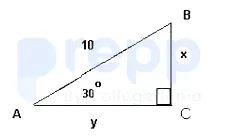
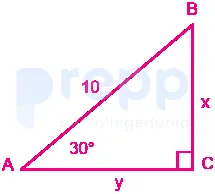
- A
\({{5} \over 2}\)
- B
6
- C
5
- D
3
Show answer
C. 5Concept used:
Calculation:
sin30° = BC/AC
⇒ 1/2 = BC/10
⇒ BC = 5
∴ The length of BC is 5 cm.
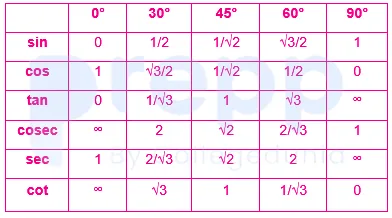 Paper & answer key PDF ↗
 Question 57archived
With an average speed of 45 km/h, a train reaches its destination on time. If it goes with an average speed of 30 km/h, it is late by 15 minutes. The total journey is:
- A
20.5 km
- B
40.5 km
- C
22.5 km
- D
30.5 km
Show answer
C. 22.5 kmUnderstanding the Train Speed Problem
This problem involves a train traveling a certain distance. We are given two scenarios with different average speeds and the corresponding time taken, specifically the difference in time. The goal is to find the total distance of the journey.
The key relationship we will use is the formula connecting distance, speed, and time:
Distance = Speed × Time
Time = Distance / Speed
Let's define the unknowns:
Let the total distance of the journey be \( d \) km.
Let the scheduled time to reach the destination on time be \( t \) hours.
Setting up Equations from the Given Information
We have two different situations described:
Scenario 1: Average speed is 45 km/h. The train reaches its destination on time.
Scenario 2: Average speed is 30 km/h. The train is late by 15 minutes.
Let's convert the time in minutes to hours. 15 minutes is equal to \( \frac{15}{60} \) hours, which simplifies to \( \frac{1}{4} \) hours.
Now we can write equations based on the formula Time = Distance / Speed for each scenario:
For Scenario 1: The speed is 45 km/h, and the time taken is the scheduled time \( t \).
\[ t = \frac{d}{45} \quad \text{(Equation 1)} \]
For Scenario 2: The speed is 30 km/h, and the time taken is 15 minutes (or \( \frac{1}{4} \) hour) more than the scheduled time \( t \). So, the time taken is \( t + \frac{1}{4} \).
\[ t + \frac{1}{4} = \frac{d}{30} \quad \text{(Equation 2)} \]
Solving the Equations to Find the Distance
We now have a system of two equations with two variables (\( d \) and \( t \)). We can solve this system to find the value of \( d \).
Substitute the expression for \( t \) from Equation 1 into Equation 2:
\[ \frac{d}{45} + \frac{1}{4} = \frac{d}{30} \]
To solve for \( d \), we need to eliminate the denominators. The least common multiple (LCM) of 45, 4, and 30 is 180. Multiply every term in the equation by 180:
\[ 180 \times \frac{d}{45} + 180 \times \frac{1}{4} = 180 \times \frac{d}{30} \]
Simplify the terms:
\[ \frac{180d}{45} + \frac{180}{4} = \frac{180d}{30} \]
\[ 4d + 45 = 6d \]
Now, rearrange the equation to isolate the terms with \( d \):
Subtract \( 4d \) from both sides:
\[ 45 = 6d - 4d \]
\[ 45 = 2d \]
Finally, divide by 2 to find \( d \):
\[ d = \frac{45}{2} \]
\[ d = 22.5 \]
The total distance of the journey is 22.5 km.
Verification (Optional)
We can check if this distance works with the original conditions.
If distance \( d = 22.5 \) km and speed is 45 km/h, time \( t = \frac{22.5}{45} = 0.5 \) hours (30 minutes).
If distance \( d = 22.5 \) km and speed is 30 km/h, time taken is \( \frac{22.5}{30} = 0.75 \) hours (45 minutes).
The difference in time is 45 minutes - 30 minutes = 15 minutes, which matches the problem statement. So, the distance 22.5 km is correct.
Summary of the Calculation
Scenario
Speed (km/h)
Time (hours)
Equation (Time = Distance / Speed)
On Time
45
\( t \)
\( t = \frac{d}{45} \)
15 min Late
30
\( t + \frac{1}{4} \)
\( t + \frac{1}{4} = \frac{d}{30} \)
Substitute \( t \) from the first equation into the second:
\[ \frac{d}{45} + \frac{1}{4} = \frac{d}{30} \]
Multiply by LCM (180):
\[ 4d + 45 = 6d \]
Solve for \( d \):
\[ 2d = 45 \]
\[ d = 22.5 \]
The total journey distance is 22.5 km.
Revision Table: Train Speed and Distance Concepts
Concept
Description
Formula
Distance
The total length of the path traveled.
\( D = S \times T \)
Speed (Average)
The rate at which distance is covered over time.
\( S = \frac{D}{T} \)
Time
The duration taken to cover a certain distance.
\( T = \frac{D}{S} \)
Converting Minutes to Hours
Divide the number of minutes by 60.
\( \text{Hours} = \frac{\text{Minutes}}{60} \)
Additional Information: Solving Speed, Time, Distance Problems
Speed, Time, and Distance problems are common in quantitative aptitude. They often involve setting up algebraic equations based on the given information and the fundamental relationship \( D = S \times T \).
Identify Variables: Clearly define what each variable represents (distance, speed, time).
Units: Ensure all quantities are in consistent units (e.g., km and hours, or meters and seconds). Convert units if necessary, as we did with minutes to hours in this problem.
Formulate Equations: Write down equations that represent the different scenarios or conditions given in the problem.
Solve the System: Use substitution or elimination methods to solve the system of equations for the unknown variable(s).
Check the Answer: Plug the calculated value back into the original problem statement to see if it satisfies all conditions.
These problems often test your ability to translate a word problem into mathematical equations and solve them accurately.
Paper & answer key PDF ↗ Question 58archived
The tax on the salary of C is \({{1} \over 4}\) of the salary and savings are \({{1} \over 3}\) of the salary. The ratio of the expenditures to the savings is ______.
- A
4 ∶ 5
- B
4 ∶ 3
- C
5 ∶ 4
- D
3 ∶ 4
Show answer
C. 5 ∶ 4Calculating Expenditure to Savings Ratio from Salary Data
The problem asks for the ratio of the expenditures to the savings of a person, C, given the tax and savings as fractions of the salary.
Let's break down the components of the salary. A person's salary is typically divided into tax, savings, and expenditure.
Given information:
Tax on salary = \(\frac{1}{4}\) of the salary
Savings from salary = \(\frac{1}{3}\) of the salary
Let's denote the salary of C as \(S\).
Based on the given information, we can write:
Tax amount = \(\frac{1}{4} \times S\)
Savings amount = \(\frac{1}{3} \times S\)
The total amount deducted from the salary for tax and savings is the sum of these two amounts:
Total deductions = Tax + Savings
Total deductions = \(\frac{1}{4} S + \frac{1}{3} S\)
To add these fractions, we find a common denominator, which is 12.
Total deductions = \(\frac{3}{12} S + \frac{4}{12} S = \frac{3+4}{12} S = \frac{7}{12} S\)
The remaining part of the salary after tax and savings is the expenditure. Salary is used for Tax, Savings, and Expenditure. So, Salary = Tax + Savings + Expenditure.
Expenditure = Salary - (Tax + Savings)
Expenditure = \(S - \frac{7}{12} S\)
To subtract the fraction from \(S\), we consider \(S\) as \(\frac{12}{12} S\).
Expenditure = \(\frac{12}{12} S - \frac{7}{12} S = \frac{12-7}{12} S = \frac{5}{12} S\)
Now, we need to find the ratio of the expenditures to the savings.
Ratio = \(\frac{\text{Expenditures}}{\text{Savings}}\)
Ratio = \(\frac{\frac{5}{12} S}{\frac{1}{3} S}\)
We can cancel out \(S\) from the numerator and the denominator (assuming salary \(S > 0\)).
Ratio = \(\frac{5/12}{1/3}\)
To divide by a fraction, we multiply by its reciprocal:
Ratio = \(\frac{5}{12} \times \frac{3}{1}\)
Ratio = \(\frac{5 \times 3}{12 \times 1}\)
Ratio = \(\frac{15}{12}\)
Now, we simplify the fraction by dividing both the numerator and the denominator by their greatest common divisor, which is 3.
Ratio = \(\frac{15 \div 3}{12 \div 3} = \frac{5}{4}\)
So, the ratio of the expenditures to the savings is 5:4.
Step-by-Step Calculation
Assume salary \(S\).
Calculate Tax: Tax = \(\frac{1}{4}S\).
Calculate Savings: Savings = \(\frac{1}{3}S\).
Calculate Total Deductions (Tax + Savings): Total Deductions = \(\frac{1}{4}S + \frac{1}{3}S = \frac{7}{12}S\).
Calculate Expenditure: Expenditure = Salary - Total Deductions = \(S - \frac{7}{12}S = \frac{5}{12}S\).
Find the ratio of Expenditure to Savings: Ratio = \(\frac{\text{Expenditure}}{\text{Savings}} = \frac{\frac{5}{12}S}{\frac{1}{3}S}\).
Simplify the ratio: Ratio = \(\frac{5/12}{1/3} = \frac{5}{12} \times \frac{3}{1} = \frac{15}{12} = \frac{5}{4}\).
Understanding Salary Components
It is useful to understand how income (salary) is typically allocated. A simple model is:
Salary = Tax + Savings + Expenditure
In this problem, we are given the tax and savings as fractions of the salary and asked to find the ratio of expenditure to savings. By finding the fractions for each component relative to the salary, we can determine the ratio between any two components.
Verification with an Example Salary
Let's assume a specific salary that is easily divisible by 4 and 3, for instance, 1200 units.
Salary = 1200
Tax = \(\frac{1}{4} \times 1200 = 300\)
Savings = \(\frac{1}{3} \times 1200 = 400\)
Total Deductions = Tax + Savings = 300 + 400 = 700
Expenditure = Salary - Total Deductions = 1200 - 700 = 500
The ratio of expenditures to savings is:
Ratio = \(\frac{\text{Expenditure}}{\text{Savings}} = \frac{500}{400} = \frac{5}{4}\)
This confirms the result obtained using fractions of \(S\).
Component
Fraction of Salary
Calculation (if S=1200)
Salary
\(S\)
1200
Tax
\(\frac{1}{4}S\)
\(\frac{1}{4} \times 1200 = 300\)
Savings
\(\frac{1}{3}S\)
\(\frac{1}{3} \times 1200 = 400\)
Total Deductions
\(\frac{7}{12}S\)
\(\frac{7}{12} \times 1200 = 700\)
Expenditure
\(\frac{5}{12}S\)
\(\frac{5}{12} \times 1200 = 500\)
Ratio (Expenditure : Savings)
\(\frac{5/12}{1/3}\)
\(\frac{500}{400}\)
Simplified Ratio
\(\frac{5}{4}\) or 5:4
\(\frac{5}{4}\) or 5:4
Revision Table: Salary Components & Ratios
Concept
Definition/Relation
Salary (Income)
Total earnings before deductions.
Tax
Mandatory deduction from salary.
Savings
Portion of salary set aside for future use.
Expenditure
Portion of salary spent on goods/services (Salary - Tax - Savings).
Ratio
Comparison of two quantities by division.
Additional Information: Fractional Calculations
Working with fractions is essential for solving problems like this. Remember these key points:
Adding/Subtracting fractions: Need a common denominator. Find the Least Common Multiple (LCM) of the denominators.
Multiplying fractions: Multiply numerators together and denominators together. \(\frac{a}{b} \times \frac{c}{d} = \frac{ac}{bd}\).
Dividing fractions: Multiply the first fraction by the reciprocal of the second fraction. \(\frac{a/b}{c/d} = \frac{a}{b} \times \frac{d}{c} = \frac{ad}{bc}\).
Simplifying fractions: Divide the numerator and denominator by their Greatest Common Divisor (GCD).
In this problem, we used these concepts to find the expenditure as a fraction of salary and then calculated the ratio of expenditure to savings.
The final answer is the ratio of expenditures to savings, which is 5:4.
Paper & answer key PDF ↗ Question 59archived
Study the following table and answer the question that follows.
A school has four sections A, B, C and D of Class IX students.
The results of Science and Mathematics examinations are shown in the following table.
RESULTNo. of Students
Section ASection BSectionCSectionD
Failed in both24251820
Failed in Science but passed in Mathematics14121015
Passed in Science but failed in Mathematics76810
Passed in both63605655
What is the ratio of number of students who failed in Science but passed in Mathematics of section B and section D together to the number of students of section A that passed in both subjects?
- A
9 ∶ 17
- B
3 ∶ 7
- C
4 ∶ 9
- D
5 ∶ 11
Show answer
B. 3 ∶ 7This question asks us to calculate a specific ratio based on student examination results provided in a table. The table details the performance of students in Class IX across four sections (A, B, C, and D) in Science and Mathematics examinations.
RESULT
No. of Students
Section A
Section B
Section C
Section D
Failed in both
24
25
18
20
Failed in Science but passed in Mathematics
14
12
10
15
Passed in Science but failed in Mathematics
7
6
8
10
Passed in both
63
60
56
55
We need to find the ratio of:
The number of students who failed in Science but passed in Mathematics from section B and section D together.
To the number of students of section A that passed in both subjects.
Calculating the Number of Students for the Ratio
First, let's identify the required numbers from the provided table:
Number of students who failed in Science but passed in Mathematics in Section B: Look at the row "Failed in Science but passed in Mathematics" and the column "Section B". The number is 12.
Number of students who failed in Science but passed in Mathematics in Section D: Look at the row "Failed in Science but passed in Mathematics" and the column "Section D". The number is 15.
Number of students who passed in both subjects in Section A: Look at the row "Passed in both" and the column "Section A". The number is 63.
Step-by-Step Ratio Calculation
Now, let's calculate the required values for the ratio:
Find the total number of students who failed in Science but passed in Mathematics from section B and section D together:
Number of students (Section B + Section D) = (Failed in Science but passed in Mathematics in Section B) + (Failed in Science but passed in Mathematics in Section D)
Number of students (Section B + Section D) = 12 + 15 = 27
The number of students of section A that passed in both subjects is already found: 63.
Form the ratio:
Ratio = (Number of students from Section B and D who failed in Science but passed in Mathematics) : (Number of students from Section A who passed in both)
Ratio = 27 : 63
Simplify the ratio:
To simplify the ratio 27 : 63, find the greatest common divisor (GCD) of 27 and 63. Both numbers are divisible by 9.
\( \frac{27}{63} = \frac{27 \div 9}{63 \div 9} = \frac{3}{7} \)
So, the simplified ratio is 3 : 7.
Final Student Ratio Result
The ratio of the number of students who failed in Science but passed in Mathematics of section B and section D together to the number of students of section A that passed in both subjects is 3 : 7.
Revision Table: Key Data Points
Description
Section
Number of Students
Failed in Science but passed in Mathematics
B
12
Failed in Science but passed in Mathematics
D
15
Passed in both subjects
A
63
Total Failed Science, Passed Math (B+D)
B & D
27
Additional Information on Ratio Calculation
A ratio is a way to compare two or more quantities. It shows how many times one value is contained in another. Ratios can be written in several ways, such as a:b, or \( \frac{a}{b} \). When working with ratios, it is often helpful to simplify them to their simplest form by dividing all parts of the ratio by their greatest common divisor (GCD). In this problem, we compared two groups of students based on their performance in Science and Mathematics exams to find their ratio.
Paper & answer key PDF ↗ Question 60archived
In a 1200 m race, bike A beats bike B by 100 m. Bike B beats bike C by 100 m in a 600 m race. If bike A beats bike C by 30 sec in a 720 m race, then what is the speed of bike C?
- A
\({{17} \over 3}\) m/sec
- B
\({{26} \over 9}\) m/sec
- C
\({{17} \over 9}\) m/sec
- D
\({{26} \over 3}\) m/sec
Show answer
A. \({{17} \over 3}\) m/secThis problem involves analyzing the speeds of three bikes (A, B, and C) based on their performance in different races. We are given information about how one bike beats another by a certain distance in a specific race length, and finally, a time difference in another race length. We need to use this information to find the speed of bike C.
Understanding Bike Race Dynamics
In a race where one competitor beats another by a certain distance, it means that when the winner finishes the race, the loser is that much distance behind. If they start at the same time, the ratio of the distances covered by them in the same amount of time is equal to the ratio of their speeds.
Analyzing the First Race (Bike A vs Bike B)
The first race is 1200 m long. Bike A beats bike B by 100 m.
When bike A covers 1200 m, bike B covers \(1200 - 100 = 1100\) m.
Since they run for the same amount of time, the ratio of their speeds is the ratio of the distances covered.
Ratio of speed of A to speed of B (\(V_A : V_B\)) is \(1200 : 1100\).
\(V_A / V_B = 1200 / 1100 = 12 / 11\).
Analyzing the Second Race (Bike B vs Bike C)
The second race is 600 m long. Bike B beats bike C by 100 m.
When bike B covers 600 m, bike C covers \(600 - 100 = 500\) m.
Since they run for the same amount of time, the ratio of their speeds is the ratio of the distances covered.
Ratio of speed of B to speed of C (\(V_B : V_C\)) is \(600 : 500\).
\(V_B / V_C = 600 / 500 = 6 / 5\).
Combining the Speed Ratios
Now we have two ratios: \(V_A : V_B = 12 : 11\) and \(V_B : V_C = 6 : 5\). To find the combined ratio \(V_A : V_B : V_C\), we need to make the value for \(V_B\) common in both ratios. We can multiply the first ratio by 6 and the second ratio by 11:
\(V_A : V_B = (12 \times 6) : (11 \times 6) = 72 : 66\)
\(V_B : V_C = (6 \times 11) : (5 \times 11) = 66 : 55\)
Combining these gives the ratio of speeds:
\(V_A : V_B : V_C = 72 : 66 : 55\)
Let the speeds of bikes A, B, and C be \(72k\), \(66k\), and \(55k\) meters per second, respectively, where \(k\) is a constant.
Analyzing the Third Race (Bike A vs Bike C)
The third race is 720 m long. Bike A beats bike C by 30 seconds.
Time taken by bike A to complete 720 m is \(T_A = \text{Distance} / \text{Speed} = 720 / V_A = 720 / (72k)\) seconds.
\(T_A = 10/k\) seconds.
Time taken by bike C to complete 720 m is \(T_C = \text{Distance} / \text{Speed} = 720 / V_C = 720 / (55k)\) seconds.
We are given that A beats C by 30 seconds, which means bike C takes 30 seconds more than bike A to finish the race.
So, \(T_C - T_A = 30\).
\(\frac{720}{55k} - \frac{720}{72k} = 30\).
Calculating the Constant 'k'
Let's solve the equation for \(k\):
\(\frac{720}{k} \left( \frac{1}{55} - \frac{1}{72} \right) = 30\)
\(\frac{720}{k} \left( \frac{72 - 55}{55 \times 72} \right) = 30\)
\(\frac{720}{k} \left( \frac{17}{3960} \right) = 30\)
\(\frac{720 \times 17}{3960k} = 30\)
Since \(3960 = 720 \times 5.5\), we can simplify:
\(\frac{720 \times 17}{(720 \times 5.5)k} = 30\)
\(\frac{17}{5.5k} = 30\)
\(\frac{17}{(11/2)k} = 30\)
\(\frac{34}{11k} = 30\)
\(34 = 30 \times 11k\)
\(34 = 330k\)
\(k = \frac{34}{330}\)
Let's recheck the simplification of \(720 \times 17 / (55k \times 72)\):
\(\frac{720}{55k} - \frac{720}{72k} = 30\)
\(\frac{720 \times 72 - 720 \times 55}{55k \times 72k} = 30\)
This approach seems complex. Let's go back to:
\(\frac{720 \times 17}{55k \times 72} = 30\)
\(\frac{10 \times 17}{55k} = 30\) (since \(720/72 = 10\))
\(\frac{170}{55k} = 30\)
\(\frac{17}{5.5k} = 30\)
\(\frac{17}{11k/2} = 30\)
\(\frac{34}{11k} = 30\)
\(34 = 330k\)
\(k = \frac{34}{330} = \frac{17}{165}\)
The value of \(k\) is \(17/165\).
Finding the Speed of Bike C
The speed of bike C is given by \(V_C = 55k\).
\(V_C = 55 \times \frac{17}{165}\)
Since \(165 = 55 \times 3\), we can simplify:
\(V_C = 55 \times \frac{17}{55 \times 3}\)
\(V_C = \frac{17}{3}\) m/sec.
The speed of bike C is \(17/3\) m/sec.
Bike
Speed (relative ratio)
Speed (using k)
A
72
\(72k\)
B
66
\(66k\)
C
55
\(55k\)
Revision Table: Key Information
Race
Distance
Winner
Loser
Margin
Speed Ratio
1
1200 m
A
B
100 m (distance)
\(V_A : V_B = 1200 : 1100 = 12 : 11\)
2
600 m
B
C
100 m (distance)
\(V_B : V_C = 600 : 500 = 6 : 5\)
3
720 m
A
C
30 sec (time)
\(T_C - T_A = 30\) sec
Additional Information: Concepts in Races
Understanding relative speed and ratios is crucial in solving race problems.
Speed Ratio from Distance Margin: If A beats B by 'x' meters in a 'D' meter race, their speeds are in the ratio \(D : (D-x)\), assuming they start and finish at the same time instants.
Speed Ratio from Time Margin: If A beats B by 't' seconds in a 'D' meter race, and \(V_A\) and \(V_B\) are their speeds, then time taken by A is \(T_A = D/V_A\) and by B is \(T_B = D/V_B\). The time difference is \(T_B - T_A = t\). So, \((D/V_B) - (D/V_A) = t\).
Combining Ratios: When you have ratios like A:B and B:C, you can combine them to find A:B:C by making the common term (B in this case) equal in both ratios.
Using a Constant (k): Representing speeds as \(xk, yk, zk\) when the ratio is \(x:y:z\) is a common technique. This constant \(k\) can then be found using additional information, like a time difference in a specific race.
These principles help break down complex race problems into manageable steps involving ratios and algebraic equations.
Paper & answer key PDF ↗ Question 61archived
The following table gives information of panchayat elections held in six villages P, Q, R, S, T and U.
Village
Total numberof votes
(in hundreds)
Votes polled
(in %)
Valid votes
(in %)
P508080
Q607580
R1006565
S806070
T608090
U409060
Hint:
1) percentage of votes polled = \(\rm {{Total \ votes \ polled} \over Total \ number \ of \ votes}\) × 100
2) percentage of valid votes = \(\rm {{Total \ valid \ votes} \over Total \ votes \ polled}\) × 100
Find the ratio of invalid votes of village R to that of village U?
- A
455 ∶ 268
- B
321 ∶ 107
- C
455 ∶ 288
- D
423 ∶ 755
Show answer
C. 455 ∶ 288Calculating Invalid Votes in Panchayat Elections
This problem asks us to find the ratio of invalid votes between village R and village U based on the provided election data table. We are given the total number of votes, the percentage of votes polled, and the percentage of valid votes (out of the votes polled) for each village.
Here is the data table:
Village
Total number of votes (in hundreds)
Votes polled (in %)
Valid votes (in %)
P
50
80
80
Q
60
75
80
R
100
65
65
S
80
60
70
T
60
80
90
U
40
90
60
To find the number of invalid votes for each village, we need to follow these steps:
Calculate the total number of votes. The table gives this in hundreds, so multiply by 100.
Calculate the total votes polled. This is the percentage of total votes that were cast.
Calculate the total valid votes. This is the percentage of votes polled that were valid.
Calculate the invalid votes by subtracting the valid votes from the total votes polled.
Calculate Invalid Votes for Village R
Total number of votes in R: The table shows 100 hundreds, which is \(100 \times 100 = 10000\) votes.
Votes polled in R: 65% of the total votes were polled.
Votes polled = \(\frac{65}{100} \times 10000 = 65 \times 100 = 6500\) votes.
Valid votes in R: 65% of the votes polled were valid.
Valid votes = \(\frac{65}{100} \times 6500\).
We can calculate this as \(0.65 \times 6500 = 4225\) votes.
Invalid votes in R: These are the votes polled minus the valid votes.
Invalid votes (R) = Total votes polled - Valid votes
Invalid votes (R) = \(6500 - 4225 = 2275\) votes.
Calculate Invalid Votes for Village U
Total number of votes in U: The table shows 40 hundreds, which is \(40 \times 100 = 4000\) votes.
Votes polled in U: 90% of the total votes were polled.
Votes polled = \(\frac{90}{100} \times 4000 = 90 \times 40 = 3600\) votes.
Valid votes in U: 60% of the votes polled were valid.
Valid votes = \(\frac{60}{100} \times 3600\).
We can calculate this as \(0.60 \times 3600 = 2160\) votes.
Invalid votes in U: These are the votes polled minus the valid votes.
Invalid votes (U) = Total votes polled - Valid votes
Invalid votes (U) = \(3600 - 2160 = 1440\) votes.
Find the Ratio of Invalid Votes R to U
The question asks for the ratio of invalid votes of village R to that of village U.
Ratio = Invalid votes (R) : Invalid votes (U)
Ratio = \(2275 : 1440\)
To simplify this ratio, we can divide both numbers by their greatest common divisor. Both numbers end in 5 or 0, so they are divisible by 5.
\(2275 \div 5 = 455\)
\(1440 \div 5 = 288\)
The simplified ratio is \(455 : 288\).
Let's check if 455 and 288 have any common factors other than 1.
Factors of 455: 1, 5, 7, 13, 35, 65, 91, 455
Factors of 288: 1, 2, 3, 4, 6, 8, 9, 12, 16, 18, 24, 32, 36, 48, 72, 96, 144, 288
They share no common factors other than 1. Thus, the ratio \(455 : 288\) is in its simplest form.
The ratio of invalid votes of village R to that of village U is \(455 : 288\).
Revision Table: Key Election Calculation Formulas
Concept
Formula
Total Votes Polled
\(\rm (Total \ Number \ of \ Votes) \times \frac{Percentage \ of \ Votes \ Polled}{100}\)
Total Valid Votes
\(\rm (Total \ Votes \ Polled) \times \frac{Percentage \ of \ Valid \ Votes}{100}\)
Total Invalid Votes
\(\rm Total \ Votes \ Polled - Total \ Valid \ Votes\)
Invalid Votes (alternative)
\(\rm (Total \ Votes \ Polled) \times (1 - \frac{Percentage \ of \ Valid \ Votes}{100})\)
Additional Information on Election Data Analysis
Analyzing election data involves understanding different terms and calculations related to voting. Here are some key points:
Total Number of Votes: This is the total count of eligible votes in a constituency or area before polling begins.
Votes Polled: This refers to the actual number of votes that were cast by the voters. It is usually represented as a percentage of the total number of votes. A high percentage indicates high voter turnout.
Valid Votes: These are the votes that are counted towards the candidates. Votes can be deemed invalid for various reasons, such as improper marking, damage to the ballot paper, or other procedural issues depending on the voting system.
Invalid Votes: These are the votes that were cast but are not counted towards any candidate. They are the difference between the total votes polled and the total valid votes.
Voter Turnout: Often expressed as the percentage of registered voters who cast a vote. The "Votes polled (in %)" in the table represents this.
Calculating Percentages: Remember that percentages are parts per hundred. To convert a percentage to a decimal or fraction for calculation, divide by 100. For example, 65% is \(\frac{65}{100}\) or 0.65.
Ratio Analysis: Ratios like the one calculated (invalid votes R to U) help compare different values. Ratios can often be simplified by dividing both parts by their greatest common divisor.
Understanding these concepts is crucial for interpreting election statistics and solving problems related to voting data.
Paper & answer key PDF ↗ Question 62archived
A dishonest trader says to customers that he sells his goods at a cost price, but he uses a false weight and gains 12.5% as profit. How many grams does he use to weigh 1 kg?
- A
900 g
- B
880.5 g
- C
850 g
- D
888.8 g
Show answer
D. 888.8 gUnderstanding Dishonest Trader Problems with False Weights
This problem involves a dishonest trader who claims to sell goods at the cost price but makes a profit by using a false weight. The key to solving such problems is understanding that the profit comes from the difference between the weight the trader claims to sell and the weight they actually sell.
Let's break down the situation:
The trader claims to sell 1 kg (which is 1000 grams).
The trader uses a false weight, let's call it 'x' grams, instead of 1000 grams.
The trader charges the customer for 1000 grams at the cost price.
The trader actually sells only 'x' grams, incurring the cost price for only 'x' grams.
The profit is the difference between the money received (cost of 1000g) and the actual cost incurred (cost of x g).
Calculating Profit Percentage with False Weights
When a trader uses a false weight, the profit percentage can be calculated using the following relationship:
$\text{Profit} \% = \frac{\text{True Weight} - \text{False Weight}}{\text{False Weight}} \times 100$
In this problem:
The True Weight (what should be given) = 1 kg = 1000 grams.
The False Weight (what is actually given) = x grams.
The Profit % = 12.5%.
Solving for the False Weight
Now, we can plug the given values into the formula and solve for 'x', the false weight used by the dishonest trader:
$12.5 = \frac{1000 - x}{x} \times 100$
Divide both sides by 100:
$\frac{12.5}{100} = \frac{1000 - x}{x}$
$0.125 = \frac{1000 - x}{x}$
Multiply both sides by 'x':
$0.125x = 1000 - x$
Add 'x' to both sides:
$0.125x + x = 1000$
$1.125x = 1000$
Now, solve for 'x':
$x = \frac{1000}{1.125}$
To simplify the division, we can write 1.125 as a fraction or multiply the numerator and denominator by 1000 to remove the decimal:
$x = \frac{1000}{1.125} = \frac{1000 \times 1000}{1.125 \times 1000} = \frac{1000000}{1125}$
Alternatively, $1.125 = 1 + 0.125 = 1 + \frac{1}{8} = \frac{8+1}{8} = \frac{9}{8}$.
So, $x = \frac{1000}{9/8} = 1000 \times \frac{8}{9} = \frac{8000}{9}$
Now, calculate the value:
$x = \frac{8000}{9} \approx 888.888...$
Rounding to one decimal place, the false weight used is approximately 888.9 grams. However, looking at the options, 888.8 g is provided, which is likely the intended precision ($\frac{8000}{9}$ truncated).
Conclusion on False Weight Used
The dishonest trader uses approximately 888.8 grams instead of 1000 grams to gain a profit of 12.5% while claiming to sell at the cost price.
Item
Value
Claimed Weight (True Weight)
1000 grams
Actual Weight Used (False Weight)
x grams
Profit Percentage
12.5%
Equation
$12.5 = \frac{1000 - x}{x} \times 100$
Calculated False Weight (x)
$\frac{8000}{9}$ grams $\approx 888.8$ grams
Revision Table: Key Concepts
Concept
Explanation
False Weight
Using a weight less than what is claimed, allowing a trader to charge for more quantity than sold.
Selling at Cost Price (Dishonest Trader)
Claiming the Selling Price (SP) equals the Cost Price (CP) per unit, but making profit through quantity manipulation.
Profit Source
The profit comes from charging the customer for the cost of the true weight while only incurring the cost of the false weight given.
Profit % Formula (False Weights)
$\frac{\text{True Weight - False Weight}}{\text{False Weight}} \times 100$ (This formula is specific to cases where the trader claims to sell at CP).
Additional Information: Solving False Weight Problems
False weight problems are common in profit and loss topics. They test your understanding that profit can be made by manipulating either price or quantity.
Understanding the Setup: Always identify the claimed quantity (True Weight) and the actual quantity given (False Weight). The cost incurred is for the False Weight, while revenue is based on the True Weight (often calculated at the claimed Cost Price per unit of True Weight).
Alternative Approach (Ratio): If the profit is P%, it means that the ratio of the cost of the quantity sold to the selling price received is 100 : (100+P). In the case of selling at cost price with a false weight, the selling price received for the false weight is equivalent to the cost of the true weight. So, Cost of False Weight : Cost of True Weight = 100 : (100+P).
Let CP per gram be $C$. Cost of False Weight ($x$) = $C \times x$. Cost of True Weight (1000g) = $C \times 1000$.
So, $C \times x : C \times 1000 = 100 : (100+12.5)$
$x : 1000 = 100 : 112.5$
$\frac{x}{1000} = \frac{100}{112.5}$
$x = 1000 \times \frac{100}{112.5} = 1000 \times \frac{1000}{1125} = 1000 \times \frac{8}{9} = \frac{8000}{9}$
$x \approx 888.8$ grams.
This ratio method gives the same result and can be a quick way to solve these problems.
General Formula: If a trader sells at a markup/markdown (M%) on CP and uses a false weight W' instead of W, the overall profit percentage is given by:
Overall Profit % = $\left( \frac{\text{True Weight}}{\text{False Weight}} \times \frac{100 + \text{Markup } \%}{100} - 1 \right) \times 100$.
In this problem, Markup % = 0 (sells at CP). So, Overall Profit % = $\left( \frac{1000}{x} \times \frac{100 + 0}{100} - 1 \right) \times 100 = \left( \frac{1000}{x} - 1 \right) \times 100$.
$12.5 = \left( \frac{1000}{x} - 1 \right) \times 100$
$0.125 = \frac{1000}{x} - 1$
$1.125 = \frac{1000}{x}$
$x = \frac{1000}{1.125} = \frac{8000}{9} \approx 888.8$ grams.
All methods lead to the same result, reinforcing the relationship between profit and the quantity difference.
Paper & answer key PDF ↗ Question 63archived
Find the largest number of 3 digits divisible by 4 and 7.
- A
960
- B
980
- C
990
- D
970
Show answer
B. 980Finding the Largest 3-Digit Number Divisible by 4 and 7
The problem asks us to find the largest number with three digits that is divisible by both 4 and 7. A number that is divisible by both 4 and 7 must also be divisible by their least common multiple (LCM).
Calculating the LCM of 4 and 7
To find the least common multiple of 4 and 7, we first look at their prime factorizations:
Prime factors of 4 are $2 \times 2 = 2^2$.
Prime factors of 7 are $7^1$.
Since 4 and 7 have no common prime factors (they are coprime), their LCM is simply their product.
$$ \text{LCM}(4, 7) = 4 \times 7 = 28 $$
So, we are looking for the largest 3-digit number that is divisible by 28.
Finding the Largest 3-Digit Number Divisible by 28
The largest 3-digit number is 999.
To find the largest 3-digit number divisible by 28, we can divide 999 by 28 and see what the remainder is. The largest number divisible by 28 just below 999 will be $999 - \text{remainder}$.
Let's perform the division:
$$ \frac{999}{28} $$
We can perform long division:
$99 \div 28$. $28 \times 3 = 84$. $28 \times 4 = 112$. So, it goes 3 times.
$99 - 84 = 15$. Bring down the 9, making it 159.
$159 \div 28$. $28 \times 5 = 140$. $28 \times 6 = 168$. So, it goes 5 times.
$159 - 140 = 19$. The remainder is 19.
So, $999 = 28 \times 35 + 19$.
This means 999 is 19 more than a multiple of 28. To get the largest multiple of 28 that is less than or equal to 999, we subtract the remainder from 999.
$$ \text{Largest 3-digit number divisible by 28} = 999 - 19 = 980 $$
Verification
Let's check if 980 is divisible by both 4 and 7:
Is 980 divisible by 4? A number is divisible by 4 if its last two digits are divisible by 4. The last two digits of 980 are 80. $80 \div 4 = 20$. Yes, 980 is divisible by 4.
Is 980 divisible by 7? $980 \div 7 = 140$. Yes, 980 is divisible by 7.
Since 980 is divisible by both 4 and 7, and it is the largest multiple of 28 less than 999, it is the largest 3-digit number divisible by both 4 and 7.
Comparing with Options
Let's look at the given options:
960
980
990
970
Our calculated number, 980, is present in the options.
We can quickly check other options:
960: Divisible by 4 (60/4=15). Divisible by 7 ($960/7 \approx 137.14$, not divisible by 7).
990: Not divisible by 4 (90/4 not an integer). Not divisible by 7 ($990/7 \approx 141.4$, not divisible by 7).
970: Not divisible by 4 (70/4 not an integer). Divisible by 7 ($970/7 \approx 138.57$, not divisible by 7).
Only 980 is divisible by both 4 and 7 among the options, and it is the largest such 3-digit number.
Number
Divisible by 4?
Divisible by 7?
Divisible by 4 and 7?
960
Yes
No
No
980
Yes
Yes
Yes
990
No
No
No
970
No
No
No
The largest 3-digit number divisible by both 4 and 7 is 980.
Revision Table: Key Concepts for Divisibility
Concept
Explanation
How it applies here
Divisibility
A number 'a' is divisible by a number 'b' if dividing 'a' by 'b' leaves a remainder of 0.
We need a 3-digit number divisible by 4 and 7.
Least Common Multiple (LCM)
The smallest positive integer that is a multiple of two or more numbers.
A number divisible by both 4 and 7 must be divisible by LCM(4, 7) = 28.
Finding largest number in range divisible by N
Divide the largest number in the range by N. Subtract the remainder from the largest number.
We divided 999 by 28. Remainder was 19. $999 - 19 = 980$.
Additional Information: Divisibility Rules
Understanding divisibility rules can help check answers quickly.
Divisibility by 4: A number is divisible by 4 if the number formed by its last two digits is divisible by 4.
Divisibility by 7: A common rule: Double the last digit and subtract it from the number formed by the remaining digits. If the result is divisible by 7, then the original number is divisible by 7. Repeat the process if necessary.
Example for 980:
Number is 980. Last digit is 0. Double it: $0 \times 2 = 0$.
Remaining digits form 98. Subtract the doubled digit: $98 - 0 = 98$.
Is 98 divisible by 7? Yes, $98 \div 7 = 14$.
So, 980 is divisible by 7.
Using the LCM method ensures we find the largest number that satisfies divisibility by both 4 and 7.
Paper & answer key PDF ↗ Question 64archived
A and B working separately can complete a piece of work in 10 and 16 days, respectively. If they work for a day alternately, with A beginning the work, in how many day(s) will the work be completed?
- A
\(10{{1} \over 4}\)
- B
\(12{{1} \over 4}\)
- C
\(1{{1} \over 4}\)
- D
\({{1} \over 4}\)
Show answer
B. \(12{{1} \over 4}\)Solving Work and Time Problems with Alternate Days
This problem involves two individuals, A and B, completing a piece of work. They work separately at different rates and then work together on alternate days. We need to find the total time taken to complete the work when they work alternately, with A starting first.
Understanding Individual Work Rates
The first step in solving work and time problems is to determine the rate at which each person completes the work per day. The rate is simply the reciprocal of the number of days taken to complete the entire work.
A can complete the work in 10 days.
Therefore, A's daily work rate is \(\frac{1}{10}\) of the work per day.
B can complete the work in 16 days.
Therefore, B's daily work rate is \(\frac{1}{16}\) of the work per day.
Work Done in One Alternate Cycle
A and B work alternately, with A beginning the work. This means:
Day 1: A works
Day 2: B works
Day 3: A works
Day 4: B works
And so on...
One full cycle of alternate working consists of A working for one day and B working for one day. So, one cycle takes 2 days.
Let's calculate the total work done in one such cycle (2 days):
Work done in 1 cycle = (Work done by A in 1 day) + (Work done by B in 1 day)
Work done in 1 cycle = \(\frac{1}{10} + \frac{1}{16}\)
To add these fractions, we find a common denominator, which is the Least Common Multiple (LCM) of 10 and 16. The LCM of 10 and 16 is 80.
Work done in 1 cycle = \(\frac{1 \times 8}{10 \times 8} + \frac{1 \times 5}{16 \times 5}\)
Work done in 1 cycle = \(\frac{8}{80} + \frac{5}{80}\)
Work done in 1 cycle = \(\frac{8 + 5}{80} = \frac{13}{80}\)
So, in every 2-day cycle, \(\frac{13}{80}\) of the work is completed.
Calculating Number of Full Cycles
We need to figure out how many full cycles are completed before the work is nearly finished. We want to find how many times \(\frac{13}{80}\) goes into 1 (the total work) without exceeding it.
Let 'n' be the number of full cycles. Work done in 'n' cycles = \(n \times \frac{13}{80}\).
We look for the largest 'n' such that \(n \times \frac{13}{80} \le 1\). This is equivalent to finding the largest integer 'n' such that \(13n \le 80\).
Dividing 80 by 13:
\(\frac{80}{13} \approx 6.15\)
So, the largest whole number of cycles is 6.
In 6 cycles (which is \(6 \times 2 = 12\) days), the work completed is \(6 \times \frac{13}{80} = \frac{78}{80}\).
Determining Remaining Work
After 6 cycles (12 days), \(\frac{78}{80}\) of the work is done.
Remaining work = Total work - Work done in 6 cycles
Remaining work = \(1 - \frac{78}{80}\)
Remaining work = \(\frac{80}{80} - \frac{78}{80} = \frac{2}{80} = \frac{1}{40}\)
So, \(\frac{1}{40}\) of the work still needs to be completed.
Completing the Remaining Work
After 6 full cycles (12 days), it is the beginning of the 13th day. Since A started the work, it is A's turn to work on the 13th day.
A's daily work rate is \(\frac{1}{10}\) of the work per day.
The remaining work is \(\frac{1}{40}\).
Time taken by A to complete the remaining work = \(\frac{\text{Remaining Work}}{\text{A's Daily Work Rate}}\)
Time taken by A = \(\frac{\frac{1}{40}}{\frac{1}{10}}\)
Time taken by A = \(\frac{1}{40} \times \frac{10}{1} = \frac{10}{40} = \frac{1}{4}\) day.
Total Time Taken
The total time taken to complete the work is the sum of the time taken for the full cycles and the time taken for the remaining work.
Total time = (Time for 6 cycles) + (Time for remaining work)
Total time = 12 days + \(\frac{1}{4}\) day
Total time = \(12\frac{1}{4}\) days.
Therefore, the work will be completed in \(12\frac{1}{4}\) day(s).
Step
Calculation
Result
A's daily rate
\(\frac{1}{\text{Days taken by A}}\)
\(\frac{1}{10}\)
B's daily rate
\(\frac{1}{\text{Days taken by B}}\)
\(\frac{1}{16}\)
Work in 1 cycle (2 days)
\(\frac{1}{10} + \frac{1}{16}\)
\(\frac{13}{80}\)
Work in 6 cycles (12 days)
\(6 \times \frac{13}{80}\)
\(\frac{78}{80}\)
Remaining work
\(1 - \frac{78}{80}\)
\(\frac{1}{40}\)
Time for remaining work (by A)
\(\frac{1/40}{1/10}\)
\(\frac{1}{4}\) day
Total time
\(12 + \frac{1}{4}\)
\(12\frac{1}{4}\) days
Revision Table: Key Concepts in Alternate Work Problems
Concept
Explanation
How it applies here
Work Rate
The amount of work done by a person in one unit of time (e.g., one day).
A's rate = \(\frac{1}{10}\), B's rate = \(\frac{1}{16}\).
Alternate Working Cycle
When individuals work on consecutive days. A full cycle includes one day of work for each person involved in the cycle.
A works on Day 1, B on Day 2. One cycle is 2 days, completing \(\frac{13}{80}\) work.
Remaining Work
The portion of the work left to be done after a certain period or number of cycles.
After 6 cycles (12 days), \(\frac{1}{40}\) work remains.
Determining Next Worker
Crucial in alternate working; the person who starts the work also starts the next cycle after full cycles are completed.
A started, so A works on Day 13 to finish the remaining \(\frac{1}{40}\) work.
Additional Information: Work and Time Problem Variations
Work and time problems can appear in various forms, including:
Individual Work: Problems where one person completes the work alone.
Working Together: Problems where multiple people work simultaneously to complete a task. Their rates are added.
Alternate Working: Like this problem, where individuals work one after another for a specific duration.
Efficiency Based Problems: Problems comparing the efficiency of different workers (e.g., A is twice as efficient as B).
Pipe and Cistern Problems: These are similar to work and time, where filling/emptying a tank is considered the 'work' and pipes are the 'workers'.
Understanding the basic concept of work rate (Work = Rate × Time) is key to solving all these variations. For alternate working, breaking down the problem into cycles helps simplify the calculation.
Paper & answer key PDF ↗ Question 65archived
If the length of the diagonal of a cube is 7 \({\sqrt{3} }\) cm, then the surface area of the cube is ______.
- A
216 cm2
- B
256 cm2
- C
284 cm2
- D
294 cm2
Show answer
D. 294 cm2Calculating Cube Surface Area from Diagonal Length
Let's break down how to find the surface area of a cube when you know the length of its diagonal. We are given that the diagonal of the cube is \(7\sqrt{3}\) cm.
A cube is a three-dimensional shape with six equal square faces. If 'a' represents the length of one side (or edge) of the cube, then the diagonal of the cube can be calculated using the formula:
\(\text{Diagonal} = a\sqrt{3}\)
We are given the diagonal length, so we can set up an equation to find the side length 'a':
\(a\sqrt{3} = 7\sqrt{3}\)
To find 'a', we can divide both sides of the equation by \(\sqrt{3}\):
\(a = \frac{7\sqrt{3}}{\sqrt{3}}\)
\(a = 7 \text{ cm}\)
So, the side length of the cube is 7 cm.
Finding the Surface Area of the Cube
The total surface area of a cube is the sum of the areas of its six square faces. Since each face is a square with side length 'a', the area of one face is \(a^2\). With six faces, the total surface area is given by the formula:
\(\text{Surface Area} = 6a^2\)
Now we can substitute the value of 'a' that we found:
\(\text{Surface Area} = 6 \times (7 \text{ cm})^2\)
\(\text{Surface Area} = 6 \times (7 \times 7) \text{ cm}^2\)
\(\text{Surface Area} = 6 \times 49 \text{ cm}^2\)
Let's calculate the final value:
\(6 \times 49 = 294\)
Therefore, the surface area of the cube is 294 cm\(^2\).
Let's review the steps:
Identify the given information: Diagonal length of the cube.
Use the formula for the diagonal of a cube (\(a\sqrt{3}\)) to find the side length 'a'.
Use the formula for the surface area of a cube (\(6a^2\)) and the calculated side length to find the total surface area.
Surface Area Calculation Summary
Given diagonal = \(7\sqrt{3}\) cm
Formula: Diagonal = \(a\sqrt{3}\)
So, \(a\sqrt{3} = 7\sqrt{3}\)
Side, \(a = 7\) cm
Formula: Surface Area = \(6a^2\)
Surface Area = \(6 \times (7)^2\)
Surface Area = \(6 \times 49\)
Surface Area = \(294\) cm\(^2\)
Revision Table: Cube Formulas
Property
Formula (side 'a')
Volume
\(a^3\)
Surface Area
\(6a^2\)
Diagonal of a face
\(a\sqrt{2}\)
Diagonal of the cube
\(a\sqrt{3}\)
Additional Information: Understanding Cube Diagonals
A cube has different types of diagonals:
Face diagonal: This connects two opposite vertices on a single face of the cube. There are 12 face diagonals. Its length is found using the Pythagorean theorem on a square face: \(\sqrt{a^2 + a^2} = \sqrt{2a^2} = a\sqrt{2}\).
Space diagonal (or cube diagonal): This connects two opposite vertices that are not on the same face, passing through the interior of the cube. There are 4 space diagonals. Its length is found using the Pythagorean theorem in three dimensions: \(\sqrt{a^2 + a^2 + a^2} = \sqrt{3a^2} = a\sqrt{3}\). The question refers to the space diagonal.
Knowing these formulas is crucial for solving problems involving the dimensions and properties of cubes.
Paper & answer key PDF ↗ Question 66archived
If ΔBPQ ≅ ΔASR and ∠A = \({{1} \over 3}\) ∠R = ∠S then find ∠Q. (All angles are in degrees).
- A
108°
- B
36°
- C
72°
- D
118°
Show answer
A. 108°Understanding the Congruence and Angle Relationships
The problem asks us to find the measure of angle ∠Q given information about two congruent triangles, ΔBPQ and ΔASR. The congruence symbol \cong indicates that the triangles are identical in shape and size.
We are given the following conditions regarding the angles:
∠A = \({{1} \over 3}\) ∠R
\({{1} \over 3}\) ∠R = ∠S
From these conditions, we can infer that ∠A and ∠S are equal, and both are one-third the measure of ∠R. This relationship is key to solving the problem.
Applying Triangle Congruence Properties
The statement ΔBPQ ≅ ΔASR means that the corresponding vertices, angles, and sides are equal. Specifically, the corresponding angles are:
Angle at vertex B corresponds to angle at vertex A: \angle B = \angle A
Angle at vertex P corresponds to angle at vertex S: \angle P = \angle S
Angle at vertex Q corresponds to angle at vertex R: \angle Q = \angle R
Our goal is to find ∠Q. Using the congruence, we know that ∠Q is equal to ∠R.
Calculating Angle Q using Angle Sum Property
The sum of the interior angles of any triangle is always 180 degrees. Let's consider the triangle ΔBPQ:
\angle B + \angle P + \angle Q = 180^\circ
Now, we can substitute the angles from ΔASR using the congruence relationships:
\angle A + \angle S + \angle R = 180^\circ
Let's use the given angle relationships to express ∠A and ∠S in terms of ∠R:
\angle A = \frac{1}{3} \angle R
\angle S = \frac{1}{3} \angle R
Substitute these expressions into the angle sum equation:
\left( \frac{1}{3} \angle R \right) + \left( \frac{1}{3} \angle R \right) + \angle R = 180^\circ
To make the calculation easier, let's represent ∠R with a variable, say y:
\angle R = y
The equation becomes:
\frac{1}{3} y + \frac{1}{3} y + y = 180^\circ
Combine the terms with y:
\frac{2}{3} y + y = 180^\circ
To add the fractions, find a common denominator:
\frac{2y}{3} + \frac{3y}{3} = 180^\circ
\frac{5y}{3} = 180^\circ
Now, solve for y:
5y = 180^\circ \times 3
5y = 540^\circ
y = \frac{540^\circ}{5}
y = 108^\circ
Since we defined y as ∠R, we have found that \angle R = 108^\circ.
The question asks for ∠Q. Because \triangle BPQ \cong \triangle ASR, we know that \angle Q = \angle R.
Therefore, ∠Q = 108°.
Verification of Angles
Let's check if these angle measures are consistent:
\angle R = 108^\circ
\angle Q = \angle R = 108^\circ
\angle A = \frac{1}{3} \angle R = \frac{1}{3}(108^\circ) = 36^\circ
\angle S = \frac{1}{3} \angle R = \frac{1}{3}(108^\circ) = 36^\circ
Now let's find the other angles of ΔBPQ:
\angle B = \angle A = 36^\circ
\angle P = \angle S = 36^\circ
Check the sum of angles in ΔBPQ:
\angle B + \angle P + \angle Q = 36^\circ + 36^\circ + 108^\circ = 180^\circ
The sum of angles is 180 degrees, which confirms our calculated value for ∠Q.
Paper & answer key PDF ↗ Question 67archived
Two identical circles each of radius 30 cm intersect each other such that the circumference of each one passes through the centre of the other. What is the area of the intersecting region?
- A
400π - 250\({\sqrt{3}}\) cm2
- B
300π - 150\({\sqrt{3}}\) cm2
- C
500π - 350\({\sqrt{3}}\) cm2
- D
600π - 450\({\sqrt{3}}\) cm2
Show answer
D. 600π - 450\({\sqrt{3}}\) cm2Correct answer: 600π - 450\({\sqrt{3}}\) cm2
The common intersecting region consists of two equal sectors of \(120^\circ\), from which two equilateral triangles are removed.
Area of intersection \(= 2\left(\frac{120}{360}\pi r^2 - \frac{\sqrt{3}}{4}r^2\right)\)
Substituting \(r = 30\),
\(2\left(\frac{120}{360}\pi \times 30^2 - \frac{\sqrt{3}}{4}\times 30^2\right)\)
\(= 2\left(300\pi - 225\sqrt{3}\right)\)
\(= 600\pi - 450\sqrt{3}\)
Therefore, the area of the intersecting region is \(\boxed{600\pi - 450\sqrt{3}\ \text{cm}^2}\).
Paper & answer key PDF ↗ Question 68archived
The marked price of a chair is ₹2,400, which is 20% above the cost price. If the chair is sold at a discount of 10% on marked price, what is the profit percentage?
- A
10%
- B
8%
- C
9%
- D
26.2%
Show answer
B. 8%Calculating Profit Percentage on a Chair Sale
This problem involves calculating the profit percentage when a chair is marked up from its cost price and then sold at a discount on the marked price. We are given the marked price, the percentage increase of marked price over cost price, and the discount percentage on the marked price.
Understanding the Given Information
Marked Price (MP) of the chair = \(\text{₹}2400\)
Marked Price is 20% above the Cost Price (CP).
Discount on Marked Price = 10%.
Our goal is to find the profit percentage earned from selling the chair.
Step 1: Calculate the Cost Price (CP)
The marked price is 20% above the cost price. This means:
\(\text{MP} = \text{CP} + 20\%\text{ of CP}\)
\(\text{MP} = \text{CP} + \frac{20}{100} \times \text{CP}\)
\(\text{MP} = \text{CP} (1 + 0.20)\)
\(\text{MP} = 1.20 \times \text{CP}\)
We are given MP = \(\text{₹}2400\). We can rearrange the formula to find CP:
\(\text{CP} = \frac{\text{MP}}{1.20}\)
Substituting the value of MP:
\(\text{CP} = \frac{\text{₹}2400}{1.20} = \frac{\text{₹}24000}{12} = \text{₹}2000\)
So, the Cost Price of the chair is \(\text{₹}2000\).
Step 2: Calculate the Selling Price (SP)
The chair is sold at a discount of 10% on the marked price. The Selling Price is calculated as:
\(\text{SP} = \text{MP} - 10\%\text{ of MP}\)
\(\text{SP} = \text{MP} - \frac{10}{100} \times \text{MP}\)
\(\text{SP} = \text{MP} (1 - 0.10)\)
\(\text{SP} = 0.90 \times \text{MP}\)
Substituting the value of MP = \(\text{₹}2400\):
\(\text{SP} = 0.90 \times \text{₹}2400 = \text{₹}2160\)
So, the Selling Price of the chair is \(\text{₹}2160\).
Step 3: Calculate the Profit
Profit is made when the Selling Price is greater than the Cost Price. The profit is calculated as:
\(\text{Profit} = \text{SP} - \text{CP}\)
Substituting the values of SP = \(\text{₹}2160\) and CP = \(\text{₹}2000\):
\(\text{Profit} = \text{₹}2160 - \text{₹}2000 = \text{₹}160\)
The profit earned is \(\text{₹}160\).
Step 4: Calculate the Profit Percentage
The profit percentage is calculated on the Cost Price using the formula:
\(\text{Profit Percentage} = \left(\frac{\text{Profit}}{\text{CP}}\right) \times 100\%\)
Substituting the values of Profit = \(\text{₹}160\) and CP = \(\text{₹}2000\):
\(\text{Profit Percentage} = \left(\frac{\text{₹}160}{\text{₹}2000}\right) \times 100\%\)
\(\text{Profit Percentage} = \left(\frac{160}{2000}\right) \times 100\%\)
\(\text{Profit Percentage} = \left(\frac{16}{200}\right) \times 100\%\)
\(\text{Profit Percentage} = \frac{16}{2}\%\)
\(\text{Profit Percentage} = 8\%\)
The profit percentage is 8%.
Summary of Calculations
Item
Value
Marked Price (MP)
\(\text{₹}2400\)
Cost Price (CP)
\(\text{₹}2000\)
Selling Price (SP)
\(\text{₹}2160\)
Profit
\(\text{₹}160\)
Profit Percentage
8%
Revision Table: Key Terms & Formulas
Term
Definition
Formula/Relation
Cost Price (CP)
The original price at which an item is bought.
-
Marked Price (MP)
The price listed on the item, often higher than CP.
\(\text{MP} = \text{CP} + \text{Markup}\)
Discount
A reduction in the Marked Price offered to the buyer.
\(\text{Discount Amount} = \text{Discount Rate} \times \text{MP}\)
Selling Price (SP)
The price at which an item is actually sold.
\(\text{SP} = \text{MP} - \text{Discount Amount}\)
Profit
Gain when SP > CP.
\(\text{Profit} = \text{SP} - \text{CP}\)
Profit Percentage
Profit expressed as a percentage of CP.
\(\text{Profit Percentage} = \left(\frac{\text{Profit}}{\text{CP}}\right) \times 100\%\)
Loss
Incurred when SP < CP.
\(\text{Loss} = \text{CP} - \text{SP}\)
Loss Percentage
Loss expressed as a percentage of CP.
\(\text{Loss Percentage} = \left(\frac{\text{Loss}}{\text{CP}}\right) \times 100\%\)
Additional Information: Profit and Loss Concepts
Profit and Loss are fundamental concepts in business and commerce. They help determine the financial outcome of transactions.
Markup: The amount added to the cost price to arrive at the marked price. In this problem, the markup is the difference between MP (\(\text{₹}2400\)) and CP (\(\text{₹}2000\)), which is \(\text{₹}400\). This \(\text{₹}400\) is 20% of the CP (\(\text{₹}2000\)).
Discount Calculation: Discounts are typically calculated on the marked price. A discount reduces the selling price below the marked price.
Profit/Loss Calculation Basis: Profit or loss is always calculated with respect to the Cost Price, unless otherwise specified. The profit or loss percentage indicates the profitability of the transaction relative to the initial cost.
Selling Above/Below MP: An item can be sold at the marked price (no discount), below the marked price (with discount), or even above the marked price in rare cases (though not common practice).
Impact of Markup and Discount: A high markup increases the MP, allowing for a larger discount while potentially still making a profit. A discount reduces the final selling price, which might impact the profit margin.
Paper & answer key PDF ↗ Question 69archived
A sum becomes Rs. 15,500 in 7 years on simple interest at the rate of 30 percent per annum. What is the total interest for the 7 years?
- A
Rs. 12,200
- B
Rs. 1,47,000
- C
Rs. 10,500
- D
Rs. 11,500
Show answer
C. Rs. 10,500Calculating Simple Interest Over 7 Years
The question asks us to find the total simple interest earned on a sum of money that grows to Rs. 15,500 in 7 years at an annual simple interest rate of 30 percent.
Let's break down the information given:
Amount (A) = Rs. 15,500
Time (T) = 7 years
Rate of Interest (R) = 30% per annum
We need to find the Simple Interest (SI).
We know the relationship between Amount, Principal, and Simple Interest:
\( \text{Amount} = \text{Principal} + \text{Simple Interest} \)
In mathematical terms:
\( A = P + SI \)
The formula for Simple Interest is:
\( SI = \frac{P \times R \times T}{100} \)
Here, \( R = 30 \) and \( T = 7 \). Substituting these values into the SI formula, we get:
\( SI = \frac{P \times 30 \times 7}{100} = \frac{210P}{100} = 2.1P \)
Now, substitute this expression for SI into the Amount formula:
\( A = P + 2.1P \)
\( A = 3.1P \)
We are given that \( A = 15,500 \). So, we can set up the equation:
\( 15500 = 3.1P \)
To find the Principal (P), we need to divide the Amount by 3.1:
\( P = \frac{15500}{3.1} \)
To make the division easier, we can multiply the numerator and denominator by 10:
\( P = \frac{155000}{31} \)
Let's perform the division:
\( 155000 \div 31 = 5000 \)
So, the Principal (P) is Rs. 5,000.
Now that we have the Principal, we can calculate the Simple Interest (SI) using the formula \( SI = 2.1P \):
\( SI = 2.1 \times 5000 \)
\( SI = \frac{21}{10} \times 5000 \)
\( SI = 21 \times 500 \)
\( SI = 10500 \)
The total simple interest for the 7 years is Rs. 10,500.
Summary of Calculation
Component
Value
Amount (A)
Rs. 15,500
Time (T)
7 years
Rate (R)
30% p.a.
Relationship \( A = P + SI \)
\( 15500 = P + SI \)
SI Formula \( SI = \frac{P \times R \times T}{100} \)
\( SI = \frac{P \times 30 \times 7}{100} = 2.1P \)
Solving for Principal (P)
\( 15500 = P + 2.1P = 3.1P \implies P = \frac{15500}{3.1} = 5000 \)
Calculating SI
\( SI = 2.1 \times 5000 = 10500 \)
The total interest for the 7 years is Rs. 10,500.
Revision Table: Simple Interest Concepts
Term
Definition
Formula
Principal (P)
The initial sum of money invested or borrowed.
-
Rate (R)
The percentage at which interest is charged or earned per year.
-
Time (T)
The duration for which the money is invested or borrowed, usually in years.
-
Simple Interest (SI)
Interest calculated only on the principal amount.
\( SI = \frac{P \times R \times T}{100} \)
Amount (A)
The total sum obtained after adding the interest to the principal.
\( A = P + SI \) or \( A = P \left(1 + \frac{RT}{100}\right) \)
Additional Information on Simple Interest Calculation
Simple interest is a basic concept in finance. It's the easiest type of interest to calculate and understand. It's often used for short-term loans or simple savings accounts.
Key characteristics of simple interest:
Interest is calculated solely on the original principal amount.
The interest earned in each period (e.g., year) is constant, provided the principal, rate, and time unit remain unchanged.
It does not take into account the effect of compounding, where interest earned in one period is added to the principal for calculating interest in the next period.
In this problem, the sum became Rs. 15,500, which is the total Amount (Principal + Interest). By using the simple interest formula and the relationship between Amount, Principal, and Simple Interest, we were able to first find the original Principal amount and then calculate the total simple interest accumulated over the given time period.
Paper & answer key PDF ↗ Question 70archived
Study the given table and answer the question that follows.
The table shows the percentage of marks obtained by 7 students in different subjects.
Subject →
Students ↓
HindiEnglishMathsPhysicsChemistryBiologyIT
Amit67889288586098
Ruchi65786870647276
Kanchan89667676726876
Prashant88807268626472
Mrinal78647674688078
Kunal60868874947684
Diksha74929666868896
How many students have scored the highest percentage of marks in more than one subject?
- A
Four
- B
Three
- C
Two
- D
One
Show answer
C. TwoUnderstanding the Student Marks Table
The question asks us to analyze a table showing the percentage marks obtained by 7 students in 7 different subjects. We need to find out how many students scored the highest percentage of marks in more than one subject.
Let's first look at the provided table:
Subject & Students ↓
Hindi
English
Maths
Physics
Chemistry
Biology
IT
Amit
67
88
92
88
58
60
98
Ruchi
65
78
68
70
64
72
76
Kanchan
89
66
76
76
72
68
76
Prashant
88
80
72
68
62
64
72
Mrinal
78
64
76
74
68
80
78
Kunal
60
86
88
74
94
76
84
Diksha
74
92
96
66
86
88
96
Identifying Highest Scores in Each Subject
To answer the question, we need to determine the highest percentage score achieved in each subject and identify which student(s) achieved that score.
Hindi: The highest score is 89, achieved by Kanchan.
English: The highest score is 92, achieved by Diksha.
Maths: The highest score is 96, achieved by Diksha.
Physics: The highest score is 88, achieved by Amit.
Chemistry: The highest score is 94, achieved by Kunal.
Biology: The highest score is 88, achieved by Diksha.
IT: The highest score is 98, achieved by Amit.
Counting Highest Scores Per Student
Now, let's list which students achieved the highest score in which subjects and count how many subjects they achieved the highest score in:
Amit: Highest in Physics (88) and IT (98). Total = 2 subjects.
Ruchi: Did not score the highest in any subject. Total = 0 subjects.
Kanchan: Highest in Hindi (89). Total = 1 subject.
Prashant: Did not score the highest in any subject. Total = 0 subjects.
Mrinal: Did not score the highest in any subject. Total = 0 subjects.
Kunal: Highest in Chemistry (94). Total = 1 subject.
Diksha: Highest in English (92), Maths (96), and Biology (88). Total = 3 subjects.
Determining Students with Multiple Highest Scores
We are looking for students who scored the highest percentage of marks in more than one subject. From our count above:
Amit scored highest in 2 subjects (which is more than one).
Diksha scored highest in 3 subjects (which is more than one).
The other students scored highest in 0 or 1 subject, which is not more than one subject.
Therefore, there are two students (Amit and Diksha) who scored the highest percentage of marks in more than one subject.
Final Answer Derivation
Based on the analysis of the student marks table and identifying the students who achieved the highest score in multiple subjects, we found that two students meet this criterion.
Thus, the number of students who have scored the highest percentage of marks in more than one subject is two.
Revision Table: Key Findings
Student
Subjects with Highest Score
Number of Subjects with Highest Score
Scored Highest in > 1 Subject?
Amit
Physics, IT
2
Yes
Ruchi
None
0
No
Kanchan
Hindi
1
No
Prashant
None
0
No
Mrinal
None
0
No
Kunal
Chemistry
1
No
Diksha
English, Maths, Biology
3
Yes
Additional Information: Analyzing Data Tables
Analyzing data presented in tables, like the student marks table here, is a common skill tested in many exams. It involves reading the table accurately, identifying key data points (like highest or lowest values), and performing calculations or comparisons based on the question asked. This type of data interpretation helps in drawing conclusions from raw data.
When analyzing tables for highest/lowest values:
Read the row and column headers carefully to understand what the data represents.
Scan down a column to find the highest or lowest value for a specific category (e.g., subject).
Scan across a row to see a specific entity's (e.g., student's) performance across different categories.
Pay attention to the exact wording of the question (e.g., "more than one subject").
Practice with different types of tables helps improve data interpretation skills.
Paper & answer key PDF ↗ Question 71archived
If x + y + z = 0, then what is the value of \({{x^2} \over (yz)}\) + \({{y^2} \over (xz)}\) + \({{z^2} \over (xy)}\) ?
- A
1
- B
0
- C
2
- D
3
Show answer
D. 3Solving the Algebraic Expression when \(x+y+z=0\)
The problem asks for the value of the expression \( \frac{x^2}{yz} + \frac{y^2}{xz} + \frac{z^2}{xy} \) given the condition \( x + y + z = 0 \). To evaluate this expression, we should first combine the terms by finding a common denominator.
Finding a Common Denominator
The denominators of the three terms are \(yz\), \(xz\), and \(xy\). The least common multiple (LCM) of these denominators is \(xyz\). We will rewrite each term with this common denominator:
The first term is \( \frac{x^2}{yz} \). To get the denominator \(xyz\), we multiply the numerator and denominator by \(x\): \( \frac{x^2 \times x}{yz \times x} = \frac{x^3}{xyz} \)
The second term is \( \frac{y^2}{xz} \). To get the denominator \(xyz\), we multiply the numerator and denominator by \(y\): \( \frac{y^2 \times y}{xz \times y} = \frac{y^3}{xyz} \)
The third term is \( \frac{z^2}{xy} \). To get the denominator \(xyz\), we multiply the numerator and denominator by \(z\): \( \frac{z^2 \times z}{xy \times z} = \frac{z^3}{xyz} \)
Combining the Terms
Now that all terms have the same denominator \(xyz\), we can add the numerators:
\( \frac{x^3}{xyz} + \frac{y^3}{xyz} + \frac{z^3}{xyz} = \frac{x^3 + y^3 + z^3}{xyz} \)
Using the Given Condition \(x+y+z=0\)
We are given the condition \( x + y + z = 0 \). There is a well-known algebraic identity related to the sum of cubes when the sum of the variables is zero. The identity states that if \( x + y + z = 0 \), then \( x^3 + y^3 + z^3 = 3xyz \).
Substituting the Identity into the Expression
Now, we substitute \( x^3 + y^3 + z^3 \) with \(3xyz\) in the combined expression:
\( \frac{x^3 + y^3 + z^3}{xyz} = \frac{3xyz}{xyz} \)
Simplifying the Final Expression
Assuming that \(xyz \neq 0\) (otherwise the original expression would be undefined due to division by zero), we can cancel out \(xyz\) from the numerator and the denominator:
\( \frac{3xyz}{xyz} = 3 \)
Thus, the value of the expression \( \frac{x^2}{yz} + \frac{y^2}{xz} + \frac{z^2}{xy} \) when \( x + y + z = 0 \) is 3.
Revision Table: Algebraic Identity
Identity
Condition
Result
Sum of cubes
\(x + y + z = 0\)
\(x^3 + y^3 + z^3 = 3xyz\)
Additional Information: Related Algebraic Expressions
Understanding algebraic identities is crucial for simplifying expressions. The identity \(x^3 + y^3 + z^3 - 3xyz = (x+y+z)(x^2+y^2+z^2-xy-yz-zx)\) is a fundamental one. From this identity, we can derive the specific case used in this problem: if \(x+y+z=0\), then the right side becomes \(0 \times (x^2+y^2+z^2-xy-yz-zx) = 0\), which leads to \(x^3 + y^3 + z^3 - 3xyz = 0\), or \(x^3 + y^3 + z^3 = 3xyz\).
This identity is often used in problems involving symmetric expressions of three variables when their sum is zero.
Paper & answer key PDF ↗ Question 72archived
What is the possible value of (a + b + c) – 3 , if a 2+ b 2+ c 2= 9 and ab + bc + ca = 8?
- A
5
- B
3
- C
9
- D
2
Show answer
D. 2Understanding the Algebra Problem
We are given two pieces of information about three variables, \(a\), \(b\), and \(c\):
The sum of the squares of the variables: \(a^2 + b^2 + c^2 = 9\)
The sum of the products of variables taken two at a time: \(ab + bc + ca = 8\)
Our goal is to find the possible value of the expression \((a + b + c) - 3\).
Applying a Useful Algebraic Identity
To find the value of \((a + b + c)\), we can use a fundamental algebraic identity that relates the sum of variables to the sum of their squares and the sum of their products:
The identity is:
\[(a + b + c)^2 = a^2 + b^2 + c^2 + 2(ab + bc + ca)\]
This identity is very useful in problems involving sums and squares of multiple variables.
Substituting Given Values into the Identity
Now, we can substitute the given values into the identity:
We are given \(a^2 + b^2 + c^2 = 9\) and \(ab + bc + ca = 8\).
Substitute these into the formula:
\[(a + b + c)^2 = (9) + 2(8)\]
Perform the multiplication and addition on the right side:
\[(a + b + c)^2 = 9 + 16\]
\[(a + b + c)^2 = 25\]
Calculating the Possible Value of (a + b + c)
To find the value of \((a + b + c)\), we need to take the square root of 25.
Remember that taking a square root can result in both a positive and a negative value.
\[a + b + c = \pm \sqrt{25}\]
So, the possible values for \((a + b + c)\) are \(5\) or \(-5\).
Finding the Possible Value of (a + b + c) – 3
The question asks for the possible value of \((a + b + c) - 3\). We need to consider both possible values for \((a + b + c)\).
Case 1: If \(a + b + c = 5\)
Then, \((a + b + c) - 3 = 5 - 3 = 2\)
Case 2: If \(a + b + c = -5\)
Then, \((a + b + c) - 3 = -5 - 3 = -8\)
So, the possible values for \((a + b + c) - 3\) are \(2\) and \(-8\).
Checking the Given Options
We compare the possible values we found (\(2\) and \(-8\)) with the given options:
Option 1: 5
Option 2: 3
Option 3: 9
Option 4: 2
The value \(2\) is present in the given options.
Conclusion
Based on the given information and the algebraic identity, the possible value of \((a + b + c) - 3\) that matches one of the options is \(2\).
Revision Table: Key Steps
Step
Description
Calculation/Formula
1
Identify the given information.
\(a^2 + b^2 + c^2 = 9\), \(ab + bc + ca = 8\)
2
Recall the relevant identity.
\((a+b+c)^2 = a^2+b^2+c^2 + 2(ab+bc+ca)\)
3
Substitute the given values.
\((a+b+c)^2 = 9 + 2(8)\)
4
Calculate \((a+b+c)^2\).
\((a+b+c)^2 = 25\)
5
Find possible values of \((a+b+c)\).
\(a+b+c = \pm 5\)
6
Calculate possible values of \((a+b+c) - 3\).
\(5 - 3 = 2\), \(-5 - 3 = -8\)
7
Check options for a match.
Option 4 is 2.
Additional Information: Algebraic Identities
Algebraic identities are equations that are true for all values of the variables involved. They are fundamental tools in algebra for simplifying expressions, solving equations, and factoring polynomials. The identity used in this problem is an expansion of the square of a trinomial.
Other common identities include:
\((x+y)^2 = x^2 + 2xy + y^2\) (Square of a binomial)
\((x-y)^2 = x^2 - 2xy + y^2\) (Square of a binomial)
\((x+y)(x-y) = x^2 - y^2\) (Difference of squares)
\((x+y)^3 = x^3 + 3x^2y + 3xy^2 + y^3\) (Cube of a binomial)
\(x^3 + y^3 = (x+y)(x^2 - xy + y^2)\) (Sum of cubes)
Mastering these identities is crucial for solving many algebra problems efficiently.
Paper & answer key PDF ↗ Question 73archived
If the 8-digit number 123456xy is divisible by 8, then the total possible pairs of (x, y) are:
- A
8
- B
13
- C
10
- D
11
Show answer
B. 13To determine the total possible pairs of (x, y) for the 8-digit number 123456xy to be divisible by 8, we need to use the divisibility rule for 8.
Understanding the Divisibility Rule for 8
A number is divisible by 8 if the number formed by its last three digits is divisible by 8.
In the given 8-digit number 123456xy, the last three digits are 6xy. This forms the number 600 + 10x + y.
For the entire number 123456xy to be divisible by 8, the number 6xy must be divisible by 8.
Applying the Divisibility Rule to 6xy
The number 6xy can be written as \(600 + 10x + y\). We know that 600 is divisible by 8, as \(600 = 8 \times 75\).
Therefore, for \(600 + 10x + y\) to be divisible by 8, the term \(10x + y\) must also be divisible by 8.
Here, x and y are digits ranging from 0 to 9.
x can be any digit from 0, 1, 2, ..., 9.
y can be any digit from 0, 1, 2, ..., 9.
We need to find all pairs of (x, y) where x and y are digits such that \(10x + y\) is a multiple of 8.
Finding Possible Pairs of (x, y)
Let's check the possible values for x from 0 to 9 and find the corresponding values of y (0 to 9) such that \(10x + y\) is divisible by 8.
If x = 0: \(10(0) + y = y\). y must be a multiple of 8. Possible y values are 0, 8. Pairs: (0, 0), (0, 8).
If x = 1: \(10(1) + y = 10 + y\). \(10 + y\) must be a multiple of 8. Multiples of 8 near 10: 16. \(10 + y = 16 \implies y = 6\). Pair: (1, 6).
If x = 2: \(10(2) + y = 20 + y\). \(20 + y\) must be a multiple of 8. Multiples of 8 near 20: 24. \(20 + y = 24 \implies y = 4\). Pair: (2, 4). (Next multiple 32 implies y=12, not a digit).
If x = 3: \(10(3) + y = 30 + y\). \(30 + y\) must be a multiple of 8. Multiples of 8 near 30: 32. \(30 + y = 32 \implies y = 2\). Pair: (3, 2). (Next multiple 40 implies y=10, not a digit).
If x = 4: \(10(4) + y = 40 + y\). \(40 + y\) must be a multiple of 8. Since 40 is a multiple of 8, y must be a multiple of 8. Possible y values are 0, 8. Pairs: (4, 0), (4, 8).
If x = 5: \(10(5) + y = 50 + y\). \(50 + y\) must be a multiple of 8. Multiples of 8 near 50: 56. \(50 + y = 56 \implies y = 6\). Pair: (5, 6).
If x = 6: \(10(6) + y = 60 + y\). \(60 + y\) must be a multiple of 8. Multiples of 8 near 60: 64. \(60 + y = 64 \implies y = 4\). Pair: (6, 4). (Next multiple 72 implies y=12, not a digit).
If x = 7: \(10(7) + y = 70 + y\). \(70 + y\) must be a multiple of 8. Multiples of 8 near 70: 72. \(70 + y = 72 \implies y = 2\). Pair: (7, 2). (Next multiple 80 implies y=10, not a digit).
If x = 8: \(10(8) + y = 80 + y\). \(80 + y\) must be a multiple of 8. Since 80 is a multiple of 8, y must be a multiple of 8. Possible y values are 0, 8. Pairs: (8, 0), (8, 8).
If x = 9: \(10(9) + y = 90 + y\). \(90 + y\) must be a multiple of 8. Multiples of 8 near 90: 96. \(90 + y = 96 \implies y = 6\). Pair: (9, 6).
Listing the Possible Pairs (x, y)
The complete list of possible (x, y) pairs is:
From x=0: (0, 0), (0, 8)
From x=1: (1, 6)
From x=2: (2, 4)
From x=3: (3, 2)
From x=4: (4, 0), (4, 8)
From x=5: (5, 6)
From x=6: (6, 4)
From x=7: (7, 2)
From x=8: (8, 0), (8, 8)
From x=9: (9, 6)
Total Number of Possible Pairs
Counting the pairs from the list above:
Total pairs = 2 (for x=0) + 1 (for x=1) + 1 (for x=2) + 1 (for x=3) + 2 (for x=4) + 1 (for x=5) + 1 (for x=6) + 1 (for x=7) + 2 (for x=8) + 1 (for x=9)
Total pairs = \(2 + 1 + 1 + 1 + 2 + 1 + 1 + 1 + 2 + 1 = 13\).
Therefore, there are 13 possible pairs of (x, y) such that the 8-digit number 123456xy is divisible by 8.
Revision Table: Divisibility by 8
Concept
Rule for Divisibility by 8
Definition
A number is divisible by 8 if the number formed by its last three digits is divisible by 8.
Example
Is 45616 divisible by 8? Check 616. \(616 \div 8 = 77\). Yes.
Example
Is 12345 divisible by 8? Check 345. \(345 \div 8\) is not an integer. No.
Additional Information: Number Properties and Divisibility
Divisibility rules are shortcuts to check if a number is exactly divisible by another number without performing the full division. Understanding these rules is fundamental in number theory and essential for solving quantitative aptitude problems.
Divisibility by 2: A number is divisible by 2 if its last digit is even (0, 2, 4, 6, 8).
Divisibility by 4: A number is divisible by 4 if the number formed by its last two digits is divisible by 4.
Divisibility by 8: A number is divisible by 8 if the number formed by its last three digits is divisible by 8. This rule is used in this problem.
Relationship: Notice the pattern for powers of 2: \(2^1=2\) (last 1 digit), \(2^2=4\) (last 2 digits), \(2^3=8\) (last 3 digits). For \(2^n\), you check the last n digits.
Importance: Divisibility rules help in simplifying fractions, finding factors, and solving problems related to the number system quickly in exams.
Paper & answer key PDF ↗ Question 74archived
The area of a sector of a circle is 308 cm 2, with the central angle measuring 45°. The radius of the circle is:
- A
14 cm
- B
21 cm
- C
7 cm
- D
28 cm
Show answer
D. 28 cmFinding the Circle Radius from Sector Area and Angle
This problem requires us to find the radius of a circle given the area of a sector and the central angle of that sector. We need to use the formula that relates the area of a sector to the radius and the central angle.
The given information is:
Area of the sector = 308 cm2
Central angle ($\theta$) = 45°
The formula for the area of a sector of a circle is:
Area of Sector $= \frac{\theta}{360°} \times \pi r^2$
Where:
$\theta$ is the central angle in degrees
$r$ is the radius of the circle
$\pi$ is a mathematical constant, approximately $\frac{22}{7}$
We can substitute the given values into this formula and solve for the radius, $r$.
$308 = \frac{45°}{360°} \times \frac{22}{7} \times r^2$
First, simplify the fraction $\frac{45°}{360°}$:
$\frac{45}{360} = \frac{1}{8}$
Now, substitute this back into the equation:
$308 = \frac{1}{8} \times \frac{22}{7} \times r^2$
To isolate $r^2$, multiply both sides of the equation by 8 and by 7, and divide by 22:
$r^2 = 308 \times 8 \times \frac{7}{22}$
We can simplify the calculation:
$r^2 = \frac{308}{22} \times 8 \times 7$
Divide 308 by 22:
$308 \div 22 = 14$
So, the equation becomes:
$r^2 = 14 \times 8 \times 7$
Calculate the product:
$r^2 = 112 \times 7$
$r^2 = 784$
Finally, take the square root of both sides to find the radius $r$:
$r = \sqrt{784}$
To find the square root of 784, you can recognize that $784 = 4 \times 196 = 4 \times 14^2 = 2^2 \times (2 \times 7)^2 = 2^2 \times 2^2 \times 7^2 = (2 \times 2 \times 7)^2 = 28^2$.
$r = 28$
The radius of the circle is 28 cm.
Revision Table: Circle Formulas
Concept
Formula
Area of Circle
$\pi r^2$
Circumference of Circle
$2\pi r$ or $\pi d$
Area of Sector (in degrees)
$\frac{\theta}{360°} \times \pi r^2$
Length of Arc (in degrees)
$\frac{\theta}{360°} \times 2\pi r$
Additional Information: Understanding Sectors and Angles
A sector of a circle is the portion of a circle enclosed by two radii and the arc between them. It looks like a slice of pizza or pie.
The central angle is the angle formed at the center of the circle by the two radii that define the sector.
The angle is often given in degrees, where a full circle is 360°. Sometimes, angles are measured in radians, where a full circle is $2\pi$ radians. The formula for the area of a sector in radians is $\frac{1}{2}r^2 \theta$, where $\theta$ is in radians.
In this problem, the angle is 45°, which is $\frac{45}{360} = \frac{1}{8}$ of the total circle. Therefore, the area of the sector is $\frac{1}{8}$ of the total area of the circle. We could also solve this by finding the total area of the circle first: Total Area = $308 \times 8 = 2464$ cm2. Then, $2464 = \pi r^2 = \frac{22}{7} r^2$. Solving for $r^2$: $r^2 = 2464 \times \frac{7}{22} = 112 \times 7 = 784$, which gives $r = \sqrt{784} = 28$ cm.
Paper & answer key PDF ↗ Question 75archived
The cost of apples is increased by 20% and then decreased by 20%. What is the net pecentage decrease?
- A
4%
- B
3%
- C
5%
- D
6%
Show answer
A. 4%Calculating Net Percentage Decrease in Apple Cost
This question involves calculating the overall effect of successive percentage changes on a value, specifically the cost of apples. We need to find the final percentage change after a 20% increase followed by a 20% decrease.
Understanding Successive Percentage Changes
When a value is changed by a percentage, and then the resulting value is changed by another percentage, it's called successive percentage change. It's important to note that the second percentage change is applied to the new value, not the original one.
Method 1: Using the Formula for Successive Percentage Changes
There's a direct formula to calculate the net percentage change after two successive changes (increase or decrease):
$$ \text{Net Change} = \left( x + y + \frac{xy}{100} \right) \% $$
Where:
$ x $ is the first percentage change.
$ y $ is the second percentage change.
In this problem:
The first change is a 20% increase, so $ x = +20 $.
The second change is a 20% decrease, so $ y = -20 $.
Substituting these values into the formula:
$$ \text{Net Change} = \left( 20 + (-20) + \frac{20 \times (-20)}{100} \right) \% $$
$$ \text{Net Change} = \left( 20 - 20 + \frac{-400}{100} \right) \% $$
$$ \text{Net Change} = \left( 0 + (-4) \right) \% $$
$$ \text{Net Change} = -4 \% $$
The negative sign indicates a decrease. Therefore, the net percentage decrease is 4%.
Method 2: Assuming an Initial Price
We can also solve this by assuming an initial price for the apples, for example, $100. This makes calculations easier.
Step 1: Calculate the price after the 20% increase.
Initial Price = $100
Increase Amount = $ 20\% \text{ of } 100 = \frac{20}{100} \times 100 = 10 $
Price after increase = Initial Price + Increase Amount = $ 100 + 10 = 110 $
Step 2: Calculate the price after the 20% decrease.
The decrease is applied to the new price ($110).
Decrease Amount = $ 20\% \text{ of } 110 = \frac{20}{100} \times 110 = \frac{1}{5} \times 110 = 22 $
Final Price = Price after increase - Decrease Amount = $ 110 - 22 = 88 $
Step 3: Calculate the net percentage decrease.
Original Price = $100
Final Price = $88
Total Decrease = Original Price - Final Price = $ 100 - 88 = 12 $
Net Percentage Decrease = $ \frac{\text{Total Decrease}}{\text{Original Price}} \times 100 \% $
Net Percentage Decrease = $ \frac{12}{100} \times 100 \% = 12\% $
Wait, let me recheck calculation in step 3. The decrease is 12 units from 100.
The calculation in step 2 seems correct. Let's redo step 3.
Original Price = $100
Final Price = $88
Decrease Amount = $100 - $88 = $12
Net Percentage Decrease = $ \frac{\text{Decrease Amount}}{\text{Original Price}} \times 100 = \frac{12}{100} \times 100 = 12\% $
My apologies, let me trace the calculation again. The calculation using the formula yielded 4% decrease. Let's re-verify the second method carefully.
Initial Price = $100
Price after 20% increase:
Price = $ 100 \times (1 + \frac{20}{100}) = 100 \times 1.20 = 120 $
Price after 20% decrease (from $120):
Price = $ 120 \times (1 - \frac{20}{100}) = 120 \times (1 - 0.20) = 120 \times 0.80 = 96 $
Net Change Calculation:
Original Price = $100
Final Price = $96
Decrease = Original Price - Final Price = $ 100 - 96 = 4 $
Net Percentage Decrease = $ \frac{\text{Decrease}}{\text{Original Price}} \times 100 = \frac{4}{100} \times 100 = 4\% $
Both methods now confirm the net percentage decrease is 4%.
Conclusion on Net Percentage Decrease
When the cost of apples is increased by 20% and then decreased by 20%, the final cost is lower than the original cost. The calculation shows a net decrease of 4%.
Paper & answer key PDF ↗ Question 76archived
Select the most appropriate option to fill in the blank.
The anchor gave us a ______ welcome, a pleasant smile and a bouquet on reaching the hotel.
- A
warm
- B
worth
- C
winning
- D
wonderful
Show answer
A. warmUnderstanding the Question: Choosing the Best Word for a Welcome
The question asks us to select the most appropriate word to fill in the blank in the sentence: "The anchor gave us a ______ welcome, a pleasant smile and a bouquet on reaching the hotel." We need to find an adjective that best describes the type of welcome received, given the context of a pleasant smile and a bouquet.
Let's examine the options provided and see which word fits the description of the welcome.
Analyzing the Options for the Blank
Here are the possible words and their meanings in this context:
warm: (adjective) friendly, kind, and hospitable.
worth: (noun) value; (adjective - less common use) deserving of.
winning: (adjective) charming, attractive; achieving victory.
wonderful: (adjective) inspiring delight, pleasure, or admiration; extremely good; marvellous.
Evaluating Each Option against the Context
We need to consider which of these words best describes a welcome that includes a "pleasant smile and a bouquet."
warm: A 'warm welcome' is a very common phrase used to describe a friendly, hospitable reception. A pleasant smile and a bouquet are classic signs of a warm welcome. This fits well.
worth: 'Worth welcome' is not a standard English phrase. The word 'worth' relates to value and doesn't typically describe the nature or feeling of a welcome. This option is grammatically incorrect and does not fit the context.
winning: While a smile might be described as 'winning' (meaning charming), 'winning welcome' is not a standard or natural phrase. A welcome is not typically something that 'wins'. This option doesn't fit the context appropriately.
wonderful: A 'wonderful welcome' means an extremely good or delightful welcome. While a warm welcome can also be wonderful, 'wonderful' is a more general term for something excellent. 'Warm' specifically highlights the friendly and hospitable nature, which is strongly suggested by the smile and the bouquet. 'Warm' is a more precise descriptor in this situation.
Determining the Most Appropriate Word
Comparing the options, 'warm' is the most fitting and natural word to describe a welcome characterized by friendliness, as shown by a pleasant smile and a bouquet. A 'warm welcome' is a widely used idiom that perfectly captures the feeling of being received kindly and hospitably.
Therefore, the most appropriate option to fill in the blank is 'warm'.
The complete sentence would be: "The anchor gave us a warm welcome, a pleasant smile and a bouquet on reaching the hotel."
Revision Table: Analyzing Welcome Descriptors
Option
Meaning/Usage
Fit in Sentence Context
Appropriateness
warm
Friendly, hospitable
Yes, fits perfectly with smile and bouquet.
Most appropriate.
worth
Value, deserving
No, grammatically incorrect phrase.
Inappropriate.
winning
Charming, victorious
No, not a standard phrase for a welcome.
Inappropriate.
wonderful
Extremely good, delightful
Possible, but less specific than 'warm' regarding hospitality.
Less appropriate than 'warm'.
Additional Information on Describing Welcomes
Words used to describe welcomes often convey the degree of friendliness, formality, or enthusiasm. Understanding these can help in choosing the right word in various contexts.
Formal Welcome: Might involve handshakes, official greetings, speeches.
Informal Welcome: Casual, relaxed, friendly greetings.
Enthusiastic Welcome: Very eager and excited reception.
Cool Welcome: Less friendly, perhaps reserved or indifferent reception.
Hearty Welcome: Very friendly, enthusiastic, and often includes food/drink.
In this question, the presence of a pleasant smile and a bouquet strongly indicates a friendly and hospitable reception, which aligns best with the term 'warm welcome'.
Paper & answer key PDF ↗ Question 77archived
Select the correct passive voice form for the given sentence.
Rashi was writing a letter to her husband.
- A
A letter was being written by Rashi to her husband.
- B
A letter were being written by Rashi to her husband.
- C
A letter was been written by Rashi to her husband.
- D
A letter were been written by Rashi to her husband.
Show answer
A. A letter was being written by Rashi to her husband.Understanding Active and Passive Voice
Sentences can be expressed in either active voice or passive voice. The choice of voice changes the focus of the sentence.
Active Voice: The subject performs the action. The focus is on the doer of the action.
Passive Voice: The action is performed on the subject. The focus is on the action or the receiver of the action. The original subject becomes the agent, often introduced by 'by'.
The given sentence, "Rashi was writing a letter to her husband," is in the active voice because the subject, "Rashi," is performing the action, "writing."
Converting Past Continuous Active to Passive Voice
The original sentence is in the Past Continuous tense. The structure of a Past Continuous sentence in active voice is:
\(\text{Subject} + \text{was/were} + \text{verb}(-\text{ing}) + \text{Object} + \text{...}\)
To convert a Past Continuous active sentence into passive voice, the structure changes to:
\(\text{New Subject (original Object)} + \text{was/were} + \text{being} + \text{Past Participle of the verb} + \text{by} + \text{Original Subject (agent)} + \text{...}\)
The helping verb 'was' or 'were' in the passive voice depends on the number (singular or plural) of the new subject (which was the object in the active voice).
Applying the Conversion to the Sentence
Let's break down the sentence "Rashi was writing a letter to her husband."
Subject (Active): Rashi
Helping Verb: was
Main Verb: writing (Past Participle: written)
Object (Active): a letter
Rest of the sentence: to her husband
Now, let's apply the passive voice structure for Past Continuous:
Make the original object "a letter" the new subject.
Choose the correct helping verb 'was' or 'were'. Since "a letter" is singular, we use 'was'.
Add "being".
Use the Past Participle of "writing," which is "written."
Add "by" followed by the original subject "Rashi."
Include the rest of the sentence "to her husband."
Putting it all together, the passive voice form is: "A letter was being written by Rashi to her husband."
Analyzing the Given Options
Let's examine each option provided:
Option
Sentence
Analysis
1
A letter was being written by Rashi to her husband.
Correct. Follows the Past Continuous passive voice structure: Subject ('A letter', singular) + was + being + Past Participle ('written') + by agent ('by Rashi') + rest of sentence.
2
A letter were being written by Rashi to her husband.
Incorrect. Uses the helping verb 'were' with a singular subject 'A letter'. It should be 'was'.
3
A letter was been written by Rashi to her husband.
Incorrect. Uses 'been' instead of 'being'. The structure for Past Continuous passive voice requires 'being'.
4
A letter were been written by Rashi to her husband.
Incorrect. Uses the helping verb 'were' with a singular subject 'A letter', and incorrectly uses 'been' instead of 'being'.
Based on the analysis, Option 1 correctly transforms the sentence into the passive voice while maintaining the Past Continuous tense.
Conclusion
The correct passive voice form for the sentence "Rashi was writing a letter to her husband" is "A letter was being written by Rashi to her husband." This transformation correctly changes the focus from the doer (Rashi) to the action and the receiver (a letter), using the appropriate structure for Past Continuous passive voice.
Revision Table: Voice Change Rules
Tense
Active Voice Structure
Passive Voice Structure
Example (Active to Passive)
Past Continuous
Subject + was/were + verb(-ing) + Object
Object + was/were + being + Past Participle + by Subject
He was reading a book. > A book was being read by him.
Additional Information: Importance of Voice in Writing
Choosing between active and passive voice can affect the clarity, flow, and emphasis of your writing. While active voice is generally preferred for its directness and clarity, passive voice is useful when:
The doer of the action is unknown or unimportant (e.g., "The window was broken.").
You want to emphasize the action itself or the object receiving the action (e.g., "The experiment was conducted carefully.").
You want to maintain objectivity (common in scientific writing).
You want to avoid mentioning the subject (e.g., "Mistakes were made.").
Understanding how to convert between active and passive voice is a fundamental skill in English grammar for varying sentence structure and controlling emphasis.
Paper & answer key PDF ↗ Question 78archived
Select the option that can be used as a one-word substitute for the given group of words.
The study of languages
- A
Philology
- B
Anthropology
- C
Lexicography
- D
Philosophy
Show answer
A. PhilologyUnderstanding the Request: Finding the One-Word Substitute for 'The Study of Languages'
This question requires us to identify the single word that best serves as a substitute for the phrase "The study of languages". We need to carefully evaluate each option provided to determine which term accurately encompasses this meaning.
Defining 'The Study of Languages'
The phrase "The study of languages" refers to the academic discipline focused on understanding the nature, history, structure, development, and relationships between different languages.
Analyzing the Provided Options
Philology:
Philology is the study of language in oral and written historical sources; it is the intersection of textual criticism, literary criticism, history, and linguistics. It often involves the study of literary texts and their relationship to history. This term is commonly understood as the study of languages, particularly their historical development and literary aspects.
Anthropology:
Anthropology is the scientific study of humanity, concerned with human behavior, human biology, cultures, societies, and linguistics in time and space. While it can include linguistic anthropology, its scope is much broader than just the study of languages.
Lexicography:
Lexicography is the activity or process of compiling dictionaries. It is a specific aspect related to language but does not represent the overall study of languages.
Philosophy:
Philosophy is the study of the fundamental nature of knowledge, reality, and existence. While there is a branch called "philosophy of language," philosophy itself is not primarily the study of languages.
Selecting the Correct One-Word Substitute
Based on the definitions, Philology is the most accurate and direct one-word substitute for "The study of languages". It specifically deals with the historical linguistics and literary analysis of language, which is the core concept presented in the question.
Paper & answer key PDF ↗ Question 79archived
Select the most appropriate ANTONYM of the given word.
Exemplary
- A
Flattering
- B
Unsatisfactory
- C
Imitative
- D
Desirable
Show answer
B. UnsatisfactoryFinding the ANTONYM for 'Exemplary'
The question asks us to identify the most appropriate antonym for the word 'Exemplary'. An antonym is a word that has the opposite meaning to another word.
Understanding 'Exemplary'
'Exemplary' means serving as a desirable model; representing the best of its kind. Think of something that is a perfect example, worthy of imitation, or highly commendable.
Analyzing the Options
Let's look at the meaning of each option provided:
Flattering: This means excessively or insincerely complimentary. It does not relate to the core meaning of 'Exemplary'.
Unsatisfactory: This means not good enough or not meeting expectations. This contrasts directly with the idea of being a perfect model or the best of its kind.
Imitative: This means copying or made by copying. While an exemplary thing might be imitated, 'imitative' itself is not the opposite meaning.
Desirable: This means something wanted or wished for. While an exemplary item is often desirable, 'desirable' is more of a synonym or related concept, not a direct opposite.
Identifying the Opposite Meaning
Comparing the meanings, we need the word that signifies the opposite of being a perfect example or the best.
'Exemplary' suggests high standards and positive representation.
'Unsatisfactory' suggests failing to meet standards and a negative representation.
Therefore, 'Unsatisfactory' is the most fitting antonym among the choices because it conveys the opposite quality of being a commendable example.
Conclusion
Based on the analysis, the word that means the opposite of 'Exemplary' is 'Unsatisfactory'.
Paper & answer key PDF ↗ Question 80archived
Choose the incorrectly spelt word.
- A
Irritating
- B
Pedestrian
- C
Enervating
- D
Beguilling
Show answer
D. BeguillingIdentifying Incorrectly Spelt Words
The question asks us to find the word that is spelt incorrectly among the given options. To answer this, we need to carefully examine the spelling of each word provided.
Examining Each Option's Spelling
Let's look at each word:
Irritating: This word means causing annoyance or impatience. Its spelling is correct.
Pedestrian: This word refers to a person walking along a road or in a developed area. It can also mean lacking inspiration or excitement; dull. Its spelling is correct.
Enervating: This word means causing one to feel drained of energy or vitality. Its spelling is correct.
Beguilling: This word is intended to be 'beguiling', which means charming or enchanting, often in a deceptive way. The spelling 'beguilling' with a double 'l' is incorrect. The correct spelling has only one 'l'.
Finding the Incorrectly Spelt Word
Based on the examination, three of the words are spelt correctly, while one word, 'Beguilling', is spelt incorrectly. The correct spelling of this word is 'beguiling'.
Therefore, the word that is incorrectly spelt is 'Beguilling'.
Option
Word
Spelling Status
Correct Spelling (if applicable)
1
Irritating
Correct
-
2
Pedestrian
Correct
-
3
Enervating
Correct
-
4
Beguilling
Incorrect
Beguiling
Revision Table: Common Spelling Errors
Identifying incorrectly spelt words is a key skill. Many errors occur with double letters, silent letters, or similar-sounding letters.
Commonly Misspelt Word
Incorrect Spelling Example
Correct Spelling
Accommodate
Acommodate
Accommodate (double c, double m)
Believe
Beleive
Believe (i before e, except after c or when sounding like 'ay')
Separate
Seperate
Separate (a before r)
Conscience
Conscience, Concscience
Conscience (sc)
Definitely
Definately, Definately
Definitely (i after n)
Additional Information on Spelling Accuracy
Improving spelling involves practice and attention to detail. Here are some tips:
Read Widely: Reading exposes you to correctly spelt words in context.
Use a Dictionary: When unsure, always check a dictionary (physical or online).
Break Down Words: For longer words, break them into syllables or familiar parts.
Learn Rules and Patterns: Understand common spelling rules (like 'i before e') and patterns (like adding suffixes).
Proofread Carefully: Always review your writing specifically for spelling errors. Reading backwards can sometimes help spot mistakes.
Practice Regularly: Use flashcards or spelling apps to practice difficult words.
Paying attention to words like 'irritating', 'pedestrian', 'enervating', and 'beguiling' helps build a stronger vocabulary and improve spelling skills.
Paper & answer key PDF ↗ Question 81archived
Select the option that can be used as a one-word substitute for the given group of words.
Sharp and direct
- A
Acerbic
- B
Zoonic
- C
Anodyne
- D
Acidic
Show answer
A. AcerbicFinding the One-Word Substitute for 'Sharp and Direct'
The question asks us to select a single word that can replace the phrase "Sharp and direct". We need to look at the provided options and determine which one accurately conveys this meaning.
Analyzing the Options
Let's examine each option and its meaning:
Acerbic: This word is often used to describe a comment or style of speaking that is sharp, forthright, and critical. It implies being direct and sometimes harsh or biting.
Zoonic: This adjective relates to animals or is derived from animals. It has no connection to being sharp or direct in communication.
Anodyne: This describes something that is not likely to cause offense or disagreement; it is often bland or innocuous. This is the opposite of being sharp and direct.
Acidic: This refers to having the properties of an acid or being sharp in taste or smell. While it can mean sharp, it doesn't typically apply to the manner of communication in the same way 'direct' suggests. In the context of speaking, 'acerbic' is a much better fit for 'sharp and direct'.
Determining the Correct Substitute
Based on the meanings, the word that best fits the description "Sharp and direct" in the context of communication or commentary is Acerbic. An acerbic comment is pointed, direct, and often critical.
Comparing the options, 'Acerbic' clearly stands out as the appropriate one-word substitute for the phrase "Sharp and direct".
Conclusion
The one-word substitute for "Sharp and direct" is Acerbic.
Revision Table: Understanding Word Meanings
Word
Meaning Relevant to Question
Fits "Sharp and Direct"?
Acerbic
Sharp and forthright (especially of comments/speech)
Yes
Zoonic
Relating to animals
No
Anodyne
Not offensive, innocuous
No
Acidic
Having properties of acid; sharp taste/smell
No (in context of communication style)
Additional Information: Vocabulary Building
Expanding your vocabulary by learning one-word substitutes is crucial for improving English language skills, especially for competitive exams.
Understanding the nuances between similar words is important. For example, while 'Acidic' can mean sharp, 'Acerbic' specifically applies to a sharp and direct style of speaking or writing.
Context is key when choosing the right word. The phrase "Sharp and direct" in this context implies a manner of expression.
Practicing with different phrases and their potential one-word substitutes helps solidify your understanding.
Paper & answer key PDF ↗ Question 82archived
Select the most appropriate synonym of the given word.
Keen
- A
Happy
- B
Enthusiastic
- C
Wild
- D
Imitate
Show answer
B. EnthusiasticFinding the Synonym for Keen
The question asks for the most appropriate synonym of the word 'Keen'. A synonym is a word or phrase that means exactly or nearly the same as another word or phrase in the same language.
Understanding the Word Keen
The word 'keen' has several meanings, but in the context of a person's attitude or interest, it often means having or showing eagerness or enthusiasm.
Example: "She is very keen on learning new languages." This means she is very enthusiastic about learning new languages.
Analyzing the Options for Synonym of Keen
Let's look at the given options:
Happy: This word means feeling or showing pleasure or contentment. While enthusiasm can make someone happy, 'happy' itself is not the closest synonym for 'keen'.
Enthusiastic: This word means having or showing intense and eager enjoyment, interest, or approval. This aligns very closely with the meaning of 'keen' when referring to interest or eagerness.
Wild: This word can mean living in a natural state, not domesticated; or uncontrolled, unrestrained, or violent. It does not relate to the meaning of 'keen' in this context.
Imitate: This word means to copy the action or manner of someone or something. It has no relation to the meaning of 'keen'.
Identifying the Most Appropriate Synonym
Comparing the options, 'enthusiastic' is the word that most closely matches the meaning of 'keen' when used to describe a strong interest or eagerness. Someone who is keen about something is typically very enthusiastic about it.
Therefore, 'Enthusiastic' is the most appropriate synonym for 'Keen'.
Revision Table: Understanding Keen and its Synonym
Word
Common Meaning (related to attitude)
Why it is/is not a synonym for Keen
Keen
Eager or enthusiastic about something
The base word for which we are finding a synonym.
Happy
Feeling pleasure or contentment
Related emotion, but not a direct synonym for eagerness/interest.
Enthusiastic
Having intense and eager enjoyment, interest, or approval
Closely matches the meaning of eager interest or strong liking. This is a strong synonym for keen.
Wild
Uncontrolled or unrestrained
Unrelated meaning.
Imitate
Copying someone's actions
Unrelated meaning.
Additional Information: Exploring Synonyms and Word Meanings
Understanding synonyms is crucial for building vocabulary and improving communication. Words often have multiple meanings, and the correct synonym depends on the context in which the word is used. For example, 'keen' can also mean sharp (like a keen blade) or having a sharp mind (intellectually keen), but in the context of common usage regarding interests or activities, 'enthusiastic' is the most fitting synonym among the choices provided.
When looking for a synonym, always consider the specific meaning of the word in the sentence or context given.
Paper & answer key PDF ↗ Question 83archived
Select the INCORRECTLY spelt word.
- A
Adopt
- B
Acces
- C
Abandon
- D
Abase
Show answer
B. AccesIdentifying the Incorrect Spelling in English Words
The question asks us to find the word that is spelt incorrectly among the given options. To do this, we need to examine each word and check its standard spelling.
Analyzing Each Option for Spelling Accuracy
Adopt: The word 'Adopt' is correctly spelt. It means to take legally as one's own child, or to take up or follow (a course of action or view).
Acces: This word is incorrectly spelt. The correct spelling is 'Access'. 'Access' means the means or opportunity to approach or enter a place, or the right or opportunity to use or benefit from something.
Abandon: The word 'Abandon' is correctly spelt. It means to give up completely (a practice or a course of action) or to leave a thing or place, usually permanently.
Abase: The word 'Abase' is correctly spelt. It means to behave in a way that deprives (someone) of self-respect or humility, or to humble or humiliate someone.
Conclusion: The Incorrectly Spelt Word
Based on the analysis, the word 'Acces' is the only one that is spelt incorrectly. The standard English spelling is 'Access'. Therefore, this is the word that should be selected.
Revision Table: Correct vs. Incorrect Spelling
Given Option
Spelling Check
Status
Correct Spelling (if applicable)
Adopt
Adopt
Correct
N/A
Acces
Access
Incorrect
Access
Abandon
Abandon
Correct
N/A
Abase
Abase
Correct
N/A
Additional Information: Understanding Word Meanings and Usage
Knowing the meaning of words can also help reinforce their correct spelling and usage. Here are the meanings of the correctly spelt words from the options:
Adopt: To legally take another person's child as one's own, or to formally accept a proposal or suggestion. Example: They decided to adopt a child from the orphanage.
Abandon: To give up completely (a course of action, a practice, or a way of thinking). Example: He had to abandon his car on the side of the road.
Abase: To behave in a way that makes you seem submissive or inferior; to humble oneself. Example: He refused to abase himself before the king.
Understanding the correct spelling and meaning of these words is crucial for improving vocabulary and writing skills.
Paper & answer key PDF ↗ Question 84archived
Select the option that can be used as a one-word substitute for the underlined group of words.
After my father passed away, I used to look at a series of stars , trying to find the unknown.
- A
Galaxy
- B
Constellation
- C
Caravan
- D
Horde
Show answer
B. ConstellationUnderstanding the Question: One-Word Substitution for "a series of stars"
The question asks for a single word that can replace the underlined phrase "a series of stars" in the given sentence:
"After my father passed away, I used to look at a series of stars, trying to find the unknown."
We need to find the most appropriate term from the options provided that refers to a grouping or "series" of stars.
Analyzing the Options for "a series of stars"
Let's look at the meaning of each option:
Option 1: Galaxy
A galaxy is a massive system of stars, stellar remnants, interstellar gas, dust, and dark matter, all bound together by gravity. Galaxies contain millions to trillions of stars. While a galaxy is made of stars, "a series of stars" usually refers to a specific, often recognizable, pattern or group visible from Earth, which isn't the primary definition of a galaxy.
Option 2: Constellation
A constellation is a group of stars forming a recognizable pattern or design in the sky, often named after mythological figures, animals, or objects. These patterns are perceived as "a series of stars" that appear close together from our perspective on Earth. This definition aligns well with the idea of looking at "a series of stars" to find something, as people often look for patterns in constellations.
Option 3: Caravan
A caravan is a group of people, typically merchants, pilgrims, or travelers, journeying together, often across deserts. It refers to a group of people or vehicles, not stars.
Option 4: Horde
A horde is a large group of people, often disorderly, or historically, a nomadic tribe or army. It refers to a large gathering of people or sometimes animals, not stars.
Evaluating the Best Fit for "a series of stars"
Based on the definitions, "Constellation" is the term specifically used to describe a recognizable pattern formed by a group or "series" of stars as observed from Earth. The sentence implies looking at a specific group of stars for meaning or comfort, which is characteristic of observing constellations. The other options clearly do not refer to stars.
Therefore, Constellation is the best one-word substitute for "a series of stars".
Revision Table: Words for Groups
Term
Meaning
Applicability to "a series of stars"
Galaxy
Vast system of billions/trillions of stars, gas, dust, etc.
No (too vast, not a specific pattern)
Constellation
Group of stars forming a recognizable pattern.
Yes (specifically refers to a group/series forming a visible pattern)
Caravan
Group of people/travelers journeying together.
No (refers to people)
Horde
Large group of people or animals.
No (refers to people/animals)
Additional Information: Celestial Groupings
Understanding different terms related to stars can be helpful:
Constellation: A defined area on the celestial sphere containing a recognizable pattern of stars. There are 88 officially recognized constellations.
Asterism: A prominent pattern of stars that is part of a constellation or made of stars from multiple constellations (e.g., the Big Dipper within Ursa Major).
Galaxy: A massive collection of stars, gas, dust, and dark matter, held together by gravity. Our solar system is in the Milky Way Galaxy.
Star Cluster: A group of stars born from the same giant molecular cloud and bound together by gravity. Examples include open clusters and globular clusters.
In the context of the sentence, "a series of stars" likely refers to a pattern or group observed visually, making "Constellation" the most fitting term.
Paper & answer key PDF ↗ Question 85archived
Select the option that can be used as a one-word substitute for the given group of words.
One who does something not professionally but for pleasure
- A
Professional
- B
Mature
- C
Immature
- D
Amateur
Show answer
D. AmateurUnderstanding the Phrase: Doing Something for Pleasure
The question asks for a single word that describes a person who engages in an activity primarily for enjoyment or interest, rather than as a paid job or career. They are not doing it professionally but for pleasure.
Analyzing the Options for One-Word Substitute
Let's look at the given options and determine which word best fits the description:
Option
Meaning
Fits the description?
Professional
Relating to or belonging to a profession; engaged in a specified activity as one's main paid occupation rather than as a pastime.
No. This is the opposite of doing something not professionally.
Mature
Having reached an advanced stage of physiological or behavioral development; fully developed. Relating to being sensible and behaving in a responsible manner.
No. This relates to development or behavior, not the reason for doing an activity.
Immature
Not yet mature; not fully developed or grown. Lacking sense or behaving in a childish manner.
No. This is the opposite of mature and doesn't relate to the reason for doing an activity.
Amateur
A person who engages in a pursuit, especially a sport or artistic pursuit, as a pastime rather than as a profession.
Yes. This perfectly matches the description of someone doing something for pleasure and not professionally.
Why 'Amateur' is the Correct One-Word Substitute
Based on the definitions, the word that precisely describes someone who does something not professionally but purely for pleasure is 'Amateur'. An amateur participates in an activity out of interest, hobby, or enjoyment, without it being their primary source of income or profession.
Conclusion: Identifying the Correct Word
The one-word substitute for the phrase "One who does something not professionally but for pleasure" is Amateur.
Revision Table: Key Vocabulary Review
Word
Definition Relevant to Context
Amateur
Someone doing an activity for pleasure, not as a job.
Professional
Someone doing an activity as their paid job.
Additional Information: Professional vs. Amateur
The distinction between professional and amateur is important in various fields, such as sports, arts, and hobbies. Here are some points to consider:
Motivation: Professionals are typically motivated by income and career progression, while amateurs are motivated by passion, interest, and enjoyment.
Skill Level: While professionals are generally expected to have a high level of skill due to training and practice as their profession, amateurs can range from beginners to highly skilled individuals who choose not to professionalize their pursuit.
Rules and Regulations: In some fields, like sports, there are specific rules and competitions tailored for amateurs versus professionals.
Understanding this distinction helps in choosing the correct one-word substitute for the given description.
Paper & answer key PDF ↗ Question 86archived
Select the most appropriate ANTONYM of the word ‘polite’ in the given sentence.
The rude and insensitive murderer pleaded for mercy in the court.
- A
Pleaded
- B
Mercy
- C
Insensitive
- D
Rude
Show answer
D. RudeFinding the Antonym of 'Polite'
The question asks us to identify the most appropriate ANTONYM for the word 'polite' within the context of the given sentence: “The rude and insensitive murderer pleaded for mercy in the court.”
First, let's understand the meaning of the word 'polite'.
Polite: Showing good manners or consideration for others; courteous.
An antonym is a word that has the opposite meaning of another word.
Now let's look at the options provided and see which one is an antonym of 'polite'.
We need to find a word from the sentence that means the opposite of being courteous and well-mannered.
Analyzing the Options for Antonym of Polite
Let's examine each option:
Pleaded: This word means to make an emotional appeal; to beg. This is an action related to requesting something, not a description of someone's manners. Therefore, 'pleaded' is not an antonym of 'polite'.
Mercy: This word means compassion or forgiveness shown towards someone whom it is within one's power to punish or harm. This relates to forgiveness or leniency, not manners or politeness. Therefore, 'mercy' is not an antonym of 'polite'.
Insensitive: This word means showing a lack of concern for the feelings of others. While related to poor social conduct, 'insensitive' specifically focuses on failing to consider feelings. A person can be insensitive without being overtly rude in their language or actions, although the two often overlap. It is closer to being the opposite of 'sensitive' or 'considerate'. While related, it's not the most direct or common antonym for 'polite'.
Rude: This word means offensively impolite or ill-mannered. This is a direct opposite of being 'polite'. If someone is rude, they lack politeness. In the given sentence, 'rude' is used to describe the murderer's demeanor. This word directly contrasts with the meaning of 'polite'.
Identifying the Most Appropriate Antonym
Comparing the options, 'rude' is the word that most directly and appropriately means the opposite of 'polite'. The sentence itself uses 'rude' in a way that clearly indicates a lack of politeness or good manners.
Therefore, the most appropriate antonym of 'polite' among the given options is 'Rude'.
Word Analysis
Word
Meaning
Relationship to 'Polite'
Polite
Showing good manners; courteous
The target word
Pleaded
Made an emotional appeal
Not an antonym
Mercy
Compassion or forgiveness
Not an antonym
Insensitive
Lack of concern for others' feelings
Related, but not the primary antonym
Rude
Offensively impolite; ill-mannered
Direct antonym
The sentence uses 'rude' to describe someone lacking politeness, making it the clear antonym in this context.
Revision Table: Key Vocabulary
Word
Meaning
Antonym Example
Polite
Courteous, well-mannered
Rude, Impolite
Rude
Offensively impolite, ill-mannered
Polite, Courteous
Insensitive
Lack of concern for feelings
Sensitive, Considerate
Mercy
Compassion, forgiveness
Cruelty, Harshness
Pleaded
Appealed earnestly
Demanded, Refused
Additional Information: Understanding Antonyms
Antonyms are an important part of vocabulary building. They help us understand the nuances of language and express opposite ideas effectively.
Knowing antonyms can improve reading comprehension by highlighting contrasts.
Using antonyms in writing can make descriptions more vivid and precise.
Some words can have multiple antonyms depending on the specific context.
Words describing qualities (like adjectives) or actions (like verbs) often have clear antonyms.
In this question, we focused on finding the antonym of an adjective ('polite') from a list of words, which included adjectives ('rude', 'insensitive'), a noun ('mercy'), and a verb ('pleaded'). Only the adjectives were potential antonyms, and 'rude' proved to be the most fitting opposite for 'polite'.
Paper & answer key PDF ↗ Question 87archived
The following sentence has been split into four segments. Identify the segment that contains an error.
The newspaper reported / that it was a mystery / how the thieves enter / into the house.
- A
into the house
- B
how the thieves enter
- C
that it was a mystery
- D
The newspaper reported
Show answer
B. how the thieves enterIdentifying Grammatical Errors in Sentence Segments
This question asks us to identify the specific segment within a given sentence that contains a grammatical error. We need to carefully examine each part of the sentence to find the mistake, paying close attention to verb tenses and prepositions.
Sentence Breakdown and Analysis
Let's break down the sentence into its four provided segments:
Segment 1: "The newspaper reported"
Segment 2: "that it was a mystery"
Segment 3: "how the thieves enter"
Segment 4: "into the house."
Now, let's analyze each segment for potential grammatical issues:
Segment 1: "The newspaper reported"
This segment uses the simple past tense ("reported"), which is grammatically sound. It establishes the context of the reporting.
Segment 2: "that it was a mystery"
This segment correctly introduces a noun clause explaining what the mystery was about. The past tense "was" is consistent with the past reporting context.
Segment 3: "how the thieves enter"
This segment describes the manner of the thieves' entry. The main reporting verb ("reported") and the verb in the subordinate clause ("was") are in the past tense. Therefore, the verb describing the thieves' action should also logically be in the past tense to maintain consistency. The verb "enter" is in the present tense, which creates a tense mismatch. The correct past tense form is "entered".
Segment 4: "into the house."
This prepositional phrase correctly indicates the location of entry. The preposition "into" is appropriate here.
Locating the Grammatical Error
Based on the analysis, the error occurs in the third segment due to incorrect verb tense.
The core issue is the use of the present tense verb "enter" when the context requires the past tense "entered". The reporting happened in the past, and the mystery concerned a past event.
The sentence should read: "The newspaper reported that it was a mystery how the thieves entered into the house."
Conclusion on the Incorrect Segment
The segment containing the grammatical error is the one with the inconsistent verb tense.
Incorrect Segment: "how the thieves enter"
Reason: Verb tense mismatch. The context requires the past tense "entered" instead of the present tense "enter".
Therefore, the segment "how the thieves enter" is the one that needs correction.
Paper & answer key PDF ↗ Question 88archived
Select the word that is OPPOSITE in meaning to the given word.
Adversity
- A
Fortune
- B
Affliction
- C
Brilliance
- D
Penury
Show answer
A. FortuneUnderstanding the Opposite of Adversity
The question asks us to find the word that is opposite in meaning to "Adversity". To answer this, we need to understand the meaning of "Adversity" and the meanings of the given options.
Let's define the word "Adversity".
Adversity: A difficult or unlucky situation or event. It refers to a state of misfortune, hardship, or suffering. Think of challenges, troubles, or bad luck.
Now, let's look at the options provided:
Fortune
Affliction
Brilliance
Penury
We will examine each option to see which one presents a meaning that is contrary to the idea of adversity.
Analyzing the Options
Fortune: This word has several meanings, including wealth or success. However, another key meaning is chance or luck, especially good luck. A state of good fortune implies favorable circumstances, success, or prosperity, which is the opposite of hardship and misfortune.
Affliction: This refers to something that causes pain or suffering, or the state of suffering. It is closely related to adversity and hardship; in fact, it can be considered a synonym or a consequence of adversity.
Brilliance: This word refers to great brightness, intense light, or exceptional talent or intelligence. While positive, it doesn't directly represent the opposite of a state of hardship or misfortune.
Penury: This means extreme poverty; destitution. Penury is a specific type of hardship, often a result of financial adversity, but it doesn't encompass the full range of what "adversity" means (which can include health problems, relationship troubles, etc.). It is a form of adversity rather than its opposite.
Comparing the options, "Fortune", particularly in the sense of good luck or favorable circumstances, stands out as the most direct opposite of "Adversity", which signifies bad luck or unfavorable circumstances.
Conclusion on the Opposite of Adversity
Adversity means hardship, misfortune, or difficulty. We are looking for a word that means the opposite – ease, good luck, prosperity, or favorable circumstances. Based on our analysis:
Affliction is similar to adversity.
Brilliance is unrelated in meaning to the opposite of hardship.
Penury is a type of hardship, not its opposite.
Fortune (meaning good luck or favorable circumstances) is the opposite of adversity.
Word
Meaning
Relationship to Adversity
Adversity
Hardship, misfortune, difficult situation
Given word
Fortune
Good luck, favorable circumstances, prosperity
Opposite of Adversity
Affliction
Pain, suffering, cause of suffering
Similar meaning (synonym/consequence)
Brilliance
Exceptional talent or light
Unrelated meaning
Penury
Extreme poverty
Type of Adversity
Therefore, the word that is opposite in meaning to Adversity is Fortune.
Revision Table: Key Vocabulary for Antonyms
Word
Meaning
Example Usage
Antonym (if applicable)
Adversity
Difficulties; misfortune
They faced great adversity during the economic crisis.
Fortune, prosperity, ease
Fortune
Good luck; success; wealth
After years of hardship, their fortune changed.
Adversity, misfortune, hardship
Affliction
Something causing pain or suffering
The disease was a terrible affliction.
Blessing, comfort, relief
Brilliance
Great talent or intelligence; intense light
Her brilliance in physics was evident early on.
Mediocrity, dullness
Penury
Extreme poverty
He lived in penury after losing his job.
Wealth, affluence, prosperity
Additional Information: Understanding Antonyms and Synonyms
Understanding antonyms and synonyms is crucial for vocabulary building and improving language skills. Antonyms are words that have opposite meanings, while synonyms are words that have similar meanings.
Antonyms: These words provide contrast. Identifying antonyms helps solidify your understanding of a word's core meaning by knowing what it is *not*. For example, "hot" and "cold" are antonyms. Finding the antonym of adversity helps us grasp the full spectrum from hardship to ease.
Synonyms: These words provide alternative ways to express a similar idea. Identifying synonyms helps add variety and precision to your language. For example, "happy" and "joyful" are synonyms. Knowing synonyms for adversity like hardship, misfortune, or suffering gives you more options when describing difficult situations.
When looking for an antonym, always consider the primary meaning of the word in context and find the word that represents the most direct opposite concept. For "adversity", the opposite is a state of good fortune or prosperity, representing favorable circumstances instead of difficult ones.
Paper & answer key PDF ↗ Question 89archived
Select the option that expresses the given sentence in active voice.
Let the farewell be bidden to our seniors.
- A
We should be bidden farewell by our seniors.
- B
Our seniors should bid farewell to us.
- C
Let us bid farewell to our seniors.
- D
Our seniors should be bidden farewell.
Show answer
C. Let us bid farewell to our seniors.Understanding Active and Passive Voice Conversion
The question asks us to convert a sentence from passive voice to active voice. Understanding the difference between these two voices is fundamental in English grammar.
Active Voice: In the active voice, the subject performs the action. The structure is typically Subject + Verb + Object.
Passive Voice: In the passive voice, the subject receives the action. The structure is typically Object + be verb + Past Participle (+ by + Agent).
Analyzing the Given Passive Sentence
The sentence provided is: "Let the farewell be bidden to our seniors."
This is an imperative sentence in the passive voice. The structure used here is "Let + Object + be + Past Participle (+ to + Indirect Object)".
The action is "bidding farewell".
The object of the main verb (be bidden) is "the farewell".
The recipients of the farewell are "our seniors".
The agent performing the action (who is doing the bidding) is implied. In imperative sentences starting with "Let + object + be + V3", the implied agent is usually "us".
So, the passive sentence implies that "we/us" should perform the action of bidding farewell to our seniors, but it's phrased in a passive way focusing on the 'farewell' being bidden.
Converting Passive Imperative ("Let" structure) to Active Voice
For imperative sentences starting with "Let + Object + be + V3", the conversion to active voice typically follows the structure: "Let + Agent + V1 + Object (+ ...)"
In our sentence:
Implied Agent: us
Verb (base form): bid
Direct Object: farewell (often implied or included after the verb)
Indirect Object/Recipient: to our seniors
Putting this together, the active voice form should be "Let us bid farewell to our seniors."
Evaluating the Options
Let's examine each option based on our understanding:
Option 1: "We should be bidden farewell by our seniors." This sentence is in the passive voice ("be bidden") and the subject is "We". The action is being received by "We" from "our seniors", which is the opposite of what the original sentence implies (where farewell is given *to* seniors). This is incorrect.
Option 2: "Our seniors should bid farewell to us." This sentence is in the active voice, but the subject is "Our seniors" and the object is "us". This means the seniors are giving the farewell to us, which is again the opposite of the original sentence's meaning (farewell given *to* seniors). This is incorrect.
Option 3: "Let us bid farewell to our seniors." This sentence is in the active voice. The subject is "us" (as part of the "Let us..." imperative structure), the verb is "bid", and the action is directed "to our seniors". This correctly reflects the implied agent performing the action of bidding farewell to the seniors. This is correct.
Option 4: "Our seniors should be bidden farewell." This sentence is in the passive voice ("be bidden") and the subject is "Our seniors". This means the seniors are receiving the action of being bidden farewell, but the original sentence implies the seniors are the recipients of the farewell itself, not the ones being bidden farewell by someone else. This is also incorrect.
Conclusion
Based on the conversion rules for imperative sentences starting with "Let" in the passive voice, the active voice equivalent of "Let the farewell be bidden to our seniors" is "Let us bid farewell to our seniors."
Revision Table: Active and Passive Voice
Here is a quick table summarizing key differences:
Feature
Active Voice
Passive Voice
Focus
Performer of the action (Subject)
Receiver of the action (Object becomes Subject)
Structure (Simple Present)
Subject + V1/Vs/Ves + Object
Object + is/am/are + V3 (+ by + Agent)
Structure ("Let" Imperative)
Let + Agent + V1 + Object
Let + Object + be + V3 (+ by + Agent)
Example (Simple)
She writes a letter.
A letter is written by her.
Example (Imperative)
Let us clean the room.
Let the room be cleaned by us.
Additional Information: Imperative Sentences and Voice
Imperative sentences give commands, make requests, or offer instructions. When converting imperative sentences between active and passive voice, specific structures are used:
Active Imperative (Command): Verb (base form) + Object. Example: Clean the room.
Passive Imperative (Command): Let + Object + be + Past Participle. Example: Let the room be cleaned. (Implied agent is 'you')
Active Imperative (Suggestion/Proposal): Let us + Verb (base form) + Object. Example: Let us clean the room.
Passive Imperative (Suggestion/Proposal): Let + Object + be + Past Participle + by + us. Example: Let the room be cleaned by us.
In the given question, "Let the farewell be bidden to our seniors," the structure "Let + Object + be + V3" with an implied 'us' aligns with the passive form of a suggestion using "Let us...". Therefore, converting it back to the active voice requires the "Let us + V1 + Object" structure, which is "Let us bid farewell to our seniors."
Paper & answer key PDF ↗ Question 90archived
Rearrange the parts of the sentence in correct order.
The nanostructures on the
P. with added, or "doped," iron and phosphor
Q. surface made of nickel selenide
R. offers the high performance and stability
S. that are needed for industrial-scale electrolysis
- A
QPRS
- B
QRSP
- C
RPQS
- D
SPQR
Show answer
A. QPRSUnderstanding Sentence Rearrangement
This question asks us to rearrange the given parts (P, Q, R, S) to form a grammatically correct and logically coherent sentence. The sentence starts with "The nanostructures on the...". We need to identify the part that logically follows this beginning phrase.
Analyzing the Sentence Fragments
Fragment P: "with added, or "doped," iron and phosphor" - This phrase describes something that has been modified by adding elements.
Fragment Q: "surface made of nickel selenide" - This phrase describes the material of the surface.
Fragment R: "offers the high performance and stability" - This phrase is a verb phrase, indicating what the subject (the nanostructures/surface) does.
Fragment S: "that are needed for industrial-scale electrolysis" - This phrase describes the qualities (performance and stability) mentioned in fragment R.
Step-by-Step Rearrangement
Let's start with the beginning of the sentence provided: "The nanostructures on the..."
What is the nanostructure on? It's on a surface. Fragment Q describes the surface: "surface made of nickel selenide". So, Q is a logical next part:
The nanostructures on the Q (surface made of nickel selenide)
Now, let's consider fragment P: "with added, or "doped," iron and phosphor". This describes the surface itself. It's a surface made of nickel selenide, and this surface has added elements. So, P should follow Q:
The nanostructures on the Q (surface made of nickel selenide) P (with added, or "doped," iron and phosphor)
This phrase "The nanostructures on the surface made of nickel selenide with added, or "doped," iron and phosphor" now acts as the subject of the sentence.
What do these nanostructures on this surface do? Fragment R tells us: "offers the high performance and stability". So, R follows the subject phrase:
The nanostructures on the Q surface P R (offers the high performance and stability)
Finally, fragment S describes the performance and stability mentioned in R: "that are needed for industrial-scale electrolysis". So, S follows R:
The nanostructures on the Q surface P R S (that are needed for industrial-scale electrolysis)
Putting it all together, the complete sentence is:
The nanostructures on the surface made of nickel selenide with added, or "doped," iron and phosphor offers the high performance and stability that are needed for industrial-scale electrolysis.
The correct order of the fragments is QPRS.
Evaluating the Options
Let's check the given options against our derived order QPRS:
QPRS: Matches our derived order.
QRSP: "The nanostructures on the surface made of nickel selenide offers the high performance and stability with added...". This doesn't make grammatical sense. The phrase "with added..." should describe the surface, not the performance/stability.
RPQS: "The nanostructures on the offers the high performance and stability surface made of nickel selenide...". Starts with R, which is a verb phrase, making no sense as the start of the predicate immediately after "the".
SPQR: "The nanostructures on the that are needed for industrial-scale electrolysis surface made of nickel selenide...". Starts with S, which describes performance/stability, not a surface, making no sense here.
Based on this analysis, the order QPRS forms the only coherent and grammatically correct sentence.
Analysis of Fragment Order
Order
Sentence Structure
Grammatically Correct?
QPRS
The nanostructures on the [Q] [P] [R] [S]. (Subject + Predicate)
Yes
QRSP
The nanostructures on the [Q] [R] [S] [P]. (Subject + Predicate + Adjective Clause + Phrase?)
No
RPQS
The nanostructures on the [R] [P] [Q] [S]. (Incorrect start)
No
SPQR
The nanostructures on the [S] [P] [Q] [R]. (Incorrect start)
No
Conclusion
The correct arrangement of the sentence parts is QPRS, which results in the sentence: "The nanostructures on the surface made of nickel selenide with added, or "doped," iron and phosphor offers the high performance and stability that are needed for industrial-scale electrolysis."
Revision Table: Sentence Rearrangement Practice
Practicing sentence rearrangement helps improve understanding of sentence structure and logical flow. Here are key points to remember:
Identify the likely subject and predicate of the sentence.
Look for connecting words or phrases (like prepositions, conjunctions, relative pronouns).
Determine which phrases modify or describe other parts of the sentence.
Read the complete sentence formed by your chosen order to check for grammatical correctness and meaning.
Additional Information: Nanostructures and Electrolysis
The sentence discusses nanostructures used in industrial-scale electrolysis. Nanostructures are materials with structural features between approximately 1 to 100 nanometers. At this scale, materials can exhibit unique properties compared to their bulk counterparts. Electrolysis is a process that uses electricity to drive a non-spontaneous chemical reaction. Industrial-scale electrolysis often requires catalysts that are highly efficient, durable, and stable. The sentence suggests that nanostructures on a doped nickel selenide surface can serve as such a catalyst, offering the necessary performance and stability for large-scale applications like water splitting to produce hydrogen and oxygen.
Paper & answer key PDF ↗ Question 91archived
Select the most appropriate collocating word to fill in the blank.
I listened to him with ______ attention.
- A
hefty
- B
massive
- C
rapt
- D
vast
Show answer
C. raptUnderstanding Collocations: Choosing the Best Word for Attention
The question asks us to select the most appropriate word to fill in the blank in the phrase, "I listened to him with ______ attention." This is a question about collocations. Collocations are words that often go together naturally in English. Some combinations sound right because they are commonly used by native speakers, while others sound unnatural.
Analyzing the Phrase: Listening with Attention
We are looking for a word that describes a type of attention given when listening to someone. The word should indicate the quality, intensity, or nature of the attention.
Evaluating the Options for Attention Collocation
Let's look at each option and see if it collocates well with the word "attention".
Hefty: The word 'hefty' usually describes something heavy, large, or powerful, especially in terms of weight or size (e.g., a hefty book, a hefty fine, a hefty meal). It does not typically collocate with abstract nouns like 'attention'. You wouldn't say someone has 'hefty attention'.
Massive: The word 'massive' means very large, heavy, and solid, or unusually large, intense, or striking in scope or degree (e.g., a massive building, a massive task, massive support). While 'massive' can sometimes describe abstract things, it is not a standard collocation for 'attention'. We don't usually describe attention as 'massive'.
Rapt: The word 'rapt' means completely engrossed or absorbed. When someone gives 'rapt attention', they are so focused on what they are listening to or watching that they are unaware of anything else around them. 'Rapt attention' is a very common and appropriate collocation in English to describe deep, absorbed attention.
Vast: The word 'vast' means of very great extent or quantity; immense (e.g., a vast desert, a vast difference, a vast improvement). Like 'massive', 'vast' describes something very large, but it is typically used for physical space, quantity, or abstract concepts like 'vast knowledge' or 'vast differences', not usually with 'attention' in this context.
Identifying the Correct Collocation with Attention
Based on the analysis of the options and common English usage, 'rapt' is the only word that forms a natural and standard collocation with 'attention' in the context of listening intently to someone.
Therefore, the most appropriate word to fill in the blank is 'rapt'. The phrase "listened to him with rapt attention" means listened with complete and absorbed focus.
Collocation Suitability Summary Table
Word
Collocates well with 'attention'?
Reason
Hefty
No
Usually describes weight, size, or amount; not attention.
Massive
No
Usually describes large physical size or scale; not a standard collocation for attention.
Rapt
Yes
A standard collocation meaning deeply absorbed or engrossed attention.
Vast
No
Usually describes very large extent or quantity; not typically used with attention.
Revision Table: Key English Collocations
Word
Common Collocations
hefty
hefty fine, hefty price, hefty sum, hefty book
massive
massive structure, massive problem, massive scale, massive increase
rapt
rapt attention, rapt audience, rapt gaze, rapt silence
vast
vast area, vast majority, vast amount, vast differences, vast knowledge
Additional Information: Understanding Collocations Better
Collocations are an important part of learning vocabulary in any language. They are combinations of words that frequently appear together. Learning collocations helps you sound more natural and fluent.
Examples of other common collocations:
make a mistake (not 'do a mistake')
take a photo (not 'make a photo')
heavy rain (not 'strong rain')
fully aware (not 'totally aware', although 'totally' can be used with other adjectives)
pay attention (as in the question, 'give attention' is also possible, but 'pay attention' is more common)
Understanding which words collocate can improve both your spoken and written English.
Paper & answer key PDF ↗ Question 92archived
Parts of the following sentence have been given as options. Select the option that contains a grammatical error. If you don’t find any error, mark ‘No error’ as your answer.
Amla juice / is rich with / Vitamin C. / no error
- A
Vitamin C.
- B
Amla juice
- C
No error
- D
is rich with
Show answer
D. is rich withIdentifying Grammatical Errors in Sentences
The question asks us to find the part of the sentence "Amla juice is rich with Vitamin C." that contains a grammatical error.
Analyzing the Sentence Parts
Let's break down the sentence into the given options and examine each part:
Amla juice: This is the subject of the sentence, a noun phrase. It is grammatically correct.
is rich with: This is the verb phrase followed by an adjective and a prepositional phrase. We need to carefully check the preposition used here.
Vitamin C.: This is a noun phrase acting as the complement of the preposition. It is grammatically correct. The period at the end is also correct for a declarative sentence.
no error: This option suggests the entire sentence is grammatically correct.
Examining "is rich with"
The phrase in question is "rich with". When talking about a substance containing a large amount of something, the correct preposition to use with "rich" is usually "in", not "with".
We say "The soil is rich in minerals."
We say "Chocolate is rich in antioxidants."
Similarly, "Amla juice is rich in Vitamin C." is the correct construction.
Using "rich with" in this context is grammatically incorrect.
Conclusion on the Grammatical Error
Based on the analysis, the error lies in the use of the preposition "with" instead of "in" after the adjective "rich". Therefore, the part "is rich with" contains the grammatical error.
Detailed Analysis Table
Sentence Part
Option
Grammatical Analysis
Error Present?
Amla juice
Amla juice
Subject noun phrase. Correct.
No
is rich with
is rich with
Verb phrase + adjective + prepositional phrase. "rich with" is incorrect usage; should be "rich in".
Yes
Vitamin C.
Vitamin C.
Complement of preposition + punctuation. Correct.
No
The option that contains the grammatical error is "is rich with".
Revision Table: Common Preposition Usage with Adjectives
Adjective
Common Preposition
Example
rich
in
This food is rich in iron.
afraid
of
She is afraid of spiders.
good
at
He is good at math.
interested
in
They are interested in history.
fond
of
We are fond of classical music.
Additional Information on Prepositions
Prepositions are words that connect a noun or pronoun to other words in a sentence, showing relationships like location, time, direction, or manner. Choosing the correct preposition can be tricky, as it often depends on the preceding word (like an adjective or verb) and the context.
Specific combinations of adjectives and prepositions are very common and are sometimes called 'dependent prepositions' or 'collocations'. For example, "responsible for", "aware of", "different from". Learning these common pairings helps in avoiding grammatical errors.
In the case of "rich", when it describes containing a large amount of something beneficial (like nutrients, vitamins, minerals), the preposition "in" is the standard and correct choice. While "rich with" can sometimes be used in other contexts (e.g., "a history rich with stories of bravery"), when referring to composition or content of food/substances, "rich in" is preferred and correct.
Paper & answer key PDF ↗ Question 93archived
Select the correct indirect form of the given sentence.
Kavya said to her husband, “I don’t mind being a busy woman.”
- A
Kavya told her husband that she had not mind being a busy woman.
- B
Kavya told her husband that she do not mind being a busy woman.
- C
Kavya said to her husband she did not mind being a busy woman.
- D
Kavya told her husband that she did not mind being a busy woman.
Show answer
D. Kavya told her husband that she did not mind being a busy woman.Converting Direct Speech to Indirect Speech
This question requires converting a sentence from direct speech to indirect speech. Direct speech involves quoting the exact words spoken, usually within quotation marks. Indirect speech, on the other hand, reports what someone said without quoting them directly, often involving changes in pronouns, verb tenses, and reporting verbs.
Analyzing the Direct Speech Sentence
The original sentence in direct speech is: Kavya said to her husband, “I don’t mind being a busy woman.”
Let’s break down the components:
Speaker: Kavya
Reporting Verb: said to
Listener: her husband
Direct Quote: “I don’t mind being a busy woman.”
Rules for Conversion to Indirect Speech
To convert this sentence into indirect speech, we need to follow standard grammar rules:
Reporting Verb Change: When the reporting verb is followed by an object (like “her husband”), said to typically changes to told.
Introducing Conjunction: A conjunction, usually that, is added after the reporting verb and object to connect the reported clause.
Pronoun Change: Pronouns change based on the speaker and listener. The first-person pronoun I in the direct quote changes to the third-person pronoun she, as Kavya is speaking.
Tense Shift: The tense of the verb in the reported clause usually shifts one step back. The simple present tense don’t mind changes to the simple past tense did not mind.
Punctuation Removal: Quotation marks, the comma before the quote, and the period inside the quote are removed or adjusted.
Step-by-Step Conversion
Change reporting verb: Kavya said to her husband becomes Kavya told her husband.
Add conjunction: Add that. The sentence is now Kavya told her husband that.
Change pronoun: Replace I with she. The sentence becomes Kavya told her husband that she.
Change verb tense: Change don’t mind (simple present negative) to did not mind (simple past negative). The sentence is now Kavya told her husband that she did not mind.
Include the rest of the quote: Add the remaining phrase being a busy woman.
The final indirect speech sentence is: Kavya told her husband that she did not mind being a busy woman.
Evaluating the Options
Let’s check the given options against our converted sentence:
Option 1: Kavya told her husband that she had not mind being a busy woman. (Incorrect tense: had not mind instead of did not mind).
Option 2: Kavya told her husband that she do not mind being a busy woman. (Incorrect tense: do not mind should be past tense).
Option 3: Kavya said to her husband she did not mind being a busy woman. (Incorrect reporting verb: said to should be told; missing conjunction that).
Option 4: Kavya told her husband that she did not mind being a busy woman. (Correct reporting verb, conjunction, pronoun, and tense change).
Option 5: (This option is empty and cannot be evaluated).
Conclusion
Based on the standard rules for converting direct speech to indirect speech, option 4 correctly transforms the original sentence. It accurately changes the reporting verb, adds the conjunction, adjusts the pronoun, and shifts the verb tense appropriately, while maintaining the original meaning.
Paper & answer key PDF ↗ Question 94archived
The question below consists of a set of labeled sentences. Out of the four options given, select the most logical order of the sentences to form a coherent paragraph.
P. The award is named after Alfred Nobel, the Swedish inventor of dynamite.
Q. A Nobel Prize is an award that is given to someone whose work has benefitted society.
R. This award is given in six categories, and medicine is one of those categories.
S. This year Professors David Julius and Ardem Petapoutian have won this prize for medicine.
- A
SPQR
- B
PQSR
- C
SQRP
- D
QPRS
Show answer
D. QPRSThe question asks us to arrange a set of labeled sentences (P, Q, R, S) into a logical sequence to form a coherent paragraph about the Nobel Prize. Let's analyze each sentence:
Q: A Nobel Prize is an award that is given to someone whose work has benefitted society. This sentence introduces the topic, defining what a Nobel Prize is and its purpose. This makes it a strong candidate for the opening sentence.
P: The award is named after Alfred Nobel, the Swedish inventor of dynamite. This sentence provides historical background about the origin of the award, naming the person it's named after. This logically follows an introduction to the award itself.
R: This award is given in six categories, and medicine is one of those categories. This sentence provides further detail about the structure of the award, specifying the number of categories. This naturally follows the general introduction and origin.
S: This year Professors David Julius and Ardem Petapoutian have won this prize for medicine. This sentence gives a specific, current example of recipients in one of the categories mentioned in R (medicine). This provides a concluding illustration.
Let's consider the flow of the sentences:
Starting with Q makes sense as it defines the Nobel Prize.
After defining the award, mentioning its origin (named after Alfred Nobel) in P is a logical next step. Q introduces the "award", and P refers to "The award", creating a clear link.
Following the origin, describing the categories of the award in R ("This award is given in six categories...") provides more detail about the award's structure. The phrase "This award" connects back to the previously mentioned award.
Finally, giving a specific example of winners in the medicine category (mentioned in R) in sentence S provides a concrete illustration and concludes the discussion. Sentence S refers to "this prize", linking back to the Nobel Prize discussed throughout.
Arranging the sentences in the order QPRS creates the following paragraph:
A Nobel Prize is an award that is given to someone whose work has benefitted society. The award is named after Alfred Nobel, the Swedish inventor of dynamite. This award is given in six categories, and medicine is one of those categories. This year Professors David Julius and Ardem Petapoutian have won this prize for medicine.
This paragraph flows logically from a general definition to origin, then categories, and finally a specific example. Therefore, the sequence QPRS forms a coherent paragraph.
Sentence
Role in Paragraph
Connection
Q
Introduction: Defines the Nobel Prize.
Starts the topic.
P
Background: Explains the origin/naming.
Follows the definition of "The award".
R
Detail: Describes the categories.
Follows the origin and refers to "This award".
S
Example: Provides specific recipients in a category.
Follows the mention of categories (specifically medicine) and refers to "this prize".
Based on this analysis, the most logical order is QPRS.
Revision Table: Checking Sentence Order Logic
Let's quickly review the flow of ideas in the QPRS order:
Q: What is a Nobel Prize? (Definition)
P: Who is it named after? (Origin)
R: How many categories? (Structure)
S: Example winner? (Illustration)
This sequence moves from the general to the specific and provides a clear, easy-to-follow narrative about the Nobel Prize.
Additional Information on Sentence Reordering
Sentence reordering questions test your ability to identify the logical connections between sentences and arrange them to form a cohesive and meaningful paragraph. Here are some tips for solving these questions:
Identify the opening sentence: Look for a sentence that introduces the main topic or concept without referring to anything mentioned previously. Often, this sentence will be broad or definitional.
Look for connecting words and phrases: Words like "this," "that," "these," "those," "therefore," "however," "also," pronouns (he, she, it, they), and repeated nouns can indicate links between sentences. For instance, a sentence starting with "This award" likely refers to an award mentioned in the preceding sentence.
Identify the concluding sentence: Sometimes, a sentence summarizes the main point or provides a final example or thought.
Follow the flow of ideas: Pay attention to how the topic develops across the sentences. Does it move from general to specific? Cause to effect? Problem to solution? Chronological order?
Test the options: Once you have a potential order, read the sentences in that sequence to see if they form a smooth and logical paragraph. If an option is provided, test it out.
Paper & answer key PDF ↗ Question 95archived
Select the most appropriate option to fill in the blank.
They hired her to increase sales, but her strategies failed to ______.
- A
move the needle
- B
burn bridges
- C
spill the beans
- D
get a second wind
Show answer
A. move the needleUnderstanding the Idiom in the Context of Increasing Sales
The question asks us to select the most appropriate idiom to complete the sentence: "They hired her to increase sales, but her strategies failed to ______." We need an idiom that means the strategies were not successful in achieving the goal of increasing sales.
Analyzing the Options
Let's look at the meaning of each idiom provided in the options:
move the needle: This idiom means to make a noticeable difference, impact, or progress in something, often used when trying to improve a situation or achieve a goal.
burn bridges: This idiom means to act in a way that destroys relationships, often making it impossible to go back to a previous state or relationship.
spill the beans: This idiom means to reveal a secret or something that was supposed to be kept confidential.
get a second wind: This idiom means to have a new burst of energy after feeling tired or exhausted, allowing someone to continue with renewed vigor.
Evaluating Which Idiom Fits
Now let's see which idiom makes sense in the context of the sentence:
"They hired her to increase sales, but her strategies failed to move the needle." This means her strategies did not make a noticeable positive difference in sales. This fits the context perfectly, as the strategies were intended to increase sales, but they didn't achieve that goal.
"They hired her to increase sales, but her strategies failed to burn bridges." This doesn't make sense. Failing to destroy relationships has nothing to do with increasing sales.
"They hired her to increase sales, but her strategies failed to spill the beans." This doesn't make sense. Failing to reveal a secret has nothing to do with increasing sales.
"They hired her to increase sales, but her strategies failed to get a second wind." This doesn't make sense. Failing to get renewed energy has nothing to do with the effectiveness of sales strategies.
Conclusion
Based on the meanings of the idioms and the context of the sentence, "move the needle" is the only idiom that logically completes the sentence. It conveys that the strategies did not have the desired effect of increasing sales.
Revision Table: Idioms and Meanings
Idiom
Meaning
Relevance to Increasing Sales
Move the needle
Make a noticeable difference/progress
Directly relevant (strategies failed to make a positive difference in sales)
Burn bridges
Damage relationships
Not relevant
Spill the beans
Reveal a secret
Not relevant
Get a second wind
Gain new energy
Not relevant
Additional Information: Idioms in Business Contexts
Idioms are phrases whose meaning isn't obvious from the individual words. They are common in everyday language, including business conversations. Using the correct idiom helps to express ideas concisely.
The idiom "move the needle" is frequently used in business to talk about making significant progress towards a goal, improving metrics, or having a noticeable impact on results (like sales, market share, efficiency, etc.). If something fails to "move the needle," it means it didn't achieve the desired outcome or didn't make a meaningful difference.
Paper & answer key PDF ↗ Question 96archived
Select the most appropriate option to fill in blank number 1.
- A
high
- B
good
- C
low
- D
better
Show answer
C. lowUnderstanding the Passage and Filling Blank 1
The passage discusses how our self-worth is often tied to our achievements. It explains that when we fail to achieve certain results, we tend to have negative feelings about ourselves.
The sentence with blank (1) is: "If we cannot accomplish certain results, we tend to feel (1) ______ about ourselves."
Analyzing Options for Blank 1
Let's look at the options provided for blank (1):
high
good
low
better
The sentence describes a feeling experienced when someone cannot accomplish results. The passage implies that failing to accomplish leads to negative feelings about oneself. We need to choose the option that reflects this negative feeling.
high and good are positive feelings. These do not fit the context of feeling when one fails to accomplish something important.
better is a comparative positive feeling, also not fitting the context of failure.
low, when used with "feel about ourselves," suggests feeling dejected, having low self-esteem, or feeling inadequate. This aligns perfectly with the idea that failure to accomplish results in negative feelings about oneself, as described in the passage.
Therefore, the most appropriate word to fill blank (1) is "low". The sentence would then read: "If we cannot accomplish certain results, we tend to feel low about ourselves."
This choice is supported by the subsequent sentences in the passage, which talk about lacking genuine feelings of self-worth and trying to prove oneself through success, setting unrealistic goals, self-blame after failing, and still feeling inadequate inside despite efforts.
Final Answer for Blank 1
The most appropriate option to fill in blank number 1 is low.
Revision Table: Analyzing Blank 1
Sentence Context
Blank (1)
Options
Analysis
Best Fit
"If we cannot accomplish certain results, we tend to feel (1) ______ about ourselves."
Feeling about self upon failure to accomplish.
high, good, low, better
Need a word indicating a negative feeling associated with failure/inability to achieve. 'Low' fits this context, suggesting low self-worth or dejection.
low
Additional Information: Understanding Self-Worth and Accomplishments
The passage highlights a common issue where individuals base their self-worth heavily on their external accomplishments or successes. This is often referred to as performance-based self-esteem.
Self-Worth: This is an internal sense of value. Healthy self-worth is relatively stable and not solely dependent on external factors like success or failure.
Accomplishments: These are the results or achievements gained through effort. While accomplishments can contribute to feelings of satisfaction and competence, basing one's entire value on them can be detrimental.
Impact of Failure: When self-worth is tied too closely to accomplishments, failures can lead to significant emotional distress, feelings of inadequacy, and a cycle of self-blame, as described in the passage.
Healthy Perspective: A more balanced perspective recognizes that everyone experiences setbacks. Self-worth is inherent and not solely determined by success or lack thereof. Focus should be on effort, learning from mistakes, and personal growth rather than just the outcome.
Understanding this relationship helps in recognizing the psychological state described in the passage, where the inability to accomplish leads to feeling "low" about oneself.
Paper & answer key PDF ↗ Question 97archived
Select the most appropriate option to fill in blank number 2.
- A
anxiety
- B
obstacles
- C
actions
- D
achievements
Show answer
D. achievementsPassage Analysis: Linking Value and Accomplishments
This passage discusses how individuals often tie their sense of self-worth to their accomplishments and successes. It highlights a tendency where a lack of tangible results can lead to negative feelings about oneself. Some people might overcompensate by becoming workaholics or over-achievers, trying to prove their value through external validation derived from their achievements rather than from intrinsic self-worth.
Analyzing Blank 2: Proving Self-Worth
We need to find the most suitable word for blank number 2. The sentence containing this blank is:
"With a few genuine feelings of self-worth, we try to create some and prove that we are somebody by our successes and (2) ______."
In this sentence, the individual is attempting to establish their significance ("prove that we are somebody"). The method described is through "successes and ______". This implies the blank should be a term closely related to successes, representing positive outcomes or results that contribute to proving one's worth.
Evaluating Options for Blank 2
Let's look at the options provided for blank 2:
Option 1: anxiety - Anxiety is a state of worry or nervousness. It doesn't fit the context of proving oneself through accomplishments.
Option 2: obstacles - Obstacles are hindrances or difficulties. Listing them alongside successes as a way to prove worth is contradictory.
Option 3: actions - While actions are necessary for success, the phrase "by our successes and _____" suggests the outcome or result of actions, rather than the actions themselves.
Option 4: achievements - Achievements are things accomplished successfully, especially through hard work, skill, or courage. This word fits perfectly alongside "successes" as it represents the positive results people often cite to demonstrate their capabilities and establish their value. The combination "successes and achievements" reinforces the idea of validation through accomplishments.
Considering the context and the parallel structure with "successes," the word 'achievements' is the most appropriate choice for blank 2, as it aligns with the theme of seeking validation through tangible accomplishments.
Paper & answer key PDF ↗ Question 98archived
Select the most appropriate option to fill in blank number 3.
- A
come
- B
tend
- C
wish
- D
crave
Show answer
B. tendUnderstanding Passage Completion for English Grammar
This question requires us to select the most appropriate word to fill in the third blank in the given passage. We need to carefully read the sentence containing the blank and consider the context provided by the surrounding sentences to determine the best fit.
The relevant sentence is: "Because our desire for perfection is so great, we (3) ______ to set unrealistic goals and place unreasonable demands on ourselves."
Let's examine the options provided for blank number 3:
come
tend
wish
crave
Now, let's analyze how each option fits into the sentence and the overall meaning of the passage, which discusses how a strong desire for perfection leads to certain behaviors.
come: If we use "come", the sentence would be "we come to set unrealistic goals". This phrase can sometimes mean reaching a state or understanding, but it doesn't strongly express the likelihood or natural consequence of perfectionism.
tend: If we use "tend", the sentence becomes "we tend to set unrealistic goals". The phrase "tend to" means to be likely to do something or to be inclined to do something as a habit or characteristic. Perfectionism naturally leads to an inclination or likelihood of setting unrealistic goals. This fits the context well.
wish: If we use "wish", the sentence becomes "we wish to set unrealistic goals". People usually don't consciously wish for unrealistic goals; they set them due to underlying traits like perfectionism. This doesn't make sense in the context.
crave: If we use "crave", the sentence becomes "we crave to set unrealistic goals". "Crave" means to have a strong desire for something. While the passage mentions a "desire for perfection," it's the *setting* of unrealistic goals that is a consequence, not something actively craved in itself.
Based on the analysis, the phrase "tend to set" most accurately describes the natural consequence of a strong desire for perfection. Perfectionists are *likely* or *inclined* to set goals that are difficult or impossible to achieve.
The sentence with the correct option is: "Because our desire for perfection is so great, we tend to set unrealistic goals and place unreasonable demands on ourselves."
Meaning of 'Tend to'
The phrase "tend to" is commonly used to express that something is likely to happen or that someone is likely to behave in a particular way, especially as a result of a specific characteristic or situation. In this passage, the characteristic (great desire for perfection) leads to the behavior (setting unrealistic goals).
Revision Table: Analyzing Options for Blank 3
Option
Phrase in Sentence
Fit with Context
Reasoning
come
come to set
Poor
Doesn't strongly express likelihood from perfectionism.
tend
tend to set
Excellent
Expresses likelihood/inclination resulting from perfectionism.
wish
wish to set
Poor
People don't typically wish for unrealistic goals.
crave
crave to set
Poor
Setting the goals is a consequence, not something actively craved.
Additional Information on Passage Completion Skills
Passage completion questions test your vocabulary, grammar, and reading comprehension skills. To answer these questions effectively, you should:
Read the entire passage once to understand the main theme and tone.
Read the sentence with the blank carefully.
Consider the words immediately before and after the blank.
Evaluate each option to see which one makes the sentence grammatically correct and logically consistent with the rest of the passage.
Pay attention to collocations (words that often go together, like "tend to set").
Sometimes, eliminating incorrect options is easier than directly finding the correct one.
Paper & answer key PDF ↗ Question 99archived
Select the most appropriate option to fill in blank number 4.
- A
disappointed
- B
flattered
- C
protected
- D
glad
Show answer
A. disappointedUnderstanding the Passage Completion Exercise
This question requires us to carefully read the given passage and select the most appropriate word to fill in each blank. The passage discusses how people often tie their self-worth to their achievements and how failing to meet high expectations can lead to negative feelings.
Analyzing the Context of Blank Number 4
Let's look at the sentence where blank number 4 is located: "If we do not finally achieve our goals, we are (4) ______; despite everything we have done, we still feel (5) ______ inside."
The passage describes a cycle of setting high, often unrealistic goals, trying hard (even becoming workaholics), and experiencing self-blame upon failing. This sentence describes the outcome when these goals are ultimately not achieved. The phrase "despite everything we have done" highlights the effort put in, and the second part of the sentence mentions still feeling negative ("still feel (5) ______ inside"). Therefore, blank 4 needs a word that describes the feeling or state resulting from failing to achieve goals, a state that is consistent with the overall negative tone about failure and leads to continued negative feelings.
Evaluating the Options for Blank 4
Let's examine the provided options for blank number 4:
Option 1: disappointed
Option 2: flattered
Option 3: protected
Option 4: glad
Now, let's consider each option in the context of the sentence and the passage:
disappointed: This word means feeling unhappy or sad because someone or something has failed to fulfill expectations or hopes. This fits perfectly with the context of not achieving goals after putting in effort and having high hopes.
flattered: This word means pleased or honoured by a compliment or act of attention. This feeling is completely opposite to the situation described, which is about failing and feeling inadequate.
protected: This word means kept safe from harm or injury. This concept is irrelevant to the feeling one experiences when failing to achieve goals.
glad: This word means pleased or happy. This is the opposite of the expected feeling when failing to achieve important goals, especially in the context of linking self-worth to accomplishments.
Selecting the Most Appropriate Word for Blank 4
Based on the analysis, when someone fails to achieve goals they have worked hard for, especially when their self-worth is tied to these achievements, they are most likely to feel disappointed. This feeling aligns with the passage's theme of the negative consequences of linking self-worth too strongly to external successes and failures. The word "disappointed" logically leads into the idea of still feeling inadequate ("still feel (5) ______ inside"), despite the effort made.
Option
Meaning
Fits Context?
Reasoning
disappointed
Unhappy about failed expectations
Yes
Directly relates to feeling bad after not achieving goals.
flattered
Pleased by attention/compliment
No
Completely unrelated to the failure of achieving goals.
protected
Kept safe
No
Irrelevant to the emotional response to failure.
glad
Happy, pleased
No
Opposite of the negative feeling expected after failure in this context.
Therefore, "disappointed" is the most appropriate option to fill in blank number 4.
Revision Table: Understanding Key Passage Concepts
Concept
Explanation in Passage Context
Value Linked to Accomplishments
The belief that how worthy we are is directly related to what we achieve.
Workaholics/Over-achievers
People who try excessively hard and push themselves constantly to achieve results.
Unrealistic Goals
Setting targets that are too difficult or impossible to achieve, leading to inevitable failure.
Self-blame
Critizing or holding oneself responsible for failures, often excessively.
Disappointment
The feeling of sadness or displeasure when hopes or expectations are not met, such as failing to achieve goals.
Additional Information: Tips for Passage Completion
Here are some useful strategies for tackling passage completion questions:
Read the Entire Passage First: Get a general understanding of the topic, main idea, and overall tone (e.g., positive, negative, neutral, critical).
Focus on the Sentence with the Blank: Read the sentence carefully. Pay attention to the words immediately before and after the blank.
Read Surrounding Sentences: The sentences before and after the one with the blank often provide crucial context, clues about the meaning, and the logical flow of ideas.
Consider the Grammar: Check if the options fit grammatically in the blank (e.g., verb tense, singular/plural, part of speech).
Consider the Meaning and Context: Evaluate which option makes the most sense semantically, given the topic and the tone of the passage. Which word maintains the logical flow and meaning?
Try Each Option: Mentally or physically insert each option into the blank and read the sentence aloud with it. See which one sounds and feels right in the context of the whole passage.
Look for Clues: Sometimes, synonyms, antonyms, or related ideas appear elsewhere in the passage, helping you deduce the meaning needed for the blank.
Paper & answer key PDF ↗ Question 100archived
Select the most appropriate option to fill in blank number 5.
- A
satisfied
- B
empty
- C
lively
- D
honoured
Show answer
B. emptyFilling the Blank in the Passage - Blank 5 Analysis
The question asks us to select the most appropriate word to fill in blank number 5 in the given passage. Let's examine the sentence containing blank 5 and the overall theme of the passage.
The passage discusses how people often measure their self-worth based on their accomplishments. It describes a cycle where individuals set unrealistic goals, strive hard (sometimes becoming workaholics), and when they fail to achieve these goals, they experience self-blame and resolve to try even harder. The sentence with blank 5 is: "If we do not finally achieve our goals, we are (4) ______; despite everything we have done, we still feel (5) ______ inside."
We are focusing on the feeling described in blank 5, which occurs after failing to achieve goals despite significant effort ("despite everything we have done"). The feeling is described as being "inside," suggesting an internal state.
Analyzing Options for Blank 5
Let's look at the given options for blank number 5:
satisfied
empty
lively
honoured
Now, let's evaluate each option in the context of the sentence and the passage:
satisfied: This word means feeling pleased or content because you have achieved something or fulfilled a desire. However, the sentence describes the feeling *after* failing to achieve goals. Therefore, "satisfied" is the opposite of the feeling described.
empty: This word can mean feeling a lack of purpose, meaning, or fulfillment; feeling hollow or incomplete. The passage describes people whose self-worth is tied to accomplishments. When they fail, despite their efforts, the underlying feeling is that they haven't proven their worth, leaving them feeling incomplete or lacking something fundamental inside. This aligns well with the theme of tying value to external success and the internal state when that success isn't achieved.
lively: This word means full of life and energy. This contradicts the feeling of failure and disappointment described in the passage.
honoured: This word means regarded with great respect or admiration. Failing to achieve goals does not typically lead to feeling honoured; it often leads to self-criticism as described earlier in the passage.
Considering the context that despite significant effort, the goals were not achieved, and the feeling is an internal one reflecting a lack of self-worth tied to accomplishment, the word "empty" best fits to describe the feeling of unfulfillment or lack inside.
Conclusion for Blank 5
Based on the analysis of the sentence and the passage's theme about self-worth, accomplishments, and the feelings associated with failure, the most appropriate word to fill in blank number 5 is "empty".
Let's briefly consider how the word in blank 4 might relate, although we are only asked for blank 5. The phrase is "If we do not finally achieve our goals, we are (4) ______; despite everything we have done...". Possible words for (4) could be "disappointed", "defeated", or "failures". If "we are disappointed" or "we are defeated", it logically follows that "despite everything we have done, we still feel empty inside," connecting the external failure/feeling of defeat to an internal state of lack of fulfillment or worth.
Thus, the word "empty" accurately reflects the internal feeling described in the passage when one fails to meet unrealistic goals despite significant effort, highlighting the unfulfilled need for external accomplishment to feel worthy inside.
Revision Table: Key Concepts
Concept
Explanation
Relevance to Passage
Self-worth
The sense of one's own value or worth as a person.
Passage discusses tying self-worth directly to accomplishments, leading to issues when goals are not met.
Accomplishment
Something that has been achieved successfully.
Highlighted as the primary measure of value in the passage, creating pressure.
Perfectionism
Refusal to accept any standard short of perfection.
Leads to setting unrealistic goals and unreasonable demands on oneself, as mentioned.
Failure
Lack of success in achieving a goal.
Causes self-blame and negative feelings when self-worth is tied to success.
Internal Feeling
Emotions or states experienced inside oneself.
The passage focuses on the internal feeling ("feel... inside") resulting from external failure, described by blank 5.
Additional Information on Self-worth and Accomplishments
The passage touches upon a common psychological concept where individuals derive their sense of self-worth primarily from external achievements and validation, rather than from intrinsic qualities or inherent value. This external locus of self-worth can lead to significant emotional distress when facing setbacks or failures.
External vs. Internal Self-worth: External self-worth is based on achievements, status, appearance, or the approval of others. Internal self-worth is based on inherent value, personal growth, values, and integrity, independent of external factors.
The Cycle of Over-striving: When self-worth is tied to accomplishments, failure can trigger intense negative feelings and a drive to compensate by trying even harder, potentially leading to burnout or a persistent feeling of inadequacy even when successful in some areas.
Impact of Unrealistic Goals: Setting goals that are too difficult or impossible to achieve sets one up for failure, reinforcing negative beliefs about self-worth.
Developing Intrinsic Self-worth: Building a sense of self-worth that is not solely dependent on external results involves recognizing one's inherent value, focusing on effort and learning rather than just outcomes, and practicing self-compassion.
Understanding this dynamic helps explain why someone might feel "empty" inside despite having put in immense effort; the effort was in pursuit of external validation (via accomplishment) to fill an internal void or doubt about self-worth, and its absence leaves that void unfilled.
Paper & answer key PDF ↗ Browser storage is unavailable. You can still browse and practise; progress will last for this visit.