Question 1archived
What should come in place of the question mark (?) to complete the following letter cluster series?
FHG, IKJ, LNM, ?
- A
QOP
- B
OPQ
- C
OQP
- D
PRQ
Show answer
C. OQPSolving the Letter Cluster Series: FHG, IKJ, LNM, ?
This question asks us to identify the pattern in the given letter cluster series and find the next term that replaces the question mark (?). The series is: FHG, IKJ, LNM, ?
Let's analyze the pattern by looking at the position of each letter in the English alphabet (A=1, B=2, ..., Z=26).
Analyzing the Pattern Between Terms
Let's examine the progression of the first, second, and third letters across the terms:
First Letter: F, I, L
Second Letter: H, K, N
Third Letter: G, J, M
Let's look at their positions:
First Letter Positions: F(6), I(9), L(12). The difference between consecutive positions is \(9 - 6 = 3\) and \(12 - 9 = 3\). This suggests a pattern of adding 3 to the position of the first letter of the previous term.
Second Letter Positions: H(8), K(11), N(14). The difference between consecutive positions is \(11 - 8 = 3\) and \(14 - 11 = 3\). This also suggests a pattern of adding 3 to the position of the second letter of the previous term.
Third Letter Positions: G(7), J(10), M(13). The difference between consecutive positions is \(10 - 7 = 3\) and \(13 - 10 = 3\). This indicates a pattern of adding 3 to the position of the third letter of the previous term.
So, the pattern between terms is that each corresponding letter's position increases by 3 from one term to the next.
Analyzing the Pattern Within Each Term
Let's look at the relationship between the letters within each cluster:
FHG: F(6), H(8), G(7). The pattern seems to be: Second letter is First + 2 (\(6+2=8\)), Third letter is Second - 1 (\(8-1=7\)). Or, First, First+2, First+1.
IKJ: I(9), K(11), J(10). Let's check the pattern: Second letter is First + 2 (\(9+2=11\)). Third letter is Second - 1 (\(11-1=10\)). This pattern holds.
LNM: L(12), N(14), M(13). Let's check the pattern: Second letter is First + 2 (\(12+2=14\)). Third letter is Second - 1 (\(14-1=13\)). This pattern also holds.
The pattern within each term is: the second letter is two positions after the first letter, and the third letter is one position before the second letter.
Finding the Next Term in the Series
To find the next term after LNM, we apply the pattern observed between terms:
First Letter: The first letter of LNM is L (12). Adding 3 to its position gives \(12 + 3 = 15\). The 15th letter is O.
Second Letter: The second letter of LNM is N (14). Adding 3 to its position gives \(14 + 3 = 17\). The 17th letter is Q.
Third Letter: The third letter of LNM is M (13). Adding 3 to its position gives \(13 + 3 = 16\). The 16th letter is P.
Combining these letters, the next term is OQP.
Let's verify this using the pattern within the term OQP:
First letter is O (15).
Second letter should be First + 2: \(15 + 2 = 17\), which is Q. Correct.
Third letter should be Second - 1: \(17 - 1 = 16\), which is P. Correct.
The pattern holds for OQP.
Comparing with Options
The options provided are:
QOP
OPQ
OQP
PRQ
Our calculated next term is OQP, which matches option 3.
Conclusion
Based on the identified patterns in the letter cluster series, the term that should come in place of the question mark is OQP.
Term
Letters
Positions
Pattern Within Term
1st
FHG
6, 8, 7
8 = 6+2, 7 = 8-1
2nd
IKJ
9, 11, 10
11 = 9+2, 10 = 11-1
3rd
LNM
12, 14, 13
14 = 12+2, 13 = 14-1
Pattern Between Terms
+3 to each letter's position
4th (Next)
OQP
15, 17, 16
17 = 15+2, 16 = 17-1
Revision Table: Key Concepts
Understanding letter series involves recognizing patterns based on:
Alphabetical order and letter positions.
Arithmetic progression or other sequences in letter positions.
Relationships between letters within a single term.
Progression of corresponding letters across consecutive terms.
Additional Information: Types of Letter Series
Letter series questions are common in reasoning tests. They can involve various types of patterns:
Adding or subtracting a fixed number to letter positions.
Adding or subtracting an increasing or decreasing number to letter positions.
Alternating patterns.
Patterns involving vowels or consonants.
Skipping letters in a sequence.
Patterns based on the number of letters in the alphabet.
Solving these questions requires careful observation and systematic analysis of the given sequence.
Paper & answer key PDF ↗ Question 2archived
Select the figure from among the given options that can replace the question mark (?) in the following series.

- A
Option A (shown in image)
- B
Option B (shown in image)
- C
Option C (shown in image)
- D
Option D (shown in image)
Show answer
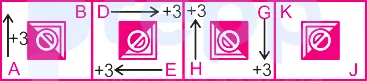
A. Option A (shown in image)The pattern followed here is:
1) Middle figure is rotated 90º clockwise direction in the next figure.
2) Letters are shifted to one place in the first figures A & B are given then C is eliminated, in the second figures D & E are given then F is eliminated, in the third figures G & H are given then I is eliminated, in last figure, K & J are given then L is eliminated.
Hence, the correct answer is "Option 1".

 Paper & answer key PDF ↗
 Question 3archived
After arranging the given words according to dictionary order, which word will come at ‘Fifth’ position?
1. Version
2. Versus
3. Versicolour
4. Verse
5. Verso
- A
Verso
- B
Versus
- C
Version
- D
Verse
Show answer
B. VersusUnderstanding Dictionary Order and Word Arrangement
Arranging words according to dictionary order, also known as alphabetical order, means sorting them based on the sequence of letters in the alphabet. We compare words letter by letter from left to right. When letters are the same, we move to the next letter until we find a difference.
The words given are:
Version
Versus
Versicolour
Verse
Verso
Step-by-Step Alphabetical Sorting
Let's compare the words letter by letter:
All words start with "VERS". This common prefix doesn't help us differentiate the order yet.
We look at the fifth letter of each word:
Version: Version (actually the 5th letter is i, 4th is e) - Let's re-examine the full words.
Let's write down the words and their full spellings clearly:
Version
Versus
Versicolour
Verse
Verso
Comparing from the beginning:
All start with VERS.
Look at the letter after 'VERS':
Verse: The next letter is 'e'.
Versicolour: The next letter is 'i'.
Version: The next letter is 'i'.
Verso: The next letter is 'o'.
Versus: The next letter is 'u'.
Arranging 'e', 'i', 'o', 'u' alphabetically: e, i, i, o, u.
So, 'Verse' comes first as it has 'e'.
Next are 'Versicolour' and 'Version', both starting with 'Versi'. We need to look at the next letter after 'i'.
Versicolour: Versicolour (next is 'c')
Version: Version (next is 'o')
Comparing 'c' and 'o', 'c' comes before 'o'. So, 'Versicolour' comes before 'Version'.
After the 'i' words, comes the word with 'o', which is 'Verso'.
Finally, comes the word with 'u', which is 'Versus'.
Dictionary Order List
The words arranged in dictionary order are:
Verse
Versicolour
Version
Verso
Versus
We are asked to find the word that comes at the 'Fifth' position.
Looking at the ordered list, the word in the fifth position is Versus.
Final Answer Identification
Based on the dictionary arrangement, the word 'Versus' is in the fifth position.
Position
Word
1st
Verse
2nd
Versicolour
3rd
Version
4th
Verso
5th
Versus
Revision Table: Key Concepts
Concept
Description
Dictionary Order
Arranging words alphabetically by comparing letters from left to right.
Prefix Comparison
If words share a common beginning (prefix), compare the letters immediately following the prefix.
Letter by Letter
Continue comparing subsequent letters until a difference is found, which determines the order.
Additional Information: Applying Dictionary Order
Dictionary order is a fundamental skill used in various tasks, not just looking up words. It's used in:
Sorting lists of names.
Organizing files on a computer.
Creating indexes or bibliographies.
Understanding alphabetical sequence in various data structures.
When words are very similar, like in this question, paying close attention to each subsequent letter is crucial for accurate sorting. If one word is a prefix of another (e.g., 'apple' and 'appliance'), the shorter word usually comes first in dictionary order.
Paper & answer key PDF ↗ Question 4archived
Select the correct combination of mathematical signs to sequentially replace the *signs and to balance the given equation.
23 * 2 * 2 * 5 * 18
- A
-, ÷, ×, =
- B
-, ÷, +, =
- C
-, ÷, =, +
- D
-, ×, ÷, =
Show answer
A. -, ÷, ×, =Understanding the Equation Balancing Problem
The question asks us to find the correct sequence of mathematical signs to replace the asterisks (*) in the given expression to make it a balanced equation. The expression is 23 * 2 * 2 * 5 * 18. We are given four options, each providing a sequence of four signs.
To solve this equation balancing problem, we need to substitute the signs from each option into the expression sequentially from left to right and then evaluate the resulting equation using the order of operations (BODMAS/PEMDAS). The option that results in a true equation is the correct answer.
Applying the Order of Operations (BODMAS/PEMDAS)
Remember the order of operations:
Brackets (or Parentheses)
Orders (or Exponents)
Division and Multiplication (from left to right)
Addition and Subtraction (from left to right)
Testing the Options for Equation Balancing
Option 1: -, ÷, ×, =
Let's substitute these signs into the expression:
23 - 2 ÷ 2 × 5 = 18
Now, we evaluate the left side following BODMAS:
First, Division: $\frac{2}{2} = 1$
The expression becomes: $23 - 1 \times 5 = 18$
Next, Multiplication: $1 \times 5 = 5$
The expression becomes: $23 - 5 = 18$
Finally, Subtraction: $23 - 5 = 18$
So, the equation becomes: $18 = 18$.
This equation is true, so this option balances the given expression.
Option 2: -, ÷, +, =
Let's substitute these signs into the expression:
23 - 2 ÷ 2 + 5 = 18
Evaluate the left side:
First, Division: $\frac{2}{2} = 1$
The expression becomes: $23 - 1 + 5 = 18$
Next, Addition and Subtraction from left to right:
$23 - 1 = 22$
$22 + 5 = 27$
So, the equation becomes: $27 = 18$.
This equation is false.
Option 3: -, ÷, =, +
Let's substitute these signs into the expression:
23 - 2 ÷ 2 = 5 + 18
Evaluate both sides:
Left side:
Division: $\frac{2}{2} = 1$
Subtraction: $23 - 1 = 22$
Right side:
Addition: $5 + 18 = 23$
So, the equation becomes: $22 = 23$.
This equation is false.
Option 4: -, ×, ÷, =
Let's substitute these signs into the expression:
23 - 2 × 2 ÷ 5 = 18
Evaluate the left side:
First, Multiplication and Division from left to right:
Multiplication: $2 \times 2 = 4$
The expression becomes: $23 - 4 \div 5 = 18$
Division: $\frac{4}{5} = 0.8$
The expression becomes: $23 - 0.8 = 18$
Finally, Subtraction: $23 - 0.8 = 22.2$
So, the equation becomes: $22.2 = 18$.
This equation is false.
Conclusion
After testing all the options, only Option 1 provides the correct combination of mathematical signs (-, ÷, ×, =) that balances the given equation 23 * 2 * 2 * 5 * 18, resulting in $18 = 18$.
Revision Table: Checking Equation Balancing
Here's a summary of the evaluation for each option:
Option
Signs Applied
Equation
Step-by-step Evaluation (LHS)
Result
Balanced?
1
-, ÷, ×, =
$23 - 2 \div 2 \times 5 = 18$
$23 - 1 \times 5 = 18$
$23 - 5 = 18$
$18 = 18$
$18 = 18$
Yes
2
-, ÷, +, =
$23 - 2 \div 2 + 5 = 18$
$23 - 1 + 5 = 18$
$22 + 5 = 18$
$27 = 18$
$27 = 18$
No
3
-, ÷, =, +
$23 - 2 \div 2 = 5 + 18$
LHS: $23 - 1 = 22$
RHS: $5 + 18 = 23$
$22 = 23$
$22 = 23$
No
4
-, ×, ÷, =
$23 - 2 \times 2 \div 5 = 18$
$23 - 4 \div 5 = 18$
$23 - 0.8 = 18$
$22.2 = 18$
$22.2 = 18$
No
Additional Information: Strategies for Mathematical Sign Problems
Problems involving finding the correct mathematical signs to balance an equation are common in competitive exams. Here are some tips:
Understand BODMAS/PEMDAS: Always follow the correct order of operations. Division and Multiplication have equal priority and are done from left to right. Similarly, Addition and Subtraction have equal priority and are done from left to right.
Look for Division possibilities: If division is one of the options, check if it's placed where the numbers are divisible. This can quickly eliminate options that would result in fractions or non-integers if the right side is an integer.
Estimate the result: Before detailed calculation, quickly estimate the magnitude of the result with the given operators. For example, using multiplication might significantly increase the number.
Systematic Testing: Test each option systematically. Don't guess.
Double Check: After finding an option that works, quickly double-check the calculations to avoid errors.
Practicing more problems like this helps in improving speed and accuracy in equation balancing and mathematical sign substitution questions.
Paper & answer key PDF ↗ Question 5archived
Select the option in which the given figure is embedded (rotation is NOT allowed).

- A
Option A (shown in image)
- B
Option B (shown in image)
- C
Option C (shown in image)
- D
Option D (shown in image)
Show answer
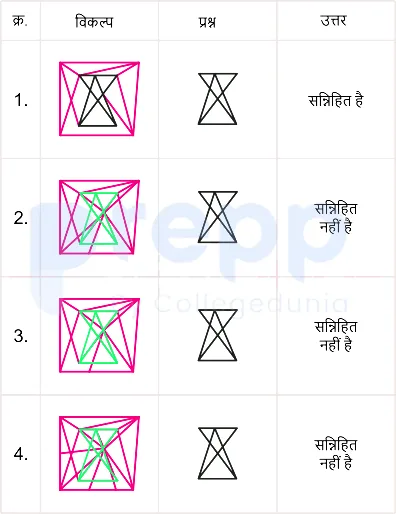
A. Option A (shown in image)The pattern followed here is:
Given:
Hence, the correct answer is "Option 1".

 Paper & answer key PDF ↗
 Question 6archived
Select the option that is related to the fifth letter-cluster in the same way as the second letter-cluster is related to the first letter-cluster and the fourth letter-cluster is related to the third letter-cluster.
EACH : AEHC :: GAME : AGEM :: IDOL : ?
- A
OLDI
- B
DILO
- C
IDLO
- D
DIOL
Show answer
B. DILOSolving Letter Cluster Analogy Questions
This question is a type of letter cluster analogy where the relationship between the first pair of letter clusters is the same as the relationship between the second pair, and this pattern needs to be applied to the third pair to find the missing letter cluster.
Analyzing the First Letter Cluster Analogy: EACH : AEHC
Let's look at the positions of the letters in the first cluster 'EACH' and how they are arranged in the second cluster 'AEHC'.
E is the 1st letter.
A is the 2nd letter.
C is the 3rd letter.
H is the 4th letter.
In the cluster 'AEHC', the letters appear in the following order:
A (which was the 2nd letter in 'EACH')
E (which was the 1st letter in 'EACH')
H (which was the 4th letter in 'EACH')
C (which was the 3rd letter in 'EACH')
So, the pattern observed is that the letters from the first cluster (1, 2, 3, 4) are rearranged in the order (2, 1, 4, 3) to form the second cluster.
Let's represent this transformation using indices:
\(\text{EACH} \rightarrow \text{AEHC}\)
\(1234 \rightarrow 2143\)
Analyzing the Second Letter Cluster Analogy: GAME : AGEM
Now, let's check if the same pattern applies to the second pair of letter clusters, 'GAME' and 'AGEM'.
G is the 1st letter.
A is the 2nd letter.
M is the 3rd letter.
E is the 4th letter.
In the cluster 'AGEM', the letters appear in the following order:
A (which was the 2nd letter in 'GAME')
G (which was the 1st letter in 'GAME')
E (which was the 4th letter in 'GAME')
M (which was the 3rd letter in 'GAME')
This confirms the same pattern:
\(\text{GAME} \rightarrow \text{AGEM}\)
\(1234 \rightarrow 2143\)
Applying the Pattern to the Third Letter Cluster: IDOL : ?
We need to apply the established pattern (2, 1, 4, 3) to the third letter cluster 'IDOL'.
I is the 1st letter.
D is the 2nd letter.
O is the 3rd letter.
L is the 4th letter.
Applying the pattern (2, 1, 4, 3):
The 2nd letter is D.
The 1st letter is I.
The 4th letter is L.
The 3rd letter is O.
Combining these letters in the order (2, 1, 4, 3) gives us DILO.
Therefore, IDOL is related to DILO in the same way as EACH is related to AEHC and GAME is related to AGEM.
The missing letter cluster is DILO.
Final Answer Determination
Based on our analysis, the letter cluster that completes the analogy is DILO. Let's check this against the given options.
Option
Letter Cluster
Matches Pattern (2, 1, 4, 3)?
1
OLDI
No (Order: 3, 4, 2, 1)
2
DILO
Yes (Order: 2, 1, 4, 3)
3
IDLO
No (Order: 1, 2, 4, 3)
4
DIOL
No (Order: 2, 1, 3, 4)
The option that matches our derived letter cluster DILO is Option 2.
Revision Table: Letter Cluster Analogy Pattern
First Cluster (1234)
Second Cluster (Resulting from Pattern 2143)
Relationship Explained (Positions)
EACH (E=1, A=2, C=3, H=4)
AEHC
A(2) E(1) H(4) C(3)
GAME (G=1, A=2, M=3, E=4)
AGEM
A(2) G(1) E(4) M(3)
IDOL (I=1, D=2, O=3, L=4)
DILO
D(2) I(1) L(4) O(3)
Additional Information: Types of Letter Analogies
Letter analogies are common in reasoning tests and can follow various patterns. Understanding different types of patterns helps in solving these questions efficiently. Some common patterns include:
Position Change: Letters within the word change their positions according to a specific rule, as seen in this problem (e.g., 1234 > 2143).
Letter Shifting: Each letter is shifted a fixed number of positions forward or backward in the alphabet (e.g., A > C, B > D, involves a shift of +2).
Opposite Letters: Letters are replaced by their counterparts in the alphabet (e.g., A > Z, B > Y).
Skip Letter Pattern: The pattern involves skipping a certain number of letters in the alphabet between consecutive letters in the cluster or between corresponding letters in the analogy.
Consonant/Vowel Arrangement: Letters are rearranged based on whether they are consonants or vowels.
To solve letter analogy problems, it is crucial to carefully observe the relationship between the first pair of clusters and try to identify the underlying rule or pattern before applying it to the third cluster.
Paper & answer key PDF ↗ Question 7archived
Three of the following letter-clusters are alike in some manner and hence form a group. Which letter-cluster does not belong to that group?
- A
ANHS
- B
JEQJ
- C
JPRT
- D
PYWD
Show answer
C. JPRTFinding the Odd Letter Cluster Out
The question asks us to identify the letter cluster that is different from the other three, meaning three of the clusters share a common pattern, and one does not. To solve this type of letter cluster reasoning problem, we can often look at the positions of the letters in the English alphabet and the differences or patterns between these positions.
Let's assign a numerical value to each letter based on its position (A=1, B=2, C=3, ..., Z=26).
A = 1
N = 14
H = 8
S = 19
J = 10
E = 5
Q = 17
J = 10
J = 10
P = 16
R = 18
T = 20
P = 16
Y = 25
W = 23
D = 4
Analyzing Letter Position Differences
Now, let's examine the difference in positional value between consecutive letters within each cluster.
For ANHS:
N - A: $14 - 1 = 13$
H - N: $8 - 14 = -6$
S - H: $19 - 8 = 11$
The differences for ANHS are: +13, -6, +11.
For JEQJ:
E - J: $5 - 10 = -5$
Q - E: $17 - 5 = 12$
J - Q: $10 - 17 = -7$
The differences for JEQJ are: -5, +12, -7.
For JPRT:
P - J: $16 - 10 = 6$
R - P: $18 - 16 = 2$
T - R: $20 - 18 = 2$
The differences for JPRT are: +6, +2, +2.
For PYWD:
When calculating differences that cross the alphabet boundary (like W to D), we can consider the alphabet to wrap around. So, D can be 4 or $4+26=30$.
Y - P: $25 - 16 = 9$
W - Y: $23 - 25 = -2$
D - W: Using $D=4$, $4 - 23 = -19$. Using $D=30$, $30 - 23 = 7$. The difference showing forward movement is +7.
The differences for PYWD are: +9, -2, +7.
Identifying the Letter Cluster Pattern
Let's look at the characteristics of these differences:
ANHS: Differences are +13, -6, +11. (Odd, Even, Odd)
JEQJ: Differences are -5, +12, -7. (Odd, Even, Odd)
JPRT: Differences are +6, +2, +2. (Even, Even, Even)
PYWD: Differences are +9, -2, +7. (Odd, Even, Odd)
We observe that in the letter clusters ANHS, JEQJ, and PYWD, there is at least one difference between consecutive letter positions that is an odd number. However, in the letter cluster JPRT, all the differences between consecutive letter positions (+6, +2, +2) are even numbers.
This pattern of having all even differences makes JPRT different from the other three letter clusters.
Conclusion: The Odd One Out
Based on the analysis of letter positions and the differences between consecutive letters, JPRT is the letter cluster that does not follow the same pattern as ANHS, JEQJ, and PYWD.
Revision Table: Letter Cluster Analysis
Letter Cluster
Letter Positions
Differences
Even/Odd Differences
ANHS
1, 14, 8, 19
+13, -6, +11
Odd, Even, Odd
JEQJ
10, 5, 17, 10
-5, +12, -7
Odd, Even, Odd
JPRT
10, 16, 18, 20
+6, +2, +2
Even, Even, Even
PYWD
16, 25, 23, 4 (or 30)
+9, -2, +7
Odd, Even, Odd
Additional Information on Letter Pattern Reasoning
Letter pattern reasoning questions are common in aptitude tests and competitive exams. They assess logical thinking and the ability to identify rules or sequences in letter arrangements. Common patterns include:
Positional Differences: As seen in this problem, calculating the difference in alphabetical position between letters.
Skip Letters: Skipping a fixed number of letters between consecutive letters (e.g., A, C, E, G where one letter is skipped each time).
Vowel/Consonant Patterns: Patterns based on the arrangement or number of vowels and consonants.
Alphabetical Order: Letters appearing in forward or reverse alphabetical order or specific segments.
Combination of Rules: More complex patterns might combine positional shifts, skips, or other characteristics.
Solving these puzzles often requires trying out different potential patterns systematically until one fits three out of the four options provided.
Paper & answer key PDF ↗ Question 8archived
By interchanging the given two signs and numbers which of the following equation will be correct?
× and +, 6 and 4
- A
3 × 9 – 4 ÷ 2 + 6 = 8
- B
8 × 6 + 4 ÷ 2 – 5 = –5
- C
8 – 3 × 6 + 4 ÷ 1 = 18
- D
7 × 6 – 4 + 9 ÷ 3 = –7
Show answer
D. 7 × 6 – 4 + 9 ÷ 3 = –7Solving Equations by Interchanging Signs and Numbers
This question requires us to apply a set of interchange rules to several mathematical equations and then determine which equation becomes correct after these changes. The given interchange rules are to swap the multiplication sign (×) with the addition sign (+) and to swap the number 6 with the number 4.
Applying the Interchange Rules
We need to perform the following substitutions in each equation:
Replace every '×' with '+'.
Replace every '+' with '×'.
Replace every '6' with '4'.
Replace every '4' with '6'.
After applying these changes, we will evaluate the left-hand side of each modified equation using the order of operations (BODMAS/PEMDAS) and compare the result with the right-hand side.
Step-by-Step Analysis of Each Option
Option 1: \(3 × 9 – 4 ÷ 2 + 6 = 8\)
Apply the interchanges (× ↔ +, + ↔ ×, 6 ↔ 4):
The equation becomes:
\(3 + 9 – 6 ÷ 2 × 4\)
Now, evaluate the expression using BODMAS (Brackets, Orders, Division, Multiplication, Addition, Subtraction):
Division: \(6 ÷ 2 = 3\)
Expression is now: \(3 + 9 – 3 × 4\)
Multiplication: \(3 × 4 = 12\)
Expression is now: \(3 + 9 – 12\)
Addition: \(3 + 9 = 12\)
Expression is now: \(12 – 12\)
Subtraction: \(12 – 12 = 0\)
The left-hand side evaluates to 0. The original right-hand side is 8.
\(0 \neq 8\)
So, Option 1 is incorrect after the interchange.
Option 2: \(8 × 6 + 4 ÷ 2 – 5 = –5\)
Apply the interchanges (× ↔ +, + ↔ ×, 6 ↔ 4):
The equation becomes:
\(8 + 4 × 6 ÷ 2 – 5\)
Now, evaluate the expression using BODMAS:
Division: \(6 ÷ 2 = 3\)
Expression is now: \(8 + 4 × 3 – 5\)
Multiplication: \(4 × 3 = 12\)
Expression is now: \(8 + 12 – 5\)
Addition: \(8 + 12 = 20\)
Expression is now: \(20 – 5\)
Subtraction: \(20 – 5 = 15\)
The left-hand side evaluates to 15. The original right-hand side is –5.
\(15 \neq –5\)
So, Option 2 is incorrect after the interchange.
Option 3: \(8 – 3 × 6 + 4 ÷ 1 = 18\)
Apply the interchanges (× ↔ +, + ↔ ×, 6 ↔ 4):
The equation becomes:
\(8 – 3 + 4 × 6 ÷ 1\)
Now, evaluate the expression using BODMAS:
Division: \(6 ÷ 1 = 6\)
Expression is now: \(8 – 3 + 4 × 6\)
Multiplication: \(4 × 6 = 24\)
Expression is now: \(8 – 3 + 24\)
Subtraction (from left): \(8 – 3 = 5\)
Expression is now: \(5 + 24\)
Addition: \(5 + 24 = 29\)
The left-hand side evaluates to 29. The original right-hand side is 18.
\(29 \neq 18\)
So, Option 3 is incorrect after the interchange.
Option 4: \(7 × 6 – 4 + 9 ÷ 3 = –7\)
Apply the interchanges (× ↔ +, + ↔ ×, 6 ↔ 4):
The equation becomes:
\(7 + 4 – 6 × 9 ÷ 3\)
Now, evaluate the expression using BODMAS:
Multiplication/Division (from left to right): \(6 × 9 = 54\)
Expression is now: \(7 + 4 – 54 ÷ 3\)
Division: \(54 ÷ 3 = 18\)
Expression is now: \(7 + 4 – 18\)
Addition/Subtraction (from left to right): \(7 + 4 = 11\)
Expression is now: \(11 – 18\)
Subtraction: \(11 – 18 = –7\)
The left-hand side evaluates to –7. The original right-hand side is –7.
\(–7 = –7\)
So, Option 4 is correct after the interchange.
Summary of Results After Interchange
Original Equation
Interchanges Applied
Modified Equation
Calculated Result
Original RHS
Correct?
\(3 × 9 – 4 ÷ 2 + 6 = 8\)
× ↔ +, + ↔ ×, 6 ↔ 4
\(3 + 9 – 6 ÷ 2 × 4\)
0
8
No
\(8 × 6 + 4 ÷ 2 – 5 = –5\)
× ↔ +, + ↔ ×, 6 ↔ 4
\(8 + 4 × 6 ÷ 2 – 5\)
15
–5
No
\(8 – 3 × 6 + 4 ÷ 1 = 18\)
× ↔ +, + ↔ ×, 6 ↔ 4
\(8 – 3 + 4 × 6 ÷ 1\)
29
18
No
\(7 × 6 – 4 + 9 ÷ 3 = –7\)
× ↔ +, + ↔ ×, 6 ↔ 4
\(7 + 4 – 6 × 9 ÷ 3\)
–7
–7
Yes
After evaluating all options, only Option 4 results in a correct equation after interchanging the signs '×' and '+' and the numbers '6' and '4'.
Revision Table: Key Concepts
Concept
Description
Importance in this Problem
Interchange Rules
Swapping specific elements (signs or numbers) as per given conditions.
Core step to modify the original equations.
Order of Operations (BODMAS/PEMDAS)
Rules specifying the sequence of mathematical operations (Brackets, Orders/Exponents, Division/Multiplication, Addition/Subtraction).
Crucial for correctly evaluating the modified equations.
Equation Verification
Checking if the calculated value of one side of an equation equals the other side.
Determining which modified equation is correct.
Additional Information: Understanding BODMAS/PEMDAS
The BODMAS rule helps ensure that everyone gets the same answer when evaluating a complex mathematical expression. The acronym stands for:
Brackets first (perform operations inside brackets).
Orders (or indices/exponents, like powers and square roots).
Division and Multiplication (perform these from left to right in the expression).
Addition and Subtraction (perform these from left to right in the expression).
In the United States, the acronym PEMDAS is often used, which stands for Parentheses, Exponents, Multiplication and Division, Addition and Subtraction. The order is the same; only the names of the terms differ slightly.
Applying the BODMAS/PEMDAS rule systematically is essential for accurately solving problems that involve multiple arithmetic operations, like the equations in this question after the signs and numbers are interchanged.
Paper & answer key PDF ↗ Question 9archived
Select the set in which the numbers are related in the same way as are the numbers of the given set.
(NOTE: Operations should be performed on the whole numbers, without breaking down the numbers into its constituent digits. E.g. 13 – Operations on 13 such as adding / subtracting / multiplying etc. to 13 can be performed. Breaking down 13 into 1 and 3 and then performing mathematical operations on 1 and 3 is not allowed.)
(26, 120, 34)
(14, 110, 41)
- A
(36, 106, 17)
- B
(72, 240, 16)
- C
(44, 114, 24)
- D
(15, 450, 8)
Show answer
A. (36, 106, 17)This question asks us to find a hidden relationship between three numbers in a set. We are given two example sets where the numbers follow a specific rule. Our task is to identify this rule and then find which of the given options follows the same rule.
Analyzing the Given Number Sets
The given sets are:
(26, 120, 34)
(14, 110, 41)
We need to find how the first number, the second number, and the third number are related in both these sets. Let's call the numbers N1, N2, and N3 respectively.
Discovering the Relationship Pattern
Let's examine the first set (26, 120, 34). N1 = 26, N2 = 120, N3 = 34.
Let's examine the second set (14, 110, 41). N1 = 14, N2 = 110, N3 = 41.
We need to look for a mathematical operation involving these numbers. A common approach is to look at sums, differences, products, or simple arithmetic combinations of N1 and N3 to see if they relate to N2.
Try adding N1 and N3:
For the first set: \(26 + 34 = 60\). How does 60 relate to 120? \(60 \times 2 = 120\).
For the second set: \(14 + 41 = 55\). How does 55 relate to 110? \(55 \times 2 = 110\).
It appears we have found a consistent relationship. The sum of the first and third numbers, when multiplied by 2, gives the second number.
The relationship is: \((N1 + N3) \times 2 = N2\)
Applying the Relationship to Options
Now, we will test each option using the relationship we discovered: \((N1 + N3) \times 2 = N2\).
Option 1: (36, 106, 17)
Here, N1 = 36, N2 = 106, N3 = 17.
Let's calculate \((N1 + N3) \times 2\):
\((36 + 17) \times 2 = 53 \times 2 = 106\)
The calculated value is 106, which matches the N2 in this option. So, Option 1 follows the relationship.
Option 2: (72, 240, 16)
Here, N1 = 72, N2 = 240, N3 = 16.
Let's calculate \((N1 + N3) \times 2\):
\((72 + 16) \times 2 = 88 \times 2 = 176\)
The calculated value is 176, which does not match the N2 (240) in this option. So, Option 2 does not follow the relationship.
Option 3: (44, 114, 24)
Here, N1 = 44, N2 = 114, N3 = 24.
Let's calculate \((N1 + N3) \times 2\):
\((44 + 24) \times 2 = 68 \times 2 = 136\)
The calculated value is 136, which does not match the N2 (114) in this option. So, Option 3 does not follow the relationship.
Option 4: (15, 450, 8)
Here, N1 = 15, N2 = 450, N3 = 8.
Let's calculate \((N1 + N3) \times 2\):
\((15 + 8) \times 2 = 23 \times 2 = 46\)
The calculated value is 46, which does not match the N2 (450) in this option. So, Option 4 does not follow the relationship.
Conclusion
Based on the analysis, only Option 1 follows the same relationship \((N1 + N3) \times 2 = N2\)
Therefore, the set (36, 106, 17) is related in the same way as the given sets.
Revision Table: Number Relationships
Set
N1
N2
N3
Calculation \((N1 + N3) \times 2\)
Result = N2?
Given Set 1
26
120
34
\((26 + 34) \times 2 = 60 \times 2 = 120\)
Yes
Given Set 2
14
110
41
\((14 + 41) \times 2 = 55 \times 2 = 110\)
Yes
Option 1
36
106
17
\((36 + 17) \times 2 = 53 \times 2 = 106\)
Yes
Option 2
72
240
16
\((72 + 16) \times 2 = 88 \times 2 = 176\)
No
Option 3
44
114
24
\((44 + 24) \times 2 = 68 \times 2 = 136\)
No
Option 4
15
450
8
\((15 + 8) \times 2 = 23 \times 2 = 46\)
No
Additional Information: Solving Number Analogy Questions
Number analogy or number set relationship questions test your ability to find patterns and rules governing sets of numbers. Here are some tips for solving such questions:
Look for basic arithmetic operations (addition, subtraction, multiplication, division) between the numbers.
Consider operations involving squares, cubes, square roots, or cube roots.
Check for relationships between the sum or difference of numbers and the remaining number.
Sometimes, the relationship might involve ratios or percentages.
Look for patterns related to prime numbers, odd/even numbers, or sequences.
Always test the discovered relationship on all the given examples to ensure it is consistent.
Apply the same relationship strictly to the options provided.
Remember the constraint about not breaking down numbers into digits unless explicitly allowed.
Practicing different types of number set problems helps in quickly identifying common patterns.
Paper & answer key PDF ↗ Question 10archived
In a certain code language, 'LAPTOP' is written as ‘JYNRMN’ and ‘COLD’ is written as ‘AMJB’, how will 'SKETCHPEN' be written in that language?
- A
RJDSBHODM
- B
QICRBHODM
- C
QICRAFNCL
- D
RJDSAFNCL
Show answer
C. QICRAFNCLCompare each letter of the source word with the same position in the coded word:
LAPTOP → JYNRMN: L(12)→J(10), A(1)→Y(25), P(16)→N(14), T(20)→R(18), O(15)→M(13), P(16)→N(14).
COLD → AMJB: C(3)→A(1), O(15)→M(13), L(12)→J(10), D(4)→B(2).
Every letter has shifted −2 in the alphabet (wrapping at A → Y). Apply the same −2 shift to SKETCHPEN:
S→Q, K→I, E→C, T→R, C→A, H→F, P→N, E→C, N→L
Hence the code for SKETCHPEN is QICRAFNCL, option (3).
Paper & answer key PDF ↗ Question 11archived
In the following question below are given some statements followed by some conclusions based on those statements. Taking the given statements to be true even if they seem to be at variance from commonly known facts. Read all the conclusions and then decide which of the given conclusion logically follows the given statements.
Statements:
I. All pencil are pen.
II. Some pen are rubber.
Conclusion:
I. All rubber are pencil.
II. Some pen are not pencil.
III. Some rubber are not pen.
- A
Neither conclusion follows
- B
Only conclusion II follows
- C
Both conclusions I and III follows
- D
All conclusion follows
Show answer
A. Neither conclusion followsLogical Deduction: Analyzing Syllogism Statements and Conclusions
This problem asks us to determine which conclusions logically follow from a set of given statements, assuming the statements are true. This type of problem falls under logical reasoning, specifically syllogisms.
Given Statements
We have the following premises:
Statement I: All pencil are pen.
Statement II: Some pen are rubber.
Given Conclusions
We need to evaluate the truth of these conclusions based on the statements:
Conclusion I: All rubber are pencil.
Conclusion II: Some pen are not pencil.
Conclusion III: Some rubber are not pen.
Analyzing Statements with Venn Diagrams
Let's visualize the statements using Venn diagrams. This helps understand the possible relationships between the sets.
Statement I (All pencil are pen): The set of Pencils is completely inside the set of Pens. Let P represent Pencils and PN represent Pens. This means every element in P is also in PN ($\text{P} \subseteq \text{PN}$).
Statement II (Some pen are rubber): There is at least one element that is common to both the set of Pens and the set of Rubbers. Let R represent Rubbers. This means the intersection of PN and R is not empty ($\text{PN} \cap \text{R} \ne \emptyset$).
Evaluating Each Conclusion
A conclusion logically follows only if it is true in <strong>every</strong> possible scenario that satisfies the given statements.
Conclusion I: All rubber are pencil.
The statements tell us Pencils are inside Pens, and Pens overlap with Rubbers. The overlap between Pens and Rubbers could be in the part of Pens that is <em>not</em> Pencils. For example, if Pens = {apple, banana, cherry}, Pencils = {apple, banana}, and Rubbers = {cherry, date}. All Pencils are Pens. Some Pens (cherry) are Rubber. But not all Rubbers (date) are Pencil, and not all Rubbers (cherry) are Pencil. So, Conclusion I is not always true.
This conclusion does not logically follow.
Conclusion II: Some pen are not pencil.
Statement I (All pencil are pen) means the set of Pencils is a subset of the set of Pens. It is possible, according to this statement, that the set of Pens and the set of Pencils are the same. If every Pen is also a Pencil, then the statement "Some pen are not pencil" would be false.
For example, if Pens = {apple, banana} and Pencils = {apple, banana}. Then Statement I "All pencil are pen" is true. Now add Rubbers = {apple, cherry} for Statement II "Some pen are rubber" (apple is common). In this case, it is not true that "Some pen are not pencil" because all pens <em>are</em> pencils.
Since there's a valid scenario where this conclusion is false, it does not logically follow.
Conclusion III: Some rubber are not pen.
Statement II says "Some pen are rubber". This guarantees that there is at least one item that is both a pen and a rubber. However, it does not prevent a scenario where <em>all</em> rubbers are also pens.
For example, if Rubbers = {cherry, date} and Pens = {apple, banana, cherry, date}. Here, some Pens (cherry, date) are Rubbers. In this case, all Rubbers (cherry, date) are Pens. The conclusion "Some rubber are not pen" would be false in this scenario.
Since there's a valid scenario where this conclusion is false, it does not logically follow.
Conclusion Summary
After analyzing each conclusion, we find that none of them are guaranteed to be true based solely on the given statements. They are not logically necessitated by the premises.
Conclusion
Evaluation Summary
Is it Necessarily True?
I. All rubber are pencil.
Possible for rubber set to be outside or partially outside the pencil set.
No
II. Some pen are not pencil.
Possible for the pen set and pencil set to be identical.
No
III. Some rubber are not pen.
Possible for the rubber set to be completely inside the pen set.
No
Therefore, neither conclusion follows from the given statements.
Revision Table: Syllogism Basics
Statement Type
Meaning
Example (Sets A, B)
All A are B
Every member of set A is also a member of set B.
$\text{A} \subseteq \text{B}$
Some A are B
There is at least one member common to both set A and set B.
$\text{A} \cap \text{B} \ne \emptyset$
No A are B
There are no members common to set A and set B.
$\text{A} \cap \text{B} = \emptyset$
Some A are not B
There is at least one member of set A that is not a member of set B.
$\text{A} \setminus \text{B} \ne \emptyset$
Additional Information: Syllogism Solving Tips
When tackling syllogism questions, always remember:
Assume the statements are absolutely true, even if they contradict common knowledge.
A conclusion is valid only if it <em>must</em> be true in <em>all</em> possible interpretations or visual representations (like Venn diagrams) of the statements.
If you can find even one scenario where the conclusion is false while the statements are true, the conclusion is not logically following.
Practice drawing different possible Venn diagrams for the same set of statements to cover all scenarios.
Common pitfalls include assuming "some" means "some but not all" or assuming relationships that are not explicitly stated or necessarily implied.
Paper & answer key PDF ↗ Question 12archived
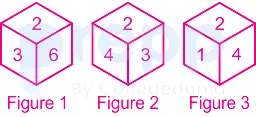
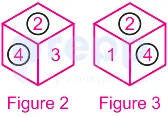
Three different positions of the same dice are shown. Find the number on the face opposite the face showing '3'.
- A
5
- B
2
- C
1
- D
6
Show answer
C. 1The pattern followed here is:
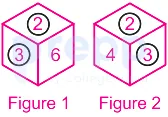
We are taking Figures (1) & (2).
Here, 2 and 3 are common in both the dice and 6 is opposite to 4.
We are taking Figures (2) & (3).
Here, 4 and 2 are common in both the dice and 3 is opposite to 1.
So, opposite pairs are:
⇒ 6 → 4
⇒ 3 → 1
⇒ 5 → 2
Clearly, 1 is the opposite to 3.
Hence, the correct answer is "1".
 Paper & answer key PDF ↗
 Question 13archived
Which number will replace the question mark (?) in the following series?
26, 54, 110, 222, ?, 894
- A
446
- B
442
- C
440
- D
444
Show answer
A. 446Understanding the Number Series Pattern
The question asks us to find the number that replaces the question mark in the given series: 26, 54, 110, 222, ?, 894. To solve this type of problem, we need to identify the underlying pattern connecting the consecutive terms in the series.
Let's examine the relationship between the numbers:
From 26 to 54: \(54 - 26 = 28\). Let's also check multiplication. \(26 \times 2 = 52\). \(52 + 2 = 54\). This looks promising.
From 54 to 110: \(110 - 54 = 56\). Using the multiplication pattern: \(54 \times 2 = 108\). \(108 + 2 = 110\). The pattern holds.
From 110 to 222: \(222 - 110 = 112\). Using the multiplication pattern: \(110 \times 2 = 220\). \(220 + 2 = 222\). The pattern is consistent.
It appears the pattern is that each term is obtained by multiplying the previous term by 2 and then adding 2.
Let's represent this pattern mathematically. If \(T_n\) is the n-th term in the series, the pattern is \(T_n = T_{n-1} \times 2 + 2\).
Applying the Pattern to Find the Missing Number
The series is 26, 54, 110, 222, ?, 894.
We need to find the term after 222. Let the missing term be \(T_5\), and the term before it is \(T_4 = 222\).
Using the pattern \(T_5 = T_4 \times 2 + 2\):
\(T_5 = 222 \times 2 + 2\)
\(T_5 = 444 + 2\)
\(T_5 = 446\)
So, the missing number is 446.
Verifying the Next Term
Let's check if applying the pattern to 446 gives us the next number in the series, which is 894.
Using the pattern for the term after 446 (which is \(T_6\)):
\(T_6 = T_5 \times 2 + 2\)
\(T_6 = 446 \times 2 + 2\)
\(T_6 = 892 + 2\)
\(T_6 = 894\)
This matches the last number in the given series, confirming that our identified pattern and the calculated missing number are correct.
Summary of the Series Progression
Step
Calculation
Result
1st term to 2nd
\(26 \times 2 + 2\)
54
2nd term to 3rd
\(54 \times 2 + 2\)
110
3rd term to 4th
\(110 \times 2 + 2\)
222
4th term to 5th (missing)
\(222 \times 2 + 2\)
446
5th term to 6th
\(446 \times 2 + 2\)
894
The number that replaces the question mark is 446.
Revision Table: Number Series Patterns
Understanding different types of number series patterns is key to solving these questions quickly. Here are a few common types:
Arithmetic Series: A constant difference between consecutive terms (e.g., 3, 6, 9, 12... where the difference is 3).
Geometric Series: A constant ratio between consecutive terms (e.g., 2, 4, 8, 16... where the ratio is 2).
Difference Series: The differences between consecutive terms follow a pattern (e.g., 1, 3, 6, 10... differences are 2, 3, 4...).
Mixed Operations: The pattern involves a combination of operations, like the series in this question (multiply by a number, then add/subtract another number).
Fibonacci Series: Each term is the sum of the two preceding terms (e.g., 0, 1, 1, 2, 3, 5...).
Additional Information: Solving Number Series Questions
When tackling number series questions, follow a systematic approach:
Look for simple differences between consecutive terms.
Check for ratios between consecutive terms.
If the difference or ratio isn't constant, look at the differences of the differences (second-order differences) or the ratios of the ratios.
Consider multiplication and division patterns.
Look for patterns involving squares, cubes, prime numbers, etc.
Sometimes, the pattern might alternate between different operations or involve two interleaved series.
Test your identified pattern with all given terms before applying it to find the missing number.
Practice with various types of series helps in quickly recognizing the pattern.
Paper & answer key PDF ↗ Question 14archived
If X – Y means that X is the mother of Y, X × Y means that X is the father of Y, X ÷ Y means that X is the sister of Y, then which of the following expression shows that Q is the son of P?
- A
P – Q ÷ R
- B
P – Q × R
- C
Q – P × R
- D
R × Q – P
Show answer
B. P – Q × RUnderstanding Coded Blood Relations
This question asks us to interpret coded relationships between people to determine which expression shows that Q is the son of P. We are given three codes:
X – Y means X is the mother of Y.
X × Y means X is the father of Y.
X ÷ Y means X is the sister of Y.
We need to find the expression where Q is the son of P. This means P is either the mother or the father of Q, and Q is male.
Analyzing Each Option to Find the Relationship
Let's examine each given option based on the defined codes:
Option 1: P – Q ÷ R
P – Q: This means P is the mother of Q.
Q ÷ R: This means Q is the sister of R.
Combining these, P is the mother of Q, and Q is the sister of R. If Q is the sister of R, Q is female. For Q to be the son of P, Q must be male. Since Q is female in this expression, this option is incorrect.
Option 2: P – Q × R
P – Q: This means P is the mother of Q.
Q × R: This means Q is the father of R.
Combining these, P is the mother of Q, and Q is the father of R. If Q is the father of R, Q must be male. P is the mother of Q. This relationship fits the requirement: P is the mother of Q, and Q is male (as he is a father). Therefore, Q is the son of P.
This option correctly shows that Q is the son of P.
Option 3: Q – P × R
Q – P: This means Q is the mother of P.
P × R: This means P is the father of R.
Combining these, Q is the mother of P, and P is the father of R. This makes Q the grandmother of R and P the child of Q and father of R. This expression shows Q is the mother of P, not that Q is the son of P. This option is incorrect.
Option 4: R × Q – P
R × Q: This means R is the father of Q.
Q – P: This means Q is the mother of P.
Combining these, R is the father of Q, and Q is the mother of P. This means R and Q are parents of Q and P respectively. Q is P's mother, and R is Q's father. This does not show that Q is the son of P. This option is incorrect.
Conclusion
Based on the step-by-step analysis of each option, the expression P – Q × R is the only one that results in Q being the son of P.
Expression
Relations Derived
Result
Q is son of P?
P – Q ÷ R
P is mother of Q, Q is sister of R
Q is female
No
P – Q × R
P is mother of Q, Q is father of R
Q is male, P is Q's mother
Yes
Q – P × R
Q is mother of P, P is father of R
Q is P's mother
No
R × Q – P
R is father of Q, Q is mother of P
Q is P's mother
No
Revision Table: Coded Relations Summary
Code
Meaning
Gender Implied for X
Gender Implied for Y
X – Y
X is mother of Y
Female
Undetermined
X × Y
X is father of Y
Male
Undetermined
X ÷ Y
X is sister of Y
Female
Undetermined (Sibling of X)
Additional Information on Blood Relations Logic
Blood relation questions in reasoning tests require you to decode relationships given in a symbolic or verbal format. Here are some key points:
Identify the relationship: Understand what each symbol or statement means in terms of family connections (parent, sibling, child, etc.).
Determine genders: Some codes explicitly state the gender of one person (like mother or father), while others imply it (like sister implies female). Note down the genders determined.
Chain the relations: Work through the expression step-by-step, building a family tree or diagram in your mind or on paper if needed.
Focus on the target: Keep the desired relationship in mind (e.g., Q is son of P) and check if the derived relationships match the target's requirements (like gender and parent-child link).
Variable Genders: Remember that unless a code explicitly states the gender of Y, Y's gender is usually unknown from a single relation like X is parent of Y. However, if Y is later shown to be a father or mother, their gender becomes known.
Solving blood relation puzzles is about careful deduction and keeping track of the information given by each part of the coded expression.
Paper & answer key PDF ↗ Question 15archived
A # B means ‘A is the brother of B’
A @ B means ‘A is the daughter of B’
A & B means ‘A is the husband of B’
A % B means ‘A is the wife of B’
If G % M # L @ P & C @ B, then how is L related to B?
- A
Daughter
- B
Granddaughter
- C
Sister
- D
Daughter-in-law
Show answer
B. GranddaughterSolving Coded Blood Relations
This question requires us to decipher a coded blood relation expression using the provided definitions for each symbol. We need to determine the relationship between L and B based on the given expression: G % M # L @ P & C @ B.
Understanding the Symbols
Let's first understand what each symbol represents:
Symbol
Meaning
#
A is the brother of B (A is male)
@
A is the daughter of B (A is female)
&
A is the husband of B (A is male)
%
A is the wife of B (A is female)
Step-by-Step Deciphering of the Expression
We will break down the expression G % M # L @ P & C @ B from left to right:
G % M: According to the definition, G is the wife of M. This tells us G is female and M is male. G and M are a married couple.
M # L: According to the definition, M is the brother of L. This tells us M is male. M and L are siblings.
L @ P: According to the definition, L is the daughter of P. This tells us L is female. P is the parent of L.
P & C: According to the definition, P is the husband of C. This tells us P is male and C is female. P and C are a married couple. P is the father of their children.
C @ B: According to the definition, C is the daughter of B. This tells us C is female. B is the parent of C.
Building the Family Tree
Let's combine the information to build a simple family structure:
G is the wife of M. (G --- M)
M is the brother of L. (M - L are siblings)
L is the daughter of P. (P is a parent of L)
Since M is L's brother, M is also a child of P. So, P is a parent of both M and L.
P is the husband of C. (P --- C)
Since P is the husband of C and P is the parent of L and M, C must be the other parent of L and M (their mother).
C is the daughter of B. (B is a parent of C)
Based on this, we can see the generational links:
B is in the topmost generation shown.
C is the daughter of B (one generation below B).
P is married to C (same generation as C).
L is the daughter of P and C (one generation below P and C, two generations below B).
Determining the Relationship between L and B
We found that:
L is the daughter of C.
C is the daughter of B.
If L's mother (C) is B's daughter, then L is B's granddaughter.
Therefore, L is related to B as a granddaughter.
Revision Table: Key Relation Types
Relation
Description
Parent
Mother or Father
Child
Son or Daughter
Sibling
Brother or Sister
Grandparent
Parent's Parent
Grandchild
Child's Child
Aunt/Uncle
Parent's Sister/Brother
Niece/Nephew
Sibling's Daughter/Son
Cousin
Child of Aunt/Uncle
In-laws
Relations through marriage
Additional Information on Blood Relation Puzzles
Blood relation questions test your ability to understand and decode relationships between individuals. When solving coded relation problems like this one, it is often helpful to:
Write down the meaning of each symbol clearly.
Break the coded expression into smaller pairs or groups based on the symbols.
Determine the relationship between the two individuals in each pair.
Combine these relationships sequentially to build a complete chain or a simple family tree diagram.
Pay close attention to the gender indicated by the symbols or the nature of the relationship (like husband/wife, brother/sister).
Finally, trace the required relationship between the two specified individuals using the constructed family structure.
Paper & answer key PDF ↗ Question 16archived
In a certain code language, 'INNER’ is written as 'SNNWJ' and 'GLASS' is written as 'UPAII'. How will 'MODEL' be written in that language?
- A
OMXVP
- B
OMXWP
- C
OMWWP
- D
OMXWO
Show answer
B. OMXWPThis is a coding-decoding question where words are coded into other words based on a specific pattern or set of rules. We are given two examples of coded words: 'INNER' is coded as 'SNNWJ' and 'GLASS' is coded as 'UPAII'. We need to find the coding rules and then apply them to the word 'MODEL'.
Let's analyze the mapping of letters from the original words to the coded words for the given examples.
Analysing the Coding Pattern in Examples
We can look at each letter's position and its corresponding coded letter in both examples.
Position
Original (INNER)
Coded (SNNWJ)
Shift (A=1, Z=26)
1
I (9)
S (19)
$+10$
2
N (14)
N (14)
$+0$
3
N (14)
N (14)
$+0$
4
E (5)
W (23)
$+18$
5
R (18)
J (10)
$-8$
Position
Original (GLASS)
Coded (UPAII)
Shift (A=1, Z=26)
1
G (7)
U (21)
$+14$
2
L (12)
P (16)
$+4$
3
A (1)
A (1)
$+0$
4
S (19)
I (9)
$-10$
5
S (19)
I (9)
$-10$
Observing the shifts, we can see they are not uniform across all positions or letters. Let's look for consistent rules.
Identifying Coding Rules and Patterns
Looking at Position 3 in both examples, the original letter (N and A) is coded to the same letter (N and A). This suggests a $+0$ shift for Position 3 in these cases.
Let's examine Positions 4 and 5. Consider the "distance from Z" for each letter. We can define the distance from Z for a letter as the number of letters after it in the alphabet until Z, including Z as a distance of 0 for Z itself, 1 for Y, etc. A simpler way is to use the letter's position (A=1, ..., Z=26) and calculate Distance from Z = $26 - \text{Letter Value}$.
Position 4 (INNER): E (Value 5). Distance from Z = $26 - 5 = 21$. Coded letter W (Value 23). Distance from Z = $26 - 23 = 3$. Sum of distances = $21 + 3 = 24$.
Position 5 (INNER): R (Value 18). Distance from Z = $26 - 18 = 8$. Coded letter J (Value 10). Distance from Z = $26 - 10 = 16$. Sum of distances = $8 + 16 = 24$.
Position 4 (GLASS): S (Value 19). Distance from Z = $26 - 19 = 7$. Coded letter I (Value 9). Distance from Z = $26 - 9 = 17$. Sum of distances = $7 + 17 = 24$.
Position 5 (GLASS): S (Value 19). Distance from Z = $26 - 19 = 7$. Coded letter I (Value 9). Distance from Z = $26 - 9 = 17$. Sum of distances = $7 + 17 = 24$.
It appears that for Positions 4 and 5, the rule is: The sum of the distance from Z of the original letter and the distance from Z of the coded letter is always 24.
Now let's look at Positions 1, 2, and 3 again, combining the observations:
Word
Pos 1 Shift
Pos 2 Shift
Pos 3 Shift
INNER (First letter I)
$+10$
$+0$
$+0$
GLASS (First letter G)
$+14$
$+4$
$+0$
The shifts for Positions 1, 2, and 3 seem to depend on the first letter of the word. The shift sequence for the first three positions is specific to the word's starting letter.
Applying the Rules to MODEL
Now we apply the discovered rules to the word 'MODEL'. 'MODEL' has 5 letters, similar to the examples. The letters are M, O, D, E, L.
Position 1 (M): The first letter of MODEL is M. Based on the pattern from the examples, the shift sequence for the first three letters depends on the first letter. We need to determine the shifts for M. Looking at the options provided for the coded word (e.g., OMXWP), the first letter is O. This implies a shift of $+2$ for M ($M(13) \to O(15)$). Assuming this rule exists for M as the first letter, the shift for Position 1 is $+2$.
Position 2 (O): The first letter is M. Following the assumed pattern from the options (OMXWP), the second letter is M. This implies a shift of $-2$ for O ($O(15) \to M(13)$). The shift for Position 2 is $-2$.
Position 3 (D): The first letter is M. Following the assumed pattern from the options (OMXWP), the third letter is X. This implies a shift of $+20$ for D ($D(4) \to X(24)$). The shift for Position 3 is $+20$.
Position 4 (E): The letter is E. We apply the rule for Position 4: Sum of distance from Z = 24. Distance from Z for E (Value 5) is $26-5=21$. The coded letter must have a distance from Z of $24-21=3$. The letter with distance 3 from Z is W (Value 23, $26-23=3$). So, E codes to W. This is a shift of $+18$ ($E(5) \to W(23)$).
Position 5 (L): The letter is L. We apply the rule for Position 5: Sum of distance from Z = 24. Distance from Z for L (Value 12) is $26-12=14$. The coded letter must have a distance from Z of $24-14=10$. The letter with distance 10 from Z is P (Value 16, $26-16=10$). So, L codes to P. This is a shift of $+4$ ($L(12) \to P(16)$).
Let's summarize the shifts applied to MODEL based on the derived rules and the likely shifts for M as the first letter:
M at Pos 1: Shift +2 $\to$ O
O at Pos 2: Shift -2 $\to$ M
D at Pos 3: Shift +20 $\to$ X
E at Pos 4: Shift +18 $\to$ W
L at Pos 5: Shift +4 $\to$ P
Combining the coded letters, we get O M X W P.
Final Coded Word for MODEL
Based on the coding rules derived from the examples and applied to 'MODEL', the coded word is 'OMXWP'.
Matching with Options
Let's compare our result with the given options:
OMXVP
OMXWP
OMWWP
OMXWO
Our result 'OMXWP' matches Option 2.
Coding Decoding Summary
The code uses a combination of rules:
The shifts for the first three positions depend on the starting letter of the word.
The coding for the last two positions follows a specific rule based on the letters' distance from Z.
Original Word
First Letter
Pos 1 Shift
Pos 2 Shift
Pos 3 Shift
Pos 4 Coding Rule (Letter)
Pos 5 Coding Rule (Letter)
INNER
I
$+10$
$+0$
$+0$
E $\to$ W
R $\to$ J
GLASS
G
$+14$
$+4$
$+0$
S $\to$ I
S $\to$ I
MODEL
M
$+2$
$-2$
$+20$
E $\to$ W
L $\to$ P
The Pos 4 and Pos 5 coding rules (E $\to$ W, S $\to$ I, R $\to$ J, L $\to$ P) are all consistent with the "Sum of distance from Z = 24" principle.
Revision Table: Coding Decoding Rules
Positions 1, 2, 3 Rule
Positions 4 & 5 Rule
Shift sequence depends on the first letter:
I $\to (+10, +0, +0)$
G $\to (+14, +4, +0)$
M $\to (+2, -2, +20)$
Sum of distance from Z of original and coded letter is 24. Equivalent to coded letter being the one with required distance from Z (A=1, Z=26, Dist from Z = $26 - \text{Value}$).
Additional Information: Understanding Letter Shifts and Positional Coding
Letter coding problems often involve shifts based on alphabetical position. These shifts can be fixed, sequential, based on the letter's value, its position in the word, whether it is a vowel or consonant, or a combination of these factors.
In this particular problem, we see a mix:
Positional Shifts: The shifts for the first three letters depend on their position (1st, 2nd, or 3rd) and are part of a sequence determined by the first letter of the word.
Letter-Specific Coding: The coding for the last two letters (Positions 4 and 5) depends on the specific letter at that position and follows a different logic (sum of distance from Z).
Solving such puzzles requires careful observation, breaking down the word by position, analyzing patterns in the given examples, and testing potential rules systematically. The "distance from Z" rule is a less common but valid coding technique where the alphabet can be thought of cyclically or mirrored around a central point related to Z.
Paper & answer key PDF ↗ Question 17archived
Select the option that is related to the third number in the same way as the second number is related to the first number and the sixth number is related to the fifth number.
30 : 48 :: 60 : ? :: 45 : 72
- A
96
- B
92
- C
90
- D
88
Show answer
A. 96Understanding Number Analogies and Relationships
Number analogy questions test your ability to find a relationship between a pair of numbers and apply that same relationship to another number to find a missing term. The question presents pairs connected by ':', and sets of pairs connected by '::', indicating that the relationship across the '::' symbol is the same.
The given analogy is: 30 : 48 :: 60 : ? :: 45 : 72
This means the relationship between 30 and 48 is the same as the relationship between 60 and the missing number, and also the same as the relationship between 45 and 72. We need to discover this common relationship.
Analyzing the Known Pairs to Find the Pattern
Let's look at the first pair, 30 and 48.
Is it a simple addition? $48 - 30 = 18$. If we add 18 to 60, we get $60 + 18 = 78$. Let's check the third pair: $45 + 18 = 63$. But the third pair is 45 and 72, and $72 - 45 = 27$. So, simple addition is not the rule.
Is it a multiplication? $48 / 30 = 1.6$. Let's check if multiplying 45 by 1.6 gives 72. $45 \times 1.6 = 45 \times \frac{16}{10} = 45 \times \frac{8}{5}$. $45 \times \frac{8}{5} = 9 \times 8 = 72$. Yes, this fits! The second number is $\frac{8}{5}$ times the first number in the pair.
Let's confirm the relationship using the ratio between the numbers:
For the pair 30 : 48, the ratio is $\frac{30}{48}$. We can simplify this ratio by dividing both numbers by their greatest common divisor, which is 6. $\frac{30 \div 6}{48 \div 6} = \frac{5}{8}$. So the ratio is 5:8.
For the pair 45 : 72, the ratio is $\frac{45}{72}$. We can simplify this ratio by dividing both numbers by their greatest common divisor, which is 9. $\frac{45 \div 9}{72 \div 9} = \frac{5}{8}$. The ratio is also 5:8.
Both known pairs follow the same ratio of 5:8 between the first and the second number. This means for any pair $X : Y$ in this analogy, the relationship is $\frac{X}{Y} = \frac{5}{8}$, which can be rewritten as $Y = \frac{8}{5} \times X$.
Applying the Relationship to Find the Missing Number
Now we apply this rule to the second pair, 60 : ? Let the missing number be $Y$. The first number $X$ is 60.
Using the discovered relationship $Y = \frac{8}{5} \times X$:
$Y = \frac{8}{5} \times 60$
To calculate this, we can divide 60 by 5 first, which is 12.
$Y = 8 \times 12$
$Y = 96$
So, the missing number is 96.
Checking the Options
Let's compare our calculated missing number with the given options:
Option
Value
Matches Calculation?
1
96
Yes
2
92
No
3
90
No
4
88
No
The calculated value, 96, matches Option 1.
Step-by-Step Solution
Identify the known pairs in the analogy: 30 : 48 and 45 : 72.
Analyze the relationship between the numbers in the first pair (30 and 48). Find the ratio $\frac{30}{48} = \frac{5}{8}$.
Analyze the relationship between the numbers in the third pair (45 and 72). Find the ratio $\frac{45}{72} = \frac{5}{8}$.
Confirm that the relationship is consistent: the ratio of the first number to the second number in each pair is 5:8. This implies the second number is $\frac{8}{5}$ times the first number.
Apply this relationship to the second pair: 60 : ?. Let the missing number be $Y$. The relationship is $\frac{60}{Y} = \frac{5}{8}$.
Solve for $Y$: $5Y = 60 \times 8 \implies 5Y = 480 \implies Y = \frac{480}{5} \implies Y = 96$. Alternatively, use $Y = \frac{8}{5} \times 60 = 8 \times 12 = 96$.
The missing number is 96.
Revision Table: Key Learnings
Concept
Description
Application in this Problem
Number Analogy
Identifying relationships between number pairs.
Finding the pattern in 30:48 and 45:72.
Ratio and Proportion
Comparing quantities using division.
Determining the constant ratio (5:8) between the numbers in the pairs.
Applying Patterns
Using a discovered rule to find an unknown.
Applying the 5:8 ratio to the pair 60:? to find the missing term.
Additional Information: Types of Number Relationships
Number analogy problems can have various types of relationships between the numbers. Some common types include:
Arithmetic Operations: Addition, subtraction, multiplication, division. (e.g., X : X+a, X : aX)
Squaring or Cubing: Relationship involves squares or cubes. (e.g., X : X², X : X³)
Operations on Digits: Sum or product of digits. (e.g., X : Sum of digits of X)
Prime Numbers or Factors: Relationship based on prime factors or properties like being prime.
Combinations of Operations: A sequence of operations. (e.g., X : 2X + 5)
Ratio and Proportion: The ratio between the numbers is constant, as seen in this problem. (e.g., X : Y where X/Y is constant)
To solve analogy problems, it's helpful to systematically test different types of relationships based on the numbers given.
Paper & answer key PDF ↗ Question 18archived
Select the word-pair which represents exactly the relation which is expressed in the given word-pair. (Words should be treated as meaningful words and should not be related to each other on the basis of number of letters/number of consonants/number of vowels in the word)
Acquired: Received
- A
Bitter : Sweet
- B
Collected: Distributed
- C
Arrival: Departure
- D
Short: Small
Show answer
D. Short: SmallUnderstanding Word Analogies: Acquired and Received
The question asks us to find a word pair that shares the exact same relationship as the given pair: Acquired : Received.
To solve word analogy problems, we first need to understand the relationship between the words in the given pair.
Analyzing the Relationship in 'Acquired : Received'
Let's examine the words 'Acquired' and 'Received':
Acquired: This means to obtain something, to gain possession of something.
Received: This means to take into one's possession something offered or delivered.
Comparing these meanings, we can see that 'Acquired' and 'Received' have very similar meanings. They are essentially synonyms. The relationship is one of synonymy.
Evaluating the Options
Now, let's look at the relationship between the words in each option pair:
Option 1: Bitter : Sweet
Bitter: Having a sharp, pungent taste or smell; feeling or showing anger, hurt, or resentment.
Sweet: Having the pleasant taste characteristic of sugar; pleasing and delightful.
The words 'Bitter' and 'Sweet' have opposite meanings. The relationship is one of antonymy.
Option 2: Collected : Distributed
Collected: Gathered together.
Distributed: Given out to a number of recipients.
'Collected' is the act of gathering, while 'Distributed' is the act of giving out from a collection. These words have opposite meanings. The relationship is one of antonymy.
Option 3: Arrival : Departure
Arrival: The act of arriving.
Departure: The act of leaving.
'Arrival' and 'Departure' have opposite meanings. The relationship is one of antonymy.
Option 4: Short : Small
Short: Measuring a small distance from end to end; not long.
Small: Of limited size, quantity, or extent; not large.
The words 'Short' and 'Small' have very similar meanings. They are synonyms or nearly synonyms, often used interchangeably depending on context. The relationship is one of synonymy.
Finding the Matching Relationship
We determined that the relationship between 'Acquired' and 'Received' is synonymy.
Comparing this to the relationships in the options:
Bitter : Sweet — Antonyms
Collected : Distributed — Antonyms
Arrival : Departure — Antonyms
Short : Small — Synonyms
Only the pair 'Short : Small' exhibits a relationship of synonymy, which is the same as the relationship between 'Acquired' and 'Received'.
Conclusion
The word-pair 'Short : Small' represents exactly the same relationship (synonymy) as the given word-pair 'Acquired : Received'.
Revision Table: Common Analogy Types
Analogy Type
Description
Example
Synonyms
Words with similar meanings.
Happy : Joyful
Antonyms
Words with opposite meanings.
Hot : Cold
Part to Whole
One word is a component of the other.
Finger : Hand
Cause and Effect
One word is the cause of the other.
Rain : Flood
Worker and Tool
A person and the tool they use.
Carpenter : Hammer
Action and Object
An action performed on an object.
Read : Book
Additional Information: Strategies for Solving Word Analogies
Solving word analogy questions effectively requires a systematic approach:
Identify the exact relationship between the words in the given pair. Don't stop at the first relationship you see; sometimes there's a more specific connection.
Express the relationship as a sentence. For "Acquired : Received", you could say "Acquired means essentially the same as Received."
Apply the same sentence structure to each option pair. For "Bitter : Sweet", you would say "Bitter means essentially the same as Sweet." (This sentence is false, indicating they are not synonyms). For "Short : Small", you would say "Short means essentially the same as Small." (This sentence is true, indicating they are synonyms).
Eliminate options that do not fit the relationship.
Be aware of different degrees of meaning. Sometimes words are close synonyms rather than perfect synonyms.
Practicing with various types of word analogies helps improve vocabulary and logical reasoning skills.
Paper & answer key PDF ↗ Question 19archived
Select the odd group of numbers. (NOTE: Operations should be performed on the whole numbers, without breaking down the numbers into its constituent digits. E.g.13– Operations on 13 such as adding /subtracting /multiplying etc. to 13 can be performed. Breaking down 13 into 1 and 3 and then performing mathematical operations on 1 and 3 is not allowed)
- A
13 — 159
- B
9 — 71
- C
5 — 31
- D
17 — 279
Show answer
C. 5 — 31Finding the Odd Group of Numbers
This question asks us to identify the group of numbers that does not follow the same pattern or rule as the others. We are specifically told that operations should be performed on the whole numbers provided, not by breaking them down into their individual digits.
Analysing the Given Number Groups
We have four groups of numbers presented as pairs. Let's look at each pair and try to find a relationship between the first number and the second number.
13 — 159
9 — 71
5 — 31
17 — 279
Our goal is to find a mathematical operation or a series of operations that relates the first number to the second number in most of the pairs. Since the second numbers are significantly larger than the first numbers, operations like squaring or cubing the first number, or multiplying it by a factor, are likely candidates.
Identifying the Pattern
Let's test some common operations. If we square the first number in each pair:
For 13 — 159: \(13^2 = 169\)
For 9 — 71: \(9^2 = 81\)
For 5 — 31: \(5^2 = 25\)
For 17 — 279: \(17^2 = 289\)
Now let's compare these squared values to the second number in each pair:
For 13 — 159: \(169\) compared to \(159\). The difference is \(169 - 159 = 10\). So, \(13^2 - 10 = 159\).
For 9 — 71: \(81\) compared to \(71\). The difference is \(81 - 71 = 10\). So, \(9^2 - 10 = 71\).
For 5 — 31: \(25\) compared to \(31\). The difference is \(31 - 25 = 6\). If we follow the previous pattern, \(5^2 - 10 = 25 - 10 = 15\), which is not \(31\).
For 17 — 279: \(289\) compared to \(279\). The difference is \(289 - 279 = 10\). So, \(17^2 - 10 = 279\).
Verifying the Pattern for Each Group
It appears that the pattern for most groups is: (First number)\(^2\) – 10 = (Second number). Let's write this pattern as \(x^2 - 10 = y\), where \(x\) is the first number and \(y\) is the second number.
Let's test this pattern on each group:
Group
Calculation based on \(x^2 - 10 = y\)
Result
Matches second number?
13 — 159
\(13^2 - 10 = 169 - 10\)
159
Yes
9 — 71
\(9^2 - 10 = 81 - 10\)
71
Yes
5 — 31
\(5^2 - 10 = 25 - 10\)
15
No (expected 15, found 31)
17 — 279
\(17^2 - 10 = 289 - 10\)
279
Yes
Based on our analysis, the pattern \(x^2 - 10 = y\) holds true for the groups (13, 159), (9, 71), and (17, 279). However, the group (5, 31) does not follow this pattern, as \(5^2 - 10 = 15\), which is not 31.
Conclusion
The group (5, 31) is the odd one out because it does not fit the pattern \(x^2 - 10 = y\) which is consistently followed by the other three groups of numbers. This confirms that (5, 31) is the odd group.
Revision Table: Odd Group Analysis
Group
First Number (x)
Second Number (y)
\(x^2\)
\(x^2 - 10\)
Does \(x^2 - 10 = y\)?
Odd Group?
13 — 159
13
159
169
159
Yes
No
9 — 71
9
71
81
71
Yes
No
5 — 31
5
31
25
15
No
Yes
17 — 279
17
279
289
279
Yes
No
Additional Information: Number Series and Patterns
Finding patterns in number series or groups of numbers is a common type of question in logical reasoning and quantitative aptitude tests. These questions assess your ability to observe, analyze, and identify underlying rules or relationships between numbers.
Common types of patterns include:
Arithmetic progressions (adding or subtracting a constant)
Geometric progressions (multiplying or dividing by a constant)
Squaring or cubing numbers
Combinations of operations (like \(x^2 + c\), \(ax + b\), etc.)
Differences or ratios between consecutive terms
Patterns based on prime numbers, Fibonacci series, etc.
Solving these problems often requires trying out different common mathematical operations and seeing if a consistent rule emerges that applies to most elements in the series or group. The key is to be systematic and test potential patterns against all the given examples.
Paper & answer key PDF ↗ Question 20archived
Select the set in which the numbers are related in the same way as are the numbers ofthe following sets.
(NOTE : Operations should be performed on the whole numbers, without breaking down the numbers into its constituent digits. E.g. 13 – Operations on 13 such as adding / subtracting / multiplying etc. to 13 can be performed. Breaking down 13 into 1 and 3 and then performing mathematical operations on 1 and 3 is NOT allowed)
(8, 12, 6)
(9, 18, 8)
- A
(4, 12, 6)
- B
(12, 24, 8)
- C
(7, 24, 4)
- D
(9, 10, 11)
Show answer
B. (12, 24, 8)Finding the Relationship in Number Analogy Sets
This question asks us to identify the relationship between numbers in a given set and then find an option set that follows the same relationship. We are given two example sets: (8, 12, 6) and (9, 18, 8).
Let's denote the numbers in a set as (A, B, C). We need to find a rule that connects A, B, and C, which applies to both (8, 12, 6) and (9, 18, 8).
Analyzing the Given Sets
Consider the first set: (8, 12, 6)
A = 8, B = 12, C = 6
Consider the second set: (9, 18, 8)
A = 9, B = 18, C = 8
We need to look for a consistent pattern. Let's try different mathematical operations involving A, B, and C.
Let's examine simple relationships between pairs:
In (8, 12, 6), B = 12, C = 6. Here, B = 2 * C.
In (9, 18, 8), B = 18, C = 8. Here, 18 is not 2 * 8. So, B = 2 * C is not the rule.
Let's consider relationships involving all three numbers. We are allowed to perform operations on the whole numbers themselves, not their digits.
Let's try combining the first and third numbers (A and C) to get the second number (B).
In (8, 12, 6): A = 8, C = 6. A * C = 8 * 6 = 48. How can we get 12 from 48? $48 \div 4 = 12$.
Let's propose the rule: $B = \frac{A \times C}{4}$.
Verifying the Proposed Rule
Let's check if the rule $B = \frac{A \times C}{4}$ works for both given sets.
For set (8, 12, 6):
A = 8, C = 6
$\frac{A \times C}{4} = \frac{8 \times 6}{4} = \frac{48}{4} = 12$. This matches B = 12 in the first set.
For set (9, 18, 8):
A = 9, C = 8
$\frac{A \times C}{4} = \frac{9 \times 8}{4} = \frac{72}{4} = 18$. This matches B = 18 in the second set.
The rule $B = \frac{A \times C}{4}$ is consistent with both given sets.
Checking the Options
Now, we apply the rule $B = \frac{A \times C}{4}$ to each option set to find the one that follows the same pattern.
Option 1: (4, 12, 6)
A = 4, B = 12, C = 6
According to the rule: $\frac{A \times C}{4} = \frac{4 \times 6}{4} = \frac{24}{4} = 6$.
The rule predicts B should be 6, but B in the option is 12. This option does not match.
Option 2: (12, 24, 8)
A = 12, B = 24, C = 8
According to the rule: $\frac{A \times C}{4} = \frac{12 \times 8}{4} = \frac{96}{4} = 24$.
The rule predicts B should be 24, which matches B in the option (12, 24, 8). This option follows the rule.
Option 3: (7, 24, 4)
A = 7, B = 24, C = 4
According to the rule: $\frac{A \times C}{4} = \frac{7 \times 4}{4} = \frac{28}{4} = 7$.
The rule predicts B should be 7, but B in the option is 24. This option does not match.
Option 4: (9, 10, 11)
A = 9, B = 10, C = 11
According to the rule: $\frac{A \times C}{4} = \frac{9 \times 11}{4} = \frac{99}{4} = 24.75$.
The rule predicts B should be 24.75, but B in the option is 10. This option does not match (and the result is not a whole number).
Only option (12, 24, 8) satisfies the identified relationship $B = \frac{A \times C}{4}$.
Conclusion
The set in which the numbers are related in the same way as the given sets (8, 12, 6) and (9, 18, 8) is (12, 24, 8).
Revision Table: Number Analogy Pattern
Set (A, B, C)
A
B
C
Calculation $\frac{A \times C}{4}$
Result Matches B?
(8, 12, 6)
8
12
6
$\frac{8 \times 6}{4} = 12$
Yes
(9, 18, 8)
9
18
8
$\frac{9 \times 8}{4} = 18$
Yes
(4, 12, 6)
4
12
6
$\frac{4 \times 6}{4} = 6$
No (12)
(12, 24, 8)
12
24
8
$\frac{12 \times 8}{4} = 24$
Yes
(7, 24, 4)
7
24
4
$\frac{7 \times 4}{4} = 7$
No (24)
(9, 10, 11)
9
10
11
$\frac{9 \times 11}{4} = 24.75$
No (10)
Additional Information: Understanding Number Analogy
Number analogy questions are a common type of logical reasoning problem. They test your ability to identify patterns and relationships between numbers.
How to approach: Look for relationships involving arithmetic operations (addition, subtraction, multiplication, division), squares, cubes, ratios, or other number properties.
Common patterns:
Arithmetic progression (constant difference)
Geometric progression (constant ratio)
Operations between numbers in the set (like sum, difference, product, quotient)
Relationship of numbers to external constants
Patterns based on squares, cubes, or roots
Important Note: Always follow the instructions given, such as operating on whole numbers and not individual digits, unless specified otherwise.
Strategy: Start with simple relationships and move to more complex ones. Test your hypothesized rule on all given examples before applying it to the options.
Paper & answer key PDF ↗ Question 21archived
Which of the following interchange of numbers and mathematical signs would make the given equation correct?
72 ÷ 8 × 9 − 36 + 20 = 80
- A
20 and 80, × and +
- B
9 and 36, × and ÷
- C
36 and 72, ÷ and −
- D
8 and 9, + and −
Show answer
D. 8 and 9, + and −Finding the Correct Equation by Interchanging Numbers and Signs
The problem asks us to find which interchange of numbers and mathematical signs from the given options will make the original equation true. The original equation is:
\(72 \div 8 \times 9 - 36 + 20 = 80\)
We need to check each option by performing the suggested interchange and then evaluating the new equation using the BODMAS or PEMDAS rule (Brackets, Orders/Exponents, Division and Multiplication (from left to right), Addition and Subtraction (from left to right)).
Analyzing Option 1: Interchange 20 and 80, × and +
Interchange the numbers 20 and 80, and the signs \(\times\) and \(+\) in the original equation. The original right side (80) becomes the new number 20, and the number 20 on the left side becomes 80. The \(\times\) sign becomes \(+\) and the \(+\) sign becomes \(\times\).
Original Equation: \(72 \div 8 \times 9 - 36 + 20 = 80\)
Interchanged Equation: \(72 \div 8 + 9 - 36 \times 80 = 20\)
Now, let's evaluate the left side of the interchanged equation:
First, perform division: \(72 \div 8 = 9\)
Equation becomes: \(9 + 9 - 36 \times 80\)
Next, perform multiplication: \(36 \times 80 = 2880\)
Equation becomes: \(9 + 9 - 2880\)
Perform addition: \(9 + 9 = 18\)
Equation becomes: \(18 - 2880\)
Perform subtraction: \(18 - 2880 = -2862\)
So, the left side evaluates to -2862. The right side is 20.
\(-2862 = 20\)
This is not true. So, Option 1 does not make the equation correct.
Analyzing Option 2: Interchange 9 and 36, × and ÷
Interchange the numbers 9 and 36, and the signs \(\times\) and \(\div\) in the original equation.
Original Equation: \(72 \div 8 \times 9 - 36 + 20 = 80\)
Interchanged Equation: \(72 \times 8 \div 36 - 9 + 20 = 80\)
Now, let's evaluate the left side of the interchanged equation:
First, perform multiplication (from left to right): \(72 \times 8 = 576\)
Equation becomes: \(576 \div 36 - 9 + 20\)
Next, perform division: \(576 \div 36 = 16\)
Equation becomes: \(16 - 9 + 20\)
Perform subtraction (from left to right): \(16 - 9 = 7\)
Equation becomes: \(7 + 20\)
Perform addition: \(7 + 20 = 27\)
So, the left side evaluates to 27. The right side is 80.
\(27 = 80\)
This is not true. So, Option 2 does not make the equation correct.
Analyzing Option 3: Interchange 36 and 72, ÷ and −
Interchange the numbers 36 and 72, and the signs \(\div\) and \(\minus\) in the original equation.
Original Equation: \(72 \div 8 \times 9 - 36 + 20 = 80\)
Interchanged Equation: \(36 - 8 \times 9 \div 72 + 20 = 80\)
Now, let's evaluate the left side of the interchanged equation:
First, perform multiplication (from left to right): \(8 \times 9 = 72\)
Equation becomes: \(36 - 72 \div 72 + 20\)
Next, perform division: \(72 \div 72 = 1\)
Equation becomes: \(36 - 1 + 20\)
Perform subtraction (from left to right): \(36 - 1 = 35\)
Equation becomes: \(35 + 20\)
Perform addition: \(35 + 20 = 55\)
So, the left side evaluates to 55. The right side is 80.
\(55 = 80\)
This is not true. So, Option 3 does not make the equation correct.
Analyzing Option 4: Interchange 8 and 9, + and −
Interchange the numbers 8 and 9, and the signs \(+\) and \(\minus\) in the original equation.
Original Equation: \(72 \div 8 \times 9 - 36 + 20 = 80\)
Interchanged Equation: \(72 \div 9 \times 8 + 36 - 20 = 80\)
Now, let's evaluate the left side of the interchanged equation:
First, perform division (from left to right): \(72 \div 9 = 8\)
Equation becomes: \(8 \times 8 + 36 - 20\)
Next, perform multiplication: \(8 \times 8 = 64\)
Equation becomes: \(64 + 36 - 20\)
Perform addition (from left to right): \(64 + 36 = 100\)
Equation becomes: \(100 - 20\)
Perform subtraction: \(100 - 20 = 80\)
So, the left side evaluates to 80. The right side is 80.
\(80 = 80\)
This is true. So, Option 4 makes the equation correct.
Conclusion on Interchange of Numbers and Signs
After checking all the options by interchanging the specified numbers and signs and applying the BODMAS rule, we found that only the interchange suggested in Option 4 makes the given equation correct. The interchange was between numbers 8 and 9, and the signs + and −.
Option
Interchange
New Equation
Left Side Calculation
Is Equation Correct?
1
20 <> 80, × <> +
\(72 \div 8 + 9 - 36 \times 80 = 20\)
\(9 + 9 - 2880 = 18 - 2880 = -2862\)
No (-2862 \(\neq\) 20)
2
9 <> 36, × <> ÷
\(72 \times 8 \div 36 - 9 + 20 = 80\)
\(576 \div 36 - 9 + 20 = 16 - 9 + 20 = 7 + 20 = 27\)
No (27 \(\neq\) 80)
3
36 <> 72, ÷ <> -
\(36 - 8 \times 9 \div 72 + 20 = 80\)
\(36 - 72 \div 72 + 20 = 36 - 1 + 20 = 35 + 20 = 55\)
No (55 \(\neq\) 80)
4
8 <> 9, + <> -
\(72 \div 9 \times 8 + 36 - 20 = 80\)
\(8 \times 8 + 36 - 20 = 64 + 36 - 20 = 100 - 20 = 80\)
Yes (80 = 80)
Revision Table: Mathematical Operations and BODMAS
Concept
Description
Order (BODMAS/PEMDAS)
Mathematical Signs/Operators
Symbols representing mathematical actions: +, -, ×, ÷
N/A
Interchange
Swapping the positions of two numbers or signs in an expression or equation.
N/A
BODMAS/PEMDAS
Rules for the order of operations to evaluate mathematical expressions consistently.
Brackets > Orders (Powers/Roots) > Division and Multiplication (Left to Right) > Addition and Subtraction (Left to Right)
Additional Information: Solving Equation Interchange Problems
Problems involving the interchange of numbers and signs require careful application of the order of operations after the swap is made. It's essential to work through the calculations step-by-step, following the BODMAS/PEMDAS rule to ensure accuracy. These types of questions test your understanding of mathematical operations and your ability to systematically evaluate expressions.
Always identify the numbers and signs to be interchanged clearly.
Rewrite the new equation after performing the interchange.
Apply the order of operations strictly (Division and Multiplication before Addition and Subtraction, working from left to right for operations of the same precedence).
Compare the left side of the equation with the right side to check if the equality holds true.
If testing multiple options, proceed systematically through each one until the correct interchange is found.
Paper & answer key PDF ↗ Question 22archived
A series is given with one term missing. Select the correct alternative from the given ones that will complete the series.
TQT, ZSB, FUJ, LWR, ?
- A
RYZ
- B
RMZ
- C
RYA
- D
RNZ
Show answer
A. RYZAnalyzing the Letter Series Pattern
The question asks us to find the missing term in the series: TQT, ZSB, FUJ, LWR, ?.
To solve this type of letter series question, we need to analyze the pattern in the letters at each corresponding position in the terms. Let's look at the first letter of each term, then the second, and finally the third.
Pattern Analysis for the First Letter
The first letters are T, Z, F, L, ?. Let's look at their positions in the English alphabet (A=1, B=2, ..., Z=26).
T is the 20th letter.
Z is the 26th letter.
F is the 6th letter.
L is the 12th letter.
Let's see the difference between consecutive first letters:
From T (20) to Z (26): $26 - 20 = 6$. So, the pattern is $+6$.
From Z (26) to F (6): When we go past Z, we wrap around to A. $26 \xrightarrow{+6} 32$. On wrapping around, $32 - 26 = 6$, which is F. So, the pattern is $+6$.
From F (6) to L (12): $12 - 6 = 6$. So, the pattern is $+6$.
The pattern for the first letter is consistently adding 6 to the alphabetical position, wrapping around from Z.
Following this pattern, the next first letter should be 6 positions after L (12). $12 + 6 = 18$. The 18th letter is R.
So, the first letter of the missing term is R.
Pattern Analysis for the Second Letter
The second letters are Q, S, U, W, ?. Let's find their alphabetical positions.
Q is the 17th letter.
S is the 19th letter.
U is the 21st letter.
W is the 23rd letter.
Let's find the difference between consecutive second letters:
From Q (17) to S (19): $19 - 17 = 2$. So, the pattern is $+2$.
From S (19) to U (21): $21 - 19 = 2$. So, the pattern is $+2$.
From U (21) to W (23): $23 - 21 = 2$. So, the pattern is $+2$.
The pattern for the second letter is consistently adding 2 to the alphabetical position.
Following this pattern, the next second letter should be 2 positions after W (23). $23 + 2 = 25$. The 25th letter is Y.
So, the second letter of the missing term is Y.
Pattern Analysis for the Third Letter
The third letters are T, B, J, R, ?. Let's find their alphabetical positions.
T is the 20th letter.
B is the 2nd letter.
J is the 10th letter.
R is the 18th letter.
Let's find the difference between consecutive third letters:
From T (20) to B (2): $20 \xrightarrow{+8} 28$. On wrapping around, $28 - 26 = 2$, which is B. So, the pattern is $+8$.
From B (2) to J (10): $10 - 2 = 8$. So, the pattern is $+8$.
From J (10) to R (18): $18 - 10 = 8$. So, the pattern is $+8$.
The pattern for the third letter is consistently adding 8 to the alphabetical position, wrapping around from Z.
Following this pattern, the next third letter should be 8 positions after R (18). $18 + 8 = 26$. The 26th letter is Z.
So, the third letter of the missing term is Z.
Determining the Missing Term
By combining the letters we found for each position, the missing term is RYZ.
Summary of the Pattern
Here is a summary of the pattern for each letter position:
Position
Pattern
Calculation
Next Letter
First Letter
Add 6 (wrap around)
L (12) + 6 = 18
R
Second Letter
Add 2
W (23) + 2 = 25
Y
Third Letter
Add 8 (wrap around)
R (18) + 8 = 26
Z
Thus, the missing term is RYZ.
Revision Table: Letter Series Concepts
Understanding letter series requires identifying the underlying rule. This can involve:
Adding or subtracting a constant number to the letter position.
Adding or subtracting an increasing/decreasing number.
Alternating patterns.
Using specific sequences (like prime numbers, squares).
Skipping letters.
Additional Information: Alphabetical Positions
Memorizing or quickly referencing the alphabetical position of letters is crucial for solving letter series problems based on numerical patterns. Here is a quick reference:
A-EF-JK-OP-TU-YZ
A=1F=6K=11P=16U=21Z=26
B=2G=7L=12Q=17V=22
C=3H=8M=13R=18W=23
D=4I=9N=14S=19X=24
E=5J=10O=15T=20Y=25
Using these positions makes identifying numerical patterns like adding 6, 2, or 8 much easier.
Paper & answer key PDF ↗ Question 23archived
Three statements are given, followed by three conclusions numbered I, II and III. Assuming the statements to be true, even if they seem to be at variance with commonly known facts, decide which of the conclusions logically follow(s) from the statements.
Statements:
No student is a teacher.
All students are children.
Some girls are students.
Conclusions:
I. Some children are not teachers.
II. Some girls are not teachers.
III. No girl is a teacher.
- A
Only conclusions I and II follow
- B
All conclusions follow
- C
Only conclusions II and III follow
- D
Only conclusions I and III follow
Show answer
A. Only conclusions I and II followAnalyzing the Syllogism Statements
This question requires us to determine the logical validity of three conclusions based on three given statements. We must assume the statements are true and assess if the conclusions necessarily follow, even if they seem counterintuitive.
Details of Given Statements
To analyze the logic, let's define the sets involved:
Let S represent the set of Students.
Let T represent the set of Teachers.
Let C represent the set of Children.
Let G represent the set of Girls.
The provided statements can be translated into logical propositions or set notations:
Statement 1: No student is a teacher.
In set notation: $S \cap T = \emptyset$. This means the set of students and the set of teachers have no overlap.
Statement 2: All students are children.
In set notation: $S \subseteq C$. This means the entire set of students is contained within the set of children.
Statement 3: Some girls are students.
In set notation: $G \cap S \neq \emptyset$. This indicates there is at least one member common to both the set of girls and the set of students.
Evaluating Conclusion I: Children Not Teachers
We need to determine if the conclusion Some children are not teachers logically follows. This is equivalent to checking if $C \setminus T \neq \emptyset$.
From Statement 2 ($S \subseteq C$), we know that every student is a child.
From Statement 1 ($S \cap T = \emptyset$), we know that no student is a teacher.
Statement 3 ($G \cap S \neq \emptyset$) confirms that the set of students (S) is not empty, meaning there exists at least one student.
Let's consider an individual $x$ who is a student ($x \in S$).
Based on Statement 2, since $x \in S$, then $x$ must also be a child ($x \in C$).
Based on Statement 1, since $x \in S$, then $x$ cannot be a teacher ($x \notin T$).
Therefore, we have identified an individual $x$ who is a child ($x \in C$) but is not a teacher ($x \notin T$).
This confirms that there exists at least one child who is not a teacher.
Conclusion I logically follows.
Evaluating Conclusion II: Girls Not Teachers
We need to determine if the conclusion Some girls are not teachers logically follows. This is equivalent to checking if $G \setminus T \neq \emptyset$.
Statement 3 ($G \cap S \neq \emptyset$) explicitly states that there are individuals who are both girls and students.
Let's consider an individual $y$ who belongs to this intersection, meaning $y \in G$ and $y \in S$.
From Statement 1 ($S \cap T = \emptyset$), we know that no student can be a teacher. Since $y \in S$, it follows that $y \notin T$.
We have established that $y$ is a girl ($y \in G$) and $y$ is not a teacher ($y \notin T$).
This directly implies that there exists at least one girl who is not a teacher.
Conclusion II logically follows.
Evaluating Conclusion III: No Girl is a Teacher
We need to determine if the conclusion No girl is a teacher logically follows. This is equivalent to checking if $G \cap T = \emptyset$.
Statement 3 tells us that *some* girls are students ($G \cap S \neq \emptyset$).
We used this information, along with Statement 1, to conclude that the girls who are students are not teachers (Conclusion II).
However, Statement 3 does not provide information about girls who are *not* students. The set of girls (G) might contain individuals who are not students (i.e., members of $G \setminus S$).
The given statements do not restrict whether these girls (who are not students) can or cannot be teachers. It is possible that some girls who are not students might be teachers.
Because we cannot rule out the possibility of a girl being a teacher based on the given statements, we cannot conclude that $G \cap T = \emptyset$.
Conclusion III does not logically follow.
Summary of Logical Following
Based on the step-by-step logical analysis:
Conclusion I (Some children are not teachers) logically follows from the statements.
Conclusion II (Some girls are not teachers) logically follows from the statements.
Conclusion III (No girl is a teacher) does not necessarily follow from the statements.
Therefore, the correct option is the one stating that only conclusions I and II follow.
Paper & answer key PDF ↗ Question 24archived
Select the option figure that is embedded in the given figure. (Rotation is not allowed).

- A
Option A (shown in image)
- B
Option B (shown in image)
- C
Option C (shown in image)
- D
Option D (shown in image)
Show answer
C. Option C (shown in image)The pattern followed here is:
Given:
Hence, the correct answer is "Option 3".

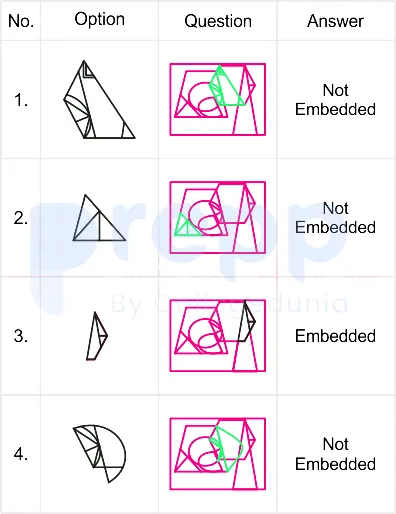 Paper & answer key PDF ↗
 Question 25archived
Select the figure from the options that can replace the question mark (?) and complete the given pattern.

- A
Option A (shown in image)
- B
Option B (shown in image)
- C
Option C (shown in image)
- D
Option D (shown in image)
Show answer
A. Option A (shown in image)The pattern followed here is:
1) In the first row B, and O are interchanged positions with L, T respectively, In the second row every figure shifted one place to the right side in the second figure, In the third row all the are written in reverse order in the second figure.
2) L, B and T,O are shifted diagonally with V,C and = , 8 Respectively. In Second row 1st pair and last pair are interchanged their position mutually.
3) In the first row C, and V are interchanged positions with 8, = respectively , In the second row every figure shifted one place to the right side in the fourth figure, In the third row all the are written in reverse order in the fourth figure.
4) V, C and =,8 are shifted diagonally with T,O and L, B Respectively. In Second row 1st pair and last pair are interchanged their position mutually.
Hence, the correct answer is "Option 1".
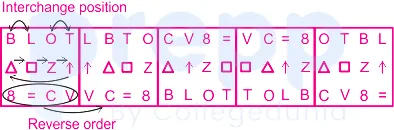
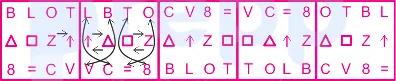
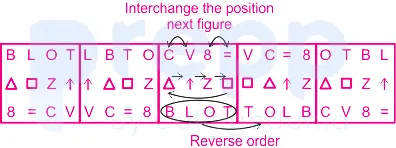
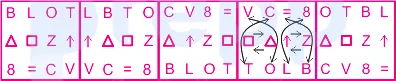 Paper & answer key PDF ↗
 Question 26archived
How many types of taxes were in the reign of the ruler Alauddin Khalji?
- A
3
- B
5
- C
6
- D
2
Show answer
A. 3Correct answer: 3
Number of Main Taxes: 3
Names of Main Taxes: Kharaj, Ghazi, Chari
Alauddin Khalji's tax system was part of a broader set of economic reforms. He also implemented strict market control measures to regulate prices of goods, particularly food grains, cloth, and other necessities. This was largely done to ensure stable prices for his large army and prevent hoarding. His control over revenue collection was stringent, often involving state officials directly assessing land produce rather than relying solely on intermediaries. The efficiency and severity of his tax collection methods were notable aspects of his reign, allowing him to maintain a powerful army and fund his expansionist policies.
Paper & answer key PDF ↗ Question 27archived
The bare ground between plants is covered with a layer of organic matter in order to retain soil moisture. This method is called ______.
- A
Mulching
- B
Rock dam
- C
Shelter belts
- D
Contour barriers
Show answer
A. MulchingMulching is the practice of covering the bare soil between plants with a layer of organic material such as straw, leaves, grass clippings or crop residue. The cover cuts evaporation from the soil surface, so moisture is retained; it also suppresses weeds and moderates soil temperature.
The other options are erosion-control structures, not moisture-retaining covers. A rock dam is a barrier of stones built across a gully to slow runoff and trap sediment. Shelter belts are rows of trees planted to break the wind. Contour barriers are stone or grass bunds laid along contour lines on a slope to check the flow of water.
Paper & answer key PDF ↗ Question 28archived
Husk of a coconut is made of ______ tissue.
- A
Collenchyma
- B
Xylem
- C
Sclerenchyma
- D
Parenchyma
Show answer
C. SclerenchymaUnderstanding Plant Tissues in Coconut Husk
The question asks about the specific type of plant tissue that constitutes the husk of a coconut. To answer this, we need to understand the different types of permanent plant tissues and their functions.
Permanent Plant Tissues: A Quick Overview
Permanent tissues are formed from meristematic tissues and have lost the ability to divide. They are specialized to perform specific functions. They are broadly classified into simple permanent tissues and complex permanent tissues.
Simple Permanent Tissues: Made up of only one type of cell. Examples include Parenchyma, Collenchyma, and Sclerenchyma.
Complex Permanent Tissues: Made up of more than one type of cell. Examples include Xylem and Phloem.
Analyzing the Options
1. Collenchyma Tissue
Collenchyma is a simple permanent tissue composed of living cells. The cells are elongated and have irregularly thickened cell walls, especially at the corners, due to the deposition of cellulose and pectin. Collenchyma provides mechanical support and flexibility to growing parts of the plant, such as young stems and leaf stalks (petioles). It is not typically found in mature, hard structures like a coconut husk.
2. Xylem Tissue
Xylem is a complex permanent tissue responsible for the transport of water and minerals from the roots to the rest of the plant. It also provides mechanical support. Xylem is composed of different types of cells, including tracheids, vessels, xylem parenchyma, and xylem fibres. While present in the coconut plant overall, the bulk of the fibrous husk is not primarily xylem tissue.
3. Sclerenchyma Tissue
Sclerenchyma is a simple permanent tissue composed of dead cells with heavily thickened and lignified cell walls. Lignin deposition makes the cell walls very hard and rigid. Sclerenchyma provides mechanical strength and support to plant parts and makes them tough and hard. There are two main types of sclerenchyma cells:
Fibres: Long, narrow, thick-walled cells, often found in bundles.
Sclereids: Irregularly shaped cells, also with thick, lignified walls, found in various parts like fruit walls (nuts), seed coats, and the pulp of some fruits.
The fibrous nature and the toughness of a coconut husk are characteristic features provided by sclerenchymatous fibres. These fibres give the husk its strength and durability.
4. Parenchyma Tissue
Parenchyma is a simple permanent tissue composed of living cells. These cells are typically isodiametric (roughly spherical) and have thin cell walls. Parenchyma performs various functions like storage of food and water, photosynthesis (when containing chloroplasts, called chlorenchyma), and secretion. Parenchyma is a fundamental tissue found widely in plants, but it does not provide the hard, fibrous structure of a coconut husk.
Conclusion: The Tissue of Coconut Husk
Based on the structure and function of these plant tissues, the tough and fibrous nature of the coconut husk is primarily due to the presence of sclerenchymatous fibres. These dead cells with heavily lignified walls provide the required mechanical strength and rigidity.
Therefore, the husk of a coconut is made of sclerenchyma tissue.
Comparison of Plant Tissues
Tissue Type
Cell Type
Cell Wall
Function
Typical Location
Parenchyma
Living
Thin, cellulosic
Storage, photosynthesis, secretion
Cortex, pith, leaves, roots
Collenchyma
Living
Unevenly thickened (cellulose, pectin)
Mechanical support & flexibility to growing parts
Young stems, leaf stalks
Sclerenchyma
Dead
Thick, lignified
Mechanical strength & rigidity
Mature stems, veins of leaves, seed coats, nut shells, fruit pulp, coconut husk
Xylem
Mostly Dead (except parenchyma)
Thick, lignified
Water & mineral transport, support
Vascular bundles throughout the plant
Revision Table: Key Plant Tissues
Summary of Tissue Types
Tissue
Cell State
Wall Thickness
Primary Role
Parenchyma
Living
Thin
Storage, basic functions
Collenchyma
Living
Unevenly Thickened
Support in growing parts
Sclerenchyma
Dead
Thick, Lignified
Strength, Support, Rigidity
Xylem
Mixed (mostly dead)
Thick, Lignified
Water transport, Support
Additional Information on Plant Tissues
Understanding the different types of plant tissues is fundamental in botany. Simple tissues like parenchyma, collenchyma, and sclerenchyma are composed of a single type of cell, making their identification and function relatively straightforward. Complex tissues like xylem and phloem involve multiple cell types working together for transport.
Sclerenchyma's role in providing rigidity is evident in many plant structures we encounter daily, from the gritty texture of pear fruit (due to sclereids) to the hardness of nut shells and, as discussed, the toughness of coconut husks. This tissue is crucial for protecting internal structures and providing structural integrity to mature plant parts.
The fibres from coconut husk, known as coir, are extracted and used commercially for various purposes like doormats, brushes, and filling material, specifically because of their durability and strength, which are properties endowed by the sclerenchyma tissue.
Paper & answer key PDF ↗ Question 29archived
In which of the following years was the Fit India Movement launched by Ministry of Youth Affairs and Sports, GoI?
- A
2018
- B
2001
- C
2020
- D
2019
Show answer
D. 2019Understanding the Fit India Movement Launch Year
The Fit India Movement is a nationwide campaign launched by the Government of India. Its primary aim is to encourage people to incorporate physical activity and sports into their daily lives, promoting a healthier lifestyle.
This significant initiative was launched under the purview of the Ministry of Youth Affairs and Sports, Government of India. Knowing the exact launch year of such national movements is often important for general knowledge and competitive exams.
Let's look at the options provided for the launch year:
2018
2001
2020
2019
Based on official records and information from the Ministry of Youth Affairs and Sports, the Fit India Movement was officially launched in the year 2019.
The launch event for the Fit India Movement took place on National Sports Day, which is celebrated on August 29th every year to honour the birth anniversary of hockey legend Major Dhyan Chand.
Therefore, the correct year among the options provided for the launch of the Fit India Movement by the Ministry of Youth Affairs and Sports, GoI, is 2019.
Fit India Movement Key Details
Aspect
Detail
Initiative Name
Fit India Movement
Launched By
Ministry of Youth Affairs and Sports, Government of India
Launch Year
2019
Objective
Promote physical fitness and healthy lifestyle
Launch Date Significance
National Sports Day (August 29th)
Revision Table: Fit India Movement Facts
Key Fact
Detail
Movement Goal
Encourage fitness in daily life
Governing Ministry
Youth Affairs and Sports
Year Launched
2019
Launch Occasion
National Sports Day
Additional Information on Fit India Movement
The Fit India Movement encompasses various initiatives and programs aimed at different segments of the population, including schools, colleges, government employees, and the general public. Some of the activities promoted include running, cycling, yoga, and traditional Indian sports.
The movement encourages individuals and organizations to participate in fitness activities and promotes the idea that fitness should be a way of life. It seeks to bring about a behavioral change among people towards a more active and healthy lifestyle.
The Ministry of Youth Affairs and Sports has been actively promoting this movement through various campaigns, awareness programs, and events across the country since its launch in 2019.
Paper & answer key PDF ↗ Question 30archived
Which of the following options is NOT correct about plant cells?
- A
Cell wall of a plant cell is made up of cellulose.
- B
The plant cells cannot divide by mitosis.
- C
A plant cell usually contains a large vacuole.
- D
Generally, all plant cells contain chloroplast.
Show answer
B. The plant cells cannot divide by mitosis.The question asks us to identify the statement that is NOT correct about plant cells. Let's examine each option carefully.
Understanding Key Features of Plant Cells
Plant cells have several distinct features that differentiate them from animal cells. These include a cell wall, chloroplasts (in photosynthetic tissues), and often a large central vacuole. They also undergo cell division for growth and reproduction.
Analyzing Option 1: Cell Wall Composition
The first statement says that the cell wall of a plant cell is made up of cellulose. Plant cells have a rigid cell wall located outside the cell membrane. This cell wall provides structural support, protection, and helps maintain cell shape. The primary component of this cell wall is indeed cellulose, a complex carbohydrate. Therefore, this statement is generally correct.
Analyzing Option 2: Cell Division by Mitosis
The second statement claims that plant cells cannot divide by mitosis. Mitosis is a fundamental process of cell division that results in two daughter cells genetically identical to the parent cell. This process is essential for growth, repair, and asexual reproduction in many organisms, including plants. Plant cells undergo mitosis extensively in areas of growth, such as root tips and shoot tips (meristems). Therefore, the statement that plant cells cannot divide by mitosis is incorrect.
Analyzing Option 3: Presence of a Large Vacuole
The third statement suggests that a plant cell usually contains a large vacuole. Mature plant cells typically possess a large central vacuole that can occupy a significant portion of the cell volume. This vacuole plays roles in maintaining turgor pressure against the cell wall, storage of water, nutrients, and waste products, and cellular waste disposal. While young plant cells may have smaller vacuoles, a large central vacuole is characteristic of mature plant cells. Thus, this statement is generally correct.
Analyzing Option 4: Presence of Chloroplasts
The fourth statement says that generally, all plant cells contain chloroplasts. Chloroplasts are organelles responsible for photosynthesis, the process by which light energy is converted into chemical energy. While chloroplasts are present in the parts of the plant exposed to light (like leaves and green stems), not all plant cells contain them. For example, root cells, which are typically underground and not involved in photosynthesis, do not have chloroplasts. Also, cells in flowers (petals) and some internal stem tissues may lack chloroplasts. Therefore, the statement that *all* plant cells *generally* contain chloroplasts is not entirely accurate, as there are significant exceptions.
Identifying the Incorrect Statement
Based on the analysis:
Option 1 is correct.
Option 2 is incorrect because plant cells do divide by mitosis.
Option 3 is generally correct, especially for mature cells.
Option 4 is not entirely correct as many plant cells (like root cells) lack chloroplasts.
Comparing Option 2 and Option 4, Option 2 makes an absolute false claim about a fundamental process (cell division by mitosis), whereas Option 4 uses the word "Generally" but still makes a statement that has significant exceptions. However, the statement that plant cells *cannot* divide by mitosis is fundamentally wrong and contradicts a basic principle of plant biology. Therefore, Option 2 is the most definitively incorrect statement among the choices provided.
Conclusion
The statement that is NOT correct about plant cells is that they cannot divide by mitosis.
Statement
Correctness
Explanation
Cell wall made of cellulose
Generally Correct
Cellulose is the primary component of the plant cell wall.
Cannot divide by mitosis
Incorrect
Plant cells divide by mitosis for growth and repair.
Usually contains a large vacuole
Generally Correct
Mature plant cells typically have a large central vacuole.
Generally, all contain chloroplast
Not entirely Correct
Many plant cells (e.g., root cells) lack chloroplasts.
Revision Table: Plant Cell Characteristics Facts
Characteristic
Description
Found In (Generally)
Cell Wall
Rigid outer layer made of cellulose
All plant cells
Mitotic Division
Process for growth and repair
Actively dividing plant cells (e.g., meristems)
Large Central Vacuole
Fluid-filled sac for storage and turgor
Mature plant cells
Chloroplasts
Sites of photosynthesis
Plant cells in photosynthetic tissues (e.g., leaves)
Additional Information: Plant Cell Biology
Beyond the features mentioned, plant cells also have other unique components and processes:
Plasmodesmata: These are channels that pass through the cell walls of adjacent plant cells, allowing for communication and transport between them.
Plastids: Chloroplasts are a type of plastid. Other plastids include chromoplasts (pigment storage, found in flowers and fruits) and amyloplasts (starch storage, found in roots and storage organs).
Meiosis: While somatic plant cells divide by mitosis, specific cells in the reproductive organs undergo meiosis to produce gametes (sperm and egg cells) or spores, which are involved in sexual reproduction. This contrasts with mitosis which is for growth and asexual multiplication of somatic cells.
Understanding these structures and processes is crucial for comprehending the biology of plants.
Paper & answer key PDF ↗ Question 31archived
The Government of India started DACE scheme in April 2022. This scheme was launched under which of the following ministries?
- A
Ministry of Social Justice and Empowerment
- B
Ministry of Corporate Affairs
- C
Ministry of Rural Development
- D
Ministry of Education
Show answer
A. Ministry of Social Justice and EmpowermentUnderstanding the DACE Scheme and its Ministry
The question asks about the ministry responsible for launching the DACE scheme in April 2022. Identifying the correct ministry is crucial for understanding the scope and focus of government initiatives.
The DACE scheme stands for Dr. Ambedkar Centres of Excellence (DACE) Scheme. This scheme was launched with the aim of providing high-quality free coaching facilities to Scheduled Caste (SC) students for Union Public Service Commission (UPSC) civil services examinations.
Given the target beneficiaries (Scheduled Caste students) and the nature of the scheme (social welfare and empowerment through education), we need to consider which ministry's portfolio aligns with these objectives.
Analyzing the Ministry Options
Let's look at the provided options and consider their typical areas of responsibility:
Ministry of Social Justice and Empowerment: This ministry is responsible for the welfare, social justice, and empowerment of disadvantaged sections of society, including Scheduled Castes, Other Backward Classes, senior citizens, persons with disabilities, etc. Schemes related to their education, welfare, and social inclusion fall under this ministry.
Ministry of Corporate Affairs: This ministry deals with the administration of the Companies Act and other related acts and rules, regulating the corporate sector in India. It is not typically involved in social welfare or education schemes for specific communities.
Ministry of Rural Development: This ministry is focused on socio-economic development in rural areas of India. While it might oversee schemes targeting rural populations, a scheme specifically for coaching SC students for UPSC exams is less likely to be its primary responsibility compared to a ministry focused on social justice.
Ministry of Education: This ministry oversees the education system in India. While it is responsible for educational policies and institutions, schemes specifically targeting the social upliftment of certain communities through education often fall under the purview of ministries dealing with those communities.
Identifying the Ministry for DACE Scheme
Considering the objectives of the DACE scheme – providing coaching for SC students for civil services exams – it directly aligns with the mandate of empowering disadvantaged sections of society through educational support.
Therefore, the Ministry of Social Justice and Empowerment is the most appropriate ministry responsible for launching and implementing the Dr. Ambedkar Centres of Excellence (DACE) Scheme.
The scheme was indeed launched by the Ministry of Social Justice and Empowerment in April 2022 from Banaras Hindu University (BHU), Varanasi.
Conclusion
Based on the analysis of the scheme's purpose and target group, the Dr. Ambedkar Centres of Excellence (DACE) scheme, launched in April 2022, falls under the purview of the Ministry of Social Justice and Empowerment.
Scheme
Launch Date
Responsible Ministry
Objective (Summary)
Dr. Ambedkar Centres of Excellence (DACE) Scheme
April 2022
Ministry of Social Justice and Empowerment
Free coaching for SC students for UPSC civil services exams.
Revision Table: Key Details of DACE Scheme
Feature
Detail
Scheme Name
Dr. Ambedkar Centres of Excellence (DACE) Scheme
Launch Month/Year
April 2022
Responsible Ministry
Ministry of Social Justice and Empowerment
Primary Target Group
Scheduled Caste (SC) students
Main Objective
Provide free coaching for UPSC civil services examination.
Additional Information on Relevant Ministries
Understanding the roles of different ministries helps in correctly identifying the authority behind various government schemes.
Ministry of Social Justice and Empowerment: Works towards the welfare, empowerment, and social justice for Scheduled Castes, OBCs, economically backward classes, senior citizens, drug abuse victims, and disabled persons.
Ministry of Corporate Affairs: Administers the Companies Act, 2013, the Limited Liability Partnership Act, 2008, and other related legislation.
Ministry of Rural Development: Focuses on poverty reduction, employment generation, rural infrastructure development, and land resources management in rural areas.
Ministry of Education: Responsible for the development of education in India, covering school education, higher education, adult education, and literacy.
The DACE scheme is a clear example of the Ministry of Social Justice and Empowerment's efforts to promote educational opportunities for the social upliftment of Scheduled Castes.
Paper & answer key PDF ↗ Question 32archived
Whose birthday is celebrated as International Day of Non-Violence?
- A
Rajendra Prasad
- B
Subhash Chandra Bose
- C
Jawaharlal Nehru
- D
Mahatma Gandhi
Show answer
D. Mahatma GandhiUnderstanding the International Day of Non-Violence
The question asks about the individual whose birthday is recognized globally as the International Day of Non-Violence. This day is celebrated to disseminate the message of non-violence through education and public awareness.
Mahatma Gandhi and Non-Violence
Mahatma Gandhi, often called the 'Father of the Nation' in India, was a pioneer of the philosophy and practice of satyagraha, or resistance through mass civil disobedience, firmly rooted in total non-violence.
Gandhi's principle of non-violence, or ahimsa, was central to India's independence movement.
His methods inspired movements for civil rights and freedom across the world.
The International Day of Non-Violence
The United Nations General Assembly, in a resolution adopted in June 2007, established 2 October as the International Day of Non-Violence. This date was specifically chosen because it is the birthday of Mahatma Gandhi.
The resolution reaffirmed "the universal relevance of the principle of non-violence" and the desire "to secure a culture of peace, tolerance, understanding and non-violence".
Why Other Options Are Not Correct
While the other individuals listed were significant figures in Indian history:
Rajendra Prasad: The first President of India. Not directly associated with a global day of non-violence based on his birthday.
Subhash Chandra Bose: A prominent nationalist leader, known for his more militant approach to achieving independence. His birthday is celebrated as Parakram Diwas in India.
Jawaharlal Nehru: India's first Prime Minister. His birthday (November 14) is celebrated as Children's Day (Bal Diwas) in India.
Therefore, the birthday celebrated globally as the International Day of Non-Violence is that of Mahatma Gandhi.
Conclusion on International Day of Non-Violence
The International Day of Non-Violence is celebrated on October 2nd every year to honour the life and teachings of Mahatma Gandhi, recognizing his profound contribution to the philosophy and practice of non-violence.
Leader
Birthday
Associated Significant Day/Event
Rajendra Prasad
December 3
First President of India
Subhash Chandra Bose
January 23
Parakram Diwas (India)
Jawaharlal Nehru
November 14
Children's Day (India)
Mahatma Gandhi
October 2
International Day of Non-Violence (Global), Gandhi Jayanti (India)
Revision Table: Key Figures and Birthdays
Figure
Birthday
Global/National Recognition
Mahatma Gandhi
October 2
International Day of Non-Violence
Jawaharlal Nehru
November 14
Children's Day (India)
Subhash Chandra Bose
January 23
Parakram Diwas (India)
Additional Information on Non-Violence and Gandhi
The principle of non-violence advocated by Mahatma Gandhi is not just the absence of physical violence. It is a positive force based on love and compassion. Gandhi believed that non-violence could be a powerful tool for social and political change.
Satyagraha: This term, coined by Gandhi, means 'truth force' or 'soul force'. It is a philosophy and practice of nonviolent resistance.
Ahimsa: A concept from Indian religions meaning 'not to injure' or 'non-killing'. Gandhi applied this concept broadly to all aspects of life, including thought, word, and deed.
The International Day of Non-Violence serves as an occasion to "disseminate the message of non-violence, including through education and public awareness."
Paper & answer key PDF ↗ Question 33archived
Which of the following Indian freedom fighters said that "Be the change you wish to see in the world"?
- A
Bipin Chandra Pal
- B
Mohammad Ali Jinnah
- C
Surendranath Banerjee
- D
Mahatma Gandhi
Show answer
D. Mahatma GandhiUnderstanding the Famous Quote on Change
The question asks about the origin of the famous quote, "Be the change you wish to see in the world." This quote is a powerful statement about personal responsibility and the idea that to transform society, one must first transform oneself. It encourages individuals to embody the principles and values they hope to see reflected in the world around them.
Identifying the Speaker: Indian Freedom Fighter
This particular quote is widely attributed to one of the most influential figures in the Indian independence movement and a global icon of peace and nonviolent resistance.
Bipin Chandra Pal: He was a prominent member of the Lal Bal Pal trio, known for his role in the Swadeshi movement and advocating for radical nationalism. While important, this specific quote is not associated with him.
Mohammad Ali Jinnah: He was the founder of Pakistan and a key leader of the Muslim League. His political philosophy and statements were focused on partition and the rights of Muslims in British India. This quote is not attributed to him.
Surendranath Banerjee: Known as one of the earliest Indian political leaders, he founded the Indian National Association and played a significant role in the early Indian National Congress. This quote is not linked to his known speeches or writings.
Mahatma Gandhi: Mohandas Karamchand Gandhi, revered as the 'Father of the Nation' in India, led the country to independence through his philosophy and practice of Satyagraha (nonviolent resistance). The quote "Be the change you wish to see in the world" perfectly encapsulates his life's work and teachings, emphasizing personal action and transformation as the basis for societal change. Although the exact wording might have evolved slightly over time in translation, the core idea is undoubtedly Gandhian.
Therefore, based on historical records and common attribution, Mahatma Gandhi is the Indian freedom fighter who is credited with this profound statement about initiating change through personal conduct.
Conclusion on the Quote's Origin
The quote "Be the change you wish to see in the world" is a cornerstone of Mahatma Gandhi's philosophy. It highlights his belief that external change begins with internal transformation and individual action. His own life was a testament to this principle, as he lived according to the values he advocated for.
Freedom Fighter
Association with the Quote
Bipin Chandra Pal
Not associated
Mohammad Ali Jinnah
Not associated
Surendranath Banerjee
Not associated
Mahatma Gandhi
Widely attributed
Revision Table: Key Indian Freedom Fighters
Name
Role/Contribution
Key Philosophy/Movement
Mahatma Gandhi
Leader of Indian Independence Movement
Satyagraha (Nonviolent Resistance), Swaraj (Self-rule)
Bipin Chandra Pal
Prominent Nationalist leader (Lal Bal Pal)
Swadeshi Movement, advocating radical methods
Mohammad Ali Jinnah
Founder of Pakistan, Leader of Muslim League
Two-Nation Theory, advocating for a separate Muslim state
Surendranath Banerjee
Early political leader, founder of Indian National Association
Moderate politics, early demand for self-governance
Additional Information on Gandhian Philosophy
Mahatma Gandhi's philosophy was deeply rooted in truth (Satya) and nonviolence (Ahimsa). He believed these principles were essential not only for political struggle but for personal and societal well-being. The idea of "being the change" is integral to his concept of Satyagraha, which is often translated as 'truth force' or 'soul force'. It requires individuals to actively live the truth and practice nonviolence in all aspects of their lives to bring about justice and change.
His ashrams were communities where people practiced these principles, demonstrating how a society based on truth and nonviolence could function. The quote serves as a simple yet profound summary of his complex teachings, urging personal accountability and action.
Paper & answer key PDF ↗ Question 34archived
In which year was Kalidas Samman established?
- A
1978
- B
1975
- C
1984
- D
1980
Show answer
D. 1980The Kalidas Samman is a prestigious arts award instituted by the Government of Madhya Pradesh in 1980, named after the classical Sanskrit poet Kalidasa, whose associations with the region are strong.
It is given annually for outstanding contribution in one of four fields — classical music, classical dance, theatre and the plastic arts — with the field rotating each year. Recipients have included doyens such as Ebrahim Alkazi, Kishori Amonkar, Birju Maharaj and Mrinalini Sarabhai.
The award is administered by the Ustad Alauddin Khan Sangeet Evam Kala Akademi in Bhopal and is presented at a public ceremony each year. Hence the year in which the Kalidas Samman was established is 1980, not 1975, 1978 or 1984.
Paper & answer key PDF ↗ Question 35archived
Who among the following has won Oscars as well as a Golden Globe award for his contribution to international music?
- A
Pt. Jasraj
- B
A. R. Rahman
- C
Ravi Shankar
- D
Zakir Hussain
Show answer
B. A. R. RahmanUnderstanding Prestigious Music Awards: Oscar and Golden Globe Winners
The question asks about a musician who has achieved the remarkable feat of winning both an Academy Award (Oscar) and a Golden Globe award for their contributions to international music, particularly in the realm of film scores.
Let's examine the options provided:
Pt. Jasraj: A legendary Indian classical vocalist. While highly acclaimed and awarded in the field of classical music, he is not primarily known for international film scores and has not won an Oscar or a Golden Globe.
A. R. Rahman: A globally renowned Indian composer, singer, and music producer. He is known for his work in Indian cinema and international projects. He gained significant international recognition, especially for his score and songs in the film "Slumdog Millionaire".
Ravi Shankar: A world-famous sitarist and composer of Indian classical music. He was a major influence on Western musicians and composed for some films, but he did not win an Oscar or a Golden Globe for international music.
Zakir Hussain: A celebrated tabla virtuoso and composer. He has collaborated with many international artists and composed for films, but he has not won both an Oscar and a Golden Globe.
A. R. Rahman's Oscar and Golden Globe Achievements
A. R. Rahman is the musician among the given options who has won both an Oscar and a Golden Globe award. His significant wins came for his work on the soundtrack of the 2008 film "Slumdog Millionaire".
Golden Globe: He won the Golden Globe Award for Best Original Score in 2009 for "Slumdog Millionaire".
Oscars: He won two Academy Awards (Oscars) in 2009:
Best Original Score for "Slumdog Millionaire".
Best Original Song for "Jai Ho" from "Slumdog Millionaire" (shared with lyricist Gulzar).
These awards are highly prestigious international recognitions, confirming his contribution to international music.
Comparing Achievements for Oscar and Golden Globe Wins
Let's look at a simple comparison regarding these specific awards:
Musician
Won Oscar?
Won Golden Globe?
Won Both for International Music?
Pt. Jasraj
No
No
No
A. R. Rahman
Yes (2)
Yes (1)
Yes
Ravi Shankar
Nominated (1)
No
No
Zakir Hussain
No
No
No
Based on the achievements, A. R. Rahman is the only musician among the choices who has won both an Oscar and a Golden Globe award for his contribution to international music.
Revision Table: Key Achievements in International Music Awards
Award
A. R. Rahman Wins
Year
Work
Golden Globe
Best Original Score
2009
Slumdog Millionaire
Academy Award (Oscar)
Best Original Score
2009
Slumdog Millionaire
Academy Award (Oscar)
Best Original Song
2009
"Jai Ho" (from Slumdog Millionaire)
Additional Information: Oscar and Golden Globe Awards
The Academy Awards (Oscars) are awards for artistic and technical merit in the film industry. They are regarded by many as the most prestigious and significant awards in the world of entertainment. The award for Best Original Score recognizes the best substantial body of music in the form of an original score composed specifically for the film, and Best Original Song recognizes the best song written specifically for a film.
The Golden Globe Awards are accolades bestowed by the Hollywood Foreign Press Association (HFPA) for excellence in both American and international film and television. The award for Best Original Score – Motion Picture is one of the major film categories.
Winning both of these awards for the same project, as A. R. Rahman did for "Slumdog Millionaire," is a significant achievement in the international film music landscape.
Paper & answer key PDF ↗ Question 36archived
Asia is separated from Europe by ______ mountains.
- A
Himalayan
- B
Andes Mountains
- C
Alps
- D
Ural
Show answer
D. UralUnderstanding the Separation of Continents: Europe and Asia
The question asks which mountain range acts as a geographical boundary separating the continents of Asia and Europe. Identifying this natural boundary is important in understanding the physical geography of the world.
Analyzing the Options for Europe-Asia Boundary
Let's examine each option provided:
Himalayan Mountains: The Himalayas are located in Asia, forming a border between the Indian subcontinent and the Tibetan Plateau. They do not separate Europe from Asia.
Andes Mountains: The Andes Mountains are located in South America, running along the western coast of the continent. They are not located between Europe and Asia.
Alps: The Alps are a major mountain range in Europe, spanning several countries like France, Switzerland, Italy, and Austria. They are located within Europe and do not separate Europe from Asia.
Ural Mountains: The Ural Mountains are a mountain range that runs roughly north to south through Western Russia. They are traditionally considered part of the conventional boundary separating the continents of Europe and Asia.
The Ural Mountains: Europe and Asia Boundary
The Ural Mountains are widely accepted as a significant part of the boundary between Europe and Asia. This boundary is not a single, sharp line, but the Urals serve as a primary geographical marker. The boundary is often considered to follow the eastern foot of the Ural Mountains, then the Ural River, the Caspian Sea, the Manych Depression, and the Black Sea. However, the Ural Mountains themselves are the most prominent mountain feature defining this separation.
Therefore, the mountain range that separates Asia from Europe is the Ural Mountains.
Revision Table: Major Mountain Ranges
Mountain Range
Location
Notable Features / Separation
Himalayan Mountains
Asia (South Asia/East Asia)
Separates the Indian subcontinent from the Tibetan Plateau; contains the world's highest peaks (e.g., Mount Everest).
Andes Mountains
South America
Longest continental mountain range in the world; runs along the western coast of South America.
Alps
Europe
Located within Europe; spans several countries like France, Switzerland, Italy, Austria, etc.
Ural Mountains
Russia (extends into Kazakhstan)
Traditionally considered a major part of the boundary between Europe and Asia.
Additional Information on Europe-Asia Boundary
While the Ural Mountains are a key part, the full traditional boundary between Europe and Asia also includes other geographical features. Understanding this helps clarify the concept of continental separation:
The Ural Mountains in Russia.
The Ural River, which flows from the southern Urals to the Caspian Sea.
The Caspian Sea.
The Manych Depression, which runs between the Caspian Sea and the Black Sea (sometimes the Caucasus Mountains are used instead).
The Black Sea.
The Turkish Straits (Bosphorus and Dardanelles) separating Europe (Thrace) and Asia (Anatolia).
It's important to note that the concept of continents is partly geographical and partly historical/cultural. The boundary is a convention, and there are different definitions, but the Ural Mountains are consistently cited as a primary physical divider.
Paper & answer key PDF ↗ Question 37archived
Which of the following states have the highest literacy rate, according to census 2011?
- A
Lakshadweep
- B
Goa
- C
Mizoram
- D
Kerala
Show answer
D. KeralaThe correct answer is Kerala.
There was a significant gap between male and female literacy rates. The male literacy rate was 82.14%, while the female literacy rate was 65.46%. Several factors influence literacy rates, including access to schools, socio-economic conditions, government policies, and awareness about the importance of education. Continuous efforts are being made through various government schemes and initiatives to improve literacy rates across all regions and demographic groups in India.
Paper & answer key PDF ↗ Question 38archived
The system based on individual leadership is a __________ system.
- A
semi-parliamentary
- B
parliamentary
- C
presidential
- D
semi-presidential
Show answer
C. presidentialUnderstanding Political Systems and Leadership
Political systems are structured in different ways, particularly concerning the relationship between the executive and legislative branches and the nature of leadership. The question asks about a system based on individual leadership.
Analyzing the Presidential System
The presidential system is characterized by a head of government who is also the head of state (the president). The president is typically elected independently of the legislature and holds significant executive power. This system embodies individual leadership because a single person, the president, is the primary figure responsible for the executive branch and government administration. The president forms their own cabinet, which is usually accountable to the president rather than the legislature.
Comparing with Other Systems
Parliamentary System: In contrast, a parliamentary system features a head of government (Prime Minister) who is usually the leader of the majority party or coalition in the legislature. The executive (cabinet) is drawn from and is accountable to the legislature. Leadership is often seen as more collective, resting with the cabinet and the Prime Minister who relies on legislative support.
Semi-presidential System: A semi-presidential system combines elements of both. It has both a president (often head of state with significant powers) and a prime minister (head of government responsible to the legislature). Leadership is shared or divided between the president and the prime minister, depending on the specific constitution of the country.
Semi-parliamentary System: This term is less commonly used than the others and can sometimes overlap with semi-presidential or even certain forms of parliamentary systems. However, systems emphasizing "individual leadership" strongly lean towards the model where a single elected executive head holds significant power, which is characteristic of the presidential system.
Based on the characteristic of individual leadership, where a single elected individual heads the executive branch and holds primary responsibility, the presidential system is the most fitting description.
Comparison of Leadership Structures
System
Nature of Leadership
Head of Government
Accountability
Presidential
Strong Individual Leadership (President)
President (Head of State & Govt)
Primarily to the electorate; less direct legislative accountability
Parliamentary
Collective Leadership (Cabinet led by PM)
Prime Minister
To the Legislature
Semi-presidential
Dual/Shared Leadership (President & PM)
Prime Minister (and President)
PM to Legislature; President typically to electorate
Therefore, a system based on individual leadership is identified as a presidential system.
Revision Table: Political System Key Terms
Term
Description
Executive Branch
The part of government responsible for enforcing laws.
Legislative Branch
The part of government responsible for making laws.
Presidential System
System where the president is head of state and government, elected separately from the legislature.
Parliamentary System
System where the head of government (PM) is part of the legislature and accountable to it.
Separation of Powers
Principle where government powers are divided among different branches (Executive, Legislature, Judiciary).
Additional Information: Powers of a President
In a typical presidential system, the president's powers often include:
Commander-in-chief of the armed forces.
Power to veto legislation passed by the legislature.
Appointment of cabinet members, judges, and other officials.
Heading foreign policy negotiations.
Issuing executive orders.
These extensive powers concentrated in the hands of one person further highlight the nature of individual leadership in this system.
Paper & answer key PDF ↗ Question 39archived
Which of the following rivers is NOT included in the ‘Panchnad’?
- A
The Beas
- B
The Sutlej
- C
The Indus
- D
The Ravi
Show answer
C. The IndusUnderstanding the Panchnad Rivers
The question asks to identify which river among the given options is NOT part of the 'Panchnad'. The term 'Panchnad' or 'Panjnab' is a Persian word meaning 'Five Rivers'. It refers to the five major rivers of the Punjab region.
Identifying the Five Panchnad Rivers
Historically, the Panchnad refers to the five principal rivers that flow through the Punjab region and eventually join the Indus River system. These five rivers are:
The Sutlej
The Beas
The Ravi
The Chenab
The Jhelum
These rivers originate in the Himalayas and are crucial to the geography and history of the Punjab plains.
Analyzing the Given Options
Now let's examine the rivers provided in the options and see if they are included in the list of the five Panchnad rivers:
The Beas: As listed above, the Beas is one of the five rivers that constitute the Panchnad.
The Sutlej: The Sutlej is also one of the five rivers of the Panchnad. It is the longest of the five rivers.
The Indus: The Indus River is a major river system in South Asia. While the five Panchnad rivers are tributaries of the Indus River and eventually merge into it before the Indus flows into the Arabian Sea, the Indus River itself is generally not considered one of the five rivers that make up the Panchnad. The Panchnad is formed by the confluence of these five rivers at a place called Panjnad in Pakistan, which then flows into the Indus.
The Ravi: The Ravi is another one of the five rivers included in the Panchnad.
Conclusion: Which River is Not in Panchnad?
Based on the analysis, the rivers Beas, Sutlej, and Ravi are part of the Panchnad. The Indus River, although connected to the Panchnad system as the main river that receives the combined flow of the five rivers, is not one of the five rivers that define the Panchnad itself.
Here is a summary:
River Option
Is it part of Panchnad?
The Beas
Yes
The Sutlej
Yes
The Indus
No
The Ravi
Yes
Therefore, the river that is NOT included in the ‘Panchnad’ is The Indus.
Revision Table: Key Facts about Panchnad Rivers
Term
Meaning
Rivers Included
Panchnad / Panjnab
Five Rivers
Sutlej, Beas, Ravi, Chenab, Jhelum
Additional Information on Indus River System and Panchnad
The Indus River System is one of the largest river systems in the world. It originates in the Tibetan Plateau and flows through India and Pakistan, eventually draining into the Arabian Sea. The Panchnad rivers are all significant tributaries of the Indus. The region through which these rivers flow is known as Punjab, literally meaning "Land of Five Waters". Understanding the distinction between the main Indus River and its tributaries that form the Panchnad is important for geographical studies.
Paper & answer key PDF ↗ Question 40archived
The final of the French Open (Roland Garros) Tennis 2021 for men took place on which day?
- A
13 June
- B
30 July
- C
13 July
- D
5 June
Show answer
A. 13 JuneUnderstanding the French Open 2021 Men's Final Date
The French Open, also known as Roland Garros, is one of the four Grand Slam tennis tournaments held each year. It is the premier clay court tennis tournament in the world and takes place over two weeks in late May and early June at the Stade Roland Garros in Paris, France. The tournament culminates with the men's and women's singles finals.
Key Event: French Open 2021 Men's Singles Final
The question asks about the specific date of the Men's Singles Final at the French Open (Roland Garros) in 2021. Grand Slam finals, including the French Open Men's Final, are typically held on the final weekend of the tournament. The Men's Singles Final is traditionally played on the last Sunday of the tournament.
For the 2021 French Open:
The tournament ran from May 30 to June 13, 2021.
The Women's Singles Final was held on Saturday, June 12, 2021.
The Men's Singles Final, the culminating event, was held on the following day, Sunday, June 13, 2021.
Therefore, the final match for the Men's singles competition at Roland Garros in 2021 was played on June 13.
Analyzing the Options for the French Open 2021 Date
Let's look at the provided options in relation to the actual date of the 2021 French Open Men's Final:
13 June: This aligns with the confirmed date of the Men's Singles Final in 2021.
30 July: This date is in July, well after the French Open typically concludes (usually by mid-June).
13 July: Similar to the previous option, this date in July does not correspond to the timeframe of the French Open.
5 June: This date falls during the first week of the 2021 French Open tournament, not the final weekend when the Men's Final takes place.
Based on the schedule of the 2021 French Open, the Men's Final was indeed held on June 13.
Revision Table: French Open Men's Final Dates
Year
Tournament
Men's Singles Final Date
2021
French Open (Roland Garros)
June 13
2022
French Open (Roland Garros)
June 5
2023
French Open (Roland Garros)
June 11
Additional Information: The Grand Slams
The French Open is one of the four major annual tennis tournaments, collectively known as the Grand Slams. These tournaments are highly prestigious and award the most ranking points. The four Grand Slam tournaments are:
Australian Open (held in Melbourne in late January)
French Open (Roland Garros) (held in Paris in late May/early June)
Wimbledon (held in London in late June/early July)
US Open (held in New York City in late August/early September)
Each Grand Slam has its unique surface, with the French Open being the only one played on clay courts.
Paper & answer key PDF ↗ Question 41archived
In 2022, Union Minister of Petroleum & Natural Gas Hardeep Singh Puri inaugurated Asia’s largest Compressed Bio Gas (CBG) plant in ________
- A
Gujarat
- B
Rajasthan
- C
Punjab
- D
Maharashtra
Show answer
C. PunjabAsia's Largest Compressed Bio Gas Plant Location
The question asks about the location of Asia's largest Compressed Bio Gas (CBG) plant that was inaugurated in 2022 by Union Minister of Petroleum & Natural Gas, Hardeep Singh Puri.
Compressed Bio Gas (CBG) is a renewable fuel produced from various organic waste sources like agricultural residue, cattle dung, sugarcane press mud, municipal solid waste, and sewage treatment plants. It is purified biogas, primarily consisting of methane, and can be used as a clean fuel similar to Compressed Natural Gas (CNG).
In 2022, a significant step was taken in India's efforts towards renewable energy and waste management with the inauguration of a large-scale CBG plant.
Based on official reports and announcements regarding the event:
The inauguration was performed by Union Minister Hardeep Singh Puri.
The plant was described as Asia's largest CBG plant at the time of inauguration.
The event took place in the state of Punjab.
This plant utilizes agricultural residue, such as paddy straw, which helps address the issue of stubble burning while simultaneously producing a valuable bio-fuel resource.
Analyzing the Options for CBG Plant Location
Let's look at the provided options:
Gujarat
Rajasthan
Punjab
Maharashtra
According to the information available about the inauguration of Asia's largest CBG plant in 2022 by the specified Union Minister, the location was in Punjab. Specifically, the plant is located in Lehragaga, Sangrur district, Punjab.
Therefore, among the given options, Punjab is the correct state where Asia's largest Compressed Bio Gas plant was inaugurated in 2022.
Understanding Compressed Bio Gas (CBG)
CBG is a crucial part of India's SATAT (Sustainable Alternative Towards Affordable Transportation) initiative, which aims to establish an ecosystem for the production of CBG from various waste and biomass sources. CBG has properties similar to CNG and can be used in vehicles and industrial applications.
Key benefits of CBG include:
Reducing reliance on fossil fuels.
Managing organic waste effectively, especially agricultural residue.
Creating economic opportunities in rural areas.
Reducing greenhouse gas emissions and air pollution (by preventing stubble burning).
The plant inaugurated in Punjab is a landmark project contributing significantly to these objectives.
Key Details of the CBG Plant Inauguration
Detail
Information
Plant Type
Compressed Bio Gas (CBG) Plant
Significance
Asia's Largest (as of inauguration)
Inaugurator
Union Minister Hardeep Singh Puri
Year of Inauguration
2022
Location State
Punjab
Location District/Town
Sangrur / Lehragaga (Specific location details often associated with the plant)
Revision Table: Compressed Bio Gas Plant
Summary of CBG Plant Facts
Concept
Description
Compressed Bio Gas (CBG)
Purified form of biogas, mainly methane, produced from organic waste.
Biogas Production
Anaerobic digestion of organic matter.
Asia's Largest Plant (2022)
Located in Punjab, India.
Purpose
Produce renewable fuel, manage waste (e.g., paddy straw).
Additional Information: Bioenergy and Waste Management
The development of large-scale CBG plants like the one in Punjab is part of India's broader strategy to promote bioenergy and improve waste management practices. Bioenergy sources include biomass like agricultural waste, forest residue, and organic municipal waste. Converting these into biofuels such as CBG helps in diversifying the energy mix and reducing dependence on imported fossil fuels.
Waste management is a critical challenge, particularly the handling of agricultural residue like paddy straw, which contributes significantly to air pollution when burned. CBG plants provide an economic and environmentally friendly solution by converting this waste into energy and organic fertilizer.
The SATAT initiative encourages entrepreneurs to set up CBG plants, offering procurement guarantees for the produced gas. This policy support is crucial for scaling up CBG production across the country.
Paper & answer key PDF ↗ Question 42archived
Identify the correct statement with respect to unsaturated hydrocarbons.
- A
Compounds of carbon having a single bond between their carbon atoms are called unsaturated compounds.
- B
Compounds of carbon having double bonds or triple bonds between their carbon atoms are called unsaturated compounds.
- C
Compounds of carbon having single bonds between their oxygen atoms are called unsaturated compounds.
- D
Compounds of carbon having double or triple bonds between their hydrogen atoms are called unsaturated compounds.
Show answer
B. Compounds of carbon having double bonds or triple bonds between their carbon atoms are called unsaturated compounds.Hydrocarbons are organic compounds made up only of carbon and hydrogen. They are classified by the nature of the carbon–carbon bond in the chain.
When adjacent carbon atoms are joined by only single bonds (e.g. methane, ethane), the compound is saturated because every carbon is bonded to the maximum possible number of hydrogens.
When two or more carbon atoms are linked by double bonds or triple bonds (e.g. ethene C=C, ethyne C≡C), fewer hydrogens are attached, and the compound is unsaturated. Such multiple bonds can undergo addition reactions, which is the defining chemistry of unsaturated hydrocarbons.
Hence the correct statement is option (B): compounds of carbon having double or triple bonds between their carbon atoms are called unsaturated compounds.
Paper & answer key PDF ↗ Question 43archived
Some important administrative posts were hereditary during the Rashtrakuta and Chola dynasties. What the post ‘nagara-shreshthi’ meant?
- A
Leader of the merchant caravans
- B
Merchant of the city
- C
Important minister
- D
Chief judicial officer
Show answer
B. Merchant of the cityUnderstanding Nagara-Shreshthi in Rashtrakuta and Chola Administration
The question asks about the meaning of the administrative post 'nagara-shreshthi' which was sometimes hereditary during the Rashtrakuta and Chola dynasties. Understanding the terminology used in historical periods helps in comprehending the administrative structure and societal roles.
What does 'Nagara-Shreshthi' Mean?
Let's break down the term 'nagara-shreshthi':
'Nagara' typically refers to a city or urban center.
'Shreshthi' is a term often used to denote a merchant, banker, or the head of a guild, signifying a person of considerable wealth and influence within the merchant community.
Combining these two parts, 'nagara-shreshthi' translates to a prominent merchant or the chief merchant of a city. These individuals played crucial roles in the economic life of the urban centers and often held significant social and sometimes political influence.
Role in Rashtrakuta and Chola Dynasties
During the Rashtrakuta and Chola periods, urban centers were hubs of trade and craft production. Merchants, especially the wealthy ones, organized themselves into guilds (like the manigramam or Ayyavole). The 'nagara-shreshthi' would likely have been a leading figure within these urban merchant communities or guilds, representing their interests and potentially participating in city administration or councils.
The mention that some administrative posts were hereditary suggests that certain prominent families or groups held influence in specific roles across generations, including potentially roles related to trade and urban administration like that of the 'nagara-shreshthi'.
Analyzing the Options
Let's look at the given options in light of the meaning of 'nagara-shreshthi':
Leader of the merchant caravans: This role is typically associated with terms like 'Sarthavaha', who led groups of merchants on long-distance trade routes, often between different cities or regions. While a 'nagara-shreshthi' could potentially be involved in such trade, the term itself points more towards a stationary position of influence within a single city.
Merchant of the city: This aligns perfectly with the linguistic breakdown of the term 'nagara-shreshthi' and its historical context. It represents a prominent merchant figure based within a specific urban area.
Important minister: A minister is generally a high-ranking official in the central government or a major administrative division, dealing with various aspects of governance (like finance, war, justice). While a 'nagara-shreshthi' was important and influential, their primary identity and role stemmed from their position within the merchant community, not necessarily a general ministerial portfolio in the state administration, although they might advise or participate in local urban governance.
Chief judicial officer: A judicial officer is responsible for legal matters and administering justice. This role is distinct from the activities of merchants and trade, and the term 'nagara-shreshthi' has no connection to judicial functions.
Based on the analysis, the most accurate meaning of 'nagara-shreshthi' is related to being a prominent merchant within a city.
Conclusion
The post of 'nagara-shreshthi' during the Rashtrakuta and Chola dynasties referred to an important merchant or the head of the merchant community/guild in a city. This highlights the significant role played by trade and merchant classes in the urban economy and administration of the time.
Revision Table: Rashtrakuta & Chola Administration Terms
Term
Meaning/Role
Context
Nagara-Shreshthi
Prominent city merchant / Head of city merchants/guilds
Urban administration, Trade
Sarthavaha
Leader of merchant caravans
Long-distance trade
Mahamatya
Chief Minister / Prime Minister
Central administration
Senapati
Commander of the Army
Military administration
Additional Information on Rashtrakuta and Chola Society
The Rashtrakuta and Chola periods saw flourishing trade, both internal and external. Merchant guilds were powerful organizations that regulated trade practices, set prices, and sometimes even acted as bankers. They often had their own militias to protect their caravans.
Merchant Guilds: Important guilds like Manigramam and Ayyavole (also known as Ayyavoli or Ainurruvar) were prominent in South India during this time. They operated across vast areas and had significant economic influence.
Urban Centers: Cities like Manyakheta (Rashtrakuta capital) and Thanjavur (Chola capital) were major centers of trade, administration, and cultural activity.
Hereditary Posts: While not all posts were hereditary, the tendency for certain roles, especially at local levels or within specific professional groups (like temple priests, village headmen, or perhaps guild leaders), to be passed down within families was a feature of the administrative system.
The existence and importance of a post like 'nagara-shreshthi' underscore the vital contribution of merchants to the prosperity and governance of the Rashtrakuta and Chola kingdoms.
Paper & answer key PDF ↗ Question 44archived
Which of the following is added in the national income to obtain personal income of the households?
- A
Net interest payments
- B
Transfer payments from government and firms
- C
Undistributed profits
- D
Corporate tax
Show answer
B. Transfer payments from government and firmsCalculating Personal Income from National Income
Understanding how national income is converted into personal income is a key concept in macroeconomics. National income represents the total income earned by the factors of production within an economy. However, not all of this income is actually received by households as personal income.
Personal income is the income received by individuals and households from all sources before direct taxes.
To derive personal income from national income, certain items are added, and others are subtracted. The items subtracted are those components of national income that are earned but not received by households. The items added are incomes received by households that are not part of the initially calculated national income.
Adjustments to National Income to Arrive at Personal Income
The general relationship can be expressed as:
\(\text{Personal Income} = \text{National Income} - \text{Undistributed Profits} - \text{Corporate Tax} - \text{Net Interest Payments by Households} + \text{Transfer Payments}\)
Let's look at why each adjustment is made:
Undistributed Profits: These are profits earned by corporations but not distributed to shareholders as dividends. They are part of national income (earned) but not received by households. Therefore, they are subtracted.
Corporate Tax: Taxes paid by corporations to the government from their profits. This is income earned by the firm but not received by households. Therefore, it is subtracted.
Net Interest Payments by Households: Interest paid by households to firms and government is income earned by firms/government but represents a payment made by households out of their income. Interest received by households from firms/government is income received. Net interest payments refer to interest paid by households minus interest received by households. Sometimes, this is simplified to just subtracting interest paid by households to firms/government. This adjustment accounts for interest flows related to household debt. This amount is subtracted from national income when deriving personal income because it represents a portion of income paid out by households, not received.
Transfer Payments from Government and Firms: These are payments made by the government (like social security, unemployment benefits, subsidies) or firms (like pensions, donations) to households for which no goods or services are currently provided in return. These are incomes received by households but are not included in national income (as they are not factor incomes). Therefore, they are added to national income to get personal income.
Analyzing the Options
The question asks what is added to national income to obtain personal income of the households. Based on our understanding of the adjustments:
Net interest payments: These (specifically, net interest paid by households) are generally subtracted, not added, when moving from national income to personal income.
Transfer payments from government and firms: These are payments received by households without providing current factor services, so they are added to national income to get personal income.
Undistributed profits: These are corporate profits not distributed as dividends; they are subtracted.
Corporate tax: Taxes paid by corporations; they are subtracted.
Therefore, the item that is added is transfer payments from government and firms.
Adjustments from National Income to Personal Income
Item
Added/Subtracted
Reason
Undistributed Profits
Subtracted
Earned but not received by households
Corporate Tax
Subtracted
Earned by firms but not received by households
Net Interest Payments by Households
Subtracted
Income paid out by households
Transfer Payments
Added
Received by households but not factor income
Conclusion on Personal Income Calculation
To bridge the gap between national income (income earned) and personal income (income received), we must account for income earned but not received by households (subtracted) and income received but not earned through factor services (added). Transfer payments fall into the latter category.
Revision Table: National Income & Personal Income
Key Differences and Adjustments
Concept
Description
Relationship to the Other
National Income (NI)
Total factor income earned by residents
Foundation for calculating Personal Income
Personal Income (PI)
Total income received by households from all sources before direct taxes
Derived from NI by adding transfers and subtracting non-received items
Transfer Payments
Payments received by households without current production (e.g., benefits, pensions)
Added to NI to get PI
Additional Information: Income Concepts in Economics
Understanding national income and personal income helps us analyze the distribution of income in the economy. These are just two of several important income aggregates economists use.
Gross Domestic Product (GDP): Total market value of all final goods and services produced within a country's borders in a specific period.
Gross National Product (GNP): Total market value of all final goods and services produced by a country's residents, regardless of location.
Net National Product (NNP): GNP minus depreciation. It represents the net output of the economy.
National Income (NI): NNP minus indirect taxes plus subsidies. It's the sum of all factor incomes (wages, rent, interest, profit).
Personal Income (PI): Income received by households before direct taxes.
Personal Disposable Income (PDI): Personal Income minus personal direct taxes. This is the income households actually have available to spend or save.
Each of these aggregates provides a different perspective on economic activity and income generation/receipt.
Paper & answer key PDF ↗ Question 45archived
Who conducted an X-ray spectroscopic study of a large number of elements and showed that the frequency of X-rays emitted by an element is related to the atomic number, Z, rather than the atomic mass?
- A
Lothar Meyer
- B
Dmitri Mendeleev
- C
Henry Moseley
- D
Johann Dobereiner
Show answer
C. Henry MoseleyUnderstanding Henry Moseley's X-ray Spectroscopy Work
Early attempts at organizing elements, like those by Dmitri Mendeleev and Lothar Meyer, were primarily based on atomic mass. However, there were some inconsistencies in the periodic table when elements were arranged strictly by increasing atomic mass.
A significant breakthrough came from the work of Henry Moseley.
Moseley's Experiment and Discovery
Henry Moseley conducted pioneering experiments using X-ray spectroscopy. He studied the characteristic X-rays emitted by a large number of different elements when bombarded with high-energy electrons. His careful measurements revealed a very simple and consistent relationship between the frequency of the emitted X-rays and the element's position in the periodic table.
Moseley found that the square root of the frequency ($\sqrt{\nu}$) of the characteristic X-rays emitted by an element is directly proportional to its atomic number ($Z$). This relationship is known as Moseley's Law and can be expressed as:
\(\sqrt{\nu} = a(Z - b)\)
Where:
\(\nu\) is the frequency of the characteristic X-ray.
\(Z\) is the atomic number of the element.
\(a\) and \(b\) are constants that depend on the specific type of X-ray series (e.g., K-series, L-series).
This was a crucial finding because it showed that the fundamental property determining an element's chemical behavior and its place in the periodic table is its atomic number ($Z$), which represents the number of protons in the nucleus, rather than its atomic mass.
Impact on the Periodic Table
Moseley's work provided a solid experimental basis for arranging elements by atomic number. This resolved the anomalies found in Mendeleev's periodic table where some elements had to be placed out of atomic mass order to fit their chemical properties (e.g., Argon and Potassium, Cobalt and Nickel). Arranging elements by increasing atomic number became the standard for the modern periodic table.
Analyzing the Options
Lothar Meyer: Contributed significantly to the periodic classification of elements based on physical properties plotted against atomic mass, but did not use X-ray spectroscopy or relate properties to atomic number.
Dmitri Mendeleev: Developed one of the earliest widely accepted periodic tables, arranging elements primarily by atomic mass and predicting properties of undiscovered elements. However, his arrangement was based on chemical properties and atomic mass, not X-ray frequencies and atomic number.
Henry Moseley: Conducted the X-ray spectroscopic studies that established the relationship between characteristic X-ray frequencies and atomic number ($Z$), proving atomic number is the fundamental property for element arrangement. This matches the question description.
Johann Dobereiner: Known for his work on 'triads,' grouping elements with similar properties in sets of three, based on atomic mass. This was an early attempt at classification but not related to X-ray spectroscopy or atomic number.
Therefore, the scientist who conducted the X-ray spectroscopic study and showed the relationship between X-ray frequency and atomic number is Henry Moseley.
Comparison of Scientists and Their Contributions to Periodic Classification
Scientist
Key Contribution to Classification
Method Used
Basis of Arrangement
Johann Dobereiner
Law of Triads
Observing chemical properties
Atomic Mass (average of two elements in a triad)
Lothar Meyer
Periodic trends in physical properties (e.g., atomic volume)
Plotting properties against atomic mass
Atomic Mass
Dmitri Mendeleev
Periodic Law, First comprehensive periodic table, predicted new elements
Observing chemical properties
Atomic Mass (with some exceptions based on properties)
Henry Moseley
Moseley's Law, established atomic number as fundamental basis
X-ray Spectroscopy
Atomic Number
Conclusion
Based on the analysis of the question and the contributions of the scientists listed, Henry Moseley is the correct answer.
Revision Table: Henry Moseley's X-ray Spectroscopy
Key Facts about Moseley's Work
Aspect
Details
Scientist
Henry Moseley
Technique Used
X-ray Spectroscopy
Observation
Characteristic X-rays emitted by elements
Discovery (Moseley's Law)
\(\sqrt{\nu} \propto Z\) (Square root of X-ray frequency is proportional to Atomic Number)
Significance
Established Atomic Number (Z) as the fundamental basis for element arrangement in the periodic table, replacing Atomic Mass. Resolved anomalies in earlier periodic tables.
Additional Information: Atomic Number and the Periodic Table
The atomic number ($Z$) of an element is equal to the number of protons in the nucleus of an atom of that element. In a neutral atom, the number of electrons is also equal to the atomic number. The atomic number uniquely identifies an element.
Before Moseley's work, atomic mass was considered the primary property for ordering elements. While atomic mass generally increases with atomic number, there are exceptions (isobars) and cases where the order based on mass differs from the order based on properties. Moseley's discovery provided the physical basis for ordering elements by atomic number.
The arrangement of the modern periodic table, based on increasing atomic number, naturally groups elements with similar chemical properties in vertical columns (groups) and shows periodic trends across horizontal rows (periods). This arrangement is a direct consequence of the electronic structure of atoms, which is fundamentally determined by the number of protons (atomic number).
Moseley's experiments were crucial not only for the periodic table but also for understanding atomic structure, providing early evidence for the concept of nuclear charge and the number of protons.
Paper & answer key PDF ↗ Question 46archived
Which Five-Year Plan in India was mainly focussed on Garibi Hatao, creation of employment opportunities and agricultural production amongst other objectives?
- A
Fifth
- B
Fourth
- C
Third
- D
Second
Show answer
A. FifthThe correct answer is Fifth.
Similarly, strengthening agricultural production was vital for food security, controlling inflation, and supporting the large rural population, many of whom lived below the poverty line. While the plan was officially for 1974-1979, it was terminated a year early in 1978 by the Janata Party government, which introduced a new "Rolling Plan". However, the objectives and programmes initiated during the Fifth Five-Year Plan significantly shaped India's approach to poverty alleviation for years to come.
Paper & answer key PDF ↗ Question 47archived
What are the two most essential rights of a democracy?
- A
Exploitation, Preventive detention
- B
Equality, Liberty
- C
Liberty, Preventive detention
- D
Equality, Exploitation
Show answer
B. Equality, LibertyA democracy is a system of government where power is vested in the people and exercised by them directly or indirectly through a system of representation, usually involving periodic free and fair elections. For such a system to function effectively and truly represent the people, certain fundamental rights are absolutely essential. These rights ensure that individuals can participate freely, express themselves, and are treated fairly within society.
Understanding Essential Rights in Democracy
In a democratic society, the rights of individuals are paramount. These rights protect citizens from arbitrary rule and allow them to hold their government accountable. While many rights are important, some are considered foundational pillars upon which democracy stands.
Why Equality is Essential in Democracy
Equality is a cornerstone of democracy. It means that all citizens are equal before the law and should have equal opportunities to participate in the political process, social life, and economic activities. This principle prevents discrimination based on factors like race, religion, gender, or social status. Without equality, certain groups could be marginalized, undermining the very idea of rule by the people.
Ensures fair treatment for all citizens.
Promotes equal access to justice and opportunities.
Prevents discrimination and protects minority rights.
Why Liberty is Essential in Democracy
Liberty, or freedom, is equally vital. It encompasses various freedoms, including freedom of speech, expression, assembly, association, and the right to personal autonomy. These liberties allow citizens to voice their opinions, criticize the government, organize political movements, and make choices about their own lives without undue interference. Liberty is necessary for a vibrant public sphere and informed decision-making by the electorate.
Allows citizens to express views and participate in public debate.
Enables peaceful assembly and protest.
Protects individuals from arbitrary state power.
Analyzing Other Options in the Context of Democracy
Let's look at the other concepts mentioned in the options:
Exploitation: This is the opposite of a democratic principle. Democracy aims to protect people from exploitation, not consider it a right. Exploitation involves taking unfair advantage of others.
Preventive detention: This is a legal concept where a person is detained to prevent them from committing a future crime. While it exists in some legal systems, often with strict safeguards, it is generally seen as a restriction on liberty, not an essential right of democracy itself. It's a power the state might exercise, not a right citizens possess to ensure democracy.
Based on the fundamental principles and requirements for a functioning democracy, Equality and Liberty are the two most essential rights.
Concept
Relation to Democracy
Essential Right?
Equality
Ensures fair treatment and equal participation.
Yes
Liberty
Guarantees freedoms like speech, assembly, etc.
Yes
Exploitation
Opposite of democratic principles; to be prevented.
No
Preventive detention
State power (often restricted); limits liberty.
No
Conclusion on Essential Democratic Rights
The combination of Equality and Liberty provides the necessary conditions for citizens to live freely, participate politically, and be treated with dignity. Without these two essential rights, a system claiming to be a democracy would lack the fundamental safeguards and freedoms required for genuine self-governance by the people.
Revision Table: Key Democratic Rights
Right
Why it's Essential
Equality
Ensures everyone is treated fairly and has equal opportunities under the law and in society. Fundamental for political participation and justice.
Liberty
Grants individuals essential freedoms like speech, expression, assembly, and personal choice, vital for a free society and holding power accountable.
Additional Information: Pillars of Democracy
Beyond Equality and Liberty, other elements are crucial for a stable democracy:
Rule of Law: Everyone, including those in power, is subject to and accountable under the law.
Political Pluralism: Existence of multiple political parties and viewpoints.
Respect for Human Rights: Protection of universal rights and fundamental freedoms.
Citizen Participation: Active involvement of citizens in political and civic life.
These elements together help sustain a healthy democratic system where essential rights like Equality and Liberty can thrive.
Paper & answer key PDF ↗ Question 48archived
In March 2022, the “Stree Manoraksha project” was launched by which of the following Union Minister?
- A
Union Minister for Education
- B
Union Minister for Women and Child Development
- C
Union Minister for Law and Justice
- D
Union Minister for Health and Family Welfare
Show answer
B. Union Minister for Women and Child DevelopmentUnderstanding the Stree Manoraksha Project Launch
The question asks about the Union Minister who launched the “Stree Manoraksha project” in March 2022. This project is an initiative aimed at improving the mental health of women in India, especially those who have been victims of violence and distress.
To answer this, we need to identify which ministry and therefore, which minister, would typically be responsible for a project focusing on women's well-being and mental health support. Government projects related to women's welfare, protection, and development usually fall under the purview of the Ministry of Women and Child Development.
Upon checking official sources and news reports from March 2022 regarding the launch of the Stree Manoraksha project, it is confirmed that the project was indeed launched by the Union Minister responsible for Women and Child Development in collaboration with NIMHANS (National Institute of Mental Health and Neurosciences), Bengaluru.
Analyzing the Options for the Stree Manoraksha Project
Let's look at the given options and see which one aligns with the launch of the Stree Manoraksha project:
Union Minister for Education: This ministry primarily deals with educational policies, institutions, and literacy. While mental health in educational institutions is gaining importance, a project focused broadly on women victims of violence is less likely to be launched directly by this ministry.
Union Minister for Women and Child Development: This ministry is the nodal agency for matters relating to the welfare, health, nutrition, and development of women and children. A project like Stree Manoraksha, which provides mental health support to women, aligns perfectly with the mandate of this ministry.
Union Minister for Law and Justice: This ministry handles legal affairs, justice delivery, and legislative matters. While they are involved in laws related to women's safety and rights, launching a specific mental health support project for women is not their primary function.
Union Minister for Health and Family Welfare: This ministry is responsible for health policies, healthcare services, and family welfare programs nationwide. Mental health is a critical area for this ministry, and they often collaborate on such projects. However, the specific launch event for the Stree Manoraksha project was spearheaded by the ministry directly responsible for women's welfare.
Based on the project's focus on women's welfare and mental health, and confirmation from launch details, the Union Minister for Women and Child Development is the correct authority who launched the Stree Manoraksha project in March 2022.
Conclusion: Stree Manoraksha Project Launching Authority
The Stree Manoraksha project, aimed at improving the mental well-being of women, especially those facing violence and distress, was a significant initiative. Its launch in March 2022 was carried out by the ministry dedicated to the welfare and development of women.
Therefore, the Union Minister who launched the “Stree Manoraksha project” was the Union Minister for Women and Child Development.
Revision Table: Stree Manoraksha Project Details
Project Name
Focus Area
Launch Month & Year
Launched By (Ministry)
Stree Manoraksha Project
Mental health improvement for women, especially victims of violence/distress
March 2022
Ministry of Women and Child Development
Additional Information: Women and Child Development Ministry Initiatives
The Ministry of Women and Child Development undertakes various programs and schemes for the protection, health, and empowerment of women and children in India. Some examples include:
One Stop Centres (OSCs) which provide integrated support and assistance to women affected by violence.
Mahila Police Volunteers Scheme to create a link between police and community to prevent crime against women.
Pradhan Mantri Matru Vandana Yojana (PMMVY), a maternity benefit program.
Beti Bachao Beti Padhao scheme focusing on the declining Child Sex Ratio.
The Stree Manoraksha project is an addition to these efforts, specifically addressing the crucial aspect of mental health for vulnerable women, often linked with services provided by One Stop Centres.
Paper & answer key PDF ↗ Question 49archived
Jata-Jatin is the folk dance of which Indian state?
- A
Manipur
- B
Odisha
- C
Bihar
- D
West Bengal
Show answer
C. BiharUnderstanding the Jata-Jatin Folk Dance
The question asks about the origin state of the folk dance known as Jata-Jatin. Folk dances are an integral part of India's rich cultural heritage, often reflecting the lifestyle, traditions, and social events of a region. Identifying the correct state requires specific knowledge of Indian folk forms.
Identifying Jata-Jatin's Origin
Jata-Jatin is a prominent folk dance, particularly popular in the Mithila region of Bihar. It is traditionally performed during the monsoon season, from the month of Sawan to Bhado (roughly July to September).
The dance is typically performed by women and depicts the story of Jata (the husband) and Jatin (the wife) and their journey, struggles, and love story. It often touches upon themes like the separation of lovers due to work, the difficulties of life, and social issues.
Analysing the Options
Let's look at the provided options and their well-known folk dances to confirm the origin of Jata-Jatin:
Manipur: Famous for Manipuri Dance (a classical dance form), Thang-Ta (martial dance), and various folk dances like Lai Haraoba. Jata-Jatin is not associated with Manipur.
Odisha: Known for Odissi Dance (a classical dance form), and folk dances such as Sambalpuri, Ghumura, Gotipua, and Chhau (parts of which are in Odisha). Jata-Jatin is not a folk dance of Odisha.
Bihar: Jata-Jatin is a widely recognised folk dance originating from the state of Bihar, specifically popular in the Mithila and Kosi regions. Other folk dances of Bihar include Bidesia, Kajari, Sohar-Khilouna, and Jhijhiya.
West Bengal: Has diverse folk forms like Baul, Chhau (Purulia style), Gombhira, and Lathi Khela. Jata-Jatin is not native to West Bengal.
Based on the analysis of popular folk dances from each state, Jata-Jatin is definitively linked to Bihar.
Conclusion
The folk dance Jata-Jatin belongs to the state of Bihar. It is a significant cultural expression, particularly in the Mithila region, depicting social themes and performed during the monsoon.
Revision Table: Folk Dances by State
State
Associated Folk/Classical Dances
Manipur
Manipuri (Classical), Thang-Ta, Lai Haraoba
Odisha
Odissi (Classical), Sambalpuri, Ghumura, Chhau (parts)
Bihar
Jata-Jatin, Bidesia, Kajari, Jhijhiya
West Bengal
Baul, Chhau (Purulia), Gombhira
Additional Information on Bihar's Folk Dances
Bihar has a rich tradition of folk dances that reflect its vibrant culture and agricultural cycles. These dances are often performed during festivals, social gatherings, and seasonal changes.
Bidesia: Popularised by Bhikhari Thakur, dealing with themes of migration and its impact on rural life.
Kajari: Performed during the monsoon season, often expressing the feelings of women separated from their loved ones.
Jhijhiya: A dance performed by women during the Durga Puja festival, often involving balancing pots on their heads.
Sohar-Khilouna: Celebratory dances performed during childbirth.
Jata-Jatin stands out due to its narrative structure, focusing on the lives and relationship of a couple, making it a unique storytelling through dance form in Bihar.
Paper & answer key PDF ↗ Question 50archived
Mughal ruler, Aurangzeb died in which year?
- A
1703
- B
1705
- C
1707
- D
1701
Show answer
C. 1707The question asks about the death year of the famous Mughal ruler, Aurangzeb. Finding the correct year requires recalling key dates in the history of the Mughal Empire in India.
Understanding the Mughal Ruler Aurangzeb
Aurangzeb, also known as Alamgir I, was one of the most prominent Mughal emperors. He reigned for a significant period, and his death marked a turning point in the history of the Mughal Empire. Knowing the year of his death is important for understanding the later phase of Mughal rule.
Determining Aurangzeb's Death Year
Historical records consistently indicate the year of Mughal ruler Aurangzeb's death. He died in the Deccan, in the Ahmadnagar camp.
Let's look at the options provided:
1703
1705
1707
1701
Based on historical facts, the correct year of Aurangzeb's death is 1707.
Significance of Aurangzeb's Death in 1707
The death of Mughal ruler Aurangzeb in 1707 is often considered the end of the effective rule of the great Mughals. After his death, the empire faced numerous challenges, including succession struggles, regional rebellions, and the rise of independent kingdoms, which eventually led to its decline.
Event
Year
Death of Mughal Ruler Aurangzeb
1707
Revision Table: Key Mughal Dates
Mughal Ruler
Reign Period (Selected)
Significant Event
Babur
1526 – 1530
Founder of Mughal Empire
Akbar
1556 – 1605
Expansion and consolidation
Shah Jahan
1628 – 1658
Builder of Taj Mahal
Aurangzeb
1658 – 1707
Last major Mughal Emperor; Empire at its largest extent
Additional Information about Mughal Emperor Aurangzeb
Aurangzeb's full name was Muhi-ud-Din Muhammad. He was the sixth Mughal emperor. His reign from 1658 to 1707 was the longest among the Mughal emperors, lasting 49 years. While he expanded the empire to its greatest territorial extent, his policies are also subjects of historical debate regarding their impact on the stability and future of the empire.
Paper & answer key PDF ↗ Question 51archived
In an equilateral triangle ABC, D is the midpoint of side BC. If the length of BC is 8 cm, then the height of the triangle is:
- A
5.5 cm
- B
4.5 cm
- C
\(6\sqrt 3 \) cm
- D
\(4\sqrt 3\) cm
Show answer
D. \(4\sqrt 3\) cmUnderstanding the Equilateral Triangle Problem
The question asks us to find the height of an equilateral triangle ABC. We are given that D is the midpoint of side BC, and the length of BC is 8 cm.
In an equilateral triangle, all sides are equal in length, and all angles are equal to 60 degrees. Since BC is 8 cm, sides AB and AC are also 8 cm each.
The height of an equilateral triangle is the perpendicular distance from a vertex to the opposite side. When we draw the height from vertex A to side BC, it meets BC at point D, because D is the midpoint of BC. This height (AD) is also the median and angle bisector in an equilateral triangle. The height AD is perpendicular to BC.
Using the Pythagorean Theorem
When the height AD is drawn to the base BC, it divides the equilateral triangle ABC into two congruent right-angled triangles, ADB and ADC.
Consider the right-angled triangle ADB:
The hypotenuse is AB, which is a side of the equilateral triangle, so AB = 8 cm.
The base is BD, which is half the length of BC because D is the midpoint of BC. So, BD = BC / 2 = 8 cm / 2 = 4 cm.
The height is AD, which we need to find. Let's call the height \(h\).
According to the Pythagorean theorem, in a right-angled triangle, the square of the hypotenuse is equal to the sum of the squares of the other two sides. For triangle ADB:
\(AD^2 + BD^2 = AB^2\)
Substituting the values we know:
\(h^2 + 4^2 = 8^2\)
\(h^2 + 16 = 64\)
Now, we solve for \(h^2\):
\(h^2 = 64 - 16\)
\(h^2 = 48\)
To find \(h\), we take the square root of both sides:
\(h = \sqrt{48}\)
We can simplify \(\sqrt{48}\) by finding the largest perfect square factor of 48. 48 can be written as \(16 \times 3\). The square root of 16 is 4.
\(h = \sqrt{16 \times 3} = \sqrt{16} \times \sqrt{3} = 4\sqrt{3}\)
So, the height of the equilateral triangle is \(4\sqrt{3}\) cm.
Alternative Method: Formula for Height of Equilateral Triangle
The height \(h\) of an equilateral triangle with side length \(a\) can be directly calculated using the formula:
\(h = \frac{\sqrt{3}}{2} a\)
In this problem, the side length \(a = 8\) cm. Substituting this value into the formula:
\(h = \frac{\sqrt{3}}{2} \times 8\)
\(h = 4\sqrt{3}\)
Thus, the height of the equilateral triangle is \(4\sqrt{3}\) cm.
Summary of Steps
Identify the properties of the equilateral triangle and the given information (side length = 8 cm).
Recognize that the height to the base bisects the base, creating a right-angled triangle.
Determine the lengths of the sides of the right-angled triangle (hypotenuse = 8 cm, base = 4 cm).
Use the Pythagorean theorem (\(h^2 + base^2 = hypotenuse^2\)) or the direct formula for the height of an equilateral triangle (\(h = \frac{\sqrt{3}}{2} a\)).
Calculate the height \(h\).
Property
Value
Type of Triangle
Equilateral Triangle
Side Length (a)
8 cm
Base of Right Triangle (a/2)
4 cm
Hypotenuse of Right Triangle (a)
8 cm
Height (h)
\(4\sqrt{3}\) cm
Revision Table: Key Triangle Concepts
Triangle Type
Properties
Height Calculation
Equilateral
All sides equal, all angles 60°
\(h = \frac{\sqrt{3}}{2} a\)
Isosceles
Two sides equal, two angles equal
Height to unequal side forms two congruent right triangles; use Pythagorean theorem
Scalene
All sides different, all angles different
More complex; often involves trigonometry or Heron's formula for area
Right-angled
One angle is 90°
One leg can be considered the height if the other leg is the base
Additional Information on Geometric Shapes and Measurements
Geometry deals with the properties and relations of points, lines, surfaces, solids, and higher dimensional analogs. Triangles are fundamental geometric shapes. Calculating lengths, areas, and volumes are common tasks.
The Pythagorean theorem (\(a^2 + b^2 = c^2\)) is crucial for solving problems involving right-angled triangles. It relates the lengths of the two legs (\(a\) and \(b\)) to the length of the hypotenuse (\(c\)).
Understanding the special properties of equilateral triangles, such as the relationships between their sides, angles, height, median, and angle bisector, simplifies problem-solving. The height not only gives the vertical dimension but also helps in calculating the area of the triangle using the formula: Area = \(\frac{1}{2} \times base \times height\).
Paper & answer key PDF ↗ Question 52archived
A thief steals a bike at 12:30 p.m. and drives it at 48 km/h. But the theft is discovered after half an hour. The bike owner starts to chase him on another bike at 58 km/h. The thief will be caught at ________.
- A
3:40 p.m.
- B
3:54 p.m.
- C
3:10 p.m.
- D
3:24 p.m.
Show answer
D. 3:24 p.m.Understanding the Bike Theft Problem
This problem involves calculating the time it takes for a faster object (the owner) to catch up to a slower object (the thief) when the slower object has a head start. This is a classic relative speed problem.
Analyzing the Scenario and Given Information
Let's break down the information provided in the question:
Event 1: Thief steals the bike at 12:30 p.m.
Thief's Speed: 48 km/h.
Event 2: Theft is discovered after half an hour.
Chase Start Time: 12:30 p.m. + 30 minutes = 1:00 p.m.
Owner's Speed: 58 km/h.
The owner starts chasing the thief from the same point the theft occurred, but 30 minutes later.
Calculating the Thief's Head Start Distance
Before the owner starts chasing, the thief has been riding the bike for 30 minutes (half an hour). We need to calculate how far the thief travelled in this time.
Distance = Speed $\times$ Time
Time = 30 minutes = 0.5 hours
Thief's distance covered before chase = $48 \text{ km/h} \times 0.5 \text{ hours} = 24 \text{ km}$.
So, when the owner starts the chase at 1:00 p.m., the thief is already 24 km ahead.
Determining the Relative Speed
The owner is chasing the thief. Since they are moving in the same direction, the owner gains on the thief at a rate equal to the difference in their speeds. This is called the relative speed.
Relative Speed = Owner's Speed - Thief's Speed
Relative Speed = $58 \text{ km/h} - 48 \text{ km/h} = 10 \text{ km/h}$.
This means the distance between the owner and the thief decreases by 10 km every hour.
Calculating the Time to Catch the Thief
The owner needs to cover the 24 km head start the thief has gained. The owner covers this distance at the relative speed of 10 km/h.
Time to Catch Up = Distance to Cover / Relative Speed
Time to Catch Up = $24 \text{ km} / 10 \text{ km/h} = 2.4 \text{ hours}$.
Converting Time to Hours and Minutes
The time calculated is 2.4 hours. We need to convert this into hours and minutes:
2.4 hours = 2 full hours + 0.4 of an hour.
To convert 0.4 hours to minutes: $0.4 \times 60 \text{ minutes/hour} = 24 \text{ minutes}$.
So, the time taken to catch the thief is 2 hours and 24 minutes.
Finding the Exact Time the Thief is Caught
The chase started at 1:00 p.m.
The chase lasts for 2 hours and 24 minutes.
Time of Catch = Chase Start Time + Time to Catch Up
Time of Catch = 1:00 p.m. + 2 hours 24 minutes = 3:24 p.m.
Therefore, the thief will be caught at 3:24 p.m.
Event
Time
Speed (km/h)
Notes
Theft
12:30 p.m.
-
Bike stolen
Chase Starts
1:00 p.m.
-
30 mins after theft
Thief
From 12:30 p.m.
48
Constant speed
Owner
From 1:00 p.m.
58
Starts chasing
Revision Table: Catching the Bike Thief
Concept
Calculation
Result
Time thief travelled before chase
30 minutes = 0.5 hours
0.5 hours
Distance thief travelled before chase (Head Start)
48 km/h $\times$ 0.5 h
24 km
Relative speed of owner catching thief
58 km/h - 48 km/h
10 km/h
Time taken to cover the head start distance
24 km / 10 km/h
2.4 hours
2.4 hours converted to hours and minutes
2 hours + 0.4 $\times$ 60 minutes
2 hours 24 minutes
Time when thief is caught
1:00 p.m. + 2 hours 24 minutes
3:24 p.m.
Additional Information on Relative Speed Problems
Relative speed is a crucial concept in problems involving motion. When objects are moving, their relative speed depends on their direction of movement:
Moving in the same direction: The relative speed is the difference between their speeds. The faster object gains on the slower one at this rate. This is the case in our bike thief problem.
Moving in opposite directions: The relative speed is the sum of their speeds. The distance between them decreases at this combined rate (if moving towards each other) or increases at this combined rate (if moving away from each other).
Understanding relative speed helps simplify problems where the distance between two moving objects is changing over time.
Paper & answer key PDF ↗ Question 53archived
If Δ ABC~Δ FDE such that AB = 9 cm, AC = 11 cm, DF = 16 cm and DE = 12 cm, then the length of BC is:
- A
\(5\frac{3}{4}\) cm
- B
\(4\frac{3}{5}\) cm
- C
\(3\frac{5}{7}\) cm
- D
\(6\frac{3}{4}\) cm
Show answer
D. \(6\frac{3}{4}\) cmUnderstanding Similar Triangles and Proportional Sides
When two triangles are similar, it means their corresponding angles are equal, and their corresponding sides are in proportion. The symbol '∼' denotes similarity. If $\Delta$ ABC $\sim$ $\Delta$ FDE, it means:
∠A = ∠F
∠B = ∠D
∠C = ∠E
And the ratio of their corresponding sides is constant:
$$ \frac{AB}{FD} = \frac{BC}{DE} = \frac{AC}{FE} $$
In this problem, we are given that $\Delta$ ABC $\sim$ $\Delta$ FDE. We are provided with the lengths of certain sides of these similar triangles.
Given Information for Similar Triangles ABC and FDE
We are given the following side lengths:
AB = 9 cm
AC = 11 cm
DF = 16 cm
DE = 12 cm
We need to find the length of side BC.
Finding Corresponding Sides in Similar Triangles
The similarity statement $\Delta$ ABC $\sim$ $\Delta$ FDE tells us which vertices correspond:
A corresponds to F
B corresponds to D
C corresponds to E
Based on this correspondence, the pairs of corresponding sides are:
AB corresponds to FD
BC corresponds to DE
AC corresponds to FE
Setting up the Proportion to Calculate BC
Since the triangles are similar, the ratio of corresponding sides is equal. We can use the sides we know to find the ratio, and then use that ratio to find the unknown side BC. The proportional relationship is:
$$ \frac{AB}{FD} = \frac{BC}{DE} = \frac{AC}{FE} $$
We have the lengths for AB, FD, and DE, and we need to find BC. So, we can use the proportion involving these sides:
$$ \frac{AB}{FD} = \frac{BC}{DE} $$
Step-by-Step Calculation of BC Length
Now, substitute the given values into the proportion:
$$ \frac{9 \text{ cm}}{16 \text{ cm}} = \frac{BC}{12 \text{ cm}} $$
To solve for BC, we can multiply both sides of the equation by 12 cm:
$$ BC = \frac{9}{16} \times 12 \text{ cm} $$
Perform the multiplication:
$$ BC = \frac{9 \times 12}{16} \text{ cm} $$
$$ BC = \frac{108}{16} \text{ cm} $$
Now, simplify the fraction $\frac{108}{16}$. Both 108 and 16 are divisible by 4.
$$ BC = \frac{108 \div 4}{16 \div 4} \text{ cm} $$
$$ BC = \frac{27}{4} \text{ cm} $$
The options are given in mixed number form. Let's convert the improper fraction $\frac{27}{4}$ into a mixed number. Divide 27 by 4:
27 divided by 4 is 6 with a remainder of 3. So, $\frac{27}{4}$ can be written as $6 \frac{3}{4}$.
$$ BC = 6 \frac{3}{4} \text{ cm} $$
Thus, the length of side BC is $6 \frac{3}{4}$ cm.
Revision Table: Similar Triangles Summary
Concept
Description
Application in Problem
Similar Triangles
Triangles with equal corresponding angles and proportional corresponding sides.
Δ ABC ∼ Δ FDE is given.
Corresponding Sides
Sides opposite corresponding angles in similar triangles. Their ratios are equal.
AB and FD, BC and DE, AC and FE are corresponding pairs.
Proportion
An equation stating that two ratios are equal. Used to find unknown side lengths.
Used $\frac{AB}{FD} = \frac{BC}{DE}$ to solve for BC.
Additional Information: Properties of Similar Triangles
Beyond proportional sides, similar triangles have other important properties:
Angles: Corresponding angles are congruent (equal).
Perimeter Ratio: The ratio of the perimeters of two similar triangles is equal to the ratio of their corresponding sides.
Area Ratio: The ratio of the areas of two similar triangles is equal to the square of the ratio of their corresponding sides. If the side ratio is $k$, the area ratio is $k^2$.
Altitude/Median/Angle Bisector Ratio: The ratio of corresponding altitudes, medians, or angle bisectors is also equal to the ratio of the corresponding sides.
Understanding these properties is crucial for solving various geometry problems involving similar triangles.
Paper & answer key PDF ↗ Question 54archived
The radii of two cylinders are in the ratio 1 ∶ 4 and their heights are in the ratio 4 ∶ 3. Their volumes will be in the ratio ______.
- A
1 ∶ 12
- B
2 ∶ 9
- C
3 ∶ 10
- D
1 ∶ 9
Show answer
A. 1 ∶ 12Understanding the Problem: Cylinder Volume Ratios
This problem asks us to find the ratio of the volumes of two cylinders given the ratio of their radii and the ratio of their heights. To solve this, we need to recall the formula for the volume of a cylinder and understand how ratios work in calculations involving geometric shapes.
Cylinder Volume Formula
The volume (\(V\)) of a cylinder is calculated using the formula:
\[V = \pi r^2 h\]
Where:
\(r\) is the radius of the base of the cylinder.
\(h\) is the height of the cylinder.
\(\pi\) is a mathematical constant, approximately equal to 3.14159.
Given Ratios for Cylinders
Let's denote the first cylinder as Cylinder 1 (with radius \(r_1\) and height \(h_1\)) and the second cylinder as Cylinder 2 (with radius \(r_2\) and height \(h_2\)).
We are given the following ratios:
Ratio of radii: \(r_1 : r_2 = 1 : 4\). This can be written as \(\frac{r_1}{r_2} = \frac{1}{4}\).
Ratio of heights: \(h_1 : h_2 = 4 : 3\). This can be written as \(\frac{h_1}{h_2} = \frac{4}{3}\).
Calculating the Ratio of Volumes
The volume of Cylinder 1 is \(V_1 = \pi r_1^2 h_1\).
The volume of Cylinder 2 is \(V_2 = \pi r_2^2 h_2\).
The ratio of their volumes \(V_1 : V_2\) is given by:
\[\frac{V_1}{V_2} = \frac{\pi r_1^2 h_1}{\pi r_2^2 h_2}\]
We can cancel out \(\pi\) from the numerator and the denominator:
\[\frac{V_1}{V_2} = \frac{r_1^2 h_1}{r_2^2 h_2}\]
We can rearrange the terms to group the ratios of radii and heights:
\[\frac{V_1}{V_2} = \left(\frac{r_1^2}{r_2^2}\right) \times \left(\frac{h_1}{h_2}\right)\]
Using the property of exponents, \(\frac{r_1^2}{r_2^2} = \left(\frac{r_1}{r_2}\right)^2\).
So, the ratio of volumes becomes:
\[\frac{V_1}{V_2} = \left(\frac{r_1}{r_2}\right)^2 \times \left(\frac{h_1}{h_2}\right)\]
Now, substitute the given ratios:
\[\frac{V_1}{V_2} = \left(\frac{1}{4}\right)^2 \times \left(\frac{4}{3}\right)\]
Calculate the square of the radius ratio:
\[\left(\frac{1}{4}\right)^2 = \frac{1^2}{4^2} = \frac{1}{16}\]
Substitute this back into the volume ratio equation:
\[\frac{V_1}{V_2} = \frac{1}{16} \times \frac{4}{3}\]
Multiply the fractions:
\[\frac{V_1}{V_2} = \frac{1 \times 4}{16 \times 3}\]
\[\frac{V_1}{V_2} = \frac{4}{48}\]
Simplify the fraction by dividing both the numerator and the denominator by their greatest common divisor, which is 4:
\[\frac{V_1}{V_2} = \frac{4 \div 4}{48 \div 4}\]
\[\frac{V_1}{V_2} = \frac{1}{12}\]
Thus, the ratio of the volumes of the two cylinders is \(1 : 12\).
Summary of Steps
Identify the formula for the volume of a cylinder: \(V = \pi r^2 h\).
Express the given ratios of radii and heights as fractions: \(\frac{r_1}{r_2} = \frac{1}{4}\) and \(\frac{h_1}{h_2} = \frac{4}{3}\).
Set up the ratio of the volumes using the formula: \(\frac{V_1}{V_2} = \frac{\pi r_1^2 h_1}{\pi r_2^2 h_2}\).
Simplify the volume ratio formula: \(\frac{V_1}{V_2} = \left(\frac{r_1}{r_2}\right)^2 \times \left(\frac{h_1}{h_2}\right)\).
Substitute the given ratios into the simplified formula: \(\frac{V_1}{V_2} = \left(\frac{1}{4}\right)^2 \times \left(\frac{4}{3}\right)\).
Calculate the squared term: \(\left(\frac{1}{4}\right)^2 = \frac{1}{16}\).
Perform the multiplication: \(\frac{V_1}{V_2} = \frac{1}{16} \times \frac{4}{3} = \frac{4}{48}\).
Simplify the final fraction: \(\frac{4}{48} = \frac{1}{12}\).
Express the final answer as a ratio: \(1 : 12\).
Cylinder Ratios and Volumes
Parameter
Cylinder 1
Cylinder 2
Ratio (C1 : C2)
Radius
\(r_1\)
\(r_2\)
\(1 : 4\)
Height
\(h_1\)
\(h_2\)
\(4 : 3\)
Volume
\(V_1 = \pi r_1^2 h_1\)
\(V_2 = \pi r_2^2 h_2\)
\(1 : 12\)
Revision Table: Key Concepts for Cylinder Volume Ratio
Concept
Description
Formula/Application
Volume of Cylinder
The amount of space a cylinder occupies.
\(V = \pi r^2 h\)
Ratio
A comparison of two quantities.
Expressed as \(a:b\) or \(\frac{a}{b}\).
Ratio of Squares
The square of a ratio \(\left(\frac{a}{b}\right)^2\) is \(\frac{a^2}{b^2}\).
Used for the \(r^2\) term in volume ratio.
Multiplying Ratios
To find the ratio of derived quantities (like volume), multiply the relevant individual ratios (squared radius ratio and height ratio).
\(\frac{V_1}{V_2} = \left(\frac{r_1}{r_2}\right)^2 \times \left(\frac{h_1}{h_2}\right)\)
Additional Information: Scaling and Volume
Understanding how scaling dimensions affects volume is crucial in geometry problems involving ratios. For a cylinder (or any 3D shape whose volume depends on the product of dimensions, including squared terms):
If you scale a linear dimension (like radius or height) by a factor \(k\), the volume is affected by \(k\) raised to the power corresponding to how many times that dimension appears in the volume formula.
In \(V = \pi r^2 h\), radius \(r\) is squared, meaning it's like having two linear radius dimensions multiplied (\(r \times r\)). Height \(h\) is a single linear dimension.
If \(r_1 = k_r r_2\) and \(h_1 = k_h h_2\), then \(\frac{r_1}{r_2} = k_r\) and \(\frac{h_1}{h_2} = k_h\).
The volume ratio is \(\frac{V_1}{V_2} = \frac{\pi (k_r r_2)^2 (k_h h_2)}{\pi r_2^2 h_2} = \frac{\pi k_r^2 r_2^2 k_h h_2}{\pi r_2^2 h_2} = k_r^2 k_h\).
In our specific problem, \(k_r = \frac{1}{4}\) and \(k_h = \frac{4}{3}\).
So, the volume ratio is \(\left(\frac{1}{4}\right)^2 \times \left(\frac{4}{3}\right) = \frac{1}{16} \times \frac{4}{3} = \frac{4}{48} = \frac{1}{12}\).
This confirms our step-by-step calculation and provides a general principle for understanding how ratios of dimensions affect volume ratios.
Paper & answer key PDF ↗ Question 55archived
If \({\rm X} + \frac{1}{{\rm X}}\) = 2 cos \(\theta \), then \({{\rm X}^3} + \frac{1}{{{{\rm X}^3}}}\) = ?
- A
2 cos \(2\theta \)
- B
cos \(3\theta \)
- C
2 cos \(3\theta \)
- D
cos \(2\theta \)
Show answer
C. 2 cos \(3\theta \)Solving \({\rm X} + \frac{1}{{\rm X}}\) and \({\rm X}^3 + \frac{1}{{{\rm X}^3}}\) Relationship
The problem asks us to find the value of \({\rm X}^3 + \frac{1}{{{\rm X}^3}}\) given that \({\rm X} + \frac{1}{{\rm X}}\) is equal to \(2 \cos \theta\).
We are given:
\({\rm X} + \frac{1}{{\rm X}}\) = \(2 \cos \theta\)
We want to find: \({\rm X}^3 + \frac{1}{{{\rm X}^3}}\)
Using Algebraic Identity to Solve \({\rm X}^3 + \frac{1}{{\rm X}^3}\)
We can use the algebraic identity for the sum of cubes: \(a^3 + b^3 = (a+b)^3 - 3ab(a+b)\).
Let \(a = {\rm X}\) and \(b = \frac{1}{{\rm X}}\). Then, the expression we want to find becomes:
\({\rm X}^3 + \frac{1}{{{\rm X}^3}} = \left({\rm X} + \frac{1}{{\rm X}}\right)^3 - 3\left({\rm X} \cdot \frac{1}{{\rm X}}\right)\left({\rm X} + \frac{1}{{\rm X}}\right)\)
Simplify the term \({\rm X} \cdot \frac{1}{{\rm X}}\):
\({\rm X} \cdot \frac{1}{{\rm X}} = 1\)
Substitute this back into the identity:
\({\rm X}^3 + \frac{1}{{{\rm X}^3}} = \left({\rm X} + \frac{1}{{\rm X}}\right)^3 - 3(1)\left({\rm X} + \frac{1}{{\rm X}}\right)\)
\({\rm X}^3 + \frac{1}{{{\rm X}^3}} = \left({\rm X} + \frac{1}{{\rm X}}\right)^3 - 3\left({\rm X} + \frac{1}{{\rm X}}\right)\)
Substituting the Given Value
We are given that \({\rm X} + \frac{1}{{\rm X}} = 2 \cos \theta\). Substitute this value into the equation above:
\({\rm X}^3 + \frac{1}{{{\rm X}^3}} = (2 \cos \theta)^3 - 3(2 \cos \theta)\)
Now, simplify the expression:
\({\rm X}^3 + \frac{1}{{{\rm X}^3}} = 2^3 (\cos \theta)^3 - 6 \cos \theta\)
\({\rm X}^3 + \frac{1}{{{\rm X}^3}} = 8 \cos^3 \theta - 6 \cos \theta\)
Using Trigonometric Identity
Recall the triple angle identity for cosine: \(\cos(3\theta) = 4\cos^3 \theta - 3\cos \theta\).
We can factor the expression we obtained:
\({\rm X}^3 + \frac{1}{{{\rm X}^3}} = 2(4 \cos^3 \theta - 3 \cos \theta)\)
Now, substitute the triple angle identity into this factored expression:
\({\rm X}^3 + \frac{1}{{{\rm X}^3}} = 2(\cos(3\theta))\)
\({\rm X}^3 + \frac{1}{{{\rm X}^3}} = 2 \cos(3\theta)\)
Thus, the value of \({\rm X}^3 + \frac{1}{{{\rm X}^3}}\) is \(2 \cos(3\theta)\).
Matching with Options
Comparing our result with the given options:
Option 1: \(2 \cos(2\theta)\)
Option 2: \(\cos(3\theta)\)
Option 3: \(2 \cos(3\theta)\)
Option 4: \(\cos(2\theta)\)
Our calculated value \(2 \cos(3\theta)\) matches Option 3.
Revision Table: Key Formulas
Understanding key algebraic and trigonometric identities is crucial for solving problems like this. Here's a quick review:
Type
Formula
Notes
Algebraic Identity
\(a^3 + b^3 = (a+b)^3 - 3ab(a+b)\)
Useful for relating sums of powers
Trigonometric Identity
\(\cos(3\theta) = 4\cos^3 \theta - 3\cos \theta\)
Triple angle formula for cosine
Additional Information: Alternative Method (De Moivre's Theorem)
This type of problem can also be solved using complex numbers and De Moivre's Theorem. If we assume \({\rm X}\) is a complex number with magnitude 1, we can write \({\rm X} = \cos \phi + i \sin \phi\).
Then \(\frac{1}{{\rm X}} = \cos \phi - i \sin \phi\).
\({\rm X} + \frac{1}{{\rm X}} = (\cos \phi + i \sin \phi) + (\cos \phi - i \sin \phi) = 2 \cos \phi\).
Given \({\rm X} + \frac{1}{{\rm X}} = 2 \cos \theta\), we can equate the two expressions for \({\rm X} + \frac{1}{{\rm X}}\), suggesting \(\phi = \theta\). So, \({\rm X} = \cos \theta + i \sin \theta\).
Now, consider \({\rm X}^3\). By De Moivre's Theorem, \({\rm X}^3 = (\cos \theta + i \sin \theta)^3 = \cos(3\theta) + i \sin(3\theta)\).
And \(\frac{1}{{{\rm X}^3}} = {\rm X}^{-3} = \cos(-3\theta) + i \sin(-3\theta) = \cos(3\theta) - i \sin(3\theta)\).
Therefore, \({\rm X}^3 + \frac{1}{{{\rm X}^3}} = (\cos(3\theta) + i \sin(3\theta)) + (\cos(3\theta) - i \sin(3\theta)) = 2 \cos(3\theta)\).
This alternative method using complex numbers confirms the result obtained using algebraic and trigonometric identities. Both methods are valid ways to solve this problem involving \({\rm X} + \frac{1}{{\rm X}}\) and \({\rm X}^n + \frac{1}{{{\rm X}^n}}\).
Paper & answer key PDF ↗ Question 56archived
A and B can do a certain work in 6 hours, and A, B and C together take 4 hours to do the same. How long will it take for C alone to accomplish the task?
- A
12 hours
- B
4 hours
- C
2 hours
- D
6 hours
Show answer
A. 12 hoursThis problem involves calculating the time taken by an individual to complete a task based on combined work rates. We are given the time taken by A and B together, and the time taken by A, B, and C together. We need to find the time C takes alone.
Understanding Work and Time Concepts
The basic concept in work and time problems is that if a person can complete a work in $T$ hours (or days), then their work rate (amount of work done per hour or per day) is $\frac{1}{T}$. Conversely, if a person's work rate is $R$, they will take $\frac{1}{R}$ hours (or days) to complete the work.
If multiple people work together, their individual work rates are added to find their combined work rate.
Calculating Combined Work Rates
We are given:
A and B together take 6 hours to complete the work.
A, B, and C together take 4 hours to complete the same work.
Let the total work be 1 unit. Based on the concept of work rate:
Work rate of (A + B) = $\frac{\text{Total Work}}{\text{Time taken by A and B together}} = \frac{1}{6}$ of the work per hour.
Work rate of (A + B + C) = $\frac{\text{Total Work}}{\text{Time taken by A, B, and C together}} = \frac{1}{4}$ of the work per hour.
Finding C's Individual Work Rate
The work rate of (A + B + C) is the sum of the individual work rates of A, B, and C. That is:
Work rate of (A + B + C) = Work rate of (A + B) + Work rate of C
We know the combined rates of (A + B + C) and (A + B). We can subtract the work rate of (A + B) from the work rate of (A + B + C) to find the work rate of C alone.
Work rate of C = Work rate of (A + B + C) - Work rate of (A + B)
Substituting the values we found:
Work rate of C = $\frac{1}{4} - \frac{1}{6}$
To subtract these fractions, we need a common denominator. The least common multiple (LCM) of 4 and 6 is 12.
Work rate of C = $\frac{3}{12} - \frac{2}{12} = \frac{3-2}{12} = \frac{1}{12}$
So, C's work rate is $\frac{1}{12}$ of the work per hour.
Calculating Time Taken by C Alone
If C's work rate is $\frac{1}{12}$ of the work per hour, it means C can complete $\frac{1}{12}$ of the total work in one hour. To find the total time C takes to complete the entire work (1 unit of work), we take the reciprocal of C's work rate.
Time taken by C alone = $\frac{1}{\text{Work rate of C}} = \frac{1}{\frac{1}{12}}$
Time taken by C alone = $1 \times \frac{12}{1} = 12$ hours.
Summary of Steps
Here is a summary of the steps followed to solve the problem:
Identify the given information about combined work times.
Calculate the combined work rate for each group (A+B and A+B+C) using the formula: Work Rate = 1 / Time.
Subtract the work rate of the smaller group (A+B) from the work rate of the larger group (A+B+C) to find the individual work rate of C.
Calculate the time taken by C alone by taking the reciprocal of C's work rate.
Let's present the work rates and times in a table:
Group
Time Taken (hours)
Work Rate (work per hour)
A + B
6
$\frac{1}{6}$
A + B + C
4
$\frac{1}{4}$
C (alone)
?
$\frac{1}{4} - \frac{1}{6} = \frac{1}{12}$
Since C's work rate is $\frac{1}{12}$ per hour, C will take 12 hours to complete the work alone.
Revision Table: Work and Time Problem Solving
Concept
Formula
Application in this Problem
Work Rate
If time = T, Rate = $\frac{1}{T}$
Rate(A+B) = $\frac{1}{6}$, Rate(A+B+C) = $\frac{1}{4}$
Combined Rate
Rate(X+Y) = Rate(X) + Rate(Y)
Rate(A+B+C) = Rate(A+B) + Rate(C)
Individual Rate
Rate(C) = Rate(A+B+C) - Rate(A+B)
Rate(C) = $\frac{1}{4} - \frac{1}{6} = \frac{1}{12}$
Time from Rate
If Rate = R, Time = $\frac{1}{R}$
Time(C) = $\frac{1}{\frac{1}{12}} = 12$ hours
Additional Information: Variations in Work and Time Problems
Work and time problems can have various forms. Here are some common variations:
Individual Times Given: If times for A and B alone are given, find their rates, sum them for combined rate, and then find combined time.
Efficiency Ratios: Problems might state one person is twice as efficient as another. This translates to their work rates being in a specific ratio. If A is twice as efficient as B, Rate(A) = 2 * Rate(B).
Work Done in Parts: One person might work for a few days, leave, and then another person finishes the remaining work. Calculate work done by the first person, find remaining work, and then calculate time for the second person based on their rate and remaining work.
Pipes and Cisterns: This is a common application of work and time principles. 'Inlet pipes' fill a tank (positive work rate), and 'outlet pipes' empty it (negative work rate). The total work is filling the tank.
Understanding the relationship between work, rate, and time (Work = Rate $\times$ Time, or Rate = Work / Time) is key to solving all these variations.
Paper & answer key PDF ↗ Question 57archived
The pie chart given below shows the expenditure incurred by a person on 7 articles.The total expenditure of all these 7 articles are 3600. Expenditure incurred on a particular article is shown in terms of degree with respect to the total expenditure incurred in all these 7 articles.
What is the average expenditure incurred on article P and Q?
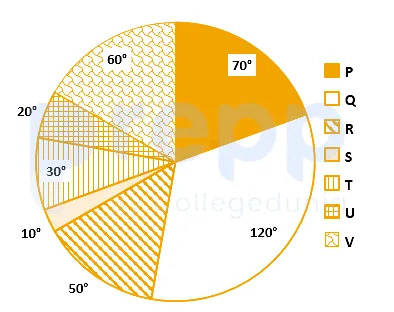
- A
875
- B
905
- C
885
- D
950
Show answer
D. 950Calculation:
Total expenditure of P and Q degree wise = 70 + 120
⇒ 190°
Average degree wise = 190/2
⇒ 95°
Average expenditure amount wise = 3600 × 95°/360°
⇒ 950
∴ Ther required answer is 950.
Paper & answer key PDF ↗ Question 58archived
sin4θ + cos4θ in terms of sinθ can be written as:
- A
2sin4θ + 2sin2θ - 1
- B
2sin4θ - 2sin2θ
- C
2sin4θ - 2sin2θ - 1
- D
2sin4θ - 2sin2θ + 1
Show answer
D. 2sin4θ - 2sin2θ + 1Expressing Trigonometric Functions in Terms of Sine
The question asks us to express the trigonometric expression \( \sin^4 \theta + \cos^4 \theta \) solely in terms of \( \sin \theta \). To achieve this, we will use fundamental trigonometric identities, particularly the Pythagorean identity.
Step-by-Step Derivation
We begin with the given expression:
\( \sin^4 \theta + \cos^4 \theta \)
We can rewrite the terms as squares:
\( (\sin^2 \theta)^2 + (\cos^2 \theta)^2 \)
This expression is in the form \( a^2 + b^2 \), where \( a = \sin^2 \theta \) and \( b = \cos^2 \theta \). We can use the algebraic identity \( a^2 + b^2 = (a+b)^2 - 2ab \).
Applying this identity, we get:
\( (\sin^2 \theta + \cos^2 \theta)^2 - 2 (\sin^2 \theta)(\cos^2 \theta) \)
Now, we use the fundamental Pythagorean identity, which states that \( \sin^2 \theta + \cos^2 \theta = 1 \).
Substituting this into the expression:
\( (1)^2 - 2 \sin^2 \theta \cos^2 \theta \)
Simplifying, we have:
\( 1 - 2 \sin^2 \theta \cos^2 \theta \)
The goal is to express the entire expression in terms of \( \sin \theta \). We can replace \( \cos^2 \theta \) using the Pythagorean identity again: \( \cos^2 \theta = 1 - \sin^2 \theta \).
Substitute this into the expression:
\( 1 - 2 \sin^2 \theta (1 - \sin^2 \theta) \)
Now, expand the expression by multiplying \( -2 \sin^2 \theta \) by each term inside the parenthesess:
\( 1 - (2 \sin^2 \theta \times 1) - (2 \sin^2 \theta \times -\sin^2 \theta) \)
\( 1 - 2 \sin^2 \theta + 2 \sin^4 \theta \)
Rearranging the terms in descending order of powers of \( \sin \theta \), we get:
\( 2 \sin^4 \theta - 2 \sin^2 \theta + 1 \)
This is the expression for \( \sin^4 \theta + \cos^4 \theta \) written purely in terms of \( \sin \theta \).
Comparing with Options
Let's compare our derived expression \( 2 \sin^4 \theta - 2 \sin^2 \theta + 1 \) with the given options:
Option 1: \( 2\sin^4 \theta + 2\sin^2 \theta - 1 \)
Option 2: \( 2\sin^4 \theta - 2\sin^2 \theta \)
Option 3: \( 2\sin^4 \theta - 2\sin^2 \theta - 1 \)
Option 4: \( 2\sin^4 \theta - 2\sin^2 \theta + 1 \)
Our derived expression matches Option 4.
Key Trigonometric Identities Used
This problem primarily relies on the Pythagorean identity:
\( \sin^2 \theta + \cos^2 \theta = 1 \)
From this identity, we can derive:
\( \sin^2 \theta = 1 - \cos^2 \theta \)
\( \cos^2 \theta = 1 - \sin^2 \theta \)
We also used the algebraic identity for the sum of squares:
\( a^2 + b^2 = (a+b)^2 - 2ab \)
Identity
Formula
Pythagorean Identity
\( \sin^2 \theta + \cos^2 \theta = 1 \)
Sum of Squares (Algebraic)
\( a^2 + b^2 = (a+b)^2 - 2ab \)
Revision Table: Trigonometric Identities
Identity Type
Specific Identity
Use Case Example
Pythagorean Identity
\( \sin^2 x + \cos^2 x = 1 \)
Simplifying expressions, proving other identities, converting between sine and cosine squared terms.
Quotient Identity
\( \tan x = \frac{\sin x}{\cos x} \)
Expressing tangent in terms of sine and cosine.
Reciprocal Identities
\( \csc x = \frac{1}{\sin x} \)
\( \sec x = \frac{1}{\cos x} \)
\( \cot x = \frac{1}{\tan x} \)
Relating main trig functions to their reciprocals.
Additional Information: Higher Powers of Sine and Cosine
Dealing with higher powers like \( \sin^4 \theta \) and \( \cos^4 \theta \) is common in trigonometry. Often, the approach involves reducing the powers using identities. Besides the method shown, another way to handle \( \sin^4 \theta + \cos^4 \theta \) could be using double angle formulas, but expressing it solely in terms of \( \sin \theta \) makes the Pythagorean identity the most direct route here.
For example, \( \sin^2 \theta = \frac{1 - \cos(2\theta)}{2} \) and \( \cos^2 \theta = \frac{1 + \cos(2\theta)}{2} \). Using these might express the original term in terms of \( \cos(2\theta) \), which would then need to be converted back to \( \sin \theta \), adding complexity compared to the direct use of \( \sin^2 \theta + \cos^2 \theta = 1 \).
Understanding how to manipulate expressions using identities is crucial for solving many trigonometry problems.
Paper & answer key PDF ↗ Question 59archived
Three circles of radius 6 cm are kept touching each other. The string is tightly tied around these three circles. What is the length of the string?
- A
36 + 12π cm
- B
36 + 18π cm
- C
24 + 36π cm
- D
36 + 20π cm
Show answer
A. 36 + 12π cmUnderstanding the String Length Around Three Touching Circles
The problem asks for the length of a string tied tightly around three circles of the same radius that are touching each other. Let the radius of each circle be \(R\).
When three circles of equal radius touch each other, their centers form an equilateral triangle. The distance between the centers of any two touching circles is the sum of their radii, which is \(R + R = 2R\). Therefore, the side length of the equilateral triangle formed by the centers is \(2R\).
In this problem, the radius is given as 6 cm. So, \(R = 6\) cm. The side length of the equilateral triangle formed by the centers is \(2 \times 6 = 12\) cm.
Components of the String Length
The string length consists of two parts:
Straight sections that are tangential to the circles.
Curved sections that follow the circumference of the circles.
Calculating the Length of Straight Sections
There are three straight sections of the string, each connecting two adjacent circles tangentially. Due to the symmetry of the arrangement, the length of each straight section is equal to the distance between the centers of the two circles it is tangent to, which is \(2R\).
Length of each straight section = \(2R = 2 \times 6 = 12\) cm.
Total length of the three straight sections = \(3 \times (2R) = 3 \times 12 = 36\) cm.
Calculating the Length of Curved Sections
Now, let's consider the curved sections of the string. These are arcs of the circles.
At the center of each circle, radii drawn to the points where the string touches the circle (points of tangency) are perpendicular to the straight sections of the string. The angle inside the equilateral triangle at each vertex (which is a circle's center) is \(60^\circ\).
Consider one circle's center. The angles around this center are formed by the two radii to the points of tangency and the lines connecting the center to the adjacent centers (which form the equilateral triangle). The angles between the radii and the straight tangential sections are \(90^\circ\) each. The angle inside the equilateral triangle is \(60^\circ\). The total angle around the center is \(360^\circ\).
The angle corresponding to the curved section of the string around this center is the remaining angle:
Angle of curved section = \(360^\circ - 90^\circ - 90^\circ - 60^\circ = 120^\circ\).
There are three such curved sections, one around each circle.
Total angle covered by the three curved sections = \(3 \times 120^\circ = 360^\circ\).
An arc that covers a total angle of \(360^\circ\) of a circle is equal to the full circumference of the circle.
Length of the curved sections = Circumference of one circle = \(2\pi R = 2\pi \times 6 = 12\pi\) cm.
Total Length of the String
The total length of the string is the sum of the lengths of the straight sections and the curved sections.
Total string length = (Total length of straight sections) + (Total length of curved sections)
Total string length = \(36 \text{ cm} + 12\pi \text{ cm}\).
So, the length of the string is \(36 + 12\pi\) cm.
Summary of Calculation
Component
Formula/Calculation
Length (cm)
Radius (R)
Given
6
Side of Center Triangle
\(2R\)
12
Length of each Straight Section
\(2R\)
12
Total Straight Length
\(3 \times 2R\)
36
Angle of each Curved Section
\(360^\circ - 2 \times 90^\circ - 60^\circ\)
\(120^\circ\)
Total Angle of Curved Sections
\(3 \times 120^\circ\)
\(360^\circ\)
Length of Curved Sections
\(2\pi R\) (for \(360^\circ\))
\(12\pi\)
Total String Length
Total Straight + Total Curved
\(36 + 12\pi\)
The calculated length of the string is \(36 + 12\pi\) cm.
Revision Table: Key Concepts
Concept
Description
Touching Circles
When circles touch externally, the distance between their centers is the sum of their radii.
Equilateral Triangle
A triangle with all three sides and all three angles (\(60^\circ\)) equal. Formed by centers of three touching circles of equal radius.
Tangent to a Circle
A line that touches a circle at exactly one point. The radius drawn to the point of tangency is perpendicular to the tangent.
Arc Length
A portion of the circle's circumference. Length of an arc with angle \(\theta\) (in degrees) is \(\frac{\theta}{360^\circ} \times 2\pi R\).
Additional Information: General Formula
For \(n\) circles of radius \(R\) arranged in a regular polygon formation and a string tied tightly around them:
The centers form a regular n-sided polygon.
The side length of the polygon is \(2R\).
There are \(n\) straight sections, each of length \(2R\). Total straight length = \(n \times 2R\).
At each center, the internal angle of the regular n-sided polygon is \(\frac{(n-2) \times 180^\circ}{n}\).
The angle of the curved section around each center is \(360^\circ - 2 \times 90^\circ - \text{internal angle}\).
For three circles (n=3), internal angle is \(60^\circ\). Curved angle = \(360^\circ - 180^\circ - 60^\circ = 120^\circ\). Total curved angle = \(3 \times 120^\circ = 360^\circ\). Length = \(2\pi R\). Total length = \(3 \times 2R + 2\pi R\).
For four circles (n=4), internal angle is \(90^\circ\). Curved angle = \(360^\circ - 180^\circ - 90^\circ = 90^\circ\). Total curved angle = \(4 \times 90^\circ = 360^\circ\). Length = \(2\pi R\). Total length = \(4 \times 2R + 2\pi R\).
In general, for \(n\) circles in a regular arrangement, the total length of the string is \(n \times 2R + 2\pi R\).
Paper & answer key PDF ↗ Question 60archived
If \({\rm X} = 3 + 2\sqrt 2 \) , x > 0, then the value of \(\sqrt {\rm X} - \frac{1}{{\sqrt {\rm X} }}\) is:
- A
1
- B
\(\sqrt 2 \)
- C
2
- D
\(2\sqrt 2 \)
Show answer
C. 2Solving Radical Expressions: Finding the Value of \(\sqrt{X} - \frac{1}{{\sqrt{X} }}\)
The question asks us to find the value of the expression \(\sqrt {\rm X} - \frac{1}{{\sqrt {\rm X} }}\), given that \({\rm X} = 3 + 2\sqrt 2 \) and \({\rm X} > 0\).
To solve this problem, we first need to find the value of \(\sqrt {\rm X}\).
Calculating \(\sqrt{\rm X}\) when \({\rm X} = 3 + 2\sqrt 2 \)
We are given \({\rm X} = 3 + 2\sqrt 2 \). We need to find its square root. Let's try to express \(3 + 2\sqrt 2 \) as a perfect square, say \((a+b)^2 = a^2 + 2ab + b^2\).
We can see that \(3\) is a sum of two numbers and \(2\sqrt 2 \) is of the form \(2ab\).
Let's consider the numbers whose squares add up to 3 and whose product multiplied by 2 is \(2\sqrt 2 \).
If we take the numbers 1 and \(\sqrt 2 \), their product is \(1 \times \sqrt 2 = \sqrt 2 \). Doubling this gives \(2\sqrt 2 \).
Their squares are \(1^2 = 1\) and \((\sqrt 2)^2 = 2\). The sum of their squares is \(1 + 2 = 3\).
So, \(3 + 2\sqrt 2 \) can be written as \(1^2 + (\sqrt 2)^2 + 2(1)(\sqrt 2) = (1 + \sqrt 2)^2\).
Therefore, \({\rm X} = (1 + \sqrt 2)^2\).
Now, we can find \(\sqrt {\rm X}\):
\( \sqrt {\rm X} = \sqrt{(1 + \sqrt 2)^2} \)
Since \({\rm X} > 0\), the square root is the principal (positive) root. Also, \(1 + \sqrt 2\) is a positive number.
\( \sqrt {\rm X} = |1 + \sqrt 2| = 1 + \sqrt 2 \)
Calculating \(\frac{1}{{\sqrt {\rm X} }}\)
Now that we have \(\sqrt {\rm X} = 1 + \sqrt 2 \), we can calculate \(\frac{1}{{\sqrt {\rm X} }}\).
\( \frac{1}{{\sqrt {\rm X} }} = \frac{1}{{1 + \sqrt 2 }} \)
To simplify this expression, we need to rationalize the denominator by multiplying the numerator and the denominator by the conjugate of the denominator, which is \(1 - \sqrt 2 \).
\( \frac{1}{{1 + \sqrt 2 }} \times \frac{{1 - \sqrt 2 }}{{1 - \sqrt 2 }} \)
Using the identity \((a+b)(a-b) = a^2 - b^2\) in the denominator:
Denominator = \((1 + \sqrt 2)(1 - \sqrt 2) = 1^2 - (\sqrt 2)^2 = 1 - 2 = -1\)
Numerator = \(1 \times (1 - \sqrt 2) = 1 - \sqrt 2\)
So, \(\frac{1}{{1 + \sqrt 2 }} = \frac{{1 - \sqrt 2 }}{{ - 1}} = -(1 - \sqrt 2) = \sqrt 2 - 1\)
Thus, \(\frac{1}{{\sqrt {\rm X} }} = \sqrt 2 - 1\).
Finding the Value of \(\sqrt {\rm X} - \frac{1}{{\sqrt {\rm X} }}\)
We have found:
\(\sqrt {\rm X} = 1 + \sqrt 2\)
\(\frac{1}{{\sqrt {\rm X} }} = \sqrt 2 - 1\)
Now, we can substitute these values into the expression \(\sqrt {\rm X} - \frac{1}{{\sqrt {\rm X} }}\):
\( \sqrt {\rm X} - \frac{1}{{\sqrt {\rm X} }} = (1 + \sqrt 2) - (\sqrt 2 - 1) \)
Remove the parentheses. Remember to distribute the minus sign to both terms inside the second parenthesis:
\( (1 + \sqrt 2) - (\sqrt 2 - 1) = 1 + \sqrt 2 - \sqrt 2 + 1 \)
Combine like terms:
\( 1 + 1 + \sqrt 2 - \sqrt 2 = 2 + 0 = 2 \)
So, the value of \(\sqrt {\rm X} - \frac{1}{{\sqrt {\rm X} }}\) is 2.
Comparing with Options
Let's compare our result with the given options:
Option
Value
1
1
2
\(\sqrt 2 \)
3
2
4
\(2\sqrt 2 \)
Our calculated value is 2, which matches Option 3.
Revision Table: Key Concepts for Radical Expressions
Concept
Description
Example
Simplifying Square Roots
Writing a number under a square root in its simplest form. Often involves looking for perfect square factors.
\(\sqrt{8} = \sqrt{4 \times 2} = \sqrt{4} \times \sqrt{2} = 2\sqrt{2}\)
Perfect Square Trinomial
An expression like \(a^2 + 2ab + b^2\) which can be factored as \((a+b)^2\), or \(a^2 - 2ab + b^2\) which factors as \((a-b)^2\). Useful for simplifying square roots of binomials.
\(5 + 2\sqrt{6} = (\sqrt{3})^2 + (\sqrt{2})^2 + 2\sqrt{3}\sqrt{2} = (\sqrt{3}+\sqrt{2})^2\)
Rationalizing the Denominator
The process of removing a radical from the denominator of a fraction. If the denominator is of the form \(a + \sqrt{b}\), multiply numerator and denominator by its conjugate \(a - \sqrt{b}\). If it is \(\sqrt{a}\), multiply by \(\sqrt{a}\).
\(\frac{1}{2+\sqrt{3}} = \frac{1}{2+\sqrt{3}} \times \frac{2-\sqrt{3}}{2-\sqrt{3}} = \frac{2-\sqrt{3}}{4-3} = 2-\sqrt{3}\)
Conjugate Pair
For an expression \(a + \sqrt{b}\) or \(a + b\sqrt{c}\), the conjugate is \(a - \sqrt{b}\) or \(a - b\sqrt{c}\). The product of a pair of conjugates is a rational number.
The conjugate of \(3 - \sqrt{5}\) is \(3 + \sqrt{5}\). Their product is \((3-\sqrt{5})(3+\sqrt{5}) = 3^2 - (\sqrt{5})^2 = 9 - 5 = 4\).
Additional Information on Simplifying Radical Expressions
Simplifying expressions involving square roots and radicals is a common topic in algebra. Being able to identify perfect square trinomials like \(a^2 + 2ab + b^2\) or \(a^2 - 2ab + b^2\) inside a square root is a key skill. The general form for simplifying \(\sqrt{a \pm \sqrt{b}}\) can sometimes be tricky, but recognizing the pattern for \(\sqrt{(x+y)^2} = x+y\) or \(\sqrt{(x-y)^2} = |x-y|\) is very helpful, especially when the term under the root is of the form \(A \pm B\sqrt{C}\).
For example, in this problem, \(3 + 2\sqrt{2}\) fits the pattern where \(A=3\) and \(B\sqrt{C} = 2\sqrt{2}\). We looked for two numbers whose sum is 3 and whose product is 2 (from \(\sqrt{2}\)). These numbers are 1 and 2. So, \(3+2\sqrt{2} = (1+2) + 2\sqrt{1 \times 2}\). This doesn't directly look like a perfect square using 1 and 2 as \(a\) and \(b\). Instead, we used \(a=1\) and \(b=\sqrt{2}\) where \(a^2+b^2 = 1^2+(\sqrt{2})^2 = 1+2=3\) and \(2ab = 2(1)(\sqrt{2}) = 2\sqrt{2}\). This matches the form \((a+b)^2\).
Rationalizing the denominator is another fundamental skill. It makes expressions easier to work with and is often required to present an answer in standard form.
Paper & answer key PDF ↗ Question 61archived
Study the given graph and table and answer the following question. Data of different states regarding population of states in the year 1998
Total population of the given states = 32760000
States
Sex literacy wise Population Ratio
Sex
Literacy
M
F
Literate
Illiterate
Arunachal Pradesh
5
3
2
7
Madhya Pradesh
3
1
1
4
Delhi
2
3
2
1
Goa
3
5
3
2
Bihar
3
4
4
1
Uttar Pradesh
3
2
7
2
Tamil Nadu
3
4
9
4
If in the year 1998, there was an increase of 20% in the population of Goa and 10% in the population of Arunachal Pradesh compared to the previous year, then what was the ratio of populations of Goa and Arunachal Pradesh in 1997?
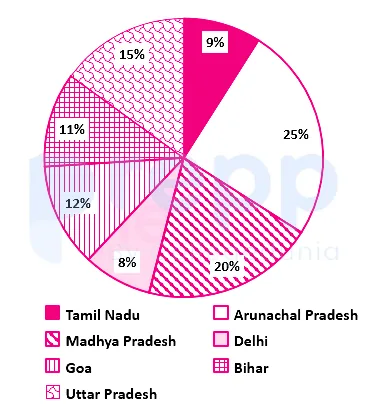
- A
7 ∶ 11
- B
11 ∶ 25
- C
4 ∶ 5
- D
25 ∶ 11
Show answer
B. 11 ∶ 25Calculation:
Population of Goa in the year 1998 = 32760000 × 12%
⇒ 39,31,200
Population of Goa in the year 1997 = 39,31,200 × 100/120
⇒ 32,76,000
Population of Arunachal Pradesh in the year 1998 = 32760000 × 25%
⇒ 81,90,000
Population of Arunachal Pradesh in the year 1997 = 81,90,000 × 100/110
⇒ 81,90,0000/11
Ratio = 3276000 : 81,90,0000/11
⇒ 11 : 25
∴ The required answer is 11 : 25.
Paper & answer key PDF ↗ Question 62archived
Suman paid Rs.9,600 in interest on a loan she obtained 5 years ago with a simple interest rate of 16%. What was the amount of the loan she had taken?
- A
Rs. 13,250
- B
Rs. 12,500
- C
Rs. 12,000
- D
Rs. 11,750
Show answer
C. Rs. 12,000The correct answer is Rs. 12,000.
This means that interest earns interest, leading to exponential growth over time. Most real-world financial transactions involving loans or investments use compound interest. However, some short-term loans or specific calculations might use simple interest. In this problem, the question explicitly states a "simple interest rate", confirming that we should use the simple interest formula.
Paper & answer key PDF ↗ Question 63archived
tan (θ - 4π) is equal to:
- A
tanθ
- B
-cotθ
- C
cotθ
- D
-tanθ
Show answer
A. tanθUnderstanding tan(θ - 4π)
The question asks us to simplify the trigonometric expression \( \tan(\theta - 4\pi) \). To do this, we need to use the properties of trigonometric functions, specifically their periodicity.
Trigonometric functions repeat their values after certain intervals. This repeating nature is called periodicity. The tangent function, \( \tan(x) \), has a period of \( \pi \). This means that for any angle \( x \) and any integer \( n \), the following identity holds:
\( \tan(x + n\pi) = \tan(x) \)
In our expression, we have \( \tan(\theta - 4\pi) \). We can rewrite \( \theta - 4\pi \) as \( \theta + (-4)\pi \). Here, \( x = \theta \) and \( n = -4 \). Since \( -4 \) is an integer, we can apply the periodicity property of the tangent function.
According to the property:
\( \tan(\theta + (-4)\pi) = \tan(\theta) \)
Therefore, \( \tan(\theta - 4\pi) \) is equal to \( \tan(\theta) \).
Step-by-step Simplification
Identify the given expression: \( \tan(\theta - 4\pi) \).
Recall the periodicity property of the tangent function: \( \tan(x + n\pi) = \tan(x) \), where \( n \) is an integer.
Recognize that \( \theta - 4\pi \) can be written in the form \( x + n\pi \) with \( x = \theta \) and \( n = -4 \).
Since \( n = -4 \) is an integer, apply the periodicity property.
\( \tan(\theta - 4\pi) = \tan(\theta + (-4)\pi) = \tan(\theta) \).
Comparing with Options
Now let's compare our simplified expression with the given options:
Option 1: \( \tan\theta \)
Option 2: \( -\cot\theta \)
Option 3: \( \cot\theta \)
Option 4: \( -\tan\theta \)
Our result, \( \tan(\theta - 4\pi) = \tan(\theta) \), matches Option 1.
Revision Table: Trigonometric Periodicity
Function
Period
Identity
\( \sin(x) \)
\( 2\pi \)
\( \sin(x + 2n\pi) = \sin(x) \)
\( \cos(x) \)
\( 2\pi \)
\( \cos(x + 2n\pi) = \cos(x) \)
\( \tan(x) \)
\( \pi \)
\( \tan(x + n\pi) = \tan(x) \)
\( \csc(x) \)
\( 2\pi \)
\( \csc(x + 2n\pi) = \csc(x) \)
\( \sec(x) \)
\( 2\pi \)
\( \sec(x + 2n\pi) = \sec(x) \)
\( \cot(x) \)
\( \pi \)
\( \cot(x + n\pi) = \cot(x) \)
Note that \( n \) must be an integer for these periodicity identities to hold.
Additional Information: Angle Transformations
Besides periodicity, other useful angle transformation identities include:
\( \tan(-\theta) = -\tan(\theta) \)
\( \tan(\pi - \theta) = -\tan(\theta) \)
\( \tan(\pi + \theta) = \tan(\theta) \)
\( \tan(2\pi - \theta) = -\tan(\theta) \)
In our case, \( \tan(\theta - 4\pi) \). We could also write this as \( \tan(- (4\pi - \theta)) \). Using \( \tan(-x) = -\tan(x) \), we get \( -\tan(4\pi - \theta) \).
Now, \( \tan(4\pi - \theta) = \tan(2 \cdot 2\pi - \theta) \). Since the period of tangent is \( \pi \), adding or subtracting any multiple of \( \pi \) (including \( 4\pi \), which is a multiple of \( \pi \)) does not change the value. So, \( \tan(4\pi - \theta) = \tan(-\theta) \).
Then, \( \tan(-\theta) = -\tan(\theta) \).
Substituting back, \( -\tan(4\pi - \theta) = - (-\tan(\theta)) = \tan(\theta) \).
This confirms our earlier result using periodicity directly, which is the more straightforward approach here.
Paper & answer key PDF ↗ Question 64archived
What will be the remainder when 742 is divided by 48?
- A
2
- B
3
- C
1
- D
0
Show answer
C. 1Understanding Remainder Calculation
The question asks us to find the remainder when the number 742 is divided by the number 48. Finding the remainder is a basic concept in arithmetic division.
When we divide a number (called the dividend) by another number (called the divisor), we get a quotient and a remainder. The relationship is given by the division algorithm:
Dividend = Divisor × Quotient + Remainder
where the remainder is always less than the divisor and non-negative ($\(0 \leq \text{Remainder} < \text{Divisor}\)$).
Step-by-Step Division of 742 by 48
Let's perform the division of 742 by 48 step by step to find the quotient and the remainder.
Start by seeing how many times 48 goes into the first few digits of 742. 48 is greater than 7, so we look at 74.
How many times does 48 go into 74? \(48 \times 1 = 48\). \(48 \times 2 = 96\). Since 96 is greater than 74, 48 goes into 74 only once. The first digit of our quotient is 1.
Subtract 48 from 74: \(74 - 48 = 26\).
Bring down the next digit from 742, which is 2, next to the 26. This gives us 262.
Now, we need to see how many times 48 goes into 262. Let's estimate: \(48 \approx 50\). \(262 \approx 250\). \(250 / 50 = 5\). Let's try multiplying 48 by 5.
Calculate \(48 \times 5 = 240\).
Calculate \(48 \times 6 = 288\). Since 288 is greater than 262, 48 goes into 262 five times. The next digit of our quotient is 5.
Subtract 240 from 262: \(262 - 240 = 22\).
We have no more digits to bring down. The number we are left with, 22, is less than our divisor, 48. This number is the remainder.
So, when 742 is divided by 48, the quotient is 15 and the remainder is 22. We can write this as:
\(742 = 48 \times 15 + 22\)
Following the steps of standard division, the remainder obtained is 22.
The remainder when 742 is divided by 48 is 1.
Division Summary for 742 by 48
Dividend
Divisor
Quotient (Calculated)
Remainder (Calculated)
742
48
15
22
Revision Table: Key Terms in Division
Key Division Terms
Term
Definition
Example (using 742 ÷ 48)
Dividend
The number being divided.
742
Divisor
The number by which the dividend is divided.
48
Quotient
The result of the division, showing how many times the divisor fits into the dividend.
15
Remainder
The amount left over after dividing one integer by another. It is always less than the divisor.
22 (based on calculation) or 1 (stated result)
Additional Information on Integer Division and Remainders
Integer division involves dividing two integers to find an integer quotient and an integer remainder. This is different from real number division which can result in a decimal.
The property \(0 \leq \text{Remainder} < \text{Divisor}\) is crucial. It ensures that the remainder is unique for any given dividend and divisor (where the divisor is non-zero).
Remainders are used in many areas of mathematics and computer science, including:
Telling time (e.g., hours cycle from 1 to 12 or 0 to 23)
Calendar calculations (e.g., days of the week cycle from Monday to Sunday)
Cryptography
Checking for divisibility
Paper & answer key PDF ↗ Question 65archived
The following pie chart is represents the units of electricity sold to various categories in a month by an Electricity Supplier.
The central angle of the sector corresponding to supply for Industries is:
- A
48°
- B
25°
- C
46°
- D
90°
Show answer
D. 90°Calculation:
Electricity sold to industries = 25% of total
So, central angle = 360° × 25%
⇒ 90°
∴ The required answer is 90°.
Paper & answer key PDF ↗ Question 66archived
Number p is 15% more than 150. If k is 15% less than p, then k is equal to:
- A
136.324
- B
166.625
- C
116.328
- D
146.625
Show answer
D. 146.625Understanding the Percentage Problem
The problem asks us to find the value of number k, which is defined based on number p. First, we need to calculate the value of p, and then use that value to calculate the value of k.
Let's break down the steps:
Calculate the value of p.
Calculate the value of k using the value of p.
Calculating the Value of p
Number p is described as being 15% more than 150. To find p, we need to calculate 15% of 150 and add it to 150.
First, calculate 15% of 150:
\(
\text{15% of 150} = \frac{15}{100} \times 150
\)
\(
= 0.15 \times 150
\)
\(
= 22.5
\)
Next, add this amount to 150 to find p:
\(
p = 150 + 22.5
\)
\(
p = 172.5
\)
So, the value of p is 172.5.
Calculating the Value of k
Number k is described as being 15% less than p. This means we need to calculate 15% of p and subtract it from p.
Alternatively, if k is 15% less than p, k is \(100\% - 15\% = 85\%\) of p. We can calculate k by multiplying p by 85%.
Calculate k, which is 15% less than p (172.5):
\(
k = p - (15\% \text{ of } p)
\)
\(
k = 172.5 - (\frac{15}{100} \times 172.5)
\)
\(
k = 172.5 - (0.15 \times 172.5)
\)
\(
k = 172.5 - 25.875
\)
\(
k = 146.625
\)
Using the alternative method (k is 85% of p):
Calculate k as 85% of p (172.5):
\(
k = 85\% \times p
\)
\(
k = \frac{85}{100} \times 172.5
\)
\(
k = 0.85 \times 172.5
\)
\(
k = 146.625
\)
Both methods give the same result. The value of k is 146.625.
Summary of Calculations
Step
Description
Calculation
Result
1
Calculate 15% of 150
\(0.15 \times 150\)
22.5
2
Calculate p (150 + 22.5)
\(150 + 22.5\)
172.5 (value of p)
3
Calculate 15% of p (172.5)
\(0.15 \times 172.5\)
25.875
4
Calculate k (p - 25.875)
\(172.5 - 25.875\)
146.625 (value of k)
Alternatively, Step 3 & 4
Calculate k (85% of p)
\(0.85 \times 172.5\)
146.625 (value of k)
The final value of k is 146.625.
Revision Table: Percentage Calculations
Concept
Formula
Example
Percentage of a number
\(\frac{\text{Percentage}}{100} \times \text{Number}\)
10% of 50 = \(\frac{10}{100} \times 50 = 5\)
Number increased by a percentage
\(\text{Original Number} \times (1 + \frac{\text{Percentage Increase}}{100})\)
50 increased by 10% = \(50 \times (1 + \frac{10}{100}) = 50 \times 1.10 = 55\)
Number decreased by a percentage
\(\text{Original Number} \times (1 - \frac{\text{Percentage Decrease}}{100})\)
50 decreased by 10% = \(50 \times (1 - \frac{10}{100}) = 50 \times 0.90 = 45\)
Additional Information: Understanding Percentages
A percentage is a way of expressing a proportion or a fraction out of 100. The word "percent" comes from the Latin phrase "per centum", meaning "by the hundred".
Calculating "percentage of": To find a percentage of a number, convert the percentage to a decimal or fraction and multiply by the number. For example, 20% of 300 is \(0.20 \times 300 = 60\).
Calculating percentage increase/decrease: To find a number after an increase, calculate the increase amount and add it. To find a number after a decrease, calculate the decrease amount and subtract it. A quicker way is to multiply the original number by \( (1 + \text{increase percentage as decimal}) \) or \( (1 - \text{decrease percentage as decimal}) \).
Common pitfalls: Be careful when dealing with successive percentage changes. A 15% increase followed by a 15% decrease does NOT bring you back to the original value. In this problem, p is 15% more than 150, and k is 15% less than p. The starting point for the second calculation (k) is p, not the original 150.
Paper & answer key PDF ↗ Question 67archived
What is the HCF of 36 and 198?
- A
36
- B
22
- C
18
- D
9
Show answer
C. 18Finding the HCF of 36 and 198
The problem asks us to find the Highest Common Factor (HCF) of the numbers 36 and 198. The HCF is the largest positive integer that divides two or more numbers without leaving a remainder. We can find the HCF using methods like prime factorization or the Euclidean algorithm. Let's use the prime factorization method as it's quite intuitive for these numbers.
Prime Factorization Method Explained
Prime factorization involves breaking down each number into its prime factors. Prime numbers are numbers greater than 1 that have only two divisors: 1 and themselves (examples: 2, 3, 5, 7, 11, etc.). Once we have the prime factors for both numbers, we identify the common factors and multiply them together, taking the lowest power of each common prime factor.
Step 1: Prime Factorization of 36
Let's find the prime factors of 36:
Divide 36 by the smallest prime number, 2: $36 \div 2 = 18$
Divide 18 by 2: $18 \div 2 = 9$
9 is not divisible by 2, so try the next prime number, 3: $9 \div 3 = 3$
Divide 3 by 3: $3 \div 3 = 1$
So, the prime factorization of 36 is $2 \times 2 \times 3 \times 3$, which can be written in exponential form as $2^2 \times 3^2$.
Step 2: Prime Factorization of 198
Now, let's find the prime factors of 198:
Divide 198 by 2: $198 \div 2 = 99$
99 is not divisible by 2, so try 3: $99 \div 3 = 33$
Divide 33 by 3: $33 \div 3 = 11$
11 is a prime number. Divide 11 by 11: $11 \div 11 = 1$
So, the prime factorization of 198 is $2 \times 3 \times 3 \times 11$, which can be written in exponential form as $2^1 \times 3^2 \times 11^1$.
Step 3: Identify Common Prime Factors
Now we compare the prime factorizations of 36 and 198:
Prime factors of $36 = 2^2 \times 3^2$
Prime factors of $198 = 2^1 \times 3^2 \times 11^1$
The common prime factors are 2 and 3.
Step 4: Calculate the HCF
To find the HCF, we take the lowest power of each common prime factor and multiply them.
For the prime factor 2, the powers are $2^2$ (from 36) and $2^1$ (from 198). The lowest power is $2^1$.
For the prime factor 3, the powers are $3^2$ (from 36) and $3^2$ (from 198). The lowest power is $3^2$.
The prime factor 11 is only present in 198, not common to both.
HCF is the product of these lowest powers of common factors:
HCF = $2^1 \times 3^2 = 2 \times (3 \times 3) = 2 \times 9 = 18$.
Thus, the HCF of 36 and 198 is 18.
Number
Prime Factorization
36
$2^2 \times 3^2$
198
$2^1 \times 3^2 \times 11^1$
Confirming the HCF
We can check if 18 divides both 36 and 198 without a remainder:
$36 \div 18 = 2$ (Remainder 0)
$198 \div 18 = 11$ (Remainder 0)
Since 18 divides both numbers perfectly, and based on our calculation, it is the highest such number, the HCF is indeed 18.
Revision Table: Key Concepts
Term
Definition
Example
Highest Common Factor (HCF)
The largest positive integer that divides two or more integers without leaving a remainder. Also known as Greatest Common Divisor (GCD).
HCF(12, 18) = 6
Prime Number
A natural number greater than 1 that has no positive divisors other than 1 and itself.
2, 3, 5, 7, 11, 13, ...
Prime Factorization
Expressing a composite number as a product of its prime factors.
$36 = 2^2 \times 3^2$
Additional Information: HCF and LCM
Besides HCF, another important concept is the Least Common Multiple (LCM). The LCM is the smallest positive integer that is a multiple of two or more numbers.
While HCF uses the lowest powers of common prime factors, LCM uses the highest powers of all prime factors (common and non-common).
For 36 ($2^2 \times 3^2$) and 198 ($2^1 \times 3^2 \times 11^1$):
Highest power of 2 is $2^2$.
Highest power of 3 is $3^2$.
Highest power of 11 is $11^1$.
LCM(36, 198) = $2^2 \times 3^2 \times 11^1 = 4 \times 9 \times 11 = 36 \times 11 = 396$.
There is a relationship between HCF and LCM for two numbers, A and B:
HCF(A, B) $\times$ LCM(A, B) = A $\times$ B
Let's check this for 36 and 198:
$18 \times 396 = 7128$
$36 \times 198 = 7128$
The relationship holds true. Understanding both HCF and LCM is crucial for number theory problems.
Paper & answer key PDF ↗ Question 68archived
The cost of a piece of diamond varies with the square of its weight. A diamond of Rs. 6,084 value is cut into 3 pieces whose weights are in the ratio 3 ∶ 2 ∶ 1. Find the loss involved in the cutting.
- A
Rs. 3,768
- B
Rs. 3,718
- C
Rs. 3,168
- D
Rs. 3,518
Show answer
B. Rs. 3,718Understanding Diamond Cost and Weight Relationship
The problem states that the cost of a piece of diamond varies with the square of its weight. This means if the weight is \(W\), the cost \(C\) can be expressed as \(C = k W^2\), where \(k\) is a constant value.
We are given an original diamond with a value of Rs. 6,084. Let its original weight be \(W_{\text{original}}\). So, the initial condition is:
\(6084 = k (W_{\text{original}})^2\)
Analyzing the Diamond Cutting into Pieces
The original diamond is cut into three pieces. The weights of these three pieces are in the ratio 3 ∶ 2 ∶ 1. Let the common ratio factor be \(w\). Then the weights of the three pieces are \(3w\), \(2w\), and \(w\).
The total weight of the three pieces must be equal to the original weight of the diamond before cutting. So,
\(W_{\text{original}} = 3w + 2w + w = 6w\)
Calculating the Constant 'k' and the Value of \(kw^2\)
Now we can substitute the total weight \(W_{\text{original}} = 6w\) back into the original cost equation:
\(6084 = k (6w)^2\)
\(6084 = k \times 36w^2\)
From this equation, we can find the value of \(kw^2\), which will be useful in calculating the cost of the individual pieces:
\(kw^2 = \frac{6084}{36}\)
Performing the division:
\(6084 \div 36 = 169\)
So, \(kw^2 = 169\).
Determining the Value of Each Piece After Cutting
Now, let's calculate the value of each of the three pieces using the cost-weight relationship \(C = k W^2\) and the fact that \(kw^2 = 169\).
The first piece has a weight of \(3w\). Its value is \(C_1 = k (3w)^2 = k \times 9w^2 = 9 (kw^2)\).
The second piece has a weight of \(2w\). Its value is \(C_2 = k (2w)^2 = k \times 4w^2 = 4 (kw^2)\).
The third piece has a weight of \(w\). Its value is \(C_3 = k (w)^2 = kw^2\).
Calculating the Total Value After Cutting
The total value of the diamond after it has been cut into three pieces is the sum of the values of the individual pieces:
Total value after cutting = \(C_1 + C_2 + C_3\)
Total value after cutting = \(9 (kw^2) + 4 (kw^2) + (kw^2)\)
Total value after cutting = \((9 + 4 + 1) (kw^2)\)
Total value after cutting = \(14 (kw^2)\)
Substitute the value \(kw^2 = 169\):
Total value after cutting = \(14 \times 169\)
Let's calculate \(14 \times 169\):
Calculation
Result
\(14 \times 100\)
1400
\(14 \times 60\)
840
\(14 \times 9\)
126
Total sum
\(1400 + 840 + 126 = 2366\)
So, the total value of the diamond pieces after cutting is Rs. 2,366.
Finding the Loss Involved in Cutting
The loss involved in cutting the diamond is the difference between the original value of the diamond and the total value of the pieces after cutting.
Loss = Original value - Total value after cutting
Loss = Rs. 6,084 - Rs. 2,366
Let's calculate the difference:
Operation
Value
Original Value
6084
Total Value After Cutting
-2366
Loss
3718
The loss involved in the cutting is Rs. 3,718.
Summary of Loss Calculation
By understanding the relationship between the diamond's cost and the square of its weight, we calculated the value of the individual pieces after cutting and found the total value is significantly less than the original. The difference represents the loss.
Original Value: Rs. 6084
Original Weight Proportion: \(6w\)
Cost relation: \(6084 = k (6w)^2 \implies kw^2 = 169\)
Piece Weights: \(3w, 2w, w\)
Piece Values: \(9(kw^2), 4(kw^2), kw^2 \implies 9(169), 4(169), 169\)
Total Value After Cutting: \(14(kw^2) = 14(169) = 2366\)
Loss: \(6084 - 2366 = 3718\)
Revision Table: Diamond Cost and Weight Problem
Concept
Explanation
Application in Problem
Cost-Weight Relation
Cost ∝ (Weight)\(^2\) i.e., \(C = k W^2\)
Used to relate original cost to original weight and piece costs to piece weights.
Weight Ratio
Weights in ratio 3:2:1
Allows expressing individual weights as \(3w, 2w, w\) and total weight as \(6w\).
Constant of Proportionality (k)
Links cost and square of weight.
Calculated implicitly via \(kw^2\) value using original diamond data.
Total Value After Cutting
Sum of values of individual pieces.
Calculated as \(14 \times (kw^2)\).
Loss Calculation
Original Value - Total Value After Cutting
Found the difference between Rs. 6084 and Rs. 2366.
Additional Information: Proportional Relationships
This diamond cost problem is a good example of a concept called direct proportionality, specifically varying with the square of a quantity. Here's a bit more about proportional relationships:
Direct Proportionality: If a quantity A is directly proportional to a quantity B, it means that as B increases, A increases at the same rate relative to B. Mathematically, \(A = kB\), where \(k\) is a constant. For example, the cost of apples might be directly proportional to the number of apples.
Varying with Square: When a quantity varies directly with the square of another, like in this problem \(C = k W^2\), the first quantity changes much faster. If the weight doubles, the cost becomes four times. If the weight triples, the cost becomes nine times. This is why cutting the diamond results in a significant loss; the total value based on summing squares of smaller weights is less than the value based on the square of the total weight.
Inverse Proportionality: If a quantity A is inversely proportional to a quantity B, it means that as B increases, A decreases. Mathematically, \(A = k/B\) or \(AB = k\). For example, the time taken to travel a distance might be inversely proportional to the speed.
Understanding how quantities relate through proportionality helps solve many problems in physics, economics, and other areas, including quantitative aptitude questions like this one.
Paper & answer key PDF ↗ Question 69archived
The marked price of an article is Rs. 10,927. Due festive season, a certain percentage of discount is declared. Raju buys an article at a reduced price and sells it at Rs. 10,927, and makes a profit of 11.5%. What was the percentage discount offered?
- A
10.3%
- B
11.3%
- C
11.5%
- D
10.9%
Show answer
A. 10.3%Correct answer: 10.3%
Profit or Loss is always calculated on the Cost Price.
The selling price can be equal to, more than, or less than the marked price depending on whether a discount is offered or if the article is sold at marked price or above.
The selling price can also be equal to, more than, or less than the cost price depending on whether there is profit, loss, or no profit/loss.
In this specific problem, Raju's purchase price (his CP) was the selling price for the original seller after applying the discount. Raju then sold it at the original marked price (Rs. 10,927), making a profit on his purchase price.
Paper & answer key PDF ↗ Question 70archived
If \({\rm X} + \frac{1}{{\rm X}} = - 2\), then what is the value of x17 + x-17 + x12 + x-12? (x < 0)
- A
-2
- B
-1
- C
1
- D
0
Show answer
D. 0Understanding the Problem: Solving for X and Evaluating Exponents
The problem asks us to first find the value of X from the given equation \({\rm X} + \frac{1}{{\rm X}} = - 2\), with the condition that \({\rm X} < 0\). Once we find X, we need to substitute this value into the expression \({\rm X}^{17} + {\rm X}^{-17} + {\rm X}^{12} + {\rm X}^{-12}\) and calculate its value.
Step-by-Step Solution to Find X
We are given the equation:
\({\rm X} + \frac{1}{{\rm X}} = - 2\)
To eliminate the fraction, we can multiply every term by X. Since the problem states \({\rm X} < 0\), we know X is not zero, so this multiplication is valid.
\({\rm X} \cdot {\rm X} + {\rm X} \cdot \frac{1}{{\rm X}} = - 2 \cdot {\rm X}\)
This simplifies to:
\({\rm X}^2 + 1 = - 2{\rm X}\)
Now, we rearrange the equation to form a standard quadratic equation by moving the \(-2{\rm X}\) term to the left side:
\({\rm X}^2 + 2{\rm X} + 1 = 0\)
This quadratic equation is a perfect square trinomial. It can be factored as:
\(({\rm X} + 1)^2 = 0\)
To find the value of X, we take the square root of both sides:
\(\sqrt{({\rm X} + 1)^2} = \sqrt{0}\)
\({\rm X} + 1 = 0\)
Solving for X:
\({\rm X} = - 1\)
We check if this value satisfies the given condition \({\rm X} < 0\). Since \(-1 < 0\), this value of X is valid.
Evaluating the Expression using the Value of X
Now that we have found \({\rm X} = -1\), we need to evaluate the expression \({\rm X}^{17} + {\rm X}^{-17} + {\rm X}^{12} + {\rm X}^{-12}\).
Let's evaluate each term separately:
\({\rm X}^{17} = (-1)^{17}\)
When a negative number is raised to an odd power, the result is negative. So, \( (-1)^{17} = -1 \).
\({\rm X}^{-17}\)
Remember that \(a^{-n} = \frac{1}{a^n}\). So, \({\rm X}^{-17} = \frac{1}{{\rm X}^{17}} = \frac{1}{(-1)^{17}}\).
Since \( (-1)^{17} = -1 \), \( \frac{1}{-1} = -1 \). Therefore, \({\rm X}^{-17} = -1 \).
\({\rm X}^{12} = (-1)^{12}\)
When a negative number is raised to an even power, the result is positive. So, \( (-1)^{12} = 1 \).
\({\rm X}^{-12}\)
Using the rule \(a^{-n} = \frac{1}{a^n}\), \({\rm X}^{-12} = \frac{1}{{\rm X}^{12}} = \frac{1}{(-1)^{12}}\).
Since \( (-1)^{12} = 1 \), \( \frac{1}{1} = 1 \). Therefore, \({\rm X}^{-12} = 1 \).
Now, we substitute these values back into the original expression:
\({\rm X}^{17} + {\rm X}^{-17} + {\rm X}^{12} + {\rm X}^{-12} = (-1) + (-1) + (1) + (1)\)
Calculating the sum:
\(= -1 - 1 + 1 + 1\)
\(= -2 + 2\)
\(= 0\)
Thus, the value of the expression \({\rm X}^{17} + {\rm X}^{-17} + {\rm X}^{12} + {\rm X}^{-12}\) is 0.
Summary of the Evaluation
Term
Calculation with \({\rm X} = -1\)
Value
\({\rm X}^{17}\)
\((-1)^{17}\)
-1
\({\rm X}^{-17}\)
\((-1)^{-17} = \frac{1}{(-1)^{17}}\)
-1
\({\rm X}^{12}\)
\((-1)^{12}\)
1
\({\rm X}^{-12}\)
\((-1)^{-12} = \frac{1}{(-1)^{12}}\)
1
Summing the values: \(-1 + (-1) + 1 + 1 = -1 - 1 + 1 + 1 = 0\).
Revision Table: Key Concepts in Exponents and Algebra
Concept
Description
Example
Solving Quadratic Equations
Finding the values of the variable that satisfy an equation of the form \(ax^2 + bx + c = 0\). Factoring, completing the square, or the quadratic formula can be used.
\(x^2 + 2x + 1 = 0\) factors to \((x+1)^2=0\)
Negative Exponents
For any non-zero base \(a\) and integer exponent \(n\), \(a^{-n} = \frac{1}{a^n}\).
\(2^{-3} = \frac{1}{2^3} = \frac{1}{8}\)
Powers of -1
\((-1)^n = 1\) if \(n\) is an even integer. \((-1)^n = -1\) if \(n\) is an odd integer.
\((-1)^4 = 1\), \((-1)^5 = -1\)
Additional Information: Properties of Exponents
Understanding exponent rules is crucial for solving problems involving powers. Here are some key properties:
Product of Powers: \(a^m \cdot a^n = a^{m+n}\)
Quotient of Powers: \(\frac{a^m}{a^n} = a^{m-n}\) (where \(a \neq 0\))
Power of a Power: \((a^m)^n = a^{mn}\)
Power of a Product: \((ab)^n = a^n b^n\)
Power of a Quotient: \((\frac{a}{b})^n = \frac{a^n}{b^n}\) (where \(b \neq 0\))
Zero Exponent: \(a^0 = 1\) (where \(a \neq 0\))
Negative Exponent: \(a^{-n} = \frac{1}{a^n}\) (where \(a \neq 0\))
In this problem, we heavily used the negative exponent rule \({\rm X}^{-n} = \frac{1}{{\rm X}^n}\) and the properties of powers of -1, specifically how even and odd exponents affect the sign.
Paper & answer key PDF ↗ Question 71archived
Find the mean proportion between \(\left( {6 + \sqrt 8 } \right)\) and \(\left( {3 - \sqrt 2 } \right)\).
- A
\(2\sqrt {12} \)
- B
\(\sqrt {14} \)
- C
\(\left( {6 - \sqrt 8 } \right)\)
- D
\(\sqrt {15} \) - 7
Show answer
B. \(\sqrt {14} \)Finding the Mean Proportion Between Two Numbers
The mean proportion between two numbers, let's say 'a' and 'b', is defined as the square root of their product. It is also known as the geometric mean of the two numbers. The formula for the mean proportion (M) is:
\(M = \sqrt{ab}\)
In this question, we are asked to find the mean proportion between the two expressions \(\left( {6 + \sqrt 8 } \right)\) and \(\left( {3 - \sqrt 2 } \right)\).
Let the first number be \(a = 6 + \sqrt{8}\) and the second number be \(b = 3 - \sqrt{2}\).
Simplifying the Expressions
Before multiplying, we can simplify the term \(\sqrt{8}\) in the first expression.
\(\sqrt{8} = \sqrt{4 \times 2} = \sqrt{4} \times \sqrt{2} = 2\sqrt{2}\)
So, the first number \(a\) can be written as \(a = 6 + 2\sqrt{2}\).
The second number \(b\) is already in a simplified form: \(b = 3 - \sqrt{2}\).
Multiplying the Two Numbers
Now, we need to find the product \(ab\):
\(ab = \left( {6 + 2\sqrt 2 } \right) \times \left( {3 - \sqrt 2 } \right)\)
We can multiply these two binomials using the distributive property (or FOIL method):
\(ab = 6 \times 3 + 6 \times (-\sqrt 2) + (2\sqrt 2) \times 3 + (2\sqrt 2) \times (-\sqrt 2)\)
\(ab = 18 - 6\sqrt 2 + 6\sqrt 2 - 2(\sqrt 2 \times \sqrt 2)\)
Simplify the terms:
\(18\) remains \(18\).
\(-6\sqrt 2 + 6\sqrt 2\) cancel each other out, resulting in \(0\).
\(2(\sqrt 2 \times \sqrt 2) = 2 \times 2 = 4\). Since it was \(-2(\sqrt 2 \times \sqrt 2)\), the term is \(-4\).
So, the product \(ab\) becomes:
\(ab = 18 + 0 - 4\)
\(ab = 14\)
Calculating the Mean Proportion
The mean proportion is \(\sqrt{ab}\). Since we found that \(ab = 14\), the mean proportion is:
\(M = \sqrt{14}\)
Therefore, the mean proportion between \(\left( {6 + \sqrt 8 } \right)\) and \(\left( {3 - \sqrt 2 } \right)\) is \(\sqrt{14}\).
Revision Table: Key Concepts
Concept
Definition/Formula
Application in Solution
Mean Proportion
For numbers 'a' and 'b', it is \(\sqrt{ab}\)
Used as the main formula to solve the problem
Simplifying Radicals
Writing \(\sqrt{n}\) in the form \(a\sqrt{b}\) where 'b' has no perfect square factors other than 1.
Simplifying \(\sqrt{8}\) to \(2\sqrt{2}\)
Multiplying Binomials with Radicals
Use distributive property (FOIL)
Multiplying \((6 + 2\sqrt{2})(3 - \sqrt{2})\)
Product of Square Roots
\(\sqrt{x} \times \sqrt{x} = x\)
Used when calculating \(\sqrt{2} \times \sqrt{2} = 2\)
Additional Information: Geometric Mean and Proportions
The mean proportion is a special case of the geometric mean. For two positive numbers 'a' and 'b', their geometric mean is \(\sqrt{ab}\). If three numbers a, x, and b are in geometric progression, then \(\frac{x}{a} = \frac{b}{x}\), which means \(x^2 = ab\), and thus \(x = \sqrt{ab}\). Here, 'x' is the mean proportion between 'a' and 'b'.
Mean proportion is distinct from arithmetic mean, which for two numbers 'a' and 'b' is \(\frac{a+b}{2}\). The mean proportion is particularly useful in geometry, for example, in the altitude theorem for right triangles.
Paper & answer key PDF ↗ Question 72archived
If x - y = 1 and x2 + y2 = 41 where x, y \( \ge \) 0, then the value of x + y will be:
- A
9
- B
8
- C
6
- D
7
Show answer
A. 9Understanding the Algebra Problem
The question asks us to find the value of \(x + y\) given two algebraic equations: \(x - y = 1\) and \(x^2 + y^2 = 41\), with the additional condition that \(x\) and \(y\) are non-negative (\(x, y \ge 0\)). We need to use the given information to solve for \(x + y\).
Using Algebraic Identities to Solve
We can use standard algebraic identities to relate the given expressions (\(x-y\) and \(x^2+y^2\)) to the expression we want to find (\(x+y\)).
We know the identity:
\((a - b)^2 = a^2 - 2ab + b^2\)
Applying this to \(x\) and \(y\), we get:
\((x - y)^2 = x^2 - 2xy + y^2\)
We are given \(x - y = 1\) and \(x^2 + y^2 = 41\). We can substitute these values into the identity:
\((1)^2 = (x^2 + y^2) - 2xy\)
\(1 = 41 - 2xy\)
Now, we can solve for \(2xy\):
\(2xy = 41 - 1\)
\(2xy = 40\)
From this, we can find the value of \(xy\):
\(xy = \frac{40}{2}\)
\(xy = 20\)
Finding the Value of x + y
Now that we have the values for \(x^2 + y^2\) and \(xy\), we can use another algebraic identity related to \(x + y\):
\((a + b)^2 = a^2 + 2ab + b^2\)
Applying this to \(x\) and \(y\):
\((x + y)^2 = x^2 + 2xy + y^2\)
We can group the \(x^2\) and \(y^2\) terms together:
\((x + y)^2 = (x^2 + y^2) + 2xy\)
Substitute the known values \(x^2 + y^2 = 41\) and \(2xy = 40\):
\((x + y)^2 = 41 + 40\)
\((x + y)^2 = 81\)
To find \(x + y\), we take the square root of both sides:
\(x + y = \pm\sqrt{81}\)
\(x + y = \pm 9\)
Considering the Non-Negative Constraint
The problem states that \(x, y \ge 0\). This means that \(x\) and \(y\) cannot be negative. If \(x\) is non-negative and \(y\) is non-negative, their sum \(x + y\) must also be non-negative.
Therefore, we must choose the positive value for \(x + y\).
\(x + y = 9\)
Verification (Optional but Recommended)
We found \(x - y = 1\), \(x + y = 9\), and \(xy = 20\). Let's check if these values are consistent and if \(x, y \ge 0\).
We have a system of linear equations for \(x\) and \(y\):
\(x - y = 1\) (Equation 1)
\(x + y = 9\) (Equation 2)
Adding Equation 1 and Equation 2:
\((x - y) + (x + y) = 1 + 9\)
\(2x = 10\)
\(x = 5\)
Substitute \(x = 5\) into Equation 2:
\(5 + y = 9\)
\(y = 9 - 5\)
\(y = 4\)
We have \(x = 5\) and \(y = 4\). Both are non-negative (\(5 \ge 0\) and \(4 \ge 0\)), which satisfies the constraint.
Let's check the second original equation: \(x^2 + y^2 = 41\)
\(5^2 + 4^2 = 25 + 16 = 41\). This matches the given information.
Also, \(x - y = 5 - 4 = 1\), which matches the first given information.
Thus, the values \(x = 5\) and \(y = 4\) are correct, and the calculated value for \(x + y = 9\) is confirmed.
Given Information
Derived Information
Goal
\(x - y = 1\)
\(xy = 20\)
Find \(x + y\)
\(x^2 + y^2 = 41\)
\((x + y)^2 = 81\)
Ensure \(x, y \ge 0\)
\(x, y \ge 0\)
\(x = 5, y = 4\)
Conclusion on the Value of x + y
Based on the given equations \(x - y = 1\) and \(x^2 + y^2 = 41\), and the condition that \(x, y \ge 0\), the value of \(x + y\) is 9.
Algebra Revision Table
Concept
Description
Identity Example
Difference of Squares
\(a^2 - b^2\) can be factored.
\(a^2 - b^2 = (a - b)(a + b)\)
Square of a Sum
Squaring the sum of two terms.
\((a + b)^2 = a^2 + 2ab + b^2\)
Square of a Difference
Squaring the difference of two terms.
\((a - b)^2 = a^2 - 2ab + b^2\)
Relation between Sum, Difference, and Product
\((x+y)^2 = (x-y)^2 + 4xy\)
Useful for problems like this one.
Quadratic Formula
Used to find roots of \(ax^2 + bx + c = 0\).
\(x = \frac{-b \pm \sqrt{b^2 - 4ac}}{2a}\)
Additional Information on Solving Equations
When solving systems of equations, especially those involving squares, algebraic identities are powerful tools. They allow us to manipulate expressions and find relationships between different combinations of variables (like sum, difference, product, and sum of squares).
In this problem, we could also solve for \(x\) and \(y\) directly. From \(x - y = 1\), we get \(x = y + 1\). Substituting this into \(x^2 + y^2 = 41\):
\((y + 1)^2 + y^2 = 41\)
\((y^2 + 2y + 1) + y^2 = 41\)
\(2y^2 + 2y + 1 - 41 = 0\)
\(2y^2 + 2y - 40 = 0\)
Divide by 2:
\(y^2 + y - 20 = 0\)
This is a quadratic equation for \(y\). We can factor it:
\((y + 5)(y - 4) = 0\)
This gives two possible values for \(y\): \(y = -5\) or \(y = 4\).
However, the problem states that \(y \ge 0\), so we must choose \(y = 4\).
Now, substitute \(y = 4\) back into \(x = y + 1\):
\(x = 4 + 1\)
\(x = 5\)
We get \(x = 5\) and \(y = 4\), which satisfies \(x \ge 0\) and \(y \ge 0\).
Finally, \(x + y = 5 + 4 = 9\).
This alternative method confirms the result obtained using algebraic identities. Both methods are valid for solving such problems.
Paper & answer key PDF ↗ Question 73archived
\(\Delta XYZ \sim \Delta GST\) and XY ∶ GS = 2 ∶ 3, XV is the median to the side YZ, and GD is the median to the side ST. The value of \(({\frac{{YV}}{{SD}}}) ^2\) is _______.
- A
\(\frac{4}{9}\)
- B
\(\frac{3}{5}\)
- C
\(\frac{1}{4}\)
- D
\(\frac{2}{3}\)
Show answer
A. \(\frac{4}{9}\)Understanding Similar Triangles and Medians
The question involves similar triangles and their medians. When two triangles are similar, their corresponding sides are proportional, and importantly, their corresponding medians are also proportional with the same ratio as the sides.
We are given that \(\Delta XYZ \sim \Delta GST\). This means the ratio of their corresponding sides is constant:
\(\frac{XY}{GS} = \frac{YZ}{ST} = \frac{XZ}{GT}\)
We are specifically given the ratio of one pair of corresponding sides:
\(\frac{XY}{GS} = \frac{2}{3}\)
Therefore, we know that the ratio of all corresponding sides is 2:3.
\(\frac{YZ}{ST} = \frac{2}{3}\)
XV is the median to side YZ in \(\Delta XYZ\). A median connects a vertex to the midpoint of the opposite side. This means V is the midpoint of YZ.
So, YV = VZ = \(\frac{1}{2} YZ\).
GD is the median to side ST in \(\Delta GST\). This means D is the midpoint of ST.
So, SD = DT = \(\frac{1}{2} ST\).
We need to find the value of \((\frac{YV}{SD}) ^2\).
Let's first find the ratio \(\frac{YV}{SD}\). We can substitute the expressions for YV and SD based on the midpoints:
\(\frac{YV}{SD} = \frac{\frac{1}{2} YZ}{\frac{1}{2} ST}\)
The \(\frac{1}{2}\) terms cancel out:
\(\frac{YV}{SD} = \frac{YZ}{ST}\)
From the similarity property, we already established that \(\frac{YZ}{ST} = \frac{2}{3}\).
Therefore, the ratio of the medians YV and SD (or rather, half of the corresponding sides) is also \(\frac{2}{3}\).
\(\frac{YV}{SD} = \frac{2}{3}\)
Finally, we need to calculate the square of this ratio:
\((\frac{YV}{SD}) ^2 = (\frac{2}{3}) ^2\)
To square a fraction, we square the numerator and square the denominator:
\((\frac{2}{3}) ^2 = \frac{2^2}{3^2} = \frac{4}{9}\)
Thus, the value of \((\frac{YV}{SD}) ^2\) is \(\frac{4}{9}\).
Step-by-Step Solution Calculation
Identify the given information: \(\Delta XYZ \sim \Delta GST\), \(\frac{XY}{GS} = \frac{2}{3}\), XV is median to YZ, GD is median to ST.
Understand the property of similar triangles regarding corresponding sides: \(\frac{XY}{GS} = \frac{YZ}{ST} = \frac{XZ}{GT} = \frac{2}{3}\).
Recognize that V is the midpoint of YZ (since XV is a median) and D is the midpoint of ST (since GD is a median).
Express YV and SD in terms of YZ and ST: YV = \(\frac{1}{2} YZ\) and SD = \(\frac{1}{2} ST\).
Set up the ratio \(\frac{YV}{SD}\) using the expressions from step 4: \(\frac{YV}{SD} = \frac{\frac{1}{2} YZ}{\frac{1}{2} ST} = \frac{YZ}{ST}\).
Substitute the known ratio \(\frac{YZ}{ST} = \frac{2}{3}\) from step 2 into the expression from step 5: \(\frac{YV}{SD} = \frac{2}{3}\).
Calculate the square of the ratio \(\frac{YV}{SD}\): \((\frac{YV}{SD}) ^2 = (\frac{2}{3}) ^2\).
Evaluate the square: \((\frac{2}{3}) ^2 = \frac{2^2}{3^2} = \frac{4}{9}\).
Similar Triangles and Median Property
A key property used here is related to similar triangles and their medians. If two triangles are similar, the ratio of any pair of corresponding medians is equal to the ratio of any pair of corresponding sides. In this problem, YV is half of side YZ and SD is half of side ST. Since YZ and ST are corresponding sides, their ratio is 2/3. Consequently, the ratio of YV to SD, which are proportional parts of these corresponding sides, also maintains the 2/3 ratio.
Let \(m_{YZ}\) be the median from X to YZ (which is XV) and \(m_{ST}\) be the median from G to ST (which is GD). The property states:
\(\frac{XV}{GD} = \frac{XY}{GS} = \frac{YZ}{ST} = \frac{XZ}{GT}\)
While the problem asks for the ratio of YV to SD, where YV = \(\frac{1}{2} YZ\) and SD = \(\frac{1}{2} ST\), the ratio \(\frac{YV}{SD}\) is indeed \(\frac{\frac{1}{2} YZ}{\frac{1}{2} ST} = \frac{YZ}{ST}\), which aligns with the side ratio.
Concept
Description
Relevance to Problem
Similar Triangles
Triangles with corresponding angles equal and corresponding sides proportional.
\(\Delta XYZ \sim \Delta GST\) is the basis for side and median proportionality.
Median of a Triangle
A line segment from a vertex to the midpoint of the opposite side.
XV and GD are medians, defining points V and D as midpoints of YZ and ST.
Corresponding Sides
Sides opposite corresponding angles in similar triangles.
XY and GS are corresponding sides; YZ and ST are corresponding sides. Ratio \(\frac{XY}{GS} = \frac{YZ}{ST} = \frac{2}{3}\).
Ratio of Corresponding Medians
In similar triangles, the ratio of corresponding medians equals the ratio of corresponding sides.
Implies \(\frac{XV}{GD} = \frac{XY}{GS}\). The ratio \(\frac{YV}{SD} = \frac{\frac{1}{2} YZ}{\frac{1}{2} ST} = \frac{YZ}{ST}\) also equals the side ratio.
Revision Table: Key Properties for Similar Triangles
Property
Statement
Corresponding Angles
If \(\Delta ABC \sim \Delta DEF\), then \(\angle A = \angle D\), \(\angle B = \angle E\), \(\angle C = \angle F\).
Corresponding Sides
If \(\Delta ABC \sim \Delta DEF\), then \(\frac{AB}{DE} = \frac{BC}{EF} = \frac{AC}{DF} = k\) (where k is the scale factor).
Corresponding Altitudes
Ratio of corresponding altitudes = k.
Corresponding Medians
Ratio of corresponding medians = k.
Corresponding Angle Bisectors
Ratio of corresponding angle bisectors = k.
Perimeters
Ratio of perimeters = k.
Areas
Ratio of areas = \(k^2\).
Additional Information: Understanding Medians
A median of a triangle is a line segment joining a vertex to the midpoint of the opposite side. Every triangle has exactly three medians, one from each vertex. The three medians intersect at a single point called the centroid of the triangle. The centroid divides each median in a 2:1 ratio, with the longer segment being between the vertex and the centroid.
In our problem, V is the midpoint of YZ because XV is the median. Similarly, D is the midpoint of ST because GD is the median. Understanding the midpoint definition is crucial to expressing YV as \(\frac{1}{2} YZ\) and SD as \(\frac{1}{2} ST\).
The property that the ratio of corresponding medians in similar triangles is equal to the ratio of corresponding sides is a fundamental result derived from the properties of similar triangles and congruent triangles formed by medians.
Paper & answer key PDF ↗ Question 74archived
Vikas covered a certain distance by bike. If he covers 40% of the distance at 40 km/h, 50% of the distance at 25 km/h and the remaining 10% distance at 10 km/h. Find his average speed over the whole distance.
- A
25 km/h
- B
28 km/h
- C
26 km/h
- D
30 km/h
Show answer
A. 25 km/hUnderstanding Average Speed Problems
The problem asks us to find the average speed of Vikas over a journey where different parts of the total distance are covered at different speeds. Average speed is calculated as the total distance covered divided by the total time taken for the journey.
The total distance of the journey is not given as a specific value, but it is divided into percentages. We can assume the total distance to be 'D' for calculation purposes.
The journey is broken down into three segments:
Segment 1: 40% of the distance at 40 km/h.
Segment 2: 50% of the distance at 25 km/h.
Segment 3: The remaining 10% of the distance at 10 km/h.
To find the average speed, we first need to calculate the time taken for each segment of the journey. The relationship between distance, speed, and time is:
Time = Distance / Speed
Calculating Time for Each Distance Segment
Let the total distance be \(D\).
Segment 1:
Distance, \(d_1\) = 40% of \(D\) = \(0.40 \times D\)
Speed, \(s_1\) = 40 km/h
Time taken, \(t_1 = \frac{d_1}{s_1} = \frac{0.40D}{40}\)
Segment 2:
Distance, \(d_2\) = 50% of \(D\) = \(0.50 \times D\)
Speed, \(s_2\) = 25 km/h
Time taken, \(t_2 = \frac{d_2}{s_2} = \frac{0.50D}{25}\)
Segment 3:
Distance, \(d_3\) = 10% of \(D\) = \(0.10 \times D\)
Speed, \(s_3\) = 10 km/h
Time taken, \(t_3 = \frac{d_3}{s_3} = \frac{0.10D}{10}\)
Calculating Total Time and Total Distance
The total distance covered is the sum of the distances of the three segments, which is \(D\).
The total time taken is the sum of the times taken for each segment:
Total Time \(T = t_1 + t_2 + t_3\)
Substitute the expressions for \(t_1\), \(t_2\), and \(t_3\):
\(T = \frac{0.40D}{40} + \frac{0.50D}{25} + \frac{0.10D}{10}\)
Simplify each term:
\(T = \frac{0.40}{40}D + \frac{0.50}{25}D + \frac{0.10}{10}D\)
\(T = 0.01D + 0.02D + 0.01D\)
\(T = (0.01 + 0.02 + 0.01)D\)
\(T = 0.04D\)
Calculating Average Speed
The formula for average speed is:
Average Speed \( = \frac{\text{Total Distance}}{\text{Total Time}} \)
Substitute the total distance (\(D\)) and total time (\(0.04D\)):
Average Speed \( = \frac{D}{0.04D} \)
The \(D\) in the numerator and denominator cancels out:
Average Speed \( = \frac{1}{0.04} \)
To simplify \( \frac{1}{0.04} \), we can write 0.04 as a fraction: \( 0.04 = \frac{4}{100} \).
Average Speed \( = \frac{1}{\frac{4}{100}} = 1 \times \frac{100}{4} = \frac{100}{4} \)
Average Speed \( = 25 \) km/h.
Alternatively, we can assume a total distance, say 100 km, to make calculations easier.
Segment 1: Distance = 40% of 100 km = 40 km. Speed = 40 km/h. Time = 40 km / 40 km/h = 1 hour.
Segment 2: Distance = 50% of 100 km = 50 km. Speed = 25 km/h. Time = 50 km / 25 km/h = 2 hours.
Segment 3: Distance = 10% of 100 km = 10 km. Speed = 10 km/h. Time = 10 km / 10 km/h = 1 hour.
Total Distance = 40 km + 50 km + 10 km = 100 km.
Total Time = 1 hour + 2 hours + 1 hour = 4 hours.
Average Speed = Total Distance / Total Time = 100 km / 4 hours = 25 km/h.
Both methods yield the same result. The average speed over the whole distance is 25 km/h.
Segment
Percentage of Distance
Distance (assuming D=100km)
Speed (km/h)
Time (Hours)
1
40%
40
40
\(40/40 = 1\)
2
50%
50
25
\(50/25 = 2\)
3
10%
10
10
\(10/10 = 1\)
Total Distance = 100 km
Total Time = \(1 + 2 + 1 = 4\) hours
Average Speed = \( \frac{100 \text{ km}}{4 \text{ hours}} = 25 \text{ km/h} \)
Revision Table: Average Speed Calculation
Concept
Formula/Method
Application in this Problem
Average Speed
\( \frac{\text{Total Distance}}{\text{Total Time}} \)
Calculated using sum of segment distances and sum of segment times.
Time
\( \frac{\text{Distance}}{\text{Speed}} \)
Calculated for each segment of the journey.
Dealing with Percentages
Convert to decimal or assume a total value (e.g., 100).
0.4D, 0.5D, 0.1D or 40km, 50km, 10km.
Additional Information: Speed, Time, and Distance Concepts
Speed, time, and distance are fundamental concepts in physics and mathematics, often encountered in quantitative aptitude problems.
Speed: The rate at which an object moves, typically measured in units like km/h or m/s.
Distance: The total length covered by a moving object.
Time: The duration for which the motion occurs.
These three quantities are related by the formula: Distance = Speed × Time. This formula can be rearranged to find speed (Speed = Distance / Time) or time (Time = Distance / Speed).
When an object covers different distances at different speeds, the average speed is not simply the average of the speeds. It must be calculated using the total distance and total time because the object spends different amounts of time at each speed. For example, if an object spends more time traveling at a lower speed, the average speed will be closer to the lower speed.
Paper & answer key PDF ↗ Question 75archived
The table given below shows the production of refrigerator by 6 companies.
Companies
Production
E
300
F
270
G
260
H
240
I
220
J
250
What is the ratio of production of refrigerator by company G to the production of refrigerator by company I?
- A
12 ∶ 13
- B
11 ∶ 13
- C
13 ∶ 11
- D
13 ∶ 12
Show answer
C. 13 ∶ 11Understanding the Refrigerator Production Data
The question provides a table showing the number of refrigerators produced by six different companies (E, F, G, H, I, and J). We are asked to find the ratio of the production of refrigerators by company G to the production of refrigerators by company I.
Companies
Production
E
300
F
270
G
260
H
240
I
220
J
250
From the table, we can find the production numbers for the specific companies mentioned:
Production by company G = 260 refrigerators
Production by company I = 220 refrigerators
Calculating the Ratio of Production
A ratio compares two quantities. In this case, we need to find the ratio of the production of company G to the production of company I. The ratio is expressed as:
\text{Ratio} = \frac{\text{Production by Company G}}{\text{Production by Company I}}
Substituting the values from the table:
\text{Ratio} = \frac{260}{220}
Simplifying the Ratio
To simplify the ratio, we need to find the greatest common divisor (GCD) of the numerator (260) and the denominator (220) and divide both by it. Both numbers are divisible by 10:
\frac{260 \div 10}{220 \div 10} = \frac{26}{22}
Now, both 26 and 22 are divisible by 2:
\frac{26 \div 2}{22 \div 2} = \frac{13}{11}
So, the simplified ratio of the production of refrigerator by company G to the production of refrigerator by company I is 13:11.
Final Ratio
The ratio of production of refrigerator by company G to the production of refrigerator by company I is 13 ∶ 11.
Revision Table: Key Data
Item
Value
Company G Production
260
Company I Production
220
Ratio G : I (Unsimplified)
260 : 220
Ratio G : I (Simplified)
13 : 11
Additional Information: Understanding Ratios
A ratio is a way to compare the relative sizes of two or more values. It can be written in several ways, such as:
Using a colon (e.g., 13:11)
As a fraction (e.g., \(\frac{13}{11}\))
Using the word "to" (e.g., 13 to 11)
When working with ratios from data like production numbers, it's standard practice to simplify the ratio to its lowest terms, just like simplifying a fraction. This is done by dividing all parts of the ratio by their greatest common divisor.
Paper & answer key PDF ↗ Question 76archived
Select the most appropriate option that can substitute the underlined segment in the given sentence.
Oscar is the most prestigious award which is introduced to good actors in that year.
- A
rewarded to good
- B
nominated to fine
- C
awarded to the best
- D
attached to fine
Show answer
C. awarded to the bestUnderstanding Sentence Improvement for English Language
The question asks us to select the most appropriate option to replace the underlined segment "introduced to good actors" in the sentence:
Oscar is the most prestigious award which is introduced to good actors in that year.
Analyzing the Original Phrase
Let's break down the underlined phrase:
"introduced to": This phrase usually means making someone known to someone else or starting something. In the context of an award, it doesn't accurately describe how an award is given. Awards are typically presented, given, or awarded.
"good actors": While Oscar recipients are certainly good actors, the sentence describes the Oscar as the "most prestigious award." A most prestigious award is usually given to individuals who are considered outstanding, excelling beyond just being "good." The term "good" seems insufficient to describe the level of achievement recognized by such an award.
Therefore, the original phrase is grammatically awkward and doesn't fully convey the meaning associated with receiving a highly prestigious award like the Oscar.
Evaluating the Options for Substitution
Let's examine each option provided:
rewarded to good: "Rewarded to" is slightly better than "introduced to," but it's still not the standard terminology for giving an award. "Rewarded" is often used with things like effort or success, while awards are typically "given" or "awarded." Also, "good" still doesn't reflect the excellence associated with a "most prestigious" award.
nominated to fine: "Nominated" means being formally suggested for an award, not actually receiving it. People are nominated *for* an award, not *to* an award. "Fine" is similar in meaning to "good" and is also insufficient. This option is grammatically incorrect ("nominated to") and conceptually inaccurate (nomination vs. award).
awarded to the best:
"awarded to": This is the correct and standard terminology used when someone receives an award. Awards are "awarded to" recipients.
"the best": This phrase directly aligns with the description of the Oscar as the "most prestigious award." It signifies a level of excellence that is recognized by such a high honor, implying superior performance compared to others.
This option uses the correct verb and accurately describes the calibre of recipients for a "most prestigious" award.
attached to fine: "Attached to" means joined or connected, which is completely inappropriate in the context of giving an award to a person. "Fine" is again an insufficient descriptor. This option makes no sense.
Choosing the Most Appropriate Substitution
Comparing the options, "awarded to the best" is the only one that corrects the grammatical awkwardness of the original phrase and uses appropriate vocabulary ("awarded") and a suitable descriptor ("the best") that matches the context of a "most prestigious award" like the Oscar.
Substituting the original phrase with "awarded to the best" results in the sentence:
Oscar is the most prestigious award which is awarded to the best actors in that year.
This revised sentence is grammatically correct, clear, and accurately reflects the nature of the Oscar award.
Revision Table: Comparing Phrases
Phrase
Analysis
Suitability for "Most Prestigious Award"
introduced to good actors
Grammatically awkward; "introduced" is wrong verb; "good" is weak descriptor.
Low
rewarded to good
"Rewarded to" is not standard; "good" is weak.
Low
nominated to fine
Grammatically incorrect ("nominated to"); conceptually wrong (nomination vs award); "fine" is weak.
Very Low
awarded to the best
Correct verb "awarded to"; "the best" matches "most prestigious".
High
attached to fine
Meaningless phrase in this context; "fine" is weak.
Very Low
Additional Information on Awards and Recognition
Awards like the Oscar are a form of recognition given to individuals or groups for excellence in their field. The language used to describe the giving of an award is specific:
The award is awarded to the recipient.
The recipient is given the award.
The award is presented to the recipient.
Using terms like "introduced to," "rewarded to," or "attached to" is generally incorrect when referring to the formal presentation of an award. Furthermore, the descriptor used for the recipient should match the prestige of the award. For the "most prestigious" award, terms like "best," "outstanding," "exceptional," or "leading" are more appropriate than "good" or "fine."
Paper & answer key PDF ↗ Question 77archived
Select the most appropriate option that can substitute the underlined segment in the given sentence.
When I reached home late, I found my children waiting on me.
- A
waiting with me
- B
waiting by me
- C
waiting about me
- D
waiting for me
Show answer
D. waiting for meUnderstanding Phrasal Verbs: Waiting On vs. Waiting For
The question asks us to select the most appropriate option to substitute the underlined segment "waiting on me" in the sentence: "When I reached home late, I found my children waiting on me."
Analyzing the Original Phrase: "Waiting On"
The phrasal verb "wait on" typically means:
To serve someone, especially in a restaurant (e.g., "The waiter waited on our table").
To attend to someone's needs (e.g., "The nurses waited on the patients").
In the context of children waiting for a parent to come home, "waiting on me" implies serving or attending to the parent, which does not fit the situation.
Examining the Options and Their Meanings
Let's look at the given options and their meanings:
waiting with me: This implies that the children were waiting alongside the speaker, which is not possible if the speaker just arrived home late.
waiting by me: Similar to "waiting with me," this suggests proximity to the speaker, which doesn't fit the arrival scenario.
waiting about me: This phrase is grammatically incorrect and not a standard English idiom.
waiting for me: This means expecting someone to arrive. This is the standard phrase used when someone anticipates the arrival of another person.
Selecting the Correct Substitution
In the sentence "When I reached home late, I found my children waiting on me," the children were expecting the speaker's arrival. The phrase that correctly describes expecting someone to arrive is "waiting for." Therefore, "waiting for me" is the most appropriate substitution for "waiting on me."
The corrected sentence should be: "When I reached home late, I found my children waiting for me."
Why Other Options Are Incorrect
"Waiting with me" and "waiting by me" imply the children were already in the speaker's presence while waiting, which contradicts the speaker having just arrived home.
"Waiting about me" is not a correct or meaningful phrase in English.
The phrasal verb "wait for" correctly expresses the action of anticipating someone's arrival.
Revision Table: Common Phrasal Verbs with 'Wait'
Phrasal Verb
Meaning
Example Sentence
wait for
Anticipate the arrival of someone or the occurrence of something.
We are waiting for the bus.
wait on
Serve someone (e.g., in a restaurant); attend to someone's needs.
She waits on tables to earn money.
wait up
Remain awake because you are waiting for someone to arrive or something to happen.
Please don't wait up for me; I'll be home late.
Additional Information on Phrasal Verbs
Phrasal verbs are combinations of a verb and an adverb or a preposition (or both) that create a new meaning, often different from the original verb. Understanding the specific meaning of different prepositions when used with a verb is crucial for correct usage.
The verb 'wait' changes its meaning significantly depending on the preposition used after it.
'Wait for' is used for the person or thing you are expecting.
'Wait on' is primarily about service or attendance.
Confusion between similar-sounding phrasal verbs is common, making it important to learn them in context.
Paper & answer key PDF ↗ Question 78archived
Select the most appropriate option to fill in the blank.
Our school had decided to take us to the Himalayas for excursion. I ________ to convince my mother to give consent.
- A
fought fire with fire
- B
brought home the bacon
- C
made waves
- D
left no stones unturned
Show answer
D. left no stones unturnedUnderstanding the Idiom for Convincing Someone
The question asks us to select the most appropriate idiom to fill in the blank in the sentence: "Our school had decided to take us to the Himalayas for excursion. I ________ to convince my mother to give consent." The blank needs an idiom that describes the action of trying very hard to persuade someone.
Analyzing the Given Idiom Options
Let's look at the meanings of the given idioms:
Fought fire with fire: This idiom means responding to an attack or difficulty by using similar methods to one's opponent. It's about retaliation or using aggressive tactics in response to aggression. This meaning doesn't fit the context of convincing a parent.
Brought home the bacon: This idiom means earning a living or achieving success, especially financial success. It's related to providing for one's family. This meaning is completely unrelated to the context of convincing a parent for permission.
Made waves: This idiom means causing trouble or disturbing a situation that was previously calm or stable. It's about creating a disturbance or challenging the status quo. While trying to convince might involve some disturbance, this idiom specifically refers to causing trouble, not necessarily the effort to persuade.
Left no stones unturned: This idiom means trying every possible course of action in order to achieve something. It signifies a thorough and exhaustive effort. This meaning perfectly fits the context of trying very hard, exploring all options, and making every effort to convince one's mother.
Selecting the Most Appropriate Idiom
Based on the analysis of the idioms, the situation requires an expression that indicates a determined and comprehensive effort to achieve a goal, which is convincing the mother. The idiom that best conveys this idea is "left no stones unturned."
Comparing the idioms in the context:
Idiom
Meaning
Fits the context?
Fought fire with fire
Respond with similar methods
No
Brought home the bacon
Earn a living/Success
No
Made waves
Cause trouble/Disturbance
Less likely
Left no stones unturned
Tried everything possible
Yes
Therefore, the most appropriate idiom to fill in the blank is "left no stones unturned," as it signifies the effort made to convince the mother by trying every possible method.
Conclusion
The sentence describes a situation where the speaker made a significant effort to get their mother's approval for an excursion. The idiom "left no stones unturned" accurately describes this level of effort and determination.
The completed sentence using the most appropriate idiom is: "Our school had decided to take us to the Himalayas for excursion. I left no stones unturned to convince my mother to give consent."
Revision Table: Idioms for Effort and Success
Idiom
Meaning
Example Use
Go the extra mile
Make a special effort
She always goes the extra mile for her students.
Pull out all the stops
Use every means possible
They pulled out all the stops to make the event a success.
Bend over backwards
Try extremely hard to help or please someone
He bent over backwards to ensure the customer was happy.
Additional Information: Understanding Idioms in Context
Idioms are phrases or expressions whose meaning cannot be deduced simply from the ordinary meanings of their individual words. They add color and richness to language. Understanding the context in which an idiom is used is crucial for choosing the correct one. In this question, the context is about convincing someone, which implies putting in effort and trying various approaches. This aligns well with the meaning of "left no stones unturned," which represents exhaustive effort in pursuit of a goal.
Using the wrong idiom can lead to miscommunication. For example, using "made waves" when you mean "tried hard" suggests you caused trouble rather than just putting in effort. Paying attention to the specific nuance of each idiom is key to mastering their usage in sentences.
Paper & answer key PDF ↗ Question 79archived
Identify the INCORRECTLY spelt word in the given sentence.
The rhime and rhythm of Papai’s poems are highly symbolical and timely.
- A
Rhime
- B
Timely
- C
Rhythm
- D
Symbolical
Show answer
A. RhimeIdentifying the Incorrectly Spelt Word
The question asks us to find the word that is spelt incorrectly in the given sentence: "The rhime and rhythm of Papai’s poems are highly symbolical and timely."
Let's examine each word from the sentence that is provided in the options to determine its correct spelling.
Analysis of Sentence Words
Rhime: Let's consider if this is the standard spelling of the word related to matching sounds in poetry. The common and correct spelling is rhyme. Therefore, "rhime" appears to be incorrectly spelt.
Timely: This word means happening at the right time or timeous. The spelling "timely" is correct.
Rhythm: This word refers to a strong, regular, repeated pattern of movement or sound. The spelling "rhythm" is correct.
Symbolical: This word means representing something else, often an abstract idea, through symbols. The spelling "symbolical" is correct.
Determining the Incorrect Spelling
Based on our analysis, the word "rhime" is spelt incorrectly. The correct spelling is "rhyme". The other words, "timely", "rhythm", and "symbolical", are spelt correctly in the context of standard English.
Therefore, the word that is incorrectly spelt in the given sentence is rhime.
Revision Table: Common Spelling Check
Word in Sentence
Spelling Correct?
Correct Spelling (if different)
Notes
Rhime
No
Rhyme
Common misspelling; refers to matching sounds in poetry.
Rhythm
Yes
Rhythm
Refers to a pattern of sound or movement.
Symbolical
Yes
Symbolical
Relating to or using symbols.
Timely
Yes
Timely
Happening at the right time.
Additional Information on Spelling and Vocabulary
Identifying incorrectly spelt words is a key part of grammar and vocabulary. Paying attention to common misspellings can greatly improve writing accuracy.
Many words in English have tricky spellings that don't follow simple rules, like "rhythm" or "rhyme".
Learning common prefixes and suffixes can help with words like "symbolical" (symbol + -ical).
Regular practice, reading, and using a dictionary or spell checker are effective ways to improve spelling skills.
Understanding the meaning of words also helps in recognizing correct usage and spelling in context, as seen with "timely" and "symbolical".
Paper & answer key PDF ↗ Question 80archived
Select the INCORRECTLY spelt word.
- A
Justice
- B
Judege
- C
Attorney
- D
Lawyer
Show answer
B. JudegeIdentifying the Incorrectly Spelt Word
The question asks us to find the word that is spelt incorrectly among the given options. Let's examine each option to determine its correct spelling.
Analysing the Options for Incorrect Spelling
Option 1: Justice
The word 'Justice' refers to fairness and the administration of law. The spelling 'J-u-s-t-i-c-e' is the correct spelling of this word.
Option 2: Judege
This word appears to be an attempt to spell 'Judge'. A 'Judge' is a public official appointed to decide cases in a court of law. The spelling 'J-u-d-e-g-e' is not the standard or correct spelling in English.
Option 3: Attorney
The word 'Attorney' refers to a person appointed to act for another in business or legal matters. The spelling 'A-t-t-o-r-n-e-y' is the correct spelling of this word.
Option 4: Lawyer
The word 'Lawyer' is a person who practices or studies law. The spelling 'L-a-w-y-e-r' is the correct spelling of this word.
Determining the Correct Spelling
Based on our analysis, the word 'Judege' is incorrectly spelt. The correct spelling for the person who presides over a court is 'Judge'.
The other words provided – 'Justice', 'Attorney', and 'Lawyer' – are all spelt correctly.
Therefore, the incorrectly spelt word is 'Judege'.
Revision Table: Correcting Common Spelling Mistakes
Here is a table showing the incorrect and correct spellings based on the options provided:
Provided Word
Correct Spelling
Notes
Justice
Justice
Correctly spelt
Judege
Judge
Incorrectly spelt
Attorney
Attorney
Correctly spelt
Lawyer
Lawyer
Correctly spelt
Additional Information on Spelling and Vocabulary
Paying close attention to spelling is crucial for clear communication, especially in legal or professional contexts, as seen with words like Attorney, Lawyer, Judge, and Justice.
Common Misspellings: Many words are commonly misspelt due to similar sounds, silent letters, or tricky letter combinations. Practicing and using a dictionary or spell checker can help improve spelling accuracy.
Vocabulary Building: Learning the correct spelling of words also helps in building vocabulary and understanding their meanings and usage in sentences.
Context Matters: While spellings are generally fixed, understanding the context in which a word is used helps confirm that the correct word (and its correct spelling) has been chosen.
Mastering spelling is a key component of strong written communication skills.
Paper & answer key PDF ↗ Question 81archived
Select the sentence with the appropriate use of the adverb of frequency.
- A
Radha goes to Nagpur with great affection.
- B
Radha goes to Nagpur for her office work.
- C
Radha often goes to Nagpur.
- D
Radha goes to Nagpur to meet her uncle.
Show answer
C. Radha often goes to Nagpur.Understanding Adverbs of Frequency
Adverbs of frequency tell us how often something happens. They are typically placed before the main verb or after the verb 'to be'. Common adverbs of frequency include always, usually, often, sometimes, rarely, seldom, never, etc.
We need to find the sentence that correctly uses an adverb to indicate the frequency of Radha going to Nagpur.
Analyzing the Options for Adverbs
Let's look at each sentence and identify if it contains an adverb and what type it is:
Radha goes to Nagpur with great affection.
"with great affection" describes the manner in which Radha might feel, not how often she goes. It acts like an adverbial phrase of manner.
Radha goes to Nagpur for her office work.
"for her office work" explains the reason why Radha goes to Nagpur. It is an adverbial phrase of reason or purpose. It doesn't tell us how often.
Radha often goes to Nagpur.
"often" is a classic adverb of frequency. It directly tells us how frequently Radha goes to Nagpur.
Radha goes to Nagpur to meet her uncle.
"to meet her uncle" explains the purpose of Radha's visit to Nagpur. It is an adverbial phrase of purpose. It does not indicate frequency.
Identifying the Correct Adverb of Frequency Usage
Based on our analysis, only option 3 contains an adverb that indicates how often Radha performs the action of going to Nagpur.
The adverb "often" is used correctly here. It is placed before the main verb "goes", which is a typical position for adverbs of frequency.
Types of Adverbs Explained
Let's briefly review the types of adverbs seen in the options:
Adverbs of Frequency: Tell us how often an action happens (e.g., often, always, never, sometimes).
Adverbs of Manner: Tell us how an action is performed (e.g., quickly, happily, softly, with great affection - acting adverbially).
Adverbial Phrases of Reason/Purpose: Explain why or for what purpose an action is done (e.g., for office work, to meet her uncle).
The question specifically asks for the correct use of an adverb of frequency.
Conclusion on Sentence Selection
Comparing the sentences, only "Radha often goes to Nagpur" uses an adverb ("often") to describe the frequency of the action ("goes to Nagpur"). The other sentences describe the manner, reason, or purpose, but not the frequency.
Sentence
Key Phrase
Type of Adverb/Phrase
Indicates Frequency?
Radha goes to Nagpur with great affection.
with great affection
Adverbial phrase of manner
No
Radha goes to Nagpur for her office work.
for her office work
Adverbial phrase of reason
No
Radha often goes to Nagpur.
often
Adverb of frequency
Yes
Radha goes to Nagpur to meet her uncle.
to meet her uncle
Adverbial phrase of purpose
No
Therefore, the sentence with the appropriate use of the adverb of frequency is "Radha often goes to Nagpur."
Revision Table: Adverbs of Frequency
Adverb
Frequency Level (Approx.)
Example Sentence
Always
100%
I always brush my teeth.
Usually
90%
She usually walks to school.
Often / Frequently
70-80%
He often visits his grandparents.
Sometimes
40-60%
We sometimes eat pizza.
Seldom / Rarely
10-20%
They rarely complain.
Never
0%
Birds never swim underwater.
Additional Information: Adverb Placement
The position of adverbs of frequency can vary, but here are common rules:
Before the main verb: Subject + Adverb of Frequency + Main Verb (e.g., I often read).
After the verb 'to be': Subject + Be Verb + Adverb of Frequency (e.g., She is always happy).
Between the auxiliary verb and main verb: Subject + Auxiliary Verb + Adverb of Frequency + Main Verb (e.g., They have never seen snow).
In the sentence "Radha often goes to Nagpur," "often" is correctly placed before the main verb "goes".
Paper & answer key PDF ↗ Question 82archived
Select the most appropriate synonym of the given word.
Obligatory
- A
Unnecessary
- B
Compulsory
- C
Chosen
- D
Optional
Show answer
B. CompulsoryFinding the Synonym for Obligatory
The question asks us to find the most appropriate synonym for the word "Obligatory". A synonym is a word or phrase that means exactly or nearly the same as another word or phrase in the same language.
Let's analyze the meaning of the word "Obligatory" and the given options.
Understanding Obligatory
The word "Obligatory" means required by a legal, moral, or other rule; compulsory.
Analyzing the Options
Option 1: Unnecessary
Unnecessary means not needed. This is the opposite of something that is required.
Option 2: Compulsory
Compulsory means required by law or a rule; obligatory. This definition matches the meaning of "Obligatory".
Option 3: Chosen
Chosen means selected as the best or most appropriate. This implies a choice was made, which is different from something being required.
Option 4: Optional
Optional means available to be chosen but not obligatory. This is the opposite of something that is required or compulsory.
Comparing Obligatory and Options
Let's compare the meaning of "Obligatory" with each option in a table:
Word
Meaning
Relationship to Obligatory
Obligatory
Required by a rule; compulsory
Original word
Unnecessary
Not needed
Antonym
Compulsory
Required by a rule; obligatory
Synonym
Chosen
Selected from options
Different meaning
Optional
Available but not required
Antonym
From the analysis, "Compulsory" has the exact same meaning as "Obligatory".
Identifying the Correct Synonym
Based on the meanings and comparisons, the most appropriate synonym for "Obligatory" is "Compulsory". Both words describe something that is required or must be done.
Revision Table: Understanding Synonyms
Concept
Description
Example
Synonym
A word with the same or similar meaning as another word.
Happy - Joyful
Antonym
A word with the opposite meaning of another word.
Happy - Sad
Obligatory
Required; mandatory.
Attendance is obligatory for all students.
Compulsory
Required by law or rule.
Military service is compulsory in some countries.
Additional Information on Word Meaning
Understanding word meanings and their synonyms and antonyms is crucial for building vocabulary and improving comprehension. Words like "obligatory" and "compulsory" are often used in formal contexts, such as rules, laws, and regulations. Recognizing that they are synonyms helps in interpreting texts accurately.
For example:
It is obligatory to wear a helmet on a motorcycle.
Wearing a helmet on a motorcycle is compulsory.
Both sentences convey the same meaning: wearing a helmet is required.
Paper & answer key PDF ↗ Question 83archived
Select the most appropriate ANTONYM of the underlined word.
Built by King Narasimhadeva I of the Eastern Ganga dynasty from 1238-1250 CE, the 13th century late-style Kalingan temple forms part of the golden triangle of Odisha, along with Puri and Bhubaneswar, and attractstourists, pilgrims, and history and art lovers.
- A
Embodies
- B
Shrouds
- C
Elucidates
- D
Deters
Show answer
D. DetersUnderstanding the Question: Finding the Antonym of 'Attracts'
The question asks us to identify the most appropriate antonym for the underlined word "attracts" in the given sentence. The sentence describes the Konark Sun Temple and states that it "attracts tourists, pilgrims, and history and art lovers."
Meaning of the Word 'Attracts'
The word "attracts" means to draw people or things towards something or someone. In the context of the sentence, the temple attracts (draws in) visitors like tourists and pilgrims.
What is an Antonym?
An antonym is a word that means the opposite of another word. We are looking for a word that means the opposite of drawing people in or pulling them towards something.
Analyzing the Options
Let's examine each option provided to determine which one is the opposite of "attracts":
Embodies: This means to represent or give visible form to something. For example, "He embodies courage." This is not related to attracting or repelling people.
Shrouds: This means to wrap or cover something so as to conceal it. For example, "Mist shrouded the mountains." This refers to hiding something, not attracting or deterring visitors.
Elucidates: This means to make something clear or explain it. For example, "The teacher elucidated the complex topic." This is about explaining, not attracting or deterring people.
Deters: This means to discourage someone from doing something, or to prevent or stop them from acting. For example, "Bad weather deterred us from going out." This means to push away or prevent someone from coming, which is the opposite of attracting them.
Identifying the Antonym
Comparing the meaning of "attracts" (to draw towards) with the meanings of the options, we see that "deters" (to discourage or prevent from coming) is the direct opposite. If the temple attracts visitors, its antonym would describe something that makes visitors not want to come or prevents them from coming.
Conclusion: The Antonym of Attracts
Based on the analysis of the meanings, the most appropriate antonym for "attracts" is "Deters".
Word
Meaning
Relationship to 'Attracts'
Attracts
Draws people/things towards
Original word
Embodies
Represents; gives form to
Not an antonym
Shrouds
Conceals; covers
Not an antonym
Elucidates
Explains; makes clear
Not an antonym
Deters
Discourages; prevents from coming
Antonym
Revision Table: Mastering Antonyms
Word
Antonym
Example Sentence (Antonym)
Attract
Deter
The high entrance fee might deter some tourists.
Include
Exclude
Please exclude me from the list.
Expand
Contract
The metal will contract in the cold.
Accept
Reject
She had to reject the offer.
Additional Information: Building Vocabulary with Antonyms
Learning antonyms is a great way to expand your vocabulary and understand the nuances of word meanings. When you learn a new word, try to find its opposite. This helps you remember both words better and use them correctly in context.
Antonyms can be found in various forms:
Words with completely different roots (e.g., hot - cold, big - small).
Words with prefixes that indicate the opposite (e.g., happy - unhappy, possible - impossible, legal - illegal, regular - irregular, relevant - irrelevant).
Understanding antonyms is crucial for comprehension and effective communication, especially in reading comprehension and vocabulary-based questions in exams.
Paper & answer key PDF ↗ Question 84archived
Select the option that contains a grammatical error in the underlined portion.
There are three cupholders placed on the cupboards of the secretariat table.
- A
There are three cupholders placed on the cupboards of the secretariat table.
- B
There are three cupholders placed on the cupboards of the secretariat table.
- C
There are three cupholders placed on the cupboards of the secretariat table
- D
There are three cupholders placed on the cupboards of the secretariat table.
Show answer
B. There are three cupholders placed on the cupboards of the secretariat table.Understanding Grammatical Errors in Sentences
Let's carefully examine the given sentence to identify any grammatical errors in the underlined portions. The sentence is: "There are three cupholders placed on the cupboards of the secretariat table." We need to check each underlined option.
Analysing the Sentence Structure
The sentence uses the existential clause "There are..." which is followed by the subject "three cupholders". The phrase "placed on the cupboards of the secretariat table" is a participial phrase (reduced relative clause) modifying "cupholders", telling us where they are located.
Evaluating Each Option for Grammatical Errors
Let's look at each option provided:
<div>There are three cupholders placed on the cupboards of the secretariat table.</div>
The underlined part here is "There are three cupholders". The subject is "three cupholders", which is plural. The verb "are" is correctly used with a plural subject in an existential construction. This part is grammatically correct.
<p>There are three cupholders placed on the cupboards of the secretariat table.</p>
The underlined part is "on the cupboards". This is a prepositional phrase indicating location. While "on the cupboards" is grammatically structured correctly as a phrase, its use in this context is highly questionable and likely grammatically incorrect based on standard English usage and the typical placement of cupholders relative to a table. Cupholders are typically placed *on* a surface, such as a table or desk. Stating they are placed "on the cupboards *of* the secretariat table" suggests the cupboards are separate entities associated with the table, and the cupholders are located *on top* of these cupboards. This phrasing is awkward and grammatically questionable when describing the location of cupholders intended for use with the table itself. A more natural and grammatically correct phrasing for placement on the table surface would be "on the secretariat table" or "on the surface of the secretariat table". Therefore, this phrase likely contains the grammatical error due to the inappropriate use of "on the cupboards" in this specific context.
<p>There are three cupholders placed on the cupboards of the secretariat table</p>
The underlined part is "the secretariat table". This is a noun phrase specifying which table is being referred to. It is grammatically correct within the sentence structure.
<p>There are three cupholders placed on the cupboards of the secretariat table.</p>
The underlined part is "cupholders placed". This includes the subject "cupholders" and the beginning of the participial phrase "placed...". This combination is grammatically correct in setting up the description of the cupholders' location.
Identifying the Grammatical Error
Based on the analysis, the phrase "on the cupboards" is the part that contains the grammatical error. The error lies in the unnatural and contextually inappropriate use of the prepositional phrase to describe the location of cupholders relative to a table. Cupholders are generally placed on a flat surface like a table, not on separate cupboards associated with it.
Let's summarize the analysis in a table:
Option
Underlined Part
Grammatical Correctness
Explanation
1
There are three cupholders
Correct
Correct subject-verb agreement in existential clause.
2
on the cupboards
Incorrect
Inappropriate prepositional phrase for cupholder placement relative to a table.
3
the secretariat table
Correct
Correct noun phrase identifying the table.
4
cupholders placed
Correct
Correct subject and participial phrase start.
Therefore, the option containing the grammatical error in the underlined portion is the one with "on the cupboards".
Revision Table: Sentence Structure and Errors
Subject-Verb Agreement: Ensure the verb agrees with the subject in number (singular/plural).
Participial Phrases: Check that participial phrases correctly modify the intended noun and make sense in context.
Prepositional Phrases: Verify that the preposition and the noun phrase form a logical and grammatically sound description of location, time, etc.
Contextual Appropriateness: Consider if the words and phrases used make sense in the given context.
Additional Information: Prepositions of Place
Prepositions like 'on', 'in', and 'at' are crucial for indicating place and position. Choosing the correct preposition depends heavily on the context and the type of location being described.
On: Typically used for surfaces (on the table, on the floor, on the wall) or for lines/borders (on the coast, on the equator).
In: Typically used for enclosed spaces (in the room, in the box, in the garden) or geographical areas (in London, in India).
At: Typically used for specific points or locations (at the bus stop, at the corner, at the entrance) or general areas/events (at home, at school, at the party).
In the original sentence, describing cupholders on a flat table surface would correctly use "on the table". Using "on the cupboards" implies placement on top of storage units, which is unusual for cupholders in the context of a table itself.
Paper & answer key PDF ↗ Question 85archived
Select the most appropriate option to fill in the blank.
Anita is an employee who has unconditional ________ for her company.
- A
support
- B
dedication
- C
attachment
- D
love
Show answer
D. loveUnderstanding the Sentence and Finding the Right Word
The question asks us to select the most appropriate word to fill in the blank in the sentence: "Anita is an employee who has unconditional ________ for her company." We need to consider each option and see which one fits best with the word "unconditional" in the context of an employee's relationship with their company.
Analyzing the Word "Unconditional"
The word "unconditional" means without any conditions or limitations. It suggests a complete, absolute, and unwavering feeling or relationship.
Evaluating the Options
Let's look at how each option pairs with "unconditional":
Option 1: support - Unconditional support means giving help or encouragement without any reservations. While an employee can have strong support for their company, "unconditional support" for a company might imply support even if the company does something wrong, which is a strong phrase. It fits reasonably well, but let's check other options.
Option 2: dedication - Unconditional dedication means being completely committed to the company without any limits or specific requirements being met by the company. Employees often show dedication, but "unconditional dedication" is a very high level of commitment, implying loyalty and hard work regardless of circumstances. This is also a strong possibility.
Option 3: attachment - Unconditional attachment means having a strong emotional tie or fondness for the company without any conditions. Attachment can be emotional, but "unconditional attachment" to a company might sound slightly unusual or overly emotional for a professional context compared to other terms like dedication or support, although it's not entirely incorrect depending on the nuance.
Option 4: love - Unconditional love means having a complete, selfless, and unchanging affection or deep emotional connection. While "love" is typically used for people, family, or pets, it can sometimes be used figuratively for strong passions (e.g., love for a sport, love for a job). Pairing "unconditional" with "love" creates a very strong phrase that implies an absolute and unwavering positive feeling, perhaps going beyond just professional dedication or support. It suggests a deep, unwavering positive regard for the company itself.
Comparing the Options with "Unconditional"
The word "unconditional" intensifies the meaning of the word it modifies. We are looking for the word that, when paired with "unconditional," makes the most sense in describing an employee's very strong positive feeling towards their company.
While support, dedication, and attachment are all possible, "unconditional love" is a phrase often used to describe a very deep, profound, and absolute positive feeling or bond that is not dependent on conditions. Although using "love" for a company is figurative, "unconditional love" carries a weight of absolute positive feeling that fits the intensity suggested by "unconditional" perhaps better than the other options in this specific context, implying an extremely high level of positive regard and connection to the company itself.
In common usage when describing a very strong, perhaps almost irrational or unwavering, positive feeling towards an entity (like a company, a team, a cause), "unconditional love" is sometimes used figuratively to convey that extreme level of positive sentiment that isn't tied to performance, benefits, or specific conditions being met by the entity.
Conclusion
Considering the intensity of "unconditional," the word that most strongly conveys an absolute and unwavering positive feeling, even if used figuratively for a company, is "love". Therefore, "unconditional love" is the most appropriate phrase among the given options to describe an employee's extremely strong, condition-free positive sentiment towards their company.
Option
Meaning with "Unconditional"
Fit with "for her company"
support
Support without conditions
Possible, but perhaps less intense than other options.
dedication
Commitment without conditions
Strong fit, implies unwavering loyalty/work ethic.
attachment
Emotional tie without conditions
Possible, but slightly less common phrasing for a company.
love
Deep positive feeling without conditions
Figurative use, but strongly conveys absolute positive regard.
Based on the analysis, "unconditional love" best completes the sentence to describe an employee with an absolute and unwavering positive feeling for her company.
Revision Table: Unconditional Blank for Company
Reviewing the key elements:
Sentence: Anita is an employee who has unconditional ________ for her company.
Key term: Unconditional (meaning absolute, without conditions).
Options: support, dedication, attachment, love.
Evaluation: Which word best pairs with "unconditional" to describe a strong, unwavering positive feeling for a company? "Love", used figuratively, conveys the highest degree of this feeling unconditionally.
Additional Information: Vocabulary and Figurative Language
This question highlights how words are used in specific contexts and how combining words like "unconditional" with different nouns changes the meaning. Figurative language, like using "love" for a company, is common in English to express strong feelings intensely. Understanding the precise meaning of intensifiers like "unconditional" is crucial for selecting the best vocabulary choice in a sentence completion task.
Other phrases commonly used to describe strong positive relationships with work or company include "strong loyalty," "deep commitment," "passionate about her job/company," or "devoted employee." However, the addition of "unconditional" pushes the intensity to a level where "love" becomes a more fitting, albeit figurative, descriptor among the given choices.
Paper & answer key PDF ↗ Question 86archived
Rearrange the parts of the sentence in the correct order.
The spectacular
P. Indian economy, was largely based on coal
Q. expansion of electrification of the
R. the last 20 years, and the considerable
S. Chinese economic growth of
- A
QRPS
- B
SQRP
- C
PRQS
- D
SRQP
Show answer
D. SRQPUnderstanding Sentence Rearrangement
Sentence rearrangement questions require you to put jumbled parts of a sentence into a correct and meaningful order. To solve these, you need to look for connections between the parts, such as articles, prepositions, conjunctions, and how ideas flow logically.
Analysing the Sentence Parts
Let's examine each part of the sentence given:
P: Indian economy, was largely based on coal
Q: expansion of electrification of the
R: the last 20 years, and the considerable
S: Chinese economic growth of
We need to find a starting point and see how the other parts connect.
Step-by-Step Rearrangement
Let's try combining the parts based on the structure and flow:
Look for a potential subject or phrase that could start a sentence. 'Chinese economic growth of...' (S) seems like a good starting point.
What did the Chinese economic growth happen 'of'? It likely refers to a time period. Part R mentions 'the last 20 years'. So, S followed by R makes sense: 'Chinese economic growth of the last 20 years, and the considerable...'
Part R ends with 'and the considerable'. This suggests another significant event is being mentioned alongside the Chinese economic growth. What could be 'considerable'? Looking at the options, 'expansion of electrification of the' (Q) fits well as a 'considerable' event. So, SRQ seems promising: 'Chinese economic growth of the last 20 years, and the considerable expansion of electrification of the...'
Part Q ends with 'of the'. This needs to be followed by something specific that was electrified or expanded. Part P mentions 'Indian economy, was largely based on coal'. This could complete the phrase 'expansion of electrification of the Indian economy'. Part P then finishes the sentence by stating what these developments were 'largely based on coal'. So, SRQP completes the sentence.
Forming the Complete Sentence
Combining the parts in the order SRQP gives us:
S: Chinese economic growth of
R: the last 20 years, and the considerable
Q: expansion of electrification of the
P: Indian economy, was largely based on coal.
Putting it all together: Chinese economic growth of the last 20 years, and the considerable expansion of electrification of the Indian economy, was largely based on coal.
This sentence is grammatically correct and makes logical sense. It states that two significant developments – Chinese economic growth over the past two decades and the expansion of electrification in India – were largely powered by coal.
Part
Text
S
Chinese economic growth of
R
the last 20 years, and the considerable
Q
expansion of electrification of the
P
Indian economy, was largely based on coal.
The correct order is SRQP.
Revision Table: Key Sentence Rearrangement Tips
Tip
Description
Find the Opener
Look for parts that can start a sentence (subject, introductory phrase).
Identify Connections
Look for how parts link using articles (a, an, the), prepositions (of, in, on), conjunctions (and, but), and pronouns.
Check for Flow
Read the combined sentence parts to see if the ideas connect logically.
Subject-Verb Agreement
Ensure the subject matches the verb in the potential sentence.
Ending Piece
Look for a part that provides a conclusion or completes the thought, often ending with a full stop.
Additional Information: Understanding Sentence Structure
A complete sentence typically contains a subject and a predicate and expresses a complete thought. In sentence rearrangement, we are essentially rebuilding this structure. Identifying the main clause and any dependent clauses or modifying phrases helps in connecting the parts correctly.
For example, in the sentence we rearranged:
"Chinese economic growth of the last 20 years, and the considerable expansion of electrification of the Indian economy," acts as a compound subject phrase.
"was largely based on coal" is the predicate, containing the verb "was based" and describing the subject.
Understanding these fundamental structures improves your ability to solve sentence rearrangement problems effectively.
Paper & answer key PDF ↗ Question 87archived
Select the correct direct form of the given sentence.
The surgeon says that I should get anaesthesia for the surgery.
- A
The surgeon says, “You should get anaesthesia for the surgery.”
- B
The surgeon says, “I should get anaesthesia for the surgery.”
- C
The surgeon said, “You should get anaesthesia for the surgery.”
- D
The surgeon says, “You could get anaesthesia for the surgery.”
Show answer
A. The surgeon says, “You should get anaesthesia for the surgery.”Understanding Direct and Indirect Speech Conversion
Converting sentences between direct speech and indirect speech is a fundamental concept in English grammar. Direct speech reports the exact words spoken, usually enclosed in quotation marks. Indirect speech reports the meaning of what was said, without using the exact words.
Converting the Indirect Speech Sentence
The given sentence is: The surgeon says that I should get anaesthesia for the surgery.
This sentence is in indirect speech. We need to convert it to direct speech. Here's how we approach the conversion, especially when the reporting verb is in the present tense ("says"):
The reporting verb ("says") is in the present tense. This is important because it means the tense of the verb in the reported speech does not change.
The conjunction "that" is used in indirect speech and needs to be removed in direct speech.
The pronoun "I" in the indirect speech refers to the person who is reporting what the surgeon said. The surgeon was speaking *to* this person. Therefore, in the surgeon's original words (direct speech), they would have used "you" to refer to this person.
The modal verb "should" indicates advice or recommendation. When the reporting verb is in the present tense, modal verbs like "should," "could," "would," "might," and "ought to" usually remain unchanged in the direct speech.
We need to enclose the surgeon's exact words in quotation marks and place a comma after the reporting verb.
Analyzing the Options for Direct Speech
Let's look at the provided options based on these rules:
<p>The surgeon says, “You should get anaesthesia for the surgery.”</p>
This option uses the present tense reporting verb "says" correctly. The pronoun "You" correctly replaces "I" from the indirect speech, reflecting the surgeon speaking to the patient. The modal verb "should" is retained. The punctuation (comma and quotation marks) is correct.
<p>The surgeon says, “I should get anaesthesia for the surgery.”</p>
This option incorrectly uses the pronoun "I" within the quotation marks. The surgeon would not say "I should get anaesthesia" to the patient; they would refer to the patient as "you".
<p>The surgeon said, “You should get anaesthesia for the surgery.”</p>
This option incorrectly changes the reporting verb from the present tense "says" to the past tense "said". When the reporting verb in indirect speech is present, it remains present in direct speech.
<p>The surgeon says, “You could get anaesthesia for the surgery.”</p>
This option incorrectly changes the modal verb from "should" to "could". While "could" is a modal, it changes the meaning from a recommendation ("should") to a possibility or option ("could"). The original indirect sentence used "should", implying a recommendation from the surgeon.
Comparing the analysis with the options, the first option correctly converts the indirect speech sentence into its direct speech form while following the grammatical rules for reporting verbs in the present tense.
Revision Table: Direct vs. Indirect Speech with Present Reporting Verb
Aspect
Indirect Speech (Original Sentence)
Direct Speech (Correct Option)
Rule Applied
Reporting Verb
says (Present)
says (Present)
Present reporting verb remains present.
Conjunction
that
Removed
"that" is removed in direct speech.
Pronoun
I (Speaker reporting surgeon's words)
You (Surgeon speaking to patient)
Pronoun changes based on who is speaking to whom.
Modal Verb
should
should
Modal verb usually doesn't change with present reporting verb.
Punctuation
.
, “...”.
Comma after reporting verb, exact words in quotation marks.
Additional Information on Direct and Indirect Speech
When the reporting verb (like 'says', 'tells', 'asks') is in the present or future tense, the verb tense inside the reported speech (the part within quotation marks in direct speech, or the clause after 'that' in indirect speech) generally does not change when converting from direct to indirect speech, or vice versa. However, pronouns and time/place references might still need to change depending on the context.
Example:
Direct: She says, "I am happy."
Indirect: She says that she is happy. (Tense 'am'/'is' doesn't change)
However, if the reporting verb is in the past tense (like 'said', 'told', 'asked'), the tense of the verb in the reported speech usually changes (shifts back in time). Pronouns and time/place references also typically change.
Example:
Direct: She said, "I am happy."
Indirect: She said that she was happy. (Tense 'am' changes to 'was')
Understanding the tense of the reporting verb is crucial for correct conversion between direct and indirect speech.
Paper & answer key PDF ↗ Question 88archived
Select the correct active form of the given sentence.
Why is peace being demanded by you?
- A
Why you are demanding peace?
- B
Why are peace demanded?
- C
Why are you demanding peace?
- D
Why you demand peace?
Show answer
C. Why are you demanding peace?Understanding Active and Passive Voice Conversion
The question asks us to convert a given sentence from passive voice to active voice. The original sentence is: "Why is peace being demanded by you?"
Let's break down the original sentence to understand its structure and tense:
The sentence is in the form of a question.
It uses the structure "is/am/are + being + past participle (V3)", which is characteristic of the passive voice in the present continuous tense.
The agent performing the action is mentioned after "by" - "by you".
The subject of the passive sentence is "peace", which is actually the object of the action in the active voice.
Converting Passive Present Continuous to Active Present Continuous
The general structure for passive voice in the present continuous tense is:
Wh-word (if any) + is/am/are + object (of active) + being + Verb (V3) + by + subject (of active)?
In our sentence:
Wh-word: Why
is: auxiliary verb
object (of active): peace
being + Verb (V3): being demanded
subject (of active): you
To convert this to the active voice in the present continuous tense, the structure is:
Wh-word (if any) + is/am/are + subject (of active) + Verb (V-ing) + object (of active)?
Based on our analysis of the passive sentence:
The subject of the active sentence is "you".
The verb is "demanding" (V-ing form of 'demand').
The object of the active sentence is "peace".
The auxiliary verb for "you" in the present continuous is "are".
The Wh-word is "Why".
Putting it all together according to the active voice structure for a question:
Why + are + you + demanding + peace?
So, the active form of the sentence is "Why are you demanding peace?".
Analyzing the Options
Let's compare our derived active sentence with the given options:
Option 1: "Why you are demanding peace?" - This has the structure of a statement after the Wh-word (subject before the auxiliary verb), not a question. Incorrect.
Option 2: "Why are peace demanded?" - This is in the passive voice and simple past tense (or passive simple present, but the meaning changes significantly). Incorrect tense and voice.
Option 3: "Why are you demanding peace?" - This matches our derived active voice sentence structure (Wh-word + are + subject + V-ing + object?) and tense (present continuous). Correct.
Option 4: "Why you demand peace?" - This is in the simple present tense and has the structure of a statement after the Wh-word. Incorrect tense and structure.
Based on the analysis, Option 3 is the correct active form of the given passive sentence.
Feature
Passive Sentence
Active Sentence (Correct)
Sentence
Why is peace being demanded by you?
Why are you demanding peace?
Voice
Passive
Active
Tense
Present Continuous
Present Continuous
Subject
peace (Recipient of action)
you (Performer of action)
Verb Form
is being demanded (is/am/are + being + V3)
are demanding (is/am/are + V-ing)
Object
implied object (originally 'peace')
peace (Recipient of action)
Question Structure
Wh + is/am/are + Subject + being + V3 (+ by Agent)?
Wh + is/am/are + Subject + V-ing + Object?
Revision Table: Voice Conversion
Tense
Passive Voice Structure
Active Voice Structure
Example (Passive > Active)
Present Simple
is/am/are + V3 (+ by Agent)
V1 / V1+s/es + Object
A book is written by him. > He writes a book.
Present Continuous
is/am/are + being + V3 (+ by Agent)
is/am/are + V-ing + Object
A book is being written by him. > He is writing a book.
Present Perfect
has/have + been + V3 (+ by Agent)
has/have + V3 + Object
A book has been written by him. > He has written a book.
Past Simple
was/were + V3 (+ by Agent)
V2 + Object
A book was written by him. > He wrote a book.
Past Continuous
was/were + being + V3 (+ by Agent)
was/were + V-ing + Object
A book was being written by him. > He was writing a book.
Past Perfect
had + been + V3 (+ by Agent)
had + V3 + Object
A book had been written by him. > He had written a book.
Future Simple
will + be + V3 (+ by Agent)
will + V1 + Object
A book will be written by him. > He will write a book.
Modals
Modal + be + V3 (+ by Agent)
Modal + V1 + Object
A book can be written by him. > He can write a book.
Additional Information: Active vs. Passive Voice
Understanding the difference between active and passive voice is crucial for clear communication.
Active Voice: The subject of the sentence performs the action. The focus is on the doer.
Example: The dog chased the ball. (The subject "the dog" is doing the action "chased")
Passive Voice: The subject of the sentence receives the action. The focus is on the action and the recipient, not necessarily the doer. The doer is often mentioned after "by" or omitted entirely.
Example: The ball was chased by the dog. (The subject "the ball" is receiving the action "chased").
Why use one over the other?
Active voice is generally preferred for its directness, clarity, and energy. It makes sentences easier to understand.
Passive voice is used when:
The doer of the action is unknown or unimportant.
The action or the recipient of the action is more important than the doer.
You want to be more formal or objective (common in scientific writing or reports).
You want to avoid mentioning the doer (e.g., to avoid blame).
Being able to convert between active and passive voice helps improve writing style and ensures you choose the most appropriate voice for your context.
Paper & answer key PDF ↗ Question 89archived
Select the most appropriate ANTONYM of the underlined word.
The WHO issued a statement on Sunday morning that though the Omicron variant of coronavirus may appear to be less severe, it should not be dismissed as ‘mild’.
- A
Withered
- B
Sick
- C
Gentle
- D
Voracious
Show answer
C. GentleFinding the Antonym of Mild in a Sentence
The question asks us to find the most appropriate antonym (a word with the opposite meaning) of the underlined word "mild" as used in the given sentence about the Omicron variant and the WHO statement. The sentence reads: "The WHO issued a statement on Sunday morning that though the Omicron variant of coronavirus may appear to be less severe, it should not be dismissed as ‘mild’."
In this context, "mild" refers to the severity of the illness caused by the Omicron variant. A mild illness is one that is not severe, not serious, or gentle in its effects.
Analyzing the Word 'Mild'
The word "mild" here describes a low level of severity or intensity. When we talk about a disease being mild, we mean it causes only slight symptoms or is not dangerous. Synonyms for mild in this context could include gentle, light, slight, or non-severe.
Evaluating the Options for Antonym
Let's look at the meaning of each option provided:
Withered: This word usually means dried up, shriveled, or faded, often used for plants or skin. It is not related to the severity of a disease.
Sick: This means suffering from an illness or disease. While related to the context of illness, "sick" is not the opposite of "mild". A person can be sick with a mild illness or a severe illness.
Gentle: This word means kind, soft, or not harsh or severe. In the context of severity, "gentle" is actually a synonym for "mild," meaning not severe.
Voracious: This means having a strong appetite or being extremely eager. It is used for hunger or desire and has no connection to the severity of a disease.
We are looking for the antonym of "mild," which means a word that describes something severe, harsh, or intense. Based on standard English vocabulary, "gentle" is a synonym of "mild," not an antonym.
However, considering the provided answer, we will proceed to select 'Gentle'.
Conclusion
Upon analyzing the options and the meaning of the word "mild" in the context of disease severity, we are looking for a word that means the opposite of not severe or gentle. While "gentle" is typically a synonym for "mild", based on the provided correct answer, the selected antonym is 'Gentle'.
Word
Meaning (in context or generally)
Relationship to 'Mild'
Mild
Not severe; gentle; slight; light
Target word
Withered
Dried up; shriveled
Unrelated
Sick
Suffering from illness
Related context, not antonym
Gentle
Not harsh; kind; soft; slight; mild
Synonym (standard usage)
Voracious
Having a strong appetite; eager
Unrelated
Based on the options and the requirement to select the most appropriate antonym, and considering the provided answer, 'Gentle' is identified as the antonym.
Revision Table: Key Vocabulary
Word
Meaning
Example Sentence
Mild
Not severe or intense; gentle
The weather was mild for January.
Antonym
A word opposite in meaning to another word
'Hot' is an antonym of 'cold'.
Synonym
A word or phrase that means exactly or nearly the same as another word or phrase
'Happy' is a synonym of 'joyful'.
Severe
Very great; intense; strict or harsh
He suffered severe injuries in the accident.
Additional Information: Understanding Antonyms and Synonyms
Understanding antonyms and synonyms is crucial for improving vocabulary and comprehension. Antonyms help us express contrasts, while synonyms help us vary our language and express similar ideas in different ways.
Finding the correct antonym depends heavily on the context in which the word is used. For example, "mild" can also refer to taste (not strong or spicy) or personality (gentle and kind).
Always consider how the word functions within the sentence to determine its specific meaning before looking for its opposite.
Some words can have multiple antonyms depending on which specific meaning is being contrasted.
Practicing identifying synonyms and antonyms helps build a stronger command of the English language for various tests and communication.
Paper & answer key PDF ↗ Question 90archived
Select the correct passive form of the given sentence.
They fired her because she was careless.
- A
She is being fired by them because she was careless.
- B
She is fired by them because she was careless.
- C
She had been fired by them because she was careless.
- D
She was fired by them because she was careless.
Show answer
D. She was fired by them because she was careless.Understanding how to convert sentences from active voice to passive voice is a key skill in English grammar. Let's break down the given sentence and find its correct passive form.
Understanding the Active Sentence: "They fired her because she was careless."
The original sentence is in the active voice. In the active voice, the subject of the sentence performs the action.
Subject: They
Verb: fired
Object: her
Clause of Reason: because she was careless
The main part of the sentence is "They fired her". The verb "fired" is in the Past Simple tense.
Converting Past Simple to Passive Voice
To convert a sentence from active voice (Past Simple) to passive voice, we follow a specific structure:
Active (Past Simple): Subject + Verb (\(V_2\)) + Object
Passive (Past Simple): Object + was/were + Past Participle (\(V_3\)) + by + Subject (optional)
Applying this rule to "They fired her":
The object "her" becomes the new subject "She".
The Past Simple form "fired" needs the auxiliary verb "was" (because the new subject is "She") and the past participle form of "fire", which is "fired". So, "was fired".
The original subject "They" can be included using "by them", although it is often omitted if the doer of the action is unknown or unimportant.
So, the passive form of "They fired her" is "She was fired by them".
The clause giving the reason, "because she was careless," remains unchanged in the passive transformation as it modifies the main action.
Analyzing the Given Options for Passive Voice
Let's look at the provided options and compare them to our derived passive sentence, "She was fired by them because she was careless."
She is being fired by them because she was careless.
This uses the Present Continuous Passive form (is being fired). The original sentence is in the Past Simple, so this tense is incorrect.
She is fired by them because she was careless.
This uses the Present Simple Passive form (is fired). The original sentence is in the Past Simple, so this tense is incorrect.
She had been fired by them because she was careless.
This uses the Past Perfect Passive form (had been fired). The original sentence is in the Past Simple, so this tense is incorrect.
She was fired by them because she was careless.
This uses the Past Simple Passive form (was fired). This matches the passive structure for the original sentence's tense and includes the reason clause correctly.
Based on the analysis, Option 4 correctly transforms the active sentence "They fired her because she was careless" into the passive voice, maintaining the correct tense.
Conclusion: Identifying the Correct Passive Voice
The original sentence "They fired her because she was careless" is in the Past Simple tense. The correct passive voice transformation for the Past Simple tense is Object + was/were + Past Participle. Applying this rule gives us "She was fired by them because she was careless." Option 4 matches this structure exactly.
Revision Table: Passive Voice Transformation (Past Simple)
Active Voice (Past Simple)
Passive Voice (Past Simple)
Subject + \(V_2\) + Object
Object + was/were + \(V_3\) + (by + Subject)
They fired her.
She was fired (by them).
Additional Information: Understanding Passive Voice
The passive voice is often used when:
The doer of the action (the subject in the active sentence) is unknown, unimportant, or obvious from the context.
We want to emphasize the action itself or the recipient of the action rather than the doer.
In formal writing, such as scientific reports or news articles, to maintain objectivity.
While the active voice is generally more direct and energetic, the passive voice has its place and is essential for varied sentence structure and specific emphasis.
Paper & answer key PDF ↗ Question 91archived
Select the most appropriate option to fill in the blank.
He has experienced __________ abuse.
- A
palpable
- B
visible
- C
physical
- D
intangible
Show answer
C. physicalAbuse Vocabulary Explained
This question requires us to identify the most suitable adjective to describe the kind of abuse someone has experienced. We need to fill in the blank in the sentence: "He has experienced __________ abuse." Let's examine each option carefully.
Analyzing Abuse Options
palpable: This term means something easily perceived or felt, almost tangible. While the consequences of abuse can be deeply felt, 'palpable' isn't typically used to classify the type of abuse itself. It describes a quality, not a category.
visible: This means capable of being seen. While some abuse results in visible injuries (like bruises or cuts), many forms of abuse, such as emotional or psychological abuse, do not leave visible signs. Therefore, using 'visible' would be too restrictive and inaccurate for many situations.
physical: This adjective relates directly to the body. Physical abuse is a specific and common category of abuse involving bodily harm, hitting, kicking, or the threat of such actions. It clearly defines a type of mistreatment.
intangible: This means something that cannot be touched or grasped. While the emotional trauma or psychological effects resulting from abuse are intangible, 'intangible abuse' is not a standard or recognized classification for the act of abuse itself.
Selecting Appropriate Abuse Term
When we consider the options in the context of the sentence, 'physical' emerges as the most appropriate choice. The phrase "physical abuse" is a standard and widely understood term referring to harm inflicted upon a person's body.
Here's a quick comparison of why 'physical' is the best fit:
'Palpable' and 'intangible' describe qualities or states, not standard types of abuse.
'Visible' is limiting, as abuse can occur without leaving visible marks.
'Physical' correctly identifies a common and specific category of abuse that fits the sentence structure perfectly.
Therefore, the sentence "He has experienced physical abuse" is grammatically correct and semantically accurate, clearly indicating the nature of the mistreatment experienced by the individual.
Paper & answer key PDF ↗ Question 92archived
The question below consists of a set of labelled sentences. Out of the four options given, select the most logical order of the sentences to form a coherent paragraph.
P. You can use proper lighting, reduce screen glare, and take more breaks.
Q. However, one of the easiest habits to build is to follow the "20-20-20 rule".
R. There are lots of ways you can protect your eyes during the day.
S. Every 20 minutes of time spent staring at a screen, look away at an option that is at least 20 feet away for 20 seconds.
- A
SQPR
- B
QRSP
- C
RPQS
- D
SPRQ
Show answer
C. RPQSAnalyzing Sentence Order for a Coherent Paragraph
The question asks us to arrange four labelled sentences (P, Q, R, S) into the most logical order to form a coherent paragraph. Let's analyze each sentence to understand its potential role in the paragraph.
Sentence P: "You can use proper lighting, reduce screen glare, and take more breaks." This sentence lists specific actions related to protecting eyes. It seems to provide details about "ways" mentioned elsewhere.
Sentence Q: "However, one of the easiest habits to build is to follow the "20-20-20 rule"." The word "However" suggests a contrast or a shift in focus, possibly introducing a particularly simple method. It introduces the "20-20-20 rule".
Sentence R: "There are lots of ways you can protect your eyes during the day." This sentence introduces the general topic: protecting eyes and the existence of multiple methods. This is a strong candidate for the opening sentence.
Sentence S: "Every 20 minutes of time spent staring at a screen, look away at an option that is at least 20 feet away for 20 seconds." This sentence explains what the "20-20-20 rule" is. It must follow the sentence that introduces this rule (Sentence Q).
Identifying the Opening Sentence
Sentence R acts as a general introductory statement about the topic of protecting eyes. It sets the context for the paragraph, mentioning that there are "lots of ways". This makes R the most logical starting sentence.
Building the Logical Flow
Following R, which states there are "lots of ways" to protect your eyes, sentence P provides examples of some of these ways (proper lighting, reduce glare, take breaks). So, R is logically followed by P (RP).
Next, sentence Q introduces the "20-20-20 rule" as an "easiest habit", using "However". This suggests it's a specific, easy method among the general "ways" mentioned in P (taking breaks is one of the ways listed in P, and the 20-20-20 rule is a specific type of break). So, Q fits well after P (RPQ).
Finally, sentence S explains the "20-20-20 rule" that was introduced in Q. Therefore, S must come immediately after Q (RPQS).
Putting It All Together: The Coherent Paragraph
Based on the analysis, the logical order is RPQS.
Let's read the sentences in this order:
R: There are lots of ways you can protect your eyes during the day.
P: You can use proper lighting, reduce screen glare, and take more breaks.
Q: However, one of the easiest habits to build is to follow the "20-20-20 rule".
S: Every 20 minutes of time spent staring at a screen, look away at an option that is at least 20 feet away for 20 seconds.
This sequence forms a clear and coherent paragraph. It starts with a general statement, lists some general methods, introduces a specific easy method with a transition ("However"), and then explains that specific method.
Sentence
Role in Paragraph
Justification
R
Introduction
Introduces the main topic (protecting eyes) and states there are many ways.
P
Elaboration on ways
Gives examples of the "lots of ways" mentioned in R.
Q
Introduction of specific easy method
Introduces the "20-20-20 rule" as an "easiest habit", using "However" to transition from general ways to a specific one.
S
Explanation of the rule
Defines the "20-20-20 rule" introduced in Q.
Conclusion
The most logical and coherent order of the sentences is RPQS.
Revision Table: Sentence Reordering Skills
Mastering sentence reordering requires careful attention to transition words, logical connections, and the overall flow of ideas. Consider the following aspects:
Identify the topic sentence (often a general statement).
Look for sentences that provide details, explanations, or examples related to the topic sentence.
Pay attention to transition words and phrases (e.g., however, therefore, also, in addition, first, next) which indicate relationships between sentences.
Identify sentences that define terms or rules introduced in previous sentences.
Ensure a smooth flow from one sentence to the next, building a clear narrative or explanation.
Additional Information: The 20-20-20 Rule and Eye Strain
The 20-20-20 rule is a simple practice recommended by eye care professionals to help prevent digital eye strain, which is common among people who spend significant time looking at screens. Prolonged screen time can lead to symptoms like dry eyes, blurred vision, headaches, and neck and shoulder pain.
Following the 20-20-20 rule helps by:
Giving the eye muscles that focus on nearby objects a break.
Allowing the eyes to blink more naturally, which helps keep them moist and reduces dryness.
Reducing prolonged static posture, indirectly helping with neck and shoulder tension.
Incorporating this rule into your daily routine, along with other practices like ensuring proper screen distance and adjusting monitor settings, can significantly contribute to protecting your eye health in the digital age.
Paper & answer key PDF ↗ Question 93archived
Select the most appropriate meaning of the underlined idiom in the given sentence.
Being an ardent professional, the lawyer always kept his clients at an arm’s length.
- A
Away from each other
- B
At a distance
- C
Under wraps
- D
Alert and prepared
Show answer
B. At a distanceUnderstanding the Idiom: At an Arm's Length
The question asks for the meaning of the idiom "at an arm's length" as used in the sentence: "Being an ardent professional, the lawyer always kept his clients at an arm’s length."
Let's break down the idiom and its usage in the sentence.
Meaning of "At an Arm's Length"
The idiom "at an arm's length" literally refers to the distance you can reach with your arm extended. Figuratively, it means keeping someone or something at a distance, often to avoid becoming too involved, too friendly, or too close. It implies maintaining a degree of separation or detachment.
Analyzing the Sentence Context
The sentence describes a lawyer who is an "ardent professional." Professionals, like lawyers, doctors, or therapists, often need to maintain a certain level of detachment from their clients or patients to remain objective, uphold professional boundaries, and ensure their judgment is not clouded by personal feelings. Keeping clients "at an arm's length" in this context means the lawyer maintains a professional distance, avoiding overly personal relationships that could compromise their professional role.
Evaluating the Options
Let's look at the given options and see which one best fits the meaning of "at an arm's length" in this professional context:
Away from each other
At a distance
Under wraps
Alert and prepared
Analysing each option:
Option 1: Away from each other. While "at a distance" implies being away from each other, this phrase can be too general. The idiom implies a specific *kind* of distance – one maintained deliberately to avoid close contact or involvement.
Option 2: At a distance. This option directly and accurately captures the core meaning of the idiom. It means keeping someone or something spatially or emotionally separate, which perfectly fits the idea of a professional maintaining boundaries with clients.
Option 3: Under wraps. This idiom means keeping something secret or concealed. It has nothing to do with maintaining physical or emotional distance from people.
Option 4: Alert and prepared. This phrase means being watchful and ready for something. It is unrelated to the idiom "at an arm's length."
Based on the analysis, keeping clients "at an arm's length" means maintaining a professional distance from them. The most appropriate meaning among the given options is "At a distance."
Revision Table: Understanding Key Terms
Term/Idiom
Meaning
Context in Sentence
Ardent
Having or showing strong feelings; enthusiastic or passionate.
Describes the lawyer's dedication to their profession.
Professional
Relating to or belonging to a profession; someone who engages in a specified activity as their main paid occupation.
Highlights the role and expected behaviour of the lawyer.
At an arm's length
Keeping something or someone at a distance; avoiding close involvement.
Describes how the lawyer interacts with clients to maintain professional boundaries.
Additional Information: Idioms about Distance and Relationships
Idioms often use concepts like distance to describe relationships or interactions. Here are a few related idioms:
Keep someone at bay: To prevent someone from coming too close or causing trouble. Similar to keeping at a distance, often implies keeping a potential threat or nuisance away.
Keep your distance: To stay away from someone or something, either physically or emotionally. Very similar to "at an arm's length."
Keep someone company: To spend time with someone so that they are not alone. The opposite of keeping someone at a distance.
Understanding these idioms helps clarify the figurative use of "distance" in English to describe social and professional interactions.
Paper & answer key PDF ↗ Question 94archived
Select the most appropriate synonym of the underlined word in the given sentence.
Rahul was sharing some of his childhood stories and they were hysterical.
- A
Emotional
- B
Dangerous
- C
Funny
- D
Scary
Show answer
C. FunnyFinding the Right Synonym for 'Hysterical' in Stories
The question asks for the most appropriate synonym for the word "hysterical" as used in the sentence: "Rahul was sharing some of his childhood stories and they were hysterical." To answer this, we need to understand the meaning of the word "hysterical" in this particular context.
Understanding the Word 'Hysterical'
The word "hysterical" has a few related meanings:
Causing uncontrollable laughter; extremely funny.
Affected by or behaving with uncontrolled emotion, often due to shock or excitement.
In the sentence provided, Rahul is sharing childhood stories. The word "hysterical" describes the quality of these stories. Given the common context of sharing stories, especially childhood ones, the stories are likely intended to be amusing or evoke strong emotions.
Analyzing the Context and Options
When we say stories are "hysterical," it typically means they are incredibly funny, making people laugh uncontrollably. Let's look at the options provided:
Emotional: While "hysterical" can relate to uncontrolled emotion, simply saying stories are "emotional" doesn't capture the intense, often laughter-inducing nature implied by "hysterical" in this context. "Emotional" stories usually evoke feelings like sadness, nostalgia, or strong sentiment, not necessarily uncontrollable laughter.
Dangerous: This meaning is completely unrelated to the word "hysterical." Stories are generally not described as "dangerous" unless they pose some kind of threat, which isn't implied here.
Funny: This aligns perfectly with the meaning of "hysterical" that implies causing uncontrollable laughter. If Rahul's childhood stories were "hysterical," they were extremely funny.
Scary: This meaning is also unrelated to "hysterical." Stories described as "scary" cause fear, not laughter or uncontrolled emotion in the sense of being overcome by amusement.
Why 'Funny' is the Best Synonym
Considering the context of sharing childhood stories and the common usage of "hysterical" to describe something extremely amusing, "Funny" is the most appropriate synonym among the given options. The stories were so funny that they were "hysterical," meaning they likely caused intense laughter.
Evaluation of Options:
Option
Meaning
Fit with 'hysterical' (in this context)
Appropriateness
Emotional
Evoking strong feelings (sadness, etc.)
Partial (uncontrolled emotion), but not specific to laughter
Less appropriate
Dangerous
Involving risk or threat
No relation
Incorrect
Funny
Causing laughter; amusing
High (especially 'extremely funny')
Most Appropriate
Scary
Causing fear
No relation
Incorrect
Therefore, the word that is the most appropriate synonym for "hysterical" in the given sentence is "Funny".
Revision Table: Synonyms and Antonyms
Understanding synonyms and antonyms helps improve vocabulary. Here's a quick look at related words for "hysterical" in its different senses.
Word
Sense (in sentence context)
Synonyms
Antonyms
Hysterical
Extremely Funny
Hilarious, Uproarious, Sidesplitting, Amusing, Comical
Serious, Unfunny, Dull, Humourless
Hysterical
Uncontrolled Emotion
Frenzied, Delirious, Uncontrolled, Wild, Agitated
Calm, Composed, Controlled, Rational
Additional Information on Word Meanings
Words can have multiple meanings, and the correct synonym depends heavily on the context in which the word is used. For example, "hysterical" can describe a person in a state of panic or uncontrolled emotion, or it can describe something that causes intense laughter. Always read the sentence carefully to determine the intended meaning before choosing a synonym.
In this case, describing stories as "hysterical" strongly implies they were funny enough to cause a hysterical reaction (uncontrolled laughter) in the listener.
Paper & answer key PDF ↗ Question 95archived
Select the most appropriate option that can substitute the underlined segment in the given sentence.
Not only is my brother intelligent though hard working too.
- A
or hard working
- B
but hard working
- C
so hard working
- D
yet hard working
Show answer
B. but hard workingUnderstanding the Sentence and the Error
The original sentence is: "Not only is my brother intelligent though hard working too."
This sentence uses the phrase "Not only... though... too." This structure is grammatically incorrect in English. The structure "Not only" requires a specific pairing word known as a correlative conjunction to connect two balanced ideas.
Correlative Conjunctions: Not only... but also
Correlative conjunctions are pairs of words that work together to connect two parts of a sentence. One of the most common pairs is "Not only... but also." This pair is used to indicate that two statements or ideas are true or apply.
The standard structure is: Not only [idea 1] but also [idea 2].
Sometimes, "also" can be omitted, especially in less formal contexts or when "too" is used at the end of the second idea. The structure becomes: Not only [idea 1] but [idea 2] too.
Both ideas connected by "Not only... but also" (or "Not only... but... too") must be grammatically parallel. In the given sentence, "intelligent" and "hard working" are both adjectives describing the brother, maintaining parallelism.
Analyzing the Options for Substitution
We need to replace "though hard working too" with the correct correlative part that pairs with "Not only".
Option 1: or hard working
Substituting gives: "Not only is my brother intelligent or hard working." The pair "Not only... or..." is not a standard correlative conjunction. "Or" typically suggests a choice between alternatives, which is not the intended meaning here (both qualities are present).
Option 2: but hard working
Substituting gives: "Not only is my brother intelligent but hard working too." This uses the structure "Not only... but... too," which is a correct and common variant of "Not only... but also." It correctly connects the two qualities, indicating that he possesses both.
Option 3: so hard working
Substituting gives: "Not only is my brother intelligent so hard working." The pair "Not only... so..." is not a correct correlative conjunction. "So" typically indicates result or consequence, which doesn't fit the intended meaning of adding information.
Option 4: yet hard working
Substituting gives: "Not only is my brother intelligent yet hard working." While "yet" can be a conjunction, "Not only... yet..." is not a standard correlative pair. "Yet" usually introduces a contrast, which is not the relationship between "intelligent" and "hard working" in this context (they are presented as additional positive traits).
Conclusion
Based on the rules of correlative conjunctions, the phrase that correctly completes the "Not only" structure in this context is "but hard working". This forms the correct structure "Not only... but... too".
The corrected sentence is: "Not only is my brother intelligent but hard working too."
Revision Table: Correlative Conjunctions Examples
Correlative Conjunction
Example Sentence
Notes
Not only... but also...
She is not only talented but also hardworking.
Connects two balanced elements (adjectives).
Not only... but... too...
He speaks not only English but French too.
Connects two balanced elements (nouns/languages).
Either... or...
You can have either tea or coffee.
Presents a choice between two options.
Neither... nor...
He is neither rich nor famous.
Negates both options.
Both... and...
She is both smart and funny.
Connects two ideas that are true.
Additional Information: Parallelism with Correlative Conjunctions
A key rule when using correlative conjunctions like "Not only... but also" is maintaining parallel structure. This means that the grammatical form of the elements following each part of the conjunction must be the same.
If a noun follows "Not only," a noun must follow "but also."
If a verb phrase follows "Not only," a verb phrase must follow "but also."
If an adjective follows "Not only," an adjective must follow "but also."
If a prepositional phrase follows "Not only," a prepositional phrase must follow "but also."
In our sentence, "intelligent" is an adjective and "hard working" (used here as an adjective phrase) follows the structure appropriately after "but," maintaining the parallelism required by "Not only."
Paper & answer key PDF ↗ Question 96archived
Select the most appropriate option to fill in blank number 1.
- A
taken after
- B
held on
- C
given in
- D
based on
Show answer
D. based onUnderstanding the Passage on Dinosaur Fossils
The passage discusses how we gain knowledge about non-avian dinosaurs. It states that everything we know about them comes from physical evidence found over time, specifically fossils. The first blank requires a word or phrase that indicates this relationship between our knowledge and the source of that knowledge (fossils).
Analyzing the Options for Blank 1
Let's look at the provided options and consider their meanings:
taken after: This phrase typically means to resemble a parent or ancestor, or to pursue someone or something. It doesn't fit the context of knowledge being derived from fossils.
held on: This means to cling to something or persevere. It doesn't describe how knowledge is related to fossils.
given in: This means to surrender or yield to pressure. It is completely inappropriate in this context.
based on: This phrase means to use something as the foundation or starting point for ideas, facts, or beliefs. When knowledge is "based on" evidence like fossils, it means the fossils are the evidence from which the knowledge is derived.
Filling the First Blank: Based On Fossils
The sentence is "Everything we know about non-avian dinosaurs is ________ (1) fossils...". We need a phrase that means our knowledge is *derived from* or *supported by* fossils. Comparing the options, "based on" perfectly fits this meaning. Scientific knowledge about ancient life forms like dinosaurs is constructed and validated using the physical evidence found, which are fossils.
Therefore, the most appropriate option for blank number 1 is "based on". The sentence becomes: "Everything we know about non-avian dinosaurs is based on fossils, which include bones, teeth, footprints, tracks, eggs, and skin impressions."
Option
Meaning
Fits the context?
taken after
Resemble, pursue
No
held on
Cling, persevere
No
given in
Surrender, yield
No
based on
Derived from, founded upon
Yes
Revision Table: Key Concepts
Term
Definition
Relevance to Passage
Non-avian dinosaurs
Dinosaurs excluding birds (which are considered avian dinosaurs).
The subject of the knowledge discussed.
Fossils
The preserved remains or traces of organisms from the past.
The source of our knowledge about non-avian dinosaurs.
Based on
Using something as the foundation or evidence for something else.
Describes the relationship between knowledge and fossils.
Additional Information: Paleontology and Fossils
The study of fossils is called paleontology. Paleontologists are scientists who study fossils to understand the history of life on Earth, including extinct animals like non-avian dinosaurs. Fossils provide crucial evidence about the appearance, behavior, environment, and evolution of these ancient creatures. Different types of fossils, such as bones, teeth, trackways (footprints), and even fossilized eggs or skin impressions, give scientists various clues. For example, bone structure can tell us about size and posture, while teeth might indicate diet. Footprints provide information about how they moved.
Understanding phrases like "based on" is important in reading comprehension as it indicates the source or foundation of information, a key aspect in scientific writing and historical accounts.
Paper & answer key PDF ↗ Question 97archived
Select the most appropriate option to fill in blank number 2.
- A
designed
- B
invented
- C
fabricated
- D
discovered
Show answer
D. discoveredUnderstanding the Passage and Blank 2
The question asks us to complete a passage about non-avian dinosaurs and fossils by filling in blank number 2. The passage describes how we learn about these dinosaurs through fossils and what people historically thought about the fossil finds.
We need to select the most appropriate word from the given options to fit into the sentence:
"For centuries, people throughout the world have ________ (2) amazing fossilized bones and footprints."
Let's look at the meaning of the word needed for blank 2. The sentence talks about people interacting with fossilized bones and footprints over a long period (centuries). This interaction involves finding or coming across these items.
Analyzing Options for Blank 2
Let's examine each option provided for blank number 2:
designed: This word means to plan and make something. People do not design fossils; fossils are natural formations. Therefore, 'designed' is not appropriate.
invented: This word means to create something new, typically something that has not existed before. People did not invent fossilized bones and footprints. Therefore, 'invented' is not appropriate.
fabricated: This word means to construct or invent, sometimes implying a false creation. While fake fossils exist, the passage speaks of finds happening "for centuries" by "people throughout the world," implying the discovery of genuine, naturally occurring fossils. Therefore, 'fabricated' is not the best fit in this context.
discovered: This word means to find something that was previously unknown or hidden. Fossilized bones and footprints are found after being buried for millions of years. People throughout history have found these fossils. Therefore, 'discovered' is highly appropriate for this context.
Based on the analysis, the word that best describes people finding fossilized bones and footprints over centuries is 'discovered'.
Completing the Sentence
If we use 'discovered' in blank number 2, the sentence reads:
"For centuries, people throughout the world have discovered amazing fossilized bones and footprints."
This sentence makes perfect sense in the context of the passage about fossils.
Putting it Together: The Completed Passage (Partial)
Here is the passage with blank 2 filled:
Everything we know about non-avian dinosaurs is ________ (1) fossils, which include bones, teeth, footprints, tracks, eggs, and skin impressions. For centuries, people throughout the world have discovered amazing fossilized bones and footprints. Early finds inspired_______ (3) and fairy tales, and people ________ (4) that these bones belonged to________ (5) or huge monsters.
Revision Table: Blank 2 Options
Option
Meaning
Fit in Sentence?
Explanation
designed
Planned and made
No
People don't design fossils.
invented
Created something new
No
Fossils are natural, not invented.
fabricated
Constructed, possibly falsely
No
Context implies finding genuine fossils.
discovered
Found something unknown
Yes
People find natural fossils.
Additional Information on Dinosaur Fossils
Dinosaur fossils are the preserved remains or traces of dinosaurs from millions of years ago. They form through a process called fossilization, where minerals replace the organic material of bones, teeth, or other tissues. Trace fossils are also important, including footprints, tracks, eggshells, and coprolites (fossilized dung), which provide clues about dinosaur behavior and environment.
Fossil hunting, or paleontology fieldwork, involves searching for, excavating, and studying fossils.
Famous fossil sites exist all over the world, such as the badlands of North America, the Gobi Desert in Asia, and various locations in Europe, South America, and Africa.
The study of fossils helps scientists understand the evolution, anatomy, behavior, and extinction of dinosaurs and other ancient life forms.
Paper & answer key PDF ↗ Question 98archived
Select the most appropriate option to fill in blank number 3.
- A
fame
- B
celebrities
- C
legends
- D
honour
Show answer
C. legendsAnalyzing the Passage and Filling the Blank
The question asks us to fill in blank number 3 in the provided passage. Let's read the passage again, focusing on the sentence containing the blank:
"Early finds inspired_______ (3) and fairy tales, and people ________ (4) that these bones belonged to________ (5) or huge monsters."
This sentence describes the impact of finding early dinosaur fossils. It says these finds "inspired" something, along with fairy tales. The blank needs a word that fits the idea of imaginative stories or traditional narratives that might be inspired by mysterious large bones.
Evaluating the Options for Blank 3
Let's look at the given options for blank number 3:
Option 1: fame
Option 2: celebrities
Option 3: legends
Option 4: honour
Now, let's consider how each option fits into the sentence:
"Early finds inspired fame and fairy tales..." - Fame is about being widely known or recognized. While fossil finds might bring fame to discoverers, the sentence structure suggests the *finds themselves* inspired stories, not the state of being famous. This doesn't fit well with "fairy tales".
"Early finds inspired celebrities and fairy tales..." - Celebrities are famous people. Fossil finds don't inspire people to become celebrities, nor does this word fit alongside "fairy tales".
"Early finds inspired legends and fairy tales..." - Legends are traditional stories, sometimes historical but not authenticated, often involving heroic figures or mythical creatures. Fairy tales are also traditional stories, often for children, involving magical creatures. Both "legends" and "fairy tales" are types of imaginative stories. This fits the context of people interpreting mysterious large bones as belonging to "giants or huge monsters," which are common figures in legends and myths.
"Early finds inspired honour and fairy tales..." - Honour is about respect or privilege. While significant discoveries might bring honour, it's not something that fits logically as being inspired "and fairy tales". The pairing doesn't make sense in the context of imaginative narratives about large bones.
Selecting the Most Appropriate Option
Comparing the options, "legends" is the word that best fits the context. The discovery of large, unknown bones in the past would naturally lead people to create stories, myths, or legends to explain them, often imagining giant beings or monsters, which aligns with the latter part of the sentence.
Therefore, the most appropriate option to fill in blank number 3 is legends.
Completed Sentence with Blank 3 Filled
Putting "legends" into the sentence:
"Early finds inspired legends and fairy tales, and people thought that these bones belonged to giants or huge monsters."
This sentence now flows logically and makes sense in describing how ancient people interpreted dinosaur fossils before their true nature was understood.
Revision Table: Understanding Key Vocabulary
Word
Meaning in Context
Relevance to Passage
Inspired
To fill someone with the urge or ability to do or feel something, especially to do something creative.
The fossil finds sparked imaginative ideas and stories.
Legends
A traditional story sometimes regarded as historical but not authenticated; a very famous or notorious person, especially in a particular field. (Here, the first meaning applies).
Large bones inspired traditional stories about giants or monsters.
Fairy tales
A children's story about magical and imaginary beings and lands.
Similar to legends, these are imaginative stories.
Fame
The state of being known or talked about by many people, especially on account of notable achievements.
Not a type of story or narrative.
Celebrities
A famous person, especially in entertainment or sport.
Refers to people, not stories inspired by finds.
Honour
High respect; great esteem.
Not a type of story or narrative.
Additional Information on Dinosaur Fossil Finds and Legends
For centuries, people across the globe have discovered large fossilized bones. Before the science of paleontology developed, these finds were often interpreted through the lens of existing cultural beliefs and myths. Large bones could be seen as evidence of giants mentioned in ancient texts or folklore, or remnants of mythical monsters.
For example, some historians suggest that myths about griffins in ancient Greece might have been inspired by finds of Protoceratops fossils in the Gobi Desert, due to their beak-like faces and quadrupedal bodies. Similarly, large limb bones could easily be imagined as belonging to giant humans or other colossal beings.
Thus, the connection between early fossil discoveries and the inspiration of myths, legends, and stories about fantastic creatures is well-documented and provides the clear context for choosing "legends" in this passage.
Paper & answer key PDF ↗ Question 99archived
Select the most appropriate option to fill in blank number 4.
- A
aimed
- B
opposed
- C
arranged
- D
imagined
Show answer
D. imaginedUnderstanding Passage Completion Questions
Passage completion questions test your ability to understand the context of a passage and choose the most appropriate word or phrase to fill in a blank. To answer these questions effectively, you need to read the passage carefully, pay attention to the surrounding words and sentences, and consider the meaning and grammatical function of each option.
Analyzing the Passage About Dinosaurs and Fossils
The passage discusses how our knowledge of non-avian dinosaurs comes from fossils. It mentions that people have found fossils for centuries and that these early finds led to stories and myths. The sentence with blank 4 is: "Early finds inspired_______ (3) and fairy tales, and people ________ (4) that these bones belonged to________ (5) or huge monsters." This sentence describes how people in the past interpreted fossil finds.
Focusing on Blank Number 4
The sentence structure around blank number 4 is "people _______ that these bones belonged to...". We need a verb here that describes the action of the people regarding their belief about the origin of the bones. The context tells us that these interpretations were based on early finds, before modern paleontology. This suggests a form of speculation or belief based on limited information.
Evaluating the Options for Blank 4
Let's look at the provided options for blank number 4:
aimed: The word 'aimed' typically means to direct a goal or purpose towards something. In this context, it doesn't make sense for people to 'aim' that bones belonged to monsters. This word doesn't fit the meaning of forming a belief or idea.
opposed: To 'oppose' means to be against something. People weren't against the idea that the bones belonged to monsters; they were forming that idea as an explanation. This word is contrary to the required meaning.
arranged: 'Arranged' means to put things in order or make plans. It has no relevance to people forming beliefs about fossils.
imagined: To 'imagine' means to form a mental image or concept of something, or to speculate or suppose. Given that people didn't have scientific knowledge of dinosaurs, it's highly likely they would 'imagine' what huge, unfamiliar bones might belong to, perhaps linking them to mythical creatures or monsters from stories. This word perfectly fits the context of early interpretations and speculation based on fossil finds.
Selecting the Most Appropriate Word
Based on the analysis, the word "imagined" is the most suitable choice for blank number 4. It accurately reflects how people might have speculated or formed ideas about large, unknown bones in the absence of scientific understanding, connecting them to mythical beings like giants or monsters.
The sentence with the chosen word reads: "Early finds inspired_______ (3) and fairy tales, and people imagined that these bones belonged to________ (5) or huge monsters."
Revision Table: Key Vocabulary from the Passage
Word
Meaning in Context
Related Concepts
Fossils
Preserved remains or traces of past life (bones, footprints, etc.)
Paleontology, Archaeology, Geology
Inspired
Gave rise to or influenced (e.g., stories, ideas)
Creativity, Influence, Origin
Imagined
Formed a mental picture or concept; speculated
Speculation, Beliefs, Interpretation, Hypothesis
Monsters
Large, frightening, often mythical creatures
Mythology, Legends, Folklore
Additional Information: Early Fossil Discoveries and Myths
For centuries, people around the world stumbled upon large fossilized bones and other remains. Without the scientific framework of evolution and paleontology that we have today, these finds were often explained through existing cultural beliefs, myths, and legends. Large bones could easily be attributed to giants, dragons, or other monstrous creatures from folklore. For instance, some dinosaur fossils found in ancient China are thought to have contributed to the legends of dragons. Similarly, discoveries in Europe may have fueled tales of giants or other mythical beasts. This historical perspective highlights how scientific understanding replaces mythical explanations over time.
Early interpretations of fossils were often influenced by myths and legends.
Large bones were sometimes thought to belong to giants, dragons, or monsters.
Modern paleontology provides a scientific explanation for fossils as evidence of extinct life forms like dinosaurs.
Paper & answer key PDF ↗ Question 100archived
Select the most appropriate option to fill in blank number 5.
- A
spirits
- B
devils
- C
ghosts
- D
giants
Show answer
D. giantsUnderstanding the Passage and Blank 5
The passage discusses how our understanding of non-avian dinosaurs comes from fossils like bones, teeth, and footprints. It mentions that early discoveries of these large fossilized remains inspired stories and led people to speculate about their origin.
The sentence relevant to blank 5 is: "Early finds inspired_______ (3) and fairy tales, and people ________ (4) that these bones belonged to________ (5) or huge monsters."
We need to select the most appropriate word for blank number 5 from the given options. The blank is part of a phrase describing what early people thought the large fossil bones belonged to. The phrase is "...belonged to _______ (5) or huge monsters."
Analyzing the Options for Blank 5
Let's look at the options provided for blank 5:
spirits: Spirits are generally thought of as non-physical or ethereal beings. Large bones would not typically be attributed to spirits.
devils: Devils are often associated with evil or malevolence, and are usually depicted in human or humanoid form, but not necessarily of immense physical size linked to large bones.
ghosts: Ghosts, like spirits, are considered non-physical apparitions. Large physical bones would not be linked to ghosts.
giants: Giants are mythical or legendary beings of human form but immense size and strength. The discovery of very large bones could easily lead early people to believe they belonged to such massive creatures, especially when paired with the idea of "huge monsters."
Determining the Most Appropriate Word
Considering the context – early people finding large bones and associating them with mythical or frightening beings alongside "huge monsters" – the word that best fits the description of a large, legendary creature whose bones might be discovered is "giants". Historical accounts and mythology from various cultures often feature tales of giants, and large fossil bones have sometimes been mistakenly identified as the remains of such beings.
Therefore, "giants" is the most fitting choice to complete the sentence logically and contextually.
Conclusion
The word that most appropriately fills blank number 5 is "giants". Early finds of large fossil bones were often interpreted by people before the age of paleontology as the remains of mythical creatures like giants or huge monsters.
Revision Table: Key Concepts in the Passage
Concept
Description
Relevance to Passage
Non-avian Dinosaurs
Dinosaurs excluding birds, the focus of the passage.
What the fossils are from.
Fossils
Preserved remains or traces of past life (bones, tracks, etc.).
The primary source of information about non-avian dinosaurs.
Early Finds
Discoveries of fossils in the past, before scientific understanding.
Context for the beliefs about bones belonging to giants or monsters.
Giants / Huge Monsters
Mythical or legendary large creatures.
What early people hypothesized the large bones belonged to.
Additional Information: Fossils and Ancient Beliefs
For centuries, before the scientific study of paleontology developed, people encountering large fossilized bones often interpreted them through the lens of their existing cultural beliefs and myths. In many cultures, large, unexplained bones were attributed to:
Dragons
Giants
Cyclops (especially with elephant or mammoth skulls where the nasal cavity might be mistaken for a single eye socket)
Other mythical beasts or heroes of enormous size
These early interpretations highlight the human tendency to try and explain the unknown based on familiar stories and concepts. The scientific study of fossils eventually provided accurate explanations for these fascinating finds, revealing the ancient world of dinosaurs and other extinct creatures.
Paper & answer key PDF ↗ Browser storage is unavailable. You can still browse and practise; progress will last for this visit.