Question 1archived
Four letter-clusters have been given out of which three are alike in some manner and one is different. Select the one that is different.
- A
SQO
- B
YWU
- C
MKI
- D
GED
Show answer
D. GEDFinding the Different Letter Cluster Pattern
This question asks us to identify the letter cluster that does not follow the same pattern as the other three. To solve this type of problem, we need to look at the relationship between the letters in each cluster, often by considering their positions in the English alphabet.
Analyzing Letter Positions in Each Cluster
Let's write down the alphabetical position for each letter in the given clusters:
SQO: S is the 19th letter, Q is the 17th letter, O is the 15th letter.
YWU: Y is the 25th letter, W is the 23rd letter, U is the 21st letter.
MKI: M is the 13th letter, K is the 11th letter, I is the 9th letter.
GED: G is the 7th letter, E is the 5th letter, D is the 4th letter.
Now, let's look at the differences in positions between consecutive letters within each cluster.
Identifying the Pattern in Letter Clusters
For SQO: From S (19) to Q (17), the difference is $17 - 19 = -2$. From Q (17) to O (15), the difference is $15 - 17 = -2$. The pattern is a decrease of 2, then a decrease of 2.
For YWU: From Y (25) to W (23), the difference is $23 - 25 = -2$. From W (23) to U (21), the difference is $21 - 23 = -2$. The pattern is a decrease of 2, then a decrease of 2.
For MKI: From M (13) to K (11), the difference is $11 - 13 = -2$. From K (11) to I (9), the difference is $9 - 11 = -2$. The pattern is a decrease of 2, then a decrease of 2.
For GED: From G (7) to E (5), the difference is $5 - 7 = -2$. From E (5) to D (4), the difference is $4 - 5 = -1$. The pattern is a decrease of 2, then a decrease of 1.
Comparing the Patterns to Find the Different One
Let's summarize the patterns found:
Letter Cluster
Letter Positions
Pattern (Differences)
SQO
19, 17, 15
-2, -2
YWU
25, 23, 21
-2, -2
MKI
13, 11, 9
-2, -2
GED
7, 5, 4
-2, -1
As we can see from the analysis, the letter clusters SQO, YWU, and MKI all follow the same pattern of decreasing by 2 positions for each subsequent letter. However, the letter cluster GED follows a different pattern, decreasing by 2 positions, then decreasing by only 1 position.
Conclusion
Based on the pattern identified using alphabetical positions, the letter cluster GED is different from the others.
Revision Table: Alphabetical Positions
Here is a quick reference for the positions of letters in the English alphabet:
Letter
Position
Letter
Position
A
1
N
14
B
2
O
15
C
3
P
16
D
4
Q
17
E
5
R
18
F
6
S
19
G
7
T
20
H
8
U
21
I
9
V
22
J
10
W
23
K
11
X
24
L
12
Y
25
M
13
Z
26
Additional Information on Letter Pattern Questions
Letter pattern questions are common in reasoning sections of exams. They can be based on various types of patterns:
Alphabetical Position: As seen in this problem, the pattern is based on the numerical position of letters (A=1, B=2, ...).
Skip Letter Pattern: Letters are skipped in a specific sequence (e.g., skipping one letter, then two letters, etc.).
Vowel/Consonant Pattern: The pattern might relate to whether a letter is a vowel or a consonant.
Reverse Alphabetical Order: The pattern might use the alphabet in reverse (Z=1, Y=2, ...).
Combination of Patterns: More complex questions might combine different types of patterns.
Practicing identifying these different pattern types is key to solving letter cluster and letter series questions effectively.
Paper & answer key PDF ↗ Question 2archived
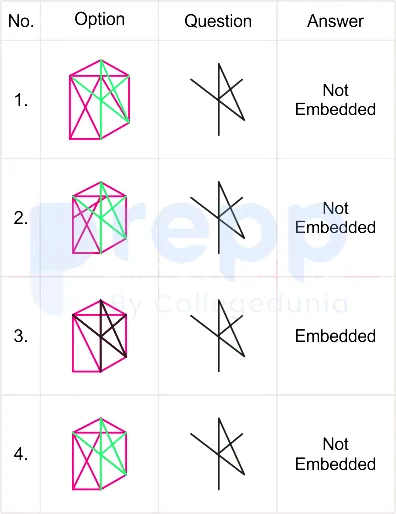
Select the option figure in which the given figure (X) is embedded as its part (rotation is NOT allowed).
(x)

- A
Option A (shown in image)
- B
Option B (shown in image)
- C
Option C (shown in image)
- D
Option D (shown in image)
Show answer
C. Option C (shown in image)Given:
The image must not to be rotated
Hence, the correct answer is "Option - (3)" .

 Paper & answer key PDF ↗
 Question 3archived
In a certain code language, 'feel at home' is coded as '424', 'check the laundry' is coded as '537' and 'open the door' is coded as '434'. How will 'the kite is flying' be coded in that language?
- A
2315
- B
3251
- C
4362
- D
3426
Show answer
D. 3426Decoding the Coding Language Pattern
This question asks us to understand a specific code language used to represent phrases with numbers. We are given three examples of phrases and their corresponding codes:
'feel at home' is coded as '424'
'check the laundry' is coded as '537'
'open the door' is coded as '434'
Our goal is to determine the code for the phrase 'the kite is flying' based on the pattern observed in the given examples.
Analyzing the Given Codes
Let's examine the relationship between the words in each phrase and their numerical codes. A common pattern in such problems relates the code to properties of the words, such as the number of letters, the position of letters, or specific letters themselves. Looking at the given examples, let's count the number of letters in each word:
Phrase 1: 'feel at home'
'feel' has ${4}$ letters.
'at' has ${2}$ letters.
'home' has ${4}$ letters.
The code is 424. This matches the sequence of the number of letters in each word.
Phrase 2: 'check the laundry'
'check' has ${5}$ letters.
'the' has ${3}$ letters.
'laundry' has ${7}$ letters.
The code is 537. This matches the sequence of the number of letters in each word.
Phrase 3: 'open the door'
'open' has ${4}$ letters.
'the' has ${3}$ letters.
'door' has ${4}$ letters.
The code is 434. This matches the sequence of the number of letters in each word.
From this analysis, it is clear that the code for a phrase is formed by concatenating the number of letters in each word of the phrase, in the order they appear.
Summary of Coding Pattern
Phrase
Words
Letter Count per Word
Concatenated Code
feel at home
feel, at, home
4, 2, 4
424
check the laundry
check, the, laundry
5, 3, 7
537
open the door
open, the, door
4, 3, 4
434
Applying the Pattern to 'the kite is flying'
Now we apply the same pattern to the phrase 'the kite is flying'. We need to count the letters in each word:
'the' has ${3}$ letters.
'kite' has ${4}$ letters.
'is' has ${2}$ letters.
'flying' has ${6}$ letters.
Concatenating the number of letters in the order of the words (3, 4, 2, 6) gives us the code 3426.
Conclusion
Based on the established pattern, the phrase 'the kite is flying' is coded as 3426.
Revision Table: Coding Language Pattern
Key Learnings from the Coding Problem
Concept
Description
Example
Coding Pattern
Code is formed by counting letters in each word and concatenating the counts.
'feel at home' → 4, 2, 4 → 424
Application
Apply the same letter-counting rule to the new phrase.
'the kite is flying' → 3, 4, 2, 6 → 3426
Additional Information: Types of Coding & Decoding Problems
Coding and decoding questions often appear in logical reasoning sections of exams. While this problem used letter counting, other common patterns include:
Letter Shifting: Each letter in a word is shifted a certain number of positions forward or backward in the alphabet (e.g., A becomes B, B becomes C, etc.).
Letter Substitution: Specific letters are replaced by other letters or symbols based on a rule or a given key.
Word Reversal: The letters within a word or the order of words in a phrase might be reversed.
Position-based Coding: Codes might be based on the numerical position of letters in the alphabet (A=1, B=2, etc.).
Consonant/Vowel Based Coding: Codes might differentiate between consonants and vowels, assigning different values or rules.
Solving such problems requires careful observation of the given examples to identify the underlying rule or pattern. Practice with different types of coding helps in quickly recognizing the logic.
Paper & answer key PDF ↗ Question 4archived
Select the figure that will replace the question mark (?) in the following figure series.

- A
Option A (shown in image)
- B
Option B (shown in image)
- C
Option C (shown in image)
- D
Option D (shown in image)
Show answer
Question 5archived
Which letter-cluster will replace the question mark (?) to complete the given series?
MBTN, KCSP, IDRR, ?, EFPV
- A
GERT
- B
GEQT
- C
GEQU
- D
GEQS
Show answer
B. GEQTUnderstanding the Letter Series Question
The question asks us to identify the letter-cluster that should replace the question mark (?) in the given series: MBTN, KCSP, IDRR, ?, EFPV. To solve this type of reasoning question, we need to find the underlying pattern that connects the consecutive letter-clusters.
We will analyze the pattern followed by the letters at each corresponding position across the letter-clusters in the series.
Analyzing the Pattern in Each Letter Position
Let's break down the analysis by looking at the first, second, third, and fourth letters of each cluster individually.
First Letter Pattern Analysis
The sequence of first letters is M, K, I, ?, E.
Let's find their alphabetical positions: M is 13th, K is 11th, I is 9th, E is 5th.
The numerical sequence of positions is \(13, 11, 9, ?, 5\).
Observing the differences between consecutive terms: \(13 - 11 = 2\), \(11 - 9 = 2\).
This suggests a pattern where 2 is subtracted from the alphabetical position of the previous letter.
Following this pattern, the position of the missing first letter should be \(9 - 2 = 7\).
The 7th letter of the English alphabet is G.
Let's check the next step: \(7 - 2 = 5\), which corresponds to the letter E, confirming our pattern.
Thus, the first letter of the missing cluster is G.
Second Letter Pattern Analysis
The sequence of second letters is B, C, D, ?, F.
Let's find their alphabetical positions: B is 2nd, C is 3rd, D is 4th, F is 6th.
The numerical sequence of positions is \(2, 3, 4, ?, 6\).
Observing the differences: \(3 - 2 = 1\), \(4 - 3 = 1\).
This indicates a pattern where 1 is added to the alphabetical position of the previous letter.
Following this pattern, the position of the missing second letter should be \(4 + 1 = 5\).
The 5th letter of the English alphabet is E.
Let's check the next step: \(5 + 1 = 6\), which corresponds to the letter F, confirming our pattern.
Thus, the second letter of the missing cluster is E.
Third Letter Pattern Analysis
The sequence of third letters is T, S, R, ?, P.
Let's find their alphabetical positions: T is 20th, S is 19th, R is 18th, P is 16th.
The numerical sequence of positions is \(20, 19, 18, ?, 16\).
Observing the differences: \(19 - 20 = -1\), \(18 - 19 = -1\).
This shows a pattern where 1 is subtracted from the alphabetical position of the previous letter.
Following this pattern, the position of the missing third letter should be \(18 - 1 = 17\).
The 17th letter of the English alphabet is Q.
Let's check the next step: \(17 - 1 = 16\), which corresponds to the letter P, confirming our pattern.
Thus, the third letter of the missing cluster is Q.
Fourth Letter Pattern Analysis
The sequence of fourth letters is N, P, R, ?, V.
Let's find their alphabetical positions: N is 14th, P is 16th, R is 18th, V is 22nd.
The numerical sequence of positions is \(14, 16, 18, ?, 22\).
Observing the differences: \(16 - 14 = 2\), \(18 - 16 = 2\).
This reveals a pattern where 2 is added to the alphabetical position of the previous letter.
Following this pattern, the position of the missing fourth letter should be \(18 + 2 = 20\).
The 20th letter of the English alphabet is T.
Let's check the next step: \(20 + 2 = 22\), which corresponds to the letter V, confirming our pattern.
Thus, the fourth letter of the missing cluster is T.
Determining the Missing Letter-Cluster
By combining the letters found for each position, the missing letter-cluster is GEQT.
Verifying with Options
Let's compare our derived cluster (GEQT) with the provided options:
Option 1: GERT
Option 2: GEQT
Option 3: GEQU
Option 4: GEQS
Our derived letter-cluster, GEQT, exactly matches Option 2.
Summary of Letter Series Patterns
Position
Letters in Series
Alphabetical Positions
Pattern Rule
Missing Letter Position
Missing Letter
1st
M, K, I, ?, E
13, 11, 9, ?, 5
Subtract 2 (\(-2\))
\(9 - 2 = 7\)
G
2nd
B, C, D, ?, F
2, 3, 4, ?, 6
Add 1 (\(+1\))
\(4 + 1 = 5\)
E
3rd
T, S, R, ?, P
20, 19, 18, ?, 16
Subtract 1 (\(-1\))
\(18 - 1 = 17\)
Q
4th
N, P, R, ?, V
14, 16, 18, ?, 22
Add 2 (\(+2\))
\(18 + 2 = 20\)
T
Conclusion on Letter Series Pattern
The letter-cluster that completes the given series by following the established patterns for each letter position is GEQT.
Revision Table: Key Patterns in Letter Series
Letter Position
Observed Pattern
Numerical Change
First Letter
Alphabetical position decreases
-2
Second Letter
Alphabetical position increases
+1
Third Letter
Alphabetical position decreases
-1
Fourth Letter
Alphabetical position increases
+2
Additional Information: Tips for Solving Letter Series
Mastering letter series questions for exams requires practice and a systematic approach. Here are some useful tips:
Write down the Alphabet: Quickly jot down the English alphabet and its corresponding positions (A=1, B=2, ..., Z=26) during the exam to help visualize patterns.
Focus on Each Position: Analyze the sequence of letters at each position (1st, 2nd, 3rd, etc.) independently.
Look for Numerical Patterns: Convert the letters to their alphabetical positions and look for arithmetic progressions, geometric progressions, or other number series patterns (like adding/subtracting a constant, or adding/subtracting increasing/decreasing numbers).
Consider Other Possibilities: If numerical patterns aren't obvious, think about vowel/consonant sequences, reverse alphabetical order, or patterns related to the structure of the letters themselves.
Check Consistency: Ensure the pattern identified holds true throughout the entire given series.
Paper & answer key PDF ↗ Question 6archived
Select the odd group of numbers. (NOTE : Operations should be performed on the whole numbers, without breaking down the numbers into its constituent digits. E.g.13 - Operations on 13 such as adding/subtracting/multiplying etc. to 13 can be performed. Breaking down 13 into 1 and 3 and then performing mathematical operations on 1 and 3 is not allowed)
- A
(405 - 400 - 395)
- B
(700 - 690 - 685)
- C
(550 - 545 - 540)
- D
(620 - 615 - 610)
Show answer
B. (700 - 690 - 685)Finding the Odd Group of Numbers by Analyzing Patterns
The question asks us to identify the group of numbers that does not follow the same pattern as the others. We are instructed to treat each number as a whole entity, meaning we should perform operations like addition, subtraction, or multiplication on the numbers themselves, not on their individual digits.
Let's examine the pattern within each group of numbers provided in the options. We will look at the differences between consecutive numbers in each sequence.
Analyzing Each Number Group Option
Option 1: (405 - 400 - 395)
Difference between the first and second number: \(405 - 400 = 5\)
Difference between the second and third number: \(400 - 395 = 5\)
Pattern: The numbers are decreasing by 5 at each step.
Option 2: (700 - 690 - 685)
Difference between the first and second number: \(700 - 690 = 10\)
Difference between the second and third number: \(690 - 685 = 5\)
Pattern: The first difference is 10, and the second difference is 5. The decrease is not consistent.
Option 3: (550 - 545 - 540)
Difference between the first and second number: \(550 - 545 = 5\)
Difference between the second and third number: \(545 - 540 = 5\)
Pattern: The numbers are decreasing by 5 at each step.
Option 4: (620 - 615 - 610)
Difference between the first and second number: \(620 - 615 = 5\)
Difference between the second and third number: \(615 - 610 = 5\)
Pattern: The numbers are decreasing by 5 at each step.
Identifying the Odd Pattern
Comparing the patterns found in each option:
Option 1: Decreases by 5, then by 5.
Option 2: Decreases by 10, then by 5.
Option 3: Decreases by 5, then by 5.
Option 4: Decreases by 5, then by 5.
Options 1, 3, and 4 show a consistent decrease of 5 between consecutive numbers in the group. Option 2 shows a decrease of 10 followed by a decrease of 5, which is a different pattern.
Therefore, the group of numbers (700 - 690 - 685) is the odd one out because it does not follow the same consistent decrease pattern as the other groups.
Revision Table: Key Concepts in Number Patterns
Concept
Description
Example
Arithmetic Sequence
A sequence where the difference between consecutive terms is constant.
2, 5, 8, 11, ... (common difference is 3)
Geometric Sequence
A sequence where the ratio of consecutive terms is constant.
3, 6, 12, 24, ... (common ratio is 2)
Difference Analysis
Finding the difference between consecutive terms to identify a pattern.
Used in this problem to find the constant difference of 5.
Pattern Recognition
Identifying the underlying rule or structure in a series of numbers or objects.
Essential for solving odd group/one out problems.
Additional Information: Approaches to Finding Odd One Out
Problems like finding the odd group of numbers or the odd one out often rely on identifying a common property or pattern shared by all but one element in a set. Common approaches include:
Difference/Ratio Analysis: As demonstrated here, check the differences or ratios between consecutive terms in a sequence.
Mathematical Properties: Look for properties like numbers being prime, even, odd, squares, cubes, multiples of a certain number, etc.
Digit Properties: (Not applicable in this specific question based on the rule, but common in other problems) Sum of digits, product of digits, etc.
Positional Value: The position of the numbers might relate to their value or pattern (e.g., nth term formulas).
Always read the instructions carefully, especially any specific constraints like the one in this problem regarding whole numbers versus individual digits.
Paper & answer key PDF ↗ Question 7archived
A series is given with one term missing. Select the correct alternative from the given ones that will complete the series.
LMR, PUA, TCJ, XKS, ?
- A
CMQ
- B
ARA
- C
SMR
- D
BSB
Show answer
D. BSBSolving Letter Series: Finding the Missing Term
This question asks us to identify the pattern in a given series of letter groups and find the missing term that continues the sequence. The series is LMR, PUA, TCJ, XKS, ?
To solve a letter series, we usually look for a pattern in the position of each letter within the alphabet. Let's analyze the pattern for each position separately.
Analyzing the First Letters (L, P, T, X, ?)
Let's find the alphabetical position of each first letter:
L is the 12th letter.
P is the 16th letter.
T is the 20th letter.
X is the 24th letter.
Now let's find the difference between consecutive letters' positions:
P - L → 16 - 12 = +4
T - P → 20 - 16 = +4
X - T → 24 - 20 = +4
The pattern for the first letter is a consistent increase of 4 in the alphabetical position. To find the next first letter, we add 4 to the position of X:
\(24 + 4 = 28\)
Since there are only 26 letters in the alphabet, we wrap around. The 28th position is equivalent to the 2nd position after wrapping around (28 - 26 = 2). The 2nd letter of the alphabet is B.
So, the first letter of the missing term is B.
Analyzing the Second Letters (M, U, C, K, ?)
Let's find the alphabetical position of each second letter:
M is the 13th letter.
U is the 21st letter.
C is the 3rd letter.
K is the 11th letter.
Now let's find the difference between consecutive letters' positions, considering wrap-around:
U - M → 21 - 13 = +8
C - U → From U (21), 8 steps forward go past Z (26). \(21 + 8 = 29\). \(29 - 26 = 3\). The 3rd letter is C. Pattern: +8
K - C → 11 - 3 = +8
The pattern for the second letter is a consistent increase of 8 in the alphabetical position, wrapping around the alphabet. To find the next second letter, we add 8 to the position of K:
\(11 + 8 = 19\)
The 19th letter of the alphabet is S.
So, the second letter of the missing term is S.
Analyzing the Third Letters (R, A, J, S, ?)
Let's find the alphabetical position of each third letter:
R is the 18th letter.
A is the 1st letter.
J is the 10th letter.
S is the 19th letter.
Now let's find the difference between consecutive letters' positions, considering wrap-around:
A - R → From R (18), 9 steps forward go past Z (26). \(18 + 9 = 27\). \(27 - 26 = 1\). The 1st letter is A. Pattern: +9
J - A → 10 - 1 = +9
S - J → 19 - 10 = +9
The pattern for the third letter is a consistent increase of 9 in the alphabetical position, wrapping around the alphabet. To find the next third letter, we add 9 to the position of S:
\(19 + 9 = 28\)
Since we wrap around the alphabet, the 28th position is equivalent to the 2nd position (28 - 26 = 2). The 2nd letter of the alphabet is B.
So, the third letter of the missing term is B.
Combining the Letters to Find the Missing Term
By combining the next letters we found for each position, we get the missing term:
First letter: B
Second letter: S
Third letter: B
The missing term in the series is BSB.
Term
1st Letter (+4)
2nd Letter (+8)
3rd Letter (+9)
LMR
L (12)
M (13)
R (18)
PUA
P (16)
U (21)
A (1)
TCJ
T (20)
C (3)
J (10)
XKS
X (24)
K (11)
S (19)
BSB
B (28 → 2)
S (19)
B (28 → 2)
Revision Table: Letter Series Analysis
Understanding how to analyze letter series patterns is crucial for logical reasoning questions. Here's a summary of the steps taken:
Step 1: Break down each term into individual letters based on their position (1st, 2nd, 3rd, etc.).
Step 2: Analyze the sequence of letters for the first position across all terms. Find the pattern (e.g., constant difference, increasing difference). Remember to account for wrapping around the alphabet (A comes after Z).
Step 3: Repeat Step 2 for the second position letters, the third position letters, and so on.
Step 4: Use the identified patterns for each position to determine the next letter in the sequence for the missing term.
Step 5: Combine the letters found in Step 4 to get the complete missing term in the letter series.
Additional Information: Types of Letter Series Patterns
Letter series problems can have various patterns. Recognizing these can help you solve them faster:
Constant Difference: The position of letters increases or decreases by the same number (like the +4, +8, +9 patterns seen in this problem).
Increasing/Decreasing Difference: The difference between letter positions changes systematically (e.g., +2, +3, +4, ...).
Alternating Patterns: Different patterns apply to alternate terms or alternate letters within a term.
Group Patterns: The pattern might relate a group of letters to the next group as a whole.
Alphabetical Blocks: Letters might appear in blocks or skips within the alphabet.
Practicing different types of series will improve your ability to quickly identify the underlying logic and solve missing term questions.
Paper & answer key PDF ↗ Question 8archived
Select the correct mirror image of the given combination when the mirror is placed at MN as shown below.
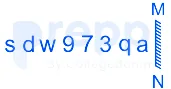
- A
Option A (shown in image)
- B
Option B (shown in image)
- C
Option C (shown in image)
- D
Option D (shown in image)
Show answer
Question 9archived
Select the option that represents the correct order of the given words as they would appear in an English dictionary.
1- Kinglet
2- Kingship
3- kingdom
4- kinsfolk
5- kingly
- A
1, 3, 2, 5, 4
- B
3, 1, 2, 5, 4
- C
1, 3, 5, 2, 4
- D
3, 1, 5, 2, 4
Show answer
D. 3, 1, 5, 2, 4Understanding Dictionary Order
To arrange words in the order they would appear in an English dictionary, we need to compare them letter by letter from left to right. The word that comes first alphabetically based on the earliest differing letter is placed first. If words share the same letters up to a certain point, we look at the next letter. Shorter words generally come before longer words if one is a prefix of the other (e.g., 'king' before 'kingdom' if 'king' were in the list and 'kingdom' wasn't, but here we are comparing longer words).
Analyzing the Given Words for Dictionary Order
Here are the words we need to arrange:
Kinglet
Kingship
kingdom
kinsfolk
kingly
Let's compare the words letter by letter:
All words start with 'k'.
All words start with 'ki'.
All words start with 'kin'.
Now let's look at the fourth letter:
Kinglet: king
Kingship: king
kingdom: king
kinsfolk: kins
kingly: king
Comparing 'g' and 's', 'g' comes before 's' in the alphabet. This means 'kinsfolk' will come after all the words starting with 'king'. So, 'kinsfolk' (4) is the last word in the sequence.
Sorting Words Starting with "king"
Now we sort the remaining words: Kinglet (1), Kingship (2), kingdom (3), kingly (5).
All start with 'king'. Let's look at the fifth letter:
Kinglet: kingl
Kingship: kings
kingdom: kingd
kingly: kingl
Comparing 'l', 's', and 'd', 'd' comes first, then 'l', then 's'.
'kingdom' (3) starts with 'kingd', so it comes first among these.
'Kinglet' (1) and 'kingly' (5) both start with 'kingl'.
'Kingship' (2) starts with 'kings', so it comes after the words starting with 'kingl'.
Sorting Words Starting with "kingl"
Now we sort 'Kinglet' (1) and 'kingly' (5), which both start with 'kingl'. Let's look at the sixth letter:
Kinglet: kingle
kingly: kingly
Comparing 'e' and 'y', 'e' comes before 'y'. So, 'Kinglet' (1) comes before 'kingly' (5).
Final Sorted Order
Putting it all together:
First comes 'kingdom' (3).
Next comes 'Kinglet' (1).
Then comes 'kingly' (5).
After the 'kingl' words is 'Kingship' (2).
Last is 'kinsfolk' (4), as it starts with 'kins'.
The correct order of the words is kingdom, Kinglet, kingly, Kingship, kinsfolk.
The correct numerical sequence is 3, 1, 5, 2, 4.
Rank
Word
Numerical Code
1
kingdom
3
2
Kinglet
1
3
kingly
5
4
Kingship
2
5
kinsfolk
4
Revision Table: Dictionary Order Practice
Word 1
Word 2
Which Comes First?
Reason
Kinglet
Kingship
Kinglet
'l' in Kinglet vs 's' in Kingship ('l' < 's')
kingdom
Kinglet
kingdom
'd' in kingdom vs 'l' in Kinglet ('d' < 'l')
kingly
Kinglet
Kinglet
'e' in Kinglet vs 'y' in kingly ('e' < 'y')
Kingship
kinsfolk
Kingship
'g' in Kingship vs 's' in kinsfolk ('g' < 's')
Additional Information: Mastering Alphabetical Sorting
Mastering alphabetical order is a fundamental skill for using dictionaries, indexes, encyclopedias, and organizing lists. Here are some tips:
Always compare words letter by letter from the beginning.
If the first letters are the same, move to the second letter, and so on.
If one word is shorter but is the beginning of a longer word, the shorter word usually comes first (e.g., 'car' before 'carpet'). However, this rule applies when comparing a base word to an extended form; when comparing distinct words like in this problem, it's purely letter-by-letter comparison until a difference is found.
Pay attention to case sensitivity if specified, though standard dictionary order is usually not case-sensitive for the first letter of entries. In this case, 'Kinglet' and 'kingdom' are treated the same as if they were all lowercase or all uppercase for sorting purposes.
When comparing words that only differ towards the end, continue comparing until the very last letter.
Practicing with different sets of words helps build speed and accuracy in alphabetical sorting.
Paper & answer key PDF ↗ Question 10archived
Select the option that is related to the third number in the same way as the second number is related to the first number and the sixth number is related to the fifth number.
687 : 612 :: 713 : ? :: 621 : 546
- A
656
- B
674
- C
662
- D
638
Show answer
D. 638Understanding Number Analogy Questions
Number analogy questions test your ability to find the relationship between pairs of numbers and apply that relationship to find a missing number. The key is to identify the pattern connecting the numbers in the given pairs.
Analyzing the Given Number Analogy
The question provides three pairs of numbers with a specific relationship:
687 : 612 :: 713 : ? :: 621 : 546
This means that the first number is related to the second number in the same way the third number is related to the missing number (represented by '?'), and the fifth number is related to the sixth number.
Step 1: Find the Relationship in the First Pair (687 : 612)
Let's examine the relationship between 687 and 612. We can check for simple arithmetic operations like addition, subtraction, multiplication, or division.
Is it subtraction? Calculate the difference: $\text{Difference} = 687 - 612$.
Calculating the difference:
$\qquad 687$
$\qquad - 612$
$\qquad \rule{1.5cm}{0.4pt}$
$\qquad \hphantom{-} 75$
So, $687 - 612 = 75$. The relationship could be subtracting 75.
Step 2: Verify the Relationship in the Third Pair (621 : 546)
Let's see if the same relationship (subtracting 75) holds true for the third pair, 621 and 546.
Calculate the difference: $\text{Difference} = 621 - 546$.
Calculating the difference:
$\qquad 621$
$\qquad - 546$
$\qquad \rule{1.5cm}{0.4pt}$
$\qquad \hphantom{-} 75$
So, $621 - 546 = 75$. The relationship of subtracting 75 is consistent across the first and third pairs.
Step 3: Apply the Relationship to the Second Pair (713 : ?)
Since the relationship is subtracting 75 from the first number to get the second number, we apply this rule to the second pair, 713 : ?.
Subtract 75 from the first number (713) to find the missing number.
Missing Number $= 713 - 75$.
Calculating the missing number:
$\qquad 713$
$\qquad - 75$
$\qquad \rule{1.5cm}{0.4pt}$
$\qquad \hphantom{-} 638$
The missing number is 638.
Checking the Options
Let's compare our calculated missing number with the given options:
656
674
662
638
Our calculated number, 638, matches Option 4.
Summary of the Analogy Pattern
The pattern in this number analogy is a simple subtraction of 75 from the first number in each pair to obtain the second number.
Pair
First Number
Relationship
Second Number
1
687
$- 75$
612
2
713
$- 75$
? (638)
3
621
$- 75$
546
Therefore, the number that relates to 713 in the same way is 638.
Revision Table: Number Analogy Concepts
Concept
Description
Example (using this question)
Analogy
Finding a relationship between two things (numbers, words, etc.) and applying it to another pair.
Relationship between 687 & 612 is same as 713 & ?.
Number Analogy
A type of analogy where the relationship exists between pairs of numbers.
687 : 612 :: 713 : ?
Relationship
The rule or pattern connecting the numbers in a pair (e.g., addition, subtraction, multiplication, division, squares, cubes, digit operations).
The relationship is subtracting 75.
Additional Information: Types of Number Analogy Relationships
Number analogy questions can involve various types of relationships. Some common ones include:
Arithmetic Operations: Addition, subtraction, multiplication, division.
Squares and Cubes: Numbers might be squares or cubes of other numbers, or related through squaring/cubing operations.
Digit Operations: Sum of digits, product of digits, reversal of digits, specific digit manipulations.
Prime Numbers or Composite Numbers: The relationship might involve prime or composite numbers.
Combinations: A combination of the above relationships (e.g., multiply by 2 then add 3).
To solve number analogy questions, always start by looking for simple arithmetic relationships and then move to more complex ones if needed. Checking consistency across all given pairs is crucial.
Paper & answer key PDF ↗ Question 11archived
In a certain code language, 'EAGER' is written as 'AEHRE' and 'GIRLS' is written as 'IGSSL'. How will 'ISSUE' be written in that language?
- A
ISTEU
- B
ISTUE
- C
SITEU
- D
ISSEU
Show answer
C. SITEUSolving the Letter Coding Problem: EAGER, GIRLS, and ISSUE
This question involves a type of coding language where words are transformed into other words based on specific rules. We are given two examples of this transformation:
'EAGER' is coded as 'AEHRE'
'GIRLS' is coded as 'IGSSL'
Our goal is to find the coding rules by comparing the original words and their coded forms, and then apply these rules to the word 'ISSUE' to find its coded form.
Analyzing the Coding Pattern
Let's look at the letters in each position for the first example, 'EAGER' transforming into 'AEHRE':
Position
1
2
3
4
5
Original Word (EAGER)
E
A
G
E
R
Coded Word (AEHRE)
A
E
H
R
E
Observation
E & A swapped
A & E swapped
G > H (+1 letter)
E & R relation?
R & E relation?
Now, let's examine the second example, 'GIRLS' transforming into 'IGSSL':
Position
1
2
3
4
5
Original Word (GIRLS)
G
I
R
L
S
Coded Word (IGSSL)
I
G
S
S
L
Observation
G & I swapped
I & G swapped
R > S (+1 letter)
L & S relation?
S & L relation?
Identifying the Coding Rules
By comparing the observations from both examples, we can identify consistent rules based on the letter positions:
Positions 1 and 2: The letters at the first and second positions are swapped. (E $\leftrightarrow$ A, G $\leftrightarrow$ I)
Position 3: The letter at the third position is shifted one step forward in the alphabet (G $\to$ H, R $\to$ S). This is a '+1' shift.
Positions 4 and 5: Looking at EAGER/AEHRE (E4, R5 $\to$ R4, E5) and GIRLS/IGSSL (L4, S5 $\to$ S4, L5), it appears the letters at the fourth and fifth positions are also swapped.
Applying the Rules to 'ISSUE'
Now let's apply these rules to the word 'ISSUE':
Original word: I S S U E
Position: 1 2 3 4 5
Step 1: Apply Rule 1 (Swap positions 1 and 2)
I and S swap $\to$ S I S U E
Step 2: Apply Rule 2 (Shift position 3 by +1)
The letter at position 3 is S. Shifting S by +1 in the alphabet gives T.
Current word: S I T U E
Step 3: Apply Rule 3 (Swap positions 4 and 5)
The letters at positions 4 and 5 are U and E. Swap them $\to$ E U.
Current word: S I T E U
The coded word for 'ISSUE' is 'SITEU'.
Comparing with Options
Let's compare our result 'SITEU' with the given options:
Option 1: ISTEU
Option 2: ISTUE
Option 3: SITEU
Option 4: ISSEU
Our derived coded word 'SITEU' matches Option 3.
Revision Table: Coding Rules Summary
Position(s)
Rule
Example (EAGER $\to$ AEHRE)
Example (GIRLS $\to$ IGSSL)
Application (ISSUE $\to$ SITEU)
1 & 2
Swap letters
E A $\to$ A E
G I $\to$ I G
I S $\to$ S I
3
Shift letter by +1
G $\to$ H
R $\to$ S
S $\to$ T
4 & 5
Swap letters
E R $\to$ R E
L S $\to$ S L
U E $\to$ E U
Additional Information: Letter Coding and Decoding
Letter coding is a common type of question in logical reasoning and verbal ability sections of competitive exams. These questions test your ability to identify patterns and rules governing the transformation of letters or words. The rules can be based on various principles:
Alphabet Position: Shifting letters forward or backward by a fixed number of positions (e.g., A $\to$ B, C $\to$ D).
Alphabet Position Value: Assigning numerical values to letters (A=1, B=2, etc.) and performing mathematical operations.
Reversal: Reversing the order of letters in a word or parts of a word.
Substitution: Replacing letters with specific other letters or symbols.
Swapping: Interchanging the positions of letters within the word or in groups.
Combination of Rules: Using multiple rules applied to different positions or groups of letters, as seen in the 'EAGER' example.
To solve letter coding problems effectively, practice is key. Always analyze the given examples carefully, looking for consistent patterns in letter changes, position changes, or a combination of both. Break down the word position by position if necessary to identify separate rules for different parts of the word.
Paper & answer key PDF ↗ Question 12archived
By interchanging the given two signs which of the following equation will be not correct?
- and ×
- A
5 - 6 × 3 + 16 ÷ 4 = 31
- B
11 + 6 × 3 - 8 ÷ 2 = 5
- C
7 × 8 + 4 ÷ 2 - 6 = 11
- D
7 × 2 + 27 ÷ 9 - 4 = 18
Show answer
D. 7 × 2 + 27 ÷ 9 - 4 = 18Solving Equations by Interchanging Signs
The question asks us to identify which of the given equations becomes incorrect when the signs for subtraction (-) and multiplication (×) are interchanged. We need to apply this interchange to each equation and then evaluate the resulting expression using the BODMAS or PEMDAS rule to check if the equality holds true.
Understanding the Sign Interchange and Order of Operations
The rule given is to swap the positions or meanings of the '-' and '×' signs. So, wherever we see a '-', we will treat it as '×', and wherever we see a '×', we will treat it as '-'.
To evaluate the expressions correctly, we must follow the standard order of operations, commonly remembered by acronyms like BODMAS or PEMDAS:
Brackets / Parentheses
Orders (powers, square roots, etc.) / Exponents
Division and Multiplication (from left to right)
Addition and Subtraction (from left to right)
Evaluating Each Option
Evaluating Option 1: \(5 - 6 \times 3 + 16 \div 4 = 31\)
Original equation: \(5 - 6 \times 3 + 16 \div 4 = 31\)
After interchanging '-' and '×': \(5 \times 6 - 3 + 16 \div 4\)
Let's evaluate the left side using BODMAS:
$$ 5 \times 6 - 3 + 16 \div 4 $$
First, Division:
$$ 5 \times 6 - 3 + 4 $$
Next, Multiplication:
$$ 30 - 3 + 4 $$
Finally, Subtraction and Addition from left to right:
$$ (30 - 3) + 4 = 27 + 4 = 31 $$
The left side evaluates to 31. The original equation's right side is also 31. So, \(31 = 31\). This equation remains correct after the sign interchange.
Evaluating Option 2: \(11 + 6 \times 3 - 8 \div 2 = 5\)
Original equation: \(11 + 6 \times 3 - 8 \div 2 = 5\)
After interchanging '-' and '×': \(11 + 6 - 3 \times 8 \div 2\)
Let's evaluate the left side using BODMAS:
$$ 11 + 6 - 3 \times 8 \div 2 $$
First, Multiplication and Division from left to right:
$$ 11 + 6 - (3 \times 8) \div 2 = 11 + 6 - 24 \div 2 $$
$$ 11 + 6 - (24 \div 2) = 11 + 6 - 12 $$
Finally, Addition and Subtraction from left to right:
$$ (11 + 6) - 12 = 17 - 12 = 5 $$
The left side evaluates to 5. The original equation's right side is also 5. So, \(5 = 5\). This equation remains correct after the sign interchange.
Evaluating Option 3: \(7 \times 8 + 4 \div 2 - 6 = 11\)
Original equation: \(7 \times 8 + 4 \div 2 - 6 = 11\)
After interchanging '-' and '×': \(7 - 8 + 4 \div 2 \times 6\)
Let's evaluate the left side using BODMAS:
$$ 7 - 8 + 4 \div 2 \times 6 $$
First, Division and Multiplication from left to right:
$$ 7 - 8 + (4 \div 2) \times 6 = 7 - 8 + 2 \times 6 $$
$$ 7 - 8 + (2 \times 6) = 7 - 8 + 12 $$
Finally, Subtraction and Addition from left to right:
$$ (7 - 8) + 12 = -1 + 12 = 11 $$
The left side evaluates to 11. The original equation's right side is also 11. So, \(11 = 11\). This equation remains correct after the sign interchange.
Evaluating Option 4: \(7 \times 2 + 27 \div 9 - 4 = 18\)
Original equation: \(7 \times 2 + 27 \div 9 - 4 = 18\)
After interchanging '-' and '×': \(7 - 2 + 27 \div 9 \times 4\)
Let's evaluate the left side using BODMAS:
$$ 7 - 2 + 27 \div 9 \times 4 $$
First, Division and Multiplication from left to right:
$$ 7 - 2 + (27 \div 9) \times 4 = 7 - 2 + 3 \times 4 $$
$$ 7 - 2 + (3 \times 4) = 7 - 2 + 12 $$
Finally, Subtraction and Addition from left to right:
$$ (7 - 2) + 12 = 5 + 12 = 17 $$
The left side evaluates to 17. The original equation's right side is 18. So, \(17 \neq 18\). This equation is not correct after the sign interchange.
Conclusion
After interchanging the '-' and '×' signs and applying the BODMAS rule, we found that the equation \(7 \times 2 + 27 \div 9 - 4 = 18\) becomes \(7 - 2 + 27 \div 9 \times 4 = 17\), which is not equal to 18. Therefore, this equation is the one that will not be correct.
Option
Original Equation
Equation after Sign Interchange
Evaluated Result (LHS)
Original RHS
Correct after Interchange?
1
\(5 - 6 \times 3 + 16 \div 4 = 31\)
\(5 \times 6 - 3 + 16 \div 4\)
31
31
Yes (\(31=31\))
2
\(11 + 6 \times 3 - 8 \div 2 = 5\)
\(11 + 6 - 3 \times 8 \div 2\)
5
5
Yes (\(5=5\))
3
\(7 \times 8 + 4 \div 2 - 6 = 11\)
\(7 - 8 + 4 \div 2 \times 6\)
11
11
Yes (\(11=11\))
4
\(7 \times 2 + 27 \div 9 - 4 = 18\)
\(7 - 2 + 27 \div 9 \times 4\)
17
18
No (\(17 \neq 18\))
Revision Table: Interchanging Signs and Equation Correctness
When solving problems involving interchanging signs, it is crucial to systematically apply the interchange rule and then strictly follow the order of operations (BODMAS/PEMDAS) to evaluate the expressions. Each option must be tested independently.
Additional Information: Importance of Order of Operations
The order of operations is a fundamental concept in mathematics. Without it, expressions involving multiple operations would have ambiguous results. For example, \(3 + 5 \times 2\) could be interpreted as \((3+5) \times 2 = 8 \times 2 = 16\) or as \(3 + (5 \times 2) = 3 + 10 = 13\). BODMAS/PEMDAS ensures everyone arrives at the standard correct answer, which is 13 in this case, because multiplication is done before addition. In competitive exams, questions involving sign interchanges or mixed operations heavily rely on correct application of this order.
Paper & answer key PDF ↗ Question 13archived
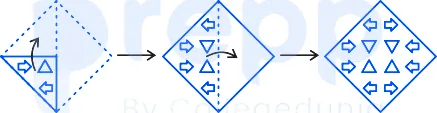
A paper is folded and cut as shown below. How will it appear when unfolded?
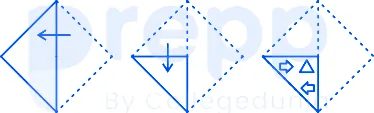
- A
Option A (shown in image)
- B
Option B (shown in image)
- C
Option C (shown in image)
- D
Option D (shown in image)
Show answer
D. Option D (shown in image)According to given figure:
The figure will appear when it is opened as follows:
Hence, "Option - (4)" is the correct answer.
 Paper & answer key PDF ↗
 Question 14archived
Select the word-pair that best represents a similar relationship to the one expressed in the given pair of words.
(The words must be considered as meaningful English words and must not be related to each other based on the number of letters/number of consonants/vowels in the word)
Hen : Coop
- A
Horse : Field
- B
Bee : Hive
- C
Elephant : Leaves
- D
Cow : Hay
Show answer
B. Bee : HiveUnderstanding Word Pair Analogies
Word pair analogy questions test your ability to identify the relationship between a given pair of words and then find another word pair that shares the same relationship. The key is to define the connection between the first pair before examining the options.
Analyzing the Given Word Pair: Hen : Coop
Let's look at the relationship between 'Hen' and 'Coop'.
A Hen is a type of bird.
A Coop is a structure where hens are kept; it serves as their home or shelter.
Therefore, the relationship between Hen and Coop is Animal : Habitat/Shelter.
Evaluating the Options
Now, let's examine each option to see which word pair exhibits the same Animal : Habitat/Shelter relationship as Hen : Coop.
Horse : Field
A horse might spend time in a field for grazing, but a field is generally not considered its primary or specific shelter in the way a coop is for a hen. Horses are typically sheltered in stables or barns. This pair represents a less specific Animal : Location relationship rather than a direct Animal : Specific Shelter.
Bee : Hive
A Bee is an insect.
A Hive is a structure built or used by bees to live in and raise their young; it is their specific habitat and shelter.
This pair exhibits the relationship Animal : Habitat/Shelter, which is exactly the same as the relationship between Hen and Coop.
Elephant : Leaves
An Elephant is an animal, and leaves are a type of food that elephants eat. This pair represents an Animal : Food relationship, which is different from Animal : Habitat/Shelter.
Cow : Hay
A Cow is an animal, and hay is dried grass used as food for livestock. This pair represents an Animal : Food relationship, which is different from Animal : Habitat/Shelter.
Identifying the Similar Relationship
Comparing the relationships:
Hen : Coop → Animal : Habitat/Shelter
Horse : Field → Animal : Location (less specific)
Bee : Hive → Animal : Habitat/Shelter
Elephant : Leaves → Animal : Food
Cow : Hay → Animal : Food
The word pair "Bee : Hive" shares the most similar relationship (Animal : Habitat/Shelter) with "Hen : Coop".
Revision Table: Analogies Explained
Word Pair
Relationship Type
Similarity to Hen : Coop
Hen : Coop
Animal : Habitat/Shelter
(Reference Pair)
Horse : Field
Animal : Location
Different
Bee : Hive
Animal : Habitat/Shelter
Same
Elephant : Leaves
Animal : Food
Different
Cow : Hay
Animal : Food
Different
Additional Information: Types of Analogies
Analogies can express various types of relationships between word pairs. Recognizing common relationship types helps in solving analogy questions. Some common types include:
Part to Whole: e.g., Finger : Hand (A finger is part of a hand)
Cause and Effect: e.g., Rain : Flood (Rain can cause a flood)
Synonyms: e.g., Happy : Joyful (Words with similar meaning)
Antonyms: e.g., Hot : Cold (Words with opposite meaning)
Performer and Action: e.g., Writer : Write (A writer performs the action of writing)
Object and Function: e.g., Knife : Cut (The function of a knife is to cut)
Animal and Habitat: e.g., Bird : Nest (A bird lives in a nest) - This is the type seen in Hen : Coop.
Animal and Sound: e.g., Lion : Roar (A lion makes a roaring sound)
Object and Material: e.g., Table : Wood (A table can be made of wood)
By practicing identifying these different relationships, you can improve your ability to solve word pair analogy questions accurately and efficiently during exams.
Paper & answer key PDF ↗ Question 15archived
Select the figure from among the given options that can replace the question mark (?) in the following series.

- A
Option A (shown in image)
- B
Option B (shown in image)
- C
Option C (shown in image)
- D
Option D (shown in image)
Show answer
Question 16archived
If A × B means that A is the father of B, A - B means that A is the mother of B, A ÷ B means that A is the brother of B then which of the following expression shows that P is the father of R?
- A
P ÷ Q × R
- B
P × Q ÷ R
- C
P × Q - R
- D
P - R × Q
Show answer
B. P × Q ÷ RUnderstanding Blood Relations Symbols
This question tests your ability to interpret symbolic representations of blood relations. Each symbol represents a specific relationship between two individuals.
The given relationships are:
A \( \times \) B means A is the father of B
A \( - \) B means A is the mother of B
A \( \div \) B means A is the brother of B
We need to find the expression that shows P is the father of R. Let's analyze each option based on the given symbolic meanings.
Symbol
Relationship
\( \times \)
Father of
\( - \)
Mother of
\( \div \)
Brother of
Analyzing Blood Relation Options
Option 1: P \( \div \) Q \( \times \) R
P \( \div \) Q: This means P is the brother of Q.
Q \( \times \) R: This means Q is the father of R.
Combining these, P is the brother of Q, and Q is the father of R. If Q is the father of R, and P is Q's brother, then P is the uncle of R. This option does not show P as the father of R.
Option 2: P \( \times \) Q \( \div \) R
P \( \times \) Q: This means P is the father of Q.
Q \( \div \) R: This means Q is the brother of R.
Combining these, P is the father of Q, and Q is the brother of R. If P is the father of Q, and Q is the brother of R, it means Q and R are siblings (or half-siblings, but for these types of problems, it usually implies full siblings unless specified). Since P is the father of Q, and Q is R's brother, P is also the father of R. This option correctly shows P is the father of R.
Option 3: P \( \times \) Q \( - \) R
P \( \times \) Q: This means P is the father of Q.
Q \( - \) R: This means Q is the mother of R.
Combining these, P is the father of Q, and Q is the mother of R. If P is the father of Q, and Q is R's mother, then P is Q's father, and Q is R's parent. This makes P the grandfather of R. This option does not show P as the father of R.
Option 4: P \( - \) R \( \times \) Q
P \( - \) R: This means P is the mother of R.
R \( \times \) Q: This means R is the father of Q.
Combining these, P is the mother of R, and R is the father of Q. This establishes that P is the mother of R, and R is a parent of Q. This means P is the grandmother of Q, and P is the mother of R. This option does not show P as the father of R.
Conclusion on P being Father of R
Based on the analysis of each expression, only the expression P \( \times \) Q \( \div \) R correctly represents the relationship where P is the father of R.
Revision Table: Blood Relations Logic
Expression Part
Relationship
Implied Family Link
P \( \times \) Q
P is father of Q
P is one generation above Q
P \( - \) Q
P is mother of Q
P is one generation above Q
P \( \div \) Q
P is brother of Q
P is in the same generation as Q
P \( \times \) Q \( \div \) R
P father of Q, Q brother of R
P is father of (Q and R)
Additional Information: Solving Blood Relation Problems
Blood relation problems can be solved effectively by drawing a family tree or by interpreting the relations step-by-step. When dealing with coded relations like this, it's crucial to:
Understand the meaning of each symbol accurately.
Break down the given expression into smaller parts.
Determine the relationship between consecutive individuals in the expression.
Combine the relationships sequentially to find the overall relationship between the desired individuals.
Pay attention to the order of individuals as the relationships are usually directional (A is father of B is different from B is father of A).
Paper & answer key PDF ↗ Question 17archived
Select the set in which the numbers are related in the same way as are the numbers of the following set.
(NOTE : Operations should be performed on the whole numbers, without breaking down the numbers into its constituent digits.)
(3, 2, 35)
(1, 4, 65)
- A
(7, 2, 351)
- B
(3, 2, 31)
- C
(5, 4, 41)
- D
(6, 8, 224)
Show answer
A. (7, 2, 351)Finding the Relationship in Number Sets: Analogy Explained
This question requires us to find a set of numbers that shares the same mathematical relationship as the two provided sets: (3, 2, 35) and (1, 4, 65). The relationship must be based on operations performed on the whole numbers themselves, not their individual digits.
Analyzing the Given Number Sets to Discover the Pattern
Let's examine the first set, (3, 2, 35). We need to determine how the first two numbers, 3 and 2, relate to produce the third number, 35. Let's label the numbers as \(a\), \(b\), and \(c\), where \(a=3\), \(b=2\), and \(c=35\).
We can try different common mathematical relationships:
Addition: \(a + b = 3 + 2 = 5\) (Not 35)
Multiplication: \(a \times b = 3 \times 2 = 6\) (Not 35)
Squares and Sum: \(a^2 = 3^2 = 9\), \(b^2 = 2^2 = 4\). Sum of squares: \(9 + 4 = 13\) (Not 35)
Cubes and Sum: \(a^3 = 3^3 = 27\), \(b^3 = 2^3 = 8\). Sum of cubes: \(27 + 8 = 35\).
The relationship where the third number is the sum of the cubes of the first two numbers (\(c = a^3 + b^3\)) holds true for the first set (3, 2, 35).
Now, let's verify if this rule applies to the second given set, (1, 4, 65). Here, \(a=1\), \(b=4\), and \(c=65\).
Using the potential rule \(c = a^3 + b^3\):
\(1^3 + 4^3 = 1 + 64 = 65\).
The rule \(c = a^3 + b^3\) also successfully explains the relationship in the second set (1, 4, 65).
Thus, the consistent pattern observed across both given sets is that the third number is the sum of the cubes of the first two numbers.
Checking Options Using the Sum of Cubes Rule
We will now evaluate each of the given options to see which one follows the established rule \(c = a^3 + b^3\).
Option 1: (7, 2, 351)
Here, \(a=7\), \(b=2\), and \(c=351\). Let's calculate \(a^3 + b^3\):
\(7^3 + 2^3 = 343 + 8 = 351\).
The result of the calculation (351) exactly matches the third number in the set (351). This set follows the pattern.
Option 2: (3, 2, 31)
Here, \(a=3\), \(b=2\), and \(c=31\). Let's calculate \(a^3 + b^3\):
\(3^3 + 2^3 = 27 + 8 = 35\).
The calculated value (35) does not match the third number in the set (31). This set does not follow the pattern.
Option 3: (5, 4, 41)
Here, \(a=5\), \(b=4\), and \(c=41\). Let's calculate \(a^3 + b^3\):
\(5^3 + 4^3 = 125 + 64 = 189\).
The calculated value (189) does not match the third number in the set (41). This set does not follow the pattern.
Option 4: (6, 8, 224)
Here, \(a=6\), \(b=8\), and \(c=224\). Let's calculate \(a^3 + b^3\):
\(6^3 + 8^3 = 216 + 512 = 728\).
The calculated value (728) does not match the third number in the set (224). This set does not follow the pattern.
Summary of Pattern Verification
The results of applying the \(c = a^3 + b^3\) rule to each option are summarized below:
Option Set (a, b, c)
Calculation \(a^3 + b^3\)
Third Number (c)
Follows Pattern?
(7, 2, 351)
\(7^3 + 2^3 = 343 + 8 = 351\)
351
Yes
(3, 2, 31)
\(3^3 + 2^3 = 27 + 8 = 35\)
31
No
(5, 4, 41)
\(5^3 + 4^3 = 125 + 64 = 189\)
41
No
(6, 8, 224)
\(6^3 + 8^3 = 216 + 512 = 728\)
224
No
Based on the analysis, only the set (7, 2, 351) exhibits the same relationship (\(c = a^3 + b^3\)) as the original sets.
Conclusion: The Matching Number Set
The set in which the numbers are related in the same way as in (3, 2, 35) and (1, 4, 65) is (7, 2, 351). The relationship is that the third number is the sum of the cubes of the first two numbers.
Revision Table: Key Concepts for Number Set Analysis
Concept
Explanation
Relevance to this Problem
Number Analogy
Identifying a mathematical rule linking numbers in one set to apply it to others.
The task was to find a set with the same rule as the examples.
Pattern Identification
Recognizing the consistent relationship or sequence between elements.
The key step was finding the \(a^3 + b^3 = c\) pattern.
Whole Number Operations
Using arithmetic operations (+, -, ×, ÷, powers) on numbers as complete values.
The problem specified operations on whole numbers, not digits.
Cube (\(n^3\))
The result of multiplying a number by itself three times (\(n \times n \times n\)).
The pattern involved cubing the first two numbers.
Additional Information: Tips for Solving Number Pattern Questions
Solving number pattern and analogy problems requires logical thinking and familiarity with various mathematical relationships. Here are some helpful strategies:
Study the Examples Carefully: Spend time analyzing the given sets. Look for how the numbers change or combine.
Consider Basic Operations: Start with simple relationships like addition, subtraction, multiplication, and division between the numbers.
Think About Powers and Roots: Check for squares, cubes, square roots, or cube roots. Combinations of powers are also common (like \(a^2+b^2\), \(a^3+b^3\), etc.).
Look for Differences or Ratios: In sequences, analyze the difference or ratio between consecutive terms. While this question is about sets, difference patterns can sometimes apply.
Test Your Hypothesis: Once you find a potential rule, apply it to all provided example sets to confirm its consistency.
Apply the Rule to Options: Systematically test your confirmed rule on each answer option until you find a match.
Practice Regularly: Exposure to different types of number patterns improves your ability to quickly spot relationships.
Remember the question's constraints, such as operating only on whole numbers as stated in this problem.
Paper & answer key PDF ↗ Question 18archived
In the following question below are given some statements followed by some conclusions based on those statements. Taking the given statements to be true even if they seem to be at variance from commonly known facts. Read all the conclusions and then decide which of the given conclusion logically follows the given statements.
Statements :
I. All A are R.
II. All R are C.
Conclusions :
I. All A are C.
II. Some R are A.
III. No C is R.
- A
All conclusion follows
- B
Both conclusions II and III follows
- C
Both conclusions I and III follows
- D
Both conclusions I and II follows
Show answer
D. Both conclusions I and II followsUnderstanding Syllogism Statements and Conclusions
This question is based on syllogism, a type of logical reasoning where conclusions are drawn from two or more given statements. We need to analyze the relationship between different categories based on the provided statements and determine which of the given conclusions logically follows.
Analyzing the Given Statements
We are given two statements:
I. All A are R.
II. All R are C.
These statements establish a relationship of inclusion between three categories: A, R, and C. Statement I tells us that everything that is A is also R. Statement II tells us that everything that is R is also C.
Visualizing with Venn Diagrams
We can represent these relationships using Venn Diagrams, which helps in visualizing the overlap or inclusion of sets.
Based on Statement I (All A are R), the circle representing A is completely inside the circle representing R.
Based on Statement II (All R are C), the circle representing R is completely inside the circle representing C.
Combining these, the circle for A is inside R, and the circle for R is inside C. This means the circle for A is also inside the circle for C.
Evaluating the Conclusions
Now let's evaluate each conclusion based on our analysis of the statements and the Venn Diagram visualization.
Conclusion I: All A are C.
From Statement I, we know that all of A is included in R ($\text{A} \subset \text{R}$). From Statement II, we know that all of R is included in C ($\text{R} \subset \text{C}$). If A is a subset of R, and R is a subset of C, then it logically follows that A must also be a subset of C ($\text{A} \subset \text{C}$). This conclusion is consistent with our combined understanding and the Venn Diagram where the A circle is inside the C circle.
Therefore, Conclusion I logically follows from the given statements.
Conclusion II: Some R are A.
Statement I says "All A are R". This means that every single element of A is also an element of R. If the set A is not empty (which is typically assumed unless stated otherwise in syllogism problems), then there are elements in R that are also A. For example, if set A = {apple, banana} and set R = {apple, banana, cherry}, then all A are R, and clearly 'apple' and 'banana' are elements of R that are also A. Thus, some elements of R are A.
Therefore, Conclusion II logically follows from the given statements.
Conclusion III: No C is R.
Statement II says "All R are C". This means that every element of R is also an element of C. This implies that the set R is entirely contained within the set C. If all R are C, then it is impossible for "No C to be R". In fact, since all R are C, all elements of R are also elements of C. This means there are definitely elements in C that are R (specifically, all the elements that are R). This contradicts the conclusion "No C is R".
Therefore, Conclusion III does not logically follow from the given statements. It is, in fact, false.
Summary of Conclusions
Conclusion
Evaluation
Reasoning
I. All A are C.
Follows
If All A are R and All R are C, then All A are C. ($\text{A} \subset \text{R} \subset \text{C} \Rightarrow \text{A} \subset \text{C}$)
II. Some R are A.
Follows
If All A are R, then Some R are A. (Standard deduction from Universal Affirmative)
III. No C is R.
Does Not Follow
If All R are C, then Some C are R (specifically, all of R are C). "No C is R" contradicts "All R are C".
Based on the evaluation, both Conclusion I and Conclusion II logically follow from the given statements.
Revision Table: Syllogism Basics
Statement Type
Example
Key Implication
Universal Affirmative (A)
All S are P
S is entirely contained within P. If S exists, Some P are S.
Universal Negative (E)
No S is P
S and P are entirely separate. No P is S.
Particular Affirmative (I)
Some S are P
There is at least one element common to both S and P. Some P are S.
Particular Negative (O)
Some S are not P
There is at least one element in S that is not in P.
In this problem, Statements I ("All A are R") and II ("All R are C") are Universal Affirmative (A type) statements.
Additional Information on Logical Reasoning
Syllogism is a core topic in logical reasoning, often tested in various competitive exams. Understanding the relationship between different types of statements (All, No, Some) and how conclusions can be drawn from them is crucial. Common methods for solving syllogism problems include using Venn Diagrams or applying rules of deduction (like the rules for valid syllogisms, though not strictly necessary for simple cases like this).
The key principles used here are:
Transitivity of inclusion: If $\text{A} \subset \text{B}$ and $\text{B} \subset \text{C}$, then $\text{A} \subset \text{C}$.
Implication of "All": A statement "All S are P" implies "Some P are S" (assuming S is not empty). This is because if every member of S is a member of P, then the members of S are examples of members of P, hence 'some' members of P are S.
Mastering these basic rules and diagrammatic representation helps solve more complex syllogism problems effectively.
Paper & answer key PDF ↗ Question 19archived
Select the option that is related to the third word in the same way as the second word is related to the first word. (The words must be considered as meaningful English words and must not be related to each other based on the number of letters/number of consonants/vowels in the word)
Knife : Cut :: Ladle : ?
- A
Chop
- B
Serve
- C
Slice
- D
Spread
Show answer
B. ServeUnderstanding the Word Analogy
This question asks us to find a relationship between the first two words and apply the same relationship to the third word to find the fourth word from the given options. This type of problem is known as a word analogy.
Analyzing the Relationship: Knife : Cut
We need to identify the connection between the words "Knife" and "Cut".
A Knife is a tool.
Cut is an action or function performed by a knife.
So, the relationship here is "Tool : Function" or "Object : Action". A knife is used to cut.
Finding the Relationship for Ladle : ?
Now, we apply the same "Tool : Function" relationship to the word "Ladle". A Ladle is also a tool. We need to find which action from the options is the primary function of a ladle.
Option Analysis
Let's examine each option to see which word describes the function of a ladle:
Option 1: Chop
Chopping is an action usually performed with a knife or cleaver, often for food preparation like vegetables. This is not the primary function of a ladle.
Option 2: Serve
A ladle is a type of spoon, often large and with a deep bowl, used specifically for transferring and portioning liquids like soups, stews, or sauces from a pot to a bowl or plate. This action is commonly referred to as serving. Serving is a primary function of a ladle.
Option 3: Slice
Slicing is a method of cutting, typically done with a knife to create thin pieces. This is not related to the use of a ladle.
Option 4: Spread
Spreading involves distributing a substance (like butter, jam, or cream cheese) over a surface, usually done with a knife or spreader. This is not the function of a ladle.
Comparing the options, "Serve" is the most appropriate word that describes the function of a ladle, just as "Cut" describes the function of a knife.
Therefore, the analogy is: Knife is to Cut as Ladle is to Serve.
Revision Table: Word Relations
Understanding common types of word relationships is key to solving analogies.
Relationship Type
Example
Explanation
Tool : Function
Knife : Cut
A tool and what it is used for.
Object : Action
Broom : Sweep
An object and the action performed with it.
Part : Whole
Finger : Hand
A component and the larger entity it belongs to.
Cause : Effect
Heat : Expand
One event or thing that leads to another.
Synonyms
Happy : Joyful
Words with similar meanings.
Antonyms
Hot : Cold
Words with opposite meanings.
Additional Information: Solving Analogy Problems
Here are some tips for tackling word analogy questions:
Identify the relationship between the first pair of words carefully. Think about the core connection.
Look for the same type of relationship between the third word and the options.
Eliminate options that clearly do not fit the identified relationship.
Consider different possible relationships if the first one you think of doesn't lead to a clear answer among the options.
Pay attention to the order of the words in the first pair (e.g., Tool : Function is different from Function : Tool).
In this specific analogy, the relationship was Tool : Function. A Knife performs the function of Cutting, and a Ladle performs the function of Serving.
Paper & answer key PDF ↗ Question 20archived
Select the correct combination of mathematical signs to sequentially replace the * signs and to balance the given equation.
25 * 5 * 10 * 2 * 13
- A
÷, ×, -, =
- B
÷, -, +, =
- C
×, +, -, =
- D
÷, +, -, =
Show answer
D. ÷, +, -, =Solving Mathematical Sign Puzzles to Balance Equations
The question asks us to find the correct combination of mathematical signs ($+, -, \times, \div, =$) that, when sequentially replacing the asterisks (*) in the expression $25 * 5 * 10 * 2 * 13$, makes the equation true. We need to test each given option by substituting the signs in order and evaluating the resulting equation.
We will apply the order of operations (BODMAS/PEMDAS) to evaluate the left side of the equation for each option.
Evaluating Option 1: $\div, \times, -, =$
Substituting the signs from option 1, the expression becomes an equation:
$$25 \div 5 \times 10 - 2 = 13$$
Now, let's evaluate the left side of this equation:
First, perform the division: $25 \div 5 = 5$.
Next, perform the multiplication: $5 \times 10 = 50$.
Finally, perform the subtraction: $50 - 2 = 48$.
So, the left side evaluates to 48. The equation is $48 = 13$. This is false.
Evaluating Option 2: $\div, -, +, =$
Substituting the signs from option 2, the expression becomes an equation:
$$25 \div 5 - 10 + 2 = 13$$
Now, let's evaluate the left side of this equation:
First, perform the division: $25 \div 5 = 5$.
Next, perform the subtraction and addition from left to right: $5 - 10 = -5$.
Then, $-5 + 2 = -3$.
So, the left side evaluates to -3. The equation is $-3 = 13$. This is false.
Evaluating Option 3: $\times, +, -, =$
Substituting the signs from option 3, the expression becomes an equation:
$$25 \times 5 + 10 - 2 = 13$$
Now, let's evaluate the left side of this equation:
First, perform the multiplication: $25 \times 5 = 125$.
Next, perform the addition and subtraction from left to right: $125 + 10 = 135$.
Then, $135 - 2 = 133$.
So, the left side evaluates to 133. The equation is $133 = 13$. This is false.
Evaluating Option 4: $\div, +, -, =$
Substituting the signs from option 4, the expression becomes an equation:
$$25 \div 5 + 10 - 2 = 13$$
Now, let's evaluate the left side of this equation:
First, perform the division: $25 \div 5 = 5$.
Next, perform the addition and subtraction from left to right: $5 + 10 = 15$.
Then, $15 - 2 = 13$.
So, the left side evaluates to 13. The equation is $13 = 13$. This is true.
Option 4 provides the correct sequence of mathematical signs to balance the given equation $25 * 5 * 10 * 2 * 13$. The correct sequence is $\div, +, -, =$.
Revision Table: Testing Operator Combinations
Option
Mathematical Signs
Equation
Left Side Evaluation
Result
1
$\div, \times, -, =$
$25 \div 5 \times 10 - 2 = 13$
$5 \times 10 - 2 = 50 - 2 = 48$
$48 \neq 13$ (Incorrect)
2
$\div, -, +, =$
$25 \div 5 - 10 + 2 = 13$
$5 - 10 + 2 = -5 + 2 = -3$
$-3 \neq 13$ (Incorrect)
3
$\times, +, -, =$
$25 \times 5 + 10 - 2 = 13$
$125 + 10 - 2 = 135 - 2 = 133$
$133 \neq 13$ (Incorrect)
4
$\div, +, -, =$
$25 \div 5 + 10 - 2 = 13$
$5 + 10 - 2 = 15 - 2 = 13$
$13 = 13$ (Correct)
Additional Information on Order of Operations and Equation Balancing
Problems like this require understanding the order of operations to correctly evaluate expressions. The commonly used acronyms are BODMAS or PEMDAS.
BODMAS: Brackets, Orders (powers/roots), Division and Multiplication (from left to right), Addition and Subtraction (from left to right).
PEMDAS: Parentheses, Exponents, Multiplication and Division (from left to right), Addition and Subtraction (from left to right).
Both acronyms represent the same standard mathematical convention for the order in which operations should be performed. When solving mathematical sign puzzles to balance equations, always follow this order. You substitute the given signs into the expression and then calculate the value of the expression according to BODMAS/PEMDAS. The correct combination of signs is the one that makes the value of the left side equal to the value of the right side.
Paper & answer key PDF ↗ Question 21archived
Three statements are given followed by three conclusions numbered I, II and III.
Assuming the statements to be true, even if they seem to be at variance with commonly known facts, decide which of the conclusions logically follow(s) from the statements.
Statements :
All tomatoes are peas.
Some peas are potatoes.
All potatoes are fruits.
Conclusions :
I. Some tomatoes are potatoes.
II. Some fruits are potatoes.
III. Some peas are fruits.
- A
All conclusions follow.
- B
Only conclusions I and III follow.
- C
Only conclusions II and III follow.
- D
Only conclusions I and II follow.
Show answer
C. Only conclusions II and III follow.Understanding Syllogism Statements and Conclusions
This question asks us to analyze a set of statements and determine which of the given conclusions logically follow from these statements, assuming the statements are true.
Analyzing the Given Statements
We have three statements:
Statement 1: All tomatoes are peas.
Statement 2: Some peas are potatoes.
Statement 3: All potatoes are fruits.
In terms of categories, we are dealing with Tomatoes (T), Peas (P), Potatoes (PO), and Fruits (F).
Evaluating Each Conclusion
Let's examine each conclusion based on the given statements.
Conclusion I: Some tomatoes are potatoes.
This conclusion links Tomatoes (T) and Potatoes (PO). The relevant statements are:
Statement 1: All tomatoes are peas (All T are P).
Statement 2: Some peas are potatoes (Some P are PO).
From "All T are P" and "Some P are PO", we are trying to find a relation between T and PO. The middle term is Peas (P). We have an 'All' statement and a 'Some' statement. Combining these does not guarantee a definite 'Some T are PO' relationship. For example, all tomatoes could be a part of the peas that are not potatoes.
Therefore, Conclusion I does not logically follow from the statements.
Conclusion II: Some fruits are potatoes.
This conclusion links Fruits (F) and Potatoes (PO). The relevant statement is:
Statement 3: All potatoes are fruits (All PO are F).
The statement "All potatoes are fruits" means that every single potato is a fruit. If this is true, then it must also be true that there are some fruits that are potatoes. This is a direct logical inference (conversion of an 'A' type proposition). If the set of potatoes is entirely contained within the set of fruits, then the overlap between fruits and potatoes is exactly the set of potatoes, which is not empty (assuming potatoes exist).
Therefore, Conclusion II logically follows from the statements.
Conclusion III: Some peas are fruits.
This conclusion links Peas (P) and Fruits (F). The relevant statements are:
Statement 2: Some peas are potatoes (Some P are PO).
Statement 3: All potatoes are fruits (All PO are F).
From "Some P are PO" and "All PO are F", we are trying to find a relation between P and F. The middle term is Potatoes (PO). We have a 'Some' statement and an 'All' statement. The structure is Some P are PO and All PO are F. This combination (I + A) allows for a conclusion of type 'Some'. The middle term (PO) is the subject of the 'All' statement (All PO are F), where the subject of an 'All' statement is distributed. Since the middle term is distributed in at least one premise, a conclusion is possible. The conclusion links the subjects/predicates not involved in the middle term, respecting their distribution. Thus, "Some P are F" logically follows.
Therefore, Conclusion III logically follows from the statements.
Summary of Conclusions
Based on our analysis:
Conclusion I (Some tomatoes are potatoes): Does not follow.
Conclusion II (Some fruits are potatoes): Follows.
Conclusion III (Some peas are fruits): Follows.
Thus, only conclusions II and III logically follow from the given statements.
Conclusion
Statements Involved
Analysis
Logically Follows?
I. Some tomatoes are potatoes.
Statement 1 (All T are P), Statement 2 (Some P are PO)
All T could be in the part of P that is not PO. No definite link between T and PO is established.
No
II. Some fruits are potatoes.
Statement 3 (All PO are F)
If All PO are F, then Some F must be PO (conversion).
Yes
III. Some peas are fruits.
Statement 2 (Some P are PO), Statement 3 (All PO are F)
Some P are in PO, and All PO are in F. This implies that the portion of P that is in PO is also in F. Thus, Some P are F.
Yes
Revision Table: Syllogism Rules Overview
Understanding the standard rules for combining statements is key to solving syllogism problems. Here is a brief overview for combinations involving two statements:
Statement 1 Type
Statement 2 Type
Middle Term Position
Valid Conclusion Type (if any)
All (A)
All (A)
Predicate of 1st, Subject of 2nd (A+A)
All (A)
All (A)
All (A)
Subject of 1st, Predicate of 2nd
No Valid Conclusion
All (A)
Some (I)
Predicate of 1st, Subject of 2nd (A+I)
Some (I)
Some (I)
All (A)
Predicate of 1st, Subject of 2nd (I+A)
Some (I)
All (A)
No (E)
Predicate of 1st, Subject of 2nd (A+E)
No (E)
No (E)
All (A)
Predicate of 1st, Subject of 2nd (E+A)
Some Not (O) (in reverse order)
Some (I)
No (E)
Predicate of 1st, Subject of 2nd (I+E)
Some Not (O)
No (E)
Some (I)
Predicate of 1st, Subject of 2nd (E+I)
Some Not (O) (in reverse order)
Note: This table covers common valid forms. There are other combinations and positions of the middle term. Also, if both statements are particular (Some/Some Not) or both are negative (No/No), usually no valid conclusion follows. The middle term must be distributed in at least one premise.
Additional Information: Types of Syllogism Propositions
Statements in syllogisms are typically one of four types, often denoted by letters:
A (Universal Affirmative): All S are P. (e.g., All cats are animals)
E (Universal Negative): No S are P. (e.g., No cats are dogs)
I (Particular Affirmative): Some S are P. (e.g., Some cats are black)
O (Particular Negative): Some S are not P. (e.g., Some cats are not black)
Understanding these types and how distribution works within them is crucial for solving syllogism problems accurately. Distribution refers to whether a term in a proposition refers to all members of the class or only some. In 'All S are P', S is distributed but P is not. In 'No S are P', both S and P are distributed. In 'Some S are P', neither S nor P is distributed. In 'Some S are not P', P is distributed but S is not.
Paper & answer key PDF ↗ Question 22archived
'A @ B' means 'A is the husband of B'.
'A & B' means 'A is the father of B'.
'A # B' means 'B is the son of A'.
If K # L & M @ N # P, then how is P related to K?
- A
Father
- B
Son
- C
Son's son
- D
Son's son's son
Show answer
D. Son's son's sonUnderstanding Coded Blood Relation Symbols
This problem involves decoding a set of symbols that represent specific blood relationships and then using these decoded relationships to determine the connection between two individuals mentioned in a given expression.
Decoding the Relationships
Let's first understand what each symbol means:
Symbol
Meaning
@
A @ B means 'A is the husband of B'.
&
A & B means 'A is the father of B'.
#
A # B means 'B is the son of A'.
Analyzing the Expression: K # L & M @ N # P
We need to break down the expression step by step, starting from the left, to build the family tree or relationship chain.
K # L: According to the rule 'A # B' means 'B is the son of A', this means 'L is the son of K'. So, K is the father of L.
L & M: According to the rule 'A & B' means 'A is the father of B', this means 'L is the father of M'. We already know L is the son of K. So, M is the son of L, who is the son of K.
M @ N: According to the rule 'A @ B' means 'A is the husband of B', this means 'M is the husband of N'. This implies N is the wife of M.
N # P: According to the rule 'A # B' means 'B is the son of A', this means 'P is the son of N'. Since M is the husband of N, M is the father of P.
Establishing the Relationship between P and K
Now let's connect the relationships we found:
K is the father of L.
L is the father of M (since M is L's son).
M is the father of P (since P is M's son).
So, K is the father of L, who is the father of M, who is the father of P. This means:
L is K's son.
M is L's son, which means M is K's son's son (grandson).
P is M's son, which means P is K's son's son's son (great-grandson).
The question asks how P is related to K. P is K's son's son's son.
Comparing with Options
Let's check our derived relationship against the given options:
Father: Incorrect.
Son: Incorrect.
Son's son: Incorrect.
Son's son's son: Correct.
The relationship between P and K is that P is the son of K's son's son's son.
Revision Table: Blood Relation Symbols
Symbol
Meaning
Relationship Type
@
A is husband of B
Marital, Gender specific
&
A is father of B
Parental, Gender specific
#
B is son of A
Child, Gender specific
Additional Information on Solving Blood Relation Problems
Solving blood relation questions, especially those with coded language, requires careful step-by-step analysis. Here are some tips:
Always decode the symbols first to understand the basic relationships they represent.
Break down the given expression into smaller pairs based on the symbols.
Draw a family tree or create a relationship chain to visualize the connections. Assign genders where indicated by the symbols.
Trace the relationship from the person whose relation is asked 'to' the other person.
Be careful with pronouns like 'he', 'she', 'his', 'her', and terms like 'son of', 'daughter of', 'husband of', etc.
Practice with different types of coded relations problems to become familiar with common structures and patterns.
Paper & answer key PDF ↗ Question 23archived
By interchanging the given two signs which of the following equation will be not correct?
- and ÷
- A
20 × 8 - 4 ÷ 2 + 7 = 50
- B
35 - 5 + 8 ÷ 4 × 3 = 3
- C
10 + 8 × 6 - 4 ÷ 2 = 20
- D
12 - 4 + 11 × 3 ÷ 8 = 28
Show answer
A. 20 × 8 - 4 ÷ 2 + 7 = 50Interchanging Signs to Find the Incorrect Equation
The core task is to swap the subtraction ('-') symbol with the division ('÷') symbol in each given mathematical equation. After this substitution, we must evaluate each modified equation using the BODMAS rule (Order of Operations: Brackets, Orders, Division and Multiplication from left to right, Addition and Subtraction from left to right). The objective is to identify the specific equation that becomes mathematically incorrect following this sign interchange.
Step-by-Step Evaluation of Each Option
Option 1 Analysis: Checking Equation Validity
The original equation provided is: $20 \times 8 - 4 \div 2 + 7 = 50$
First, we interchange the '-' and '÷' signs. The equation transforms into:
$20 \times 8 \div 4 - 2 + 7 = 50$
Now, let's evaluate this modified equation step-by-step according to BODMAS:
Division: Perform the division operation first. $20 \div 4 = 5$. The expression simplifies to $5 \times 8 - 2 + 7$.
Multiplication: Next, perform the multiplication. $5 \times 8 = 40$. The expression becomes $40 - 2 + 7$.
Addition and Subtraction: Finally, perform these operations from left to right.
Subtract: $40 - 2 = 38$.
Add: $38 + 7 = 45$.
The result of evaluating the modified equation is $45$. The original equation stated that the result should be $50$. Since $45 \neq 50$, this equation is determined to be not correct after the sign interchange.
Option 2 Analysis: Checking Equation Validity
The original equation is: $35 - 5 + 8 \div 4 \times 3 = 3$
Interchanging '-' and '÷', the equation becomes:
$35 \div 5 + 8 - 4 \times 3 = 3$
Evaluating the modified equation:
Division: $35 \div 5 = 7$. The expression is now $7 + 8 - 4 \times 3$.
Multiplication: $4 \times 3 = 12$. The expression becomes $7 + 8 - 12$.
Addition/Subtraction: $7 + 8 = 15$, followed by $15 - 12 = 3$.
The calculated result is $3$. This matches the value stated in the original equation ($3$). Since $3 = 3$, this equation remains correct after the sign swap.
Option 3 Analysis: Checking Equation Validity
The original equation is: $10 + 8 \times 6 - 4 \div 2 = 20$
After interchanging '-' and '÷', the equation becomes:
$10 + 8 \times 6 \div 4 - 2 = 20$
Evaluating the modified equation:
Division: $6 \div 4 = 1.5$. The expression is now $10 + 8 \times 1.5 - 2$.
Multiplication: $8 \times 1.5 = 12$. The expression becomes $10 + 12 - 2$.
Addition/Subtraction: $10 + 12 = 22$, followed by $22 - 2 = 20$.
The calculated result is $20$. This matches the value stated in the original equation ($20$). Since $20 = 20$, this equation remains correct after the sign swap.
Option 4 Analysis: Checking Equation Validity
The original equation is: $12 - 4 + 11 \times 3 \div 8 = 28$
Interchanging '-' and '÷', the equation becomes:
$12 \div 4 + 11 \times 3 - 8 = 28$
Evaluating the modified equation:
Division: $12 \div 4 = 3$. The expression is now $3 + 11 \times 3 - 8$.
Multiplication: $11 \times 3 = 33$. The expression becomes $3 + 33 - 8$.
Addition/Subtraction: $3 + 33 = 36$, followed by $36 - 8 = 28$.
The calculated result is $28$. This matches the value stated in the original equation ($28$). Since $28 = 28$, this equation remains correct after the sign swap.
Identifying the Not Correct Equation
After performing the required sign interchange ('-' to '÷' and '÷' to '-') and evaluating each equation using the BODMAS rule, we observed the following:
Option 1 yielded a result of $45$, which does not equal the stated $50$.
Options 2, 3, and 4 all yielded results that correctly matched the stated values after the sign interchange.
Based on this analysis, the equation in Option 1 is the one that becomes not correct when the specified signs are interchanged.
Paper & answer key PDF ↗ Question 24archived
Study the given pattern carefully and select the number that can replace the question mark (?) in it.
First row : 18, 9, 27
Second row : 40, 36, 140
Third row : 40, 13, ?
(NOTE : Operations should be performed on the whole numbers, without breaking down the numbers into its constituent digits. E.g. 13 - Operations on 13 such as adding/subtracting/multiplying etc. to 13 can be performed. Breaking down 13 into 1 and 3 and then performing mathematical operations on 1 and 3 is not allowed)
- A
53
- B
54
- C
25
- D
45
Show answer
C. 25Analyzing the Number Pattern
The question asks us to identify the pattern connecting the numbers in each row and use it to find the missing number in the third row. We are given three rows of numbers:
First row: 18, 9, 27
Second row: 40, 36, 140
Third row: 40, 13, ?
The rule states that operations should be performed on the whole numbers as they are, not by breaking them down into individual digits.
Discovering the Mathematical Rule
Let's examine the relationship between the first number (A), the second number (B), and the third number (C) in each row to find a consistent mathematical rule.
Testing Simple Operations (Row 1)
For the first row (18, 9, 27):
Addition: $18 + 9 = 27$. This matches the third number.
Subtraction: $18 - 9 = 9$. This does not match 27.
Multiplication: $18 \times 9 = 162$. This does not match 27.
The simple sum (A + B = C) works for the first row.
Checking the Rule on Row 2
Let's see if the A + B = C rule works for the second row (40, 36, 140):
Addition: $40 + 36 = 76$. This does not match 140.
So, the pattern is not simply A + B = C.
Exploring Other Pattern Possibilities
Since simple addition didn't work for the second row, let's look for a more complex pattern involving multiplication, subtraction, or combinations of operations.
We need a rule C = f(A, B) that works for both (18, 9, 27) and (40, 36, 140).
Let's consider patterns of the form $C = k_1 \times A + k_2 \times B$, where $k_1$ and $k_2$ are constants.
Using the first row (A=18, B=9, C=27):
$$18k_1 + 9k_2 = 27$$
Using the second row (A=40, B=36, C=140):
$$40k_1 + 36k_2 = 140$$
We can simplify these equations by dividing by common factors:
Equation 1 (divide by 9):
$$2k_1 + k_2 = 3 \quad (i)$$
Equation 2 (divide by 4):
$$10k_1 + 9k_2 = 35 \quad (ii)$$
Now we have a system of two linear equations with two variables $k_1$ and $k_2$. From equation (i), we can express $k_2$ as:
$$k_2 = 3 - 2k_1$$
Substitute this expression for $k_2$ into equation (ii):
$$10k_1 + 9(3 - 2k_1) = 35$$
$$10k_1 + 27 - 18k_1 = 35$$
$$-8k_1 + 27 = 35$$
$$-8k_1 = 35 - 27$$
$$-8k_1 = 8$$
$$k_1 = \frac{8}{-8} = -1$$
Now substitute the value of $k_1$ back into the expression for $k_2$:
$$k_2 = 3 - 2(-1)$$
$$k_2 = 3 + 2$$
$$k_2 = 5$$
So, the constants are $k_1 = -1$ and $k_2 = 5$. The potential pattern rule is $C = -1 \times A + 5 \times B$, which can be written as $C = 5B - A$.
Verifying the Pattern
Let's verify if the rule $C = 5B - A$ holds true for the given rows:
For the first row (18, 9, 27):
$$C = 5 \times 9 - 18$$
$$C = 45 - 18$$
$$C = 27$$
This matches the third number in the first row.
For the second row (40, 36, 140):
$$C = 5 \times 36 - 40$$
$$C = 180 - 40$$
$$C = 140$$
This matches the third number in the second row.
The pattern $C = 5B - A$ is consistent for both the first and second rows.
Finding the Missing Number
Now, let's apply this pattern to the third row (40, 13, ?). Here, A = 40 and B = 13. We need to find C.
$$C = 5 \times 13 - 40$$
$$C = 65 - 40$$
$$C = 25$$
The missing number is 25.
Row
A
B
Operation ($5B - A$)
C (Result)
Given C
1
18
9
$5 \times 9 - 18 = 45 - 18$
27
27
2
40
36
$5 \times 36 - 40 = 180 - 40$
140
140
3
40
13
$5 \times 13 - 40 = 65 - 40$
25
?
Revision Table: Number Pattern Analysis
Concept
Description
Application in this Problem
Number Pattern
A sequence or arrangement of numbers following a specific rule.
Identifying the rule $C = 5B - A$ across the rows.
Pattern Recognition
The process of finding the underlying rule or relationship in a set of data.
Analyzing rows to deduce the operation connecting A, B, and C.
Mathematical Operation
Actions like addition, subtraction, multiplication, division performed on numbers.
The pattern uses multiplication and subtraction ($5 \times B - A$).
System of Equations
A set of equations solved together to find the values of unknown variables.
Used implicitly or explicitly to find constant coefficients in the pattern.
Additional Information: Solving Pattern Puzzles
Solving number pattern puzzles like this involves logical thinking and testing different mathematical operations. Here are some common approaches and tips:
Look for Simple Relations: First, check for basic patterns like addition, subtraction, multiplication, or division between consecutive numbers or between the first two numbers and the third.
Consider Combinations: If simple operations don't work, try combinations like A + B, A - B, A * B, and see how they relate to C. Also, consider A + kB, kA + B, kA + mB, etc., where k and m are constants.
Check Differences and Ratios: Look at the differences or ratios between numbers in a sequence or within a row. Are they constant, or do they follow a pattern?
Involve Squares or Cubes: Some patterns involve squares, cubes, or their roots, although the note here restricts operations on constituent digits.
System of Equations: For patterns involving constant coefficients (like $kA + mB = C$), setting up a system of equations from two or more rows can help find the coefficients.
Examine Options: Sometimes, looking at the answer options can provide clues about the possible nature of the pattern.
Stay within Rules: Always adhere to any specific rules given in the question, such as the restriction on breaking down numbers into digits.
Practice with various types of number patterns helps in recognizing common structures and developing problem-solving skills.
Paper & answer key PDF ↗ Question 25archived
Which of the following numbers will replace the question mark (?) in the given series?
29, 33, ?, 113, 369
- A
55
- B
51
- C
54
- D
49
Show answer
D. 49Understanding the Number Series Challenge
The problem asks us to find the missing number in the given series: 29, 33, ?, 113, 369.
To solve this, we need to identify the underlying pattern or rule that connects the terms in the series. Number series questions often involve patterns related to addition, subtraction, multiplication, division, squares, cubes, or differences between terms.
Analyzing the Differences Between Terms
A common approach for number series problems is to look at the differences between consecutive terms. Let the series be denoted by $a_n$. We have $a_1=29$, $a_2=33$, $a_4=113$, and $a_5=369$. The missing term is $a_3$.
Let's calculate the known differences between consecutive terms:
Difference between the second term ($a_2$) and the first term ($a_1$): $a_2 - a_1 = 33 - 29 = 4$.
Difference between the fifth term ($a_5$) and the fourth term ($a_4$): $a_5 - a_4 = 369 - 113 = 256$.
We need to find the difference between $a_3$ and $a_2$, and the difference between $a_4$ and $a_3$. Let these differences be $d_2 = a_3 - a_2$ and $d_3 = a_4 - a_3$. The sequence of differences starts with 4 and ends with 256, with two unknown differences in between. The differences are 4, $d_2$, $d_3$, 256.
Identifying the Pattern in the Differences
We have the differences 4 and 256 separated by two terms in the difference sequence. Let's look for a pattern connecting these known differences. We can observe that 256 is related to 4 by a power of 4 ($256 = 4 \times 4 \times 4 \times 4 = 4^4$) or by repeatedly multiplying by 4 ($4 \times 4 = 16$, $16 \times 4 = 64$, $64 \times 4 = 256$).
If the differences form a pattern where each subsequent difference is found by multiplying the previous difference by a constant factor (a geometric progression of differences), let's test if the factor is 4.
Starting difference: $d_1 = 4$.
Second difference: $d_2 = d_1 \times 4 = 4 \times 4 = 16$.
Third difference: $d_3 = d_2 \times 4 = 16 \times 4 = 64$.
Fourth difference: $d_4 = d_3 \times 4 = 64 \times 4 = 256$.
The calculated differences (4, 16, 64, 256) match the known first and last differences (4 and 256). This suggests that the pattern is that the difference between consecutive terms is multiplied by 4 each time.
Verifying the Pattern and Finding the Missing Number
The pattern is $a_n = a_{n-1} + d_{n-1}$, where $d_1$ is the first difference and $d_n = d_{n-1} \times 4$ for $n > 1$.
Let's apply this rule to reconstruct the series step-by-step and find the missing number:
First term, $a_1 = 29$.
First difference, $d_1 = 4$.
Second term, $a_2 = a_1 + d_1 = 29 + 4 = 33$. (This matches the second term in the given series).
Second difference, $d_2 = d_1 \times 4 = 4 \times 4 = 16$.
Third term, $a_3 = a_2 + d_2 = 33 + 16 = 49$. (This is our candidate for the missing term).
Third difference, $d_3 = d_2 \times 4 = 16 \times 4 = 64$.
Fourth term, $a_4 = a_3 + d_3 = 49 + 64 = 113$. (This matches the fourth term in the given series).
Fourth difference, $d_4 = d_3 \times 4 = 64 \times 4 = 256$.
Fifth term, $a_5 = a_4 + d_4 = 113 + 256 = 369$. (This matches the fifth term in the given series).
Since the series generated by this pattern (29, 33, 49, 113, 369) exactly matches the given series with 49 as the missing term, we can confidently say that the missing number is 49.
Conclusion: The Missing Term
Based on the analysis of the differences between terms, which form a geometric progression with a common ratio of 4, the number that replaces the question mark (?) in the series 29, 33, ?, 113, 369 is 49.
Revision Table: Key Concepts in Number Series
ConceptDescriptionExample Pattern
Number SeriesA sequence of numbers following a specific rule.2, 4, 6, 8...
Difference SeriesA series where the pattern is in the differences between consecutive terms.Differences: 3, 5, 7... (Arithmetic diff)
Geometric Progression of DifferencesThe differences between terms form a geometric sequence (common ratio).Differences: 4, 16, 64... (Common ratio 4)
Pattern RecognitionThe process of identifying the rule that generates the series.Finding how terms relate ($a_n$ to $a_{n-1}$)
Additional Information: Strategies for Solving Number Series
When tackling number series problems in aptitude tests, consider these strategies:
Look for Simple Arithmetic/Geometric Patterns: Check if there's a constant difference or a constant ratio between terms.
Calculate Differences: If a simple pattern isn't obvious, calculate the differences between consecutive terms. Look for a pattern in the difference series (e.g., arithmetic, geometric, squares, cubes). Sometimes, you might need to calculate the differences of the differences (second-order differences).
Check for Multiplication/Division and Addition/Subtraction: The pattern might involve a combination of operations, like $a_n = a_{n-1} \times p + q$.
Look for Squares or Cubes: Terms might be squares ($n^2$), cubes ($n^3$), or close to squares/cubes ($n^2 \pm k$, $n^3 \pm k$).
Check for Alternating Patterns: Sometimes different rules apply to alternate terms.
Consider Position of Terms: The pattern might depend on the index of the term (e.g., $a_n = n^2 + c$).
Test Options: If you suspect a pattern or are unsure, test the given options by placing them in the series and seeing if a clear pattern emerges.
Solving more practice problems helps develop intuition for recognizing different types of number series patterns quickly.
Paper & answer key PDF ↗ Question 26archived
Which of the following players is associated with boxing?
- A
Archana Kamat
- B
Lovlina Borgohain
- C
Hima Das
- D
Manika Batra
Show answer
B. Lovlina BorgohainUnderstanding Player Association with Sports
This question asks us to identify which of the given players is associated with the sport of boxing. To answer this, we need to know the primary sport played by each individual listed in the options.
Analyzing the Options and Their Sports
Let's examine each player mentioned in the options:
Archana Kamat: Archana Kamat is a well-known Indian professional table tennis player. She is not associated with boxing.
Lovlina Borgohain: Lovlina Borgohain is a prominent Indian boxer. She has represented India in various international boxing competitions, including the Olympics, where she won a medal. She is clearly associated with boxing.
Hima Das: Hima Das is an Indian athlete who specializes in sprint events. She is known as the 'Dhing Express'. Her sport is athletics, not boxing.
Manika Batra: Manika Batra is a famous Indian table tennis player. She has achieved significant success in table tennis at national and international levels. She is not associated with boxing.
Based on the sports associated with each player, it is clear that Lovlina Borgohain is the one associated with boxing.
Here is a summary of the players and their sports:
Player
Associated Sport
Archana Kamat
Table Tennis
Lovlina Borgohain
Boxing
Hima Das
Athletics (Sprint)
Manika Batra
Table Tennis
Therefore, among the given options, Lovlina Borgohain is the player associated with boxing.
Revision Table: Key Sports Personalities
Player
Sport
Notable Achievements (Examples)
Lovlina Borgohain
Boxing
Olympic Medalist, World Championships Medalist
Archana Kamat
Table Tennis
National and International appearances
Hima Das
Athletics (Sprint)
Junior World Champion, Asian Games Medalist
Manika Batra
Table Tennis
Commonwealth Games Gold Medalist, Asian Games Medalist
Additional Information on Indian Sports
India has produced numerous talented athletes across various sports. Knowing the sport associated with famous players is important for general knowledge and competitive exams.
Boxing is a combat sport where two people wearing protective gloves throw punches at each other for a predetermined amount of time in a boxing ring.
Table Tennis, also known as ping-pong, is a racket sport played using small rackets to hit a lightweight ball back and forth across a table.
Athletics encompasses a broad range of sports including running, jumping, throwing, and walking. Sprint events involve running short distances at top speed.
Players like Lovlina Borgohain in boxing, Manika Batra and Archana Kamat in table tennis, and Hima Das in athletics have brought laurels to the country through their performances in their respective fields.
Paper & answer key PDF ↗ Question 27archived
Who among the following Indian music directors won the Best Original Score at Amsterdam International Film Festival in 2022?
- A
A.R. Rahman
- B
Santosh Narayanan
- C
Harris Jayaraj
- D
Ilayaraaja
Show answer
D. IlayaraajaIndian Music Director Wins Best Original Score at Amsterdam International Film Festival 2022
The question asks to identify the Indian music director who received the Best Original Score award at the Amsterdam International Film Festival in 2022.
Several Indian music directors have gained international recognition for their work. The options provided are A.R. Rahman, Santosh Narayanan, Harris Jayaraj, and Ilayaraaja.
Upon reviewing achievements in 2022, it is known that the veteran music composer Ilayaraaja was honored with the Best Original Score award at the International Film Festival of Amsterdam (IFFA) that year. He received this prestigious award for his work on the documentary film 'Kadisi Vivasayi' (The Last Farmer).
This recognition highlights the global impact and artistic merit of Ilayaraaja's musical contributions to cinema, adding another significant award to his long and illustrious career. The Best Original Score award specifically acknowledges the excellence in the musical composition created for a film, enhancing its narrative and emotional depth.
Let's consider the options:
A.R. Rahman is a world-renowned composer with multiple international awards, including Oscars and Grammys, but his win for Best Original Score at the Amsterdam International Film Festival was not in 2022.
Santosh Narayanan is a prominent composer in Tamil cinema, known for his distinctive style, but he did not win this specific award in 2022.
Harris Jayaraj is another popular music director, primarily working in Tamil films, but he was not the recipient of the Best Original Score award at the Amsterdam International Film Festival in 2022.
Ilayaraaja is a legendary composer who won the Best Original Score at the International Film Festival of Amsterdam (IFFA) in 2022 for 'Kadisi Vivasayi'.
Therefore, based on the information regarding awards received in 2022, Ilayaraaja is the correct answer.
Revision Table: Amsterdam Film Festival Award
Award
Recipient
Category
Year
Project (for the award)
Best Original Score
Ilayaraaja
Original Score
2022
'Kadisi Vivasayi'
Additional Information on Film Music Awards
Awards for Best Original Score celebrate the composer who creates the background music for a film. This music plays a crucial role in setting the mood, enhancing emotional impact, and supporting the narrative.
International film festivals like the International Film Festival of Amsterdam (IFFA), Cannes Film Festival, Venice Film Festival, and Berlin International Film Festival (Berlinale) often have categories recognizing technical and artistic achievements, including music.
Winning such an award at an international platform brings global recognition to the composer and the film industry they represent.
Ilayaraaja has composed music for over a thousand films, primarily in South Indian languages, and is widely regarded as one of the greatest film composers in India.
Paper & answer key PDF ↗ Question 28archived
In 2015, the Planning Commission was replaced with the .
- A
Monetary Policy Committee
- B
Competition Commission of India
- C
NaBFID
- D
NITI Aayog
Show answer
D. NITI AayogThe correct answer is NITI Aayog.
Revision Table: Key Bodies Body Established Replaced By Primary Role Planning Commission 1950 NITI Aayog (2015) Formulate Five-Year Plans, resource allocation NITI Aayog 2015 N/A Policy think tank, cooperative federalism, monitoring Additional Information: Evolution of Planning The replacement of the Planning Commission with NITI Aayog marks a shift in India's approach to planning and governance. The move signifies a change from a centrally planned economy model to a more market-oriented and cooperative federalism approach. While the Planning Commission was seen as top-down, NITI Aayog is designed to be more collaborative and bottom-up in its approach, involving states and various stakeholders in the policy formulation process.
Paper & answer key PDF ↗ Question 29archived
Which of the following is an organic compound with the formula CH 3OC 6H 5 used as a perfume, fragrance and solvent?
- A
Anisole
- B
Toluene
- C
Acetophenone
- D
Aniline
Show answer
A. AnisoleIdentifying the Organic Compound: $\text{CH}_3\text{OC}_6\text{H}_5$
The question asks us to identify an organic compound based on its chemical formula, $\text{CH}_3\text{OC}_6\text{H}_5$, and its uses as a perfume, fragrance, and solvent. Let's analyze the given formula.
The formula $\text{CH}_3\text{OC}_6\text{H}_5$ represents a molecule where a methyl group ($\text{CH}_3$) is connected to a phenyl group ($\text{C}_6\text{H}_5$) via an oxygen atom (O). This structure is characteristic of an ether where one alkyl group (methyl) and one aryl group (phenyl) are linked by an oxygen bridge. Such compounds are called alkyl aryl ethers.
The common name for methyl phenyl ether is Anisole.
Examining the Options
Let's look at the structures and properties of the given options to determine which one matches the description:
Anisole: The structure of Anisole is indeed methyl phenyl ether, with the formula $\text{CH}_3\text{OC}_6\text{H}_5$. Anisole is known for its pleasant, anise-like aroma and is widely used in perfumery, flavorings, and as a solvent. This matches the description provided in the question.
Toluene: Toluene is methylbenzene, with the formula $\text{C}_6\text{H}_5\text{CH}_3$. It is a common organic solvent, but its primary use is not as a fragrance, and its formula is different from $\text{CH}_3\text{OC}_6\text{H}_5$.
Acetophenone: Acetophenone is methyl phenyl ketone, with the formula $\text{C}_6\text{H}_5\text{COCH}_3$. It is a ketone and is sometimes used in fragrances, but its formula is not $\text{CH}_3\text{OC}_6\text{H}_5$.
Aniline: Aniline is phenylamine, with the formula $\text{C}_6\text{H}_5\text{NH}_2$. It is an amine and has an unpleasant odor, making it unsuitable for use as a perfume or fragrance. Its formula is also different from $\text{CH}_3\text{OC}_6\text{H}_5$.
Comparing Formula and Uses
Based on the analysis, Anisole is the only compound among the options that has the formula $\text{CH}_3\text{OC}_6\text{H}_5$ and is used as a perfume, fragrance, and solvent.
Conclusion
The organic compound with the formula $\text{CH}_3\text{OC}_6\text{H}_5$ used as a perfume, fragrance, and solvent is Anisole.
Revision Table: Organic Compounds
Compound
Formula
Structure Type
Common Uses
Matches Question?
Anisole
$\text{CH}_3\text{OC}_6\text{H}_5$
Alkyl Aryl Ether
Perfume, Fragrance, Solvent
Yes
Toluene
$\text{C}_6\text{H}_5\text{CH}_3$
Aromatic Hydrocarbon
Solvent, Ingredient in explosives
No
Acetophenone
$\text{C}_6\text{H}_5\text{COCH}_3$
Ketone
Fragrance ingredient, Solvent
No (Formula doesn't match)
Aniline
$\text{C}_6\text{H}_5\text{NH}_2$
Amine
Dyes, Pharmaceuticals
No (Formula and odor don't match)
Additional Information on Anisole and Ethers
Anisole is a simple aromatic ether. Ethers are organic compounds characterized by an oxygen atom connecting two alkyl or aryl groups (R-O-R'). Aromatic ethers, like Anisole, have at least one aryl group attached to the oxygen.
Anisole is a colorless liquid with a sweet, anise-like smell.
It is relatively stable and less reactive compared to alcohols or phenols.
Anisole undergoes electrophilic aromatic substitution reactions on the benzene ring, similar to other activated aromatic compounds. The methoxy ($\text{OCH}_3$) group is an activating and ortho, para-directing group.
Due to its pleasant smell and solvency, it finds applications in the chemical industry, particularly in the synthesis of other organic compounds and as a high-boiling point solvent.
Paper & answer key PDF ↗ Question 30archived
in a particular direction is velocity.
- A
Acceleration
- B
Displacement
- C
Speed
- D
Distance
Show answer
C. SpeedThe correct answer is Speed.
When dealing with motion, especially in more complex scenarios like motion in two or three dimensions or motion that changes direction, using velocity is essential. For example, an object moving in a circle at a constant speed has a changing velocity because its direction is constantly changing, even though its speed is constant. The concept of velocity as speed with direction is key to understanding kinematics, the study of motion.
Paper & answer key PDF ↗ Question 31archived
Birju Maharaj was awarded which of the following awards in 2012?
- A
Sangam Kala Award
- B
Filmfare Award
- C
National Film Award
- D
Sangeet Natak Akademi Award
Show answer
C. National Film AwardUnderstanding Birju Maharaj's Awards
Birju Maharaj was a legendary figure in the world of Indian classical dance, specifically known for his mastery of Kathak. Throughout his illustrious career, he received numerous accolades and awards recognizing his immense contribution to arts and culture.
The question asks about a specific award conferred upon him in the year 2012. To answer this, we need to recall his achievements during that particular period.
Birju Maharaj and the 2012 Award
While Birju Maharaj is primarily celebrated for his classical dance performances and teaching, he also contributed to the field of cinema through choreography. In 2012, he received significant recognition for his work in a film.
The specific award he received in 2012 was the National Film Award for Best Choreography for the Tamil film 'Vishwaroopam'. This highlights his versatility and ability to adapt classical dance forms for cinematic expression.
Let's look at the options provided:
Sangam Kala Award: While he might have received various awards, this is not the prominent national award he received in 2012 related to film.
Filmfare Award: He received Filmfare Awards, but the question asks for the specific award in 2012 from the given options.
National Film Award: As discussed, he won the National Film Award for Best Choreography in 2012 for 'Vishwaroopam'.
Sangeet Natak Akademi Award: He received the Sangeet Natak Akademi Award much earlier in his career, in 1964.
Based on the historical facts, the award Birju Maharaj received in 2012 among the given options is the National Film Award.
Conclusion on the 2012 Birju Maharaj Award
The question specifically seeks the award received by Birju Maharaj in 2012 from the provided choices. His notable achievement in 2012 was winning the National Film Award for Best Choreography.
Award Name
Year (for context)
Received by Birju Maharaj
Sangeet Natak Akademi Award
1964
Yes
Padma Vibhushan
1986
Yes
National Film Award (Best Choreography)
2012
Yes (for Vishwaroopam)
Filmfare Award (Best Choreography)
2016
Yes (for Mohenjo Daro)
Therefore, the correct answer is the National Film Award.
Revision Table: Birju Maharaj Awards Key Facts
Aspect
Detail
Personality
Birju Maharaj
Primary Field
Kathak Dance
Award in Focus (2012)
National Film Award
Category in 2012
Best Choreography
Film (2012 Award)
Vishwaroopam
Additional Information: Birju Maharaj's Legacy
Birju Maharaj, born Brijmohan Nath Mishra, was a descendant of the Kalka-Bindadin gharana of Lucknow. He was a master storyteller through dance, known for his intricate footwork, expressive mime, and rhythmic patterns. Apart from performing and choreographing, he was a dedicated guru, passing on his knowledge to generations of students.
His contributions extended beyond classical stages to Bollywood, where he choreographed memorable sequences for films. His ability to blend classical Kathak with cinematic requirements earned him critical acclaim and popular appreciation. The National Film Award in 2012 was one such recognition of his impactful work in cinema.
He received numerous other prestigious awards throughout his life, including the Padma Vibhushan, India's second-highest civilian award, in 1986, and the Sangeet Natak Akademi Award in 1964.
Paper & answer key PDF ↗ Question 32archived
Which of the following is commonly known as Quicklime?
- A
CaSO4
- B
CaCl2
- C
Ca(OH)2
- D
CaO
Show answer
D. CaOIdentifying Quicklime: Understanding Common Chemical Names
The question asks to identify the chemical formula for the substance commonly known as Quicklime from the given options. Quicklime is a widely used chemical compound.
Let's examine each option to determine which one represents Quicklime:
\(\text{CaSO}_4\)
This chemical formula represents Calcium Sulfate. Calcium sulfate is commonly known as gypsum when hydrated (\(\text{CaSO}_4 \cdot 2\text{H}_2\text{O}\)) or Plaster of Paris when partially hydrated (\(\text{CaSO}_4 \cdot \frac{1}{2}\text{H}_2\text{O}\)). It is not Quicklime.
\(\text{CaCl}_2\)
This chemical formula represents Calcium Chloride. Calcium chloride is a salt used for various purposes, including de-icing roads and as a desiccant (drying agent). It is not Quicklime.
\(\text{Ca(OH)}_2\)
This chemical formula represents Calcium Hydroxide. Calcium hydroxide is commonly known as Slaked Lime or Hydrated Lime. It is produced when Quicklime (\(\text{CaO}\)) reacts with water (\(\text{H}_2\text{O}\)). Therefore, this is not Quicklime itself.
\(\text{CaO}\)
This chemical formula represents Calcium Oxide. Calcium Oxide is a white, caustic, alkaline crystalline solid. It is produced by heating calcium carbonate (\(\text{CaCO}_3\)), such as limestone, in a process called calcination or lime-burning. Calcium Oxide is the chemical name for Quicklime.
Based on the analysis of the options, the chemical formula for Quicklime is \(\text{CaO}\).
Revision Table: Common Calcium Compounds
Chemical Formula
Chemical Name
Common Name
\(\text{CaO}\)
Calcium Oxide
Quicklime
\(\text{Ca(OH)}_2\)
Calcium Hydroxide
Slaked Lime / Hydrated Lime
\(\text{CaCO}_3\)
Calcium Carbonate
Limestone / Marble / Chalk
\(\text{CaSO}_4\)
Calcium Sulfate
Anhydrite
\(\text{CaSO}_4 \cdot 2\text{H}_2\text{O}\)
Calcium Sulfate Dihydrate
Gypsum
\(\text{CaCl}_2\)
Calcium Chloride
Calcium Chloride
Additional Information on Quicklime (Calcium Oxide)
Quicklime (\(\text{CaO}\)) is a very important industrial chemical. Here are some key points about Quicklime:
Production: It is primarily produced by the thermal decomposition of calcium carbonate (\(\text{CaCO}_3\)) in a lime kiln at high temperatures (around 850 °C or 1560 °F). The reaction is: \(\text{CaCO}_3 \text{(s)} \rightarrow \text{CaO} \text{(s)} + \text{CO}_2 \text{(g)}\).
Reactivity: Quicklime is highly reactive with water. This reaction is exothermic (releases heat) and is called slaking. The product is calcium hydroxide (\(\text{Ca(OH)}_2\)), Slaked Lime: \(\text{CaO} \text{(s)} + \text{H}_2\text{O} \text{(l)} \rightarrow \text{Ca(OH)}_2 \text{(aq)}\).
Uses: Quicklime has numerous applications, including:
In the production of steel and other metals to remove impurities.
In the construction industry for making cement, plaster, and mortar.
In water and wastewater treatment to adjust pH and remove impurities.
In agriculture to neutralize acidic soils (liming).
As a desiccant (drying agent).
In the production of paper, glass, and chemicals.
Safety: Quicklime is corrosive and can cause severe irritation or burns upon contact with skin or eyes, especially in the presence of moisture.
Understanding the common names and chemical formulas of these calcium compounds is essential for chemistry students.
Paper & answer key PDF ↗ Question 33archived
Which road plan in India was the first attempt for the Road Development Programme between 1943-1963?
- A
Poona Road Plan
- B
Nagpur Road Plan
- C
Bombay Road Plan
- D
Lucknow Road Plan
Show answer
B. Nagpur Road PlanUnderstanding India's First Road Development Plan (1943-1963)
India's journey towards a planned approach for infrastructure development, particularly roads, began significantly after the 1943 conference held in Nagpur. Before this, road development was largely uncoordinated, leading to a fragmented network inadequate for the nation's needs, especially considering defence and post-war reconstruction requirements.
The Nagpur Road Plan: Paving the Way
The first systematic attempt at planning road development in India was the Nagpur Road Plan. This plan was formulated during the Chief Engineers Conference held in Nagpur in 1943. It aimed to provide a basic framework for road construction and improvement across the country for a period of 20 years, from 1943 to 1963.
The main objectives of the Nagpur Road Plan included:
Classifying roads into different categories based on their importance (National Highways, State Highways, District Roads, Village Roads).
Setting specific targets for road density to ensure that no village in a developed agricultural area is more than 8 km from a main road, and no village elsewhere is more than 32 km away.
Proposing administrative and financial measures for road development.
This plan laid the foundation for future road development strategies in India and set targets that were largely achieved by the end of its term in 1963.
Other Road Plans in India
While the Nagpur Road Plan was the first, subsequent plans were developed to continue and enhance the road network based on the progress made and the country's evolving needs. These include:
Road Plan
Period
Key Focus
Nagpur Road Plan
1943-1963
First systematic plan, basic network development, density targets.
Bombay Road Plan
1961-1981
Followed the Nagpur Plan, aimed at increasing road density and providing better connectivity.
Lucknow Road Plan
1981-2001
Third 20-year plan, focused on energy conservation, environmental factors, and increased productivity.
The Poona Road Plan is not a recognized major national 20-year road development plan in the context of these national schemes (Nagpur, Bombay, Lucknow).
Conclusion
The question asks about the first road plan for the period 1943-1963. Based on the historical development of road planning in India, the Nagpur Road Plan was the first comprehensive plan covering this specific twenty-year period and was the initial attempt at a structured Road Development Programme.
Revision Table: India Road Plans Overview
Plan Name
Duration
Significance
Nagpur Road Plan
1943-1963
First 20-year plan, foundation for modern road network.
Bombay Road Plan
1961-1981
Second 20-year plan, aimed for higher road density.
Lucknow Road Plan
1981-2001
Third 20-year plan, focused on efficiency and environment.
Additional Information: Road Classification in India
Under the Nagpur Road Plan and subsequent plans, roads in India are typically classified to manage development and maintenance effectively. The main classifications include:
National Highways (NH): Main highways running across the length and breadth of the country, connecting state capitals, major ports, foreign highways, etc., managed by the central government.
State Highways (SH): Arterial roads of a state, connecting district headquarters and important cities within the state, managed by state governments.
District Roads (DR): Roads within a district, connecting areas of production with markets and connecting to National or State Highways, managed by district administration.
Village Roads (VR): Roads connecting villages or groups of villages with each other and to nearby district roads or highways.
This classification system, largely introduced by the Nagpur Road Plan, remains fundamental to India's road infrastructure planning.
Paper & answer key PDF ↗ Question 34archived
In August 2022, the "SMILE-75 Initiative" was launched by Ministry of Social Justice & Empowerment. What is the objective of this scheme?
- A
To provide education and training to the weaker sections of the society
- B
To improve immunisation coverage for children and pregnant women in India
- C
To accelerate the development of biopharmaceuticals
- D
To make our cities/town and municipal areas begging-free.
Show answer
D. To make our cities/town and municipal areas begging-free.Understanding the SMILE-75 Initiative Objective
The SMILE-75 initiative is a scheme launched by the Ministry of Social Justice & Empowerment in August 2022. The name "SMILE" stands for "Support for Marginalized Individuals for Livelihood and Enterprise". This initiative is part of the broader SMILE scheme which aims to provide welfare measures for marginalized communities.
Objective of the SMILE-75 Initiative
The primary goal behind launching the SMILE-75 Initiative in 2022 was to address the issue of beggary in India. The initiative is focused on making a specific number of cities and towns begging-free.
Here's a breakdown of its key aspects:
Focus: Rehabilitation and welfare of persons engaged in the act of begging.
Goal: To make 75 municipal corporations across India begging-free by providing support to those involved in begging.
Approach: It includes various steps like identification, rehabilitation, counselling, provision of medical facilities, education, skill development, and dignified livelihood opportunities.
Ministry: Spearheaded by the Ministry of Social Justice & Empowerment.
The initiative specifically targets providing comprehensive welfare measures to integrate these individuals back into society.
Analyzing the Options
Let's look at the given options in the context of the SMILE-75 Initiative:
To provide education and training to the weaker sections of the society.
While providing education and training is part of the rehabilitation process within SMILE-75, this option is too broad. SMILE-75's specific focus is on individuals engaged in begging to make cities begging-free, not all weaker sections broadly.
To improve immunisation coverage for children and pregnant women in India.
This objective relates to public health initiatives, typically managed by the Ministry of Health and Family Welfare, not the Ministry of Social Justice & Empowerment, and it is unrelated to the SMILE-75 initiative.
To accelerate the development of biopharmaceuticals.
This objective falls under the domain of science and technology or health research ministries and has no connection to social justice or the SMILE-75 scheme.
To make our cities/town and municipal areas begging-free.
This option directly aligns with the stated objective and operational goal of the SMILE-75 Initiative launched by the Ministry of Social Justice & Empowerment. The initiative aims to achieve this by rehabilitating and supporting individuals involved in begging.
Based on the stated objectives and implementation plan of the SMILE-75 Initiative, the most accurate description is to make cities/town and municipal areas begging-free through the rehabilitation and support of individuals engaged in begging.
Revision Table: Key Facts about SMILE-75
Feature
Detail
Initiative Name
SMILE-75 Initiative
Launched In
August 2022
Responsible Ministry
Ministry of Social Justice & Empowerment
Parent Scheme
SMILE (Support for Marginalized Individuals for Livelihood and Enterprise)
Core Objective
To make 75 municipal corporations begging-free
Target Group
Persons engaged in begging
Additional Information on Social Justice Initiatives
The Ministry of Social Justice & Empowerment oversees various schemes aimed at the welfare and empowerment of marginalized sections of society, including Scheduled Castes, Other Backward Classes, Senior Citizens, persons with disabilities, victims of substance abuse, and persons engaged in begging.
The SMILE scheme, under which SMILE-75 falls, is a comprehensive umbrella scheme designed to provide welfare measures for people who are vulnerable and marginalized. It encompasses sub-schemes for the rehabilitation of those engaged in begging and for the comprehensive rehabilitation of persons engaged in the act of begging.
Understanding the specific target group and the practical goal of each initiative is crucial for distinguishing between different government schemes.
Paper & answer key PDF ↗ Question 35archived
In which year were the 73 rd and 74 th amendments passed by the Parliament?
- A
1989
- B
1992
- C
1990
- D
1995
Show answer
B. 1992Understanding the 73rd and 74th Constitutional Amendments
The question asks about the year in which the 73rd and 74th constitutional amendments were passed by the Parliament of India. These two amendments are significant milestones in decentralization and local self-governance in India.
What are the 73rd and 74th Amendments?
The 73rd Amendment Act, 1992 relates to Panchayati Raj Institutions (rural local self-government). It gave constitutional status to Panchayati Raj institutions and made their establishment mandatory across the country.
The 74th Amendment Act, 1992 relates to Municipalities (urban local self-government). It gave constitutional status to urban local bodies like Municipal Corporations, Municipal Councils, and Nagar Panchayats.
Both these amendments aimed to strengthen democracy at the grassroots level by establishing elected bodies at the local level with specified powers and responsibilities.
Year of Passing by Parliament
Both the 73rd and 74th Constitution Amendment Bills were introduced in the Parliament in 1991. After going through the legislative process, which included debates and consideration by various committees, both bills were passed by the Parliament in the year 1992.
Specifically:
The Constitution (73rd Amendment) Bill, 1991 was passed by the Lok Sabha on December 22, 1992, and by the Rajya Sabha on December 23, 1992.
The Constitution (74th Amendment) Bill, 1991 was passed by the Lok Sabha on December 22, 1992, and by the Rajya Sabha on December 23, 1992.
Subsequently, after ratification by the state legislatures and presidential assent, these acts came into force in 1993.
Analyzing the Options
Let's look at the given options:
1989: While efforts towards strengthening local bodies were being made around this time, the specific 73rd and 74th amendments were not passed in 1989.
1992: As discussed, both the 73rd and 74th Constitution Amendment Bills were passed by the Parliament in December 1992. This aligns with the historical record of these significant legislative actions.
1990: The amendments were not passed in 1990. The bills were introduced later in 1991.
1995: By 1995, the 73rd and 74th amendments had already been passed by Parliament and had come into force. 1995 is too late for the passing year.
Based on the historical facts, the 73rd and 74th amendments were passed by the Parliament in 1992.
Conclusion on 73rd and 74th Amendments
The correct year when the 73rd and 74th constitutional amendments were passed by the Parliament is 1992. These amendments fundamentally changed the structure of local self-governance in India, bringing about greater decentralization and empowering local bodies.
Revision Table: Key Facts on 73rd and 74th Amendments
Amendment
Subject Matter
Passed by Parliament
Came into Effect
73rd Amendment Act, 1992
Panchayati Raj (Rural Local Government)
December 1992
April 24, 1993
74th Amendment Act, 1992
Municipalities (Urban Local Government)
December 1992
June 1, 1993
Additional Information: Impact of 73rd and 74th Amendments
The passing of the 73rd and 74th amendments in 1992 had a profound impact:
Constitutional Status: Local self-governing bodies received constitutional recognition, making their existence and functioning mandatory.
Three-Tier System: Established a three-tier system of Panchayats at the village, intermediate, and district levels (with some exceptions) and similar structures for urban areas.
Regular Elections: Mandated regular elections to these bodies every five years.
Reservations: Provided for reservation of seats for Scheduled Castes (SCs), Scheduled Tribes (STs), and women.
Financial Powers: Envisaged the constitution of State Finance Commissions to review the financial position of local bodies and recommend devolution of funds.
District Planning Committee: Mandated the constitution of a District Planning Committee to consolidate the plans prepared by Panchayats and Municipalities.
These amendments are crucial for understanding the decentralized governance structure in India.
Paper & answer key PDF ↗ Question 36archived
Roshan Kumari is an exponent of which Indian classical dance form?
- A
Kathak
- B
Odissi
- C
Bharatanatyam
- D
Kathakali
Show answer
A. KathakThe correct answer is Kathak.
Based on her historical contributions and recognition in the world of Indian classical dance, Roshan Kumari is an exponent of Kathak. They dedicate years to rigorous training, performance, and teaching, ensuring that these rich cultural forms are passed down to future generations. Their individual styles and interpretations contribute to the evolution and continued relevance of classical dance in contemporary society. Understanding the relationship between an artist and their specific art form is fundamental to appreciating the depth and diversity of India's cultural landscape.
Paper & answer key PDF ↗ Question 37archived
Where is the Sair-E-Gul Faroshan festival held?
- A
Mussoorie
- B
Mumbai
- C
Delhi
- D
Shimla
Show answer
C. DelhiUnderstanding the Sair-E-Gul Faroshan Festival Location
The question asks about the location where the famous Sair-E-Gul Faroshan festival is held. This festival is a vibrant cultural event celebrated annually.
Identifying the Festival Location
Sair-E-Gul Faroshan, often shortened to Phool Walon Ki Sair (Procession of the Flower Sellers), is a historical and traditional festival. It is a celebration of flowers and communal harmony.
Let's look at the options provided:
Mussoorie
Mumbai
Delhi
Shimla
Among these options, the city historically associated with the Sair-E-Gul Faroshan festival is Delhi.
Details about Sair-E-Gul Faroshan in Delhi
The Sair-E-Gul Faroshan festival is primarily celebrated in the Mehrauli area of Delhi. It involves a procession carrying floral offerings (pankhas) to the shrine of Sufi saint Khwaja Bakhtiyar Kaki and the Yogmaya Temple. The festival dates back to the Mughal era and was revived in the mid-20th century, symbolizing unity among different communities.
Therefore, based on historical and cultural information, the Sair-E-Gul Faroshan festival is held in Delhi.
Why Other Options Are Incorrect
Let's briefly consider why the other options are not the location for Sair-E-Gul Faroshan:
Mussoorie: Mussoorie is a hill station in Uttarakhand, known for its natural beauty, not this specific historical festival.
Mumbai: Mumbai is a large metropolitan city in Maharashtra, known for various festivals and events, but Sair-E-Gul Faroshan is not one of them.
Shimla: Shimla is another popular hill station, the capital of Himachal Pradesh, famous for its scenic views and colonial architecture, but not for hosting Sair-E-Gul Faroshan.
The Sair-E-Gul Faroshan festival is unique to the cultural landscape of Delhi, particularly the Mehrauli region.
History and Significance of Sair-E-Gul Faroshan
The Sair-E-Gul Faroshan festival has a rich history dating back to 1812 during the reign of Mughal Emperor Akbar Shah II. It began as an offering to calm his upset wife after his son Mirza Jehangir was banished by the British. It evolved into a secular festival symbolizing Hindu-Muslim unity. After being stopped by the British in 1942, it was revived by Prime Minister Jawaharlal Nehru in 1962 and continues to be celebrated with enthusiasm in Delhi.
Revision Table: Festival Locations
Festival/Event
Common Location
Sair-E-Gul Faroshan (Phool Walon Ki Sair)
Delhi (Mehrauli)
Dussehra (famous celebrations)
Varies (e.g., Mysore, Kullu, Delhi)
Ganesh Chaturthi (famous celebrations)
Mumbai, Pune
Durga Puja (famous celebrations)
Kolkata
Additional Information on Delhi Festivals
Delhi is a city with a diverse cultural calendar, hosting numerous festivals throughout the year. While Sair-E-Gul Faroshan is one of its unique historical festivals, other important cultural events include:
Delhi International Arts Festival
Qutub Festival
Mango Festival
Republic Day Parade (though a national event, Delhi hosts the main celebration)
Understanding the specific locations associated with historical and cultural festivals like Sair-E-Gul Faroshan is important for general knowledge and cultural awareness.
Paper & answer key PDF ↗ Question 38archived
Where and when will the fourth edition of the Winter Youth Olympic Games be held?
- A
2024 Nanjing
- B
2026, Dakar
- C
2023 Buenos Aires
- D
2024 Gangwon
Show answer
D. 2024 GangwonUnderstanding the Winter Youth Olympic Games
The Youth Olympic Games (YOG) are an international multi-sport event organized by the International Olympic Committee (IOC). They are held every four years in staggered summer and winter editions, complementing the main Olympic Games. The Winter Youth Olympic Games focus on winter sports for young athletes.
Location and Year of the Fourth Winter Youth Olympic Games
The question asks about the specific location and year for the fourth edition of the Winter Youth Olympic Games. Based on the established schedule and past events, the fourth Winter Youth Olympic Games were held in Gangwon, South Korea, in the year 2024.
Let's look at the options provided:
2024 Nanjing
2026, Dakar
2023 Buenos Aires
2024 Gangwon
Analysing the options:
2024 Gangwon: This matches the known information about the fourth Winter Youth Olympic Games. Gangwon hosted the event from January 19 to February 1, 2024.
2024 Nanjing: Nanjing hosted the second Summer Youth Olympic Games in 2014, not a Winter edition in 2024.
2026, Dakar: Dakar is scheduled to host the fourth Summer Youth Olympic Games in 2026, not a Winter edition.
2023 Buenos Aires: Buenos Aires hosted the third Summer Youth Olympic Games in 2018, not a Winter edition in 2023.
Therefore, the correct location and year for the fourth Winter Youth Olympic Games is Gangwon, 2024.
Revision Table: Winter Youth Olympic Games Editions
Edition
Year
Host City/Region
1st
2012
Innsbruck, Austria
2nd
2016
Lillehammer, Norway
3rd
2020
Lausanne, Switzerland
4th
2024
Gangwon, South Korea
Additional Information about Youth Olympic Games
The Youth Olympic Games aim to inspire young people around the world to participate in sport and live the Olympic values. They feature athletes aged 15 to 18. Besides the sporting events, the YOG also incorporate a Culture and Education Programme (CEP) focusing on various topics like Olympism, skills development, well-being, and social responsibility.
The Summer Youth Olympic Games and Winter Youth Olympic Games are distinct events held at different times and locations. Knowing the host cities and years for previous editions can be helpful for remembering the sequence and types of events.
Paper & answer key PDF ↗ Question 39archived
According to census 2011, which is the least populous state in India?
- A
Nagaland
- B
Sikkim
- C
Arunachal Pradesh
- D
Goa
Show answer
B. SikkimUnderstanding India's Population Data from Census 2011
The question asks us to identify the state in India that had the smallest population size according to the Census conducted in 2011. The Census is a crucial process carried out periodically to collect demographic information about the population of a country.
Identifying the Least Populous Indian State based on Census 2011
According to the official data released from the Census of India 2011, among all the states and union territories, a particular state recorded the lowest population count.
Let's consider the options provided and their approximate populations as per the 2011 census:
State
Approximate Population (Census 2011)
Nagaland
∼ 19.88 lakh
Sikkim
∼ 6.10 lakh
Arunachal Pradesh
∼ 13.84 lakh
Goa
∼ 14.59 lakh
Comparing the population figures from the 2011 Census data for the states listed in the options:
Nagaland had a population of approximately 19.88 lakh.
Sikkim had a population of approximately 6.10 lakh.
Arunachal Pradesh had a population of approximately 13.84 lakh.
Goa had a population of approximately 14.59 lakh.
Upon reviewing these numbers, it is clear that Sikkim had the lowest population among the given options. In fact, Sikkim was the least populous state in India according to the 2011 Census data.
Analyzing the Options
Let's quickly look at each option in the context of the 2011 Census data:
Nagaland: While a state with a relatively smaller population, it was significantly more populous than Sikkim in 2011.
Sikkim: Recorded the lowest population count among all states in India in the 2011 Census.
Arunachal Pradesh: Another state with a lower population density and overall population compared to many larger states, but still more populous than Sikkim in 2011.
Goa: Known for its tourism, Goa had a population higher than Sikkim in 2011.
Based on the official Census 2011 data, Sikkim is the state with the least population.
Significance of Census Data in India
The Census of India is a vital source of information for understanding the country's demographics, social structure, and economic activity. It is conducted every ten years and provides data used for planning, policy-making, and resource allocation by the government.
Revision Table: India Census 2011 Facts
Fact
Detail (Census 2011)
Total Population of India
∼ 121 Crore
Least Populous State
Sikkim
Most Populous State
Uttar Pradesh
Population of Sikkim
610,577
Literacy Rate (Overall)
∼ 74.04%
Sex Ratio (Females per 1000 Males)
943
Additional Information on Indian States and Population
Understanding population distribution is crucial for various studies, including geography, economics, and sociology. Population figures are influenced by factors like birth rates, death rates, and migration. While Sikkim is the least populous state, states like Uttar Pradesh, Maharashtra, and Bihar have very large populations, contributing significantly to India's overall population count.
The population data from the census helps in delimiting constituencies, allocating seats in the Parliament and state legislatures, and distributing grants to states.
Paper & answer key PDF ↗ Question 40archived
Dadabhai Naoroji was a _________ .
- A
Businessman
- B
Doctor
- C
Soldier
- D
British Officer
Show answer
A. BusinessmanUnderstanding Dadabhai Naoroji's Profession
Let's analyze the question about Dadabhai Naoroji and his profession based on the options provided. The question asks us to identify what Dadabhai Naoroji was among the given choices.
Analyzing the Options
We are given four possible professions or roles for Dadabhai Naoroji:
Businessman
Doctor
Soldier
British Officer
To determine the correct answer, we need to recall historical information about Dadabhai Naoroji.
Who was Dadabhai Naoroji?
Dadabhai Naoroji was a very important figure in Indian history. He is often called the "Grand Old Man of India". While he was known for many things, including being a political leader, an educator, and an economist, let's look at his career path to see which of the provided options fits best.
He started his career in education.
He later moved into business.
He was also deeply involved in politics, both in India and Britain.
Examining Dadabhai Naoroji's Business Career
Dadabhai Naoroji was indeed involved in business. He established a cotton trading firm called 'Dadabhai Naoroji & Co.' in London in 1855. This was a significant part of his life and activities, particularly during his time in England. His business ventures allowed him to live and work in London, which in turn facilitated his political activities there, including becoming the first Asian Member of Parliament in the British House of Commons.
Evaluating Other Options for Dadabhai Naoroji
Doctor: Dadabhai Naoroji did not pursue a career in medicine.
Soldier: Dadabhai Naoroji was a political leader and activist, not a soldier in any army.
British Officer: Dadabhai Naoroji was a strong critic of British rule in India and worked for India's self-governance. He was certainly not a British officer serving the colonial government.
Conclusion on Dadabhai Naoroji's Profession
Based on historical facts, Dadabhai Naoroji had a notable career as a businessman, among his many other roles. The option "Businessman" accurately reflects one of his significant professional activities. While he was much more than just a businessman, among the choices given, this is the most fitting description of a profession he actively pursued.
Therefore, Dadabhai Naoroji was a Businessman.
Option
Is this true for Dadabhai Naoroji?
Reasoning
Businessman
Yes
He established and ran a cotton trading business in London.
Doctor
No
His career was in education, business, and politics.
Soldier
No
He was a political leader and activist, not a military person.
British Officer
No
He opposed British rule and worked for Indian self-rule.
Revision Table: Key Facts about Dadabhai Naoroji
Aspect
Detail
Known As
Grand Old Man of India
Primary Roles
Political Leader, Educator, Economist, Businessman
Political Contribution
Co-founded Indian National Congress, served as British MP
Economic Theory
"Drain of Wealth" theory
Business Activity
Ran a cotton trading business in London
Additional Information: Dadabhai Naoroji's Legacy
Dadabhai Naoroji's contributions extended far beyond business. He was a pivotal figure in the early Indian nationalist movement. His "Drain of Wealth" theory explained how the British rule was economically exploiting India, which became a cornerstone of the nationalist argument against British policy. His election to the British Parliament was a historic event, giving the Indian cause a voice directly within the British political system. He advocated for self-government for India and played a crucial role in shaping the ideas and goals of the early Indian National Congress, which he presided over three times.
Understanding Dadabhai Naoroji involves recognizing his multi-faceted career and his significant impact on India's path towards independence. While he was a businessman, it was his political and intellectual contributions that earned him his prominent place in history.
Paper & answer key PDF ↗ Question 41archived
Vetti tax that is mentioned in the inscriptions of the Chola dynasty was taken in _________ form.
- A
Crops
- B
Land revenue
- C
Cash
- D
Forced labour
Show answer
D. Forced labourUnderstanding the Chola Dynasty and the Vetti Tax
The Chola dynasty was a powerful kingdom in South India known for its extensive administration and numerous inscriptions which provide valuable information about their society and economy. These inscriptions often detail the types of taxes collected by the state.
What was Vetti Tax in the Chola Period?
One of the taxes mentioned in the inscriptions of the Chola dynasty is the Vetti tax. Historical records, particularly the detailed stone inscriptions from the Chola era, indicate the nature of this tax.
The Vetti tax was not collected in the form of cash, crops, or land revenue. Instead, it was a demand for labour without payment, essentially forced labour, that individuals had to provide to the state. This labour could be used for various public works, administrative tasks, or other requirements of the Chola rulers.
Vetti was a compulsory contribution.
It involved physical labour or service.
No wages were paid for the work rendered under Vetti.
It is clearly documented in Chola inscriptions as distinct from taxes paid in kind (like grain) or cash.
Vetti Tax vs. Other Forms of Taxation
During the Chola period, various taxes were levied. Land revenue (known by names like 'kadumai' or 'kadamai') was a primary source of income and was often collected in kind (crops) or sometimes in cash. However, Vetti was unique because it was a service obligation rather than a payment of wealth or produce.
Therefore, based on the evidence from Chola inscriptions, the Vetti tax specifically refers to labour exacted by the state without compensation.
Summary of Vetti Tax Form
In summary, the inscriptions of the Chola dynasty describe Vetti as a tax taken in the form of forced labour. This was a non-monetary contribution to the state.
Tax Type
Form of Collection
Period
Vetti
Forced Labour
Chola Dynasty
Revision Table: Chola Dynasty Vetti Tax
Term
Description
Vetti Tax
A tax in the form of forced labour during the Chola dynasty, as documented in inscriptions.
Chola Inscriptions
Historical records carved on stone or copper, providing details about the administration, economy, and society of the Chola kingdom.
Forced Labour
Work exacted from individuals by the state without payment.
Additional Information: Chola Period Taxation
The Chola administration had a sophisticated system of revenue collection. Besides Vetti (forced labour) and land revenue, other taxes included tolls, taxes on professions, house tax, and taxes on markets. The efficiency of this tax system contributed significantly to the wealth and power of the Chola empire, funding large temples, irrigation projects, and military campaigns. Inscriptions are the primary source materials that allow historians to understand these economic practices in detail.
Paper & answer key PDF ↗ Question 42archived
Which of the following statements is correct?
- A
Water is a cyclic resource.
- B
Water has only one state.
- C
Water a non-renewable resource.
- D
Water is a biotic resource.
Show answer
A. Water is a cyclic resource.Analyzing the Nature of Water Resources
The question asks us to identify the correct statement about water from the given options. Let's carefully examine each statement.
Examining Statement 1: Water is a Cyclic Resource
A cyclic resource is a resource that is continuously circulated and reused in the environment through natural processes. The water cycle, also known as the hydrological cycle, describes the continuous movement of water on, above, and below the surface of the Earth. Water evaporates from bodies of water and land, transpires from plants, forms clouds through condensation, falls back to Earth as precipitation (rain, snow, etc.), and then flows back into rivers, lakes, oceans, or seeps into the ground. This constant circulation means water is replenished naturally, fitting the definition of a cyclic resource.
Therefore, the statement "Water is a cyclic resource" is consistent with how water behaves in nature through the water cycle.
Examining Statement 2: Water has only one state
Water exists in three main states or phases: solid, liquid, and gas.
Solid state: Ice, snow, glaciers.
Liquid state: The water we drink, oceans, rivers, lakes.
Gaseous state: Water vapor in the atmosphere.
These states change depending on temperature and pressure. Since water exists in three states, the statement "Water has only one state" is incorrect.
Examining Statement 3: Water a non-renewable resource
Resources are broadly classified as renewable or non-renewable.
Renewable resources: Resources that are replenished naturally over relatively short periods, often through natural cycles. Examples include solar energy, wind energy, forests, and water (though local depletion or pollution can be issues).
Non-renewable resources: Resources that form over very long geological periods and are finite. Once depleted, they cannot be replaced within a human timescale. Examples include fossil fuels (coal, oil, natural gas) and minerals.
Given the continuous nature of the water cycle, water is generally considered a renewable resource. While freshwater availability in certain regions can be limited or affected by consumption and pollution, the total global water supply undergoes continuous renewal. Therefore, the statement "Water a non-renewable resource" is incorrect.
Examining Statement 4: Water is a biotic resource
Resources can also be classified as biotic or abiotic.
Biotic resources: Resources that are obtained from the biosphere, i.e., living organisms. Examples include forests, animals, fish, and products derived from them.
Abiotic resources: Resources that are non-living. Examples include rocks, minerals, land, air, and water.
Water is a chemical compound ($\text{H}_2\text{O}$) and is not obtained from living organisms. It is a non-living component of the environment. Therefore, water is an abiotic resource, and the statement "Water is a biotic resource" is incorrect.
Conclusion
Based on the analysis of each statement, only the statement regarding water being a cyclic resource accurately describes a fundamental characteristic of water as it exists and moves through the environment.
Statement
Analysis
Correctness
Water is a cyclic resource.
Water moves through the continuous water cycle (evaporation, condensation, precipitation, etc.).
Correct
Water has only one state.
Water exists in solid (ice), liquid, and gaseous (vapor) states.
Incorrect
Water a non-renewable resource.
Water is replenished through the water cycle; it is considered a renewable resource.
Incorrect
Water is a biotic resource.
Water is a non-living substance; it is an abiotic resource.
Incorrect
Revision Table: Key Water Properties
Property
Description
Cyclic Resource
Continuously circulates via the water cycle.
States of Matter
Exists as solid (ice), liquid, and gas (vapor).
Resource Type
Primarily classified as a renewable resource.
Resource Origin
Classified as an abiotic resource (non-living).
Additional Information: The Water Cycle Explained
The water cycle is crucial for distributing water across the planet. Key processes include:
Evaporation: Liquid water turns into water vapor, primarily from oceans, lakes, and rivers.
Transpiration: Water vapor released by plants.
Condensation: Water vapor in the atmosphere cools and turns back into liquid water droplets or ice crystals, forming clouds.
Precipitation: Water released from clouds as rain, snow, sleet, or hail.
Collection: Water gathers in oceans, lakes, rivers, and infiltrates into the ground (groundwater). This collected water then evaporates or flows, continuing the cycle.
Understanding the water cycle helps explain why water is considered a cyclic and renewable resource, despite localized issues of scarcity or pollution.
Paper & answer key PDF ↗ Question 43archived
The Chinese Buddhist pilgrim, Xuan Zang, came to the Indian subcontinent about years ago.
- A
1100
- B
1700
- C
2000
- D
1400
Show answer
D. 1400Understanding Xuan Zang's Journey to India
The question asks about the timeframe of the visit of the famous Chinese Buddhist pilgrim, Xuan Zang, to the Indian subcontinent. Xuan Zang was a significant historical figure known for his extensive travels in India, documented in his work 'Great Tang Records on the Western Regions'. His journey was crucial for the spread of Buddhism and understanding ancient Indian history and geography.
When Did Xuan Zang Visit India?
Xuan Zang embarked on his pilgrimage from China during the Tang dynasty. Historical records indicate that he began his journey in 629 CE and returned to China in 645 CE. He spent a significant part of this time travelling across various regions of India, studying Buddhist texts, and visiting important Buddhist sites, including the renowned Nalanda University.
To determine how many years ago he visited, we can calculate the approximate time based on his period in India (roughly 630-644 CE). Taking a central point, say 635 CE, and comparing it to the present year (2024 CE):
\( \text{Years ago} \approx 2024 - 635 = 1389 \text{ years} \)
This calculation shows that his visit was approximately 1389 years ago. Looking at the given options, the closest value to 1389 is 1400.
PilgrimOriginPeriod of Visit to India (approx.)Purpose
Xuan Zang (Hiuen Tsang)China7th Century CE (c. 630-644 CE)To obtain Buddhist scriptures and study Buddhism
Considering his primary period of stay and the approximate calculation, Xuan Zang came to the Indian subcontinent about 1400 years ago.
Analyzing the Options
Let's evaluate the provided options in light of Xuan Zang's historical visit:
Option 1: 1100 years ago - This would place his visit around 2024 - 1100 = 924 CE. This timeframe is significantly later than Xuan Zang's actual visit in the 7th century CE.
Option 2: 1700 years ago - This would place his visit around 2024 - 1700 = 324 CE. This is too early; Xuan Zang visited during the reign of Harshavardhana, which was in the 7th century CE.
Option 3: 2000 years ago - This would place his visit around 2024 - 2000 = 24 CE. This period is much earlier than Xuan Zang's time and even predates the Gupta period when Buddhism flourished significantly in India.
Option 4: 1400 years ago - This places his visit around 2024 - 1400 = 624 CE. This timeframe aligns closely with the beginning of his journey and his arrival in India (c. 629-630 CE), which was in the 7th century CE. This is the most accurate approximation among the given options.
Therefore, based on historical evidence, Xuan Zang's visit to the Indian subcontinent was approximately 1400 years ago.
Revision Table: Key Facts about Xuan Zang
AspectDetails
Full NameXuan Zang (also known as Hiuen Tsang)
EraTang Dynasty, China
Period in Indiac. 630 - 644 CE
Contemporary Indian RulerKing Harshavardhana
Purpose of VisitTo collect authentic Buddhist scriptures and study Buddhism
Famous WorkGreat Tang Records on the Western Regions (&#x大唐西域記;)
Additional Information: Impact of Xuan Zang's Visit
Xuan Zang's journey and his subsequent writings had a profound impact on both China and India. His records provided valuable information about the geography, society, and Buddhist practices of 7th-century India, which is a crucial source for historical studies. He collected a vast number of Buddhist scriptures, which he translated into Chinese upon his return, significantly enriching the Buddhist canon in China. His detailed accounts also helped in the revival of interest in Buddhism in China and provided routes and descriptions that were useful for later travellers and cultural exchange between the two regions.
Paper & answer key PDF ↗ Question 44archived
Identify an example of decomposers that are found in the bottom of a pond.
- A
Zooplankton
- B
Jellyfishes
- C
Flagellates
- D
Phytoplankton
Show answer
C. FlagellatesThe correct answer is Flagellates.
Based on the roles and habitats of these organisms, flagellates are the only option listed that can function as decomposers and are commonly found among the organic-rich sediments at the bottom of a pond. Among the choices provided, flagellates include types that are saprotrophic decomposers. These decomposer flagellates inhabit environments rich in decaying organic matter, making the bottom of a pond a suitable habitat for them. Therefore, flagellates serve as an example of decomposers found in this location.
Paper & answer key PDF ↗ Question 45archived
The is a set of written rules that are accepted by all people living within a country.
- A
Writ
- B
Document
- C
Constitution
- D
Bill
Show answer
C. ConstitutionUnderstanding the Set of Written Rules for a Country
The question asks to identify the term for a set of written rules that are accepted by all people living within a country. This fundamental concept is the bedrock of governance and societal structure in any organized nation.
Analyzing the Definition of Country's Rules
A country needs a framework of rules that define how it is governed, the rights and duties of its citizens, and the structure of its institutions. This framework must be agreed upon and accepted by the people to ensure stability and legitimacy.
Let's examine the provided options to see which one best fits this description:
Writ: A writ is a formal written order issued by a court or other legal authority. It is specific to a particular case or situation, not a comprehensive set of rules for the entire country.
Document: A document is simply a piece of written material. While the set of rules is contained within a document, the term 'document' itself is too general and doesn't specifically refer to the supreme set of rules governing a country.
Constitution: A constitution is the body of fundamental principles according to which a state or other organization is acknowledged to be governed. It is typically written and lays down the framework of government, defines powers, and guarantees rights. This aligns perfectly with the description of a set of written rules accepted by all people living within a country.
Bill: A bill is a proposed law presented to a legislature for discussion. If passed, it becomes an Act or law, but it is not the foundational set of rules for the entire country.
Why Constitution is the Correct Term
Based on the definitions, the term that specifically refers to the supreme set of written rules accepted by all people in a country is a Constitution. It serves as the highest law of the land, from which all other laws derive their authority. It establishes the basic principles and laws of a nation, state, or social group that determine the powers and duties of the government and guarantee certain rights to the people in it.
Term
Definition
Fits the Description?
Writ
A formal written order from a legal authority.
No
Document
Any piece of written material.
No (Too general)
Constitution
Fundamental set of rules governing a state or organization.
Yes
Bill
A proposed law.
No
Therefore, the word that completes the sentence accurately is Constitution.
Revision Table: Key Concepts in Country Governance
Concept
Brief Explanation
Constitution
The supreme law of a country, outlining government structure and rights.
Law
A rule made by a government that people must obey.
Government
The system or group of people governing an organized community, often a state.
Additional Information: Role of a Constitution
A constitution is crucial for a country for several reasons:
It establishes the structure and powers of the government (legislative, executive, judiciary).
It defines the rights and freedoms of the citizens.
It provides a framework for making laws.
It limits the power of the government, preventing tyranny.
It represents a social contract among the people and between the people and the government.
It often outlines procedures for its own amendment, allowing it to adapt over time.
Constitutions can be written (like the US Constitution or the Indian Constitution) or unwritten (based on customs, conventions, and various statutes, like the UK). The question specifically mentions a "set of written rules", making the concept of a written constitution the most direct fit.
Paper & answer key PDF ↗ Question 46archived
Which of the following is NOT an advantage of E-Commerce?
- A
Cost saving and price reduction
- B
Late response to customer needs
- C
Wider choice
- D
Improved customer services
Show answer
B. Late response to customer needsLate response to customer needs
Therefore, "Late response to customer needs" is the option that is NOT an advantage of E-commerce.
Paper & answer key PDF ↗ Question 47archived
Who has been appointed as the Director General, National Centre for Good Governance (NCGG) in September 2022?
- A
Tarun Kapoor
- B
Rajiv Bahl
- C
Pralay Mondal
- D
Bharat Lal
Show answer
D. Bharat LalThe question asks about a key appointment made in September 2022 concerning the National Centre for Good Governance (NCGG).
The National Centre for Good Governance (NCGG) is an autonomous institute under the aegis of the Department of Administrative Reforms and Public Grievances, Government of India. It is dedicated to capacity building in the field of good governance.
Understanding appointments to significant government or autonomous bodies is important for general awareness and competitive exams. The appointment of the Director General is a crucial leadership role for any institution.
Identifying the Director General, NCGG in September 2022
In September 2022, a new Director General was appointed to lead the National Centre for Good Governance (NCGG). This appointment was a notable development in the administrative landscape related to governance training and capacity building in India.
Let's look at the options provided:
Tarun Kapoor
Rajiv Bahl
Pralay Mondal
Bharat Lal
Checking official records and news reports from September 2022 regarding appointments to key government roles reveals the individual who took charge as the Director General of the NCGG during that period.
Key Appointment Details
Information available confirms that Bharat Lal, a retired Indian Forest Service (IFoS) officer from the Gujarat cadre, was appointed as the Director General of the National Centre for Good Governance (NCGG) in September 2022.
Prior to this role, Mr. Lal held significant positions, including being the Resident Commissioner of Gujarat in Delhi and Additional Secretary to the President of India.
Understanding the Role of NCGG Director General
The Director General of NCGG is responsible for leading the institution's efforts in promoting good governance through training programs, research, and knowledge sharing. The role involves designing and implementing capacity building initiatives for civil servants from India and other developing countries.
Summary of the Appointment
Based on the information, the correct individual appointed as the Director General, National Centre for Good Governance (NCGG) in September 2022 was Bharat Lal.
Position
Appointee (September 2022)
Institution
Director General
Bharat Lal
National Centre for Good Governance (NCGG)
Revision Table: Key Appointments in 2022 (Examples)
Here is a brief table listing a few other notable appointments or changes that happened around 2022 to help with revision:
Appointee
Position/Institution
Approx. Timeframe
Rajiv Bahl
Director General, ICMR
September 2022
Dr. V. Anantha Nageswaran
Chief Economic Advisor
January 2022
S. Lalitha Kumari
Chairperson, SEBI (First Woman)
February 2022
Bharat Lal
Director General, NCGG
September 2022
Additional Information: National Centre for Good Governance (NCGG)
The National Centre for Good Governance (NCGG) is located in New Delhi and its branch office is at Mussoorie. It was set up by the Government of India in 2014 as a society registered under the Societies Registration Act, 1860.
NCGG traces its origin to the National Institute of Administrative Research (NIAR), which was set up in October 1995 by the Lal Bahadur Shastri National Academy of Administration (LBSNAA).
The primary mandate of NCGG is to promote good governance through training and capacity building. It conducts various programs for senior civil servants of India and other countries, focusing on areas like public policy, administration, e-governance, and sustainable development.
NCGG plays a crucial role in sharing India's development experiences and best practices in governance with other nations, especially those in the global South.
Paper & answer key PDF ↗ Question 48archived
Sultan Mahmud of Ghazni was a contemporary of which Chola king?
- A
Rajaraja I
- B
Rajendra II
- C
Rajadhiraja
- D
Rajendra I
Show answer
D. Rajendra IUnderstanding Contemporaries: Sultan Mahmud of Ghazni and Chola Dynasty
The question asks us to identify the Chola king who reigned during the same period as Sultan Mahmud of Ghazni. To answer this, we need to look at the timelines of both Sultan Mahmud and the prominent Chola rulers mentioned in the options.
Key Figures and Timelines
Let's examine the reign periods:
Sultan Mahmud of Ghazni: Ruled from 998 CE to 1030 CE. He is known for his multiple invasions into the Indian subcontinent during this period.
Rajaraja I: Ruled the Chola Empire from 985 CE to 1014 CE. He was a powerful ruler who expanded the empire significantly.
Rajendra I: Son of Rajaraja I, he ruled from 1014 CE to 1044 CE. He continued his father's expansionist policies and even led expeditions overseas.
Rajadhiraja I: Son of Rajendra I, he ruled from 1044 CE to 1052 CE.
Rajendra II: Succeeded his brother Rajadhiraja I, ruling from 1051 CE to 1063 CE.
Comparing Timelines for Contemporaneity
Contemporaries are people who lived or reigned during the same time period. We need to see which Chola king's reign overlapped significantly with Sultan Mahmud's reign (998 CE - 1030 CE).
Ruler
Reign Period (CE)
Overlap with Sultan Mahmud (998-1030 CE)
Sultan Mahmud of Ghazni
998 - 1030
--
Rajaraja I
985 - 1014
998 - 1014 (Partial overlap)
Rajendra I
1014 - 1044
1014 - 1030 (Significant overlap)
Rajadhiraja I
1044 - 1052
None (Reigned after Mahmud's death)
Rajendra II
1051 - 1063
None (Reigned after Mahmud's death)
From the table, we can see that both Rajaraja I and Rajendra I were contemporaries of Sultan Mahmud of Ghazni. However, Rajendra I's reign (1014-1044 CE) significantly overlaps with the later, more active part of Sultan Mahmud's reign (998-1030 CE), particularly the period when Mahmud conducted many of his major raids into India (like the Somanath raid in 1024-1025 CE, which falls well within Rajendra I's reign). While Rajaraja I was also a contemporary for the initial part of Mahmud's reign, Rajendra I's reign aligns more closely with the peak period of Sultan Mahmud's activities.
Rajadhiraja I and Rajendra II ruled after Sultan Mahmud had passed away in 1030 CE, so they were not his contemporaries.
Conclusion
Considering the options and the significant overlap in their reign periods, Rajendra I was a prominent Chola king who was a contemporary of Sultan Mahmud of Ghazni.
Revision Table: Chola Kings and Contemporaries
Chola King
Approximate Reign
Contemporary of Sultan Mahmud of Ghazni?
Rajaraja I
985 - 1014 CE
Partially (beginning of Mahmud's reign)
Rajendra I
1014 - 1044 CE
Yes (major part of Mahmud's reign)
Rajadhiraja I
1044 - 1052 CE
No
Rajendra II
1051 - 1063 CE
No
Additional Information on Sultan Mahmud and the Cholas
Sultan Mahmud of Ghazni was the ruler of the Ghaznavid dynasty who established his capital at Ghazni (present-day Afghanistan). He is famous for his seventeen campaigns into India between 1000 and 1027 CE. His primary motivations were wealth and the spread of Islam.
The Chola dynasty, centered in South India, was a major power during this period. Under rulers like Rajaraja I and Rajendra I, the Cholas built a vast empire that included parts of South-East Asia for a time. While Sultan Mahmud was active in the north-western parts of the Indian subcontinent, the Chola empire was dominant in the south, and there were generally no direct conflicts between the two powers.
The contemporaneity between Sultan Mahmud and Rajendra I highlights that different powerful dynasties were flourishing in different parts of the Indian subcontinent during the early 11th century CE.
Paper & answer key PDF ↗ Question 49archived
In April 2022, which scheme was selected for PM's Award for Excellence in Public Administration?
- A
Smile
- B
Beti Bachao Beti Padhao
- C
UDAN
- D
Make in India
Show answer
C. UDANUnderstanding the PM's Award for Excellence in Public Administration
The Prime Minister's Award for Excellence in Public Administration is a prestigious recognition given by the Government of India. It aims to acknowledge the extraordinary and innovative work done by Districts and Central and State government organizations in implementing priority programs, bringing innovation, and delivering public services effectively.
These awards are presented annually on Civil Services Day (April 21st).
Identifying the Awarded Scheme in April 2022
In April 2022, during the celebration of Civil Services Day, several initiatives were recognized for their outstanding contribution to public administration. Among the schemes highlighted, one particular scheme received the Prime Minister's Award for its significant impact and successful implementation.
Analysis of the Options
Let's look at the options provided and consider their relevance:
Smile: This scheme focuses on welfare measures for the transgender community and beggars. While important, it was not the specific scheme awarded the PM's Award for Excellence in Public Administration in April 2022 based on the relevant announcements.
Beti Bachao Beti Padhao: This is a flagship scheme addressing the declining child sex ratio and promoting girl education. It has received recognition in the past, but it was not the scheme awarded for excellence in public administration in April 2022.
UDAN: UDAN stands for 'Ude Desh ka Aam Nagrik'. This scheme aims to develop regional air connectivity and make air travel affordable for the common people. The UDAN scheme has been widely recognized for opening up new air routes and connecting underserved and unserved airports across the country, significantly boosting regional connectivity and economic development.
Make in India: This initiative encourages manufacturing within the country. It is a broad program promoting domestic production. While crucial for the economy, it was not the scheme that received the PM's Award for Excellence in Public Administration in April 2022.
Why UDAN Received the Award
The UDAN scheme was recognized with the Prime Minister's Award for Excellence in Public Administration in the Innovation category for the year 2020, which was presented on Civil Services Day in April 2022. The award specifically lauded the scheme's innovative approach in connecting remote and regional areas through air transport, thereby promoting inclusive growth and development.
Its success in operationalizing new routes and airports, increasing passenger traffic in Tier-2 and Tier-3 cities, and making air travel accessible to a larger population were key factors behind this recognition.
Conclusion
Based on the announcements made during the Civil Services Day in April 2022 regarding the Prime Minister's Award for Excellence in Public Administration, the UDAN scheme was the one selected for this honour in the innovation category.
Revision Table: Key Schemes and Awards
Scheme
Primary Focus
Award Context (April 2022 PM Award)
Smile
Welfare for transgender community and beggars
Not awarded PM's Award in this context.
Beti Bachao Beti Padhao
Child sex ratio, girl education
Not awarded PM's Award in this context.
UDAN
Regional air connectivity, affordable air travel
Awarded PM's Award for Excellence (Innovation) in April 2022.
Make in India
Promoting domestic manufacturing
Not awarded PM's Award in this context.
Additional Information on Public Administration Awards
The PM's Awards for Excellence in Public Administration encourage civil servants to innovate and improve service delivery. The award categories often change or evolve slightly each year to reflect current government priorities. Recognizing schemes like UDAN highlights the importance of innovative approaches to infrastructure development and connectivity.
The awards evaluate performance in priority programmes, public service delivery, and innovation.
District Collectors often receive awards for performance in specific priority areas within their districts.
Central and State organizations are recognized for scheme implementation and innovation.
Civil Services Day on April 21st is the traditional date for the award ceremony.
Paper & answer key PDF ↗ Question 50archived
The Sunderban delta is the home of which of the following animal?
- A
Asiatic Cheetah
- B
Asiatic Lions
- C
Royal Bengal Tiger
- D
Black Panther
Show answer
C. Royal Bengal TigerExploring the Sunderban Delta Ecosystem
The Sunderban delta is a unique geographical region located in the Bay of Bengal, spanning parts of India and Bangladesh. It is formed by the confluence of the Ganges, Brahmaputra, and Meghna rivers. This vast area is primarily known for its dense mangrove forests, which form one of the largest mangrove ecosystems in the world. The challenging environment of the Sunderbans, with its tidal waterways and muddy terrain, supports a diverse range of flora and fauna.
Identifying the Sunderban Delta's Iconic Animal
Among the many species that inhabit the Sunderban delta, one animal is particularly famous and is often associated with this region. This animal is known for its strength, agility, and ability to adapt to the unique amphibious environment of the mangroves.
Let's consider the given options:
Asiatic Cheetah
Asiatic Lions
Royal Bengal Tiger
Black Panther
We need to determine which of these animals calls the Sunderban delta its home.
Why Other Animals Are Not Found in Sunderban Delta
Let's briefly look at the typical habitats of the other animals listed:
Asiatic Cheetah: Historically found in parts of Asia, but is now critically endangered and primarily found in Iran. Its habitat is typically arid or semi-arid areas, grasslands, and rocky hills, not mangrove forests like the Sunderban delta.
Asiatic Lions: These lions are a distinct subspecies found only in the Gir Forest National Park and Wildlife Sanctuary in Gujarat, India. Their habitat is dry deciduous forest and savannah, not the estuarine mangrove environment of the Sunderbans.
Black Panther: A melanistic color variant of several species of felid, most commonly the leopard (Panthera pardus) in Asia and Africa, and the jaguar (Panthera onca) in the Americas. While leopards or jaguars might inhabit forests, the specific melanistic form (Black Panther) is not the characteristic and famous animal of the Sunderban delta ecosystem.
The Sunderban Delta is Home to the Royal Bengal Tiger
The Royal Bengal Tiger (Panthera tigris tigris) is the most renowned inhabitant of the Sunderban delta. These tigers are unique because they have adapted to swim in the saline waters of the mangrove creeks and hunt in this difficult terrain. The Sunderban population of Royal Bengal Tigers is one of the largest single populations of tigers in the world and is a critical part of this ecosystem.
Therefore, based on the known habitats of these animals, the Royal Bengal Tiger is the animal for which the Sunderban delta is home and is most famous.
Animal
Primary Habitat
Found in Sunderban Delta?
Asiatic Cheetah
Arid/Semi-arid areas, grasslands
No
Asiatic Lions
Dry deciduous forest, savannah (Gir Forest)
No
Royal Bengal Tiger
Various habitats including Mangrove Forests
Yes ( famously adapted to Sunderban)
Black Panther
Melanistic variant of Leopard/Jaguar; habitats vary but not specifically the iconic Sunderban animal
No (not the characteristic animal)
Revision Table: Sunderban Delta Facts
Feature
Description
Location
Bay of Bengal, India and Bangladesh
Type of Ecosystem
Mangrove Forest, Delta
Famous Animal Resident
Royal Bengal Tiger
Significance
World's largest mangrove forest, biodiversity hotspot
Additional Information: Sunderban Tigers
The Royal Bengal Tigers of the Sunderban are known for several unique characteristics:
They are excellent swimmers and navigate the complex network of waterways.
They are the only tigers known to inhabit mangrove forests.
They are often considered more aggressive, possibly due to frequent interactions with humans in a shared landscape.
Conservation efforts in the Sunderbans are crucial for the survival of this unique tiger population.
Understanding the specific habitats of different endangered species helps in appreciating the importance of conservation efforts in regions like the Sunderban delta.
Paper & answer key PDF ↗ Question 51archived
By selling a car for Rs. 2,78,000, a dealer gains 25%. If the profit is reduced to 18%, then the selling price will be :
- A
Rs. 2,62,432
- B
Rs. 2,65,432
- C
Rs. 2,72,432
- D
Rs. 2,60,432
Show answer
A. Rs. 2,62,432Solving the Profit and Loss Problem
This problem involves calculating the new selling price of an item (a car in this case) when the desired profit percentage changes, starting from an initial selling price and profit percentage.
Understanding the Problem Parameters
Initial Selling Price (SP1): Rs. 2,78,000
Initial Profit Percentage (P1): 25%
New Profit Percentage (P2): 18%
We need to find the New Selling Price (SP2).
To find the new selling price, we first need to determine the original cost price (CP) of the car. The cost price remains constant regardless of the selling price or profit margin.
Step-by-Step Calculation
Step 1: Calculate the Cost Price (CP)
The relationship between Selling Price (SP), Cost Price (CP), and Profit Percentage (P%) is given by the formula:
\(\text{SP} = \text{CP} \times \left(1 + \frac{\text{P}\%}{100}\right)\)
We know SP1 and P1, so we can plug these values into the formula:
\(278000 = \text{CP} \times \left(1 + \frac{25}{100}\right)\)
\(278000 = \text{CP} \times (1 + 0.25)\)
\(278000 = \text{CP} \times 1.25\)
Now, we can solve for CP:
\(\text{CP} = \frac{278000}{1.25}\)
Let's perform the division:
\(\text{CP} = 222400\)
So, the cost price of the car is Rs. 2,22,400.
Step 2: Calculate the New Selling Price (SP2)
Now that we have the cost price (CP = Rs. 2,22,400) and the new desired profit percentage (P2 = 18%), we can use the same formula to find the new selling price (SP2):
\(\text{SP2} = \text{CP} \times \left(1 + \frac{\text{P2}\%}{100}\right)\)
Plug in the values:
\(\text{SP2} = 222400 \times \left(1 + \frac{18}{100}\right)\)
\(\text{SP2} = 222400 \times (1 + 0.18)\)
\(\text{SP2} = 222400 \times 1.18\)
Now, calculate the product:
\(\text{SP2} = 262432\)
Thus, if the profit is reduced to 18%, the selling price will be Rs. 2,62,432.
Summary of Calculation
Item
Value
Initial Selling Price (SP1)
Rs. 2,78,000
Initial Profit % (P1)
25%
Cost Price (CP)
Rs. 2,22,400
New Profit % (P2)
18%
New Selling Price (SP2)
Rs. 2,62,432
Final Answer
The selling price of the car, if the profit is reduced to 18%, will be Rs. 2,62,432.
Revision Table: Profit and Loss Formulas
Concept
Formula
Description
Profit
Profit = Selling Price - Cost Price
When SP > CP
Loss
Loss = Cost Price - Selling Price
When CP > SP
Profit %
\(\frac{\text{Profit}}{\text{CP}} \times 100\)
Profit as a percentage of Cost Price
Loss %
\(\frac{\text{Loss}}{\text{CP}} \times 100\)
Loss as a percentage of Cost Price
Selling Price (with Profit)
\(\text{CP} \times \left(1 + \frac{\text{Profit}\%}{100}\right)\)
Calculating SP when CP and Profit % are known
Selling Price (with Loss)
\(\text{CP} \times \left(1 - \frac{\text{Loss}\%}{100}\right)\)
Calculating SP when CP and Loss % are known
Cost Price (with Profit)
\(\frac{\text{SP}}{1 + \frac{\text{Profit}\%}{100}}\)
Calculating CP when SP and Profit % are known
Cost Price (with Loss)
\(\frac{\text{SP}}{1 - \frac{\text{Loss}\%}{100}}\)
Calculating CP when SP and Loss % are known
Additional Information: Understanding Profit and Loss
Profit and Loss are fundamental concepts in business and mathematics, used to determine the financial gain or loss from a transaction.
Cost Price (CP): This is the price at which an article is purchased. It includes all expenses incurred to bring the article to the point of sale.
Selling Price (SP): This is the price at which an article is sold.
Profit: A profit is made when the Selling Price is greater than the Cost Price (SP > CP). The difference (SP - CP) is the profit.
Loss: A loss is incurred when the Cost Price is greater than the Selling Price (CP > SP). The difference (CP - SP) is the loss.
Profit Percentage: Profit percentage is always calculated on the Cost Price unless otherwise specified. It shows the profit as a percentage of the investment (CP).
Loss Percentage: Loss percentage is also always calculated on the Cost Price unless otherwise specified. It shows the loss as a percentage of the investment (CP).
Understanding these basic terms and formulas is crucial for solving profit and loss problems effectively.
Paper & answer key PDF ↗ Question 52archived
A and B together can do a piece of work in 50 days. If A is 40% less efficient than B, in how many days can A working alone complete 60% of the work?
- A
70
- B
110
- C
80
- D
105
Show answer
C. 80This problem involves the concepts of time, work, and efficiency. When solving such problems, it's important to understand that efficiency and the time taken to complete a certain amount of work are inversely proportional. If someone is more efficient, they take less time to complete the same work.
Understanding Time and Work Efficiency
Efficiency is often defined as the amount of work done per unit of time. In this case, if a person completes a piece of work in \(D\) days, their efficiency or work rate is \(1/D\) of the total work per day.
The problem states that A is 40% less efficient than B. Let's denote the efficiency of A as \(E_A\) and the efficiency of B as \(E_B\).
According to the problem statement:
\[E_A = E_B - 40\% \text{ of } E_B\]
\[E_A = E_B - 0.40 E_B\]
\[E_A = 0.60 E_B\]
This means the ratio of their efficiencies is:
\[\frac{E_A}{E_B} = \frac{0.60 E_B}{E_B} = 0.60 = \frac{60}{100} = \frac{3}{5}\]
So, the ratio of efficiency of A to B is \(3:5\).
Relating Efficiency to Time Taken
As mentioned, efficiency is inversely proportional to the time taken to complete the work. If A takes \(T_A\) days to complete the work alone, and B takes \(T_B\) days to complete the work alone, then:
\[\frac{T_A}{T_B} = \frac{E_B}{E_A}\]
Using the efficiency ratio \(E_A : E_B = 3 : 5\), we get:
\[\frac{T_A}{T_B} = \frac{5}{3}\]
This gives us a relationship between the time A and B take individually: \(T_A = \frac{5}{3} T_B\).
Calculating Combined Work Rate
A and B together can do the piece of work in 50 days. Their combined work rate is the sum of their individual work rates per day.
Work done by A in one day = \(\frac{1}{T_A}\)
Work done by B in one day = \(\frac{1}{T_B}\)
Work done by A and B together in one day = \(\frac{1}{T_A} + \frac{1}{T_B}\)
Since they complete the work in 50 days, their combined work rate is \(\frac{1}{50}\) of the total work per day.
\[\frac{1}{T_A} + \frac{1}{T_B} = \frac{1}{50}\]
Solving for Individual Time Taken (A Alone)
We have the equation \(\frac{1}{T_A} + \frac{1}{T_B} = \frac{1}{50}\) and the relationship \(T_B = \frac{3}{5} T_A\). Substitute the second equation into the first one:
\[\frac{1}{T_A} + \frac{1}{\frac{3}{5} T_A} = \frac{1}{50}\]
\[\frac{1}{T_A} + \frac{5}{3 T_A} = \frac{1}{50}\]
Find a common denominator on the left side, which is \(3T_A\):
\[\frac{3}{3 T_A} + \frac{5}{3 T_A} = \frac{1}{50}\]
\[\frac{3 + 5}{3 T_A} = \frac{1}{50}\]
\[\frac{8}{3 T_A} = \frac{1}{50}\]
Now, cross-multiply to solve for \(T_A\):
\[3 T_A \times 1 = 8 \times 50\]
\[3 T_A = 400\]
\[T_A = \frac{400}{3} \text{ days}\]
So, A working alone can complete the entire work in \(\frac{400}{3}\) days.
Calculating Time for 60% of the Work
The question asks for the number of days A takes to complete 60% of the work alone. If A takes \(T_A\) days to complete 100% of the work, the time taken to complete a fraction or percentage of the work is that fraction or percentage multiplied by the total time.
Time to complete 60% of the work = \(60\% \times T_A\)
Time to complete 60% of the work = \(0.60 \times T_A\)
Substitute the value of \(T_A = \frac{400}{3}\) days:
Time for 60% work = \(0.60 \times \frac{400}{3}\)
Time for 60% work = \(\frac{60}{100} \times \frac{400}{3}\)
Time for 60% work = \(\frac{3}{5} \times \frac{400}{3}\)
Time for 60% work = \(\frac{3 \times 400}{5 \times 3}\)
Cancel out the 3 in the numerator and denominator:
Time for 60% work = \(\frac{400}{5}\)
Time for 60% work = 80 days
Therefore, A working alone can complete 60% of the work in 80 days.
Summary of Steps
Established the efficiency relationship between A and B based on the given percentage.
Used the inverse relationship between efficiency and time to find the ratio of time taken by A and B individually.
Set up an equation for their combined work rate based on the time they take together.
Substituted the time relationship into the combined work rate equation to solve for the time A takes alone to complete the whole work.
Calculated the time A takes to complete 60% of the work by multiplying the total time by 0.60.
Concept
Calculation/Relationship
Value
A's Efficiency (relative to B)
\(E_A = 0.60 E_B\)
\(E_A : E_B = 3 : 5\)
Time Ratio (inverse of efficiency)
\(T_A : T_B = E_B : E_A\)
\(T_A : T_B = 5 : 3\)
Combined Work Rate
\(\frac{1}{T_A} + \frac{1}{T_B}\)
\(\frac{1}{50}\) per day
A's Time (Total Work)
\(T_A\) (calculated)
\(\frac{400}{3}\) days
A's Time (60% Work)
\(0.60 \times T_A\)
80 days
Revision Table: Key Time and Work Formulas
Concept
Formula
Notes
Work Rate
Work Rate = \(\frac{\text{Work Done}}{\text{Time Taken}}\)
Often expressed as work per day.
Total Work
Total Work = Work Rate \(\times\) Time Taken
Standard formula.
Efficiency Relation
Efficiency \(\propto \frac{1}{\text{Time Taken}}\)
Higher efficiency means less time for the same work.
Combined Work Rate (A & B)
\(\text{Rate}_A + \text{Rate}_B\)
If they work together.
Additional Information: Percentage Efficiency in Time and Work
Understanding percentage efficiency is crucial in time and work problems. When person A is \(X\%\) less efficient than person B, it means A does \((100-X)\%\) of the work B does in the same amount of time. Conversely, if A is \(X\%\) more efficient, A does \((100+X)\%\) of B's work in the same time.
This directly impacts their work rates and the time taken:
If \(E_A = (1 - \frac{X}{100}) E_B\), then \(\frac{T_A}{T_B} = \frac{E_B}{E_A} = \frac{1}{(1 - \frac{X}{100})}\).
If \(E_A = (1 + \frac{X}{100}) E_B\), then \(\frac{T_A}{T_B} = \frac{E_B}{E_A} = \frac{1}{(1 + \frac{X}{100})}\).
In this problem, A is 40% less efficient than B, so \(X=40\). \(E_A = (1 - \frac{40}{100}) E_B = 0.6 E_B\). The time ratio is \(\frac{T_A}{T_B} = \frac{1}{0.6} = \frac{10}{6} = \frac{5}{3}\), which aligns with our calculation.
Paper & answer key PDF ↗ Question 53archived
The following pie chart shows the spending of a country on tourism in various states during the year 2012. Total spending of the country = Rs. 49,62,000
The amount spent on state together D1 and D4 exceeds that spent on together D2 and D7 by :
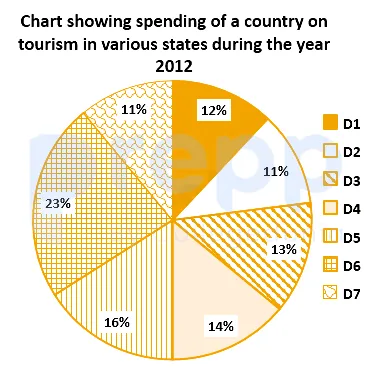
- A
Rs. 1,89,760
- B
Rs. 1,97,890
- C
Rs. 1,98,480
- D
Rs. 1,78,960
Show answer
C. Rs. 1,98,480Calculation:
Total % of D1 and D4 = 12 + 14
⇒ 26%
Total % of D2 and D7 = 11 + 11
⇒ 22%
Difference = 26% - 22%
⇒ 4%
Difference in amount = 4962000 × 4%
⇒ 198480
∴ The required answer is Rs. 1,98,480.
Paper & answer key PDF ↗ Question 54archived
In the given figure, AB = DB and AC = DC. If ∠ABD = 58° and ∠DBC = (2x - 4)°, ∠ACB = (y + 15)° and ∠DCB = 63°, then the value of 2x + 5y is :
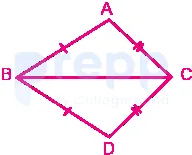
- A
325
- B
273
- C
259
- D
268
Show answer
B. 273Given:
AB = DB and AC = DC.
∠ABD = 58° and ∠DBC = (2x - 4)°,
∠ACB = (y + 15)° and ∠DCB = 63°
Concept used:
If all three sides of one triangle are equivalent to the corresponding three sides of the second triangle, then the two triangles are said to be congruent by SSS rule.
Calculation:
As AB = DB, AC = DC, and BC is common for two triangle
So, ΔABC ≅ ΔDBC
So, ∠ABC = ∠DBC = ∠ABD/2
⇒ 58°/2 = 29°
So,
(2x - 4)° = 29°
⇒ 2x = 33°
Again,
∠ACB = ∠DCB = 63°
So,
(y + 15)° = 63°
⇒ y = 48°
So,
2x + 5y = 33° + 5 × 48°
⇒ 33° + 240°
⇒ 273°
∴ The required answer is 273°.
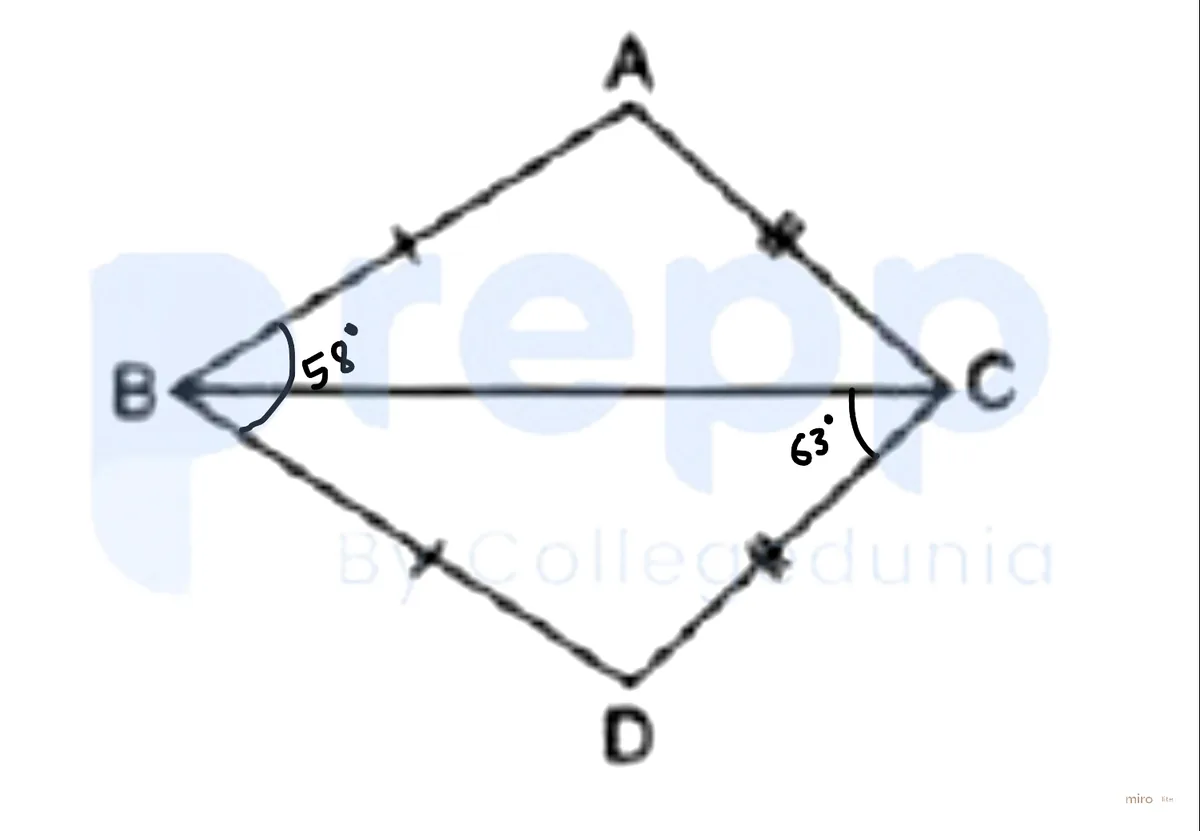
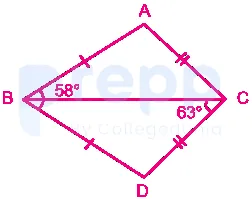 Paper & answer key PDF ↗
 Question 55archived
Three numbers are in the ratio of 2 ∶ 3 ∶ 5 and their LCM is 90. Find their HCF.
- A
9
- B
1
- C
6
- D
3
Show answer
D. 3Finding HCF from Ratio and LCM
This question involves understanding the relationship between three numbers, their ratio, their Least Common Multiple (LCM), and their Highest Common Factor (HCF).
When three numbers are in a specific ratio, say \(a : b : c\), we can represent these numbers using their HCF. Let the HCF of the three numbers be \(k\). Then the three numbers can be written as \(ak\), \(bk\), and \(ck\), where \(a\), \(b\), and \(c\) are coprime to each other after removing any common factors among them (which is handled by \(k\)). In this question, the ratio is given as \(2 : 3 : 5\). The numbers 2, 3, and 5 are prime numbers and are pairwise coprime (they have no common factors other than 1).
Representing the Numbers
Given the ratio \(2 : 3 : 5\), let the three numbers be:
First number = \(2k\)
Second number = \(3k\)
Third number = \(5k\)
Here, \(k\) is the Highest Common Factor (HCF) of these three numbers.
Calculating the LCM
The Least Common Multiple (LCM) of \(ak\), \(bk\), and \(ck\) where \(a, b, c\) are pairwise coprime is given by \(k \times \text{LCM}(a, b, c)\). In our case, \(a=2\), \(b=3\), and \(c=5\).
The LCM of 2, 3, and 5 is the product of these numbers because they are prime and distinct:
\(\text{LCM}(2, 3, 5) = 2 \times 3 \times 5 = 30\)
So, the LCM of the three numbers \(2k\), \(3k\), and \(5k\) is:
\(\text{LCM}(2k, 3k, 5k) = k \times \text{LCM}(2, 3, 5) = k \times 30 = 30k\)
Using the Given Information
We are given that the LCM of the three numbers is 90.
So, we can set up the equation:
\(30k = 90\)
Finding the HCF (k)
To find the value of \(k\), which represents the HCF, we need to solve the equation \(30k = 90\):
\(k = \frac{90}{30}\)
\(k = 3\)
Therefore, the HCF of the three numbers is 3.
Verifying the Numbers
With \(k=3\), the three numbers are:
First number = \(2k = 2 \times 3 = 6\)
Second number = \(3k = 3 \times 3 = 9\)
Third number = \(5k = 5 \times 3 = 15\)
Let's check the ratio and LCM:
Ratio: \(6 : 9 : 15\). Dividing all by 3 gives \(2 : 3 : 5\). This matches the given ratio.
HCF: The common factors of 6, 9, and 15 are just 1 and 3. The Highest Common Factor is 3. This matches our value of \(k\).
LCM: Let's find the LCM of 6, 9, and 15 using prime factorization:
\(6 = 2 \times 3\)
\(9 = 3^2\)
\(15 = 3 \times 5\)
The LCM is the product of the highest powers of all prime factors involved: \(2^1 \times 3^2 \times 5^1 = 2 \times 9 \times 5 = 90\).
This matches the given LCM.
The calculations are consistent with the problem statement.
Conclusion
The HCF of the three numbers in the ratio 2:3:5 with an LCM of 90 is 3.
Step
Description
Calculation
1
Represent numbers using HCF (k)
\(2k, 3k, 5k\)
2
Find LCM of the ratio numbers (2, 3, 5)
\(\text{LCM}(2, 3, 5) = 2 \times 3 \times 5 = 30\)
3
Express LCM of the numbers using k
\(\text{LCM}(2k, 3k, 5k) = 30k\)
4
Equate with given LCM
\(30k = 90\)
5
Solve for k (HCF)
\(k = \frac{90}{30} = 3\)
Revision Table: Ratio, LCM, and HCF Concepts
Concept
Definition
Relation to other concepts in this problem
Ratio
A comparison of two or more quantities of the same kind by division.
Defines the proportional relationship between the numbers. If ratio is \(a:b:c\), numbers are \(ak, bk, ck\).
HCF (Highest Common Factor)
The largest positive integer that divides each of the given integers without leaving a remainder. Also known as Greatest Common Divisor (GCD).
If numbers are \(ak, bk, ck\) (where \(a,b,c\) are coprime), their HCF is \(k\).
LCM (Least Common Multiple)
The smallest positive integer that is a multiple of two or more integers.
If numbers are \(ak, bk, ck\) (where \(a,b,c\) are pairwise coprime), their LCM is \(k \times \text{LCM}(a,b,c)\).
Additional Information: Properties of HCF and LCM
Here are some important properties related to HCF and LCM, especially concerning numbers and their ratios:
For any two positive integers \(x\) and \(y\), \(x \times y = \text{HCF}(x, y) \times \text{LCM}(x, y)\). This property applies strictly to two numbers, not generally to three or more numbers.
If numbers are in the ratio \(a:b\) and their HCF is \(k\), the numbers are \(ak\) and \(bk\). Their LCM is \(k \times \text{LCM}(a,b)\). Their product is \((ak)(bk) = ab k^2\). Using the property for two numbers, \(\text{HCF} \times \text{LCM} = k \times (k \times \text{LCM}(a,b)) = k^2 \times \text{LCM}(a,b)\). This shows that \(ab k^2 = k^2 \times \text{LCM}(a,b)\) only if \(\text{LCM}(a,b) = ab\), which is true if \(a\) and \(b\) are coprime. This reinforces why \(a,b,c\) must be pairwise coprime when using the \(k \times \text{LCM}(a,b,c)\) formula for three numbers.
When numbers are expressed as \(ak, bk, ck\) where \(a, b, c\) are pairwise coprime, \(k\) is indeed their HCF. This is because any common factor of \(ak, bk, ck\) must divide \(k\), since it must divide the result of dividing each term by \(k\). Since \(a, b, c\) are coprime, the only common factor of \(a, b, c\) is 1, leaving \(k\) as the highest common factor for \(ak, bk, ck\).
Paper & answer key PDF ↗ Question 56archived
Study the given table and answer the question that follows.
The table shows the number of customers for different services in different cities.
City →
Services ↓
X
Y
Z
A
250
175
350
B
220
190
240
C
260
200
270
D
245
185
330
In which service is the average number of customers per city the highest?
- A
C
- B
A
- C
D
- D
B
Show answer
B. AUnderstanding the Data Table on Customer Services
The provided table presents data on the number of customers for four different services, labeled A, B, C, and D, across three different cities, labeled X, Y, and Z. Each cell in the table shows the count of customers for a specific service in a specific city. The question asks us to find which service has the highest average number of customers per city.
City → Services ↓
X
Y
Z
A
250
175
350
B
220
190
240
C
260
200
270
D
245
185
330
Calculating Average Customers Per Service Across Cities
To find the average number of customers per city for each service, we need to sum the number of customers for that service across all cities (X, Y, and Z) and then divide the total by the number of cities, which is 3.
Calculating Average Customers for Service A
Total customers for Service A = Customers in X + Customers in Y + Customers in Z
\( \text{Total Service A} = 250 + 175 + 350 = 775 \)
Average customers per city for Service A = Total Service A customers / Number of cities
\( \text{Average Service A} = \frac{775}{3} \approx 258.33 \)
Calculating Average Customers for Service B
Total customers for Service B = Customers in X + Customers in Y + Customers in Z
\( \text{Total Service B} = 220 + 190 + 240 = 650 \)
Average customers per city for Service B = Total Service B customers / Number of cities
\( \text{Average Service B} = \frac{650}{3} \approx 216.67 \)
Calculating Average Customers for Service C
Total customers for Service C = Customers in X + Customers in Y + Customers in Z
\( \text{Total Service C} = 260 + 200 + 270 = 730 \)
Average customers per city for Service C = Total Service C customers / Number of cities
\( \text{Average Service C} = \frac{730}{3} \approx 243.33 \)
Calculating Average Customers for Service D
Total customers for Service D = Customers in X + Customers in Y + Customers in Z
\( \text{Total Service D} = 245 + 185 + 330 = 760 \)
Average customers per city for Service D = Total Service D customers / Number of cities
\( \text{Average Service D} = \frac{760}{3} \approx 253.33 \)
Comparing Average Customers to Find the Highest
Now we compare the calculated average number of customers per city for each service:
Service A: approximately 258.33
Service B: approximately 216.67
Service C: approximately 243.33
Service D: approximately 253.33
Comparing these values, we can see that the average for Service A (258.33) is the highest among all the services.
Conclusion: Service with Highest Average Customers
Based on the calculations, Service A has the highest average number of customers per city.
Revision Table: Data Analysis Summary
Service
Customers in City X
Customers in City Y
Customers in City Z
Total Customers
Average Customers per City
A
250
175
350
775
\( \frac{775}{3} \approx 258.33 \)
B
220
190
240
650
\( \frac{650}{3} \approx 216.67 \)
C
260
200
270
730
\( \frac{730}{3} \approx 243.33 \)
D
245
185
330
760
\( \frac{760}{3} \approx 253.33 \)
Additional Information: Understanding Averages in Data Analysis
The average, also known as the mean, is a central value of a set of numbers. It is calculated by summing all the numbers in the set and then dividing by the count of numbers in the set.
In this data analysis problem, calculating the average helps us to compare the overall performance or popularity of different services across multiple locations (cities). A higher average number of customers per city indicates that the service is generally more popular or has a wider reach compared to services with lower averages, when considering the given cities.
The formula for the average (mean) is:
\( \text{Average} = \frac{\text{Sum of all values}}{\text{Number of values}} \)
In this case, for each service, the values are the customer counts in cities X, Y, and Z, and the number of values is 3 (the number of cities).
Paper & answer key PDF ↗ Question 57archived
On simple interest a sum of Rs. 640 becomes Rs. 832 in 2 years. What will Rs. 860 become in 4 years at the same rate of simple interest?
- A
Rs. 1,250
- B
Rs. 1,376
- C
Rs. 1,426
- D
Rs. 1,150
Show answer
B. Rs. 1,376Understanding Simple Interest Calculation
This problem involves calculating the final amount on a sum of money based on simple interest. First, we need to determine the rate of simple interest from the initial information provided. Then, using this rate, we calculate the simple interest and the final amount for the second sum over a different period.
Step 1: Calculate the Simple Interest Rate
The first part of the question gives us the initial principal amount, the final amount after a certain time, and the time period. We can use this to find the simple interest earned and then the rate of interest per annum.
Initial Principal ($\text{P}_1$): Rs. 640
Amount after 2 years ($\text{A}_1$): Rs. 832
Time period ($\text{T}_1$): 2 years
The simple interest ($\text{SI}_1$) earned is the difference between the amount and the principal:
\text{SI}_1 = \text{A}_1 - \text{P}_1
\text{SI}_1 = 832 - 640
\text{SI}_1 = 192 \text{ Rs.}
The formula for simple interest is:
\text{SI} = \frac{\text{P} \times \text{R} \times \text{T}}{100}
Where P is Principal, R is the Rate of Interest per annum, and T is the Time in years.
We can rearrange this formula to find the rate (R):
\text{R} = \frac{\text{SI} \times 100}{\text{P} \times \text{T}}
Substituting the values from the first scenario:
\text{R} = \frac{192 \times 100}{640 \times 2}
\text{R} = \frac{19200}{1280}
\text{R} = \frac{1920}{128}
Let's simplify this fraction:
\text{R} = \frac{1920 \div 64}{128 \div 64} = \frac{30}{2} = 15
So, the simple interest rate is 15% per annum.
Step 2: Calculate the Amount for the Second Sum
Now we use the rate (R = 15%) calculated in Step 1 to find the amount for the second principal over the given time period.
New Principal ($\text{P}_2$): Rs. 860
Time period ($\text{T}_2$): 4 years
Rate ($\text{R}$): 15% per annum
First, calculate the simple interest ($\text{SI}_2$) for the second sum:
\text{SI}_2 = \frac{\text{P}_2 \times \text{R} \times \text{T}_2}{100}
\text{SI}_2 = \frac{860 \times 15 \times 4}{100}
\text{SI}_2 = \frac{860 \times 60}{100}
\text{SI}_2 = \frac{86 \times 60}{10}
\text{SI}_2 = 86 \times 6
\text{SI}_2 = 516 \text{ Rs.}
The final amount ($\text{A}_2$) will be the sum of the new principal and the simple interest earned:
\text{A}_2 = \text{P}_2 + \text{SI}_2
\text{A}_2 = 860 + 516
\text{A}_2 = 1376 \text{ Rs.}
Summary of Calculations
Scenario
Principal (P)
Time (T)
Amount (A)
Simple Interest (SI = A - P)
Rate ($\text{R} = \frac{\text{SI} \times 100}{\text{P} \times \text{T}}$)
1
Rs. 640
2 years
Rs. 832
Rs. 192
15%
2
Rs. 860
4 years
Rs. 1376 (Calculated)
Rs. 516 (Calculated)
15%
Therefore, Rs. 860 will become Rs. 1,376 in 4 years at the same rate of simple interest.
Revision Table: Key Concepts
Concept
Description
Formula (Simple Interest)
Principal
The initial amount of money borrowed or invested.
P
Amount
The total sum at the end of the period, including principal and interest.
A = P + SI
Simple Interest (SI)
Interest calculated only on the principal amount.
$\text{SI} = \frac{\text{P} \times \text{R} \times \text{T}}{100}$
Rate (R)
The percentage of the principal charged as interest per year.
$\text{R} = \frac{\text{SI} \times 100}{\text{P} \times \text{T}}$
Time (T)
The duration for which the money is borrowed or invested, usually in years.
T
Additional Information: Simple Interest vs. Compound Interest
It's important to understand the difference between simple interest and compound interest.
Simple Interest: Interest is calculated only on the original principal amount throughout the entire term. This means the interest earned does not get added back to the principal to earn further interest. The interest amount is the same for each period (assuming constant principal and rate).
Compound Interest: Interest is calculated on the initial principal and also on the accumulated interest from previous periods. Interest is added to the principal at the end of each period, and the next period's interest is calculated on this new, larger principal. This leads to faster growth of the amount compared to simple interest.
This question specifically deals with simple interest, where the calculation is straightforward based on the original principal amount only.
Paper & answer key PDF ↗ Question 58archived
If x + \(\rm \frac{1}{x}=8\) , then find the value of \(\rm \frac{5}{x^2-8x+2}\) .
- A
3
- B
4
- C
0
- D
5
Show answer
D. 5Let's solve this algebra problem step by step. We are given an equation involving \(x\) and asked to find the value of a specific expression involving \(x\).
Understanding the Given Algebraic Equation
We are given the equation: \(x + \frac{1}{x} = 8\). This is the key piece of information we need to use to find the value of the target expression.
Analyzing the Target Expression
We need to find the value of the expression: \(\frac{5}{x^2-8x+2}\). Notice the denominator involves terms like \(x^2\) and \(-8x\). This looks similar to what we might get if we manipulate the given equation.
Manipulating the Given Equation
Let's start with the given equation and see if we can make it look like the denominator of the target expression.
The given equation is:
\(x + \frac{1}{x} = 8\)
To get rid of the fraction, we can multiply both sides of the equation by \(x\). Assuming \(x \neq 0\) (if \(x=0\), \(\frac{1}{x}\) is undefined, so \(x\) cannot be zero).
\(x \times (x + \frac{1}{x}) = 8 \times x\)
\(x \times x + x \times \frac{1}{x} = 8x\)
\(x^2 + 1 = 8x\)
Relating the Manipulated Equation to the Denominator
Now we have the equation \(x^2 + 1 = 8x\). Let's rearrange this equation to see if we can isolate a term that looks like part of our denominator \(x^2 - 8x + 2\). If we subtract \(8x\) from both sides, we get:
\(x^2 + 1 - 8x = 8x - 8x\)
\(x^2 - 8x + 1 = 0\)
This tells us that \(x^2 - 8x = -1\).
Evaluating the Denominator of the Expression
The denominator of the expression \(\frac{5}{x^2-8x+2}\) is \(x^2 - 8x + 2\). From our manipulation, we know that \(x^2 - 8x = -1\). We can substitute this value into the denominator:
\(x^2 - 8x + 2 = (x^2 - 8x) + 2\)
\(= (-1) + 2\)
\(= 1\)
So, the denominator of the expression is \(1\).
Calculating the Value of the Expression
Now we can substitute the value of the denominator back into the original expression:
\(\frac{5}{x^2-8x+2} = \frac{5}{1}\)
\(= 5\)
Thus, the value of the expression \(\frac{5}{x^2-8x+2}\) is \(5\).
Summary of Steps
Here is a quick recap of the steps taken:
Start with the given equation \(x + \frac{1}{x} = 8\).
Multiply by \(x\) to get \(x^2 + 1 = 8x\).
Rearrange to find \(x^2 - 8x = -1\).
Substitute \(x^2 - 8x = -1\) into the denominator of the target expression \(x^2 - 8x + 2\).
The denominator becomes \((-1) + 2 = 1\).
Evaluate the expression \(\frac{5}{\text{denominator}} = \frac{5}{1} = 5\).
Step
Process
Result
1
Given Equation
\(x + \frac{1}{x} = 8\)
2
Multiply by \(x\)
\(x^2 + 1 = 8x\)
3
Rearrange
\(x^2 - 8x = -1\)
4
Evaluate Denominator \(x^2 - 8x + 2\)
\((-1) + 2 = 1\)
5
Evaluate Expression \(\frac{5}{x^2-8x+2}\)
\(\frac{5}{1} = 5\)
Revision Table: Key Algebraic Manipulations
Original Form
Manipulation
Resulting Form
\(x + \frac{1}{x} = c\)
Multiply by \(x\)
\(x^2 + 1 = cx\)
\(x^2 + 1 = cx\)
Rearrange terms
\(x^2 - cx + 1 = 0\)
\(x^2 - cx + 1 = 0\)
Isolate \(x^2 - cx\)
\(x^2 - cx = -1\)
Expression involving \(x^2 - cx\)
Substitute value of \(x^2 - cx\)
Simplified expression
Additional Information: Solving Related Algebraic Problems
Problems involving \(x + \frac{1}{x}\) are common in algebra. Here are some related concepts:
Finding \(x^2 + \frac{1}{x^2}\): If you know \(x + \frac{1}{x} = c\), you can square both sides: \((x + \frac{1}{x})^2 = c^2\), which gives \(x^2 + 2 \cdot x \cdot \frac{1}{x} + \frac{1}{x^2} = c^2\), simplifying to \(x^2 + 2 + \frac{1}{x^2} = c^2\). So, \(x^2 + \frac{1}{x^2} = c^2 - 2\).
Finding \(x^3 + \frac{1}{x^3}\): If you know \(x + \frac{1}{x} = c\), you can cube both sides: \((x + \frac{1}{x})^3 = c^3\), which gives \(x^3 + 3x^2 \cdot \frac{1}{x} + 3x \cdot \frac{1}{x^2} + \frac{1}{x^3} = c^3\), simplifying to \(x^3 + 3x + \frac{3}{x} + \frac{1}{x^3} = c^3\), or \(x^3 + \frac{1}{x^3} + 3(x + \frac{1}{x}) = c^3\). Substituting \(x + \frac{1}{x} = c\), we get \(x^3 + \frac{1}{x^3} + 3c = c^3\), so \(x^3 + \frac{1}{x^3} = c^3 - 3c\).
These types of manipulations are useful shortcuts for solving various algebraic expressions.
Paper & answer key PDF ↗ Question 59archived
The average weight of 49 students in a class is 39 kg. Seven of them whose average weight is 40 kg leave the class and other seven students whose average weight is 54 kg join the class. What is the new average weight (in kg) of the class?
- A
41
- B
39
- C
42
- D
40
Show answer
A. 41Calculating the New Average Weight of the Class
This problem asks us to find the new average weight of a class after some students leave and a different group of students join. To solve this, we first need to find the initial total weight of the class, then adjust it based on the students leaving and joining, and finally calculate the new average using the new total weight and the new number of students.
Step 1: Calculate the Initial Total Weight
We are given the initial number of students and their average weight. The total weight is the product of the number of students and their average weight.
Initial number of students = 49
Initial average weight = 39 kg
Initial total weight = Number of students $\times$ Average weight
Initial total weight = $49 \times 39$ kg
Let's calculate the initial total weight:
$\qquad 49 \times 39 = 1911$ kg
So, the initial total weight of the 49 students is 1911 kg.
Step 2: Calculate the Total Weight of Students Leaving
Seven students leave the class, and their average weight is 40 kg. We calculate their total weight.
Number of students leaving = 7
Average weight of students leaving = 40 kg
Total weight of students leaving = Number of students leaving $\times$ Average weight of students leaving
Total weight of students leaving = $7 \times 40$ kg
Let's calculate the total weight of students leaving:
$\qquad 7 \times 40 = 280$ kg
The total weight removed from the class is 280 kg.
Step 3: Calculate the Total Weight of Students Joining
Another seven students join the class, and their average weight is 54 kg. We calculate their total weight.
Number of students joining = 7
Average weight of students joining = 54 kg
Total weight of students joining = Number of students joining $\times$ Average weight of students joining
Total weight of students joining = $7 \times 54$ kg
Let's calculate the total weight of students joining:
$\qquad 7 \times 54 = 378$ kg
The total weight added to the class is 378 kg.
Step 4: Calculate the New Total Weight of the Class
The new total weight is the initial total weight minus the weight of students who left plus the weight of students who joined.
New total weight = Initial total weight - Total weight of students leaving + Total weight of students joining
New total weight = $1911$ kg - $280$ kg + $378$ kg
Let's perform the calculation:
$\qquad 1911 - 280 = 1631$ kg
$\qquad 1631 + 378 = 2009$ kg
The new total weight of the class is 2009 kg.
Step 5: Determine the New Number of Students
The initial number of students was 49. Seven students left, and seven new students joined. The change in the number of students is $7 - 7 = 0$.
New number of students = Initial number of students - Students leaving + Students joining
New number of students = $49 - 7 + 7 = 49$
The number of students in the class remains 49.
Step 6: Calculate the New Average Weight
The new average weight is the new total weight divided by the new number of students.
New average weight = New total weight / New number of students
New average weight = $2009$ kg / $49$
Let's perform the division:
$\qquad \frac{2009}{49}$
We can estimate or perform long division:
$2009 \div 49 = 41$
The new average weight of the class is 41 kg.
Let's summarize the steps and results in a table:
Description
Number of Students
Average Weight (kg)
Total Weight (kg)
Initial Class
49
39
$49 \times 39 = 1911$
Students Leaving
7
40
$7 \times 40 = 280$
Students Joining
7
54
$7 \times 54 = 378$
New Class
$49 - 7 + 7 = 49$
?
$1911 - 280 + 378 = 2009$
New Average Weight = $\frac{\text{New Total Weight}}{\text{New Number of Students}} = \frac{2009}{49} = 41$ kg.
Conclusion
The new average weight of the class is 41 kg.
Revision Table: Average Weight Calculation
Understanding how average weight changes when students leave and join is a common problem in calculating averages. Here's a quick look at the key concepts:
Concept
Formula
Application
Average
$\text{Average} = \frac{\text{Sum of values}}{\text{Number of values}}$
Used to find average weight or number of items.
Total Sum
$\text{Total Sum} = \text{Average} \times \text{Number of values}$
Used to find total weight given average and number of students.
Change in Total Sum
$\text{Change} = \text{Sum Added} - \text{Sum Removed}$
Used to find the net change in total weight.
New Average
$\text{New Average} = \frac{\text{Initial Total Sum} + \text{Change in Total Sum}}{\text{New Number of values}}$
Used to find the final average after changes.
Additional Information: Understanding Averages
The average, also known as the mean, is a fundamental concept in statistics. It represents a typical value in a set of data. When dealing with groups leaving or joining, the key is always to work with the total sum (or total weight in this case) because averages cannot be simply added or subtracted directly unless the number of items is the same.
Why not average the averages? You cannot simply average the initial average (39 kg), the leaving average (40 kg), and the joining average (54 kg). Averages are weighted by the number of items they represent. A group of 7 students with an average weight of 54 kg contributes more to the total weight than a group of 7 students with an average weight of 40 kg, even though the group sizes are the same. If the group sizes were different (e.g., 10 left and 5 joined), it would be even more critical to use the total weight method.
Impact of changes: When a group with a higher average leaves than the group joining, the overall class average tends to decrease. Conversely, when a group with a higher average joins than the group leaving (as in this problem, 54 kg > 40 kg), the overall class average tends to increase.
Applications: Calculating averages and tracking changes is important in many areas, such as finance (average stock price), demographics (average age), and science (average temperature).
Mastering the calculation of total sum from the average is crucial for solving problems involving changes in groups.
Paper & answer key PDF ↗ Question 60archived
Study the table given below and answer the questions that follows.
Countries
Number of Tests
Positive cases
Number of patients for Ventilators
The US
14000
12%
20%
Spain
12000
8%
12.5%
Italy
10000
12%
16%
China
10000
11%
15%
According to the table given above, which country has the maximum number of positive cases?
- A
The US
- B
China
- C
Spain
- D
Italy
Show answer
A. The USAnalyzing COVID-19 Data: Finding Maximum Positive Cases
The question asks us to determine which country, based on the provided table, had the maximum number of positive COVID-19 cases. The table gives us the number of tests conducted and the percentage of those tests that were positive for four different countries.
Countries
Number of Tests
Positive cases (%)
Patients for Ventilators (%)
The US
14000
12%
20%
Spain
12000
8%
12.5%
Italy
10000
12%
16%
China
10000
11%
15%
To find the actual number of positive cases for each country, we need to calculate the percentage of positive cases from the total number of tests conducted. The formula for this is:
\(\text{Number of Positive Cases} = \text{Number of Tests} \times \frac{\text{Percentage of Positive Cases}}{100}\)
Calculating Positive COVID-19 Cases per Country
Let's apply this formula to each country listed in the table:
The US:
Number of tests = 14000
Percentage of positive cases = 12%
Positive cases = \(14000 \times \frac{12}{100} = 14000 \times 0.12\)
Positive cases = \(1680\)
Spain:
Number of tests = 12000
Percentage of positive cases = 8%
Positive cases = \(12000 \times \frac{8}{100} = 12000 \times 0.08\)
Positive cases = \(960\)
Italy:
Number of tests = 10000
Percentage of positive cases = 12%
Positive cases = \(10000 \times \frac{12}{100} = 10000 \times 0.12\)
Positive cases = \(1200\)
China:
Number of tests = 10000
Percentage of positive cases = 11%
Positive cases = \(10000 \times \frac{11}{100} = 10000 \times 0.11\)
Positive cases = \(1100\)
Comparing the Number of Positive Cases
Now, let's list the calculated number of positive cases for each country:
The US: 1680
Spain: 960
Italy: 1200
China: 1100
Comparing these numbers, we can see that 1680 is the largest value.
Conclusion: Country with Maximum Positive Cases
Based on our calculations from the given table data, The US had 1680 positive cases, Spain had 960, Italy had 1200, and China had 1100. Therefore, The US has the maximum number of positive cases according to this table.
Revision Table: Key Metrics Comparison
Country
Number of Tests
Positive Cases (Calculated)
Percentage Positive (%)
The US
14000
1680
12%
Spain
12000
960
8%
Italy
10000
1200
12%
China
10000
1100
11%
Additional Information: Understanding Data Analysis
When analyzing data presented in tables, it's crucial to understand what the numbers represent. Sometimes, data is given as raw counts (like 'Number of Tests'), while other times it's given as percentages (like 'Positive cases %'). To make accurate comparisons or answer specific questions, you might need to perform calculations to convert percentages back into raw numbers or vice versa.
In this problem, simply comparing the percentage of positive cases wouldn't have given the correct answer because the total number of tests conducted varied significantly between countries. The US had the highest percentage of patients needing ventilators (20%), but that wasn't what the question asked. Always read the question carefully to understand exactly what metric you need to calculate or compare.
Paper & answer key PDF ↗ Question 61archived
If tan A + cot A = 2, then the value of 2(tan 2 A + cot 2 A) is :
- A
1
- B
4
- C
2
- D
3
Show answer
B. 4Solving the Trigonometric Equation: tan A + cot A = 2
The question asks us to find the value of the expression $2(\tan^2 A + \cot^2 A)$, given the condition $\tan A + \cot A = 2$. We can approach this problem by first analyzing the given condition to find information about $\tan A$ and $\cot A$, and then substituting those findings into the expression we need to evaluate.
Step-by-Step Solution
Step 1: Analyze the given condition
We are given the equation: $\tan A + \cot A = 2$.
We know that $\cot A = \frac{1}{\tan A}$. Substituting this into the equation:
$\tan A + \frac{1}{\tan A} = 2$
Step 2: Solve the equation for tan A
To eliminate the fraction, multiply the entire equation by $\tan A$ (assuming $\tan A \neq 0$, which must be true if $\tan A + \cot A = 2$):
$(\tan A) \times (\tan A) + (\tan A) \times \left(\frac{1}{\tan A}\right) = 2 \times (\tan A)$
$\tan^2 A + 1 = 2 \tan A$
Rearrange the terms to form a quadratic equation:
$\tan^2 A - 2 \tan A + 1 = 0$
This equation is in the form $x^2 - 2xy + y^2 = (x-y)^2$, where $x = \tan A$ and $y = 1$. So, we can factor it as:
$(\tan A - 1)^2 = 0$
Taking the square root of both sides:
$\tan A - 1 = 0$
Solving for $\tan A$:
$\tan A = 1$
Step 3: Find the value of cot A
Since $\tan A = 1$, we can find $\cot A$ using the identity $\cot A = \frac{1}{\tan A}$:
$\cot A = \frac{1}{1} = 1$
Let's quickly verify if $\tan A = 1$ and $\cot A = 1$ satisfies the original condition:
$\tan A + \cot A = 1 + 1 = 2$. This is true.
Step 4: Evaluate the required expression
We need to find the value of $2(\tan^2 A + \cot^2 A)$.
Substitute the values $\tan A = 1$ and $\cot A = 1$ into the expression:
$\tan^2 A = (1)^2 = 1$
$\cot^2 A = (1)^2 = 1$
Now substitute these values into the expression $2(\tan^2 A + \cot^2 A)$:
$2(1 + 1) = 2(2) = 4$
Thus, the value of $2(\tan^2 A + \cot^2 A)$ is 4.
Alternative Method Using Identities
We can also solve this using algebraic identities without finding the specific value of $\tan A$.
Given: $\tan A + \cot A = 2$
We want to find $2(\tan^2 A + \cot^2 A)$. Let's look at the term $\tan^2 A + \cot^2 A$.
Consider the square of the given equation: $(\tan A + \cot A)^2 = 2^2$
Expanding the left side using the identity $(a+b)^2 = a^2 + 2ab + b^2$:
$\tan^2 A + 2(\tan A)(\cot A) + \cot^2 A = 4$
We know the identity $\tan A \times \cot A = 1$. Substitute this into the equation:
$\tan^2 A + 2(1) + \cot^2 A = 4$
$\tan^2 A + 2 + \cot^2 A = 4$
Rearrange to find the value of $\tan^2 A + \cot^2 A$:
$\tan^2 A + \cot^2 A = 4 - 2$
$\tan^2 A + \cot^2 A = 2$
Now substitute this result into the expression we need to evaluate, which is $2(\tan^2 A + \cot^2 A)$:
$2(2) = 4$
Both methods yield the same result, 4.
Summary of Calculations
Given
Step
Calculation
Result
$\tan A + \cot A = 2$
Substitute $\cot A = 1/\tan A$
$\tan A + \frac{1}{\tan A} = 2$
Equation in terms of $\tan A$
$\tan A + \frac{1}{\tan A} = 2$
Solve for $\tan A$
$\tan^2 A - 2\tan A + 1 = 0 \implies (\tan A - 1)^2 = 0$
$\tan A = 1$
$\tan A = 1$
Find $\cot A$
$\cot A = \frac{1}{\tan A} = \frac{1}{1}$
$\cot A = 1$
Required value: $2(\tan^2 A + \cot^2 A)$
Substitute values
$2((1)^2 + (1)^2) = 2(1 + 1)$
$2(2) = 4$
Using the alternative method:
Given
Step
Calculation
Result
$\tan A + \cot A = 2$
Square both sides
$(\tan A + \cot A)^2 = 2^2$
$\tan^2 A + 2\tan A\cot A + \cot^2 A = 4$
$\tan^2 A + 2\tan A\cot A + \cot^2 A = 4$
Use identity $\tan A\cot A = 1$
$\tan^2 A + 2(1) + \cot^2 A = 4$
$\tan^2 A + \cot^2 A = 2$
Required value: $2(\tan^2 A + \cot^2 A)$
Substitute value
$2(2)$
$4$
Both methods confirm that the value of $2(\tan^2 A + \cot^2 A)$ is 4.
Revision Table: Key Trigonometric Concepts
Concept
Description
Identity
Tangent (tan A)
Ratio of the opposite side to the adjacent side in a right triangle.
$\tan A = \frac{\sin A}{\cos A}$
Cotangent (cot A)
Ratio of the adjacent side to the opposite side in a right triangle. Reciprocal of tangent.
$\cot A = \frac{\cos A}{\sin A} = \frac{1}{\tan A}$
Relationship between tan A and cot A
Their product is always 1.
$\tan A \times \cot A = 1$
Algebraic Identity
Squaring a binomial sum.
$(a+b)^2 = a^2 + 2ab + b^2$
Additional Information: Understanding Trigonometric Relationships
Trigonometric identities are fundamental equations that are true for all values of the variables for which the expressions are defined. The identity $\cot A = \frac{1}{\tan A}$ is one such basic reciprocal identity. Problems like the one solved here often require combining these basic trigonometric identities with algebraic techniques, such as solving quadratic equations or using algebraic identities like $(a+b)^2 = a^2 + 2ab + b^2$.
The equation $\tan A + \cot A = 2$ is a special case. When $\tan A = 1$, angle A could be $45^\circ$ (or $\pi/4$ radians) plus multiples of $180^\circ$ (or $\pi$ radians). For $A = 45^\circ$, $\tan 45^\circ = 1$ and $\cot 45^\circ = 1$, so $1 + 1 = 2$. This confirms our finding that $\tan A = 1$ is the solution to the given equation.
Understanding how to manipulate trigonometric expressions and equations is crucial for solving more complex problems in trigonometry and calculus.
Paper & answer key PDF ↗ Question 62archived
A shopkeeper gives two successive discounts on a watch marked Rs. 2,750. The first discount given is 10%. If the customer pays Rs. 2,103.75 for the watch, then what is the second discount?
- A
15%
- B
30%
- C
12%
- D
10%
Show answer
A. 15%Understanding Successive Discounts
This problem involves calculating the second discount percentage when two successive discounts are applied to the marked price of an item, and the final selling price is known. We are given the marked price, the first discount percentage, and the final selling price. We need to find the percentage of the second discount.
Step-by-Step Calculation of Second Discount
Let's break down the process to find the second discount applied to the watch.
Calculate the Price After the First Discount:
The first discount is 10% of the marked price (MP). The marked price is Rs. 2,750.
Discount amount 1 $$= 10\% \text{ of } \text{Rs. } 2,750$$
Discount amount 1 $$= \frac{10}{100} \times 2750 = 0.10 \times 2750 = 275$$
The price after the first discount is the marked price minus the first discount amount.
Price after 1st discount $$= \text{MP} - \text{Discount amount 1}$$
Price after 1st discount $$= 2750 - 275 = 2475$$
So, after the first 10% discount, the price of the watch is Rs. 2,475.
Calculate the Amount of the Second Discount:
The second discount is applied to the price after the first discount (Rs. 2,475). The customer pays the final selling price (SP), which is Rs. 2,103.75. The difference between the price after the first discount and the final selling price is the amount of the second discount.
Amount of second discount $$= \text{Price after 1st discount} - \text{Final SP}$$
Amount of second discount $$= 2475 - 2103.75 = 371.25$$
The second discount given is Rs. 371.25.
Calculate the Second Discount Percentage:
The second discount percentage is calculated based on the price *after* the first discount (Rs. 2,475). The formula for percentage discount is:
Second Discount % $$= \left( \frac{\text{Amount of second discount}}{\text{Price after 1st discount}} \right) \times 100\%$$
Second Discount % $$= \left( \frac{371.25}{2475} \right) \times 100\%$$
Second Discount % $$= 0.15 \times 100\% = 15\%$$
Therefore, the second discount is 15%.
Summary of Discounts
Item
Value
Marked Price (MP)
Rs. 2,750
First Discount
10%
Price after 1st Discount
Rs. 2,475
Final Selling Price (SP)
Rs. 2,103.75
Amount of Second Discount
Rs. 371.25
Second Discount Percentage
15%
Revision Table: Key Concepts in Discounts
Term
Definition
Calculation Example
Marked Price (MP)
The price printed on the label of an article.
Given in the problem.
Selling Price (SP)
The price at which an article is sold.
MP - Discount.
Discount
Reduction in the marked price.
Calculated as a percentage of MP or price after previous discount.
Discount Percentage
Discount expressed as a percentage of the price on which discount is applied.
$$( \text{Discount} / \text{Price} ) \times 100\%$$
Successive Discounts
Two or more discounts applied one after another on the remaining price.
Discount 1 on MP, Discount 2 on price after Discount 1, and so on.
Additional Information on Successive Discounts
Successive discounts are also known as compound discounts. When two successive discounts of x% and y% are given, the total equivalent single discount is not simply (x+y)%. Instead, the total equivalent single discount (D_eq) can be calculated using the formula:
$$D_{eq} = \left( x + y - \frac{xy}{100} \right)\%$$
In this problem, the first discount is 10%. We found the second discount to be 15%. Let's verify the final price using the successive discount concept directly from the marked price.
After the first 10% discount, the price is $$(1 - \frac{10}{100}) \times MP = 0.90 \times MP$$.
After the second 15% discount, the price becomes $$(1 - \frac{15}{100}) \times (0.90 \times MP) = 0.85 \times (0.90 \times MP)$$.
Final SP $$= 0.85 \times 0.90 \times 2750 = 0.765 \times 2750$$
Final SP $$= 2103.75$$
This calculation matches the given final selling price, confirming that the second discount is indeed 15%. This demonstrates how successive discounts are applied sequentially.
Paper & answer key PDF ↗ Question 63archived
Which of the following numbers are divisible by 2, 3 and 5?
- A
5467760
- B
1345678
- C
2345760
- D
2456732
Show answer
C. 2345760Understanding Divisibility Rules
To find a number that is divisible by 2, 3, and 5 simultaneously, we need to check each option against the divisibility rules for these numbers. A number is divisible by 2, 3, and 5 if and only if it satisfies the conditions for all three rules.
Divisibility Rule for 2
A number is divisible by 2 if its last digit is an even number (0, 2, 4, 6, or 8).
Divisibility Rule for 5
A number is divisible by 5 if its last digit is either 0 or 5.
Divisibility Rule for 3
A number is divisible by 3 if the sum of its digits is divisible by 3.
Checking the Options
Let's apply these rules to each given number:
Analyzing Option 1: 5467760
Divisibility by 2: The last digit is 0, which is even. So, 5467760 is divisible by 2.
Divisibility by 5: The last digit is 0. So, 5467760 is divisible by 5.
Divisibility by 3: The sum of digits is $5 + 4 + 6 + 7 + 7 + 6 + 0 = 35$. Since 35 is not divisible by 3, 5467760 is not divisible by 3.
Option 1 is not divisible by 3, so it is not divisible by 2, 3, and 5 simultaneously.
Analyzing Option 2: 1345678
Divisibility by 2: The last digit is 8, which is even. So, 1345678 is divisible by 2.
Divisibility by 5: The last digit is 8. Since it is not 0 or 5, 1345678 is not divisible by 5.
Option 2 is not divisible by 5, so it is not divisible by 2, 3, and 5 simultaneously.
Analyzing Option 3: 2345760
Divisibility by 2: The last digit is 0, which is even. So, 2345760 is divisible by 2.
Divisibility by 5: The last digit is 0. So, 2345760 is divisible by 5.
Divisibility by 3: The sum of digits is $2 + 3 + 4 + 5 + 7 + 6 + 0 = 27$. Since 27 is divisible by 3 ($27 \div 3 = 9$), 2345760 is divisible by 3.
Option 3 is divisible by 2, 5, and 3. Therefore, it satisfies the condition.
Analyzing Option 4: 2456732
Divisibility by 2: The last digit is 2, which is even. So, 2456732 is divisible by 2.
Divisibility by 5: The last digit is 2. Since it is not 0 or 5, 2456732 is not divisible by 5.
Option 4 is not divisible by 5, so it is not divisible by 2, 3, and 5 simultaneously.
Conclusion
Based on the analysis of each option using the divisibility rules for 2, 3, and 5, only the number 2345760 is divisible by all three numbers.
Number
Divisible by 2 (Last digit)
Divisible by 5 (Last digit)
Divisible by 3 (Sum of digits)
Divisible by 2, 3 & 5?
5467760
Yes (0)
Yes (0)
No ($35 \div 3$)
No
1345678
Yes (8)
No (8)
N/A
No
2345760
Yes (0)
Yes (0)
Yes ($27 \div 3$)
Yes
2456732
Yes (2)
No (2)
N/A
No
Revision Table: Divisibility Rules Recap
Number
Rule
Condition
2
Last digit
Must be 0, 2, 4, 6, or 8.
3
Sum of digits
Must be divisible by 3.
5
Last digit
Must be 0 or 5.
Additional Information: Combined Divisibility
If a number is divisible by two or more numbers that are coprime (meaning their greatest common divisor is 1), then the number is also divisible by the product of those numbers.
The numbers 2, 3, and 5 are pairwise coprime:
GCD(2, 3) = 1
GCD(2, 5) = 1
GCD(3, 5) = 1
Since 2, 3, and 5 are pairwise coprime, a number divisible by 2, 3, and 5 must also be divisible by their product, which is $2 \times 3 \times 5 = 30$.
A number is divisible by 30 if and only if it is divisible by both 10 and 3.
Divisibility by 10: The last digit must be 0. This ensures divisibility by both 2 and 5.
Divisibility by 3: The sum of the digits must be divisible by 3.
So, an alternative way to solve this problem is to check which number ends in 0 and has a sum of digits divisible by 3. Looking at the options, only 5467760 and 2345760 end in 0. We already calculated their sums of digits as 35 and 27, respectively. Only 27 is divisible by 3, confirming that 2345760 is the correct number.
Paper & answer key PDF ↗ Question 64archived
Two trains P and Q start from stations S and T towards each other. Train P takes 4 hours 48 minutes and train Q takes 3 hours 20 minutes to reach T and S, respectively, after they meet. If the speed of train P is 45 km/h, what is the speed of train Q?
- A
48 km/h
- B
50 km/h
- C
54 km/h
- D
55 km/h
Show answer
C. 54 km/hUnderstanding the Train Speed and Meeting Point Problem
This problem involves two trains, P and Q, traveling towards each other from different stations, S and T. They meet at some point between S and T. We are given the time each train takes to reach the *other* station *after* they have met. We are also given the speed of train P and asked to find the speed of train Q.
This is a classic scenario in time and distance problems. There's a specific relationship between the speeds of the two trains and the time they take to cover the remaining distance (to their respective destinations) after meeting.
Given Information
Train P starts from S, Train Q starts from T.
They travel towards each other.
Time taken by train P to reach T after meeting: 4 hours 48 minutes.
Time taken by train Q to reach S after meeting: 3 hours 20 minutes.
Speed of train P ($v_P$): 45 km/h.
We need to find the speed of train Q ($v_Q$).
Converting Time to Hours
First, let's convert the given times into hours only.
Time taken by P after meeting ($t_P$): 4 hours 48 minutes
48 minutes \( = \frac{48}{60} \) hours \( = \frac{4}{5} \) hours \( = 0.8 \) hours
So, \(t_P = 4 + 0.8 = 4.8\) hours.
Time taken by Q after meeting ($t_Q$): 3 hours 20 minutes
20 minutes \( = \frac{20}{60} \) hours \( = \frac{1}{3} \) hours
So, \(t_Q = 3 + \frac{1}{3} = \frac{9+1}{3} = \frac{10}{3}\) hours.
Formula for Time After Meeting
When two trains start at the same time from two points and travel towards each other, and after meeting, they take \(t_P\) and \(t_Q\) time respectively to reach their destinations, the ratio of their speeds is given by the formula:
\[ \frac{v_P}{v_Q} = \sqrt{\frac{t_Q}{t_P}} \]
Where:
\(v_P\) is the speed of train P.
\(v_Q\) is the speed of train Q.
\(t_P\) is the time taken by train P after meeting.
\(t_Q\) is the time taken by train Q after meeting.
Applying the Formula to Find Train Q's Speed
We have the values:
\(v_P = 45\) km/h
\(t_P = 4.8\) hours
\(t_Q = \frac{10}{3}\) hours
Substitute these values into the formula:
\[ \frac{45}{v_Q} = \sqrt{\frac{10/3}{4.8}} \]
Let's simplify the fraction inside the square root:
\[ \frac{10/3}{4.8} = \frac{10/3}{48/10} = \frac{10}{3} \times \frac{10}{48} = \frac{100}{144} \]
Now substitute this back into the formula:
\[ \frac{45}{v_Q} = \sqrt{\frac{100}{144}} \]
Calculate the square root:
\[ \sqrt{\frac{100}{144}} = \frac{\sqrt{100}}{\sqrt{144}} = \frac{10}{12} = \frac{5}{6} \]
So the equation becomes:
\[ \frac{45}{v_Q} = \frac{5}{6} \]
Now, solve for \(v_Q\):
\[ v_Q = \frac{45 \times 6}{5} \]
\[ v_Q = \frac{270}{5} \]
\[ v_Q = 54 \text{ km/h} \]
Conclusion
The speed of train Q is 54 km/h.
Parameter
Train P
Train Q
Starting Station
S
T
Ending Station
T
S
Time After Meeting to Reach Destination
4 hours 48 minutes (4.8 hours)
3 hours 20 minutes (\(\frac{10}{3}\) hours)
Speed
45 km/h
\(v_Q\) (To be found)
Revision Table: Key Concepts for Train Problems
Concept
Description
Time Conversion
Converting minutes to hours by dividing by 60.
Trains Meeting
When trains travel towards each other, their relative speed is the sum of their individual speeds.
Time After Meeting Formula
\(\frac{v_1}{v_2} = \sqrt{\frac{t_2}{t_1}}\) where \(v_1, v_2\) are speeds and \(t_1, t_2\) are times taken *after* meeting.
Additional Information: Relative Speed
While the time-after-meeting formula is key here, understanding relative speed is fundamental to many train problems. When two objects move:
Towards each other: Their relative speed is the sum of their individual speeds. This is the rate at which the distance between them decreases.
In the same direction: Their relative speed is the absolute difference between their individual speeds (faster speed minus slower speed). This is the rate at which the distance between them changes.
In problems involving trains crossing objects like poles, platforms, or other trains, relative speed and the total distance (sum of lengths) are often used.
Paper & answer key PDF ↗ Question 65archived
If \(\rm \frac{{(1 - \cos \theta )}}{{\sin \theta }}\) = \(\frac{1}{5}\) , then what will be the value of \(\rm \frac{{(1 + \cos \theta )}}{{\sin \theta }}\) ?
- A
5
- B
2/5
- C
4/5
- D
1/5
Show answer
A. 5Solving Trigonometry Problems: Finding Values
This problem asks us to find the value of a trigonometric expression given the value of a related expression. We are given the value of \( \frac{{(1 - \cos \theta )}}{{\sin \theta }} \) and need to find the value of \( \frac{{(1 + \cos \theta )}}{{\sin \theta }} \).
Understanding the Given Information
We are given the equation:
\( \frac{{(1 - \cos \theta )}}{{\sin \theta }} = \frac{1}{5} \)
We need to find the value of:
\( \frac{{(1 + \cos \theta )}}{{\sin \theta }} \)
Using Trigonometric Identities
Let's consider the two expressions:
Expression 1: \( \frac{1 - \cos \theta}{\sin \theta} \)
Expression 2: \( \frac{1 + \cos \theta}{\sin \theta} \)
Notice the similarity between the numerators \( (1 - \cos \theta) \) and \( (1 + \cos \theta) \). This structure often suggests using the difference of squares formula, \( (a-b)(a+b) = a^2 - b^2 \), and the fundamental trigonometric identity \( \sin^2 \theta + \cos^2 \theta = 1 \), which can be rearranged as \( 1 - \cos^2 \theta = \sin^2 \theta \).
Step-by-Step Solution
Let the value we need to find be \( x \). So, \( x = \frac{{(1 + \cos \theta )}}{{\sin \theta }} \).
We are given that \( \frac{{(1 - \cos \theta )}}{{\sin \theta }} = \frac{1}{5} \).
Let's multiply the two expressions together:
\( \left( \frac{{(1 - \cos \theta )}}{{\sin \theta }} \right) \times \left( \frac{{(1 + \cos \theta )}}{{\sin \theta }} \right) \)
Using the formula for multiplying fractions, multiply the numerators and the denominators:
\( = \frac{{(1 - \cos \theta )(1 + \cos \theta )}}{{\sin \theta \cdot \sin \theta }} \)
\( = \frac{{1^2 - \cos^2 \theta}}{{\sin^2 \theta }} \)
\( = \frac{{1 - \cos^2 \theta}}{{\sin^2 \theta }} \)
Now, use the identity \( 1 - \cos^2 \theta = \sin^2 \theta \):
\( = \frac{{\sin^2 \theta}}{{\sin^2 \theta }} \)
Assuming \( \sin \theta \neq 0 \), the expression simplifies to:
\( = 1 \)
So, we have found that:
\( \left( \frac{{(1 - \cos \theta )}}{{\sin \theta }} \right) \times \left( \frac{{(1 + \cos \theta )}}{{\sin \theta }} \right) = 1 \)
We know that \( \frac{{(1 - \cos \theta )}}{{\sin \theta }} = \frac{1}{5} \). Substitute this value into the equation:
\( \frac{1}{5} \times \left( \frac{{(1 + \cos \theta )}}{{\sin \theta }} \right) = 1 \)
Let \( x = \frac{{(1 + \cos \theta )}}{{\sin \theta }} \). The equation becomes:
\( \frac{1}{5} \times x = 1 \)
To find \( x \), multiply both sides of the equation by 5:
\( x = 1 \times 5 \)
\( x = 5 \)
Therefore, the value of \( \frac{{(1 + \cos \theta )}}{{\sin \theta }} \) is 5.
Summary of Calculation
Expression
Value / Identity
Given expression
\( \frac{{(1 - \cos \theta )}}{{\sin \theta }} = \frac{1}{5} \)
Expression to find
\( \frac{{(1 + \cos \theta )}}{{\sin \theta }} \)
Product of expressions
\( \left( \frac{{(1 - \cos \theta )}}{{\sin \theta }} \right) \times \left( \frac{{(1 + \cos \theta )}}{{\sin \theta }} \right) = 1 \)
Substitution
\( \frac{1}{5} \times \frac{{(1 + \cos \theta )}}{{\sin \theta }} = 1 \)
Solving for the unknown
\( \frac{{(1 + \cos \theta )}}{{\sin \theta }} = 1 \times 5 = 5 \)
The calculated value for \( \frac{{(1 + \cos \theta )}}{{\sin \theta }} \) is 5.
Revision Table: Key Trigonometry Concepts
Concept
Description
Formula
Sine Function
Ratio of the length of the opposite side to the length of the hypotenuse in a right-angled triangle.
\( \sin \theta = \frac{\text{Opposite}}{\text{Hypotenuse}} \)
Cosine Function
Ratio of the length of the adjacent side to the length of the hypotenuse in a right-angled triangle.
\( \cos \theta = \frac{\text{Adjacent}}{\text{Hypotenuse}} \)
Pythagorean Identity
Relates sine and cosine functions.
\( \sin^2 \theta + \cos^2 \theta = 1 \)
Difference of Squares
Algebraic factorization pattern useful in simplifying expressions.
\( a^2 - b^2 = (a-b)(a+b) \)
Additional Information: Simplifying Trigonometric Expressions
Simplifying trigonometric expressions is a fundamental skill in trigonometry. It often involves using identities to rewrite expressions in a simpler form. Some common techniques include:
Converting everything to sine and cosine.
Using Pythagorean identities like \( \sin^2 \theta + \cos^2 \theta = 1 \), \( 1 + \tan^2 \theta = \sec^2 \theta \), and \( 1 + \cot^2 \theta = \csc^2 \theta \).
Using reciprocal identities (e.g., \( \sec \theta = 1/\cos \theta \), \( \csc \theta = 1/\sin \theta \), \( \cot \theta = 1/\tan \theta \)).
Using quotient identities (e.g., \( \tan \theta = \sin \theta / \cos \theta \), \( \cot \theta = \cos \theta / \sin \theta \)).
Factoring expressions (like difference of squares, perfect squares).
Finding a common denominator when adding or subtracting fractions.
In this problem, multiplying the two expressions was the key step because it allowed us to use the difference of squares and the Pythagorean identity to simplify the product to a constant (1).
Paper & answer key PDF ↗ Question 66archived
If \(\rm K+\frac{1}{K}=3\) , then what is the value of \(\frac{1}{K^3}+K^3\) ?
- A
36
- B
10
- C
18
- D
54
Show answer
C. 18Understanding the Algebraic Problem
The question asks us to find the value of a specific algebraic expression, \( \frac{1}{K^3} + K^3 \), given another expression, \( K + \frac{1}{K} = 3 \). This type of problem often requires using algebraic identities to simplify the calculation.
We are given:
\( K + \frac{1}{K} = 3 \)
We need to find:
\( \frac{1}{K^3} + K^3 \)
Using Relevant Algebraic Identities
To find the value of \( K^3 + \frac{1}{K^3} \) from \( K + \frac{1}{K} \), we should consider cubing the given expression. The standard algebraic identity for the cube of a sum is:
\( (a+b)^3 = a^3 + b^3 + 3ab(a+b) \)
In our case, if we let \( a = K \) and \( b = \frac{1}{K} \), the identity becomes:
\( (K + \frac{1}{K})^3 = K^3 + (\frac{1}{K})^3 + 3 \cdot K \cdot \frac{1}{K} (K + \frac{1}{K}) \)
Let's simplify the term \( 3 \cdot K \cdot \frac{1}{K} (K + \frac{1}{K}) \). Since \( K \cdot \frac{1}{K} = 1 \) (assuming \( K \neq 0 \)), this term becomes \( 3 \cdot 1 \cdot (K + \frac{1}{K}) = 3(K + \frac{1}{K}) \).
So, the identity simplifies to:
\( (K + \frac{1}{K})^3 = K^3 + \frac{1}{K^3} + 3(K + \frac{1}{K}) \)
Step-by-Step Calculation
Now we can use the given information \( K + \frac{1}{K} = 3 \) and the simplified identity to find the value of \( K^3 + \frac{1}{K^3} \).
Start with the given equation: \( K + \frac{1}{K} = 3 \).
Cube both sides of the equation:
\[ (K + \frac{1}{K})^3 = 3^3 \]
Apply the algebraic identity \( (a+b)^3 = a^3 + b^3 + 3ab(a+b) \) with \( a=K \) and \( b=\frac{1}{K} \):
\[ K^3 + (\frac{1}{K})^3 + 3 \cdot K \cdot \frac{1}{K} (K + \frac{1}{K}) = 27 \]
Simplify the middle term \( 3 \cdot K \cdot \frac{1}{K} (K + \frac{1}{K}) \). Since \( K \cdot \frac{1}{K} = 1 \), we get \( 3 \cdot 1 \cdot (K + \frac{1}{K}) \):
\[ K^3 + \frac{1}{K^3} + 3(K + \frac{1}{K}) = 27 \]
Substitute the given value \( K + \frac{1}{K} = 3 \) into the equation:
\[ K^3 + \frac{1}{K^3} + 3(3) = 27 \]
Perform the multiplication:
\[ K^3 + \frac{1}{K^3} + 9 = 27 \]
Isolate the term we want to find, \( K^3 + \frac{1}{K^3} \), by subtracting 9 from both sides:
\[ K^3 + \frac{1}{K^3} = 27 - 9 \]
Calculate the final result:
\[ K^3 + \frac{1}{K^3} = 18 \]
Thus, the value of \( \frac{1}{K^3} + K^3 \) is 18.
Conclusion
By cubing the given expression \( K + \frac{1}{K} \) and using the algebraic identity for the cube of a sum, we successfully found the value of \( K^3 + \frac{1}{K^3} \).
Revision Table: Key Steps
Step
Action
Mathematical Expression
1
Given equation
\( K + \frac{1}{K} = 3 \)
2
Cube both sides
\( (K + \frac{1}{K})^3 = 3^3 = 27 \)
3
Apply identity \( (a+b)^3 \)
\( K^3 + \frac{1}{K^3} + 3 \cdot K \cdot \frac{1}{K} (K + \frac{1}{K}) = 27 \)
4
Simplify and substitute \( K + \frac{1}{K} = 3 \)
\( K^3 + \frac{1}{K^3} + 3(3) = 27 \)
5
Simplify and solve
\( K^3 + \frac{1}{K^3} + 9 = 27 \implies K^3 + \frac{1}{K^3} = 18 \)
Additional Information on Algebraic Identities
Algebraic identities are powerful tools used to simplify expressions and solve equations. Some common identities include:
Square of a sum: \( (a+b)^2 = a^2 + b^2 + 2ab \)
Square of a difference: \( (a-b)^2 = a^2 + b^2 - 2ab \)
Difference of squares: \( a^2 - b^2 = (a-b)(a+b) \)
Cube of a sum: \( (a+b)^3 = a^3 + b^3 + 3ab(a+b) = a^3 + b^3 + 3a^2b + 3ab^2 \)
Cube of a difference: \( (a-b)^3 = a^3 - b^3 - 3ab(a-b) = a^3 - b^3 - 3a^2b + 3ab^2 \)
Sum of cubes: \( a^3 + b^3 = (a+b)(a^2 - ab + b^2) \)
Difference of cubes: \( a^3 - b^3 = (a-b)(a^2 + ab + b^2) \)
Problems involving expressions like \( x + \frac{1}{x} \), \( x^2 + \frac{1}{x^2} \), \( x^3 + \frac{1}{x^3} \), etc., are frequently solved using the identities for squares and cubes by setting \( a=x \) and \( b=\frac{1}{x} \). Notice how the term \( ab \) simplifies to \( x \cdot \frac{1}{x} = 1 \), which often makes these calculations easier.
Paper & answer key PDF ↗ Question 67archived
In the given figure, a square ABCD is inscribed in a quadrant APCQ. If AB = 16 cm, find the area of the shaded region (take π = 3.14) correct to two places of decimal.
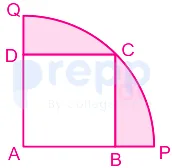
- A
155.98 cm2
- B
179.68 cm2
- C
163.85 cm2
- D
145.92 cm2
Show answer
D. 145.92 cm2Given:
AB = 16 cm
Concept used:
Area of a square = a 2
Area of a quadrant of a circle = πr 2/4
The diagonal of a square = a√2
Here,
a = side of the square
r = radius of the circle
Calculation:
Here
AC is the diagonal of the square ABCD and also the radius of the quadrant APCQ
Now,
AC = 16√2
Area of the shaded region = Area of the quadrant - the area of the square
⇒ Area of the shaded region = π × (16√2) 2/4 - 16 2
⇒ Area of the shaded region = 3.14 × 128 - 256
⇒ Area of the shaded region = 401.92 - 256
⇒ Area of the shaded region = 145.92 cm 2
∴ T he area of the shaded region is 145.92 cm 2 .
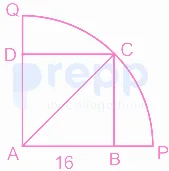 Paper & answer key PDF ↗
 Question 68archived
O is the incentre of the triangle PQR. If angle POR = 140 degree, then what is the angle PQR?
- A
40 degree
- B
140 degree
- C
100 degree
- D
70 degree
Show answer
C. 100 degreeSolving Triangle Angle with Incenter Property
The question asks us to find the measure of angle PQR in a triangle PQR, given that O is its incenter and the angle POR is 140 degrees.
Understanding the Incenter
The incenter of a triangle is a special point located at the intersection of the three angle bisectors of the triangle. The incenter is also the center of the triangle's incircle, which is tangent to all three sides of the triangle.
In triangle PQR, O is the incenter. This means that PO, QO, and RO are the angle bisectors of angles <P, <Q, and <R respectively. Specifically, QO is the angle bisector of <PQR.
Formula Relating Incenter Angle and Vertex Angle
There is a direct relationship between the angle formed by two angle bisectors at the incenter and the third angle of the triangle. For any triangle ABC with incenter I, the angle <BIC is related to the angle <BAC by the formula:
$\angle \text{BIC} = 90^\circ + \frac{1}{2} \angle \text{BAC}$
In our triangle PQR with incenter O, the angle <POR is formed by the angle bisectors PO and RO. This angle is related to the angle at the third vertex, which is <PQR (or <Q), by the same formula:
$\angle \text{POR} = 90^\circ + \frac{1}{2} \angle \text{PQR}$
Calculating Angle PQR
We are given that $\angle \text{POR} = 140^\circ$. We can substitute this value into the formula:
$140^\circ = 90^\circ + \frac{1}{2} \angle \text{PQR}$
Now, we need to solve for $\angle \text{PQR}$.
Subtract $90^\circ$ from both sides of the equation:
$140^\circ - 90^\circ = \frac{1}{2} \angle \text{PQR}$
$50^\circ = \frac{1}{2} \angle \text{PQR}$
Multiply both sides by 2 to find $\angle \text{PQR}$:
$\angle \text{PQR} = 50^\circ \times 2$
$\angle \text{PQR} = 100^\circ$
Thus, the measure of angle PQR is 100 degrees.
Step-by-Step Derivation (Alternative perspective)
Let <PQR = <Q, <QRP = <R, and <RPQ = <P.
Since O is the incenter, QO, RO, and PO are angle bisectors.
<OQR = <OQP = <Q/2
<ORQ = <ORP = <R/2
<OPR = <OPQ = <P/2
In triangle POR, the sum of angles is $180^\circ$.
<POR + <OPR + <ORP = $180^\circ$
We know <OPR = <P/2 and <ORP = <R/2. So,
$140^\circ + \frac{\angle \text{P}}{2} + \frac{\angle \text{R}}{2} = 180^\circ$
$140^\circ + \frac{1}{2}(\angle \text{P} + \angle \text{R}) = 180^\circ$
$\frac{1}{2}(\angle \text{P} + \angle \text{R}) = 180^\circ - 140^\circ$
$\frac{1}{2}(\angle \text{P} + \angle \text{R}) = 40^\circ$
$\angle \text{P} + \angle \text{R} = 80^\circ$
In triangle PQR, the sum of all angles is $180^\circ$.
<P + <Q + <R = $180^\circ$
<Q + (<P + <R) = $180^\circ$
Substitute the value of (<P + <R) = $80^\circ$:
<Q + $80^\circ$ = $180^\circ$
<Q = $180^\circ - 80^\circ$
<Q = $100^\circ$
So, $\angle \text{PQR} = 100^\circ$. Both methods yield the same result.
Given Information
Property/Formula Used
Result
O is incenter of $\triangle$PQR
Definition of Incenter (angle bisectors intersect)
PO, QO, RO are angle bisectors
$\angle$POR = $140^\circ$
Formula: $\angle \text{YIZ} = 90^\circ + \frac{1}{2} \angle \text{X}$ for $\triangle$XYZ with incenter I
$140^\circ = 90^\circ + \frac{1}{2} \angle \text{PQR}$
Equation: $140^\circ = 90^\circ + \frac{1}{2} \angle \text{PQR}$
Algebraic manipulation to solve for $\angle$PQR
$\angle \text{PQR} = 100^\circ$
Final Answer Check
If $\angle \text{PQR} = 100^\circ$, then using the formula, $\angle \text{POR} = 90^\circ + \frac{1}{2} (100^\circ) = 90^\circ + 50^\circ = 140^\circ$. This matches the given information, confirming our calculation is correct.
Revision Table: Incenter Angle Calculation
Concept
Description
Relevant Formula
Incenter
Intersection of angle bisectors. Center of the incircle.
-
Angle at Incenter
Angle formed by two angle bisectors at the incenter.
For $\triangle$XYZ with incenter I, $\angle \text{YIZ} = 90^\circ + \frac{1}{2} \angle \text{X}$
Angle Sum Property of Triangle
Sum of interior angles of a triangle is $180^\circ$.
$\angle \text{X} + \angle \text{Y} + \angle \text{Z} = 180^\circ$ for $\triangle$XYZ
Additional Information: Properties of Incenter
The incenter is an important point in a triangle with several key properties:
It is equidistant from all three sides of the triangle. This distance is the radius of the incircle.
It always lies inside the triangle, regardless of whether the triangle is acute, right, or obtuse.
It is the only point from which perpendiculars drawn to the sides are equal in length.
The incenter divides the angle bisectors in a specific ratio related to the side lengths. For angle bisector AP of $\triangle$ABC with incenter I, AI/IP = (b+c)/a, where a, b, c are side lengths opposite vertices A, B, C respectively.
Paper & answer key PDF ↗ Question 69archived
If the side of an equilateral triangle is 20 cm, then what is its area?
- A
110\(\sqrt3\) cm2
- B
125 \(\sqrt3\)cm2
- C
200 \(\sqrt3\) cm2
- D
100 \(\sqrt3\) cm2
Show answer
D. 100 \(\sqrt3\) cm2Calculating the Area of an Equilateral Triangle
The problem asks us to find the area of an equilateral triangle given its side length.
An equilateral triangle is a triangle in which all three sides are equal in length, and all three angles are equal (each measuring 60 degrees).
The formula for the area of an equilateral triangle with side length 's' is given by:
Area $= \frac{\sqrt{3}}{4} \times s^2$
In this question, the side of the equilateral triangle is given as 20 cm.
So, $s = 20$ cm.
Now, we substitute the value of 's' into the formula:
Area $= \frac{\sqrt{3}}{4} \times (20 \text{ cm})^2$
Calculate the square of the side length:
$(20 \text{ cm})^2 = 20 \times 20 \text{ cm}^2 = 400 \text{ cm}^2$
Substitute this back into the area formula:
Area $= \frac{\sqrt{3}}{4} \times 400 \text{ cm}^2$
Now, simplify the expression:
Area $= \sqrt{3} \times \frac{400}{4} \text{ cm}^2$
Area $= \sqrt{3} \times 100 \text{ cm}^2$
Area $= 100\sqrt{3} \text{ cm}^2$
So, the area of the equilateral triangle with a side of 20 cm is $100\sqrt{3}$ cm2.
Let's compare this result with the given options:
Option 1: $110\sqrt{3}$ cm2
Option 2: $125\sqrt{3}$ cm2
Option 3: $200\sqrt{3}$ cm2
Option 4: $100\sqrt{3}$ cm2
Our calculated area matches Option 4.
Steps to Calculate Equilateral Triangle Area
Identify the given side length 's'.
Use the formula: Area $= \frac{\sqrt{3}}{4} s^2$.
Substitute the side length into the formula.
Calculate the square of the side length.
Multiply the result by $\frac{\sqrt{3}}{4}$.
Express the final answer with appropriate units (cm2).
Revision Table: Equilateral Triangle Properties
Property
Formula (side 's')
Area
$\frac{\sqrt{3}}{4} s^2$
Perimeter
$3s$
Height
$\frac{\sqrt{3}}{2} s$
Angles
Each angle is 60°
Additional Information on Triangles
Triangles are fundamental polygons with three sides and three vertices. They are classified based on their side lengths and angles.
Based on Sides:
Equilateral Triangle: All three sides are equal. All angles are 60°.
Isosceles Triangle: Two sides are equal. The angles opposite the equal sides are equal.
Scalene Triangle: All three sides are of different lengths. All angles are different.
Based on Angles:
Acute Triangle: All three angles are acute (less than 90°).
Right Triangle: One angle is a right angle (exactly 90°).
Obtuse Triangle: One angle is obtuse (greater than 90°).
The sum of the interior angles of any triangle is always 180°.
Paper & answer key PDF ↗ Question 70archived
Which of the following statement is correct?
I. The value of 100 2 - 99 2 + 98 2 - 97 2 + 96 2 - 95 2 + 94 2 - 93 2 + ...... + 2 2 - 1 2 is 5050.
II. If 8x + \(\frac{8}{x}\) = -16 and x < 0, then the value of x 197 + x -197 is 2.
- A
Only I
- B
Only II
- C
Both I and II
- D
Neither I nor II
Show answer
A. Only IAnalyzing Mathematical Statements on Sums and Algebraic Expressions
We are asked to determine which of the given statements is correct. Let's analyze each statement carefully.
Evaluating Statement I: Sum of Differences of Squares
Statement I provides the expression: $100^2 - 99^2 + 98^2 - 97^2 + 96^2 - 95^2 + 94^2 - 93^2 + \dots + 2^2 - 1^2$. We need to find its value and check if it is 5050.
The expression consists of pairs of terms, where each pair is a difference of squares. We can use the algebraic identity $a^2 - b^2 = (a-b)(a+b)$.
Let's group the terms into pairs:
$(100^2 - 99^2)$
$(98^2 - 97^2)$
$(96^2 - 95^2)$
...
$(2^2 - 1^2)$
For each pair $(a^2 - b^2)$, we have $a$ and $b$ as consecutive integers, with $a = b+1$. Therefore, $a-b = (b+1)-b = 1$.
Applying the identity $a^2 - b^2 = (a-b)(a+b)$, where $(a-b)=1$, each difference of squares simplifies to $(a+b)$.
$100^2 - 99^2 = (100-99)(100+99) = 1 \cdot (199) = 199$
$98^2 - 97^2 = (98-97)(98+97) = 1 \cdot (195) = 195$
$96^2 - 95^2 = (96-95)(96+95) = 1 \cdot (191) = 191$
...
$2^2 - 1^2 = (2-1)(2+1) = 1 \cdot (3) = 3$
The original expression is the sum of these results:
$199 + 195 + 191 + \dots + 3$
This is an arithmetic series. Let's find the terms being added. Notice that the terms being added in each pair $(a+b)$ are $100+99=199$, $98+97=195$, ..., $2+1=3$. The sum is the sum of consecutive integers from 1 to 100.
Let's look at the pairs: $(100, 99), (98, 97), \dots, (2, 1)$. There are $100/2 = 50$ such pairs.
The sum is $(100+99) + (98+97) + \dots + (2+1)$. This is equivalent to the sum of all integers from 1 to 100.
The sum of the first $n$ positive integers is given by the formula $S_n = \frac{n(n+1)}{2}$.
In this case, $n = 100$.
Sum = $\frac{100(100+1)}{2} = \frac{100 \cdot 101}{2} = 50 \cdot 101 = 5050$.
The value of the expression is 5050. Statement I claims the value is 5050.
Therefore, Statement I is correct.
Evaluating Statement II: Solving an Algebraic Equation and Evaluating an Expression
Statement II gives the equation $8x + \frac{8}{x} = -16$ with the condition $x < 0$. We need to find the value of $x^{197} + x^{-197}$ and check if it is 2.
First, let's solve the equation for $x$.
$8x + \frac{8}{x} = -16$
Divide the entire equation by 8:
$x + \frac{1}{x} = -2$
To eliminate the fraction, multiply the entire equation by $x$. Note that $x \neq 0$ because the term $\frac{8}{x}$ exists.
$x \cdot x + x \cdot \frac{1}{x} = -2 \cdot x$
$x^2 + 1 = -2x$
Rearrange the terms to form a quadratic equation:
$x^2 + 2x + 1 = 0$
This is a perfect square trinomial, which can be factored as $(x+1)^2$.
$(x+1)^2 = 0$
Taking the square root of both sides:
$x+1 = 0$
Solving for $x$:
$x = -1$
The condition given in the statement is $x < 0$. Our solution $x = -1$ satisfies this condition.
Now, we need to evaluate the expression $x^{197} + x^{-197}$ with $x = -1$.
$x^{197} + x^{-197} = (-1)^{197} + (-1)^{-197}$
For powers of -1:
$(-1)^{\text{odd integer}} = -1$
$(-1)^{\text{even integer}} = 1$
Since 197 is an odd integer:
$(-1)^{197} = -1$
For the term with a negative exponent, recall that $a^{-n} = \frac{1}{a^n}$:
$(-1)^{-197} = \frac{1}{(-1)^{197}} = \frac{1}{-1} = -1$
Now, substitute these values back into the expression:
$x^{197} + x^{-197} = (-1) + (-1) = -2$.
The value of $x^{197} + x^{-197}$ is -2. Statement II claims the value is 2.
Therefore, Statement II is incorrect.
Conclusion on Statement Correctness
Based on our analysis:
Statement I is correct because the sum is indeed 5050.
Statement II is incorrect because the value of the expression is -2, not 2.
Thus, only Statement I is correct.
Statement
Calculated Value
Claimed Value
Correctness
I
5050
5050
Correct
II
-2
2
Incorrect
Revision Table: Key Concepts Used
Concept
Description
Application Here
Difference of Squares
$a^2 - b^2 = (a-b)(a+b)$
Used to simplify each pair in Statement I.
Sum of Arithmetic Series
Sum of first $n$ integers: $\frac{n(n+1)}{2}$
Used to find the total sum in Statement I.
Solving Quadratic Equation
Finding values of $x$ that satisfy $ax^2+bx+c=0$
Used to find the value of $x$ in Statement II.
Properties of Exponents
$a^{-n} = \frac{1}{a^n}$, $(-1)^{\text{odd}} = -1$, $(-1)^{\text{even}} = 1$
Used to evaluate the expression in Statement II.
Additional Information: Related Mathematical Techniques
Understanding how to work with series and algebraic equations is fundamental in mathematics. Here's a bit more detail on related topics:
Arithmetic Progression (AP): A sequence where the difference between consecutive terms is constant. The sum in Statement I, after simplification, is related to the sum of an AP (the sum of integers 1 to 100 is a specific case). The general sum of an AP is $S_n = \frac{n}{2}(2a + (n-1)d)$ or $S_n = \frac{n}{2}(a + l)$, where $n$ is the number of terms, $a$ is the first term, $d$ is the common difference, and $l$ is the last term.
Quadratic Equations: Equations of the form $ax^2 + bx + c = 0$. They can be solved by factoring (as in Statement II), completing the square, or using the quadratic formula $x = \frac{-b \pm \sqrt{b^2-4ac}}{2a}$. Recognizing perfect square trinomials like $x^2+2x+1=(x+1)^2$ is a useful shortcut.
Exponents and Powers: Rules for exponents, such as $a^m \cdot a^n = a^{m+n}$, $(a^m)^n = a^{mn}$, $a^{-n} = 1/a^n$, are crucial for simplifying expressions involving powers, especially with negative bases or exponents.
Paper & answer key PDF ↗ Question 71archived
If sin A = \(\frac{4}{5}\) and sin B = \(\frac{15}{17}\) , what is the value of sin (A - B)?
- A
\(-\frac{32}{45}\)
- B
\(-\frac{13}{85}\)
- C
\(\frac{13}{85}\)
- D
\(\frac{32}{45}\)
Show answer
B. \(-\frac{13}{85}\)Trigonometry Problem: Finding sin(A - B)
The problem asks us to find the value of \(\sin(A - B)\) given the values of \(\sin A\) and \(\sin B\). We are given:
\(\sin A = \frac{4}{5}\)
\(\sin B = \frac{15}{17}\)
To find \(\sin(A - B)\), we need to use the trigonometric identity for the sine of the difference of two angles, which is:
\(\sin(A - B) = \sin A \cos B - \cos A \sin B\)
We are given \(\sin A\) and \(\sin B\), but we need to find the values of \(\cos A\) and \(\cos B\). We can use the fundamental trigonometric identity \(\sin^2 \theta + \cos^2 \theta = 1\), which means \(\cos \theta = \pm \sqrt{1 - \sin^2 \theta}\). Since the problem does not specify the quadrants for angles A and B, we typically assume acute angles (first quadrant) where cosine values are positive.
Step 1: Calculate cos A
Given \(\sin A = \frac{4}{5}\), we can find \(\cos A\):
\(\cos A = \sqrt{1 - \sin^2 A}\)
\(\cos A = \sqrt{1 - \left(\frac{4}{5}\right)^2}\)
\(\cos A = \sqrt{1 - \frac{16}{25}}\)
\(\cos A = \sqrt{\frac{25 - 16}{25}}\)
\(\cos A = \sqrt{\frac{9}{25}}\)
\(\cos A = \frac{3}{5}\) (Assuming A is in the first quadrant)
Step 2: Calculate cos B
Given \(\sin B = \frac{15}{17}\), we can find \(\cos B\):
\(\cos B = \sqrt{1 - \sin^2 B}\)
\(\cos B = \sqrt{1 - \left(\frac{15}{17}\right)^2}\)
\(\cos B = \sqrt{1 - \frac{225}{289}}\)
\(\cos B = \sqrt{\frac{289 - 225}{289}}\)
\(\cos B = \sqrt{\frac{64}{289}}\)
\(\cos B = \frac{8}{17}\) (Assuming B is in the first quadrant)
Step 3: Calculate sin(A - B)
Now we substitute the calculated values of \(\sin A, \cos A, \sin B\), and \(\cos B\) into the formula for \(\sin(A - B)\):
\(\sin(A - B) = \sin A \cos B - \cos A \sin B\)
\(\sin(A - B) = \left(\frac{4}{5}\right) \times \left(\frac{8}{17}\right) - \left(\frac{3}{5}\right) \times \left(\frac{15}{17}\right)\)
\(\sin(A - B) = \frac{4 \times 8}{5 \times 17} - \frac{3 \times 15}{5 \times 17}\)
\(\sin(A - B) = \frac{32}{85} - \frac{45}{85}\)
\(\sin(A - B) = \frac{32 - 45}{85}\)
\(\sin(A - B) = \frac{-13}{85}\)
Summary of Results
Here are the values we found:
\(\sin A = \frac{4}{5}\)
\(\cos A = \frac{3}{5}\)
\(\sin B = \frac{15}{17}\)
\(\cos B = \frac{8}{17}\)
\(\sin(A - B) = -\frac{13}{85}\)
The calculated value for \(\sin(A - B)\) is \(-\frac{13}{85}\).
Revision Table: Key Trigonometric Identities
Identity
Formula
Pythagorean Identity
\(\sin^2 \theta + \cos^2 \theta = 1\)
Sine of Difference
\(\sin(A - B) = \sin A \cos B - \cos A \sin B\)
Sine of Sum
\(\sin(A + B) = \sin A \cos B + \cos A \sin B\)
Cosine of Difference
\(\cos(A - B) = \cos A \cos B + \sin A \sin B\)
Cosine of Sum
\(\cos(A + B) = \cos A \cos B - \sin A \sin B\)
Additional Information on Trigonometric Calculations
When dealing with trigonometric functions and identities, it is crucial to remember the possible signs of sine, cosine, and tangent in different quadrants. While we assumed acute angles (Quadrant I) in this problem for simplicity (as is common when quadrants aren't specified and only positive values are given), in general, \(\cos \theta = \pm \sqrt{1 - \sin^2 \theta}\) and the sign depends on the quadrant of \(\theta\).
Quadrant I: All trigonometric functions are positive.
Quadrant II: Sine is positive, Cosine and Tangent are negative.
Quadrant III: Tangent is positive, Sine and Cosine are negative.
Quadrant IV: Cosine is positive, Sine and Tangent are negative.
For example, if angle A was in Quadrant II with \(\sin A = \frac{4}{5}\), then \(\cos A\) would be \(-\frac{3}{5}\). If angle B was in Quadrant III with \(\sin B = \frac{15}{17}\) (which is impossible for Quadrant III as sine is negative there), let's say \(\sin B = -\frac{15}{17}\), then \(\cos B\) would be \(-\sqrt{1 - (-\frac{15}{17})^2} = -\frac{8}{17}\). The final value of \(\sin(A-B)\) would change significantly based on the quadrants.
Paper & answer key PDF ↗ Question 72archived
From the circumcentre L of ΔXYZ, perpendicular LM is drawn on side YZ. If ∠YXZ = 60°, then the measure of ∠YLM is :
- A
60°
- B
120°
- C
180°
- D
90°
Show answer
A. 60°Understanding the Geometry Problem: Circumcenter and Angles
This question asks us to find the measure of a specific angle within a triangle, given information about its circumcenter and another angle. We are given a triangle \(\Delta XYZ\), its circumcenter L, and a perpendicular LM drawn from L to side YZ. We are also given that \(\angle YXZ = 60^\circ\). We need to determine the measure of \(\angle YLM\).
Key Concepts for Solving
Circumcenter: The circumcenter of a triangle is the intersection point of the perpendicular bisectors of its sides. It is also the center of the circle that passes through all three vertices of the triangle (the circumcircle).
Angle at the Center vs. Angle at the Circumference: The angle subtended by an arc at the center of a circle is twice the angle subtended by the same arc at any point on the remaining part of the circle's circumference.
Isosceles Triangle Properties: In an isosceles triangle, the angle bisector of the vertex angle, the median to the base, and the altitude to the base all coincide.
Step-by-Step Solution
Let's break down the problem step by step using the properties of the circumcenter and triangles.
Step 1: Relate the Circumcenter to the Vertices
L is the circumcenter of \(\Delta XYZ\). By definition, the circumcenter is equidistant from the vertices of the triangle. Therefore, LY = LZ = LX (all are radii of the circumcircle).
Step 2: Use the Angle Subtended by the Arc YZ
Consider the circumcircle passing through points X, Y, and Z with center L. The angle subtended by the arc YZ at the circumference is \(\angle YXZ = 60^\circ\). The angle subtended by the same arc YZ at the center L is \(\angle YLZ\).
According to the property relating the angle at the center and the angle at the circumference:
\[ \angle YLZ = 2 \times \angle YXZ \]
\[ \angle YLZ = 2 \times 60^\circ \]
\[ \angle YLZ = 120^\circ \]
Step 3: Analyze Triangle LYZ
Since LY = LZ (radii of the circumcircle), \(\Delta LYZ\) is an isosceles triangle with vertex angle \(\angle YLZ = 120^\circ\).
Step 4: Use the Perpendicular from the Circumcenter
We are given that LM is drawn perpendicular to YZ. So, \(\angle LMY = \angle LMZ = 90^\circ\).
In an isosceles triangle \(\Delta LYZ\), the altitude from the vertex L to the base YZ (which is LM) has special properties. It acts as the angle bisector of the vertex angle \(\angle YLZ\) and also as the median to the base YZ (meaning M is the midpoint of YZ).
Step 5: Find the Measure of Angle YLM
Since LM bisects the angle \(\angle YLZ\), we have:
\[ \angle YLM = \frac{1}{2} \times \angle YLZ \]
\[ \angle YLM = \frac{1}{2} \times 120^\circ \]
\[ \angle YLM = 60^\circ \]
Thus, the measure of \(\angle YLM\) is 60°.
Angle
Measure
Reason
\(\angle YXZ\)
60°
Given
\(\angle YLZ\)
120°
Angle at center = 2 * Angle at circumference (subtending arc YZ)
\(\Delta LYZ\)
Isosceles
LY = LZ (radii)
LM \(\perp\) YZ
\(\angle LMY = 90^\circ\)
Given
LM bisects \(\angle YLZ\)
\(\angle YLM = \angle ZLM\)
Altitude from vertex in isosceles triangle bisects the vertex angle
\(\angle YLM\)
60°
\(\frac{1}{2} \times \angle YLZ = \frac{1}{2} \times 120^\circ\)
Conclusion
By using the property that the angle subtended by an arc at the circumcenter is twice the angle subtended at the circumference, and the properties of an isosceles triangle formed by the circumcenter and two vertices, we found that \(\angle YLM\) is 60°.
Revision Table: Key Geometric Concepts
Concept
Definition/Property
Relevance to Problem
Circumcenter
Center of the circumcircle; equidistant from vertices.
L is equidistant from X, Y, Z (\(LY=LZ\)).
Angle at Center Theorem
Angle at center = 2 \(\times\) Angle at circumference (for same arc).
\(\angle YLZ = 2 \times \angle YXZ\).
Isosceles Triangle
Triangle with two equal sides. Base angles are equal. Altitude from vertex angle bisects vertex angle and base.
\(\Delta LYZ\) is isosceles (\(LY=LZ\)). LM is altitude from L to YZ, so it bisects \(\angle YLZ\).
Additional Information: Circumcenter Location
The location of the circumcenter L depends on the type of triangle \(\Delta XYZ\):
Acute Triangle: The circumcenter lies inside the triangle.
Right Triangle: The circumcenter lies on the midpoint of the hypotenuse.
Obtuse Triangle: The circumcenter lies outside the triangle.
In our problem, \(\angle YXZ = 60^\circ\), which is an acute angle. However, we don't know if the triangle is acute, right, or obtuse based on just one angle. The calculation of \(\angle YLZ\) and \(\angle YLM\) remains valid regardless of the triangle type, as the angle subtended by an arc at the center rule applies generally, and \(\Delta LYZ\) will always be isosceles with LM being the altitude from L to YZ.
Paper & answer key PDF ↗ Question 73archived
The number of books on Mathematics, Physics and Chemistry in a University library is in the ratio 8 ∶ 5 ∶ 9. There is a proposal to increase these books by 10%, 5% and 5% respectively. What will be the ratio of the number of books after increment?
- A
212 ∶ 117 ∶ 47
- B
37 ∶ 47 ∶ 83
- C
176 ∶ 105 ∶ 189
- D
189 ∶ 115 ∶ 117
Show answer
C. 176 ∶ 105 ∶ 189The correct answer is 176 ∶ 105 ∶ 189.
Decimal Ratios: If a ratio involves decimals (like $8.8 : 5.25 : 9.45$), multiply all terms by a power of 10 (like 10, 100, 1000) to convert them into whole numbers before simplifying further. The power of 10 needed is determined by the maximum number of decimal places in any term. Understanding how to apply percentage changes to elements within a ratio is a common type of problem in quantitative aptitude and basic mathematics.
Paper & answer key PDF ↗ Question 74archived
Ratio between the present ages of A and B is 2 ∶ 3, respectively. After 5 years, the ratio between their ages will be 3 ∶ 4. What is B's age at present?
- A
20 years
- B
15 years
- C
10 years
- D
25 years
Show answer
B. 15 yearsUnderstanding Age Ratio Problems
Age ratio problems are common in quantitative aptitude tests. They involve setting up equations based on the given ratios of ages at different points in time (present, past, or future).
Setting Up the Problem
We are given the ratio of the present ages of two people, A and B, and the ratio of their ages after a certain number of years. We need to find the present age of B.
Let the present age of A be represented by $2x$ and the present age of B be represented by $3x$, based on the given ratio of $2:3$. Here, $x$ is a common factor.
Ages After 5 Years
After 5 years, the age of A will be their present age plus 5 years, which is $2x + 5$.
Similarly, after 5 years, the age of B will be their present age plus 5 years, which is $3x + 5$.
We are told that the ratio of their ages after 5 years will be $3:4$. So, we can write this as an equation:
$$ \frac{\text{Age of A after 5 years}}{\text{Age of B after 5 years}} = \frac{3}{4} $$
Substituting the expressions for their ages, we get:
$$ \frac{2x + 5}{3x + 5} = \frac{3}{4} $$
Solving the Equation for x
To solve for $x$, we can cross-multiply the equation:
$$ 4 \times (2x + 5) = 3 \times (3x + 5) $$
Distribute the numbers on both sides:
$$ 8x + 20 = 9x + 15 $$
Now, we need to isolate $x$. Let's move the terms involving $x$ to one side and the constant terms to the other side. Subtract $8x$ from both sides:
$$ 20 = 9x - 8x + 15 $$
$$ 20 = x + 15 $$
Subtract 15 from both sides:
$$ 20 - 15 = x $$
$$ x = 5 $$
Calculating B's Present Age
We defined B's present age as $3x$. Now that we have found the value of $x$, we can calculate B's present age:
$$ \text{B's present age} = 3 \times x = 3 \times 5 = 15 \text{ years} $$
So, B's present age is 15 years.
Present Age
Age After 5 Years
A
$2x = 2 \times 5 = 10$
$2x + 5 = 10 + 5 = 15$
B
$3x = 3 \times 5 = 15$
$3x + 5 = 15 + 5 = 20$
Let's check the ratio after 5 years: Age of A after 5 years is 15, and age of B after 5 years is 20. The ratio is $15:20$, which simplifies to $3:4$. This matches the information given in the problem, confirming our value of $x$ is correct.
Revision Table: Age Ratio Calculations
Concept
Description
Formula/Approach
Present Age Ratio
Ratio of ages at the current time.
Assume ages are $ax, bx$ if ratio is $a:b$.
Future Age Calculation
Age after $n$ years.
Present age $+ n$.
Setting up Equation
Forming an equation based on the future age ratio.
$\frac{\text{Future Age A}}{\text{Future Age B}} = \text{Given Future Ratio}$
Solving for Variable
Finding the value of the common factor $x$.
Algebraic manipulation (cross-multiplication, simplification).
Finding Present Age
Calculating the actual age using the found variable.
Substitute $x$ back into assumed present ages ($ax$ or $bx$).
Additional Information: Ratio and Proportion Basics
A ratio is a comparison of two quantities. For example, the ratio $2:3$ means that for every 2 units of the first quantity, there are 3 units of the second quantity.
A proportion is an equation that states that two ratios are equal. For example, $\frac{a}{b} = \frac{c}{d}$ is a proportion. In a proportion, the product of the means equals the product of the extremes (cross-multiplication), i.e., $ad = bc$. This principle was used to solve the equation in this problem.
When dealing with ratios of ages, we use a common multiplier (like $x$) to represent the actual ages, as the ratio only gives the relative sizes. For instance, a ratio of $2:3$ could mean ages 2 and 3, 4 and 6, 10 and 15, and so on. By using $2x$ and $3x$, we cover all these possibilities until we find the specific value of $x$ that satisfies the given conditions.
Paper & answer key PDF ↗ Question 75archived
Who scored the least marks in aggregate of all the subjects?
Name of the student
SUBJECT
English
Hindi
Maths
A
54
65
67
B
52
88
78
C
48
48
67
D
41
87
60
E
74
70
55
- A
D
- B
E
- C
A
- D
C
Show answer
D. CUnderstanding Aggregate Marks Calculation
The question asks us to find the student who scored the lowest total marks when combining the marks from all the subjects listed: English, Hindi, and Maths. This total is also known as the aggregate marks.
To solve this, we need to calculate the sum of marks for each student across these three subjects. The student with the smallest sum will be the one with the least aggregate marks.
Analyzing Student Performance Data
We are given the marks for five students (A, B, C, D, and E) in three subjects (English, Hindi, and Maths) in a table:
Name of the studentEnglishHindiMaths
A546567
B528878
C484867
D418760
E747055
Calculating Aggregate Marks for Each Student
We will now calculate the aggregate marks for each student by adding their marks in English, Hindi, and Maths.
For Student A: English + Hindi + Maths = $54 + 65 + 67 = 186$
For Student B: English + Hindi + Maths = $52 + 88 + 78 = 218$
For Student C: English + Hindi + Maths = $48 + 48 + 67 = 163$
For Student D: English + Hindi + Maths = $41 + 87 + 60 = 188$
For Student E: English + Hindi + Maths = $74 + 70 + 55 = 199$
Finding the Student with the Least Aggregate Marks
Now we compare the aggregate marks calculated for each student:
Student A: 186
Student B: 218
Student C: 163
Student D: 188
Student E: 199
Comparing these totals, we can see that the minimum aggregate mark is 163, which belongs to Student C.
Therefore, Student C scored the least marks in aggregate of all the subjects.
Revision Table: Aggregate Marks Summary
Student NameEnglishHindiMathsAggregate Marks
A546567186
B528878218
C484867163
D418760188
E747055199
This table clearly shows that Student C has the lowest aggregate score of 163.
Additional Information on Aggregate Scores
Aggregate score refers to the total score obtained by summing up the marks or grades from multiple subjects or tests. It is a common way to evaluate overall academic performance.
Calculating aggregate scores helps in:
Ranking students based on overall performance.
Determining eligibility for courses or scholarships.
Understanding a student's general academic standing rather than performance in a single subject.
In this problem, calculating the aggregate score for each student was the key step to identify who had the lowest overall performance across the three subjects.
Paper & answer key PDF ↗ Question 76archived
Select the most appropriate collocating word to fill in the blank.
After having understood the ill effects, he said he would_______ drinking alcohol.
- A
quit
- B
finish
- C
close
- D
terminate
Show answer
A. quitUnderstanding Collocations in English
The question asks us to select the most appropriate word to fill in the blank in the sentence: "After having understood the ill effects, he said he would_______ drinking alcohol." This is a question about collocation. Collocations are words that often go together in a particular language. Native speakers and proficient learners use these combinations naturally.
Let's look at the options provided and see which one fits best with the phrase "drinking alcohol" when referring to stopping the habit due to understanding negative effects.
Analyzing the Collocation Options
We are given the following options: quit, finish, close, and terminate. Let's consider each one:
Finish: To 'finish' something usually means to complete a task or consume the rest of something. For example, you might 'finish a drink' or 'finish a project'. While you can 'finish drinking a glass of water', 'finish drinking alcohol' doesn't naturally mean to stop the habit of consuming it over time.
Close: 'Close' is typically used for doors, windows, shops, or perhaps accounts. It has no common collocation with 'drinking alcohol' to mean stopping the habit.
Terminate: 'Terminate' means to bring to an end. It is a more formal word and is often used for contracts, employment, or processes. While technically meaning 'end', 'terminate drinking alcohol' is not a natural or common collocation used in everyday English to refer to stopping a habit like drinking.
Quit: To 'quit' means to stop doing something, especially a job, a sport, or a habit. Common collocations include 'quit smoking', 'quit gambling', and 'quit drinking'. This word specifically refers to giving up the practice or habit of doing something.
Why 'Quit' is the Correct Collocating Word
Based on the analysis of common English usage and the meaning of the words, 'quit' is the verb that naturally collocates with 'drinking alcohol' when referring to stopping the habit. The sentence implies that the person is giving up the regular consumption of alcohol because they now understand its negative impacts. 'Quit' perfectly conveys this meaning of stopping a habit.
Therefore, the most appropriate word to fill the blank is 'quit'. The completed sentence reads: "After having understood the ill effects, he said he would quit drinking alcohol."
Revision Table: Common 'Quit' Collocations
Verb
Common Collocation
Meaning
Quit
Quit smoking
Stop the habit of smoking cigarettes.
Quit
Quit your job
Leave your employment.
Quit
Quit school/college
Stop attending school or college before finishing.
Quit
Quit a game/sport
Stop playing a game or participating in a sport.
Additional Information on English Collocations
Understanding collocations is crucial for sounding more natural in English. Collocations are not always governed by strict grammatical rules; they are often a matter of convention and common usage. There are different types of collocations, including:
Adjective + Noun (e.g., heavy rain)
Noun + Noun (e.g., a sense of humour)
Verb + Noun (e.g., commit a crime)
Adverb + Adjective (e.g., completely satisfied)
Verb + Adverb (e.g., study hard)
In this question, we focused on a verb + noun collocation where the verb 'quit' is commonly used with the gerund 'drinking' (functioning somewhat like a noun phrase representing the habit) or nouns representing habits like 'smoking'. Learning these common word partnerships helps improve fluency and accuracy in English.
Paper & answer key PDF ↗ Question 77archived
Select the most appropriate synonym of the given word.
Remorse
- A
Repentance
- B
Slow
- C
Liberate
- D
Affinity
Show answer
A. RepentanceFinding the Synonym for Remorse: Understanding Vocabulary
Let's find the most appropriate synonym for the word Remorse. Understanding synonyms helps us express ideas using different words with similar meanings. First, let's define the word Remorse.
Remorse means a strong feeling of guilt and regret about something wrong that you have done.
Now, let's look at the options provided and determine which word has a meaning closest to Remorse.
Repentance: This word means the activity of repenting, which is expressing sincere regret about one's wrongdoing. This sounds very close to the definition of Remorse.
Slow: This word describes something that moves or happens at a low speed. This meaning is completely unrelated to feeling guilt or regret.
Liberate: This word means to set someone free from a situation, especially imprisonment or slavery. This is the opposite of feeling weighed down by guilt, which is associated with Remorse.
Affinity: This word means a spontaneous or natural liking or sympathy for someone or something; or a relationship or resemblance in structure or character. This meaning is unrelated to guilt or regret.
Comparing the definitions, Repentance clearly shares the core meaning of regret and sorrow over past wrongdoings, which is the essence of Remorse.
Therefore, the most appropriate synonym for Remorse is Repentance.
Revision Table: Understanding Remorse and Options
Word
Meaning
Relationship to Remorse
Remorse
Deep regret or guilt for a wrongdoing.
Word in question.
Repentance
Sincere regret for wrongdoing; seeking forgiveness.
Strong synonym.
Slow
Moving or operating at low speed.
No relation.
Liberate
To set free.
Opposite idea.
Affinity
Liking or sympathy; resemblance.
No relation.
Additional Information on Remorse and Synonyms
Understanding vocabulary is crucial for effective communication. Synonyms are words that have similar meanings. While Remorse and Repentance are very close in meaning, there can be subtle differences depending on context. Remorse often focuses more on the internal feeling of guilt and pain caused by remembering the action, whereas Repentance implies a feeling of regret that leads to a change in behavior or seeking forgiveness.
Knowing synonyms helps:
Improve writing by avoiding repetition.
Understand different shades of meaning between similar words.
Enhance reading comprehension.
Always consider the specific context in which a word is used to choose the most fitting synonym.
Paper & answer key PDF ↗ Question 78archived
Select the most appropriate word for the underlined word in the given sentence.
Rajesh was angry at himself for making a silly mistake during the examination.
- A
for
- B
on
- C
above
- D
with
Show answer
D. withWith is the appropriate replacement among the options: 'Rajesh was angry with himself for making a silly mistake during the examination.' Both 'angry with someone' and 'angry at someone' are standard English, so the original 'at himself' is also acceptable. The question asks for a suitable replacement, and the other listed prepositions do not fit.
Paper & answer key PDF ↗ Question 79archived
Rectify the sentence by selecting the correct spelling of the underlined word.
I would never asc ociate with such a person.
- A
associate
- B
accosiate
- C
assosiate
- D
asosiate
Show answer
A. associateThe correct answer is associate.
Many words that sound similar have different spellings and meanings (homophones). Words with silent letters are common. Vowel combinations can be pronounced in multiple ways. Regularly checking a dictionary for words you are unsure about is a good habit for improving spelling and expanding vocabulary.
Paper & answer key PDF ↗ Question 80archived
Select the most appropriate ANTONYM of the underlined word.
The number of tests conducted dropped further on Saturday with a total of 67,624 tests of which 20% were the less precise rapid antigen tests.
- A
Complicated
- B
I nev itable
- C
Rough
- D
Adequate
Show answer
C. RoughLet's find the most appropriate antonym for the word "precise" as used in the given sentence: "The number of tests conducted dropped further on Saturday with a total of 67,624 tests of which 20% were the less precise rapid antigen tests."
The word "precise" in this context means exact, accurate, or specific. The sentence implies that rapid antigen tests are less accurate compared to other tests.
We need to choose the option that means the opposite of "precise" (accurate/exact).
Understanding the Meaning of Precise
The word precise refers to something that is exact, accurate, or specific. It implies a high level of detail and correctness, leaving little room for error or ambiguity.
Analysing the Options for Antonym of Precise
Let's look at each option provided and determine its meaning:
Complicated: This means difficult to understand or deal with. It is not the opposite of precise.
Inevitab le: This appears to be a misspelling. Assuming it is "Inevitable", it means certain to happen; unavoidable. This is not related to the meaning of precise.
Rough: This word has several meanings, including not smooth, violent, or approximate/inexact. In the context of measurement or testing accuracy, "rough" means not exact, approximate, or lacking fineness. This is a potential antonym for precise.
Adequate: This means satisfactory or sufficient. It doesn't convey the opposite of precise.
Selecting the Most Appropriate Antonym
Comparing the meanings, "rough" is the most appropriate antonym for "precise" among the given options. While "precise" means exact and accurate, "rough" can mean approximate or inexact, which is the opposite of being exact or highly accurate.
Therefore, if a test is less precise, it is less accurate, and a word like "rough" can describe something that is not precise or is approximate.
Summary of Options and Antonyms
Let's summarize the analysis:
Option
Meaning
Is it an antonym of Precise?
Complicated
Difficult to understand/deal with
No
Inevitab le (Inevitable)
Unavoidable
No
Rough
Approximate, inexact, not smooth
Yes (in the sense of inexact)
Adequate
Satisfactory, sufficient
No
Based on the analysis, "Rough" is the word that best fits as the antonym of "precise" in the context of accuracy or exactness.
Revision Table: Antonyms and Synonyms
Word
Meaning
Synonyms
Antonyms
Precise
Exact, accurate, specific
Exact, accurate, definite, specific, correct
Imprecise, inexact, approximate, vague, rough
Rough
Not exact, approximate, crude, lacking fineness
Approximate, crude, inexact, estimated, sketch
Precise, exact, smooth, refined, accurate
Complicated
Difficult to understand/deal with
Complex, intricate, convoluted
Simple, straightforward, easy
Inevitable
Certain to happen, unavoidable
Unavoidable, certain, sure, inescapable
Avoidable, uncertain, preventable, doubtful
Adequate
Satisfactory, sufficient
Sufficient, enough, satisfactory, ample
Inadequate, insufficient, deficient
Additional Information on Antonyms
Antonyms are words that have opposite meanings. Understanding antonyms helps in building vocabulary and comprehending nuances in language. Finding the correct antonym often depends on the specific context in which the word is used. For example, the antonym of "light" could be "dark" (opposite colour/illumination) or "heavy" (opposite weight). In the given question, the context of "precise" relates to the accuracy of a test, making "rough" (meaning inexact or approximate) the fitting opposite.
Paper & answer key PDF ↗ Question 81archived
Select the most appropriate meaning of the underlined segment in the given sentence.
By the end of the football match, feelings had reached fever pitch .
- A
in or to many places
- B
to get so strong that one cannot control them
- C
be extremely serious and worrying
- D
start well
Show answer
B. to get so strong that one cannot control themUnderstanding the Idiom 'Fever Pitch'
The question asks for the most appropriate meaning of the underlined segment "fever pitch" in the sentence: "By the end of the football match, feelings had reached fever pitch."
What does 'Fever Pitch' mean?
The idiom 'fever pitch' is used to describe a state of intense excitement, agitation, or activity. When something reaches 'fever pitch', it means that emotions or activities have become extremely strong, often to a point where they are difficult to control.
Think about the end of a closely contested football match. The emotions of the fans and players are usually very high – excitement, tension, anxiety, anticipation. These feelings become very strong and intense.
Analyzing the Options
Let's look at the given options and see which one best fits the meaning of 'fever pitch':
Option 1: "in or to many places" - This meaning refers to geographical distribution or movement. It does not relate to the intensity of feelings or excitement. Therefore, this is incorrect.
Option 2: "to get so strong that one cannot control them" - This option perfectly captures the essence of 'fever pitch'. It describes feelings or excitement becoming extremely intense and difficult to manage or contain. This aligns with the high emotions at the end of a match.
Option 3: "be extremely serious and worrying" - While intense feelings can sometimes be serious or worrying, 'fever pitch' itself focuses more on the intensity of excitement or emotion rather than necessarily implying a serious or worrying situation. For instance, the excitement at a concert can reach 'fever pitch' without being worrying. So, this option is not the most accurate meaning.
Option 4: "start well" - This refers to a good beginning. 'Fever pitch' describes a peak state of intensity, usually built up over time, not how something begins. Therefore, this is incorrect.
Conclusion
Based on the analysis of the idiom and the options, the most appropriate meaning of "fever pitch" in the given sentence is that the feelings became so strong that they were hard to control.
Idiom
Meaning
Context Example
Fever pitch
A state of extreme excitement, agitation, or intensity where feelings are strong and hard to control.
The excitement before the concert reached fever pitch.
Revision Table: Key Concepts
Concept
Explanation
Idiom
A phrase or expression whose meaning cannot be deduced simply from the ordinary meanings of its individual words.
Fever Pitch
Refers to a state of high emotional intensity or excitement.
Additional Information: Understanding Idiomatic Expressions
Idiomatic expressions like 'fever pitch' are common in English. They add color and nuance to the language. Understanding idioms is crucial for comprehending native English speakers and texts, and for improving your own fluency. When encountering an idiom, it's often helpful to:
Consider the context in which it is used.
Look up its meaning in a dictionary or online resource.
Pay attention to how it is used in different sentences.
Mastering idioms takes time and exposure, but it is a rewarding part of learning English.
Paper & answer key PDF ↗ Question 82archived
Select the option that can be used as a one-word substitute for the given group of words.
A speech made without preparation
- A
Extempore
- B
Rhetoric
- C
Deliberation
- D
Spontaneous
Show answer
A. ExtemporeUnderstanding Speech Without Preparation
The question asks for a single word that means "A speech made without preparation". This requires understanding the nuances of different terms related to speaking and actions.
Analyzing the Options for Speech Substitution
Let's examine each option to find the best fit for a speech made without prior preparation:
1. Extempore: This word specifically refers to something done or said without any preparation. An extempore speech is one delivered with little or no formal planning or writing beforehand. This aligns perfectly with the definition required. The root of the word comes from Latin meaning "from the spur of the moment".
2. Rhetoric: This term refers to the art of effective or persuasive speaking or writing. It focuses on the style and technique of communication, rather than whether it was prepared or not. A speech can be rhetorical whether it's prepared or extempore.
3. Deliberation: This means careful thought or discussion, often over a period of time. It implies planning and consideration, the opposite of speaking without preparation.
4. Spontaneous: This describes actions or feelings that arise from a sudden impulse or inclination, without premeditation. While a speech can be spontaneous, the word 'spontaneous' is broader and applies to any unplanned action or event. 'Extempore' is a more precise term specifically for speaking without preparation.
Conclusion: The Best One-Word Substitute
Based on the analysis, Extempore is the most accurate and precise one-word substitute for "A speech made without preparation". It directly addresses the lack of prior scripting or formal planning involved in delivering the speech.
Paper & answer key PDF ↗ Question 83archived
Select the most appropriate meaning of the given idiom.
To smell a rat
- A
To have reason to know the presence of a rat
- B
to have reason to suspect
- C
To know the smell of a rat
- D
To learn the smell of a rat
Show answer
B. to have reason to suspectUnderstanding the Idiom: To Smell a Rat
The question asks for the most appropriate meaning of the idiom "To smell a rat". Idioms are phrases or expressions whose meaning cannot be deduced simply from the literal meaning of its words. They have a figurative meaning that is generally understood within a culture.
Let's look at the given idiom, "To smell a rat". When someone says they "smell a rat", they are not talking about detecting the odor of an actual rodent. This phrase is used metaphorically.
Analyzing the Options
Let's examine each option to determine which one correctly represents the meaning of the idiom "To smell a rat".
Option 1: To have reason to know the presence of a rat
This option suggests a literal interpretation. If you know there is a rat present, you might literally smell it or see it. This is not the meaning of the idiom.
Option 2: to have reason to suspect
This option suggests a feeling of suspicion or doubt. When you "smell a rat", you suspect that something is wrong, dishonest, or not quite right in a situation. This aligns well with the common understanding of the idiom.
Option 3: To know the smell of a rat
Similar to Option 1, this option focuses on the literal sensory experience of knowing the smell of a rat. This is not the figurative meaning of the idiom.
Option 4: To learn the smell of a rat
This option also relates to the literal smell of a rat, implying learning to identify that specific odor. This does not represent the idiomatic meaning.
Comparing the options, it is clear that "to have reason to suspect" is the only option that captures the figurative meaning of the idiom "To smell a rat". The idiom implies a feeling of suspicion or a sense that something is wrong or deceitful.
Meaning of 'To Smell a Rat'
The idiom "To smell a rat" means to feel intuitively that something is wrong, suspicious, or dishonest. It suggests a feeling of doubt or distrust about a situation or a person's actions. You get a sense that there is a hidden problem or deception.
Here are a couple of examples of how the idiom is used:
"When he suddenly offered to pay for everyone's dinner, I started to smell a rat." (Meaning: I suspected he had an ulterior motive.)
"The politician's promises sounded too good to be true, and many people smelled a rat." (Meaning: Many people suspected that the promises were not genuine or that there was something dishonest going on.)
Conclusion
Based on the analysis of the idiom and the options, the most appropriate meaning of "To smell a rat" is to have reason to suspect.
Idiom
Meaning
To smell a rat
To have reason to suspect that something is wrong or dishonest.
Revision Table: Common Idioms Related to Suspicion
Idiom
Approximate Meaning
To smell a rat
To suspect deceit or a hidden problem.
Something is fishy
Something seems suspicious or not right.
Red flag
A sign that indicates a potential problem or danger.
To raise an eyebrow
To show surprise or suspicion.
Additional Information: What are Idioms?
Idioms are a type of figurative language. They are fixed phrases or expressions that have a meaning that is not the literal sum of the meanings of the individual words.
Understanding idioms is important for comprehending the nuances of a language and for effective communication. They add color and depth to language but can be challenging for language learners because their meaning is often not obvious.
The meaning of an idiom like "To smell a rat" is learned through exposure and context, rather than through direct translation or analysis of individual words.
Paper & answer key PDF ↗ Question 84archived
Select the correct indirect form of the given sentence.
Priya said, "Yes, I am confounded."
- A
Priya admitted that she was confound.
- B
Priya admit that she was confounded.
- C
Priya admitted that she was confounded.
- D
Priya admitted that she is confounded.
Show answer
C. Priya admitted that she was confounded.Understanding Direct and Indirect Speech Conversion
Converting a sentence from direct speech to indirect speech involves reporting what someone said without using their exact words. Several rules need to be followed, including changes in pronouns, verb tenses, and sometimes time and place references.
Analyzing the Direct Speech Sentence
The given sentence in direct speech is: "Priya said, 'Yes, I am confounded.'"
Let's break down its components:
Reporting Verb: "said" (past tense)
Reported Speech: "'Yes, I am confounded.'"
The reported speech contains two parts: an affirmation ("Yes") and a statement ("I am confounded"). The verb is "am confounded", which is in the present passive voice.
Applying Conversion Rules for Narration Change
When converting this sentence to indirect speech, we need to consider the following changes:
The reporting verb "said" can often be replaced by a more specific verb depending on the context. Since the speaker said "Yes", verbs like "agreed" or "admitted" are suitable alternatives to "said that". "Admitted" fits well here as it acknowledges a state ("I am confounded").
The affirmation "Yes" is integrated into the sentence, often by using a suitable reporting verb like "admitted" or by stating that the person spoke in the affirmative.
The pronoun "I" in the reported speech refers to the speaker, Priya. In indirect speech, this pronoun changes to reflect the speaker's gender, which is "she".
The verb tense usually shifts back in time. The verb "am" is present tense. Its past tense equivalent is "was". The past participle "confounded" remains the same in the passive structure. So, "am confounded" becomes "was confounded".
The quotation marks are removed, and the reported speech is typically introduced by "that".
Evaluating the Given Options
Let's examine each option based on the conversion rules:
Option
Sentence
Analysis
1
Priya admitted that she was confound.
Incorrect. The word "confound" should be in the past participle form "confounded" as it's part of the passive voice construction.
2
Priya admit that she was confounded.
Incorrect. The reporting verb "admit" should be in the past tense ("admitted") because the original reporting verb "said" is in the past tense.
3
Priya admitted that she was confounded.
Correct.
"admitted" appropriately replaces "said, 'Yes,'".
"that" introduces the reported clause.
"she" correctly replaces "I".
"was confounded" correctly shifts the tense from "am confounded" (present passive) to "was confounded" (past passive).
4
Priya admitted that she is confounded.
Incorrect. The verb tense "is confounded" (present passive) does not shift back from "am confounded" (present passive). It should be past passive ("was confounded").
Conclusion on Indirect Speech Conversion
Based on the analysis of the options and the rules for converting direct speech to indirect speech, Option 3 correctly transforms the original sentence while maintaining the appropriate changes in reporting verb, pronoun, and tense.
Revision Table: Key Changes in Narration
Direct Speech Element
Change in Indirect Speech (Example from Sentence)
Reporting Verb "said" + Affirmation "Yes"
Changed to "admitted"
Pronoun "I"
Changed to "she" (referring to Priya)
Verb "am" (Present Tense)
Changed to "was" (Past Tense)
Quotation Marks
Removed
Reported Clause
Introduced by "that"
Additional Information on Reporting Verbs and Tense Shift
The choice of reporting verb can convey the speaker's tone or intention. While "said that" is neutral, verbs like "admitted," "agreed," "denied," "asked," "exclaimed," etc., provide more specific information.
The tense shift rules are crucial in indirect speech:
Present Simple becomes Past Simple.
Present Continuous becomes Past Continuous.
Present Perfect becomes Past Perfect.
Past Simple often becomes Past Perfect (though sometimes remains Past Simple if context is clear).
Future (will) becomes Conditional (would).
Modals like 'can' change to 'could', 'may' to 'might', 'must' often to 'had to'.
However, tense does not change if the reported statement is a universal truth or refers to a situation that is still relevant or true at the time of reporting, although the standard shift is usually applied in exercises unless specifically stated otherwise.
Paper & answer key PDF ↗ Question 85archived
Select the correct passive form of the given sentence.
People speak Cantonese in Hong-Kong.
- A
Cantonese was spoken in Hong-Kong.
- B
Cantonese is spoken in Hong-Kong.
- C
Cantonese was spoken in Hong-Kong by people.
- D
Cantonese is being spoken in Hong-Kong.
Show answer
B. Cantonese is spoken in Hong-Kong.Understanding Active and Passive Voice Transformation
The question asks us to find the correct passive form of the sentence, "People speak Cantonese in Hong-Kong." This involves changing the grammatical voice of the sentence while keeping the meaning the same.
Let's first identify the key components of the original sentence:
Subject: People
Verb: speak
Object: Cantonese
Adverbial Phrase: in Hong-Kong
The sentence is in the active voice because the subject ("People") performs the action ("speak").
Rules for Converting Simple Present Active to Passive Voice
The original sentence is in the Simple Present Tense (Subject + Base Verb or Verb + s/es + Object). The general structure for converting a Simple Present active sentence to passive voice is:
Active: Subject + Verb(s/es) + Object + ...
Passive: Object + is/am/are + Verb (Past Participle form) + (by + Subject - optional) + ...
Step-by-Step Conversion
Let's apply these rules to our sentence:
Identify the Object of the active sentence. The object is "Cantonese". This will become the new subject in the passive sentence.
Identify the Verb in the active sentence. The verb is "speak". Its past participle form is "spoken".
Choose the correct form of 'to be' (is/am/are) based on the new subject ("Cantonese"). Since "Cantonese" is singular, we use "is".
Combine the new subject, 'to be' verb, and the past participle: "Cantonese is spoken".
Add the rest of the sentence parts. The adverbial phrase "in Hong-Kong" remains.
Consider adding the original subject ("by people"). However, when the subject is general or obvious (like "people", "someone", "everybody"), it is usually omitted in the passive voice. Omitting "by people" makes the sentence more concise and natural.
Following these steps, the passive form is "Cantonese is spoken in Hong-Kong".
Analyzing the Given Options
Let's examine each option provided:
Option
Sentence
Analysis
1
Cantonese was spoken in Hong-Kong.
Uses "was spoken", which is the passive form of the Simple Past Tense. The original sentence is Simple Present. Incorrect.
2
Cantonese is spoken in Hong-Kong.
Uses "is spoken", which is the correct passive form for the Simple Present Tense. Correct.
3
Cantonese was spoken in Hong-Kong by people.
Uses "was spoken", which is Simple Past Passive. Also includes "by people", which is often omitted but grammatically possible if the tense were correct. Incorrect tense.
4
Cantonese is being spoken in Hong-Kong.
Uses "is being spoken", which is the passive form of the Present Continuous Tense. The original sentence is Simple Present, not Present Continuous. Incorrect.
Based on the analysis, Option 2 correctly transforms the Simple Present active sentence into the Simple Present passive voice.
Revision Table: Voice Transformation Basics
Feature
Active Voice
Passive Voice
Focus
Subject performing the action
Action or the recipient of the action
Structure (Simple Present)
Subject + Verb(s/es) + Object
Object + is/am/are + Past Participle + (by Subject)
Example (Simple Present)
They eat apples.
Apples are eaten (by them).
Additional Information on Passive Voice
The passive voice is often used in English when:
The doer of the action (the original subject) is unknown.
The doer of the action is unimportant or obvious from the context.
We want to emphasize the action or the object receiving the action, rather than the doer.
In formal writing, scientific reports, or news headlines.
In the sentence "People speak Cantonese in Hong-Kong," the subject "People" is general, making the passive construction without "by people" very common and natural.
Paper & answer key PDF ↗ Question 86archived
Parts of the following sentence have been given as options. Select the option that contains an error.
She, often, accuses him for a lack of morality.
- A
She often
- B
a lack of morality
- C
accuses him for
- D
No error
Show answer
C. accuses him forIdentifying the Grammatical Error
The sentence is: "She, often, accuses him for a lack of morality." We must find the segment that contains a grammatical error.
Examining Each Segment
She often: Subject + frequency adverb. Grammatically sound.
a lack of morality: A correctly formed noun phrase ("a lack of" + noun). No error.
accuses him for: This is the erroneous segment. The verb "accuse" takes the preposition "of", not "for". The standard structure is accuse someone of something. The correct phrase should be "accuses him of".
No error: Incorrect, because the sentence does contain the preposition error noted above.
Correct Sentence
"She often accuses him of a lack of morality."
Rule: Preposition with 'Accuse'
VerbCorrect PrepositionExample
AccuseofThey accused him of cheating.
BlameforThey blamed him for the loss.
ChargewithHe was charged with theft.
SuspectofShe suspected him of lying.
Hence, the segment containing the error is "accuses him for".
Paper & answer key PDF ↗ Question 87archived
Choose the incorrectly spelt word.
- A
Professional
- B
Dubious
- C
Nefarious
- D
Consumate
Show answer
D. ConsumateUnderstanding Incorrectly Spelt Words in English
This question asks us to identify the word that is spelt incorrectly among the given options. Recognizing common misspellings is an important part of developing strong vocabulary and writing skills. Let's examine each option carefully to determine its correct spelling.
Analyzing Each Option for Spelling Accuracy
We will go through each word provided in the options and check if its spelling is standard English.
Option 1: Professional
The word "Professional" is commonly used to describe something related to a profession or someone who has great skill or experience in a particular field. The spelling 'P-r-o-f-e-s-s-i-o-n-a-l' is the standard and correct spelling in English.
Option 2: Dubious
The word "Dubious" means hesitating or doubting, or not to be relied upon; suspect. The spelling 'D-u-b-i-o-u-s' is the standard and correct spelling in English.
Option 3: Nefarious
The word "Nefarious" means wicked or criminal. The spelling 'N-e-f-a-r-i-o-u-s' is the standard and correct spelling in English.
Option 4: Consumate
The word "Consumate" is presented with the spelling 'C-o-n-s-u-m-a-t-e'. Let's consider the intended word. The likely intended word is "consummate," which means showing a high degree of skill; perfect. The correct spelling is 'C-o-n-s-u-m-m-a-t-e', with a double 'm'. Therefore, the spelling 'Consumate' is incorrect.
Identifying the Incorrectly Spelt Word
Based on our analysis of each option, three words are spelt correctly according to standard English spelling rules. However, one word contains a spelling error.
Professional - Correctly spelt.
Dubious - Correctly spelt.
Nefarious - Correctly spelt.
Consumate - Incorrectly spelt. The correct spelling is Consummate.
The word "Consumate" lacks one 'm' and is therefore the incorrectly spelt word among the given options.
Spelling Analysis of Options
Word
Spelling Given
Correct Spelling
Correct/Incorrect
Professional
Professional
Professional
Correct
Dubious
Dubious
Dubious
Correct
Nefarious
Nefarious
Nefarious
Correct
Consummate
Consumate
Consummate
Incorrect
Revision Table: Common Spelling Errors
Reviewing common spelling errors can help improve accuracy.
Commonly Misspelt Words
Incorrect Spelling
Correct Spelling
Acheive
Achieve
recieve
Receive
Seperate
Separate
Definately
Definitely
Occured
Occurred
Additional Information on English Spelling
English spelling can be tricky due to its history and influences from various languages. Here are some tips for improving your spelling:
Practice Regularly: The more you read and write, the more familiar you become with correct spellings.
Learn Spelling Rules: While there are many exceptions, rules like "i before e except after c" or rules for adding suffixes can be helpful.
Use a Dictionary: When in doubt, always consult a dictionary (physical or online) to check the correct spelling and meaning of a word.
Proofread Your Work: Always review your writing carefully to catch any spelling errors.
Make a List of Personal Errors: Keep track of words you often misspell and practice them specifically.
Understanding vocabulary and correct spelling is crucial for clear communication in English.
Paper & answer key PDF ↗ Question 88archived
Select the most appropriate option to substitute the underlined segment in the given sentence. If there is no need to substitute it, select 'No Substitution'.
We live in a populated country of 120 million people.
- A
congested
- B
dense
- C
populous
- D
No substitute
Show answer
C. populousUnderstanding the Question: Sentence Substitution
The question asks us to find the best word to replace the underlined phrase "populated" in the sentence: "We live in a populated country of 120 million people." We need to choose from the given options or decide if no substitution is needed.
Analyzing the Original Sentence and Underlined Word
The sentence describes a country and specifies its population size as 120 million people. The word "populated" means inhabited or having a population. While a country with 120 million people is certainly "populated," the large number suggests that the sentence is trying to convey more than just the fact that it has inhabitants. It implies that the country has a large population.
Evaluating the Options for Appropriate Substitution
Option 1: Congested
The word "congested" typically means overcrowded or blocked, often due to excessive numbers or traffic. While a highly populated area *can* become congested (like traffic or crowded streets), the word "congested" isn't the standard term to describe a country simply based on its large population size. It focuses more on the resulting condition of being overcrowded or blocked, not just the fact of having many people.
Option 2: Dense
"Dense" means having parts that are close together; compact. In terms of population, "dense" refers to population density – the number of people per unit area. A country with 120 million people *might* be dense, but a country's total population size doesn't automatically mean it is dense. For example, a large country with 120 million people might have a lower population density than a small country with 50 million people. "Dense" focuses on how people are spread out in an area, not the total number of people in the country.
Option 3: Populous
The word "populous" specifically means "having a large population; densely populated." This word is specifically used to describe places, often countries or regions, that have many inhabitants. Saying a country is "populous" is a direct way to state that it has a large number of people, which aligns perfectly with the context provided by the figure "120 million people."
Option 4: No Substitute
While the country *is* populated, using "populated" in conjunction with "of 120 million people" is less precise than using a word that means "having a large population." The number 120 million highlights that the country has a *large* population, and "populated" alone doesn't emphasize the 'largeness' as well as "populous" does. Therefore, a substitution is beneficial to convey the intended meaning more accurately.
Conclusion: Selecting the Most Appropriate Word
Comparing the options, "populous" is the most fitting word to describe a country that has a large number of inhabitants like 120 million people. It directly conveys the idea of a significant population size, which is the key information provided in the sentence.
Word
Meaning
Fit for "Country of 120 million people"
Populated
Having inhabitants
Technically correct, but doesn't emphasize 'large' number.
Congested
Overcrowded; blocked
Refers to condition, not just population size.
Dense
Closely packed; high density
Refers to density, not necessarily total large population.
Populous
Having a large population
Directly describes a country with many people.
Revision Table: Population Vocabulary
Term
Meaning
Usage Example
Population
The total number of people in a place.
The population of the city is growing rapidly.
Populated
Inhabited; having people.
The island is sparsely populated.
Populous
Having a large population.
China is a populous country.
Population Density
Number of people per unit of area.
Monaco has a very high population density.
Additional Information: Using Population Terms Accurately
Choosing the correct word to describe population characteristics is important for clarity. "Populated" is general. "Populous" specifically points to a large number of people. "Dense" is about how tightly packed people are in a given space. Understanding these differences helps in precise communication about demographics and geography.
Paper & answer key PDF ↗ Question 89archived
Rearrange the parts of the sentence in correct order.
According to the report,
P. the 2021 projections reflect growing
Q. recognition of climate change issues
R. and the importance of nuclear power in
S. reducing emissions from electricity generation
- A
QRSP
- B
QPRS
- C
PSQR
- D
PQRS
Show answer
D. PQRSUnderstanding Sentence Rearrangement Questions
Sentence rearrangement questions require you to assemble jumbled parts of a sentence or paragraph into a coherent and grammatically correct structure. The key is to identify the logical connections between the different parts and form a meaningful sequence.
Analysing the Sentence Parts
The given sentence starts with the phrase "According to the report,". We are provided with four parts to arrange:
P: the 2021 projections reflect growing
Q: recognition of climate change issues
R: and the importance of nuclear power in
S: reducing emissions from electricity generation
Step-by-Step Rearrangement Analysis
Let's examine how these parts can connect to form a complete and logical sentence starting with the given phrase:
The starting phrase is "According to the report,". We need a part that logically follows this introductory phrase. Part P, "the 2021 projections reflect growing", seems like a good start, as reports often contain projections.
So, we have "According to the report, the 2021 projections reflect growing...". What are these projections reflecting a growing recognition of? Part Q, "recognition of climate change issues", fits perfectly here. Growing recognition of something.
The sentence now reads: "According to the report, the 2021 projections reflect growing recognition of climate change issues...". The phrase "climate change issues" can be linked to related topics. Part R, "and the importance of nuclear power in", introduces another related concept – the role of nuclear power. The conjunction 'and' suggests another element related to the previous one (climate change issues).
Finally, the phrase "the importance of nuclear power in" needs to explain what nuclear power is important for. Part S, "reducing emissions from electricity generation", provides this purpose.
Putting the parts together in the order PQRS, we get:
"According to the report, the 2021 projections reflect growing recognition of climate change issues and the importance of nuclear power in reducing emissions from electricity generation."
This sentence is grammatically correct and makes complete sense, discussing the report's findings on projections, recognition of climate change, and the role of nuclear power in emission reduction.
Evaluating Other Options
Let's quickly look at why other combinations don't work:
QRSP: "According to the report, recognition of climate change issues the 2021 projections reflect growing..." - Grammatically incorrect flow.
QPRS: "According to the report, recognition of climate change issues the 2021 projections reflect growing and the importance of nuclear power in reducing emissions from electricity generation." - Grammatically incorrect.
PSQR: "According to the report, the 2021 projections reflect growing and the importance of nuclear power in recognition of climate change issues reducing emissions from electricity generation." - Grammatically incorrect and illogical.
Based on the logical and grammatical structure, the order PQRS is the most appropriate arrangement.
Revision Table: Key Concepts
Concept
Description
Relevance to Sentence Rearrangement
Subject-Verb Agreement
Ensuring the subject matches the verb in number and person.
Helps identify which part should follow the subject phrase.
Pronoun Antecedent Agreement
Ensuring pronouns clearly refer to the correct nouns.
Helps link parts where pronouns are used.
Connectors/Conjunctions
Words like 'and', 'but', 'because', 'therefore', etc., that link ideas.
Provide clues about the relationship and order of parts.
Logical Flow
Ensuring the ideas progress in a sensible sequence.
Crucial for understanding the overall meaning and structure.
Additional Information on English Sentence Structure
A standard English sentence often follows a Subject-Verb-Object structure, but complex sentences can involve introductory phrases, clauses, and multiple modifiers. In sentence rearrangement, look for:
Opening phrases or sentences that introduce a topic.
Connections between nouns and pronouns.
Cause and effect relationships.
Time sequences.
Descriptive phrases modifying specific nouns.
Concluding statements that summarise or offer a final point.
Practice is key to mastering sentence rearrangement questions. Start by identifying potential starting and ending parts and then build the sequence by finding logical connections between the remaining parts.
Paper & answer key PDF ↗ Question 90archived
Select the most appropriate ANTONYM of the underlined word in the context of its meaning in the sentence.
A few chocolates were left after the Halloween's trick or treat fair.
- A
stayed
- B
finished
- C
right
- D
present
Show answer
B. finishedUnderstanding Antonyms and the Word "Left"
The question asks us to find the most appropriate antonym for the underlined word "left" in the sentence: "A few chocolates were left after the Halloween's trick or treat fair."
First, let's understand what an antonym is. An antonym is a word that has the opposite meaning of another word. For example, the antonym of 'hot' is 'cold', and the antonym of 'up' is 'down'.
Now, let's consider the meaning of the word "left" in the given sentence. In this context, "left" means 'remaining' or 'what is not used up or consumed'. The sentence implies that initially there were more chocolates, and after the event (trick or treat fair), only a few were remaining or 'left'.
Analyzing the Options for the Antonym of "Left"
We need to find a word that means the opposite of 'remaining' or 'not used up'. Let's look at the provided options:
stayed: This word means 'remained in place' or 'did not leave'. This is very similar in meaning to 'left' in the context of remaining chocolates. So, it is not an antonym.
finished: This word means 'completed', 'used up entirely', or 'brought to an end'. If the chocolates were 'finished', it means none were 'left' or 'remaining'. This word represents the opposite state of being 'left'.
right: This word has several meanings, such as 'correct', 'morally good', 'to the opposite side of left', or 'a right or entitlement'. None of these meanings are related to the concept of things being 'remaining' or 'not used up'. Therefore, it is not an antonym.
present: This word means 'currently existing or happening', 'in a particular place', or 'a gift'. While remaining chocolates are 'present', the word 'present' itself is not the opposite of 'left' in the sense of 'remaining'. Something could be 'present' even if it wasn't originally 'left over'.
Identifying the Correct Antonym
Comparing the options, "finished" is the word that best represents the opposite of "left" when referring to items that were consumed or used. If chocolates were "finished", it means they were completely used up, and none were "left".
Explanation Summary
The word "left" in the sentence means 'remaining' or 'not used up'.
An antonym is a word with the opposite meaning.
"Stayed" is similar in meaning.
"Right" and "present" are unrelated in this context.
"Finished" means 'used up completely', which is the opposite of 'remaining'.
Antonyms for "Left" (remaining) Analysis
Word
Meaning
Is it an Antonym of "Left" (remaining)?
left
remaining, not used up
N/A (The word itself)
stayed
remained in place
No (Similar meaning)
finished
used up completely
Yes (Opposite meaning)
right
correct, opposite of left (direction)
No (Unrelated meaning)
present
currently existing
No (Not the opposite of remaining)
Therefore, the most appropriate antonym for "left" in the context of the sentence is "finished".
Revision Table: Antonyms and Word Meanings
Reviewing key terms and concepts helps reinforce learning.
Key Vocabulary Review
Term
Definition
Example
Antonym
A word opposite in meaning to another.
'Hot' and 'Cold' are antonyms.
Left (in this context)
Remaining; not used or consumed.
There was some food left after the party.
Finished
Completely used up or completed.
All the food was finished.
Additional Information: Context in Language
This question highlights the importance of context in determining the meaning of a word. Many words in English have multiple meanings, and the surrounding words and situation (the context) tell us which meaning is intended. The word "left" can also mean the opposite direction to "right" (e.g., turn left) or the past tense of the verb "to leave" (e.g., he left the room). However, in the sentence about chocolates after a fair, the context clearly indicates the meaning related to what remains.
Understanding context is crucial for choosing the correct synonym or antonym.
Paper & answer key PDF ↗ Question 91archived
Select the most appropriate option to fill in the blank.
The patient was _______ from the hospital.
- A
liberated
- B
discharged
- C
let out
- D
released
Show answer
B. dischargedAnalyzing the Blank: Patient Leaving Hospital
The sentence provided is "The patient was _______ from the hospital." We need to choose the most appropriate word from the given options to fill the blank. The sentence describes the action of a patient leaving a hospital setting.
Examining the Options for Patient Discharge
Let's look at the meanings and contexts of each option:
liberated: This word usually means to set free from imprisonment, slavery, or oppression. While a patient might feel happy to leave a hospital, "liberated" is not the standard or appropriate term used in a medical context for formally releasing a patient.
discharged: This is the specific term used in medicine and healthcare for formally releasing a patient from a hospital or other medical facility. It indicates that the patient has completed their treatment or stay and is allowed to leave under medical supervision or with instructions for follow-up care.
let out: This phrase is informal and general. While it means allowing someone to leave a place (like a room, building, or even prison), it lacks the specific and formal meaning required in the context of a patient leaving a hospital after treatment.
released: This word means to allow someone to leave a place or to set free. It is a broader term than "discharged." While a patient is indeed "released" from the hospital in a general sense, "discharged" is the more precise and commonly used medical term for this action.
Why 'Discharged' is the Correct Term
In the context of a hospital, the formal process of a patient leaving is referred to as discharge. This process involves medical assessment, providing necessary instructions (like medication, follow-up appointments), and completing administrative procedures. Therefore, saying a patient was "discharged" from the hospital is the standard and most appropriate phrasing.
Comparing Terms for Leaving
Term
Common Context
Applicability to Patient Leaving Hospital
Liberated
From captivity, oppression, restrictions
Inappropriate
Discharged
From hospital, military service, duties
Most Appropriate (Medical context)
Let out
Informal leaving from a place (room, school, etc.)
Informal, less specific
Released
From prison, custody, obligation, general leaving
Possible, but less precise than "discharged" in a medical context
Based on the standard usage and the specific context of a hospital, "discharged" is the definitive choice to accurately describe a patient leaving the facility.
Revision Table: Leaving Terminology
Here is a quick summary:
Discharged: The formal medical term for leaving a hospital.
Released: A more general term for setting free or allowing to leave; less specific than discharged in a medical context.
Liberated: Means freed from captivity or oppression; not used for hospital stays.
Let out: Informal term for allowing to leave; not suitable for formal medical contexts.
Additional Information: The Hospital Discharge Process
When a patient is discharged from a hospital, it typically involves several steps to ensure continuity of care. These steps may include:
A final medical evaluation by a doctor.
Reviewing test results and treatment outcomes.
Providing prescriptions for medications.
Giving instructions for follow-up care, appointments, or physical therapy.
Educating the patient and family on managing their condition at home.
Arranging for necessary equipment or home healthcare if needed.
Completing administrative paperwork.
This formal process is why the term "discharged" is used, highlighting the structured medical event rather than just a simple act of leaving.
Paper & answer key PDF ↗ Question 92archived
The question below consists of a set of labeled sentences. Out of the four options given, select the most logical order of the sentences to form a coherent paragraph.
P. Many deadwood beetle species recycle the nutrients of woodlands.
Q. Some deadwood beetles are predators or parasitoids to other insect species and restrict population growth of potential pests.
R. Others have recently been found to be pollinators.
S. Working alongside fungi, bacteria and other invertebrates, they break down dead wood and return the nutrients back to the soil.
- A
PSQR
- B
RPSQ
- C
PRQS
- D
QPRS
Show answer
A. PSQRUnderstanding Sentence Reordering for Paragraph Cohesion
The question asks us to arrange a set of labeled sentences (P, Q, R, S) into a logical sequence to form a coherent paragraph. To do this, we need to carefully read each sentence and identify the main topic, supporting details, and the relationships between the sentences.
Analyzing the Sentences
Sentence P: Many deadwood beetle species recycle the nutrients of woodlands. (Introduces the topic and a key role: nutrient recycling)
Sentence Q: Some deadwood beetles are predators or parasitoids to other insect species and restrict population growth of potential pests. (Introduces another role: pest control)
Sentence R: Others have recently been found to be pollinators. (Introduces a third role: pollination)
Sentence S: Working alongside fungi, bacteria and other invertebrates, they break down dead wood and return the nutrients back to the soil. (Explains how nutrient recycling happens, connecting to P)
Finding the Logical Flow
Let's try to establish a logical connection between the sentences:
We need a sentence to introduce the main subject and its primary function. Sentence P does this by stating that deadwood beetles recycle nutrients.
Sentence S directly elaborates on Sentence P by explaining the mechanism of nutrient recycling – breaking down dead wood. So, S logically follows P. This gives us the sequence PS.
Sentences Q and R introduce additional, distinct roles of deadwood beetles (predators/parasitoids and pollinators). These are separate functions from nutrient recycling.
Sentence Q talks about "Some deadwood beetles...", indicating one group or function. Sentence R talks about "Others...", indicating another group or function. These sentences naturally follow the explanation of the primary role (nutrient recycling described in PS) by listing other important contributions.
Considering the options and the natural flow of listing different functions after introducing the main one, Q followed by R makes sense as a continuation of describing the varied ecological roles of these beetles.
Thus, the most logical order is PSQR.
Evaluating the Order PSQR
P: Many deadwood beetle species recycle the nutrients of woodlands. (Main statement)
S: Working alongside fungi, bacteria and other invertebrates, they break down dead wood and return the nutrients back to the soil. (Explanation of P)
Q: Some deadwood beetles are predators or parasitoids to other insect species and restrict population growth of potential pests. (Additional role 1)
R: Others have recently been found to be pollinators. (Additional role 2)
This sequence starts with a general statement about a key function (nutrient recycling), explains how that function is performed, and then lists other important ecological roles of deadwood beetles. This creates a cohesive and logical paragraph.
Conclusion
Based on the analysis of the sentences and their logical connections, the order PSQR forms the most coherent paragraph describing the ecological roles of deadwood beetles.
Sentence
Content
Role in Paragraph
P
Recycle nutrients
Introduction/Main Point
S
Explains recycling process
Details supporting P
Q
Predator/Parasitoid role
Additional role 1
R
Pollinator role
Additional role 2
Revision Table: Deadwood Beetle Roles
Understanding the diverse ecological roles of organisms like deadwood beetles is crucial for comprehending ecosystem health. Their functions extend beyond simple decomposition.
Additional Information: Ecological Importance
Deadwood, or fallen and decaying wood, is a vital part of forest ecosystems. Deadwood beetles, along with fungi and bacteria, play a critical role in breaking down this material. This process, called decomposition, releases essential nutrients back into the soil, making them available for new plant growth. Without decomposers, nutrients would be locked up in dead organic matter, hindering the growth of the forest. Additionally, the roles of some beetle species as predators or parasitoids help regulate populations of other insects, preventing potential pest outbreaks that could damage trees. The recent discovery of some species acting as pollinators highlights yet another facet of their contribution to biodiversity and ecosystem functioning.
Paper & answer key PDF ↗ Question 93archived
Select the option that expresses the given sentence in active voice.
The keys have been forgotten by Jyoti.
- A
Jyotii will have forgotten the keys.
- B
Jyoti had forgotten the keys.
- C
Jyoti has been forgetting the keys.
- D
Jyoti has forgotten the keys.
Show answer
D. Jyoti has forgotten the keys.Understanding Voice in English Grammar
Voice in English grammar refers to the form of a verb that indicates whether the subject of the verb is performing the action (active voice) or receiving the action (passive voice). Converting a sentence from passive voice to active voice involves rearranging the sentence structure and changing the verb form while maintaining the original meaning and tense.
Analyzing the Passive Voice Sentence
The given sentence is: "The keys have been forgotten by Jyoti."
Let's break down this passive voice sentence:
The subject is "The keys".
The verb phrase is "have been forgotten". This is in the present perfect passive tense. The structure for present perfect passive is 'has/have + been + past participle'.
The agent performing the action is "Jyoti", introduced by the preposition "by".
Converting to Active Voice
To convert a sentence from passive voice to active voice, we follow these steps:
Identify the agent (the doer of the action), which is usually after "by". In this sentence, the agent is "Jyoti".
Make the agent the subject of the active sentence. So, the active sentence will start with "Jyoti".
Identify the object of the passive sentence, which was the original subject ("The keys"). This will become the object of the active sentence.
Change the verb from its passive form to its active form, ensuring the tense remains the same. The passive verb "have been forgotten" is present perfect passive. The active form for present perfect tense is 'has/have + past participle'. Since the new subject "Jyoti" is singular, we use "has". The past participle of "forget" is "forgotten". So the active verb form is "has forgotten".
Applying these steps, the active voice sentence becomes: "Jyoti has forgotten the keys."
Evaluating the Options
Let's examine each provided option based on our analysis:
Option 1: "Jyotii will have forgotten the keys."
This sentence uses the future perfect tense ("will have forgotten"). The original sentence is in the present perfect tense. Therefore, the tense is incorrect.
Option 2: "Jyoti had forgotten the keys."
This sentence uses the past perfect tense ("had forgotten"). The original sentence is in the present perfect tense. Therefore, the tense is incorrect.
Option 3: "Jyoti has been forgetting the keys."
This sentence uses the present perfect continuous tense ("has been forgetting"). The original sentence is in the present perfect simple tense. Therefore, the tense is incorrect.
Option 4: "Jyoti has forgotten the keys."
This sentence uses the present perfect tense ("has forgotten"). The subject is "Jyoti", the verb is in the correct tense and form, and the object is "the keys". This matches the active voice sentence we derived.
Conclusion
Based on the conversion rules and evaluation of the options, the sentence that correctly expresses "The keys have been forgotten by Jyoti" in active voice is "Jyoti has forgotten the keys."
Feature
Passive Voice Sentence
Active Voice Sentence
Subject
The keys
Jyoti
Verb Form & Tense
have been forgotten (Present Perfect Passive)
has forgotten (Present Perfect Active)
Object
Implicit (the keys)
the keys
Agent
Jyoti (after 'by')
(Becomes the subject)
Revision Table: Active vs Passive Voice
Voice Type
Subject Role
Verb Form Example (Present Perfect)
Structure
Active Voice
Performs the action
has/have forgotten
Subject + has/have + Past Participle + Object
Passive Voice
Receives the action
has/have been forgotten
Object + has/have + been + Past Participle + by + Agent
Additional Information: Voice Conversion Tips
Converting between active and passive voice is a common exercise in English grammar. Here are some key points to remember:
The tense of the verb must remain the same when converting between voices.
In passive voice, the object of the active sentence becomes the subject.
In active voice, the agent (the performer of the action) often becomes the subject.
The passive voice is formed using a form of the verb "to be" followed by the past participle of the main verb.
The agent in a passive sentence is often introduced by "by", but can sometimes be omitted if it is unknown, unimportant, or obvious.
Active voice is generally preferred for clarity and directness, while passive voice is useful when the action or the recipient of the action is more important than the doer.
Paper & answer key PDF ↗ Question 94archived
Parts of the following sentence have been given as options. Select the option that contains a grammatical error.
There was no denying the fact / that King Lear confided to / his daughter Cordelia / more than anybody else.
- A
that King Lear confided to
- B
There was no denying the fact
- C
more than anybody else.
- D
his daughter Cordelia
Show answer
A. that King Lear confided toIdentifying Grammatical Errors in Sentences
The question asks us to find the part of the given sentence that contains a grammatical error. Let's break down the sentence and examine each part.
The sentence is: "There was no denying the fact / that King Lear confided to / his daughter Cordelia / more than anybody else."
The sentence is divided into four parts, corresponding to the four options provided.
Analyzing Each Option
Option 1: that King Lear confided to
Option 2: There was no denying the fact
Option 3: more than anybody else.
Option 4: his daughter Cordelia
Detailed Examination of Sentence Parts
Let's look closely at each segment of the sentence:
"There was no denying the fact": This phrase is a standard and grammatically correct construction used to indicate that something was undeniable or certainly true. 'Denying the fact' is a gerund phrase acting as the subject complement.
"that King Lear confided to": This part includes the verb "confided" and the preposition "to". The verb "confide" means to share secrets or private matters. It can be used in different structures:
"Confide in someone": This is the most common usage when talking about trusting someone with your secrets and feelings. Example: "She confided in her friend."
"Confide something to someone": This structure is used when you are telling a specific piece of information or a secret to someone. Example: "He confided his plans to his wife."
In the original sentence, "King Lear confided to his daughter Cordelia", the sentence structure implies that King Lear was sharing private thoughts or secrets with Cordelia, trusting her more than others. In this context, the standard and more idiomatic phrasing is "confided in his daughter". Using "confided to" here, without specifying what was confided, is grammatically awkward and incorrect according to standard usage for sharing secrets or trusting someone.
"his daughter Cordelia": This is a noun phrase identifying the person King Lear confided in (or to). It is grammatically correct on its own.
"more than anybody else.": This is a comparative phrase modifying the extent to which King Lear confided. It is a grammatically correct comparison.
Identifying the Grammatical Error
Based on the analysis, the error lies in the use of the preposition "to" after "confided" in the context of sharing secrets or private matters with a person. The correct preposition in this common usage is "in". Therefore, the phrase "that King Lear confided to" contains the grammatical error.
The correct phrasing would be "that King Lear confided in his daughter Cordelia".
Conclusion
The option that contains the grammatical error is the one with the phrase "that King Lear confided to".
Revision Table: Understanding 'Confide'
Structure
Meaning
Example
Confide in someone
To trust someone with your secrets and private feelings.
She feels comfortable enough to confide in him.
Confide something to someone
To tell someone a specific piece of information or secret.
He confided his fears to his therapist.
Additional Information: Common Preposition Errors
Prepositions are small words (like in, on, at, to, with) that link nouns, pronouns, or phrases to other words in a sentence. Using the wrong preposition is a common type of grammatical error. Many verbs require specific prepositions to convey a particular meaning. Learning these correct verb-preposition combinations (often called phrasal verbs or simply correct prepositional usage) is important for accurate and natural-sounding English.
Errors with prepositions often occur because:
A different preposition is used than the standard one for a specific verb or phrase.
A preposition is used where none is needed.
A necessary preposition is omitted.
In this question, the error involves using "to" instead of the standard "in" after the verb "confide" when referring to trusting someone with private thoughts.
Paper & answer key PDF ↗ Question 95archived
Select the most appropriate ANTONYM of the given word.
Polite
- A
Rude
- B
Civil
- C
Decent
- D
Sober
Show answer
A. RudeFinding the Antonym of Polite
Understanding antonyms is an important part of improving your vocabulary. An antonym is a word that means the opposite of another word. We are asked to find the most appropriate antonym for the word "Polite".
What does 'Polite' mean?
The word "Polite" describes behaviour that is respectful, considerate, and courteous towards others. A polite person follows social rules and norms of good manners.
Analyzing the Options for Antonym
Let's look at each option to determine which one is the opposite of "Polite":
Option
Word
Meaning
Relationship to 'Polite'
1
Rude
Offensively impolite or ill-mannered behaviour.
Direct opposite of polite.
2
Civil
Courteous and polite, especially in a formal way; relating to ordinary citizens.
Similar meaning to polite (synonym or near-synonym).
3
Decent
Conforming with generally accepted standards of respectable or moral behavior; appropriate or suitable.
Related to good behaviour, but not a direct opposite of polite; more about moral standards or adequacy.
4
Sober
Not affected by alcohol; serious, sensible, and solemn.
Not related in meaning to polite behaviour.
Identifying the Most Appropriate Antonym
Based on the meanings, "Rude" describes behaviour that is the direct opposite of "Polite". While "Civil" is close in meaning to "Polite", and "Decent" relates to good conduct generally, "Sober" is unrelated in this context.
Therefore, the most appropriate antonym of "Polite" is "Rude".
Word
Antonym
Polite
Rude
Revision Table: Synonyms and Antonyms
Understanding synonyms (words with similar meanings) and antonyms (words with opposite meanings) is key to building a strong vocabulary. Here are a few examples related to "Polite" and "Rude":
Polite Synonyms: Courteous, civil, well-mannered, respectful
Polite Antonyms: Rude, impolite, discourteous, ill-mannered, disrespectful
Rude Synonyms: Impolite, discourteous, ill-mannered, offensive
Rude Antonyms: Polite, courteous, civil, well-mannered
Additional Information: The Importance of Politeness
Politeness plays a crucial role in social interactions. Being polite helps in building positive relationships, showing respect for others, and creating a pleasant environment. Polite behaviour is generally expected in most social and professional settings.
Examples of polite behaviour include:
Saying "please" and "thank you".
Listening attentively when someone is speaking.
Using courteous language.
Respecting others' opinions and feelings.
Understanding and practicing politeness, as well as recognizing its opposite, rudeness, helps us navigate social situations effectively.
Paper & answer key PDF ↗ Question 96archived
Select the most appropriate option to fill in the blank number 1.
- A
while
- B
beyond
- C
about
- D
over
Show answer
D. overUnderstanding the Passage and the First Blank
The passage tells the story of Rama Rao, who lost his job about a year ago when the company he worked for closed down. He had invested his savings into this business. The blank asks for the most appropriate word to complete the phrase "Little (1) a year ago". This phrase indicates a time frame relative to "a year ago".
Analyzing the Options for Blank 1
Let's look at the options provided for filling the first blank:
while: "Little while a year ago" does not form a standard or grammatically correct phrase to denote a time period. "While" usually refers to a duration of time or is used in comparison.
beyond: "Little beyond a year ago" means slightly more than a year ago. While "beyond" can indicate going further than something, "little beyond" isn't a common way to express "slightly more than".
about: "Little about a year ago" is not a standard English idiom or phrase. "About a year ago" is correct, meaning approximately a year ago, but adding "little" before "about" doesn't make sense in this context.
over: "Little over a year ago" is a very common and natural English phrase meaning "slightly more than a year ago". This fits the context of someone losing their job just a bit more than a year in the past.
Selecting the Best Fit for Blank 1
Considering the options, the phrase "Little over a year ago" is the most appropriate and idiomatic expression to indicate a time period that is slightly longer than one year. It smoothly integrates into the sentence, explaining when Rama Rao's unemployment began.
Completed Passage with Blank 1 Filled
Let's read the sentence with the selected word:
"Little over a year ago, Rama Rao went out of work when a gramophone company, of which he was the Malgudi agent, went out of existence."
This sentence now makes perfect sense, indicating that the event happened a little more than a year before the time of writing.
Revision Table: Examining Options for Blank 1
Option
Phrase with Blank
Analysis
Fit?
while
Little while a year ago
Ungrammatical/Unnatural phrase.
No
beyond
Little beyond a year ago
Possible meaning "slightly more", but "little over" is much more common.
Poor
about
Little about a year ago
Ungrammatical/Unnatural phrase. "About a year ago" is correct, but not with "little".
No
over
Little over a year ago
Standard idiom meaning "slightly more than a year ago".
Yes
Additional Information on Time Expressions
English uses various phrases to express approximate or slightly more/less than a specific time period. Some examples related to "a year ago":
About a year ago: Approximately one year ago.
Around a year ago: Similar to "about a year ago".
Just over a year ago: Slightly more than a year ago.
Just under a year ago: Slightly less than a year ago.
A little over a year ago: Slightly more than a year ago (same meaning as "just over").
A little under a year ago: Slightly less than a year ago (same meaning as "just under").
The phrase "Little over a year ago" used in the passage is a common variant of "A little over a year ago".
Paper & answer key PDF ↗ Question 97archived
Select the most appropriate option to fill in the blank number 2.
- A
converted
- B
exchanged
- C
inherited
- D
gambled
Show answer
C. inheritedAnalyzing the Passage and Blank 2
The question asks us to fill in blank number 2 in the given passage. Let's carefully read the sentence containing blank 2:
"He had put into that agency the little money he had (2) as security."
This sentence tells us about the money Rama Rao invested in the gramophone agency as security. The blank describes how he acquired or possessed this "little money" before putting it into the agency.
Evaluating Options for Blank 2
We are given four options for filling blank 2:
converted
exchanged
inherited
gambled
Let's consider each option in the context of the sentence:
converted: If he "converted" the money, it means he changed its form (e.g., foreign currency to local). This doesn't fit the idea of having money *as* security; it describes an action taken on the money, not how he originally came to possess it.
exchanged: Similar to converted, "exchanged" suggests trading money for something else or vice versa. It doesn't explain the origin of the money he *had* to put up as security.
inherited: If he "inherited" the money, it means he received it as a gift from a deceased person. This is a way someone comes into possession of money. It fits grammatically and contextually, suggesting he had this money (from inheritance) which he then used for the security deposit.
gambled: If he "gambled" the money, it means he risked it in a game of chance. While it's a way to get or lose money, saying he "had gambled money as security" is grammatically awkward and doesn't sound natural. It implies the money *itself* was gambled money, not just money he possessed which might have been acquired through gambling. "Had inherited money" fits better with "put... the little money he had..."
Determining the Most Appropriate Word for Blank 2
Comparing the options, "inherited" is the most suitable word. It describes how Rama Rao came into possession of the "little money" that he then used as security for the agency. The sentence structure "the little money he had inherited as security" flows correctly and makes sense in the narrative of someone investing their savings or assets into a business venture.
Therefore, the most appropriate option to fill blank number 2 is "inherited".
The Completed Sentence (with blank 2 filled)
He had put into that agency the little money he had inherited as security.
The full passage with blank 2 filled would read:
Little (1) a year ago, Rama Rao went out of work when a gramophone company, of which he was the Malgudi agent, went out of existence. He had put into that agency the little money he had inherited as security. For five years his business brought him (3) money, just enough to help him keep his wife and children in good comfort. And one day, it was (4) . A series of (5) in the world of trade, commerce, banking, and politics was responsible for it.
Blank Number
Context
Most Appropriate Word
2
Money put up as security
inherited
Revision Table: Understanding Vocabulary in Context
Choosing the correct word often depends on understanding the context and the precise meaning of each option. Let's quickly recap the options for blank 2:
Converted: Changed form or purpose.
Exchanged: Traded one thing for another.
Inherited: Received from a deceased person.
Gambled: Risked money in a game of chance.
In the context of having money *to put up as security*, "inherited" implies possession derived from a specific source, which fits naturally with the idea of having money available for investment.
Additional Information: Reading Comprehension Strategies
When faced with fill-in-the-blank questions in reading comprehension, consider these tips:
Read the sentence with the blank multiple times.
Read the sentences before and after the blank to understand the flow and context.
mentally insert each option into the blank and see if it makes grammatical sense.
Consider the meaning of the sentence with each option inserted. Does it fit the overall story or argument of the passage?
Look for clues in the surrounding text that might suggest a particular type of word is needed (e.g., a word related to time, finance, emotion, etc.).
If multiple options seem grammatically correct, choose the one that best fits the overall meaning and tone of the passage.
Paper & answer key PDF ↗ Question 98archived
Select the most appropriate option to fill in the blank number 3.
- A
enough
- B
much
- C
a few
- D
few
Show answer
A. enoughUnderstanding the Passage and Blank 3
The passage describes Rama Rao's situation after losing his job at a gramophone company. It details how he had invested his money and how his business performed for five years before collapsing. We need to select the most appropriate word to fill in the third blank, which describes the amount of money his business brought him.
The relevant sentence is: "For five years his business brought him (3) money, just enough to help him keep his wife and children in good comfort."
The phrase "just enough to help him keep his wife and children in good comfort" is a crucial clue. It tells us that the amount of money, while perhaps not large, was sufficient for their needs and comfort.
Analyzing Options for Blank 3
Let's look at the given options and see which one best fits the context and is grammatically correct:
enough
much
a few
few
Now, let's evaluate each option:
Option 1: enough - If we insert 'enough', the sentence becomes "For five years his business brought him enough money, just enough to help him keep his wife and children in good comfort." This fits perfectly. 'Enough' means sufficient. The following phrase "just enough" reinforces that the amount was sufficient for comfortable living.
Option 2: much - If we insert 'much', the sentence becomes "For five years his business brought him much money, just enough to help him keep his wife and children in good comfort." 'Much' implies a large quantity. While it's grammatically correct with 'money' (uncountable), the phrase "just enough" feels slightly contradictory if he had "much money". "Much money" usually implies more than just enough for basic comfort.
Option 3: a few - If we insert 'a few', the sentence becomes "For five years his business brought him a few money...". 'A few' is used with countable nouns (e.g., a few rupees, a few dollars, a few coins). 'Money' is generally treated as an uncountable noun in English. Therefore, "a few money" is grammatically incorrect.
Option 4: few - If we insert 'few', the sentence becomes "For five years his business brought him few money...". Similar to 'a few', 'few' is used with countable nouns and implies a small number. "Few money" is grammatically incorrect because 'money' is uncountable.
Selecting the Most Appropriate Option
Based on the grammatical analysis and the context provided by the phrase "just enough to help him keep his wife and children in good comfort," the word 'enough' is the only option that makes sense and fits grammatically.
The sentence should convey that his business provided him with a sufficient amount of money to live comfortably, and 'enough' precisely means 'sufficient'.
The most appropriate option to fill in blank number 3 is enough.
Revision Table: Filling Blanks Analysis
Blank Number
Sentence Context
Considerations
Most Suitable Word
3
"...brought him (3) money, just enough to help him keep his wife and children in good comfort."
Grammar (money is uncountable), Context (sufficient amount for comfort).
enough
Additional Information: Countable vs. Uncountable Nouns with Money
Understanding countable and uncountable nouns is important for selecting the correct quantifiers like 'few', 'a few', 'much', 'many', 'enough'.
Uncountable Nouns: These are things we cannot count as individual units. Examples include liquids (water, milk), substances (sand, sugar), abstract concepts (happiness, information), and general terms like 'money', 'furniture', 'advice'. We use quantifiers like 'much', 'a lot of', 'some', 'enough', 'little', 'less' with uncountable nouns.
Countable Nouns: These are things we can count as individual units. They have singular and plural forms. Examples include 'book' (books), 'car' (cars), 'coin' (coins), 'rupee' (rupees). We use quantifiers like 'many', 'a lot of', 'some', 'enough', 'few', 'a few', 'fewer' with countable nouns.
While 'money' itself is uncountable, specific units of currency like 'rupees', 'dollars', 'euros', 'pounds', or specific forms like 'coins' and 'notes' are countable nouns.
In the phrase "(3) money," 'money' is used as an uncountable noun, which is why 'few' and 'a few' are incorrect choices, as they are used with countable nouns.
Paper & answer key PDF ↗ Question 99archived
Select the most appropriate option to fill in blank number 4.
- A
a wild goose chase
- B
a snake in the grass
- C
a bone of contention
- D
a bolt from the blue
Show answer
D. a bolt from the blueLet's analyze the passage and the options to find the most appropriate idiom for blank number 4.
The passage describes Rama Rao's situation. He had a comfortable job as a Malgudi agent for a gramophone company for five years. He had invested his security money in this agency. Then, the company suddenly "went out of existence", causing him to lose his job. The text states this happened due to "a series of ______ in the world of trade, commerce, banking, and politics". The phrase needed for blank 4 should describe how this sudden event (the company's end) felt or occurred.
The sentence before blank 4 says, "And one day, it was (4) ." This refers to the company going out of existence and Rama Rao losing his job. We need an idiom that signifies something happening unexpectedly or suddenly.
Let's look at the options:
Option 1: a wild goose chase. This idiom means a useless search or pursuit. This does not fit the context of a company disappearing or a job being lost.
Option 2: a snake in the grass. This idiom refers to a treacherous or deceitful person. The passage is describing an event related to the company's existence and Rama Rao's job loss, not a person.
Option 3: a bone of contention. This idiom refers to a subject that causes disagreement or argument. The end of the company is described as a sudden event, not something causing a dispute.
Option 4: a bolt from the blue. This idiom means something unexpected and sudden, often unpleasant. This perfectly describes the situation where the company suddenly went out of existence, leading to Rama Rao's job loss, after five years of comfortable business. It happened out of the blue, without warning.
Considering the sudden and unexpected nature of the company's end and Rama Rao losing his livelihood, the idiom "a bolt from the blue" is the most fitting choice for blank number 4.
The completed sentence segment would read: "And one day, it was a bolt from the blue." This indicates that the sudden collapse of the company and the loss of Rama Rao's job was completely unexpected.
Let's consider how the complete passage would read with this choice:
Little (1) ____ a year ago, Rama Rao went out of work when a gramophone company, of which he was the Malgudi agent, went out of existence. He had put into that agency the little money he had (2) ____ as security. For five years his business brought him (3) ____ money, just enough to help him keep his wife and children in good comfort. And one day, it was (4) a bolt from the blue. A series of (5) ____ in the world of trade, commerce, banking, and politics was responsible for it.
The phrase "a bolt from the blue" makes sense in the context of a sudden, unforeseen event impacting Rama Rao's life.
Therefore, the most appropriate option to fill blank number 4 is "a bolt from the blue".
Idiom
Meaning
Fit in Context
a wild goose chase
A useless search or pursuit.
No. The passage describes an event, not a search.
a snake in the grass
A treacherous or deceitful person.
No. The passage describes a situation, not a person.
a bone of contention
A subject of disagreement.
No. The passage describes a sudden event, not a disagreement.
a bolt from the blue
Something unexpected and sudden.
Yes. The end of the company was sudden and unexpected.
Revision Table: Understanding Idioms
Idioms are phrases where the meaning is not obvious from the individual words. Understanding common idioms is crucial for English proficiency tests and comprehending texts like the one above.
Idiom
Literal Meaning
Figurative Meaning
Example Usage
A bolt from the blue
A lightning bolt from a clear sky (which is unexpected).
Something completely unexpected and surprising.
Her resignation came like a bolt from the blue.
A wild goose chase
Chasing a wild goose (difficult and often fruitless).
A useless search or pursuit.
Searching for the lost key all over the house was a wild goose chase.
A snake in the grass
A hidden snake in the grass (a danger you can't see).
A treacherous or deceitful person.
Be careful, he seems friendly but he's a snake in the grass.
A bone of contention
A bone that dogs fight over.
A subject or issue that causes disagreement.
The new policy became a bone of contention among the employees.
Additional Information: Passage Completion Skills
Passage completion questions, also known as cloze tests, require you to fill in missing words or phrases in a text. To excel at these, consider the following:
Read the entire passage first: Get the overall context and main idea.
Look at the surrounding sentences: The words or phrases just before and after the blank provide crucial clues about grammar, meaning, and tone.
Consider the type of word needed: Is it a noun, verb, adjective, adverb, preposition, or perhaps an idiom or phrase?
Analyze the options: Eliminate options that don't fit grammatically or contextually.
Substitute and check: Mentally insert the chosen word or phrase into the blank and read the sentence and surrounding text again to ensure it makes sense.
Pay attention to collocations and idioms: Some words naturally go together (collocations), and sometimes an entire idiomatic phrase is required, as in this question.
In this specific question, understanding common English idioms was key to selecting the correct option for blank number 4, as the context clearly pointed towards a sudden and unexpected event.
Paper & answer key PDF ↗ Question 100archived
Select the most appropriate option to fill in the blank number 5.
- A
instructions
- B
circumstances
- C
questions
- D
lectures
Show answer
B. circumstancesAnalyzing the Passage and Blank 5
The passage describes Rama Rao's situation after losing his job because the gramophone company he represented went out of business. It states that this happened due to "A series of (5) in the world of trade, commerce, banking, and politics was responsible for it." We need to find the most appropriate word to fill in blank number 5 that fits the context of events or conditions leading to a company's closure.
Evaluating Options for Blank 5
Let's examine each option to see which one best fits the meaning of events or factors influencing the company's failure:
instructions: Instructions are directions or orders. A series of instructions in the world of trade, commerce, banking, and politics is unlikely to be the direct cause of a company going out of existence in this context.
circumstances: Circumstances refer to conditions or events. A series of circumstances, such as economic downturns, policy changes, or market shifts in the world of trade, commerce, banking, and politics, could definitely lead to a business failing. This fits the context well.
questions: Questions are inquiries. A series of questions in these sectors would not cause a company to cease operations.
lectures: Lectures are educational talks. A series of lectures is irrelevant to the closure of a business.
Selecting the Most Appropriate Word for Blank 5
Based on the analysis, the word that best describes the collection of events, conditions, or factors in the areas of trade, commerce, banking, and politics that could lead to a company failing is "circumstances". Therefore, "circumstances" is the most appropriate option to fill in blank number 5.
The completed sentence fragment reads: "A series of circumstances in the world of trade, commerce, banking, and politics was responsible for it." This makes logical sense in the context of the passage.
Revision Table: Understanding Context Clues
Keyword from Blank 5 Context
Meaning
Relevance to Blank 5
series
A number of similar or related events coming one after another.
Implies multiple factors contributed.
world of trade, commerce, banking, and politics
Refers to the economic and political environment.
Indicates the external factors affecting the business.
responsible for it (company going out of existence)
Caused or contributed to the outcome.
Shows that the events/conditions in the blank are the reasons for the company's failure.
Additional Information: Filling Blanks in Passages
When filling blanks in a passage, it is crucial to read the entire passage first to understand the overall theme and context. For each blank, look at the words immediately before and after it, as well as the meaning of the sentence it is in. Consider the grammatical structure required (e.g., noun, verb, adjective) and the meaning that fits logically and contextually. Testing each option provided helps confirm the best fit. Pay attention to signal words that indicate cause and effect, contrast, sequence, etc.
Paper & answer key PDF ↗ Browser storage is unavailable. You can still browse and practise; progress will last for this visit.