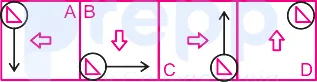
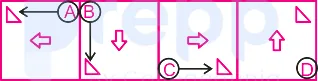
Question 1archived
In the following question, select the missing number from the given series.
111, 222, 444, ?, 1776, 3552
- A
999
- B
888
- C
1780
- D
1770
Show answer
B. 888Analyzing the Number Series Pattern
The question asks us to find the missing number in the given series: 111, 222, 444, ?, 1776, 3552.
To find the missing number, we need to carefully observe the relationship between the consecutive numbers in the series. Let's examine the first few terms:
From 111 to 222
From 222 to 444
Let's see if there is a common difference or a common ratio between these terms.
Identifying the Pattern
Let's check for a common difference:
$222 - 111 = 111$
$444 - 222 = 222$
Since the difference is not constant, this is not an arithmetic progression.
Let's check for a common ratio by dividing a term by its preceding term:
$\frac{222}{111} = 2$
$\frac{444}{222} = 2$
The ratio is constant, which is 2. This indicates that each term in the series is obtained by multiplying the previous term by 2.
Let's verify this pattern with the last two terms provided:
$\frac{3552}{1776} = 2$
The pattern is consistently multiplying the previous number by 2 to get the next number in the series.
The series follows the rule: Term$_n$ = Term$_{n-1} \times 2$.
Calculating the Missing Number
The series is 111, 222, 444, ?, 1776, 3552.
The missing number is after 444 and before 1776.
According to the pattern, the missing number is obtained by multiplying the number before it (444) by 2.
Missing Number $= 444 \times 2$
$444 \times 2 = 888$
So, the missing number is 888.
Verification of the Missing Number
Let's put 888 back into the series and check if the pattern holds for the subsequent term (1776).
The series with the calculated missing number is: 111, 222, 444, 888, 1776, 3552.
Check the next step:
$888 \times 2 = 1776$
This matches the next number in the given series. The pattern holds true with 888 as the missing number.
Therefore, the missing number in the series 111, 222, 444, ?, 1776, 3552 is 888.
The complete series is 111, 222, 444, 888, 1776, 3552.
Summary of the Pattern
Term 1
Operation
Term 2
Operation
Term 3
Operation
Term 4
Operation
Term 5
Operation
Term 6
111
$\times 2$
222
$\times 2$
444
$\times 2$
888
$\times 2$
1776
$\times 2$
3552
Revision Table: Number Series Concepts
Concept
Description
Example
Arithmetic Progression (AP)
A sequence where the difference between consecutive terms is constant (common difference).
2, 5, 8, 11, ... (common difference = 3)
Geometric Progression (GP)
A sequence where the ratio of consecutive terms is constant (common ratio).
3, 6, 12, 24, ... (common ratio = 2)
Number Series
A sequence of numbers that follow a particular pattern or rule.
1, 4, 9, 16, ... (squares of natural numbers)
Additional Information: Types of Number Series Patterns
Number series problems in aptitude tests often follow various patterns. Recognizing these patterns is key to solving the problem quickly. Some common patterns include:
Arithmetic Series: Constant difference between terms.
Geometric Series: Constant ratio between terms.
Mixed Series: A combination of arithmetic and geometric operations, or alternating patterns.
Difference Series: The difference between consecutive terms follows a pattern (e.g., form an AP or GP themselves).
Square/Cube Series: Terms are squares or cubes of numbers, or based on squares/cubes.
Fibonacci Series: Each term is the sum of the two preceding terms (e.g., 0, 1, 1, 2, 3, 5, ...).
Prime Number Series: Series consists of prime numbers in a specific order.
Solving number series problems requires careful observation, calculation, and pattern recognition practice.
Paper & answer key PDF ↗ Question 2archived
Based on the position in the English alphabetical order, three of the following letter-clusters are alike in some manner and one is different. Select the odd letter-cluster.
- A
IDAY
- B
SNJH
- C
QLHF
- D
VQMK
Show answer
A. IDAYThis question asks us to identify the odd letter-cluster among the given options. The basis for comparison is the position in the English alphabetical order. We need to examine the pattern followed by the letters in each cluster based on their positions.
Understanding Letter Positions and Patterns
To solve this type of reasoning problem, the first step is to write down the alphabetical position for each letter in the given letter clusters.
Let's list the positions:
A=1, B=2, C=3, D=4, E=5, F=6, G=7, H=8, I=9, J=10, K=11, L=12, M=13
N=14, O=15, P=16, Q=17, R=18, S=19, T=20, U=21, V=22, W=23, X=24, Y=25, Z=26
Now, let's write the numerical positions for the letters in each letter cluster:
Letter Cluster
Letter 1
Letter 2
Letter 3
Letter 4
IDAY
I (9)
D (4)
A (1)
Y (25)
SNJH
S (19)
N (14)
J (10)
H (8)
QLHF
Q (17)
L (12)
H (8)
F (6)
VQMK
V (22)
Q (17)
M (13)
K (11)
Analyzing the Letter Position Differences
Let's look for a pattern by finding the differences between the positions of consecutive letters in each letter cluster.
For SNJH (19, 14, 10, 8):
Position difference between 1st and 2nd letter: $\text{19} - \text{14} = \text{5}$
Position difference between 2nd and 3rd letter: $\text{14} - \text{10} = \text{4}$
Position difference between 3rd and 4th letter: $\text{10} - \text{8} = \text{2}$
The differences are 5, 4, 2.
For QLHF (17, 12, 8, 6):
Position difference between 1st and 2nd letter: $\text{17} - \text{12} = \text{5}$
Position difference between 2nd and 3rd letter: $\text{12} - \text{8} = \text{4}$
Position difference between 3rd and 4th letter: $\text{8} - \text{6} = \text{2}$
The differences are 5, 4, 2.
For VQMK (22, 17, 13, 11):
Position difference between 1st and 2nd letter: $\text{22} - \text{17} = \text{5}$
Position difference between 2nd and 3rd letter: $\text{17} - \text{13} = \text{4}$
Position difference between 3rd and 4th letter: $\text{13} - \text{11} = \text{2}$
The differences are 5, 4, 2.
For IDAY (9, 4, 1, 25):
Position difference between 1st and 2nd letter: $\text{9} - \text{4} = \text{5}$
Position difference between 2nd and 3rd letter: $\text{4} - \text{1} = \text{3}$
Position difference between 3rd and 4th letter: $\text{1} - \text{25} = \text{-24}$ (or considering wrap-around, $1 \rightarrow 25$ is a large jump backwards, not a small difference).
The differences are 5, 3, -24.
Identifying the Odd Letter-Cluster
Based on the analysis of letter positions and the differences between consecutive letters:
SNJH, QLHF, and VQMK all follow the same pattern where the differences in alphabetical positions between consecutive letters are consistently 5, 4, and 2 (decreasing).
IDAY follows a pattern of differences 5 and 3 for the first two steps, which is different from the consistent 5, 4 pattern seen in the other three clusters. The third difference is also significantly different.
Therefore, the odd letter-cluster out is IDAY because it does not follow the same sequential difference pattern in letter positions as the other three clusters.
Conclusion
The letter-cluster IDAY is the odd one out based on the pattern of differences in alphabetical positions between consecutive letters.
Revision Table: Letter Cluster Patterns
Letter Cluster
Positions
Difference 1-2
Difference 2-3
Difference 3-4
Follows Pattern (5, 4, 2)
IDAY
9, 4, 1, 25
$\text{9} - \text{4} = \text{5}$
$\text{4} - \text{1} = \text{3}$
$\text{1} - \text{25} = \text{-24}$
No
SNJH
19, 14, 10, 8
$\text{19} - \text{14} = \text{5}$
$\text{14} - \text{10} = \text{4}$
$\text{10} - \text{8} = \text{2}$
Yes
QLHF
17, 12, 8, 6
$\text{17} - \text{12} = \text{5}$
$\text{12} - \text{8} = \text{4}$
$\text{8} - \text{6} = \text{2}$
Yes
VQMK
22, 17, 13, 11
$\text{22} - \text{17} = \text{5}$
$\text{17} - \text{13} = \text{4}$
$\text{13} - \text{11} = \text{2}$
Yes
Additional Information: Solving Letter Reasoning Problems
Letter reasoning problems often involve finding patterns based on alphabetical order. Here are common patterns to look for:
Position-based patterns: Look at the numerical position of each letter (A=1, Z=26). Patterns might involve adding, subtracting, multiplying, or dividing positions, or differences between positions.
Difference/Sum patterns: Calculate the difference or sum between the positions of consecutive letters or letters at fixed intervals within the cluster.
Skip letter patterns: Count the number of letters skipped between consecutive letters.
Vowel/Consonant patterns: Look for the number or position of vowels and consonants.
Reverse alphabetical order: Sometimes the pattern is based on the reverse order (Z=1, Y=2, etc.).
Symmetrical patterns: The first and last letters, or second and third, etc., might have a specific relationship.
Practicing with different types of letter cluster questions helps in quickly identifying the underlying pattern.
Paper & answer key PDF ↗ Question 3archived
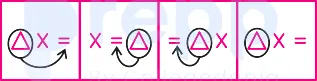
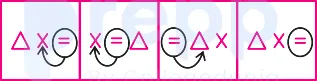
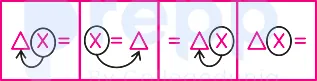
By interchanging the given two signs and numbers which of the following equation will be correct?
+ and –, 2 and 4
- A
9 – 5 ÷ 4 × 2 + 8 = 80
- B
7 × 4 – 2 ÷ 1 + 5 = 13
- C
7 – 8 ÷ 2 + 16 × 4 = 18
- D
5 + 7 × 4 – 8 ÷ 2 = 5
Show answer
B. 7 × 4 – 2 ÷ 1 + 5 = 13Understanding the Sign and Number Interchange Problem
The question asks us to identify which of the given equations becomes mathematically correct after performing specific interchanges: the '+' sign is swapped with the '–' sign, and the number '2' is swapped with the number '4'. We need to apply these changes to each equation and then evaluate the resulting expression to see if it matches the right side of the original equation.
Performing Interchanges: + <-> – and 2 <-> 4
The rules for interchange are simple:
Every '+' sign in the original equation becomes a '–' sign.
Every '–' sign in the original equation becomes a '+' sign.
Every '2' in the original equation becomes a '4'.
Every '4' in the original equation becomes a '2'.
Other signs (like '×', '÷', '=') and numbers remain unchanged.
Analyzing Each Equation Option After Interchange
Let's apply these rules to each option and evaluate the result using the standard order of operations (BODMAS/PEMDAS: Brackets, Orders/Exponents, Division and Multiplication (from left to right), Addition and Subtraction (from left to right)).
Evaluating Option 1 Equation
Original Equation: \(9 – 5 ÷ 4 × 2 + 8 = 80\)
Applying Interchanges (+ <-> –, 2 <-> 4):
The equation becomes: \(9 + 5 ÷ 2 × 4 – 8\)
Now, let's evaluate the left side:
Division: \(5 ÷ 2 = 2.5\)
The expression is now: \(9 + 2.5 × 4 – 8\)
Multiplication: \(2.5 × 4 = 10\)
The expression is now: \(9 + 10 – 8\)
Addition and Subtraction (from left to right): \(9 + 10 = 19\)
The expression is now: \(19 – 8\)
Subtraction: \(19 – 8 = 11\)
The result is 11. The original right side was 80. Since \(11 \neq 80\), this equation is not correct after the interchanges.
Evaluating Option 2 Equation
Original Equation: \(7 × 4 – 2 ÷ 1 + 5 = 13\)
Applying Interchanges (+ <-> –, 2 <-> 4):
The equation becomes: \(7 × 2 + 4 ÷ 1 – 5\)
Now, let's evaluate the left side:
Multiplication: \(7 × 2 = 14\)
Division: \(4 ÷ 1 = 4\)
The expression is now: \(14 + 4 – 5\)
Addition and Subtraction (from left to right): \(14 + 4 = 18\)
The expression is now: \(18 – 5\)
Subtraction: \(18 – 5 = 13\)
The result is 13. The original right side was 13. Since \(13 = 13\), this equation is correct after the interchanges.
Evaluating Option 3 Equation
Original Equation: \(7 – 8 ÷ 2 + 16 × 4 = 18\)
Applying Interchanges (+ <-> –, 2 <-> 4):
The equation becomes: \(7 + 8 ÷ 4 – 16 × 2\)
Now, let's evaluate the left side:
Division: \(8 ÷ 4 = 2\)
Multiplication: \(16 × 2 = 32\)
The expression is now: \(7 + 2 – 32\)
Addition and Subtraction (from left to right): \(7 + 2 = 9\)
The expression is now: \(9 – 32\)
Subtraction: \(9 – 32 = -23\)
The result is -23. The original right side was 18. Since \(-23 \neq 18\), this equation is not correct after the interchanges.
Evaluating Option 4 Equation
Original Equation: \(5 + 7 × 4 – 8 ÷ 2 = 5\)
Applying Interchanges (+ <-> –, 2 <-> 4):
The equation becomes: \(5 – 7 × 2 + 8 ÷ 4\)
Now, let's evaluate the left side:
Multiplication: \(7 × 2 = 14\)
Division: \(8 ÷ 4 = 2\)
The expression is now: \(5 – 14 + 2\)
Addition and Subtraction (from left to right): \(5 – 14 = -9\)
The expression is now: \(-9 + 2\)
Addition: \(-9 + 2 = -7\)
The result is -7. The original right side was 5. Since \(-7 \neq 5\), this equation is not correct after the interchanges.
Correct Equation After Sign and Number Swap
Based on our evaluation, only Option 2 resulted in a correct mathematical equation after interchanging '+' with '–' and '2' with '4'.
Revision Table: Key Math Operations
Original Sign/Number
Interchanged With
Resulting Sign/Number
+
–
–
–
+
+
2
4
4
4
2
2
Additional Information: BODMAS/PEMDAS Rule
When evaluating mathematical expressions, it's crucial to follow the correct order of operations. This order is often remembered using mnemonics like BODMAS or PEMDAS.
Brackets (Parentheses)
Orders (Exponents, Powers, Square Roots)
Division and Multiplication (work from left to right)
Addition and Subtraction (work from left to right)
Following this order ensures that everyone gets the same result for a given expression, which is essential for solving equations correctly after applying interchanges.
Paper & answer key PDF ↗ Question 4archived
R + S means ‘R is the daughter of S’
R = S means ‘R is the father of S’
R ÷ S means ‘R is the wife of S’
R × S means ‘R is the brother of S’
E ÷ F × J + L = M, then how is L related to E?
- A
Father
- B
Wife
- C
Father-in-law
- D
Brother
Show answer
C. Father-in-lawUnderstanding Blood Relation Symbols
In this blood relation question, we are given a set of symbols that represent specific relationships between two individuals. Let's first understand what each symbol means:
\(R + S\) means R is the daughter of S.
\(R = S\) means R is the father of S.
\(R \div S\) means R is the wife of S.
\(R \times S\) means R is the brother of S.
We are given the expression \(E \div F \times J + L = M\). We need to determine how L is related to E based on this expression.
Breaking Down the Expression: E ÷ F × J + L = M
Let's break down the given expression step by step to find the relationships between the individuals mentioned:
\(E \div F\): According to the rules, \(R \div S\) means R is the wife of S. So, \(E \div F\) means E is the wife of F.
This tells us E is female and F is male.
F is the husband of E.
\(F \times J\): According to the rules, \(R \times S\) means R is the brother of S. So, \(F \times J\) means F is the brother of J.
This confirms F is male.
J is the sibling of F. J's gender is not yet determined by this part.
\(J + L\): According to the rules, \(R + S\) means R is the daughter of S. So, \(J + L\) means J is the daughter of L.
This tells us J is female.
L is the parent of J. L's gender is not yet determined by this part.
\(L = M\): According to the rules, \(R = S\) means R is the father of S. So, \(L = M\) means L is the father of M.
This tells us L is male.
M is the child of L.
Connecting the Relationships
Now let's combine the relationships we have found:
E is the wife of F.
F is the brother of J.
J is the daughter of L.
L is the father of M.
From "F is the brother of J" and "J is the daughter of L", we can infer that F and J are siblings, and L is the parent of J. This means L is also the parent of F (since F and J are siblings). So, L is the parent of F.
From "E is the wife of F" and "L is the parent of F", we know that L is the parent of E's husband.
The relationship \(L = M\) tells us that L is the father (male). Therefore, L is the male parent of E's husband.
The male parent of one's spouse is the father-in-law.
Summarizing the Relationships
Relationship Part
Meaning
Inferred Gender/Role
\(E \div F\)
E is wife of F
E: Female, F: Male
\(F \times J\)
F is brother of J
F: Male, J: Sibling of F
\(J + L\)
J is daughter of L
J: Female, L: Parent of J
\(L = M\)
L is father of M
L: Male, M: Child of L
Combining: E is wife of F. F is brother of J. J is daughter of L. Since F and J are siblings, L is the parent of F. L is male (father of M). Therefore, L is the father of F. E is married to F. So, L is the father of E's husband. This makes L the father-in-law of E.
Conclusion: L's Relation to E
Based on the step-by-step analysis of the given blood relation expression \(E \div F \times J + L = M\), we determined that L is the father of F, and F is the husband of E. Therefore, L is the father-in-law of E.
Blood Relations Revision Table
Relation
Description
Father-in-law
The father of one's spouse.
Mother-in-law
The mother of one's spouse.
Brother-in-law
The brother of one's spouse, or the husband of one's sibling.
Sister-in-law
The sister of one's spouse, or the wife of one's sibling.
Son-in-law
The husband of one's daughter.
Daughter-in-law
The wife of one's son.
Additional Information on Solving Blood Relation Puzzles
Blood relation questions test your ability to decipher relationships based on given codes or descriptions. Here are some tips for solving them:
Carefully read and understand the meaning of each symbol or code.
Break down complex expressions into smaller, manageable parts.
Determine the gender of each person involved if possible.
Draw a family tree or diagram to visualize the relationships, especially for complex problems.
Work backward from the person whose relation is asked for, or forward from the beginning of the expression.
Practice with different types of blood relation puzzles to improve speed and accuracy.
Paper & answer key PDF ↗ Question 5archived
Select the option that is related to the fourth term in the same way as the first term is related to the second term and the fifth term is related to the sixth term.
8 : 496 :: ? : 204 :: 9 : 711
- A
5
- B
13
- C
6
- D
11
Show answer
C. 6Understanding the Analogy Question
The question asks us to find the missing term in an analogy based on the relationship between given pairs of numbers. We are given three pairs, with one term missing in the second pair: 8 : 496 :: ? : 204 :: 9 : 711. This means the relationship between 8 and 496 is the same as the relationship between the missing number and 204, and also the same as the relationship between 9 and 711.
Identifying the Pattern in the Number Pairs
Let's examine the relationship between the numbers in the first and third pairs to find a consistent pattern. The pairs are (8, 496) and (9, 711).
For the first pair (8, 496), let's try some common numerical relationships involving 8:
Squaring: \(8^2 = 64\). Not close to 496.
Cubing: \(8^3 = 512\). This is close to 496. The difference is \(512 - 496 = 16\). Notice that \(16 = 2 \times 8\). So, the relationship could be \(n^3 - 2n\), where \(n\) is the first term. Let's check if this works: \(8^3 - 2 \times 8 = 512 - 16 = 496\). This pattern fits the first pair.
Now, let's test this potential pattern \(n^3 - 2n\) on the third pair (9, 711). Here, \(n = 9\).
Applying the pattern: \(9^3 - 2 \times 9 = 729 - 18 = 711\). This matches the second term of the third pair.
The pattern \(n^3 - 2n\) seems to be the correct relationship between the first term \(n\) and the second term \(n^3 - 2n\) in each pair.
Applying the Pattern to the Second Pair
The second pair is ? : 204. Let the missing term be \(x\). According to the pattern we found, the relationship is \(x : x^3 - 2x\). We are given that the second term is 204.
So, we need to solve the equation:
\(x^3 - 2x = 204\)
We can test the given options to find which value of \(x\) satisfies this equation.
Option
Value of \(x\)
Calculate \(x^3 - 2x\)
Result
Matches 204?
1
5
\(5^3 - 2 \times 5 = 125 - 10\)
115
No
2
13
\(13^3 - 2 \times 13 = 2197 - 26\)
2171
No
3
6
\(6^3 - 2 \times 6 = 216 - 12\)
204
Yes
4
11
\(11^3 - 2 \times 11 = 1331 - 22\)
1309
No
When \(x = 6\), the expression \(x^3 - 2x\) evaluates to 204, which matches the second term in the second pair. Therefore, the missing term is 6.
Conclusion
The relationship between the terms in the analogy 8 : 496 :: ? : 204 :: 9 : 711 follows the pattern where the second term is obtained by calculating the cube of the first term and subtracting twice the first term (\(n^3 - 2n\)). By applying this pattern to the second pair and testing the options, we found that 6 satisfies the relationship with 204.
Revision Table: Key Analogy Pattern
First Term (\(n\))
Pattern (\(n^3 - 2n\))
Second Term
Verification
8
\(8^3 - 2 \times 8 = 512 - 16\)
496
Matches 8 : 496
6
\(6^3 - 2 \times 6 = 216 - 12\)
204
Matches ? : 204 (found value 6)
9
\(9^3 - 2 \times 9 = 729 - 18\)
711
Matches 9 : 711
Additional Information: Solving Analogy Questions
Analogy questions test your ability to identify relationships between pairs of items. In number analogies, these relationships are often mathematical operations or patterns. Strategies for solving number analogies include:
Look for common operations: addition, subtraction, multiplication, division.
Consider powers or roots: squares, cubes, square roots, cube roots.
Check for sequences or series patterns.
Look for relationships involving digits of the numbers.
Combine operations: For example, squaring and adding, cubing and subtracting, etc.
Once a potential pattern is found, test it thoroughly on all given pairs to ensure consistency.
If testing options, substitute each option into the potential relationship to see which one fits.
Practicing with different types of number analogies helps in quickly recognizing patterns during exams.
Paper & answer key PDF ↗ Question 6archived
Select the set in which the numbers are related in the same way as are the numbers of the following set.
(NOTE: Operations should be performed on the whole numbers, without breaking down the numbers into its constituent digits. E.g., 13 – Operations on 13 such as adding /subtracting /multiplying etc. to 13 can be performed. Breaking down 13 into 1 and 3 and then performing mathematical operations on 1 and 3 is NOT allowed).
(25, 9, 56)
(13, 14, 183)
- A
(42, 12, 228)
- B
(11, 16, 135)
- C
(19, 23, 511)
- D
(27, 15, 198)
Show answer
D. (27, 15, 198)Finding the Number Set Analogy Rule
This question asks us to find the relationship between the numbers in a given set and then identify the option set that follows the same relationship. We are given two example sets: (25, 9, 56) and (13, 14, 183). The key is that operations must be performed on the whole numbers provided, not on their individual digits.
Analyzing the First Number Set: (25, 9, 56)
Let's denote the numbers in the set as A, B, and C, so for the first set, A=25, B=9, and C=56. We need to find a mathematical operation or combination of operations involving A and B that results in C.
Addition/Subtraction: $25 + 9 = 34$ (not 56), $25 - 9 = 16$ (not 56).
Multiplication: $25 \times 9 = 225$ (not 56).
Combining operations: Let's try squares.
Consider the relationship $B^2 - A$. Let's calculate this for the first set:
$\text{B}^2 - \text{A} = 9^2 - 25 = 81 - 25 = 56$.
This matches the third number, C (56). So, the possible rule is $\text{B}^2 - \text{A} = \text{C}$.
Verifying the Rule with the Second Number Set: (13, 14, 183)
For the second set, A=13, B=14, and C=183. Let's apply the rule we found from the first set: $\text{B}^2 - \text{A}$.
$\text{B}^2 - \text{A} = 14^2 - 13 = 196 - 13 = 183$.
This also matches the third number, C (183). The rule $\text{B}^2 - \text{A} = \text{C}$ is consistent with both given sets.
Checking Options for the Number Set Analogy
Now we will check each option to see which set follows the rule $\text{B}^2 - \text{A} = \text{C}$.
Option Set (A, B, C)
Calculation ($B^2 - A$)
Result
Matches C?
(42, 12, 228)
$12^2 - 42 = 144 - 42$
102
No (102 $\neq$ 228)
(11, 16, 135)
$16^2 - 11 = 256 - 11$
245
No (245 $\neq$ 135)
(19, 23, 511)
$23^2 - 19 = 529 - 19$
510
No (510 $\neq$ 511)
(27, 15, 198)
$15^2 - 27 = 225 - 27$
198
Yes (198 = 198)
From the table above, only the set (27, 15, 198) satisfies the rule $\text{B}^2 - \text{A} = \text{C}$.
Conclusion: Identifying the Matching Set
The relationship observed in the given sets (25, 9, 56) and (13, 14, 183) is that the square of the second number minus the first number equals the third number ($B^2 - A = C$). Applying this rule to the given options, we found that only the set (27, 15, 198) follows this relationship.
Revision Table: Number Set Relationships
Concept
Description
Rule Found
Number Set Analogy
Finding a mathematical relationship between numbers in one set and applying it to other sets.
$\text{C} = \text{B}^2 - \text{A}$
Given Sets
(25, 9, 56) and (13, 14, 183)
Rule verified for both.
Matching Set
(27, 15, 198)
Follows the same rule.
Additional Information on Number Patterns
Number set analogy questions are common in logical reasoning and quantitative aptitude tests. They require identifying a hidden pattern or rule connecting the numbers within a set. Common patterns can involve:
Basic arithmetic operations (addition, subtraction, multiplication, division).
Squares or cubes of the numbers.
Combinations of operations (e.g., squaring one number and adding/subtracting the other).
Operations involving the sum or difference of the numbers.
Sequential patterns or series logic (less common in set-based analogies unless there's an implied order).
To solve these problems effectively, it's helpful to:
Examine the relationship between the first two numbers and the third number.
Test simple operations first before trying more complex ones.
Look for relationships involving squares or cubes, especially when the third number is significantly larger or smaller than the first two.
Verify the potential rule with all provided example sets.
Systematically apply the rule to each option provided.
Practice with different types of number analogies helps in quickly recognizing common patterns.
Paper & answer key PDF ↗ Question 7archived
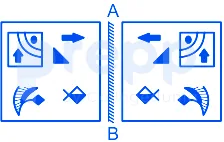
Select the correct image of the given figure when the mirror is place at AB as shown.

- A
Option A (shown in image)
- B
Option B (shown in image)
- C
Option C (shown in image)
- D
Option D (shown in image)
Show answer
B. Option B (shown in image)The correct mirror image of the given combination when mirror is placed at AB is as shown below:
Hence, the correct answer is "Option - (2)".
 Paper & answer key PDF ↗
 Question 8archived
Select the correct combination of mathematical signs to sequentiallyreplace the * signs and balance the given equation.
17 * 11 * 42 * 2 * 7 = 18
- A
- + ÷ ÷
- B
- + × ÷
- C
- + × ×
- D
+ - + ×
Show answer
B. - + × ÷Understanding Equation Balancing with Mathematical Signs
The problem asks us to find the correct sequence of mathematical signs (addition, subtraction, multiplication, division) to replace the asterisks (*) in a given equation so that both sides are equal. We are provided with an equation containing asterisks and several options, each offering a different sequence of signs.
The given equation is:
\(17 * 11 * 42 * 2 * 7 = 18\)
We need to test each option by replacing the asterisks sequentially with the signs provided in that option and then evaluate the expression using the order of operations (BODMAS/PEMDAS).
Evaluating the Options
Let's examine one of the options and see if it balances the equation. We will use the order of operations, which dictates that we perform operations in the following order:
Brackets/Parentheses
Orders/Exponents
Division and Multiplication (from left to right)
Addition and Subtraction (from left to right)
Testing the sequence: - + × ÷
Let's substitute these signs into the equation:
\(17 - 11 + 42 \times 2 \div 7\)
Now, we perform the calculations following the order of operations:
Perform Multiplication and Division from left to right:
First, multiplication: \(42 \times 2 = 84\)
The expression becomes: \(17 - 11 + 84 \div 7\)
Next, division: \(84 \div 7 = 12\)
The expression becomes: \(17 - 11 + 12\)
Perform Addition and Subtraction from left to right:
First, subtraction: \(17 - 11 = 6\)
The expression becomes: \(6 + 12\)
Finally, addition: \(6 + 12 = 18\)
The result of the left side is \(18\), which is equal to the right side of the original equation (\(18\)). Thus, this sequence of signs correctly balances the equation.
Summary of Evaluation
Substituting the signs - + × ÷ into the asterisks results in the equation \(17 - 11 + 42 \times 2 \div 7\). Evaluating this expression step-by-step yields:
\(17 - 11 + (42 \times 2) \div 7\)
\(17 - 11 + 84 \div 7\)
\(17 - 11 + (84 \div 7)\)
\(17 - 11 + 12\)
\((17 - 11) + 12\)
\(6 + 12\)
\(18\)
Since \(18 = 18\), the equation is balanced with this combination of signs.
Revision Table: Mathematical Operations
Understanding the properties of mathematical operations is crucial for balancing equations.
Operation
Symbol
Description
Order of Precedence (BODMAS/PEMDAS)
Addition
+
Combining quantities
Lower (after multiplication/division)
Subtraction
-
Finding the difference
Lower (after multiplication/division)
Multiplication
× or *
Repeated addition or scaling
Higher (same level as division, left-to-right)
Division
÷ or /
Splitting into equal parts
Higher (same level as multiplication, left-to-right)
Additional Information: Order of Operations (BODMAS/PEMDAS)
The order of operations is a set of rules that dictates the sequence in which operations should be performed in a mathematical expression to ensure a unique and consistent result. The common acronyms for remembering this order are BODMAS or PEMDAS.
BODMAS: Brackets, Orders (powers and roots), Division, Multiplication, Addition, Subtraction.
PEMDAS: Parentheses, Exponents, Multiplication, Division, Addition, Subtraction.
Division and Multiplication have the same precedence and should be performed from left to right as they appear in the expression. Similarly, Addition and Subtraction have the same precedence and are performed from left to right.
In this problem, we applied the order of operations correctly to evaluate the expression after substituting the mathematical signs.
Paper & answer key PDF ↗ Question 9archived
In the following question, four number pairs are given. In each pair the number on left side of (–) is related to the number of the right side of (–) with some Logic/Rule/Relation. Three pairs are similar on basis of same Logic/Rule/Relation. Select the odd one out from the given alternatives. (NOTE: Operations should be performed on the whole numbers, without breaking down the numbers into its constituent digits. E.g.13 – Operations on 13 such as adding /subtracting /multiplying etc. to 13 can be performed. Breaking down 13 into 1 and 3 and then performing mathematical operations on 1 and 3 is not allowed)
- A
3 – 44
- B
4 – 64
- C
5 – 125
- D
6 – 216
Show answer
A. 3 – 44The argument followed here is as follows: Cube of the first number = second number
Therefore,
Option - (1) : 3 – 44
\((3)^3\) = 44
27 ≠ 44 ( left side ≠ right side )
Option - (2) : 4 – 64
\((4)^3\) = 64
64 = 64 (left side = right side)
Option - (3) : 5 – 125
\((5)^3\) = 125
125 = 125 (left side = right side)
Option - (4) : 6 – 216
\((6)^3\) = 216
216 = 216 (left side = right side)
Thus, "Option - (1)" is the correct answer.
Paper & answer key PDF ↗ Question 10archived
By interchanging the given two signs which of the following equation will be not correct?
+ and –
- A
18 ÷ 3 + 8 × 5 – 4 = 30
- B
4 × 6 + 7 – 3 ÷ 1 = 20
- C
18 + 8 × 6 ÷ 3 – 11 = 13
- D
6 × 9 + 7 – 8 ÷ 2 = 51
Show answer
A. 18 ÷ 3 + 8 × 5 – 4 = 30Solving Equations by Interchanging Signs
The problem asks us to find which of the given mathematical equations becomes incorrect when we interchange the '+' (plus) and '–' (minus) signs. To solve this, we will apply the sign interchange to each equation one by one and then evaluate the resulting expression using the order of operations (BODMAS/PEMDAS) to check if it equals the value on the right side.
Understanding the Task: Sign Interchange and Evaluation
We need to perform the following steps for each option:
Identify the original equation.
Swap every '+' sign with a '–' sign and every '–' sign with a '+' sign.
Calculate the value of the left side of the modified equation using the correct order of mathematical operations:
Brackets first
Orders (powers, square roots) next
Division and Multiplication (from left to right)
Addition and Subtraction (from left to right)
Compare the calculated value with the value on the right side of the equals sign in the original equation.
If the calculated value is not equal to the right side value, that equation is the answer.
Evaluating Each Equation After Sign Interchange
Option 1: 18 ÷ 3 + 8 × 5 – 4 = 30
Original Equation: $\text{18} \div \text{3} + \text{8} \times \text{5} – \text{4} = \text{30}$
Interchanging '+' and '–': $\text{18} \div \text{3} – \text{8} \times \text{5} + \text{4}$
Evaluate the expression $\text{18} \div \text{3} – \text{8} \times \text{5} + \text{4}$ using BODMAS:
Division: $\text{18} \div \text{3} = \text{6}$
Multiplication: $\text{8} \times \text{5} = \text{40}$
The expression becomes: $\text{6} – \text{40} + \text{4}$
Subtraction/Addition (left to right): $\text{6} – \text{40} = \text{-34}$
$\text{-34} + \text{4} = \text{-30}$
Calculated value is -30. The right side of the original equation is 30.
Is $-30 = 30$? No.
This equation is not correct after interchanging the signs.
Option 2: 4 × 6 + 7 – 3 ÷ 1 = 20
Original Equation: $\text{4} \times \text{6} + \text{7} – \text{3} \div \text{1} = \text{20}$
Interchanging '+' and '–': $\text{4} \times \text{6} – \text{7} + \text{3} \div \text{1}$
Evaluate the expression $\text{4} \times \text{6} – \text{7} + \text{3} \div \text{1}$ using BODMAS:
Multiplication: $\text{4} \times \text{6} = \text{24}$
Division: $\text{3} \div \text{1} = \text{3}$
The expression becomes: $\text{24} – \text{7} + \text{3}$
Subtraction/Addition (left to right): $\text{24} – \text{7} = \text{17}$
$\text{17} + \text{3} = \text{20}$
Calculated value is 20. The right side of the original equation is 20.
Is $20 = 20$? Yes.
This equation is correct after interchanging the signs.
Option 3: 18 + 8 × 6 ÷ 3 – 11 = 13
Original Equation: $\text{18} + \text{8} \times \text{6} \div \text{3} – \text{11} = \text{13}$
Interchanging '+' and '–': $\text{18} – \text{8} \times \text{6} \div \text{3} + \text{11}$
Evaluate the expression $\text{18} – \text{8} \times \text{6} \div \text{3} + \text{11}$ using BODMAS:
Multiplication: $\text{8} \times \text{6} = \text{48}$
Division: $\text{48} \div \text{3} = \text{16}$
The expression becomes: $\text{18} – \text{16} + \text{11}$
Subtraction/Addition (left to right): $\text{18} – \text{16} = \text{2}$
$\text{2} + \text{11} = \text{13}$
Calculated value is 13. The right side of the original equation is 13.
Is $13 = 13$? Yes.
This equation is correct after interchanging the signs.
Option 4: 6 × 9 + 7 – 8 ÷ 2 = 51
Original Equation: $\text{6} \times \text{9} + \text{7} – \text{8} \div \text{2} = \text{51}$
Interchanging '+' and '–': $\text{6} \times \text{9} – \text{7} + \text{8} \div \text{2}$
Evaluate the expression $\text{6} \times \text{9} – \text{7} + \text{8} \div \text{2}$ using BODMAS:
Multiplication: $\text{6} \times \text{9} = \text{54}$
Division: $\text{8} \div \text{2} = \text{4}$
The expression becomes: $\text{54} – \text{7} + \text{4}$
Subtraction/Addition (left to right): $\text{54} – \text{7} = \text{47}$
$\text{47} + \text{4} = \text{51}$
Calculated value is 51. The right side of the original equation is 51.
Is $51 = 51$? Yes.
This equation is correct after interchanging the signs.
Conclusion
After evaluating all the options by interchanging the '+' and '–' signs, we found that only the equation in Option 1 resulted in a value that did not match the original right side value.
The results are summarized in the table below:
Option
Original Equation
Equation after Swapping + and –
Calculated Value
Original Right Side Value
Is it Correct?
1
$\text{18} \div \text{3} + \text{8} \times \text{5} – \text{4} = \text{30}$
$\text{18} \div \text{3} – \text{8} \times \text{5} + \text{4}$
-30
30
No
2
$\text{4} \times \text{6} + \text{7} – \text{3} \div \text{1} = \text{20}$
$\text{4} \times \text{6} – \text{7} + \text{3} \div \text{1}$
20
20
Yes
3
$\text{18} + \text{8} \times \text{6} \div \text{3} – \text{11} = \text{13}$
$\text{18} – \text{8} \times \text{6} \div \text{3} + \text{11}$
13
13
Yes
4
$\text{6} \times \text{9} + \text{7} – \text{8} \div \text{2} = \text{51}$
$\text{6} \times \text{9} – \text{7} + \text{8} \div \text{2}$
51
51
Yes
Therefore, the equation that is not correct after interchanging the signs is the first one.
Revision Table: Key Concepts in Solving Equations
Concept
Description
Importance
Sign Interchange
Replacing one mathematical operator with another throughout an expression or equation.
Changes the entire arithmetic outcome.
Order of Operations (BODMAS/PEMDAS)
Rules for the correct sequence of performing arithmetic operations: Brackets/Parentheses, Orders/Exponents, Division/Multiplication, Addition/Subtraction.
Essential for getting the correct result from an expression.
Equation Verification
Checking if the left side of an equation equals the right side after performing operations.
Determines the truthfulness or correctness of the equation.
Additional Information: Arithmetic Operations and BODMAS
Arithmetic operations are the basic ways we combine numbers. The four primary operations are addition (+), subtraction (–), multiplication (×), and division (÷). When an expression contains multiple operations, the order in which they are performed is crucial. This order is standardized by rules like BODMAS or PEMDAS to ensure everyone gets the same result.
BODMAS: Brackets, Order, Division, Multiplication, Addition, Subtraction.
PEMDAS: Parentheses, Exponents, Multiplication, Division, Addition, Subtraction.
Division and Multiplication have the same priority and should be performed from left to right as they appear in the expression. Similarly, Addition and Subtraction have the same priority and are performed from left to right.
In this problem, after interchanging '+' and '–', we rigorously applied these rules to each modified expression to find the equation that no longer held true.
Paper & answer key PDF ↗ Question 11archived
Which letter-cluster will replace the question mark (?) to complete the given series?
CZNM, FXOL, IVPK, ?, ORRI
- A
LSQJ
- B
LTRK
- C
LSQK
- D
LTQJ
Show answer
D. LTQJLetter Series Reasoning: Finding the Missing Cluster
This question asks us to identify the pattern in a series of letter clusters and find the missing term. The given series is CZNM, FXOL, IVPK, ?, ORRI. We need to analyze the progression of each letter position within the clusters.
Analyzing the Pattern in the Letter Clusters
Let's look at each position (first, second, third, and fourth) of the letters across the series and determine the rule governing their change. We can use the alphabetical position of each letter (A=1, B=2, ..., Z=26) to identify the pattern.
Position
CZNM
FXOL
IVPK
?
ORRI
Pattern
First Letter
C (3)
F (6)
I (9)
?
O (15)
$+3$
Second Letter
Z (26)
X (24)
V (22)
?
R (18)
$-2$
Third Letter
N (14)
O (15)
P (16)
?
R (18)
$+1$
Fourth Letter
M (13)
L (12)
K (11)
?
I (9)
$-1$
Step-by-Step Pattern Identification:
First Letter: The sequence is C, F, I, ?, O.
C (3) to F (6): $+3$
F (6) to I (9): $+3$
The pattern for the first letter is adding $3$ to the alphabetical position.
Following this pattern, the next letter after I (9) should be $9 + 3 = 12$, which corresponds to the letter L.
Let's check with the next term: L (12) to O (15) is $+3$. The pattern holds.
Second Letter: The sequence is Z, X, V, ?, R.
Z (26) to X (24): $-2$
X (24) to V (22): $-2$
The pattern for the second letter is subtracting $2$ from the alphabetical position.
Following this pattern, the next letter after V (22) should be $22 - 2 = 20$, which corresponds to the letter T.
Let's check with the next term: T (20) to R (18) is $-2$. The pattern holds.
Third Letter: The sequence is N, O, P, ?, R.
N (14) to O (15): $+1$
O (15) to P (16): $+1$
The pattern for the third letter is adding $1$ to the alphabetical position.
Following this pattern, the next letter after P (16) should be $16 + 1 = 17$, which corresponds to the letter Q.
Let's check with the next term: Q (17) to R (18) is $+1$. The pattern holds.
Fourth Letter: The sequence is M, L, K, ?, I.
M (13) to L (12): $-1$
L (12) to K (11): $-1$
The pattern for the fourth letter is subtracting $1$ from the alphabetical position.
Following this pattern, the next letter after K (11) should be $11 - 1 = 10$, which corresponds to the letter J.
Let's check with the next term: J (10) to I (9) is $-1$. The pattern holds.
Forming the Missing Letter Cluster
By combining the letters found for each position, the missing letter cluster is formed:
First letter: L
Second letter: T
Third letter: Q
Fourth letter: J
Thus, the missing letter cluster is LTQJ.
Verification
Let's write out the complete series with the found cluster:
CZNM, FXOL, IVPK, LTQJ, ORRI
Checking the pattern between IVPK and LTQJ:
I (9) to L (12): $+3$ (Matches pattern for first letter)
V (22) to T (20): $-2$ (Matches pattern for second letter)
P (16) to Q (17): $+1$ (Matches pattern for third letter)
K (11) to J (10): $-1$ (Matches pattern for fourth letter)
Checking the pattern between LTQJ and ORRI:
L (12) to O (15): $+3$ (Matches pattern for first letter)
T (20) to R (18): $-2$ (Matches pattern for second letter)
Q (17) to R (18): $+1$ (Matches pattern for third letter)
J (10) to I (9): $-1$ (Matches pattern for fourth letter)
All patterns hold consistently throughout the series with LTQJ as the missing term.
Revision Table: Letter Series Patterns
Understanding the common patterns in letter series is key to solving these types of reasoning questions.
Pattern Type
Description
Example
Addition/Subtraction
Adding or subtracting a fixed number or a sequence of numbers to the letter's alphabetical position.
A (+2) C (+2) E ... (Pattern: +2)
Alternating Pattern
Applying different patterns to alternate terms or alternate letters within a term.
AZ BY CX ... (Pattern: First letter +1, Second letter -1)
Positional Pattern
Pattern applies to each position (1st, 2nd, etc.) independently, as seen in this question.
As solved above (First letter +3, Second -2, etc.)
Reverse Alphabetical Order
Letters moving backwards in the alphabet.
Z Y X W ... (Pattern: -1)
Additional Information: Logical Reasoning Skills
Letter series problems are part of logical reasoning, which assesses your ability to identify patterns and relationships. Improving logical reasoning involves practicing different types of series and puzzles.
Practice Diverse Problems: Work on number series, letter series, alphanumeric series, and mixed series to get familiar with various patterns.
Learn Alphabet Positions: Memorizing the alphabetical position of each letter can significantly speed up solving letter-based problems.
Look at Differences: For numerical or letter position series, calculating the difference between consecutive terms is often the first step to finding the pattern.
Consider Multiple Patterns: Sometimes a series might involve more than one pattern operating simultaneously or alternatingly.
By applying these strategies, you can effectively solve letter series and other logical reasoning questions.
Paper & answer key PDF ↗ Question 12archived
If A + B means that A is the brother of B, A × B means that A is the sister of B, A ÷ B means that A is the father of B then which of the following expression shows that P is the brother of R?
- A
P + Q ÷ R
- B
P + Q × R
- C
P × Q + R
- D
P × R × Q
Show answer
B. P + Q × RThe correct answer is P + Q × R.
Represent males with one symbol (e.g., square) and females with another (e.g., circle), and use lines to show relationships (e.g., horizontal for siblings, vertical for parent-child). Combine relationships: Link the individual relationships together to find the final relationship between the required persons. Work from left to right or based on the structure of the expression. Practice: Solving various types of blood relation puzzles will improve your speed and accuracy.
Paper & answer key PDF ↗ Question 13archived
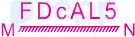
Select the correct mirror image of the given figure when the mirror is placed at MN as shown below.
- A
Option A (shown in image)
- B
Option B (shown in image)
- C
Option C (shown in image)
- D
Option D (shown in image)
Show answer
Question 14archived
Three statements are given followed by three conclusions numbered I, II and III. Assuming the statements to be true, even if they seem to be at variance with commonly known facts, decide which of the conclusions logically follow(s) from the statements.
Statements:
All bears are rabbits.
All rabbits are dogs.
Some dogs are black.
Conclusions.
I- Some rabbits are black.
II- Some dogs are bears.
III- All bears are dogs.
- A
Only conclusions II and III follow.
- B
Only conclusions I and II follow
- C
All conclusions follow
- D
Only conclusions I and III follow.
Show answer
A. Only conclusions II and III follow.Understanding the Syllogism Statements and Conclusions
This question is a classic example of a syllogism problem where we are given statements and asked to determine which conclusions logically follow. We must assume the statements are true, even if they contradict common knowledge.
Analyzing the Given Statements
Let's break down the three statements:
Statement 1: All bears are rabbits. This means the set of bears is completely contained within the set of rabbits. We can represent this symbolically as $\text{Bears} \subseteq \text{Rabbits}$.
Statement 2: All rabbits are dogs. This means the set of rabbits is completely contained within the set of dogs. Symbolically, $\text{Rabbits} \subseteq \text{Dogs}$.
Statement 3: Some dogs are black. This means there is at least one dog that is also black. Symbolically, $\text{Dogs} \cap \text{Black} \neq \emptyset$.
Combining the Statements
From Statement 1 and Statement 2, we can deduce a direct relationship between bears and dogs:
Since all bears are rabbits (Statement 1), and
all rabbits are dogs (Statement 2),
it logically follows that all bears are dogs. Symbolically, if $\text{Bears} \subseteq \text{Rabbits}$ and $\text{Rabbits} \subseteq \text{Dogs}$, then $\text{Bears} \subseteq \text{Dogs}$.
Statement 3 introduces the category 'black' and states a 'some' relationship with 'dogs'. This statement involves a third category that is not directly linked universally (all or none) to bears or rabbits by the first two statements.
Evaluating the Conclusions
Now, let's examine each conclusion based on the statements and their combination.
Conclusion I: Some rabbits are black.
We know all rabbits are dogs (Statement 2) and some dogs are black (Statement 3). While some dogs are black, these black dogs might be only those dogs that are *not* rabbits. The statements do not provide a definite link between rabbits and blackness. Therefore, we cannot conclude that some rabbits are black with certainty.
Consider a scenario: Suppose the set of dogs includes two groups: rabbits and other animals. Statement 2 says all rabbits are dogs. Statement 3 says some dogs are black. The 'some dogs' that are black could be from the group of 'other animals' within the dogs, and none of the rabbits might be black. Thus, Conclusion I does not necessarily follow.
Conclusion II: Some dogs are bears.
We deduced that all bears are dogs (from combining Statement 1 and 2). If all bears are dogs, it means the set of bears is a subset of the set of dogs ($\text{Bears} \subseteq \text{Dogs}$). Assuming there are bears (standard in syllogism problems unless specified otherwise), this implies that the intersection of dogs and bears is the set of bears, which is non-empty. If the set of bears is not empty, then there are some elements that are both dogs and bears. Therefore, some dogs are bears logically follows.
This is a direct consequence of "All A are B" implying "Some B are A" (assuming A is not an empty set).
Conclusion III: All bears are dogs.
As we derived by combining Statement 1 (All bears are rabbits) and Statement 2 (All rabbits are dogs), this conclusion logically and necessarily follows. If every bear is a rabbit, and every rabbit is a dog, then it must be true that every bear is a dog.
Summary of Conclusions
Conclusion
Analysis
Logically Follows?
I - Some rabbits are black.
Cannot be confirmed from the given statements.
No
II - Some dogs are bears.
Derived from "All bears are dogs", which follows from Statements 1 & 2.
Yes
III - All bears are dogs.
Directly follows from combining Statements 1 & 2.
Yes
Based on the analysis, only conclusions II and III logically follow from the given statements.
Revision Table: Key Syllogism Rules
Statement Type
Relationship
Symbolic Representation
All A are B
A is a subset of B
A $\subseteq$ B
No A are B
A and B are disjoint sets
A $\cap$ B = $\emptyset$
Some A are B
Intersection of A and B is not empty
A $\cap$ B $\neq \emptyset$
Some A are not B
Part of A is outside B
A - B $\neq \emptyset$
Additional Information on Syllogism and Logical Deduction
Syllogism is a form of logical reasoning where a conclusion is drawn from two or more statements (premises). Categorical syllogisms, like the one presented, deal with statements about categories or classes of things using quantifiers like "all", "no", and "some".
Key concepts:
Premises: The statements assumed to be true.
Conclusion: The statement that is logically deduced from the premises.
Validity: A syllogism is valid if the conclusion logically follows from the premises, regardless of whether the premises are actually true in the real world. We are asked to check for validity here.
Categorical Statements: Statements that relate two categories using quantifiers.
Universal Affirmative (A): All S are P
Universal Negative (E): No S are P
Particular Affirmative (I): Some S are P
Particular Negative (O): Some S are not P
In this problem, Statements 1 and 2 are Universal Affirmative (A type), and Statement 3 is Particular Affirmative (I type). The ability to combine universal affirmative statements is crucial: If All A are B and All B are C, then All A are C. This is known as the transitive property for universal inclusion.
Paper & answer key PDF ↗ Question 15archived
Select the option that is related to the third word in the same way as the second word is related to the first word. (The words must be considered as meaningful English words and must not be related to each other based on the number of letters/number of consonants/vowels in the word.)
Cloth : Closet :: Gun : ?
- A
Armoury
- B
Almirah
- C
Bullet
- D
Chest
Show answer
A. ArmouryThis question asks us to find the word that completes the analogy: Cloth : Closet :: Gun : ?. We need to identify the relationship between the first pair of words, Cloth and Closet, and then find a word for the second pair, Gun, that has the same relationship.
Understanding the Analogy: Cloth and Closet
Let's look at the relationship between Cloth and Closet.
A Closet is a piece of furniture or a space in a room where Cloth (specifically, clothes made of cloth) is stored.
So, the relationship is that the second word is a storage location for the first word.
The analogy asks for a word that is a storage location for a Gun, in the same way that a Closet is a storage location for Cloth.
Finding the Storage Location for a Gun
Now let's consider the second part of the analogy: Gun : ? We need to find a word from the options that represents a place where a Gun is typically stored.
Analysing the Options for Gun Storage
Let's examine each option provided:
Armoury: An Armoury is a place where arms, such as Guns, and ammunition are stored, maintained, and repaired. This fits the description of a specific storage location for Guns.
Almirah: An Almirah is a cupboard or wardrobe, typically used for storing clothes, books, or other household items. It is not the primary or specific storage location for Guns.
Bullet: A Bullet is a type of ammunition used with a Gun. It is not a place where a Gun is stored.
Chest: A Chest is a strong box used for storage, often for valuables. While a Gun could potentially be stored in a Chest, an Armoury is a more specific and common storage location for Guns, especially in quantity or officially. The relationship between Cloth and Closet points towards a dedicated storage area.
Establishing the Parallel Relationship
Comparing the options, the word that represents a dedicated storage location for Guns, similar to how a Closet is a dedicated storage location for Cloth (clothing), is Armoury.
Cloth is stored in a Closet.
Guns are stored in an Armoury.
This relationship is the most parallel to the first pair.
Conclusion: The Correct Analogy Completion
The relationship between Cloth and Closet is that a Closet is a storage place for Cloth. Applying the same relationship to Gun, the storage place for a Gun is an Armoury.
Item
Storage Location
Cloth
Closet
Gun
Armoury
Revision Table: Analogy Relationship Summary
First Word
Second Word
Relationship
Cloth
Closet
Second word is a storage location for the first word (specifically clothing).
Gun
Armoury
Second word is a storage location for the first word (specifically arms and ammunition).
Additional Information on Storage Locations
Understanding specific storage locations can be important for vocabulary and analogies. Here are a few more examples of items and their common or specific storage places:
Books are often stored on a bookshelf.
Food is often stored in a pantry or refrigerator.
Vehicles are often stored in a garage.
Money and valuables might be stored in a safe or vault.
Wine is often stored in a cellar.
In this analogy, the key was finding the most appropriate and specific storage location for the second item, paralleling the specificity of the first pair.
Paper & answer key PDF ↗ Question 16archived
Select the set in which the numbers are related in the same way as are the numbers of the following sets.
(NOTE : Operations should be performed on the whole numbers, without breaking down the numbers into its constituent digits. E.g. 13 – Operations on 13 such as adding / subtracting / multiplying etc. to 13 can be performed. Breaking down 13 into 1 and 3 and then performing mathematical operations on 1 and 3 is NOT allowed)
(30, 93, 1)
(42, 132, 2)
- A
(4, 60, 5)
- B
(5, 31, 29)
- C
(14, 20, 25)
- D
(3, 30, 7)
Show answer
D. (3, 30, 7)The correct answer is (3, 30, 7).
Pay attention to whether the relationship involves the position of the numbers (first, second, third). Always test your hypothesized pattern with all given examples to ensure it is consistent before applying it to the options. Remember the constraint about using whole numbers without breaking them into digits. Solving these types of questions improves logical reasoning and quantitative aptitude skills.
Paper & answer key PDF ↗ Question 17archived
Select the word-pair that best represents a similar relationship to the one expressed in the pair of words given below. (The words must be considered as meaningful English words and must not be related to each other based on the number of letters/number of consonants/vowels in the word.)
Sparrows : Tree
- A
Cow : Beach
- B
Fish : Water
- C
Owl : Night
- D
Rabbit : Sand
Show answer
B. Fish : WaterSolving Word Analogy Questions: Sparrows and Tree
Word analogy questions ask you to find a pair of words that shares the same relationship as a given pair. To solve these, you first need to understand the relationship between the original pair of words. Then, examine the options to find the pair with the most similar relationship.
Understanding the Relationship: Sparrows : Tree
Let's look at the relationship between Sparrows and Tree. Sparrows are birds, and trees are large plants. Where do sparrows commonly live? They build nests and live in trees. So, a tree is a natural habitat or dwelling place for sparrows.
Relationship: Sparrows live in a Tree.
Type of relationship: Habitat or dwelling place.
Analyzing the Options for Similar Relationships
Now, let's examine each word pair in the options to see which one has a relationship most similar to "Habitat".
Cow : Beach
Cows are farm animals that typically live in fields, pastures, or farms. Beaches are sandy areas by the sea or a lake. Cows do not naturally live on beaches. The relationship is not one of typical habitat.
Fish : Water
Fish are aquatic animals that live exclusively in water (rivers, lakes, oceans, etc.). Water is the essential and natural habitat for fish. This relationship - living within a specific environment - is very similar to how sparrows live in trees.
Owl : Night
Owls are birds, often nocturnal, meaning they are active during the night. While owls are associated with the night, "Night" is a time period, not a place or habitat where the owl lives. Owls live in places like trees, barns, or crevices. The relationship here is based on activity time, not habitat.
Rabbit : Sand
Rabbits are small mammals that often dig burrows for shelter. Their burrows can be found in various environments, including areas with soft soil, which might contain sand. However, sand itself is not the exclusive or primary habitat for rabbits in the same definitive way that water is for fish or trees are for sparrows. Rabbits live in grasslands, woods, or areas with suitable soil for burrowing.
Conclusion
Comparing the relationships:
Sparrows : Tree → Tree is the habitat for Sparrows.
Cow : Beach → Beach is generally NOT the habitat for Cows.
Fish : Water → Water IS the essential habitat for Fish.
Owl : Night → Night is the active time, NOT the habitat for Owls.
Rabbit : Sand → Sand can be part of the habitat, but not the defining essential habitat like water for fish or trees for sparrows.
The pair that best matches the habitat relationship of "Sparrows : Tree" is "Fish : Water".
Revision Table: Analyzing Analogy Types
Word Pair
Relationship Type Identified
Similarity to Sparrows : Tree (Habitat)
Sparrows : Tree
Habitat / Dwelling Place
Base relationship
Cow : Beach
Non-typical location
Not similar
Fish : Water
Essential Habitat
Highly similar
Owl : Night
Activity Time
Not similar (Time vs. Place)
Rabbit : Sand
Potential environment component (less essential habitat)
Less similar
Additional Information: Types of Analogy Relationships
Word analogies can express many different types of relationships. Recognizing common types helps in solving these questions. Here are a few examples:
Part : Whole (e.g., Finger : Hand → Finger is a part of a Hand)
Cause : Effect (e.g., Heat : Expansion → Heat causes Expansion)
Synonyms (e.g., Happy : Joyful → Happy means Joyful)
Antonyms (e.g., Hot : Cold → Hot is the opposite of Cold)
Worker : Tool (e.g., Carpenter : Hammer → Carpenter uses a Hammer)
Action : Object (e.g., Read : Book → You Read a Book)
Producer : Product (e.g., Baker : Bread → Baker makes Bread)
Animal : Habitat (e.g., Bird : Nest, Fish : Water - like the question example)
Object : Quality (e.g., Ice : Cold → Ice is Cold)
When tackling analogy questions, always try to define the specific link between the first pair before looking at the options. Then, test each option against that defined link.
Paper & answer key PDF ↗ Question 18archived
A series is given with one term missing. Select the correct alternative from the given ones that will complete the series.
ACC, UZD, OWE, ITF, ?
- A
REN
- B
CRM
- C
CMR
- D
CQG
Show answer
D. CQGUnderstanding the Letter Series Pattern
The question asks us to find the next term in the given letter series: ACC, UZD, OWE, ITF, ?
To solve this type of series problem, we need to analyze the pattern governing the change in letters from one term to the next. We will examine the first, second, and third letters of each term separately.
Analyzing the Third Letter Pattern
Let's look at the third letter of each term:
ACC → C
UZD → D
OWE → E
ITF → F
Next term → ?
The sequence of third letters is C, D, E, F. This is a simple alphabetical progression, where each letter is the next letter in the alphabet. The pattern is adding 1 to the letter's position in the alphabet.
Following this pattern, the next third letter after F should be G.
Analyzing the Second Letter Pattern
Now let's look at the second letter of each term:
ACC → C
UZD → Z
OWE → W
ITF → T
Next term → ?
Let's consider the alphabetical positions of these letters: C(3), Z(26), W(23), T(20).
C to Z: $3 \rightarrow 26$. This is a decrease. Thinking cyclically (A=1, ..., Z=26), $3 - 3 = 0$, which wraps around to 26 (Z). So, the pattern is subtracting 3.
Z to W: $26 \rightarrow 23$. This is a decrease of 3 ($26 - 3 = 23$).
W to T: $23 \rightarrow 20$. This is a decrease of 3 ($23 - 3 = 20$).
The pattern for the second letter is consistently subtracting 3 from the alphabetical position of the previous term's second letter.
Following this pattern, the next second letter after T (20) should be at position $20 - 3 = 17$. The 17th letter is Q.
Analyzing the First Letter Pattern
Finally, let's look at the first letter of each term:
ACC → A
UZD → U
OWE → O
ITF → I
Next term → ?
Let's consider the alphabetical positions of these letters: A(1), U(21), O(15), I(9).
A to U: $1 \rightarrow 21$. This is a large jump forward, or a decrease wrapping around. Let's look at the subsequent steps.
U to O: $21 \rightarrow 15$. This is a decrease of 6 ($21 - 6 = 15$).
O to I: $15 \rightarrow 9$. This is a decrease of 6 ($15 - 6 = 9$).
It appears the pattern for the first letter is subtracting 6 from the alphabetical position of the previous term's first letter (wrapping around from A to Z if necessary). Let's check A to U using this pattern: starting at 1, subtracting 6 cyclically gives $1 - 6 = -5$. Wrapping around (add 26), $-5 + 26 = 21$, which is U. The pattern holds.
Following this pattern, the next first letter after I (9) should be at position $9 - 6 = 3$. The 3rd letter is C.
Constructing the Next Term
Combining the patterns for each letter position:
First letter: C (Pattern: subtract 6)
Second letter: Q (Pattern: subtract 3)
Third letter: G (Pattern: add 1)
The next term in the series is composed of these letters in order: C, Q, G. So the next term is CQG.
Conclusion
Based on the identified patterns for each letter position, the next term in the series ACC, UZD, OWE, ITF is CQG.
Series Pattern Summary
Term
1st Letter (Pattern -6)
2nd Letter (Pattern -3)
3rd Letter (Pattern +1)
ACC
A (1)
C (3)
C (3)
UZD
U (21) [1-6 = -5 $\rightarrow$ 21]
Z (26) [3-3 = 0 $\rightarrow$ 26]
D (4) [3+1=4]
OWE
O (15) [21-6=15]
W (23) [26-3=23]
E (5) [4+1=5]
ITF
I (9) [15-6=9]
T (20) [23-3=20]
F (6) [5+1=6]
?
C (3) [9-6=3]
Q (17) [20-3=17]
G (7) [6+1=7]
Revision Table: Key Concepts in Letter Series
Letter Series Concepts
Concept
Description
Example Pattern
Alphabetical Progression
Letters follow the natural sequence (A, B, C...)
A, B, C, D, ...
Skipping Letters
Letters skip a fixed number of letters (A, C, E, G - skips 1 letter)
A (+2) C (+2) E (+2) G
Reverse Alphabetical Order
Letters follow the sequence backwards (Z, Y, X...)
Z, Y, X, W, ...
Combination of Patterns
Different letters in a term follow different patterns
As seen in this problem (First: -6, Second: -3, Third: +1)
Positional Value
Using the numerical position of letters (A=1, B=2, ...) to identify patterns
C(3), F(6), I(9), L(12) - Pattern: +3 to position
Additional Information: Tips for Solving Series Questions
Here are some helpful tips when tackling letter series or other reasoning series problems:
Write down the alphabet with its positions (A=1, B=2, ..., Z=26). This is very useful for identifying numerical patterns.
Look at the pattern for each element (letter, number, or symbol) within the terms separately if the terms are composed of multiple elements.
Check for common patterns like addition, subtraction, multiplication, division, squares, cubes, prime numbers, or alternating patterns.
For letter series, check for forward or backward steps, skipping letters, or patterns based on positional values.
Sometimes, the pattern might involve differences between consecutive terms, or differences of differences.
Practice with various types of series to become familiar with common patterns.
Don't be afraid to write down the steps and positions; it helps visualize the pattern.
Paper & answer key PDF ↗ Question 19archived
In a certain code language, 'GHOST’ is written as 'ONGCB' and 'ABIDE' is written as 'UTMRQ'. How will 'RULES' be written in that language?
- A
DAKQD
- B
DAJQD
- C
DAJQC
- D
WZQJX
Show answer
C. DAJQCUnderstanding the Coding and Decoding Pattern
This question is a classic example of a coding-decoding problem, specifically a letter coding type. In such problems, words are coded based on a specific rule or pattern, and we need to identify this pattern to decode or code another word.
We are given two examples:
'GHOST' is coded as 'ONGCB'
'ABIDE' is coded as 'UTMRQ'
We need to find the code for 'RULES'.
Analyzing the Given Code Examples
Let's examine the relationship between the letters of the original words and their coded forms:
Coding for GHOST
G
H
O
S
T
↓
↓
↓
↓
↓
O
N
G
C
B
Coding for ABIDE
A
B
I
D
E
↓
↓
↓
↓
↓
U
T
M
R
Q
By observing these mappings, we can list the letter substitutions that are evident:
G → O
H → N
O → G
S → C
T → B
A → U
B → T
I → M
D → R
E → Q
Coding the Word 'RULES'
Now we need to find the code for the word 'RULES'. Let's look at the letters in 'RULES' and see if their codes are available from the examples:
R: Does not appear in the original words GHOST or ABIDE. However, R appears as the coded letter for D (D → R). This suggests a possible reverse mapping or that R might be coded differently.
U: Does not appear in the original words GHOST or ABIDE. However, U appears as the coded letter for A (A → U). This suggests a possible reverse mapping or that U might be coded differently.
L: Does not appear in the original words GHOST or ABIDE, nor does it appear as a coded letter in the examples. Its mapping is unknown from the examples alone.
E: Appears in ABIDE. From the examples, we know E → Q.
S: Appears in GHOST. From the examples, we know S → C.
So far, we know the codes for the last two letters of 'RULES': E → Q and S → C. This means the code for 'RULES' must end with 'QC'.
Evaluating the Options
Let's examine the given options:
DAKQD
DAJQD
DAJQC
WZQJX
We determined that the code for 'RULES' must end with 'QC'. Let's check the endings of the options:
Option 1 ends with 'QD'. This does not match 'QC'.
Option 2 ends with 'QD'. This does not match 'QC'.
Option 3 ends with 'QC'. This matches our finding.
Option 4 ends with 'JX'. This does not match 'QC'.
Based on the consistent mappings from the examples, Option 3 'DAJQC' is the only option that matches the known codes for 'E' and 'S'.
Confirming the Pattern for RULES
If 'DAJQC' is the code for 'RULES', then the mappings must be:
R → D
U → A
L → J
E → Q (Matches example ABIDE → UTMRQ)
S → C (Matches example GHOST → ONGCB)
This indicates a fixed substitution cipher where each letter in the original word is replaced by a specific letter in the coded word, following a consistent rule derived from the examples.
Final Code for RULES
Using the derived mappings:
R codes to D
U codes to A
L codes to J
E codes to Q
S codes to C
Combining these, the code for 'RULES' is 'DAJQC'.
The final answer is DAJQC.
Revision Table: Key Mappings Found
Derived Letter Mappings
Original Letter
Coded Letter
A
U
B
T
D
R
E
Q
G
O
H
N
I
M
L
J
O
G
R
D
S
C
T
B
U
A
Additional Information: Types of Coding-Decoding
Coding-decoding questions are common in logical reasoning sections of various exams. Understanding different types of coding helps in quickly identifying the pattern. Some common types include:
Letter Coding: Letters are replaced by other letters based on a specific rule (like shifting positions in the alphabet, reverse order, or fixed substitution as seen in this problem).
Number/Symbol Coding: Words are coded using numbers or symbols. This could be based on letter positions, number of letters, or other patterns.
Mixed Coding: A combination of letters, numbers, and symbols is used for coding.
Substitution Coding: Objects or words are substituted with different names (e.g., 'sky is called blue', 'blue is called water').
In letter coding, paying close attention to the given examples and looking for consistent patterns, whether it's a shift in alphabetical position, a reversal, or a direct substitution, is key to solving the problem.
Paper & answer key PDF ↗ Question 20archived
Select the figure that will come next in the following series.
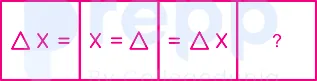
- A
Option A (shown in image)
- B
Option B (shown in image)
- C
Option C (shown in image)
- D
Option D (shown in image)
Show answer
Question 21archived
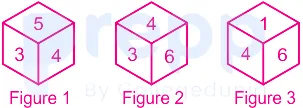
Three different positions of the same dice are shown. Find the number on the face opposite the face showing ‘3’.
- A
5
- B
4
- C
1
- D
6
Show answer
C. 1The logic followed here is :-
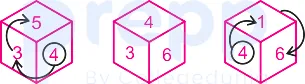
From the given three different cubes, figure 1 and figure 3 ,the adjacent sides are as shown below :
As 4 is common on both figure 1 and figure 3, it is clear that 1, 3, 5 and 6 are adjacent to it and remaining number i.e., 2 will be opposite to it.
Opposite pairs:
1 → 3
5 → 6
2 → 4
So, the opposite side of "3" will be side "1".
Hence, the correct answer is "1".
 Paper & answer key PDF ↗
 Question 22archived
Select the figure from among the given options that can replace the question mark (?) in the following series.

- A
Option A (shown in image)
- B
Option B (shown in image)
- C
Option C (shown in image)
- D
Option D (shown in image)
Show answer
Question 23archived
In the following question below are given some statements followed by some conclusions based on those statements. Taking the given statements to be true even if they seem to be at variance from commonly known facts. Read all the conclusions and then decide which of the given conclusion logically follows the given statements.
Statements:
I. Some L are R.
II. Some A are R.
Conclusion:
I. All A are L.
II. All R are L.
- A
Only conclusion I follows
- B
Neither conclusion follows
- C
Only conclusion II follows
- D
Both conclusions I and II follows
Show answer
B. Neither conclusion followsSolving Syllogism Statements and Conclusions
This question asks us to analyze given statements and determine which of the provided conclusions logically follow. This type of problem falls under the category of logical syllogism or deductive reasoning.
We are given two statements:
I. Some L are R.
II. Some A are R.
And two conclusions:
I. All A are L.
II. All R are L.
We need to assume the given statements are true, even if they contradict common knowledge, and then see which conclusion(s) must be true based solely on these statements.
Analyzing the Syllogism Statements
Let's break down what each statement tells us:
Statement I: Some L are R. This means there is at least one element that belongs to both the category L and the category R. It indicates a partial overlap between L and R. It does not say anything about all L or all R.
Statement II: Some A are R. Similarly, this means there is at least one element that belongs to both the category A and the category R. It shows a partial overlap between A and R. It does not provide information about all A or all R.
Both statements involve the term 'R'. 'R' acts as a connector between 'L' and 'A'. However, both connections are only partial ('Some'). There is no statement directly connecting 'L' and 'A', and importantly, there are no 'All' statements provided.
Evaluating the Syllogism Conclusions
Now, let's evaluate each conclusion based on the statements:
Conclusion I: All A are L.
This conclusion claims that every element in category A is also in category L. Do the statements support this? Statement II says 'Some A are R', and Statement I says 'Some L are R'. While A and L both have some relationship with R, this doesn't guarantee any relationship between A and L, let alone a universal inclusion of all A within L. It is possible that the 'Some A that are R' are completely separate from the 'Some L that are R', or they could overlap, but we cannot definitively conclude that ALL A are L. Therefore, Conclusion I does not logically follow.
Conclusion II: All R are L.
This conclusion claims that every element in category R is also in category L. Do the statements support this? Statement I says 'Some L are R'. This only guarantees that there's an overlap; some Rs are L. It does not imply that *all* Rs are L. There could be Rs that are not L (perhaps they are only A, or something else entirely). Statement II says 'Some A are R', which also doesn't provide any information about all R being L. Therefore, Conclusion II does not logically follow.
Summary of Findings
Based on the analysis of the statements, neither of the conclusions can be logically deduced. 'Some' statements provide limited information about partial overlaps and cannot be used to derive universal 'All' conclusions, especially when the connection between the terms in the conclusion is indirect or only partial through a middle term.
Statement Type
Relationship
Information Provided
Some X are Y
Partial inclusion/overlap
At least one X is Y. At least one Y is X. Cannot conclude about all X or all Y.
Since neither Conclusion I nor Conclusion II logically follows from the given statements, the correct answer is that neither conclusion follows.
Syllogism Revision Table
Statement
Analysis
Valid Inferences (Simple)
Some L are R
Partial overlap between L and R.
Some R are L. Existence of at least one element in L and R.
Some A are R
Partial overlap between A and R.
Some R are A. Existence of at least one element in A and R.
Additional Information on Syllogism Logic
Syllogism problems involve deductive reasoning, where you start with general statements (premises) and try to reach a specific conclusion that must be true if the premises are true. Here are some key points about syllogisms with 'Some' statements:
'Some' means 'at least one'. It does not mean 'only some' or 'not all'.
From two 'Some' statements, no universal conclusion ('All' or 'No') can be logically drawn between the terms.
If the middle term (R in this case) is only partially connected to the other two terms (L and A), you cannot establish a definite universal relationship or lack thereof between those outer terms (L and A).
To derive an 'All' conclusion, you typically need at least one 'All' statement among the premises.
Mastering syllogism involves understanding the relationships implied by different types of statements ('All', 'No', 'Some', 'Some Not') and the rules for combining them to form valid conclusions. Visual aids like Venn diagrams can often help in understanding the possible relationships and testing the validity of conclusions.
Paper & answer key PDF ↗ Question 24archived
In a certain code language, 'EARLY’ is written as 'ZNSCF' and 'GAUGE' is written as 'FIVCH'. How will 'INBOX' be written in that language?
- A
YQCQJ
- B
JPCQY
- C
YQCPJ
- D
XPBOI
Show answer
C. YQCPJUnderstanding Code Language Patterns
This question is a classic example of a coding-decoding problem, often found in logical reasoning sections of competitive exams. We are given two pairs of words where the first word is coded into the second word using a specific rule. Our task is to identify this rule and apply it to a new word to find its code.
Analyzing the Given Code Examples
Let's examine the first example:
EARLY is coded as ZNSCF.
Comparing the letters at each position:
E (5) → Z (26)
A (1) → N (14)
R (18) → S (19)
L (12) → C (3)
Y (25) → F (6)
There doesn't seem to be a simple, consistent shift (like +1, -1, +2, etc.) applied directly to the letters in order.
Let's look at the second example:
GAUGE is coded as FIVCH.
Comparing the letters at each position:
G (7) → F (6)
A (1) → I (9)
U (21) → V (22)
G (7) → C (3)
E (5) → H (8)
Again, a simple position-wise shift doesn't appear consistent across both examples.
Discovering the Coding Rule: Reverse and Shift
When a simple letter-by-letter pattern isn't apparent, we should consider other possibilities, such as patterns applied to the reversed word or patterns that alternate or cycle.
Let's try reversing the first word EARLY. The reversed word is YLRAE.
Now, let's compare the letters of the reversed word (YLRAE) with the coded word (ZNSCF):
Y (25) → Z (26): Shift of \(+1\) (\(25+1=26\))
L (12) → N (14): Shift of \(+2\) (\(12+2=14\))
R (18) → S (19): Shift of \(+1\) (\(18+1=19\))
A (1) → C (3): Shift of \(+2\) (\(1+2=3\))
E (5) → F (6): Shift of \(+1\) (\(5+1=6\))
The pattern of shifts is \(+1, +2, +1, +2, +1\). This looks like a consistent pattern!
Let's verify this pattern with the second example. Reverse GAUGE. The reversed word is EGUAG.
Apply the \(+1, +2, +1, +2, +1\) pattern to EGUAG:
E (5) → E+\(1\) = F (6)
G (7) → G+\(2\) = I (9)
U (21) → U+\(1\) = V (22)
A (1) → A+\(2\) = C (3)
G (7) → G+\(1\) = H (8)
The resulting code is FIVCH, which matches the given coded word for GAUGE. The rule is confirmed: Reverse the word and apply the shifts \(+1, +2, +1, +2, +1\) sequentially to the letters of the reversed word.
Applying the Rule to INBOX
Now, let's apply this rule to the word INBOX to find its code.
Reverse the word INBOX: The reversed word is XOBNI.
Apply the \(+1, +2, +1, +2, +1\) shifts to the letters of XOBNI:
X (24) → X+\(1\) = Y (25)
O (15) → O+\(2\) = Q (17)
B (2) → B+\(1\) = C (3)
N (14) → N+\(2\) = P (16)
I (9) → I+\(1\) = J (10)
Combine the resulting letters: Y, Q, C, P, J.
The coded word for INBOX is YQCPJ.
Comparing with Options
Let's check our result against the given options:
Option 1: YQCQJ
Option 2: JPCQY
Option 3: YQCPJ
Option 4: XPBOI
Our calculated code, YQCPJ, matches Option 3.
Final Answer Derivation
By carefully analyzing the provided examples, we discovered the coding rule: reverse the original word and then apply a sequential letter shift pattern of \(+1, +2, +1, +2, +1\). Applying this rule to the word INBOX yielded the coded word YQCPJ.
Original Word
Reversed Word
Shift Pattern
Coded Word
EARLY
YLRAE
+1, +2, +1, +2, +1
ZNSCF
GAUGE
EGUAG
+1, +2, +1, +2, +1
FIVCH
INBOX
XOBNI
+1, +2, +1, +2, +1
YQCPJ
Revision Table: Code Language Practice
Concept
Description
Example
Letter Coding
Replacing letters of a word with other letters or symbols based on a rule.
A → B (+1 shift)
Pattern Recognition
Identifying the underlying rule or sequence in the coding process.
Constant shift, alternating shift, vowel/consonant rules, reverse order.
Reverse Order Coding
Applying the coding rule to the letters of the word in reverse order.
Word ABC coded as ZYX (applying -1 shift to CBA)
Additional Information: Types of Coding
Coding-decoding questions can involve various patterns. Some common types include:
Letter Shifting: Each letter is shifted a fixed number of positions forward or backward in the alphabet.
Mixed Shifting: Shifts vary for different positions or types of letters (vowels/consonants).
Direct Letter Replacement: Each letter in the original word is replaced by a specific letter or symbol, often given in a table or list.
Reverse Letter Coding: The coding rule is applied to the letters of the original word written in reverse order.
Word/Sentence Coding: Entire words or sentences are coded based on rules involving the words themselves or their properties.
Solving these questions requires careful observation, testing different possible patterns, and sometimes combining multiple rules.
Paper & answer key PDF ↗ Question 25archived
After arranging the given words according to dictionary order, which word will come at ‘Third’ position?
1. Sickle
2. Sickly
3. Sick
4. Sicken
5. Sickness
- A
Sick
- B
Sickle
- C
Sicken
- D
Sickly
Show answer
B. SickleUnderstanding Dictionary Order for Word Arrangement
To find which word comes at the third position after arranging them in dictionary order, we need to compare the given words letter by letter from left to right, just like you would find them in a dictionary.
The given words are:
Sickle
Sickly
Sick
Sicken
Sickness
Step-by-Step Dictionary Sorting
Let's compare the words:
Compare the first letter: All words start with 'S'.
Compare the second letter: All words have 'i' as the second letter.
Compare the third letter: All words have 'c' as the third letter.
Compare the fourth letter: All words have 'k' as the fourth letter.
Compare the fifth letter: Now we see differences.
Sickle
Sickly
Sick
Sicken
Sickness
The letters immediately following 'k' are 'l', 'l', (nothing), 'e', 'n'. In dictionary order, a word with fewer letters comes before a longer word if the shorter word is a prefix of the longer one (e.g., 'cat' comes before 'cats'). The absence of a letter at this position comes before any letter.
So, 'Sick' comes first because it ends after 'k', while all others continue.
Now let's compare the remaining words: Sickle, Sickly, Sicken, Sickness.
Look at the fifth letter:
Sick(l)e
Sick(l)y
Sick(e)n
Sick(n)ess
Comparing 'l', 'l', 'e', 'n': The letter 'e' comes before 'l' and 'n'. So, 'Sicken' is the next word.
Now let's compare the remaining words: Sickle, Sickly, Sickness.
Look at the fifth letter:
Sick(l)e
Sick(l)y
Sick(n)ess
Comparing 'l', 'l', 'n': The letter 'l' comes before 'n'. So, 'Sickness' comes after Sickle and Sickly. We need to compare Sickle and Sickly.
Let's compare Sickle and Sickly letter by letter:
S - S (Same)
i - i (Same)
c - c (Same)
k - k (Same)
l - l (Same)
e - y (Different)
Comparing the sixth letters 'e' and 'y': The letter 'e' comes before 'y' in the alphabet.
Therefore, 'Sickle' comes before 'Sickly'.
Final Dictionary Order
Arranging all the words in dictionary order:
Sick
Sicken
Sickle
Sickly
Sickness
Based on this arrangement, the word that comes at the third position is 'Sickle'.
Position
Word
1st
Sick
2nd
Sicken
3rd
Sickle
4th
Sickly
5th
Sickness
Thus, 'Sickle' is the word found at the third position.
Revision Table: Dictionary Ordering Concepts
Concept
Explanation
Example
Letter by Letter
Compare words one character at a time from left to right.
apple, apply (compare 'p' vs 'p', 'p' vs 'p', 'l' vs 'l', 'e' vs 'y')
Alphabetical Order
The standard order of letters (a-z).
a < b < c ... < z
Shorter Word as Prefix
If one word is a prefix of another (e.g., 'car' and 'carpet'), the shorter word comes first.
car, carpet
Comparing Positions
If letters are the same up to a point, the word with the letter that comes earlier in the alphabet at the first differing position comes first.
cat, cot (compare 'a' vs 'o'; 'a' comes before 'o')
Additional Information: Rules for Alphabetical Sorting
Alphabetical or dictionary sorting is a fundamental skill based on comparing strings of characters. Here are some additional points:
Comparison starts with the first character of each word.
If the first characters are the same, compare the second characters, and so on.
The word with the character that appears earlier in the alphabet at the first point of difference is placed earlier.
If one word runs out of characters while the other still has characters, and the shorter word's letters match the beginning of the longer word, the shorter word comes first. For example, "go" comes before "going".
Case sensitivity might matter in some sorting systems, but for standard dictionary order, it's usually treated as case-insensitive (e.g., 'Apple' and 'apple' would be compared based on 'a' and 'p'). In this question, all words start with a capital letter, so case isn't an issue.
Paper & answer key PDF ↗ Question 26archived
Who among the following is known as a pioneering dance educationist and a prominent Mohiniyattam exponent?
- A
Madhavi Mudgal
- B
Shagun Butani
- C
Mohanrao Kallianpurkar
- D
Dr Kanak Rele
Show answer
D. Dr Kanak ReleIdentifying Pioneering Dance Educationists and Exponents
The question asks us to identify a figure who is known as a pioneering dance educationist and a prominent exponent of Mohiniyattam. Let's examine the options provided.
Analyzing the Options
Madhavi Mudgal: Madhavi Mudgal is a renowned Indian classical dancer, but she is primarily known for her mastery of Odissi dance, not Mohiniyattam.
Shagun Butani: Information about Shagun Butani suggests she is a Kathak dancer and educator. While an educationist, her focus is not Mohiniyattam.
Mohanrao Kallianpurkar: Mohanrao Kallianpurkar was a significant figure in Kathak dance, known as a guru. He is not primarily associated with Mohiniyattam.
Dr Kanak Rele: Dr. Kanak Rele was a celebrated Indian classical dancer, researcher, and educationist. She played a pivotal role in the revival and popularization of Mohiniyattam. She founded the Nalanda Dance Research Centre and the Nalanda Nritya Mahavidyalaya in Mumbai, institutions dedicated to the study and promotion of Indian classical dances, including Mohiniyattam. Her work involved extensive research into the traditional texts and performance practices of Mohiniyattam, contributing significantly to its structure and curriculum. This makes her a pioneering figure in both Mohiniyattam performance and dance education.
Based on the contributions and primary dance forms associated with each individual, Dr. Kanak Rele uniquely fits the description of both a pioneering dance educationist and a prominent Mohiniyattam exponent.
Conclusion
Considering the significant contributions to both the performance and educational aspects of Mohiniyattam, Dr. Kanak Rele is widely recognised as a pioneering dance educationist and a prominent exponent of this classical dance form from Kerala.
Revision Table: Key Personalities in Indian Dance
Personality
Primary Dance Form
Key Contribution
Madhavi Mudgal
Odissi
Renowned Performer and Guru
Shagun Butani
Kathak
Dancer and Educator
Mohanrao Kallianpurkar
Kathak
Kathak Guru
Dr Kanak Rele
Mohiniyattam
Pioneering Educationist, Revivalist, Performer
Additional Information: Understanding Mohiniyattam and Dance Education
Mohiniyattam: This is one of the eight major Indian classical dance forms recognised by the Sangeet Natak Akademi. It originated in the state of Kerala. It is a graceful dance traditionally performed by women. The term "Mohiniyattam" translates to "dance of the enchantress." Its movements are fluid and gentle, with characteristic swaying body movements.
Pioneering Dance Educationist: This term refers to someone who establishes new methods, institutions, or curricula for teaching dance. A pioneering educationist significantly impacts how a dance form is learned, studied, and propagated, often contributing to its academic recognition and structured training.
Dr. Kanak Rele's work involved deep scholarly research (documented in her PhD) which informed her teaching methodology, making her a pioneer in institutionalising the study of Mohiniyattam.
Paper & answer key PDF ↗ Question 27archived
According to Mendeleev's periodic table, what was the atomic mass of Eka-aluminium which was later replaced by Gallium?
- A
95
- B
83
- C
68
- D
50
Show answer
C. 68The correct answer is 68.
Eka-silicon: Predicted to be located below Silicon. This element was later discovered and named Germanium (Ge). The accurate prediction of the properties of these elements, especially Eka-aluminium (Gallium), Eka-boron (Scandium), and Eka-silicon (Germanium), significantly boosted the acceptance of Mendeleev's periodic table by the scientific community. His predictive power was a key strength of his classification system compared to others developed at the time.
Paper & answer key PDF ↗ Question 28archived
What is the outermost layer found in the cell envelope of the bacterial cell called?
- A
Glycocalyx
- B
Cell membrane
- C
Plasma membrane
- D
Cytoplasm
Show answer
A. GlycocalyxThe correct answer is Glycocalyx.
Capsules often protect pathogenic bacteria from being engulfed by host immune cells (phagocytosis). Slime Layer: A loosely attached, less organized layer. Slime layers are often involved in adhesion to surfaces, helping bacteria form biofilms. The presence and type of glycocalyx can be important characteristics used in identifying and classifying bacteria.
Paper & answer key PDF ↗ Question 29archived
Which of the following Indian classical dance forms uses various colours on face to symbolise the characters?
- A
Odissi
- B
Kathakali
- C
Bharatanatyam
- D
Mohiniattam
Show answer
B. KathakaliIndian Classical Dance Makeup Explained
Indian classical dance forms are rich traditions where various elements, including costumes, expressions, and makeup, play a vital role in portraying characters and narratives. The makeup is often designed to enhance the dancer's features and communicate specific meanings to the audience.
Facial Colours Symbolise Characters in Dance
The question specifically asks about the use of colours on the face to symbolise characters within Indian classical dance. Let's look at the options provided:
Odissi: This dance form from Odisha is known for its graceful movements and sculpturesque poses. While facial expressions are central, the makeup is generally less elaborate and does not heavily rely on distinct colour schemes to symbolise broad character types in the way some other forms do.
Kathakali: Hailing from Kerala, Kathakali is renowned for its highly stylized and exaggerated makeup, known as 'Vesham'. This makeup is fundamental to the art form, using specific colours applied in intricate patterns to represent different character categories ('Pacha', 'Kathikal', 'Thadi', 'Minukku', 'Nila'). For example:
Green colour signifies nobility and virtue (heroes, gods).
Red often indicates evil, aggression, or intense passion.
Black is typically used for demonic figures or characters with dark intentions.
Yellow can represent royalty, women, or characters with mixed traits.
These colours, along with specific facial modifications, are key identifiers for the characters presented.
Bharatanatyam: Originating in Tamil Nadu, Bharatanatyam focuses on precise movements and intricate facial expressions ('abhinaya'). The makeup aims to enhance the dancer's features and clarity of expression, typically adopting a more naturalistic look rather than using broad symbolic colour categories for character types.
Mohiniattam: This graceful dance form from Kerala is characterized by its gentle, undulating movements. The makeup is usually understated, focusing on highlighting the dancer's natural beauty and expressions, without the extensive use of symbolic colours seen in Kathakali.
Kathakali Makeup and Character Symbolism
Kathakali stands out among these forms for its systematic use of facial colours as a primary means of character delineation. The distinct makeup styles, or 'Vesham', instantly communicate whether a character is divine, heroic, villainous, or demonic, making it the most fitting answer to the question.
Paper & answer key PDF ↗ Question 30archived
President Droupadi Murmu has appointed Dr. Justice Dhananjaya Yashwant Chandrachud as the _______ Chief Justice of India.
- A
50th
- B
51st
- C
48th
- D
49th
Show answer
A. 50thUnderstanding the Appointment of the Chief Justice of India
The question asks about the specific ordinal number of Dr. Justice Dhananjaya Yashwant Chandrachud's appointment as the Chief Justice of India, appointed by President Droupadi Murmu.
The Chief Justice of India (CJI) is the head of the judiciary of India and the Supreme Court of India. The CJI is appointed by the President of India.
Dr. Justice Dhananjaya Yashwant Chandrachud was appointed as the Chief Justice of India by President Droupadi Murmu. This appointment was a significant event in the Indian judiciary.
Based on the sequence of appointments to the high office of the Chief Justice of India, Dr. Justice D.Y. Chandrachud holds a specific position in this lineage.
Let's examine the options provided:
50th
51st
48th
49th
Historical records of the Chief Justices of India confirm the chronological order of their appointments. Dr. Justice Dhananjaya Yashwant Chandrachud succeeded Justice Uday Umesh Lalit.
By consulting the list of former Chief Justices of India, we can determine his position in the sequence.
Dr. Justice Dhananjaya Yashwant Chandrachud took oath as the Chief Justice of India on November 9, 2022.
The count of individuals who have held this prestigious office leads to the correct identification of his position number.
Based on official records, Dr. Justice Dhananjaya Yashwant Chandrachud is indeed the 50th person to serve as the Chief Justice of India.
Therefore, the correct option identifying his position is 50th.
Revision Table: Chief Justices of India Sequence
Serial Number
Name
Term Start Date
Term End Date
48th
N. V. Ramana
24 April 2021
26 August 2022
49th
Uday Umesh Lalit
27 August 2022
8 November 2022
50th
Dhananjaya Yashwant Chandrachud
9 November 2022
Incumbent
Additional Information on Chief Justice of India Appointment
The Chief Justice of India is appointed by the President of India under Article 124(2) of the Constitution.
The outgoing Chief Justice of India recommends the name of the senior-most judge of the Supreme Court as the next Chief Justice of India.
This recommendation is usually accepted by the government, and the President makes the formal appointment.
The role of the Chief Justice of India is crucial. The CJI presides over the proceedings of the Supreme Court and is responsible for the allocation of cases and the appointment of benches.
The CJI also plays a key role in the collegium system for the appointment and transfer of judges of the Supreme Court and High Courts.
Paper & answer key PDF ↗ Question 31archived
Which Part of the Constitution of India reflects the Fundamental Duties?
- A
Part X
- B
Part XII
- C
Part IV-A
- D
Part IX-B
Show answer
C. Part IV-AUnderstanding Fundamental Duties in the Indian Constitution
The Constitution of India is divided into various Parts, each dealing with specific aspects of the governance and structure of the country. Understanding these Parts is crucial for comprehending the constitutional framework. The question asks about the location of Fundamental Duties within this structure.
Origin and Inclusion of Fundamental Duties
Fundamental Duties were not originally part of the Constitution of India. They were added later based on the recommendations of the Swaran Singh Committee. The need for incorporating Fundamental Duties was felt during the internal emergency period (1975-1977) to emphasize the responsibilities of citizens alongside their rights.
These duties were introduced by the 42nd Amendment Act of 1976. This amendment added a new Part to the Constitution to deal specifically with the Fundamental Duties of citizens.
Locating Fundamental Duties in the Constitution
The 42nd Amendment Act, 1976, inserted a new Part, Part IV-A, into the Constitution of India. This new Part consists of only one Article, Article 51A, which enumerates the Fundamental Duties of every citizen of India.
Originally, there were 10 Fundamental Duties. Later, one more Fundamental Duty was added by the 86th Constitutional Amendment Act, 2002, which made it a duty for parents or guardians to provide opportunities for education to their child or ward between the age of six and fourteen years. This brought the total number of Fundamental Duties to 11.
Analyzing the Options
Let's look at the Parts mentioned in the options to understand what they cover:
Part of the Constitution
Subject Matter
Part X
The Scheduled and Tribal Areas
Part XII
Finance, Property, Contracts, and Suits
Part IV-A
Fundamental Duties
Part IX-B
Co-operative Societies
Based on this analysis, it is clear that Part IV-A of the Constitution deals with Fundamental Duties.
Significance of Fundamental Duties
While not enforceable by courts in the same way as Fundamental Rights, Fundamental Duties serve as a reminder to citizens about their obligations towards society, the nation, and their fellow citizens. They help in promoting a sense of discipline and commitment towards the nation.
Conclusion
The part of the Constitution of India that reflects the Fundamental Duties is Part IV-A.
Revision Table: Constitutional Parts Overview
Part
Subject
Relevant Articles
Part I
The Union and its Territory
Articles 1 to 4
Part II
Citizenship
Articles 5 to 11
Part III
Fundamental Rights
Articles 12 to 35
Part IV
Directive Principles of State Policy
Articles 36 to 51
Part IV-A
Fundamental Duties
Article 51A
Part V
The Union Government
Articles 52 to 151
Part VI
The State Governments
Articles 152 to 237
Part X
The Scheduled and Tribal Areas
Articles 244 to 244A
Part XII
Finance, Property, Contracts and Suits
Articles 264 to 300A
Part IX-B
Co-operative Societies
Articles 243ZH to 243ZT
Additional Information: Key Aspects of Fundamental Duties
Fundamental Duties are applicable only to citizens of India, not to foreigners.
They are non-justiciable, meaning they cannot be enforced by a court of law. However, Parliament can provide for their enforcement by suitable legislation.
They help in understanding the legal duties associated with fundamental rights.
They guide the legislature and the executive in framing policies and laws.
Examples of Fundamental Duties include respecting the Constitution, protecting the sovereignty and integrity of India, promoting harmony, protecting the environment, and developing scientific temper.
Paper & answer key PDF ↗ Question 32archived
When did the Mongol ruler Genghis Khan die?
- A
1219
- B
1210
- C
1235
- D
1227
Show answer
D. 1227Understanding the Death Year of Genghis Khan
Genghis Khan, born Temüjin, was the founder and first Great Khan of the Mongol Empire, which became the largest contiguous empire in history after his death. His reign and military campaigns significantly shaped the history of Asia and Europe.
The question asks for the year in which this prominent historical figure died. Historical sources provide a specific year for his passing.
Determining Genghis Khan's Death Year
Based on historical records, Genghis Khan died in the year 1227. He passed away during a military campaign against the Tangut kingdom of Western Xia.
His death marked a significant moment in the Mongol Empire's history, leading to the succession of his son Ögedei Khan and the continued expansion of the empire by his descendants.
Let's look at the provided options:
1219: This year falls within Genghis Khan's lifetime and period of expansion.
1210: This year is also too early, well before his death.
1235: This year is after his death; the empire was already ruled by his successor.
1227: This year aligns with historical accounts of Genghis Khan's death.
Therefore, the historical consensus places Genghis Khan's death in 1227.
Revision Table: Key Dates for Genghis Khan
Event
Approximate Year
Birth of Temüjin (Genghis Khan)
Around 1162
Proclaimed Genghis Khan
1206
Death of Genghis Khan
1227
Additional Information: The Mongol Empire After Genghis Khan
Following Genghis Khan's death in 1227, the Mongol Empire was divided among his sons and grandsons into various khanates, although it remained nominally unified under the Great Khan. Notable successors include:
Ögedei Khan (third son), who succeeded as Great Khan.
Batu Khan (grandson), founder of the Golden Horde.
Hulagu Khan (grandson), founder of the Ilkhanate.
Kublai Khan (grandson), founder of the Yuan Dynasty in China.
These successor states continued the legacy of expansion and ruled vast territories across Asia and parts of Eastern Europe for centuries, influencing trade, culture, and politics along the Silk Road and beyond.
Paper & answer key PDF ↗ Question 33archived
How many maximum electrons can M shell have?
- A
18
- B
8
- C
1
- D
2
Show answer
A. 18Understanding Electron Shells and Capacity
Atoms have a nucleus at the center, and electrons orbit this nucleus in specific energy levels or shells. These shells are often labeled starting from the one closest to the nucleus, using letters K, L, M, N, and so on, or by principal quantum number (n = 1, 2, 3, 4...). Each shell can hold a maximum number of electrons.
Electron Shells and Their Numbers
The shells are numbered starting from the shell closest to the nucleus:
K shell: n = 1 (the first shell)
L shell: n = 2 (the second shell)
M shell: n = 3 (the third shell)
N shell: n = 4 (the fourth shell)
And so on...
Calculating Maximum Electrons in a Shell
The maximum number of electrons that a shell can hold is given by the formula $2n^2$, where 'n' is the principal quantum number (shell number).
Maximum Electrons in the M Shell
The question asks for the maximum number of electrons the M shell can have. The M shell is the third shell, corresponding to the principal quantum number n = 3.
Using the formula $2n^2$:
Maximum electrons in M shell = $2 \times (3)^2$
Maximum electrons in M shell = $2 \times 9$
Maximum electrons in M shell = 18
Therefore, the M shell can hold a maximum of 18 electrons.
Subshells within the M Shell
Each electron shell is further divided into subshells: s, p, d, and f. The number and type of subshells depend on the principal quantum number (n).
For n = 1 (K shell), there is only one subshell: 1s (holds 2 electrons). Total: 2.
For n = 2 (L shell), there are two subshells: 2s (holds 2 electrons) and 2p (holds 6 electrons). Total: 2 + 6 = 8.
For n = 3 (M shell), there are three subshells: 3s (holds 2 electrons), 3p (holds 6 electrons), and 3d (holds 10 electrons). Total: 2 + 6 + 10 = 18.
For n = 4 (N shell), there are four subshells: 4s (holds 2 electrons), 4p (holds 6 electrons), 4d (holds 10 electrons), and 4f (holds 14 electrons). Total: 2 + 6 + 10 + 14 = 32.
This breakdown by subshells confirms the maximum electron capacity calculated by the $2n^2$ formula for the M shell.
Shell Name
Principal Quantum Number (n)
Subshells Present
Maximum Electrons ($2n^2$)
K
1
s
$2 \times 1^2 = 2$
L
2
s, p
$2 \times 2^2 = 8$
M
3
s, p, d
$2 \times 3^2 = 18$
N
4
s, p, d, f
$2 \times 4^2 = 32$
Based on the calculation using the formula $2n^2$ for n=3 (the M shell), the maximum number of electrons is 18.
Revision Table: Electron Shells
Shell
n
Maximum Electrons
K
1
2
L
2
8
M
3
18
N
4
32
Additional Information: Electron Configuration
While a shell can hold a maximum number of electrons, the actual filling of shells in atoms follows specific rules based on energy levels, including:
Aufbau Principle: Electrons fill atomic orbitals of the lowest available energy levels before occupying higher ones.
Pauli Exclusion Principle: No two electrons in the same atom can have the same set of four quantum numbers. This means an atomic orbital can hold a maximum of two electrons, and they must have opposite spins.
Hund's Rule: Every orbital in a subshell is singly occupied with one electron before any one orbital is doubly occupied, and all electrons in singly occupied orbitals have the same spin.
These rules explain the order in which electrons occupy the subshells (like 4s filling before 3d in many atoms), even though the M shell (n=3) has a maximum capacity of 18 electrons.
Paper & answer key PDF ↗ Question 34archived
Merchants and migrants first brought the teachings of the holy Quran to India in the ______ century.
- A
fourth
- B
seventh
- C
ninth
- D
sixth
Show answer
B. seventhUnderstanding the Arrival of Quranic Teachings in India
The question asks about the specific century when the teachings of the holy Quran were first brought to India by merchants and migrants. This involves understanding the historical interactions and trade routes between the Arabian Peninsula and the Indian subcontinent.
Historical Context: Trade and Migration Routes
From ancient times, there were well-established trade routes connecting the Arabian Peninsula with the coastal regions of India, particularly in the south and west. Arab merchants were frequent visitors to Indian ports, trading goods like spices, textiles, and other commodities. These routes facilitated not only economic exchange but also the movement of people and ideas.
The Rise of Islam and its Spread
Islam emerged in the Arabian Peninsula in the early seventh century CE. As the faith spread rapidly within Arabia and beyond, many Arab merchants and seafarers who traveled to distant lands embraced the new religion. These individuals, driven by trade and sometimes seeking new opportunities, continued their journeys along the existing maritime routes to India.
Merchants and Migrants as Carriers of Faith
Merchants and migrants played a pivotal role in the initial spread of Islam and the teachings of the Quran outside the Arabian heartland. Unlike military conquests which came later to other parts of India, the early contact on the coasts was primarily through peaceful means facilitated by traders. These individuals would practice their faith, share its principles with local populations, and build small communities. This gradual interaction led to the introduction of Quranic teachings long before large-scale Islamic empires were established in the subcontinent.
Pinpointing the Century
Considering that Islam began in the early seventh century, the first instances of Muslim merchants and migrants carrying the teachings of the Quran to India would necessarily occur after this period. Historical accounts suggest early contact between Arab Muslims and Indian coastal communities (like in Kerala) happened within the seventh century itself, facilitated by the ongoing trade links.
Analyzing the Options
The fourth century and sixth century are too early, predating the advent of Islam.
The ninth century saw more established Muslim communities and trade networks, but the *first* arrival of teachings via this route was earlier.
The seventh century aligns perfectly with the emergence of Islam and the continuation of Arab trade voyages to India, making it the most plausible period for the initial introduction of Quranic teachings through merchants and migrants.
Therefore, the teachings of the holy Quran were first brought to India by merchants and migrants in the seventh century.
Century
Relevance to Quran's Arrival via Merchants/Migrants
Fourth Century
Too early; Islam had not yet emerged.
Sixth Century
Too early; Islam had not yet emerged.
Seventh Century
Beginning of Islam; Arab merchants/migrants began carrying teachings along trade routes to India.
Ninth Century
Later period; Muslim presence more established, but not the *first* arrival via this method.
Revision Table: Key Facts about Quran's Arrival in India
Aspect
Detail
Method of Arrival
Primarily through merchants and migrants
Initial Locations
Coastal areas (e.g., Malabar coast)
Century of First Arrival
Seventh Century CE
Context
Ongoing trade between Arabia and India, rise of Islam
Additional Information: Early Muslim Presence in India
While the Delhi Sultanate and the Mughal Empire are well-known periods of Muslim rule in India, the presence of Muslims on the subcontinent dates back much earlier. The arrival of Arab traders in coastal regions like Kerala in the seventh century led to the establishment of some of the earliest Muslim communities in India. These communities coexisted with local populations and contributed to the cultural and economic landscape. This early, peaceful interaction through trade and migration is a significant part of the history of Islam in India, distinct from later military and political developments.
Paper & answer key PDF ↗ Question 35archived
In 1955, which synthetic element is provisionally named Mendelevium in honor of Dmitri Mendeleev, who created one of the first periodic tables?
- A
Element 90
- B
Element 101
- C
Element 103
- D
Element 106
Show answer
B. Element 101The correct answer is Element 101.
His table organized elements by atomic mass and predicted the existence and properties of unknown elements, which were later discovered, validating his work significantly. Naming elements after famous scientists is a common practice in chemistry to honor their contributions to the field. Mendeleev's contribution to the organization of elements in the periodic table was fundamental, making the naming of Element 101 (Mendelevium) a fitting tribute.
Paper & answer key PDF ↗ Question 36archived
In Trans – Siberian railway system Vladivostoclies on ______ coast.
- A
Atlantic
- B
Antarctic
- C
Arctic
- D
Pacific
Show answer
D. PacificUnderstanding the Trans-Siberian Railway and Vladivostok
The Trans-Siberian Railway is one of the longest railway lines in the world. It connects Moscow in European Russia with the Russian Far East. The railway system has several branches, but the main line stretches across the vast expanse of Siberia.
The question asks about the location of Vladivostok, specifically which coast it lies on in the context of the Trans-Siberian railway system. Vladivostok is a major city and port in the Russian Far East and serves as the eastern terminus of the primary Trans-Siberian line.
Location of Vladivostok
Vladivostok is geographically located in the southeastern part of Russia, specifically on the Muravyov-Amursky Peninsula, which is part of the larger Sikhote-Alin mountain range foothills. The city is situated on the Golden Horn Bay (Zolotoy Rog Bay), which opens into the Sea of Japan.
Identifying the Coast
The Sea of Japan is a marginal sea of the Western Pacific Ocean. Therefore, any city or port located on the Sea of Japan is considered to be on the Pacific coast or connected to the Pacific Ocean via that sea.
Given that Vladivostok is a major port city located on the Sea of Japan, which is part of the Pacific Ocean, its position is directly related to the Pacific coast.
Let's consider the options provided:
Atlantic: The Atlantic Ocean is on the western side of Europe and Africa, and the eastern side of North and South America. Vladivostok is in the Russian Far East, thousands of kilometers away from the Atlantic coast.
Antarctic: The Antarctic Ocean surrounds the continent of Antarctica, located in the Southern Hemisphere. This is completely irrelevant to Vladivostok's location.
Arctic: The Arctic Ocean is located around the North Pole. While Russia has a long Arctic coastline, Vladivostok is far to the south of the Arctic Circle and faces the Pacific Ocean.
Pacific: The Pacific Ocean is the largest and deepest of Earth's oceanic divisions. The Sea of Japan is a part of the Pacific. Vladivostok is located on the Sea of Japan, making it a Pacific port city and situated on the Pacific coast.
Based on its geographical location relative to the Pacific Ocean, Vladivostok lies on the Pacific coast.
Trans-Siberian Railway Primary Termini
Western Terminus
Eastern Terminus
Moscow
Vladivostok
Conclusion on Vladivostok's Coastal Location
Vladivostok is a key city in the Russian Far East and is the eastern end point of the main Trans-Siberian railway line. Its position on the Sea of Japan firmly places it on the Pacific coast. The other options (Atlantic, Antarctic, Arctic) are geographically incorrect.
Revision Table: Key Geographic Points
City
Country
Key Feature
Associated Coast/Ocean
Vladivostok
Russia
Eastern terminus of Trans-Siberian Railway, Port city on Sea of Japan
Pacific Coast
Moscow
Russia
Western terminus of Trans-Siberian Railway
Inland, far from any major coast
Additional Information: The Trans-Siberian System
The Trans-Siberian railway system is not just one line but a network. Besides the main line to Vladivostok, other important branches exist:
Trans-Manchurian Line: Branches off the main line at Tarskaya, goes through China (Harbin), and ends at Vladivostok.
Trans-Mongolian Line: Branches off at Ulan-Ude, goes through Mongolia (Ulaanbaatar), and ends in Beijing, China.
Baikal–Amur Mainline (BAM): Runs parallel to the main line much further north, connecting Tayshet with Sovetskaya Gavan on the Pacific coast. This provides an alternative route to the Pacific, also reaching the Pacific coast.
Regardless of the branch, Vladivostok's position remains consistently on the Pacific coast, making it a crucial link between the vast Russian interior and the Pacific maritime trade routes.
Paper & answer key PDF ↗ Question 37archived
The crop area under high yielding varieties of which amongst the following crop grew considerably during the Green Revolution?
- A
Sugarcane
- B
Pulses
- C
Oilseeds
- D
Wheat
Show answer
D. WheatUnderstanding the Green Revolution and Crop Area Growth
The Green Revolution was a period of significant agricultural development that took place in India starting in the 1960s. Its main goal was to increase food production, especially cereals, to make the country self-sufficient and avoid famine.
A key element of the Green Revolution was the introduction and adoption of High Yielding Varieties (HYVs) of seeds, along with improved irrigation techniques, fertilizers, and pesticides. These HYVs were specifically bred to produce much higher yields compared to traditional varieties under proper conditions.
Impact of High Yielding Varieties on Different Crops
The initial focus of the Green Revolution, particularly in India, was on improving the production of major cereal crops like Wheat and Rice. These crops were seen as critical for national food security.
Wheat: High Yielding Varieties of Wheat were particularly successful and were adopted widely in states like Punjab, Haryana, and Western Uttar Pradesh, which had assured irrigation facilities. The area cultivated under these HYVs expanded rapidly, leading to a dramatic increase in Wheat production.
Rice: HYVs of Rice were also developed and introduced. While their adoption was successful, it was initially concentrated in areas with good irrigation. The impact on overall Rice production was significant, but perhaps slightly less dramatic than Wheat in the initial phase in some regions.
Other Crops (Pulses, Oilseeds, Sugarcane): The Green Revolution technologies, including HYVs, had less impact on crops like Pulses, Oilseeds, and Sugarcane in the early stages. This was for various reasons, including the lack of readily available, highly successful HYVs for these crops suitable for diverse conditions, and the fact that the technological package (irrigation, fertilizers) was primarily tailored for cereals.
Analyzing the Options
Let's look at how the area under High Yielding Varieties changed for each option during the Green Revolution:
Sugarcane: While improved varieties existed, the Green Revolution's core focus and the most dramatic increase in area under HYVs were not centered on Sugarcane.
Pulses: Pulses largely did not benefit from the initial phase of the Green Revolution to the same extent as cereals. Their production remained relatively stagnant, and HYV adoption was slow.
Oilseeds: Similar to pulses, oilseeds were not the primary focus of the early Green Revolution. The area under HYVs for oilseeds did not grow as considerably compared to cereals.
Wheat: Wheat cultivation saw a massive transformation due to the introduction of dwarf, high-yielding varieties (like those developed by Norman Borlaug). The area under these HYVs expanded enormously, leading to a significant jump in overall Wheat production in India.
Therefore, the crop area under High Yielding Varieties that grew considerably during the Green Revolution was Wheat.
Crop
Impact of Early Green Revolution (HYVs)
Change in Area under HYVs
Wheat
Major focus, highly successful HYVs available
Grew Considerably
Rice
Significant focus, successful HYVs available
Grew Considerably (but often highlighted less than Wheat initially)
Pulses
Less focus, HYVs not as successful or widely available
Limited Growth
Oilseeds
Less focus, HYVs not as successful or widely available
Limited Growth
Sugarcane
Not primary focus of initial HYV push
Limited Growth compared to cereals
Conclusion on HYV Area Growth
Based on the historical impact of the Green Revolution, the introduction and widespread adoption of High Yielding Varieties had the most significant impact on the area cultivated under Wheat, leading to substantial increases in production and making India self-sufficient in this cereal.
Revision Table: Key Green Revolution Concepts
Concept
Description
Green Revolution
Period of agricultural innovation and increased production, starting mid-20th century.
High Yielding Varieties (HYVs)
Specially bred seeds designed to produce much larger yields under optimal conditions.
Technological Package
Combination of HYVs, irrigation, fertilizers, pesticides, and modern farming techniques used in the Green Revolution.
Primary Beneficiaries
Initially, Wheat and Rice were the main crops that saw significant benefits from the HYV technology.
Additional Information: Broader Impact of Green Revolution
The Green Revolution helped India achieve food security, preventing famines that were predicted in the 1960s.
It increased the income of farmers, especially those with larger landholdings and access to resources like irrigation and fertilizers.
However, it also led to some negative consequences, such as environmental issues from excessive use of water and chemicals, and increased disparities between regions and farmers who could afford the new technology and those who couldn't.
While the initial phase focused on Wheat and Rice, later efforts expanded to improve other crops, but the early dramatic growth in HYV area was most pronounced in these cereals.
Paper & answer key PDF ↗ Question 38archived
Who has become the 12th Chief minister of Uttarakhand?
- A
Biren Singh
- B
Pramod Sawant
- C
Bhagwant Singh Mann
- D
Pushkar Singh Dhami
Show answer
D. Pushkar Singh DhamiFinding the 12th Chief Minister of Uttarakhand
The question asks us to identify the individual who holds the position of the 12th Chief Minister of Uttarakhand from the given options. To answer this correctly, we need to know the current Chief Minister of Uttarakhand and their place in the state's historical list of Chief Ministers.
Let's examine the options provided:
Biren Singh
Pramod Sawant
Bhagwant Singh Mann
Pushkar Singh Dhami
Analyzing the Options for Uttarakhand Chief Minister
We need to determine which of these individuals is currently serving or has served as the 12th Chief Minister of the state of Uttarakhand.
Biren Singh: He is the current Chief Minister of Manipur. Therefore, he is not the Chief Minister of Uttarakhand.
Pramod Sawant: He is the current Chief Minister of Goa. Therefore, he is not the Chief Minister of Uttarakhand.
Bhagwant Singh Mann: He is the current Chief Minister of Punjab. Therefore, he is not the Chief Minister of Uttarakhand.
Pushkar Singh Dhami: He is indeed the current Chief Minister of Uttarakhand. Upon taking office for his second term in March 2022, he continued his tenure. He is considered the 12th Chief Minister in the chronological listing of individuals who have held the office since the state's formation in 2000.
Based on this analysis, Pushkar Singh Dhami is the correct answer as the 12th Chief Minister of Uttarakhand.
Summary of Chief Ministers by State (from options)
Individual
State Served As Chief Minister
Relevant to Uttarakhand?
Biren Singh
Manipur
No
Pramod Sawant
Goa
No
Bhagwant Singh Mann
Punjab
No
Pushkar Singh Dhami
Uttarakhand
Yes
This table clearly shows that only Pushkar Singh Dhami is associated with the state of Uttarakhand among the given options. He took office as the 11th Chief Minister in July 2021 and, after the 2022 election, continued in office, being listed chronologically as the 12th person to hold the post.
Conclusion on Uttarakhand's 12th CM
Therefore, the individual who became the 12th Chief Minister of Uttarakhand is Pushkar Singh Dhami.
Revision Table: Uttarakhand Chief Ministers
Understanding the sequence of Chief Ministers is important for state politics and current affairs.
Uttarakhand was formed on 9 November 2000.
Since its formation, several individuals have held the office of Chief Minister.
Pushkar Singh Dhami first became Chief Minister in July 2021.
Following the 2022 state assembly election, he continued in the position, starting his new term in March 2022.
He is counted as the 12th Chief Minister of Uttarakhand.
Additional Information: Chief Ministers and Indian States
The Chief Minister is the elected head of government of each state of India. The Governor appoints the Chief Minister, who is typically the leader of the party or coalition that has a majority in the state legislative assembly. The Chief Minister and their council of ministers exercise executive authority in the state.
Chief Ministers are responsible for the day-to-day administration of the state.
They chair cabinet meetings and formulate state policies.
They serve for a term of five years, subject to holding the confidence of the assembly.
Paper & answer key PDF ↗ Question 39archived
Which of the following statement is correct?
I. The nutrition requirements of adolescents are higher than adult.
II. Adolescents are generally grouped in the age group of 10 to 19 years.
- A
Only II
- B
Both I and II
- C
Neither I nor II
- D
Only I
Show answer
B. Both I and IIUnderstanding Adolescent Nutrition and Age Group
This question asks us to evaluate two statements regarding adolescents: one about their nutritional needs and another about their typical age range.
Analyzing Statement I: Adolescent Nutrition Requirements
Statement I says: "The nutrition requirements of adolescents are higher than adult."
Adolescence is a critical period of rapid physical growth and development. During this time, the body undergoes significant changes, including increases in height, weight, bone mass, and muscle mass. This accelerated growth requires a higher intake of energy, protein, vitamins, and minerals compared to the needs of a fully grown adult who is no longer undergoing such rapid development.
For example, requirements for energy, protein, calcium (for bone development), iron (especially for females starting menstruation and for muscle growth in males), and zinc are significantly higher during adolescence than in adulthood. Therefore, statement I is correct.
Analyzing Statement II: Adolescent Age Group
Statement II says: "Adolescents are generally grouped in the age group of 10 to 19 years."
Different organizations and contexts may use slightly varying age ranges, but the most widely accepted definition of adolescence, particularly by global health bodies like the World Health Organization (WHO), is the age range of 10 to 19 years. This period bridges childhood and adulthood, encompassing puberty and significant cognitive and psychosocial changes. Therefore, statement II is also correct based on common definitions.
Evaluating the Statements Together
Based on our analysis:
Statement I is correct because the rapid growth and development during adolescence necessitate higher nutritional intake than adulthood.
Statement II is correct because the age range of 10 to 19 years is widely recognized as the period of adolescence.
Since both statements are correct, the option that indicates both I and II are correct is the correct answer.
Conclusion
Both the statement about higher nutritional requirements and the statement about the age group (10-19 years) are accurate descriptions related to adolescence.
Summary of Statements
Statement
Content
Correctness
Reason
I
Adolescent nutrition requirements are higher than adult.
Correct
Due to rapid growth and development.
II
Adolescence age group is 10 to 19 years.
Correct
Widely accepted definition (e.g., WHO).
Revision Table: Key Facts about Adolescence
Adolescence Key Facts
Aspect
Description
Age Range
Generally 10 to 19 years (WHO definition)
Growth Stage
Second major growth spurt after infancy
Nutritional Needs
Higher energy, protein, vitamins (A, C, D, E), minerals (Calcium, Iron, Zinc)
Development
Physical, cognitive, emotional, and social changes
Additional Information: Importance of Adolescent Health and Nutrition
Adolescence is a crucial phase for establishing lifelong health habits. Adequate nutrition during this period is vital not only for current growth and development but also for preventing health problems later in life, such as osteoporosis (related to calcium intake), iron deficiency anemia, and obesity or malnutrition.
Factors influencing adolescent nutrition include dietary habits, peer influence, body image concerns, physical activity levels, and socioeconomic status. Promoting balanced diets, regular physical activity, and positive body image are key components of adolescent health programs.
Understanding the specific needs of this age group helps in developing targeted health and education programs to support their transition into healthy adulthood.
Paper & answer key PDF ↗ Question 40archived
Which Article of the Constitution separates the judiciary from the executive?
- A
Article 143
- B
Article 50
- C
Article 144
- D
Article 74
Show answer
B. Article 50Understanding the Separation of Judiciary and Executive
The question asks about the specific Article in the Indian Constitution that mandates the separation of the judiciary from the executive branch of the government. This separation is a fundamental principle aimed at ensuring the independence of the judiciary, which is crucial for upholding the rule of law and protecting citizens' rights.
The concept of separation of powers, while not strictly applied in its classical sense, is reflected in various provisions of the Indian Constitution. The separation between the judiciary and the executive is a significant aspect of this principle.
Identifying the Relevant Article
Let's examine the provided options to determine which Article addresses the separation of the judiciary from the executive:
Article 143: This Article deals with the power of the President to consult the Supreme Court on questions of law or fact. It relates to the advisory jurisdiction of the Supreme Court and the executive's interaction with the judiciary, but it does not mandate their separation.
Article 50: This Article falls under the Directive Principles of State Policy (DPSPs) in Part IV of the Constitution. It explicitly states that "The State shall take steps to separate the judiciary from the executive in the public services of the State." This Article is the direct constitutional provision aiming for this separation.
Article 144: This Article states that all civil and judicial authorities in the territory of India shall act in aid of the Supreme Court. It ensures the executive and other authorities assist the judiciary but does not deal with their fundamental separation.
Article 74: This Article deals with the Council of Ministers to aid and advise the President. It concerns the functioning of the executive branch and its relationship with the head of state, not the separation of the judiciary from the executive.
Based on the analysis of the options, Article 50 is the specific constitutional provision that directs the State to take steps for separating the judiciary from the executive.
Detailed Explanation of Article 50
Article 50 is a significant Directive Principle of State Policy. While DPSPs are not directly enforceable by courts, they are considered fundamental in the governance of the country and it is the duty of the State to apply these principles in making laws. The objective behind Article 50 is to free the judiciary from potential influence by the executive, thereby ensuring impartial justice. Over time, legislative and administrative measures have been taken at both central and state levels to implement this separation, especially at the lower levels of the judiciary where executive officers previously exercised judicial functions.
Comparison of Articles
To further clarify, let's compare the purpose of the Articles given in the options:
Article
Subject Matter
Relevance to Judiciary-Executive Separation
Article 143
President's power to consult Supreme Court
Interaction, not separation
Article 50
Separation of Judiciary from Executive
Directly mandates separation (DPSP)
Article 144
Civil and judicial authorities to act in aid of Supreme Court
Assistance, not separation
Article 74
Council of Ministers to aid and advise President
Executive function, not judiciary-executive separation
Therefore, Article 50 is the correct answer as it is the only one among the options that explicitly mentions the separation of the judiciary from the executive.
Revision Table: Key Constitutional Articles
Article Number
Topic
Article 50
Separation of Judiciary from Executive
Article 74
Council of Ministers to aid and advise President
Article 143
Power of President to consult Supreme Court
Article 144
Civil and judicial authorities to act in aid of Supreme Court
Additional Information on Separation of Powers
The doctrine of separation of powers suggests that the three pillars of the state - the legislature, the executive, and the judiciary - should have separate powers, distinct functions, and independent personnel. While a strict separation is not feasible or practiced in parliamentary democracies like India (where the executive is part of the legislature), the Constitution ensures checks and balances between the organs. The separation between the judiciary and the executive, as aimed for in Article 50, is particularly significant for safeguarding judicial independence and upholding democratic principles.
Directive Principles of State Policy (DPSPs), contained in Part IV (Articles 36-51) of the Constitution, are guidelines to the central and state governments of India, to be kept in mind while framing laws and policies. Article 50 is one such guiding principle aimed at administrative reform to improve the justice delivery system.
Paper & answer key PDF ↗ Question 41archived
What do you call a component of identical size that offers a higher resistance to electricity?
- A
Poor conductor
- B
Semi- conductor
- C
Good conductor
- D
very good conductor
Show answer
A. Poor conductorThe correct answer is Poor conductor.
For some alloys (like Nichrome), resistance is nearly independent of temperature over a certain range. Material: Different materials have different resistivities, which is the most significant factor determining if a material is a good or poor conductor. The question specifies "a component of identical size," which means the length and cross-sectional area are constant for comparison, making the material's intrinsic property (resistivity) the determining factor for higher resistance.
Paper & answer key PDF ↗ Question 42archived
In which of the following months did the Australian Open take place in 2022?
- A
February
- B
March
- C
January
- D
April
Show answer
C. JanuaryUnderstanding the Australian Open Timing in 2022
The question asks about the specific month in which the Australian Open tennis tournament took place in the year 2022. The Australian Open is one of the four major Grand Slam tennis tournaments held each year.
These Grand Slam events have traditional timings during the calendar year:
Australian Open: Usually held in January.
French Open (Roland-Garros): Usually held in late May and early June.
Wimbledon: Usually held in late June and early July.
US Open: Usually held in late August and early September.
For the year 2022, the Australian Open followed its usual schedule.
Australian Open 2022 Dates
Let's confirm the specific dates for the Australian Open in 2022:
The main draw events for the Australian Open in 2022 were held from January 17 to January 30, 2022.
Therefore, the entire tournament, including qualifications and the main events, fell squarely within the month of January.
Analyzing the Options
Let's look at the given options based on our understanding of the Australian Open schedule:
February: The Australian Open 2022 concluded on January 30, so it did not take place in February.
March: This month is well after the Australian Open concludes.
January: As confirmed, the Australian Open 2022 main events were held from January 17 to January 30, making January the correct month.
April: This month is also well after the Australian Open.
Conclusion on Australian Open Month
Based on the official schedule for the Australian Open in 2022, the tournament took place in the month of January.
Revision Table: Grand Slam Months
Grand Slam Tournament
Usual Month(s)
Australian Open
January
French Open (Roland-Garros)
May/June
Wimbledon
June/July
US Open
August/September
Additional Information on Grand Slams
The four Grand Slam tournaments are considered the most prestigious events in tennis. Winning a Grand Slam title is a major achievement for any professional tennis player. They offer the most ranking points, prize money, and media attention.
They are played on different surfaces:
Australian Open: Hard courts
French Open: Clay courts
Wimbledon: Grass courts
US Open: Hard courts
The main events for men's and women's singles typically feature 128 players each.
These tournaments are held in four different countries: Australia, France, United Kingdom, and the United States.
Paper & answer key PDF ↗ Question 43archived
Which of the following is celebrated as the "Tibetan New Year"?
- A
Losang
- B
Losar
- C
Myoko
- D
Murung
Show answer
B. LosarThe correct answer is Losar.
The timing of Losar varies each year as it follows a lunisolar calendar, typically falling in February or March. The main three days of Losar are particularly significant. The first day involves family gatherings and traditional offerings, the second day is known as the King's Losar (Gyalpo Losar) and is marked by official ceremonies, and the third day involves visiting monasteries and hanging new prayer flags.
Paper & answer key PDF ↗ Question 44archived
Which layer of atmosphere helps in radio transmission?
- A
Exosphere
- B
Thermosphere
- C
Mesosphere
- D
Stratosphere
Show answer
B. ThermosphereUnderstanding Earth's Atmosphere Layers
Earth's atmosphere is divided into several layers, each with distinct characteristics regarding temperature, composition, and properties. These layers are, starting from the surface: Troposphere, Stratosphere, Mesosphere, Thermosphere, and Exosphere. Different phenomena occur in different layers.
Atmosphere Layers and Radio Transmission
The question asks which atmospheric layer helps in radio transmission. This specifically refers to long-distance radio communication, which relies on radio waves bouncing off a layer in the upper atmosphere and reflecting back to Earth.
Let's look at the options provided:
Exosphere: This is the outermost layer, where the atmosphere thins out and merges with outer space. It's extremely low density and doesn't play a significant role in reflecting typical radio waves used for communication.
Thermosphere: This layer is above the Mesosphere and below the Exosphere. It is characterized by rapidly increasing temperature with altitude due to the absorption of high-energy solar radiation. A significant part of the Thermosphere contains the Ionosphere.
Mesosphere: Located above the Stratosphere and below the Thermosphere, the Mesosphere is where most meteors burn up. Temperatures decrease with altitude in this layer. It does not significantly reflect radio waves.
Stratosphere: Found above the Troposphere, the Stratosphere contains the ozone layer, which absorbs ultraviolet radiation. It is a very stable layer, and temperatures increase with altitude here. It does not reflect radio waves for long-distance communication.
The Role of the Thermosphere in Radio Communication
The key to long-distance radio transmission is a region within the upper atmosphere called the Ionosphere. The Ionosphere is not a distinct layer itself but a region of the upper Mesosphere and Thermosphere (primarily the Thermosphere) where solar radiation causes atoms and molecules to lose electrons, becoming charged particles (ions and electrons). This process is called ionization.
These free ions and electrons in the Ionosphere can reflect certain frequencies of radio waves back towards the Earth's surface. This allows radio signals to travel beyond the line of sight, enabling communication over long distances, even around the curve of the Earth. High-frequency (HF) radio waves, often used in shortwave communication, are particularly susceptible to this reflection.
Since the Thermosphere is the primary atmospheric layer that contains the most ionized particles forming the Ionosphere, it is the layer that significantly helps in radio transmission by reflecting radio waves.
Comparing Layers for Radio Transmission
Here's a quick comparison related to radio wave reflection:
Atmosphere Layer
Key Characteristics
Role in Radio Transmission
Exosphere
Outermost layer, very thin
Minimal reflection of typical radio waves
Thermosphere
Contains Ionosphere (ionized particles)
Reflects radio waves (specifically HF) for long-distance communication
Mesosphere
Coldest layer, meteors burn up
Little reflection of radio waves
Stratosphere
Contains ozone layer, stable
Does not reflect radio waves
Based on the functions of each layer, the Thermosphere is the layer responsible for reflecting radio waves, which is essential for long-distance radio transmission.
Revision Table: Atmosphere Layers Summary
Layer
Approximate Altitude Range
Key Features
Troposphere
0 - 12 km
Weather occurs here, contains most of atmosphere's mass
Stratosphere
12 - 50 km
Contains ozone layer, temperature increases with height
Mesosphere
50 - 85 km
Coldest layer, meteors burn up
Thermosphere
85 - 600 km (or more)
Temperature increases significantly, contains much of the Ionosphere, Auroras occur here
Exosphere
> 600 km
Outermost layer, transitions to space
Additional Information on Ionosphere and Radio Transmission
The Ionosphere's height and ionization density vary throughout the day and with solar activity. These variations affect which radio frequencies are reflected and how effectively. For example, during the day, solar radiation is strong, creating a dense Ionosphere that can absorb some low-frequency radio waves but strongly reflect higher frequencies. At night, the ionization decreases, and the lower parts of the Ionosphere disappear, changing reflection properties.
The Ionosphere is often described as having different layers (D, E, F1, F2 regions), each affecting radio waves differently. The F region, located within the Thermosphere, is the most important for reflecting shortwave radio signals over long distances, especially at night when the D and E layers weaken.
Paper & answer key PDF ↗ Question 45archived
In Table Tennis, how many lets are allowed in a row on a serve?
- A
Three
- B
Unlimited
- C
Two
- D
One
Show answer
B. UnlimitedUnderstanding Let in Table Tennis Serves
In Table Tennis, a 'let' is a specific situation that occurs during a serve. It happens when the ball, on its way to the opponent's court, touches the top of the net assembly, provided the serve is otherwise correct (e.g., it bounces once in the server's court and lands in the receiver's court). If the ball touches the net assembly and fails to land in the receiver's court, it's a fault, not a let.
Table Tennis Serve Rules and Lets
According to the official rules of Table Tennis, when a let occurs during a serve, that serve does not count, and the server must repeat the serve. The rally is stopped, and no points are scored or lost. The question asks about the number of lets allowed in a row on a serve.
Unlike some other sports that might limit the number of net serves or lets, Table Tennis rules are clear on this point. If a serve is otherwise legal but touches the net assembly and lands in the opponent's court, it is always a let.
Consider the scenario where a player serves, it hits the net, and lands correctly. This is a let. The player serves again. If the same thing happens, it's another let. This can theoretically continue any number of times.
Number of Lets Allowed
There is no limit to the number of lets a player can serve in a row in Table Tennis. Each time a legal serve touches the net assembly and lands correctly in the opponent's court, it is simply a let, and the serve is replayed. The number of consecutive lets does not result in a fault or loss of point.
Therefore, a player can serve any number of lets consecutively without penalty.
Revision Table: Table Tennis Lets
Situation
Outcome
Rule
Serve hits net and lands in opponent's court
Let
Serve is replayed
Serve hits net and lands outside opponent's court
Fault
Point for opponent
Consecutive lets on serve
Each is a Let
Unlimited number allowed
Additional Information on Table Tennis Serves
A legal serve must start with the ball resting on the open palm of the free hand.
The ball must be tossed upwards vertically by at least 16 cm after leaving the palm.
The ball must be struck so that it first touches the server's court and then, after passing over the net assembly, touches the receiver's court.
The ball must be above the level of the playing surface and behind the server's end line from the start of the serve until it is struck.
The server must not hide the ball from the receiver with their body or clothing during the serve.
Paper & answer key PDF ↗ Question 46archived
The value of GDP at the current prevailing prices is called _______.
- A
nominal GDP
- B
current GDP
- C
domestic GDP
- D
real GDP
Show answer
A. nominal GDPThe correct answer is nominal GDP.
An increase in real GDP indicates that the economy is actually producing more goods and services, not just that prices have risen. Policymakers and economists often focus on changes in real GDP when discussing economic growth rates. Comparing nominal GDP figures across different years without considering inflation can be misleading. For example, if nominal GDP rises by 5% but inflation was 3%, then real GDP only increased by approximately 2%, indicating slower actual growth than the nominal figure suggests.
Paper & answer key PDF ↗ Question 47archived
During which of the following period Ostriches were found in India?
- A
Mesolithic
- B
Chalcolithic
- C
Neolithic
- D
Palaeolithic
Show answer
D. PalaeolithicUnderstanding Ostrich Presence in Ancient India
The question asks about the specific prehistoric period during which evidence of Ostriches has been found in India. Understanding the different prehistoric periods is crucial to answering this question accurately.
Prehistoric Periods in India
Prehistory in India is broadly divided into several periods based on archaeological findings, primarily tools and other remains. The main periods are:
Palaeolithic Period: Also known as the Old Stone Age. This is the longest period of human history. It is further subdivided into Lower, Middle, and Upper Palaeolithic.
Mesolithic Period: Also known as the Middle Stone Age. Characterized by smaller stone tools (microliths).
Neolithic Period: Also known as the New Stone Age. Marked by the beginning of agriculture, pottery, and settled life.
Chalcolithic Period: Also known as the Copper Age. Characterized by the use of copper along with stone tools.
Evidence of Ostriches in India
Archaeological findings provide insights into the fauna that existed alongside early humans. Evidence of Ostriches in ancient India primarily comes from the discovery of Ostrich egg shells. These egg shells, often found with engravings, have been unearthed at various sites across India.
Studies have confirmed that these Ostrich egg shells date back to a specific prehistoric period.
Analyzing the Evidence and Periods
Let's consider the periods mentioned in the options:
Mesolithic: While important for understanding early human migration and tool development, the primary evidence of Ostriches in India is not associated with this period.
Chalcolithic: This period sees the advent of metal use. Ostrich remains are not typically linked to this era in India.
Neolithic: This period marks significant societal changes like farming. Evidence points away from Ostriches being prevalent during this time.
Palaeolithic: Archaeological research, including radiocarbon dating of Ostrich egg shell fragments found at sites like Patne in Maharashtra and others in Rajasthan, Madhya Pradesh, and Uttar Pradesh, indicates their presence during the Upper Palaeolithic phase of this period. These findings provide strong evidence for the existence of Ostriches in parts of the Indian subcontinent during the Palaeolithic period.
The presence of Ostrich egg shells at Palaeolithic sites in India clearly links these birds to the Old Stone Age, long before the Mesolithic, Neolithic, or Chalcolithic periods.
Conclusion on Ostrich Period in India
Based on the archaeological evidence, particularly the widespread discovery of Ostrich egg shell fragments at various sites, it is established that Ostriches were found in India during the Palaeolithic period. These findings are significant as they indicate a different faunal landscape in ancient India compared to today.
Summary of Prehistoric Periods and Ostrich Evidence in India
Period
Key Characteristics
Ostrich Evidence in India
Palaeolithic
Old Stone Age, early humans, stone tools
Strong evidence (egg shells) found at various sites (e.g., Patne) dating to this period.
Mesolithic
Middle Stone Age, microliths, transition
Little to no primary evidence linking Ostriches specifically to this period.
Neolithic
New Stone Age, agriculture, settled life
No significant evidence of Ostrich presence during this period.
Chalcolithic
Copper Age, metal use begins
No significant evidence of Ostrich presence during this period.
Revision Table: Prehistoric India
Key Prehistoric Periods of India
Period Name
Approximate Timeframe (vary by region)
Cultural Highlights
Lower Palaeolithic
~2.5 million - 100,000 years ago
Handaxes, cleavers, early human ancestors
Middle Palaeolithic
~100,000 - 40,000 years ago
Flake tools, regional variations
Upper Palaeolithic
~40,000 - 10,000 years ago
Blades, burins, bone tools, art forms (like engraved Ostrich egg shells)
Mesolithic
~10,000 - 8,000 years ago
Microliths, hunting-gathering persists, rock shelters
Neolithic
~8,000 - 4,000 years ago
Agriculture, pottery, settled villages, ground stone tools
Chalcolithic
~4,000 - 3,000 years ago
Use of copper and stone, village cultures, pre-Harappan & post-Harappan contexts
Additional Information on Ostrich Findings in India
The discovery of Ostrich egg shell fragments is significant because Ostriches are not native to modern India. Their presence in the past suggests different environmental conditions, possibly grassland or semi-arid regions suitable for these birds. The egg shells are durable and preserve well over long periods, making them valuable archaeological finds. Some fragments even show evidence of having been used as beads or for decorative purposes, indicating interaction between early humans and these birds during the Palaeolithic period.
Paper & answer key PDF ↗ Question 48archived
The Maharashtra Department of Prisons has launched a loan scheme for inmates serving sentences in jails across the state. This credit scheme is titled _______.
- A
Jivhala
- B
Kishore
- C
Sukanya
- D
Swavlamban
Show answer
A. JivhalaMaharashtra Prison Loan Scheme Identified
The Maharashtra Department of Prisons recently introduced a significant financial initiative aimed at supporting inmates who are currently serving their sentences within the state's correctional facilities. This groundbreaking credit scheme is designed to provide financial assistance to prisoners, helping them during their incarceration period.
Understanding the 'Jivhala' Scheme
The specific title given to this loan scheme by the Maharashtra Department of Prisons is Jivhala. The word 'Jivhala' in Marathi signifies affection, love, or a feeling of warmth and care, reflecting the compassionate intent behind the initiative.
Details of the Prison Credit Initiative
This loan scheme, officially named Jivhala, is a pioneering effort in India. It allows prison inmates to avail loans, typically for amounts up to ₹50,000. The loans are intended to help inmates manage personal financial needs or support their families. The scheme aims to foster financial discipline and provide a measure of support during their sentence.
Analysis of Scheme Options
The question asks for the correct title of the loan scheme launched by the Maharashtra Department of Prisons for inmates. Let's look at the provided options:
Jivhala: This is the official name of the loan scheme launched by the Maharashtra Department of Prisons for jail inmates.
Kishore: This name is associated with schemes targeting adolescent boys, not specifically a prison inmate loan scheme.
Sukanya: This name typically refers to schemes like the 'Sukanya Samriddhi Yojana', focused on the girl child's education and marriage, not prison inmates.
Swavlamban: While meaning self-reliance, this is a generic term and not the specific title of the Maharashtra prison loan scheme.
Based on the information provided, the scheme launched by the Maharashtra Department of Prisons for inmates is correctly identified as Jivhala.
Paper & answer key PDF ↗ Question 49archived
In which state is the Maihar court where Baba Allauddin Khan was a musician?
- A
Tripura
- B
Uttar Pradesh
- C
Madhya Pradesh
- D
Chhattisgarh
Show answer
C. Madhya PradeshUnderstanding the Location of Maihar Court and Baba Allauddin Khan
The question asks about the state where the Maihar court, associated with the famous musician Baba Allauddin Khan, is located. To answer this, we need to know the geographical location of Maihar in India.
Who was Baba Allauddin Khan?
Baba Allauddin Khan (c. 1862 – 1972) was a highly respected Indian classical musician, a multi-instrumentalist, and a composer. He was particularly known for the Sarod. He was the founder of the Maihar Gharana, a distinct school of Indian classical music. He served as the court musician for the Maharaja of Maihar state.
Locating Maihar
Maihar is a town and municipality. Historically, it was a princely state. The court referred to in the question is the court of the former princely state of Maihar.
Let's look at the options provided and determine which state Maihar is in:
Tripura
Uttar Pradesh
Madhya Pradesh
Chhattisgarh
Geographical knowledge tells us that Maihar is located in the Satna district of the state of Madhya Pradesh in India. Therefore, the Maihar court associated with Baba Allauddin Khan was in the state of Madhya Pradesh.
Analyzing the Options
Based on the location of Maihar, we can evaluate the given options:
Tripura: Tripura is a state in Northeast India. Maihar is not located in Tripura.
Uttar Pradesh: Uttar Pradesh is a state in North India. Maihar is not located in Uttar Pradesh.
Madhya Pradesh: Madhya Pradesh is a state in Central India. Maihar is located in Madhya Pradesh.
Chhattisgarh: Chhattisgarh is a state in Central India, formed from parts of Madhya Pradesh. However, Maihar remained part of Madhya Pradesh.
Thus, the correct state is Madhya Pradesh.
Conclusion: Maihar Court Location
The Maihar court where Baba Allauddin Khan served as a musician was located in the princely state of Maihar, which is now part of the Satna district in the state of Madhya Pradesh, India.
Location
Associated Figure
Modern State
Maihar Court
Baba Allauddin Khan
Madhya Pradesh
Revision Table: Maihar and Baba Allauddin Khan
Term/Concept
Description
Maihar
A town and former princely state in India.
Baba Allauddin Khan
Renowned Indian classical musician, founder of Maihar Gharana.
Maihar Gharana
A school of Indian classical music founded by Baba Allauddin Khan.
Madhya Pradesh
The state in India where Maihar is located.
Additional Information: The Legacy of Maihar Gharana
The Maihar Gharana established by Baba Allauddin Khan has had a profound impact on Indian classical music. Many of his disciples became legends themselves, including his son Ali Akbar Khan (Sarod), his daughter Annapurna Devi (Surbahar), and sitar maestro Ravi Shankar. The gharana is known for its emphasis on both instrumental and vocal music and its vast repertoire, drawing from various musical traditions.
Paper & answer key PDF ↗ Question 50archived
Which company has set up a factory on the banks of river Hugli in 1651?
- A
Danish
- B
Portuguese
- C
English
- D
French
Show answer
C. EnglishUnderstanding European Factories on River Hugli
The question asks about which European trading company established a factory on the banks of the River Hugli in the year 1651. This refers to a significant period in the history of European trade in India, where various companies competed for dominance.
Analysing the European Companies and Their Presence in Bengal
Let's look at the presence and activities of the companies mentioned in the options during the mid-17th century, specifically around the River Hugli area in Bengal:
Danish: The Danish East India Company established settlements in India, but their main centers were Tranquebar (Tharangambadi) in Tamil Nadu (established 1620) and Serampore (Frederiknagore) in Bengal, which was established much later in 1755. They were not significant players in the Hugli region in 1651.
Portuguese: The Portuguese were among the earliest Europeans to arrive in India. They had a settlement and trading post at Hooghly (near the River Hugli) earlier than 1651. However, their power declined significantly by the mid-17th century, and they were expelled from Hooghly by the Mughal forces in 1632. While they might have maintained a reduced presence later, the significant establishment of a "factory" in 1651 is not primarily associated with them.
English: The English East India Company was actively seeking trading privileges in Bengal in the mid-17th century. They received permission from the Mughal prince Shah Shuja, the then governor of Bengal, to trade in the region. In 1651, the English East India Company set up its first factory on the banks of the River Hugli, near the modern-day city of Kolkata. This was a crucial step in their expansion in Eastern India.
French: The French East India Company was founded much later, in 1664. Their major settlements in India, such as Pondicherry, were established in 1674, and Chandernagore (near Hugli) was acquired around 1673. Therefore, they were not present in the Hugli region in 1651.
Establishing the English Factory on River Hugli in 1651
Based on historical records, it was the English East India Company that obtained permission and successfully established a trading factory on the banks of the River Hugli in 1651. This factory served as a center for procuring goods like silk, cotton textiles, saltpetre, and indigo for export back to England.
The establishment of this factory marked the beginning of the English presence in Bengal, which would eventually grow into a major political and economic power.
Conclusion
By examining the timelines and key activities of the different European trading companies in India, particularly around the River Hugli region, it becomes clear that the English East India Company was the one responsible for setting up a factory there in 1651.
The correct answer is the English company.
Revision Table: European Companies & Their Early Presence in Bengal
Company
Key Early Activity/Presence in Bengal (approximate)
Presence in 1651?
Danish
Serampore (from 1755)
No significant presence/factory in Hugli in 1651
Portuguese
Settlement at Hooghly (expelled 1632)
Reduced/no primary factory establishment in 1651
English
Factory on River Hugli (established 1651)
Yes, established factory
French
Chandernagore (from 1673)
No presence in Hugli in 1651
Additional Information: Significance of the Hugli Factory
The factory established by the English East India Company on the River Hugli in 1651 was crucial for several reasons:
It provided the English with a foothold in the rich trading region of Bengal.
It facilitated direct access to high-demand Indian goods.
It was a step towards consolidating English power and influence in Eastern India, eventually leading to the development of Calcutta (modern-day Kolkata) from surrounding villages.
The trade privileges granted by the Mughal authorities were vital for the company's operations and profitability.
This event is a key milestone in the history of British colonization in India.
Paper & answer key PDF ↗ Question 51archived
If the ratio of corresponding sides of two similar triangles is √3 ∶ √2 then what is the ratio of the area of the two triangles?
- A
3 ∶ 2
- B
9 ∶ 4
- C
√3 ∶ √2
- D
27 ∶ 8
Show answer
A. 3 ∶ 2Understanding the relationship between the sides and areas of similar triangles is a fundamental concept in geometry. When two triangles are similar, it means their corresponding angles are equal, and their corresponding sides are proportional. This proportionality extends to other linear measures like altitudes, medians, and perimeters.
Calculating the Ratio of Areas for Similar Triangles
A key theorem relating the sides and areas of similar triangles states that the ratio of the areas of two similar triangles is equal to the square of the ratio of their corresponding sides.
Let's denote the two similar triangles as Triangle 1 and Triangle 2. Let the ratio of their corresponding sides be given as \(s_1 : s_2\).
The theorem states:
$$ \frac{\text{Area(Triangle 1)}}{\text{Area(Triangle 2)}} = \left( \frac{\text{Side}_1}{\text{Side}_2} \right)^2 $$
Applying the Theorem to the Given Problem
We are given that the ratio of the corresponding sides of two similar triangles is \(\sqrt{3} : \sqrt{2}\). This means:
$$ \frac{\text{Side}_1}{\text{Side}_2} = \frac{\sqrt{3}}{\sqrt{2}} $$
Using the theorem mentioned above, the ratio of their areas will be the square of this side ratio:
$$ \frac{\text{Area(Triangle 1)}}{\text{Area(Triangle 2)}} = \left( \frac{\sqrt{3}}{\sqrt{2}} \right)^2 $$
Now, we calculate the square:
$$ \left( \frac{\sqrt{3}}{\sqrt{2}} \right)^2 = \frac{(\sqrt{3})^2}{(\sqrt{2})^2} = \frac{3}{2} $$
So, the ratio of the area of the two triangles is \(3 : 2\).
Let's compare this result with the given options:
Option 1: 3 ∶ 2
Option 2: 9 ∶ 4
Option 3: √3 ∶ √2
Option 4: 27 ∶ 8
Our calculated ratio \(3 : 2\) matches Option 1.
Given Information
Relationship Used
Calculation
Resulting Area Ratio
Ratio of sides = \(\sqrt{3} : \sqrt{2}\)
Ratio of Areas = (Ratio of Sides)\(^2\)
\((\frac{\sqrt{3}}{\sqrt{2}})^2 = \frac{3}{2}\)
\(3 : 2\)
Revision Table: Key Concepts
Concept
Description
Formula (for similar triangles)
Similar Triangles
Triangles with corresponding angles equal and corresponding sides proportional.
-
Ratio of Sides
The constant ratio of corresponding sides. If sides are \(s_1\) and \(s_2\), ratio is \(s_1 : s_2\).
\(\frac{a_1}{a_2} = \frac{b_1}{b_2} = \frac{c_1}{c_2}\) (for sides a, b, c)
Ratio of Areas
The ratio of the areas of the two triangles.
\(\frac{\text{Area}_1}{\text{Area}_2} = (\frac{\text{Side}_1}{\text{Side}_2})^2\)
Additional Information: Properties of Similar Triangles
Beyond the ratio of areas, similar triangles have several other important properties:
Corresponding Angles: All pairs of corresponding angles are equal.
Corresponding Sides: The ratio of all pairs of corresponding sides is constant (the scale factor).
Ratio of Perimeters: The ratio of the perimeters is equal to the ratio of corresponding sides.
Ratio of Altitudes, Medians, Angle Bisectors: The ratio of corresponding altitudes, medians, or angle bisectors is also equal to the ratio of corresponding sides.
Conditions for Similarity: Triangles can be proven similar using Angle-Angle (AA), Side-Angle-Side (SAS), or Side-Side-Side (SSS) similarity criteria.
These properties are crucial for solving various geometry problems involving scaling and proportions in triangles.
Paper & answer key PDF ↗ Question 52archived
Various expenditures incurred by a publishing company for publishing a book in 2018 are given in the following pie chart. Study the chart and answer the question.
Price printed on a book is 15% above the cost price. If the price printed on a book is Rs. 942, then the cost of paper for a single copy in Rs. is (rounded off to one decimal place)
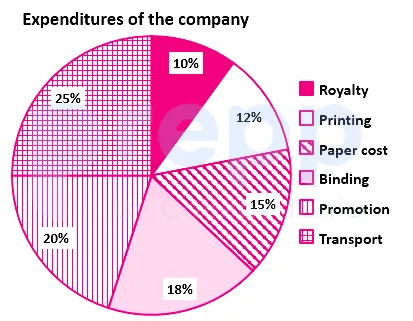
- A
Rs. 122.9
- B
Rs. 188.5
- C
Rs. 182.5
- D
Rs. 220.6
Show answer
A. Rs. 122.9Calculation:
Let the Cost price of the book be 100
Then, Marked Price of the book is 100 + (15% of 100) = 115
Printed price or marked price = 942
Cost price of book = 942 × (100/115)
⇒ 819.13
Now,
Paper cost = 819.13 × 15/100
⇒ 122.869 ≈ 122.9
∴ The required answer is Rs. 122.9
Paper & answer key PDF ↗ Question 53archived
In a 100-m race, A beats B by 20 m and B beats C by 20 m. By how much distance does A beat C.
- A
64 m
- B
24 m
- C
25 m
- D
36 m
Show answer
D. 36 mUnderstanding the Race Problem
This problem involves analyzing the relative speeds of three runners, A, B, and C, in a 100-meter race. We are given how much A beats B and how much B beats C, and we need to find out how much A beats C over the same distance.
Analyzing the Given Information
Race distance: 100 meters.
A beats B by 20 meters: This means when A finishes the 100-meter race, B is 20 meters behind the finish line. So, B has run 100 m - 20 m = 80 m in the same time A ran 100 m.
B beats C by 20 meters: This means when B finishes a 100-meter race, C is 20 meters behind the finish line. So, C has run 100 m - 20 m = 80 m in the same time B ran 100 m.
Relating Speeds using Distances
Since the time taken is the same for the distances covered by each pair when one finishes the race, we can relate their speeds (or distances covered in the same time) using ratios.
When A runs 100 m, B runs 80 m.
When B runs 100 m, C runs 80 m.
Calculating Distance C Covers When A Finishes
We want to find out how far C runs when A runs 100 m. We know the relationship between A and B, and between B and C. We can link these relationships.
From the second point, we know that for every 100 m B runs, C runs 80 m.
So, when B runs 1 m, C runs $\frac{80}{100}$ m.
Now, we know that when A runs 100 m, B runs 80 m. We need to find out how far C runs in the time B runs 80 m.
Using the ratio from B to C:
If B runs 100 m, C runs 80 m.
Therefore, if B runs 80 m, C runs $80 \times \frac{80}{100}$ m.
Distance covered by C when B covers 80 m = $80 \times \frac{80}{100} = \frac{6400}{100} = 64$ m.
Since B covers 80 m when A covers 100 m, this means that when A finishes the 100 m race, C has covered 64 m.
Determining How Much A Beats C
In the time A runs 100 m, C runs 64 m.
The distance by which A beats C is the difference between the distance A ran and the distance C ran in the same time.
Distance A beats C = Distance covered by A - Distance covered by C
Distance A beats C = 100 m - 64 m = 36 m.
Therefore, A beats C by 36 meters in the 100-meter race.
Runner
Distance covered when A finishes 100m
A
100 m
B
80 m
C
64 m
This table summarizes the distances covered by each runner when A completes the 100m race.
Revision Table: Key Concepts in Race Problems
Concept
Explanation
Application in this Problem
Relative Distance
The distance difference between two runners at a specific point in time, often when the first runner finishes the race.
A beats B by 20m, B beats C by 20m, A beats C by 36m.
Constant Speed Assumption
Typically, runners are assumed to maintain a constant speed throughout the race unless stated otherwise. This allows using ratios of distances.
Used to calculate the distance C covers when B covers a certain distance, based on their 100m race performance.
Ratio of Distances = Ratio of Speeds
If two runners cover distances $d_1$ and $d_2$ in the same time, their speeds $v_1$ and $v_2$ are proportional: $\frac{d_1}{d_2} = \frac{v_1}{v_2}$.
$\frac{\text{Speed}_A}{\text{Speed}_B} = \frac{100}{80}$, $\frac{\text{Speed}_B}{\text{Speed}_C} = \frac{100}{80}$.
Combining Ratios
To find the relationship between non-adjacent runners (like A and C), you can multiply or link the ratios.
$\frac{\text{Speed}_A}{\text{Speed}_C} = \frac{\text{Speed}_A}{\text{Speed}_B} \times \frac{\text{Speed}_B}{\text{Speed}_C} = \frac{100}{80} \times \frac{100}{80}$.
Additional Information: Race Problem Variations
Race problems can have several variations. Understanding these can help tackle different questions:
Starting Points: Problems might involve one runner giving another a head start (e.g., A gives B a 10m start).
Dead Heat: Problems might ask about the conditions for a dead heat (tie) between runners.
Meeting Points: Problems might involve runners running towards each other or in the same direction on a track, asking where and when they meet.
Multiple Races: Information might be given from different races of varying lengths.
The key is often to find the ratio of speeds or distances covered in the same amount of time for the runners involved and then apply this ratio to the specific race distance in question.
Paper & answer key PDF ↗ Question 54archived
If one man or two women or four boys or five girls can finish a work in 39 days, then how many days will one man, one woman, one boy and one girl together take to finish the same work?
- A
40
- B
10
- C
30
- D
20
Show answer
D. 20Understanding the Work and Time Problem
This problem involves the concept of work rate and how different individuals or groups contribute to completing a task over time. The key is to find a common unit of work or compare the efficiency of men, women, boys, and girls.
Converting Work Rates to a Common Unit
We are given the equivalence in terms of work rate:
1 man can finish the work in 39 days.
2 women can finish the work in 39 days.
4 boys can finish the work in 39 days.
5 girls can finish the work in 39 days.
This means that in terms of work output per day, 1 man is equivalent to 2 women, which is equivalent to 4 boys, and equivalent to 5 girls. We can use any of these as a base unit. Let's use girls as the common unit.
From the given information, we can establish the following equivalences:
1 man <--> 5 girls
2 women <--> 5 girls, so 1 woman <--> \(\frac{5}{2}\) girls
4 boys <--> 5 girls, so 1 boy <--> \(\frac{5}{4}\) girls
Calculating Total Work Units
The total amount of work required to complete the task is constant. We can calculate this total work based on any of the given groups. Let's use the girls group:
If 5 girls can finish the work in 39 days, the total work is equivalent to the work done by 5 girls over 39 days.
\[ \text{Total Work} = \text{Number of workers} \times \text{Days taken} \times \text{Work rate per worker} \]
Assuming the work rate of one girl is 'g' units per day, the total work is:
\[ \text{Total Work} = 5 \times 39 \times g \]
For simplicity, we can think of the total work as 5 girls working for 39 days, which equals \(5 \times 39 = 195\) "girl-days" of work.
Combined Work Rate of the Mixed Group
Now, we need to find the combined work rate of the group consisting of 1 man, 1 woman, 1 boy, and 1 girl. We convert each member of this group into our common unit (girls) using the equivalences we found:
1 man = 5 girls
1 woman = \(\frac{5}{2}\) girls = 2.5 girls
1 boy = \(\frac{5}{4}\) girls = 1.25 girls
1 girl = 1 girl
The total equivalent number of girls in the combined group is:
\[ \text{Equivalent girls} = 5 + 2.5 + 1.25 + 1 \]
\[ \text{Equivalent girls} = 9.75 \]
So, the combined group of 1 man, 1 woman, 1 boy, and 1 girl works at the same rate as 9.75 girls.
Calculating Days to Finish the Work
To find the number of days the combined group will take, we divide the total work by the combined work rate (in equivalent girls):
\[ \text{Days taken} = \frac{\text{Total Work (in girl-days)}}{\text{Combined Work Rate (in equivalent girls)}} \]
\[ \text{Days taken} = \frac{195 \text{ girl-days}}{9.75 \text{ girls}} \]
Now, we perform the division:
\[ \text{Days taken} = \frac{195}{9.75} \]
To simplify the division, we can write 9.75 as a fraction or multiply both numerator and denominator by 100:
\[ 9.75 = \frac{975}{100} = \frac{39 \times 25}{4 \times 25} = \frac{39}{4} \]
So, the calculation becomes:
\[ \text{Days taken} = \frac{195}{\frac{39}{4}} = 195 \times \frac{4}{39} \]
We know that \(195 = 5 \times 39\). Substituting this:
\[ \text{Days taken} = (5 \times 39) \times \frac{4}{39} \]
The 39 in the numerator and denominator cancel out:
\[ \text{Days taken} = 5 \times 4 = 20 \]
Therefore, one man, one woman, one boy, and one girl together will take 20 days to finish the same work.
Group
Time (Days)
Equivalence (Girls)
1 Man
39
5
2 Women
39
5 (so 1 Woman = 2.5 Girls)
4 Boys
39
5 (so 1 Boy = 1.25 Girls)
5 Girls
39
5
1M, 1W, 1B, 1G
?
5 + 2.5 + 1.25 + 1 = 9.75
Revision Table: Work and Time Concepts
Concept
Explanation
Formula
Work Rate
Amount of work done by a person or group in a unit of time (e.g., per day).
Work Rate = \(\frac{\text{Total Work}}{\text{Time Taken}}\)
Total Work
The total amount of the task to be completed. Can be represented as (Rate \(\times\) Time).
Total Work = Rate \(\times\) Time
Individual Efficiency
How much work one person can do compared to another in the same amount of time.
If A is twice as efficient as B, A's Rate = 2 \(\times\) B's Rate
Combined Work Rate
The sum of individual work rates when people work together.
Combined Rate = Rate1 + Rate2 + ...
Additional Information: Solving Similar Work Problems
Problems involving different types of workers with varying efficiencies are common in competitive exams. The key steps usually involve:
Establishing the relationship between the work rates of different individuals or groups. This often means finding how many of one type are equivalent to a certain number of another type in terms of work done.
Calculating the total work required for the job using the time taken by any given group.
Determining the combined work rate of the new group by converting everyone into a common unit or finding their combined efficiency relative to the total work.
Using the formula: Time Taken = Total Work / Combined Work Rate to find the answer.
It's important to be comfortable working with fractions or decimals when converting between different types of workers.
Paper & answer key PDF ↗ Question 55archived
The value of cot 15° cot 25° cot 45° cot 75° cot 65° is:
- A
1
- B
√3
- C
2
- D
√2
Show answer
A. 1Finding the Value of Trigonometric Expression cot 15° cot 25° cot 45° cot 75° cot 65°
The problem asks us to find the value of the trigonometric expression: $\cot 15^\circ \cot 25^\circ \cot 45^\circ \cot 75^\circ \cot 65^\circ$.
To simplify this expression, we can use trigonometric identities, specifically the complementary angle identity. The complementary angle identity states that for acute angles, $\cot (90^\circ - \theta) = \tan \theta$. We also know that $\tan \theta = \frac{1}{\cot \theta}$ or $\cot \theta = \frac{1}{\tan \theta}$, which implies $\cot \theta \tan \theta = 1$.
Step-by-Step Solution for cot 15° cot 25° cot 45° cot 75° cot 65°
Let's look at the angles in the expression and identify pairs that add up to $90^\circ$ (complementary angles):
$15^\circ$ and $75^\circ$ ($15^\circ + 75^\circ = 90^\circ$)
$25^\circ$ and $65^\circ$ ($25^\circ + 65^\circ = 90^\circ$)
The angle $45^\circ$ is unique in this set.
Now, let's use the complementary angle identity $\cot (90^\circ - \theta) = \tan \theta$ for the angles $75^\circ$ and $65^\circ$:
For $75^\circ$: $\cot 75^\circ = \cot (90^\circ - 15^\circ) = \tan 15^\circ$
For $65^\circ$: $\cot 65^\circ = \cot (90^\circ - 25^\circ) = \tan 25^\circ$
Substitute these back into the original expression:
Original Expression: $\cot 15^\circ \cot 25^\circ \cot 45^\circ \cot 75^\circ \cot 65^\circ$
Substitute the simplified terms:
Expression = $\cot 15^\circ \cot 25^\circ \cot 45^\circ (\tan 15^\circ) (\tan 25^\circ)$
Now, rearrange the terms to group $\cot \theta$ with its complementary $\tan \theta$:
Expression = $(\cot 15^\circ \tan 15^\circ) (\cot 25^\circ \tan 25^\circ) \cot 45^\circ$
Using the identity $\cot \theta \tan \theta = 1$:
$\cot 15^\circ \tan 15^\circ = 1$
$\cot 25^\circ \tan 25^\circ = 1$
Substitute these values back into the expression:
Expression = $(1) (1) \cot 45^\circ$
We know the value of $\cot 45^\circ$. From the trigonometric table, $\cot 45^\circ = 1$.
Substitute the value of $\cot 45^\circ$:
Expression = $1 \times 1 \times 1 = 1$
Thus, the value of the given trigonometric expression is $1$.
Key Trigonometric Identities Used
Identity
Formula
Complementary Angle Identity
$\cot (90^\circ - \theta) = \tan \theta$
Reciprocal Identity
$\cot \theta = \frac{1}{\tan \theta}$ or $\tan \theta = \frac{1}{\cot \theta}$
Product Identity
$\cot \theta \tan \theta = 1$
Value of Standard Angle
Angle
Value of cot
$45^\circ$
$1$
Summary of Calculation Steps
Identify complementary angle pairs ($15^\circ$ & $75^\circ$, $25^\circ$ & $65^\circ$).
Use $\cot (90^\circ - \theta) = \tan \theta$ to rewrite $\cot 75^\circ$ and $\cot 65^\circ$.
Substitute the equivalent tangent forms back into the expression.
Group terms like $(\cot \theta \tan \theta)$.
Apply the identity $\cot \theta \tan \theta = 1$.
Substitute the known value of $\cot 45^\circ$.
Multiply the resulting values to find the final answer.
Following these steps, we found the value of $\cot 15^\circ \cot 25^\circ \cot 45^\circ \cot 75^\circ \cot 65^\circ$ to be $1$.
Revision Table: Trigonometric Values & Identities
This table helps review some fundamental trigonometric values and identities relevant to simplifying expressions.
Concept
Detail / Formula
$\cot 45^\circ$
$1$ (Since $\tan 45^\circ = 1$ and $\cot \theta = 1/\tan \theta$)
Complementary Angles
Two angles adding up to $90^\circ$. If A + B = $90^\circ$, then A and B are complementary.
Complementary Identity (Cot/Tan)
$\cot (90^\circ - \theta) = \tan \theta$
Reciprocal Identity (Cot/Tan)
$\cot \theta = 1 / \tan \theta$
Product Identity (Cot/Tan)
$\cot \theta \cdot \tan \theta = 1$
Additional Information: Simplifying Trigonometric Expressions
Simplifying trigonometric expressions is a key skill in trigonometry. It often involves using identities to rewrite parts of the expression in a simpler form. Common strategies include:
Using Reciprocal Identities: Converting everything to sine and cosine or using reciprocal pairs like cot and tan.
Using Quotient Identities: Replacing $\tan \theta$ with $\frac{\sin \theta}{\cos \theta}$ and $\cot \theta$ with $\frac{\cos \theta}{\sin \theta}$.
Using Pythagorean Identities: Applying identities like $\sin^2 \theta + \cos^2 \theta = 1$, $1 + \tan^2 \theta = \sec^2 \theta$, and $1 + \cot^2 \theta = \csc^2 \theta$.
Using Complementary Angle Identities: Converting trigonometric functions of angles greater than $45^\circ$ to functions of angles less than $45^\circ$, or simplifying expressions involving angles that add up to $90^\circ$. This was particularly useful in the problem above.
Factoring and Algebraic Manipulation: Applying algebraic techniques like factoring, expanding, or finding a common denominator after applying identities.
Practicing with various problems helps in recognizing which identities and strategies are most effective for a given expression.
Paper & answer key PDF ↗ Question 56archived
In triangle PQR, right angled at Q, if cot P = √3, then the value of sin P is:
- A
1
- B
\(\frac{1}{\sqrt3}\)
- C
\(\frac{\sqrt 3}{2}\)
- D
\(\frac{1}{2}\)
Show answer
D. \(\frac{1}{2}\)Solving for sin P in Right Triangle PQR
The problem asks us to find the value of sin P in a right-angled triangle PQR, where the right angle is at Q, and we are given that cot P = √3.
Let's first understand the given information and the trigonometric ratios involved.
Triangle PQR is right-angled at Q. This means ∠Q = 90°.
The angle P is one of the acute angles in the triangle.
The given value is cot P = √3.
We need to find the value of sin P.
Relating cot P to Triangle Sides
In a right-angled triangle, the trigonometric ratio cotangent (cot) of an acute angle is defined as the ratio of the length of the side adjacent to the angle to the length of the side opposite the angle.
For angle P in triangle PQR (right-angled at Q):
The side adjacent to angle P is PQ.
The side opposite to angle P is QR.
The hypotenuse is PR (the side opposite the right angle).
So, the definition of cot P is:
$$ \text{cot P} = \frac{\text{Adjacent side}}{\text{Opposite side}} = \frac{PQ}{QR} $$
We are given that cot P = √3. Therefore:
$$ \frac{PQ}{QR} = \sqrt{3} $$
This ratio tells us the relationship between the lengths of sides PQ and QR. We can represent their lengths based on this ratio.
Let QR = \(k\), where \(k\) is a positive constant representing some unit of length.
Then, from \( \frac{PQ}{QR} = \sqrt{3} \), we get \( PQ = \sqrt{3} \times QR = \sqrt{3}k \).
Finding the Hypotenuse (PR) using Pythagorean Theorem
In a right-angled triangle, the square of the hypotenuse is equal to the sum of the squares of the other two sides (Pythagorean theorem).
In triangle PQR, we have:
$$ PR^2 = PQ^2 + QR^2 $$
Substitute the expressions for PQ and QR in terms of \(k\):
$$ PR^2 = (\sqrt{3}k)^2 + (k)^2 $$
$$ PR^2 = (3 \times k^2) + k^2 $$
$$ PR^2 = 3k^2 + k^2 $$
$$ PR^2 = 4k^2 $$
Now, take the square root of both sides to find PR:
$$ PR = \sqrt{4k^2} = 2k $$
So, the lengths of the sides of the triangle are proportional to QR : PQ : PR = \(k\) : \(\sqrt{3}k\) : \(2k\), or in ratio form 1 : \(\sqrt{3}\) : 2.
Calculating sin P
The trigonometric ratio sine (sin) of an acute angle in a right-angled triangle is defined as the ratio of the length of the side opposite the angle to the length of the hypotenuse.
For angle P in triangle PQR:
$$ \text{sin P} = \frac{\text{Opposite side}}{\text{Hypotenuse}} = \frac{QR}{PR} $$
Substitute the expressions for QR and PR in terms of \(k\):
$$ \text{sin P} = \frac{k}{2k} $$
Cancel out the common factor \(k\) (since \(k \neq 0\)):
$$ \text{sin P} = \frac{1}{2} $$
Thus, the value of sin P is \( \frac{1}{2} \).
Alternative Method: Using Trigonometric Identities
We are given cot P = √3. We know the relationship between cot P and tan P: \( \text{tan P} = \frac{1}{\text{cot P}} \).
$$ \text{tan P} = \frac{1}{\sqrt{3}} $$
We also know the identity \( \text{sin}^2 \text{P} + \text{cos}^2 \text{P} = 1 \).
And \( \text{tan P} = \frac{\text{sin P}}{\text{cos P}} \), which means \( \text{cos P} = \frac{\text{sin P}}{\text{tan P}} \).
Substitute cos P in the identity:
$$ \text{sin}^2 \text{P} + \left(\frac{\text{sin P}}{\text{tan P}}\right)^2 = 1 $$
$$ \text{sin}^2 \text{P} + \frac{\text{sin}^2 \text{P}}{\text{tan}^2 \text{P}} = 1 $$
$$ \text{sin}^2 \text{P} \left(1 + \frac{1}{\text{tan}^2 \text{P}}\right) = 1 $$
We know \( 1 + \text{cot}^2 \text{P} = \text{cosec}^2 \text{P} \) and \( \text{cosec P} = \frac{1}{\text{sin P}} \).
Also, \( 1 + \frac{1}{\text{tan}^2 \text{P}} = 1 + \text{cot}^2 \text{P} \).
$$ \text{sin}^2 \text{P} (1 + \text{cot}^2 \text{P}) = 1 $$
Substitute the value cot P = √3:
$$ \text{sin}^2 \text{P} (1 + (\sqrt{3})^2) = 1 $$
$$ \text{sin}^2 \text{P} (1 + 3) = 1 $$
$$ \text{sin}^2 \text{P} (4) = 1 $$
$$ \text{sin}^2 \text{P} = \frac{1}{4} $$
Take the square root of both sides. Since P is an angle in a right triangle, sin P must be positive.
$$ \text{sin P} = \sqrt{\frac{1}{4}} = \frac{1}{2} $$
Both methods yield the same result.
Trigonometric Ratio
Definition
Value for P
cot P
Adjacent / Opposite
\( \frac{PQ}{QR} = \sqrt{3} \) (Given)
sin P
Opposite / Hypotenuse
\( \frac{QR}{PR} = \frac{k}{2k} = \frac{1}{2} \) (Calculated)
cos P
Adjacent / Hypotenuse
\( \frac{PQ}{PR} = \frac{\sqrt{3}k}{2k} = \frac{\sqrt{3}}{2} \) (Can be calculated)
Final Answer Check
If sin P = \( \frac{1}{2} \), this corresponds to angle P = 30° (since sin 30° = 1/2).
Let's check if cot 30° = √3.
We know cos 30° = \( \frac{\sqrt{3}}{2} \) and sin 30° = \( \frac{1}{2} \).
cot P = \( \frac{\text{cos P}}{\text{sin P}} = \frac{\text{cos 30°}}{\text{sin 30°}} = \frac{\sqrt{3}/2}{1/2} = \frac{\sqrt{3}}{2} \times \frac{2}{1} = \sqrt{3} \).
This matches the given information cot P = √3. So our calculated value for sin P is correct.
Revision Table: Key Trigonometric Concepts
Concept
Definition
Relationship
Sine (sin)
Opposite side / Hypotenuse
Reciprocal of cosecant (cosec)
Cosine (cos)
Adjacent side / Hypotenuse
Reciprocal of secant (sec)
Tangent (tan)
Opposite side / Adjacent side
Reciprocal of cotangent (cot), sin / cos
Cotangent (cot)
Adjacent side / Opposite side
Reciprocal of tangent (tan), cos / sin
Pythagorean Theorem
\( \text{Hypotenuse}^2 = \text{Opposite}^2 + \text{Adjacent}^2 \)
Applies to right-angled triangles
Additional Information: Special Angles
It is helpful to remember the trigonometric values for certain special angles like 0°, 30°, 45°, 60°, and 90°. The value cot P = √3 is associated with a special angle.
Angle \(\theta\)
sin \(\theta\)
cos \(\theta\)
tan \(\theta\)
cot \(\theta\)
30°
\( \frac{1}{2} \)
\( \frac{\sqrt{3}}{2} \)
\( \frac{1}{\sqrt{3}} \)
\( \sqrt{3} \)
45°
\( \frac{1}{\sqrt{2}} \)
\( \frac{1}{\sqrt{2}} \)
1
1
60°
\( \frac{\sqrt{3}}{2} \)
\( \frac{1}{2} \)
\( \sqrt{3} \)
\( \frac{1}{\sqrt{3}} \)
Since cot P = √3, angle P must be 30°. For P = 30°, sin P is \( \frac{1}{2} \). This confirms our result.
Paper & answer key PDF ↗ Question 57archived
The difference of two numbers is 1564. After dividing the larger number by the smaller, we get 6 as quotient and 19 as remainder. What is the smaller number?
- A
456
- B
287
- C
623
- D
309
Show answer
D. 309Understanding the Problem: Finding the Smaller Number
The problem asks us to find a smaller number, given its relationship with a larger number. We are provided with two key pieces of information:
The difference between the two numbers.
The result of dividing the larger number by the smaller number (including the quotient and remainder).
Let's define the terms clearly:
Let the larger number be \( L \).
Let the smaller number be \( S \).
Based on the problem statement, we can form mathematical equations using these variables.
Formulating Equations from the Given Information
The first piece of information is that the difference between the two numbers is 1564.
Since \( L \) is the larger number and \( S \) is the smaller number, their difference is expressed as:
\( L - S = 1564 \)
This is our first equation.
The second piece of information relates to division. When the larger number \( L \) is divided by the smaller number \( S \), the quotient is 6 and the remainder is 19. The division algorithm states that Dividend = Divisor \(\times\) Quotient + Remainder.
In this case:
Dividend = \( L \) (the larger number)
Divisor = \( S \) (the smaller number)
Quotient = 6
Remainder = 19
So, we can write the second equation based on the division algorithm:
\( L = 6S + 19 \)
This is our second equation.
Solving the System of Equations to Find the Smaller Number
We now have a system of two linear equations with two variables:
\( L - S = 1564 \)
\( L = 6S + 19 \)
We want to find the value of the smaller number, \( S \). We can use the method of substitution to solve this system. Equation (2) already gives us an expression for \( L \) in terms of \( S \). We can substitute this expression for \( L \) into Equation (1).
Substitute \( 6S + 19 \) for \( L \) in Equation (1):
\( (6S + 19) - S = 1564 \)
Now, we simplify and solve for \( S \):
Combine the terms with \( S \):
\( 6S - S + 19 = 1564 \)
\( 5S + 19 = 1564 \)
Subtract 19 from both sides of the equation:
\( 5S = 1564 - 19 \)
\( 5S = 1545 \)
Divide both sides by 5 to find \( S \):
\( S = \frac{1545}{5} \)
\( S = 309 \)
The value of the smaller number \( S \) is 309.
Verification of the Solution
Let's check if this value of \( S \) satisfies the original conditions. If \( S = 309 \), we can find \( L \) using the second equation:
\( L = 6S + 19 \)
\( L = 6(309) + 19 \)
\( L = 1854 + 19 \)
\( L = 1873 \)
So, the larger number is 1873 and the smaller number is 309.
Now, let's check the first condition: the difference between the two numbers is 1564.
\( L - S = 1873 - 309 \)
\( 1873 - 309 = 1564 \)
The difference matches the given information.
Next, let's check the second condition: dividing the larger number by the smaller number gives a quotient of 6 and a remainder of 19.
Divide 1873 by 309:
\( 1873 \div 309 \)
We know \( 309 \times 6 = 1854 \).
Subtract 1854 from 1873:
\( 1873 - 1854 = 19 \)
The quotient is 6 and the remainder is 19. This also matches the given information.
Since both conditions are satisfied, our calculated value for the smaller number \( S = 309 \) is correct.
Concept
Formula / Principle
Application to Problem
Difference
Larger Number - Smaller Number
\( L - S = 1564 \)
Division Algorithm
Dividend = Divisor × Quotient + Remainder
\( L = S \times 6 + 19 \) or \( L = 6S + 19 \)
Conclusion: The Smaller Number
By setting up and solving the algebraic equations derived from the problem statement, we found the value of the smaller number.
The smaller number is 309.
Revision Table: Key Steps to Solve Number Problems
Step
Description
Action Taken
1
Read the problem carefully and identify the unknowns.
Identified two numbers, larger (\( L \)) and smaller (\( S \)).
2
Translate the given information into mathematical equations.
Formed equations \( L - S = 1564 \) and \( L = 6S + 19 \).
3
Solve the system of equations for the required unknown(s).
Used substitution to solve for \( S \).
4
Verify the solution with the original problem conditions.
Checked difference and division results.
Additional Information: Understanding Quotient and Remainder
When an integer is divided by another positive integer, the result can be expressed using a quotient and a remainder. The division algorithm formally states this relationship.
The Quotient is the whole number of times the divisor goes into the dividend.
The Remainder is the amount left over after the division is complete.
The remainder must always be less than the divisor and greater than or equal to zero.
Example: When 10 is divided by 3:
Dividend = 10
Divisor = 3
Quotient = 3 (since \( 3 \times 3 = 9 \))
Remainder = 1 (since \( 10 - 9 = 1 \))
Using the algorithm: \( 10 = 3 \times 3 + 1 \).
In our problem, the divisor is the smaller number \( S \), the quotient is 6, and the remainder is 19. So, \( L = S \times 6 + 19 \), which is \( L = 6S + 19 \). This shows how the division information is converted into an algebraic equation.
Paper & answer key PDF ↗ Question 58archived
If a + b + c = 6, a 2+ b 2+ c 2= 14 and ab + bc + ca = 11, then what is the value of a 3 + b 3 + c 3 - 3abc?
- A
31
- B
12
- C
18
- D
42
Show answer
C. 18Understanding the Algebraic Problem
The problem asks us to find the value of the expression $\small a^3 + b^3 + c^3 - 3abc$ given three specific equations involving the variables $\small a$, $\small b$, and $\small c$:
$\small a + b + c = 6$
$\small a^2 + b^2 + c^2 = 14$
$\small ab + bc + ca = 11$
To solve this, we need to recall and apply a fundamental algebraic identity that relates these sums to the expression we need to evaluate.
Key Algebraic Identity for $\small a^3 + b^3 + c^3 - 3abc$
There is a well-known algebraic identity that directly links the sum of cubes minus three times the product of the variables to the sums provided in the problem:
$\small a^3 + b^3 + c^3 - 3abc = (a + b + c)(a^2 + b^2 + c^2 - ab - bc - ca)$
Let's examine the components of the right-hand side of this identity:
The term $\small (a + b + c)$ is given directly in the problem.
The term $\small (a^2 + b^2 + c^2)$ is also given directly in the problem.
The term $\small (-ab - bc - ca)$ can be obtained from the given $\small (ab + bc + ca)$. Specifically, $\small (a^2 + b^2 + c^2 - ab - bc - ca) = (a^2 + b^2 + c^2) - (ab + bc + ca)$.
Step-by-Step Calculation of $\small a^3 + b^3 + c^3 - 3abc$
We can substitute the given values into the identity. First, let's calculate the value of the second factor on the right side of the identity:
The second factor is $\small (a^2 + b^2 + c^2 - ab - bc - ca)$.
We know:
$\small a^2 + b^2 + c^2 = 14$
$\small ab + bc + ca = 11$
So, $\small a^2 + b^2 + c^2 - ab - bc - ca = (a^2 + b^2 + c^2) - (ab + bc + ca) = 14 - 11 = 3$.
Now, we can substitute the values of both factors into the main identity:
$\small a^3 + b^3 + c^3 - 3abc = (a + b + c)(a^2 + b^2 + c^2 - ab - bc - ca)$
We know:
$\small a + b + c = 6$
$\small (a^2 + b^2 + c^2 - ab - bc - ca) = 3$ (calculated above)
Substituting these values:
$\small a^3 + b^3 + c^3 - 3abc = (6) \times (3)$
$\small a^3 + b^3 + c^3 - 3abc = 18$
Thus, the value of the expression $\small a^3 + b^3 + c^3 - 3abc$ is 18.
Summary of Calculations
Given Information
Calculated Value
$\small a + b + c = 6$
$\small a^2 + b^2 + c^2 - ab - bc - ca = (14) - (11) = 3$
$\small a^2 + b^2 + c^2 = 14$
$\small a^3 + b^3 + c^3 - 3abc = (a + b + c)(a^2 + b^2 + c^2 - ab - bc - ca) = (6)(3) = 18$
$\small ab + bc + ca = 11$
Revision Table: Important Algebraic Identities
Identity
Formula
Square of sum of three terms
$\small (a + b + c)^2 = a^2 + b^2 + c^2 + 2(ab + bc + ca)$
Sum of cubes identity
$\small a^3 + b^3 + c^3 - 3abc = (a + b + c)(a^2 + b^2 + c^2 - ab - bc - ca)$
Special case of sum of cubes
If $\small a + b + c = 0$, then $\small a^3 + b^3 + c^3 = 3abc$
Additional Information: Verifying Relationships
We can verify the consistency of the given information using another identity. The identity for the square of the sum of three terms is:
$\small (a + b + c)^2 = a^2 + b^2 + c^2 + 2(ab + bc + ca)$
Let's substitute the given values into this identity:
Left side: $\small (a + b + c)^2 = (6)^2 = 36$
Right side: $\small a^2 + b^2 + c^2 + 2(ab + bc + ca) = 14 + 2(11) = 14 + 22 = 36$
Since the Left side equals the Right side ($\small 36 = 36$), the given values for $\small a + b + c$, $\small a^2 + b^2 + c^2$, and $\small ab + bc + ca$ are consistent with algebraic relationships. This confirms that our input data is valid for applying algebraic identities to find the value of $\small a^3 + b^3 + c^3 - 3abc$.
Paper & answer key PDF ↗ Question 59archived
The length of the tangent to a circle from a point P is 15 cm. Point P is 17 cm away from the centre. What is the radius of the circle?
- A
7 cm
- B
9 cm
- C
8 cm
- D
4 cm
Show answer
C. 8 cmFinding the Radius of a Circle Using Tangent Properties
This problem involves a fundamental property of tangents to a circle and the application of the Pythagorean theorem. We are given the length of a tangent drawn from an external point P to a circle, and the distance of point P from the centre of the circle. We need to determine the radius of the circle.
Understanding the Geometry: Tangents and Radii
A key geometric principle states that the tangent at any point on a circle is perpendicular to the radius through the point of contact. Let's consider the given information:
Point P is an external point.
The length of the tangent from P to the circle is 15 cm. Let the point where the tangent touches the circle be T. So, PT = 15 cm.
The distance of point P from the centre of the circle (let's call the centre O) is 17 cm. So, OP = 17 cm.
We want to find the radius of the circle, which is the distance from the centre O to any point on the circle, including the point of contact T. So, OT is the radius, let's denote it by \(r\).
Since the tangent PT is perpendicular to the radius OT at the point of contact T, the angle \(\angle OTP\) is a right angle (\(90^\circ\)). This forms a right-angled triangle \(\triangle OTP\).
Applying the Pythagorean Theorem
In the right-angled triangle \(\triangle OTP\), the sides are:
OT (radius, \(r\)) - one leg
PT (tangent length, 15 cm) - the other leg
OP (distance from centre to P, 17 cm) - the hypotenuse
According to the Pythagorean theorem, in a right-angled triangle, the square of the hypotenuse is equal to the sum of the squares of the other two sides. Therefore, we have:
\(OT^2 + PT^2 = OP^2\)
Substituting the given values:
\(r^2 + 15^2 = 17^2\)
Calculating the Radius
Now, we need to solve this equation for \(r\):
\(r^2 + 15^2 = 17^2\)
Calculate the squares:
\(15^2 = 15 \times 15 = 225\)
\(17^2 = 17 \times 17 = 289\)
Substitute these values back into the equation:
\(r^2 + 225 = 289\)
Subtract 225 from both sides to isolate \(r^2\):
\(r^2 = 289 - 225\)
\(r^2 = 64\)
To find \(r\), take the square root of both sides:
\(r = \sqrt{64}\)
\(r = 8\)
Since the radius must be a positive value, the radius of the circle is 8 cm.
Component
Length (cm)
Description
PT
15
Length of the tangent
OP
17
Distance from the centre to point P (Hypotenuse)
OT
\(r\)
Radius of the circle (Leg)
Thus, the radius of the circle is 8 cm.
Revision Table: Circle Tangent Properties
Concept
Description
Relevance to Problem
Tangent to a Circle
A line segment that touches the circle at exactly one point (the point of contact).
PT is the tangent segment.
Radius through Point of Contact
The radius drawn from the centre to the point where the tangent touches the circle.
OT is the radius through the point of contact T.
Tangent-Radius Perpendicularity
A tangent at any point of a circle is perpendicular to the radius through the point of contact.
Forms a right angle at T (\(\angle OTP = 90^\circ\)), creating a right triangle \(\triangle OTP\).
Pythagorean Theorem
In a right-angled triangle with legs a, b and hypotenuse c, \(a^2 + b^2 = c^2\).
Used to find the unknown side (radius) in the right triangle \(\triangle OTP\): \(OT^2 + PT^2 = OP^2\).
Additional Information: More Circle Properties
Understanding tangents is part of a broader study of circle geometry. Here are a few related concepts:
Length of Tangents from an External Point: If two tangents are drawn from the same external point to a circle, their lengths are equal.
Secant: A line that intersects a circle at two distinct points.
Chord: A line segment connecting two points on the circle. A diameter is the longest chord.
Angle in a Semicircle: The angle subtended by a diameter at any point on the circumference is \(90^\circ\).
Angles Subtended by an Arc: The angle subtended by an arc at the centre is double the angle subtended by the same arc at any point on the remaining part of the circle.
These properties are useful for solving various geometry problems involving circles.
Paper & answer key PDF ↗ Question 60archived
Side of an equilateral triangle is 24 cm. What will be the radius of in circle of this equilateral triangle?
- A
6√2 cm
- B
12 cm
- C
4√3 cm
- D
3 cm
Show answer
C. 4√3 cmCalculating the Incircle Radius of an Equilateral Triangle
Let's find the radius of the incircle for an equilateral triangle with a given side length. An equilateral triangle is a triangle where all three sides are equal in length, and all three angles are equal, each measuring 60 degrees. The incircle of a triangle is the largest circle that can be inscribed inside the triangle, touching all three sides. The center of the incircle is called the incenter, which is the intersection point of the angle bisectors.
Understanding the Relationship: Inradius and Side Length
For an equilateral triangle, there is a specific relationship between its side length and the radius of its incircle (also known as the inradius). If the side length of the equilateral triangle is denoted by 'a', the formula for the inradius 'r' is:
\( r = \frac{a}{2\sqrt{3}} \)
This formula is derived from the properties of equilateral triangles and trigonometry, or by relating the area of the triangle to its perimeter and inradius (Area = rs, where r is inradius and s is semi-perimeter).
Step-by-Step Calculation of Incircle Radius
We are given that the side of the equilateral triangle is 24 cm.
Side length, a = 24 cm.
The formula for the inradius of an equilateral triangle is \( r = \frac{a}{2\sqrt{3}} \).
Substitute the given side length into the formula:
\( r = \frac{24}{2\sqrt{3}} \)
Simplify the fraction:
\( r = \frac{12}{\sqrt{3}} \)
To rationalize the denominator, multiply the numerator and the denominator by \(\sqrt{3}\):
\( r = \frac{12}{\sqrt{3}} \times \frac{\sqrt{3}}{\sqrt{3}} \)
\( r = \frac{12\sqrt{3}}{3} \)
Further simplification:
\( r = 4\sqrt{3} \text{ cm} \)
Thus, the radius of the incircle of the equilateral triangle with a side of 24 cm is \(4\sqrt{3}\) cm.
Comparing with Given Options
Let's compare our calculated radius with the provided options:
Option Number
Given Radius
Matches Calculation?
1
\(6\sqrt{2}\) cm
No
2
12 cm
No
3
\(4\sqrt{3}\) cm
Yes
4
3 cm
No
The calculated inradius \(4\sqrt{3}\) cm matches option 3.
Revision Table: Equilateral Triangle Formulas
Property
Formula (Side 'a')
Area
\( \frac{\sqrt{3}}{4} a^2 \)
Height (Altitude)
\( \frac{\sqrt{3}}{2} a \)
Inradius (r)
\( \frac{a}{2\sqrt{3}} \) or \( \frac{\sqrt{3}}{6} a \)
Circumradius (R)
\( \frac{a}{\sqrt{3}} \) or \( \frac{\sqrt{3}}{3} a \)
Additional Information: Inradius and Circumradius
For an equilateral triangle, the incenter, circumcenter, centroid, and orthocenter all coincide at the same point. The height of the equilateral triangle is also the median and the angle bisector. The inradius (r) and circumradius (R) are related to the height (h) of the equilateral triangle.
Height \( h = \frac{\sqrt{3}}{2} a \)
Inradius \( r = \frac{1}{3} h = \frac{1}{3} \times \frac{\sqrt{3}}{2} a = \frac{\sqrt{3}}{6} a = \frac{a}{2\sqrt{3}} \)
Circumradius \( R = \frac{2}{3} h = \frac{2}{3} \times \frac{\sqrt{3}}{2} a = \frac{\sqrt{3}}{3} a = \frac{a}{\sqrt{3}} \)
Also, notice that the circumradius is double the inradius: \( R = 2r \).
In this problem, the height would be \( \frac{\sqrt{3}}{2} \times 24 = 12\sqrt{3} \) cm. The inradius \( r = \frac{1}{3} \times 12\sqrt{3} = 4\sqrt{3} \) cm, which matches our calculation.
Paper & answer key PDF ↗ Question 61archived
The radius of a right circular cylinder is five times of its height. If the height of the cylinder is 3.5 cm, then what is the volume of cylinder?
- A
3368.75 cm3
- B
3872.75 cm3
- C
3146.75 cm3
- D
3524.25 cm3
Show answer
A. 3368.75 cm3Understanding the Cylinder Volume Problem
This problem asks us to calculate the volume of a right circular cylinder. We are given the height of the cylinder and the relationship between its radius and height.
A right circular cylinder is a three-dimensional solid with two parallel circular bases of the same size and a curved surface connecting the bases. The height of the cylinder is the perpendicular distance between the two bases.
Given Information about the Cylinder
The height of the cylinder is given: $h = 3.5$ cm.
The radius of the cylinder ($r$) is five times its height ($h$). This can be written as $r = 5h$.
Formula for Cylinder Volume
The volume ($V$) of a right circular cylinder is calculated using the formula:
$$V = \pi r^2 h$$
where:
$\pi$ (pi) is a mathematical constant, approximately 3.14159 or $22/7$.
$r$ is the radius of the base of the cylinder.
$h$ is the height of the cylinder.
Calculating the Cylinder's Radius
First, we need to find the radius ($r$) using the given height ($h = 3.5$ cm) and the relationship $r = 5h$.
$$r = 5 \times h$$
$$r = 5 \times 3.5 \text{ cm}$$
$$r = 17.5 \text{ cm}$$
So, the radius of the cylinder is 17.5 cm.
Calculating the Cylinder's Volume
Now we can calculate the volume ($V$) using the formula $V = \pi r^2 h$. We have $r = 17.5$ cm and $h = 3.5$ cm. We will use the approximation $\pi \approx \frac{22}{7}$ for the calculation.
$$V = \pi \times (17.5 \text{ cm})^2 \times (3.5 \text{ cm})$$
$$V = \frac{22}{7} \times (17.5 \times 17.5) \text{ cm}^3$$
$$V = \frac{22}{7} \times 306.25 \text{ cm}^3$$
To simplify the calculation, we can multiply 306.25 by 22 and then divide by 7, or notice that $3.5 = 7/2$, which might simplify the fraction with $\pi = 22/7$. Let's use the direct multiplication and division approach.
$$V = 22 \times \frac{306.25}{7} \text{ cm}^3$$
Let's divide 306.25 by 7 first:
$$306.25 \div 7 = 43.75$$
Now multiply by 22:
$$V = 22 \times 43.75 \text{ cm}^3$$
$$V = 962.5 \text{ cm}^3$$
Let's recheck the calculation $V = \pi r^2 h = \pi (17.5)^2 (3.5)$. Using $\pi \approx 22/7$.
$$V = \frac{22}{7} \times (17.5)^2 \times 3.5$$
We know $17.5 = \frac{35}{2}$ and $3.5 = \frac{7}{2}$.
$$V = \frac{22}{7} \times \left(\frac{35}{2}\right)^2 \times \frac{7}{2}$$
$$V = \frac{22}{7} \times \frac{35 \times 35}{2 \times 2} \times \frac{7}{2}$$
$$V = \frac{22}{7} \times \frac{1225}{4} \times \frac{7}{2}$$
Cancel out a 7 from the denominator and numerator:
$$V = 22 \times \frac{1225}{4} \times \frac{1}{2}$$
$$V = \frac{22 \times 1225}{8}$$
Divide 22 by 2:
$$V = \frac{11 \times 1225}{4}$$
$$V = \frac{13475}{4}$$
Now perform the division:
$$13475 \div 4 = 3368.75$$
$$V = 3368.75 \text{ cm}^3$$
The calculated volume is 3368.75 cm3.
Comparing with Options
Let's compare our calculated volume with the given options:
Option
Volume (cm3)
1
3368.75
2
3872.75
3
3146.75
4
3524.25
Our calculated volume, 3368.75 cm3, matches Option 1.
Conclusion
Based on the given height and the relationship between the radius and height, the volume of the right circular cylinder is found to be 3368.75 cm3.
Revision Table: Cylinder Geometry
Concept
Formula/Description
Right Circular Cylinder
3D shape with parallel circular bases and curved surface.
Height (h)
Distance between bases.
Radius (r)
Radius of the base circle.
Volume (V)
Space occupied by the cylinder. $V = \pi r^2 h$
Curved Surface Area (CSA)
Area of the curved part. $CSA = 2 \pi r h$
Total Surface Area (TSA)
Area of bases + CSA. $TSA = 2 \pi r^2 + 2 \pi r h = 2 \pi r (r + h)$
Additional Information: Volume Calculation Notes
The value of $\pi$ is irrational, meaning its decimal representation is non-terminating and non-repeating. Common approximations are $3.14$, $3.14159$, or $22/7$. The choice of approximation can slightly affect the final answer, especially if the question requires a specific level of precision or if it's a multiple-choice question where one option matches using a standard approximation like $22/7$.
Units are important in geometry problems. Since the dimensions are in centimeters (cm), the volume is in cubic centimeters (cm3).
Always double-check your calculations, especially when dealing with squares ($r^2$) and multiple multiplications/divisions. Breaking down the calculation into smaller steps can help prevent errors.
Paper & answer key PDF ↗ Question 62archived
In an election between two candidates, 12% of voters did not cast their votes. The winner by obtaining 68% of the total votes defeated his contestant by 2880 votes. What was the total number of voters who cast their votes in the election?
- A
5280
- B
8000
- C
4000
- D
6000
Show answer
A. 5280Solving Election Vote Calculation Problems
This problem involves calculating the total number of votes cast in an election based on the percentage of voters who didn't vote, the winner's percentage of total votes, and the winner's margin of victory.
Let's break down the information given and solve the problem step-by-step.
Understanding the Election Data
Two candidates participated.
12% of the total voters did not cast their votes.
The winner secured 68% of the total registered votes.
The winner defeated the contestant by 2880 votes.
We need to find the total number of voters who actually cast their votes in the election.
Step-by-Step Election Vote Calculation
Let's assume the total number of registered voters is \( T \).
Step 1: Calculate the percentage of voters who cast their votes.
Total percentage of voters = 100%
Percentage of voters who did not vote = 12%
Percentage of voters who cast votes = Total percentage - Percentage who did not vote
\( \text{Percentage of votes cast} = 100\% - 12\% = 88\% \)
So, the number of votes cast is \( 88\% \) of the total registered voters, which is \( 0.88T \).
Step 2: Determine the winner's votes.
The winner obtained 68% of the total registered votes.
\( \text{Winner's votes} = 68\% \text{ of } T = 0.68T \)
Step 3: Determine the loser's votes.
The total votes cast ( \( 0.88T \) ) are shared between the winner and the loser. The winner received \( 0.68T \) votes. The remaining votes cast must have gone to the loser.
\( \text{Loser's votes} = \text{Total votes cast} - \text{Winner's votes} \)
\( \text{Loser's votes} = 0.88T - 0.68T = 0.20T \)
So, the loser received 20% of the total registered votes.
Step 4: Use the vote margin to set up an equation.
The winner defeated the contestant by 2880 votes. This means the difference between the winner's votes and the loser's votes is 2880.
\( \text{Winner's votes} - \text{Loser's votes} = 2880 \)
\( 0.68T - 0.20T = 2880 \)
Step 5: Solve the equation for the total registered voters (\( T \)).
\( 0.48T = 2880 \)
\( T = \frac{2880}{0.48} \)
\( T = \frac{2880 \times 100}{48} \)
\( T = \frac{288000}{48} \)
\( T = 6000 \)
So, the total number of registered voters was 6000.
Step 6: Calculate the total number of voters who cast their votes.
We found in Step 1 that 88% of the total registered voters cast their votes.
\( \text{Votes cast} = 88\% \text{ of } T \)
\( \text{Votes cast} = 0.88 \times 6000 \)
\( \text{Votes cast} = 88 \times 60 \)
\( \text{Votes cast} = 5280 \)
Therefore, the total number of voters who cast their votes in the election was 5280.
Verification
Let's verify our results:
Total registered voters \( T = 6000 \)
Voters who did not vote = 12% of 6000 = \( 0.12 \times 6000 = 720 \)
Votes cast = \( 6000 - 720 = 5280 \) (Matches our calculated votes cast)
Winner's votes = 68% of 6000 = \( 0.68 \times 6000 = 4080 \)
Loser's votes = Votes cast - Winner's votes = \( 5280 - 4080 = 1200 \) (Also matches our calculated \( 0.20T = 0.20 \times 6000 = 1200 \))
Difference between winner and loser votes = \( 4080 - 1200 = 2880 \) (Matches the given margin)
All the numbers align, confirming our calculation is correct.
Item
Percentage of Total Voters
Number of Voters
Total Registered Voters
100%
6000
Voters Who Did Not Cast Votes
12%
720
Voters Who Cast Votes
88%
5280
Winner's Votes (of Total)
68%
4080
Loser's Votes (of Total)
20% (88% - 68%)
1200
Vote Margin (Winner - Loser)
48% (68% - 20%)
2880
Revision Table: Key Concepts in Election Problems
Understanding the different bases for percentages (total voters vs. votes cast) is crucial in these types of quantitative aptitude problems.
Total Registered Voters: The initial pool of all eligible voters. Percentages related to voter turnout or a candidate's share of the 'total votes' are based on this number.
Votes Cast: The subset of registered voters who actually participated and cast a valid vote. Percentages related to the share of votes *within* those cast would be based on this number (though not explicitly used that way in this specific problem's wording).
Vote Margin: The difference in the number of votes between the winning candidate and the runner-up. This difference is key to forming an equation to solve for the total number of votes.
Additional Information: Handling Vote Validity
Sometimes, election problems introduce concepts like invalid or blank votes. If invalid votes were mentioned, they would typically be subtracted from the 'Votes Cast' before distributing the valid votes between candidates. For instance, if 5% of votes cast were invalid, then only 83% (88% - 5%) of the total voters cast valid votes, which would then be divided between the winner and loser. Always read carefully to see if percentages refer to the 'total electorate' or the 'votes cast'. In this problem, the winner's 68% was explicitly stated as being of the 'total votes', simplifying the calculation based on the total registered voters \( T \).
Paper & answer key PDF ↗ Question 63archived
A cuboid of length 36 m, breadth 18 m and height 9 m is melted and recast into a cube. Find the length of the diagonal of the cube.
- A
18 √3 m
- B
15 √3 m
- C
12 √3 m
- D
17 √3 m
Show answer
A. 18 √3 mFinding the Diagonal Length of a Cube Recast from a Cuboid
This problem involves understanding the concept of volume conservation when a material is melted and recast into a new shape. The volume of the original shape (cuboid) remains the same as the volume of the new shape (cube).
Calculating the Volume of the Cuboid
We are given the dimensions of the cuboid:
Length (l) = 36 m
Breadth (b) = 18 m
Height (h) = 9 m
The volume of a cuboid is calculated using the formula:
Volume of Cuboid = $l \times b \times h$
Substituting the given values:
Volume of Cuboid = $36 \, \text{m} \times 18 \, \text{m} \times 9 \, \text{m}$
Volume of Cuboid = $648 \, \text{m}^2 \times 9 \, \text{m}$
Volume of Cuboid = $5832 \, \text{m}^3$
Determining the Side Length of the Cube
When the cuboid is melted and recast into a cube, the volume remains constant. Therefore, the volume of the cube is equal to the volume of the cuboid.
Volume of Cube = Volume of Cuboid
Let 's' be the side length of the cube.
The volume of a cube is calculated using the formula:
Volume of Cube = $s^3$
So, we have:
$s^3 = 5832 \, \text{m}^3$
To find the side length 's', we need to calculate the cube root of 5832. We can do this by prime factorization:
$5832 = 2 \times 2916$
$2916 = 2 \times 1458$
$1458 = 2 \times 729$
So, $5832 = 2 \times 2 \times 2 \times 729 = 2^3 \times 729$
Now, let's factorize 729:
$729 = 9 \times 81 = 9 \times 9 \times 9 = 9^3$
Alternatively, $729 = 3 \times 243 = 3 \times 3 \times 81 = 3 \times 3 \times 9 \times 9 = 3 \times 3 \times 3 \times 3 \times 3 \times 3 = 3^6$
Substituting this back into the factorization of 5832:
$5832 = 2^3 \times 3^6 = 2^3 \times (3^2)^3 = 2^3 \times 9^3 = (2 \times 9)^3 = 18^3$
So, $s^3 = 18^3$
Taking the cube root of both sides:
$s = \sqrt[3]{18^3} = 18 \, \text{m}$
The side length of the cube is 18 m.
Calculating the Diagonal of the Cube
The diagonal of a cube can be calculated using the formula:
Diagonal of Cube = $s \sqrt{3}$
where 's' is the side length of the cube.
Substituting the side length we found (s = 18 m):
Diagonal of Cube = $18 \sqrt{3} \, \text{m}$
Thus, the length of the diagonal of the cube is $18 \sqrt{3}$ m.
Revision Table: Mensuration Formulas
Shape
Volume Formula
Diagonal Formula
Cuboid (l, b, h)
$l \times b \times h$
$\sqrt{l^2 + b^2 + h^2}$
Cube (s)
$s^3$
$s \sqrt{3}$
Additional Information: Cube Roots and Volume Conservation
Finding the cube root of a number is the inverse operation of cubing a number. If $x^3 = y$, then $\sqrt[3]{y} = x$. In this problem, we needed to find the number whose cube is 5832. We found this number to be 18, as $18^3 = 5832$. Knowing the cubes of smaller integers or using prime factorization helps in finding cube roots.
The principle of volume conservation used here is fundamental in problems involving melting, casting, or reshaping materials, assuming no loss of material in the process. The total amount of material, and hence its volume, remains unchanged.
Paper & answer key PDF ↗ Question 64archived
The following table shows the number of delivery partners (in thousands) who joined five different companies during six different years.
Year
Companies
Emazon
Clipkart
Twiggy
Tomato
Pyntra
2016
2.4
4.5
1.2
0.9
4.2
2017
1.8
5.4
1.5
1.2
5.6
2018
3.2
7.2
2.4
2.1
6.3
2019
3.9
5.6
2.8
2.7
6.5
2020
4.2
6.4
3.2
3.3
7.0
2021
5.0
7.2
3.6
3.6
7.2
Find the percentage increase in the number of delivery partners that joined Pyntra from 2017 to 2021
- A
26.57%
- B
25.87%
- C
27.58%
- D
28.57%
Show answer
D. 28.57%Calculating Percentage Increase in Delivery Partners
The question asks us to find the percentage increase in the number of delivery partners for the company Pyntra from the year 2017 to the year 2021, based on the provided table showing data for five different companies over six years.
YearEmazonClipkartTwiggyTomatoPyntra
20162.44.51.20.94.2
20171.85.41.51.25.6
20183.27.22.42.16.3
20193.95.62.82.76.5
20204.26.43.23.37.0
20215.07.23.63.67.2
To solve this, we need to follow these steps:
Identify the number of delivery partners for Pyntra in 2017.
Identify the number of delivery partners for Pyntra in 2021.
Calculate the absolute increase in the number of partners from 2017 to 2021.
Calculate the percentage increase using the formula.
Step-by-step Calculation of Pyntra Delivery Partner Increase
From the table, we can see the following data for Pyntra:
Number of delivery partners in 2017 = 5.6 thousand
Number of delivery partners in 2021 = 7.2 thousand
Now, let's calculate the absolute increase:
Increase = Number of partners in 2021 - Number of partners in 2017
Increase = \(7.2 - 5.6 = 1.6\) thousand
The formula for percentage increase is:
Percentage Increase \( = \left( \frac{\text{Increase}}{\text{Original Value}} \right) \times 100 \)
In this case, the original value is the number of partners in the starting year, which is 2017. So, the original value is 5.6 thousand.
Percentage Increase \( = \left( \frac{1.6}{5.6} \right) \times 100 \)
We can simplify the fraction \(\frac{1.6}{5.6}\) by removing the decimal points:
\( \frac{1.6}{5.6} = \frac{16}{56} \)
Both 16 and 56 are divisible by 8:
\( \frac{16 \div 8}{56 \div 8} = \frac{2}{7} \)
Now, substitute this simplified fraction back into the percentage increase formula:
Percentage Increase \( = \left( \frac{2}{7} \right) \times 100 \)
Percentage Increase \( = \frac{200}{7} \)
Let's perform the division:
\( 200 \div 7 \approx 28.5714...\)
Rounding to two decimal places, the percentage increase is approximately 28.57%.
Comparing this result with the given options, we find that 28.57% matches one of the choices.
Summary of Pyntra Growth
Pyntra partners in 2017: 5.6 thousand
Pyntra partners in 2021: 7.2 thousand
Absolute increase: 1.6 thousand
Percentage increase: \( \approx 28.57\% \)
Revision Table: Key Concepts
ConceptDescriptionFormula (where applicable)
Data InterpretationReading and understanding information presented in tables or charts.N/A
Percentage IncreaseMeasuring the growth of a value as a percentage of its original value.\( \left( \frac{\text{New Value} - \text{Original Value}}{\text{Original Value}} \right) \times 100 \)
Original ValueThe starting value from which the increase is measured (value in 2017 in this case).N/A
New ValueThe ending value to which the increase is measured (value in 2021 in this case).N/A
Additional Information: Understanding Percentage Change
Percentage change is a useful concept for understanding the relative change in a quantity over time or between two different points. It allows us to compare changes across different values, even if the absolute changes are different. For example, an increase of 10 partners might be very significant if the original number was 20 (50% increase), but insignificant if the original number was 1000 (1% increase).
Percentage change can be either an increase or a decrease. The formula for percentage decrease is similar, but the 'Increase' part would be the absolute decrease (Original Value - New Value).
Formula for Percentage Decrease \( = \left( \frac{\text{Original Value} - \text{New Value}}{\text{Original Value}} \right) \times 100 \)
When dealing with percentage increase, the New Value is always greater than the Original Value, resulting in a positive percentage.
Paper & answer key PDF ↗ Question 65archived
Simplify the following.
\(\frac{762\times762\times762+316\times316\times316}{762\times762-762\times316+316\times316}\)
- A
1064
- B
1056
- C
1042
- D
1078
Show answer
D. 1078Simplifying Expressions using Algebraic Identities
The problem asks us to simplify a given mathematical expression. Let's look closely at the structure of the expression:
\[ \frac{762\times762\times762+316\times316\times316}{762\times762-762\times316+316\times316} \]
We can observe a pattern here involving cubes and squares of two numbers, 762 and 316.
Identifying the Pattern in the Expression
Let's represent the numbers 762 and 316 with variables to make the pattern clearer. Let:
\( a = 762 \)
\( b = 316 \)
Now, substitute these variables into the expression:
The numerator becomes \( a \times a \times a + b \times b \times b \), which is \( a^3 + b^3 \).
The denominator becomes \( a \times a - a \times b + b \times b \), which is \( a^2 - ab + b^2 \).
So the expression is equivalent to:
\[ \frac{a^3 + b^3}{a^2 - ab + b^2} \]
Applying the Sum of Cubes Identity
This expression strongly suggests using the algebraic identity for the sum of cubes. The identity is:
\[ a^3 + b^3 = (a+b)(a^2 - ab + b^2) \]
We can substitute the expression for \( a^3 + b^3 \) from the identity into the numerator of our fraction:
\[ \frac{(a+b)(a^2 - ab + b^2)}{a^2 - ab + b^2} \]
Step-by-Step Calculation for Simplification
Now we can simplify the expression. Notice that the term \( (a^2 - ab + b^2) \) appears in both the numerator and the denominator. As long as \( a^2 - ab + b^2 \) is not equal to zero, we can cancel this common factor.
Let's check if \( a^2 - ab + b^2 = 0 \) for \( a=762 \) and \( b=316 \):
\( 762^2 - 762 \times 316 + 316^2 \)
Since \( a \) and \( b \) are positive, \( a^2 \) and \( b^2 \) are positive. While \( -ab \) is negative, the sum \( a^2 - ab + b^2 \) is generally not zero unless \( a=b=0 \), which is not the case here. More precisely, \( a^2 - ab + b^2 = (a - b/2)^2 + 3b^2/4 \), which is zero only if \( b=0 \) and \( a=0 \). Since \( a=762 \) and \( b=316 \), \( a^2 - ab + b^2 \neq 0 \).
So, we can cancel the term \( (a^2 - ab + b^2) \):
\[ \frac{(a+b)\cancel{(a^2 - ab + b^2)}}{\cancel{(a^2 - ab + b^2)}} = a+b \]
The simplified expression is simply \( a+b \).
Final Calculation
Now substitute the original values of \( a \) and \( b \) back into the simplified expression \( a+b \):
\( a+b = 762 + 316 \)
Perform the addition:
\( 762 + 316 = 1078 \)
Thus, the simplified value of the given expression is 1078.
Revision Table: Algebraic Identities
Identity
Formula
Sum of Cubes
\( a^3 + b^3 = (a+b)(a^2 - ab + b^2) \)
Difference of Cubes
\( a^3 - b^3 = (a-b)(a^2 + ab + b^2) \)
Square of Sum
\( (a+b)^2 = a^2 + 2ab + b^2 \)
Square of Difference
\( (a-b)^2 = a^2 - 2ab + b^2 \)
Difference of Squares
\( a^2 - b^2 = (a+b)(a-b) \)
Additional Information: Common Algebraic Identities
Algebraic identities are equations that are true for all possible values of the variables involved. They are powerful tools used for simplifying expressions, factoring polynomials, and solving equations.
Recognizing patterns that match algebraic identities is a key skill in simplifying complex expressions like the one in this problem.
The sum of cubes identity \( a^3 + b^3 = (a+b)(a^2 - ab + b^2) \) is particularly useful when you see a numerator that is the sum of two cubed terms and a denominator that resembles the second factor \( (a^2 - ab + b^2) \).
Similarly, the difference of cubes identity \( a^3 - b^3 = (a-b)(a^2 + ab + b^2) \) is useful when you see a difference of cubed terms.
Understanding these identities helps in quickly simplifying expressions without performing lengthy multiplications and divisions.
Paper & answer key PDF ↗ Question 66archived
The price of some wooden furniture increases by 65% when it passes through three hands. If the first and second sellers made a profit of 20% and 25%, respectively, then find the profit percentage of the third seller.
- A
10%
- B
12.5%
- C
16%
- D
8%
Show answer
A. 10%Determining the Profit Percentage of the Third Seller
This problem requires us to calculate the profit percentage made by the third seller in a transaction involving wooden furniture. The furniture's price increased by a total of 65% after passing through three sellers. We know the profit percentages of the first two sellers (20% and 25%) and need to find the third seller's profit percentage.
Tracking the Price Changes
Let's assume the original cost price (CP) of the wooden furniture is $C$. We can track how the price changes after each seller makes their profit.
The initial cost price is $C$.
Seller 1 buys at $C$ and sells with a 20% profit.
Seller 2 buys at the price Seller 1 sold it for and sells with a 25% profit.
Seller 3 buys at the price Seller 2 sold it for and sells at a final price which is 65% higher than the original cost $C$.
Step-by-Step Calculation of Profit
We'll calculate the price at each stage:
Price after Seller 1:
Seller 1's profit is 20%. The price after Seller 1 ($SP_1$) is:
$$ SP_1 = C \times (1 + \frac{20}{100}) = C \times (1 + 0.20) = 1.20 \times C $$
Price after Seller 2:
Seller 2's profit is 25%. They buy at $SP_1$. The price after Seller 2 ($SP_2$) is:
$$ SP_2 = SP_1 \times (1 + \frac{25}{100}) = SP_1 \times (1 + 0.25) = 1.25 \times SP_1 $$
Substituting the value of $SP_1$:
$$ SP_2 = 1.25 \times (1.20 \times C) $$
Calculating the product:
$$ SP_2 = 1.50 \times C $$
This means the price after the second seller is 1.50 times the original cost.
Final Price:
The overall price increase is 65%. The final selling price ($SP_3$) is:
$$ SP_3 = C \times (1 + \frac{65}{100}) = C \times (1 + 0.65) = 1.65 \times C $$
Calculating Seller 3's Profit:
Seller 3's Cost Price ($CP_3$) is the price Seller 2 sold it for ($SP_2$).
$CP_3 = SP_2 = 1.50 \times C$
Seller 3's Selling Price ($SP_3$) = $1.65 \times C$
The profit made by Seller 3 is the difference between their selling price and cost price:
$$ \text{Profit}_3 = SP_3 - CP_3 $$
$$ \text{Profit}_3 = (1.65 \times C) - (1.50 \times C) $$
$$ \text{Profit}_3 = 0.15 \times C $$
Calculating Seller 3's Profit Percentage:
The profit percentage for Seller 3 is calculated based on their cost price ($CP_3$):
$$ \text{Profit Percentage}_3 = \left( \frac{\text{Profit}_3}{CP_3} \right) \times 100 $$
Plugging in the values:
$$ \text{Profit Percentage}_3 = \left( \frac{0.15 \times C}{1.50 \times C} \right) \times 100 $$
The $C$ cancels out:
$$ \text{Profit Percentage}_3 = \left( \frac{0.15}{1.50} \right) \times 100 $$
Simplify the fraction:
$$ \text{Profit Percentage}_3 = \left( \frac{15}{150} \right) \times 100 $$
$$ \text{Profit Percentage}_3 = \frac{1}{10} \times 100 $$
$$ \text{Profit Percentage}_3 = 10\% $$
Transaction Summary
Stage / Seller
Cost Price (Relative to Original C)
Profit Percentage
Selling Price (Relative to Original C)
Initial Cost
$1.00 \times C$
-
$1.00 \times C$
Seller 1
$1.00 \times C$
$20\%$
$1.20 \times C$
Seller 2
$1.20 \times C$
$25\%$
$1.50 \times C$
Seller 3
$1.50 \times C$
$10\%$
$1.65 \times C$
Final Answer
The detailed step-by-step calculation confirms that the profit percentage of the third seller is 10%. This value aligns with the total 65% price increase after the three transactions.
Paper & answer key PDF ↗ Question 67archived
What is the ratio of the fourth proportional of 2, 5, 6 and the fourth proportional of 6, 8, 9?
- A
3 ∶ 2
- B
5 ∶ 3
- C
3 ∶ 4
- D
5 ∶ 4
Show answer
D. 5 ∶ 4Understanding Fourth Proportional and Ratios
This question asks us to find the ratio between two quantities, where each quantity is a fourth proportional of a given set of three numbers. Let's first understand what a fourth proportional is.
If four quantities \(a, b, c, d\) are in proportion, it means that the ratio of the first two is equal to the ratio of the last two. This is written as \(a:b = c:d\). In this proportion, \(d\) is called the fourth proportional to \(a, b,\) and \(c\). This can also be written as the equation:
\(\frac{a}{b} = \frac{c}{d}\)
To find the fourth proportional \(d\), we can rearrange this equation:
\(a \times d = b \times c\)
\(d = \frac{b \times c}{a}\)
Now, let's solve the problem by finding the two fourth proportionals.
Calculating the First Fourth Proportional
We are given the numbers 2, 5, and 6. We need to find the fourth proportional, let's call it \(x\).
So, we have the proportion \(2:5 = 6:x\).
Using the formula or setting up the fraction:
\(\frac{2}{5} = \frac{6}{x}\)
To solve for \(x\), we can cross-multiply:
\(2 \times x = 5 \times 6\)
\(2x = 30\)
Now, divide both sides by 2:
\(x = \frac{30}{2}\)
\(x = 15\)
So, the fourth proportional of 2, 5, 6 is 15.
Calculating the Second Fourth Proportional
Next, we are given the numbers 6, 8, and 9. We need to find the fourth proportional, let's call it \(y\).
So, we have the proportion \(6:8 = 9:y\).
Using the fraction form:
\(\frac{6}{8} = \frac{9}{y}\)
To solve for \(y\), cross-multiply:
\(6 \times y = 8 \times 9\)
\(6y = 72\)
Now, divide both sides by 6:
\(y = \frac{72}{6}\)
\(y = 12\)
So, the fourth proportional of 6, 8, 9 is 12.
Finding the Ratio of the Fourth Proportionals
The question asks for the ratio of the first fourth proportional (which is 15) and the second fourth proportional (which is 12).
The ratio is \(15:12\).
To simplify this ratio, we need to find the greatest common divisor (GCD) of 15 and 12. The divisors of 15 are 1, 3, 5, and 15. The divisors of 12 are 1, 2, 3, 4, 6, and 12. The greatest common divisor is 3.
Divide both parts of the ratio by the GCD (3):
\(\frac{15}{3} = 5\)
\(\frac{12}{3} = 4\)
So, the simplified ratio is \(5:4\).
Let's summarize the calculations in a table:
Set of Numbers
Proportion
Equation
Fourth Proportional
2, 5, 6
\(2:5 = 6:x\)
\(\frac{2}{5} = \frac{6}{x}\)
\(x = 15\)
6, 8, 9
\(6:8 = 9:y\)
\(\frac{6}{8} = \frac{9}{y}\)
\(y = 12\)
The ratio of the fourth proportional of 2, 5, 6 and the fourth proportional of 6, 8, 9 is \(15:12\), which simplifies to \(5:4\).
Revision Table: Ratio and Proportion Concepts
Concept
Description
Example
Ratio
A comparison of two quantities by division. Expressed as \(a:b\) or \(\frac{a}{b}\).
Ratio of 10 apples to 5 oranges is \(10:5 = 2:1\).
Proportion
An equality between two ratios. \(a:b = c:d\).
\(2:3 = 4:6\) is a proportion because \(\frac{2}{3} = \frac{4}{6}\).
Fourth Proportional
In \(a:b = c:d\), \(d\) is the fourth proportional to \(a, b,\) and \(c\).
In \(2:5 = 6:15\), 15 is the fourth proportional to 2, 5, and 6.
Additional Information: Types of Proportionals
Besides the fourth proportional, there are other related terms in proportions:
Third Proportional: If \(a, b, c\) are in continuous proportion (\(a:b = b:c\)), then \(c\) is called the third proportional to \(a\) and \(b\). This means \(\frac{a}{b} = \frac{b}{c}\), so \(b^2 = ac\), or \(c = \frac{b^2}{a}\).
Mean Proportional: If \(a, b, c\) are in continuous proportion (\(a:b = b:c\)), then \(b\) is called the mean proportional between \(a\) and \(c\). This means \(\frac{a}{b} = \frac{b}{c}\), so \(b^2 = ac\), or \(b = \sqrt{ac}\).
Understanding these terms helps in solving various problems related to ratio and proportion.
Paper & answer key PDF ↗ Question 68archived
If a man travels at \(\frac{1}{x}\) km/h on a journey and returns at \(\rm \frac{1}{x^2}\) km/h, then his average speed for the journey is:
- A
\(\rm \frac{x+1}{x^2}\)
- B
\(\rm \frac{2}{x+x^2}\)
- C
\(\rm \frac{1}{x+x^2}\)
- D
\(\rm \frac{2x^2}{x+1}\)
Show answer
B. \(\rm \frac{2}{x+x^2}\)Calculating Average Speed for Journey and Return
This question asks us to find the average speed of a man who travels a certain distance at one speed and returns the same distance at a different speed. The speeds are given as algebraic expressions involving \(x\).
The key to solving this is understanding the formula for average speed, especially in the context of a round trip where the distance for the outbound and return journeys is the same.
Formula for Average Speed on a Round Trip
When an object travels a distance \(d\) at speed \(v_1\) and returns the same distance \(d\) at speed \(v_2\), the total distance traveled is \(d + d = 2d\). The time taken for the first part is \(t_1 = \frac{d}{v_1}\) and for the return part is \(t_2 = \frac{d}{v_2}\). The total time taken is \(t_1 + t_2 = \frac{d}{v_1} + \frac{d}{v_2}\).
Average speed is defined as the total distance divided by the total time.
$$ \text{Average Speed} = \frac{\text{Total Distance}}{\text{Total Time}} $$
Substituting the values:
$$ \text{Average Speed} = \frac{2d}{\frac{d}{v_1} + \frac{d}{v_2}} $$
We can factor out \(d\) from the denominator:
$$ \text{Average Speed} = \frac{2d}{d \left(\frac{1}{v_1} + \frac{1}{v_2}\right)} $$
Canceling \(d\) from the numerator and denominator (assuming \(d \neq 0\)):
$$ \text{Average Speed} = \frac{2}{\frac{1}{v_1} + \frac{1}{v_2}} $$
This formula is very useful for round trips or any situation where equal distances are covered at different speeds. It can also be written as:
$$ \text{Average Speed} = \frac{2v_1 v_2}{v_1 + v_2} $$
We will use the form \( \frac{2}{\frac{1}{v_1} + \frac{1}{v_2}} \) as it might simplify calculations involving fractions directly.
Applying the Speeds to the Average Speed Formula
Given speeds are:
Speed for the journey (\(v_1\)): \( \frac{1}{x} \) km/h
Speed for the return (\(v_2\)): \( \frac{1}{x^2} \) km/h
Now, substitute these speeds into the average speed formula:
$$ \text{Average Speed} = \frac{2}{\frac{1}{\left(\frac{1}{x}\right)} + \frac{1}{\left(\frac{1}{x^2}\right)}} $$
Simplifying the denominators within the main denominator:
$$ \frac{1}{\left(\frac{1}{x}\right)} = 1 \times \frac{x}{1} = x $$
$$ \frac{1}{\left(\frac{1}{x^2}\right)} = 1 \times \frac{x^2}{1} = x^2 $$
Substitute these back into the average speed formula:
$$ \text{Average Speed} = \frac{2}{x + x^2} $$
Comparing Calculated Average Speed with Options
The calculated average speed is \( \frac{2}{x + x^2} \) km/h.
Let's look at the given options:
Option 1: \( \frac{x+1}{x^2} \)
Option 2: \( \frac{2}{x+x^2} \)
Option 3: \( \frac{1}{x+x^2} \)
Option 4: \( \frac{2x^2}{x+1} \)
Our calculated average speed \( \frac{2}{x+x^2} \) matches Option 2.
Step-by-Step Calculation Summary
Here is a summary of the steps:
Identify the speeds \(v_1 = \frac{1}{x}\) and \(v_2 = \frac{1}{x^2}\).
Use the average speed formula for equal distances: \( \text{Average Speed} = \frac{2}{\frac{1}{v_1} + \frac{1}{v_2}} \).
Substitute the given speeds: \( \text{Average Speed} = \frac{2}{\frac{1}{\left(\frac{1}{x}\right)} + \frac{1}{\left(\frac{1}{x^2}\right)}} \).
Simplify the reciprocal terms in the denominator: \( \frac{1}{\left(\frac{1}{x}\right)} = x \) and \( \frac{1}{\left(\frac{1}{x^2}\right)} = x^2 \).
Substitute the simplified terms back: \( \text{Average Speed} = \frac{2}{x + x^2} \).
Compare the result with the options.
Revision Table: Speed, Distance, and Time Concepts
Concept
Formula
Description
Speed (\(v\))
\(v = \frac{d}{t}\)
The rate at which distance is covered per unit of time.
Distance (\(d\))
\(d = v \times t\)
The total length traveled by an object.
Time (\(t\))
\(t = \frac{d}{v}\)
The duration for which motion occurs.
Average Speed (General)
\( \frac{\text{Total Distance}}{\text{Total Time}} \)
Total distance covered divided by the total time taken.
Average Speed (Equal Distances)
\( \frac{2}{\frac{1}{v_1} + \frac{1}{v_2}} \) or \( \frac{2v_1 v_2}{v_1 + v_2} \)
Specific formula for covering two equal distances at different speeds \(v_1\) and \(v_2\).
Additional Information: Understanding Speed and Time
Speed, distance, and time are fundamental concepts in physics and mathematics. They are interconnected. If you know any two, you can find the third using the formulas. Average speed is not always simply the average of the speeds (arithmetic mean), especially when different speeds are maintained for different durations or over different distances.
In this specific problem, because the distance for the journey and the return is the same, the time taken for each leg is different (unless \(x = x^2\), which implies \(x=1\)). Since the time taken for each part is different, the simple arithmetic mean of the speeds (\(\frac{v_1 + v_2}{2}\)) would not give the correct average speed over the entire journey. The formula we used, \( \frac{2}{\frac{1}{v_1} + \frac{1}{v_2}} \), which is also known as the harmonic mean of the speeds, is appropriate when equal distances are covered at different speeds.
Understanding when to use the harmonic mean versus the arithmetic mean for calculating average speed is crucial. Use the harmonic mean when distances are equal but speeds/times vary. Use the arithmetic mean only if the time intervals are equal for each speed.
Paper & answer key PDF ↗ Question 69archived
If \(\rm k^4+\frac{1}{k^4}=194\) , then what is the value of \(\rm k^3+\frac{1}{k^3}\) ?
- A
42
- B
52
- C
36
- D
18
Show answer
B. 52Solving Algebraic Expressions: Finding \( \rm k^3 + \frac{1}{k^3} \)
The problem asks us to find the value of \( \rm k^3 + \frac{1}{k^3} \) given that \( \rm k^4 + \frac{1}{k^4} = 194 \). This type of problem requires us to work backwards from the higher power expression (\( \rm k^4 + \frac{1}{k^4} \)) to a lower power expression (\( \rm k + \frac{1}{k} \)), and then use that result to find the desired expression (\( \rm k^3 + \frac{1}{k^3} \)). We will use algebraic identities to simplify the expressions step-by-step.
Step 1: Find the value of \( \rm k^2 + \frac{1}{k^2} \)
We know the identity \( (a+b)^2 = a^2 + 2ab + b^2 \). Let \( a = k^2 \) and \( b = \frac{1}{k^2} \). Then,
\( \left(\rm k^2 + \frac{1}{k^2}\right)^2 = (\rm k^2)^2 + 2 \cdot \rm k^2 \cdot \frac{1}{k^2} + \left(\frac{1}{k^2}\right)^2 \)
\( \left(\rm k^2 + \frac{1}{k^2}\right)^2 = \rm k^4 + 2 + \frac{1}{k^4} \)
\( \left(\rm k^2 + \frac{1}{k^2}\right)^2 = \left(\rm k^4 + \frac{1}{k^4}\right) + 2 \)
We are given that \( \rm k^4 + \frac{1}{k^4} = 194 \). Substituting this value:
\( \left(\rm k^2 + \frac{1}{k^2}\right)^2 = 194 + 2 \)
\( \left(\rm k^2 + \frac{1}{k^2}\right)^2 = 196 \)
Taking the square root of both sides (assuming \( \rm k \) is real and positive, so \( \rm k^2 + \frac{1}{k^2} \) is positive):
\( \rm k^2 + \frac{1}{k^2} = \sqrt{196} \)
\( \rm k^2 + \frac{1}{k^2} = 14 \)
Step 2: Find the value of \( \rm k + \frac{1}{k} \)
We use the same identity \( (a+b)^2 = a^2 + 2ab + b^2 \). Let \( a = k \) and \( b = \frac{1}{k} \). Then,
\( \left(\rm k + \frac{1}{k}\right)^2 = (\rm k)^2 + 2 \cdot \rm k \cdot \frac{1}{k} + \left(\frac{1}{k}\right)^2 \)
\( \left(\rm k + \frac{1}{k}\right)^2 = \rm k^2 + 2 + \frac{1}{k^2} \)
\( \left(\rm k + \frac{1}{k}\right)^2 = \left(\rm k^2 + \frac{1}{k^2}\right) + 2 \)
We found that \( \rm k^2 + \frac{1}{k^2} = 14 \). Substituting this value:
\( \left(\rm k + \frac{1}{k}\right)^2 = 14 + 2 \)
\( \left(\rm k + \frac{1}{k}\right)^2 = 16 \)
Taking the square root of both sides (assuming \( \rm k \) is real and positive, so \( \rm k + \frac{1}{k} \) is positive):
\( \rm k + \frac{1}{k} = \sqrt{16} \)
\( \rm k + \frac{1}{k} = 4 \)
Step 3: Find the value of \( \rm k^3 + \frac{1}{k^3} \)
We use the identity for the sum of cubes: \( a^3 + b^3 = (a+b)(a^2 - ab + b^2) \). Let \( a = k \) and \( b = \frac{1}{k} \). Then,
\( \rm k^3 + \frac{1}{k^3} = \left(\rm k + \frac{1}{k}\right)\left(\rm k^2 - \rm k \cdot \frac{1}{k} + \left(\frac{1}{k}\right)^2\right) \)
\( \rm k^3 + \frac{1}{k^3} = \left(\rm k + \frac{1}{k}\right)\left(\rm k^2 - 1 + \frac{1}{k^2}\right) \)
\( \rm k^3 + \frac{1}{k^3} = \left(\rm k + \frac{1}{k}\right)\left(\left(\rm k^2 + \frac{1}{k^2}\right) - 1\right) \)
We found that \( \rm k + \frac{1}{k} = 4 \) and \( \rm k^2 + \frac{1}{k^2} = 14 \). Substituting these values:
\( \rm k^3 + \frac{1}{k^3} = (4)(14 - 1) \)
\( \rm k^3 + \frac{1}{k^3} = (4)(13) \)
\( \rm k^3 + \frac{1}{k^3} = 52 \)
Alternatively, we can use the identity \( (a+b)^3 = a^3 + 3a^2b + 3ab^2 + b^3 = a^3 + b^3 + 3ab(a+b) \).
Let \( a=k \) and \( b = \frac{1}{k} \). Then,
\( \left(\rm k + \frac{1}{k}\right)^3 = \rm k^3 + \left(\frac{1}{k}\right)^3 + 3 \cdot \rm k \cdot \frac{1}{k} \left(\rm k + \frac{1}{k}\right) \)
\( \left(\rm k + \frac{1}{k}\right)^3 = \rm k^3 + \frac{1}{k^3} + 3 \left(\rm k + \frac{1}{k}\right) \)
Rearranging to find \( \rm k^3 + \frac{1}{k^3} \):
\( \rm k^3 + \frac{1}{k^3} = \left(\rm k + \frac{1}{k}\right)^3 - 3 \left(\rm k + \frac{1}{k}\right) \)
Substitute the value \( \rm k + \frac{1}{k} = 4 \):
\( \rm k^3 + \frac{1}{k^3} = (4)^3 - 3(4) \)
\( \rm k^3 + \frac{1}{k^3} = 64 - 12 \)
\( \rm k^3 + \frac{1}{k^3} = 52 \)
Both methods yield the same result. The value of \( \rm k^3 + \frac{1}{k^3} \) is 52.
Summary of Steps
Given
Identity Used
Intermediate Result
\( \rm k^4 + \frac{1}{k^4} = 194 \)
\( (a+b)^2 = a^2 + b^2 + 2ab \)
\( \rm k^2 + \frac{1}{k^2} = 14 \)
\( \rm k^2 + \frac{1}{k^2} = 14 \)
\( (a+b)^2 = a^2 + b^2 + 2ab \)
\( \rm k + \frac{1}{k} = 4 \)
\( \rm k + \frac{1}{k} = 4 \) and \( \rm k^2 + \frac{1}{k^2} = 14 \)
\( a^3 + b^3 = (a+b)(a^2 - ab + b^2) \)
OR
\( (a+b)^3 = a^3 + b^3 + 3ab(a+b) \)
\( \rm k^3 + \frac{1}{k^3} = 52 \)
The final answer is 52.
Revision Table: Algebraic Identities
Understanding key algebraic identities is crucial for solving problems involving powers of variables like \( \rm k + \frac{1}{k} \). Here are some fundamental identities used in this problem:
\( (a+b)^2 = a^2 + 2ab + b^2 \)
\( (a-b)^2 = a^2 - 2ab + b^2 \)
\( a^2 - b^2 = (a-b)(a+b) \)
\( (a+b)^3 = a^3 + 3a^2b + 3ab^2 + b^3 = a^3 + b^3 + 3ab(a+b) \)
\( (a-b)^3 = a^3 - 3a^2b + 3ab^2 - b^3 = a^3 - b^3 - 3ab(a-b) \)
\( a^3 + b^3 = (a+b)(a^2 - ab + b^2) \)
\( a^3 - b^3 = (a-b)(a^2 + ab + b^2) \)
Additional Information: Solving \( \rm x^n + \frac{1}{x^n} \) Problems
Problems involving expressions like \( \rm x^n + \frac{1}{x^n} \) frequently appear in competitive exams. The general approach is to use the relationship between \( \left(\rm x^m + \frac{1}{x^m}\right)^2 \) and \( \rm x^{2m} + \frac{1}{x^{2m}} \), or the relationship between \( \left(\rm x^m + \frac{1}{x^m}\right)^3 \) and \( \rm x^{3m} + \frac{1}{x^{3m}} \).
If you are given \( \rm x + \frac{1}{x} \), you can find \( \rm x^2 + \frac{1}{x^2} \) using \( \left(\rm x + \frac{1}{x}\right)^2 = \rm x^2 + \frac{1}{x^2} + 2 \). So, \( \rm x^2 + \frac{1}{x^2} = \left(\rm x + \frac{1}{x}\right)^2 - 2 \).
If you are given \( \rm x + \frac{1}{x} \), you can find \( \rm x^3 + \frac{1}{x^3} \) using \( \left(\rm x + \frac{1}{x}\right)^3 = \rm x^3 + \frac{1}{x^3} + 3\left(\rm x + \frac{1}{x}\right) \). So, \( \rm x^3 + \frac{1}{x^3} = \left(\rm x + \frac{1}{x}\right)^3 - 3\left(\rm x + \frac{1}{x}\right) \).
If you are given \( \rm x^2 + \frac{1}{x^2} \), you can find \( \rm x + \frac{1}{x} \) using \( \left(\rm x + \frac{1}{x}\right)^2 = \rm x^2 + \frac{1}{x^2} + 2 \). So, \( \rm x + \frac{1}{x} = \sqrt{\rm x^2 + \frac{1}{x^2} + 2} \) (assuming positive root).
If you are given \( \rm x^4 + \frac{1}{x^4} \), you can find \( \rm x^2 + \frac{1}{x^2} \) using \( \left(\rm x^2 + \frac{1}{x^2}\right)^2 = \rm x^4 + \frac{1}{x^4} + 2 \). So, \( \rm x^2 + \frac{1}{x^2} = \sqrt{\rm x^4 + \frac{1}{x^4} + 2} \) (assuming positive root).
The problem demonstrates a typical pattern where you are given a high power and need to descend to lower powers before calculating the desired power.
Paper & answer key PDF ↗ Question 70archived
The HCF of two numbers 2040 and 391 is:
- A
17
- B
21
- C
16
- D
18
Show answer
A. 17Understanding HCF and the Euclidean Algorithm
The Highest Common Factor (HCF), also known as the Greatest Common Divisor (GCD), of two numbers is the largest positive integer that divides both numbers without leaving a remainder. Finding the HCF of two numbers like 2040 and 391 is a common task in mathematics. For larger numbers, the Euclidean algorithm is an efficient method to determine the HCF.
Applying the Euclidean Algorithm to Find the HCF
The Euclidean algorithm is based on the principle that the HCF of two numbers does not change if the larger number is replaced by its difference with the smaller number. More formally, $\text{HCF}(a, b) = \text{HCF}(b, a \pmod b)$ where $a > b$. We repeatedly apply the division lemma until the remainder is 0. The HCF is the last non-zero remainder.
Step-by-Step HCF Calculation for 2040 and 391
Let's apply the Euclidean algorithm to find the HCF of 2040 and 391:
Divide 2040 by 391.
$\qquad 2040 = 391 \times 5 + 85$
The remainder is 85. Now, we find the HCF of the divisor (391) and the remainder (85).
Divide 391 by 85.
$\qquad 391 = 85 \times 4 + 51$
The remainder is 51. Now, we find the HCF of the divisor (85) and the remainder (51).
Divide 85 by 51.
$\qquad 85 = 51 \times 1 + 34$
The remainder is 34. Now, we find the HCF of the divisor (51) and the remainder (34).
Divide 51 by 34.
$\qquad 51 = 34 \times 1 + 17$
The remainder is 17. Now, we find the HCF of the divisor (34) and the remainder (17).
Divide 34 by 17.
$\qquad 34 = 17 \times 2 + 0$
The remainder is 0. The algorithm stops here.
The last non-zero remainder is 17. Therefore, the HCF of 2040 and 391 is 17.
Conclusion on HCF of 2040 and 391
Based on the steps of the Euclidean algorithm, the Highest Common Factor of 2040 and 391 is 17.
Revision Table: Key HCF Concepts
Term
Definition
Method Used
Highest Common Factor (HCF)
The largest number that divides two or more numbers exactly.
Euclidean Algorithm
Euclidean Algorithm
An efficient method to compute the HCF of two integers by repeatedly dividing the larger number by the smaller number and replacing the larger number with the smaller number and the smaller number with the remainder until the remainder is zero.
Repeated Division
Additional Information: Finding HCF
While the Euclidean algorithm is great for larger numbers, there are other ways to find the HCF, especially for smaller numbers or when prime factorization is straightforward:
Prime Factorization Method: Find the prime factorization of each number. Identify the common prime factors and multiply them, raising each to the lowest power it appears in any of the factorizations. For example, to find HCF of 12 and 18: $12 = 2^2 \times 3^1$, $18 = 2^1 \times 3^2$. Common factors are 2 and 3. Lowest power of 2 is $2^1$, lowest power of 3 is $3^1$. HCF is $2^1 \times 3^1 = 6$.
Relationship with LCM: For two positive integers $a$ and $b$, $\text{HCF}(a, b) \times \text{LCM}(a, b) = a \times b$. This formula can be useful if you know the LCM and need to find the HCF, or vice versa.
Understanding different methods for finding the HCF helps in solving various types of problems involving number properties.
Paper & answer key PDF ↗ Question 71archived
What annual instalment will discharge a debit of ₹5,664 in 4 years at 12% simple interest?
- A
₹1,230
- B
₹1,210
- C
₹1,200
- D
₹1,220
Show answer
C. ₹1,200Calculating Annual Installment for Debt Discharge with Simple Interest
This problem asks us to find the fixed annual payment, or installment, required to pay off a specific debt amount over a set number of years, considering simple interest.
Understanding the Problem: Simple Interest Installments
When a debt is repaid through equal annual installments under simple interest, there's a specific method to calculate the installment amount. The core idea is that the total amount paid back (sum of installments) plus the total simple interest charged on the varying principal balances over the years must equal the original debt plus the total simple interest on the original debt for the entire period if no payments were made. A common formula used for simple interest installment problems simplifies this relationship.
Let's identify the given information:
Total Debt Amount (Principal), $P = \text{₹}5,664$
Time Period, $n = 4$ years
Simple Interest Rate, $R = 12\%$ per annum
Annual Installment Amount, $x$ (which we need to find)
Formula for Simple Interest Installments
For a debt of principal $P$ to be discharged in $n$ equal annual installments of $x$ at a simple interest rate of $R\%$ per annum, the relationship is often given by the formula:
$\text{Debt} = nx + \frac{R x}{100} [ (n-1) + (n-2) + \dots + 1 + 0 ]$
The sum of the series $(n-1) + (n-2) + \dots + 1 + 0$ is the sum of the first $(n-1)$ natural numbers, which is $\frac{(n-1)n}{2}$.
So, the formula becomes:
$P = nx + \frac{R x}{100} \frac{n(n-1)}{2}$
Step-by-Step Calculation of the Annual Installment
Now, let's substitute the given values into the formula:
$P = 5664$
$n = 4$
$R = 12$
$x = ?$
$5664 = 4x + \frac{12x}{100} \frac{4(4-1)}{2}$
$5664 = 4x + \frac{12x}{100} \frac{4 \times 3}{2}$
$5664 = 4x + \frac{12x}{100} \times \frac{12}{2}$
$5664 = 4x + \frac{12x}{100} \times 6$
$5664 = 4x + \frac{72x}{100}$
$5664 = 4x + 0.72x$
$5664 = (4 + 0.72)x$
$5664 = 4.72x$
To find $x$, we need to divide the debt amount by $4.72$:
$x = \frac{5664}{4.72}$
Let's perform the division:
$x = 1200$
So, the annual installment required is ₹1,200.
Verification with the Formula Logic
According to the formula's underlying logic, the total amount paid back through installments (which is $4x$) plus the simple interest calculated on the installment amount 'x' for the respective remaining periods (represented by the sum $3+2+1+0$) should equal the original principal. Let's check:
Total Installments = $4 \times \text{₹}1200 = \text{₹}4800$
Total Interest part calculated in the formula = $\frac{12 \times 1200}{100} \times 6 = \frac{14400}{100} \times 6 = 144 \times 6 = \text{₹}864$
Sum = $\text{₹}4800 + \text{₹}864 = \text{₹}5664$
This sum matches the original debt amount, ₹5,664, confirming our calculation based on this specific simple interest installment model.
Comparing with Options
The calculated annual installment is ₹1,200. Let's compare this with the given options:
Option 1: ₹1,230
Option 2: ₹1,210
Option 3: ₹1,200
Option 4: ₹1,220
Our calculated value matches Option 3.
Conclusion
The annual installment that will discharge a debt of ₹5,664 in 4 years at 12% simple interest is ₹1,200.
Summary of Calculation
Item
Value
Principal Debt (P)
₹5,664
Time Period (n)
4 years
Simple Interest Rate (R)
12% p.a.
Formula Used
$P = nx + \frac{Rx}{100} \frac{n(n-1)}{2}$
Calculated Installment (x)
₹1,200
Revision Table: Key Concepts in Simple Interest Installments
Simple Interest Installment Concepts
Concept
Description
Simple Interest (SI)
Calculated only on the initial principal amount for the entire duration or specified periods. Formula: $SI = \frac{P \times R \times T}{100}$.
Debt Discharge
Paying off a debt through regular payments (installments) over time.
Annual Installment
A fixed amount paid once a year towards debt repayment.
Simple Interest Installment Formula (Common Form)
$P = nx + \frac{Rx}{100} \frac{n(n-1)}{2}$, where P is principal, n is years, R is rate, x is installment. This formula equates the principal to the sum of installments plus simple interest on 'x' for a specific total duration.
Additional Information: Simple vs. Compound Interest Installments
It is important to distinguish between debt discharge under simple interest and compound interest.
Simple Interest Installments: As seen in this problem, a specific formula is often used which relates the original principal to the sum of installments and a calculated simple interest component. The interest calculation is often simplified and might not directly reflect interest on the true reducing balance. The formula $P = nx + \frac{Rx}{100} \frac{n(n-1)}{2}$ is typical for this type of problem.
Compound Interest Installments (EMI): For compound interest, installments (often called EMIs - Equated Monthly Installments) are calculated using annuity formulas. The interest for each period is calculated on the outstanding principal at the beginning of that period. The formula for the present value of an annuity is typically used: $P = \frac{x}{r} [1 - (1+r)^{-n}]$, where r is the per-period interest rate and n is the number of periods. This is a more realistic model for loans like mortgages or car loans.
This question specifically mentions "simple interest", so we use the method appropriate for simple interest installment problems.
Paper & answer key PDF ↗ Question 72archived
The table given below shows the production of five companies in two years.
Years
Company
Y1
Y2
A
50
100
B
90
120
C
30
80
D
80
50
E
20
40
J1= The average production of A in year Y1 and Y2.
J2 = Sum of production of B, C and D in year Y1 and Y2.
What is the value of (J2/J1)?
- A
4
- B
5
- C
3
- D
6
Show answer
D. 6The question asks us to calculate the ratio of J2 to J1, where J1 and J2 are defined based on the production data of five companies (A, B, C, D, E) over two years (Y1 and Y2) presented in a table.
Years
Company
Y1
Y2
A
50
100
B
90
120
C
30
80
D
80
50
E
20
40
Analyzing Company Production Data
The table provides the production figures for each company in both years Y1 and Y2. We need to use these figures to calculate J1 and J2.
Calculating J1 Average Production
J1 is defined as the average production of company A in year Y1 and Y2.
Production of A in Y1 = 50
Production of A in Y2 = 100
To find the average production, we sum the production in Y1 and Y2 and divide by the number of years (which is 2).
The formula for J1 is:
\( J1 = \frac{\text{Production of A in Y1} + \text{Production of A in Y2}}{2} \)
Substituting the values:
\( J1 = \frac{50 + 100}{2} \)
\( J1 = \frac{150}{2} \)
\( J1 = 75 \)
So, the value of J1 is 75.
Determining J2 Sum of Production
J2 is defined as the sum of production of companies B, C, and D in year Y1 and Y2.
Production of B in Y1 = 90, B in Y2 = 120
Production of C in Y1 = 30, C in Y2 = 80
Production of D in Y1 = 80, D in Y2 = 50
To find J2, we sum the production of B in Y1 and Y2, plus the production of C in Y1 and Y2, plus the production of D in Y1 and Y2.
The formula for J2 is:
\( J2 = (\text{Production of B in Y1} + \text{Production of B in Y2}) + (\text{Production of C in Y1} + \text{Production of C in Y2}) + (\text{Production of D in Y1} + \text{Production of D in Y2}) \)
Substituting the values:
\( J2 = (90 + 120) + (30 + 80) + (80 + 50) \)
First, sum the production for each company over the two years:
Total production of B = \(90 + 120 = 210\)
Total production of C = \(30 + 80 = 110\)
Total production of D = \(80 + 50 = 130\)
Now, sum these totals to find J2:
\( J2 = 210 + 110 + 130 \)
\( J2 = 450 \)
So, the value of J2 is 450.
Finding the Ratio J2/J1
The question asks for the value of (J2/J1). We have calculated J1 = 75 and J2 = 450.
The ratio is:
\( \frac{J2}{J1} = \frac{450}{75} \)
To simplify the fraction, we can divide 450 by 75.
\( \frac{450}{75} = 6 \)
The value of (J2/J1) is 6.
Comparing this result with the given options:
Option 1: 4
Option 2: 5
Option 3: 3
Option 4: 6
Our calculated value matches Option 4.
Revision Table - Company Production Data Analysis
Metric
Calculation
Value
Production of A in Y1
Given
50
Production of A in Y2
Given
100
J1 (Average Production of A)
\(\frac{50+100}{2}\)
75
Total Production of B (Y1+Y2)
\(90+120\)
210
Total Production of C (Y1+Y2)
\(30+80\)
110
Total Production of D (Y1+Y2)
\(80+50\)
130
J2 (Sum of Production of B, C, D)
\(210+110+130\)
450
Ratio (J2/J1)
\(\frac{450}{75}\)
6
Additional Information - Data Interpretation Concepts
This problem involves basic data interpretation from a table, requiring calculations of average and sum.
Average: The average (or mean) of a set of numbers is found by summing the numbers and dividing by the count of numbers in the set. In this case, the average production of A is the sum of its production in Y1 and Y2, divided by 2.
Sum: The sum is simply the total obtained by adding up all the relevant values. Here, J2 is the sum of the total production (Y1 + Y2) for each of the three companies B, C, and D.
Ratio: A ratio is a comparison of two quantities by division. We calculated the ratio of J2 to J1 by dividing the value of J2 by the value of J1. Ratios are often used to show the relative size of two or more values.
Problems like this test the ability to extract specific data from a table and perform simple mathematical operations accurately.
Paper & answer key PDF ↗ Question 73archived
Study the given table and answer the question that follows.
Find the difference between the number of female students and male students who opted biology in school C.
School nameTotal number of students enrolledPercentage of enrolled students, opted BiologyRatio of male to female students who opted Biology
A900307 ∶ 8
B400389 ∶ 10
C1000241 ∶ 2
D800185 ∶ 7
- A
240
- B
160
- C
200
- D
80
Show answer
D. 80Analyzing Student Biology Data in School C
The question asks us to find the difference between the number of female students and male students who opted for Biology in School C based on the provided table.
Extracting Data for School C
Let's first identify the relevant data for School C from the table:
Total number of students enrolled in School C: 1000
Percentage of enrolled students who opted Biology in School C: 24%
Ratio of male to female students who opted Biology in School C: 1 ∶ 2
School C Data for Biology Students
School Name
Total Students Enrolled
Percentage Opted Biology
Ratio of Male to Female (Biology)
C
1000
24%
1 ∶ 2
Calculating the Total Number of Students who Opted Biology in School C
First, we need to find the total number of students in School C who opted for Biology. This is calculated by taking the total number of students enrolled and multiplying it by the percentage who opted for Biology.
Total Biology students in School C = Total students in School C × Percentage opted Biology
Total Biology students in School C = $1000 \times 24\%$
Total Biology students in School C = $1000 \times \frac{24}{100}$
Total Biology students in School C = $10 \times 24$
Total Biology students in School C = 240
So, 240 students in School C opted for Biology.
Determining the Number of Male and Female Biology Students in School C
The ratio of male to female students who opted for Biology is given as 1 ∶ 2. This means that for every 1 male student, there are 2 female students among those who opted for Biology.
The total parts in the ratio are $1 + 2 = 3$ parts.
These 3 parts represent the total 240 students who opted for Biology.
Number of Male Biology Students
The number of male students is equivalent to 1 part out of the total 3 parts.
Number of male Biology students = $\frac{\text{Male Ratio Part}}{\text{Total Ratio Parts}} \times \text{Total Biology Students}$
Number of male Biology students = $\frac{1}{3} \times 240$
Number of male Biology students = $\frac{240}{3}$
Number of male Biology students = 80
Number of Female Biology Students
The number of female students is equivalent to 2 parts out of the total 3 parts.
Number of female Biology students = $\frac{\text{Female Ratio Part}}{\text{Total Ratio Parts}} \times \text{Total Biology Students}$
Number of female Biology students = $\frac{2}{3} \times 240$
Number of female Biology students = $\frac{480}{3}$
Number of female Biology students = 160
We can quickly check that $80 (\text{male}) + 160 (\text{female}) = 240 (\text{total Biology students})$, which matches our previous calculation.
Calculating the Difference
The question asks for the difference between the number of female students and male students who opted Biology in School C.
Difference = Number of female Biology students - Number of male Biology students
Difference = $160 - 80$
Difference = 80
The difference between the number of female students and male students who opted biology in School C is 80.
Revision Table: School C Biology Data
Summary of School C Biology Calculations
Item
Value
Total Students Enrolled (School C)
1000
Percentage Opted Biology (School C)
24%
Total Students Opted Biology (School C)
240
Ratio Male : Female (Biology, School C)
1 ∶ 2
Number of Male Biology Students (School C)
80
Number of Female Biology Students (School C)
160
Difference (Female - Male Biology Students)
80
Additional Information: Working with Ratios
A ratio like 1 ∶ 2 tells us how quantities are related proportionally. When a total amount needs to be divided according to a ratio, follow these steps:
Find the total number of parts in the ratio: Add the numbers in the ratio together. For 1 ∶ 2, the total parts are $1 + 2 = 3$.
Find the value of one part: Divide the total quantity by the total number of parts. If the total quantity is 240, the value of one part is $240 \div 3 = 80$.
Calculate each share: Multiply the value of one part by the corresponding number in the ratio.
First quantity (ratio part 1): $1 \times 80 = 80$.
Second quantity (ratio part 2): $2 \times 80 = 160$.
This method ensures that the quantities are divided proportionally according to the given ratio.
Paper & answer key PDF ↗ Question 74archived
How far will the tip of a 2 cm-long minute hand of a clock move in 45 minutes?
- A
π cm
- B
3π cm
- C
4π cm
- D
2π cm
Show answer
B. 3π cmUnderstanding the Movement of a Clock's Minute Hand
This question asks us to calculate the distance the tip of a clock's minute hand travels in a specific amount of time. The tip of the minute hand traces a circle as it moves around the clock face. The length of the minute hand serves as the radius of this circle. The distance the tip moves in a given time is the length of the arc covered by the tip during that time.
We are given:
Length of the minute hand (radius of the circle), $r = 2 \text{ cm}$.
Time duration, $t = 45 \text{ minutes}$.
Calculating the Angle Moved by the Minute Hand
The minute hand of a clock completes a full circle, which is 360 degrees or $2\pi$ radians, in 60 minutes. To find the distance moved, we first need to determine the angle the minute hand sweeps in 45 minutes.
We can calculate the angle moved per minute and then multiply by the total time.
Angle moved in 60 minutes = $360^\circ$ or $2\pi$ radians.
Angle moved in 1 minute = $\frac{360^\circ}{60} = 6^\circ$ or $\frac{2\pi}{60} = \frac{\pi}{30}$ radians.
Angle moved in 45 minutes = $45 \times 6^\circ = 270^\circ$.
Angle moved in 45 minutes = $45 \times \frac{\pi}{30} \text{ radians} = \frac{45\pi}{30} \text{ radians} = \frac{3\pi}{2}$ radians.
For calculating arc length using the formula $s = r\theta$, the angle $\theta$ must be in radians. So, the angle swept in 45 minutes is $\theta = \frac{3\pi}{2}$ radians.
Calculating the Arc Length (Distance Moved)
The distance the tip of the minute hand moves is the arc length ($s$) of the circle segment defined by the angle swept. The formula for arc length is:
$s = r\theta$
Where:
$s$ is the arc length
$r$ is the radius of the circle (length of the minute hand)
$\theta$ is the angle swept in radians
Substituting the values we have:
$r = 2 \text{ cm}$
$\theta = \frac{3\pi}{2}$ radians
$s = (2 \text{ cm}) \times \left(\frac{3\pi}{2} \text{ radians}\right)$
$s = \frac{2 \times 3\pi}{2} \text{ cm}$
$s = 3\pi \text{ cm}$
Alternatively, we can consider the fraction of the circle completed. 45 minutes is $45/60 = 3/4$ of a full hour. The circumference of the full circle traced by the tip is $C = 2\pi r = 2\pi (2 \text{ cm}) = 4\pi$ cm. The distance moved in 45 minutes is $3/4$ of the circumference:
Distance = $\frac{3}{4} \times \text{Circumference} = \frac{3}{4} \times 4\pi \text{ cm} = 3\pi \text{ cm}$.
Both methods give the same result. The distance the tip of the 2 cm-long minute hand moves in 45 minutes is $3\pi$ cm.
Parameter
Value
Units
Length of Minute Hand (Radius, $r$)
2
cm
Time ($t$)
45
minutes
Total time for full circle
60
minutes
Fraction of circle covered
$45/60 = 3/4$
Angle covered ($\theta$)
$270^\circ$ or $3\pi/2$
Degrees or Radians
Arc Length ($s = r\theta$)
$3\pi$
cm
Revision Table: Clock Hand Movement Calculations
Clock Hand
Time for Full Rotation
Angle per Minute (Degrees)
Angle per Minute (Radians)
Minute Hand
60 minutes
$360^\circ / 60 = 6^\circ$
$2\pi / 60 = \pi/30$ rad
Hour Hand
12 hours (720 minutes)
$360^\circ / 720 = 0.5^\circ$
$2\pi / 720 = \pi/360$ rad
Second Hand
60 seconds (1 minute)
$360^\circ / 60 = 6^\circ$
$2\pi / 60 = \pi/30$ rad
Additional Information: Arc Length and Circular Motion
The concept of arc length is fundamental in understanding circular motion. When an object moves along a circular path, the distance it travels is measured along the curve, which is the arc length.
The formula $s = r\theta$ is derived from the definition of a radian. One radian is the angle subtended at the center of a circle by an arc whose length is equal to the radius. Therefore, an arc of length $s$ in a circle of radius $r$ subtends an angle of $s/r$ radians. Rearranging this gives $s = r\theta$.
It is crucial to use radians for the angle in this formula. If the angle is given in degrees, it must first be converted to radians using the conversion factor: $\text{radians} = \text{degrees} \times \frac{\pi}{180}$.
In this problem, the movement of the minute hand is a classic example of uniform circular motion, where the tip moves at a constant speed along the circular path. The distance covered is directly proportional to the time elapsed and the radius of the circle (length of the hand).
Paper & answer key PDF ↗ Question 75archived
Sunil purchased a fan at a 10% discount on the labelled price. If he had purchased it at a 15% discount, he would have saved ₹400. Find the labelled price of the fan.
- A
₹8,400
- B
₹7,500
- C
₹800
- D
₹8,000
Show answer
D. ₹8,000Calculating the Labelled Price of a Fan with Discounts
This problem involves understanding the concept of discounts and how a difference in discount percentages affects the final price and savings. We are given two scenarios where Sunil purchases a fan at different discount rates, and the difference in savings is provided. Our goal is to find the original labelled price of the fan.
Understanding the Problem Scenario
Let's denote the labelled price of the fan as L. The discount is always calculated on the labelled price.
In the first scenario, Sunil gets a 10% discount on the labelled price.
In the second scenario, Sunil would have gotten a 15% discount on the labelled price.
The difference in the amount saved between the second scenario (15% discount) and the first scenario (10% discount) is â„‚400.
Setting Up the Equation
The amount of discount in each scenario can be expressed as a percentage of the labelled price:
Discount in Scenario 1 = 10% of L = \( \frac{10}{100} \times L \)
Discount in Scenario 2 = 15% of L = \( \frac{15}{100} \times L \)
The problem states that the difference in savings (which is the difference in discount amounts) is â„‚400. Therefore, we can write the equation:
\( (\text{Discount in Scenario 2}) - (\text{Discount in Scenario 1}) = 400 \)
\( \left(\frac{15}{100} \times L\right) - \left(\frac{10}{100} \times L\right) = 400 \)
Solving for the Labelled Price
Now, let's simplify and solve the equation for L:
\( \left(\frac{15 - 10}{100}\right) \times L = 400 \)
\( \frac{5}{100} \times L = 400 \)
To find L, we can isolate it by multiplying both sides by \( \frac{100}{5} \):
\( L = 400 \times \frac{100}{5} \)
\( L = 400 \times 20 \)
\( L = 8000 \)
So, the labelled price of the fan is â„‚8,000.
Verification
Let's check if this labelled price satisfies the problem conditions:
Labelled Price = â„‚8,000
Discount at 10% = 10% of â„‚8,000 = \( \frac{10}{100} \times 8000 = 800 \)
Discount at 15% = 15% of â„‚8,000 = \( \frac{15}{100} \times 8000 = 1200 \)
Difference in discounts = â„‚1200 - â„‚800 = â„‚400
The difference in savings is indeed â„‚400, which matches the information given in the problem. Therefore, our calculated labelled price of â„‚8,000 is correct.
Revision Table: Fan Discount Problem
Concept
Explanation
Formula/Calculation
Labelled Price (L)
The original price marked on the item.
Unknown (to be found)
Discount Percentage
Rate of reduction on the labelled price.
10%, 15%
Discount Amount
The actual amount of money reduced.
\( \text{Discount \%} \times \text{L} \)
Difference in Savings
The difference between two discount amounts for the same item.
â„‚400
Equation
Relating the difference in discount percentages to the difference in savings.
\( (15\% \text{ of L}) - (10\% \text{ of L}) = 400 \)
Result
Calculated Labelled Price.
â„‚8,000
Additional Information: Discounts and Marked Price Concepts
Understanding terms like labelled price, marked price, and discount is crucial for solving profit and loss problems.
Labelled Price (or Marked Price - MP): This is the price at which the article is listed for sale. Discounts are usually offered on this price.
Selling Price (SP): This is the actual price at which the article is sold after allowing the discount. \( \text{SP} = \text{MP} - \text{Discount} \).
Discount: A reduction in the marked price. It is usually expressed as a percentage of the marked price. \( \text{Discount Amount} = \frac{\text{Discount \%}}{100} \times \text{MP} \).
Savings: When a customer gets a discount, the amount of discount is their saving compared to paying the full marked price.
In this problem, the difference in savings is directly related to the difference in the discount percentages applied to the same labelled price. A 5% difference in discount amounted to a â„‚400 difference in savings, allowing us to find the base amount (the labelled price) on which the percentages were calculated.
Paper & answer key PDF ↗ Question 76archived
Select the option that can be used as a one-word substitute for the given group of words/phrase.
Adjust or make right; correct, amend
- A
Recruit
- B
Recreate
- C
Recourse
- D
Rectify
Show answer
D. RectifyFinding the Right Word: Correcting and Amending
The question asks for a single word that means to "adjust or make right; correct, amend". We need to examine the provided options and find the one that best fits this definition.
Analyzing the Options
Let's look at the meanings of each word provided in the options:
Recruit: This word means to enlist or enroll someone, typically into an organization or armed forces. It is not related to making something right or correcting it.
Recreate: This word means to create something again or anew. It can also mean to refresh oneself through enjoyable activity. Neither of these meanings aligns with adjusting or correcting.
Recourse: This refers to a source of help in a difficult situation, or the act of turning to someone or something for help. It does not mean to make something right or correct it.
Rectify: This word means to make something right or correct. It fits perfectly with the phrase "adjust or make right; correct, amend".
Identifying the Correct Substitute
Comparing the meanings of the options with the given phrase, it is clear that 'rectify' is the word that means to "adjust or make right; correct, amend".
For example, if there was an error in a document, you would 'rectify' the error. If something was incorrect, you would take steps to 'rectify' the situation.
Conclusion
The word that serves as a one-word substitute for the phrase "Adjust or make right; correct, amend" is 'Rectify'.
Phrase/Word
Meaning
Adjust or make right; correct, amend
To fix or correct something that is wrong or inaccurate.
Recruit
To enlist or enroll.
Recreate
To create anew or refresh oneself.
Recourse
A source of help in difficulty.
Rectify
To make something right or correct.
Revision Table: Correcting Words
Word
Core Meaning
Synonyms (partial)
Rectify
To make right or correct
Correct, amend, fix, repair, set right
Recruit
To enlist or enroll
Hire, enlist, sign up
Recreate
To create anew
Reproduce, rebuild, rejuvenate
Recourse
Source of help
Option, remedy, resource, fallback
Additional Information: Understanding Rectify and Correction
'Rectify' is commonly used when referring to correcting errors, mistakes, or faults. It implies making a change to bring something into conformity with a standard or a correct state. The act of rectification is about making improvements or corrections. It is a formal word often used in contexts related to procedures, documents, or situations that need adjustment to be accurate or proper.
Understanding synonyms like 'amend' and 'correct' helps solidify the meaning of 'rectify'. While 'amend' often applies to formal texts like laws or contracts, and 'correct' is a general term for removing errors, 'rectify' is frequently used when a situation or an object needs to be put right.
Paper & answer key PDF ↗ Question 77archived
A sentence has been given with a blank to be filled with an appropriate word. Choose the correct alternative.
Be it a chaat or a refreshing lemonade, lemon is the need of the hour in _______ summers.
- A
banging
- B
freezing
- C
scorching
- D
alleviating
Show answer
C. scorchingUnderstanding the Blank in the Summer Sentence
The question asks us to fill in the blank in the sentence: "Be it a chaat or a refreshing lemonade, lemon is the need of the hour in _______ summers." We need to choose the most appropriate word from the given options that describes the type of summer where refreshing drinks like lemonade are especially needed.
Analyzing the Options
Let's look at the provided options and see how well they fit the context of the sentence:
banging: This word usually describes a loud noise or a powerful action. It does not describe weather or a type of summer. So, "banging summers" does not make sense in this context.
freezing: This word describes extremely cold temperatures. Summers are typically warm or hot, not freezing. Lemonade and refreshing drinks are not usually associated with freezing weather. So, "freezing summers" is incorrect.
scorching: This word means intensely hot. This is a common description of severe summer heat. Refreshing drinks like lemonade are very popular and much needed during scorching hot weather to cool down. So, "scorching summers" fits the context well.
alleviating: This word means making suffering or a problem less severe. It is an action, not an adjective describing the type of summer. While refreshing drinks might alleviate the heat, "alleviating summers" is grammatically and contextually incorrect.
Identifying the Correct Word
Based on the analysis, the word that best describes the type of summer where refreshing lemon drinks are needed is "scorching". Scorching summers are characterized by extreme heat, making refreshing options essential.
Completing the Sentence
When we fill in the blank with "scorching", the sentence becomes:
"Be it a chaat or a refreshing lemonade, lemon is the need of the hour in scorching summers."
This sentence makes perfect sense, highlighting the importance of lemon in hot weather.
Option
Meaning
Fit in Sentence
Reasoning
banging
Loud noise, powerful action
No
Does not describe weather.
freezing
Extremely cold
No
Opposite of typical summer weather.
scorching
Intensely hot
Yes
Describes severe summer heat when refreshing drinks are needed.
alleviating
Making less severe
No
An action, not an adjective for summer.
Revision Table: Adjectives for Summer
Adjective
Meaning related to summer
Context
Hot
High temperature
General description of summer weather.
Warm
Pleasantly high temperature
Mild summer days.
Sweltering
Uncomfortably hot and humid
Oppressive summer heat.
Scorching
Extremely hot, burning
Very intense summer heat.
Balmy
Pleasantly warm
Comfortable summer evenings or days.
Additional Information about Context Clues
In fill-in-the-blank questions, context clues are very important. In this sentence, phrases like "refreshing lemonade" and "need of the hour" during "summers" strongly suggest that the blank should describe a type of summer where people feel very hot and need to cool down. "Scorching" perfectly matches this need for refreshment due to intense heat.
Context Clues: Words or phrases around the blank that help you understand the meaning and choose the correct word.
Example Clues: "Refreshing lemonade", "need of the hour", "summers".
Inference: These clues suggest a need to combat heat, implying the summer is very hot.
By using context clues, we can confidently select "scorching" as the most fitting word to complete the sentence logically and grammatically.
Paper & answer key PDF ↗ Question 78archived
The following sentence has been split into four segments. Identify the segment that contains a grammatical error.
They will go to bed / early since they / have to get up / at five on the morning.
- A
have to get up
- B
at five on the morning
- C
They will go to bed
- D
early since they
Show answer
B. at five on the morningUnderstanding Grammatical Errors in Sentences
We are given a sentence that has been divided into four parts, and we need to identify the part that contains a grammatical error. Let's look at the sentence and its segments carefully:
The sentence is: "They will go to bed / early since they / have to get up / at five on the morning."
The four segments are:
They will go to bed
early since they
have to get up
at five on the morning
Analyzing Each Sentence Segment for Grammar
Let's examine each segment to determine if it is grammatically correct in the context of the full sentence:
Segment 1: They will go to bed
This segment uses the future tense ("will go") and a common phrase "go to bed". It appears grammatically correct.
Segment 2: early since they
This segment includes an adverb ("early") and introduces a clause explaining the reason ("since they"). This structure is common and grammatically correct as part of a larger sentence.
Segment 3: have to get up
This segment uses the phrase "have to", which indicates necessity, followed by the base form of the verb ("get up"). This structure is grammatically correct.
Segment 4: at five on the morning
This segment specifies a time ("at five") and a part of the day ("the morning"). The preposition used with "morning" when referring to a time within that part of the day is typically "in", not "on". The correct phrase should be "in the morning". Therefore, this segment contains a grammatical error.
Identifying the Grammatical Error
Based on the analysis, the error lies in the use of the preposition "on" with "the morning" when specifying a time like "at five". The correct preposition for parts of the day (morning, afternoon, evening) is usually "in", except for "at night".
Correct Usage Examples:
In the morning
In the afternoon
In the evening
At night
At five o'clock
When combining a specific time with a part of the day, you use "at" for the specific time and "in" for the part of the day:
at five in the morning
at two in the afternoon
at nine in the evening
The segment "at five on the morning" incorrectly uses "on" instead of "in".
Conclusion: The Incorrect Sentence Segment
The segment containing the grammatical error is "at five on the morning". The preposition "on" should be "in".
Sentence Segment
Grammatical Correctness
Reason
They will go to bed
Correct
Standard future tense usage.
early since they
Correct
Standard phrase introducing a reason.
have to get up
Correct
Standard expression of necessity.
at five on the morning
Incorrect
Incorrect preposition "on"; should be "in".
Revision Table: Correcting Preposition Use
Incorrect Phrase
Correct Phrase
Grammar Rule Highlight
at five on the morning
at five in the morning
Use 'in' with parts of the day (morning, afternoon, evening); use 'at' with specific times.
Additional Information on Prepositions of Time
Prepositions like 'at', 'on', and 'in' are frequently used to indicate time. Here's a quick guide:
At: Used for specific times (at 3 o'clock, at noon, at midnight, at bedtime, at sunrise, at sunset) and holidays without 'day' (at Christmas, at Easter).
On: Used for specific days (on Monday, on Sunday morning, on Christmas Day, on my birthday) and dates (on July 4th, on 15th August 1947).
In: Used for longer periods (in the morning, in the afternoon, in the evening, in January, in summer, in 2023, in the 19th century, in the past, in the future), except for 'at night'.
Understanding these common uses helps in identifying and correcting preposition errors related to time.
Paper & answer key PDF ↗ Question 79archived
Select the sentence with the appropriate use of prepositions.
- A
It has been raining till morning.
- B
It has been raining from morning.
- C
It has been raining by morning.
- D
It has been raining since morning.
Show answer
D. It has been raining since morning.Understanding Prepositions of Time in English Grammar
The question asks us to identify the sentence that correctly uses a preposition. The sentences are all about rain that started in the past (morning) and has continued up to the present moment. This grammatical structure, "It has been raining," uses the present perfect continuous tense, which typically describes an action that began in the past and continues into the present or has just stopped.
Let's examine the prepositions used in each option in the context of indicating a starting point in time for a continuing action:
Till: The preposition 'till' (or 'until') indicates the end point of an action or a period of time. For example, "It rained till morning" means the rain stopped at morning. Using 'till' with "It has been raining" which implies continuation to the present, is grammatically incorrect.
From: The preposition 'from' indicates a starting point in time or place. While it can indicate a starting point in time (e.g., "from Monday to Friday"), it is less commonly used with the present perfect continuous tense to indicate the specific starting point of an action that continues up to the present moment. 'Since' is the more appropriate choice in this specific grammatical construction.
By: The preposition 'by' indicates a deadline or a method. For example, "The work must be finished by morning" (a deadline) or "I travel by car" (a method). It is not used to indicate the starting point of a continuous action that extends to the present.
Since: The preposition 'since' indicates a starting point in time for an action or state that has continued without interruption up to the present moment or up to a recent past point. This perfectly matches the context of the sentence "It has been raining since morning," meaning the rain started at morning and has continued until now.
Analyzing Each Option
Let's look at each sentence again:
It has been raining till morning.
Incorrect. 'Till' marks the end point, not the starting point of an action continuing to the present.
It has been raining from morning.
Grammatically less common and less precise than 'since' for indicating the starting point of a continuous action up to the present in this structure. 'Since' is the standard and appropriate preposition here.
It has been raining by morning.
Incorrect. 'By' indicates a deadline or method, not the starting point of a continuous action.
It has been raining since morning.
Correct. 'Since' correctly indicates the starting point (morning) of the action (raining) that has continued up to the present time, which is consistent with the present perfect continuous tense.
Conclusion
Based on the analysis of how prepositions of time are used, particularly with the present perfect continuous tense, the sentence using 'since' is the grammatically appropriate one to indicate that the rain started at a specific past time (morning) and has continued until now.
Revision Table: Prepositions of Time
Preposition
Typical Use with Time
Example
Since
Starting point of an action/state continuing to the present.
It has been raining since morning.
For
Duration of an action/state.
It has been raining for three hours.
Till/Until
End point of an action/state.
It rained till morning.
By
A deadline or specific time.
Finish the work by noon.
From
Starting point, often with 'to' or for periods.
The office is open from 9 am to 5 pm.
Additional Information: Present Perfect Continuous Tense
The present perfect continuous tense is formed with 'has/have been' + the present participle (verb + -ing). It is used to talk about:
An action that started in the past and is continuing now.
An action that has recently stopped, but the results are visible now.
When indicating the starting point of an action continuing to the present with this tense, 'since' followed by a specific point in time (like morning, 2020, Monday, etc.) is the correct preposition.
Paper & answer key PDF ↗ Question 80archived
Select the most appropriate option that can substitute the underlined segment in the given sentence.
Our office is in the 2 nd floor of the skyscraper.
- A
is for the 2 nd floor
- B
is on the 2 nd floor
- C
is with the 2 nd floor
- D
is at the 2 nd floor
Show answer
B. is on the 2 nd floorUnderstanding Prepositions for Location in English Grammar
The question asks us to choose the most appropriate option to replace the underlined segment "is in the 2 nd floor" in the sentence, "Our office is in the 2 nd floor of the skyscraper." This involves understanding how to use prepositions correctly, specifically when referring to locations like floors in a building.
Analyzing the Original Sentence and Problem
The original sentence uses the preposition "in" to describe the location of the office on a specific floor. While "in" is used for enclosed spaces (like "in a room" or "in a building"), when specifying the floor level within a building, a different preposition is conventionally used in standard English.
Choosing the Correct Preposition for Floors
In English, when referring to a specific floor of a building, the preposition "on" is typically used. This is because we think of being 'on' a surface or level. Consider these common examples:
We live on the third floor.
The library is on the ground floor.
My apartment is on the fifth floor.
Let's look at the provided options and see which one correctly uses the preposition.
Evaluating the Options
We need to substitute "is in the 2 nd floor" with one of the given phrases.
is for the 2 nd floor: The preposition "for" is used to indicate purpose, recipient, or duration, among other things. It is not used to indicate the location of something on a specific floor. So, this option is incorrect.
is on the 2 nd floor: This option uses the preposition "on". As discussed, "on" is the standard preposition used to indicate location on a specific floor of a building. This aligns with correct English grammar usage.
is with the 2 nd floor: The preposition "with" is used to indicate accompaniment, possession, or using something. It is not used to indicate location on a specific floor. So, this option is incorrect.
is at the 2 nd floor: The preposition "at" is often used for specific points, addresses, or locations thought of as points (like "at the bus stop" or "at 10 Main Street"). While "at" can sometimes be used for locations, "on" is the more common and appropriate preposition when referring specifically to the floor level within a building. Therefore, "on" is a better fit than "at" in this context.
Conclusion: Selecting the Most Appropriate Option
Based on the rules of English grammar regarding prepositions of location, especially for floors in a building, the phrase "on the 2 nd floor" is the correct and most appropriate way to express the location of the office.
Preposition
Typical Usage for Location
Appropriate for Floors?
In
Enclosed spaces (in a room, in a building)
No (when specifying the floor level)
On
Surfaces, levels, floors
Yes
At
Specific points, addresses
Less common/appropriate than 'on' for floors
For
Purpose, recipient, duration
No
With
Accompaniment, possession
No
Therefore, the most appropriate option to substitute the underlined segment "is in the 2 nd floor" is "is on the 2 nd floor".
Revision Table: Correcting Preposition Usage for Floors
Incorrect Usage
Correct Usage
Explanation
Our office is in the 2 nd floor.
Our office is on the 2 nd floor.
Use 'on' for specifying the floor level in a building.
Additional Information: Common Prepositions of Location
Prepositions of location are words that tell us where something is. The most common ones are "in", "on", and "at". Here's a brief overview:
In: Used for larger areas (countries, cities), enclosed spaces (rooms, buildings, cars), or volumes (in a box).
On: Used for surfaces (on the table, on the wall), lines (on the street, on the coast), and specific levels like floors (on the first floor).
At: Used for specific points (at the corner, at the bus stop), addresses (at 25 Main Street), or general locations (at the park, at home).
While these are general guidelines, preposition usage can sometimes be idiomatic or vary slightly between dialects. However, for specifying the floor of a building, "on" is the widely accepted and correct preposition.
Paper & answer key PDF ↗ Question 81archived
Select the option that can be used as a one-word substitute for the given group of words.
Having or showing an excessively high opinion of one's appearance, abilities, or worth
- A
Superior
- B
Vain
- C
Otiose
- D
Domineering
Show answer
B. VainFinding the One-Word Substitute for High Self-Opinion
The question asks for a single word that describes someone who has an excessively high opinion of their own appearance, abilities, or worth. Let's examine the given options to find the best fit for this description.
Analyzing the Options for Excessive Self-Opinion
We are given four options:
Superior
Vain
Otiose
Domineering
Let's define each word:
Superior: Higher in rank, status, or quality. While someone with a high opinion might think they are superior, the word itself describes a state of being better, not necessarily the inflated self-perception.
Vain: Having or showing an excessively high opinion of one's appearance, abilities, or worth. This definition exactly matches the group of words provided in the question. A vain person is often preoccupied with their looks and thinks too highly of their own talents or importance.
Otiose: Serving no practical purpose or result; useless. This word has no relation to someone's opinion of themselves.
Domineering: Asserting one's will over another in an arrogant way; dictatorial. This describes a behavior towards others (trying to control them), which might stem from an excessive self-opinion, but it's not the direct description of the internal excessive opinion itself.
Comparing Definitions to Find the One-Word Substitute
Based on the definitions, the word that directly substitutes the phrase "Having or showing an excessively high opinion of one's appearance, abilities, or worth" is 'Vain'.
Let's summarise this comparison in a table:
Word
Meaning
Fits the Phrase?
Superior
Higher in rank, quality, etc.
No (Describes a state, not the excessive opinion)
Vain
Having an excessively high opinion of self (appearance, abilities, worth)
Yes (Direct match)
Otiose
Useless; serving no purpose
No (Unrelated to self-opinion)
Domineering
Asserting will arrogantly over others
No (Describes behaviour, not the opinion itself)
Conclusion: Identifying the Correct Substitute Word
The analysis shows that 'Vain' is the precise one-word substitute for someone exhibiting an excessively high opinion of their appearance, abilities, or worth. This term perfectly captures the trait described.
Revision Table: Vocabulary for Self-Opinion
Term
Definition Relevant to Self-Opinion
Excessive opinion
Holding a view that is too high or unreasonable.
Appearance
How someone looks.
Abilities
Skills or talents someone possesses.
Worth
The value or importance of a person.
Vain
Having an excessively high opinion of one's own appearance, abilities, or worth.
Additional Information on Vain and Similar Traits
Understanding words related to self-perception is important for vocabulary building. Here are some related concepts:
Vanity: This is the noun form of vain, referring to the quality of being vain, particularly excessive pride in one's appearance.
Narcissism: A more clinical term referring to excessive interest in or admiration of oneself and one's physical appearance. It often involves a sense of entitlement and lack of empathy, going beyond just being vain about appearance or abilities.
Conceited: Similar to vain, meaning excessively proud of oneself; vain.
Arrogant: Having or revealing an exaggerated sense of one's own importance or abilities. This is very close to vain but often emphasizes a haughty attitude towards others.
Egotistical: Excessively conceited or absorbed in oneself; self-centred.
While these words share some overlap, 'vain' specifically addresses the excessive high opinion of appearance, abilities, or worth, making it the best fit for the given phrase.
Paper & answer key PDF ↗ Question 82archived
Select the most appropriate option to complete the given sentence.
One must learn to __________ a line between one’s private and professional life.
- A
draw
- B
catch
- C
bring
- D
get
Show answer
A. drawUnderstanding the Sentence Completion Question
The question asks us to complete a sentence using the most appropriate word from the given options. The sentence is: "One must learn to __________ a line between one’s private and professional life." This sentence discusses the important concept of setting boundaries between different aspects of one's life.
Analyzing the Options
Let's look at the options provided and see which one fits correctly into the sentence, keeping in mind the context of distinguishing between private and professional life.
draw: The phrase "draw a line between" is a common English idiom. It means to create a clear distinction or boundary between two things or situations.
catch: The word "catch" typically means to capture something, like catching a ball, or to become ill with something, like catching a cold. "Catch a line" doesn't fit the context of creating a boundary between life aspects.
bring: The word "bring" means to carry something to a place or person, or to cause something to happen. "Bring a line" is not a standard phrase used for establishing boundaries.
get: The word "get" has many meanings, including to obtain, receive, or become. "Get a line" is not an idiom or phrase related to making a distinction or boundary in this way.
Determining the Correct Option
The sentence requires a word that, when combined with "a line between", forms a phrase meaning to establish a boundary or distinction. The idiom "draw a line between" perfectly conveys this meaning. Learning to draw a line between private and professional life means learning to keep them separate and not letting issues from one spill over into the other.
Therefore, the most appropriate word to complete the sentence is "draw".
Explanation of the Idiom: Draw a Line Between
The idiom "draw a line between" is widely used to describe the act of separating two distinct things or areas. For example:
You need to draw a line between work hours and relaxation time.
It's important to draw a line between friendly advice and interference.
In the context of private and professional life, drawing a line means setting boundaries on communication, availability, emotional involvement, etc., to maintain balance and health in both spheres.
Why Other Options Are Incorrect
"Catch a line" - Does not form a recognized idiom or phrase related to setting boundaries.
"Bring a line" - Does not form a recognized idiom or phrase related to setting boundaries.
"Get a line" - Does not form a recognized idiom or phrase related to setting boundaries.
Only "draw" forms the correct and meaningful idiom required by the sentence structure and context.
The completed sentence is: One must learn to draw a line between one’s private and professional life.
Option
Fits in Sentence?
Explanation
draw
Yes
Forms the idiom 'draw a line between', meaning to create a distinction or boundary.
catch
No
Does not form a meaningful phrase in this context.
bring
No
Does not form a meaningful phrase in this context.
get
No
Does not form a meaningful phrase in this context.
Revision Table: Key Concepts
Concept
Definition/Explanation
Importance
Idiom
A phrase whose meaning cannot be deduced from the individual words (e.g., 'draw a line between').
Understanding idioms is crucial for mastering English vocabulary and usage.
Sentence Completion
Filling in missing words to make a sentence grammatically correct and meaningful.
Tests vocabulary, grammar, and understanding of context and common phrases/idioms.
Private vs. Professional Life
Distinguishing between personal life (family, hobbies, relationships) and work life (career, colleagues, duties).
Setting boundaries (drawing a line) is essential for well-being, productivity, and preventing burnout.
Additional Information: Setting Boundaries
Setting boundaries between private and professional life, or "drawing a line", involves several practices:
Establishing clear work hours and trying to stick to them.
Avoiding checking work emails or taking calls during personal time unless absolutely necessary.
Creating physical separation (e.g., a dedicated workspace at home).
Learning to say no to non-essential work tasks outside of work hours.
Not bringing personal stress into the workplace and vice-versa.
Communicating your boundaries respectfully to colleagues and superiors.
This ability to draw a line is often seen as a sign of maturity and good time management.
Paper & answer key PDF ↗ Question 83archived
Select the option that can be used as a one-word substitute for the given group of words.
The date when both, day and night are of approximately equal length
- A
Equilibrium
- B
Equine
- C
Equator
- D
Equinox
Show answer
D. EquinoxUnderstanding Equinox: When Day and Night are Nearly Equal
The question asks for a single word to describe the specific date when the length of the day and the length of the night are approximately equal.
Let's examine the given options:
Equilibrium: This word refers to a state of balance, especially between opposing forces or influences. While it involves balance, it doesn't specifically refer to the balance between day and night length on a particular date.
Equine: This word means relating to or resembling a horse or horses. Clearly, this has no connection to the length of day and night.
Equator: This is an imaginary line drawn around the earth equally distant from both poles, dividing the earth into northern and southern hemispheres and constituting the parallel of latitude $0^\circ$. It is a geographical line, not a date related to day and night length.
Equinox: This term comes from Latin, meaning "equal night." An equinox is the moment in which the plane of Earth's equator passes through the geometric center of the Sun's disk. This occurs twice each year, around March 20th and September 22nd. At the moment of the equinox, the Earth's axis is neither tilted toward nor away from the Sun, resulting in nearly equal amounts of daylight and darkness across most latitudes. Therefore, this word perfectly fits the description provided.
Based on the definitions, the word that describes the date when both day and night are of approximately equal length is Equinox.
Key Concepts Explained
Understanding the meaning of scientific and general vocabulary terms is crucial for one-word substitution questions. Here's a quick look at the terms:
Equinox: A day when daylight and darkness are nearly equal. Happens twice a year.
Equilibrium: A state of balance.
Equine: Related to horses.
Equator: Earth's $0^\circ$ latitude line.
Term
Meaning
Fits the Description?
Equilibrium
State of balance
No
Equine
Related to horses
No
Equator
$0^\circ$ Latitude line
No
Equinox
Day with approx. equal day/night
Yes
Revision Table: Astronomy & Vocabulary
Term
Definition/Context
Equinox
Date when day and night are of approximately equal length (around Mar 20 & Sep 22).
Solstice
Date when day is longest (Summer Solstice) or shortest (Winter Solstice).
Equator
Imaginary line dividing Earth into Northern and Southern Hemispheres.
Latitude
Angular distance, north or south, from the equator.
Additional Information: The Science Behind Equinox
The equinoxes happen because of the Earth's axial tilt. The Earth's axis is tilted at an angle of about $23.5^\circ$ relative to its orbital plane around the Sun. As the Earth orbits the Sun, different parts of the Earth receive more direct sunlight at different times of the year, causing seasons. During the equinoxes, the tilt of the Earth's axis is perpendicular to the Sun's rays, meaning both hemispheres receive roughly equal amounts of sunlight. This results in the day and night being almost equal in length worldwide.
Paper & answer key PDF ↗ Question 84archived
Select the most appropriate meaning of the given idiom.
Beat around the bush
- A
Avoid praising someone and demean
- B
Avoid the main point by talking in a roundabout way
- C
Avoid saying what you mean, usually because it is not funny
- D
Avoid using foul words to make someone uncomfortable
Show answer
B. Avoid the main point by talking in a roundabout wayUnderstanding the Idiom: Beat Around the Bush
The idiom "Beat around the bush" is commonly used in English conversations and writing. Idioms are phrases or expressions where the meaning cannot be determined from the literal meaning of the words used. They have a figurative meaning that is generally understood by native speakers.
What Does "Beat Around the Bush" Mean?
The idiom "Beat around the bush" means to discuss a topic in a roundabout way or indirectly, often because the speaker is avoiding talking about the main or most important point. It's like walking around the edge of a topic instead of going straight to the center.
Think of someone who has something difficult or uncomfortable to say. Instead of saying it directly, they might talk about related things or bring up irrelevant details, delaying the actual message. This is what it means to "beat around the bush".
Analyzing the Options
Let's look at the given options and see which one best matches the meaning of "Beat around the bush".
Option 1: Avoid praising someone and demean.
This option talks about avoiding praise and instead putting someone down. This is not related to the meaning of "Beat around the bush", which is about avoiding the main topic or point.
Option 2: Avoid the main point by talking in a roundabout way.
This option perfectly describes the meaning of the idiom. It mentions avoiding the "main point" and doing so by talking in a "roundabout way". This aligns directly with the figurative meaning of "Beat around the bush".
Option 3: Avoid saying what you mean, usually because it is not funny.
While "Beat around the bush" does involve avoiding saying what you mean directly, this option adds a specific reason ("because it is not funny") which is not part of the core definition of the idiom. People beat around the bush for various reasons, not just because something isn't funny (often because it's difficult, sensitive, or awkward).
Option 4: Avoid using foul words to make someone uncomfortable.
This option is about avoiding offensive language. This has no connection to the meaning of "Beat around the bush", which concerns avoiding the central topic of discussion.
Based on the analysis, Option 2 is the most accurate meaning of the idiom "Beat around the bush".
Meaning of Beat Around the Bush Summarized
When someone is beating around the bush, they are:
Not being direct.
Avoiding the core issue or topic.
Talking indirectly or circuitously.
Often delaying saying something difficult or sensitive.
Idiom Meaning Comparison
Idiom
Meaning
Example
Beat around the bush
To avoid the main point by talking indirectly
Stop beating around the bush and tell me what you want!
Revision Table: Common Idioms
Common English Idioms and Meanings
Idiom
Meaning
Bite the bullet
To face a difficult situation with courage
Break the ice
To start a conversation in a social situation, often by introducing yourself
Let the cat out of the bag
To accidentally reveal a secret
Hit the nail on the head
To describe exactly what is causing a situation or problem
Additional Information: Why Use Idioms?
Idioms are an important part of language for several reasons:
Expressiveness: They can convey complex ideas or emotions concisely and vividly.
Cultural Insight: They often reflect cultural history and perspective.
Naturalness: Using idioms makes language sound more natural and fluent, especially in informal contexts.
Figurative Language: They add color and imagery to communication.
Understanding common idioms like "Beat around the bush" is crucial for comprehending native English speakers and improving your own communication skills.
Paper & answer key PDF ↗ Question 85archived
Select the INCORRECTLY spelt word.
- A
Belief
- B
Beneth
- C
Belly
- D
Bellow
Show answer
B. BenethAnalyzing English Spellings: Identifying the Incorrect Word
The question asks us to select the word that is spelt incorrectly from the given options. To answer this, we need to examine the spelling of each word provided.
Examining Each Option's Spelling
Let's look at each word:
Belief: This word means a strong feeling that something exists or is true. Its spelling, 'B-e-l-i-e-f', is a standard and correct English spelling.
Beneth: This word looks similar to 'beneath', which means extending or directly underneath something. The spelling 'B-e-n-e-t-h' is not the standard spelling in English. The correct spelling is 'b-e-n-e-a-t-h'.
Belly: This word refers to the part of the body below the chest. Its spelling, 'B-e-l-l-y', is a standard and correct English spelling.
Bellow: This word means to shout out in a deep voice. Its spelling, 'B-e-l-l-o-w', is a standard and correct English spelling.
Identifying the Incorrectly Spelt Word
Based on the examination, the word 'Beneth' is not spelt correctly in standard English. The correct spelling is 'beneath'. The other words, 'Belief', 'Belly', and 'Bellow', are all spelt correctly.
Therefore, the word that is incorrectly spelt is 'Beneth'.
Revision Table: Correct vs. Incorrect Spellings
Given Word
Correct Spelling?
Correct Spelling (if different)
Belief
Yes
Belief
Beneth
No
Beneath
Belly
Yes
Belly
Bellow
Yes
Bellow
Additional Information on Common Spelling Errors
English spelling can be tricky due to its history and borrowed words. Common spelling errors often involve:
Confusing similar-sounding words (homophones) like 'their', 'there', and 'they're'.
Incorrect use of silent letters.
Mistakes with vowel combinations (like 'ie' vs 'ei').
Adding or omitting letters, especially in suffixes or prefixes.
Regular practice and familiarity with word patterns can help improve spelling accuracy.
Paper & answer key PDF ↗ Question 86archived
Select the most appropriate ANTONYM of the underlined word.
Regardless of their diversity , all flowers have a uniform function, the reproduction of the species through the production of seed.
- A
Melancholy
- B
Equilibrium
- C
Affinity
- D
Uniformity
Show answer
D. UniformityUnderstanding the Antonym for 'Uniform'
The question asks us to find the most appropriate antonym for the underlined word 'uniform' as used in the sentence: "Regardless of their diversity, all flowers have a uniform function, the reproduction of the species through the production of seed."
An antonym is a word that has the opposite meaning of another word.
Meaning of 'Uniform'
In the given sentence, the word 'uniform' is used as an adjective to describe the 'function' of flowers. It means consistent, unchanging, or the same in all cases. For example, if something has a uniform temperature, its temperature is always the same.
Exploring the Options
Let's examine the meaning of each provided option:
Option 1: Melancholy
'Melancholy' is a noun or adjective meaning a feeling of pensive sadness, typically with no obvious cause. This word relates to mood and emotion and is not related to the meaning of 'uniform' as consistent or same.
Option 2: Equilibrium
'Equilibrium' is a noun meaning a state in which opposing forces or influences are balanced. This term is related to balance and stability, which is different from the concept of sameness or consistency described by 'uniform'.
Option 3: Affinity
'Affinity' is a noun meaning a spontaneous or natural liking or sympathy for someone or something, or a resemblance or relationship, especially in structure or character. While 'resemblance' might involve similarity, 'Affinity' as a whole is not the opposite of 'uniform'.
Option 4: Uniformity
'Uniformity' is a noun that means the quality or state of being uniform; sameness. While 'uniform' is an adjective describing something that is the same or consistent, and 'Uniformity' is the noun form representing this state, this option is presented as the antonym of the adjective 'uniform' among the given choices.
Identifying the Correct Antonym
Based on the provided options and the word to be anted, Option 4, 'Uniformity', is the appropriate selection as the antonym for 'uniform'.
Revision Table: Vocabulary
Word
Type
Meaning (in context)
Related Concepts
Uniform
Adjective
Consistent, the same
Sameness, consistency
Melancholy
Noun/Adjective
Sadness
Emotion, mood
Equilibrium
Noun
Balance
Stability, balance
Affinity
Noun
Liking, resemblance
Relationship, similarity
Uniformity
Noun
State of being uniform, sameness
Consistency, homogeneity
Additional Information: Antonyms and Related Terms
Understanding antonyms helps build vocabulary. The word 'uniform' (adjective), meaning constant or same, has antonyms such as 'varied', 'diverse', 'inconsistent', or 'variable'. The noun 'Uniformity' (the state of being uniform) has antonyms like 'diversity', 'variety', or 'variation'. It is important to consider the part of speech (adjective vs. noun) when looking for antonyms.
Paper & answer key PDF ↗ Question 87archived
Select the most appropriate synonym of the underlined word in the following sentence.
Visiting a book fair always fills my heart with a great satisfaction.
- A
refreshment
- B
pride
- C
contentment
- D
bliss
Show answer
C. contentmentUnderstanding the Meaning of Satisfaction
The question asks us to find the most appropriate synonym for the underlined word "satisfaction" in the sentence: "Visiting a book fair always fills my heart with a great satisfaction."
Let's break down the meaning of the word "satisfaction" in this context.
Meaning of Satisfaction
Satisfaction refers to the feeling of pleasure and contentment that you experience when you fulfill a need, desire, or expectation, or when something is as you wanted it to be. In the sentence, visiting a book fair brings a feeling of pleasure and fulfillment to the speaker's heart.
Analyzing the Options
Now let's look at the given options and their meanings:
Refreshment: This means the act of restoring energy or vitality, often through rest, food, or drink. It's about feeling revived or renewed. While visiting a book fair can be refreshing in a way, "refreshment" doesn't directly capture the feeling of fulfillment from the experience itself.
Pride: This is a feeling of deep pleasure or satisfaction derived from one's own achievements, the achievements of those with whom one is closely associated, or from qualities or possessions that are widely admired. While one might feel pride in finding a rare book or building a collection, the general feeling from just visiting a book fair isn't primarily pride.
Contentment: This is a state of happiness and satisfaction. It means being happy with what you have or with a situation. This word is very close in meaning to satisfaction, describing a state of being pleased and comfortable with the experience.
Bliss: This means perfect happiness or great joy. While a book fair might bring joy, "bliss" implies a level of extreme happiness, which might be stronger than the general feeling of "satisfaction" described in the sentence. Satisfaction can be a more moderate feeling than bliss.
Comparing Options with Satisfaction
Comparing the meanings, "contentment" stands out as the closest synonym for "satisfaction". Both words describe a state of being pleased and happy with a situation or outcome, without necessarily implying intense excitement (like bliss) or focusing on personal achievement (like pride) or physical revival (like refreshment).
Word
Meaning
Relevance to "satisfaction"
Satisfaction
Feeling of pleasure/contentment from fulfillment or pleasant experience
The word to replace
Refreshment
Restoring energy/vitality
Not the primary feeling of fulfillment
Pride
Pleasure from achievements/qualities
Focuses on self/associates' achievements, not general experience
Contentment
State of happiness and satisfaction
Very close synonym, describes being pleased with a situation
Bliss
Extreme happiness/joy
Stronger feeling than general satisfaction
Therefore, "contentment" is the most appropriate synonym for "satisfaction" in the given sentence.
Conclusion
The feeling described as "satisfaction" from visiting a book fair is best captured by the word "contentment," which reflects a state of being pleased and happy with the experience.
Revision Table: Understanding Synonyms
Concept
Description
Why it's important for this question
Synonym
A word or phrase that means exactly or nearly the same as another word or phrase in the same language.
Finding a word with similar meaning to "satisfaction".
Context Clues
Hints found within a sentence, paragraph, or passage that a reader can use to understand the meanings of new or unfamiliar words.
Understanding how "satisfaction" is used when visiting a "book fair" helps determine the right synonym.
Nuance
A subtle difference in or shade of meaning, expression, or sound.
Distinguishing between closely related words like satisfaction, contentment, and bliss requires understanding their nuances.
Additional Information: Exploring Vocabulary and Feelings
Expanding your vocabulary is key to understanding and expressing subtle differences in feelings and situations. Words like satisfaction, contentment, joy, happiness, bliss, pleasure, and fulfillment all relate to positive emotions, but they describe different intensities and types of feeling.
Satisfaction vs. Contentment: Often used interchangeably, contentment specifically emphasizes a state of being settled and happy with things as they are, while satisfaction can also result from achieving a goal. In many everyday contexts, like the one in the sentence, they are very similar.
Satisfaction vs. Bliss: Bliss is much stronger than satisfaction. If you feel satisfied, you are pleased; if you feel bliss, you are extremely happy.
Vocabulary in Context: The best way to learn synonyms and understand word meanings is to see how words are used in different sentences and contexts. A dictionary can give you definitions, but reading helps you see the word in action.
Paper & answer key PDF ↗ Question 88archived
Select the correct active form of the given sentence.
Was the message given by him?
- A
Was he given the message?
- B
Does he give the message?
- C
Did he gave the message?
- D
Did he give the message?
Show answer
D. Did he give the message?Understanding Active and Passive Voice Conversion
Converting a sentence from passive voice to active voice involves rearranging the sentence to emphasize the doer of the action rather than the action itself or the receiver of the action. Let's analyze the given sentence: "Was the message given by him?"
Analyzing the Passive Sentence
The sentence is in the passive voice and is an interrogative sentence (a question). We can identify the key components:
Action: given
Receiver of the action (Passive Subject): the message
Doer of the action (Agent): him (indicated by "by him")
Tense: Past Simple (indicated by "Was given")
Type: Interrogative (question form)
Steps for Conversion to Active Voice
To convert this passive sentence into the active voice, we follow these steps:
Identify the agent (the doer of the action) in the passive sentence. In "by him," the agent is "him."
The agent becomes the subject of the active sentence. The pronoun "him" changes to the subject pronoun "he."
Identify the tense of the passive verb ("Was given"). This is Past Simple tense.
Determine the active verb form for the identified tense and the new subject ("he"). For a Past Simple active interrogative sentence with the verb "give," the structure is Did + Subject + Base Form of Verb + Object?. So, it will be "Did he give...".
Identify the subject of the passive sentence ("the message"). This becomes the object of the active sentence.
Combine these parts to form the active interrogative sentence: Did + Subject (he) + Base Verb (give) + Object (the message)?
So, the active form is "Did he give the message?".
Comparing with Options
Let's look at the provided options:
Option 1: Was he given the message? This sentence is still in the passive voice (using "was given"). The subject is "he," and the action is "given," but the structure indicates passive. This is not the active form.
Option 2: Does he give the message? This sentence is in the active voice but uses the Present Simple tense ("Does give"). The original sentence was in the Past Simple tense. The tense has changed. This is incorrect.
Option 3: Did he gave the message? This sentence attempts to use the Past Simple active interrogative structure ("Did he..."), but it uses the past tense form "gave" after "Did." When "Did" is used as an auxiliary verb in questions or negative sentences in the Past Simple, the main verb must be in its base form (V1), which is "give." This option is grammatically incorrect.
Option 4: Did he give the message? This sentence correctly uses the Past Simple active interrogative structure: "Did" + subject ("he") + base form of the verb ("give") + object ("the message"). This matches the derived active form.
Therefore, the correct active form of the sentence "Was the message given by him?" is "Did he give the message?".
Passive Voice Component
→
Active Voice Component
Subject (the message)
→
Object (the message)
Agent (by him)
→
Subject (he)
Verb (was given - Past Simple Passive)
→
Verb (Did give - Past Simple Active Interrogative)
Understanding the rules for voice change, especially for different tenses and sentence types (like interrogative), is crucial for mastering sentence transformation in English grammar.
Revision Table: Active vs. Passive Voice
Feature
Active Voice
Passive Voice
Emphasis
Doer of the action
Action or Receiver of the action
Structure (Simple Past)
Subject + V2 + Object
e.g., He gave the message.
Object + was/were + V3 (+ by Subject)
e.g., The message was given by him.
Structure (Simple Past Interrogative)
Did + Subject + V1 + Object?
e.g., Did he give the message?
Was/Were + Object + V3 (+ by Subject)?
e.g., Was the message given by him?
Additional Information: Why Voice Change Matters
Voice change in English grammar is important for several reasons:
Focus: It allows you to shift the focus of the sentence. Use active voice to emphasize who did the action (e.g., "He built the house"). Use passive voice to emphasize the action or its result, or if the doer is unknown or unimportant (e.g., "The house was built in 1920").
Clarity and Conciseness: Active voice is generally more direct, clear, and often more concise than passive voice.
Variety: Using a mix of active and passive voice can make writing more interesting and engaging. However, overuse of passive voice can sometimes make writing sound awkward or evasive.
For exam preparation, practicing voice change with different tenses and sentence structures (affirmative, negative, interrogative) is highly beneficial.
Paper & answer key PDF ↗ Question 89archived
Select the most appropriate synonym of the given word.
Deliberate
- A
Casual
- B
Hasty
- C
Planned
- D
Rushed
Show answer
C. PlannedFinding the Synonym for Deliberate
Let's find the most appropriate synonym for the word "Deliberate". A synonym is a word that has the same or nearly the same meaning as another word.
First, let's understand the meaning of the word Deliberate.
Deliberate: Done consciously and intentionally; carefully considered or planned. It implies thinking carefully before acting or deciding.
Now, let's look at the given options and their meanings:
1. Casual: Relaxed and unconcerned; not formal or planned. This is the opposite of deliberate.
2. Hasty: Done with excessive speed or urgency; hurried. This implies acting without careful thought, which is the opposite of deliberate.
3. Planned: Having been thought out and arranged in advance. This aligns closely with the meaning of deliberate, which involves careful consideration and intention before acting.
4. Rushed: Done or completed with excessive speed; hurried. Similar to hasty, this suggests a lack of careful thought or planning, the opposite of deliberate.
Analyzing the Options and Synonyms
We are looking for a word that means something is done intentionally and often with careful thought. Comparing the options to the meaning of deliberate:
Casual means unplanned or informal. Not a synonym.
Hasty means rushed or hurried, done without much thought. Not a synonym, rather an antonym.
Planned means thought out and arranged beforehand. This matches the 'carefully considered or planned' aspect of deliberate.
Rushed also means hurried, like hasty, and lacks careful consideration. Not a synonym.
Based on the meanings, "Planned" is the word that is most similar in meaning to "Deliberate". When something is deliberate, it is usually done with a specific plan or intention in mind.
Understanding Deliberate Action
Think of a deliberate action. It's not something you do by accident or on impulse. You think about it first. For example, a deliberate decision is one you've thought about carefully. A deliberate movement might be slow and intentional, not rushed.
Therefore, a word that captures the sense of being thought out and intentional is the best synonym for deliberate.
Let's consider the relationship between Deliberate and Planned:
If an action is deliberate, it means you intended to do it, and you likely thought about how to do it, which implies it was planned to some extent.
If something is planned, it means steps were thought out in advance, which aligns with the careful consideration implied by deliberate.
The word "Planned" accurately reflects the aspect of careful thought and intention inherent in the word "Deliberate".
Conclusion on Deliberate Synonym
Considering the meanings of all options, "Planned" is the most suitable synonym for "Deliberate".
The final answer is Planned.
Revision Table: Deliberate and Synonyms
Here is a quick look at the words and their relevance to "Deliberate":
Word
Meaning
Relation to Deliberate
Deliberate
Done consciously and intentionally; carefully considered.
The core word.
Casual
Relaxed, unplanned.
Antonym.
Hasty
Hurried, without careful thought.
Antonym.
Planned
Thought out and arranged in advance.
Synonym.
Rushed
Done with excessive speed, hurried.
Antonym.
Additional Information: Exploring Synonyms
Finding the right synonym is important for improving vocabulary and understanding nuances in language. While "Planned" is a strong synonym for "Deliberate," other words can sometimes be used depending on the specific context of "Deliberate."
If "Deliberate" refers to being intentional, synonyms like "intentional," "purposeful," or "conscious" might fit.
If "Deliberate" refers to thinking carefully, synonyms like "careful," "thoughtful," or "considered" might be appropriate.
If "Deliberate" refers to something slow and unhurried, synonyms like "unhurried" or "measured" could work.
However, when choosing from the given options, "Planned" is the best match because it encompasses the idea of prior thought and intention that is central to "Deliberate".
Paper & answer key PDF ↗ Question 90archived
Select the correct indirect form of the given sentence.
She said, “She must leave all the bad habits.”
- A
She said she has to leave all the bad habits
- B
She said that she must have leave all the bad habits
- C
She said that she had to leave all the bad habits.
- D
She said that she could leave all the bad habits
Show answer
C. She said that she had to leave all the bad habits.Understanding Direct and Indirect Speech Conversion
The question asks us to convert a sentence from direct speech to its correct indirect form. The given sentence is: "She said, “She must leave all the bad habits.”"
When converting direct speech to indirect speech, several changes occur, especially when the reporting verb (in this case, "said") is in the past tense. These changes include:
Introduction of a conjunction (like 'that').
Changes in pronouns.
Changes in verb tenses.
Changes in words showing time and place.
Changes in modal verbs.
Converting Modal Verbs in Indirect Speech
The original sentence contains the modal verb "must". When the reporting verb is in the past tense, the modal verb "must" indicating obligation is typically changed to "had to" in indirect speech. Other uses of "must" (like necessity or fixed determination) might sometimes remain "must", but obligation is usually converted to "had to".
Analyzing the Options
Let's examine each option based on the rules of direct to indirect speech conversion, particularly focusing on the conversion of "must":
She said she has to leave all the bad habits.
This option changes "must" to "has to". Since the reporting verb "said" is in the past tense, the equivalent past tense form should be used, which is "had to", not "has to". This option is incorrect.
She said that she must have leave all the bad habits.
This option uses "must have leave", which is grammatically incorrect in standard English. The verb form after "must have" should be a past participle (e.g., "must have left"). This option is incorrect.
She said that she had to leave all the bad habits.
This option correctly adds the conjunction "that".
It correctly changes the pronoun "She" (referring to the same person as the subject of "said").
Crucially, it changes "must" to "had to". This follows the standard rule for converting "must" expressing obligation when the reporting verb is in the past tense. This option appears correct.
She said that she could leave all the bad habits.
This option changes "must" to "could". This changes the meaning of the sentence from obligation ("must leave") to ability or possibility ("could leave"). This alters the original meaning and is incorrect for this specific context where "must" implies obligation.
Conclusion
Based on the analysis of modal verb conversion from direct to indirect speech, option 3 correctly converts the sentence by changing "must" (indicating obligation with a past reporting verb) to "had to".
Revision Table: Converting 'Must' in Indirect Speech
Direct Speech
Indirect Speech (Reporting Verb in Past)
Notes
He said, "I must go." (Obligation)
He said that he had to go.
Standard conversion for obligation.
She said, "You must be careful." (Necessity/Strong advice)
She said that you had to be careful.
OR
She said that you must be careful.
'Must' can sometimes remain if it expresses necessity or strong advice, but 'had to' is also common.
They said, "The rule must be followed." (Fixed determination/Rule)
They said that the rule had to be followed.
OR
They said that the rule must be followed.
'Must' can sometimes remain, but 'had to' is also often used.
Additional Information on Indirect Speech
Here are a few more points to remember when converting direct speech to indirect speech:
Reporting Verb: If the reporting verb is in the present or future tense (e.g., says, will say), the tense inside the reported speech generally does not change.
Time and Place: Words indicating proximity usually change to words indicating distance (e.g., 'now' to 'then', 'here' to 'there', 'today' to 'that day', 'tomorrow' to 'the next day').
Pronouns: Pronouns change according to the subject and object of the reporting verb to maintain clarity about who is speaking and to whom.
Questions and Commands: Conversion rules differ for questions (using reporting verbs like 'asked', 'enquired' and conjunctions like 'if/whether' or question words) and commands/requests (using reporting verbs like 'told', 'ordered', 'requested' and the infinitive form of the verb).
Paper & answer key PDF ↗ Question 91archived
Select the most appropriate synonym of the given word.
Magnify
- A
Expand
- B
Magnanimous
- C
Miniature
- D
Underemphasis
Show answer
A. ExpandUnderstanding the Synonym of Magnify
The question asks for the most appropriate synonym of the word "Magnify". A synonym is a word or phrase that means exactly or nearly the same as another word or phrase in the same language.
What does 'Magnify' mean?
The word "Magnify" primarily means to make something appear larger than it is, especially with a lens or microscope. It can also mean to exaggerate the importance of something, or to make something seem greater or more significant.
Analyzing the Options for Magnify Synonym
Let's look at the given options and determine their meanings:
Option 1: Expand
The word "Expand" means to increase in size, volume, or significance. This meaning aligns closely with one of the primary meanings of "Magnify" - to make something appear larger or to increase its size or significance.
Option 2: Magnanimous
The word "Magnanimous" means generous or forgiving, especially toward a rival or less powerful person. This word relates to character and generosity, not to making something larger. Therefore, it is not a synonym for "Magnify".
Option 3: Miniature
The word "Miniature" means much smaller than normal size. This is the opposite of making something larger. Therefore, it is an antonym, not a synonym, for "Magnify".
Option 4: Underemphasis
The word "Underemphasis" means to place too little importance on something. This is related to reducing the significance of something, which is contrary to one of the meanings of "Magnify" (to exaggerate importance). Therefore, it is not a synonym for "Magnify".
Selecting the Best Synonym for Magnify
Based on the analysis of the options:
"Expand" means to increase in size or significance.
"Magnanimous" means generous or noble.
"Miniature" means very small.
"Underemphasis" means giving something less importance.
The option that best matches the meaning of "Magnify" (to make larger or increase significance) is "Expand".
Word
Meaning
Relation to 'Magnify'
Magnify
Make larger; increase significance
—
Expand
Increase in size/volume/significance
Synonym
Magnanimous
Generous/Forgiving
Unrelated
Miniature
Much smaller than normal
Antonym
Underemphasis
Give less importance
Opposite effect (in terms of significance)
Therefore, "Expand" is the most appropriate synonym for "Magnify".
Revision Table: Words Related to Size
Word
Meaning
Category
Enlarge
Make or become larger
Similar to Magnify/Expand
Amplify
Increase volume/intensity/significance
Similar to Magnify/Expand (especially significance)
Shrink
Make or become smaller
Antonym of Magnify/Expand
Diminish
Make or become less
Antonym of Magnify/Expand (especially significance)
Additional Information on Synonyms and Antonyms
Understanding synonyms and antonyms is crucial for building a strong vocabulary and improving language skills. Synonyms are words with similar meanings, while antonyms are words with opposite meanings.
Synonyms: Using synonyms helps to add variety to your writing and speaking. For example, instead of always saying "big", you could use "large", "huge", "enormous", depending on the context. "Expand" and "Magnify" are synonyms that relate to increasing size or scope.
Antonyms: Antonyms help in expressing contrast. For instance, the antonym of "hot" is "cold", and the antonym of "start" is "finish". "Miniature" is an antonym for "Magnify".
Context is Key: The best synonym for a word can sometimes depend on the specific context in which it is used. While "Expand" is a general synonym for "Magnify", if "Magnify" is used specifically in the context of looking through a lens, words like "enlarge" or "zoom in" might also be relevant. However, among the given options, "Expand" is the most broadly appropriate synonym.
Paper & answer key PDF ↗ Question 92archived
Choose the incorrectly spelt word.
- A
Clemency
- B
Avariciuos
- C
Hegemony
- D
Nostalgic
Show answer
B. AvariciuosFinding the Incorrectly Spelled Word
The question asks us to identify the word that is spelled incorrectly among the given options. To do this, we need to examine each word and check its standard English spelling.
Analysing the Provided Words for Correct Spelling
Let's look at each word given in the options:
Clemency: This word means mercy, especially towards an offender or enemy. The spelling 'Clemency' is correct.
Avariciuos: This word appears to be an attempt to spell a word related to greed. The standard spelling for the adjective meaning excessively greedy is 'avaricious'. The spelling 'Avariciuos' is incorrect.
Hegemony: This word refers to leadership or dominance, especially by one state or social group over others. The spelling 'Hegemony' is correct.
Nostalgic: This word describes a feeling of longing for the past or things belonging to the past. The spelling 'Nostalgic' is correct.
Based on this analysis, the word with the incorrect spelling is 'Avariciuos'. The correct spelling is avaricious.
Identifying the Incorrectly Spelled Term
Comparing the options to their correct spellings, we find that:
Clemency - Correct
Avariciuos - Incorrect (Correct spelling is avaricious)
Hegemony - Correct
Nostalgic - Correct
Therefore, the incorrectly spelled word is 'Avariciuos'.
Revision Table: Common Misspellings and Correct Forms
Common Misspelling
Correct Spelling
Notes
Avariciuos
Avaricious
Ends with '-ious', not '-iuos'.
Occured
Occurred
Double 'r' in the past tense.
Recieve
Receive
'i' before 'e' except after 'c'.
Seperate
Separate
Has an 'a' in the second syllable.
Additional Information: Improving Spelling Skills
Improving your spelling involves several strategies. Recognizing common patterns and rules is key, but many English words have irregular spellings that need to be memorized. Here are some tips:
Learn Common Rules: Understand basic rules like 'i' before 'e' except after 'c', adding suffixes, or doubling consonants.
Practice Regularly: Write frequently and pay attention to the spelling of words you use.
Use a Dictionary: When in doubt, always look up the correct spelling of a word. Online dictionaries are easily accessible.
Make a List of Your Errors: Keep track of the words you frequently misspell and practice writing them correctly.
Read Widely: Reading exposes you to correct spellings and helps reinforce them visually.
Break Down Words: For longer words, try breaking them into syllables or smaller parts to help remember the spelling.
Focusing on commonly misspelled words, like the ones encountered in this question, is a great way to enhance your vocabulary and accuracy in writing.
Paper & answer key PDF ↗ Question 93archived
Select the option that expresses the given sentence in passive voice.
All his friends laughed at him.
- A
He became laughable to his friends.
- B
He was laughed at by all his friends.
- C
His friends were being laughed at by him.
- D
All his friends were laughing at him.
Show answer
B. He was laughed at by all his friends.Understanding Voice Change: Active to Passive
Changing the voice of a sentence involves rearranging the subject and object and modifying the verb form. The original sentence is in the active voice, meaning the subject performs the action. We need to convert it to the passive voice, where the subject receives the action.
The given sentence is: "All his friends laughed at him."
Subject: All his friends
Verb: laughed at (This is a phrasal verb)
Object: him
The tense of the verb "laughed" is Simple Past Tense.
Steps to Convert Simple Past Active to Passive
To change a sentence from Simple Past Active to Simple Past Passive, we follow these general steps:
Identify the object of the active sentence. This object will become the subject of the passive sentence.
Use the appropriate form of the 'be' verb in the Simple Past tense ('was' or 'were') that agrees with the new subject.
Use the past participle form of the main verb.
(Optional) Introduce the original subject using 'by' to become the agent.
Let's apply these steps to the given sentence:
"All his friends laughed at him."
The object is "him". When it becomes the subject in the passive voice, it changes to "He".
The new subject is "He". The Simple Past 'be' verb that agrees with "He" is "was".
The main verb is "laughed at". The past participle of "laugh" is "laughed". Since "laughed at" is a phrasal verb, the preposition 'at' is retained with the past participle. So it becomes "laughed at".
The original subject is "All his friends". We introduce this as the agent using 'by': "by all his friends".
Combining these parts, the passive voice sentence is: "He was laughed at by all his friends."
Analyzing the Options
Let's examine the given options based on our understanding of passive voice conversion for Simple Past tense:
He became laughable to his friends.
This sentence changes the verb entirely ('laughed at' is replaced by 'became laughable') and is not a standard passive voice transformation of the original sentence. It expresses a consequence or result, not the action received by 'him'.
He was laughed at by all his friends.
This sentence follows the rules of passive voice conversion for the Simple Past tense. The object 'him' becomes the subject 'He'. The verb is changed to 'was laughed at' (Simple Past 'be' + past participle of the phrasal verb). The original subject 'all his friends' is included as the agent introduced by 'by'. This correctly represents the passive form of the original sentence.
His friends were being laughed at by him.
This sentence incorrectly makes 'His friends' the subject (they were the original subject, not object). Also, the verb 'were being laughed at' is in the Past Continuous Passive tense, not Simple Past Passive. This sentence also changes the meaning significantly, implying 'he' was laughing at his friends.
All his friends were laughing at him.
This sentence is in the Past Continuous Active tense. It uses 'were laughing at' instead of 'laughed at', changing the tense from Simple Past to Past Continuous. It is also still in the active voice, with 'All his friends' as the subject performing the action.
Conclusion
Based on the analysis, option 2 correctly transforms the active voice sentence "All his friends laughed at him" into the passive voice in the Simple Past tense, correctly handling the phrasal verb and agent.
Passive Voice Structure: Simple Past
Active VoicePassive Voice
Subject + Verb (V2) + ObjectObject (as new Subject) + was/were + Past Participle (V3) (+ by + original Subject)
Example: They built a house.Example: A house was built (by them).
Example: All his friends laughed at him.Example: He was laughed at by all his friends.
Revision Table: Key Grammar Concepts
ConceptDescriptionExample
Active VoiceSubject performs the action.The dog chased the ball.
Passive VoiceSubject receives the action.The ball was chased by the dog.
Simple Past TenseUsed for actions completed in the past.She wrote a letter yesterday.
Phrasal VerbA verb combined with a preposition or adverb (or both) to create a new meaning. The preposition is often kept in passive voice.Look after (care for); laughed at (ridiculed).
Additional Information: Why Phrasal Verbs are Tricky in Passive Voice
When converting sentences with phrasal verbs to passive voice, it's crucial to keep the preposition or adverb part of the phrasal verb immediately after the main verb's past participle. Failing to do so can change the meaning or make the sentence grammatically incorrect.
For example:
Active: They looked after the child. (Looked after = cared for)
Passive: The child was looked after by them. (Correct - 'looked after' stays together)
If we incorrectly wrote "The child was looked by them after," it would sound unnatural and break the phrasal verb unit.
In the case of "laughed at," the meaning is typically 'ridiculed' or 'made fun of'. Keeping 'at' after 'laughed' is essential to retain this meaning in the passive construction "was laughed at".
Paper & answer key PDF ↗ Question 94archived
Select the option that can be used as a one-word substitute for the given group of words.
One who has the ability to do many different things
- A
Versatile
- B
Adaptable
- C
Expert
- D
Specialist
Show answer
A. VersatileUnderstanding the Phrase: Ability to Do Many Different Things
The question asks for a single word to describe someone who is skilled or capable in a variety of areas, not just one. This implies having a broad range of competencies or talents.
Analyzing the Options
Let's look at each option and determine which one best fits the description:
Versatile: This word means able to adapt or be adapted to many different functions or activities. A versatile person can easily switch between tasks and perform well in various situations because they possess multiple skills. This definition strongly aligns with the phrase "One who has the ability to do many different things."
Adaptable: This means able to adjust to new conditions. While a versatile person is often adaptable, being adaptable primarily refers to the ability to cope with change, not necessarily the possession of diverse skills needed to *do* many different things.
Expert: An expert is a person who has a comprehensive and authoritative knowledge of or skill in a particular area. This term focuses on deep knowledge or skill in *one* specific field, which is the opposite of having the ability to do *many different* things across various fields.
Specialist: Similar to an expert, a specialist is a person who concentrates primarily on a particular subject or activity; a person who devotes himself to one subject or to one particular branch of a subject. This also indicates focus on a single area, not a broad range of abilities.
Concluding the Best Fit
Comparing the definitions, "Versatile" is the word that most accurately describes someone possessing skills and capabilities in numerous distinct areas, enabling them to perform many different tasks or roles effectively. The other options either focus on adapting to change (Adaptable) or having deep knowledge in only one specific area (Expert, Specialist).
Revision Table
Term
Meaning
Fits the Description?
Versatile
Able to adapt or be adapted to many different functions or activities; having many skills.
Yes
Adaptable
Able to adjust to new conditions.
Partially, but doesn't emphasize having *many* skills.
Expert
Highly skilled in a particular area.
No, focuses on *one* area.
Specialist
Focuses on a particular subject or activity.
No, focuses on *one* area.
Additional Information on Skills and Capabilities
Understanding words related to skills and abilities is crucial for vocabulary building. Here are some related concepts:
Generalist: Someone with broad knowledge or skills in many areas, similar to versatile but often used in contrast to a specialist.
Proficient: Skilled or experienced in something.
Competent: Having the necessary ability, knowledge, or skill to do something successfully.
Multitalented: Having many talents.
Handy: Skillful with one's hands; good at practical tasks.
The word "versatile" specifically captures the essence of being capable across a wide range of different activities or subjects.
Paper & answer key PDF ↗ Question 95archived
Rearrange the parts of the sentence in the correct order.
There are
P. reports that toy shops and other
Q. to prepare for the Christmas rush
R. non-food retailers are struggling to
S. get enough stock into their warehouses
- A
RPSQ
- B
PRSQ
- C
SQRP
- D
QRPS
Show answer
B. PRSQUnderstanding Sentence Rearrangement
Sentence rearrangement questions assess your ability to understand the logical and grammatical connections between different parts of a sentence or paragraph. The goal is to arrange the given parts into a coherent and meaningful sequence.
Let's analyze the given parts:
P. reports that toy shops and other
Q. to prepare for the Christmas rush
R. non-food retailers are struggling to
S. get enough stock into their warehouses
The sentence starts with the phrase "There are". We need to determine which of the given parts should follow this opening to form a logical beginning.
Step-by-Step Sentence Arrangement
Let's piece the parts together based on grammatical structure and meaning:
The beginning "There are" is naturally followed by a noun or a clause introduced by "reports that". Part P fits this requirement, starting with "reports that toy shops and other". This suggests P is the first part. So, we have "There are reports that toy shops and other...".
Part P ends with "toy shops and other". This phrase requires a category of retailers or shops to follow. Part R begins with "non-food retailers are struggling to". This phrase "non-food retailers" logically follows "toy shops and other". So, R comes after P. The sentence fragment now reads: "There are reports that toy shops and other non-food retailers are struggling to...".
Part R ends with "struggling to". This verb phrase needs an action that the retailers are struggling to perform. Part S starts with "get enough stock into their warehouses". This is a clear action that follows "struggling to". So, S comes after R. The sentence fragment is now: "There are reports that toy shops and other non-food retailers are struggling to get enough stock into their warehouses...".
The sentence ends with Part S "...into their warehouses". The remaining part Q is "to prepare for the Christmas rush". This phrase explains the purpose or reason why retailers would need stock in their warehouses. It logically concludes the sentence. So, Q comes after S.
Constructing the Complete Sentence
Following the sequence P, R, S, and Q, the complete sentence is:
There are reports that toy shops and other non-food retailers are struggling to get enough stock into their warehouses to prepare for the Christmas rush.
This complete sentence is grammatically correct and expresses a clear, logical idea.
Evaluating Options for Correct Order
We found the correct order to be PRSQ. Let's compare this with the provided options:
Option 1: RPSQ (Incorrect order)
Option 2: PRSQ (Matches our derived order)
Option 3: SQRP (Incorrect order)
Option 4: QRPS (Incorrect order)
Conclusion: Identifying the Correct Sentence Arrangement
Based on our step-by-step analysis and the logical flow of the parts, the correct arrangement is PRSQ.
Part
Content
Connection to Next Part
Start
There are...
Leads to a report
P
reports that toy shops and other...
Needs a category of retailers
R
non-food retailers are struggling to...
Needs an action they are struggling to do
S
get enough stock into their warehouses...
Needs a purpose or reason
Q
to prepare for the Christmas rush.
Completes the sentence
Full Sentence
There are reports that toy shops and other non-food retailers are struggling to get enough stock into their warehouses to prepare for the Christmas rush.
Order: PRSQ
Revision Table: Tips for Sentence Rearrangement Questions
Strategy
Explanation
Look for Introductions
Identify parts that sound like they could start a sentence or paragraph (e.g., introductory phrases, main clauses).
Find Connections
Look for words or phrases that link ideas, such as conjunctions (and, but, so), pronouns (he, she, it, they), or transition words (however, therefore, in addition).
Identify Concluding Parts
Some parts might sound like they are ending a sentence or paragraph.
Check Flow and Grammar
Mentally assemble the parts in a potential order and check if the grammar is correct and the ideas flow logically.
Use Options
If struggling, try fitting the options into the beginning or end and see if they make sense.
Additional Information: Importance of Sentence Structure in English
Understanding sentence structure is fundamental to mastering the English language. Proper structure ensures clarity, coherence, and effective communication. Sentence rearrangement exercises are valuable tools for improving your understanding of how words, phrases, and clauses fit together to form complete thoughts.
Key elements of sentence structure include:
Subject: Who or what the sentence is about.
Predicate: The part of the sentence that contains the verb and gives information about the subject.
Phrases: Groups of words that function as a single unit but do not contain a subject-verb pair (e.g., "into their warehouses").
Clauses: Groups of words containing a subject and a verb. Clauses can be independent (forming a complete sentence) or dependent (relying on an independent clause).
By practicing identifying these components and their relationships, you can improve your ability to tackle complex sentence rearrangement tasks and enhance your overall English proficiency.
Paper & answer key PDF ↗ Question 96archived
Select the most appropriate option to fill in blank number 1.
- A
consider
- B
denied
- C
regard
- D
considered
Show answer
D. consideredSolving the Memory Loss Passage Blank 1
Let's analyze the first blank in the given passage about memory loss and aging. The sentence fragment requiring completion is: "Memory loss, with ageing, is (1)_______ a natural and normal (2)_______." We need to choose the most appropriate word for blank (1) from the given options.
The sentence uses the structure "is _______". This structure typically requires a past participle to form a passive voice construction or an adjective. Let's look at the options:
consider
denied
regard
considered
Analyzing Option 1: Consider
The word 'consider' is the base form of the verb. The structure "is consider" is grammatically incorrect in standard English for this context. We need a form of the verb that fits after 'is'.
Analyzing Option 2: Denied
'Denied' is a past participle, meaning refused or rejected. While "is denied" is grammatically correct, the meaning "Memory loss is denied a natural and normal..." doesn't fit the context of the passage, which seems to be describing memory loss as something that happens with aging.
Analyzing Option 3: Regard
'Regard' is a base form of the verb. Like 'consider', "is regard" is grammatically incorrect here. If 'regard' were used in a passive structure, it would typically be "is regarded as...", but the blank is followed by "a natural".
Analyzing Option 4: Considered
'Considered' is the past participle of 'consider'. The structure "is considered" forms a grammatically correct passive voice construction, meaning 'is thought of as' or 'is accepted as'. "Memory loss... is considered a natural and normal..." fits perfectly in terms of grammar and meaning within the context of the passage. It suggests that memory loss in aging is often seen as a typical process.
Conclusion for Blank 1
Based on the grammatical structure required and the meaning of the passage, the word 'considered' is the most appropriate choice for blank number 1.
The completed part of the sentence reads: "Memory loss, with ageing, is considered a natural and normal..."
Revision Table: Understanding Verb Forms
Verb Form
Usage Example
Relevance to Blank 1
Base Form (consider, regard)
They consider it important.
Does not fit after 'is' in this sentence structure.
Past Participle (considered, denied, regarded)
It is considered natural.
It was denied.
It is regarded as normal.
Needed after 'is' for passive voice.
'Considered' fits the meaning and structure.
'Denied' doesn't fit the meaning.
'Regarded' often needs 'as'.
Additional Information: Memory Loss and Aging
Memory loss is a common concern as people age. It's important to understand the difference between normal age-related memory changes and more serious conditions.
Normal Age-Related Changes: This might include occasionally forgetting names or appointments but remembering them later, or needing to pause to recall information. These changes typically don't interfere significantly with daily life.
Mild Cognitive Impairment (MCI): This involves more significant memory problems than normal aging, but not severe enough to affect daily activities. People with MCI are at a higher risk of developing dementia.
Dementia: This is a more severe decline in memory, thinking, and social abilities that interferes with daily life. Alzheimer's disease is the most common cause of dementia.
The passage mentions that memory loss with aging is considered natural, but also highlights that other factors can be responsible and that the condition can vary in severity.
Paper & answer key PDF ↗ Question 97archived
Select the most appropriate option to fill in blank number 2.
- A
trial
- B
type
- C
method
- D
process
Show answer
D. processUnderstanding the Passage and Blank 2
The question asks us to fill in blank number 2 in the given passage. The passage discusses memory loss associated with ageing and describes it as a natural and normal occurrence.
Let's look at the sentence containing blank 2:
"Memory loss, with ageing, is (1)_______ a natural and normal (2)_______."
We need to find a word that fits blank (2) to describe what ageing is in this context, following the description "a natural and normal".
Analyzing the Options for Blank 2
Let's examine the given options for blank 2:
trial
type
method
process
Evaluating Each Option
Option 1: trial
A 'trial' is usually a test or experiment. Ageing is not a test or experiment. This word does not fit the context of a natural and normal occurrence like ageing.
Option 2: type
A 'type' refers to a category or kind. While ageing is a kind of experience, calling it simply a "type" in this sentence structure doesn't naturally follow "a natural and normal". It's not a 'type' of natural and normal thing; it *is* a natural and normal thing itself.
Option 3: method
A 'method' is a way of doing something. Ageing is not a method. This word is completely unsuitable for describing ageing.
Option 4: process
A 'process' is a series of actions or steps taken in order to achieve a particular end. Ageing is inherently a biological process, a natural and ongoing series of changes that occur over time. Describing it as a "natural and normal process" fits the context perfectly. Memory loss is presented as something that happens *with* this natural and normal process of ageing.
Selecting the Most Appropriate Word
Based on the analysis, the word that best fits blank 2 is "process". Ageing is universally understood as a natural process that all living beings undergo. The sentence structure "a natural and normal _______" strongly suggests a noun that describes what ageing fundamentally is in this context.
Substituting "process" into the sentence gives:
"Memory loss, with ageing, is (1)_______ a natural and normal process."
This makes logical and grammatical sense within the passage discussing memory loss and ageing.
Therefore, the most appropriate option for blank number 2 is 'process'.
Revision Table: Understanding Key Terms
Term
Simple Definition
Relevance to Passage
Ageing
The process of growing old.
The central topic linked to memory loss.
Memory Loss
The inability to remember things.
The specific symptom discussed in relation to ageing.
Process
A series of natural changes.
Describes the fundamental nature of ageing in the context of the passage.
Natural
Happening as part of the normal course of nature.
Describes ageing as a normal biological event.
Normal
Typical, standard, expected.
Reinforces that ageing and some associated changes are not unusual.
Additional Information: Ageing and Memory
It's important to understand the relationship between ageing and memory discussed in the passage. While the passage states that memory loss with ageing is natural and normal, it also mentions that symptoms can vary and other factors can be responsible.
Normal Ageing Changes: Some degree of memory change, such as taking longer to recall names or needing reminders for appointments, is considered a normal part of the ageing process. This is often referred to as age-associated memory impairment (AAMI).
Distinguishing from More Serious Issues: The passage hints that while some memory loss is normal, severe symptoms (like forgetting familiar tasks) or rapid changes might warrant further investigation. Conditions like dementia (including Alzheimer's disease) involve more significant memory and cognitive decline than typically associated with normal ageing.
Factors Affecting Memory: As the passage mentions, several factors beyond normal ageing can affect memory, including health conditions, medications, stress, sleep deprivation, and lifestyle choices.
The passage sets the stage by framing typical memory changes with ageing as a natural and normal process before potentially discussing variations or other causes.
Paper & answer key PDF ↗ Question 98archived
Select the most appropriate option to fill in blank number 3.
- A
prospering
- B
acknowledging
- C
rectifying
- D
performing
Show answer
D. performingUnderstanding Fill in the Blanks for Memory Loss Passage
This question asks us to select the most appropriate word to complete a sentence within a passage about memory loss. The sentence we need to focus on describes the symptoms of memory loss as one ages.
Analysing the Sentence and Blank 3
The sentence containing blank number 3 is: "The symptoms range from forgetting simple daily life activities and (3)_______ familiar tasks such as driving or baking."
We need a word that fits the context of forgetting. The phrase talks about forgetting "simple daily life activities" and then adds "familiar tasks such as driving or baking". These examples (driving, baking) are actions, things people do.
Evaluating the Options for Blank 3
Let's look at the given options and see how each one fits into the blank:
Option 1: prospering
Option 2: acknowledging
Option 3: rectifying
Option 4: performing
Now, let's insert each option into the sentence:
...forgetting simple daily life activities and prospering familiar tasks...
...forgetting simple daily life activities and acknowledging familiar tasks...
...forgetting simple daily life activities and rectifying familiar tasks...
...forgetting simple daily life activities and performing familiar tasks...
Detailed Analysis of Each Option
Prospering: To prosper means to flourish or succeed, usually financially. It doesn't make sense in the context of forgetting how to do a task like driving or baking. You don't "prosper" a task. This option is incorrect.
Acknowledging: To acknowledge means to recognize or accept the existence or truth of something. While memory loss can affect recognition, the sentence structure "forgetting simple daily life activities and... familiar tasks" suggests forgetting the ability to *do* these tasks, not forgetting to recognize that they exist. This option is not the most fitting.
Rectifying: To rectify means to correct something or make something right. Memory loss might lead to errors that need rectifying, but the symptom described is forgetting the task itself, not just forgetting to correct it. This option is unlikely.
Performing: To perform means to carry out, accomplish, or fulfil an action, task, or function. Driving and baking are activities or tasks that one performs. Forgetting how to perform familiar tasks is a common symptom of memory loss. This option fits the context perfectly.
Identifying the Correct Word for Blank 3
Based on the analysis, the word that best completes the sentence and accurately describes a symptom of memory loss related to tasks like driving and baking is "performing". Forgetting how to perform familiar tasks is a well-known effect of memory decline.
Revision Table: Key Terms
Term
Meaning in Context
Relevance to Passage
Memory loss
Decline in the ability to recall facts, events, or experiences.
The main topic of the passage.
Ageing
The process of growing old.
A factor associated with memory loss in the passage.
Symptoms
Signs or indicators of a condition.
The passage describes symptoms of memory loss.
Familiar tasks
Activities one does regularly and knows how to do.
Examples used to illustrate memory loss symptoms.
Performing
Carrying out an action or task.
Describes the ability that is lost when forgetting familiar tasks.
Additional Information on Memory and Ageing
Memory loss is a complex topic. While some degree of forgetfulness can be a normal part of ageing, significant memory loss that disrupts daily life may be a sign of a more serious condition, such as dementia. The passage correctly points out that memory loss symptoms can vary and other factors besides ageing can be responsible.
Different types of memory exist, including short-term memory and long-term memory.
Memory difficulties can manifest in various ways, like forgetting recent events, names, or how to do familiar things.
Factors like stress, sleep deprivation, medication side effects, and underlying medical conditions can also contribute to memory problems.
Understanding the specific symptoms helps in identifying the nature and potential causes of memory loss.
Paper & answer key PDF ↗ Question 99archived
Select the most appropriate option to fill in blank number 4.
- A
commendable
- B
responsible
- C
affluent
- D
significance
Show answer
B. responsibleUnderstanding the Passage and Blank 4
The passage discusses memory loss associated with ageing. It describes memory loss as a natural process, outlines the range of symptoms, and mentions factors that can influence it. We need to select the most appropriate word to fill in blank number 4 based on the context.
Let's look at the sentence containing blank 4:
"However, there can be several other factors (4)_______ for it and these vary from person to person."
The sentence talks about "factors" and their relationship "for it" (referring to memory loss). We need a word that describes the relationship between factors and the outcome (memory loss).
Analyzing the Options for Blank 4
Let's examine each option to see which one fits correctly in the context:
commendable: This word means worthy of praise. Factors are typically not "commendable" for causing something like memory loss. This word does not fit the meaning of the sentence.
responsible: This word means being the primary cause of something, or accountable for something. When we talk about "factors responsible for it," it means the factors that cause or contribute to memory loss. This fits the context perfectly, describing the role of other factors in memory loss.
affluent: This word means having a great deal of money; wealthy. This word is completely unrelated to the topic of memory loss or factors contributing to it. This does not fit the meaning or context of the sentence.
significance: This word is a noun meaning the quality of being important or notable. The structure of the sentence requires an adjective or a participle to describe the factors. "Factors significance for it" is grammatically incorrect. We would need a phrase like "the significance of factors for it," but the current sentence structure does not allow for this.
Determining the Correct Word for Blank 4
Based on the analysis, the word "responsible" is the only option that makes grammatical and contextual sense in the sentence. It correctly describes the role of other factors in causing memory loss.
The sentence with the correct word is: "However, there can be several other factors responsible for it and these vary from person to person."
Revision Table: Memory Loss Factors
Understanding the context of memory loss helps in choosing the correct word. The passage implies different types of factors related to memory loss.
Type of Factor
Description (Implied)
Ageing
Described as a natural and normal process leading to memory loss.
Other Factors
Various other elements (genetics, lifestyle, health conditions, etc.) that can also be the cause of or contribute to memory loss, varying from person to person. This is where blank 4 fits in.
Additional Information: Understanding 'Responsible For'
The phrase "responsible for" is commonly used to indicate cause and effect. For example:
Smoking is responsible for many health problems.
Lack of sleep can be responsible for poor concentration.
Certain genes might be responsible for eye colour.
In the context of the passage, the "factors responsible for it" are the factors that cause or are linked to memory loss, besides natural ageing.
Paper & answer key PDF ↗ Question 100archived
Select the most appropriate option to fill in blank number 5.
- A
partial
- B
partially
- C
completely
- D
incomplete
Show answer
A. partialAnalyzing the Passage and Blank 5
The provided passage discusses memory loss associated with ageing. We need to select the most appropriate word to fill in blank number 5 in the sentence: "Memory loss can be (5)______ or total depending upon the condition."
Let's examine the structure of this sentence. It describes the possible extent or degree of memory loss. The structure uses "______ or total". The word "total" is used here as an adjective modifying "memory loss" (even though it's separated), indicating complete loss. We need a word that fits grammatically in the blank and provides a contrasting degree of memory loss, connected by "or".
Evaluating the Options for Blank 5
Let's look at the given options and their suitability for blank 5:
Option 1: partial - This is an adjective meaning existing only in part; not complete. It can describe the degree or extent of something. It fits grammatically as an adjective modifying 'Memory loss' and provides a natural contrast to 'total'.
Option 2: partially - This is an adverb meaning to some extent; not completely. Adverbs typically modify verbs, adjectives, or other adverbs, not nouns in this structure. The sentence structure "can be ______ or total" requires an adjective or a noun, but 'total' is clearly used adjectivally here. 'Partially' does not fit grammatically.
Option 3: completely - This is an adverb meaning fully; entirely. Like 'partially', it does not fit the required grammatical structure which calls for an adjective. Also, 'completely' is similar in meaning to 'total', and the sentence uses "or" to present alternatives, suggesting contrasting ideas, not synonyms.
Option 4: incomplete - This is an adjective meaning not complete or finished. While an adjective, 'incomplete' is typically used for things like tasks, forms, or data sets (e.g., an incomplete assignment, incomplete information). It is less commonly used to describe the *extent* or *degree* of a condition like 'memory loss' when contrasting it with 'total'. 'Partial' is the standard term for a degree of something being less than total.
Determining the Correct Word
Based on the grammatical structure and the meaning required in the sentence, we need an adjective that describes a degree of memory loss that is less than total. 'Partial' is an adjective meaning not complete and is commonly used to describe the extent of conditions or states that can range from a part to the whole. It fits perfectly as a contrast to 'total' memory loss.
Therefore, the most appropriate word to fill blank number 5 is 'partial'. The sentence reads: "Memory loss can be partial or total depending upon the condition."
Analysis of Options for Blank 5
Option
Word Type
Meaning
Fit in Sentence
partial
Adjective
Not complete; in part
Fits grammatically and provides a contrast to 'total'.
partially
Adverb
To some extent
Does not fit grammatically.
completely
Adverb
Fully; entirely
Does not fit grammatically and is not a strong contrast to 'total'.
incomplete
Adjective
Not complete or finished
Fits grammatically but 'partial' is more appropriate when contrasting with 'total' for the *degree* of memory loss.
Revision Table: Adjectives vs. Adverbs
Understanding the difference between adjectives and adverbs is crucial for fill-in-the-blanks questions like this.
Adjectives vs. Adverbs Summary
Type
Function
Examples
Often Answer Questions Like...
Adjective
Modifies (describes) nouns or pronouns.
happy child, blue car, she is kind
What kind? Which one? How many?
Adverb
Modifies verbs, adjectives, or other adverbs.
runs quickly, very happy, ended too quickly
How? When? Where? To what extent?
In our sentence, "Memory loss can be ______ or total", the word after "be" functions as a subject complement, describing the subject "Memory loss". Subject complements are typically adjectives or nouns. Since "total" is used adjectivally here, the blank requires a parallel adjective like "partial".
Additional Information on Memory Loss and Ageing
The passage touches upon memory loss with ageing. It's important to know that while some degree of memory change can be a normal part of ageing, significant memory loss that disrupts daily life may indicate a more serious condition.
Normal Age-Related Memory Changes: These might include occasionally forgetting names or appointments but remembering them later, misplacing items, or being slightly slower to recall information. This is often described as mild cognitive impairment (MCI) if it's a noticeable decline but doesn't interfere with daily activities.
More Significant Memory Loss: This can be a symptom of dementia (like Alzheimer's disease), which is characterized by more severe memory problems, difficulty with familiar tasks (as mentioned in the passage), problems with language, disorientation, and changes in personality.
Other Causes: As the passage notes, various factors can cause memory loss, including medication side effects, vitamin deficiencies, thyroid problems, depression, stress, or head injuries. Some of these causes are treatable and the memory loss can be reversible.
The passage correctly identifies that memory loss can vary in severity, being 'partial' (less than total) or 'total' (complete loss), depending on the underlying cause and condition.
Paper & answer key PDF ↗ Browser storage is unavailable. You can still browse and practise; progress will last for this visit.