Question 1archived
Select the set in which the numbers are related in the same way as are the numbers of the following sets.
(11, 13, 143)
(17, 11, 187)
(NOTE : Operations should be performed on the whole numbers, without breaking down the numbers into its constituent digits. E.g. 13 - Operations on 13 such as adding/deleting/multiplying etc. to 13 can be performed. Breaking down 13 into 1 and 3 and then performing mathematical operations on 1 and 3 is NOT allowed)
- A
(3, 4, 7)
- B
(3, 4, 13)
- C
(3, 4, 12)
- D
(3, 4, 1)
Show answer
C. (3, 4, 12)Finding the Relationship in Number Sets
The question asks us to identify the relationship between the numbers in the given sets and find an option set that follows the same relationship. We are given two example sets: (11, 13, 143) and (17, 11, 187).
Let's analyze the first set (11, 13, 143). We need to find a mathematical operation involving the first two numbers (11 and 13) that results in the third number (143). Common operations include addition, subtraction, multiplication, division, squaring, etc.
Addition: \(11 + 13 = 24\), which is not 143.
Subtraction: \(13 - 11 = 2\), which is not 143.
Multiplication: \(11 \times 13 = 143\). This matches the third number in the set.
Now let's check if this relationship holds true for the second given set (17, 11, 187). The first two numbers are 17 and 11, and the third is 187.
Multiplication: \(17 \times 11 = 187\). This also matches the third number in this set.
The relationship observed in both given sets is that the third number is the product of the first two numbers. Let's represent a set as \((A, B, C)\). The relationship is \(A \times B = C\).
Applying the Relationship to Options
We will now test each option to see which one follows the established relationship \(A \times B = C\), where A is the first number, B is the second, and C is the third.
Option 1: (3, 4, 7)
Here, \(A = 3\), \(B = 4\), \(C = 7\).
Let's check the relationship: \(A \times B = 3 \times 4 = 12\).
Since \(12 \neq 7\), this option does not follow the relationship.
Option 2: (3, 4, 13)
Here, \(A = 3\), \(B = 4\), \(C = 13\).
Let's check the relationship: \(A \times B = 3 \times 4 = 12\).
Since \(12 \neq 13\), this option does not follow the relationship.
Option 3: (3, 4, 12)
Here, \(A = 3\), \(B = 4\), \(C = 12\).
Let's check the relationship: \(A \times B = 3 \times 4 = 12\).
Since \(12 = 12\), this option follows the relationship.
Option 4: (3, 4, 1)
Here, \(A = 3\), \(B = 4\), \(C = 1\).
Let's check the relationship: \(A \times B = 3 \times 4 = 12\).
Since \(12 \neq 1\), this option does not follow the relationship.
Conclusion
Based on our analysis, only Option 3 (3, 4, 12) follows the same number relationship as the given sets (11, 13, 143) and (17, 11, 187), where the third number is the product of the first two.
Set
Relationship \(A \times B\)
Third Number \(C\)
Matches Relationship? (\(A \times B = C\))
(11, 13, 143)
\(11 \times 13 = 143\)
143
Yes
(17, 11, 187)
\(17 \times 11 = 187\)
187
Yes
(3, 4, 7)
\(3 \times 4 = 12\)
7
No (\(12 \neq 7\))
(3, 4, 13)
\(3 \times 4 = 12\)
13
No (\(12 \neq 13\))
(3, 4, 12)
\(3 \times 4 = 12\)
12
Yes (\(12 = 12\))
(3, 4, 1)
\(3 \times 4 = 12\)
1
No (\(12 \neq 1\))
Revision Table: Number Set Reasoning
Concept
Description
Number Analogy
Identifying a pattern or relationship between numbers in a set or pairs of numbers.
Set Relationship
The specific rule or operation that connects the numbers within a given set.
Testing Options
Applying the identified relationship to each option set to find the matching one.
Common Relationships
Include arithmetic operations (add, subtract, multiply, divide), squares, cubes, or combinations.
Additional Information: Solving Number Analogy Questions
Number analogy questions are a common type in reasoning and quantitative aptitude tests. The key to solving them is systematically checking for common mathematical relationships between the numbers provided in the example set(s). Here are some strategies:
Look for arithmetic operations: Check if the third number is the sum, difference, product, or quotient of the first two, or a combination of these.
Consider powers and roots: The numbers might be related by squares, cubes, square roots, or cube roots.
Check for patterns involving digits: Although this question specifically disallowed breaking down digits, many analogy questions might involve operations on individual digits.
Look for sequential patterns: In some cases, the numbers might follow a sequence like arithmetic progression (AP) or geometric progression (GP), or have differences/ratios with a specific pattern.
Try combinations: Sometimes the relationship might be a bit more complex, like \((A+B)^2 = C\) or \((A \times 2) + B = C\).
Be systematic: Test common relationships in a structured way before looking for more complex ones.
Use the given examples: Ensure that the relationship you identify holds true for *all* the example sets provided in the question.
By practicing and becoming familiar with common types of number relationships, you can solve these problems more efficiently.
Paper & answer key PDF ↗ Question 2archived
In a certain code language, 'GOLF' is coded as '44' and 'BALL' is coded as '31'. How will 'PLAY' be coded in that language?
- A
60
- B
58
- C
62
- D
56
Show answer
B. 58Understanding the Coding Language Puzzle
This question asks us to decipher a specific coding language based on two given examples and then apply that logic to code a new word. We are given that 'GOLF' is coded as '44' and 'BALL' is coded as '31'. We need to find the code for 'PLAY'.
Analyzing the Given Examples
Let's examine the words and their corresponding codes:
Word 1: GOLF, Code: 44
Word 2: BALL, Code: 31
Coding language puzzles often involve the alphabetical positions of letters, summing these positions, or applying some mathematical operation.
Example 1: GOLF
Let's find the alphabetical position of each letter in 'GOLF':
G is the 7th letter
O is the 15th letter
L is the 12th letter
F is the 6th letter
Let's sum these positions:
\$ 7 + 15 + 12 + 6 = 40 \$
The code given for 'GOLF' is 44. The sum of the positions is 40. The difference is \$ 44 - 40 = 4 \$. This suggests a possible pattern might involve summing the positions and adding 4.
Example 2: BALL
Let's test this hypothesis with the second example, 'BALL'. Find the alphabetical position of each letter:
B is the 2nd letter
A is the 1st letter
L is the 12th letter
L is the 12th letter
Sum these positions:
\$ 2 + 1 + 12 + 12 = 27 \$
The code given for 'BALL' is 31. If we apply the suspected pattern (sum of positions + 4):
\$ 27 + 4 = 31 \$
This matches the given code for 'BALL'. So, the pattern in this coding language appears to be: Sum of the alphabetical positions of the letters + 4.
Coding the Word 'PLAY'
Now we can apply this pattern to the word 'PLAY' to find its code.
First, find the alphabetical position of each letter in 'PLAY':
P is the 16th letter
L is the 12th letter
A is the 1st letter
Y is the 25th letter
Next, sum these positions:
\$ 16 + 12 + 1 + 25 = 54 \$
Finally, apply the coding rule: sum the positions and add 4.
\$ 54 + 4 = 58 \$
Therefore, 'PLAY' is coded as 58 in this language.
Word
Letters
Alphabetical Positions
Sum of Positions
Code (Sum + 4)
GOLF
G, O, L, F
7, 15, 12, 6
\$ 7+15+12+6 = 40 \$
\$ 40+4 = 44 \$ (Given)
BALL
B, A, L, L
2, 1, 12, 12
\$ 2+1+12+12 = 27 \$
\$ 27+4 = 31 \$ (Given)
PLAY
P, L, A, Y
16, 12, 1, 25
\$ 16+12+1+25 = 54 \$
\$ 54+4 = 58 \$ (Calculated)
The calculated code for 'PLAY' is 58.
Conclusion
By analyzing the given examples, we found that the coding language works by summing the alphabetical positions of the letters in a word and adding 4 to that sum. Applying this rule to the word 'PLAY' gives us a code of 58.
Revision Table: Coding Language Logic
Concept
Explanation
Alphabetical Position
The numerical order of a letter in the English alphabet (A=1, B=2, ..., Z=26).
Pattern Recognition
Identifying a consistent rule or method used in the given examples.
Application
Using the identified pattern to solve for the unknown case.
Additional Information: Types of Coding Questions
Coding language questions in reasoning often follow various patterns. Some common types include:
Alphabetical Position: Using the numerical value of letters (A=1, B=2, etc.) or their reverse values (Z=1, Y=2, etc.).
Sum of Positions: Adding up the values of the letters.
Difference/Product/Other Operations: Applying mathematical operations to the letter values.
Position Change: Shifting letters a certain number of places forward or backward in the alphabet.
Consonant/Vowel Rules: Applying different rules based on whether a letter is a consonant or a vowel.
Letter Mapping: Replacing letters with other letters or symbols based on a specific rule.
Reverse Order: Writing the word or its code in reverse order.
Solving these questions requires careful observation of the examples to identify the underlying logic or pattern.
Paper & answer key PDF ↗ Question 3archived
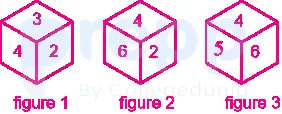
Three different positions of the same dice are shown (figures 1 to 3). Find the number on the face opposite to the face having '1'.
- A
3
- B
6
- C
5
- D
4
Show answer
D. 4The pattern followed here is:
Logic: If one side is similar in both figures then the other two sides of both figures are opposite to each other.
Taking dice of figure numbers (1) and (2)
Here, 4 and 2 are common in both the dice and 3 is opposite to 6.
Taking dice numbers (2) and (3)
Here, 4 and 6 are common in both the dice and 2 is opposite to 5.
Opposite pairs are:
⇒ 3 - 6
⇒ 2 - 5
⇒ 4 - 1
Clearly, 1 is the opposite of 4.
Hence, the correct answer is 4.
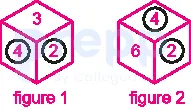
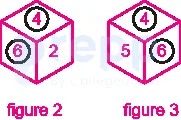 Paper & answer key PDF ↗
 Question 4archived
Which figure should replace the question mark (?) if the series were to be continued?

- A
Option A (shown in image)
- B
Option B (shown in image)
- C
Option C (shown in image)
- D
Option D (shown in image)
Show answer
D. Option D (shown in image)The pattern followed here is:
1) Arrow shift firstly left upper side, then shift left bottom side in the third figure, then to shift right upper corner, and finally shift in the middle of the figure.
2) Cross shift firstly left bottom corner, then shift to the right bottom corner, then the left upper side, and finally shift to the right bottom side of the figure.
3) T shift firstly right bottom of the corner, then left upper corner, then to shift middle of the figure, and finally shift to the right bottom of the corner.
4) Triangle firstly shifts right upper side, then shifts middle of the figure, then shifts right bottom side, then finally shifts to the left upper side of the figure.
5) Circle firstly shifts middle of the figure, then shifts right upper side, then shifts left bottom side, then finally shifts to the right bottom of the figure.
Hence, the correct answer is "Option 4".


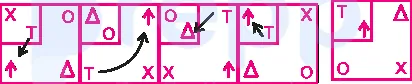
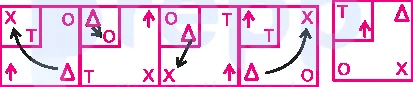
 Paper & answer key PDF ↗
 Question 5archived
After interchanging the given two numbers and two signs what will be the values of equation (I) and (II) respectively?
+ and ×, 5 and 4
I. 4 + 6 × 5 - 7 ÷ 1
II. 5 × 3 - 4 + 8 ÷ 2
- A
-9, -8
- B
30, -13
- C
20, 6
- D
27, -13
Show answer
D. 27, -13Evaluating Equations After Interchanging Numbers and Signs
The problem asks us to find the values of two given equations after interchanging specific numbers and signs. We need to interchange the number 5 and the number 4, and also interchange the addition sign (+) and the multiplication sign (×).
Let's apply these interchanges to each equation one by one and then evaluate them using the order of operations (BODMAS/PEMDAS).
Step-by-Step Evaluation of Equation (I)
The original equation (I) is:
\( 4 + 6 \times 5 - 7 \div 1 \)
Now, let's apply the interchanges:
Interchange 5 and 4. The equation becomes: \( 5 + 6 \times 4 - 7 \div 1 \)
Interchange + and ×. The equation becomes: \( 5 \times 6 + 4 - 7 \div 1 \)
The modified equation (I) is:
\( 5 \times 6 + 4 - 7 \div 1 \)
Now, let's evaluate this using the BODMAS rule (Brackets, Orders, Division and Multiplication (from left to right), Addition and Subtraction (from left to right)).
Division: Evaluate \( 7 \div 1 \).
\( 5 \times 6 + 4 - 7 \)
Multiplication: Evaluate \( 5 \times 6 \).
\( 30 + 4 - 7 \)
Addition: Evaluate \( 30 + 4 \).
\( 34 - 7 \)
Subtraction: Evaluate \( 34 - 7 \).
\( 27 \)
So, the value of equation (I) after the interchanges is 27.
Step-by-Step Evaluation of Equation (II)
The original equation (II) is:
\( 5 \times 3 - 4 + 8 \div 2 \)
Now, let's apply the interchanges:
Interchange 5 and 4. The equation becomes: \( 4 \times 3 - 5 + 8 \div 2 \)
Interchange + and ×. The equation becomes: \( 4 + 3 - 5 \times 8 \div 2 \)
The modified equation (II) is:
\( 4 + 3 - 5 \times 8 \div 2 \)
Now, let's evaluate this using the BODMAS rule.
Multiplication and Division (from left to right): First, \( 5 \times 8 \).
\( 4 + 3 - 40 \div 2 \)
Next, \( 40 \div 2 \).
\( 4 + 3 - 20 \)
Addition: Evaluate \( 4 + 3 \).
\( 7 - 20 \)
Subtraction: Evaluate \( 7 - 20 \).
\( -13 \)
So, the value of equation (II) after the interchanges is -13.
Summary of Equation Values
After interchanging the number 5 with 4, and the sign + with ×, the values of the equations are:
Equation (I): 27
Equation (II): -13
The values of equation (I) and (II) respectively are 27 and -13.
Revision Table: Key Concepts
Concept
Explanation
Relevance to Problem
Interchanging Values
Swapping the positions or roles of two specific items (numbers or signs) in an expression or equation.
We swapped 5 and 4, and + and × as per the question's requirement.
Mathematical Operators
Symbols used to perform mathematical operations (e.g., +, -, ×, ÷).
The problem involves the four basic arithmetic operators.
Order of Operations
Rules specifying the sequence in which mathematical operations should be performed (e.g., BODMAS or PEMDAS).
Crucial for correctly evaluating the modified equations. Division/Multiplication before Addition/Subtraction.
Additional Information: Understanding BODMAS/PEMDAS
The order of operations is essential for consistently evaluating mathematical expressions. Let's look at BODMAS and PEMDAS:
BODMAS: Brackets, Orders (powers/roots), Division and Multiplication (left-to-right), Addition and Subtraction (left-to-right).
PEMDAS: Parentheses, Exponents, Multiplication and Division (left-to-right), Addition and Subtraction (left-to-right).
Both acronyms represent the same order. Division and Multiplication have equal priority and are performed from left to right as they appear. Similarly, Addition and Subtraction have equal priority and are performed from left to right.
In this problem, we only had Division, Multiplication, Addition, and Subtraction, so the order followed was Division/Multiplication first (left-to-right), then Addition/Subtraction first (left-to-right).
Paper & answer key PDF ↗ Question 6archived
Select the correct combination of mathematical signs to sequentially replace the * signs and balance the given equation.
99 * 33 * 66 * 22 * 44 * 50
- A
÷, +, ×, +, =
- B
+, -, ÷, -, =
- C
÷, +, ÷, +, =
- D
÷, -, +, ×, =
Show answer
C. ÷, +, ÷, +, =Finding the Correct Operators to Balance the Equation
This question asks us to identify the correct sequence of mathematical operators to substitute for the asterisks (*) in the expression 99 * 33 * 66 * 22 * 44 * 50 to make the equation true. We must consider the standard order of operations (PEMDAS/BODMAS).
Evaluating Operator Options Systematically
We will examine each option provided, replacing the asterisks with the given operators and the final asterisk with an equals sign, then verifying the result.
Option 1 Analysis: ÷, +, ×, +, =
Let's substitute these operators into the expression:
99 ÷ 33 + 66 × 22 + 44 = 50
We follow the order of operations:
Division first: 99 ÷ 33 results in 3.
Multiplication next: 66 × 22 results in 1452.
The equation simplifies to: 3 + 1452 + 44 = 50.
Addition: Adding the numbers from left to right gives 3 + 1452 = 1455, and then 1455 + 44 = 1499.
The final check is 1499 = 50, which is false.
Option 2 Analysis: +, -, ÷, -, =
Substituting these operators:
99 + 33 - 66 ÷ 22 - 44 = 50
Applying the order of operations:
Division first: 66 ÷ 22 equals 3.
The equation becomes: 99 + 33 - 3 - 44 = 50.
Addition and Subtraction (left to right):
99 + 33 is 132.
132 - 3 is 129.
129 - 44 is 85.
The final check is 85 = 50, which is false.
Option 3 Analysis: ÷, +, ÷, +, =
Substituting these operators:
99 ÷ 33 + 66 ÷ 22 + 44 = 50
Applying the order of operations:
Division: 99 ÷ 33 equals 3.
Division: 66 ÷ 22 equals 3.
The equation becomes: 3 + 3 + 44 = 50.
Addition: 3 + 3 is 6, and 6 + 44 is 50.
The final check is 50 = 50, which is true. This option correctly balances the equation.
Option 4 Analysis: ÷, -, +, ×, =
Substituting these operators:
99 ÷ 33 - 66 + 22 × 44 = 50
Applying the order of operations:
Division first: 99 ÷ 33 equals 3.
Multiplication next: 22 × 44 equals 968.
The equation becomes: 3 - 66 + 968 = 50.
Addition and Subtraction (left to right):
3 - 66 is -63.
-63 + 968 is 905.
The final check is 905 = 50, which is false.
Conclusion on Balancing the Equation
By carefully substituting and evaluating each option according to the order of operations (PEMDAS/BODMAS), we determined that Option 3 provides the correct sequence of operators (÷, +, ÷, +) which makes the equation 99 ÷ 33 + 66 ÷ 22 + 44 = 50 true.
Paper & answer key PDF ↗ Question 7archived
Three of the following letter-clusters are alike in some manner and hence form a group. Which letter-cluster does NOT belong to that group?
- A
EVS
- B
IRP
- C
VEB
- D
GTQ
Show answer
B. IRPUnderstanding Letter Cluster Reasoning
In questions involving letter clusters and groups, the goal is to find the underlying pattern or rule that connects the letters within each cluster. Usually, three of the given letter-clusters will follow the same pattern, forming a group, while one letter-cluster will deviate from that pattern. This different one is the answer that does NOT belong to the group.
Common patterns involve:
The alphabetical position of each letter (A=1, B=2, ..., Z=26).
Differences or sums between the positions of consecutive letters.
Relationships like opposite letters (letters that are equidistant from the beginning and end of the alphabet, such as A and Z, B and Y, etc.).
Analyzing the Given Letter Clusters to Find the Pattern
Let's look at the position of each letter in the alphabet and try to find a consistent rule among the given letter clusters: EVS, IRP, VEB, and GTQ. A common relationship to check in three-letter clusters is the connection between the first two letters and the relationship between the second and third letters.
Let's consider the concept of opposite letters. The opposite of a letter at position \(n\) is the letter at position \(27 - n\).
Analysis of EVS
The letter E is at position \(5\). Its opposite letter is at position \(27 - 5 = 22\), which is V. So, the first two letters E and V are opposite letters.
The letter V is at position \(22\). The letter S is at position \(19\). The difference in positions is \(19 - 22 = -3\). S is 3 positions before V in the alphabet.
Pattern for EVS: (First letter, Opposite of First letter, Second letter - 3 positions).
Analysis of IRP
The letter I is at position \(9\). Its opposite letter is at position \(27 - 9 = 18\), which is R. So, the first two letters I and R are opposite letters.
The letter R is at position \(18\). The letter P is at position \(16\). The difference in positions is \(16 - 18 = -2\). P is 2 positions before R in the alphabet.
Pattern for IRP: (First letter, Opposite of First letter, Second letter - 2 positions).
Analysis of VEB
The letter V is at position \(22\). Its opposite letter is at position \(27 - 22 = 5\), which is E. So, the first two letters V and E are opposite letters.
The letter E is at position \(5\). The letter B is at position \(2\). The difference in positions is \(2 - 5 = -3\). B is 3 positions before E in the alphabet.
Pattern for VEB: (First letter, Opposite of First letter, Second letter - 3 positions).
Analysis of GTQ
The letter G is at position \(7\). Its opposite letter is at position \(27 - 7 = 20\), which is T. So, the first two letters G and T are opposite letters.
The letter T is at position \(20\). The letter Q is at position \(17\). The difference in positions is \(17 - 20 = -3\). Q is 3 positions before T in the alphabet.
Pattern for GTQ: (First letter, Opposite of First letter, Second letter - 3 positions).
Comparison of Letter Cluster Patterns
Let's compare the patterns found for each letter cluster:
Letter-Cluster
Pattern (First two letters)
Pattern (Second to Third letter)
EVS
Opposite letters (E & V)
Second letter - 3 positions (V & S)
IRP
Opposite letters (I & R)
Second letter - 2 positions (R & P)
VEB
Opposite letters (V & E)
Second letter - 3 positions (E & B)
GTQ
Opposite letters (G & T)
Second letter - 3 positions (T & Q)
From the table, it is clear that three letter-clusters (EVS, VEB, and GTQ) follow the same pattern: the first two letters are opposites, and the third letter is found by moving back 3 positions from the second letter in the alphabet. The letter-cluster IRP follows a different pattern, where the third letter is found by moving back only 2 positions from the second letter.
Conclusion: The Letter-Cluster That Does NOT Belong
Based on the analysis of the patterns within each letter-cluster, IRP is the cluster that does NOT follow the same rule as the others. Therefore, IRP is the odd one out in the group.
The letter-cluster that does NOT belong to the group is IRP.
Revision Table: Key Reasoning Concepts
Concept
How it Applies
Alphabetical Position
Assign numbers 1-26 to letters.
Positional Differences
Calculate difference/sum between letter positions.
Opposite Pairs
Identify letters equidistant from alphabet ends (A-Z, B-Y, etc.).
Pattern Recognition
Find a consistent rule across most items.
Additional Information: Opposite Letter Pairs
Memorizing or quickly calculating opposite letter pairs can be very useful in solving letter reasoning problems. Remember, the sum of the positions of a letter and its opposite is 27.
Letter
Position
Opposite
A
1
Z (26)
B
2
Y (25)
C
3
X (24)
D
4
W (23)
E
5
V (22)
F
6
U (21)
G
7
T (20)
H
8
S (19)
I
9
R (18)
J
10
Q (17)
K
11
P (16)
L
12
O (15)
M
13
N (14)
Understanding these relationships helps in identifying patterns in letter-cluster based reasoning questions more quickly and accurately.
Paper & answer key PDF ↗ Question 8archived
Select the option that represents the correct order of the given words as they would appear in an English dictionary.
1. Fustian
2. Funerary
3. Fusion
4. Funicular
5. Fuscous
6. Fundament
7. Fuselage
- A
6, 2, 5, 7, 3, 4, 1
- B
6, 2, 5, 7, 4, 1, 3
- C
6, 2, 4, 5, 7, 3, 1
- D
6, 2, 5, 4, 7, 3, 1
Show answer
C. 6, 2, 4, 5, 7, 3, 1Understanding Dictionary Order for Word Arrangement
Arranging words in dictionary order, also known as alphabetical order, involves comparing words letter by letter from left to right. The word with the letter that comes earlier in the alphabet at the first point of difference is placed first.
Step-by-Step Word Comparison
Let's arrange the given words according to dictionary rules:
Fustian
Funerary
Fusion
Funicular
Fuscous
Fundament
Fuselage
All words start with 'F'. Let's compare the subsequent letters:
Fustian
Funerary
Fusion
Funicular
Fuscous
Fundament
Fuselage
All words also have 'u' as the second letter. We move to the third letter:
Fustian
Funerary
Fusion
Funicular
Fuscous
Fundament
Fuselage
Here, we see words starting with 'Fun' and words starting with 'Fus'. According to alphabetical order, 'n' comes before 's'. So, words starting with 'Fun' will come before words starting with 'Fus'.
Ordering the 'Fun' Words
The 'Fun' words are:
Funerary (2)
Funicular (4)
Fundament (6)
Let's compare the fourth letter:
Funerary
Funicular
Fundament
Comparing 'e', 'i', and 'd', the order is 'd', 'e', 'i'. So, the 'Fun' words in order are:
Fundament (6)
Funerary (2)
Funicular (4)
Ordering the 'Fus' Words
The 'Fus' words are:
Fustian (1)
Fusion (3)
Fuscous (5)
Fuselage (7)
Let's compare the fourth letter:
Fustian
Fusion
Fuscous
Fuselage
Comparing 't', 'i', 'c', and 'e', the order is 'c', 'e', 'i', 't'. So, the 'Fus' words in order are:
Fuscous (5)
Fuselage (7)
Fusion (3)
Fustian (1)
Combining the Ordered Lists
Now, we combine the two ordered lists ('Fun' words followed by 'Fus' words) to get the final dictionary order:
Fundament (6)
Funerary (2)
Funicular (4)
Fuscous (5)
Fuselage (7)
Fusion (3)
Fustian (1)
The correct sequence of the numbers representing the words in dictionary order is 6, 2, 4, 5, 7, 3, 1.
Summary of Word Ordering
Original Number
Word
Dictionary Rank
6
Fundament
1
2
Funerary
2
4
Funicular
3
5
Fuscous
4
7
Fuselage
5
3
Fusion
6
1
Fustian
7
Comparing this sequence with the given options, we find that option 3 matches our result.
Option 1: 6, 2, 5, 7, 3, 4, 1
Option 2: 6, 2, 5, 7, 4, 1, 3
Option 3: 6, 2, 4, 5, 7, 3, 1
Option 4: 6, 2, 5, 4, 7, 3, 1
Therefore, the correct option representing the dictionary order is 6, 2, 4, 5, 7, 3, 1.
Revision Table: Dictionary Skills
Key Concepts for Dictionary Arrangement
Concept
Description
Alphabetical Order
Arranging items based on the sequence of letters in the alphabet (A-Z).
Letter-by-Letter Comparison
The primary method for dictionary ordering, comparing words from the first letter onwards.
Comparing at Difference
Once a differing letter is found between words, its position in the alphabet determines the order of those words.
Handling Same Prefixes
If words share initial letters, the comparison continues with the next letter until a difference is found.
Additional Information: Dictionary Use and Word Skills
Understanding dictionary order is a fundamental skill for effectively using dictionaries, encyclopedias, indexes, and other alphabetical listings. It's also helpful for organizing information and lists. Practicing this skill helps improve spelling and vocabulary by making it easier to find words and learn new ones. Many databases and digital lists also use alphabetical sorting based on similar principles.
Paper & answer key PDF ↗ Question 9archived
A + B means 'A is the father of B'
A - B means 'A is the mother of B'
A % B means 'A is the brother of B'
A & B means 'A is the son of B'
If A + B & C - D + E, then how is A related to E?
- A
Father's brother
- B
Father
- C
Brother
- D
Father's father
Show answer
D. Father's fatherThe correct answer is Father's father.
Determine gender: Note the gender of individuals whenever the symbol implies it (e.g., father is male, mother is female, brother is male, son is male). Combine relationships: Link the smaller relationships together to build the complete family structure described by the expression. Trace the path: Start from the person whose relationship is being asked (in this case, E) and trace back to the other person (A) using the connections you've established. Practice: Solving various types of blood relationship problems will improve your speed and accuracy.
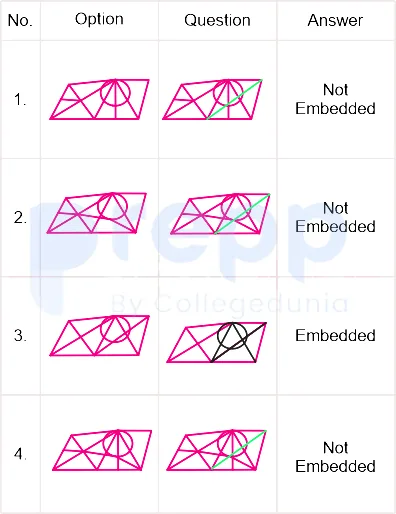
Paper & answer key PDF ↗ Question 10archived
Select the option figure in which the given figure (X) is embedded as its part (rotation is NOT allowed).

- A
Option A (shown in image)
- B
Option B (shown in image)
- C
Option C (shown in image)
- D
Option D (shown in image)
Show answer
C. Option C (shown in image)The pattern followed here is:
Given:
Hence, the correct answer is "Option 3".

 Paper & answer key PDF ↗
 Question 11archived
Select the word-pair which represents exactly the relation which is expressed in the given word-pair.
(Words should be treated as meaningful words and should not be related to each other on the basis of number of syllables/number of consonants/number of vowels in the word)
Pen : Cob
- A
adult : infant
- B
sorceress : sorcerer
- C
banyan : tree
- D
pig: piglet
Show answer
B. sorceress : sorcererUnderstanding Word Pair Relationships: Pen and Cob
The question asks us to find a word-pair that has the same relationship as the given pair, \(\text{Pen} : \text{Cob}\). We need to analyze the relationship between the words 'Pen' and 'Cob' and then examine the options to find an analogous pair.
Let's look at the possible meanings of 'Pen' and 'Cob':
'Pen' can mean a writing instrument.
'Pen' can also mean an enclosure for animals, like a pigpen.
'Cob' can mean an ear of corn.
'Cob' can also mean a male swan.
Considering animal-related meanings, we find that 'Pen' is also used to refer to a female swan, and 'Cob' refers to a male swan. Therefore, the relationship between 'Pen' and 'Cob' in this context is a female-male gender relationship within the same species (swan).
Now let's analyze the relationships in the given options:
adult : infant
sorceress : sorcerer
banyan : tree
pig : piglet
Analyzing Option Relationships
Option 1: adult : infant
The relationship here is between a mature living being and its young offspring. This is a life stage relationship.
Option 2: sorceress : sorcerer
A 'Sorceress' is a female who practices sorcery, and a 'Sorcerer' is a male who practices sorcery. This is a female-male gender relationship within the category of people who practice sorcery.
Option 3: banyan : tree
A 'Banyan' is a specific type or example of a 'tree'. This is a specific instance to general category relationship.
Option 4: pig : piglet
A 'Pig' is an adult animal of a certain species, and a 'piglet' is a young pig of the same species. This is an adult to young relationship, similar to option 1.
Comparing Relationships
The relationship we identified for the pair \(\text{Pen} : \text{Cob}\) is 'female swan : male swan', which is a female to male gender distinction within the same species.
Let's compare this to the relationships in the options:
Option 1 (adult : infant) is a life stage relationship. Not the same.
Option 2 (sorceress : sorcerer) is a female : male relationship within the same category (practitioner of sorcery). This mirrors the female : male relationship within the same species (swan) seen in \(\text{Pen} : \text{Cob}\).
Option 3 (banyan : tree) is a specific type : general category relationship. Not the same.
Option 4 (pig : piglet) is an adult : young relationship. Not the same.
The option pair that most closely matches the female : male gender relationship found in \(\text{Pen} : \text{Cob}\) (female swan : male swan) is \(\text{sorceress} : \text{sorcerer}\) (female sorcerer : male sorcerer).
Therefore, the word-pair \(\text{sorceress} : \text{sorcerer}\) represents exactly the same type of relationship as \(\text{Pen} : \text{Cob}\).
Conclusion on Word Analogy
Based on the analysis of the relationships, the pair 'sorceress : sorcerer' exhibits the same female to male gender relationship as 'Pen : Cob' (female swan : male swan).
Revision Table: Understanding Analogies
Given Pair
Relationship Type
Specific Relation (Possible)
Pen : Cob
Gender
Female Swan : Male Swan
Option Pair
Relationship Type
Specific Relation
adult : infant
Life Stage
Mature : Young
sorceress : sorcerer
Gender
Female : Male
banyan : tree
Type/Category
Specific : General
pig : piglet
Life Stage
Adult : Young
Additional Information: Solving Word Analogy Questions
Solving word analogy questions requires identifying the specific relationship between the words in the given pair. There are many types of relationships that can exist between word pairs, such as:
Synonyms (e.g., happy : joyful)
Antonyms (e.g., hot : cold)
Part to Whole (e.g., finger : hand)
Cause and Effect (e.g., study : success)
Worker and Tool (e.g., carpenter : hammer)
Action and Object (e.g., read : book)
Specific to General (e.g., dog : animal)
General to Specific (e.g., fruit : apple)
Degree (e.g., warm : hot)
Gender (e.g., king : queen)
Parent and Young (e.g., cat : kitten)
Habitat (e.g., bear : cave)
Once the relationship in the initial pair is identified, you need to examine the options and find the pair that shares the most similar, or exactly the same, relationship.
Paper & answer key PDF ↗ Question 12archived
Select the correct mirror image of the given combination when the mirror is placed at line MN as shown.
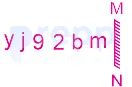
- A
Option A (shown in image)
- B
Option B (shown in image)
- C
Option C (shown in image)
- D
Option D (shown in image)
Show answer
Question 13archived
Which of the following letter-clusters will replace the question mark (?) in the given series?
LAT, NDR, PGP, ?, TML
- A
SKO
- B
RKN
- C
SJO
- D
RJN
Show answer
D. RJNUnderstanding Letter Series Patterns
This question asks us to identify the letter cluster that completes a given series: LAT, NDR, PGP, ?, TML. To solve this type of problem, we need to look for a pattern in the letters at each position within the clusters.
Analyzing the Pattern in Each Letter Position
Let's examine the letters at the first, second, and third positions separately across the series.
First Letter Pattern
The first letters of the clusters are L, N, P, ?, T.
L is the 12th letter of the alphabet.
N is the 14th letter of the alphabet.
P is the 16th letter of the alphabet.
T is the 20th letter of the alphabet.
Let's look at the position numbers:
\(12 \xrightarrow{+2} 14 \xrightarrow{+2} 16 \xrightarrow{?} \xrightarrow{+?} 20\)
The pattern for the first letter seems to be adding 2 to the alphabetical position of the previous letter.
So, the first letter of the missing cluster should be the letter that is 2 positions after P (16).
\(16 + 2 = 18\)
The 18th letter of the alphabet is R.
Second Letter Pattern
The second letters of the clusters are A, D, G, ?, M.
A is the 1st letter of the alphabet.
D is the 4th letter of the alphabet.
G is the 7th letter of the alphabet.
M is the 13th letter of the alphabet.
Let's look at the position numbers:
\(1 \xrightarrow{+3} 4 \xrightarrow{+3} 7 \xrightarrow{?} \xrightarrow{+?} 13\)
The pattern for the second letter seems to be adding 3 to the alphabetical position of the previous letter.
So, the second letter of the missing cluster should be the letter that is 3 positions after G (7).
\(7 + 3 = 10\)
The 10th letter of the alphabet is J.
Third Letter Pattern
The third letters of the clusters are T, R, P, ?, L.
T is the 20th letter of the alphabet.
R is the 18th letter of the alphabet.
P is the 16th letter of the alphabet.
L is the 12th letter of the alphabet.
Let's look at the position numbers:
\(20 \xrightarrow{-2} 18 \xrightarrow{-2} 16 \xrightarrow{?} \xrightarrow{-?} 12\)
The pattern for the third letter seems to be subtracting 2 from the alphabetical position of the previous letter.
So, the third letter of the missing cluster should be the letter that is 2 positions before P (16).
\(16 - 2 = 14\)
The 14th letter of the alphabet is N.
Constructing the Missing Letter Cluster
Combining the letters we found for each position:
First letter: R
Second letter: J
Third letter: N
The missing letter cluster is RJN.
Verifying the Pattern with the Found Cluster
Let's check if RJN fits the series:
LAT, NDR, PGP, RJN, TML
First letters: L(12), N(14), P(16), R(18), T(20) - Adds 2 each time. Correct.
Second letters: A(1), D(4), G(7), J(10), M(13) - Adds 3 each time. Correct.
Third letters: T(20), R(18), P(16), N(14), L(12) - Subtracts 2 each time. Correct.
The pattern holds true with RJN in the series.
Final Answer Derivation
Based on the consistent patterns observed for each letter position in the sequence, the letter cluster that replaces the question mark is RJN.
Revision Table: Series Pattern
Position in Cluster
Series of Letters
Alphabetical Positions
Pattern
1st
L, N, P, ?, T
12, 14, 16, ?, 20
Add 2
2nd
A, D, G, ?, M
1, 4, 7, ?, 13
Add 3
3rd
T, R, P, ?, L
20, 18, 16, ?, 12
Subtract 2
Additional Information: Solving Letter Series Problems
Letter series questions are common in logical reasoning and verbal ability tests. They require identifying a sequential pattern based on the alphabetical positions of letters.
Assign Numbers: A helpful first step is to write down the alphabetical position of each letter (A=1, B=2, ..., Z=26).
Look for Differences: Calculate the difference between the positions of consecutive letters in the series. This difference can be constant (like +2, -3) or follow another simple arithmetic sequence (e.g., adding 1, then 2, then 3...).
Check Multiple Positions: If the series consists of clusters of letters, analyze the pattern for each position within the cluster independently.
Consider Other Patterns: Sometimes patterns might involve skipping letters, reverse alphabetical order, or combinations of operations. However, simple arithmetic progressions based on alphabetical position are very common.
Verify the Pattern: Once you think you've found a pattern, apply it to find the missing term and then check if applying the same pattern to the term you found generates the next term in the series (if available).
Paper & answer key PDF ↗ Question 14archived
Select the figure from among the given options that can replace the question mark (?) in the following series.

- A
Option A (shown in image)
- B
Option B (shown in image)
- C
Option C (shown in image)
- D
Option D (shown in image)
Show answer
Question 15archived
Select the option that is related to the fifth letter-cluster in the same way as the second letter-cluster is related to the first letter-cluster and the fourth letter-cluster is related to the third letter-cluster.
CONTROL : NOCTRLO : : MISTAKE : SIMTAEK : : JOURNAL : ?
- A
AOUNRJL
- B
OJRLAUN
- C
JRNAOUL
- D
UOJRNLA
Show answer
D. UOJRNLASolving Letter Cluster Analogy Problems
Letter cluster analogy questions test your ability to identify the relationship or pattern between two letter clusters and apply that same pattern to a new cluster to find its corresponding pair. In the given problem, we have three pairs where the first two are complete, and the third requires us to find the missing cluster.
The pairs are:
CONTROL : NOCTRLO
MISTAKE : SIMTAEK
JOURNAL : ?
Our goal is to decipher the transformation rule applied from the first cluster to the second in the first two pairs and then apply that rule to 'JOURNAL'.
Analyzing the Pattern in CONTROL : NOCTRLO
Let's look at the letters in CONTROL and their corresponding positions in NOCTRLO:
Position
1
2
3
4
5
6
7
CONTROL
C
O
N
T
R
O
L
NOCTRLO
N
O
C
T
R
L
O
Comparing the letters in each position:
The letter at position 1 (C) moves to position 3.
The letter at position 2 (O) stays at position 2.
The letter at position 3 (N) moves to position 1.
The letter at position 4 (T) stays at position 4.
The letter at position 5 (R) stays at position 5.
The letter at position 6 (O) moves to position 7.
The letter at position 7 (L) moves to position 6.
This suggests a pattern of swapping letters within specific segments of the word. Let's try splitting the 7-letter word into segments:
Segment 1: First 3 letters (CON)
Segment 2: Middle 2 letters (TR)
Segment 3: Last 2 letters (OL)
Let's see how these segments transform:
CON → NOC: The first and third letters (C and N) swap positions, while the second letter (O) remains in the middle.
TR → TR: The middle two letters remain in their original positions.
OL → LO: The last two letters (O and L) swap positions.
Combining these transformations: NOC + TR + LO = NOCTRLO. This pattern matches the first pair.
Verifying the Pattern with MISTAKE : SIMTAEK
Now let's apply this proposed pattern to the second pair, MISTAKE : SIMTAEK, to confirm its validity. MISTAKE also has 7 letters.
Segment 1: First 3 letters (MIS)
Segment 2: Middle 2 letters (TA)
Segment 3: Last 2 letters (KE)
Applying the rule:
Segment 1 (MIS): Swap 1st and 3rd (M and S), keep 2nd (I) → S I M
Segment 2 (TA): Keep as is → T A
Segment 3 (KE): Swap 1st and 2nd within the segment (K and E) → E K
Combining the transformed segments: SIM + TA + EK = SIMTAEK.
This matches the second given pair, confirming our pattern is correct.
Applying the Pattern to JOURNAL
Now we apply the same rule to the word JOURNAL, which also has 7 letters.
Segment 1: First 3 letters (JOU)
Segment 2: Middle 2 letters (RN)
Segment 3: Last 2 letters (AL)
Applying the rule:
Segment 1 (JOU): Swap 1st and 3rd (J and U), keep 2nd (O) → U O J
Segment 2 (RN): Keep as is → R N
Segment 3 (AL): Swap 1st and 2nd within the segment (A and L) → L A
Combining the transformed segments: UOJ + RN + LA = UOJRNLA.
Therefore, the letter cluster that is related to JOURNAL in the same way is UOJRNLA.
Checking the Options
Let's compare our result UOJRNLA with the given options:
AOUNRJL
OJRLAUN
JRNAOUL
UOJRNLA
Our derived cluster, UOJRNLA, matches option 4.
Conclusion
Based on the pattern observed in the first two pairs (CONTROL:NOCTRLO and MISTAKE:SIMTAEK), the transformation rule for a 7-letter word involves specific letter swaps within the first three and last two letters, while keeping the middle two letters unchanged. Applying this rule to JOURNAL yields UOJRNLA.
The final answer is UOJRNLA.
Revision Table: Letter Cluster Transformation
Original Word
Segments (3-2-2)
Segment 1 Rule (Swap 1&3)
Segment 2 Rule (Keep)
Segment 3 Rule (Swap 1&2)
Transformed Word
CONTROL
CON, TR, OL
NOC
TR
LO
NOCTRLO
MISTAKE
MIS, TA, KE
SIM
TA
EK
SIMTAEK
JOURNAL
JOU, RN, AL
UOJ
RN
LA
UOJRNLA
Additional Information: Logical Reasoning and Patterns
Logical reasoning questions involving letter clusters or words often rely on identifying patterns based on:
Position of letters: Swapping, reversing, or shifting positions.
Alphabetical order: Moving letters forward or backward in the alphabet.
Types of letters: Vowels and consonants.
Reversal: Reversing the entire word or parts of it.
Specific letter manipulations: Removing, adding, or substituting letters.
Practicing various types of pattern-based problems helps improve your ability to quickly identify the underlying rule and apply it correctly in analogy questions.
Paper & answer key PDF ↗ Question 16archived
Select the set in which the numbers are related in the same way as are the numbers of the following sets.
(NOTE : Operations should be performed on the whole numbers, without breaking down the numbers into its constituent digits. E.g. 13 - Operations on 13 such as adding/subtracting/multiplying etc. to 13 can be performed. Breaking down 13 into 1 and 3 and then performing mathematical operations on 1 and 3 is not allowed)
(15, 9, 4)
(7, 2, 3)
- A
(21, 12, 6)
- B
(19, 13, 4)
- C
(24, 9, 11)
- D
(18, 7, 7)
Show answer
B. (19, 13, 4)Understanding Number Relationships in Sets
The question asks us to identify a set of numbers that follows the same logical relationship as the two given sets: (15, 9, 4) and (7, 2, 3). We are instructed to perform operations only on the whole numbers as given, not on their individual digits.
Analysing the Given Sets to Find the Pattern
Let's look closely at the two sets provided: (15, 9, 4) and (7, 2, 3). We need to find a rule or pattern that connects the three numbers in each set. Let's call the numbers in a set A, B, and C, so the sets are (A, B, C).
For the set (15, 9, 4): A=15, B=9, C=4.
For the set (7, 2, 3): A=7, B=2, C=3.
Let's try different common mathematical operations to find a relationship between A, B, and C.
Exploring Possible Relationships
Could the third number be related to the difference of the first two?
Set 1: $15 - 9 = 6$. Is 6 related to 4? Maybe $6 - 2 = 4$.
Set 2: $7 - 2 = 5$. Is 5 related to 3? Maybe $5 - 2 = 3$.
This seems like a potential pattern: $\text{First Number} - \text{Second Number} - 2 = \text{Third Number}$, or $\text{First Number} - \text{Second Number} = \text{Third Number} + 2$. Let's test this:
Set 1: $15 - 9 = 6$. Is $6 = 4 + 2$? Yes, $6 = 6$.
Set 2: $7 - 2 = 5$. Is $5 = 3 + 2$? Yes, $5 = 5$.
The pattern seems to be $\text{First Number} - \text{Second Number} = \text{Third Number} + 2$. We can rearrange this as $\text{First Number} = \text{Second Number} + \text{Third Number} + 2$.
Let's verify this pattern using the original set values:
For (15, 9, 4): $15 = 9 + 4 + 2$. $15 = 13 + 2$. $15 = 15$. This holds true.
For (7, 2, 3): $7 = 2 + 3 + 2$. $7 = 5 + 2$. $7 = 7$. This also holds true.
The consistent pattern across both given sets is that the first number is equal to the sum of the second and third numbers plus 2. Mathematically, if the numbers are A, B, and C, the relationship is $A = B + C + 2$.
Applying the Pattern to the Options
Now, we will check each option to see which set follows the established pattern $A = B + C + 2$.
Option Set (A, B, C)
Calculate B + C + 2
Check if A = B + C + 2
Match?
(21, 12, 6)
$12 + 6 + 2 = 18 + 2 = 20$
Is $21 = 20$? No.
No
(19, 13, 4)
$13 + 4 + 2 = 17 + 2 = 19$
Is $19 = 19$? Yes.
Yes
(24, 9, 11)
$9 + 11 + 2 = 20 + 2 = 22$
Is $24 = 22$? No.
No
(18, 7, 7)
$7 + 7 + 2 = 14 + 2 = 16$
Is $18 = 16$? No.
No
Only the set (19, 13, 4) satisfies the condition that the first number is equal to the sum of the second and third numbers plus 2.
Conclusion
Based on the analysis of the given sets (15, 9, 4) and (7, 2, 3), the number relationship is that the first number equals the sum of the second and third numbers plus two. Applying this rule to the given options, the set (19, 13, 4) is the only one that follows the same pattern.
Revision Table: Number Relationship Pattern
Set Type
Example Set
Pattern Applied
Result
Given Set 1
(15, 9, 4)
$9 + 4 + 2$
$15$ (Matches first number)
Given Set 2
(7, 2, 3)
$2 + 3 + 2$
$7$ (Matches first number)
Matching Option Set
(19, 13, 4)
$13 + 4 + 2$
$19$ (Matches first number)
Additional Information: Solving Number Analogy Problems
Number analogy questions require you to find a hidden mathematical relationship between numbers in a given set or pair of sets and then apply that same relationship to find a missing number or identify a matching set. Key strategies include:
Look for basic arithmetic operations (addition, subtraction, multiplication, division).
Consider sums, differences, products, or quotients of pairs of numbers relating to the third number.
Check for squares, cubes, square roots, or other powers.
Look for patterns involving sequences (arithmetic, geometric).
Sometimes the pattern might involve adding/subtracting a constant value or a derived value.
Always test the hypothesized pattern against all provided examples before applying it to the options.
Remember the rules specified in the question, such as using only whole numbers and not breaking down digits, as highlighted in this problem.
Paper & answer key PDF ↗ Question 17archived
Select the odd group of numbers. (NOTE : Operations should be performed on the whole numbers, without breaking down the numbers into its constituent digits. E.g.13 - Operations on 13 such as adding/subtracting/multiplying etc. to 13 can be performed. Breaking down 13 into 1 and 3 and then performing mathematical operations on 1 and 3 is not allowed)
- A
(6 - 60 - 50)
- B
(7 - 70 - 68)
- C
(8 - 80 - 70)
- D
(9 - 90 - 80)
Show answer
B. (7 - 70 - 68)Finding the Odd Group of Numbers
This question asks us to identify the group of numbers that does not follow the same pattern as the other groups. We need to analyze the relationship between the three numbers in each group, treating each number as a whole entity.
Analyzing the Number Groups
Let's examine each group of numbers provided and try to find a consistent mathematical operation or relationship linking the first, second, and third numbers in each set.
Analysis of Group 1: (6 - 60 - 50)
Let the first number be \(a\), the second number be \(b\), and the third number be \(c\). Here, \(a=6\), \(b=60\), \(c=50\). Let's see if there's a connection between \(a\) and \(b\), and between \(b\) and \(c\).
Relationship between the first and second number: We can see that \(6 \times 10 = 60\). So, \(b = a \times 10\).
Relationship between the second and third number: We can see that \(60 - 10 = 50\). So, \(c = b - 10\).
Combining these, the pattern seems to be \(b = a \times 10\) and \(c = b - 10\), which simplifies to \(c = (a \times 10) - 10\).
Analysis of Group 2: (7 - 70 - 68)
Here, \(a=7\), \(b=70\), \(c=68\). Let's apply the potential pattern found in Group 1.
Relationship between the first and second number: \(7 \times 10 = 70\). This fits the pattern \(b = a \times 10\).
Relationship between the second and third number: Let's check if \(c = b - 10\). \(70 - 10 = 60\). However, the third number is 68, not 60. So, this part of the pattern (\(c = b - 10\)) is not followed. The actual relationship here is \(70 - 2 = 68\), so \(c = b - 2\).
This group does not follow the complete pattern \(b = a \times 10\) and \(c = b - 10\).
Analysis of Group 3: (8 - 80 - 70)
Here, \(a=8\), \(b=80\), \(c=70\). Let's check the pattern.
Relationship between the first and second number: \(8 \times 10 = 80\). This fits \(b = a \times 10\).
Relationship between the second and third number: \(80 - 10 = 70\). This fits \(c = b - 10\).
This group follows the pattern \(b = a \times 10\) and \(c = b - 10\).
Analysis of Group 4: (9 - 90 - 80)
Here, \(a=9\), \(b=90\), \(c=80\). Let's check the pattern.
Relationship between the first and second number: \(9 \times 10 = 90\). This fits \(b = a \times 10\).
Relationship between the second and third number: \(90 - 10 = 80\). This fits \(c = b - 10\).
This group follows the pattern \(b = a \times 10\) and \(c = b - 10\).
Identifying the Pattern and the Odd Group
Let's summarize our findings in a table:
Group
Numbers (a - b - c)
Relation 1 (\(b = a \times 10\))
Relation 2 (\(c = b - 10\))
Follows Pattern?
1
(6 - 60 - 50)
\(60 = 6 \times 10\) (Yes)
\(50 = 60 - 10\) (Yes)
Yes
2
(7 - 70 - 68)
\(70 = 7 \times 10\) (Yes)
\(68 \neq 70 - 10\) (No, \(68 = 70 - 2\))
No
3
(8 - 80 - 70)
\(80 = 8 \times 10\) (Yes)
\(70 = 80 - 10\) (Yes)
Yes
4
(9 - 90 - 80)
\(90 = 9 \times 10\) (Yes)
\(80 = 90 - 10\) (Yes)
Yes
From the table, we can clearly see that Groups 1, 3, and 4 follow a consistent pattern where the second number is ten times the first, and the third number is ten less than the second. Group 2, however, only follows the first part of the pattern; the third number is 2 less than the second number, not 10 less.
Therefore, Group 2 (7 - 70 - 68) is the odd group out.
Revision Table: Number Group Patterns
Group
First No. (a)
Second No. (b)
Third No. (c)
Relation \(b\) to \(a\)
Relation \(c\) to \(b\)
1
6
60
50
\(b = a \times 10\)
\(c = b - 10\)
2
7
70
68
\(b = a \times 10\)
\(c = b - 2\)
3
8
80
70
\(b = a \times 10\)
\(c = b - 10\)
4
9
90
80
\(b = a \times 10\)
\(c = b - 10\)
Additional Information: Finding Patterns in Number Series
Finding the odd one out in a group of numbers or a series is a common type of logical reasoning question. These questions test your ability to identify underlying patterns. Here are some common patterns to look for:
Arithmetic progression (constant difference between consecutive terms).
Geometric progression (constant ratio between consecutive terms).
Patterns involving multiplication or division by a constant.
Patterns involving addition or subtraction of a constant.
Patterns involving squares, cubes, square roots, or cube roots.
Patterns involving the sum or difference of previous terms (like Fibonacci series).
Patterns involving specific mathematical operations like multiplying by a number and then adding/subtracting another, or performing operations based on the position of the number in the series.
Patterns involving prime numbers, composite numbers, even numbers, or odd numbers.
Patterns involving the sum or product of digits (though this was excluded by the rule in this specific question).
When approaching such problems, it is helpful to systematically check for these common patterns. Look for relationships between adjacent numbers, or between numbers at specific positions within the group or series.
Paper & answer key PDF ↗ Question 18archived
Read the given statements and conclusions carefully. Assuming that the information given in the statements is true, even if it appears to be at variance with commonly known facts, decide which of the given conclusions logically follow(s) from the statements.
Statements :
Some grasses are trees.
Some trees are branches.
Some branches are dogs.
Conclusions :
I. Some grasses are branches.
II. Some trees are dogs.
III. Some grasses are dogs.
IV. Some branches are grasses.
- A
None of the conclusions follow
- B
Only conclusions II and III follow
- C
Only conclusions III and IV follow
- D
Only conclusions I and II follow
Show answer
A. None of the conclusions followAnalyzing Syllogism Statements and Conclusions
This question asks us to evaluate several conclusions based on a set of given statements, following the principles of logical deduction or syllogism. We must assume the statements are true, even if they contradict common sense.
Given Statements:
Some grasses are trees.
Some trees are branches.
Some branches are dogs.
Given Conclusions:
I. Some grasses are branches.
II. Some trees are dogs.
III. Some grasses are dogs.
IV. Some branches are grasses.
Step-by-Step Evaluation of Conclusions
We need to check if each conclusion logically follows from the given statements. In syllogism, especially with 'Some' statements, connections between categories are not always guaranteed across multiple steps. We can use Venn diagrams conceptually or apply the rules of logic.
Let's examine each conclusion:
Conclusion I: Some grasses are branches.
The statements connecting 'grasses' and 'branches' are: "Some grasses are trees" and "Some trees are branches". Both statements are of the 'Some A are B' type. When you have two 'Some' premises like this (Some G are T, Some T are B), you cannot logically conclude 'Some G are B' or 'No G is B'. There might be grasses that are branches, or there might not be. Since it's not a guaranteed relationship based *only* on the statements, this conclusion does not logically follow.
Conclusion II: Some trees are dogs.
The statements connecting 'trees' and 'dogs' are: "Some trees are branches" and "Some branches are dogs". Again, we have two 'Some' premises connecting 'trees' and 'dogs' via 'branches'. Similar to Conclusion I, from "Some T are B" and "Some B are D", we cannot logically conclude 'Some T are D'. There might be trees that are dogs, or there might not be. This conclusion does not logically follow.
Conclusion III: Some grasses are dogs.
This conclusion attempts to connect 'grasses' and 'dogs' across all three statements: "Some grasses are trees", "Some trees are branches", and "Some branches are dogs". When you have a chain of 'Some' statements like this, there is no guaranteed logical connection between the first category (grasses) and the last category (dogs). Some grasses might be dogs, but the statements do not necessitate it. Therefore, this conclusion does not logically follow.
Conclusion IV: Some branches are grasses.
This is the converse of Conclusion I ("Some grasses are branches"). If the statement "Some grasses are branches" were true, then "Some branches are grasses" would also be true. However, as we established, Conclusion I does not logically follow from the given statements. Therefore, Conclusion IV, which depends on Conclusion I being true based on the statements, also does not logically follow from the statements.
Based on the analysis, none of the given conclusions can be logically deduced from the statements provided.
Conclusion
Statements Involved
Logically Follows?
Reason
I. Some grasses are branches
Some G are T, Some T are B
No
Two 'Some' premises don't guarantee connection between G and B.
II. Some trees are dogs
Some T are B, Some B are D
No
Two 'Some' premises don't guarantee connection between T and D.
III. Some grasses are dogs
Some G are T, Some T are B, Some B are D
No
Chain of 'Some' premises doesn't guarantee connection between G and D.
IV. Some branches are grasses
(Converse of Conclusion I)
No
Conclusion I does not logically follow from the statements.
Syllogism Revision Table
Statement Type
Notation
Example
All A are B
Universal Affirmative (A)
All cats are mammals.
No A are B
Universal Negative (E)
No birds are mammals.
Some A are B
Particular Affirmative (I)
Some students are engineers.
Some A are not B
Particular Negative (O)
Some students are not engineers.
Additional Information on Syllogism Logic
In syllogism, the validity of a conclusion depends entirely on the structure and type of the premises, not on the real-world truth of the statements. A key rule is that two particular premises (statements starting with 'Some' or 'Some...not') yield no valid universal conclusion.
More importantly for this problem, a chain of particular affirmative ('Some') statements does not establish a definite link between the first and last terms in the chain. For example:
Some X are Y.
Some Y are Z.
From these two statements, you cannot logically conclude "Some X are Z" or "No X are Z". There might be some X that are Z, or there might be none. Similarly, extending the chain does not create a definite link.
Some A are B.
Some B are C.
Some C are D.
From these, you cannot logically conclude "Some A are D". The possible overlap could be such that A and D have no elements in common.
This explains why none of the conclusions in the given problem logically follow from the statements.
Paper & answer key PDF ↗ Question 19archived
By interchanging the given two signs and numbers which of the following equation will be correct?
× and +, 9 and 6
- A
7 × 6 ÷ 3 + 9 - 8 = 17
- B
6 × 8 - 9 ÷ 3 + 5 = 50
- C
7 + 6 × 4 ÷ 9 - 8 = 8
- D
9 × 7 + 4 ÷ 1 - 6 = 7
Show answer
A. 7 × 6 ÷ 3 + 9 - 8 = 17Understanding the Problem of Interchanging Signs and Numbers
The question asks us to find which of the given mathematical equations becomes correct after performing two specific interchanges: swapping the multiplication sign ($\times$) with the addition sign (+) and simultaneously swapping the number 9 with the number 6. We need to apply these changes to each equation and then evaluate the new equation using the standard order of operations (like BODMAS or PEMDAS) to see if the left side equals the right side.
Applying the Interchange Rules
The rules for interchange are:
The sign '$\times$' becomes '+'.
The sign '+' becomes '$\times$'.
The number '9' becomes '6'.
The number '6' becomes '9'.
All other signs and numbers remain unchanged.
Evaluating Each Equation After Interchange
Option 1: 7 × 6 ÷ 3 + 9 - 8 = 17
Let's apply the interchange rules to this equation:
Original equation: $7 \times 6 \div 3 + 9 - 8 = 17$
Interchange $\times$ and +: $7 + 6 \div 3 \times 9 - 8$
Interchange 9 and 6: $7 + 9 \div 3 \times 6 - 8$
Now, we evaluate the transformed expression $7 + 9 \div 3 \times 6 - 8$ using the order of operations (BODMAS/PEMDAS):
Division: $9 \div 3 = 3$. The expression becomes $7 + 3 \times 6 - 8$.
Multiplication: $3 \times 6 = 18$. The expression becomes $7 + 18 - 8$.
Addition: $7 + 18 = 25$. The expression becomes $25 - 8$.
Subtraction: $25 - 8 = 17$.
The result of the left side after interchange is 17. The right side of the original equation is also 17. Since $17 = 17$, this equation becomes correct after the interchanges.
Option 2: 6 × 8 - 9 ÷ 3 + 5 = 50
Let's apply the interchange rules:
Original equation: $6 \times 8 - 9 \div 3 + 5 = 50$
Interchange $\times$ and +: $6 + 8 - 9 \div 3 \times 5$
Interchange 9 and 6: $9 + 8 - 6 \div 3 \times 5$
Evaluate the transformed expression $9 + 8 - 6 \div 3 \times 5$:
Division: $6 \div 3 = 2$. The expression becomes $9 + 8 - 2 \times 5$.
Multiplication: $2 \times 5 = 10$. The expression becomes $9 + 8 - 10$.
Addition: $9 + 8 = 17$. The expression becomes $17 - 10$.
Subtraction: $17 - 10 = 7$.
The result is 7, which is not equal to the original right side (50). So, this equation is incorrect after the interchanges.
Option 3: 7 + 6 × 4 ÷ 9 - 8 = 8
Let's apply the interchange rules:
Original equation: $7 + 6 \times 4 \div 9 - 8 = 8$
Interchange $\times$ and +: $7 \times 6 + 4 \div 9 - 8$
Interchange 9 and 6: $7 \times 9 + 4 \div 6 - 8$
Evaluate the transformed expression $7 \times 9 + 4 \div 6 - 8$:
Division: $4 \div 6 = \frac{4}{6} = \frac{2}{3}$. The expression becomes $7 \times 9 + \frac{2}{3} - 8$.
Multiplication: $7 \times 9 = 63$. The expression becomes $63 + \frac{2}{3} - 8$.
Addition/Subtraction: $63 + \frac{2}{3} - 8 = 55 + \frac{2}{3} = 55.66...$.
The result is approximately 55.67, which is not equal to the original right side (8). So, this equation is incorrect after the interchanges.
Option 4: 9 × 7 + 4 ÷ 1 - 6 = 7
Let's apply the interchange rules:
Original equation: $9 \times 7 + 4 \div 1 - 6 = 7$
Interchange $\times$ and +: $9 + 7 \times 4 \div 1 - 6$
Interchange 9 and 6: $6 + 7 \times 4 \div 1 - 9$
Evaluate the transformed expression $6 + 7 \times 4 \div 1 - 9$:
Division: $4 \div 1 = 4$. The expression becomes $6 + 7 \times 4 - 9$.
Multiplication: $7 \times 4 = 28$. The expression becomes $6 + 28 - 9$.
Addition: $6 + 28 = 34$. The expression becomes $34 - 9$.
Subtraction: $34 - 9 = 25$.
The result is 25, which is not equal to the original right side (7). So, this equation is incorrect after the interchanges.
Conclusion
After applying the specified interchanges to all options, only the first equation yields a correct mathematical statement. Therefore, the equation $7 \times 6 \div 3 + 9 - 8 = 17$ is the one that becomes correct when $\times$ and + are interchanged, and 9 and 6 are interchanged.
Revision Table: Checking Equation Correctness
Original Equation
Interchanges Applied
Transformed Equation
Calculation (BODMAS)
Result
Original RHS
Correct?
$7 \times 6 \div 3 + 9 - 8 = 17$
$\times \leftrightarrow +, 9 \leftrightarrow 6$
$7 + 9 \div 3 \times 6 - 8$
$7 + 3 \times 6 - 8 = 7 + 18 - 8 = 25 - 8 = 17$
17
17
Yes
$6 \times 8 - 9 \div 3 + 5 = 50$
$\times \leftrightarrow +, 9 \leftrightarrow 6$
$9 + 8 - 6 \div 3 \times 5$
$9 + 8 - 2 \times 5 = 9 + 8 - 10 = 17 - 10 = 7$
7
50
No
$7 + 6 \times 4 \div 9 - 8 = 8$
$\times \leftrightarrow +, 9 \leftrightarrow 6$
$7 \times 9 + 4 \div 6 - 8$
$63 + \frac{2}{3} - 8 = 55 + \frac{2}{3} \approx 55.67$
$\approx 55.67$
8
No
$9 \times 7 + 4 \div 1 - 6 = 7$
$\times \leftrightarrow +, 9 \leftrightarrow 6$
$6 + 7 \times 4 \div 1 - 9$
$6 + 7 \times 4 - 9 = 6 + 28 - 9 = 34 - 9 = 25$
25
7
No
Additional Information: Order of Operations (BODMAS/PEMDAS)
When evaluating mathematical expressions, we follow a specific order to ensure a consistent result. This order is often remembered using acronyms like BODMAS or PEMDAS.
BODMAS:
Brackets (Parentheses)
Orders (Exponents, Powers, Roots)
Division and Multiplication (from left to right)
Addition and Subtraction (from left to right)
PEMDAS:
Parentheses
Exponents
Multiplication and Division (from left to right)
Addition and Subtraction (from left to right)
In the calculations above, we first performed division and multiplication (from left to right as they appeared) and then addition and subtraction (from left to right).
Paper & answer key PDF ↗ Question 20archived
In the following question, select the missing number from the given series.
345, 356, 368, 381, 395, ?
- A
409
- B
408
- C
406
- D
410
Show answer
D. 410Finding the Missing Number in the Series
This question asks us to find the next number in the given series: 345, 356, 368, 381, 395, ?
To solve number series problems, we look for a pattern in the differences between consecutive terms, the ratio between terms, or some other mathematical relationship.
Analyzing the Number Series Pattern
Let's calculate the difference between each consecutive term in the series:
Difference between the 2nd and 1st term: \(356 - 345\)
Difference between the 3rd and 2nd term: \(368 - 356\)
Difference between the 4th and 3rd term: \(381 - 368\)
Difference between the 5th and 4th term: \(395 - 381\)
Calculating these differences, we get:
Terms
Difference
356 and 345
\(356 - 345 = 11\)
368 and 356
\(368 - 356 = 12\)
381 and 368
\(381 - 368 = 13\)
395 and 381
\(395 - 381 = 14\)
We can observe a pattern in the differences:
The differences are 11, 12, 13, 14. This is an arithmetic progression where each subsequent difference is increasing by 1.
Predicting the Next Difference
Following this pattern, the next difference in the series should be the previous difference (14) plus 1.
Next difference = \(14 + 1 = 15\)
Calculating the Missing Number
To find the missing number, we need to add this next difference (15) to the last known term in the series (395).
Missing number = Last term + Next difference
Missing number = \(395 + 15\)
Missing number = \(410\)
Therefore, the missing number in the series is 410.
Step-by-Step Solution Summary
Examine the given number series: 345, 356, 368, 381, 395, ?.
Calculate the differences between consecutive terms to find a pattern.
Differences found: 11, 12, 13, 14.
Identify the pattern in the differences: they increase by 1 each time.
Determine the next expected difference based on the pattern: \(14 + 1 = 15\).
Add this next difference to the last term of the series to find the missing number: \(395 + 15 = 410\).
Revision Table: Number Series Analysis
Term Number
Term Value
Difference from Previous Term
1st
345
-
2nd
356
11
3rd
368
12
4th
381
13
5th
395
14
6th (Missing)
410
15
Additional Information: Types of Number Series
Understanding different types of number series can help in solving such problems. Some common types include:
Arithmetic Series: The difference between consecutive terms is constant.
Geometric Series: The ratio between consecutive terms is constant.
Difference Series: The differences between consecutive terms follow a pattern (like an arithmetic series, as in this question, or a geometric series, etc.).
Double Difference Series: The differences between the differences of consecutive terms follow a pattern.
Fibonacci Series: Each term is the sum of the two preceding terms.
Mixed Series: A combination of two or more patterns.
Square/Cube Series: Terms are related to squares or cubes of natural numbers.
By identifying the pattern, whether it's in the terms themselves or the differences between them, you can predict the subsequent terms in a number series.
Paper & answer key PDF ↗ Question 21archived
A series is given with one term missing. Select the correct alternative from the given ones that will complete the series.
DMT, JOB, PQJ, VSR, ?
- A
BZY
- B
ZYM
- C
BUZ
- D
BZM
Show answer
C. BUZSolving Letter Series Questions
This question asks us to find the next term in the given letter series: DMT, JOB, PQJ, VSR, ?
To solve letter series problems, we need to identify the pattern in the sequence of letters. We can look at the position of each letter in the English alphabet (A=1, B=2, ..., Z=26) and see how these positions change from one term to the next.
Analyzing the Pattern in the Letter Series
Let's break down each term and look at the position of its letters:
Term
1st Letter
2nd Letter
3rd Letter
DMT
D (4)
M (13)
T (20)
JOB
J (10)
O (15)
B (2)
PQJ
P (16)
Q (17)
J (10)
VSR
V (22)
S (19)
R (18)
?
?
?
?
Now, let's examine the progression for each letter position:
Pattern for the First Letter:
D (4) to J (10): $10 - 4 = 6$ (Addition of 6)
J (10) to P (16): $16 - 10 = 6$ (Addition of 6)
P (16) to V (22): $22 - 16 = 6$ (Addition of 6)
The pattern for the first letter is adding 6 to the previous letter's position. So, the next first letter will be the letter at position $22 + 6 = 28$. Since the alphabet has 26 letters, we wrap around: $28 - 26 = 2$. The letter at position 2 is B.
Pattern for the Second Letter:
M (13) to O (15): $15 - 13 = 2$ (Addition of 2)
O (15) to Q (17): $17 - 15 = 2$ (Addition of 2)
Q (17) to S (19): $19 - 17 = 2$ (Addition of 2)
The pattern for the second letter is adding 2 to the previous letter's position. So, the next second letter will be the letter at position $19 + 2 = 21$. The letter at position 21 is U.
Pattern for the Third Letter:
This pattern seems to involve adding a fixed number and potentially wrapping around the alphabet (Z to A).
T (20) to B (2): From 20 to 26 is 6 steps (T to Z). From 26 to 2 is 2 steps (Z to B). Total steps: $6 + 2 = 8$. This is equivalent to $20 + 8 = 28$, and $28 - 26 = 2$. (Addition of 8 with wrap-around)
B (2) to J (10): $10 - 2 = 8$. (Addition of 8)
J (10) to R (18): $18 - 10 = 8$. (Addition of 8)
The pattern for the third letter is adding 8 to the previous letter's position, wrapping around from Z to A if needed. So, the next third letter will be the letter at position $18 + 8 = 26$. The letter at position 26 is Z.
Determining the Missing Term
Combining the patterns for each letter position, the next term in the series is formed by:
First letter: B
Second letter: U
Third letter: Z
The missing term is BUZ.
Summary of Pattern
Letter Position
Pattern
Next Letter Calculation
Next Letter
1st
Add 6 to position (wrap around)
$22 + 6 = 28 \equiv 28 - 26 = 2$
B
2nd
Add 2 to position
$19 + 2 = 21$
U
3rd
Add 8 to position (wrap around)
$18 + 8 = 26$
Z
The next term is BUZ.
Revision Table: Letter Series Concepts
Concept
Description
Application in this Problem
Letter Position
Assigning a numerical value (1-26) to each letter of the alphabet.
Used to identify numerical patterns between letters.
Arithmetic Progression
A sequence where the difference between consecutive terms is constant.
Observed in the patterns for the 1st and 2nd letters (+6 and +2).
Wrap-around Pattern
When the pattern goes beyond 'Z' (position 26) and cycles back to 'A' (position 1).
Observed in the pattern for the 3rd letter (+8, T to B, R to Z).
Additional Information: Solving Reasoning Questions
Letter series questions are common in reasoning sections of competitive exams. To improve skills in solving such questions, consider the following:
Know the Alphabet Positions: Be very familiar with the numerical position of each letter (A=1, Z=26). Knowing reverse positions (A=26, Z=1) can also be helpful for other pattern types.
Look for Different Patterns: Patterns can involve addition, subtraction, multiplication, division, skipping letters, or combinations of these. They can apply to single letters, pairs of letters, or groups of letters.
Check Differences: Calculate the difference in letter positions between consecutive terms. This often reveals an arithmetic pattern.
Consider Wrap-around: Remember the alphabet is circular. A pattern adding to Z will loop back to A.
Practice: Solving various types of letter series helps you recognize common patterns more quickly.
Look at Differences Between Terms: Sometimes the pattern is not within a term but in how terms relate to each other (e.g., the second term's first letter is derived from the first term's third letter). However, in this specific problem, the pattern is within the corresponding letter positions across terms.
By systematically analyzing the changes in letter positions for each part of the term, we can uncover the underlying rule governing the series and predict the next term.
Paper & answer key PDF ↗ Question 22archived
In a certain code language, 'DENTIST' is written as 'CDMSHRS' and 'TOOTH' is written as 'SNNSG', how will 'HEALING' be written in that language?
- A
IFBMJOH
- B
GDZMJOH
- C
IFBKHMF
- D
GDZKHMF
Show answer
D. GDZKHMFDecoding the Letter Pattern for 'HEALING'
This problem involves a coding and decoding task where we need to figure out the rule used to transform one word into another based on given examples. We are given two examples: 'DENTIST' is coded as 'CDMSHRS', and 'TOOTH' is coded as 'SNNSG'. We need to apply the same coding rule to find the code for 'HEALING'.
Analyzing the Coding Pattern
Let's examine the transformation of 'DENTIST' to 'CDMSHRS' letter by letter:
D $\rightarrow$ C (The letter before D)
E $\rightarrow$ D (The letter before E)
N $\rightarrow$ M (The letter before N)
T $\rightarrow$ S (The letter before T)
I $\rightarrow$ H (The letter before I)
S $\rightarrow$ R (The letter before S)
T $\rightarrow$ S (The letter before T)
It appears that each letter in 'DENTIST' is replaced by the letter that comes immediately before it in the English alphabet. This is a consistent shift of -1 for each letter.
Let's verify this pattern using the second example, 'TOOTH' $\rightarrow$ 'SNNSG':
T $\rightarrow$ S (The letter before T)
O $\rightarrow$ N (The letter before O)
O $\rightarrow$ N (The letter before O)
T $\rightarrow$ S (The letter before T)
H $\rightarrow$ G (The letter before H)
The pattern holds true for the second example as well. Each letter is shifted one position backward in the alphabet.
Applying the Pattern to 'HEALING'
Now, we apply the identified pattern (shifting each letter one position back) to the word 'HEALING':
H $\rightarrow$ G (The letter preceding H)
E $\rightarrow$ D (The letter preceding E)
A $\rightarrow$ Z (The letter preceding A, wrapping around from the beginning of the alphabet)
L $\rightarrow$ K (The letter preceding L)
I $\rightarrow$ H (The letter preceding I)
N $\rightarrow$ M (The letter preceding N)
G $\rightarrow$ F (The letter preceding G)
Following this letter manipulation rule, the word 'HEALING' is transformed into 'GDZKHMF'.
Identifying the Correct Option
Comparing our result 'GDZKHMF' with the given options:
IFBMJOH
GDZMJOH
IFBKHMF
GDZKHMF
The code we derived, 'GDZKHMF', matches Option 4.
Paper & answer key PDF ↗ Question 23archived
In the following question below are given some statements followed by some conclusions based on those statements. Taking the given statements to be true even if they seem to be at variance from commonly known facts. Read all the conclusions and then decide which of the given conclusion logically follows the given statements.
Statements :
I. All A are H.
II. No B is A.
Conclusion :
I. Some A are not B.
II. No B is H.
- A
Only conclusion II follows
- B
Both conclusions I and II follows
- C
Neither conclusion follows
- D
Only conclusion I follows
Show answer
D. Only conclusion I followsUnderstanding the Syllogism Problem
This question presents us with two statements and two conclusions, asking us to determine which conclusion logically follows from the given statements. We need to assume the statements are true, even if they contradict general knowledge, and analyze the logical relationships.
Statements Analysis
Let's analyze the meaning of each statement:
Statement I: All A are H. This is a universal affirmative statement. It means that the set of A is completely contained within the set of H. If something is A, it must also be H.
Statement II: No B is A. This is a universal negative statement. It means that the set of B and the set of A have no members in common. The sets A and B are mutually exclusive or disjoint.
Visualizing with Venn Diagrams
We can use Venn diagrams to represent these statements and test the conclusions.
Statement
Venn Diagram Representation
All A are H
Imagine a circle for A fully inside a larger circle for H.
No B is A
Imagine a circle for B drawn completely separate from the circle for A.
Combining these, we have the circle A inside the circle H, and the circle B is drawn such that it does not overlap with the circle A. However, the circle B *could* overlap with the circle H (specifically, the part of H that is outside A), or it could be completely outside H as well. We must consider all possibilities allowed by the statements.
Conclusions Analysis
Now let's examine each conclusion based on the statements and our visualization.
Conclusion I: Some A are not B.
According to Statement II, "No B is A". This means that there is no single element that is both in B and in A.
This is equivalent to saying that "No A is B".
If "No A is B", then every single element of A is *not* a B.
If *all* elements of A are not B, then it logically follows that *some* elements of A are not B. Any subset of A will also consist of elements that are not B.
Conclusion I logically follows directly from Statement II. If no A is B, then some A are not B.
Conclusion II: No B is H.
We know "All A are H" (Statement I) and "No B is A" (Statement II).
Statement II tells us B is outside A. Statement I tells us A is inside H.
Let's see if "No B is H" is always true under these conditions.
Consider the possibility where B does not overlap with A, but *does* overlap with H. Since A is only a part of H, B can be outside A while still being inside or overlapping with the larger set H.
For example, imagine H is "Mammals", A is "Cats", and B is "Dogs". All Cats are Mammals (All A are H). No Dogs are Cats (No B is A). But it is not true that No Dogs are Mammals (No B is H is false, because All Dogs are Mammals).
Since we can find a scenario where the statements are true ("All A are H", "No B is A") but the conclusion ("No B is H") is false, Conclusion II does not logically follow.
Summary and Final Answer
Based on our analysis:
Conclusion I ("Some A are not B") is a valid inference from the statements.
Conclusion II ("No B is H") is not a valid inference because there are scenarios consistent with the statements where B and H do overlap.
Therefore, only Conclusion I logically follows from the given statements.
Revision Table: Key Syllogism Concepts
Term
Meaning
Relevance Here
Universal Statement
Refers to all members of a category (e.g., All A, No B)
Statements I and II are universal.
Particular Statement
Refers to some members of a category (e.g., Some A, Some B)
Conclusion I is particular. Conclusion II is universal.
Validity
Does the conclusion *necessarily* follow from the premises?
We tested the validity of each conclusion.
Disjoint Sets
Sets with no common elements.
Statement II ("No B is A") indicates A and B are disjoint.
Additional Information: The Importance of Possibilities in Syllogisms
When solving syllogism problems, it is vital to consider all possible ways the categories can relate to each other while staying consistent with the given statements. If a conclusion holds true in every single one of these possible visualisations or interpretations, then and only then is the conclusion considered logically valid.
For Conclusion II ("No B is H"), we found that while one arrangement (B completely outside H) supports the conclusion, another equally valid arrangement based on the statements (B outside A but overlapping with H) contradicts it. Because the conclusion is not true in all possibilities, it is not a valid conclusion.
This approach of exploring possibilities, often using Venn diagrams, is a powerful method for verifying the validity of conclusions in deductive reasoning problems like syllogisms.
Paper & answer key PDF ↗ Question 24archived
If A ÷ B means that A is the father of B, A × B means that A is the mother of B, A + B means that A is the brother of B then which of the following expression shows that Q is the daughter of P?
- A
P ÷ Q × R
- B
P ÷ Q + R
- C
P × Q ÷ R
- D
P + Q ÷ R
Show answer
A. P ÷ Q × RUnderstanding Blood Relation Coding Puzzles
Blood relation questions often involve decoding symbols or codes that represent relationships between individuals. In this specific problem, we are given the following codes:
A ÷ B means that A is the father of B.
A × B means that A is the mother of B.
A + B means that A is the brother of B.
The goal is to find the expression among the given options that correctly represents the relationship: Q is the daughter of P.
Analyzing the Relationship: Q is the Daughter of P
For Q to be the daughter of P, two conditions must be met:
P must be a parent of Q (either father or mother).
Q must be female.
Step-by-Step Analysis of Each Option
Let's examine each expression provided and decode the relationships they represent.
Option 1: P ÷ Q × R
Let's break down this expression:
P ÷ Q: According to the code A ÷ B means A is the father of B, so P is the father of Q. This satisfies the first condition (P is a parent of Q).
Q × R: According to the code A × B means A is the mother of B, so Q is the mother of R. This tells us about Q's gender; Q is female. This satisfies the second condition (Q is female).
Combining these relationships, P is the father of Q, and Q is female. This directly implies that Q is the daughter of P. This expression correctly shows the desired relationship.
Option 2: P ÷ Q + R
Let's break down this expression:
P ÷ Q: P is the father of Q. (P is a parent of Q).
Q + R: According to the code A + B means A is the brother of B, so Q is the brother of R. This tells us about Q's gender; Q is male.
In this case, P is the father of Q, but Q is male. Therefore, Q is the son of P, not the daughter. This option is incorrect.
Option 3: P × Q ÷ R
Let's break down this expression:
P × Q: P is the mother of Q. (P is a parent of Q).
Q ÷ R: Q is the father of R. This tells us about Q's gender; Q is male.
In this case, P is the mother of Q, but Q is male. Therefore, Q is the son of P, not the daughter. This option is incorrect.
Option 4: P + Q ÷ R
Let's break down this expression:
P + Q: P is the brother of Q. This defines the relationship between P and Q as siblings, not parent-child.
Q ÷ R: Q is the father of R. This tells us about Q's gender; Q is male.
In this case, P is the brother of Q. P is not a parent of Q. Therefore, this expression does not show Q as the daughter of P. This option is incorrect.
Conclusion
Based on the analysis of each option, only the expression P ÷ Q × R satisfies both conditions required for Q to be the daughter of P: P is the father of Q, and Q is female.
Expression
Decoding
Relationship (P and Q)
Q's Gender
Q is daughter of P?
P ÷ Q × R
P father of Q, Q mother of R
P is father of Q
Female
Yes
P ÷ Q + R
P father of Q, Q brother of R
P is father of Q
Male
No (Q is son)
P × Q ÷ R
P mother of Q, Q father of R
P is mother of Q
Male
No (Q is son)
P + Q ÷ R
P brother of Q, Q father of R
P is brother of Q
Male
No (P is not Q's parent)
Revision Table: Blood Relation Coding
Symbol
Meaning
÷
Is the father of
×
Is the mother of
+
Is the brother of
Additional Information on Blood Relation Problems
Blood relation problems test your ability to understand and decode familial relationships based on given information. These problems can appear in various formats, including:
Direct Statements: Relations are given directly (e.g., A is the brother of B, B is the sister of C).
Puzzles: A set of conditions or relations is given, and you need to deduce the relationship between two specific individuals.
Coding Relations: Symbols or arithmetic operators are used to represent relationships, as seen in this problem. You first need to decode the symbols and then determine the relationship.
Solving blood relation problems effectively often involves drawing family trees or diagrams to visualize the relationships clearly. Pay close attention to the gender of individuals and the direction of the relationship (e.g., A is the father of B is different from B is the father of A).
Paper & answer key PDF ↗ Question 25archived
Select the option that is related to the third term in the same way as the second term is related to the first term and the sixth term is related to the fifth term.
21 : 196 : : 29 : ? : : 38 : 315
- A
319
- B
252
- C
203
- D
841
Show answer
B. 252Understanding the Number Analogy Problem
This question asks us to find the relationship between numbers in pairs and apply that same relationship to a third number to find a missing term. We are given three pairs: 21 is related to 196, a missing number is related to 29, and 38 is related to 315. Our task is to discover the rule that connects the first number in each pair to the second number and then use that rule to find the number related to 29.
Analyzing the Given Number Pairs
Let's look at the two complete pairs provided:
Pair 1: 21 : 196
Pair 3: 38 : 315
We need to find a consistent mathematical operation or pattern that transforms the first number into the second number in both pairs.
Let's test a few possibilities. One common pattern involves multiplication and addition/subtraction, or operations based on the number itself.
Consider the first pair, 21 and 196. We notice that 196 is a perfect square, \(14^2\). How is 14 related to 21? \(21 - 7 = 14\). So, one potential rule is (First Term - 7)\(^2\). Let's check this with the third pair.
For the third pair, 38 and 315, applying this rule would give \((38 - 7)^2 = 31^2 = 961\). Since 961 is not 315, this rule is incorrect.
Let's look for another pattern. How about multiplying the first term by a value related to it? Let's try multiplying by a number slightly less than the first term.
For 21: \(21 \times k_1 = 196\). \(k_1 = 196/21 \approx 9.33\).
For 38: \(38 \times k_2 = 315\). \(k_2 = 315/38 \approx 8.29\).
The multipliers are not constant, but they seem to be decreasing as the first term increases (from 21 to 38). This hints at a relationship where the multiplier might depend on the first term.
Let's try to find a relationship involving multiplication and addition. Consider the pattern \( n \to a \times n + b \).
For 21: \(a \times 21 + b = 196\)
For 38: \(a \times 38 + b = 315\)
Subtracting the first equation from the second:
\((38a + b) - (21a + b) = 315 - 196\)
\(17a = 119\)
\(a = 119 / 17 = 7\).
Now substitute \(a=7\) back into the first equation:
\(7 \times 21 + b = 196\)
\(147 + b = 196\)
\(b = 196 - 147 = 49\).
So, the rule seems to be \(n \to 7n + 49\).
Let's verify this rule with both given pairs:
For 21: \(7 \times 21 + 49 = 147 + 49 = 196\). This matches the first pair.
For 38: \(7 \times 38 + 49 = 266 + 49 = 315\). This matches the third pair.
The rule \(n \to 7n + 49\) can also be written as \(n \to 7(n + 7)\).
For 21: \(7 \times (21 + 7) = 7 \times 28 = 196\).
For 38: \(7 \times (38 + 7) = 7 \times 45 = 315\).
This confirms the pattern: the second term is obtained by adding 7 to the first term and then multiplying the result by 7.
Applying the Pattern to Find the Missing Term
Now we apply the identified rule \(n \to 7(n+7)\) to the number 29 to find the missing term.
Here, the first term is 29. According to the rule, the second term will be:
\(7 \times (29 + 7)\)
First, calculate the value inside the parentheses:
\(29 + 7 = 36\)
Next, multiply this result by 7:
\(7 \times 36 = 252\)
So, the missing term is 252.
Conclusion: The Missing Term
Based on the pattern observed in the given number analogy pairs (21:196 and 38:315), where the relationship is defined by the formula \(n \to 7(n+7)\), the missing term related to 29 is 252.
The complete analogy is: 21 : 196 : : 29 : 252 : : 38 : 315.
Revision Table: Number Analogy Pattern
First Term (n)
Operation
Second Term
Calculation
21
\(7(n+7)\)
196
\( 7 \times (21+7) = 7 \times 28 = 196 \)
29
\(7(n+7)\)
?
\( 7 \times (29+7) = 7 \times 36 = 252 \)
38
\(7(n+7)\)
315
\( 7 \times (38+7) = 7 \times 45 = 315 \)
Additional Information: Exploring Number Series and Patterns
Number analogy questions are a common type in reasoning tests. They require you to identify the logical rule or pattern that connects two numbers and apply it to a third number. These patterns can be varied and include:
Arithmetic Operations: Simple addition, subtraction, multiplication, or division.
Operations with Constants: Adding/subtracting/multiplying/dividing by a fixed number.
Operations based on the Number Itself: Squaring, cubing, taking square roots, or performing operations involving the number multiplied by itself or a factor of itself.
Operations based on Digits: Sum of digits, product of digits, reversing digits, etc.
Combinations of Operations: A sequence of operations like multiply and then add, or square and then subtract. The pattern \(n \to 7(n+7)\) is an example of a combined operation.
Series Based Patterns: The numbers might follow an arithmetic progression (AP), geometric progression (GP), or a difference series that forms a pattern.
Solving number analogy problems effectively involves careful observation, testing different potential patterns, and verifying the discovered rule across all given pairs before applying it to find the missing term. It's helpful to be familiar with squares, cubes, and prime numbers, as these often appear in patterns.
Paper & answer key PDF ↗ Question 26archived
Bimbavati Devi is an exponent of which Indian dance form?
- A
Chhau
- B
Manipuri
- C
Kathakali
- D
Odissi
Show answer
B. ManipuriThis question asks to identify the Indian dance form for which Bimbavati Devi is a renowned exponent.
Bimbavati Devi's Dance Legacy
Bimbavati Devi is a celebrated name in the world of Indian classical dance. She is widely recognized for her mastery and significant contributions to a particular classical dance form originating from Northeast India. Understanding the distinct characteristics of various Indian dance forms helps in identifying her specific area of expertise.
Exploring Manipuri Dance
Manipuri dance is one of the major Indian classical dance forms. It originates from the state of Manipur in Northeast India.
Key Features: Manipuri dance is characterized by its graceful, fluid movements, delicate footwork, and gentle hand gestures. It emphasizes devotion (bhakti) and often portrays themes from Hindu epics, particularly the life of Radha and Krishna.
Costumes: Dancers typically wear vibrant, embroidered costumes, including the cylindrical potloi skirt, which is stiffened and decorated with shells and mirrors.
Music: The accompanying music is usually devotional, featuring traditional Manipuri instruments like the pung (a type of drum) and flute.
Bimbavati Devi's Contribution: Bimbavati Devi is a legendary practitioner and Guru of Manipuri dance. She has been instrumental in preserving and promoting this dance form, often credited with reviving and choreographing traditional pieces. Her dedication has earned her numerous accolades, including the Sangeet Natak Akademi Award.
Comparing Other Dance Forms
To confirm why Manipuri is the correct answer, let's briefly look at the other options:
Chhau: This is a semi-classical Indian dance with martial, tribal, and folk origins. It is prevalent in Odisha, Jharkhand, and West Bengal. It is known for its vigorous movements and elaborate masks, quite different from Manipuri.
Kathakali: Originating from Kerala, Kathakali is a highly stylized classical dance-drama known for its dramatic storytelling, elaborate costumes, detailed makeup, and expressive facial movements (mudras).
Odissi: This classical dance form hails from Odisha. It is known for its lyrical grace, sculpturesque poses (often inspired by temple carvings), and the distinctive tribhangi (three-body-bend) movement.
Conclusion on Bimbavati Devi's Dance Form
Based on her significant contributions and widespread recognition, Bimbavati Devi is unequivocally an exponent of Manipuri dance. Her artistry and dedication have significantly shaped the understanding and appreciation of this beautiful Indian classical dance form.
Paper & answer key PDF ↗ Question 27archived
It is the duty of every citizen to uphold and protect the , unity and integrity of India.
- A
autonomy
- B
authority
- C
sovereignty
- D
privacy
Show answer
C. sovereigntyUnderstanding Citizen's Duty towards India's Sovereignty, Unity, and Integrity
The question asks about a fundamental duty of every citizen regarding the nation. It requires selecting the most appropriate word that fits the phrase "uphold and protect the _____, unity and integrity of India". This phrase refers to core aspects of the nation's existence and stability.
Let's analyze the options provided to determine which word best completes this crucial duty of a citizen.
Analyzing the Options for Citizen Duty
Autonomy: Autonomy generally refers to self-governance or independence within a limited sphere, or the capacity of an individual to make informed decisions. While India is an autonomous nation, 'autonomy' as a concept doesn't fit as well with 'unity and integrity' in the context of a citizen's duty to protect the *nation* as a whole entity.
Authority: Authority refers to the power or right to give orders, make decisions, and enforce obedience. Protecting the 'authority' of India doesn't quite capture the essence of protecting the nation's fundamental structure and existence alongside its unity and integrity.
Sovereignty: Sovereignty means supreme power or authority; the authority of a state to govern itself or another state. In the context of a nation like India, sovereignty refers to its independent power and right to govern its territory free from external control. Protecting the sovereignty of India is paramount, as it is the basis of its statehood. This concept naturally aligns with upholding its unity (being undivided) and integrity (being whole and undiminished).
Privacy: Privacy refers to the state or condition of being free from public attention to the extent that one chooses. Protecting the 'privacy' of India is not a recognized duty of a citizen in the context of safeguarding the nation's fundamental character.
Why Sovereignty Fits the Citizen's Duty
The phrase "uphold and protect the sovereignty, unity and integrity of India" is a well-established articulation of a citizen's responsibility towards the nation's foundational principles. Sovereignty ensures India's status as an independent, self-governing state. Unity signifies the togetherness of its people and states despite diversity. Integrity refers to the nation's territorial completeness and moral soundness.
A citizen's duty includes safeguarding these three pillars. Among the given options, 'sovereignty' is the term that, when combined with 'unity and integrity', forms a comprehensive description of the vital aspects of the nation that citizens are called upon to protect.
Therefore, the most appropriate word to complete the sentence is sovereignty.
Term
Definition in National Context
Fit with "Unity and Integrity"
Autonomy
Self-governance (often within a larger entity)
Less direct fit with the nation's overall structure
Authority
Power to govern
Doesn't encompass the nation's existence/territory as well as Sovereignty
Sovereignty
Supreme power, independence of the State
Strongest fit; foundation for Unity and Integrity
Privacy
State of being free from public intrusion
Not relevant to national protection
Additional Information on Fundamental Duties
The duty to uphold and protect the sovereignty, unity, and integrity of India is explicitly mentioned in the Constitution of India. Specifically, Article 51A, which lists the Fundamental Duties of every citizen of India, includes:
(c) To uphold and protect the sovereignty, unity and integrity of India;
This constitutional provision underscores the significance of protecting these three aspects of the nation and confirms that 'sovereignty' is the correct term used in this context of citizen's duty.
Paper & answer key PDF ↗ Question 28archived
Which of the following statements about the Vice President of India is INCORRECT?
- A
Members of State legislatures do not take part in his elections.
- B
He acts as the ex-officio Chairman of the Rajya Sabha.
- C
The Vice President is elected for five years.
- D
He can be removed from his office by the President approved through a resolution passed by the Lok Sabha and Rajya Sabha.
Show answer
D. He can be removed from his office by the President approved through a resolution passed by the Lok Sabha and Rajya Sabha.Correct answer: He can be removed from his office by the President approved through a resolution passed by the Lok Sabha and Rajya Sabha.
The procedure for the removal of the Vice President is specified in Article 67(b). It states that the Vice President may be removed from his office by a resolution of the Council of States (Rajya Sabha) passed by a majority of all the then members of the Council and agreed to by the House of the People (Lok Sabha).
Paper & answer key PDF ↗ Question 29archived
The Kuchipudi classical dance is accompanied with which type of music?
- A
Kajri
- B
Chaiti
- C
Carnatic Music
- D
Hindustani Music
Show answer
C. Carnatic MusicThe correct answer is Carnatic Music.
Emphasis on instrumental music as much as vocal music. More emphasis on improvisation and exploring the raga in detail through various sections like Alap, Jor, Jhala, and Gat. The close association between South Indian classical dances like Kuchipudi and Carnatic Music is a key aspect of India's rich cultural heritage. The music provides the emotional depth and rhythmic framework essential for the dance performance.
Paper & answer key PDF ↗ Question 30archived
Which Indian budget introduced a statement highlighting the gender sensitivities of the budgetary allocations?
- A
2008-09
- B
2010-11
- C
2005-06
- D
2001-02
Show answer
C. 2005-06The correct answer is 2005-06.
Examination of existing policies and programs from a gender perspective. Assessment of resource allocation and expenditure patterns. Monitoring and evaluation of the impact of policies and budgets on gender equality outcomes. The introduction of the Gender Budget Statement in 2005-06 was a formal recognition at the national level of the need to account for gender impacts within the budget framework.
Paper & answer key PDF ↗ Question 31archived
According to Union Health Ministry, a new display image, with a warning written as "Tobacco causes painful death" will be printed on Tobacco products manufactured, imported, or packaged on or after __________.
- A
1 January, 2023
- B
1 February, 2023
- C
1 November, 2022
- D
1 December, 2022
Show answer
D. 1 December, 2022Understanding the New Tobacco Warning Image Rule
The question asks about the specific date from which a new graphical health warning image, stating "Tobacco causes painful death", must be printed on tobacco product packages. This regulation is mandated by the Union Health Ministry in India to increase public awareness about the severe health risks associated with tobacco consumption.
Details of the New Tobacco Warning
The Union Health Ministry periodically updates the graphic health warnings displayed on tobacco product packaging. These warnings are crucial for informing consumers about the dangers of tobacco use. The question specifically mentions a new warning image featuring the text "Tobacco causes painful death".
According to the regulations, this new image was scheduled to replace previous warnings from a particular date.
Analyzing the Options
The options provided are different dates in late 2022 or early 2023:
1 January, 2023
1 February, 2023
1 November, 2022
1 December, 2022
Determining the Implementation Date
The Union Health Ministry had issued a notification regarding the change in the specified health warnings for tobacco products. The new warnings were introduced in a phased manner.
The specific warning image with the message "Tobacco causes painful death" was mandated for implementation from a particular date for all tobacco products manufactured, imported, or packaged from that date onwards.
Based on the official notification, the date set for the implementation of this particular warning was 1st December 2022.
Therefore, all tobacco product packages produced starting from this date must carry the new prescribed image and warning text.
Conclusion
The new display image, with the warning "Tobacco causes painful death", was required to be printed on tobacco products manufactured, imported, or packaged on or after 1 December, 2022.
Warning Image
Accompanying Text
Implementation Date (on or after)
Specified Image 1 (Series B)
Tobacco causes painful death
1 December, 2022
Specified Image 2 (Series C)
Tobacco users die younger
1 December, 2023
This table shows the two series of warnings introduced, with the first one (Series B) being the subject of the question, implemented from December 1, 2022.
Revision Table: Key Dates for Tobacco Warnings
Regulation Subject
Key Date
Details
New Warning Image (Series B) Implementation
1 December, 2022
"Tobacco causes painful death" image & text mandatory on products manufactured, imported, or packaged from this date.
New Warning Image (Series C) Implementation
1 December, 2023
"Tobacco users die younger" image & text mandatory on products manufactured, imported, or packaged from this date, replacing Series B.
Period of Validity
1 year each
Each set of warnings (Series B & C) is valid for a period of one year from its implementation date.
Additional Information: Tobacco Control in India
India has implemented various measures under the Cigarettes and Other Tobacco Products Act (COTPA), 2003, to curb tobacco use and protect public health. Graphic health warnings on tobacco packaging are a critical component of these efforts.
Purpose of Warnings: The primary goal is to educate consumers, including potential users, about the severe health consequences of using tobacco products, such as cancer, heart disease, and respiratory illnesses.
Rotating Warnings: India follows a policy of rotating graphic health warnings periodically. This prevents 'warning fatigue' among consumers and ensures that the message remains impactful.
Prominent Display: The rules mandate that these warnings cover a significant portion of the principal display area of the tobacco product packaging to ensure maximum visibility.
Legal Mandate: The display of these warnings is not voluntary but a legal requirement for anyone involved in the manufacture, import, or packaging of tobacco products in India. Non-compliance can lead to penalties.
These regulations are part of India's commitment to the World Health Organization (WHO) Framework Convention on Tobacco Control (FCTC).
Paper & answer key PDF ↗ Question 32archived
Ishwar Chandra Vidyasagar set up school for girls at .
- A
Bombay
- B
Surat
- C
Lahore
- D
Calcutta
Show answer
D. CalcuttaUnderstanding Ishwar Chandra Vidyasagar's Contribution to Girls' Education
This question asks about the location where Ishwar Chandra Vidyasagar, a prominent social reformer and educationist, established a school for girls. His efforts were primarily concentrated in Bengal, British India, particularly in and around the city that was the capital at the time.
Who was Ishwar Chandra Vidyasagar?
Ishwar Chandra Vidyasagar (1820–1891) was a key figure of the Bengal Renaissance. He dedicated his life to social reforms, particularly advocating for the education of women and the remarriage of Hindu widows. He believed that education was crucial for social progress and emancipation, especially for women who were largely denied formal schooling during that era.
Vidyasagar's Work in Promoting Girls' Education
Vidyasagar was not only a theorist but also a practical reformer. He actively participated in establishing schools for girls. While John Elliot Drinkwater Bethune founded the Calcutta Female School (later Bethune School) in 1849, Ishwar Chandra Vidyasagar was deeply involved in its management from its early days and later became its secretary. His tireless efforts and fundraising were crucial for the school's survival and growth. Beyond Bethune School, Vidyasagar himself established numerous girls' schools in Calcutta and other parts of Bengal.
His efforts significantly contributed to increasing literacy among women and challenging the prevailing societal norms that restricted their access to education.
Analyzing the Options
Let's look at the provided options in the context of Ishwar Chandra Vidyasagar's work:
Bombay (now Mumbai): This city was a major center during the British Raj, but Vidyasagar's primary area of influence and reform activities was Bengal.
Surat: Located in Gujarat, Surat was historically a significant port city, but it was not the main region for Vidyasagar's educational reforms.
Lahore: Situated in Punjab (now in Pakistan), Lahore was an important city in the northwest, but Vidyasagar's activities were concentrated in eastern India.
Calcutta (now Kolkata): This was the capital of British India for a long period and the heartland of the Bengal Renaissance. Ishwar Chandra Vidyasagar lived and worked extensively in Calcutta and the surrounding areas of Bengal. He was instrumental in promoting and establishing girls' schools here.
Based on historical facts about Ishwar Chandra Vidyasagar's life and work, his major contributions to girls' education, including setting up schools, were centered in Calcutta and Bengal.
Conclusion on Girls' School Location
Ishwar Chandra Vidyasagar was deeply involved in establishing and promoting schools for girls, with Calcutta being the primary location of his activities and the base from which he expanded his educational initiatives across Bengal.
City
Relevance to Ishwar Chandra Vidyasagar's Girls' Schools
Bombay
Not the primary area of his work.
Surat
Not the primary area of his work.
Lahore
Not the primary area of his work.
Calcutta
Primary center of his educational reforms; established and promoted numerous girls' schools here.
Revision Table: Key Facts about Ishwar Chandra Vidyasagar
Aspect
Detail
Era
19th Century (Bengal Renaissance)
Main Focus Areas
Social reform, Education (especially for women), Literature (Bengali prose)
Key Contribution (Education)
Establishing schools (including for girls), modernizing Bengali language script, introducing Western thought
Key Contribution (Social Reform)
Advocacy for widow remarriage, opposition to child marriage and polygamy
Primary Location of Work
Bengal (especially Calcutta)
Additional Information on Girls' Education in British India
The 19th century saw increasing efforts by social reformers and the British government to promote education in India. While initially slow, the movement for girls' education gained momentum with the work of individuals like Ishwar Chandra Vidyasagar, Jyotiba Phule, Savitribai Phule, and others, alongside the establishment of institutions and policies that gradually opened up educational opportunities for girls and women.
Paper & answer key PDF ↗ Question 33archived
The proposed Rowlett Act of 1919 allowed the detention of political prisoners without trial for .
- A
two years
- B
six months
- C
two months
- D
one year
Show answer
A. two yearsUnderstanding the Rowlatt Act 1919 Provisions
The Rowlatt Act, officially known as the Anarchical and Revolutionary Crimes Act, 1919, was a controversial legislation passed by the Imperial Legislative Council in Delhi. It was enacted based on the recommendations of the Rowlatt Committee, chaired by Sir Sidney Rowlatt.
This act gave the British government enormous powers to repress political activities. It allowed for the arbitrary arrest and detention of individuals suspected of 'revolutionary' activities without trial.
Detention Without Trial under the Rowlatt Act
One of the most draconian provisions of the Rowlatt Act was the power it granted to the government to imprison persons without trial for a specified period. This severely curtailed civil liberties and was widely protested by Indian leaders and the public.
The act stated that individuals could be detained without trial for a maximum period. Let's examine the options given to determine the correct duration:
Option 1: two years
Option 2: six months
Option 3: two months
Option 4: one year
Historical records confirm that the Rowlatt Act permitted the detention of political prisoners without trial for up to two years.
Analyzing the Rowlatt Act's Impact
The implementation of the Rowlatt Act led to widespread discontent and protests across India, notably the nationwide hartal called by Mahatma Gandhi. These protests were a significant turning point in the Indian independence movement, leading to further repressive measures by the British government, such as the Jallianwala Bagh massacre in Amritsar.
Conclusion on Rowlatt Act Detention Period
Based on the historical provisions of the Anarchical and Revolutionary Crimes Act, 1919, the period for which political prisoners could be detained without trial was two years.
Comparing this with the given options, the correct duration is two years.
Revision Table: Key Aspects of Rowlatt Act
Aspect
Description
Official Name
Anarchical and Revolutionary Crimes Act, 1919
Basis
Recommendations of the Rowlatt Committee
Key Provision
Arrest and detention of political activists without trial
Detention Period (Max)
Two years
Impact
Widespread protests, hartal, Jallianwala Bagh massacre
Additional Information on Rowlatt Act and Protests
The Rowlatt Act was passed despite strong opposition from Indian members of the Imperial Legislative Council. All Indian members, including Mohammed Ali Jinnah, Madan Mohan Malaviya, and Mazhar Ul Haq, resigned from the council in protest against the act. The act's provisions were seen as a direct violation of basic human rights and legal principles.
The protest movement against the Rowlatt Act demonstrated the growing unity and resolve of the Indian people against British rule. The scale of the protests, particularly the hartal on April 6, 1919, showed the potential for mass mobilization under Gandhi's leadership.
Paper & answer key PDF ↗ Question 34archived
Which of the following is correctly matched?
- A
Kaal Baisakhi - Autumn winds
- B
Trade winds - Winter snow storm
- C
Loo - Hot wind
- D
Loo - Winter stormy winds
Show answer
C. Loo - Hot windUnderstanding Different Types of Winds
This question asks us to identify the correctly matched pair describing different types of winds or weather phenomena. Let's examine each option to understand the characteristics of the winds mentioned.
Analysis of Wind Types and Matching Descriptions
Option 1: Kaal Baisakhi - Autumn winds
Kaal Baisakhi is a local thunderstorm phenomenon that occurs in the Bengal and Assam regions of India, primarily during the pre-monsoon season (April-May). It is often associated with violent winds, torrential rains, and sometimes hail. The name "Kaal Baisakhi" translates to "calamity of Baisakh," referring to the Bengali month when it typically occurs. This phenomenon is characteristic of the pre-monsoon or summer season, not autumn.
Therefore, the match "Kaal Baisakhi - Autumn winds" is incorrect.
Option 2: Trade winds - Winter snow storm
Trade winds are prevailing winds that blow from east to west in the Earth's equatorial region. They are part of the global circulation pattern and blow consistently, especially in the tropics. Historically, they were crucial for sailing ships across the oceans. Trade winds are associated with warm, tropical climates and are not related to winter snow storms, which are phenomena of mid-latitude or polar regions caused by specific atmospheric conditions.
Therefore, the match "Trade winds - Winter snow storm" is incorrect.
Option 3: Loo - Hot wind
Loo is a strong, gusty, hot, dry summer wind that blows over the northern plains of India and Pakistan. It is particularly common during the late spring and summer months (April to June). Exposure to Loo can cause heatstroke and dehydration. The Loo is characterized by its high temperature and dryness.
Therefore, the match "Loo - Hot wind" is correct.
Option 4: Loo - Winter stormy winds
As explained in the analysis for Option 3, Loo is a hot, dry wind that blows during the summer season. It is not associated with winter, nor is it primarily characterized as a stormy wind in the context of bringing heavy rain or snow like a blizzard or a monsoon storm. While it can be strong and gusty, its defining characteristic is its heat and dryness during summer.
Therefore, the match "Loo - Winter stormy winds" is incorrect.
Conclusion
Based on the analysis of each option, only the pair "Loo - Hot wind" accurately describes the nature of the wind phenomenon.
Wind/Phenomenon
Description
Correct Match?
Kaal Baisakhi
Pre-monsoon thunderstorm (Bengal/Assam)
No (matched with Autumn winds)
Trade winds
Prevailing tropical winds (east to west)
No (matched with Winter snow storm)
Loo
Hot, dry summer wind (Northern India/Pakistan)
Yes (matched with Hot wind)
Revision Table: Key Wind Types
Wind Type/Phenomenon
Characteristics
Region
Season
Loo
Hot, dry, gusty wind
Northern Plains of India, Pakistan
Summer (April-June)
Kaal Baisakhi
Local thunderstorms with rain, hail, strong winds
West Bengal, Assam, Eastern India
Pre-monsoon (April-May)
Trade Winds
Consistent winds blowing east to west
Tropical regions (around the Equator)
All year
Westerlies
Prevailing winds blowing west to east
Mid-latitudes
All year
Additional Information on Winds
Winds are movements of air caused by differences in air pressure. They can be classified based on their scale, duration, and characteristics.
Global Winds: These are large-scale wind patterns that cover significant portions of the Earth, driven by global pressure and temperature differences. Examples include Trade Winds, Westerlies, and Polar Easterlies.
Regional Winds: These winds cover smaller areas and are influenced by regional pressure systems. Monsoons are a good example, affecting large parts of Asia.
Local Winds: These winds blow over small areas and are often influenced by local geographic features and daily temperature changes. Loo is a classic example of a local wind. Other examples include land breezes and sea breezes.
Seasonal Winds: Winds that change direction with the seasons, like Monsoons.
Understanding different types of winds is important for studying climate, weather patterns, and geography.
Paper & answer key PDF ↗ Question 35archived
The scheme, "Bahini", aims at providing 100 percent access to free and safe sanitary pads to secondary and senior secondary school going girls. This scheme was launched by which state government?
- A
Bihar
- B
Sikkim
- C
Arunachal Pradesh
- D
Assam
Show answer
B. SikkimUnderstanding the Bahini Scheme
The question asks about the state government that launched the "Bahini" scheme. This scheme is specifically designed to support secondary and senior secondary school-going girls by providing them with access to free and safe sanitary pads. The goal is to achieve 100 percent access among this target group.
Ensuring access to sanitary pads is crucial for maintaining hygiene, health, and dignity, and it also helps reduce school absenteeism among girls during their menstrual periods.
Identifying the Launching State
The "Bahini" scheme, which focuses on providing free and safe sanitary pads to schoolgirls, was launched by the state government of Sikkim.
This initiative by the Sikkim government highlights the growing recognition of the importance of menstrual hygiene management for adolescent girls' education and well-being.
Key Features of the Bahini Scheme
Here are some key aspects of the Bahini scheme launched by the Sikkim government:
Target Group: Secondary and Senior Secondary school-going girls.
Objective: To provide 100 percent access to free and safe sanitary pads.
Implementation: Aims to make sanitary pads readily available to girls within their school premises.
Impact: Expected to improve menstrual hygiene, reduce health risks, and decrease school dropout rates related to menstruation.
Summary of the Bahini Scheme
Scheme Name
Launched By
Primary Focus
Target
Bahini
Sikkim Government
Providing Free Sanitary Pads
Secondary & Senior Secondary School Girls
Schemes like Bahini are significant steps towards promoting gender equality in education by addressing barriers that prevent girls from attending school regularly.
Revision Table: Key Concepts
Concept
Relevance to Bahini Scheme
Menstrual Hygiene Management (MHM)
The Bahini scheme directly addresses a key aspect of MHM by providing access to sanitary pads.
Adolescent Health
Proper MHM is essential for adolescent girls' health, which the scheme supports.
Girls' Education
By removing barriers related to menstruation, the scheme helps improve school attendance and retention among girls.
Government Initiatives
Bahini is an example of a state government initiative aimed at improving social welfare and education.
Additional Information: Menstrual Hygiene Initiatives
Governments and various organizations worldwide are implementing initiatives to improve menstrual hygiene access and education. These efforts often include:
Distribution of affordable or free sanitary products.
Building and maintaining clean and private school toilets with access to water and disposal facilities.
Providing education on menstrual health and hygiene to students, teachers, and parents.
Challenging social stigma and myths surrounding menstruation.
The Bahini scheme by the Sikkim government is a notable example within India focusing specifically on schoolgirls to ensure uninterrupted education.
Paper & answer key PDF ↗ Question 36archived
The Competition (Amendment) Bill, 2022 proposes to reduce the timeline for the CCI to pass an order on transactions from 210 days to days.
- A
140
- B
180
- C
150
- D
190
Show answer
C. 150Competition (Amendment) Bill, 2022 and CCI Transaction Timeline
The Competition Commission of India (CCI) is the regulatory body responsible for enforcing the Competition Act, 2002, in India. One of its key functions is to review mergers, acquisitions, and other combinations (transactions) to ensure they do not have an adverse effect on competition in the market.
Prior to the proposed changes, the Competition Act stipulated a maximum timeline for the CCI to form a prima facie opinion on such transactions. This original timeline was 210 days from the date of notification of the combination.
To streamline the process and introduce efficiency, the Competition (Amendment) Bill, 2022, introduced several significant changes to the Act. A crucial proposal in this bill was the reduction of the statutory timeline within which the CCI must pass an order on transactions.
The Competition (Amendment) Bill, 2022, proposed reducing this timeline from the existing 210 days to 150 days. This change was aimed at expediting the approval process for mergers and acquisitions, providing more certainty and reducing potential delays for businesses.
Therefore, the timeline proposed by the Competition (Amendment) Bill, 2022, for the CCI to pass an order on transactions is 150 days.
Let's look at the options provided:
140 days
180 days
150 days
190 days
Based on the provisions of the Competition (Amendment) Bill, 2022, the proposed reduced timeline is 150 days.
Revision Table: CCI Timeline Changes
Parameter
Original Provision (Competition Act, 2002)
Proposed Change (Competition (Amendment) Bill, 2022)
Timeline for CCI order on transactions
210 days
150 days
Additional Information: Understanding CCI and Competition Law
The Competition Commission of India (CCI) promotes and sustains market competition in India. It aims to prevent practices that have an appreciable adverse effect on competition and to protect the interests of consumers.
Competition Act, 2002: This is the primary legislation in India governing competition law. It replaced the Monopolies and Restrictive Trade Practices Act, 1969 (MRTP Act).
Key Pillars of Competition Law: The Act primarily focuses on three areas:
Anti-competitive agreements (Section 3)
Abuse of dominant position (Section 4)
Regulation of combinations (mergers, acquisitions & amalgamations) (Sections 5 & 6)
Importance of Timelines: Clear and efficient timelines for transaction approval are crucial for businesses. Delays can impact investment decisions, strategic planning, and market dynamics. The proposed reduction to 150 days aimed to address this by making the regulatory process quicker and more predictable.
Paper & answer key PDF ↗ Question 37archived
At present, the Grand Trunk Road extends from in India.
- A
Kashmir to Kanyakumari
- B
Amritsar to Kolkata
- C
Chennai to Kolkata
- D
Agra to Kolkata
Show answer
B. Amritsar to KolkataGrand Trunk Road Extent in India Explained
The Grand Trunk Road, often abbreviated as GT Road, is one of Asia's oldest and longest major roads. It has historically linked regions across the Indian subcontinent. The road's original path has evolved over centuries, developed by various rulers including Sher Shah Suri in the 16th century and later by the British.
Understanding the current extent of the Grand Trunk Road in India is important for geography and history studies. At present, the Grand Trunk Road within India has a specific route.
Current Extent of Grand Trunk Road in India
The Grand Trunk Road in India currently runs from:
Amritsar in the northern state of Punjab.
To Kolkata in the eastern state of West Bengal.
This route covers a significant distance across the northern and eastern parts of the country, passing through various important cities and regions.
Analyzing the Options
Let's look at the given options in the context of the Grand Trunk Road's extent in India:
Kashmir to Kanyakumari: This describes the approximate stretch of National Highway 44 (NH 44), which is the longest highway in India, running north-south. This is not the Grand Trunk Road.
Amritsar to Kolkata: This accurately represents the primary, historically recognized stretch of the Grand Trunk Road within modern India.
Chennai to Kolkata: This route mainly covers coastal areas and eastern India and is not the path of the Grand Trunk Road.
Agra to Kolkata: While the Grand Trunk Road passes through Agra, its northern endpoint in India is Amritsar, not Agra.
Therefore, the extent of the Grand Trunk Road in India is from Amritsar to Kolkata.
Here is a summary of the key points:
Aspect
Description (Grand Trunk Road in India)
Northern Terminus (India)
Amritsar, Punjab
Southern/Eastern Terminus (India)
Kolkata, West Bengal
Historical Significance
Major trade and military route
Knowing the correct geographical extent of historical routes like the Grand Trunk Road is crucial for understanding the history and connectivity of the Indian subcontinent.
Revision Table: Grand Trunk Road
Let's quickly review the key facts about the Grand Trunk Road's extent in India.
Route Segment
Cities Covered
In India
Amritsar — Kolkata (via various cities like Delhi, Agra, Prayagraj, Varanasi, Patna)
Historical Route (Broader)
Chittagong (Bangladesh) — Kabul (Afghanistan)
Additional Information: Significance of Grand Trunk Road
The Grand Trunk Road's importance goes beyond just being a path. It has facilitated trade, movement of people, and communication for centuries. It passes through diverse landscapes and connects many historically significant cities. Its current alignment largely corresponds to parts of modern National Highways in India, such as NH 3, NH 44 (partially), NH 19, and others, reflecting its continued importance in the country's transportation network.
Paper & answer key PDF ↗ Question 38archived
What is the average circumference of the standard cricket ball in international cricket?
- A
7.89 inches - 8.45 inches
- B
10.46 inches - 10.90 inches
- C
9.45 inches - 10.20 inches
- D
8.81 inches - 9 inches
Show answer
D. 8.81 inches - 9 inchesThe correct answer is 8.81 inches - 9 inches.
Junior Cricket: The smallest and lightest ball, typically used for younger players. The circumference is between 8.00 inches (20.3 cm) and 8.69 inches (22.1 cm), and the weight is between 4.69 ounces (133 grams) and 5.06 ounces (144 grams). These variations ensure that the equipment is suitable for players of different strengths and sizes, maintaining the spirit and safety of the game at various levels.
Paper & answer key PDF ↗ Question 39archived
Which of the following festivals is known as Vijaya Utsav?
- A
Hampi Festival
- B
Gangasagar Mela
- C
Pushkar Fair
- D
Konark Dance Festival
Show answer
A. Hampi FestivalUnderstanding the Vijaya Utsav Festival
The question asks to identify which of the given festivals is also known as Vijaya Utsav. Vijaya Utsav literally translates to "Victory Festival". Let's examine the options provided.
Exploring the Festival Options
We are given four major Indian festivals:
Hampi Festival
Gangasagar Mela
Pushkar Fair
Konark Dance Festival
Let's look at each one to determine if it is known as Vijaya Utsav.
Hampi Festival: Vijaya Utsav of Karnataka
The Hampi Festival, also known as Hampi Utsav, is a grand cultural event celebrated in Hampi, Karnataka. Hampi was the capital of the Vijayanagara Empire. The festival is a tribute to the rich history and culture of this ancient empire. Because of its connection to the Vijayanagara Empire (Vijaya), this festival is popularly known as Vijaya Utsav. It features music, dance, drama, and processions, showcasing the vibrant heritage of the region.
Gangasagar Mela: A Holy Pilgrimage
Gangasagar Mela is a religious festival and pilgrimage held annually at Sagar Island in West Bengal, India. It takes place on the occasion of Makar Sankranti where pilgrims take a holy dip at the confluence of the Ganges River and the Bay of Bengal. While a significant event, it is a pilgrimage and fair, not known as Vijaya Utsav.
Pushkar Fair: Rajasthan's Camel Fair
The Pushkar Fair is an annual livestock fair and cultural festival held in Pushkar, Rajasthan. It is famous for its camel trading, cultural events, and religious rituals at the Pushkar Lake. It is a unique and popular event but is not associated with the name Vijaya Utsav.
Konark Dance Festival: Celebrating Indian Classical Dance
The Konark Dance Festival is held annually in Konark, Odisha, with the magnificent Sun Temple as the backdrop. It showcases various classical Indian dance forms presented by renowned artists. It is a celebration of dance and culture but is not referred to as Vijaya Utsav.
Identifying the Correct Festival
Based on the description of each festival, the Hampi Festival is the one directly associated with the name Vijaya Utsav due to its celebration of the Vijayanagara Empire's history and culture.
Festival Name
Known As Vijaya Utsav?
Key Association/Location
Hampi Festival
Yes
Vijayanagara Empire, Hampi, Karnataka
Gangasagar Mela
No
Pilgrimage, West Bengal
Pushkar Fair
No
Camel Fair, Rajasthan
Konark Dance Festival
No
Classical Dance, Odisha
Therefore, the festival known as Vijaya Utsav is the Hampi Festival.
Revision Table: Key Indian Festivals
Festival
Other Name(s)
Location
Significance
Hampi Festival
Vijaya Utsav, Hampi Utsav
Hampi, Karnataka
Celebration of Vijayanagara Empire's history and culture
Gangasagar Mela
Sagar Mela
Sagar Island, West Bengal
Pilgrimage on Makar Sankranti, holy dip
Pushkar Fair
Pushkar Ka Mela
Pushkar, Rajasthan
Livestock fair (especially camels), cultural events, religious rituals
Konark Dance Festival
-
Konark, Odisha
Showcase of Indian classical dance forms
Additional Information on Vijaya Utsav
The Hampi Festival or Vijaya Utsav is usually celebrated for a few days, showcasing the local talent and the rich heritage of the Vijayanagara era. The ruins of Hampi, a UNESCO World Heritage Site, serve as a stunning backdrop for this cultural extravaganza. The festival aims to revive the glory of the Vijayanagara Empire and promote tourism in the region.
It typically takes place in November or January.
Events include traditional music concerts, dance performances, and puppet shows.
Processions with decorated elephants, horses, and camels are a major highlight.
Local crafts and cuisines are also showcased.
Understanding the historical context of Hampi and the Vijayanagara Empire helps in recognizing why this festival is called Vijaya Utsav.
Paper & answer key PDF ↗ Question 40archived
The type of forests located in mid latitudinal coastal region is .
- A
Tropical rainforest
- B
Mediterranean vegetation
- C
Monsoon forest
- D
Temperate evergreen forest
Show answer
D. Temperate evergreen forestExploring Forest Types in Mid-Latitudinal Coastal Regions
The question asks about the specific type of forests typically found in the mid-latitudinal coastal regions. Understanding the relationship between climate, location, and vegetation is key to answering this.
Different parts of the world have distinct types of natural vegetation, including forests, grasslands, and deserts, which are largely determined by the climate of that region. Coastal areas within the mid-latitudes experience particular climatic conditions that support specific types of forests.
Analyzing the Options for Mid-Latitudinal Coastal Forests
Let's look at the options provided and consider where each type of forest is commonly found:
Tropical rainforest: These forests are located in regions close to the equator, specifically within the tropical belt (between the Tropic of Cancer and the Tropic of Capricorn). They receive very high rainfall throughout the year and have consistently warm temperatures. This does not match the description of a "mid latitudinal coastal region."
Mediterranean vegetation: This type of vegetation is found in regions with a Mediterranean climate, characterized by hot, dry summers and mild, wet winters. These regions are typically located on the western margins of continents in mid-latitudes (e.g., around the Mediterranean Sea, parts of California, southwest Australia, southwest South America, southwest South Africa). While in mid-latitudes and often coastal, the vegetation is adapted to summer drought and often includes shrubs and trees like oaks and olives, not the dense forests typical of areas with more consistent rainfall.
Monsoon forest: Monsoon forests, also known as deciduous monsoon forests, are found in areas that experience a distinct monsoon climate, with pronounced wet and dry seasons. These are generally located in tropical and subtropical regions, such as large parts of India, Southeast Asia, and parts of Australia. Again, this location (tropical/subtropical) does not fit "mid latitudinal coastal region" as precisely as other options might.
Temperate evergreen forest: These forests are commonly found in the coastal regions of mid-latitudes. Areas like the western coast of North America, parts of Chile, the southeastern coast of Australia, and New Zealand have this type of forest. These regions typically experience cool summers, mild winters, and abundant rainfall throughout the year due to the oceanic influence, creating ideal conditions for evergreen trees like conifers (pines, firs, spruces, redwoods). The term "temperate" refers to the mid-latitude location, and "evergreen" refers to the trees retaining their leaves year-round.
Based on the typical locations and climatic conditions associated with each forest type, the temperate evergreen forest is the most appropriate answer for forests located in the mid-latitudinal coastal regions.
Characteristics of Temperate Evergreen Forests
Temperate evergreen forests are characterized by:
Domination by evergreen trees, often conifers.
Located in mid-latitude coastal areas.
Experience cool to mild temperatures and high rainfall, often distributed throughout the year.
Examples include the dense forests found along the Pacific Northwest coast of North America.
Comparison of Forest Types and Locations
Forest Type
Typical Location
Key Climate Feature
Tropical Rainforest
Near equator
High rainfall year-round, hot
Mediterranean Vegetation
Western mid-latitude coasts (Mediterranean climate)
Hot, dry summers; mild, wet winters
Monsoon Forest
Tropical/Subtropical (monsoon climate)
Distinct wet and dry seasons
Temperate Evergreen Forest
Mid-latitude coastal regions
Cool/mild temperatures, high rainfall (often year-round)
Therefore, the type of forests located in mid latitudinal coastal region is the temperate evergreen forest.
Revision Table: World Forest Biomes
Forest Biome
Latitude Zone
Climate
Dominant Vegetation
Tropical Rainforest
Equatorial (0-15° latitude)
Hot, very high rainfall
Broadleaf evergreens
Tropical Seasonal Forest / Monsoon Forest
Tropical (15-25° latitude)
Hot, wet/dry seasons
Broadleaf deciduous
Temperate Deciduous Forest
Mid-latitude (30-50° latitude)
Warm summers, cold winters, moderate rainfall
Broadleaf deciduous
Temperate Evergreen Forest (Coastal)
Mid-latitude (30-50° latitude), coastal
Mild temperatures, high rainfall
Conifers, broadleaf evergreens
Mediterranean Woodland/Shrubland
Mid-latitude (30-40° latitude), western coasts
Hot, dry summers; mild, wet winters
Evergreen shrubs, trees adapted to drought
Boreal Forest (Taiga)
High latitude (50-65° latitude)
Cold winters, short cool summers, moderate precipitation
Conifers
Additional Information: Climate and Vegetation Links
The distribution of global vegetation types, or biomes, is strongly controlled by climate, particularly temperature and precipitation. Latitude plays a significant role in determining temperature, while factors like proximity to oceans, mountain ranges, and atmospheric circulation patterns influence precipitation and seasonal variations.
Mid-latitudinal coastal regions often experience a more moderate climate compared to inland areas at the same latitude due to the regulating effect of the ocean. This oceanic influence can lead to milder winters and cooler summers, as well as higher overall precipitation, creating conditions favorable for the growth of temperate evergreen forests.
Understanding these climate-vegetation links helps us identify the likely type of forest in specific geographical locations, such as the mid latitudinal coastal region.
Paper & answer key PDF ↗ Question 41archived
When did Prime Minister, Narendra Modi integrate selected fitness enthusiasts of the country in the first session of 'Fit India Dialogue' as a part of the 'Fit India Movement'?
- A
24 September 2019
- B
24 September 2018
- C
24 September 2020
- D
24 September 2021
Show answer
C. 24 September 2020The question asks about the specific date when Prime Minister Narendra Modi interacted with selected fitness enthusiasts during the inaugural session of the 'Fit India Dialogue'. This event is a key part of the broader 'Fit India Movement', which aims to promote health and fitness across the nation.
Understanding the Fit India Movement and Dialogue
The 'Fit India Movement' was launched with the vision of making fitness an integral part of our daily lives. It encourages people of all ages to adopt a healthy lifestyle through physical activities. The 'Fit India Dialogue' is a platform created to engage with citizens, fitness experts, and influencers to discuss various aspects of fitness and health, inspiring more people to join the movement.
Key Details of the First Fit India Dialogue Session
The first session of the 'Fit India Dialogue' was a significant event where the Prime Minister directly interacted with several prominent personalities from the world of fitness, sports, and nutrition, as well as ordinary citizens who have made fitness a way of life. The objective was to share insights, experiences, and motivate people towards better health.
This interactive session took place on a specific date as part of the ongoing efforts under the 'Fit India Movement'. Recalling the launch and subsequent activities related to this movement helps determine the correct timing of this first dialogue session.
Determining the Date of the First Fit India Dialogue
The inaugural session of the 'Fit India Dialogue', featuring Prime Minister Narendra Modi and various fitness enthusiasts from different walks of life, was held on 24 September 2020. This date is associated with the event where discussions focused on simple yet effective ways to stay fit and healthy, especially relevant in the context of promoting a health-conscious nation.
Let's look at the options provided:
24 September 2019: The Fit India Movement was launched in August 2019, but the first 'Fit India Dialogue' session with the PM happened later.
24 September 2018: This date precedes the launch of the Fit India Movement itself.
24 September 2020: This is the date when the first 'Fit India Dialogue' session featuring the Prime Minister was held.
24 September 2021: This date is later than the first dialogue session mentioned.
Therefore, the first session of the 'Fit India Dialogue' with Prime Minister Narendra Modi and selected fitness enthusiasts took place on 24 September 2020.
Revision Table: Key Fit India Dates
Event
Date
Significance
Launch of Fit India Movement
29 August 2019
National movement to promote fitness
First Fit India Dialogue with PM Modi
24 September 2020
Interactive session with fitness icons and citizens
Additional Information on Fit India Movement
The 'Fit India Movement' encourages citizens to change their lifestyle towards a more physically active and healthy one. It encompasses various initiatives and programs promoting different forms of physical activity, sports, and wellness. The movement involves participation from schools, colleges, government bodies, and private organizations. The 'Fit India Dialogue' is one of the ways the movement connects with people and promotes the importance of fitness through direct interaction and sharing of inspiring stories and practical tips.
Participants in the first 'Fit India Dialogue' included athletes, actors, doctors, nutritionists, and common individuals who shared their fitness journeys and encouraged others.
Paper & answer key PDF ↗ Question 42archived
Which of the following is the most important festival celebrated by the Muslim community in India to mark the beginning of the Islamic New Year?
- A
Milad-Un-Nabi
- B
Muharram
- C
Idu'l Zuha
- D
Idu'l Fitr
Show answer
B. MuharramUnderstanding Islamic Festivals and the New Year
The question asks about the most important event or festival celebrated by the Muslim community in India that marks the beginning of the Islamic New Year. To answer this, we need to understand the Islamic calendar and the significance of its months.
The Islamic Calendar and Muharram
The Islamic calendar, also known as the Hijri calendar, is a lunar calendar. It consists of twelve months, and the first month is called Muharram.
The Islamic New Year begins on the first day of Muharram.
Muharram is one of the four sacred months of Islam.
While it marks the beginning of the new year, Muharram is often observed as a period of mourning, particularly for Shia Muslims, commemorating the martyrdom of Imam Hussein, the grandson of Prophet Muhammad, at the Battle of Karbala on the 10th day of Muharram (Ashura).
Therefore, while it's not a traditional joyous festival like Eid, its significance lies in being the initial month and commemorating important historical events.
Comparing Options and Their Significance
Let's look at the other options provided to see why they don't mark the beginning of the Islamic New Year:
Milad-Un-Nabi: This festival celebrates the birth anniversary of Prophet Muhammad. It falls in the month of Rabi' al-Awwal, the third month of the Islamic calendar, not the first.
Idu'l Zuha (Eid al-Adha): This is the 'Festival of Sacrifice' and is one of the two major Eids. It occurs on the 10th day of Dhu al-Hijjah, which is the twelfth and final month of the Islamic calendar.
Idu'l Fitr (Eid al-Fitr): This is the 'Festival of Breaking the Fast' and marks the end of the holy month of Ramadan (the ninth month). It falls on the first day of Shawwal, the tenth month.
Based on the Islamic calendar structure, Muharram is the month that marks the beginning of the new year.
Why Muharram Marks the Islamic New Year
Even though Muharram is primarily associated with solemn remembrance and mourning events, particularly Ashura, it is unequivocally the first month of the Islamic calendar. The question asks which festival/event marks the beginning of the Islamic New Year among the given options. Among the choices provided, Muharram is the one directly related to the commencement of the new year count.
Therefore, among the given options, Muharram is the event associated with the beginning of the Islamic New Year.
Revision Table: Key Islamic Events
Event/Festival
Month in Islamic Calendar
Significance
Muharram
1st Month
Beginning of Islamic New Year, Period of Mourning (especially 10th day, Ashura)
Milad-Un-Nabi
Rabi' al-Awwal (3rd Month)
Birth of Prophet Muhammad
Idu'l Fitr
Shawwal (10th Month)
End of Ramadan (Fasting)
Idu'l Zuha
Dhu al-Hijjah (12th Month)
Festival of Sacrifice, end of Hajj
Additional Information on Islamic Calendar and Festivals
The Islamic calendar is based on the cycles of the moon, which is why Islamic dates shift by approximately 10-11 days each solar year. This means Islamic festivals and events occur in different seasons over a cycle of about 33 years.
The start of the Islamic New Year is called Hijri New Year or Arabic New Year. While not celebrated with the same level of festivity as the two Eids, the first day of Muharram is recognized as the beginning of a new year in the Hijri calendar.
Paper & answer key PDF ↗ Question 43archived
In which of the following years was the Treaty of Salbai signed?
- A
1817
- B
1769
- C
1800
- D
1782
Show answer
D. 1782Understanding the Treaty of Salbai Year
The question asks about the specific year in which the historic Treaty of Salbai was signed. This treaty is a significant event in the history of India, particularly concerning the interactions between the Maratha Confederacy and the British East India Company.
The Treaty of Salbai was a result of the First Anglo-Maratha War. This conflict lasted for several years and involved various battles and political maneuvers between the two powers. The treaty aimed to bring an end to this war and establish terms for peace and future relations.
Let's examine the options provided:
1817
1769
1800
1782
To determine the correct year, we need to know the historical context of the Treaty of Salbai. Historical records clearly indicate that the Treaty of Salbai was signed to conclude the First Anglo-Maratha War.
Historical fact states that the Treaty of Salbai was signed in the year 1782.
Let's briefly consider why the other options are not correct for the Treaty of Salbai:
1817 was the period associated with the Third Anglo-Maratha War, which ended in 1818 with the defeat of the Marathas.
1769 falls within the period before the First Anglo-Maratha War even began (which started in 1775).
1800 falls within the period leading up to or during the Second Anglo-Maratha War (1803-1805).
1782 aligns perfectly with the historical signing of the Treaty of Salbai, which concluded the First Anglo-Maratha War that had begun in 1775.
Therefore, the only historically accurate year among the options for the signing of the Treaty of Salbai is 1782.
Revision Table: Key Treaties & Years
Treaty
Year Signed
Significance
Treaty of Salbai
1782
Ended the First Anglo-Maratha War
Treaty of Bassein
1802
Peshwa accepted subsidiary alliance (Second Anglo-Maratha War context)
Treaty of Poona
1817
Signed during the Third Anglo-Maratha War
Additional Information on the Treaty of Salbai
The Treaty of Salbai was a landmark agreement signed on May 17, 1782, between the British East India Company and the Maratha representatives. It was mediated by Mahadaji Shinde, one of the prominent Maratha chiefs.
Key terms of the Treaty of Salbai included:
Status Quo Ante Bellum: Essentially, territories captured by the British after the start of hostilities were returned to the Marathas.
Salsette and Broach: The British retained control over Salsette and Broach.
Recognition of Madhavrao II: The British recognised Madhavrao II as the rightful Peshwa.
Support for Raghunathrao: The British agreed to pension off the former Peshwa, Raghunathrao, and cease supporting his claim.
Mysore: The Marathas agreed not to support Mysore ruler Hyder Ali.
The Treaty of Salbai established a period of relative peace between the British and the Marathas for about twenty years, significantly impacting the political landscape of India at the time.
Paper & answer key PDF ↗ Question 44archived
Limestone, chalk and marble are different forms of .
- A
Calcium phosphate
- B
Calcium hydroxide
- C
Calcium oxide
- D
Calcium carbonate
Show answer
D. Calcium carbonateUnderstanding Limestone, Chalk, and Marble
Limestone, chalk, and marble are all naturally occurring substances widely used in construction, art, and various industries. Despite their different appearances and physical properties, they share a common fundamental chemical composition.
The question asks about the primary substance that forms limestone, chalk, and marble. Let's examine the options provided:
Calcium phosphate
Calcium hydroxide
Calcium oxide
Calcium carbonate
The correct answer is Calcium carbonate.
Chemical Composition: Calcium Carbonate ($\text{CaCO}_3$)
All three materials - limestone, chalk, and marble - are different forms of calcium carbonate. Calcium carbonate is a chemical compound with the formula $\text{CaCO}_3$. It is a common substance found in rocks as the minerals calcite and aragonite (which are different crystal forms of $\text{CaCO}_3$) and is the main component of shells of marine organisms, snails, and eggs.
Differences and Formation of Limestone, Chalk, and Marble
While they are all calcium carbonate, their differences arise from how they were formed:
Limestone: This is a sedimentary rock composed mainly of calcium carbonate. It often forms from the accumulation of shells and skeletons of marine organisms on the seabed. It can also form through precipitation from calcium-rich waters. Limestone is typically hard and crystalline or granular.
Chalk: This is a soft, porous sedimentary rock, also primarily composed of calcium carbonate. Unlike typical limestone, chalk is formed from the accumulation of microscopic marine organisms (like coccolithophores) and their calcium carbonate skeletons (coccoliths). This makes chalk finer-grained and less dense than most limestones.
Marble: This is a metamorphic rock. It forms when limestone or dolomite is subjected to intense heat and pressure, usually deep within the Earth's crust. This process, called metamorphism, recrystallizes the calcium carbonate, changing the texture and sometimes introducing distinct patterns (veins) due to impurities. Marble is typically harder and more dense than limestone or chalk and has a crystalline appearance.
Despite their varied textures, hardness, and formation processes, their core chemical identity remains calcium carbonate ($\text{CaCO}_3$).
Material
Type of Rock
Primary Composition
Formation Process
Limestone
Sedimentary
Calcium Carbonate ($\text{CaCO}_3$)
Accumulation of marine debris, precipitation
Chalk
Sedimentary (specific type of limestone)
Calcium Carbonate ($\text{CaCO}_3$)
Accumulation of microscopic marine skeletons
Marble
Metamorphic
Calcium Carbonate ($\text{CaCO}_3$)
Metamorphism of limestone or dolomite
Comparing Options
Let's briefly look at the other options to understand why they are incorrect:
Calcium phosphate: A component of bones and teeth, and some minerals like apatite. Not the primary component of limestone, chalk, or marble.
Calcium hydroxide: Also known as slaked lime, $\text{Ca(OH)}_2$. It is produced when calcium oxide reacts with water. It is not a primary form of limestone, chalk, or marble, although it can be derived from calcium carbonate compounds.
Calcium oxide: Also known as quicklime, $\text{CaO}$. It is produced by heating calcium carbonate (calcination). It is not the form found naturally as limestone, chalk, or marble.
Therefore, calcium carbonate is the correct answer as it is the common chemical substance that makes up limestone, chalk, and marble.
Revision Table: Forms of Calcium Carbonate
Material
Chemical Formula
Key Characteristic
Limestone
$\text{CaCO}_3$
Sedimentary rock, varied texture
Chalk
$\text{CaCO}_3$
Soft, porous sedimentary rock
Marble
$\text{CaCO}_3$
Metamorphic rock, crystalline, often veined
Additional Information on Calcium Compounds
Calcium compounds play vital roles in chemistry, geology, and biology. Calcium carbonate ($\text{CaCO}_3$) is incredibly abundant and forms many common rock types. Its decomposition upon heating yields calcium oxide ($\text{CaO}$) and carbon dioxide ($\text{CO}_2$), a process central to cement production. Calcium oxide reacts with water to form calcium hydroxide ($\text{Ca(OH)}_2$), which is used in mortar and plaster. Calcium phosphate is essential for the structure of bones and is also used in fertilizers.
Paper & answer key PDF ↗ Question 45archived
Which of the following is NOT correct regarding king Harshavardhana?
- A
Harshavardhana ruled nearly about 1400 years ago
- B
Xuan Zang spent a lot of time at Harsha's court
- C
Harshavardhana's court poet was Harishena
- D
Harshacharita is a biography written on Harshavardhana
Show answer
C. Harshavardhana's court poet was HarishenaUnderstanding King Harshavardhana and His Time
The question asks us to identify the statement that is NOT correct about King Harshavardhana. To answer this, we need to examine each statement based on historical facts related to Harshavardhana, his reign, and key figures associated with him.
Analyzing Statements about Harshavardhana
Let's evaluate each statement provided:
Statement 1: Harshavardhana ruled nearly about 1400 years ago.
Historical records indicate that Harshavardhana's reign was primarily during the first half of the 7th century CE. His reign is generally placed from 606 CE to 647 CE. Calculating back from the present (roughly 2024 CE), 1400 years ago would be around 624 CE. This period falls well within Harshavardhana's rule. Therefore, this statement is considered correct.
Statement 2: Xuan Zang spent a lot of time at Harsha's court.
Xuan Zang, the famous Chinese Buddhist monk and traveler, visited India during the reign of King Harshavardhana. He spent several years in India, including significant time at Harshavardhana's court and traveling across his kingdom. His travelogue provides valuable insights into Harshavardhana's administration, society, and religious practices. This statement is historically correct.
Statement 3: Harshavardhana's court poet was Harishena.
Harishena was a significant figure, but he was the court poet of Samudragupta, one of the rulers of the Gupta dynasty, who reigned much earlier than Harshavardhana. Harishena is renowned for composing the Allahabad Pillar inscription (also known as the Prayag Prashasti), which describes Samudragupta's achievements. The court poet of King Harshavardhana was Banabhatta. Banabhatta is famous for writing the 'Harshacharita', a biography of Harshavardhana, and 'Kadambari', a romantic novel. Therefore, this statement is incorrect.
Statement 4: Harshacharita is a biography written on Harshavardhana.
As mentioned above, the 'Harshacharita' is indeed a famous biographical work detailing the life and times of King Harshavardhana. It was written by Banabhatta, who was Harshavardhana's court poet. This statement is historically correct.
Summary of Statement Correctness
Statement
Correctness
Reason
Harshavardhana ruled nearly about 1400 years ago.
Correct
His reign (606-647 CE) falls around 1400 years ago.
Xuan Zang spent a lot of time at Harsha's court.
Correct
The Chinese traveler visited India during Harsha's reign and stayed at his court.
Harshavardhana's court poet was Harishena.
Incorrect
Harishena was Samudragupta's poet. Banabhatta was Harsha's poet.
Harshacharita is a biography written on Harshavardhana.
Correct
It is a biography written by Banabhatta about Harshavardhana.
Based on the analysis, the statement that is NOT correct regarding King Harshavardhana is that his court poet was Harishena.
The Significance of Banabhatta and Harshacharita
Banabhatta was a prominent Sanskrit scholar and poet who served as the 'Asthana Kavi' (court poet) for King Harshavardhana. His work, the 'Harshacharita' (Deeds of Harsha), is a key historical source for understanding the life, military campaigns, and administration of Harshavardhana. It is an early example of Sanskrit biographical literature.
Xuan Zang's Account of Harshavardhana's Reign
Xuan Zang, known in China as Tang Sanzang, traveled to India in the 7th century during Harshavardhana's rule. His travelogue, 'Si-Yu-Ki' (Record of the Western Regions), provides a foreigner's perspective on the political, social, economic, and religious conditions of India during that period. He described Harshavardhana as a benevolent and efficient ruler who promoted Buddhism and patronized learning.
Revision Table: Key Figures in Harshavardhana's Era
Figure
Role/Significance
Associated with
Harshavardhana
King of the Pushyabhuti dynasty
Kannauj kingdom, 7th Century CE
Banabhatta
Court Poet of Harsha
Wrote 'Harshacharita' and 'Kadambari'
Xuan Zang
Chinese Buddhist Pilgrim
Visited India during Harsha's reign, wrote travelogue
Harishena
Court Poet
Served Samudragupta (Gupta Dynasty)
Additional Information on Harshavardhana's Rule
Harshavardhana was one of the most important rulers of ancient India after the decline of the Gupta Empire. He consolidated a large kingdom in North India with his capital initially at Thanesar and later shifted to Kannauj. He is known for his administrative skills, patronage of arts and learning, and his syncretic approach to religion, initially a Shaivite but later showing strong inclination towards Buddhism, especially Mahayana Buddhism, influenced by figures like Xuan Zang.
Paper & answer key PDF ↗ Question 46archived
For the first time, the objective of self-reliance was incorporated in the Five-Year Plan.
- A
third
- B
second
- C
fifth
- D
first
Show answer
A. thirdThe correct answer is third.
Later, it expanded to include technological self-reliance and reducing dependence on foreign aid. The political and economic context, such as conflicts (e.g., 1962, 1965 wars) and changes in global aid scenarios, also influenced the emphasis on self-reliance in different plan periods. The Third Plan laid the foundation for a more focused approach towards building indigenous capacity across various sectors of the economy to achieve greater independence.
Paper & answer key PDF ↗ Question 47archived
Productivity of an ecosystem is composed of which of the following?
- A
Gross productivity and primary productivity
- B
Primary and secondary productivity
- C
Net productivity and consumption
- D
Net prime productivity and gross prime productivity
Show answer
D. Net prime productivity and gross prime productivityUnderstanding Ecosystem Productivity Components
Ecosystem productivity refers to the rate at which energy is captured and stored in organic matter within an ecosystem. This involves processes like photosynthesis by plants and chemosynthesis by certain microbes, as well as the transfer of this energy through different trophic levels.
There are different ways to look at ecosystem productivity, primarily categorized as:
Primary Productivity: The rate at which producers (like plants, algae, and photosynthetic bacteria) convert light energy into chemical energy in the form of organic compounds.
Secondary Productivity: The rate at which consumers (like herbivores and carnivores) convert the chemical energy from their food into their own biomass.
Components of Primary Productivity
Primary productivity is further broken down into two key components or measures:
Gross Primary Productivity (GPP): This is the total rate of photosynthesis, representing the total amount of energy captured by producers in a given area and time period.
Net Primary Productivity (NPP): This is the amount of energy left after producers use some of the energy captured during photosynthesis for their own metabolic processes, such as respiration. It is calculated as: NPP = GPP - Respiration. NPP represents the energy available to consumers in the ecosystem.
The term "prime" productivity used in the options is often used synonymously with "primary" productivity, especially in older texts or specific contexts.
Analyzing the Options
Let's evaluate the given options based on our understanding of ecosystem productivity:
Option 1: Gross productivity and primary productivity. While Gross productivity (referring to GPP) is a component of primary productivity, primary productivity itself is a type, not a component in this context. This option is not the most precise description of what makes up the measure of primary productivity.
Option 2: Primary and secondary productivity. These are the two main *types* or *categories* of productivity in an ecosystem (production by producers vs. production by consumers). The question asks what productivity is *composed of*, which often refers to the measures within primary productivity itself, as it forms the base of most ecosystems.
Option 3: Net productivity and consumption. Net productivity (referring to NPP) is a key measure. However, consumption is a process where energy is used by organisms, not a component of the productivity measurement itself.
Option 4: Net prime productivity and gross prime productivity. Interpreting "prime" as "primary", this option lists Net Primary Productivity (NPP) and Gross Primary Productivity (GPP). These are the two fundamental components or measures used to quantify the rate of energy capture by producers, which forms the basis of ecosystem productivity. GPP is the total energy captured, and NPP is the energy available for transfer to other trophic levels. Together, these two measures comprehensively describe primary productivity.
Therefore, considering the terms "prime" productivity as "primary" productivity, the components or measures describing this key part of ecosystem productivity are Net Primary Productivity (Net Prime Productivity) and Gross Primary Productivity (Gross Prime Productivity).
Revision Table: Ecosystem Productivity Terms
Term
Explanation
Ecosystem Productivity
The rate of production of biomass or energy in an ecosystem.
Primary Productivity
Production by producers (photosynthesis/chemosynthesis).
Gross Primary Productivity (GPP)
Total rate of energy capture by producers.
Net Primary Productivity (NPP)
GPP minus respiration by producers (energy available to consumers).
Secondary Productivity
Production by consumers (conversion of food into own biomass).
Additional Information on Ecosystem Productivity
Ecosystem productivity varies greatly depending on factors such as sunlight availability, temperature, moisture, and nutrient availability. Different ecosystems have vastly different productivity rates. For example, tropical rainforests and coral reefs are highly productive, while deserts and open oceans have much lower productivity.
Measuring ecosystem productivity is crucial for understanding how energy flows through an ecosystem and how much biomass can be supported at different trophic levels. It helps scientists assess the health and capacity of an ecosystem.
The concept of NPP is particularly important because it represents the energy foundation for all other organisms (consumers and decomposers) in the ecosystem. The amount of NPP determines how much life an ecosystem can sustain.
Paper & answer key PDF ↗ Question 48archived
How does hydrochloric acid help in facilitating the action of pepsin?
- A
Hydrochloric acid creates an acidic medium which facilitates the action of the enzyme pepsin.
- B
Hydrochloric acid helps break down pepsin.
- C
Hydrochloric acid creates an alkaline medium which facilitates the action of the enzyme pepsin.
- D
Hydrochloric acid creates a basic medium which facilitates the action of the enzyme pepsin.
Show answer
A. Hydrochloric acid creates an acidic medium which facilitates the action of the enzyme pepsin.Hydrochloric acid creates an acidic medium which facilitates the action of the enzyme pepsin.
Option 3: Hydrochloric acid creates an alkaline medium which facilitates the action of the enzyme pepsin.
Paper & answer key PDF ↗ Question 49archived
In 1979, who shared the Nobel Prize with Georg Wittig for their 'development of the use of boron- and phosphorus-containing compounds, respectively, into important reagents in organic synthesis'?
- A
Herbert C Brown
- B
Arne Tiselius
- C
Henry Taube
- D
Emil Fischer
Show answer
A. Herbert C Brown1979 Nobel Prize in Chemistry Explained
The question asks about the co-recipient of the 1979 Nobel Prize in Chemistry, shared with Georg Wittig, for their pioneering work on the use of specific types of chemical compounds in organic synthesis. This prize recognized significant advancements in how chemists build complex molecules.
Understanding the Nobel Prize Area
The 1979 Nobel Prize in Chemistry specifically honoured contributions to organic synthesis. Organic synthesis is the process of constructing organic molecules from simpler ones. The work recognized involved developing new and powerful chemical tools, or 'reagents', derived from boron and phosphorus.
Georg Wittig was recognized for his development of phosphorus-containing reagents, particularly the Wittig reaction, which is used to synthesize alkenes.
The other recipient was recognized for developing the use of boron-containing compounds, particularly organoboranes, as versatile reagents in organic synthesis.
Identifying the Co-Recipient
The Nobel Prize in Chemistry in 1979 was indeed shared between Georg Wittig and another prominent chemist. Based on the historical records and the context provided (development of boron-containing compounds as reagents), the co-recipient was Herbert C. Brown.
Herbert C. Brown's extensive work on hydroboration and the reactions of organoboranes provided chemists with powerful new methods for selectively forming carbon-carbon bonds and introducing functional groups into organic molecules. This work was crucial for advancing the field of organic synthesis.
Analyzing the Options
Let's briefly look at the other options provided:
Arne Tiselius: Swedish biochemist, received the Nobel Prize in Chemistry in 1948 for his research on electrophoresis and adsorption analysis. His work was not directly related to organic synthesis reagents involving boron or phosphorus in 1979.
Henry Taube: Canadian-born American chemist, received the Nobel Prize in Chemistry in 1983 for his work on the mechanisms of electron transfer reactions, especially in metal complexes. His prize was in a different year and for a different area of chemistry.
Emil Fischer: German chemist, received the Nobel Prize in Chemistry in 1902 for his work on sugar and purine syntheses. An early Nobel laureate, his work predates the period in question significantly.
Herbert C. Brown: American chemist, whose work on organoboranes revolutionized organic synthesis. He shared the 1979 Nobel Prize in Chemistry with Georg Wittig for this very reason.
Therefore, Herbert C. Brown is the correct answer.
Revision Table: 1979 Nobel Prize in Chemistry
Recipient
Contribution
Herbert C. Brown
Development of the use of boron-containing compounds (organoboranes) as important reagents in organic synthesis.
Georg Wittig
Development of the use of phosphorus-containing compounds (phosphorus ylides, leading to the Wittig reaction) as important reagents in organic synthesis.
Additional Information on Organic Synthesis Reagents
The work recognized by the 1979 Nobel Prize highlighted the power of main group elements like boron and phosphorus in facilitating complex chemical transformations. Reagents derived from these elements offer unique reactivity and selectivity that are invaluable for constructing pharmaceuticals, natural products, and other organic molecules.
Boron Reagents: Organoboranes ($\text{R}_3\text{B}$) are versatile intermediates. Hydroboration-oxidation is a classic example where an alkene is converted to an alcohol with specific regiochemistry and stereochemistry, which is often difficult to achieve by other methods.
Phosphorus Reagents: Phosphorus ylides ($\text{R}_3\text{P}^+-\text{C}^-\text{R}_2$) are key in the Wittig reaction, which forms carbon-carbon double bonds (alkenes) from aldehydes or ketones. This reaction is fundamental in organic synthesis.
The development of these reagents by Brown and Wittig significantly expanded the toolbox available to organic chemists, enabling the synthesis of molecules that were previously difficult or impossible to make.
Paper & answer key PDF ↗ Question 50archived
According to census 2011, the male literacy rate in India is .
- A
81.14 percent
- B
82.14 percent
- C
84.14 percent
- D
83.14 percent
Show answer
B. 82.14 percentUnderstanding India's Male Literacy Rate in Census 2011
The question asks about the male literacy rate in India according to the Census conducted in 2011. The Census is a vital tool for understanding the demographic and social characteristics of a country's population, including literacy levels.
What is Literacy Rate?
Literacy rate is defined as the percentage of the population of a given age group that can read and write. In India, the census defines a person aged 7 and above who can both read and write with understanding in any language as literate. A person who can only read but cannot write is not considered literate.
Analyzing the Census 2011 Data
The Census 2011 provided detailed statistics on various aspects of the Indian population, including gender-wise literacy rates. Understanding these figures helps in evaluating educational progress and identifying areas that need more focus.
The options provided for the male literacy rate are:
81.14 percent
82.14 percent
84.14 percent
83.14 percent
Based on the official data from the Census 2011, the male literacy rate in India was 82.14 percent. This figure represents the proportion of males aged 7 and above who were able to read and write at the time of the census.
Key Figures from Census 2011 Literacy Data
Here is a summary of the male literacy rate:
Category
Literacy Rate (Census 2011)
Male Literacy Rate
82.14 percent
This rate shows a significant portion of the male population in India was literate in 2011. Comparing this with female literacy and the overall literacy rate gives a broader picture of educational attainment across the country.
Revision Table: Census 2011 Literacy Facts
This table summarizes the key piece of information discussed:
Topic
Census Year
Data Point
Male Literacy Rate
2011
82.14 percent
Additional Information: Census 2011 Literacy Overview
Beyond the male literacy rate, the Census 2011 provided other important literacy statistics for India:
Female Literacy Rate: The female literacy rate in India according to Census 2011 was 65.46 percent.
Total Literacy Rate: The overall literacy rate for the entire population (aged 7 and above) was 74.04 percent.
Literacy Gap: The difference between male and female literacy rates highlights the gender disparity in educational access and attainment, although the gap has been narrowing over the years compared to previous census data.
Rural vs. Urban Literacy: The census also showed differences in literacy rates between urban and rural areas, generally with higher rates in urban areas.
State-wise Literacy: Literacy rates vary significantly across different states and Union Territories in India, with some achieving very high rates while others lag behind. Kerala, for instance, is known for having the highest literacy rate.
These figures are crucial for policymakers to understand educational challenges and plan interventions to improve literacy levels across all sections of society.
Paper & answer key PDF ↗ Question 51archived
In an election between two candidates, the defeated candidate secured 42% of the valid votes polled and lost the election by 7,68,400 votes. If 82,560 votes were declared invalid and 20% people did NOT cast their vote, then the invalid votes were what percentage (rounded off to 1 decimal place) of the votes which people did NOT cast?
- A
10.6 percent
- B
9.8 percent
- C
12.9 percent
- D
6.8 percent
Show answer
D. 6.8 percentUnderstanding the Election Vote Calculation Problem
This problem involves calculating various vote counts in an election and finding a specific percentage relationship between two categories of votes: invalid votes and votes not cast. We are given information about the defeated candidate's vote share percentage, the margin of defeat, the number of invalid votes, and the percentage of people who did not vote.
Step 1: Calculate the Percentage Difference in Votes
In an election with two candidates, if the defeated candidate secured 42% of the valid votes, the winning candidate must have secured the remaining percentage of valid votes.
Percentage of valid votes for the defeated candidate = 42%
Percentage of valid votes for the winning candidate = 100% - 42% = 58%
The margin of defeat is the difference in the number of votes received by the two candidates, which corresponds to the difference in their percentages of the valid votes.
Percentage difference = 58% - 42% = 16%
This 16% of the valid votes is equal to the margin of defeat, which is given as 7,68,400 votes.
Step 2: Calculate the Total Number of Valid Votes
We know that 16% of the valid votes equals 7,68,400. Let \(V\) be the total number of valid votes. We can set up the equation:
\(16\% \text{ of } V = 7,68,400\)
\(\frac{16}{100} \times V = 7,68,400\)
\(V = \frac{7,68,400 \times 100}{16}\)
Let's calculate the value of \(V\):
\(V = \frac{76840000}{16}\)
\(V = 4,802,500\)
So, the total number of valid votes polled was 4,802,500.
Step 3: Calculate the Total Number of Votes Polled
The total votes polled consist of valid votes and invalid votes.
Total valid votes = 4,802,500
Invalid votes = 82,560
Total votes polled = Valid votes + Invalid votes
Total votes polled = 4,802,500 + 82,560 = 4,885,060
Step 4: Calculate the Total Number of Registered Voters
We are told that 20% of the people did NOT cast their vote. This means that the remaining percentage of people did cast their vote (i.e., the total votes polled represent this percentage).
Percentage of people who did NOT vote = 20%
Percentage of people who voted = 100% - 20% = 80%
The total votes polled (4,885,060) represent 80% of the total number of registered voters. Let \(T\) be the total number of registered voters. We can set up the equation:
\(80\% \text{ of } T = 4,885,060\)
\(\frac{80}{100} \times T = 4,885,060\)
\(T = \frac{4,885,060 \times 100}{80}\)
\(T = \frac{488506000}{80}\)
\(T = \frac{48850600}{8}\)
\(T = 6,106,325\)
The total number of registered voters was 6,106,325.
Step 5: Calculate the Number of Votes Not Cast
The number of votes not cast is 20% of the total number of registered voters.
Votes not cast = 20% of 6,106,325
Votes not cast = \(\frac{20}{100} \times 6,106,325\)
Votes not cast = \(0.20 \times 6,106,325\)
Votes not cast = 1,221,265
Step 6: Calculate the Required Percentage
The question asks for the invalid votes as a percentage of the votes which people did NOT cast.
Invalid votes = 82,560
Votes not cast = 1,221,265
Required percentage = \(\left( \frac{\text{Invalid votes}}{\text{Votes not cast}} \right) \times 100\)
Required percentage = \(\left( \frac{82,560}{1,221,265} \right) \times 100\)
Let's calculate this value:
\(\frac{82560}{1221265} \approx 0.067600\)
Percentage \(\approx 0.067600 \times 100 \approx 6.760\)
Rounding this to 1 decimal place, we get 6.8%.
Summary of Vote Counts:
Total Registered Voters6,106,325
Votes Not Cast (20%)1,221,265
Total Votes Polled (80%)4,885,060
Invalid Votes82,560
Valid Votes4,802,500
Defeated Candidate (42% of Valid)\(0.42 \times 4802500 = 2,017,050\)
Winning Candidate (58% of Valid)\(0.58 \times 4802500 = 2,785,450\)
Margin of Defeat\(2,785,450 - 2,017,050 = 7,68,400\) (Matches given information)
Final Calculation Result
The invalid votes were approximately 6.8% of the votes which people did NOT cast, when rounded off to 1 decimal place.
Revision Table: Election Vote Concepts
ConceptDescription
Valid VotesVotes that are counted towards candidate totals after excluding invalid ones.
Invalid VotesVotes that are not counted, often due to errors, improper marking, or not following rules.
Votes PolledTotal votes cast, including both valid and invalid votes.
Votes Not CastNumber of registered voters who did not participate in the election.
Margin of Defeat/VictoryThe difference in the number of votes between the winning and losing candidate.
Additional Information: Election Percentage Calculations
Election problems often involve working with percentages of different bases (e.g., percentage of total voters, percentage of votes polled, percentage of valid votes). It's crucial to identify what the percentage is referring to in each step.
When a percentage is given for candidate votes, it is usually a percentage of the valid votes, unless specified otherwise.
The total votes polled is the sum of valid and invalid votes.
The number of registered voters is the total pool from which voters participate or do not participate.
Problems often require working backward from known values (like margin of defeat or number of invalid votes) to find total values.
Understanding these distinctions is key to correctly solving election-based quantitative aptitude problems.
Paper & answer key PDF ↗ Question 52archived
If the side of an equilateral triangle is 24 cm, then what is its area?
- A
169 \(\sqrt3\) cm2
- B
125 \(\sqrt3\) cm2
- C
256 \(\sqrt3\) cm2
- D
144 \(\sqrt3\) cm2
Show answer
D. 144 \(\sqrt3\) cm2Finding the Area of an Equilateral Triangle
The question asks us to find the area of an equilateral triangle with a given side length. An equilateral triangle is a triangle where all three sides are equal in length, and all three angles are equal to 60 degrees.
Formula for the Area of an Equilateral Triangle
The area of an equilateral triangle can be calculated using a specific formula based on its side length. If 'a' represents the length of a side of the equilateral triangle, the area is given by:
Area $= \frac{\sqrt{3}}{4} a^2$
This formula is derived using the Pythagorean theorem or trigonometry, considering that an equilateral triangle can be divided into two 30-60-90 right triangles.
Calculating the Area
We are given that the side of the equilateral triangle is 24 cm. So, \(a = 24\) cm.
Now, we substitute this value into the formula:
Area $= \frac{\sqrt{3}}{4} \times (24 \text{ cm})^2$
First, calculate the square of the side length:
\(24^2 = 24 \times 24 = 576\)
So, the area calculation becomes:
Area $= \frac{\sqrt{3}}{4} \times 576 \text{ cm}^2$
Now, divide 576 by 4:
\(\frac{576}{4} = 144\)
Therefore, the area of the equilateral triangle is:
Area $= 144 \sqrt{3} \text{ cm}^2$
Comparing with Options
Let's look at the given options:
169 \(\sqrt{3}\) cm2
125 \(\sqrt{3}\) cm2
256 \(\sqrt{3}\) cm2
144 \(\sqrt{3}\) cm2
Our calculated area is \(144 \sqrt{3} \text{ cm}^2\), which matches option 4.
Summary of Steps
Identify the given side length of the equilateral triangle: \(a = 24\) cm.
Recall the formula for the area of an equilateral triangle: Area $= \frac{\sqrt{3}}{4} a^2$.
Substitute the side length into the formula.
Calculate the area: Area $= \frac{\sqrt{3}}{4} \times (24)^2 = \frac{\sqrt{3}}{4} \times 576 = 144 \sqrt{3}$ cm2.
Match the result with the provided options.
Given Information
Formula Used
Calculation
Result
Side (a) = 24 cm
Area $= \frac{\sqrt{3}}{4} a^2$
Area $= \frac{\sqrt{3}}{4} \times (24)^2 = \frac{\sqrt{3}}{4} \times 576 = 144\sqrt{3}$
144\(\sqrt{3}\) cm2
Revision Table: Equilateral Triangle Area Calculation
Concept
Key Formula
Application
Equilateral Triangle Properties
All sides equal (a), all angles 60°
Given side a = 24 cm
Area Calculation
Area = \(\frac{\sqrt{3}}{4} a^2\)
Substitute a=24 into the formula
Simplification
\(24^2 = 576\), \(\frac{576}{4} = 144\)
Area = \(144\sqrt{3}\) cm2
Additional Information: Understanding Equilateral Triangles and Area
Equilateral triangles are fundamental geometric shapes. Their symmetry makes calculations straightforward. The area formula $\frac{\sqrt{3}}{4} a^2$ is standard and frequently used in geometry problems. Understanding where this formula comes from can be helpful. You can derive it by dropping an altitude from one vertex to the opposite side. This altitude bisects the base and creates two 30-60-90 right triangles. The length of the altitude can be found using the Pythagorean theorem or trigonometric ratios (specifically, the height is \(a \times \sin(60^\circ) = a \times \frac{\sqrt{3}}{2}\)). The area of the triangle is then \(\frac{1}{2} \times \text{base} \times \text{height} = \frac{1}{2} \times a \times \frac{\sqrt{3}}{2}a = \frac{\sqrt{3}}{4}a^2\).
It's important to remember the units for area, which are always square units (like cm2).
Paper & answer key PDF ↗ Question 53archived
Study the following chart and answer the question that follows.
The chart shows the quantity of substances (P1, P2, P3) in different drugs (A, B, C, D).
Which substance is/are most used in terms of quantity in all drugs?
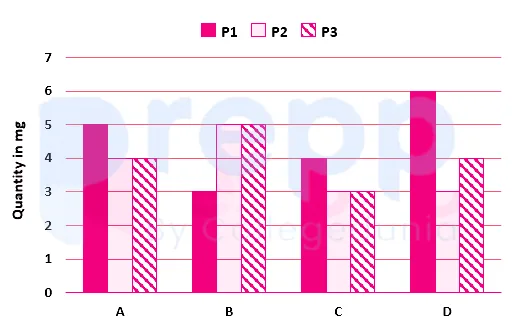
- A
P1 and P3
- B
P3
- C
P2
- D
P1
Show answer
D. P1Calculation:
Total quantity of P1 in all drugs = 5 + 3 + 4 + 6 = 18 mg
Total quantity of P2 in all drugs = 4 + 5 + 3 + 3 = 15 mg
Total quantity of P3 in all drugs = 4 + 5 + 3 + 4 = 16 mg
∴ P1 substance is most used in terms of quantity in all drugs.
Paper & answer key PDF ↗ Question 54archived
Find the weighted arithmetic mean of the first 'n' natural numbers, the weights being the corresponding numbers.
- A
\(\rm \frac{{\{ n(n + 1)(2n + 1)\} }}{6}\)
- B
\(\rm \frac{{\{ n(n + 1)\} }}{2}\)
- C
\(\rm \frac{{(2n + 1)}}{3}\)
- D
n
Show answer
C. \(\rm \frac{{(2n + 1)}}{3}\)Understanding Weighted Arithmetic Mean of Natural Numbers
The question asks us to find the weighted arithmetic mean of the first 'n' natural numbers, where the weights are the corresponding numbers themselves.
Let the first 'n' natural numbers be denoted by \(x_1, x_2, \ldots, x_n\). So, \(x_i = i\) for \(i = 1, 2, \ldots, n\).
The corresponding weights are given as the numbers themselves. Let the weights be denoted by \(w_1, w_2, \ldots, w_n\). So, \(w_i = i\) for \(i = 1, 2, \ldots, n\).
The formula for the weighted arithmetic mean (\(\bar{x}_w\)) is given by:
\(\bar{x}_w = \frac{\sum_{i=1}^{n} w_i x_i}{\sum_{i=1}^{n} w_i}\)
Calculating the Numerator (\(\sum w_i x_i\))
In this case, \(w_i = i\) and \(x_i = i\). So, \(w_i x_i = i \cdot i = i^2\).
The numerator is the sum of the products of each number and its weight:
\(\sum_{i=1}^{n} w_i x_i = \sum_{i=1}^{n} i \cdot i = \sum_{i=1}^{n} i^2\)
The sum of the squares of the first 'n' natural numbers is given by the formula:
\(\sum_{i=1}^{n} i^2 = \frac{n(n+1)(2n+1)}{6}\)
Calculating the Denominator (\(\sum w_i\))
The denominator is the sum of the weights. In this case, the weights are the first 'n' natural numbers:
\(\sum_{i=1}^{n} w_i = \sum_{i=1}^{n} i\)
The sum of the first 'n' natural numbers is given by the formula:
\(\sum_{i=1}^{n} i = \frac{n(n+1)}{2}\)
Finding the Weighted Arithmetic Mean
Now, we substitute the expressions for the numerator and the denominator into the weighted mean formula:
\(\bar{x}_w = \frac{\sum_{i=1}^{n} i^2}{\sum_{i=1}^{n} i} = \frac{\frac{n(n+1)(2n+1)}{6}}{\frac{n(n+1)}{2}}\)
To simplify this complex fraction, we can multiply the numerator by the reciprocal of the denominator:
\(\bar{x}_w = \frac{n(n+1)(2n+1)}{6} \times \frac{2}{n(n+1)}\)
We can cancel out the common terms \(n(n+1)\) from the numerator and the denominator, assuming \(n \neq 0\) and \(n \neq -1\) (which is true for natural numbers):
\(\bar{x}_w = \frac{(2n+1)}{6} \times 2\)
\(\bar{x}_w = \frac{2(2n+1)}{6}\)
Finally, we can simplify the fraction by dividing the numerator and denominator by 2:
\(\bar{x}_w = \frac{(2n+1)}{3}\)
Comparing with Options
Let's compare our result with the given options:
Option 1: \(\rm \frac{{\{ n(n + 1)(2n + 1)\} }}{6}\)
Option 2: \(\rm \frac{{\{ n(n + 1)\} }}{2}\)
Option 3: \(\rm \frac{{(2n + 1)}}{3}\)
Option 4: n
Our calculated weighted arithmetic mean is \(\frac{{(2n + 1)}}{3}\), which matches Option 3.
The final answer is \(\frac{{(2n + 1)}}{3}\).
Term (\(x_i\))
Weight (\(w_i\))
Product (\(w_i x_i\))
1
1
\(1 \times 1 = 1^2\)
2
2
\(2 \times 2 = 2^2\)
3
3
\(3 \times 3 = 3^2\)
...
...
...
n
n
\(n \times n = n^2\)
Sum of weights (\(\sum w_i\)): \(1 + 2 + \ldots + n = \frac{n(n+1)}{2}\)
Sum of products (\(\sum w_i x_i\)): \(1^2 + 2^2 + \ldots + n^2 = \frac{n(n+1)(2n+1)}{6}\)
Weighted Mean = \(\frac{\sum w_i x_i}{\sum w_i} = \frac{\frac{n(n+1)(2n+1)}{6}}{\frac{n(n+1)}{2}} = \frac{(2n+1)}{3}\)
Revision Table: Weighted Mean Concepts
Concept
Definition
Formula
Arithmetic Mean (Simple)
Sum of values divided by the number of values.
\(\bar{x} = \frac{\sum x_i}{N}\)
Weighted Arithmetic Mean
Sum of products of values and their weights, divided by the sum of weights. Used when values have different importance.
\(\bar{x}_w = \frac{\sum w_i x_i}{\sum w_i}\)
Natural Numbers
Positive integers (1, 2, 3, ...).
-
Sum of First 'n' Natural Numbers
Sum of 1 + 2 + ... + n.
\(\frac{n(n+1)}{2}\)
Sum of Squares of First 'n' Natural Numbers
Sum of \(1^2 + 2^2 + \ldots + n^2\).
\(\frac{n(n+1)(2n+1)}{6}\)
Additional Information: Applications of Weighted Mean
The weighted arithmetic mean is widely used in various fields to calculate an average that considers the relative importance or frequency of each data point. Here are a few examples:
Academic Grades: A final grade might be calculated using a weighted average, where exams, quizzes, homework, and participation each have a different percentage weight.
Finance: Calculating the average price of a stock purchased at different times and prices (weighted by the number of shares bought).
Statistics: Used in calculating weighted averages for grouped data or when dealing with samples where data points have varying levels of reliability.
Economics: Calculating average prices of goods, considering the quantity sold at each price point.
Understanding the concept of weighted mean is crucial when data points do not contribute equally to the overall average.
Paper & answer key PDF ↗ Question 55archived
A district has 10,24,000 inhabitants. If the population increases at the rate 2.5% per annum, find the number of inhabitants at the end of three years.
- A
11,20,736
- B
11,02,736
- C
10,75,840
- D
10,64,850
Show answer
B. 11,02,736Calculating Population Increase Over Time
This problem asks us to determine the number of inhabitants in a district after a specific period, given the initial population and a constant annual growth rate. This is a classic example of compound growth, similar to calculating compound interest.
Understanding Compound Population Growth
When a population increases at a certain percentage rate each year, the growth is compounded. This means the increase in each subsequent year is calculated on the new, larger population base from the previous year, not just the initial population.
The formula for compound growth is:
\(P_n = P_0 (1 + r)^n\)
Where:
\(P_n\) is the population after \(n\) years
\(P_0\) is the initial population
\(r\) is the annual growth rate (as a decimal)
\(n\) is the number of years
Applying the Formula to the District Population
From the question, we are given the following values:
Initial Population (\(P_0\)): 10,24,000
Annual Growth Rate (\(r\)): 2.5%
Number of Years (\(n\)): 3 years
First, convert the percentage rate to a decimal:
\(r = 2.5\% = \frac{2.5}{100} = 0.025\)
Now, substitute these values into the compound growth formula:
\(P_3 = 10,24,000 \times (1 + 0.025)^3\)
\(P_3 = 10,24,000 \times (1.025)^3\)
Step-by-Step Calculation
Let's calculate \((1.025)^3\):
Year 1 factor: \(1.025\)
Year 2 factor: \(1.025 \times 1.025 = 1.050625\)
Year 3 factor: \(1.050625 \times 1.025 = 1.076890625\)
Now, multiply the initial population by this factor:
\(P_3 = 10,24,000 \times 1.076890625\)
Performing the multiplication:
\(P_3 = 11,02,736\)
Final Result of Population Calculation
The number of inhabitants at the end of three years is 11,02,736.
Parameter
Value
Initial Population (\(P_0\))
10,24,000
Annual Rate (\(r\))
2.5% or 0.025
Time (\(n\))
3 years
Population after 3 years (\(P_3\))
11,02,736
Revision Table: Key Concepts in Population Increase
Concept
Description
Formula/Example
Initial Population
The population count at the beginning of the period.
\(P_0\)
Growth Rate
The percentage increase in population per unit of time (usually per annum).
Expressed as a decimal or fraction (\(r\))
Time Period
The duration over which the population growth is calculated.
\(n\) (in years, months, etc.)
Compound Growth
Growth calculated on the previous period's value plus accumulated growth.
\(P_n = P_0 (1 + r)^n\)
Additional Information: Compound vs. Simple Growth
It's important to distinguish between compound growth and simple growth.
Simple Growth: The growth amount is calculated only on the initial amount for each period. The total increase is constant each period (amount-wise). If this were simple growth, the annual increase would be \(10,24,000 \times 0.025 = 25,600\). Over 3 years, the total increase would be \(25,600 \times 3 = 76,800\), leading to a population of \(10,24,000 + 76,800 = 11,00,800\).
Compound Growth: The growth amount for each period is calculated on the value at the beginning of that specific period. This leads to exponential growth, as the base for calculation increases each time. This is the method used for population increase unless specified otherwise, and also for compound interest. The formula \(P_n = P_0 (1 + r)^n\) directly calculates this compounded value.
Population growth is typically modelled using compound growth because the increased number of people in one year contributes to the potential for even more growth in the following years.
Paper & answer key PDF ↗ Question 56archived
A takes twice as much time as B and thrice as much time as C to finalise a task. Working together, they can complete the task in 8 days. The time (in days) taken by A, B and C, respectively, to complete the task is :
- A
42, 21, 14
- B
60, 30, 20
- C
54, 27, 18
- D
48, 24, 16
Show answer
D. 48, 24, 16This problem is a classic example of time and work questions, where we need to determine the individual time taken by A, B, and C to complete a task, given the relationships between their efficiencies and their combined working time.
The fundamental principle in time and work problems is the relationship between time taken and the rate of work. If a person takes \(T\) days to complete a task, their work rate is \(1/T\) of the task per day. When people work together, their individual work rates add up to form the combined work rate.
Analyzing the Given Time and Work Relationships
We are given the following information about the time taken by A, B, and C to finalise a task:
A takes twice as much time as B. Let \(T_A\), \(T_B\), and \(T_C\) be the time taken by A, B, and C respectively, in days.
This relationship can be written as: \begin{equation*} T_A = 2 \times T_B \end{equation*}
A takes thrice as much time as C.
This relationship can be written as: \begin{equation*} T_A = 3 \times T_C \end{
From these relationships, we can express the time taken by B and C in terms of the time taken by A:
From \(T_A = 2 \times T_B\), we get \begin{equation*} T_B = \frac{T_A}{2} \end{equation*}
From \(T_A = 3 \times T_C\), we get \begin{equation*} T_C = \frac{T_A}{3} \end{equation*}
We are also told that working together, they can complete the task in 8 days. Let \(T_{A+B+C}\) be the time taken by A, B, and C together, which is 8 days.
\begin{equation*} T_{A+B+C} = 8 \text{ days} \end{equation*}
Calculating Individual Work Rates
The work rate of each person is the reciprocal of the time they take to complete the task:
Work rate of A = \begin{equation*} \frac{1}{T_A} \end{equation*} per day.
Work rate of B = \begin{equation*} \frac{1}{T_B} = \frac{1}{T_A/2} = \frac{2}{T_A} \end{equation*} per day.
Work rate of C = \begin{equation*} \frac{1}{T_C} = \frac{1}{T_A/3} = \frac{3}{T_A} \end{equation*} per day.
The combined work rate when A, B, and C work together is the sum of their individual work rates.
Combined work rate = Work rate of A + Work rate of B + Work rate of C
\begin{equation*} \text{Combined work rate} = \frac{1}{T_A} + \frac{2}{T_A} + \frac{3}{T_A} = \frac{1+2+3}{T_A} = \frac{6}{T_A} \end{equation*} per day.
Solving for Time Taken by A (\(T_A\))
The combined work rate is also equal to the reciprocal of the time taken when they work together (\(T_{A+B+C}\)).
\begin{equation*} \text{Combined work rate} = \frac{1}{T_{A+B+C}} = \frac{1}{8} \text{ per day} \end{equation*}
Equating the two expressions for combined work rate:
\begin{equation*} \frac{6}{T_A} = \frac{1}{8} \end{equation*}
To solve for \(T_A\), we can cross-multiply:
\begin{equation*} T_A \times 1 = 6 \times 8 \end{equation*}
\begin{equation*} T_A = 48 \text{ days} \end{equation*}
Calculating Time Taken by B (\(T_B\)) and C (\(T_C\))
Now that we have \(T_A\), we can find \(T_B\) and \(T_C\) using the relationships derived earlier:
\(T_B = \frac{T_A}{2} = \frac{48}{2} = 24 \text{ days}\)
\(T_C = \frac{T_A}{3} = \frac{48}{3} = 16 \text{ days}\)
So, the time taken by A, B, and C to complete the task individually is 48 days, 24 days, and 16 days, respectively.
Verification
Let's verify if these times work with the combined time of 8 days. Their individual work rates are:
A's rate = \(1/48\) per day
B's rate = \(1/24\) per day
C's rate = \(1/16\) per day
Combined work rate = \begin{equation*} \frac{1}{48} + \frac{1}{24} + \frac{1}{16} \end{equation*}
To add these fractions, find a common denominator, which is 48:
\begin{equation*} \frac{1}{48} + \frac{1 \times 2}{24 \times 2} + \frac{1 \times 3}{16 \times 3} = \frac{1}{48} + \frac{2}{48} + \frac{3}{48} = \frac{1+2+3}{48} = \frac{6}{48} = \frac{1}{8} \end{equation*}
The combined work rate is \(1/8\) of the task per day, which means they take 8 days to complete the task together. This matches the information given in the problem statement.
The time taken by A, B, and C, respectively, is 48, 24, and 16 days.
Final Answer
The time taken by A, B, and C, respectively, to complete the task is 48, 24, and 16 days.
Person
Time Taken (Days)
Work Rate (Task/Day)
A
\(T_A = 48\)
\(1/48\)
B
\(T_B = 24\)
\(1/24\)
C
\(T_C = 16\)
\(1/16\)
A, B, & C (together)
8
\(1/48 + 1/24 + 1/16 = 6/48 = 1/8\)
Revision Table: Time and Work Concepts
Review the key concepts used in solving time and work problems:
Time and Work Relationship: Time taken is inversely proportional to the work rate. If time increases, work rate decreases, and vice versa.
Work Rate: The amount of work done per unit of time (e.g., per day, per hour). It is calculated as 1 / (Time taken to complete the whole work).
Combined Work Rate: When multiple people work together, their individual work rates are added to find the combined work rate.
Total Work: Often considered as '1 unit' or 'the entire task'. If the work rate is \(R\) per unit time, and the time taken is \(T\), then Total Work = \(R \times T\). If work rate is \(1/T\), then \(1/T \times T = 1\) (the whole task).
Additional Information: Types of Time and Work Problems
Time and work problems can appear in various forms:
Individual and Combined Work: Like the problem solved above, finding individual or combined times/rates.
Problems with Efficiency Ratios: Where the efficiency of workers is given in ratios (e.g., A is twice as efficient as B). Higher efficiency means less time taken.
Problems with Men, Women, and Children: Involving different groups of workers with different efficiencies.
Problems with Pipes and Cisterns: Similar concept to time and work, where pipes fill or empty a tank (work) over time.
Problems with Varying Work Rate: Where the work rate changes over time or different people work for different durations.
Understanding the relationship between time, work done, and work rate is crucial for solving all these types of problems effectively.
Paper & answer key PDF ↗ Question 57archived
Simplify \(\rm \frac{{{x^2} + 2x + {y^2}}}{{{x^3} - 5{x^2}}}\) if \(\rm X + \frac{{{y^2}}}{x} = 5\) .
- A
\(\rm \frac{5}{y^2}\)
- B
\(\rm \frac{7}{y^2}\)
- C
\(\rm -\frac{5}{y^2}\)
- D
\(\rm -\frac{7}{y^2}\)
Show answer
D. \(\rm -\frac{7}{y^2}\)Simplifying Algebraic Expressions with Given Conditions
The problem asks us to simplify the algebraic expression \( \rm \frac{{{x^2} + 2x + {y^2}}}{{{x^3} - 5{x^2}}} \) given the condition \( \rm X + \frac{{{y^2}}}{x} = 5 \). We will assume the variable 'X' in the condition is a typo and should be 'x' to match the variables in the expression. The condition is therefore \( \rm x + \frac{{{y^2}}}{x} = 5 \).
Using the Given Condition to Simplify
Let's manipulate the given condition \( \rm x + \frac{{{y^2}}}{x} = 5 \) to find a useful relationship between \(x\) and \(y^2\).
Multiply the entire equation by \(x\) (assuming \(x \neq 0\), which must be true for the condition to be defined):
\( \rm x \left( x + \frac{{{y^2}}}{x} \right) = 5x \)
\( \rm x^2 + y^2 = 5x \)
This equation \( \rm x^2 + y^2 = 5x \) is key to simplifying the expression.
Simplifying the Numerator
The numerator of the expression is \( \rm x^2 + 2x + y^2 \).
We can group the terms as \( \rm (x^2 + y^2) + 2x \).
From our derived condition, we know that \( \rm x^2 + y^2 = 5x \).
Substitute \( \rm 5x \) for \( \rm (x^2 + y^2) \) in the numerator:
Numerator \( = \rm (x^2 + y^2) + 2x = 5x + 2x = 7x \).
Simplifying the Denominator
The denominator of the expression is \( \rm x^3 - 5x^2 \).
We can factor out the common term \( \rm x^2 \):
Denominator \( = \rm x^2(x - 5) \).
Now, let's look back at the original condition \( \rm x + \frac{{{y^2}}}{x} = 5 \). We can rearrange it:
\( \rm x - 5 = -\frac{{{y^2}}}{x} \)
Substitute this expression for \( \rm (x - 5) \) in the denominator:
Denominator \( = \rm x^2 \left( -\frac{{{y^2}}}{x} \right) \)
Simplify the denominator (assuming \(x \neq 0\)):
Denominator \( = \rm -xy^2 \).
Combining the Simplified Numerator and Denominator
Now we have the simplified numerator (\( \rm 7x \)) and the simplified denominator (\( \rm -xy^2 \)).
The simplified expression is:
\( \rm \frac{{7x}}{{-xy^2}} \)
We can cancel out the common factor \(x\) from the numerator and the denominator (assuming \(x \neq 0\)):
\( \rm \frac{{7}}{{-y^2}} = -\frac{{7}}{{y^2}} \)
For the expression and condition to be meaningful, we must have \(x \neq 0\) and \(y \neq 0\). If \(y=0\), the original condition implies \(x=5\), and the original expression becomes undefined (\( \rm \frac{35}{0} \)). Thus, \(y \neq 0\).
Final Result
The simplified expression is \( \rm -\frac{{7}}{{y^2}} \).
Part of Expression
Original Form
Simplified Using Condition
Numerator
\( \rm x^2 + 2x + y^2 \)
\( \rm 7x \)
Denominator
\( \rm x^3 - 5x^2 \)
\( \rm -xy^2 \)
Full Expression
\( \rm \frac{{{x^2} + 2x + {y^2}}}{{{x^3} - 5{x^2}}} \)
\( \rm -\frac{{7}}{{y^2}} \)
Checking Options
Let's compare our result with the given options:
Option 1: \( \rm \frac{5}{y^2} \)
Option 2: \( \rm \frac{7}{y^2} \)
Option 3: \( \rm -\frac{5}{y^2} \)
Option 4: \( \rm -\frac{7}{y^2} \)
Our simplified expression \( \rm -\frac{{7}}{{y^2}} \) matches Option 4.
Revision Table: Key Concepts in Algebraic Simplification
Concept
Description
Application in Problem
Simplifying Algebraic Fractions
Reducing an expression to its simplest form by cancelling common factors in the numerator and denominator.
Cancelling \(x\) from \( \rm \frac{{7x}}{{-xy^2}} \).
Using Given Conditions
Manipulating a provided equation or condition to substitute into the expression being simplified.
Using \( \rm x^2 + y^2 = 5x \) and \( \rm x - 5 = -\frac{{{y^2}}}{x} \) derived from \( \rm x + \frac{{{y^2}}}{x} = 5 \).
Factoring Polynomials
Expressing a polynomial as a product of simpler polynomials.
Factoring the denominator \( \rm x^3 - 5x^2 = x^2(x - 5) \).
Additional Information: Conditions for Variables
When simplifying algebraic expressions, especially those involving division, it's important to consider the values for which the original expression and the simplified expression are defined.
In the original expression \( \rm \frac{{{x^2} + 2x + {y^2}}}{{{x^3} - 5{x^2}}} \), the denominator \( \rm x^3 - 5x^2 = x^2(x - 5) \) cannot be zero. This means \( \rm x^2 \neq 0 \) (so \(x \neq 0\)) and \( \rm x - 5 \neq 0 \) (so \(x \neq 5\)).
In the condition \( \rm x + \frac{{{y^2}}}{x} = 5 \), the term \( \rm \frac{{{y^2}}}{x} \) requires \(x \neq 0\).
Our simplified expression is \( \rm -\frac{{7}}{{y^2}} \). For this to be defined, \( \rm y^2 \neq 0 \), meaning \(y \neq 0\).
Let's check if \(x=5\) is possible under the condition. If \(x=5\), the condition becomes \( \rm 5 + \frac{{{y^2}}}{5} = 5 \), which implies \( \rm \frac{{{y^2}}}{5} = 0 \), so \( \rm y^2 = 0 \), meaning \(y=0\). However, if \(y=0\), the original expression's numerator is \( \rm 5^2 + 2(5) + 0^2 = 35 \) and the denominator is \( \rm 5^3 - 5(5^2) = 125 - 125 = 0 \). The original expression is undefined if \(x=5\) and \(y=0\). Since the condition \( \rm x + \frac{{{y^2}}}{x} = 5 \) includes the case \(x=5, y=0\) (which makes the expression undefined), the simplification resulting in \( \rm -\frac{7}{y^2} \) is valid for all \(x, y\) where the original expression is defined and the condition holds, specifically \(x \neq 0\), \(x \neq 5\), and \(y \neq 0\).
The simplified form \( \rm -\frac{7}{y^2} \) is valid under the implicit assumption that \(y \neq 0\), which is consistent with the problem being well-defined where the simplification takes place.
Paper & answer key PDF ↗ Question 58archived
If the diameter of a hemisphere is 28 cm, then what is the volume of hemisphere?
- A
5749.33 cm3
- B
6349.22 cm3
- C
6728.11 cm3
- D
5124.44 cm3
Show answer
A. 5749.33 cm3Calculating the Volume of a Hemisphere
The question asks us to find the volume of a hemisphere when its diameter is given as 28 cm.
Understanding Hemisphere Geometry
A hemisphere is exactly half of a sphere. To find its volume, we first need to determine its radius from the given diameter.
The diameter (D) of a circle or sphere is twice its radius (r).
So, the radius is half of the diameter: $r = \frac{D}{2}$.
Finding the Radius
Given the diameter is 28 cm:
Radius, $r = \frac{28 \text{ cm}}{2} = 14 \text{ cm}$.
Formula for Hemisphere Volume
The volume of a sphere with radius $r$ is given by the formula $\frac{4}{3} \pi r^3$. Since a hemisphere is half a sphere, its volume is half the volume of a sphere.
Volume of Hemisphere $= \frac{1}{2} \times (\text{Volume of Sphere})$
Volume of Hemisphere $= \frac{1}{2} \times \left(\frac{4}{3} \pi r^3\right)$
Volume of Hemisphere $= \frac{2}{3} \pi r^3$
Calculating the Volume of the Hemisphere
Now, we substitute the calculated radius, $r = 14$ cm, into the formula for the volume of a hemisphere. We will use the value of $\pi \approx \frac{22}{7}$ for calculation.
Volume $= \frac{2}{3} \times \pi \times r^3$
Volume $= \frac{2}{3} \times \frac{22}{7} \times (14 \text{ cm})^3$
Volume $= \frac{2}{3} \times \frac{22}{7} \times 14 \text{ cm} \times 14 \text{ cm} \times 14 \text{ cm}$
We can cancel out a 7 from the denominator with one of the 14s in the numerator ($14/7 = 2$).
Volume $= \frac{2}{3} \times 22 \times (2 \times 14 \times 14) \text{ cm}^3$
Volume $= \frac{44}{3} \times (28 \times 14) \text{ cm}^3$
Volume $= \frac{44}{3} \times 392 \text{ cm}^3$
Volume $= \frac{44 \times 392}{3} \text{ cm}^3$
Volume $= \frac{17248}{3} \text{ cm}^3$
Now, we perform the division:
Volume $\approx 5749.333... \text{ cm}^3$
Final Volume
The calculated volume of the hemisphere with a diameter of 28 cm is approximately 5749.33 cm$^3$. This value matches one of the given options.
The volume of the hemisphere is approximately $5749.33 \text{ cm}^3$.
Revision Table: Hemisphere Volume Calculation
Here's a quick summary of the steps involved in finding the volume of a hemisphere given its diameter:
StepDescriptionCalculation
1Find the radius (r) from the diameter (D)$r = D/2$
2Use the hemisphere volume formula$V = \frac{2}{3} \pi r^3$
3Substitute the radius and calculate$V = \frac{2}{3} \pi (14)^3 \approx 5749.33 \text{ cm}^3$
Additional Information: Properties of Hemispheres
Hemispheres are common geometric shapes, found in everyday objects from bowls to architectural domes. Understanding their properties is key in geometry and mensuration problems.
Curved Surface Area: The curved surface area of a hemisphere is half the surface area of a sphere, given by $2\pi r^2$.
Total Surface Area: The total surface area includes the curved surface and the circular base. It is given by $2\pi r^2 + \pi r^2 = 3\pi r^2$.
Relationship to Sphere: A hemisphere is defined by cutting a sphere exactly in half through its center.
Units: Volume is always measured in cubic units (like cm$^3$, m$^3$, etc.).
Paper & answer key PDF ↗ Question 59archived
If a + b = 5 and ab = 6, then find 3(a 2 + b 2).
- A
39
- B
48
- C
26
- D
13
Show answer
A. 39Solving Algebraic Expressions: Finding 3(a<sup>2</sup> + b<sup>2</sup>)
The problem asks us to find the value of the expression $3(a^2 + b^2)$, given that we know the sum of two variables, $a+b$, and their product, $ab$. We are given $a+b = 5$ and $ab = 6$.
Using Algebraic Identities to Solve
To find $a^2 + b^2$, we can use a common algebraic identity that relates the sum and product of two variables to the sum of their squares. The identity is:
$(a+b)^2 = a^2 + b^2 + 2ab$
This identity shows that the square of the sum of $a$ and $b$ is equal to the sum of their squares plus twice their product. We can rearrange this identity to solve for $a^2 + b^2$:
$a^2 + b^2 = (a+b)^2 - 2ab$
Step-by-Step Calculation
Now we can substitute the given values into the rearranged identity:
We are given $a+b = 5$.
We are given $ab = 6$.
Substitute these values into the expression for $a^2 + b^2$:
$a^2 + b^2 = (5)^2 - 2(6)$
Calculate the values:
$(5)^2 = 5 \times 5 = 25$
$2(6) = 2 \times 6 = 12$
So, $a^2 + b^2 = 25 - 12 = 13$.
The problem asks for the value of $3(a^2 + b^2)$. Now that we know $a^2 + b^2 = 13$, we can find the final value:
$3(a^2 + b^2) = 3 \times 13$
$3 \times 13 = 39$
Final Answer
The value of $3(a^2 + b^2)$ is 39.
Given Information
Identity Used
Calculated Value
Final Expression
$a+b = 5$
$(a+b)^2 = a^2 + b^2 + 2ab$
$a^2 + b^2 = (a+b)^2 - 2ab$
$3(a^2 + b^2)$
$ab = 6$
$a^2 + b^2 = (5)^2 - 2(6) = 25 - 12 = 13$
$3(13) = 39$
Revision Table: Algebraic Identities
Identity
Description
Use Case
$(a+b)^2 = a^2 + b^2 + 2ab$
Square of a sum
Expanding $(a+b)^2$, finding $a^2+b^2$ from $a+b$ and $ab$.
$(a-b)^2 = a^2 + b^2 - 2ab$
Square of a difference
Expanding $(a-b)^2$, finding $a^2+b^2$ from $a-b$ and $ab$.
$a^2 - b^2 = (a-b)(a+b)$
Difference of squares
Factoring expressions of the form $a^2 - b^2$.
Additional Information: Connecting Sum, Product, and Squares
The relationship between the sum ($a+b$), product ($ab$), and sum of squares ($a^2+b^2$) of two numbers is fundamental in algebra. The identity $(a+b)^2 = a^2 + b^2 + 2ab$ is a powerful tool because it allows you to find any one of these three values if you know the other two. For example, if you know $a^2+b^2$ and $ab$, you can find $(a+b)^2$, and therefore $a+b$ (up to sign).
In this specific problem, we were given $a+b$ and $ab$, and we needed to find a value related to $a^2+b^2$. Using the identity to express $a^2+b^2$ in terms of $(a+b)$ and $ab$ was the key step. This method avoids needing to find the individual values of $a$ and $b$ first, although that would also be possible in this case by solving the quadratic equation $x^2 - (a+b)x + ab = 0$, which is $x^2 - 5x + 6 = 0$. The roots of this equation are $x=2$ and $x=3$. So, $\{a, b\} = \{2, 3\}$. Then $a^2+b^2 = 2^2+3^2 = 4+9=13$, and $3(a^2+b^2) = 3(13)=39$. However, using the identity is often quicker and more general.
Paper & answer key PDF ↗ Question 60archived
In ΔABC, AB = AC, O is the point on BC such that BO = CO and OD is perpendicular to AB and OE is perpendicular to AC. If ∠BOD = 60°, then measure of ∠AOE is :
- A
120°
- B
60°
- C
30°
- D
90°
Show answer
C. 30°Understanding the Geometry Problem
The problem asks us to find the measure of angle ∠AOE in a given triangle ΔABC. We are provided with several key pieces of information about this triangle and points within it.
ΔABC is an isosceles triangle with AB = AC.
O is a point on the side BC such that BO = CO. This means O is the midpoint of BC.
OD is perpendicular to AB, meaning ∠ODB = ∠ODA = 90°.
OE is perpendicular to AC, meaning ∠OEC = ∠OEA = 90°.
We are given that ∠BOD = 60°.
We need to determine the measure of ∠AOE.
Analyzing the Isosceles Triangle Properties
Since ΔABC is an isosceles triangle with AB = AC, the angles opposite these sides are equal. Therefore, ∠ABC = ∠ACB, or ∠B = ∠C.
Because O is the midpoint of the base BC in the isosceles triangle ΔABC, the line segment AO has special properties:
AO is the median to the base BC.
AO is the altitude from A to BC, meaning AO is perpendicular to BC. Thus, ∠AOB = ∠AOC = 90°.
AO is the angle bisector of ∠BAC, meaning ∠BAO = ∠CAO.
Calculating Angles in the Triangle
Let's use the given information and the properties we've deduced to find other angles.
Consider the triangle ΔBOD. We know that OD is perpendicular to AB, so ∠BDO = 90°. We are given ∠BOD = 60°. The sum of angles in a triangle is 180°.
In ΔBOD:
\begin{equation*} \angle OBD + \angle BDO + \angle BOD = 180^\circ \end{equation*}
\begin{equation*} \angle OBD + 90^\circ + 60^\circ = 180^\circ \end{equation*}
\begin{equation*} \angle OBD = 180^\circ - 90^\circ - 60^\circ \end{equation*}
\begin{equation*} \angle OBD = 30^\circ \end{equation*}
The angle ∠OBD is the same as ∠B in ΔABC. So, ∠B = 30°.
Since ΔABC is isosceles with AB = AC, we have ∠C = ∠B. Therefore, ∠C = 30°.
Now consider the sum of angles in ΔABC:
\begin{equation*} \angle BAC + \angle B + \angle C = 180^\circ \end{equation*}
\begin{equation*} \angle BAC + 30^\circ + 30^\circ = 180^\circ \end{equation*}
\begin{equation*} \angle BAC = 180^\circ - 60^\circ \end{equation*}
\begin{equation*} \angle BAC = 120^\circ \end{equation*}
Since AO is the angle bisector of ∠BAC, we have:
\begin{equation*} \angle BAO = \angle CAO = \frac{1}{2} \angle BAC = \frac{1}{2} \times 120^\circ = 60^\circ \end{equation*}
So, ∠CAO = 60°.
Finding the Measure of ∠AOE
We know that AO is perpendicular to BC, so ∠AOC = 90°. The angle ∠AOC is made up of two parts: ∠AOE and ∠EOC.
∠AOC = ∠AOE + ∠EOC.
To find ∠AOE, we need to find ∠EOC.
Consider the triangle ΔOEC. OE is perpendicular to AC, so ∠OEC = 90°. We found ∠C = 30°.
In ΔOEC:
\begin{equation*} \angle EOC + \angle OEC + \angle C = 180^\circ \end{equation*}
\begin{equation*} \angle EOC + 90^\circ + 30^\circ = 180^\circ \end{equation*}
\begin{equation*} \angle EOC = 180^\circ - 90^\circ - 30^\circ \end{equation*}
\begin{equation*} \angle EOC = 60^\circ \end{equation*}
Now we can find ∠AOE:
\begin{equation*} \angle AOC = \angle AOE + \angle EOC \end{equation*}
\begin{equation*} 90^\circ = \angle AOE + 60^\circ \end{equation*}
\begin{equation*} \angle AOE = 90^\circ - 60^\circ \end{equation*}
\begin{equation*} \angle AOE = 30^\circ \end{equation*}
Thus, the measure of ∠AOE is 30°.
Step-by-Step Calculation Summary
Given ΔABC is isosceles with AB=AC, so ∠B = ∠C.
Given O is midpoint of BC, so AO is altitude and angle bisector. ∠AOC = 90°.
In right ΔBOD, ∠BDO = 90°, ∠BOD = 60°. Calculate ∠B = 180° - 90° - 60° = 30°.
Since ∠B = 30° and ∠B = ∠C, ∠C = 30°.
In ΔABC, ∠BAC = 180° - (∠B + ∠C) = 180° - (30° + 30°) = 120°.
Since AO bisects ∠BAC, ∠CAO = ∠BAO = 120° / 2 = 60°.
In right ΔOEC, ∠OEC = 90°, ∠C = 30°. Calculate ∠EOC = 180° - 90° - 30° = 60°.
Since ∠AOC = ∠AOE + ∠EOC and ∠AOC = 90°, we have 90° = ∠AOE + 60°.
Solve for ∠AOE: ∠AOE = 90° - 60° = 30°.
Geometric Figure
Known Angles/Properties
Calculated Angles
ΔABC (Isosceles AB=AC)
AB=AC, O is midpoint of BC
∠B = ∠C = 30°, ∠BAC = 120°
Line Segment AO
Median, Altitude, Angle Bisector
∠AOC = 90°, ∠CAO = 60°
ΔBOD (Right Triangle)
∠BDO = 90°, ∠BOD = 60°
∠OBD (∠B) = 30°
ΔOEC (Right Triangle)
∠OEC = 90°, ∠C = 30°
∠EOC = 60°
Angles around O on side AC
∠AOC = 90°
∠AOE = ∠AOC - ∠EOC = 90° - 60° = 30°
Revision Table: Key Geometry Concepts
Concept
Description
Relevance to Problem
Isosceles Triangle
A triangle with two sides of equal length. The angles opposite the equal sides are also equal.
Used to determine ∠B = ∠C and properties of the median from the vertex angle.
Midpoint
A point that divides a line segment into two equal parts.
O being the midpoint of BC is crucial for AO being altitude/angle bisector.
Altitude
A line segment from a vertex of a triangle that is perpendicular to the opposite side.
AO is the altitude to BC, hence ∠AOC = 90°.
Angle Bisector
A line or line segment that divides an angle into two equal angles.
AO bisects ∠BAC, used to find ∠CAO.
Sum of Angles in a Triangle
The sum of the interior angles of any triangle is 180°.
Used multiple times in ΔBOD, ΔABC, and ΔOEC.
Perpendicular Lines
Two lines that intersect at a 90° angle.
OD ⊥ AB and OE ⊥ AC create right triangles ΔBOD and ΔOEC.
Additional Information: Properties of Median in Isosceles Triangle
In an isosceles triangle, the median drawn from the vertex angle to the base has several important properties. If ΔABC is isosceles with AB = AC, and M is the midpoint of BC, then the median AM is also:
The altitude from A to BC (AM ⊥ BC).
The angle bisector of ∠BAC.
The perpendicular bisector of BC.
These properties are unique to the median from the vertex angle in an isosceles triangle. In our problem, O is the midpoint of BC in the isosceles triangle ABC, so AO acts as this special median with all these properties, including being perpendicular to BC (∠AOC = 90°) and bisecting ∠BAC.
Understanding these properties was essential in solving the problem, particularly in determining that ∠AOC is 90° and how angles are related within the figure.
Paper & answer key PDF ↗ Question 61archived
The reduction of 20% in the price of rice enables a person to obtain 50 kg more for Rs. 450. Find the original price of rice per kg.
- A
Rs. 1
- B
Rs. 2
- C
Rs. 1.25
- D
Rs. 2.25
Show answer
D. Rs. 2.25Let's break down this problem about the reduction in the price of rice. We are told that a 20% reduction in the price of rice allows a person to buy 50 kg more rice for the same amount of money, which is Rs. 450. We need to find the original price of rice per kg.
Understanding the Impact of Rice Price Reduction
When the price of an item reduces, you can buy more quantity for the same amount of money, or you can save money if you buy the same quantity. In this case, the saving from the original price on the amount of rice that could be bought for Rs. 450 is used to purchase an additional 50 kg.
Calculating the Value of the Price Reduction
The total amount of money spent is Rs. 450. The price reduction is 20%. This 20% reduction on the amount Rs. 450 is what enables the purchase of the extra 50 kg of rice. Therefore, the money saved due to the 20% reduction, when applied to the total spending, is effectively the cost of the extra 50 kg at the *new*, reduced price.
Total amount spent: Rs. 450
Percentage price reduction: 20%
Amount of money that corresponds to the 20% saving on the total spending:
$$ \text{Saving} = 20\% \text{ of Rs. } 450 $$
$$ \text{Saving} = \frac{20}{100} \times 450 $$
$$ \text{Saving} = 0.20 \times 450 $$
$$ \text{Saving} = \text{Rs. } 90 $$
This Rs. 90 is the cost of the 50 kg of extra rice obtained at the reduced price.
Finding the Reduced Price Per Kg
Since Rs. 90 allows the person to buy 50 kg of rice at the reduced price, we can calculate the reduced price per kg.
Cost of extra 50 kg: Rs. 90
Extra quantity obtained: 50 kg
Reduced price per kg:
$$ \text{Reduced Price per kg} = \frac{\text{Cost of extra quantity}}{\text{Extra quantity}} $$
$$ \text{Reduced Price per kg} = \frac{\text{Rs. } 90}{50 \text{ kg}} $$
$$ \text{Reduced Price per kg} = \text{Rs. } \frac{9}{5} $$
$$ \text{Reduced Price per kg} = \text{Rs. } 1.80 $$
So, the reduced price of rice per kg is Rs. 1.80.
Calculating the Original Price Per Kg
The reduced price (Rs. 1.80) is the original price minus a 20% reduction. This means the reduced price is 100% - 20% = 80% of the original price.
Let the original price of rice per kg be \(P_{original}\).
Reduced Price = 80% of Original Price
$$ \text{Rs. } 1.80 = 80\% \times P_{original} $$
$$ 1.80 = \frac{80}{100} \times P_{original} $$
$$ 1.80 = 0.80 \times P_{original} $$
Now, we can solve for \(P_{original}\):
$$ P_{original} = \frac{1.80}{0.80} $$
$$ P_{original} = \frac{180}{80} $$
$$ P_{original} = \frac{18}{8} $$
$$ P_{original} = \frac{9}{4} $$
$$ P_{original} = 2.25 $$
The original price of rice per kg is Rs. 2.25.
Summary of Steps
Calculate the amount saved due to the 20% reduction on the total spending (Rs. 450). This saving is Rs. 90.
Understand that this saving of Rs. 90 is the cost of the extra 50 kg at the reduced price.
Calculate the reduced price per kg by dividing the saving by the extra quantity (90 / 50 = Rs. 1.80/kg).
Recognize that the reduced price (Rs. 1.80) is 80% of the original price.
Calculate the original price per kg by dividing the reduced price by 80% (1.80 / 0.80 = Rs. 2.25/kg).
Item
Value
Total Spent Amount
Rs. 450
Price Reduction Percentage
20%
Extra Quantity Obtained
50 kg
Amount Corresponding to Reduction (20% of 450)
Rs. 90
Reduced Price Per Kg (90 / 50)
Rs. 1.80
Reduced Price is X% of Original Price
80%
Original Price Per Kg (1.80 / 0.80)
Rs. 2.25
Revision Table: Key Concepts in Price Reduction Problems
Concept
Explanation
Percentage Reduction
A decrease expressed as a percentage of the original value.
Amount Saved
The difference between the original cost and the reduced cost for the same quantity, or the value equivalent to the extra quantity purchased due to the reduction.
Reduced Price
The price after the reduction is applied. It is calculated as Original Price \(\times\) (100% - Reduction Percentage).
Original Price
The price before any reduction. Calculated as Reduced Price / (100% - Reduction Percentage).
Quantity Change
For a fixed amount of money, a price reduction allows buying more quantity.
Additional Information: Solving Price-Quantity Problems
Problems involving price changes and corresponding changes in quantity for a fixed expenditure are common in quantitative aptitude. The key is often to find the value of the price change in terms of the fixed expenditure and relate it to the extra quantity obtained at the new price.
If a price reduction of X% allows buying Y kg more for an amount A, then:
The amount saved is X% of A.
This saved amount is equal to the cost of Y kg at the reduced price.
Reduced price per kg = (X% of A) / Y.
The reduced price is (100 - X)% of the original price.
Original price per kg = Reduced price per kg / ((100 - X) / 100).
Using this approach helps in systematically solving such problems by first finding the reduced rate and then working backward to find the original rate.
Paper & answer key PDF ↗ Question 62archived
The surface area of a cube is 864 cm 2 . The volume of the cube is .
- A
1728 cm3
- B
2197 cm3
- C
1331 cm3
- D
729 cm3
Show answer
A. 1728 cm3Understanding the Cube Problem: Surface Area to Volume
The question asks us to find the volume of a cube given its surface area. A cube is a three-dimensional shape with six identical square faces. We are given the total surface area and need to use this information to find the side length, which will then allow us to calculate the volume.
Step-by-Step Calculation of Cube Volume
Let 's' represent the length of one side of the cube. The formulas for the surface area and volume of a cube are essential here.
The formula for the surface area of a cube is \(6 \times s^2\). This is because a cube has 6 equal square faces, and the area of one square face is \(s \times s = s^2\).
The formula for the volume of a cube is \(s^3\). This is the product of its length, width, and height, which are all equal to 's'.
We are given that the surface area of the cube is 864 cm\(^2\).
Using the surface area formula, we can write the equation:
\(6s^2 = 864\)
To find the side length 's', we first need to solve for \(s^2\):
\(s^2 = \frac{864}{6}\)
\(s^2 = 144\)
Now, we find 's' by taking the square root of \(s^2\):
\(s = \sqrt{144}\)
\(s = 12\) cm
So, the side length of the cube is 12 cm.
Now that we have the side length, we can calculate the volume of the cube using the volume formula:
\(Volume = s^3\)
\(Volume = (12 \text{ cm})^3\)
\(Volume = 12 \times 12 \times 12 \text{ cm}^3\)
\(Volume = 144 \times 12 \text{ cm}^3\)
\(Volume = 1728 \text{ cm}^3\)
Therefore, the volume of the cube is 1728 cm\(^3\).
Revision Table: Cube Formulas
Property
Formula (side = s)
Units
Side Length
s
cm (or unit of length)
Area of one face
\(s^2\)
cm\(^2\) (or unit\(^2\))
Surface Area
\(6s^2\)
cm\(^2\) (or unit\(^2\))
Volume
\(s^3\)
cm\(^3\) (or unit\(^3\))
Additional Information: Properties of a Cube
A cube is a special type of rectangular prism where all edges are of equal length. It has several key properties:
It has 6 faces, and all faces are squares.
It has 12 edges, and all edges have the same length.
It has 8 vertices (corners).
All face angles are right angles (90 degrees).
It is one of the five Platonic solids.
Understanding these basic properties helps when working with calculations involving cubes, such as surface area and volume problems.
Paper & answer key PDF ↗ Question 63archived
In a class of students, the first student has 2 toffees, second has 4 toffees, third has 6 toffees and so on. If the number of students in the class is 25, then the total number of toffees are divisible by .
- A
5 and 7
- B
5 and 13
- C
11 and 13
- D
7 and 11
Show answer
B. 5 and 13Understanding the Toffee Distribution Pattern
The problem describes a distribution of toffees among students where the number of toffees increases in a specific pattern. Let's look at the pattern:
Student 1 has 2 toffees.
Student 2 has 4 toffees.
Student 3 has 6 toffees.
We can see that the number of toffees for each student is twice their student number. If 'n' is the student number, the number of toffees for the n-th student is \(2 \times n\).
This forms a sequence of numbers: 2, 4, 6, 8, ..., which is an arithmetic progression.
Calculating the Total Number of Toffees
We have 25 students in the class. So, we need to find the total number of toffees for the first 25 students following this pattern.
The sequence of toffees is:
\(a_1 = 2 \times 1 = 2\)
\(a_2 = 2 \times 2 = 4\)
\(a_3 = 2 \times 3 = 6\)
...
\(a_{25} = 2 \times 25 = 50\)
This is an arithmetic series with:
First term (a) = 2
Common difference (d) = 4 - 2 = 2
Number of terms (n) = 25
Last term (l) = 50
The sum (S) of an arithmetic series can be calculated using the formula:
\[S_n = \frac{n}{2}(a + l)\]
or
\[S_n = \frac{n}{2}(2a + (n-1)d)\]
Using the first formula with \(n=25\), \(a=2\), and \(l=50\):
\[S_{25} = \frac{25}{2}(2 + 50)\]
\[S_{25} = \frac{25}{2}(52)\]
\[S_{25} = 25 \times \frac{52}{2}\]
\[S_{25} = 25 \times 26\]
Let's calculate \(25 \times 26\):
\(25 \times 26 = 25 \times (20 + 6) = 25 \times 20 + 25 \times 6 = 500 + 150 = 650\)
Alternatively, \(25 \times 26 = (25 \times 4) \times \frac{26}{4}\) - this is not helpful. Let's use a simpler multiplication:
\(25 \times 26 = 25 \times (25 + 1) = 25 \times 25 + 25 \times 1 = 625 + 25 = 650\)
So, the total number of toffees in the class is 650.
Checking Divisibility of Total Toffees
Now we need to check which of the given pairs of numbers divides the total number of toffees, which is 650.
Let's examine each option:
Option 1: 5 and 7
Is 650 divisible by 5? A number is divisible by 5 if its last digit is 0 or 5. 650 ends in 0, so it is divisible by 5. \(650 \div 5 = 130\). This is true.
Is 650 divisible by 7? Let's divide 650 by 7. \(650 = 7 \times 92 + 6\). There is a remainder of 6. So, 650 is not divisible by 7.
Since 650 is not divisible by both 5 and 7, this option is incorrect.
Option 2: 5 and 13
Is 650 divisible by 5? Yes, as checked above, \(650 \div 5 = 130\).
Is 650 divisible by 13? Let's divide 650 by 13. We know that \(13 \times 5 = 65\). So, \(13 \times 50 = 650\). \(650 \div 13 = 50\). This is true.
Since 650 is divisible by both 5 and 13, this option is correct.
Option 3: 11 and 13
Is 650 divisible by 11? Let's divide 650 by 11. \(650 = 11 \times 59 + 1\). There is a remainder of 1. So, 650 is not divisible by 11.
Is 650 divisible by 13? Yes, as checked above, \(650 \div 13 = 50\).
Since 650 is not divisible by both 11 and 13, this option is incorrect.
Option 4: 7 and 11
Is 650 divisible by 7? No, as checked above.
Is 650 divisible by 11? No, as checked above.
Since 650 is not divisible by both 7 and 11, this option is incorrect.
Based on our divisibility checks, the total number of toffees (650) is divisible by 5 and 13.
Final Answer Analysis
The total number of toffees is 650. We found that 650 is divisible by 5 (\(650 = 5 \times 130\)) and 650 is divisible by 13 (\(650 = 13 \times 50\)). The option that includes both 5 and 13 is Option 2.
Divisor
Is 650 divisible?
Reason/Calculation
5
Yes
650 ends in 0 (\(650 \div 5 = 130\))
7
No
\(650 = 7 \times 92 + 6\)
11
No
\(650 = 11 \times 59 + 1\)
13
Yes
\(650 = 13 \times 50\)
Revision Table: Key Concepts
Concept
Description
Formula (if applicable)
Arithmetic Progression (AP)
A sequence where the difference between consecutive terms is constant (common difference).
\(a_n = a + (n-1)d\)
Sum of Arithmetic Series
The sum of the terms in an arithmetic progression.
\(S_n = \frac{n}{2}(a + l)\) or \(S_n = \frac{n}{2}(2a + (n-1)d)\)
Divisibility Rules
Rules to check if a number is divisible by another number without performing long division.
For 5: ends in 0 or 5. For 13: No simple rule; requires division or prime factorization.
Additional Information: Arithmetic Series and Divisibility
An arithmetic series is a fundamental concept in sequences and series. Understanding how to find the sum of such a series is crucial for many problems. In this case, the number of toffees for each student formed a simple arithmetic progression starting with 2 and having a common difference of 2.
The sum calculation \(25 \times 26\) is straightforward. Recognising that \(26 = 2 \times 13\) is also helpful. The total sum is \(650 = 25 \times 2 \times 13 = 50 \times 13\). This factorization immediately shows that 650 is divisible by 5, 10, 13, 25, 50, etc., as well as 1, 2, 26, 65, 130, 325, and 650.
Being divisible by 5 and 13 means that both divisions result in a whole number with no remainder. Our calculation showed that \(650 \div 5 = 130\) and \(650 \div 13 = 50\), confirming the divisibility.
Paper & answer key PDF ↗ Question 64archived
A laptop is sold for Rs. 65,520 after a discount of 25%. What was the marked price of the laptop?
- A
Rs. 87,630
- B
Rs. 87,360
- C
Rs. 87,370
- D
Rs. 83,760
Show answer
B. Rs. 87,360Calculating the Marked Price of a Laptop After Discount
This problem asks us to find the original marked price of a laptop given its selling price after a specific discount percentage has been applied. We are given the selling price (SP) and the discount percentage.
Understanding Key Terms in Pricing
Marked Price (MP): This is the price at which a product is listed for sale, often printed on the label. It is also sometimes called the list price or retail price.
Selling Price (SP): This is the actual price at which the product is sold to the customer after any discounts are applied.
Discount: This is a reduction given on the marked price of a product. It is usually expressed as a percentage of the marked price.
Formula for Selling Price with Discount
The selling price is obtained by subtracting the discount amount from the marked price. The discount amount is calculated as the discount percentage of the marked price.
The formula can be written as:
\( \text{Selling Price} = \text{Marked Price} - \text{Discount} \)
Where:
\( \text{Discount} = \text{Discount Percentage} \times \text{Marked Price} \)
Combining these, we get:
\( \text{SP} = \text{MP} - (\text{Discount Percentage} \times \text{MP}) \)
This can be simplified as:
\( \text{SP} = \text{MP} (1 - \text{Discount Percentage}) \)
In this problem, we are given SP and Discount Percentage, and we need to find MP. We can rearrange the formula to solve for MP:
\( \text{MP} = \frac{\text{SP}}{1 - \text{Discount Percentage}} \)
Step-by-Step Calculation to Find Marked Price
Let's apply the formula using the given values.
Identify the given values:
Selling Price (SP) = Rs. 65,520
Discount Percentage = 25%
Convert the discount percentage to a decimal:
Discount Percentage (decimal) = \( \frac{25}{100} = 0.25 \)
Use the formula to find the Marked Price (MP):
\( \text{MP} = \frac{\text{SP}}{1 - \text{Discount Percentage (decimal)}} \)
\( \text{MP} = \frac{65520}{1 - 0.25} \)
\( \text{MP} = \frac{65520}{0.75} \)
Perform the division to calculate MP:
\( \text{MP} = \frac{65520}{\frac{3}{4}} \)
\( \text{MP} = 65520 \times \frac{4}{3} \)
\( \text{MP} = 21840 \times 4 \)
\( \text{MP} = 87360 \)
Conclusion on Laptop Marked Price
The calculated marked price of the laptop is Rs. 87,360. This is the price at which the laptop was originally listed before the 25% discount was applied.
Let's verify the result:
Discount amount = 25% of Rs. 87,360
Discount amount = \( 0.25 \times 87360 = \frac{1}{4} \times 87360 = 21840 \)
Selling Price = Marked Price - Discount amount
Selling Price = \( 87360 - 21840 = 65520 \)
The selling price matches the given value, confirming our calculation is correct.
Revision Table: Laptop Price Calculation Summary
Item
Value/Description
Product
Laptop
Selling Price (SP)
Rs. 65,520
Discount Percentage
25%
Discount Calculation Formula
Discount % of MP
SP Formula
MP - Discount
MP Calculation Formula (from SP)
\( \frac{\text{SP}}{1 - \text{Discount} \%} \)
Calculated Marked Price (MP)
Rs. 87,360
Additional Information on Discounts and Pricing
Understanding how discounts and percentages work is crucial for various calculations, including shopping, business, and finance. Here are a few related concepts:
Profit and Loss: After finding the marked price, you might be given the cost price to calculate the profit or loss made on the sale. Profit or loss is usually calculated based on the cost price.
Successive Discounts: Sometimes, multiple discounts are applied one after another on the marked price. The selling price is calculated by applying the first discount, then applying the second discount on the reduced price, and so on.
GST/VAT: Taxes like GST (Goods and Services Tax) or VAT (Value Added Tax) are often added to the selling price (or sometimes the marked price, depending on the rules) to arrive at the final price the customer pays.
Cost Price (CP): The price at which a product is purchased or manufactured.
Being able to navigate between marked price, selling price, cost price, discount, profit, and loss using percentages is a fundamental skill in commercial mathematics.
Paper & answer key PDF ↗ Question 65archived
What will be the least number which when doubled will be exactly divisible by 15, 18, 25 and 32?
- A
3600
- B
7200
- C
6400
- D
3200
Show answer
A. 3600Finding the Least Number Doubled Divisible by 15, 18, 25, and 32
The question asks for the least number which, when doubled, is exactly divisible by 15, 18, 25, and 32. Let the required least number be \(N\). The problem states that \(2N\) is exactly divisible by 15, 18, 25, and 32.
For a number to be exactly divisible by a set of numbers, it must be a common multiple of those numbers. Since we are looking for the least number \(N\), the number \(2N\) must be the least common multiple (LCM) of 15, 18, 25, and 32.
So, our task is to first find the LCM of 15, 18, 25, and 32, and then divide the result by 2 to find \(N\).
Step 1: Prime Factorization of the Numbers
We find the prime factorization of each number:
\(15 = 3 \times 5\)
\(18 = 2 \times 3^2\)
\(25 = 5^2\)
\(32 = 2^5\)
Step 2: Calculate the Least Common Multiple (LCM)
The LCM of a set of numbers is found by taking the highest power of all prime factors that appear in the factorizations of any of the numbers.
The prime factors involved are 2, 3, and 5.
Highest power of 2: \(2^5\) (from 32)
Highest power of 3: \(3^2\) (from 18)
Highest power of 5: \(5^2\) (from 25)
The LCM is the product of these highest powers:
\(\text{LCM}(15, 18, 25, 32) = 2^5 \times 3^2 \times 5^2\)
Let's calculate the values:
\(2^5 = 32\)
\(3^2 = 9\)
\(5^2 = 25\)
So, \(\text{LCM} = 32 \times 9 \times 25\)
\(\text{LCM} = (32 \times 25) \times 9 = 800 \times 9 = 7200\)
The least number that is exactly divisible by 15, 18, 25, and 32 is 7200.
Step 3: Find the Required Least Number \(N\)
The problem states that the required least number \(N\), when doubled, is equal to this LCM.
So, \(2N = \text{LCM}(15, 18, 25, 32)\)
\(2N = 7200\)
To find \(N\), we divide the LCM by 2:
\(N = \frac{7200}{2}\)
\(N = 3600\)
Thus, the least number which when doubled will be exactly divisible by 15, 18, 25, and 32 is 3600.
Verification
Let's double the number 3600: \(2 \times 3600 = 7200\). We know that 7200 is the LCM of 15, 18, 25, and 32, so it is indeed exactly divisible by all these numbers.
Let's check the divisions:
\(7200 \div 15 = 480\)
\(7200 \div 18 = 400\)
\(7200 \div 25 = 288\)
\(7200 \div 32 = 225\)
All divisions result in a whole number, confirming that 7200 is divisible by 15, 18, 25, and 32.
Number
Prime Factorization
15
\(3 \times 5\)
18
\(2 \times 3^2\)
25
\(5^2\)
32
\(2^5\)
Conclusion
The least number required is 3600.
Revision Table: Least Number Doubled Divisible
Concept
Explanation
Least Common Multiple (LCM)
The smallest positive integer that is a multiple of two or more integers.
Prime Factorization
Expressing a number as a product of its prime factors.
Divisibility
A number 'a' is divisible by a number 'b' if dividing 'a' by 'b' results in a whole number with no remainder.
Additional Information on LCM and Divisibility
Understanding the concept of LCM and divisibility is crucial for solving problems involving common multiples. When a number is divisible by several numbers, it is a common multiple of those numbers. The least among these common multiples is the LCM.
To find the LCM using prime factorization:
Write down the prime factorization of each number.
Identify all prime factors that appear in any of the factorizations.
For each prime factor, take the highest power that appears in any of the factorizations.
Multiply these highest powers together to get the LCM.
In this problem, the condition was slightly different: the *doubled* number had to be the common multiple. This meant we had to find the LCM first and then halve it to find the original least number.
Paper & answer key PDF ↗ Question 66archived
The distance covered by a train in (5y - 1) hours is (125y 3 - 1) km. The speed of the train is :
- A
(5y3 - 1) km/h
- B
(25y2 - 5y + 1) km/h
- C
(5y + 1) km/h
- D
(25y2 + 5y + 1) km/h
Show answer
D. (25y2 + 5y + 1) km/hCalculating Train Speed from Distance and Time
The problem asks us to find the speed of a train given the distance it covers and the time taken. We are provided with the distance and time as expressions involving the variable \(y\).
Understanding the Relationship: Speed, Distance, and Time
The fundamental relationship between speed, distance, and time is:
\(\text{Speed} = \frac{\text{Distance}}{\text{Time}}\)
This formula is applicable when the speed is constant, which we assume to be the case here unless otherwise specified.
Applying the Formula to the Given Problem
Given:
Distance covered = \((125y^3 - 1)\) km
Time taken = \((5y - 1)\) hours
Using the speed formula:
\(\text{Speed} = \frac{(125y^3 - 1) \text{ km}}{(5y - 1) \text{ hours}}\)
To find the speed, we need to perform the division of the polynomial representing the distance by the polynomial representing the time.
Polynomial Division or Factorization
The numerator, \(125y^3 - 1\), is in the form of a difference of cubes, \(a^3 - b^3\). The formula for the difference of cubes factorization is:
\(a^3 - b^3 = (a - b)(a^2 + ab + b^2)\)
In the expression \(125y^3 - 1\):
\(a^3 = 125y^3\), which means \(a = \sqrt[3]{125y^3} = 5y\).
\(b^3 = 1\), which means \(b = \sqrt[3]{1} = 1\).
Now, applying the factorization formula:
\(125y^3 - 1 = (5y - 1)((5y)^2 + (5y)(1) + 1^2)\)
Simplifying the second factor:
\(125y^3 - 1 = (5y - 1)(25y^2 + 5y + 1)\)
Calculating the Speed
Substitute this factored form of the distance back into the speed formula:
\(\text{Speed} = \frac{(5y - 1)(25y^2 + 5y + 1)}{(5y - 1)}\)
Assuming that the time taken \((5y - 1)\) is not equal to zero, we can cancel out the term \((5y - 1)\) from both the numerator and the denominator:
\(\text{Speed} = 25y^2 + 5y + 1\)
The unit for speed will be km/h, as distance is in km and time is in hours.
So, the speed of the train is \((25y^2 + 5y + 1)\) km/h.
Verification with Options
Comparing our calculated speed with the given options:
Option 1: \((5y^3 - 1)\) km/h
Option 2: \((25y^2 - 5y + 1)\) km/h
Option 3: \((5y + 1)\) km/h
Option 4: \((25y^2 + 5y + 1)\) km/h
Our result, \((25y^2 + 5y + 1)\) km/h, matches Option 4.
Quantity
Value
Unit
Distance
\(125y^3 - 1\)
km
Time
\(5y - 1\)
hours
Speed
\(25y^2 + 5y + 1\)
km/h
Revision Table: Train Speed Problem
Let's quickly review the key steps to solve this train speed problem.
Identify the given quantities: Distance and Time.
Recall the formula relating Speed, Distance, and Time: Speed = Distance / Time.
Set up the expression for speed using the given polynomials.
Recognize the polynomial expression for distance as a difference of cubes.
Factorize the numerator using the difference of cubes formula: \(a^3 - b^3 = (a - b)(a^2 + ab + b^2)\).
Cancel common factors in the numerator and denominator to simplify the expression for speed.
State the final expression for the train's speed and its unit.
Additional Information: Polynomial Factorization and Speed Calculations
This problem combined concepts from kinematics (speed, distance, time) and algebra (polynomial factorization). Understanding how to manipulate polynomial expressions is crucial for solving problems where physical quantities are represented by algebraic forms.
Key points to remember:
The speed formula is a fundamental concept in physics used to describe motion.
Recognizing patterns like the difference of cubes (\(a^3 - b^3\)) or sum of cubes (\(a^3 + b^3\)) can greatly simplify algebraic expressions.
The factorization \((a^3 - b^3) = (a - b)(a^2 + ab + b^2)\) is valid for any values of \(a\) and \(b\).
In problems involving division by an expression with variables (like \(5y - 1\)), it's implicitly assumed that the denominator is not zero.
Always include the correct units in your final answer (km/h in this case).
Solving problems like this helps build skills in both applying physical formulas and performing algebraic manipulations, which are essential in many areas of science and engineering.
Paper & answer key PDF ↗ Question 67archived
The sides of a triangle are in the ratio 4 ∶ 6 ∶ 8. The triangle is a/an :
- A
isosceles triangle
- B
obtuse-angled
- C
acute-angled
- D
right-angled
Show answer
B. obtuse-angledAnalyzing Triangle Sides to Determine Type
The type of a triangle can be determined by comparing the square of the longest side with the sum of the squares of the other two sides. This method is derived from the Pythagorean theorem.
Setting up the Triangle Sides
The sides of the triangle are given in the ratio 4 ∶ 6 ∶ 8. Let the common ratio multiplier be $x$. Then the lengths of the sides are:
Side 1: $a = 4x$
Side 2: $b = 6x$
Side 3: $c = 8x$
For a valid triangle to exist, the sum of the lengths of any two sides must be greater than the length of the third side (Triangle Inequality Theorem). Let's check this:
$4x + 6x = 10x$. $10x > 8x$. (True)
$4x + 8x = 12x$. $12x > 6x$. (True)
$6x + 8x = 14x$. $14x > 4x$. (True)
Since the triangle inequality holds, a triangle with these side lengths exists.
Identifying the Longest Side and Applying the Criterion
In a triangle with sides $4x$, $6x$, and $8x$, the longest side is $c = 8x$. The other two sides are $a = 4x$ and $b = 6x$.
We compare the square of the longest side ($c^2$) with the sum of the squares of the other two sides ($a^2 + b^2$).
Calculate $c^2$:
$$c^2 = (8x)^2 = 64x^2$$
Calculate $a^2 + b^2$:
$$a^2 + b^2 = (4x)^2 + (6x)^2 = 16x^2 + 36x^2 = 52x^2$$
Now, we compare $c^2$ and $a^2 + b^2$:
$$64x^2 \text{ compared to } 52x^2$$
Clearly, $64x^2$ is greater than $52x^2$.
$$c^2 > a^2 + b^2$$
Classifying the Triangle Type
Based on the relationship between the square of the longest side and the sum of the squares of the other two sides, we can classify the triangle:
If $c^2 = a^2 + b^2$, the triangle is a right-angled triangle.
If $c^2 < a^2 + b^2$, the triangle is an acute-angled triangle.
If $c^2 > a^2 + b^2$, the triangle is an obtuse-angled triangle.
In our case, we found that $c^2 > a^2 + b^2$ ($64x^2 > 52x^2$). Therefore, the triangle is an obtuse-angled triangle.
Summary of Triangle Classification by Sides
Triangle Classification Based on Sides ($c$ is the longest side)
Relationship
Triangle Type
$c^2 = a^2 + b^2$
Right-angled triangle
$c^2 < a^2 + b^2$
Acute-angled triangle
$c^2 > a^2 + b^2$
Obtuse-angled triangle
Thus, a triangle with sides in the ratio 4 ∶ 6 ∶ 8 is an obtuse-angled triangle because the square of its longest side is greater than the sum of the squares of the other two sides.
Revision Table: Understanding Triangle Types
Key Properties of Triangle Types
Triangle Type
Angle Properties
Side Lengths ($a, b$ shorter, $c$ longest)
Acute-angled
All three angles are less than 90°
$c^2 < a^2 + b^2$
Right-angled
One angle is exactly 90°
$c^2 = a^2 + b^2$ (Pythagorean theorem)
Obtuse-angled
One angle is greater than 90°
$c^2 > a^2 + b^2$
Equilateral
All three angles are 60°
All sides are equal
Isosceles
Two angles are equal
Two sides are equal
Scalene
All three angles are different
All sides are different
Additional Information: Triangle Angle Relationships
Besides classifying triangles by sides, we can also classify them directly by their angles. An acute-angled triangle has all angles less than 90 degrees. A right-angled triangle has exactly one angle equal to 90 degrees. An obtuse-angled triangle has exactly one angle greater than 90 degrees. The sum of the interior angles in any triangle is always 180 degrees.
The relationship between side lengths and angles allows us to determine the type of triangle based on sides alone. If $c$ is the longest side opposite angle C, then:
If $c^2 = a^2 + b^2$, angle C = 90° (right angle).
If $c^2 < a^2 + b^2$, angle C < 90° (acute angle). If this holds for the longest side, all angles are acute.
If $c^2 > a^2 + b^2$, angle C > 90° (obtuse angle).
For the sides 4 ∶ 6 ∶ 8, the longest side (8x) is opposite the largest angle. Since $c^2 > a^2 + b^2$, the angle opposite the side 8x is obtuse, making the triangle obtuse-angled.
Paper & answer key PDF ↗ Question 68archived
The table given below shows the marks obtained by six students in two subjects.
Subject
Students
P
Q
A
150
200
B
160
180
C
200
300
D
120
400
E
300
570
F
100
220
If the maximum marks for subject P is 900 then what percentage of marks are obtained by A in subject P?
- A
125.5 percent
- B
16.67 percent
- C
9.09 percent
- D
11.11 percent
Show answer
B. 16.67 percentCalculating Student Marks Percentage in Subject P
The question asks us to find the percentage of marks obtained by student A in Subject P, given a table of marks for six students in two subjects and the maximum marks for Subject P.
First, let's identify the key information needed from the provided data:
Student: A
Subject: P
Marks obtained by A in Subject P: From the table, this is 150.
Maximum marks for Subject P: Given as 900.
Understanding Percentage Calculation for Marks
To calculate the percentage of marks obtained by a student in a subject, we use the following formula:
\(\text{Percentage of Marks} = \left( \frac{\text{Marks Obtained}}{\text{Maximum Marks}} \right) \times 100\)
Applying the Formula to Student A in Subject P
We have the marks obtained by A in Subject P (150) and the maximum marks for Subject P (900). Let's plug these values into the formula:
\(\text{Percentage for A in Subject P} = \left( \frac{150}{900} \right) \times 100\)
Step-by-Step Calculation
Let's perform the calculation:
Simplify the fraction: \(\frac{150}{900}\). Both numbers can be divided by 150. \(\frac{150 \div 150}{900 \div 150} = \frac{1}{6}\).
Multiply the simplified fraction by 100: \(\frac{1}{6} \times 100\).
Calculate the result: \(\frac{100}{6}\).
Dividing 100 by 6:
\(100 \div 6 = 16 \text{ with a remainder of } 4\).
So, \(\frac{100}{6} = 16\frac{4}{6} = 16\frac{2}{3}\).
As a decimal, \(\frac{2}{3}\) is approximately 0.6667.
Therefore, \(\frac{100}{6} \approx 16.67\).
The percentage of marks obtained by A in Subject P is approximately 16.67 percent.
Marks Obtained by Students
Students
Subject P
Subject Q
A
150
200
B
160
180
C
200
300
D
120
400
E
300
570
F
100
220
Revision Table: Key Concepts
Concept
Description
Formula Example
Marks Obtained
The score a student achieved in a subject.
150 for A in Subject P
Maximum Marks
The highest possible score for a subject.
900 for Subject P
Percentage
A way to express a number as a fraction of 100. Useful for comparing scores relative to the maximum.
\(\left( \frac{\text{Part}}{\text{Whole}} \right) \times 100\)
Additional Information: Understanding Percentages
Percentages are widely used to compare different quantities, especially in academic results. A percentage gives a clear picture of how a student performed relative to the total possible score. For example, knowing that a student scored 50 out of 100 (50%) is easier to understand than just saying they scored 50 marks, unless you know the maximum. In this problem, knowing A scored 150 out of 900 gives us a percentage (16.67%) which can be compared to percentages in other subjects or by other students, even if their maximum marks were different.
Calculating percentages involves understanding fractions and how to scale them to a base of 100. The calculation \(\frac{150}{900} \times 100\) is equivalent to finding out what proportion 150 is of 900, and then expressing that proportion as a value out of 100.
Paper & answer key PDF ↗ Question 69archived
In ΔABC, right-angled at B, AB = 7 cm and AC - BC = 1 cm. Find the value of sin C.
- A
\(\frac{3}{7}\)
- B
\(\frac{12}{13}\)
- C
\(\frac{3}{25}\)
- D
\(\frac{7}{25}\)
Show answer
D. \(\frac{7}{25}\)Finding sin C in a Right-Angled Triangle
The problem asks us to find the value of sin C in a right-angled triangle ABC, where the right angle is at B. We are given the length of side AB and a relationship between the hypotenuse AC and the side BC.
Given information:
Triangle ABC is right-angled at B (\(\angle B = 90^\circ\)).
Length of side AB = 7 cm.
Relationship between AC and BC: AC - BC = 1 cm.
We need to find sin C. To find sin C, we need the lengths of the side opposite to angle C and the hypotenuse. In \(\Delta\)ABC, the side opposite to angle C is AB, and the hypotenuse is AC.
From the given relationship, we can express AC in terms of BC:
\(AC = BC + 1\)
Let's denote the length of side BC as \(x\) cm. Then, the length of the hypotenuse AC will be \((x + 1)\) cm.
In a right-angled triangle, the sides are related by the Pythagorean theorem. According to the Pythagorean theorem, the square of the hypotenuse is equal to the sum of the squares of the other two sides.
Applying the Pythagorean theorem to \(\Delta\)ABC:
\(AB^2 + BC^2 = AC^2\)
Substitute the known values and expressions for the sides:
\(7^2 + x^2 = (x + 1)^2\)
Now, we need to solve this equation for \(x\):
\(49 + x^2 = (x^2 + 2 \times x \times 1 + 1^2)\)
\(49 + x^2 = x^2 + 2x + 1\)
Subtract \(x^2\) from both sides of the equation:
\(49 = 2x + 1\)
Subtract 1 from both sides:
\(49 - 1 = 2x\)
\(48 = 2x\)
Divide by 2:
\(x = \frac{48}{2}\)
\(x = 24\)
So, the length of side BC is 24 cm. Now we can find the length of the hypotenuse AC:
\(AC = BC + 1 = 24 + 1 = 25\) cm.
Now we have the lengths of all three sides of the triangle ABC:
AB = 7 cm (Opposite side to angle C)
BC = 24 cm (Adjacent side to angle C)
AC = 25 cm (Hypotenuse)
The trigonometric ratio sin C is defined as the ratio of the length of the side opposite to angle C to the length of the hypotenuse.
\(\sin C = \frac{\text{Opposite Side}}{\text{Hypotenuse}}\)
In \(\Delta\)ABC, for angle C:
\(\text{Opposite Side} = AB = 7 \text{ cm}\)
\(\text{Hypotenuse} = AC = 25 \text{ cm}\)
Therefore, the value of sin C is:
\(\sin C = \frac{AB}{AC} = \frac{7}{25}\)
Thus, the value of sin C is \(\frac{7}{25}\).
Revision Table: Right Triangle Concepts
Let's quickly review the key concepts used to solve this problem.
Concept
Description
Formula (for \(\Delta\)ABC right-angled at B)
Pythagorean Theorem
Relates the lengths of the sides of a right-angled triangle.
\(a^2 + b^2 = c^2\) or \(AB^2 + BC^2 = AC^2\)
Trigonometric Ratio: sin
Ratio of the length of the opposite side to the length of the hypotenuse for a given angle in a right triangle.
\(\sin(\text{Angle}) = \frac{\text{Opposite Side}}{\text{Hypotenuse}}\)
For angle C: \(\sin C = \frac{AB}{AC}\)
Opposite Side
The side across from a given angle in a triangle.
For angle C, the opposite side is AB.
Hypotenuse
The longest side in a right-angled triangle; the side opposite the right angle.
In \(\Delta\)ABC right-angled at B, the hypotenuse is AC.
Additional Information on Right Triangle Trigonometry
Trigonometry is the study of the relationship between the sides and angles of triangles. For right-angled triangles, we define specific ratios involving the lengths of the sides. These ratios are called trigonometric ratios.
Sine (sin): \(\sin \theta = \frac{\text{Opposite Side}}{\text{Hypotenuse}}\)
Cosine (cos): \(\cos \theta = \frac{\text{Adjacent Side}}{\text{Hypotenuse}}\)
Tangent (tan): \(\tan \theta = \frac{\text{Opposite Side}}{\text{Adjacent Side}}\)
In our problem, for angle C:
Opposite Side = AB
Adjacent Side = BC
Hypotenuse = AC
So, \(\sin C = \frac{AB}{AC}\), \(\cos C = \frac{BC}{AC}\), and \(\tan C = \frac{AB}{BC}\).
Similarly, for angle A (which is \(90^\circ - C\)) in the same triangle:
Opposite Side = BC
Adjacent Side = AB
Hypotenuse = AC
So, \(\sin A = \frac{BC}{AC}\), \(\cos A = \frac{AB}{AC}\), and \(\tan A = \frac{BC}{AB}\).
Notice that \(\sin C = \frac{AB}{AC}\) and \(\cos A = \frac{AB}{AC}\). This shows a general property that for complementary angles A and C in a right triangle, \(\sin C = \cos A\) and \(\cos C = \sin A\).
The Pythagorean theorem is fundamental in solving problems involving the side lengths of right triangles, allowing us to find an unknown side if two sides are known, or as in this case, to find side lengths using an equation derived from the theorem.
Paper & answer key PDF ↗ Question 70archived
In a 400-metre race, A runs at a speed of 16 m/sec. If A gives B a start of 15 metres and still beats him by 10 sec, then what is the speed of B?
- A
11 m/sec
- B
10 m/sec
- C
13 m/sec
- D
9 m/sec
Show answer
A. 11 m/secSolving the 400-metre Race Speed Problem
This question involves a race scenario where one runner gives a head start to another. We are given the total race distance, the speed of one runner (A), the head start given to the other runner (B), and the time difference by which A wins. We need to find the speed of runner B.
Step 1: Calculate the time taken by runner A
Runner A runs the full 400 metres at a constant speed of 16 m/sec. The formula for time is Distance divided by Speed.
Distance covered by A = 400 m
Speed of A = 16 m/sec
Time taken by A = $\frac{\text{Distance}}{\text{Speed}}$
Time taken by A = $\frac{400 \text{ m}}{16 \text{ m/sec}}$
Time taken by A = 25 seconds
So, runner A finishes the race in 25 seconds.
Step 2: Calculate the distance covered by runner B
Runner A gives B a head start of 15 metres in the 400-metre race. This means B starts 15 metres ahead of the starting line for A. To finish the race, B needs to cover the total distance minus the head start.
Total race distance = 400 m
Head start given to B = 15 m
Distance covered by B = Total race distance - Head start
Distance covered by B = 400 m - 15 m
Distance covered by B = 385 m
Runner B covers 385 metres to complete the race.
Step 3: Calculate the time taken by runner B
We are told that A beats B by 10 seconds. This means B takes 10 seconds longer than A to complete their respective distances.
Time taken by A = 25 seconds
Time difference = 10 seconds (B takes longer)
Time taken by B = Time taken by A + Time difference
Time taken by B = 25 seconds + 10 seconds
Time taken by B = 35 seconds
Runner B takes 35 seconds to cover the 385 metres distance.
Step 4: Calculate the speed of runner B
Now we have the distance covered by B and the time taken by B. We can calculate B's speed using the formula: Speed = Distance / Time.
Distance covered by B = 385 m
Time taken by B = 35 seconds
Speed of B = $\frac{\text{Distance}}{\text{Time}}$
Speed of B = $\frac{385 \text{ m}}{35 \text{ seconds}}$
Speed of B = 11 m/sec
The speed of runner B is 11 m/sec.
Summary of Calculations
Metric
Runner A
Runner B
Distance Covered
400 m
400 m - 15 m = 385 m
Speed
16 m/sec
? (Let's call it $V_B$)
Time Taken
$\frac{400}{16}$ = 25 sec
25 sec + 10 sec = 35 sec
Using B's distance and time:
$V_B = \frac{385 \text{ m}}{35 \text{ sec}} = 11 \text{ m/sec}$
The speed of B is 11 m/sec.
Revision Table: Key Concepts
Concept
Formula
Application in this problem
Speed, Distance, Time Relation
Speed = $\frac{\text{Distance}}{\text{Time}}$
Used to find time for A and speed for B
Time = $\frac{\text{Distance}}{\text{Speed}}$
Used to find time for A
Distance = Speed $\times$ Time
Can be used to verify calculations
Head Start
Reduces the distance the receiving person needs to cover relative to the full race distance.
B covers 400 m - 15 m = 385 m
Winning by Time
The loser takes more time than the winner.
B's time = A's time + 10 seconds
Additional Information: Relative Speed in Races
While this problem is solved using individual speeds and times, some race problems can be analyzed using the concept of relative speed. However, when head starts and time differences are involved, calculating the time taken by each participant for their respective distances is often the most straightforward approach, especially in linear races like this 400-metre race.
A head start in distance effectively means the person receiving the start has a shorter distance to cover compared to the person giving the start, or that they start from a point ahead on the track. A time difference in finishing means the person who finishes later took more time.
Understanding how head starts affect distance and how winning/losing by a certain time affects the finish times are crucial for solving such race problems.
Paper & answer key PDF ↗ Question 71archived
If sin θ + cos θ = \(\sqrt5\) sin(90 - θ), find the value of cot θ.
- A
\(\frac{{\sqrt 5 - 1}}{5}\)
- B
\(\frac{{\sqrt 5 + 1}}{4}\)
- C
\(\frac{{\sqrt 5 + 1}}{3}\)
- D
\(\frac{{\sqrt 5 - 1}}{4}\)
Show answer
B. \(\frac{{\sqrt 5 + 1}}{4}\)Finding cot θ from a Trigonometric Equation
We are given the equation: \(\sin \theta + \cos \theta = \sqrt5 \sin(90^\circ - \theta)\). Our goal is to find the value of \(\cot \theta\).
Utilizing Trigonometric Identities
First, we need to simplify the right side of the equation using a fundamental trigonometric identity. The identity for angles in the first quadrant is:
\(\sin(90^\circ - \theta) = \cos \theta\)
Let's substitute this into the given equation:
\(\sin \theta + \cos \theta = \sqrt5 \cos \theta\)
Rearranging the Equation
Now, we want to isolate the terms involving \(\sin \theta\) and \(\cos \theta\) to eventually form the ratio \(\frac{\cos \theta}{\sin \theta}\), which is \(\cot \theta\).
Move the \(\cos \theta\) term from the left side to the right side of the equation:
\(\sin \theta = \sqrt5 \cos \theta - \cos \theta\)
Factor out \(\cos \theta\) from the terms on the right side:
\(\sin \theta = (\sqrt5 - 1) \cos \theta\)
Solving for cot θ
Recall that \(\cot \theta = \frac{\cos \theta}{\sin \theta}\). To obtain this ratio, we can divide both sides of our rearranged equation by \(\sin \theta\) (assuming \(\sin \theta \neq 0\)):
\(\frac{\sin \theta}{\sin \theta} = \frac{(\sqrt5 - 1) \cos \theta}{\sin \theta}\)
\(1 = (\sqrt5 - 1) \frac{\cos \theta}{\sin \theta}\)
Now, replace \(\frac{\cos \theta}{\sin \theta}\) with \(\cot \theta\):
\(1 = (\sqrt5 - 1) \cot \theta\)
To find \(\cot \theta\), divide both sides by \((\sqrt5 - 1)\):
\(\cot \theta = \frac{1}{\sqrt5 - 1}\)
Rationalizing the Denominator
The expression for \(\cot \theta\) has a radical in the denominator. It is standard practice to rationalize the denominator. We do this by multiplying the numerator and the denominator by the conjugate of the denominator, which is \((\sqrt5 + 1)\).
\(\cot \theta = \frac{1}{\sqrt5 - 1} \times \frac{\sqrt5 + 1}{\sqrt5 + 1}\)
Using the difference of squares formula, \((a-b)(a+b) = a^2 - b^2\), the denominator becomes:
\((\sqrt5 - 1)(\sqrt5 + 1) = (\sqrt5)^2 - (1)^2 = 5 - 1 = 4\)
The numerator is simply \(1 \times (\sqrt5 + 1) = \sqrt5 + 1\).
So, the value of \(\cot \theta\) is:
\(\cot \theta = \frac{\sqrt5 + 1}{4}\)
This matches one of the given options.
Summary of Steps to Find cot θ
Start with the given trigonometric equation.
Apply the identity \(\sin(90^\circ - \theta) = \cos \theta\).
Rearrange the equation to group \(\sin \theta\) and \(\cos \theta\) terms.
Express the equation in the form \(\sin \theta = k \cos \theta\), where k is a constant.
Divide to form the ratio \(\frac{\cos \theta}{\sin \theta}\) which equals \(\cot \theta\).
Rationalize the denominator if necessary.
Revision Table: Key Trigonometric Identities
Identity
Description
\(\sin^2 \theta + \cos^2 \theta = 1\)
Pythagorean Identity
\(\tan \theta = \frac{\sin \theta}{\cos \theta}\)
Ratio Identity for Tangent
\(\cot \theta = \frac{\cos \theta}{\sin \theta}\)
Ratio Identity for Cotangent
\(\cot \theta = \frac{1}{\tan \theta}\)
Reciprocal Identity
\(\sin(90^\circ - \theta) = \cos \theta\)
Complementary Angle Identity
\(\cos(90^\circ - \theta) = \sin \theta\)
Complementary Angle Identity
Additional Information on Solving Trigonometric Equations
Solving trigonometric equations often involves using identities to simplify the equation and express it in terms of a single trigonometric function or a single angle. Once simplified, algebraic techniques are used to solve for the function's value. Finally, inverse trigonometric functions or knowledge of the unit circle can help find the value(s) of the angle \(\theta\).
In this specific problem, we didn't need to find the angle \(\theta\) itself, only the value of \(\cot \theta\). The process involved algebraic manipulation and rationalization after applying a core identity.
Paper & answer key PDF ↗ Question 72archived
Study the given graph and answer the question that follows.
The total production of Company A in 2016 and 2019 together is what percentage of the total production of Company C in 2017 and 2018 together?
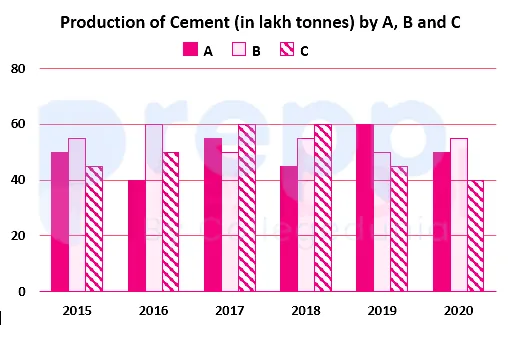
- A
20%
- B
83.33%
- C
120%
- D
5%
Show answer
B. 83.33%Calculation:
Total production of Company A in 2016 and 2019 together = (40 + 60) = 100 lakh tonnes
Total production of Company C in 2017 and 2018 together = 60 + 60 = 120 lakh tonnes
Now, % = \(\frac {100}{120}\times 100\%\) ≈ 83.33%
∴ The total production of Company A in 2016 and 2019 together is 83.33% of the total production of Company C in 2017 and 2018 together.
Paper & answer key PDF ↗ Question 73archived
The table given below shows the number of workers working in 5 different factories.
Factories
Workers
J
25
K
30
L
70
M
80
N
15
What is the total number of workers working in all factories?
- A
180
- B
240
- C
250
- D
220
Show answer
D. 220Calculating the Total Number of Workers in Factories
The question asks us to find the total number of workers across five different factories, using the data provided in a table.
Understanding the Factory Worker Data
The table gives the number of workers for each of the five factories:
Factories
Workers
J
25
K
30
L
70
M
80
N
15
To find the total number of workers, we need to add up the number of workers from each factory.
Step-by-Step Calculation of Total Workers
We will sum the number of workers from Factory J, Factory K, Factory L, Factory M, and Factory N.
Workers in Factory J: 25
Workers in Factory K: 30
Workers in Factory L: 70
Workers in Factory M: 80
Workers in Factory N: 15
The total number of workers is the sum of these numbers:
\(\text{Total Workers} = \text{Workers in J} + \text{Workers in K} + \text{Workers in L} + \text{Workers in M} + \text{Workers in N}\)
\(\text{Total Workers} = 25 + 30 + 70 + 80 + 15\)
Let's perform the addition:
\(25 + 30 = 55\)
\(55 + 70 = 125\)
\(125 + 80 = 205\)
\(205 + 15 = 220\)
So, the total number of workers working in all factories is 220.
Final Answer Summary
By adding the number of workers from each of the five factories as provided in the table, we found the total count.
The sum is \(25 + 30 + 70 + 80 + 15 = 220\).
Therefore, the total number of workers working in all factories is 220.
Revision Table: Key Concepts for Data Analysis
Concept
Description
Data Table
A way to organize information in rows and columns.
Summation
Adding together a series of numbers to find a total.
Total
The final result obtained by adding numbers.
Workers
People employed in a place, like a factory.
Additional Information: Understanding Data from Tables
Tables are a common way to present data clearly. When you see data in a table, understanding what each row and column represents is the first step in data analysis. In this question, the rows represent different factories, and the columns tell us the name of the factory and the number of workers in that factory. To answer questions based on tables, you often need to perform basic arithmetic operations like addition, subtraction, multiplication, or division on the numbers given in the table. This problem specifically required simple addition to find a total.
Paper & answer key PDF ↗ Question 74archived
A, B, C and D share a property worth Rs. 93,100. If A ∶ B = 1 ∶ 2, B ∶ C = 3 ∶ 4 and C ∶ D = 5 ∶ 6, then find the share of C.
- A
Rs. 34,000
- B
Rs. 28,000
- C
Rs. 25,000
- D
Rs. 31,000
Show answer
B. Rs. 28,000Understanding Property Sharing with Combined Ratios
This problem involves distributing a total property value based on a series of interconnected ratios between four individuals: A, B, C, and D. To find the share of any individual, we first need to establish a combined ratio representing the proportion of shares for A : B : C : D.
Combining the Given Ratios
We are given the following ratios:
A : B = 1 : 2
B : C = 3 : 4
C : D = 5 : 6
To combine these ratios, we need to make the common terms in consecutive ratios equal. Let's start by combining A : B and B : C.
A : B = 1 : 2
B : C = 3 : 4
The common term is B. We need to make the value of B the same in both ratios. The least common multiple (LCM) of 2 and 3 is 6.
Multiply the first ratio (A : B = 1 : 2) by 3: $\left(1 \times 3\right) : \left(2 \times 3\right) = 3 : 6$. So, A : B = 3 : 6.
Multiply the second ratio (B : C = 3 : 4) by 2: $\left(3 \times 2\right) : \left(4 \times 2\right) = 6 : 8$. So, B : C = 6 : 8.
Now, B is 6 in both ratios. We can combine A : B and B : C to get A : B : C = 3 : 6 : 8.
Next, we combine A : B : C (3 : 6 : 8) with C : D (5 : 6).
A : B : C = 3 : 6 : 8
C : D = 5 : 6
The common term is C. We need to make the value of C the same. The LCM of 8 and 5 is 40.
Multiply the ratio A : B : C (3 : 6 : 8) by 5: $\left(3 \times 5\right) : \left(6 \times 5\right) : \left(8 \times 5\right) = 15 : 30 : 40$. So, A : B : C = 15 : 30 : 40.
Multiply the ratio C : D (5 : 6) by 8: $\left(5 \times 8\right) : \left(6 \times 8\right) = 40 : 48$. So, C : D = 40 : 48.
Now, C is 40 in both. We can combine A : B : C and C : D to get the final combined ratio A : B : C : D.
The combined ratio is A : B : C : D = 15 : 30 : 40 : 48.
Calculating the Total Ratio Parts and Value per Part
The total property is worth Rs. 93,100. This total value is divided among A, B, C, and D according to the ratio 15 : 30 : 40 : 48.
The sum of the ratio parts is:
Total ratio parts = $15 + 30 + 40 + 48 = 133$ parts.
The total value of Rs. 93,100 corresponds to these 133 parts. To find the value of one ratio part, we divide the total value by the total number of parts.
Value of one ratio part = $\frac{\text{Total Property Value}}{\text{Total Ratio Parts}}$
Value of one ratio part = $\frac{93100}{133}$
Let's perform the division:
$\frac{93100}{133} = 700$
So, one ratio part is worth Rs. 700.
Finding the Share of C
From the combined ratio A : B : C : D = 15 : 30 : 40 : 48, the share of C corresponds to 40 ratio parts.
Share of C = C's ratio parts $\times$ Value of one ratio part
Share of C = $40 \times 700$
Share of C = $28000$
Therefore, the share of C is Rs. 28,000.
Summary of Shares
Individual
Ratio Parts
Share (Ratio Parts × Rs. 700)
A
15
$15 \times 700 = 10500$
B
30
$30 \times 700 = 21000$
C
40
$40 \times 700 = 28000$
D
48
$48 \times 700 = 33600$
Total
133
$\mathbf{10500 + 21000 + 28000 + 33600 = 93100}$
The calculated shares sum up to the total property value, confirming the correctness of the calculation.
Revision Table: Key Concepts in Ratio Problems
Concept
Description
Importance
Ratio
Comparison of two or more quantities of the same kind, expressed as $a:b$.
Represents proportional relationship.
Combined Ratio
A single ratio that combines multiple simple ratios involving common terms (e.g., A:B:C:D from A:B and B:C).
Essential for problems involving more than two entities with linked ratios.
LCM (Least Common Multiple)
The smallest positive integer that is a multiple of two or more numbers.
Used to find a common value for the connecting terms when combining ratios.
Value per Ratio Part
The numerical value (e.g., currency) that corresponds to one unit in the combined ratio.
Used to translate ratio parts into actual quantities or values.
Share Calculation
Determining the actual amount or quantity an individual receives based on their ratio parts and the value per part.
The final step in distributing a total quantity according to given ratios.
Additional Information on Ratio and Proportion
Ratio and proportion is a fundamental concept in mathematics used to compare quantities and understand relationships. A ratio like A:B = 1:2 means that for every 1 unit of A, there are 2 units of B. Proportion, on the other hand, states that two ratios are equal, like $\frac{a}{b} = \frac{c}{d}$.
In problems involving multiple ratios like A:B, B:C, C:D, we deal with compound ratios. Combining these ratios correctly is crucial. The method of making the common terms equal using the LCM is a standard technique for this. Once the combined ratio A:B:C:D is found, the total quantity (like property value) is considered as the sum of all ratio parts. Dividing the total quantity by the sum of ratio parts gives the value of a single ratio unit, making it easy to calculate the share corresponding to any number of ratio units.
Understanding ratios is vital for various applications, including dividing assets, scaling recipes, mixing ingredients, interpreting maps, and solving problems in physics and chemistry.
Paper & answer key PDF ↗ Question 75archived
If cosec A - cot A = \(\frac{1}{4}\) , then the value of tan A is :
- A
\(\frac{8}{15}\)
- B
\(\frac{8}{17}\)
- C
\(\frac{15}{17}\)
- D
\(\frac{17}{15}\)
Show answer
A. \(\frac{8}{15}\)Solving the Trigonometric Equation: cosec A - cot A
This problem requires us to find the value of tan A given a relationship between cosec A and cot A.
We are provided with the equation:
\( \text{cosec A} - \text{cot A} = \frac{1}{4} \)
Understanding the Problem
Our goal is to determine the value of tan A. We need to use known trigonometric relationships and identities to connect the given information about cosec A and cot A to tan A.
Using Trigonometric Identities
A key trigonometric identity that relates cosec A and cot A is the Pythagorean identity:
\( \text{cosec}^2 \text{A} - \text{cot}^2 \text{A} = 1 \)
This identity can be factored using the difference of squares formula, \( a^2 - b^2 = (a-b)(a+b) \). Applying this to the identity, we get:
\( (\text{cosec A} - \text{cot A})(\text{cosec A} + \text{cot A}) = 1 \)
We are given that \( \text{cosec A} - \text{cot A} = \frac{1}{4} \). We can substitute this value into the factored identity:
\( \left(\frac{1}{4}\right)(\text{cosec A} + \text{cot A}) = 1 \)
Now, we can solve for \( \text{cosec A} + \text{cot A} \):
\( \text{cosec A} + \text{cot A} = 1 \times 4 \)
\( \text{cosec A} + \text{cot A} = 4 \)
Setting up and Solving Simultaneous Equations
We now have two equations involving cosec A and cot A:
\( \text{cosec A} - \text{cot A} = \frac{1}{4} \)
\( \text{cosec A} + \text{cot A} = 4 \)
We can solve this system of linear equations simultaneously to find the values of cosec A and cot A.
Add Equation (1) and Equation (2):
\( (\text{cosec A} - \text{cot A}) + (\text{cosec A} + \text{cot A}) = \frac{1}{4} + 4 \)
\( 2\text{cosec A} = \frac{1}{4} + \frac{16}{4} \)
\( 2\text{cosec A} = \frac{17}{4} \)
Divide both sides by 2:
\( \text{cosec A} = \frac{17}{4} \times \frac{1}{2} \)
\( \text{cosec A} = \frac{17}{8} \)
Subtract Equation (1) from Equation (2):
\( (\text{cosec A} + \text{cot A}) - (\text{cosec A} - \text{cot A}) = 4 - \frac{1}{4} \)
\( \text{cosec A} + \text{cot A} - \text{cosec A} + \text{cot A} = \frac{16}{4} - \frac{1}{4} \)
\( 2\text{cot A} = \frac{15}{4} \)
Divide both sides by 2:
\( \text{cot A} = \frac{15}{4} \times \frac{1}{2} \)
\( \text{cot A} = \frac{15}{8} \)
Finding the Value of tan A
We have successfully found the value of cot A. We know that tan A is the reciprocal of cot A, provided that cot A is not zero:
\( \text{tan A} = \frac{1}{\text{cot A}} \)
Substitute the value of cot A we found:
\( \text{tan A} = \frac{1}{\frac{15}{8}} \)
\( \text{tan A} = 1 \times \frac{8}{15} \)
\( \text{tan A} = \frac{8}{15} \)
Therefore, the value of tan A is \( \frac{8}{15} \).
Trigonometry Revision Table
Understanding key trigonometric identities is crucial for solving such problems. Here is a table of common identities:
Relationship
Identity/Formula
Reciprocal
\( \text{tan } \theta = \frac{1}{\text{cot } \theta} \)
Reciprocal
\( \text{cot } \theta = \frac{1}{\text{tan } \theta} \)
Reciprocal
\( \text{cosec } \theta = \frac{1}{\text{sin } \theta} \)
Reciprocal
\( \text{sec } \theta = \frac{1}{\text{cos } \theta} \)
Quotient
\( \text{tan } \theta = \frac{\text{sin } \theta}{\text{cos } \theta} \)
Quotient
\( \text{cot } \theta = \frac{\text{cos } \theta}{\text{sin } \theta} \)
Pythagorean
\( \text{sin}^2 \theta + \text{cos}^2 \theta = 1 \)
Pythagorean
\( \text{tan}^2 \theta + 1 = \text{sec}^2 \theta \)
Pythagorean
\( 1 + \text{cot}^2 \theta = \text{cosec}^2 \theta \)
Additional Trigonometry Information
Problems of this type, giving the difference of cosec and cot or sec and tan, are standard applications of the Pythagorean identities \( \text{cosec}^2 \text{A} - \text{cot}^2 \text{A} = 1 \) and \( \text{sec}^2 \text{A} - \text{tan}^2 \text{A} = 1 \). By factoring the identity as a difference of squares, you can always find the sum if the difference is given, or vice versa.
Once you have both the sum and difference of the trigonometric functions (like cosec A and cot A), you can solve for each function individually using simple algebraic methods (adding and subtracting equations). Knowing the value of one trigonometric function, you can then find the values of other trigonometric functions using reciprocal and quotient identities, or by sketching a right-angled triangle or using the unit circle concept, provided the quadrant of angle A is known or implied.
Paper & answer key PDF ↗ Question 76archived
Select the most appropriate option that can substitute the underlined segment in the given sentence. If there is no need to substitute it, select 'No substitution'.
Solomon always refers in the dictionary for clearing doubts about words.
- A
on the dictionary
- B
No substitution
- C
to the dictionary
- D
with the dictionary
Show answer
C. to the dictionaryUnderstanding the Question: Substituting Phrases in a Sentence
The question asks us to find the most appropriate phrase to replace the underlined segment "in the dictionary" in the sentence: "Solomon always refers in the dictionary for clearing doubts about words." We need to determine which preposition correctly follows the verb "refers" when talking about consulting a source like a dictionary.
Analyzing the Verb "Refer" and Prepositions
The verb "refer" means to direct attention to or to consult a source for information. When we consult a book, document, or source of information, the standard preposition used with "refer" is "to". The phrasal verb is "refer to".
Let's look at the options provided:
on the dictionary: Using "on" here suggests placement on the surface of the dictionary, not consulting its content. This is incorrect in this context.
No substitution: The original phrase "in the dictionary" is not the standard or correct way to express consulting a dictionary. While one finds information *in* the dictionary, the act of consulting it is expressed with "refer to". Thus, substitution is needed.
to the dictionary: This uses the correct preposition "to" with the verb "refer" when indicating the source being consulted. "Refer to the dictionary" is the standard and grammatically correct phrase.
with the dictionary: Using "with" here suggests accompanying or using the dictionary as a tool in a general sense, but not specifically the action of consulting it for information. This is incorrect.
Identifying the Correct Substitution
Based on standard English usage, when you consult a reference source like a dictionary, you "refer to" it. The preposition "to" indicates the direction or target of the action, which in this case is the dictionary being consulted.
Therefore, the most appropriate substitution for "in the dictionary" is "to the dictionary".
The corrected sentence is: "Solomon always refers to the dictionary for clearing doubts about words."
Explanation of Preposition Usage
Prepositions like 'in', 'on', 'to', and 'with' are crucial for showing the relationship between words in a sentence. With verbs, specific prepositions often form phrasal verbs or standard collocations. 'Refer' commonly pairs with 'to' when indicating a source.
Verb
Preposition
Meaning / Usage
Example
Refer
to
Consult a source (book, document, person)
Please refer to the manual for instructions.
Refer
to
Mention or allude to something/someone
She referred to her childhood memories.
Refer
to
Send someone to a person/place for help
The doctor referred me to a specialist.
Conclusion
The phrase "refers to the dictionary" is the grammatically correct and natural way to express the action of consulting a dictionary for information. The other options use incorrect prepositions in this context.
Revision Table: Correcting "Refer" Usage
Incorrect Phrase
Correct Phrase
Reason
Refers in the dictionary
Refers to the dictionary
'Refer' takes 'to' for consulting a source.
Refers on the dictionary
Refers to the dictionary
'On' is incorrect for consulting a source.
Refers with the dictionary
Refers to the dictionary
'With' is incorrect for consulting a source.
Additional Information: Common Prepositions with Verbs
Many verbs in English are followed by specific prepositions. These combinations often have meanings different from the individual words. Learning these phrasal verbs and collocations is important for accurate and natural English.
Listen to music
Agree with a person / Agree on a topic
Depend on someone/something
Look at a picture
Talk about a subject / Talk to a person
Understanding the correct preposition to use with a verb like "refer" ensures clarity and grammatical correctness in sentences.
Paper & answer key PDF ↗ Question 77archived
In the given sentence the underlined word may have been incorrectly spelt. Identify the option that rectifies the spelling. If there is no error in spelling, select 'No error'.
Siraz-ud-Daula beseiged Calcutta to take punitive actions against the East India Company.
- A
besiezed
- B
besiejed
- C
besieged
- D
No error
Show answer
C. besiegedIdentifying and Correcting Spelling Errors
The question asks us to identify if there is a spelling error in the underlined word in the given sentence and select the correct spelling from the options provided. The sentence is:
Siraz-ud-Daula beseiged Calcutta to take punitive actions against the East India Company.
The underlined word is "beseiged". We need to check if this spelling is correct.
Analyzing the Spelling of 'Beseiged'
Let's look closely at the spelling of the word "beseiged". The part of the word in question is the sequence of vowels "ei". English spelling has rules, but also many exceptions. A common rule is "i before e, except after c, or when sounded as 'a' as in neighbor and weigh".
The word "beseiged" relates to surrounding a place with armed forces to capture it. The correct spelling of this word is related to the verb "besiege".
Correcting the Spelling: 'Besieged'
Applying the "i before e" rule:
The sequence is "ei".
It does not come after the letter 'c'.
The sound of the vowel combination is not 'a' (like in 'neighbor' or 'weigh').
According to the general rule, it should likely be "ie". Let's check the standard spelling. The correct spelling of the past tense of the verb 'besiege' is indeed "besieged". Therefore, the underlined word "beseiged" is misspelled.
Examining the Options
Now let's evaluate the given options:
besiezed: This option changes the 'g' to a 'z' and uses 'ie'. While 'ie' is correct, changing 'g' to 'z' is incorrect.
besiejed: This option uses 'ie' but changes 'g' to 'j'. This is incorrect.
besieged: This option uses the correct 'ie' spelling and retains the 'g'. This matches the standard correct spelling.
No error: As we determined that "beseiged" is misspelled, this option is incorrect.
Based on our analysis, the correct spelling is "besieged".
Conclusion
The underlined word "beseiged" in the sentence is misspelled. The correct spelling is "besieged".
The correct sentence should be:
Siraz-ud-Daula besieged Calcutta to take punitive actions against the East India Company.
Spelling Comparison
Word
Correctness
Notes
beseiged
Incorrect
Uses "ei" where "ie" is needed.
besiezed
Incorrect
Incorrectly uses 'z' instead of 'g'.
besiejed
Incorrect
Incorrectly uses 'j' instead of 'g'.
besieged
Correct
Standard spelling.
Revision Table: Common ie/ei Spellings
Words with ie/ei Patterns
Pattern
Examples (ie)
Examples (ei)
General Rule (i before e)
believe, achieve, retrieve, chief, piece, field
After 'c' (ei after c)
receive, deceive, conceive, ceiling, perceive
Sounded as 'a' (ei as 'a')
neighbor, weigh, sleigh, eight, vein
Exceptions
seize, weird, foreign, leisure, caffeine, protein
Additional Information: The Word 'Besiege'
The verb "besiege" means to surround a place, especially a fortified town or city, with armed forces in order to capture it or force its surrender. It can also be used more broadly to mean to crowd around or surround someone or something. The word comes from Old French, related to "siege".
Understanding the meaning helps in recognizing the word, but knowing the correct spelling rule for 'ie' and 'ei' is crucial for writing it correctly. While there are exceptions, the basic rule is a helpful guide. For "besiege", the "i before e" rule applies correctly.
Paper & answer key PDF ↗ Question 78archived
In the given sentence the underlined word may have been incorrectly spelt. Identify the option that rectifies the spelling. If there is no error in spelling, select 'No error'.
The adoloscent period of life, one of the most difficult stages of development, is known as the period of stress and storm.
- A
adelescent
- B
adolescent
- C
adeloscent
- D
No error
Show answer
B. adolescentUnderstanding the Spelling Challenge: Identifying the Correct Word
The question asks us to examine the underlined word 'adoloscent' in the given sentence and determine if its spelling is correct. If it's incorrect, we need to choose the option that provides the correct spelling. If the spelling is already correct, we select 'No error'.
The sentence is: "The adoloscent period of life, one of the most difficult stages of development, is known as the period of stress and storm."
We need to focus specifically on the spelling of the word 'adoloscent'.
Analyzing the Provided Options
Let's look at the options given for the correct spelling:
adelescent
adolescent
adeloscent
No error
Identifying the Correct Spelling
The word refers to the period of development between childhood and adulthood. The commonly accepted and correct spelling for this word in English is 'adolescent'.
Comparing the underlined word 'adoloscent' with the correct spelling 'adolescent', we can see there is a difference in the second syllable. The underlined word uses 'o' ('-los-'), while the correct spelling uses 'e' ('-les-'). Therefore, the underlined word is incorrectly spelt.
Evaluating Each Option
Option 1: 'adelescent' - This spelling is incorrect. The second vowel should be 'o'.
Option 2: 'adolescent' - This is the correct spelling of the word.
Option 3: 'adeloscent' - This spelling is incorrect. The first vowel after 'ad-' should be 'o', not 'e'.
Option 4: 'No error' - Since the underlined word 'adoloscent' is incorrectly spelt, this option is not correct.
Based on the evaluation, the correct spelling that rectifies the error in the sentence is 'adolescent'.
The Correct Answer Explained
The underlined word 'adoloscent' is a misspelling of the word 'adolescent'. The word 'adolescent' correctly describes the period of life discussed in the sentence. Option 2 provides the accurate spelling.
Therefore, the correct option is the one listing 'adolescent'.
Word as Written
Correct Spelling
Is it Correct?
adoloscent
adolescent
Incorrect
Revision Table: Key Spelling Point
Incorrect Spelling
Correct Spelling
adoloscent
adolescent
Additional Information: About the Adolescent Period and Spelling
The adolescent period is a crucial stage involving significant physical, emotional, and psychological changes. It typically ranges from puberty to adulthood, often covering the teenage years. Understanding the correct spelling of words like 'adolescent' is vital for clear communication, especially in academic or formal writing.
Common spelling errors often occur with words that have similar-sounding syllables or less intuitive letter combinations. Practicing the spelling of frequently used words and understanding common English spelling patterns can help improve accuracy.
Paper & answer key PDF ↗ Question 79archived
Select the option that expresses the given sentence in passive voice.
Mandeep has repaired the truck.
- A
The truck have been repaired by Mandeep.
- B
The truck had been repaired by Mandeep.
- C
The truck is been repaired by Mandeep.
- D
The truck has been repaired by Mandeep.
Show answer
D. The truck has been repaired by Mandeep.Understanding Active and Passive Voice Conversion
The question asks us to convert a sentence from active voice to passive voice. The original sentence is "Mandeep has repaired the truck."
In the active voice, the subject performs the action. In the passive voice, the subject receives the action. The object of the active sentence becomes the subject of the passive sentence.
Identifying the Tense: Present Perfect
The verb in the sentence "Mandeep has repaired the truck" is "has repaired". This is in the Present Perfect Tense.
Subject: Mandeep
Verb (Present Perfect): has repaired
Object: the truck
Rules for Converting Present Perfect Active to Passive Voice
To convert a sentence from Present Perfect Active to Passive Voice, we follow this structure:
Passive Structure: Object of Active Sentence + has/have + been + Past Participle of Main Verb + by + Subject of Active Sentence
We use 'has been' if the new subject (original object) is singular, and 'have been' if the new subject is plural.
Step-by-Step Conversion
Let's apply the rules to the sentence "Mandeep has repaired the truck."
Identify the object of the active sentence: "the truck". This will become the new subject.
The new subject "the truck" is singular. So, we use "has".
Add "been" after "has".
Use the Past Participle of the main verb "repaired", which is already "repaired".
Add "by" followed by the original subject "Mandeep".
Putting it together, the passive voice sentence is: The truck has been repaired by Mandeep.
Analyzing the Options
Let's look at the given options and see which one matches our converted sentence:
Option
Sentence
Analysis
1
The truck have been repaired by Mandeep.
Incorrect. "The truck" is singular and requires "has been", not "have been".
2
The truck had been repaired by Mandeep.
Incorrect. This uses "had been repaired", which is Past Perfect Passive Voice, changing the original tense.
3
The truck is been repaired by Mandeep.
Incorrect. "is been" is grammatically incorrect for the passive voice of the Present Perfect tense. The structure should be "has/have been".
4
The truck has been repaired by Mandeep.
Correct. This follows the structure for Present Perfect Passive Voice (Object + has + been + Past Participle + by + Subject).
Based on the analysis, Option 4 is the correct passive voice conversion of the given sentence.
Revision Table: Active vs. Passive Voice Tenses
Tense
Active Voice Structure
Passive Voice Structure
Present Simple
Subject + Verb (s/es) + Object
Object + is/am/are + Past Participle + by + Subject
Present Continuous
Subject + is/am/are + Verb-ing + Object
Object + is/am/are + being + Past Participle + by + Subject
Present Perfect
Subject + has/have + Past Participle + Object
Object + has/have + been + Past Participle + by + Subject
Past Simple
Subject + Verb (ed) + Object
Object + was/were + Past Participle + by + Subject
Past Continuous
Subject + was/were + Verb-ing + Object
Object + was/were + being + Past Participle + by + Subject
Past Perfect
Subject + had + Past Participle + Object
Object + had + been + Past Participle + by + Subject
Future Simple
Subject + will + Verb + Object
Object + will + be + Past Participle + by + Subject
Future Perfect
Subject + will have + Past Participle + Object
Object + will have + been + Past Participle + by + Subject
Additional Information on Voice in Grammar
The voice of a verb tells us whether the subject performs the action (active voice) or is acted upon (passive voice).
Active Voice: Used when the focus is on the doer of the action. It is generally more direct and energetic. Example: The dog chased the ball. (The dog is doing the chasing).
Passive Voice: Used when the focus is on the action itself or the receiver of the action, rather than the doer. It is often used when the doer is unknown, unimportant, or obvious from the context. Example: The ball was chased by the dog. (The ball is receiving the action of being chased). Or: The road is being repaired. (We don't need to know who is repairing it).
Converting between active and passive voice is a common exercise in grammar to understand how sentence structure changes while the meaning is largely preserved, focusing on different elements.
Paper & answer key PDF ↗ Question 80archived
Select the option that can be used as a one-word substitute for the underlined group of words.
The man supervising the exam had a huge moustache.
- A
Examiner
- B
Curator
- C
Controller
- D
Invigilator
Show answer
D. InvigilatorUnderstanding One-Word Substitutes for Exam Supervision
The question asks for a single word that can replace the phrase "The man supervising the exam". This requires finding a term specifically used for a person whose job is to oversee candidates during an examination to ensure rules are followed and prevent cheating.
Analyzing the Options
Let's examine each option provided and determine if it fits the description of a person supervising an exam:
Examiner: An examiner is someone who sets or marks examinations. While they are involved with exams, their primary role isn't supervising during the test itself.
Curator: A curator is a keeper or custodian of a museum or other collection. This word is completely unrelated to exams or supervision in an academic setting.
Controller: A controller is a person who directs or regulates something. While supervision involves control, this term is too general and not specific to the context of exams.
Invigilator: An invigilator is a person appointed to supervise candidates during an examination. This definition perfectly matches the phrase "supervising the exam".
Identifying the Correct One-Word Substitute
Based on the analysis of each option, the term that accurately describes "The man supervising the exam" is 'Invigilator'. An invigilator's specific duty is to oversee students while they are taking an exam, ensuring fairness and adherence to examination rules.
Therefore, the one-word substitute for the underlined group of words "supervising the exam" is Invigilator.
Revision Table: Key Terms for Exam Roles
Term
Role in Exams
Invigilator
Supervises candidates during the exam
Examiner
Sets or marks the exam
Supervisor
General term for overseeing a process or activity
Controller
Person who directs or regulates
Curator
Keeper of a museum or collection (not exam related)
Additional Information on Exam Personnel
Understanding the specific roles of different people involved in the examination process is important for vocabulary and general knowledge. While an invigilator is focused on conducting the exam session smoothly and fairly, other roles ensure the overall integrity and administration of the exam system.
Exam Coordinator/Administrator: Responsible for the overall planning, scheduling, and logistics of exams.
Marker/Grader: Person who evaluates the candidates' responses or papers. Sometimes this role is also performed by the examiner.
Chief Invigilator: The lead invigilator at an examination center, responsible for managing other invigilators and handling any major issues that arise.
Each role contributes to the structured environment required for valid and reliable assessments.
Paper & answer key PDF ↗ Question 81archived
Rearrange the parts of the sentence in correct order.
A single uranium
P. pencil eraser, contains the same energy
Q. pellet, slightly larger than a
R. as a ton of coal, 3 barrels of oil
S. or 17,000 cubic feet of natural gas
- A
PRSQ
- B
RSPQ
- C
QPRS
- D
RPQS
Show answer
C. QPRSUnderstanding Sentence Rearrangement Questions
Sentence rearrangement questions test your ability to understand the logical flow and grammatical structure of a sentence. You are given parts of a sentence that are jumbled, and you need to arrange them in the correct order to form a coherent and meaningful sentence.
Analyzing the Given Sentence Parts
The sentence starts with: "A single uranium". We are given four parts to follow this opening phrase:
P. pencil eraser, contains the same energy
Q. pellet, slightly larger than a
R. as a ton of coal, 3 barrels of oil
S. or 17,000 cubic feet of natural gas
Finding the Correct Sequence
Let's examine the parts to find the logical continuation of "A single uranium".
The phrase "A single uranium" needs to be followed by a noun or noun phrase describing the uranium object. Looking at the options, part Q, "pellet, slightly larger than a", seems to fit logically. A uranium pellet is a known concept, and the phrase describes its size. So, the sentence likely begins: "A single uranium pellet, slightly larger than a..."
Following "slightly larger than a", we expect something that provides a point of comparison for size. Part P starts with "pencil eraser,". This fits perfectly to complete the size comparison: "...slightly larger than a pencil eraser,".
After establishing the subject ("A single uranium pellet") and its description ("slightly larger than a pencil eraser"), the sentence needs a verb phrase to describe what this object does or contains. Part P continues with "contains the same energy". This follows logically from the subject. So, the sentence continues: "...pencil eraser, contains the same energy..."
The phrase "contains the same energy" needs to be followed by a comparison, indicating what it contains the same energy as. Part R starts with "as a ton of coal, 3 barrels of oil". This provides the required comparison. So, the sentence continues: "...contains the same energy as a ton of coal, 3 barrels of oil..."
Finally, the sentence lists energy equivalents. Part S, "or 17,000 cubic feet of natural gas", provides another item in the list of equivalents, completing the comparison. This fits logically after the list started in part R.
Putting it all together, the sequence is Q followed by P, followed by R, followed by S. The complete sentence is:
A single uranium Q. pellet, slightly larger than a P. pencil eraser, contains the same energy R. as a ton of coal, 3 barrels of oil S. or 17,000 cubic feet of natural gas.
The correct order of the parts is QPRS.
Verifying Other Options
PRSQ: "A single uranium pencil eraser..." (Incorrect start)
RSPQ: "A single uranium as a ton of coal..." (Incorrect start)
RPQS: "A single uranium as a ton of coal..." (Incorrect start)
Only the QPRS sequence forms a grammatically correct and logically flowing sentence describing the energy content of a uranium pellet.
The Correct Arrangement
Based on the logical flow and grammatical structure, the correct arrangement of the parts is QPRS.
Revision Table: Sentence Rearrangement
Concept
Explanation
Tips for Solving
Sentence Rearrangement
Arranging jumbled parts of a sentence or paragraph into a meaningful order.
Look for the subject, verb, and object. Identify connecting words and phrases. Follow the logical flow of ideas.
Identifying the Start
Find the part that introduces the subject or main idea.
Often a noun or pronoun starting the sentence.
Finding Connections
Look for how one part logically leads to the next.
Check for pronoun references, transition words (like 'however', 'therefore', 'also'), cause-and-effect, or chronological order.
Identifying the End
Find the part that concludes the idea or finishes the sentence structure.
Often contains concluding phrases or the final piece of information.
Additional Information: Uranium Energy and Sentence Structure
This sentence highlights the high energy density of uranium compared to fossil fuels like coal, oil, and natural gas. A small amount of uranium can produce a large amount of energy through nuclear reactions.
From a grammar perspective, the sentence structure is complex. It starts with a subject phrase ("A single uranium pellet"), followed by a descriptive phrase (an appositive clause, "slightly larger than a pencil eraser,"), and then the main verb phrase ("contains the same energy"). The energy comparison is then introduced with "as" and followed by a list of equivalents.
Understanding different types of clauses and phrases (like appositives) can help in rearranging complex sentences by identifying which parts modify or add information to others.
Paper & answer key PDF ↗ Question 82archived
Select the correct direct form of the given sentence.
Mr. Sharma asked him if Maya had invited him for lunch.
- A
Mr. Sharma said to him, "Has Maya invited you for lunch?"
- B
Mr. Sharma said to me, "Has Maya invited you for lunch?"
- C
Mr. Sharma said to him, "Had Maya invited us for lunch?"
- D
Mr. Sharma said to him, "Did Maya invited us for lunch?"
Show answer
A. Mr. Sharma said to him, "Has Maya invited you for lunch?"The correct answer is Mr. Sharma said to him, "Has Maya invited you for lunch?"
Key Points
If the Direct Speech is in Present Perfect tense , the Reported Speech will be in the Past Perfect Tense .
It means the Present Perfect tense will change to Past Perfect tense in the Reported Speech. For converting into direct speech, past perfect tense will be changed to present perfect tense.
The Present Perfect helping verbs 'Has' & 'have' will change to 'had' . In order to convert indirect speech to direct speech had will be converted to has/have.
The verb's Past Participle form will use in Both Direct and Reported Speech.
Thus, the correct direct form of the given sentence is option 1 .
 Paper & answer key PDF ↗
 Question 83archived
Select the most appropriate synonym of the underlined word in the following sentence.
Listening to the news of the father's illness, Soumen left for home with a heavy heart.
- A
disturbance
- B
sickness
- C
disintegration
- D
disorder
Show answer
B. sicknessFinding the Appropriate Synonym for Illness
The question asks us to identify the most appropriate synonym for the underlined word "illness" in the given sentence:
Listening to the news of the father's illness, Soumen left for home with a heavy heart.
We need to understand the meaning of "illness" and then evaluate the given options to find the word that is closest in meaning in this context.
Understanding the Meaning of Illness
The word "illness" refers to a state of being ill or sick. It describes a disease or a period when someone is not healthy. In the sentence, it refers to the father being unwell or having a health problem.
Analyzing the Options
Let's look at the options provided:
disturbance
sickness
disintegration
disorder
Now, let's examine each option to see if it can replace "illness" appropriately in the sentence.
Option 1: disturbance
Disturbance typically means the interruption of a settled or peaceful condition. While an illness can cause disturbance in life, "disturbance" itself is not a direct synonym for the state of being ill.
Option 2: sickness
Sickness is a direct synonym for illness. It means the state of being ill, a disease, or a period of illness. This word fits perfectly in the context of someone's father having a health problem.
Option 3: disintegration
Disintegration means the process of breaking into small pieces or losing cohesion. It refers to falling apart, which is not the primary meaning of illness, especially in the context of someone being sick.
Option 4: disorder
Disorder can mean a state of confusion or mess, or an illness or condition that disrupts normal physical or mental functions. While "disorder" can sometimes relate to health conditions (like a medical disorder), "sickness" is a more common and direct synonym for "illness" when referring to someone being generally unwell.
Selecting the Most Appropriate Synonym
Comparing the options, "sickness" is the most appropriate synonym for "illness" as it accurately reflects the state of being unwell described in the sentence. The news of the father's sickness caused Soumen to leave for home.
Conclusion
Based on the analysis, the most appropriate synonym for the underlined word "illness" is "sickness".
Word
Meaning
Fit in Sentence?
Illness
State of being ill; sickness
Original word
Disturbance
Interruption; disruption
No (Indirectly related)
Sickness
State of being ill; illness
Yes (Direct synonym)
Disintegration
Falling apart; breaking down
No (Unrelated meaning)
Disorder
Lack of order; a medical condition
Less appropriate than 'sickness'
Revision Table: Mastering English Vocabulary
Concept
Key Takeaway
Importance for Exams
Synonyms
Words with similar meanings
Crucial for vocabulary & comprehension questions
Contextual Meaning
Word meaning can vary based on the sentence
Essential for accurate word choice
Root Words & Prefixes
Help deduce word meanings
Aid in understanding new words
Additional Information: Expanding Vocabulary for Exams
Building a strong vocabulary is vital for success in language exams. Here are some tips:
Read widely: Exposure to different texts introduces you to new words in context.
Use a dictionary/thesaurus: Look up words you don't know and explore their synonyms and antonyms.
Practice regularly: Use new words in your own sentences or while speaking.
Learn word families: Understand how related words (like ill, illness, sickly) are connected.
Focus on common roots, prefixes, and suffixes which can help unlock the meaning of many words.
Understanding synonyms helps you express yourself more precisely and understand nuances in language. It's also a common question type in various competitive exams.
Paper & answer key PDF ↗ Question 84archived
Select the option that expresses the given sentence in active voice.
The jewel thief was punished by the judge.
- A
Punishment had been given to jewel thief.
- B
The police had punished the jewel thief.
- C
The judge punished the jewel thief.
- D
Punishment was given to jewel thief.
Show answer
C. The judge punished the jewel thief.Understanding Active and Passive Voice Conversion
The question asks us to convert a sentence from passive voice to active voice. The given sentence is: "The jewel thief was punished by the judge."
Let's first identify the key components in the passive voice sentence:
The subject is "The jewel thief". This is the recipient of the action.
The verb phrase is "was punished". This is the passive form of the verb "punish" in the simple past tense.
The agent (the doer of the action) is introduced by "by" and is "the judge".
In a passive voice sentence, the subject receives the action. In an active voice sentence, the subject performs the action. To convert a passive sentence to active voice, we need to make the agent the new subject, use the active form of the verb (matching the original tense), and make the original subject the object of the active sentence.
The original verb "was punished" is in the simple past tense (passive). The active form in the simple past tense is simply the past tense of the verb "punish", which is "punished".
So, the structure for the active voice sentence should be:
Agent (The judge) + Active Verb (punished) + Original Subject (the jewel thief).
This gives us the sentence: "The judge punished the jewel thief."
Analyzing the Options for Active Voice
Let's examine each provided option to see which one correctly expresses the sentence in active voice and maintains the original meaning and tense:
Punishment had been given to jewel thief.
This sentence is in the passive voice ("had been given") and uses the past perfect tense. It does not have "the judge" as the subject. This is not the correct active voice conversion.
The police had punished the jewel thief.
This sentence is in the active voice ("had punished") but changes the agent from "the judge" to "The police". It also uses the past perfect tense instead of the simple past tense used in the original passive sentence. This is not the correct active voice conversion.
The judge punished the jewel thief.
In this sentence, the subject is "The judge" (the agent). The verb is "punished", which is the active form in the simple past tense, matching the original sentence's tense. The object is "the jewel thief" (the original subject). This sentence correctly converts the original passive sentence into active voice while keeping the meaning and tense the same.
Punishment was given to jewel thief.
This sentence is still in the passive voice ("was given") and the subject is "Punishment", not the agent "the judge". This is not the correct active voice conversion.
Based on the analysis, option 3 is the only sentence that correctly converts "The jewel thief was punished by the judge" into active voice.
Conclusion: Selecting the Correct Active Voice Sentence
To accurately transform a passive sentence into active voice, we must identify the performer of the action (the agent) and make them the subject. The verb must be changed to its active form, ensuring the tense remains consistent with the original sentence. The original subject (the recipient of the action) becomes the object in the new active sentence.
Applying these steps to "The jewel thief was punished by the judge," we find that "The judge punished the jewel thief" is the correct active voice equivalent.
Original Sentence (Passive Voice)
Subject
Passive Verb
Agent
The jewel thief was punished by the judge.
The jewel thief
was punished
the judge
Converted Sentence (Active Voice)
Subject (Original Agent)
Active Verb (Same Tense)
Object (Original Subject)
The judge punished the jewel thief.
The judge
punished (Simple Past)
the jewel thief
Therefore, the option that expresses the given sentence in active voice is "The judge punished the jewel thief."
Revision Table: Active vs. Passive Voice
Feature
Active Voice
Passive Voice
Focus
On the performer of the action (the subject)
On the recipient of the action (the subject)
Sentence Structure (Basic)
Subject + Verb + Object
Subject + be verb + Past Participle (+ by + Agent)
Who does the action?
The Subject
The Agent (often in a 'by' phrase, sometimes omitted)
Example (Simple Past)
The boy kicked the ball.
The ball was kicked by the boy.
Usage
Direct, clear, emphasizes the doer
Emphasizes the action or recipient, often used when the doer is unknown or unimportant
Additional Information: Converting Voice
Converting between active and passive voice is a common grammar exercise. Here are some key points to remember when converting from passive to active voice:
Identify the Agent: Look for the "by [person or thing]" phrase. The noun or pronoun after "by" is usually the agent (the one doing the action). If there's no "by" phrase, the agent is either unknown or not mentioned. In such cases, you might need to add a logical subject (e.g., "Someone," "They," "The police," etc.) if converting to active is required.
Identify the Passive Verb: This usually involves a form of the verb "to be" (am, is, are, was, were, be, being, been) followed by the past participle of the main verb.
Determine the Tense: The tense of the active verb must match the tense of the passive verb construction. For example, if the passive is "was punished" (simple past passive), the active verb should be in the simple past tense ("punished"). If the passive is "is being punished" (present continuous passive), the active verb should be in the present continuous ("is punishing").
Make the Agent the Subject: The agent from the passive sentence becomes the subject of the active sentence.
Change the Verb to Active Form: Convert the passive verb phrase into its corresponding active form in the correct tense.
Make the Passive Subject the Object: The original subject of the passive sentence becomes the direct object of the active sentence.
Mastering voice conversion helps in understanding sentence structure and choosing the appropriate voice for different writing purposes.
Paper & answer key PDF ↗ Question 85archived
Select the most appropriate option to fill in the blank.
The little boy demanded colourful balloons, ribbons in the village fair. When the father didn't pay heed to his demands, the boy made a .
- A
cloven hoof
- B
wry face
- C
a far cry
- D
jaundiced eye
Show answer
B. wry faceUnderstanding the Sentence and Filling the Blank
The question asks us to choose the most appropriate phrase to complete the sentence describing the little boy's reaction when his demands for colourful balloons and ribbons at the village fair were ignored by his father. The sentence implies a negative reaction, likely a facial expression showing disappointment or displeasure.
Let's look at the meaning of each option provided:
cloven hoof: This idiom refers to the split foot of an animal like a goat or devil, often symbolising evil. It has nothing to do with a human facial expression.
wry face: A 'wry face' is a twisted or distorted expression on someone's face, often indicating mocking, disappointment, or displeasure. This fits the scenario of a child unhappy about not getting what he wants.
a far cry: This idiom means something is very different from something else, or a great distance. It does not describe a facial expression. For example, "This small fair is a far cry from the huge carnival last year."
jaundiced eye: To view something with a 'jaundiced eye' means to look at it with prejudice, skepticism, or bitterness. While it describes a way of seeing things, it is not a direct description of a child's immediate facial expression upon disappointment.
Considering the context of a child reacting to not getting what they want at a fair, making a face showing unhappiness or disappointment is a very common reaction. Out of the given options, 'wry face' best describes this kind of expression.
Therefore, the most appropriate phrase to fill the blank is "wry face".
The completed sentence reads:
The little boy demanded colourful balloons, ribbons in the village fair. When the father didn't pay heed to his demands, the boy made a wry face.
Revision Table: Idioms and Their Meanings
Here is a quick summary of the idioms from the options:
Idiom
Meaning
Example Usage
Cloven hoof
A split foot, often associated with evil or the devil.
He sometimes acts in a way that makes you suspect he has the cloven hoof.
Wry face
A twisted or distorted facial expression, showing disappointment, mockery, or displeasure.
She made a wry face when she tasted the bitter medicine.
A far cry
Something very different from something else; a great distance.
His performance today was a far cry from his usual standard.
Jaundiced eye
Viewing something with prejudice, skepticism, or bitterness.
After his experience, he looked at politics with a jaundiced eye.
Additional Information: Common Reactions to Disappointment
Children often react to disappointment in various ways, depending on their age and personality. Some common reactions include:
Making a sad or angry face (like a wry face).
Crying or throwing a tantrum.
Becoming silent or withdrawn.
Sulking or pouting.
Complaining or arguing.
Understanding the meaning of idioms helps in choosing the correct word or phrase to accurately describe a situation or emotion in English.
Paper & answer key PDF ↗ Question 86archived
Select the most appropriate synonym of the underlined word.
The present paper throws light on the nexus between the academic performance and mental health of children.
- A
Dispute
- B
Alignment
- C
Link
- D
Incongruence
Show answer
C. LinkUnderstanding the Meaning of Nexus
The question asks us to find the most appropriate synonym for the word "nexus" as used in the sentence: "The present paper throws light on the nexus between the academic performance and mental health of children."
Let's break down the meaning of the word "nexus" in this context and examine the provided options.
Defining Nexus in Context
The word "nexus" typically refers to a connection, link, or relationship between two or more things. It can also mean a central point or hub in a network of connections. In the given sentence, it describes the relationship or connection that exists between academic performance and mental health in children.
So, we are looking for a word that means 'connection' or 'relationship' here.
Analyzing the Options for Synonymity
Let's look at each option:
Dispute: A dispute is a disagreement, argument, or debate. This is the opposite of a connection or relationship between two things.
Alignment: Alignment can mean arranging things in a line or bringing things into agreement. While it can imply a relationship or agreement, it doesn't as directly convey the idea of a fundamental connection or link as "nexus" does in this context.
Link: A link is a connection between two people, things, or ideas. It directly fits the meaning of a relationship or connection between academic performance and mental health.
Incongruence: Incongruence means a lack of harmony or compatibility. This is the opposite of a connection or relationship where things are related or connected.
Evaluating the Best Synonym for Nexus
Comparing the options, "Link" most accurately reflects the meaning of "nexus" as a connection or relationship between academic performance and mental health. The paper is likely investigating how these two aspects are connected and influence each other.
Conclusion: Identifying the Appropriate Synonym
Based on the analysis of the word "nexus" and the definitions of the options, the most appropriate synonym for "nexus" in the given sentence is "Link".
Revision Table: Understanding Synonyms
Word
Meaning
Contextual Fit for "nexus"
Nexus
A connection or series of connections linking two or more things; the core or center.
Describes the connection between academic performance and mental health.
Dispute
A disagreement or argument.
Poor fit; opposite of connection.
Alignment
Arrangement in a line; position of agreement.
Less direct than "link" for expressing a relationship/connection.
Link
A connection between two people, things, or ideas.
Excellent fit; directly means connection or relationship.
Incongruence
Lack of harmony or compatibility.
Poor fit; opposite of connection/relationship.
Additional Information: Exploring the Concept of Nexus
The term "nexus" is often used in academic and formal contexts to describe crucial connections or relationships. For example, you might hear about the "energy-water-food nexus," referring to the interconnectedness and interdependence of these three resources. Understanding the specific context in which "nexus" is used is key to identifying its correct synonym or meaning.
In the context of the question, the "nexus between academic performance and mental health" implies that these two factors are not isolated but are interconnected, with changes in one potentially affecting the other. This understanding helps reinforce why "link" is the most suitable synonym.
Paper & answer key PDF ↗ Question 87archived
Select the most appropriate option to fill in the blank and complete the collocation.
Every time boss comes up with some good idea, he gets into .
- A
trouble
- B
fun
- C
sleep
- D
shock
Show answer
A. troubleUnderstanding Collocations in English
The question asks us to select the most appropriate word to complete the sentence and form a common English collocation. A collocation is a pair or group of words that are habitually used together in a way that sounds natural to a native speaker.
Analyzing the Sentence and Options
The sentence is: "Every time boss comes up with some good idea, he gets into ______." We need to find which of the given options naturally follows "gets into" in this context.
Let's look at the options and consider if they form a natural collocation with "gets into":
trouble: "Gets into trouble" is a very common collocation. It means to find yourself in a difficult or problematic situation, often due to your actions.
fun: "Gets into fun" is not a standard English collocation. While you might say "gets into the fun" or "has fun", "gets into fun" alone sounds unnatural.
sleep: "Gets into sleep" is not a standard English collocation. Common phrases related to sleeping are "gets to sleep" or "falls asleep".
shock: "Gets into shock" is a phrase, often used in a medical context (e.g., after an injury) or to describe being extremely surprised or distressed. While possible in some contexts, "gets into trouble" is a much more likely and common consequence implied when a 'good idea' from a boss leads to a negative outcome, suggesting difficulty or problems arise.
Identifying the Correct Collocation: Gets into Trouble
Considering the options, "gets into trouble" is the most natural and common collocation that fits the structure of the sentence. The sentence implies that despite the boss having a "good idea," the outcome is negative – he ends up in a difficult situation or faces consequences. This meaning aligns perfectly with the collocation "gets into trouble".
Here's a breakdown:
Phrase
Common Usage/Meaning
Fits the Sentence?
Gets into trouble
To find yourself in a problematic or difficult situation; to face consequences.
Yes, suggests a negative outcome resulting from the idea.
Gets into fun
Not a standard collocation.
No, doesn't fit grammatically or contextually.
Gets into sleep
Not a standard collocation.
No, doesn't fit grammatically or contextually.
Gets into shock
To enter a state of medical shock or extreme surprise/distress.
Possible, but less likely than "gets into trouble" in this general context implying problems arise. "Gets into trouble" is the stronger and more natural fit for a general negative consequence.
Therefore, the most appropriate option to complete the collocation is "trouble". The full sentence becomes: "Every time boss comes up with some good idea, he gets into trouble." This means his good ideas somehow lead to problems for him.
Conclusion on Filling the Blank
Based on the analysis of common English collocations and the context of the sentence, "trouble" is the word that forms the correct and most natural collocation with "gets into" in this situation.
Revision Table: Key Concepts
Concept
Explanation
Example
Collocation
Words that are frequently used together in a natural way.
fast food, heavy rain, make a mistake, gets into trouble
"Gets into..."
A phrase structure often followed by nouns describing a state, condition, or activity (e.g., gets into trouble, gets into a fight, gets into debt, gets into politics).
He gets into debt easily.
Additional Information on English Collocations
Learning collocations is crucial for sounding natural in English. Instead of just learning individual words, try to learn words in phrases or groups that they commonly appear with. This improves both your vocabulary and your fluency.
Some common types of collocations include:
Adverb + Adjective (e.g., completely satisfied)
Adjective + Noun (e.g., heavy rain)
Noun + Noun (e.g., a cup of tea)
Noun + Verb (e.g., the snow is falling)
Verb + Noun (e.g., make a mistake, catch a cold)
Verb + Adverb (e.g., speak loudly)
Prepositional phrases (e.g., on time, in a hurry)
In this question, "gets into trouble" is a verb + noun/phrase collocation.
Paper & answer key PDF ↗ Question 88archived
Select the most appropriate option that can substitute the underlined segment in the given sentence.
One of my friends is gone to Goa for a holiday.
- A
has gone
- B
are gone
- C
gone
- D
were gone
Show answer
A. has goneSentence Correction: Finding the Right Verb Substitution
The original sentence provided is: "One of my friends is gone to Goa for a holiday." The underlined segment is "is gone". We need to find the most appropriate option to substitute this segment.
Let's analyze the sentence structure first. The subject of the sentence is "One of my friends". Even though it refers to a group of friends, the actual subject performing the action is "One", which is singular. Therefore, the verb must agree with a singular subject.
The phrase "is gone" uses the verb 'be' ('is') and the past participle of 'go' ('gone'). While "be gone" can be used as an idiom meaning 'absent' or 'departed', when referring to movement to a place like Goa, the standard and more appropriate tense is usually the present perfect tense, formed with 'have' or 'has' + past participle.
Analyzing the Options for Verb Substitution
Let's examine each option provided:
has gone: This uses the auxiliary verb 'has' (singular form of 'have') and the past participle 'gone'. 'Has gone' is the present perfect tense. The present perfect is used to describe an action that started in the past (going to Goa) and has a result in the present (being in Goa now, or having completed the journey). This fits the singular subject "One" and the context of someone having traveled to a place for a holiday.
are gone: This uses the auxiliary verb 'are'. 'Are' is the plural form of the verb 'be'. Since the subject "One of my friends" is singular, using 'are' creates a subject-verb agreement error.
gone: This is just the past participle of 'go'. A past participle cannot function as the main verb of a sentence without an auxiliary verb (like 'is', 'are', 'has', 'have', 'was', 'were', etc.) preceding it.
were gone: This uses the auxiliary verb 'were'. 'Were' is the plural form of the verb 'be' in the past tense. Similar to 'are gone', this creates a subject-verb agreement error because the subject "One" is singular. Also, 'were gone' would typically imply a past state of absence, whereas the sentence describes a current state or recent action related to a holiday.
Determining the Most Appropriate Substitution
Based on the analysis, the option that correctly uses a singular verb form and the appropriate tense to indicate movement to a place is "has gone". The sentence "One of my friends has gone to Goa for a holiday" means that one friend went to Goa and is now either there or has completed the trip recently, which is the intended meaning in the original sentence's context.
Original Segment
Option
Analysis
Appropriate?
is gone
has gone
Singular subject 'One' + Present Perfect tense. Correct for movement to a place.
Yes
is gone
are gone
Subject-verb agreement error (singular subject 'One' with plural verb 'are').
No
is gone
gone
Missing auxiliary verb.
No
is gone
were gone
Subject-verb agreement error (singular subject 'One' with plural verb 'were'). Past tense might not fit context.
No
Therefore, the most appropriate option to substitute the underlined segment "is gone" is "has gone".
Revision Table: Key Concepts in Verb Forms
Concept
Explanation
Example
Subject-Verb Agreement
The verb must agree in number (singular or plural) with its subject.
He goes (singular subject, singular verb)
They go (plural subject, plural verb)
Present Perfect Tense
Formed with 'have' or 'has' + past participle. Used for actions that started in the past and continue or have results now.
She has finished her work (result: work is done now).
They have lived here for five years (action continues).
He has gone to the market (result: he is at the market now).
'One of...' structure
The subject is 'one', which is singular, even though it refers to a group mentioned in the phrase that follows ('of my friends').
One of the books is missing (singular verb).
One of the students was late (singular verb).
Additional Information: 'Is gone' vs. 'Has gone'
While "has gone" is the standard present perfect form indicating movement to a place, "is gone" can sometimes be heard in informal contexts or dialects with a similar meaning. However, in formal or standard English, "has gone" is preferred for this purpose. "Is gone" is more commonly used where 'gone' functions as an adjective meaning 'absent', 'dead', or 'lost'. For example, "The milk is gone" means the milk is finished or absent. "He is gone from the house" means he is absent from the house.
When referring to a person traveling to a location and currently being there or having completed the journey, the present perfect using 'has/have gone' is the grammatically correct and idiomatic choice.
Paper & answer key PDF ↗ Question 89archived
The following sentence has been split into four segments. Identify the segment that contains a grammatical error.
Neither the doctors nor / the nurse were present / when the patient / reached the hospital.
- A
Neither the doctors nor
- B
the nurse were present
- C
when the patient
- D
reached the hospital.
Show answer
B. the nurse were presentUnderstanding Grammatical Errors with Correlative Conjunctions
The question asks us to identify the segment in a given sentence that contains a grammatical error. The sentence is broken down into four segments:
Segment 1: Neither the doctors nor
Segment 2: the nurse were present
Segment 3: when the patient
Segment 4: reached the hospital.
We need to examine each segment, paying close attention to grammatical rules, particularly subject-verb agreement, punctuation, and word usage.
Analyzing the Sentence Structure and Subject-Verb Agreement
The sentence uses the correlative conjunction "neither... nor". These conjunctions connect two subjects. When "neither... nor" is used to connect two subjects, the verb must agree with the subject that is closer to it.
In the sentence, the two subjects connected by "neither... nor" are "the doctors" and "the nurse".
"The doctors" is a plural subject.
"The nurse" is a singular subject.
The verb in the sentence is "were present". This verb is associated with both subjects.
Applying the "Neither... Nor" Rule
According to the rule for subject-verb agreement with "neither... nor", the verb must agree with the subject closer to it. Let's look at the structure:
"Neither the doctors nor the nurse were present..."
The subject closest to the verb "were present" is "the nurse".
"The nurse" is a singular subject.
A singular subject requires a singular verb. The singular form of the verb "to be" in the past tense for a singular subject is "was", not "were".
Therefore, the verb should be "was present" to agree with the singular subject "the nurse".
Identifying the Incorrect Segment
Let's look at the segments again:
Segment 1: Neither the doctors nor - This segment introduces the correlative conjunction and the first subject. It is grammatically correct on its own.
Segment 2: the nurse were present - This segment contains the second subject ("the nurse") and the verb ("were present"). As identified above, the verb "were" is plural but should be singular ("was") to agree with the closest subject "the nurse". This segment contains the grammatical error.
Segment 3: when the patient - This segment introduces a dependent clause. It is grammatically correct.
Segment 4: reached the hospital. - This segment completes the dependent clause. It is grammatically correct.
The error lies in Segment 2 because the plural verb "were" is used instead of the singular verb "was" with the singular subject "the nurse".
Segment
Content
Grammatical Analysis
Error?
1
Neither the doctors nor
Correlative conjunction + Plural Subject 1
No
2
the nurse were present
Singular Subject 2 + Plural Verb
Yes (Verb should be singular 'was')
3
when the patient
Subordinating conjunction + Subject
No
4
reached the hospital.
Verb + Object + Punctuation
No
The segment that contains a grammatical error is "the nurse were present". The corrected sentence would be: "Neither the doctors nor the nurse was present when the patient reached the hospital."
Revision Table: Key Grammar Concepts
Concept
Explanation
Example
Correlative Conjunctions
Pairs of conjunctions that connect words or phrases of equal grammatical rank. Examples: neither/nor, either/or, not only/but also.
Neither John nor Mary came.
Either you or I will go.
Subject-Verb Agreement
A singular subject takes a singular verb, and a plural subject takes a plural verb.
He sings. (Singular subject, singular verb)
They sing. (Plural subject, plural verb)
Agreement with Neither/Nor
The verb agrees with the subject that is closer to it in the sentence.
Neither the students nor the teacher was ready.
Neither the teacher nor the students were ready.
Additional Information: More on Correlative Conjunctions
Correlative conjunctions always come in pairs and connect grammatically similar elements. Understanding how to use them correctly is crucial for clear and accurate writing.
Either... or: Similar to "neither... nor", the verb agrees with the subject closer to it. For example, "Either the students or the teacher is responsible," and "Either the teacher or the students are responsible."
Not only... but also: When connecting two subjects, the verb agrees with the subject closer to it. For example, "Not only the students but also the teacher is learning," and "Not only the teacher but also the students are learning."
Using these conjunctions correctly ensures that the verb in the sentence aligns with the intended subject, maintaining grammatical correctness and clarity.
Paper & answer key PDF ↗ Question 90archived
Select the most appropriate option to fill in the blank.
Although I have a good job, I wish to take the ________ of starting my own business.
- A
back
- B
seat
- C
look
- D
risk
Show answer
D. riskUnderstanding the Sentence and Options
The sentence provided is: "Although I have a good job, I wish to take the ________ of starting my own business." We need to select the most appropriate word to fill the blank from the given options. The blank requires a noun or a noun phrase that fits the context of starting a business despite having a good job.
Starting a new business often involves uncertainty and the possibility of failure, which are inherent aspects of taking a chance or pursuing an opportunity that isn't guaranteed to succeed.
Analyzing the Options
Let's look at each option and see if it fits the blank grammatically and contextually:
back: "Take the back of starting my own business" does not form a common or meaningful phrase in English.
seat: "Take the seat of starting my own business" does not form a common or meaningful phrase in English. While "take a seat" is common, it means to sit down, and "take the driver's seat" means to take control, neither fits here.
look: "Take the look of starting my own business" does not form a common or meaningful phrase. "Take a look" means to examine, which doesn't fit the structure or meaning required here.
risk: "Take the risk of starting my own business" is a standard and common phrase. It means to accept the possibility of loss or failure involved in the action of starting a business. This aligns perfectly with the context, as starting a new venture is widely considered a risky undertaking.
Evaluating the Best Fit
The phrase "take the risk" means to do something that is potentially dangerous or has a chance of failing. Starting a business is inherently risky because success is not guaranteed. The sentence highlights the contrast between having a secure job ("a good job") and the desire to do something uncertain ("starting my own business"). This contrast strongly suggests that the blank should refer to the uncertain or potentially negative aspect of the new venture, which is the risk.
Therefore, "risk" is the only option that creates a meaningful and contextually appropriate sentence.
Option
Fits Context?
Explanation
back
No
Does not form a standard phrase.
seat
No
Does not form a standard phrase; meanings like 'sit down' or 'take control' don't fit the blank's structure.
look
No
Does not form a standard phrase; 'take a look' meaning 'examine' doesn't fit the blank's structure.
risk
Yes
"Take the risk" is a common idiom meaning to accept potential loss or failure, fitting the context of starting a business.
Conclusion
Based on the analysis of each option and the context of the sentence, the word that most appropriately fills the blank is "risk". The completed sentence is: "Although I have a good job, I wish to take the risk of starting my own business."
Revision Table: Understanding Risks
Let's quickly review the core concept related to this question.
Term
Meaning
Relevance to Question
Risk
A situation involving exposure to danger or the possibility of loss, damage, or other undesirable outcomes.
Starting a business involves inherent risks (financial loss, failure, instability).
Take the risk
To proceed with an action despite knowing the potential for negative outcomes.
The sentence describes someone choosing to proceed with starting a business despite the known risks, contrasting it with the security of a good job.
Additional Information: Idioms and Business Ventures
Understanding common English idioms and phrases related to decision-making, challenges, and business can be helpful for fill-in-the-blank questions. Here are a few related concepts:
Calculated Risk: A risk that is taken after careful consideration of the possible outcomes.
Leap of Faith: An act of believing in or attempting something that is not certain to work or succeed. Starting a business can often feel like a leap of faith.
Venture: A business enterprise, typically one that is new or involves risk.
Opportunity Cost: The loss of potential gain from other alternatives when one alternative is chosen. In this sentence, the opportunity cost of starting a business could be the security and income from the good job.
The phrase "take the risk" is a common idiom used when discussing decisions that involve potential downsides, such as starting a new business, investing money, or trying something completely new.
Paper & answer key PDF ↗ Question 91archived
Select the most appropriate synonym of the bracketed word to fill in the blank.
If we want to progress, we must sometimes embrace (mutate).
- A
replicate
- B
imitate
- C
change
- D
incise
Show answer
C. changeFinding the Correct Synonym for Mutate
The question asks us to select the most appropriate synonym for the word "mutate" as used in the sentence: "If we want to progress, we must sometimes embrace (mutate)."
Let's first understand the meaning of the word mutate in this context. Mutate generally means to change in form, nature, or quality. When we talk about embracing something that is necessary for progress, it implies embracing a necessary change or transformation.
Analysing the Options
Now, let's look at the given options and see which one best fits the meaning of mutate in the sentence.
replicate: This means to make an exact copy of something. This is the opposite of changing, so it is not a synonym for mutate.
imitate: This means to copy the actions or appearance of someone or something. Like replicate, this involves copying rather than changing into something new, so it is not a synonym for mutate.
change: This means to become different. This definition aligns perfectly with the meaning of mutate and fits the context of the sentence, suggesting that progress requires accepting differences or transformations.
incise: This means to cut into something. This is unrelated to the meaning of mutate or the context of the sentence.
Comparing the options, change is clearly the most appropriate synonym for mutate in the given sentence.
Why Change is the Best Synonym for Mutate
The sentence suggests that progress is linked to embracing what is in the bracket. If mutate means to change, then "embracing mutate" means embracing change. This makes logical sense in the context of progress, as progress often requires adapting and changing.
Synonym Comparison Table
Word
Meaning
Appropriate Synonym for Mutate?
Reason
Mutate
To change in form, nature, or quality
N/A (Original word)
-
replicate
To make an exact copy
No
Opposite of changing; involves copying.
imitate
To copy the actions or appearance
No
Involves copying, not changing into something new.
change
To become different
Yes
Directly aligns with the meaning of mutate and fits the context.
incise
To cut into
No
Unrelated meaning.
Revision Table: Understanding Synonyms
Concept
Explanation
Example
Synonym
A word that has the same or nearly the same meaning as another word in the same language.
Happy and Joyful are synonyms.
Context
The circumstances that form the setting for an event, statement, or idea, and in terms of which it can be fully understood and assessed. The context helps determine the specific meaning of a word.
The word 'bank' can mean a financial institution or the side of a river, depending on the context.
Appropriate Synonym
The synonym that fits best in a particular sentence or situation, considering the context and nuance of meaning.
While 'big' and 'large' are synonyms, 'a big decision' sounds more natural than 'a large decision'.
Additional Information: Exploring Word Meanings and Context
Understanding synonyms is crucial for improving vocabulary and communication. However, it's important to remember that very few words are perfect synonyms. Often, words have slightly different nuances or are used in specific contexts.
In this question, while mutate is often used in a biological sense (genetic mutation), it can also be used more broadly to mean any significant change or transformation. The sentence "embrace (mutate)" uses it in this broader sense, implying that accepting significant changes is necessary for development or progress.
Choosing the correct synonym requires considering both the general meaning of the word and how it is used in the specific sentence or phrase. The context provides vital clues.
Paper & answer key PDF ↗ Question 92archived
Select the most appropriate option that can substitute the underlined segment in the given sentence. If there is no need to substitute it, select 'No substitution'.
Finally, here are a few examples of passages and their precis .
- A
by passages and their precis
- B
of passages and there precis
- C
of passages and there precises
- D
No substitution
Show answer
D. No substitutionUnderstanding the Sentence and Task
The question asks us to find the best substitute for the underlined segment in the sentence: "Finally, here are a few examples of passages and their precis ." If the original segment is already correct, we should choose the option 'No substitution'. The core task involves checking the grammar and word choice within the underlined portion.
Analyzing the Grammatical Correctness
Let's break down the underlined segment: "examples of passages and their precis".
Preposition Usage: The phrase "examples of passages" is standard English. The preposition 'of' correctly links 'examples' to the items being exemplified ('passages'). Option 1 suggests replacing 'of' with 'by', which changes the meaning and is not standard usage in this context.
Possessive Pronoun: The sentence refers to the 'precis' belonging to the 'passages'. Since 'passages' is plural, the correct possessive pronoun is 'their'. Options 2 and 3 suggest using 'there'. 'There' is an adverb indicating place or used to start a sentence (e.g., "There is..."), not a possessive pronoun. Therefore, using 'there' instead of 'their' is grammatically incorrect.
Noun Form: The word 'precis' is a noun meaning a summary or abstract. It is often used as both a singular and plural form. The spelling "precis" is correct for both singular and plural. The form "precises" (used in option 3) is not the standard English plural.
Evaluating Substitution Options
Based on the grammatical analysis:
Option 1: "by passages and their precis" - Incorrect because 'of' is the correct preposition here, not 'by'.
Option 2: "of passages and there precis" - Incorrect because 'their' is the correct possessive pronoun, not 'there'.
Option 3: "of passages and there precises" - Incorrect because both 'there' and 'precises' are used incorrectly.
Option 4: "No substitution" - This option suggests the original segment is correct.
Determining the Best Fit
The original segment, "examples of passages and their precis", correctly uses the preposition 'of', the possessive pronoun 'their', and the noun 'precis' (as a plural form). None of the other options provide a grammatically correct or contextually appropriate substitution.
Therefore, the most appropriate choice is that no substitution is needed.
Paper & answer key PDF ↗ Question 93archived
The question below consists of a set of labeled sentences. Out of the four options given, select the most logical order of the sentences to form a coherent paragraph.
P. As a boy Elon was a keen reader and learnt how to code computers.
Q. He even made his own video game called Blastar.
R. Later he moved to Canada and then the United States setting up his first company with his brother Kimbal in 1995.
S. But after some time, he sold that company to create a company called X.com.
- A
RPSQ
- B
PRSQ
- C
SQRP
- D
PQRS
Show answer
D. PQRSSolving Sentence Reordering Questions
Sentence reordering questions test your ability to identify the logical flow and coherence within a set of jumbled sentences. To solve these, look for clues like chronological order, cause and effect, pronoun references, connecting words, and topic development.
Let's analyze the given sentences about Elon Musk:
P: As a boy Elon was a keen reader and learnt how to code computers. (Introduces Elon's childhood activities)
Q: He even made his own video game called Blastar. (Provides a specific example of using the coding skill mentioned in P)
R: Later he moved to Canada and then the United States setting up his first company with his brother Kimbal in 1995. (Moves to later life, career start)
S: But after some time, he sold that company to create a company called X.com. (Talks about the company mentioned in R, indicating a subsequent event)
Step-by-Step Analysis for Logical Order
We need to arrange these sentences to form a coherent paragraph detailing a part of Elon Musk's life story.
Start with an introduction or early life event. Sentence P talks about Elon's boyhood and learning skills. This seems like a good starting point.
Look for a sentence that logically follows P. Sentence Q gives a specific example of him using his coding skills mentioned in P ("He even made..."). So, Q follows P. The sequence PQ is logical.
Now consider R and S. Sentence R talks about moving later in life and setting up his first company. This clearly follows the events of his boyhood described in PQ. So, R follows PQ. The sequence PQR seems logical.
Finally, look at S. Sentence S starts with "But after some time, he sold that company...". "That company" refers to the first company mentioned in R. This means S must follow R. The sequence RS is logical.
Combining these steps, the most logical order is PQRS.
Confirming the Sentence Sequence
Let's read the sentences in the proposed PQRS order:
P. As a boy Elon was a keen reader and learnt how to code computers.
Q. He even made his own video game called Blastar.
R. Later he moved to Canada and then the United States setting up his first company with his brother Kimbal in 1995.
S. But after some time, he sold that company to create a company called X.com.
This sequence provides a clear, chronological, and logical narrative about Elon Musk's early life and the start of his entrepreneurial journey.
Final Logical Order
Based on the step-by-step analysis, the most logical order of the sentences to form a coherent paragraph is PQRS.
Sentence
Content / Clue
Placement Justification
P
Boyhood activities (reading, coding)
Good starting point, introduces the subject's early life.
Q
Specific example of coding (Blastar)
Directly illustrates the skill mentioned in P, using "He". Follows P.
R
Later life, moving, starting first company (1995)
Transitions from boyhood to later career. Follows PQ chronologically.
S
Selling "that company", creating X.com
Refers back to the company in R. Follows R chronologically.
Revision Table: Sentence Reordering Skills
Review these points to improve your ability to solve sentence reordering questions:
Identify the main topic of the paragraph.
Look for the introductory sentence.
Identify concluding sentences or sentences that summarise.
Pay attention to transition words (e.g., 'but', 'later', 'however', 'therefore').
Look for pronoun references (e.g., 'he', 'she', 'it', 'they') and what they refer to.
Identify chronological markers (e.g., 'as a boy', 'later', 'in 1995', 'after some time').
Check for cause and effect relationships between sentences.
Additional Information: Paragraph Coherence
A coherent paragraph flows smoothly from one sentence to the next. This smooth flow is achieved through:
Unity: All sentences relate to the main topic.
Coherence: Sentences are logically connected, often through transitions, repetition of keywords, or pronoun use.
Order: Sentences are arranged in a sensible sequence (e.g., chronological, spatial, order of importance).
In this problem, the chronological order of events in Elon Musk's life was the primary clue to achieve coherence.
Paper & answer key PDF ↗ Question 94archived
Select the most appropriate option that can substitute the underlined segment in the given sentence.
Mr. Raghav racked his brain , but couldn't think where he had left the book.
- A
thought very hard
- B
had a series of consecutive thoughts
- C
knew it, but couldn't quite remember it
- D
thought he had heard something before
Show answer
A. thought very hardUnderstanding the Idiom "Racked His Brain"
The sentence provided is "Mr. Raghav racked his brain, but couldn't think where he had left the book." We need to find the most appropriate phrase to substitute the underlined segment, which is "racked his brain."
The phrase "to rack one's brain" is a common English idiom. Idioms are phrases or expressions whose meaning cannot be deduced simply by knowing the literal meaning of the words in the phrase.
Meaning of "Racked His Brain"
The idiom "to rack one's brain" means to think very hard about something, typically in an attempt to remember something or to find a solution to a problem. The word "rack" here suggests straining or stretching, like a torture device called a rack, implying intense mental effort.
Analyzing the Sentence Context
In the given sentence, Mr. Raghav "racked his brain" because he "couldn't think where he had left the book." This context clearly indicates that he was putting in a lot of mental effort trying to remember the location of the book, but was unsuccessful.
Evaluating the Options for Phrase Substitution
Let's examine each option to see which one best fits the meaning of "racked his brain" in the context of the sentence:
thought very hard: This option directly matches the core meaning of the idiom "racked his brain," which is to think intensely or with great effort. In the context, Mr. Raghav was thinking very hard to remember where the book was.
had a series of consecutive thoughts: This option simply describes the process of thinking in a sequence. It does not imply any particular level of effort or difficulty in the thinking process. Thinking often involves a series of thoughts, but "racking one's brain" is more than just consecutive thinking; it's difficult, intensive thinking.
knew it, but couldn't quite remember it: This option describes a state of mind where information is known but inaccessible for recall. While this state might lead one to rack their brain, it is the outcome or condition, not the action of "racking one's brain" itself. The idiom describes the effort made to remember, not the fact of knowing and being unable to recall.
thought he had heard something before: This option relates to the feeling of recognition or déjà vu. It is not relevant to the act of intensely trying to remember where an object was left.
Identifying the Most Appropriate Substitute
Comparing the options, "thought very hard" is the phrase that most accurately captures the meaning of "racked his brain" in the context of trying to remember something. It reflects the intense mental effort described by the idiom.
Phrase / Option
Meaning
Fit in Sentence
Racked his brain
Thought very hard to remember/solve
Mr. Raghav thought very hard to remember, but couldn't think where he had left the book.
thought very hard
Thought with great effort/intensity
Good fit. Captures the effort of remembering.
had a series of consecutive thoughts
Thought in sequence
Poor fit. Doesn't convey intense effort.
knew it, but couldn't quite remember it
Condition of memory retrieval issue
Poor fit. Describes the state, not the action/effort.
thought he had heard something before
Feeling of recognition (déjà vu)
Incorrect context. Not related to remembering object location.
Based on the analysis, the most appropriate option that can substitute the underlined segment "racked his brain" is "thought very hard".
Revision Table: Key Idioms and Meanings
Understanding common idioms is crucial for language proficiency. Here are a few examples:
Idiom
Meaning
Break a leg!
Good luck! (Used especially for performers)
Cost an arm and a leg
Very expensive
The ball is in your court
It's your turn to take action or make a decision
Bite the bullet
Face a difficult situation with courage
Additional Information: Idioms and Vocabulary
Idioms are an important part of English vocabulary. They add richness and colour to the language. Learning idioms can significantly improve comprehension and expression skills, which is beneficial for both everyday communication and competitive exams.
Many idioms have historical origins that help explain their meaning.
Context is key when interpreting idioms. The same phrase might have slightly different nuances depending on how it is used.
Practicing with idiom exercises and using them in sentences helps solidify understanding.
Paper & answer key PDF ↗ Question 95archived
Select the most appropriate ANTONYM of the underlined word.
The recent disaster of unprecedented floods in June 2013 in the state of Uttarakhand devastated many towns and villages on the banks of the rivers Bhagirathi, Pindar, Mandakini, Alaknanda and Sarju.
- A
Lacklustre
- B
Tarnished
- C
Familiar
- D
Deranged
Show answer
C. FamiliarFinding the Antonym of Unprecedented
The question asks us to select the most appropriate antonym for the word "unprecedented" as used in the given sentence:
"The recent disaster of unprecedented floods in June 2013 in the state of Uttarakhand devastated many towns and villages on the banks of the rivers Bhagirathi, Pindar, Mandakini, Alaknanda and Sarju."
To find the antonym, we first need to understand the meaning of the word "unprecedented".
Meaning of Unprecedented
The word "unprecedented" means something that has never happened before, or is without a previous instance. It implies something highly unusual, extraordinary, or novel.
In the context of the sentence, "unprecedented floods" means floods that were unlike any floods experienced before in that region, suggesting they were much more severe or happened under circumstances that were new.
Analyzing the Options for the Antonym of Unprecedented
Let's examine each option to see which one is the opposite in meaning to "unprecedented":
Lacklustre: This means lacking vitality, force, or conviction; dull or uninspired. This is not the opposite of something that has never happened before.
Tarnished: This means made dull, spoiled the appearance of, or damaged in reputation. This is not related to whether something has happened before.
Familiar: This means well known from long or close association, or customary; usual. Something that is familiar is something that is known or has been experienced before. This is the opposite of something that has never happened before ("unprecedented").
Deranged: This means mad or insane; disordered. This is not related to whether something has happened before.
Based on the analysis, the word "familiar" is the most appropriate antonym for "unprecedented". While "familiar" often implies something known, it can also mean something usual or common, which is the direct opposite of something that has never occurred before.
Selecting the Correct Antonym
The word "unprecedented" signifies something that has never happened before. Its antonym should therefore signify something that is usual, common, or has happened many times before, making it well-known or "familiar".
Therefore, the most suitable antonym for "unprecedented" among the given options is "Familiar".
The final answer is Familiar.
Word
Meaning
Antonym of "Unprecedented"?
Unprecedented
Never done or known before; without previous instance.
N/A (The word itself)
Lacklustre
Dull, uninspired.
No
Tarnished
Spoiled, damaged.
No
Familiar
Well known, customary, usual.
Yes
Deranged
Insane, disordered.
No
Revision Table: Understanding Antonyms
Understanding antonyms is crucial for vocabulary building and comprehension. An antonym is a word that means the opposite of another word.
Identifying the core meaning of the word is the first step.
Consider the context in which the word is used in the sentence.
Evaluate each option to see which one has a meaning that is contrary to the original word's meaning.
Additional Information: Synonyms and Antonyms of Unprecedented
Exploring related words can deepen understanding.
Synonyms of Unprecedented: unparalleled, unmatched, unequalled, singular, unique, original, novel, new, unheard of, unknown, never-before-seen.
Antonyms of Unprecedented: common, normal, standard, regular, usual, typical, ordinary, familiar, customary, established.
Comparing the provided options with this list reinforces that "Familiar" is the most fitting antonym among the choices.
Paper & answer key PDF ↗ Question 96archived
Select the most appropriate answer to fill in blank 1.
- A
integrity
- B
capacity
- C
liability
- D
ability
Show answer
D. abilityUnderstanding the Fill-in-the-Blank Passage on Tattooing
The question asks us to fill in the blanks in a passage about tattooing by selecting the most appropriate words from the given options. Let's analyze the first blank.
Analyzing Blank 1
The sentence containing blank 1 is: "Tattooing is a talent that requires a lot of time and (1) ."
This sentence discusses what is needed to excel in tattooing, which is described as a talent. It states that time is required, and another quality or resource, represented by blank (1), is also necessary.
Evaluating the Options for Blank 1
Let's look at the provided options for blank (1):
integrity: This refers to the quality of being honest and having strong moral principles. While important in any profession, it doesn't directly relate to the inherent requirements of developing the skill or talent of tattooing itself.
capacity: This can refer to the ability to do something, or the maximum amount that can be contained. In the sense of ability, it's similar to the correct answer, but 'ability' is a more direct and common fit in this context.
liability: This refers to the state of being responsible for something, especially by law, or a debt. This word has a negative connotation or refers to responsibility/debt and is clearly not suitable for describing something required alongside time for developing a talent.
ability: This refers to the possession of the means or skill to do something. This fits perfectly with the context. Developing a talent like tattooing certainly requires skill or ability alongside time investment.
Determining the Most Appropriate Word for Blank 1
Comparing the options, 'ability' is the most fitting word to complete the sentence. It naturally follows 'time' in describing the prerequisites for a talent like tattooing, implying the skill, aptitude, or capability needed.
The sentence "Tattooing is a talent that requires a lot of time and ability" makes logical sense and aligns with the general understanding of developing a skill.
Therefore, the most appropriate answer to fill in blank 1 is 'ability'.
Revision Table: Key Concepts
Term
Definition
Relevance to Tattooing Passage
Talent
Natural aptitude or skill.
Tattooing is described as a talent requiring development.
Time
Period during which an action or event occurs.
Required alongside ability for mastering tattooing.
Ability
Possession of the means or skill to do something.
Essential component needed with time to develop the talent of tattooing.
Integrity
Honesty and strong moral principles.
Not the primary requirement for the skill itself, though important in practice.
Liability
State of being responsible for something; a debt.
Irrelevant in this context.
Capacity
Ability or power to do something; the amount that can be contained.
Can mean ability, but 'ability' is a better fit here.
Additional Information: Vocabulary in Context
Understanding vocabulary in context is crucial for fill-in-the-blank questions. We need to consider the meaning of each word and how it fits grammatically and logically into the sentence and the overall passage. In this case, the sentence structure and the surrounding words ('talent', 'requires', 'time') strongly suggest that the missing word should describe a personal quality or skill needed for the talent.
Let's briefly look at the other blanks to understand the flow, although we are only solving for blank 1 here:
(2) talks about various kinds and \_\_\_\_\_ of tattooing (perhaps 'styles' or 'methods').
(3) talks about permanently \_\_\_\_\_ a design into flesh (likely 'applying' or 'imprinting').
(4) talks about developing an artistic \_\_\_\_\_ (perhaps 'sense' or 'aptitude').
(5) talks about tattooing penmanship being more \_\_\_\_\_ than sketching on paper (perhaps 'difficult' or 'challenging').
This brief overview reinforces that the passage is about the practical aspects and skills involved in tattooing, further supporting 'ability' as the correct choice for blank 1, as it aligns with the overall theme.
Paper & answer key PDF ↗ Question 97archived
Select the most appropriate answer to fill in blank 2.
- A
views
- B
genres
- C
keys
- D
gestures
Show answer
B. genresUnderstanding Tattooing Kinds and Genres: Filling Blank 2
The passage discusses tattooing as a talent and an art form. It mentions different aspects of tattooing, from the skill required to its purpose and execution.
Let's focus on the sentence containing blank 2: "There are many various kinds and (2) of tattooing." This sentence talks about the different types or categories within the art of tattooing. We need to find a word that fits this context, similar in meaning to "kinds".
Analyzing Options for Blank 2
Let's evaluate each given option to see which one best fits the blank:
Option 1: views
Views refer to opinions or perspectives. While people have views on tattooing, this word doesn't describe the different types or styles of tattooing itself. So, "kinds and views" doesn't make sense in this context.
Option 2: genres
Genres are categories or styles, especially in art, music, or literature. Tattooing, like other art forms, has many different styles or categories, such as traditional, realistic, watercolor, tribal, etc. These are often referred to as different genres of tattooing. "Kinds and genres" fits perfectly, as "genres" is synonymous with types or styles in this artistic context.
Option 3: keys
Keys usually refer to essential elements, solutions, or important parts. This word doesn't fit the context of describing different types of tattooing. "Kinds and keys" is not a meaningful phrase in this sentence.
Option 4: gestures
Gestures are movements, usually of hands or body, used to communicate. This word is completely unrelated to the different types or styles of tattooing. "Kinds and gestures" makes no sense in this sentence.
Selecting the Most Appropriate Word for Blank 2
Comparing the options, "genres" is the most suitable word to fill blank 2. It accurately describes the various styles or categories of tattooing, aligning well with the word "kinds" already present in the sentence. The phrase "kinds and genres" is commonly used to denote different types or categories of art forms.
Blank Number
Context Sentence
Most Appropriate Word
Reasoning
2
There are many various kinds and (2) of tattooing.
genres
'Genres' means categories or styles, which fits the context of describing different types of tattooing art forms.
Revision Table: Tattooing Terminology
Term
Definition related to Tattooing
Example Usage
Tattooing
The practice of making indelible marks or designs on the skin by injecting pigment into punctures.
Tattooing requires skill and patience.
Talent
Natural aptitude or skill.
Artistic talent is helpful for a tattoo artist.
Genres
Categories or styles of art.
Different genres of tattooing include realism and traditional.
Artistic Aptitude
Natural ability or talent in art.
Developing an artistic aptitude is the first step.
Penmanship
Skill or style in writing or drawing. Applied here to the intricate work with a tattoo machine.
Tattooing penmanship is more difficult than drawing on paper.
Additional Information on Tattooing Genres and Styles
Understanding the different genres of tattooing is important for anyone interested in this art form. These genres represent distinct aesthetic styles, techniques, and historical influences.
Common Tattoo Genres include:
Traditional (American Traditional): Bold lines, limited color palette, classic designs like anchors, roses, eagles.
Realism: Aims to reproduce subjects with photographic accuracy.
Watercolor: Mimics the look of watercolor painting with soft washes and color blends.
Tribal: Bold, black patterns often derived from indigenous art forms (e.g., Polynesian, Maori).
Japanese (Irezumi): Large-scale designs with specific motifs like dragons, koi fish, flowers.
Blackwork: Designs created using only black ink, often with heavy shading or linework.
Each genre requires specific skills and techniques, highlighting the diversity and complexity within the art of tattooing, supporting why "genres" is the correct term for describing these different categories.
Paper & answer key PDF ↗ Question 98archived
Select the most appropriate answer to fill in blank 3.
- A
detaching
- B
embedding
- C
combining
- D
fertilising
Show answer
B. embeddingUnderstanding the Tattooing Passage and Vocabulary
The passage describes tattooing as a skill requiring time and talent. It discusses the purpose and process of tattooing, which involves creating permanent designs on the skin using ink.
Analyzing Blank 3 in the Tattooing Context
The sentence containing blank 3 is: "Tattooing was and still is a means to communicate someone's thoughts or life by permanently (3) a design of ink and colour into their flesh."
We need to choose a word that describes the action of putting a design made of ink and colour permanently into the flesh (skin).
Evaluating the Options for Blank 3
Let's look at each option and see how it fits the meaning of putting ink permanently into the skin during tattooing:
detaching: This means separating or removing something. This is the opposite of what happens in tattooing; ink is put into the skin, not removed.
embedding: This means fixing something firmly within a surrounding mass. In tattooing, ink particles are placed and fixed within the layers of the skin (dermis). This meaning aligns perfectly with the process described.
combining: This means mixing or joining things together. While colours might be combined before tattooing, the blank refers to the action of placing the design *into* the flesh, not just mixing the ink.
fertilising: This means supplying nutrients to help growth, typically used for plants or soil. This word is completely irrelevant to the process of tattooing or working with skin.
Selecting the Most Appropriate Word for Tattooing
Based on the meanings, the word that accurately describes the action of permanently fixing a design of ink and colour into the flesh is "embedding". The ink is embedded within the skin layers.
Conclusion for Blank 3
The most appropriate word to fill in blank 3 is "embedding" because it correctly describes the process of placing ink permanently into the skin to create a tattoo design.
Revision Table: Key Tattooing Terms
Term
Meaning in Tattooing Context
Relevance to Blank 3
Tattooing
Creating permanent designs on skin using ink.
Overall subject of the passage.
Permanently
Lasting for a very long time, perhaps forever.
Highlights the enduring nature of the ink placement.
Embedding
Fixing something firmly within another material.
Describes how ink is set into the skin.
Flesh (Skin)
The body tissue where the tattoo is applied.
The location where the ink is embedded.
Additional Information on Tattooing Process
Tattooing involves using a needle to repeatedly puncture the skin and inject ink into the dermis layer, which is below the epidermis. This process ensures the ink stays permanently because the cells in the dermis are more stable than those in the epidermis, which are constantly shed. The design is essentially embedded within this stable layer of tissue.
The process requires precision and skill because the needle depth must be controlled to deposit ink correctly in the dermis. If placed too shallow, the tattoo will fade quickly; if too deep, it can cause excessive scarring or 'blowout' where the ink spreads.
Paper & answer key PDF ↗ Question 99archived
Select the most appropriate answer to fill in blank 4.
- A
glimpse
- B
drama
- C
attitude
- D
career
Show answer
C. attitudeTattooing Skills and Artistic Development
This question requires us to select the most appropriate word to fill in the blank numbered (4) in the provided passage about tattooing. The passage discusses the skills and mindset needed for tattooing.
Context for Blank (4)
Let's look at the sentence containing the blank: "The first step in tattooing is to develop an artistic (4) and the skill to sketch and create your artwork." This sentence emphasizes the foundational requirements for becoming a tattoo artist, linking an artistic quality to the practical skills of sketching.
Analyzing Options for Blank (4)
We need a word that describes a quality or mindset related to art that is developed alongside practical skills like sketching.
Option 1: glimpse - A 'glimpse' is a brief look or a momentary view. Developing a 'glimpse' doesn't fit the context of building a foundational artistic quality needed for tattooing.
Option 2: drama - 'Drama' refers to excitement or an event. While tattoos can be dramatic, developing 'drama' as the first step isn't logical. The focus is on the artist's internal development.
Option 3: attitude - An 'attitude' refers to a particular way of thinking, feeling, or behaving. Developing an artistic attitude means cultivating the right mindset, approach, and perspective towards art. This includes appreciating aesthetics, dedication to practice, and valuing the craft, which complements the skill of sketching.
Option 4: career - A 'career' is a long-term job or profession. While tattooing can become a career, developing a 'career' is typically a result of acquiring skills and experience, not the very first step alongside learning to sketch.
Choosing the Best Fit for Blank (4)
Considering the sentence structure and the overall theme of the passage, developing an artistic attitude is the most suitable choice. It represents the essential mindset and approach an aspiring tattoo artist needs, which goes hand-in-hand with learning the technical skills like sketching and creating artwork. This attitude fosters the dedication required to master the craft.
Paper & answer key PDF ↗ Question 100archived
Select the most appropriate answer to fill in blank 5.
- A
aggravated
- B
confiscated
- C
complicated
- D
authenticated
Show answer
C. complicatedUnderstanding the Tattooing Process: Filling Blank 5
The question asks us to select the most appropriate word to fill in blank 5 in the given passage about tattooing. Let's look at the sentence containing the blank:
"Tattooing penmanship is far more (5) than sketching on paper."
This sentence compares the difficulty or nature of drawing directly on skin ("Tattooing penmanship") with sketching on paper. We need a word that describes how tattooing is different from, and likely more challenging than, sketching on paper.
Analyzing the Options for Blank 5
Let's examine each option provided:
aggravated: This word means to make a problem or injury worse. It doesn't fit in the context of describing a skill or process as more difficult than another. Sketching on paper or tattooing isn't something that is "aggravated" in comparison.
confiscated: This means to take something away officially. This word is completely irrelevant to the process or skill of tattooing compared to sketching.
complicated: This word means involving many different and confusing aspects, or difficult to understand or deal with. This fits well when comparing two skills, where one requires more intricate steps, precision, or presents more challenges than the other. Tattooing on skin is inherently more difficult and complex than sketching on a static, flat piece of paper.
authenticated: This means to prove that something is real, true, or genuine. This word is related to verifying the originality or truth of something, not comparing the difficulty of two artistic processes.
Selecting the Best Fit for Blank 5
Comparing the options, "complicated" is the only word that logically describes why tattooing penmanship is different from, and more challenging than, sketching on paper. Tattooing involves factors like working on a living surface, controlling needle depth, dealing with different skin types, and making permanent marks, which makes it a much more intricate and difficult process than simply drawing with a pencil on paper.
Completed Sentence
With "complicated" in blank 5, the sentence reads:
"Tattooing penmanship is far more complicated than sketching on paper."
This sentence now makes perfect sense in the context of the passage, which discusses the skill and effort required for tattooing.
Revision Table: Understanding Vocabulary in Context
Word
Meaning
Fits Blank 5?
Reasoning
Aggravated
Made worse; more serious
No
Does not describe difficulty of a skill.
Confiscated
Taken away officially
No
Irrelevant to artistic skills.
Complicated
Difficult to deal with; intricate
Yes
Describes the increased difficulty of tattooing vs. sketching.
Authenticated
Proven genuine
No
Related to verification, not skill difficulty.
Additional Information on Tattooing as a Skill
Tattooing is indeed a highly skilled craft that goes far beyond just being able to draw. Some key aspects that make it complicated include:
Working on a live canvas: Skin is not a flat, uniform surface. It stretches, wrinkles, and reacts differently depending on the person and the body part.
Using specialized tools: Tattoo machines require precise control of speed, depth, and angle.
Ink application: Getting the ink to stay in the correct layer of skin (the dermis) consistently requires significant practice. Too shallow, and the ink falls out; too deep, and it can blur or cause excessive damage.
Hygiene and safety: Maintaining a sterile environment and following strict safety protocols is crucial to prevent infections and other complications.
Permanence: Unlike sketching, mistakes in tattooing are permanent and difficult to correct, requiring extreme precision and careful planning.
These factors contribute to why tattooing penmanship is much more complicated than drawing on paper.
Paper & answer key PDF ↗ Browser storage is unavailable. You can still browse and practise; progress will last for this visit.