Question 1archived
Which letter cluster will replace the question mark (?) to complete the given series?
abCD, fgHI, ?, stUV, abCD
- A
klMO
- B
lmNO
- C
mnOP
- D
lnMO
Show answer
B. lmNOSolving the Letter Series Pattern
The question asks us to find the letter cluster that completes the given series: abCD, fgHI, ?, stUV, abCD.
Let's analyze the pattern by looking at how the letters change from one term to the next. We can observe the change in the alphabetical position of each letter. It's also important to notice that the first two letters are lowercase and the last two are uppercase in every term.
Analyzing the Letter Changes and Gaps
Let's look at the alphabetical position of the letters in the first two terms:
abCD: a(1), b(2), C(3), D(4)
fgHI: f(6), g(7), H(8), I(9)
Now, let's calculate the difference in position for each corresponding letter:
First letter: f - a = 6 - 1 = +5
Second letter: g - b = 7 - 2 = +5
Third letter: H - C = 8 - 3 = +5
Fourth letter: I - D = 9 - 4 = +5
So, from the first term to the second term, each letter's position increased by 5. Let's call this increment $\Delta_1 = +5$.
Now let's look at the gap between the last two terms provided, which are stUV and abCD. Remember that the alphabet wraps around after Z (position 26).
stUV: s(19), t(20), U(21), V(22)
abCD: a(1 or 27), b(2 or 28), C(3 or 29), D(4 or 30)
Let's calculate the difference in position, considering the wrap-around:
First letter: a - s = 27 - 19 = +8
Second letter: b - t = 28 - 20 = +8
Third letter: C - U = 29 - 21 = +8
Fourth letter: D - V = 30 - 22 = +8
The increment from the fourth term to the fifth term (which is the same as the first term) is $\Delta_4 = +8$.
We have increments of +5 (from term 1 to 2) and +8 (from term 4 to 5). This suggests that the increments between terms might be increasing in a sequence. Let's hypothesize the sequence of increments is +5, +6, +7, +8. This means:
Term 1 to Term 2: Increment +5 ($\Delta_1$)
Term 2 to Term 3: Increment +6 ($\Delta_2$)
Term 3 to Term 4: Increment +7 ($\Delta_3$)
Term 4 to Term 5: Increment +8 ($\Delta_4$)
Let's test this hypothesis to find the missing term (Term 3).
Finding the Missing Term using the Increment Pattern
According to our hypothesis, the missing term (Term 3) is obtained by adding an increment of +6 to each letter of Term 2 (fgHI).
Second term: fgHI
Increment: +6 for each letter
Let's calculate the letters for the third term:
First letter: f + 6. Position of f is 6. $6 + 6 = 12$. The letter at position 12 is l. This letter should be lowercase.
Second letter: g + 6. Position of g is 7. $7 + 6 = 13$. The letter at position 13 is m. This letter should be lowercase.
Third letter: H + 6. Position of H is 8. $8 + 6 = 14$. The letter at position 14 is N. This letter should be uppercase.
Fourth letter: I + 6. Position of I is 9. $9 + 6 = 15$. The letter at position 15 is O. This letter should be uppercase.
Combining these letters, we get lmNO.
Verifying the Pattern with the Next Term
Now let's check if applying the next increment ($\Delta_3 = +7$) to our calculated term lmNO gives us the fourth term stUV.
Calculated third term: lmNO
Increment: +7 for each letter
Let's calculate:
First letter: l + 7. Position of l is 12. $12 + 7 = 19$. The letter at position 19 is s. Matches the fourth term.
Second letter: m + 7. Position of m is 13. $13 + 7 = 20$. The letter at position 20 is t. Matches the fourth term.
Third letter: N + 7. Position of N is 14. $14 + 7 = 21$. The letter at position 21 is U. Matches the fourth term.
Fourth letter: O + 7. Position of O is 15. $15 + 7 = 22$. The letter at position 22 is V. Matches the fourth term.
The pattern holds true. The sequence of increments between consecutive terms is +5, +6, +7, +8, and then it cycles back to +5 (as seen from the last term returning to the first).
Conclusion for the Letter Series
The missing term in the series abCD, fgHI, ?, stUV, abCD is obtained by applying an increment of +6 to each letter of the previous term fgHI. This results in lmNO.
The completed series is: abCD, fgHI, lmNO, stUV, abCD.
Let's look at the options provided:
klMO
lmNO
mnOP
lnMO
Our calculated term lmNO matches Option 2.
Summary of Letter Increments Between Terms
From Term
To Term
Increment per Letter
abCD
fgHI
+5
fgHI
lmNO
+6
lmNO
stUV
+7
stUV
abCD
+8 (with wrap-around)
Revision Table: Key Concepts in Letter Series
Understanding Letter Series Patterns
Concept
Explanation
Example Application
Alphabetical Position
Each letter corresponds to a number (A=1, B=2, ..., Z=26). This helps in quantifying the differences between letters.
Finding the difference between 'c' and 'g': g(7) - c(3) = +4.
Constant Increment
The same number is added or subtracted to get the next letter in the series (e.g., A, C, E, G... where +2 is added each time).
B, E, H, K (B+3=E, E+3=H, H+3=K)
Variable Increment
The number added or subtracted changes according to a specific pattern (e.g., +1, +2, +3... or +5, +6, +7...).
A, C, F, K (A+2=C, C+3=F, F+5=K - gaps are prime numbers)
Wrap-around
When increments go past Z (26), the count continues from A (27=A, 28=B, etc.). Similarly, counting backward from A wraps around to Z.
V(22) + 8 = 30. 30 mod 26 = 4, which is D.
Multiple Series
Sometimes, a single series is formed by interleaving two or more simpler series.
A, P, B, Q, C, R (alternating A,B,C and P,Q,R)
Additional Information on Solving Letter Series
Letter series questions are common in logical reasoning tests. To solve them effectively, consider these tips:
Write down the alphabet: Having the alphabet A-Z and its positions 1-26 handy is very useful.
Look at differences: Calculate the difference in alphabetical position between consecutive letters or groups of letters.
Check for patterns in differences: See if the differences form a sequence (constant, arithmetic progression, geometric progression, prime numbers, squares, cubes, etc.).
Consider position in the group: In a cluster series like this one, analyze the pattern for the first letter across terms, then the second, and so on.
Look for repeating units: Some series might have a repeating block of letters.
Pay attention to case: Notice if letters change between uppercase and lowercase, as this might be part of the pattern.
Consider two step patterns: Sometimes the pattern involves looking at terms that are two steps apart (e.g., Term 1 to Term 3, Term 2 to Term 4).
Practice is key to becoming proficient in identifying different types of letter series patterns.
Paper & answer key PDF ↗ Question 2archived
Which of the following numbers will replace the question mark (?) in the given series?
2, 4, 10, 28, ?, 244
- A
94
- B
90
- C
88
- D
82
Show answer
D. 82Number Series Problem Analysis
The question presents a number series: 2, 4, 10, 28, ?, 244. We need to find the number that should replace the question mark (?) based on the pattern of the series.
Let's examine the relationship between consecutive terms to identify the underlying rule governing this number series.
Identifying the Pattern in the Number Series
We can look at the differences between successive terms:
Difference between the 2nd and 1st term: $4 - 2 = 2$
Difference between the 3rd and 2nd term: $10 - 4 = 6$
Difference between the 4th and 3rd term: $28 - 10 = 18$
The differences are 2, 6, 18. Notice that each difference is 3 times the previous difference ($6 = 3 \times 2$, $18 = 3 \times 6$). This suggests a pattern where the increase between terms is growing by a factor of 3.
Let's try to find a direct formula for the terms. Consider the terms: 2, 4, 10, 28, 244.
Let's examine the structure of the terms relative to powers of 3:
$2 = 1 + 1 = 3^0 + 1$
$4 = 3 + 1 = 3^1 + 1$
$10 = 9 + 1 = 3^2 + 1$
$28 = 27 + 1 = 3^3 + 1$
This reveals a clear pattern: the nth term ($T_n$) in the series appears to be given by the formula $T_n = 3^{n-1} + 1$. Let's verify this formula for the given terms.
Applying the Pattern to Find the Missing Number
Using the pattern $T_n = 3^{n-1} + 1$, let's calculate each term:
For $n=1$: $T_1 = 3^{1-1} + 1 = 3^0 + 1 = 1 + 1 = 2$. Matches the first term.
For $n=2$: $T_2 = 3^{2-1} + 1 = 3^1 + 1 = 3 + 1 = 4$. Matches the second term.
For $n=3$: $T_3 = 3^{3-1} + 1 = 3^2 + 1 = 9 + 1 = 10$. Matches the third term.
For $n=4$: $T_4 = 3^{4-1} + 1 = 3^3 + 1 = 27 + 1 = 28$. Matches the fourth term.
For $n=5$: This is the position of the question mark. $T_5 = 3^{5-1} + 1 = 3^4 + 1 = 81 + 1 = 82$.
For $n=6$: This is the last term. $T_6 = 3^{6-1} + 1 = 3^5 + 1 = 243 + 1 = 244$. Matches the sixth term.
The pattern $T_n = 3^{n-1} + 1$ perfectly fits all the given terms in the series.
The Missing Number in the Series
Based on the pattern, the number that replaces the question mark (?) at the 5th position ($n=5$) is 82.
Number Series Revision Table
Understanding number series patterns is a key skill in logical reasoning. Different types of patterns include arithmetic progression, geometric progression, differences, double differences, squares, cubes, alternating patterns, and combinations of operations.
Additional Information on Number Series
Number series questions test your ability to identify mathematical patterns. Practice with various types of series (like arithmetic, geometric, and mixed series) will help you recognize patterns quickly. Common strategies include looking at differences between terms, ratios between terms, squares/cubes of position numbers or terms, and alternating operations or patterns.
Paper & answer key PDF ↗ Question 3archived
Select the set in which the numbers are related in the same way as are the numbers of the following sets.
(NOTE : Operations should be performed on the whole numbers, without breaking down the numbers into its constituent digits. E.g. 13 – Operations on 13 such as adding / subtracting / multiplying etc. to 13 can be performed. Breaking down 13 into 1 and 3 and then performing mathematical operations on 1 and 3 is not allowed)
(4, 13, 5)
(3, 12, 6)
- A
(4, 10, 3)
- B
(7, 16, 3)
- C
(5, 17, 6)
- D
(5, 17, 7)
Show answer
D. (5, 17, 7)The correct answer is (5, 17, 7).
Always test the identified rule on all given examples (if more than one set is provided) to ensure consistency. Apply the confirmed rule systematically to each option. Remember the constraint about using whole numbers and not breaking down digits unless explicitly allowed. Practice with various types of number analogies helps improve pattern recognition skills.
Paper & answer key PDF ↗ Question 4archived
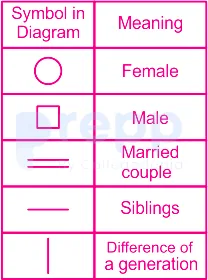
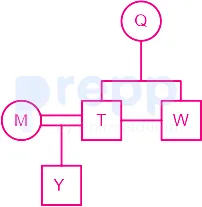
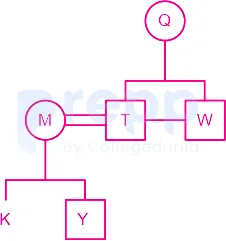
A # B means ‘A is the sister of B’.
A @ B means ‘A is the son of B’.
A & B means ‘A is the father of B’.
A % B means ‘A is the mother of B’.
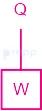
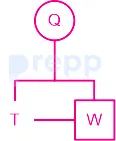
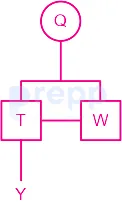
If W @ Q % T & Y @ M % K, then how is Q related to K?
- A
Daughter
- B
Father’s mother
- C
Mother
- D
Mother’s mother
Show answer
Question 5archived
Read the given statements and conclusions carefully. Assuming that the information given in the statements is true, even if it appears to be at variance with commonly known facts, decide which of the given conclusions logically follow(s) from the statements.
Statements:
Some fingers are toes.
Some toes are rings.
Some rings are hands.
Conclusions:
I. Some hands are toes.
II. Some rings are fingers.
III. Some hands are fingers.
V. Some fingers are rings.
- A
None of the conclusions follow
- B
Only conclusions III and IV follow
- C
Only conclusions II and III follow
- D
Only conclusions I and II follow
Show answer
A. None of the conclusions followThe correct answer is None of the conclusions follow.
Always draw minimum and maximum overlap scenarios (Venn Diagrams) if unsure, to test if the holds true in all possible valid representations of the statements. If you can draw at least one diagram where the is false while the statements are true, the does not logically follow. Pay close attention to the exact wording of statements and s. "Some A are B" does not imply "Some A are not B" or "All A are B".
Paper & answer key PDF ↗ Question 6archived
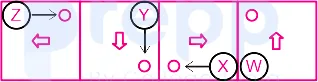
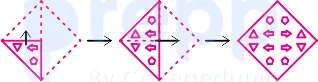
A paper is folded and cut as shown below. How will it appear when unfolded?

- A
Option A (shown in image)
- B
Option B (shown in image)
- C
Option C (shown in image)
- D
Option D (shown in image)
Show answer
D. Option D (shown in image)According to given figure:
The figure will appear when it is opened as follows:
Hence, "Option - (4)" is the correct answer.
 Paper & answer key PDF ↗
 Question 7archived
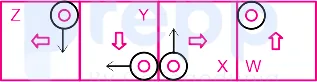
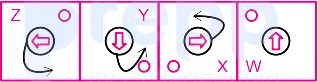
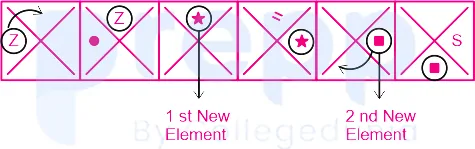
Select the figure from among the given options that can replace the question mark (?) in the following series.

- A
Option A (shown in image)
- B
Option B (shown in image)
- C
Option C (shown in image)
- D
Option D (shown in image)
Show answer
Question 8archived
By interchanging the given two signs which of the following equation will be not correct?
+ and –
- A
8 ÷ 4 × 6 + 5 – 9 = 16
- B
15 + 3 × 4 – 6 ÷ 2 = 6
- C
3 × 2 – 72 ÷ 6 + 8 = 18
- D
3 + 4 – 2 × 5 ÷ 1 = 9
Show answer
C. 3 × 2 – 72 ÷ 6 + 8 = 18Understanding Sign Interchange and Equation Verification
The question asks us to identify which of the given equations becomes incorrect when the '+' and '–' signs are swapped. To do this, we need to take each equation, interchange the specified signs, and then evaluate the modified equation using the correct order of operations to see if the left side equals the right side.
Order of Operations (BODMAS/PEMDAS)
Before evaluating, let's remember the order of operations:
B/P: Brackets/Parentheses
O/E: Orders/Exponents
D/M: Division and Multiplication (from left to right)
A/S: Addition and Subtraction (from left to right)
We will apply this rule to each modified equation.
Evaluating Each Equation with Interchanged Signs
Option 1 Analysis: Equation Check
Original Equation: 8 ÷ 4 × 6 + 5 – 9 = 16
Interchanging '+' and '–': 8 ÷ 4 × 6 – 5 + 9 = 16
Let's evaluate the left side:
First, Division: 8 ÷ 4 = 2
Next, Multiplication: 2 × 6 = 12
Then, Subtraction: 12 – 5 = 7
Finally, Addition: 7 + 9 = 16
The left side evaluates to 16. The right side is 16. Since 16 = 16, this equation is correct after interchanging the signs.
Option 2 Analysis: Equation Check
Original Equation: 15 + 3 × 4 – 6 ÷ 2 = 6
Interchanging '+' and '–': 15 – 3 × 4 + 6 ÷ 2 = 6
Let's evaluate the left side:
First, Multiplication: 3 × 4 = 12
Next, Division: 6 ÷ 2 = 3
Then, Subtraction: 15 – 12 = 3
Finally, Addition: 3 + 3 = 6
The left side evaluates to 6. The right side is 6. Since 6 = 6, this equation is correct after interchanging the signs.
Option 3 Analysis: Equation Check
Original Equation: 3 × 2 – 72 ÷ 6 + 8 = 18
Interchanging '+' and '–': 3 × 2 + 72 ÷ 6 – 8 = 18
Let's evaluate the left side:
First, Multiplication: 3 × 2 = 6
Next, Division: 72 ÷ 6 = 12
Then, Addition: 6 + 12 = 18
Finally, Subtraction: 18 – 8 = 10
The left side evaluates to 10. The right side is 18. Since 10 ≠ 18, this equation is not correct after interchanging the signs.
Option 4 Analysis: Equation Check
Original Equation: 3 + 4 – 2 × 5 ÷ 1 = 9
Interchanging '+' and '–': 3 – 4 + 2 × 5 ÷ 1 = 9
Let's evaluate the left side:
First, Multiplication: 2 × 5 = 10
Next, Division: 10 ÷ 1 = 10
Then, Subtraction: 3 – 4 = -1
Finally, Addition: -1 + 10 = 9
The left side evaluates to 9. The right side is 9. Since 9 = 9, this equation is correct after interchanging the signs.
Conclusion: Identifying the Incorrect Equation
Based on our evaluation after interchanging the '+' and '–' signs, only Option 3 resulted in the left side not being equal to the right side.
Option 1: Left Side = 16, Right Side = 16 (Correct)
Option 2: Left Side = 6, Right Side = 6 (Correct)
Option 3: Left Side = 10, Right Side = 18 (Not Correct)
Option 4: Left Side = 9, Right Side = 9 (Correct)
Therefore, the equation that will not be correct after interchanging the signs is 3 × 2 – 72 ÷ 6 + 8 = 18.
Option
Original Equation
Equation after Swapping + and –
Evaluation Result
Correct/Incorrect
1
$8 \div 4 \times 6 + 5 - 9 = 16$
$8 \div 4 \times 6 - 5 + 9$
$16$
Correct
2
$15 + 3 \times 4 - 6 \div 2 = 6$
$15 - 3 \times 4 + 6 \div 2$
$6$
Correct
3
$3 \times 2 - 72 \div 6 + 8 = 18$
$3 \times 2 + 72 \div 6 - 8$
$10$
Not Correct
4
$3 + 4 - 2 \times 5 \div 1 = 9$
$3 - 4 + 2 \times 5 \div 1$
$9$
Correct
Revision Table: Key Concepts for Sign Interchange Problems
Concept
Description
Importance
Sign Interchange
Swapping the positions or roles of two specified mathematical signs in an expression or equation.
Crucial first step in these types of problems.
Order of Operations (BODMAS/PEMDAS)
Rules specifying the sequence in which mathematical operations should be performed.
Essential for correctly evaluating the modified expression.
Equation Verification
Checking if the left side of an equation equals the right side after performing the operations.
Determines if the equation holds true after the sign interchange.
Additional Information: Applying BODMAS/PEMDAS Carefully
When applying the BODMAS/PEMDAS rule, remember that division and multiplication have the same priority, and addition and subtraction have the same priority. When operations of the same priority appear, you perform them from left to right.
For example, in 8 ÷ 4 × 6, you do the division first (8 ÷ 4 = 2) and then the multiplication (2 × 6 = 12).
Similarly, in 12 – 5 + 9, you do the subtraction first (12 – 5 = 7) and then the addition (7 + 9 = 16).
Being careful with the order of operations is key to accurately solving problems involving sign interchanges and equation verification.
Paper & answer key PDF ↗ Question 9archived
Select the option that is related to the fifth letter-cluster in the same way as the second letter-cluster is related to the first letter cluster and the fourth letter-cluster is related to the third letter-cluster.
HERO : JGPM :: FLOW : HNMU :: DIAL : ?
- A
KYFJ
- B
JFYK
- C
FLIJ
- D
FKYJ
Show answer
D. FKYJThe correct answer is FKYJ.
Moving letters specific positions forward or backward in the alphabet. Reversing the order of letters. Using specific sequences like vowels/consonants or alternating patterns. Practicing different types of analogy questions helps improve pattern recognition skills which are crucial for these tests.
Paper & answer key PDF ↗ Question 10archived
A series is given with one term missing. Select the correct alternative from the given ones that will complete the series.
ABCD, HGLO, OLUZ, VQDK, ?
- A
RTQV
- B
CYQR
- C
CMVQ
- D
CVMV
Show answer
D. CVMVSolving Letter Series Questions: Finding the Missing Term
This question asks us to identify the pattern in the given letter series and find the next term. The series is: ABCD, HGLO, OLUZ, VQDK, ?
To solve letter series problems, we usually look at the position of each letter in the English alphabet (A=1, B=2, C=3, ..., Z=26) and try to find a numerical pattern, either within each term or between corresponding letters of consecutive terms.
Analyzing the Pattern Between Terms
Let's examine the position of each letter in the given terms:
ABCD: A(1), B(2), C(3), D(4)
HGLO: H(8), G(7), L(12), O(15)
OLUZ: O(15), L(12), U(21), Z(26)
VQDK: V(22), Q(17), D(4), K(11)
Now, let's look at the change in position for each corresponding letter from one term to the next.
First Letter Pattern
A(1) to H(8): $8 - 1 = +7$
H(8) to O(15): $15 - 8 = +7$
O(15) to V(22): $22 - 15 = +7$
The pattern for the first letter is adding 7 to the position, wrapping around the alphabet (A=1, Z=26). So, the next first letter will be from the position of V(22) + 7.
$22 + 7 = 29$. Since there are 26 letters, $29 - 26 = 3$. The letter at position 3 is C.
Next first letter: C
Second Letter Pattern
B(2) to G(7): $7 - 2 = +5$
G(7) to L(12): $12 - 7 = +5$
L(12) to Q(17): $17 - 12 = +5$
The pattern for the second letter is adding 5 to the position. So, the next second letter will be from the position of Q(17) + 5.
$17 + 5 = 22$. The letter at position 22 is V.
Next second letter: V
Third Letter Pattern
C(3) to L(12): $12 - 3 = +9$
L(12) to U(21): $21 - 12 = +9$
U(21) to D(4): $21 + 9 = 30$. $30 - 26 = 4$. This is D. So, $+9$ with wrap-around.
The pattern for the third letter is adding 9 to the position, wrapping around. So, the next third letter will be from the position of D(4) + 9.
$4 + 9 = 13$. The letter at position 13 is M.
Next third letter: M
Fourth Letter Pattern
D(4) to O(15): $15 - 4 = +11$
O(15) to Z(26): $26 - 15 = +11$
Z(26) to K(11): $26 + 11 = 37$. $37 - 26 = 11$. This is K. So, $+11$ with wrap-around.
The pattern for the fourth letter is adding 11 to the position, wrapping around. So, the next fourth letter will be from the position of K(11) + 11.
$11 + 11 = 22$. The letter at position 22 is V.
Next fourth letter: V
Combining the Letters
Putting the next letters together, we get C, V, M, V. So the next term in the series is CVMV.
Position
Term 1 (ABCD)
Term 2 (HGLO)
Term 3 (OLUZ)
Term 4 (VQDK)
Pattern
Next Letter
1st Letter
A (1)
H (8)
O (15)
V (22)
+7 (wrap)
C (3)
2nd Letter
B (2)
G (7)
L (12)
Q (17)
+5
V (22)
3rd Letter
C (3)
L (12)
U (21)
D (4)
+9 (wrap)
M (13)
4th Letter
D (4)
O (15)
Z (26)
K (11)
+11 (wrap)
V (22)
The next term that completes the series is CVMV.
Revision Table: Letter Series Patterns
Letter Position
Number Series (using alphabet positions)
Pattern Identified
1st
1, 8, 15, 22, ...
Add 7 (with wrap-around)
2nd
2, 7, 12, 17, ...
Add 5
3rd
3, 12, 21, 4, ...
Add 9 (with wrap-around)
4th
4, 15, 26, 11, ...
Add 11 (with wrap-around)
Additional Information: Understanding Letter Series
Letter series are a common type of question in logical reasoning and aptitude tests. They test your ability to identify sequences and patterns based on the English alphabet.
Common patterns in letter series include:
Adding or subtracting a fixed number from the letter's position (e.g., +2, -3).
Adding or subtracting a varying number that follows its own pattern (e.g., +2, +3, +4...).
Alternating patterns (e.g., +2 for the first letter, -1 for the second).
Patterns based on vowels or consonants.
Reverse alphabetical order or mirroring within terms.
Solving these questions requires familiarity with the alphabet order and often involves converting letters to their numerical positions to spot numerical patterns more easily. Remember to consider wrap-around patterns where the sequence goes from Z back to A (or vice-versa).
Paper & answer key PDF ↗ Question 11archived
In the following question below are given some statements followed by some conclusions based on those statements. Taking the given statements to be true even if they seem to be at variance from commonly known facts. Read all the conclusions and then decide which of the given conclusion logically follows the given statements.
Statements:
I. All A are D.
II. No D is E.
Conclusions:
I. No E is A.
II. All D are A.
III. All E are D.
- A
Only conclusion I follows
- B
Only conclusion III follows
- C
Only conclusion II follows
- D
Neither conclusion follows
Show answer
A. Only conclusion I followsUnderstanding the Syllogism Statements
This question asks us to analyze a syllogism, which involves drawing logical conclusions from given statements. We are given two statements and three potential conclusions. We must assume the statements are true, even if they seem contrary to real-world knowledge, and determine which conclusion(s) *logically* follow from these statements alone.
Let's break down the given statements:
Statement I: All A are D. This means that the set of A is completely contained within the set of D. Every single member of set A is also a member of set D. There might be elements in D that are not in A, but there are no elements in A that are not in D.
Statement II: No D is E. This means that the sets of D and E have absolutely no elements in common. If something is in D, it cannot be in E, and if something is in E, it cannot be in D. The sets D and E are mutually exclusive.
Analyzing Each Syllogism Conclusion
Now, let's examine each conclusion based on the logical relationship established by the statements.
Conclusion I: No E is A.
Consider Statement I: All A are D. This puts A entirely inside D. Now consider Statement II: No D is E. This tells us that the entire set D (which contains A) has no overlap with E. If D has no overlap with E, and A is inside D, then A cannot have any overlap with E either. Therefore, nothing that is E can be A, and nothing that is A can be E. The conclusion "No E is A" logically follows from the statements.
Conclusion II: All D are A.
Statement I says "All A are D". This establishes a relationship where A is a subset of D. However, it does not imply that D is a subset of A. For example, if A is 'dogs' and D is 'animals', then 'All dogs are animals' is true, but 'All animals are dogs' is false. The statements do not provide any information that forces every element of D to also be an element of A. Therefore, this conclusion does not logically follow.
Conclusion III: All E are D.
Statement II explicitly states "No D is E". This means there is no common element between D and E. The conclusion "All E are D" suggests that the entire set E is contained within the set D. This directly contradicts Statement II, which says there is no overlap between D and E. Therefore, this conclusion does not logically follow; in fact, it is false based on the given statements.
Step-by-Step Evaluation Summary
Let's summarize our analysis:
From "All A are D", we know A $\subset$ D.
From "No D is E", we know D $\cap$ E $=$ $\emptyset$.
Now let's check the conclusions again:
Conclusion I (No E is A): Since A $\subset$ D and D $\cap$ E $=$ $\emptyset$, it logically follows that A $\cap$ E $=$ $\emptyset$, which means "No A is E" or equivalently "No E is A". This conclusion follows.
Conclusion II (All D are A): Statement I (All A are D) only tells us A is inside D. It does not say D is inside A or that A and D are the same. This conclusion does not follow.
Conclusion III (All E are D): Statement II (No D is E) directly contradicts this conclusion. This conclusion does not follow.
Based on this analysis, only Conclusion I logically follows from the given statements.
Statement/Conclusion
Logical Relationship
Follows?
Reasoning
Statement I
All A are D (A $\subset$ D)
Given
Accepted as true for the problem
Statement II
No D is E (D $\cap$ E $=$ $\emptyset$)
Given
Accepted as true for the problem
Conclusion I
No E is A (E $\cap$ A $=$ $\emptyset$)
Yes
If A is inside D, and D has no overlap with E, then A can't have overlap with E.
Conclusion II
All D are A (D $\subset$ A)
No
Statement I only says A $\subset$ D, not the reverse.
Conclusion III
All E are D (E $\subset$ D)
No
Statement II says D $\cap$ E $=$ $\emptyset$, which is the opposite of E being inside D.
Revision Table: Key Concepts
Term
Explanation in Syllogism
Example Structure
Statement
A premise given as true to derive conclusions.
All S are P; No S is P; Some S are P; Some S are not P
Conclusion
A proposition that is asserted to follow logically from the statements.
Must be derivable *only* from the given statements.
Syllogism
A form of logical reasoning where a conclusion is derived from two statements.
Two statements, one conclusion.
Logical Folge
When a conclusion must be true if the statements are true.
Tested by checking if the conclusion holds in all possible scenarios consistent with the statements.
Additional Information: Deductive Reasoning
This question is an example of deductive reasoning, specifically categorical syllogisms. In deductive reasoning, if the premises (statements) are true, the conclusion that logically follows must also be true. This is different from inductive reasoning, where premises provide support but do not guarantee the truth of the conclusion.
Understanding the relationships between categories (like 'All A are D', 'No D is E') is crucial. Visual tools like Venn diagrams can be helpful for representing these relationships and testing conclusions, although we relied on logical deduction here. The key is to stick strictly to what the statements say and not introduce outside information or assumptions.
Categorical statements describe the relationship between two categories or classes. The common types are:
Universal Affirmative (A type): All S are P (e.g., All cats are mammals)
Universal Negative (E type): No S is P (e.g., No fish are birds)
Particular Affirmative (I type): Some S are P (e.g., Some students are athletes)
Particular Negative (O type): Some S are not P (e.g., Some fruits are not apples)
In this problem, we had a Universal Affirmative statement followed by a Universal Negative statement.
Paper & answer key PDF ↗ Question 12archived
Select the set in which the numbers are related in the same way as are the numbers of the following set.
(NOTE: Operations should be performed on the whole numbers, without breaking down the numbers into its constituent digits.)
(4, 25, 6)
(8, 25, 3)
- A
(3, 81, 6)
- B
(7, 22, 3)
- C
(12, 96, 8)
- D
(14, 55, 4)
Show answer
B. (7, 22, 3)The correct answer is (7, 22, 3).
They require logical thinking and familiarity with basic arithmetic properties. Sometimes, the pattern might involve sequential operations, digit-based logic (though explicitly excluded here), or differences/ratios between numbers. Practice with various types of number series and sets helps in quickly identifying potential relationships. Always verify the discovered pattern across all examples provided before applying it to the options.
Paper & answer key PDF ↗ Question 13archived
By interchanging the given two signs and numbers which of the following equation will be correct?
× and ÷, 7 and 9
- A
9 – 7 × 2 + 6 ÷ 3 = 11
- B
9 + 4 × 3 – 7 ÷ 1 = 40
- C
8 × 3 ÷ 6 + 9 – 7 = 14
- D
9 × 3 + 4 ÷ 2 – 7 = 18
Show answer
C. 8 × 3 ÷ 6 + 9 – 7 = 14The question asks us to find which equation becomes correct after interchanging the signs × and ÷, and also interchanging the numbers 7 and 9. We need to test each option by applying these two interchange rules and then evaluating the resulting equation using the order of operations (BODMAS/PEDMAS).
The interchange rules are:
× becomes ÷
÷ becomes ×
7 becomes 9
9 becomes 7
Analyzing Equation Option 1 by Interchanging Signs and Numbers
The original equation is: \(9 – 7 × 2 + 6 ÷ 3 = 11\)
Applying the interchanges (× ↔ ÷ and 7 ↔ 9):
Replace 9 with 7
Replace 7 with 9
Replace × with ÷
Replace ÷ with ×
The new equation becomes: \(7 – 9 ÷ 2 + 6 × 3\)
Now, let's evaluate the left-hand side (LHS) using BODMAS/PEDMAS:
Division: \(9 \div 2 = 4.5\)
Multiplication: \(6 \times 3 = 18\)
The expression is now: \(7 – 4.5 + 18\)
Subtraction/Addition (from left to right): \(7 – 4.5 = 2.5\)
Addition: \(2.5 + 18 = 20.5\)
The LHS is 20.5. The RHS is 11.
Since \(20.5 \neq 11\), this equation is incorrect after the interchange.
Evaluating Equation Option 2 with Interchanged Operators and Digits
The original equation is: \(9 + 4 × 3 – 7 ÷ 1 = 40\)
Applying the interchanges (× ↔ ÷ and 7 ↔ 9):
Replace 9 with 7
Replace 7 with 9
Replace × with ÷
Replace ÷ with ×
The new equation becomes: \(7 + 4 ÷ 3 – 9 × 1\)
Now, let's evaluate the left-hand side (LHS):
Division: \(4 \div 3 = \frac{4}{3}\)
Multiplication: \(9 \times 1 = 9\)
The expression is now: \(7 + \frac{4}{3} – 9\)
Addition/Subtraction (from left to right): \(7 + \frac{4}{3} = \frac{21}{3} + \frac{4}{3} = \frac{25}{3}\)
Subtraction: \(\frac{25}{3} – 9 = \frac{25}{3} – \frac{27}{3} = –\frac{2}{3}\)
The LHS is \(-\frac{2}{3}\). The RHS is 40.
Since \(-\frac{2}{3} \neq 40\), this equation is incorrect after the interchange.
Checking Equation Option 3 by Swapping Signs and Numbers
The original equation is: \(8 × 3 ÷ 6 + 9 – 7 = 14\)
Applying the interchanges (× ↔ ÷ and 7 ↔ 9):
Replace 9 with 7
Replace 7 with 9
Replace × with ÷
Replace ÷ with ×
The new equation becomes: \(8 ÷ 3 × 6 + 7 – 9\)
Now, let's evaluate the left-hand side (LHS) using BODMAS/PEDMAS:
Division (left to right): \(8 \div 3 = \frac{8}{3}\)
Multiplication (left to right): \(\frac{8}{3} \times 6 = \frac{8 \times 6}{3} = \frac{48}{3} = 16\)
The expression is now: \(16 + 7 – 9\)
Addition (left to right): \(16 + 7 = 23\)
Subtraction: \(23 – 9 = 14\)
The LHS is 14. The RHS is 14.
Since \(14 = 14\), this equation is correct after the interchange.
Analyzing Equation Option 4 After Sign and Number Swaps
The original equation is: \(9 × 3 + 4 ÷ 2 – 7 = 18\)
Applying the interchanges (× ↔ ÷ and 7 ↔ 9):
Replace 9 with 7
Replace 7 with 9
Replace × with ÷
Replace ÷ with ×
The new equation becomes: \(7 ÷ 3 + 4 × 2 – 9\)
Now, let's evaluate the left-hand side (LHS):
Division (left to right): \(7 \div 3 = \frac{7}{3}\)
Multiplication (left to right): \(4 \times 2 = 8\)
The expression is now: \(\frac{7}{3} + 8 – 9\)
Addition/Subtraction (from left to right): \(\frac{7}{3} + 8 = \frac{7}{3} + \frac{24}{3} = \frac{31}{3}\)
Subtraction: \(\frac{31}{3} – 9 = \frac{31}{3} – \frac{27}{3} = \frac{4}{3}\)
The LHS is \(\frac{4}{3}\). The RHS is 18.
Since \(\frac{4}{3} \neq 18\), this equation is incorrect after the interchange.
Based on the analysis, only Option 3 results in a correct equation after interchanging the signs × and ÷, and the numbers 7 and 9.
Option
Original Equation
After Interchange (\(\times \leftrightarrow \div\), \(7 \leftrightarrow 9\))
Evaluated LHS
RHS
Correct?
1
\(9 – 7 × 2 + 6 ÷ 3 = 11\)
\(7 – 9 ÷ 2 + 6 × 3\)
20.5
11
No
2
\(9 + 4 × 3 – 7 ÷ 1 = 40\)
\(7 + 4 ÷ 3 – 9 × 1\)
\(-\frac{2}{3}\)
40
No
3
\(8 × 3 ÷ 6 + 9 – 7 = 14\)
\(8 ÷ 3 × 6 + 7 – 9\)
14
14
Yes
4
\(9 × 3 + 4 ÷ 2 – 7 = 18\)
\(7 ÷ 3 + 4 × 2 – 9\)
\(\frac{4}{3}\)
18
No
Revision Table for Mathematical Operations
Operation
Symbol
Explanation
Multiplication
×
Repeated addition of a number by itself.
Division
÷
Splitting a number into equal parts.
Addition
+
Combining two or more numbers.
Subtraction
–
Finding the difference between two numbers.
Additional Information on Order of Operations (BODMAS/PEDMAS)
When solving equations with multiple operations, we follow a specific order. This order is often remembered using acronyms like BODMAS or PEDMAS.
BODMAS: Brackets, Orders (powers, square roots), Division and Multiplication (from left to right), Addition and Subtraction (from left to right).
PEDMAS: Parentheses, Exponents, Multiplication and Division (from left to right), Addition and Subtraction (from left to right).
These rules ensure that everyone gets the same answer when evaluating a mathematical expression. In this problem, we used Division and Multiplication first, then Addition and Subtraction, following the left-to-right rule for operations at the same level.
Paper & answer key PDF ↗ Question 14archived
Select the odd group of numbers. (NOTE: Operations should be performed on the whole numbers, without breaking down the numbers into its constituent digits. E.g.13– Operations on 13 such as adding /subtracting /multiplying etc. to 13 can be performed. Breaking down 13 into 1 and 3 and then performing mathematical operations on 1 and 3 is not allowed)
- A
(600 – 300 –150)
- B
(400 –200 –50)
- C
(1000 –500 –250)
- D
(200–100 –50)
Show answer
B. (400 –200 –50)Analyse the Odd Group of Numbers Question
The question asks us to identify the group of numbers that doesn't follow the same pattern as the others. The rule is to treat each number as a whole and not break it down into individual digits. We need to look for a mathematical relationship between the numbers in each triplet provided in the options.
Examining Each Number Group
Let's examine the relationship between the numbers in each group:
Group 1: (600 – 300 – 150)
Let's see the relationship between the first and second number:
$600 \div 2 = 300$.
Now, let's see the relationship between the second and third number:
$300 \div 2 = 150$.
The pattern here is dividing the previous number by 2 to get the next number.
Group 2: (400 – 200 – 50)
Relationship between the first and second number:
$400 \div 2 = 200$.
Relationship between the second and third number:
$200 \div 2 = 100$. The third number is 50, not 100.
This group follows the pattern for the first two numbers (dividing by 2), but the relationship between the second and third number is different ($200 \div 4 = 50$).
Group 3: (1000 – 500 – 250)
Relationship between the first and second number:
$1000 \div 2 = 500$.
Relationship between the second and third number:
$500 \div 2 = 250$.
This group also follows the pattern of dividing the previous number by 2.
Group 4: (200 – 100 – 50)
Relationship between the first and second number:
$200 \div 2 = 100$.
Relationship between the second and third number:
$100 \div 2 = 50$.
This group also follows the pattern of dividing the previous number by 2.
Identifying the Pattern and the Odd Group
From the analysis above, we can see a consistent pattern in three of the four groups (Group 1, Group 3, and Group 4). The pattern is that each subsequent number in the group is obtained by dividing the previous number by 2.
Group 1: $600 \xrightarrow{\div 2} 300 \xrightarrow{\div 2} 150$
Group 3: $1000 \xrightarrow{\div 2} 500 \xrightarrow{\div 2} 250$
Group 4: $200 \xrightarrow{\div 2} 100 \xrightarrow{\div 2} 50$
However, Group 2 does not fully follow this pattern:
Group 2: $400 \xrightarrow{\div 2} 200 \xrightarrow{\div 4} 50$
While the first step is division by 2, the second step is division by 4, unlike the other groups where it's consistently division by 2.
Conclusion: Selecting the Odd Group
Based on the identified pattern, the group that is different from the others is (400 – 200 – 50) because the relationship between the numbers in this group is not consistent with the division-by-two pattern found in the other groups.
Group
Pattern between 1st and 2nd
Pattern between 2nd and 3rd
Follows $\div 2$ pattern?
(600 – 300 – 150)
$600 \div 2 = 300$
$300 \div 2 = 150$
Yes
(400 – 200 – 50)
$400 \div 2 = 200$
$200 \div 4 = 50$
No
(1000 – 500 – 250)
$1000 \div 2 = 500$
$500 \div 2 = 250$
Yes
(200 – 100 – 50)
$200 \div 2 = 100$
$100 \div 2 = 50$
Yes
The odd group of numbers is the one that does not fit the pattern of dividing by 2 consecutively.
Revision Table: Number Series Patterns
Understanding different types of number series or patterns is key to solving such problems. Here are a few common types:
Pattern Type
Description
Example
Arithmetic Series
Adding or subtracting a constant value.
2, 5, 8, 11, ... (+3)
Geometric Series
Multiplying or dividing by a constant value.
3, 9, 27, 81, ... ($\times$3)
64, 32, 16, 8, ... ($\div$2)
Square Numbers
Sequence of perfect squares ($n^2$).
1, 4, 9, 16, 25, ...
Cube Numbers
Sequence of perfect cubes ($n^3$).
1, 8, 27, 64, 125, ...
Fibonacci Series
Each number is the sum of the two preceding ones (starts typically 0, 1 or 1, 1).
0, 1, 1, 2, 3, 5, 8, ...
Mixed Operations
A combination of operations, often alternating.
1, 4, 2, 5, 3, 6, ... (+3, -2, +3, -2, ...)
Additional Information: Solving Odd One Out Questions
Odd one out questions for number series test your ability to identify patterns. Here are tips for solving them:
Look for common arithmetic operations (addition, subtraction, multiplication, division) between consecutive numbers.
Check if there's a consistent difference (arithmetic series) or a consistent ratio (geometric series).
Consider squares, cubes, or other powers of numbers.
Look for patterns involving the sum or difference of consecutive terms.
Sometimes the pattern might involve alternating operations or be based on properties of the numbers themselves (e.g., prime numbers, even/odd numbers).
Always check all options to find the dominant pattern and the one exception.
Paper & answer key PDF ↗ Question 15archived
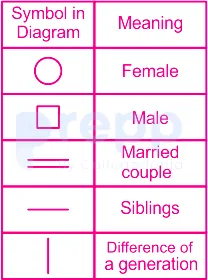
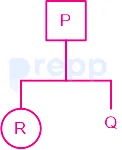
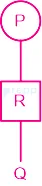
If A – B means that A is the mother of B, A + B means that A is the father of B, A ÷ B means that A is the sister of B, then which of the following expression shows that P is the aunt of Q?
- A
P + R ÷ Q
- B
P - R + Q
- C
P ÷ R – Q
- D
R ÷ P – Q
Show answer
C. P ÷ R – QGiven:
A is
Symbol-+÷
MeaningMotherFatherSister
B's
Therefore,
Option - (1) : P + R ÷ Q → P, R is the father of Q's sister.
Here, P is the father of Q.
Option - (2) : P - R + Q → P, R is the sister who is the father of Q.
Here, P is the grandmother of Q.
Option - (3) : P ÷ R – Q → P, R is the sister who is the mother of Q.
Here, P is the aunt of Q.
Option - (4) : R ÷ P – Q → R, P is the sister who is the mother of Q.
Here, P is the mother of Q.
Thus, the correct answer is "Option - (3)".
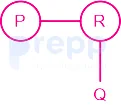
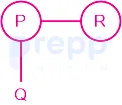 Paper & answer key PDF ↗
 Question 16archived
Select the option that is related to the third word in the same way as the second word is related to the first word.
(The words should be treated as meaningful English/Hindi words and should not be linked to each other on the basis of number of letters/number of consonants/number of vowels in the word.)
Panda : Bamboo :: Koala : ?
- A
bark
- B
Grass
- C
eucalyptus
- D
Fish
Show answer
C. eucalyptusUnderstanding Animal Analogies: Panda and Koala Diets
This question is a word analogy that tests your understanding of relationships between pairs of words. We are given the analogy "Panda : Bamboo :: Koala : ?" and asked to find the word that completes the second pair based on the relationship in the first pair.
Analyzing the First Pair: Panda and Bamboo
The first pair is "Panda : Bamboo". We need to identify the relationship between Panda and Bamboo. Pandas are well-known for their diet, which consists almost exclusively of bamboo. Therefore, the relationship here is that Bamboo is the primary food source for Pandas.
Applying the Relationship to the Second Pair: Koala and ?
Following the pattern of the first pair, the second pair "Koala : ?" should have the same relationship. This means the missing word should be the primary food source for Koalas. We need to look at the options provided and determine which one is the main food source for Koalas.
Evaluating the Options
Let's examine each option:
bark: While some animals eat bark, it is not the primary diet of Koalas.
Grass: Koalas are arboreal (tree-dwelling) marsupials and primarily eat leaves, not grass.
eucalyptus: Koalas are famous for their specialized diet of eucalyptus leaves. They consume large quantities of leaves from certain species of eucalyptus trees.
Fish: Koalas are herbivores and do not eat fish. Fish is a food source for aquatic or carnivorous animals.
Determining the Correct Food Source for Koalas
Based on our knowledge of animal diets, eucalyptus leaves are the primary and almost exclusive food source for Koalas. This matches the relationship seen in the first pair (Animal : Primary Food Source).
Animal
Primary Food Source
Panda
Bamboo
Koala
Eucalyptus leaves
Therefore, the word that completes the analogy "Panda : Bamboo :: Koala : ?" is eucalyptus.
Revision Table: Key Analogy Concepts
Concept
Description
Example (from this question)
Analogy
A comparison between two things for the purpose of explanation or clarification. In word analogies, the relationship between the first pair is applied to the second pair.
Panda : Bamboo :: Koala : Eucalyptus
Relationship Type
The specific connection between the words in a pair (e.g., Food Source, Part-Whole, Cause-Effect, Synonym, Antonym).
Food Source (Panda eats Bamboo, Koala eats Eucalyptus)
Solving Strategy
Identify the relationship in the first pair and apply it to the second pair to find the missing word.
Relationship is 'eats'. Panda eats Bamboo. What does Koala eat? Eucalyptus.
Additional Information on Animal Diets and Analogies
Understanding the diets of different animals is a common theme in analogies. Many analogies test knowledge about:
Animal and its food (e.g., Cow : Grass, Lion : Meat)
Animal and its habitat (e.g., Fish : Water, Bird : Nest)
Animal and its sound (e.g., Dog : Bark, Cat : Meow)
Animal and its young one (e.g., Cow : Calf, Sheep : Lamb)
Animal and its movement (e.g., Snake : Slither, Rabbit : Hop)
Practicing different types of analogies helps improve verbal reasoning and vocabulary skills. In this specific analogy, the key was knowing the primary food sources for Panda and Koala bears.
Paper & answer key PDF ↗ Question 17archived
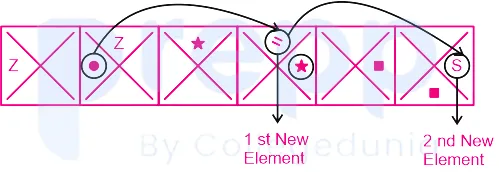
Select the figure from among the given options that can replace the question mark (?) in the following series.

- A
Option A (shown in image)
- B
Option B (shown in image)
- C
Option C (shown in image)
- D
Option D (shown in image)
Show answer
Question 18archived
Select the option figure in which the given figure (X) is embedded as its part (rotation is NOT allowed).

- A
Option A (shown in image)
- B
Option B (shown in image)
- C
Option C (shown in image)
- D
Option D (shown in image)
Show answer
A. Option A (shown in image)Given:
The image must not to be rotated
Hence, the correct answer is "Option - (1)" .

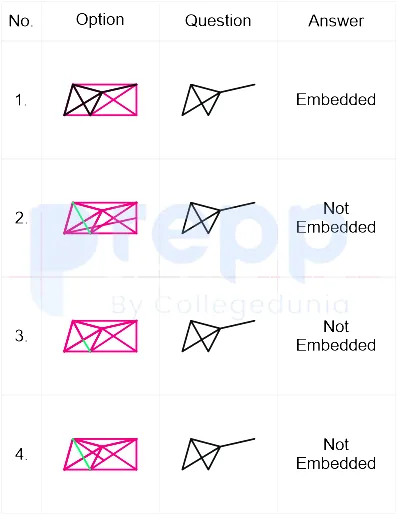 Paper & answer key PDF ↗
 Question 19archived
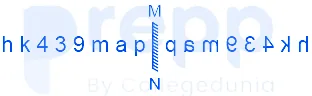
Select the correct mirror image of the given combination when the mirror is placed at MN as shown below.
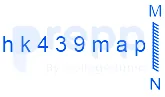
- A
Option A (shown in image)
- B
Option B (shown in image)
- C
Option C (shown in image)
- D
Option D (shown in image)
Show answer
Question 20archived
Select the option that is related to the fifth number in the same way as the second number is related to the first number and the fourth number is related to the third number.
10 : 45 :: 6 : 25 :: 9 : ?
- A
38
- B
36
- C
42
- D
40
Show answer
D. 40The correct answer is 40.
For example, $n^2+n$, $n \times (n+1)$, etc. Eliminate Options: Once you think you've found a pattern, quickly check if it gives one of the options. If not, revisit your pattern analysis. Practicing different types of number puzzles helps improve your pattern recognition skills.
Paper & answer key PDF ↗ Question 21archived
In a certain code language, ‘NUMERICAL’ is written as ‘ICALRNUME’ and ‘SCATTERED’is written as ‘EREDTSCAT’. How will ‘EXPLOSION’ be written in that language?
- A
SIONOXEPL
- B
SIONOEXPL
- C
SIONOXELP
- D
SIONOEXLP
Show answer
B. SIONOEXPLThe correct answer is SIONOEXPL.
Substitution Coding: Words are substituted with other words (e.g., 'blue' is called 'green', 'green' is called 'red', etc.). Mixed Coding: A combination of letters, numbers, and symbols is used. Word/Phrase Coding: Entire words or phrases are coded based on specific rules, often involving rearrangement or swapping parts of the word, as seen in this problem. Solving these problems requires careful observation, logical thinking, and testing potential patterns based on the given examples.
Paper & answer key PDF ↗ Question 22archived
Three of the following letter-clusters are alike in some manner and hence form a group. Which letter-cluster does not belong to that group?
- A
WDLF
- B
YBXR
- C
PKSM
- D
IRMT
Show answer
D. IRMTCorrect answer: IRMT
Positional Value: Using the alphabetical order (A=1, B=26, etc.).
Skipping Letters: Patterns involving skipping a fixed number of letters.
Reverse Alphabetical Order: Using position from Z (Z=1, Y=2, etc.).
Vowels/Consonants: Patterns based on whether letters are vowels or consonants.
Mirror Images: Letters that are mirror images of each other (e.g., B and D in some fonts).
Combination of Rules: Sometimes multiple rules are applied within a single sequence or cluster.
Solving these questions often involves trial and error, systematically checking different potential patterns until a consistent rule is found for most items, allowing you to identify the one that deviates.
Paper & answer key PDF ↗ Question 23archived
In a certain code language, 'BYE’ is coded as '245' and 'OLA' is coded as '265'. How will 'CAR' be coded in that language?
- A
280
- B
285
- C
295
- D
300
Show answer
C. 295Understanding Code Language Patterns
Coding-decoding questions test your ability to find the hidden pattern or rule used to code a word or number. To solve these questions, we look at the given examples, try different logical operations based on letter positions, and apply the identified rule to the word we need to code.
Alphabetical Positions of Letters
Let's start by listing the standard alphabetical positions of the letters:
Letter
Position
Letter
Position
A
1
N
14
B
2
O
15
C
3
P
16
D
4
Q
17
E
5
R
18
F
6
S
19
G
7
T
20
H
8
U
21
I
9
V
22
J
10
W
23
K
11
X
24
L
12
Y
25
M
13
Z
26
Analyzing the Given Code Language Examples
We are given two examples in this code language:
'BYE’ is coded as '245'
'OLA’ is coded as '265'
Let's find the alphabetical positions of the letters in each word and see if we can find a pattern related to the given codes.
Example 1: BYE coded as 245
B is the 2nd letter.
Y is the 25th letter.
E is the 5th letter.
Let's sum the positions: $2 + 25 + 5 = 32$.
The code is 245. The sum is 32. We need to find a relationship between 32 and 245.
Example 2: OLA coded as 265
O is the 15th letter.
L is the 12th letter.
A is the 1st letter.
Let's sum the positions: $15 + 12 + 1 = 28$.
The code is 265. The sum is 28. We need to find a relationship between 28 and 265, and this relationship should be consistent with the relationship between 32 and 245.
Finding the Coding Pattern Rule
Let the sum of the alphabetical positions of the letters in a word be $S$. Let the coded value be $C$. We are looking for a function or rule $f$ such that $C = f(S)$.
From the examples, we have:
For BYE: $S_{BYE} = 32$, $C_{BYE} = 245$
For OLA: $S_{OLA} = 28$, $C_{OLA} = 265$
Let's test a linear relationship of the form $C = mS + b$, where $m$ and $b$ are constants.
Using the two examples, we can set up a system of two linear equations:
$32m + b = 245$
$28m + b = 265$
Subtract equation (2) from equation (1):
$(32m + b) - (28m + b) = 245 - 265$
$4m = -20$
$m = \frac{-20}{4}$
$m = -5$
Now substitute the value of $m = -5$ into equation (1):
$32(-5) + b = 245$
$-160 + b = 245$
$b = 245 + 160$
$b = 405$
So, the coding rule appears to be: $C = -5 \times S + 405$.
Let's quickly verify this rule with the OLA example:
$C_{OLA} = -5 \times S_{OLA} + 405 = -5 \times 28 + 405 = -140 + 405 = 265$. This matches the given code for OLA.
Applying the Code Language Rule to CAR
Now we need to find the code for 'CAR' using the same rule. First, find the sum of the alphabetical positions of the letters in CAR.
C is the 3rd letter.
A is the 1st letter.
R is the 18th letter.
Sum of positions for CAR ($S_{CAR}$): $3 + 1 + 18 = 22$.
Now, apply the rule $C = -5 \times S + 405$ to find the code for CAR ($C_{CAR}$).
$C_{CAR} = -5 \times S_{CAR} + 405$
$C_{CAR} = -5 \times 22 + 405$
$C_{CAR} = -110 + 405$
$C_{CAR} = 295$
Thus, 'CAR' will be coded as '295' in this language.
Comparing with Options
Let's check our calculated code against the given options:
280
285
295
300
Our calculated code, 295, matches the third option.
Revision Table: Code Language Summary
Word
Letter Positions
Sum of Positions (S)
Coded Value (C)
Rule Check (-5 * S + 405)
BYE
B=2, Y=25, E=5
32
245
$-5 \times 32 + 405 = -160 + 405 = 245$ (Matches)
OLA
O=15, L=12, A=1
28
265
$-5 \times 28 + 405 = -140 + 405 = 265$ (Matches)
CAR
C=3, A=1, R=18
22
?
$-5 \times 22 + 405 = -110 + 405 = 295$
Additional Information: Coding Decoding Techniques
Coding-decoding is a common type of logical reasoning question. The patterns used can vary widely. Some common types of patterns include:
Letter Shifting: Each letter is shifted a fixed number of positions forward or backward in the alphabet.
Reverse Alphabetical Order: Using the position of letters counting backward from Z (Z=1, Y=2, etc.).
Sum/Product of Positions: The code is based on the sum or product of the alphabetical positions (forward or reverse) of the letters.
Pattern within the Word: The code might relate to the number of vowels/consonants, positions of specific letters (like the first or last), or a combination.
Mathematical Operations: Applying addition, subtraction, multiplication, or even more complex operations to letter positions or counts.
Mixed Patterns: A combination of the above, sometimes involving different rules for vowels and consonants, or for letters at different positions within the word.
Solving these questions requires careful observation, systematic testing of possible patterns, and logical deduction based on the provided examples.
Paper & answer key PDF ↗ Question 24archived
Select the correct combination of mathematical signs to sequentially replace the *signs and balance the given equation.
65 * 45 * 25 * 5 * 35 * 60
- A
-, +, -, +, =
- B
+, ×, +, -, =
- C
+, -, +, -, =
- D
-, +, ÷, +, =
Show answer
D. -, +, ÷, +, =Balancing the Mathematical Equation with Correct Signs
The problem requires us to find the correct sequence of mathematical signs from the given options that, when substituted into the asterisks in the equation 65 * 45 * 25 * 5 * 35 * 60, make the equation true. Since the last element in the equation is 60 without an asterisk after it, the last sign in the sequence must be the equals sign (=), balancing the left side to 60.
We will test each option by substituting the signs sequentially into the equation and performing the calculations according to the order of operations (BODMAS/PEMDAS: Brackets, Orders/Exponents, Division/Multiplication, Addition/Subtraction).
Testing Option 1: -, +, -, +, =
Substitute the signs into the equation:
\(65 - 45 + 25 - 5 + 35 = 60\)
Perform the calculations from left to right (since only addition and subtraction are present):
\(65 - 45 = 20\)
\(20 + 25 = 45\)
\(45 - 5 = 40\)
\(40 + 35 = 75\)
The left side evaluates to 75.
\(75 = 60\)
This is false. So, Option 1 is incorrect.
Testing Option 2: +, ×, +, -, =
Substitute the signs into the equation:
\(65 + 45 \times 25 + 5 - 35 = 60\)
Apply the order of operations. Multiplication first:
\(45 \times 25 = 1125\)
Now substitute this back:
\(65 + 1125 + 5 - 35\)
Perform addition and subtraction from left to right:
\(65 + 1125 = 1190\)
\(1190 + 5 = 1195\)
\(1195 - 35 = 1160\)
The left side evaluates to 1160.
\(1160 = 60\)
This is false. So, Option 2 is incorrect.
Testing Option 3: +, -, +, -, =
Substitute the signs into the equation:
\(65 + 45 - 25 + 5 - 35 = 60\)
Perform the calculations from left to right (since only addition and subtraction are present):
\(65 + 45 = 110\)
\(110 - 25 = 85\)
\(85 + 5 = 90\)
\(90 - 35 = 55\)
The left side evaluates to 55.
\(55 = 60\)
This is false. So, Option 3 is incorrect.
Testing Option 4: -, +, ÷, +, =
Substitute the signs into the equation:
\(65 - 45 + 25 \div 5 + 35 = 60\)
Apply the order of operations. Division first:
\(25 \div 5 = 5\)
Now substitute this back:
\(65 - 45 + 5 + 35\)
Perform addition and subtraction from left to right:
\(65 - 45 = 20\)
\(20 + 5 = 25\)
\(25 + 35 = 60\)
The left side evaluates to 60.
\(60 = 60\)
This is true. So, Option 4 is correct.
Mathematical Signs and Equation Balancing Solution
By systematically testing each combination of mathematical signs and applying the correct order of operations, we found that the sequence -, +, ÷, +, = correctly balances the given equation 65 * 45 * 25 * 5 * 35 * 60, making the statement 65 - 45 + 25 ÷ 5 + 35 = 60 true.
Option
Mathematical Signs Sequence
Equation
Calculation Steps
Result
Balanced?
1
-, +, -, +, =
\(65 - 45 + 25 - 5 + 35 = 60\)
\(20 + 25 - 5 + 35\) → \(45 - 5 + 35\) → \(40 + 35\) → 75
75
No
2
+, ×, +, -, =
\(65 + 45 \times 25 + 5 - 35 = 60\)
\(65 + 1125 + 5 - 35\) → \(1190 + 5 - 35\) → \(1195 - 35\) → 1160
1160
No
3
+, -, +, -, =
\(65 + 45 - 25 + 5 - 35 = 60\)
\(110 - 25 + 5 - 35\) → \(85 + 5 - 35\) → \(90 - 35\) → 55
55
No
4
-, +, ÷, +, =
\(65 - 45 + 25 \div 5 + 35 = 60\)
\(65 - 45 + 5 + 35\) → \(20 + 5 + 35\) → \(25 + 35\) → 60
60
Yes
Revision Table: Key Concepts in Equation Balancing
Concept
Description
Importance
Mathematical Signs
Symbols representing arithmetic operations (+, -, ×, ÷).
They define the relationship between numbers in an equation.
Equation Balancing
Finding unknown values or symbols that make both sides of an equation equal.
Crucial for solving problems in mathematics and various fields.
Order of Operations
Rules (like BODMAS/PEMDAS) that dictate the sequence in which operations are performed.
Ensures consistent and correct evaluation of mathematical expressions.
Substitution Method
Replacing placeholders (like *) with specific values or symbols from options.
A common technique for testing potential solutions in MCQs.
Additional Information: Order of Operations Explained
When an expression contains multiple operations, we follow a specific order to ensure a unique and correct result. This order is commonly remembered using acronyms like BODMAS or PEMDAS.
BODMAS: Brackets, Orders (powers, square roots), Division and Multiplication (from left to right), Addition and Subtraction (from left to right).
PEMDAS: Parentheses, Exponents, Multiplication and Division (from left to right), Addition and Subtraction (from left to right).
In the problem above, Option 4 involved subtraction, addition, division, and addition. According to BODMAS/PEMDAS, division is performed before addition and subtraction. Therefore, \(25 \div 5\) was calculated first.
Paper & answer key PDF ↗ Question 25archived
Select the option that represents the correct order of the given words as they would appear in an English dictionary.
1- Laudanum
2- Lattice
3- Laudation
4- Latterly
5- Laudable
- A
2, 4, 5, 3, 1
- B
2, 4, 1, 5, 3
- C
4, 2, 3, 1, 5
- D
4, 2, 5, 1, 3
Show answer
D. 4, 2, 5, 1, 3Understanding Dictionary Order
To determine the correct order of words as they would appear in an English dictionary, we need to arrange them alphabetically. This involves comparing the words letter by letter from the beginning.
Let's list the given words with their corresponding numbers:
Laudanum
Lattice
Laudation
Latterly
Laudable
Now, we compare the words letter by letter:
All words start with 'L'.
All words have 'a' as the second letter.
The third letters are 'u' (Laudanum, Laudation, Laudable) and 't' (Lattice, Latterly). Since 't' comes before 'u' in the alphabet, the words starting with 'Lat' will come before the words starting with 'Lau'.
Ordering Words Starting with 'Lat'
We compare 'Lattice' and 'Latterly':
Lattice
Latterly
Comparing them letter by letter:
Position
Lattice
Latterly
Comparison
Order
1st
L
L
Same
-
2nd
a
a
Same
-
3rd
t
t
Same
-
4th
t
t
Same
-
5th
i
e
'e' comes before 'i'
Latterly then Lattice
So, the order for these two words is Latterly (4) then Lattice (2).
Ordering Words Starting with 'Lau'
We compare 'Laudanum', 'Laudation', and 'Laudable':
Laudanum
Laudation
Laudable
Comparing them letter by letter:
Position
Laudanum
Laudation
Laudable
Comparison
Order
1st
L
L
L
Same
-
2nd
a
a
a
Same
-
3rd
u
u
u
Same
-
4th
d
d
d
Same
-
5th
a
a
a
Same
-
6th
n
t
b
Compare 'n', 't', 'b'
'b' comes before 'n', 'n' comes before 't'
Alphabetical order of 'b', 'n', 't' is 'b', 'n', 't'.
So, the order for these three words is Laudable (5) then Laudanum (1) then Laudation (3).
Combining the Orders
Putting the two groups together ('Lat' words before 'Lau' words):
Latterly (4)
Lattice (2)
Laudable (5)
Laudanum (1)
Laudation (3)
The correct numerical order is 4, 2, 5, 1, 3.
Final Answer Derivation
Based on the alphabetical comparison, the words in dictionary order are Latterly, Lattice, Laudable, Laudanum, Laudation. This corresponds to the numbers 4, 2, 5, 1, 3.
This matches option 4.
Revision Table: Alphabetical Order
Word
Number
Position in Dictionary Order
Latterly
4
1st
Lattice
2
2nd
Laudable
5
3rd
Laudanum
1
4th
Laudation
3
5th
Additional Information: How Dictionaries Work
Dictionaries list words in alphabetical order to make them easy to find. The process involves comparing words letter by letter. If the first letters are the same, you look at the second letters, and so on. If one word runs out of letters while the other still has letters (and the parts matched so far are identical), the shorter word comes first (e.g., "cat" comes before "catalogue"). This systematic approach ensures every word has a unique position in the dictionary.
Paper & answer key PDF ↗ Question 26archived
The Comptroller and Auditor General of India is a ____________.
- A
two-member body
- B
three-member body
- C
single-member body
- D
six-member body
Show answer
C. single-member bodyUnderstanding the Comptroller and Auditor General of India's Structure
The Comptroller and Auditor General (CAG) of India holds a crucial position in India's financial administration. Appointed by the President, the CAG is responsible for auditing the accounts of both the Union and state governments. Understanding the composition of the office is key to grasping its authority and functioning.
Composition of the CAG Office
The Constitution of India, specifically Article 148, provides for the office of the Comptroller and Auditor General of India.
The Comptroller and Auditor General of India heads the entire Indian Audit and Accounts Department.
This office is structured as a single-member body, meaning the CAG is the sole constitutional authority heading the department.
While the CAG is supported by a large staff, the ultimate responsibility and authority rest with the individual holding the position of the CAG.
Why CAG is a Single-Member Body
Unlike some other constitutional bodies that might have multiple members or a commission structure, the CAG operates as an individual constitutional functionary. The powers and duties conferred upon the CAG under the Constitution and related laws are exercised by the person appointed to this office. Therefore, it is correctly identified as a single-member body.
The other options suggesting a two-member, three-member, or six-member body do not accurately reflect the constitutional setup of the Comptroller and Auditor General of India.
Paper & answer key PDF ↗ Question 27archived
Which of the following led English company in Battle of Plassey (1757)?
- A
Lord Dalhousie
- B
Captain Hodson
- C
Warren Hastings
- D
Robert Clive
Show answer
D. Robert CliveCorrect Answer: Option 4 (Robert Clive)
Key Historical Facts:
The Battle: Fought on June 23, 1757, at Palashi (Plassey) on the banks of the Hooghly River in Bengal.
The Conflict: It was fought between the forces of Siraj-ud-Daulah (the last independent Nawab of Bengal) and the British East India Company, led by Robert Clive.
The Outcome: Clive won a decisive victory, largely due to a secret alliance made with Mir Jafar, the commander-in-chief of the Nawab’s army, who defected during the battle. This victory established the foundation of British colonial rule in India.
Context for Other Options:
Lord Dalhousie: Served as the Governor-General of India much later (1848–1856) and is famous for introducing the Doctrine of Lapse.
Captain Hodson: An officer known for his role during the Revolt of 1857 (nearly a century later), specifically for capturing Bahadur Shah Zafar.
Warren Hastings: Became the first Governor-General of Bengal in 1773, well after the Battle of Plassey took place.
Paper & answer key PDF ↗ Question 28archived
As the river enters the plain it twists and turns forming large bends known as ______.
- A
ox-bow
- B
levees
- C
floodplains
- D
meanders
Show answer
D. meandersUnderstanding River Course Changes on Plains
When a river flows from an area with a steep slope, like mountains or hills, onto a flat area, known as a plain, its energy and speed change. The reduced gradient of the land causes the water flow to slow down. This change in conditions leads the river to behave differently.
Instead of maintaining a relatively straight path, the river begins to develop curves and turns. These turns become more pronounced over time due to the continuous processes of erosion and deposition along the river banks.
Formation of River Bends (Meanders)
The bends in a river on a plain develop because the water flows faster on the outer edge of a curve and slower on the inner edge. This difference in speed causes:
Erosion on the outer bend, where the faster water cuts away at the bank.
Deposition on the inner bend, where the slower water drops sediment it is carrying.
This ongoing process widens the river valley and causes the bends to grow larger and shift their position across the floodplain.
Identifying the River Feature
The large, looping bends that a river forms as it flows across a plain are specifically called meanders.
Analyzing the Given Options
Let's consider the other options to understand why they are not the correct answer to the question:
Ox-bow: An ox-bow lake is a U-shaped lake that forms when a meander bend is cut off from the main river channel, usually during a flood. It is a feature created from a meander, not the bend itself.
Levees: Levees are natural or artificial raised banks along the sides of a river channel, often formed by sediment deposited during floods. They are features that confine the river channel, not the bends within it.
Floodplains: A floodplain is the broad, flat area of land on either side of a river that is subject to flooding. Meanders are found on floodplains, but the floodplain is the land area, not the bend of the river.
Meanders: These are the characteristic large bends formed by a river on a plain, exactly matching the description in the question.
Conclusion on River Morphology
Based on the definition and formation process, the large bends formed by a river as it enters the plain are known as meanders.
Revision Table: Common River Features
River FeatureDescriptionRelation to Question
MeanderA large bend in a river's course.Directly answers the question.
Ox-bow LakeA lake formed when a meander is cut off.A result of meander formation, not the bend itself.
LeveeA raised bank along the river channel.A channel boundary feature.
FloodplainFlat land beside the river subject to flooding.The area where meanders are found.
Additional Information: Meander Dynamics
Meanders are dynamic features. They constantly change shape and position over time. The degree of sinuosity (how bendy the river is) can vary depending on factors like the river's discharge, the type of sediment it carries, and the resistance of the bank material to erosion.
The study of how rivers erode, transport, and deposit material, shaping the landscape, is part of physical geography and geology.
Paper & answer key PDF ↗ Question 29archived
What does the letter ‘M’ stand for in the MRTP Act 1969?
- A
Monopolistic
- B
Monopolies
- C
Multi
- D
Monopoly
Show answer
B. MonopoliesUnderstanding the MRTP Act 1969
The question asks about the meaning of the letter 'M' in the acronym MRTP Act 1969. This act was a significant piece of legislation in India aimed at preventing the concentration of economic power and controlling monopolistic and restrictive trade practices.
Breaking Down the MRTP Acronym
The MRTP Act stands for the Monopolies and Restrictive Trade Practices Act. Each letter represents a key concept addressed by the law:
M: Monopolies
RTP: Restrictive Trade Practices
Therefore, the letter 'M' specifically refers to Monopolies.
Purpose of the MRTP Act 1969
The main objectives of the MRTP Act 1969 were:
To ensure that the operation of the economic system does not result in the concentration of economic power to the common detriment.
To provide for the control of monopolies.
To prohibit monopolistic trade practices and restrictive trade practices.
The Act established the MRTP Commission to investigate and take action against companies engaging in such practices.
Analyzing the Options
Let's look at the given options:
Monopolistic: While related to monopolies, the 'M' in the acronym specifically stands for the plural form, Monopolies.
Monopolies: This matches the official name of the Act, which is the Monopolies and Restrictive Trade Practices Act.
Multi: This word is not part of the Act's full name.
Monopoly: Similar to 'Monopolistic', while related, the acronym uses the plural form, Monopolies.
Based on the full name of the Act, the letter 'M' stands for Monopolies.
Comparing Monopolies and Monopolistic
It's important to understand the slight difference in the context of the Act's name.
Term
Meaning in Context
Monopolies
Refers to the entities or situations where a single entity or a small group of entities dominate a market, giving them significant control over prices and competition. The Act sought to control the existence and impact of such dominant market structures.
Monopolistic
An adjective describing practices or market structures characteristic of a monopoly. While the Act prohibited monopolistic trade practices, the 'M' in the title refers to the noun form, Monopolies.
The Act was titled the "Monopolies and Restrictive Trade Practices Act", making "Monopolies" the correct term for the letter 'M'.
Revision Table: Key Points on MRTP Act
Aspect
Description
Full Form
Monopolies and Restrictive Trade Practices Act
Year
1969
Key Focus Areas
Control of Monopolies, Prohibition of Restrictive and Monopolistic Trade Practices
Regulatory Body
MRTP Commission (erstwhile)
Successor Act
Competition Act, 2002
Additional Information: Evolution from MRTP to Competition Act
The MRTP Act 1969 served India for over three decades, addressing issues of monopolies and unfair trade practices. However, with economic liberalization and globalization in the 1990s, a need was felt for a more modern competition law. The Raghavan Committee reviewed the MRTP Act and recommended a new law based on contemporary competition principles.
This led to the enactment of the Competition Act, 2002, which repealed the MRTP Act. The Competition Act focuses on preventing anti-competitive agreements, abuse of dominant position, and regulating combinations (mergers and acquisitions) that cause or are likely to cause an appreciable adverse effect on competition in India. The Competition Commission of India (CCI) was established under this Act.
Understanding the MRTP Act is crucial for appreciating the history of competition law in India and the transition to the current framework under the Competition Act, 2002, which continues to deal with issues like preventing monopolies and promoting fair competition.
Paper & answer key PDF ↗ Question 30archived
Harihara and Bukka established an independent state in Karnataka and established the capital city Vijayanagar on the banks of river _____________ in 1336.
- A
Betwa
- B
Tungabhadra
- C
Mahanadi
- D
Tapi
Show answer
B. TungabhadraThe correct answer is Tungabhadra.
Trade and Transport: While not a major navigation route in itself near the capital, its valley connected important regions, and related waterways supported local transport. Religious Significance: The area around the Tungabhadra river, particularly Hampi, had pre-existing religious sites, which were incorporated and expanded upon by the Vijayanagar rulers, adding to the city's importance. The ruins of Vijayanagar today, a UNESCO World Heritage site, are spread across the landscape defined by the Tungabhadra river and the surrounding rocky hills.
Paper & answer key PDF ↗ Question 31archived
Match the industrial plant with its location.
Name of Industrial Plant
Related Location
1.
BALCO
A)
Burnpur
2.
IISCO
B)
Chennai
3.
NFL
C)
Korba
4.
ICF
D)
Bhatinda
- A
1 - A, 2 - B, 3 - C, 4 - D
- B
1 - C, 2 - A, 3 - B, 4 - D
- C
1 - C, 2 - A, 3 - D, 4 - B
- D
1 - D, 2 - A, 3 - B, 4 - C
Show answer
C. 1 - C, 2 - A, 3 - D, 4 - BMatching Industrial Plants with Their Locations
This question asks us to correctly associate specific industrial plants in India with the cities or regions where they are located. This tests knowledge about key industrial sites in the country.
Understanding the Industrial Plants and Locations
Let's look at each industrial plant mentioned and find its correct location:
BALCO (Bharat Aluminium Company): BALCO is a major aluminium producer. Its main plant is located in Korba, Chhattisgarh.
IISCO (Indian Iron and Steel Company): IISCO is one of the oldest iron and steel producers in India. It is located in Burnpur, West Bengal. It is now part of Steel Authority of India Limited (SAIL).
NFL (National Fertilizers Limited): NFL is a leading producer of urea and other fertilizers. It has several plants across India, one of which is located in Bhatinda, Punjab.
ICF (Integral Coach Factory): ICF is a manufacturer of railway coaches. It is located in Chennai, Tamil Nadu.
Performing the Match
Based on the correct locations, we can make the following matches:
BALCO (1) → Korba (C)
IISCO (2) → Burnpur (A)
NFL (3) → Bhatinda (D)
ICF (4) → Chennai (B)
This gives us the matching sequence: 1 - C, 2 - A, 3 - D, 4 - B.
Verification of the Matches
Let's confirm each match:
Industrial Plant
Matched Location
Correctness
BALCO (Bharat Aluminium Company)
Korba
Correct
IISCO (Indian Iron and Steel Company)
Burnpur
Correct
NFL (National Fertilizers Limited)
Bhatinda
Correct
ICF (Integral Coach Factory)
Chennai
Correct
The matches are: 1 - C, 2 - A, 3 - D, 4 - B.
Revision Table: Industrial Plants and Locations
Industrial Plant
Sector
Location
State
BALCO
Aluminium
Korba
Chhattisgarh
IISCO
Iron & Steel
Burnpur
West Bengal
NFL
Fertilizer
Bhatinda
Punjab
ICF
Railway Coaches
Chennai
Tamil Nadu
Additional Information on Indian Industries
Knowing the locations of major industrial plants is important for understanding India's economic geography and industrial development. Different regions specialize in different types of industries based on factors like raw material availability, infrastructure, and markets.
Aluminium Industry: Aluminium plants like BALCO are often located near bauxite deposits and sources of power, as aluminium production is energy-intensive. Korba is known for coal reserves which power thermal plants.
Iron and Steel Industry: Early steel plants like IISCO were set up in regions like West Bengal, near iron ore mines, coal fields, and port facilities. Modern plants also consider infrastructure and logistics.
Fertilizer Industry: Fertilizer plants like NFL's Bhatinda unit are often located near sources of raw materials (like natural gas or naphtha) or major agricultural areas to reduce transportation costs for the finished product.
Railway Coach Manufacturing: Units like ICF in Chennai are part of the railway infrastructure network, strategically located to serve national needs.
Studying the spatial distribution of these key industrial plants helps in understanding the economic landscape of India.
Paper & answer key PDF ↗ Question 32archived
Identify the correct chemical formula of chloroform.
- A
CHCl3
- B
CHCl
- C
CHCl2
- D
CH2Cl2
Show answer
A. CHCl3Understanding the Chemical Formula of Chloroform
The question asks to identify the correct chemical formula for chloroform from the given options. A chemical formula represents the composition of a molecule, indicating the types of atoms present and their respective numbers.
Chloroform is a well-known organic compound. Its chemical name is trichloromethane. This name itself gives a clue about its composition: 'methane' suggests one carbon atom bonded to hydrogen atoms, and 'trichloro' suggests three chlorine atoms substituting hydrogen atoms.
Identifying the Correct Chloroform Formula
Let's examine the given options and compare them to the known structure and composition of chloroform:
CHCl3: This formula indicates one carbon atom (C), one hydrogen atom (H), and three chlorine atoms (Cl). This structure corresponds to a methane molecule (CH4) where three hydrogen atoms have been replaced by three chlorine atoms. This matches the chemical name trichloromethane.
CHCl: This formula represents a molecule with one carbon, one hydrogen, and one chlorine atom. This is not chloroform.
CHCl2: This formula represents a molecule with one carbon, one hydrogen, and two chlorine atoms. This compound is known as dichloromethylidene, a highly reactive species, not stable chloroform.
CH2Cl2: This formula represents a molecule with one carbon atom, two hydrogen atoms, and two chlorine atoms. This compound is dichloromethane, another important organic solvent, but it is not chloroform.
Based on the chemical structure and name of chloroform (trichloromethane), the correct chemical formula is CHCl3.
Composition of Chloroform (CHCl3)
The formula CHCl3 precisely describes the atomic makeup of a single chloroform molecule. It contains:
1 Carbon atom (C)
1 Hydrogen atom (H)
3 Chlorine atoms (Cl)
These atoms are bonded together with the carbon atom at the center, bonded to one hydrogen atom and three chlorine atoms. This forms a tetrahedral structure around the carbon atom, similar to methane, but with different substituent atoms.
Comparison of Options
Formula
Composition
Identity
Is it Chloroform?
CHCl3
1 C, 1 H, 3 Cl
Chloroform (Trichloromethane)
Yes
CHCl
1 C, 1 H, 1 Cl
Chloromethylidene (highly reactive)
No
CHCl2
1 C, 1 H, 2 Cl
Dichloromethylidene (highly reactive)
No
CH2Cl2
1 C, 2 H, 2 Cl
Dichloromethane
No
Therefore, the correct identification of the chemical formula of chloroform is CHCl3.
Revision Table: Chloroform Formula
Key Information: Chloroform
Chemical Name
Common Name
Chemical Formula
Trichloromethane
Chloroform
CHCl3
Additional Information on Chloroform
Chloroform is a colorless, dense liquid with a sweet odor. It is classified as an organochlorine compound. Historically, chloroform was used as an anesthetic, but its use in medicine has been largely discontinued due to toxicity and the development of safer alternatives. Today, chloroform is primarily used as a solvent for various substances and in the production of other chemicals, particularly refrigerants like chlorodifluoromethane (HCFC-22), which is a precursor to Teflon.
While less common as a direct medical anesthetic, understanding its formula CHCl3 is fundamental in organic chemistry and related fields.
Paper & answer key PDF ↗ Question 33archived
How much percentage of oxygen is present in the atmosphere?
- A
39%
- B
79%
- C
10%
- D
21%
Show answer
D. 21%Understanding the Composition of Earth's Atmosphere
The Earth's atmosphere is a vital layer of gases surrounding our planet. It is a mixture of many different gases, dust particles, and water vapor. The composition of the atmosphere is not uniform throughout, but the main gases are present in relatively consistent proportions near the Earth's surface.
The question asks about the percentage of oxygen present in the atmosphere. To answer this, we need to know the primary gases that make up the air we breathe and their approximate proportions.
Major Gases in the Atmosphere
The two most abundant gases in the Earth's dry atmosphere are nitrogen and oxygen. Together, they make up about 99% of the total volume of air. Other gases, like argon, carbon dioxide, and trace gases, make up the remaining 1%.
Here is a breakdown of the approximate percentages of the main gases in dry air:
Gas
Approximate Percentage by Volume
Nitrogen (N₂)
78%
Oxygen (O₂)
21%
Argon (Ar)
0.9%
Carbon Dioxide (CO₂)
0.04%
Trace gases (Neon, Helium, Methane, Krypton, Hydrogen, etc.)
< 0.1%
From the table, we can clearly see that oxygen makes up approximately 21% of the Earth's atmosphere by volume.
Analyzing the Options
Let's look at the given options:
39%
79%
10%
21%
Comparing these options with the known composition of the atmosphere, the percentage of oxygen is approximately 21%.
Option 1 (39%) is incorrect.
Option 2 (79%) is close to the percentage of nitrogen, not oxygen, so it is incorrect.
Option 3 (10%) is significantly lower than the actual percentage of oxygen, so it is incorrect.
Option 4 (21%) matches the approximate percentage of oxygen in the atmosphere.
Therefore, the correct percentage of oxygen present in the atmosphere is 21%.
Revision Table: Atmospheric Gases
Gas
Primary Role
Approximate Percentage
Nitrogen (N₂)
Dilutes oxygen; essential for life processes (e.g., plant growth)
78%
Oxygen (O₂)
Required for respiration by living organisms and combustion
21%
Argon (Ar)
Inert gas, used in lighting and welding
0.9%
Carbon Dioxide (CO₂)
Essential for photosynthesis; greenhouse gas
0.04%
Additional Information: Why Oxygen Matters
Oxygen is a crucial component of the atmosphere for most life on Earth. It is essential for:
Respiration: Most living organisms, including humans and animals, use oxygen to convert food into energy. This process is called aerobic respiration.
Combustion: Oxygen is required for burning fuels. This is why fire cannot exist without a sufficient supply of oxygen.
Ozone Layer: Oxygen molecules (O₂) can be converted into ozone (O₃) in the upper atmosphere. The ozone layer absorbs harmful ultraviolet (UV) radiation from the sun, protecting life on the surface.
While nitrogen is the most abundant gas, oxygen is indispensable for many biological and chemical processes that are fundamental to life as we know it on Earth.
Paper & answer key PDF ↗ Question 34archived
In which season is Sarhul celebrated in Jharkhand?
- A
Spring
- B
Autumn
- C
Monsoon
- D
Winter
Show answer
A. SpringThe correct answer is Spring.
Sohrai: Celebrated after the harvest season (usually around Diwali), it is a festival related to cattle worship. Tusu Parab: A harvest festival celebrated in winter, particularly in the southern parts of Jharkhand. These festivals reflect the deep-rooted cultural heritage and the harmonious relationship between the people of Jharkhand and their natural environment. Sarhul, being celebrated in Spring, holds a special place as it marks the rejuvenation of nature and the start of a new cycle.
Paper & answer key PDF ↗ Question 35archived
What is the average thickness of the continental crust of earth?
- A
300 km
- B
5 km
- C
30 km
- D
2.5 km
Show answer
C. 30 kmLet's figure out the average thickness of the continental crust of Earth. The Earth's outer solid shell is called the crust. It's the layer we live on. The crust varies in thickness depending on whether it is under continents or oceans.
Earth's Crust Types and Thickness
The Earth's crust is broadly divided into two main types:
Continental Crust: This makes up the landmasses, including the continents and continental shelves. It is generally thicker and less dense than oceanic crust.
Oceanic Crust: This lies beneath the ocean basins. It is typically thinner and denser than continental crust.
The thickness of the continental crust is not uniform; it varies significantly from place to place. For example, it can be thinner in rift zones or thicker under major mountain ranges like the Himalayas, where it can reach up to 70-80 km.
However, when we talk about the average thickness of the continental crust, scientists have estimated a generally accepted value.
Let's look at the typical thicknesses:
Oceanic Crust: Averages about 5 to 10 km thick.
Continental Crust: Averages about 30 to 40 km thick.
Considering the options provided for the average thickness of the continental crust:
300 km: This is far too thick. The entire lithosphere (crust plus upper mantle) is typically around 100 km thick, and the crust is just the uppermost part.
5 km: This is the approximate average thickness of the oceanic crust, not the continental crust.
30 km: This value falls within the typical range (30-40 km) for the average thickness of the continental crust and is often cited as the average.
2.5 km: This is too thin for the average continental crust.
Based on geological data, the average thickness of the continental crust is widely considered to be around 30 kilometers.
Revision Table: Earth's Crust Characteristics
Feature
Continental Crust
Oceanic Crust
Location
Under continents and continental shelves
Under ocean basins
Composition
Granitic (felsic) rocks
Basaltic (mafic) rocks
Density
Lower (less dense)
Higher (more dense)
Average Thickness
About 30 - 40 km (often cited as 30 km average)
About 5 - 10 km (often cited as 7 km average)
Age
Can be very old (up to billions of years)
Relatively young (less than 200 million years)
Additional Information on Continental Crust Thickness
While 30 km is a good average to remember for the continental crust thickness, it's important to understand why it varies. Factors influencing the local thickness include:
Mountain Building: Collision of tectonic plates causes crustal thickening, creating mountain belts with significantly thicker crust (e.g., Andes, Himalayas).
Rifting: Where plates pull apart, the crust can be thinned.
Erosion: Over geological time, erosion can reduce the thickness of the crust.
Despite these variations, 30 km serves as a representative average value for the continental crust globally.
Paper & answer key PDF ↗ Question 36archived
Which of the following events was conducted by the Ministry of Ayush, GoI to mark the 100-day countdown to the International Day of Yoga 2022?
- A
Yoga Mahotsav
- B
Yoga Utsav
- C
Yoga Sutra
- D
Yoga Umang
Show answer
A. Yoga MahotsavUnderstanding the Ministry of Ayush Event for International Yoga Day Countdown
The question asks about a specific event organized by the Ministry of Ayush, Government of India, to mark the 100-day countdown leading up to the International Day of Yoga in 2022. Identifying this event requires knowledge of the initiatives undertaken by the Ministry to promote yoga, especially in the run-up to this global annual observance.
The International Day of Yoga is celebrated every year on June 21st. The Ministry of Ayush is the nodal ministry in India responsible for promoting and coordinating activities related to this day both nationally and internationally. As part of the preparations, various events and campaigns are conducted in the preceding months.
Analyzing the Options
Let's look at the given options:
Yoga Mahotsav
Yoga Utsav
Yoga Sutra
Yoga Umang
We need to determine which of these is the name of the event specifically held to kick off the 100-day countdown for the International Day of Yoga 2022.
Identifying the Correct Event
Based on official communications and reports from the Ministry of Ayush regarding the International Day of Yoga 2022, the event organized to flag off the 100-day countdown was known as "Yoga Mahotsav". This event typically involves various programs, workshops, and demonstrations aimed at creating enthusiasm and participation for the upcoming International Day of Yoga.
The Yoga Mahotsav for the 2022 countdown was a significant event, highlighting the importance of yoga for health and well-being and encouraging people worldwide to participate in the International Day of Yoga activities.
Why Other Options Are Less Likely
While terms like 'Utsav' (festival) or 'Umang' (enthusiasm) might sound relevant to celebratory events, 'Yoga Mahotsav' (Grand Yoga Festival) is the officially used term for significant preparatory events like the 100-day countdown flag-off by the Ministry of Ayush. 'Yoga Sutra' refers to a classical text on yoga authored by Patanjali, not an event name.
Conclusion
The event conducted by the Ministry of Ayush, GoI, to mark the 100-day countdown to the International Day of Yoga 2022 was Yoga Mahotsav.
Revision Table: Key Events and Terms
Term/Event
Description/Context
International Day of Yoga
Celebrated annually on June 21st worldwide.
Ministry of Ayush
Nodal ministry in India for promoting Yoga, Ayurveda, Naturopathy, Unani, Siddha and Homoeopathy. Organizes and coordinates IDY activities.
Yoga Mahotsav
A major event often organized by the Ministry of Ayush as part of the countdown activities for the International Day of Yoga, such as the 100-day countdown.
Yoga Sutra
A classical Sanskrit text on Yoga by Patanjali. Not an event.
Additional Information on International Day of Yoga and Ministry of Ayush Initiatives
The International Day of Yoga was declared by the United Nations General Assembly in 2014 following a proposal by India. Since 2015, it has been observed globally, emphasizing the physical, mental, and spiritual benefits of yoga.
The Ministry of Ayush plays a crucial role in popularizing yoga. Their activities include:
Organizing mass yoga demonstrations in prominent locations.
Developing common yoga protocols for easy practice.
Collaborating with national and international organizations to spread the message of yoga.
Launching digital campaigns and resources.
Events like the Yoga Mahotsav are integral to building momentum and encouraging widespread participation in the International Day of Yoga, reinforcing its theme and purpose each year.
Paper & answer key PDF ↗ Question 37archived
Who moved the Objective Resolution that was later adapted as the Preamble of the Constitution of India?
- A
Rajendra Prasad
- B
JB Kripalani
- C
Jawaharlal Nehru
- D
BR Ambedkar
Show answer
C. Jawaharlal NehruUnderstanding the Objective Resolution
The Objective Resolution was a significant declaration presented in the Constituent Assembly of India. It outlined the aspirations, goals, and guiding principles for the Constitution of independent India. This resolution was crucial as it provided the philosophical basis and the vision for the future republic, aiming to secure justice, liberty, equality, and fraternity for all its citizens.
Role of Jawaharlal Nehru
The task of moving this pivotal Objective Resolution fell to one of India's foremost leaders. On December 13, 1946, the Objective Resolution was formally introduced in the Constituent Assembly. The distinguished personality who moved this resolution was Pandit Jawaharlal Nehru.
Nehru's eloquent presentation articulated the ideals that the new nation would strive for, laying down the fundamental structure and philosophy of the constitutional framework. This resolution was later unanimously adopted by the Constituent Assembly on January 22, 1947.
Preamble of the Indian Constitution
The Objective Resolution moved by Jawaharlal Nehru was so profound and comprehensive that it eventually served as the inspiration and the foundational basis for the Preamble to the Constitution of India. The Preamble, which introduces the Constitution, reflects the essence of the Objective Resolution, stating the sovereignty of the people and the objectives of justice, liberty, equality, and fraternity, ensuring the dignity of the individual and the unity and integrity of the nation.
Other Key Figures in the Constituent Assembly
While Jawaharlal Nehru moved the Objective Resolution, other prominent figures mentioned in the options played different crucial roles in the making of the Indian Constitution:
Dr. Rajendra Prasad: He served as the President of the Constituent Assembly. His role was to guide and regulate the proceedings of the assembly.
Acharya JB Kripalani: He was a prominent freedom fighter and politician. He played a role in the Congress party during the time of independence and was part of the Constituent Assembly, but he was not the one who moved the Objective Resolution.
Dr. BR Ambedkar: He is widely regarded as the chief architect of the Indian Constitution. He chaired the Drafting Committee, which was responsible for preparing the draft of the Constitution based on the deliberations of the Constituent Assembly and the principles laid down in the Objective Resolution.
Therefore, specifically concerning the moving of the Objective Resolution, the credit goes to Jawaharlal Nehru.
Revision Table: Key Roles in Constitution Making
Figure
Key Role(s)
Involvement with Objective Resolution
Jawaharlal Nehru
First Prime Minister of India
Moved the Objective Resolution in the Constituent Assembly
Dr. Rajendra Prasad
First President of India
President of the Constituent Assembly
Dr. BR Ambedkar
First Law Minister of India
Chairman of the Drafting Committee of the Constituent Assembly
Acharya JB Kripalani
Prominent Politician and Freedom Fighter
Member of the Constituent Assembly
Additional Information: Significance of the Preamble
The Preamble is often called the soul of the Constitution because it encapsulates the fundamental values and philosophy on which the Constitution is based. It is a declaration of the will of the Indian people. While not directly enforceable in courts, it serves as a key to unlock the minds of the makers of the Constitution and helps in the interpretation of the Constitution. The Preamble highlights the nature of the Indian state (Sovereign, Socialist, Secular, Democratic, Republic) and the objectives it aims to achieve for its citizens (Justice, Liberty, Equality, Fraternity).
Paper & answer key PDF ↗ Question 38archived
Which of the following pairs of musicians and their instruments is INCORRECT?
- A
K Vaidyanathan – Sitar
- B
Pt. Ram Narayan – Sarangi
- C
Ustad Vilayat Khan – Sitar
- D
Bismillah Khan – Shehnai
Show answer
A. K Vaidyanathan – SitarThe correct answer is K Vaidyanathan – Sitar.
Rajam Violin Additional Information: Indian Classical Instruments Indian classical music features a wide array of instruments, categorized broadly into: String instruments: These include plucked instruments like Sitar, Sarod, Veena, and fretted/unfretted bowed instruments like Sarangi and Violin. Wind instruments: These include instruments like Flute (Bansuri) and Shehnai. Percussion instruments: These are primarily drums like Tabla, Pakhawaj, Mridangam, and Ghatam. Each instrument has a unique sound and history, deeply rooted in the traditions of either Hindustani (North Indian) or Carnatic (South Indian) classical music, or sometimes both.
Paper & answer key PDF ↗ Question 39archived
Which of the following becomes the first district in India to cover 100% households under ABPMJAY- SEHAT scheme?
- A
Samba, Jammu and Kashmir
- B
Pratapgarh, Rajasthan
- C
Kheda, Gujarat
- D
Mansa, Punjab
Show answer
A. Samba, Jammu and KashmirUnderstanding ABPMJAY-SEHAT Scheme and 100% Coverage
The question asks about the first district in India to achieve a significant milestone: covering 100% of its households under the Ayushman Bharat Pradhan Mantri Jan Arogya Yojana (ABPMJAY) - SEHAT scheme. This scheme is crucial for providing health insurance coverage to eligible citizens.
The Ayushman Bharat Pradhan Mantri Jan Arogya Yojana (ABPMJAY) is a flagship scheme providing health cover of up to ₹5 lakh per family per year for secondary and tertiary care hospitalization. The SEHAT scheme is an extension specific to the Union Territory of Jammu and Kashmir, aiming to provide health insurance cover to all residents who are not covered under the main ABPMJAY scheme.
First District with 100% ABPMJAY-SEHAT Coverage
Achieving 100% coverage under a scheme like ABPMJAY-SEHAT is a major step towards universal health coverage. Several districts across India are working towards this goal. However, one district holds the distinction of being the first to successfully enroll all its eligible households.
Based on official reports and announcements, the first district in India to cover 100% of its households under the ABPMJAY-SEHAT scheme is Samba.
Samba is located in the Union Territory of Jammu and Kashmir. The successful implementation and widespread enrollment efforts in Samba led to this notable achievement, ensuring that every household in the district has access to the health benefits provided by the scheme.
Significance of 100% Coverage in Samba
The 100% household coverage in Samba under the ABPMJAY-SEHAT scheme means that every family in the district is eligible to avail cashless treatment at empaneled hospitals for various medical conditions up to the scheme limit. This significantly reduces the financial burden of healthcare on the residents and promotes health security.
Analyzing the Options
Samba, Jammu and Kashmir: This district was officially recognized as the first in India to achieve 100% household coverage under the ABPMJAY-SEHAT scheme.
Pratapgarh, Rajasthan: While districts in Rajasthan are covered under ABPMJAY, Pratapgarh was not the first to reach 100% household coverage under the ABPMJAY-SEHAT extension which is primarily for Jammu and Kashmir.
Kheda, Gujarat: Districts in Gujarat also benefit from ABPMJAY, but Kheda was not the first to achieve this specific 100% household coverage milestone under the ABPMJAY-SEHAT scheme.
Mansa, Punjab: Punjab participates in ABPMJAY, but Mansa was not the first district to reach 100% household coverage under the ABPMJAY-SEHAT scheme.
Therefore, the correct answer is Samba, Jammu and Kashmir.
Revision Table: Key Scheme Details
Scheme Name
Ayushman Bharat Pradhan Mantri Jan Arogya Yojana (ABPMJAY) - SEHAT
Purpose
Provide health insurance cover
Coverage Amount (per family per year)
Up to ₹5 lakh
Coverage Type
Secondary and Tertiary Care Hospitalization
SEHAT Extension
Specifically for all residents of Jammu and Kashmir not already covered under ABPMJAY
Additional Information on ABPMJAY-SEHAT Implementation
The success of the ABPMJAY-SEHAT scheme depends on robust implementation strategies, including:
Mass enrollment drives to reach every eligible household.
Issuance of Ayushman cards to beneficiaries.
Empanelment of hospitals (both public and private) to provide cashless services.
Creating awareness among the population about the scheme's benefits.
Ensuring accessibility of healthcare services to all covered individuals.
The achievement by Samba district serves as a benchmark for other districts and regions aiming for complete saturation under health insurance schemes.
Paper & answer key PDF ↗ Question 40archived
In India census is held regularly every ______ year.
- A
8th
- B
10th
- C
12th
- D
5th
Show answer
B. 10thUnderstanding the Frequency of India Census
The question asks about the regular interval at which the census is conducted in India. The census is a crucial process for collecting demographic and socio-economic data about the population of a country.
In India, the responsibility for conducting the census lies with the Office of the Registrar General and Census Commissioner, India, under the Ministry of Home Affairs, Government of India. This exercise has a long history in the country.
Historical Context of India Census
The first complete census in British India was conducted in 1881. Since then, the census has been conducted regularly. The key aspect highlighted in the question is the frequency.
Frequency of Census in India
According to the established practice and legal framework in India, the census is conducted at a fixed interval. This regularity helps in comparing data over time and understanding population trends and changes across different regions and demographics.
The standard interval for conducting the census in India is once every ten years.
Analyzing the Options
Let's look at the given options:
Option 1: 8th year
Option 2: 10th year
Option 3: 12th year
Option 4: 5th year
Based on the historical practice and current regulations, the census in India is held regularly every 10th year.
Conclusion
Therefore, the correct answer is that the India census is held regularly every 10th year.
India Census Revision Table
Census Key Aspect
Detail
Conducted by
Office of the Registrar General and Census Commissioner, India
Ministry
Ministry of Home Affairs
Regular Frequency
Every 10 years
First Complete Census (British India)
1881
Additional Information on India Census
The India census is one of the largest administrative exercises globally. It provides a snapshot of India's population, including:
Population size, distribution, and density.
Literacy rates.
Sex ratio.
Migration patterns.
Scheduled Castes and Scheduled Tribes population data.
Economic activity.
This data is vital for planning and policy-making by the government, researchers, and other stakeholders. The data collected during the census is used for delimitation of constituencies and allocation of resources.
Paper & answer key PDF ↗ Question 41archived
Who among the following launched the Scheme “SHRESHTA” for residential education for students in High school in Targeted Areas?
- A
Virendra Kumar
- B
Piyush Goel
- C
Vijay Goel
- D
P P Chaudhary
Show answer
A. Virendra KumarThe correct answer is Virendra Kumar.
The government covers the full cost of school fees, hostel fees, and other expenses for the selected students until they complete Class 12. The scheme focuses on 'targeted areas' which are districts with a significant SC population. It is implemented through two modes: SHRESHTA-Schools (for admitting SC students to affiliated private schools) and SHRESHTA-Hostels (for building hostels in government schools with a high SC student population). Understanding schemes like SHRESHTA is important for general knowledge and awareness of government initiatives for social welfare.
Paper & answer key PDF ↗ Question 42archived
Which of the following dance forms is associated with the state of Arunachal Pradesh?
- A
Panwariya
- B
Dhaman
- C
Buiya
- D
Garba
Show answer
C. BuiyaIdentifying Arunachal Pradesh Dance Form
The question asks us to identify the traditional dance form associated with the state of Arunachal Pradesh from the given options. Let's examine each option to determine its state of origin or association.
Analysis of Dance Form Options
Panwariya: This is a popular folk dance form primarily associated with the state of Bihar in India. It is often performed by male dancers and is related to themes of migration and social issues.
Dhaman: This dance form belongs to the state of Himachal Pradesh. It is one of the traditional dances performed in the hilly regions of the state.
Buiya: This dance is a tribal dance form performed by the Digaru Mishmi tribe in Arunachal Pradesh. It is associated with rituals and celebrations. Therefore, Buiya is associated with Arunachal Pradesh.
Garba: This is a widely recognized folk dance form originating from the state of Gujarat. It is particularly popular during the festival of Navratri.
Based on the analysis of each option, the dance form associated with the state of Arunachal Pradesh is Buiya.
Dance Form
Associated State
Panwariya
Bihar
Dhaman
Himachal Pradesh
Buiya
Arunachal Pradesh
Garba
Gujarat
Thus, Buiya is the correct answer as it is a dance form traditionally performed in Arunachal Pradesh.
Revision Table: Indian Dance Forms
Here is a quick reference table for some Indian folk and tribal dance forms and their associated states:
Dance Form
State
Buiya
Arunachal Pradesh
Bardo Chham
Arunachal Pradesh
Panwariya
Bihar
Jat-Jatin
Bihar
Garba
Gujarat
Dandiya Raas
Gujarat
Dhaman
Himachal Pradesh
Nati
Himachal Pradesh
Lavani
Maharashtra
Ghoomar
Rajasthan
Bhangra
Punjab
Kathakali
Kerala
Bharatanatyam
Tamil Nadu
Additional Information: Arunachal Pradesh Culture
Arunachal Pradesh, located in Northeast India, is known for its rich tribal culture and diverse dance forms. Besides Buiya, other important dance forms from Arunachal Pradesh include:
Bardo Chham: A folk dance of the Sherdukpen tribe, depicting the fight between good and evil forces.
Ponung: A popular folk dance of the Adi tribe, usually performed by women during festivals.
Ajilamu: A dance form of the Monpa tribe.
These dances are integral parts of the social, religious, and cultural life of the various tribes residing in Arunachal Pradesh, often performed during festivals, agricultural cycles, and ceremonies.
Paper & answer key PDF ↗ Question 43archived
The Commonwealth Games 2018 were held at which of the following places?
- A
Gold coast
- B
Edinburgh
- C
Victoria
- D
Kuala Lumpur
Show answer
A. Gold coastUnderstanding the Commonwealth Games 2018 Location
The question asks about the location where the Commonwealth Games were held in 2018. This is a specific historical event and its location is a factual detail related to major international sporting events.
Identifying the Correct Host City
The Commonwealth Games are a multi-sport event held every four years for athletes from the Commonwealth of Nations. The 2018 edition was a significant event on the international sports calendar. To answer the question correctly, we need to recall or find the official host city for the Commonwealth Games in that year.
Let's look at the options provided:
Gold Coast
Edinburgh
Victoria
Kuala Lumpur
Based on historical records of the Commonwealth Games, the event in 2018 was indeed hosted in Australia.
Analyzing the Options
Let's consider the options in the context of past Commonwealth Games host cities:
Edinburgh, Scotland: Hosted the Commonwealth Games in 1970 and 1986.
Victoria, Canada: Hosted the Commonwealth Games in 1994.
Kuala Lumpur, Malaysia: Hosted the Commonwealth Games in 1998.
Gold Coast, Australia: This city hosted the Commonwealth Games more recently.
The 2018 Commonwealth Games, officially known as the XXI Commonwealth Games, took place in Gold Coast, Queensland, Australia.
Conclusion on the Commonwealth Games 2018 Host
Therefore, the place where the Commonwealth Games were held in 2018 was Gold Coast.
Revision Table: Recent Commonwealth Games Hosts
Year
Host City
Country
2010
Delhi
India
2014
Glasgow
Scotland
2018
Gold Coast
Australia
2022
Birmingham
England
Additional Information on Commonwealth Games
The Commonwealth Games are often referred to as the "Friendly Games". They are managed by the Commonwealth Games Federation (CGF). The sports program typically includes core sports and optional sports, allowing the host city some flexibility. The event not only focuses on elite sport but also promotes values like humanity, equality, and destiny.
Paper & answer key PDF ↗ Question 44archived
Identify the organism that is NOT a pseudocoelomate.
- A
Ancylostoma
- B
Ascaris
- C
Wuchereria
- D
Scorpions
Show answer
D. ScorpionsThe correct answer is scorpion.
Key Points
Coelom is a fluid-filled cavity between the body wall and the gut wall.
The coelom is lined by mesoderm.
The coelom is one of the distinctive features of higher animals (metazoans).
Based on the presence or absence of a coelom, organisms are classified into three groups:
Coelomates
Pseudocoelomates
Acoelomates
In pseudocoelomates, the body wall is not lined by mesoderm.
Aschelminthes are pseudocoelomate organisms.
Additional Information
The coelom is the main body cavity in most animals, located between the gut tube and the body wall.
Coelomate refers to animals that have a body cavity called coelom filled with fluid located within the mesoderm. Examples of coelomate animals include annelids, mollusks, arthropods, and echinoderms.
Pseudocoelom means "false coelom" or "false cavity".
 Paper & answer key PDF ↗
 Question 45archived
Plan revenue expenditure relates to _______.
I. Five-year plans
II. Salaries and pensions
- A
Only I
- B
Neither I nor II
- C
Both I and II
- D
Only II
Show answer
A. Only IUnderstanding Plan Revenue Expenditure
Government expenditure in any economy, including India, is broadly classified into different categories to manage and track public finances effectively. One key classification is based on whether the expenditure is part of the government's planned development activities or is related to routine functions. This leads to the distinction between Plan Expenditure and Non-Plan Expenditure.
Further classification of government expenditure is based on its nature: Revenue Expenditure and Capital Expenditure. Revenue expenditure includes expenses that do not create assets or reduce liabilities, typically recurring costs. Capital expenditure, on the other hand, involves the creation of assets or reduction of liabilities, contributing to long-term growth.
What is Plan Expenditure?
Historically in India, Plan Expenditure was linked to the Five-Year Plans formulated by the Planning Commission (now NITI Aayog). It included spending on programmes, schemes, and projects specifically outlined in the Five-Year Plans and annual plans aimed at development goals. This could be for sectors like agriculture, rural development, energy, transport, education, health, etc.
Breaking Down Plan Revenue Expenditure
Plan Revenue Expenditure is the part of Plan Expenditure that is revenue in nature. This means it includes recurring expenses related to the implementation of specific schemes or projects within the planning framework. Examples could include:
Maintenance costs of assets created under a plan scheme.
Grants given to states or union territories for plan schemes (if revenue in nature).
Expenditure on specific welfare programs or subsidies tied to plan targets (if revenue).
It's crucial to distinguish this from Plan Capital Expenditure, which would involve creating new assets (like building a school under a plan scheme) or giving capital grants.
Analyzing the Statements
Let's examine the two statements provided in the question about what Plan revenue expenditure relates to:
Statement I: Five-year plans
As discussed, Plan Expenditure, by definition, was directly linked to the goals, strategies, and specific schemes laid out in the Five-Year Plans. Therefore, Plan revenue expenditure, being a component of Plan Expenditure, relates to Five-year plans (or the broader planning framework that replaced them).
Statement II: Salaries and pensions
Salaries and pensions paid to government employees are typically considered part of the government's regular, day-to-day functioning. These are recurring expenses but are generally classified under Non-Plan Expenditure because they are not directly tied to specific development schemes outlined in the planning documents. They are part of the committed expenditure of the government. Specifically, salaries and pensions fall under Non-Plan Revenue Expenditure.
Conclusion on Plan Revenue Expenditure Relation
Based on the classification of government expenditure, Plan revenue expenditure is the revenue component of spending directed towards achieving the objectives and implementing the schemes outlined in the planning framework (historically, Five-Year Plans). Salaries and pensions fall under Non-Plan Revenue Expenditure.
Therefore, Plan revenue expenditure relates to Five-year plans but not to salaries and pensions.
Government Expenditure Classification (Simplified)
Category
Type
Relates to
Examples
Plan Expenditure
Revenue
Five-year plans, specific schemes
Maintenance of assets from plan schemes, revenue grants for plan schemes
Capital
Five-year plans, asset creation
Construction of infrastructure under plan schemes, capital grants
Non-Plan Expenditure
Revenue
Routine government functions
Salaries, pensions, interest payments, subsidies (mostly), defense revenue costs
Capital
Asset creation (non-plan)
Acquisition of defense equipment, loans to PSUs (non-plan)
Revision Table: Key Terms
Term
Brief Explanation
Plan Expenditure
Spending on schemes and projects outlined in the planning framework (e.g., Five-Year Plans).
Non-Plan Expenditure
Spending on routine government functions and committed liabilities (e.g., salaries, interest payments, defense).
Revenue Expenditure
Expenditure that does not create assets or reduce liabilities; typically recurring costs.
Capital Expenditure
Expenditure that creates assets or reduces liabilities; contributes to long-term capacity.
Plan Revenue Expenditure
Revenue component of expenditure related to planned schemes and projects.
Additional Information: Evolution of Planning Expenditure in India
While the question refers to Five-year plans, it's worth noting that the Planning Commission was replaced by NITI Aayog in 2015. Consequently, the formal distinction between Plan and Non-Plan expenditure in the Union Budget was abolished from the fiscal year 2017-18 onwards. Expenditure is now primarily classified as Revenue and Capital, with a further breakdown into sectors and schemes.
However, the underlying concept remains relevant for understanding historical budgets and the different natures of government spending. The spending previously categorized as Plan expenditure is now integrated into the overall budgetary allocations for various schemes and sectors, monitored by NITI Aayog and the respective ministries.
Understanding the old classification helps in analyzing historical economic data and the evolution of India's fiscal management practices. The concept of spending tied to specific development objectives (which was the essence of Plan Expenditure) continues in the form of scheme-based allocations, although the classification system has changed.
Paper & answer key PDF ↗ Question 46archived
The word Manuscripts derived from which of the following language?
- A
Latin
- B
Prakrit
- C
Sanskrit
- D
Greek
Show answer
A. LatinUnderstanding the Origin of the Word Manuscript
The question asks about the language from which the word "Manuscripts" is derived. Understanding the origin of words, known as etymology, can help us learn more about their meaning and historical context.
Etymology of Manuscript
The word "manuscript" has a clear origin in classical languages, specifically Latin. It is a compound word formed from two Latin terms:
Manu: This comes from the Latin word "manus," meaning "hand."
Scriptus: This is the past participle of the Latin verb "scribere," meaning "to write."
Putting these together, "manuscript" literally means "written by hand." This perfectly describes what a manuscript is – a document written or typed by hand, not printed.
What is a Manuscript?
A manuscript is any document, such as a book, a composition, or a piece of music, that is written by hand or manually typewritten. Before the invention of the printing press, all books and documents were manuscripts. They are valuable historical artifacts.
Analyzing the Options
Let's consider the provided options:
Latin: As discussed above, the word "manuscript" is directly derived from Latin roots "manu" and "scriptus."
Prakrit: Prakrit languages were spoken in ancient India and are related to Sanskrit. While important for studying ancient Indian texts, the word "manuscript" is not derived from Prakrit.
Sanskrit: Sanskrit is an ancient Indo-Aryan language. Many important historical texts from India are written in Sanskrit, but the term "manuscript" itself is not of Sanskrit origin.
Greek: Ancient Greek is another classical language with many contributions to English vocabulary, but the specific word "manuscript" comes from Latin, not Greek.
Conclusion on Manuscript Origin
Based on the etymology, the word "Manuscript" originated from the Latin language, combining the words for "hand" and "written."
Word Part
Latin Origin
Meaning
Manu
Manus
Hand
Script
Scriptus (from scribere)
Written
Revision Table: Key Facts on Manuscript Origin
Term
Origin Language
Meaning of Origin
Manuscript
Latin
Manu ("hand") + Scriptus ("written")
Additional Information: Historical Writing and Languages
Understanding the languages used for writing ancient texts is crucial for historical studies. While "manuscript" is a term of Latin origin used globally, many ancient manuscripts exist in other languages. For instance:
Historical texts from Europe were often written in Latin or Greek.
Ancient Indian texts are frequently found in Sanskrit or Prakrit.
Manuscripts from other regions exist in languages like Arabic, Chinese, Hebrew, and many others.
The language of the manuscript itself tells us a lot about its potential origin, purpose, and the culture that produced it. The term "manuscript," however, remains universally applied to handwritten documents, tracing its linguistic roots back to Latin.
Paper & answer key PDF ↗ Question 47archived
The Appropriation bill, 2022 was passed in Lok Sabha on ________.
- A
May 10, 2022
- B
February 20, 2022
- C
April 20, 2022
- D
March 24, 2022
Show answer
D. March 24, 2022Understanding the Appropriation Bill, 2022 and its Passing in Lok Sabha
The question asks for the specific date on which the Appropriation Bill, 2022 was passed in the Lok Sabha.
An Appropriation Bill is a financial bill that authorises the government to withdraw funds from the Consolidated Fund of India to meet expenditure during a financial year. It is mandated by Article 114 of the Constitution of India.
Key Facts
The Union Budget 2022-23 was presented in Lok Sabha by Finance Minister Nirmala Sitharaman on February 1, 2022.
After the discussion and voting on the Demands for Grants, the Lok Sabha passed the Appropriation Bill, 2022 on March 24, 2022, authorising the government to draw funds from the Consolidated Fund of India for the financial year 2022-23.
The Finance Bill, 2022 was subsequently passed by the Lok Sabha on March 25, 2022.
The Rajya Sabha returned the Appropriation Bill, 2022 to the Lok Sabha shortly thereafter, completing its passage by Parliament.
Conclusion
Therefore, the correct answer is March 24, 2022.
Additional Information: Significance of the Appropriation Bill
No money can be withdrawn from the Consolidated Fund of India without parliamentary authorisation via an Appropriation Act.
The Appropriation Bill is classified as a Money Bill; the Rajya Sabha can only discuss it and recommend changes but cannot reject or amend it.
A unique feature of the Appropriation Bill is its automatic repeal clause — the Act repeals itself once its statutory purpose is fulfilled.
Until the Appropriation Act is enacted, the government meets expenditure through a Vote on Account, granted under Article 116.
Defeat of an Appropriation Bill in the Lok Sabha amounts to a loss of confidence and can lead to the resignation of the government.
Paper & answer key PDF ↗ Question 48archived
What kind of forces arise from transient dipoles in atoms that induce transient dipoles in nearby atoms, produce an attractive force and are significant only over short distances (~500 pm)?
- A
Dipole-dipole forces
- B
London dispersion forces
- C
Dipole-induced dipole forces
- D
Hydrogen bond
Show answer
B. London dispersion forcesUnderstanding Intermolecular Forces
Intermolecular forces are attractive or repulsive forces that arise between molecules or atoms. These forces are much weaker than the intramolecular forces (like covalent or ionic bonds) that hold atoms together within a molecule. They are responsible for many physical properties of substances, such as boiling points, melting points, and solubility.
Analyzing the Described Force: Transient Dipoles and Short Range
The question describes a specific type of intermolecular force that originates from "transient dipoles" in atoms or molecules. These transient dipoles then "induce transient dipoles" in neighboring particles, resulting in an "attractive force". A key characteristic mentioned is that these forces are "significant only over short distances (~500 pm)". Let's examine the given options in light of this description.
Option 1: Dipole-dipole forces
Dipole-dipole forces occur between molecules that have permanent dipoles. A permanent dipole exists when there is an uneven distribution of electron density within a molecule due to differences in electronegativity between bonded atoms, resulting in a partial positive end and a partial negative end. These permanent dipoles align to create attractive forces between molecules. This explanation does not involve "transient" or temporary dipoles as the primary cause, so dipole-dipole forces do not match the description.
Option 2: London dispersion forces
London dispersion forces, also known as dispersion forces or instantaneous dipole-induced dipole forces, are present between all atoms and molecules, whether they are polar or nonpolar. They arise from temporary fluctuations in electron distribution around an atom or molecule. At any given instant, the electron cloud might be unevenly distributed, creating a temporary, "transient" dipole. This transient dipole can then influence the electron distribution in a nearby atom or molecule, inducing a corresponding temporary dipole in it. The attractive force between these instantaneously created and induced dipoles is the London dispersion force. These forces are typically weak and are significant only over very short distances, exactly matching the description provided in the question regarding transient dipoles, induced dipoles, attraction, and short range (~500 pm).
Option 3: Dipole-induced dipole forces
Dipole-induced dipole forces occur when a molecule with a permanent dipole comes near a nonpolar molecule. The permanent dipole distorts the electron cloud of the nonpolar molecule, inducing a temporary dipole in it. An attractive force then arises between the permanent dipole and the induced dipole. While this involves an "induced dipole", it is initiated by a *permanent* dipole, not a "transient" dipole arising from electron fluctuations in the interacting particles themselves, as described in the question. Therefore, this option is not the best fit.
Option 4: Hydrogen bond
A hydrogen bond is a special, relatively strong type of dipole-dipole interaction. It occurs when a hydrogen atom is bonded to a highly electronegative atom (like oxygen, nitrogen, or fluorine) and is attracted to a lone pair of electrons on another electronegative atom in a nearby molecule. While it is an attractive force, it is a specific type of interaction based on permanent dipoles (H-bond donor and acceptor) and does not primarily involve transient dipoles inducing other transient dipoles in the way described by the question.
Conclusion
Based on the characteristics described – arising from transient dipoles, inducing transient dipoles in neighbors, being attractive, and significant only over short distances – the force that perfectly matches this description is London dispersion forces.
Comparison of Intermolecular Forces
Force Type
Origin
Presence
Relative Strength
Distance Dependence
London Dispersion Forces
Transient/instantaneous dipoles and induced dipoles
All atoms and molecules
Weakest (generally)
Very short range ($\propto 1/r^6$)
Dipole-Dipole Forces
Permanent dipoles
Polar molecules
Moderate
Short range ($\propto 1/r^3$)
Dipole-Induced Dipole Forces
Permanent dipole induces temporary dipole
Polar and nonpolar molecules mixed
Weak
Short range ($\propto 1/r^6$)
Hydrogen Bond
Special dipole-dipole (H with N, O, F)
Molecules with H-bond donors and acceptors
Strongest (among Van der Waals)
Short range
Revision Table: Key Features of London Dispersion Forces
Feature
Description
Mechanism
Temporary fluctuations in electron distribution create transient dipoles.
Induction
Transient dipole in one particle induces a transient dipole in a neighboring particle.
Result
An attractive force between the transient and induced dipoles.
Universality
Present in all substances, polar and nonpolar.
Distance
Significant only over very short intermolecular distances.
Additional Information: Factors Affecting London Dispersion Forces
The strength of London dispersion forces is influenced by several factors:
Number of electrons (Size/Molar Mass): Larger atoms or molecules have more electrons and larger, more diffuse electron clouds. This makes them more polarizable (easier to distort), leading to stronger transient dipoles and thus stronger dispersion forces.
Shape of molecule: For molecules with similar molar mass, shape matters. Molecules with larger surface area (e.g., long, linear molecules) have more points of contact for interaction, resulting in stronger dispersion forces compared to more compact, spherical molecules.
These forces are cumulative, meaning the total force is the sum of interactions between many transient dipoles across the interacting particles.
Paper & answer key PDF ↗ Question 49archived
Which of the following combinations of ‘Ruler – Predecessor’ is correct with respect to the Delhi Sultanate?
- A
Alaudddin Khalji – Jalaluddin Khalji
- B
Iltutumish – Balban
- C
Muhammad Tughluq – Firuz Shah Tughluq
- D
Ghiyasuddin Tughluq – Muhammad Tughluq
Show answer
A. Alaudddin Khalji – Jalaluddin KhaljiUnderstanding Delhi Sultanate Succession
The Delhi Sultanate, which spanned from the 13th to the 16th centuries, saw several dynasties rule, each with its own line of succession. Understanding the order of rulers is crucial for studying this period of Indian history. The question asks us to identify the correct pair of a ruler and their immediate predecessor from the given options related to the Delhi Sultanate.
Analyzing the Delhi Sultanate Ruler-Predecessor Options
Let's examine each option to determine the correct combination of Delhi Sultanate ruler and their predecessor.
Option 1: Alaudddin Khalji – Jalaluddin Khalji
This option suggests that Jalaluddin Khalji was the predecessor of Alauddin Khalji. Jalaluddin Khalji was the founder of the Khalji dynasty. His nephew and son-in-law, Alauddin Khalji, orchestrated his murder and ascended the throne. Therefore, Jalaluddin Khalji was indeed the immediate predecessor of Alauddin Khalji.
Option 2: Iltutumish – Balban
This option suggests that Balban was the predecessor of Iltutumish. Iltutmish (Shams ud-Din Iltutmish) was a prominent ruler of the Slave dynasty and succeeded Qutb al-Din Aibak. Ghiyas ud-Din Balban also belonged to the Slave dynasty but ruled much later, succeeding Nasir-ud-Din Mahmud. Thus, Balban was not the predecessor of Iltutmish.
Option 3: Muhammad Tughluq – Firuz Shah Tughluq
This option suggests that Firuz Shah Tughluq was the predecessor of Muhammad Tughluq. Muhammad bin Tughluq was a major ruler of the Tughluq dynasty, succeeding his father Ghiyasuddin Tughluq. Firuz Shah Tughluq was Muhammad bin Tughluq's cousin and succeeded him after his death. Therefore, Firuz Shah Tughluq was a successor, not a predecessor, of Muhammad Tughluq.
Option 4: Ghiyasuddin Tughluq – Muhammad Tughluq
This option suggests that Muhammad Tughluq was the predecessor of Ghiyasuddin Tughluq. Ghiyasuddin Tughluq founded the Tughluq dynasty. He was succeeded by his son, Muhammad bin Tughluq. Thus, Ghiyasuddin Tughluq was the predecessor of Muhammad Tughluq, not the other way around.
Based on the historical succession in the Delhi Sultanate, the only correct ruler-predecessor combination among the given options is Alaudddin Khalji succeeding Jalaluddin Khalji.
Delhi Sultanate Dynasties and Key Successions
Here is a brief overview of the succession within the relevant dynasties mentioned in the options:
Dynasty
Key Rulers (Chronological)
Slave Dynasty
Qutb al-Din Aibak → Iltutmish → Razia Sultan → ... → Nasir-ud-Din Mahmud → Balban
Khalji Dynasty
Jalaluddin Khalji → Alauddin Khalji → ...
Tughluq Dynasty
Ghiyasuddin Tughluq → Muhammad bin Tughluq → Firuz Shah Tughluq → ...
From this table, it is clear that Jalaluddin Khalji was followed by Alauddin Khalji, Iltutmish was followed by Razia Sultan (and preceded by Aibak), Muhammad bin Tughluq was followed by Firuz Shah Tughluq, and Ghiyasuddin Tughluq was followed by Muhammad bin Tughluq.
Revision Table: Delhi Sultanate Rulers
Ruler
Predecessor
Dynasty
Correct Combination?
Alauddin Khalji
Jalaluddin Khalji
Khalji
Yes
Iltutmish
Qutb al-Din Aibak
Slave
No (Balban is incorrect predecessor)
Muhammad Tughluq
Ghiyasuddin Tughluq
Tughluq
No (Firuz Shah Tughluq is successor, not predecessor)
Ghiyasuddin Tughluq
(Founder)
Tughluq
No (Muhammad Tughluq is successor, not predecessor)
Additional Information on Delhi Sultanate Succession
The Delhi Sultanate saw five major dynasties rule over approximately 320 years:
The Slave Dynasty (1206-1290)
The Khalji Dynasty (1290-1320)
The Tughluq Dynasty (1320-1414)
The Sayyid Dynasty (1414-1451)
The Lodi Dynasty (1451-1526)
Each dynasty had its own set of rulers and a specific order of succession. Often, succession was not smooth and involved conflicts, assassinations, or rebellions, as seen in the case of Alauddin Khalji's rise to power.
Studying the succession helps understand the political stability, challenges, and transitions within the Delhi Sultanate period.
Paper & answer key PDF ↗ Question 50archived
For how many days is the Hornbill festival held?
- A
5
- B
10
- C
15
- D
20
Show answer
B. 10Understanding the Hornbill Festival Duration
The Hornbill Festival is a major cultural event celebrated in Nagaland, India. It is often referred to as the 'Festival of Festivals' and is a platform for showcasing the rich cultural heritage and traditions of the Naga tribes.
A common question about this famous festival is regarding its duration. The Hornbill Festival is typically held for a specific number of days each year.
How Many Days is the Hornbill Festival Held?
The Hornbill Festival is celebrated annually for a period of 10 days. It usually takes place from the 1st to the 10th of December.
This ten-day period allows for a wide range of cultural performances, indigenous sports, crafts, food fairs, and other activities that highlight the diverse traditions of Nagaland's tribes. The festival site is primarily the Kisama Heritage Village, located near Kohima, the capital of Nagaland.
Key Details About the Hornbill Festival
Location: Nagaland, India (primarily Kisama Heritage Village)
Time of Year: Annually from December 1st to December 10th
Duration: 10 days
Purpose: To showcase and promote the culture, traditions, and unity of all the indigenous tribes of Nagaland.
Aspect
Detail
Festival Name
Hornbill Festival
State
Nagaland, India
Standard Duration
10 days
Typical Dates
December 1 - December 10
Main Venue
Kisama Heritage Village
Revision Table: Hornbill Festival Facts
Fact
Information
Festival Name
Hornbill Festival
Location
Nagaland, India
Duration
10 days
Annual Dates
December 1st to December 10th
Additional Information about Nagaland's Hornbill Festival
The Hornbill Festival is named after the Indian Hornbill, a majestic bird often featured in the folklore of Nagaland's tribes. The festival is a significant tourism event for Nagaland, attracting visitors from across India and internationally. It provides an opportunity for tribes to interact and for visitors to experience the unique customs, dances, songs, and cuisines of Nagaland.
While the standard duration is 10 days, there have been instances where the festival's dates or duration might be slightly adjusted due to specific circumstances, but the traditional and most common duration remains 10 days, typically ending on December 10th, which is celebrated as Nagaland Statehood Day.
The festival was first started in 2000.
It is organized by the State Tourism and Art & Culture Departments of Nagaland.
Each day might be dedicated to different tribal performances and events.
Paper & answer key PDF ↗ Question 51archived
In the given figure, a circle is inscribed in Δ PQR, such that it touches the sides PQ, QR and RP at points D, E, F, respectively. If the lengths of the sides PQ = 15 cm, QR = 11 cm and RP = 13 cm, then find the length of PD.
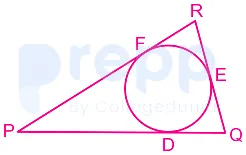
- A
9 cm
- B
8 cm
- C
7.5 cm
- D
8.5 cm
Show answer
D. 8.5 cmGiven:
In Δ PQR,
PQ = 15 cm, QR = 11 cm and RP = 13 cm.
A circle is inscribed in Δ PQR, such that it touches the sides PQ, QR and RP at points D, E, F, respectively.
Concept Used:
Tangents drawn from a point to the circle are equal in length.
Calculation:
A circle is inscribed in Δ PQR, such that it touches the sides PQ, QR and RP at points D, E, F, respectively.
⇒ PD = PF = x
⇒ QD = QE = y
⇒ RE = RF = z
All are tangents.
⇒ PD + PF + QD + QE + RE + RF = PQ + QR + RP
⇒ x + x + y + y + z + z = 39
⇒ 2x + 2(y + z) = 39
⇒ 2x + 22 = 39
⇒ 2x = 17
⇒ x = 8.5
⇒ PD = 8.5 cm
∴ Option 4 is the correct answer.
Paper & answer key PDF ↗ Question 52archived
If cot x – tan x = 3/2, then what will be the value of cot x + tan x?
- A
3
- B
2
- C
5/2
- D
7/2
Show answer
C. 5/2Finding cot x + tan x from cot x - tan x
This problem requires us to find the value of the sum of cot x and tan x, given the value of their difference. We are given the equation involving trigonometric functions cot x and tan x.
We are given:
\(\cot x - \tan x = \frac{3}{2}\)
We need to find the value of \(\cot x + \tan x\).
Using Trigonometric and Algebraic Identities
We know the fundamental reciprocal trigonometric identity:
\(\cot x = \frac{1}{\tan x}\)
This identity tells us that the product of cot x and tan x is always 1 (as long as both are defined):
\(\cot x \cdot \tan x = 1\)
Now, let's consider an algebraic relationship that connects the sum and difference of two terms. For any two numbers 'a' and 'b', the square of their sum is related to the square of their difference by the identity:
\((a+b)^2 = (a-b)^2 + 4ab\)
This identity is derived from the expansion of the squares:
\((a+b)^2 = a^2 + 2ab + b^2\)
\((a-b)^2 = a^2 - 2ab + b^2\)
Adding \(4ab\) to \((a-b)^2\) gives \(a^2 - 2ab + b^2 + 4ab = a^2 + 2ab + b^2\), which equals \((a+b)^2\).
Step-by-Step Calculation to Find cot x + tan x
Let's apply the algebraic identity by setting \(a = \cot x\) and \(b = \tan x\). The identity becomes:
\((\cot x + \tan x)^2 = (\cot x - \tan x)^2 + 4(\cot x)(\tan x)\)
We are given the value of \(\cot x - \tan x\) as \(\frac{3}{2}\), and we know that \(\cot x \cdot \tan x = 1\).
Substitute these known values into the equation:
\((\cot x + \tan x)^2 = \left(\frac{3}{2}\right)^2 + 4(1)\)
Now, we simplify the right side of the equation:
\((\cot x + \tan x)^2 = \frac{3^2}{2^2} + 4\)
\((\cot x + \tan x)^2 = \frac{9}{4} + 4\)
To add the fraction and the whole number, find a common denominator, which is 4:
\((\cot x + \tan x)^2 = \frac{9}{4} + \frac{4 \times 4}{4}\)
\((\cot x + \tan x)^2 = \frac{9}{4} + \frac{16}{4}\)
\((\cot x + \tan x)^2 = \frac{9 + 16}{4}\)
\((\cot x + \tan x)^2 = \frac{25}{4}\)
To find the value of \(\cot x + \tan x\), take the square root of both sides of the equation:
\(\cot x + \tan x = \pm\sqrt{\frac{25}{4}}\)
\(\cot x + \tan x = \pm\frac{\sqrt{25}}{\sqrt{4}}\)
\(\cot x + \tan x = \pm\frac{5}{2}\)
The possible values for \(\cot x + \tan x\) are \(\frac{5}{2}\) and \(-\frac{5}{2}\). Looking at the provided options (3, 2, 5/2, 7/2), they are all positive. Therefore, we choose the positive value.
Conclusion
The value of \(\cot x + \tan x\) is \(\frac{5}{2}\).
Revision Table: Key Trigonometric Relationships
Familiarity with basic trigonometric ratios and their relationships is vital for solving such problems.
FunctionReciprocalRatio in terms of sin and cos
\(\sin \theta\)\(\csc \theta = \frac{1}{\sin \theta}\)\(\sin \theta\)
\(\cos \theta\)\(\sec \theta = \frac{1}{\cos \theta}\)\(\cos \theta\)
\(\tan \theta\)\(\cot \theta = \frac{1}{\tan \theta}\)\(\tan \theta = \frac{\sin \theta}{\cos \theta}\)
\(\cot \theta\)\(\tan \theta = \frac{1}{\cot \theta}\)\(\cot \theta = \frac{\cos \theta}{\sin \theta}\)
Additional Information: Algebraic Identities in Math
Algebraic identities are equations that are true for all values of the variables involved. They are powerful tools for simplifying expressions and solving equations. The identity \((a+b)^2 = (a-b)^2 + 4ab\) is particularly useful when you know the difference and product of two quantities and need to find their sum (or vice versa).
Other common algebraic identities include:
\((a+b+c)^2 = a^2+b^2+c^2+2ab+2bc+2ca\)
\((a+b)^3 = a^3 + 3a^2b + 3ab^2 + b^3\)
\(a^3 + b^3 = (a+b)(a^2 - ab + b^2)\)
Recognizing which identity to apply is a key skill in algebra and trigonometry problems.
Paper & answer key PDF ↗ Question 53archived
The table given below shows the production of beauty products by five different companies.
Companies
Production
P
80
Q
120
R
84
S
50
T
70
The production of beauty product by T is what percent of the production of beauty product by S?
- A
40 percent
- B
140 percent
- C
240 percent
- D
120 percent
Show answer
B. 140 percentCalculating Percentage of Production: Company T vs. Company S
The question asks us to determine what percentage the production of beauty products by Company T is of the production by Company S, based on the data provided in the table.
Understanding the Data
The table shows the production numbers for five different companies (P, Q, R, S, T).
Company
Production
P
80
Q
120
R
84
S
50
T
70
From the table, we need the production values for Company T and Company S:
Production by Company T = 70
Production by Company S = 50
Setting up the Calculation
To find what percentage the production of T is of the production of S, we use the formula:
Percentage $= \left( \frac{\text{Value of T}}{\text{Value of S}} \right) \times 100\% $
In this case, the 'Value of T' is the production of T, and the 'Value of S' is the production of S.
Step-by-Step Calculation
Let's plug in the values into the formula:
Percentage $= \left( \frac{70}{50} \right) \times 100\% $
Simplify the fraction $\frac{70}{50}$:
$\frac{70}{50} = \frac{7}{5} = 1.4$
Now, multiply by 100:
Percentage $= 1.4 \times 100\% $
Percentage $= 140\%$
Final Answer on Production Percentage
The production of beauty products by Company T is 140 percent of the production by Company S.
Revision Table: Key Production Data
Company
Production Value
Company T
70
Company S
50
Additional Information: Understanding Percentages
A percentage is a number or ratio expressed as a fraction of 100. It is often denoted using the percent sign, "%". When we say one value is a certain percentage of another, we are comparing the first value to the second value and expressing this comparison relative to 100. For example, if value A is 50% of value B, it means A is half of B. If value A is 200% of value B, it means A is double B. In our case, T's production (70) is more than S's production (50), so the percentage is greater than 100%.
Paper & answer key PDF ↗ Question 54archived
Observe the given graph and answer the following question.
How many students obtained more than 135 marked?
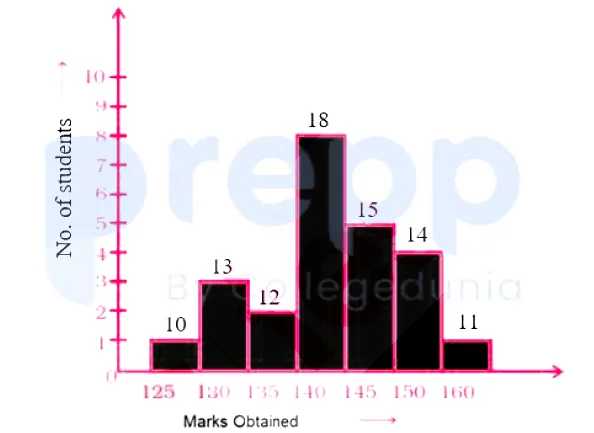
- A
56
- B
55
- C
57
- D
58
Show answer
D. 58Calculation:
Marks ObtainedNo. of Students
12510
13013
13512
14018
14515
15014
16011
Number of students obtained more than 135 marks = 18 + 15 + 14 + 11
⇒ 58
∴ Option 4 is the correct answer.
Paper & answer key PDF ↗ Question 55archived
A sum of Rs. 6,000 is to be paid back in two equal annual installments; each installment is to be paid at the end of every year. How much is each installment if the interest is compounded annually at 2% p.a.? (Rounded off up to two decimal places)
- A
Rs. 2,092.29
- B
Rs. 3,090.30
- C
Rs. 2,291.29
- D
Rs. 3,589.30
Show answer
B. Rs. 3,090.30Calculating Equal Annual Loan Installments with Compound Interest
This problem involves calculating the value of equal annual installments required to repay a loan with compound interest. When a loan is repaid in equal installments over time, these installments cover both the principal amount and the accumulated interest.
Understanding the Problem Parameters
We are given the following information:
Principal Loan Amount (\(P\)) = Rs. 6,000
Number of Equal Annual Installments (\(n\)) = 2
Annual Interest Rate (\(r\)) = 2% per annum, compounded annually
Each installment is paid at the end of every year.
Formula for Equal Annual Installments
The formula used to calculate the equal annual installment (\(I\)) for a loan amount (\(P\)) repaid over \(n\) years at an annual interest rate (\(r\)) is based on the concept of the present value of an ordinary annuity. The formula is:
$$I = P \frac{r(1+r)^n}{(1+r)^n - 1}$$
Where:
\(I\) is the equal annual installment
\(P\) is the principal loan amount
\(r\) is the annual interest rate (as a decimal)
\(n\) is the total number of installments
Step-by-Step Calculation
First, convert the interest rate from a percentage to a decimal:
$$r = \frac{2}{100} = 0.02$$
Now, substitute the given values into the formula:
$$I = 6000 \times \frac{0.02(1+0.02)^2}{(1+0.02)^2 - 1}$$
Calculate the term \((1+r)^n\):
$$(1+0.02)^2 = (1.02)^2 = 1.0404$$
Substitute this back into the formula:
$$I = 6000 \times \frac{0.02 \times 1.0404}{1.0404 - 1}$$
Calculate the numerator and the denominator separately:
$$\text{Numerator} = 0.02 \times 1.0404 = 0.020808$$
$$\text{Denominator} = 1.0404 - 1 = 0.0404$$
Now, calculate the fraction:
$$\frac{0.020808}{0.0404} \approx 0.51504950495$$
Finally, calculate the installment amount \(I\):
$$I = 6000 \times 0.51504950495$$
$$I \approx 3090.2970297$$
The question asks for the amount rounded off up to two decimal places. Rounding Rs. 3090.2970297 to two decimal places gives Rs. 3090.30.
Summary of Calculation
Parameter
Value
Principal Loan (P)
Rs. 6000
Interest Rate (r)
2% or 0.02
Number of Installments (n)
2
Formula used
\(I = P \frac{r(1+r)^n}{(1+r)^n - 1}\)
Calculated Installment (I)
Rs. 3090.30 (Rounded)
Therefore, each equal annual installment is Rs. 3,090.30.
Revision Table: Key Concepts in Loan Repayment
Concept
Description
Principal
The initial amount of the loan.
Interest Rate
The cost of borrowing money, usually expressed as an annual percentage.
Compound Interest
Interest calculated on the initial principal and also on the accumulated interest from previous periods.
Installment
A part payment of a debt, paid at regular intervals. Equal installments are common for loans like mortgages or car loans.
Ordinary Annuity
A series of equal payments made at the end of consecutive periods. Loan installments are typically treated as ordinary annuities.
Additional Information: Present Value of Annuity
The formula used above for calculating the installment \(I\) can be derived from the present value of an ordinary annuity formula. The present value (\(P\)) of an annuity consisting of \(n\) payments of amount \(I\) at an interest rate \(r\) is given by:
$$P = I \left[ \frac{1 - (1+r)^{-n}}{r} \right]$$
This formula essentially states that the initial loan amount (\(P\)) is equal to the sum of the present values of all future equal installments (\(I\)). Each future installment's present value is calculated by discounting it back to the present at the given interest rate.
To find the installment amount (\(I\)), you can rearrange this formula:
$$I = P \left[ \frac{r}{1 - (1+r)^{-n}} \right]$$
Multiplying the numerator and denominator by \((1+r)^n\) gives the formula used in the calculation:
$$I = P \left[ \frac{r(1+r)^n}{(1+r)^n(1 - (1+r)^{-n})} \right] = P \left[ \frac{r(1+r)^n}{(1+r)^n - (1+r)^n (1+r)^{-n}} \right] = P \left[ \frac{r(1+r)^n}{(1+r)^n - 1} \right]$$
Both formulas are equivalent and can be used to solve this type of loan installment problem.
Paper & answer key PDF ↗ Question 56archived
A pen was sold for Rs. 166.44 with a profit of 14%. If it were sold for Rs. 154.76, then what would have been the percentage of profit or loss?
- A
5% loss
- B
6% profit
- C
5% profit
- D
6% loss
Show answer
B. 6% profitSolving a Profit and Loss Percentage Problem
This question involves calculating the original cost price of an item based on its selling price and profit percentage, and then determining the profit or loss percentage if it is sold at a different price.
Step 1: Find the Cost Price (CP) of the Pen
We are given the first selling price (SP1) and the profit percentage when the pen was sold for that price.
Selling Price (SP1) = Rs. 166.44
Profit Percentage = 14%
The formula to find the selling price when there is a profit is:
\( \text{SP} = \text{CP} \times \left(1 + \frac{\text{Profit } \%}{100}\right) \)
We can rearrange this formula to find the Cost Price (CP):
\( \text{CP} = \frac{\text{SP}}{1 + \frac{\text{Profit } \%}{100}} \)
Substituting the given values:
\( \text{CP} = \frac{166.44}{1 + \frac{14}{100}} \)
\( \text{CP} = \frac{166.44}{1 + 0.14} \)
\( \text{CP} = \frac{166.44}{1.14} \)
Calculating the value:
\( \text{CP} = 146 \)
So, the Cost Price of the pen is Rs. 146.
Step 2: Calculate Profit or Loss with the Second Selling Price
Now, we are given a new selling price (SP2) and need to find the profit or loss and its percentage based on the calculated Cost Price.
New Selling Price (SP2) = Rs. 154.76
Cost Price (CP) = Rs. 146
To determine if there is a profit or loss, we compare the new selling price with the cost price.
Since SP2 (Rs. 154.76) is greater than CP (Rs. 146), there is a profit.
The amount of profit is calculated as:
\( \text{Profit Amount} = \text{SP2} - \text{CP} \)
\( \text{Profit Amount} = 154.76 - 146 \)
\( \text{Profit Amount} = 8.76 \)
The profit amount is Rs. 8.76.
Step 3: Determine the Percentage of Profit or Loss
Since we found a profit, we now calculate the profit percentage. The formula for profit percentage is:
\( \text{Profit } \% = \left(\frac{\text{Profit Amount}}{\text{CP}}\right) \times 100 \)
Substituting the calculated values:
\( \text{Profit } \% = \left(\frac{8.76}{146}\right) \times 100 \)
First, calculate the fraction:
\( \frac{8.76}{146} = 0.06 \)
Now, multiply by 100:
\( \text{Profit } \% = 0.06 \times 100 \)
\( \text{Profit } \% = 6 \)
So, if the pen were sold for Rs. 154.76, the profit percentage would be 6%.
Final Result: 6% Profit
Based on the calculations, selling the pen for Rs. 154.76 results in a 6% profit.
Revision Table: Key Concepts in Profit and Loss
Term
Definition
Formula
Cost Price (CP)
The price at which an article is purchased.
-
Selling Price (SP)
The price at which an article is sold.
-
Profit
When SP > CP.
Profit = SP - CP
Loss
When SP < CP.
Loss = CP - SP
Profit %
Profit calculated on CP.
\( \left(\frac{\text{Profit}}{\text{CP}}\right) \times 100 \)
Loss %
Loss calculated on CP.
\( \left(\frac{\text{Loss}}{\text{CP}}\right) \times 100 \)
Additional Information: Relation between CP, SP, and Profit/Loss %
Understanding the relationship between Cost Price, Selling Price, Profit, and Loss is fundamental in solving these types of percentage problems.
If there is a Profit of P%, the Selling Price is \( \text{SP} = \text{CP} \times \left(1 + \frac{P}{100}\right) \).
If there is a Loss of L%, the Selling Price is \( \text{SP} = \text{CP} \times \left(1 - \frac{L}{100}\right) \).
These formulas allow you to find any one of the three variables (CP, SP, or Percentage) if the other two are known.
Paper & answer key PDF ↗ Question 57archived
If \(\rm x = \frac{{\sqrt 5 - 2}}{{\sqrt 5 + 2}}\) , then the value of x 2 + x -2 is:
- A
350
- B
345
- C
284
- D
322
Show answer
D. 322Calculating the Value of x² + x⁻² for a Given Radical Expression
The problem asks us to determine the value of the expression \(x^2 + x^{-2}\) given that \(\rm x = \frac{{\sqrt 5 - 2}}{{\sqrt 5 + 2}}\). The term \(x^{-2}\) is equivalent to \(\frac{1}{x^2}\).
To solve this, we first need to simplify the expression for \(x\). Then we can find \(1/x\) and use an algebraic identity to efficiently calculate \(x^2 + 1/x^2\).
Step 1: Simplify the expression for \(x\) by Rationalizing the Denominator
The given expression for \(x\) is:
\(x = \frac{{\sqrt 5 - 2}}{{\sqrt 5 + 2}}\)
To remove the radical from the denominator, we multiply both the numerator and the denominator by the conjugate of the denominator, which is \({\sqrt 5 - 2}\).
\(x = \frac{{\sqrt 5 - 2}}{{\sqrt 5 + 2}} \times \frac{{\sqrt 5 - 2}}{{\sqrt 5 - 2}}\)
Using the difference of squares formula \((a+b)(a-b) = a^2 - b^2\) for the denominator and the square of a binomial formula \((a-b)^2 = a^2 - 2ab + b^2\) for the numerator:
Numerator: \((\sqrt 5 - 2)^2 = (\sqrt 5)^2 - 2(\sqrt 5)(2) + (2)^2 = 5 - 4\sqrt 5 + 4 = 9 - 4\sqrt 5\)
Denominator: \((\sqrt 5 + 2)(\sqrt 5 - 2) = (\sqrt 5)^2 - (2)^2 = 5 - 4 = 1\)
So, the simplified form of \(x\) is:
\(x = \frac{{9 - 4\sqrt 5}}{1} = 9 - 4\sqrt 5\)
Step 2: Find the Value of \(1/x\)
Now that we have \(x = 9 - 4\sqrt 5\), we can find its reciprocal, \(1/x\).
\(\frac{1}{x} = \frac{1}{{9 - 4\sqrt 5}}\)
Again, we rationalize the denominator by multiplying by the conjugate of \(9 - 4\sqrt 5\), which is \(9 + 4\sqrt 5\).
\(\frac{1}{x} = \frac{1}{{9 - 4\sqrt 5}} \times \frac{9 + 4\sqrt 5}{9 + 4\sqrt 5}\)
Numerator: \(1 \times (9 + 4\sqrt 5) = 9 + 4\sqrt 5\)
Denominator: \((9 - 4\sqrt 5)(9 + 4\sqrt 5) = (9)^2 - (4\sqrt 5)^2 = 81 - (16 \times 5) = 81 - 80 = 1\)
So, the value of \(1/x\) is:
\(\frac{1}{x} = \frac{9 + 4\sqrt 5}{1} = 9 + 4\sqrt 5\)
Notice that \(x\) and \(1/x\) are conjugates when the denominator rationalizes to 1 in this manner.
Step 3: Calculate \(x + 1/x\)
Let's add the simplified expressions for \(x\) and \(1/x\):
\(x + \frac{1}{x} = (9 - 4\sqrt 5) + (9 + 4\sqrt 5)\)
\(x + \frac{1}{x} = 9 - 4\sqrt 5 + 9 + 4\sqrt 5\)
The terms \(-4\sqrt 5\) and \(+4\sqrt 5\) cancel each other out.
\(x + \frac{1}{x} = 9 + 9 = 18\)
Step 4: Use an Algebraic Identity to Find \(x^2 + x^{-2}\)
We need to find the value of \(x^2 + x^{-2}\), which is \(x^2 + \frac{1}{x^2}\). We can use the identity for the square of a sum:
\((x + \frac{1}{x})^2 = x^2 + 2 \cdot x \cdot \frac{1}{x} + (\frac{1}{x})^2\)
\((x + \frac{1}{x})^2 = x^2 + 2 + \frac{1}{x^2}\)
Rearranging this identity to solve for \(x^2 + \frac{1}{x^2}\):
\(x^2 + \frac{1}{x^2} = (x + \frac{1}{x})^2 - 2\)
We found in Step 3 that \(x + \frac{1}{x} = 18\). Substitute this value into the rearranged identity:
\(x^2 + x^{-2} = (18)^2 - 2\)
\(x^2 + x^{-2} = 324 - 2\)
\(x^2 + x^{-2} = 322\)
Therefore, the value of \(x^2 + x^{-2}\) is 322.
Summary of the Solution for x² + x⁻²
Given \(\rm x = \frac{{\sqrt 5 - 2}}{{\sqrt 5 + 2}}\), we simplified \(x\) to \(9 - 4\sqrt 5\). We found \(1/x\) to be \(9 + 4\sqrt 5\). Adding these, we got \(x + 1/x = 18\). Using the identity \(x^2 + 1/x^2 = (x + 1/x)^2 - 2\), we calculated the value as \(18^2 - 2 = 324 - 2 = 322\).
Revision Table: Solving Expressions with Radicals
Step
Action
Why it Helps
1
Rationalize the denominator of the given expression for \(x\).
Simplifies \(x\) into a manageable form, often \(a \pm b\sqrt c\).
2
Find the reciprocal \(1/x\), simplifying it as well.
Pairs with \(x\) nicely, especially for sum/difference.
3
Calculate \(x + 1/x\) or \(x - 1/x\).
Often results in a simple integer or radical expression due to cancellation.
4
Use identities like \((x + 1/x)^2\) or \((x - 1/x)^2\) to find squares or higher powers.
Avoids squaring complex radical expressions directly, simplifying calculations.
Additional Information: Properties of Radical Expressions
When dealing with expressions like \(\frac{\sqrt a - \sqrt b}{\sqrt a + \sqrt b}\) or \(\frac{a - \sqrt b}{a + \sqrt b}\), rationalizing the denominator is a standard technique. The key is multiplying by the conjugate. For example, the conjugate of \((\sqrt 5 + 2)\) is \((\sqrt 5 - 2)\). Their product \((\sqrt 5 + 2)(\sqrt 5 - 2) = (\sqrt 5)^2 - 2^2 = 5 - 4 = 1\), which is a rational number.
Another important concept used here is the relationship between \(x\) and \(1/x\) when \(x\) is of the form \(a + b\sqrt c\) and \(a^2 - (b\sqrt c)^2 = 1\). In such cases, \(1/x\) is simply \(a - b\sqrt c\). In our problem, \(x = 9 - 4\sqrt 5\), and \(9^2 - (4\sqrt 5)^2 = 81 - 80 = 1\), so \(1/x\) is indeed \(9 + 4\sqrt 5\).
Understanding and applying algebraic identities like \((a+b)^2\) and the derived identity \(x^2 + 1/x^2 = (x + 1/x)^2 - 2\) are crucial for solving such problems efficiently in algebra.
Paper & answer key PDF ↗ Question 58archived
The table given below shows the number of pencils sold by 7 shops.
Shops
Pencils
S1
54
S2
68
S3
70
S4
120
S5
84
S6
130
S7
36
What is the ratio of number of pencils sold by S3 to be number of pencils sold by S6?
- A
8 ∶ 15
- B
13 ∶ 7
- C
15 ∶ 7
- D
7 ∶ 13
Show answer
D. 7 ∶ 13Analyzing Pencil Sales Data Across Shops
The question provides a table showing the number of pencils sold by 7 different shops, labeled S1 through S7. We are asked to find the ratio of the number of pencils sold by shop S3 to the number of pencils sold by shop S6.
Let's first look at the data presented in the table:
Shops
Pencils Sold
S1
54
S2
68
S3
70
S4
120
S5
84
S6
130
S7
36
Calculating the Ratio of Pencil Sales (S3 to S6)
To find the ratio of the number of pencils sold by S3 to the number of pencils sold by S6, we need to identify the respective values from the table and express them as a ratio.
Number of pencils sold by S3 = 70
Number of pencils sold by S6 = 130
The ratio is expressed as the number of pencils sold by S3 divided by the number of pencils sold by S6, or S3 : S6.
The initial ratio is:
$\text{Ratio} = \frac{\text{Number of pencils sold by S3}}{\text{Number of pencils sold by S6}} = \frac{70}{130}$
To simplify the ratio, we find the greatest common divisor (GCD) of 70 and 130. Both numbers are divisible by 10.
Divide 70 by 10: $70 \div 10 = 7$
Divide 130 by 10: $130 \div 10 = 13$
So, the simplified ratio of pencils sold by S3 to S6 is 7 : 13.
This means for every 7 pencils sold by shop S3, shop S6 sold 13 pencils.
Final Answer Derivation
The ratio of the number of pencils sold by S3 to the number of pencils sold by S6 is 7 : 13.
Revision Table: Key Concepts
Concept
Description
Ratio
A comparison of two quantities by division. It shows how much of one quantity there is compared to another quantity. Represented as $a:b$ or $a/b$.
Simplifying Ratios
Dividing both parts of a ratio by their greatest common divisor (GCD) to express the ratio in its simplest form.
Table Data Analysis
Extracting specific pieces of information from a table to use in calculations or comparisons.
Additional Information: Understanding Ratios
Ratios are fundamental in mathematics and are used in many real-world situations, such as scaling recipes, mixing concrete, or comparing performance metrics like pencil sales per shop.
A ratio $a:b$ can also be written as a fraction $\frac{a}{b}$.
Order matters in ratios. The ratio of S3 to S6 is $7:13$, but the ratio of S6 to S3 would be $13:7$.
Ratios do not have units themselves if the quantities being compared have the same units (like the number of pencils).
Ratios can involve more than two quantities, e.g., $a:b:c$.
Understanding how to read data from tables and perform calculations like finding ratios is a key skill in data interpretation and quantitative reasoning.
Paper & answer key PDF ↗ Question 59archived
If x > 0, and x 4 + \(\rm \frac{1}{{{x^4}}}\) = 2207, what is the value of x 7 + \(\rm\frac{1}{{{x^7}}}\) ?
- A
710649
- B
710647
- C
710654
- D
710661
Show answer
B. 710647Understanding the Problem: Finding \( x^7 + \frac{1}{{{x^7}}} \)
We are given that \( x > 0 \) and \( x^4 + \frac{1}{{{x^4}}} = 2207 \). Our goal is to calculate the value of the expression \( x^7 + \frac{1}{{{x^7}}} \).
This type of problem often requires using algebraic identities to find expressions involving lower powers of \( x + \frac{1}{x} \) first, and then combining them to get the desired higher power expression.
Step-by-Step Solution to Calculate \( x^7 + \frac{1}{{{x^7}}} \)
Finding \( x^2 + \frac{1}{x^2} \)
We start with the given equation \( x^4 + \frac{1}{{{x^4}}} = 2207 \). We can find \( x^2 + \frac{1}{x^2} \) using the identity \( (a+b)^2 = a^2 + b^2 + 2ab \).
Let \( a = x^2 \) and \( b = \frac{1}{x^2} \). Then:
\[ \left( x^2 + \frac{1}{x^2} \right)^2 = \left( x^2 \right)^2 + \left( \frac{1}{x^2} \right)^2 + 2 \left( x^2 \right) \left( \frac{1}{x^2} \right) \]
\[ \left( x^2 + \frac{1}{x^2} \right)^2 = x^4 + \frac{1}{x^4} + 2 \]
Substitute the given value \( x^4 + \frac{1}{x^4} = 2207 \):
\[ \left( x^2 + \frac{1}{x^2} \right)^2 = 2207 + 2 \]
\[ \left( x^2 + \frac{1}{x^2} \right)^2 = 2209 \]
Taking the square root of both sides:
\[ x^2 + \frac{1}{x^2} = \sqrt{2209} \]
Since \( x > 0 \), \( x^2 \) is positive, so \( x^2 + \frac{1}{x^2} \) must be positive. Thus, we take the positive square root.
\[ x^2 + \frac{1}{x^2} = 47 \]
Finding \( x + \frac{1}{x} \)
Now we use the value of \( x^2 + \frac{1}{x^2} \) to find \( x + \frac{1}{x} \). We use the same identity \( (a+b)^2 = a^2 + b^2 + 2ab \).
Let \( a = x \) and \( b = \frac{1}{x} \). Then:
\[ \left( x + \frac{1}{x} \right)^2 = x^2 + \left( \frac{1}{x} \right)^2 + 2 \left( x \right) \left( \frac{1}{x} \right) \]
\[ \left( x + \frac{1}{x} \right)^2 = x^2 + \frac{1}{x^2} + 2 \]
Substitute the value \( x^2 + \frac{1}{x^2} = 47 \):
\[ \left( x + \frac{1}{x} \right)^2 = 47 + 2 \]
\[ \left( x + \frac{1}{x} \right)^2 = 49 \]
Taking the square root of both sides:
\[ x + \frac{1}{x} = \sqrt{49} \]
Since \( x > 0 \), \( x + \frac{1}{x} \) must be positive. Thus, we take the positive square root.
\[ x + \frac{1}{x} = 7 \]
Finding \( x^3 + \frac{1}{x^3} \)
To find \( x^7 + \frac{1}{x^7} \), we can potentially use the product of \( (x^4 + \frac{1}{x^4}) \) and \( (x^3 + \frac{1}{x^3}) \). So, we need to calculate \( x^3 + \frac{1}{x^3} \) from \( x + \frac{1}{x} \).
We use the identity \( (a+b)^3 = a^3 + b^3 + 3ab(a+b) \).
Let \( a = x \) and \( b = \frac{1}{x} \). Then:
\[ \left( x + \frac{1}{x} \right)^3 = x^3 + \left( \frac{1}{x} \right)^3 + 3 \left( x \right) \left( \frac{1}{x} \right) \left( x + \frac{1}{x} \right) \]
\[ \left( x + \frac{1}{x} \right)^3 = x^3 + \frac{1}{x^3} + 3 \left( x + \frac{1}{x} \right) \]
Substitute the value \( x + \frac{1}{x} = 7 \):
\[ (7)^3 = x^3 + \frac{1}{x^3} + 3(7) \]
\[ 343 = x^3 + \frac{1}{x^3} + 21 \]
Now, solve for \( x^3 + \frac{1}{x^3} \):
\[ x^3 + \frac{1}{x^3} = 343 - 21 \]
\[ x^3 + \frac{1}{x^3} = 322 \]
Calculating \( x^7 + \frac{1}{x^7} \)
We have \( x^4 + \frac{1}{x^4} = 2207 \) and \( x^3 + \frac{1}{x^3} = 322 \). We can use the product of these two expressions.
Consider the product \( \left( x^4 + \frac{1}{x^4} \right) \left( x^3 + \frac{1}{x^3} \right) \):
\[ \left( x^4 + \frac{1}{x^4} \right) \left( x^3 + \frac{1}{x^3} \right) = x^4 \left( x^3 + \frac{1}{x^3} \right) + \frac{1}{x^4} \left( x^3 + \frac{1}{x^3} \right) \]
\[ = x^4 \cdot x^3 + x^4 \cdot \frac{1}{x^3} + \frac{1}{x^4} \cdot x^3 + \frac{1}{x^4} \cdot \frac{1}{x^3} \]
\[ = x^{4+3} + x^{4-3} + x^{3-4} + \frac{1}{x^{4+3}} \]
\[ = x^7 + x^1 + x^{-1} + \frac{1}{x^7} \]
\[ = x^7 + \frac{1}{x^7} + x + \frac{1}{x} \]
So, the identity is \( \left( x^4 + \frac{1}{x^4} \right) \left( x^3 + \frac{1}{x^3} \right) = x^7 + \frac{1}{x^7} + x + \frac{1}{x} \).
Rearranging to solve for \( x^7 + \frac{1}{x^7} \):
\[ x^7 + \frac{1}{x^7} = \left( x^4 + \frac{1}{x^4} \right) \left( x^3 + \frac{1}{x^3} \right) - \left( x + \frac{1}{x} \right) \]
Substitute the values we found:
\( x^4 + \frac{1}{x^4} = 2207 \)
\( x^3 + \frac{1}{x^3} = 322 \)
\( x + \frac{1}{x} = 7 \)
\[ x^7 + \frac{1}{x^7} = (2207)(322) - 7 \]
Calculate the product:
\[ 2207 \times 322 \]
2
2
0
7
×
3
2
2
4
4
1
4
4
4
1
4
6
6
2
1
7
1
0
6
5
4
So, \( (2207)(322) = 710654 \).
Now, complete the calculation for \( x^7 + \frac{1}{x^7} \):
\[ x^7 + \frac{1}{x^7} = 710654 - 7 \]
\[ x^7 + \frac{1}{x^7} = 710647 \]
The value of \( x^7 + \frac{1}{{{x^7}}} \) is 710647.
Revision Table: Key Identities Used
Identity
Formula
Application
Square of a sum
\( (a+b)^2 = a^2 + b^2 + 2ab \)
Used to find \( x^2 + \frac{1}{x^2} \) from \( x^4 + \frac{1}{x^4} \), and \( x + \frac{1}{x} \) from \( x^2 + \frac{1}{x^2} \).
Cube of a sum
\( (a+b)^3 = a^3 + b^3 + 3ab(a+b) \)
Used to find \( x^3 + \frac{1}{x^3} \) from \( x + \frac{1}{x} \).
Product of sums
\( \left( x^m + \frac{1}{x^m} \right) \left( x^n + \frac{1}{x^n} \right) = x^{m+n} + \frac{1}{x^{m+n}} + x^{m-n} + \frac{1}{x^{m-n}} \)
Used with \( m=4, n=3 \) to find \( x^7 + \frac{1}{x^7} \).
Additional Information on Algebraic Expressions
Problems involving expressions of the form \( x^n + \frac{1}{x^n} \) for integer values of \( n \) are common in algebra. The key to solving them is often to first find the value of \( x + \frac{1}{x} \) or \( x - \frac{1}{x} \), and then use standard identities to find higher powers. The condition \( x > 0 \) is important because it ensures that \( x + \frac{1}{x} \) is positive, allowing us to take the positive square root when solving equations like \( \left( x + \frac{1}{x} \right)^2 = 49 \).
For example, if we needed to find \( x^5 + \frac{1}{x^5} \), we could use the product \( \left( x^2 + \frac{1}{x^2} \right) \left( x^3 + \frac{1}{x^3} \right) \). This product expands to \( x^5 + \frac{1}{x^5} + x + \frac{1}{x} \). So, \( x^5 + \frac{1}{x^5} = \left( x^2 + \frac{1}{x^2} \right) \left( x^3 + \frac{1}{x^3} \right) - \left( x + \frac{1}{x} \right) \).
Understanding and memorizing common algebraic identities greatly simplifies solving these types of problems.
Paper & answer key PDF ↗ Question 60archived
Which of the following two will provide more volume?
I) A cuboid of edges 6 cm, 7 cm and 8 cm
II) A cube of edge 7 cm
- A
Cube will have more volume
- B
Both will have equal volume
- C
Cuboid will have more volume
- D
Cannot be determined
Show answer
A. Cube will have more volumeUnderstanding Volume Calculation for Cuboids and Cubes
This question asks us to compare the volume of two three-dimensional shapes: a cuboid and a cube. To do this, we need to calculate the volume of each shape using the given dimensions and then compare the results.
Calculating the Volume of the Cuboid
A cuboid is a rectangular prism with six rectangular faces. Its volume is calculated by multiplying its length, width, and height. The dimensions of the given cuboid are 6 cm, 7 cm, and 8 cm.
The formula for the volume of a cuboid is:
\( \text{Volume of Cuboid} = \text{Length} \times \text{Width} \times \text{Height} \)
Let's plug in the given values:
\( \text{Volume of Cuboid} = 6 \, \text{cm} \times 7 \, \text{cm} \times 8 \, \text{cm} \)
\( \text{Volume of Cuboid} = 42 \, \text{cm}^2 \times 8 \, \text{cm} \)
\( \text{Volume of Cuboid} = 336 \, \text{cm}^3 \)
So, the volume of the cuboid is 336 cubic centimeters.
Calculating the Volume of the Cube
A cube is a special type of cuboid where all edges are equal in length. Its volume is calculated by cubing the length of one edge (multiplying the edge length by itself three times). The edge length of the given cube is 7 cm.
The formula for the volume of a cube is:
\( \text{Volume of Cube} = \text{Edge}^3 \)
Let's plug in the given edge length:
\( \text{Volume of Cube} = (7 \, \text{cm})^3 \)
\( \text{Volume of Cube} = 7 \, \text{cm} \times 7 \, \text{cm} \times 7 \, \text{cm} \)
\( \text{Volume of Cube} = 49 \, \text{cm}^2 \times 7 \, \text{cm} \)
\( \text{Volume of Cube} = 343 \, \text{cm}^3 \)
Thus, the volume of the cube is 343 cubic centimeters.
Comparing the Volumes
Now, we compare the calculated volumes:
Volume of Cuboid = 336 cm³
Volume of Cube = 343 cm³
Comparing 336 cm³ and 343 cm³, we can see that 343 cm³ is greater than 336 cm³.
Therefore, the cube will provide more volume than the cuboid.
Shape
Dimensions
Volume Calculation
Volume (\( \text{cm}^3 \))
Cuboid
6 cm, 7 cm, 8 cm
\( 6 \times 7 \times 8 \)
336
Cube
7 cm edge
\( 7^3 \)
343
Based on the comparison, the cube has a larger volume.
Revision Table: Key Volume Formulas
Shape
Formula for Volume
Variables
Cuboid
\( V = l \times w \times h \)
l = length, w = width, h = height
Cube
\( V = s^3 \)
s = edge length (side)
Cylinder
\( V = \pi r^2 h \)
r = radius of base, h = height
Sphere
\( V = \frac{4}{3} \pi r^3 \)
r = radius
Cone
\( V = \frac{1}{3} \pi r^2 h \)
r = radius of base, h = height
Additional Information: Understanding Volume and Capacity
Volume is the amount of space a three-dimensional object occupies. It is measured in cubic units, such as cubic centimeters (\( \text{cm}^3 \)) or cubic meters (\( \text{m}^3 \)).
Capacity is related to volume and refers to the amount that a container can hold, typically a liquid, gas, or solid. Capacity is often measured in units like liters (L) or milliliters (mL). There is a direct relationship between volume and capacity units; for example, 1000 \( \text{cm}^3 \) is equal to 1 liter.
In this problem, calculating the volume tells us how much space the cuboid and cube occupy, or, if they were hollow containers, how much they could hold (their capacity in terms of cubic units).
Understanding the formulas for calculating the volume of basic shapes like cuboids and cubes is fundamental in geometry and practical applications like packaging, construction, and fluid dynamics.
Paper & answer key PDF ↗ Question 61archived
What is the single percentage discount equivalent to two successive discounts of 15% and 5%?
- A
19.00%
- B
19.25%
- C
18.00%
- D
18.25%
Show answer
B. 19.25%Calculating the single percentage discount equivalent to multiple successive discounts involves understanding how each discount is applied to the remaining price after the previous discount. It's not simply adding the discounts together.
Understanding Successive Discounts
When two successive discounts are applied, the second discount is calculated on the price that resulted after the first discount was applied. This means the base for the second discount is smaller than the original price.
Let's consider the given successive discounts:
First discount: \(15\%\)
Second discount: \(5\%\)
We want to find a single discount percentage that results in the same final price as applying these two discounts consecutively.
Calculating the Single Equivalent Discount Step-by-Step
We can calculate the effect of these discounts by assuming an original price, for example, \(₹100\).
Apply the first discount: The first discount is \(15\%\). On an original price of \(₹100\), the discount amount is \(15\%\) of \(₹100\), which is \(₹15\). The price after the first discount is \(₹100 - ₹15 = ₹85\).
Apply the second discount: The second discount is \(5\%\), and it is applied to the new price, which is \(₹85\). The discount amount is \(5\%\) of \(₹85\).
\[
5\%\text{ of } ₹85 = \frac{5}{100} \times 85 = 0.05 \times 85 = ₹4.25
\]
Calculate the final price: The final price after the second discount is the price after the first discount minus the second discount amount.
\[
\text{Final Price} = ₹85 - ₹4.25 = ₹80.75
\]
Calculate the total discount amount: The total discount amount is the difference between the original price and the final price.
\[
\text{Total Discount Amount} = ₹100 - ₹80.75 = ₹19.25
\]
Calculate the single equivalent discount percentage: The single equivalent discount is the total discount amount expressed as a percentage of the original price.
\[
\text{Equivalent Discount} = \frac{\text{Total Discount Amount}}{\text{Original Price}} \times 100\%
\]
\[
\text{Equivalent Discount} = \frac{₹19.25}{₹100} \times 100\% = 19.25\%
\]
Using the Formula for Equivalent Discounts
Alternatively, you can use a formula to calculate the single equivalent discount (\(D\)) for two successive discounts (\(d_1\) and \(d_2\)). The formula is:
\[ D = \left(d_1 + d_2 - \frac{d_1 \times d_2}{100}\right)\% \]
Given \(d_1 = 15\%\) and \(d_2 = 5\%\):
\[ D = \left(15 + 5 - \frac{15 \times 5}{100}\right)\% \]
\[ D = \left(20 - \frac{75}{100}\right)\% \]
\[ D = (20 - 0.75)\% \]
\[ D = 19.25\% \]
Both methods confirm that the single equivalent discount is \(19.25\%\).
Summary Table of Successive Discount Calculation
Step
Calculation
Result
Explanation
1
Original Price
\(100\%\) (or \(₹100\))
Starting point
2
Price after 1st discount (\(15\%\))
\(100\% - 15\% = 85\%\) (or \(₹85\))
Price after the first reduction
3
Price after 2nd discount (\(5\%\) on remaining)
\(85\% \times (1 - 0.05) = 85\% \times 0.95 = 80.75\%\) (or \(₹80.75\))
Price after the second reduction applied to the new base
4
Total percentage paid
\(80.75\%\)
Final price as a percentage of original
5
Single Equivalent Discount
\(100\% - 80.75\% = 19.25\%\)
Total reduction from the original price
Revision Table: Key Concepts in Percentage Discounts
Concept
Description
Formula/Example
Single Discount
A single reduction from the original price.
Discount Amount = Price \(\times\) (\(D\% / 100\))
Successive Discounts
Multiple discounts applied one after another, each on the price remaining after the previous discount.
Price after \(d_1\%\) = Original Price \(\times\) \((1 - d_1/100)\)
Price after \(d_1\%\) and \(d_2\%\) = Original Price \(\times\) \((1 - d_1/100) \times (1 - d_2/100)\)
Equivalent Discount
A single discount percentage that gives the same final price as applying successive discounts.
For \(d_1\%\) and \(d_2\%\): \(D = \left(d_1 + d_2 - \frac{d_1 \times d_2}{100}\right)\%\)
Additional Information on Percentage Changes
The concept of successive percentage changes applies to increases as well as discounts. For example, if a price increases by \(10\%\) and then by another \(20\%\), the final price is not \(30\%\) higher than the original. The second increase is on the already increased price.
Successive increases of \(i_1\%\) and \(i_2\%\): Equivalent increase \(I = \left(i_1 + i_2 + \frac{i_1 \times i_2}{100}\right)\%\).
One increase (\(i\%\)) and one decrease (\(d\%\)): Equivalent change \(C = \left(i - d - \frac{i \times d}{100}\right)\%\). If \(C\) is positive, it's a net increase; if negative, it's a net decrease.
Understanding how percentage changes compound is crucial for solving problems involving markups, discounts, taxes, and growth rates.
Paper & answer key PDF ↗ Question 62archived
Simplify x + 3(y + x - 2) - (x + y).
- A
x + 2y - 6
- B
2x + y - 6
- C
2x + 3y - 6
- D
3x + 2y - 6
Show answer
D. 3x + 2y - 6Understanding Algebraic Simplification
The problem asks us to simplify the algebraic expression: \(x + 3(y + x - 2) - (x + y)\). Simplifying an expression means performing all possible operations, like distribution and combining like terms, to write it in its simplest form.
To simplify this expression, we need to follow the order of operations and apply the distributive property.
Step-by-Step Simplification Process
Let's break down the simplification process step by step:
Step 1: Apply the distributive property to the terms within the parentheses.
The expression is \(x + 3(y + x - 2) - (x + y)\).
First, distribute the \(3\) into the first set of parentheses \((y + x - 2)\):
\(3(y + x - 2) = 3 \times y + 3 \times x - 3 \times 2 = 3y + 3x - 6\)
Next, distribute the negative sign (which is like distributing \(-1\)) into the second set of parentheses \((x + y)\):
\(-(x + y) = -1 \times x + (-1) \times y = -x - y\)
After applying the distributive property, the expression becomes:
\(x + (3y + 3x - 6) + (-x - y)\)
Remove the parentheses:
\(x + 3y + 3x - 6 - x - y\)
Step 2: Identify and group like terms.
Like terms are terms that have the same variables raised to the same power. In this expression, the like terms are:
Terms with \(x\): \(x\), \(3x\), \(-x\)
Terms with \(y\): \(3y\), \(-y\)
Constant terms (terms without variables): \(-6\)
Group these terms together:
\((x + 3x - x) + (3y - y) - 6\)
Step 3: Combine the like terms.
Combine the coefficients of the \(x\) terms:
\(x + 3x - x = (1 + 3 - 1)x = 3x\)
Combine the coefficients of the \(y\) terms:
\(3y - y = (3 - 1)y = 2y\)
The constant term is \(-6\).
Putting it all together, the simplified expression is:
\(3x + 2y - 6\)
Verification of the Simplified Expression
Let's review the steps taken to ensure the simplification is correct:
Original expression: \(x + 3(y + x - 2) - (x + y)\)
Distribute 3: \(x + 3y + 3x - 6 - (x + y)\)
Distribute -1: \(x + 3y + 3x - 6 - x - y\)
Combine x terms: \(x + 3x - x = 3x\)
Combine y terms: \(3y - y = 2y\)
Resulting expression: \(3x + 2y - 6\)
The simplification process followed standard algebraic rules.
Revision Table: Key Concepts in Algebraic Simplification
Concept
Explanation
Example
Distributive Property
Multiply a term outside parentheses by each term inside. \(a(b+c) = ab + ac\)
\(3(x+2) = 3x + 6\)
Like Terms
Terms with the same variables raised to the same power.
\(2x\) and \(5x\) are like terms; \(2x\) and \(5x^2\) are not.
Combining Like Terms
Add or subtract the coefficients of like terms.
\(2x + 5x = 7x\); \(3y - y = 2y\)
Order of Operations
Parentheses first, then exponents, multiplication/division, addition/subtraction.
Simplify inside parentheses before distributing.
Additional Information: Expanding and Simplifying Polynomials
Simplifying expressions like the one in the question is a fundamental skill in algebra. It often involves expanding parts of the expression using the distributive property and then collecting like terms to write the polynomial in a more compact form.
Expanding: This involves removing parentheses, usually by applying the distributive property. For example, expanding \((x+1)(x+2)\) would involve multiplication. In this question, we expanded \(3(y+x-2)\) and \(-(x+y)\).
Combining: After expanding, you look for terms that share the exact same variable part (including exponents). You then add or subtract their numerical coefficients. This process reduces the number of terms in the expression.
Polynomials: The simplified expression \(3x + 2y - 6\) is a polynomial. A polynomial is an expression consisting of variables and coefficients, that involves only the operations of addition, subtraction, multiplication, and non-negative integer exponents of variables.
Mastering these steps is crucial for solving equations, graphing functions, and working with more complex algebraic concepts.
Paper & answer key PDF ↗ Question 63archived
A thief is noticed by a policeman from a distance of 97 m. The thief starts running and the policeman chases him. The thief and the policeman run at a speed of 21 m/sec and 23 m/sec respectively. What is the time taken by the policeman to catch the thief?
- A
40 sec
- B
45 sec
- C
62.5 sec
- D
48.5 sec
Show answer
D. 48.5 secUnderstanding the Policeman and Thief Chase Problem
This question is a classic example of a relative speed problem. We have a thief running away and a policeman chasing him. The key to solving this is to figure out how quickly the distance between them is decreasing.
Given Information:
Initial distance between the thief and the policeman = 97 m
Speed of the thief = 21 m/sec
Speed of the policeman = 23 m/sec
Concept of Relative Speed
When two objects are moving in the same direction, their relative speed is the difference between their individual speeds. This relative speed is the rate at which the distance between them changes. In this case, the policeman is catching up to the thief, so the relative speed is the speed at which the policeman closes the gap.
Since the policeman is faster than the thief and they are running in the same direction, the policeman is reducing the distance between them.
Calculating the Relative Speed
The relative speed is the difference between the speed of the policeman and the speed of the thief:
$$ \text{Relative Speed} = \text{Policeman's Speed} - \text{Thief's Speed} $$
$$ \text{Relative Speed} = 23 \text{ m/sec} - 21 \text{ m/sec} $$
$$ \text{Relative Speed} = 2 \text{ m/sec} $$
This means the distance between the policeman and the thief decreases by 2 meters every second.
Calculating the Time Taken to Catch the Thief
The policeman needs to cover the initial distance of 97 m at the relative speed. We can use the formula:
$$ \text{Time} = \frac{\text{Distance}}{\text{Speed}} $$
Here, the distance is the initial distance between them, and the speed is the relative speed:
$$ \text{Time taken} = \frac{\text{Initial Distance}}{\text{Relative Speed}} $$
$$ \text{Time taken} = \frac{97 \text{ m}}{2 \text{ m/sec}} $$
$$ \text{Time taken} = 48.5 \text{ seconds} $$
So, the policeman will take 48.5 seconds to cover the initial 97 m gap and catch the thief.
Summary of Calculation Steps:
Identify the initial distance between the two objects.
Identify the speeds of both objects.
Calculate the relative speed when moving in the same direction (subtract the slower speed from the faster speed).
Use the formula Time = Distance / Relative Speed to find the time taken to cover the initial distance.
Parameter
Value
Initial Distance
97 m
Thief's Speed
21 m/sec
Policeman's Speed
23 m/sec
Relative Speed
2 m/sec
Time Taken
48.5 seconds
Revision Table: Speed, Distance, and Time Concepts
Concept
Formula
Explanation
Speed
$$ \text{Speed} = \frac{\text{Distance}}{\text{Time}} $$
Rate at which an object covers distance.
Distance
$$ \text{Distance} = \text{Speed} \times \text{Time} $$
Length of the path traveled.
Time
$$ \text{Time} = \frac{\text{Distance}}{\text{Speed}} $$
Duration for which motion occurs.
Relative Speed (Same Direction)
$$ S_{rel} = S_1 - S_2 \text{ (if } S_1 > S_2) $$
Difference in speeds when moving in the same direction. Used for catch-up problems.
Relative Speed (Opposite Direction)
$$ S_{rel} = S_1 + S_2 $$
Sum of speeds when moving towards each other. Used for meeting problems.
Additional Information: Types of Relative Speed Problems
Relative speed is a crucial concept in physics and aptitude questions. Understanding it helps solve problems involving:
Objects moving in the same direction (like one chasing another).
Objects moving in opposite directions (like two trains approaching each other).
Objects crossing each other (like a train crossing a platform or another train).
Always identify the direction of motion to correctly calculate the relative speed (add for opposite directions, subtract for the same direction).
Paper & answer key PDF ↗ Question 64archived
If sec 2 A + tan 2 A = \(\frac{4}{{17}}\) , then sec 4 A - tan 4 A is equal to :
- A
\(\frac{{13}}{{17}}\)
- B
\(\frac{4}{{13}}\)
- C
\(\frac{4}{{17}}\)
- D
\(\frac{5}{{17}}\)
Show answer
C. \(\frac{4}{{17}}\)Understanding the Trigonometric Problem
The problem asks us to find the value of the expression \( \sec^4 A - \tan^4 A \) given that \( \sec^2 A + \tan^2 A = \frac{4}{17} \). This involves manipulating trigonometric expressions using fundamental identities.
Applying Trigonometric Identities
We need to simplify the expression \( \sec^4 A - \tan^4 A \). Notice that this expression is in the form of a difference of squares, \( a^2 - b^2 = (a-b)(a+b) \), where \( a = \sec^2 A \) and \( b = \tan^2 A \).
So, we can write:
\( \sec^4 A - \tan^4 A = (\sec^2 A)^2 - (\tan^2 A)^2 \)
\( \sec^4 A - \tan^4 A = (\sec^2 A - \tan^2 A)(\sec^2 A + \tan^2 A) \)
Now, we recall the fundamental trigonometric identity relating secant and tangent:
\( \sec^2 \theta - \tan^2 \theta = 1 \)
Applying this identity with \( \theta = A \), we have \( \sec^2 A - \tan^2 A = 1 \).
Substituting the Given Value
We are given in the problem that \( \sec^2 A + \tan^2 A = \frac{4}{17} \).
Substitute the identity \( \sec^2 A - \tan^2 A = 1 \) and the given value \( \sec^2 A + \tan^2 A = \frac{4}{17} \) into the factored expression:
\( \sec^4 A - \tan^4 A = ( \sec^2 A - \tan^2 A ) ( \sec^2 A + \tan^2 A ) \)
\( \sec^4 A - \tan^4 A = ( 1 ) \left( \frac{4}{17} \right) \)
\( \sec^4 A - \tan^4 A = \frac{4}{17} \)
Result
The value of \( \sec^4 A - \tan^4 A \) is \( \frac{4}{17} \).
Given Information
Identity Used
Calculation
Result
\( \sec^2 A + \tan^2 A = \frac{4}{17} \)
\( \sec^2 A - \tan^2 A = 1 \)
\( (\sec^2 A - \tan^2 A)(\sec^2 A + \tan^2 A) = (1)\left(\frac{4}{17}\right) \)
\( \frac{4}{17} \)
Revision Table: Key Trigonometric Identities
Identity
Description
\( \sin^2 \theta + \cos^2 \theta = 1 \)
The Pythagorean identity relating sine and cosine.
\( \sec^2 \theta - \tan^2 \theta = 1 \)
The Pythagorean identity relating secant and tangent. Can also be written as \( \sec^2 \theta = 1 + \tan^2 \theta \).
\( \csc^2 \theta - \cot^2 \theta = 1 \)
The Pythagorean identity relating cosecant and cotangent. Can also be written as \( \csc^2 \theta = 1 + \cot^2 \theta \).
\( \sec \theta = \frac{1}{\cos \theta} \)
Reciprocal identity for secant.
\( \tan \theta = \frac{\sin \theta}{\cos \theta} \)
Quotient identity for tangent.
Additional Information: Working with Powers of Trigonometric Functions
Problems involving higher powers of trigonometric functions, like \( \sec^4 A \) or \( \tan^4 A \), often require using factoring techniques (like difference of squares) or trigonometric identities to simplify them. Recognising patterns like \( a^4 - b^4 = (a^2 - b^2)(a^2 + b^2) \) is crucial. In this specific problem, combining the difference of squares factoring with the identity \( \sec^2 A - \tan^2 A = 1 \) made the calculation straightforward, directly using the given information \( \sec^2 A + \tan^2 A \).
It's helpful to keep the basic identities handy and practice applying them to various forms of trigonometric expressions. Sometimes, rewriting terms using reciprocal or quotient identities might also be necessary, although in this particular problem, the direct application of the Pythagorean identity was sufficient.
Paper & answer key PDF ↗ Question 65archived
If sin (A + B) = cos (A + B), what is the value of tan A?
- A
\(\frac{{1 - \tan B}}{{1 + \tan B}}\)
- B
\(\frac{{1 + \tan B}}{{1 - \tan B}}\)
- C
\(\frac{{1 + \sec B}}{{1 - \sec B}}\)
- D
\(\frac{{1 - Cosec \ B}}{{1 + cosec\ B}}\)
Show answer
A. \(\frac{{1 - \tan B}}{{1 + \tan B}}\)Understanding the Trigonometric Equation
The question gives us a relationship between the sine and cosine of the same angle, (A + B). Specifically, we are given: \( \sin (A + B) = \cos (A + B) \). We need to find the value of \( \tan A \) based on this equation.
The key to solving this problem is to transform the given equation involving sine and cosine into an equation involving tangent, because we are asked to find \( \tan A \). We can do this by using the fundamental trigonometric identity relating sine, cosine, and tangent: \( \tan \theta = \frac{{\sin \theta}}{{\cos \theta}} \).
Solving the Trigonometric Equation
Let's start with the given equation:
\[ \sin (A + B) = \cos (A + B) \]
To get tangent on one side, we can divide both sides of the equation by \( \cos (A + B) \). This step is valid as long as \( \cos (A + B) \neq 0 \). If \( \cos (A + B) = 0 \), then \( \sin (A + B) \) would be either 1 or -1 (since \( \sin^2 \theta + \cos^2 \theta = 1 \)), and \( \sin (A + B) = \cos (A + B) \) would not hold (as \( 1 \neq 0 \) and \( -1 \neq 0 \)). So, we can safely divide by \( \cos (A + B) \).
\[ \frac{{\sin (A + B)}}{{\cos (A + B)}} = \frac{{\cos (A + B)}}{{\cos (A + B)}} \]
Using the definition of tangent, the left side becomes \( \tan (A + B) \). The right side simplifies to 1.
\[ \tan (A + B) = 1 \]
Using the Tangent Addition Formula
Now we have an equation involving \( \tan (A + B) \). We need to relate this to \( \tan A \). The tangent addition formula is perfect for this:
\[ \tan (A + B) = \frac{{\tan A + \tan B}}{{1 - \tan A \tan B}} \]
Substitute the formula into our equation \( \tan (A + B) = 1 \):
\[ \frac{{\tan A + \tan B}}{{1 - \tan A \tan B}} = 1 \]
Now, we need to solve this equation for \( \tan A \). We can do this by cross-multiplying:
\[ \tan A + \tan B = 1 \times (1 - \tan A \tan B) \]
\[ \tan A + \tan B = 1 - \tan A \tan B \]
Our goal is to isolate \( \tan A \). Let's move all terms containing \( \tan A \) to one side and all other terms to the other side.
Add \( \tan A \tan B \) to both sides:
\[ \tan A + \tan B + \tan A \tan B = 1 \]
Subtract \( \tan B \) from both sides:
\[ \tan A + \tan A \tan B = 1 - \tan B \]
Now, factor out \( \tan A \) from the terms on the left side:
\[ \tan A (1 + \tan B) = 1 - \tan B \]
Finally, to solve for \( \tan A \), divide both sides by \( (1 + \tan B) \), assuming \( 1 + \tan B \neq 0 \).
\[ \tan A = \frac{{1 - \tan B}}{{1 + \tan B}} \]
Final Answer Derivation
From the trigonometric equation \( \sin (A + B) = \cos (A + B) \), we derived \( \tan (A + B) = 1 \). Using the tangent addition formula, \( \tan (A + B) = \frac{{\tan A + \tan B}}{{1 - \tan A \tan B}} \), we set up the equation \( \frac{{\tan A + \tan B}}{{1 - \tan A \tan B}} = 1 \). Solving this equation for \( \tan A \) step-by-step led us to:
\[ \tan A = \frac{{1 - \tan B}}{{1 + \tan B}} \]
This matches one of the given options.
Revision Table - Key Trigonometric Concepts
Relationship between sin, cos, tan: \( \tan \theta = \frac{{\sin \theta}}{{\cos \theta}} \)
Pythagorean Identity: \( \sin^2 \theta + \cos^2 \theta = 1 \)
Tangent Addition Formula: \( \tan (A + B) = \frac{{\tan A + \tan B}}{{1 - \tan A \tan B}} \)
Additional Information - Solving Trigonometric Equations
Solving trigonometric equations often involves using identities to simplify the equation or express it in terms of a single trigonometric function. In this case, converting the equation to use the tangent function was the crucial first step. Remember that when dividing by a trigonometric expression like \( \cos (A + B) \), you should consider the cases where the expression might be zero, although in this specific problem, that case was ruled out by the initial equation.
Paper & answer key PDF ↗ Question 66archived
If the diameter of a sphere is 63 cm, then what is the total surface area of the sphere?
- A
11824 cm2
- B
12836 cm2
- C
12474 cm2
- D
11248 cm2
Show answer
C. 12474 cm2Calculating Sphere Surface Area from Diameter
Understanding how to find the surface area of a sphere given its diameter is a common geometry problem. The surface area is the total area covering the outside of the sphere.
To solve this, we need the formula for the surface area of a sphere and the relationship between diameter and radius.
Finding the Radius of the Sphere
The diameter of a sphere is the distance across the sphere passing through its center. The radius is the distance from the center to any point on the surface, which is half of the diameter.
Given:
Diameter (D) = 63 cm
The relationship between radius (r) and diameter (D) is:
\(r = \frac{D}{2}\)
Substituting the given diameter:
\(r = \frac{63}{2}\) cm
Calculating the Total Surface Area of the Sphere
The formula for the total surface area (SA) of a sphere with radius \(r\) is:
\(SA = 4\pi r^2\)
We use the value of \(\pi = \frac{22}{7}\) for this calculation.
Substitute the radius \(r = \frac{63}{2}\) cm into the formula:
\(SA = 4 \times \frac{22}{7} \times \left(\frac{63}{2}\right)^2\)
\(SA = 4 \times \frac{22}{7} \times \left(\frac{63 \times 63}{2 \times 2}\right)\)
\(SA = 4 \times \frac{22}{7} \times \frac{3969}{4}\)
We can cancel out the factor of 4:
\(SA = \frac{22}{7} \times 3969\)
Now, divide 3969 by 7 (or divide 63 by 7 first):
\(SA = 22 \times \frac{3969}{7}\)
\(SA = 22 \times 567\)
Alternatively, using \(SA = \frac{22}{7} \times 63 \times 63\):
\(SA = 22 \times \left(\frac{63}{7}\right) \times 63\)
\(SA = 22 \times 9 \times 63\)
\(SA = 198 \times 63\)
Now, let's perform the multiplication \(198 \times 63\):
\(198 \times 63 = 198 \times (60 + 3)\)
\(= (198 \times 60) + (198 \times 3)\)
\(= 11880 + 594\)
\(= 12474\)
So, the total surface area of the sphere is 12474 cm2.
Summary of Sphere Surface Area Calculation Steps
Here are the steps followed to find the sphere's surface area:
Identify the given value, which is the diameter of the sphere.
Calculate the radius of the sphere by dividing the diameter by 2.
Use the formula for the surface area of a sphere, \(SA = 4\pi r^2\).
Substitute the calculated radius and the value of \(\pi = \frac{22}{7}\) into the formula.
Perform the calculation carefully to find the total surface area.
Revision Table: Sphere Formulas
Property
Formula (using radius r)
Formula (using diameter D)
Radius
r
\(r = \frac{D}{2}\)
Diameter
\(D = 2r\)
D
Surface Area
\(SA = 4\pi r^2\)
\(SA = \pi D^2\)
Volume
\(V = \frac{4}{3}\pi r^3\)
\(V = \frac{1}{6}\pi D^3\)
Additional Information on Sphere Properties
Spheres are fundamental 3D geometric shapes with unique properties:
A sphere is perfectly symmetrical around its center.
Every point on the surface of a sphere is equidistant from its center.
The shortest distance between two points on the surface of a sphere is along the great circle connecting them.
Unlike polyhedra, a sphere has no vertices or edges.
The calculation of sphere surface area and volume involves the constant \(\pi\).
Paper & answer key PDF ↗ Question 67archived
A circular clock has the hour hand of length 6 inch. Find the length of the distance it covers by it's tip from 9 p.m. to 3 a.m.
- A
4π in
ch
- B
2 π inch
- C
6 π inch
- D
8 π inch
Show answer
C. 6 π inchUnderstanding the Clock Hour Hand Movement
This problem asks us to find the distance covered by the tip of the hour hand on a circular clock. The hour hand acts like the radius of a circle, and its tip traces an arc as it moves.
The length of the hour hand is given as 6 inches. This is the radius of the circle traced by the tip of the hour hand.
We need to find the distance the tip covers from 9 p.m. to 3 a.m.
Calculating the Duration and Angle Covered
First, let's determine the time duration from 9 p.m. to 3 a.m.:
From 9 p.m. to 12 a.m. is 3 hours.
From 12 a.m. to 3 a.m. is 3 hours.
Total duration = 3 hours + 3 hours = 6 hours.
Now, let's figure out what fraction of a full circle the hour hand covers in 6 hours. A clock's hour hand takes 12 hours to complete one full rotation (360 degrees or $2\pi$ radians).
In 6 hours, the hour hand covers:
$\text{Fraction of circle} = \frac{\text{Duration}}{\text{Total cycle time}} = \frac{6 \text{ hours}}{12 \text{ hours}} = \frac{1}{2}$
So, the hour hand moves through half a circle.
The angle covered in radians is half of a full circle's angle:
$\text{Angle} (\theta) = \frac{1}{2} \times 2\pi \text{ radians} = \pi \text{ radians}$
Alternatively, in degrees, it's half of 360 degrees, which is 180 degrees.
Calculating the Distance (Arc Length)
The distance covered by the tip of the hour hand is the length of the arc it traces. The formula for arc length (s) is:
$\text{s} = \text{r} \theta$
where:
$\text{r}$ is the radius of the circle (length of the hour hand).
$\theta$ is the angle covered in radians.
Given:
Radius ($\text{r}$) = 6 inches
Angle ($\theta$) = $\pi$ radians
Substituting these values into the formula:
$\text{s} = 6 \text{ inches} \times \pi$
$\text{s} = 6\pi \text{ inches}$
Therefore, the tip of the hour hand covers a distance of $6\pi$ inches from 9 p.m. to 3 a.m.
Comparing with Options
Let's look at the given options:
Option 1: $4\pi$ inch
Option 2: $2\pi$ inch
Option 3: $6\pi$ inch
Option 4: $8\pi$ inch
Our calculated distance is $6\pi$ inches, which matches Option 3.
Summary of Calculation Steps
Identify the radius (length of the hour hand): $\text{r} = 6$ inches.
Determine the duration: From 9 p.m. to 3 a.m. is 6 hours.
Calculate the fraction of a full circle covered: 6 hours out of 12 hours is $\frac{6}{12} = \frac{1}{2}$.
Calculate the angle covered in radians: $\theta = \frac{1}{2} \times 2\pi = \pi$ radians.
Use the arc length formula $\text{s} = \text{r}\theta$.
Substitute values: $\text{s} = 6 \times \pi = 6\pi$ inches.
Parameter
Value
Length of hour hand (Radius, r)
6 inches
Start Time
9 p.m.
End Time
3 a.m.
Duration
6 hours
Angle covered ($\theta$)
$\pi$ radians (180 degrees)
Distance (Arc Length, s)
$6\pi$ inches
Revision Table: Clock Hand Movement Calculations
Hand
Full Circle Time
Speed (Degrees/Minute)
Speed (Radians/Minute)
Hour Hand
12 hours (720 mins)
$360° / 720 = 0.5°/min$
$2\pi / 720 = \pi/360 \text{ rad/min}$
Minute Hand
60 minutes
$360° / 60 = 6°/min$
$2\pi / 60 = \pi/30 \text{ rad/min}$
Second Hand
60 seconds (1 min)
$360° / 60 = 6°/sec$
$2\pi / 60 = \pi/30 \text{ rad/sec}$
Additional Information: Arc Length and Circular Motion
The concept used here is arc length, which is a fundamental concept in geometry and calculus related to circles. The arc length is the distance along the curved line forming the arc.
The circumference of a full circle is $2\pi \text{r}$.
The arc length is a fraction of the circumference, determined by the angle of the sector.
When the angle is given in degrees ($\alpha$), the arc length is $\text{s} = 2\pi \text{r} \times (\alpha / 360°)$.
When the angle is given in radians ($\theta$), the arc length is simply $\text{s} = \text{r}\theta$. Using radians simplifies the formula significantly.
In this problem, the angle is 180 degrees, which is equal to $\pi$ radians. So, $\text{s} = 6 \times \pi = 6\pi$ inches. Using the degree formula: $\text{s} = 2\pi \times 6 \times (180° / 360°) = 12\pi \times (1/2) = 6\pi$ inches. Both methods give the same result.
Clock problems often involve calculating angles based on time and then using these angles to find distances (arc lengths) or relative positions of the hands.
Paper & answer key PDF ↗ Question 68archived
In the election, 8% of the voters did not cast their votes. Two candidates contested the election in which the winning candidate got 48% of the total votes and won the election by 1100 votes. Find the total number of voters in the election, given that all the votes cast were valid.
- A
25500
- B
26500
- C
27500
- D
28500
Show answer
C. 27500Election Voter Calculation: Determining the Total Electorate
This guide details the process of calculating the total number of voters in an election using the provided vote percentages and the winning margin. We will work through the steps logically to find the size of the electorate.
Analyzing the Election Scenario
Key details from the question are:
8% of the eligible voters did not participate in the election (did not cast votes).
There were only two candidates competing.
The candidate who won received 48% of the total votes.
The winner won by a margin of 1100 votes.
All votes that were cast were confirmed as valid.
Defining Variables for Calculation
Let's establish variables to represent the unknown quantities:
Let $T$ be the total number of voters (the entire electorate).
Votes Cast: The number of voters who actually voted.
$V_{\text{winner}}$: The number of votes received by the winning candidate.
$V_{\text{loser}}$: The number of votes received by the losing candidate.
Step-by-Step Solution
Here's how to calculate the total number of voters:
Calculate the percentage of votes cast:
Since 8% of voters did not cast their votes, the percentage of voters who did cast votes is:
$$ 100\% - 8\% = 92\% $$
This means the total number of votes cast represents 92% of the total voters ($T$).
$$ \text{Votes Cast} = 0.92 \times T $$
Calculate the winning candidate's share:
The winning candidate received 48% of the total votes ($T$).
$$ V_{\text{winner}} = 0.48 \times T $$
Calculate the losing candidate's share:
The votes cast were split between the winner and the loser. The loser's votes are the total votes cast minus the winner's votes.
$$ V_{\text{loser}} = (\text{Votes Cast}) - V_{\text{winner}} $$
Substitute the values in terms of $T$:
$$ V_{\text{loser}} = (0.92 \times T) - (0.48 \times T) $$
$$ V_{\text{loser}} = 0.44 \times T $$
So, the losing candidate received 44% of the total votes.
Determine the percentage difference (Winning Margin):
The winning margin is the difference between the percentage of votes received by the winner and the loser.
$$ \text{Margin \%} = (\text{Winner's \%}) - (\text{Loser's \%}) $$
$$ \text{Margin \%} = 48\% - 44\% = 4\% $$
This 4% difference corresponds to the winning margin of 1100 votes.
Calculate the Total Number of Voters ($T$):
We know that 4% of the total voters ($T$) equals the winning margin of 1100 votes.
$$ 0.04 \times T = 1100 $$
To find $T$, rearrange the equation:
$$ T = \frac{1100}{0.04} $$
To perform the division, we can write 0.04 as $\frac{4}{100}$:
$$ T = \frac{1100}{4/100} = \frac{1100 \times 100}{4} $$
$$ T = 1100 \times 25 $$
$$ T = 27500 $$
Final Answer
The calculation shows that the total number of voters in the election was 27,500.
Verification of the Result
Let's verify if this total number of voters leads to the given winning margin:
Total Voters ($T$) = 27,500
Votes Cast = $0.92 \times 27500 = 25300$ votes.
Winner's Votes = $0.48 \times 27500 = 13200$ votes.
Loser's Votes = $0.44 \times 27500 = 12100$ votes.
Winning Margin = $13200 - 12100 = 1100$ votes.
The calculated margin matches the information given in the question, confirming that 27,500 is the correct total number of voters.
Paper & answer key PDF ↗ Question 69archived
A mixture of milk and water measures 60 litres. It contains 10% water. How much water should be added to it, so that the water may be 25%?
- A
18 litres
- B
14 litres
- C
16 litres
- D
12 litres
Show answer
D. 12 litresUnderstanding the Milk and Water Mixture Problem
This question asks us to determine how much water needs to be added to an existing milk and water mixture to change the percentage of water in the mixture.
We start with a specific volume of mixture containing a known percentage of water. We are adding only water, which changes both the total volume of the mixture and the total amount of water. The amount of milk, however, remains constant.
Initial State of the Mixture
The total volume of the initial mixture is 60 litres.
The initial percentage of water is 10%.
Let's calculate the initial quantities of water and milk:
Initial amount of water = 10% of 60 litres
Initial amount of water = $\frac{10}{100} \times 60 = 6$ litres
The remaining part of the mixture is milk.
Initial percentage of milk = 100% - 10% = 90%
Initial amount of milk = 90% of 60 litres
Initial amount of milk = $\frac{90}{100} \times 60 = 54$ litres
We can check: Initial water + Initial milk = $6 + 54 = 60$ litres (which is the total initial mixture volume).
Component
Initial Amount (litres)
Initial Percentage
Water
6
10%
Milk
54
90%
Total Mixture
60
100%
Adding Water to the Mixture
We are adding only water to the mixture. Let 'x' be the amount of water added in litres.
When 'x' litres of water are added:
The amount of milk remains unchanged at 54 litres.
The new amount of water becomes the initial water plus the added water: $6 + x$ litres.
The new total volume of the mixture becomes the initial total volume plus the added water: $60 + x$ litres.
Desired Final State of the Mixture
The goal is for the water to be 25% of the new total mixture.
The new percentage of water is given by the formula:
$\text{New Percentage of Water} = \frac{\text{New amount of Water}}{\text{New total volume of Mixture}} \times 100\%$
We want this new percentage to be 25%. So, we can set up the equation:
$\frac{6 + x}{60 + x} \times 100 = 25$
Solving for the Amount of Water to Add (x)
Now, let's solve the equation for 'x':
$\frac{6 + x}{60 + x} = \frac{25}{100}$
Simplify the fraction on the right side:
$\frac{6 + x}{60 + x} = \frac{1}{4}$
Now, cross-multiply:
$4 \times (6 + x) = 1 \times (60 + x)$
Distribute on both sides:
$24 + 4x = 60 + x$
Gather terms with 'x' on one side and constant terms on the other side:
$4x - x = 60 - 24$
$3x = 36$
Divide by 3 to find the value of 'x':
$x = \frac{36}{3}$
$x = 12$
So, 12 litres of water should be added to the mixture.
Verifying the Solution
If 12 litres of water are added:
New amount of water = Initial water + Added water = $6 + 12 = 18$ litres
Amount of milk = 54 litres (unchanged)
New total mixture volume = Initial total volume + Added water = $60 + 12 = 72$ litres
Now, check the new percentage of water:
$\text{New Percentage of Water} = \frac{\text{New amount of Water}}{\text{New total volume of Mixture}} \times 100\%$
$\text{New Percentage of Water} = \frac{18}{72} \times 100\%$
$\text{New Percentage of Water} = \frac{1}{4} \times 100\%$
$\text{New Percentage of Water} = 25\%$
This matches the desired percentage, confirming that our calculation is correct. The amount of water to be added is 12 litres.
Revision Table: Mixture Problem Key Points
Concept
Explanation
Initial Mixture
Total volume and component percentages given.
Identify Constant
Determine which component's quantity remains unchanged when something is added or removed. In this case, milk is constant.
Define Variable
Use a variable (e.g., 'x') for the unknown quantity being added or removed.
Formulate Equation
Set up an equation based on the new total volume and the new quantity of the component whose percentage is changing. The equation often relates the ratio of the changing component to the total mixture to the desired percentage.
Solve Equation
Algebraically solve for the variable.
Verify Answer
Plug the calculated value back into the problem to ensure the final condition (desired percentage) is met.
Additional Information on Mixture Problems
Mixture problems are common in quantitative aptitude and algebra. They typically involve combining substances with different concentrations or properties to achieve a desired final concentration or property.
Key strategies for solving mixture problems often involve:
Calculating the initial amounts of each component.
Understanding which component(s) change and which remain constant.
Setting up an equation based on the final concentration or property. This equation often involves the ratio of the amount of a component to the total mixture.
Sometimes, using weighted averages can also solve mixture problems, especially when mixing two different solutions or solids with different concentrations.
In problems where a component is removed (like evaporation of water), the amount of the other component(s) remains constant, and the total volume decreases.
Always clearly define your variables and ensure your equation accurately represents the relationship between the quantities in the final mixture.
Paper & answer key PDF ↗ Question 70archived
If 6 women can complete a work in 3 days, and 9 girls can complete the same work in 2 days, then find the time taken to complete the same work by 8 women and 6 girls?
- A
3 days
- B
4 days
- C
6 days
- D
9/7 days
Show answer
D. 9/7 daysUnderstanding the Work and Time Problem
This question involves a common type of problem where we need to figure out the rate at which different groups of people complete a task and then use those rates to find the time taken by a combined group. The key idea is to think about the "total work" that needs to be done and the "work rate" of individuals or groups.
Calculating Total Work Units
Let's assume the "total work" is a fixed amount. We can represent this work in terms of "work units".
We are told that 6 women can complete the work in 3 days.
This means the total work done by 6 women over 3 days is the total work.
Total Work = (Number of Women) $\times$ (Work Rate per Woman) $\times$ (Number of Days)
Alternatively, Total Work = (Combined Work Rate of 6 Women) $\times$ (3 Days).
Similarly,
9 girls can complete the same work in 2 days.
Total Work = (Number of Girls) $\times$ (Work Rate per Girl) $\times$ (Number of Days)
Alternatively, Total Work = (Combined Work Rate of 9 Girls) $\times$ (2 Days).
Since it's the same work, the total work is equal in both cases.
Determining Individual Work Rates
Let W be the work rate of one woman per day (work units/day) and G be the work rate of one girl per day (work units/day).
According to the first condition: 6 women complete the work in 3 days.
Total Work = $6 \times W \times 3$ work units.
Total Work = $18W$ work units.
According to the second condition: 9 girls complete the same work in 2 days.
Total Work = $9 \times G \times 2$ work units.
Total Work = $18G$ work units.
Since the total work is the same in both cases, we can equate the expressions for total work:
$18W = 18G$
Dividing both sides by 18, we get:
$W = G$
This tells us that one woman's daily work rate is equal to one girl's daily work rate. This simplifies the problem significantly.
Calculating the Combined Work Rate
Now we need to find the time taken by 8 women and 6 girls working together.
The combined work rate of 8 women is $8 \times W$.
The combined work rate of 6 girls is $6 \times G$.
Their total combined work rate is $(8W + 6G)$ per day.
Since we found that $W = G$, we can substitute G with W (or W with G). Let's use W:
Combined Work Rate = $8W + 6W = 14W$ work units per day.
Finding the Time Taken
The time taken to complete the total work is given by:
Time = $\frac{\text{Total Work}}{\text{Combined Work Rate}}$
We know Total Work $= 18W$ (from the women's information, could also use $18G$).
We know Combined Work Rate of 8 women and 6 girls $= 14W$.
Time = $\frac{18W}{14W}$ days
We can cancel out W from the numerator and denominator:
Time = $\frac{18}{14}$ days
Simplify the fraction by dividing both numerator and denominator by their greatest common divisor, which is 2:
Time = $\frac{18 \div 2}{14 \div 2}$ days
Time = $\frac{9}{7}$ days.
Summarizing the Rates and Time
Group
Time to Complete Work
Total Work Units (Example)
Individual Rate (per day)
Group Rate (per day)
6 Women
3 days
18W
W
6W
9 Girls
2 days
18G
G
9G
1 Woman
-
18W
W
W
1 Girl
-
18G
G
G
8 Women + 6 Girls
?
18W (or 18G)
W=G
8W + 6G = 14W
Since W=G, the work rate of one woman is the same as one girl. The total work is 18 times the daily work rate of one woman (or one girl). The combined daily work rate of 8 women and 6 girls is 14 times the daily work rate of one woman. The time taken is the total work divided by the combined rate.
Time = $\frac{18W}{14W} = \frac{18}{14} = \frac{9}{7}$ days.
Revision Table: Work and Time Concepts
Concept
Explanation
Formula/Relationship
Work
The total task to be completed. Often treated as a fixed number of units.
Work = Rate $\times$ Time
Rate
The amount of work done per unit of time by an individual or group.
Rate = $\frac{\text{Work}}{\text{Time}}$
Time
The duration taken to complete a specific amount of work.
Time = $\frac{\text{Work}}{\text{Rate}}$
Combined Rate
The sum of individual rates when multiple entities work together on the same task.
Rate$_{\text{combined}}$ = Rate$_1$ + Rate$_2$ + ...
Additional Information: Unitary Method Approach
Another way to think about these problems is using the unitary method, focusing on work done in one day.
6 women complete the work in 3 days.
In 1 day, 6 women complete $\frac{1}{3}$ of the work.
In 1 day, 1 woman completes $\frac{1}{3 \times 6} = \frac{1}{18}$ of the work.
9 girls complete the work in 2 days.
In 1 day, 9 girls complete $\frac{1}{2}$ of the work.
In 1 day, 1 girl completes $\frac{1}{2 \times 9} = \frac{1}{18}$ of the work.
This confirms that 1 woman's daily work is equal to 1 girl's daily work ($1/18$ of the total work).
Now consider 8 women and 6 girls:
In 1 day, 8 women complete $8 \times \frac{1}{18} = \frac{8}{18}$ of the work.
In 1 day, 6 girls complete $6 \times \frac{1}{18} = \frac{6}{18}$ of the work.
In 1 day, 8 women and 6 girls together complete $\frac{8}{18} + \frac{6}{18} = \frac{14}{18}$ of the work.
If they complete $\frac{14}{18}$ of the work in 1 day, the total time taken to complete the whole work (which is 1 unit of work) is the reciprocal of the fraction of work done per day.
Time taken = $\frac{1}{\text{Work done per day}} = \frac{1}{\frac{14}{18}} = \frac{18}{14}$ days.
Simplifying the fraction $\frac{18}{14}$ gives $\frac{9}{7}$ days.
Both methods, using work units or the unitary method, lead to the same result for this work and time problem.
Paper & answer key PDF ↗ Question 71archived
A hemispherical bowl made of iron has inner diameter 84 cm. Find the cost of tin plating it on the inside at the rate of Rs. 21 per 100 cm 2 (take \(\pi = \frac{{22}}{7}\) ) correct to two places of decimal.
- A
Rs. 2,328.48
- B
Rs. 2,425.48
- C
Rs. 2,425.60
- D
Rs. 2,355.48
Show answer
A. Rs. 2,328.48Calculating Tin Plating Cost for a Hemispherical Bowl
Let's break down the problem of finding the cost to tin plate the inside of a hemispherical bowl. We are given the inner diameter of the bowl and the rate of tin plating per unit area.
Understanding the Problem
We need to find the area of the inner surface of the hemispherical bowl that needs to be plated and then calculate the total cost based on the given rate. Since it's a bowl, the top is open, so we are looking for the curved surface area of the hemisphere.
Given Information
Inner diameter of the hemispherical bowl = 84 cm
Rate of tin plating = Rs. 21 per 100 cm\(^2\)
Value of \(\pi = \frac{22}{7}\)
Step-by-Step Calculation of Tin Plating Cost
Step 1: Find the Inner Radius
The radius (\(r\)) of the hemisphere is half of its diameter.
Inner radius, \(r = \frac{\text{Inner diameter}}{2}\)
\(r = \frac{84 \text{ cm}}{2}\)
\(r = 42 \text{ cm}\)
Step 2: Calculate the Inner Surface Area
The inner surface of the bowl is the curved surface area of a hemisphere. The formula for the curved surface area of a hemisphere is \(2\pi r^2\).
Inner surface area = \(2\pi r^2\)
Substitute the value of \(\pi\) and \(r\):
Inner surface area = \(2 \times \frac{22}{7} \times (42 \text{ cm})^2\)
Inner surface area = \(2 \times \frac{22}{7} \times 42 \text{ cm} \times 42 \text{ cm}\)
We can cancel out the 7 in the denominator with one of the 42s:
Inner surface area = \(2 \times 22 \times \frac{42}{7} \times 42 \text{ cm}^2\)
Inner surface area = \(2 \times 22 \times 6 \times 42 \text{ cm}^2\)
Inner surface area = \(44 \times 252 \text{ cm}^2\)
Now, let's multiply 44 by 252:
\(44 \times 252 = 11088\)
Inner surface area = \(11088 \text{ cm}^2\)
Step 3: Calculate the Total Cost of Tin Plating
The rate of tin plating is Rs. 21 per 100 cm\(^2\). This means the cost for 1 cm\(^2\) is Rs. \(\frac{21}{100}\).
Total cost = Inner surface area \(\times\) Rate per cm\(^2\)
Total cost = \(11088 \text{ cm}^2 \times \frac{\text{Rs. } 21}{100 \text{ cm}^2}\)
Total cost = \(11088 \times \frac{21}{100} \text{ Rs.}\)
Total cost = \(\frac{232848}{100} \text{ Rs.}\)
Total cost = Rs. 2328.48
The cost of tin plating the inside of the hemispherical bowl is Rs. 2328.48.
Summary of Calculations
Description
Value
Calculation
Inner Diameter
84 cm
Given
Inner Radius (r)
42 cm
\(\frac{84}{2}\)
Inner Surface Area (Curved Surface Area)
11088 cm\(^2\)
\(2 \times \frac{22}{7} \times 42^2\)
Plating Rate
Rs. 21 per 100 cm\(^2\)
Given
Cost per cm\(^2\)
Rs. 0.21
\(\frac{21}{100}\)
Total Cost
Rs. 2328.48
\(11088 \times 0.21\)
The calculated cost of tin plating the hemispherical bowl's inside is Rs. 2328.48, correct to two places of decimal.
Revision Table: Hemispherical Bowl Calculations
Concept
Formula
Notes
Radius (r) from Diameter (d)
\(r = \frac{d}{2}\)
Radius is half the diameter.
Curved Surface Area of Hemisphere
\(2\pi r^2\)
Area of the rounded part, excluding the base circle. Used for the inside of an open bowl.
Total Surface Area of Hemisphere
\(3\pi r^2\)
Includes the curved surface area and the base circle area (\(2\pi r^2 + \pi r^2\)).
Cost Calculation
Area \(\times\) Rate per unit area
Ensure units are consistent. If the rate is per 100 units, divide the rate by 100.
Additional Information on Surface Area and Cost
When dealing with surface area problems, it's important to identify exactly which part of the object needs to be covered or coated. For a bowl, typically the 'inside' refers to the curved surface area. If the question mentioned a closed hemispherical container, then the total surface area (including the base circle) might be relevant for external coating, but for internal coating of a bowl, only the curved surface is applicable.
Understanding unit consistency is crucial for cost calculations. If the rate is given per 100 cm\(^2\), you must convert it to a rate per 1 cm\(^2\) before multiplying by the total area. This is done by dividing the given rate by 100.
Surface area calculations are part of mensuration, a topic in geometry that deals with the measurement of lengths, areas, and volumes of different shapes.
Paper & answer key PDF ↗ Question 72archived
By mistake, instead of dividing Rs. 702 among Ram, Ramesh, and Naresh in the ratio \(\frac{1}{3}\) ∶ \(\frac{1}{4}\) ∶\(\frac{1}{6}\) , it was divided in the ratio of 3 ∶ 4 ∶ 6. Who gained the most and by how much?
- A
Ram Rs. 158
- B
Ramesh Rs. 158
- C
Naresh Rs. 168
- D
Ram Rs. 168
Show answer
C. Naresh Rs. 168Solving the Ratio and Proportion Problem
The problem asks us to determine who gained the most and by how much when an amount of Rs. 702 was divided among three people (Ram, Ramesh, and Naresh) in an incorrect ratio instead of the correct one. We need to calculate the shares each person received in both scenarios and then find the difference.
Understanding the Correct Distribution Ratio
The correct ratio for dividing Rs. 702 among Ram, Ramesh, and Naresh is given as \(\frac{1}{3} : \frac{1}{4} : \frac{1}{6}\). To work with this ratio easily, we should convert it into a simple ratio of whole numbers. We find the Least Common Multiple (LCM) of the denominators 3, 4, and 6. The LCM of 3, 4, and 6 is 12.
Multiply each part of the ratio by the LCM (12):
Ram's part: \(12 \times \frac{1}{3} = 4\)
Ramesh's part: \(12 \times \frac{1}{4} = 3\)
Naresh's part: \(12 \times \frac{1}{6} = 2\)
So, the correct ratio is \(4 : 3 : 2\). The sum of the ratio parts is \(4 + 3 + 2 = 9\).
Now, let's calculate the correct share for each person from the total amount of Rs. 702:
Ram's correct share = \(\frac{\text{Ram's ratio part}}{\text{Sum of ratio parts}} \times \text{Total Amount} = \frac{4}{9} \times 702\)
Ramesh's correct share = \(\frac{\text{Ramesh's ratio part}}{\text{Sum of ratio parts}} \times \text{Total Amount} = \frac{3}{9} \times 702\)
Naresh's correct share = \(\frac{\text{Naresh's ratio part}}{\text{Sum of ratio parts}} \times \text{Total Amount} = \frac{2}{9} \times 702\)
Calculating the correct shares:
Ram's correct share = \(\frac{4}{9} \times 702 = 4 \times 78 = \text{Rs. } 312\)
Ramesh's correct share = \(\frac{3}{9} \times 702 = 3 \times 78 = \text{Rs. } 234\)
Naresh's correct share = \(\frac{2}{9} \times 702 = 2 \times 78 = \text{Rs. } 156\)
Let's verify the total: \(312 + 234 + 156 = 702\). The correct distribution is calculated correctly.
Understanding the Incorrect Distribution Ratio
By mistake, the amount was divided in the ratio \(3 : 4 : 6\). The sum of these ratio parts is \(3 + 4 + 6 = 13\).
Now, let's calculate the incorrect share for each person from the total amount of Rs. 702:
Ram's incorrect share = \(\frac{\text{Ram's ratio part}}{\text{Sum of ratio parts}} \times \text{Total Amount} = \frac{3}{13} \times 702\)
Ramesh's incorrect share = \(\frac{\text{Ramesh's ratio part}}{\text{Sum of ratio parts}} \times \text{Total Amount} = \frac{4}{13} \times 702\)
Naresh's incorrect share = \(\frac{\text{Naresh's ratio part}}{\text{Sum of ratio parts}} \times \text{Total Amount} = \frac{6}{13} \times 702\)
Calculating the incorrect shares:
Ram's incorrect share = \(\frac{3}{13} \times 702 = 3 \times 54 = \text{Rs. } 162\)
Ramesh's incorrect share = \(\frac{4}{13} \times 702 = 4 \times 54 = \text{Rs. } 216\)
Naresh's incorrect share = \(\frac{6}{13} \times 702 = 6 \times 54 = \text{Rs. } 324\)
Let's verify the total: \(162 + 216 + 324 = 702\). The incorrect distribution is calculated correctly.
Calculating Gain or Loss for Each Person
To find out who gained or lost, we compare the incorrect share with the correct share for each person. Gain or Loss = Incorrect Share - Correct Share.
Ram's Gain/Loss: Incorrect share - Correct share = \(162 - 312 = -\text{Rs. } 150\). Ram lost Rs. 150.
Ramesh's Gain/Loss: Incorrect share - Correct share = \(216 - 234 = -\text{Rs. } 18\). Ramesh lost Rs. 18.
Naresh's Gain/Loss: Incorrect share - Correct share = \(324 - 156 = \text{Rs. } 168\). Naresh gained Rs. 168.
Identifying the Biggest Gainer
Comparing the gain/loss for each person:
Person
Correct Share (Rs.)
Incorrect Share (Rs.)
Gain/Loss (Rs.)
Ram
312
162
-150 (Loss)
Ramesh
234
216
-18 (Loss)
Naresh
156
324
+168 (Gain)
From the table, it is clear that Naresh is the only one who gained from the incorrect distribution, and his gain is Rs. 168.
Conclusion on Gain and Loss
Naresh gained the most, by Rs. 168. Ram and Ramesh both lost money due to the incorrect division of the amount.
Revision Table: Ratio and Proportion Key Concepts
Concept
Explanation
Example
Ratio
A comparison of two or more quantities of the same kind. Represented as a:b.
Ratio of 5 apples to 3 oranges is 5:3.
Proportion
An equality between two ratios. If a:b = c:d, then ad = bc.
2:3 = 4:6 is a proportion.
Dividing Amount in Ratio
To divide an amount X in ratio a:b:c, calculate shares as \(\frac{a}{a+b+c} \times X\), \(\frac{b}{a+b+c} \times X\), \(\frac{c}{a+b+c} \times X\).
Divide 100 in ratio 2:3:5. Shares are \(\frac{2}{10} \times 100=20\), \(\frac{3}{10} \times 100=30\), \(\frac{5}{10} \times 100=50\).
Simplifying Fractional Ratio
Find the LCM of denominators and multiply each term by the LCM.
\(\frac{1}{2} : \frac{1}{3}\). LCM of 2,3 is 6. Ratio becomes \(6 \times \frac{1}{2} : 6 \times \frac{1}{3} = 3:2\).
Additional Information on Ratio Distribution
When an amount is divided in a certain ratio, it means the total amount is split into parts corresponding to the sum of the ratio terms. Each person's share is proportional to their part in the ratio.
In this problem, the initial ratio \(\frac{1}{3} : \frac{1}{4} : \frac{1}{6}\) meant that for every \(1/3\) unit Ram got, Ramesh got \(1/4\) and Naresh got \(1/6\). Converting this to \(4:3:2\) makes it easier to see that for every 4 units Ram got, Ramesh got 3 units and Naresh got 2 units, making a total of 9 units that sum up to Rs. 702.
The incorrect ratio \(3:4:6\) meant the total amount was split into 13 parts. This significantly changed the proportion each person received, leading to gains for some (Naresh) and losses for others (Ram and Ramesh).
Understanding how to simplify ratios and apply them to divide quantities is a fundamental skill in arithmetic and is useful in various real-life scenarios involving distribution, mixing, or scaling.
Paper & answer key PDF ↗ Question 73archived
The pie chart given below shows the population of 8 cities in a year. Total population of all the 8 cities is 30,000. Population in a particular city is shown as a percent of total population in all these 8 cities.
What is the average population (approximately) of cities C3, C5 and C7?
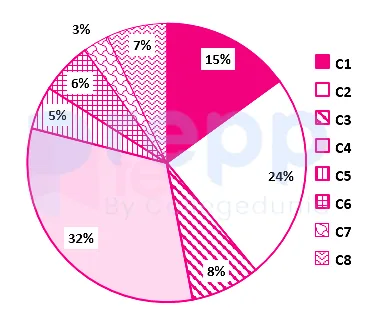
- A
1200
- B
1800
- C
1600
- D
2000
Show answer
C. 1600Calculation:
Percentage of population of city C3 = 8%
Perc entage of population of city C5 = 5%
Perc entage of population of city C7 = 3%
Average of percentage of population of cities C3, C5 and C7 = (8 + 5 + 3)/3
⇒ 16/3 %
Average population = \(\frac{16}{3\times100} \times 30000\)
⇒ 1600
∴ Option 3 is the correct answer.
Paper & answer key PDF ↗ Question 74archived
What is the largest common divisor of the numbers 1026, 2268 and 2430?
- A
108
- B
54
- C
81
- D
27
Show answer
B. 54To find the largest common divisor (GCD) of the numbers 1026, 2268, and 2430, we can use the method of prime factorization. The GCD is the product of the common prime factors, each raised to the lowest power it appears in any of the factorizations.
Understanding Largest Common Divisor (GCD)
The largest common divisor, also known as the greatest common divisor (GCD) or highest common factor (HCF), of two or more non-zero integers is the largest positive integer that divides each of the integers without leaving a remainder.
Prime Factorization of the Numbers
Let's find the prime factors for each number:
Prime Factorization of 1026
We divide 1026 by the smallest prime numbers until we reach 1:
$1026 \div 2 = 513$
$513 \div 3 = 171$
$171 \div 3 = 57$
$57 \div 3 = 19$
$19 \div 19 = 1$
So, the prime factorization of 1026 is $2^1 \times 3^3 \times 19^1$.
Prime Factorization of 2268
We divide 2268 by the smallest prime numbers until we reach 1:
$2268 \div 2 = 1134$
$1134 \div 2 = 567$
$567 \div 3 = 189$
$189 \div 3 = 63$
$63 \div 3 = 21$
$21 \div 3 = 7$
$7 \div 7 = 1$
So, the prime factorization of 2268 is $2^2 \times 3^4 \times 7^1$.
Prime Factorization of 2430
We divide 2430 by the smallest prime numbers until we reach 1:
$2430 \div 2 = 1215$
$1215 \div 3 = 405$
$405 \div 3 = 135$
$135 \div 3 = 45$
$45 \div 3 = 15$
$15 \div 3 = 5$
$5 \div 5 = 1$
So, the prime factorization of 2430 is $2^1 \times 3^5 \times 5^1$.
Finding Common Prime Factors and Lowest Powers
Now, let's look at the prime factorizations of all three numbers:
$1026 = 2^1 \times 3^3 \times 19^1$
$2268 = 2^2 \times 3^4 \times 7^1$
$2430 = 2^1 \times 3^5 \times 5^1$
The common prime factors are 2 and 3.
Let's find the lowest power for each common prime factor across the three numbers:
For prime factor 2: The powers are $2^1$ (in 1026), $2^2$ (in 2268), and $2^1$ (in 2430). The lowest power is $2^1$.
For prime factor 3: The powers are $3^3$ (in 1026), $3^4$ (in 2268), and $3^5$ (in 2430). The lowest power is $3^3$.
Calculating the GCD
The GCD is the product of these common prime factors raised to their lowest powers:
GCD$(1026, 2268, 2430) = 2^1 \times 3^3 = 2 \times (3 \times 3 \times 3) = 2 \times 27 = 54$.
Thus, the largest common divisor of 1026, 2268, and 2430 is 54.
Revision Table: GCD Calculation Summary
Number
Prime Factorization
1026
$2^1 \times 3^3 \times 19^1$
2268
$2^2 \times 3^4 \times 7^1$
2430
$2^1 \times 3^5 \times 5^1$
Common Factors (Lowest Power)
$2^1, 3^3$
GCD
$2^1 \times 3^3 = 54$
Additional Information: Other Methods for GCD
Besides prime factorization, another common method to find the GCD is the Euclidean Algorithm. This method is generally more efficient for larger numbers.
Euclidean Algorithm
The Euclidean Algorithm for two numbers works by repeatedly applying the division lemma:
For two positive integers $a$ and $b$ with $a > b$, GCD$(a, b)$ = GCD$(b, r)$, where $r$ is the remainder when $a$ is divided by $b$. The process continues until the remainder is 0. The last non-zero remainder is the GCD.
To find the GCD of three numbers (a, b, c), you can first find GCD(a, b) and then find the GCD of the result and c: GCD(a, b, c) = GCD(GCD(a, b), c).
Least Common Multiple (LCM)
Related to GCD is the Least Common Multiple (LCM). The LCM of two or more numbers is the smallest positive integer that is a multiple of all the numbers. For two numbers $a$ and $b$, LCM$(a, b) = \frac{|a \times b|}{\text{GCD}(a, b)}$. For multiple numbers, you can use prime factorization: the LCM is the product of all unique prime factors raised to their highest power.
Paper & answer key PDF ↗ Question 75archived
If the 4-digit number x67y is exactly divisible by 9, then the least value of (x + y) is_____.
- A
9
- B
0
- C
5
- D
3
Show answer
C. 5Understanding Divisibility by 9 for x67y
The question asks for the least possible value of the sum \( (x + y) \) such that the 4-digit number \( x67y \) is exactly divisible by 9.
To solve this, we need to recall the divisibility rule for the number 9.
A number is divisible by 9 if and only if the sum of its digits is divisible by 9.
The number given is \( x67y \). This means the digits are \( x, 6, 7, \) and \( y \).
Let's find the sum of the digits of \( x67y \):
Sum of digits \( = x + 6 + 7 + y \)
Sum of digits \( = x + y + 13 \)
For the number \( x67y \) to be exactly divisible by 9, the sum of its digits, which is \( (x + y + 13) \), must be a multiple of 9.
We also need to consider the constraints on the values of \( x \) and \( y \).
Since \( x67y \) is a 4-digit number, \( x \) is the thousands digit. This means \( x \) cannot be 0. So, \( x \) must be an integer from 1 to 9 ( \( 1 \le x \le 9 \) ).
\( y \) is the units digit. This means \( y \) must be an integer from 0 to 9 ( \( 0 \le y \le 9 \) ).
Now, let's find the possible range for the sum \( (x + y) \) based on these constraints:
The minimum value of \( x \) is 1 and the minimum value of \( y \) is 0. So, the minimum value of \( (x + y) \) is \( 1 + 0 = 1 \).
The maximum value of \( x \) is 9 and the maximum value of \( y \) is 9. So, the maximum value of \( (x + y) \) is \( 9 + 9 = 18 \).
Therefore, the value of \( (x + y) \) must be between 1 and 18 (inclusive).
Now, the sum of digits \( (x + y + 13) \) must be a multiple of 9. Let's list the multiples of 9 and see which ones are possible based on the range of \( (x + y + 13) \).
Since \( 1 \le x + y \le 18 \), we have:
Minimum sum of digits \( = 1 + 13 = 14 \)
Maximum sum of digits \( = 18 + 13 = 31 \)
So, \( (x + y + 13) \) must be a multiple of 9 that lies between 14 and 31.
The multiples of 9 are: 9, 18, 27, 36, ...
The multiples of 9 between 14 and 31 are 18 and 27.
Let's find the possible values of \( (x + y) \) for each of these multiples:
Case 1: Sum of digits \( = 18 \)
\( x + y + 13 = 18 \)
\( x + y = 18 - 13 \)
\( x + y = 5 \)
Is it possible to find integers \( x \) and \( y \) such that \( 1 \le x \le 9 \), \( 0 \le y \le 9 \), and \( x + y = 5 \)? Yes. Examples: \( x=1, y=4 \); \( x=2, y=3 \); \( x=5, y=0 \). The value \( x+y=5 \) is possible.
Case 2: Sum of digits \( = 27 \)
\( x + y + 13 = 27 \)
\( x + y = 27 - 13 \)
\( x + y = 14 \)
Is it possible to find integers \( x \) and \( y \) such that \( 1 \le x \le 9 \), \( 0 \le y \le 9 \), and \( x + y = 14 \)? Yes. Examples: \( x=5, y=9 \); \( x=9, y=5 \). The value \( x+y=14 \) is possible.
Case 3: Sum of digits \( = 36 \)
\( x + y + 13 = 36 \)
\( x + y = 36 - 13 \)
\( x + y = 23 \)
Is it possible to find integers \( x \) and \( y \) such that \( 1 \le x \le 9 \), \( 0 \le y \le 9 \), and \( x + y = 23 \)? No. The maximum value for \( x + y \) is 18. The value \( x+y=23 \) is not possible.
The possible values for \( (x + y) \) such that \( x67y \) is divisible by 9 are 5 and 14.
The question asks for the least value of \( (x + y) \).
Comparing the possible values 5 and 14, the least value is 5.
Let's verify with an example. If \( x+y=5 \), we could have \( x=1, y=4 \). The number is 1674. Sum of digits \( 1+6+7+4 = 18 \), which is divisible by 9. So 1674 is divisible by 9.
The least value of \( (x + y) \) is 5.
Sum of Digits \( (x + y + 13) \)
Possible \( (x + y) \) Value
Possible \( x, y \) pairs ( \( 1 \le x \le 9, 0 \le y \le 9 \) )
Is \( (x+y) \) value achievable?
9
-4
None
No
18
5
(1,4), (2,3), (3,2), (4,1), (5,0)
Yes
27
14
(5,9), (6,8), (7,7), (8,6), (9,5)
Yes
36
23
None (max sum is 18)
No
From the table, the possible values for \( (x + y) \) are 5 and 14. The least of these is 5.
Revision Table: Divisibility Rules Key Points
Divisibility Rule
Condition
Example
By 2
The last digit is even (0, 2, 4, 6, 8).
456 (ends in 6)
By 3
The sum of the digits is divisible by 3.
123 (1+2+3=6, which is divisible by 3)
By 5
The last digit is 0 or 5.
780 (ends in 0)
By 6
The number is divisible by both 2 and 3.
468 (even, and 4+6+8=18, divisible by 3)
By 9
The sum of the digits is divisible by 9.
567 (5+6+7=18, which is divisible by 9)
By 10
The last digit is 0.
990 (ends in 0)
Additional Information on Number Properties
Understanding divisibility rules is a fundamental concept in number theory. These rules help us quickly determine if a number can be divided evenly by another number without performing the actual division. This is particularly useful in simplifying fractions, finding factors, and solving problems involving number properties.
For the divisibility rule of 9, the fact that a number is divisible by 9 if the sum of its digits is divisible by 9 comes from the property that any power of 10 minus 1 is a number consisting only of 9s (e.g., \( 10^1 - 1 = 9 \), \( 10^2 - 1 = 99 \), \( 10^3 - 1 = 999 \)). Since 99...9 is always divisible by 9, it turns out the divisibility of a number by 9 depends only on the sum of its digits.
Similarly, the divisibility rule for 3 works for the same reason. If a number is divisible by 9, it is automatically also divisible by 3. However, a number divisible by 3 is not necessarily divisible by 9 (e.g., 6 is divisible by 3 but not by 9).
Paper & answer key PDF ↗ Question 76archived
Select the option that can be used as a one-word substitute for the given group of words.
Plants of a particular region
- A
Flora
- B
Flinch
- C
Fauna
- D
Flotsam
Show answer
A. FloraOne-Word Substitute for Plants of a Particular Region
The question asks for a single word that represents the plants found in a specific geographical area or time period. Let's look at the given options to find the correct one-word substitute.
Understanding the Options
Here's a breakdown of each word provided as an option:
Flora: This term refers collectively to the plants of a particular region, habitat, or geological period.
Flinch: This word means to make a quick, nervous movement as a reaction to fear, pain, or surprise.
Fauna: This term refers collectively to the animals of a particular region, habitat, or geological period.
Flotsam: This refers to the wreckage of a ship or its cargo found floating on or washed up by the sea. It can also mean items that have been rejected or discarded.
Analyzing the Definitions
Comparing the meaning of each option with the phrase "Plants of a particular region":
"Flora" directly matches the definition of plants found in a specific region or time.
"Flinch" is a verb describing a reaction, unrelated to plants.
"Fauna" refers to animals, not plants.
"Flotsam" refers to floating debris or discarded items, unrelated to plants of a region.
Based on the definitions, the word that serves as a one-word substitute for "Plants of a particular region" is Flora.
Conclusion
The correct one-word substitute for "Plants of a particular region" is Flora.
The final answer is Flora.
Revision Table: One-Word Substitutes
Phrase
One-Word Substitute
Plants of a particular region
Flora
Animals of a particular region
Fauna
Someone who studies plants
Botanist
Someone who studies animals
Zoologist
Additional Information: Exploring Flora and Fauna
The terms Flora and Fauna are often used together when describing the biodiversity of an area. They are essential concepts in biology and ecology.
Flora: The study of Flora involves botany, which covers plant identification, classification, distribution, and evolution. The specific Flora of a region is influenced by factors like climate, soil type, and geographical features.
Fauna: The study of Fauna involves zoology, which covers animal identification, classification, behavior, and ecology. Like Flora, the Fauna of an area is influenced by environmental factors, including the available plant life (Flora) which serves as food and habitat.
Together, Flora and Fauna represent the living components of an ecosystem. Conserving the Flora and Fauna of a region is crucial for maintaining ecological balance and biodiversity.
Understanding these terms is important for subjects like geography, biology, and environmental science.
Paper & answer key PDF ↗ Question 77archived
Select the most appropriate option to substitute the underlined segment in the given sentence.
Abu said that he saw the picture .
- A
he has seen the picture
- B
he will have seen the picture
- C
he would have seen the picture
- D
he had seen the picture
Show answer
D. he had seen the pictureUnderstanding Reported Speech and Tense Changes
The question asks us to find the most appropriate phrase to replace the underlined part "he saw the picture" in the sentence "Abu said that he saw the picture .". This involves understanding how sentences are transformed when reported by someone else, which is known as reported speech or indirect speech.
When we report what someone said, the tense of the verb often changes. The rule depends on the tense of the reporting verb (in this case, "said", which is in the simple past) and the tense of the verb in the original statement.
Analyzing Tense Changes from Simple Past
When the reporting verb (like 'said') is in the past tense, and the verb in the original statement was in the simple past tense (e.g., if Abu originally said, "I saw the picture"), the simple past tense usually changes to the past perfect tense in reported speech.
Original statement (likely direct speech): Abu said, "I saw the picture."
Reported speech (indirect speech): Abu said that he had seen the picture.
The simple past verb "saw" transforms into the past perfect verb "had seen" when reported, because the reporting verb "said" is in the past tense.
Evaluating the Substitution Options
Let's examine each option provided for substituting "he saw the picture":
he has seen the picture
This option uses the present perfect tense (has seen). The simple past tense in direct speech typically changes to past perfect, not present perfect, when reported with a past tense reporting verb.
he will have seen the picture
This option uses the future perfect tense (will have seen). This tense indicates an action that will be completed before a future point in time and is not the correct transformation for a simple past action in reported speech.
he would have seen the picture
This option uses the conditional perfect tense (would have seen). This tense is typically used for hypothetical situations in the past or unrealized conditions, not for reporting a simple past action.
he had seen the picture
This option uses the past perfect tense (had seen). This is the standard tense change for a simple past verb ("saw") when the reporting verb ("said") is in the past tense. It correctly reflects that the action of seeing the picture happened before Abu reported it.
Based on the rules of reported speech, the past perfect tense ("had seen") is the correct transformation of the simple past tense ("saw") when the reporting verb is in the past tense. Therefore, "he had seen the picture" is the most appropriate substitution.
Revision Table: Reported Speech Tense Transformations
Here is a table summarizing common tense changes when the reporting verb is in the past tense:
Direct Speech Tense
Reported Speech Tense
Simple Present (e.g., see)
Simple Past (e.g., saw)
Present Continuous (e.g., am seeing)
Past Continuous (e.g., was seeing)
Present Perfect (e.g., have seen)
Past Perfect (e.g., had seen)
Simple Past (e.g., saw)
Past Perfect (e.g., had seen)
Past Continuous (e.g., was seeing)
Past Perfect Continuous (e.g., had been seeing)
Future (e.g., will see)
Conditional (e.g., would see)
Additional Information: Understanding Reported Speech
Reported speech is used to convey what someone else said without using their exact words. Key aspects change in reported speech, including:
Tense: Verbs usually shift one step back in time.
Pronouns: Pronouns change depending on the speaker and reporter.
Time and Place Adverbs: Words indicating time or place often change.
Reporting Verb: A verb like 'said', 'told', 'asked' is used.
In the example "Abu said that he saw the picture", the sentence is already in reported speech format, but the tense of the verb 'saw' is incorrect based on the rule. The original statement would have been in simple past ("I saw"), and when reported with a past verb ("said"), it should become past perfect ("had seen").
Paper & answer key PDF ↗ Question 78archived
Select the INCORRECTLY spelt word.
- A
Texture
- B
Slege
- C
Savoury
- D
Tamper
Show answer
B. SlegeFinding the Incorrectly Spelt English Word
The question asks us to identify the word among the given options that is spelled incorrectly. To do this, we need to examine each word and check its standard spelling in English.
Analysing Option 1: Texture Spelling
The word provided is "Texture". This is a standard English word. It refers to the feel, appearance, or consistency of a surface or a substance.
Spelling of 'Texture': T-E-X-T-U-R-E
Is it correctly spelt? Yes.
Analysing Option 2: Slege Spelling
The word provided is "Slege". Let's consider if this is a recognized English word.
Upon checking, "Slege" is not the standard spelling of a common English word.
The word that is likely intended, given similar sounds, is "Sledge".
'Sledge' is a noun meaning a vehicle on runners, used for moving over snow or ice, often pulled by animals or people. It can also mean a large, heavy hammer (a sledgehammer).
Therefore, "Slege" is an incorrectly spelt word.
Analysing Option 3: Savoury Spelling
The word provided is "Savoury". This is a standard English word, particularly in British English. It describes food that is pleasant-tasting but not sweet, often spicy or salty.
Spelling of 'Savoury': S-A-V-O-U-R-Y (British English)
Is it correctly spelt? Yes.
Analysing Option 4: Tamper Spelling
The word provided is "Tamper". This is a standard English word. It means to interfere with (something) in order to cause damage or make unauthorized alterations.
Spelling of 'Tamper': T-A-M-P-E-R
Is it correctly spelt? Yes.
Identifying the Incorrect Spelling
Based on our analysis:
Texture: Correctly spelt.
Slege: Incorrectly spelt (should be Sledge).
Savoury: Correctly spelt.
Tamper: Correctly spelt.
The only word among the options that is incorrectly spelt is "Slege".
Revision Table: Common English Misspellings
Reviewing common spelling errors can help improve accuracy. Here are a few examples:
Common Misspelling
Correct Spelling
Hint/Rule
acommodate
accommodate
Two 'c's, two 'm's
recieve
receive
'i' before 'e' except after 'c'
neccessary
necessary
One 'c', two 's's
occured
occurred
Double the final consonant if the stress is on the last syllable and it ends in consonant-vowel-consonant, before adding a suffix starting with a vowel.
Additional Information: Improving English Spelling Skills
Improving your ability to spell correctly requires practice and attention. Here are some tips:
Read Regularly: Reading exposes you to correctly spelt words in context, which helps you remember them.
Learn Spelling Rules: Understanding basic rules (like 'i' before 'e', plurals, adding suffixes) can help with many words.
Use a Dictionary: When in doubt, look up the word. Pay attention to the spelling.
Practice Writing: The more you write, the more you reinforce correct spellings.
Proofread: Always check your work for spelling errors.
Learn Word Origins: Sometimes knowing the origin of a word can help you understand its spelling.
Focus on Frequently Misspelt Words: Make a list of words you commonly misspell and practice them specifically.
Paper & answer key PDF ↗ Question 79archived
Select the appropriate adverb for the underlined word in the sentence.
He led me to the room that had obvious been built later than the rest of the house.
- A
obliviously
- B
obliviousness
- C
obviousness
- D
obviously
Show answer
D. obviouslyUnderstanding the Need for an Adverb
The question asks us to select the appropriate adverb for the underlined word "obvious" in the sentence: "He led me to the room that had obvious been built later than the rest of the house."
In this sentence, the word "obvious" is placed before the verb phrase "been built". The word needed here must modify the verb phrase, telling us *how* the room appeared to have been built later. Words that modify verbs, adjectives, or other adverbs are called adverbs.
The word "obvious" is an adjective. Adjectives describe nouns or pronouns. For example, you might say "an obvious mistake" (obvious describes the noun 'mistake'). However, in our sentence, "obvious" is attempting to modify the verb phrase "had been built", which requires an adverb.
Therefore, we need to convert the adjective "obvious" into its corresponding adverb form.
Identifying the Correct Adverb Form
Let's look at the given options and determine which one is the correct adverb form of "obvious" that fits the sentence context:
obliviously: This is the adverb form of the adjective "oblivious," which means unaware or unconscious. This meaning does not fit the sentence about how a room was built.
obliviousness: This is a noun form, meaning the state of being oblivious. Nouns do not modify verbs.
obviousness: This is also a noun form, meaning the state or quality of being obvious. Nouns do not modify verbs.
obviously: This is the adverb form of the adjective "obvious." It means in a way that is easy to see, understand, or recognize; clearly. This meaning perfectly fits the sentence, indicating that it was clear or evident that the room had been built later.
Analyzing the Sentence with the Correct Adverb
Replacing "obvious" with "obviously" gives us the sentence: "He led me to the room that had obviously been built later than the rest of the house."
In this revised sentence, "obviously" functions correctly as an adverb, modifying the verb phrase "had been built" to describe the manner or appearance of the construction – it was clearly built later. This makes the sentence grammatically correct and conveys the intended meaning.
Word Form
Word
Function
Example Use
Adjective
obvious
Describes a noun/pronoun
It was an obvious choice.
Adverb
obviously
Modifies a verb, adjective, or adverb
He was obviously tired.
Noun
obviousness
Names a quality or state
The obviousness of the error was striking.
Conclusion on Selecting the Appropriate Adverb
Based on the requirement for a word to modify the verb phrase "had been built" and the analysis of the options, the appropriate adverb for the underlined word "obvious" is "obviously".
Revision Table: English Grammar Word Forms
Understanding different word forms like adjectives and adverbs is crucial for correct sentence construction. Here's a quick look at how words change form.
Adjective
Adverb
Meaning (Adverb)
Quick
Quickly
At a fast speed
Happy
Happily
In a happy manner
Careful
Carefully
With care
Easy
Easily
Without difficulty
Obvious
Obviously
In an obvious manner; clearly
Additional Information: Adverbs in English Sentences
Adverbs play a vital role in adding detail to sentences. They can tell us how, when, where, why, or to what extent an action is performed or a quality exists.
Modifying Verbs: Adverbs commonly modify verbs, describing the action. Example: She sings beautifully. (How she sings)
Modifying Adjectives: Adverbs can intensify or qualify adjectives. Example: He was extremely happy. (How happy)
Modifying Other Adverbs: Adverbs can also modify other adverbs. Example: She finished the race very quickly. (How quickly)
Placement: The position of an adverb can vary in a sentence, depending on what it is modifying and the type of adverb. Adverbs modifying verbs often appear after the verb or verb phrase, or sometimes at the beginning or end of the sentence, or before the verb (especially adverbs of frequency or certain adverbs like 'obviously').
Forming Adverbs: Many adverbs are formed by adding "-ly" to an adjective (e.g., quick > quickly, careful > carefully, obvious > obviously). However, there are also many adverbs that do not end in "-ly" (e.g., fast, hard, well, very, often, never).
In the sentence "He led me to the room that had obviously been built later...", the adverb "obviously" is placed before the main verb phrase "been built," which is a common and acceptable position for adverbs like this, emphasizing the clarity of the observation about the building's age.
Paper & answer key PDF ↗ Question 80archived
Select the option that can be used as a one-word substitute for the given group of words.
A shortened version of a larger work
- A
Summary
- B
Precis
- C
Shorts
- D
Abridgement
Show answer
D. AbridgementFinding the Right Word: Shortened Version of a Larger Work
The question asks for a single word that can replace the phrase "A shortened version of a larger work". Let's examine the given options to find the most suitable one-word substitute.
Analyzing the Options for Shortened Work
Summary: A summary provides a brief account of the main points or facts of something. While it is shorter than the original, it often focuses on conveying the core message or plot rather than being a structurally reduced version of the original text.
Precis: Similar to a summary, a precis is a concise summary of a text, often highlighting the essential points or argument. It aims for brevity and accuracy in representing the original's core meaning but is not typically a shortened version of the entire work's content.
Shorts: The term "shorts" typically refers to short films, short stories, or short trousers. It does not specifically describe a reduced version of a pre-existing larger piece of work like a novel or play.
Abridgement: An abridgement is a shortened version of a book, play, or other work, made by condensing or excising material while attempting to retain the original's overall structure and meaning. This definition directly matches the phrase "A shortened version of a larger work".
Based on the analysis, "Abridgement" is the term specifically used to describe a shortened version derived from a larger work like a book or play, where parts have been removed or condensed to make it shorter while keeping the essence.
Understanding Abridgement
An abridgement is created by taking an original, longer text and reducing its size. This is often done to make the work more accessible, either by length, complexity, or target audience. For example, a long novel might be abridged for younger readers or to fit into a specific publication space. The process involves careful selection of content to be kept and removed.
Comparing Abridgement, Summary, and Precis
While related, these terms have distinct meanings:
Term
Description
Relationship to Original Work
Abridgement
A shortened version of the original work itself, with content removed or condensed.
A structural reduction of the original work.
Summary
A brief overview of the main points or ideas of the original work.
A description of the original work's content, not a version of the work itself.
Precis
A concise and accurate statement of the substance of a text.
A formal summary, focusing on the essence and main argument.
Therefore, the most accurate one-word substitute for "A shortened version of a larger work" is Abridgement.
Revision Table: Key Terms for Shortened Texts
Term
Meaning
Abridgement
A shortened version of a larger literary work.
Summary
A brief statement of the main points.
Precis
A concise summary of the essential points of a text.
Additional Information on Text Condensing
Besides abridgement, summary, and precis, other related terms describe different ways of shortening or representing larger texts or works:
Synopsis: A brief summary of the plot of a novel, play, or film. It gives an overview of the story arc.
Abstract: A brief summary, typically of a research paper, article, or academic work, outlining its purpose, methods, results, and conclusions.
Digest: A compilation or summary of information, often from various sources, especially laws or legal cases. Sometimes implies a condensed collection of existing works.
Each term has a specific context and application in describing shortened or condensed forms of information or creative works. Understanding these distinctions is key to choosing the correct word.
Paper & answer key PDF ↗ Question 81archived
Complete the following collocation.
I was running late so I only had time for a _______ shower.
- A
quick
- B
hasty
- C
fast
- D
short
Show answer
A. quickUnderstanding English Collocations: Completing the Phrase
This question asks you to complete a common phrase or collocation using the most appropriate word from the given options. Collocations are words that often go together naturally in English. Choosing the correct word depends on common usage and what native speakers typically say.
What is a Collocation?
A collocation is a pairing or grouping of words that are frequently found together. When words collocate, they sound "right" to native English speakers, whereas other combinations may sound unnatural, even if the individual words make grammatical sense. Learning collocations helps make your English sound more natural and fluent.
Examples of common collocations:
make a decision
take a photo
heavy rain
strong wind
Analyzing the Collocation: A _______ Shower
The phrase in question is "a _______ shower". We are given the context that the person is "running late", implying they need to shower quickly. Let's look at the options:
quick
hasty
fast
short
We need to find which word most naturally follows "a" and describes a shower taken when someone is in a hurry.
Evaluating the Options for "a _______ shower"
Let's consider each option:
Quick: The collocation "a quick shower" is very common in English. It perfectly describes a shower taken in a short amount of time, usually because someone is in a hurry. This fits the context of "running late".
Hasty: While "hasty" means done quickly and with little care, it's not a standard collocation with "shower". We might say "a hasty departure" or "a hasty decision", but not typically "a hasty shower".
Fast: "Fast" is usually used to describe speed, like "a fast car" or "running fast". While a shower can be done fast, "a fast shower" is not the standard collocation. "Quick" is preferred when referring to an action done in a short period, especially for something like a shower or a meal ("a quick bite").
Short: "A short shower" is also possible and understandable, meaning a shower that doesn't last long. However, "a quick shower" is significantly more common and idiomatic in the context of doing something rapidly because you are late or in a hurry. "Short" often refers just to duration, whereas "quick" often implies both speed and short duration driven by necessity or choice.
Why "Quick" is the Correct Word
Based on common English usage and natural collocations, "a quick shower" is the most appropriate and widely used phrase to describe taking a shower rapidly when running late. The word "quick" frequently collocates with nouns describing brief activities done without delay (e.g., quick meal, quick nap, quick chat).
Therefore, the word that best completes the collocation and fits the context of running late is "quick".
The complete sentence is: I was running late so I only had time for a quick shower.
Collocation Suitability for "a _______ shower"
Word
Common Collocation with "shower"?
Fits "running late" context?
quick
Yes (very common)
Yes
hasty
No (uncommon)
Possible meaning, but not standard phrase
fast
No (uncommon)
Possible meaning, but not standard phrase
short
Yes (less common than quick)
Yes, but "quick" is more natural for "in a hurry"
Revision Table: Key English Collocations
Common English Collocations
Verb + Noun
Adjective + Noun
Adverb + Adjective
make a mistake
heavy traffic
absolutely essential
do homework
strong coffee
highly recommended
take a break
bright red
bitterly cold
Additional Information on English Collocations
Learning collocations is a crucial part of improving your English fluency and accuracy. Instead of learning individual words, learning them in common pairs or groups helps you use language more naturally. Pay attention to how words are used together when reading or listening to English. There are many different types of collocations, including:
Adjective + Noun (e.g., brand new)
Noun + Noun (e.g., a sense of humour)
Verb + Noun (e.g., commit a crime)
Adverb + Adjective (e.g., completely satisfied)
Verb + Adverb (e.g., talk loudly)
Dictionaries often provide information on collocations. Using collocation dictionaries or online resources can also be helpful.
Paper & answer key PDF ↗ Question 82archived
Select the correct active form of the given sentence.
Her phone can’t be switched off by my father.
- A
My father switches off her phone.
- B
My father could not switch off her phone.
- C
My father have not switched off her phone.
- D
My father can’t switch off her phone.
Show answer
D. My father can’t switch off her phone.Understanding Active and Passive Voice Conversion
The question asks us to convert a sentence from the passive voice to the active voice. Let's first understand what active and passive voice mean in English grammar.
Active Voice: The subject of the sentence performs the action. The structure is typically: Subject + Verb + Object. Example: My father switches off her phone. (My father is the subject performing the action 'switches off' on the object 'her phone').
Passive Voice: The subject of the sentence receives the action. The structure is typically: Object + be (appropriate form) + Past Participle of the verb + by + Subject (optional). Example: Her phone is switched off by my father. (Her phone is the subject receiving the action 'switched off').
Converting Passive Voice with Modals to Active Voice
The given sentence is in the passive voice and includes a modal verb ('can'). The structure for passive voice with modals is:
Subject (Receiver of action) + Modal Verb + be + Past Participle + (by + Agent/Performer of action)
The given sentence: "Her phone can’t be switched off by my father."
Subject (Receiver of action): Her phone
Modal Verb: can't
be + Past Participle: be switched off
Agent (Performer of action): my father
To convert this to the active voice, we follow this structure:
Agent/Performer of action + Modal Verb + Base form of the verb + Subject (Receiver of action)
Step-by-Step Conversion
Let's apply the active voice structure to the given passive sentence:
Identify the Agent (Performer of action): This is found after "by" in the passive sentence, which is "my father". This will become the subject of the active sentence.
Keep the Modal Verb: The modal verb used in the passive sentence is "can't". This remains the same in the active voice.
Find the Base form of the verb: The past participle is "switched off". The base form of the verb is "switch off".
Identify the Subject of the passive sentence: This is "Her phone". This will become the object of the active sentence.
Putting these parts together, we get: "My father" + "can't" + "switch off" + "her phone".
The resulting active voice sentence is: My father can't switch off her phone.
Analyzing the Options
Let's examine the given options:
My father switches off her phone.
This uses the simple present tense ("switches off") instead of the modal verb "can't". This is not the correct transformation.
My father could not switch off her phone.
This uses the modal verb "could not" (couldn't) which is the past form of "can not" (can't). The original sentence uses "can't", indicating present ability or lack thereof. Using "could not" changes the meaning to past inability. This is incorrect.
My father have not switched off her phone.
This uses the present perfect tense ("have not switched off"). This tense is different from the modal structure with "can't" and changes the meaning to an action that hasn't happened up to now. This is incorrect.
My father can’t switch off her phone.
This sentence uses the correct subject ("My father"), the correct modal verb ("can't"), the correct base form of the verb ("switch off"), and the correct object ("her phone"). This matches our derived active sentence.
Summary of Transformation
Passive Sentence Part
→
Active Sentence Part
Her phone (Subject)
→
her phone (Object)
can't (Modal)
→
can't (Modal)
be switched off (be + Past Participle)
→
switch off (Base Verb)
by my father (Agent)
→
My father (Subject)
The correct active form of the sentence "Her phone can’t be switched off by my father" is "My father can’t switch off her phone".
Revision Table: Active vs Passive Voice Key Points
Feature
Active Voice
Passive Voice
Focus
On the doer of the action (Subject)
On the action itself or the receiver of the action (Subject)
Structure (Simple)
Subject + Verb + Object
Object + Be + Past Participle (+ by Subject)
Structure (with Modals)
Subject + Modal + Base Verb + Object
Object + Modal + be + Past Participle (+ by Subject)
Usage
Common in general writing, direct, clear
Used when the doer is unknown, unimportant, or obvious; or when focusing on the action/receiver
Additional Information: Modals in Passive Voice
When converting sentences with modal verbs (like can, could, may, might, must, should, will, would) from active to passive voice, or vice versa, the modal verb itself remains unchanged. The structure around it changes.
Active: Subject + Modal + Base Form + Object
Passive: Object + Modal + be + Past Participle (+ by + Subject)
Examples:
Active: She can solve the problem.
Passive: The problem can be solved by her.
Active: You should finish the work.
Passive: The work should be finished by you.
Active: They might cancel the event.
Passive: The event might be cancelled by them.
In the given question, the modal "can't" (cannot) is used, and it correctly remains "can't" in the active voice transformation.
Paper & answer key PDF ↗ Question 83archived
Select the correct direct form of the given sentence.
Shyam asked me how I had persuaded his sister.
- A
"How are you persuading my sister?” Shyam asked me.
- B
"How did you persuaded my sister?” Shyam asked me.
- C
"How did you persuade my sister?” Shyam asked me.
- D
"How have you persuade my sister?” Shyam asks me.
Show answer
C. "How did you persuade my sister?” Shyam asked me.Converting Indirect to Direct Speech Explained
Understanding how to convert sentences between direct and indirect speech is a key skill in English grammar. The provided question asks for the correct direct form of the sentence: "Shyam asked me how I had persuaded his sister."
Analyzing the Indirect Speech Sentence
Let's break down the given indirect speech sentence:
Reporting Verb: "asked" - This tells us the original sentence was a question. The verb is in the past tense.
Connector: "how" - This is the question word from the original direct speech.
Reported Clause: "I had persuaded his sister."
When converting from indirect speech back to direct speech, we need to reverse the usual transformation rules:
The reporting verb "asked" means the direct speech was a question, likely starting with a question word like "how".
The pronoun "I" in the indirect speech refers to the person being asked, which is "me". So, in direct speech, Shyam would address "me" as "you".
The phrase "his sister" in the indirect speech refers to Shyam's sister. So, in direct speech, Shyam would refer to her as "my sister".
The tense "had persuaded" (past perfect) in indirect speech usually comes from either the simple past or the present perfect tense in direct speech.
Evaluating the Options for Direct Speech
Now let's look at the options and see which one correctly reverses these changes to get the original direct speech question Shyam asked me.
Option
Direct Speech Sentence
Analysis
1
"How are you persuading my sister?" Shyam asked me.
Tense: Present continuous ("are persuading"). This would become past continuous ("was persuading") in indirect speech, not past perfect ("had persuaded"). Incorrect.
Pronoun: "my sister" is correct.
Reporting verb: "asked me" is correct.
2
"How did you persuaded my sister?" Shyam asked me.
Tense/Grammar: Simple past structure ("did") requires the base form of the verb ("persuade"), not the past tense ("persuaded"). Grammatically incorrect.
Pronoun: "you" and "my sister" are correct.
Reporting verb: "asked me" is correct.
3
"How did you persuade my sister?" Shyam asked me.
Tense/Grammar: Simple past structure ("did persuade"). Simple past in direct speech correctly changes to past perfect ("had persuaded") in indirect speech. Grammatically correct.
Pronoun: "you" correctly refers to the person being asked ("me"). "my sister" correctly refers to "his sister". Correct pronoun transformations.
Reporting verb: "asked me" is consistent with the indirect speech. Correct.
4
"How have you persuade my sister?" Shyam asks me.
Tense/Grammar: Present perfect structure ("have") requires the past participle ("persuaded"), not the base form ("persuade"). Grammatically incorrect.
Reporting verb: "asks" (present tense) does not match the past tense "asked" in the indirect speech. Incorrect.
Identifying the Correct Direct Speech Form
Based on the analysis, Option 3, "How did you persuade my sister?" Shyam asked me., is the only option that correctly reverses the transformation rules for tense, pronouns, and maintains correct grammar while matching the reporting verb and question structure.
Revision Table: Direct vs. Indirect Speech Changes
Feature
Direct Speech
Indirect Speech
Reporting Verb (Question)
Often ends with 'said to me' (becomes 'asked me')
'asked me'
Question Type
Starts with a Wh- word (how, what, why, etc.)
Wh- word acts as connector
Punctuation
Question mark inside quotation marks
Full stop at the end
Subject Pronouns
'you' (referring to the listener)
'I' (referring to the listener from their perspective)
Possessive Pronouns
'my' (referring to the speaker's)
'his'/'her'/'their' (referring to the original speaker's)
Tense (Simple Past)
'did + base form' or past tense verb
Past Perfect (had + past participle)
Tense (Present Perfect)
'have/has + past participle'
Past Perfect (had + past participle)
Additional Information on Reported Speech
Reported speech, also known as indirect speech, is used to tell someone what another person said without using their exact words. Direct speech uses the exact words spoken, usually enclosed in quotation marks. Key changes occur when converting from direct to indirect speech:
Pronouns: Change based on who is speaking and who is being referred to.
Tenses: Usually shifted back (e.g., present simple to past simple, past simple to past perfect). This is often called 'backshifting'.
Time and Place References: Words like 'now', 'here', 'this', 'tomorrow' change to 'then', 'there', 'that', 'the next day', etc. (Not relevant to this specific question, but important rule).
Reporting Verb: Changes depending on the sentence type (e.g., 'said' for statements, 'asked' for questions, 'ordered' for commands).
Connectors: 'that' is often used for statements, 'if' or 'whether' for yes/no questions, and the question word itself (like 'how', 'what', 'why') for Wh- questions.
Reversing the process to go from indirect back to direct speech involves applying these rules in reverse, paying close attention to the context and the original meaning.
Paper & answer key PDF ↗ Question 84archived
Select the most appropriate option to fill in the blank.
The interviewees were slowly becoming impatient as they were left to ________ in the waiting room for hours.
- A
draw the long bow
- B
cool their heels
- C
hold water
- D
flog a dead horse
Show answer
B. cool their heelsUnderstanding the Idiom for Waiting Impatiently
The question asks us to select the most appropriate idiom to complete the sentence: "The interviewees were slowly becoming impatient as they were left to ________ in the waiting room for hours." We need an idiom that describes the act of waiting, especially for a long time, and often implies a sense of frustration or impatience, which matches the context of interviewees waiting "for hours" and becoming "impatient".
Analyzing the Options
Let's examine the meaning of each idiom provided in the options:
draw the long bow: This idiom means to exaggerate greatly or lie. It has nothing to do with waiting or impatience.
cool their heels: This idiom means to wait, especially for a long time or after being kept waiting. This perfectly fits the context of interviewees waiting for hours in a waiting room.
hold water: This idiom is typically used to describe an argument, theory, or statement that seems valid, sound, or logical. It means to be able to withstand scrutiny or testing. This has no connection to waiting.
flog a dead horse: This idiom means to waste effort on something that is hopeless or impossible to change. It implies futility, not waiting.
Identifying the Correct Idiom
Based on the analysis, the idiom that accurately describes people waiting for a long time and becoming impatient is "cool their heels". The interviewees were left to cool their heels in the waiting room for hours.
Let's summarize the idioms and their meanings:
Idiom
Meaning
Relevance to Waiting?
draw the long bow
To exaggerate
No
cool their heels
To wait for a long time
Yes
hold water
To be valid or sound
No
flog a dead horse
To waste effort on a lost cause
No
Why 'cool their heels' is the Best Fit
The sentence describes interviewees waiting "for hours" and getting "impatient". The idiom "cool their heels" specifically means waiting, often for a considerable duration, and is frequently used in contexts where the waiting is tedious or leads to impatience. Therefore, it is the most appropriate option to fill the blank and convey the intended meaning.
Revision Table: Common English Idioms
Understanding common idioms is crucial for English proficiency. Here are a few more examples:
Idiom
Meaning
Break a leg
Good luck (often used before a performance)
Bite the bullet
To face a difficult situation with courage
Get something off your chest
To talk about something that has been worrying you
Let the cat out of the bag
To reveal a secret
Additional Information: Using Idioms in Sentences
Idioms are expressions whose meaning is not obvious from the individual words. They add color and richness to language. When using idioms, make sure the context is appropriate. For instance, using "cool their heels" is perfect when describing a situation involving waiting, such as waiting for an appointment, waiting for a decision, or waiting in a line.
Example sentences:
We had to cool our heels at the doctor's office for over an hour.
The applicants were asked to arrive early and prepared to cool their heels before the interviews began.
Paper & answer key PDF ↗ Question 85archived
The following sentence has been split into four segments. Identify the segment that contains a grammatical error.
One can never imagine / how hot it gets in Delhi / unless one doesn’t go / there in person.
- A
One can never imagine
- B
unless one doesn’t go
- C
how hot it gets in Delhi
- D
there in person.
Show answer
B. unless one doesn’t goFinding the Grammatical Error in a Sentence Segment
The question asks us to identify the segment in the provided sentence that contains a grammatical error. Let's examine the sentence and its split segments carefully.
The sentence is:
One can never imagine / how hot it gets in Delhi / unless one doesn’t go / there in person.
The sentence is divided into four segments:
One can never imagine
how hot it gets in Delhi
unless one doesn’t go
there in person.
Analyzing Each Sentence Segment for Grammar
We will now look at each segment to determine if it is grammatically correct in the context of the whole sentence.
Segment 1: One can never imagine
This segment is grammatically correct. It sets up the main clause and includes a negative ("never imagine").
Segment 2: how hot it gets in Delhi
This segment is a noun clause functioning as the object of the verb "imagine". It is grammatically correct.
Segment 3: unless one doesn’t go
This segment uses the conjunction "unless". The word "unless" itself means "if not". So, "unless one doesn't go" effectively means "if one does not not go". Using "unless" with "doesn't" (another negative) creates a double negative, which is generally incorrect and makes the sentence confusing. The intended meaning is likely "except if one goes" or "if one does not go". Since "unless" already means "if not", the correct phrasing would be "unless one goes".
Segment 4: there in person.
This segment is a prepositional phrase indicating the manner or place of going. It is grammatically correct.
Identifying the Segment with the Error
Based on the analysis, the error lies in segment 3: "unless one doesn’t go". The use of the double negative with "unless" is grammatically incorrect. The sentence should ideally be "One can never imagine how hot it gets in Delhi unless one goes there in person."
Therefore, the segment containing the grammatical error is "unless one doesn’t go".
Revision Table: Correcting the Grammatical Error
Original Segment
Error
Corrected Segment
Explanation
unless one doesn’t go
Double negative with 'unless' and 'doesn't'
unless one goes
'Unless' already implies a negative condition ('if not'). Adding 'doesn't' is redundant and grammatically incorrect.
Additional Information: Understanding 'Unless' and Double Negatives
Understanding how to use conjunctions like "unless" and how to avoid double negatives is crucial for correct English grammar.
'Unless': This conjunction means "except if" or "if... not". It introduces a condition that prevents something from happening. For example: "You won't pass unless you study" means "You won't pass if you don't study".
Double Negatives: Using two negative words in the same clause when only one is intended is incorrect in standard English. Examples include "not never", "don't no", "can't hardly", and in this case, "unless... doesn't". While double negatives are used in some dialects or for emphasis, they are considered non-standard and incorrect in formal writing and speech.
To check for errors, try rephrasing the sentence. If "unless one doesn't go" is replaced with its literal meaning "if one does not not go", it becomes clear that there is an issue.
Correctly identifying such errors helps improve sentence structure and clarity.
Paper & answer key PDF ↗ Question 86archived
Select the most appropriate ANTONYM of the word ‘MOBILE’ from the given sentence.
The strange TV reporter standing over there covers all the funny and interesting things happening inside the town.
- A
Standing
- B
Interesting
- C
Inside
- D
Strange
Show answer
A. StandingUnderstanding Antonyms and the Word 'MOBILE'
The question asks for the most appropriate antonym of the word ‘MOBILE’ from the given options. An antonym is a word that has the opposite meaning of another word.
What Does 'MOBILE' Mean?
The word 'MOBILE' generally means:
Able to move or be moved easily.
Not fixed in one place.
Changing quickly or easily.
For example, a 'mobile phone' is a phone you can carry with you, and a 'mobile library' is a library that moves from place to place.
Identifying the Antonym of 'MOBILE' from Options
We need to find a word among the options that means the opposite of 'MOBILE', which implies being unable to move or being fixed in place.
Let's examine the given options:
Standing
Interesting
Inside
Strange
Analyzing Each Option
Let's look at the meaning of each option word and see if it is an antonym for 'MOBILE'.
Option 1: Standing
'Standing' means being in an upright position or remaining in one place. If something is 'standing', it is typically not moving or is fixed in its position. This is the opposite of being able to move easily or not being fixed.
Option 2: Interesting
'Interesting' means arousing curiosity or interest; holding the attention. This relates to how something is perceived mentally or emotionally, not its physical ability to move.
Option 3: Inside
'Inside' refers to the inner part or space of something, or being contained within something. This describes location, not mobility.
Option 4: Strange
'Strange' means unusual or surprising; difficult to understand or explain. This describes a quality or characteristic, not whether something can move.
Comparing Meanings: 'MOBILE' vs. Options
Comparing the meaning of 'MOBILE' (able to move, not fixed) with the options:
'Standing' (remaining in one place, not moving) is the opposite of 'MOBILE'.
'Interesting' has no relation to mobility.
'Inside' has no relation to mobility.
'Strange' has no relation to mobility.
Therefore, 'Standing' is the most appropriate antonym for 'MOBILE' among the given options, as it signifies a state of not moving or being in a fixed position.
Conclusion: Antonym of MOBILE
Based on the analysis of the meanings, the word 'Standing' is the antonym of 'MOBILE'.
Word
Meaning (Relevant Context)
Is it an Antonym of 'MOBILE'?
MOBILE
Able to move or be moved; not fixed
-
Standing
Remaining in one place; not moving
Yes
Interesting
Arousing curiosity or interest
No
Inside
In the inner part or space
No
Strange
Unusual or surprising
No
Revision Table: Vocabulary and Antonyms
Reviewing key concepts about vocabulary and antonyms.
Term
Definition
Example
Word
A single unit of language that has meaning and can be spoken or written.
"house", "run", "happy"
Meaning
What a word, phrase, or symbol represents or conveys.
The meaning of "run" is to move rapidly on foot.
Antonym
A word that means the opposite of another word.
The antonym of "hot" is "cold".
Synonym
A word that has the same or nearly the same meaning as another word.
A synonym of "happy" is "joyful".
Additional Information: Expanding Vocabulary Skills
Developing a strong vocabulary is crucial for understanding and using language effectively. Here are some ways to improve your vocabulary:
Read widely from different sources like books, articles, and news.
Learn root words, prefixes, and suffixes. These can help you understand the meaning of new words.
Use a dictionary or thesaurus to look up the meanings and find antonyms and synonyms of words.
Practice using new words in your own sentences.
Review learned words regularly.
Understanding antonyms helps clarify the meaning of words by contrasting them with their opposites.
Paper & answer key PDF ↗ Question 87archived
Select the most appropriate synonym of the given word.
Exaltation
- A
Dejection
- B
Ecstasy
- C
Satisfaction
- D
Elaboration
Show answer
B. EcstasyUnderstanding the Word Exaltation and Finding its Synonym
The question asks us to find the most appropriate synonym for the word Exaltation from the given options. A synonym is a word or phrase that means exactly or nearly the same as another word or phrase in the same language.
Defining Exaltation
The word Exaltation primarily means a feeling or state of extreme happiness. It can also mean the action of elevating someone or something to a high rank or position, but in the context of the options provided, the meaning related to happiness is the most relevant.
Analyzing the Options for Exaltation Synonym
Let's look at each option and determine its meaning:
Dejection: This word means a state of low spirits; depression; sadness. This is clearly the opposite of happiness or extreme joy. Therefore, it is an antonym, not a synonym, of Exaltation.
Ecstasy: This word means an overwhelming feeling of great happiness or joyful excitement. This meaning aligns very closely with the primary definition of Exaltation as a state of extreme happiness.
Satisfaction: This word means fulfillment of one's wishes, expectations, or needs, or the pleasure derived from this. While satisfaction involves pleasure or contentment, it is generally less intense than the extreme happiness implied by Exaltation.
Elaboration: This word means the process of developing or presenting a theory, policy, or system in detail. This meaning is completely unrelated to feelings or emotional states and therefore not a synonym for Exaltation.
Identifying the Most Appropriate Synonym
Comparing the meanings, Ecstasy is the word that best fits the definition of extreme happiness or joyful excitement, which is the primary sense of Exaltation relevant to the options. While Satisfaction involves pleasure, it is usually not as intense as Exaltation or Ecstasy.
Word
Meaning
Relation to Exaltation
Exaltation
Extreme happiness; high spirits
Target word
Dejection
Low spirits; sadness
Antonym
Ecstasy
Overwhelming happiness; joyful excitement
Synonym
Satisfaction
Contentment; pleasure from fulfillment
Related, but less intense
Elaboration
Detailed explanation or development
Unrelated
Based on this analysis, Ecstasy is the most appropriate synonym for Exaltation among the given options.
Revision Table: Key Vocabulary
Word
Meaning
Example Usage
Exaltation
A feeling or state of extreme happiness.
The artist felt exaltation upon receiving the award.
Synonym
A word or phrase meaning nearly the same as another.
"Happy" is a synonym of "joyful".
Antonym
A word opposite in meaning to another.
"Sad" is an antonym of "happy".
Ecstasy
An overwhelming feeling of great happiness or joyful excitement.
She was in ecstasy after winning the lottery.
Dejection
A state of low spirits; sadness.
He felt deep dejection after failing the exam.
Satisfaction
Fulfillment of needs or wishes; pleasure from this.
Finishing the project brought him great satisfaction.
Elaboration
Detailed development or explanation.
The professor asked for more elaboration on the topic.
Additional Information: Exploring Synonyms and Antonyms
Learning synonyms and antonyms is crucial for expanding your vocabulary and improving your understanding of language. Synonyms help you express the same idea in different ways, adding variety to your writing and speech. Antonyms help clarify the meaning of a word by presenting its opposite.
When looking for the best synonym, always consider the context in which the word is used, as synonyms are not always perfectly interchangeable. For example, while "big" and "large" are synonyms, you might say "big brother" but not typically "large brother".
Regular practice with vocabulary exercises and reading widely can significantly enhance your ability to identify synonyms and antonyms accurately.
Paper & answer key PDF ↗ Question 88archived
The question below consists of a set of labelled sentences. Out of the four options given, select the most logical order of the sentences to form a coherent paragraph.
P. Main source of water for Wular Lake is River Jhelum.
Q. Wular Lake is also said to be a remnant of Satisar Lake that existed in ancient times.
R. This lake also has a small island in its centre called the ‘Zaina Lank’.
S. This island was constructed by King Zainul-Abi-Din.
- A
RPQS
- B
PQRS
- C
QSRP
- D
PRSQ
Show answer
D. PRSQUnderstanding Sentence Reordering
Sentence reordering questions test your ability to understand the logical flow of ideas and construct a coherent paragraph. To solve these questions, look for:
Introductory sentences that introduce the main topic.
Connecting words or phrases (like "this lake," "this island," "also," "therefore," "however," etc.) that link sentences together.
Sentences that follow a chronological order, cause and effect, or general-to-specific structure.
Concluding sentences that summarize or provide a final thought.
Analyzing the Wular Lake Sentences
Let's look at the given sentences about Wular Lake:
P. Main source of water for Wular Lake is River Jhelum.
Q. Wular Lake is also said to be a remnant of Satisar Lake that existed in ancient times.
R. This lake also has a small island in its centre called the ‘Zaina Lank’.
S. This island was constructed by King Zainul-Abi-Din.
We need to arrange these sentences into a logical paragraph.
Step-by-Step Ordering Process (Based on PRSQ)
Let's examine the order PRSQ as given in the option:
Sentence P: "Main source of water for Wular Lake is River Jhelum." This sentence introduces Wular Lake and provides a key geographical detail about its water source. It can serve as an initial statement about the lake.
Sentence R: "This lake also has a small island in its centre called the ‘Zaina Lank’." The phrase "This lake" refers back to Wular Lake mentioned in sentence P. It adds another specific physical feature of the lake (an island). The word "also" suggests it's adding more information about the lake after something else has been stated (like the source in P). So, P followed by R creates a flow where a general fact about the lake is followed by another specific detail about it.
Sentence S: "This island was constructed by King Zainul-Abi-Din." The phrase "This island" directly refers to the island ('Zaina Lank') mentioned in sentence R. This sentence provides more detail about the origin of the island. Therefore, S logically follows R. The sequence P-R-S discusses the lake's source, introduces its island, and then explains who built the island.
Sentence Q: "Wular Lake is also said to be a remnant of Satisar Lake that existed in ancient times." This sentence provides historical context about the lake's origin. Starting with "Wular Lake is also said to be..." implies adding another piece of information about Wular Lake. While it could potentially be an introductory sentence, placing it after detailing the lake's source and a specific feature (island) allows it to add a different kind of information (historical) to the description. Placing it last provides an additional interesting fact about the Wular Lake after presenting its physical aspects.
Following this sequence, the sentences form the paragraph: P R S Q.
The Coherent Paragraph
Main source of water for Wular Lake is River Jhelum. This lake also has a small island in its centre called the ‘Zaina Lank’. This island was constructed by King Zainul-Abi-Din. Wular Lake is also said to be a remnant of Satisar Lake that existed in ancient times.
Conclusion on Wular Lake Sentence Order
Based on the links between sentences, particularly "This lake" in R referring to the lake mentioned in P, and "This island" in S referring to the island in R, the order PRSQ creates a possible flow: stating the source (P), describing an island (R), giving details about the island (S), and finally adding historical context (Q).
Revision Table: Wular Lake Paragraph Arrangement
Sentence
Content
Connection/Role in PRSQ
P
Wular Lake source (Jhelum)
Introduces Wular Lake, provides key fact.
R
Wular Lake island (‘Zaina Lank’)
Refers back to Wular Lake ("This lake"), adds another feature.
S
Island construction (Zainul-Abi-Din)
Refers back to the island ("This island"), provides detail.
Q
Wular Lake ancient origin (Satisar)
Adds historical context, provides additional information about Wular Lake.
Additional Information: Tips for Sentence Reordering
Read all sentences carefully to grasp the main topic.
Look for the sentence that seems most general or introduces the subject first.
Identify pronoun references (he, she, it, they, this, that, these, those) and see what they refer to.
Identify transition words (however, therefore, also, in addition, finally) that show the relationship between sentences.
Pay attention to time sequences or cause-and-effect relationships if present.
Once you have a potential order, read the sentences together to see if they flow smoothly as a paragraph.
Check the given options to see which one matches your logical arrangement.
Paper & answer key PDF ↗ Question 89archived
Select the most appropriate ANTONYM of the given word.
Oppose
- A
Embody
- B
Resist
- C
Encourage
- D
Elective
Show answer
C. EncourageFinding the Antonym of Oppose
The question asks us to identify the most appropriate antonym for the word "Oppose". An antonym is a word that means the opposite of another word. Let's break down the meaning of "Oppose" and then look at the options provided.
Understanding the Word 'Oppose'
The word "Oppose" means to disagree with or to be against something or someone. It involves putting up resistance or actively working against a plan, idea, or person.
For example:
They decided to oppose the new building project.
Many people oppose the proposed changes in the law.
Analyzing the Options
Let's examine each option to see which one has a meaning most opposite to "Oppose":
1. Embody:
To "Embody" means to represent or express something in a tangible or visible form. It means to be an example of or give form to something abstract.
For example:
The building embodies the spirit of modern architecture.
She embodies kindness and generosity.
This word is not related in meaning to "Oppose".
2. Resist:
To "Resist" means to withstand the action or effect of something, or to try to prevent something from happening or from doing something. This is very similar in meaning to "Oppose".
For example:
The material resists heat.
They decided to resist the occupation.
"Resist" is closer to a synonym or related concept to "Oppose", not an antonym.
3. Encourage:
To "Encourage" means to give support, confidence, or hope to someone. It also means to stimulate the development of something or to support or praise something.
For example:
Her parents always encourage her to pursue her dreams.
The good results encouraged further research.
They decided to encourage the new building project.
To "Encourage" something means to support it, promote it, or help it succeed, which is the opposite of being against it or resisting it ("Opposing" it).
4. Elective:
"Elective" is an adjective describing something that is chosen by election or that is optional. It is not a verb like "Oppose" and has no direct opposite meaning.
For example:
She ran for an elective office.
Students can choose an elective course.
This word is not related in meaning to "Oppose".
Identifying the Antonym of Oppose
Comparing the meanings, "Encourage" means to support or promote, while "Oppose" means to be against or resist. These two words represent opposite actions regarding a plan, idea, or person.
Therefore, "Encourage" is the most appropriate antonym for "Oppose".
Revision Table: Antonym of Oppose
Here is a quick summary:
Word: Oppose
Meaning: Be against, resist, disagree with.
Antonym (Opposite): Encourage
Meaning of Antonym: Support, promote, give confidence/hope.
Additional Information on Antonyms and Synonyms
Understanding antonyms and synonyms helps improve vocabulary and comprehension. Words can have multiple antonyms depending on the specific context. For example, another antonym for "Oppose" could be "Support" or "Approve". Similarly, synonyms for "Oppose" include "Resist", "Object", "Withstand", or "Challenge". Always consider the options provided when choosing the best antonym or synonym in a test.
Paper & answer key PDF ↗ Question 90archived
Select the most appropriate ANTONYM of the underlined word.
Technology plays an indispensable role in the lives of human beings in the 21 st century.
- A
Superfluous
- B
Relentless
- C
Vigilant
- D
Transparent
Show answer
A. SuperfluousFinding the Antonym of Indispensable
The question asks us to find the most appropriate antonym for the underlined word "indispensable" in the given sentence: "Technology plays an indispensable role in the lives of human beings in the 21st century."
An antonym is a word that means the opposite of another word.
Understanding the Word Indispensable
The word "indispensable" means absolutely necessary, essential, or not able to be done without. In the sentence, it means technology is essential and cannot be done without in the 21st century.
Analyzing the Options for Antonym
We need to look for a word among the options that means the opposite of essential or necessary.
Superfluous: This word means unnecessary, especially through being more than enough. If something is superfluous, it is not essential or needed.
Relentless: This word means oppressively constant; incessant. It describes something that continues without stopping or getting less intense. This is not the opposite of indispensable.
Vigilant: This word means keeping careful watch for possible danger or difficulties. It relates to being watchful or alert. This is not the opposite of indispensable.
Transparent: This word means allowing light to pass through so that objects behind can be distinctly seen, or easy to perceive or detect; obvious. It relates to clarity or visibility. This is not the opposite of indispensable.
Identifying the Most Appropriate Antonym
Comparing the meaning of "indispensable" (essential, necessary) with the meanings of the options, the word "Superfluous" (unnecessary) is the direct opposite. Therefore, "Superfluous" is the most appropriate antonym.
Revision Table: Key Terms and Meanings
Word
Meaning
Relationship to Indispensable
Indispensable
Absolutely necessary; essential.
Base word
Superfluous
Unnecessary; more than enough.
Antonym
Relentless
Oppressively constant; incessant.
Not related
Vigilant
Keeping careful watch; alert.
Not related
Transparent
Easy to see through or understand; clear.
Not related
Additional Information on Antonyms and Synonyms
Understanding antonyms and synonyms helps improve vocabulary and comprehension. While antonyms have opposite meanings, synonyms have similar meanings.
Synonyms of indispensable include: essential, crucial, vital, necessary, key.
Antonyms of indispensable include: superfluous, unnecessary, non-essential, dispensable.
Context is important when choosing the best antonym. In this case, "Superfluous" fits well as the opposite of an "indispensable role".
Paper & answer key PDF ↗ Question 91archived
A sentence has been given with a blank to be filled with an appropriate word. Choose the correct alternative.
When there are negative and toxic thoughts _______ your mind, you can never think positively.
- A
plotting
- B
shouting
- C
clouding
- D
persuading
Show answer
C. cloudingAnalyzing the Sentence and Options for Fill in the Blank
The question asks us to complete a sentence with the most appropriate word from the given options. The sentence is: "When there are negative and toxic thoughts _______ your mind, you can never think positively." We need to find a word that describes how negative thoughts affect the mind, making positive thinking difficult or impossible.
Examining the Options
Let's look at the meanings of the provided options and see which one best fits the context of the sentence:
plotting: This word means planning something, often secretly and usually something bad. While negative thoughts might involve planning, "plotting your mind" doesn't fit the typical way we describe thoughts affecting cognitive function.
shouting: This refers to making a loud sound with the voice. Thoughts can feel loud or insistent, but "shouting your mind" is not a standard phrase to describe negative thoughts hindering positive thinking.
clouding: This word means making something less clear, obscure, or confused. When negative thoughts "cloud" your mind, they make it difficult to see things clearly or think optimistically. This meaning fits the context well, as negative thoughts can obscure positive perspectives.
persuading: This means causing someone to believe something or do something through reasoning or argument. While thoughts can be persuasive, the sentence describes a state where positive thinking is impossible due to negative thoughts. "Clouding" better captures the sense of obstruction or lack of clarity.
Selecting the Appropriate Word
Based on the analysis of the options, the word that best describes the effect of negative and toxic thoughts making positive thinking impossible is "clouding". Negative thoughts obscure clear thinking, just as clouds obscure the sun.
Understanding the Impact of Negative Thoughts
Negative and toxic thoughts can significantly impact a person's mental state and ability to think positively. They can:
Create mental fog and confusion.
Distort perception of reality.
Lead to feelings of hopelessness and anxiety.
Block access to positive feelings and ideas.
The term "clouding" effectively represents this obscuring and confusing effect on the mind.
Conclusion
The sentence states that when negative and toxic thoughts are present, positive thinking is impossible. The word "clouding" accurately describes how these thoughts make the mind unclear and obstruct positive thinking. Therefore, "clouding" is the correct word to fill the blank.
Revision Table - Understanding Vocabulary in Context
Word
Common Meaning
Fit in Sentence Context
plotting
Planning secretly (often bad)
Poor fit; doesn't describe mind state.
shouting
Speaking loudly
Poor fit; thoughts aren't literally shouting.
clouding
Making unclear or obscure
Best fit; describes hindering clear/positive thought.
persuading
Convincing someone
Moderate fit; but less about obstructing positive thought.
Additional Information - The Power of Thoughts
Our thoughts have a powerful influence on our feelings, actions, and overall perspective. Understanding how different types of thoughts affect us is crucial for mental well-being.
Positive Thoughts: These can lead to feelings of happiness, hope, and resilience. They help us see opportunities and solutions.
Negative Thoughts: These often focus on problems, fears, and limitations. If left unchecked, they can lead to stress, anxiety, and a negative outlook.
Toxic Thoughts: These are intensely negative, often self-critical or hostile, and can be damaging to self-esteem and relationships. They are particularly effective at 'clouding' judgment and perspective.
Managing negative and toxic thoughts, perhaps through mindfulness or cognitive techniques, is key to maintaining mental clarity and fostering positive thinking.
Paper & answer key PDF ↗ Question 92archived
Select the most appropriate meaning of the given idiom.
Break the ice
- A
Make people meeting first time feel uncomfortable
- B
Make people meeting first time feel sad
- C
Make people meeting first time feel more detached
- D
Make people meeting the first time feel more comfortable
Show answer
D. Make people meeting the first time feel more comfortableUnderstanding the Idiom "Break the Ice"
Let's analyze the idiom "Break the ice" and determine its most appropriate meaning from the given options. Idioms are phrases where the meaning is not obvious from the individual words. They have a figurative meaning that is commonly understood by native speakers.
What Does "Break the Ice" Mean?
The idiom "Break the ice" is commonly used in social situations. It refers to overcoming the initial awkwardness or shyness that people often feel when they meet each other for the first time, or when starting a meeting or presentation. The action of "breaking the ice" helps people to feel more comfortable and relaxed, making conversation or interaction easier.
Analyzing the Options
Let's look at each option in relation to the meaning of "Break the ice":
Make people meeting first time feel uncomfortable: This is the opposite of what "Break the ice" means. The purpose is to reduce discomfort, not increase it.
Make people meeting first time feel sad: The idiom relates to social comfort and awkwardness, not emotional states like sadness. This option is incorrect.
Make people meeting first time feel more detached: "Breaking the ice" encourages connection and engagement, not detachment. This option is incorrect.
Make people meeting the first time feel more comfortable: This aligns perfectly with the common understanding of the idiom. It describes the act of making the initial interaction less stiff and more relaxed, thereby making people feel more comfortable.
Conclusion on the Meaning of Break the Ice
Based on the analysis, the most appropriate meaning of the idiom "Break the ice" is to make people meeting the first time feel more comfortable. This involves taking steps to ease the tension and facilitate communication in a new social setting.
Idiom
Meaning
Example
Break the ice
To make people who have not met before feel more relaxed and comfortable with each other
Playing a simple game at the start of the workshop helped to break the ice.
Revision Table: Common Idioms
Idiom
Meaning
A piece of cake
Very easy
Bite the bullet
Face a difficult situation with courage
Cost an arm and a leg
Very expensive
Let the cat out of the bag
Reveal a secret
Additional Information on Idioms for Language Learning
Understanding idioms is crucial for mastering any language, as they are frequently used in everyday conversation and writing. Learning idioms helps you to:
Understand native speakers better.
Sound more natural and fluent.
Grasp cultural nuances reflected in language.
Improve reading comprehension.
There are many resources available to help you learn idioms, including dictionaries, online lists, and language learning apps. Try to learn idioms in context by seeing how they are used in sentences or conversations.
Paper & answer key PDF ↗ Question 93archived
Select the option that expresses the given sentence in active voice.
The wounded man was being helped by a few men.
- A
The wounded man had been helped by a few men.
- B
A few men were helping the wounded man.
- C
The wounded man was helping a few men.
- D
A few men are helping the wounded man.
Show answer
B. A few men were helping the wounded man.Understanding Active and Passive Voice
Voice in grammar tells us whether the subject of a sentence performs the action (active voice) or receives the action (passive voice). Let's look at the difference:
Active Voice: The subject does the action. Example: John throws the ball. (John is the subject, he performs the action of throwing).
Passive Voice: The subject receives the action. The doer of the action is often mentioned after "by" or omitted. Example: The ball is thrown by John. (The ball is the subject, it receives the action of being thrown).
Analyzing the Passive Sentence
The given sentence is: "The wounded man was being helped by a few men."
In this sentence:
The subject is "The wounded man".
The verb phrase is "was being helped".
The doer of the action (the agent) is "a few men", introduced by "by".
Since the subject ("The wounded man") is receiving the action ("was being helped"), the sentence is in the passive voice. The action is being done by "a few men".
Converting Passive Voice to Active Voice
To change a sentence from passive voice to active voice, we need to make the doer of the action (the agent) the new subject of the sentence. The original subject will become the object.
Here are the steps:
Identify the doer of the action (the agent). In the passive sentence, this is usually found after "by". In "The wounded man was being helped by a few men", the agent is "a few men".
Make the agent the subject of the new active voice sentence. So, the sentence will start with "A few men...".
Identify the main verb in the passive sentence ("helped"). Determine its tense and form. The verb phrase "was being helped" is in the past continuous tense (specifically, past continuous passive).
Convert the verb to the corresponding tense and form in the active voice. The past continuous active form for "help" with a plural subject ("A few men") is "were helping".
Identify the original subject of the passive sentence ("The wounded man"). This will become the object of the active voice sentence.
Assemble the sentence: Subject (Agent) + Active Verb + Object (Original Subject).
Applying these steps to "The wounded man was being helped by a few men":
Agent: "a few men"
Original subject: "The wounded man"
Passive verb tense: Past Continuous Passive ("was being helped")
Corresponding active verb tense: Past Continuous Active ("were helping")
The resulting active voice sentence is: "A few men were helping the wounded man."
Evaluating the Options
Let's compare our result with the given options to find the sentence that expresses the given sentence in active voice:
The wounded man had been helped by a few men.
A few men were helping the wounded man.
The wounded man was helping a few men.
A few men are helping the wounded man.
Comparing with our derived active voice sentence "A few men were helping the wounded man":
Option 1 uses the past perfect passive tense ("had been helped"). This is not the correct conversion of the past continuous passive tense.
Option 2 uses "A few men" as the subject, "were helping" as the verb (past continuous active), and "the wounded man" as the object. This matches our conversion exactly and is in the active voice.
Option 3 changes the subject to "The wounded man" and the object to "a few men", also changing the meaning of the sentence. It is in active voice but does not express the original meaning where "a few men" are doing the helping.
Option 4 uses the present continuous active tense ("are helping"). This is not the correct tense conversion from the past continuous passive.
Therefore, the option that correctly expresses the given sentence in active voice is Option 2.
Sentence
Voice
Subject
Verb Tense/Form
Doer of Action
The wounded man was being helped by a few men.
Passive
The wounded man
Past Continuous Passive
a few men
A few men were helping the wounded man.
Active
A few men
Past Continuous Active
a few men
Revision Table: Active vs. Passive Voice
Here's a quick comparison to help remember the key differences:
Feature
Active Voice
Passive Voice
Focus
On the doer of the action (subject)
On the action and receiver of the action (subject)
Structure (Simple)
Subject + Verb + Object
Object + Form of 'be' + Past Participle (+ by + Doer)
Example (Past Continuous)
They were building a house.
A house was being built by them.
When to Use
Typically more direct, clear, and concise. Use when the doer is important.
Use when the action or the receiver is more important than the doer, or when the doer is unknown or obvious.
Additional Information: Voice Transformation Rules
Converting between active and passive voice involves changing the sentence structure and the verb form. The tense of the verb remains the same during the conversion. Let's look at how the verb form changes for different tenses when converting from active to passive (and vice versa).
Present Simple: Active: writes → Passive: is/am/are written
Past Simple: Active: wrote → Passive: was/were written
Present Continuous: Active: is/am/are writing → Passive: is/am/are being written
Past Continuous: Active: was/were writing → Passive: was/were being written
Present Perfect: Active: has/have written → Passive: has/have been written
Past Perfect: Active: had written → Passive: had been written
Future Simple: Active: will write → Passive: will be written
Modals: Active: can write → Passive: can be written
In our specific question, we converted the Past Continuous Passive "was being helped" back to the Past Continuous Active "were helping", ensuring the tense remained consistent while the voice changed.
Paper & answer key PDF ↗ Question 94archived
Choose the incorrectly spelt word.
- A
Benign
- B
Mortifeid
- C
Insecurities
- D
Dismay
Show answer
B. MortifeidIdentifying Incorrect Spelling in English Words
The question asks us to find the word that is spelled incorrectly among the given options. To do this, we need to examine each word and compare it to its standard spelling.
Let's look at each option:
Option 1: "Benign" - This word means gentle or kind, or not harmful (in the context of a medical condition). The spelling "Benign" is correct.
Option 2: "Mortifeid" - This word sounds similar to "mortified", which means feeling embarrassed, ashamed, or humiliated. The spelling "Mortifeid" is incorrect. The standard and correct spelling is "Mortified".
Option 3: "Insecurities" - This word refers to the state of being subject to doubt, hesitation, or lack of confidence. The spelling "Insecurities" is correct.
Option 4: "Dismay" - This word means concern and distress caused by something unexpected. The spelling "Dismay" is correct.
Based on our analysis, the word "Mortifeid" is the only one that is spelled incorrectly. The correct spelling of this word is "Mortified".
Correcting the Incorrectly Spelled Word
The word presented as "Mortifeid" is a misspelling of the word "Mortified". The correct spelling uses an 'i' after 't' and a 'i' after 'f', followed by 'ed'.
Incorrect Spelling: Mortifeid
Correct Spelling: Mortified
Revision Table: Correct Spellings
Word from Options
Spelling Correct?
Correct Spelling (if different)
Benign
Yes
Benign
Mortifeid
No
Mortified
Insecurities
Yes
Insecurities
Dismay
Yes
Dismay
Additional Information on Common Spelling Errors
Identifying incorrectly spelled words is a common part of language exams. Many spelling errors occur due to:
Vowel confusion (e.g., 'ie' vs 'ei', 'a' vs 'e')
Silent letters
Double consonants
Homophones (words that sound alike but have different spellings and meanings)
Suffixes (e.g., '-ed', '-ing', '-able', '-ible')
Regular practice and familiarization with word origins can help improve spelling accuracy. For example, words ending in '-ify' often form their past tense and past participle by changing '-ify' to '-ified', as in 'mortify' becoming 'mortified'.
Paper & answer key PDF ↗ Question 95archived
Rearrange the parts of the sentence in the correct order.
The continued
P. the growing sales of sneakers
Q. dominance of the athleisure trend
R. along with the pursuit of comfort
S. has had a significant impact on
- A
PSRQ
- B
RPSQ
- C
QRPS
- D
QSPR
Show answer
D. QSPRLet's break down this sentence rearrangement question. We are given four parts of a sentence and need to arrange them in the correct, logical order to form a complete and grammatically sound sentence when combined with the starting phrase "The continued".
The parts are:
P. the growing sales of sneakers
Q. dominance of the athleisure trend
R. along with the pursuit of comfort
S. has had a significant impact on
Understanding the Sentence Structure and Parts
To solve this sentence rearrangement problem, we need to identify how these parts connect based on their meaning and grammatical function. We look for subject phrases, verb phrases, objects, and modifying phrases.
Part Q: "dominance of the athleisure trend" - This looks like a noun phrase that could act as a subject, especially when combined with "The continued".
Part S: "has had a significant impact on" - This is a verb phrase that typically follows a subject and indicates an action or state affecting something else.
Part P: "the growing sales of sneakers" - This is a noun phrase that could be the object of the impact described by part S.
Part R: "along with the pursuit of comfort" - This is a modifying phrase, likely adding context or another element related to the subject or the impact.
Analyzing the Correct Order: QSPR
Let's arrange the parts according to the order QSPR and see if they form a coherent sentence when combined with "The continued".
The continued + Q + S + P + R
Putting the parts together:
The continued
Q. dominance of the athleisure trend
S. has had a significant impact on
P. the growing sales of sneakers
R. along with the pursuit of comfort
This forms the complete sentence:
"The continued dominance of the athleisure trend has had a significant impact on the growing sales of sneakers along with the pursuit of comfort."
Step-by-Step Explanation of QSPR Flow
Q initiates the subject: "The continued dominance of the athleisure trend..." sets up the main topic or subject of the sentence.
S follows Q as the verb phrase: "...has had a significant impact on..." logically follows the subject (Q) and describes what the dominance has done. This phrase requires an object of the impact.
P acts as the object of the impact: "...the growing sales of sneakers..." is what the dominance (Q) has had an impact on (S). This connects Q-S-P logically, describing the subject (Q) having an impact (S) on something (P).
R adds context or related information: "...along with the pursuit of comfort." This phrase modifies or adds another element related to the impact or the context. It suggests that the impact on sneaker sales is associated with or happens alongside the general pursuit of comfort, which is a key aspect of the athleisure trend itself. While its placement at the end might feel slightly distant from the subject, it can be interpreted as adding an additional factor or consequence related to the entire situation described by QSP.
Thus, the sequence QSPR creates a grammatically plausible sentence explaining the impact of the athleisure trend on sneaker sales, linking it with the comfort aspect.
Why Other Options Are Incorrect
Let's quickly look at why the other options likely don't form a correct sentence:
PSRQ: "The continued the growing sales of sneakers has had a significant impact on along with the pursuit of comfort dominance of the athleisure trend." - This is grammatically incorrect and doesn't make sense.
RPSQ: "The continued along with the pursuit of comfort the growing sales of sneakers has had a significant impact on dominance of the athleisure trend." - Also grammatically incorrect.
QRPS: "The continued dominance of the athleisure trend along with the pursuit of comfort the growing sales of sneakers has had a significant impact on." - This structure is incomplete; the verb phrase (S) needs an object, and the sentence trails off incorrectly. (Note: QRSP forms a coherent sentence as discussed in the thought process, but QRPS does not).
Based on the structure and flow of ideas, the QSPR arrangement forms the most logical and grammatically sound sentence among the options presented, starting with "The continued".
Order
Sentence Part
Role in QSPR Sentence
Q
dominance of the athleisure trend
Part of the subject phrase ("The continued dominance...")
S
has had a significant impact on
Main verb phrase, follows the subject
P
the growing sales of sneakers
Object of the impact (follows "impact on")
R
along with the pursuit of comfort
Modifying phrase adding context/related element
Revision Table: Sentence Rearrangement Key Concepts
Understanding sentence structure is vital for solving rearrangement questions. Here are some points to remember:
Identify the subject: What is the sentence about? Look for noun phrases.
Find the verb: What action or state is the subject involved in?
Look for objects: If the verb is transitive, it will act on an object.
Identify modifying phrases/clauses: These add detail and often describe nouns (adjectival) or verbs/adjectives/adverbs (adverbial). Look for prepositions (e.g., 'of', 'on', 'along with') or conjunctions.
Look for connecting words: Pronouns, conjunctions, and transition words help link parts.
Ensure logical flow: The arranged parts should make sense in sequence.
Additional Information: The Athleisure Trend
The question mentions the 'athleisure trend'. This is a significant concept in fashion and lifestyle.
Definition: Athleisure is a trend in fashion in which clothing designed for athletic activities is worn in other settings, such as at the office, school, or during other casual or social activities.
Key Elements: It typically involves items like leggings, sweatpants, hoodies, and critically, sneakers.
Impact: The rise of athleisure has blurred the lines between activewear and casual wear, leading to increased demand for comfortable clothing and footwear suitable for multiple contexts, directly contributing to the "growing sales of sneakers" mentioned in the sentence part P. The "pursuit of comfort" (part R) is a primary driver of this trend.
Dominance: The "continued dominance" (part Q) refers to the fact that athleisure has remained a popular and influential style for several years, affecting fashion, retail, and consumer behavior.
Understanding the context of the sentence parts, like knowing what the athleisure trend is, can often help in correctly rearranging the jumbled segments.
Paper & answer key PDF ↗ Question 96archived
Select the most appropriate option to fill in blank number 1
- A
involves
- B
involving
- C
involved
- D
involve
Show answer
C. involvedUnderstanding Word Choice in Road Rage Passage
The question asks us to fill in the first blank in the following sentence from the passage about road rage:
"All drivers are affected by road rage, whether they are directly or indirectly (1)___________."
We need to choose the most appropriate word from the given options to complete this sentence correctly and meaningfully.
Analyzing the Sentence Structure
Let's look closely at the structure of the sentence around the blank:
"...whether they are directly or indirectly (1)___________."
The phrase "they are" is followed by a blank. This structure typically requires either:
A present participle (-ing form) to form a continuous tense (e.g., they are running).
A past participle (-ed or irregular form) to form a passive sentence (e.g., they are helped) or to act as an adjective describing a state (e.g., they are tired).
An adjective (e.g., they are happy).
The sentence talks about drivers being affected by road rage and how they are related to it, either directly or indirectly. This suggests a state or condition of the drivers.
Evaluating the Options for Blank (1)
Let's consider the given options:
involves
involving
involved
involve
Option 1: involves
This is the third person singular present tense form of the verb "involve". It is used with a singular subject (e.g., "He involves..."). It does not fit grammatically after "they are".
Option 2: involving
This is the present participle (-ing form). While it can be used after "are" in a continuous tense ("They are involving others...") or as an adjective ("an involving story"), it doesn't fit the intended meaning here. "They are involving" would mean they are actively involving something or someone else, which isn't the context.
Option 3: involved
This is the past participle of "involve". "Involved" can be used after "are" to describe a state or condition, meaning being part of something, caught up in something, or participating in something. For example, "They are involved in the project." This meaning fits perfectly here: drivers are part of or caught up in the road rage situation, whether directly experiencing it or indirectly witnessing it.
Option 4: involve
This is the base form of the verb "involve". It does not fit grammatically after "they are". ("They are involve" is incorrect).
Determining the Correct Word
Based on the grammatical structure "they are ___________" and the meaning required by the sentence (drivers being part of or related to the road rage situation), the past participle "involved" is the most appropriate choice.
The completed phrase reads "whether they are directly or indirectly involved". This clearly states that all drivers are affected by road rage regardless of whether they are active participants in a road rage incident (directly involved) or merely witnesses or subjects of another's rage (indirectly involved).
Revision Table: Analyzing Verb Forms
Word Form
Type
Usage after "are"
Fits in Blank (1)?
involves
Present Tense (3rd person singular)
No (requires singular subject)
No
involving
Present Participle
Yes (continuous tense or adjective)
No (doesn't fit intended meaning)
involved
Past Participle
Yes (passive voice or adjective/state)
Yes (fits meaning and grammar)
involve
Base Form
No
No
Additional Information: Understanding Passive Voice and Past Participles
The structure "be + past participle" is fundamental in English grammar. It is used for several purposes:
Passive Voice: When the subject of the sentence is the recipient of the action. Example: "The car was damaged by the hail." (The car received the damage).
Describing a State or Condition: Often, the past participle acts like an adjective describing the subject. Example: "He is tired." (Tired describes his state). In our sentence, "they are involved," 'involved' describes the state of the drivers in relation to road rage.
Recognizing these structures helps in selecting the correct verb form to complete sentences accurately, especially in fill-in-the-blank questions based on passages like the one about road rage.
Paper & answer key PDF ↗ Question 97archived
Select the most appropriate option to fill in blank number 2.
- A
influence
- B
apply
- C
increases
- D
multiply
Show answer
A. influenceAnalyzing the Road Rage Passage and Blank 2
The passage discusses the issue of road rage and how it affects drivers. It talks about how drivers are impacted, how personal characteristics play a role, and what drivers should ideally do to manage their emotions on the road. We need to choose the most appropriate word to fill in blank number 2.
Understanding the Sentence with Blank 2
The sentence is: "Individual coping qualities (2)____________ the behaviour of stressful drivers."
This sentence is describing the relationship between a driver's personal ability to handle stress (individual coping qualities) and how stressful drivers act (their behaviour). We need a verb that shows the effect that coping qualities have on behavior.
Evaluating the Options for Blank 2
Let's look at the given options:
influence
apply
increases
multiply
Consider each option in the context of the sentence:
Influence: If coping qualities 'influence' behaviour, it means they have an effect on it, shaping or changing how the stressful drivers act. This fits logically, as good coping skills would likely influence behavior positively (e.g., make drivers calmer), while poor coping skills might influence it negatively (e.g., make drivers more aggressive).
Apply: To 'apply' means to use something in a particular situation. While drivers *apply* their coping qualities, the qualities themselves don't 'apply' the behavior. The qualities *affect* or *influence* the behavior.
Increases: 'Increases' means to make something bigger in amount or degree. Coping qualities don't simply 'increase' behavior in general. They might increase positive behavior or decrease negative behavior, but 'increases' alone doesn't capture the nature of the relationship.
Multiply: 'Multiply' means to increase by a large amount or number. Like 'increases', this word suggests a quantitative increase that doesn't fit the qualitative impact of coping qualities on behavior.
Selecting the Most Appropriate Word
Comparing the options, 'influence' is the word that best describes how individual coping qualities affect the behaviour of stressful drivers. Coping abilities have a direct impact or effect on how a person behaves when under stress, such as during stressful driving conditions.
Example Context for Other Blanks (for better understanding of passage flow):
While we are focusing on blank 2, understanding the flow helps. Let's consider possible words for other blanks:
(1) affected by road rage, whether they are directly or indirectly involved/impacted/affected.
(3) drivers ________ learn to be patient. drivers should/must learn to be patient.
(4) we must be __________ to control our own emotions. we must be able/prepared to control our own emotions.
(5) more likely to __________ more traffic offences. more likely to commit/get more traffic offences.
This general flow supports the idea that the passage is about the causes and management of road rage, making 'influence' a fitting term for how internal qualities affect behavior.
Therefore, the most appropriate word for blank number 2 is "influence".
Blank Number
Sentence Snippet
Most Appropriate Word
Reasoning
2
Individual coping qualities ________ the behaviour of stressful drivers.
influence
Coping qualities have an effect on or shape behavior. 'Influence' accurately captures this relationship.
Revision Table: Key Concepts in Passage Completion
When completing passages, it's important to consider:
Context: Read the entire passage first to understand the main topic and flow (here, road rage).
Sentence Meaning: Understand the specific meaning of the sentence containing the blank.
Word Choice: Consider the meaning of each option and how it fits grammatically and logically into the sentence and the overall passage.
Collocation: Think about words that naturally go together. "Coping qualities influence behaviour" is a common and natural pairing.
Additional Information on Road Rage and Coping
Road rage is aggressive or angry behavior exhibited by drivers. It can manifest in various ways, from shouting and rude gestures to dangerous driving and even violence. It's often triggered by stress, frustration, or perceived offenses on the road.
Coping qualities refer to the strategies and psychological traits individuals use to manage stressful situations. Good coping qualities might include patience, emotional regulation, stress management techniques, and a positive outlook. These qualities can significantly influence how a driver reacts to typical road stressors like traffic jams, slow drivers, or aggressive driving by others.
Developing better coping skills is often recommended as a way to reduce road rage and promote safer driving behaviour.
Paper & answer key PDF ↗ Question 98archived
Select the most appropriate option to fill in blank number 3.
- A
must
- B
can
- C
ought
- D
to
Show answer
A. mustAnalyzing the Road Rage Passage and Blank 3
The passage discusses the issue of road rage and its impact on drivers. It highlights how road rage affects everyone and suggests ways drivers can manage their emotions and behaviour on the road. The question asks us to fill in blank number 3 with the most appropriate word from the given options.
Let's look at the sentence containing blank number 3:
"Instead of being enraged over circumstances beyond their control, drivers (3)__________ learn to be patient."
This sentence provides advice or a recommendation on how drivers should react to frustrating situations. It suggests a necessary change in behaviour to avoid road rage.
Evaluating Options for Blank 3
We need to choose the best modal verb or particle to fit into the blank and convey the intended meaning of a strong recommendation or necessity for drivers to learn patience.
Option 1: must
Option 2: can
Option 3: ought
Option 4: to
Let's examine each option in the context of the sentence:
If we use "can", the sentence becomes: "Instead of being enraged ..., drivers can learn to be patient." This suggests that drivers have the possibility or ability to learn patience, which is true, but the context implies more than just possibility; it suggests a necessary action to combat road rage.
If we use "ought", the sentence becomes: "Instead of being enraged ..., drivers ought learn to be patient." "Ought" usually implies moral duty or strong recommendation, often followed by "to" (ought to learn). Without "to", it's grammatically incorrect in standard English here. Even with "to", "must" is often stronger when discussing necessary actions for safety or behavioural change like avoiding road rage.
If we use "to", the sentence becomes: "Instead of being enraged ..., drivers to learn to be patient." This is grammatically incorrect. "To" is part of the infinitive ("to learn") and doesn't function as the main verb or modal verb here.
If we use "must", the sentence becomes: "Instead of being enraged ..., drivers must learn to be patient." "Must" indicates necessity or a strong obligation/recommendation. In the context of avoiding harmful behaviour like road rage, telling drivers they "must learn to be patient" conveys the strong importance and necessity of this action for their safety and the safety of others. This fits the corrective and advisory tone of the passage.
Considering the options and the meaning of the sentence, "must" is the most appropriate word to fill in blank number 3. It strongly conveys the idea that learning patience is a necessary step for drivers to manage their emotions and avoid road rage.
Complete Passage with Suggested Fills:
Let's consider the passage with plausible fills for all blanks to see how the sentence flows (filling other blanks based on common usage in such contexts, though only blank 3 is asked):
"All drivers are affected by road rage, whether they are directly or indirectly (1)involved. Individual coping qualities (2)influence the behaviour of stressful drivers. Instead of being enraged over circumstances beyond their control, drivers (3)must learn to be patient. On the road, we must be (4)able to control our own emotions. Road raged drivers are also more likely to (5)commit more traffic offences."
This complete passage flows well and the use of "must" in blank 3 makes sense in emphasizing the importance of patience for drivers.
Conclusion for Blank 3
Based on the analysis of the sentence structure and the meaning conveyed by the passage regarding road rage and driver behaviour, the word that best fits blank number 3 is "must". It provides the necessary emphasis on the importance of learning patience.
Revision Table: Understanding Modal Verbs
Modal Verb
Common Usage
Example in Sentence Structure
Must
Expresses necessity, obligation, or strong recommendation.
Subject + must + base form of verb
Can
Expresses ability, possibility, or permission.
Subject + can + base form of verb
Ought to
Expresses moral duty or strong recommendation (softer than must).
Subject + ought to + base form of verb
Additional Information: Road Rage and Driver Patience
Road rage is aggressive or angry behaviour exhibited by motorists. It can include rude gestures, verbal insults, physical threats or dangerous driving methods targeted towards other drivers or pedestrians. Learning patience and employing strategies to manage stress are crucial skills for all drivers to prevent road rage incidents.
Strategies for drivers to manage potential road rage:
Plan your journey to avoid rushing.
Listen to calming music.
Avoid making eye contact with angry drivers.
Take deep breaths if feeling stressed.
Be forgiving of other drivers' mistakes.
Do not retaliate or engage with aggressive drivers.
Developing patience is key to safer and less stressful driving experiences for everyone on the road.
Paper & answer key PDF ↗ Question 99archived
Select the most appropriate option to fill in blank number 4.
- A
brave
- B
consistent
- C
able
- D
oblige
Show answer
C. ableLet's analyze the given passage and the specific blank, which is blank number 4. The passage discusses road rage and how drivers are affected by it. It emphasizes the need for drivers to manage their behaviour and emotions on the road.
The sentence containing blank 4 is: "On the road, we must be (4) __________ to control our own emotions." This sentence talks about what is necessary for us as drivers regarding controlling our feelings while driving.
We need to choose the most appropriate word from the options provided that fits grammatically and contextually in this sentence.
Analyzing Options for Blank 4: Control Emotions on the Road
Let's look at each option and see how it fits into the sentence:
brave: If we insert 'brave', the sentence becomes "On the road, we must be brave to control our own emotions." While controlling emotions can sometimes require courage, 'brave to control' isn't a standard grammatical construction to express the capacity or necessity of control.
consistent: If we insert 'consistent', the sentence becomes "On the road, we must be consistent to control our own emotions." 'Consistent' describes doing something in a regular way. 'Consistent to control' doesn't make grammatical sense in this context. We might need to be consistent *in* controlling emotions, but 'consistent to control' doesn't fit.
able: If we insert 'able', the sentence becomes "On the road, we must be able to control our own emotions." 'Able to control' means having the capacity or skill to control something. This fits perfectly both grammatically and contextually, as the sentence talks about the necessity of having the capability to manage one's feelings while driving to avoid road rage.
oblige: If we insert 'oblige', the sentence becomes "On the road, we must be oblige to control our own emotions." 'Oblige' means to be required or forced to do something. 'Be oblige' is not grammatically correct; it should be 'be obliged' (past participle). Even if grammatically correct, 'obliged to control' would mean we are forced, but the sentence implies a personal necessity or requirement to *have the ability* to control emotions, not necessarily being forced by an external factor.
Based on the analysis, the word 'able' is the only option that makes the sentence grammatically correct and conveys the intended meaning that drivers must have the capacity or skill to control their emotions on the road.
Correct Word for Road Rage Passage Blank 4
The sentence requires a word that indicates the capacity or capability needed to perform the action of controlling emotions. The word "able" means having the power, skill, means, or opportunity to do something. When used with "to control," it forms a common and correct phrase indicating the capability to exert control.
Therefore, the most appropriate option to fill in blank number 4 is "able".
The completed sentence is: "On the road, we must be able to control our own emotions."
Blank Number
Sentence Part
Options
Most Appropriate Word
4
On the road, we must be __________ to control our own emotions.
brave, consistent, able, oblige
able
Revision Table: Road Rage Passage Blanks
This table summarizes the word selected for blank 4.
Blank Number
Selected Word
4
able
Additional Information: Controlling Emotions While Driving
Controlling emotions while driving is crucial for safety and preventing road rage incidents. When drivers are able to manage their frustration, anger, or stress, they are less likely to react impulsively or aggressively. This involves:
Recognizing signs of stress or anger.
Practicing patience, especially in traffic jams or dealing with other drivers' mistakes.
Taking deep breaths or using other calming techniques.
Avoiding aggressive behaviours like honking excessively, tailgating, or using rude gestures.
Focusing on reaching the destination safely rather than reacting to every minor annoyance.
Developing the ability to control emotions contributes significantly to a safer and less stressful driving experience for everyone on the road.
Paper & answer key PDF ↗ Question 100archived
Select the most appropriate option to fill in blank number 5.
- A
drag
- B
reflect
- C
incur
- D
proceed
Show answer
C. incurUnderstanding Blank 5: Driver Actions and Traffic Offences
The question asks us to find the most suitable word to complete the sentence: "Road raged drivers are also more likely to (5) __________ more traffic offences." We need to consider how drivers affected by road rage interact with traffic rules and offenses.
Analyzing Options for Blank 5
Let's examine each option in the context of the sentence:
drag: This verb means to pull something heavy along the ground. It doesn't logically connect with committing or experiencing traffic offenses.
reflect: This means to think deeply or consider something. While reflection is important, it doesn't describe the action of engaging with traffic offenses.
incur: This verb means to experience or become subject to something unpleasant or unwanted, often as a result of one's own actions. For example, one might incur a penalty or incur costs. In this context, drivers might incur traffic offenses, meaning they commit them and face the resulting consequences like fines or penalties.
proceed: This means to continue or move forward. While drivers might proceed to commit offenses, the word "incur" better fits the context of facing the consequences or the act of committing something negative like traffic offenses.
Selecting the Best Fit for Traffic Offences
The sentence implies that drivers experiencing road rage are more prone to engaging in actions that lead to traffic offenses or facing penalties for them. The word incur fits this meaning well, as it suggests experiencing negative consequences or committing offenses as a result of one's behavior.
Therefore, the most appropriate word to fill in blank 5 is incur, making the sentence read: "Road raged drivers are also more likely to incur more traffic offences."
Paper & answer key PDF ↗ Browser storage is unavailable. You can still browse and practise; progress will last for this visit.