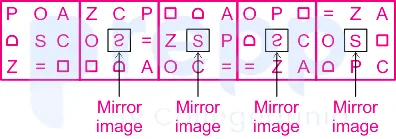
Question 1archived
‘A @ B’ means ‘A is the husband of B’.
‘A & B’ means ‘A is the mother of B’.
‘A # B’ means ‘B is the daughter of A’.
If G # H & I @ J & K, then how is H related to J?
- A
Mother
- B
Brother
- C
Sister
- D
Mother-in-law
Show answer
D. Mother-in-lawUnderstanding Blood Relation Symbols
In blood relation questions, specific symbols are used to represent different relationships between individuals. It is crucial to first understand what each symbol signifies.
‘A @ B’ means ‘A is the husband of B’. This implies B is the wife of A.
‘A & B’ means ‘A is the mother of B’. This implies B is the child of A.
‘A # B’ means ‘B is the daughter of A’. This implies A is the parent of B, and B is female.
Decoding the Blood Relation Expression: G # H & I @ J & K
Let's break down the given expression step by step to determine the relationships:
The expression is: G # H & I @ J & K
We analyze it segment by segment:
G # H: Using the rule ‘A # B’ means ‘B is the daughter of A’, this means ‘H is the daughter of G’. From this, we know H is female, and G is her parent (either father or mother).
H & I: Using the rule ‘A & B’ means ‘A is the mother of B’, this means ‘H is the mother of I’. Since H is the mother of I, we confirm H is female, which matches the previous step. I is the child of H.
I @ J: Using the rule ‘A @ B’ means ‘A is the husband of B’, this means ‘I is the husband of J’. From this, we know I is male, and J is his wife (female).
J & K: Using the rule ‘A & B’ means ‘A is the mother of B’, this means ‘J is the mother of K’. From this, we know K is the child of J. Since J is the wife of I, K is also the child of I.
Determining the Relationship: H to J
We want to find out how H is related to J based on the decoded relationships:
From step 2, we know that H is the mother of I.
From step 3, we know that I is the husband of J.
Combining these two facts:
H is the mother of I, and I is the husband of J. This means H is the mother of J's husband.
The mother of one's husband is known as the Mother-in-law.
Therefore, H is the mother-in-law of J.
Final Answer Relationship
Based on the analysis of the given expression and symbols, H is related to J as her mother-in-law.
Revision Table: Blood Relation Symbols
Symbol
Relationship Meaning
@
A is husband of B
&
A is mother of B
#
B is daughter of A
Additional Information: Understanding Blood Relation Concepts
Blood relation problems often require you to build a family tree or diagram based on the given coded relationships. Key concepts include:
Generations: Identifying individuals belonging to the same generation (siblings, cousins), the generation above (parents, aunts, uncles), or the generation below (children, nephews, nieces).
Gender Identification: Determining the gender of each individual based on the relationship definitions. For example, 'husband' implies male, 'wife' implies female, 'mother' implies female, 'father' implies male, 'son' implies male, 'daughter' implies female. Some relationships like 'parent' or 'child' might not initially specify gender unless stated otherwise or deduced from other relations.
Tracing the Path: To find the relationship between two individuals, trace the connections through the chain of relationships provided in the expression.
In-law Relationships: These relationships are formed through marriage (e.g., mother-in-law, father-in-law, brother-in-law, sister-in-law).
Practicing various types of blood relation puzzles helps in quickly decoding the symbols and tracing the relationships accurately.
Paper & answer key PDF ↗ Question 2archived
Select the correct mirror image of the given combination when the mirror is placed at line 'MN' as shown.
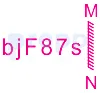
- A
Option A (shown in image)
- B
Option B (shown in image)
- C
Option C (shown in image)
- D
Option D (shown in image)
Show answer
Question 3archived
Select the set in which the numbers are related in the same way as are the numbers of the following sets.
(NOTE: Operations should be performed on the whole numbers, without breaking down the numbers into its constituent digits. E.g. 13 – Operations on 13 such as adding/subtracting / multiplying etc. to 13 can be performed. Breaking down 13 into 1 and 3 and then performing mathematical operations on 1 and 3 is not allowed)
(40, 120, 400)
(18, 20, 78)
- A
(29, 23, 98)
- B
(56, 14, 108)
- C
(25, 27, 92)
- D
(11, 720, 660)
Show answer
A. (29, 23, 98)The correct answer is (29, 23, 98).
Trial and Error: Often, trying out simple relationships first (like $a+b=c$, $a \times b = c$, $a^2+b^2=c$, $ka+lb=c$, etc.) is the quickest way to find the pattern. System of Equations: If the relationship seems linear ($ka+lb=c$), using two given sets allows you to set up a system of equations to solve for the unknown coefficients ($k$ and $l$). Practice: Solving various types of number pattern questions helps in quickly recognizing common relationships.
Paper & answer key PDF ↗ Question 4archived
Select the figure that will come next in the following figure series.

- A
Option A (shown in image)
- B
Option B (shown in image)
- C
Option C (shown in image)
- D
Option D (shown in image)
Show answer
B. Option B (shown in image)The pattern followed here is:
1) Given figure is rotated 45º degree anticlockwise direction.
Hence, the correct answer is "Option 2".
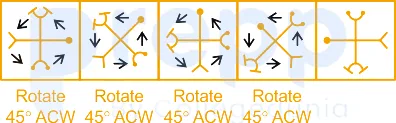 Paper & answer key PDF ↗
 Question 5archived
Select the number from among the given options that can replace the question mark (?) in the following series.
5, 10, 17, 26, 37, 50, ?
- A
58
- B
65
- C
76
- D
54
Show answer
B. 65Solving Number Series Questions
Let's analyze the given number series: 5, 10, 17, 26, 37, 50, ? We need to find the pattern to determine the next number in this number series.
Analyzing the Pattern in the Series
We can look at the differences between consecutive terms in the series to identify a pattern.
Difference between the 2nd term (10) and the 1st term (5): \(10 - 5 = 5\)
Difference between the 3rd term (17) and the 2nd term (10): \(17 - 10 = 7\)
Difference between the 4th term (26) and the 3rd term (17): \(26 - 17 = 9\)
Difference between the 5th term (37) and the 4th term (26): \(37 - 26 = 11\)
Difference between the 6th term (50) and the 5th term (37): \(50 - 37 = 13\)
Let's list the differences we found:
5, 7, 9, 11, 13
Identifying the Pattern in Differences
Now, let's look at the pattern in these differences. We can find the difference between these differences:
Difference between the 2nd difference (7) and the 1st difference (5): \(7 - 5 = 2\)
Difference between the 3rd difference (9) and the 2nd difference (7): \(9 - 7 = 2\)
Difference between the 4th difference (11) and the 3rd difference (9): \(11 - 9 = 2\)
Difference between the 5th difference (13) and the 4th difference (11): \(13 - 11 = 2\)
The differences between consecutive terms (the first differences) form a series where each term is 2 greater than the previous term. This is a consistent pattern. The sequence of differences is increasing by 2 each time.
Finding the Next Term in the Number Series
Following this pattern of differences, the next difference in the series 5, 7, 9, 11, 13 should be \(13 + 2 = 15\).
This next difference (15) is what we need to add to the last term of the original series (50) to get the next number.
Next term = Last term + Next difference
Next term = \(50 + 15\)
Next term = \(65\)
Therefore, the number that replaces the question mark (?) in the series is 65.
Term Number
Term Value
Difference from Previous Term
1
5
-
2
10
\(10 - 5 = 5\)
3
17
\(17 - 10 = 7\)
4
26
\(26 - 17 = 9\)
5
37
\(37 - 26 = 11\)
6
50
\(50 - 37 = 13\)
7
?
Next difference is \(13 + 2 = 15\)
The next term is \(50 + 15 = 65\).
Revision Table: Number Series Patterns
Type of Pattern
Description
Example
Arithmetic Series
Constant difference between consecutive terms.
2, 4, 6, 8... (Difference +2)
Geometric Series
Constant ratio between consecutive terms.
3, 9, 27, 81... (Ratio x3)
Second-Order Difference Series
The differences between consecutive terms form an arithmetic series. (Like the current problem)
5, 10, 17, 26... (Differences 5, 7, 9...)
Fibonacci Series
Each term is the sum of the two preceding ones.
0, 1, 1, 2, 3, 5, 8...
Additional Information: How to Solve Number Series Questions
Solving number series problems often involves finding the underlying rule or pattern. Here are common strategies:
Look for Differences: Calculate the differences between consecutive terms. If the differences are constant, it's an arithmetic series. If the differences form another simple pattern (like an arithmetic series themselves, as in this problem), it's a higher-order difference series.
Look for Ratios: Divide each term by the previous term. If the ratio is constant, it's a geometric series.
Look for Alternating Patterns: Sometimes patterns alternate (e.g., +2, -1, +2, -1).
Look for Squares or Cubes: The terms might be related to square numbers ($n^2$), cube numbers ($n^3$), or these numbers plus/minus a constant.
Combine Operations: The pattern might involve a combination of operations (e.g., multiply by 2 and add 1).
Consider Position Number: The pattern might relate to the position of the term in the series (e.g., the nth term is $2n+1$).
For this specific number series problem, finding the differences was the key to uncovering the pattern and solving the question.
Paper & answer key PDF ↗ Question 6archived
In the following question below are given some statements followed by some conclusions based on those statements. Taking the given statements to be true even if they seem to be at variance from commonly known facts. Read all the conclusions and then decide which of the given conclusion logically follows the given statements.
Statements:
I. Some white are car.
II. No truck is car.
Conclusion:
I. All truck are white.
II. Some car are white.
- A
Only conclusion II follows
- B
Neither conclusion follows
- C
Only conclusion I follows
- D
Both conclusions I and II follows
Show answer
A. Only conclusion II followsUnderstanding the Syllogism Statements
We are given two statements and two conclusions. Our task is to determine which conclusion logically follows from the statements, assuming the statements are true.
Statement I: Some white are car.
This statement indicates that there is an overlap between the group 'white things' and the group 'cars'. At least one car is white, or at least one white thing is a car.
Statement II: No truck is car.
This statement means that the group 'trucks' and the group 'cars' are completely separate. There is no member that belongs to both groups.
Analyzing the Conclusions
Conclusion I: All truck are white.
Let's analyze if this conclusion logically follows:
Statement I tells us about the relationship between 'white' and 'car'.
Statement II tells us that 'trucks' and 'cars' are entirely separate groups.
We know that trucks are not cars, and some white things are cars. However, these statements do not provide any information linking 'trucks' directly to 'white' in a way that forces *all* trucks to be white. It's possible that some trucks are white, some are not, or none are. The given statements don't allow us to definitively conclude that all trucks are white.
Therefore, Conclusion I does not logically follow from the statements.
Conclusion II: Some car are white.
Let's analyze if this conclusion logically follows:
Statement I explicitly states, "Some white are car".
This statement directly implies that there are items that belong to both the 'car' category and the 'white' category.
If we reverse the perspective, it means that some members of the 'car' group are also members of the 'white' group.
Therefore, the conclusion "Some car are white" is a direct and logical consequence of Statement I.
Final Verdict on Logical Following
Based on the analysis:
Conclusion I (All truck are white) does not logically follow from the given statements.
Conclusion II (Some car are white) logically follows from Statement I.
Thus, only Conclusion II follows.
Paper & answer key PDF ↗ Question 7archived
Select the option that is related to the third term in the same way as the second term is related to the first term and the sixth term is related to the fifth term.
24 : 840 :: 27 : ? :: 33 : 1452
- A
756
- B
297
- C
1026
- D
729
Show answer
C. 1026The correct answer is 1026.
If it works, apply it to the second given pair to see if it holds. Apply to the Unknown: Once a consistent rule is found across the known pairs, apply it to the term with the unknown to find the missing number. Check Options: Verify if your calculated missing number is one of the provided options. Practice with various types of number analogies helps improve speed and accuracy in recognizing patterns.
Paper & answer key PDF ↗ Question 8archived
Four letter-clusters have been given out of which three are alike in some manner and one is different. Select the one that is different.
- A
MPT
- B
FIM
- C
GJN
- D
DGI
Show answer
D. DGIFinding the Different Letter Cluster Pattern
This question asks us to identify the letter cluster that is different from the other three. To solve this type of problem, we usually look for a pattern in the sequence of letters within each cluster. A common way to find the pattern is by using the position of each letter in the English alphabet (A=1, B=2, C=3, and so on).
Analyzing Each Letter Cluster
Let's find the alphabetical position for each letter in the given clusters:
Cluster
First Letter
Second Letter
Third Letter
MPT
M (13)
P (16)
T (20)
FIM
F (6)
I (9)
M (13)
GJN
G (7)
J (10)
N (14)
DGI
D (4)
G (7)
I (9)
Now, let's examine the difference in alphabetical positions between consecutive letters in each cluster to find the pattern.
MPT:
Position difference between P and M: $\text{16} - \text{13} = \text{+3}$
Position difference between T and P: $\text{20} - \text{16} = \text{+4}$
The pattern for MPT is +3, +4.
FIM:
Position difference between I and F: $\text{9} - \text{6} = \text{+3}$
Position difference between M and I: $\text{13} - \text{9} = \text{+4}$
The pattern for FIM is +3, +4.
GJN:
Position difference between J and G: $\text{10} - \text{7} = \text{+3}$
Position difference between N and J: $\text{14} - \text{10} = \text{+4}$
The pattern for GJN is +3, +4.
DGI:
Position difference between G and D: $\text{7} - \text{4} = \text{+3}$
Position difference between I and G: $\text{9} - \text{7} = \text{+2}$
The pattern for DGI is +3, +2.
Identifying the Different Cluster
We can see that the first three letter clusters (MPT, FIM, and GJN) follow the same pattern of increasing alphabetical position by +3 and then +4. The letter cluster DGI follows a different pattern, increasing by +3 and then +2.
Therefore, the letter cluster that is different is DGI.
Revision Table: Alphabetical Positions
It is helpful to know the alphabetical positions of letters when solving these types of letter series and letter cluster problems.
Letter
Position
Letter
Position
Letter
Position
A
1
J
10
S
19
B
2
K
11
T
20
C
3
L
12
U
21
D
4
M
13
V
22
E
5
N
14
W
23
F
6
O
15
X
24
G
7
P
16
Y
25
H
8
Q
17
Z
26
I
9
R
18
Additional Information on Letter Series Patterns
Apart from looking at the difference in alphabetical positions, other patterns in letter series or clusters can include:
Skipping a fixed number of letters.
Letters being in reverse alphabetical order.
Vowel/consonant patterns.
Sum or difference of letter positions following a sequence (e.g., arithmetic or geometric progression).
Combination of letter patterns and number patterns (if numbers are included).
Patterns related to symmetry or structure of letters.
Always check for these different types of patterns when solving letter-based reasoning questions.
Paper & answer key PDF ↗ Question 9archived
In a certain code language, ‘ADVANCE’ is written as ‘VDAAECN’ and ‘BABYSIT’ is written as ‘BABYTIS’. How will ‘AFFABLE’ be written in that language?
- A
FFAALEB
- B
FFAAELB
- C
FFAAEBL
- D
AAFFELB
Show answer
B. FFAAELBThis question is a classic example of a coding-decoding problem where the letters of a word are rearranged according to a specific rule or pattern. To solve this, we need to analyze the given examples to identify the underlying logic of the transformation.
Understanding the Word Coding Logic
We are given two examples of words being coded:
ADVANCE is coded as VDAAECN
BABYSIT is coded as BABYTIS
Let's examine the first example, ADVANCE (7 letters) and its code VDAAECN (7 letters). Since the number of letters is the same, the coding likely involves rearranging the letters.
Analyzing the First Example: ADVANCE to VDAAECN
Let's assign positions to the letters in the original word ADVANCE:
Original Word
A
D
V
A
N
C
E
Position
1
2
3
4
5
6
7
Now, let's look at the coded word VDAAECN and see where each letter from the original word ends up:
Coded Word
V
D
A
A
E
C
N
Position
1
2
3
4
5
6
7
Comparing the positions of the letters:
The letter 'A' at original position 1 moves to coded position 4.
The letter 'D' at original position 2 stays at coded position 2.
The letter 'V' at original position 3 moves to coded position 1.
The letter 'A' at original position 4 moves to coded position 3.
The letter 'N' at original position 5 moves to coded position 7.
The letter 'C' at original position 6 stays at coded position 6.
The letter 'E' at original position 7 moves to coded position 5.
We can summarize this as a mapping of original positions to coded positions:
Original Position
1
2
3
4
5
6
7
Coded Position
4
2
1
3
7
6
5
This means the letter that was originally at position 1 goes to position 4 in the code, the letter at position 2 goes to position 2, the letter at position 3 goes to position 1, and so on.
Verifying the Logic with the Second Example: BABYSIT to BABYTIS
Let's apply this positional mapping rule to the second word, BABYSIT:
Original Word
B
A
B
Y
S
I
T
Position
1
2
3
4
5
6
7
Using the rule (Original Pos $\rightarrow$ Coded Pos): 1$\rightarrow$4, 2$\rightarrow$2, 3$\rightarrow$1, 4$\rightarrow$3, 5$\rightarrow$7, 6$\rightarrow$6, 7$\rightarrow$5, let's place the original letters into their new coded positions:
Letter at original position 1 ('B') goes to coded position 4.
Letter at original position 2 ('A') goes to coded position 2.
Letter at original position 3 ('B') goes to coded position 1.
Letter at original position 4 ('Y') goes to coded position 3.
Letter at original position 5 ('S') goes to coded position 7.
Letter at original position 6 ('I') goes to coded position 6.
Letter at original position 7 ('T') goes to coded position 5.
Constructing the coded word based on these placements:
Position 1 (from original 3): B
Position 2 (from original 2): A
Position 3 (from original 4): Y
Position 4 (from original 1): B
Position 5 (from original 7): T
Position 6 (from original 6): I
Position 7 (from original 5): S
The coded word formed is BABYTIS, which exactly matches the given coded word for BABYSIT. This confirms that the positional mapping rule (1$\rightarrow$4, 2$\rightarrow$2, 3$\rightarrow$1, 4$\rightarrow$3, 5$\rightarrow$7, 6$\rightarrow$6, 7$\rightarrow$5) is correct.
Applying the Rule to AFFABLE
Now, let's apply the same rule to the word AFFABLE (7 letters).
Original Word
A
F
F
A
B
L
E
Position
1
2
3
4
5
6
7
Using the established positional mapping (Original Pos $\rightarrow$ Coded Pos): 1$\rightarrow$4, 2$\rightarrow$2, 3$\rightarrow$1, 4$\rightarrow$3, 5$\rightarrow$7, 6$\rightarrow$6, 7$\rightarrow$5, let's find the letters for each coded position:
Coded Position 1 gets the letter from Original Position 3: F
Coded Position 2 gets the letter from Original Position 2: F
Coded Position 3 gets the letter from Original Position 4: A
Coded Position 4 gets the letter from Original Position 1: A
Coded Position 5 gets the letter from Original Position 7: E
Coded Position 6 gets the letter from Original Position 6: L
Coded Position 7 gets the letter from Original Position 5: B
Arranging these letters in the coded positions (1 to 7) gives us the coded word:
Coded Position
1
2
3
4
5
6
7
Letter
F
F
A
A
E
L
B
The coded word for AFFABLE is FFAAELB.
Comparing with Options
Let's compare our result FFAAELB with the given options:
Option 1: FFAALEB
Option 2: FFAAELB
Option 3: FFAAEBL
Option 4: AAFFELB
Our calculated coded word FFAAELB matches Option 2.
Step-by-Step Solution
Analyze the transformation from ADVANCE to VDAAECN to find the positional mapping rule for each letter.
Identify the rule: Original positions (1 2 3 4 5 6 7) map to coded positions (4 2 1 3 7 6 5).
Verify this rule using the second example, BABYSIT to BABYTIS, and confirm it produces the correct coded word.
Apply the identified positional mapping rule to the word AFFABLE.
Determine which original letter goes to which coded position based on the rule.
Assemble the letters in the order of the coded positions (1 through 7).
The resulting coded word for AFFABLE is FFAAELB.
Revision Table: Key Concepts in Word Coding
Concept
Description
Example Type
Letter Shifting
Each letter is replaced by a letter a fixed number of positions away in the alphabet (e.g., Caesar cipher).
A $\rightarrow$ C, B $\rightarrow$ D (shift by +2)
Letter Reversal
The order of letters in the word or parts of the word is reversed.
WORD $\rightarrow$ DROW
Positional Rearrangement
Letters are moved to new positions based on a specific pattern or mapping of indices.
As in this problem (1234567 $\rightarrow$ 4213765)
Substitution
Each letter is replaced by a different letter or symbol according to a fixed table.
A $\rightarrow$ @, B $\rightarrow$ #
Mixed Logic
A combination of the above rules applied in sequence or to different parts of the word.
First half reversed, second half shifted.
Additional Information: Logic Puzzles in Coding-Decoding
Coding-decoding questions are common in logical reasoning sections of various exams. They test your ability to identify patterns and rules hidden in the transformation of words, letters, or numbers. The key to solving these puzzles is careful observation and systematic analysis of the given examples.
Always look for consistency in the pattern across all provided examples.
Consider different types of logic: letter substitution, positional changes, or arithmetic operations (for number/symbol coding).
Break down complex transformations into simpler steps if possible.
Practice with various types of coding-decoding problems to recognize common patterns quickly.
In this specific problem, the logic was a consistent positional rearrangement rule applied to all letters in the word, regardless of the letter itself.
Paper & answer key PDF ↗ Question 10archived
Select the option figure that is embedded in the given figure. (Rotation is not allowed.)

- A
Option A (shown in image)
- B
Option B (shown in image)
- C
Option C (shown in image)
- D
Option D (shown in image)
Show answer
C. Option C (shown in image)The pattern followed here is:
Hence, the correct answer is "Option 3".
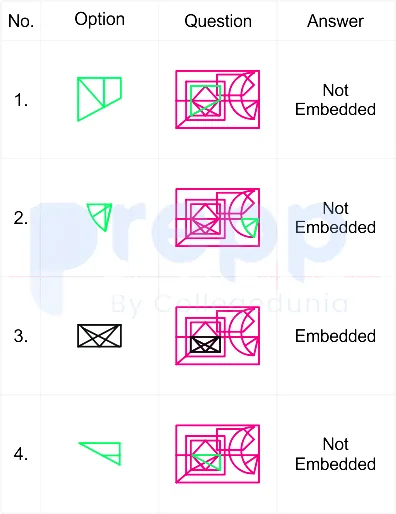 Paper & answer key PDF ↗
 Question 11archived
Select the option that is related to the fifth letter-cluster in the same way as the second letter-cluster is related to the first letter-cluster and the fourth letter-cluster is related to the third letter-cluster.
BEAR : DFCS :: FEEL : HFGM :: MANY : ?
- A
OBPY
- B
OCPZ
- C
OBPZ
- D
OBQZ
Show answer
C. OBPZSolving Letter-Cluster Analogies
This question asks us to find the letter-cluster that relates to 'MANY' in the same way that 'BEAR' relates to 'DFCS' and 'FEEL' relates to 'HFGM'. This type of problem is based on letter-based analogies, where we need to identify the pattern or rule connecting the letter-clusters in the given pairs and apply that rule to the new cluster.
Analyzing the First Letter-Cluster Analogy: BEAR to DFCS
Let's look at how each letter in 'BEAR' changes to become the corresponding letter in 'DFCS'. We can determine the position of each letter in the English alphabet (A=1, B=2, C=3, ... Z=26).
B (2) to D (4): The position changes from 2 to 4, which is an increase of 2 (2 + 2 = 4).
E (5) to F (6): The position changes from 5 to 6, which is an increase of 1 (5 + 1 = 6).
A (1) to C (3): The position changes from 1 to 3, which is an increase of 2 (1 + 2 = 3).
R (18) to S (19): The position changes from 18 to 19, which is an increase of 1 (18 + 1 = 19).
The pattern observed for the first pair 'BEAR : DFCS' is a sequential increase in the alphabetical position of the letters: +2, +1, +2, +1.
Analyzing the Second Letter-Cluster Analogy: FEEL to HFGM
Now, let's check if the same pattern applies to the second pair 'FEEL : HFGM'.
F (6) to H (8): The position changes from 6 to 8, an increase of 2 (6 + 2 = 8).
E (5) to F (6): The position changes from 5 to 6, an increase of 1 (5 + 1 = 6).
E (5) to G (7): The position changes from 5 to 7, an increase of 2 (5 + 2 = 7).
L (12) to M (13): The position changes from 12 to 13, an increase of 1 (12 + 1 = 13).
The pattern +2, +1, +2, +1 is consistent for the second pair 'FEEL : HFGM' as well.
Applying the Pattern to the Fifth Letter-Cluster: MANY
Since the pattern is consistently +2, +1, +2, +1, we will apply this rule to the letter-cluster 'MANY' to find the related cluster.
M (13) + 2: The letter 2 positions after M is O (15).
A (1) + 1: The letter 1 position after A is B (2).
N (14) + 2: The letter 2 positions after N is P (16).
Y (25) + 1: The letter 1 position after Y is Z (26).
Applying the pattern +2, +1, +2, +1 to 'MANY' gives us the letter-cluster 'OBPZ'.
Summary of the Analogy Pattern
We can summarize the pattern using a table:
Position
1st Letter
2nd Letter
3rd Letter
4th Letter
Rule
+2
+1
+2
+1
BEAR → DFCS
B(+2)→D
E(+1)→F
A(+2)→C
R(+1)→S
FEEL → HFGM
F(+2)→H
E(+1)→F
E(+2)→G
L(+1)→M
MANY → ?
M(+2)→O
A(+1)→B
N(+2)→P
Y(+1)→Z
The resulting letter-cluster related to 'MANY' is 'OBPZ'.
Comparing with Options
Let's compare our result 'OBPZ' with the given options:
OBPY
OCPZ
OBPZ
OBQZ
Our calculated letter-cluster 'OBPZ' matches option 3.
Revision Table: Letter Analogies
Concept
Description
Example Applied Here
Letter Analogy
Finding a relationship (often based on alphabetical position shifts) between pairs of letter-clusters.
BEAR:DFCS and FEEL:HFGM establish the relationship for MANY:?.
Pattern Identification
Analyzing changes between corresponding letters in the first pair to find a rule.
Identifying the +2, +1, +2, +1 shift pattern from BEAR to DFCS.
Pattern Verification
Checking if the identified pattern holds true for the second given pair.
Confirming the +2, +1, +2, +1 pattern works for FEEL to HFGM.
Pattern Application
Applying the confirmed pattern to the third given element to find the missing element.
Applying +2, +1, +2, +1 to MANY to get OBPZ.
Additional Information: Reasoning with Letter Sequences
Letter sequence and analogy questions are common in reasoning tests. They require careful observation and systematic analysis. Here are some other common patterns you might encounter:
Simple Shifts: Adding or subtracting a fixed number to each letter's position (e.g., ABC → DEF is +3 for each letter).
Alternating Shifts: The shift value alternates between letters (e.g., +1, +2, +1, +2...). This is similar to the pattern in our problem.
Skipping Letters: The pattern might involve skipping a certain number of letters in the alphabet (e.g., A → D skips B, C; B → E skips C, D). This is equivalent to position shifts.
Reverse Order: Letters might be written in reverse alphabetical order or the whole cluster might be reversed before applying a rule.
Vowel/Consonant Rules: Different rules might apply to vowels and consonants within the cluster.
Combination of Rules: More complex patterns can involve a mix of the above, sometimes with different rules applied to different positions or types of letters.
Solving these problems often involves writing down the alphabetical positions of the letters and looking for mathematical relationships or consistent positional shifts.
Paper & answer key PDF ↗ Question 12archived
Select the option that represents the correct order of the given words as they would appear in an English dictionary.
1. Inundate
2. Invidious
3. Individual
4. Inveterate
5. Invective
6. Invincible
7. Inviolable
- A
1, 5, 4, 2, 3, 6, 7
- B
1, 5, 3, 4, 2, 6, 7
- C
3, 1, 5, 4, 2, 6, 7
- D
3, 1, 5, 4, 6, 2, 7
Show answer
C. 3, 1, 5, 4, 2, 6, 7Understanding Dictionary Order for Word Arrangement
Arranging words in dictionary order, also known as alphabetical order, involves comparing the words letter by letter from left to right. The word that comes first in the alphabet at the first point of difference will be placed earlier.
Let's analyze the given words and arrange them according to standard English dictionary rules:
Inundate
Invidious
Individual
Inveterate
Invective
Invincible
Inviolable
We will compare the words letter by letter:
All words start with 'I'.
All words start with 'In'.
All words start with 'Inv'.
Let's look at the fourth letter:
Word No.
Word
Fourth Letter
1
Inundate
u
2
Invidious
i
3
Individual
d
4
Inveterate
e
5
Invective
e
6
Invincible
i
7
Inviolable
i
Comparing the fourth letters ('u', 'i', 'd', 'e', 'e', 'i', 'i'), the order is 'd', 'e', 'i', 'u'.
Based on the fourth letter:
'd' comes first: Individual (3)
Then 'e': Inveterate (4), Invective (5)
Then 'i': Invidious (2), Invincible (6), Inviolable (7)
Then 'u': Inundate (1)
So far, the order starts with 3, followed by words starting with 'Inve', then 'Invi', and finally 1. This suggests 3 comes first, and 1 comes after all 'Inv-' words.
Let's refine the order:
Comparing words starting with 'Inve' (4 and 5):
Inveterate (4)
Invective (5)
'c' comes before 't'. So, Invective (5) comes before Inveterate (4).
Current order progress: 3, 5, 4, ...
Comparing words starting with 'Invi' (2, 6, and 7):
Invidious (2)
Invincible (6)
Inviolable (7)
Comparing the sixth letters ('d', 'n', 'o'), the order is 'd', 'n', 'o'.
'd' comes first: Invidious (2)
Then 'n': Invincible (6)
Then 'o': Inviolable (7)
So, the order for these three is 2, 6, 7.
Placing these segments together, and remembering that Inundate (1) comes after all 'Inv-' words (based on the fourth letter 'u' coming after 'v' in 'Inv'):
The overall dictionary order is:
Individual (3)
Invective (5)
Inveterate (4)
Invidious (2)
Invincible (6)
Inviolable (7)
Inundate (1)
Wait, rechecking the initial comparison on the fourth letter: 'd' comes before 'u' which comes before 'v'.
'd': Individual (3)
'u': Inundate (1)
'v': Invidious (2), Inveterate (4), Invective (5), Invincible (6), Inviolable (7)
So, the correct first two words are Individual (3) and Inundate (1).
Now, let's order the 'Inv-' words:
Inveterate (4)
Invective (5)
Invidious (2)
Invincible (6)
Inviolable (7)
Comparing the fifth letter:
Inv**e**: Inveterate (4), Invective (5)
Inv**i**: Invidious (2), Invincible (6), Inviolable (7)
Words starting with 'Inve' come before 'Invi'.
Ordering 'Inve' words (4 and 5):
Inveterate (4)
Invective (5)
'c' comes before 't'. So Invective (5) is before Inveterate (4).
Ordering 'Invi' words (2, 6, and 7):
Invidious (2)
Invincible (6)
Inviolable (7)
'd' comes before 'n' which comes before 'o'. So the order is Invidious (2), Invincible (6), Inviolable (7).
Combining all parts in the correct sequence:
Individual (3) - based on 'd' being the first differing letter
Inundate (1) - based on 'u' being the next differing letter
Invective (5) - 'Inve' comes before 'Invi', and 'c' is before 't'
Inveterate (4) - 'Inve' comes before 'Invi', and 't' is after 'c'
Invidious (2) - 'Invi' words start with 'd'
Invincible (6) - 'Invi' words continue with 'n'
Inviolable (7) - 'Invi' words end with 'o'
The correct order of the word numbers is 3, 1, 5, 4, 2, 6, 7.
Let's represent this in a table for clarity:
Order
Word No.
Word
1
3
Individual
2
1
Inundate
3
5
Invective
4
4
Inveterate
5
2
Invidious
6
6
Invincible
7
7
Inviolable
Comparing this order with the given options, we find that option 3 (3, 1, 5, 4, 2, 6, 7) matches our derived sequence.
Revision Table: Dictionary Order Practice
Concept
Key Rule
Example
Alphabetical Order
Compare words letter by letter from left to right.
Cat, Dog, Apple → Apple, Cat, Dog
Tie-breaking
If initial letters are the same, move to the next letter.
Apply, Apple → Apple, Apply ('p' is same, compare 'l' and 'p')
Shorter Word
If one word is a prefix of another, the shorter word comes first.
In, Inside → In, Inside
Additional Information: Expanding Vocabulary and Sorting
Understanding dictionary order is crucial for quick referencing and improving vocabulary. It's also a fundamental concept in computer science for sorting algorithms.
Lexicographical Order: This is the formal term for alphabetical order, applied not just to words but any sequence of comparable elements.
Prefixes and Suffixes: Knowing common prefixes (like 'In-', 'Ex-', 'Pre-') and suffixes ('-ing', '-able', '-ous') can sometimes help in grouping words mentally, although the letter-by-letter comparison is the definitive method for dictionary order.
Root Words: Identifying root words can help understand the meaning of related words, but the dictionary order depends strictly on spelling.
Practicing with lists of words helps improve speed and accuracy in determining dictionary order, a common skill tested in various exams.
Paper & answer key PDF ↗ Question 13archived
If A + B means that A is the brother of B, A × B means that A is the sister of B, A ÷ B means that A is the father of B then which of the following expression shows that P is the sister of R?
- A
P + Q + R
- B
P + Q × R
- C
P × Q ÷ R
- D
P × Q + R
Show answer
D. P × Q + RUnderstanding Blood Relation Codes
In blood relation problems like this, specific symbols are used to represent different family relationships. We need to understand what each symbol means to solve the problem. The given codes are:
Symbol
Represents
+
Brother
×
Sister
÷
Father
The question asks which expression shows that P is the sister of R. We will analyze each given expression based on these codes to find the relationship between P and R.
Analyzing Each Option for Blood Relation
Let's break down each option step by step to determine the relationship between P and R.
Option 1: P + Q + R Analysis
P + Q means P is the brother of Q.
Q + R means Q is the brother of R.
If P is the brother of Q, and Q is the brother of R, then P is also the brother of R. This does not show P as the sister of R.
Option 2: P + Q × R Analysis
P + Q means P is the brother of Q.
Q × R means Q is the sister of R.
P is the brother of Q, and Q is the sister of R. This means Q is female. P and Q are siblings. Since Q is R's sister, P would be R's brother. This does not show P as the sister of R.
Option 3: P × Q ÷ R Analysis
P × Q means P is the sister of Q.
Q ÷ R means Q is the father of R.
P is the sister of Q, and Q is the father of R. This means Q is male. P is Q's sister. Since Q is R's father, P is R's paternal aunt. This does not show P as the sister of R.
Option 4: P × Q + R Analysis
P × Q means P is the sister of Q.
Q + R means Q is the brother of R.
P is the sister of Q, and Q is the brother of R. This means Q is male. P is Q's sister. Since Q is R's brother, P would be R's sister. This expression correctly shows that P is the sister of R.
Conclusion on Blood Relation Expression
By analyzing each option based on the given symbol codes, we found that the expression P × Q + R leads to P being the sister of R.
Revision Table: Blood Relation Symbols
Here's a quick summary of the symbol meanings:
Symbol
Relation
+
Brother
×
Sister
÷
Father
Additional Information: Solving Blood Relation Problems
Here are some tips for solving blood relation problems using codes:
Always trace the relationship from the first person in the expression towards the last person.
Determine the gender of each person involved if the relation indicates it (e.g., brother implies male, sister implies female, father implies male).
Build a mental picture or draw a quick family tree as you analyze the expression step by step.
Pay close attention to the direction of the relationship (e.g., A is brother of B is different from B is brother of A).
Paper & answer key PDF ↗ Question 14archived
Which letter cluster will replace the question mark (?) to complete the given series?
NAME, NEME, ?, NOME, NUME
- A
NMME
- B
NKME
- C
NIME
- D
NJME
Show answer
C. NIMESolving the Letter Cluster Series: NAME, NEME, ?, NOME, NUME
This question asks us to identify the letter cluster that should replace the question mark (?) to complete the given series: NAME, NEME, ?, NOME, NUME.
To solve this type of series question, we need to carefully observe the pattern of change from one term to the next.
Analyzing the Pattern in the Letter Series
Let's look at each letter position in the clusters:
First letter: N, N, ?, N, N - The first letter is consistently 'N'.
Second letter: A, E, ?, O, U - The second letter is changing.
Third letter: M, M, ?, M, M - The third letter is consistently 'M'.
Fourth letter: E, E, ?, E, E - The fourth letter is consistently 'E'.
From this analysis, we can see that the first, third, and fourth letters (N, M, E) remain the same throughout the series. The pattern lies in the second letter.
Identifying the Pattern of the Second Letter
The sequence of the second letters is A, E, ?, O, U.
Let's think about familiar sequences of letters. The sequence A, E, I, O, U is the sequence of vowels in the English alphabet.
Comparing the second letter sequence (A, E, ?, O, U) with the sequence of vowels (A, E, I, O, U), it becomes clear that the missing letter is 'I'.
Completing the Series
Since the first letter is N, the second letter follows the vowel pattern and is I, the third letter is M, and the fourth letter is E, the missing letter cluster is formed by combining these letters:
N + I + M + E = NIME
So, the complete series is NAME, NEME, NIME, NOME, NUME.
Let's verify this against the options provided.
Checking the Options
Option 1: NMME - The second letter is M, which does not fit the vowel pattern.
Option 2: NKME - The second letter is K, which does not fit the vowel pattern.
Option 3: NIME - The second letter is I, which fits the vowel pattern (A, E, I, O, U).
Option 4: NJME - The second letter is J, which does not fit the vowel pattern.
The letter cluster NIME fits the identified pattern.
Conclusion
By analyzing the structure of the letter clusters and identifying the sequential pattern in the second letter (vowels A, E, I, O, U), we determined that the missing term in the series is NIME.
Revision Table: Letter Series Pattern
Term
1st Letter
2nd Letter
3rd Letter
4th Letter
Pattern (2nd Letter)
NAME
N
A
M
E
1st Vowel
NEME
N
E
M
E
2nd Vowel
?
N
I
M
E
3rd Vowel
NOME
N
O
M
E
4th Vowel
NUME
N
U
M
E
5th Vowel
Additional Information: Solving Letter Series Questions
Letter series problems in reasoning tests require you to find the logical rule that connects the terms. Common patterns include:
Alphabetical position (e.g., A=1, B=2).
Skipping letters (e.g., A, C, E...).
Vowel/Consonant sequence.
Reversed alphabetical order.
Combination of different patterns for different letter positions within a term (as seen in this example).
Patterns based on adding or subtracting fixed values to the alphabetical positions.
A good strategy is to look at the difference or relationship between consecutive terms. If the terms are clusters or words, analyze each letter position separately to find individual patterns.
Paper & answer key PDF ↗ Question 15archived
Which figure should replace the question mark (?) if the series were to be continued?

- A
Option A (shown in image)
- B
Option B (shown in image)
- C
Option C (shown in image)
- D
Option D (shown in image)
Show answer
Question 16archived
Select the correct combination of mathematical signs to sequentially replace the* signs and balance the given equation.
35 * 5 * 7 * 2 * 19 = 42
- A
×, ÷, -, +
- B
÷, ×, +, +
- C
+, -, +, -
- D
÷, ×, -, -
Show answer
A. ×, ÷, -, +Solving Equation Balancing Problems with Mathematical Signs
The question asks us to find the correct combination of mathematical signs (+, -, ×, ÷) that, when substituted sequentially into the expression 35 * 5 * 7 * 2 * 19, makes the equation equal to 42.
To solve this type of equation balancing problem, we need to test each option by replacing the asterisks (*) with the given sequence of signs and then perform the calculation following the standard order of operations (BODMAS/PEMDAS: Brackets, Orders, Division and Multiplication, Addition and Subtraction).
Step-by-Step Calculation for the Correct Combination
Let's test the combination of signs provided in one of the options: ×, ÷, -, +.
Substituting these signs into the equation, we get:
\(35 \times 5 \div 7 - 2 + 19 = 42\)
Now, let's perform the calculation step-by-step following the order of operations:
First, perform multiplication and division from left to right.
Calculate \(35 \times 5\):
\(35 \times 5 = 175\)
Substitute this back into the equation:
\(175 \div 7 - 2 + 19\)
Calculate \(175 \div 7\):
\(175 \div 7 = 25\)
Substitute this back into the equation:
\(25 - 2 + 19\)
Next, perform addition and subtraction from left to right.
Calculate \(25 - 2\):
\(25 - 2 = 23\)
Substitute this back into the equation:
\(23 + 19\)
Calculate \(23 + 19\):
\(23 + 19 = 42\)
So, with the signs ×, ÷, -, +, the expression evaluates to 42. The equation \(35 \times 5 \div 7 - 2 + 19 = 42\) is balanced.
Analyzing Other Options
Let's briefly look at why other options would not balance the equation. We can quickly check the first step (multiplication/division) for some options:
Option 2: ÷, ×, +, + → \(35 \div 5 \times 7 + 2 + 19\). \(35 \div 5 = 7\), then \(7 \times 7 = 49\). The equation becomes \(49 + 2 + 19\), which is clearly not 42.
Option 4: ÷, ×, -, - → \(35 \div 5 \times 7 - 2 - 19\). \(35 \div 5 = 7\), then \(7 \times 7 = 49\). The equation becomes \(49 - 2 - 19\), which is not 42.
Testing each option systematically confirms that only the combination ×, ÷, -, + results in 42.
Revision Table: Equation Balancing Skills
Concept
Description
Importance in Equation Balancing
Order of Operations (BODMAS/PEMDAS)
Rules for the sequence of performing operations: Brackets, Orders (powers/roots), Division and Multiplication (from left to right), Addition and Subtraction (from left to right).
Essential for calculating the value of an expression correctly after substituting signs.
Sequential Substitution
Replacing the placeholders (*) with the given mathematical signs in the exact order they are listed.
Crucial for setting up the correct equation to be solved.
Checking Each Option
Systematically testing every given combination of signs until the equation is balanced.
Necessary to find the correct solution in multiple-choice questions.
Additional Information: Mathematical Operations
Understanding the basic mathematical operations is fundamental to solving these problems:
Multiplication (×): Repeated addition. Example: \(35 \times 5\) means adding 35 five times.
Division (÷): Splitting a number into equal parts. Example: \(175 \div 7\) means finding how many times 7 fits into 175.
Subtraction (-): Finding the difference between two numbers. Example: \(25 - 2\) means taking 2 away from 25.
Addition (+): Combining two or more numbers. Example: \(23 + 19\) means finding the total when 23 and 19 are combined.
Practice with these operations and the order of operations will help you quickly solve equation balancing questions.
Paper & answer key PDF ↗ Question 17archived
A paper is folded and cut as shown below. How will it appear when unfolded?

- A
Option A (shown in image)
- B
Option B (shown in image)
- C
Option C (shown in image)
- D
Option D (shown in image)
Show answer
D. Option D (shown in image)The pattern followed here is:
The unfolding pattern of the paper is shown below step by step.
Hence, the correct answer is "Option 4".
 Paper & answer key PDF ↗
 Question 18archived
Select the set in which the numbers are related in the same way as are the numbers of the following set.
(NOTE: Operations should be performed on the whole numbers, without breaking down the numbers into its constituent digits. E.g., 13 – Operations on 13 such as adding /subtracting /multiplying etc. to 13 can be performed. Breaking down 13 into 1 and 3 and then performing mathematical operations on 1 and 3 is NOT allowed).
(16, 7, 37)
(28, 9, 55)
- A
(19, 6, 36)
- B
(13, 4, 25)
- C
(20, 7, 45)
- D
(23, 8, 48)
Show answer
B. (13, 4, 25)The correct answer is (13, 4, 25).
Considering operations like addition, subtraction, multiplication, division, powers, roots, or a sequence of operations. Checking if the relationship involves constants (like multiplying by 3 in this case) or variables derived from the numbers themselves. Being mindful of any specific constraints provided, such as the rule about not breaking down digits in this problem. Practicing different types of number pattern problems helps improve your ability to quickly identify potential relationships and test them efficiently.
Paper & answer key PDF ↗ Question 19archived
Read the given statement(s) and conclusions carefully. Assuming that the information given in the statements is true, even if it appears to be a variance with commonly known facts, decide which of the given conclusions logically follow(s) from the statement(s).
Statements:
Some stones are cubes.
No cube is a glass.
All bats are cubes.
Conclusions:
I. Some stones being bats is a possibility.
II. No bat is a glass.
III. All cubes are bats.
IV. No stone is a glass.
- A
Only Conclusions I, II and IV follow
- B
Only Conclusions II and III follow
- C
Only Conclusions I and II follow
- D
Only Conclusion I follows
Show answer
C. Only Conclusions I and II followUnderstanding Statement and Conclusion Logic Questions
Statement and Conclusion questions test your ability to draw logical inferences from given statements, assuming the statements are true, regardless of whether they align with real-world facts. The key is to strictly adhere to the information provided in the statements.
Analyzing the Given Statements
We are given the following statements:
Statement 1: Some stones are cubes. (Represents an overlap between the sets of Stones and Cubes)
Statement 2: No cube is a glass. (Represents that the set of Cubes and the set of Glasses are mutually exclusive)
Statement 3: All bats are cubes. (Represents that the set of Bats is entirely contained within the set of Cubes)
We can represent these relationships using Venn diagrams or simple set notation. Let S be the set of Stones, C the set of Cubes, G the set of Glasses, and B the set of Bats.
Statement 1: $S \cap C \neq \emptyset$ (Some overlap between S and C)
Statement 2: $C \cap G = \emptyset$ (No overlap between C and G)
Statement 3: $B \subseteq C$ (B is a subset of C)
Evaluating Each Conclusion
Now, let's examine each conclusion based on the given statements:
Conclusion I: Some stones being bats is a possibility.
From Statement 1, we know some Stones are Cubes ($S \cap C \neq \emptyset$). From Statement 3, we know all Bats are Cubes ($B \subseteq C$). Since there is an overlap between Stones and Cubes, and Bats are located within the Cubes circle/region, it is possible that the region where Stones and Cubes overlap also includes some area where Bats exist. Therefore, it is possible for some stones to be bats. This conclusion is a possibility.
Conclusion II: No bat is a glass.
From Statement 3, all Bats are Cubes ($B \subseteq C$). From Statement 2, no Cube is a Glass ($C \cap G = \emptyset$). Since all Bats are inside the set of Cubes, and the set of Cubes has no overlap with the set of Glasses, it logically follows that the set of Bats also has no overlap with the set of Glasses. Thus, no bat is a glass. This conclusion logically follows.
Conclusion III: All cubes are bats.
Statement 3 says "All bats are cubes" ($B \subseteq C$). This means Bats are a subset of Cubes. The conclusion "All cubes are bats" ($C \subseteq B$) implies that Cubes are a subset of Bats. For both $B \subseteq C$ and $C \subseteq B$ to be true, the sets C and B must be identical ($C = B$). However, Statement 3 only guarantees that Bats are within Cubes; it does not say that Cubes cannot contain anything other than Bats. Therefore, we cannot conclude that all cubes are bats. This conclusion does not necessarily follow.
Conclusion IV: No stone is a glass.
From Statement 1, some stones are cubes ($S \cap C \neq \emptyset$). We know from Statement 2 that no cube is a glass ($C \cap G = \emptyset$). This means the stones that *are* cubes cannot be glasses. However, Statement 1 only talks about *some* stones. It does not give information about the stones that are *not* cubes ($S \setminus C$). These stones that are not cubes could potentially be glasses, as there is no statement prohibiting this overlap ($ (S \setminus C) \cap G $ could be non-empty). Therefore, we cannot conclude that no stone is a glass. This conclusion does not necessarily follow.
Summary of Conclusions
Based on our analysis:
Conclusion I: Some stones being bats is a possibility. (Follows as a possibility)
Conclusion II: No bat is a glass. (Logically follows)
Conclusion III: All cubes are bats. (Does not logically follow)
Conclusion IV: No stone is a glass. (Does not logically follow)
The conclusions that logically follow or are a possibility based *strictly* on the statements are I and II.
Revision Table: Statement Types and Inferences
Statement Type
Representation
Key Inference Rule Example
All A are B
$A \subseteq B$
If All Bats are Cubes, then a Bat must be a Cube.
No A is B
$A \cap B = \emptyset$
If No Cube is a Glass, then a Cube cannot be a Glass, and a Glass cannot be a Cube.
Some A are B
$A \cap B \neq \emptyset$
If Some Stones are Cubes, there is at least one element common to both sets. (Doesn't imply All, Some A are Not B, Some B are A, etc., are true)
Some A are not B
$A \setminus B \neq \emptyset$
If Some Stones are not Cubes, there is at least one Stone that is not a Cube.
Additional Information: Possibility vs. Definitive Conclusion
In logic problems like these, it is crucial to distinguish between a conclusion that *must* be true based on the statements (a definite conclusion) and a conclusion that *might* be true (a possibility). A definite conclusion follows directly and cannot be false if the statements are true. A possibility is a scenario that is not ruled out by the statements. Conclusion I is presented as a possibility, while Conclusion II is a definite conclusion. Both are considered valid outputs if the question asks which conclusions logically follow or are a possibility.
Paper & answer key PDF ↗ Question 20archived
Select the option that is related to the fifth letter-cluster in the same way as the second letter-cluster is related to the first letter-cluster and the fourth letter-cluster is related to the third letter-cluster.
LAMB : DPEQ :: MOTH : JWSR :: NERD : ?
- A
FVJS
- B
FUJS
- C
FVIS
- D
FUIS
Show answer
D. FUISUnderstanding Letter Cluster Analogy
This question asks us to find a relationship between letter clusters. We are given two pairs (LAMB: DPEQ and MOTH: JWSR) that share the same underlying pattern. We need to identify this pattern and apply it to the fifth letter-cluster, NERD, to find the related cluster.
Analyzing the Relationships Between Letter Clusters
Let's examine the first two given pairs of letter clusters to uncover the pattern. We can assign numerical positions to each letter of the alphabet (A=1, B=2, ..., Z=26). This often helps in identifying patterns related to position shifts or numerical values.
LetterPosition
A1
B2
C3
D4
E5
F6
G7
H8
I9
J10
K11
L12
M13
N14
O15
P16
Q17
R18
S19
T20
U21
V22
W23
X24
Y25
Z26
First Pair: LAMB : DPEQ
Let's find the sum of the letter positions for each cluster in the first pair:
LAMB: L(12) + A(1) + M(13) + B(2) = \(12 + 1 + 13 + 2 = 28\)
DPEQ: D(4) + P(16) + E(5) + Q(17) = \(4 + 16 + 5 + 17 = 42\)
The difference between the sums is \(42 - 28 = 14\). So, the sum of letter positions increases by 14.
Second Pair: MOTH : JWSR
Now, let's do the same for the second pair:
MOTH: M(13) + O(15) + T(20) + H(8) = \(13 + 15 + 20 + 8 = 56\)
JWSR: J(10) + W(23) + S(19) + R(18) = \(10 + 23 + 19 + 18 = 70\)
The difference between the sums is \(70 - 56 = 14\). Again, the sum of letter positions increases by 14.
Identifying the Consistent Pattern
Both pairs show the same relationship: the sum of the letter positions of the second cluster is 14 more than the sum of the letter positions of the first cluster in the pair. This is the pattern we need to apply to the fifth letter-cluster, NERD.
Applying the Pattern to NERD
Let's find the sum of the letter positions for NERD:
NERD: N(14) + E(5) + R(18) + D(4) = \(14 + 5 + 18 + 4 = 41\)
Based on the pattern, the sum of the letter positions for the related fifth cluster should be the sum for NERD plus 14.
Target Sum = \(41 + 14 = 55\)
Checking the Options
Now we calculate the sum of letter positions for each option to see which one matches the target sum of 55.
FVJS: F(6) + V(22) + J(10) + S(19) = \(6 + 22 + 10 + 19 = 57\)
FUJS: F(6) + U(21) + J(10) + S(19) = \(6 + 21 + 10 + 19 = 56\)
FVIS: F(6) + V(22) + I(9) + S(19) = \(6 + 22 + 9 + 19 = 56\)
FUIS: F(6) + U(21) + I(9) + S(19) = \(6 + 21 + 9 + 19 = 55\)
Option 4, FUIS, has a sum of 55, which exactly matches our target sum. Therefore, FUIS is related to NERD in the same way that DPEQ is related to LAMB and JWSR is related to MOTH.
Conclusion
The pattern identified is that the sum of the numerical positions of the letters in the second cluster of each pair is 14 greater than the sum of the numerical positions of the letters in the first cluster. Applying this pattern to NERD, we found that the sum of the letters in the related cluster must be 55. Among the options, only FUIS has a sum of letter positions equal to 55.
Revision Table: Letter Cluster Analogy Summary
PairFirst Cluster SumSecond Cluster SumDifference
LAMB : DPEQ2842+14
MOTH : JWSR5670+14
NERD : ?41Target: 41 + 14 = 55+14
Additional Information: Types of Letter Analogies
Letter analogies often appear in reasoning tests and can follow various patterns. Common types include:
Positional Shift: Each letter is shifted by a fixed number of positions forward or backward in the alphabet (e.g., A+2=C, B+2=D). The shift might be constant for all letters or vary based on the letter's position in the word (e.g., +1, +2, +3, +4).
Opposite Letters: Letters are replaced by their opposite letters in the alphabet (A is opposite Z, B is opposite Y, etc., often based on A=1, Z=26, sum=27).
Vowel/Consonant Pattern: The pattern might distinguish between vowels and consonants.
Skipping Letters: Letters are related by skipping a certain number of letters in between.
Sum/Difference of Positions: As seen in this problem, the pattern might relate to the sum or difference of the numerical positions of the letters in the words.
Reverse Order: The order of letters might be reversed or partially reversed.
Solving letter analogy problems requires careful observation and systematic testing of different possible patterns.
Paper & answer key PDF ↗ Question 21archived
In a certain code language, 'FUEL’ is coded as '50' and 'JEER' is coded as '44'. How will 'FARE' be coded in that language?
- A
38
- B
34
- C
40
- D
36
Show answer
D. 36Decoding the Code Language: 'FUEL', 'JEER', and 'FARE'
This question involves a coding language where words are assigned numerical values based on a specific rule. We are given the codes for 'FUEL' and 'JEER' and need to find the code for 'FARE' using the same rule.
Analyzing the Given Codes
Let's first determine the numerical values of the letters based on their position in the English alphabet (A=1, B=2, ..., Z=26).
F = 6
U = 21
E = 5
L = 12
J = 10
R = 18
A = 1
Applying Letter Values to 'FUEL'
Let's sum the alphabetical positions for the letters in 'FUEL':
Sum for 'FUEL' = Value of F + Value of U + Value of E + Value of L
Sum for 'FUEL' = \(6 + 21 + 5 + 12 = 44\)
The given code for 'FUEL' is 50. The difference between the code and the sum of positions is \(50 - 44 = 6\).
Applying Letter Values to 'JEER'
Now let's do the same for 'JEER':
Sum for 'JEER' = Value of J + Value of E + Value of E + Value of R
Sum for 'JEER' = \(10 + 5 + 5 + 18 = 38\)
The given code for 'JEER' is 44. The difference between the code and the sum of positions is \(44 - 38 = 6\).
Identifying the Coding Rule
Based on the analysis of 'FUEL' and 'JEER', it appears that the coding rule is:
Code = (Sum of alphabetical positions of letters in the word) + 6
Calculating the Code for 'FARE'
Now, we apply this rule to the word 'FARE'. First, let's find the sum of the alphabetical positions for the letters in 'FARE':
Sum for 'FARE' = Value of F + Value of A + Value of R + Value of E
Sum for 'FARE' = \(6 + 1 + 18 + 5 = 30\)
Using the identified coding rule:
Code for 'FARE' = Sum for 'FARE' + 6
Code for 'FARE' = \(30 + 6 = 36\)
Therefore, the word 'FARE' is coded as '36' in this language.
Revision Table: Coding Language Rules
Word
Letter Values Sum
Given Code
Difference (Code - Sum)
FUEL
\(6+21+5+12=44\)
50
\(50-44=6\)
JEER
\(10+5+5+18=38\)
44
\(44-38=6\)
FARE
\(6+1+18+5=30\)
?
?
The consistent difference of 6 confirms the rule: Code = Sum of letter positions + 6.
Additional Information: Types of Coding Questions
Coding and decoding questions in reasoning often test your ability to find patterns and rules. Common types include:
Letter Coding: Replacing letters with other letters based on a shift or pattern.
Number Coding: Assigning numerical values to letters or words based on their position, sum of positions, or other calculations.
Symbol Coding: Using symbols instead of letters or numbers.
Mixed Coding: Combining letters, numbers, and symbols.
To solve these questions, always start by comparing the original word/number/symbol with its coded form and look for consistent patterns or mathematical operations.
Paper & answer key PDF ↗ Question 22archived
Which of the following interchanges of numbers and mathematical signs would make the given equation correct?
729 × 81 ÷ 20 + 16 − 6 = 50
- A
6 and 20, × and ÷
- B
20 and 50, + and −
- C
16 and 50, × and +
- D
16 and 20, + and ÷
Show answer
A. 6 and 20, × and ÷Solving Equation Interchange Problems
The question asks us to find which interchange of numbers and mathematical signs makes the given equation correct. The original equation is:
\(729 \times 81 \div 20 + 16 - 6 = 50\)
We need to test each option by performing the specified interchanges and then evaluate the resulting equation using the BODMAS (or PEMDAS) rule for the order of operations (Brackets, Orders, Division/Multiplication, Addition/Subtraction).
Testing Option 1: Interchange 6 and 20, and \(\times\) and \(\div\)
If we interchange 6 and 20, the numbers become: 729, 81, 6, 16, 20.
If we interchange \(\times\) and \(\div\), the signs become: \(\div\), \(\times\), +, -, =.
The new equation becomes:
\(729 \div 81 \times 6 + 16 - 20\)
Let's evaluate the Left Hand Side (LHS):
First, perform division and multiplication from left to right.
Divide 729 by 81: \(729 \div 81 = 9\).
The expression becomes: \(9 \times 6 + 16 - 20\).
Multiply 9 by 6: \(9 \times 6 = 54\).
The expression becomes: \(54 + 16 - 20\).
Next, perform addition and subtraction from left to right.
Add 54 and 16: \(54 + 16 = 70\).
The expression becomes: \(70 - 20\).
Subtract 20 from 70: \(70 - 20 = 50\).
So, the LHS is 50.
\(\text{LHS} = 50\)
The Right Hand Side (RHS) of the original equation is 50. Since we are not interchanging 50 in this option, the RHS remains 50.
\(\text{RHS} = 50\)
Since \(\text{LHS} = \text{RHS}\), the equation is correct with these interchanges.
\(50 = 50\)
Testing Option 2: Interchange 20 and 50, and + and -
Original Equation: \(729 \times 81 \div 20 + 16 - 6 = 50\)
Interchange 20 and 50. The numbers become: 729, 81, 50, 16, 6. The RHS becomes 20.
Interchange + and -. The signs become: \(\times\), \(\div\), -, +, =.
The new equation becomes:
\(729 \times 81 \div 50 - 16 + 6 = 20\)
Evaluate the LHS:
Perform multiplication and division from left to right.
Multiply 729 by 81: \(729 \times 81 = 59049\).
The expression becomes: \(59049 \div 50 - 16 + 6\).
Divide 59049 by 50: \(59049 \div 50 = 1180.98\).
The expression becomes: \(1180.98 - 16 + 6\).
Perform addition and subtraction from left to right.
Subtract 16 from 1180.98: \(1180.98 - 16 = 1164.98\).
The expression becomes: \(1164.98 + 6\).
Add 6 to 1164.98: \(1164.98 + 6 = 1170.98\).
\(\text{LHS} = 1170.98\)
\(\text{RHS} = 20\)
Since \(1170.98 \ne 20\), this option does not make the equation correct.
Testing Option 3: Interchange 16 and 50, and \(\times\) and +
Original Equation: \(729 \times 81 \div 20 + 16 - 6 = 50\)
Interchange 16 and 50. The numbers become: 729, 81, 20, 50, 6. The RHS becomes 16.
Interchange \(\times\) and +. The signs become: +, \(\div\), \(\times\), -, =.
The new equation becomes:
\(729 + 81 \div 20 \times 50 - 6 = 16\)
Evaluate the LHS:
Perform division and multiplication from left to right.
Divide 81 by 20: \(81 \div 20 = 4.05\).
The expression becomes: \(729 + 4.05 \times 50 - 6\).
Multiply 4.05 by 50: \(4.05 \times 50 = 202.5\).
The expression becomes: \(729 + 202.5 - 6\).
Perform addition and subtraction from left to right.
Add 729 and 202.5: \(729 + 202.5 = 931.5\).
The expression becomes: \(931.5 - 6\).
Subtract 6 from 931.5: \(931.5 - 6 = 925.5\).
\(\text{LHS} = 925.5\)
\(\text{RHS} = 16\)
Since \(925.5 \ne 16\), this option does not make the equation correct.
Testing Option 4: Interchange 16 and 20, and + and \(\div\)
Original Equation: \(729 \times 81 \div 20 + 16 - 6 = 50\)
Interchange 16 and 20. The numbers become: 729, 81, 16, 20, 6.
Interchange + and \(\div\). The signs become: \(\times\), +, \(\div\), -, =.
The new equation becomes:
\(729 \times 81 + 16 \div 20 - 6 = 50\)
Evaluate the LHS:
Perform multiplication and division from left to right.
Multiply 729 by 81: \(729 \times 81 = 59049\).
The expression becomes: \(59049 + 16 \div 20 - 6\).
Divide 16 by 20: \(16 \div 20 = 0.8\).
The expression becomes: \(59049 + 0.8 - 6\).
Perform addition and subtraction from left to right.
Add 59049 and 0.8: \(59049 + 0.8 = 59049.8\).
The expression becomes: \(59049.8 - 6\).
Subtract 6 from 59049.8: \(59049.8 - 6 = 59043.8\).
\(\text{LHS} = 59043.8\)
\(\text{RHS} = 50\)
Since \(59043.8 \ne 50\), this option does not make the equation correct.
Conclusion
Based on our evaluation, only the interchanges specified in Option 1 make the given equation correct. We swapped 6 and 20, and the multiplication (\(\times\)) and division (\(\div\)) signs, resulting in the equation \(729 \div 81 \times 6 + 16 - 20\), which evaluates to 50, matching the RHS.
Summary of Option Testing
Option
Interchange
New Equation
LHS Evaluation
Result
1
6 \(\leftrightarrow\) 20, \(\times \leftrightarrow \div\)
\(729 \div 81 \times 6 + 16 - 20\)
\(9 \times 6 + 16 - 20 = 54 + 16 - 20 = 70 - 20 = 50\)
Correct (50=50)
2
20 \(\leftrightarrow\) 50, + \(\leftrightarrow\) -
\(729 \times 81 \div 50 - 16 + 6 = 20\)
\(59049 \div 50 - 16 + 6 = 1180.98 - 16 + 6 = 1164.98 + 6 = 1170.98\)
Incorrect (1170.98\(\ne\)20)
3
16 \(\leftrightarrow\) 50, \(\times \leftrightarrow\) +
\(729 + 81 \div 20 \times 50 - 6 = 16\)
\(729 + 4.05 \times 50 - 6 = 729 + 202.5 - 6 = 931.5 - 6 = 925.5\)
Incorrect (925.5\(\ne\)16)
4
16 \(\leftrightarrow\) 20, + \(\leftrightarrow \div\)
\(729 \times 81 + 16 \div 20 - 6 = 50\)
\(59049 + 0.8 - 6 = 59049.8 - 6 = 59043.8\)
Incorrect (59043.8\(\ne\)50)
Revision Table: Key Concepts
Concept
Explanation
Equation Interchange
Swapping numbers and/or mathematical signs in an equation to make it correct.
BODMAS/PEMDAS
Order of operations: Brackets, Orders (powers/roots), Division and Multiplication (from left to right), Addition and Subtraction (from left to right).
LHS and RHS
Left Hand Side and Right Hand Side of an equation. For a correct equation, LHS must equal RHS.
Additional Information: Solving Equation Problems
Equation interchange problems are common in reasoning and quantitative aptitude tests. They test your ability to follow rules and perform calculations accurately. Here are some tips:
Always write down the new equation clearly after performing the interchanges.
Strictly follow the order of operations (BODMAS/PEMDAS). Do not perform addition before multiplication or division, for example.
Work carefully step-by-step to avoid calculation errors.
If a number involved in the interchange is the result (RHS), remember to swap it as well.
Practice with different types of interchanges (only numbers, only signs, or both) to become comfortable.
By systematically testing each option and carefully applying the rules, you can accurately solve these types of equation problems.
Paper & answer key PDF ↗ Question 23archived
A series is given with one term missing. Select the correct alternative from the given ones that will complete the series.
RTM, VZX, ZFI, DLT, ?
- A
HRE
- B
RST
- C
TMO
- D
HRS
Show answer
A. HRESolving the Letter Series Question: RTM, VZX, ZFI, DLT, ?
This question asks us to identify the pattern in the given series of letter terms and find the missing term. The series is RTM, VZX, ZFI, DLT, ?. To solve this, we will analyze the progression of letters at each position within the terms.
Analyzing the Pattern in the Series
Let's look at the letters at each position (first, second, and third) across the terms and determine the rule governing their sequence.
First Letter Analysis
The first letters of the terms are R, V, Z, D, ?. Let's find their alphabetical positions:
R is the 18th letter.
V is the 22nd letter.
Z is the 26th letter.
D is the 4th letter (we can think of it as the 30th letter if we cycle through the alphabet, 26 + 4).
Now, let's look at the difference in positions:
R to V: \(22 - 18 = 4\) (\(+4\))
V to Z: \(26 - 22 = 4\) (\(+4\))
Z to D: \(30 - 26 = 4\) (\(+4\))
The pattern for the first letter is adding 4 to the alphabetical position, cycling through the alphabet. Following this pattern, the next first letter should be 4 positions after D (4th letter). \(4 + 4 = 8\). The 8th letter is H.
Second Letter Analysis
The second letters of the terms are T, Z, F, L, ?. Let's find their alphabetical positions:
T is the 20th letter.
Z is the 26th letter.
F is the 6th letter (we can think of it as the 32nd letter, 26 + 6).
L is the 12th letter.
Now, let's look at the difference in positions:
T to Z: \(26 - 20 = 6\) (\(+6\))
Z to F: \(32 - 26 = 6\) (\(+6\))
F to L: \(12 - 6 = 6\) (\(+6\))
The pattern for the second letter is adding 6 to the alphabetical position, cycling through the alphabet. Following this pattern, the next second letter should be 6 positions after L (12th letter). \(12 + 6 = 18\). The 18th letter is R.
Third Letter Analysis
The third letters of the terms are M, X, I, T, ?. Let's find their alphabetical positions:
M is the 13th letter.
X is the 24th letter.
I is the 9th letter (we can think of it as the 35th letter, 26 + 9).
T is the 20th letter.
Now, let's look at the difference in positions:
M to X: \(24 - 13 = 11\) (\(+11\))
X to I: \(35 - 24 = 11\) (\(+11\))
I to T: \(20 - 9 = 11\) (\(+11\))
The pattern for the third letter is adding 11 to the alphabetical position, cycling through the alphabet. Following this pattern, the next third letter should be 11 positions after T (20th letter). \(20 + 11 = 31\). Since there are 26 letters, we cycle: \(31 - 26 = 5\). The 5th letter is E.
Forming the Missing Term
Based on our analysis:
The next first letter is H.
The next second letter is R.
The next third letter is E.
Combining these letters, the missing term is HRE.
Series Pattern Summary
Position
Letters
Pattern (Add)
Next Letter
First
R, V, Z, D, ?
+4
H
Second
T, Z, F, L, ?
+6
R
Third
M, X, I, T, ?
+11
E
Thus, the complete series is RTM, VZX, ZFI, DLT, HRE.
Conclusion
The missing term in the series is HRE, following the distinct addition patterns for each letter position across the terms.
Revision Table: Letter Series Patterns
Common Letter Series Patterns
Type of Pattern
Description
Example
Alphabetical Position Addition/Subtraction
A fixed number is added or subtracted to the alphabetical position of letters.
A, C, E, G (+2 pattern)
Alternating Addition/Subtraction
The number added or subtracted changes in a pattern (e.g., +2, +3, +2, +3).
A, C, F, G, J (+2, +3, +1, +3 pattern)
Skipping Letters
A fixed number of letters are skipped between consecutive terms.
A, D, G, J (skip 2 letters: B, C; E, F; H, I)
Multiple Series
The series is a combination of two or more independent patterns.
AZ, BY, CX (First letter +1, Second letter -1)
Reverse Alphabetical Order
Letters appear in reverse order.
Z, Y, X, W
Additional Information: Solving Letter Series Questions
Solving letter series questions requires keen observation and understanding of alphabetical order. Here are some tips:
Assign Numerical Values: Write down the numerical position of each letter (A=1, B=2, ..., Z=26). This makes it easier to spot arithmetic patterns like addition or subtraction.
Look for Patterns by Position: If the terms have multiple letters, analyze the first letters, second letters, and so on, independently. Each position might follow its own pattern.
Check for Cycling: Remember that after Z (26), the alphabet cycles back to A (which can be thought of as 27 or 1 + 26), B (28 or 2 + 26), etc. This is crucial for patterns involving large additions.
Consider Skips and Jumps: Look at the difference in alphabetical positions. Is it constant? Is it increasing or decreasing in a pattern? Are letters being skipped?
Think About Reverse Order: Some patterns might involve reversing the alphabetical order.
Practice: The more letter series problems you solve, the better you become at quickly recognizing common patterns.
By systematically analyzing each position and using alphabetical values, even complex letter series like RTM, VZX, ZFI, DLT, ? can be solved by finding the underlying rules for each letter's progression.
Paper & answer key PDF ↗ Question 24archived
Select the odd group of numbers. (NOTE: Operations should be performed on the whole numbers, without breaking down the numbers into its constituent digits. E.g.13 – Operations on 13 such as adding /subtracting /multiplying etc. to 13 can be performed. Breaking down 13 into 1 and 3 and then performing mathematical operations on 1 and 3 is not allowed)
- A
(15 – 220 – 215)
- B
(10 – 100 – 95)
- C
(20 – 400 – 395)
- D
(25 – 625 – 620)
Show answer
A. (15 – 220 – 215)The question asks us to identify the odd group of numbers from the given options. Each option contains three numbers in the format (A – B – C). We need to find a mathematical relationship or pattern that connects these three numbers within most of the groups and identify the one group that does not follow this pattern. The key instruction is that operations should be performed on the whole numbers provided, not on their individual digits.
Analyzing the Number Groups to Find the Odd One Out
Let's examine each option and try to find a consistent pattern between the three numbers (A, B, and C).
Option
Group (A – B – C)
Analysis
Pattern Observed
1
(15 – 220 – 215)
Let's check the relationship between 15 and 220, and 220 and 215.
$15^2 = 225$. The second number, 220, is 5 less than $15^2$. So, $B = A^2 - 5 = 225 - 5 = 220$.
The third number, 215, is 5 less than the second number, 220. So, $C = B - 5 = 220 - 5 = 215$.
The pattern here is $B = A^2 - 5$ and $C = B - 5$. Alternatively, $C = A^2 - 10$.
$B = A^2 - 5$, $C = B - 5$
2
(10 – 100 – 95)
A = 10. Let's check the square of A: $10^2 = 100$. This is exactly the second number, B.
Now check the relationship between B and C: $100 - 5 = 95$. This is the third number, C.
The pattern here is $B = A^2$ and $C = B - 5$. Alternatively, $C = A^2 - 5$.
$B = A^2$, $C = B - 5$
3
(20 – 400 – 395)
A = 20. Let's check the square of A: $20^2 = 400$. This is exactly the second number, B.
Now check the relationship between B and C: $400 - 5 = 395$. This is the third number, C.
The pattern here is $B = A^2$ and $C = B - 5$. Alternatively, $C = A^2 - 5$. This is the same pattern as Option 2.
$B = A^2$, $C = B - 5$
4
(25 – 625 – 620)
A = 25. Let's check the square of A: $25^2 = 625$. This is exactly the second number, B.
Now check the relationship between B and C: $625 - 5 = 620$. This is the third number, C.
The pattern here is $B = A^2$ and $C = B - 5$. Alternatively, $C = A^2 - 5$. This is the same pattern as Options 2 and 3.
$B = A^2$, $C = B - 5$
Identifying the Different Pattern
Comparing the patterns observed:
Option 1: $B = A^2 - 5$ and $C = B - 5$ (or $C = A^2 - 10$)
Option 2: $B = A^2$ and $C = B - 5$ (or $C = A^2 - 5$)
Option 3: $B = A^2$ and $C = B - 5$ (or $C = A^2 - 5$)
Option 4: $B = A^2$ and $C = B - 5$ (or $C = A^2 - 5$)
Options 2, 3, and 4 all follow the pattern where the second number (B) is the square of the first number (A), and the third number (C) is 5 less than the second number (B).
Option 1, however, has the second number (B) as the square of the first number (A) minus 5, and the third number (C) is 5 less than the second number (B). The direct relationship between A and C is also different: $C = A^2 - 10$ for Option 1, while $C = A^2 - 5$ for Options 2, 3, and 4.
Therefore, Option 1 represents the odd group of numbers because it follows a different pattern compared to the other three options.
Conclusion
Based on the analysis of the mathematical relationships between the numbers in each group, the pattern $B = A^2$ and $C = B - 5$ is consistent across Options 2, 3, and 4. Option 1 deviates from this pattern. Thus, Option 1 is the odd group of numbers.
Revision Table: Pattern Analysis Recap
Option
Group
Relation A to B
Relation B to C
Overall Pattern
1
(15 – 220 – 215)
$B = A^2 - 5$ ($220 = 15^2 - 5$)
$C = B - 5$ ($215 = 220 - 5$)
Unique Pattern
2
(10 – 100 – 95)
$B = A^2$ ($100 = 10^2$)
$C = B - 5$ ($95 = 100 - 5$)
Common Pattern
3
(20 – 400 – 395)
$B = A^2$ ($400 = 20^2$)
$C = B - 5$ ($395 = 400 - 5$)
Common Pattern
4
(25 – 625 – 620)
$B = A^2$ ($625 = 25^2$)
$C = B - 5$ ($620 = 625 - 5$)
Common Pattern
Additional Information on Number Series and Patterns
Problems involving finding the "odd group of numbers" or "odd one out" are common in logical reasoning and quantitative aptitude sections of competitive exams. These questions test your ability to observe, analyze, and identify patterns in number sequences or groups.
Common types of patterns include:
Arithmetic Progression: Numbers increase or decrease by a constant difference.
Geometric Progression: Numbers are multiplied or divided by a constant ratio.
Squares and Cubes: Numbers related to squares or cubes of other numbers in the sequence.
Combinations of Operations: Patterns involving more than one operation (like squaring and then adding/subtracting).
Digit-based Logic: (Specifically excluded in this question) Patterns based on the sum, product, or other operations on the individual digits of the numbers.
Prime, Composite, Odd, Even Numbers: Patterns based on the type of numbers.
To solve these problems, it's important to systematically test different common relationships between the numbers in the group, such as addition, subtraction, multiplication, division, squaring, cubing, and combinations of these operations. Pay close attention to any specific rules given in the question, like the one provided here about not breaking down numbers into constituent digits.
Paper & answer key PDF ↗ Question 25archived
By interchanging the given two signs and numbers which of the following equation will be not correct?
× and –, 8 and 4
I. 4 + 3× 8 – 2 ÷ 1 = 3
II. 8 × 2 – 4 + 6 ÷ 2 = 11
- A
Both I and II
- B
Only II
- C
Neither I nor II
- D
Only I
Show answer
B. Only IIChecking Equation Correctness by Interchanging Signs and Numbers
The problem asks us to determine which of the given equations (I and II) becomes incorrect when we interchange two specific signs and two specific numbers. The interchanging rules are:
Interchange the multiplication sign ($\times$) and the subtraction sign ($\ndash$).
Interchange the number 8 and the number 4.
Let's apply these interchange rules to each equation and evaluate the results.
Analyzing Equation I
The original Equation I is: $4 + 3 \times 8 \ndash 2 \div 1 = 3$
Applying the interchange rules ($\times \leftrightarrow \ndash$, $8 \leftrightarrow 4$):
Replace 4 with 8.
Replace 8 with 4.
Replace $\times$ with $\ndash$.
Replace $\ndash$ with $\times$.
The modified Equation I becomes: $8 + 3 \ndash 4 \times 2 \div 1$
Now, let's evaluate the modified equation using the BODMAS/PEMDAS rule (Brackets, Orders, Division and Multiplication, Addition and Subtraction):
Modified Equation I: $8 + 3 \ndash 4 \times 2 \div 1$
Division: $2 \div 1 = 2$. The equation is now $8 + 3 \ndash 4 \times 2$.
Multiplication: $4 \times 2 = 8$. The equation is now $8 + 3 \ndash 8$.
Addition: $8 + 3 = 11$. The equation is now $11 \ndash 8$.
Subtraction: $11 \ndash 8 = 3$.
The result of the modified Equation I is 3. The original Equation I was stated to equal 3. Since the result matches the original value (3 = 3), Equation I remains correct after the interchange.
Analyzing Equation II
The original Equation II is: $8 \times 2 \ndash 4 + 6 \div 2 = 11$
Applying the interchange rules ($\times \leftrightarrow \ndash$, $8 \leftrightarrow 4$):
Replace 8 with 4.
Replace 4 with 8.
Replace $\times$ with $\ndash$.
Replace $\ndash$ with $\times$.
The modified Equation II becomes: $4 \ndash 2 \times 8 + 6 \div 2$
Now, let's evaluate the modified equation using the BODMAS/PEMDAS rule:
Modified Equation II: $4 \ndash 2 \times 8 + 6 \div 2$
Division: $6 \div 2 = 3$. The equation is now $4 \ndash 2 \times 8 + 3$.
Multiplication: $2 \times 8 = 16$. The equation is now $4 \ndash 16 + 3$.
Addition and Subtraction (from left to right):
$4 \ndash 16 = -12$. The equation is now $-12 + 3$.
$-12 + 3 = -9$.
The result of the modified Equation II is -9. The original Equation II was stated to equal 11. Since the result does not match the original value ($-9 \neq 11$), Equation II becomes incorrect after the interchange.
Summary of Results
Equation
Original Equation
Interchange Rules
Modified Equation
Result of Modified Equation
Original Result
Correct/Incorrect after Interchange
I
$4 + 3 \times 8 \ndash 2 \div 1 = 3$
$\times \leftrightarrow \ndash$, $8 \leftrightarrow 4$
$8 + 3 \ndash 4 \times 2 \div 1$
3
3
Correct
II
$8 \times 2 \ndash 4 + 6 \div 2 = 11$
$\times \leftrightarrow \ndash$, $8 \leftrightarrow 4$
$4 \ndash 2 \times 8 + 6 \div 2$
-9
11
Incorrect
Based on the analysis, only Equation II is not correct after the given signs and numbers are interchanged.
Revision Table: Interchanging Signs and Numbers
Concept
Description
Application in Problem
Interchange Rule
Swapping the positions or values of specified elements.
Swapping $\times$ with $\ndash$, $\ndash$ with $\times$, 8 with 4, and 4 with 8.
Order of Operations (BODMAS/PEMDAS)
Rules specifying the sequence for performing mathematical operations.
Used to evaluate the modified equations correctly (Division, Multiplication, then Addition/Subtraction).
Equation Correctness
Whether the left side of the equation equals the right side.
Checking if the result of the modified expression matches the original stated result.
Additional Information: Solving Mathematical Expressions
Solving mathematical expressions involves following a specific order to ensure consistent results. This order is commonly remembered using mnemonics like BODMAS or PEMDAS.
BODMAS: Brackets, Orders (powers/roots), Division, Multiplication, Addition, Subtraction.
PEMDAS: Parentheses, Exponents, Multiplication, Division, Addition, Subtraction.
Division and Multiplication have the same priority and are performed from left to right. Similarly, Addition and Subtraction have the same priority and are performed from left to right.
In this problem, we applied Division and Multiplication before Addition and Subtraction, following the left-to-right rule when multiple operations of the same priority were present (like $4 \ndash 16 + 3$, where subtraction came before addition).
Paper & answer key PDF ↗ Question 26archived
The Asian Games 2018 were held in which of the following countries?
- A
South Korea
- B
Indonesia
- C
Japan
- D
China
Show answer
B. IndonesiaUnderstanding the Asian Games 2018 Host Country
The question asks about the host country for the 2018 edition of the Asian Games. The Asian Games are a major multi-sport event held every four years among athletes from all over Asia.
Analysing the Options
Let's look at the given options:
South Korea
Indonesia
Japan
China
Each of these countries has previously hosted major international sports events, including the Asian Games or Olympic Games.
Identifying the Asian Games 2018 Host
The 2018 Asian Games, officially known as the 18th Asian Games, was indeed held in one of the countries listed. This edition of the games took place from August 18 to September 2, 2018.
The host country for the 2018 Asian Games was Indonesia. It was primarily hosted in two cities:
Jakarta (the capital city)
Palembang (the capital of South Sumatra province)
Events were also held in surrounding areas like West Java and Banten.
Confirming the Host Country
Indonesia had previously hosted the Asian Games in 1962, making 2018 the second time the country hosted this prestigious event. The selection of Indonesia as the host was made in 2014.
Therefore, based on the official records and history of the event, Indonesia was the host country for the 2018 Asian Games.
Revision Table: Asian Games Host Countries
Here is a table showing recent Asian Games host countries for quick revision:
Year
Edition
Host Country
Host City(ies)
2010
XVI
China
Guangzhou
2014
XVII
South Korea
Incheon
2018
XVIII
Indonesia
Jakarta & Palembang
2022
XIX
China
Hangzhou
2026
XX
Japan
Nagoya
Additional Information: Asian Games History and Significance
The Asian Games are governed by the Olympic Council of Asia (OCA). They are considered the second-largest multi-sport event after the Olympic Games.
The first Asian Games were held in New Delhi, India, in 1951.
Originally planned for Hanoi, Vietnam, the 2018 games were moved to Indonesia due to withdrawal.
Hosting the games involves significant infrastructure development, including sports venues, athlete villages, and transportation improvements.
The games promote sports, cultural exchange, and friendship among Asian nations.
Understanding the hosts of major events like the Asian Games is important for general knowledge and competitive exams.
Paper & answer key PDF ↗ Question 27archived
When is Raksha Bandhan celebrated in India as per the Hindu calendar?
- A
Amavasya, Shravan month
- B
Poornima, Ashadha month
- C
Amavasya, Ashadha month
- D
Poornima, Shravan month
Show answer
D. Poornima, Shravan monthUnderstanding the Raksha Bandhan Celebration Date
Raksha Bandhan is a significant Hindu festival that celebrates the bond of love and duty between brothers and sisters. The festival is observed across India and in various parts of the world where Hindus reside. The timing of Hindu festivals is determined by the lunisolar Hindu calendar, which is based on the positions of the sun and moon.
Raksha Bandhan Timing as per Hindu Calendar
According to the traditional Hindu calendar, the festival of Raksha Bandhan has a specific date for its celebration each year. This date is determined by the lunar phase, known as the Tithi, and the month.
The Hindu calendar follows lunar months.
Each lunar month has two phases: Shukla Paksha (waxing moon) and Krishna Paksha (waning moon).
The Tithi is a lunar day. Poornima is the full moon day, and Amavasya is the new moon day.
Raksha Bandhan is traditionally celebrated on the full moon day (Poornima) of a particular month in the Hindu calendar.
Identifying the Correct Month for Raksha Bandhan
The question asks about the specific month and Tithi for the Raksha Bandhan celebration. Let's look at the options provided:
Option 1: Amavasya, Shravan month
Option 2: Poornima, Ashadha month
Option 3: Amavasya, Ashadha month
Option 4: Poornima, Shravan month
Historical and religious texts confirm that Raksha Bandhan falls during the Shravan month.
Furthermore, the festival is associated with the culmination of the Shravan month, which is marked by the full moon.
Therefore, combining the correct Tithi (Poornima) and the correct month (Shravan) gives the specific date for the Raksha Bandhan celebration.
Based on the Hindu calendar, Raksha Bandhan is celebrated on the day of the full moon (Poornima) in the month of Shravan.
Analysis of Options
Option 1 (Amavasya, Shravan month) is incorrect because Raksha Bandhan is celebrated on the full moon, not the new moon (Amavasya).
Option 2 (Poornima, Ashadha month) is incorrect because while it mentions Poornima, the month is Ashadha, not Shravan.
Option 3 (Amavasya, Ashadha month) is incorrect as both the Tithi (Amavasya) and the month (Ashadha) are wrong for Raksha Bandhan.
Option 4 (Poornima, Shravan month) correctly identifies both the full moon day (Poornima) and the Shravan month as the time for the Raksha Bandhan celebration.
Conclusion on Raksha Bandhan Date
The precise date for Raksha Bandhan is the Poornima (full moon day) that occurs during the Shravan month of the Hindu lunisolar calendar. This period usually falls in the Gregorian calendar months of July or August.
Revision Table: Hindu Calendar Dates for Festivals
Festival
Hindu Month
Hindu Tithi/Phase
Raksha Bandhan
Shravan
Poornima (Full Moon)
Diwali
Kartik
Amavasya (New Moon)
Holi
Phalgun
Poornima (Full Moon)
Maha Shivaratri
Phalgun
Krishna Paksha, 14th Tithi
Additional Information: Significance of Shravan Poornima
The Shravan month itself holds great significance in Hinduism. It is considered auspicious, particularly for worshipping Lord Shiva. The Poornima of Shravan is not only when Raksha Bandhan is celebrated, but also sometimes observed as Shravan Poornima or Narali Poornima (especially in coastal regions). It is a day of fasting, prayers, and various rituals. Celebrating Raksha Bandhan on this day adds to the spiritual atmosphere of the Shravan month.
Paper & answer key PDF ↗ Question 28archived
Protection of life and liberty is included under which Article of the Constitution of India?
- A
Article 21
- B
Article 23
- C
Article 24
- D
Article 20
Show answer
A. Article 21Correct answer: Article 21
Important Articles related to Rights
Article No.
Description
Article 19
Protection of certain rights regarding freedom of speech, etc.
Article 20
Protection in respect of conviction for offences
Article 21
Protection of life and personal liberty
Article 21A
Right to education
Article 22
Protection against arrest and detention in certain cases
Article 23
Prohibition of traffic in human beings and forced labour
Article 24
Prohibition of employment of children in factories, etc.
Article 21 is part of Part III of the Constitution, which lists the Fundamental Rights. These rights are justiciable, meaning individuals can approach the High Courts or the Supreme Court if these rights are violated.
Paper & answer key PDF ↗ Question 29archived
Which of the following is NOT the correct match?
- A
The acid present in tomato – Formic acid
- B
The acid present in orange – citric acid
- C
The acid present in grapes – Tartaric acid
- D
The acid present in rancid butter – Butyric acid
Show answer
A. The acid present in tomato – Formic acidThe correct answer is The acid present in tomato – Formic acid.
Malic acid: An organic acid found in many fruits, including apples and tomatoes. It contributes to the sour taste. Lactic acid: Produced in muscles during anaerobic respiration and by bacteria during fermentation of milk (in yogurt, cheese). Understanding the common acids found in different foods is helpful for chemistry and biology studies, as well as in cooking and food science.
Paper & answer key PDF ↗ Question 30archived
The percentage of earth's water found in the oceans is ______.
- A
94 percent
- B
97.2 percent
- C
90.2 percent
- D
92.2 percent
Show answer
B. 97.2 percentUnderstanding Earth's Water Distribution
The Earth's surface is largely covered by water. This water exists in various forms and locations, collectively known as the hydrosphere. Understanding where this water is stored is important for studying our planet's environment and resources.
The question asks about the percentage of Earth's water found in the oceans. The vast majority of the Earth's water is saline water found in the oceans and seas.
Percentage of Water in Oceans
Scientists estimate the distribution of water on Earth. The oceans hold the overwhelming majority of the planet's water. Here is a general breakdown:
Oceans: Saline water
Freshwater: Includes ice caps, glaciers, groundwater, lakes, rivers, and atmospheric water.
Let's look at the approximate percentages:
Location
Percentage of Total Earth's Water
Oceans
About 97.2%
Freshwater
About 2.8%
As shown in the table, the percentage of Earth's water found in the oceans is approximately 97.2 percent. The remaining amount is freshwater, which is mostly locked up in ice caps and glaciers.
Analyzing the Options
The question provides several options for the percentage of Earth's water in the oceans:
94 percent
97.2 percent
90.2 percent
92.2 percent
Based on the widely accepted scientific estimates of global water distribution, the percentage of Earth's water in the oceans is closest to 97.2 percent.
Conclusion on Ocean Water Percentage
Therefore, the correct percentage of earth's water found in the oceans among the given options is 97.2 percent.
Revision Table: Earth's Water
Water Type/Location
Approximate Percentage
Saline water (Oceans, Seas, Bays)
97.2%
Freshwater (Total)
2.8%
Freshwater Ice caps and Glaciers
68.7% of freshwater (or about 1.9% of total water)
Freshwater Groundwater
30.1% of freshwater (or about 0.8% of total water)
Freshwater Surface & Other
1.2% of freshwater (includes lakes, rivers, soil moisture, atmosphere)
Additional Information: Water Cycle and Distribution
The distribution of water on Earth is dynamic due to the water cycle. Water constantly moves between the oceans, atmosphere, land, and living things through processes like evaporation, condensation, precipitation, and runoff. While the percentages represent the average distribution at any given time, the water itself is always in motion.
It's important to note that while oceans hold most of the water, the readily available freshwater for human use (like that in rivers and lakes) is a very small fraction of the total.
Paper & answer key PDF ↗ Question 31archived
Decadal growth rate of population between 2001-2011 is ______.
- A
18.70 percent
- B
15.70 percent
- C
17.70 percent
- D
16.70 percent
Show answer
C. 17.70 percentUnderstanding India's Decadal Population Growth Rate (2001-2011)
The question asks about the decadal growth rate of the population in India between the years 2001 and 2011. The decadal growth rate refers to the percentage change in population over a ten-year period, typically calculated between two consecutive census years.
In India, the population census is conducted every ten years. The census provides detailed data on the population size, distribution, and characteristics. The last two censuses relevant to this period were conducted in 2001 and 2011.
Key Data Points for 2001-2011 Decadal Growth
According to the Census of India 2011 data:
The total population of India in 2001 was approximately 1,028 million.
The total population of India in 2011 was approximately 1,210 million.
The absolute increase in population during this decade (2001-2011) was about 182 million.
Calculating the Decadal Growth Rate
The decadal growth rate is calculated as the percentage increase in population from the base year (2001) to the end year (2011). The formula is:
\(\text{Decadal Growth Rate} = \left( \frac{\text{Population in 2011} - \text{Population in 2001}}{\text{Population in 2001}} \right) \times 100\)
Using the approximate figures:
\(\text{Decadal Growth Rate} = \left( \frac{1210 - 1028}{1028} \right) \times 100 = \left( \frac{182}{1028} \right) \times 100 \approx 0.1770 \times 100 = 17.70\)
The Specific Rate for 2001-2011
Based on the official Census of India 2011 findings, the decadal population growth rate for the period 2001-2011 was precisely 17.70 percent.
This figure represents the rate at which the population of India grew over these ten years. Understanding this rate is crucial for planning and policy-making in areas like infrastructure, resources, education, and healthcare.
Comparison with Previous Decades
It is also helpful to compare the 2001-2011 growth rate with previous decades to observe trends in population growth:
Decade
Decadal Growth Rate (%)
1951-1961
21.64
1961-1971
24.80
1971-1981
24.66
1981-1991
23.87
1991-2001
21.54
2001-2011
17.70
The table shows a significant decline in the decadal growth rate during the 2001-2011 period compared to previous decades, indicating a slowing down of population growth in India.
Revision Table: India Decadal Growth Rate Facts
Census Year
Total Population (approx.)
Decadal Growth Rate (%) for previous decade
2001
1,028 million
21.54 (1991-2001)
2011
1,210 million
17.70 (2001-2011)
Additional Information: Population Growth Concepts
Understanding population growth involves several related concepts:
Absolute Increase: The total number of people added to the population during a specific period.
Annual Growth Rate: The average percentage increase in population per year. The decadal growth rate is cumulative over 10 years.
Population Density: The number of people per unit area (e.g., per square kilometer), which changes with population growth.
Census: The official process of counting the population and collecting demographic data, crucial for determining growth rates.
The decadal growth rate is a key demographic indicator used to analyze population trends, understand societal changes, and forecast future population size.
Paper & answer key PDF ↗ Question 32archived
The Paramhans Mandali was founded in 1849 at ___________ to work for the abolition of caste.
- A
Delhi
- B
Calcutta
- C
Bombay
- D
Madras
Show answer
C. BombayThe correct answer is Bombay.
Prarthana Samaj: Founded in Bombay after the Paramhans Mandali disbanded, it continued the work of social reform, particularly challenging caste rules and advocating for women's rights. Satya Shodhak Samaj: Founded by Jyotiba Phule in Maharashtra, specifically focused on the rights of lower castes and women. The Paramhans Mandali was one of the early organizations in Western India that directly challenged the caste system through symbolic actions like inter-caste dining.
Paper & answer key PDF ↗ Question 33archived
Who was the Mughal emperor, when a massive rebellion against british rule broke out in 1857?
- A
Farrukhsiyar
- B
Bahadur Shah Zafar
- C
Akbar II
- D
Aurangzeb
Show answer
B. Bahadur Shah ZafarUnderstanding the 1857 Rebellion and the Mughal Emperor
The Sepoy Mutiny or the First War of Indian Independence, which began in 1857, was a major turning point in the history of British rule in India. This massive rebellion saw soldiers, civilians, and various rulers rise up against the British East India Company's authority. At the time this significant event unfolded, India still had a titular Mughal emperor, although their power had been severely diminished over the years.
Identifying the Mughal Emperor During the 1857 Uprising
To answer the question about the Mughal emperor during the 1857 rebellion, we need to identify who was on the throne in that specific year. The Mughal dynasty, though in decline, continued to hold symbolic importance. The rebels of 1857, in fact, rallied around the figure of the then-Mughal emperor, hoping to restore the lost glory and authority, at least symbolically.
Let's look at the options provided and place them in the timeline of the Mughal Empire:
Farrukhsiyar: Ruled much earlier, from 1713 to 1719. He was a significant figure in the decline of Mughal power, influenced by the Sayyid brothers.
Bahadur Shah Zafar: He was the last Mughal emperor. His reign spanned from 1837 to 1857. This places him directly in the period when the massive rebellion against British rule broke out in 1857. The rebels proclaimed him the Emperor of India.
Akbar II: Reigned from 1806 to 1837. He was the father of Bahadur Shah Zafar and also held only titular authority, relying on the British for pension.
Aurangzeb: Was one of the most powerful Mughal emperors, ruling from 1658 to 1707. His reign was long before the 1857 rebellion.
Based on the timeline, the Mughal emperor reigning in 1857 was Bahadur Shah Zafar. He became a central figure, albeit reluctantly and largely symbolic, for the rebels during the 1857 rebellion. After the suppression of the rebellion, the British captured him, tried him, and exiled him to Rangoon (now Yangon), Burma, effectively ending the Mughal dynasty.
Comparing Mughal Emperors Around 1857
Mughal Emperor
Period of Reign
Relevance to 1857
Aurangzeb
1658 - 1707
Ruled much earlier, peak of Mughal power before decline accelerated.
Farrukhsiyar
1713 - 1719
Ruled during the early decline period, granted trading rights to British East India Company.
Akbar II
1806 - 1837
Father of Bahadur Shah Zafar, ruled just before 1857, titular head.
Bahadur Shah Zafar
1837 - 1857
Reigning emperor during the 1857 rebellion, proclaimed leader by rebels, last Mughal emperor.
The evidence clearly indicates that Bahadur Shah Zafar was the Mughal emperor when the historic 1857 rebellion occurred.
Revision Table: Key Figures of 1857 Rebellion
Figure
Role/Significance in 1857
Bahadur Shah Zafar
Mughal Emperor, symbolic leader of rebels.
Nana Sahib
Leader of the rebellion in Kanpur.
Rani Lakshmibai
Queen of Jhansi, prominent rebel leader.
Tatya Tope
Commander under Nana Sahib and Rani Lakshmibai.
Mangal Pandey
Sepoy whose act of defiance is often considered a precursor.
Additional Information: The End of the Mughal Dynasty
The 1857 rebellion played a crucial role in formally ending the Mughal dynasty. After the British regained control, they abolished the title of Emperor. Bahadur Shah Zafar was exiled, and his sons were executed. This event marked the end of an era that had lasted for over three centuries, starting with Babur in the 16th century. The administration of India was then transferred from the British East India Company directly to the British Crown in 1858, leading to the period known as the British Raj.
Paper & answer key PDF ↗ Question 34archived
The motion of ______ body is an example of uniformly accelerated motion.
- A
resting
- B
decelerating
- C
parabolic
- D
freely falling
Show answer
D. freely fallingThe correct answer is freely falling.
Based on the analysis, the motion of a freely falling body is the clearest and most direct example of uniformly accelerated motion among the given options, assuming ideal conditions (neglecting air resistance). These equations relate initial velocity ($\text{u}$), final velocity ($\text{v}$), acceleration ($\text{a}$), displacement ($\text{s}$), and time ($\text{t}$). Key Kinematic Equations: $\text{v} = \text{u} + \text{at}$ $\text{s} = \text{ut} + \frac{1}{2}\text{at}^2$ $\text{v}^2 = \text{u}^2 + 2\text{as}$ $\text{s} = \frac{(\text{u} + \text{v})}{2}\text{t}$ These equations are only valid when the acceleration $\text{a}$ is constant.
Paper & answer key PDF ↗ Question 35archived
Gross primary deficit is the difference between ______.
- A
revenue deficit and interest receipts
- B
gross fiscal deficit and interest receipts
- C
revenue deficit and interest payments
- D
gross fiscal deficit and net interest liabilities
Show answer
D. gross fiscal deficit and net interest liabilitiesUnderstanding Gross Primary Deficit
The Gross Primary Deficit is a key indicator used in government budgeting and public finance to show the amount of fiscal deficit excluding interest payments. It reflects the difference between the government's total expenditure (excluding interest payments) and its total receipts (excluding borrowings). The question asks for the components whose difference constitutes Gross Primary Deficit. Based on the provided options, let's analyse the definition.
According to the correct option text provided, Gross Primary Deficit is defined as the difference between Gross Fiscal Deficit and Net Interest Liabilities.
Defining Key Fiscal Concepts
To understand the Gross Primary Deficit based on the given definition, let's first define the terms involved:
Gross Fiscal Deficit: This is the difference between the government's total expenditure and its total receipts, excluding borrowings. It represents the total borrowing requirements of the government.
\[ \text{Gross Fiscal Deficit} = \text{Total Expenditure} - \text{Total Receipts (excluding Borrowings)} \]
Net Interest Liabilities: Based on the context of government finance, Net Interest Liabilities typically refer to the difference between the interest payments made by the government on its borrowings and the interest receipts earned by the government on its loans or investments.
\[ \text{Net Interest Liabilities} = \text{Interest Payments} - \text{Interest Receipts} \]
Calculating Gross Primary Deficit
Using the definition provided in the correct option text, the Gross Primary Deficit is calculated as the difference between Gross Fiscal Deficit and Net Interest Liabilities.
The formula is:
\[ \text{Gross Primary Deficit} = \text{Gross Fiscal Deficit} - \text{Net Interest Liabilities} \]
Substituting the definition of Net Interest Liabilities:
\[ \text{Gross Primary Deficit} = \text{Gross Fiscal Deficit} - (\text{Interest Payments} - \text{Interest Receipts}) \]
\[ \text{Gross Primary Deficit} = \text{Gross Fiscal Deficit} - \text{Interest Payments} + \text{Interest Receipts} \]
This calculation shows the government's borrowing requirement excluding the interest burden from past borrowings, but adjusted for any interest income. It gives a clearer picture of the current year's fiscal imbalance.
Analysing the Options
Let's examine why the other options are not consistent with the definition of Gross Primary Deficit based on the provided correct answer:
revenue deficit and interest receipts: Revenue deficit is the difference between revenue expenditure and revenue receipts. This does not directly involve the total expenditure or total receipts (including capital receipts) required for calculating fiscal or primary deficit.
gross fiscal deficit and interest receipts: While Gross Fiscal Deficit is part of the calculation, subtracting only interest receipts from it does not give the primary deficit as defined. The primary deficit specifically removes the impact of interest payments.
revenue deficit and interest payments: Again, revenue deficit is not the starting point for calculating primary deficit. Primary deficit is derived from the Gross Fiscal Deficit.
gross fiscal deficit and net interest liabilities: As explained above, this option aligns with the definition provided, where Gross Primary Deficit is the Gross Fiscal Deficit minus Net Interest Liabilities (Interest Payments minus Interest Receipts).
Significance of Gross Primary Deficit
Understanding the Gross Primary Deficit is important because:
It indicates the borrowing requirement of the government for the current year's expenditure, excluding the burden of past debt (represented by interest payments).
A lower or zero primary deficit suggests that the government's borrowing is primarily to pay off interest on past debt, rather than funding current expenditure.
A primary surplus (when primary deficit is negative) means the government's receipts (excluding borrowings) are sufficient to cover current expenditure and also contribute towards reducing the principal of the outstanding debt.
Fiscal Term
Definition (Simplified)
Gross Fiscal Deficit
Total Expenditure - Total Receipts (excluding borrowings)
Net Interest Liabilities
Interest Payments - Interest Receipts
Gross Primary Deficit
Gross Fiscal Deficit - Net Interest Liabilities
Revision Table: Key Deficits
Deficit Type
Formula
Significance
Revenue Deficit
Revenue Expenditure - Revenue Receipts
Shortfall in revenue income to cover revenue expenses.
Fiscal Deficit
Total Expenditure - Total Receipts (excluding borrowings)
Total borrowing requirement of the government.
Primary Deficit
Fiscal Deficit - Interest Payments
Borrowing requirement excluding interest burden from past debt.
Gross Primary Deficit (as per option)
Gross Fiscal Deficit - Net Interest Liabilities (Interest Payments - Interest Receipts)
Borrowing requirement excluding interest payments but adding back interest receipts.
Additional Information on Primary Deficit and Fiscal Management
The concept of the primary deficit is crucial in assessing the sustainability of government debt. While the fiscal deficit shows the total borrowing, the primary deficit focuses on whether current spending is being financed by new borrowing beyond what is needed for interest payments.
A high primary deficit indicates that even excluding interest obligations, the government's expenditures are significantly higher than its non-debt receipts, necessitating further borrowing. This can lead to a debt trap if not managed properly.
Governments often aim to reduce their primary deficit over time as part of fiscal consolidation efforts. Reducing the primary deficit involves either increasing government receipts (like taxes) or decreasing government expenditures (like subsidies or salaries).
The difference between the standard definition of Primary Deficit (Fiscal Deficit minus Interest Payments) and the one presented in the correct option (Gross Fiscal Deficit minus Net Interest Liabilities) lies in the inclusion of Interest Receipts. The standard definition is more common in most contexts, focusing purely on removing the burden of interest payments on past debt from the current year's borrowing needs. The definition including Net Interest Liabilities also factors in any interest income the government might have, offering a slightly different perspective. Always refer to the specific definitions used in the context of your study material or exam.
Paper & answer key PDF ↗ Question 36archived
Which of the following folk dances does NOT belong to the state of Madhya Pradesh?
- A
Laho
- B
Phulpati
- C
Matki
- D
Jawara
Show answer
A. LahoThe correct answer is Laho.
While dances like Phulpati, Matki, and Jawara are prominent in Madhya Pradesh, states across India have their own unique styles. For instance, Bhangra is famous in Punjab, Garba in Gujarat, Bihu in Assam, and Lavani in Maharashtra. Understanding these regional dances helps appreciate the cultural mosaic of India. The Laho dance, which is not from Madhya Pradesh, is a vibrant part of the cultural heritage of the Jaintia and Garo tribes of Meghalaya, performed with traditional musical instruments and costumes.
Paper & answer key PDF ↗ Question 37archived
Which of the following venues was decided to host the 2022 Asian Games?
- A
Hangzhou, China
- B
Guangzhou, China
- C
Incheon, South Korea
- D
Jakarta, Indonesia
Show answer
A. Hangzhou, ChinaUnderstanding the 2022 Asian Games Venue
The Asian Games are a multi-sport event held every four years among athletes from all over Asia. They are the second largest multi-sport event after the Olympic Games. The selection of the host city is a significant process, typically involving bids from various cities across the continent.
For the 2022 edition of the Asian Games, the Olympic Council of Asia (OCA) received bids from potential host cities. After careful consideration and evaluation, a specific venue was decided upon to host this prestigious event.
The venue that was decided to host the 2022 Asian Games was Hangzhou, China. Hangzhou was awarded the Games on September 16, 2015, during the 34th OCA General Assembly in Ashgabat, Turkmenistan. While the games were initially scheduled for 2022, they were postponed due to global health concerns and eventually held from September 23 to October 8, 2023, still retaining the title of the 19th Asian Games Hangzhou 2022.
Let's briefly look at why the other options are not the correct venue for the 2022 Asian Games:
Guangzhou, China: Guangzhou previously hosted the Asian Games in 2010.
Incheon, South Korea: Incheon hosted the Asian Games in 2014.
Jakarta, Indonesia: Jakarta, along with Palembang, hosted the Asian Games in 2018.
Therefore, based on the official decision by the Olympic Council of Asia, Hangzhou, China, was the chosen venue for the 2022 Asian Games.
Edition
Year (Originally Planned)
Host City
Country
16th
2010
Guangzhou
China
17th
2014
Incheon
South Korea
18th
2018
Jakarta & Palembang
Indonesia
19th
2022
Hangzhou
China
Revision Table: Asian Games Host Venue Facts
Event
Year
Decided Host Venue
19th Asian Games
2022
Hangzhou, China
Additional Information on Asian Games and Venues
The Asian Games are organized by the Olympic Council of Asia (OCA).
They are held every four years.
The event includes a wide variety of sports, many of which are also part of the Olympic program, plus some unique Asian sports.
Hosting the Asian Games requires extensive infrastructure development, including stadiums, athlete villages, and transportation networks in the host city.
Paper & answer key PDF ↗ Question 38archived
The Revolutionary Socialist Party was established in ____.
- A
1936
- B
1925
- C
1940
- D
1929
Show answer
C. 1940Understanding the Establishment of the Revolutionary Socialist Party
The question asks about the year the Revolutionary Socialist Party (RSP) was established. Identifying the correct formation year is key to understanding the history of political parties in India, particularly those with socialist leanings.
The Revolutionary Socialist Party (RSP) is a Marxist-Leninist political party in India. Its origins are closely linked to the Indian independence movement and the various socialist and communist groups that emerged during that period.
Based on historical records and accounts of the party's formation, the Revolutionary Socialist Party was officially established in a specific year following discussions and alignments among various political activists and groups. The party traces its roots back to the Anushilan Samiti, a revolutionary group in Bengal, and the Hindusthan Socialist Republican Army (HSRA).
Key figures involved in the formation and early leadership included prominent revolutionaries and socialists like Shibnath Banerjee, Tridib Chaudhuri, and Jogesh Chandra Chatterjee.
Let's look at the options provided:
1936
1925
1940
1929
After examining the historical timeline of the Revolutionary Socialist Party's formation, it is clear that the party came into existence in the year 1940. Its foundation was part of the broader political landscape of the time, characterized by the anti-colonial struggle and debates about the future political and economic structure of India.
Therefore, the correct year for the establishment of the Revolutionary Socialist Party is 1940.
Revision Table: Key Information about RSP Establishment
Political Party
Year of Establishment
Key Leaders/Origin
Revolutionary Socialist Party (RSP)
1940
Roots in Anushilan Samiti, HSRA; Key leaders included Shibnath Banerjee, Tridib Chaudhuri, Jogesh Chandra Chatterjee
Additional Information: Revolutionary Socialist Party Context
The formation of the Revolutionary Socialist Party in 1940 was a significant event in the Indian political scene. It represented the consolidation of various revolutionary socialist tendencies that felt disillusioned with both the mainstream Congress party and the then-existing communist parties. The RSP's ideology is based on Marxism-Leninism and they have historically advocated for a socialist revolution in India.
The party has had a presence in various Indian states, particularly in West Bengal, Kerala, and Tripura, and has participated in coalition governments, notably the Left Front in West Bengal.
Understanding the formation years of different political parties like the RSP, Communist Party of India (CPI), Communist Party of India (Marxist) (CPI-M), Forward Bloc, etc., provides valuable context for the history of India's independence movement and its post-independence political development.
Paper & answer key PDF ↗ Question 39archived
Singers Sujatha and Ananthu have been awarded the Kalaimamani Award for the year ____________ by the Tamil Nadu Government.
- A
2022
- B
2019
- C
2021
- D
2020
Show answer
C. 2021Kalaimamani Awardees Sujatha and Ananthu
The Kalaimamani Award is a prestigious state award presented by the Tamil Nadu Iyal Isai Nataka Manram (Arts and Culture Department) in Tamil Nadu, India. This award is given to individuals who have made significant contributions to the field of art and literature in Tamil Nadu.
The question asks about the year singers Sujatha and Ananthu received the Kalaimamani Award from the Tamil Nadu Government. Based on the information, these renowned singers were conferred with this honour for their contributions to music.
Award Year for Singers Sujatha and Ananthu
The Kalaimamani Award for the year in question was announced and presented by the Tamil Nadu government.
Let's look at the options provided:
2022
2019
2021
2020
Considering the recipients Sujatha and Ananthu and the conferring body, the award for the specified year was given to them.
The correct year for which singers Sujatha and Ananthu were awarded the Kalaimamani Award by the Tamil Nadu Government is 2021.
Significance of the Kalaimamani Award
Receiving the Kalaimamani Award is a recognition of an artist's dedication and excellence in their respective field. It highlights their impact and contribution to preserving and promoting the rich cultural heritage of Tamil Nadu. Artists from various disciplines like music, dance, drama, literature, and visual arts are eligible for this esteemed award.
Award Details
Information
Award Name
Kalaimamani Award
Conferring Body
Tamil Nadu Government (Tamil Nadu Iyal Isai Nataka Manram)
Recipients (Singers)
Sujatha, Ananthu
Year of Award
2021
Revision Table: Key Facts about Kalaimamani Award
Aspect
Detail
Purpose
Honours artists for contributions to Tamil Nadu's culture
Governing Body
Tamil Nadu Iyal Isai Nataka Manram
Fields Covered
Music, Dance, Drama, Literature, Visual Arts, etc.
Additional Information: Award Categories
The Kalaimamani award recognises excellence across a wide spectrum of arts. While singers like Sujatha and Ananthu are honoured for their contributions to music, the award also acknowledges artists in fields such as:
Classical and Folk Dance
Theatre and Drama
Instrumental Music
Traditional Arts and Crafts
Film and Television
Literature
This broad scope ensures that the award covers diverse forms of artistic expression prevalent in Tamil Nadu.
Paper & answer key PDF ↗ Question 40archived
Which of the following element is more reactive than copper?
- A
Gold
- B
Zinc
- C
Silver
- D
Platinum
Show answer
B. ZincUnderstanding Metal Reactivity and the Reactivity Series
The reactivity of metals refers to how readily they undergo chemical reactions, particularly losing electrons to form positive ions. Metals are arranged in a reactivity series (also known as the activity series), which lists them in order of decreasing reactivity from top to bottom.
A more reactive metal can displace a less reactive metal from its compound. This property is key to understanding which element is more reactive than another.
Comparing Element Reactivity to Copper
To determine which of the given elements is more reactive than copper, we need to look at their positions in the reactivity series. The options provided are Gold, Zinc, Silver, and Platinum. Let's consider the typical order of these metals within the reactivity series:
Metal
Relative Reactivity
Potassium
Most reactive
Sodium
Calcium
Magnesium
Aluminium
Zinc
More reactive than Copper
Iron
Lead
Copper
Reference Point
Silver
Less reactive than Copper
Gold
Less reactive than Copper
Platinum
Least reactive
From the reactivity series, we can observe the following relative positions:
Zinc is placed above copper in the series. This indicates that Zinc is more reactive than copper.
Silver is placed below copper in the series. This indicates that Silver is less reactive than copper.
Gold is placed below copper in the series. This indicates that Gold is less reactive than copper.
Platinum is placed below copper (typically at the very bottom) in the series. This indicates that Platinum is less reactive than copper, and is in fact, one of the least reactive metals.
Conclusion on Reactivity
Based on the positions of the elements in the reactivity series, Zinc is the only element among the given options that is higher than copper, meaning it is more reactive than copper. Gold, Silver, and Platinum are all less reactive than copper.
Therefore, the element that is more reactive than copper is Zinc.
Revision Table: Key Concepts
Concept
Explanation
Reactivity Series
List of metals ordered by decreasing reactivity. More reactive metals are at the top.
More Reactive Metal
A metal higher up in the reactivity series. Can displace less reactive metals from compounds.
Less Reactive Metal
A metal lower down in the reactivity series. Cannot displace more reactive metals.
Copper's Position
Copper is relatively low in the series, below many common metals like Zinc, Iron, Lead.
Additional Information: Implications of Reactivity
The difference in reactivity between metals has important implications in chemistry and everyday life:
Displacement Reactions: A more reactive metal can displace a less reactive metal from an aqueous solution of its salt. For example, if you place a piece of zinc metal in a solution of copper sulfate, the zinc will displace the copper, forming zinc sulfate and solid copper: $\text{Zn(s)} + \text{CuSO}_4\text{(aq)} \rightarrow \text{ZnSO}_4\text{(aq)} + \text{Cu(s)}$. This happens because zinc is more reactive than copper.
Extraction of Metals: Highly reactive metals are difficult to extract from their ores and often require electrolysis. Less reactive metals like copper, silver, and gold can often be extracted using simpler chemical reduction methods.
Corrosion: More reactive metals tend to corrode or tarnish more easily because they react readily with elements like oxygen and water. Less reactive metals like gold and platinum are resistant to corrosion, which is why they are used in jewelry and coinage.
Paper & answer key PDF ↗ Question 41archived
The New Delhi International Arbitration Centre (Amendment) Bill, 2022 was introduced in Lok Sabha on _________.
- A
June 8, 2022
- B
October 7, 2022
- C
September 6, 2022
- D
August 5, 2022
Show answer
D. August 5, 2022Understanding the New Delhi International Arbitration Centre (Amendment) Bill, 2022
The question asks about the specific date on which the New Delhi International Arbitration Centre (Amendment) Bill, 2022 was introduced in the Lok Sabha. This bill is significant for the legal framework surrounding arbitration in India, particularly concerning the New Delhi International Arbitration Centre (NDIAC).
The New Delhi International Arbitration Centre (NDIAC) was established by an Act of Parliament to provide a dedicated institution for international arbitration. The 2022 amendment bill aimed to make certain changes to the original Act, potentially related to its structure, functions, or the appointment of its members.
Identifying the date of introduction of such a bill in Parliament requires knowledge of legislative processes and specific parliamentary records. Bills are typically introduced in one of the Houses of Parliament (either Lok Sabha or Rajya Sabha).
Introduction Date Analysis
Let's examine the provided options which suggest possible dates for the bill's introduction in Lok Sabha:
June 8, 2022
October 7, 2022
September 6, 2022
August 5, 2022
Based on parliamentary records, the New Delhi International Arbitration Centre (Amendment) Bill, 2022 was indeed introduced in the Lok Sabha on August 5, 2022. The bill was introduced by the Minister of Law and Justice.
Key Information about the Bill
The Bill, after being introduced, goes through various stages in Parliament before it becomes an Act. The date of introduction marks the beginning of its legislative journey.
The New Delhi International Arbitration Centre (Amendment) Bill, 2022, primarily sought to amend the New Delhi International Arbitration Centre Act, 2019. The main change proposed was concerning the appointment of the part-time Chairperson of the NDIAC, allowing a person with experience as a Judge of a High Court or an eminent person with special knowledge and experience in conducting arbitration to be appointed, in addition to a former Judge of the Supreme Court or High Court Chief Justice as per the original Act.
Therefore, the correct date for the introduction of this bill in Lok Sabha is August 5, 2022.
Revision Table: New Delhi International Arbitration Centre Bill
Bill Name
Year of Amendment Bill
House of Introduction
Date of Introduction
New Delhi International Arbitration Centre (Amendment) Bill
2022
Lok Sabha
August 5, 2022
Additional Information on Arbitration in India
Arbitration is an alternative dispute resolution (ADR) method where parties agree to have their dispute resolved by an impartial third party (arbitrator or arbitral tribunal) instead of going to court. It is a popular method for resolving commercial disputes, especially international ones, due to its flexibility, confidentiality, and enforceability of awards.
Arbitration and Conciliation Act, 1996: This is the primary law governing arbitration and conciliation in India. It is based on the UNCITRAL Model Law on International Commercial Arbitration.
Institutional Arbitration: This refers to arbitration administered by an arbitral institution, like the NDIAC, which provides rules, administrative support, and panels of arbitrators. This is often preferred over ad hoc arbitration where the parties manage the process themselves.
Importance of NDIAC: The New Delhi International Arbitration Centre aims to be a premier institution for domestic and international arbitration in India, promoting India as a hub for arbitration.
Understanding the legislative amendments related to institutions like NDIAC is important for those studying law, commerce, and public administration, as it reflects the government's efforts to streamline dispute resolution mechanisms.
Paper & answer key PDF ↗ Question 42archived
Who has been named as the next chairperson of the Securities and Exchange Board of India in March 2022?
- A
Debasish Panda
- B
Madhabi Puri Buch
- C
T. Raja Kumar
- D
Ashwani Bhatia
Show answer
B. Madhabi Puri BuchSEBI Chairperson Appointment March 2022
The question asks about a significant appointment made in March 2022 concerning the Securities and Exchange Board of India (SEBI). Specifically, it wants to know who was named as the next chairperson of this regulatory body.
SEBI is the regulator for the securities market in India. The role of the chairperson is very important as they lead the organization that oversees stock exchanges, brokers, mutual funds, and other participants in the market to ensure investor protection and market integrity.
In March 2022, a new chairperson was appointed to lead SEBI. Let's look at the options provided:
Debasish Panda
Madhabi Puri Buch
T. Raja Kumar
Ashwani Bhatia
Out of the given options, the individual appointed as the chairperson of SEBI in March 2022 was Madhabi Puri Buch.
Her appointment marked a significant event as she became the first woman chairperson of SEBI. Prior to this, she had served as a whole-time member of SEBI.
Understanding the Securities and Exchange Board of India (SEBI)
SEBI is a statutory body established in 1992 in accordance with the provisions of the Securities and Exchange Board of India Act, 1992. Its main objectives include:
Protecting the interests of investors in securities.
Promoting the development of the securities market.
Regulating the securities market.
The chairperson is the head of SEBI and plays a crucial role in setting the direction and policies for market regulation.
Analysis of Options
Debasish Panda: While also a prominent figure in the Indian financial sector, Debasish Panda was appointed as the Chairman of the Insurance Regulatory and Development Authority of India (IRDAI) around the same time (March 2022), not SEBI.
Madhabi Puri Buch: She was indeed appointed as the chairperson of SEBI in March 2022, succeeding Ajay Tyagi.
T. Raja Kumar: T. Raja Kumar is associated with international financial regulation, having been appointed as the President of the Financial Action Task Force (FATF) in July 2022.
Ashwani Bhatia: Ashwani Bhatia has held positions in the banking sector (like SBI) and later as a Whole-Time Member at SEBI, but he was not appointed chairperson in March 2022.
Key Appointments Mentioned
Individual
Appointment/Role in March 2022 Context
Debasish Panda
Chairman, IRDAI
Madhabi Puri Buch
Chairperson, SEBI
T. Raja Kumar
(Later appointed FATF President)
Ashwani Bhatia
(Held other roles, WTM at SEBI)
Therefore, based on the appointments made in March 2022, Madhabi Puri Buch was named the chairperson of SEBI.
Revision Table: SEBI Chairperson 2022
Topic
Key Detail
SEBI Chairperson Appointed in March 2022
Madhabi Puri Buch
Significance of Appointment
First woman chairperson of SEBI
Previous Chairperson
Ajay Tyagi
Additional Information on SEBI and Capital Markets
SEBI plays a critical role in regulating India's vast capital markets. Its functions are broadly categorized into three areas:
Protective Functions: Aimed at protecting investors and other participants. This includes prohibiting manipulative and unfair trade practices, controlling insider trading, and educating investors.
Developmental Functions: Activities undertaken to promote and develop the securities market. This involves training intermediaries, conducting research, and taking steps to adapt to a flexible approach.
Regulatory Functions: Setting rules and regulations for intermediaries and corporations. This includes registering brokers, sub-brokers, merchant bankers, trustees, etc., regulating the working of stock exchanges, regulating takeovers of companies, inquiring and auditing stock exchanges, and levying fees and other charges.
Understanding SEBI's role is essential for anyone interested in the Indian financial market and its regulation.
Paper & answer key PDF ↗ Question 43archived
Mangubhai Chhaganbhai Patel was appointed as the Governor of ____________ in July 2021.
- A
Madhya Pradesh
- B
Himachal Pradesh
- C
Uttar Pradesh
- D
Arunachal Pradesh
Show answer
A. Madhya PradeshUnderstanding Governor Appointments in India: Mangubhai Chhaganbhai Patel
The question asks about the state where Mangubhai Chhaganbhai Patel was appointed as the Governor in July 2021. Understanding gubernatorial appointments is important for current affairs knowledge.
Mangubhai Chhaganbhai Patel is a prominent Indian politician. In July 2021, several new governors were appointed by the President of India. Among these appointments was Mangubhai Chhaganbhai Patel.
His appointment in July 2021 was for the state of Madhya Pradesh.
Let's look at the options provided:
Madhya Pradesh
Himachal Pradesh
Uttar Pradesh
Arunachal Pradesh
Based on the appointments made in July 2021, Mangubhai Chhaganbhai Patel was appointed as the Governor of Madhya Pradesh.
Key Appointment Details - July 2021
Several significant gubernatorial appointments took place in July 2021. It's useful to keep track of such changes for exam preparation. Here's a brief overview of some appointments during that period:
Mangubhai Chhaganbhai Patel was appointed Governor of Madhya Pradesh.
Rajendra Vishwanath Arlekar was appointed Governor of Himachal Pradesh.
Satyadev Narayan Arya was appointed Governor of Tripura.
Ramesh Bais was appointed Governor of Jharkhand.
P.S. Sreedharan Pillai was appointed Governor of Goa.
Bandaru Dattatraya was appointed Governor of Haryana.
Hari Babu Kambhampati was appointed Governor of Mizoram.
Thawar Chand Gehlot was appointed Governor of Karnataka.
This list confirms that the appointment of Mangubhai Chhaganbhai Patel was indeed for the state of Madhya Pradesh.
Role of a State Governor in India
The Governor is the constitutional head of a state in India. Appointed by the President, the Governor acts on the advice of the Council of Ministers of the state. Key functions include:
Appointing the Chief Minister and other ministers.
Summoning, proroguing, and dissolving the state legislature.
Giving assent to bills passed by the state legislature.
Promulgating ordinances when the state legislature is not in session.
Acting as the Chancellor of state universities.
The appointment of a Governor, like Mangubhai Chhaganbhai Patel to Madhya Pradesh, is a significant constitutional process.
Revision Table: Governor Appointments
Governor
State Appointed (July 2021)
Mangubhai Chhaganbhai Patel
Madhya Pradesh
Rajendra Vishwanath Arlekar
Himachal Pradesh
Ramesh Bais
Jharkhand
Thawar Chand Gehlot
Karnataka
Additional Information on State Governors
The Governor of a state holds office during the pleasure of the President. This means the President can remove the Governor at any time. There is no fixed term for the Governor's office constitutionally, although typically they serve for five years. The Governor's role is crucial in maintaining the link between the Union government and the State government, especially during times of constitutional crisis.
Understanding current affairs related to political appointments, such as the appointment of governors like Mangubhai Chhaganbhai Patel, is vital for competitive exams.
Paper & answer key PDF ↗ Question 44archived
How much purse money was given to a Sangeet Natak Akademi fellow in 2019?
- A
₹4 lakh
- B
₹3 lakh
- C
₹2 lakh
- D
₹1 lakh
Show answer
B. ₹3 lakhSangeet Natak Akademi Fellowship Purse Money in 2019
The Sangeet Natak Akademi is India's national academy for music, dance, and drama. It is an autonomous body of the Ministry of Culture, Government of India. The Akademi confers awards and fellowships to recognize outstanding artists and scholars in the performing arts.
The Sangeet Natak Akademi Fellowship (also known as 'Akademi Ratna') is the highest honour conferred by the Akademi. It is reserved for the most accomplished individuals in the performing arts who have made exceptionally significant contributions.
Recipients of the Sangeet Natak Akademi Fellowship receive a cash prize, also known as purse money, along with a shawl and a Tamrapatra (a copper plaque). The amount of purse money can be revised periodically.
Regarding the year 2019, the purse money awarded to a Sangeet Natak Akademi fellow was set at a specific amount.
Let's examine the options provided for the purse money:
₹4 lakh
₹3 lakh
₹2 lakh
₹1 lakh
Based on the established amounts for the Sangeet Natak Akademi Fellowship in 2019, the purse money given to a fellow was ₹3 lakh.
Honour
Purse Money (2019)
Sangeet Natak Akademi Fellowship (Akademi Ratna)
₹3 lakh
Sangeet Natak Akademi Award (Akademi Puraskar)
₹1 lakh
Therefore, in 2019, a Sangeet Natak Akademi fellow received ₹3 lakh as purse money.
Revision Table: Sangeet Natak Akademi Awards & Fellowship
Here is a quick summary regarding the main honours conferred by the Akademi:
Award Type
Recognition Level
Purse Money (as of 2019)
Sangeet Natak Akademi Fellowship (Akademi Ratna)
Highest Honour (for exceptional contribution)
₹3,00,000
Sangeet Natak Akademi Award (Akademi Puraskar)
For significant contribution
₹1,00,000
Additional Information on Sangeet Natak Akademi
The Sangeet Natak Akademi plays a crucial role in preserving and promoting the diverse cultural heritage of India in the fields of music, dance, and drama. Here are some additional points:
It was established in 1953.
Its headquarters is in New Delhi.
Apart from conferring awards and fellowships, it also runs institutions and provides financial assistance for training, documentation, and research in performing arts.
The number of fellowships is limited, typically not exceeding 40 living fellows at any given time.
The number of annual awards (Akademi Puraskar) is usually around 30-40, covering various disciplines and forms across India.
Paper & answer key PDF ↗ Question 45archived
Which of the following animals have a single opening in their digestive system that serves both as a mouth and an anus?
- A
Arachnids
- B
Echinoderms
- C
Platyhelminthes
- D
Arthropods
Show answer
C. PlatyhelminthesThe correct answer is Platyhelminthes.
This cavity serves the dual purpose of digestion and distribution of nutrients throughout the body. The single opening leads into this cavity, where digestion begins extracellularly and is completed intracellularly within cells lining the cavity. Waste products are then expelled back out through the same opening. This contrasts with complete digestive systems where digestion is primarily extracellular within a tube, and absorption occurs along the length of the tube before waste is eliminated at the anus.
Paper & answer key PDF ↗ Question 46archived
Which of the following city of India was a coastal settlement where ships unloaded goods from distant lands between 2200 and 1900 years ago?
- A
Karaikal
- B
Veerampattinam
- C
Yanam
- D
Arikamedu
Show answer
D. ArikameduUnderstanding Ancient Indian Coastal Settlements and Trade
The question asks to identify a specific coastal settlement in India that was active as a port between 2200 and 1900 years ago, receiving goods from distant lands. This period roughly corresponds to the late Sangam period and the early historical period in South India, a time known for significant maritime trade connections.
Identifying the Ancient Port City
Based on extensive archaeological evidence and historical records, the city that perfectly fits this description is Arikamedu.
Arikamedu: Located near modern-day Pondicherry, Arikamedu is a renowned archaeological site that served as a major port and trade centre between the 2nd century BCE and the 2nd century CE. This period falls well within the specified timeframe of 2200 to 1900 years ago. Excavations at Arikamedu have unearthed significant evidence of trade with the Roman Empire and other distant lands, including Roman pottery (like Arretine ware and amphorae), glass, and gemstones. Ships regularly arrived at Arikamedu, unloading these foreign goods.
Analysing Other Options
Let's briefly consider the other options provided:
Karaikal: While Karaikal is a coastal town and has historical significance, its peak as a major international port comparable to Arikamedu in the 2200-1900 years ago timeframe is not as well-documented or archaeologically supported as Arikamedu.
Veerampattinam: This is a fishing village near Pondicherry. Although it has coastal access, it is not historically identified as a major ancient port city like Arikamedu that was active in extensive international trade during the specified period.
Yanam: Yanam is located on the eastern coast but is situated along a river (Godavari delta), connected to the sea. Its prominence as a major international port receiving goods from distant lands 2200-1900 years ago is not historically or archaeologically established to the same extent as Arikamedu.
Evidence from Arikamedu Excavations
The archaeological findings at Arikamedu provide strong support for its role as a major ancient port city during the specified era. Key discoveries include:
Large quantities of Roman pottery, such as amphorae (used for transporting liquids like wine and olive oil) and Arretine ware (fine red-glazed pottery).
Glassware, beads, and intaglios (engraved gems), many showing Roman influence or origin.
Local pottery and artefacts that show interaction with foreign cultures.
Structures identified as warehouses or jetties, indicating significant trade activity.
These findings conclusively demonstrate that Arikamedu was a vital coastal settlement where ships from distant lands, particularly from the Roman world, unloaded goods, making it a crucial part of ancient maritime trade routes.
Conclusion
Based on historical and archaeological evidence, Arikamedu stands out as the coastal settlement among the given options that functioned as a significant port receiving goods from distant lands between 2200 and 1900 years ago.
Revision Table: Ancient Indian Ports (Selected Examples)
Port City
Approximate Period of Significance (as per question context)
Key Trade Connections
Arikamedu
2200 - 1900 years ago (approx. 2nd C BCE - 2nd C CE)
Roman Empire, Southeast Asia
Bharuch (Barygaza)
Contemporary to Arikamedu and later periods
Roman Empire, West Asia
Muziris
Contemporary to Arikamedu
Roman Empire, West Asia
Additional Information: Maritime Trade in Ancient India
Ancient India had extensive maritime trade networks connecting it with various parts of the world, including the Roman Empire, the Middle East, Southeast Asia, and China. Ports like Arikamedu on the East Coast and Muziris and Bharuch on the West Coast played pivotal roles in this exchange.
Trade Items: India exported spices (like black pepper), textiles, precious stones, ivory, and pearls. Imports included Roman pottery, gold and silver coins, wine, olive oil, and glass.
Monsoon Winds: Sailors utilized the monsoon winds for their voyages across the Indian Ocean, making trade efficient but seasonal.
Cultural Exchange: Besides goods, trade also facilitated the exchange of ideas, technologies, and cultural practices between different regions.
Understanding these ancient ports like Arikamedu helps us appreciate the historical connections and economic activities that shaped the region thousands of years ago.
Paper & answer key PDF ↗ Question 47archived
Which of the following is soda lime?
- A
Ca(OH)2 + CaO
- B
KOH + CaO
- C
CaCl2 + CaO
- D
NaOH + CaO
Show answer
D. NaOH + CaOWhat is Soda Lime? Understanding its Composition
Soda lime is a granular mixture widely used as a carbon dioxide ($\text{CO}_2$) absorbent. It's commonly found in applications like anesthesia machines, rebreathing circuits in submarines and diving equipment, and laboratory desiccators where removing $\text{CO}_2$ from air or gases is necessary.
The absorption process involves a chemical reaction where $\text{CO}_2$ reacts with the components of soda lime.
Identifying the Correct Composition of Soda Lime
Let's examine the options provided to determine which one represents the correct composition of soda lime.
Option 1: $\text{Ca(OH)}_2$ + $\text{CaO}$
This mixture consists of calcium hydroxide (slaked lime) and calcium oxide (quicklime). While related to lime, this specific combination is not known as soda lime. Calcium hydroxide itself can absorb $\text{CO}_2$, but soda lime involves a different alkali metal hydroxide.
Option 2: $\text{KOH}$ + $\text{CaO}$
This mixture contains potassium hydroxide and calcium oxide. Potassium hydroxide is a strong base and can absorb $\text{CO}_2$. However, traditional soda lime uses sodium hydroxide as the primary alkali metal hydroxide in combination with calcium oxide.
Option 3: $\text{CaCl}_2$ + $\text{CaO}$
This mixture contains calcium chloride and calcium oxide. Calcium chloride is primarily used as a drying agent (desiccant) due to its hygroscopic nature. While calcium oxide is a component of soda lime, calcium chloride is not.
Option 4: $\text{NaOH}$ + $\text{CaO}$
This mixture consists of sodium hydroxide ($\text{NaOH}$) and calcium oxide ($\text{CaO}$). Sodium hydroxide is a strong base and is very effective at absorbing $\text{CO}_2$. The calcium oxide acts as a binder and helps to regenerate the $\text{NaOH}$ during the process, also providing structural integrity and preventing the mixture from becoming overly wet and caking.
Composition of Soda Lime Explained
Based on chemical composition, soda lime is a mixture of sodium hydroxide ($\text{NaOH}$) and calcium oxide ($\text{CaO}$). It often also contains a small amount of water and sometimes a color indicator to show when its capacity to absorb $\text{CO}_2$ is exhausted.
The primary reaction involves $\text{CO}_2$ reacting with $\text{NaOH}$:
$\text{CO}_2 + 2\text{NaOH} \rightarrow \text{Na}_2\text{CO}_3 + \text{H}_2\text{O}$
The calcium oxide then reacts with the water produced and helps keep the mixture dry, and also reacts with the sodium carbonate formed over time:
$\text{CaO} + \text{H}_2\text{O} \rightarrow \text{Ca(OH)}_2$
$\text{Ca(OH)}_2 + \text{Na}_2\text{CO}_3 \rightarrow \text{CaCO}_3 + 2\text{NaOH}$
This last step regenerates some of the $\text{NaOH}$, although the overall capacity is limited.
Summary of Options and Composition
Option
Components
Is it Soda Lime?
1
$\text{Ca(OH)}_2$ + $\text{CaO}$
No
2
$\text{KOH}$ + $\text{CaO}$
No
3
$\text{CaCl}_2$ + $\text{CaO}$
No
4
$\text{NaOH}$ + $\text{CaO}$
Yes
Therefore, the correct representation of soda lime among the given options is $\text{NaOH}$ + $\text{CaO}$.
Revision Table: Key Chemical Mixtures and Compounds
Name
Composition/Formula
Common Use/Nature
Soda Lime
$\text{NaOH}$ + $\text{CaO}$ (with water)
$\text{CO}_2$ absorbent
Quicklime
$\text{CaO}$
Calcium oxide, used in cement, drying agent
Slaked Lime
$\text{Ca(OH)}_2$
Calcium hydroxide, used in mortar, water treatment
Caustic Soda
$\text{NaOH}$
Sodium hydroxide, strong base, used in soap, paper
Caustic Potash
$\text{KOH}$
Potassium hydroxide, strong base, used in soaps, fertilizers
Additional Information About Soda Lime Absorbents
While the basic composition of soda lime is $\text{NaOH}$ and $\text{CaO}$, modern $\text{CO}_2$ absorbents sometimes use other formulations to reduce the risk of producing harmful byproducts like Carbon Monoxide ($\text{CO}$) or Compound A, especially in medical anesthesia circuits.
Some newer absorbents might use calcium hydroxide ($\text{Ca(OH)}_2$) activated by a smaller amount of an alkali metal hydroxide ($\text{NaOH}$ or $\text{KOH}$) or even lithium hydroxide ($\text{LiOH}$), and without the use of $\text{CaO}$. However, the classic and widely recognized composition referred to as "soda lime" is the mixture of sodium hydroxide and calcium oxide.
Paper & answer key PDF ↗ Question 48archived
The Centre introduced a new bill called the Criminal Procedure (Identification) Bill 2022. This Bill will repeal the Identification of Prisoners Act which was established in _______.
- A
1930
- B
1950
- C
1945
- D
1920
Show answer
D. 1920Understanding the Criminal Procedure (Identification) Bill 2022
The Government of India introduced the Criminal Procedure (Identification) Bill in 2022. This significant piece of legislation aims to update and expand the legal framework for collecting identification data of individuals, particularly those involved in criminal cases.
The Bill proposes to repeal and replace an older law that governed the collection of such data. Understanding the previous law is crucial to appreciating the changes brought about by the new Bill.
The Historical Identification of Prisoners Act
The Criminal Procedure (Identification) Bill 2022 is intended to repeal the Identification of Prisoners Act.
This older Act provided the legal basis for police and prison authorities to collect certain physical measurements and photographs of persons convicted of or arrested in connection with certain offences.
The question asks for the year when this Identification of Prisoners Act was established.
Based on historical records and legal documentation, the Identification of Prisoners Act was enacted in the year 1920.
Need for the New Criminal Procedure Bill 2022
Over the decades since 1920, advancements in technology have created new methods for identification. The older Act was limited in the types of data it allowed to be collected. The Criminal Procedure (Identification) Bill 2022 seeks to modernize this by including a wider range of identification parameters.
Key reasons for introducing the new Bill include:
Expanding the types of identifiable data collected (e.g., biological samples, iris scans, behavioural attributes).
Broadening the scope of individuals whose data can be collected (not just convicted prisoners or those arrested for certain offences).
Utilizing modern technology for data collection and storage.
Empowering law enforcement agencies with better tools for investigation and crime prevention.
Comparing the Old and New Acts
Here is a brief comparison highlighting the key differences between the Identification of Prisoners Act, 1920, and the proposed Criminal Procedure (Identification) Bill, 2022:
Feature
Identification of Prisoners Act, 1920
Criminal Procedure (Identification) Bill, 2022
Year Established
1920
Proposed in 2022
Types of Data
Finger impressions, foot impressions, photographs, measurements
Finger impressions, palm-print impressions, foot-print impressions, photographs, iris and retina scan, biological samples, and their analysis, behavioural attributes (e.g., handwriting), and any other physical or biological measurements
Scope of Persons
Convicted/arrested for offences punishable by rigorous imprisonment for one year or upward, or ordered to give security for good behavior or maintaining peace.
Convicted/arrested for any offence, persons required to give security for good behaviour or peace, and persons detained under any preventive detention law.
Authority to Collect
Police officers (of specified rank), prison officers
Police officer (not below rank of Head Constable), officer in charge of a prison
Therefore, the Identification of Prisoners Act, which is to be repealed by the Criminal Procedure (Identification) Bill 2022, was established in the year 1920.
Revision Table: Criminal Procedure (Identification) Bill
Topic
Key Point
New Bill Name
Criminal Procedure (Identification) Bill 2022
Act Repealed
Identification of Prisoners Act
Year Old Act Established
1920
Purpose of New Bill
Modernize identification data collection
New Data Types
Iris/Retina scans, biological samples, behavioural attributes etc.
Additional Information: Identification Laws in India
The evolution of identification laws reflects the changing needs of law enforcement and the available technology. The shift from the 1920 Act to the 2022 Bill signifies a move towards a more comprehensive system for gathering and utilizing biometric and other forms of identification data. This has implications for criminal investigations, national security, and privacy concerns.
Understanding the historical context of the Identification of Prisoners Act, 1920, helps to grasp the significant changes proposed by the newer legislation and the debates surrounding its implementation.
Paper & answer key PDF ↗ Question 49archived
Where was the first Jute factory in India established?
- A
Cuttack, Odisha
- B
Ongole, Andhra Pradesh
- C
Rishra, West Bengal
- D
Raigarh, Chhattisgarh
Show answer
C. Rishra, West BengalFirst Jute Mill in India Location
The jute industry is one of the oldest key industries in India, playing a significant role in the country's economy, particularly in West Bengal. The establishment of the first jute factory marked the beginning of organized jute manufacturing in India.
Historical records indicate that the first jute mill in India was established in the mid-19th century.
Location and Year of Establishment
The very first jute mill in India was set up in Rishra.
Rishra is located in the state of West Bengal.
This pioneering factory was established in the year 1855.
It was founded by an Englishman named George Auckland.
The choice of Rishra in West Bengal was strategic. The region along the Hooghly river had abundant raw jute available from the surrounding areas, and the river provided essential water resources and transportation links.
Comparing this to other options:
Cuttack, Odisha: While Odisha has some industrial presence, it was not the location of the first jute factory.
Ongole, Andhra Pradesh: Andhra Pradesh is known for various industries but not historically for establishing the first jute mill.
Raigarh, Chhattisgarh: Chhattisgarh is important for other resources and industries, but the first jute factory was not located there.
Thus, Rishra, West Bengal holds the historical significance as the site of India's first jute manufacturing unit.
Significance of Rishra, West Bengal for Jute Industry
Establishing the first factory in Rishra, West Bengal cemented the state's position as the hub of India's jute industry. The availability of raw material, cheap labor, and proximity to port facilities (Kolkata) favored the growth of numerous jute mills along the Hooghly river in West Bengal.
Revision Table: First Jute Factory
Attribute
Detail
Location
Rishra
State
West Bengal
Year of Establishment
1855
Founder
George Auckland
Additional Information on Jute Industry in India
The jute industry is labor-intensive and provides employment to millions, from farmers cultivating jute to workers in the mills. India is one of the largest producers of raw jute and jute goods globally. The industry faces challenges from synthetic fibers and market fluctuations but remains vital.
Jute is known as the 'Golden Fibre' due to its color and economic importance.
Jute is a natural, biodegradable, and eco-friendly fiber.
Major jute-producing states in India include West Bengal, Bihar, Assam, Andhra Pradesh, Odisha, and Tripura.
Jute is used to make sacks, bags, ropes, mats, carpets, and various decorative items.
The establishment of the first jute factory in Rishra, West Bengal, was a pivotal moment in India's industrial history, laying the foundation for a key agro-based industry.
Paper & answer key PDF ↗ Question 50archived
In which of the following states was ‘Kudumbashree,’ a women-oriented, community– -based, poverty-reduction programme implemented?
- A
Maharashtra
- B
Kerala
- C
Bihar
- D
Uttar Pradesh
Show answer
B. KeralaUnderstanding the Kudumbashree Programme
The question asks about the specific state in India where the 'Kudumbashree' programme, recognized as a women-oriented, community-based initiative aimed at poverty reduction, was first implemented.
The Kudumbashree programme is a flagship poverty eradication and women empowerment programme of the Government of Kerala. It was launched in 1997 and formally inaugurated in 1998. The programme focuses on organizing poor women into community-based groups to undertake various socio-economic activities.
Key Features of Kudumbashree
Kudumbashree is built on a three-tier structure:
Neighbourhood Groups (NHGs): The primary level, consisting of 10-20 women members from poor families.
Area Development Societies (ADS): Federations of NHGs at the ward level.
Community Development Societies (CDS): Federations of ADSs at the local government (Panchayat/Municipality) level.
This structure facilitates collective action, savings, microfinance, entrepreneurship development, and social empowerment activities among women.
Implementation State of Kudumbashree
Based on its origin and operation, the Kudumbashree programme is exclusively implemented by the State Poverty Eradication Mission (SPEM) of the Government of Kerala. Therefore, the correct state is Kerala.
Let's look at the options provided:
Maharashtra: While Maharashtra has various poverty alleviation programmes, Kudumbashree is not specific to this state.
Kerala: Kudumbashree is widely recognized as a major poverty reduction initiative of the state of Kerala.
Bihar: Bihar also has poverty alleviation programmes, but Kudumbashree is not one of them.
Uttar Pradesh: Uttar Pradesh implements several development schemes, but Kudumbashree is a Kerala-specific model.
Thus, the state where the Kudumbashree programme was implemented is Kerala.
Revision Table: Key Facts about Kudumbashree
Programme Name
Kudumbashree
Focus
Poverty Reduction, Women Empowerment, Community Development
Implementation State
Kerala
Launch Year (Formal)
1998
Structure
Three-tier (NHG, ADS, CDS)
Additional Information: Poverty Reduction Programmes in India
India has implemented numerous programmes over the years to address poverty and empower marginalized sections. Kudumbashree is one successful model from Kerala. Some other prominent examples include:
Mahatma Gandhi National Rural Employment Guarantee Act (MGNREGA): Provides guaranteed wage employment.
National Rural Livelihoods Mission (NRLM) / Aajeevika: Focuses on promoting self-employment and organizing rural poor into Self Help Groups (SHGs). Kudumbashree can be seen as a pioneering model that influenced programmes like NRLM.
Pradhan Mantri Jan Dhan Yojana (PMJDY): Financial inclusion scheme.
National Food Security Act (NFSA): Aims to provide subsidized food grains.
These programmes often have state-specific variations or supplementary schemes alongside national initiatives, but Kudumbashree remains a distinct and well-established programme rooted in Kerala.
Paper & answer key PDF ↗ Question 51archived
\(16 \cos^3 {{\pi } \over 6} - 12 \cos {{\pi } \over 6} = \) _______________.
- A
0
- B
2
- C
1
- D
-1
Show answer
A. 0Evaluating Trigonometric Expressions: \(16 \cos^3 {{\pi } \over 6} - 12 \cos {{\pi } \over 6}\)
The problem asks us to find the value of the expression \(16 \cos^3 {{\pi } \over 6} - 12 \cos {{\pi } \over 6}\). We can approach this in a couple of ways: using a trigonometric identity or by directly substituting the value of \(\cos {{\pi } \over 6}\).
Method 1: Using the Triple Angle Formula
Recall the triple angle formula for cosine:
\(\cos(3\theta) = 4\cos^3\theta - 3\cos\theta\)
Let's look at the given expression:
\(16 \cos^3 {{\pi } \over 6} - 12 \cos {{\pi } \over 6}\)
We can factor out 4 from both terms:
\(4(4 \cos^3 {{\pi } \over 6} - 3 \cos {{\pi } \over 6})\)
Now, compare the expression inside the parentheses with the triple angle formula. If we let \(\theta = {{\pi } \over 6}\), the expression inside the parentheses is exactly \(4\cos^3\theta - 3\cos\theta\), which equals \(\cos(3\theta)\).
So, the expression becomes:
\(4 \times \cos\left(3 \times {{\pi } \over 6}\right)\)
Simplify the argument of the cosine function:
\(3 \times {{\pi } \over 6} = {{\pi } \over 2}\)
The expression is now:
\(4 \times \cos\left({{\pi } \over 2}\right)\)
We know that the value of \(\cos\left({{\pi } \over 2}\right)\) is 0.
\(4 \times 0 = 0\)
Method 2: Direct Substitution
First, find the value of \(\cos {{\pi } \over 6}\). The angle \({{\pi } \over 6}\) radians is equivalent to 30 degrees.
\(\cos\left({{\pi } \over 6}\right) = \cos(30^\circ) = {{\sqrt{3}} \over 2}\)
Now, substitute this value into the given expression \(16 \cos^3 {{\pi } \over 6} - 12 \cos {{\pi } \over 6}\):
\(16 \left({{\sqrt{3}} \over 2}\right)^3 - 12 \left({{\sqrt{3}} \over 2}\right)\)
Calculate the terms separately:
\(\left({{\sqrt{3}} \over 2}\right)^3 = {{(\sqrt{3})^3} \over {2^3}} = {{3\sqrt{3}} \over 8}\)
\(\left({{\sqrt{3}} \over 2}\right)\)
Substitute these back into the expression:
\(16 \left({{3\sqrt{3}} \over 8}\right) - 12 \left({{\sqrt{3}} \over 2}\right)\)
Simplify the terms:
\(16 \times {{3\sqrt{3}} \over 8} = (16 \div 8) \times 3\sqrt{3} = 2 \times 3\sqrt{3} = 6\sqrt{3}\)
\(12 \times {{\sqrt{3}} \over 2} = (12 \div 2) \times \sqrt{3} = 6\sqrt{3}\)
Now subtract the second term from the first:
\(6\sqrt{3} - 6\sqrt{3} = 0\)
Both methods give the same result.
Conclusion on Trigonometric Expression Evaluation
The value of the expression \(16 \cos^3 {{\pi } \over 6} - 12 \cos {{\pi } \over 6}\) is 0.
Revision Table: Key Trigonometric Values and Identities
Angle (\(\theta\))
Value of \(\cos(\theta)\)
\(0\) or \(0^\circ\)
\(1\)
\({{\pi } \over 6}\) or \(30^\circ\)
\({{\sqrt{3}} \over 2}\)
\({{\pi } \over 4}\) or \(45^\circ\)
\({{\sqrt{2}} \over 2}\)
\({{\pi } \over 3}\) or \(60^\circ\)
\({1 \over 2}\)
\({{\pi } \over 2}\) or \(90^\circ\)
\(0\)
Important Identity:
Triple Angle Formula for Cosine: \(\cos(3\theta) = 4\cos^3\theta - 3\cos\theta\)
Additional Information on Trigonometric Formulas
Trigonometric identities are fundamental equations involving trigonometric functions that are true for every value of the variables where both sides of the equality are defined. They are extremely useful for simplifying expressions, solving trigonometric equations, and evaluating complex trigonometric values.
Other important trigonometric identities include:
Pythagorean Identities:
\(\sin^2\theta + \cos^2\theta = 1\)
\(1 + \tan^2\theta = \sec^2\theta\)
\(1 + \cot^2\theta = \csc^2\theta\)
Sum and Difference Formulas:
\(\sin(A+B) = \sin A \cos B + \cos A \sin B\)
\(\cos(A+B) = \cos A \cos B - \sin A \sin B\)
\(\tan(A+B) = {{\tan A + \tan B} \over {1 - \tan A \tan B}}\)
Double Angle Formulas:
\(\sin(2\theta) = 2\sin\theta \cos\theta\)
\(\cos(2\theta) = \cos^2\theta - \sin^2\theta = 2\cos^2\theta - 1 = 1 - 2\sin^2\theta\)
\(\tan(2\theta) = {{2\tan\theta} \over {1 - \tan^2\theta}}\)
Mastering these identities and common angle values is crucial for solving problems involving trigonometric expressions.
Paper & answer key PDF ↗ Question 52archived
Two equal circles of radius 8 cm intersect each other in such a way that each passes through the centre of the other. The length of the common chord is:
- A
\(8\sqrt3\)
cm
- B
\(\sqrt 3\)
cm
- C
\(2\sqrt3\)
cm
- D
\(4\sqrt3\)
cm
Show answer
A. \(8\sqrt3\)
cmCorrect answer: \(8\sqrt3\) cm
Thus, the length of the common chord is \(8\sqrt3\) cm.
Understanding properties of intersecting circles is fundamental in geometry. When two circles intersect, the line connecting their centers is always the perpendicular bisector of their common chord. This property is useful in various problems involving intersecting circles, regardless of whether their radii are equal or whether they pass through each other's centers. The specific case where each circle passes through the center of the other leads to the formation of equilateral triangles with the centers and the intersection points, simplifying calculations significantly. The distance between the centers in this specific case is equal to the radius of the circles.
Paper & answer key PDF ↗ Question 53archived
The table given below shows the number of bicycle sold by six companies.
Companies
Bicycle
A
60
B
90
C
120
D
165
E
180
F
120
What are the ratio of number of bicycle sold by B to the number of bicycle sold by D?
- A
11 ∶ 5
- B
11 ∶ 6
- C
5 ∶ 13
- D
6 ∶ 11
Show answer
D. 6 ∶ 11Understanding Bicycle Sales Data and Ratios
The question asks for the ratio of the number of bicycles sold by Company B to the number of bicycles sold by Company D, based on the provided table showing bicycle sales for six different companies.
First, let's identify the relevant data from the table:
Number of bicycles sold by Company B = 90
Number of bicycles sold by Company D = 165
A ratio is a comparison of two quantities. The ratio of the number of bicycles sold by B to the number of bicycles sold by D can be written as B : D, which is 90 : 165.
To find the simplest form of the ratio, we need to divide both numbers by their greatest common divisor (GCD). Let's simplify the ratio 90 : 165.
We can see that both 90 and 165 are divisible by 5:
$90 \div 5 = 18$
$165 \div 5 = 33$
So the ratio becomes 18 : 33.
Now, let's look at 18 and 33. Both numbers are divisible by 3:
$18 \div 3 = 6$
$33 \div 3 = 11$
The ratio in its simplest form is 6 : 11.
Therefore, the ratio of the number of bicycles sold by Company B to the number of bicycles sold by Company D is 6 : 11.
Revision Table: Key Concepts
Concept
Explanation
Example (from problem)
Ratio
A comparison of two quantities by division. Can be written as a:b or a/b.
Ratio of B to D sales: 90:165
Simplifying Ratio
Dividing both parts of the ratio by their greatest common divisor to get the simplest form.
Simplifying 90:165 to 6:11
Greatest Common Divisor (GCD)
The largest positive integer that divides two or more integers without leaving a remainder.
GCD of 90 and 165 is 15. $90 \div 15 = 6$, $165 \div 15 = 11$.
Additional Information on Ratio and Proportion
Ratios are fundamental in mathematics and are used to compare different quantities. When two ratios are equal, they form a proportion. For example, if the ratio of apples to bananas is 2:3 in one basket and 4:6 in another, the ratios are proportional because 2:3 is equivalent to 4:6 ($4 \div 2 = 2$ and $6 \div 2 = 3$).
Understanding how to simplify ratios is important because it presents the comparison in its most basic form. This makes it easier to understand the relationship between the quantities being compared.
To simplify a ratio like a:b, you find common factors of 'a' and 'b' and divide both numbers by these factors until no more common factors (other than 1) exist. The easiest way is to find the GCD of 'a' and 'b' and divide both by it in one step.
In this problem, the ratio calculation was:
$\text{Ratio (B to D)} = \frac{\text{Bicycles sold by B}}{\text{Bicycles sold by D}} = \frac{90}{165}$
Dividing both numerator and denominator by their GCD, which is 15:
$\frac{90 \div 15}{165 \div 15} = \frac{6}{11}$
So the ratio is 6:11.
Paper & answer key PDF ↗ Question 54archived
A chord of length 42 cm is drawn in a circle having a diameter of 58 cm. What is the minimum distance of another parallel chord of length 40 cm in the same circle from a 42 cm long chord?
- A
4 cm
- B
1 cm
- C
3 cm
- D
2 cm
Show answer
B. 1 cmUnderstanding the Problem: Calculating Distance Between Parallel Chords
The problem asks us to find the minimum distance between two parallel chords of different lengths within the same circle. We are given the diameter of the circle and the lengths of the two chords. The minimum distance between two parallel chords occurs when they are on the same side of the circle's center.
Key Concepts for Circle Geometry Calculations
To solve this problem, we need to use the following geometric concepts:
The radius of a circle is half its diameter.
A perpendicular drawn from the center of a circle to a chord bisects the chord.
The relationship between the radius, half the chord length, and the distance of the chord from the center can be described by the Pythagorean theorem: \(r^2 = (\text{half chord length})^2 + (\text{distance from center})^2\).
Step-by-Step Solution to Find the Minimum Distance
1. Calculate the Radius of the Circle
The diameter of the circle is given as 58 cm.
The radius (\(r\)) is half the diameter.
\[r = \frac{\text{Diameter}}{2} = \frac{58 \text{ cm}}{2} = 29 \text{ cm}\]
2. Calculate the Distance of the 42 cm Chord from the Center
Let the length of the first chord be \(l_1 = 42\) cm.
When a perpendicular is drawn from the center to this chord, it bisects the chord. So, half the chord length is:
\[\frac{l_1}{2} = \frac{42 \text{ cm}}{2} = 21 \text{ cm}\]
Let \(d_1\) be the distance of this chord from the center. Using the Pythagorean theorem, we have:
\[r^2 = \left(\frac{l_1}{2}\right)^2 + d_1^2\]
Substitute the values:
\[(29 \text{ cm})^2 = (21 \text{ cm})^2 + d_1^2\]
\[841 \text{ cm}^2 = 441 \text{ cm}^2 + d_1^2\]
Now, solve for \(d_1^2\):
\[d_1^2 = 841 \text{ cm}^2 - 441 \text{ cm}^2 = 400 \text{ cm}^2\]
Take the square root to find \(d_1\):
\[d_1 = \sqrt{400 \text{ cm}^2} = 20 \text{ cm}\]
The 42 cm chord is 20 cm away from the center of the circle.
3. Calculate the Distance of the 40 cm Chord from the Center
Let the length of the second chord be \(l_2 = 40\) cm.
Half the length of this chord is:
\[\frac{l_2}{2} = \frac{40 \text{ cm}}{2} = 20 \text{ cm}\]
Let \(d_2\) be the distance of this chord from the center. Using the Pythagorean theorem:
\[r^2 = \left(\frac{l_2}{2}\right)^2 + d_2^2\]
Substitute the values:
\[(29 \text{ cm})^2 = (20 \text{ cm})^2 + d_2^2\]
\[841 \text{ cm}^2 = 400 \text{ cm}^2 + d_2^2\]
Now, solve for \(d_2^2\):
\[d_2^2 = 841 \text{ cm}^2 - 400 \text{ cm}^2 = 441 \text{ cm}^2\]
Take the square root to find \(d_2\):
\[d_2 = \sqrt{441 \text{ cm}^2} = 21 \text{ cm}\]
The 40 cm chord is 21 cm away from the center of the circle.
4. Determine the Minimum Distance Between the Parallel Chords
The minimum distance between two parallel chords occurs when they are located on the same side of the circle's center. In this case, the distance is the absolute difference between their distances from the center.
Distance of 42 cm chord from center (\(d_1\)) = 20 cm
Distance of 40 cm chord from center (\(d_2\)) = 21 cm
Since \(d_2 > d_1\), the 40 cm chord is further from the center than the 42 cm chord. This makes sense because a shorter chord is always further from the center than a longer chord in the same circle.
Minimum distance = \(|d_2 - d_1|\)
Minimum distance = \(|21 \text{ cm} - 20 \text{ cm}| = 1 \text{ cm}\)
Thus, the minimum distance between the two parallel chords is 1 cm.
Item
Value
Calculation/Notes
Diameter
58 cm
Given
Radius (r)
29 cm
Diameter / 2
Chord 1 Length
42 cm
Given
Half Chord 1 Length
21 cm
42 / 2
Distance of Chord 1 from Center (\(d_1\))
20 cm
\(\sqrt{29^2 - 21^2} = \sqrt{841 - 441} = \sqrt{400}\)
Chord 2 Length
40 cm
Given
Half Chord 2 Length
20 cm
40 / 2
Distance of Chord 2 from Center (\(d_2\))
21 cm
\(\sqrt{29^2 - 20^2} = \sqrt{841 - 400} = \sqrt{441}\)
Minimum Distance Between Chords
1 cm
\(|d_2 - d_1| = |21 - 20|\) (when on same side)
Revision Table: Key Geometry Formulas
Here's a quick summary of the main formulas used:
Concept
Formula/Relation
Radius (r) from Diameter (D)
\(r = \frac{D}{2}\)
Pythagorean Theorem in Circle (Chord Distance)
\(r^2 = \left(\frac{\text{chord length}}{2}\right)^2 + (\text{distance from center})^2\)
Distance between Parallel Chords (Same Side)
\(|\text{distance}_1 - \text{distance}_2|\)
Distance between Parallel Chords (Opposite Sides)
\(\text{distance}_1 + \text{distance}_2\)
Additional Information: Maximum Distance Between Parallel Chords
While the question asked for the minimum distance, it's useful to understand how to find the maximum distance between the same two parallel chords. The maximum distance occurs when the two chords are on opposite sides of the circle's center.
In this case, the distance would be the sum of their distances from the center:
Maximum distance = \(d_1 + d_2\)
Maximum distance = \(20 \text{ cm} + 21 \text{ cm} = 41 \text{ cm}\)
Understanding both minimum and maximum distances helps clarify the positioning of parallel chords within a circle.
Paper & answer key PDF ↗ Question 55archived
6 men and 8 women can do a piece of work in 10 days, whereas 26 men and 48 women can do the same work in 2 days. What will be the time taken by 15 men and 20 women to do the same work?
- A
6 days
- B
10 days
- C
4 days
- D
8 days
Show answer
C. 4 daysSolving Work and Time Problems
This question involves solving a work and time problem where the efficiency of men and women is different. We are given two scenarios relating the number of men, women, and the time taken to complete a certain amount of work. We need to find the time taken by a different group of men and women to complete the same work.
Defining Work Rates
Let's assume the following:
The amount of work a single man can do in one day is \(m\) units.
The amount of work a single woman can do in one day is \(w\) units.
The total amount of work is constant for all scenarios.
Formulating Equations from Given Scenarios
The total work done is the product of the total work rate of the group and the time taken.
Scenario 1: 6 men and 8 women complete the work in 10 days
The combined work rate of 6 men and 8 women is \(6m + 8w\) units per day.
Total work = Work rate $\times$ Time
Total work = \((6m + 8w) \times 10\) units
Total work = \(60m + 80w\) units (Equation 1)
Scenario 2: 26 men and 48 women complete the same work in 2 days
The combined work rate of 26 men and 48 women is \(26m + 48w\) units per day.
Total work = Work rate $\times$ Time
Total work = \((26m + 48w) \times 2\) units
Total work = \(52m + 96w\) units (Equation 2)
Finding the Relationship Between Man's and Woman's Work Rate
Since the total work is the same in both scenarios, we can equate Equation 1 and Equation 2:
\(60m + 80w = 52m + 96w\)
Now, we solve for \(m\) in terms of \(w\) (or vice versa):
\(60m - 52m = 96w - 80w\)
\(8m = 16w\)
Dividing both sides by 8, we get:
\(m = 2w\)
This means one man's work rate is equal to the work rate of two women.
Calculating the Total Work
We can substitute the relationship \(m = 2w\) into either Equation 1 or Equation 2 to find the total work.
Using Equation 1:
Total work = \(60m + 80w\)
Substitute \(m = 2w\):
Total work = \(60(2w) + 80w = 120w + 80w = 200w\) units.
Alternatively, if we want total work in terms of \(m\), since \(w = m/2\):
Total work = \(60m + 80(m/2) = 60m + 40m = 100m\) units.
Let's use Total work = \(200w\) units for the next step.
Calculating the Time Taken by 15 men and 20 women
We need to find the time taken by 15 men and 20 women to do the total work of \(200w\) units.
First, calculate the combined work rate of 15 men and 20 women:
Combined work rate = \(15m + 20w\)
Substitute the relationship \(m = 2w\):
Combined work rate = \(15(2w) + 20w = 30w + 20w = 50w\) units per day.
Now, calculate the time taken using the formula:
Time taken = \(\frac{\text{Total Work}}{\text{Combined Work Rate}}\)
Time taken = \(\frac{200w}{50w}\)
Time taken = \(4\) days.
Using the total work in terms of \(m\) (Total work = \(100m\)) and combined work rate in terms of \(m\) (Combined work rate = \(15m + 20w = 15m + 20(m/2) = 15m + 10m = 25m\)):
Time taken = \(\frac{100m}{25m}\)
Time taken = \(4\) days.
Both methods give the same result.
The time taken by 15 men and 20 women to do the same work is 4 days.
Group
Time (Days)
Combined Work Rate (per day)
6 men + 8 women
10
\((6m + 8w)\)
26 men + 48 women
2
\((26m + 48w)\)
15 men + 20 women
?
\((15m + 20w)\)
Conclusion
By setting up and solving equations based on the given information, we found the relative efficiency of men and women. Using this relationship, we calculated the total work and the combined work rate of the new group. This allowed us to determine the time required for 15 men and 20 women to complete the task.
Revision Table: Work and Time Concepts
Concept
Explanation
Formula
Work Rate
The amount of work done per unit of time.
Work Rate = \(\frac{\text{Total Work}}{\text{Time}}\)
Total Work
The total amount of work to be completed. Often assumed as 1 unit or a variable.
Total Work = Work Rate $\times$ Time
Combined Work Rate
The sum of individual work rates when multiple people/units work together.
Rate$_{\text{group}}$ = Rate$_1$ + Rate$_2$ + ...
Time Taken
The duration required to complete the total work.
Time = \(\frac{\text{Total Work}}{\text{Combined Work Rate}}\)
Additional Information: Efficiency in Work Problems
Efficiency is inversely proportional to the time taken to complete a certain amount of work. If a person or a group is more efficient, they take less time to do the same work. In problems like this, we often express efficiency in terms of a work rate (units of work per day/hour). Comparing the work rates of different individuals or groups helps us solve the problem. The core idea is that the total work done is constant, and it can be expressed as the product of the group's total efficiency (sum of individual efficiencies) and the time taken.
Paper & answer key PDF ↗ Question 56archived
The following table gives the subscription of different schemes of a Mutual Fund Company over the months.
(Rupees in crores)
Months
Schemes
Total
V
W
X
Y
Z
September
200
70
30
290
10
600
October
120
130
70
150
290
760
November
45
35
25
125
160
390
December
160
110
40
115
130
555
January
80
90
70
100
140
480
February
130
150
30
40
390
740
What is the difference in the subscription of scheme X between December and February?
- A
10 crores
- B
18 crores
- C
8 crores
- D
25 crores
Show answer
A. 10 croresUnderstanding Mutual Fund Subscription Data
The question asks us to find the difference in the subscription amounts for Scheme X between the months of December and February, based on the data provided in the table.
First, let's examine the table to locate the relevant information. The table shows the subscription amounts for different schemes (V, W, X, Y, Z) across various months. We need to focus on Scheme X and the months December and February.
Months
Schemes
Total
V
W
X
Y
Z
September
200
70
30
290
10
600
October
120
130
70
150
290
760
November
45
35
25
125
160
390
December
160
110
40
115
130
555
January
80
90
70
100
140
480
February
130
150
30
40
390
740
Finding Scheme X Subscriptions in December and February
From the table, we can identify the subscription amounts for Scheme X in the specified months:
Subscription of Scheme X in December: Locate the row for 'December' and the column for 'X'. The value is 40 crores.
Subscription of Scheme X in February: Locate the row for 'February' and the column for 'X'. The value is 30 crores.
Calculating the Difference in Subscription
The question asks for the difference in the subscription of scheme X between December and February. To find the difference, we subtract the value from December from the value in February:
\[
\text{Difference} = \text{Subscription in February} - \text{Subscription in December}
\]
\[
\text{Difference} = 30 \text{ crores} - 40 \text{ crores}
\]
\[
\text{Difference} = -10 \text{ crores}
\]
Often, when asked for the "difference", it refers to the magnitude of the change, which is the absolute difference.
\[
\text{Absolute Difference} = |\text{Subscription in February} - \text{Subscription in December}|
\]
\[
\text{Absolute Difference} = |30 - 40| = |-10|
\]
\[
\text{Absolute Difference} = 10 \text{ crores}
\]
The difference in the subscription of scheme X between December and February is 10 crores.
Final Answer
The difference in the subscription of scheme X between December and February is 10 crores.
Revision Table: Mutual Fund Data Analysis
Month
Scheme
Subscription (crores)
December
X
40
February
X
30
Difference (Feb - Dec)
X
30 - 40 = -10
Absolute Difference
X
$|-10| = 10$
Additional Information: Interpreting Financial Tables
Financial tables like the one provided are common ways to present data about investments, sales, or other business metrics. Understanding how to read and interpret these tables is a key skill.
Rows and Columns: Rows typically represent categories like months or regions, while columns represent specific items like different schemes or products, or different metrics.
Units: Always pay attention to the units of measurement (e.g., Rupees in crores) as they indicate the scale of the data.
Totals: Tables often include total columns or rows, which summarize the data. The 'Total' column here shows the sum of subscriptions for all schemes in a given month.
Finding Specific Data: To find a specific data point, locate the intersection of the correct row (e.g., a specific month) and the correct column (e.g., a specific scheme).
Calculations: Once you have the required data points, you can perform calculations like finding sums, averages, differences, or percentages to answer specific questions.
Practicing reading and extracting data from various types of tables will improve your data interpretation skills.
Paper & answer key PDF ↗ Question 57archived
The value of \({{428 \times 428 \times 428 + 348 \times 348 \times 348} \over 428 \times 428 - 428 \times 348 + 348 \times 348}\)
- A
776
- B
62080
- C
80
- D
40
Show answer
A. 776Understanding the Algebraic Expression
The given mathematical problem asks us to find the value of a specific algebraic expression:
\({{428 \times 428 \times 428 + 348 \times 348 \times 348} \over 428 \times 428 - 428 \times 348 + 348 \times 348}\)
We can represent this expression using powers. Let \(a = 428\) and \(b = 348\). Then the expression becomes:
\({{a^3 + b^3} \over a^2 - ab + b^2}\)
This form looks very similar to a common algebraic identity.
Applying the Sum of Cubes Identity
There is a well-known algebraic identity for the sum of two cubes:
\(a^3 + b^3 = (a+b)(a^2 - ab + b^2)\)
We can use this identity to simplify the numerator of our expression.
Substituting the identity into the expression, we get:
\({{(a+b)(a^2 - ab + b^2)} \over a^2 - ab + b^2}\)
Simplifying the Expression
Now, we can see that the term \((a^2 - ab + b^2)\) appears in both the numerator and the denominator. Assuming that \(a^2 - ab + b^2\) is not equal to zero, we can cancel out this common term.
Let's quickly check if \(a^2 - ab + b^2 = 0\) for \(a = 428\) and \(b = 348\).
\(a^2 - ab + b^2 = 428^2 - 428 \times 348 + 348^2\)
This value is clearly not zero since \(a\) and \(b\) are positive numbers, and \(a^2\), \(-ab\), and \(b^2\) are large terms that won't sum to zero in this case.
So, we can cancel the common term:
\({{(a+b)\cancel{(a^2 - ab + b^2)}} \over \cancel{a^2 - ab + b^2}}\)
The simplified expression is simply:
\(a+b\)
Calculating the Final Value
Now, we substitute the original values of \(a\) and \(b\) back into the simplified expression:
\(a = 428\)
\(b = 348\)
The value of the expression is \(a+b = 428 + 348\).
Let's perform the addition:
\(428 + 348\)
428
+ 348
-----
776
So, the value of the given expression is 776.
Conclusion
By recognizing and applying the algebraic identity for the sum of cubes, we could simplify the complex-looking expression into a simple sum of two numbers. The value is 776.
Step
Description
Expression
1
Identify the form of the expression using variables \(a\) and \(b\).
\({{a^3 + b^3} \over a^2 - ab + b^2}\)
2
Recall the sum of cubes identity.
\(a^3 + b^3 = (a+b)(a^2 - ab + b^2)\)
3
Substitute the identity into the expression.
\({{(a+b)(a^2 - ab + b^2)} \over a^2 - ab + b^2}\)
4
Simplify by cancelling the common term \((a^2 - ab + b^2)\).
\(a+b\)
5
Substitute the values of \(a\) and \(b\) and calculate the sum.
\(428 + 348 = 776\)
Revision Table: Algebraic Identities
Understanding common algebraic identities is crucial for simplifying expressions quickly in exams.
Identity
Formula
Sum of Cubes
\(a^3 + b^3 = (a+b)(a^2 - ab + b^2)\)
Difference of Cubes
\(a^3 - b^3 = (a-b)(a^2 + ab + b^2)\)
Square of Sum
\((a+b)^2 = a^2 + 2ab + b^2\)
Square of Difference
\((a-b)^2 = a^2 - 2ab + b^2\)
Difference of Squares
\(a^2 - b^2 = (a-b)(a+b)\)
Additional Information: Recognizing Patterns in Expressions
Problems like this often appear in quantitative aptitude tests to check a student's ability to recognize algebraic patterns rather than performing lengthy calculations. Always look for familiar structures that match standard identities.
When you see terms like \(x^3 + y^3\) or \(x^3 - y^3\) in the numerator and a quadratic expression involving \(x^2\), \(xy\), and \(y^2\) in the denominator, immediately think of the sum or difference of cubes identities. These identities are designed to simplify such fractions significantly.
In this specific case, the denominator \(428^2 - 428 \times 348 + 348^2\) is exactly the quadratic factor from the sum of cubes identity \((a^2 - ab + b^2)\) where \(a=428\) and \(b=348\).
Therefore, the expression simplifies directly to \(a+b\), making the calculation very straightforward.
Paper & answer key PDF ↗ Question 58archived
If the 5-digit number 750PQ is divisible by 3, 7 and 11, then what is the value of P + 2Q?
- A
17
- B
15
- C
18
- D
16
Show answer
A. 17Finding P and Q in a 5-Digit Number Divisible by 3, 7, and 11
The problem asks us to find the value of the expression P + 2Q, given that the 5-digit number 750PQ is divisible by 3, 7, and 11. Here, P and Q represent single digits (0 through 9).
Since the number 750PQ is divisible by 3, 7, and 11, it must also be divisible by the least common multiple (LCM) of these three numbers. The numbers 3, 7, and 11 are all prime numbers, so their LCM is their product.
LCM(3, 7, 11) = $3 \times 7 \times 11 = 231$.
Therefore, the number 750PQ must be divisible by 231.
The number 750PQ can be written in expanded form as $75000 + 10P + Q$. We know that this number must be a multiple of 231.
Let's consider the part 75000 and see what remainder it leaves when divided by 231.
Using division:
Dividend
Divisor
Quotient
Remainder
75000
231
324
156
This means $75000 = 231 \times 324 + 156$.
So, the number 750PQ can be written as:
$750PQ = 75000 + 10P + Q = (231 \times 324 + 156) + 10P + Q$
$750PQ = 231 \times 324 + (156 + 10P + Q)$
For 750PQ to be divisible by 231, the term $(156 + 10P + Q)$ must be divisible by 231.
Since P and Q are single digits (0-9), the value of $10P + Q$ can range from $10(0) + 0 = 0$ (when P=0, Q=0) to $10(9) + 9 = 99$ (when P=9, Q=9).
So, the range for $156 + 10P + Q$ is from $156 + 0 = 156$ to $156 + 99 = 255$.
We are looking for a multiple of 231 within the range [156, 255]. The only multiple of 231 in this range is 231 itself.
Therefore, we must have:
$156 + 10P + Q = 231$
Now, we can solve for $10P + Q$:
$10P + Q = 231 - 156$
$10P + Q = 75$
Since P and Q are single digits, the expression $10P + Q$ represents a two-digit number where P is the tens digit and Q is the units digit. From $10P + Q = 75$, we can directly identify P and Q:
P = 7
Q = 5
So the 5-digit number is 75075.
Let's quickly verify if the number 75075 is divisible by 3, 7, and 11 using the individual divisibility rules:
Divisibility by 3: Sum of digits = $7 + 5 + 0 + 7 + 5 = 24$. 24 is divisible by 3, so 75075 is divisible by 3. (This also matches P+Q = 7+5=12, which is divisible by 3).
Divisibility by 11: Alternating sum of digits = $5 - 7 + 0 - 5 + 7 = (5+0+7) - (7+5) = 12 - 12 = 0$. 0 is divisible by 11, so 75075 is divisible by 11. (This also matches Q-P+2 = 5-7+2 = 0).
Divisibility by 7: $75075 \div 7 = 10725$. It is divisible by 7.
The number 75075 satisfies all the divisibility conditions with P=7 and Q=5.
Finally, we need to find the value of P + 2Q.
P + 2Q = $7 + 2 \times 5$
P + 2Q = $7 + 10$
P + 2Q = $17$
Value of P + 2Q
Substituting the values P=7 and Q=5, we get:
$P + 2Q = 7 + 2(5) = 7 + 10 = 17$.
The value of P + 2Q is 17.
Revision Table: Key Concepts
Concept
Description
Application in Problem
Divisibility Rules
Rules to check if a number is divisible by another without full division.
Used to check divisibility by 3 and 11, and verified the final number.
LCM (Least Common Multiple)
Smallest positive integer divisible by all numbers in a set.
Since the number is divisible by 3, 7, and 11, it must be divisible by LCM(3, 7, 11) = 231.
Number Representation
Representing a number based on its digits and place values.
The number 750PQ is represented as $75000 + 10P + Q$.
Solving Linear Diophantine Equations
Finding integer solutions for linear equations.
The equation $10P + Q = 75$ is a simple form used to find single-digit P and Q.
Additional Information: Divisibility by Primes
When a number is divisible by multiple prime numbers, it is also divisible by their product. This is a fundamental concept used in finding the LCM of prime numbers.
If a number is divisible by prime 'a' and prime 'b' (where a $\neq$ b), then the number is divisible by $a \times b$.
In our case, 3, 7, and 11 are distinct prime numbers. Divisibility by all three implies divisibility by $3 \times 7 \times 11 = 231$.
Understanding remainders is also crucial. If a number N can be written as $N = D \times Q + R$ (where D is the divisor, Q is the quotient, and R is the remainder), then N is divisible by D if and only if the remainder R is 0. When working with a number like 750PQ, breaking it down into parts ($75000$ and $10P+Q$) and analyzing the remainder of the known part ($75000$) simplifies the problem significantly.
The structure $10P + Q$ is key because P and Q are single digits. This unique representation allows us to directly identify P as the tens digit and Q as the units digit once the sum is known (provided the sum is a two-digit number less than 100).
Paper & answer key PDF ↗ Question 59archived
Raju, Ravi and Ashok contested an election. 5% votes polled were invalid. Raju got 30% of the total votes. Ravi got 32% of the total votes. The winner got 5136 more votes than the person who received the least number of votes. Find the total number of votes polled.
- A
171200
- B
64200
- C
171220
- D
172100
Show answer
A. 171200The correct answer is 171200.
For example, if Raju got 30% of valid votes, we would first calculate valid votes (95% of Total Votes) and then find 30% of that value. Always read the question carefully to understand the base of the percentages. Problems like this test your ability to set up algebraic equations based on given conditions and solve for an unknown variable, which is a common type of quantitative aptitude question.
Paper & answer key PDF ↗ Question 60archived
A horse was sold for Rs. 60,000 at a profit of 20%. For what price should he have sold to gain a 30% profit?
- A
Rs. 64,000
- B
Rs. 65,000
- C
Rs. 50,000
- D
Rs. 55,000
Show answer
B. Rs. 65,000Solving the Profit Calculation Problem
This problem asks us to find the selling price needed to achieve a higher profit percentage on a horse, given its original selling price and profit percentage.
Let's break down the steps to solve this question.
Step 1: Understanding the Given Information
Original Selling Price (SP1) = Rs. 60,000
Original Profit Percentage (Profit%1) = 20%
Desired Profit Percentage (Profit%2) = 30%
Step 2: Calculating the Cost Price (CP)
To find the price for a 30% profit, we first need to determine the original cost price of the horse. The original selling price includes a 20% profit on the cost price.
The formula relating Selling Price, Cost Price, and Profit Percentage is:
SP = CP + Profit
Since Profit is a percentage of CP, Profit = \(\frac{\text{Profit%}}{100} \times \text{CP}\).
So, SP = CP + \(\frac{\text{Profit%}}{100} \times \text{CP}\)
SP = CP \(\left(1 + \frac{\text{Profit%}}{100}\right)\)
From this, we can find the Cost Price (CP):
CP = \(\frac{\text{SP}}{\left(1 + \frac{\text{Profit%}}{100}\right)}\)
Using the original values:
CP = \(\frac{60000}{\left(1 + \frac{20}{100}\right)}\)
CP = \(\frac{60000}{\left(1 + 0.20\right)}\)
CP = \(\frac{60000}{1.20}\)
CP = \(\frac{600000}{12}\)
CP = 50000
So, the cost price of the horse was Rs. 50,000.
Step 3: Calculating the Desired Selling Price (SP2)
Now that we know the cost price (CP = Rs. 50,000) and the desired profit percentage (Profit%2 = 30%), we can calculate the new selling price (SP2).
Using the formula: SP = CP \(\left(1 + \frac{\text{Profit%}}{100}\right)\)
SP2 = \(50000 \times \left(1 + \frac{30}{100}\right)\)
SP2 = \(50000 \times \left(1 + 0.30\right)\)
SP2 = \(50000 \times 1.30\)
SP2 = \(50000 \times \frac{130}{100}\)
SP2 = \(500 \times 130\)
SP2 = 65000
Therefore, the horse should have been sold for Rs. 65,000 to gain a 30% profit.
Final Answer Calculation Summary
Let's summarise the steps and results:
Original SP1 = Rs. 60,000, Profit%1 = 20%
Calculated CP = \(\frac{60000}{1 + 0.20}\) = Rs. 50,000
Desired Profit%2 = 30%
Calculated SP2 = \(50000 \times (1 + 0.30)\) = Rs. 65,000
The price for a 30% profit is Rs. 65,000.
Revision Table: Profit and Loss Formulas
Concept
Formula
Profit
Selling Price - Cost Price
Loss
Cost Price - Selling Price
Profit Percentage
\(\left(\frac{\text{Profit}}{\text{Cost Price}}\right) \times 100\)
Loss Percentage
\(\left(\frac{\text{Loss}}{\text{Cost Price}}\right) \times 100\)
Selling Price (with Profit)
\(\text{Cost Price} \times \left(1 + \frac{\text{Profit%}}{100}\right)\)
Selling Price (with Loss)
\(\text{Cost Price} \times \left(1 - \frac{\text{Loss%}}{100}\right)\)
Cost Price (from SP & Profit%)
\(\frac{\text{Selling Price}}{\left(1 + \frac{\text{Profit%}}{100}\right)}\)
Cost Price (from SP & Loss%)
\(\frac{\text{Selling Price}}{\left(1 - \frac{\text{Loss%}}{100}\right)}\)
Additional Information: Understanding Profit Concepts
In business, profit is the financial gain obtained when the selling price of an item is greater than its cost price. Here are some key terms:
Cost Price (CP): The original price at which an item is bought or manufactured.
Selling Price (SP): The price at which an item is sold.
Profit: The difference between the selling price and the cost price when SP > CP. Profit = SP - CP.
Loss: The difference between the cost price and the selling price when CP > SP. Loss = CP - SP.
Profit Percentage: The profit expressed as a percentage of the cost price. This is a common way to measure the profitability of a sale. It is calculated as \(\left(\frac{\text{Profit}}{\text{CP}}\right) \times 100\).
Loss Percentage: The loss expressed as a percentage of the cost price. It is calculated as \(\left(\frac{\text{Loss}}{\text{CP}}\right) \times 100\).
Understanding these basic terms and formulas is crucial for solving problems related to profit and loss.
Paper & answer key PDF ↗ Question 61archived
If \({{a^2 + b^2 + c^2 - 1024} \over ab - bc - ca} = -2\) and a + b = 5c, where c > 0, then the value of c is ________________.
- A
8
- B
4
- C
12
- D
5
Show answer
A. 8Understanding the Algebra Problem
The problem asks us to find the value of a variable, c, given two algebraic equations relating three variables, a, b, and c. We are given the following conditions:
Equation 1: \(\frac{a^2 + b^2 + c^2 - 1024}{ab - bc - ca} = -2\)
Equation 2: \(a + b = 5c\)
Condition: \(c > 0\)
Our goal is to manipulate these equations to isolate and solve for c.
Solving the Given Equations
Let's start with the first equation and simplify it.
The first equation is: \(\frac{a^2 + b^2 + c^2 - 1024}{ab - bc - ca} = -2\)
Multiply both sides by \((ab - bc - ca)\):
\(a^2 + b^2 + c^2 - 1024 = -2(ab - bc - ca)\)
Distribute the -2 on the right side:
\(a^2 + b^2 + c^2 - 1024 = -2ab + 2bc + 2ca\)
Move all terms except the constant (1024) to the left side:
\(a^2 + b^2 + c^2 + 2ab - 2bc - 2ca = 1024\)
Now, let's look at the left side of the equation: \(a^2 + b^2 + c^2 + 2ab - 2bc - 2ca\). This expression looks similar to the expansion of a squared trinomial. Recall the formula for the square of a trinomial \((x+y+z)^2 = x^2+y^2+z^2+2xy+2xz+2yz\).
Let's consider the expression \((a+b-c)^2\):
\[(a+b-c)^2 = (a+b+(-c))^2\]
\[= a^2 + b^2 + (-c)^2 + 2(a)(b) + 2(a)(-c) + 2(b)(-c)\]
\[= a^2 + b^2 + c^2 + 2ab - 2ac - 2bc\]
Comparing this expansion \((a^2 + b^2 + c^2 + 2ab - 2ac - 2bc)\) with the left side of our rearranged equation \((a^2 + b^2 + c^2 + 2ab - 2bc - 2ca)\), we see they are identical. So, we can rewrite the equation as:
\[(a+b-c)^2 = 1024\]
Now we use the second given equation: \(a + b = 5c\). We can substitute \((a+b)\) with \(5c\) in the equation \((a+b-c)^2 = 1024\).
Substitute \(a+b = 5c\) into \((a+b-c)^2 = 1024\):
\((5c - c)^2 = 1024\)
Simplify the term inside the parentheses:
\((4c)^2 = 1024\)
Square the term:
\(16c^2 = 1024\)
Solve for \(c^2\) by dividing both sides by 16:
\(c^2 = \frac{1024}{16}\)
Perform the division:
\(c^2 = 64\)
Take the square root of both sides:
\(c = \pm\sqrt{64}\)
This gives two possible values for c: \(c = 8\) or \(c = -8\).
Finally, we use the condition given in the problem: \(c > 0\). This condition tells us that c must be a positive number.
Therefore, the value of c that satisfies all the given conditions is \(c = 8\).
Verification
Let's quickly verify if \(c=8\) makes sense with the conditions. If \(c=8\), then \(a+b = 5c = 5(8) = 40\). The first equation led to \((a+b-c)^2 = 1024\). Substituting \(a+b=40\) and \(c=8\), we get \((40-8)^2 = (32)^2 = 1024\), which is correct. The condition \(c > 0\) is also satisfied as \(8 > 0\).
Step-by-Step Solution Summary for Finding c
Step
Action
Equation/Result
1
Simplify Eq 1
\(a^2 + b^2 + c^2 + 2ab - 2bc - 2ca = 1024\)
2
Recognize the squared form
\((a+b-c)^2 = 1024\)
3
Use Eq 2 substitution
\((5c - c)^2 = 1024\)
4
Simplify and solve for \(c^2\)
\(16c^2 = 1024 \implies c^2 = 64\)
5
Find possible values for c
\(c = \pm 8\)
6
Apply condition \(c > 0\)
\(c = 8\)
Final Answer for the Value of c
Based on our calculations and the given conditions, the value of c is 8.
Revision Table: Key Concepts
Key Algebraic Concepts Used
Concept
Description
Relevance to Problem
Algebraic Manipulation
Rearranging equations by adding, subtracting, multiplying, or dividing terms on both sides.
Used to simplify Eq 1 and isolate terms.
Squaring Trinomials
Formula for expanding \((x+y+z)^2\).
Used to recognize that the simplified Eq 1 was in the form \((a+b-c)^2\).
Substitution Method
Using one equation to express a variable or expression in terms of others and substituting it into another equation.
Used to substitute \((a+b)\) with \(5c\).
Solving Quadratic Equations
Finding the roots of an equation of the form \(x^2 = k\).
Used to find the values of c from \(c^2 = 64\).
Applying Conditions
Using given constraints (like \(c > 0\)) to select the valid solution from multiple possibilities.
Used to choose \(c=8\) over \(c=-8\).
Additional Information: Trinomial Squares
The expression \(a^2 + b^2 + c^2 + 2ab - 2bc - 2ca\) being equal to \((a+b-c)^2\) is a specific case of the trinomial square formula:
\[(x+y+z)^2 = x^2+y^2+z^2+2xy+2xz+2yz\]
In our case, if we let \(x=a\), \(y=b\), and \(z=-c\), we get:
\[(a+b+(-c))^2 = a^2 + b^2 + (-c)^2 + 2(a)(b) + 2(a)(-c) + 2(b)(-c)\]
\[= a^2 + b^2 + c^2 + 2ab - 2ac - 2bc\]
This identity was crucial in simplifying the first equation and making the problem solvable using the second equation. Recognizing such patterns is a key skill in algebra.
Other variations of trinomial squares include:
\((a-b+c)^2 = a^2 + (-b)^2 + c^2 + 2(a)(-b) + 2(a)(c) + 2(-b)(c) = a^2 + b^2 + c^2 - 2ab + 2ac - 2bc\)
\((a-b-c)^2 = a^2 + (-b)^2 + (-c)^2 + 2(a)(-b) + 2(a)(-c) + 2(-b)(-c) = a^2 + b^2 + c^2 - 2ab - 2ac + 2bc\)
Careful attention to the signs of the terms is important when applying these formulas.
Paper & answer key PDF ↗ Question 62archived
The pie chart given below shows the production of 6 different factories. The total production of all these 6 factories are 22000. The production of a particular factory is shown as a percent of total production of all these 6 factories.
P1 = The value of average production of A, C, D and F.
P2 = The difference between the production of B and E.
What is the value of (P1 + P2)?
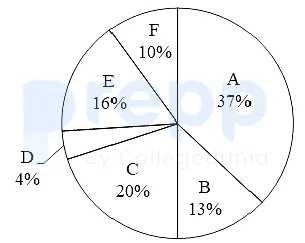
- A
2525
- B
6545
- C
3525
- D
4565
Show answer
D. 4565Given:
Total production of all 6 factories = 22000
From the pie chart: A = 37%, B = 16%, C = 20%, D = 4%, E = 13%, F = 10%
Calculation:
P1 = Average production of A, C, D and F (as a % of total)
P1 = (37 + 20 + 4 + 10)/4 = 71/4 = 17.75%
P2 = Difference between the production of B and E (as a % of total)
P2 = 16 - 13 = 3%
∴ (P1 + P2) in % = 17.75 + 3 = 20.75%
Now, (P1 + P2) of total production = 20.75% of 22000
⇒ (20.75/100) × 22000 = 20.75 × 220 = 4565
∴ The value of (P1 + P2) is 4565. Option 4 is the correct answer.
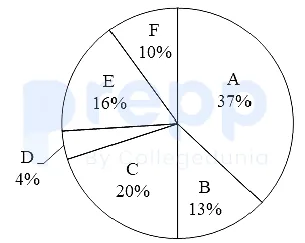 Paper & answer key PDF ↗
 Question 63archived
If P + Q = 6 and PQ = 4, then what is the value of P 3+ Q 3?
- A
81
- B
64
- C
144
- D
256
Show answer
C. 144Understanding the Algebra Problem
The question asks us to find the value of $P^3 + Q^3$ given two pieces of information: the sum of P and Q, and the product of P and Q. We are given:
$P + Q = 6$
$PQ = 4$
Our goal is to calculate $P^3 + Q^3$. This requires using algebraic identities that relate sums, products, and powers of variables.
Applying Algebraic Identities
To find $P^3 + Q^3$, we can use the sum of cubes formula. The general formula for the sum of two cubes is:
\(a^3 + b^3 = (a+b)(a^2 - ab + b^2)\)
In our case, using P and Q instead of a and b, the formula becomes:
\(P^3 + Q^3 = (P+Q)(P^2 - PQ + Q^2)\)
We already know the value of $(P+Q)$ and $(PQ)$. However, we need the value of $(P^2 + Q^2)$. We can find $P^2 + Q^2$ using another algebraic identity, the formula for the square of a sum:
\((P+Q)^2 = P^2 + 2PQ + Q^2\)
Rearranging this formula to solve for $P^2 + Q^2$, we get:
\(P^2 + Q^2 = (P+Q)^2 - 2PQ\)
Step-by-Step Calculation
Now, let's substitute the given values into the formulas.
Step 1: Calculate $P^2 + Q^2$.
Using the formula \(P^2 + Q^2 = (P+Q)^2 - 2PQ\), substitute $P+Q = 6$ and $PQ = 4$:
\(P^2 + Q^2 = (6)^2 - 2(4)\)
\(P^2 + Q^2 = 36 - 8\)
\(P^2 + Q^2 = 28\)
Step 2: Calculate $P^3 + Q^3$.
Now we have the value of $P^2 + Q^2$. Use the sum of cubes formula \(P^3 + Q^3 = (P+Q)(P^2 - PQ + Q^2)\). Substitute the values we know:
$P+Q = 6$
$PQ = 4$
$P^2 + Q^2 = 28$
Substitute these values into the formula:
\(P^3 + Q^3 = (6)(28 - 4)\)
\(P^3 + Q^3 = (6)(24)\)
\(P^3 + Q^3 = 144\)
Thus, the value of $P^3 + Q^3$ is 144.
Summary of Calculation
We used the given information $P+Q=6$ and $PQ=4$ along with standard algebraic identities to find $P^3 + Q^3$.
Given Information
Derived Information
Final Result
$P+Q = 6$
$P^2+Q^2 = (P+Q)^2 - 2PQ = 6^2 - 2(4) = 36 - 8 = 28$
$P^3+Q^3 = (P+Q)(P^2 - PQ + Q^2)$
$P^3+Q^3 = (P+Q)((P^2+Q^2) - PQ)$
$P^3+Q^3 = (6)(28 - 4)$
$P^3+Q^3 = (6)(24)$
$P^3+Q^3 = 144$
$PQ = 4$
Revision Table: Algebraic Identities
This problem utilizes fundamental algebraic identities. Understanding these identities is key to solving such problems efficiently.
Identity Name
Formula
Square of a Sum
\((a+b)^2 = a^2 + 2ab + b^2\)
Sum of Cubes
\((a^3 + b^3) = (a+b)(a^2 - ab + b^2)\)
Additional Information: Related Identities and Applications
Problems involving sums and products of variables and finding sums of their powers are common in algebra. Other related identities include:
Difference of Squares: \(a^2 - b^2 = (a-b)(a+b)\)
Difference of Cubes: \(a^3 - b^3 = (a-b)(a^2 + ab + b^2)\)
Cube of a Sum: \((a+b)^3 = a^3 + 3a^2b + 3ab^2 + b^3 = a^3 + b^3 + 3ab(a+b)\)
From the Cube of a Sum identity, we can also derive the sum of cubes formula in another way:
\(a^3 + b^3 = (a+b)^3 - 3ab(a+b)\)
Let's check if this gives the same result for our problem with $P+Q=6$ and $PQ=4$:
\(P^3 + Q^3 = (P+Q)^3 - 3PQ(P+Q)\)
\(P^3 + Q^3 = (6)^3 - 3(4)(6)\)
\(P^3 + Q^3 = 216 - 12(6)\)
\(P^3 + Q^3 = 216 - 72\)
\(P^3 + Q^3 = 144\)
This confirms our previous calculation using the other form of the sum of cubes identity. Both methods yield the same correct answer, 144. Understanding multiple ways to approach a problem using different identities can be very helpful in algebra.
Paper & answer key PDF ↗ Question 64archived
The ratio of two numbers is 5 ∶ 4 and their HCF is 4. What is their LCM?
- A
80
- B
48
- C
36
- D
60
Show answer
A. 80Understanding the Relationship Between Numbers, Ratio, HCF, and LCM
This question asks us to find the Least Common Multiple (LCM) of two numbers given their ratio and their Highest Common Factor (HCF). The key to solving this problem lies in understanding how the ratio, HCF, and LCM relate to the numbers themselves.
Setting Up the Numbers Based on the Ratio and HCF
Let the two numbers be $N_1$ and $N_2$. We are given that the ratio of these two numbers is $5 : 4$. This means we can represent the numbers as $N_1 = 5k$ and $N_2 = 4k$ for some common factor $k$.
The HCF of two numbers is the largest positive integer that divides both numbers without leaving a remainder. For numbers represented as $5k$ and $4k$, the HCF is $k$, provided that 5 and 4 are coprime (which they are).
We are given that the HCF of the two numbers is 4. Therefore, the common factor $k$ must be equal to the HCF.
So, $k = 4$.
Finding the Two Numbers
Using the value of $k$, we can find the actual numbers:
The first number, $N_1 = 5k = 5 \times 4 = 20$.
The second number, $N_2 = 4k = 4 \times 4 = 16$.
The two numbers are 20 and 16.
Calculating the LCM of the Numbers
Now that we have the two numbers (20 and 16), we need to find their LCM. The LCM is the smallest positive integer that is a multiple of both numbers.
We can find the LCM using prime factorization:
Prime factors of 20: $20 = 2 \times 2 \times 5 = 2^2 \times 5^1$
Prime factors of 16: $16 = 2 \times 2 \times 2 \times 2 = 2^4$
To find the LCM, we take the highest power of each prime factor present in either factorization:
LCM$(20, 16) = 2^{\text{max}(2, 4)} \times 5^{\text{max}(1, 0)} = 2^4 \times 5^1 = 16 \times 5 = 80$.
Using the Relationship Between HCF and LCM
Alternatively, we can use the fundamental property relating the HCF and LCM of two numbers:
Product of the two numbers = HCF $\times$ LCM
We know the two numbers are 20 and 16, and their HCF is 4. We want to find the LCM.
$20 \times 16 = 4 \times \text{LCM}$
$320 = 4 \times \text{LCM}$
To find the LCM, divide the product by the HCF:
$\text{LCM} = \frac{320}{4} = 80$
Both methods give the same result. The LCM of the two numbers is 80.
Summary of the Solution Steps
Step
Description
Calculation
1
Represent the numbers based on ratio and HCF
Numbers are $5k$ and $4k$. HCF is $k$. Given HCF = 4, so $k=4$.
2
Find the actual numbers
$N_1 = 5 \times 4 = 20$, $N_2 = 4 \times 4 = 16$.
3
Calculate LCM using prime factorization
$20 = 2^2 \times 5$, $16 = 2^4$. LCM $= 2^4 \times 5^1 = 80$.
4 (Alternative)
Calculate LCM using HCF-LCM property
$N_1 \times N_2 = \text{HCF} \times \text{LCM}$. $20 \times 16 = 4 \times \text{LCM}$. $320 = 4 \times \text{LCM}$. $\text{LCM} = 80$.
The Least Common Multiple (LCM) of the two numbers is 80.
Revision Table: Ratio, HCF, and LCM Concepts
Concept
Definition
Example
Ratio
A comparison of two quantities
5 : 4
HCF (Highest Common Factor)
Largest number that divides two or more numbers exactly
HCF(20, 16) = 4
LCM (Least Common Multiple)
Smallest number that is a multiple of two or more numbers
LCM(20, 16) = 80
HCF-LCM Property
For any two positive integers $a$ and $b$, $a \times b = \text{HCF}(a,b) \times \text{LCM}(a,b)$
$20 \times 16 = 4 \times 80 \implies 320 = 320$
Additional Information on Ratio, HCF, and LCM Problems
Problems involving ratio, HCF, and LCM are common in number theory. The relationship between these concepts is crucial. If two numbers are in the ratio $a:b$ and their HCF is $h$, then the numbers can be written as $ah$ and $bh$. The product of these numbers is $(ah) \times (bh) = ab h^2$. Using the HCF-LCM property, we have $(ah) \times (bh) = h \times \text{LCM}$. This simplifies to $abh^2 = h \times \text{LCM}$, which means $\text{LCM} = abh$. In our specific case, the ratio is 5:4 ($a=5, b=4$) and HCF is 4 ($h=4$). Using the formula $\text{LCM} = abh$, we get $\text{LCM} = 5 \times 4 \times 4 = 80$. This confirms our earlier result and provides a direct formula for similar problems.
Paper & answer key PDF ↗ Question 65archived
If Cos A = \({{9} \over 41}\) , find cot A.
- A
\({{9} \over 40}\)
- B
\({{41} \over 40}\)
- C
\({{40} \over 9}\)
- D
\({{9} \over 41}\)
Show answer
A. \({{9} \over 40}\)Finding cot A from cos A using Trigonometry
The problem asks us to find the value of cot A, given that cos A = \(\frac{9}{41}\).
In trigonometry, for a right-angled triangle and an acute angle A:
Cosine (cos A) is defined as the ratio of the length of the adjacent side to the length of the hypotenuse.
Cotangent (cot A) is defined as the ratio of the length of the adjacent side to the length of the opposite side.
We are given \(\cos A = \frac{9}{41}\). Comparing this with the definition of cosine, we can consider a right-angled triangle where:
Adjacent side to angle A = 9 units
Hypotenuse = 41 units
To find cot A, we need the length of the opposite side to angle A. We can use the Pythagorean theorem, which states that in a right-angled triangle, the square of the hypotenuse is equal to the sum of the squares of the other two sides (opposite and adjacent sides).
Let the opposite side be 'b', the adjacent side be 'a', and the hypotenuse be 'c'. The Pythagorean theorem is \(a^2 + b^2 = c^2\).
Substituting the known values:
\(9^2 + b^2 = 41^2\)
\(81 + b^2 = 1681\)
Now, we solve for \(b^2\):
\(b^2 = 1681 - 81\)
\(b^2 = 1600\)
Taking the square root of both sides to find b:
\(b = \sqrt{1600}\)
\(b = 40\)
So, the length of the opposite side is 40 units.
Calculating cot A
Now that we have the lengths of the adjacent and opposite sides, we can find cot A.
cot A = \(\frac{\text{Adjacent side}}{\text{Opposite side}}\)
cot A = \(\frac{9}{40}\)
Therefore, the value of cot A is \(\frac{9}{40}\).
Let's verify this with the options provided.
Option
Value
1
\(\frac{9}{40}\)
2
\(\frac{41}{40}\)
3
\(\frac{40}{9}\)
4
\(\frac{9}{41}\)
Our calculated value, \(\frac{9}{40}\), matches Option 1.
Revision Table: Key Trigonometric Ratios
For an acute angle A in a right-angled triangle:
Ratio
Definition
Formula
Sine (sin A)
Opposite / Hypotenuse
\(\frac{\text{Opposite}}{\text{Hypotenuse}}\)
Cosine (cos A)
Adjacent / Hypotenuse
\(\frac{\text{Adjacent}}{\text{Hypotenuse}}\)
Tangent (tan A)
Opposite / Adjacent
\(\frac{\text{Opposite}}{\text{Adjacent}}\)
Cosecant (csc A)
Hypotenuse / Opposite
\(\frac{\text{Hypotenuse}}{\text{Opposite}}\)
Secant (sec A)
Hypotenuse / Adjacent
\(\frac{\text{Hypotenuse}}{\text{Adjacent}}\)
Cotangent (cot A)
Adjacent / Opposite
\(\frac{\text{Adjacent}}{\text{Opposite}}\)
Note that cot A is the reciprocal of tan A, i.e., \(\cot A = \frac{1}{\tan A} = \frac{\cos A}{\sin A}\).
Additional Information: Pythagorean Triples
A Pythagorean triple is a set of three positive integers, a, b, and c, such that \(a^2 + b^2 = c^2\). These represent the side lengths of a right-angled triangle. In this problem, we found that sides 9, 40, and 41 form a Pythagorean triple (\(9^2 + 40^2 = 81 + 1600 = 1681 = 41^2\)). Recognizing common Pythagorean triples can sometimes speed up calculations in trigonometry problems involving right triangles.
Understanding how to use trigonometric ratios and the Pythagorean theorem is fundamental to solving many problems in trigonometry.
Paper & answer key PDF ↗ Question 66archived
A truck runs 492 km on 36 Litter of diesel. How many kilometres can it run on 33 Litter of diesel?
- A
454 km
- B
453 km
- C
451 km
- D
452 km
Show answer
C. 451 kmCalculating Truck Mileage Based on Diesel Consumption
This problem involves finding out how far a truck can travel on a different amount of diesel fuel, given its mileage for a certain amount of fuel. This is a classic problem involving direct proportion. If the truck uses less diesel, it will travel a proportionally shorter distance, assuming a constant fuel efficiency.
Step-by-Step Solution for Diesel Consumption
First, we need to determine the truck's fuel efficiency, which is the distance it can travel per litre of diesel. We are given that the truck runs 492 km on 36 litres of diesel.
Fuel efficiency (km per litre) is calculated by dividing the total distance by the total fuel consumed:
\(\text{Fuel Efficiency} = \frac{\text{Distance}}{\text{Diesel Used}}\)
Plugging in the given values:
\(\text{Fuel Efficiency} = \frac{492 \text{ km}}{36 \text{ litres}}\)
Now, let's calculate the value:
\(\frac{492}{36}\)
We can simplify this fraction. Both 492 and 36 are divisible by 12:
\(492 \div 12 = 41\)
\(36 \div 12 = 3\)
So, the fuel efficiency is:
\(\text{Fuel Efficiency} = \frac{41 \text{ km}}{3 \text{ litres}}\) or \(13.66...\text{ km/litre}\)
The truck travels \(\frac{41}{3}\) km for every litre of diesel.
Next, we need to find out how many kilometres the truck can run on 33 litres of diesel. To do this, we multiply the fuel efficiency (km per litre) by the new amount of diesel (33 litres):
\(\text{Distance} = \text{Fuel Efficiency} \times \text{New amount of Diesel}\)
\(\text{Distance} = \left(\frac{41}{3} \text{ km/litre}\right) \times (33 \text{ litres})\)
Let's calculate the distance:
\(\text{Distance} = \frac{41}{3} \times 33\)
We can simplify this calculation by dividing 33 by 3 first:
\(\frac{33}{3} = 11\)
Now, multiply 41 by 11:
\(41 \times 11 = 41 \times (10 + 1) = (41 \times 10) + (41 \times 1) = 410 + 41 = 451\)
So, the truck can run 451 kilometres on 33 litres of diesel.
Summary of Truck Diesel Mileage Calculation
Quantity
Given Value 1
Given Value 2
Calculated Value
Distance (km)
492
?
451
Diesel (Litres)
36
33
-
Fuel Efficiency (km/L)
\(\frac{492}{36}\)
\(\frac{451}{33}\)
\(\frac{41}{3}\)
Both ratios \(\frac{492}{36}\) and \(\frac{451}{33}\) should be equal, representing the constant fuel efficiency:
\(\frac{492}{36} = \frac{41 \times 12}{3 \times 12} = \frac{41}{3}\)
\(\frac{451}{33} = \frac{41 \times 11}{3 \times 11} = \frac{41}{3}\)
This confirms our calculation.
Final Answer for Kilometres per Diesel Litter
Based on the calculation, the truck can run 451 kilometres on 33 litres of diesel.
Revision Table: Truck Distance and Diesel
Concept
Description
Formula/Method
Fuel Efficiency
Distance covered per unit of fuel.
\(\frac{\text{Distance}}{\text{Fuel Used}}\)
Direct Proportion
Two quantities increase or decrease at the same rate. If diesel increases, distance increases proportionally.
\(\frac{\text{Distance}_1}{\text{Fuel}_1} = \frac{\text{Distance}_2}{\text{Fuel}_2}\)
Calculating Distance
Finding distance for a given fuel amount using efficiency.
\(\text{Distance} = \text{Fuel Efficiency} \times \text{Fuel Amount}\)
Additional Information: Ratio and Proportion in Mileage Problems
Problems like this truck mileage question are often solved using the concept of ratio and proportion. The ratio of distance travelled to the amount of fuel consumed is constant for a given vehicle under similar conditions (like speed, road type, load). This constant ratio is the fuel efficiency or mileage.
We can set up a proportion:
\(\frac{\text{Distance}_1}{\text{Diesel}_1} = \frac{\text{Distance}_2}{\text{Diesel}_2}\)
Where:
\(\text{Distance}_1\) = 492 km
\(\text{Diesel}_1\) = 36 litres
\(\text{Distance}_2\) = unknown (let's call it \(x\))
\(\text{Diesel}_2\) = 33 litres
Setting up the equation:
\(\frac{492}{36} = \frac{x}{33}\)
To solve for \(x\), multiply both sides by 33:
\(x = \frac{492}{36} \times 33\)
This is the same calculation we performed earlier:
\(x = \frac{41}{3} \times 33 = 41 \times 11 = 451\)
So, the distance \(x\) is 451 km. Understanding ratio and proportion provides an alternative method to solve such mileage calculation problems.
Paper & answer key PDF ↗ Question 67archived
In the given triangle, CD is the bisector of ∠BCA. CD = DA. If ∠BDC = 76°, What is the degree measure of ∠CBD?
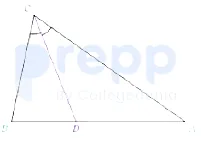
- A
32°
- B
76°
- C
80°
- D
66°
Show answer
D. 66°Given:
CD is the bisector of ∠BCA.
CD = DA
∠BDC = 76°
Concept Used:
The two angles of an isosceles triangle, opposite to equal sides, are equal in measure.
Angle Sum Property = Sum of all the three angles of a triangle is 180°.
Calculation:
In triangle ABC,
CD is the bisector of ∠BCA.
⇒ ∠BCD = ∠DCA = θ
Since, CD = DA [Given]
⇒ ∠DCA = ∠CAD = θ
⇒ ∠BDC = 76° [Given]
⇒ ∠BDC = ∠DCA + ∠CAD
⇒ θ + θ = 76°
⇒ 2θ = 76°
⇒ θ = 38°
In triangle CBD,
∠BCD + ∠CDB + ∠CBD = 180°
⇒ θ + 76° + ∠CBD = 180°
⇒ 38° + 76° + ∠CBD = 180°
⇒ ∠CBD = 180° - 114°
⇒ ∠CBD = 66°
∴ Option 4 is the correct answer.
Paper & answer key PDF ↗ Question 68archived
A dealer buys an old cooler listed at ₹650 and gets successive discounts of 20% and 10%. He spends ₹38 on its repairs and sells it at a profit of 20%. Find the selling price of the cooler.
- A
₹7.80
- B
₹700
- C
₹790
- D
₹607.2
Show answer
D. ₹607.2Understanding the Cooler Price Calculation
This problem involves calculating the final selling price of an old cooler after accounting for successive discounts on the listed price, repair costs incurred by the dealer, and a desired profit margin.
We are given the following information:
Listed Price (Marked Price) of the cooler = ₹650
First Discount = 20%
Second Discount = 10% (successive discount)
Repair Cost incurred by the dealer = ₹38
Profit percentage desired by the dealer = 20%
We need to find the final Selling Price of the cooler.
Step 1: Calculate the Price After Successive Discounts
The dealer buys the cooler after receiving two successive discounts on the listed price. First, a 20% discount is applied, and then a 10% discount is applied to the reduced price.
Price after the first 20% discount:
\( \text{Price}_1 = \text{Listed Price} \times (1 - \text{Discount Rate}_1) \)
\( \text{Price}_1 = 650 \times (1 - 0.20) \)
\( \text{Price}_1 = 650 \times 0.80 \)
\( \text{Price}_1 = 520 \)
So, the price after the first discount is ₹520.
Now, the second 10% discount is applied to this price (₹520):
\( \text{Price}_2 = \text{Price}_1 \times (1 - \text{Discount Rate}_2) \)
\( \text{Price}_2 = 520 \times (1 - 0.10) \)
\( \text{Price}_2 = 520 \times 0.90 \)
\( \text{Price}_2 = 468 \)
This ₹468 is the price at which the dealer bought the cooler. This is also the dealer's initial cost price before repairs.
Step 2: Calculate the Total Cost Price for the Dealer
The dealer spent ₹38 on repairs. This repair cost is added to the buying price to determine the total cost price for the dealer.
\( \text{Total Cost Price (CP)} = \text{Buying Price} + \text{Repair Cost} \)
\( \text{Total Cost Price} = 468 + 38 \)
\( \text{Total Cost Price} = 506 \)
The total cost price for the dealer is ₹506.
Step 3: Calculate the Profit Amount
The dealer wants to make a profit of 20% on the total cost price.
\( \text{Profit Amount} = \text{Profit Percentage} \times \text{Total Cost Price} \)
\( \text{Profit Amount} = 20\% \text{ of } 506 \)
\( \text{Profit Amount} = 0.20 \times 506 \)
\( \text{Profit Amount} = 101.2 \)
The profit amount is ₹101.20.
Step 4: Calculate the Selling Price
The selling price is the total cost price plus the profit amount.
\( \text{Selling Price (SP)} = \text{Total Cost Price} + \text{Profit Amount} \)
\( \text{Selling Price} = 506 + 101.2 \)
\( \text{Selling Price} = 607.2 \)
The selling price of the cooler is ₹607.20.
Let's summarize the calculations:
Item
Amount (₹)
Listed Price
650
Price after 20% discount
520
Price after successive 10% discount (Buying Price)
468
Repair Cost
38
Total Cost Price (CP)
506
Profit (20% of CP)
101.2
Selling Price (SP)
\(506 + 101.2 = 607.2\)
The final selling price of the cooler is ₹607.2.
Revision Table: Key Calculations for Cooler Pricing
Calculation Step
Formula/Calculation
Result (₹)
Price after 1st Discount
\(650 \times (1 - 0.20)\)
520
Price after 2nd Discount
\(520 \times (1 - 0.10)\)
468
Total Cost Price
\(468 + 38\)
506
Profit Amount
\(506 \times 0.20\)
101.2
Selling Price
\(506 + 101.2\)
607.2
Additional Information: Understanding Profit and Loss
In business, understanding cost price, selling price, profit, and loss is crucial. Here's a quick overview:
Cost Price (CP): The total amount spent to acquire something. This includes the purchase price, transportation costs, repair costs, installation costs, etc.
Selling Price (SP): The price at which an item is sold.
Profit: Occurs when SP > CP. Profit = SP - CP.
Loss: Occurs when SP < CP. Loss = CP - SP.
Profit Percentage: Calculated as \( (\text{Profit} / \text{CP}) \times 100\% \).
Loss Percentage: Calculated as \( (\text{Loss} / \text{CP}) \times 100\% \).
Successive Discounts: When multiple discounts are applied one after another. Each discount is calculated on the price remaining after the previous discount. The net discount is NOT simply the sum of the individual discount percentages.
In this cooler problem, the repair cost is added to the initial buying price to get the true cost price for the dealer before calculating profit.
Paper & answer key PDF ↗ Question 69archived
The pie chart given below shows the sales of 7 different companies. The total sales of all these 7 companies are 2880. The sale of a particular company is shown in terms of degree with respect to the total sales of all these 7 companies.
The average sales of G and H is how much percent more than the average sales of D and I?
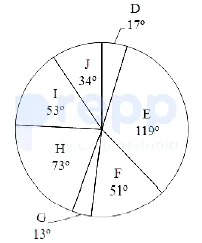
- A
18.86 percent
- B
24.25 percent
- C
56.21 percent
- D
22.86 percent
Show answer
D. 22.86 percentCalculation:
Average sales of G and H = (13° + 73°)/2
⇒ 86/2 = 43°
Average sales of D and I = (17° + 53°)/2
⇒ 70/2 = 35°
Average sales of G and H is more than the average sales of D and I = 43 - 35 = 8°
Percentage = (8/35) × 100 = 22.86%
∴ Option 4 is the correct answer.
Paper & answer key PDF ↗ Question 70archived
What is the edge of a cube whose volume is equal to the sum of the volumes of the cubes of edge 6 cm, 8 cm and 10 cm?
- A
5 cm
- B
3 cm
- C
6 cm
- D
12 cm
Show answer
D. 12 cmFinding the Edge of a Cube from Combined Volumes
The question asks us to find the edge length of a larger cube whose volume is equal to the combined volume of three smaller cubes with given edge lengths. To solve this, we first need to calculate the volume of each smaller cube and then find their sum.
Understanding Cube Volume
The volume of a cube is calculated by cubing its edge length. If the edge of a cube is \(a\), its volume \(V\) is given by the formula:
\[ V = a^3 \]
Calculating Volumes of Smaller Cubes
We are given the edge lengths of three smaller cubes:
Cube 1 edge: 6 cm
Cube 2 edge: 8 cm
Cube 3 edge: 10 cm
Now, let's calculate the volume of each cube:
Volume of Cube 1 (\(V_1\)) = \(6^3 \text{ cm}^3 = 6 \times 6 \times 6 \text{ cm}^3 = 216 \text{ cm}^3\)
Volume of Cube 2 (\(V_2\)) = \(8^3 \text{ cm}^3 = 8 \times 8 \times 8 \text{ cm}^3 = 512 \text{ cm}^3\)
Volume of Cube 3 (\(V_3\)) = \(10^3 \text{ cm}^3 = 10 \times 10 \times 10 \text{ cm}^3 = 1000 \text{ cm}^3\)
Finding the Total Volume
The volume of the larger cube is equal to the sum of the volumes of these three smaller cubes. Let the total volume be \(V_{\text{total}}\).
\[ V_{\text{total}} = V_1 + V_2 + V_3 \]
\[ V_{\text{total}} = 216 \text{ cm}^3 + 512 \text{ cm}^3 + 1000 \text{ cm}^3 \]
Adding these values:
\[ V_{\text{total}} = 728 \text{ cm}^3 + 1000 \text{ cm}^3 = 1728 \text{ cm}^3 \]
So, the volume of the larger cube is 1728 cm³.
Determining the Edge of the Larger Cube
Let the edge length of the larger cube be \(E\). Its volume is \(E^3\). We know that the volume of the larger cube is 1728 cm³.
\[ E^3 = 1728 \text{ cm}^3 \]
To find the edge \(E\), we need to calculate the cube root of 1728.
\[ E = \sqrt[3]{1728} \text{ cm} \]
We can find the cube root by trial and error or by prime factorization. Let's test some integers:
\(10^3 = 1000\)
\(11^3 = 11 \times 11 \times 11 = 121 \times 11 = 1331\)
\(12^3 = 12 \times 12 \times 12 = 144 \times 12 = 1728\)
Since \(12^3 = 1728\), the cube root of 1728 is 12.
\[ E = 12 \text{ cm} \]
Therefore, the edge of the larger cube is 12 cm.
Summary of Calculations
Cube
Edge (cm)
Volume (cm³)
Small Cube 1
6
\(6^3 = 216\)
Small Cube 2
8
\(8^3 = 512\)
Small Cube 3
10
\(10^3 = 1000\)
Large Cube
\(E\)
\(216 + 512 + 1000 = 1728\)
From the table, \(E^3 = 1728\), which gives \(E = 12\) cm.
The edge of the cube whose volume is equal to the sum of the volumes of the cubes of edge 6 cm, 8 cm, and 10 cm is 12 cm.
Revision Table: Cube Volume Calculation
This table summarizes key concepts used in this problem:
Concept
Formula/Definition
Application in Problem
Volume of a Cube
\(V = a^3\) where \(a\) is the edge length
Used to find volumes of small cubes and relate edge to volume for the large cube.
Sum of Volumes
\(V_{\text{total}} = V_1 + V_2 + V_3 + ...\)
Used to find the combined volume of the three small cubes.
Cube Root
\(\sqrt[3]{N}\) is the number that, when cubed, equals \(N\).
Used to find the edge length (\(E = \sqrt[3]{V_{\text{total}}}\)) from the total volume.
Additional Information: Properties of Cubes
A cube is a three-dimensional solid object bounded by six square faces, facets, or sides, with three meeting at each vertex.
All edges of a cube are equal in length.
All faces of a cube are squares.
There are 12 edges, 8 vertices, and 6 faces.
The formula for the surface area of a cube with edge \(a\) is \(6a^2\).
The formula for the length of the space diagonal (connecting opposite vertices through the interior) is \(a\sqrt{3}\).
The concept of summing volumes is applicable to any set of objects; the total volume is simply the sum of individual volumes, assuming they don't overlap and fill a new space.
Paper & answer key PDF ↗ Question 71archived
If Ram covers a certain journey at 60% of his usual speed, he reaches the destination late by 36 min. His usual time (in min) to reach the destination is:
- A
60
- B
72
- C
50
- D
54
Show answer
D. 54Analyzing Ram's Journey with Speed and Time Changes
This problem involves the relationship between speed, time, and distance. The key information is that the distance Ram covers is constant, but his speed changes, leading to a change in travel time.
Understanding the Problem
Ram's usual speed is reduced to 60%, which means his new speed is slower. When speed decreases over a fixed distance, the time taken must increase. We are given the increase in time (the delay) and need to find his usual travel time.
Setting up the Relationship
The fundamental formula connecting speed, time, and distance is:
\( \text{Distance} = \text{Speed} \times \text{Time} \)
Since the distance of the journey is the same in both cases (usual and reduced speed), we can set up an equation based on this formula.
Let \( S_u \) be Ram's usual speed.
Let \( T_u \) be Ram's usual time (in minutes).
The distance covered is \( D = S_u \times T_u \).
Calculating New Speed and Time
Ram covers the journey at 60% of his usual speed. So, the new speed \( S_n \) is \( 60\% \text{ of } S_u \).
\( S_n = 0.60 \times S_u \)
He reaches the destination late by 36 minutes. This means the new time taken \( T_n \) is his usual time plus the delay.
\( T_n = T_u + 36 \text{ minutes} \)
Using the Constant Distance Principle
The distance covered with the new speed and new time is the same as the usual distance:
\( \text{New Distance} = \text{New Speed} \times \text{New Time} \)
\( D = S_n \times T_n \)
Since \( D = S_u \times T_u \), we can write:
\( S_u \times T_u = S_n \times T_n \)
Now, substitute the expressions for \( S_n \) and \( T_n \) in terms of \( S_u \) and \( T_u \):
\( S_u \times T_u = (0.6 S_u) \times (T_u + 36) \)
Solving for Usual Time (\( T_u \))
We have the equation \( S_u \times T_u = 0.6 S_u \times (T_u + 36) \). Assuming Ram's usual speed \( S_u \) is not zero, we can divide both sides of the equation by \( S_u \):
\( T_u = 0.6 \times (T_u + 36) \)
Now, distribute 0.6 on the right side:
\( T_u = 0.6 T_u + 0.6 \times 36 \)
\( T_u = 0.6 T_u + 21.6 \)
Subtract \( 0.6 T_u \) from both sides to isolate \( T_u \) terms:
\( T_u - 0.6 T_u = 21.6 \)
\( (1 - 0.6) T_u = 21.6 \)
\( 0.4 T_u = 21.6 \)
Now, divide by 0.4 to find \( T_u \):
\( T_u = \frac{21.6}{0.4} \)
To simplify the division, we can multiply both the numerator and denominator by 10:
\( T_u = \frac{216}{4} \)
\( T_u = 54 \)
So, Ram's usual time to reach the destination is 54 minutes.
Summary of Times
Scenario
Speed
Time
Usual
\( S_u \)
\( T_u = 54 \) min
New
\( 0.6 S_u \)
\( T_n = T_u + 36 = 54 + 36 = 90 \) min
Check: \( S_u \times 54 = 0.6 S_u \times 90 \). \( S_u \times 54 = 54 S_u \), and \( 0.6 S_u \times 90 = 54 S_u \). The equation holds true.
Final Answer
Ram's usual time to reach the destination is 54 minutes.
Revision Table: Speed, Time, and Distance Concepts
Concept
Formula
Relationship
Distance
\( D = S \times T \)
Directly proportional to Speed and Time.
Speed
\( S = D / T \)
Directly proportional to Distance, inversely proportional to Time (for fixed Distance).
Time
\( T = D / S \)
Directly proportional to Distance, inversely proportional to Speed (for fixed Distance).
Additional Information: Inverse Proportion in Speed and Time
When the distance of a journey is constant, speed and time are inversely proportional to each other. This means if speed increases, time decreases, and if speed decreases, time increases. The product of speed and time remains constant (\( S \times T = \text{Constant} \)).
In this problem, the new speed is 60% of the usual speed, which can be written as a fraction \( 60\% = \frac{60}{100} = \frac{3}{5} \). So, \( S_n = \frac{3}{5} S_u \).
Since speed and time are inversely proportional for a fixed distance, if the new speed is \(\frac{3}{5}\) times the usual speed, the new time will be the reciprocal of this fraction times the usual time, i.e., \(\frac{5}{3}\) times the usual time.
\( T_n = \frac{5}{3} T_u \)
We know \( T_n = T_u + 36 \).
So, \( \frac{5}{3} T_u = T_u + 36 \)
Subtract \( T_u \) from both sides: \( \frac{5}{3} T_u - T_u = 36 \)
\( (\frac{5}{3} - 1) T_u = 36 \)
\( (\frac{5}{3} - \frac{3}{3}) T_u = 36 \)
\( \frac{2}{3} T_u = 36 \)
Multiply by \(\frac{3}{2}\) to find \( T_u \): \( T_u = 36 \times \frac{3}{2} \)
\( T_u = 18 \times 3 \)
\( T_u = 54 \) minutes.
This alternative method using inverse proportion confirms the result obtained earlier. It's another way to think about problems where distance is constant.
Paper & answer key PDF ↗ Question 72archived
If tan 2 θ = 1 - a 2, then the value of sec θ + tan 3 θ cosec θ is:
- A
\((2-a)^{{3} \over 2}\)
- B
\((a^2 - 1)^{{3} \over 2}\)
- C
\((2 - a^2)^{{3} \over 2}\)
- D
\(a^{{3} \over 2}\)
Show answer
C. \((2 - a^2)^{{3} \over 2}\)Evaluating the Given Trigonometric Expression
The problem asks us to find the value of the expression $\sec\theta + \tan^3\theta \operatorname{cosec}\theta$ given the condition $\tan 2\theta = 1 - a^2$. First, let's simplify the expression we need to evaluate.
The expression is:
$\sec\theta + \tan^3\theta \operatorname{cosec}\theta$
We can rewrite $\tan\theta$ as $\frac{\sin\theta}{\cos\theta}$ and $\operatorname{cosec}\theta$ as $\frac{1}{\sin\theta}$.
$\sec\theta + \left(\frac{\sin\theta}{\cos\theta}\right)^3 \left(\frac{1}{\sin\theta}\right)$
$\sec\theta + \frac{\sin^3\theta}{\cos^3\theta} \cdot \frac{1}{\sin\theta}$
Assuming $\sin\theta \ne 0$, we can cancel one power of $\sin\theta$ from the numerator and denominator:
$\sec\theta + \frac{\sin^2\theta}{\cos^3\theta}$
Now, rewrite $\sec\theta$ as $\frac{1}{\cos\theta}$:
$\frac{1}{\cos\theta} + \frac{\sin^2\theta}{\cos^3\theta}$
To add these fractions, find a common denominator, which is $\cos^3\theta$. Multiply the first term by $\frac{\cos^2\theta}{\cos^2\theta}$:
$\frac{1}{\cos\theta} \cdot \frac{\cos^2\theta}{\cos^2\theta} + \frac{\sin^2\theta}{\cos^3\theta} = \frac{\cos^2\theta}{\cos^3\theta} + \frac{\sin^2\theta}{\cos^3\theta}$
Combine the terms over the common denominator:
$\frac{\cos^2\theta + \sin^2\theta}{\cos^3\theta}$
Using the fundamental trigonometric identity $\sin^2\theta + \cos^2\theta = 1$:
$\frac{1}{\cos^3\theta}$
This is equal to $\sec^3\theta$. So, the expression simplifies to $\sec^3\theta$, provided $\sin\theta \ne 0$ and $\cos\theta \ne 0$. If $\sin\theta = 0$ or $\cos\theta = 0$, the original expression is undefined.
Thus, the value we need to find is $\sec^3\theta$.
Connecting the Condition to the Expression
We are given the condition $\tan 2\theta = 1 - a^2$. We need to find the value of $\sec^3\theta$ in terms of $a$. Let's look at the structure of the options provided. They are all in the form $(f(a))^{3/2}$. Since our simplified expression is $\sec^3\theta = (\sec^2\theta)^{3/2}$, this strongly suggests that $\sec^2\theta$ should be equal to some function of $a$, specifically $2-a^2$, based on the structure of the correct answer option.
Assuming the structure of the answer implies a direct relationship between $\sec^2\theta$ and $a^2$, let's consider the possibility that:
$\sec^2\theta = 2 - a^2$
If this relationship holds true under the given condition $\tan 2\theta = 1 - a^2$, then we can find the value of the expression.
Calculating the Value of the Expression
The expression simplifies to $\sec^3\theta$. If we assume $\sec^2\theta = 2 - a^2$, then we can find $\sec^3\theta$:
$\sec^3\theta = (\sec^2\theta)^{3/2}$
Substitute the assumed value for $\sec^2\theta$:
$\sec^3\theta = (2 - a^2)^{3/2}$
This matches option 3.
Conclusion
By simplifying the given trigonometric expression using fundamental identities, we found it is equal to $\sec^3\theta$. The structure of the provided options suggests that $\sec^2\theta$ is related to $2-a^2$. Assuming the implied relationship $\sec^2\theta = 2-a^2$ holds given the condition $\tan 2\theta = 1-a^2$, the value of the expression is $(2-a^2)^{3/2}$.
Given
Expression to Evaluate
Simplified Expression
$\tan 2\theta = 1 - a^2$
$\sec\theta + \tan^3\theta \operatorname{cosec}\theta$
$\sec^3\theta$
Comparing the simplified expression $\sec^3\theta$ with the form of the options $(f(a))^{3/2}$ leads us to consider that $\sec^2\theta = 2-a^2$. With this, $\sec^3\theta = (2-a^2)^{3/2}$.
Revision Table: Key Trigonometric Identities
Identity
Description
$\tan\theta = \frac{\sin\theta}{\cos\theta}$
Definition of tangent
$\operatorname{cosec}\theta = \frac{1}{\sin\theta}$
Definition of cosecant
$\sec\theta = \frac{1}{\cos\theta}$
Definition of secant
$\sin^2\theta + \cos^2\theta = 1$
Pythagorean Identity
$\tan 2\theta = \frac{2\tan\theta}{1-\tan^2\theta}$
Double Angle Identity for Tangent
$\sec^2\theta = 1 + \tan^2\theta$
Pythagorean Identity related to Secant
Additional Information: Conditions for Defined Expression
The original expression is $\sec\theta + \tan^3\theta \operatorname{cosec}\theta$. For this expression to be defined, the denominators must not be zero.
$\sec\theta = 1/\cos\theta$, so $\cos\theta \ne 0$. This means $\theta \ne (n + 1/2)\pi$ for any integer $n$.
$\tan\theta = \sin\theta/\cos\theta$, so $\cos\theta \ne 0$.
$\operatorname{cosec}\theta = 1/\sin\theta$, so $\sin\theta \ne 0$. This means $\theta \ne n\pi$ for any integer $n$.
Combining these, for the expression to be defined, $\theta$ cannot be a multiple of $\pi/2$. This implies $\tan\theta$ and $\tan(2\theta)$ must also be defined (which requires $2\theta \ne (n+1/2)\pi$, i.e., $\theta \ne (n+1/4)\pi$). The given condition $\tan(2\theta) = 1-a^2$ means $1-a^2$ must be a real number, which is always true for real $a$. The assumption $\sec^2\theta = 2-a^2$ requires $2-a^2 \ge 0$, i.e., $a^2 \le 2$ for $\sec\theta$ to be real. The options being real values also implies $a^2 \le 2$. The problem expects a result valid under these conditions.
Paper & answer key PDF ↗ Question 73archived
Two-thirds of a certain distance was covered at the speed of 45 km/h, one-fourth at the speed of 60 km/h and the rest at the speed of 75 km/h. Find the average speed per hour for the whole journey. (correct to 2 decimal places)
- A
51.25 km/h
- B
45.75 km/h
- C
58.25 km/h
- D
49.77 km/h
Show answer
D. 49.77 km/hUnderstanding Average Speed Calculation
The problem asks us to find the overall average speed for a journey where different parts of the total distance are covered at different speeds. The average speed is defined as the total distance travelled divided by the total time taken.
$$ \text{Average Speed} = \frac{\text{Total Distance}}{\text{Total Time}} $$
Breaking Down the Journey Distance
Let's assume the total distance of the journey is '$D$'. We can divide the journey into three parts based on the information given:
Part 1: Two-thirds ($\frac{2}{3}$) of the distance was covered. The distance for this part is $\frac{2}{3}D$. The speed during this part was 45 km/h.
Part 2: One-fourth ($\frac{1}{4}$) of the distance was covered. The distance for this part is $\frac{1}{4}D$. The speed during this part was 60 km/h.
Part 3: The rest of the distance was covered. To find the fraction of the rest, we subtract the fractions covered in Part 1 and Part 2 from the total distance (1).
Fraction covered = $\frac{2}{3} + \frac{1}{4}$
To add these fractions, we find a common denominator, which is 12.
Fraction covered = $\frac{2 \times 4}{3 \times 4} + \frac{1 \times 3}{4 \times 3} = \frac{8}{12} + \frac{3}{12} = \frac{11}{12}$
So, the fraction of the rest of the distance is $1 - \frac{11}{12} = \frac{1}{12}$.
The distance for this part is $\frac{1}{12}D$. The speed during this part was 75 km/h.
Calculating Time Spent on Each Distance Segment
We use the formula: $\text{Time} = \frac{\text{Distance}}{\text{Speed}}$ for each part.
Time for Part 1 ($t_1$):
Distance = $\frac{2}{3}D$
Speed = 45 km/h
$t_1 = \frac{\frac{2}{3}D}{45} = \frac{2D}{3 \times 45} = \frac{2D}{135}$ hours
Time for Part 2 ($t_2$):
Distance = $\frac{1}{4}D$
Speed = 60 km/h
$t_2 = \frac{\frac{1}{4}D}{60} = \frac{D}{4 \times 60} = \frac{D}{240}$ hours
Time for Part 3 ($t_3$):
Distance = $\frac{1}{12}D$
Speed = 75 km/h
$t_3 = \frac{\frac{1}{12}D}{75} = \frac{D}{12 \times 75} = \frac{D}{900}$ hours
Determining Total Time
The total time ($T$) for the entire journey is the sum of the times for the three parts:
$$ T = t_1 + t_2 + t_3 = \frac{2D}{135} + \frac{D}{240} + \frac{D}{900} $$
To add these fractions, we need a common denominator for 135, 240, and 900. The Least Common Multiple (LCM) is 10800.
$$ T = D \left( \frac{2}{135} + \frac{1}{240} + \frac{1}{900} \right) $$
Now, convert each fraction to have the denominator 10800:
$$ T = D \left( \frac{2 \times (10800/135)}{10800} + \frac{1 \times (10800/240)}{10800} + \frac{1 \times (10800/900)}{10800} \right) $$
$$ T = D \left( \frac{2 \times 80}{10800} + \frac{1 \times 45}{10800} + \frac{1 \times 12}{10800} \right) $$
$$ T = D \left( \frac{160}{10800} + \frac{45}{10800} + \frac{12}{10800} \right) $$
$$ T = D \left( \frac{160 + 45 + 12}{10800} \right) = D \left( \frac{217}{10800} \right) $$
So, the total time is $T = \frac{217D}{10800}$ hours.
Final Average Speed Calculation
Now we can calculate the average speed using the formula:
$$ \text{Average Speed} = \frac{\text{Total Distance}}{\text{Total Time}} = \frac{D}{T} $$
$$ \text{Average Speed} = \frac{D}{\frac{217D}{10800}} $$
Cancel out $D$:
$$ \text{Average Speed} = \frac{1}{\frac{217}{10800}} = \frac{10800}{217} \text{ km/h} $$
Performing the division:
$$ \text{Average Speed} \approx 49.769585... \text{ km/h} $$
Rounding the result to two decimal places as required:
$$ \text{Average Speed} \approx 49.77 \text{ km/h} $$
Therefore, the average speed for the whole journey is approximately 49.77 km/h.
Paper & answer key PDF ↗ Question 74archived
The area of a triangle is 480 cm 2 and the ratio of its sides is 10 ∶ 24 ∶ 26. What is the perimeter of the triangle?
- A
120 cm
- B
30 cm
- C
150 cm
- D
60 cm
Show answer
A. 120 cm120 cm
Perimeter = Side 1 + Side 2 + Side 3 Perimeter = \(20 \text{ cm} + 48 \text{ cm} + 52 \text{ cm}\) Perimeter = \(120 \text{ cm}\) Therefore, the perimeter of the triangle is 120 cm.
Paper & answer key PDF ↗ Question 75archived
Damani purchased an item costing ₹7,500 and paid ₹3,500 as a down payment for the same. If the simple interest charged for the remaining amount is 9% per annum and Damani cleared all dues after 4 months of the purchase, how much did Damani pay after 4 months as interest?
- A
₹120
- B
₹100
- C
₹132
- D
₹125
Show answer
A. ₹120Understanding Simple Interest Calculation for Item Purchase
This question involves calculating the simple interest paid on a loan amount, which is the remaining cost of an item after a down payment. Let's break down the problem and solve it step-by-step.
Identifying the Key Information
Cost of the item purchased: ₹7,500
Down payment made by Damani: ₹3,500
Simple interest rate: 9% per annum
Time period for clearing dues: 4 months
Calculating the Principal Amount
The principal amount for the loan is the remaining amount that Damani needs to pay after making the down payment. This is calculated by subtracting the down payment from the total cost of the item.
Principal (P) = Cost of item - Down payment
Principal (P) = ₹7,500 - ₹3,500
Principal (P) = ₹4,000
So, the principal amount on which simple interest will be charged is ₹4,000.
Converting Time to Years
The simple interest rate is given as 9% per annum (per year). The time period for the loan is 4 months. To use the simple interest formula, we need to express the time in years.
Time in years = Number of months / 12
Time (T) = 4 months / 12 months/year
Time (T) = \(\frac{4}{12}\) years
Time (T) = \(\frac{1}{3}\) years
Applying the Simple Interest Formula
The formula for calculating simple interest (SI) is:
SI = \(\frac{P \times R \times T}{100}\)
Where:
P = Principal amount
R = Rate of interest per annum
T = Time period in years
Calculating the Simple Interest Paid
Now, we substitute the values we have into the formula:
P = ₹4,000
R = 9% per annum
T = \(\frac{1}{3}\) years
SI = \(\frac{4000 \times 9 \times \frac{1}{3}}{100}\)
First, calculate the numerator:
\(4000 \times 9 \times \frac{1}{3} = 4000 \times \frac{9}{3} = 4000 \times 3 = 12000\)
Now, divide by 100:
SI = \(\frac{12000}{100}\)
SI = 120
The simple interest paid after 4 months is ₹120.
Conclusion
Based on the calculation, the simple interest charged for the remaining amount over 4 months at a rate of 9% per annum is ₹120.
Revision Table: Key Simple Interest Concepts
Term
Definition
Formula/Relation
Principal (P)
The initial amount of money borrowed or lent.
Remaining cost after down payment.
Rate (R)
The percentage at which interest is charged per unit of time (usually per year).
Expressed as a percentage (e.g., 9%).
Time (T)
The duration for which the money is borrowed or lent.
Must be in the same unit as the rate's time period (usually years).
Simple Interest (SI)
Interest calculated only on the principal amount.
\(SI = \frac{P \times R \times T}{100}\)
Amount (A)
The total money paid back (Principal + Simple Interest).
\(A = P + SI\)
Additional Information on Simple Interest Calculation
Simple interest is the most basic form of interest calculation. It is always calculated on the original principal amount, unlike compound interest where interest is calculated on the principal plus accumulated interest.
Annual Rate: When the rate is given "per annum," it means per year. Ensure your time period is also in years before using the formula.
Time Conversion: If time is given in months, divide by 12 to convert to years. If given in days, divide by 365 (for ordinary simple interest).
Applications: Simple interest is often used for short-term loans or specific types of bonds.
Understanding these components helps in accurately calculating simple interest for various financial scenarios.
Paper & answer key PDF ↗ Question 76archived
Rearrange the parts of the sentence in the correct order.
We have been
P. able to identify certain patterns in
Q. the microbiome and immune response
R. that are clearly linked to the progression and
S. severity of brain injury
- A
PQSR
- B
QPSR
- C
RSPQ
- D
PQRS
Show answer
D. PQRSUnderstanding Sentence Rearrangement
Sentence rearrangement questions test your ability to form a grammatically correct and coherent sentence from jumbled parts. The key is to look for logical connections between the end of one part and the beginning of another, and to consider the overall meaning.
Analyzing the Given Sentence Parts
The sentence starts with the phrase "We have been". We need to find the part that logically follows this opening.
The sentence begins: "We have been..."
Let's look at the options for the next part:
P starts with "able to identify...". This follows "We have been" well, forming "We have been able to identify...".
Q starts with "the microbiome...". This doesn't fit directly after "We have been".
R starts with "that are clearly...". This is a relative clause, usually following a noun or phrase it describes.
S starts with "severity of...". This is a noun phrase, unlikely to follow "We have been".
Therefore, part P seems to be the correct continuation after "We have been". So, the sequence likely starts with P.
Connecting Part P to the Next Part
The sequence so far is "We have been able to identify certain patterns in...". What comes after "patterns in"? We look for something that can contain patterns.
Part P ends with "...patterns in".
Q starts with "the microbiome and immune response". Patterns can exist in the microbiome and immune response. This fits perfectly after "patterns in".
R starts with "that are clearly linked...". This describes something, not something patterns are "in".
S starts with "severity of brain injury". Patterns could be linked to this, but wouldn't typically be "in" it directly in this context.
So, Q logically follows P. The sequence is now PQ.
Connecting Part Q to the Next Part
The sequence is "We have been able to identify certain patterns in the microbiome and immune response...". What follows "microbiome and immune response"? We need something that describes these patterns or their implications.
Part Q ends with "...microbiome and immune response".
R starts with "that are clearly linked to the progression and". The word "that" here likely refers back to the "patterns" mentioned earlier. The patterns (in the microbiome and immune response) are linked to something. This fits well.
S starts with "severity of brain injury". This is what the patterns might be linked to, but R provides the linking phrase "that are clearly linked to".
So, R logically follows Q, describing what the patterns in Q are linked to. The sequence is now PQR.
Connecting Part R to the Final Part
The sequence is "We have been able to identify certain patterns in the microbiome and immune response that are clearly linked to the progression and...". What follows "progression and"?
Part R ends with "...progression and".
S starts with "severity of brain injury". "Progression and severity" is a common phrasing when discussing diseases or conditions like brain injury. This completes the phrase initiated by R.
Thus, S follows R. The complete sequence is PQRS.
Forming the Complete Sentence
Let's put all the parts together in the PQRS order:
We have been + P + Q + R + S
We have been able to identify certain patterns in the microbiome and immune response that are clearly linked to the progression and severity of brain injury.
The complete sentence is: "We have been able to identify certain patterns in the microbiome and immune response that are clearly linked to the progression and severity of brain injury."
This sentence is grammatically correct and makes sense.
Order
Part
Text
Connection
Start
We have been
Needs an action or state following 'been'.
1
P
able to identify certain patterns in
Follows 'We have been' logically. Ends looking for something patterns are 'in'.
2
Q
the microbiome and immune response
Provides the context for where the patterns are found. Ends needing description of patterns.
3
R
that are clearly linked to the progression and
Uses 'that' to refer to 'patterns' (in Q) and states they are linked to something. Ends needing what they are linked to.
4
S
severity of brain injury
Completes the phrase started by R, indicating what the patterns are linked to.
Conclusion on Sentence Order
Based on the logical connections between the parts, the correct order is PQRS.
Revision Table: Sentence Rearrangement Skills
Skill Tested
Application in Question
Identifying introductory phrases
Recognizing 'We have been' sets the stage for part P.
Connecting phrases using prepositions
Linking 'patterns in' (P) to 'the microbiome and immune response' (Q).
Understanding relative clauses
Recognizing 'that are clearly linked...' (R) describes the 'patterns' (in Q).
Identifying parallel structures
Seeing 'progression and' (R) requires a similar concept like 'severity' (S).
Additional Information: Microbiome and Brain Injury Link
Current research is actively exploring the complex relationship between the body's microbiome (the collection of microorganisms living in and on us) and various health conditions, including neurological disorders like brain injury. The connection, often referred to as the "gut-brain axis," involves communication pathways between the digestive system and the brain. Changes in the microbiome or immune responses triggered by it can potentially influence brain health, inflammation, and recovery processes after an injury. Identifying specific patterns in the microbiome and immune response linked to the severity and progression of brain injury is a crucial step towards developing potential diagnostic tools or therapeutic interventions.
Paper & answer key PDF ↗ Question 77archived
Parts of the following sentence have been underlined and given as options. Select the option that contains an error.
Has Gita any previous knowledge of work with junior colleagues?
- A
with
- B
Has
- C
any
- D
work
Show answer
D. workIdentifying Grammatical Errors in Sentences
The question asks us to find the part of the sentence "Has Gita any previous knowledge of work with junior colleagues?" that contains a grammatical error. We need to examine the underlined parts given as options and determine which one makes the sentence incorrect.
Analyzing the Sentence Structure
The sentence is an interrogative (a question) starting with "Has". It asks if Gita possesses "any previous knowledge of...". The key part here is the phrase "knowledge of".
Identifying the Error: "knowledge of work"
When we use a noun like "knowledge" followed by the preposition "of", the word that comes after "of" should typically be a noun or a gerund (the -ing form of a verb acting as a noun). Let's look at the construction "knowledge of work".
"Knowledge of" something refers to familiarity or understanding about that thing.
If we refer to the act or process of working, we usually use the gerund form. For example, "knowledge of painting" refers to knowing how to paint.
The word "work" can be a noun (e.g., "his work is good") or a verb (e.g., "they work hard"). In the context of "knowledge of...", if referring to the activity, the gerund "working" is needed.
The sentence is asking about knowledge related to the activity of dealing with or being involved with junior colleagues. Therefore, the gerund "working" is required after "knowledge of".
The phrase should be "knowledge of working with junior colleagues".
Examining the Underlined Options
Let's look at the options provided:
with: The preposition "with" is used correctly here to indicate association or dealing with junior colleagues.
Has: The sentence starts with "Has Gita", which is correct for forming a question with the verb "to have" in the present tense (implying possession of knowledge).
any: The use of "any" in a question like this ("Has Gita any previous knowledge...") is grammatically correct.
work: As discussed above, following "knowledge of", when referring to the activity, the gerund "working" should be used instead of the base form "work".
Therefore, the error is in the word "work".
Conclusion: The Incorrect Option
The option containing the grammatical error is "work". The sentence should be "Has Gita any previous knowledge of working with junior colleagues?".
Revision Table: Nouns/Adjectives + Preposition + Gerund
Construction
Example (Incorrect)
Example (Correct)
Knowledge of + Gerund
Knowledge of cook
Knowledge of cooking
Good at + Gerund
Good at swim
Good at swimming
Fond of + Gerund
Fond of read
Fond of reading
Interested in + Gerund
Interested in learn
Interested in learning
Additional Information: Using Gerunds After Prepositions
A gerund is the -ing form of a verb that functions as a noun. When a preposition (like 'of', 'at', 'in', 'for', 'with', 'about') is followed by a verb, that verb must be in its gerund form.
Examples:
Thank you for helping me. (not "for help me")
She is afraid of falling. (not "of fall")
He is thinking about moving. (not "about move")
Before leaving, check your work. (not "Before leave")
In the original sentence, "knowledge of" is followed by "work". Since "knowledge of" implies understanding related to the activity of working, the gerund form "working" is required after the preposition "of".
Paper & answer key PDF ↗ Question 78archived
Select the INCORRECTLY spelt word.
- A
Cemetery
- B
Accommodate
- C
Intruder
- D
Neccessary
Show answer
D. NeccessaryThe question asks us to identify the word that is spelt incorrectly from the given options. Let's examine each word carefully.
Identifying the Incorrect Spelling in English Words
Many English words can be tricky to spell due to silent letters, double letters, and similar-sounding combinations. To find the incorrectly spelt word, we need to check the standard spelling of each option.
Examining Each Word Option
Cemetery: This word refers to a burial ground. The standard spelling is C-E-M-E-T-E-R-Y. This spelling is correct.
Accommodate: This word means to provide lodging or to fit in with wishes or demands. The standard spelling is A-C-C-O-M-M-O-D-A-T-E. Note the double 'c' and double 'm'. This spelling is correct.
Intruder: This word refers to a person who intrudes or trespasses. The standard spelling is I-N-T-R-U-D-E-R. This spelling is correct.
Neccessary: This word means needed or required. Let's check its standard spelling.
Why 'Neccessary' is Incorrectly Spelt
The word "necessary" is often misspelled because of confusion over whether it has one 'c' or two, and one 's' or two. The correct spelling of the word meaning required or essential is N-E-C-E-S-S-A-R-Y.
Comparing "Neccessary" with the correct spelling "Necessary":
"Neccessary" has 'cc'. The correct spelling "Necessary" has 'c'.
"Neccessary" has 'ss'. The correct spelling "Necessary" also has 'ss'.
The error in "Neccessary" is the presence of the second 'c'. The correct spelling uses one 'c' followed by two 's's.
Therefore, the word that is incorrectly spelt among the given options is "Neccessary".
Revision Table: Common Spelling Errors
Incorrect Spelling
Correct Spelling
Neccessary
Necessary
Accomodate
Accommodate
Cemetary
Cemetery
Intruder
Intruder (often misspelled as 'inturder')
Bizness
Business
Calender
Calendar
Additional Information: Mastering English Spelling
Improving spelling takes practice. Here are some tips:
Read Widely: Exposure to correctly spelt words in books, articles, and other texts helps reinforce proper spelling.
Learn Rules and Patterns: Understand basic spelling rules (like 'i before e except after c', plural endings, adding prefixes/suffixes). However, be aware of exceptions.
Practice Difficult Words: Keep a list of words you often misspell and practice writing them correctly.
Use Mnemonics: Create memory aids. For example, for 'necessary', you might remember "It is necessary to have one c and two s's". Or "A shirt has one collar and two sleeves" (necessary).
Break Words Down: For long words, try breaking them into syllables or smaller parts.
Use a Dictionary: When in doubt, always look up the word in a dictionary.
Paper & answer key PDF ↗ Question 79archived
Select the most appropriate option to fill in the blank.
The monster trucks have very _______ engines, they can probably pull a train coach without any problem.
- A
dominant
- B
forceful
- C
impressive
- D
powerful
Show answer
D. powerfulUnderstanding Engine Power in Monster Trucks
The question asks us to select the most appropriate word to describe the engines of monster trucks, based on their ability to pull a train coach. This suggests we need a word that signifies great strength or capacity to do work.
Let's analyze the given options:
Dominant: This word usually means ruling, controlling, or being the most important. While a powerful engine might make a truck dominant in a competition, "dominant" doesn't directly describe the engine's physical capability or strength to pull heavy loads.
Forceful: This word means full of force or power. It could be applicable, as a forceful engine exerts a lot of force. However, "powerful" is a more standard term specifically used to describe engines and their output or strength.
Impressive: This word means evoking admiration through size, skill, or quality. A powerful engine is certainly impressive, but "impressive" describes the effect or feeling it creates, not the inherent quality of strength itself. We are looking for a word that describes the engine's capability.
Powerful: This word means having great power or strength. It is commonly used to describe engines that can produce a large amount of force and perform significant work, such as pulling very heavy objects.
Considering the context of pulling a train coach, which requires immense strength and capability from an engine, the word that best describes this quality is "powerful." Monster trucks are known for their exceptionally powerful engines designed for demanding tasks.
Therefore, the most appropriate word to fill in the blank is "powerful".
The completed sentence is:
The monster trucks have very powerful engines, they can probably pull a train coach without any problem.
Comparison of Options
Option
Meaning
Suitability for Engine Strength
dominant
Controlling, most important
Low - describes influence, not physical strength
forceful
Full of force/power
Moderate - describes applying force, less specific to engine output
impressive
Evoking admiration
Low - describes the effect, not the inherent quality of strength
powerful
Having great power/strength
High - standard term for engine capability and output
Revision Table: Key Vocabulary
Word
Meaning in Context
Engine
A machine that converts energy into mechanical motion; provides power for vehicles.
Powerful
Possessing great power or strength; capable of exerting strong force.
Pull
To exert force on something so as to cause movement toward the source of the force.
Train Coach
A passenger car of a railway train, a very heavy object.
Additional Information: Monster Truck Engines and Power
Monster trucks are famous for their enormous size and extreme capabilities, including their ability to perform stunts and pull heavy objects. This capability comes from their highly specialized engines.
Engine Type: Monster trucks typically use supercharged or turbocharged V8 engines, often based on designs used in racing, but heavily modified for durability and immense power output.
Power Output: These engines can produce thousands of horsepower (HP), significantly more than standard car engines. Horsepower is a measure of power, which relates to the rate at which work is done. A higher horsepower engine can perform more work in the same amount of time, making it capable of moving very heavy loads quickly or exerting great force.
Torque: While horsepower is crucial for speed, torque is key for pulling power. Torque is the rotational force an engine can produce. Monster truck engines are designed to produce massive torque, especially at lower engine speeds, which is essential for starting to pull a heavy object like a train coach from a standstill.
Purpose: The powerful engines are necessary not just for pulling, but also for performing jumps, crushing cars, and navigating difficult terrain, all of which require significant power and durability.
Understanding the concept of engine power helps explain why a word like "powerful" is the most fitting descriptor in this context, highlighting the engine's core capability to perform demanding tasks.
Paper & answer key PDF ↗ Question 80archived
Select the sentences that contains no spelling errors.
- A
Our government has launched a relatively extensive set of reforms for aborgines in the country.
- B
Our government has launched a relatively extensive set of reforms for aborigines in the country.
- C
Our government has launched a relatively extensive set of reforms for aboregynes in the country.
- D
Our government has launched a relatively extensive set of reforms for aborigynes in the country.
Show answer
B. Our government has launched a relatively extensive set of reforms for aborigines in the country.Understanding the Question: Identifying Spelling Errors
The question asks us to find the sentence among the given options that contains no spelling errors. All sentences are very similar, differing only in the spelling of one specific word: "aborigines". We need to determine the correct spelling of this term.
Analyzing the Options for Spelling Errors
Let's look at each option and specifically examine the spelling of the word in question.
Option 1: "Our government has launched a relatively extensive set of reforms for aborgines in the country." - The word is spelled "aborgines".
Option 2: "Our government has launched a relatively extensive set of reforms for aborigines in the country." - The word is spelled "aborigines".
Option 3: "Our government has launched a relatively extensive set of reforms for aboregynes in the country." - The word is spelled "aboregynes".
Option 4: "Our government has launched a relatively extensive set of reforms for aborigynes in the country." - The word is spelled "aborigynes".
Determining the Correct Spelling
To identify the sentence with no spelling errors, we must know the correct spelling of the word describing indigenous peoples. The correct and standard spelling is "aborigines".
Evaluating Each Sentence for Correctness
Now we compare the spelling in each sentence to the correct spelling "aborigines".
Option 1: Uses "aborgines". This is misspelled.
Option 2: Uses "aborigines". This is correctly spelled.
Option 3: Uses "aboregynes". This is misspelled.
Option 4: Uses "aborigynes". This is misspelled.
Based on this analysis, only Option 2 contains the correct spelling of the word "aborigines" and thus contains no spelling errors among the options provided.
Conclusion
The sentence with no spelling errors is the one that correctly spells "aborigines". Option 2 correctly spells this word. Therefore, Option 2 is the correct answer.
Spelling Comparison
Option
Spelling Used
Correct Spelling
Contains Error?
1
aborgines
aborigines
Yes
2
aborigines
aborigines
No
3
aboregynes
aborigines
Yes
4
aborigynes
aborigines
Yes
Revision Table: Key Learnings
Reviewing Spelling and Sentence Errors
Concept
Importance
How to Check
Correct Spelling
Essential for clear communication and accuracy.
Use dictionaries, spell checkers, and proofread carefully.
Identifying Sentence Errors
Crucial for writing and language proficiency tests.
Read sentences slowly, look for common misspellings, grammar issues, and punctuation mistakes.
Common Misspellings
Knowing frequent errors helps in spotting them quickly.
Study lists of commonly misspelled words.
Additional Information: Improving Spelling Skills
Developing strong spelling skills is important. Here are a few tips:
Read widely: Exposure to correctly spelled words in books, articles, and reliable sources helps reinforce correct spellings.
Use a dictionary: Whenever unsure about a spelling, consult a dictionary. Online dictionaries are quick and easy to use.
Practice common words: Make a list of words you frequently misspell and practice writing them correctly.
Learn spelling rules: English has many complex rules (like 'i before e except after c'), though there are exceptions. Learning these can be helpful.
Proofread carefully: Always review your writing specifically for spelling errors. Reading backward can sometimes help catch mistakes.
Focusing on correct spelling is a key part of mastering English language skills and avoiding errors in sentences.
Paper & answer key PDF ↗ Question 81archived
Select the most appropriate option to fill in the blank.
The contingent managed to ___________ successfully.
- A
park the deal
- B
close the deal
- C
heal the deal
- D
catch the deal
Show answer
B. close the dealClosing the Deal: Selecting the Correct Idiom
This question requires selecting the most fitting idiomatic phrase to complete the sentence: "The contingent managed to ___________ successfully." The phrase needs to convey the successful finalization of some transaction or agreement, likely involving the 'contingent' (which could refer to a group of people or a condition). Let's analyze the options to find the best fit.
Meaning of 'Close the Deal'
The idiom close the deal specifically means to successfully complete a business transaction, negotiation, or agreement. When someone manages to close the deal, it signifies that all necessary steps have been taken, and the transaction is finalized. This fits perfectly with the context of managing something successfully.
Analysis of Options
We will examine each option in the context of the sentence:
park the deal: This phrase means to postpone or put a deal on hold temporarily. It suggests delaying the finalization, not completing it successfully. Therefore, "The contingent managed to park the deal successfully" doesn't logically fit the idea of success in finalization.
close the deal: As explained above, this means to successfully finalize a transaction. "The contingent managed to close the deal successfully" makes perfect sense, indicating they achieved the goal of completing the transaction.
heal the deal: This is not a standard English idiom, especially in a business context. A 'deal' isn't something that can typically be 'healed'. This option is nonsensical in this context.
catch the deal: While one might "catch an opportunity" or "catch a flight," the phrase "catch the deal" isn't a standard idiom for completing a transaction. It might imply securing an opportunity, but it lacks the finality suggested by "successfully."
Conclusion
Based on the analysis of standard English idioms and their meanings in a business or transactional context, close the deal is the only option that accurately conveys the successful completion or finalization implied by the sentence. The contingent successfully finalized their objective.
Paper & answer key PDF ↗ Question 82archived
Select the most appropriate synonym of the bracketed word to fill in the blank.
For Rahul, everything was a _________ (modern) experience until he stepped onto the field.
- A
new
- B
flashy
- C
global
- D
asiatic
Show answer
A. newUnderstanding the Synonym for 'Modern' in a Sentence
The question asks us to find the most appropriate synonym for the bracketed word "modern" to fill in the blank in the sentence: "For Rahul, everything was a _________ (modern) experience until he stepped onto the field." We need to choose from the given options the word that best replaces "modern" while maintaining or clarifying the intended meaning of the sentence.
Let's consider the possible meanings of "modern" in the context of an experience. "Modern" often refers to something characteristic of the present or recent times, updated, or not traditional. In this sentence, it likely describes Rahul's typical experiences before encountering the field, suggesting they were perhaps routine, structured, or perhaps aligned with contemporary life.
Now let's examine the options provided:
new: This word means recently made or created, or experienced for the first time. It implies a lack of prior existence or encounter.
flashy: This means showy, gaudy, or impressive in a superficial way. It describes appearance or style, not necessarily whether something is modern or recently experienced.
global: This means relating to the whole world; worldwide. It refers to geographical scope, not to the recency or type of experience.
asiatic: This means relating to Asia. It refers to a geographical origin or characteristic, not to whether an experience is modern or new.
We are looking for a synonym of "modern" that fits the blank. While "modern" can mean "current" or "up-to-date," among the given options, "new" shares a degree of overlap in meaning, particularly in implying something recently encountered or not traditional/old. In some contexts, what is "modern" is also "new" compared to what came before.
Let's substitute "new" into the sentence:
"For Rahul, everything was a new experience until he stepped onto the field."
This sentence structure suggests that whatever was happening "until he stepped onto the field" was a certain way, and stepping onto the field introduced a contrast. If we take "modern" to imply something typical of contemporary life or perhaps less surprising, then "new" could function as a synonym implying that his usual experiences were *not* novel or surprising, perhaps even predictable or 'old hat' compared to the field experience, which was genuinely 'new'. However, the original sentence uses "modern" to describe the experience *before* the field. If everything *before* was a "modern experience", and we replace "modern" with "new", it suggests his usual experiences were 'new', which seems contradictory if the field experience is meant to be the departure from the norm.
Given the options, "new" is the only word that relates to recency or lack of prior encounter, which can be a characteristic associated with 'modern' (in contrast to 'old' or 'traditional'). While the fit isn't perfect and the original sentence structure is slightly unusual if "modern" implies typical/expected, "new" is the closest synonym provided when considering aspects of recency or freshness often associated with 'modernity' compared to the other completely unrelated options.
Therefore, among the given choices, "new" is the most appropriate synonym for "modern" in this context, reflecting an experience that was perhaps typical of recent times or his usual, less surprising encounters, contrasted with the experience on the field.
The other options are clearly not synonyms for "modern":
"flashy" describes appearance.
"global" describes scope.
"asiatic" describes origin.
Only "new" has a potential, albeit contextual, semantic link to "modern" among the choices.
Revision Table: Analyzing Options for Synonym
Option
Meaning
Is it a synonym for 'modern' in this context?
Reasoning
new
Recently made or experienced for the first time.
Yes (most appropriate among choices)
Shares a sense of recency; best fit compared to others.
flashy
Showy, gaudy.
No
Describes appearance, not recency or type of experience.
global
Worldwide.
No
Describes scope, not recency or type of experience.
asiatic
Relating to Asia.
No
Describes origin, not recency or type of experience.
Additional Information: Exploring Synonyms and Context
Choosing the correct synonym often depends heavily on the specific context of the sentence. While words might have multiple meanings, only one meaning and its corresponding synonyms will fit a particular sentence structure and surrounding words. In this case, understanding how "modern" is used to describe an "experience" is key. It could imply:
An experience typical of modern life (e.g., using technology, urban environment).
An experience that is contemporary or up-to-date.
An experience that feels recent or not traditional.
Considering the contrast presented by "until he stepped onto the field," the sentence structure suggests that stepping onto the field was somehow different from Rahul's usual "modern" experiences. The word "new" fits this contrast better than other options, implying his usual experiences were perhaps familiar or predictable (not 'new' in the sense of surprising or unprecedented), while the field experience might have been genuinely 'new' or different.
Paper & answer key PDF ↗ Question 83archived
The following sentence has been split into four segments. Identify the segment that contains a grammatical error.
Rehan and Ronit are / good friends and / it don’t matter to them / as to who is wealthier.
- A
good friends and
- B
it don’t matter to them
- C
Rehan and Ronit are
- D
as to who is wealthier.
Show answer
B. it don’t matter to themIdentifying Grammatical Errors in Sentences
The question asks us to identify the segment of the given sentence that contains a grammatical error. The sentence is split into four parts:
Rehan and Ronit are
good friends and
it don’t matter to them
as to who is wealthier.
Let's examine each segment to find the error.
Segment 1: Rehan and Ronit are
This segment introduces the subjects "Rehan and Ronit" (a plural subject) and the verb "are" (the correct form of 'to be' for a plural subject in the present tense). This segment is grammatically correct.
Segment 2: good friends and
This segment describes the subjects and connects this phrase to the next part of the sentence using the conjunction "and". The phrase "good friends" is appropriate here. This segment is grammatically correct.
Segment 3: it don’t matter to them
This segment contains the pronoun "it" as the subject. "It" is a singular, third-person pronoun. The verb used is "don't matter". In English, the present tense verb form for a third-person singular subject ('he', 'she', 'it', a singular noun) requires an '-s' ending. The contraction "don't" stands for "do not". The correct contraction for "does not" is "doesn't". Therefore, with the subject "it", the correct verb form should be "doesn't matter" or "does not matter". The phrase "it don't matter" is incorrect subject-verb agreement.
Segment 4: as to who is wealthier.
This segment introduces a clause explaining what doesn't matter. "Who is wealthier" is a correctly formed subordinate clause. This segment is grammatically correct in itself and fits the structure of the sentence.
Based on the analysis, the grammatical error is in the segment "it don’t matter to them" due to incorrect subject-verb agreement.
Revision Table: Subject-Verb Agreement with 'Do' and 'Does'
Subject-verb agreement means the verb must match its subject in number (singular or plural). Here's a quick look at 'do'/'don't' and 'does'/'doesn't':
Subject
Verb Form (Positive)
Verb Form (Negative Contraction)
I, You, We, They, Plural Nouns
do
don't (do not)
He, She, It, Singular Nouns
does
doesn't (does not)
In the sentence, the subject is "it". According to the table, the correct negative contraction for "it" is "doesn't".
Additional Information on Subject-Verb Agreement and Contractions
Subject-verb agreement is a fundamental rule in English grammar. It ensures that sentences are grammatically correct and clear.
For most verbs in the simple present tense, we add '-s' or '-es' to the base form when the subject is a third-person singular (he, she, it, or a singular noun). For example: He walks, She reads, It rains.
For most verbs, the form used with other subjects (I, you, we, they, or plural nouns) is the base form without '-s'. For example: I walk, You read, We rain, They walk.
The verbs 'do' and 'have' are irregular in some forms, but follow the general subject-verb agreement pattern for third-person singular. 'Do' becomes 'does' and 'have' becomes 'has' for third-person singular subjects.
Contractions like 'don't' and 'doesn't' are simply shortened forms of 'do not' and 'does not'. They must follow the same agreement rules as their full forms.
Understanding subject-verb agreement helps in identifying and correcting common grammatical errors in sentences.
Paper & answer key PDF ↗ Question 84archived
Select the most appropriate synonym of the given word.
Moral
- A
Ethical
- B
Honourable
- C
Godliness
- D
Symphony
Show answer
A. EthicalFinding the Synonym for 'Moral'
The question asks us to select the most appropriate synonym for the given word, 'Moral'. A synonym is a word that has the same or nearly the same meaning as another word.
Understanding 'Moral'
The word 'Moral' primarily deals with principles concerning the distinction between right and wrong or good and bad behaviour. It relates to a person's standards or beliefs regarding what is acceptable or unacceptable conduct.
Analyzing the Options for Synonym of Moral
Let's carefully examine each of the provided options to determine which one is the most appropriate synonym for 'Moral':
Ethical: This word relates to moral principles or the branch of knowledge dealing with these. Behaviour that is 'ethical' is generally considered to be in accordance with accepted principles of right and wrong. This definition aligns very closely with the meaning of 'Moral'.
Honourable: This term describes someone or something that deserves honour or respect, often due to high moral standards. While an 'honourable' person typically acts in a 'moral' way, the word 'honourable' describes a quality resulting from moral behaviour, rather than being a direct synonym for 'Moral' itself.
Godliness: This refers to the quality of being devoutly religious or pious. While religious beliefs often inform a person's morals, 'Godliness' specifically relates to religious devotion and is not a general synonym for the concept of right and wrong behaviour.
Symphony: A symphony is a complex musical composition, typically for a full orchestra. This word has no relation to the concept of 'Moral' or ethics.
Selecting the Most Appropriate Synonym
Comparing the definitions, 'Ethical' is the word that is most directly and consistently used as a synonym for 'Moral'. Both terms are concerned with principles of right and wrong conduct.
Revision Table: Key Terms Related to Moral and Ethics
Term
Definition
Relationship to 'Moral'
Moral
Relating to principles of right and wrong behaviour.
The core concept.
Ethical
Relating to moral principles or the branch of knowledge dealing with these.
A close synonym for 'Moral'.
Honourable
Having or showing high moral standards.
Describes character based on moral principles.
Synonym
A word having the same or nearly the same meaning as another word.
The task is to find a synonym for 'Moral'.
Additional Information: The Relationship Between Morality and Ethics
While 'Moral' and 'Ethical' are often used interchangeably as synonyms, it's worth noting their nuanced relationship:
Morality: Often refers to a set of personal or societal beliefs and values about what constitutes right and wrong. It's more descriptive and deals with customs, principles, and practices.
Ethics: Can refer to the philosophical study of moral principles, a set of rules or standards governing the conduct of a person or group, or the principles themselves. It can be more theoretical or applied (like professional ethics).
In everyday language, however, describing an action as 'moral' or 'ethical' often conveys the same idea: that it is in accordance with principles of right conduct. Therefore, 'Ethical' serves as the most appropriate synonym for 'Moral' among the given options.
Paper & answer key PDF ↗ Question 85archived
Choose the correct meaning of the given idiom.
A skeleton in the cupboard
- A
A popular fact which is not hidden
- B
A popular fact to be kept secret
- C
An embarrassing fact not to be kept secret
- D
An embarrassing fact to be kept secret
Show answer
D. An embarrassing fact to be kept secretUnderstanding the Idiom: A Skeleton in the Cupboard
The question asks for the correct meaning of the idiom "A skeleton in the cupboard". Idioms are phrases or expressions whose meaning cannot be deduced simply from the ordinary meanings of its individual words.
Let's break down the meaning of this specific idiom.
Meaning of "A Skeleton in the Cupboard"
The idiom "a skeleton in the cupboard" (or "a skeleton in the closet" in American English) refers to a secret and often embarrassing fact about someone's past that they want to keep hidden. It's something that could cause shame or damage their reputation if revealed.
Analyzing the Options
Let's evaluate each provided option based on our understanding of the idiom:
Option 1: A popular fact which is not hidden
This option contradicts the nature of a "skeleton in the cupboard". A skeleton is something hidden and usually not popular or widely known.
Option 2: A popular fact to be kept secret
While a skeleton is kept secret, it is typically an embarrassing or shameful fact, not a popular one.
Option 3: An embarrassing fact not to be kept secret
This option is partially correct in identifying the fact as embarrassing, but it incorrectly states that it is "not to be kept secret". The core idea of the idiom is that the fact *is* kept secret.
Option 4: An embarrassing fact to be kept secret
This option accurately captures both key elements of the idiom: the fact is embarrassing, and it is meant to be kept secret or hidden from others.
Identifying the Correct Meaning
Based on the analysis, the correct meaning of the idiom "A skeleton in the cupboard" is an embarrassing fact that is kept secret.
Idiom
Correct Meaning
Incorrect Aspects in Other Options
A skeleton in the cupboard
An embarrassing fact to be kept secret
Not a popular fact, not openly known or revealed.
Conclusion on Idiom Meaning
The idiom clearly describes a hidden, shameful secret. Comparing this to the options, Option 4 provides the most accurate definition.
Revision Table: Understanding Idioms
Term
Definition
Example
Idiom
A phrase or expression whose meaning is not predictable from the customary meanings of its constituent elements or the grammatical relation of its elements.
"Break a leg!" (Meaning: Good luck!)
Skeleton in the cupboard
A hidden and embarrassing secret.
"His business failure was a skeleton in the cupboard he never talked about."
Secret
Something kept hidden or known only to a few.
Keeping a surprise party plan a secret.
Embarrassing Fact
A piece of information that causes someone to feel awkward, self-conscious, or ashamed.
Tripping in front of a crowd is an embarrassing fact.
Additional Information: Why Idioms Matter
Idioms are a crucial part of language, adding richness and nuance. Understanding common idioms like "a skeleton in the cupboard" helps in comprehending conversations, literature, and media. They often reflect cultural understanding and historical contexts.
Recognizing idioms improves reading comprehension and makes communication more effective and natural. Learning idioms is a key step in mastering any language.
Paper & answer key PDF ↗ Question 86archived
Rearrange the parts of the sentence in correct order.
The rattlesnake
P. it has specialized Jacobson’s
Q. organs, which gives it a heightened
R. knows when to lie low because
S. sense of smell to detect prey
- A
RPQS
- B
SPRQ
- C
QSPR
- D
QPRS
Show answer
A. RPQSUnderstanding Sentence Rearrangement for Rattlesnake Biology
Sentence rearrangement questions test your ability to understand the logical flow and grammatical structure of a sentence. You are given parts of a sentence, and you need to put them back together in the correct order to form a coherent and meaningful sentence.
Let's break down the parts of this sentence about the rattlesnake:
Original start: The rattlesnake
P: it has specialized Jacobson’s
Q: organs, which gives it a heightened
R: knows when to lie low because
S: sense of smell to detect prey
Step-by-Step Sentence Construction
We start with the subject, "The rattlesnake". We need to find what the rattlesnake does or knows.
The phrase "knows when to lie low because" (R) fits well after the subject. So, we have "The rattlesnake knows when to lie low because...". The word "because" indicates a reason will follow.
The reason why the rattlesnake knows when to lie low is related to its senses and ability to detect prey. Part P says "it has specialized Jacobson’s". This seems to be the start of the explanation following "because". So, "The rattlesnake knows when to lie low because it has specialized Jacobson’s...".
Part P ends with "Jacobson's". Part Q starts with "organs, which gives it a heightened". This connects perfectly: "Jacobson’s organs, which gives it a heightened...". So, the sequence is building as RPQ. "The rattlesnake knows when to lie low because it has specialized Jacobson’s organs, which gives it a heightened...".
Part Q ends with "heightened". Part S starts with "sense of smell to detect prey". This fits perfectly after "heightened". A "heightened sense of smell" is a common phrase. So, the final part is S.
Putting it all together, the correct order of the parts is R, P, Q, and S.
The complete, correctly ordered sentence is:
The rattlesnake knows when to lie low because it has specialized Jacobson’s organs, which gives it a heightened sense of smell to detect prey.
Analyzing the Parts and Sentence Flow
Let's look at how each part contributes to the whole sentence:
The rattlesnake: The subject of the sentence.
R: knows when to lie low because - This part introduces the action of the subject and the reason for it.
P: it has specialized Jacobson’s - This begins the explanation of the reason, referring back to the rattlesnake ("it").
Q: organs, which gives it a heightened - This continues the explanation, identifying the specialized structure (Jacobson's organs) and its function.
S: sense of smell to detect prey - This completes the explanation, specifying what the organs enhance and why (detecting prey).
The sequence RPQS creates a logical flow, starting from the rattlesnake's action, providing the reason (because), explaining the reason via a specific organ (Jacobson's organs), describing the effect of the organ (heightened sense of smell), and finally stating the purpose (to detect prey).
Conclusion
Based on the logical connection and grammatical structure, the correct sequence of the parts is R, P, Q, S. This corresponds to the order RPQS.
Revision Table: Rattlesnake Sentence Structure
Part
Text
Role in Sentence
Connection
Subject
The rattlesnake
Main subject
Followed by action (R)
R
knows when to lie low because
Action + Reason intro
Follows subject, precedes reason (P)
P
it has specialized Jacobson’s
Starts Reason 1 (Possession)
Follows 'because' (R), precedes 'organs' (Q)
Q
organs, which gives it a heightened
Reason 2 (Organ + Function)
Follows 'Jacobson's' (P), precedes what's heightened (S)
S
sense of smell to detect prey
Reason 3 (Enhanced sense + Purpose)
Follows 'heightened' (Q), completes the reason
Additional Information: Rattlesnake Senses and Jacobson's Organ
The sentence mentions Jacobson's organs, also known as the vomeronasal organs. These are chemosensory organs found in many animals, including snakes like the rattlesnake. They are part of the animal's sophisticated sensory system, contributing significantly to their sense of smell and detection of chemical cues from the environment.
Snakes use their forked tongues to collect chemical particles from the air and ground.
These particles are then inserted into the two openings of the Jacobson's organ in the roof of the mouth.
The organ processes these chemical signals, providing the snake with detailed information about prey, predators, and potential mates.
This heightened sense of smell, facilitated by the Jacobson's organ, is crucial for a rattlesnake's survival, helping it to hunt effectively and avoid danger, explaining why it "knows when to lie low".
Understanding these biological details can sometimes help in logically connecting sentence parts in rearrangement questions.
Paper & answer key PDF ↗ Question 87archived
Choose the most appropriate meaning of the underlined word in the given sentence.
Even though Margaret had already eaten a large meal, she could not resist eating two slices of the delectable pie.
- A
Stale
- B
Delicious
- C
Nutritious
- D
Rotten
Show answer
B. DeliciousUnderstanding the Meaning of Delectable
The question asks us to find the most appropriate meaning of the underlined word "delectable" as used in the given sentence: "Even though Margaret had already eaten a large meal, she could not resist eating two slices of the delectable pie."
Let's break down the sentence and the word "delectable". The sentence tells us that Margaret had eaten a large meal, implying she was likely full. Despite being full, she still wanted to eat two slices of the pie. This suggests that the pie must have been highly appealing or enjoyable to eat, so much so that she couldn't resist it.
Now let's consider the possible meanings provided in the options:
Stale: This means old and not fresh. If the pie were stale, Margaret would likely not be tempted to eat it, especially after a large meal. This contradicts the sentence.
Delicious: This means highly pleasant to the taste. If the pie were delicious, it makes perfect sense that Margaret, despite being full, couldn't resist eating it. This fits the context of the sentence.
Nutritious: This means providing nourishment; healthy. While the pie might or might not be nutritious, the word "delectable" doesn't primarily mean healthy. The sentence focuses on her desire to eat it, which is usually driven by taste or pleasure, not nutritional value.
Rotten: This means decaying or spoiled. If the pie were rotten, no one, including Margaret, would want to eat it. This completely contradicts the sentence.
Based on the context of the sentence and the definitions of the options, the word "delectable" describes something that is very pleasing or enjoyable, particularly to the senses, often taste. The fact that Margaret couldn't resist eating the pie indicates it was very appealing. The most appropriate meaning among the options that fits this description and the context is "delicious".
Therefore, "delectable" in this sentence means delicious.
Meaning Analysis
Word
Common Meaning
Fits Sentence Context?
Delectable
Highly pleasing; delicious
Yes, explains why Margaret couldn't resist the pie.
Stale
Old; not fresh
No, a stale pie wouldn't be hard to resist after a large meal.
Delicious
Highly pleasant to taste
Yes, a delicious pie would be hard to resist.
Nutritious
Healthy; provides nourishment
Possible, but not the primary meaning indicated by "could not resist".
Rotten
Spoiled; decaying
No, a rotten pie would be avoided.
Revision Table: Key Vocabulary
Vocabulary Review
Word
Definition
Example Usage
Delectable
Extremely pleasing or enjoyable, especially to the taste or smell.
The aroma of the soup was quite delectable.
Stale
No longer fresh and pleasant to eat; musty or dry.
The bread had gone stale overnight.
Delicious
Highly pleasant to the taste.
That cake looks absolutely delicious.
Nutritious
Efficient as food; nourishing.
Eating fruits and vegetables is nutritious.
Rotten
Suffering from decay; decayed or spoiled.
The apple was brown and rotten on one side.
Additional Information: Using Context Clues
When you encounter an unfamiliar word like "delectable" in a sentence, you can often figure out its meaning by using context clues. Context clues are hints found within the sentence or surrounding sentences that help you understand a difficult word.
In this sentence, the clue is Margaret's action: she "could not resist eating two slices" of the pie, even after a large meal. This strong desire to eat the pie tells us something positive about it. Words or phrases like "could not resist," "eagerly ate," "everyone loved," or describing a pleasant sensory experience (like a wonderful smell or taste) often indicate that a food is "delectable" or "delicious."
Conversely, if the sentence had said she "avoided" the pie or it had a "bad smell," those context clues would suggest a negative meaning, ruling out words like delectable or delicious.
Paper & answer key PDF ↗ Question 88archived
Select the correct indirect form of the given sentence.
She said to me, “The charlatan will be breaking into the safe.”
- A
She told me that the charlatan would be breaking into the safe.
- B
She said to me that the charlatan will be breaking in the safe.
- C
She said to me that the charlatan can be breaking into the safe.
- D
She said to me that the charlatan is breaking into the safe.
Show answer
A. She told me that the charlatan would be breaking into the safe.Converting Direct Speech to Indirect Speech
The question asks us to convert a sentence from direct speech to indirect speech. The original sentence is: “She said to me, “The charlatan will be breaking into the safe.””
When we convert direct speech to indirect speech, several changes usually occur, especially if the reporting verb (like 'said') is in the past tense. Key changes include:
The reporting verb 'said to' often changes to 'told'.
Quotation marks are removed.
A conjunction like 'that' is usually added.
The tense of the verb in the reported speech typically changes (this is called backshifting).
Pronouns and time/place references might change.
Analyzing the Sentence for Conversion
Let's look at the specific sentence and apply the rules for converting direct speech to indirect speech:
Reporting Verb: “said to me” - Since the reporting verb is in the past tense (‘said’), we need to consider backshifting the tense of the verb inside the quotation marks. “said to me” usually becomes “told me” in indirect speech.
Reported Verb Tense: “will be breaking” - This is the future continuous tense in the direct speech. When the reporting verb is in the past tense, the future continuous tense (“will be + verb-ing”) changes to the conditional continuous tense (“would be + verb-ing”) in indirect speech.
Subject: “The charlatan” - This is a third-person noun and does not need to be changed in indirect speech.
Object: “the safe” - This object remains unchanged.
Evaluating the Options for Indirect Speech
Now let's examine the given options based on these rules for converting the direct speech to indirect speech:
Option 1: “She told me that the charlatan would be breaking into the safe.”
“said to me” is changed to “told me”. Correct.
The conjunction “that” is added. Correct.
“will be breaking” (future continuous) is changed to “would be breaking” (conditional continuous). Correct tense backshift.
The rest of the sentence (“the charlatan”, “into the safe”) remains appropriate.
This option correctly applies all the rules for converting the direct speech into indirect speech.
Option 2: “She said to me that the charlatan will be breaking in the safe.”
“said to me” is NOT changed to “told me”. Incorrect.
“will be breaking” is NOT backshifted to “would be breaking”. Incorrect.
“into the safe” is changed to “in the safe”. This changes the meaning and is not a standard conversion rule. Incorrect.
This option fails on multiple conversion rules.
Option 3: “She said to me that the charlatan can be breaking into the safe.”
“said to me” is NOT changed to “told me”. Incorrect.
“will be breaking” is changed to “can be breaking”. This is not the correct tense backshift. The modal “will” typically changes to “would”, not “can”. Incorrect.
This option uses an incorrect reporting verb and an incorrect tense change.
Option 4: “She said to me that the charlatan is breaking into the safe.”
“said to me” is NOT changed to “told me”. Incorrect.
“will be breaking” (future continuous) is changed to “is breaking” (present continuous). This is an incorrect tense backshift. The future continuous tense changes to conditional continuous when the reporting verb is past tense. Incorrect.
This option uses an incorrect reporting verb and an incorrect tense change.
Conclusion on Indirect Speech Conversion
Comparing the options, Option 1 is the only one that correctly follows the rules for converting the given direct speech sentence to indirect speech, specifically handling the change from “said to me” to “told me” and the backshift from “will be breaking” to “would be breaking”.
Direct Speech Element
Change Rule
Indirect Speech Element
She said to me
Reporting verb changes
She told me
“...”
Quotation marks removed
that
will be breaking (Future Continuous)
Tense backshift (past reporting verb)
would be breaking (Conditional Continuous)
The charlatan
Subject (3rd person)
The charlatan
into the safe
Phrase/Object
into the safe
Therefore, the correct indirect form of the sentence “She said to me, “The charlatan will be breaking into the safe.”” is “She told me that the charlatan would be breaking into the safe.”
Revision Table: Direct vs. Indirect Speech
Direct Speech
Indirect Speech (with Past Reporting Verb)
Simple Present (verb/verb+s)
Simple Past (verbed)
Present Continuous (am/is/are + verb-ing)
Past Continuous (was/were + verb-ing)
Simple Past (verbed)
Past Perfect (had + verbed)
Past Continuous (was/were + verb-ing)
Past Perfect Continuous (had been + verb-ing)
Present Perfect (has/have + verbed)
Past Perfect (had + verbed)
Future Simple (will + verb)
Conditional Simple (would + verb)
Future Continuous (will be + verb-ing)
Conditional Continuous (would be + verb-ing)
can
could
may
might
must / have to
had to
Additional Information on Reported Speech
Reported speech, also known as indirect speech, is used to convey what someone said without using their exact words. Direct speech uses the speaker's exact words, enclosed in quotation marks.
Key points about converting direct speech to indirect speech:
Reporting Verb: The verb introducing the reported speech (e.g., say, tell, ask). Its tense influences the tense changes in the reported clause. If the reporting verb is in the present or future tense, the tense in the reported speech usually does not change.
Backshifting: When the reporting verb is in a past tense, the tense in the reported clause is typically moved one step back into the past. For example, present simple becomes past simple, past simple becomes past perfect, and future simple ('will') becomes conditional simple ('would'). Modals also change (e.g., can to could, may to might).
Pronouns: Pronouns often change to reflect the perspective of the reporter rather than the original speaker. For example, "I" might become "he" or "she", and "my" might become "his" or "her".
Time and Place Adverbs: Words indicating proximity in time or place often change to words indicating distance. Examples include:
now > then
here > there
this > that
these > those
today > that day
yesterday > the day before / the previous day
tomorrow > the next day / the following day
ago > before
However, these changes only happen if the reference point shifts. If the reporting happens at the same time or place, these adverbs might not need to change.
Sentence Types: The structure of the reported clause depends on the type of sentence being reported (statement, question, command). For statements, 'that' is often used. For questions, 'if' or 'whether' is used for yes/no questions, and question words (who, what, where, etc.) are retained for wh-questions. Commands usually use an infinitive structure (e.g., tell someone to do something).
Understanding these rules is crucial for accurately converting sentences between direct and indirect speech in English grammar.
Paper & answer key PDF ↗ Question 89archived
Select the most appropriate meaning of the given idiom.
Fly into a passion
- A
To be aggressive at times
- B
To become aggressive often
- C
To become angry suddenly
- D
To be always angry
Show answer
C. To become angry suddenlyUnderstanding the Idiom: Fly into a Passion
The question asks for the most appropriate meaning of the idiom "Fly into a passion". Idioms are phrases or expressions whose meaning cannot be deduced simply from the ordinary meanings of their individual words. Understanding idioms is crucial for mastering English vocabulary.
Defining "Fly into a Passion"
The idiom "fly into a passion" describes a sudden and often intense emotional reaction, specifically anger or strong emotion. The word "passion" in this context refers to a strong emotion, and "fly into" suggests a rapid movement or transition into that state.
Analyzing the Given Options
Let's examine each of the provided options to determine which one best captures the meaning of "fly into a passion":
Option 1: To be aggressive at times
This option suggests occasional aggression. While passion can sometimes involve aggression, the idiom focuses more on the *sudden* onset of the emotion rather than just the occasional nature of aggression.
Option 2: To become aggressive often
This option implies frequent aggression. Again, the core meaning of "fly into a passion" emphasizes the suddenness of the emotional outburst, not necessarily its frequency or just aggression.
Option 3: To become angry suddenly
This option directly addresses both the type of emotion (angry) and the manner in which it occurs (suddenly). This aligns well with the common understanding and usage of the idiom "fly into a passion."
Option 4: To be always angry
This option describes a constant state of anger. The idiom "fly into a passion" refers to a sudden *transition* into an emotional state, not a perpetual state.
Determining the Most Appropriate Meaning
Comparing the options, "To become angry suddenly" is the meaning that most accurately reflects the idiom "fly into a passion". The phrase specifically denotes a quick change from a calm or normal state to a state of strong emotion, particularly anger.
Idiom
Meaning
Fly into a passion
To become angry suddenly
Therefore, the most appropriate meaning among the given choices is to become angry suddenly.
Revision Table: Understanding Idioms
Idiom
Literal Words
Idiomatic Meaning
Fly into a passion
Fly (move quickly) + into (enter) + a passion (strong emotion)
To suddenly become very angry or emotional.
Additional Information: Idiom Usage
Idioms are part of the figurative language in English. Learning idioms helps in understanding native speakers and improving fluency. The idiom "fly into a passion" is often used to describe someone who has a quick temper or reacts strongly to situations without much warning.
Other idioms related to anger include:
Hit the roof / Hit the ceiling: To become very angry.
Blow a fuse: To lose one's temper.
See red: To become very angry.
Get bent out of shape: To become angry, upset, or annoyed.
Paper & answer key PDF ↗ Question 90archived
Select the correct passive form of the given sentence.
Shalu has ordered new copies of the album.
- A
New copies of the album have being ordered by Shalu.
- B
New copies of the album has been ordered by Shalu.
- C
New copies of the album has been order by Shalu.
- D
New copies of the album have been ordered by Shalu.
Show answer
D. New copies of the album have been ordered by Shalu.Understanding Active and Passive Voice Transformation
When we transform a sentence from active voice to passive voice, the focus shifts from the doer of the action (subject) to the action itself or the receiver of the action (object). The structure of the sentence changes significantly, especially the verb form.
Analyzing the Given Sentence: Active Voice
The original sentence is: "Shalu has ordered new copies of the album."
Subject: Shalu (the person doing the action)
Verb: has ordered (Present Perfect Tense)
Object: new copies of the album (the receiver of the action)
This sentence follows the active voice structure for the Present Perfect tense: Subject + has/have + Past Participle + Object.
Transforming to Passive Voice: Present Perfect
To change a sentence from active voice Present Perfect to passive voice, we use the following structure:
Object + has/have + been + Past Participle + by + Subject
Let's apply this structure to the given sentence:
Identify the object: "new copies of the album". This becomes the new subject in the passive voice.
Choose the correct helping verb: Since the new subject "new copies of the album" is plural, we use "have" instead of "has".
Add "been": The passive structure for Present Perfect requires "been".
Use the past participle of the main verb: The past participle of "ordered" is "ordered".
Add "by" and the original subject: Add "by Shalu".
Putting it all together, the passive voice sentence is: "New copies of the album have been ordered by Shalu."
Evaluating the Options for Passive Voice
Let's examine each provided option to see which one correctly follows the passive voice structure for the Present Perfect tense.
Option 1: New copies of the album have being ordered by Shalu.
This option uses "have being ordered". The word "being" is used in passive voice for continuous tenses (e.g., Present Continuous: is being ordered, Past Continuous: was being ordered), not for the Present Perfect tense. This is incorrect.
Option 2: New copies of the album has been ordered by Shalu.
This option uses "has been ordered". While "been ordered" is part of the correct passive structure for Present Perfect, the helping verb "has" is used with singular subjects. The subject "New copies of the album" is plural, so it should use "have". This is incorrect.
Option 3: New copies of the album has been order by Shalu.
This option uses "has been order". Similar to Option 2, it incorrectly uses "has" with a plural subject. Furthermore, it uses the base form of the verb "order" instead of the required past participle "ordered". This is incorrect.
Option 4: New copies of the album have been ordered by Shalu.
This option uses "have been ordered". The subject "New copies of the album" is plural, so it correctly uses "have". It includes "been" and the past participle "ordered", following the correct passive voice structure for the Present Perfect tense. This is correct.
Comparison of Active and Passive Voice Structures
Here's a table summarizing the active and passive structures for the Present Perfect tense:
Voice
Structure
Example (using the sentence)
Active
Subject + has/have + Past Participle + Object
Shalu has ordered new copies of the album.
Passive
Object + has/have + been + Past Participle + by + Subject
New copies of the album have been ordered by Shalu.
Revision Table: Key Grammar Points
Grammar Concept
Active Voice
Passive Voice
Focus
Doer of the action
Action or receiver of the action
Subject
Performs the action
Receives the action
Verb Form (Present Perfect)
has/have + Past Participle
has/have + been + Past Participle
'by' phrase
Not typically used to mention doer
Used to mention the original doer (optional)
Additional Information on Voice Change
Changing voice is a common grammar exercise. It's important to identify the tense of the active sentence first, as the passive structure depends on the tense. In passive voice, the auxiliary verb (like 'be', 'is', 'am', 'are', 'was', 'were', 'been') is always followed by the past participle form of the main verb. The original subject in the active voice often appears in a 'by' phrase in the passive voice, though this phrase can sometimes be omitted if the doer is unknown, unimportant, or obvious.
Paper & answer key PDF ↗ Question 91archived
Select the most appropriate ANTONYM of the underlined word in the given sentence.
God has clearly blessed human beings for his glory.
- A
Appointed
- B
Produced
- C
Applied
- D
Cursed
Show answer
D. CursedThe correct answer is Cursed.
There are different types of antonyms: Gradable Antonyms: Words like 'hot' and 'cold' which exist on a scale (you can be warmer or cooler). Complementary Antonyms: Words like 'alive' and 'dead', where there's no middle ground (you are either one or the other). Relational Antonyms: Words that describe a relationship from opposite perspectives, like 'teacher' and 'student' or 'buy' and 'sell'. In the case of "blessed" and "cursed", they function as complementary antonyms in a theological context, representing two opposing states of divine favor or disfavor.
Paper & answer key PDF ↗ Question 92archived
Select the option that can be used as a one-word substitute for the given group of words.
A person in love with himself
- A
Narcissist
- B
Lunatic
- C
Stoic
- D
Polyglot
Show answer
A. NarcissistUnderstanding One-Word Substitutions
One-word substitution is a common exercise in English vocabulary that tests your ability to express a group of words or a phrase in a single word. It helps make your language more concise and precise. We need to find a single word that accurately describes "A person in love with himself".
Analyzing the Options
Let's look at the meanings of the words provided in the options:
Narcissist: A person who has an excessive or erotic interest in themselves and their physical appearance. The term comes from the Greek myth of Narcissus, who fell in love with his own reflection. This definition perfectly matches the phrase "A person in love with himself".
Lunatic: A person who is considered to be mentally ill, especially one who is dangerously so. It can also refer to someone who acts in a wildly foolish or extravagant way. This word does not describe someone simply "in love with himself".
Stoic: A person who can endure pain or hardship without showing their feelings or complaining. This describes emotional resilience, not self-love.
Polyglot: A person who knows and is able to use several languages. This is related to language ability, not self-perception or love.
Identifying the Correct Substitute
Based on the meanings, the word that specifically describes "A person in love with himself" is Narcissist. The other options describe entirely different traits or conditions.
Revision Table: Key Vocabulary
Term
Meaning
Fits "A person in love with himself"?
Narcissist
A person with excessive interest in themselves; in love with themselves.
Yes
Lunatic
A mentally ill or wildly foolish person.
No
Stoic
A person who endures hardship without showing feelings.
No
Polyglot
A person who knows several languages.
No
Additional Information on Narcissism
The term 'narcissism' is derived from the myth of Narcissus. In psychology, narcissistic personality disorder (NPD) is a mental health condition characterized by an inflated sense of self-importance, a deep need for excessive attention and admiration, troubled relationships, and a lack of empathy for others. However, the term 'narcissist' can also be used in a less formal way to simply describe someone who is excessively preoccupied with themselves, which aligns with the phrase "A person in love with himself".
Paper & answer key PDF ↗ Question 93archived
Select the correct passive form of the given sentence.
He has downloaded the movie on his phone.
- A
The movie has been downloaded by him on his phone.
- B
The movie was downloaded by him on his phone.
- C
The movie is been downloaded by him on his phone.
- D
The movie are being downloaded by him on his phone.
Show answer
A. The movie has been downloaded by him on his phone.Converting Active to Passive Voice: Present Perfect Tense
The question asks us to find the correct passive form of the active sentence: "He has downloaded the movie on his phone."
To convert an active sentence to its passive form, we need to identify the subject, verb, and object in the active sentence and then rearrange them according to the rules of passive voice, paying close attention to the tense of the verb.
Analyzing the Active Sentence
Subject: He
Verb: has downloaded (Present Perfect Tense)
Object: the movie
Other part: on his phone (Prepositional phrase indicating location)
Passive Voice Rules for Present Perfect Tense
The general structure for converting a Present Perfect active sentence into passive voice is:
\(\text{Object} + \text{has/have} + \text{been} + \text{Past Participle of the main verb} + \text{(by Subject)} + \text{Other parts}\)
The choice between 'has' and 'have' depends on the new subject (the object from the active sentence).
Applying the Rules to the Sentence
Let's apply these rules to the sentence "He has downloaded the movie on his phone."
Make the object ("the movie") the new subject of the passive sentence.
The new subject "the movie" is singular, so we use "has".
Add "been" after "has".
Use the past participle of the main verb "downloaded". The past participle of "download" is "downloaded".
Include the original subject ("He") as the agent preceded by "by" ("by him").
Keep the other part of the sentence ("on his phone").
Putting it all together, the passive form is: "The movie has been downloaded by him on his phone."
Evaluating the Options
Let's look at the given options and compare them with the correct passive form we derived.
Option
Sentence
Analysis
1
The movie has been downloaded by him on his phone.
Matches the correct passive structure for Present Perfect tense: Object + has + been + Past Participle + by Subject + Other parts. This is the correct passive form.
2
The movie was downloaded by him on his phone.
Uses "was downloaded", which is the passive form for Simple Past tense (Subject + was/were + Past Participle). This is incorrect for a Present Perfect active sentence.
3
The movie is been downloaded by him on his phone.
Uses "is been downloaded". The structure "is been" is grammatically incorrect. The passive form for Present Continuous is "is being downloaded", and for Present Perfect is "has been downloaded". Neither applies here.
4
The movie are being downloaded by him on his phone.
Uses "are being downloaded". First, "movie" is singular, so "are" is incorrect; it should be "is". Second, "are being downloaded" is the passive form for Present Continuous tense (Subject + is/are/am + being + Past Participle). This is incorrect for a Present Perfect active sentence.
Based on the analysis, Option 1 is the only sentence that correctly transforms the given active sentence into its passive voice in the Present Perfect tense.
Revision Table: Active vs. Passive Voice
Tense
Active Voice Structure
Passive Voice Structure
Example (Active)
Example (Passive)
Simple Present
Subject + Verb(s/es) + Object
Object + is/are/am + Past Participle (+ by Subject)
He writes a letter.
A letter is written by him.
Present Continuous
Subject + is/are/am + Verb-ing + Object
Object + is/are/am + being + Past Participle (+ by Subject)
He is writing a letter.
A letter is being written by him.
Present Perfect
Subject + has/have + Past Participle + Object
Object + has/have + been + Past Participle (+ by Subject)
He has written a letter.
A letter has been written by him.
Simple Past
Subject + Verb-ed (Past) + Object
Object + was/were + Past Participle (+ by Subject)
He wrote a letter.
A letter was written by him.
Past Continuous
Subject + was/were + Verb-ing + Object
Object + was/were + being + Past Participle (+ by Subject)
He was writing a letter.
A letter was being written by him.
Past Perfect
Subject + had + Past Participle + Object
Object + had + been + Past Participle (+ by Subject)
He had written a letter.
A letter had been written by him.
Simple Future
Subject + will + Verb + Object
Object + will + be + Past Participle (+ by Subject)
He will write a letter.
A letter will be written by him.
Future Perfect
Subject + will + have + Past Participle + Object
Object + will + have + been + Past Participle (+ by Subject)
He will have written a letter.
A letter will have been written by him.
Additional Information on Passive Voice
Passive voice is used when the focus is on the action itself or the object receiving the action, rather than the performer of the action. The performer of the action (the agent) is often omitted if it is unknown, unimportant, or obvious from the context. When included, the agent is introduced by the preposition "by".
Key points about using passive voice:
It is formed using a form of the verb 'to be' (is, am, are, was, were, be, being, been) followed by the past participle of the main verb.
Only transitive verbs (verbs that take an object) can be easily converted into passive voice.
Passive voice is common in scientific writing, reports, and news headlines where the action is more important than who performed it.
Overuse of passive voice can make writing sound awkward or unclear. Active voice is generally preferred for directness and clarity in most contexts.
In the given sentence, "He has downloaded the movie on his phone," the action "downloaded" is performed by "He" (the subject). In the passive form, "The movie has been downloaded by him on his phone," the object "the movie" becomes the subject, and the action "has been downloaded" is emphasized. The original subject "he" is mentioned as the agent using "by him".
Paper & answer key PDF ↗ Question 94archived
Select the option that can be used as a one-word substitute for the given group of words.
Giving the worrying impression that something bad is going to happen
- A
Desolate
- B
Suspicious
- C
Ominous
- D
Bleak
Show answer
C. OminousUnderstanding One-Word Substitutes for Ominous Impressions
The question asks us to find a single word that can replace the phrase "Giving the worrying impression that something bad is going to happen". This phrase describes a feeling or sign that suggests a negative event is likely to occur in the future. We need to examine the given options to see which one best captures this specific meaning.
Analyzing the Options for One-Word Substitution
Let's look at each option and understand its meaning:
Desolate: This word typically means empty, lonely, or bleak. It describes a place or state that is deserted and depressing. For example, a desolate landscape is empty and barren. It does not directly mean giving a warning of something bad happening.
Suspicious: This word means causing a feeling that someone or something is dishonest or illegal. It relates to doubt or distrust about someone's actions or motives. It doesn't fit the idea of an impending bad event in general.
Ominous: This word means giving the worrying impression that something bad is going to happen. It is used to describe signs, events, or feelings that suggest a future misfortune or disaster. An ominous sign is one that makes you feel that something bad is coming.
Bleak: Similar to desolate, this word can describe a place that is bare and exposed, or a situation that is not hopeful or encouraging. A bleak future is one that looks set to be difficult or unpleasant. While it relates to negativity, it doesn't specifically carry the sense of a warning or foreboding sign of a bad event.
Comparing the meanings, the word "Ominous" perfectly matches the description "Giving the worrying impression that something bad is going to happen".
Identifying the Correct One-Word Substitute
Based on the analysis:
"Desolate" refers to emptiness or loneliness.
"Suspicious" refers to doubt or distrust.
"Bleak" refers to lack of hope or harshness.
"Ominous" refers to a sign that something bad is about to happen.
Therefore, the word that serves as the one-word substitute for "Giving the worrying impression that something bad is going to happen" is Ominous.
Revision Table: Understanding Key Vocabulary
Word
Meaning
Relevance to the Phrase
Desolate
Empty, lonely, depressing state or place.
Does not mean foretelling a bad event.
Suspicious
Causing doubt or distrust.
Related to dishonesty, not a general bad event prediction.
Ominous
Giving the worrying impression that something bad is going to happen.
Directly matches the phrase's meaning.
Bleak
Lacking hope, dreary, exposed.
Describes a negative state but not necessarily a warning sign.
Additional Information: Exploring Synonyms and Context
The word "ominous" is often used to describe things like sounds, clouds, silence, or events that create a feeling of foreboding. Some synonyms for ominous include:
Threatening
Menacing
Portentous
Foreboding
Sinister
Understanding the subtle differences between words with similar negative connotations is important for vocabulary building and using the correct word in the right context. While words like 'bleak' describe a negative situation, 'ominous' specifically points to a sign or feeling that warns of future trouble.
Paper & answer key PDF ↗ Question 95archived
Select the most appropriate option that can substitute the underlined segment in the given sentence.
The new shop that opened last week are hardly sufficient stock of the products that it advertised about.
- A
hardly hadn’t
- B
hardly had
- C
hardly is having
- D
is had
Show answer
B. hardly hadAnalyzing the Sentence and Identifying the Error
The given sentence is: "The new shop that opened last week are hardly sufficient stock of the products that it advertised about."
The underlined segment is "are hardly sufficient stock". Let's break down the issues with this phrase:
The subject of the main clause is "The new shop", which is singular. The verb "are" is plural. This is an issue of subject-verb agreement. A singular subject requires a singular verb.
The phrase "are sufficient stock" is grammatically incorrect in this context. We typically use a form of the verb "have" or "possess" to indicate that the shop has stock. The structure "subject + linking verb + noun phrase" (like "The shops are buildings") is used to describe what the subject *is*, not what it *has*.
The adverb "hardly" means 'barely' or 'scarcely' and is used to modify the verb, indicating the extent or degree of the verb's action or state.
The sentence intends to convey that the shop has very little stock. Therefore, the underlined segment needs to be replaced with a phrase that correctly expresses the idea of the shop possessing stock, using a singular verb form that agrees with "shop", and incorporating the adverb "hardly".
Evaluating the Substitution Options
Let's examine each option provided for substituting "are hardly sufficient stock":
hardly hadn’t: Substituting this gives "The new shop... hardly hadn’t sufficient stock...". This option includes a double negative ("hardly" implies negative, "hadn't" is negative), making it grammatically incorrect and illogical.
hardly had: Substituting this gives "The new shop that opened last week hardly had sufficient stock...".
"had" is the past tense of "have". It is a singular verb form (used for both singular and plural subjects in the past tense, but fits the singular subject "shop").
Using the past tense "had" aligns well with the phrase "that opened last week", suggesting the state of stock at or around the time of opening.
"hardly had sufficient stock" correctly conveys that the shop possessed very little stock.
This phrase uses the correct verb ("had") to indicate possession and incorporates the adverb "hardly" correctly.
hardly is having: Substituting this gives "The new shop... hardly is having sufficient stock...". While "is having" is a present continuous form, it sounds awkward and is generally not used with "have" when indicating simple possession of things like stock. "Has" or "had" is more appropriate.
is had: Substituting this gives "The new shop... is had sufficient stock...". "is had" is grammatically incorrect in this active voice construction where the shop is the subject possessing the stock. "is had" might be used in a passive construction (e.g., "Sufficient stock is had by the shop"), but that is not the structure required here.
Determining the Most Appropriate Substitution
Based on the analysis, the phrase "hardly had sufficient stock" is the only option that provides a grammatically correct and sensible substitution for the underlined segment. It correctly uses a verb form of "have" to show possession, incorporates the adverb "hardly", and the past tense "had" fits logically with the mention of the shop opening "last week".
The corrected sentence is: "The new shop that opened last week hardly had sufficient stock of the products that it advertised about."
Revision Table: Key Grammar Points
Concept
Explanation
Example
Subject-Verb Agreement
Singular subjects take singular verbs; plural subjects take plural verbs (in present tense).
The shop has stock. (Singular) <br> The shops have stock. (Plural)
Verb for Possession
Use forms of the verb "have" (have, has, had) to indicate possession.
They have a car. <br> She has a book. <br> We had fun yesterday.
Adverb "Hardly"
Means 'barely' or 'scarcely'. Often placed before the main verb (except for linking verbs like 'be').
He hardly speaks. <br> She hardly ate anything.
Additional Information: Common Errors with "Have" and "Be"
It's common to confuse the uses of the verb "to be" (is, are, was, were) and the verb "to have" (has, have, had).
To Be: Used to describe the state, identity, or characteristics of the subject. (e.g., The shop is new. The products are expensive.)
To Have: Used to indicate possession, ownership, or relationships. (e.g., The shop has products. I have a brother. They have a meeting.)
The original sentence incorrectly used "are" (a form of "to be") where a form of "to have" was needed to express possession of stock.
Paper & answer key PDF ↗ Question 96archived
Select the most appropriate option to fill in blank no. 1.
- A
taste
- B
spoonful
- C
drop
- D
mouthful
Show answer
A. tasteUnderstanding the Passage on Roman Chariot Racing
The passage discusses the popularity of chariot racing among the Romans. It describes the excitement of the spectators, the potential for chaos, the venue where it took place (a circus), and the immense capacity of the largest circus, highlighting the sport's widespread appeal.
Filling Blank 1: Romans Developed a ____ for Chariot Racing
Let's focus on the first sentence: "The Romans had developed a (1)____ for chariot racing." We need to choose a word that fits grammatically and semantically in this context, describing how the Romans felt about chariot racing.
Evaluating Options for Blank 1
We are given four options for blank 1:
taste
spoonful
drop
mouthful
Let's examine each option in the context of the sentence:
Option 1: taste - "The Romans had developed a taste for chariot racing." The phrase "develop a taste for something" is a common idiom that means to begin to like or enjoy something. This fits perfectly with the overall context of the passage which suggests chariot racing was a popular sport among the Romans.
Option 2: spoonful - "The Romans had developed a spoonful for chariot racing." A spoonful is a unit of measurement, typically for liquids or granular substances, taken with a spoon. It does not make sense in the context of developing a liking for a sport.
Option 3: drop - "The Romans had developed a drop for chariot racing." A drop is a small quantity of liquid. Like "spoonful," it is a measure and doesn't fit the meaning of liking a sport.
Option 4: mouthful - "The Romans had developed a mouthful for chariot racing." A mouthful is the amount of food or drink that fills the mouth. Similar to the other options related to consumption, it doesn't apply to developing an interest in a sport.
Correct Choice Explanation for Chariot Racing Interest
Based on the analysis, the only option that forms a meaningful and common phrase in English to describe someone beginning to like something is "developed a taste for". Therefore, "taste" is the most appropriate word to fill blank 1.
The complete sentence with the correct word is: "The Romans had developed a taste for chariot racing." This indicates that the Romans began to enjoy or acquired a liking for chariot racing.
Revision Table: Key Terms
Term
Context in Passage
Meaning
Chariot Racing
Subject of the passage
A sport where drivers race chariots pulled by horses.
Developed a taste for
Used in Blank 1
Began to like or enjoy something.
Circus
Venue for racing
A large, open-air venue used for public events in ancient Rome, especially chariot races.
Circus Maximus
Specific example of a circus
The largest Roman circus, located in Rome.
Additional Information on the Phrase "Developed a Taste"
The idiom "develop a taste for something" is widely used in English. It implies that the liking for something might not have been immediate but grew over time. For example:
She developed a taste for classical music after attending a few concerts.
He developed a taste for spicy food while traveling in India.
This idiom is particularly suitable when describing a population or group, like the Romans, acquiring a collective liking for an activity over history.
Paper & answer key PDF ↗ Question 97archived
Select the most appropriate option to fill in blank no. 2.
- A
campaigners
- B
reformers
- C
champions
- D
supporters
Show answer
D. supportersFilling Blank 2 in the Roman Chariot Racing Passage
The passage describes the popularity and excitement surrounding chariot racing in ancient Rome. It discusses how the Romans had a great love for this sport, the intensity of the game, the potential for excitement to escalate into chaos, the venue where it took place (a circus), and the massive capacity of the most famous one, the Circus Maximus.
We need to select the most appropriate word to fill in blank number 2:
The (2)_____ of the game are so excited that sometimes it may (3)____ into chaos, confusion and riots.
Let's examine the given options for blank 2:
campaigners: These are people who work towards achieving a particular goal, often in politics or social causes. This word doesn't fit the context of people attending a sports event.
reformers: These are people who work to bring about change, typically social or political improvements. This term is not related to spectators at a game.
champions: These are the winners of a competition. While champions are part of the game, the sentence refers to a group of people whose excitement can lead to riots. Champions are usually the competitors, not the large crowd of onlookers causing disturbances.
supporters: These are people who are enthusiastic about and loyal to a team, sport, or participant; fans or spectators. This word perfectly describes the crowd attending a sports event who get excited and might cause disturbances.
Based on the analysis, the word that best fits the context of people who attend a game and get excited to the point of potentially causing chaos, confusion, and riots is "supporters". Supporters are the fans or spectators who show their enthusiasm for the sport and the participants.
Let's place "supporters" into blank 2 and read the sentence:
The supporters of the game are so excited that sometimes it may (3)____ into chaos, confusion and riots.
This sentence makes perfect sense in the context of passionate fans at a sporting event.
Complete Passage with Blank 2 Filled
The Romans had developed a (1)____ for chariot racing. The supporters of the game are so excited that sometimes it may (3)____ into chaos, confusion and riots. The (4)_____ in which racing took place was called a circus. The (5)____ one was the Circus Maximus in Rome, that could hold up to 3,85,000 spectators, which shows the popularity of the sport.
Revision Table: Understanding Key Vocabulary
Word
Meaning in Context
Relevance to Passage
Chariot Racing
An ancient Roman sport involving racing chariots pulled by horses.
The main topic of the passage.
Supporters
People who attend and are enthusiastic about the sport; fans or spectators.
Describes the group whose excitement is central to blank 2.
Chaos
Complete disorder and confusion.
A potential outcome of the supporters' extreme excitement.
Riots
Violent disturbance of the peace by a crowd.
An extreme potential outcome of the supporters' behaviour.
Circus
In ancient Rome, a large oval or oblong stadium for chariot races and public games.
The venue where the racing took place, mentioned in blank 4.
Spectators
People who watch an event or performance.
Another term for people attending the races, mentioned regarding the Circus Maximus capacity.
Additional Information: Roman Spectator Culture
Ancient Roman games, especially chariot racing, were incredibly popular and often drew massive crowds. These events were not just sports; they were social and political gatherings. The atmosphere in the circuses could be electric, with intense loyalty to different teams (often represented by colours like red, white, green, and blue). This passion could sometimes spill over, leading to disturbances, disputes, and even riots, as mentioned in the passage. The large capacity of venues like the Circus Maximus highlights the significant role these events played in Roman life and how many people were involved as enthusiastic spectators or supporters.
Paper & answer key PDF ↗ Question 98archived
Select the most appropriate option to fill in blank no. 3.
- A
adapt
- B
reshape
- C
transfigure
- D
convert
Show answer
D. convertUnderstanding Roman Chariot Racing Excitement
This question asks us to fill in a blank in a passage describing the intense excitement surrounding Roman chariot racing. We need to find the most fitting word for blank number 3, which describes how the fans' excitement might lead to negative outcomes.
Analyzing Blank 3: Escalation to Chaos
The passage states: "The (2)_____ of the game are so excited that sometimes it may (3)____ into chaos, confusion and riots." We need a verb that shows how extreme excitement can transform into disorder and unrest.
Option Analysis for Blank 3
Let's look at the choices provided for blank 3:
adapt: This means to change something to fit a new situation. Excitement doesn't typically "adapt into" chaos.
reshape: This means to change the shape or form of something. While a change occurs, "reshape" doesn't quite capture the escalation into disorder.
transfigure: This means to change into something more beautiful or elevated. This is the opposite of what happens when excitement leads to riots.
convert: This means to change in character, form, or function, often implying a transformation. Excitement can indeed turn into or change into chaos.
Explanation for Choosing 'convert'
The word 'convert' best describes the situation where intense fan excitement transitions into negative actions like chaos, confusion, and riots. It implies a change of state from enthusiasm to disorder. The excitement doesn't just slightly change; it fundamentally transforms into something disruptive.
Therefore, the sentence reads best as: "The spectators of the game are so excited that sometimes it may convert into chaos, confusion and riots."
Paper & answer key PDF ↗ Question 99archived
Select the most appropriate option to fill in blank no. 4.
- A
stadium
- B
circuit
- C
route
- D
track
Show answer
A. stadiumUnderstanding the Roman Chariot Racing Passage
The passage describes Roman chariot racing, a popular and exciting sport. We need to select the most appropriate word to fill in each blank based on the context.
Let's look at the passage with the blanks:
The Romans had developed a (1)____ for chariot racing. The (2)_____ of the game are so excited that sometimes it may (3)____ into chaos, confusion and riots. The (4)_____ in which racing took place was called a circus. The (5)____ one was the Circus Maximus in Rome, that could hold up to 3,85,000 spectators, which shows the popularity of the sport.
Analysing Blank 4: The Venue for Racing
Blank 4 asks for the term describing the place where Roman chariot racing took place. The sentence is: "The (4)_____ in which racing took place was called a circus." This tells us that the venue for this type of racing was known as a 'circus' in Roman times. We need a general word for a place built for racing or sports events.
Evaluating Options for Blank 4
Let's consider the given options:
stadium: A stadium is a large, outdoor venue with seats for spectators, used for sports events. This fits the description of a place where racing takes place and can accommodate many people, as suggested by the mention of 385,000 spectators for the Circus Maximus.
circuit: A circuit is a circular or oval track used for racing. While racing happens on a circuit, the blank asks for the entire place where racing took place, which includes the track and spectator areas. 'Circuit' usually refers only to the path itself.
route: A route is a path taken from one place to another. While a race follows a route, the blank is about the specific venue built for the race. 'Route' is too general.
track: A track is a prepared course for running, racing, etc. Similar to 'circuit', 'track' refers mainly to the racing surface, not the entire complex with seating for spectators.
Considering the context, especially the mention of the Circus Maximus's massive spectator capacity, the blank needs a word that describes a large venue for sports and racing, which housed both the track and the spectators. While Romans called it a 'circus', the word that best fits the general description of such a place from the options is 'stadium'. A stadium is a type of venue where races or other athletic events happen and spectators watch.
Conclusion for Blank 4
Based on the analysis, 'stadium' is the most appropriate word to fill in blank 4, as it describes the type of venue where Roman chariot racing took place and could accommodate a large number of spectators, even though the Romans specifically called such venues 'circuses'.
Blank Number
Context from Passage
Explanation
Most Appropriate Option
4
The (4)_____ in which racing took place was called a circus.
Describes the venue for the racing, referred to as a 'circus' by the Romans. Needs a general term for a sports/racing venue with spectator seating.
stadium
Revision Table: Understanding Roman Chariot Racing Terms
Term
Description
Relevance to Roman Chariot Racing
Chariot Racing
A historical sport involving two or four-horse chariots competing on a track.
The central subject of the passage, highlighting its popularity in ancient Rome.
Circus
The specific Roman term for a large, open-air venue used for public events, including chariot races and other performances.
The term used in the passage for the venue where racing took place (e.g., Circus Maximus).
Stadium
A large, usually open-air venue with tiers of seats for spectators, used for sports events.
A general term that describes the structure and function of a Roman 'circus' as a sports venue.
Spectators
People who watch an event, such as a sporting competition.
Mentioned in the passage regarding the capacity of the Circus Maximus, indicating the massive audience for the sport.
Additional Information: Roman Circuses and Spectacles
Roman circuses were more than just race tracks; they were major social and political hubs. The most famous, the Circus Maximus, was incredibly large and could hold a vast number of people, demonstrating the immense popularity of chariot racing among all social classes in Rome.
Circuses were typically long, U-shaped structures with a central barrier called the 'spina'.
Chariots would race around the spina.
Besides racing, circuses also hosted other events like processions (pompa circensis), animal hunts, and gladiatorial contests (though these were more common in amphitheatres).
The excitement described in the passage often led to intense rivalry among supporters of different racing factions (distinguished by colours like Red, White, Green, and Blue), sometimes resulting in violence or riots.
The passage accurately reflects the fervent nature of Roman chariot racing enthusiasts and the grand scale of the venues.
Paper & answer key PDF ↗ Question 100archived
Select the most appropriate option to fill in blank no. 5.
- A
larger
- B
highest
- C
largest
- D
higher
Show answer
C. largestSolving the Roman Chariot Racing Blank: Finding the Right Word for Circus Maximus
The question asks us to select the most appropriate word to fill the fifth blank in the provided passage about Roman chariot racing. Let's look at the passage again, focusing on the sentence with blank number 5:
"The (5)____ one was the Circus Maximus in Rome, that could hold up to 3,85,000 spectators, which shows the popularity of the sport."
This sentence describes the Circus Maximus. It explicitly mentions its large capacity (3,85,000 spectators) as evidence of the sport's popularity. We need a word that describes the Circus Maximus in a way that relates to its scale and importance, especially when compared to other 'circuses' mentioned earlier as the places where racing took place.
Analyzing Options for Blank 5
Let's consider the given options for blank number 5:
larger
highest
largest
higher
Now, let's evaluate each option in the context of the sentence:
larger: This is a comparative adjective. It is used to compare two things. The sentence talks about "the ... one", implying it's one specific circus among many. While it was undoubtedly large, "larger" isn't typically used to describe the single most significant example in a group without a specific comparison point immediately following (e.g., "larger than the one in Capua").
highest: This word usually refers to position, rank, or level. While the Circus Maximus might have been the most important, describing it as the "highest one" doesn't fit the context of its physical size or capacity as highlighted in the sentence.
largest: This is a superlative adjective. It means the biggest in size among a group of similar things. The sentence is describing the Circus Maximus and emphasizing its vast capacity (3,85,000 spectators). This capacity strongly suggests it was the biggest or most extensive circus. Using "largest" fits perfectly with the idea that it was the preeminent and biggest structure of its kind.
higher: This is a comparative adjective, similar to "larger," typically referring to height or a more elevated position or level. It doesn't fit the description of a large structure based on spectator capacity.
Selecting the Most Appropriate Word
Based on the analysis, the word "largest" is the most suitable choice for blank number 5. The sentence highlights the immense capacity of the Circus Maximus, indicating its supreme size compared to other circuses where Roman chariot racing occurred. "Largest" is the superlative form needed to describe the biggest example of a Roman circus.
Let's read the sentence with "largest" filled in:
"The largest one was the Circus Maximus in Rome, that could hold up to 3,85,000 spectators, which shows the popularity of the sport."
This sentence makes logical sense and accurately conveys the significance of the Circus Maximus based on its size.
The final answer is the option containing the word "largest".
Revision Table: Key Learnings
Concept
Explanation
Application in Question
Superlative Adjectives
Words like 'largest', 'highest', 'smallest', used to describe one item that possesses a quality to the greatest degree within a group.
'Largest' is used to show that the Circus Maximus was the biggest circus among all.
Comparative Adjectives
Words like 'larger', 'higher', 'smaller', used to compare two items based on a quality.
'Larger' and 'higher' were not suitable as the sentence describes one specific item as preeminent, not comparing two.
Contextual Clues
Using surrounding words and sentences to understand the meaning and choose the best word.
The mention of '3,85,000 spectators' is a strong clue indicating immense size, pointing towards 'largest'.
Additional Information: Roman Circuses and Chariot Racing
Roman chariot racing was an immensely popular and dangerous sport in ancient Rome. It took place in large, open-air venues called circuses. The Circus Maximus was the most famous and the largest of these structures.
Circus Maximus: Located in Rome, it was the primary venue for chariot races and other public spectacles. Its name literally means "greatest circus." Its legendary capacity underscores the massive scale of entertainment in ancient Rome.
Structure of a Circus: Roman circuses were long, U-shaped tracks with a central barrier called the 'spina'. Around the track were tiered seating areas for spectators. Starting gates (carceres) were at one end, and turning posts (metae) were at each end of the spina.
Chariots and Teams: Races typically involved chariots pulled by two, four, or sometimes more horses. Teams were organized into factions, often distinguished by colors (Reds, Whites, Greens, Blues), which attracted fervent support from the public.
Popularity: The sport was a major part of Roman social life, attracting people from all classes. Victories were celebrated widely, and successful charioteers could become famous and wealthy.
Paper & answer key PDF ↗ Browser storage is unavailable. You can still browse and practise; progress will last for this visit.