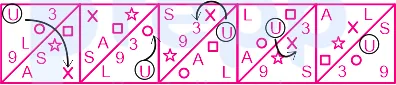
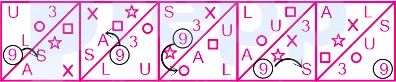
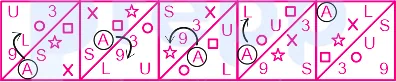
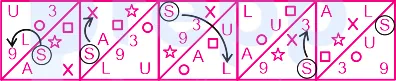
Question 1archived
Which of the following numbers will replace the question mark (?) in the given series?
1331, 2197, ?, 6859
- A
4913
- B
5832
- C
4096
- D
3375
Show answer
A. 4913Solving the Number Series Question
The question asks us to find the number that replaces the question mark (?) in the given series: 1331, 2197, ?, 6859.
To solve this type of number series problem, we need to identify the underlying pattern or rule that relates the terms in the sequence.
Analyzing the Number Series Pattern
Let's look closely at the numbers provided: 1331, 2197, and 6859. These numbers are relatively large, which might indicate that they are powers of integers, such as squares or cubes.
Let's test if these numbers are perfect cubes by finding their cube roots:
For the first term, 1331: We find that $\small 11 \times 11 \times 11 = 1331$. So, $\small 1331 = 11^3$.
For the second term, 2197: We find that $\small 13 \times 13 \times 13 = 2197$. So, $\small 2197 = 13^3$.
For the last term, 6859: We find that $\small 19 \times 19 \times 19 = 6859$. So, $\small 6859 = 19^3$.
Based on this analysis, the given number series appears to be composed of cubes of certain numbers:
$\small 11^3, 13^3, ?, 19^3$
Identifying the Pattern in the Bases
Now let's look at the bases of these cubes: 11, 13, and 19. We need to find the number that fits between 13 and 19 in this sequence of bases.
Consider the sequence of bases: 11, 13, ?, 19.
Let's examine the properties of these numbers:
11 is a prime number. A prime number is a natural number greater than 1 that has no positive divisors other than 1 and itself.
13 is the next prime number immediately following 11.
19 is also a prime number.
This suggests that the pattern in the bases might be consecutive prime numbers.
Let's list the sequence of prime numbers: 2, 3, 5, 7, 11, 13, 17, 19, 23, ...
Looking at our sequence of bases (11, 13, ?, 19) and comparing it with the list of prime numbers, we can see that the missing base is the prime number that comes after 13 and before 19.
The prime number that follows 13 is 17.
So, the missing base in the sequence 11, 13, ?, 19 is 17.
Calculating the Missing Number
Since the series consists of the cubes of these prime bases, the missing number is the cube of the missing base, which is 17.
We need to calculate $\small 17^3$:
$\small 17^3 = 17 \times 17 \times 17$
First, calculate $\small 17 \times 17$: $\small 17^2 = 289$.
Next, multiply 289 by 17:
$\small 289 \times 17 = 4913$
So, the missing number in the series is 4913.
Verifying the Solution
The completed series based on our pattern is: $\small 11^3, 13^3, 17^3, 19^3$.
Which translates to: 1331, 2197, 4913, 6859.
The calculated missing number is 4913. Let's check the given options:
Option 1: 4913. This matches our result.
Option 2: 5832. This is $\small 18^3$. The base 18 is not a prime number.
Option 3: 4096. This is $\small 16^3$. The base 16 is not a prime number.
Option 4: 3375. This is $\small 15^3$. The base 15 is not a prime number.
Our calculated number, 4913, matches one of the options and fits the pattern of cubes of consecutive prime numbers.
Summary of the Number Series Pattern
The pattern in the given series is that each term is the cube of a consecutive prime number, starting from 11.
PositionBase (Prime Number)CalculationSeries Term
1st11$\small 11^3$1331
2nd13$\small 13^3$2197
3rd17$\small 17^3$4913
4th19$\small 19^3$6859
The number that replaces the question mark (?) is 4913.
Revision Table: Key Number Series Patterns
Recognizing patterns is key to solving number series questions. Common patterns include:
Addition or Subtraction Series (constant difference).
Multiplication or Division Series (constant ratio).
Square Series (terms are squares of numbers).
Cube Series (terms are cubes of numbers).
Series based on Prime Numbers.
Series based on Composite Numbers.
Fibonacci Series or similar recursive patterns.
Combination of multiple patterns.
Always check for simple arithmetic or geometric progressions first, then look for squares, cubes, or patterns involving special numbers like primes.
Additional Information: Understanding Prime Numbers and Cubes
Prime Numbers: These are fundamental building blocks in number theory. A prime number has exactly two distinct positive divisors: 1 and itself. Examples: 2, 3, 5, 7, 11, 13, 17, 19, etc. Numbers greater than 1 that are not prime are called composite numbers.
Cubes: The cube of a number 'n' is 'n' multiplied by itself three times, denoted as $\small n^3$. For example, $\small 5^3 = 5 \times 5 \times 5 = 125$. Numbers that are the cube of an integer (like 1, 8, 27, 64, 125, 216, etc.) are called perfect cubes. This series uses perfect cubes where the base follows a specific pattern (prime numbers).
Solving number series often requires familiarity with basic arithmetic, powers (squares and cubes), and types of numbers (prime, composite, odd, even).
Paper & answer key PDF ↗ Question 2archived
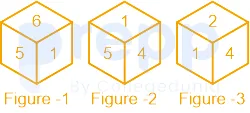
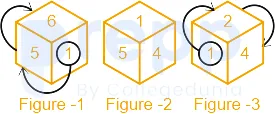
Three different positions of the same dice are shown. Find the number on the face opposite the face showing '1'.
- A
2
- B
4
- C
6
- D
3
Show answer
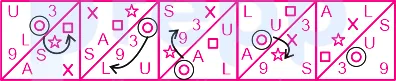
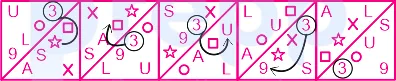
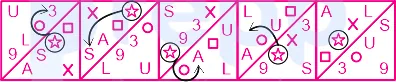
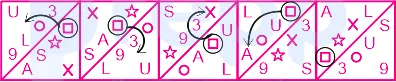
D. 3The logic followed here is :-
From the given three different cubes, figure 1 and figure 3 ,the adjacent sides are as shown below :
As 1 is common on both figure 1 and figure 3, it is clear that 2, 4, 5 and 6 are adjacent to it and remaining number i.e., 3 will be opposite to it.
Opposite pairs:
2 → 5
4 → 6
1 → 3
So, the opposite side of "1" will be side "3".
Hence, the correct answer is "3".
 Paper & answer key PDF ↗
 Question 3archived
In a certain code language, ‘CRUST’ is written as ‘201921183’ and ‘BLAME’ is written as ‘5131122’. How will ‘PLASTIC’ be written in that language?
- A
18204165138
- B
73110209325
- C
71642578102
- D
39201911216
Show answer
D. 39201911216Understanding Coding Decoding Patterns
Coding-decoding questions require you to decipher a hidden rule or pattern used to convert a word, number, or symbol into a different form. Once the pattern is identified from the given examples, you apply it to find the code for the new word.
Analyzing the Pattern for 'CRUST'
The word 'CRUST' is coded as '201921183'. Let's consider the standard alphabetical positions of the letters:
Letter
C
R
U
S
T
Position
\(3\)
\(18\)
\(21\)
\(19\)
\(20\)
Let's look at the coded value '201921183'. If we arrange the letters of 'CRUST' in reverse order, we get T, S, U, R, C.
Letter (Reverse Order)
T
S
U
R
C
Position
\(20\)
\(19\)
\(21\)
\(18\)
\(3\)
Concatenating these positions (\(20\)\(19\)\(21\)\(18\)\(3\)) results in '201921183', which matches the given code for 'CRUST'.
Verifying the Pattern with 'BLAME'
Let's check if the same pattern holds for 'BLAME', which is coded as '5131122'.
Letter
B
L
A
M
E
Position
\(2\)
\(12\)
\(1\)
\(13\)
\(5\)
Arranging the letters of 'BLAME' in reverse order gives E, M, A, L, B. Their positions are:
Letter (Reverse Order)
E
M
A
L
B
Position
\(5\)
\(13\)
\(1\)
\(12\)
\(2\)
Concatenating these positions (\(5\)\(13\)\(1\)\(12\)\(2\)) gives '5131122', which matches the code for 'BLAME'. The pattern is confirmed: Write the letters of the word in reverse order and then write their standard alphabetical positions consecutively.
Applying the Code Logic to 'PLASTIC'
Now, let's apply this pattern to find the code for 'PLASTIC'.
Word: PLASTIC
Letters in reverse order: C, I, T, S, A, L, P
Standard alphabetical positions of these letters:
C: \(3\)
I: \(9\)
T: \(20\)
S: \(19\)
A: \(1\)
L: \(12\)
P: \(16\)
Concatenating the positions in the reverse order (C, I, T, S, A, L, P):
\(3\)\(9\)\(20\)\(19\)\(1\)\(12\)\(16\)
This sequence of digits forms the code for 'PLASTIC'.
So, the code for 'PLASTIC' is 39201911216.
Revision Table: Coding Logic Summary
Word
Letters (Reverse Order)
Positions
Code (Concatenated Positions)
CRUST
T, S, U, R, C
\(20, 19, 21, 18, 3\)
\(201921183\)
BLAME
E, M, A, L, B
\(5, 13, 1, 12, 2\)
\(5131122\)
PLASTIC
C, I, T, S, A, L, P
\(3, 9, 20, 19, 1, 12, 16\)
\(39201911216\)
Additional Information: Types of Coding-Decoding
Coding-decoding problems can involve various patterns. Some common types include:
Letter Coding: Letters are replaced by other letters based on a rule (e.g., shifting positions, opposite letters).
Number Coding: Words are coded using numbers (like in this problem), or numbers are coded using other numbers/symbols. The rule often relates letter positions or numerical operations.
Symbol Coding: Letters or words are coded using symbols.
Mixed Coding: Words and their codes are given in a jumbled format, and you need to decode the rule or find the code for a specific word.
Solving these problems effectively requires familiarity with the alphabet series (A-Z, positions 1-26) and practice in identifying different logical patterns.
Paper & answer key PDF ↗ Question 4archived
Select the option that is related to the fifth letter-cluster in the same way as the second letter-cluster is related to the first letter-cluster and the fourth letter-cluster is related to the third letter-cluster.
ROSE : IVQS :: SUIT : XLWT :: TIME : ?
- A
IPKU
- B
IPKV
- C
JPKU
- D
JPKV
Show answer
A. IPKUSolving Letter Cluster Analogy Questions
This question is an example of a letter cluster analogy. We are given two pairs of letter clusters where the second cluster is related to the first in a specific way. We need to identify this relationship and apply it to the fifth letter cluster to find the sixth one.
The given relationships are:
ROSE : IVQS
SUIT : XLWT
TIME : ?
Let's analyze the relationship between the letters in the first two pairs by looking at their positions in the English alphabet (A=1, B=2, ..., Z=26).
Analyzing the Relationship ROSE : IVQS
Let's examine the transformation for each letter position:
Position
Original Letter (ROSE)
Position in Alphabet
Transformed Letter (IVQS)
Position in Alphabet
Transformation/Shift
1st
R
18
I
9
18 → 9 (Opposite letter: $18+9=27$)
2nd
O
15
V
22
15 → 22 ($+7$)
3rd
S
19
Q
17
19 → 17 ($-2$)
4th
E
5
S
19
5 → 19 ($+14$)
From this, we observe potential transformations: Opposite, +7, -2, +14. Let's see if this pattern holds for the second pair.
Analyzing the Relationship SUIT : XLWT
Applying the same positional analysis:
Position
Original Letter (SUIT)
Position in Alphabet
Transformed Letter (XLWT)
Position in Alphabet
Transformation/Shift
1st
S
19
X
24
19 → 24 ($+5$). Not the opposite of S (H is the opposite).
2nd
U
21
L
12
21 → 12 ($-9$). Not +7.
3rd
I
9
W
23
9 → 23 ($+14$). Not -2.
4th
T
20
T
20
20 → 20 ($+0$). Not +14.
The initial pattern derived from the first pair (Opposite, +7, -2, +14) does not directly apply to the second pair using fixed shifts. However, let's look at the transformations position by position across both pairs:
Position
ROSE → IVQS Transformation
SUIT → XLWT Transformation
1st
R(18) → I(9) (Opposite or $-9$)
S(19) → X(24) ($+5$)
2nd
O(15) → V(22) ($+7$)
U(21) → L(12) ($-9$)
3rd
S(19) → Q(17) ($-2$)
I(9) → W(23) ($+14$)
4th
E(5) → S(19) ($+14$)
T(20) → T(20) ($+0$)
Let's look for patterns in the sequence of transformations for each position across the pairs:
Position 1: R→I, S→X. The resulting letters are I, X. Let's consider the word TIME which starts with T. From the result (IPKU), the first letter is I. So, the pattern for the first letter of the transformed word appears to be 'I' if the original word starts with R or T, and 'X' if the original word starts with S.
Position 2: The shifts are +7, -9. This looks like an alternating pattern. If the sequence is +7, -9, +7, ...
Position 3: The shifts are -2, +14. This also looks like an alternating pattern. If the sequence is -2, +14, -2, ...
Position 4: The resulting letters are S, T. From the result (IPKU), the fourth letter is U. The sequence of resulting letters at position 4 is S, T, U. This is a simple sequence of consecutive letters.
Applying the Pattern to TIME
Let's apply the observed patterns to the word TIME (this is the third pair in the sequence):
Original Word: TIME
First Letter (T): The rule is: if the original word starts with R or T, the transformed letter is I. TIME starts with T, so the first letter is I.
Second Letter (I): The shift sequence is +7, -9, +7, ... Since TIME is the third word, the shift for the second letter is +7. Position of I is 9. $9 + 7 = 16$. The 16th letter is P.
Third Letter (M): The shift sequence is -2, +14, -2, ... Since TIME is the third word, the shift for the third letter is -2. Position of M is 13. $13 - 2 = 11$. The 11th letter is K.
Fourth Letter (E): The sequence of transformed fourth letters is S, T, U, ... Since TIME is the third word, the transformed fourth letter is the third in this sequence, which is U.
Combining the letters, we get IPKU.
Conclusion
Based on the identified patterns for each letter position across the given pairs, the letter cluster related to TIME is IPKU.
Revision Table: Pattern Summary
Position
Pattern Description
Application to TIME
Resulting Letter
1st
I if starting letter is R or T; X if starting letter is S.
TIME starts with T.
I
2nd
Alternating shifts: +7, -9, +7, ...
For 3rd pair: +7 shift on I (9). $9+7=16$.
P
3rd
Alternating shifts: -2, +14, -2, ...
For 3rd pair: -2 shift on M (13). $13-2=11$.
K
4th
Sequence of transformed letters: S, T, U, ...
For 3rd pair: 3rd letter in sequence.
U
Additional Information on Letter Analogies
Letter analogies are a common type of question in logical reasoning tests. They require identifying the rule or pattern that transforms one set of letters into another. Patterns can be based on:
Positional shifts (adding or subtracting a number from the letter's position in the alphabet).
Opposite letters (A is opposite Z, B is opposite Y, etc., where position sum is 27).
Reversal of letter order.
Vowel/Consonant transformations.
Specific sequences or alternating rules for different positions or pairs.
Combination of multiple rules.
Solving these problems often involves breaking down the transformation letter by letter and position by position, looking for consistent or sequential patterns.
Paper & answer key PDF ↗ Question 5archived
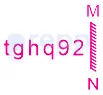
Select the correct mirror image of the given combination when the mirror is placed at line MN.
- A
Option A (shown in image)
- B
Option B (shown in image)
- C
Option C (shown in image)
- D
Option D (shown in image)
Show answer
Question 6archived
Three of the following four letter-clusters are alike in a certain way and one is different. Pick the odd one out.
- A
FDB
- B
ZXV
- C
JIG
- D
LJH
Show answer
C. JIGAnalyzing Letter Clusters to Find the Odd One Out
This question asks us to identify the letter cluster that is different from the other three based on a certain pattern or rule. We are given four letter clusters: FDB, ZXV, JIG, and LJH. To solve this type of problem, we usually look at the positions of the letters in the English alphabet.
Step-by-Step Analysis of Each Letter Cluster
Let's analyze each letter cluster by noting the position of each letter in the alphabet and finding the difference between consecutive letters.
FDB:
F is the 6th letter.
D is the 4th letter.
B is the 2nd letter.
Let's look at the differences: F to D is $6 - 4 = 2$. D to B is $4 - 2 = 2$.
So, the pattern for FDB is -2, -2.
ZXV:
Z is the 26th letter.
X is the 24th letter.
V is the 22nd letter.
Let's look at the differences: Z to X is $26 - 24 = 2$. X to V is $24 - 22 = 2$.
So, the pattern for ZXV is -2, -2.
JIG:
J is the 10th letter.
I is the 9th letter.
G is the 7th letter.
Let's look at the differences: J to I is $10 - 9 = 1$. I to G is $9 - 7 = 2$.
So, the pattern for JIG is -1, -2.
LJH:
L is the 12th letter.
J is the 10th letter.
H is the 8th letter.
Let's look at the differences: L to J is $12 - 10 = 2$. J to H is $10 - 8 = 2$.
So, the pattern for LJH is -2, -2.
Comparing the Letter Cluster Patterns
Let's summarize the patterns we found for each letter cluster:
Letter Cluster
Letter Positions
Difference Pattern
FDB
6, 4, 2
-2, -2
ZXV
26, 24, 22
-2, -2
JIG
10, 9, 7
-1, -2
LJH
12, 10, 8
-2, -2
From the table, we can clearly see that three of the letter clusters (FDB, ZXV, and LJH) follow the same pattern where each letter is 2 positions before the previous letter in the alphabet. However, the letter cluster JIG follows a different pattern, where the first difference is -1 and the second difference is -2.
Identifying the Odd Letter Cluster
Since FDB, ZXV, and LJH share the -2, -2 pattern, JIG is the one that doesn't fit this rule. Therefore, JIG is the odd one out among the given letter clusters.
Revision Table: Letter Pattern Analysis
Here is a quick review of the method used for analyzing letter patterns in reasoning questions:
Assign numerical positions to letters (A=1, B=2, ..., Z=26).
Calculate the difference between consecutive letters.
Look for a consistent pattern across most options.
Identify the option that deviates from the common pattern.
Additional Information: Types of Letter Reasoning Questions
Letter reasoning questions can appear in various forms in competitive exams. Some common types include:
Letter Series: A sequence of letters follows a specific rule (e.g., AB, CD, EF, ... or AZ, BY, CX, ...).
Letter Analogy: Finding a relationship between two letter pairs and applying the same rule to a third pair to find the fourth (e.g., CAT : DOG :: BIG : ?).
Letter Classification (Odd One Out): Identifying the letter or group of letters that does not belong to a class or group (like the question solved above).
Coding-Decoding: Letters are coded according to a rule, and you need to decode or encode messages based on that rule.
Practicing different types helps in quickly identifying the underlying logic during exams.
Paper & answer key PDF ↗ Question 7archived
Select the set in which the numbers are related in the same way as are the numbers of the given set.
(NOTE: Operations should be performed on the whole numbers, without breaking down the numbers into its constituent digits. E.g. 13 – Operations on 13 such as adding / subtracting / multiplying etc. to 13 can be performed. Breaking down 13 into 1 and 3 and then performing mathematical operations on 1 and 3 is not allowed.)
(9, 81, 729)
(14, 196, 2744)
- A
(11, 212, 464)
- B
(17, 289, 4913)
- C
(25, 625, 9375)
- D
(15, 375, 1125)
Show answer
B. (17, 289, 4913)The correct answer is (17, 289, 4913).
Combinations of arithmetic and geometric operations. Fibonacci series (sum of previous two numbers). To solve such questions effectively, practice is key. Try calculating squares and cubes of common numbers up to 20 or 25 to quickly recognize these values.
Paper & answer key PDF ↗ Question 8archived
If A + B means that A is the father of B, A – B means that A is the mother of B, A × B means that A is the brother of B then which of the following expression shows that Q is the son of P?
- A
P × P – Q
- B
P + Q – R
- C
P – Q - R
- D
P – Q + R
Show answer
D. P – Q + RUnderstanding Blood Relation Codes
In this question, we are given specific codes that represent different blood relationships. Understanding these codes is the first step to solving the problem. The codes are:
A + B means A is the father of B
A – B means A is the mother of B
A × B means A is the brother of B
We need to find the expression where Q is the son of P. This means P is either the father or the mother of Q, and Q is a male member of the family.
Analyzing Blood Relation Expressions Options
Let's examine each option provided and determine the relationships it describes:
Option 1: P × P – Q
This expression is P × P followed by P – Q.
P × P: According to the code, P is the brother of P. This is not a standard or possible blood relationship involving different individuals. An expression should typically involve relations between distinct people. However, if we ignore this anomaly and proceed with the second part:
P – Q: According to the code, P is the mother of Q.
Based on P – Q, we know P is the mother of Q. We don't have information from this expression about Q's gender. Therefore, this expression does not confirm that Q is the son of P.
Option 2: P + Q – R
This expression is P + Q followed by Q – R.
P + Q: According to the code, P is the father of Q.
Q – R: According to the code, Q is the mother of R.
From P + Q, we know P is the father of Q. From Q – R, we know Q is the mother of R. If Q is the mother of R, then Q must be female. If P is the father of Q and Q is female, then Q is the daughter of P. This does not show that Q is the son of P.
Option 3: P – Q – R
This expression is P – Q followed by Q – R.
P – Q: According to the code, P is the mother of Q.
Q – R: According to the code, Q is the mother of R.
From P – Q, we know P is the mother of Q. From Q – R, we know Q is the mother of R. If Q is the mother of R, then Q must be female. If P is the mother of Q and Q is female, then Q is the daughter of P. This does not show that Q is the son of P.
Option 4: P – Q + R
This expression is P – Q followed by Q + R.
P – Q: According to the code, P is the mother of Q.
Q + R: According to the code, Q is the father of R.
From P – Q, we know P is the mother of Q. From Q + R, we know Q is the father of R. If Q is the father of R, then Q must be male. If P is the mother of Q and Q is male, this means Q is the son of P.
Conclusion
Based on the analysis of each option, the expression P – Q + R correctly demonstrates that Q is the son of P because P is the mother of Q, and Q is identified as male (father of R).
Revision Table: Blood Relations Coding
Code
Relationship
+
Father
–
Mother
×
Brother
Additional Information: Solving Blood Relation Problems
Blood relation questions often involve decoding symbolic representations of family ties. Here are some tips for solving them:
Draw Family Trees: For complex relations, drawing a diagram or family tree can help visualize the connections between individuals.
Determine Gender: Pay close attention to symbols that indicate gender (like father, mother, brother, sister). This is often key to determining relationships.
Work Step-by-Step: Break down the given expression into smaller parts based on the operators and decode each part sequentially.
Identify the Goal: Keep in mind what relationship you are trying to find (e.g., Q is the son of P) and check if each decoded expression satisfies this goal.
Practicing different types of blood relation problems helps improve speed and accuracy in decoding the relationships correctly.
Paper & answer key PDF ↗ Question 9archived
A # B means ‘A is the sister of B’.
A @ B means ‘A is the son of B’.
A & B means ‘A is the father of B’.
A % B means ‘A is the mother of B’.
If W @ Q # T & Y @ M % K, then how is Q related to K?
- A
Mother’s sister
- B
Sister
- C
Mother
- D
Father’s sister
Show answer
D. Father’s sisterUnderstanding Blood Relations and Decoding the Expression
This question tests your ability to decode relationships expressed using symbols and determine the relationship between two individuals based on a chain of such relationships. We are given a set of symbol-relationship pairs:
A # B means ‘A is the sister of B’ (A is female).
A @ B means ‘A is the son of B’ (A is male).
A & B means ‘A is the father of B’ (A is male).
A % B means ‘A is the mother of B’ (A is female).
The given expression is W @ Q # T & Y @ M % K. We need to find out how Q is related to K by breaking down this expression step by step.
Step-by-Step Decoding of the Blood Relation Expression
Let's decode the expression W @ Q # T & Y @ M % K from left to right:
W @ Q: W is the son of Q. This tells us that W is male. Q is the parent of W (either father or mother).
Q # T: Q is the sister of T. This tells us that Q is female. Q and T are siblings. Since Q is female, and Q is a parent of W, Q must be the mother of W.
T & Y: T is the father of Y. This tells us that T is male. Y is the child of T.
Y @ M: Y is the son of M. This tells us that Y is male. M is the parent of Y.
M % K: M is the mother of K. This tells us that M is female. K is the child of M.
Combining the Relationships to Find Q's Relation to K
Now let's put the decoded relationships together:
From (2), we know Q is the sister of T.
From (3) and (4), T is the father of Y and Y is the son of M. This means T and M are the parents of Y. Since T is the father and Y is the son, M must be the mother of Y, and thus T and M are a married couple.
From (5), M is the mother of K. Since M is the mother of both Y and K, and T is the father of Y, T must also be the father of K. So, T and M are the parents of both Y and K.
We have Q is the sister of T, and T is the father of K. Therefore, Q is the sister of K's father.
A person's father's sister is their paternal aunt. Thus, Q is the paternal aunt of K.
Let's summarize the relationships derived:
Relation
Inference
Gender
W @ Q
W is son of Q
W: Male, Q: Parent
Q # T
Q is sister of T
Q: Female, T: Sibling of Q
T & Y
T is father of Y
T: Male, Y: Child of T
Y @ M
Y is son of M
Y: Male, M: Parent of Y
M % K
M is mother of K
M: Female, K: Child of M
Combining inferences:
Q is female (from Q # T).
T is male (from T & Y).
Q and T are siblings (from Q # T). Q is the sister of T.
T is the father of Y (from T & Y). M is the mother of Y (from Y @ M). So T and M are parents of Y and are a couple.
M is the mother of K (from M % K). Since M is married to T, T is the father of K.
So, T is the father of K, and Q is the sister of T.
Therefore, Q is the sister of K's father.
Final Relationship Determination
The relationship of Q to K is "Father's sister".
Revision Table: Key Relation Symbols
Symbol
Meaning
Gender of First Person
#
Sister of
Female
@
Son of
Male
&
Father of
Male
%
Mother of
Female
Additional Information on Blood Relations Reasoning
Blood relation questions involve tracing family ties. These problems can be solved by:
Drawing a family tree diagram: This visually represents the relationships.
Decoding step-by-step: Break down the given expression into smaller relationships.
Determining gender: Use the symbols to find the gender of individuals where indicated.
Combining links: Connect the smaller relationships to form a complete family structure.
Understanding common relationships like father, mother, son, daughter, brother, sister, aunt, uncle, cousin, grandparent is essential. Paternal relations involve the father's side of the family, and maternal relations involve the mother's side.
Paper & answer key PDF ↗ Question 10archived
Select a suitable figure from the answer figures which would replace the question mark (?).

- A
Option A (shown in image)
- B
Option B (shown in image)
- C
Option C (shown in image)
- D
Option D (shown in image)
Show answer
Question 11archived
By Interchanging the given two numbers which of the following equation will be not correct?
3 and 8
- A
7 + 3 – 4 ÷ 2 × 8 = 9
- B
6 ÷ 2 × 8 + 3 – 1 = 17
- C
8 – 3 + 6 × 2 ÷ 4 = –2
- D
2 + 3 – 6 ÷ 2 × 8 = 1
Show answer
B. 6 ÷ 2 × 8 + 3 – 1 = 17Analyzing Equations by Interchanging Numbers 3 and 8
The question asks us to find which equation is incorrect after interchanging the numbers 3 and 8 in each of the given expressions. We need to evaluate each equation after performing this interchange and check if the left-hand side equals the right-hand side.
Step-by-Step Verification of Each Equation
We will apply the order of operations (BODMAS/PEMDAS) to evaluate each equation after swapping 3 and 8.
Equation 1: Original: \(7 + 3 - 4 \div 2 \times 8 = 9\)
After interchanging 3 and 8, the equation becomes:
\(7 + 8 - 4 \div 2 \times 3 = 9\)
Let's evaluate the Left Hand Side (LHS):
First, perform division: \(4 \div 2 = 2\)
The equation is now: \(7 + 8 - 2 \times 3\)
Next, perform multiplication: \(2 \times 3 = 6\)
The equation is now: \(7 + 8 - 6\)
Perform addition and subtraction from left to right: \(7 + 8 = 15\)
Then: \(15 - 6 = 9\)
LHS = 9. The Right Hand Side (RHS) is 9. Since LHS = RHS (9 = 9), this equation is correct after interchanging 3 and 8.
Equation 2: Original: \(6 \div 2 \times 8 + 3 - 1 = 17\)
After interchanging 3 and 8, the equation becomes:
\(6 \div 2 \times 3 + 8 - 1 = 17\)
Let's evaluate the Left Hand Side (LHS):
First, perform division: \(6 \div 2 = 3\)
The equation is now: \(3 \times 3 + 8 - 1\)
Next, perform multiplication: \(3 \times 3 = 9\)
The equation is now: \(9 + 8 - 1\)
Perform addition and subtraction from left to right: \(9 + 8 = 17\)
Then: \(17 - 1 = 16\)
LHS = 16. The Right Hand Side (RHS) is 17. Since LHS \(\neq\) RHS (16 \(\neq\) 17), this equation is not correct after interchanging 3 and 8.
Equation 3: Original: \(8 - 3 + 6 \times 2 \div 4 = -2\)
After interchanging 3 and 8, the equation becomes:
\(3 - 8 + 6 \times 2 \div 4 = -2\)
Let's evaluate the Left Hand Side (LHS):
First, perform multiplication: \(6 \times 2 = 12\)
The equation is now: \(3 - 8 + 12 \div 4\)
Next, perform division: \(12 \div 4 = 3\)
The equation is now: \(3 - 8 + 3\)
Perform addition and subtraction from left to right: \(3 - 8 = -5\)
Then: \(-5 + 3 = -2\)
LHS = -2. The Right Hand Side (RHS) is -2. Since LHS = RHS (-2 = -2), this equation is correct after interchanging 3 and 8.
Equation 4: Original: \(2 + 3 - 6 \div 2 \times 8 = 1\)
After interchanging 3 and 8, the equation becomes:
\(2 + 8 - 6 \div 2 \times 3 = 1\)
Let's evaluate the Left Hand Side (LHS):
First, perform division: \(6 \div 2 = 3\)
The equation is now: \(2 + 8 - 3 \times 3\)
Next, perform multiplication: \(3 \times 3 = 9\)
The equation is now: \(2 + 8 - 9\)
Perform addition and subtraction from left to right: \(2 + 8 = 10\)
Then: \(10 - 9 = 1\)
LHS = 1. The Right Hand Side (RHS) is 1. Since LHS = RHS (1 = 1), this equation is correct after interchanging 3 and 8.
Summary of Results
Equation
After Interchanging 3 & 8
Evaluated LHS
RHS
Correct?
1
\(7 + 8 - 4 \div 2 \times 3 = 9\)
9
9
Yes
2
\(6 \div 2 \times 3 + 8 - 1 = 17\)
16
17
No
3
\(3 - 8 + 6 \times 2 \div 4 = -2\)
-2
-2
Yes
4
\(2 + 8 - 6 \div 2 \times 3 = 1\)
1
1
Yes
Based on the evaluation, the second equation is not correct after interchanging the numbers 3 and 8.
Revision Table: Interchanging Numbers in Equations
Concept
Description
Importance
Interchanging Numbers
Swapping the positions of two specific numbers throughout an expression or equation.
Changes the values calculated, potentially altering the truth of the equation.
Order of Operations (BODMAS/PEMDAS)
Rules specifying the sequence for performing mathematical operations (Brackets/Parentheses, Orders/Exponents, Division/Multiplication, Addition/Subtraction).
Essential for correctly evaluating mathematical expressions.
Equation Verification
Checking if the equality holds true after performing calculations on both sides.
Confirms whether a statement of equality is valid under given conditions.
Additional Information: Order of Operations
The order of operations is a crucial concept in mathematics to ensure consistency in evaluating expressions. It is often remembered by mnemonics like BODMAS or PEMDAS.
B/P: Brackets or Parentheses - Operations inside brackets are performed first.
O/E: Orders or Exponents - Powers and roots are evaluated next.
D/M: Division and Multiplication - These are done from left to right as they appear.
A/S: Addition and Subtraction - These are done from left to right as they appear after multiplication and division.
Applying the correct order is vital when evaluating expressions, especially those involving multiple operations and numbers, like in this problem where we interchange 3 and 8 and then calculate.
Paper & answer key PDF ↗ Question 12archived
In a certain code language, ‘HYPOCRISY’ is written as ‘YPHOCIRYS’ and ‘IMPORTANT’ is written as ‘MPIORATTN’. How will ‘INTEGRITY’ be written in that language?
- A
NTIEGIRYT
- B
NTIEGRIYT
- C
NTIGEIRYT
- D
NITEGIRYT
Show answer
A. NTIEGIRYTThe correct answer is NTIEGIRYT.
Block Rearrangement: The word is divided into blocks, and the letters within each block, or the blocks themselves, are rearranged. Consonant/Vowel Rearrangement: Consonants and vowels within the word might be separated and then rearranged based on a rule. Identifying the type of pattern is the first step in solving such coding language problems. For position rearrangement like this one, carefully noting the original and final positions of letters is key.
Paper & answer key PDF ↗ Question 13archived
What day of the week will be on 1st January 2033?
- A
Saturday
- B
Monday
- C
Sunday
- D
Tuesday
Show answer
A. SaturdayFinding the Day of the Week on 1st January 2033
To determine the day of the week for a future date like 1st January 2033, we can use the concept of 'odd days'. Odd days are the number of days remaining after dividing the total number of days by 7 (the number of days in a week).
We need a reference point, a date for which we know the day of the week. A common reference point is 1st January 2001, which was a Monday.
Now, let's calculate the number of odd days between 1st January 2001 and 1st January 2033.
Calculating the Number of Years
The period we are considering is from 1st January 2001 to 1st January 2033. This spans the years 2001 through 2032 completely, plus the single day of 1st January in 2033. However, when calculating odd days *between* dates, we usually count the full number of years passed and then add odd days for the remaining months/days in the target year. Since our target date is 1st January 2033, we need to account for the odd days accumulated over the complete years from 2001 up to the end of 2032. The number of full years is $2032 - 2001 = 31$ years. Including 2033 up to Jan 1st means we are essentially looking at the period covering 32 annual cycles starting from Jan 1, 2001. Let's re-evaluate the period. The period from 1st Jan 2001 to 1st Jan 2033 is exactly 32 years.
Number of years = $2033 - 2001 = 32$ years.
Identifying Leap Years and Ordinary Years
Within these 32 years (from 2001 to 2032 inclusive), we need to count the number of leap years. A year is a leap year if it is divisible by 4, except for century years which must be divisible by 400. The years between 2001 and 2032 that are divisible by 4 are:
2004
2008
2012
2016
2020
2024
2028
2032
There are 8 leap years in this period.
Number of ordinary years = Total years - Number of leap years = $32 - 8 = 24$ ordinary years.
Calculating Total Odd Days
An ordinary year has 365 days, which is $52$ weeks and $1$ day. So, an ordinary year has 1 odd day.
A leap year has 366 days, which is $52$ weeks and $2$ days. So, a leap year has 2 odd days.
Total odd days = (Number of ordinary years $\times$ Odd days in an ordinary year) + (Number of leap years $\times$ Odd days in a leap year)
Total odd days $= (24 \times 1) + (8 \times 2) = 24 + 16 = 40$ odd days.
Finding the Final Day
We have a total of 40 odd days. To find the net effect on the day of the week, we divide the total odd days by 7 and find the remainder.
Total odd days $= 40$
Remainder $= 40 \div 7 = 5$ (since $40 = 7 \times 5 + 5$)
The remainder is 5. This means that 1st January 2033 will be 5 days after the reference day, which was Monday (1st January 2001).
Counting 5 days after Monday:
Day 1: Tuesday
Day 2: Wednesday
Day 3: Thursday
Day 4: Friday
Day 5: Saturday
Therefore, 1st January 2033 will be a Saturday.
Period
Number of Years
Leap Years
Ordinary Years
Odd Days Calculation
Total Odd Days
Jan 1, 2001 to Jan 1, 2033
32
8 (2004, 2008, ..., 2032)
$32 - 8 = 24$
$(24 \times 1) + (8 \times 2)$
$24 + 16 = 40$
Final Odd Days Remainder: $\frac{40}{7}$ gives a remainder of $5$.
Starting Day (Jan 1, 2001): Monday
Adding 5 odd days to Monday leads to Saturday.
So, 1st January 2033 will be a Saturday.
Revision Table: Day of the Week Calculation Concepts
Concept
Explanation
Formula/Rule
Odd Days
The remainder when the total number of days is divided by 7.
Total Days $\pmod{7}$
Ordinary Year
A year with 365 days.
1 odd day ($365 \pmod{7} = 1$)
Leap Year
A year with 366 days (February has 29 days).
2 odd days ($366 \pmod{7} = 2$)
Leap Year Rule
Generally divisible by 4. Century years must be divisible by 400.
Year % 4 == 0 AND (Year % 100 != 0 OR Year % 400 == 0)
Additional Information: Calendar Calculations and Odd Days
Calendar calculations rely heavily on understanding the cycle of days and weeks. The concept of odd days simplifies the process of finding the day of the week for a distant date without having to count every single day.
Every $7$ days, the day of the week repeats.
Calculating odd days for periods (like months or years) allows us to determine how many days forward or backward from a known day we need to count.
For months, the number of odd days depends on the number of days in the month:
31 days (Jan, Mar, May, Jul, Aug, Oct, Dec) $\rightarrow 31 \pmod{7} = 3$ odd days.
30 days (Apr, Jun, Sep, Nov) $\rightarrow 30 \pmod{7} = 2$ odd days.
28 days (Feb in ordinary year) $\rightarrow 28 \pmod{7} = 0$ odd days.
29 days (Feb in leap year) $\rightarrow 29 \pmod{7} = 1$ odd day.
We can also calculate odd days from a fixed reference date like the beginning of the Christian era (Jan 1, 0001), though using a recent, known date is often easier for practical problems.
Understanding how ordinary years and leap years contribute odd days is fundamental to these types of calendar problems. Each full cycle of 400 years has a fixed number of odd days (zero), which helps in calculations over very long periods, but for periods like 32 years, direct counting of leap years is straightforward.
Paper & answer key PDF ↗ Question 14archived
Select the option that is related to the third word in the same way as the second word is related to the first word. (The words must be considered as meaningful English words and must not be related to each other based on the number of letters/number of consonants/vowels in the word)
Earth : Planet :: Moon : ?
- A
Rocket
- B
Space
- C
Satellite
- D
Orbit
Show answer
C. SatelliteUnderstanding the Analogy Question
The question asks us to find the word that has the same relationship with 'Moon' as 'Planet' has with 'Earth'. This is a classic analogy question where we need to identify the relationship in the first pair of words and apply that relationship to the third word to find the fourth word.
The first pair is: Earth : Planet
Let's analyze the relationship between Earth and Planet.
Earth is a specific example of a type of celestial body called a Planet.
In other words, a Planet is a classification or category, and Earth belongs to that category.
So, the relationship is: Specific Example : Category or Member : Group.
Applying the Analogy to the Second Pair
Now we apply this same relationship to the second pair. The third word is 'Moon'. We need to find what 'Moon' is a specific example of, or what category 'Moon' belongs to, from the given options.
The second pair is: Moon : ?
We are looking for the category or classification for the Moon.
Evaluating the Options for Moon's Relationship
Let's look at the provided options:
Rocket: A rocket is a vehicle used for space travel. The Moon is not a type of rocket. This relationship does not fit the pattern.
Space: Space is the vast area where celestial bodies exist. The Moon exists in space, but space is not a category that defines what the Moon is. This relationship does not fit the pattern.
Satellite: A satellite is a celestial body that orbits a planet or star. The Moon is a natural celestial body that orbits the Earth. Therefore, the Moon is a natural satellite of the Earth. This fits the pattern: Moon (Specific Example) : Satellite (Category).
Orbit: An orbit is the path a celestial body takes around another object. Orbit is a concept related to the movement of the Moon, not a classification of what the Moon is. This relationship does not fit the pattern.
Conclusion: The Moon's Classification
Based on the analysis, the relationship between Earth and Planet (Specific Example : Category) is mirrored by the relationship between Moon and Satellite. The Earth is a Planet, and the Moon is a Satellite.
Therefore, the word that completes the analogy is Satellite.
First Pair
Relationship
Second Pair
Applying Relationship
Earth : Planet
Earth is a type of Planet (Specific : Category)
Moon : ?
Moon is a type of ...?
Moon : Satellite
Moon is a type of Satellite (Specific : Category)
Revision Table: Analogy Keywords
Term
Concept in Analogy
Relation Example
Earth
Specific Object (Planet)
Part of Earth : Whole Earth
Planet
Category (for Earth)
Object : Category
Moon
Specific Object (Satellite)
Part of Moon : Whole Moon
Satellite
Category (for Moon)
Object : Category
Additional Information: Celestial Body Classifications
Understanding the classification of celestial bodies is helpful for solving such analogies related to space.
Planet: A large celestial body that orbits a star. Examples include Earth, Mars, Jupiter.
Satellite: A celestial body that orbits a planet. Can be natural (like the Moon) or artificial (man-made).
Star: A large, luminous sphere of plasma held together by gravity. The Sun is a star.
Asteroid: A rocky object orbiting the Sun, typically smaller than a planet.
Comet: An icy, rocky body that orbits the Sun, often with a visible tail.
Galaxy: A vast system of stars, gas, dust, and dark matter held together by gravity. Our galaxy is the Milky Way.
In this analogy, the Moon is specifically known as a natural satellite because it orbits the Earth.
Paper & answer key PDF ↗ Question 15archived
Three statements are given followed by three conclusions numbered I, II and III. Assuming the statements to be true, even if they seem to be at variance with commonly known facts, decide which of the conclusions logically follow(s) from the statements.
Statements:
Some dogs are animals.
Some animals are pet.
All pets are white.
Conclusions:
I. Some dogs are white.
II. Some animals are white.
III. Some animals are dogs.
- A
All conclusions follow.
- B
Only conclusions I and II follow.
- C
Only conclusions II and III follow.
- D
Only conclusions I and III follow.
Show answer
C. Only conclusions II and III follow.Understanding Syllogism Statements and Conclusions
This question is based on syllogism, a type of logical reasoning where conclusions are drawn from given statements. We need to assume the statements are true and determine which of the given conclusions logically follow.
Analyzing the Statements and Conclusions
Here are the statements provided:
Some dogs are animals.
Some animals are pet.
All pets are white.
And here are the conclusions we need to evaluate:
I. Some dogs are white.
II. Some animals are white.
III. Some animals are dogs.
Approach to Solving Syllogism Problems
A common and effective method to solve syllogism problems is by using Venn diagrams. We can represent each category (Dogs, Animals, Pet, White) as circles and show the relationships between them based on the statements. We must cover all possible valid diagrams derived from the statements.
Step-by-Step Venn Diagram Construction and Analysis
Let's represent the statements using Venn diagrams:
Statement 1: Some dogs are animals.
This means there is an overlap between the 'Dogs' circle and the 'Animals' circle. There are dogs that are animals, and potentially dogs that are not animals, and animals that are dogs, and animals that are not dogs.
Statement 2: Some animals are pet.
There is an overlap between the 'Animals' circle and the 'Pet' circle. This overlap exists within the 'Animals' circle.
Statement 3: All pets are white.
The entire 'Pet' circle must be contained within the 'White' circle.
Now, let's combine these statements and see the possible scenarios and their implications for the conclusions:
From "Some animals are pet" and "All pets are white", it logically follows that "Some animals are white". This is because the part of 'Animals' that is 'Pet' is also 'White'.
The relationship between 'Dogs' and 'Animals' is "Some dogs are animals". This overlap might or might not extend into the part of 'Animals' that is also 'Pet' and thus 'White'.
Evaluating the Conclusions
Let's check each conclusion based on our combined understanding derived from the statements:
Conclusion I: Some dogs are white.
Based on the statements, dogs overlap with animals, and animals overlap with pets, and pets are all white. The overlap between dogs and animals might occur in the part of animals that are NOT pets. Therefore, it is not guaranteed that any dog falls into the 'Pet' or 'White' category. This conclusion does not logically follow.
Conclusion II: Some animals are white.
Statement 2 says "Some animals are pet", and Statement 3 says "All pets are white". If some animals are pets, and all pets are white, then those specific animals (which are pets) must also be white. This conclusion logically follows.
Conclusion III: Some animals are dogs.
Statement 1 says "Some dogs are animals". If some members of the 'Dogs' category are also members of the 'Animals' category, it necessarily means that some members of the 'Animals' category are also members of the 'Dogs' category. This is a direct logical consequence of the first statement. This conclusion logically follows.
Therefore, based on the given statements, only conclusions II and III logically follow.
Conclusion
Evaluation
Logically Follows?
I. Some dogs are white.
Overlap between Dogs and Animals might not be in the 'Pet/White' part of Animals.
No
II. Some animals are white.
Some animals are pets, and all pets are white. Thus, some animals are white.
Yes
III. Some animals are dogs.
If some dogs are animals, then some animals must be dogs.
Yes
Revision Table: Key Syllogism Relationships
Statement Type
Valid Immediate Conclusion (Conversion)
All A are B
Some B are A
No A are B
No B are A
Some A are B
Some B are A
Some A are not B
No valid immediate conversion
Additional Information: Types of Syllogism Statements
Statements in syllogisms typically fall into four categories:
Universal Affirmative (A): All S are P (e.g., All dogs are animals).
Universal Negative (E): No S are P (e.g., No dogs are cats).
Particular Affirmative (I): Some S are P (e.g., Some dogs are brown).
Particular Negative (O): Some S are not P (e.g., Some dogs are not brown).
Understanding these types helps in drawing valid conclusions and identifying fallacies in logical arguments.
Paper & answer key PDF ↗ Question 16archived
By interchanging the given two signs which of the following equation will be correct?
÷ and +
- A
8 + 4 × 5 ÷ 2 – 6 = 7
- B
16 + 8 × 2 ÷ 6 – 4 = 8
- C
18 + 2 × 6 ÷ 3 – 7 = 50
- D
11 + 8 × 16 ÷ 4 – 7 = 20
Show answer
C. 18 + 2 × 6 ÷ 3 – 7 = 50Solving Equations by Interchanging Signs
The problem asks us to determine which of the given equations becomes correct when the signs '÷' (division) and '+' (addition) are interchanged. This means we need to swap every instance of '+' with '÷' and every instance of '÷' with '+'. After performing the interchange, we will evaluate each modified equation using the order of operations (BODMAS/PEMDAS) to check if it equals the result shown on the right side of the original equation.
Evaluating Each Equation with Interchanged Signs
We will now test each option one by one by swapping the '+' and '÷' signs and calculating the result.
Option 1 Analysis:
Original Equation: \(8 + 4 \times 5 \div 2 – 6 = 7\)
Equation after interchanging '+' and '÷': \(8 \div 4 \times 5 + 2 – 6\)
Let's evaluate this using the BODMAS rule:
Division: \(8 \div 4 = 2\)
Multiplication: \(2 \times 5 = 10\)
Addition: \(10 + 2 = 12\)
Subtraction: \(12 – 6 = 6\)
The result is 6. The original equation states the result should be 7. Since \(6 \neq 7\), this option is incorrect.
Option 2 Analysis:
Original Equation: \(16 + 8 \times 2 \div 6 – 4 = 8\)
Equation after interchanging '+' and '÷': \(16 \div 8 \times 2 + 6 – 4\)
Let's evaluate this using the BODMAS rule:
Division: \(16 \div 8 = 2\)
Multiplication: \(2 \times 2 = 4\)
Addition: \(4 + 6 = 10\)
Subtraction: \(10 – 4 = 6\)
The result is 6. The original equation states the result should be 8. Since \(6 \neq 8\), this option is incorrect.
Option 3 Analysis:
Original Equation: \(18 + 2 \times 6 \div 3 – 7 = 50\)
Equation after interchanging '+' and '÷': \(18 \div 2 \times 6 + 3 – 7\)
Let's evaluate this using the BODMAS rule:
Division: \(18 \div 2 = 9\)
Multiplication: \(9 \times 6 = 54\)
Addition: \(54 + 3 = 57\)
Subtraction: \(57 – 7 = 50\)
The result is 50. The original equation states the result should be 50. Since \(50 = 50\), this option is correct.
Option 4 Analysis:
Original Equation: \(11 + 8 \times 16 \div 4 – 7 = 20\)
Equation after interchanging '+' and '÷': \(11 \div 8 \times 16 + 4 – 7\)
Let's evaluate this using the BODMAS rule:
Division: \(11 \div 8 = 1.375\)
Multiplication: \(1.375 \times 16 = 22\)
Addition: \(22 + 4 = 26\)
Subtraction: \(26 – 7 = 19\)
The result is 19. The original equation states the result should be 20. Since \(19 \neq 20\), this option is incorrect.
Summary of Results
Option
Original Equation
Interchanged Signs
Modified Equation
Calculated Result
Expected Result
Correct?
1
\(8 + 4 \times 5 \div 2 – 6 = 7\)
\(+ \leftrightarrow \div\)
\(8 \div 4 \times 5 + 2 – 6\)
6
7
No
2
\(16 + 8 \times 2 \div 6 – 4 = 8\)
\(+ \leftrightarrow \div\)
\(16 \div 8 \times 2 + 6 – 4\)
6
8
No
3
\(18 + 2 \times 6 \div 3 – 7 = 50\)
\(+ \leftrightarrow \div\)
\(18 \div 2 \times 6 + 3 – 7\)
50
50
Yes
4
\(11 + 8 \times 16 \div 4 – 7 = 20\)
\(+ \leftrightarrow \div\)
\(11 \div 8 \times 16 + 4 – 7\)
19
20
No
Based on our evaluation, Option 3 is the only equation that becomes correct after interchanging the '÷' and '+' signs.
Revision Table: Key Concepts
Concept
Explanation
Example
Sign Interchange
Replacing specific mathematical operators in an equation with other specified operators.
Swapping '+' and '-' means every '+' becomes '-' and every '-' becomes '+'.
Order of Operations (BODMAS/PEMDAS)
Rules that dictate the sequence in which mathematical operations should be performed to evaluate an expression uniquely. BODMAS stands for Brackets, Orders (powers/roots), Division and Multiplication (left-to-right), Addition and Subtraction (left-to-right).
In \(10 + 2 \times 3\), multiplication is done first: \(10 + 6 = 16\).
Equation Correctness
An equation is correct if the value of the expression on the left side equals the value on the right side.
\(5 + 3 = 8\) is correct. \(5 + 3 = 9\) is incorrect.
Additional Information: Working with Mathematical Signs
Understanding how different mathematical signs function and the order in which operations are performed is fundamental to solving such problems. Sign interchanging puzzles test your ability to apply these rules consistently under a modified condition.
When signs are interchanged, the numerical values and the positions of the remaining signs (like multiplication and subtraction in this case) stay the same.
Always follow the BODMAS/PEMDAS rule precisely after interchanging the signs. Division and multiplication have the same priority, evaluated from left to right. Similarly, addition and subtraction have the same priority, also evaluated from left to right.
These types of questions are common in logical reasoning and quantitative aptitude tests. Practice helps in quickly evaluating multiple options.
Paper & answer key PDF ↗ Question 17archived
Which letter-cluster will replace the question mark (?) to complete the given series?
ABCD, BDFD, CFID, ?, EJOD
- A
DHED
- B
DHDD
- C
DLHD
- D
DHLD
Show answer
D. DHLDUnderstanding Letter-Cluster Series Patterns
This question asks us to identify the pattern in a given series of letter-clusters and find the missing term. The series is: ABCD, BDFD, CFID, ?, EJOD.
To solve this type of problem, we should examine the position of each letter within the clusters and look for a consistent pattern across the series. Let's analyze the series term by term, focusing on the position of each letter in the English alphabet (A=1, B=2, C=3, ..., Z=26).
Analyzing the Pattern Letter by Letter
We will break down the series by looking at the first letter of each cluster, then the second, and so on.
First Letter Analysis:
1st cluster: ABCD - First letter is A (position 1)
2nd cluster: BDFD - First letter is B (position 2)
3rd cluster: CFID - First letter is C (position 3)
5th cluster: EJOD - First letter is E (position 5)
The sequence of the first letters is A, B, C, ?, E. This shows a simple increment of 1 in alphabetical position: $1 \to 2 \to 3 \to \text{?} \to 5$. The missing first letter should be the one at position 4, which is D.
Second Letter Analysis:
1st cluster: ABCD - Second letter is B (position 2)
2nd cluster: BDFD - Second letter is D (position 4)
3rd cluster: CFID - Second letter is F (position 6)
5th cluster: EJOD - Second letter is J (position 10)
The sequence of the second letters is B, D, F, ?, J. This shows an increment of 2 in alphabetical position: $2 \to 4 \to 6 \to \text{?} \to 10$. The missing second letter should be the one at position $6 + 2 = 8$, which is H.
Third Letter Analysis:
1st cluster: ABCD - Third letter is C (position 3)
2nd cluster: BDFD - Third letter is F (position 6)
3rd cluster: CFID - Third letter is I (position 9)
5th cluster: EJOD - Third letter is O (position 15)
The sequence of the third letters is C, F, I, ?, O. This shows an increment of 3 in alphabetical position: $3 \to 6 \to 9 \to \text{?} \to 15$. The missing third letter should be the one at position $9 + 3 = 12$, which is L.
Fourth Letter Analysis:
1st cluster: ABCD - Fourth letter is D (position 4)
2nd cluster: BDFD - Fourth letter is D (position 4)
3rd cluster: CFID - Fourth letter is D (position 4)
5th cluster: EJOD - Fourth letter is D (position 4)
The sequence of the fourth letters is D, D, D, ?, D. This shows that the fourth letter is constant, remaining D in all clusters. The missing fourth letter should therefore be D.
Summarizing the Pattern
Let's put the findings in a table to visualize the pattern:
Cluster
1st Letter
2nd Letter
3rd Letter
4th Letter
ABCD
A (1)
B (2)
C (3)
D (4)
BDFD
B (2)
D (4)
F (6)
D (4)
CFID
C (3)
F (6)
I (9)
D (4)
?
D (4)
H (8)
L (12)
D (4)
EJOD
E (5)
J (10)
O (15)
D (4)
Based on the analysis:
The first letter follows the pattern $A (+1) B (+1) C (+1) \textbf{D} (+1) E$.
The second letter follows the pattern $B (+2) D (+2) F (+2) \textbf{H} (+2) J$.
The third letter follows the pattern $C (+3) F (+3) I (+3) \textbf{L} (+3) O$.
The fourth letter is constant: $D \to D \to D \to \textbf{D} \to D$.
Conclusion
Combining the letters found for the missing cluster gives us DHLD.
Revision Table: Key Learnings
Concept
Description
Letter Series
A sequence of letters or letter-clusters following a specific pattern.
Pattern Identification
Breaking down the series to find rules for each letter position or group of letters.
Alphabet Position
Using the numerical order of letters (A=1, B=2, etc.) helps find arithmetic patterns.
Series Completion
Applying the identified pattern to predict the next or missing term in the series.
Additional Information: Tips for Letter Series
When tackling letter series problems, consider these tips:
Write down the alphabetical position of each letter involved.
Look for patterns in the numerical sequence: addition, subtraction, multiplication, division, prime numbers, squares, cubes, etc.
Sometimes the pattern involves jumping letters (e.g., skipping one letter each time).
The pattern might alternate between different operations or rules.
For letter-cluster series, analyze each letter position separately first.
Check if the pattern makes sense throughout the entire given series, not just the first few terms.
Paper & answer key PDF ↗ Question 18archived
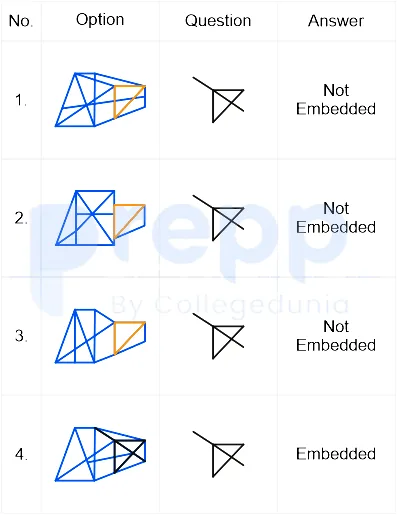
Select the option figure in which the given figure (X) is embedded as its part (rotation is NOT allowed).

- A
Option A (shown in image)
- B
Option B (shown in image)
- C
Option C (shown in image)
- D
Option D (shown in image)
Show answer
D. Option D (shown in image)Given:
The image must not to be rotated
Hence, the correct answer is "Option - (4)" .

 Paper & answer key PDF ↗
 Question 19archived
Select the odd group of numbers. (NOTE: Operations should be performed on the whole numbers, without breaking down the numbers into its constituent digits. E.g.13 – Operations on 13 such as adding /subtracting /multiplying etc. to 13 can be performed. Breaking down 13 into 1 and 3 and then performing mathematical operations on 1 and 3 is not allowed)
- A
(92 –72 –52)
- B
(76 –56 –36)
- C
(98–78 –56)
- D
(88 –68 –48)
Show answer
C. (98–78 –56)The correct answer is (98–78 –56).
This sequence follows an arithmetic progression. Option 3, however, has numbers that decrease by $20$ initially, but then decrease by $22$. This inconsistency makes it the odd group out. Therefore, the group (98 – 78 – 56) is the odd one because it does not maintain a constant difference between its consecutive numbers.
Paper & answer key PDF ↗ Question 20archived
Which two numbers, from amongst the given options, should be interchanged to make the given equation correct?
\((6)^3 \div12+ [(\sqrt{81}) \times 4] - (28 \div 2) + 24 = 43\)
- A
12 and 24
- B
6 and 24
- C
81 and 4
- D
28 and 24
Show answer
A. 12 and 24Solving the Equation by Interchanging Numbers
The question asks us to identify which pair of numbers, when swapped within the given mathematical equation, makes the equation correct. The given equation is:
\((6)^3 \div12+ [(\sqrt{81}) \times 4] - (28 \div 2) + 24 = 43\)
We need to test each option by interchanging the specified numbers and checking if the equation evaluates to 43.
Evaluating the Original Equation
Before trying any interchanges, let's evaluate the original equation using the order of operations (BODMAS/PEMDAS):
Calculate powers and roots: \((6)^3 = 216\), \(\sqrt{81} = 9\).
Calculate divisions and multiplications from left to right: \(216 \div 12 = 18\), \((\sqrt{81}) \times 4 = 9 \times 4 = 36\), \(28 \div 2 = 14\).
Calculate additions and subtractions from left to right: \(18 + 36 - 14 + 24\).
So, the original equation becomes:
\[18 + 36 - 14 + 24\]
\[54 - 14 + 24\]
\[40 + 24 = 64\]
The original equation evaluates to 64, which is not equal to 43. Therefore, we need to interchange numbers.
Testing the Options for Number Interchange
We will now test each option provided.
Option 1: Interchange 12 and 24
If we interchange 12 and 24, the equation becomes:
\((6)^3 \div24+ [(\sqrt{81}) \times 4] - (28 \div 2) + 12\)
Evaluating this modified equation:
Powers and roots: \((6)^3 = 216\), \(\sqrt{81} = 9\).
Divisions and multiplications: \(216 \div 24 = 9\), \((\sqrt{81}) \times 4 = 9 \times 4 = 36\), \(28 \div 2 = 14\).
Additions and subtractions: \(9 + 36 - 14 + 12\).
The expression becomes:
\[9 + 36 - 14 + 12\]
\[45 - 14 + 12\]
\[31 + 12 = 43\]
This evaluation results in 43, which matches the right side of the given equation. Therefore, interchanging 12 and 24 makes the equation correct.
Let's quickly look at other options to confirm.
Option 2: Interchange 6 and 24
If we interchange 6 and 24, the equation becomes:
\((24)^3 \div12+ [(\sqrt{81}) \times 4] - (28 \div 2) + 6\)
Evaluating this:
Powers and roots: \((24)^3 = 13824\), \(\sqrt{81} = 9\).
Divisions and multiplications: \(13824 \div 12 = 1152\), \(9 \times 4 = 36\), \(28 \div 2 = 14\).
Additions and subtractions: \(1152 + 36 - 14 + 6 = 1188 - 14 + 6 = 1174 + 6 = 1180\).
1180 is not equal to 43.
Option 3: Interchange 81 and 4
If we interchange 81 and 4, the equation becomes:
\((6)^3 \div12+ [(\sqrt{4}) \times 81] - (28 \div 2) + 24\)
Evaluating this:
Powers and roots: \((6)^3 = 216\), \(\sqrt{4} = 2\).
Divisions and multiplications: \(216 \div 12 = 18\), \((\sqrt{4}) \times 81 = 2 \times 81 = 162\), \(28 \div 2 = 14\).
Additions and subtractions: \(18 + 162 - 14 + 24 = 180 - 14 + 24 = 166 + 24 = 190\).
190 is not equal to 43.
Option 4: Interchange 28 and 24
If we interchange 28 and 24, the equation becomes:
\((6)^3 \div12+ [(\sqrt{81}) \times 4] - (24 \div 2) + 28\)
Evaluating this:
Powers and roots: \((6)^3 = 216\), \(\sqrt{81} = 9\).
Divisions and multiplications: \(216 \div 12 = 18\), \(9 \times 4 = 36\), \(24 \div 2 = 12\).
Additions and subtractions: \(18 + 36 - 12 + 28 = 54 - 12 + 28 = 42 + 28 = 70\).
70 is not equal to 43.
Conclusion
Based on the evaluation of each option, only interchanging the numbers 12 and 24 makes the equation correct.
Option
Numbers to Interchange
Modified Equation Result
Correct?
Original
-
64
No
Option 1
12 and 24
43
Yes
Option 2
6 and 24
1180
No
Option 3
81 and 4
190
No
Option 4
28 and 24
70
No
Revision Table: Key Concepts
Concept
Description
Example
Order of Operations (BODMAS/PEMDAS)
A set of rules to follow when evaluating mathematical expressions to ensure consistency. BODMAS stands for Brackets, Orders (powers, roots), Division and Multiplication (left to right), Addition and Subtraction (left to right). PEMDAS stands for Parentheses, Exponents, Multiplication and Division (left to right), Addition and Subtraction (left to right).
In \(18 + 36 - 14 + 24\), we do additions and subtractions from left to right.
Equation
A mathematical statement that shows that two expressions are equal. It contains an equals sign (=).
\(x + 5 = 10\) is an equation.
Interchange
To swap the positions or values of two things. In this problem, we swap two numbers within the equation.
Interchanging 12 and 24 in \(A + 12 = B - 24\) gives \(A + 24 = B - 12\).
Additional Information: Solving Equation Puzzles
This type of problem is common in reasoning and quantitative aptitude tests. It requires careful application of the order of operations and systematic checking of possibilities. When solving such problems, it's helpful to:
Evaluate the original expression first to see if it already matches the target value.
Break down the expression into smaller, manageable parts using the order of operations.
Clearly write down the modified equation for each option.
Re-evaluate the modified equation carefully, following the order of operations strictly.
Keep track of the values obtained from each option.
Understanding the impact of swapping numbers, especially those involved in operations like division or powers, is crucial. Swapping a small number with a large number can drastically change the result of multiplication or division.
Paper & answer key PDF ↗ Question 21archived
Select the option that is related to the third number in the same way as the second number is related to the first number and the sixth number is related to the fifth number.
37 : 100 :: 24 : ? :: 29 : 76
- A
64
- B
61
- C
75
- D
70
Show answer
B. 61The correct answer is 61.
Consider squares and cubes: The numbers might be related to squares or cubes of the first number or numbers derived from it (e.g., $N^2 + X$ or $(N+X)^2$). Test the rule: Once you think you've found a rule from one pair, test it immediately on the other known pairs in the analogy to ensure consistency. Break down numbers: Sometimes, the pattern involves the digits of the numbers themselves (e.g., sum of digits, product of digits). Practicing different types of numerical reasoning problems helps in quickly identifying potential patterns during an exam.
Paper & answer key PDF ↗ Question 22archived
Select the set in which the numbers are related in the same way as are the numbers of the following set.
(NOTE : Operations should be performed on the whole numbers, without breaking down the numbers into its constituent digits. E.g. 13 – Operations on 13 such as adding / subtracting / multiplying etc. to 13 can be performed. Breaking down 13 into 1 and 3 and then performing mathematical operations on 1 and 3 is NOT allowed)
(23, 14, 9)
(37, 19, 18)
- A
(125, 25, 5)
- B
(125, 100, 5)
- C
(125, 25, 100)
- D
(125, 5, 25)
Show answer
C. (125, 25, 100)The correct answer is (125, 25, 100).
Digit Operations: Although explicitly excluded in this specific question's note, sometimes the pattern involves operations on the individual digits of the numbers. Always read question notes carefully! Series/Sequence Rules: The numbers might follow a specific sequence rule (e.g., adding a constant difference, multiplying by a constant ratio, Fibonacci sequence relation). Practicing with various types of number sets helps in quickly identifying the underlying pattern during exams.
Paper & answer key PDF ↗ Question 23archived
Which figure should replace the question mark (?) if the service were to be continued?

- A
Option A (shown in image)
- B
Option B (shown in image)
- C
Option C (shown in image)
- D
Option D (shown in image)
Show answer
Question 24archived
Which of the following terms will replace the question mark (?) in the given series?
FOX ? JSX LUX NWX
- A
HQS
- B
HQX
- C
HXQ
- D
HEX
Show answer
B. HQXFinding the Missing Term in the Letter Series
The question asks us to find the term that replaces the question mark (?) in the given series: FOX ? JSX LUX NWX. This is a common type of logical reasoning problem where we need to identify the pattern in the sequence of terms.
To solve this series completion problem, we will analyze the letters at each position across the terms in the series.
Analyzing the Pattern in the First Letter
Let's look at the first letter of each term:
FOX starts with F
? starts with an unknown letter
JSX starts with J
LUX starts with L
NWX starts with N
Let's find the alphabetical position of these letters:
Term
First Letter
Position
FOX
F
6
?
?
?
JSX
J
10
LUX
L
12
NWX
N
14
Now, let's look at the difference in positions for the known terms:
From J to L: \(12 - 10 = 2\)
From L to N: \(14 - 12 = 2\)
It appears there is a consistent increase of 2 in the position of the first letter from J onwards. Let's assume this pattern extends to the term before J. If the unknown term's first letter is between F (6) and J (10), and the pattern is +2, then:
F (6) + 2 = 8
The letter at position 8 is H.
Checking the next step: H (8) + 2 = 10 (which is J).
This fits the pattern. So, the first letter of the missing term is H.
Analyzing the Pattern in the Second Letter
Next, let's examine the second letter of each term:
FOX has O
? has an unknown letter
JSX has S
LUX has U
NWX has W
Let's find the alphabetical position of these letters:
Term
Second Letter
Position
FOX
O
15
?
?
?
JSX
S
19
LUX
U
21
NWX
W
23
Let's look at the difference in positions for the known terms:
From S to U: \(21 - 19 = 2\)
From U to W: \(23 - 21 = 2\)
Similar to the first letters, there's a consistent increase of 2 in the position of the second letter from S onwards. Let's assume this pattern extends to the term before S. If the unknown term's second letter is between O (15) and S (19), and the pattern is +2, then:
O (15) + 2 = 17
The letter at position 17 is Q.
Checking the next step: Q (17) + 2 = 19 (which is S).
This fits the pattern. So, the second letter of the missing term is Q.
Analyzing the Pattern in the Third Letter
Finally, let's check the third letter of each term:
FOX has X
? has an unknown letter
JSX has X
LUX has X
NWX has X
Let's find the alphabetical position of these letters:
Term
Third Letter
Position
FOX
X
24
?
?
?
JSX
X
24
LUX
X
24
NWX
X
24
The third letter is consistently X (position 24) in all the given terms. Therefore, the third letter of the missing term is also X.
Combining the Letters
By combining the letters we found for each position, the missing term is:
First letter: H
Second letter: Q
Third letter: X
The missing term is HQX.
Checking the Options
Let's compare our derived term with the given options:
Option 1: HQS (Incorrect - third letter is S)
Option 2: HQX (Correct - matches our derived term)
Option 3: HXQ (Incorrect - letters are in different order)
Option 4: HEX (Incorrect - second letter is E)
The term that replaces the question mark is HQX.
Revision Table: Letter Series Pattern
Position
Series
Pattern
First Letter
F, H, J, L, N
\(+2\) added to alphabetical position
Second Letter
O, Q, S, U, W
\(+2\) added to alphabetical position
Third Letter
X, X, X, X, X
Constant (X)
Additional Information: Solving Letter Series Questions
Letter series questions are a common part of logical reasoning and aptitude tests. They require identifying the rule that governs the sequence of letters or groups of letters.
Common patterns include:
Alphabetical Position: The most frequent pattern relates to the position of letters in the English alphabet (A=1, B=2, ... Z=26). The pattern can involve addition, subtraction, multiplication, or division of these positions.
Skipping Letters: The pattern might involve skipping a fixed or varying number of letters between consecutive terms.
Reverse Alphabetical Order: The series might move backward through the alphabet.
Combination of Patterns: Different positions within the terms might follow different patterns, as seen in the example above where the first two letters follow a +2 pattern based on position, and the third letter is constant.
Vowel/Consonant Patterns: The series might be based on the sequence of vowels or consonants.
Reverse Order within Term: The letters within each term might be arranged in a specific order (e.g., alphabetical, reverse alphabetical).
Steps to approach letter series problems:
Write down the series clearly.
Assign numerical positions to each letter if the pattern seems related to position.
Analyze the pattern for each letter position separately.
Look for differences, ratios, or other mathematical relationships between the numbers.
Consider other patterns like skipping letters or vowel/consonant sequences.
Once a pattern is identified, apply it to find the missing term.
Verify the pattern holds true for all given terms in the series.
Check the derived term against the options provided.
Paper & answer key PDF ↗ Question 25archived
In the following question below are given some statements followed by some conclusions based on those statements. Taking the given statements to be true even if they seem to be at variance from commonly known facts. Read all the conclusions and then decide which of the given conclusion logically follows the given statements.
Statements:
I. All J are B.
II. Some D are B.
Conclusions:
I. Some D are not J.
II. Some B are not J.
- A
Only conclusion I follows
- B
Neither conclusion follows
- C
Only conclusion II follows
- D
Both conclusions I and II follows
Show answer
B. Neither conclusion followsLogical Reasoning: Analyzing Statements and Conclusions
This question asks us to analyze given statements and determine which of the provided conclusions logically follow. We must assume the statements are true, even if they contradict common knowledge. This type of problem tests our ability to draw necessary inferences based purely on the structure of the given information.
Understanding the Given Statements
We have two statements:
Statement I: All J are B. This means that the set of 'J' is completely contained within the set of 'B'. If something is a 'J', it must also be a 'B'.
Statement II: Some D are B. This means there is at least one element that is both a 'D' and a 'B'. It does not mean *only* some D are B; it allows for the possibility that all D are B, or that only one D is B, or any number in between, as long as it's not zero.
Evaluating the Conclusions
Now let's look at the two conclusions based on these statements.
Conclusion I: Some D are not J.
We are told "All J are B" and "Some D are B". Can we definitively say that "Some D are not J"?
Let's consider possible scenarios that satisfy the statements:
Scenario A: Imagine J is a small circle inside a larger circle B. Now, place circle D such that it completely overlaps with B, but specifically overlaps only with the part of B that is also J. In this case, all D would be J (and thus also B). If all D are J, then it's false that "Some D are not J".
Scenario B: Imagine J is a small circle inside a larger circle B. Now, place circle D such that it overlaps with B, but *only* with the part of B that is *not* J. In this case, some D are B (and not J), and perhaps some D are neither B nor J. In this scenario, "Some D are not J" is true.
Since we can construct a scenario (Scenario A) where the statements are true but Conclusion I ("Some D are not J") is false, Conclusion I does not logically follow from the statements.
Conclusion II: Some B are not J.
We are told "All J are B" and "Some D are B". Can we definitively say that "Some B are not J"?
Let's focus on Statement I: "All J are B". This statement means every member of the set J is also a member of the set B. This can be true in two main ways regarding the relative sizes of J and B:
Possibility 1: The set J is a proper subset of the set B. This means J is smaller than B, and all of J is inside B, leaving some elements in B that are not in J. In this case, "Some B are not J" would be true.
Possibility 2: The set J is exactly the same as the set B. This means J and B are identical sets. In this case, "All J are B" is true (because all of B are J), but "Some B are not J" would be false (because all B are J).
Since Statement I ("All J are B") allows for the possibility that J and B are the same set, we cannot definitively conclude that "Some B are not J". Statement II ("Some D are B") provides information about D but does not constrain the relationship between J and B any further than Statement I does. Because there is a valid situation where the statements are true and Conclusion II is false (when J and B are the same set), Conclusion II does not logically follow.
Summary of Evaluation
Based on our analysis, neither Conclusion I nor Conclusion II necessarily follows from the given statements.
Statements
Conclusions
Evaluation
I. All J are B.
I. Some D are not J.
Does not logically follow (Counter-example: All D are J).
II. Some D are B.
II. Some B are not J.
Does not logically follow (Counter-example: All B are J, which is possible if J = B).
Conclusion
Since neither conclusion logically follows from the given statements, the correct answer is that neither conclusion follows.
Revision Table: Key Concepts in Logical Reasoning
Concept
Explanation
Example
Statements
Given propositions assumed to be true.
All cats are mammals.
Conclusions
Propositions derived from the statements. Must logically follow.
If all cats are mammals, then my pet cat is a mammal.
Logical Follows
A conclusion logically follows if it MUST be true whenever the statements are true, under all possible interpretations of the terms and statements.
From "All A are B" and "All B are C", it logically follows that "All A are C".
Counter-example
A scenario where the statements are true, but the conclusion is false. If a counter-example exists, the conclusion does not logically follow.
Statements: All dogs are animals. All cats are animals. Conclusion: All dogs are cats. Counter-example: A specific dog and a specific cat exist. Both are animals (statements true), but the dog is not the cat (conclusion false).
Additional Information: Syllogisms and Validity
The type of logical reasoning question presented here is related to syllogisms, which are arguments consisting of three parts: a major premise, a minor premise, and a conclusion. While not a standard form syllogism, the principles of validity apply.
An argument is considered valid if the conclusion necessarily follows from the premises (statements). Validity is about the *form* of the argument, not whether the statements are true in the real world. If a conclusion is validly derived, then if the statements were true, the conclusion *would have to be* true.
In our problem:
Statement I: All J are B. (Similar to a Universal Affirmative)
Statement II: Some D are B. (Similar to a Particular Affirmative)
We tested the conclusions for validity. We found that we could construct scenarios consistent with the statements where each conclusion was false. This demonstrates that neither conclusion is a necessary consequence of the statements, and thus neither conclusion logically follows.
Understanding quantifiers like "All" and "Some" is crucial. "All" implies every member of a set. "Some" implies at least one member of a set. "Some... are not..." implies at least one member of a set lacks a property.
Paper & answer key PDF ↗ Question 26archived
The railway system connecting St-Petersburg to Vladivostok is ______.
- A
The Altai Railway
- B
The Amur Railways
- C
Trans – Baikal Railway
- D
Trans – Siberian Railways
Show answer
D. Trans – Siberian RailwaysUnderstanding the St-Petersburg to Vladivostok Railway Link
The question asks to identify the railway system that connects St-Petersburg to Vladivostok. This is a famous long-distance railway line in Russia.
Identifying the Correct Railway System
Russia is known for its extensive railway network, especially the routes that traverse vast distances across the country. The connection between St-Petersburg (or historically, often starting from Moscow, with a link to St-Petersburg) in European Russia and Vladivostok on the Pacific coast is one of the longest railway lines in the world.
Let's look at the options provided:
The Altai Railway: This refers to railway lines located within or serving the Altai region, typically in Southern Siberia. It is not the main line connecting St-Petersburg/Moscow to Vladivostok.
The Amur Railways: The Amur Mainline is a significant railway line in Eastern Siberia and the Russian Far East, running north of and parallel to sections of the Trans-Siberian Railway. While important for connecting to the Far East, it is not the primary, original line connecting European Russia to Vladivostok.
Trans – Baikal Railway: This is a section of the Trans-Siberian Railway that runs through the Transbaikal region, connecting Ulan-Ude and Chita. It is a part of the longer route but not the entire system from St-Petersburg to Vladivostok.
Trans – Siberian Railways: This is the name given to the network of railways connecting Moscow and European Russia with the Russian Far East. The main route of the Trans-Siberian Railway specifically connects Moscow (or St-Petersburg via a connecting line) to Vladivostok. It is the longest railway line in the world.
Based on the destinations mentioned (St-Petersburg to Vladivostok), the railway system that connects these two major cities is the Trans – Siberian Railways.
Detailed Route and Significance of the Trans-Siberian Railway
The primary route of the Trans-Siberian Railway stretches approximately 9,289 kilometers (5,772 miles) from Moscow to Vladivostok. There is a connecting line from St-Petersburg to Moscow, effectively linking St-Petersburg to the entire Trans-Siberian network.
Key points about the Trans-Siberian Railway:
It passes through numerous major Russian cities, including Perm, Yekaterinburg, Omsk, Novosibirsk, Krasnoyarsk, Irkutsk (near Lake Baikal), Ulan-Ude, Chita, Birobidzhan, and Khabarovsk, before reaching Vladivostok.
Construction began in 1891 and was largely completed by 1916, although upgrades and branch lines continued later.
It is crucial for passenger transport, freight transport, and the economic development of Siberia and the Russian Far East.
It is also a famous tourist route, offering a unique way to experience the vast landscapes of Russia.
Therefore, the railway connecting St-Petersburg to Vladivostok is indeed the Trans-Siberian Railway system.
Conclusion
The railway system that links St-Petersburg in Western Russia to Vladivostok in the Russian Far East is the Trans-Siberian Railway.
Railway NamePrimary Association / RouteConnects St-Petersburg to Vladivostok?
The Altai RailwayAltai Region, Southern SiberiaNo
The Amur RailwaysAmur Mainline, Eastern Siberia / Far EastNo (separate parallel line for part of the distance)
Trans – Baikal RailwaySection of Trans-Siberian near Lake BaikalOnly a section, not the whole route
Trans – Siberian RailwaysConnects European Russia (Moscow/St-Petersburg) to the Russian Far East (Vladivostok)Yes
Revision Table: Key Russian Railways
Railway SystemKey TerminologyRoute Highlights
Trans-Siberian RailwayLongest railway, Russia, Vladivostok, Moscow, St-PetersburgConnects Moscow/St-Petersburg with Vladivostok across Siberia.
Baikal – Amur Mainline (BAM)Amur Mainline, BAM, parallel to Trans-Siberian, Eastern SiberiaRuns north of Trans-Siberian, connecting Tayshet to Sovetskaya Gavan.
Trans-Baikal RailwayPart of Trans-Siberian, Zabaikalye, Chita, Ulan-UdeSection of the Trans-Siberian in the Transbaikal region.
Additional Information: Trans-Siberian Railway Facts
Here are some more facts about the Trans-Siberian Railway:
It is the longest single railway in the world, though there are alternative routes and branches, such as the Trans-Mongolian (to Beijing) and the Trans-Manchurian (to Beijing via Harbin).
The journey from Moscow to Vladivostok typically takes about 7 days by train.
Over 30% of Russia's exports travel on the Trans-Siberian Railway.
It crosses 8 time zones.
Paper & answer key PDF ↗ Question 27archived
As of 10 April 2022, who among the following is serving as the Chief Minister of Chhattisgarh?
- A
Kawasi Lakhma
- B
Tamradhwaj Sahu
- C
TS Singh Deo
- D
Bhupesh Baghel
Show answer
D. Bhupesh BaghelUnderstanding the Role of a Chief Minister in India
In India, the Chief Minister is the elected head of government of each of the twenty-eight states and sometimes a union territory. The Chief Minister is the leader of the party or coalition that has a majority in the state legislative assembly. They are appointed by the state's Governor.
The question asks about the individual serving as the Chief Minister of Chhattisgarh on a specific date, 10 April 2022.
Identifying the Chief Minister of Chhattisgarh
To answer this question, we need to know who held the office of Chief Minister in Chhattisgarh during the period around April 2022. Checking reliable sources for the political history of Chhattisgarh will provide this information.
Examining the Options
Let's consider the provided options:
Kawasi Lakhma
Tamradhwaj Sahu
TS Singh Deo
Bhupesh Baghel
These are all prominent political figures in Chhattisgarh. We need to identify which one held the position of Chief Minister as of 10 April 2022.
Determining the Correct Chief Minister
Historical records show that the Indian National Congress party formed the government in Chhattisgarh following the 2018 state assembly elections. The leader chosen to head this government was Bhupesh Baghel.
Bhupesh Baghel assumed the office of Chief Minister of Chhattisgarh on 17 December 2018 and continued to serve in that position through April 10, 2022, and beyond, until December 2023.
Conclusion
Based on the political tenure of the individuals listed, Bhupesh Baghel was indeed serving as the Chief Minister of Chhattisgarh on 10 April 2022.
Individual
Known Role/Status in Chhattisgarh Politics (as of April 2022)
Was serving as Chief Minister on 10 April 2022?
Kawasi Lakhma
Minister in State Government
No
Tamradhwaj Sahu
Minister in State Government
No
TS Singh Deo
Deputy Chief Minister (from 2023), Minister (as of April 2022)
No
Bhupesh Baghel
Chief Minister
Yes
Revision Table: Chhattisgarh Chief Minister
State
Chief Minister on 10 April 2022
Political Party
Term Started
Chhattisgarh
Bhupesh Baghel
Indian National Congress
17 December 2018
Additional Information: State Government Leadership
The Chief Minister is the chief executive authority of a state government in India. They are advised by a Council of Ministers, whose members are appointed by the Governor on the recommendation of the Chief Minister. The Chief Minister is responsible to the state legislative assembly. The daily administration of the state is carried out under their direction and supervision.
Other important figures in a state government include:
Governor: The constitutional head of the state, appointed by the President of India.
Council of Ministers: Led by the Chief Minister, they are responsible for various government departments.
Speaker of the Legislative Assembly: Presides over the sessions of the state legislative assembly.
Understanding the structure of state government is key to knowing about the roles of individuals like the Chief Minister of Chhattisgarh.
Paper & answer key PDF ↗ Question 28archived
The Electricity (Amendment) Bill, 2022 was introduced in Lok Sabha on August 8, 2022. The Bill amends the Electricity Act established in _______.
- A
2005
- B
2007
- C
2001
- D
2003
Show answer
D. 2003The question asks about the original Act that was amended by the Electricity (Amendment) Bill, 2022. Understanding the timeline of legislation is crucial for comprehending the proposed changes introduced by the Electricity (Amendment) Bill, 2022.
Understanding the Electricity Act and its Amendment
The Electricity (Amendment) Bill, 2022, introduced in the Lok Sabha on August 8, 2022, proposes significant changes to the existing framework governing the power sector in India. However, this bill is an amendment, meaning it seeks to modify an already established law. The original comprehensive law governing the electricity sector was enacted in a specific year.
The Electricity Act aimed to consolidate the laws relating to the generation, transmission, distribution, trading, and use of electricity and generally for taking measures conducive to the development of the electricity industry, promoting competition therein, protecting the interests of consumers and supply of electricity to all areas, rationalization of electricity tariff, ensuring transparent policies regarding subsidies, promotion of efficient and environmentally benign policies, constitution of Central Electricity Authority, Regulatory Commissions and establishment of Appellate Tribunal and for matters connected therewith or incidental thereto.
Identifying the Original Electricity Act Year
The Electricity (Amendment) Bill, 2022, amends the primary legislation related to electricity in India. This foundational law that the 2022 Bill refers to is the Electricity Act that was enacted in the year 2003.
The Electricity Act, 2003, was a landmark legislation that consolidated several previous laws related to electricity, including the Indian Electricity Act, 1910, the Electricity (Supply) Act, 1948, and the Electricity Regulatory Commissions Act, 1998. It provided a comprehensive framework for the reform and development of the power sector in the country.
Therefore, the Electricity (Amendment) Bill, 2022, is an amendment to the Electricity Act, 2003.
Based on this information, the correct option is 2003.
Revision Table: Electricity Legislation
Let's summarize the key information related to the Acts mentioned or implied:
Original comprehensive Act consolidated previous laws: Electricity Act, 2003
Bill proposing changes to the 2003 Act: Electricity (Amendment) Bill, 2022
Year the amendment bill was introduced in Lok Sabha: 2022
Additional Information: Electricity Act, 2003
The Electricity Act, 2003, brought about several key changes and introduced important concepts in the Indian power sector, such as:
De-licensing of generation, allowing private sector participation freely.
Introducing the concept of open access in transmission and distribution to promote competition.
Mandating the establishment of independent regulatory commissions at the centre and state levels.
Focusing on rural electrification.
Laying down provisions for tariff determination, grid connectivity, and power trading.
The Electricity (Amendment) Bill, 2022, seeks to further modify aspects of this 2003 Act, particularly focusing on issues like introducing competition in distribution by providing consumers with choices of multiple distribution licensees.
Paper & answer key PDF ↗ Question 29archived
Which of the following sites is located on the hills near the Brahmaputra valley on the way to China and Myanmar?
- A
Mehrgarh
- B
Paiyampalli
- C
Gufkral
- D
Daojali Hading
Show answer
D. Daojali HadingIdentifying Ancient Sites in Northeast India
The question asks us to locate an ancient site situated on hills near the Brahmaputra valley, specifically on routes leading towards China and Myanmar. This geographical description points towards a location in the northeastern part of India.
Analyzing the Options
Let's examine the location of each site provided in the options:
Mehrgarh: This site is located in the Balochistan province of Pakistan, near the Bolan Pass. This is in South Asia but is geographically very far from the Brahmaputra valley and the routes to China and Myanmar.
Paiyampalli: Located in the state of Tamil Nadu in South India. This is geographically distant from the Brahmaputra valley.
Gufkral: Situated in the Kashmir valley in the Union Territory of Jammu and Kashmir, North India. This location is also far from the Brahmaputra valley and routes to Southeast Asia.
Daojali Hading: This archaeological site is located in the Dima Hasao district of Assam, which is in the northeastern part of India. Assam is known for the Brahmaputra river valley. The location of Daojali Hading on hills in this region places it strategically on potential ancient routes towards neighboring countries like China and Myanmar.
Comparing the locations, Daojali Hading is the only site among the given options that fits the description of being located on hills near the Brahmaputra valley on the way to China and Myanmar.
Ancient Site
Location
Relevance to Question's Description
Mehrgarh
Balochistan, Pakistan
Far from Brahmaputra valley and routes to China/Myanmar
Paiyampalli
Tamil Nadu, India
Far from Brahmaputra valley and routes to China/Myanmar
Gufkral
Jammu and Kashmir, India
Far from Brahmaputra valley and routes to China/Myanmar
Daojali Hading
Assam, India
On hills near Brahmaputra valley, on routes towards China/Myanmar
Conclusion
Based on the geographical context provided in the question and the locations of the ancient sites, Daojali Hading is the site located on the hills near the Brahmaputra valley on the way to China and Myanmar.
Revision Table: Ancient Sites and Locations
Site Name
Geographical Area
Key Period (Primary Association)
Mehrgarh
South Asia (Pakistan)
Neolithic, Chalcolithic
Paiyampalli
South India
Neolithic, Megalithic
Gufkral
North India (Kashmir)
Neolithic
Daojali Hading
Northeast India (Assam)
Neolithic
Additional Information: Neolithic Sites in India
Neolithic period sites in India are found across various regions, indicating the spread of agriculture and settled life. Daojali Hading is an important Neolithic site in Northeast India. Excavations at such sites help us understand the transition from hunting-gathering to farming and the early forms of settled communities. Artefacts found at Daojali Hading, like stone tools (mortars, pestles), pottery, and tools made from fossil wood, provide insights into the daily life and technology of the people who lived there thousands of years ago. The location near trade routes also suggests potential interactions with neighboring cultures.
Paper & answer key PDF ↗ Question 30archived
With which of the following states is the folk dance Tarangmel associated?
- A
Goa
- B
Madhya Pradesh
- C
Tamil Nadu
- D
Kerala
Show answer
A. GoaUnderstanding the Tarangmel Folk Dance
The question asks about the Indian state associated with the folk dance known as Tarangmel. Folk dances are a vibrant part of India's cultural heritage, with each state having its unique forms and styles. Identifying the correct state for a specific folk dance like Tarangmel is important for understanding regional cultures.
Identifying the State Associated with Tarangmel
The folk dance Tarangmel is a popular cultural expression primarily associated with the state of Goa. It is a lively and colourful dance performed during festivals, celebrating the harvest season and the youthful energy of the region.
Here are some key points about the Tarangmel dance:
Tarangmel is traditionally performed at the conclusion of the Ganesh Chaturthi and Dussehra festivals.
The dance signifies youthfulness, energy, and the joy of harvest.
Dancers typically carry colourful flags and "ghumot" (a percussion instrument) and "dhol" (drums), creating a festive atmosphere.
The costumes worn are usually vibrant and mirror the celebratory nature of the dance.
Exploring Other Options
Let's consider the other states provided in the options to confirm why Tarangmel is not associated with them:
Madhya Pradesh: Known for folk dances like Gaur Maria, Rai, Jawara, Lehangi, and Tertali.
Tamil Nadu: Famous for folk dances such as Bharatanatyam (classical dance, but also has folk roots/forms), Karagattam, Kavadi Attam, Oyilattam, and Kummi.
Kerala: Home to folk dances like Thirayattam, Mudiyettu, Theyyam, and Oppana. Kathakali and Mohiniyattam are its prominent classical dance forms.
Comparing Tarangmel with the well-known folk dances of these states confirms its unique association with Goa.
Conclusion
Based on the cultural heritage and traditions of Indian states, the folk dance Tarangmel is distinctly linked to Goa. It represents the state's festive spirit, the abundance of the harvest, and the vitality of its youth.
Therefore, the correct answer is Goa.
Revision Table: Tarangmel Dance Facts
Aspect
Detail
Dance Name
Tarangmel
Associated State
Goa
Occasion
End of Ganesh Chaturthi and Dussehra festivals
Significance
Harvest festival, youthfulness, joy
Instruments
Ghumot, Dhol
Additional Information: Folk Dances of India
India is incredibly diverse, and this diversity is reflected in its numerous folk dance forms. These dances are often performed during religious festivals, harvest seasons, weddings, and other social gatherings. They are typically spontaneous, energetic, and performed by common people to express joy, devotion, or community spirit. Each folk dance tells a story about the region's culture, history, and lifestyle. Learning about these dances provides insight into the rich tapestry of Indian traditions beyond classical dance forms.
Examples of other famous Indian folk dances include Bhangra (Punjab), Garba (Gujarat), Ghoomar (Rajasthan), Bihu (Assam), Lavani (Maharashtra), and Chhau (Odisha, Jharkhand, West Bengal).
Paper & answer key PDF ↗ Question 31archived
Distance covered by object is ______ to time.
- A
equal proportional
- B
directly proportional
- C
inversely proportional
- D
double proportional
Show answer
B. directly proportionalUnderstanding the Relationship Between Distance and Time
The question asks about the relationship between the distance covered by an object and the time taken to cover that distance. This is a fundamental concept in physics, specifically in the study of motion.
Let's consider an object moving at a constant speed. Speed is defined as the distance covered per unit time. The formula for speed is:
\( \text{Speed} = \frac{\text{Distance}}{\text{Time}} \)
We can rearrange this formula to express distance in terms of speed and time:
\( \text{Distance} = \text{Speed} \times \text{Time} \)
Using symbols, if \(d\) is the distance, \(v\) is the speed, and \(t\) is the time, the formula is:
\( d = v \times t \)
Analyzing Proportionality
The question asks about the proportionality between distance and time. Proportionality describes how one quantity changes in relation to another.
Direct Proportionality: Two quantities are directly proportional if an increase in one quantity causes a proportional increase in the other, and a decrease causes a proportional decrease. Mathematically, if \(y\) is directly proportional to \(x\), we write \(y \propto x\), which means \(y = kx\) for some constant \(k\).
Inversely Proportionality: Two quantities are inversely proportional if an increase in one quantity causes a proportional decrease in the other. Mathematically, if \(y\) is inversely proportional to \(x\), we write \(y \propto \frac{1}{x}\), which means \(y = \frac{k}{x}\) for some constant \(k\).
Distance and Time Relationship at Constant Speed
Looking at the formula \(d = v \times t\), if the speed \(v\) is constant, then \(v\) acts like the constant of proportionality (\(k\)) in the direct proportionality equation \(y = kx\). In this case, distance (\(d\)) corresponds to \(y\), time (\(t\)) corresponds to \(x\), and speed (\(v\)) corresponds to \(k\).
So, when the speed of an object is constant, the distance covered is directly proportional to the time taken. This means:
If you double the time, you double the distance.
If you triple the time, you triple the distance.
If you halve the time, you halve the distance.
This relationship holds true for motion at a constant speed.
Evaluating the Options
equal proportional: This is not a standard term for proportionality. Distance is not necessarily "equal" to time; it depends on the speed.
directly proportional: As explained above, when speed is constant, distance is directly proportional to time.
inversely proportional: This would mean that as time increases, distance decreases, which is incorrect for an object moving forward.
double proportional: This is not a standard term for proportionality. It might imply a relationship like \(d \propto t^2\) or \(d \propto 2t\), but the basic relationship at constant speed is \(d \propto t\).
Therefore, the correct description of the relationship between distance covered and time, assuming constant speed, is directly proportional.
Term
Meaning
Mathematical Relation (k is constant)
Distance-Time Relation (at constant speed v)
Directly Proportional
As one increases, the other increases proportionally.
\(y \propto x \implies y = kx\)
\(d \propto t \implies d = vt\)
Inversely Proportional
As one increases, the other decreases proportionally.
\(y \propto \frac{1}{x} \implies y = \frac{k}{x}\)
Not applicable for distance vs. time at constant speed.
Revision Table: Key Motion Concepts
Concept
Definition
Formula (at constant speed)
Distance
Total length of the path covered by an object.
\(d = v \times t\)
Time
Duration for which the motion occurs.
\(t = \frac{d}{v}\)
Speed
Distance covered per unit time.
\(v = \frac{d}{t}\)
Direct Proportionality
Relationship where one quantity changes directly with another (\(y = kx\)).
\(d \propto t\) (if \(v\) is constant)
Additional Information on Distance, Time, and Motion
While the direct proportionality between distance and time is clear for motion at constant speed, it's important to remember that speed isn't always constant.
Motion with Acceleration: When an object is accelerating (speed is changing), the relationship between distance and time is more complex. For uniform acceleration starting from rest, the distance covered is proportional to the square of the time (\(d \propto t^2\)). The formula involves initial velocity, acceleration, and time: \(d = ut + \frac{1}{2}at^2\), where \(u\) is initial velocity and \(a\) is acceleration.
Instantaneous vs. Average Speed: The speed we discussed (\(v = d/t\)) is often the average speed over the time interval. Instantaneous speed is the speed at a particular moment.
Velocity: Velocity is speed with direction. It is a vector quantity, whereas distance and speed are scalar quantities.
Understanding the basic direct proportionality in the case of constant speed is foundational before exploring more complex scenarios involving changing speed or direction.
Paper & answer key PDF ↗ Question 32archived
The ‘Family Doctor’ programme launched on a pilot basis in the first week of September 2022. This programme was launched by which state government?
- A
Haryana
- B
Odisha
- C
Tamil Nadu
- D
Andhra Pradesh
Show answer
D. Andhra PradeshUnderstanding the ‘Family Doctor’ Programme Launch
The question asks which state government launched the ‘Family Doctor’ programme on a pilot basis in the first week of September 2022. This initiative aims to strengthen primary healthcare delivery at the grassroots level.
Andhra Pradesh: The State Behind the Initiative
The ‘Family Doctor’ programme was indeed launched by the Andhra Pradesh state government. The pilot phase began as mentioned, in the first week of September 2022.
The core idea of the Andhra Pradesh ‘Family Doctor’ programme is to assign specific doctors to each village or cluster of villages. These doctors, often from the Primary Health Centres (PHCs), are expected to visit the villages regularly (often twice a month) to provide medical consultations, check on patients with chronic illnesses, and offer preventive healthcare advice. The programme aims to improve access to healthcare, especially for the elderly, disabled, and those with chronic conditions who find it difficult to travel to PHCs or hospitals.
Key Aspects of the Andhra Pradesh Family Doctor Programme Pilot
Objective: To take healthcare services directly to the doorsteps of people, particularly in rural and remote areas.
Mechanism: PHC doctors are designated as 'Family Doctors' for specific village clusters.
Activities: Regular village visits, check-ups for vulnerable populations, management of chronic diseases, referrals to higher centres when necessary.
Goal: Reduce the burden on higher healthcare facilities and improve overall public health outcomes by focusing on preventive care and early detection.
Examining the Options
Let's briefly look at the other options provided:
Haryana: While Haryana has various health schemes, the launch of a 'Family Doctor' programme specifically in September 2022 is not widely associated with this state.
Odisha: Odisha also has significant health sector initiatives, but the 'Family Doctor' programme as described, launched in September 2022, is not primarily linked to Odisha.
Tamil Nadu: Tamil Nadu has a robust public health system, but the launch timeframe and the specific nomenclature 'Family Doctor' programme pilot in September 2022 points towards a different state.
Andhra Pradesh: As discussed, the Andhra Pradesh government did launch a pilot of their ambitious ‘Family Doctor’ programme during the specified period, making this the correct answer.
Based on the information available regarding major state government initiatives in September 2022, the launch of the ‘Family Doctor’ programme pilot is correctly attributed to Andhra Pradesh.
Revision Table: Family Doctor Programme
Programme Name
State Government
Launch Period (Pilot)
Primary Goal
Family Doctor Programme
Andhra Pradesh
First week of September 2022
Improve access to primary healthcare in rural areas
Additional Information: Primary Healthcare Initiatives
Primary healthcare is the foundation of a strong health system. Programmes like the 'Family Doctor' initiative in Andhra Pradesh are examples of efforts to strengthen this base by:
Increasing accessibility, especially in underserved areas.
Building trust between doctors and the community.
Focusing on preventive health and early management of diseases.
Reducing the need for people to travel long distances for basic medical needs.
Many states in India are focusing on improving primary healthcare infrastructure and service delivery through various innovative models and programmes.
Paper & answer key PDF ↗ Question 33archived
Which of the following facts is NOT associated with PC Mahalanobis who contributed to the formulation of India’s Five Year Plans?
- A
He established the Indian Statistical Institute.
- B
He started the journal Sankhya.
- C
He is known as the architect of Indian planning.
- D
Mahalanobis was born in 1983 in Calcutta.
Show answer
D. Mahalanobis was born in 1983 in Calcutta.Let's analyze the given statements about PC Mahalanobis, a key figure in India's post-independence planning and statistical development, to determine which fact is NOT associated with him, particularly in the context of India’s Five Year Plans.
Understanding PC Mahalanobis's Role in Indian Planning
Prasanta Chandra Mahalanobis was an eminent Indian statistician and scientist. His contributions were crucial in shaping India's economic policies and statistical infrastructure, significantly impacting the formulation of India’s Five Year Plans, especially the Second Five Year Plan.
Analyzing Each Statement
We will examine each statement provided in the options to verify its accuracy regarding PC Mahalanobis:
He established the Indian Statistical Institute. This statement is accurate. PC Mahalanobis founded the Indian Statistical Institute (ISI) in Kolkata in 1931. ISI became a cornerstone for statistical research and training in India.
He started the journal Sankhya. This statement is also accurate. PC Mahalanobis founded 'Sankhya: The Indian Journal of Statistics' in 1933. It remains a prestigious journal in the field of statistics.
He is known as the architect of Indian planning. This statement is largely accurate. While many contributed to Indian planning, PC Mahalanobis played a pivotal role, particularly in the conceptualization and formulation of the Second Five Year Plan (1956-1961). This plan focused heavily on rapid industrialization and the development of heavy industries, based on a growth model often referred to as the Mahalanobis model. Due to this significant influence, he is often called the 'architect' or a key figure in Indian planning.
Mahalanobis was born in 1983 in Calcutta. This statement is incorrect. PC Mahalanobis was born much earlier than 1983. He was born on June 29, 1893, in Calcutta (now Kolkata). A birth year of 1983 would make him too young to have played the influential role he did in the mid-20th century planning of independent India.
Identifying the Incorrect Fact
Based on the analysis of each statement, the fact that is NOT associated with PC Mahalanobis is his birth year and location as stated in the fourth option. While he was indeed born in Calcutta, the year 1983 is incorrect; his actual birth year was 1893.
Therefore, the statement "Mahalanobis was born in 1983 in Calcutta" is the one that is NOT true about PC Mahalanobis.
Conclusion
The incorrect statement regarding PC Mahalanobis, who significantly contributed to India’s Five Year Plans, is that he was born in 1983 in Calcutta. His actual birth year was 1893.
Revision Table: Key Facts about PC Mahalanobis
Fact
Associated with PC Mahalanobis?
Notes
Established Indian Statistical Institute (ISI)
Yes
Founded in 1931 in Kolkata.
Started the journal Sankhya
Yes
Founded in 1933.
Known as architect/key figure of Indian planning
Yes
Influenced the Second Five Year Plan (Mahalanobis model).
Born in 1983 in Calcutta
No
Born in 1893 in Calcutta.
Additional Information: The Mahalanobis Model and Five Year Plans
The Mahalanobis model, which formed the theoretical basis of India's Second Five Year Plan (1956-1961), was a significant attempt at rapid industrialization. The model prioritized investment in heavy industries to build a strong manufacturing base, aiming for long-term economic growth and self-reliance. This approach had a lasting impact on India's economic trajectory, though it also faced critiques regarding its emphasis on industry over agriculture and potential for creating economic disparities. PC Mahalanobis played a central role in the Planning Commission during this critical period, bringing statistical methods to economic planning.
Paper & answer key PDF ↗ Question 34archived
The Winter Youth Olympic Games 2024 will be held in ________.
- A
Gangwon
- B
Lausanne
- C
Dakar
- D
Singapore
Show answer
A. GangwonWinter Youth Olympic Games 2024 Location
Let's analyze the question asking about the location of the Winter Youth Olympic Games in 2024. The Youth Olympic Games (YOG) is an international multi-sport event organized by the International Olympic Committee (IOC) for athletes aged 14 to 18. There are both summer and winter editions.
Understanding the Options
We are given four options for the host city/region of the Winter Youth Olympic Games 2024:
Gangwon
Lausanne
Dakar
Singapore
Identifying the Correct Location
The Winter Youth Olympic Games 2024 were indeed a significant event. To determine the correct location, we need to recall where this specific edition of the games was held.
Based on official information and records, the 4th Winter Youth Olympic Games were held in Gangwon Province, South Korea.
Analyzing Each Option
Gangwon: This province in South Korea was the host of the 2024 Winter Youth Olympic Games. This aligns with the known information about the event.
Lausanne: Lausanne, Switzerland, hosted the 3rd Winter Youth Olympic Games in 2020. So, it was not the location for 2024.
Dakar: Dakar, Senegal, is scheduled to host the next Summer Youth Olympic Games, postponed to 2026. It is not a location for the Winter Youth Olympic Games, especially not the 2024 edition.
Singapore: Singapore hosted the inaugural Summer Youth Olympic Games in 2010. It is not a location for Winter Youth Olympic Games.
Therefore, the only correct location among the given options for the Winter Youth Olympic Games 2024 is Gangwon.
Conclusion on Winter Youth Olympic Games 2024
The Winter Youth Olympic Games 2024 took place from January 19 to February 1, 2024, in Gangwon, South Korea. Several venues used for the PyeongChang 2018 Winter Olympics were utilized for the Youth Games.
Youth Olympic Games Edition
Year
Type
Host City/Region
I
2010
Summer
Singapore
I
2012
Winter
Innsbruck, Austria
II
2014
Summer
Nanjing, China
II
2016
Winter
Lillehammer, Norway
III
2018
Summer
Buenos Aires, Argentina
III
2020
Winter
Lausanne, Switzerland
IV
2024
Winter
Gangwon, South Korea
IV
2026 (Scheduled)
Summer
Dakar, Senegal
Revision Table: Winter Youth Olympic Games Hosts
Year
Host
2012
Innsbruck, Austria
2016
Lillehammer, Norway
2020
Lausanne, Switzerland
2024
Gangwon, South Korea
Additional Information: About Youth Olympic Games
The Youth Olympic Games aim to inspire young people around the world to participate in sport and live the Olympic values. They combine sport performance with a culture and education program, offering young athletes a unique experience.
The games include sports from the Olympic program, sometimes with modified formats or disciplines suitable for younger athletes.
Alongside competitions, there are activities focused on education, skill development, and cultural exchange.
The YOG provides a platform for rising stars to experience a major multi-sport event environment.
Paper & answer key PDF ↗ Question 35archived
“All India Muslim League” was established in 1906 at ______.
- A
Dhaka
- B
Bombay
- C
Madras
- D
Surat
Show answer
A. DhakaThe correct answer is Dhaka.
The All India Muslim League was founded on 30 December 1906 at Dhaka (then in Bengal Presidency, now the capital of Bangladesh), on the sidelines of the All India Muhammadan Educational Conference. Its formation was proposed by Nawab Salimullah of Dhaka, and Nawab Viqar-ul-Mulk was elected its first president. Its stated objectives were to promote loyalty to the British government, protect the political rights of Indian Muslims and prevent hostility towards other communities. It later became the principal vehicle of Muslim separatist politics leading to the Partition of 1947.
Paper & answer key PDF ↗ Question 36archived
Which of the following is NOT a Fundamental Right?
- A
Right to Freedom of Religion
- B
Right against Exploitation
- C
Right to Equality
- D
Right to Vote
Show answer
D. Right to VoteUnderstanding Fundamental Rights in the Indian Constitution
Fundamental Rights are essential guarantees provided to citizens, ensuring basic human dignity and freedoms. These rights are enshrined in Part III of the Constitution of India. They act as limitations on the state and are enforceable through courts, making them fundamental to a democratic society. The Constitution guarantees six broad categories of Fundamental Rights.
Key Fundamental Rights Guaranteed
The Indian Constitution lays down specific Fundamental Rights for its citizens. These include:
Right to Equality (Articles 14-18): Guarantees equality before the law and prohibits discrimination on grounds of religion, race, caste, sex, or place of birth.
Right to Freedom (Articles 19-22): Encompasses various freedoms like speech and expression, assembly, association, movement, residence, and the right to practice any profession.
Right against Exploitation (Articles 23-24): Prohibits forced labour, trafficking in human beings, and the employment of children below 14 years in hazardous occupations.
Right to Freedom of Religion (Articles 25-28): Assures freedom of conscience, the right to profess, practice, and propagate religion, and freedom to manage religious affairs.
Cultural and Educational Rights (Articles 29-30): Protects the rights of minorities to conserve their distinct language, script, and culture, and to establish educational institutions.
Right to Constitutional Remedies (Article 32): Empowers citizens to move the Supreme Court for the enforcement of these rights.
Analyzing the Options: Fundamental Rights vs. Other Rights
The question asks to identify which option is NOT a Fundamental Right. Let's analyze each one:
Right to Freedom of Religion: This is clearly listed as a Fundamental Right under Articles 25-28.
Right against Exploitation: This is also explicitly mentioned as a Fundamental Right in Articles 23-24.
Right to Equality: This is a core Fundamental Right, covered extensively in Articles 14-18.
Right to Vote: While voting is a cornerstone of democratic governance in India and is provided for under Article 326 of the Constitution as universal adult suffrage, it is considered a constitutional or legal right, not a Fundamental Right listed under Part III. The Constitution does not guarantee the right to vote as a Fundamental Right that can be directly enforced under Article 32.
Conclusion on Right to Vote
Comparing the given options with the list of Fundamental Rights guaranteed by the Indian Constitution, the Right to Vote stands out as not being a Fundamental Right. It is a crucial constitutional right enabling participation in elections, but it differs in its classification and legal standing from the Fundamental Rights guaranteed under Part III.
Paper & answer key PDF ↗ Question 37archived
The Trimbakeshwar is the origin of which of the following rivers?
- A
Mahanadi
- B
Tapti
- C
Ravi
- D
Godavari
Show answer
D. GodavariFinding the Origin of the Godavari River at Trimbakeshwar
The question asks us to identify which river originates from Trimbakeshwar. Trimbakeshwar is a significant pilgrimage site located in the Nashik district of Maharashtra, India. It is known for the Trimbakeshwar Shiva Temple and its association with the origin of a major Indian river.
Let's examine the options provided:
Mahanadi
Tapti (or Tapi)
Ravi
Godavari
Origin of the Godavari River
The Godavari river is one of the most important rivers in India, often referred to as the 'Dakshina Ganga' (Ganges of the South). Its source is located near Trimbakeshwar, specifically at Brahmagiri Mountain near Trimbak in the Nashik district of Maharashtra. From its origin, the Godavari flows eastward across the Deccan Plateau, eventually emptying into the Bay of Bengal through a large delta.
Analyzing Other River Origins
To confirm the answer and understand why the other options are incorrect, let's briefly look at the origins of the other rivers listed:
Mahanadi: This major river flows through Chhattisgarh and Odisha. Its origin is near Farsiya village in the Dhamtari district of Chhattisgarh.
Tapti (or Tapi): This river flows through Madhya Pradesh, Maharashtra, and Gujarat. It originates from the Satpura Range near Multai in the Betul district of Madhya Pradesh.
Ravi: This river is part of the Indus River system and flows through India and Pakistan. It originates from the Kullu district in Himachal Pradesh, near the Rohtang Pass.
Comparing the origins, it is clear that only the Godavari river originates from the Trimbakeshwar region in Maharashtra.
Conclusion on Trimbakeshwar Origin
Based on geographical knowledge and the origins of the rivers listed, Trimbakeshwar is the well-known source of the Godavari river. This makes the Godavari the correct answer among the given options.
Revision Table: Major River Origins
River
Origin Location
Region/State
Godavari
Brahmagiri Mountain, near Trimbak
Maharashtra
Mahanadi
Sihawa (Farsiya village)
Chhattisgarh
Tapti (Tapi)
Satpura Range, near Multai
Madhya Pradesh
Ravi
Kullu district, near Rohtang Pass
Himachal Pradesh
Ganga
Gangotri Glacier
Uttarakhand
Yamuna
Yamunotri Glacier
Uttarakhand
Brahmaputra
Chemayungdung Glacier
Tibet (China)
Additional Information on River Origins and Trimbakeshwar
River origins are crucial geographical features as they determine the starting point of a river's journey. The origin is often in hilly or mountainous regions where precipitation collects or glaciers melt.
Trimbakeshwar is part of the Western Ghats, a mountain range that is a source for many important rivers flowing eastward into the Bay of Bengal and westward into the Arabian Sea.
The origin point of the Godavari at Trimbakeshwar is considered sacred, and pilgrims visit the site.
Understanding river origins helps in studying river basins, water resources, and the geography of a region.
Paper & answer key PDF ↗ Question 38archived
Who among the following was the guru of Pandit Ravi Shankar?
- A
Bismillah Khan
- B
Amjad Ali Khan
- C
Ali Akbar Khan
- D
Allaudin Khan
Show answer
D. Allaudin KhanFinding Pandit Ravi Shankar's Guru
Pandit Ravi Shankar was a globally renowned Indian sitarist and composer. He is considered one of the most important figures of Indian classical music in the 20th century. In the tradition of Indian classical music, the relationship between a student (shishya) and their teacher (guru) is very important. The guru imparts knowledge, technique, and the spiritual aspects of the music to the shishya.
The question asks about the guru of Pandit Ravi Shankar from the given options. Let's look at the musicians listed:
Bismillah Khan: A legendary shehnai player. While a contemporary of Pandit Ravi Shankar, he was not his guru.
Amjad Ali Khan: A celebrated sarod player, known for his mastery of the instrument. He belongs to a later generation than Pandit Ravi Shankar's primary guru.
Ali Akbar Khan: A virtuoso sarod player and composer. He was the son of Ustad Allaudin Khan and also a highly respected musician, but not the primary guru of Pandit Ravi Shankar, although they were related through their shared guru.
Allaudin Khan: Ustad Allaudin Khan, also known as Baba Allaudin Khan, was a highly influential Indian musician, composer, and teacher. He was the founder of the Maihar gharana (school of music).
Ustad Allaudin Khan was indeed the guru of Pandit Ravi Shankar. Pandit Ravi Shankar lived and trained under him in a traditional guru-shishya setting for many years. Ustad Allaudin Khan taught Pandit Ravi Shankar the sitar and molded him into the musician he became.
Notable Indian Classical Musicians
Musician
Instrument
Relationship to Pandit Ravi Shankar
Pandit Ravi Shankar
Sitar
Student of Ustad Allaudin Khan
Ustad Allaudin Khan
Sarod, Sitar, etc. (Multinstrumentalist)
Guru of Pandit Ravi Shankar
Ustad Ali Akbar Khan
Sarod
Son of Ustad Allaudin Khan, fellow disciple
Ustad Bismillah Khan
Shehnai
Contemporary, not guru
Ustad Amjad Ali Khan
Sarod
Later generation, not guru
Therefore, based on the history of Indian classical music and the guru-shishya lineage, Ustad Allaudin Khan was the guru of Pandit Ravi Shankar.
Revision Table: Key Relationships
Guru-Shishya Lineage Example
Guru
Notable Shishya (Student)
Ustad Allaudin Khan
Pandit Ravi Shankar
Ustad Allaudin Khan
Ustad Ali Akbar Khan (his son)
Ustad Allaudin Khan
Annapurna Devi (his daughter)
Ustad Allaudin Khan
Pandit Pannalal Ghosh
Additional Information on Indian Classical Music Gurus
The guru-shishya parampara is central to the teaching and learning of Indian classical music. Knowledge is traditionally passed down orally from guru to student over many years. The student often lives with the guru's family (gurukul system) to fully immerse themselves in the music and way of life.
Ustad Allaudin Khan established the Maihar gharana, which produced many renowned musicians, including Pandit Ravi Shankar and his own children, Ustad Ali Akbar Khan and Annapurna Devi. His influence on 20th-century Indian classical music is immense.
Paper & answer key PDF ↗ Question 39archived
Match Column - A with Column - B.
Column-A (Vitamin)
Alternative name
i.
Vitamin A
a.
Ascorbic acid
ii.
Vitamin B12
b.
Retinol
iii.
Vitamin C
c.
Cobalamin
iv.
Vitamin D
d.
Ergocalciferol
- A
i - b, ii - a, iii - c, iv - d
- B
i - a, ii - b, iii - c, iv - d
- C
i - c, ii - b, iii - d, iv - a
- D
i - b, ii - c, iii - a, iv - d
Show answer
D. i - b, ii - c, iii - a, iv - dMatching Vitamins with Their Alternative Names
Vitamins are essential nutrients that our bodies need to function properly. Each vitamin often has one or more alternative names, which are usually their chemical names. This question asks us to match common vitamins with these alternative names.
Let's look at each vitamin listed in Column A and find its corresponding alternative name in Column B.
\text{Vitamin A}: This vitamin is crucial for vision, immune function, and cell growth. Its most common alternative name is Retinol. So, \text{Vitamin A} matches with Retinol.
\text{Vitamin B}_{12}: This is a complex vitamin essential for nerve function and the formation of DNA and red blood cells. It contains the element cobalt, which is reflected in its alternative name, Cobalamin. So, \text{Vitamin B}_{12} matches with Cobalamin.
\text{Vitamin C}: Known for its role in immune support and collagen synthesis, \text{Vitamin C} is a powerful antioxidant. Its chemical name is Ascorbic acid. So, \text{Vitamin C} matches with Ascorbic acid.
\text{Vitamin D}: Important for calcium absorption and bone health, \text{Vitamin D} can be synthesized in the skin upon exposure to sunlight. Different forms exist, like Vitamin D2 (Ergocalciferol) and Vitamin D3 (Cholecalciferol). Ergocalciferol is listed as an alternative name for \text{Vitamin D} in general or specifically Vitamin D2. So, \text{Vitamin D} matches with Ergocalciferol.
Based on these matches, we can form the correct pairs:
\text{i. Vitamin A} corresponds to \text{b. Retinol}
\text{ii. Vitamin B}_{12} corresponds to \text{c. Cobalamin}
\text{iii. Vitamin C} corresponds to \text{a. Ascorbic acid}
\text{iv. Vitamin D} corresponds to \text{d. Ergocalciferol}
Let's summarize the matching pairs in a table:
Column A (Vitamin)
Column B (Alternative Name)
Match
i. \text{Vitamin A}
b. Retinol
i - b
ii. \text{Vitamin B}_{12}
c. Cobalamin
ii - c
iii. \text{Vitamin C}
a. Ascorbic acid
iii - a
iv. \text{Vitamin D}
d. Ergocalciferol
iv - d
The correct combination of matches is i - b, ii - c, iii - a, iv - d.
Revision Table: Vitamin Names
It's helpful to review and remember the common names for these important vitamins.
Vitamin
Alternative/Chemical Name
Key Function (Brief)
\text{Vitamin A}
Retinol
Vision, immune function
\text{Vitamin B}_{12}
Cobalamin
Nerve function, DNA synthesis
\text{Vitamin C}
Ascorbic acid
Antioxidant, collagen synthesis
\text{Vitamin D}
Ergocalciferol (D2) / Cholecalciferol (D3)
Calcium absorption, bone health
Additional Information on Vitamins
Vitamins are classified into two main categories: fat-soluble and water-soluble.
Fat-Soluble Vitamins: These include Vitamins A, D, E, and K. They are absorbed with dietary fats and stored in the body's fatty tissues and liver. Because they can be stored, they can accumulate to toxic levels if consumed in excessive amounts.
Water-Soluble Vitamins: These include the B vitamins (\text{B}_1, \text{B}_2, \text{B}_3, \text{B}_5, \text{B}_6, \text{B}_7, \text{B}_9, \text{B}_{12}) and \text{Vitamin C}. They are not stored in the body to a significant extent and are excreted in urine. This means they need to be consumed more regularly, but toxicity is rare.
Understanding the alternative names of vitamins is important for reading food labels, supplements, and scientific literature.
Paper & answer key PDF ↗ Question 40archived
In AIBA Boxing Junior Boys and Girls Competitions, the bouts must consist of each round of ____ minutes.
- A
5 min
- B
3 min
- C
1 min
- D
2 min
Show answer
D. 2 minThe correct answer is 2 min.
stoppages: Bouts can end before the scheduled number of rounds due to knockout, technical knockout (TKO), referee stopping contest (RSC), or disqualification. Age Categories: Boxing competitions are strictly divided by age categories (like Junior, Youth, Elite/Senior) and weight classes to ensure fair and safe competition. The rules, including round duration, are tailored to these categories. Knowing these details about AIBA Boxing competitions , especially for the Junior Boys and Girls categories, is essential for athletes and enthusiasts alike.
Paper & answer key PDF ↗ Question 41archived
Which of the following river rises in the Indian Himalayan?
- A
Kosi
- B
Yamuna
- C
Gandak
- D
Ghaghra
Show answer
B. YamunaUnderstanding River Origins in the Indian Himalayas
The question asks us to identify which of the given rivers originates within the Indian Himalayan mountain range. Understanding the source of major rivers is a key part of geography and helps us learn about the drainage systems of the Indian subcontinent.
Analyzing River Origins
Let's examine the origin point of each river listed in the options:
Kosi: The Kosi River is a major tributary of the Ganges. It is often called the 'Sapta Kosi' because it is formed by seven tributaries. These tributaries originate in the Himalayas in Nepal and Tibet. Thus, the Kosi does not originate exclusively in the Indian Himalayas.
Yamuna: The Yamuna River is a significant river in India and the largest tributary of the Ganges by discharge. It originates from the Yamunotri Glacier in the Banderpoonch peaks of the Lower Himalayas. This region is located in Uttarakhand, India, making its source within the Indian Himalayan territory.
Gandak: Also known as the Narayani River in Nepal, the Gandak is another major tributary of the Ganges. It rises in the Himalayas in Nepal, near the border with Tibet. Therefore, its origin is primarily outside the Indian Himalayas.
Ghaghra: The Ghaghra River, also known as the Karnali in Nepal, is a trans-boundary perennial river originating near Lake Mansarovar in Tibet. It flows through Nepal and India before joining the Ganges. Its source is not within the Indian Himalayas.
Based on the analysis of the origin of each river, the Yamuna is the only river among the given options that originates within the Indian Himalayan range.
Origin Points Summary
River
Origin Location
Origin in Indian Himalayas?
Kosi
Nepal and Tibet Himalayas
No
Yamuna
Yamunotri Glacier, Uttarakhand, India
Yes
Gandak
Nepal Himalayas
No
Ghaghra
Lake Mansarovar area, Tibet
No
The Yamuna River's journey begins at the Yamunotri Glacier, a key part of the Indian Himalayas, making it the correct answer.
Revision Table: Indian River Origins
River System
Major Rivers
Key Origin Points
Indus River System
Indus, Jhelum, Chenab, Ravi, Beas, Sutlej
Kailash Range (Tibet), Pir Panjal Range, Himalayas (India)
Ganges River System
Ganges (Bhagirathi, Alaknanda), Yamuna, Ghaghra, Gandak, Kosi, Son
Gangotri Glacier, Yamunotri Glacier (Uttarakhand, India), Nepal Himalayas, Tibet
Brahmaputra River System
Brahmaputra (Yarlung Tsangpo)
Chemayungdung Glacier (Tibet)
Additional Information: The Himalayas and Indian Rivers
The Himalayas are crucial for India's geography and water resources. They are the source of many major rivers that form the large river systems of North India, such as the Indus, Ganges, and Brahmaputra systems. These rivers are primarily snow-fed, meaning they receive water from melting glaciers and snow throughout the year, making them perennial. Rivers originating in the Himalayas are distinct from peninsular rivers, which are often rain-fed and seasonal.
The Himalayas act as a vast reservoir of freshwater in the form of glaciers.
The steep slopes of the Himalayas lead to rapid flow in the upper courses of the rivers, resulting in significant erosion.
These rivers carry large amounts of silt and sediment, which are deposited in the plains, making them fertile.
Many Himalayan rivers are trans-boundary, flowing through multiple countries like China (Tibet), Nepal, Bhutan, India, and Bangladesh.
Understanding the origin points helps in studying the flow patterns, drainage basins, and impact of these rivers on the environment and human life in the regions they flow through.
Paper & answer key PDF ↗ Question 42archived
Which of the following town was built by the ruler Vijayalaya in Kaveri delta?
- A
Tiruchirappalli
- B
Tiruppur
- C
Madurai
- D
Thanjavur
Show answer
D. ThanjavurUnderstanding Vijayalaya and the Kaveri Delta
The question asks about a specific town built by the ruler Vijayalaya, particularly located in the Kaveri delta region. To answer this, we need to know about Vijayalaya and his role in the history of South India, especially concerning the rise of the Chola dynasty.
Vijayalaya: The Founder of the Imperial Chola Dynasty
Vijayalaya was a chieftain of the Pallavas. He took advantage of the conflict between the Pallavas and the Pandyas to establish his own rule in the Kaveri delta. This marked the beginning of the Imperial Chola dynasty, which would later become a major power in South India.
Vijayalaya's Conquest and Capital in Kaveri Delta
Historians credit Vijayalaya with conquering the Kaveri delta from the Muttaraiyar chieftains who were subordinate to the Pallavas. He captured the town of Thanjavur (Tanjore), which was an important strategic location in the delta. He then rebuilt or fortified this town and made it the capital of his nascent kingdom. He also built a temple there dedicated to goddess Nishumbhasudini.
Analyzing the Options
Let's look at the given options:
Tiruchirappalli: An important city in the Kaveri delta, but historically associated with later Cholas, Pandyas, and other dynasties rather than being founded or made capital by Vijayalaya.
Tiruppur: Located in western Tamil Nadu, far from the Kaveri delta region where Vijayalaya established his early rule.
Madurai: The ancient capital of the Pandya kingdom, located south of the Kaveri delta. Vijayalaya's focus was on the Kaveri delta.
Thanjavur: Located centrally in the Kaveri delta. Historical records indicate that Vijayalaya captured and established his capital here.
Based on historical accounts, Vijayalaya conquered the Kaveri delta and made Thanjavur his capital, effectively building it up as the center of his power. This is why Thanjavur is considered the town built (or rebuilt/established as capital) by Vijayalaya in the Kaveri delta.
Conclusion: The Town Built by Vijayalaya
The town strategically captured and developed by Vijayalaya as his capital in the fertile Kaveri delta was Thanjavur. His establishment here laid the foundation for the great Chola empire.
Ruler
Region of Activity
Associated Town/Capital
Vijayalaya Chola
Kaveri Delta
Thanjavur
Pandyas
Southern Tamil Nadu
Madurai
Pallavas
Northern Tamil Nadu
Kanchipuram
Revision Table: Key Facts about Vijayalaya and Thanjavur
Aspect
Details
Ruler
Vijayalaya
Significance
Founder of the Imperial Chola dynasty
Region of establishment
Kaveri Delta
Town conquered/made capital
Thanjavur
Previous rulers of Kaveri delta
Muttaraiyar chieftains (subordinate to Pallavas)
Additional Information on Chola History and Kaveri Delta
The Kaveri delta is a very fertile region and historically significant. Controlling this area was crucial for the power and prosperity of South Indian kingdoms. Vijayalaya's move to establish his base here gave the Cholas control over rich agricultural lands and access to important trade routes. Thanjavur remained the Chola capital for a significant period before Gangaikonda Cholapuram was built by Rajendra Chola I. The Brihadeeswarar Temple in Thanjavur, built by Rajaraja Chola I, is a famous example of the architectural grandeur achieved under the Cholas, highlighting the importance of Thanjavur as a historical center.
Paper & answer key PDF ↗ Question 43archived
The first complete census taken in India is in the year ______.
- A
1881
- B
1872
- C
1900
- D
1860
Show answer
A. 1881Understanding India's Census History: The First Complete Census
The question asks about the year the first complete census was taken in India. Understanding the history of population counts is important for studying demographics and socio-economic trends.
India has a long history of population enumeration. However, modern census-taking began during the British Raj.
The initial attempts were not comprehensive:
A partial census was conducted in 1872. This was a significant step towards a systematic population count, but it was not conducted synchronously across the entire country and didn't cover all regions uniformly.
The concept of a complete, synchronous census was implemented later.
Let's look at the options provided and consider the historical context:
1881
1872
1900
1860
Based on historical records regarding the Indian census, the first census that is considered complete, covering the entire territory under British control at the time and conducted synchronously across the country, was carried out in 1881.
Therefore, the year of the first complete census taken in India is 1881.
Census in India: Key Milestones
Here are some key years related to the census in India:
Year
Significance
1872
First non-synchronous census in India
1881
First complete synchronous census in India
1891 onwards
Synchronous census conducted every 10 years
Since 1881, India has conducted a census every decade without interruption, making the Indian census a valuable source of demographic data over a long period.
Conclusion on the First Complete Census
Reviewing the options and historical facts confirms that the year 1881 marks the first complete census conducted in India. This event was a crucial development in the systematic collection of demographic data for the entire region.
Revision Table: India Census Facts
Concept
Key Detail
First non-synchronous census
1872
First complete and synchronous census
1881
Frequency of complete census
Every 10 years since 1881
Additional Information: Importance of Census in India
The census in India is more than just a population count. It is a vital exercise that provides comprehensive data on various aspects of the population, including:
Population size and distribution
Literacy rates
Occupational structure
Scheduled Castes and Scheduled Tribes population
Religious and linguistic demographics
Urbanization levels
This data is fundamental for government planning, policy formulation, allocation of resources, and delimitation of constituencies. The census conducted in 1881 laid the foundation for this crucial decadal exercise.
Paper & answer key PDF ↗ Question 44archived
Which of the following is NOT the function of the central bank of the country?
- A
It controls money supply of the country.
- B
It acts as a banker to the government.
- C
It accepts deposits from the public.
- D
It issues the currency of the country.
Show answer
C. It accepts deposits from the public.Understanding Central Bank Functions in an Economy
The central bank is the apex financial institution in a country's banking system. It plays a crucial role in managing the economy, particularly regarding monetary policy and the financial stability of the nation. Let's examine the functions listed in the options to determine which one is typically NOT performed by a central bank.
Core Functions of a Central Bank
Central banks have several vital functions that distinguish them from commercial banks. Some of these core functions include:
Controlling the money supply to manage inflation and stimulate economic growth.
Acting as the banker, agent, and financial advisor to the government.
Issuing the national currency.
Acting as the banker's bank, holding deposits of commercial banks and providing them with loans (lender of last resort).
Maintaining the stability of the financial system.
Analyzing the Given Options
Let's evaluate each option based on the known functions of a central bank:
It controls money supply of the country.
This is a primary function of the central bank. Through various monetary policy tools like open market operations, reserve requirements, and the policy rate, the central bank regulates the amount of money circulating in the economy. This is a key function of the central bank.
It acts as a banker to the government.
Yes, the central bank manages the government's accounts, handles its receipts and payments, and often manages public debt. It acts as the government's bank and financial advisor. This is a key function of the central bank.
It accepts deposits from the public.
Central banks generally do not deal directly with the general public. They do not accept deposits from individuals or businesses in the way commercial banks do. The public interacts with commercial banks for their day-to-day banking needs like deposits, withdrawals, and loans. Accepting deposits from the public is a function of commercial banks.
It issues the currency of the country.
This is one of the most fundamental and exclusive functions of a central bank in most countries. It has the sole authority to issue legal tender currency (notes and coins) in the country. This is a key function of the central bank.
Conclusion: Which is Not a Central Bank Function?
Based on the analysis of the typical functions of a central bank, accepting deposits from the public is a function performed by commercial banks, not the central bank.
Function
Performed by Central Bank?
Explanation
Controls Money Supply
Yes
Implements monetary policy.
Acts as Banker to Government
Yes
Manages government accounts and debt.
Accepts Deposits from Public
No
This is a function of commercial banks.
Issues Currency
Yes
Sole authority for currency issuance.
Revision Table: Key Central Bank Roles
Function Category
Specific Roles
Monetary Authority
Money supply control, interest rate management, inflation targeting.
Banker to Government
Managing accounts, public debt, advising government on finance.
Banker's Bank
Holding reserves, providing loans (lender of last resort), clearing inter-bank payments.
Supervisor and Regulator
Overseeing commercial banks and financial institutions, maintaining financial stability.
Issuer of Currency
Printing and managing the circulation of notes and coins.
Additional Information: Central Bank vs. Commercial Banks
It is important to distinguish between the roles of a central bank and commercial banks.
Central Bank: Focuses on macroeconomic stability, monetary policy, regulation of the banking system, and acting as a bank for the government and other banks. Does not directly serve the public.
Commercial Banks: Focuses on providing financial services directly to the public and businesses, such as accepting deposits, giving loans, offering checking/saving accounts, etc. These are profit-oriented institutions.
Understanding this distinction is key to identifying the functions unique to each type of banking institution.
Paper & answer key PDF ↗ Question 45archived
The ‘Rann Utsav’ is organised in which of the following states of India to promote tourism?
- A
Gujarat
- B
Rajasthan
- C
Punjab
- D
Maharashtra
Show answer
A. GujaratThe correct answer is Gujarat.
Handicraft stalls selling local Kutch embroidery, pottery, and other crafts. Adventure activities like parasailing, paramotoring, and ATV rides. Excursions to nearby places of interest like Kala Dhungo (Black Hills), Mandvi beach, and historical sites. The festival plays a crucial role in boosting the local economy and providing employment opportunities for the people of Kutch.
Paper & answer key PDF ↗ Question 46archived
Which of the following states has got first of its kind state-level bird atlas in India?
- A
Kerala
- B
Maharashtra
- C
Rajasthan
- D
Andhra Pradesh
Show answer
A. KeralaUnderstanding India's First State Bird Atlas
A bird atlas is a comprehensive survey that maps the distribution and abundance of bird species over a specific geographic area, typically a state or country. These atlases are crucial tools for understanding biodiversity, tracking changes in bird populations, and informing conservation efforts. Conducting a state-level bird atlas requires extensive fieldwork, data collection, and analysis, often relying heavily on citizen science contributions.
The question asks which Indian state holds the distinction of having the first-ever state-level bird atlas. This was a significant achievement in the field of ornithology and conservation in India.
Identifying the Pioneer State for Bird Atlas
The state that successfully completed and published India's first state-level bird atlas is Kerala.
The Kerala Bird Atlas (KBA) project was a monumental effort, considered the largest citizen science initiative in the state's history. It systematically surveyed bird populations across Kerala, providing baseline data on the distribution, abundance, and seasonal variation of bird species.
Key Details of the Kerala Bird Atlas (KBA)
The Kerala Bird Atlas is the first state-level bird atlas in India.
It was primarily a citizen science effort involving thousands of volunteers.
The survey was conducted twice a year over a period of time, covering both the wet (monsoon) and dry (winter) seasons to account for seasonal variations in bird presence.
The atlas documented the distribution and abundance of over 360 bird species within the state.
It provides valuable data for ecological research and conservation planning specific to Kerala's diverse habitats.
This pioneering initiative by Kerala has set a benchmark for other states in India to undertake similar comprehensive bird surveys, which are vital for informed conservation strategies across the country.
Revision Table: State-Level Environmental Initiatives
State
Notable Environmental Initiative (Example)
Focus Area
Kerala
Kerala Bird Atlas (KBA)
Bird distribution & abundance mapping
Maharashtra
Mangrove Conservation
Coastal ecosystem protection
Rajasthan
Desert National Park Conservation
Arid ecosystem & Great Indian Bustard
Andhra Pradesh
Eco-tourism Policies
Sustainable tourism & conservation
Additional Information on Bird Atlases in India
While the Kerala Bird Atlas was the first state-level completed atlas, bird surveys and atlasing efforts have been ongoing in various parts of India, often at local or regional scales. Initiatives like the Mysore City Bird Atlas or specific district-level surveys are examples. The success of the KBA highlights the potential for large-scale citizen science to contribute significantly to biodiversity documentation in India. National-level initiatives are also underway to consolidate bird data, but a comprehensive, uniform atlas covering the entire country is still a long-term goal. State-level atlases like Kerala's are crucial steps towards building a complete picture of India's avian diversity.
Paper & answer key PDF ↗ Question 47archived
Identify the correct statement about inertia.
- A
Greater the mass, greater the inertia
- B
Lesser the weight, greater the inertia
- C
Lesser the mass, greater the inertia
- D
Greater the mass, lesser the inertia
Show answer
A. Greater the mass, greater the inertiaUnderstanding Inertia in Physics
Inertia is a fundamental property of matter that describes an object's resistance to changes in its state of motion. This means an object at rest tends to stay at rest, and an object in motion tends to stay in motion with the same speed and in the same direction, unless acted upon by an external force. This principle is directly related to Newton's first law of motion.
The Relationship Between Mass and Inertia
The degree of inertia an object possesses is directly proportional to its mass. Mass is a measure of the amount of matter in an object. A more massive object has more inertia, meaning it is harder to start moving if it's at rest, and harder to stop or change its direction if it's in motion.
Think of it this way:
Pushing a small toy car requires little effort to change its motion (low inertia).
Pushing a large truck requires significantly more effort to change its motion (high inertia).
This difference in the effort needed is because the truck has much greater mass, and therefore, much greater inertia, compared to the toy car.
Mathematically, while inertia isn't given a specific formula like force or acceleration, its measure is effectively the mass of the object. A greater mass implies a greater inertial resistance.
$\text{Inertia} \propto \text{Mass}$
Analyzing the Given Statements
Let's evaluate each of the provided statements based on our understanding of inertia and mass:
Greater the mass, greater the inertia: This statement correctly describes the direct relationship between mass and inertia. An object with more mass resists changes to its motion more strongly, exhibiting greater inertia.
Lesser the weight, greater the inertia: Weight is the force of gravity acting on an object's mass ($\text{Weight} = \text{Mass} \times \text{Acceleration due to gravity}$). While mass and weight are related, inertia is fundamentally linked to mass, not weight. In different gravitational fields, an object's weight changes, but its mass (and thus its inertia) remains the same. So, this statement is generally incorrect as a primary definition of inertia's relation.
Lesser the mass, greater the inertia: This statement is the opposite of the correct relationship. Lesser mass means less resistance to changes in motion, therefore lesser inertia.
Greater the mass, lesser the inertia: This statement is also incorrect. Greater mass means greater resistance to changes in motion, leading to greater inertia.
Conclusion on the Correct Statement about Inertia
Based on the analysis, the statement that correctly identifies the relationship is that greater mass leads to greater inertia.
Statement
Relationship
Correctness
Greater the mass, greater the inertia
Direct relationship
Correct
Lesser the weight, greater the inertia
Indirect relationship via mass; Inertia is fundamentally about mass
Incorrect as a primary relationship
Lesser the mass, greater the inertia
Inverse relationship stated
Incorrect
Greater the mass, lesser the inertia
Inverse relationship stated
Incorrect
Revision Table: Key Concepts on Inertia
Concept
Description
Relation to Mass
Inertia
Resistance of an object to changes in its state of motion (rest or constant velocity).
Directly proportional to mass.
Mass
Measure of the amount of matter in an object. Intrinsic property.
The measure of inertia. Higher mass means higher inertia.
Newton's First Law
An object remains at rest or in uniform motion unless acted upon by a net external force. Often called the law of inertia.
Explains the manifestation of inertia.
Weight
Force of gravity on an object ($\text{W} = \text{mg}$). Varies with gravity.
Related to mass, but inertia is independent of gravitational field strength.
Additional Information: Inertia and Newton's Laws
Inertia is the property of matter that Newton's first law of motion describes. Newton's first law states that an object will remain at rest or in uniform motion in a straight line unless acted upon by an external force. This tendency to maintain its state of motion is inertia.
Newton's second law of motion ($\text{F} = \text{ma}$) quantifies how a force affects an object's motion. The 'm' in $\text{F} = \text{ma}$ is inertial mass – the same mass that determines an object's inertia. A larger mass requires a larger force to achieve the same acceleration, which is another way of seeing that greater mass means greater resistance to changes in motion (greater inertia).
Inertia is a scalar quantity, meaning it only has magnitude, not direction. It is an inherent property of an object.
Paper & answer key PDF ↗ Question 48archived
The Anantraj Sagar Tank was built by the ______ rulers.
- A
Vijayanagara
- B
Maratha
- C
Pala
- D
Chola
Show answer
A. VijayanagaraThe correct answer is Vijayanagara.
Revision Table: Anantraj Sagar Tank Facts Feature Detail Structure Type Tank (Water Reservoir) Primary Builders Vijayanagara Rulers Historical Period Vijayanagara Empire Era Significance Irrigation and Water Management Additional Information on Vijayanagara Architecture and Waterworks The Vijayanagara Empire is renowned not just for its temples and palaces but also for its sophisticated water management systems. Beyond large tanks, they built an intricate network of canals and check dams. Key figures like King Krishnadevaraya also contributed significantly to the development of such infrastructure. These waterworks were critical for the prosperity and longevity of the empire, especially given the geographical challenges of the Deccan Plateau.
Paper & answer key PDF ↗ Question 49archived
Who among the following choreographers from Bollywood was a three time National Award winner in 2003, 2007 and 2009? He/She worked in many Hindi movies including Sanjay Leela Bhansali’s movie ‘Devdas’?
- A
Geeta Kapoor
- B
Saroj Khan
- C
Farah Khan
- D
Vaibhavi Marchant
Show answer
B. Saroj KhanUnderstanding the Bollywood Choreographer Question
This question asks us to identify a well-known Bollywood choreographer based on specific achievements: winning the National Award for Best Choreography three times in the years 2003, 2007, and 2009, and having worked on Sanjay Leela Bhansali's movie ‘Devdas’.
Let's look at the criteria provided:
Winner of National Award for Best Choreography.
Won specifically in the years 2003, 2007, and 2009.
Worked on the film ‘Devdas’.
Analyzing the Choreographers and National Awards
We need to consider the choreographers listed in the options and check their National Award wins, particularly focusing on the years 2003, 2007, and 2009, and their association with the film ‘Devdas’.
Saroj Khan's Achievements
Saroj Khan is a highly respected and influential choreographer in Bollywood. Let's examine her National Award history:
2003: Won the National Film Award for Best Choreography for the film ‘Devdas’ (specifically for the song "Dola Re Dola").
2007: Won the National Film Award for Best Choreography for the Tamil film ‘Sringaram’.
2009: Won the National Film Award for Best Choreography for the film ‘Jab We Met’ (for the song "Yeh Ishq Haaye").
Based on this information, Saroj Khan won the National Award in the exact years mentioned in the question: 2003, 2007, and 2009. Furthermore, her 2003 award was for the film ‘Devdas’, confirming her work on this movie.
Checking Other Options
While Geeta Kapoor, Farah Khan, and Vaibhavi Merchant are also prominent choreographers in Bollywood, their National Award wins, particularly across these specific three years (2003, 2007, 2009), do not match the criteria in the same way as Saroj Khan's do. Saroj Khan is uniquely associated with winning the National Award in these precise years and for 'Devdas' in 2003.
Conclusion
The choreographer who won the National Award three times in 2003, 2007, and 2009, and worked on Sanjay Leela Bhansali’s movie ‘Devdas’ (winning the award for it in 2003) is Saroj Khan.
Choreographer
National Award Wins (Relevant Years)
Worked on ‘Devdas’?
Matches Criteria?
Geeta Kapoor
Not in these specific years
Yes (as assistant)
No
Saroj Khan
2003, 2007, 2009
Yes (won award for it)
Yes
Farah Khan
Not in these specific years
Yes
No
Vaibhavi Merchant
Not in these specific years
Yes
No
Therefore, Saroj Khan is the choreographer who fits all the conditions mentioned in the question.
Revision Table: Bollywood Choreography Awards
Choreographer
Key Films/Songs
Selected Awards/Recognition
Saroj Khan
‘Tezaab’ (Ek Do Teen), ‘Beta’ (Dhak Dhak Karne Laga), ‘Devdas’ (Dola Re Dola), ‘Jab We Met’ (Yeh Ishq Haaye)
3x National Award Winner (2003, 2007, 2009), several Filmfare Awards
Farah Khan
‘Jo Jeeta Wohi Sikandar’, ‘Dilwale Dulhania Le Jayenge’, ‘Main Hoon Na’, ‘Om Shanti Om’
Filmfare Awards, National Award for 'Idiot' (1992 - non-feature film)
Vaibhavi Merchant
‘Hum Dil De Chuke Sanam’ (Dholi Taro), ‘Bunty Aur Babli’ (Kajra Re), ‘Band Baaja Baaraat’
National Award Winner (‘Hum Dil De Chuke Sanam’), Filmfare Awards
Geeta Kapoor
‘Kuch Kuch Hota Hai’, ‘Main Hoon Na’, ‘Om Shanti Om’, TV dance shows judge
Known for assisting Farah Khan, later became a judge and choreographer
Additional Information about National Film Awards for Choreography
The National Film Awards in India are among the most prestigious film awards. The award for Best Choreography recognizes outstanding dance composition and execution in Indian cinema. Winning this award is a significant achievement for any choreographer.
The award is given annually by the Directorate of Film Festivals.
It is presented by the President of India.
The awards aim to encourage the production of films of aesthetic and technical excellence and social relevance, contributing to the understanding and appreciation of cultures of different regions of the country.
Choreographers are judged on their ability to create original, expressive, and visually appealing dance sequences that enhance the film's narrative or theme.
Saroj Khan's three National Awards highlight her immense contribution and mastery in the field of film choreography over several decades.
Paper & answer key PDF ↗ Question 50archived
In what form is the energy derived from the food that we eat is stored in our body?
- A
Maltose
- B
Glucose
- C
Glycogen
- D
Starch
Show answer
C. GlycogenWhen we eat food, our body breaks it down to get energy. Carbohydrates in food are a major source of this energy. These complex carbohydrates are broken down into simpler sugars, primarily glucose, which is absorbed into the bloodstream.
Glucose is the main form of sugar that circulates in our blood and is used by cells for immediate energy. However, our body cannot keep large amounts of glucose circulating in the blood constantly. When there is more glucose than needed for immediate energy, the body needs to store this excess energy for later use.
Understanding Energy Storage in the Body
The primary way the human body stores excess glucose energy is by converting it into a more complex molecule called glycogen. This process is mainly carried out in the liver and muscles.
Liver Glycogen: The liver stores glycogen and releases glucose into the bloodstream when blood sugar levels drop (like between meals or during fasting). This helps maintain stable blood sugar levels for the whole body.
Muscle Glycogen: Muscles also store glycogen, but this is primarily used as a readily available energy source for the muscle cells themselves, especially during physical activity.
Glycogen acts as a readily accessible reserve of glucose. When the body needs energy, glycogen can be quickly broken back down into glucose.
Analysis of Options
Let's look at the given options in the context of energy storage:
Maltose: Maltose is a disaccharide (a sugar made of two glucose units). It is an intermediate product of starch digestion. While it provides glucose upon breakdown, it is not a storage form of energy in the human body.
Glucose: Glucose is the simple sugar that circulates in the blood and is used for immediate energy. While it is the source material for storage and the form used by cells, it is not the *stored* form itself when in excess; it's converted.
Glycogen: As discussed, glycogen is the main storage form of glucose in animals, including humans. It is stored in the liver and muscles and serves as an energy reserve. This directly answers the question about the form in which energy from food is stored.
Starch: Starch is the primary storage form of carbohydrates in plants (like potatoes, rice, wheat). Humans eat starch and break it down into glucose during digestion, but starch itself is not stored in the human body.
Based on this analysis, Glycogen is the correct form in which energy derived from the food we eat is primarily stored in our body.
Revision Table: Carbohydrate Forms
Carbohydrate Form
Type
Primary Role/Location
Storage Form in Humans?
Glucose
Monosaccharide
Circulating blood sugar, immediate energy source
No (converted for storage)
Maltose
Disaccharide
Product of starch digestion
No
Glycogen
Polysaccharide
Storage form in liver and muscles
Yes
Starch
Polysaccharide
Storage form in plants
No (digested)
Additional Information on Energy Storage
While glycogen is the short-term to medium-term energy storage form from carbohydrates, energy can also be stored in other forms in the body:
Fat (Triglycerides): This is the body's main form of long-term energy storage. Excess energy from carbohydrates, proteins, and fats is converted into triglycerides and stored in adipose tissue (fat cells). Fat storage is much more energy-dense than glycogen storage.
Protein: Although protein can be broken down for energy, this is not its primary role. Protein is mainly used for building and repairing tissues. Using protein for energy usually happens only during prolonged fasting or starvation after glycogen stores are depleted.
Therefore, while glycogen is the primary way carbohydrate energy is stored for readily accessible use, fat is the main form for storing large amounts of energy long-term.
Paper & answer key PDF ↗ Question 51archived
The simple interest on a certain sum for 3 years at 14% p.a. is ₹4,200 less than the simple interest on the same sum for 5 years at the same rate. Find the sum.
- A
₹16,000
- B
₹10,000
- C
₹15,000
- D
₹12,000
Show answer
C. ₹15,000Simple Interest Calculation and Finding the Principal Sum
The question asks us to find the principal sum (P) based on the simple interest earned over different time periods at a constant rate. We are given the rate of interest, two different time periods, and the difference between the simple interests earned during these periods.
Understanding Simple Interest
Simple interest is calculated only on the principal amount. The formula for simple interest (SI) is:
\( SI = \frac{P \times R \times T}{100} \)
Where:
\( P \) is the Principal amount (the sum of money)
\( R \) is the Rate of interest per annum
\( T \) is the Time period in years
Analyzing the Given Information
Rate of interest (\( R \)) = 14% per annum
Time Period 1 (\( T_1 \)) = 3 years
Time Period 2 (\( T_2 \)) = 5 years
Difference in Simple Interest between \( T_2 \) and \( T_1 \) = ₹4,200
Let \( SI_1 \) be the simple interest for 3 years and \( SI_2 \) be the simple interest for 5 years.
Calculating Simple Interest for Each Period
Using the simple interest formula:
Simple Interest for 3 years (\( SI_1 \)):
\( SI_1 = \frac{P \times 14 \times 3}{100} \)
\( SI_1 = \frac{42P}{100} \)
Simple Interest for 5 years (\( SI_2 \)):
\( SI_2 = \frac{P \times 14 \times 5}{100} \)
\( SI_2 = \frac{70P}{100} \)
Setting up the Equation from the Given Difference
We are told that the simple interest for 5 years is ₹4,200 less than the simple interest for 3 years. This seems contradictory to the wording of the question, which states "Simple interest on a certain sum for 3 years... is ₹4,200 less than the simple interest on the same sum for 5 years". This means \( SI_1 \) is ₹4,200 less than \( SI_2 \), or \( SI_2 - SI_1 = 4200 \).
Using the expressions for \( SI_1 \) and \( SI_2 \):
\( \frac{70P}{100} - \frac{42P}{100} = 4200 \)
Solving for the Principal Sum (P)
Combine the terms on the left side:
\( \frac{70P - 42P}{100} = 4200 \)
\( \frac{28P}{100} = 4200 \)
Now, isolate P:
\( 28P = 4200 \times 100 \)
\( 28P = 420000 \)
\( P = \frac{420000}{28} \)
To simplify the division, we can divide both numerator and denominator by common factors. For example, divide by 4:
\( P = \frac{105000}{7} \)
Now, perform the division:
\( P = 15000 \)
So, the principal sum is ₹15,000.
Verification
Let's verify the answer by calculating the simple interest for each period with \( P = 15000 \).
\( SI_1 = \frac{15000 \times 14 \times 3}{100} = \frac{150 \times 14 \times 3}{1} = 150 \times 42 = 6300 \)
\( SI_2 = \frac{15000 \times 14 \times 5}{100} = \frac{150 \times 14 \times 5}{1} = 150 \times 70 = 10500 \)
Difference \( SI_2 - SI_1 = 10500 - 6300 = 4200 \). This matches the given information.
Summary of Calculation Steps
Description
Formula/Calculation
Result
Simple Interest for 3 years (\(SI_1\))
\( \frac{P \times 14 \times 3}{100} \)
\( \frac{42P}{100} \)
Simple Interest for 5 years (\(SI_2\))
\( \frac{P \times 14 \times 5}{100} \)
\( \frac{70P}{100} \)
Difference Equation
\( SI_2 - SI_1 = 4200 \)
\( \frac{70P}{100} - \frac{42P}{100} = 4200 \)
Solving for P
\( \frac{28P}{100} = 4200 \implies P = \frac{4200 \times 100}{28} \)
\( P = 15000 \)
The principal sum is ₹15,000.
Revision Table: Simple Interest Concepts
Term
Definition
Formula
Principal (P)
The initial amount of money borrowed or invested.
-
Rate (R)
The percentage at which interest is charged or earned per period (usually per year).
-
Time (T)
The duration for which the money is borrowed or invested, usually in years.
-
Simple Interest (SI)
Interest calculated only on the principal amount.
\( \frac{P \times R \times T}{100} \)
Amount (A)
The total sum including the principal and the accumulated interest.
\( A = P + SI \)
Additional Information: Comparing Simple and Compound Interest
While this problem deals with simple interest, it's useful to understand its difference from compound interest.
Simple Interest: Interest is calculated only on the original principal amount. It remains constant for each period.
Compound Interest: Interest is calculated on the principal amount and also on the accumulated interest from previous periods. It grows faster than simple interest over longer periods.
The formula for compound interest is \( A = P(1 + \frac{R}{100})^T \), where A is the amount after T years. The compound interest (CI) is \( A - P \).
Simple interest is often used for short-term loans or specific types of investments, while compound interest is common for savings accounts, long-term investments, and most loans.
Paper & answer key PDF ↗ Question 52archived
If 450 men can finish construction of an apartment in 20 days, then how many men are needed to complete the same work in 30 days?
- A
150
- B
300
- C
400
- D
250
Show answer
B. 300Understanding Work and Time Problems: Men and Days
This problem deals with the concept of work and time, specifically how the number of workers affects the time taken to complete a fixed amount of work. Assuming each worker works at the same rate, the total amount of work is constant.
The relationship between the number of men and the time taken to complete a fixed work is an example of inverse proportion. This means if you increase the number of men, the time taken to complete the work decreases, and vice-versa. The product of the number of men and the number of days remains constant for the same amount of work.
Let:
$M_1$ = Initial number of men
$D_1$ = Initial number of days
$M_2$ = New number of men
$D_2$ = New number of days
According to the principle of inverse proportion for work:
$$M_1 \times D_1 = M_2 \times D_2$$
Solving the Men and Days Calculation
We are given the following information from the question:
Initial number of men ($M_1$) = 450
Initial number of days ($D_1$) = 20
New number of days required ($D_2$) = 30
We need to find the new number of men ($M_2$).
Using the formula for inverse proportion:
$$450 \times 20 = M_2 \times 30$$
Now, we need to solve for $M_2$ to find out how many men are needed to complete the construction work in 30 days.
First, calculate the total work units (represented by men $\times$ days):
$$450 \times 20 = 9000$$
So, the total work is equivalent to 9000 man-days.
Now, set this equal to $M_2 \times D_2$:
$$9000 = M_2 \times 30$$
To find $M_2$, divide the total work by the new number of days:
$$M_2 = \frac{9000}{30}$$
$$M_2 = 300$$
Therefore, 300 men are needed to complete the same construction work in 30 days.
Checking the Answer Logic
The question states that the work needs to be completed in 30 days, which is more time than the initial 20 days. Since we have more time, we expect that fewer men will be required. Our calculated answer of 300 men is less than the initial 450 men, which aligns with the inverse relationship between men and days for a fixed amount of construction work.
Scenario
Number of Men
Number of Days
Total Man-Days (Work)
Initial
450
20
$450 \times 20 = 9000$
New
$M_2$
30
$M_2 \times 30$
Since the work is the same, the total man-days must be equal in both scenarios:
$$M_2 \times 30 = 9000$$
$$M_2 = \frac{9000}{30} = 300$$
Revision Table: Key Concepts in Work and Time
Concept
Description
Relationship Example
Work
The total task to be completed. Often measured in "man-days", "man-hours", etc.
Building an apartment
Time
The duration taken to complete the work.
Number of days or hours
Number of Workers
The individuals (men, women, machines) doing the work.
Number of men
Inverse Proportion
If one quantity increases, the other decreases proportionally (e.g., more workers <=> less time for fixed work). Product is constant.
Men and Days ($M \times D = \text{Constant}$)
Direct Proportion
If one quantity increases, the other increases proportionally (e.g., more workers <=> more work done in fixed time). Ratio is constant.
Work Done and Time (for fixed workers) ($\frac{\text{Work}}{\text{Time}} = \text{Constant}$)
Additional Information: Solving Work Problems
Work and time problems are common in quantitative aptitude. They often involve scenarios where individuals or groups complete tasks, sometimes with varying efficiencies or working together. Here are some related concepts:
Work Rate: The amount of work done per unit of time by a single worker. If a man can finish a work in $D$ days, his one day's work is $\frac{1}{D}$ of the total work.
Combined Work Rate: If multiple individuals work together, their individual work rates are added to find the combined work rate. For example, if Person A takes $d_A$ days and Person B takes $d_B$ days, their combined one day's work is $\frac{1}{d_A} + \frac{1}{d_B}$.
Efficiency: Sometimes problems involve workers with different efficiencies. Efficiency can be thought of as their rate of doing work. A more efficient worker completes more work in the same amount of time.
Units of Work: Total work is often considered as '1 unit' or is measured in units like 'man-days', 'man-hours', etc., which helps in equating different scenarios.
Understanding the relationship between the number of workers, their efficiency, the time taken, and the total work is key to solving these types of quantitative aptitude problems.
Paper & answer key PDF ↗ Question 53archived
If a + b =11 and ab = 35, then what is the value of (a 4 + b 4)?
- A
151
- B
261
- C
124
- D
102
Show answer
A. 151Solving Algebra Problem: Finding a<sup>4</sup> + b<sup>4</sup>
We are given two equations involving variables $a$ and $b$:
$a + b = 11$
$ab = 35$
Our goal is to find the value of $a^4 + b^4$. We can achieve this by using algebraic identities and the given information step-by-step.
Step 1: Find the value of a<sup>2</sup> + b<sup>2</sup>
We know the identity $(a+b)^2 = a^2 + b^2 + 2ab$. We can rearrange this to find $a^2 + b^2$: $a^2 + b^2 = (a+b)^2 - 2ab$.
Let's substitute the given values into this identity:
$(a+b)^2 = (11)^2 = 121$
$2ab = 2 \times 35 = 70$
Now, substitute these values into the rearranged identity:
$a^2 + b^2 = (a+b)^2 - 2ab$
$a^2 + b^2 = 121 - 70$
$a^2 + b^2 = 51$
So, we have found that $a^2 + b^2 = 51$.
Step 2: Find the value of a<sup>4</sup> + b<sup>4</sup>
Now that we have $a^2 + b^2$, we can find $a^4 + b^4$ by squaring the expression $a^2 + b^2$. We use a similar identity: $(x+y)^2 = x^2 + y^2 + 2xy$. In our case, $x = a^2$ and $y = b^2$.
So, $(a^2 + b^2)^2 = (a^2)^2 + (b^2)^2 + 2(a^2)(b^2)$
$(a^2 + b^2)^2 = a^4 + b^4 + 2a^2b^2$
We can rewrite $2a^2b^2$ as $2(ab)^2$. So the identity becomes:
$(a^2 + b^2)^2 = a^4 + b^4 + 2(ab)^2$
We need to find $a^4 + b^4$. Rearranging the identity gives us:
$a^4 + b^4 = (a^2 + b^2)^2 - 2(ab)^2$
We know $a^2 + b^2 = 51$ and $ab = 35$. Let's substitute these values:
$(a^2 + b^2)^2 = (51)^2$
To calculate $51^2$:
Calculation
Result
$51 \times 51$
2601
$2(ab)^2 = 2 \times (35)^2$
To calculate $35^2$:
Calculation
Result
$35 \times 35$
1225
Now calculate $2 \times (35)^2 = 2 \times 1225 = 2450$.
Substitute the calculated values back into the expression for $a^4 + b^4$:
$a^4 + b^4 = (a^2 + b^2)^2 - 2(ab)^2$
$a^4 + b^4 = 2601 - 2450$
Now, perform the subtraction:
$2601 - 2450 = 151$
Therefore, the value of $a^4 + b^4$ is 151.
Revision Table: Key Calculations
Expression
Given/Calculated Value
Identity Used
$a+b$
11
Given
$ab$
35
Given
$a^2+b^2$
51
$(a+b)^2 = a^2+b^2+2ab$
$a^4+b^4$
151
$(a^2+b^2)^2 = a^4+b^4+2a^2b^2$
Additional Information: Algebraic Identities
Algebraic identities are equations that are true for all possible values of the variables. They are very useful for simplifying expressions and solving equations.
Some common identities include:
$(x+y)^2 = x^2 + 2xy + y^2$
$(x-y)^2 = x^2 - 2xy + y^2$
$(x+y)(x-y) = x^2 - y^2$
$(x+y)^3 = x^3 + 3x^2y + 3xy^2 + y^3 = x^3 + y^3 + 3xy(x+y)$
$(x-y)^3 = x^3 - 3x^2y + 3xy^2 - y^3 = x^3 - y^3 - 3xy(x-y)$
$x^3 + y^3 = (x+y)(x^2 - xy + y^2)$
$x^3 - y^3 = (x-y)(x^2 + xy + y^2)$
In this problem, we primarily used the identity for the square of a sum, $(x+y)^2$, applying it first to $(a+b)$ and then to $(a^2+b^2)$. Knowing these identities allows us to solve problems involving powers of variables when sums and products are given.
Paper & answer key PDF ↗ Question 54archived
Two numbers are in the ratio of 6 ∶ 5. If their HCF is 3, then what is the LCM of the two numbers?
- A
64
- B
110
- C
90
- D
80
Show answer
C. 90Finding LCM from Ratio and HCF
Let the two numbers be A and B.
The ratio of the two numbers is given as 6 ∶ 5.
This means we can represent the numbers as 6k and 5k, where k is a common factor.
The Highest Common Factor (HCF) of two numbers expressed as 6k and 5k, where 6 and 5 are coprime, is k.
We are given that the HCF of the two numbers is 3.
So, we have k = 3.
Now we can find the two numbers:
First number = \(6k = 6 \times 3 = 18\)
Second number = \(5k = 5 \times 3 = 15\)
The two numbers are 18 and 15.
Calculating the LCM
We need to find the Least Common Multiple (LCM) of 18 and 15.
There is a fundamental relationship between two numbers, their HCF, and their LCM:
\(\text{Product of two numbers} = \text{HCF of the two numbers} \times \text{LCM of the two numbers}\)
Let the two numbers be \(n_1\) and \(n_2\). The relationship is:
\(n_1 \times n_2 = \text{HCF}(n_1, n_2) \times \text{LCM}(n_1, n_2)\)
Using the numbers we found (18 and 15) and the given HCF (3):
\(18 \times 15 = 3 \times \text{LCM}(18, 15)\)
Calculate the product of the two numbers:
\(18 \times 15 = 270\)
Now substitute this back into the equation:
\(270 = 3 \times \text{LCM}(18, 15)\)
To find the LCM, divide the product by the HCF:
\(\text{LCM}(18, 15) = \frac{270}{3}\)
\(\text{LCM}(18, 15) = 90\)
So, the LCM of the two numbers is 90.
Alternative Method: Prime Factorization
We can also find the LCM using the prime factorization of 18 and 15.
Prime factorization of \(18 = 2 \times 3^2\)
Prime factorization of \(15 = 3 \times 5\)
To find the LCM, take the highest power of all prime factors that appear in either factorization:
\(\text{LCM}(18, 15) = 2^1 \times 3^2 \times 5^1\)
\(\text{LCM}(18, 15) = 2 \times 9 \times 5\)
\(\text{LCM}(18, 15) = 18 \times 5\)
\(\text{LCM}(18, 15) = 90\)
Both methods yield the same result. The LCM of the two numbers is 90.
Revision Table: Ratio, HCF, and LCM Concepts
ConceptDefinitionExample (using 18 and 15)
RatioA comparison of two quantities.18 ∶ 15 simplifies to 6 ∶ 5
HCF (Highest Common Factor)The largest positive integer that divides two or more numbers without leaving a remainder. Also known as GCD (Greatest Common Divisor).Factors of 18: 1, 2, 3, 6, 9, 18
Factors of 15: 1, 3, 5, 15
Common Factors: 1, 3
HCF(18, 15) = 3
LCM (Least Common Multiple)The smallest positive integer that is a multiple of two or more numbers.Multiples of 18: 18, 36, 54, 72, 90, 108, ...
Multiples of 15: 15, 30, 45, 60, 75, 90, 105, ...
Least Common Multiple: 90
LCM(18, 15) = 90
Additional Information: Relationship Between Ratio, HCF, and LCM
When two numbers are in the ratio \(a : b\), and their HCF is \(h\), the numbers can be written as \(ah\) and \(bh\), provided \(a\) and \(b\) are coprime (their HCF is 1). In this case, 6 and 5 are coprime.
The relationship \(n_1 \times n_2 = \text{HCF}(n_1, n_2) \times \text{LCM}(n_1, n_2)\) is always true for any two positive integers \(n_1\) and \(n_2\).
Using the number representations \(ah\) and \(bh\):
Product of numbers = \((ah) \times (bh) = ab h^2\)
HCF = \(h\)
LCM = \(?\)
Using the formula: \((ah) \times (bh) = h \times \text{LCM}\)
\(ab h^2 = h \times \text{LCM}\)
Dividing both sides by \(h\) (since \(h \neq 0\)):
\(\text{LCM} = \frac{ab h^2}{h}\)
\(\text{LCM} = abh\)
In this problem, \(a=6\), \(b=5\), and \(h=3\). So, the LCM is \(6 \times 5 \times 3 = 30 \times 3 = 90\). This formula provides a direct way to calculate the LCM when the ratio (of coprime parts) and HCF are known.
Paper & answer key PDF ↗ Question 55archived
A container contains 25 litre of milk. From this container, 5 litre of milk is taken out and replaced by water. This process is further repeated two times. How much milk is there in the container now?
- A
11.5 litre
- B
14.8 litre
- C
13.5 litre
- D
12.8 litre
Show answer
D. 12.8 litreSolving the Milk Replacement Problem
This problem involves calculating the amount of milk remaining in a container after a portion is repeatedly removed and replaced with water. This is a classic example of a successive dilution or replacement mixture problem.
Understanding the Process
Initially, the container has pure milk. In each step, a certain amount of the current mixture is removed, and an equal amount of water is added. This dilutes the original substance (milk) with water. Since the removed quantity is always replaced by the same amount of water, the total volume of the mixture in the container remains constant at 25 litres.
Formula for Successive Replacement
When a quantity 'x' is removed from a container of volume 'V' containing a pure substance and replaced by water, and this process is repeated 'n' times, the amount of the original substance remaining in the container is given by the formula:
\( \text{Remaining Quantity} = \text{Initial Quantity} \times \left(1 - \frac{\text{Quantity Removed}}{\text{Total Quantity}}\right)^n \)
In this specific milk replacement problem:
Initial Quantity (of milk), \( V = 25 \) litres
Quantity Removed (and replaced with water) each time, \( x = 5 \) litres
Total Quantity in the container, \( V = 25 \) litres
Number of times the process is repeated, \( n = 3 \)
Step-by-Step Calculation
Let's apply the formula for successive replacement to find the amount of milk remaining after 3 repetitions.
Remaining Milk \( = 25 \times \left(1 - \frac{5}{25}\right)^3 \)
First, simplify the fraction inside the parenthesis:
\( 1 - \frac{5}{25} = 1 - \frac{1}{5} = \frac{5}{5} - \frac{1}{5} = \frac{4}{5} \)
Now, substitute this back into the formula:
Remaining Milk \( = 25 \times \left(\frac{4}{5}\right)^3 \)
Calculate the cube of \( \frac{4}{5} \):
\( \left(\frac{4}{5}\right)^3 = \frac{4^3}{5^3} = \frac{4 \times 4 \times 4}{5 \times 5 \times 5} = \frac{64}{125} \)
Finally, multiply this fraction by the initial quantity (25 litres):
Remaining Milk \( = 25 \times \frac{64}{125} \)
We can simplify this expression. Notice that 125 is 5 times 25:
\( \frac{25}{125} = \frac{1}{5} \)
So, the calculation becomes:
Remaining Milk \( = \frac{1}{5} \times 64 \)
Remaining Milk \( = \frac{64}{5} \)
Performing the division:
\( \frac{64}{5} = 12.8 \)
So, after 3 repetitions of the process, 12.8 litres of milk are left in the container.
Summary of Steps
Step
Description
Calculation
1
Identify initial quantity (V), removed quantity (x), and number of repetitions (n).
V = 25 L, x = 5 L, n = 3
2
Use the formula: Remaining \( = V \times \left(1 - \frac{x}{V}\right)^n \)
Remaining \( = 25 \times \left(1 - \frac{5}{25}\right)^3 \)
3
Simplify the term in the parenthesis.
\( 1 - \frac{5}{25} = \frac{4}{5} \)
4
Calculate the power of the simplified term.
\( \left(\frac{4}{5}\right)^3 = \frac{64}{125} \)
5
Multiply by the initial quantity.
\( 25 \times \frac{64}{125} \)
6
Simplify and calculate the final value.
\( \frac{25 \times 64}{125} = \frac{64}{5} = 12.8 \) L
The amount of milk remaining in the container after the process is repeated three times is 12.8 litres.
Revision Table: Mixture Problems
Concept
Description
Mixture Problems
Problems involving mixing two or more substances, often with different properties or concentrations.
Successive Replacement
A specific type of mixture problem where a quantity of the mixture is removed and replaced with another substance, repeated multiple times. This changes the concentration of the original substances.
Formula for Successive Replacement
Used when a pure substance is diluted by adding another substance (usually water) after removing a portion of the mixture. Remaining Original Substance \( = \text{Initial Volume} \times \left(1 - \frac{\text{Quantity Removed}}{\text{Total Volume}}\right)^\text{Number of Repetitions} \)
Constant Total Volume
In standard successive replacement problems like this one, the total volume of the mixture remains constant throughout the process because the removed quantity is always replaced by an equal quantity of the new substance.
Additional Information: Understanding Dilution
Each time milk is removed and replaced with water, the proportion of milk in the container decreases. Let's see how the concentration changes step by step (though the formula is more efficient for multiple steps):
Start: 25 L milk, 0 L water. Concentration = 100% milk.
After 1st step: 5 L removed (pure milk). Remaining milk = 20 L. 5 L water added. Total = 25 L. Mixture = 20 L milk + 5 L water. Milk concentration = \(\frac{20}{25} = \frac{4}{5}\) of the original.
After 2nd step: 5 L of the *mixture* is removed. This 5 L contains both milk and water in the current proportion (4:1). Amount of milk removed = \( 5 \times \frac{20}{25} = 5 \times \frac{4}{5} = 4 \) L. Amount of water removed = \( 5 \times \frac{5}{25} = 5 \times \frac{1}{5} = 1 \) L. Milk remaining before adding water = \( 20 - 4 = 16 \) L. 5 L water added. Total milk remaining = 16 L. Total volume = 25 L. Milk concentration relative to start = \(\frac{16}{25}\). Notice \( \frac{16}{25} = \left(\frac{4}{5}\right)^2 \).
After 3rd step: 5 L of the *current mixture* is removed. The current mixture has 16 L milk and 9 L water. Milk proportion is \( \frac{16}{25} \). Amount of milk removed = \( 5 \times \frac{16}{25} = \frac{16}{5} = 3.2 \) L. Milk remaining before adding water = \( 16 - 3.2 = 12.8 \) L. 5 L water added. Total milk remaining = 12.8 L. Total volume = 25 L. Milk concentration relative to start = \(\frac{12.8}{25}\). Notice \( \frac{12.8}{25} = \frac{128}{250} = \frac{64}{125} \). And \( \frac{64}{125} = \left(\frac{4}{5}\right)^3 \).
This step-by-step breakdown confirms the formula used is correct and illustrates why the amount of milk decreases exponentially with each repetition.
Paper & answer key PDF ↗ Question 56archived
If x + y = 36, then find (x - 27) 3 + (y - 9) 3.
- A
1
- B
81
- C
2y
- D
0
Show answer
D. 0Finding the Value of an Algebraic Expression
The problem asks us to find the value of the expression $\left(x - 27\right)^3 + \left(y - 9\right)^3$ given the condition that $x + y = 36$.
This problem can be solved using an important algebraic identity related to the sum of cubes. The identity states that for any two numbers or terms $a$ and $b$, $a^3 + b^3 = \left(a+b\right)\left(a^2 - ab + b^2\right)$. There is a special case of this identity that is very useful: if $a+b=0$, then $a^3 + b^3 = 0$. This is because substituting $a+b=0$ into the identity gives $a^3 + b^3 = \left(0\right)\left(a^2 - ab + b^2\right) = 0$.
Applying Algebraic Identities to the Expression
Let's identify the terms that are being cubed in the given expression $\left(x - 27\right)^3 + \left(y - 9\right)^3$.
The first term being cubed is $x - 27$. Let's call this $a$. So, $a = x - 27$.
The second term being cubed is $y - 9$. Let's call this $b$. So, $b = y - 9$.
The expression we need to evaluate is $a^3 + b^3$.
Now, let's find the sum of these two terms, $a+b$:
$a + b = \left(x - 27\right) + \left(y - 9\right)$
Combine the terms:
$a + b = x - 27 + y - 9$
Rearrange the terms to group $x$ and $y$ together:
$a + b = \left(x + y\right) - 27 - 9$
We are given that $x + y = 36$. Substitute this value into the equation for $a+b$:
$a + b = \left(36\right) - 27 - 9$
Perform the subtraction:
$27 + 9 = 36$.
So, $a + b = 36 - 36$.
$a + b = 0$.
Using the Condition $a+b=0$
We found that the sum of the terms being cubed, $a$ and $b$, is $0$. That is, $\left(x - 27\right) + \left(y - 9\right) = 0$.
Recall the algebraic identity for the sum of cubes. If $a + b = 0$, then $a^3 + b^3 = 0$.
Since $a + b = 0$ in our case, where $a = x - 27$ and $b = y - 9$, we can directly apply this special case of the identity.
Therefore, $\left(x - 27\right)^3 + \left(y - 9\right)^3 = a^3 + b^3 = 0$.
Summary of Steps
Identify the terms being cubed: $a = x - 27$ and $b = y - 9$.
Calculate the sum $a+b = (x - 27) + (y - 9)$.
Use the given condition $x+y=36$ to simplify $a+b$.
Observe that $a+b=0$.
Apply the algebraic identity: if $a+b=0$, then $a^3+b^3=0$.
Step
Calculation/Reasoning
Result
Given
Equation relating x and y
$x + y = 36$
Identify terms
Let $a = x - 27$, $b = y - 9$
We need to find $a^3 + b^3$
Calculate Sum
$a + b = (x - 27) + (y - 9)$
$a + b = x + y - 36$
Substitute
Use $x + y = 36$
$a + b = 36 - 36$
Simplify Sum
Final value of $a+b$
$a + b = 0$
Apply Identity
If $a+b=0$, then $a^3+b^3=0$
$(x - 27)^3 + (y - 9)^3 = 0$
Thus, the value of $\left(x - 27\right)^3 + \left(y - 9\right)^3$ is $0$.
Revision Table: Algebraic Identities
Identity
Formula
Notes
Sum of Cubes
$a^3 + b^3 = (a+b)(a^2 - ab + b^2)$
Factoring form
Sum of Cubes (Alternate)
$a^3 + b^3 = (a+b)^3 - 3ab(a+b)$
Expansion form
Special Case: Sum of Cubes
If $a+b=0$, then $a^3+b^3=0$
Derived from the above identities
Difference of Cubes
$a^3 - b^3 = (a-b)(a^2 + ab + b^2)$
Factoring form
Additional Information: Solving Algebraic Problems
When solving algebraic problems involving expressions with higher powers (like cubes in this case), it is often helpful to look for ways to simplify the expression or relate it to known algebraic identities. Identifying common parts or sums/differences of terms can reveal shortcuts.
Substitute and Simplify: Define new variables (like $a$ and $b$) to represent complex parts of the expression.
Use Given Conditions: Always use the equations or conditions provided in the problem ($x+y=36$ here) to simplify the new variables or the expression.
Recognize Patterns: Look for patterns that match standard algebraic formulas or identities.
Check for Special Cases: Identities often have simpler forms under specific conditions (like when a sum or difference is zero).
Understanding these techniques makes solving such algebra problems more straightforward.
Paper & answer key PDF ↗ Question 57archived
The pie chart given below shows the number of bike sold by 8 different companies. The total number of bike sold by all these 8 companies are 2000. Number of bikes sold by a particular company is shown as a percent of total number of bike sold by all these 8 companies.
What is the difference between the average number of bikes sold by P, Q, R and S and the average number of bikes sold by T, U, V and W?
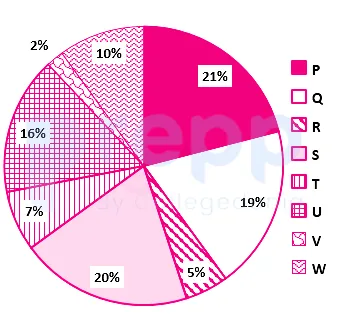
- A
150
- B
200
- C
175
- D
125
Show answer
A. 150Calculation:
T he average number of bikes sold by P, Q, R and S = {(21 + 19 + 5 + 20)% × 2000} ÷ 4 = 325
So, the average number of bikes sold by T, U, V, and W = (2000 - 1300)/4 = 175
Now, the difference = 325 - 175 = 150
∴ The difference between the average number of bikes sold by P, Q, R and S and the average number of bikes sold by T, U, V and W is 150.
Paper & answer key PDF ↗ Question 58archived
If the figure, AB = AD = 7 cm and AC = AE and BC = 11 cm, then find the length of ED.
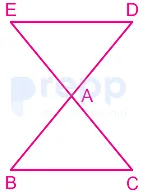
- A
12
- B
10
- C
11
- D
2
Show answer
C. 11Given:
AB = AD = 7 cm and AC = AE and BC = 11 cm
Concept used:
According to the concept of Similarity, if the two sides of a triangle are in the same proportion of the two sides of another triangle, and the angle inscribed by the two sides in both triangles are equal, then two triangles are said to be similar.
Calculation:
Since AB = AD, and AC = AE, according to the concept,
ΔABC ∼ ΔADE
Hence, AB/AD = BC/ED = AC/AE
Now, AB/AD = BC/ED
⇒ 1 = 11/ED (∵ AB = AD)
⇒ ED = 11
∴ The length of ED is 11 cm.
Paper & answer key PDF ↗ Question 59archived
If \(y + {{1} \over y} = 3\) , then what is the valud of \({{1} \over y^3} + y^3 + 2 \) ?
- A
24
- B
18
- C
20
- D
29
Show answer
C. 20Understanding the Algebraic Expression Problem
The problem asks us to find the value of the expression \( \frac{1}{y^3} + y^3 + 2 \) given the condition \( y + \frac{1}{y} = 3 \). This requires us to use algebraic identities to relate the given expression involving \( y \) and \( \frac{1}{y} \) to the target expression involving \( y^3 \) and \( \frac{1}{y^3} \).
Applying the Cube Identity
We are given the value of \( y + \frac{1}{y} \). We need to find the value of \( y^3 + \frac{1}{y^3} \). The algebraic identity for the cube of a sum, \( (a+b)^3 \), is useful here. The identity is:
\( (a+b)^3 = a^3 + b^3 + 3ab(a+b) \)
Let's substitute \( a = y \) and \( b = \frac{1}{y} \) into this identity:
\( \left(y + \frac{1}{y}\right)^3 = y^3 + \left(\frac{1}{y}\right)^3 + 3 \cdot y \cdot \frac{1}{y} \cdot \left(y + \frac{1}{y}\right) \)
Simplifying the term \( 3 \cdot y \cdot \frac{1}{y} \):
\( 3 \cdot y \cdot \frac{1}{y} = 3 \cdot 1 = 3 \)
So the identity becomes:
\( \left(y + \frac{1}{y}\right)^3 = y^3 + \frac{1}{y^3} + 3\left(y + \frac{1}{y}\right) \)
We want to find the value of \( y^3 + \frac{1}{y^3} \), so we can rearrange the identity:
\( y^3 + \frac{1}{y^3} = \left(y + \frac{1}{y}\right)^3 - 3\left(y + \frac{1}{y}\right) \)
Calculating the Value of \( y^3 + \frac{1}{y^3} \)
We are given that \( y + \frac{1}{y} = 3 \). We can substitute this value into the rearranged identity:
\( y^3 + \frac{1}{y^3} = (3)^3 - 3(3) \)
Now, we perform the calculations:
Calculate \( (3)^3 \): \( 3 \times 3 \times 3 = 27 \)
Calculate \( 3(3) \): \( 3 \times 3 = 9 \)
Substitute these values back into the equation:
\( y^3 + \frac{1}{y^3} = 27 - 9 \)
\( y^3 + \frac{1}{y^3} = 18 \)
Finding the Final Expression Value
The problem asks for the value of \( \frac{1}{y^3} + y^3 + 2 \). We have just calculated that \( y^3 + \frac{1}{y^3} = 18 \).
So, substitute this value into the expression:
\( \frac{1}{y^3} + y^3 + 2 = \left(y^3 + \frac{1}{y^3}\right) + 2 \)
\( = 18 + 2 \)
\( = 20 \)
Thus, the value of the expression \( \frac{1}{y^3} + y^3 + 2 \) is 20.
Step-by-Step Calculation Summary
Start with the given equation: \( y + \frac{1}{y} = 3 \).
Recall the algebraic identity: \( (a+b)^3 = a^3 + b^3 + 3ab(a+b) \).
Apply the identity with \( a=y \) and \( b=\frac{1}{y} \): \( \left(y + \frac{1}{y}\right)^3 = y^3 + \frac{1}{y^3} + 3\left(y + \frac{1}{y}\right) \).
Rearrange to find \( y^3 + \frac{1}{y^3} \): \( y^3 + \frac{1}{y^3} = \left(y + \frac{1}{y}\right)^3 - 3\left(y + \frac{1}{y}\right) \).
Substitute the given value \( y + \frac{1}{y} = 3 \): \( y^3 + \frac{1}{y^3} = (3)^3 - 3(3) \).
Calculate: \( y^3 + \frac{1}{y^3} = 27 - 9 = 18 \).
Find the value of the target expression \( \frac{1}{y^3} + y^3 + 2 \): \( \left(y^3 + \frac{1}{y^3}\right) + 2 = 18 + 2 = 20 \).
Revision Table: Key Concepts
Concept
Description
Relevance to Problem
Algebraic Identity
An equation that is true for all values of the variables involved. Example: \( (a+b)^3 = a^3 + b^3 + 3ab(a+b) \).
Used to relate \( y + \frac{1}{y} \) and \( y^3 + \frac{1}{y^3} \).
Substitution
Replacing a variable or expression with its given value.
Used to substitute the value of \( y + \frac{1}{y} \) into the identity.
Simplification
Reducing an expression to a simpler form.
Used to simplify \( 3 \cdot y \cdot \frac{1}{y} \).
Additional Information: Solving Similar Algebraic Problems
Problems of this type often involve using algebraic identities to find the values of expressions involving higher powers of variables, given the value of an expression involving lower powers. Common identities include:
\( (a+b)^2 = a^2 + b^2 + 2ab \)
\( (a-b)^2 = a^2 + b^2 - 2ab \)
\( (a+b)^3 = a^3 + b^3 + 3ab(a+b) \)
\( (a-b)^3 = a^3 - b^3 - 3ab(a-b) \)
\( a^3 + b^3 = (a+b)(a^2 - ab + b^2) \)
\( a^3 - b^3 = (a-b)(a^2 + ab + b^2) \)
When you encounter an expression like \( x + \frac{1}{x} \), notice that \( x \cdot \frac{1}{x} = 1 \). This simplification \( ab=1 \) makes the identities particularly useful for finding values of \( x^2 + \frac{1}{x^2} \) or \( x^3 + \frac{1}{x^3} \) and so on.
For example, if you were given \( y + \frac{1}{y} = 3 \) and asked for \( y^2 + \frac{1}{y^2} \), you would use \( (y + \frac{1}{y})^2 = y^2 + (\frac{1}{y})^2 + 2 \cdot y \cdot \frac{1}{y} \), which simplifies to \( (y + \frac{1}{y})^2 = y^2 + \frac{1}{y^2} + 2 \). Substituting the given value: \( (3)^2 = y^2 + \frac{1}{y^2} + 2 \), so \( 9 = y^2 + \frac{1}{y^2} + 2 \), which gives \( y^2 + \frac{1}{y^2} = 7 \).
Paper & answer key PDF ↗ Question 60archived
The value of \({{2 \tan 60°} \over 1+ \tan^260°}\) is:
- A
cos 60°
- B
tan 60°
- C
sin 60°
- D
sin 30°
Show answer
C. sin 60°Understanding the Trigonometry Problem
The question asks us to find the value of the trigonometric expression \( \frac{2 \tan 60°}{1 + \tan^2 60°} \). This expression involves the trigonometric function tangent at a specific angle, 60 degrees. We need to evaluate this expression and compare the result with the given options.
Methods to Solve the Trigonometric Expression
There are a couple of ways to approach this problem:
Directly substitute the value of \(\tan 60°\) and simplify.
Recognize and use a relevant trigonometric identity.
Method 1: Direct Substitution
We know the exact value of \(\tan 60°\). The value is \(\sqrt{3}\).
Let's substitute this value into the given expression:
\( \frac{2 \tan 60°}{1 + \tan^2 60°} = \frac{2 \times \sqrt{3}}{1 + (\sqrt{3})^2} \)
Now, we simplify the expression:
Calculate the square of \(\sqrt{3}\): \((\sqrt{3})^2 = 3\).
Substitute this back into the denominator: \(1 + (\sqrt{3})^2 = 1 + 3 = 4\).
Substitute into the entire expression: \( \frac{2 \times \sqrt{3}}{4} \)
Simplify the fraction: \( \frac{2\sqrt{3}}{4} = \frac{\sqrt{3}}{2} \)
So, the value of the expression is \( \frac{\sqrt{3}}{2} \).
Comparing with Options (Method 1)
Now, let's find the values of the trigonometric functions in the options:
\(\cos 60° = \frac{1}{2}\)
\(\tan 60° = \sqrt{3}\)
\(\sin 60° = \frac{\sqrt{3}}{2}\)
\(\sin 30° = \frac{1}{2}\)
Comparing our calculated value \( \frac{\sqrt{3}}{2} \) with the option values, we see that it matches the value of \(\sin 60°\).
Method 2: Using Trigonometric Identities
The given expression \( \frac{2 \tan \theta}{1 + \tan^2 \theta} \) is a standard trigonometric identity. It is related to the double angle formulas for sine.
We know that \( 1 + \tan^2 \theta = \sec^2 \theta \).
So the expression becomes: \( \frac{2 \tan \theta}{\sec^2 \theta} \)
Now, express \(\tan \theta\) and \(\sec^2 \theta\) in terms of \(\sin \theta\) and \(\cos \theta\):
\(\tan \theta = \frac{\sin \theta}{\cos \theta}\)
\(\sec^2 \theta = \frac{1}{\cos^2 \theta}\)
Substitute these into the expression:
\( \frac{2 \left(\frac{\sin \theta}{\cos \theta}\right)}{\frac{1}{\cos^2 \theta}} \)
Simplify the complex fraction:
\( 2 \times \frac{\sin \theta}{\cos \theta} \times \cos^2 \theta \)
Cancel out one \(\cos \theta\):
\( 2 \sin \theta \cos \theta \)
This is the double angle identity for sine: \( \sin(2\theta) = 2 \sin \theta \cos \theta \).
So, the expression \( \frac{2 \tan \theta}{1 + \tan^2 \theta} \) is equal to \( \sin(2\theta) \).
Applying the Identity (Method 2)
In our problem, \(\theta = 60°\).
Using the identity, the value of the expression is \( \sin(2 \times 60°) = \sin(120°) \).
Now, we need to find the value of \(\sin(120°)\). We can use the angle subtraction formula or the concept of allied angles.
\( \sin(120°) = \sin(180° - 60°) \)
Since \(\sin(180° - \theta) = \sin \theta\), we have:
\( \sin(180° - 60°) = \sin(60°) \)
The value of \(\sin(60°)\) is \( \frac{\sqrt{3}}{2} \).
Comparing with Options (Method 2)
The value we obtained using the identity method is \( \frac{\sqrt{3}}{2} \). As shown in Method 1, this value matches \(\sin 60°\).
Conclusion
Both methods confirm that the value of \( \frac{2 \tan 60°}{1 + \tan^2 60°} \) is \( \frac{\sqrt{3}}{2} \), which is equal to \(\sin 60°\).
Therefore, the correct option is \(\sin 60°\).
Revision Table: Key Trigonometric Values
Angle (θ)
\(\sin \theta\)
\(\cos \theta\)
\(\tan \theta\)
30° (\(\frac{\pi}{6}\))
\(\frac{1}{2}\)
\(\frac{\sqrt{3}}{2}\)
\(\frac{1}{\sqrt{3}}\)
60° (\(\frac{\pi}{3}\))
\(\frac{\sqrt{3}}{2}\)
\(\frac{1}{2}\)
\(\sqrt{3}\)
Additional Information: Double Angle Identities
The identity used in Method 2, \( \frac{2 \tan \theta}{1 + \tan^2 \theta} = \sin(2\theta) \), is one of the useful double angle identities in trigonometry. Here are some related identities:
\(\sin(2\theta) = 2 \sin \theta \cos \theta\)
\(\cos(2\theta) = \cos^2 \theta - \sin^2 \theta\)
\(\cos(2\theta) = 2 \cos^2 \theta - 1\)
\(\cos(2\theta) = 1 - 2 \sin^2 \theta\)
\(\cos(2\theta) = \frac{1 - \tan^2 \theta}{1 + \tan^2 \theta}\)
\(\tan(2\theta) = \frac{2 \tan \theta}{1 - \tan^2 \theta}\)
Recognizing these identities can significantly simplify trigonometric problems. The expression in the question is a specific form of the sine double angle formula expressed in terms of tangent.
Paper & answer key PDF ↗ Question 61archived
The bar graph shows the percentage distribution of the expenditure of a company under various expense heads during 2003.
If the interest on loans amounted to ₹3.15 crores, then the total amount of expenditure on salary, taxes and infrastructure is:
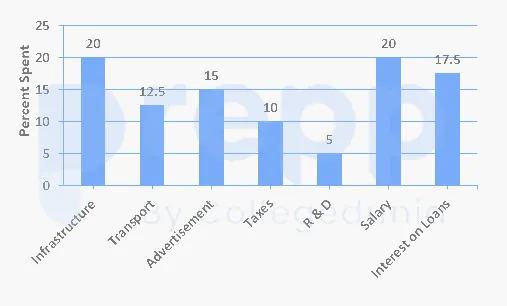
- A
9 crores
- B
7.8 crores
- C
5.5 crores
- D
8.5 crores
Show answer
A. 9 croresCalculation:
According to the question,
17.5% = 3.15 cr
1% = 3.15/17.5
⇒ 0.18 cr
Now,
Total of expenditure on salary, taxes and infrastructure = 20 + 10 + 20
⇒ 50%
So, 50% = 0.18 × 50
⇒ 9 cr
∴ The required answer is 9 crores.
Paper & answer key PDF ↗ Question 62archived
What is the value of tan 240°?
- A
\(\sqrt2\)
- B
\((-)\sqrt3\)
- C
\(\sqrt3\)
- D
3
Show answer
C. \(\sqrt3\)Understanding the Value of tan 240 Degrees
Let's find the value of \(\tan 240^\circ\). To do this, we need to understand the trigonometric functions in different quadrants of the coordinate plane.
Step-by-Step Calculation of tan 240°
Identify the Quadrant: The angle \(240^\circ\) lies between \(180^\circ\) and \(270^\circ\). Therefore, \(240^\circ\) is in the third quadrant.
Determine the Sign of Tangent: In the third quadrant, both sine and cosine functions are negative. The tangent function is defined as \(\tan \theta = \frac{\sin \theta}{\cos \theta}\). Since both sine and cosine are negative in the third quadrant, their ratio will be positive. So, \(\tan 240^\circ\) will have a positive value.
Find the Reference Angle: The reference angle is the acute angle formed by the terminal side of the given angle and the x-axis. For an angle \(\theta\) in the third quadrant, the reference angle \(\alpha\) is calculated as \(\alpha = \theta - 180^\circ\).
Reference angle for \(240^\circ\) is \(240^\circ - 180^\circ = 60^\circ\).
Relate tan 240° to the Reference Angle: Since tangent is positive in the third quadrant, \(\tan 240^\circ = +\tan(\text{reference angle})\).
So, \(\tan 240^\circ = \tan 60^\circ\).
Recall the Standard Value: The value of \(\tan 60^\circ\) is a standard trigonometric value.
\(\tan 60^\circ = \sqrt{3}\).
Final Value: Therefore, \(\tan 240^\circ = \sqrt{3}\).
Let's summarize the quadrant rules for tangent:
Quadrant
Angle Range
Sign of tan
I
\(0^\circ < \theta < 90^\circ\)
Positive
II
\(90^\circ < \theta < 180^\circ\)
Negative
III
\(180^\circ < \theta < 270^\circ\)
Positive
IV
\(270^\circ < \theta < 360^\circ\)
Negative
Applying these steps to \(240^\circ\), which is in the third quadrant, we confirmed that \(\tan 240^\circ\) is positive and is equal to \(\tan(240^\circ - 180^\circ) = \tan 60^\circ\), which is \(\sqrt{3}\).
Revision Table: Key Trigonometric Values
Angle \(\theta\)
\(\sin \theta\)
\(\cos \theta\)
\(\tan \theta\)
\(0^\circ\)
0
1
0
\(30^\circ\)
\(\frac{1}{2}\)
\(\frac{\sqrt{3}}{2}\)
\(\frac{1}{\sqrt{3}}\)
\(45^\circ\)
\(\frac{1}{\sqrt{2}}\)
\(\frac{1}{\sqrt{2}}\)
1
\(60^\circ\)
\(\frac{\sqrt{3}}{2}\)
\(\frac{1}{2}\)
\(\sqrt{3}\)
\(90^\circ\)
1
0
Undefined
Additional Information: Unit Circle and Reference Angles
The unit circle is a circle with a radius of 1 centered at the origin (0,0) in the coordinate plane. It's a powerful tool for understanding trigonometric functions for any angle.
For any angle \(\theta\), the coordinates of the point where the terminal side of the angle intersects the unit circle are \((\cos \theta, \sin \theta)\).
The value of \(\tan \theta\) is the ratio of the y-coordinate to the x-coordinate at this point, i.e., \(\tan \theta = \frac{y}{x} = \frac{\sin \theta}{\cos \theta}\).
Reference angles help simplify the calculation of trigonometric functions for angles outside the first quadrant. By finding the reference angle, we can use the known values from the first quadrant and apply the correct sign based on the quadrant of the original angle.
In our case, the reference angle \(60^\circ\) is used, and the third-quadrant rule confirms that \(\tan 240^\circ\) has the same magnitude as \(\tan 60^\circ\) and is positive.
Paper & answer key PDF ↗ Question 63archived
The table given below shows the income of two companies C1 and C2 in 6 years.
Company
Year
C1
C2
P
750
850
Q
200
250
R
330
350
S
550
650
T
530
270
U
370
390
Which of the following statement is NOT correct?
I. The income of C1 in year P is 33.33 percent of the income of C2 in year Q.
II. The average income of C1 and C2 in year T is 400.
- A
Only I
- B
Both I and II
- C
Neither I nor II
- D
Only II
Show answer
A. Only IAnalyzing Company Income Data from the Table
The question asks us to examine two statements based on the provided table showing the income of two companies, C1 and C2, over six different years (P, Q, R, S, T, U). We need to determine which of these statements is NOT correct.
Company
Year P
Year Q
Year R
Year S
Year T
Year U
C1
750
200
330
550
530
370
C2
850
250
350
650
270
390
Statement I Analysis: Percentage Calculation
Statement I says: "The income of C1 in year P is 33.33 percent of the income of C2 in year Q."
Income of C1 in year P = 750
Income of C2 in year Q = 250
To check if the income of C1 in year P is 33.33% of the income of C2 in year Q, we calculate the percentage:
\(\text{Percentage} = \left( \frac{\text{Income of C1 in year P}}{\text{Income of C2 in year Q}} \right) \times 100\)
\(\text{Percentage} = \left( \frac{750}{250} \right) \times 100\)
\(\text{Percentage} = 3 \times 100\)
\(\text{Percentage} = 300\%\)
Our calculation shows that the income of C1 in year P is 300% of the income of C2 in year Q. The statement claims it is 33.33%.
Therefore, Statement I is NOT correct (False).
Statement II Analysis: Average Income Calculation
Statement II says: "The average income of C1 and C2 in year T is 400."
Income of C1 in year T = 530
Income of C2 in year T = 270
To calculate the average income of C1 and C2 in year T, we sum their incomes and divide by the number of companies (which is 2):
\(\text{Average Income in Year T} = \frac{\text{Income of C1 in Year T} + \text{Income of C2 in Year T}}{2}\)
\(\text{Average Income in Year T} = \frac{530 + 270}{2}\)
\(\text{Average Income in Year T} = \frac{800}{2}\)
\(\text{Average Income in Year T} = 400\)
Our calculation shows that the average income of C1 and C2 in year T is indeed 400. The statement claims the average is 400.
Therefore, Statement II is correct (True).
Identifying the Incorrect Statement(s)
We found that:
Statement I is NOT correct.
Statement II is correct.
The question asks which of the statements is NOT correct. Based on our analysis, only Statement I is not correct.
Conclusion
Only Statement I is incorrect. Therefore, the statement that is NOT correct is "Only I".
Revision Table: Key Calculations and Findings
Statement
Calculation
Result
Truth Value (Correct/Incorrect)
I: C1 (P) is 33.33% of C2 (Q)
\(\left( \frac{750}{250} \right) \times 100 = 300\%\)
300%
Incorrect (False)
II: Avg C1 & C2 (T) is 400
\(\frac{530 + 270}{2} = \frac{800}{2} = 400\)
400
Correct (True)
Additional Information: Percentage and Average Concepts
Understanding percentages and averages is crucial for data interpretation questions like this one. Let's quickly review these concepts:
Percentage: A percentage is a number or ratio expressed as a fraction of 100. It is often used to compare a part to a whole, or in this case, one value to another. The formula to find what percentage \(A\) is of \(B\) is \(\left( \frac{A}{B} \right) \times 100\%\).
Average (Mean): The average of a set of numbers is the sum of all the numbers divided by the count of the numbers. For two numbers, say \(a\) and \(b\), the average is \(\frac{a+b}{2}\). Averages help represent a typical value in a dataset.
In this question, we applied these fundamental concepts to analyze the company income data from the table and verify the truthfulness of the given statements.
Paper & answer key PDF ↗ Question 64archived
The single discount equivalent to two successive discounts of 15% and 12% on an article is:
- A
3%
- B
25.2%
- C
74.8%
- D
27%
Show answer
B. 25.2%Understanding Successive Discounts
When an article receives two successive discounts, it means the second discount is applied not on the original price, but on the price after the first discount has been applied. This is a common practice in sales and marketing.
To find the single discount that is equivalent to two successive discounts, we cannot simply add the two percentages together. We need to calculate the overall reduction in price relative to the original price.
Formula for Equivalent Single Discount
For two successive discounts, say $D_1\%$ and $D_2\%$, the single equivalent discount $D_{eq}\%$ can be calculated using the formula:
$\qquad D_{eq} = D_1 + D_2 - \frac{D_1 \times D_2}{100}$
This formula accounts for the fact that the second discount is applied to a reduced price.
Calculating the Equivalent Discount
In this question, we are given two successive discounts on an article:
First Discount ($D_1$) = 15%
Second Discount ($D_2$) = 12%
Let's use the formula to find the single equivalent discount ($D_{eq}$).
Substitute the values of $D_1$ and $D_2$ into the formula:
$\qquad D_{eq} = 15 + 12 - \frac{15 \times 12}{100}$
First, calculate the product of the two discounts:
$\qquad 15 \times 12 = 180$
Now, divide the product by 100:
$\qquad \frac{180}{100} = 1.8$
Next, add the two individual discounts:
$\qquad 15 + 12 = 27$
Finally, subtract the result from the sum of the discounts:
$\qquad D_{eq} = 27 - 1.8$
$\qquad D_{eq} = 25.2$
So, the single discount equivalent to two successive discounts of 15% and 12% is 25.2%.
Alternative Method: Assuming an Original Price
We can also understand this concept by assuming an original price for the article, say $₹100$.
Original Price = $₹100$
First discount is 15% on $₹100$:
Amount of first discount = 15% of $₹100 = \frac{15}{100} \times 100 = ₹15$
Price after first discount = $₹100 - ₹15 = ₹85$
Second discount is 12% on the price after the first discount, which is $₹85$:
Amount of second discount = 12% of $₹85 = \frac{12}{100} \times 85$
$\frac{12 \times 85}{100} = \frac{1020}{100} = ₹10.20$
Final price after both discounts = Price after first discount - Amount of second discount
Final Price = $₹85 - ₹10.20 = ₹74.80$
The total reduction in price from the original price is the difference between the original price and the final price:
Total Reduction = Original Price - Final Price
Total Reduction = $₹100 - ₹74.80 = ₹25.20$
Since the original price was $₹100$, a total reduction of $₹25.20$ corresponds to a single discount of 25.2%.
Both methods give the same result, confirming that the single equivalent discount is 25.2%.
Comparing with Options
Let's compare our calculated equivalent discount with the given options:
Option
Discount Percentage
Calculation Result
1
3%
Incorrect
2
25.2%
Correct
3
74.8%
Incorrect (This is the final price percentage)
4
27%
Incorrect (This is the simple sum of discounts)
The calculated single equivalent discount of 25.2% matches Option 2.
Revision Table: Key Concepts
Concept
Description
Formula/Example
Successive Discounts
Applying discounts one after another, where each subsequent discount is on the already reduced price.
Price > Price after $D_1$ > Price after $D_2$
Single Equivalent Discount
A single discount percentage that results in the same final price as applying the successive discounts.
$D_{eq} = D_1 + D_2 - \frac{D_1 D_2}{100}$
Additional Information: More on Discounts
Understanding discounts is crucial for various calculations, including profit and loss, and understanding retail pricing.
Calculating Selling Price: If an article has a Marked Price (MP) and a discount of $D\%$, the Selling Price (SP) is given by $SP = MP \times \left(1 - \frac{D}{100}\right)$. For successive discounts $D_1$ and $D_2$, $SP = MP \times \left(1 - \frac{D_1}{100}\right) \times \left(1 - \frac{D_2}{100}\right)$.
Relating SP to Equivalent Discount: Using the equivalent single discount $D_{eq}$, the selling price is also $SP = MP \times \left(1 - \frac{D_{eq}}{100}\right)$. Equating the two SP formulas: $\left(1 - \frac{D_{eq}}{100}\right) = \left(1 - \frac{D_1}{100}\right) \times \left(1 - \frac{D_2}{100}\right)$. Expanding the right side gives $1 - \frac{D_1}{100} - \frac{D_2}{100} + \frac{D_1 D_2}{10000}$. So, $1 - \frac{D_{eq}}{100} = 1 - \frac{D_1 + D_2}{100} + \frac{D_1 D_2}{10000}$. Multiplying by 100 gives $100 - D_{eq} = 100 - (D_1 + D_2) + \frac{D_1 D_2}{100}$. Rearranging, $D_{eq} = D_1 + D_2 - \frac{D_1 D_2}{100}$, which confirms the formula.
Order of Discounts: The final price after successive discounts is independent of the order in which the discounts are applied. Applying 15% then 12% results in the same final price as applying 12% then 15%.
Paper & answer key PDF ↗ Question 65archived
A copper sphere of diameter 18 cm is drawn into a wire of diameter 6 mm. Find the length of the wire.
- A
143 m
- B
108 m
- C
324 m
- D
234 m
Show answer
B. 108 mCalculating Wire Length from Sphere Volume
The problem involves converting a copper sphere into a wire. When a solid material is reshaped, its volume remains constant. Therefore, the volume of the original copper sphere is equal to the volume of the resulting copper wire.
Understanding the Shapes and Formulas
A sphere is a perfectly round geometrical object in three-dimensional space. A wire is essentially a cylinder with a very small diameter compared to its length.
The volume of a sphere is given by the formula: $$V_{sphere} = \frac{4}{3}\pi r^3$$ where $$r$$ is the radius of the sphere.
The volume of a cylinder (wire) is given by the formula: $$V_{cylinder} = \pi R^2 h$$ where $$R$$ is the radius of the cylinder and $$h$$ is its height (or length in this case).
Given Information and Unit Conversion
We are given the diameter of the sphere and the diameter of the wire. We need to find the length of the wire.
Sphere diameter = 18 cm
Wire diameter = 6 mm
It's important to work with consistent units. Let's convert all measurements to meters (m).
Sphere radius ($$r$$) = Diameter / 2 = 18 cm / 2 = 9 cm
Converting cm to m: $$9 \text{ cm} = 9 \times 10^{-2} \text{ m} = 0.09 \text{ m}$$
Wire radius ($$R$$) = Diameter / 2 = 6 mm / 2 = 3 mm
Converting mm to m: $$3 \text{ mm} = 3 \times 10^{-3} \text{ m} = 0.003 \text{ m}$$
Equating Volumes to Find Wire Length
Since the volume of the copper remains constant during reshaping:
$$V_{sphere} = V_{cylinder}$$
$$\frac{4}{3}\pi r^3 = \pi R^2 h$$
We can cancel $$\pi$$ from both sides of the equation:
$$\frac{4}{3} r^3 = R^2 h$$
Now, substitute the values for $$r$$ and $$R$$, and solve for $$h$$, the length of the wire:
$$\frac{4}{3} (0.09 \text{ m})^3 = (0.003 \text{ m})^2 h$$
$$\frac{4}{3} (0.000729 \text{ m}^3) = (0.000009 \text{ m}^2) h$$
Multiply the left side:
$$4 \times 0.000243 \text{ m}^3 = 0.000009 \text{ m}^2 h$$
$$0.000972 \text{ m}^3 = 0.000009 \text{ m}^2 h$$
Now, isolate $$h$$ by dividing both sides by $$0.000009 \text{ m}^2$$:
$$h = \frac{0.000972 \text{ m}^3}{0.000009 \text{ m}^2}$$
$$h = \frac{972 \times 10^{-6} \text{ m}}{9 \times 10^{-6}}$$
$$h = \frac{972}{9} \text{ m}$$
$$h = 108 \text{ m}$$
The length of the copper wire is 108 meters.
Revision Table: Key Formulas
Shape
Formula for Volume
Variables
Sphere
$$V = \frac{4}{3}\pi r^3$$
$$r$$ = radius
Cylinder
$$V = \pi R^2 h$$
$$R$$ = radius, $$h$$ = height/length
Additional Information: Volume Conservation Principle
The principle of volume conservation is fundamental in many physics and engineering problems. It states that the total volume of a substance or object remains constant, regardless of how it is reshaped, melted and recast, or moved, provided no material is added or removed and there are no changes in phase that significantly alter density (like turning liquid water into steam, where volume changes drastically). In this problem, drawing a solid sphere into a wire involves deforming the material, but the total amount of copper (and thus its volume) stays the same. This principle allows us to equate the initial volume (sphere) to the final volume (wire) to solve for an unknown dimension.
Paper & answer key PDF ↗ Question 66archived
A solid metallic sphere of radius 13 cm is melted and recast into a cone having diameter of the base as 13 cm. What is the height of the cone?
- A
246 cm
- B
152 cm
- C
174 cm
- D
208 cm
Show answer
D. 208 cmThis problem involves the concept of conservation of volume when a solid is melted and recast from one shape to another. When a solid metallic sphere is melted and reshaped into a cone, the total amount of material remains the same. Therefore, the volume of the sphere will be equal to the volume of the resulting cone.
Let's first identify the given information:
Radius of the solid metallic sphere, \(r_{sphere} = 13\) cm.
Diameter of the base of the cone, \(d_{cone} = 13\) cm.
From the diameter of the cone's base, we can find its radius:
Radius of the base of the cone, \(r_{cone} = \frac{d_{cone}}{2} = \frac{13}{2}\) cm.
We need to find the height of the cone, let's denote it as \(h_{cone}\).
Volume Conservation: Sphere to Cone
The principle of volume conservation states that:
\( \text{Volume of Sphere} = \text{Volume of Cone} \)
The formula for the volume of a sphere is:
\( V_{sphere} = \frac{4}{3}\pi r_{sphere}^3 \)
The formula for the volume of a cone is:
\( V_{cone} = \frac{1}{3}\pi r_{cone}^2 h_{cone} \)
Setting the volumes equal to each other:
\( \frac{4}{3}\pi r_{sphere}^3 = \frac{1}{3}\pi r_{cone}^2 h_{cone} \)
Solving for the Height of the Cone
Now, let's substitute the given values into the equation:
\( \frac{4}{3}\pi (13)^3 = \frac{1}{3}\pi (\frac{13}{2})^2 h_{cone} \)
We can cancel out the common terms \(\frac{1}{3}\pi\) from both sides of the equation:
\( 4 \times (13)^3 = (\frac{13}{2})^2 h_{cone} \)
Now, let's calculate the terms:
\( 4 \times 13^3 = \frac{13^2}{2^2} h_{cone} \)
\( 4 \times 13^3 = \frac{13^2}{4} h_{cone} \)
To find \(h_{cone}\), we rearrange the equation:
\( h_{cone} = \frac{4 \times 13^3}{\frac{13^2}{4}} \)
\( h_{cone} = \frac{4 \times 13^3 \times 4}{13^2} \)
\( h_{cone} = 16 \times \frac{13^3}{13^2} \)
Using the rule of exponents (\(a^m / a^n = a^{m-n}\)):
\( h_{cone} = 16 \times 13^{(3-2)} \)
\( h_{cone} = 16 \times 13 \)
Calculating the final value:
\( h_{cone} = 208 \)
So, the height of the cone is 208 cm.
Conclusion: Height of the Cone
By equating the volume of the sphere to the volume of the cone, and using the given radius of the sphere and diameter of the cone's base, we found the height of the cone to be 208 cm.
Revision Table: Sphere and Cone Volumes
Shape
Formula for Volume
Variables
Sphere
\(V = \frac{4}{3}\pi r^3\)
\(r\) = radius
Cone
\(V = \frac{1}{3}\pi r^2 h\)
\(r\) = base radius, \(h\) = height
Additional Information: Melting and Recasting Solids
When a solid object is melted and recast into a new shape, several properties can change, such as surface area or shape, but the volume of the material typically remains constant, assuming no material is lost or added during the process. This principle is fundamental in many geometry and mensuration problems involving conversions between different 3D shapes. Common examples include melting spheres into cylinders or cones, melting multiple small spheres into one large sphere, or reshaping cubes into cuboids.
Paper & answer key PDF ↗ Question 67archived
If tan θ + sec θ = 7, θ being acute, then the value of 5 sin θ is:
- A
\({{25} \over 24}\)
- B
\({{24} \over 25}\)
- C
\({{1} \over 24}\)
- D
\({{24} \over 5}\)
Show answer
D. \({{24} \over 5}\)Understanding the Trigonometric Problem
The core task is to find the value of $5 \sin \theta$ given the equation $\tan \theta + \sec \theta = 7$. We are also told that $\theta$ is an acute angle, which means $0^\circ < \theta < 90^\circ$. This information is crucial because it tells us that both $\sin \theta$ and $\cos \theta$ (and therefore $\tan \theta$ and $\sec \theta$) will be positive.
Key Trigonometric Identity
A fundamental trigonometric identity that connects $\sec \theta$ and $\tan \theta$ is:
$$ \sec^2 \theta - \tan^2 \theta = 1 $$
This identity comes from the Pythagorean theorem applied to a right-angled triangle.
Factoring the Identity
We can factor the left side of the identity as a difference of squares:
$$ (\sec \theta - \tan \theta)(\sec \theta + \tan \theta) = 1 $$
Using the Given Equation
The problem states that $\tan \theta + \sec \theta = 7$. We can substitute this value into the factored identity:
$$ (\sec \theta - \tan \theta)(7) = 1 $$
Finding $\mathbf{\sec \theta - \tan \theta}$
Now, we can solve for $\sec \theta - \tan \theta$ by dividing both sides by 7:
$$ \sec \theta - \tan \theta = \frac{1}{7} $$
Solving for $\mathbf{\sec \theta}$
We now have two equations:
Equation 1: $\sec \theta + \tan \theta = 7$
Equation 2: $\sec \theta - \tan \theta = \frac{1}{7}$
To find $\sec \theta$, we can add Equation 1 and Equation 2:
$$ (\sec \theta + \tan \theta) + (\sec \theta - \tan \theta) = 7 + \frac{1}{7} $$
$$ 2 \sec \theta = \frac{49}{7} + \frac{1}{7} $$
$$ 2 \sec \theta = \frac{50}{7} $$
Divide by 2:
$$ \sec \theta = \frac{50}{7 \times 2} = \frac{25}{7} $$
Finding $\mathbf{\cos \theta}$
We know that $\sec \theta = \frac{1}{\cos \theta}$. Therefore:
$$ \cos \theta = \frac{1}{\sec \theta} = \frac{1}{\frac{25}{7}} = \frac{7}{25} $$
Finding $\mathbf{\sin \theta}$
We can use the primary Pythagorean identity $\sin^2 \theta + \cos^2 \theta = 1$:
$$ \sin^2 \theta = 1 - \cos^2 \theta $$
Substitute the value of $\cos \theta$:
$$ \sin^2 \theta = 1 - \left(\frac{7}{25}\right)^2 $$
$$ \sin^2 \theta = 1 - \frac{49}{625} $$
$$ \sin^2 \theta = \frac{625 - 49}{625} $$
$$ \sin^2 \theta = \frac{576}{625} $$
Since $\theta$ is an acute angle, $\sin \theta$ must be positive. Taking the square root:
$$ \sin \theta = \sqrt{\frac{576}{625}} = \frac{24}{25} $$
Calculating the Final Value
The question asks for the value of $5 \sin \theta$. Using the value we found for $\sin \theta$:
$$ 5 \sin \theta = 5 \times \frac{24}{25} $$
$$ 5 \sin \theta = \frac{5 \times 24}{25} $$
Simplify by canceling the common factor of 5:
$$ 5 \sin \theta = \frac{24}{5} $$
Conclusion
The value of $5 \sin \theta$ is $\frac{24}{5}$. This corresponds to the fourth option.
Paper & answer key PDF ↗ Question 68archived
From the following figure find x+ y + z.
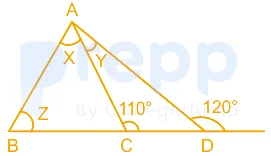
- A
100°
- B
130°
- C
120°
- D
110°
Show answer
C. 120°Concept used:
An exterior angle of a triangle is equal to the sum of the two interior opposite angles.
Calculation:
According to the concept,
Considering ΔACD, y + 110° = 120 °
⇒ y = 10°
Considering ΔABC, x + y = 110°
Now, x + y + z
⇒ 110° + 10° = 120°
∴ The measure of x + y + z is 120 °.
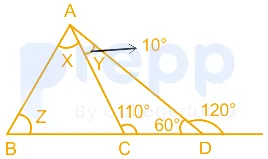 Paper & answer key PDF ↗
 Question 69archived
The ratio of expenditure to savings of a woman is 5 ∶ 1. If her income and expenditure are increased by 10% and 20%, respectively, then find the percentage change in her savings.
- A
55%
- B
60%
- C
50%
- D
40%
Show answer
D. 40%This problem requires calculating the percentage change in savings after changes in income and expenditure, based on an initial expenditure-to-savings ratio.
Understanding the Initial Expenditure and Savings Ratio
We are given that the ratio of expenditure to savings for the woman is 5:1.
Let the initial expenditure be 5x.
Let the initial savings be 1x (or simply x).
Calculating the Initial Income
A person's income is the sum of their expenditure and savings.
Initial Income = Initial Expenditure + Initial Savings
Initial Income = 5x + x
Initial Income = 6x
Calculating the New Income After a 10% Increase
The woman's income increases by 10%.
Increase Amount = 10% of Initial Income
Increase Amount = $ \frac{10}{100} \times 6x $
Increase Amount = $ 0.1 \times 6x $
Increase Amount = 0.6x
New Income = Initial Income + Increase Amount
New Income = 6x + 0.6x
New Income = 6.6x
Calculating the New Expenditure After a 20% Increase
The woman's expenditure increases by 20%.
Increase Amount = 20% of Initial Expenditure
Increase Amount = $ \frac{20}{100} \times 5x $
Increase Amount = $ 0.2 \times 5x $
Increase Amount = 1.0x
New Expenditure = Initial Expenditure + Increase Amount
New Expenditure = 5x + 1.0x
New Expenditure = 6.0x
Determining the New Savings
The new savings can be found by subtracting the new expenditure from the new income.
New Savings = New Income - New Expenditure
New Savings = 6.6x - 6.0x
New Savings = 0.6x
Calculating the Percentage Change in Savings
To find the percentage change in savings, we compare the change in savings with the initial savings.
Change in Savings = New Savings - Initial Savings
Change in Savings = 0.6x - x
Change in Savings = -0.4x
The negative sign indicates a reduction or decrease in savings.
Percentage Change in Savings = $ \left( \frac{\text{Change in Savings}}{\text{Initial Savings}} \right) \times 100\% $
Percentage Change in Savings = $ \left( \frac{-0.4x}{x} \right) \times 100\% $
Percentage Change in Savings = $ -0.4 \times 100\% $
Percentage Change in Savings = -40%
This means the woman's savings decreased by 40%. The percentage change in her savings is -40%.
Paper & answer key PDF ↗ Question 70archived
What will be the remainder when 27 27 + 27 is divided by 28?
- A
28
- B
27
- C
25
- D
26
Show answer
D. 26Understanding the Remainder Problem
The question asks us to find the remainder when the expression $27^{27} + 27$ is divided by 28. This is a classic problem that can be solved efficiently using the concept of modular arithmetic.
Modular arithmetic deals with remainders after division. The notation $a \equiv b \pmod{m}$ means that $a$ and $b$ have the same remainder when divided by $m$. An important property is that if $a \equiv b \pmod{m}$ and $c \equiv d \pmod{m}$, then $a+c \equiv b+d \pmod{m}$ and $ac \equiv bd \pmod{m}$.
Solving for the Remainder
We need to find the remainder of $27^{27} + 27$ when divided by 28. Let's consider each term separately modulo 28.
Step 1: Find the remainder of 27 divided by 28
When 27 is divided by 28, the remainder is simply 27. We can write this using modular notation as:
\(27 \equiv 27 \pmod{28}\)
Alternatively, we can notice that 27 is just 1 less than 28. So, we can also write:
\(27 \equiv -1 \pmod{28}\)
Using -1 is often helpful when dealing with powers, as we will see in the next step.
Step 2: Find the remainder of 27$^{27}$ divided by 28
We use the property of modular arithmetic for exponents. Since \(27 \equiv -1 \pmod{28}\), we have:
\(27^{27} \equiv (-1)^{27} \pmod{28}\)
Now, we need to evaluate $(-1)^{27}$. When -1 is raised to an odd power, the result is -1.
\((-1)^{27} = -1\)
So, we have:
\(27^{27} \equiv -1 \pmod{28}\)
A remainder must be non-negative and less than the divisor (28). A remainder of -1 modulo 28 is equivalent to a remainder of -1 + 28 = 27 modulo 28.
\(27^{27} \equiv 27 \pmod{28}\)
Step 3: Find the remainder of 27$^{27}$ + 27 divided by 28
We need the remainder of the sum. Using the property that if \(a \equiv b \pmod{m}\) and \(c \equiv d \pmod{m}\), then \(a+c \equiv b+d \pmod{m}\), we can add the remainders we found for \(27^{27}\) and \(27\).
From Step 2, \(27^{27} \equiv -1 \pmod{28}\).
From Step 1, \(27 \equiv 27 \pmod{28}\).
Adding these congruences:
\(27^{27} + 27 \equiv (-1) + 27 \pmod{28}\)
\(27^{27} + 27 \equiv 26 \pmod{28}\)
The result is 26. Since 26 is non-negative and less than 28, it is the remainder.
Summary of Calculation
We used the property that \(27 \equiv -1 \pmod{28}\).
For the term \(27^{27}\): \(27^{27} \equiv (-1)^{27} \equiv -1 \pmod{28}\).
For the term \(27\): \(27 \equiv 27 \pmod{28}\).
Adding these modulo 28:
\(27^{27} + 27 \equiv (-1) + 27 \pmod{28}\)
\(27^{27} + 27 \equiv 26 \pmod{28}\)
The remainder is 26.
Final Answer Remainder
Based on the calculations using modular arithmetic, the remainder when \(27^{27} + 27\) is divided by 28 is 26.
Expression
Modulo 28
Equivalent Remainder
27
\(27 \pmod{28}\)
27 (or -1)
\(27^{27}\)
\(27^{27} \pmod{28}\)
-1 (which is 27)
\(27^{27} + 27\)
\((-1) + 27 \pmod{28}\)
26
Revision Table: Modular Arithmetic Concepts
Concept
Description
Example Modulo 5
Congruence
\(a \equiv b \pmod{m}\) means a and b have the same remainder when divided by m.
\(13 \equiv 3 \pmod{5}\) because \(13 = 2 \times 5 + 3\)
Addition Property
If \(a \equiv b \pmod{m}\) and \(c \equiv d \pmod{m}\), then \(a+c \equiv b+d \pmod{m}\).
\(13 \equiv 3 \pmod{5}\), \(7 \equiv 2 \pmod{5}\). So, \(13+7 \equiv 3+2 \pmod{5}\) which means \(20 \equiv 5 \equiv 0 \pmod{5}\).
Multiplication Property
If \(a \equiv b \pmod{m}\) and \(c \equiv d \pmod{m}\), then \(ac \equiv bd \pmod{m}\).
\(13 \equiv 3 \pmod{5}\), \(7 \equiv 2 \pmod{5}\). So, \(13 \times 7 \equiv 3 \times 2 \pmod{5}\) which means \(91 \equiv 6 \equiv 1 \pmod{5}\).
Exponentiation Property
If \(a \equiv b \pmod{m}\), then \(a^k \equiv b^k \pmod{m}\) for any positive integer k.
\(13 \equiv 3 \pmod{5}\). So, \(13^2 \equiv 3^2 \pmod{5}\) which means \(169 \equiv 9 \equiv 4 \pmod{5}\).
Additional Information: Properties of Modulo Operator
The modulo operator, denoted by 'mod' or '%', gives the remainder of a division. When calculating \(a \pmod{m}\), the result r satisfies \(0 \le r < m\).
Key properties used in this problem:
Congruence relation: \(a \equiv b \pmod{m}\) if and only if \(m\) divides \(a-b\). This is why \(27 \equiv -1 \pmod{28}\), because \(28\) divides \(27 - (-1) = 28\).
Working with negative remainders: Sometimes it's easier to work with negative remainders, like -1. A negative remainder -k modulo m is equivalent to a positive remainder m-k modulo m. So, \(-1 \equiv 28-1 \equiv 27 \pmod{28}\).
Power simplification: \((a \pmod{m})^k \equiv a^k \pmod{m}\). This allows us to reduce the base before calculating the power modulo m. This is crucial for large exponents like \(27^{27}\).
Paper & answer key PDF ↗ Question 71archived
Study the following table and answer the question below.
School name
Total number of students enrolled
Percentage of enrolled students, opted Biology
Ratio of male to female students who opted Biology
A
900
30
7 ∶ 8
B
400
36
5 ∶ 7
C
1000
24
5 ∶ 19
D
800
18
3 ∶ 9
Find the ratio of the number of female students who opted biology in school B and school D.
- A
7 ∶ 9
- B
9 ∶ 7
- C
3 ∶ 5
- D
5 ∶ 3
Show answer
A. 7 ∶ 9Analyzing School Data and Biology Student Ratios
The question asks us to find the ratio of the number of female students who opted for Biology in school B to the number of female students who opted for Biology in school D. To do this, we need to extract the relevant information from the provided table and perform step-by-step calculations for each school.
Here is the table summarizing the school data:
School name
Total number of students enrolled
Percentage of enrolled students, opted Biology
Ratio of male to female students who opted Biology
A
900
30
7 ∶ 8
B
400
36
5 ∶ 7
C
1000
24
5 ∶ 19
D
800
18
3 ∶ 9
Calculating Female Biology Students in School B
First, let's find the number of students who opted for Biology in school B.
Total number of students in school B = 400
Percentage of students who opted Biology in school B = 36%
Number of students who opted Biology in school B = $\frac{36}{100} \times 400$
Number of students who opted Biology in school B = $36 \times 4 = 144$
Next, we use the male to female ratio for Biology students in school B to find the number of female students.
Ratio of male to female students in Biology in school B = 5 : 7
Total parts in the ratio = 5 + 7 = 12
The female portion of the ratio is 7 parts out of 12.
Number of female students who opted Biology in school B = $\frac{7}{12} \times 144$
Number of female students who opted Biology in school B = $7 \times \frac{144}{12} = 7 \times 12 = 84$
So, there are 84 female students who opted for Biology in school B.
Calculating Female Biology Students in School D
Now, let's perform the same calculations for school D.
Total number of students in school D = 800
Percentage of students who opted Biology in school D = 18%
Number of students who opted Biology in school D = $\frac{18}{100} \times 800$
Number of students who opted Biology in school D = $18 \times 8 = 144$
Next, we use the male to female ratio for Biology students in school D to find the number of female students.
Ratio of male to female students in Biology in school D = 3 : 9
This ratio can be simplified by dividing both numbers by 3: 3 ∶ 9 is the same as 1 ∶ 3.
Total parts in the ratio = 3 + 9 = 12 (or 1 + 3 = 4 if using the simplified ratio). Let's use the original ratio 3:9 (total 12 parts).
The female portion of the ratio is 9 parts out of 12.
Number of female students who opted Biology in school D = $\frac{9}{12} \times 144$
Number of female students who opted Biology in school D = $\frac{3}{4} \times 144 = 3 \times 36 = 108$
So, there are 108 female students who opted for Biology in school D.
Finding the Ratio of Female Biology Students (B to D)
Finally, we need to find the ratio of the number of female students who opted Biology in school B to school D.
Number of female Biology students in school B = 84
Number of female Biology students in school D = 108
Ratio = Number of female Biology students (B) : Number of female Biology students (D)
Ratio = 84 : 108
To simplify the ratio 84 : 108, we find the greatest common divisor (GCD) of 84 and 108. We can divide both numbers by common factors.
Both are divisible by 2: 84 ∶ 108 → 42 ∶ 54
Both are divisible by 2: 42 ∶ 54 → 21 ∶ 27
Both are divisible by 3: 21 ∶ 27 → 7 ∶ 9
The simplified ratio is 7 : 9.
Therefore, the ratio of the number of female students who opted Biology in school B and school D is 7 ∶ 9.
Revision Table: Key Calculations
School
Total Students
% Opted Biology
Number Opted Biology
Male:Female Ratio (Biology)
Female Students (Biology)
B
400
36%
$\frac{36}{100} \times 400 = 144$
5 : 7 (Total 12 parts)
$\frac{7}{12} \times 144 = 84$
D
800
18%
$\frac{18}{100} \times 800 = 144$
3 : 9 (Total 12 parts)
$\frac{9}{12} \times 144 = 108$
Additional Information: Understanding Ratios and Percentages
This problem involves working with both percentages and ratios. Understanding how these concepts are applied to real-world data is crucial.
Percentage: A percentage is a way of expressing a number as a fraction of 100. For example, 36% means 36 out of 100. To find a percentage of a number, you convert the percentage to a decimal or fraction and multiply by the number. For example, 36% of 400 is $0.36 \times 400$ or $\frac{36}{100} \times 400$.
Ratio: A ratio is a comparison of two quantities. It can be written using a colon (e.g., 5:7), as a fraction (e.g., $\frac{5}{7}$), or with the word "to" (e.g., 5 to 7). When a ratio represents parts of a whole (like male:female students within a group), you sum the parts of the ratio to find the total number of parts. Then, to find the value of one part or a specific number of parts, you divide the total quantity by the total number of parts and multiply by the desired number of parts. For example, if the male:female ratio is 5:7 for 144 students, the total parts are 12. Each part is $\frac{144}{12}=12$ students. Male students are $5 \times 12 = 60$, and female students are $7 \times 12 = 84$.
Simplifying Ratios: Just like fractions, ratios can be simplified by dividing both numbers by their greatest common divisor. This makes the ratio easier to understand while representing the same proportional relationship.
Paper & answer key PDF ↗ Question 72archived
In triangle ABC, the bisector of angle BAC cuts the line BC at D. If BD = 6 and BC = 14 then what is the value of AB ∶ AC?
- A
3 ∶ 4
- B
7 ∶ 3
- C
3 ∶ 10
- D
3 ∶ 7
Show answer
A. 3 ∶ 4Understanding the Triangle Angle Bisector Problem
The problem asks for the ratio of the lengths of two sides of a triangle (AB and AC) given information about how the angle bisector of the angle between those sides divides the opposite side (BC).
We are given:
Triangle ABC
AD is the angle bisector of angle BAC, with D on BC.
Length of segment BD = 6
Length of side BC = 14
We need to find the value of the ratio AB ∶ AC, which is equivalent to \( \frac{AB}{AC} \).
Applying the Angle Bisector Theorem
This problem can be solved using the Angle Bisector Theorem. This theorem states that if a line segment bisects an angle of a triangle, then it divides the opposite side into two segments that are proportional to the other two sides of the triangle.
In triangle ABC, AD is the angle bisector of \( \angle BAC \). According to the Angle Bisector Theorem, the ratio of the lengths of the sides AB and AC is equal to the ratio of the lengths of the segments BD and DC on the opposite side BC.
Mathematically, the theorem is expressed as:
\( \frac{AB}{AC} = \frac{BD}{DC} \)
Calculating the Length of Segment DC
We are given the total length of BC and the length of BD. Since D lies on BC, the length of BC is the sum of the lengths of BD and DC.
\( BC = BD + DC \)
We have BC = 14 and BD = 6. We can find DC by rearranging the equation:
\( DC = BC - BD \)
Substitute the given values:
\( DC = 14 - 6 \)
\( DC = 8 \)
So, the length of the segment DC is 8.
Finding the Ratio AB ∶ AC
Now we can substitute the known values of BD and DC into the Angle Bisector Theorem formula:
\( \frac{AB}{AC} = \frac{BD}{DC} \)
\( \frac{AB}{AC} = \frac{6}{8} \)
To find the simplest form of the ratio \( \frac{6}{8} \), we can divide both the numerator and the denominator by their greatest common divisor, which is 2.
\( \frac{AB}{AC} = \frac{6 \div 2}{8 \div 2} \)
\( \frac{AB}{AC} = \frac{3}{4} \)
Therefore, the ratio AB ∶ AC is 3 ∶ 4.
Summary of Calculations
Given Information
Calculated Value
Ratio Calculation
BD = 6
DC = BC - BD = 14 - 6 = 8
\( \frac{AB}{AC} = \frac{BD}{DC} = \frac{6}{8} = \frac{3}{4} \)
BC = 14
Conclusion on AB ∶ AC
Based on the Angle Bisector Theorem and our calculations, the ratio of AB to AC is 3 to 4.
Revision Table: Key Concepts for Triangle Problems
Concept
Description
Relevance to Problem
Angle Bisector Theorem
An angle bisector of a triangle divides the opposite side into segments proportional to the other two sides.
Directly used to relate AB/AC to BD/DC.
Segment Addition Postulate
If point D is between points B and C on a line segment BC, then BD + DC = BC.
Used to find the length of DC from BC and BD.
Ratio and Proportion
Comparison of two quantities by division. Proportionality is the equality of two ratios.
Used to express the relationship between sides and segments and simplify the final ratio.
Additional Information: Properties of Angle Bisectors
Besides dividing the opposite side proportionally, angle bisectors have other important properties:
Any point on the angle bisector is equidistant from the two sides of the angle it bisects.
The three angle bisectors of a triangle intersect at a single point called the incenter.
The incenter is the center of the inscribed circle (incircle) of the triangle.
The length of an angle bisector can be calculated using formulas, for example, the length of the angle bisector of angle A in triangle ABC is \( t_a = \frac{2 \sqrt{bc s(s-a)}}{b+c} \), where a, b, c are side lengths and s is the semi-perimeter \( s = \frac{a+b+c}{2} \). Another formula is \( t_a = \frac{2 bc}{b+c} \cos\left(\frac{A}{2}\right) \).
Understanding these properties provides a deeper insight into the geometry of triangles and the role of angle bisectors.
Paper & answer key PDF ↗ Question 73archived
A takes 4 times as much time as B or 5 times as much time as C to finish a piece of work. Working together, they can finish the work in 4 days. B can do the work alone in:
- A
10 days
- B
15 days
- C
12 days
- D
20 days
Show answer
A. 10 daysUnderstanding the Time and Work Problem
This problem involves calculating the time taken by individuals to complete a task, given the relationships between their working times and the time they take when working together. The key concept here is the work rate, which is the amount of work done per unit of time (usually per day). If a person takes 'n' days to complete a work, their daily work rate is \( \frac{1}{n} \).
Setting up the Relationships
Let's denote the time taken by A, B, and C to finish the work alone as \(T_A\), \(T_B\), and \(T_C\) respectively.
According to the question:
A takes 4 times as much time as B. So, \(T_A = 4 \times T_B\).
A takes 5 times as much time as C. So, \(T_A = 5 \times T_C\).
Let's assume B takes \(x\) days to complete the work alone. So, \(T_B = x\) days.
Using the relationships:
\(T_A = 4 \times T_B = 4x\) days.
Since \(T_A = 5 \times T_C\), we have \(4x = 5 \times T_C\). This means \(T_C = \frac{4x}{5}\) days.
Calculating Individual Daily Work Rates
Now we can find the daily work rate for each person:
B's daily work rate = \( \frac{1}{T_B} = \frac{1}{x} \)
A's daily work rate = \( \frac{1}{T_A} = \frac{1}{4x} \)
C's daily work rate = \( \frac{1}{T_C} = \frac{1}{\frac{4x}{5}} = \frac{5}{4x} \)
Combined Work Rate and Equation
When A, B, and C work together, their daily work rates add up to the combined daily work rate. We are told that they can finish the work together in 4 days. This means their combined daily work rate is \( \frac{1}{4} \).
So, the equation representing their combined effort is:
\( \text{A's daily rate} + \text{B's daily rate} + \text{C's daily rate} = \text{Combined daily rate} \)
\( \frac{1}{4x} + \frac{1}{x} + \frac{5}{4x} = \frac{1}{4} \)
Solving for x
To solve for \(x\), we need to find a common denominator on the left side of the equation, which is \(4x\).
\( \frac{1}{4x} + \frac{1 \times 4}{x \times 4} + \frac{5}{4x} = \frac{1}{4} \)
\( \frac{1}{4x} + \frac{4}{4x} + \frac{5}{4x} = \frac{1}{4} \)
Combine the terms on the left side:
\( \frac{1 + 4 + 5}{4x} = \frac{1}{4} \)
\( \frac{10}{4x} = \frac{1}{4} \)
Now, we can cross-multiply:
\( 10 \times 4 = 1 \times 4x \)
\( 40 = 4x \)
Divide both sides by 4:
\( x = \frac{40}{4} \)
\( x = 10 \)
Conclusion
We assumed that B takes \(x\) days to complete the work alone. Our calculation shows \(x = 10\). Therefore, B can do the work alone in 10 days.
Checking the Answer
If B takes 10 days, then:
A takes \(4 \times 10 = 40\) days.
C takes \(40/5 = 8\) days.
Their daily rates would be:
A: \(1/40\)
B: \(1/10\)
C: \(1/8\)
Combined daily rate: \( \frac{1}{40} + \frac{1}{10} + \frac{1}{8} \)
Find a common denominator (40):
\( \frac{1}{40} + \frac{4}{40} + \frac{5}{40} = \frac{1 + 4 + 5}{40} = \frac{10}{40} = \frac{1}{4} \)
Since their combined daily rate is \(1/4\), they finish the work in \(1 / (1/4) = 4\) days, which matches the information given in the question.
Summary of Time and Work Rates
Person
Time to complete work (days)
Daily Work Rate (Work/day)
B
\(x = 10\)
\(1/10\)
A
\(4x = 40\)
\(1/40\)
C
\(4x/5 = 8\)
\(1/8\)
Revision Table: Key Concepts in Time and Work
Essential Time and Work Formulas
Concept
Formula/Description
Work Rate
If a person completes work in \(n\) days, daily work rate is \(1/n\).
Time from Work Rate
If daily work rate is \(1/n\), time taken is \(n\) days.
Combined Work Rate (Two People)
If Person 1 rate is \(R_1\) and Person 2 rate is \(R_2\), combined rate is \(R_1 + R_2\).
Combined Time (Two People)
If Person 1 takes \(T_1\) and Person 2 takes \(T_2\), combined time \(T_{combined}\) is given by \( \frac{1}{T_{combined}} = \frac{1}{T_1} + \frac{1}{T_2} \), or \( T_{combined} = \frac{T_1 \times T_2}{T_1 + T_2} \).
Combined Work Rate (Multiple People)
If rates are \(R_1, R_2, \dots, R_k\), combined rate is \(R_1 + R_2 + \dots + R_k\).
Total Work Done
Total Work = Work Rate \( \times \) Time
Additional Information: Variations in Time and Work Problems
Time and work problems can come in various forms, often involving concepts like efficiency, wages, or different groups of workers (men, women, children).
Efficiency: Efficiency is inversely proportional to the time taken. If A is twice as efficient as B, A takes half the time B takes.
Wages: Wages are usually distributed in proportion to the amount of work done or the daily work rates.
Men, Women, Children: These problems involve equating the work done by different groups based on their individual efficiencies (e.g., 2 men = 3 women in terms of work output per day).
Pipes and Cisterns: This is a variation where inlets are like workers (doing positive work) and outlets are like negative workers (doing negative work by emptying). The principles of work rate addition and subtraction apply.
Understanding the core concept of work rate as the reciprocal of the time taken to complete the whole work is crucial for solving most time and work problems.
Paper & answer key PDF ↗ Question 74archived
A swimmer swims from a point P against the current for 6 min and then swims back along the current for next 6 min and reaches at a point Q. If the distance between P and Q is 120 m then the speed of the current (in km/h) is:
- A
0.4
- B
0.2
- C
1
- D
0.6
Show answer
D. 0.6Determining the Current's Speed: A Swimmer's Journey Analysis
This problem requires us to calculate the speed of the current based on a swimmer's movements. The swimmer starts at point P, travels against the current for a period, and then travels back along the current for the same duration, ending at point Q. We are given the net distance between P and Q.
Understanding Relative Speeds in Water
To solve this, we first need to understand how the current affects the swimmer's speed:
Speed Against the Current (Upstream): When swimming against the flow, the current opposes the swimmer's motion. If the swimmer's speed in still water is $S_w$ and the current's speed is $S_c$, the effective speed upstream is $(S_w - S_c)$.
Speed Along the Current (Downstream): When swimming with the flow, the current aids the swimmer's motion. The effective speed downstream is $(S_w + S_c)$.
Step-by-Step Calculation for Current Speed
Let's define our variables and convert units as needed:
Let $S_w$ be the speed of the swimmer in still water (in km/h).
Let $S_c$ be the speed of the current (in km/h).
The time duration for each part of the journey is $t = 6 \text{ minutes}$. We need to convert this to hours:
$$t = 6 \text{ min} = \frac{6}{60} \text{ h} = 0.1 \text{ h}$$
The net distance between the starting point P and the ending point Q is $D_{PQ} = 120 \text{ meters}$. We convert this to kilometers:
$$D_{PQ} = 120 \text{ m} = \frac{120}{1000} \text{ km} = 0.12 \text{ km}$$
Step 1: Calculate the distance covered moving against the current.
The swimmer's speed against the current is $(S_w - S_c)$. The distance covered in 0.1 hours is:
$$d_{upstream} = (S_w - S_c) \times t = (S_w - S_c) \times 0.1 \text{ km}$$
Step 2: Calculate the distance covered moving along the current.
The swimmer's speed along the current is $(S_w + S_c)$. The distance covered in the next 0.1 hours is:
$$d_{downstream} = (S_w + S_c) \times t = (S_w + S_c) \times 0.1 \text{ km}$$
Step 3: Formulate the equation based on net displacement.
The swimmer starts at P, moves upstream, and then moves downstream, ending at Q. The net distance between P and Q is 0.12 km. Since the swimmer first moved upstream and then moved back downstream, the final position Q is downstream from P. This means the distance covered downstream is greater than the distance covered upstream. The difference between these distances equals the net displacement $D_{PQ}$:
$$d_{downstream} - d_{upstream} = D_{PQ}$$
Substitute the expressions for the distances:
$$[(S_w + S_c) \times 0.1] - [(S_w - S_c) \times 0.1] = 0.12$$
Step 4: Solve the equation for the speed of the current ($S_c$).
Factor out the common term $0.1$:
$$0.1 \times [(S_w + S_c) - (S_w - S_c)] = 0.12$$
Simplify the terms inside the square brackets:
$$0.1 \times [S_w + S_c - S_w + S_c] = 0.12$$
Combine like terms:
$$0.1 \times [2 S_c] = 0.12$$
Perform the multiplication:
$$0.2 \times S_c = 0.12$$
Isolate $S_c$ by dividing both sides by 0.2:
$$S_c = \frac{0.12}{0.2}$$
Calculate the final value:
$$S_c = \frac{1.2}{2}$$
$$S_c = 0.6$$
Final Result: Speed of the Current
The calculated speed of the current is $0.6$ km/h. This represents the speed at which the water is flowing.
Paper & answer key PDF ↗ Question 75archived
Kapil sells a mobile to Sachin at a gain of 15% and Sachin again sells it to Rohit at a profit of 12%. If Rohit pays Rs.322, what is the cost price of the mobile for Kapil?
- A
Rs. 350
- B
Rs. 450
- C
Rs. 250
- D
Rs. 325
Show answer
C. Rs. 250Calculating Initial Cost Price in a Profit Chain
This problem involves a series of transactions where profit is made at each step. We are given the final price paid by Rohit and need to find the initial cost price for Kapil.
Let's break down the transactions step by step:
Step 1: Kapil Sells to Sachin
Kapil sells the mobile to Sachin at a gain of 15%. If the cost price for Kapil is \(C\), then the selling price for Kapil (which is the cost price for Sachin) is:
Cost price for Kapil = \(C\)
Profit for Kapil = 15% of \(C = 0.15C\)
Selling price for Kapil = Cost price + Profit = \(C + 0.15C = 1.15C\)
So, the cost price of the mobile for Sachin is \(1.15C\).
Step 2: Sachin Sells to Rohit
Sachin sells the mobile to Rohit at a profit of 12%. This profit is calculated on Sachin's cost price (\(1.15C\)).
Cost price for Sachin = \(1.15C\)
Profit for Sachin = 12% of Sachin's cost price = \(0.12 \times (1.15C)\)
Selling price for Sachin = Sachin's cost price + Sachin's profit
Selling price for Sachin = \(1.15C + 0.12 \times (1.15C)\)
We can factor out \(1.15C\):
\(\text{Selling price for Sachin} = 1.15C (1 + 0.12) = 1.15C \times 1.12\)
The selling price for Sachin is the price Rohit pays.
Step 3: Rohit's Payment and Finding Kapil's Cost Price
We are given that Rohit pays Rs. 322 for the mobile. Therefore, the selling price for Sachin is Rs. 322.
We set up the equation:
\(1.15C \times 1.12 = 322\)
Now, we calculate the product \(1.15 \times 1.12\):
\(1.15 \times 1.12 = 1.288\)
The equation becomes:
\(1.288C = 322\)
To find \(C\), we divide 322 by 1.288:
\(C = \frac{322}{1.288}\)
\(C = 250\)
So, the cost price of the mobile for Kapil is Rs. 250.
Verification
Let's check the steps with \(C = 250\):
Kapil's cost price = Rs. 250
Kapil's profit = 15% of 250 = \(0.15 \times 250 = 37.5\)
Kapil's selling price (Sachin's cost price) = \(250 + 37.5 = 287.5\)
Sachin's profit = 12% of 287.5 = \(0.12 \times 287.5 = 34.5\)
Sachin's selling price (Rohit's cost price) = \(287.5 + 34.5 = 322\)
This matches the amount Rohit paid, confirming our calculation is correct.
Summary of Calculations
Transaction
Starting Price
Profit Percentage
Selling Price (Next Person's Cost)
Calculation
Kapil to Sachin
\(C\)
15%
\(1.15C\)
\(C \times (1 + 0.15)\)
Sachin to Rohit
\(1.15C\)
12%
\(1.15C \times 1.12\)
\(1.15C \times (1 + 0.12)\)
Final Price (Rohit pays) = \(1.15C \times 1.12 = 1.288C\)
Given Final Price = 322
\(1.288C = 322\)
\(C = \frac{322}{1.288} = 250\)
Conclusion
The cost price of the mobile for Kapil was Rs. 250.
Revision Table: Profit and Loss Concepts
Term
Definition
Formula
Cost Price (CP)
The initial price at which an item is bought.
-
Selling Price (SP)
The price at which an item is sold.
-
Profit
When SP > CP.
Profit = SP - CP
Loss
When CP > SP.
Loss = CP - SP
Profit Percentage
Profit expressed as a percentage of CP.
\((\text{Profit} / \text{CP}) \times 100\%\)
Loss Percentage
Loss expressed as a percentage of CP.
\((\text{Loss} / \text{CP}) \times 100\%\)
SP with Profit
If there is a profit of \(P\%\).
\(\text{SP} = \text{CP} \times (1 + P/100)\)
SP with Loss
If there is a loss of \(L\%\).
\(\text{SP} = \text{CP} \times (1 - L/100)\)
Additional Information: Chain Transactions Explained
In chain transactions, the selling price for one person becomes the cost price for the next person in the chain. Profits or losses are calculated based on the cost price of the person who is selling.
If an item is sold by A to B at a profit of \(P_1\%\), and then B sells it to C at a profit of \(P_2\%\):
Cost Price for A = \(\text{CP}_A\)
Selling Price for A = Cost Price for B = \(\text{CP}_A \times (1 + P_1/100)\)
Selling Price for B = Cost Price for C = \(\text{CP}_B \times (1 + P_2/100)\)
Substituting \(\text{CP}_B\):
Cost Price for C = \((\text{CP}_A \times (1 + P_1/100)) \times (1 + P_2/100)\)
This general formula can be extended for more steps in the chain or adapted for losses (using \(1 - L/100\)). In this problem, Kapil is A, Sachin is B, Rohit is C, \(P_1 = 15\%\), \(P_2 = 12\%\), and the Cost Price for C (Rohit's payment) is Rs. 322. We used this exact approach to solve for \(\text{CP}_A\) (Kapil's cost price).
Paper & answer key PDF ↗ Question 76archived
Select the most appropriate ANTONYM of the word ‘fertile’ in the given sentence.
The teacher asked, “Wheat is grown in which kind of land – rich, wet, barren and fecund?”
- A
Fecund
- B
Rich
- C
Barren
- D
Wet
Show answer
C. BarrenFinding the Antonym of 'Fertile' Land
The question asks us to select the most appropriate antonym of the word ‘fertile’ based on its use in the given sentence: “Wheat is grown in which kind of land – rich, wet, barren and fecund?”
An antonym is a word that means the opposite of another word.
Let's first understand the meaning of the word 'fertile'. When referring to land, 'fertile' means capable of producing abundant vegetation or crops. It implies productivity and richness in nutrients necessary for plant growth.
Analyzing the Options for Antonym of Fertile
Now let's look at the options provided and their meanings in the context of land:
Fecund: This word means producing or capable of producing an abundance of offspring or new growth; highly fertile. So, 'fecund' is actually a synonym of 'fertile', not an antonym.
Rich: When describing land, 'rich' often implies fertility and a good supply of nutrients, making it suitable for farming. While related to fertility, it is not a direct opposite.
Barren: 'Barren' means unable to produce vegetation; infertile. This is the direct opposite of 'fertile'. Barren land is unproductive and lacks the resources needed for significant plant growth.
Wet: 'Wet' describes the moisture content of the land. While too much or too little water can affect fertility, 'wet' itself is not the antonym of 'fertile'. Land can be wet but fertile, or wet and barren (like a swamp or marsh that cannot support agriculture).
Identifying the Most Appropriate Antonym
Based on the definitions, the word that is the direct opposite in meaning to 'fertile' (productive land) is 'barren' (unproductive land).
The sentence asks about the kind of land wheat is grown in, listing types including 'barren' and 'fecund' (which is fertile). This context reinforces that 'fertile' and 'barren' represent opposing qualities of land regarding its ability to grow crops.
Conclusion
The most appropriate antonym of 'fertile' among the given options is 'Barren'.
Word Meanings Related to Land
Word
Meaning (Context: Land)
Relationship to 'Fertile'
Fertile
Capable of producing abundant vegetation or crops
Base word
Fecund
Highly productive; fertile
Synonym
Rich
Abundant in nutrients; often implies fertility
Related (often implies fertility)
Barren
Unable to produce vegetation; infertile
Antonym
Wet
Containing moisture
Describes moisture, not direct fertility/infertility
Revision Table: Understanding Antonyms
Understanding antonyms is crucial for vocabulary building and comprehension. Let's quickly review the concept.
Antonym Concept Review
Term
Definition
Example Pair
Antonym
A word opposite in meaning to another.
Hot / Cold
Synonym
A word or phrase that means exactly or nearly the same as another word or phrase in the same language.
Happy / Joyful
Additional Information: Types of Land Qualities
Land can be described by many qualities that affect its suitability for agriculture or other uses. Beyond fertility and barrenness, key aspects include:
Soil Composition: The mix of sand, silt, clay, and organic matter. Different crops thrive in different soil types.
Drainage: How well water moves through the soil. Poor drainage can lead to waterlogged conditions, while excessive drainage can cause dryness.
pH Level: The acidity or alkalinity of the soil, which affects nutrient availability to plants.
Topography: The shape and features of the land surface (e.g., flat, hilly, mountainous).
Climate: Temperature, rainfall, and sunlight patterns significantly impact what can be grown.
These factors together determine the overall quality and potential productivity of land, including whether it is considered fertile or barren.
Paper & answer key PDF ↗ Question 77archived
Select the correct passive form of the given sentence.
The manager explained the latest assignment to Lana.
- A
The latest assignment was explained to Lana by the manager.
- B
The latest assignment had explained to Lana by the manager.
- C
The latest assignment had been explained to Lana by the manager.
- D
The latest assignment had been explain to Lana by the manager.
Show answer
A. The latest assignment was explained to Lana by the manager.Understanding Active and Passive Voice Transformation
The question asks us to select the correct passive form of the sentence: "The manager explained the latest assignment to Lana."
Let's first identify the key components of the original sentence:
Subject: The manager
Verb: explained
Direct Object: the latest assignment
Indirect Object: Lana (receiving the assignment, introduced by 'to')
The verb "explained" is in the past simple tense.
Transforming Past Simple Active to Passive Voice
To change a sentence from active voice (where the subject performs the action) to passive voice (where the subject receives the action), we follow specific rules based on the tense of the verb. For the past simple tense, the structure is:
Active: Subject + Past Simple Verb + Object(s)
Passive: Object (becomes new subject) + was/were + Past Participle of the Verb + (by + original subject, if necessary)
Step-by-Step Transformation
Identify the direct object in the active sentence: "the latest assignment". This will become the subject of the passive sentence.
Identify the verb and its tense: "explained" is past simple.
Determine the correct passive verb form for past simple: "was explained" or "were explained". Since "the latest assignment" is singular, we use "was". So, the passive verb phrase is "was explained".
Include the indirect object: "to Lana". This usually remains after the passive verb phrase.
Include the original subject as the agent, introduced by "by": "by the manager".
Combining these elements, the passive sentence becomes: "The latest assignment was explained to Lana by the manager."
Analyzing the Options for Passive Voice
Let's examine each option provided:
The latest assignment was explained to Lana by the manager.
This sentence follows the structure: Subject ("The latest assignment") + was + Past Participle ("explained") + Indirect Object ("to Lana") + by Agent ("by the manager"). This correctly transforms the past simple active sentence into the passive voice.
The latest assignment had explained to Lana by the manager.
This option uses "had explained", which is a past perfect active form. It is not the correct passive transformation of a past simple active verb. Also, the subject "the latest assignment" cannot perform the action of explaining in this context (it cannot "explain").
The latest assignment had been explained to Lana by the manager.
This option uses "had been explained", which is the past perfect passive form. The original sentence uses past simple ("explained"), not past perfect ("had explained"). Therefore, this tense transformation is incorrect.
The latest assignment had been explain to Lana by the manager.
This option uses "had been explain". The verb form "explain" is the base form, not the past participle ("explained"). The correct past participle is required for passive voice construction. Also, the tense (past perfect passive) is incorrect as explained in point 3.
Based on the analysis, only option 1 correctly transforms the active sentence into the passive voice using the appropriate tense and verb form.
Feature
Active Sentence
Correct Passive Sentence
Subject
The manager (performer)
The latest assignment (receiver)
Verb Tense
Past Simple (explained)
Past Simple Passive (was explained)
Structure
Subject + Verb + Object + (to + Indirect Object)
Object + was/were + P.P. + (to + Indirect Object) + by Subject
Revision Table: Active vs. Passive Voice
Tense
Active Voice Structure
Passive Voice Structure
Past Simple
Subject + V<sub>ed</sub> / Irregular Past Form + Object
Object + was/were + Past Participle + (by Subject)
Present Simple
Subject + V<sub>s/es</sub> / Base Form + Object
Object + is/am/are + Past Participle + (by Subject)
Present Continuous
Subject + is/am/are + V<sub>ing</sub> + Object
Object + is/am/are + being + Past Participle + (by Subject)
Past Continuous
Subject + was/were + V<sub>ing</sub> + Object
Object + was/were + being + Past Participle + (by Subject)
Additional Information on Voice Change in Grammar
Voice in grammar indicates whether the subject of a verb performs or receives the action. Active voice is more direct and common, while passive voice is often used when the focus is on the action or the receiver of the action, or when the doer is unknown or unimportant.
When transforming a sentence with both a direct and an indirect object (like the original sentence), either object can potentially become the subject of the passive sentence. However, making the direct object the subject is more common. If the indirect object becomes the subject, the direct object usually remains after the verb.
Example with indirect object as subject (less common for "explain"): Lana was explained the latest assignment by the manager. (While grammatically possible in some contexts or with certain verbs, the original option focusing on the direct object is more standard and preferred here).
Understanding tense consistency is crucial for accurate voice transformation. The tense of the verb must be maintained, only the voice changes (e.g., past simple active becomes past simple passive).
Paper & answer key PDF ↗ Question 78archived
Select the most appropriate synonym of the given word.
Transient
- A
Transform
- B
Temporary
- C
Transmit
- D
Trap
Show answer
B. TemporaryFinding the Most Appropriate Synonym for Transient
The question asks us to select the most appropriate synonym for the word 'Transient'. A synonym is a word that has the same or nearly the same meaning as another word. To answer this, we need to understand the meaning of 'Transient' and then examine the provided options.
The word Transient means lasting only for a short time; impermanent. It describes something that is temporary, fleeting, or brief.
Analyzing the Options for the Synonym of Transient
Let's look at each option:
Option 1: Transform
Transform means to make a thorough or dramatic change in the form, appearance, or character of something. This meaning is not related to duration or time.
Option 2: Temporary
Temporary means lasting for only a limited period of time; not permanent. This definition aligns perfectly with the meaning of 'Transient'.
Option 3: Transmit
Transmit means to cause something to pass on from one place or person to another. This often refers to sending information, signals, or diseases. This meaning is not related to the duration of existence.
Option 4: Trap
Trap is a contrivance used for catching animals, or a situation in which people are caught unwillingly. This meaning is unrelated to the duration of something.
Comparing the meaning of 'Transient' (lasting for a short time) with the options, 'Temporary' (lasting for only a limited period) is clearly the most appropriate synonym.
Revision Table: Transient Vocabulary
Word
Meaning
Synonym (from options)
Transient
Lasting only for a short time; impermanent
Temporary
Additional Information on Transient
Antonyms: Words that mean the opposite of transient include permanent, lasting, enduring, perpetual.
Usage Examples:
The city has a large transient population.
Enjoy the transient beauty of cherry blossoms.
His feeling of sadness was merely transient.
The word 'Transient' emphasizes the quality of passing quickly or being fleeting.
Paper & answer key PDF ↗ Question 79archived
Select the correct direct form of the given sentence.
She asked me why I had been smoking that day.
- A
She said to me, “Why were you smoking today?”
- B
She said to me, “Why are you smoking today?”
- C
She said to me, “Why you smoke today?”
- D
She says to me, “Why were you smoking this day?”
Show answer
A. She said to me, “Why were you smoking today?”Converting Indirect Speech to Direct Speech
The given sentence is in indirect speech:
She asked me why I had been smoking that day.
We need to convert this sentence into its direct speech form. When converting an indirect speech question back to direct speech, we need to consider the following changes:
The reporting verb (asked) will typically change back to 'said to' or remain 'asked'.
The conjunction 'why' used in the indirect question is kept, but the sentence structure changes back to a question format (verb before subject or use of auxiliary).
Pronouns are changed back according to the speaker and listener. 'me' in indirect speech, when referring to the person being asked, changes back to 'you' in direct speech.
The tense of the verb is changed back from the backshifted tense in indirect speech to the original tense in direct speech. 'had been smoking' (Past Perfect Continuous) usually comes from 'were smoking' (Past Continuous) or 'have been smoking' (Present Perfect Continuous) in direct speech.
Time or place adverbs are changed back. 'that day' changes back to 'today' or 'this day'.
Let's examine the given options based on these rules:
Option 1: "She said to me, “Why were you smoking today?”"
Reporting verb: 'said to me' is appropriate for 'asked me'.
Question structure: 'Why were you smoking today?' is a correct question structure.
Pronoun: 'you' correctly corresponds to 'me'.
Tense: 'were smoking' (Past Continuous) converts to 'had been smoking' (Past Perfect Continuous) in indirect speech. This transformation is correct.
Time adverb: 'today' correctly converts to 'that day' in indirect speech.
This option follows all the conversion rules.
Option 2: "She said to me, “Why are you smoking today?”"
Tense: 'are you smoking' (Present Continuous) converts to 'I was smoking' (Past Continuous) in indirect speech, not 'I had been smoking' (Past Perfect Continuous). This is incorrect.
Option 3: "She said to me, “Why you smoke today?”"
Grammar: 'Why you smoke today?' is not a correct question in direct speech. It should be 'Why do you smoke today?'.
Tense: 'smoke' (Simple Present) would convert to 'smoked' (Simple Past) in indirect speech, not 'had been smoking'. This is incorrect.
Option 4: "She says to me, “Why were you smoking this day?”"
Reporting verb: 'says to me' (Present Tense) would lead to 'asks me' (Present Tense) in indirect speech, not 'asked me' (Past Tense). This is incorrect.
Time adverb: 'this day' converts to 'that day', which is correct. However, the reporting verb tense makes the whole option incorrect.
Based on the analysis, only Option 1 correctly transforms back the tense, pronoun, reporting verb, and time adverb from the given indirect speech sentence.
Revision Table: Direct and Indirect Speech Changes
Direct Speech
Indirect Speech
Simple Present (do/does + V1 or V1/Vs)
Simple Past (V2)
Present Continuous (is/am/are + V-ing)
Past Continuous (was/were + V-ing)
Present Perfect (has/have + V3)
Past Perfect (had + V3)
Present Perfect Continuous (has/have been + V-ing)
Past Perfect Continuous (had been + V-ing)
Simple Past (V2)
Past Perfect (had + V3)
Past Continuous (was/were + V-ing)
Past Perfect Continuous (had been + V-ing)
today
that day
this day
that day
this
that
these
those
now
then
here
there
tomorrow
the next day / the following day
yesterday
the previous day / the day before
last week/month/year
the previous week/month/year / the week/month/year before
next week/month/year
the following week/month/year / the week/month/year after
Additional Information on Reported Questions
When changing direct questions into indirect speech (or vice-versa), special attention is needed:
Wh-questions (like who, what, why, when, where, how): The Wh-word is used as the conjunction. The structure becomes that of a statement (subject + verb), not a question. For example: Direct: "What are you doing?" Indirect: "He asked what I was doing."
Yes/No questions: Use 'if' or 'whether' as the conjunction. The structure becomes that of a statement. For example: Direct: "Are you ready?" Indirect: "She asked if I was ready."
The reporting verb often changes to 'asked', 'inquired', 'wondered', 'demanded', etc.
Punctuation marks like question marks are removed in indirect speech.
In the given problem, the indirect sentence uses 'asked' and the conjunction 'why', confirming it was originally a Wh-question in direct speech. The task was to reverse the process, changing the structure back to a question and adjusting tense, pronouns, and adverbs accordingly.
Paper & answer key PDF ↗ Question 80archived
Choose the option that can substitute the underlined segment correctly and complete the meaning of the sentence.
Navika is a superb and impressive child in her class.
- A
Splendid
- B
Brilliant
- C
Dazzling
- D
Vivid
Show answer
B. BrilliantThe correct answer is ' Brilliant '.
Key Points
The most appropriate word for the underlined part is ' Brilliant '.
Brilliant : extremely intelligent or skilled. (अत्यंत बुद्धिमान या कुशल)
Example: She seemed to have a brilliant career ahead of her
The correct collocation here is brilliant. We say 'a brilliant student' rather than 'a splendid/dazzling/vivid student'.
Thus, the correct answer is Option 2.
Correct Answer: Navika is a brilliant child in her class.
Additional Information
Let's look at the meaning of other words:
Splendid : very good; excellent. (बहुत अच्छा; अत्युत्तम)
Dazzling : extremely bright, especially so as to blind the eyes temporarily. (चौंधिया देने वाला)
Vivid : having or producing a strong, clear picture in your mind. [सजीव और सुस्पष्ट (प्रभाव होने व उत्पन्न करने वाला)]
 Paper & answer key PDF ↗
 Question 81archived
Select the most appropriate ANTONYM of the given word.
Casual
- A
Spiritual
- B
Personal
- C
Formal
- D
Traditional
Show answer
C. FormalUnderstanding the Antonym of Casual
The question asks us to find the most appropriate antonym for the word 'Casual'. An antonym is a word that means the opposite of another word. Let's analyze the meaning of 'Casual' and then look at the options provided to find its opposite.
Defining 'Casual'
'Casual' often refers to something informal, relaxed, or not planned or serious. For example, casual clothes are informal clothes, and a casual meeting is not a formal business meeting.
Analyzing the Options
We need to find the word among the options that has the opposite meaning of 'Casual'. Let's examine each option:
Spiritual: This relates to the spirit or soul, often in a religious or non-material sense. It is not the opposite of 'Casual'.
Personal: This refers to something relating to a particular person or their private life. While personal interactions can sometimes be casual, the word itself is not the direct opposite of 'Casual'.
Formal: This refers to something that is done or made according to a set structure, rules, or conventions, often in an official or serious context. This stands in contrast to something relaxed and informal.
Traditional: This relates to customs, beliefs, or methods that have existed for a long time. While traditional events might sometimes be formal, 'Traditional' itself is not the direct opposite of 'Casual'.
Identifying the Most Appropriate Antonym
Comparing the meanings, 'Formal' is the word that is most directly opposite to 'Casual'. Where 'Casual' implies a lack of strict rules, formality, or seriousness, 'Formal' implies adherence to rules, established customs, and seriousness.
Conclusion on Casual Antonym
Based on the analysis, the most appropriate antonym for 'Casual' among the given options is 'Formal'.
Word and its Antonym
Word
Meaning
Antonym
Antonym Meaning
Casual
Informal, relaxed, not serious or planned
Formal
According to strict rules or customs, official, serious
Revision Table: Understanding Antonyms
Let's recap the key word and its opposite:
Word
Antonym
Casual
Formal
Additional Information on Antonyms and Synonyms
Understanding antonyms and synonyms helps improve vocabulary. Here are some key points:
Antonym: A word that has the opposite meaning of another word (e.g., hot - cold, happy - sad, casual - formal).
Synonym: A word that has the same or a very similar meaning to another word (e.g., happy - joyful, big - large, casual - informal).
Words can sometimes have multiple antonyms depending on the specific context in which they are used.
Learning antonym pairs is a good way to expand your vocabulary.
Paper & answer key PDF ↗ Question 82archived
Select the appropriate option to replace the underlined word with the adverb of time.
I went to Paris regularly .
- A
twice
- B
often
- C
yesterday
- D
happily
Show answer
C. yesterdayUnderstanding Adverbs of Time and Frequency
The question asks us to replace the underlined word 'regularly' in the sentence "I went to Paris regularly." with an appropriate adverb of time. To do this, we first need to understand what adverbs of time are and how they differ from other types of adverbs.
What are Adverbs?
Adverbs are words that modify a verb, an adjective, another adverb, a clause, or a whole sentence. They often provide information about manner, place, time, frequency, or degree.
Types of Adverbs Relevant to the Question
Adverbs of Time: These tell us when an action happens. Examples include yesterday, now, soon, later, tomorrow, today, last week, etc.
Adverbs of Frequency: These tell us how often an action happens. Examples include regularly, often, sometimes, always, never, yearly, twice, daily, etc.
Adverbs of Manner: These tell us how an action is performed. Examples include happily, quickly, slowly, loudly, quietly, etc.
Analyzing the Original Sentence and Underlined Word
The original sentence is "I went to Paris regularly." The underlined word is 'regularly'. Based on our definitions above, 'regularly' tells us how often the action (going to Paris) happened. Therefore, 'regularly' is an adverb of frequency.
Examining the Options
We are given four options to replace 'regularly'. Let's classify each option:
twice: This indicates how many times something happened. It is an adverb of frequency.
often: This indicates how frequently something happens. It is an adverb of frequency.
yesterday: This indicates when the action happened (in the past). It is an adverb of time.
happily: This indicates how the action was performed (with happiness). It is an adverb of manner.
Selecting the Appropriate Adverb of Time
The question specifically asks for an adverb of time. Looking at our analysis of the options, only 'yesterday' is an adverb of time. Replacing 'regularly' (an adverb of frequency) with 'yesterday' (an adverb of time) changes the meaning of the sentence from indicating frequency ("I went to Paris how often?") to indicating a specific point in time ("I went to Paris when?").
The sentence becomes: "I went to Paris yesterday." This is grammatically correct and uses an adverb of time as requested.
Word
Type of Adverb
Fits Requirement?
regularly (original)
Frequency
No (Question asks for Time)
twice (Option 1)
Frequency
No
often (Option 2)
Frequency
No
yesterday (Option 3)
Time
Yes
happily (Option 4)
Manner
No
Therefore, 'yesterday' is the appropriate option to replace 'regularly' with an adverb of time.
Revision Table: Adverb Types
Adverb Type
Answers the Question
Examples
Time
When?
yesterday, tomorrow, now, soon, later
Frequency
How often?
regularly, often, sometimes, always, never
Manner
How?
happily, quickly, slowly, loudly, quietly
Place
Where?
here, there, everywhere, nowhere, inside
Degree
How much? / To what extent?
very, quite, almost, extremely, just
Additional Information: Placement of Adverbs of Time
Adverbs of time, especially specific ones like 'yesterday', 'tomorrow', or dates, are usually placed at the end of a sentence. They can sometimes be placed at the beginning for emphasis, but they rarely go between the subject and the verb or between the verb and the object.
End position: I went to Paris yesterday. (Most common)
Beginning position: Yesterday, I went to Paris. (For emphasis)
Other adverbs of time indicating duration (like 'for two hours', 'since Monday') or general time (like 'soon', 'later', 'now') have slightly more flexible positions, but the end position is often safe and common.
Paper & answer key PDF ↗ Question 83archived
Select the most appropriate ANTONYM of the given word.
Conceit
- A
Concealment
- B
Reveal
- C
Modesty
- D
Hidden
Show answer
C. ModestyFinding the Antonym of Conceit: Understanding Opposites
Let's break down how to find the most appropriate antonym for the word "Conceit". Understanding the meaning of the original word is the first step in identifying its opposite.
Understanding the Word: Conceit
The word Conceit refers to excessive pride in oneself or one's achievements. It implies a high, often inflated, opinion of one's own abilities, importance, or attractiveness. Synonyms might include arrogance, vanity, ego, or hubris.
Analyzing the Options
Now let's look at the given options and see which one represents the opposite meaning of Conceit:
Concealment: This word means the action of hiding something or preventing it from being known. It relates to secrecy, not to a person's level of pride. Therefore, it is not an antonym of Conceit.
Reveal: This means to make something known or visible that was previously hidden. It is the opposite of conceal, and it doesn't relate to pride or arrogance. Therefore, it is not an antonym of Conceit.
Modesty: This word describes the quality or state of being unassuming or moderate in the estimation of one's abilities or achievements. A modest person does not boast or have an excessive opinion of themselves. This is directly opposite to having Conceit.
Hidden: This is an adjective meaning kept secret or out of sight. It is related to concealment and has no connection to the meaning of Conceit. Therefore, it is not an antonym of Conceit.
Identifying the Correct Antonym
Based on the analysis, Modesty is the word that is most directly opposite in meaning to Conceit. While Conceit is about having excessive pride and an inflated self-view, Modesty is about humility and a moderate view of one's own importance or abilities.
Revision Table: Conceit and its Antonyms
Word
Meaning
Antonym(s)
Related Concepts
Conceit
Excessive pride; arrogance
Modesty, humility, meekness
Pride, Arrogance, Vanity, Hubris
Modesty
Being unassuming or moderate about one's abilities
Conceit, Arrogance, Vanity
Humility, Reserved, Humble
Additional Information on Conceit and Modesty
Understanding the nuances between similar words is important. Conceit often carries a negative connotation, implying unfounded or excessive pride. Modesty is generally seen as a positive trait, associated with humility and grace.
While 'humility' is a close synonym for Modesty and a strong antonym for Conceit, 'Modesty' specifically relates to not boasting about one's achievements or abilities, which is a direct behavioral opposite of someone full of Conceit.
The other options like 'Concealment', 'Reveal', and 'Hidden' are related to the concept of secrecy or making things known, not directly to the feeling or display of pride or self-importance, which is the core meaning of Conceit.
Therefore, in the context of finding the most appropriate opposite for Conceit, Modesty is the best fit as it represents the state of not having excessive pride.
Paper & answer key PDF ↗ Question 84archived
Select the option that can be used as a one-word substitute for the given group of words.
Feeling or showing extreme tiredness
- A
Vitalised
- B
Nervous
- C
Weary
- D
Drowsy
Show answer
C. WearyUnderstanding One-Word Substitutes for Tiredness
The question asks us to find a single word that can replace the phrase "Feeling or showing extreme tiredness". This is a common type of vocabulary question that tests your knowledge of synonyms and precise word meanings.
Analyzing the Phrase: Feeling or Showing Extreme Tiredness
The phrase describes a state where someone feels very tired, exhausted, or fatigued, and this feeling might be visible to others through their appearance or actions.
Evaluating the Options
Let's look at the meaning of each option provided and see which one best fits the description "Feeling or showing extreme tiredness".
Option 1: Vitalised
Meaning: Given energy or life; full of energy.
Analysis: This word means the opposite of feeling tired. So, it is not the correct substitute.
Option 2: Nervous
Meaning: Easily agitated or alarmed; anxious.
Analysis: This word describes a state of anxiety or unease, not physical tiredness. So, it is not the correct substitute.
Option 3: Weary
Meaning: Feeling or showing tiredness, especially as a result of excessive exertion or lack of sleep.
Analysis: This word perfectly matches the description "Feeling or showing extreme tiredness". It captures the sense of deep fatigue.
Option 4: Drowsy
Meaning: Sleepy and lethargic; half asleep.
Analysis: Drowsy means feeling sleepy. While often a result of tiredness, it specifically relates to feeling on the verge of sleep, whereas "weary" describes the state of being profoundly tired from effort or lack of rest. "Weary" is a more general and stronger term for extreme tiredness.
Comparing Weary and Drowsy
Both weary and drowsy relate to tiredness, but there's a subtle difference:
Weary: Focuses on being tired due to physical or mental exertion, suggesting exhaustion or fatigue.
Drowsy: Focuses on feeling sleepy or on the verge of falling asleep.
The phrase "Feeling or showing extreme tiredness" encompasses the broader sense of exhaustion, which is better captured by "Weary".
Conclusion
Based on the analysis of the options, the word that best substitutes the phrase "Feeling or showing extreme tiredness" is "Weary".
Word
Meaning
Fits "Extreme Tiredness"?
Vitalised
Full of energy
No (Opposite)
Nervous
Anxious/Agitated
No
Weary
Extremely tired
Yes
Drowsy
Sleepy
Partially (More specific than extreme tiredness)
Revision Table: Vocabulary for Tiredness
Term
Meaning
Weary
Feeling or showing extreme tiredness.
Fatigued
Mentally or physically exhausted.
Exhausted
Completely used up; worn out.
Drowsy
Sleepy.
Lethargic
Sluggish and apathetic.
Additional Information: Synonyms of Tiredness
Understanding synonyms helps improve vocabulary. Besides 'weary', other words can describe states of tiredness or lack of energy:
Fatigued
Exhausted
Sleepy
Drained
Lethargic
Worn out
Each word might have slightly different nuances in meaning or common usage, but they all relate to the concept of not having energy.
Paper & answer key PDF ↗ Question 85archived
The question below consists of a set of labeled sentences. Out of the four options given, select the most logical order of the sentences to form a coherent paragraph.
P. We are naturally social creatures.
Q. A bit of solitude—as everyone from Thoreau to Proust have written about—is one of our most powerful tools for disconnecting and recharging.
R. This does not mean you need to lock yourself away in a room at the end of the day.
S. However, all that time with people takes its toll.
- A
PQRS
- B
QSRP
- C
SPQR
- D
PSQR
Show answer
D. PSQRUnderstanding Paragraph Reordering Questions
Paragraph reordering questions ask you to arrange a set of jumbled sentences into a coherent and logical paragraph. The key is to identify the flow of ideas and the connections between sentences. We look for an introductory sentence, supporting sentences, and a concluding sentence or clarifying statement.
Analyzing the Sentences (P, Q, R, S)
Sentence P: We are naturally social creatures. - This sentence introduces the idea of humans being social. It sounds like a good starting point as it sets the context.
Sentence Q: A bit of solitude—as everyone from Thoreau to Proust have written about—is one of our most powerful tools for disconnecting and recharging. - This sentence talks about solitude and its benefits. It seems to offer a solution or contrast to something mentioned earlier.
Sentence R: This does not mean you need to lock yourself away in a room at the end of the day. - This sentence clarifies a previous point, likely related to "solitude" or "disconnecting". The word "This" refers back to something.
Sentence S: However, all that time with people takes its toll. - This sentence starts with "However," indicating a contrast to a previous statement. It suggests a negative consequence of spending "all that time with people."
Finding the Logical Flow (PSQR)
Let's try to build a logical paragraph by connecting the sentences:
Start with the introductory sentence. Sentence P establishes the main idea: "We are naturally social creatures."
Look for a sentence that logically follows P. Sentence S starts with "However" and discusses the consequence of being social ("all that time with people takes its toll"). This creates a clear contrast and follows P well. So, PS is a likely pair.
Next, consider what follows S. Sentence S talks about the "toll" taken by social interaction. Sentence Q offers a solution or counterpoint to this toll: solitude as a tool for "disconnecting and recharging." This fits perfectly after S. So, PSQ forms a sequence.
Finally, consider sentence R. It starts with "This does not mean..." which clarifies what "solitude" or "disconnecting and recharging" (mentioned in Q) entails. It explains that it's not extreme isolation. This sentence logically follows Q.
Therefore, the most logical order is PSQR.
Confirming the Order
Reading the sentences in the PSQR order:
P. We are naturally social creatures.
S. However, all that time with people takes its toll.
Q. A bit of solitude—as everyone from Thoreau to Proust have written about—is one of our most powerful tools for disconnecting and recharging.
R. This does not mean you need to lock yourself away in a room at the end of the day.
This sequence creates a smooth and coherent paragraph that introduces the social nature of humans, presents the downside of constant social interaction, offers solitude as a solution, and then clarifies the nature of this solitude.
Sentence Connections in PSQR
Sentence
Connects To
Explanation
P
S
Introduces being social, S introduces the 'toll' of social time.
S
Q
Discusses the 'toll', Q offers 'solitude' as a solution to recharge.
Q
R
Mentions 'solitude'/'disconnecting', R clarifies what 'This' (solitude/disconnecting) does not mean.
Revision Table: Checking Other Options
Let's briefly look at why other options might not be as logical:
Evaluation of Other Options
Option
Sequence
Why it's less logical
PQRS
P > Q > R > S
P (social) > Q (solitude). This jump in concept is abrupt. S (toll of people) fits better after P.
QSRP
Q > S > R > P
Starts with Q (solitude), then S (toll of people), R (clarifies solitude), ends with P (social creatures). Ending with P feels odd.
SPQR
S > P > Q > R
Starts with S ("However..."). Starting with "However" is usually not ideal unless it refers to a preceding context not provided. P (social creatures) should likely come before S.
Based on the analysis, the order PSQR creates the most coherent and logical flow of ideas among the given sentences.
Additional Information: Tips for Paragraph Reordering
Mastering paragraph reordering involves understanding sentence structure and logical connections.
Identify the Topic Sentence: Look for a sentence that introduces the main theme or subject of the paragraph. This is often the first sentence.
Look for Connecting Words: Pay attention to words and phrases like "however," "therefore," "also," "in addition," "this," "these," pronouns (he, she, it, they), and transition words that indicate sequence (first, second, finally) or cause and effect.
Find Pronoun/Reference Links: Identify sentences where pronouns or demonstrative adjectives ("this," "that," "these," "those") refer back to nouns or ideas in previous sentences (e.g., "This" in sentence R refers to the idea in sentence Q).
Establish Cause and Effect or Problem and Solution: Some paragraphs present a problem followed by a solution, or a cause followed by an effect. Identify these relationships. In this case, S presents a kind of problem (toll of social time), and Q offers a solution (solitude).
Maintain Chronological or Sequential Order: If the paragraph describes a process or event, look for time indicators.
Read Through the Reordered Paragraph: Once you have an potential order, read the sentences together to see if they flow naturally and make sense as a complete paragraph.
Paper & answer key PDF ↗ Question 86archived
Rearrange the parts of the sentence in correct order.
Michael Holding, who
P. 20 years, has finally drawn curtains on
Q. commentary panel for more than
R. was a member of the Sky Sports
S. his stint behind the microphone
- A
RQPS
- B
QPRS
- C
SPQR
- D
PSQR
Show answer
A. RQPSUnderstanding Sentence Rearrangement
Sentence rearrangement questions test your ability to understand the logical flow and grammatical structure of a sentence that has been broken down into parts. The goal is to assemble these parts into a coherent and meaningful sentence.
Analyzing the Given Sentence Parts
The sentence starts with the phrase "Michael Holding, who". This is followed by four parts labeled P, Q, R, and S:
P: 20 years, has finally drawn curtains on
Q: commentary panel for more than
R: was a member of the Sky Sports
S: his stint behind the microphone
Step-by-Step Sentence Construction
Let's examine how the parts can be connected logically, starting from the given beginning:
The sentence begins "Michael Holding, who...". The word "who" is a relative pronoun, introducing a clause that describes Michael Holding. We need a part that fits grammatically after "who".
Part R starts with "was a member of the Sky Sports". This fits perfectly after "who", forming "Michael Holding, who was a member of the Sky Sports...".
So, the sequence begins with R.
Now, consider what follows "Sky Sports".
Part Q is "commentary panel for more than". "Sky Sports commentary panel" is a common phrase and fits contextually. So, R is followed by Q: "...Sky Sports commentary panel...".
The sequence is now R followed by Q (RQ).
Next, we have "...Sky Sports commentary panel for more than...". What follows "for more than"?
Part P starts with "20 years, has finally drawn curtains on". The phrase "for more than 20 years" is a logical completion of the duration. The comma after "years" indicates the end of a dependent clause, and "has finally drawn curtains on" starts the main verb phrase related to Michael Holding. So, Q is followed by P: "...commentary panel for more than 20 years, has finally drawn curtains on...".
The sequence is now R followed by Q followed by P (RQP).
Finally, the sentence fragment ends with "...has finally drawn curtains on". What did he draw curtains on (meaning, retire from)?
Part S is "his stint behind the microphone". This phrase logically completes the sentence, specifying what Michael Holding retired from. So, P is followed by S: "...drawn curtains on his stint behind the microphone".
The full sequence of parts is R, Q, P, S.
Assembling the Complete Sentence
Combining the parts in the order RQPS gives the sentence:
Michael Holding, who was a member of the Sky Sports (R) commentary panel for more than (Q) 20 years, has finally drawn curtains on (P) his stint behind the microphone (S).
This sentence is grammatically correct and makes perfect sense, describing Michael Holding's retirement from his commentary role.
Evaluating the Options
Let's briefly look at why other options don't form a coherent sentence:
RQPS: Forms the logical and grammatically correct sentence.
QPRS: "Michael Holding, who commentary panel..." - Grammatically incorrect after "who".
SPQR: "Michael Holding, who his stint..." - Grammatically incorrect after "who".
PSQR: "Michael Holding, who 20 years..." - Grammatically incorrect after "who".
Based on the logical and grammatical analysis, the correct order is RQPS.
Part
Text
Position in Sentence
Start
Michael Holding, who
Beginning
R
was a member of the Sky Sports
Follows 'who'
Q
commentary panel for more than
Follows R
P
20 years, has finally drawn curtains on
Follows Q
S
his stint behind the microphone
Follows P
Revision Table: Sentence Rearrangement
Here’s a summary to help remember the key points when rearranging sentences:
Step
Action
Tip
1
Read all parts
Get a general idea of the topic.
2
Identify the starting part
Look for independent clauses, proper nouns, or introductory phrases. The given start helps a lot!
3
Look for connections
Identify pronouns, conjunctions, transition words, or articles that link parts. Nouns often precede pronouns.
4
Build sequence
Connect parts one by one based on grammatical rules and logical flow.
5
Read the assembled sentence
Check if the complete sentence makes sense and is grammatically sound.
6
Check options
Compare your sequence with the given options.
Additional Information: Understanding 'Drawing Curtains' Idiom
The phrase "drawn curtains on" is an idiom. Understanding common English idioms can be helpful in sentence rearrangement and comprehension questions.
Idiom: To draw the curtains on something
Meaning: To bring something to an end; to finish or conclude something, often a period or activity.
In this sentence: Michael Holding has brought his period of working "behind the microphone" (as a commentator) to an end.
Example: The company decided to draw the curtains on the failing project.
Recognizing such phrases helps in understanding the overall meaning and connecting the parts correctly.
Paper & answer key PDF ↗ Question 87archived
Select the option that expresses the given sentence in passive voice.
Robin rolled the marble through a small plastic pipe.
- A
The marble was rolled by Robin in a small plastic pipe.
- B
A small plastic pipe was rolled through a marble by Robin.
- C
The marble was rolled through a small plastic pipe by Robin.
- D
The marble through a small plastic pipe was rolled by Robin.
Show answer
C. The marble was rolled through a small plastic pipe by Robin.Understanding Active and Passive Voice Transformation
The question asks us to transform a sentence from active voice to passive voice. The original sentence is: "Robin rolled the marble through a small plastic pipe."
Let's break down the sentence and the process of converting it to the passive voice.
Identifying Sentence Components
In the active voice sentence, we need to identify the subject, verb, and object:
Subject: Robin (the one performing the action)
Verb: rolled (the action performed)
Object: the marble (the receiver of the action)
Prepositional Phrase: through a small plastic pipe (tells us more about where or how the action happened)
Steps for Converting Active to Passive Voice
To convert an active voice sentence to passive voice, we generally follow these steps:
Make the object of the active sentence the subject of the passive sentence.
Use the appropriate form of the verb "to be" (is, am, are, was, were, be, being, been) followed by the past participle of the main verb.
The original subject can be included in a phrase starting with "by". This is often optional but helps clarify who performed the action.
Keep any other parts of the sentence, such as prepositional phrases, often placing them after the verb form.
Applying the Steps to the Sentence
Let's apply these steps to "Robin rolled the marble through a small plastic pipe":
The object is "the marble". This becomes the new subject: "The marble..."
The verb is "rolled" (past tense). The past participle of "roll" is "rolled". Since the new subject "the marble" is singular and the original verb is past tense, the correct form of "to be" is "was". So, we get: "The marble was rolled..."
The original subject is "Robin". We add the "by" phrase: "...by Robin."
The prepositional phrase is "through a small plastic pipe". We include this, typically after the verb form: "...through a small plastic pipe..."
Putting it all together, the passive voice sentence is: "The marble was rolled through a small plastic pipe by Robin."
Analyzing the Options
Let's look at the given options and see which one matches our derived passive sentence:
Option
Sentence
Analysis
1
The marble was rolled by Robin in a small plastic pipe.
Uses "in" instead of "through" for the plastic pipe phrase. Incorrect.
2
A small plastic pipe was rolled through a marble by Robin.
Incorrectly makes "A small plastic pipe" the subject being rolled. Incorrect.
3
The marble was rolled through a small plastic pipe by Robin.
Correctly makes "The marble" the subject, uses the correct passive verb form ("was rolled"), includes the "through" phrase correctly, and adds the "by Robin" phrase. Correct.
4
The marble through a small plastic pipe was rolled by Robin.
Places the "through" phrase awkwardly before the passive verb. While understandable, option 3 is the standard and preferred structure. Less accurate than option 3.
Comparing the options, Option 3 accurately converts the active voice sentence into the passive voice following the standard grammatical rules.
Final Passive Voice Sentence
The sentence "Robin rolled the marble through a small plastic pipe" when expressed in passive voice is: The marble was rolled through a small plastic pipe by Robin.
Revision Table: Active vs. Passive Voice
Feature
Active Voice
Passive Voice
Focus
On the doer of the action (subject)
On the action and the receiver of the action (object)
Structure (Simple Past)
Subject + Verb (past tense) + Object
Object + was/were + Past Participle + (by Subject)
Example
Robin rolled the marble.
The marble was rolled (by Robin).
When Used
Common in everyday speech and writing, direct and clear.
When the doer is unknown, unimportant, or the action/object is more important than the doer.
Additional Information: Uses of Passive Voice
While active voice is often preferred for clarity and directness, passive voice is useful and necessary in certain situations:
When the person or thing performing the action is unknown or not important.
Example: The window was broken last night. (We don't know who broke it).
When you want to emphasize the action or the object receiving the action, rather than the doer.
Example: The new policy was announced yesterday. (Focus is on the policy and the announcement, not who announced it).
In scientific or technical writing, where the process or results are more important than the researcher.
Example: The experiment was conducted under controlled conditions.
When describing a state or condition resulting from an action.
Example: The floor is covered in dust.
Understanding both voices helps in effective communication and writing.
Paper & answer key PDF ↗ Question 88archived
Choose the correct meaning of the given idiom
Bag and baggage
- A
With burden
- B
Without any aim
- C
Without happiness
- D
With all of one’s possessions
Show answer
D. With all of one’s possessionsUnderstanding the Idiom: Bag and Baggage
The idiom "Bag and baggage" is commonly used in English. It has a specific meaning that refers to how someone moves or leaves a place.
Meaning of the Idiom "Bag and Baggage"
When someone leaves or moves "bag and baggage," it means they are taking everything they own with them. It signifies a complete departure, including all their belongings.
Analyzing the Options for "Bag and Baggage"
Let's look at the provided options and determine which one correctly explains the meaning of the idiom "Bag and baggage":
Option 1: With burden
This option suggests carrying a heavy load or responsibility. While belongings can sometimes feel like a burden, this is not the primary or specific meaning of "bag and baggage." The idiom refers to the act of taking all possessions, not the feeling associated with them.
Option 2: Without any aim
This option suggests a lack of purpose or direction. The idiom "bag and baggage" describes the manner of leaving or moving (taking everything), not the reason or lack thereof for the action.
Option 3: Without happiness
This option describes an emotional state. The idiom "bag and baggage" is about possessions and departure, not feelings. Someone can leave "bag and baggage" whether they are happy or unhappy about it.
Option 4: With all of one’s possessions
This option directly states taking everything one owns. This perfectly matches the established meaning of the idiom "bag and baggage," which means completely, with all belongings included.
Why "With all of one’s possessions" is Correct
The phrase "bag and baggage" historically refers to military personnel taking all their personal kit and equipment when moving camp. Over time, it evolved into a general idiom meaning to move or leave taking all of one's belongings. Therefore, "With all of one’s possessions" accurately captures this meaning.
Example Sentence
After losing his job, he packed up bag and baggage and moved back to his hometown.
Conclusion on Idiom Meaning
Based on the analysis, the correct meaning of the idiom "Bag and baggage" is taking everything one owns. Option 4 aligns with this definition.
Idiom Meaning Summary: Bag and Baggage
Idiom
Meaning
Bag and baggage
With all of one’s possessions; completely
Revision Table: Bag and Baggage Idiom
Reviewing Idiom Meaning
Idiom
Meaning
Example Context
Bag and baggage
With all belongings
Leaving a place permanently
Additional Information: Understanding Idioms
Idioms are phrases or expressions whose meaning cannot be deduced from the literal meaning of its words. "Bag and baggage" is a good example. Understanding idioms is crucial for comprehending native English speakers and texts. Learning common idioms expands vocabulary and improves fluency.
Idioms are fixed expressions.
Their meaning is often figurative.
Context helps in understanding idioms.
Learning idioms requires memorization and exposure.
Other similar idioms relate to complete actions or taking everything, though they might use different imagery.
Paper & answer key PDF ↗ Question 89archived
Select the most appropriate option to fill in the blank.
It is very difficult for her to ___________.
- A
keep a secret
- B
touch a secret
- C
make a secret
- D
cry a secret
Show answer
A. keep a secretChoosing the Correct Phrase: Understanding Idiomatic Expressions
This question requires us to select the most suitable phrase to complete the sentence, focusing on common English expressions related to the word 'secret'. We need to understand which phrase logically fits the context of personal difficulty.
Understanding the Idiom 'Keep a Secret'
The key phrase here revolves around the concept of a 'secret'. A secret is information that is kept or meant to be kept unknown or unseen by others. People often find it challenging to handle secrets, either by revealing them or by maintaining confidentiality.
Analyzing the Options for the Blank
Let's examine each option to see how well it fits the sentence: "It is very difficult for her to __________."
Option 1: keep a secret
This is a widely recognized and standard English idiom. 'To keep a secret' means to not tell anyone something that is intended to be private or confidential. The sentence "It is very difficult for her to keep a secret" implies that she struggles with maintaining confidentiality, which is a common and understandable difficulty.
Option 2: touch a secret
The phrase 'touch a secret' is not a standard idiom in English. There is no conventional meaning associated with physically or metaphorically 'touching' a secret in this context. Therefore, it doesn't fit grammatically or semantically.
Option 3: make a secret
While it's possible to 'make a secret' (i.e., create something secret or decide something should be a secret), the sentence structure suggests a difficulty in managing a pre-existing situation or piece of information. The difficulty is usually associated with *holding onto* or *revealing* a secret, not necessarily *creating* one. Thus, this option is less appropriate than 'keep a secret'.
Option 4: cry a secret
The phrase 'cry a secret' is not an established idiom. One might cry because of a secret or reveal a secret through tears, but the act of crying itself is not described as 'crying a secret'. This option is semantically incorrect.
Option 5: (No Text Provided)
This option is incomplete and cannot be evaluated.
Conclusion: Selecting the Most Appropriate Phrase
Comparing the options, the idiom 'keep a secret' is the only one that forms a coherent, common, and logical phrase fitting the context of the sentence. It accurately describes a potential personal challenge related to confidentiality.
Therefore, the most appropriate option to fill in the blank is 'keep a secret'.
Paper & answer key PDF ↗ Question 90archived
Choose the incorrectly spelt word.
- A
Slaughter
- B
Cropping
- C
Traffickng
- D
Tyrannical
Show answer
C. TraffickngIdentifying Incorrectly Spelt Words
The question asks us to find the word among the given options that is spelt incorrectly. To do this, we need to examine the spelling of each word carefully.
Let's look at each option:
Slaughter: This word refers to the killing of animals for food or the brutal killing of people. The spelling 'Slaughter' is correct.
Cropping: This word relates to agriculture (harvesting crops) or cutting something short. The spelling 'Cropping' is correct.
Traffickng: This word appears to be an attempt to spell "Trafficking", which refers to dealing or trading illegally. Let's check its standard spelling.
Tyrannical: This word describes someone who exercises power in a cruel or arbitrary way. The spelling 'Tyrannical' is correct.
Analyzing the Spelling of "Traffickng"
The word intended is likely "Trafficking". The standard spelling of the present participle or gerund form of the verb "traffic" (when it means to deal illegally or trade) involves doubling the final 'c' and adding '-ing'. The correct spelling is t-r-a-f-f-i-c-k-i-n-g, which is Trafficking.
Comparing this to the provided option 'Traffickng', we see that the letter 'i' before 'n-g' is missing.
Conclusion on Incorrect Spelling
Based on our analysis, the word 'Traffickng' is not spelt correctly. The correct spelling is 'Trafficking'. The other words, 'Slaughter', 'Cropping', and 'Tyrannical', are all spelt correctly.
Therefore, the incorrectly spelt word is Traffickng.
Revision Table: Checking Spellings
Word Given
Standard Spelling
Correct/Incorrect
Slaughter
Slaughter
Correct
Cropping
Cropping
Correct
Traffickng
Trafficking
Incorrect
Tyrannical
Tyrannical
Correct
Additional Information on Spelling Rules
Understanding common spelling rules can help identify errors. For example:
Words ending in '-ic' often add a 'k' before adding suffixes like '-ing', '-ed', '-er', or '-y' (e.g., picnic > picnicking, traffic > trafficking). This rule helps explain why 'Traffickng' is incorrect and 'Trafficking' is correct.
Adding '-ing' to verbs often involves doubling the final consonant if the word ends in a single vowel followed by a single consonant and the stress is on the final syllable (e.g., stop > stopping, but open > opening). However, 'traffic' ends in '-ic', following a different pattern.
Regular practice and exposure to correctly spelt words are essential for improving spelling skills.
Paper & answer key PDF ↗ Question 91archived
Select the most appropriate meaning of the underlined idiom that can be substituted in the following sentence.
He was murdered in cold blood .
- A
in cold weather
- B
deliberately
- C
when blood was cold
- D
regretfully
Show answer
B. deliberatelyUnderstanding the Idiom 'In Cold Blood'
The question asks for the meaning of the underlined idiom "in cold blood" as used in the sentence, "He was murdered in cold blood." Idioms are phrases or expressions whose meaning cannot be deduced simply from the literal meaning of its individual words.
Meaning of 'In Cold Blood'
The idiom "in cold blood" means to do something, especially something violent or cruel like a murder, in a deliberate, planned, and emotionless way. It suggests that the act was committed without heat of the moment passion, anger, or any other strong feeling. It implies a sense of calculated cruelty and lack of remorse.
Analyzing the Sentence and Options
The sentence "He was murdered in cold blood" describes the manner in which the murder was committed. It tells us something about the killer's state of mind or approach during the act.
Let's look at the options provided:
in cold weather: This is a literal interpretation of the word "cold". Idioms are not meant to be understood literally. This option is incorrect.
deliberately: This means intentionally, purposefully, or with careful consideration. Committing an act deliberately often involves planning and a lack of emotional heat, aligning well with the meaning of "in cold blood".
when blood was cold: This is another literal and physiological interpretation, which is not the meaning of the idiom. It suggests a physical state, not the manner of the act. This option is incorrect.
regretfully: This means feeling or showing regret or sorrow. The idiom "in cold blood" suggests a lack of emotion or remorse, which is the opposite of acting regretfully. This option is incorrect.
Comparing the options with the meaning of "in cold blood" (deliberate, emotionless, planned), the word "deliberately" is the most appropriate substitute as it captures the intentional and often unfeeling nature implied by the idiom.
Conclusion on the Meaning of 'In Cold Blood'
The idiom "in cold blood" describes an action, typically a violent one, that is carried out with deliberate intention and without emotion or compassion. Out of the given options, "deliberately" best conveys this meaning.
Idiom
Meaning
Example Usage
In cold blood
Deliberately, without emotion or mercy (especially concerning violent acts)
The crime was committed in cold blood, showing no sign of passion or anger.
Revision Table: Common Idioms and Meanings
Idiom
Meaning
Break a leg
Good luck (often used before a performance)
Bite the bullet
Endure a difficult situation
Get out of hand
Become difficult to control
See eye to eye
Agree completely
Additional Information: The Role of Idioms in Language
Idioms are an important part of any language, including English. They add color, depth, and nuance to communication. Understanding idioms is crucial for comprehending native speakers and for effective communication.
Idioms are figurative expressions. Their meaning is not literal.
They often reflect cultural understanding or historical context.
Learning idioms improves vocabulary and language fluency.
Misinterpreting an idiom can lead to confusion.
The idiom "in cold blood" specifically highlights the calculated and unfeeling nature of an action, making it distinct from acts committed impulsively or in anger.
Paper & answer key PDF ↗ Question 92archived
Rectify the sentence by selecting the correct spelling of the underlined word.
David was put off by the glamming eyes in the dark.
- A
glamning
- B
gleaning
- C
gleaming
- D
glaming
Show answer
C. gleamingUnderstanding the Question: Correcting Spelling
The question asks us to identify the correct spelling of the underlined word in the given sentence: "David was put off by the glamming eyes in the dark." The sentence describes eyes seen in the dark, suggesting they were visible due to some kind of light or shine.
Analyzing the Misspelled Word 'Glamming'
The word "glamming" is likely a misspelling. We need to find the correct word from the options that fits the context of eyes shining in the dark. Let's examine the options provided.
Evaluation of Options for Correct Spelling
Let's look closely at each option and its meaning:
Option 1: glamning
Option 2: gleaning
Option 3: gleaming
Option 4: glaming
Now, let's consider the standard English spellings and their meanings:
Glamning: This is not a recognized word in standard English spelling.
Gleaning: The word "gleaning" comes from "glean," which means to gather slowly and laboriously, especially bits of straw or grain after harvest. It can also mean to collect information bit by bit. This meaning does not fit the context of eyes in the dark.
Gleaming: The word "gleaming" comes from "gleam," which means to shine brightly, especially with a reflected or soft light. This meaning perfectly fits the description of eyes shining in the dark.
Gaming: This is a recognized word related to playing games, but "glaming" as presented in the option is likely a misspelling, possibly intended to be similar to the original word or another word entirely. As "glaming" is the same as the underlined word, it is likely the incorrect spelling itself.
Based on the analysis, the word that correctly describes eyes shining in the dark is "gleaming".
Identifying the Correct Spelling
Comparing the meanings of the options with the context of the sentence, "gleaming" is the only word that makes sense. It correctly replaces the misspelled "glamming".
The Corrected Sentence
Replacing "glamming" with "gleaming", the corrected sentence is:
"David was put off by the gleaming eyes in the dark."
This sentence now uses the correct spelling that conveys the intended meaning of eyes shining in the dark.
Original Word (Misspelled)
Correct Word
Meaning in Context
glamming
gleaming
Shining brightly; reflecting light.
Revision Table: Spelling Corrections
Reviewing common spelling errors helps in identifying the correct word. Let's summarize the words we looked at:
Word
Status
Meaning
glamming
Misspelling
(Intended: Shining)
glamning
Not a standard word
-
gleaning
Correct spelling
Gathering; collecting
gleaming
Correct spelling
Shining brightly
glaming
Misspelling
(Likely intended as something else or repeat error)
Additional Information: Understanding Context in Spelling
When rectifying a sentence or correcting spelling, it's crucial to consider the context of the sentence. The surrounding words and the overall meaning intended by the sentence help determine which word is appropriate, even if multiple options are correctly spelled words. In this case, the words "eyes" and "in the dark" strongly suggest a word related to light or shining.
Paper & answer key PDF ↗ Question 93archived
Select the most appropriate option to fill in the blank.
The planets are ______ around the sun.
- A
revolving
- B
circling
- C
rotating
- D
rounding
Show answer
A. revolvingUnderstanding Planetary Motion Around the Sun
The question asks for the most appropriate word to describe how planets move around the sun. This involves understanding different terms used to describe motion in space, particularly orbital motion.
Defining Key Terms in Astronomy
Let's look at the meanings of the options provided:
Revolving: This term specifically refers to the motion of one celestial body around another. For example, the Earth revolves around the Sun, and the Moon revolves around the Earth. This motion follows an orbit.
Circling: This is a more general term meaning to move in a circle or loop around something. While planets do move in roughly circular (actually elliptical) paths, 'circling' isn't the precise astronomical term.
Rotating: This term refers to the spinning of a celestial body on its own axis. For example, the Earth rotates on its axis, which causes day and night. Rotation is different from revolving around another body.
Rounding: This word means to move around something, often in a curved path, but it is not a standard term used in astronomy to describe orbital motion. It's a very general word not specific to the movement of planets around a star.
Why 'Revolving' is the Correct Term
In astronomy, the movement of a planet along its orbit around a star (like the sun) is precisely called **revolution**. This term is used to distinguish this motion from the spinning of the planet on its own axis, which is called rotation.
Planets follow specific paths, called orbits, around the sun due to the force of gravity. This continuous motion of orbiting around a central body is scientifically described as revolving.
Analyzing the Other Options
'Circling' is too general and doesn't convey the scientific concept of orbital motion as accurately as 'revolving'.
'Rotating' describes the planet spinning on its axis, not its movement around the sun.
'Rounding' is not a standard astronomical term for describing orbital motion.
Therefore, 'revolving' is the most accurate and appropriate term to describe the motion of planets around the sun.
Comparison of Motion Terms
Term
Description
Example (Earth)
Revolving
Motion of one body around another in an orbit
Earth moving around the Sun (causes years)
Rotating
Spinning of a body on its own axis
Earth spinning on its axis (causes days)
Circling
General motion in a circle or loop
Less precise term for orbital motion
Rounding
General term for moving around something
Not an astronomical term for orbits
Revision Table: Planetary Motion Terms
Understanding the difference between revolution and rotation is key in planetary science. Revolution is the movement around another object, defining the orbital period (like a year), while rotation is the spin on an axis, defining the day-night cycle.
Additional Information: Orbital Mechanics
Planetary orbits are not perfect circles but are actually ellipses. Kepler's Laws of Planetary Motion describe the characteristics of these elliptical orbits. The Sun is located at one focus of the ellipse. The speed of a planet in its orbit changes; it moves faster when it is closer to the Sun (perihelion) and slower when it is farther away (aphelion).
The force responsible for keeping the planets revolving around the sun is gravity, as described by Newton's Law of Universal Gravitation. The balance between the planet's inertia (tendency to move in a straight line) and the Sun's gravitational pull keeps the planet in its elliptical orbit.
The term 'orbital period' refers to the time it takes for a planet to complete one full revolution around the sun.
Paper & answer key PDF ↗ Question 94archived
The following sentence has been divided into parts. One of them may contain an error. Select the part that contains the error from the given options. If you don’t find any error, mark ‘No error’ as your answer.
The child was / gazing longingly / at the toy.
- A
gazing longingly
- B
at the toy
- C
No error
- D
The child was
Show answer
C. No errorAnalyzing the Sentence for Grammatical Errors
The question asks us to identify if there is an error in any part of the given sentence: “The child was / gazing longingly / at the toy.” The sentence is divided into three parts, and we need to examine each part and the overall structure for any grammatical mistakes.
Examining Each Part of the Sentence
Let's break down the sentence part by part:
The child was: This part contains the subject ("The child") and the auxiliary verb ("was"). This forms the beginning of a sentence in the past continuous tense. "The child" is a singular subject, and "was" is the correct past tense auxiliary verb for a singular subject. This part appears grammatically correct.
gazing longingly: This part contains the main verb in the present participle form ("gazing") used with the auxiliary verb "was" to form the past continuous tense. "Longingly" is an adverb modifying the verb "gazing," describing how the gazing was done. Adverbs are correctly placed after the verb they modify or at other positions depending on emphasis. Here, placing it after the verb is standard and grammatically correct.
at the toy: This part is a prepositional phrase. "At" is the preposition, and "the toy" is the object of the preposition. Prepositional phrases function as adverbs or adjectives, providing more information about the verb or a noun. In this case, "at the toy" tells us where the child was gazing. Using "at" with "gaze" is correct when indicating the object of the gaze. This part is grammatically correct.
Overall Sentence Structure
Combining the parts, the sentence is “The child was gazing longingly at the toy.” This is a complete sentence in the past continuous tense. The structure (Subject + was/were + Verb-ing + Adverb + Prepositional Phrase) is valid in English grammar. The sentence makes logical sense and follows standard grammatical rules.
Conclusion
Upon reviewing each part and the sentence as a whole, no grammatical error is found in any of the provided segments. Therefore, the sentence is grammatically correct as it is.
Based on the analysis:
Part 1 ("The child was") is correct.
Part 2 ("gazing longingly") is correct.
Part 3 ("at the toy") is correct.
Since none of the parts contain an error, the correct option is the one indicating no error.
Sentence Part
Analysis
Error?
The child was
Subject + Auxiliary Verb (Past Tense)
No
gazing longingly
Main Verb (Present Participle) + Adverb
No
at the toy
Prepositional Phrase
No
Revision Table: Sentence Error Identification
Identifying errors in sentences requires checking various aspects of grammar:
Subject-Verb Agreement: Does the verb match the subject in number and person?
Verb Tense: Is the correct tense used and maintained throughout the sentence if necessary?
Pronoun Agreement: Do pronouns agree with their antecedents in number, gender, and person?
Modifiers: Are adjectives and adverbs used correctly and placed properly?
Prepositions: Are the correct prepositions used in phrases?
Parallelism: Are items in a list or comparison structured similarly?
Punctuation: Is punctuation used correctly?
Additional Information: Understanding Verb Tenses and Adverbs
The sentence uses the past continuous tense. The past continuous tense describes an action that was ongoing at a specific point in the past or an action that was happening when another action interrupted it. The structure is was/were + verb-ing.
An adverb like "longingly" modifies a verb, an adjective, or another adverb, providing more detail about how, when, where, or to what extent an action is performed or a quality exists. In this sentence, "longingly" modifies the verb "gazing," telling us how the child was gazing.
Paper & answer key PDF ↗ Question 95archived
A sentence has been given with a blank to be filled with an appropriate word. Choose the correct alternative.
If you are the one who is planning to lose weight, remember to keep your snacking_______.
- A
outgoing
- B
prejudiced
- C
uncontrolled
- D
moderate
Show answer
D. moderateUnderstanding Weight Loss and Snacking Habits
This question asks us to select the most suitable word to fill in a blank in a sentence about planning for weight loss. The sentence emphasizes the importance of managing one's snacking habits. We need to choose the option that logically fits the context of reducing weight.
Analyzing the Provided Options
Let's examine the meaning of each option and how it relates to snacking during a weight loss plan:
outgoing: This adjective describes someone who is sociable and extroverted. It doesn't relate to food habits or portion control.
prejudiced: This term means having preconceived biases or judgments. It's unrelated to managing food intake for weight loss.
uncontrolled: If snacking is uncontrolled, it implies eating snacks without any limits or consideration for quantity or frequency. This typically leads to excessive calorie intake, which is counterproductive for weight loss.
moderate: This word signifies staying within reasonable limits; avoiding extremes. Practicing moderate snacking means consuming snacks sensibly, in appropriate portions, and choosing healthier options. This approach supports weight loss efforts by helping manage overall calorie consumption.
Selecting the Appropriate Word for Snacking
When embarking on a weight loss journey, controlling calorie intake is key. This includes being mindful of snacks, which can easily add extra calories if not managed properly.
The sentence advises keeping snacking in a certain way to aid weight loss. Considering the options:
An uncontrolled approach to snacking would likely hinder progress.
A moderate approach aligns perfectly with the goal, suggesting controlled and sensible snacking habits.
Therefore, the word 'moderate' best fits the context, advising individuals to keep their snacking habits within reasonable limits.
Conclusion on Weight Loss Snacking
The sentence advises someone planning to lose weight to manage their snacking habits effectively. The most logical advice is to keep snacking moderate. This means choosing healthy snacks, controlling portion sizes, and being mindful of when snacks are consumed. Such moderation is crucial for successful weight loss.
Paper & answer key PDF ↗ Question 96archived
Select the most appropriate option to fill in blank number 1.
- A
optionally
- B
needlessly
- C
essentially
- D
unnecessarily
Show answer
C. essentiallyUnderstanding the Passage and Blank 1
The passage discusses the nature of the Novel in comparison to History. It suggests that the Novel, if written boldly, could have figures like Suetonius or Tacitus, who were Roman historians. The blank numbered (1) is part of a sentence explaining what the Novel is fundamentally about:
"for the Novel is (1) ______________ the history of manners, turned into a story and a play, as is History itself often enough."
We need to choose a word that describes the core relationship between the Novel and the history of manners, indicating that the Novel is, in its fundamental nature, this history presented in a particular way.
Analyzing Options for Blank 1
Let's look at the options provided for blank (1):
optionally: This suggests that the Novel is sometimes, but not always, the history of manners. The sentence structure "for the Novel is..." implies a definition or a core characteristic, not something optional.
needlessly: This means without necessity or for no reason. This doesn't make sense in the context of defining what the Novel is. It wouldn't be "needlessly" the history of manners; it would be defined by it.
essentially: This means fundamentally, in essence, or primarily. This suggests that the core nature of the Novel is to be the history of manners, presented as a story and a play. This aligns well with the idea of defining the Novel's basic purpose or content.
unnecessarily: Similar to "needlessly," this means without necessity. This word would imply that being the history of manners is a superfluous aspect of the Novel, which contradicts the defining tone of the sentence.
Selecting the Most Appropriate Word
The passage defines the Novel as "the history of manners, turned into a story and a play." The word connecting "the Novel is" and "the history of manners" needs to convey that this connection is fundamental or intrinsic. "Essentially" does exactly this. It highlights that the Novel is, at its core, this specific kind of history.
Let's re-read the sentence with "essentially" in place:
"for the Novel is essentially the history of manners, turned into a story and a play, as is History itself often enough."
This sentence now clearly states that the fundamental nature of the Novel involves being the history of manners, presented in a particular narrative and dramatic form. This meaning fits perfectly with the subsequent comparison between the Novel and History regarding manners and names.
Conclusion for Blank 1
Based on the analysis of the context and the options, the word that most appropriately fills blank (1) and conveys the intended meaning is "essentially".
Revision Table: Key Concepts
Term
Meaning in Context
Why it Fits/Doesn't Fit
Novel
A work of fiction, typically a long one.
The subject being defined.
History of Manners
The study of social customs, behavior, and etiquette of a particular time or place.
What the Novel is described as being, at its core.
Essentially
Fundamentally; in essence.
Describes the fundamental relationship between the Novel and the history of manners. Fits the context of definition.
Optionally
As an option; not required.
Doesn't fit the idea of a core definition.
Needlessly / Unnecessarily
Without necessity; superfluously.
Doesn't fit the idea of a core definition; implies it's a pointless aspect.
Additional Information: Novel vs. History
The passage draws an interesting parallel between the Novel and History. Both are seen as dealing with the "history of manners." However, they differ in their presentation:
The Novel: Cloaks manners using invented characters. It uses fictional names and addresses to tell its story of manners.
History: Deals with manners using actual names and addresses. It uses real historical figures and places.
Despite this difference in presentation, the passage argues that the Novel "digs much deeper than History." This suggests that while History records the facts and perhaps the surface-level manners, the Novel can explore the underlying motivations, emotions, and complexities of human behavior and social customs in a more profound way through its fictional narrative.
Understanding this comparison helps reinforce why the Novel is described as being "essentially" the history of manners – it is its core subject, even if presented differently from formal History.
Paper & answer key PDF ↗ Question 97archived
Select the most appropriate option to fill in blank number 2.
- A
difference
- B
pragmatism
- C
matter
- D
sample
Show answer
A. differenceAnalyzing the Comparison Between Novel and History in the Passage
The question requires filling in a blank within a passage that contrasts the literary styles and methods of the Novel and History, specifically concerning how they portray the 'history of manners'. We need to select the most suitable word for the second blank provided.
Identifying the Correct Word for Blank (2)
Let's focus on the sentence containing the second blank: "And there is no other (2) _____________ than this: that the one, the Novel, cloaks its manners (3) ______________ the disguise of invented characters, while the other, History, (4) _______________ names and addresses."
The structure "no other ______ than this" is used to pinpoint a specific characteristic or distinction. The passage is setting up a comparison between the Novel and History regarding their presentation of manners.
Here's an analysis of the options for blank (2):
difference: This word accurately describes the comparison being made. The passage explains that the Novel uses invented characters while History uses real names and addresses. This contrast is presented as the key difference between them in this context. The phrase "no other difference than this" highlights this specific distinction.
pragmatism: This term refers to a practical approach to problems and decision-making. It doesn't fit the context of comparing literary techniques for presenting manners.
matter: This word is unsuitable grammatically and contextually. "No other matter than this" does not logically complete the sentence's comparative intent.
sample: A sample is a small part used to represent a larger group. This concept is not relevant to the discussion comparing the fundamental approaches of the Novel and History.
The passage clearly contrasts how the Novel handles manners (using fictional characters) versus how History does (using real names and addresses). The phrase "And there is no other ______ than this" emphasizes this specific distinction. Therefore, the word difference is the most appropriate choice to fill the blank, as it correctly identifies the nature of the comparison being made between the two forms of writing.
Paper & answer key PDF ↗ Question 98archived
Select the most appropriate option to fill in blank number 3.
- A
under
- B
beside
- C
around
- D
among
Show answer
A. underUnderstanding Context for Fill in the Blanks
Fill-in-the-blanks questions test your vocabulary and understanding of context. To answer these questions effectively, read the passage carefully, paying attention to the surrounding words and the overall meaning of the sentence and paragraph.
Analyzing Blank Number 3 in the Passage
The passage discusses the relationship between the Novel and History. The sentence containing blank number 3 is:
"Only, the Novel (5) ___________ much deeper than History. And there is no other (2) _____________ than this: that the one, the Novel, cloaks its manners (3) _____________ the disguise of invented characters, while the other, History, (4) _______________ names and addresses."
We need to choose the most appropriate word for blank (3) in the phrase "cloaks its manners (3) _____________ the disguise of invented characters". The word "cloaks" means to cover or hide something. The phrase "the disguise of invented characters" refers to the fictional nature of the characters in a novel, which serves as a cover for the manners being depicted.
Evaluating the Options for Blank 3
Let's look at each option:
under: "cloaks its manners under the disguise..." This means the manners are hidden or presented *beneath* the cover of the disguise. This makes sense; the invented characters act as a cover under which the exploration of manners takes place.
beside: "cloaks its manners beside the disguise..." This suggests the manners are next to the disguise, which doesn't fit the idea of covering or hiding within the disguise.
around: "cloaks its manners around the disguise..." This suggests the manners surround the disguise, which doesn't fit the idea of the disguise being the covering.
among: "cloaks its manners among the disguise..." "Among" is typically used for being part of a group. Manners are not a group that can be among a single disguise.
Based on the context of "cloaks" and "disguise," the word "under" is the most suitable preposition to indicate that the manners are concealed or presented beneath the surface of the invented characters.
Conclusion for Blank 3
The word that best completes the phrase "cloaks its manners _____ the disguise of invented characters" is "under". The invented characters serve as the disguise or cover under which the novel's portrayal of manners is presented.
Therefore, the most appropriate option for blank number 3 is "under".
Revision Table: Understanding Prepositions
Preposition
Common Usage
Relevance to "Disguise" Context
Under
Beneath something, covered by something.
Fits the idea of manners being covered by the disguise.
Beside
Next to something.
Does not fit the idea of covering.
Around
Surrounding something.
Does not fit the idea of being covered by.
Among
In the middle of a group.
Does not fit the context of a single disguise.
Additional Information: Novel vs. History
The passage highlights a key difference between the Novel and History:
The Novel: It presents the history of manners using invented characters as a disguise. This allows for a deeper, more internal exploration of human behaviour and societal norms without being tied to specific, verifiable historical individuals. The invented characters provide a framework or "cloak" for examining universal aspects of human experience.
History: It deals with actual names and addresses (real people, real places, real events). While History also involves interpretation and narrative ("as is History itself often enough"), its primary focus is on factual accounts of the past, documented through real-world evidence.
The author argues that the Novel goes "much deeper" than History, perhaps because the freedom of invented characters allows it to explore the psychological and social dynamics of manners in a way that strict adherence to historical facts might limit.
Paper & answer key PDF ↗ Question 99archived
Select the most appropriate option to fill in blank number 4.
- A
provides
- B
negates
- C
removes
- D
strangulates
Show answer
A. providesAnalyzing the Passage Blank
The passage discusses the nature of the Novel, comparing it to History. It suggests that both can be considered forms of history of manners, turned into stories. The key difference highlighted lies in how they present their subject matter.
Let's look at the specific sentence containing blank number 4:
"And there is no other (2) _____________ than this: that the one, the Novel, cloaks its manners (3) ______________ the disguise of invented characters, while the other, History, (4) _______________ names and addresses."
This sentence sets up a direct contrast between the Novel and History regarding how they handle identity. The Novel uses "invented characters" as a disguise for the manners it depicts. History, on the other hand, deals with real events and real people. Therefore, History would be expected to deal with actual "names and addresses".
We need to choose the word that describes how History relates to "names and addresses" in this context, contrasting with the Novel's use of invented characters.
Evaluating Options for Blank 4
Let's examine each option provided for blank 4:
provides: If History 'provides' names and addresses, it means History gives or makes available the actual names and locations of people involved in events. This fits the nature of historical writing, which deals with real individuals and places.
negates: To negate means to deny or make ineffective. History does not deny or cancel names and addresses; it uses them. This option is not suitable.
removes: To remove means to take away. History does not take away names and addresses; it typically includes them to identify historical figures and places. This option is incorrect.
strangulates: To strangulate means to squeeze or constrict, often literally restricting breathing. This word is completely out of context and does not make sense in relation to names and addresses in a passage about literature and history. This option is incorrect.
Selecting the Most Appropriate Word
Considering the contrast drawn between the Novel (using invented characters) and History, the word that best describes History's handling of identity is 'provides'. History provides the real names and addresses associated with the events and people it describes. This directly contrasts with the Novel's method of using fictional identities.
Therefore, the most appropriate option to fill in blank number 4 is 'provides'.
Explanation in Context
Reading the sentence with the selected word:
"And there is no other (2) _____________ than this: that the one, the Novel, cloaks its manners (3) ______________ the disguise of invented characters, while the other, History, provides names and addresses."
This sentence now clearly states the core difference: the Novel hides behind fictional identities, while History offers the real identities (names and addresses) of those involved in historical events.
Blank Number
Context
Most Appropriate Word
Reasoning
4
How History handles names and addresses, contrasted with the Novel's invented characters.
provides
History deals with real people and places, thus making their names and addresses available to the reader, unlike fiction which invents them.
Revision Table: Passage Fill in the Blank
Question Aspect
Key Point
Passage Topic
Comparison between Novel and History.
Blank 4 Context
How History handles names and addresses.
Contrast
History (blank 4) vs. Novel (invented characters).
Correct Word
provides
Why 'provides'
History gives real names/addresses; Novel uses fake ones.
Incorrect Options
negates, removes, strangulates (do not fit the context).
Additional Information: Novel vs. History Comparison
The passage touches upon a classic comparison between literary fiction (specifically the Novel) and historical writing. While both can explore human manners, society, and events, their fundamental difference often lies in their relationship with verifiable reality.
Novel: Uses imagination to create plots, characters, and settings. While it may draw inspiration from reality or reflect societal trends, its primary aim is often artistic expression, exploration of themes, or entertainment. The "truth" in a novel is often emotional or thematic rather than strictly factual regarding specific individuals or events. Invented characters provide the freedom to explore scenarios and psychological depths not possible when bound by historical fact.
History: Aims to document and interpret past events based on evidence from sources. It deals with real people, places, and dates. The historian's goal is typically accuracy and objective analysis, although interpretation is always involved. Providing names and addresses is crucial in history to anchor events to reality and allow for verification and further research.
The passage interestingly suggests both can be seen as "history of manners," implying that even fictional narratives can reveal truths about the customs and behaviors of a time or society, albeit through a different lens than formal historical texts.
Paper & answer key PDF ↗ Question 100archived
Select the most appropriate option to fill in blank number 5.
- A
bargains
- B
listens
- C
probes
- D
imbibes
Show answer
C. probesSolving Cloze Test Blank 5: Novel vs. History Comparison
The question asks us to choose the most appropriate word to fill in blank number 5 in the given passage. The passage discusses the nature of the Novel and compares it to History.
Let's look at the sentence containing blank 5:
"Only, the Novel (5) _______________ much deeper than History."
This sentence highlights a key difference between the Novel and History. It suggests that the Novel explores something in a more profound or in-depth way than History does.
Analyzing the Options for Blank 5
We need to select a word that fits the context of exploring something deeply or intensely. Let's examine the provided options:
bargains: This word means to negotiate the terms and conditions of a transaction. This does not fit the context of a novel exploring themes or characters more deeply than history.
listens: This word means to give attention to a sound. While characters in novels might listen, the novel itself as a form doesn't "listen much deeper than history." This word is not appropriate here.
probes: This word means to explore or examine thoroughly; to delve into. This word strongly suggests an in-depth investigation or exploration, which aligns well with the idea of a novel going "much deeper" into subjects, human nature, or motivations than a historical account might.
imbibes: This word means to drink or absorb. While one can "imbibe" knowledge or culture, it doesn't fit the context of the novel actively exploring or examining something deeply in comparison to history.
Selecting the Most Appropriate Word
Comparing the options, "probes" is the only word that conveys the sense of deep exploration or examination that is implied by the phrase "much deeper than History". Novels often delve into the inner lives, motivations, and complex nuances of human experience in a way that historical accounts, which often focus on external events and actions, might not.
Therefore, "probes" is the most appropriate word to fill blank number 5.
Completed Sentence
With the correct word, the sentence reads:
"Only, the Novel probes much deeper than History."
Revision Table: Understanding Key Vocabulary
Word
Meaning in Context
Relevance to Blank 5
Bargains
Negotiates terms
Not relevant to the exploration of depth
Listens
Attends to sounds
Not relevant to deep exploration
Probes
Examines thoroughly; delves into
Highly relevant; suggests deep investigation
Imbibes
Drinks; absorbs
Not relevant to the active process of exploring depth
Additional Information: Novel vs. History
The passage makes a distinction between the Novel and History:
Both can be seen as histories of manners, turned into story and play.
The Novel uses invented characters as a disguise for its manners.
History uses real names and addresses.
Crucially, the Novel is said to go "much deeper" than History. This suggests that while history records events and facts, the novel has the capacity to explore the underlying human emotions, psychological states, and complex social dynamics in a more intimate and detailed way. The invented nature of characters allows the novelist to create scenarios and internal landscapes that might not be fully accessible or verifiable in historical records.
Paper & answer key PDF ↗ Browser storage is unavailable. You can still browse and practise; progress will last for this visit.