Question 1archived
After interchanging the given two numbers and two signs what will be the values of equation (I) and (II) respectively?
× and +, 3 and 9
I. 7 × 9 – 8 ÷ 2 + 3
II. 4 × 9 – 3 + 8 ÷ 2
- A
0, 1
- B
–26, –29
- C
6, 0
- D
12, 13
Show answer
B. –26, –29Solving Equations by Interchanging Numbers and Signs
The question asks us to find the new values of two equations after applying specific interchanges to both numbers and mathematical signs. We need to interchange the numbers 3 and 9, and the signs × (multiplication) and + (addition).
Understanding the Interchange Rules
The rules for interchanging are:
Wherever you see the number 3, replace it with the number 9.
Wherever you see the number 9, replace it with the number 3.
Wherever you see the sign ×, replace it with the sign +.
Wherever you see the sign +, replace it with the sign ×.
The other numbers (7, 8, 2, 4) and signs (–, ÷) remain unchanged.
Applying Interchanges and Solving Equation I
Let's apply the interchanges to the first equation:
Equation (I) original: $7 \times 9 \ndash 8 \div 2 + 3$
Applying the rules:
Replace × with +
Replace 9 with 3
Replace + with ×
Replace 3 with 9
Equation (I) after interchange: $7 + 3 \ndash 8 \div 2 \times 9$
Now, we evaluate the new equation using the BODMAS (or PEMDAS) rule, which dictates the order of operations:
Brackets (or Parentheses)
Orders (or Exponents)
Division and Multiplication (from left to right)
Addition and Subtraction (from left to right)
Let's evaluate $7 + 3 \ndash 8 \div 2 \times 9$:
First, perform the division: $8 \div 2 = 4$. The equation becomes $7 + 3 \ndash 4 \times 9$.
Next, perform the multiplication: $4 \times 9 = 36$. The equation becomes $7 + 3 \ndash 36$.
Now, perform the addition: $7 + 3 = 10$. The equation becomes $10 \ndash 36$.
Finally, perform the subtraction: $10 \ndash 36 = \ndash 26$.
The value of equation (I) after interchanging is $\ndash 26$.
Applying Interchanges and Solving Equation II
Now, let's apply the interchanges to the second equation:
Equation (II) original: $4 \times 9 \ndash 3 + 8 \div 2$
Applying the rules:
Replace × with +
Replace 9 with 3
Replace 3 with 9
Replace + with ×
Equation (II) after interchange: $4 + 3 \ndash 9 \times 8 \div 2$
Let's evaluate $4 + 3 \ndash 9 \times 8 \div 2$ using the BODMAS rule:
First, perform the multiplication: $9 \times 8 = 72$. The equation becomes $4 + 3 \ndash 72 \div 2$.
Next, perform the division: $72 \div 2 = 36$. The equation becomes $4 + 3 \ndash 36$.
Now, perform the addition: $4 + 3 = 7$. The equation becomes $7 \ndash 36$.
Finally, perform the subtraction: $7 \ndash 36 = \ndash 29$.
The value of equation (II) after interchanging is $\ndash 29$.
Summary of Results
After interchanging numbers (3 and 9) and signs (× and +):
The value of equation (I) is $\ndash 26$.
The value of equation (II) is $\ndash 29$.
Therefore, the values of equation (I) and (II) respectively are $\ndash 26, \ndash 29$.
Equation
Original
After Interchanges
Calculated Value (using BODMAS)
I
$7 \times 9 \ndash 8 \div 2 + 3$
$7 + 3 \ndash 8 \div 2 \times 9$
$\ndash 26$
II
$4 \times 9 \ndash 3 + 8 \div 2$
$4 + 3 \ndash 9 \times 8 \div 2$
$\ndash 29$
Revision Table: Key Concepts
Concept
Description
Importance
Interchanging Operations
Swapping specified numbers or signs in a mathematical expression according to given rules.
Tests ability to follow instructions and recalculate accurately.
Order of Operations (BODMAS/PEMDAS)
Rules defining the sequence in which calculations should be performed in an expression (Brackets, Orders, Division/Multiplication, Addition/Subtraction).
Essential for getting the correct result when multiple operations are present.
Additional Information: Understanding BODMAS/PEMDAS
The BODMAS rule is crucial for solving mathematical expressions correctly. If operations are performed in the wrong order, the result will be incorrect. Let's break down the order:
Brackets/Parentheses: Calculate anything inside brackets first. For example, $(2+3) \times 5$ requires you to calculate $2+3=5$ before multiplying by 5.
Orders/Exponents: Next, calculate any powers or roots. For example, $5^2 + 10$ requires you to calculate $5^2 = 25$ before adding 10.
Division and Multiplication: Perform division and multiplication from left to right as they appear in the expression. They have equal priority. For example, in $10 \div 2 \times 3$, you would first calculate $10 \div 2 = 5$, then $5 \times 3 = 15$.
Addition and Subtraction: Finally, perform addition and subtraction from left to right as they appear. They also have equal priority. For example, in $5 + 8 \ndash 3$, you would calculate $5 + 8 = 13$, then $13 \ndash 3 = 10$.
Following this specific order ensures consistency and accuracy in evaluating mathematical expressions, especially in reasoning questions involving altered equations.
Paper & answer key PDF ↗ Question 2archived
In a certain code language, 'BEHOLD’ is written as 'BDEHLO' and 'INDEED' is written as 'DDEEIN'. How will 'COURSE' be written in that language?
- A
CEROSU
- B
CEORUS
- C
CEOSUR
- D
CEORSU
Show answer
D. CEORSUThis question asks us to decode a word based on a given coding rule. We are provided with two examples of words and their corresponding codes. We need to figure out the logic behind the coding and then apply it to a new word.
Analyzing the Coding Rule for Word Puzzles
Let's look at the first example:
Original Word: BEHOLD
Coded Word: BDEHLO
Let's list the letters in the original word 'BEHOLD': B, E, H, O, L, D.
Now, let's examine the letters in the coded word 'BDEHLO': B, D, E, H, L, O.
If we arrange the letters of 'BEHOLD' alphabetically, we get: B, D, E, H, L, O. This exactly matches the coded word. It seems the rule is to arrange the letters of the original word in alphabetical order.
Let's verify this rule with the second example:
Original Word: INDEED
Coded Word: DDEEIN
The letters in 'INDEED' are: I, N, D, E, E, D.
Let's arrange these letters alphabetically: D, D, E, E, I, N. This matches the coded word 'DDEEIN'.
The rule is confirmed: the code for a word is formed by arranging its letters in alphabetical order.
Applying the Alphabetical Arrangement Rule to 'COURSE'
Now, we need to apply this rule to the word 'COURSE'.
The letters in 'COURSE' are: C, O, U, R, S, E.
Let's arrange these letters in alphabetical order:
C
E
O
R
S
U
Arranging the letters C, O, U, R, S, E alphabetically gives us CEORSU.
So, the coded word for 'COURSE' should be CEORSU.
Checking Options for the Coded Word
Let's compare our derived coded word 'CEORSU' with the given options:
Option 1: CEROSU (Incorrect)
Option 2: CEORUS (Incorrect)
Option 3: CEOSUR (Incorrect)
Option 4: CEORSU (Correct)
Our result, CEORSU, matches Option 4.
Therefore, in this code language, 'COURSE' is written as 'CEORSU'.
Revision Table: Coding Logic
Original Word
Letters
Letters in Alphabetical Order
Coded Word
BEHOLD
B, E, H, O, L, D
B, D, E, H, L, O
BDEHLO
INDEED
I, N, D, E, E, D
D, D, E, E, I, N
DDEEIN
COURSE
C, O, U, R, S, E
C, E, O, R, S, U
CEORSU
Additional Information: Types of Coding-Decoding
Coding-decoding questions test your ability to identify a pattern or rule in how words, letters, or numbers are transformed and apply that rule to a new input. Common types of coding include:
Letter Shifting: Each letter is shifted a certain number of positions forward or backward in the alphabet (e.g., A becomes B, B becomes C, or A becomes Z, etc.).
Reverse Ordering: The letters of the word are written in reverse order.
Jumbling/Rearrangement: The letters within the word are rearranged according to a specific pattern (like the alphabetical order in this question, or reversing halves of the word, etc.).
Substitution: Each letter is replaced by another specific letter or symbol.
Number/Symbol Coding: Words are coded using numbers or symbols based on letter position, value, or a specific rule.
To solve coding-decoding problems, always look for the pattern in the examples provided. Compare the original word with the coded word letter by letter, consider their positions, alphabetical order, and frequency.
Paper & answer key PDF ↗ Question 3archived
Select the option that is related to the third word in the same way as the second word is related to the first word.
(The words must be considered as meaningful English words and must not be related to each other based on the number of letters/number of consonants/vowels in the word.)
Library : Books :: Museum : ?
- A
Building
- B
Artefacts
- C
People
- D
Gallery
Show answer
B. ArtefactsUnderstanding Word Analogies: Library and Museum Relationship
The question asks us to find the word that completes the analogy: Library : Books :: Museum : ?. This type of question tests our ability to identify the relationship between the first pair of words and apply the same relationship to the third word to find the fourth word.
Analyzing the First Pair: Library and Books
Let's look at the relationship between 'Library' and 'Books'. A library is a place where books are kept, organized, and made available for use, typically borrowing or reading. So, the primary content or items found within a library are books.
Applying the Relationship to the Second Pair: Museum and ?
Now we need to apply the same relationship to the pair 'Museum' and the missing word. A museum is a place where objects of historical, scientific, artistic, or cultural interest are kept, studied, and displayed to the public. Following the pattern from the first pair, the missing word should represent the primary content or items found within a museum.
Evaluating the Options
Let's examine the given options:
Building: A museum is housed in a building, but the building itself is not what the museum primarily contains or displays. The analogy is about the content, not the structure.
Artefacts: Artefacts are objects made or given shape by human work, or found in the ground, typically an item of historical or cultural interest. Museums are well-known for collecting, preserving, interpreting, and displaying artefacts and other objects. These artefacts are the core content of a museum.
People: People (visitors, staff) are present in a museum, but they are not the primary items that the museum contains or displays in the same way that books are the content of a library.
Gallery: A gallery is often a specific room or section within a museum where items are displayed. While related, 'Gallery' is a part of a museum, not the general term for the diverse items contained within the entire museum.
Identifying the Correct Analogy
Based on the analysis, the relationship "is a place containing/displaying" fits best when connecting 'Museum' with 'Artefacts'. Just as a Library contains Books, a Museum contains Artefacts (along with other collections like artworks, specimens, etc., which can broadly fall under items of interest).
Therefore, the correct word to complete the analogy Library : Books :: Museum : ? is Artefacts.
Place
Primary Content
Library
Books
Museum
Artefacts
Conclusion
The analogy demonstrates a relationship where the first word is a place and the second word is the main category of items typically found or kept in that place. Applying this relationship, a Museum primarily contains and displays Artefacts.
Revision Table: Museum and Library Concepts
Term
Key Function/Content
Library
Collects, organizes, and provides access to books and other reading materials.
Books
Printed or written works consisting of pages bound together, the main items in a library.
Museum
Collects, preserves, interprets, and exhibits objects of artistic, historical, scientific, and cultural significance.
Artefacts
Objects made or modified by humans, often of historical interest, a key type of item found in museums.
Additional Information: Exploring Museum Collections and Analogies
While 'Artefacts' is a suitable general term for many items in a museum, museums can house a wide variety of collections. These might include fine art (paintings, sculptures), natural history specimens (fossils, skeletons), scientific instruments, historical documents, and more. However, 'Artefacts' serves as a good representative term for the diverse objects of historical or cultural value found within a museum, fitting the analogy structure.
Analogies are a common type of reasoning question. They require careful consideration of the relationship between the initial pair of words. Relationships can be based on various connections, such as:
Part to Whole (e.g., Finger : Hand)
Cause and Effect (e.g., Heat : Expand)
Worker and Tool (e.g., Carpenter : Hammer)
Object and its Function (e.g., Knife : Cut)
Place and its Content (as seen in this question: Library : Books :: Museum : Artefacts)
Solving analogies effectively involves identifying the specific relationship and applying it consistently to the second pair.
Paper & answer key PDF ↗ Question 4archived
Which of the following numbers will replace the question mark (?) in the given series?
382, 322, 272, 232, 202, ?
- A
168
- B
150
- C
182
- D
132
Show answer
C. 182Correct answer: 182
Arithmetic Series: The difference between consecutive terms is constant.
Geometric Series: The ratio between consecutive terms is constant.
Difference Series: The differences between consecutive terms themselves form a pattern (like in this problem, the differences formed an arithmetic series).
Mixed Series: Combinations of arithmetic, geometric, or other operations.
Fibonacci-like Series: Each term is the sum of the previous two (or more) terms.
Square or Cube Series: Terms are related to squares or cubes of numbers, possibly with additions or subtractions.
It is helpful to calculate the differences between consecutive terms as a first step, as this often reveals the underlying pattern, as seen in this series problem.
Paper & answer key PDF ↗ Question 5archived
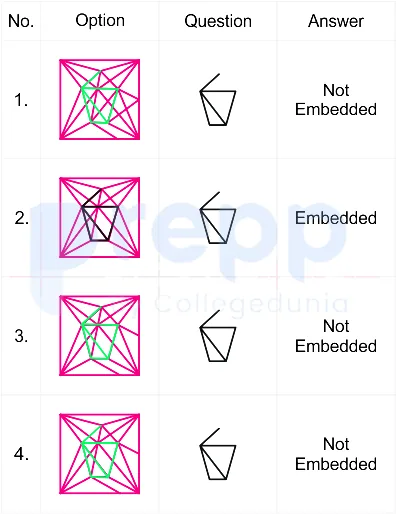
Select the option in which the given figure is embedded (rotation is NOT allowed)

- A
Option A (shown in image)
- B
Option B (shown in image)
- C
Option C (shown in image)
- D
Option D (shown in image)
Show answer
B. Option B (shown in image)Given:
The image must not to be rotated
Hence, the correct answer is "Option - (2)" .

 Paper & answer key PDF ↗
 Question 6archived
Select the correct combination of mathematical signs to replace the * signs and balance the given equation.
21 * 4 * 156 * 13 * 11 = 83
- A
−, ÷, ×, +
- B
×, +, ÷, −
- C
×, −, ÷, +
- D
+, ÷, −, ×
Show answer
C. ×, −, ÷, +Balancing a Mathematical Equation by Replacing Signs
The problem asks us to find the correct combination of mathematical signs (+, −, ×, ÷) to replace the asterisks (*) in the given equation so that the equation holds true.
The equation is:
\(21 * 4 * 156 * 13 * 11 = 83\)
We need to test each option provided to see which sequence of signs correctly balances the equation. Remember to follow the order of operations (BODMAS/PEMDAS: Brackets, Orders/Exponents, Division and Multiplication (from left to right), Addition and Subtraction (from left to right)).
Testing Option 1: −, ÷, ×, +
Replace the signs in the equation:
\(21 - 4 \div 156 \times 13 + 11\)
Following the order of operations:
Division: \(4 \div 156\) (This results in a fraction, likely not an integer result like 83, so we can probably discard this option quickly, but let's proceed for completeness). \(4 \div 156 = \frac{4}{156} = \frac{1}{39}\)
Multiplication: \(\frac{1}{39} \times 13 = \frac{13}{39} = \frac{1}{3}\)
Substitute back: \(21 - \frac{1}{3} + 11\)
Perform Addition/Subtraction: \(32 - \frac{1}{3} = \frac{96 - 1}{3} = \frac{95}{3}\)
\(\frac{95}{3} \neq 83\). So, Option 1 is incorrect for balancing the equation.
Testing Option 2: ×, +, ÷, −
Replace the signs in the equation:
\(21 \times 4 + 156 \div 13 - 11\)
Following the order of operations:
Division: \(156 \div 13 = 12\)
Multiplication: \(21 \times 4 = 84\)
Substitute back: \(84 + 12 - 11\)
Perform Addition/Subtraction (from left to right): \(84 + 12 = 96\)
\(96 - 11 = 85\)
\(85 \neq 83\). So, Option 2 is incorrect for balancing the equation.
Testing Option 3: ×, −, ÷, +
Replace the signs in the equation:
\(21 \times 4 - 156 \div 13 + 11\)
Following the order of operations:
Division: \(156 \div 13 = 12\)
Multiplication: \(21 \times 4 = 84\)
Substitute back: \(84 - 12 + 11\)
Perform Addition/Subtraction (from left to right): \(84 - 12 = 72\)
\(72 + 11 = 83\)
\(83 = 83\). The equation is balanced with this set of signs.
Testing Option 4: +, ÷, −, ×
Replace the signs in the equation:
\(21 + 4 \div 156 - 13 \times 11\)
Following the order of operations:
Division: \(4 \div 156 = \frac{1}{39}\)
Multiplication: \(13 \times 11 = 143\)
Substitute back: \(21 + \frac{1}{39} - 143\)
Perform Addition/Subtraction: \(21 - 143 + \frac{1}{39} = -122 + \frac{1}{39} = \frac{-122 \times 39 + 1}{39} = \frac{-4758 + 1}{39} = \frac{-4757}{39}\)
\(\frac{-4757}{39} \neq 83\). So, Option 4 is incorrect for balancing the equation.
The combination of signs that balances the equation \(21 * 4 * 156 * 13 * 11 = 83\) is ×, −, ÷, +.
Step
Equation
Operation
Result
1
\(21 \times 4 - 156 \div 13 + 11\)
Division (\(156 \div 13\))
\(21 \times 4 - 12 + 11\)
2
\(21 \times 4 - 12 + 11\)
Multiplication (\(21 \times 4\))
\(84 - 12 + 11\)
3
\(84 - 12 + 11\)
Subtraction (\(84 - 12\))
\(72 + 11\)
4
\(72 + 11\)
Addition (\(72 + 11\))
\(83\)
Since the final result is 83, which is equal to the right side of the original equation, the chosen combination of signs is correct.
Revision Table: Balancing Equations
Concept
Description
Importance
Mathematical Operators
Symbols like +, -, ×, ÷ representing operations.
Essential for performing calculations.
Order of Operations
Rules (BODMAS/PEMDAS) that dictate the sequence in which operations are performed.
Crucial for obtaining the correct result in expressions with multiple operations.
Balancing Equations
Replacing placeholders (like *) with operators to make the Left Hand Side (LHS) equal to the Right Hand Side (RHS).
Tests understanding of operators and order of operations.
Additional Information on Order of Operations (BODMAS/PEMDAS)
When solving mathematical expressions involving multiple operations, it's important to follow a specific order to ensure everyone gets the same answer. This order is commonly remembered using acronyms like BODMAS or PEMDAS.
BODMAS:
B: Brackets (Parentheses)
O: Orders (Exponents, Square Roots, etc.)
D: Division
M: Multiplication
A: Addition
S: Subtraction
PEMDAS:
P: Parentheses
E: Exponents (Orders)
M: Multiplication
D: Division
A: Addition
S: Subtraction
Division and Multiplication have the same priority and should be performed from left to right as they appear in the expression. Similarly, Addition and Subtraction have the same priority and should be performed from left to right.
In our problem, we first performed the division \(156 \div 13\) and the multiplication \(21 \times 4\), and then the subtraction and addition from left to right (\(84 - 12 + 11\)).
Paper & answer key PDF ↗ Question 7archived
Which of the following letter-clusters will replace the question mark (?) in the given series?
PK, GT, XC, OL, ?
- A
GT
- B
HS
- C
EV
- D
FU
Show answer
D. FUSolving the Letter Series Pattern
The given series of letter-clusters is: PK, GT, XC, OL, ?
We need to identify the pattern in this series to find the next letter-cluster that replaces the question mark.
Analyzing the Pattern in the Letter Clusters
Let's look at the positional values of the letters in the English alphabet (A=1, B=2, ..., Z=26).
Letter
Positional Value
P
16
K
11
G
7
T
20
X
24
C
3
O
15
L
12
Let's examine each letter cluster:
PK: P is 16th, K is 11th. $16 + 11 = 27$.
GT: G is 7th, T is 20th. $7 + 20 = 27$.
XC: X is 24th, C is 3rd. $24 + 3 = 27$.
OL: O is 15th, L is 12th. $15 + 12 = 27$.
Observation 1: The sum of the positional values of the two letters in each cluster is consistently 27. This means the letters in each pair are opposite to each other in the alphabet (e.g., A is opposite Z, B is opposite Y, etc.).
Analyzing the Pattern Between Clusters
Now, let's look at the pattern between the first letters of consecutive clusters and the second letters of consecutive clusters.
Pattern for the First Letter:
P (16) to G (7): The change is $7 - 16 = -9$. This means a decrease of 9 positions.
G (7) to X (24): Moving from 7 backwards by 9 positions: $7 - 9 = -2$. In a 26-letter alphabet, $-2$ positions relative to the start is equivalent to $26 - 2 = 24$ (X). This is also a decrease of 9 positions.
X (24) to O (15): The change is $15 - 24 = -9$. This is a decrease of 9 positions.
The pattern for the first letter is a consistent decrease of 9 positions in the alphabet.
To find the first letter of the next cluster, we apply this pattern to the first letter of the last cluster (O):
O (15) → $15 - 9 = 6$. The 6th letter is F.
Pattern for the Second Letter:
K (11) to T (20): The change is $20 - 11 = +9$. This means an increase of 9 positions.
T (20) to C (3): Moving from 20 forwards by 9 positions: $20 + 9 = 29$. In a 26-letter alphabet, 29 positions relative to the start is equivalent to $29 \pmod{26} = 3$ (C). This is also an increase of 9 positions.
L (12) to T (20): Let's recheck the original series. It is K → T → C → L. So, C (3) to L (12): The change is $12 - 3 = +9$. This is an increase of 9 positions.
The pattern for the second letter is a consistent increase of 9 positions in the alphabet.
To find the second letter of the next cluster, we apply this pattern to the second letter of the last cluster (L):
L (12) → $12 + 9 = 21$. The 21st letter is U.
Determining the Next Letter Cluster
Combining the patterns for the first and second letters, the next letter cluster is FU.
Let's verify this with our first observation: are F and U opposite letters? F is the 6th letter and U is the 21st letter. $6 + 21 = 27$. Yes, they are opposite letters, which fits the pattern observed in all previous clusters.
Therefore, the letter-cluster that replaces the question mark (?) is FU.
Revision Table: Letter Series Pattern
Cluster
First Letter (Value)
Second Letter (Value)
Sum of Values
Pattern (First Letter)
Pattern (Second Letter)
PK
P (16)
K (11)
$16+11=27$
-
-
GT
G (7)
T (20)
$7+20=27$
$7 - 16 = -9$
$20 - 11 = +9$
XC
X (24)
C (3)
$24+3=27$
$24 - 7 = 17$ (Equivalent to $24 - (7+26) = -9$)
$3 - 20 = -17$ (Equivalent to $3 + 26 - 20 = +9$)
OL
O (15)
L (12)
$15+12=27$
$15 - 24 = -9$
$12 - 3 = +9$
FU
F (6)
U (21)
$6+21=27$
$6 - 15 = -9$
$21 - 12 = +9$
Additional Information on Letter Series Reasoning
Letter series questions are common in logical reasoning tests. They require identifying a specific pattern based on the position of letters in the alphabet. Common patterns include:
Adding or subtracting a fixed number of positions.
Adding or subtracting a variable number based on the position in the series.
Alternating patterns (e.g., first letter follows one pattern, second letter follows another).
Patterns based on vowels/consonants.
Patterns based on alphabetical order or reverse alphabetical order.
Patterns involving sums or differences of positional values, like the 'opposite letter' pattern seen here (sum of positional values is 27).
Solving these questions involves:
Writing down the positional values of the letters.
Looking for patterns in the positional values (differences, sums, alternating changes).
Applying the identified pattern to find the missing term.
Paper & answer key PDF ↗ Question 8archived
Select the set in which the numbers are related in the same way as are the numbers of the following set.
(NOTE: Operations should be performed on the whole numbers, without breaking down the numbers into its constituent digits.)
(3, 14, 1)
(4, 36, 2)
- A
(8, 12, 2)
- B
(5, 81, 4)
- C
(7, 40, 3)
- D
(8, 260, 2)
Show answer
D. (8, 260, 2)The correct answer is (8, 260, 2).
See if there's a consistent pattern or a pattern in the differences/ratios themselves. Combine Operations: Often, the rule involves more than one step, like squaring the first number and adding the third number, or finding the difference between cubes and dividing. Stay Systematic: Try different types of operations systematically until you find a rule that fits all given examples. Practice with different types of numerical analogy problems helps improve your pattern recognition skills.
Paper & answer key PDF ↗ Question 9archived
Select the correct combination of mathematical signs to sequentially replace the * signs and to balance the given equation.
12 * 24 * 4 * 2 * 60
- A
+, ×, ÷, =
- B
. −, ×, +, =
- C
+, ×, −, =
- D
+, ÷, ×, =
Show answer
A. +, ×, ÷, =Balancing Equations with Mathematical Signs
The question asks us to find the correct sequence of mathematical signs (+, −, ×, ÷, =) to replace the asterisks (*) in the expression \(12 * 24 * 4 * 2 * 60\) to make it a valid and balanced equation. We need to test the given options sequentially, applying the order of operations (BODMAS/PEMDAS) to evaluate the left side of the equation and see if it equals the right side.
Testing the Options to Balance the Equation
Let's test the sequence of signs provided in one of the options: +, ×, ÷, =
Replacing the asterisks with these signs, we get the equation:
\(12 + 24 \times 4 \div 2 = 60\)
Applying the Order of Operations (BODMAS/PEMDAS)
To evaluate the left side of the equation, we follow the order of operations:
B/P: Brackets/Parentheses first (None in this equation).
O/E: Orders/Exponents next (None in this equation).
DM: Division and Multiplication from left to right.
AS: Addition and Subtraction from left to right.
Let's evaluate the left side step-by-step:
Perform Division: \(4 \div 2 = 2\). The equation becomes: \(12 + 24 \times 2 = 60\).
Perform Multiplication: \(24 \times 2 = 48\). The equation becomes: \(12 + 48 = 60\).
Perform Addition: \(12 + 48 = 60\). The equation becomes: \(60 = 60\).
The left side of the equation evaluates to 60, which is equal to the right side (60). Therefore, the equation \(12 + 24 \times 4 \div 2 = 60\) is balanced with the signs +, ×, ÷, =.
Let's quickly look at why other combinations might not work (though a full test isn't required for the correct answer):
If we used −, ×, +, =, it would be \(12 - 24 \times 4 + 2 = 60\). Calculation: \(12 - 96 + 2 = -84 + 2 = -82\). \(-82 \neq 60\).
If we used +, ×, −, =, it would be \(12 + 24 \times 4 - 2 = 60\). Calculation: \(12 + 96 - 2 = 108 - 2 = 106\). \(106 \neq 60\).
If we used +, ÷, ×, =, it would be \(12 + 24 \div 4 \times 2 = 60\). Calculation: \(12 + 6 \times 2 = 12 + 12 = 24\). \(24 \neq 60\).
Thus, the only combination that balances the equation is +, ×, ÷, =.
Verification of the Correct Sign Sequence
The calculation confirms that the sequence of signs +, ×, ÷, = makes the equation \(12 * 24 * 4 * 2 * 60\) balanced:
\(12 + 24 \times 4 \div 2 = 12 + (24 \times (4 \div 2))\)
\(= 12 + (24 \times 2)\)
\(= 12 + 48\)
\(= 60\)
Since \(60 = 60\), the equation is balanced.
Step
Operation
Equation
Initial
Replace * with signs
\(12 + 24 \times 4 \div 2 = 60\)
1
Division (\(4 \div 2\))
\(12 + 24 \times 2 = 60\)
2
Multiplication (\(24 \times 2\))
\(12 + 48 = 60\)
3
Addition (\(12 + 48\))
\(60 = 60\)
Revision Table: Mathematical Operations Order
Acronym
Order
Operations
BODMAS
1
Brackets
2
Orders (Powers, Roots)
3
Division and Multiplication (from left to right)
4
Addition and Subtraction (from left to right)
PEMDAS
1
Parentheses
2
Exponents
3
Multiplication and Division (from left to right)
4
Addition and Subtraction (from left to right)
Additional Information: Solving Equation Balancing Problems
Solving equation balancing problems like this requires careful application of mathematical rules. Here are some key points:
Understand the Goal: The aim is to make the expression on the left side of the equals sign equal to the value on the right side.
Order of Operations: Always follow the standard order of operations (BODMAS/PEMDAS). Multiplication and Division have equal priority, as do Addition and Subtraction. When operations of equal priority appear, solve them from left to right.
Substitution: Replace the placeholder symbols (*) with the given mathematical signs from the options.
Step-by-Step Evaluation: Break down the evaluation of the expression into smaller steps according to the order of operations.
Verification: Once a sequence of signs results in a balanced equation, verify the calculation to ensure no errors were made.
These problems are common in reasoning and quantitative aptitude tests, assessing logical thinking and mathematical proficiency.
Paper & answer key PDF ↗ Question 10archived
Three of the following four letter-clusters are alike in a certain way and one is different. Pick the odd one out.
- A
HGF
- B
RQP
- C
UVW
- D
LKJ
Show answer
C. UVWThis question asks us to identify the letter cluster that is different from the other three based on a certain pattern. These types of questions test our ability to find logical relationships between letters, often based on their position in the English alphabet or sequences.
Analyzing Letter Cluster Patterns
Let's examine each letter cluster provided and see if we can find a pattern within the letters. We can look at the position of each letter in the standard English alphabet (A=1, B=2, ..., Z=26).
HGF: Let's look at the letters in order. H is the 8th letter, G is the 7th letter, and F is the 6th letter. The sequence is 8, 7, 6. This shows a pattern where each letter is one position before the previous letter. It's a decreasing sequence of consecutive letters.
RQP: R is the 18th letter, Q is the 17th letter, and P is the 16th letter. The sequence is 18, 17, 16. This also shows a pattern where each letter is one position before the previous letter. It's a decreasing sequence of consecutive letters.
UVW: U is the 21st letter, V is the 22nd letter, and W is the 23rd letter. The sequence is 21, 22, 23. This shows a pattern where each letter is one position after the previous letter. It's an increasing sequence of consecutive letters.
LKJ: L is the 12th letter, K is the 11th letter, and J is the 10th letter. The sequence is 12, 11, 10. This shows a pattern where each letter is one position before the previous letter. It's a decreasing sequence of consecutive letters.
Identifying the Odd Letter Cluster Out
Based on our analysis, let's summarize the patterns found in each letter cluster:
HGF: Consecutive letters in decreasing alphabetical order ($\text{H} \rightarrow \text{G} \rightarrow \text{F}$)
RQP: Consecutive letters in decreasing alphabetical order ($\text{R} \rightarrow \text{Q} \rightarrow \text{P}$)
UVW: Consecutive letters in increasing alphabetical order ($\text{U} \rightarrow \text{V} \rightarrow \text{W}$)
LKJ: Consecutive letters in decreasing alphabetical order ($\text{L} \rightarrow \text{K} \rightarrow \text{J}$)
Three of the letter clusters (HGF, RQP, and LKJ) follow the same pattern of being consecutive letters in decreasing alphabetical order. The letter cluster UVW follows a different pattern: consecutive letters in increasing alphabetical order.
Therefore, UVW is the odd one out among the given letter clusters.
Revision Table: Letter Series Practice
Here's a summary of the analysis:
Letter Cluster
Letter Positions
Pattern
HGF
8, 7, 6
Decreasing by 1 ($\text{n} \rightarrow \text{n}-1 \rightarrow \text{n}-2$)
RQP
18, 17, 16
Decreasing by 1 ($\text{n} \rightarrow \text{n}-1 \rightarrow \text{n}-2$)
UVW
21, 22, 23
Increasing by 1 ($\text{n} \rightarrow \text{n}+1 \rightarrow \text{n}+2$)
LKJ
12, 11, 10
Decreasing by 1 ($\text{n} \rightarrow \text{n}-1 \rightarrow \text{n}-2$)
Additional Information: Types of Letter Series Patterns
Letter series and letter cluster questions can have various patterns. Recognizing different types of patterns can help solve these problems quickly. Some common patterns include:
Consecutive letters: As seen in this problem, letters are consecutive in increasing or decreasing order.
Skipping letters: Letters might skip a fixed number of letters (e.g., AC, EG, IK skips one letter each time).
Alternating patterns: The pattern might alternate between two different rules.
Gap increase/decrease: The gap between consecutive letters might increase or decrease in a regular sequence (e.g., AZ, BY, CX - sum of positions is constant; or AD, GJ, MP - gap increases by 1 each time).
Vowel/Consonant patterns: The pattern might involve the sequence of vowels or consonants.
Reverse order: Letters might be in reverse alphabetical order or form patterns based on reverse order.
Practicing with different types of letter series problems is key to mastering this topic in reasoning sections.
Paper & answer key PDF ↗ Question 11archived
Select the option that is related to the third word in the same way as the second word is related to the first word. (The words must be considered as meaningful English words and must not be related to each other based on the number of letters/number of consonants/vowels in the word)
Phone : Talk :: Television : ?
- A
Remote
- B
View
- C
Read
- D
Channel
Show answer
B. ViewUnderstanding Word Analogies and Relationships
Word analogy questions test your ability to find the relationship between a pair of words and apply that same relationship to another word to find the missing term. In this question, we are given the pair "Phone : Talk" and asked to complete the analogy "Television : ?".
Analyzing the First Analogy Pair: Phone : Talk
Let's look at the relationship between the words "Phone" and "Talk":
A Phone is a device.
Talk is an action performed using a phone (specifically, talking to someone else).
The relationship is: A Phone is used for the action of Talking.
Applying the Relationship to the Second Pair: Television : ?
Now we need to find a word that has the same relationship with "Television" as "Talk" has with "Phone". A Television is also a device. We need to identify an action that is primarily performed using a television.
Evaluating the Options
Let's examine the given options:
Remote: A remote is a device used to control a television. It is not an action performed using the television itself.
View: Viewing is the primary action performed when using a television. You watch programmes, movies, or other content on the television screen.
Read: While you might read text displayed on a television screen (like subtitles or teletext), reading is not the primary or intended action associated with using a television.
Channel: A channel is a source of programming on a television. It is something you access using a television, not an action performed using it.
Determining the Correct Relationship
Based on our analysis, the relationship "device is used for the action of..." holds true for "Television : View". A television is primarily used for the action of viewing content.
Conclusion
The relationship between "Phone" and "Talk" is that a phone is used for talking. Applying the same relationship to "Television", we find that a television is used for viewing. Therefore, the correct word to complete the analogy is "View".
Revision Table: Key Concepts
Analogy Pair
Words
Relationship
First Pair
Phone : Talk
Device : Primary Action Performed Using Device
Second Pair
Television : ?
Device : Primary Action Performed Using Device
Additional Information on Analogy Types
Word analogies can represent various types of relationships between words. Recognizing these common relationships can help you solve analogy questions more effectively. Some common types include:
Part to Whole: e.g., Finger : Hand (A finger is part of a hand).
Cause and Effect: e.g., Study : Success (Studying can cause success).
Synonyms: e.g., Happy : Joyful (Words with similar meanings).
Antonyms: e.g., Hot : Cold (Words with opposite meanings).
Object and User: e.g., Keyboard : Typist (A typist uses a keyboard).
Object and Action: e.g., Knife : Cut (A knife is used for cutting). This is the type of relationship seen in the question: Phone is used for Talk, Television is used for View.
Category and Item: e.g., Fruit : Apple (An apple is a type of fruit).
Practicing different types of analogies helps improve your verbal reasoning skills.
Paper & answer key PDF ↗ Question 12archived
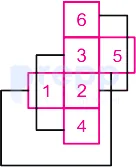
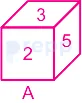
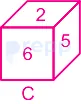
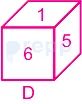
Select the cube that can be formed by folding the given sheet along the lines.
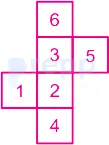
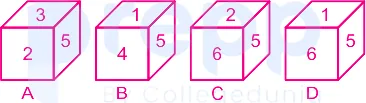
- A
None are possible
- B
Only A and B
- C
Only C and D
- D
Only A
Show answer
Question 13archived
Select the correct mirror image of the given combination when the mirror is placed at 'PQ' as shown below.

- A
Option A (shown in image)
- B
Option B (shown in image)
- C
Option C (shown in image)
- D
Option D (shown in image)
Show answer
Question 14archived
Select the figure that will replace the question mark (?) in the following figure series.

- A
Option A (shown in image)
- B
Option B (shown in image)
- C
Option C (shown in image)
- D
Option D (shown in image)
Show answer
Question 15archived
Read the given statements and conclusions carefully. Assuming that the information given in the statements is true, even if it appears to be at variance with commonly known facts, decide which of the given conclusions logically follow(s) from the statements.
Statements:
All cards are boxes.
All boxes are torches.
All torches are shoes.
Conclusions:
I. All shoes are torches.
II. All torches are boxes.
III. All boxes are cards.
IV. All cards are shoes.
- A
Only conclusion IV follows
- B
Only conclusions II and III follow
- C
Only conclusions I and II follow
- D
Only conclusion III follows
Show answer
A. Only conclusion IV followsUnderstanding Syllogism and Logical Conclusions
Syllogism questions test your ability to draw logical conclusions from given statements, assuming the statements are absolutely true, even if they contradict common knowledge. We need to analyze the relationship between the different categories mentioned in the statements.
Analyzing the Statements
Let's break down the given statements:
Statement 1: All cards are boxes. This means the entire set of 'cards' is included within the set of 'boxes'. We can represent this as Cards $\rightarrow$ Boxes.
Statement 2: All boxes are torches. This means the entire set of 'boxes' is included within the set of 'torches'. We can represent this as Boxes $\rightarrow$ Torches.
Statement 3: All torches are shoes. This means the entire set of 'torches' is included within the set of 'shoes'. We can represent this as Torches $\rightarrow$ Shoes.
Combining these statements, we can see a chain relationship:
Cards $\rightarrow$ Boxes $\rightarrow$ Torches $\rightarrow$ Shoes
This chain implies that if something is a Card, it must also be a Box. If it is a Box, it must also be a Torch. And if it is a Torch, it must also be a Shoe.
Evaluating the Conclusions
Now let's examine each conclusion based on the relationships established by the statements.
Conclusion I: All shoes are torches.
The statements say "All torches are shoes" (Torches $\rightarrow$ Shoes). This means all members of the 'torches' group are inside the 'shoes' group. However, this does not automatically mean that all members of the 'shoes' group are inside the 'torches' group. There might be some shoes that are not torches (e.g., shoes that are not torches). Therefore, this conclusion does not logically follow.
Conclusion II: All torches are boxes.
The statements say "All boxes are torches" (Boxes $\rightarrow$ Torches). This means all members of the 'boxes' group are inside the 'torches' group. Similar to Conclusion I, this does not guarantee that all members of the 'torches' group are inside the 'boxes' group. There could be some torches that are not boxes. Therefore, this conclusion does not logically follow.
Conclusion III: All boxes are cards.
The statements say "All cards are boxes" (Cards $\rightarrow$ Boxes). This means all members of the 'cards' group are inside the 'boxes' group. This does not imply that all members of the 'boxes' group are also inside the 'cards' group. There could be some boxes that are not cards. Therefore, this conclusion does not logically follow.
Conclusion IV: All cards are shoes.
Let's follow the chain we identified: Cards $\rightarrow$ Boxes $\rightarrow$ Torches $\rightarrow$ Shoes.
If all Cards are Boxes, and all Boxes are Torches, then it must be true that all Cards are Torches.
Further, if all Cards are Torches, and all Torches are Shoes, then it must be true that all Cards are Shoes.
This conclusion directly follows from the combined statements.
Summary of Conclusions
Based on our analysis:
Conclusion I (All shoes are torches): Does Not Follow
Conclusion II (All torches are boxes): Does Not Follow
Conclusion III (All boxes are cards): Does Not Follow
Conclusion IV (All cards are shoes): Follows
Therefore, only conclusion IV logically follows from the given statements.
Revision Table: Syllogism Basics
Statement Type
Representation
Inverse (Doesn't necessarily follow)
Converse (Doesn't necessarily follow)
All A are B
A $\rightarrow$ B
All not A are not B
All B are A
No A are B
A $\leftarrow\mid\rightarrow$ B
No not A are not B
No B are A
Some A are B
A $\cap$ B $\neq \emptyset$
Some not A are not B
Some B are A (logically follows)
Some A are not B
A $\setminus$ B $\neq \emptyset$
Some not A are B
Some B are not A
Note: The "Inverse" and "Converse" columns show common mistakes people make. Only "Some A are B" implies "Some B are A". For "All A are B", the only valid immediate inference is "Some A are B".
Additional Information on Syllogism Reasoning
Syllogisms are a form of deductive reasoning where a conclusion is drawn from two or more premises (statements). Understanding the types of statements (All, No, Some, Some Not) and how they relate is crucial. Visual tools like Venn diagrams can also be very helpful in solving syllogism problems.
For example, the statements in this question can be visualized as nested circles:
A circle for 'Cards' inside the circle for 'Boxes'.
The 'Boxes' circle inside the circle for 'Torches'.
The 'Torches' circle inside the circle for 'Shoes'.
This visualization clearly shows that anything inside the 'Cards' circle must also be inside the 'Shoes' circle, supporting Conclusion IV. It also shows that the outer circles ('Shoes', 'Torches', 'Boxes') are larger or equal to the inner ones, but the inner ones ('Torches', 'Boxes', 'Cards') are not necessarily equal to the outer ones, explaining why Conclusions I, II, and III do not follow (All Shoes are Torches, All Torches are Boxes, All Boxes are Cards).
Paper & answer key PDF ↗ Question 16archived
In a certain code language, FRUCTUS is coded as 108, and SPRINTER is coded as 119.
How will MASCULINE be coded in that language?
- A
96
- B
99
- C
97
- D
98
Show answer
C. 97Understanding the Coding Language Pattern
The problem provides examples of words coded into numbers. We are given that FRUCTUS is coded as 108 and SPRINTER is coded as 119. We need to find the pattern used in this coding language and apply it to the word MASCULINE.
Let's analyze the given examples to find the pattern. A common method for coding words into numbers involves using the alphabetical positions of the letters. In the English alphabet, A=1, B=2, C=3, ..., Z=26.
Analyzing FRUCTUS Coding
Let's find the alphabetical positions of the letters in the word FRUCTUS:
Letter
Alphabetical Position
F
6
R
18
U
21
C
3
T
20
U
21
S
19
Now, let's sum these positions:
\( \text{Sum} = 6 + 18 + 21 + 3 + 20 + 21 + 19 \)
\( \text{Sum} = 108 \)
The sum of the alphabetical positions of the letters in FRUCTUS is 108, which matches the given code. This suggests that the pattern is the sum of the alphabetical values of the letters in the word.
Analyzing SPRINTER Coding
Let's verify this pattern with the second example, SPRINTER:
Letter
Alphabetical Position
S
19
P
16
R
18
I
9
N
14
T
20
E
5
R
18
Let's sum these positions:
\( \text{Sum} = 19 + 16 + 18 + 9 + 14 + 20 + 5 + 18 \)
\( \text{Sum} = 119 \)
The sum of the alphabetical positions of the letters in SPRINTER is 119, which also matches the given code. The pattern is consistent.
Applying the Logic to MASCULINE
Now, we will apply the same pattern to find the code for the word MASCULINE.
Let's find the alphabetical positions of the letters in MASCULINE:
Letter
Alphabetical Position
M
13
A
1
S
19
C
3
U
21
L
12
I
9
N
14
E
5
Now, let's sum these positions:
\( \text{Sum} = 13 + 1 + 19 + 3 + 21 + 12 + 9 + 14 + 5 \)
\( \text{Sum} = 97 \)
Therefore, the code for MASCULINE in this language is 97.
Conclusion on MASCULINE Coding
Based on the pattern observed in the coding of FRUCTUS and SPRINTER, the word MASCULINE is coded as 97.
Revision Table: Word Coding Summary
Word
Letters & Positions
Sum of Positions
Coded Value
FRUCTUS
F(6), R(18), U(21), C(3), T(20), U(21), S(19)
\(6+18+21+3+20+21+19 = 108\)
108
SPRINTER
S(19), P(16), R(18), I(9), N(14), T(20), E(5), R(18)
\(19+16+18+9+14+20+5+18 = 119\)
119
MASCULINE
M(13), A(1), S(19), C(3), U(21), L(12), I(9), N(14), E(5)
\(13+1+19+3+21+12+9+14+5 = 97\)
97
Additional Information on Coding Logic
Coding and decoding problems like this one often appear in reasoning sections of exams. The key is to identify the relationship or pattern between the original word (or number) and its coded form. Common patterns include:
Using alphabetical positions (like in this problem).
Adding or subtracting a constant value to the positions.
Multiplying positions by a constant.
Reversing the order of letters or numbers.
Using the number of letters in the word.
Using vowel or consonant counts.
Applying a combination of these or other operations.
Practicing different types of coding problems helps in quickly identifying the underlying logic.
Paper & answer key PDF ↗ Question 17archived
In the following question below are given some statements followed by some conclusions based on those statements. Taking the given statements to be true even if they seem to be at variance from commonly known facts. Read all the conclusions an then decide which of the given conclusion logically follows the given statements.
Statements:
I. All W are S.
II. No D is W.
Conclusion:
I. Some S are W.
II. All S are D.
III. No W is D.
- A
Only conclusion III follows
- B
Both conclusions I and III follows
- C
Both conclusions I and II follows
- D
All conclusion follows
Show answer
B. Both conclusions I and III followsUnderstanding Logic Statements and Conclusions
This question asks us to analyze two statements and determine which of the given conclusions logically follow from them. We must assume the statements are true, even if they contradict common knowledge. This is a common type of logic puzzle based on syllogisms or categorical propositions.
Analyzing the Given Statements
Let's break down the meaning of each statement:
Statement I: All W are S.
This means that every single element belonging to the category 'W' is also an element belonging to the category 'S'. We can think of the set of 'W' as being completely contained within the set of 'S'.
Statement II: No D is W.
This means that there is no overlap between the category 'D' and the category 'W'. The sets of 'D' and 'W' are entirely separate or disjoint.
Evaluating Each Conclusion
Now, let's look at each conclusion and see if it must be true based on the statements:
Conclusion I: Some S are W.
Statement I says "All W are S". If all W are S, it means that the entire set W is a part of set S. As long as there is at least one 'W', then that 'W' must also be an 'S'. Therefore, some portion of S must be W (specifically, the part that is W). This conclusion logically follows from Statement I.
Conclusion II: All S are D.
Statement I tells us that all W are S. Statement II tells us that no D is W, which means no W is D. If all S were D, then anything that is S would also have to be D. But we know that all W are S, and we also know that no W is D. This creates a conflict: the elements that are W are in S but cannot be in D. Therefore, it's not possible for all S to be D. This conclusion does not logically follow from the statements.
Conclusion III: No W is D.
Statement II directly says "No D is W". The statement "No D is W" is logically equivalent to "No W is D". If there is no overlap between the set D and the set W in one direction, there cannot be an overlap in the other direction either. This conclusion logically follows directly from Statement II.
Summarizing the Results
Based on our analysis, let's summarize which conclusions follow:
Conclusion
Logically Follows?
Reasoning
I. Some S are W.
Yes
From "All W are S". W is a subset of S.
II. All S are D.
No
Contradicts "No W is D" as W is part of S.
III. No W is D.
Yes
Equivalent to "No D is W" (Statement II).
Final Answer Explained
Our evaluation shows that Conclusion I ("Some S are W") and Conclusion III ("No W is D") both logically follow from the given statements, while Conclusion II ("All S are D") does not.
Revision Table: Logic Statements & Conclusions
Statement Type
Format
Meaning
Universal Affirmative
All A are B.
Set A is entirely contained within Set B.
Universal Negative
No A is B.
Set A and Set B have no elements in common (disjoint).
Particular Affirmative
Some A are B.
There is at least one element common to both Set A and Set B.
Particular Negative
Some A are not B.
There is at least one element in Set A that is not in Set B.
Additional Information: Syllogism and Logic
The type of logic problem presented here is based on categorical syllogisms. A syllogism is a form of logical reasoning where a conclusion is drawn from two given premises (statements). Each part of a syllogism (statements and conclusion) is a categorical proposition, relating two categories (or terms) like 'W', 'S', and 'D' using words like 'all', 'no', or 'some'.
Visual aids like Venn diagrams are often helpful in solving these problems. For the given statements:
"All W are S" would be represented by a circle for W drawn completely inside a circle for S.
"No D is W" would be represented by a circle for D drawn completely separate from the circle for W.
By drawing these relationships, you can visually check if the conclusions hold true in all possible valid diagrams.
Paper & answer key PDF ↗ Question 18archived
A series is given with one term missing. Select the correct alternative from the given ones that will complete the series.
NMRQ, NDZG, NUHW, NLPM, ?
- A
NQRC
- B
NCXC
- C
NHMH
- D
MQRQ
Show answer
B. NCXCLetter Series Pattern Analysis: NMRQ, NDZG, NUHW, NLPM, ?
This solution details the process to find the missing term in the provided letter series: NMRQ, NDZG, NUHW, NLPM, ?. The core task involves identifying the specific pattern or logic that connects the consecutive terms in the series.
Series Breakdown
To decipher the pattern, we will analyze the progression of letters at each position (1st, 2nd, 3rd, and 4th) within the terms.
Position 1: First Letter Pattern
The first letters in the sequence are N, N, N, N.
Observing these, it's clear that the first letter remains constant throughout the series.
Therefore, the first letter of the missing term must be N.
Position 2: Second Letter Pattern
The second letters are M, D, U, L.
Converting these letters to their numerical positions in the alphabet (A=1, B=2, ..., Z=26):
M corresponds to 13.
D corresponds to 4.
U corresponds to 21.
L corresponds to 12.
Now, let's calculate the difference in positions between consecutive letters:
$4 - 13 = -9$
$21 - 4 = 17$
$12 - 21 = -9$
The pattern detected is an alternating sequence of operations: subtract 9, add 17, subtract 9.
To find the next letter, we apply the next operation in the sequence, which is adding 17.
Starting from the position of L (12): $12 + 17 = 29$.
Since the alphabet has 26 letters, we use modulo 26 arithmetic to find the position: $29 \pmod{26} = 3$.
The 3rd letter in the alphabet is C.
Thus, the second letter of the missing term is C.
Position 3: Third Letter Pattern
The third letters in the series are R, Z, H, P.
Their corresponding alphabet positions are:
R = 18
Z = 26
H = 8
P = 16
Let's calculate the difference in positions between consecutive letters:
$26 - 18 = 8$
$8 - 26 = -18$. Alternatively, considering wrap-around ($Z \rightarrow A \rightarrow B...$), adding 8 positions ($26+8=34$) gives $34 \pmod{26} = 8$. So the step is $+8$.
$16 - 8 = 8$
The pattern observed is a consistent addition of 8 to the alphabet position ($+8$).
Applying this pattern to the last known letter P (16): $16 + 8 = 24$.
The 24th letter in the alphabet is X.
Thus, the third letter of the missing term is X.
Position 4: Fourth Letter Pattern
The fourth letters are Q, G, W, M.
Their corresponding alphabet positions are:
Q = 17
G = 7
W = 23
M = 13
Let's calculate the difference in positions between consecutive letters:
$7 - 17 = -10$
$23 - 7 = 16$
$13 - 23 = -10$
The pattern detected is an alternating sequence: subtract 10, add 16, subtract 10.
Following this pattern, the next operation should be adding 16.
Starting from the position of M (13): $13 + 16 = 29$.
Using modulo 26 arithmetic: $29 \pmod{26} = 3$.
The 3rd letter in the alphabet is C.
Thus, the fourth letter of the missing term is C.
Identifying the Missing Term
By assembling the determined letters for each position, we construct the missing term:
First Letter: N
Second Letter: C
Third Letter: X
Fourth Letter: C
Therefore, the missing term in the series is NCXC.
Final Answer
The analysis reveals that the missing term completing the series NMRQ, NDZG, NUHW, NLPM is NCXC. This matches option 2.
Paper & answer key PDF ↗ Question 19archived
Which figure should replace the question mark (?) if the series were to be continued? .

- A
Option A (shown in image)
- B
Option B (shown in image)
- C
Option C (shown in image)
- D
Option D (shown in image)
Show answer
Question 20archived
Select the option that is related to the fifth number in the same way as the second number is related to the first number and the fourth number is related to the third number.
19 : 324 :: 25 : 576 :: 9 : ?
- A
16
- B
64
- C
88
- D
72
Show answer
B. 64The correct answer is 64.
Patterns can involve: Arithmetic operations (addition, subtraction, multiplication, division) Powers and roots (squares, cubes, square roots, cube roots) Series based on specific number types (prime numbers, composite numbers, odd/even numbers) Sequential operations (adding 3, then multiplying by 2, then subtracting 1) Digit manipulation (sum of digits, product of digits, reversing digits) Relationships between consecutive numbers or alternate numbers in a series. Practicing various types of numerical reasoning questions helps improve your ability to quickly identify these patterns.
Paper & answer key PDF ↗ Question 21archived
After arranging the given words according to dictionary order, which word will come at ‘Fifth’ position?
1. Popular
2. Population
3. Populace
4. Pope
5. Poppy
- A
Population
- B
Poppy
- C
Popular
- D
Populace
Show answer
A. PopulationUnderstanding Dictionary Order
Arranging words in dictionary order means putting them in alphabetical order, just like you would find them in a dictionary. We compare words letter by letter from left to right. If letters match, we move to the next letter until we find a difference.
Step-by-Step Arrangement
Let's arrange the given words:
Popular
Population
Populace
Pope
Poppy
We compare the words letter by letter:
All words start with 'Po'.
The fourth letter varies: 'u' (Popular, Population, Populace), 'e' (Pope), 'p' (Poppy).
Comparing 'e', 'p', and 'u' alphabetically, 'e' comes first, then 'p', then 'u'.
So, the word starting with 'Pope' comes first:
Pope
Next is the word starting with 'Popp':
Poppy
Now we compare the words starting with 'Popu': Popular, Population, Populace.
All three start with 'Popu'.
Compare the fifth letter: 'a' for all three.
Compare the sixth letter: 'r' (Popular), 't' (Population), 'c' (Populace).
Comparing 'r', 't', and 'c' alphabetically, 'c' comes first, then 'r', then 't'.
So, the order for these three words is:
Populace (6th letter 'c')
Popular (6th letter 'r')
Population (6th letter 't')
Combining the full list in dictionary order:
Pope (Starts with 'P o p e')
Poppy (Starts with 'P o p p')
Populace (Starts with 'P o p u l a c')
Popular (Starts with 'P o p u l a r')
Population (Starts with 'P o p u l a t')
Identifying the Fifth Word
Based on the dictionary order we determined:
Pope
Poppy
Populace
Popular
Population
The word at the fifth position is Population.
Revision Table: Dictionary Order Steps
Step
Action
Example (Comparing 'Cat', 'Cab', 'Car')
1
Compare the first letter of each word. Arrange based on alphabetical order.
All start with 'C'. Move to the next letter.
2
If the first letters are the same, compare the second letters. Arrange based on alphabetical order.
All have 'a' as the second letter. Move to the next letter.
3
Continue comparing letters position by position until a difference is found.
Compare the third letter: 't' (Cat), 'b' (Cab), 'r' (Car).
4
Arrange words based on the alphabetical order of the first different letter found. If one word runs out of letters and is a prefix of another, the shorter word comes first.
Alphabetical order of 'b', 'r', 't' is 'b', 'r', 't'. So, the order is Cab, Car, Cat.
Additional Information on Word Ordering
Dictionary order is a fundamental concept used not just in dictionaries but also in sorting data alphabetically in computer systems, organizing lists, and indexing information. It follows strict rules based on the standard English alphabet sequence. Understanding how to arrange words helps in various logical reasoning and vocabulary-building tasks.
When comparing words, if one word is a prefix of another (e.g., 'Apple' and 'Applepie'), the shorter word (Apple) comes first because it "ends" alphabetically before the longer word has finished all its letters.
Paper & answer key PDF ↗ Question 22archived
Select the set in which the numbers are related in the same way as are the numbers of the following sets.
(NOTE : Operations should be performed on the whole numbers, without breaking down the numbers into its constituent digits. E.g. 13 – Operations on 13 such as adding /subtracting /multiplying etc. to 13 can be performed. Breaking down 13 into 1 and 3 and then performing mathematical operations on 1 and 3 is not allowed)
(20, 6, 4)
(24, 7, 5)
- A
(65, 9, 4)
- B
(22, 5, 2)
- C
(40, 8, 5)
- D
(42, 7, 3)
Show answer
A. (65, 9, 4)The correct answer is (65, 9, 4).
The key is to carefully analyze the given examples and deduce the underlying relationship, then apply that relationship to the options to find the matching set. Common patterns include: Addition, subtraction, multiplication, division Operations on squares or cubes of numbers Relationship between sums or differences of numbers Ratio or proportion between numbers Sequential patterns (though less common in set analogies like this) Always test your hypothesized rule against all the provided examples before applying it to the options.
Paper & answer key PDF ↗ Question 23archived
A # B means ‘A is the sister of B’
A @ B means ‘A is the daughter of B’
A & B means ‘A is the husband of B’
A % B means ‘A is the father of B’
If A % B & C # D @ E, then how is B related to E?
- A
Brother
- B
Son-in-law
- C
Father
- D
Son
Show answer
B. Son-in-lawDecoding the Blood Relations Puzzle
This problem involves understanding a set of defined relationships represented by symbols and then applying them to a given expression to determine the relationship between two individuals.
Let's break down the given symbols and their meanings:
A # B means ‘A is the sister of B’
A @ B means ‘A is the daughter of B’
A & B means ‘A is the husband of B’
A % B means ‘A is the father of B’
Now, let's analyze the expression: A % B & C # D @ E
We will decode this expression step by step from left to right to establish the relationships between the individuals A, B, C, D, and E.
A % B: This means A is the father of B. So, A is male. B's gender is not yet determined from this part.
B & C: This means B is the husband of C. This tells us that B is male and C is female. Combining with the previous step, A is the father of male B.
C # D: This means C is the sister of D. Since C is female, this relation works. C and D are siblings. D's gender is not yet determined from this part.
D @ E: This means D is the daughter of E. This confirms D is female. E is the parent of D.
Establishing Key Relationships
From the step-by-step decoding, we have the following established relationships:
A is the father of B. (A is male, B is male)
B is the husband of C. (B is male, C is female)
C is the sister of D. (C is female, D is female)
D is the daughter of E. (D is female, E is the parent of D)
Since C and D are sisters, and D is the daughter of E, this means C is also the daughter of E. So, E is the parent of both C and D.
Determining the Relationship between B and E
We need to find out how B is related to E.
We know that:
B is the husband of C.
C is the daughter of E.
If B is the husband of C, and C is the daughter of E, then B is married to E's daughter. The husband of one's daughter is called the son-in-law.
Therefore, B is the son-in-law of E.
Revision Table: Blood Relations Symbols
Symbol
Meaning
#
Sister
@
Daughter
&
Husband
%
Father
Additional Information: Solving Blood Relation Puzzles
Blood relation questions test your ability to understand and trace relationships within a family based on given information. Here are some tips for solving them effectively:
Draw a family tree: Visualizing the relationships using a diagram can make it much easier to see the connections. Use different symbols for male, female, marriage, and siblings.
Break down complex expressions: Analyze the expression segment by segment, establishing the relationship between adjacent pairs of individuals.
Determine gender: Pay close attention to the symbols that indicate the gender of a person. This is crucial for correctly identifying relationships like father, mother, son, daughter, etc.
Connect the segments: Once you've analyzed each part of the expression, connect the relationships to form a complete family structure based on the given information.
Identify the target relationship: Clearly identify which two individuals' relationship you need to find and trace the path between them in your diagram or established connections.
Practicing with different types of blood relation problems helps build proficiency in decoding the language and structure of these puzzles.
Paper & answer key PDF ↗ Question 24archived
If A × B means that A is the brother of B, A – B means that A is the sister of B, A + B means that A is the father of B then which of the following expression shows that P is the paternal aunt of R?
- A
P – Q × R
- B
P – Q + R
- C
P × Q + R
- D
P + Q – R
Show answer
B. P – Q + RUnderstanding Blood Relations from Codes
This question asks us to decode expressions representing blood relationships based on given symbol meanings and find the one that shows P as the paternal aunt of R.
First, let's break down the meaning of each symbol:
\( A \times B \): A is the brother of B. This tells us the gender of A (male).
\( A - B \): A is the sister of B. This tells us the gender of A (female).
\( A + B \): A is the father of B. This tells us the gender of A (male) and the generational difference.
We are looking for an expression where P is the paternal aunt of R. A paternal aunt is the sister of one's father. So, we need a relationship where P is female and is the sister of R's father.
Analyzing the Options for Paternal Aunt Relation
Let's examine each given option based on the defined relationships:
Option 1: \( P - Q \times R \)
\( P - Q \): P is the sister of Q. (P is female)
\( Q \times R \): Q is the brother of R. (Q is male)
Combining these, P is the sister of Q, and Q is the brother of R. This means P and Q are siblings, and Q and R are siblings. Therefore, P, Q, and R are all siblings. P is the sister of R. This is not P being the paternal aunt of R.
Option 2: \( P - Q + R \)
\( P - Q \): P is the sister of Q. (P is female)
\( Q + R \): Q is the father of R. (Q is male)
Combining these, P is the sister of Q, and Q is the father of R. This means P is the sister of R's father (Q). The sister of the father is the paternal aunt. This matches the required relationship.
Option 3: \( P \times Q + R \)
\( P \times Q \): P is the brother of Q. (P is male)
\( Q + R \): Q is the father of R. (Q is male)
Combining these, P is the brother of Q, and Q is the father of R. This means P is the brother of R's father (Q). The brother of the father is the paternal uncle. This is not P being the paternal aunt of R.
Option 4: \( P + Q - R \)
\( P + Q \): P is the father of Q. (P is male)
\( Q - R \): Q is the sister of R. (Q is female)
Combining these, P is the father of Q, and Q is the sister of R. This means P is the father of R's sister (Q). Therefore, P is R's father. This is not P being the paternal aunt of R.
Conclusion
Based on the analysis of each option, the expression \( P - Q + R \) correctly shows that P is the sister of Q, and Q is the father of R, thus making P the paternal aunt of R.
Expression
Relationship 1
Relationship 2
Overall Relationship of P to R
Paternal Aunt?
\( P - Q \times R \)
P is sister of Q
Q is brother of R
P is sister of R
No
\( P - Q + R \)
P is sister of Q
Q is father of R
P is sister of R's father (Paternal Aunt)
Yes
\( P \times Q + R \)
P is brother of Q
Q is father of R
P is brother of R's father (Paternal Uncle)
No
\( P + Q - R \)
P is father of Q
Q is sister of R
P is father of R's sister (Father)
No
Revision Table: Blood Relations Coding
Understanding the code for blood relations is key to solving these puzzles. Here's a quick summary:
\( A \times B \): A is brother of B (A is male)
\( A - B \): A is sister of B (A is female)
\( A + B \): A is father of B (A is male)
To find Paternal Aunt, we need P to be female and related as sister to R's father.
Additional Information: Solving Blood Relation Puzzles
Blood relation puzzles using codes or symbols are common in reasoning sections of exams. Here are some tips:
Write down the meaning of each symbol clearly.
Note the gender implied by each relationship (e.g., "father" means male, "sister" means female).
Analyze the expression step-by-step, usually from left to right.
Build a simple diagram or chain of relationships for each option.
Focus on the relationship between the first and last person mentioned in the expression.
Pay close attention to generational differences (father/son vs. brother/sister).
Practicing with different types of relationships (maternal uncle, grandmother, cousin, etc.) will help you become more comfortable with these puzzles.
Paper & answer key PDF ↗ Question 25archived
Select the odd group of numbers. (NOTE: Operations should be performed on the whole numbers, without breaking down the numbers into its constituent digits. E.g.13 – Operations on 13 such as adding /subtracting /multiplying etc. to 13 can be performed. Breaking down 13 into 1 and 3 and then performing mathematical operations on 1 and 3 is not allowed)
- A
(7 – 343 – 331)
- B
(6 – 216 – 206)
- C
(5 – 125 – 115)
- D
(4 – 64 – 54)
Show answer
A. (7 – 343 – 331)Identifying the Odd Group of Numbers
The question asks us to identify the 'odd group of numbers' from the given options. Each option presents a group of three numbers in the format (A – B – C). We need to find a mathematical relationship or pattern that holds true for most groups and identify the one group that does not follow this pattern.
Analyzing the Number Groups
Let's examine each group and see if we can find a consistent rule connecting the three numbers A, B, and C.
Group 1: (7 – 343 – 331)
Group 2: (6 – 216 – 206)
Group 3: (5 – 125 – 115)
Group 4: (4 – 64 – 54)
Checking for Patterns: Relationship between A and B
Let's look at the relationship between the first number (A) and the second number (B) in each group:
Group 1: A = 7, B = 343. We notice that $7 \times 7 \times 7 = 7^3 = 343$. So, $B = A^3$.
Group 2: A = 6, B = 216. We notice that $6 \times 6 \times 6 = 6^3 = 216$. So, $B = A^3$.
Group 3: A = 5, B = 125. We notice that $5 \times 5 \times 5 = 5^3 = 125$. So, $B = A^3$.
Group 4: A = 4, B = 64. We notice that $4 \times 4 \times 4 = 4^3 = 64$. So, $B = A^3$.
The pattern $B = A^3$ holds true for all four groups. This relationship alone does not help us find the odd group.
Checking for Patterns: Relationship between B and C
Now let's look at the relationship between the second number (B) and the third number (C). Let's calculate the difference between B and C ($B - C$) for each group:
Group 1: B = 343, C = 331. Difference = $343 - 331 = 12$.
Group 2: B = 216, C = 206. Difference = $216 - 206 = 10$.
Group 3: B = 125, C = 115. Difference = $125 - 115 = 10$.
Group 4: B = 64, C = 54. Difference = $64 - 54 = 10$.
We observe that in Groups 2, 3, and 4, the difference between the second number (B) and the third number (C) is consistently 10. This suggests a pattern $C = B - 10$.
Identifying the Odd Group based on the Pattern
Let's check if all groups follow the combined pattern: $B = A^3$ and $C = B - 10$.
Group
A
B
C
$A^3$
Is $B = A^3$?
$B - 10$
Is $C = B - 10$?
1
7
343
331
$7^3 = 343$
Yes
$343 - 10 = 333$
No ($331 \ne 333$)
2
6
216
206
$6^3 = 216$
Yes
$216 - 10 = 206$
Yes ($206 = 206$)
3
5
125
115
$5^3 = 125$
Yes
$125 - 10 = 115$
Yes ($115 = 115$)
4
4
64
54
$4^3 = 64$
Yes
$64 - 10 = 54$
Yes ($54 = 54$)
From the table, it is clear that Group 1 (7 – 343 – 331) follows the $B=A^3$ pattern but does not follow the $C=B-10$ pattern, as the third number is 331 instead of 333. Groups 2, 3, and 4 follow both patterns ($B=A^3$ and $C=B-10$).
Therefore, the odd group of numbers is (7 – 343 – 331).
Revision Table: Analyzing Number Patterns
Concept
Explanation
Application in this problem
Number Series/Patterns
Identifying a rule that connects numbers in a sequence or group.
Finding the rules connecting the three numbers in each group (A, B, C).
Cube Numbers
A number multiplied by itself three times ($n^3$).
The second number B is the cube of the first number A ($B = A^3$).
Arithmetic Operations
Basic operations like addition, subtraction, multiplication, division.
The third number C is found by subtracting 10 from the second number B ($C = B - 10$).
Odd One Out
Identifying the item that does not fit a pattern shared by others.
Finding the group that does not follow the derived pattern ($B=A^3$ and $C=B-10$).
Additional Information: Logical Reasoning with Numbers
Questions involving identifying odd groups or numbers based on patterns are common in logical reasoning and quantitative aptitude tests. These questions assess your ability to observe, analyze, and find underlying rules or relationships between numbers. Here are some common types of patterns you might encounter:
Arithmetic Progressions: Numbers increase or decrease by a constant difference.
Geometric Progressions: Numbers increase or decrease by a constant ratio (multiplication or division).
Square Numbers: Numbers are perfect squares ($1, 4, 9, 16, ...$).
Cube Numbers: Numbers are perfect cubes ($1, 8, 27, 64, ...$).
Prime Numbers: Numbers divisible only by 1 and themselves ($2, 3, 5, 7, 11, ...$).
Differences/Ratios of terms: The pattern might be in the differences between consecutive terms or the ratio between them.
Combinations of operations: The pattern might involve multiple steps, like squaring a number and then adding/subtracting a constant.
Digit-based operations: Although excluded in this specific problem, sometimes operations are performed on the individual digits of a number.
To solve such problems, it's helpful to systematically check for common mathematical relationships between the numbers in the given options.
Paper & answer key PDF ↗ Question 26archived
The term ‘Back-stick’ is used in which of the following games/sports?
- A
Basketball
- B
Badminton
- C
Hockey
- D
Volleyball
Show answer
C. HockeyThe correct answer is Hockey.
Back-stick is a term used in field hockey. Hockey sticks have only one playing side (the flat left side); using the rounded right or "back" side of the stick to hit the ball is a foul known as a back-stick offence, penalised by the umpire.
The other options use different terminology: basketball uses terms like dribble, pivot and travel; badminton uses drop, smash and drive; and volleyball uses spike, dig and set. None of them uses "back-stick", making hockey the only correct sport for this term.
Paper & answer key PDF ↗ Question 27archived
Which of the following festivals in Punjab is celebrated to commemorate the formation of the Khalsa Panth?
- A
Lohri
- B
Hola Mohalla
- C
Teej
- D
Baisakhi
Show answer
D. BaisakhiUnderstanding Punjabi Festivals and the Khalsa Panth
The question asks to identify the festival in Punjab that is celebrated to remember and honor the formation of the Khalsa Panth. The Khalsa Panth holds immense significance in Sikh history, as it was formally established by Guru Gobind Singh Ji.
Let's look at the options provided and their significance:
Lohri: This is a popular winter folk festival, primarily celebrated in Punjab and other parts of North India. It marks the end of the winter solstice and is traditionally associated with the harvest of the rabi crops. While a major festival, it is not related to the formation of the Khalsa Panth.
Hola Mohalla: This is a Sikh festival celebrated in the month of Chet, a day after Holi. It was started by Guru Gobind Singh Ji as a gathering of Sikhs for military exercises, mock battles, and poetry recitation. It emphasizes martial skills and bravery but is not the festival commemorating the Khalsa's formation itself.
Teej: This festival is celebrated primarily by women, especially in North India, during the monsoon season. It is dedicated to Goddess Parvati and signifies marital bliss and well-being. It is a cultural and religious festival but not linked to the Khalsa Panth formation.
Baisakhi: Also known as Vaisakhi, this is a historical and religious festival in Sikhism. On Baisakhi in 1699, Guru Gobind Singh Ji founded the Khalsa Panth at Anandpur Sahib. This festival also marks the Punjabi New Year and the harvest season in Punjab. Therefore, Baisakhi is directly associated with the commemoration of the formation of the Khalsa Panth.
Based on the historical significance of these festivals, Baisakhi is the one that commemorates the formation of the Khalsa Panth.
Key Points on Baisakhi and Khalsa Formation
Baisakhi is a pivotal day in Sikh history. On this day in 1699, Guru Gobind Singh Ji convened a large gathering at Anandpur Sahib and selected the first five members of the Khalsa, known as the Panj Pyare (the Five Beloved Ones). He then administered Amrit (nectar) to them, initiating them into the Khalsa order. This event transformed the Sikh community and gave them a distinct identity and code of conduct.
Thus, the celebration of Baisakhi holds deep religious and historical importance for Sikhs, specifically remembering the establishment of the Khalsa Panth.
Summarizing the Festivals
Festival
Primary Significance
Link to Khalsa Panth Formation
Lohri
Winter harvest, end of winter solstice
None
Hola Mohalla
Mock battles, martial exercises, bravery
Related to Sikh martial tradition, but not the commemoration of formation itself
Teej
Monsoon festival, dedicated to Goddess Parvati, marital bliss
None
Baisakhi
Punjabi New Year, Harvest Festival, Formation of Khalsa Panth
Directly commemorates the formation of the Khalsa Panth in 1699
Therefore, the festival celebrated to commemorate the formation of the Khalsa Panth is Baisakhi.
Revision Table: Punjabi Festivals
Festival
Time of Year
Main Focus
Lohri
January
Harvest, Solstice
Hola Mohalla
March (day after Holi)
Martial skills, Community gathering
Teej
July/August (Monsoon)
Women, Marital well-being
Baisakhi
April
Harvest, New Year, Khalsa Formation
Additional Information on Khalsa Formation and Baisakhi
The formation of the Khalsa on Baisakhi by Guru Gobind Singh Ji was a transformative event that instilled a strong sense of identity, discipline, and courage among Sikhs. The Khalsa was created to uphold righteousness, fight injustice, and protect the weak. Initiation into the Khalsa involves following a specific code of conduct (Rehat Maryada) and adopting the five Ks (Kakkars): Kesh (uncut hair), Kara (a steel bracelet), Kanga (a wooden comb), Kaccha (cotton underwear), and Kirpan (a sword).
Baisakhi celebrations often involve processions (Nagar Kirtan), visits to Gurdwaras (Sikh temples), communal meals (Langar), and vibrant cultural events, reflecting both the spiritual significance of the Khalsa and the joy of the harvest season and the new year.
Paper & answer key PDF ↗ Question 28archived
What theme was decided to celebrate the second ‘International Day of Yoga’ in India?
- A
Yoga for the achievement of the Sustainable Development Goals
- B
Yoga for Peace
- C
Yoga for Wellness
- D
Yoga for Heart
Show answer
A. Yoga for the achievement of the Sustainable Development GoalsUnderstanding the International Day of Yoga Theme
The International Day of Yoga is celebrated annually on June 21st. It was established by the United Nations General Assembly in 2014, following a proposal by India. The first International Day of Yoga was observed in 2015.
The question asks about the specific theme for the second International Day of Yoga, which took place in 2016, particularly in India.
Theme of the Second International Day of Yoga (2016)
Each year, the International Day of Yoga is celebrated with a specific theme that highlights a particular aspect or goal related to yoga. For the second celebration in 2016, the theme decided was related to global development goals.
The theme for the second International Day of Yoga in 2016 was "Yoga for the achievement of the Sustainable Development Goals". This theme aimed to connect the practice of yoga with the United Nations' 2030 Agenda for Sustainable Development, emphasizing how yoga can contribute to individual well-being and broader societal goals like health, peace, and environmental sustainability.
Analyzing the Options
Yoga for the achievement of the Sustainable Development Goals: This option directly aligns with the widely recognized theme for the 2016 International Day of Yoga.
Yoga for Peace: While yoga promotes peace, this was not the official theme for 2016.
Yoga for Wellness: Wellness is a core benefit of yoga, but it was not the specific theme for 2016.
Yoga for Heart: Yoga is beneficial for heart health, but this was not the official theme for 2016.
Based on the historical information about the International Day of Yoga themes, the theme for the second International Day of Yoga in 2016 was indeed "Yoga for the achievement of the Sustainable Development Goals".
Conclusion on the 2016 Yoga Day Theme
Therefore, the theme decided to celebrate the second ‘International Day of Yoga’ in India was "Yoga for the achievement of the Sustainable Development Goals".
Revision Table: International Day of Yoga Themes
Year
International Day of Yoga
Theme
2015 (1st)
International Day of Yoga
Yoga for Harmony and Peace
2016 (2nd)
International Day of Yoga
Yoga for the achievement of the Sustainable Development Goals
2017 (3rd)
International Day of Yoga
Yoga for Health
2018 (4th)
International Day of Yoga
Yoga for Peace
2019 (5th)
International Day of Yoga
Yoga for Climate Action
Additional Information: Sustainable Development Goals and Yoga
The Sustainable Development Goals (SDGs) are a collection of 17 interlinked global goals designed to be a "blueprint to achieve a better and more sustainable future for all". They were set in 2015 by the United Nations General Assembly and are intended to be achieved by the year 2030.
The theme "Yoga for the achievement of the Sustainable Development Goals" in 2016 aimed to show how practicing yoga can contribute to various SDGs, such as:
SDG 3 (Good Health and Well-being): Yoga improves physical and mental health.
SDG 4 (Quality Education): Yoga can enhance concentration and discipline.
SDG 5 (Gender Equality): Yoga is accessible to everyone, promoting inclusivity.
SDG 16 (Peace, Justice, and Strong Institutions): Yoga cultivates inner peace and harmony, potentially contributing to broader peace.
SDG 13 (Climate Action): Some aspects of yoga philosophy promote mindfulness and respect for nature.
This theme effectively linked the ancient practice of yoga to contemporary global challenges and goals.
Paper & answer key PDF ↗ Question 29archived
Chemical formula of quick lime is ______.
- A
CaO
- B
CO2
- C
CaCO3
- D
Ca(OH)2
Show answer
A. CaOUnderstanding the Chemical Formula of Quicklime
Quicklime is a very important chemical compound that has many uses, especially in the construction industry and in chemical processes. It is also known by its chemical name, calcium oxide. Knowing its chemical formula is key to understanding its properties and reactions.
Identifying Quicklime's Chemical Formula
The chemical formula tells us the elements present in a compound and the ratio in which their atoms combine. Quicklime is calcium oxide, meaning it is made up of calcium and oxygen atoms. Calcium is an element represented by the symbol \(\text{Ca}\), and oxygen is represented by \(\text{O}\).
Calcium is a metal from Group 2 of the periodic table, and it typically forms a positive ion with a charge of \(+2\) (\(\text{Ca}^{2+}\)). Oxygen is a non-metal from Group 16, and it typically forms a negative ion with a charge of \(-2\) (\(\text{O}^{2-}\)). When these ions combine to form a neutral compound, they do so in a 1:1 ratio to balance the charges (\(+2 + (-2) = 0\)). Therefore, the chemical formula for calcium oxide is \(\text{CaO}\). This compound is also known as quicklime.
Analyzing the Given Options
Let's look at the chemical formulas provided in the options and identify what each one represents:
Option 1: \(\text{CaO}\) - This formula represents calcium oxide. Calcium oxide is the chemical name for quicklime.
Option 2: \(\text{CO}_2\) - This formula represents carbon dioxide. Carbon dioxide is a gas composed of carbon and oxygen.
Option 3: \(\text{CaCO}_3\) - This formula represents calcium carbonate. Calcium carbonate is a common compound found in limestone, marble, and chalk. When calcium carbonate is heated strongly (calcination), it decomposes to form calcium oxide (quicklime) and carbon dioxide.
Option 4: \(\text{Ca(OH)}_2\) - This formula represents calcium hydroxide. Calcium hydroxide is commonly known as slaked lime or hydrated lime. It is formed when quicklime (\(\text{CaO}\)) reacts with water, a process called slaking.
Based on this analysis, the chemical formula for quicklime is \(\text{CaO}\).
Revision Table: Common Calcium Compounds
Common Name
Chemical Name
Chemical Formula
Relationship to Quicklime
Quicklime
Calcium Oxide
\(\text{CaO}\)
The compound itself
Limestone / Marble / Chalk
Calcium Carbonate
\(\text{CaCO}_3\)
Source material, produces quicklime upon heating
Slaked Lime / Hydrated Lime
Calcium Hydroxide
\(\text{Ca(OH)}_2\)
Formed when quicklime reacts with water
Carbon Dioxide
Carbon Dioxide
\(\text{CO}_2\)
Byproduct of quicklime production from calcium carbonate
Additional Information on Quicklime Chemistry
Quicklime (\(\text{CaO}\)) is also known as burnt lime or unslaked lime. It is produced by heating calcium carbonate (\(\text{CaCO}_3\)) in a process called calcination or lime burning. The reaction is:
\(\text{CaCO}_3\text{(s)} \xrightarrow{\text{Heat}} \text{CaO}\text{(s)} + \text{CO}_2\text{(g)}\)
Quicklime reacts vigorously with water, releasing a lot of heat. This reaction is called slaking, and it produces calcium hydroxide (\(\text{Ca(OH)}_2\)), which is slaked lime:
\(\text{CaO}\text{(s)} + \text{H}_2\text{O}\text{(l)} \rightarrow \text{Ca(OH)}_2\text{(s)}\)
Slaked lime is often used to make mortar and plaster. Quicklime itself is used in steel manufacturing, paper production, and water treatment.
Paper & answer key PDF ↗ Question 30archived
What is the unit of work done?
- A
Watt
- B
Decibel
- C
Ampere
- D
Joule
Show answer
D. JouleUnderstanding the Unit of Work Done
The question asks for the standard unit used to measure work done in physics. Work done is a fundamental concept related to energy transfer when a force causes displacement.
Definition of Work Done
In physics, work done ($\text{W}$) is defined as the product of the force ($\text{F}$) applied to an object and the distance ($\text{d}$) the object moves in the direction of the force.
Mathematically, work done is often expressed as:
\( \text{W} = \text{F} \times \text{d} \times \cos(\theta) \)
Where $\theta$ is the angle between the force vector and the displacement vector. If the force is applied in the direction of displacement, $\cos(\theta) = 1$, so $\text{W} = \text{F} \times \text{d}$.
Identifying the Unit of Work Done
Let's examine the units of the components in the work formula ($\text{W} = \text{F} \times \text{d}$).
The SI unit of force ($\text{F}$) is the Newton ($\text{N}$).
The SI unit of distance ($\text{d}$) is the meter ($\text{m}$).
Therefore, the unit of work done is Newton-meter ($\text{N} \cdot \text{m}$). This derived unit is given a special name in the International System of Units (SI).
Analyzing the Given Options
Let's look at each option and its corresponding physical quantity:
Watt: This is the SI unit of power. Power is the rate at which work is done or energy is transferred. ($1 \text{ Watt} = 1 \text{ Joule per second}$).
Decibel: This is a logarithmic unit used to express the ratio of two values of a physical quantity, often used for sound intensity level or signal power level. It is not a unit of work.
Ampere: This is the SI unit of electric current. Electric current is the rate of flow of electric charge.
Joule: This is the SI unit of energy. Work done is a form of energy transfer, and thus, the unit of work done is the same as the unit of energy. $1 \text{ Joule} = 1 \text{ Newton} \cdot \text{meter}$.
Based on the analysis of the options and the definition of work done, the unit of work done is the Joule.
Unit
Physical Quantity
Relationship
Watt (W)
Power
Rate of work/energy (Joule/second)
Decibel (dB)
Sound Intensity Level
Logarithmic ratio
Ampere (A)
Electric Current
Rate of charge flow
Joule (J)
Work, Energy
Force x Distance ($1 \text{ J} = 1 \text{ N} \cdot \text{m}$)
Conclusion on the Unit of Work Done
The unit of work done is the Joule. This unit is equivalent to a Newton-meter and represents the energy transferred when a force of one Newton acts over a distance of one meter in the direction of the force.
Revision Table: Key Physics Units
Physical Quantity
SI Unit
Symbol
Work Done
Joule
J
Energy
Joule
J
Force
Newton
N
Distance / Displacement
Meter
m
Power
Watt
W
Electric Current
Ampere
A
Additional Information: Work and Energy
Work and energy are closely related concepts. Work done is a process of energy transfer. When work is done on an object, its energy changes. For example, doing work against friction increases the thermal energy of the surfaces. Doing work against gravity increases the potential energy of an object.
The Work-Energy Theorem states that the net work done on an object is equal to the change in its kinetic energy.
Different forms of energy (kinetic, potential, thermal, etc.) are all measured in Joules. This highlights the fundamental connection between work and energy.
Paper & answer key PDF ↗ Question 31archived
Which of the following sites do “Not” have nuclear power plant?
- A
Vijayawada
- B
Naraura
- C
Tarapur
- D
Rawat Bhata
Show answer
A. VijayawadaThe correct answer is Vijayawada.
Vijayawada Andhra Pradesh No Naraura Uttar Pradesh Yes (NAPS) Tarapur Maharashtra Yes (TAPS) Rawat Bhata Rajasthan Yes (RAPS) Additional Information on Nuclear Power Plants in India India is committed to increasing its nuclear power capacity. Besides the sites mentioned, other major operational nuclear power plant sites in India include: Kaiga (Karnataka) Kakrapar (Gujarat) Kalpakkam (Tamil Nadu) These plants contribute significantly to the country's electricity generation mix, aiming for clean and reliable energy sources. Understanding the locations and names of these nuclear power plants is key when studying energy infrastructure in India.
Paper & answer key PDF ↗ Question 32archived
The Ramakrishna Mission stressed the ideal of __________ through social service and selfless action.
- A
bhakti
- B
education
- C
salvation
- D
God
Show answer
C. salvationRamakrishna Mission's Ideal: Service for Salvation
The question asks about the primary ideal that the Ramakrishna Mission emphasizes through its activities like social service and selfless action. Let's analyze the core principles of the Ramakrishna Mission to understand this.
Founded by Swami Vivekananda, a chief disciple of Sri Ramakrishna Paramahamsa, the Ramakrishna Mission is based on the principles of Vedanta and the teachings of Sri Ramakrishna. A key tenet propagated by Swami Vivekananda is "Service to man is service to God."
Swami Vivekananda interpreted the ancient Indian philosophy of Vedanta in a practical, modern context. He stressed that the divine is present in every being. Therefore, serving humanity, especially the poor and suffering, is not merely social work but a spiritual practice, a form of worship. This selfless service, or Karma Yoga, purifies the mind and leads the practitioner towards spiritual realization.
The various activities undertaken by the Ramakrishna Mission – such as providing education, healthcare, and disaster relief – are all seen as means to realize this spiritual truth. The goal isn't just worldly welfare, but using these activities as a path to inner transformation and ultimate spiritual liberation.
Let's look at the options:
bhakti: Devotion is a path stressed in Hinduism and by Ramakrishna himself, and it is part of the Mission's approach. However, the question asks what is stressed *through* social service and selfless action. While service can be an expression of devotion, the primary ideal linked directly to selfless action as a path is often something else.
education: Education is a major area of work for the Mission, seen as a tool for upliftment and character building. But education is a method or activity, not the ultimate ideal achieved *through* service itself.
salvation: In Hindu philosophy, salvation (moksha or mukti) is the liberation from the cycle of birth and death, the realization of one's true divine nature. Swami Vivekananda taught that selfless service (Karma Yoga), when performed with the right attitude of worshiping God in humanity, is a powerful means to attain this spiritual liberation or salvation.
God: Service is directed towards God (seeing God in humanity), but 'God' itself isn't the ideal achieved *through* the service; rather, it's the realization or union with God, which is essentially salvation or liberation.
Swami Vivekananda explicitly taught that selfless service purifies the heart and leads to the realization of the divine within, culminating in salvation. Service is the means, and salvation is the spiritual ideal sought through this action.
Therefore, the Ramakrishna Mission stressed the ideal of salvation through social service and selfless action.
Revision Table: Ramakrishna Mission Principles
Concept
Description
Relation to Service
Swami Vivekananda's Teaching
Service to man is service to God.
Basis for undertaking social service as spiritual practice.
Karma Yoga
Path of selfless action.
Social service is performed as Karma Yoga.
Ideal Stressed
Salvation (Moksha/Mukti).
Acheived through the purification of mind via selfless service.
Vision
Seeing the divine in all beings.
Motivation for serving humanity.
Additional Information: Ramakrishna Mission and Spiritual Ideals
The Ramakrishna Mission aims at the harmonious development of both the individual and society. For the individual, the goal is spiritual realization, which is often referred to as salvation or liberation. For society, the goal is welfare and upliftment, based on spiritual principles.
Swami Vivekananda's message integrated the four traditional yogas (paths to spiritual realization): Jnana Yoga (path of knowledge), Bhakti Yoga (path of devotion), Raja Yoga (path of meditation and mind control), and Karma Yoga (path of selfless action). He particularly emphasized Karma Yoga in the modern context, seeing it as a powerful way for householders and active individuals to attain spirituality while living in the world.
The unique contribution of the Ramakrishna Mission, as guided by Swami Vivekananda's vision, is the emphasis on social service not just as charity, but as a direct means to achieve the highest spiritual goal – salvation. By serving others with the attitude that they are manifestations of the divine, the practitioner purifies their ego and realizes their own divine nature, leading to liberation.
Paper & answer key PDF ↗ Question 33archived
International Non-Violence Day is observed on:
- A
15 August
- B
31 October
- C
2 October
- D
14 November
Show answer
C. 2 OctoberInternational Non-Violence Day: Understanding the Date
The question asks about the specific date on which the International Day of Non-Violence is observed globally. This day holds significant importance as it promotes the philosophy of non-violence through education and public awareness.
Let's examine the provided options and their significance:
15 August: This date marks India's Independence Day, commemorating the nation's freedom from British rule. It is not related to the International Day of Non-Violence.
31 October: This date is observed as National Unity Day (Rashtriya Ekta Diwas) in India, marking the birth anniversary of Sardar Vallabhbhai Patel. It is also the death anniversary of former Prime Minister Indira Gandhi. It is not the International Day of Non-Violence.
2 October: This date is globally recognized as the birth anniversary of Mahatma Gandhi, the leader of India's independence movement and a pioneer of the philosophy and strategy of non-violence. The United Nations General Assembly, through a resolution in 2007, established this date as the International Day of Non-Violence.
14 November: This date is celebrated as Children's Day in India, marking the birth anniversary of Jawaharlal Nehru, the first Prime Minister of India. It is not the International Day of Non-Violence.
Based on the historical context and the resolution by the United Nations, the International Day of Non-Violence is celebrated on the birth anniversary of Mahatma Gandhi.
Therefore, the correct date for observing the International Day of Non-Violence is 2 October.
Significant Dates Comparison
Date
Event Observed
15 August
India's Independence Day
31 October
National Unity Day (India)
2 October
International Day of Non-Violence
14 November
Children's Day (India)
Why 2 October for Non-Violence Day?
The United Nations General Assembly decided to establish the International Day of Non-Violence on 2 October to honor Mahatma Gandhi's enduring legacy. His philosophy of Satyagraha, or truth force, which emphasizes passive resistance and civil disobedience, became a powerful tool for social and political change and has inspired non-violent movements across the world.
The resolution reaffirming the universal relevance of the principle of non-violence and the desire to secure a culture of peace, tolerance, understanding and non-violence was co-sponsored by 140 countries.
Understanding Non-Violence
Non-violence, or "Ahimsa," is a philosophical, religious, and ethical principle that advocates the avoidance of violence to achieve social or political change. It is not simply the absence of violence but an active approach that includes peaceful resistance, education, and dialogue.
Key Principles of Non-Violence (as practiced by Gandhi):
Satyagraha (Truth Force): Holding onto truth through peaceful means.
Ahimsa (Non-injury): Avoiding harm to all living beings.
Courage: Facing injustice without fear.
Forgiveness: Letting go of resentment.
Equality: Treating everyone with respect.
The International Day of Non-Violence serves as an occasion to "disseminate the message of non-violence, including through education and public awareness."
Revision Table: Important Dates and Days
Key Dates Overview
Date
Day/Event
Significance
15 August
Independence Day (India)
Commemorates India's independence from British rule.
2 October
International Day of Non-Violence
Mahatma Gandhi's birth anniversary; promotes non-violence globally.
31 October
National Unity Day (India)
Birth anniversary of Sardar Vallabhbhai Patel.
14 November
Children's Day (India)
Birth anniversary of Jawaharlal Nehru.
21 September
International Day of Peace
Dedicated to world peace, specifically the absence of war and violence.
Additional Information: Global Days and Peace
The International Day of Non-Violence is one of many days recognized by the United Nations to promote peace, human rights, and specific global issues. While the International Day of Peace (September 21) focuses broadly on achieving peace and ending conflict, the International Day of Non-Violence specifically highlights the philosophy and methods of non-violence as a means to achieve these goals.
Mahatma Gandhi's approach of non-violent resistance significantly influenced leaders and movements for civil rights and freedom across the world, including figures like Martin Luther King Jr. and Nelson Mandela.
Observing the International Day of Non-Violence encourages individuals, communities, and nations to reflect on the power of non-violent action and its potential to resolve conflicts and build a more peaceful world.
Paper & answer key PDF ↗ Question 34archived
Which of the following Dynasties established the kingdom of Vijayanagara?
- A
Sangama Dynasty
- B
Nagama Dynasty
- C
Soma Dynasty
- D
Tuluva Dynasty
Show answer
A. Sangama DynastyFounding Dynasty of the Vijayanagara Kingdom
The question asks which dynasty was responsible for establishing the Vijayanagara kingdom. The Vijayanagara Empire was a powerful South Indian empire that played a significant role in history.
The Vijayanagara Kingdom was founded in the 14th century, specifically in 1336 CE. Its founders were brothers Harihara I and Bukka I.
These brothers were initially associated with the service of the Kakatiya dynasty of Warangal or perhaps the Kampili kingdom. After the decline of these kingdoms, they established their own kingdom in the region south of the Tungabhadra river. They were guided by the sage Vidyaranya, who is said to have played a crucial role in the founding of the kingdom and its early administration.
Harihara I became the first ruler of this new kingdom, which grew into the Vijayanagara Empire. The dynasty that Harihara I and Bukka I belonged to was the Sangama Dynasty.
Analyzing the Options
Let's look at the provided options in the context of Vijayanagara history:
Sangama Dynasty: This was the first dynasty to rule the Vijayanagara Kingdom, founded by Harihara I and Bukka I.
Nagama Dynasty: This is not a recognised dynasty that ruled the Vijayanagara Kingdom.
Soma Dynasty: This is not a recognised dynasty that ruled the Vijayanagara Kingdom. There was a Soma dynasty in other parts of India, but not specifically associated with founding Vijayanagara.
Tuluva Dynasty: This was one of the dynasties that ruled the Vijayanagara Kingdom, but it came much later than the founding. The Tuluva dynasty was the third ruling dynasty of the empire, famous for rulers like Krishnadevaraya.
Based on historical facts, the Sangama Dynasty was the founding dynasty of the Vijayanagara Kingdom.
Founders and the First Dynasty
The establishment of the Vijayanagara Kingdom marked a significant period in South Indian history, providing a strong bulwark against invasions from the north and fostering art, architecture, and literature.
Dynasty
Period of Rule (Approximate)
Key Contribution to Vijayanagara
Sangama Dynasty
1336 – 1485 CE
Founded the Kingdom
Saluva Dynasty
1485 – 1505 CE
Second ruling dynasty
Tuluva Dynasty
1505 – 1567 CE
Third ruling dynasty, peak of empire
Aravidu Dynasty
1570 – 1646 CE
Fourth and last ruling dynasty
The table shows that the Sangama Dynasty was the first in line to rule the Vijayanagara Kingdom, starting from its foundation.
Revision Table: Vijayanagara Kingdom Dynasties
Dynasty
Founder/Notable Rulers
Significance
Sangama
Harihara I, Bukka I
Founding dynasty of the Vijayanagara Kingdom
Saluva
Saluva Narasimha Deva Raya
Transition period, saved the kingdom from decline
Tuluva
Vira Narasimha Raya, Krishnadevaraya
Peak of the Vijayanagara Empire, cultural and military height
Aravidu
Tirumala Deva Raya
Ruled after the Battle of Talikota, kingdom's decline
Additional Information: The Vijayanagara Empire
The Vijayanagara Empire, also known as the Karnata Kingdom, was based in the Deccan region of South India. Named after its capital city of Vijayanagara (modern Hampi), it was established to counter the growing influence of the Sultanates to the north.
Capital: Vijayanagara, on the banks of the Tungabhadra river. Hampi is now a UNESCO World Heritage Site.
Influence: The empire controlled vast territories across South India, including Tamil Nadu, Kerala, Andhra Pradesh, and parts of Karnataka and Maharashtra.
Culture: It was a major patron of arts, architecture, and literature, particularly in Kannada, Telugu, Tamil, and Sanskrit. The Vijayanagara architecture is famous for its grand temples and intricate carvings.
Decline: The empire suffered a major defeat in the Battle of Talikota in 1565 against a coalition of Deccan Sultanates, leading to the sacking of its capital and subsequent decline, although the empire continued under the Aravidu dynasty for another century from a different capital.
Understanding the sequence of dynasties is key to studying the history of the Vijayanagara Kingdom.
Paper & answer key PDF ↗ Question 35archived
When was ‘Vayudoot’ airline setup in India?
- A
1981
- B
1991
- C
1971
- D
1969
Show answer
A. 1981Vayudoot Airline Setup in India
Understanding the history of airlines in India provides insight into the development of the country's aviation sector. One notable airline was Vayudoot, which played a specific role in connecting different parts of the country.
Understanding Vayudoot Airline
Vayudoot was a regional airline based in India. Its primary objective was to connect smaller towns and cities that were not well-served by the larger national carriers like Indian Airlines and Air India. It aimed to promote air travel within India and make it accessible to more regions.
Establishing Vayudoot: The Key Year
The establishment of Vayudoot airline was a significant step in expanding India's domestic air network. Based on historical records, Vayudoot was set up in the year 1981.
It began as a joint venture between the two state-owned airlines at the time: Indian Airlines and Air India. The airline started its operations specifically focusing on connecting areas in the North Eastern region of India before expanding its services to other parts of the country.
Purpose and Role of Vayudoot
Vayudoot served as a third-tier airline, complementing the networks of Indian Airlines (domestic) and Air India (international). Its operations focused on:
Connecting remote and inaccessible regions.
Boosting tourism and economic activity in smaller towns.
Using smaller aircraft suitable for shorter runways and lower passenger loads.
Despite its initial mission and expansion, Vayudoot faced financial difficulties over the years and eventually ceased independent operations.
Analyzing the Options for Vayudoot Setup
Let's look at the given options for when Vayudoot airline was setup:
1981
1991
1971
1969
Comparing these options with the historical information, the correct year for the setup of Vayudoot is 1981.
The year 1991 is too late, as Vayudoot was already operating and later faced challenges by then. The years 1971 and 1969 predate the actual establishment of Vayudoot.
Airline
Type
Setup Year
Original Role
Indian Airlines
Domestic/Regional
1953 (merged from earlier airlines)
Primary domestic carrier
Air India
International
1946 (as Air India International), 1932 (as Tata Airlines)
Primary international carrier
Vayudoot
Regional/Feeder
1981
Connecting smaller towns
Therefore, the Vayudoot airline was setup in India in 1981.
Revision Table: Vayudoot Airline History
Event
Year
Vayudoot Airline Setup
1981
Joint Venture By
Indian Airlines and Air India
Initial Focus Region
North East India
Additional Information: Indian Aviation Development
The period around 1981 was significant for Indian aviation. While Indian Airlines and Air India were the dominant players, the need for better connectivity to remote and smaller locations led to the creation of Vayudoot. This initiative reflected the government's effort to expand air travel infrastructure and make it accessible beyond the major metropolitan areas. The performance and eventual fate of Vayudoot also provide valuable lessons about the challenges of running regional airlines in diverse geographies like India.
Paper & answer key PDF ↗ Question 36archived
Wearing away of landscape by different agents like water, wind and ice is called ______.
- A
Weathering
- B
Erosion
- C
Metamorphosis
- D
Sedimentation
Show answer
B. ErosionUnderstanding Landscape Processes: Erosion Explained
The question asks about the process where the landscape is worn away by natural agents such as water, wind, and ice. This wearing away and transportation of earth materials is a fundamental geological process that constantly shapes the Earth's surface.
What is Erosion?
Erosion is the process by which soil, rock, and dissolved material are worn away and transported from one location to another by natural agents. These agents are primarily:
Water: Rivers, streams, rain, and ocean waves can erode land.
Wind: Wind can pick up and carry loose particles, especially in dry areas.
Ice: Glaciers are powerful agents of erosion, grinding and carrying rock.
Gravity: Pulls material downslope (mass wasting).
Erosion is a destructive process in terms of landforms, leading to features like valleys, canyons, and coastlines being shaped over time. It's important to distinguish erosion from weathering.
Comparing Options to Erosion
Let's look at the other options provided and why they don't fit the definition given in the question:
Weathering: This is the process of breaking down rocks, soil, and minerals through contact with the Earth's atmosphere, waters, and biological organisms. Unlike erosion, weathering typically occurs *in situ*, meaning the material is broken down but not transported away.
Metamorphosis: This refers to the transformation of a rock type into a different type. This occurs when the rock is subjected to different temperatures and pressures than those under which it originally formed. It is a process of rock formation, not the wearing away of the landscape.
Sedimentation: This is the process of depositing sediment. After materials have been eroded and transported, they are deposited in a new location. Sedimentation is a consequence of erosion and transport, not the wearing away process itself.
Based on the definition provided – the wearing away of landscape by agents like water, wind, and ice – the correct term is erosion because it specifically involves both the detachment and transport of material by these agents.
Detailed Analysis of the Correct Concept: Erosion
Erosion is a key part of the rock cycle and the continuous shaping of the Earth. The rate of erosion can vary greatly depending on factors such as the type of rock and soil, the steepness of the slope, the climate, and human activity.
Different agents cause different types of erosion:
Water Erosion: Can be sheet erosion (uniform layer removed), rill erosion (small channels), gully erosion (larger channels), or stream/river erosion.
Wind Erosion: Includes deflation (removal of fine particles) and abrasion (wearing down surfaces by wind-blown particles).
Glacial Erosion: Involves plucking (lifting rocks) and abrasion (grinding by ice and embedded rocks).
Understanding erosion is crucial for managing land resources, preventing soil loss, and studying landscape evolution.
Revision Table: Key Processes
Process
Description
Involves Transport?
Agents
Weathering
Breaking down of rocks and soil
No (typically)
Water, air, organisms, temperature changes
Erosion
Wearing away and transport of material
Yes
Water, wind, ice, gravity
Metamorphosis
Transformation of rock type
No
Heat, pressure
Sedimentation
Deposition of transported material
No (is a result of transport)
Gravity, water, wind, ice
Additional Information on Landscape Agents
The agents of erosion are powerful natural forces. Their action over geological time scales results in significant changes to the Earth's surface. For example, rivers carve out valleys, glaciers sculpt mountains and create lakes, and wind shapes deserts into dunes.
Human activities, such as deforestation, farming practices, and construction, can significantly accelerate erosion rates, leading to environmental problems like soil degradation and sedimentation in rivers and lakes. Studying the processes of erosion helps in developing strategies for conservation and sustainable land use.
Paper & answer key PDF ↗ Question 37archived
Who has been appointed as the new chairman of the Central Board of Direct Taxes in June 2022?
- A
Nitin Gupta
- B
Nidhi Chibber
- C
Ashish Jha
- D
M Jagadesh Kumar
Show answer
A. Nitin GuptaCentral Board of Direct Taxes Chairman Appointment
The question asks about the individual who was appointed as the new chairman of the Central Board of Direct Taxes (CBDT) in June 2022. This is a question related to government appointments and current affairs concerning the Indian tax administration.
The Central Board of Direct Taxes (CBDT) is a statutory body functioning under the Central Board of Revenue Act, 1963. It is part of the Department of Revenue under the Ministry of Finance in India. It is responsible for administering the direct tax laws in India.
Analysis of the Appointment in June 2022
Based on official government announcements and news reports from June 2022, a significant appointment was made to the top post of the CBDT.
Position
Appointee (June 2022)
Governing Body
Chairman
Nitin Gupta
Central Board of Direct Taxes (CBDT)
Nitin Gupta, an Indian Revenue Service (IRS) officer of the 1986 batch, was appointed as the chairman of the CBDT.
Evaluating the Given Options
Let's look at the provided options in the context of the CBDT Chairman appointment in June 2022:
Nitin Gupta: As confirmed by reliable sources and government records, Nitin Gupta was indeed appointed as the new chairman of the CBDT in June 2022.
Nidhi Chibber: Nidhi Chibber was appointed as the chairperson of the Central Board of Secondary Education (CBSE) around the same period (June 2022), not the CBDT.
Ashish Jha: This name is not associated with the chairmanship of the CBDT or any major government appointment around June 2022 in this context.
M Jagadesh Kumar: M Jagadesh Kumar was appointed as the chairman of the University Grants Commission (UGC) much earlier in 2022 (February 2022), not the CBDT chairman in June 2022.
Therefore, the correct individual appointed as the new chairman of the Central Board of Direct Taxes in June 2022 was Nitin Gupta.
Conclusion on CBDT Chairman
The appointment of the Central Board of Direct Taxes chairman is a key administrative decision affecting India's direct tax policy and collection. The individual holding this position plays a crucial role in guiding the Income Tax Department.
In June 2022, the government appointed Nitin Gupta to this significant role.
Revision Table: Key Appointments (Approx. June 2022)
Individual
Position
Organisation
Nitin Gupta
Chairman
Central Board of Direct Taxes (CBDT)
Nidhi Chibber
Chairperson
Central Board of Secondary Education (CBSE)
M Jagadesh Kumar
Chairman
University Grants Commission (UGC) (Appointed Feb 2022)
Additional Information: Central Board of Direct Taxes (CBDT)
The CBDT is the administrative body for the direct tax system in India. Its main functions include:
Formulating policies for direct taxes, such as income tax and corporate tax.
Planning and implementing legislative changes related to direct taxes.
Supervising the functioning of the Income Tax Department across the country.
Entering into Double Taxation Avoidance Agreements (DTAA) with other countries.
Issuing circulars and notifications to clarify tax laws and procedures.
The chairman is the administrative head of the CBDT and is typically the senior-most member of the board. The board also consists of several other members who are responsible for specific areas like Income Tax, Legislation, Investigation, Revenue, etc.
Paper & answer key PDF ↗ Question 38archived
Who among the following is known as ‘Sarod Samrat’ in Indian Classical Music?
- A
Pandit Ravishankar Prasad
- B
Aamir Ali Khan
- C
Amjad Ali Khan
- D
Kishan Maharaj
Show answer
C. Amjad Ali KhanIdentifying the Sarod Samrat in Indian Classical Music
The question asks us to identify the musician known by the title ‘Sarod Samrat’ within the realm of Indian Classical Music. This title, meaning 'Emperor of the Sarod', is bestowed upon highly respected and masterful players of the Sarod instrument.
Let's analyze the given options to determine who holds this prestigious title:
Pandit Ravishankar Prasad: This name appears to be a slight variation of Pandit Ravi Shankar, who was a legendary Sitar player, not a Sarod player. The Sitar and Sarod are different classical Indian string instruments. Therefore, this option is incorrect.
Aamir Ali Khan: While there are many talented musicians with similar names, Aamir Ali Khan is not the widely recognized figure known as ‘Sarod Samrat’ in the context of prominent Indian classical musicians.
Amjad Ali Khan: Ustad Amjad Ali Khan is a globally acclaimed Sarod player. He comes from the Senia Bangash school of music and is renowned for his exquisite technique and contribution to Sarod music. He is widely and affectionately known as the ‘Sarod Samrat’.
Kishan Maharaj: Pandit Kishan Maharaj was a celebrated Tabla player, not a Sarod player. The Tabla is a percussion instrument used in Indian classical music. Therefore, this option is incorrect.
Based on the recognition and common title associated with each musician, Ustad Amjad Ali Khan is the correct answer.
Who is Ustad Amjad Ali Khan?
Ustad Amjad Ali Khan is a descendant of the Bangash lineage, which is credited with bringing the Sarod to India. He has introduced significant innovations in Sarod playing techniques and has composed numerous ragas. His contributions to Indian classical music have earned him numerous accolades, including the Padma Vibhushan, one of India's highest civilian honours. The title ‘Sarod Samrat’ is a testament to his mastery and eminence in the field of Sarod music.
Musician
Instrument
Title/Recognition
Pandit Ravi Shankar (Likely option 1 intended)
Sitar
Bharat Ratna, Grammy Awards, renowned Sitar virtuoso
Aamir Ali Khan
-
Not widely known as ‘Sarod Samrat’
Amjad Ali Khan
Sarod
‘Sarod Samrat’, Padma Vibhushan, renowned Sarod maestro
Kishan Maharaj
Tabla
Padma Vibhushan, legendary Tabla player
Revision Table: Sarod Samrat
Term
Description
Significance
Sarod Samrat
‘Emperor of the Sarod’ - an honorary title.
Indicates highest mastery and respect for a Sarod player.
Amjad Ali Khan
A prominent Indian classical musician.
Widely regarded as the greatest living Sarod player and known by this title.
Sarod
A string instrument used in Indian classical music.
Belongs to the lute family, known for its deep, resonant sound.
Indian Classical Music
A major music tradition of the Indian subcontinent.
Categorized into Hindustani (North Indian) and Carnatic (South Indian) styles.
Additional Information: Sarod and Amjad Ali Khan
The Sarod is a fretless string instrument, which allows for smooth glissando or 'meend'. This characteristic contributes significantly to its soulful sound. The instrument has 17 to 19 strings, including four or five main melodic strings, two drone strings, two rhythm strings, and nine to eleven sympathetic strings.
Ustad Amjad Ali Khan started performing from a very young age and has toured extensively worldwide, popularizing the Sarod and Indian classical music. His sons, Amaan Ali Bangash and Ayaan Ali Bangash, are also accomplished Sarod players, continuing the family's musical legacy. Amjad Ali Khan has collaborated with various international artists and orchestras, showcasing the versatility and depth of the Sarod.
Paper & answer key PDF ↗ Question 39archived
Which of the following is NOT one of the methods of national income estimation?
- A
Banking method
- B
Expenditure method
- C
Product method
- D
Income method
Show answer
A. Banking methodUnderstanding National Income Estimation
National income is a crucial indicator of a country's economic performance. It represents the total value of all final goods and services produced within a country during a specific period, usually a year. Economists use different methods to estimate national income, each approaching the measurement from a different angle of the economy. Understanding these methods is key to comprehending how national income figures are derived and what they represent.
Standard Methods of National Income Estimation
There are generally three main methods used for estimating national income. These methods, if applied correctly and consistently, should ideally yield the same result because they measure the same economic activity but at different stages:
Product Method (also known as Value Added Method or Output Method)
Income Method
Expenditure Method
Detailed Explanation of Standard National Income Methods
Let's look at each standard method in more detail:
Product Method: This method measures national income by summing up the value added by all producing units in the economy. Value added is the difference between the value of output and the value of intermediate consumption. Summing up the net value added at factor cost across all sectors (primary, secondary, tertiary) gives Net Domestic Product at Factor Cost (NDPFC). Adding Net Factor Income from Abroad (NFIA) gives Net National Product at Factor Cost (NNPFC), which is considered national income.
Calculation involves: Sum of Gross Value Added (GVA) by all sectors - Depreciation + Net Factor Income from Abroad = National Income (NNPFC).
Income Method: This method measures national income by summing up all the incomes received by the factors of production for their contribution to the production of goods and services. The main components of factor income are wages and salaries (compensation of employees), rent, interest, profit (operating surplus), and mixed income of the self-employed.
Calculation involves: Wages + Rent + Interest + Profit + Mixed Income + Net Factor Income from Abroad = National Income (NNPFC).
Expenditure Method: This method measures national income by summing up the total final expenditure incurred by all sectors of the economy on goods and services during a year. The final expenditure is incurred by households (consumption expenditure), firms (investment expenditure), government (government final consumption expenditure and investment expenditure), and the rest of the world (net exports, which is exports minus imports).
Calculation involves: Private Final Consumption Expenditure (C) + Government Final Consumption Expenditure (G) + Gross Domestic Capital Formation (I) + Net Exports (X-M) = Gross Domestic Product at Market Price (GDPMP). Adjustments for net indirect taxes and net factor income from abroad are made to arrive at National Income (NNPFC).
Analyzing the Given Options
The question asks which of the provided options is NOT a method of national income estimation. Let's examine the options in light of the standard methods:
Option
Is it a standard national income estimation method?
Explanation
Banking method
No
This is not a recognized or standard method for estimating national income. While banking data might be used as a source of information within the standard methods (e.g., for tracking investment or income flows), banking itself is not a separate method.
Expenditure method
Yes
This is one of the three standard methods, measuring the total spending on final goods and services.
Product method
Yes
Also known as the Value Added Method, it measures the contribution of each sector to the total output.
Income method
Yes
This method sums up the incomes received by factors of production.
Conclusion on National Income Methods
Based on the analysis of the standard methods for estimating national income, the Product Method, Income Method, and Expenditure Method are widely recognized and used. The "Banking method" is not one of these standard approaches. Therefore, the Banking method is NOT one of the methods of national income estimation.
National Income Revision Table
Method
Basis of Measurement
Key Components
Product/Value Added
Production/Output
Value Added by each sector (Primary, Secondary, Tertiary)
Income
Factor Incomes
Wages, Rent, Interest, Profit, Mixed Income
Expenditure
Final Expenditure
Consumption (C), Investment (I), Govt. Spending (G), Net Exports (X-M)
Additional National Income Information
Estimating national income can be complex due to various challenges such as data collection difficulties, the presence of the informal economy, valuation of services, and accounting for externalities. Each method has its own set of challenges and data requirements. In practice, different methods might yield slightly different results due to data limitations and measurement issues. Therefore, national income accounts are often compiled using a combination of methods and data sources to arrive at the most accurate estimate possible. National income estimates are essential for economic planning, policy formulation, and comparing economic well-being over time and across countries.
Paper & answer key PDF ↗ Question 40archived
The term ‘Parliament’ refers to the ____________.
- A
Rajya Sabha
- B
Lok Sabha
- C
State legislature
- D
National legislature
Show answer
D. National legislatureUnderstanding the Term Parliament in India
The question asks for the correct definition of the term ‘Parliament’.
In the context of India, the Parliament is the supreme legislative body of the Republic of India. It is a bicameral legislature composed of:
The President of India
The Rajya Sabha (Council of States)
The Lok Sabha (House of the People)
The Parliament is responsible for making laws for the entire country. This function defines it as the national law-making body or the national legislature.
Analyzing the Given Options
Let's examine each option to determine which one accurately refers to the Parliament.
Option 1: Rajya Sabha
The Rajya Sabha is one of the two houses of the Parliament. It is a crucial part, representing the states, but it is not the Parliament in its entirety.
Option 2: Lok Sabha
The Lok Sabha is the other house of the Parliament, representing the people directly. Like the Rajya Sabha, it is a component of the Parliament but not the complete definition.
Option 3: State legislature
State legislatures are legislative bodies established in each state of India. They are responsible for making laws for their respective states, not for the entire nation. The Parliament operates at the central or national level.
Option 4: National legislature
The Parliament is the legislative body that makes laws for the entire nation (at the national level). Therefore, the term ‘Parliament’ directly refers to the national legislature.
Conclusion on the Term Parliament
Based on the analysis, the term ‘Parliament’ specifically refers to the legislative body that functions at the national level and is responsible for the entire country. This is precisely what is meant by the national legislature.
Term
Description
Relation to Parliament
Parliament
Supreme legislative body of India (President + Rajya Sabha + Lok Sabha)
The main subject; synonymous with National Legislature
Rajya Sabha
Upper House of Parliament
A part of Parliament
Lok Sabha
Lower House of Parliament
A part of Parliament
State legislature
Legislative body of a state
Distinct from Parliament; operates at state level
National legislature
Law-making body for the nation
Synonymous with Parliament
Revision Table: Key Concepts
Concept
Brief Explanation
Parliament of India
The body responsible for making laws for the entire country. Comprises the President, Rajya Sabha, and Lok Sabha.
National Legislature
Refers to the legislative body that operates at the level of the entire nation.
State Legislature
Refers to the legislative body operating within a specific state.
Additional Information on Indian Parliament
The structure of the Indian Parliament is based on the principle of parliamentary democracy. The Constitution of India outlines the powers and functions of the Parliament.
The Lok Sabha members are directly elected by the people.
The Rajya Sabha members are elected by the elected members of the State Legislative Assemblies.
The President is an integral part of the Parliament, as a bill passed by both Houses does not become law without the President's assent.
Understanding the difference between national and state legislative bodies is crucial for comprehending the federal structure of India.
Paper & answer key PDF ↗ Question 41archived
Chief Minister of which state has inaugurated a project of the Women and Child Development department to provide milk and eggs to children at all anganwadis in the state in a bid to improve their nutrition levels?
- A
Andhra Pradesh
- B
Kerala
- C
Karnataka
- D
Tamil Nadu
Show answer
B. KeralaThe question asks about a specific project launched by a state's Chief Minister aimed at improving the nutrition levels of children attending anganwadis by providing them with milk and eggs.
Understanding Anganwadi Nutrition Programs
Anganwadis are rural child care centres in India, established under the Integrated Child Development Services (ICDS) program. A key function of anganwadis is to combat child malnutrition and improve health outcomes through supplementary nutrition, health check-ups, and pre-school education.
Identifying the State and Project
Several states in India have initiatives to boost child nutrition in anganwadis. The project mentioned in the question, specifically focusing on providing milk and eggs to children at all anganwadis in the state to improve nutrition levels, was inaugurated by the Chief Minister of Kerala.
This initiative is a significant step by the Kerala government towards ensuring better health and development for young children attending anganwadi centres across the state.
Key Details of the Kerala Anganwadi Nutrition Project
The project aims to address nutritional deficiencies among children in the age group of three to six years attending anganwadis. Providing nutrient-rich food like milk and eggs regularly is intended to supplement their diet and improve their overall health status. This program is part of the state's broader efforts in child welfare and development.
The project provides milk and eggs to children.
It is implemented at all anganwadis in the state.
The primary goal is to improve children's nutrition levels.
It was inaugurated by the state's Chief Minister.
How Nutrition Programs Help
Providing supplementary nutrition at anganwadis plays a crucial role in a child's early years. Adequate nutrition is essential for cognitive development, physical growth, and building a strong immune system. Programs like these help in:
Reducing malnutrition and stunting.
Improving attendance at anganwadis.
Supporting the health of pregnant women and lactating mothers (though this specific project focuses on children).
Creating awareness about healthy eating practices in the community.
Comparison: Focus of Nutrition Programs
Program Aspect
Kerala Anganwadi Project Focus
General Anganwadi Nutrition Component
Beneficiaries
Children (3-6 years) at anganwadis
Children (0-6 years), pregnant women, lactating mothers
Key Provision
Milk and Eggs (specific focus)
Supplementary food (various types), growth monitoring
Primary Goal
Improve nutrition levels, combat malnutrition
Holistic child development, health, and nutrition
Revision Table: Kerala Anganwadi Nutrition
Feature
Detail
State
Kerala
Initiated by
Chief Minister
Beneficiaries
Children at all anganwadis (typically 3-6 years for this type of provision)
Items Provided
Milk and Eggs
Objective
Improve nutrition levels, reduce malnutrition
Additional Information: Integrated Child Development Services (ICDS)
The Anganwadi system functions under the Integrated Child Development Services (ICDS) scheme, which is one of the world's largest programs for child development. Launched in 1975, ICDS aims to provide a package of services including:
Supplementary Nutrition Program (SNP)
Immunization
Health Check-ups
Referral Services
Pre-school Non-formal Education
Nutrition & Health Education
State-specific initiatives, like providing milk and eggs in Kerala's anganwadis, often supplement the core ICDS services to address local nutritional needs and priorities effectively.
Paper & answer key PDF ↗ Question 42archived
A 'Camel Protection and Development Policy' has been announced by the government of _______.
- A
Rajasthan
- B
Punjab
- C
Gujarat
- D
Ladakh
Show answer
A. RajasthanUnderstanding the Camel Protection and Development Policy
The question asks about the state government that has announced a 'Camel Protection and Development Policy'. This type of policy is typically aimed at conserving the camel population, which is significant in certain regions, and supporting the communities that depend on them.
Camels are often referred to as the "ship of the desert" due to their ability to survive in arid conditions. In India, they are primarily found in the northwestern states, particularly Rajasthan, which has the largest camel population.
Camel Policy Announcement by Rajasthan
The government of Rajasthan has indeed announced a specific policy known as the 'Camel Protection and Development Policy'. This initiative underscores the state's commitment to protecting the state animal, the camel, whose population has seen a decline over the years.
Key aspects often included in such policies are:
Conservation efforts to increase the camel population.
Schemes to support camel breeders.
Regulation of camel trade and transport to prevent illegal activities.
Promoting research and development related to camel health and productivity.
Given the prominence of camels in Rajasthan's culture, economy (especially in tourism and transport in desert areas), and ecology, it is logical that the Rajasthan government would take measures for their protection and development.
Analyzing the Options
Rajasthan: As discussed, Rajasthan is well-known for its large camel population and has historically taken steps for their welfare.
Punjab: While Punjab is a neighbouring state, its reliance on camels is much less significant compared to Rajasthan.
Gujarat: Gujarat also has camels, particularly breeds adapted to the Kutch region, but Rajasthan hosts the largest population and has been more proactive with a dedicated state-level policy specifically named 'Camel Protection and Development Policy'.
Ladakh: Ladakh has double-humped Bactrian camels in specific areas like the Nubra Valley, but the scale and context are different from the single-humped dromedary camels found in Rajasthan. A comprehensive state-level policy of this nature is more associated with Rajasthan.
Based on government announcements and the significance of camels in different states, the 'Camel Protection and Development Policy' is a known initiative of the Rajasthan government.
Revision Table: Camel Protection Policy
Policy Name
State Government
Primary Goal
Camel Protection and Development Policy
Rajasthan
Conservation and welfare of camels, support for breeders.
Additional Information: Camels in Rajasthan
The camel was declared the state animal of Rajasthan in 2014.
The declining camel population has been a concern, prompting government intervention.
Camel breeding is an important traditional occupation for many communities in Rajasthan.
Camels play a crucial role in Rajasthan's desert ecosystem and tourism industry.
The policy reflects the Rajasthan government's efforts to safeguard this iconic animal and its associated livelihood and cultural aspects.
Paper & answer key PDF ↗ Question 43archived
Who among the following Presidents of India was also the deputy chairman of Planning Commission?
- A
V V Giri
- B
K R Narayanan
- C
Ramaswamy Venkataraman
- D
Pranab Mukherjee
Show answer
D. Pranab MukherjeeUnderstanding the Roles: President and Planning Commission Deputy Chairman
The question asks us to identify a person who served as both the President of India and the Deputy Chairman of the Planning Commission. These are two distinct and significant roles within the Indian government structure.
The President of India is the head of state and the first citizen of India.
The Planning Commission (now replaced by NITI Aayog) was responsible for formulating India's Five-Year Plans. The Prime Minister of India was the Chairman of the Planning Commission, and it also had a Deputy Chairman who was usually a senior minister or economist.
Let's examine the careers of the individuals listed in the options to see which one held both positions.
Analyzing the Options
We need to check if V V Giri, K R Narayanan, Ramaswamy Venkataraman, or Pranab Mukherjee served as the Deputy Chairman of the Planning Commission before becoming President of India.
V V Giri: Before becoming President (1969-1974), he served as Vice-President, Governor, and Union Minister for Labour. There is no record of him serving as Deputy Chairman of the Planning Commission.
K R Narayanan: Before becoming President (1997-2002), he had a distinguished career as a diplomat, Vice-Chancellor, and Union Minister. He also served as Vice-President. He did not serve as Deputy Chairman of the Planning Commission.
Ramaswamy Venkataraman: Before becoming President (1987-1992), he held various ministerial portfolios including Finance Minister and Defence Minister. He also served as Vice-President. While he was involved in economic matters as Finance Minister, he did not serve as the Deputy Chairman of the Planning Commission.
Pranab Mukherjee: Pranab Mukherjee had a long and illustrious career in Indian politics, holding key ministerial positions like Finance Minister, Defence Minister, External Affairs Minister, and Commerce Minister. He also served as the Deputy Chairman of the Planning Commission from 1991 to 1996 during the term of Prime Minister P.V. Narasimha Rao. He later became the President of India from 2012 to 2017.
Based on this analysis, Pranab Mukherjee is the only individual among the given options who served as both the Deputy Chairman of the Planning Commission and the President of India.
Conclusion
By reviewing the public service careers of the mentioned Presidents, it becomes clear that Pranab Mukherjee held the significant position of Deputy Chairman of the Planning Commission before serving as the President of India.
President
Served as Deputy Chairman, Planning Commission?
Served as President of India?
V V Giri
No
Yes (1969-1974)
K R Narayanan
No
Yes (1997-2002)
Ramaswamy Venkataraman
No
Yes (1987-1992)
Pranab Mukherjee
Yes (1991-1996)
Yes (2012-2017)
Revision Table: Key Roles Held
Individual
Notable Pre-Presidency Roles
Served as President
V V Giri
Minister, Governor, Vice-President
Yes
K R Narayanan
Diplomat, Minister, Vice-President
Yes
Ramaswamy Venkataraman
Minister (Finance, Defence), Vice-President
Yes
Pranab Mukherjee
Minister (Finance, Defence, External Affairs), Deputy Chairman Planning Commission
Yes
Additional Information: The Planning Commission
The Planning Commission was an institution in the Government of India, which formulated India's Five-Year Plans, among other functions. It was established on 15 March 1950. The Prime Minister of India was the ex-officio Chairman. The Deputy Chairman was a full-time functional head. The Planning Commission was replaced by the NITI Aayog (National Institution for Transforming India) on 1 January 2015, reflecting a shift towards a more decentralized approach to planning.
Paper & answer key PDF ↗ Question 44archived
In Golgi apparatus, the maturing face is:
- A
spherical
- B
convex
- C
bi-concave
- D
concave
Show answer
D. concaveThe correct answer is concave.
Convex: This shape is typically associated with the cis (forming) face, not the maturing (trans) face. Bi-concave: This specific shape, like that of a red blood cell, is not characteristic of the Golgi apparatus. Concave: This shape accurately describes the general curvature and orientation of the trans face or maturing face of the Golgi apparatus. Therefore, the maturing face of the Golgi apparatus is best described as having a concave shape.
Paper & answer key PDF ↗ Question 45archived
Raja Ram Mohan Roy founded a reform association known as Brahmo Sabha which was later known as ______.
- A
Dev Samaj
- B
Arya Samaj
- C
Brahmo School
- D
Brahmo Samaj
Show answer
D. Brahmo SamajUnderstanding the Brahmo Sabha and Brahmo Samaj
The question asks about the later name of a significant reform association founded by Raja Ram Mohan Roy, initially known as Brahmo Sabha. This association played a crucial role in the social and religious reform movements in 19th-century India.
Raja Ram Mohan Roy and the Foundation of Brahmo Sabha
Raja Ram Mohan Roy (1772-1833) was a prominent Indian social and religious reformer. He is often called the "Father of Modern India" or "Father of the Bengal Renaissance". He advocated for monotheism, opposed idol worship, and campaigned against social evils like Sati. To propagate his ideas and promote reform, he established a society.
In 1828, Raja Ram Mohan Roy founded the Brahmo Sabha in Calcutta.
The term 'Sabha' means assembly or society.
The primary aim of the Brahmo Sabha was to promote the worship of the Eternal Unsearchable Immutable Being, the author and preserver of the universe, among all sorts and descriptions of men, without distinction of caste, creed, or nation.
It was conceived as a place of public meeting for simple monotheistic worship.
Evolution from Brahmo Sabha to Brahmo Samaj
The association founded as Brahmo Sabha underwent a name change over time. While it started as a 'Sabha' (assembly), it came to be known by a more formal and widely recognized name.
Within a short period after its founding in 1828, the Brahmo Sabha became popularly known as the Brahmo Samaj.
The term 'Samaj' means society or community.
This name change reflected its growing influence and organized structure as a reformist society.
Therefore, the Brahmo Sabha, founded by Raja Ram Mohan Roy, was later known as the Brahmo Samaj.
Analyzing the Given Options
Let's examine the provided options to understand why Brahmo Samaj is the correct answer and why the others are incorrect:
Dev Samaj: This was founded by Shiv Narayan Agnihotri in Lahore in 1887. Its principles included the worship of truth, goodness, and beauty. It is distinct from the movement started by Raja Ram Mohan Roy.
Arya Samaj: This reform movement was founded by Swami Dayanand Saraswati in 1875. It advocated a return to the Vedas and opposed idol worship, caste system, and other practices. It was a different organization from the one founded by Raja Ram Mohan Roy.
Brahmo School: While educational institutions might have been associated with the Brahmo movement, 'Brahmo School' itself was not the name adopted by the Brahmo Sabha as its later designation.
Brahmo Samaj: As discussed, the Brahmo Sabha, established by Raja Ram Mohan Roy in 1828, quickly came to be known as the Brahmo Samaj. This is the correct later name of the association.
Based on historical records, the Brahmo Sabha founded by Raja Ram Mohan Roy was subsequently called Brahmo Samaj.
Association/Movement
Founder(s)
Year of Foundation
Brahmo Sabha (later Brahmo Samaj)
Raja Ram Mohan Roy
1828
Arya Samaj
Swami Dayanand Saraswati
1875
Dev Samaj
Shiv Narayan Agnihotri
1887
Revision Table: Key Reform Movements
Movement
Key Figures
Foundation Year
Core Beliefs/Aims
Brahmo Samaj
Raja Ram Mohan Roy, Debendranath Tagore, Keshub Chandra Sen
1828 (as Brahmo Sabha)
Monotheism, opposition to idolatry, social reform (abolition of Sati, caste system), promoting rationalism.
Arya Samaj
Swami Dayanand Saraswati
1875
Return to Vedas, monotheism, opposition to idolatry, caste, child marriage, promotion of education.
Dev Samaj
Shiv Narayan Agnihotri
1887
Ethical living, devotion to gurus, social service, emphasis on truth, goodness, beauty.
Additional Information on Brahmo Samaj
The Brahmo Samaj went through various phases and even splits after Raja Ram Mohan Roy's death. Key figures like Debendranath Tagore and Keshub Chandra Sen led the movement, adding their own perspectives and initiatives. Despite internal differences, the Brahmo Samaj continued to be an important force for religious and social reform, advocating for women's education, widow remarriage, and fighting against caste discrimination.
The legacy of Brahmo Samaj lies in its pioneering efforts to synthesize Eastern and Western philosophical and religious thought, advocating for a rational and ethical basis for religion, and its significant contributions to the social and educational upliftment of Indian society during the 19th century.
Paper & answer key PDF ↗ Question 46archived
______ part of xylem tissue in plants stores food.
- A
Vessels
- B
Xylem fibres
- C
Xylem parenchyma
- D
Tracheids
Show answer
C. Xylem parenchymaUnderstanding Xylem Tissue in Plants
Xylem is a complex permanent tissue in plants. Its primary function is the transport of water and dissolved mineral salts from the roots to the rest of the plant. It also provides mechanical strength to the plant body. Xylem tissue is composed of several different types of cells, each with specific functions.
Components of Xylem Tissue and Their Functions
The main components of xylem tissue are:
Tracheids: These are elongated, tube-like cells with tapering ends. They are primarily involved in the transport of water and mineral salts and also provide mechanical support.
Vessels: These are cylindrical tube-like structures formed by a series of cells called vessel members. They are more efficient in water transport than tracheids, especially in angiosperms. They also provide some mechanical support.
Xylem Fibres: These are sclerenchymatous fibres associated with xylem. They are thick-walled with narrow lumens and provide mechanical support to the plant. They are mainly supportive in function.
Xylem Parenchyma: These are the only living cells in the xylem tissue. They are thin-walled and are involved in the storage of food materials in the form of starch or fatty substances, and tannins. They also help in the lateral conduction of water.
Identifying the Food Storage Part of Xylem
The question asks which part of the xylem tissue stores food. Based on the functions described above:
Vessels are for water transport and support.
Xylem fibres are for mechanical support.
Tracheids are for water transport and support.
Xylem parenchyma is for food storage and lateral water conduction.
Therefore, the part of the xylem tissue responsible for storing food is the xylem parenchyma.
Xylem Component
Primary Function(s)
Living/Dead at Maturity
Tracheids
Water & mineral transport, Support
Dead
Vessels
Water & mineral transport, Support
Dead
Xylem Fibres
Mechanical Support
Dead
Xylem Parenchyma
Food Storage, Lateral water transport
Living
Conclusion: The Role of Xylem Parenchyma
In summary, while tracheids, vessels, and xylem fibres are mainly associated with transport and support, the xylem parenchyma cells are the ones specifically adapted for storing food reserves within the xylem tissue. This stored food can be used by the plant during periods of growth or stress.
Revision Table: Key Xylem Components and Functions
Component
Main Role
Tracheids & Vessels
Water Transport
Xylem Fibres
Support
Xylem Parenchyma
Food Storage
Additional Information: Importance of Parenchyma Tissue
Parenchyma is a fundamental type of simple permanent tissue in plants. Parenchyma cells are living cells that perform various functions depending on their location and modifications. In addition to food storage, parenchyma cells are involved in photosynthesis (as in chloroplast-containing parenchyma in leaves, called chlorenchyma), secretion, and other metabolic activities. Xylem parenchyma is just one example of how parenchyma cells are integrated into complex tissues to perform specific functions like storage.
Paper & answer key PDF ↗ Question 47archived
Who among the following composers won the Grammy in 2015 for his album ‘Winds of Samsara' – a collaboration with South African flautist Wouter Kellerman?
- A
Mano Murthy
- B
Raghu Dixit
- C
Subhashish Ghosh
- D
Ricky Kej
Show answer
D. Ricky KejUnderstanding the Grammy Award-Winning Collaboration
The question asks to identify the composer who, in collaboration with South African flautist Wouter Kellerman, won a Grammy Award in 2015 for the album 'Winds of Samsara'. This specific award and album title are key to identifying the correct artist.
Identifying the Grammy Winner: Ricky Kej
The album 'Winds of Samsara' is a well-known collaboration between Indian composer Ricky Kej and South African flautist Wouter Kellerman. This album gained international recognition and won the Grammy Award for Best New Age Album at the 57th Annual Grammy Awards in 2015. This directly matches the details provided in the question.
Details about 'Winds of Samsara'
Artists: Ricky Kej (India) and Wouter Kellerman (South Africa).
Album Title: Winds of Samsara.
Award: Grammy Award for Best New Age Album.
Year: 2015 (awarded at the 57th Annual Grammy Awards).
Concept: The album is themed around peace and the journey from apartheid to freedom, reflecting the backgrounds of the two artists.
Examining the Options
Let's briefly consider the other options provided:
Mano Murthy: A notable Indian film composer, primarily known for his work in Kannada cinema. While accomplished, he is not associated with the 'Winds of Samsara' Grammy win.
Raghu Dixit: An Indian singer-songwriter, producer, and film score composer. He is known for his folk-rock music but is not the composer who won the 2015 Grammy for 'Winds of Samsara'.
Subhashish Ghosh: While there are musicians and artists with this name, none are widely recognized for winning a Grammy for 'Winds of Samsara' in collaboration with Wouter Kellerman.
Ricky Kej: As discussed, Ricky Kej is the Indian composer who collaborated with Wouter Kellerman on 'Winds of Samsara' and won the Grammy in 2015.
Based on the facts about the 2015 Grammy Awards and the album 'Winds of Samsara', Ricky Kej is the composer who fits the description.
Conclusion on the 2015 Grammy for Winds of Samsara
The composer who collaborated with South African flautist Wouter Kellerman on the album ‘Winds of Samsara' and won the Grammy Award in 2015 is Ricky Kej. His work on this album brought significant recognition to his name on the international stage.
Revision Table: Key Facts
Album Title
Main Collaborators
Award Won
Year Awarded
Winds of Samsara
Ricky Kej (Composer), Wouter Kellerman (Flautist)
Grammy (Best New Age Album)
2015
Additional Information: Ricky Kej's Grammy Journey
Ricky Kej is an Indian music composer and environmentalist. He has won multiple Grammy Awards. His first Grammy was for 'Winds of Samsara' in 2015. He won his second Grammy in 2022 for the album 'Divine Tides' alongside Stewart Copeland, and his third Grammy in 2023 for the same album, 'Divine Tides', also with Stewart Copeland. His work often focuses on social and environmental themes.
Paper & answer key PDF ↗ Question 48archived
In which of the following Indian states, Harappan cities have NOT been found?
- A
Uttarakhand
- B
Gujarat
- C
Rajasthan
- D
Haryana
Show answer
A. UttarakhandUnderstanding Harappan Civilization Sites in India
The Harappan Civilization, also known as the Indus Valley Civilization, was a Bronze Age civilization primarily located in the northwestern regions of South Asia. Its peak flourished from around 2600 to 1900 BCE. Many important sites of this vast civilization are located in modern-day India.
Identifying States with Harappan Sites
Archaeological excavations over the years have revealed numerous Harappan sites across several Indian states. Let's look at the distribution:
Gujarat: This state is home to many significant Harappan sites, including Lothal, Dholavira, and Surkotada. These sites are crucial for understanding various aspects of the civilization, such as trade, town planning, and agriculture.
Rajasthan: Kalibangan is a well-known Harappan site located in Rajasthan. It has provided valuable insights into the early and mature phases of the Harappan civilization, including evidence of ploughed fields and fire altars.
Haryana: Several important Harappan sites are found in Haryana, such as Rakhigarhi, Banawali, and Mitathal. Rakhigarhi is one of the largest Harappan sites, offering extensive information about the civilization's urban structure and daily life.
Punjab: States like Punjab also have Harappan sites, including Ropar (Rupnagar).
Uttar Pradesh: Alamgirpur in Uttar Pradesh marks the easternmost known extent of the Harappan Civilization.
States Without Known Harappan Sites
Based on extensive archaeological surveys and excavations conducted to date, no sites belonging to the Harappan Civilization have been discovered in the state of Uttarakhand. The geographical location and terrain of Uttarakhand, primarily being part of the Himalayan range, were likely outside the core area and influence zone of this riverine civilization, which primarily flourished in the Indus and Ghaggar-Hakra river valleys and surrounding plains.
Determining the Correct State
The question asks in which state Harappan cities have NOT been found among the given options. We have seen that Gujarat, Rajasthan, and Haryana contain significant Harappan sites. Uttarakhand, however, does not have any known Harappan sites.
Therefore, Uttarakhand is the state among the options where Harappan cities have not been found.
Harappan Sites Distribution (Selected States)
State
Harappan Sites Found?
Example Sites
Uttarakhand
No
None known
Gujarat
Yes
Lothal, Dholavira, Surkotada
Rajasthan
Yes
Kalibangan
Haryana
Yes
Rakhigarhi, Banawali, Mitathal
Revision Table: Harappan Civilization Key Points
Key Facts About Harappan Civilization
Feature
Description
Time Period
Approx. 2600 BCE - 1900 BCE (Mature Phase)
Geographical Area
Primarily Indus and Ghaggar-Hakra River valleys, extending into parts of Gujarat, Rajasthan, Haryana, Punjab, Uttar Pradesh, and parts of Pakistan.
Key Characteristics
Urban planning, drainage systems, standardized weights & measures, seal usage, agriculture (wheat, barley, cotton), trade.
Major Sites (India)
Lothal, Dholavira, Kalibangan, Rakhigarhi, Banawali, Ropar, Alamgirpur.
Additional Information: Extent of Harappan Civilization
The Harappan Civilization covered a vast area, stretching from Balochistan in the west to Uttar Pradesh in the east, and from Jammu in the north to Gujarat in the south. Its main concentration was around the Indus River and its tributaries, as well as the ancient Ghaggar-Hakra river system.
While major urban centers like Mohenjo-daro and Harappa are in present-day Pakistan, significant sites in India demonstrate the wide reach and influence of this civilization. The absence of sites in certain regions like Uttarakhand helps us understand the environmental and geographical factors that might have defined the boundaries of the Harappan world.
Paper & answer key PDF ↗ Question 49archived
Burning of coal is an example of ______.
- A
decomposition reaction
- B
double displacement reaction
- C
combination reaction
- D
displacement reaction
Show answer
C. combination reactionUnderstanding the Burning of Coal Reaction
The question asks to identify the type of chemical reaction that occurs when coal burns. To answer this, we need to understand what happens chemically during the burning process and compare it to the definitions of different reaction types.
What is Coal and Burning?
Coal is primarily composed of carbon. Burning, also known as combustion, is a rapid reaction between a substance and an oxidant, usually oxygen, to produce heat and light.
Chemical Equation for Burning Coal
When coal (carbon, C) burns in the presence of sufficient oxygen (O₂), it forms carbon dioxide (CO₂). The chemical equation is:
\( \text{C} \text{(s)} + \text{O}_2 \text{(g)} \rightarrow \text{CO}_2 \text{(g)} \)
Here, a solid substance (carbon) reacts with a gas (oxygen) to form a new gas (carbon dioxide).
Analyzing Reaction Types
Let's look at the options provided and see which definition best fits the burning of coal:
Decomposition reaction: A single reactant breaks down into two or more products. Example: \( \text{CaCO}_3 \rightarrow \text{CaO} + \text{CO}_2 \)
Double displacement reaction: Two compounds exchange ions to form two new compounds. Example: \( \text{AgNO}_3 + \text{NaCl} \rightarrow \text{AgCl} + \text{NaNO}_3 \)
Combination reaction: Two or more reactants combine to form a single product. Example: \( \text{N}_2 + 3\text{H}_2 \rightarrow 2\text{NH}_3 \)
Displacement reaction: A more reactive element displaces a less reactive element from its compound. Example: \( \text{Zn} + \text{CuSO}_4 \rightarrow \text{ZnSO}_4 + \text{Cu} \)
Why Burning Coal is a Combination Reaction
In the burning of coal (\( \text{C} + \text{O}_2 \rightarrow \text{CO}_2 \)), two reactants (carbon and oxygen) combine to form a single product (carbon dioxide). This exactly matches the definition of a combination reaction.
Therefore, the burning of coal is an example of a combination reaction.
Reaction Type
Description
Example Related to Question
Combination
Two or more substances combine to form a single product.
\( \text{C} + \text{O}_2 \rightarrow \text{CO}_2 \) (Burning of coal)
Decomposition
A single compound breaks down into two or more substances.
Not applicable (Burning involves combining with oxygen).
Displacement
An element displaces another element from a compound.
Not applicable (Reactants are elements combining).
Double Displacement
Ions are exchanged between two compounds.
Not applicable (Reactants are elements, not compounds exchanging ions).
Conclusion
Based on the chemical reaction \( \text{C} + \text{O}_2 \rightarrow \text{CO}_2 \), where carbon combines with oxygen to form carbon dioxide, the burning of coal is classified as a combination reaction.
Revision Table: Chemical Reaction Types
Type
Reactants
Products
General Form
Combination
Two or more
One
\( \text{A} + \text{B} \rightarrow \text{AB} \)
Decomposition
One
Two or more
\( \text{AB} \rightarrow \text{A} + \text{B} \)
Displacement (Single Displacement)
Element + Compound
Element + Compound
\( \text{A} + \text{BC} \rightarrow \text{AC} + \text{B} \)
Double Displacement
Compound + Compound
Compound + Compound
\( \text{AB} + \text{CD} \rightarrow \text{AD} + \text{CB} \)
Additional Information: Combustion and Combination Reactions
Combustion reactions often involve a substance reacting with oxygen and producing heat and light. While many combustion reactions are also combination reactions (like the burning of carbon or hydrogen: \( 2\text{H}_2 + \text{O}_2 \rightarrow 2\text{H}_2\text{O} \)), not all combination reactions are combustion reactions (e.g., \( \text{N}_2 + 3\text{H}_2 \rightarrow 2\text{NH}_3 \)). Similarly, not all combustion reactions are combination reactions (e.g., the combustion of methane: \( \text{CH}_4 + 2\text{O}_2 \rightarrow \text{CO}_2 + 2\text{H}_2\text{O} \), which produces multiple products).
In the specific case of pure carbon burning, it is both a combustion reaction and a combination reaction because carbon and oxygen combine to form a single product, carbon dioxide.
Paper & answer key PDF ↗ Question 50archived
The foremost right among rights to freedom is ________.
- A
Right to life and personal liberty
- B
Preventive detention
- C
Freedom to assemble
- D
Right to freedom of speech and expression
Show answer
A. Right to life and personal libertyUnderstanding Rights to Freedom
The question asks to identify the foremost right among the listed rights to freedom. Fundamental rights are essential for the overall development of individuals and are enshrined in the Constitution of India. The Rights to Freedom are a crucial set of these rights, protecting various liberties of citizens.
Analyzing the Options for Foremost Right
Let's examine each option provided:
Right to life and personal liberty: This right, often considered the most fundamental of all rights, ensures that no person shall be deprived of their life or personal liberty except according to procedure established by law. It is the basis upon which other freedoms can be exercised.
Preventive detention: This is not a positive right to freedom but rather a provision that allows the state to detain a person to prevent them from committing a future offense. It is a restriction on personal liberty under certain circumstances and is subject to specific legal safeguards.
Freedom to assemble: This right allows citizens to assemble peacefully and without arms. It is a significant freedom that supports collective action and expression, but it is often subject to reasonable restrictions in the interest of public order, security, etc.
Right to freedom of speech and expression: This right guarantees the freedom to express one's views, opinions, beliefs, and convictions freely by mouth, writing, printing, picturing, or in any other manner. It is vital for democracy but is also subject to reasonable restrictions (e.g., defamation, public order, security of state).
Identifying the Primary Right: Life and Personal Liberty
While all rights to freedom are important, the right to life and personal liberty is often regarded as the most basic and essential. Without the guarantee of life and liberty, the exercise of other freedoms like speech, assembly, or movement becomes meaningless. The existence and physical safety of an individual are prerequisites for them to be able to enjoy any other rights. Therefore, it is widely considered the foremost right among the rights to freedom.
The principle is that the right to life is the foundation. If a person's life or liberty is at stake, other rights lose their practical value. This is why courts and legal experts often give primacy to the right to life and personal liberty.
Comparing Freedom Rights
Let's look at a simple comparison:
Right
Nature
Relation to Life & Liberty
Right to Life and Personal Liberty
Fundamental, Basis
Essential precondition
Preventive Detention
Restriction/Power of State
Limitation on liberty
Freedom to Assemble
Freedom of action
Can only be exercised if life/liberty are protected
Freedom of Speech & Expression
Freedom of thought/communication
Can only be exercised if life/liberty are protected
From this comparison, it is clear that the right to life and personal liberty serves as the bedrock for the exercise and enjoyment of other rights to freedom.
Conclusion on Foremost Freedom Right
Based on the fundamental importance and foundational nature of the right to life and personal liberty, it is considered the foremost right among the options provided under rights to freedom.
Revision Table: Key Rights to Freedom
Right (Article)
Description
Protection of Certain Rights Regarding Freedom of Speech, etc. (Art 19)
Includes freedoms of speech and expression, assembly, association, movement, residence, and profession.
Protection in Respect of Conviction for Offences (Art 20)
Protection against ex-post facto laws, double jeopardy, and self-incrimination.
Protection of Life and Personal Liberty (Art 21)
No person shall be deprived of life or personal liberty except according to procedure established by law.
Right to Education (Art 21A)
State shall provide free and compulsory education to all children of age six to fourteen years.
Protection Against Arrest and Detention in Certain Cases (Art 22)
Rights of a person arrested or detained, including right to be informed of grounds, consult a lawyer, and be produced before a magistrate. Includes provisions for preventive detention.
Additional Information: Right to Life and Personal Liberty
The Right to Life and Personal Liberty is guaranteed by Article 21 of the Constitution of India. This article is one of the most significant fundamental rights. The Supreme Court of India has given a very wide interpretation to Article 21 over the years. It is not merely a right to physical existence but includes the right to live with dignity. The scope of Article 21 has been expanded to include various rights such as the right to live in a healthy environment, the right to livelihood, the right to privacy, the right to shelter, the right to health, etc. This broad interpretation further solidifies its position as a foremost fundamental right, as it encompasses many aspects necessary for a meaningful life.
Paper & answer key PDF ↗ Question 51archived
A dishonest merchant sells goods at a 12.5% loss on the cost price, but uses 28 g weight instead of 36 g. What is his percentage profit or loss?
- A
6.25% loss
- B
12.5% gain
- C
18.75% gain
- D
10.5% loss
Show answer
B. 12.5% gainUnderstanding the Dishonest Merchant Problem
This question involves a common type of profit and loss problem where a dishonest merchant manipulates both the selling price and the weight used. The merchant claims to sell at a loss to appear fair, but recovers this (and more) by using a false weight.
Analyzing the Merchant's Claim and Action
Let's break down the information given:
Claimed Action: Sells goods at a 12.5% loss on the cost price (CP).
Actual Action: Uses 28 g weight instead of 36 g.
This means that for every 36 grams of goods the customer intends to buy and pays for, they actually receive only 28 grams. The merchant effectively sells 28 grams but charges a price based on 36 grams, calculated with a claimed loss.
Calculating the Actual Profit or Loss Percentage
To find the actual profit or loss, we need to compare the cost price of the goods actually delivered with the selling price received for those goods.
Let's assume the cost price per gram of the goods is \(\text{Re } 1\).
If the cost price per gram is \(\text{Re } 1\), then:
The cost price of 36 g is \(36 \times 1 = \text{Re } 36\).
The cost price of 28 g (the amount actually sold) is \(28 \times 1 = \text{Re } 28\).
The merchant claims to sell at a 12.5% loss on the cost price of 36 g. The selling price (SP) is calculated based on the cost of 36 g:
Claimed SP for 36 g = CP of 36 g \(\times (1 - \text{Loss Percentage})\)
Claimed SP for 36 g = \(36 \times (1 - 0.125)\)
Claimed SP for 36 g = \(36 \times 0.875\)
Claimed SP for 36 g = \(31.5\)
So, the merchant charges \(\text{Re } 31.5\) for what is claimed to be 36 g.
However, the merchant only provides 28 g of goods for this price. The actual cost price for the merchant for the goods delivered is the cost of 28 g, which is \(\text{Re } 28\).
Now we can compare the actual cost price and the actual selling price for the quantity of goods delivered:
Actual Cost Price (for 28 g) = \(\text{Re } 28\)
Actual Selling Price (received for 28 g) = \(\text{Re } 31.5\)
Since the actual selling price is greater than the actual cost price, there is a profit.
Actual Profit = Actual Selling Price - Actual Cost Price
Actual Profit = \(31.5 - 28 = \text{Re } 3.5\)
Now, we calculate the profit percentage on the actual cost price:
Profit Percentage = \(\frac{\text{Actual Profit}}{\text{Actual Cost Price}} \times 100\%\)
Profit Percentage = \(\frac{3.5}{28} \times 100\%\)
Profit Percentage = \(\frac{3.5 \times 10}{28 \times 10} \times 100\%\)
Profit Percentage = \(\frac{35}{280} \times 100\%\)
Profit Percentage = \(\frac{1}{8} \times 100\%\)
Profit Percentage = \(12.5\%\)
Since the result is positive, it represents a gain (profit).
Summary of Calculation
Item
Value/Calculation
Assumed CP per gram
\(\text{Re } 1\)
CP of 36 g (nominal quantity)
\(\text{Re } 36\)
Claimed Loss %
\(12.5\%\)
Claimed SP for 36 g
\(36 \times (1 - 0.125) = \text{Re } 31.5\)
Actual Quantity Sold
\(28 \text{ g}\)
Actual CP of 28 g
\(28 \times 1 = \text{Re } 28\)
Actual SP received (for 28 g)
\(\text{Re } 31.5\)
Actual Profit
\(31.5 - 28 = \text{Re } 3.5\)
Actual Profit %
\(\frac{3.5}{28} \times 100\% = 12.5\%\)
The merchant makes a profit of 12.5% despite claiming a loss.
Revision Table: Profit and Loss Concepts
Term
Definition
Formula
Cost Price (CP)
The price at which an article is purchased.
-
Selling Price (SP)
The price at which an article is sold.
-
Profit
When SP > CP.
Profit = SP - CP
Loss
When SP < CP.
Loss = CP - SP
Profit %
Profit expressed as a percentage of CP.
\(\frac{\text{Profit}}{\text{CP}} \times 100\%\)
Loss %
Loss expressed as a percentage of CP.
\(\frac{\text{Loss}}{\text{CP}} \times 100\%\)
Additional Information: Dishonest Weighing
Problems involving dishonest merchants using false weights are common. The key is to compare the cost price of the actual quantity sold with the selling price received for that quantity (which is based on the declared or false weight).
A common shortcut formula for a merchant who sells at cost price but uses a false weight (less than the true weight) is:
Profit % = \(\frac{\text{Error}}{\text{True Weight} - \text{Error}} \times 100\%\)
In this problem, the merchant also claims a loss. So, the method used above (comparing actual CP vs. actual SP) is more general and reliable when both factors (false weight and claimed profit/loss) are involved.
Let the cost price per unit be \(C\). The merchant sells quantity \(Q_{actual}\) but charges for quantity \(Q_{false}\). Let the claimed loss percentage be \(L\%\).
Cost of quantity actually sold (\(Q_{actual}\)) = \(C \times Q_{actual}\)
Selling Price received (charged for \(Q_{false}\) at \(L\%\) loss on its cost) = \((C \times Q_{false}) \times (1 - L/100)\)
Actual Profit/Loss = Selling Price - Cost of actual quantity
Actual Profit/Loss = \((C \times Q_{false}) \times (1 - L/100) - (C \times Q_{actual})\)
Actual Profit/Loss % = \(\frac{(C \times Q_{false}) \times (1 - L/100) - (C \times Q_{actual})}{C \times Q_{actual}} \times 100\%\)
Actual Profit/Loss % = \(\left(\frac{Q_{false}}{Q_{actual}} \times (1 - L/100) - 1\right) \times 100\%\)
In our case, \(Q_{false} = 36\), \(Q_{actual} = 28\), \(L = 12.5\).
\(1 - L/100 = 1 - 12.5/100 = 1 - 0.125 = 0.875\).
Actual Profit/Loss % = \(\left(\frac{36}{28} \times 0.875 - 1\right) \times 100\%\)
Actual Profit/Loss % = \(\left(\frac{9}{7} \times \frac{7}{8} - 1\right) \times 100\%\)
Actual Profit/Loss % = \(\left(\frac{9}{8} - 1\right) \times 100\%\)
Actual Profit/Loss % = \(\left(\frac{9-8}{8}\right) \times 100\%\)
Actual Profit/Loss % = \(\frac{1}{8} \times 100\%\)
Actual Profit/Loss % = \(12.5\%\)
Since the result is positive, it is a profit or gain of 12.5%.
Paper & answer key PDF ↗ Question 52archived
The HCF of two numbers is 12. Which one of the following can never be their LCM?
- A
72
- B
60
- C
90
- D
84
Show answer
C. 90Understanding HCF and LCM Relationship
The question asks which number among the given options can never be the Least Common Multiple (LCM) of two numbers whose Highest Common Factor (HCF) is 12.
There is a fundamental relationship between the HCF and LCM of any two positive integers. The LCM of two numbers is always divisible by their HCF. This means that the LCM must be a multiple of the HCF.
Given that the HCF of the two numbers is 12, their LCM must be a multiple of 12. We need to check which of the given options is NOT a multiple of 12.
Checking the Options
Let's examine each option and see if it is divisible by 12:
Option
Value
Is it divisible by 12?
Calculation
Option 1
72
Yes
\( \frac{72}{12} = 6 \)
Option 2
60
Yes
\( \frac{60}{12} = 5 \)
Option 3
90
No
\( \frac{90}{12} = 7.5 \) (not an integer)
Option 4
84
Yes
\( \frac{84}{12} = 7 \)
From the table, we can see that 72, 60, and 84 are all divisible by 12, meaning they are multiples of 12. Therefore, they *could* potentially be the LCM of two numbers with HCF 12.
However, 90 is not divisible by 12. When 90 is divided by 12, the result is 7.5, which is not a whole number. This means 90 is not a multiple of 12.
Identifying the LCM that Cannot Exist
Since the LCM of two numbers must always be a multiple of their HCF, and 90 is not a multiple of 12, 90 can never be the LCM of two numbers whose HCF is 12.
Therefore, the number that can never be the LCM is 90.
Revision Table: HCF and LCM Facts
Concept
Description
Key Relationship
HCF (Highest Common Factor)
The largest positive integer that divides two or more numbers without leaving a remainder. Also known as GCD (Greatest Common Divisor).
\( \text{HCF of } a, b \text{ divides both } a \text{ and } b \)
LCM (Least Common Multiple)
The smallest positive integer that is a multiple of two or more numbers.
\( \text{LCM of } a, b \text{ is divisible by } a \text{ and } b \)
Relationship between HCF and LCM
For any two positive integers \(a\) and \(b\), the product of their HCF and LCM is equal to the product of the numbers themselves: \( \text{HCF}(a, b) \times \text{LCM}(a, b) = a \times b \). Also, LCM is always a multiple of HCF.
\( \text{LCM}(a, b) = k \times \text{HCF}(a, b) \), where \( k \) is an integer.
Additional Information: Properties of HCF and LCM
Understanding the properties of HCF and LCM is crucial for solving problems involving these concepts. Here are a few key points:
The HCF of two numbers is always less than or equal to the smaller of the two numbers.
The LCM of two numbers is always greater than or equal to the larger of the two numbers.
If two numbers are co-prime (i.e., their HCF is 1), then their LCM is the product of the two numbers.
The relationship \( \text{HCF}(a, b) \times \text{LCM}(a, b) = a \times b \) is a very important formula for solving many problems related to HCF and LCM.
In the context of this problem, the most important property is that the LCM is always a multiple of the HCF. This property directly allowed us to identify the incorrect option.
Paper & answer key PDF ↗ Question 53archived
Two circles touch each other externally at P. AB is a direct common tangent to the two circles, A and B are points of contact, and ∠PAB = 40° . The measure of ∠ABP is:
- A
45°
- B
55°
- C
50°
- D
40°
Show answer
C. 50°Analyzing the Geometry of Touching Circles and Common Tangents
This problem focuses on two circles that are touching each other externally at a specific point, which we'll call 'P'. A direct common tangent line segment, AB, is drawn to both circles, touching the first circle at point A and the second circle at point B. We are given that the angle formed between this tangent AB and the chord AP is $\angle PAB = 40^\circ. Our objective is to find the measure of the angle formed between the tangent AB and the chord BP, denoted as $\angle ABP.
Key Geometric Principles Applied
To solve this problem effectively, we rely on several core geometric principles:
Radius Perpendicular to Tangent: A radius drawn from the center of a circle to the point where a tangent touches the circle is always perpendicular (forms a 90° angle) to the tangent line.
Isosceles Triangle Properties: In a circle, the triangle formed by two radii and a chord connecting their endpoints is isosceles (since the two radii are equal in length). The angles opposite these equal sides (the base angles) must also be equal.
Collinearity of Centers for Touching Circles: When two circles touch externally, the line segment connecting their centers passes directly through the point where they touch (point P).
Triangle Angle Sum Theorem: The sum of the internal angles within any triangle always equals 180°.
Step-by-Step Derivation
Let's denote the center of the first circle as O1 and the center of the second circle as O2.
Establish Perpendicularity:
Because AB is tangent to the first circle at point A, the radius O1A must be perpendicular to AB. This means $\angle O1AB = 90^\circ.
Similarly, AB is tangent to the second circle at point B, so the radius O2B is perpendicular to AB. This means $\angle O2BA = 90^\circ.
Analyze the First Circle's Geometry:
Consider the triangle formed by the center O1 and the points A and P (Triangle AO1P). Since O1A and O1P are both radii of the first circle, they are equal in length ($O1A = O1P). Thus, Triangle AO1P is isosceles.
We are given $\angle PAB = 40^\circ. This is the angle between the tangent AB and the chord AP.
The angle between the radius O1A and the chord AP, measured from the perpendicular radius, is $\angle O1AP = \angle O1AB - \angle PAB = 90^\circ - 40^\circ = 50^\circ.
As Triangle AO1P is isosceles, the angles opposite the equal radii must be equal: $\angle O1PA = \angle O1AP = 50^\circ.
Analyze the Second Circle's Geometry:
Let the angle we need to find, $\angle ABP, be represented by the variable x.
Consider the triangle formed by the center O2 and the points B and P (Triangle BO2P). Since O2B and O2P are radii of the second circle, they are equal ($O2B = O2P). Thus, Triangle BO2P is isosceles.
The angle between the radius O2B and the chord BP is $\angle O2BP = \angle O2BA - \angle ABP = 90^\circ - x.
Because Triangle BO2P is isosceles, the angles opposite the equal radii are equal: $\angle O2PB = \angle O2BP = 90^\circ - x.
Utilize the Collinearity of Centers:
The points O1, P, and O2 lie on a single straight line because the circles touch externally at P.
The angle $\angle APB is an interior angle of the Triangle ABP. We can determine its value relative to the line of centers (O1O2).
The angle formed by the chord AP and the line of centers O1O2 is $\angle O1PA = 50^\circ.
The angle formed by the chord BP and the line of centers O1O2 is $\angle O2PB = 90^\circ - x.
Since O1, P, and O2 form a straight line, the angles ∠O1PA, ∠APB, and ∠O2PB are related. Specifically, the sum of the angles on one side of the line O1O2 relates to the angle ∠APB. The angle ∠APB can be expressed as:
$\angle APB = 180^\circ - (\angle O1PA + \angle O2PB) (This relationship holds as ∠O1PA and ∠O2PB are adjacent angles measured from the line segment O1O2 towards AP and BP respectively).
Substituting the derived angle values: $\angle APB = 180^\circ - (50^\circ + (90^\circ - x))
Simplifying this expression gives: $\angle APB = 180^\circ - 50^\circ - 90^\circ + x = 40^\circ + x.
Calculate the Angle ABP:
Now, we apply the angle sum property to Triangle ABP:
$\angle PAB + \angle ABP + \angle APB = 180^\circ
Substitute the known values and our expression for $\angle APB:
$40^\circ + x + (40^\circ + x) = 180^\circ
Combine the terms: $80^\circ + 2x = 180^\circ
Isolate and solve for x:
$2x = 180^\circ - 80^\circ
$2x = 100^\circ
$x = \frac{100^\circ}{2}
$x = 50^\circ
Final Answer
Based on the calculations, the measure of angle ABP is $\angle ABP = 50^\circ.
Paper & answer key PDF ↗ Question 54archived
The mean proportion of 169 and 144 is:
- A
156
- B
147
- C
126
- D
165
Show answer
A. 156The correct answer is 156.
This is exactly the formula for the mean proportion. For example, the arithmetic mean of 169 and 144 is $\frac{169 + 144}{2} = \frac{313}{2} = 156.5$. This is different from the geometric mean (mean proportion), which is 156. The mean proportion applies specifically when dealing with ratios and continued proportion.
Paper & answer key PDF ↗ Question 55archived
The length and breadth of a rectangle are increased by 8% and 5%, respectively. By how much percentage will the area of the rectangle increase?
- A
13.4%
- B
15.4%
- C
12.4%
- D
16.4%
Show answer
A. 13.4%Understanding Percentage Increase in Rectangle Area
This question asks us to calculate the percentage increase in the area of a rectangle when its length and breadth are increased by given percentages. This involves understanding how changes in dimensions affect the area of a two-dimensional shape.
Let's break down the problem step-by-step.
Initial Dimensions and Area of the Rectangle
Assume the original length of the rectangle is \(L\) and the original breadth is \(B\).
The original area of the rectangle, \(A_{original}\), is given by the formula:
\(A_{original} = L \times B\)
Calculating New Dimensions After Percentage Increase
The length is increased by 8%. The new length, \(L_{new}\), will be the original length plus 8% of the original length.
\(L_{new} = L + 8\%\text{ of }L\)
\(L_{new} = L + \left(\frac{8}{100}\right)L\)
\(L_{new} = L + 0.08L\)
\(L_{new} = 1.08L\)
The breadth is increased by 5%. The new breadth, \(B_{new}\), will be the original breadth plus 5% of the original breadth.
\(B_{new} = B + 5\%\text{ of }B\)
\(B_{new} = B + \left(\frac{5}{100}\right)B\)
\(B_{new} = B + 0.05B\)
\(B_{new} = 1.05B\)
Calculating the New Area of the Rectangle
The new area of the rectangle, \(A_{new}\), is the product of the new length and the new breadth.
\(A_{new} = L_{new} \times B_{new}\)
Substitute the expressions for \(L_{new}\) and \(B_{new}\):
\(A_{new} = (1.08L) \times (1.05B)\)
\(A_{new} = (1.08 \times 1.05) \times (L \times B)\)
We know that \(L \times B = A_{original}\). So,
\(A_{new} = (1.08 \times 1.05) \times A_{original}\)
Now, let's calculate the product of 1.08 and 1.05:
\(1.08 \times 1.05 = 1.134\)
So, the new area is:
\(A_{new} = 1.134 \times A_{original}\)
Calculating the Percentage Increase in Area
The increase in area is the difference between the new area and the original area:
Increase in Area = \(A_{new} - A_{original}\)
Increase in Area = \(1.134 A_{original} - A_{original}\)
Increase in Area = \((1.134 - 1) A_{original}\)
Increase in Area = \(0.134 A_{original}\)
To find the percentage increase in area, we divide the increase in area by the original area and multiply by 100%:
\(\text{Percentage Increase} = \left(\frac{\text{Increase in Area}}{A_{original}}\right) \times 100\%\)
\(\text{Percentage Increase} = \left(\frac{0.134 A_{original}}{A_{original}}\right) \times 100\%\)
\(\text{Percentage Increase} = 0.134 \times 100\%\)
\(\text{Percentage Increase} = 13.4\%\)
Alternative Method (Successive Percentage Change)
When two dimensions affecting an area (or a product of two quantities) undergo successive percentage changes, the net percentage change can be calculated using the formula:
\(\text{Net Percentage Change} = x + y + \left(\frac{x \times y}{100}\right)\)
Where \(x\) is the percentage change in the first dimension (length) and \(y\) is the percentage change in the second dimension (breadth).
Here, length increase is 8% (\(x = +8\)) and breadth increase is 5% (\(y = +5\)).
\(\text{Percentage Increase in Area} = 8 + 5 + \left(\frac{8 \times 5}{100}\right)\)
\(\text{Percentage Increase in Area} = 13 + \left(\frac{40}{100}\right)\)
\(\text{Percentage Increase in Area} = 13 + 0.4\)
\(\text{Percentage Increase in Area} = 13.4\%\)
Both methods give the same result.
The area of the rectangle will increase by 13.4%.
Original Property
Value
Length
\(L\)
Breadth
\(B\)
Area
\(A = L \times B\)
New Property
Calculation
Value
New Length
\(L \times (1 + 8/100)\)
\(1.08L\)
New Breadth
\(B \times (1 + 5/100)\)
\(1.05B\)
New Area
\(1.08L \times 1.05B\)
\(1.134LB = 1.134A\)
Percentage Increase
Calculation
Value
Increase in Area
\(A_{new} - A_{original}\)
\(1.134A - A = 0.134A\)
Percentage Increase
\((0.134A / A) \times 100\%\)
\(13.4\%\)
Revision Table: Rectangle Area Percentage Change
Concept
Description
Formula/Rule
Original Area
Area before dimensions change
\(A_{original} = L \times B\)
New Dimension (Increased)
Original value plus percentage increase
New Value = Original \( \times (1 + \text{percentage increase}/100)\)
New Area
Area after dimensions change
\(A_{new} = L_{new} \times B_{new}\)
Percentage Increase in Area
\(\left(\frac{A_{new} - A_{original}}{A_{original}}\right) \times 100\%\)
Successive Change Formula: \(x + y + \frac{xy}{100}\)
Additional Information: Successive Percentage Changes
The concept of successive percentage changes is useful in various scenarios, not just for rectangle areas. It applies whenever a quantity is the product of two variables, and each variable undergoes a percentage change. Examples include:
Changes in revenue (Price \(\times\) Quantity)
Changes in the area of a square if the side changes (Side \(\times\) Side)
Calculating the effect of two consecutive discounts or price hikes
If there is a decrease in a dimension, the corresponding percentage change (\(x\) or \(y\)) should be taken as negative in the successive percentage change formula.
For example, if length increases by 8% (\(x=+8\)) and breadth decreases by 5% (\(y=-5\)), the net change would be:
\(\text{Net Change} = 8 + (-5) + \left(\frac{8 \times -5}{100}\right) = 3 + \left(\frac{-40}{100}\right) = 3 - 0.4 = 2.6\%\)
This means the area would increase by 2.6%.
Paper & answer key PDF ↗ Question 56archived
Simplify \(\frac{\cos 45^{\circ }}{\sec 30^{\circ}+ cosec30^{\circ}}\)
- A
\(\frac{3\sqrt{2}+\sqrt{6}}{8}\)
- B
\(\frac{\sqrt{3}}{2\sqrt{2}-2\sqrt{6}}\)
- C
\(\frac{3\sqrt{2}-\sqrt{6}}{8}\)
- D
\(\frac{\sqrt{3}}{2\sqrt{6}-2\sqrt{2}}\)
Show answer
C. \(\frac{3\sqrt{2}-\sqrt{6}}{8}\)Simplifying Trigonometric Expressions: cos 45 / (sec 30 + cosec 30)
This problem requires us to simplify a given trigonometric expression by substituting the standard values of the trigonometric ratios for specific angles and then performing algebraic manipulations, including rationalizing the denominator.
Understanding the Trigonometric Values
First, we need to know the values of the trigonometric functions involved in the expression:
\(\cos 45^{\circ}\)
\(\sec 30^{\circ}\)
\(\csc 30^{\circ}\)
Let's list their standard values:
\(\cos 45^{\circ} = \frac{1}{\sqrt{2}}\)
\(\sec 30^{\circ} = \frac{1}{\cos 30^{\circ}} = \frac{1}{\frac{\sqrt{3}}{2}} = \frac{2}{\sqrt{3}}\)
\(\csc 30^{\circ} = \frac{1}{\sin 30^{\circ}} = \frac{1}{\frac{1}{2}} = 2\)
Substituting Values into the Expression
Now, substitute these values into the given expression \(\frac{\cos 45^{\circ }}{\sec 30^{\circ}+ cosec30^{\circ}}\):
The expression becomes:
\[ \frac{\frac{1}{\sqrt{2}}}{\frac{2}{\sqrt{3}} + 2} \]
Simplifying the Denominator
Let's simplify the denominator first:
\[ \sec 30^{\circ}+ cosec30^{\circ} = \frac{2}{\sqrt{3}} + 2 \]
To add these terms, find a common denominator, which is \(\sqrt{3}\):
\[ \frac{2}{\sqrt{3}} + 2 = \frac{2}{\sqrt{3}} + \frac{2\sqrt{3}}{\sqrt{3}} = \frac{2 + 2\sqrt{3}}{\sqrt{3}} \]
Simplifying the Entire Expression
Now substitute the simplified denominator back into the expression:
\[ \frac{\frac{1}{\sqrt{2}}}{\frac{2 + 2\sqrt{3}}{\sqrt{3}}} \]
Dividing by a fraction is the same as multiplying by its reciprocal:
\[ \frac{1}{\sqrt{2}} \times \frac{\sqrt{3}}{2 + 2\sqrt{3}} \]
Multiply the numerators and the denominators:
\[ \frac{1 \times \sqrt{3}}{\sqrt{2} \times (2 + 2\sqrt{3})} = \frac{\sqrt{3}}{2\sqrt{2} + 2\sqrt{6}} \]
We can factor out a 2 from the denominator:
\[ \frac{\sqrt{3}}{2(\sqrt{2} + \sqrt{6})} \]
Rationalizing the Denominator
To rationalize the denominator, multiply the numerator and the denominator by the conjugate of \( \sqrt{2} + \sqrt{6} \), which is \( \sqrt{6} - \sqrt{2} \). (Using \( \sqrt{6} - \sqrt{2} \) avoids a negative sign in the denominator).
\[ \frac{\sqrt{3}}{2(\sqrt{6} + \sqrt{2})} \times \frac{\sqrt{6} - \sqrt{2}}{\sqrt{6} - \sqrt{2}} \]
Calculate the numerator:
\[ \sqrt{3}(\sqrt{6} - \sqrt{2}) = \sqrt{3 \times 6} - \sqrt{3 \times 2} = \sqrt{18} - \sqrt{6} \]
Simplify \(\sqrt{18}\): \(\sqrt{18} = \sqrt{9 \times 2} = \sqrt{9} \times \sqrt{2} = 3\sqrt{2}\).
So the numerator is \(3\sqrt{2} - \sqrt{6}\).
Calculate the denominator:
\[ 2(\sqrt{6} + \sqrt{2})(\sqrt{6} - \sqrt{2}) \]
Using the difference of squares formula, \((a+b)(a-b) = a^2 - b^2\):
\[ 2((\sqrt{6})^2 - (\sqrt{2})^2) = 2(6 - 2) = 2(4) = 8 \]
Final Simplified Expression
Combine the simplified numerator and denominator:
\[ \frac{3\sqrt{2} - \sqrt{6}}{8} \]
This is the simplified form of the given trigonometric expression.
Revision Table: Key Trigonometric Values
Angle (\(\theta\))
\(\sin \theta\)
\(\cos \theta\)
\(\tan \theta\)
\(\csc \theta\)
\(\sec \theta\)
\(\cot \theta\)
\(30^{\circ}\)
\(\frac{1}{2}\)
\(\frac{\sqrt{3}}{2}\)
\(\frac{1}{\sqrt{3}}\)
\(2\)
\(\frac{2}{\sqrt{3}}\)
\(\sqrt{3}\)
\(45^{\circ}\)
\(\frac{1}{\sqrt{2}}\)
\(\frac{1}{\sqrt{2}}\)
\(1\)
\(\sqrt{2}\)
\(\sqrt{2}\)
\(1\)
Additional Information: Rationalizing Denominators
Rationalizing the denominator is a process used to eliminate radicals (like square roots) from the denominator of a fraction. This is usually done by multiplying both the numerator and denominator by a term that makes the denominator a rational number.
If the denominator is a single square root term like \(\sqrt{a}\), multiply by \(\frac{\sqrt{a}}{\sqrt{a}}\).
If the denominator is a binomial with square roots like \(a + \sqrt{b}\) or \(\sqrt{a} + \sqrt{b}\), multiply by its conjugate (\(a - \sqrt{b}\) or \(\sqrt{a} - \sqrt{b}\) respectively). The product of a binomial and its conjugate \( (x+y)(x-y) = x^2 - y^2 \) eliminates the radical in the denominator.
In this problem, the denominator after initial simplification was \(2(\sqrt{6} + \sqrt{2})\). We focused on rationalizing the \((\sqrt{6} + \sqrt{2})\) part by multiplying by its conjugate \((\sqrt{6} - \sqrt{2})\).
Paper & answer key PDF ↗ Question 57archived
Which of the following numbers is a divisor of \((49^{15} - 1) \) ?
- A
46
- B
14
- C
8
- D
50
Show answer
C. 8Finding the Divisor of \(49^{15} - 1\)
We need to find which of the given numbers is a divisor of the expression \(49^{15} - 1\). This problem can be solved using the properties of divisibility for exponents.
Understanding Divisibility of \(a^n - b^n\)
A key mathematical property states that for any positive integer \(n\), the expression \(a^n - b^n\) is always divisible by \((a - b)\).
In our case, the expression is \(49^{15} - 1\). We can write \(1\) as \(1^{15}\). So the expression is in the form \(a^n - b^n\) where \(a = 49\), \(b = 1\), and \(n = 15\). Applying the property, \(49^{15} - 1^{15}\) is divisible by \((49 - 1)\).
Calculating \(a - b\)
The value of \((a - b)\) is:
$$a - b = 49 - 1 = 48$$
Therefore, the expression \(49^{15} - 1\) is divisible by 48.
Identifying the Divisor from Options
If a number is divisible by 48, it is also divisible by any factor of 48. We need to check which of the given options (46, 14, 8, 50) is a factor (divisor) of 48.
Option
Number
Is it a divisor of 48? (48 ÷ Number)
Result
1
46
\(48 \div 46\)
Not an integer (Approx 1.04), so 46 is not a divisor of 48.
2
14
\(48 \div 14\)
Not an integer (Approx 3.43), so 14 is not a divisor of 48.
3
8
\(48 \div 8\)
6 (an integer), so 8 is a divisor of 48.
4
50
\(48 \div 50\)
Not an integer (0.96), so 50 is not a divisor of 48.
From the table, we can see that 8 is a divisor of 48. Since \(49^{15} - 1\) is divisible by 48, and 48 is divisible by 8, it follows that \(49^{15} - 1\) is also divisible by 8.
Alternative Method: Modular Arithmetic
We can also use modular arithmetic to check divisibility. We want to find which option \(d\) satisfies \(49^{15} - 1 \equiv 0 \pmod{d}\).
Let's test option 3, which is 8:
First, find the remainder of 49 when divided by 8:
$$49 = 6 \times 8 + 1$$
So, \(49 \equiv 1 \pmod{8}\).
Now, consider \(49^{15} - 1\) modulo 8:
$$49^{15} - 1 \equiv (1)^{15} - 1 \pmod{8}$$
$$49^{15} - 1 \equiv 1 - 1 \pmod{8}$$
$$49^{15} - 1 \equiv 0 \pmod{8}$$
Since \(49^{15} - 1 \equiv 0 \pmod{8}\), this confirms that \(49^{15} - 1\) is divisible by 8.
Conclusion
Based on both the divisibility property and modular arithmetic, the number 8 is a divisor of \(49^{15} - 1\).
Revision Table: Divisibility Concepts
Concept
Description
Relevance to the Problem
Divisibility Rule for \(a^n - b^n\)
\(a^n - b^n\) is divisible by \((a-b)\) for any positive integer \(n\).
Used to show \(49^{15} - 1\) is divisible by \(49-1=48\).
Factors/Divisors
If number X is divisible by Y, then X is also divisible by any factor of Y.
Used to deduce that since \(49^{15} - 1\) is divisible by 48, it is also divisible by any factor of 48 (like 8).
Modular Arithmetic
Checking remainders after division. \(a \equiv b \pmod{m}\) means \(a-b\) is divisible by \(m\).
Used to verify that \(49^{15} - 1 \equiv 0 \pmod{8}\).
Additional Information: More on Divisibility
Besides \(a^n - b^n\) being divisible by \((a-b)\), here are other useful divisibility properties:
\(a^n - b^n\) and \((a+b)\): If \(n\) is even, \(a^n - b^n\) is also divisible by \((a+b)\). For example, \(a^2 - b^2 = (a-b)(a+b)\).
\(a^n + b^n\) and \((a+b)\): If \(n\) is odd, \(a^n + b^n\) is divisible by \((a+b)\). For example, \(a^3 + b^3 = (a+b)(a^2 - ab + b^2)\).
These properties are fundamental in number theory and are often used to simplify expressions and solve problems related to divisibility without performing large power calculations.
Paper & answer key PDF ↗ Question 58archived
In a 1500 m race, Anil beats Bakul by 150 m and in the same race Bakul beats Charles by 75 m. By what distance does Anil beat Charles?
- A
217.50 m
- B
200.15 m
- C
293.50 m
- D
313.75 m
Show answer
A. 217.50 mUnderstanding the 1500m Race Problem
This problem involves analyzing the relative performance of three participants – Anil, Bakul, and Charles – in a 1500 meter race. We are given information about the distance by which Anil beats Bakul and the distance by which Bakul beats Charles. We need to find the distance by which Anil beats Charles in the same race.
To solve this, we need to understand how far each person runs when the winner crosses the finish line.
Analyzing Anil vs. Bakul in the 1500m Race
We are told that in a 1500 m race, Anil beats Bakul by 150 m.
When Anil finishes the race (covers 1500 m), Bakul is 150 m behind the finish line.
So, when Anil covers 1500 m, Bakul covers $1500 \text{ m} - 150 \text{ m} = 1350 \text{ m}$.
This gives us a relationship between the distances covered by Anil and Bakul in the same amount of time.
Analyzing Bakul vs. Charles in the 1500m Race
We are told that in the same race, Bakul beats Charles by 75 m.
When Bakul finishes the race (covers 1500 m), Charles is 75 m behind the finish line.
So, when Bakul covers 1500 m, Charles covers $1500 \text{ m} - 75 \text{ m} = 1425 \text{ m}$.
This gives us a relationship between the distances covered by Bakul and Charles in the same amount of time.
Calculating Charles's Distance When Anil Finishes
Our goal is to find how far Charles runs when Anil finishes the 1500 m race. We know that when Anil runs 1500 m, Bakul runs 1350 m. Now we need to figure out how far Charles runs when Bakul runs 1350 m.
From the Bakul vs. Charles information, we know that for every 1500 m Bakul runs, Charles runs 1425 m. This means Charles covers a certain fraction of the distance covered by Bakul in the same time. The ratio of their distances (or speeds) is Bakul : Charles = 1500 : 1425.
Let's simplify this ratio:
$1500 : 1425$
Divide both by 25: $1500/25 = 60$, $1425/25 = 57$. Ratio is $60 : 57$.
Divide both by 3: $60/3 = 20$, $57/3 = 19$. Ratio is $20 : 19$.
So, Charles covers $\frac{19}{20}$ of the distance Bakul covers in the same time.
Now, we apply this ratio to the distance Bakul covers when Anil finishes (1350 m):
When Bakul runs 1350 m, Charles runs $\frac{19}{20} \times 1350 \text{ m}$.
Calculation: $\frac{19}{20} \times 1350 = 19 \times \frac{1350}{20} = 19 \times 67.5$
$19 \times 67.5 = 1282.5$ m
Therefore, when Anil finishes the 1500 m race, Charles has run 1282.5 m.
Determining the Distance Anil Beats Charles
Anil runs 1500 m to finish the race. In the same amount of time, Charles runs 1282.5 m.
The distance by which Anil beats Charles is the difference between the distance Anil ran and the distance Charles ran when Anil finished:
Distance Anil beats Charles = Distance run by Anil - Distance run by Charles
Distance Anil beats Charles = $1500 \text{ m} - 1282.5 \text{ m}$
Distance Anil beats Charles = $217.5 \text{ m}$
So, Anil beats Charles by 217.5 meters in the 1500 meter race.
Participant
Distance when Anil finishes (m)
Anil
1500
Bakul
1350 (1500 - 150)
Charles
1282.5 ($\frac{1425}{1500} \times 1350$)
The distance by which Anil beats Charles is $1500 \text{ m} - 1282.5 \text{ m} = 217.5 \text{ m}$.
Revision Table: Key Race Concepts
Concept
Explanation
Application in Problem
Relative Speed/Distance
The ratio of distances covered by two people in the same time duration.
Used to find how far one person runs when another finishes, based on their relative performance in a race.
"A beats B by X meters"
When A finishes the race, B is X meters behind the finish line. If race is L meters, when A runs L, B runs L-X.
Anil beats Bakul by 150m in 1500m means when Anil runs 1500m, Bakul runs 1350m. Bakul beats Charles by 75m in 1500m means when Bakul runs 1500m, Charles runs 1425m.
Additional Information on Race Problems
Race problems often test understanding of time, distance, and relative speed. Here are some points to remember:
In a race of a fixed distance, the time taken by each participant is what matters for determining the winner and the distance they are ahead or behind.
If person A beats person B by a certain distance, it means A finishes the race in the same time it takes B to cover (Total Distance - distance difference).
The ratio of distances covered by two runners in the same time is equal to the ratio of their speeds. This ratio remains constant throughout the race if speeds are uniform.
When dealing with three or more participants, establish the relationships between pairs (e.g., A vs B, B vs C) to find the relationship between non-adjacent pairs (A vs C). This often involves linking through the common runner (Bakul in this case).
Ensure units are consistent throughout the calculation.
Practice with different race scenarios, such as problems involving time differences instead of distance differences, or races on circular tracks.
Paper & answer key PDF ↗ Question 59archived
₹2,500, when invested for 8 years at a given rate of simple interest per year, amounted to ₹3,725 on maturity. What was the rate of simple interest that was paid per annum?
- A
6%
- B
6.125%
- C
6.25%
- D
5.875%
Show answer
B. 6.125%Understanding Simple Interest Calculation
The problem asks us to find the annual rate of simple interest given the principal amount, the time period, and the final amount received after maturity. Simple interest is calculated only on the initial principal amount.
Key Components of Simple Interest
Principal (P): The initial amount of money invested or borrowed. In this case, ₹2,500.
Amount (A): The total money at the end of the period, including the principal and the interest earned. In this case, ₹3,725.
Time (T): The duration for which the money is invested or borrowed, usually in years. Here, it is 8 years.
Simple Interest (SI): The interest earned over the time period. It is the difference between the Amount and the Principal.
Rate (R): The percentage of the principal charged or earned as interest per year. This is what we need to find.
Calculating the Simple Interest Earned
The simple interest earned is the difference between the amount received on maturity and the initial principal amount.
Simple Interest (SI) = Amount (A) - Principal (P)
\(SI = \text{₹}3725 - \text{₹}2500\)
\(SI = \text{₹}1225\)
Formula for Simple Interest Rate
The formula relating Simple Interest, Principal, Rate, and Time is:
\(SI = \frac{P \times R \times T}{100}\)
We need to find the Rate (R). We can rearrange the formula to solve for R:
\(R = \frac{SI \times 100}{P \times T}\)
Calculating the Simple Interest Rate Per Annum
Now, we can substitute the values we know into the formula for R:
SI = ₹1225
P = ₹2500
T = 8 years
Substitute these values:
\(R = \frac{1225 \times 100}{2500 \times 8}\)
First, calculate the denominator:
\(2500 \times 8 = 20000\)
Now, calculate the numerator:
\(1225 \times 100 = 122500\)
Substitute these back into the formula for R:
\(R = \frac{122500}{20000}\)
To simplify the fraction, we can cancel out zeros:
\(R = \frac{1225}{20}\)
Now, perform the division:
\(1225 \div 20 = 61.25\)
So, the rate of simple interest per annum is 6.125%.
Summary of Calculation
Description
Value
Formula/Calculation
Principal (P)
₹2500
Given
Amount (A)
₹3725
Given
Time (T)
8 years
Given
Simple Interest (SI)
₹1225
\(A - P\)
Rate (R)
6.125%
\(\frac{SI \times 100}{P \times T}\)
Therefore, the rate of simple interest paid per annum was 6.125%.
Revision Table: Simple Interest Concepts
Term
Meaning
Formula (for SI)
Principal (P)
Initial investment/loan
\(SI = \frac{P \times R \times T}{100}\)
Rate (R)
Interest percentage per year
Time (T)
Duration in years
Simple Interest (SI)
Interest on principal only
Amount (A)
Principal + Simple Interest
\(A = P + SI\) or \(A = P \left(1 + \frac{RT}{100}\right)\)
Additional Information on Simple Interest
Simple interest is one of the most basic forms of calculating interest. It is commonly used for short-term loans or simple financial calculations.
In simple interest, the interest earned in one period is not added back to the principal for calculating interest in the next period. This is different from compound interest.
The total simple interest remains constant for each unit of time (e.g., each year) if the rate is constant.
Understanding simple interest is fundamental before learning about more complex concepts like compound interest, annuities, etc.
Always ensure that the time period (T) and the rate (R) are consistent in their units (e.g., rate per annum requires time in years).
Paper & answer key PDF ↗ Question 60archived
The following table shows the number of pages printed by 3 printers during 3 days.
Printers/DaysXYZ
Monday130140210
Tuesday 110145160
Wednesday18090218
What is the average number of pages printed by printer Z during the 3 days?
- A
196
- B
194
- C
192
- D
190
Show answer
A. 196Calculating Average Pages Printed by Printer Z
The question asks for the average number of pages printed by printer Z over the course of 3 days: Monday, Tuesday, and Wednesday. To find the average, we need to sum the total number of pages printed by printer Z during these three days and then divide by the number of days, which is 3.
Data from the Table for Printer Z
Let's extract the number of pages printed by printer Z for each day from the provided table:
Monday: 210 pages
Tuesday: 160 pages
Wednesday: 218 pages
Printers/Days
X
Y
Z
Monday
130
140
210
Tuesday
110
145
160
Wednesday
180
90
218
Step-by-Step Average Calculation for Printer Z
First, sum the number of pages printed by printer Z over the 3 days:
\(\text{Total pages by Printer Z} = \text{Pages on Monday} + \text{Pages on Tuesday} + \text{Pages on Wednesday}\)
\(\text{Total pages by Printer Z} = 210 + 160 + 218\)
\(\text{Total pages by Printer Z} = 588\)
Next, divide the total number of pages by the number of days (3) to find the average:
\(\text{Average pages by Printer Z} = \frac{\text{Total pages by Printer Z}}{\text{Number of days}}\)
\(\text{Average pages by Printer Z} = \frac{588}{3}\)
\(\text{Average pages by Printer Z} = 196\)
Conclusion on Printer Z's Average Pages
The average number of pages printed by printer Z during the 3 days is 196.
Revision Table - Understanding Averages
Concept
Definition
Formula
Average (Mean)
A single value that represents the center of a set of numbers.
Sum of all values / Number of values
Data Table Reading
Interpreting information organized in rows and columns. Finding specific data points based on categories.
N/A
Additional Information - Data Interpretation and Average Calculation
Data interpretation involves understanding and analyzing information presented in various formats like tables, charts, and graphs. In this question, the data is presented in a table showing the performance of different printers over specific days.
Calculating the average, or mean, is a fundamental concept in statistics. It gives us a typical value around which the data points cluster. The formula for the arithmetic mean is:
\(\text{Mean} = \frac{\sum x}{n}\)
Where:
\(\sum x\) is the sum of all the data values (pages printed by Printer Z on each day).
\(n\) is the number of data values (number of days, which is 3).
Understanding how to read tables and calculate averages is crucial for solving many quantitative reasoning problems.
Paper & answer key PDF ↗ Question 61archived
The batting average for 27 innings of a cricket player is 47 runs. His highest score in an innings exceeds his lowest score by 157 runs. If these two innings are excluded, the average score of the remaining 25 innings is 42 runs. Find his highest score in an innings.
- A
176
- B
188
- C
186
- D
174
Show answer
B. 188Understanding the Cricket Batting Average Problem
This question involves calculating a cricket player's highest score based on their batting average across different numbers of innings. We are given the average for 27 innings and the average for the remaining 25 innings after excluding the highest and lowest scores. We also know the difference between the highest and lowest scores.
Let's break down the information provided:
Total innings played = 27
Average score for 27 innings = 47 runs
Let the highest score be \(H\) and the lowest score be \(L\).
Difference between highest and lowest score: \(H - L = 157\) runs
Number of innings after excluding the highest and lowest = 27 - 2 = 25
Average score for the remaining 25 innings = 42 runs
Our goal is to find the value of \(H\), the highest score.
Calculating Total Runs
The batting average is calculated as the total runs scored divided by the number of innings batted. Therefore, the total runs scored can be found by multiplying the average by the number of innings.
Total runs in 27 innings:
\(\text{Total runs}_{27} = \text{Average}_{27} \times \text{Number of innings}_{27}\)
\(\text{Total runs}_{27} = 47 \times 27\)
Let's calculate this value:
\(47 \times 27 = 1269\) runs
Total runs in the remaining 25 innings (after excluding the highest and lowest scores):
\(\text{Total runs}_{25} = \text{Average}_{25} \times \text{Number of innings}_{25}\)
\(\text{Total runs}_{25} = 42 \times 25\)
Let's calculate this value:
\(42 \times 25 = 1050\) runs
Setting Up Equations to Find Scores
The total runs scored in 27 innings is the sum of the runs scored in the 25 innings plus the runs scored in the two excluded innings (the highest and the lowest). We can write this as an equation:
\(\text{Total runs}_{27} = \text{Total runs}_{25} + H + L\)
Substituting the values we calculated:
\(1269 = 1050 + H + L\)
Now, we can find the sum of the highest and lowest scores:
\(H + L = 1269 - 1050\)
\(H + L = 219\) (Equation 1)
We are also given the difference between the highest and lowest scores:
\(H - L = 157\) (Equation 2)
Now we have a system of two linear equations with two variables, \(H\) and \(L\):
Equation 1: \(H + L = 219\)
Equation 2: \(H - L = 157\)
Solving for the Highest Score
We can solve this system of equations to find the values of \(H\) and \(L\). A simple way is to add the two equations together:
\((H + L) + (H - L) = 219 + 157\)
\(2H = 376\)
Now, divide by 2 to find \(H\):
\(H = \frac{376}{2}\)
\(H = 188\)
So, the highest score is 188 runs.
We can also find the lowest score \(L\) by substituting the value of \(H\) into either Equation 1 or Equation 2. Using Equation 1:
\(188 + L = 219\)
\(L = 219 - 188\)
\(L = 31\)
Let's check if the difference \(H - L\) is 157:
\(188 - 31 = 157\)
This matches the condition given in the problem, so our calculated highest score of 188 and lowest score of 31 are correct.
The highest score in an innings is 188 runs.
Revision Table: Cricket Batting Average Calculation
Concept
Formula
Application in this Problem
Batting Average
\(\text{Average} = \frac{\text{Total Runs}}{\text{Number of Innings}}\)
Given for 27 and 25 innings
Total Runs
\(\text{Total Runs} = \text{Average} \times \text{Number of Innings}\)
Calculated for 27 innings (\(47 \times 27\)) and 25 innings (\(42 \times 25\))
Relationship between Totals
Total including excluded scores = Total excluding scores + Excluded scores
\(\text{Total runs}_{27} = \text{Total runs}_{25} + H + L\)
Given Condition
Difference between scores
\(H - L = 157\)
Solving Equations
System of linear equations
\(H + L = 219\), \(H - L = 157\). Solved simultaneously for H and L.
Additional Information: Cricket Statistics
Batting average is a key statistic in cricket that indicates the average number of runs a batsman has scored per innings. A higher average generally indicates a more consistent and effective batsman.
Other important cricket statistics include:
Strike Rate: Measures how quickly a batsman scores runs, calculated as (Total Runs / Total Balls Faced) × 100.
Economy Rate: Used for bowlers, measuring how many runs they concede per over.
Wickets Taken: The number of batsmen a bowler has dismissed.
Best Bowling Figures: A bowler's best performance in a match or innings, often shown as (wickets taken)/(runs conceded).
Understanding how these statistics are calculated helps in analyzing player performance and understanding the game.
Paper & answer key PDF ↗ Question 62archived
P and Q can complete a project in 15 days and 10 days, respectively. They started doing the work together, but after 2 days, Q had to leave and P alone completed the remaining work. In how many days was the whole work completed?
- A
11
- B
12
- C
13
- D
10
Show answer
B. 12Understanding the Work and Time Problem
This problem involves calculating the time taken by individuals and a group to complete a project, with one person leaving midway. We need to determine the total number of days required for the entire project to be finished.
We are given the time taken by two individuals, P and Q, to complete a project independently:
P can complete the project in 15 days.
Q can complete the project in 10 days.
They start working together, but Q leaves after 2 days. P finishes the rest of the work alone.
Calculating Individual Efficiencies
To solve this type of problem, it's helpful to determine the fraction of work each person can complete in one day. This is often called their 'one day's work' or efficiency.
P's one day's work = $\frac{1}{\text{Time taken by P}}$ = $\frac{1}{15}$ of the project.
Q's one day's work = $\frac{1}{\text{Time taken by Q}}$ = $\frac{1}{10}$ of the project.
Work Done Together in 2 Days
P and Q work together for 2 days. First, let's find their combined one day's work.
Combined one day's work of P and Q = P's one day's work + Q's one day's work
Combined one day's work = $\frac{1}{15} + \frac{1}{10}$
To add these fractions, we find a common denominator, which is 30.
Combined one day's work = $\frac{1 \times 2}{15 \times 2} + \frac{1 \times 3}{10 \times 3} = \frac{2}{30} + \frac{3}{30} = \frac{2+3}{30} = \frac{5}{30} = \frac{1}{6}$ of the project per day.
They worked together for 2 days, so the work done by them together is:
Work done in 2 days = Combined one day's work $\times$ Number of days they worked together
Work done in 2 days = $\frac{1}{6} \times 2 = \frac{2}{6} = \frac{1}{3}$ of the project.
Calculating the Remaining Work
The total work is considered as 1 unit. After P and Q worked together for 2 days, $\frac{1}{3}$ of the work is completed.
Remaining work = Total work - Work done in 2 days
Remaining work = $1 - \frac{1}{3}$
Remaining work = $\frac{3}{3} - \frac{1}{3} = \frac{3-1}{3} = \frac{2}{3}$ of the project.
Time Taken by P Alone to Complete Remaining Work
After Q leaves, P completes the remaining $\frac{2}{3}$ of the work alone. We know P's one day's work is $\frac{1}{15}$.
Time taken by P alone = $\frac{\text{Remaining work}}{\text{P's one day's work}}$
Time taken by P alone = $\frac{\frac{2}{3}}{\frac{1}{15}} = \frac{2}{3} \times \frac{15}{1}$
Time taken by P alone = $\frac{2 \times 15}{3 \times 1} = \frac{30}{3} = 10$ days.
So, P took 10 additional days to complete the remaining work.
Calculating the Total Time for Project Completion
The whole work was completed in two phases:
Phase 1: P and Q worked together for 2 days.
Phase 2: P worked alone for 10 days.
Total time taken to complete the whole work = Time in Phase 1 + Time in Phase 2
Total time = 2 days + 10 days = 12 days.
Thus, the whole work was completed in 12 days.
Summary of Calculations
Step
Calculation
Result
P's daily work
$\frac{1}{15}$
$\frac{1}{15}$
Q's daily work
$\frac{1}{10}$
$\frac{1}{10}$
Combined daily work (P+Q)
$\frac{1}{15} + \frac{1}{10} = \frac{2+3}{30} = \frac{5}{30}$
$\frac{1}{6}$
Work done by P & Q in 2 days
$\frac{1}{6} \times 2$
$\frac{1}{3}$
Remaining work
$1 - \frac{1}{3}$
$\frac{2}{3}$
Time taken by P alone
$\frac{2/3}{1/15} = \frac{2}{3} \times 15$
10 days
Total time
2 days (P+Q) + 10 days (P alone)
12 days
Revision Table: Key Concepts in Work and Time
Concept
Formula/Explanation
One Day's Work
If a person takes $N$ days to complete a job, their one day's work is $\frac{1}{N}$.
Total Work
Represented as 1 (or 100%).
Work Done = Rate $\times$ Time
If rate is one day's work, then Work Done = (One day's work) $\times$ (Number of days).
Time Taken = $\frac{\text{Work Done}}{\text{Rate}}$
If rate is one day's work, then Time Taken = $\frac{\text{Work Done}}{\text{One day's work}}$.
Combined Work (Two people A & B)
(A's one day's work) + (B's one day's work) = (A+B)'s one day's work.
Additional Information: Variations in Work and Time Problems
Work and time problems can have several variations, such as:
More than two people working together.
People starting at different times.
People leaving or joining the work.
Problems involving pipes and cisterns (similar concept where filling/emptying is the work).
Problems involving efficiency ratios.
The core principle remains finding the rate of work (usually per day or per hour) and using the relationship: Work = Rate $\times$ Time. Breaking down the problem into phases based on who is working helps in solving complex scenarios.
Paper & answer key PDF ↗ Question 63archived
The pie chart given below shows the number of truck sold by 8 different companies. The total number of truck sold by all these 8 companies are 4000. Number of truck sold by a particular company is shown as a percent of total number of truck sold by all these 8 companies.
The number of trucks sold by B, C, F and H is how much percent less than the number of trucks sold by all these 8 companies?
- A
46 percent
- B
22 percent
- C
34 percent
- D
14 percent
Show answer
C. 34 percentCalculation:
Total percentage of trucks sold in B, C, F and H = 27 + 18 + 7 + 14
⇒ 66%
Difference = 100% - 66%
⇒ 34%
∴ The required answer is 34 percent.
Paper & answer key PDF ↗ Question 64archived
If \(x^{2} - 5x + 1 = 0,\) then the value of \(\frac{x^{6}+x^{4}+x^{2}+1}{5x^{3}}=?\)
- A
30
- B
25
- C
23
- D
28
Show answer
C. 23Understanding the Algebraic Problem
The question asks for the value of a specific algebraic expression given a quadratic equation relating the variable \(x\). We are given the equation \(x^{2} - 5x + 1 = 0\) and need to find the value of \(\frac{x^{6}+x^{4}+x^{2}+1}{5x^{3}}\).
To solve this, we should first try to simplify the given equation and the expression we need to evaluate. Often in such problems, there's a key relationship that simplifies the calculation without needing to find the exact value of \(x\).
Simplifying the Given Equation
We have the equation:
\(x^{2} - 5x + 1 = 0\)
First, notice that \(x\) cannot be zero, because if \(x=0\), the equation would become \(0^2 - 5(0) + 1 = 0\), which simplifies to \(1 = 0\), a false statement. Since \(x \neq 0\), we can divide the entire equation by \(x\):
\(\frac{x^{2}}{x} - \frac{5x}{x} + \frac{1}{x} = \frac{0}{x}\)
\(x - 5 + \frac{1}{x} = 0\)
Rearranging this, we get a useful relationship:
\(x + \frac{1}{x} = 5\)
This relationship is often helpful in problems involving powers of \(x\) and \(\frac{1}{x}\).
Simplifying the Expression to Evaluate
The expression we need to evaluate is:
\(\frac{x^{6}+x^{4}+x^{2}+1}{5x^{3}}\)
We can divide each term in the numerator by \(5x^3\). However, it's often easier to divide the numerator by \(x^3\) first and keep the \(1/5\) factor separate:
\(\frac{1}{5} \times \frac{x^{6}+x^{4}+x^{2}+1}{x^{3}}\)
Now, divide each term in the numerator by \(x^3\):
\(\frac{1}{5} \times \left(\frac{x^{6}}{x^{3}} + \frac{x^{4}}{x^{3}} + \frac{x^{2}}{x^{3}} + \frac{1}{x^{3}}\right)\)
\(\frac{1}{5} \times \left(x^{3} + x^{1} + x^{-1} + x^{-3}\right)\)
\(\frac{1}{5} \times \left(x^{3} + x + \frac{1}{x} + \frac{1}{x^{3}}\right)\)
We can group the terms:
\(\frac{1}{5} \times \left(\left(x^{3} + \frac{1}{x^{3}}\right) + \left(x + \frac{1}{x}\right)\right)\)
We already know that \(x + \frac{1}{x} = 5\). Now we need to find the value of \(x^3 + \frac{1}{x^3}\).
Calculating \(x^3 + \frac{1}{x^3}\)
We can use the identity for the cube of a sum: \((a+b)^3 = a^3 + 3a^2b + 3ab^2 + b^3 = a^3 + b^3 + 3ab(a+b)\).
Let \(a = x\) and \(b = \frac{1}{x}\). Then \(ab = x \times \frac{1}{x} = 1\).
So, \(\left(x + \frac{1}{x}\right)^3 = x^3 + \left(\frac{1}{x}\right)^3 + 3 \left(x \times \frac{1}{x}\right) \left(x + \frac{1}{x}\right)\)
\(\left(x + \frac{1}{x}\right)^3 = x^3 + \frac{1}{x^3} + 3(1)\left(x + \frac{1}{x}\right)\)
\(\left(x + \frac{1}{x}\right)^3 = x^3 + \frac{1}{x^3} + 3\left(x + \frac{1}{x}\right)\)
We know \(x + \frac{1}{x} = 5\), so substitute this value:
\((5)^3 = x^3 + \frac{1}{x^3} + 3(5)\)
\(125 = x^3 + \frac{1}{x^3} + 15\)
Now, solve for \(x^3 + \frac{1}{x^3}\):
\(x^3 + \frac{1}{x^3} = 125 - 15\)
\(x^3 + \frac{1}{x^3} = 110\)
Final Calculation
Now substitute the values \(x + \frac{1}{x} = 5\) and \(x^3 + \frac{1}{x^3} = 110\) back into the simplified expression:
\(\frac{1}{5} \times \left(\left(x^{3} + \frac{1}{x^{3}}\right) + \left(x + \frac{1}{x}\right)\right)\)
\(\frac{1}{5} \times \left(110 + 5\right)\)
\(\frac{1}{5} \times \left(115\right)\)
\(\frac{115}{5}\)
\(23\)
Thus, the value of the expression \(\frac{x^{6}+x^{4}+x^{2}+1}{5x^{3}}\) is 23.
Checking the Options
The calculated value is 23, which matches option 3.
Step
Description
Calculation
1
Start with the given equation
\(x^{2} - 5x + 1 = 0\)
2
Divide by \(x\) (since \(x \neq 0\))
\(x + \frac{1}{x} = 5\)
3
Simplify the expression by dividing by \(x^3\)
\(\frac{1}{5}\left(x^3 + x + \frac{1}{x} + \frac{1}{x^3}\right) = \frac{1}{5}\left(\left(x^3 + \frac{1}{x^3}\right) + \left(x + \frac{1}{x}\right)\right)\)
4
Use identity for \((x + \frac{1}{x})^3\)
\((x + \frac{1}{x})^3 = x^3 + \frac{1}{x^3} + 3(x + \frac{1}{x})\)
5
Substitute \(x + \frac{1}{x} = 5\) into the identity
\(5^3 = x^3 + \frac{1}{x^3} + 3(5) \implies 125 = x^3 + \frac{1}{x^3} + 15\)
6
Solve for \(x^3 + \frac{1}{x^3}\)
\(x^3 + \frac{1}{x^3} = 110\)
7
Substitute values into the simplified expression
\(\frac{1}{5}\left(110 + 5\right) = \frac{1}{5}(115)\)
8
Final calculation
\(\frac{115}{5} = 23\)
Revision Table: Key Concepts
Concept
Description
Application in this problem
Algebraic Manipulation
Rearranging equations to isolate variables or create useful relationships.
Transforming \(x^2 - 5x + 1 = 0\) into \(x + \frac{1}{x} = 5\).
Simplifying Expressions
Rewriting expressions in a simpler form, often by dividing terms or factoring.
Dividing the given fraction by \(x^3\) to get terms like \(x + \frac{1}{x}\) and \(x^3 + \frac{1}{x^3}\).
Binomial Expansion Identity
Formulas for expanding powers of binomials, e.g., \((a+b)^3\).
Using \((x + \frac{1}{x})^3 = x^3 + \frac{1}{x^3} + 3(x + \frac{1}{x})\) to find \(x^3 + \frac{1}{x^3}\).
Substitution
Replacing a variable or expression with its known value.
Substituting \(x + \frac{1}{x} = 5\) and \(x^3 + \frac{1}{x^3} = 110\) into the simplified expression.
Additional Information: Solving Problems with \(x + \frac{1}{x}\)
The relationship \(x + \frac{1}{x} = k\) is very common in algebraic problems, especially in exams. Knowing how to find higher powers like \(x^2 + \frac{1}{x^2}\), \(x^3 + \frac{1}{x^3}\), etc., is crucial.
To find \(x^2 + \frac{1}{x^2}\) from \(x + \frac{1}{x} = k\):
Square both sides: \(\left(x + \frac{1}{x}\right)^2 = k^2\)
\(x^2 + 2 \cdot x \cdot \frac{1}{x} + \left(\frac{1}{x}\right)^2 = k^2\)
\(x^2 + 2 + \frac{1}{x^2} = k^2\)
\(x^2 + \frac{1}{x^2} = k^2 - 2\)
To find \(x^3 + \frac{1}{x^3}\) from \(x + \frac{1}{x} = k\):
Cube both sides: \(\left(x + \frac{1}{x}\right)^3 = k^3\)
\(x^3 + \frac{1}{x^3} + 3x\left(\frac{1}{x}\right)\left(x + \frac{1}{x}\right) = k^3\)
\(x^3 + \frac{1}{x^3} + 3(k) = k^3\)
\(x^3 + \frac{1}{x^3} = k^3 - 3k\)
To find \(x^4 + \frac{1}{x^4}\) from \(x + \frac{1}{x} = k\):
First find \(x^2 + \frac{1}{x^2} = k^2 - 2\). Then square this result:
\(\left(x^2 + \frac{1}{x^2}\right)^2 = (k^2 - 2)^2\)
\(x^4 + 2 \cdot x^2 \cdot \frac{1}{x^2} + \left(\frac{1}{x^2}\right)^2 = (k^2 - 2)^2\)
\(x^4 + 2 + \frac{1}{x^4} = (k^2 - 2)^2\)
\(x^4 + \frac{1}{x^4} = (k^2 - 2)^2 - 2\)
These identities are very useful shortcuts for solving related problems efficiently.
Paper & answer key PDF ↗ Question 65archived
In a right-angled triangle PQR, right-angled at Q, the length of the side PR is 17 units, length of the base QR is 8 units, and length of the side PQ is 15 units. If ∠RPQ = α, then sin α + cos α is:
- A
\(\frac{18}{17}\)
- B
\(\frac{23}{17}\)
- C
\(\frac{21}{17}\)
- D
\(\frac{15}{17}\)
Show answer
B. \(\frac{23}{17}\)In this problem, we are given a right-angled triangle PQR, where the right angle is at vertex Q. We are provided with the lengths of all three sides:
PR = 17 units (This is the hypotenuse, as it is opposite the right angle at Q)
QR = 8 units
PQ = 15 units
We are also told that the angle at vertex P, ∠RPQ, is denoted by α. We need to find the value of \( \sin \alpha + \cos \alpha \).
Understanding Trigonometric Ratios in Right Triangles
For a given acute angle in a right-angled triangle, the trigonometric ratios (like sine, cosine, tangent) relate the lengths of the sides. Let's define the terms relative to the angle \( \alpha \) at vertex P:
Opposite Side: The side directly across from angle \( \alpha \). In triangle PQR, this is side QR. Length = 8 units.
Adjacent Side: The side next to angle \( \alpha \) that is not the hypotenuse. In triangle PQR, this is side PQ. Length = 15 units.
Hypotenuse: The side opposite the right angle. In triangle PQR, this is side PR. Length = 17 units.
The definitions of sine and cosine for angle \( \alpha \) are:
\( \sin \alpha = \frac{\text{Opposite Side}}{\text{Hypotenuse}} \)
\( \cos \alpha = \frac{\text{Adjacent Side}}{\text{Hypotenuse}} \)
Calculating sin α and cos α
Using the side lengths from the given triangle PQR for angle \( \alpha \):
The opposite side is QR = 8.
The adjacent side is PQ = 15.
The hypotenuse is PR = 17.
Now, we can calculate \( \sin \alpha \) and \( \cos \alpha \):
$$ \sin \alpha = \frac{\text{QR}}{\text{PR}} = \frac{8}{17} $$
$$ \cos \alpha = \frac{\text{PQ}}{\text{PR}} = \frac{15}{17} $$
Finding the Value of sin α + cos α
We need to find the sum of \( \sin \alpha \) and \( \cos \alpha \). We already calculated their values:
$$ \sin \alpha + \cos \alpha = \frac{8}{17} + \frac{15}{17} $$
Since the fractions have the same denominator, we can add the numerators:
$$ \sin \alpha + \cos \alpha = \frac{8 + 15}{17} = \frac{23}{17} $$
Therefore, the value of \( \sin \alpha + \cos \alpha \) is \( \frac{23}{17} \).
Summary of Right Triangle PQR Calculation
Side
Length
Role for angle \( \alpha \)
PR
17
Hypotenuse
QR
8
Opposite
PQ
15
Adjacent
\( \sin \alpha = \frac{\text{Opposite}}{\text{Hypotenuse}} = \frac{8}{17} \)
\( \cos \alpha = \frac{\text{Adjacent}}{\text{Hypotenuse}} = \frac{15}{17} \)
\( \sin \alpha + \cos \alpha = \frac{8}{17} + \frac{15}{17} = \frac{23}{17} \)
Revision Table: Right Triangle Trigonometry
Trigonometric Ratio
Definition
Sine ( \( \sin \))
\( \frac{\text{Opposite}}{\text{Hypotenuse}} \)
Cosine ( \( \cos \))
\( \frac{\text{Adjacent}}{\text{Hypotenuse}} \)
Tangent ( \( \tan \))
\( \frac{\text{Opposite}}{\text{Adjacent}} \)
Additional Information: Pythagorean Theorem in Right Triangles
The Pythagorean theorem is a fundamental concept for right-angled triangles. It states that the square of the length of the hypotenuse (c) is equal to the sum of the squares of the lengths of the other two sides (a and b).
The formula is: \( a^2 + b^2 = c^2 \)
In our triangle PQR, with the right angle at Q, the sides are PQ, QR, and PR (hypotenuse).
Let's verify the theorem with the given side lengths:
PQ = 15 (side a)
QR = 8 (side b)
PR = 17 (hypotenuse c)
$$ PQ^2 + QR^2 = PR^2 $$
$$ 15^2 + 8^2 = 17^2 $$
$$ 225 + 64 = 289 $$
$$ 289 = 289 $$
The theorem holds true for the given side lengths, confirming that it is indeed a right-angled triangle.
This theorem is often used to find the length of an unknown side in a right triangle when the other two sides are known.
Paper & answer key PDF ↗ Question 66archived
If \(\frac{\left(17\right) ^{3}+\left( 7\right) ^{3}}{(17^{2}+7^{2}-k)} =24, \) then what is the value of k?
- A
119
- B
128
- C
24
- D
109
Show answer
A. 119Solving the Algebraic Equation with Sum of Cubes
We are given the equation:
\(\frac{\left(17\right) ^{3}+\left( 7\right) ^{3}}{(17^{2}+7^{2}-k)} =24\)
We need to find the value of \(k\).
Using the Sum of Cubes Formula
This equation involves the sum of two cubes. Recall the algebraic identity for the sum of cubes:
\(a^3 + b^3 = (a+b)(a^2 - ab + b^2)\)
In our given equation, we can see that \(a=17\) and \(b=7\). Let's apply the formula to the numerator of the given expression:
\(17^3 + 7^3 = (17+7)(17^2 - 17 \times 7 + 7^2)\)
We know that \(17+7 = 24\). So, the numerator is:
\(17^3 + 7^3 = 24(17^2 - 17 \times 7 + 7^2)\)
Substituting back into the Equation
Now, substitute this back into the original equation:
\(\frac{24(17^2 - 17 \times 7 + 7^2)}{(17^{2}+7^{2}-k)} =24\)
Solving for k
We have 24 on both sides of the equation. Assuming the denominator is not zero, we can divide both sides by 24:
\(\frac{17^2 - 17 \times 7 + 7^2}{17^{2}+7^{2}-k} = 1\)
Now, multiply both sides by the denominator \((17^2+7^2-k)\) to get:
\(17^2 - 17 \times 7 + 7^2 = 17^{2}+7^{2}-k\)
We can cancel out the terms that are the same on both sides of the equation, which are \(17^2\) and \(7^2\):
\(- 17 \times 7 = -k\)
Now, calculate the product \(17 \times 7\):
\(17 \times 7 = 119\)
So the equation becomes:
\(-119 = -k\)
Multiply both sides by -1 to find the value of \(k\):
\(k = 119\)
Verifying the Solution
The value we found for \(k\) is 119. Let's check which option matches this value.
Option 1: 119
Option 2: 128
Option 3: 24
Option 4: 109
Our calculated value \(k=119\) matches Option 1.
Final Answer Derivation
By applying the sum of cubes identity \(a^3 + b^3 = (a+b)(a^2 - ab + b^2)\) to the given equation \(\frac{\left(17\right) ^{3}+\left( 7\right) ^{3}}{(17^{2}+7^{2}-k)} =24\), where \(a=17\) and \(b=7\) (and \(a+b = 24\)), we found that the denominator must be equal to \(17^2 - 17 \times 7 + 7^2\). By comparing \(17^2+7^2-k\) with \(17^2 - 17 \times 7 + 7^2\), we deduced that \(-k\) must equal \(-17 \times 7\), leading to \(k = 17 \times 7 = 119\).
Step
Description
Calculation
1
Identify \(a\) and \(b\)
\(a=17\), \(b=7\)
2
Apply sum of cubes formula to numerator
\(17^3 + 7^3 = (17+7)(17^2 - 17 \times 7 + 7^2)\)
3
Substitute into equation
\(\frac{24(17^2 - 17 \times 7 + 7^2)}{17^{2}+7^{2}-k} =24\)
4
Simplify equation
\(17^2 - 17 \times 7 + 7^2 = 17^{2}+7^{2}-k\)
5
Solve for k
\(- 17 \times 7 = -k\)
6
Calculate k
\(k = 119\)
Revision Table: Important Algebraic Identities
Identity
Formula
Sum of Cubes
\(a^3 + b^3 = (a+b)(a^2 - ab + b^2)\)
Difference of Cubes
\(a^3 - b^3 = (a-b)(a^2 + ab + b^2)\)
Square of Sum
\((a+b)^2 = a^2 + 2ab + b^2\)
Square of Difference
\((a-b)^2 = a^2 - 2ab + b^2\)
Difference of Squares
\(a^2 - b^2 = (a-b)(a+b)\)
Additional Information: Solving Equations
When solving algebraic equations like the one in this problem, it's helpful to follow a systematic approach:
Understand the Goal: What variable are you trying to find?
Simplify the Expression: Use algebraic identities or formulas to simplify parts of the equation.
Isolate the Variable: Use inverse operations (addition/subtraction, multiplication/division) to get the variable term by itself on one side of the equation.
Solve for the Variable: Perform the final calculation to find the value of the variable.
Check Your Answer: Substitute the value you found back into the original equation to ensure it holds true. In this case, plugging \(k=119\) back into the denominator makes it \(17^2+7^2-119\), which equals \(17^2+7^2-17 \times 7\). The numerator is \((17+7)(17^2 - 17 \times 7 + 7^2) = 24(17^2 - 17 \times 7 + 7^2)\). The ratio is \(\frac{24(17^2 - 17 \times 7 + 7^2)}{(17^2 - 17 \times 7 + 7^2)}\), which simplifies to 24, matching the right side of the original equation.
Paper & answer key PDF ↗ Question 67archived
The circumference of the two circles is 198 cm and 352 cm respectively. What is the difference between their radii?
- A
45 cm
- B
16.5 cm
- C
49.5 cm
- D
24.5 cm
Show answer
D. 24.5 cmUnderstanding the Problem: Circle Circumference and Radii
The question asks for the difference between the radii of two circles, given their respective circumferences. We are provided with the circumference of the first circle as 198 cm and the circumference of the second circle as 352 cm. To find the difference in radii, we first need to calculate the radius of each circle using the given circumference values.
Key Concept: Circumference of a Circle
The circumference of a circle is the distance around its edge. The formula relating the circumference ($C$) and the radius ($r$) of a circle is:
$$C = 2 \pi r$$
where $\pi$ (Pi) is a mathematical constant, approximately equal to 3.14159 or often taken as $\frac{22}{7}$ for calculations.
Calculating the Radius of Each Circle
Step 1: Find the radius of the first circle ($r_1$)
The circumference of the first circle ($C_1$) is 198 cm. Using the formula $C_1 = 2 \pi r_1$, we can solve for $r_1$. Let's use the value $\pi = \frac{22}{7}$.
$$198 = 2 \times \frac{22}{7} \times r_1$$
$$198 = \frac{44}{7} \times r_1$$
To isolate $r_1$, multiply both sides by $\frac{7}{44}$:
$$r_1 = 198 \times \frac{7}{44}$$
We can simplify the fraction. 198 divided by 44:
$$r_1 = \frac{198}{44} \times 7$$
Both 198 and 44 are divisible by 2:
$$r_1 = \frac{99}{22} \times 7$$
Both 99 and 22 are divisible by 11:
$$r_1 = \frac{9}{2} \times 7$$
$$r_1 = \frac{63}{2}$$
$$r_1 = 31.5 \text{ cm}$$
So, the radius of the first circle is 31.5 cm.
Step 2: Find the radius of the second circle ($r_2$)
The circumference of the second circle ($C_2$) is 352 cm. Using the formula $C_2 = 2 \pi r_2$, we can solve for $r_2$. Again, using $\pi = \frac{22}{7}$.
$$352 = 2 \times \frac{22}{7} \times r_2$$
$$352 = \frac{44}{7} \times r_2$$
To isolate $r_2$, multiply both sides by $\frac{7}{44}$:
$$r_2 = 352 \times \frac{7}{44}$$
We can simplify the fraction. 352 divided by 44:
$$r_2 = \frac{352}{44} \times 7$$
We know that $44 \times 8 = 352$:
$$r_2 = 8 \times 7$$
$$r_2 = 56 \text{ cm}$$
So, the radius of the second circle is 56 cm.
Calculating the Difference Between Radii
Now that we have the radii of both circles, we can find the difference between them. The difference is $r_2 - r_1$ (assuming the second circle is larger based on its circumference).
Difference = $56 \text{ cm} - 31.5 \text{ cm}$
Difference = $24.5 \text{ cm}$
The difference between the radii of the two circles is 24.5 cm.
Circle
Circumference (C)
Radius (r) Calculation ($C = 2\pi r$)
Radius (r) Value
Circle 1
198 cm
$198 = 2 \times \frac{22}{7} \times r_1$
$r_1 = \frac{198 \times 7}{44} = 31.5$ cm
31.5 cm
Circle 2
352 cm
$352 = 2 \times \frac{22}{7} \times r_2$
$r_2 = \frac{352 \times 7}{44} = 56$ cm
56 cm
Quantity
Value
Radius of Circle 1 ($r_1$)
31.5 cm
Radius of Circle 2 ($r_2$)
56 cm
Difference in Radii ($r_2 - r_1$)
$56 - 31.5 = 24.5$ cm
Revision Table: Key Formulas
Concept
Formula
Variables
Circumference of a Circle
$C = 2 \pi r$ or $C = \pi d$
C = Circumference
r = Radius
d = Diameter ($d=2r$)
$\pi \approx \frac{22}{7}$ or 3.14159
Area of a Circle
$A = \pi r^2$ or $A = \frac{\pi d^2}{4}$
A = Area
r = Radius
d = Diameter
Additional Information: Radius and Diameter
The radius of a circle is the distance from the center of the circle to any point on its edge. The diameter is the distance across the circle passing through the center; it is exactly twice the radius ($d = 2r$). Both radius and diameter are fundamental properties used in calculating the circumference and area of a circle.
Understanding the relationship between circumference, radius, and diameter is crucial for solving problems involving circles. The constant $\pi$ represents the ratio of a circle's circumference to its diameter ($C/d = \pi$).
When solving problems, it's important to use the value of $\pi$ specified in the question or a standard approximation like $\frac{22}{7}$ or 3.14. In this calculation, using $\frac{22}{7}$ was convenient because the circumferences were multiples of 22.
Paper & answer key PDF ↗ Question 68archived
Radius of a circle is 10 cm. Angle made by chord AB at the centre of this circle is 60 degree. What is the length of this chord?
- A
40 cm
- B
20 cm
- C
30 cm
- D
10 cm
Show answer
D. 10 cmFinding Chord Length in a Circle
Let's find the length of the chord AB in the given circle problem. We are given a circle with a specific radius and an angle subtended by the chord at the center.
Understanding the Problem Geometry
We have a circle with center O. The radius of the circle is given as 10 cm. A chord AB connects two points on the circle's circumference. The angle formed by this chord at the center, which is the angle ∠AOB, is 60 degrees.
Consider the triangle formed by the center O and the endpoints of the chord, points A and B. This triangle is ▵AOB.
The sides OA and OB are the radii of the circle.
We are given that the radius is 10 cm. So, OA = OB = 10 cm.
The angle at the center, ∠AOB, is given as 60°.
Analyzing Triangle AOB
Since OA and OB are both radii of the same circle, their lengths are equal. This means ▵AOB is an isosceles triangle with OA = OB.
In an isosceles triangle, the angles opposite the equal sides are also equal. The angles opposite OA and OB are ∠OBA and ∠OAB, respectively. So, ∠OAB = ∠OBA.
The sum of angles in any triangle is 180°. For ▵AOB, the sum of angles is:
\(\angle \text{AOB} + \angle \text{OAB} + \angle \text{OBA} = 180^\circ\)
Substitute the known angle ∠AOB = 60°:
\(60^\circ + \angle \text{OAB} + \angle \text{OBA} = 180^\circ\)
Since ∠OAB = ∠OBA, let's call this angle x:
\(60^\circ + x + x = 180^\circ\)
\(60^\circ + 2x = 180^\circ\)
\(2x = 180^\circ - 60^\circ\)
\(2x = 120^\circ\)
\(x = \frac{120^\circ}{2}\)
\(x = 60^\circ\)
So, ∠OAB = 60° and ∠OBA = 60°.
Determining the Length of Chord AB
Now we know the angles of ▵AOB:
∠AOB = 60°
∠OAB = 60°
∠OBA = 60°
Since all three angles of ▵AOB are equal to 60°, ▵AOB is an equilateral triangle.
In an equilateral triangle, all three sides are equal in length.
OA = OB = AB
We know that OA = OB = 10 cm (the radius).
Therefore, the length of the chord AB must also be 10 cm.
Step-by-Step Solution Summary
Identify the triangle formed by the center and the chord's endpoints: ▵AOB.
Note that OA and OB are radii, hence OA = OB = 10 cm.
Recognize that ▵AOB is an isosceles triangle because OA = OB.
Note the given angle at the center: ∠AOB = 60°.
In an isosceles triangle, base angles are equal: ∠OAB = ∠OBA.
Use the sum of angles in a triangle property: ∠AOB + ∠OAB + ∠OBA = 180°.
Substitute values and solve for the base angles: 60° + ∠OAB + ∠OAB = 180° → 2∠OAB = 120° → ∠OAB = 60°.
Since all angles (∠AOB, ∠OAB, ∠OBA) are 60°, the triangle ▵AOB is equilateral.
In an equilateral triangle, all sides are equal: OA = OB = AB.
Therefore, the length of the chord AB is equal to the radius, 10 cm.
The length of the chord is 10 cm.
Revision Table: Circle Chord Length
Concept
Description
Application in Problem
Radius
Distance from center to any point on the circle.
OA = OB = 10 cm
Chord
Line segment connecting two points on the circle.
AB is the chord.
Angle at Center
Angle formed by radii to chord endpoints.
∠AOB = 60°
Isosceles Triangle
Triangle with two equal sides and two equal angles.
▵AOB (OA=OB, ∠OAB=∠OBA)
Equilateral Triangle
Triangle with three equal sides and three 60° angles.
▵AOB has all angles 60°, so it's equilateral.
Additional Information on Circle Geometry
Here are a few more points related to chords and angles in a circle:
Perpendicular from Center: A perpendicular drawn from the center of a circle to a chord bisects the chord and also bisects the angle subtended by the chord at the center.
Angle at Circumference: The angle subtended by a chord at the center is double the angle subtended by the same chord at any point on the remaining part of the circumference. In this case, if C is a point on the circumference, ∠ACB would be half of ∠AOB, i.e., \(60^\circ / 2 = 30^\circ\).
Chord Length Formula: The length of a chord can generally be calculated using the formula \( \text{Chord Length} = 2 \times \text{Radius} \times \sin(\frac{\text{Angle at Center}}{2}) \). Let's check this formula with our problem: Chord Length = \( 2 \times 10 \times \sin(\frac{60^\circ}{2}) \) = \( 20 \times \sin(30^\circ) \) = \( 20 \times \frac{1}{2} \) = 10 cm. The formula confirms our result.
Paper & answer key PDF ↗ Question 69archived
How many spherical lead shots each of diameter 8.4 cm can be obtained from a rectangular solid of lead with dimension 88 cm, 63 cm, 42 cm,(take \(\pi= \frac{22}{7}\) ) ?
- A
920
- B
750
- C
650
- D
860
Show answer
B. 750Calculating Spherical Lead Shots from a Rectangular Solid
The problem asks us to determine how many spherical lead shots of a specific diameter can be formed by melting down a rectangular solid of lead with given dimensions. This is a classic problem involving the conservation of volume. The total volume of the material remains constant when it is reshaped, assuming no material is lost.
To solve this, we need to calculate the volume of the initial rectangular solid and the volume of a single spherical lead shot. The number of lead shots will be the ratio of the volume of the rectangular solid to the volume of one spherical lead shot.
Volume of the Rectangular Solid
The dimensions of the rectangular solid are given as 88 cm, 63 cm, and 42 cm.
The volume of a rectangular solid (cuboid) is calculated using the formula:
\( V_{cuboid} = \text{length} \times \text{width} \times \text{height} \)
Substituting the given dimensions:
\( V_{cuboid} = 88 \text{ cm} \times 63 \text{ cm} \times 42 \text{ cm} \)
Let's calculate the product:
\( 88 \times 63 = 5544 \)
\( 5544 \times 42 \)
So, \( V_{cuboid} = 232848 \) cubic cm.
Volume of a Spherical Lead Shot
The diameter of each spherical lead shot is given as 8.4 cm.
The radius of the sphere is half of the diameter:
\( r = \frac{\text{diameter}}{2} = \frac{8.4 \text{ cm}}{2} = 4.2 \text{ cm} \)
The volume of a sphere is calculated using the formula:
\( V_{sphere} = \frac{4}{3} \pi r^3 \)
We are given that \(\pi = \frac{22}{7}\). Substituting the value of \(\pi\) and the radius \(r = 4.2\) cm:
\( V_{sphere} = \frac{4}{3} \times \frac{22}{7} \times (4.2)^3 \)
\( V_{sphere} = \frac{4}{3} \times \frac{22}{7} \times 4.2 \times 4.2 \times 4.2 \)
Let's simplify the calculation:
\( 4.2 = \frac{42}{10} = \frac{21}{5} \)
So, \( V_{sphere} = \frac{4}{3} \times \frac{22}{7} \times (\frac{21}{5})^3 \)
\( V_{sphere} = \frac{4}{3} \times \frac{22}{7} \times \frac{21 \times 21 \times 21}{5 \times 5 \times 5} \)
\( V_{sphere} = \frac{4}{3} \times \frac{22}{7} \times \frac{9261}{125} \)
We can cancel out terms:
Cancel 7 with 21 ( \( \frac{21}{7} = 3 \) )
Cancel 3 with 3 ( \( \frac{3}{3} = 1 \) )
\( V_{sphere} = 4 \times 22 \times \frac{21 \times 21}{125} \)
\( V_{sphere} = 88 \times \frac{441}{125} \)
Alternatively, using 4.2 directly:
\( V_{sphere} = \frac{4}{3} \times \frac{22}{7} \times (4.2) \times (4.2) \times (4.2) \)
\( V_{sphere} = \frac{4}{3} \times \frac{22}{7} \times 74.088 \)
\( V_{sphere} = \frac{88}{21} \times 74.088 \)
\( V_{sphere} = 88 \times \frac{74.088}{21} \)
\( V_{sphere} = 88 \times 3.528 \)
\( V_{sphere} = 310.464 \) cubic cm.
Let's re-calculate using the fraction method precisely:
\( V_{sphere} = \frac{4}{3} \times \frac{22}{7} \times (4.2)^3 = \frac{4}{3} \times \frac{22}{7} \times (4.2 \times 4.2 \times 4.2) \)
\( V_{sphere} = \frac{88}{21} \times 74.088 \)
\( V_{sphere} = \frac{88 \times 74088}{21000} \)
\( V_{sphere} = \frac{65200 \times 4.2}{7 \times 3} \)
Let's use simplified numbers first:
\( V_{sphere} = \frac{4}{3} \times \frac{22}{7} \times (4.2)^2 \times 4.2 \)
\( V_{sphere} = \frac{88}{21} \times 17.64 \times 4.2 \)
\( 17.64 \times 4.2 = 74.088 \)
\( V_{sphere} = \frac{88}{21} \times 74.088 \)
\( V_{sphere} = 88 \times \frac{74.088}{21} = 88 \times 3.528 \)
\( V_{sphere} = 310.464 \text{ cm}^3 \)
Number of Spherical Lead Shots
The number of spherical lead shots that can be obtained is the total volume of the rectangular solid divided by the volume of one spherical lead shot.
\( \text{Number of shots} = \frac{V_{cuboid}}{V_{sphere}} \)
\( \text{Number of shots} = \frac{232848 \text{ cm}^3}{310.464 \text{ cm}^3} \)
Let's perform the division:
\( \frac{232848}{310.464} \)
To make the division easier, we can multiply the numerator and denominator by 1000:
\( \frac{232848000}{310464} \)
Let's try dividing 232848 by 310.464 directly or estimate.
\( 232848 \div 310.464 \approx 232848 \div 310 \)
\( \frac{232848}{310.464} = 750 \)
So, exactly 750 spherical lead shots can be obtained.
Summary of Calculations
Item
Value
Calculation/Formula
Rectangular Solid Length
88 cm
Given
Rectangular Solid Width
63 cm
Given
Rectangular Solid Height
42 cm
Given
Volume of Rectangular Solid
232848 cm\(^3\)
\( 88 \times 63 \times 42 \)
Spherical Shot Diameter
8.4 cm
Given
Spherical Shot Radius
4.2 cm
\( 8.4 / 2 \)
\(\pi\) Value
\( \frac{22}{7} \)
Given
Volume of one Spherical Shot
310.464 cm\(^3\)
\( \frac{4}{3} \times \frac{22}{7} \times (4.2)^3 \)
Number of Spherical Shots
750
\( \frac{232848}{310.464} \)
Therefore, 750 spherical lead shots can be obtained from the given rectangular solid of lead.
Revision Table: Volume Calculations
Shape
Formula for Volume
Variables
Rectangular Solid (Cuboid)
\( V = l \times w \times h \)
l = length, w = width, h = height
Sphere
\( V = \frac{4}{3} \pi r^3 \)
r = radius, \(\pi \approx 3.14159\) or \( \frac{22}{7} \)
Additional Information: Volume and Measurement
Volume is the amount of three-dimensional space occupied by a substance or object. It is a scalar quantity.
Standard unit of volume in the International System of Units (SI) is the cubic meter (m\(^3\)). In this problem, the unit used is cubic centimeters (cm\(^3\)).
Conversion of shapes without loss of material implies that the total volume remains constant. This principle is fundamental in many mensuration problems.
The value of \(\pi\) is a mathematical constant representing the ratio of a circle's circumference to its diameter. While its exact value is irrational, approximations like \( \frac{22}{7} \) or 3.14 are often used in calculations for simplicity. Using \( \frac{22}{7} \) can sometimes lead to more accurate results than 3.14 when dealing with multiples of 7.
Mensuration is the branch of mathematics that deals with the measurement of geometric figures and their parameters like length, perimeter, area, and volume.
Paper & answer key PDF ↗ Question 70archived
The table given below shows the number of spoon manufactured by five factories.
FactorySpoon
P100
Q200
R150
S50
T250
What are the ratio of number of spoon manufactured by P to the number of spoon manufactured by R?
- A
3 : 2
- B
2 : 3
- C
14 : 1
- D
1 : 3
Show answer
B. 2 : 3Understanding the Spoon Manufacturing Data
The question asks us to find the ratio of the number of spoons manufactured by Factory P to the number of spoons manufactured by Factory R. We are given a table that shows the number of spoons produced by five different factories.
Factory
Spoon
P
100
Q
200
R
150
S
50
T
250
Extracting Relevant Data
From the table, we need to find the number of spoons manufactured by Factory P and Factory R.
Number of spoons manufactured by Factory P = 100
Number of spoons manufactured by Factory R = 150
Calculating the Ratio
A ratio is a comparison of two quantities by division. The ratio of the number of spoons manufactured by P to the number of spoons manufactured by R is written as:
Ratio (P : R) = Number of spoons by P : Number of spoons by R
Substitute the values from the table:
Ratio = 100 : 150
Simplifying the Ratio
Ratios are usually expressed in their simplest form. To simplify the ratio 100 : 150, we need to find the greatest common divisor (GCD) of 100 and 150 and divide both numbers by it.
The factors of 100 are 1, 2, 4, 5, 10, 20, 25, 50, 100.
The factors of 150 are 1, 2, 3, 5, 6, 10, 15, 25, 30, 50, 75, 150.
The greatest common divisor (GCD) of 100 and 150 is 50.
Now, divide both parts of the ratio by 50:
\(\frac{100}{50} : \frac{150}{50}\)
\(2 : 3\)
So, the simplified ratio of the number of spoons manufactured by P to the number of spoons manufactured by R is 2 : 3.
Matching with Options
Let's look at the given options:
3 : 2
2 : 3
14 : 1
1 : 3
Our calculated ratio is 2 : 3, which matches option 2.
Revision Table: Spoon Manufacturing Ratio
Factory
Number of Spoons
Ratio Calculation (P : R)
Simplified Ratio
P
100
100 : 150
\( \frac{100 \div 50}{150 \div 50} = 2 : 3 \)
R
150
Additional Information: Understanding Ratios and Simplification
A ratio compares the sizes of two or more quantities of the same type. It indicates how many times one quantity is contained within another.
Ratios can be written using a colon (e.g., a : b), as a fraction (e.g., \( \frac{a}{b} \)), or using words (e.g., 'a to b').
The order of the quantities in a ratio is important. The ratio of P to R (P : R) is different from the ratio of R to P (R : P). In this case, the ratio of P to R is 2 : 3, while the ratio of R to P would be 150 : 100, which simplifies to 3 : 2.
Simplifying a ratio means reducing it to its lowest terms by dividing all parts of the ratio by their greatest common divisor (GCD). This makes the ratio easier to understand and compare.
Paper & answer key PDF ↗ Question 71archived
In the triangle ABC, AB = 12 cm and AC = 10 cm, and ∠BAC = 60°. What is the value of the length of the side BC?
- A
10 cm
- B
7.13 cm
- C
13.20 cm
- D
11.13 cm
Show answer
D. 11.13 cmGiven:
In the triangle, ABC, AB = 12 cm and AC = 10 cm, and ∠BAC = 60°.
Concept used:
According to the law of cosine, if a, b, and c are three sides of a triangle ΔABC and ∠C is the angle between AC and AB then, c 2 = a 2 + b 2 - 2ab × cos∠C
Calculation:
According to the concept,
BC 2 = AB 2 + AC 2 - 2 × AB × AC × cos60°
⇒ BC 2 = 12 2 + 10 2 - 2 × 12 × 10 × 1/2
⇒ BC 2 = 124
⇒ BC ≈ 11.13
∴ The measure of BC is 11.13 cm.
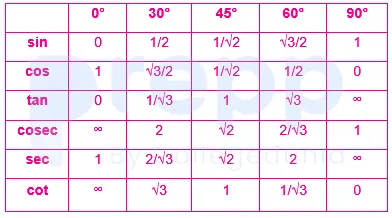 Paper & answer key PDF ↗
 Question 72archived
The value of tan2θ + cot2θ - sec2θ cosec2θ is:
- A
2
- B
-2
- C
0
- D
1/2
Show answer
B. -2Understanding the Trigonometric Expression
The question asks us to find the value of the expression $\tan^2 \theta + \cot^2 \theta - \sec^2 \theta \operatorname{cosec}^2 \theta$. This expression involves several fundamental trigonometric ratios squared: tangent, cotangent, secant, and cosecant.
To solve this, we can use known trigonometric identities to simplify the expression. Let's recall some key identities:
$\sec^2 \theta = 1 + \tan^2 \theta$
$\operatorname{cosec}^2 \theta = 1 + \cot^2 \theta$
$\tan \theta \cdot \cot \theta = 1$
We will use the first two identities to rewrite the $\sec^2 \theta \operatorname{cosec}^2 \theta$ term and then substitute it back into the original expression.
Step-by-Step Simplification of the Expression
Let's simplify the given expression:
Given expression: $\tan^2 \theta + \cot^2 \theta - \sec^2 \theta \operatorname{cosec}^2 \theta$
Using the identities $\sec^2 \theta = 1 + \tan^2 \theta$ and $\operatorname{cosec}^2 \theta = 1 + \cot^2 \theta$, we can rewrite the product $\sec^2 \theta \operatorname{cosec}^2 \theta$:
$\sec^2 \theta \operatorname{cosec}^2 \theta = (1 + \tan^2 \theta)(1 + \cot^2 \theta)$
Now, let's expand this product:
$(1 + \tan^2 \theta)(1 + \cot^2 \theta) = 1 \cdot (1 + \cot^2 \theta) + \tan^2 \theta \cdot (1 + \cot^2 \theta)$
$= 1 + \cot^2 \theta + \tan^2 \theta + \tan^2 \theta \cot^2 \theta$
We know that $\tan \theta \cot \theta = 1$, so $\tan^2 \theta \cot^2 \theta = (\tan \theta \cot \theta)^2 = 1^2 = 1$.
Substitute this back into the expanded product:
$\sec^2 \theta \operatorname{cosec}^2 \theta = 1 + \cot^2 \theta + \tan^2 \theta + 1$
$\sec^2 \theta \operatorname{cosec}^2 \theta = 2 + \tan^2 \theta + \cot^2 \theta$
Now, substitute this result back into the original expression:
$\tan^2 \theta + \cot^2 \theta - \sec^2 \theta \operatorname{cosec}^2 \theta = \tan^2 \theta + \cot^2 \theta - (2 + \tan^2 \theta + \cot^2 \theta)$
Remove the parentheses. Remember to distribute the minus sign to each term inside the parentheses:
$\tan^2 \theta + \cot^2 \theta - 2 - \tan^2 \theta - \cot^2 \theta$
Now, group like terms and simplify:
$(\tan^2 \theta - \tan^2 \theta) + (\cot^2 \theta - \cot^2 \theta) - 2$
$0 + 0 - 2$
$-2$
So, the value of the expression $\tan^2 \theta + \cot^2 \theta - \sec^2 \theta \operatorname{cosec}^2 \theta$ is $-2$.
Verification using Basic Ratios
Alternatively, we could express all terms in terms of sine and cosine:
$\tan \theta = \frac{\sin \theta}{\cos \theta} \implies \tan^2 \theta = \frac{\sin^2 \theta}{\cos^2 \theta}$
$\cot \theta = \frac{\cos \theta}{\sin \theta} \implies \cot^2 \theta = \frac{\cos^2 \theta}{\sin^2 \theta}$
$\sec \theta = \frac{1}{\cos \theta} \implies \sec^2 \theta = \frac{1}{\cos^2 \theta}$
$\operatorname{cosec} \theta = \frac{1}{\sin \theta} \implies \operatorname{cosec}^2 \theta = \frac{1}{\sin^2 \theta}$
The expression becomes:
$\frac{\sin^2 \theta}{\cos^2 \theta} + \frac{\cos^2 \theta}{\sin^2 \theta} - \frac{1}{\cos^2 \theta} \cdot \frac{1}{\sin^2 \theta}$
$\frac{\sin^2 \theta}{\cos^2 \theta} + \frac{\cos^2 \theta}{\sin^2 \theta} - \frac{1}{\cos^2 \theta \sin^2 \theta}$
Find a common denominator, which is $\sin^2 \theta \cos^2 \theta$:
$\frac{\sin^2 \theta \cdot \sin^2 \theta + \cos^2 \theta \cdot \cos^2 \theta - 1}{\cos^2 \theta \sin^2 \theta} = \frac{\sin^4 \theta + \cos^4 \theta - 1}{\cos^2 \theta \sin^2 \theta}$
Recall the identity $\sin^2 \theta + \cos^2 \theta = 1$. Squaring both sides gives $(\sin^2 \theta + \cos^2 \theta)^2 = 1^2$, which expands to $\sin^4 \theta + 2\sin^2 \theta \cos^2 \theta + \cos^4 \theta = 1$.
From this, we can write $\sin^4 \theta + \cos^4 \theta = 1 - 2\sin^2 \theta \cos^2 \theta$.
Substitute this into the numerator of our expression:
$\frac{(1 - 2\sin^2 \theta \cos^2 \theta) - 1}{\cos^2 \theta \sin^2 \theta}$
Simplify the numerator:
$\frac{1 - 2\sin^2 \theta \cos^2 \theta - 1}{\cos^2 \theta \sin^2 \theta} = \frac{-2\sin^2 \theta \cos^2 \theta}{\cos^2 \theta \sin^2 \theta}$
Cancel the common term $\sin^2 \theta \cos^2 \theta$ (assuming $\theta$ is such that $\sin \theta \neq 0$ and $\cos \theta \neq 0$):
$-2$
Both methods yield the same result, $-2$.
Summary of the Result
Expression
Simplified Value
$\tan^2 \theta + \cot^2 \theta - \sec^2 \theta \operatorname{cosec}^2 \theta$
$-2$
The calculated value of the expression is $-2$, which matches one of the provided options.
Revision Table: Key Trigonometric Identities
Identity Type
Identity
Reciprocal Identities
$\sec \theta = \frac{1}{\cos \theta}$, $\operatorname{cosec} \theta = \frac{1}{\sin \theta}$, $\cot \theta = \frac{1}{\tan \theta}$
Quotient Identities
$\tan \theta = \frac{\sin \theta}{\cos \theta}$, $\cot \theta = \frac{\cos \theta}{\sin \theta}$
Pythagorean Identities
$\sin^2 \theta + \cos^2 \theta = 1$
Derived Pythagorean Identities
$\sec^2 \theta = 1 + \tan^2 \theta$
$\operatorname{cosec}^2 \theta = 1 + \cot^2 \theta$
Additional Information: Using Identities in Trigonometry
Trigonometric identities are equations that are true for all values of the variables for which the expressions are defined. They are essential tools for simplifying complex trigonometric expressions, solving trigonometric equations, and proving other identities.
When simplifying expressions like $\tan^2 \theta + \cot^2 \theta - \sec^2 \theta \operatorname{cosec}^2 \theta$, recognizing which identities to apply is key. Often, converting everything to sine and cosine is a universal approach, but sometimes using identities specific to tangent, cotangent, secant, and cosecant (like the derived Pythagorean identities) can lead to a quicker solution, as shown in the first method above.
It's important to practice using these identities to become familiar with their applications in simplifying expressions and solving problems in trigonometry.
Paper & answer key PDF ↗ Question 73archived
The following bar graph shows the sales of books (in thousands) from six branches of a publishing company during two consecutive years 2018 and 2019.
What is the ratio of the total sales of the first branch for for both years to the total sales of the fourth branch for both years?
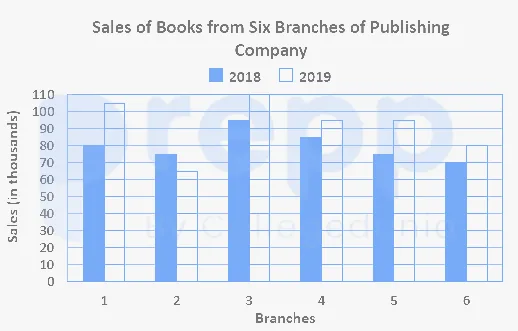
- A
4 ∶ 3
- B
5 ∶ 9
- C
8 ∶ 11
- D
37 ∶ 36
Show answer
D. 37 ∶ 36Calculation:
T he total sales of the first branch for both years = 80 + 105 = 185 thousand
The total sales of the fourth branch for both years = 85 + 95 = 180 thousand
Now, the ratio = 185 : 180 = 37 : 36
∴ The ratio of the total sales of the first branch for both years to the total sales of the fourth branch for both years is 37 : 36.
Paper & answer key PDF ↗ Question 74archived
if \(\frac{4\left[ \left( 17\right) ^{3}-\left( 7\right) ^{3}\right] }{\left( 17^{2}+7^{2}+p\right) } =40, \) then what is the value of p?
- A
-119
- B
-129
- C
119
- D
129
Show answer
C. 119Solving the Algebraic Equation to Find the Value of p
The question asks us to find the value of \(p\) in the given equation:
\[ \frac{4\left[ \left( 17\right) ^{3}-\left( 7\right) ^{3}\right] }{\left( 17^{2}+7^{2}+p\right) } =40 \]
We can simplify the left side of the equation using the algebraic identity for the difference of cubes, which is:
\[ a^3 - b^3 = (a-b)(a^2 + ab + b^2) \]
In the numerator of the given equation, we have \( (17)^3 - (7)^3 \). Here, we can consider \(a = 17\) and \(b = 7\). Applying the identity:
\[ (17)^3 - (7)^3 = (17-7)(17^2 + 17 \times 7 + 7^2) \]
Let's calculate the terms:
\( 17 - 7 = 10 \)
\( 17^2 = 289 \)
\( 7^2 = 49 \)
\( 17 \times 7 = 119 \)
Substituting these values into the expanded form of the numerator:
\[ (17)^3 - (7)^3 = (10)(289 + 119 + 49) \]
Now, substitute this back into the original equation:
\[ \frac{4 \times [10 \times (289 + 119 + 49)]}{\left( 17^{2}+7^{2}+p\right) } =40 \]
\[ \frac{40 \times (289 + 119 + 49)}{\left( 289+49+p\right) } =40 \]
We can divide both sides of the equation by 40:
\[ \frac{289 + 119 + 49}{289+49+p} = \frac{40}{40} \]
\[ \frac{289 + 119 + 49}{289+49+p} = 1 \]
For this fraction to be equal to 1, the numerator must be equal to the denominator. So,
\[ 289 + 119 + 49 = 289 + 49 + p \]
Let's calculate the sum on the left side:
\[ 289 + 119 + 49 = 408 + 49 = 457 \]
Let's calculate the known sum on the right side:
\[ 289 + 49 = 338 \]
So the equation becomes:
\[ 457 = 338 + p \]
To find \(p\), subtract 338 from both sides:
\[ p = 457 - 338 \]
\[ p = 119 \]
Alternatively, we can observe the structure of the equation after applying the difference of cubes formula:
\[ \frac{4 \times (17-7)(17^2 + 17 \times 7 + 7^2)}{(17^2 + 7^2 + p)} = 40 \]
\[ \frac{4 \times 10 \times (17^2 + 17 \times 7 + 7^2)}{(17^2 + 7^2 + p)} = 40 \]
\[ \frac{40 \times (17^2 + 17 \times 7 + 7^2)}{(17^2 + 7^2 + p)} = 40 \]
For this equation to hold, if the numerator and the right side are equal (\(40 \times (17^2 + 17 \times 7 + 7^2)\) and \(40 \times (17^2 + 7^2 + p)\)), then the terms being multiplied by 40 must be equal, provided \(17^2 + 7^2 + p \neq 0\). So, we must have:
\[ 17^2 + 17 \times 7 + 7^2 = 17^2 + 7^2 + p \]
Subtract \(17^2\) and \(7^2\) from both sides:
\[ 17 \times 7 = p \]
\[ p = 119 \]
Both methods yield the same value for \(p\).
Revision Table: Key Concepts
Concept
Description
Difference of Cubes
The algebraic identity \(a^3 - b^3 = (a-b)(a^2 + ab + b^2)\).
Solving Equations
Using algebraic operations (addition, subtraction, multiplication, division) to isolate the unknown variable.
Simplifying Expressions
Combining terms and performing calculations to reduce complexity.
Additional Information on Algebraic Identities
Algebraic identities are equations that are true for all values of the variables involved. They are fundamental tools for simplifying expressions and solving equations. Besides the difference of cubes (\(a^3 - b^3\)), other important identities include:
Sum of Cubes: \(a^3 + b^3 = (a+b)(a^2 - ab + b^2)\)
Square of a Binomial: \((a+b)^2 = a^2 + 2ab + b^2\) and \((a-b)^2 = a^2 - 2ab + b^2\)
Difference of Squares: \(a^2 - b^2 = (a-b)(a+b)\)
Cube of a Binomial: \((a+b)^3 = a^3 + 3a^2b + 3ab^2 + b^3\) and \((a-b)^3 = a^3 - 3a^2b + 3ab^2 - b^3\)
Recognizing these patterns in equations and expressions allows for efficient manipulation and solution finding.
Paper & answer key PDF ↗ Question 75archived
Riya could not decide between discount of 30% or two successive discounts of 25% and 5%, both given on shopping of ₹3,840. What is the difference between both the discounts?
- A
₹44
- B
₹48
- C
₹42
- D
₹46
Show answer
B. ₹48Calculate Discount Difference on Shopping
The problem asks us to find the difference between a single discount of 30% and two successive discounts of 25% and 5%, both applied to an original price of ₹3,840. Let's calculate the final price and the total discount amount for each scenario.
Calculating Single Discount of 30%
For the single discount scenario, we apply a flat 30% discount on the original price of ₹3,840.
Original Price = ₹3,840
Discount Percentage = 30%
Discount Amount = 30% of ₹3,840
Discount Amount = \(\frac{30}{100} \times 3840\)
Discount Amount = \(0.30 \times 3840 = 1152\)
So, the total discount in the first scenario is ₹1,152.
Calculating Successive Discounts of 25% and 5%
For successive discounts, the second discount is applied to the price after the first discount.
Original Price = ₹3,840
First Discount Percentage = 25%
Price after first discount = Original Price \(\times (1 - \frac{25}{100})\)
Price after first discount = \(3840 \times (1 - 0.25) = 3840 \times 0.75 = 2880\)
Now, the second discount of 5% is applied to this reduced price of ₹2,880.
Second Discount Percentage = 5%
Final Price after second discount = Price after first discount \(\times (1 - \frac{5}{100})\)
Final Price after second discount = \(2880 \times (1 - 0.05) = 2880 \times 0.95 = 2736\)
The total discount in the successive discount scenario is the difference between the original price and the final price.
Total Discount (Successive) = Original Price - Final Price
Total Discount (Successive) = \(3840 - 2736 = 1104\)
So, the total discount from the two successive discounts is ₹1,104.
Finding the Difference Between the Discounts
Now we find the difference between the total discount from the single 30% discount and the total discount from the two successive discounts.
Difference = Total Discount (Single 30%) - Total Discount (Successive 25% and 5%)
Difference = \(1152 - 1104\)
Difference = \(48\)
The difference between the two discount amounts is ₹48.
We can summarize the results in a table:
Discount Scenario
Total Discount Amount
Single 30% Discount
₹1,152
Successive 25% and 5% Discounts
₹1,104
The difference between the two discount amounts is indeed ₹48.
Revision Table: Discount Calculation
Concept
Formula/Method
Example (using ₹3840, 30%)
Single Discount Amount
Original Price \(\times \frac{\text{Discount \%}}{100}\)
\(3840 \times \frac{30}{100} = 1152\)
Price after Single Discount
Original Price \(\times (1 - \frac{\text{Discount \%}}{100})\)
\(3840 \times (1 - 0.30) = 3840 \times 0.70 = 2688\)
Successive Discounts (Two)
Price after 1st discount = Original Price \(\times (1 - \frac{D1}{100})\)
Final Price = Price after 1st discount \(\times (1 - \frac{D2}{100})\)
1st (25%): \(3840 \times 0.75 = 2880\)
2nd (5%): \(2880 \times 0.95 = 2736\)
Total Discount (Successive)
Original Price - Final Price after all discounts
\(3840 - 2736 = 1104\)
Equivalent Single Discount for Successive Discounts D1 and D2
\((D1 + D2 - \frac{D1 \times D2}{100})\%\)
\((25 + 5 - \frac{25 \times 5}{100})\%\)
\( (30 - \frac{125}{100})\% = (30 - 1.25)\% = 28.75\%\)
Total discount = \(3840 \times 0.2875 = 1104\)
Additional Information: Understanding Discounts
Discounts are reductions in the original price of a product or service. They are usually expressed as a percentage of the original price.
Single Discount: A one-time percentage reduction applied to the original price.
Successive Discounts: Multiple discounts applied one after another. Each subsequent discount is applied to the price remaining after the previous discount has been taken. Successive discounts are always less beneficial to the customer than a single discount equal to the sum of the individual percentages. For example, successive discounts of 25% and 5% on ₹100 result in a final price of ₹100 * (1-0.25) * (1-0.05) = ₹100 * 0.75 * 0.95 = ₹71.25, which is a total discount of ₹28.75. A single 30% discount on ₹100 would result in a final price of ₹100 * (1-0.30) = ₹100 * 0.70 = ₹70, a discount of ₹30. The difference is ₹1.25. This matches the calculation using the equivalent single discount formula: \(25 + 5 - (25 \times 5 / 100) = 30 - 1.25 = 28.75\%\). The single 30% discount is better than successive 25% and 5%.
Understanding the calculation of successive discounts is important for comparing different offers while shopping.
Paper & answer key PDF ↗ Question 76archived
Sentences of a paragraph are given below in jumbled order. Arrange the sentences in the correct order to form a meaningful and coherent paragraph.
A. When this extra water vapour condenses into precipitation, it results in heavier rain — or, if it's cold enough, heavier snow.
B. The atmosphere can store an additional 4% of water vapour for every additional 1°F of warming.
C. More water evaporates from soils, plants, lakes and seas as the atmosphere warms.
D. One of the most obvious indications of climate change is heavier rainfall.
- A
CBDA
- B
DCBA
- C
ACDB
- D
BCAD
Show answer
B. DCBAArranging Jumbled Sentences on Climate Change and Rainfall
The task is to arrange the given jumbled sentences to form a coherent paragraph that makes logical sense. This often involves identifying the topic sentence and understanding the cause-and-effect relationships or sequence of events described.
Let's look at the given sentences:
A. When this extra water vapour condenses into precipitation, it results in heavier rain — or, if it's cold enough, heavier snow.
B. The atmosphere can store an additional 4% of water vapour for every additional 1\(^{\circ}\)F of warming.
C. More water evaporates from soils, plants, lakes and seas as the atmosphere warms.
D. One of the most obvious indications of climate change is heavier rainfall.
Analyzing the Sentences for Paragraph Flow
To arrange these sentences, we need to find a logical progression. Let's consider what each sentence talks about:
Sentence D introduces the main topic: heavier rainfall as a sign of climate change. This feels like a good starting point as it sets the context for the paragraph.
Sentence C talks about increased evaporation due to the atmosphere warming. This explains a cause of increased water in the atmosphere related to climate change.
Sentence B provides a specific detail about the atmosphere's capacity to hold more water vapour as it warms. This expands on the idea presented in sentence C.
Sentence A talks about the consequence of having "this extra water vapour" — it condenses into heavier precipitation (rain or snow). This directly relates to the topic introduced in sentence D and uses the concept of "extra water vapour" discussed in C and B.
Step-by-Step Ordering
Based on the analysis, a logical flow emerges:
Start with the main point or observation. Sentence D introduces the topic of heavier rainfall as an indication of climate change. So, D seems to be the opening sentence.
Explain the cause or mechanism behind this phenomenon. Sentence C explains that more water evaporates as the atmosphere warms, which is a direct effect of climate change leading to more water vapour. This logically follows D.
Provide more detail about the mechanism. Sentence B quantifies how much more water vapour the atmosphere can hold for each degree of warming. This supports and adds detail to the statement in C about increased water vapour. So, B follows C.
Describe the final outcome or consequence. Sentence A explains what happens when this increased water vapour condenses — it leads to heavier rain (or snow). This brings the explanation back to the initial observation in D. So, A follows B.
Following this logic, the order should be D \(\rightarrow\) C \(\rightarrow\) B \(\rightarrow\) A.
Let's read the paragraph in this order:
One of the most obvious indications of climate change is heavier rainfall. More water evaporates from soils, plants, lakes and seas as the atmosphere warms. The atmosphere can store an additional 4% of water vapour for every additional 1\(^{\circ}\)F of warming. When this extra water vapour condenses into precipitation, it results in heavier rain — or, if it's cold enough, heavier snow.
This arrangement forms a coherent and meaningful paragraph explaining how climate change contributes to heavier rainfall by increasing evaporation and the atmosphere's capacity to hold water vapour, which then condenses into heavier precipitation.
Resulting Correct Order
The correct order of the sentences is DCBA.
Revision Table: Key Points on Sentence Arrangement
Sentence
Role in Paragraph
Keyword Connection
D
Introduces the main topic (heavier rainfall as a sign of climate change).
Climate change, heavier rainfall
C
Explains the initial cause (increased evaporation due to warming atmosphere).
Atmosphere warms, water evaporates
B
Provides detail on the atmosphere's capacity to hold water vapour as it warms.
Atmosphere, water vapour, warming
A
Describes the final effect (condensation of extra water vapour into heavier rain/snow).
Water vapour, precipitation, heavier rain
Additional Information: Climate Change and Water Cycle
The relationship described in the paragraph is a key aspect of how climate change affects weather patterns, specifically precipitation. A warmer atmosphere holds more moisture. This increased moisture leads to more intense rainfall events in many areas, even if the total annual precipitation doesn't change significantly everywhere. This intensification of the water cycle is a direct consequence of global warming caused by climate change.
Increased Evaporation: Higher temperatures lead to more water turning into vapour from land and water bodies.
Increased Atmospheric Moisture: A warmer atmosphere has a higher capacity to hold this water vapour.
More Intense Precipitation: When weather systems develop, this increased atmospheric moisture is available to condense, leading to heavier downpours or snowfalls over shorter periods.
Understanding the water cycle and how it is impacted by rising global temperatures is crucial for grasping the effects of climate change, such as increased risk of flooding from heavy rainfall and potential for more severe droughts in other areas.
Paper & answer key PDF ↗ Question 77archived
Select the correct indirect form of the given sentence.
She said, “I am in no mood to work now.”
- A
She said that she has been in no mood to work then.
- B
She said that she was in no mood to work now.
- C
She said that she was in no mood to work then.
- D
She said that she has been in no mood to work now.
Show answer
C. She said that she was in no mood to work then.Understanding Direct and Indirect Speech Conversion
The question asks us to convert a sentence from direct speech to indirect speech. Direct speech quotes the exact words of the speaker, while indirect speech reports what the speaker said without quoting their exact words.
The given sentence in direct speech is: “She said, “I am in no mood to work now.””
To convert this sentence into indirect speech, we need to make several changes:
The reporting verb "said" remains the same.
We usually add a conjunction like "that" after the reporting verb.
Pronouns need to be changed according to the speaker and the listener (if mentioned). Here, "I" refers to "She," so it changes to "she."
The tense of the verb usually changes. The simple present tense ("am") changes to the simple past tense ("was").
Time and place expressions often change. "now" changes to "then."
Step-by-Step Conversion
Reporting Verb: "She said" remains "She said".
Conjunction: Add "that". So, "She said that".
Pronoun Change: "I" refers to the speaker "She", so it becomes "she". Sentence becomes "She said that she...".
Tense Change: "am" (Present Simple) becomes "was" (Past Simple). Sentence becomes "She said that she was...".
Time Expression Change: "now" becomes "then". Sentence becomes "She said that she was in no mood to work then.".
Combining these changes, the indirect form of the sentence is: "She said that she was in no mood to work then."
Analyzing the Options
Let's examine each option based on the conversion rules:
Option 1: “She said that she has been in no mood to work then.”
This option incorrectly uses the present perfect tense ("has been") instead of the past simple ("was"). While "now" is changed to "then" correctly, the tense change is wrong.
Option 2: “She said that she was in no mood to work now.”
This option correctly changes the pronoun ("she") and tense ("was"), but it fails to change the time expression "now" to "then."
Option 3: “She said that she was in no mood to work then.”
This option correctly changes the pronoun ("she"), the tense ("was"), and the time expression ("then"). This matches our step-by-step conversion.
Option 4: “She said that she has been in no mood to work now.”
This option incorrectly uses the present perfect tense ("has been") and fails to change the time expression "now" to "then."
Based on the analysis, Option 3 is the correct indirect form of the given sentence.
Revision Table: Direct vs. Indirect Speech Changes
Category
Direct Speech
Indirect Speech (Reporting Verb in Past Tense)
Pronouns
I
He/She
You
He/She/They/I/We
My
His/Her
Our
Their
Tense
Present Simple (am/is/are)
Past Simple (was/were)
Present Continuous (am/is/are + -ing)
Past Continuous (was/were + -ing)
Present Perfect (has/have + V3)
Past Perfect (had + V3)
Past Simple (V2)
Past Perfect (had + V3)
Time/Place
now
then
today
that day
yesterday
the previous day / the day before
tomorrow
the next day / the following day
here
there
this
that
Additional Information on Indirect Speech
When converting direct speech to indirect speech, the change in tense, pronouns, and time/place expressions is crucial. This process is often called 'backshifting' the tense.
Key points to remember:
If the reporting verb is in the present or future tense (e.g., says, will say), the tense of the verb inside the reported speech usually does not change.
If the direct speech expresses a universal truth or a habitual action, the tense may not change even if the reporting verb is in the past tense.
Questions and commands in direct speech have different rules for conversion to indirect speech (using ask/inquire, tell/order, etc., and often using infinitives or 'if/whether').
Mastering these rules is essential for correctly transforming sentences between direct and indirect forms in English grammar.
Paper & answer key PDF ↗ Question 78archived
Select the correct passive form of the given sentence.
Manu will tell her later.
- A
She will be tell later by Manu
- B
She will tell later by Manu.
- C
She will be told later by Manu.
- D
She will be tell later.
Show answer
C. She will be told later by Manu.Understanding Active and Passive Voice Conversion
The question asks us to convert a sentence from the active voice to the passive voice. The original sentence is: "Manu will tell her later."
In the active voice, the subject performs the action. In the passive voice, the subject receives the action. The structure of the verb changes in the passive voice.
Converting Future Simple Tense to Passive Voice
The given sentence is in the future simple tense. The structure for active and passive voice in the future simple tense is as follows:
Active Voice: Subject + will + base form of verb + Object
Passive Voice: Object (of active) + will be + past participle of verb + by + Subject (of active) (optional)
Step-by-Step Conversion
Let's break down the given sentence: "Manu will tell her later."
Subject (Active): Manu
Verb (Active): will tell (Future Simple)
Object (Active): her
Adverbial: later
Now, let's apply the passive voice rules:
The object of the active sentence becomes the subject of the passive sentence. The object is 'her', which becomes 'She' in the subject position.
The verb phrase changes from 'will + base verb' to 'will be + past participle'. The base verb is 'tell'. The past participle of 'tell' is 'told'. So, 'will tell' becomes 'will be told'.
The subject of the active sentence ('Manu') is often included in the passive sentence after 'by', becoming 'by Manu'.
Other parts of the sentence, like 'later', remain in the passive sentence, usually towards the end.
Putting it all together, the passive form of the sentence is: "She will be told later by Manu."
Analyzing the Options
Let's examine each option based on the rules for converting to passive voice in the future simple tense:
Option 1:
She will be tell later by Manu
This option uses "will be tell". The structure should be "will be" followed by the past participle ('told'), not the base form ('tell'). This is incorrect.
Option 2:
She will tell later by Manu.
This option uses "will tell", which is the active voice verb form, not the passive voice form "will be told". This is incorrect.
Option 3:
She will be told later by Manu.
This option correctly uses the structure "will be told" (will be + past participle) and includes the original subject as "by Manu". The object "her" is correctly converted to the subject "She". This follows the rules for passive voice conversion in the future simple tense.
Option 4:
She will be tell later.
This option uses "will be tell", which incorrectly uses the base form of the verb instead of the past participle. It also omits the agent "by Manu", which is acceptable in passive voice sometimes, but the verb form itself is wrong.
Based on the analysis, Option 3 is the correct passive form of the given sentence.
Revision Table: Active vs. Passive Voice (Future Simple)
Active Voice Structure
Subject + will + Base Verb + Object
Passive Voice Structure
Object + will be + Past Participle + (by + Subject)
Example (Active)
Manu will tell her later.
Example (Passive)
She will be told later by Manu.
Additional Information on Passive Voice
Understanding the passive voice is important for varying sentence structure and focusing on the action or the recipient of the action rather than the performer.
When to use Passive Voice:
When the performer of the action (the agent) is unknown or unimportant.
When you want to emphasize the action or the object receiving the action.
In scientific or technical writing, to maintain an objective tone.
Omitting the Agent ("by" phrase): The "by + agent" phrase can be omitted in the passive voice if the agent is unknown, obvious from the context, or unimportant. In our example, "She will be told later" is a grammatically correct passive sentence if the identity of who tells her is not important. However, the option that includes "by Manu" is a more complete passive transformation when the agent is known.
Mastering active and passive voice transformations improves clarity and flexibility in writing.
Paper & answer key PDF ↗ Question 79archived
Select the correct active form of the given sentence.
Has the villa been occupied by them?
- A
Did they occupied the villa?
- B
Had they occupied the villa?
- C
Have they occupied the villa?
- D
Do they occupied the villa?
Show answer
C. Have they occupied the villa?Understanding Voice Transformation: Passive to Active
The question asks us to convert a sentence from passive voice to active voice. The given sentence is "Has the villa been occupied by them?"
To convert a sentence from passive to active voice, we need to identify the following elements in the passive sentence:
The tense of the verb.
The subject of the passive sentence (which was the object in the active sentence).
The agent (the doer of the action), usually found after "by" (which was the subject in the active sentence).
Let's analyze the given sentence:
"Has the villa been occupied by them?"
Tense: The structure "Has + subject + been + past participle" indicates the Present Perfect tense. This is a question form in the passive voice.
Passive Subject: "the villa". This is the entity receiving the action.
Agent: "them". This is the entity performing the action, introduced by "by". In the active voice, this will become the subject.
Now, let's structure the active voice sentence in the Present Perfect tense. The general structure for a question in the active Present Perfect tense is:
Has/Have + Subject + Past Participle of the Verb + Object?
Applying this to our sentence:
The agent "them" becomes the active subject "they".
Since the subject is "they", the auxiliary verb for Present Perfect is "Have".
The main verb "occupied" is already in the past participle form.
The passive subject "the villa" becomes the active object "the villa".
Putting it together, the active voice question is: "Have they occupied the villa?"
Let's compare this with the given options:
Option
Sentence
Analysis
1
Did they occupied the villa?
Incorrect tense (Simple Past, also incorrect verb form).
2
Had they occupied the villa?
Incorrect tense (Past Perfect).
3
Have they occupied the villa?
Correct tense (Present Perfect) and correct structure for active voice question.
4
Do they occupied the villa?
Incorrect tense (Simple Present, also incorrect verb form).
Based on the analysis, the sentence "Have they occupied the villa?" is the correct active form of "Has the villa been occupied by them?", maintaining the Present Perfect tense.
The process involved identifying the tense, swapping the positions of the original subject and object, changing the verb form from passive to active, and ensuring the correct auxiliary verb is used for the new subject and tense.
Revision Table: Active vs. Passive Voice
Feature
Active Voice
Passive Voice
Focus
The doer of the action (Subject)
The receiver of the action (Object becomes Subject)
Structure (Present Perfect)
Subject + Has/Have + Past Participle + Object
Object + Has/Have + been + Past Participle + (by + Subject)
Example (Statement)
They have occupied the villa.
The villa has been occupied by them.
Example (Question)
Have they occupied the villa?
Has the villa been occupied by them?
Additional Information: Voice Transformation Rules
Transforming sentences between active and passive voice is a common grammar exercise. Here are some key points regarding voice transformation, especially for the Present Perfect tense:
The tense of the verb must remain the same when changing voice. A Present Perfect passive sentence must become a Present Perfect active sentence.
The object of the active sentence becomes the subject of the passive sentence.
The subject of the active sentence becomes the agent (introduced by 'by') in the passive sentence, or it might be omitted if it's unimportant or unknown.
In the passive voice, the main verb is always in its past participle form, preceded by a form of the verb 'to be' appropriate for the tense and subject.
In the active voice, the verb form depends on the tense and subject. For Present Perfect active, it's 'Has/Have' + past participle.
When converting questions, the question structure must be maintained (e.g., starting with an auxiliary verb or question word).
Understanding these rules helps correctly transform sentences and identify the doer and receiver of the action.
Paper & answer key PDF ↗ Question 80archived
In the given sentence, one word may have been incorrectly spelt. Select the correctly spelt word from the given alternatives. If there is no error, select ‘No error’ as your answer.
The erroneous information spread rapidly across the nation and created a stir.
- A
erronous
- B
No error
- C
eronneous
- D
errauneous
Show answer
B. No errorIdentifying Spelling Errors in Sentences
The question asks us to identify if there is a spelling error in the given sentence and, if so, select the correct spelling from the alternatives provided. If all words are spelled correctly, we should select 'No error'.
The given sentence is:
The erroneous information spread rapidly across the nation and created a stir.
Let's examine each word in the sentence for correct spelling, paying close attention to the word 'erroneous' as the options suggest it might be the one in question.
The: Correctly spelled.
erroneous: This word means 'wrong' or 'incorrect'. The correct spelling is E-R-R-O-N-E-O-U-S. The word in the sentence matches this correct spelling.
information: Correctly spelled.
spread: Correctly spelled.
rapidly: Correctly spelled.
across: Correctly spelled.
the: Correctly spelled.
nation: Correctly spelled.
and: Correctly spelled.
created: Correctly spelled.
a: Correctly spelled.
stir: Correctly spelled.
Upon checking each word, we find that all words in the sentence are spelled correctly. The spelling of 'erroneous' in the sentence is indeed the correct one.
Evaluating the Options for Spelling
Now let's look at the provided options:
erronous: This spelling is incorrect. The correct spelling includes an 'e' after the first 'o'.
No error: This option suggests that there are no spelling mistakes in the original sentence.
eronneous: This spelling is incorrect. It is missing an 'r' and has an extra 'n'.
errauneous: This spelling is incorrect. It has extra letters 'a' and 'u'.
Since our analysis of the original sentence revealed no spelling errors, the correct option is the one stating 'No error'.
Conclusion on Spelling Accuracy
The sentence "The erroneous information spread rapidly across the nation and created a stir" contains no spelling errors. The word 'erroneous' is correctly spelled in the sentence.
Therefore, the correct answer is 'No error'.
Revision Table: Common Spelling Errors
Understanding common spelling errors can help improve accuracy. Here are a few examples related to vowel and consonant combinations:
Common Misspelling
Correct Spelling
Notes
recieve
receive
'i' before 'e' except after 'c' or when sounding like 'a' as in 'neighbor' or 'weigh'.
seperate
separate
Often mistaken 'a' for 'e'.
definately
definitely
Often mistaken 'a' for 'i'.
acommodate
accommodate
Often missing one 'c' or one 'm'.
Additional Information: Proofreading for Spelling Errors
Proofreading is a crucial step to catch spelling errors. Here are some tips:
Read the text slowly, word by word.
Try reading the text backward to focus on individual words rather than meaning.
Use spelling checker tools, but don't rely on them completely. They might miss context-specific errors or correctly spelled words used incorrectly (like 'their' vs 'there').
Have someone else read your text, as they might spot errors you missed.
Be aware of words you commonly misspell and check them carefully.
Paper & answer key PDF ↗ Question 81archived
Select the most appropriate ANTONYM of the word ‘SINKS’ from the given sentence.
Groups work together to create Christmas parade themes, which are then carried out in floats, musical groups, and strolling figures.
- A
Floats
- B
Create
- C
Parade
- D
Strolling
Show answer
A. FloatsFinding the Antonym of Sinks
The question asks us to identify the most appropriate antonym for the word 'SINKS' from the given options, which are derived from the provided sentence.
Understanding 'Sinks' and Antonyms
An antonym is a word that has the opposite meaning of another word. Let's first understand the meaning of 'SINKS'.
SINKS: This word typically means to descend or go downwards, often beneath the surface of a liquid, or to decrease in value, status, or strength. For example, a ship sinks in the water, or a stock price sinks.
We need to find a word among the options that means the opposite of going down or descending.
Analyzing the Provided Options
The given sentence is: "Groups work together to create Christmas parade themes, which are then carried out in floats, musical groups, and strolling figures."
The options provided are based on words from this sentence:
Floats: In the context of the sentence, 'floats' are decorated platforms, often on wheels, used in a parade. However, the word 'floats' also has a primary meaning related to buoyancy. To 'float' means to rest on the surface of a liquid or be suspended in air.
Create: To bring something into existence.
Parade: A public procession, especially one celebrating a special event.
Strolling: Walking in a leisurely way.
Identifying the Antonym
Comparing the meaning of 'SINKS' (to go down, descend) with the meanings of the options:
'Create' is unrelated in meaning to 'sinks'.
'Parade' is unrelated in meaning to 'sinks'.
'Strolling' means walking and is unrelated to 'sinks'.
'Floats', in its common meaning, means to stay on the surface or be suspended, which is the direct opposite of sinking (going down below the surface).
Therefore, based on the fundamental meaning of the words, 'Floats' is the antonym of 'Sinks'. While the sentence uses 'floats' in the context of a parade, the word itself carries the meaning that is opposite to 'sinks'.
Let's compare 'Sinks' and 'Floats' more formally:
Word
Meaning
Sinks
Goes down below the surface; descends; decreases.
Floats
Rests on the surface; stays suspended; remains stable or moves horizontally.
The action of sinking is the opposite of the action of floating.
Conclusion on Antonym of Sinks
Among the given options, the word 'Floats' is the most appropriate antonym for 'SINKS' because its primary meaning (resting on the surface of a liquid or in air) is the direct opposite of sinking (descending below the surface).
Revision Table: Understanding Antonyms
Word
Antonym
Example
Sinks
Floats
A boat floats on water, while a stone sinks.
Up
Down
Go up the stairs, then come down.
Hot
Cold
The soup is hot, but the ice cream is cold.
Additional Information: Word Meanings and Context
It's important to note that words can have multiple meanings depending on the context. However, when looking for a general antonym, we usually consider the core or most common meaning of the word.
In the given sentence, 'floats' refers to parade elements, a specific type of vehicle.
In the context of liquids or buoyancy, 'float' means to stay on the surface.
'Sink' most commonly means to go down into or under something, often water.
The opposite relationship between 'sinks' and 'floats' is based on their core meanings related to vertical movement or position relative to a surface.
Paper & answer key PDF ↗ Question 82archived
Select the most appropriate option to fill in the blank.
The angles are equal, consequently the sides are _____________.
- A
equal
- B
unequal
- C
larger
- D
smaller
Show answer
A. equalUnderstanding the Relationship Between Angles and Sides
In geometry, the angles and sides of a polygon are interconnected. There are specific relationships that exist between the measures of the angles and the lengths of the sides, particularly in certain types of polygons like triangles and regular polygons.
Equiangular and Equilateral Polygons
Let's define two important terms:
Equiangular Polygon: A polygon in which all angles have the same measure.
Equilateral Polygon: A polygon in which all sides have the same length.
A polygon that is both equiangular and equilateral is called a regular polygon.
Angles and Sides in Triangles
The relationship between angles and sides is most direct and absolute in triangles. For any triangle, the following is true:
If two angles of a triangle are equal, then the sides opposite those angles are also equal (Isosceles Triangle Theorem).
If all three angles of a triangle are equal, then the triangle is equiangular. In this case, each angle measures \(180^\circ / 3 = 60^\circ\). A triangle with all equal angles is also an equilateral triangle, meaning all three sides are equal in length. Conversely, if a triangle is equilateral, all its angles are also equal.
So, for a triangle, if the angles are equal, the sides are consequently equal.
Angles and Sides in Other Polygons
For polygons with more than three sides, the relationship is slightly different:
An equiangular quadrilateral (all angles \(90^\circ\)) is a rectangle. A rectangle can have unequal side lengths (length different from width), unless it's a square. Thus, an equiangular quadrilateral is not necessarily equilateral.
However, for a convex polygon with more than three sides, if it is equiangular, it is also equilateral. A square is an example (equiangular \(90^\circ\), equilateral sides). A regular pentagon is another (equiangular \(108^\circ\), equilateral sides).
Considering the phrasing of the question "The angles are equal, consequently the sides are _____________", and the options provided, the question implies a direct consequence where equal angles necessitate equal sides. This relationship is most strongly and universally applicable to triangles, and also holds for regular convex polygons.
Conclusion
Given the options and the common geometric principle, the most appropriate answer reflects the fact that in key geometric figures like triangles and regular polygons, equal angles imply equal sides. Therefore, if the angles are equal, the sides are consequently equal.
Based on this geometric principle, the most appropriate option to fill in the blank is "equal".
Polygon Type
If Angles are Equal (Equiangular)
Are Sides Consequently Equal (Equilateral)?
Triangle
Yes (all \(60^\circ\))
Yes (Always)
Quadrilateral (e.g., Rectangle)
Yes (all \(90^\circ\))
Not Necessarily (Only if it's a square)
Convex Polygon > 4 sides
Yes
Yes (Always)
Regular Polygon
Yes
Yes (By Definition)
Revision Table: Angles and Sides
Concept
Description
Equiangular
All angles are equal.
Equilateral
All sides are equal.
Regular Polygon
Both equiangular and equilateral.
Triangle Relationship
Equiangular triangle is always equilateral.
Convex Polygon Relationship
Equiangular convex polygon is always equilateral.
Additional Information on Polygon Properties
The properties of polygons, including the relationships between their angles and sides, are fundamental concepts in geometry. Understanding these relationships helps in classifying shapes and solving geometric problems.
The sum of the interior angles of a simple n-sided polygon is given by the formula \((n-2) \times 180^\circ\).
In an equiangular n-sided polygon, each interior angle measures \(\frac{(n-2) \times 180^\circ}{n}\).
A regular polygon is the most symmetrical type of polygon, possessing both rotational and reflectional symmetry.
The principle that equal angles imply equal sides is a cornerstone for understanding equilateral triangles and regular polygons, which are common shapes studied in geometry.
Paper & answer key PDF ↗ Question 83archived
Select the most appropriate meaning of the given idiom.
Like a cakewalk
- A
Smooth surface
- B
Pleasant experience
- C
Easy task
- D
Active
Show answer
C. Easy taskUnderstanding the Idiom: Like a Cakewalk
The question asks for the most appropriate meaning of the idiom "Like a cakewalk". Idioms are phrases or expressions whose meaning cannot be deduced simply from the ordinary meanings of its individual words. We need to understand the figurative meaning of "Like a cakewalk".
Meaning of "Like a Cakewalk"
The idiom "Like a cakewalk" is used to describe a task, situation, or event that is extremely easy to accomplish or deal with. It implies that there were no significant difficulties or challenges involved.
Analyzing the Options
Let's examine the given options to find the one that best matches the meaning of "Like a cakewalk":
Option 1: Smooth surface
This refers to a physical characteristic, not the ease or difficulty of a task. Therefore, this option is incorrect.
Option 2: Pleasant experience
While an easy task might also be a pleasant experience, "Like a cakewalk" specifically emphasizes the ease, not necessarily the enjoyment. A task can be easy but not particularly pleasant, or pleasant but not necessarily easy. The core meaning is about ease. Therefore, this option is not the most appropriate meaning.
Option 3: Easy task
This directly aligns with the definition of the idiom "Like a cakewalk". It means something simple and requiring minimal effort or skill.
Option 4: Active
This refers to being busy or energetic. An active task might or might not be easy. The idiom "Like a cakewalk" does not relate to the level of activity. Therefore, this option is incorrect.
Identifying the Correct Meaning
Based on the analysis, the most appropriate meaning of the idiom "Like a cakewalk" is "Easy task". The idiom highlights the lack of difficulty involved in something.
Examples of Using "Like a Cakewalk"
Here are a few examples to illustrate the use of the idiom "Like a cakewalk":
"Passing the exam was a cakewalk because I had studied thoroughly."
"He thought building the shelf would be a cakewalk, but it took him hours."
"Negotiating the deal wasn't exactly a cakewalk, but we managed to reach an agreement."
In all these examples, "cakewalk" refers to something that was expected to be or actually was very easy.
Revision Table: Idiom Meaning
Idiom
Meaning
Key Concept
Like a cakewalk
An easy task or situation
Ease, lack of difficulty
Additional Information on English Idioms
Idioms are a significant part of the English language. They add color and expressiveness to communication. Understanding common idioms is crucial for language learners and for achieving fluency. Here's some additional information about idioms:
Figurative Language: Idioms are types of figurative language where the expression's meaning is different from the literal meaning of its words.
Cultural Context: Many idioms are rooted in specific historical or cultural contexts, although their meanings are used more broadly today.
Common Usage: Idioms are frequently used in everyday conversation, literature, and media.
Learning Idioms: The best way to learn idioms is through exposure and by seeing them used in context.
Understanding idioms like "Like a cakewalk" helps in comprehending nuanced meanings and using English more naturally.
Paper & answer key PDF ↗ Question 84archived
Select the most appropriate option that can substitute the underlined segment in the given sentence. If there is no need to substitute it, select ‘No substitution’.
After finishing high school, I plan to pursuing law.
- A
No substitution
- B
plan to pursue
- C
plan in pursue
- D
plan to pursuing
Show answer
B. plan to pursueUnderstanding Verb Forms and Infinitives
The sentence provided is: "After finishing high school, I plan to pursuing law." The underlined segment is "plan to pursuing". We need to determine if this segment is grammatically correct and, if not, select the most appropriate substitute from the given options.
Analyzing the Verb "Plan"
In English grammar, the verb "plan" is typically followed by an infinitive (the "to" form of a verb) to indicate an intended future action. The structure is usually "plan + to + base form of the verb".
Correct structure: plan to do something
Incorrect structure: plan doing something, plan to doing something
Evaluating the Original Phrase
The original phrase "plan to pursuing" uses "to pursuing". "Pursuing" is the present participle or gerund form of the verb "pursue". The combination "to + gerund" is not the standard form used after the verb "plan". Therefore, "plan to pursuing" is grammatically incorrect in this context.
Examining the Options
Let's look at the given options:
No substitution: This would mean the original phrase "plan to pursuing" is correct, which we have determined it is not. So, this option is incorrect.
plan to pursue: This option uses the structure "plan + to + base form of the verb (pursue)". This aligns with the standard grammatical rule for using "plan" followed by an infinitive. This looks like the correct form.
plan in pursue: This option uses "plan in pursue". The preposition "in" is not typically used in this structure, and "pursue" should be part of an infinitive or another verbal phrase. This option is grammatically incorrect.
plan to pursuing: This is the original incorrect phrase. As explained earlier, "to pursuing" is not the correct form after "plan".
Determining the Correct Substitution
Based on the analysis of the verb "plan" and the evaluation of the options, the correct grammatical structure is "plan to pursue". This makes option 2 the most appropriate substitute.
The corrected sentence is: "After finishing high school, I plan to pursue law."
Comparison of Options
Option
Phrase
Analysis
Correct?
1
No substitution (plan to pursuing)
Incorrect verb form after 'plan'.
No
2
plan to pursue
Correct structure: 'plan' + infinitive.
Yes
3
plan in pursue
Incorrect preposition and verb form.
No
4
plan to pursuing
Original incorrect phrase.
No
Revision Table: Key Grammar Points
Verb Patterns with Infinitives and Gerunds
Verb
Pattern
Example
Plan
Verb + to + base verb (Infinitive)
I plan to study.
Want
Verb + to + base verb (Infinitive)
They want to leave.
Enjoy
Verb + -ing (Gerund)
We enjoy reading.
Avoid
Verb + -ing (Gerund)
She avoids talking about it.
Additional Information: Infinitives vs. Gerunds
Infinitives (to + base verb) and gerunds (verb + -ing) are both verbal forms that can act like nouns. However, certain verbs are followed specifically by either an infinitive or a gerund, or sometimes either with a difference in meaning.
Some verbs, like "plan", "decide", "hope", "agree", "promise", are usually followed by an infinitive.
Some verbs, like "enjoy", "finish", "avoid", "mind", "suggest", are usually followed by a gerund.
Some verbs, like "start", "begin", "continue", can be followed by either an infinitive or a gerund with little change in meaning.
Some verbs, like "stop", "remember", "forget", can be followed by either, but the meaning changes. For example, "stop to talk" means to pause another activity in order to talk, while "stop talking" means to cease the act of talking itself.
Understanding which form follows which verb is a key aspect of mastering English grammar for clear and correct communication, especially when planning future actions using verbs like "plan".
Paper & answer key PDF ↗ Question 85archived
Select the most appropriate synonym of the given word.
Confusion
- A
Intrepidity
- B
Stagnation
- C
Perusal
- D
Commotion
Show answer
D. CommotionUnderstanding the Word: Confusion
The word Confusion typically refers to a state of being unclear, bewildered, or lacking understanding. It can also describe a situation that is disordered or chaotic.
Analyzing Synonym Options
Let's examine each provided option to determine the most appropriate synonym for Confusion.
Option 1: Intrepidity Meaning
Intrepidity means great bravery or fearlessness. This is the opposite of a state of confusion or disorder, as bravery implies mental clarity and resolve. Therefore, Intrepidity is not a synonym for Confusion.
Option 2: Stagnation Meaning
Stagnation refers to a state of inactivity, lack of progress, or development. While a confusing situation might lead to stagnation, the words themselves do not mean the same thing. Stagnation describes a lack of movement or change, whereas Confusion describes a state of mental or situational disorder. Therefore, Stagnation is not a synonym for Confusion.
Option 3: Perusal Meaning
Perusal means the action of reading or examining something carefully or thoroughly. This involves focusing and understanding, which is contrary to a state of confusion. Therefore, Perusal is not a synonym for Confusion.
Option 4: Commotion Meaning
Commotion refers to a state of confused and noisy disturbance. It implies a situation that is disordered, chaotic, and often involves a lack of clear understanding or calm, aligning closely with one of the meanings of Confusion (a disordered or chaotic situation). While Confusion can be purely mental, Commotion often describes the outward expression or physical manifestation of disorder, which is a strong overlap.
Selecting the Most Appropriate Synonym
Comparing the meanings, Commotion is the word that most closely aligns with a state of public or situational disorder and lack of clarity, which is a key aspect of Confusion. The other options describe states or actions that are distinct from confusion.
Revision Table: Word Meanings
Word
Meaning
Confusion
A state of being unclear, bewildered, or lacking understanding; a disordered or chaotic situation.
Intrepidity
Great bravery; fearlessness.
Stagnation
A state of inactivity or lack of progress.
Perusal
The action of reading or examining something carefully.
Commotion
A state of confused and noisy disturbance.
Additional Information on Synonyms and Confusion
Synonyms are words that have similar meanings. However, synonyms often have slightly different connotations or are used in different contexts. For example, while Commotion is a good synonym for the sense of situational confusion or disorder, it doesn't capture the mental state of being confused as well as words like 'bewilderment' or 'puzzlement'.
Understanding the nuances of synonyms is crucial for improving vocabulary and communication skills. Always consider the specific context in which a word is used when choosing a synonym.
Paper & answer key PDF ↗ Question 86archived
Select the most appropriate option to substitute the underlined segment in the given sentence.
Our guests arrived ; they are sitting in the garden.
- A
shall arrive
- B
have arrived
- C
are arriving
- D
might arrive
Show answer
B. have arrivedUnderstanding the Sentence and Underlined Segment
The question asks us to select the most appropriate option to replace the underlined word 'arrived' in the sentence: "Our guests arrived ; they are sitting in the garden."
The sentence consists of two clauses joined by a semicolon. The second clause, "they are sitting in the garden," describes a present situation. This present situation is a direct result of the action described in the first clause.
The underlined word 'arrived' is in the simple past tense. While simple past describes a completed action, using it here with the second clause ("they are sitting in the garden") implies that the arrival is just a past event without a direct connection to why they are *presently* sitting in the garden.
Analyzing the Options for Substituting 'arrived'
Let's look at the provided options and see which one best fits the context, linking the guests' arrival to their current state of sitting in the garden.
Option 1: shall arrive
This uses the future simple tense (or a modal indicating future/intention). "Our guests shall arrive..." refers to a future event. This does not connect to the fact that "they are sitting in the garden" right now. Therefore, this option is inappropriate.
Option 2: have arrived
This uses the present perfect tense. The present perfect tense describes an action that happened at an indefinite time in the past but has a result or connection to the present. "Our guests have arrived" means their arrival is a completed action, and the result is that they are here now, which explains why "they are sitting in the garden." This tense perfectly links the past action to the present situation.
Option 3: are arriving
This uses the present continuous tense. "Our guests are arriving" describes an action that is happening at the moment of speaking or is in progress. If they are 'arriving' right now, they wouldn't yet be 'sitting in the garden'. This option doesn't fit the context of the second clause.
Option 4: might arrive
This uses a modal verb 'might' followed by the base form of the verb. "Our guests might arrive" expresses possibility in the future. This doesn't indicate a completed action that has resulted in them being present and sitting in the garden. Therefore, this option is incorrect.
Determining the Correct Substitute for 'arrived'
Based on the analysis, the present perfect tense, "have arrived," is the most appropriate substitute. It indicates a past action (arrival) that has a direct consequence or result in the present (they are currently here and sitting in the garden).
The corrected sentence using the most appropriate substitute would be:
Our guests have arrived ; they are sitting in the garden.
Revision Table: Verb Tenses and Usage
Tense/Form
Usage
Example Context (Related to Arrival)
Simple Past (arrived)
Completed action in the past (time may be specified or implied).
They arrived yesterday. (Focus on the past action)
Present Perfect (have arrived)
Action completed in the past with a result or connection to the present.
They have arrived, so they are here now. (Focus on the present state resulting from the past action)
Present Continuous (are arriving)
Action in progress now or around the time of speaking.
They are arriving by train right now. (Focus on the ongoing action)
Future (shall/will arrive)
Action that will happen in the future.
They will arrive tomorrow morning. (Focus on a future action)
Modal (might arrive)
Expressing possibility or uncertainty, often about the future.
They might arrive late due to traffic. (Focus on the possibility)
Additional Information: Present Perfect Tense and Semicolons
Understanding the Present Perfect Tense
The present perfect tense is formed using have or has followed by the past participle of the verb. It is used for:
Actions that happened at an unspecified time before now. The exact time is not important, but the connection to the present is. (e.g., I have lost my keys. - I don't know when, but I don't have them now.)
Actions that started in the past and continue up to the present. (e.g., She has lived here for five years. - She started living here five years ago and still lives here.)
Actions that have a result in the present. This is the case in our sentence example. The arrival happened in the past, and the result (they are here) is relevant now.
Using Semicolons (;)
A semicolon is a punctuation mark used to connect two independent clauses (clauses that could stand alone as sentences) that are closely related in meaning. In the given sentence, "Our guests have arrived" is an independent clause, and "they are sitting in the garden" is another independent clause. The semicolon shows that the second clause provides a consequence or explanation for the first clause.
Paper & answer key PDF ↗ Question 87archived
The following sentence has been split into four segments. Identify the segment that contains a grammatical error.
During an earthquake, / it is advised to take / cover above a table / to save your life.
- A
cover above a table
- B
During an earthquake,
- C
it is advised to take
- D
to save your life.
Show answer
A. cover above a tableAnalyzing the Sentence Segments for Grammatical Errors
The question asks us to identify the segment of the given sentence that contains a grammatical error. Let's examine each segment of the sentence: "During an earthquake, / it is advised to take / cover above a table / to save your life."
We need to carefully check each part for correct grammar, including word choice, prepositions, verb forms, and sentence structure.
Segment 1: During an earthquake,
This segment acts as an adverbial phrase indicating the time when the action occurs. The use of "During" is appropriate for indicating an event or period of time. There is no grammatical error in this segment.
Segment 2: it is advised to take
This segment uses a passive construction ("it is advised") followed by an infinitive phrase ("to take"). This is a standard and grammatically correct way to express general advice or recommendation. There is no grammatical error here.
Segment 3: cover above a table
This segment talks about the location where one should take cover. The phrase "take cover" is common and correct in the context of seeking safety. However, the preposition used is "above a table". When seeking protection from falling objects or collapsing structures during an earthquake, the advice is typically to get *under* a sturdy object like a table or desk. Being "above" a table offers no protection; in fact, it might expose you more to danger. The correct preposition to indicate being beneath something for protection is "under". Therefore, "above" is used incorrectly here.
The correct phrasing should be "cover under a table".
Segment 4: to save your life.
This segment is an infinitive phrase indicating the purpose of taking cover. "To save your life" is a grammatically correct phrase and accurately describes the objective of following the safety advice during an earthquake. There is no grammatical error in this segment.
Based on the analysis, the grammatical error lies in the use of the preposition "above" in segment 3.
Identifying the Grammatically Incorrect Segment
The segment containing the grammatical error is "cover above a table". The incorrect preposition "above" should be replaced with "under" for the sentence to be grammatically correct and convey the standard safety advice during an earthquake.
Segment
Analysis
Grammatical Correctness
During an earthquake,
Adverbial phrase modifying time. Correct use of 'During'.
Correct
it is advised to take
Passive construction + infinitive. Correct structure for advice.
Correct
cover above a table
Incorrect preposition 'above'. Should be 'under' for protection.
Incorrect
to save your life.
Infinitive phrase indicating purpose. Correct structure.
Correct
Revision Table: Correcting the Grammar Error
Let's see how the sentence would look with the corrected grammar.
Original Segment with Error
Corrected Segment
cover above a table
cover under a table
The corrected sentence would read: "During an earthquake, it is advised to take cover under a table to save your life."
Additional Information: Prepositions of Place and Position
Prepositions like "above", "below", "under", "over", "on", "in", "at" are used to indicate location, position, or direction. Choosing the correct preposition is crucial for clear and accurate communication.
Under: Indicates being directly below something, often with contact or implying coverage/protection from above. Example: The cat is under the bed. Take shelter under the bridge.
Above: Indicates being at a higher level than something else, without direct contact. Example: The birds are flying above the trees. The shelf is above the desk.
On: Indicates being in contact with a surface, typically a horizontal one. Example: The book is on the table. The picture is on the wall (vertical surface contact).
Over: Can indicate being directly above something (often with vertical alignment) or covering something. Example: The plane flew over the city. Put a blanket over the sleeping child.
In the context of taking cover for protection, "under" is the appropriate preposition because it signifies being shielded by something overhead.
Paper & answer key PDF ↗ Question 88archived
Select the INCORRECTLY spelt word.
- A
Finery
- B
Hiest
- C
Cringe
- D
Defer
Show answer
B. HiestIdentifying the Incorrectly Spelt Word
The question asks us to identify the word that is spelt incorrectly among the given options. To do this, we need to look at each word and determine its correct spelling and meaning.
Let's examine each option:
Finery: This word is correctly spelt. It refers to elaborate or luxurious ornamentation or clothing.
Hiest: This word is incorrectly spelt. The correct spelling is 'Heist'. A heist is a robbery or a hold-up.
Cringe: This word is correctly spelt. It means to shrink back or flinch in fear, embarrassment, or disgust.
Defer: This word is correctly spelt. It means to put off (an action or event) to a later time; postpone.
Based on this analysis, the word 'Hiest' is the one that is incorrectly spelt.
Analysis of the Incorrectly Spelt Word: Hiest vs. Heist
The word 'Hiest' does not exist in standard English spelling. The intended word is likely 'Heist'. Understanding common spelling errors, especially vowel combinations, is important.
Word
Spelling Correctness
Correct Spelling (if applicable)
Meaning
Finery
Correct
Finery
Elaborate ornamentation or clothing
Hiest
Incorrect
Heist
A robbery or hold-up
Cringe
Correct
Cringe
To shrink back in fear or embarrassment
Defer
Correct
Defer
To postpone
Therefore, the word 'Hiest' is the one that is incorrectly spelt among the given options.
Revision Table: Common Spelling Errors
Let's look at some other words with similar vowel sounds or common confusions to reinforce correct spelling.
Common Misspelling
Correct Spelling
Notes
Achievment
Achievement
'ie' vs 'ei' after 'c' rule (usually 'ie' except after 'c')
recieve
receive
'ie' vs 'ei' after 'c' rule
Their
Their / There / They're
Homophones; common confusion based on meaning (possession, place, contraction)
Seperate
Separate
Common vowel error ('a' instead of 'e' in the middle)
Additional Information: Importance of Correct Spelling
Correct spelling is crucial for clear communication in writing. Misspellings can change the meaning of a sentence or make your writing difficult to understand. Improving spelling involves:
Reading regularly to see words used correctly.
Using a dictionary or spell checker when unsure.
Learning common spelling rules (like the 'ie' vs. 'ei' rule).
Practicing frequently misspelled words.
Understanding the origin of words can sometimes help with spelling.
Identifying and correcting spelling errors like 'Hiest' is a fundamental skill in English language proficiency.
Paper & answer key PDF ↗ Question 89archived
Select the most appropriate meaning of the given idiom.
All eyes
- A
Watching with anger
- B
Watching eagerly
- C
Watching with no interest
- D
Not watching at all
Show answer
B. Watching eagerlyUnderstanding the Idiom "All Eyes"
The question asks for the most appropriate meaning of the idiom "All eyes". Idioms are phrases whose meaning cannot be deduced from the literal meaning of the individual words.
Let's break down the idiom "All eyes". When we say "all eyes are on someone or something", it means that everyone is watching that person or thing very closely and attentively. This attention is usually because the person or thing is interesting, important, or expected to do something significant. The focus is on the collective and intense nature of the watching.
Analyzing the Options for "All Eyes"
We need to find the option that best captures this sense of collective, intense attention associated with "All eyes".
Option 1: Watching with anger
This suggests an angry gaze. The idiom "All eyes" does not inherently carry a connotation of anger. People can watch with anger, but that's not the primary meaning of this idiom.
Option 2: Watching eagerly
This suggests watching with keen interest, anticipation, or enthusiasm. Eagerness implies wanting to see what happens. This aligns well with the idea of everyone watching intensely because something interesting or important is occurring or about to occur.
Option 3: Watching with no interest
This is the opposite of what "All eyes" means. If people are watching with no interest, they would likely not be paying close attention at all.
Option 4: Not watching at all
This directly contradicts the phrase "All eyes". The idiom explicitly states that people are watching.
Determining the Most Appropriate Meaning
Based on the analysis, the meaning that best fits the idiom "All eyes" is watching with intense interest and anticipation. The term "eagerly" precisely conveys this sense of keen interest and desire to see or know something.
Therefore, "Watching eagerly" is the most appropriate meaning for the idiom "All eyes".
Revision Table: Idiom Analysis
Idiom
Literal Interpretation
Idiomatic Meaning
Best Matching Option
All eyes
Literally having many eyes looking
Everyone watching with great attention and interest
Watching eagerly
Additional Information on English Idioms
Idioms are a crucial part of mastering English. They add color and naturalness to language. Understanding common idioms like "All eyes" is important for comprehension and effective communication.
Idioms are fixed phrases; changing the words often changes or destroys the meaning.
The meaning is non-literal; it's figurative.
Learning idioms helps improve verbal ability and understanding of spoken and written English.
Context is key to understanding and using idioms correctly.
Other idioms involving body parts also have figurative meanings, such as "lend a hand" (help someone) or "keep an eye on" (watch carefully).
Paper & answer key PDF ↗ Question 90archived
Select the most appropriate option that can substitute the underlined segment in the given sentence.
He was looking into his book for the last two hours but couldn’t find it.
- A
looking down on his book
- B
looking above his book
- C
looking for his book
- D
looking after his book
Show answer
C. looking for his bookThe sentence says he searched for two hours but could not find the book, so the blank needs a phrasal verb meaning “to try to find something”.
look into means to investigate or examine closely, which does not fit — he cannot examine a book he has not found.
Of the alternatives: look down on = regard with contempt; look above = a physical direction, not an idiomatic search; look after = take care of. Only look for means to search for something missing.
Hence the correct substitution is looking for his book.
Paper & answer key PDF ↗ Question 91archived
Select the most appropriate collocating word to fill in the blank.
Ram was praised for his________ leadership.
- A
imaginary
- B
visionary
- C
magical
- D
broad
Show answer
B. visionaryUnderstanding Collocation and Leadership
This question asks us to find the most appropriate word that collocates with "leadership." Collocation refers to words that frequently occur together in a language, creating natural-sounding phrases. We need to choose the adjective that best describes a type of leadership that would typically be praised.
Analyzing the Options for Ram's Leadership
Let's look at each option and consider how well it collocates with "leadership" and if it makes sense in the context of being praised:
Imaginary: "Imaginary leadership" means leadership that doesn't exist in reality. Someone wouldn't be praised for leadership that isn't real. This option doesn't fit.
Visionary: "Visionary leadership" refers to leadership characterized by a clear, insightful, and often innovative view of the future. A leader with a strong vision can inspire and guide people effectively, leading to positive outcomes. This type of leadership is frequently praised.
Magical: "Magical leadership" is not a standard term used to describe leadership qualities in a professional or typical context. Leadership is based on skills, strategy, and influence, not magic. This option is inappropriate.
Broad: "Broad leadership" could imply leadership over a wide area or involving many different aspects. While a leader might have "broad responsibilities," "broad leadership" isn't a common collocation for a praiseworthy quality of the leadership itself.
Based on the analysis, "visionary leadership" is the most natural and appropriate phrase among the options to describe leadership that would be praised. A visionary leader is admired for their foresight and ability to articulate a compelling future direction.
Conclusion on Appropriate Collocation
The word that best collocates with "leadership" in this context, implying something worthy of praise, is "visionary." Therefore, "Ram was praised for his visionary leadership" is the most fitting sentence.
This example highlights the importance of understanding collocations in English to choose the most natural and correct words when filling in blanks.
Revision Table: Collocations
Word
Common Collocations
Explanation
Leadership
Visionary leadership, strong leadership, effective leadership, strategic leadership, decisive leadership
Adjectives often describe the style or quality of leadership.
Visionary
Visionary leader, visionary idea, visionary plan, visionary project
Nouns that refer to people, concepts, or initiatives based on foresight.
Additional Information: Understanding Leadership Qualities
Leadership is a complex concept involving various qualities and skills. Praiseworthy leadership often includes qualities like:
Integrity: Being honest and having strong moral principles.
Decisiveness: The ability to make decisions effectively and on time.
Empathy: Understanding and sharing the feelings of others.
Communication: Clearly conveying ideas and listening to others.
Vision: Having a clear picture of the future and inspiring others to work towards it. Visionary leadership is particularly valued for its forward-thinking approach.
The phrase "visionary leadership" specifically emphasizes the forward-looking and inspirational aspect of a leader's ability.
Paper & answer key PDF ↗ Question 92archived
Select the most appropriate word segment for the underlined word in the given sentence.
Pintu has been advised to reduce smoking by his family doctor.
- A
cut down
- B
less down
- C
lower down
- D
up down
Show answer
A. cut downUnderstanding the Question: Replacing 'Reduce' with a Phrasal Verb
The question asks us to find the most appropriate word segment, which in this context means a phrasal verb or idiomatic expression, to replace the underlined word "reduce" in the sentence: "Pintu has been advised to reduce smoking by his family doctor."
The word "reduce" means to make something less in amount, size, degree, or intensity. In this sentence, Pintu's family doctor is advising him to decrease the amount of smoking he does.
Analyzing the Options for Replacing 'Reduce'
Let's look at each option provided to see which one best fits the meaning of "reduce" in the context of decreasing an activity like smoking.
Option 1: cut down
The phrasal verb "cut down on" means to reduce the amount or number of something. For example, you might "cut down on sugar" or "cut down on spending". When talking about habits like smoking or drinking, "cut down" (often followed by "on") is commonly used to mean reducing the frequency or quantity.
In the sentence, replacing "reduce smoking" with "cut down smoking" or more commonly "cut down on smoking" makes perfect sense. It conveys the doctor's advice to decrease the amount of smoking.
Option 2: less down
"Less down" is not a standard phrasal verb or idiomatic expression in English. While "less" relates to reduction, "less down" does not have a recognized meaning that fits this context.
Option 3: lower down
The phrase "lower down" typically refers to a physical position that is closer to the ground or a lower level. For example, "The bird flew lower down." It does not mean to reduce the amount or quantity of something like smoking.
Option 4: up down
"Up down" can be part of various phrases referring to movement in opposite directions or changes in value (like "prices going up and down"), but it is not a phrasal verb meaning to reduce something like smoking.
Selecting the Most Appropriate Word Segment
Based on the analysis of the options, the phrasal verb "cut down" is the only one that correctly conveys the meaning of reducing the amount or frequency of smoking. Doctors often advise patients to "cut down on smoking" or simply "cut down smoking" as part of health improvement.
Therefore, "cut down" is the most appropriate word segment to replace "reduce" in the given sentence.
Conclusion
The sentence "Pintu has been advised to reduce smoking by his family doctor" means Pintu should decrease the amount he smokes. The phrasal verb that accurately replaces "reduce" in this context is "cut down".
Original Word
Context
Meaning
Most Appropriate Replacement
Reduce
Smoking
Decrease the amount/frequency
Cut down
Revision Table: Phrasal Verbs for Reduction
Phrasal Verb
Meaning
Example
Cut down (on)
Reduce the amount or number of something (often consumption of food, drink, smoking, etc.)
He needs to cut down on coffee.
Scale down
Reduce the size or extent of something
The company decided to scale down its operations.
Bring down
Reduce something, often prices or levels
The sale helped bring down the cost.
Additional Information: Understanding Phrasal Verbs
Phrasal verbs are combinations of a verb and an adverb or a preposition, or sometimes both. The combination often has a meaning different from the meanings of the individual words.
Understanding phrasal verbs is important because they are very common in spoken and written English. Learning them in context, like in the sentence about reducing smoking, helps in using them correctly.
Some common phrasal verbs related to health and habits include:
Give up (stop doing something)
Take up (start a hobby or sport)
Work out (exercise)
Cut down on (reduce consumption)
In the context of reducing smoking, both "cut down on" and "give up" are relevant, but "reduce" is closer in meaning to "cut down on" unless complete cessation is implied.
Paper & answer key PDF ↗ Question 93archived
Select the most appropriate ANTONYM of the given word. Rebellion
- A
Uprising
- B
Loyalty
- C
Sedition
- D
Allotment
Show answer
B. LoyaltyFinding the Antonym of Rebellion
The question asks us to select the most appropriate antonym for the word "Rebellion". An antonym is a word that has the opposite meaning of another word.
Understanding the word Rebellion
The word Rebellion typically refers to an act of violent or open resistance to an established government or ruler. It involves actively opposing authority.
Analyzing the Options
Let's look at the meanings of the given options:
Uprising: This word means an act of resistance or rebellion. It is very similar in meaning to rebellion, making it a synonym, not an antonym.
Loyalty: This word means the quality of being loyal; a strong feeling of support or allegiance. Loyalty involves faithfulness and commitment to an authority or cause, which is the opposite of resisting or rebelling against authority.
Sedition: This word refers to conduct or speech inciting people to rebel against the authority of a state or monarch. While it relates to rebellion, it's about encouraging it, and the word itself is closely associated with rebellion, making it more of a related term or near-synonym rather than an antonym.
Allotment: This word means the amount of something allocated or distributed to someone or for a particular purpose. It has no relation to rebellion or opposition.
Identifying the Most Appropriate Antonym
Based on the meanings, "Loyalty" represents the opposite of "Rebellion". Rebellion is resisting or opposing authority, while loyalty is supporting and being faithful to authority.
Conclusion
Comparing the options, Loyalty is the most appropriate antonym for Rebellion.
Rebellion Antonym Revision Table
Word
Meaning
Relationship to Rebellion
Rebellion
Open resistance to authority
The core word
Uprising
Act of resistance
Synonym
Loyalty
Support or allegiance to authority
Antonym
Sedition
Inciting rebellion
Related (close to synonym)
Allotment
Distribution/allocation
Unrelated
Additional Information on Antonyms and Synonyms
Understanding antonyms and synonyms is crucial for vocabulary building. An antonym provides a word with the opposite meaning, helping you understand the range of concepts. A synonym provides a word with a similar meaning, offering alternative ways to express the same idea.
Antonyms: Big vs. Small, Happy vs. Sad, Start vs. End, Rebellion vs. Loyalty.
Synonyms: Big vs. Large, Happy vs. Joyful, Start vs. Begin, Rebellion vs. Uprising.
Learning pairs or groups of synonyms and antonyms helps in precise communication and better comprehension of texts.
Paper & answer key PDF ↗ Question 94archived
Select the most appropriate ANTONYM of the given word.
Hospitality
- A
Complaint
- B
Cordiality
- C
Coldness
- D
Wrathful
Show answer
C. ColdnessFinding the Antonym of Hospitality
The question asks us to identify the most appropriate antonym (word with the opposite meaning) for the word "Hospitality". Let's break down the meaning of "Hospitality" and each of the given options.
Understanding Hospitality:
Hospitality refers to the friendly and generous reception and entertainment of guests, visitors, or strangers.
It involves being welcoming, warm, and attentive to the needs of others.
Now, let's examine the meaning of each option:
Complaint: A statement that something is unsatisfactory or unacceptable. This expresses dissatisfaction, which is not directly the opposite of being welcoming or generous.
Cordiality: Warmth and friendliness. This is very similar in meaning to aspects of hospitality; it's more of a synonym or related positive quality, not an antonym.
Coldness: The state or quality of being cold; lack of warmth. In a figurative sense, it means a lack of friendliness, affection, or emotion; indifference or hostility. This directly contrasts with the warmth, friendliness, and welcoming nature of hospitality.
Wrathful: Full of or characterized by intense anger. Anger is a strong emotion, but "wrathful" describes a state of being angry, not the opposite of being welcoming. While an angry person might not be hospitable, anger itself isn't the direct antonym of hospitality.
Comparing the meanings, "Coldness" represents a lack of the warmth, friendliness, and welcoming attitude that define hospitality. Therefore, "Coldness" is the most appropriate antonym for "Hospitality".
Let's summarize the relationship between Hospitality and the options:
Word
Meaning
Relationship to Hospitality
Hospitality
Friendly and generous reception of guests
Base word
Complaint
Statement of dissatisfaction
Unrelated antonym
Cordiality
Warmth and friendliness
Synonym/Related concept
Coldness
Lack of warmth/friendliness/emotion
Antonym
Wrathful
Full of anger
Unrelated antonym
Based on this analysis, the word that is most opposite in meaning to "Hospitality" is "Coldness".
Revision Table: Antonyms and Vocabulary
Word
Meaning
Antonym Example
Hospitality
Welcoming guests warmly
Coldness, Unfriendliness
Cordiality
Warmth, Friendliness
Hostility, Coldness
Coldness
Lack of warmth/feeling
Warmth, Hospitality, Friendliness
Additional Information: Understanding Antonyms
Antonyms are words that have opposite meanings. Understanding antonyms is a key part of vocabulary building and comprehension. There can sometimes be more than one antonym for a word, and the best antonym might depend on the specific context in which the word is used.
Types of Antonyms:
Gradable Antonyms: Words like hot and cold, which exist on a scale. Something can be warm, lukewarm, cool, etc., between hot and cold.
Complementary Antonyms: Words like alive and dead, where there are only two possibilities; something is either one or the other.
Relational Antonyms: Words that describe a relationship from opposite perspectives, like employer and employee, or buy and sell.
Identifying the correct antonym requires a precise understanding of the original word's core meaning and comparing it to the options provided. In this case, hospitality's core meaning revolves around welcoming warmth and generosity, which is directly opposed by coldness or lack of warmth/friendliness.
Paper & answer key PDF ↗ Question 95archived
Select the sentence with the appropriate use of adverb of manner.
- A
He done his work regularly.
- B
He has just done his work.
- C
He does his work carefully
- D
He has done his work on my table.
Show answer
C. He does his work carefullyUnderstanding Adverbs of Manner in English Sentences
The question asks us to identify the sentence that correctly uses an adverb of manner. An adverb of manner describes how an action is performed. These adverbs often answer the question "How?". Many adverbs of manner are formed by adding '-ly' to an adjective, such as 'quick' becoming 'quickly', 'careful' becoming 'carefully', etc.
Analyzing Each Sentence Option
Let's look at each sentence provided in the options to determine if it contains and appropriately uses an adverb of manner:
Option 1: He done his work regularly.
First, the verb "done" is grammatically incorrect here; it should be "did" or "has done".
Second, "regularly" is an adverb, but it tells us how often the work is done, not how it is done. Therefore, "regularly" is an adverb of frequency, not an adverb of manner.
Option 2: He has just done his work.
"just" is an adverb. It indicates something that happened a very short time ago or emphasizes that something is complete. It tells us something about the timing or degree of the action, not how the work was performed. "Just" can be considered an adverb of time or degree.
Option 3: He does his work carefully.
"carefully" is an adverb formed from the adjective "careful" by adding '-ly'.
This adverb describes how he does his work – he does it with care.
This sentence correctly uses "carefully" as an adverb of manner.
Option 4: He has done his work on my table.
"on my table" is a phrase that tells us where the work was done.
This phrase functions as an adverbial phrase of place, not an adverb of manner.
Identifying the Correct Sentence
Based on our analysis, only the sentence "He does his work carefully" contains an adverb ("carefully") that describes how the action ("does his work") is performed. This aligns with the definition of an adverb of manner.
Revision Table: Types of Adverbs
Here is a quick overview of different types of adverbs:
Adverb Type
Question it Answers
Examples
Manner
How?
quickly, slowly, happily, carefully, loudly
Place
Where?
here, there, everywhere, upstairs, outside
Time
When?
now, yesterday, soon, later, tonight
Frequency
How often?
always, usually, often, sometimes, never
Degree
To what extent?
very, really, quite, almost, too
Additional Information on Adverbs of Manner
Adverbs of manner are typically placed:
After the main verb: He drives carefully.
After the object (if there is one): He drives the car carefully.
Sometimes, for emphasis, they can be placed at the beginning of the sentence: Carefully, he opened the box.
Understanding adverbs of manner helps in adding detail and clarity to sentences by explaining how actions happen.
Paper & answer key PDF ↗ Question 96archived
Select the most appropriate option to fill in blank number 1.
- A
impact
- B
might
- C
factors
- D
force
Show answer
D. forceAnalyzing the Passage and Filling the Blank
The question asks us to select the most appropriate word to fill in the first blank in the given passage about Digital India. Let's read the sentence containing blank (1) carefully:
"Digital India can be the prime (1)________ behind making a reality of the government’s promise of minimum government, maximum governance."
We need a word that describes Digital India's role in bringing about the government's promise. It is presented as the main driving element or influence.
Evaluating Options for Blank (1)
Let's consider the given options and how they fit into the sentence:
impact: If we use 'impact', the sentence becomes "Digital India can be the prime impact behind making a reality...". 'Impact' usually refers to the effect or result of something. While Digital India will certainly have an impact, calling it the "prime impact behind" the promise sounds grammatically awkward and doesn't convey the idea of it being the primary driver.
might: Using 'might', the sentence reads "Digital India can be the prime might behind making a reality...". 'Might' means strength or power. While Digital India has power, "prime might behind" is not a standard or natural phrasing in this context.
factors: If we choose 'factors', the sentence would be "Digital India can be the prime factors behind making a reality...". The word 'prime' is singular, but 'factors' is plural. This creates a grammatical mismatch. Also, even if it were singular ('factor'), "prime factor behind" could work, but it doesn't capture the dynamic, driving nature implied as strongly as another option might.
force: Let's use 'force': "Digital India can be the prime force behind making a reality...". 'Force' here means a powerful influence, a driving power, or an agency that causes change. "Prime force" means the main driver or influencer. This fits perfectly with the context, suggesting Digital India is the main energy or impetus making the government's promise achievable.
Conclusion for Blank (1)
Comparing the options, 'force' is the word that best fits grammatically and semantically. It clearly indicates that Digital India is viewed as the primary driving power enabling the realization of the government's goal of minimum government, maximum governance.
Therefore, the most appropriate option to fill in blank number 1 is 'force'.
Revision Table: Understanding Context
Word
Meaning in Context
Fit in Sentence
impact
Effect or result
Poor fit (grammatically and semantically)
might
Strength, power
Awkward phrasing ("prime might behind")
factors
Contributing elements (plural)
Grammatical mismatch (singular 'prime')
force
Driving power, powerful influence
Excellent fit (natural phrasing, correct meaning)
Additional Information: Vocabulary in Context
Understanding vocabulary in context is crucial for filling blanks accurately in passages. Here are some tips:
Read the sentence carefully, paying attention to the words around the blank.
Look for clues about the meaning or type of word needed (e.g., noun, verb, adjective).
Consider the overall topic and tone of the passage.
Try substituting each option into the blank and see which one makes the most sense and sounds most natural.
Think about the connotations of each word – the feelings or ideas associated with it.
In this specific case, the phrase "behind making a reality" suggests something that is the cause or driver, leading us to look for a word like 'force'.
Paper & answer key PDF ↗ Question 97archived
Select the most appropriate option to fill in blank number 2.
- A
inserted
- B
embedded
- C
planted
- D
stuck
Show answer
B. embeddedAnalyzing the Passage and Blank Number 2
The passage discusses the potential of Digital India to bring about transformative changes in governance and the economy. It highlights how technology is central to achieving the vision of "minimum government, maximum governance". We need to select the most appropriate word to fill in blank number 2.
The sentence containing blank 2 is: "Such a transformation requires technology to be firmly (2)_________ into government, something that the Digital India project lists as one of its foremost objectives."
This sentence talks about how technology needs to be integrated into the government structure to enable the desired transformation. The word chosen for blank 2 should convey the idea of technology being deeply and securely fixed as part of the government's operations and framework.
Evaluating the Options for Blank 2
Let's examine the meaning of each option:
inserted: To put something into something else or between two things. While technology is put 'into' government operations, 'inserted' doesn't strongly convey the sense of deep, firm integration.
embedded: To fix something firmly and deeply in a surrounding mass. To include something within something else as an integral part. This word perfectly captures the idea of technology becoming a fundamental, deeply integrated part of the government's structure and processes.
planted: To place seeds or young plants in the ground to grow. Metaphorically, it can mean to place something secretly or firmly, but it doesn't fit the context of technology integration into a system like government.
stuck: To become fixed or jammed; to adhere to a surface. This word suggests either being unable to move or being attached in a potentially temporary or informal manner, neither of which fits the requirement for technology to be "firmly" integrated for transformation.
Selecting the Most Appropriate Word
Considering the need for technology to be "firmly" integrated into government for transformation, the word 'embedded' is the most suitable choice among the given options. It implies a deep, secure, and integral connection, making technology a fundamental part of how the government functions, which aligns with the objectives of a project like Digital India.
Therefore, the most appropriate option to fill in blank number 2 is 'embedded'.
Blank Number
Sentence Excerpt
Best Word
Reasoning
2
technology to be firmly _________ into government
embedded
Signifies deep, firm, and integral integration required for transformation.
Revision Table: Digital India Passage Completion
Let's quickly recap the relevant blank and the chosen word.
Blank
Selected Word
Contextual Fit
2
embedded
Technology needs to be firmly integrated into government operations for transformation. 'Embedded' conveys this deep integration.
Additional Information: Technology in Governance
The integration of technology into governance, often referred to as e-governance or digital governance, is a key aspect of modern administration. It involves using information and communication technologies (ICT) to improve the efficiency, transparency, and effectiveness of government services and processes. Key aspects include:
Online delivery of public services.
Digital infrastructure and connectivity.
Data management and analytics for policy making.
Ensuring digital literacy among citizens and government officials.
Enhancing transparency through digital platforms.
Projects like Digital India aim to leverage technology to bridge the digital divide, empower citizens, and create a knowledge economy.
Paper & answer key PDF ↗ Question 98archived
Select the most appropriate option to fill in blank number 3.
- A
offices
- B
details
- C
processes
- D
hierarchies
Show answer
C. processesAnalyzing the Digital India Passage for Blank 3
The passage discusses the role of Digital India in achieving the government's goal of 'minimum government, maximum governance'. It highlights how integrating technology into government operations is a primary objective of the Digital India project. The specific sentence we need to focus on for blank number 3 is: "Embedding technology into government (3) _________ will do three things; transform the government and make it more transparent and efficient, transform the lives of citizens especially those at the bottom of the (4)_________ pyramid and make our economy more efficient and competitive."
Evaluating Options for Blank 3
Let's consider the meaning of each option in the context of the sentence:
Offices: Embedding technology into government offices means equipping the physical locations with technology. While this is part of a digital transformation, the effects listed (transparency, efficiency, transforming lives, economic competitiveness) relate more directly to how work is done, not just where it is done.
Details: Embedding technology into government details doesn't form a coherent phrase in this context. Technology is embedded into systems, operations, or methods, not abstract 'details'.
Processes: Embedding technology into government processes means using technology to improve or automate the steps and procedures involved in government functions, service delivery, and administration. This directly leads to increased transparency (tracking processes), efficiency (faster, streamlined procedures), transformation of citizens' lives (easier access to services), and economic competitiveness (improved interaction with businesses).
Hierarchies: Embedding technology into government hierarchies might involve using communication tools or management systems, potentially impacting reporting structures and decision-making speed. However, the broad outcomes listed in the passage align more strongly with the fundamental operational processes rather than just the organizational structure.
Selecting the Most Appropriate Word
Considering the outcomes described – transforming the government, making it transparent and efficient, transforming citizen lives, and making the economy efficient and competitive – the phrase "embedding technology into government processes" is the most fitting. Technology is a tool used to execute tasks and deliver services more effectively and efficiently. These tasks and services are carried out through defined processes.
Therefore, 'processes' is the word that best completes the sentence and aligns with the overall theme of Digital India transforming governance through technology integration.
Option
Relevance to Context
Fit with Described Outcomes
Offices
Indirect; focuses on location, not operation.
Limited fit.
Details
Poor grammatical and contextual fit.
No fit.
Processes
Direct; focuses on how work is done.
Strong fit; directly leads to efficiency, transparency, service delivery improvement.
Hierarchies
Possible impact on structure, but less direct link to broad outcomes.
Moderate fit.
Based on this analysis, 'processes' is the most logical choice for blank number 3.
Revision Table: Key Concepts in Digital India
Concept
Description
Digital India
A flagship program of the Government of India to transform India into a digitally empowered society and knowledge economy.
Minimum Government, Maximum Governance
An approach focusing on streamlined, efficient, and accessible governance, often enabled by technology.
Embedding Technology
Integrating technological tools and systems into various aspects of operations or administration.
Government Processes
The procedures, workflows, and steps involved in government functions, service delivery, and interaction with citizens and businesses.
Transparency
Making government operations and information open and accessible to the public.
Efficiency
Performing government functions quickly and effectively, with minimal waste of resources.
Additional Information on Digital Transformation
Digital transformation in government, often termed e-governance, involves more than just putting services online. It is about fundamentally rethinking and redesigning government operations and service delivery using digital technologies. This includes automating manual tasks, creating digital workflows, improving data management, enhancing communication channels, and enabling data-driven decision making. Embedding technology into government processes is crucial for achieving genuine transformation, leading to benefits like reduced corruption, faster service delivery, improved public participation, and increased accountability. The Digital India initiative aims to cover various aspects of this transformation, from digital infrastructure to digital literacy and the delivery of services digitally.
Paper & answer key PDF ↗ Question 99archived
Select the most appropriate option to fill in blank number 4.
- A
mythical
- B
proverbial
- C
hypothetical
- D
classified
Show answer
B. proverbialUnderstanding the Passage and the Blank
The passage discusses the potential of Digital India to bring about significant transformation in governance, citizens' lives, and the economy. It highlights how technology needs to be integrated into government processes to achieve these goals.
The specific sentence containing blank number 4 is: "Embedding technology into government (3) _________ will do three things; transform the government and make it more transparent and efficient, transform the lives of citizens especially those at the bottom of the (4)_________ pyramid and make our economy more efficient and competitive."
We need to choose the most appropriate word from the options to fill in blank number 4, which describes the type of "pyramid" being referred to, specifically focusing on "those at the bottom".
Analyzing the Phrase: "Bottom of the _________ Pyramid"
The phrase "bottom of the pyramid" is commonly used, especially in economic and social contexts, to refer to the poorest demographic group or the base of the socio-economic structure. It represents individuals and households with the lowest incomes.
The blank requires a word that appropriately modifies or describes this widely recognized concept of a "pyramid" representing society or the economy, focusing on the base.
Evaluating the Options for Blank 4
Let's examine each option and see how it fits or doesn't fit the context of "bottom of the _________ pyramid":
Option 1: mythical
The word "mythical" means existing only in myths; imaginary or not real. The people at the bottom of the socio-economic pyramid are real people facing real challenges. Therefore, "mythical" does not fit the context.
Option 2: proverbial
The word "proverbial" means referred to in a proverb or idiom; well-known or widely recognized. The phrase "bottom of the pyramid" is a well-known term or concept used to refer to the base of the economic or social structure. Using "proverbial" before it signifies that this is a commonly understood or idiomatic expression. The phrase "bottom of the proverbial pyramid" is a common way to emphasize that you are referring to this well-known concept.
Option 3: hypothetical
The word "hypothetical" means based on a hypothesis; assumed or suggested but not necessarily real or true. The people at the bottom of the pyramid are a real demographic, not a hypothetical one. Therefore, "hypothetical" does not fit the context.
Option 4: classified
The word "classified" means arranged in categories or officially designated as secret. This word does not fit the context of describing a socio-economic structure or its base.
Determining the Most Appropriate Word
Based on the analysis, the phrase "bottom of the pyramid" is a widely recognized term. The word "proverbial" is used to describe something that is well-known or referred to in a common saying or idiom. Therefore, "proverbial" is the most suitable word to describe the "pyramid" in this context, referring to the well-known concept of the socio-economic base.
Option
Meaning
Fit in Context?
Reason
mythical
Imaginary, not real
No
People at the bottom are real.
proverbial
Well-known, idiomatic
Yes
"Bottom of the pyramid" is a well-known concept.
hypothetical
Assumed, not necessarily real
No
People at the bottom are real.
classified
Categorized, secret
No
Doesn't relate to socio-economic levels.
The phrase "bottom of the proverbial pyramid" is an established idiom referring to the lowest income group.
Conclusion on Blank 4
The most appropriate word to fill in blank number 4 is "proverbial".
Revision Table: Digital India Passage
Let's quickly recap the process for choosing the word for blank 4:
Read the sentence containing the blank carefully.
Understand the meaning of the phrase "bottom of the pyramid" in context (socio-economic base).
Evaluate each option's meaning and how it fits with the common usage of "bottom of the pyramid".
Identify the word that correctly describes this widely recognized concept.
Additional Information: Vocabulary and Idioms
Understanding vocabulary and common idioms is crucial for solving fill-in-the-blank questions in reading comprehension. In this case, recognizing "bottom of the pyramid" as a concept and understanding the use of "proverbial" to refer to well-known or idiomatic expressions was key.
Idiom: A group of words established by usage as having a meaning not deducible from those of the individual words. "Bottom of the pyramid" functions somewhat like an idiom or a widely accepted term of art in business and development studies.
Proverbial: Used to indicate that something is popularly known or has become a conventional example of a type. When we say "bottom of the proverbial pyramid," we are referencing the widely known idea of the lowest socio-economic group.
Regular reading and exposure to various texts can help improve vocabulary and familiarity with common phrases and idioms.
Paper & answer key PDF ↗ Question 100archived
Select the most appropriate option to fill in blank number 5
- A
enhancement
- B
anticipation
- C
adaptation
- D
monitoring
Show answer
C. adaptationCloze Test Solution: Digital India & Technology Adaptation
The passage discusses the transformative potential of the Digital India initiative in achieving 'minimum government, maximum governance' and accelerating economic growth. It emphasizes the need for technology to be integrated firmly into government processes and across various aspects of the economy and citizen's lives.
We need to select the most appropriate word to fill in blank number 5 based on the context of the passage.
The sentence is: "A 2014 McKinsey Global Institute report predicts that the large-scale (5) ________ of technology through Digital India positions India with the biggest opportunity yet to accelerate economic growth."
Let's examine the options:
enhancement: This means improvement. While technology might be enhanced, the sentence is about how technology is *used* or *applied* through Digital India on a large scale to drive growth.
anticipation: This means expectation or prediction. This doesn't fit the context of what is being done with technology.
adaptation: This refers to the process of adapting something for a new use or situation; applying technology in various sectors and making it work in different contexts. Digital India is precisely about the widespread application and integration of technology across government, economy, and society. Large-scale adaptation of technology means extensively using and applying it. This strongly fits the context of how Digital India leverages technology for economic growth.
monitoring: This means observing and checking progress. While monitoring is a function that technology enables, it's not the core action being described as positioning India for growth. The growth is predicted from the widespread *use* and *implementation* of technology.
Considering the options, "adaptation" is the most fitting word. The Digital India initiative involves adapting technology for governance, service delivery, business processes, and various other economic activities on a massive scale. This large-scale adaptation of technology is what the report identifies as a major opportunity for economic growth.
Therefore, the completed sentence reads: "A 2014 McKinsey Global Institute report predicts that the large-scale adaptation of technology through Digital India positions India with the biggest opportunity yet to accelerate economic growth."
Revision Table: Understanding Word Choices
Word
Meaning
Fit in Context
enhancement
Improvement or intensification
Less likely; focuses on improving technology itself rather than its widespread use/application.
anticipation
Expectation
Incorrect; refers to expecting something, not an action with technology.
adaptation
Applying or adjusting for a new use/situation
Best fit; describes the widespread use and integration of technology across sectors by Digital India.
monitoring
Observing and checking
Incorrect; a specific function, not the overall large-scale action described.
Additional Information on Digital India and Technology Adaptation
The Digital India programme is a flagship initiative by the Government of India with a vision to transform India into a digitally empowered society and knowledge economy. It focuses on three key vision areas:
Digital infrastructure as a core utility to every citizen.
Governance and services on demand.
Digital empowerment of citizens.
Achieving these goals requires the widespread adaptation of technology across various government departments, public services, and private enterprises. This adaptation involves integrating digital solutions, developing digital platforms, and enabling citizens to access services and information digitally. The passage highlights that this large-scale adaptation is seen as a significant driver for economic growth, increasing efficiency, transparency, and competitiveness.
Paper & answer key PDF ↗ Browser storage is unavailable. You can still browse and practise; progress will last for this visit.