Question 1archived
Select the option that is related to the third number in the same way as the second number is related to the first number.
3824 : 4935 : : 5716 : ?
- A
6782
- B
6827
- C
6087
- D
6287
Show answer
B. 6827Understanding Number Analogy Patterns
Number analogy questions test your ability to find the relationship between two numbers and apply that same relationship to a third number to find a fourth one. The given analogy is 3824 : 4935 : : 5716 : ?
We need to determine the relationship between the first number (3824) and the second number (4935).
Analyzing the Relationship: 3824 to 4935
Let's look at the digits of the first number (3824) and compare them to the corresponding digits of the second number (4935).
The first digit of 3824 is 3. The first digit of 4935 is 4. ($3 + 1 = 4$)
The second digit of 3824 is 8. The second digit of 4935 is 9. ($8 + 1 = 9$)
The third digit of 3824 is 2. The third digit of 4935 is 3. ($2 + 1 = 3$)
The fourth digit of 3824 is 4. The fourth digit of 4935 is 5. ($4 + 1 = 5$)
The pattern observed is that each digit of the first number is increased by 1 to get the corresponding digit of the second number.
This can be represented as: If the first number is $d_1d_2d_3d_4$, the second number is $(d_1+1)(d_2+1)(d_3+1)(d_4+1)$.
Applying the Pattern to 5716
Now, we apply the same pattern to the third number, 5716, to find the missing fourth number.
First digit: 5. Add 1: $5 + 1 = 6$.
Second digit: 7. Add 1: $7 + 1 = 8$.
Third digit: 1. Add 1: $1 + 1 = 2$.
Fourth digit: 6. Add 1: $6 + 1 = 7$.
Combining the new digits, we get 6827.
Conclusion: The Missing Number
Following the established pattern, the number that is related to 5716 in the same way as 4935 is related to 3824 is 6827.
Revision Table: Number Analogy
First Pair
Relationship
Second Pair
3824
Each digit + 1
5716
4935
6827
Additional Information: Solving Analogy Questions
Number analogy problems can have various types of relationships. Some common patterns include:
Adding or subtracting a constant value to the entire number.
Multiplying or dividing the entire number by a constant.
Performing operations (addition, subtraction, multiplication, division) on individual digits.
Using mathematical operations involving squares, cubes, or prime numbers.
Reversing the digits or rearranging them.
Combinations of these patterns.
To solve analogy questions effectively, practice is key. Always start by carefully observing the relationship between the first pair of numbers. Look for simple patterns first, and then explore more complex ones if necessary.
Paper & answer key PDF ↗ Question 2archived
In a certain code language, 'COLOUR' is written as 'FQOQXT' and 'VIOLET' is written as 'YKRNHV'. How will 'PURPLE' be written in that language?
- A
SXUSOG
- B
RWUSPH
- C
SWUROG
- D
RXWSOH
Show answer
C. SWUROGUnderstanding the Coding Decoding Logic
This question involves a common type of verbal reasoning problem known as coding-decoding, specifically letter coding. We are given two pairs of words and their corresponding codes and need to determine the rule or pattern applied to transform the original word into the code word. Once the pattern is identified, we apply it to the third word, 'PURPLE', to find its code.
Analyzing the Given Examples
Let's look at the first example:
Original Word: COLOUR
Code Word: FQOQXT
Now, let's examine the transformation of each letter based on its position in the alphabet (A=1, B=2, ... Z=26):
C (3) → F (6): This is a jump of $+3$ positions ($6 - 3 = 3$).
O (15) → Q (17): This is a jump of $+2$ positions ($17 - 15 = 2$).
L (12) → O (15): This is a jump of $+3$ positions ($15 - 12 = 3$).
O (15) → Q (17): This is a jump of $+2$ positions ($17 - 15 = 2$).
U (21) → X (24): This is a jump of $+3$ positions ($24 - 21 = 3$).
R (18) → T (20): This is a jump of $+2$ positions ($20 - 18 = 2$).
The pattern observed for 'COLOUR' seems to be a sequence of adding $+3$ and then $+2$ to the alphabetical position of consecutive letters.
Let's verify this pattern with the second example:
Original Word: VIOLET
Code Word: YKRNHV
Applying the same logic:
V (22) → Y (25): This is a jump of $+3$ positions ($25 - 22 = 3$).
I (9) → K (11): This is a jump of $+2$ positions ($11 - 9 = 2$).
O (15) → R (18): This is a jump of $+3$ positions ($18 - 15 = 3$).
L (12) → N (14): This is a jump of $+2$ positions ($14 - 12 = 2$).
E (5) → H (8): This is a jump of $+3$ positions ($8 - 5 = 3$).
T (20) → V (22): This is a jump of $+2$ positions ($22 - 20 = 2$).
The pattern $+3, +2, +3, +2, +3, +2$ is consistently applied in both given examples.
Applying the Pattern to 'PURPLE'
Now, we apply the identified pattern ($+3, +2, +3, +2, +3, +2$) to the word 'PURPLE'.
Let's apply the rule to each letter of 'PURPLE':
P (16) → $+3$: $16 + 3 = 19$. The 19th letter is S.
U (21) → $+2$: $21 + 2 = 23$. The 23rd letter is W.
R (18) → $+3$: $18 + 3 = 21$. The 21st letter is U.
P (16) → $+2$: $16 + 2 = 18$. The 18th letter is R.
L (12) → $+3$: $12 + 3 = 15$. The 15th letter is O.
E (5) → $+2$: $5 + 2 = 7$. The 7th letter is G.
Combining the resulting letters, we get 'SWUROG'.
Comparing with Options
Let's check which option matches our derived code 'SWUROG'.
Option 1: SXUSOG
Option 2: RWUSPH
Option 3: SWUROG
Option 4: RXWSOH
Our calculated code 'SWUROG' matches Option 3.
Conclusion
The code for 'PURPLE' in this language is 'SWUROG', based on the $+3, +2$ sequential pattern observed in the given examples.
Revision Table: Coding Pattern Summary
Original Letter
Position
Applied Operation
New Position
Coded Letter
C
3
$+3$
6
F
O
15
$+2$
17
Q
L
12
$+3$
15
O
O
15
$+2$
17
Q
U
21
$+3$
24
X
R
18
$+2$
20
T
V
22
$+3$
25
Y
I
9
$+2$
11
K
O
15
$+3$
18
R
L
12
$+2$
14
N
E
5
$+3$
8
H
T
20
$+2$
22
V
P
16
$+3$
19
S
U
21
$+2$
23
W
R
18
$+3$
21
U
P
16
$+2$
18
R
L
12
$+3$
15
O
E
5
$+2$
7
G
Additional Information: Types of Coding Decoding
Coding-decoding questions test your ability to decipher a hidden pattern or rule in transforming a message (word, number, or sequence) into another. Common types include:
Letter Coding: Letters are coded using other letters, numbers, or symbols based on specific rules (like position shifts, skipping letters, or reversing the order). This question is an example of letter coding based on position shifts.
Number/Symbol Coding: Words or letters are coded using numbers or symbols.
Mixed Coding: Sentences or phrases are given, and codes are provided for the individual words within them. You need to identify the code for specific words by comparison.
Coding based on Analogies: A pair of words is given showing a relationship, and you need to find a word that has a similar relationship with another given word, often involving coding.
Solving these questions requires careful observation, pattern recognition, and systematic application of the identified rule.
Paper & answer key PDF ↗ Question 3archived
If '@' means 'addition', '%' means 'multiplication', '$' means 'division', and '#' means 'subtraction', then find the value of the following expression.
9 @ 114 $ 19 % 5 # 21
- A
32
- B
18
- C
20
- D
26
Show answer
B. 18Evaluating Expressions with Symbol Mapping
The problem asks us to evaluate a mathematical expression where standard arithmetic operations are represented by specific symbols. We are given the mapping of each symbol to its corresponding operation.
Understanding the Symbol Mapping
Let's first list the provided symbol-to-operation mapping:
Symbol
Operation
@
Addition ($+$)
%
Multiplication ($\times$)
$
Division ($\div$)
#
Subtraction ($-$)
Translating the Expression
The given expression is: 9 @ 114 $ 19 % 5 # 21
Now, we will replace each symbol with its corresponding arithmetic operation based on the mapping:
Replace '@' with '+': The expression becomes 9 + 114 $ 19 % 5 # 21.
Replace '$' with '/': The expression becomes 9 + 114 / 19 % 5 # 21.
Replace '%' with '*': The expression becomes 9 + 114 / 19 * 5 # 21.
Replace '#' with '-': The expression becomes 9 + 114 / 19 * 5 - 21.
So, the expression to evaluate is: $9 + 114 \div 19 \times 5 - 21$.
Evaluating the Expression Using Order of Operations (BODMAS/PEMDAS)
To find the value of the expression $9 + 114 \div 19 \times 5 - 21$, we need to follow the order of operations (BODMAS or PEMDAS):
Brackets (Parentheses)
Orders (Exponents, Roots)
Division and Multiplication (from left to right)
Addition and Subtraction (from left to right)
Let's evaluate the expression step-by-step:
Division and Multiplication: We perform division and multiplication from left to right.
First, perform the division: $114 \div 19$.
Calculating $114 \div 19$:
$$ \frac{114}{19} = 6 $$
The expression now becomes: $9 + 6 \times 5 - 21$.
Next, perform the multiplication: $6 \times 5$.
Calculating $6 \times 5$:
$$ 6 \times 5 = 30 $$
The expression now becomes: $9 + 30 - 21$.
Addition and Subtraction: We perform addition and subtraction from left to right.
First, perform the addition: $9 + 30$.
Calculating $9 + 30$:
$$ 9 + 30 = 39 $$
The expression now becomes: $39 - 21$.
Next, perform the subtraction: $39 - 21$.
Calculating $39 - 21$:
$$ 39 - 21 = 18 $$
The final value of the expression is $18$.
Conclusion
By translating the symbols to operations and following the order of operations, we found the value of the expression 9 @ 114 $ 19 % 5 # 21 to be 18.
Revision Table: Evaluating Expressions
Step
Description
Expression
1
Original expression with symbols
9 @ 114 $ 19 % 5 # 21
2
Translate symbols to operations
$9 + 114 \div 19 \times 5 - 21$
3
Perform Division ($114 \div 19$)
$9 + 6 \times 5 - 21$
4
Perform Multiplication ($6 \times 5$)
$9 + 30 - 21$
5
Perform Addition ($9 + 30$)
$39 - 21$
6
Perform Subtraction ($39 - 21$)
$18$
Additional Information: Order of Operations
The order of operations is a set of rules used to clarify which procedures should be performed first within a given mathematical expression. This ensures a unique result for every expression. The commonly used acronyms like BODMAS and PEMDAS help remember the order:
BODMAS: Brackets, Orders (powers, square roots, etc.), Division and Multiplication (from left to right), Addition and Subtraction (from left to right).
PEMDAS: Parentheses, Exponents (powers, square roots, etc.), Multiplication and Division (from left to right), Addition and Subtraction (from left to right).
It's crucial to remember that Division and Multiplication have the same priority, and Addition and Subtraction have the same priority. When you have a sequence of these operations, you perform them from left to right in the expression.
Paper & answer key PDF ↗ Question 4archived
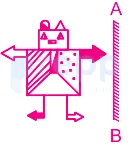
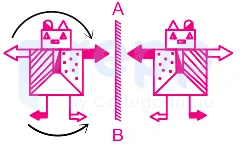
Select the correct mirror image of the given figure when the mirror is placed at 'AB' as shown.
- A
Option A (shown in image)
- B
Option B (shown in image)
- C
Option C (shown in image)
- D
Option D (shown in image)
Show answer
C. Option C (shown in image)The correct mirror image is shown below:
Hence, the correct answer is "Option 3".
 Paper & answer key PDF ↗
 Question 5archived
Which of the option figures, when rotated 135° clockwise followed by 45° anticlockwise, will result in the given question figure?

- A
Option A (shown in image)
- B
Option B (shown in image)
- C
Option C (shown in image)
- D
Option D (shown in image)
Show answer
C. Option C (shown in image)Mistake Points
The question asked, Which of the option figures will be the same as the given question figure after Rotation.
So, Rotate the options figure not the question figure.
The pattern followed here is:
First rotate 135° clockwise, then rotate 45° anticlockwise means rotate (135° - 45°) clockwise = rotate 90° clockwise
Note: It is asked in the question which option figure rotated to find the given figure.
Hence, the correct answer is "Option 3".

 Paper & answer key PDF ↗
 Question 6archived
Select the letter-cluster from among the given options that can replace the question mark (?) in the following series.
LJV, NMR, PPN, RSJ, ?
- A
SUG
- B
TVN
- C
TVF
- D
SWK
Show answer
C. TVFUnderstanding Letter Series Patterns
This question asks us to identify the next term in a given series of letter clusters: LJV, NMR, PPN, RSJ, ? To solve this, we need to find the specific pattern or rule that connects each letter cluster to the next one in the sequence. Letter series questions often involve patterns based on the alphabetical position of the letters.
We will analyze the series by examining the progression of letters in each position within the clusters independently.
Analyzing the Letter-Cluster Series Pattern
Pattern for the First Letter
Let's look at the first letter of each cluster: L, N, P, R.
We can determine the pattern by looking at their positions in the English alphabet (A=1, B=2, ..., Z=26):
L is the 12th letter.
N is the 14th letter.
P is the 16th letter.
R is the 18th letter.
Let's find the difference in their positions:
From L (12) to N (14): \(14 - 12 = +2\)
From N (14) to P (16): \(16 - 14 = +2\)
From P (16) to R (18): \(18 - 16 = +2\)
The pattern for the first letter is a consistent increase of \(+2\) in alphabetical position. To find the next first letter, we add 2 to the position of R (18): \(18 + 2 = 20\). The 20th letter is T.
Pattern for the Second Letter
Now, let's look at the second letter of each cluster: J, M, P, S.
Their alphabetical positions are:
J is the 10th letter.
M is the 13th letter.
P is the 16th letter.
S is the 19th letter.
Let's find the difference:
From J (10) to M (13): \(13 - 10 = +3\)
From M (13) to P (16): \(16 - 13 = +3\)
From P (16) to S (19): \(19 - 16 = +3\)
The pattern for the second letter is a consistent increase of \(+3\) in alphabetical position. To find the next second letter, we add 3 to the position of S (19): \(19 + 3 = 22\). The 22nd letter is V.
Pattern for the Third Letter
Finally, let's look at the third letter of each cluster: V, R, N, J.
Their alphabetical positions are:
V is the 22nd letter.
R is the 18th letter.
N is the 14th letter.
J is the 10th letter.
Let's find the difference:
From V (22) to R (18): \(18 - 22 = -4\)
From R (18) to N (14): \(14 - 18 = -4\)
From N (14) to J (10): \(10 - 14 = -4\)
The pattern for the third letter is a consistent decrease of \(-4\) in alphabetical position. To find the next third letter, we subtract 4 from the position of J (10): \(10 - 4 = 6\). The 6th letter is F.
Determining the Missing Letter Cluster
By combining the next letters found for each position based on their individual patterns, we get the missing letter cluster:
First letter: T
Second letter: V
Third letter: F
The next letter cluster in the series is TVF.
Revision Table: Summary of Letter Series Patterns
Here is a summary of the patterns observed for each position in the letter clusters:
Position in Cluster
Letters in Series
Pattern (Change in Alphabetical Position)
Next Letter Calculation
Next Letter
1st Letter
L, N, P, R
\(+2\)
R (18) \(+2\) = 20
T
2nd Letter
J, M, P, S
\(+3\)
S (19) \(+3\) = 22
V
3rd Letter
V, R, N, J
\(-4\)
J (10) \(-4\) = 6
F
Additional Information: Strategies for Solving Letter Series
Solving letter series problems effectively requires systematic approaches. Here are some common strategies:
Write Down Alphabet Positions: Convert letters to their corresponding numbers (A=1, B=2, etc.). This makes patterns easier to spot.
Look at Differences: Calculate the difference in positions between consecutive letters in each series. Look for arithmetic progressions (\(+2, +2, ...\)), varying progressions (\(+1, +2, +3, ...\)), or alternating differences.
Check for Alternating Patterns: Sometimes the pattern applies to alternate terms (e.g., 1st, 3rd, 5th terms follow one rule, and 2nd, 4th, 6th terms follow another).
Consider Vowels and Consonants: The pattern might be related to the sequence of vowels (A, E, I, O, U) or consonants.
Practice Different Types: Familiarize yourself with various patterns, including combinations of arithmetic operations, skipping letters, and using reversed alphabetical order.
Regular practice with different types of series questions will improve your ability to quickly identify the underlying logic.
Paper & answer key PDF ↗ Question 7archived
Select the figure from among the given options that can replace the question mark (?) in the following series.

- A
Option A (shown in image)
- B
Option B (shown in image)
- C
Option C (shown in image)
- D
Option D (shown in image)
Show answer
D. Option D (shown in image)The pattern followed here is:
1) The given leaf is rotate 45º clockwise in next figure.
Hence, the correct answer is "Option 4".
 Paper & answer key PDF ↗
 Question 8archived
Study the given pattern carefully and select the number that can replace the question mark (?) in it.
1421165
1319?
101799
- A
140
- B
156
- C
120
- D
175
Show answer
A. 140Understanding the Number Pattern Sequence
The question presents a sequence of numbers: 14, 21, 16, 5, 13, 19, ?, 10, 17, 9, 9. We need to identify the pattern governing this sequence to find the missing number represented by the question mark (?). Let's carefully examine the arrangement of the numbers to uncover any underlying logic or rule.
Identifying the Pattern in the Number Series
Observing the numbers, there isn't a simple arithmetic or geometric progression throughout the entire sequence. However, some patterns might emerge when considering groups of numbers or specific relationships between them. Let's consider grouping the numbers into segments. A possible grouping based on the structure might be in sets of three, followed by a shorter set at the end:
Group 1: 14, 21, 16
Group 2: 5, 13, 19
Group 3: ?, 10, 17
Group 4: 9, 9
Let's explore the relationship between these groups. A common pattern in such questions relates elements in one group to elements in another group, often using mathematical operations.
Let's look at the first two numbers in the first group (14, 21) and see if they relate to the first number in the third group (?). Consider the operation of summing the first two numbers and then multiplying by a constant factor:
Sum of first two numbers in Group 1 = \(14 + 21 = 35\)
Now, let's see if multiplying this sum by a constant factor gives the first number of Group 3, which is the missing number (?). Let the missing number be \(X\). We need to find a factor \(K\) such that \(35 \times K = X\).
Let's consider how the pattern might progress through the sequence. Could the pattern involve a relationship between the first group and the third group, the second group and the fourth group, and so on?
If we assume a pattern connects the first group (14, 21, 16) to the third group (?, 10, 17), let's specifically look at how the first number of the third group (?) might be derived from the first two numbers of the first group (14, 21).
Testing the hypothesis: (First number of Group 1 + Second number of Group 1) \(\times\) Constant = First number of Group 3.
\((14 + 21) \times K = ?\)
\(35 \times K = ?\)
Let's try a simple integer constant. If we try multiplying by 4:
\(35 \times 4 = 140\)
This result, 140, is one of the options provided for the missing number. Let's assume this pattern holds for the connection between Group 1 and Group 3.
Step-by-Step Calculation for the Missing Number
Based on the identified pattern where the sum of the first two numbers of the first group, when multiplied by 4, gives the first number of the third group, we can calculate the missing number.
The first group is (14, 21, 16).
The first number of the first group is 14.
The second number of the first group is 21.
The third group starts with the missing number (?). The missing number is the first number of the third group.
Applying the pattern:
Sum the first two numbers of the first group: \(14 + 21 = 35\)
Multiply the sum by 4: \(35 \times 4 = 140\)
Therefore, the missing number is 140.
Group
Numbers
Pattern Applied
Result
Connects To
Group 1
14, 21, 16
\((14 + 21) \times 4\)
\(35 \times 4 = 140\)
First number of Group 3
Group 3
?, 10, 17
140
Missing Number (?)
Conclusion: The Missing Number
Following the identified pattern where the first number of the third group is obtained by summing the first two numbers of the first group and multiplying by 4, the calculated value for the missing number is 140.
Thus, the number that replaces the question mark (?) in the pattern is 140.
Revision Table: Number Pattern Analysis
Sequence Segment
Numbers
Observation / Pattern Idea
Application
Result
Group 1
14, 21, 16
Sum of first two numbers
\(14 + 21\)
35
Connecting Pattern
Multiply sum by 4
\(35 \times 4\)
140
Group 3
?, 10, 17
First number of this group is the missing number
Result of pattern applied to Group 1
140
Additional Information: Solving Number Series and Pattern Problems
Number series and pattern problems are common in logical reasoning tests. They require identifying a specific rule or sequence that governs the arrangement of numbers. Strategies for solving these problems include:
Looking for simple arithmetic progressions (addition or subtraction of a constant).
Checking for geometric progressions (multiplication or division by a constant).
Analysing the differences between consecutive terms.
Analysing the differences of the differences (second-order differences).
Checking for alternating patterns (patterns applied to alternate terms).
Looking for patterns involving squares, cubes, or prime numbers.
Identifying patterns related to the product or sum of digits of the numbers.
Considering grouping the numbers into pairs, triplets, or other sets and finding relationships between these groups or within them.
Testing specific operations (multiplication, division, addition, subtraction) between terms to see if they produce the next term or a later term in the sequence.
Solving these problems often involves trial and error and careful observation of the numbers provided in the series.
Paper & answer key PDF ↗ Question 9archived
Six children, G, H, I, J, K, and L, are sitting around a circular table facing towards the centre. J and K are sitting to the immediate left and right of G, respectively. L is sitting to the immediate left of J, but not to the immediate right of H. Who is sitting to the immediate right of K?
- A
J
- B
I
- C
H
- D
L
Show answer
C. HSolving the Circular Seating Arrangement Puzzle
This question involves a circular seating arrangement puzzle with six children: G, H, I, J, K, and L. They are sitting around a circular table facing towards the center. We need to use the given clues to determine their exact positions and then identify the child sitting to the immediate right of K.
Understanding the Clues
Let's break down the information provided:
Six children: G, H, I, J, K, L.
Sitting around a circular table, facing the center.
Clue 1: J and K are sitting to the immediate left and right of G, respectively.
Clue 2: L is sitting to the immediate left of J.
Clue 3: L is NOT sitting to the immediate right of H.
Step-by-Step Placement
Let's use the clues to build the arrangement. Since they are facing the center, 'immediate right' is clockwise, and 'immediate left' is counter-clockwise.
Start with Clue 1: J is immediate left of G, and K is immediate right of G.
This means G is between J (on G's left) and K (on G's right).
Arrangement so far (Clockwise): J ... G ... K
Or viewing from G's perspective: Left is J, Right is K.
Let's represent the arrangement in a line for now, remembering it's circular:
... J - G - K ...
Apply Clue 2: L is sitting to the immediate left of J.
Immediate left of J is the seat next to J in the counter-clockwise direction. Placing L there, we get:
... L - J - G - K ...
Consider the Remaining Children: We have placed L, J, G, K. The remaining children are H and I.
There are 6 seats in total. L, J, G, K occupy 4 consecutive seats. The remaining 2 seats must be adjacent to K and L (circularly).
Let's visualize the circular arrangement based on L-J-G-K:
Starting from L and moving clockwise:
L → J → G → K → (Seat 5) → (Seat 6) → back to L
The two remaining children, H and I, must occupy Seat 5 and Seat 6.
There are two possibilities for Seats 5 and 6:
Possibility A: Seat 5 is H, Seat 6 is I. Arrangement (Clockwise): L, J, G, K, H, I
Possibility B: Seat 5 is I, Seat 6 is H. Arrangement (Clockwise): L, J, G, K, I, H
Apply Clue 3: L is NOT sitting to the immediate right of H.
Let's check this condition for both possibilities:
Possibility A (L, J, G, K, H, I - Clockwise): Who is to the immediate right of H? Moving clockwise from H, we find I. Is L to the immediate right of H? No, I is. This possibility satisfies the condition.
Possibility B (L, J, G, K, I, H - Clockwise): Who is to the immediate right of H? Moving clockwise from H in a circular arrangement, we return to the beginning of our sequence, which is L. Is L to the immediate right of H? Yes. This possibility violates the condition "L is NOT sitting to the immediate right of H".
Therefore, Possibility B is incorrect. The only valid arrangement is Possibility A.
The Final Arrangement
The correct arrangement of the children around the table, in a clockwise direction, is: L, J, G, K, H, I.
Let's visualize this:
Seat
Child
Child (Clockwise Next)
Child (Counter-Clockwise Next)
Seat 1
L
J
I
Seat 2
J
G
L
Seat 3
G
K
J
Seat 4
K
H
G
Seat 5
H
I
K
Seat 6
I
L
H
Answering the Question: Who is sitting to the immediate right of K?
Based on the final arrangement (L, J, G, K, H, I - clockwise), the child sitting immediately clockwise from K is H.
Conclusion
By carefully following the clues and eliminating the arrangement that contradicts the conditions, we determined the positions of all six children. The child immediately to the right of K is H.
Revision Table: Key Seating Arrangement Concepts
Term
Meaning (Circular Table, Facing Center)
Immediate Right
The person in the next seat in the clockwise direction.
Immediate Left
The person in the next seat in the counter-clockwise direction.
Sitting Between X and Y
X is on one immediate side, and Y is on the other immediate side.
Additional Information: Strategies for Seating Puzzles
Circular seating arrangement problems require careful step-by-step deduction. Here are some tips:
Draw a Diagram: A simple circle with slots helps visualize the positions.
Start with Strong Clues: Begin with clues that fix two or three people relative to each other (like J-G-K).
Place Blocks: Treat a fixed sequence (like L-J-G-K) as a block when considering remaining seats.
Use Constraints to Eliminate: Conditions like "not to the immediate right of" are crucial for ruling out incorrect arrangements.
Check All Conditions: Once you think you have the final arrangement, quickly verify that every single clue is satisfied.
Clockwise vs. Counter-Clockwise: Be consistent with your definition of left and right throughout the problem.
Practicing different types of seating arrangement questions will improve your speed and accuracy in competitive exams.
Paper & answer key PDF ↗ Question 10archived
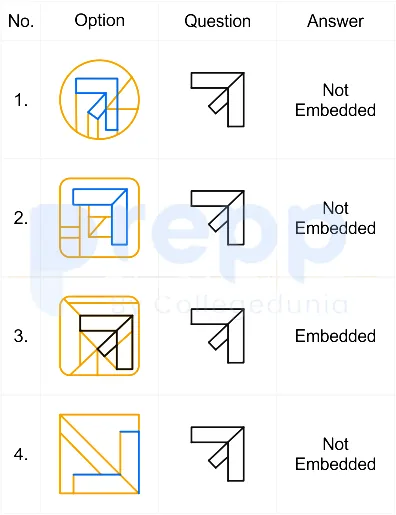
Select the option in which the given figure s embedded (rotation is NOT allowed).

- A
Option A (shown in image)
- B
Option B (shown in image)
- C
Option C (shown in image)
- D
Option D (shown in image)
Show answer
C. Option C (shown in image)Given:Hence, the correct answer is
"Option 3".

 Paper & answer key PDF ↗
 Question 11archived
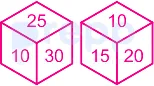
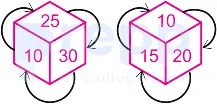
Six numbers, 5, 10, 15, 20, 25 and 30, are written on different faces of a dice. Two positions of this dice are shown. Select the number that will be on the face opposite to the face having the number '15'.
- A
20
- B
10
- C
5
- D
30
Show answer
D. 30The logic followed here is:
From the given two different cubes the adjacent sides are as shown below:
As 10 is common in both dice, it is clear that 15, 20, 25 and 30 are adjacent to it and remaining number i.e., 5 will opposite to it.
Opposite pairs:
25 → 20
30 → 15
10 → 5
So, the opposite side '15' is '30'.
Hence, the correct answer is "30".
 Paper & answer key PDF ↗
 Question 12archived
Read the given statements and conclusions carefully. Assuming that the information given in the statements is true, even if it appears to be at variance with commonly known facts, decide which of the given conclusions logically follow(s) from the statements.
Statements:
All rabbits are cows.
Some rabbits are cats.
Conclusions:
I. All cats are rabbits.
II. Some cows are rabbits.
- A
Either conclusion I or II follows.
- B
Only conclusion II follows.
- C
Only conclusion I follows.
- D
Both the conclusions follow.
Show answer
B. Only conclusion II follows.Understanding Statements and Conclusions in Logical Reasoning
This question asks us to analyze two statements and determine which of the given conclusions logically follow from them, assuming the statements are true.
Analyzing the Statements
Let's break down the given statements:
All rabbits are cows.
Some rabbits are cats.
These statements establish relationships between three categories: rabbits, cows, and cats. In logic problems like this, we must accept these statements as fact, even if they seem unusual in the real world.
Evaluating Conclusion I: All cats are rabbits.
This conclusion claims that every single cat is also a rabbit.
Let's look at the statements again:
Statement 1: All rabbits are cows.
Statement 2: Some rabbits are cats.
Statement 2 tells us there is an overlap between rabbits and cats — some rabbits are cats, which also means some cats are rabbits. However, it does not say that *all* cats are rabbits. There could be cats that are not rabbits, according to the statements. The statements do not provide enough information to conclude that the entire group of cats is included within the group of rabbits.
Therefore, conclusion I does not logically follow from the statements.
Evaluating Conclusion II: Some cows are rabbits.
This conclusion claims that there is an overlap between cows and rabbits — at least one cow is also a rabbit.
Let's look at Statement 1: "All rabbits are cows".
This statement means that the group of rabbits is completely contained within the group of cows. If all rabbits are cows, and assuming there are rabbits (which Statement 2 implies by saying "Some rabbits are cats"), then those rabbits are necessarily also cows. Therefore, some members of the cow group are rabbits.
Consider this relationship visually:
Group
Relationship
Rabbits
All members are included in the Cow group.
Cows
Includes the entire Rabbit group as a part.
Since all rabbits are cows, it logically follows that some cows are rabbits. This is a direct implication of Statement 1.
Therefore, conclusion II logically follows from the statements.
Summary of Conclusions
Conclusion I: All cats are rabbits - Does not follow.
Conclusion II: Some cows are rabbits - Follows.
Based on our analysis, only Conclusion II is logically derived from the given statements.
Statements and Conclusions Revision Table
Statement
Interpretation
Relation
All rabbits are cows.
Every member of the 'rabbit' group is also a member of the 'cow' group.
Rabbits are a subset of Cows.
Some rabbits are cats.
There is at least one member that belongs to both the 'rabbit' group and the 'cat' group.
Overlap between Rabbits and Cats.
Conclusion
Analysis
Follows?
I. All cats are rabbits.
Statements only indicate some overlap between rabbits and cats (from Statement 2). Does not cover all cats.
No
II. Some cows are rabbits.
If ALL rabbits are cows (Statement 1), then the entire group of rabbits is inside the group of cows. This means some members of the cow group are the rabbits.
Yes
Additional Information on Logical Reasoning Statements
Statements in logical reasoning problems often fall into categories based on their structure. Understanding these helps in analyzing the relationships.
Universal Affirmative (All X are Y): The entire set of X is included in the set of Y. Example: All rabbits are cows. This implies Some Y are X (Some cows are rabbits), assuming X is not an empty set.
Universal Negative (No X are Y): The sets of X and Y are completely separate. Example: No dogs are cats. This implies No Y are X (No cats are dogs).
Particular Affirmative (Some X are Y): There is at least one member common to sets X and Y. Example: Some rabbits are cats. This implies Some Y are X (Some cats are rabbits).
Particular Negative (Some X are not Y): There is at least one member in set X that is not in set Y. Example: Some students are not athletes. This does NOT imply Some Y are not X.
In this problem, Statement 1 ("All rabbits are cows") is a Universal Affirmative. Statement 2 ("Some rabbits are cats") is a Particular Affirmative. The conclusion "Some cows are rabbits" is a Particular Affirmative derived from the Universal Affirmative statement.
Paper & answer key PDF ↗ Question 13archived
Select the number from among the given options that can replace the question mark (?) in the following series.
35, 54, 77, 106, 137, ?
- A
151
- B
170
- C
179
- D
174
Show answer
D. 174Understanding the Number Series Problem
The question asks us to identify the number that should replace the question mark (?) in the given series: 35, 54, 77, 106, 137, ?. This is a common type of logical reasoning problem where we need to find the underlying pattern that connects the terms in the series.
Analyzing the Differences in the Number Series
To find the pattern in a number series, a common approach is to look at the differences between consecutive terms. Let's calculate the differences:
Difference between the 2nd term (54) and the 1st term (35): \$latex 54 - 35 = 19\$
Difference between the 3rd term (77) and the 2nd term (54): \$latex 77 - 54 = 23\$
Difference between the 4th term (106) and the 3rd term (77): \$latex 106 - 77 = 29\$
Difference between the 5th term (137) and the 4th term (106): \$latex 137 - 106 = 31\$
So, the sequence of differences is 19, 23, 29, 31.
Identifying the Pattern of Differences: Prime Numbers
Now let's examine the sequence of differences: 19, 23, 29, 31. We need to find a pattern in this sequence.
Let's consider if these numbers have any special properties or if there's a pattern in the differences between these differences (second-order differences). The second-order differences are:
\$latex 23 - 19 = 4\$
\$latex 29 - 23 = 6\$
\$latex 31 - 29 = 2\$
The sequence of second-order differences (4, 6, 2) does not immediately suggest a simple arithmetic or geometric progression pattern.
Let's look closely at the first differences again: 19, 23, 29, 31. These numbers are all prime numbers.
Let's list prime numbers: 2, 3, 5, 7, 11, 13, 17, 19, 23, 29, 31, 37, 41, ...
Comparing our sequence of differences (19, 23, 29, 31) with the list of prime numbers, we can see that these are consecutive prime numbers starting from 19.
Determining the Next Term in the Number Series
Based on the pattern that the differences between consecutive terms are consecutive prime numbers starting from 19, the next difference in the series should be the next prime number after 31.
The prime number immediately following 31 is 37.
Therefore, to find the next term in the original series, we need to add this next difference (37) to the last term in the series (137).
Next term = Last term + Next difference
Next term = \$latex 137 + 37 = 174\$
Confirming the Pattern and the Next Term
Let's verify the series construction based on this pattern:
Term 1: 35
Term 2: \$latex 35 + 19 = 54\$ (19 is the 8th prime)
Term 3: \$latex 54 + 23 = 77\$ (23 is the 9th prime, next after 19)
Term 4: \$latex 77 + 29 = 106\$ (29 is the 10th prime, next after 23)
Term 5: \$latex 106 + 31 = 137\$ (31 is the 11th prime, next after 29)
Term 6: \$latex 137 + 37 = 174\$ (37 is the 12th prime, next after 31)
The pattern holds true, and the calculated next term is 174.
Summary of the Number Series Pattern and Solution
The pattern in the series 35, 54, 77, 106, 137, ? is that the difference between consecutive terms is a sequence of consecutive prime numbers starting from 19. The differences are 19, 23, 29, 31, and the next difference is 37. Adding this difference to the last term gives the next number in the series.
\$latex 137 + 37 = 174\$
Therefore, the number that replaces the question mark is 174.
Term
Value
Difference from previous term
Pattern in Difference
1st
35
-
-
2nd
54
\$latex 54 - 35 = 19\$
Prime Number (8th)
3rd
77
\$latex 77 - 54 = 23\$
Prime Number (9th)
4th
106
\$latex 106 - 77 = 29\$
Prime Number (10th)
5th
137
\$latex 137 - 106 = 31\$
Prime Number (11th)
6th
?
Next Prime after 31 is 37
Prime Number (12th)
Calculated 6th
\$latex 137 + 37 = 174\$
37
Prime Number (12th)
Revision Table: Number Series Analysis
Concept
Description
Application in this problem
Number Series
A sequence of numbers that follow a specific pattern.
The given series: 35, 54, 77, 106, 137, ?
Difference Method
Finding the pattern by calculating the differences between consecutive terms.
Differences: 19, 23, 29, 31
Prime Numbers
Natural numbers greater than 1 that have no positive divisors other than 1 and themselves. (e.g., 2, 3, 5, 7, 11, 13, 17, 19, 23, 29, 31, 37...)
The differences 19, 23, 29, 31, 37 are consecutive prime numbers.
Pattern Recognition
Identifying the rule or relationship governing the sequence.
The pattern is adding consecutive prime numbers starting from 19.
Additional Information: Solving Number Series Reasoning Questions
Number series questions test your ability to identify logical patterns. Here are some common types of patterns you might encounter:
Arithmetic Progression: A constant difference between terms.
Geometric Progression: A constant ratio between terms (multiplying or dividing by a fixed number).
Differences: The difference between terms follows a pattern (e.g., arithmetic progression, geometric progression, or other sequence like prime numbers or squares).
Second-Order Differences: The differences between the first differences follow a pattern.
Squares or Cubes: Terms might be squares, cubes, or related to squares/cubes (e.g., \$latex n^2\$, \$latex n^2 \pm k\$, \$latex n^3\$, \$latex n^3 \pm k\$).
Combinations: A pattern might involve a combination of operations (e.g., multiply by a number and then add/subtract another).
Alternating Patterns: Two different patterns might alternate between terms.
Prime Numbers: The series or the differences might involve prime numbers.
When solving a number series problem, it is helpful to:
Calculate the differences between consecutive terms.
Calculate the second-order differences if the first differences don't show a clear pattern.
Look for factors or ratios if the numbers are increasing or decreasing rapidly.
Check if the numbers are related to squares or cubes.
Consider prime numbers, composite numbers, or other number properties.
Don't give up if the first few steps don't reveal a pattern; try different approaches.
Paper & answer key PDF ↗ Question 14archived
Select the letter-cluster from among the given options that can replace the question mark (?) in the following series.
BEC, CID, FOG, KUL, ?
- A
RAS
- B
RAR
- C
QOR
- D
BAY
Show answer
A. RASAnalyzing Letter-Cluster Series Patterns
The question asks us to find the next letter-cluster in the given series: BEC, CID, FOG, KUL, ?
To solve this, we need to identify the pattern or rule that governs the progression from one letter-cluster to the next. This often involves looking at the positions of the letters in the English alphabet (A=1, B=2, ..., Z=26) and finding a mathematical relationship or sequence.
Mapping Letters to Alphabet Positions
Let's write down the positional values for each letter in the given clusters:
Cluster
First Letter
Second Letter
Third Letter
BEC
B (2)
E (5)
C (3)
CID
C (3)
I (9)
D (4)
FOG
F (6)
O (15)
G (7)
KUL
K (11)
U (21)
L (12)
?
?
?
?
Pattern for the First Letter
Let's look at the sequence of the first letters: B, C, F, K.
Their positions are: 2, 3, 6, 11.
Let's find the difference between consecutive positions:
\(3 - 2 = 1\)
\(6 - 3 = 3\)
\(11 - 6 = 5\)
The differences are 1, 3, 5. This is a sequence of odd numbers increasing by 2 each time. Following this pattern, the next difference should be \(5 + 2 = 7\).
So, the position of the next first letter will be \(11 + 7 = 18\).
The 18th letter of the alphabet is R.
Pattern for the Third Letter
Now let's look at the sequence of the third letters: C, D, G, L.
Their positions are: 3, 4, 7, 12.
Let's find the difference between consecutive positions:
\(4 - 3 = 1\)
\(7 - 4 = 3\)
\(12 - 7 = 5\)
The differences are 1, 3, 5. This is the same pattern as the first letters. Following this pattern, the next difference should be \(5 + 2 = 7\).
So, the position of the next third letter will be \(12 + 7 = 19\).
The 19th letter of the alphabet is S.
Pattern for the Second Letter
Next, let's look at the sequence of the second letters: E, I, O, U.
Their positions are: 5, 9, 15, 21.
Let's find the difference between consecutive positions:
\(9 - 5 = 4\)
\(15 - 9 = 6\)
\(21 - 15 = 6\)
The differences are 4, 6, 6. The pattern seems to be: add 4 once, then add 6 repeatedly. Following this pattern, the next difference should be 6.
So, the position of the next second letter will be \(21 + 6\).
Since there are only 26 letters in the alphabet, we need to consider wrapping around. The 21st letter is U. Adding 6 takes us past Z (26).
\(21 + 6 = 27\).
To find the letter corresponding to position 27, we calculate \(27 \pmod{26}\). If the result is 0, it's Z (26). Otherwise, it's the resulting number.
\(27 = 1 \times 26 + 1\). So, \(27 \pmod{26} = 1\).
The 1st letter of the alphabet is A.
Forming the Next Cluster
Based on the patterns found:
The first letter is R (position 18).
The second letter is A (position 1).
The third letter is S (position 19).
Combining these letters, the next cluster in the series is RAS.
Comparing with Options
Let's compare our result (RAS) with the given options:
Option 1: RAS
Option 2: RAR
Option 3: QOR
Option 4: BAY
Our calculated cluster, RAS, matches Option 1.
Revision Table: Series Patterns
Position
Cluster 1 (BEC)
Cluster 2 (CID)
Cluster 3 (FOG)
Cluster 4 (KUL)
Cluster 5 (RAS)
Pattern Applied
1st Letter
B (2)
C (3) (+1)
F (6) (+3)
K (11) (+5)
R (18) (+7)
Add 1, 3, 5, 7...
2nd Letter
E (5)
I (9) (+4)
O (15) (+6)
U (21) (+6)
A (1) (+6, with wrap)
Add 4, then 6, 6, 6...
3rd Letter
C (3)
D (4) (+1)
G (7) (+3)
L (12) (+5)
S (19) (+7)
Add 1, 3, 5, 7...
Additional Information on Letter Series Questions
Letter series questions are common in logical reasoning and aptitude tests. They require you to find the underlying pattern in a sequence of letters or letter groups. Common patterns include:
Adding a constant number to the letter positions.
Adding a sequence of numbers (like arithmetic progression, prime numbers, squares, etc.) to the letter positions.
Using patterns based on vowels or consonants.
Reversing letter positions (e.g., A becomes Z, B becomes Y).
Skipping letters in a sequence.
Combinations of the above patterns across multiple letters in a cluster.
Solving these questions effectively involves:
Writing down the position of each letter.
Calculating differences between consecutive terms for each letter position separately.
Looking for patterns in these differences.
Considering wrap-around from Z back to A if numbers exceed 26.
Checking the identified pattern against all given terms in the series.
Practice with different types of letter series helps in quickly recognizing common patterns.
Paper & answer key PDF ↗ Question 15archived
In a certain code language, ‘she needs some medicines’ is written as ‘1542’, ‘take some water’ is written as ‘849’, ‘he needs rest’ is written as ‘713’, and ‘she is water’ is written as ‘269’. How will ‘take medicines’ be written in that language?
- A
85
- B
45
- C
81
- D
92
Show answer
A. 85Understanding Coding-Decoding Questions
This type of problem involves deciphering a code language based on given sentences and their corresponding coded forms. The key is to identify common words in different sentences and find their corresponding common codes.
Step-by-Step Decoding Process
Let's analyze the given information:
‘she needs some medicines’ is coded as ‘1542’
‘take some water’ is coded as ‘849’
‘he needs rest’ is coded as ‘713’
‘she is water’ is coded as ‘269’
Finding Codes for Individual Words
We will compare the sentences to find common words and their respective codes.
Comparing Sentence 1 and Sentence 2:
Common word: 'some'
Codes: '1542' and '849'
Common digit: '4'
Therefore, the code for 'some' is '4'.
Comparing Sentence 1 and Sentence 4:
Common word: 'she'
Codes: '1542' and '269'
Common digit: '2'
Therefore, the code for 'she' is '2'.
Comparing Sentence 1 and Sentence 3:
Common word: 'needs'
Codes: '1542' and '713'
Common digit: '1'
Therefore, the code for 'needs' is '1'.
Comparing Sentence 2 and Sentence 4:
Common word: 'water'
Codes: '849' and '269'
Common digit: '9'
Therefore, the code for 'water' is '9'.
Finding the code for 'medicines':
From Sentence 1: ‘she needs some medicines’ = ‘1542’
We know: 'she'='2', 'needs'='1', 'some'='4'.
The remaining word is 'medicines' and the remaining digit is '5'.
Therefore, the code for 'medicines' is '5'.
Finding the code for 'take':
From Sentence 2: ‘take some water’ = ‘849’
We know: 'some'='4', 'water'='9'.
The remaining word is 'take' and the remaining digit is '8'.
Therefore, the code for 'take' is '8'.
Word-Code Mapping Summary
Based on our analysis, we have found the following codes for the required words:
'take' = '8'
'medicines' = '5'
Calculating the Code for 'take medicines'
To find the code for ‘take medicines’, we combine the codes for the individual words 'take' and 'medicines'.
Code for 'take medicines' = Code for 'take' + Code for 'medicines'
Code for 'take medicines' = 8 + 5, which gives us the code '85'.
Final Answer
The code for ‘take medicines’ in this language is ‘85’.
Revision Table: Coding Summary
Word
Code
she
2
needs
1
some
4
medicines
5
take
8
water
9
is
6
he / rest
7 or 3
Additional Information: Logic in Coding-Decoding
Coding-decoding questions in competitive exams test your logical reasoning ability. The coding pattern can be based on various logics:
Letter Shifting: Letters are shifted a certain number of places forward or backward in the alphabet.
Direct Letter Coding: Each letter in a word is assigned a specific code (another letter or digit).
Word Substitution: One word is substituted for another (e.g., 'red' is called 'blue').
Sentence Coding: As seen in this problem, words in sentences are assigned codes, and you need to decode based on common words.
Number/Symbol Coding: Letters or words are coded using numbers or symbols.
Practice is essential to quickly identify the pattern and apply the correct decoding method.
Paper & answer key PDF ↗ Question 16archived
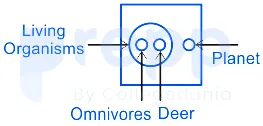
Select the Venn diagram that best represents the relationship between the following.
Living organisms, Omnivores, Deer, Planet
- A
Option A (shown in image)
- B
Option B (shown in image)
- C
Option C (shown in image)
- D
Option D (shown in image)
Show answer
C. Option C (shown in image)The least possible Venn diagram for the given relation is as shown below:-
All Omnivores and deer is a living organisms.
Deer is not a Omnivores. Deer is Herbivores.
Planet is different form all.
Hence, the correct answer is "Option 2".
Additional Information
1.Omnivores → An animal that eat both plants and meat.
2. Herbivores → An animal that eat only plants and grass.
3. Carnivores → An animal that eat only meat.
 Paper & answer key PDF ↗
 Question 17archived
Which two signs need to be interchanged to make the following equation correct?
45 ÷ 15 × 5 + 15 −11 = 39
- A
− and +
- B
− and ×
- C
+ and ×
- D
÷ and +
Show answer
D. ÷ and +Solving Equation by Interchanging Signs
The problem asks us to find which pair of mathematical signs, when interchanged in the given equation, makes the equation correct. The original equation is:
\[45 \div 15 \times 5 + 15 - 11 = 39\]
To solve this, we need to test each option by interchanging the specified signs and then evaluating the resulting expression using the BODMAS (or PEMDAS) rule. BODMAS stands for Brackets, Orders (powers/roots), Division, Multiplication, Addition, Subtraction. Operations are performed in this order.
Testing Option 1: Interchange − and +
If we interchange − and + in the original equation, the new equation becomes:
\[45 \div 15 \times 5 - 15 + 11\]
Now, let's evaluate this expression using BODMAS:
Division: \(45 \div 15 = 3\)
The equation becomes: \(3 \times 5 - 15 + 11\)
Multiplication: \(3 \times 5 = 15\)
The equation becomes: \(15 - 15 + 11\)
Subtraction: \(15 - 15 = 0\)
The equation becomes: \(0 + 11\)
Addition: \(0 + 11 = 11\)
The result is 11. Since \(11 \neq 39\), interchanging − and + does not make the equation correct.
Testing Option 2: Interchange − and ×
If we interchange − and × in the original equation, the new equation becomes:
\[45 \div 15 - 5 + 15 \times 11\]
Now, let's evaluate this expression using BODMAS:
Division: \(45 \div 15 = 3\)
The equation becomes: \(3 - 5 + 15 \times 11\)
Multiplication: \(15 \times 11 = 165\)
The equation becomes: \(3 - 5 + 165\)
Subtraction (left to right with Addition): \(3 - 5 = -2\)
The equation becomes: \(-2 + 165\)
Addition: \(-2 + 165 = 163\)
The result is 163. Since \(163 \neq 39\), interchanging − and × does not make the equation correct.
Testing Option 3: Interchange + and ×
If we interchange + and × in the original equation, the new equation becomes:
\[45 \div 15 + 5 \times 15 - 11\]
Now, let's evaluate this expression using BODMAS:
Division: \(45 \div 15 = 3\)
The equation becomes: \(3 + 5 \times 15 - 11\)
Multiplication: \(5 \times 15 = 75\)
The equation becomes: \(3 + 75 - 11\)
Addition (left to right with Subtraction): \(3 + 75 = 78\)
The equation becomes: \(78 - 11\)
Subtraction: \(78 - 11 = 67\)
The result is 67. Since \(67 \neq 39\), interchanging + and × does not make the equation correct.
Testing Option 4: Interchange ÷ and +
If we interchange ÷ and + in the original equation, the new equation becomes:
\[45 + 15 \times 5 \div 15 - 11\]
Now, let's evaluate this expression using BODMAS:
Division: \(5 \div 15 = \frac{5}{15} = \frac{1}{3}\)
The equation becomes: \(45 + 15 \times \frac{1}{3} - 11\)
Multiplication: \(15 \times \frac{1}{3} = 5\)
The equation becomes: \(45 + 5 - 11\)
Addition (left to right with Subtraction): \(45 + 5 = 50\)
The equation becomes: \(50 - 11\)
Subtraction: \(50 - 11 = 39\)
The result is 39. Since \(39 = 39\), interchanging ÷ and + makes the equation correct.
Therefore, the signs that need to be interchanged are ÷ and +.
Revision Table: Evaluating Options
Option (Interchange)
New Equation
Step-by-Step Evaluation (BODMAS)
Result
Correct?
− and +
\(45 \div 15 \times 5 - 15 + 11\)
\(3 \times 5 - 15 + 11\)
\(15 - 15 + 11\)
\(0 + 11\)
\(11\)
11
No
− and ×
\(45 \div 15 - 5 + 15 \times 11\)
\(3 - 5 + 15 \times 11\)
\(3 - 5 + 165\)
\(-2 + 165\)
\(163\)
163
No
+ and ×
\(45 \div 15 + 5 \times 15 - 11\)
\(3 + 5 \times 15 - 11\)
\(3 + 75 - 11\)
\(78 - 11\)
\(67\)
67
No
÷ and +
\(45 + 15 \times 5 \div 15 - 11\)
\(45 + 15 \times \frac{1}{3} - 11\)
\(45 + 5 - 11\)
\(50 - 11\)
\(39\)
39
Yes
Additional Information: Order of Operations (BODMAS/PEMDAS)
Understanding the correct order of operations is crucial for solving mathematical expressions accurately. Both BODMAS and PEMDAS are mnemonics to remember this order.
BODMAS:
Brackets
Orders (powers, square roots, etc.)
Division and Multiplication (from left to right)
Addition and Subtraction (from left to right)
PEMDAS:
Parentheses
Exponents (powers, square roots, etc.)
Multiplication and Division (from left to right)
Addition and Subtraction (from left to right)
Division and Multiplication have the same priority and should be performed from left to right as they appear in the expression. Similarly, Addition and Subtraction have the same priority and are performed from left to right.
In the given problem, applying BODMAS/PEMDAS correctly after interchanging signs allowed us to verify which interchange makes the equation true.
Paper & answer key PDF ↗ Question 18archived
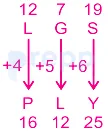
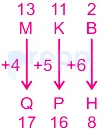
Select the option that is related to the third letter-cluster in the same way as the second letter-cluster is related to the first letter-cluster.
LGS : PLY :: MKB : ?
- A
QPH
- B
RQG
- C
QOF
- D
PQG
Show answer
A. QPHThe position of letters according to the English alphabet series:
1) LGS : PLY
Similarly,
2) MKB : ?
Hence, the correct answer is"QPH".
 Paper & answer key PDF ↗
 Question 19archived
In a certain code language, ‘LILY’ is coded as 116, and ‘LOTUS’ is coded as 174. How will ‘TULIP’ be coded in that language?
- A
78
- B
126
- C
168
- D
156
Show answer
D. 156Understanding the Coding Language Pattern
The question asks us to decipher a specific code language where words are converted into numbers. We are given two examples: 'LILY' is coded as 116, and 'LOTUS' is coded as 174. We need to find the code for 'TULIP' using the same pattern.
Let's analyze the given examples to identify the rule used for coding. A common pattern in such coding questions involves the alphabetical position of the letters.
A = 1, B = 2, C = 3, ..., Z = 26.
Decoding LILY (116)
Let's find the alphabetical position for each letter in 'LILY':
L is the 12th letter.
I is the 9th letter.
L is the 12th letter.
Y is the 25th letter.
Now, let's sum these positions:
\( \text{Sum for LILY} = 12 + 9 + 12 + 25 = 58 \)
The coded value for LILY is 116. Comparing the sum (58) with the coded value (116), we observe that 116 is exactly double of 58.
\( 58 \times 2 = 116 \)
This suggests a potential pattern: The coded value is the sum of the alphabetical positions of the letters multiplied by 2.
Verifying with LOTUS (174)
Let's test this hypothesis with the word 'LOTUS'. Find the alphabetical position for each letter:
L is 12.
O is 15.
T is 20.
U is 21.
S is 19.
Now, sum these positions:
\( \text{Sum for LOTUS} = 12 + 15 + 20 + 21 + 19 = 87 \)
According to our hypothesis, the coded value should be the sum multiplied by 2:
\( 87 \times 2 = 174 \)
The calculated value (174) matches the given coded value for LOTUS. This confirms that our pattern is correct.
Coding TULIP using the Pattern
Now, we apply the same pattern to the word 'TULIP' to find its code. First, find the alphabetical position for each letter:
T is 20.
U is 21.
L is 12.
I is 9.
P is 16.
Next, calculate the sum of these positions:
\( \text{Sum for TULIP} = 20 + 21 + 12 + 9 + 16 = 78 \)
Finally, multiply the sum by 2 to get the coded value for TULIP:
\( \text{Code for TULIP} = 78 \times 2 = 156 \)
Therefore, 'TULIP' will be coded as 156 in this language.
Summary of the Coding Pattern
The coding rule followed in this language is:
Coded Value = (Sum of alphabetical positions of all letters) × 2
Word
Alphabetical Positions
Sum of Positions
Coded Value (Sum × 2)
Given Code
LILY
12, 9, 12, 25
58
\(58 \times 2 = 116\)
116
LOTUS
12, 15, 20, 21, 19
87
\(87 \times 2 = 174\)
174
TULIP
20, 21, 12, 9, 16
78
\(78 \times 2 = 156\)
? (Calculated)
Based on our calculations and pattern analysis, the code for TULIP is 156.
Revision Table: Coding Language Analysis
Concept
Description
Relevance to Problem
Alphabetical Position
Assigning a numerical value (1-26) to each letter based on its order in the alphabet.
Foundation for many coding/decoding patterns.
Pattern Recognition
Identifying the underlying rule or relationship between the input (word) and output (code).
Crucial step in solving this type of reasoning question.
Mathematical Operations
Using arithmetic operations (addition, multiplication) to transform the initial values (positions) into the final code.
Part of the discovered coding rule (\( \text{Sum} \times 2 \)).
Additional Information: Types of Coding Patterns
Coding and decoding questions often use various patterns. Here are a few common types:
Position-based: Using the alphabetical position of letters (like in this problem).
Reverse Position-based: Using positions from the end of the alphabet (Z=1, Y=2, ...).
Letter Shifting: Shifting letters by a fixed number of positions (e.g., A becomes C, B becomes D).
Skipping Letters: Using every nth letter.
Consonant/Vowel Based: Different rules for consonants and vowels.
Combination of Rules: A mix of the above patterns, possibly combined with simple arithmetic operations.
Solving these questions requires careful observation, testing hypotheses, and applying logical reasoning to find the consistent rule.
Paper & answer key PDF ↗ Question 20archived
Four letter-clusters have been given, out of which three are alike in some manner and one is different. Select the letter-cluster that is different.
- A
YRLGC
- B
HAUPL
- C
ATNIE
- D
GZTNK
Show answer
D. GZTNKFinding the Different Letter Cluster
In this type of question, we are given several letter clusters, and we need to identify the one that does not follow the same pattern as the others. The pattern usually involves the positions of the letters in the English alphabet.
Analyzing Letter Patterns in Clusters
Let's assign numerical positions to each letter (A=1, B=2, ..., Z=26) and examine the differences between consecutive letters in each cluster. We will consider wrapping around the alphabet if necessary (e.g., going backward from A to Z is like going from 1 to 26, or from 27 to 26).
Let's look at each option:
Option 1: YRLGC
Y is the 25th letter.
R is the 18th letter. Difference: $18 - 25 = -7$.
L is the 12th letter. Difference: $12 - 18 = -6$.
G is the 7th letter. Difference: $7 - 12 = -5$.
C is the 3rd letter. Difference: $3 - 7 = -4$.
The sequence of differences is $-7, -6, -5, -4$.
Option 2: HAUPL
H is the 8th letter.
A is the 1st letter. Going backward from H (8) to A (1): $1 - 8 = -7$. (Or 8 steps backward).
U is the 21st letter. Going backward from A (1 or 27) to U (21): $21 - 27 = -6$. (Or 6 steps backward from A wrapping around).
P is the 16th letter. Difference: $16 - 21 = -5$.
L is the 12th letter. Difference: $12 - 16 = -4$.
The sequence of differences is $-7, -6, -5, -4$. This matches Option 1.
Option 3: ATNIE
A is the 1st letter.
T is the 20th letter. Going backward from A (1 or 27) to T (20): $20 - 27 = -7$. (Or 7 steps backward from A wrapping around).
N is the 14th letter. Difference: $14 - 20 = -6$.
I is the 9th letter. Difference: $9 - 14 = -5$.
E is the 5th letter. Difference: $5 - 9 = -4$.
The sequence of differences is $-7, -6, -5, -4$. This also matches Options 1 and 2.
Option 4: GZTNK
G is the 7th letter.
Z is the 26th letter. Going backward from G (7 or 33) to Z (26): $26 - 33 = -7$. (Or 7 steps backward from G wrapping around).
T is the 20th letter. Difference: $20 - 26 = -6$.
N is the 14th letter. Difference: $14 - 20 = -6$.
K is the 11th letter. Difference: $11 - 14 = -3$.
The sequence of differences is $-7, -6, -6, -3$.
Identifying the Different Cluster
Let's compare the patterns found:
YRLGC: $-7, -6, -5, -4$
HAUPL: $-7, -6, -5, -4$
ATNIE: $-7, -6, -5, -4$
GZTNK: $-7, -6, -6, -3$
Three of the letter clusters (YRLGC, HAUPL, ATNIE) follow the pattern where the difference between consecutive letter positions decreases by 1 each time, starting from -7. The letter cluster GZTNK follows a different pattern of differences.
Therefore, GZTNK is the letter cluster that is different from the others.
Cluster
Letters (Positions)
Differences
Pattern
YRLGC
Y(25) R(18) L(12) G(7) C(3)
-7, -6, -5, -4
Decreasing by 1
HAUPL
H(8) A(1) U(21) P(16) L(12)
-7, -6, -5, -4
Decreasing by 1
ATNIE
A(1) T(20) N(14) I(9) E(5)
-7, -6, -5, -4
Decreasing by 1
GZTNK
G(7) Z(26) T(20) N(14) K(11)
-7, -6, -6, -3
Different
Revision Table: Letter Cluster Reasoning
Concept
Description
Example
Letter Positioning
Assigning numerical values (1-26) to letters A-Z.
A=1, M=13, Z=26
Consecutive Difference
Calculating the numerical difference between adjacent letters' positions.
In AB, difference is 2-1=1. In BA, difference is 1-2=-1 (or 25 wrapping).
Alphabet Wrap-around
Considering Z followed by A, or A preceded by Z in sequences.
Difference from C to Z: 26-3 = -23 or wrap back: C(3) -> B(2) -> A(1) -> Z(26) which is -3.
Pattern Identification
Finding a consistent rule (like arithmetic progression, skipping letters, etc.) in the differences or positions.
Differences like +2, +3, +4 or -5, -5, -5.
Odd One Out
Identifying the element that does not follow the common pattern found in the others.
If three clusters have +2,+3,+4 differences and one has +2,+4,+6, the latter is different.
Additional Information: Types of Letter Series Patterns
Letter series and letter cluster reasoning questions can involve various patterns. Understanding these can help you solve problems faster. Some common patterns include:
Alphabetical Position: Patterns based on the numerical position of letters (A=1, Z=26). This includes arithmetic progressions, geometric progressions, or other mathematical sequences using these numbers.
Difference Between Letters: The gap in the alphabet between consecutive letters. The differences themselves might follow a pattern (+2, +3, +4 or -1, -2, -3, etc.).
Skipping Letters: A fixed number of letters might be skipped between each letter in the series or cluster.
Vowel/Consonant Pattern: The sequence might follow a pattern of vowels and consonants.
Reverse Order: Letters might be in reverse alphabetical order, or segments might be reversed.
Combination of Patterns: More complex series might combine two or more simple patterns.
Specific Letter Properties: Patterns based on features like letters with symmetry, letters made of straight lines only, etc. (Less common in basic patterns).
To solve these problems effectively, it's useful to know the alphabetical positions of letters quickly and to systematically test different types of patterns.
Paper & answer key PDF ↗ Question 21archived
Select the correct option that indicates the arrangement of the given words in a logical and meaningful order.
1. Recording
2. Rehearsal
3. Viewers
4. Script
5. Video Editing
- A
4, 5, 2, 1, 3
- B
4, 1, 2, 3, 5
- C
4, 2, 1, 5, 3
- D
2, 4, 1, 5, 3
Show answer
C. 4, 2, 1, 5, 3Understanding Logical Word Arrangement
The question asks us to arrange a set of words related to video production in a logical and meaningful order. To do this, we need to think about the typical steps involved in creating a video, from planning to watching.
Number
Word
1
Recording
2
Rehearsal
3
Viewers
4
Script
5
Video Editing
Steps in Arranging Words Logically
Let's consider the sequence of activities when creating a video:
Script: The first step in creating any structured video is usually writing a script. This is the plan or blueprint for the content. Without a script, it's hard to know what to record. (Corresponds to number 4)
Rehearsal: Once the script is ready, the performers or presenters need to practice reading lines, blocking movements, and getting comfortable with the content. This rehearsal ensures a smoother recording process. (Corresponds to number 2)
Recording: After planning with a script and practicing through rehearsal, you record the actual video footage and audio based on the script. (Corresponds to number 1)
Video Editing: The raw recorded footage is then taken to the editing suite. Here, the best takes are selected, cut, arranged, special effects added, and audio refined to create the final video. (Corresponds to number 5)
Viewers: The final, edited video is then shared with the audience, who are the viewers. They watch the finished product. (Corresponds to number 3)
Logical Sequence of Video Production Steps
Based on the typical process of creating a video, the logical and meaningful order of the given words is:
Script (4)
Rehearsal (2)
Recording (1)
Video Editing (5)
Viewers (3)
This gives us the sequence of numbers: 4, 2, 1, 5, 3.
Comparing Sequence with Options
Let's compare our derived sequence (4, 2, 1, 5, 3) with the given options:
Option 1: 4, 5, 2, 1, 3 (This puts editing before rehearsal and recording, which is not logical).
Option 2: 4, 1, 2, 3, 5 (This puts recording before rehearsal and viewers before editing, which is illogical).
Option 3: 4, 2, 1, 5, 3 (This follows the logical flow: Script → Rehearsal → Recording → Video Editing → Viewers).
Option 4: 2, 4, 1, 5, 3 (This puts rehearsal before script, which is not the standard process).
Therefore, the sequence 4, 2, 1, 5, 3 is the correct logical arrangement.
Revision Table: Logical Order Process
Step
Word (Number)
Description
1 (Planning)
Script (4)
Writing the content plan.
2 (Preparation)
Rehearsal (2)
Practicing the script.
3 (Execution)
Recording (1)
Capturing video/audio.
4 (Post-production)
Video Editing (5)
Refining the recorded content.
5 (Distribution/Consumption)
Viewers (3)
Audience watching the final product.
Additional Information: Video Production Stages
The process illustrated in the logical word arrangement follows the typical stages of video production. These stages can be broadly categorized:
Pre-production: This involves everything that happens before filming begins. It includes brainstorming ideas, writing the script, storyboarding, casting, location scouting, and planning the shoot schedule. Script and Rehearsal fall under this phase.
Production: This is the actual filming or recording stage. It involves capturing all the necessary video footage and audio according to the script and plan. Recording falls under this phase.
Post-production: This stage occurs after filming is complete. It includes editing the footage, adding visual effects, sound design, music, color correction, and creating the final video master. Video Editing falls under this phase.
Distribution: Once the video is finished, it is shared with the target audience. This could involve uploading it to platforms like YouTube, Vimeo, social media, or broadcasting it. The interaction with Viewers is part of this final outcome.
Understanding these stages helps in logically arranging steps related to video creation.
Paper & answer key PDF ↗ Question 22archived
Three years ago, the difference between the age of Ravish and the age of Kailash was 18 years. Three years from today, Ravish will be three times as old as Kailash. What is the present age of Ravish (in years)?
- A
18
- B
21
- C
24
- D
27
Show answer
C. 24Understanding the Age Word Problem
This question is an age-based word problem that involves setting up and solving linear equations. We are given information about the ages of two individuals, Ravish and Kailash, at different points in time: three years ago and three years from today. We need to find Ravish's current or present age.
Setting Up the Problem with Variables
To solve this type of problem, it's best to represent the unknown present ages using variables.
Let \(R\) be the present age of Ravish (in years).
Let \(K\) be the present age of Kailash (in years).
Formulating Equations from the Given Conditions
We are given two conditions that relate the ages of Ravish and Kailash at different times. We can translate these conditions into algebraic equations.
Condition 1: Three years ago
The question states that three years ago, the difference between the age of Ravish and the age of Kailash was 18 years.
Ravish's age three years ago was \(R - 3\).
Kailash's age three years ago was \(K - 3\).
The difference in their ages three years ago was 18 years. This can be written as:
\((R - 3) - (K - 3) = 18\)
Let's simplify this equation:
\(R - 3 - K + 3 = 18\)
\(R - K = 18\) (Equation 1)
This equation tells us that the difference between Ravish's present age and Kailash's present age is 18 years. This makes sense because the age difference between two people remains constant throughout their lives.
Condition 2: Three years from today
The question states that three years from today, Ravish will be three times as old as Kailash.
Ravish's age three years from today will be \(R + 3\).
Kailash's age three years from today will be \(K + 3\).
Ravish's age at that time will be three times Kailash's age at that time. This can be written as:
\(R + 3 = 3 \times (K + 3)\)
Let's simplify this equation:
\(R + 3 = 3K + 9\) (Equation 2)
Solving the System of Equations
Now we have a system of two linear equations with two variables (\(R\) and \(K\)):
\(R - K = 18\)
\(R + 3 = 3K + 9\)
We can use the substitution method or elimination method to solve this system. Let's use substitution.
From Equation 1, we can express \(R\) in terms of \(K\):
\(R = K + 18\)
Now substitute this expression for \(R\) into Equation 2:
\((K + 18) + 3 = 3K + 9\)
Simplify and solve for \(K\):
\(K + 21 = 3K + 9\)
Subtract \(K\) from both sides:
\(21 = 2K + 9\)
Subtract 9 from both sides:
\(21 - 9 = 2K\)
\(12 = 2K\)
Divide by 2:
\(K = \frac{12}{2}\)
\(K = 6\)
So, the present age of Kailash is 6 years.
Now that we have the value of \(K\), we can find \(R\) using Equation 1 (\(R = K + 18\)):
\(R = 6 + 18\)
\(R = 24\)
Thus, the present age of Ravish is 24 years.
Verification
Let's check if these present ages satisfy both original conditions:
Present ages: Ravish = 24, Kailash = 6.
Three years ago: Ravish was \(24 - 3 = 21\). Kailash was \(6 - 3 = 3\). The difference was \(21 - 3 = 18\). This matches Condition 1.
Three years from today: Ravish will be \(24 + 3 = 27\). Kailash will be \(6 + 3 = 9\). Is Ravish three times Kailash? \(3 \times 9 = 27\). Yes, it matches Condition 2.
Both conditions are satisfied, so our calculated present age for Ravish is correct.
The present age of Ravish is 24 years.
Person
Age 3 Years Ago
Present Age
Age 3 Years from Today
Ravish
\(R-3 = 21\)
\(R = 24\)
\(R+3 = 27\)
Kailash
\(K-3 = 3\)
\(K = 6\)
\(K+3 = 9\)
Condition
Calculation
Result
Difference 3 years ago
\((R-3) - (K-3)\)
\(21 - 3 = 18\) (Matches question)
Ratio 3 years from today
\((R+3)\) vs \(3 \times (K+3)\)
\(27\) vs \(3 \times 9 = 27\) (Matches question)
Revision Table: Age Word Problems
Concept
Explanation
Example (Present Age \(A\))
Age 'x' years ago
Current age minus x
Age x years ago = \(A - x\)
Age 'y' years from today
Current age plus y
Age y years from today = \(A + y\)
Age Difference
The difference in age between two people remains constant over time.
If \(A-B=D\) today, then \((A-x)-(B-x)=D\) and \((A+y)-(B+y)=D\).
Additional Information: Solving Linear Equations
Age word problems often lead to systems of linear equations. A system of linear equations is a set of two or more linear equations that share the same variables. There are several methods to solve them:
Substitution Method: Solve one equation for one variable, then substitute that expression into the other equation. This reduces the system to a single equation with one variable.
Elimination Method: Multiply one or both equations by constants so that the coefficients of one variable are opposites. Then, add the equations together to eliminate that variable.
Graphical Method: Graph each equation on the same coordinate plane. The point where the lines intersect is the solution to the system. This method is less precise for non-integer solutions.
In this problem, we used the substitution method, which is generally efficient when one variable can be easily isolated in one of the equations.
Paper & answer key PDF ↗ Question 23archived
Select the number from among the given options that can replace the question mark (?) in the following series.
9, 38, 154, 618, ?
- A
1268
- B
928
- C
735
- D
2474
Show answer
D. 2474Number Series Calculation: Finding the Missing Term
This solution explains how to determine the missing number in the given numerical sequence: 9, 38, 154, 618, ?. We will analyze the pattern connecting the numbers to find the value that should replace the question mark (?).
Identifying the Pattern in the Series
To solve this number series problem, we need to examine the relationship between consecutive terms. Let's look at the operations that might link 9 to 38, 38 to 154, and 154 to 618.
From 9 to 38: We can observe that multiplying 9 by 4 gives 36 ($9 \times 4 = 36$). Adding 2 to this result gives 38 ($36 + 2 = 38$).
From 38 to 154: Let's check if the same pattern applies. Multiplying 38 by 4 gives 152 ($38 \times 4 = 152$). Adding 2 to this result gives 154 ($152 + 2 = 154$).
From 154 to 618: Continuing the pattern, multiplying 154 by 4 gives 616 ($154 \times 4 = 616$). Adding 2 to this result gives 618 ($616 + 2 = 618$).
The consistent pattern identified is: Multiply the current number by 4 and then add 2 to get the next number in the series. Mathematically, if $N_x$ is the current term, the next term $N_{x+1}$ can be represented as:
$N_{x+1} = (N_x \times 4) + 2$
Calculating the Missing Term
Now we apply this established pattern to find the number that follows 618.
Using the formula $N_{x+1} = (N_x \times 4) + 2$, where $N_x = 618$:
Step 1: Multiply the last known term (618) by 4.
$618 \times 4 = 2472$
Step 2: Add 2 to the result from Step 1.
$2472 + 2 = 2474$
Therefore, the missing number in the series is 2474.
Conclusion
The sequence follows the rule of multiplying the previous term by 4 and adding 2. Based on this pattern, the number that replaces the question mark (?) in the series 9, 38, 154, 618, ? is 2474.
Paper & answer key PDF ↗ Question 24archived
Niraj is the father of Rinku. Jiya and Tiya are the daughters of Ruby, who is the only sister of Rinku. Vishnu is the son of Rinku and Gita. How is Niraj related to Tiya?
- A
Paternal grandfather
- B
Maternal grandfather
- C
Maternal uncle
- D
Paternal uncle
Show answer
B. Maternal grandfatherUnderstanding the Blood Relation Puzzle
This question asks us to determine the relationship between two individuals, Niraj and Tiya, based on a series of given blood relations. To solve this type of problem, it is helpful to build a simple family tree or diagram tracing the connections.
Step-by-Step Analysis of Relationships
Let's break down the information provided:
"Niraj is the father of Rinku." This means Niraj belongs to an older generation than Rinku.
"Jiya and Tiya are the daughters of Ruby." This places Jiya and Tiya in a younger generation compared to Ruby. They are sisters.
"Ruby, who is the only sister of Rinku." This is a key connection. Ruby and Rinku are siblings. Since Ruby is the *only* sister of Rinku, Rinku must be male. Also, Niraj, being the father of Rinku, is also the father of Ruby.
"Vishnu is the son of Rinku and Gita." This confirms Rinku is a parent in the generation above Vishnu. This information about Vishnu and Gita is not directly needed to find the relationship between Niraj and Tiya, but it reinforces the family structure.
Constructing the Family Tree
Based on the relationships, we can map out the family structure:
Niraj is the father of Rinku and Ruby.
Rinku and Ruby are siblings (Rinku is male, Ruby is female).
Tiya is the daughter of Ruby.
Let's trace the lineage from Niraj to Tiya:
Niraj → Ruby → Tiya
This shows that Tiya is the daughter of Ruby, and Ruby is the daughter of Niraj.
Determining the Relation Between Niraj and Tiya
Tiya's mother is Ruby. Ruby is Niraj's daughter.
Therefore, Niraj is the father of Tiya's mother.
The father of one's mother is called the maternal grandfather.
Hence, Niraj is the maternal grandfather of Tiya.
Verification with Options
Let's check the options against our conclusion:
Paternal grandfather: This would be the father of one's father. Niraj is the father of Tiya's mother (Ruby), not Tiya's father. Incorrect.
Maternal grandfather: This is the father of one's mother. Niraj is the father of Ruby, who is Tiya's mother. Correct.
Maternal uncle: This would be the brother of one's mother. Niraj is Ruby's father, not her brother. Incorrect.
Paternal uncle: This would be the brother of one's father. Niraj is Ruby's father, and Ruby is Tiya's mother. Rinku is Tiya's maternal uncle (brother of her mother), and Niraj is Rinku's father. Incorrect.
Our analysis confirms that Niraj is the maternal grandfather of Tiya.
Revision Table: Key Relationships
Relationship
Individuals
Father-Daughter
Niraj → Ruby
Father-Son
Niraj → Rinku
Siblings
Rinku ↔ Ruby
Mother-Daughter
Ruby → Tiya
Mother-Daughter
Ruby → Jiya
Father-Son
Rinku → Vishnu
Spouses
Rinku ↔ Gita
Additional Information: Understanding Grandparents
In blood relation questions, understanding the terms for relatives on the mother's side versus the father's side is crucial. Grandparents are from the generation before your parents.
Paternal Grandfather: Your father's father.
Paternal Grandmother: Your father's mother.
Maternal Grandfather: Your mother's father.
Maternal Grandmother: Your mother's mother.
In this problem, Niraj is the father of Tiya's mother (Ruby), which fits the definition of a maternal grandfather.
Paper & answer key PDF ↗ Question 25archived
The sequence of folding a piece of paper (figures i and ii) and the manner in which the folded paper has been cut (figure iii) is shown in the following figures. Select the option that would most closely resemble the unfolded form of figure (iii).
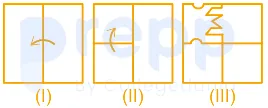
- A
Option A (shown in image)
- B
Option B (shown in image)
- C
Option C (shown in image)
- D
Option D (shown in image)
Show answer
A. Option A (shown in image)The pattern followed here is:
Hence, the correct answer is "Option 1".
 Paper & answer key PDF ↗
 Question 26archived
______ was among 12 people chosen for the ‘International Anti-Corruption Champions Award’ constituted by the United States Department of State in February 2021.
- A
Medha Patkar
- B
Flavia Agnes
- C
Archana Borthakur
- D
Anjali Bhardwaj
Show answer
D. Anjali BhardwajUnderstanding the International Anti-Corruption Champions Award
The question asks about a specific award given by the United States Department of State and identifies a person among the options who received it in February 2021. This award is the 'International Anti-Corruption Champions Award'.
About the International Anti-Corruption Champions Award
The International Anti-Corruption Champions Award is presented by the U.S. Department of State to individuals who have demonstrated leadership, courage, and impact in preventing, exposing, and combating corruption. The award recognizes those who work tirelessly, often at great personal risk, to uphold transparency and accountability in their countries.
Recipients of the 2021 Anti-Corruption Award
In February 2021, the United States Department of State announced the inaugural cohort of the International Anti-Corruption Champions Award. A total of 12 individuals from around the world were selected for this prestigious recognition.
The recipients were chosen for their significant contributions to fighting corruption in their respective nations.
Identifying the Indian Recipient
Among the 12 individuals recognized in February 2021 was an Indian activist. The options provided are:
Medha Patkar
Flavia Agnes
Archana Borthakur
Anjali Bhardwaj
Based on the information available regarding the 2021 International Anti-Corruption Champions Award recipients, Ms. Anjali Bhardwaj was indeed one of the individuals honored by the U.S. Department of State.
Anjali Bhardwaj is a prominent Indian social activist who works on issues of transparency and accountability, particularly focusing on the Right to Information (RTI) Act. Her work through the Satark Nagrik Sangathan (SNS) and other platforms has been instrumental in advocating for stronger anti-corruption mechanisms and greater citizen participation in governance.
Let's briefly look at the other options:
Medha Patkar is a well-known social activist associated with the Narmada Bachao Andolan and other movements concerning displacement and environmental issues.
Flavia Agnes is a prominent women's rights lawyer and writer.
Archana Borthakur is also an activist known for her work in different social sectors.
While all these individuals are notable figures in Indian activism, Anjali Bhardwaj is the one who received the International Anti-Corruption Champions Award from the U.S. Department of State in February 2021.
Conclusion
Anjali Bhardwaj was among the 12 recipients of the inaugural International Anti-Corruption Champions Award presented by the United States Department of State in February 2021, recognizing her work in India on transparency and accountability.
Revision Table: Key Details
Award
Constituting Authority
Year of Recognition Mentioned
Indian Recipient (2021)
International Anti-Corruption Champions Award
United States Department of State
February 2021
Anjali Bhardwaj
Additional Information on Anti-Corruption Efforts
Combating corruption is a global effort. Governments, civil society organizations, and individuals play crucial roles. Awards like the International Anti-Corruption Champions Award highlight the importance of this fight and recognize those who make significant contributions.
Key aspects of anti-corruption efforts often include:
Promoting transparency in government and public institutions.
Strengthening laws and regulations against bribery and illicit financial flows.
Protecting whistleblowers who expose corruption.
Empowering citizens through access to information.
Ensuring accountability of public officials.
International cooperation to trace and recover stolen assets.
Anjali Bhardwaj's work in India aligns with many of these principles, particularly the focus on the Right to Information, which is a powerful tool for promoting transparency and holding power accountable.
Paper & answer key PDF ↗ Question 27archived
‘Hypnea indica’ and ‘Hypnea bullata’ are types of :
- A
red seaweeds
- B
yellow seaweeds
- C
green seaweeds
- D
black seaweeds
Show answer
A. red seaweedsClassification of Hypnea Indica and Hypnea Bullata Seaweeds
The question asks to identify the type of seaweeds that 'Hypnea indica' and 'Hypnea bullata' belong to. Seaweeds, also known as marine macroalgae, are classified into different groups primarily based on the types of photosynthetic pigments they contain.
The main groups of seaweeds are:
Green algae (Chlorophyta) - Contain chlorophyll a and b, similar to land plants.
Brown algae (Phaeophyceae) - Contain chlorophyll a and c, along with the brown pigment fucoxanthin.
Red algae (Rhodophyta) - Contain chlorophyll a and d, along with the red and blue pigments phycoerythrin and phycocyanin.
'Hypnea' is a genus of red algae. Species within the genus 'Hypnea', such as 'Hypnea indica' and 'Hypnea bullata', are known for their bushy or filamentous structure and are often found in warm and tropical waters. Their characteristic red coloration comes from the presence of phycoerythrin and phycocyanin pigments, which help them absorb light in deeper waters where red wavelengths are filtered out.
Therefore, 'Hypnea indica' and 'Hypnea bullata' are types of red seaweeds.
Let's consider the options provided:
red seaweeds: This aligns with the biological classification of the genus Hypnea.
yellow seaweeds: Yellow coloration in algae is often associated with specific accessory pigments like xanthophylls, but 'Hypnea' is not classified as yellow seaweed.
green seaweeds: Green seaweeds belong to Chlorophyta and have distinct pigments (chlorophyll a and b) that give them a bright green color. Hypnea does not fall into this category.
black seaweeds: There isn't a standard classification group specifically termed 'black seaweeds'. Some brown or red seaweeds might appear dark, but 'black seaweed' is not a formal taxonomic category.
Based on the scientific classification, species of the genus Hypnea are red seaweeds.
Revision Table: Types of Seaweeds
Type of Seaweed
Scientific Name (Major Group)
Key Pigments
Common Color
Green Seaweeds
Chlorophyta
Chlorophyll a & b, Carotenoids
Green
Brown Seaweeds
Phaeophyceae
Chlorophyll a & c, Fucoxanthin, Carotenoids
Brown to Olive-Green
Red Seaweeds
Rhodophyta
Chlorophyll a & d, Phycoerythrin, Phycocyanin
Red, Pink, Purple, sometimes almost black
Additional Information on Hypnea and Red Seaweeds
The genus Hypnea is commercially important in many parts of the world because it is a source of carrageenan. Carrageenan is a substance extracted from certain red seaweeds, including various Hypnea species, and is used widely in the food industry as a thickener and stabilizer (e.g., in dairy products, desserts). The study of marine algae like Hypnea indica and Hypnea bullata is part of phycology, the branch of botany that deals with algae.
Red seaweeds (Rhodophyta) are the largest group of marine algae, with over 7,000 species. They are found across various depths in marine environments, from intertidal zones down to considerable depths where blue light can penetrate. The presence of phycoerythrin allows them to capture the blue-green light wavelengths that penetrate deeper into the water, enabling photosynthesis in low-light conditions.
Paper & answer key PDF ↗ Question 28archived
In which of the following forts was Razia Sultan imprisoned by Malik Ikhtiyar-ud-din Altunia?
- A
Golconda fort in Golconda
- B
Mehrangarh fort in Jodhpur
- C
Qila Mubarak in Bathinda
- D
Jaigarh fort in Jaipur
Show answer
C. Qila Mubarak in BathindaRazia Sultan's Imprisonment in Bathinda Fort
Razia Sultan, the daughter of Iltutmish, holds a significant place in Indian history as the first and only female ruler of the Delhi Sultanate. Her reign, though short (1236-1240), was marked by challenges from nobles who resented being ruled by a woman.
Conflict with Malik Ikhtiyar-ud-din Altunia
Malik Ikhtiyar-ud-din Altunia was the governor of Bathinda (Bhatinda) during Razia Sultan's reign. Like many other provincial governors, he eventually rebelled against Razia's authority. To quell this rebellion, Razia marched towards Bathinda.
The Imprisonment at Qila Mubarak
In the conflict that ensued, Razia Sultan was defeated by Altunia's forces. Consequently, she was captured and imprisoned. The historical accounts state that Razia Sultan was imprisoned in the fort located in Bathinda. This fort is known as Qila Mubarak.
Qila Mubarak is an ancient fort in Bathinda, Punjab, India. It has a long history, parts of it dating back potentially to the Kushana period. It served as a significant strategic location throughout various periods of Indian history, including the Delhi Sultanate era when Razia Sultan was imprisoned there.
Alliance and Aftermath
While imprisoned, Razia Sultan strategically chose to marry Malik Ikhtiyar-ud-din Altunia. This alliance was formed with the aim of regaining the throne of Delhi. After their marriage, Razia and Altunia together marched towards Delhi to fight against the new ruler, Muiz ud din Bahram Shah (Razia's brother), who had seized power in her absence.
However, their combined forces were defeated, and both Razia Sultan and Malik Ikhtiyar-ud-din Altunia were killed near Kaithal in 1240.
Summary of Imprisonment Location
Based on historical records concerning Razia Sultan and her conflict with the governor of Bathinda, Malik Ikhtiyar-ud-din Altunia, the fort where she was imprisoned is confirmed to be the Qila Mubarak in Bathinda.
Historical Figure
Event
Location of Imprisonment
Razia Sultan
Defeated and captured by Malik Ikhtiyar-ud-din Altunia
Qila Mubarak, Bathinda
Revision Table: Key Facts about Razia Sultan
Fact
Detail
Reign Period
1236-1240 CE
Relation to Iltutmish
Daughter
Governor who rebelled
Malik Ikhtiyar-ud-din Altunia (Governor of Bathinda)
Fort of Imprisonment
Qila Mubarak, Bathinda
Later Action
Married Altunia and attempted to regain throne
Fate
Defeated and killed in 1240 CE
Additional Information: Qila Mubarak Bathinda
Qila Mubarak is one of the oldest surviving forts in India. Its origins are debated, with some suggesting it was built by Raja Dab in the 90-110 AD period. It was a strategic outpost and witnessed many historical events. Razia Sultan's imprisonment and subsequent marriage to Altunia within its walls are notable events in the fort's history and the history of the Delhi Sultanate.
The fort structure has undergone modifications and renovations over the centuries. It remains a significant historical monument in Bathinda.
Paper & answer key PDF ↗ Question 29archived
Carbon monoxide contains approximately ______ of oxygen for each 1.00 g of carbon.
- A
2.66 g
- B
1.33 g
- C
0.23 g
- D
4.11 g
Show answer
B. 1.33 gUnderstanding the Composition of Carbon Monoxide
The question asks us to determine the amount of oxygen that is combined with 1.00 g of carbon in carbon monoxide. Carbon monoxide is a chemical compound with a specific and constant composition. This is governed by the Law of Constant Proportions (also known as the Law of Definite Proportions), which states that a chemical compound always contains exactly the same proportion of elements by mass.
Chemical Formula and Atomic Masses
The chemical formula for carbon monoxide is CO. This means that each molecule of carbon monoxide contains one atom of carbon and one atom of oxygen. To find the mass ratio of carbon to oxygen in carbon monoxide, we need their atomic masses.
Atomic mass of Carbon (C) $\approx 12.01 \text{ g/mol}$
Atomic mass of Oxygen (O) $\approx 16.00 \text{ g/mol}$
For calculations involving simple mass ratios, we can often use rounded atomic masses:
Atomic mass of Carbon (C) $\approx 12.0 \text{ u}$ (atomic mass units)
Atomic mass of Oxygen (O) $\approx 16.0 \text{ u}$
The ratio of the mass of carbon to the mass of oxygen in carbon monoxide (CO) is equal to the ratio of their atomic masses.
Calculating the Mass Ratio in Carbon Monoxide
The mass ratio of Carbon to Oxygen in CO is:
$\frac{\text{Mass of Carbon}}{\text{Mass of Oxygen}} = \frac{\text{Atomic mass of C}}{\text{Atomic mass of O}}$
Using the rounded atomic masses:
$\frac{\text{Mass of Carbon}}{\text{Mass of Oxygen}} = \frac{12.0}{16.0}$
We can simplify this ratio by dividing both the numerator and the denominator by their greatest common divisor, which is 4:
$\frac{12.0 \div 4}{16.0 \div 4} = \frac{3}{4}$
So, the mass ratio of Carbon to Oxygen in carbon monoxide is 3:4. This means for every 3 grams of carbon, there are 4 grams of oxygen.
Finding Oxygen Mass per 1.00 g of Carbon
We want to find out how many grams of oxygen are combined with 1.00 g of carbon. We can use the mass ratio we just calculated. Let $m_C$ be the mass of carbon and $m_O$ be the mass of oxygen.
$\frac{m_C}{m_O} = \frac{3}{4}$
We are given $m_C = 1.00 \text{ g}$. We need to find $m_O$.
Substitute the given mass of carbon into the equation:
$\frac{1.00 \text{ g}}{m_O} = \frac{3}{4}$
Now, we can solve for $m_O$ by cross-multiplication:
$3 \times m_O = 4 \times 1.00 \text{ g}$
$3 \times m_O = 4.00 \text{ g}$
Divide both sides by 3:
$m_O = \frac{4.00 \text{ g}}{3}$
$m_O \approx 1.333... \text{ g}$
Rounding to two decimal places, this is approximately 1.33 g.
Therefore, carbon monoxide contains approximately 1.33 g of oxygen for each 1.00 g of carbon.
Summary of Calculation Steps
Identify the chemical formula of the compound: CO.
Determine the atomic masses of the elements involved: C ($\approx 12.0$) and O ($\approx 16.0$).
Calculate the mass ratio of Carbon to Oxygen based on the formula and atomic masses: $\frac{12.0}{16.0} = \frac{3}{4}$.
Use the mass ratio to find the mass of oxygen ($m_O$) combined with 1.00 g of carbon ($m_C$): $\frac{m_C}{m_O} = \frac{3}{4}$.
Substitute $m_C = 1.00 \text{ g}$ and solve for $m_O$: $m_O = \frac{4}{3} \times 1.00 \text{ g} \approx 1.33 \text{ g}$.
Based on this calculation, the amount of oxygen for each 1.00 g of carbon in carbon monoxide is approximately 1.33 g.
Revision Table: Key Concepts
Concept
Description
Relevance to Question
Chemical Formula (CO)
Represents one carbon atom and one oxygen atom per molecule.
Shows the atomic ratio of C and O in carbon monoxide.
Atomic Mass
Mass of an atom (e.g., C is $\approx 12.0$ u, O is $\approx 16.0$ u).
Used to determine the mass ratio of elements in a compound.
Mass Ratio
The ratio of the masses of elements in a compound (e.g., C:O is $\approx 12:16$ or 3:4 in CO).
Allows calculation of the mass of one element given the mass of the other in the same compound.
Law of Constant Proportions
A chemical compound always has elements in the same proportion by mass.
Ensures the C:O mass ratio in CO is always constant (approximately 3:4).
Additional Information: Carbon vs. Carbon Monoxide
It is important not to confuse elemental carbon with carbon monoxide. Elemental carbon exists in various forms like graphite or diamond. Carbon monoxide (CO) is a gas formed by the incomplete combustion of carbon-containing substances.
The properties of carbon monoxide are very different from those of carbon and oxygen individually. For instance, carbon is a solid, oxygen is a gas essential for respiration, and carbon monoxide is a toxic, odorless, colorless gas that is deadly when inhaled. This highlights that chemical compounds have unique properties distinct from their constituent elements.
Comparing carbon monoxide (CO) and carbon dioxide (CO₂):
Carbon Monoxide (CO): Ratio of atoms C:O is 1:1. Mass ratio C:O is approximately 12:16 or 3:4.
Carbon Dioxide (CO₂): Ratio of atoms C:O is 1:2. Mass ratio C:O is approximately 12:(2 $\times$ 16) = 12:32 or 3:8.
If the question were about carbon dioxide (CO₂), for 1.00 g of carbon, the mass of oxygen would be $\frac{8}{3} \times 1.00 \text{ g} \approx 2.66 \text{ g}$. This matches one of the incorrect options and shows how the formula affects the mass ratio.
Paper & answer key PDF ↗ Question 30archived
Mountaineers refer to altitudes above about ______ metres as the ‘death zone’.
- A
8,000
- B
7,200
- C
5,800
- D
6,700
Show answer
A. 8,000Understanding the 'Death Zone' Altitude in Mountaineering
Mountaineering at very high altitudes presents significant challenges due to the thin air and lack of oxygen. Experienced climbers use specific terms to describe different altitude ranges and the physiological effects they have.
Defining the Death Zone
The term 'death zone' is commonly used by mountaineers to refer to altitudes above a certain threshold where the amount of oxygen in the air is insufficient to sustain human life for an extended period. At these extreme heights, the body cannot acclimatize properly, and prolonged exposure leads to severe physiological deterioration, potentially resulting in death.
Altitude Threshold for the Death Zone
The widely accepted altitude that defines the start of the 'death zone' is approximately 8,000 metres (about 26,000 feet). Above this elevation, atmospheric pressure is extremely low, meaning there is significantly less oxygen available with each breath compared to sea level. Even with supplemental oxygen, functioning is severely impaired, and the risk of conditions like High Altitude Pulmonary Edema (HAPE) and High Altitude Cerebral Edema (HACE) increases dramatically.
The human body cannot adapt to life at these altitudes. While climbers might spend limited time above 8,000 metres during summit pushes, prolonged stays are generally impossible without severe health consequences.
Analyzing the Options
Let's look at the given options in the context of high-altitude mountaineering:
8,000 metres: This altitude is widely recognized as the threshold for the 'death zone'.
7,200 metres: While high and challenging, altitudes around 7,200 metres (like Camp 4 on Everest's South Col route) are typically below the strict 'death zone' threshold, though still requiring significant acclimatization and posing risks.
5,800 metres: Altitudes around 5,800 metres (like Everest Base Camp on the South side) are considered high altitude but are generally well below the 'death zone'. Acclimatization is necessary, but the oxygen levels are much higher than at 8,000 metres.
6,700 metres: Similar to 7,200 metres, this is high altitude posing risks, but not typically classified as the 'death zone' threshold itself.
Based on the common understanding and terminology in mountaineering, the 'death zone' begins at approximately 8,000 metres.
Conclusion on the Death Zone Altitude
The altitude above which mountaineers refer to as the ‘death zone’ is approximately 8,000 metres. This is because the partial pressure of oxygen is so low that the body cannot function or acclimatize adequately, making prolonged survival impossible.
Revision Table: Mountaineering Altitude Zones
Altitude Range
Description
Key Characteristics / Risks
Below 2,500 m
Low to Medium Altitude
Minimal risk of altitude sickness for most people.
2,500 m - 3,500 m
High Altitude
Mild altitude sickness (AMS) possible. Acclimatization recommended for rapid ascent.
3,500 m - 5,500 m
Very High Altitude
Significant risk of AMS, HAPE, HACE. Careful acclimatization essential.
Above 8,000 m
‘Death Zone’
Extreme risk. Body cannot acclimatize. Prolonged exposure is fatal. Supplemental oxygen often used but doesn't eliminate risk.
Additional Information on High Altitude Effects
Climbing at very high altitudes requires extensive preparation and understanding of the body's response to low oxygen. Here are some related concepts:
Acclimatization: The process by which the body adjusts to decreasing oxygen levels at higher altitudes. This involves physiological changes like producing more red blood cells.
Acute Mountain Sickness (AMS): A common condition at high altitudes, characterized by headache, nausea, dizziness, and fatigue.
High Altitude Pulmonary Edema (HAPE): A life-threatening condition where fluid accumulates in the lungs.
High Altitude Cerebral Edema (HACE): A life-threatening condition where fluid accumulates in the brain.
Barometric Pressure: Decreases with altitude. This reduced pressure means oxygen molecules are more spread out, leading to less oxygen available with each breath, even though the percentage of oxygen in the air remains roughly 21%.
Understanding these concepts is crucial for anyone attempting to climb at significant elevations, especially approaching the demanding conditions found within the 'death zone'.
Paper & answer key PDF ↗ Question 31archived
One mole of an ideal gas occupies a volume of ______ litre at 273 K and 1 atm pressure.
- A
22.4
- B
25.1
- C
21.2
- D
20.3
Show answer
A. 22.4Understanding Ideal Gas Volume at Standard Conditions
The question asks for the volume occupied by one mole of an ideal gas at specific conditions: a temperature of 273 K and a pressure of 1 atm. These conditions are historically defined as Standard Temperature and Pressure (STP).
What is Standard Temperature and Pressure (STP)?
Standard Temperature and Pressure (STP) are a set of standard conditions for experimental measurements, established to allow comparisons to be made between different sets of data. While modern definitions exist (like IUPAC's 0 °C and 100 kPa), the conditions specified in the question, 273 K (0 °C) and 1 atm (101.325 kPa), are a common historical definition of STP often used in chemistry problems.
Molar Volume at STP
For an ideal gas, one mole occupies a standard volume at STP. Using the historical definition of STP (273.15 K and 1 atm), the standard molar volume is known to be approximately 22.4 litres per mole.
We can also calculate this using the ideal gas law, which describes the relationship between the pressure, volume, temperature, and number of moles of an ideal gas:
$$\text{PV} = \text{nRT}$$
Where:
$P$ = Pressure (in atm)
$V$ = Volume (in Litres)
$n$ = Number of moles
$R$ = Ideal gas constant (0.08206 L atm/mol K)
$T$ = Temperature (in Kelvin)
Calculation of Volume
Given:
$n = 1$ mole
$T = 273$ K
$P = 1$ atm
$R = 0.08206$ L atm/mol K
Rearranging the ideal gas law to solve for Volume ($V$):
$$V = \frac{nRT}{P}$$
Substituting the given values:
$$V = \frac{(1 \text{ mol})(0.08206 \text{ L atm/mol K})(273 \text{ K})}{1 \text{ atm}}$$
$$V \approx 22.414 \text{ L}$$
The calculated volume is approximately 22.414 litres. This value is very close to the standard molar volume at 273 K and 1 atm, which is typically rounded to 22.4 litres.
Therefore, one mole of an ideal gas occupies a volume of approximately 22.4 litres at 273 K and 1 atm pressure.
Condition
Value
Number of moles ($n$)
1 mole
Temperature ($T$)
273 K
Pressure ($P$)
1 atm
Ideal Gas Constant ($R$)
0.08206 L atm/mol K
Revision Table: Key Concepts
Concept
Description
Ideal Gas
A theoretical gas composed of randomly moving point particles that do not interact with each other. Follows the ideal gas law.
Mole
The SI base unit for the amount of substance. Contains Avogadro's number ($6.022 \times 10^{23}$) of particles.
STP (Historical)
Standard Temperature (273.15 K or 0 °C) and Standard Pressure (1 atm or 101.325 kPa).
Molar Volume at STP
The volume occupied by one mole of an ideal gas at STP conditions (approx. 22.4 L at 273 K and 1 atm).
Additional Information: Ideal Gas Law and Real Gases
The ideal gas law is a good approximation for the behavior of many gases under many conditions, but it is not perfect. Real gases deviate from ideal behavior, especially at high pressures and low temperatures where intermolecular forces become significant and the volume occupied by the gas particles themselves is not negligible.
Different definitions of STP exist. The IUPAC standard is 273.15 K (0 °C) and 100 kPa (1 bar). Under this definition, the molar volume of an ideal gas is 22.711 L/mol. However, the older definition using 1 atm pressure is still widely used, particularly in older textbooks and problems, where 22.4 L/mol is the accepted value for molar volume at 273.15 K and 1 atm.
Understanding the concept of molar volume at STP is crucial for solving stoichiometry problems involving gases.
Paper & answer key PDF ↗ Question 32archived
Who among the following persons is NOT a co-author of the book 'Till We Win: India's Fight Against the Covid-19 Pandemic'?
- A
Dr Chandrakant Lahariya
- B
Dr Soumya Swaminathan
- C
Dr Gagandeep Kang
- D
Dr Randeep Guleria
Show answer
B. Dr Soumya SwaminathanIdentifying Co-Authors of 'Till We Win: India's Fight Against the Covid-19 Pandemic'
The question asks us to identify the person who is NOT a co-author of the book titled 'Till We Win: India's Fight Against the Covid-19 Pandemic'. This book discusses India's strategies and challenges in combating the global Covid-19 pandemic.
Understanding the Book and Its Authors
The book 'Till We Win: India's Fight Against the Covid-19 Pandemic' provides insights into the scientific, governmental, and public health responses to the pandemic in India. It is co-authored by prominent figures in the Indian medical and public health community.
Analyzing the Options and Co-Authorship
Let's examine the provided options and determine who among them are the actual co-authors of 'Till We Win'. The book is known to be co-authored by:
Dr. Randeep Guleria (Director of AIIMS, Delhi)
Dr. Chandrakant Lahariya (Public policy and health systems expert)
Dr. Gagandeep Kang (Virologist and vaccine expert)
Now, let's compare this list with the given options:
Option 1: Dr Chandrakant Lahariya - He is one of the known co-authors of the book 'Till We Win'.
Option 2: Dr Soumya Swaminathan - Dr. Soumya Swaminathan is a renowned paediatrician and clinical scientist, known for her work at the World Health Organization (WHO) as Chief Scientist and Deputy Director General. However, she is not listed as a co-author of the book 'Till We Win'.
Option 3: Dr Gagandeep Kang - She is also one of the known co-authors of the book 'Till We Win'.
Option 4: Dr Randeep Guleria - He is one of the known co-authors of the book 'Till We Win'.
Based on the confirmed list of co-authors, Dr. Soumya Swaminathan is the person who is NOT a co-author of 'Till We Win: India's Fight Against the Covid-19 Pandemic'.
Revision Table: Authors vs. Non-Authors of 'Till We Win'
Person
Is a Co-author of 'Till We Win'?
Reasoning
Dr Chandrakant Lahariya
Yes
Confirmed co-author
Dr Soumya Swaminathan
No
Not listed among the book's co-authors
Dr Gagandeep Kang
Yes
Confirmed co-author
Dr Randeep Guleria
Yes
Confirmed co-author
Additional Information on Prominent Health Experts
All the individuals mentioned in the options are highly respected figures in the field of health and medicine in India and globally, particularly recognized for their contributions during the Covid-19 pandemic.
Dr. Randeep Guleria: As the Director of AIIMS, Delhi, he played a key role in managing the clinical response to Covid-19 in India.
Dr. Chandrakant Lahariya: An expert in public health and health systems, he has written extensively on health policy and universal health coverage.
Dr. Gagandeep Kang: A leading virologist, her research focuses on enteric diseases and vaccine development, and she has been a key voice on vaccine science during the pandemic.
Dr. Soumya Swaminathan: Formerly the Chief Scientist at WHO, she has contributed significantly to global health research and policy, especially in areas like tuberculosis and HIV, and played a crucial role in WHO's Covid-19 response efforts.
While all are prominent figures, the question specifically asks about the co-authorship of the book 'Till We Win', and Dr. Soumya Swaminathan is not one of them.
Paper & answer key PDF ↗ Question 33archived
______ ranked first on Forbes’ list of ‘Highest-Paid Female Athletes 2020’.
- A
Alex Morgan
- B
Ashleigh Barty
- C
Serena Williams
- D
Naomi Osaka
Show answer
D. Naomi OsakaAnalyzing the Highest-Paid Female Athletes in 2020
The question asks to identify the athlete who secured the top position on Forbes' list of the 'Highest-Paid Female Athletes 2020'. This ranking is based on earnings from prize money, salaries, endorsements, and appearance fees over a specific period.
Let's look at the options provided and determine who held the number one spot in that particular year.
Alex Morgan is a prominent figure in soccer.
Ashleigh Barty is a professional tennis player.
Serena Williams is a legendary figure in tennis.
Naomi Osaka is also a highly successful professional tennis player.
According to Forbes' annual ranking released in 2020, the athlete who ranked first among the highest-paid female athletes was Naomi Osaka. She surpassed Serena Williams, who had held the top spot for several years prior.
This ranking highlighted Naomi Osaka's significant earnings from both her sports performance (prize money) and, more substantially, her numerous lucrative endorsement deals. Her rise to the top of this list was a notable event in the sports business world.
Therefore, based on the Forbes 'Highest-Paid Female Athletes 2020' list, Naomi Osaka was ranked number one.
Identifying the Top Earner: Forbes 2020 List
The Forbes list for 2020 is a key indicator of the financial success of female athletes worldwide. The ranking considers various income streams.
Here is a simplified overview based on the 2020 list:
Rank
Athlete
Sport
Estimated Earnings (2020)
1
Naomi Osaka
Tennis
> \$37 million
2
Serena Williams
Tennis
> \$36 million
Note: Earnings are approximate and based on Forbes' reporting for the specified period.
As the table shows, Naomi Osaka led the list, making her the highest-paid female athlete in 2020 according to Forbes.
Revision Table: Key Facts
Fact
Detail
Ranking Source
Forbes
Year of Ranking
2020
Ranking Subject
Highest-Paid Female Athletes
Ranked #1
Naomi Osaka
Sport of #1
Tennis
Additional Information on Athlete Earnings
Earnings for professional athletes come from multiple sources:
Prize Money: Winnings from tournaments and competitions.
Salaries/Wages: Income from clubs, teams, or leagues (more common in team sports like soccer or basketball).
Endorsements: Payments from companies for advertising and using the athlete's image. This is often the largest source of income for top global athletes like those on the Forbes list.
Appearance Fees: Money received for participating in exhibition matches or events.
Business Ventures: Income from personal brands, businesses, or investments.
Tennis players, in particular, often feature prominently on highest-paid lists due to significant prize money in Grand Slams and numerous global endorsement opportunities available to top-ranked players.
Paper & answer key PDF ↗ Question 34archived
The Central Board of Directors of the Reserve Bank of India are appointed for a term of ______ years.
- A
three
- B
four
- C
two
- D
five
Show answer
B. fourThe Reserve Bank of India (RBI) is the central banking institution of India, responsible for the issue and supply of the Indian rupee and the regulation of Indian banks. The general superintendence and direction of the RBI's affairs are entrusted to the Central Board of Directors.
Understanding the RBI Central Board of Directors Term
The question asks about the term for which the Central Board of Directors of the Reserve Bank of India are appointed. This is a specific detail regarding the governance structure of the RBI.
According to the Reserve Bank of India Act, 1934, the directors of the Central Board, other than the Governor and Deputy Governors, are appointed for a specific term.
Composition of the Central Board
The Central Board consists of:
A Governor and not more than four Deputy Governors appointed by the Central Government.
Four Directors nominated by the Central Government, one from each of the four Local Boards.
Ten Directors nominated by the Central Government who are experts from various fields.
One Government official nominated by the Central Government.
Appointment Term for Directors
The Governor and Deputy Governors are appointed for a term not exceeding five years, as determined by the Central Government at the time of their appointment, and are eligible for re-appointment.
For the other directors, specifically the four directors from Local Boards and the ten nominated directors, the term of office is fixed.
The Reserve Bank of India Act states that these appointed directors hold office for a term of four years and thereafter until their successors shall have been nominated.
Summary of Terms
Member Type
Appointing Authority
Term of Appointment
Governor
Central Government
Not exceeding 5 years (eligible for re-appointment)
Deputy Governors
Central Government
Not exceeding 5 years (eligible for re-appointment)
Directors (from Local Boards)
Central Government
4 years
Directors (nominated by Govt.)
Central Government
4 years
Government Official
Central Government
Determined by Government
Based on the provisions of the RBI Act, the term of appointment for the appointed Directors on the Central Board (excluding the Governor and Deputy Governors) is four years.
Conclusion
The Central Board of Directors of the Reserve Bank of India, specifically the directors appointed other than the Governor and Deputy Governors, are appointed for a term of four years.
Revision Table: RBI Central Board Appointment
Key Aspect
Detail
Body
RBI Central Board of Directors
Function
General superintendence and direction of RBI affairs
Appointed Directors' Term (excl. Gov/Dep.Gov)
Four years
Governor/Deputy Governors Term
Not exceeding five years
Appointing Authority
Central Government
Additional Information: Role of RBI Central Board
The Central Board plays a crucial role in the governance and functioning of the Reserve Bank of India. Some of its key functions include:
Supervising the overall affairs of the RBI.
Taking decisions on policy matters.
Approving the RBI's annual budget and accounts.
Framing regulations under the RBI Act.
Overseeing the internal governance framework.
The board meets regularly, usually at least six times a year, and at least once every quarter.
Paper & answer key PDF ↗ Question 35archived
Article ______ of the Indian Constitution states that ‘there shall be a Commission for the socially and educationally backward classes to be known as the National Commission for Backward Classes’.
- A
338B (1)
- B
124A (1)
- C
243Y (1)
- D
243S (1)
Show answer
A. 338B (1)The correct answer is Option 1: 338B (1).
Constitutional Provisions Explained
Article 338B (1) of the Indian Constitution explicitly states:
"There shall be a Commission for the socially and educationally backward classes to be known as the National Commission for Backward Classes."
Constitutional Amendment: The National Commission for Backward Classes (NCBC) was initially established as a statutory body in 1993. However, it was granted constitutional status through the 102nd Constitutional Amendment Act of 2018, which inserted Article 338B into the Constitution.
Structure: The Commission consists of a Chairperson, Vice-Chairperson, and three other Members appointed by the President of India.
Quick Facts on Other Options:
Article 124A: Pertains to the National Judicial Appointments Commission (NJAC), which was struck down as unconstitutional by the Supreme Court.
Article 243Y: Relates to the Finance Commission for Municipalities.
Article 243S: Relates to the constitution and composition of Wards Committees in Municipalities.
Paper & answer key PDF ↗ Question 36archived
Which of the following pairs of Indian revolutionaries and organisations is CORRECTLY paired?
- A
Badruddin Tyabji – Bombay Presidency Association
- B
Mahadev Govind Ranade – Madras Mahajana Sabha
- C
Surendranath Banerjee – East India Association
- D
M Veera Raghavachari – Poona Sarvajanik Sabha
Show answer
A. Badruddin Tyabji – Bombay Presidency AssociationLet's analyse the given pairs of Indian revolutionaries and organisations to find the correctly matched one. Understanding these early political associations is key to studying India's freedom struggle.
Analysing the Pairs of Indian Revolutionaries and Organisations
The question asks us to identify the correct pairing among the given options. We will examine each option individually.
Option 1: Badruddin Tyabji – Bombay Presidency Association
This pair links Badruddin Tyabji with the Bombay Presidency Association. Let's check the historical facts.
The Bombay Presidency Association was founded in 1885.
Its prominent founders included Pherozeshah Mehta, K.T. Telang, and Badruddin Tyabji.
This organisation played a significant role in raising political awareness in the Bombay Presidency region before the formation of the Indian National Congress.
Based on historical records, Badruddin Tyabji was indeed one of the founders of the Bombay Presidency Association. Therefore, this pair appears to be correct.
Option 2: Mahadev Govind Ranade – Madras Mahajana Sabha
This option pairs Mahadev Govind Ranade with the Madras Mahajana Sabha.
Mahadev Govind Ranade was a prominent social reformer and nationalist from Maharashtra.
He was associated with organisations like the Poona Sarvajanik Sabha and was a key figure in the early Indian National Congress.
The Madras Mahajana Sabha was founded in 1884 in Madras (now Chennai).
Its prominent founders included M. Veeraraghavachariar, G. Subramania Iyer, and P. Anandacharlu.
Mahadev Govind Ranade was primarily active in the Bombay Presidency region and the Deccan, not Madras. The founders of Madras Mahajana Sabha were different individuals. Hence, this pairing is incorrect.
Option 3: Surendranath Banerjee – East India Association
This option pairs Surendranath Banerjee with the East India Association.
Surendranath Banerjee was a prominent leader from Bengal.
He founded the Indian National Association in 1876, which later merged with the Indian National Congress.
The East India Association was founded in London in 1866 by Dadabhai Naoroji.
Its purpose was to discuss the Indian question and influence British public opinion regarding India.
Surendranath Banerjee was associated with the Indian National Association, not the East India Association. Dadabhai Naoroji founded the East India Association. Thus, this pairing is incorrect.
Option 4: M Veera Raghavachari – Poona Sarvajanik Sabha
This option pairs M Veera Raghavachari with the Poona Sarvajanik Sabha.
M. Veeraraghavachariar was one of the founders of the Madras Mahajana Sabha (as mentioned in Option 2).
The Poona Sarvajanik Sabha was founded in 1867 in Poona (now Pune).
Key figures associated with the Poona Sarvajanik Sabha included Mahadev Govind Ranade, S. H. Chiplunkar, and Gopal Krishna Gokhale (in later years).
M. Veeraraghavachariar was associated with the Madras Mahajana Sabha, not the Poona Sarvajanik Sabha. This makes the pairing incorrect.
Conclusion on Indian Revolutionaries and Organisations
Based on the analysis of each option, the only correctly paired revolutionary and organisation is Badruddin Tyabji and the Bombay Presidency Association.
Revolutionary/Leader
Organisation (Given)
Correct Association(s)
Correctly Paired?
Badruddin Tyabji
Bombay Presidency Association
Bombay Presidency Association, Indian National Congress
Yes
Mahadev Govind Ranade
Madras Mahajana Sabha
Poona Sarvajanik Sabha, Indian National Congress
No
Surendranath Banerjee
East India Association
Indian National Association, Indian National Congress
No
M Veera Raghavachari
Poona Sarvajanik Sabha
Madras Mahajana Sabha
No
Therefore, the pair Badruddin Tyabji – Bombay Presidency Association is the correctly paired one.
Revision Table: Key Pre-Congress Organisations and Leaders
Organisation
Year Founded
Location
Key Founders/Leaders
Poona Sarvajanik Sabha
1867
Poona
Mahadev Govind Ranade, S. H. Chiplunkar
East India Association
1866
London
Dadabhai Naoroji
Indian National Association
1876
Calcutta
Surendranath Banerjee, Ananda Mohan Bose
Madras Mahajana Sabha
1884
Madras
M. Veeraraghavachariar, G. Subramania Iyer, P. Anandacharlu
Bombay Presidency Association
1885
Bombay
Pherozeshah Mehta, K.T. Telang, Badruddin Tyabji
Indian National Congress
1885
Bombay
A.O. Hume (founder); Early leaders: W.C. Bonnerjee, Dadabhai Naoroji, Badruddin Tyabji, Pherozeshah Mehta, Surendranath Banerjee, etc.
Additional Information on Early Indian Political Associations
Before the formation of the Indian National Congress in 1885, several regional political associations were established across India. These organisations played a crucial role in:
Creating political consciousness among the educated Indians.
Highlighting the grievances of Indians against British rule.
Demanding political reforms and greater Indian representation in administration.
Bringing together people from different regions to discuss common issues.
These early associations served as precursors to the Indian National Congress and helped lay the groundwork for the nationalist movement. Leaders like Badruddin Tyabji, Mahadev Govind Ranade, Surendranath Banerjee, and M. Veera Raghavachari were instrumental figures in these bodies and later played significant roles in the Indian National Congress as well.
Understanding these pre-Congress organisations helps us appreciate the gradual evolution of organised political activity in India leading up to the national freedom struggle.
Paper & answer key PDF ↗ Question 37archived
As per National Family Health Survey 5, ______ is the only state with a sex ratio at birth for children born in the last five years (urban + rural), above 1,000.
- A
Himachal Pradesh
- B
Goa
- C
Tripura
- D
Andhra Pradesh
Show answer
C. TripuraUnderstanding Sex Ratio at Birth in India
The National Family Health Survey (NFHS) is a large-scale, multi-round survey conducted in a representative sample of households throughout India. The NFHS provides data on population, health, and nutrition for India and each State/Union Territory. NFHS-5, conducted in 2019-21, is the most recent round.
Sex ratio at birth is a critical demographic indicator. It is defined as the number of female births per 1000 male births. A sex ratio at birth significantly below 1000 generally indicates a preference for male children and potential issues like sex-selective abortion.
Understanding trends in the sex ratio at birth is vital for policymakers and researchers to address gender inequality and monitor population health.
NFHS-5 Findings on Sex Ratio at Birth (Last 5 Years)
According to the data collected during the National Family Health Survey 5 (NFHS-5) for children born in the last five years (combining urban and rural areas), most states in India showed a sex ratio at birth below 1000. This indicates that for every 1000 male births, there were fewer than 1000 female births in these states during that period.
However, one state stood out as an exception to this trend. The survey data revealed that only one state had a sex ratio at birth exceeding the 1000 mark for children born in the last five years.
Which State Had a Sex Ratio Above 1,000?
Based on the findings of National Family Health Survey 5, the state that recorded a sex ratio at birth of over 1,000 for children born in the last five years (urban + rural combined) is Tripura. This makes Tripura unique among the states in this specific finding from NFHS-5.
The data from NFHS-5 provides a comprehensive picture of demographic and health indicators across the country, and the sex ratio at birth is one of the key statistics reported.
Summary of NFHS-5 Finding on Sex Ratio at Birth (>1000)
Indicator
Finding (NFHS-5, Last 5 Years, Urban+Rural)
Sex Ratio at Birth (>1000)
Only one state achieved this
State with Sex Ratio at Birth > 1000
Tripura
Revision Table: Key Terms
Term
Definition/Explanation
National Family Health Survey (NFHS)
Large-scale, multi-round survey providing data on health, nutrition, and population across India.
NFHS-5
The fifth round of the National Family Health Survey, conducted in 2019-21.
Sex Ratio at Birth
The number of female births per 1000 male births in a specific population and time period. Formula: \( \left( \frac{\text{Number of female births}}{\text{Number of male births}} \right) \times 1000 \)
Additional Information: Sex Ratio and NFHS-5
NFHS-5 collected data on various aspects of family health, including fertility, mortality, maternal and child health, and demographic characteristics.
The overall sex ratio (females per 1000 males) of the total population, as reported by NFHS-5, also showed some changes compared to previous rounds.
A balanced sex ratio at birth is considered close to 950-960 females per 1000 males naturally. Ratios significantly higher or lower than this range can indicate specific demographic or social factors at play.
Factors influencing sex ratio at birth data can include reporting accuracy, sample size, and social practices.
Paper & answer key PDF ↗ Question 38archived
The system of MSP (Minimum Support Price) was first introduced for ______ in 1966-67 and later expanded to include other essential food crops.
- A
wheat
- B
ragi
- C
bajra
- D
jowar
Show answer
A. wheatUnderstanding Minimum Support Price (MSP)
The Minimum Support Price (MSP) is a form of market intervention by the Government of India to insure agricultural producers against any sharp fall in farm prices. The MSP is fixed by the government for certain crops based on the recommendations of the Commission for Agricultural Costs and Prices (CACP).
The main objectives of the MSP system are:
To support farmers from distress sales.
To procure food grains for public distribution.
To encourage farmers to produce specified crops.
History of MSP in India
The MSP system was introduced in India during the mid-1960s, a period critical for ensuring food security in the nation, often referred to as the Green Revolution era. This period saw significant efforts to modernize agriculture and increase production, especially of food grains.
First Crop Covered Under MSP in 1966-67
The question asks about the first crop for which the Minimum Support Price system was initially introduced in India during the agricultural year 1966-67. This was a crucial step taken by the government to incentivize farmers and ensure adequate production of essential food grains.
The historical records indicate that the MSP system was first applied to wheat in the year 1966-67. This move was particularly aimed at boosting wheat production during the Green Revolution.
Following the successful implementation for wheat, the MSP system was gradually expanded over the subsequent years to cover other major crops to provide price support and encourage diversified production across the country.
Based on this historical context, the first crop under the MSP system introduced in 1966-67 was indeed wheat.
Revision Table: Key Facts about MSP
Aspect
Description
What is MSP?
Minimum price at which the government buys crops from farmers.
Introduced in?
Mid-1960s (specifically 1966-67).
First crop covered?
Wheat.
Purpose
Support farmers, ensure food security, encourage production.
Additional Information: MSP Expansion
Over the years, the number of crops covered under the MSP system has increased significantly. The government currently announces MSP for 22 mandated crops and the Fair and Remunerative Price (FRP) for sugarcane. The mandated crops include:
7 types of cereals (Paddy, Wheat, Maize, Sorghum, Pearl Millet, Barley, Ragi)
5 types of pulses (Gram, Tur, Urad, Moong, Masur)
7 types of oilseeds (Groundnut, Rapeseed-Mustard, Soyabean, Sesamum, Sunflower Seed, Safflower Seed, Niger Seed)
4 commercial crops (Copra, Sugarcane, Cotton, Raw Jute)
The process of fixing MSP involves considering various factors such as the cost of production, demand and supply, market price trends, inter-crop price parity, and terms of trade between agriculture and non-agriculture sectors.
Paper & answer key PDF ↗ Question 39archived
Which of the following is a folk song genre popular in parts of West Bengal, Assam and Bangladesh?
- A
Rekham Pada
- B
Chalo
- C
Roppi
- D
Bhawaiya
Show answer
D. BhawaiyaUnderstanding Folk Song Genres in West Bengal, Assam, and Bangladesh
Folk music is a rich cultural heritage of the Bengal and Assam regions, including parts of India and Bangladesh. These areas share many cultural similarities, including musical traditions. The question asks to identify a specific folk song genre popular across these regions from the given options.
Analyzing the Options for Regional Folk Music
Let's examine the provided options to determine which one fits the description of a folk song genre popular in West Bengal, Assam, and Bangladesh:
Rekham Pada: This term is not widely recognized as a distinct folk music genre specifically popular across West Bengal, Assam, and Bangladesh. It might relate to different cultural practices or be less known.
Chalo: 'Chalo' is a common word meaning 'let's go'. It is not the name of a specific folk music genre.
Roppi: Similar to Rekham Pada, 'Roppi' is not a recognized folk music genre prevalent in the specified regions.
Bhawaiya: Bhawaiya is a very popular folk music genre that originated in Northern Bengal (which includes parts of West Bengal in India and Rangpur and Rajshahi Divisions in Bangladesh) and is also prevalent in the Goalpara region of Assam. It is traditionally sung by mahouts (elephant riders), farmers, and cart drivers, expressing themes of love, longing, and daily life.
Based on the analysis, Bhawaiya is the folk song genre that is well-known and popular across parts of West Bengal, Assam, and Bangladesh.
Comparison of Options and Regional Popularity
Option
Recognized Folk Genre?
Popular in West Bengal, Assam, Bangladesh?
Rekham Pada
Unlikely/Not widely known
No
Chalo
No (Common word)
No
Roppi
Unlikely/Not widely known
No
Bhawaiya
Yes
Yes (Specifically Northern Bengal, parts of Assam, and Northern Bangladesh)
Conclusion on the Folk Genre
Considering the popularity and geographical spread of the folk song genres mentioned in the options, Bhawaiya clearly stands out as the genre that is significant in parts of West Bengal, Assam, and Bangladesh. Its themes and musical style are characteristic of the cultural landscape of these areas.
The folk song genre popular in parts of West Bengal, Assam, and Bangladesh among the given options is Bhawaiya.
Revision Table: Folk Music Terms
Key Folk Music Concepts
Term
Description
Related Region(s)
Folk Music
Traditional music passed down through generations, often reflecting local culture and daily life.
Global
Bhawaiya
A distinct folk music genre characterized by themes of love, nature, and daily struggles, often sung with a melancholic tone.
Northern Bengal (India & Bangladesh), Goalpara region of Assam
Mahout
An elephant rider or keeper, historically associated with the origins and performance of Bhawaiya songs.
Regions with elephants, relevant to Bhawaiya's history
Additional Information on Bhawaiya Music
Bhawaiya music is more than just songs; it's an integral part of the cultural identity of the people in the Cooch Behar, Jalpaiguri, Alipurduar districts of West Bengal; Goalpara district of Assam; and Rangpur, Rajshahi regions of Bangladesh. The songs often feature themes related to the rivers (like the Teesta and Brahmaputra), agricultural life, and the longing of a woman separated from her lover or husband.
Instruments commonly used in Bhawaiya music include the Dotara, Sarinda, Bena, Dhol, and Flute. The singing style is often high-pitched and involves vocal ornamentation that conveys deep emotion. Bhawaiya has gained recognition beyond its traditional boundaries and is performed in concerts and cultural events.
Understanding regional folk music like Bhawaiya helps appreciate the diverse cultural tapestry of South Asia.
Paper & answer key PDF ↗ Question 40archived
In which of the following years Motilal Nehru along with eight other congress leaders drafted a Constitution for India?
- A
1945
- B
1935
- C
1928
- D
1931
Show answer
C. 1928The correct answer is 1928.
Although it was not fully accepted by all parties and did not immediately lead to constitutional changes, it served as an important document outlining the aspirations of Indian leaders for self-governance and fundamental rights. Many of its proposals, particularly regarding fundamental rights, influenced later constitutional developments in India, including the final Constitution adopted in 1950. The call for Dominion Status in the report was a point of contention, with younger leaders like Jawaharlal Nehru and Subhash Chandra Bose advocating for complete independence.
Paper & answer key PDF ↗ Question 41archived
Organisms belonging to the phylum ______ are also called ‘flatworms’.
- A
Ctenophora
- B
Porifera
- C
Platyhelminthes
- D
Cnidaria
Show answer
C. PlatyhelminthesThe correct answer is Platyhelminthes.
Nervous System: They possess a simple ladder-like nervous system with a concentration of nerve cells (ganglia) at the anterior end, often considered a primitive brain. Reproduction: Many flatworms are hermaphroditic, possessing both male and female reproductive organs. Reproduction can be sexual or asexual (e.g., fragmentation in planarians). Their relatively simple body plan compared to more complex animals like annelids or molluscs reflects their position in the evolutionary history of triploblastic organisms.
Paper & answer key PDF ↗ Question 42archived
______ is an annual three-day festival held at Bara Shaheed Dargah in Nellore.
- A
Bheldiya
- B
Rottela Panduga
- C
Ali Ai Ligang
- D
Baishagu
Show answer
B. Rottela PandugaUnderstanding the Nellore Festival Question
The question asks to identify the name of an annual three-day festival that takes place at a specific location: Bara Shaheed Dargah in Nellore. Identifying the correct festival requires knowledge of regional cultural events in India, particularly those celebrated in Andhra Pradesh.
Analyzing the Options for the Nellore Festival
Let's look at the provided options and see which one correctly matches the description of a three-day annual festival at Bara Shaheed Dargah in Nellore.
Bheldiya: This name does not correspond to a widely known festival celebrated at the Bara Shaheed Dargah in Nellore.
Rottela Panduga: This festival, also known as the Festival of Rotis (or bread), is famously celebrated annually at the Bara Shaheed Dargah in Nellore. It is a three-day event where devotees exchange rotis in fulfillment of wishes.
Ali Ai Ligang: This is an agricultural festival celebrated by the Mising community in Assam, India. It is not associated with Nellore or the Bara Shaheed Dargah.
Baishagu: This is a major festival celebrated by the Bodo community of Assam and Northeast India. It is not related to Nellore or the Bara Shaheed Dargah.
Identifying the Correct Festival at Bara Shaheed Dargah
Based on the analysis of the options, the festival that fits the description of an annual three-day event held at Bara Shaheed Dargah in Nellore is Rottela Panduga.
Rottela Panduga is a unique festival where people visit the Dargah, make wishes, and exchange 'rotis' with others who have had similar wishes fulfilled. The act of exchanging rotis symbolizes sharing good fortune and faith. The festival attracts thousands of devotees from various parts of the country and abroad.
Conclusion: The Nellore Festival Name
The annual three-day festival held at Bara Shaheed Dargah in Nellore is known as Rottela Panduga. This festival is distinctive for its tradition of exchanging rotis among devotees.
Revision Table: Festivals and Locations
Festival
Associated Location/Community
Duration/Type
Rottela Panduga
Bara Shaheed Dargah, Nellore, Andhra Pradesh
Annual, Three-day, Exchange of Rotis
Bheldiya
Not a recognized major festival name for Nellore
-
Ali Ai Ligang
Assam (Mising community)
Agricultural festival
Baishagu
Assam (Bodo community)
Spring festival
Additional Information on Rottela Panduga in Nellore
Rottela Panduga, the Festival of Rotis, is not only a religious event but also a significant cultural gathering in Nellore. Devotees believe that exchanging rotis with those whose wishes have been granted helps in the fulfillment of their own desires. The atmosphere is one of faith, gratitude, and community sharing. The specific type of roti exchanged often relates to the nature of the wish, such as for health, wealth, marriage, or education. The festival highlights the syncretic culture of the region, drawing people from different backgrounds.
Paper & answer key PDF ↗ Question 43archived
Which of the following titles was held by Prince Phillip, the late husband of Queen Elizabeth II, until his death in April 2021?
- A
Duke of Edinburgh
- B
Duke of Gloucester
- C
Duke of Windsor
- D
Duke of Cambridge
Show answer
A. Duke of EdinburghUnderstanding Prince Philip's Royal Title
The question asks about the principal title held by Prince Philip, the late husband of Queen Elizabeth II, until his death in April 2021. Let's look at the options provided and determine the correct royal title.
Analyzing the Options for Prince Philip's Title
Duke of Edinburgh: This title was granted to Prince Philip in 1947, shortly before his marriage to Princess Elizabeth (later Queen Elizabeth II). He held this title throughout his life.
Duke of Gloucester: This is a different Dukedom held by another member of the British Royal Family.
Duke of Windsor: This title is primarily associated with Prince Edward, the former King Edward VIII, after his abdication.
Duke of Cambridge: This title is currently held by Prince William, the elder son of King Charles III and Diana, Princess of Wales.
Based on historical fact and the options provided, the title held by Prince Philip was the Duke of Edinburgh.
Prince Philip, Duke of Edinburgh
Prince Philip was a prominent figure in the British Royal Family for over seven decades. He was born Prince Philip of Greece and Denmark in 1921. Upon becoming a British subject and marrying Princess Elizabeth, he was created Duke of Edinburgh, Earl of Merioneth, and Baron Greenwich on 20 November 1947.
He dedicated his life to public service and supported Queen Elizabeth II in her duties. The title Duke of Edinburgh remained his most commonly known and principal title until his passing on 9 April 2021.
Conclusion on Prince Philip's Title
The question specifically asks which title was held by Prince Philip until his death. Among the choices, the Duke of Edinburgh is the historically accurate title he held from 1947 until April 2021.
Key Titles Mentioned
Title
Associated Person (Key Holder)
Notes
Duke of Edinburgh
Prince Philip
Granted in 1947; held until death in 2021. Later granted to King Charles III (briefly) and then Prince Edward.
Duke of Gloucester
Prince Richard
Current holder, cousin of Queen Elizabeth II.
Duke of Windsor
Prince Edward (Edward VIII)
Created for the former King after his abdication.
Duke of Cambridge
Prince William
Created for Prince William in 2011 upon his marriage. Became Prince of Wales in 2022.
Therefore, the title held by Prince Philip until his death was the Duke of Edinburgh.
Revision Table: Prince Philip and Royal Titles
Aspect
Details for Prince Philip
Principal Title
Duke of Edinburgh
Title Created
20 November 1947
Held Until
His death on 9 April 2021
Other Titles Granted in 1947
Earl of Merioneth, Baron Greenwich
Additional Information on Prince Philip's Royal Role
Prince Philip served as consort to Queen Elizabeth II for over 69 years, making him the longest-serving royal consort in British history. Beyond his supporting role to the monarch, he was actively involved with hundreds of organizations, founding the Duke of Edinburgh's Award scheme in 1956, which has since become a global youth development program.
His life was marked by dedication to duty and a commitment to various causes, including conservation, science, and technology. The title Duke of Edinburgh is now held by his youngest son, Prince Edward, who was granted the title in 2023 by King Charles III.
Paper & answer key PDF ↗ Question 44archived
In May 2020, the Government of India announced a special economic and comprehensive package equivalent to ______ of India’s GDP under Atmanirbhar Bharat Abhiyan.
- A
20%
- B
25%
- C
15%
- D
10%
Show answer
D. 10%The question asks about the size of the special economic and comprehensive package announced by the Government of India in May 2020 under the Atmanirbhar Bharat Abhiyan, expressed as a percentage of India's GDP.
Understanding Atmanirbhar Bharat Abhiyan
The Atmanirbhar Bharat Abhiyan, meaning Self-Reliant India Campaign, was launched by the Government of India to promote self-reliance across various sectors of the economy. Announced in response to the economic challenges posed by the COVID-19 pandemic lockdown, the initiative aimed to provide a boost to the economy, support industries, and help different sections of the society.
The Special Economic Package of May 2020
In May 2020, as a significant step under the Atmanirbhar Bharat Abhiyan, the government announced a large economic package. This package was designed to address issues related to land, labour, liquidity, and laws. It included a series of reforms and financial support measures intended to revive growth and build a self-reliant economy.
The total value of this special economic and comprehensive package was stated to be equivalent to a specific percentage of India's Gross Domestic Product (GDP). The announcement detailed that the cumulative financial impact of the package amounted to a considerable sum.
Calculating the Package as a Percentage of GDP
The government specified that the total size of the Atmanirbhar Bharat Abhiyan package announced in May 2020 was valued at INR 20 Lakh Crore. This figure was presented as being equivalent to 10% of India's GDP at that time.
Therefore, the special economic and comprehensive package announced under Atmanirbhar Bharat Abhiyan in May 2020 was equivalent to 10% of India’s GDP.
Key Aspects of the Atmanirbhar Bharat Package
It covered various sectors including MSMEs, agriculture, migrant workers, middle class, industry, etc.
It involved a mix of liquidity measures, credit guarantees, and policy reforms.
The aim was to provide relief and lay the foundation for long-term economic growth and self-reliance.
Comparing Options
Let's look at the given options in light of the information about the Atmanirbhar Bharat Abhiyan package:
20%: This percentage is higher than the announced package size.
25%: This percentage is also higher than the announced package size.
15%: This percentage is higher than the announced package size.
10%: This percentage matches the announced size of the special economic package relative to India's GDP in May 2020.
Based on the official announcement regarding the Atmanirbhar Bharat Abhiyan package in May 2020, its value was indeed stated as being equivalent to 10% of India's GDP.
Revision Table: Atmanirbhar Bharat Key Facts
Feature
Description
Initiative Name
Atmanirbhar Bharat Abhiyan (Self-Reliant India Campaign)
Announcement Month/Year
May 2020
Nature of Package
Special Economic and Comprehensive Package
Value (as % of GDP)
10% of India's GDP
Primary Goal
Promote self-reliance, revive economy post-lockdown
Additional Information: Components of the Package
The Atmanirbhar Bharat package included several components announced in tranches. Some key measures included:
Emergency Credit Line Guarantee Scheme (ECLGS) for MSMEs and other businesses.
Subordinate debt for stressed MSMEs.
Fund of Funds for MSMEs to support equity infusion.
Changes in MSME definition.
Measures for migrant workers and urban poor, such as affordable rental housing complexes.
Support for farmers, including infrastructure funding.
Reforms in sectors like coal, minerals, defence production, civil aviation, space, and atomic energy.
Ease of Doing Business initiatives.
This comprehensive approach aimed to provide immediate relief while also focusing on structural reforms for long-term economic resilience.
Paper & answer key PDF ↗ Question 45archived
The ______ Amendment Act of the Constitution of India introduced the Goods and Services Tax (GST) in India.
- A
98th
- B
92nd
- C
101st
- D
104th
Show answer
C. 101stUnderstanding the Constitutional Amendment for GST in India
The Goods and Services Tax (GST) is a significant indirect tax reform in India. It replaced multiple cascading taxes levied by the central and state governments. For such a major change in the taxation structure, an amendment to the Constitution of India was necessary.
Let's examine the options provided regarding the Constitutional Amendment Act that introduced the Goods and Services Tax (GST) in India:
98th Amendment Act: This amendment is related to establishing a Committee for the welfare of the people of the Hyderabad-Karnataka region (now Kalyana Karnataka). It is not related to GST.
92nd Amendment Act: This amendment included Bodo, Dogri, Maithili, and Santhali languages in the Eighth Schedule of the Constitution. It is not related to GST.
101st Amendment Act: This amendment is specifically enacted to introduce the Goods and Services Tax (GST) in India. It received presidential assent on 8th September 2016 and came into effect from 1st July 2017.
104th Amendment Act: This amendment extended the reservation of seats for Scheduled Castes and Scheduled Tribes in the Lok Sabha and state assemblies and abolished the nominated seats for the Anglo-Indian community. It is not related to GST.
Based on this analysis, the Constitutional Amendment Act responsible for introducing the Goods and Services Tax (GST) in India is the 101st Amendment Act.
Key Provisions of the 101st Amendment Act related to GST
The 101st Constitutional Amendment Act made several key changes to the Constitution to pave the way for GST:
It inserted new Articles like 246A, 269A, and 279A.
It amended existing Articles like 248, 249, 250, 268, 269, 270, 271, 286, 366, 368, and the Sixth Schedule and the Seventh Schedule.
Article 246A grants concurrent power to both the Parliament and the State Legislatures to make laws with respect to GST.
Article 279A provides for the constitution of a Goods and Services Tax Council (GST Council) by the President to make recommendations on issues related to GST.
Comparison of Amendments
Amendment Act
Key Purpose
98th
Special provisions for Hyderabad-Karnataka region.
92nd
Inclusion of four languages in the Eighth Schedule.
101st
Introduction of Goods and Services Tax (GST).
104th
Extension of SC/ST reservation, removal of Anglo-Indian nominated seats.
Therefore, the correct answer is the 101st Amendment Act.
Revision Table: GST Constitutional Amendment
Topic
Details
Tax Reform
Goods and Services Tax (GST)
Constitutional Basis
Amendment required to implement GST
Specific Amendment
101st Constitutional Amendment Act, 2016
Effective Date
1st July 2017 (GST rolled out)
Key Article
Article 246A (Concurrent power to make GST laws)
Key Body
GST Council (Article 279A)
Additional Information on GST and Amendments
The introduction of GST through the 101st Amendment Act was a landmark reform aimed at creating a single, unified market across India. By subsuming various central and state taxes like excise duty, service tax, VAT, etc., GST simplified the indirect tax structure, reduced cascading effects, and improved tax compliance. The GST Council, formed under Article 279A, is a federal body comprising the Union Finance Minister (as Chairperson) and ministers from states, responsible for making recommendations on GST rates, exemptions, rules, and other matters.
Understanding the specific constitutional amendment is crucial for comprehending the legal framework behind this major tax system in India. The process involved extensive discussions and required ratification by a majority of the state legislatures.
Paper & answer key PDF ↗ Question 46archived
Which of the following rivers flow through both the states, West Bengal and Sikkim?
- A
Koshi
- B
Hooghly
- C
Teesta
- D
Sone
Show answer
C. TeestaThe correct answer is Teesta.
Koshi No No Hooghly No Yes Teesta Yes Yes Sone No No Additional Information on Teesta River The Teesta River is often called the "lifeline of Sikkim". It is a major tributary of the Brahmaputra River (though it merges with the Jamuna, the name for Brahmaputra in Bangladesh). The river basin is known for its rich biodiversity and plays a crucial role in irrigation, power generation, and transportation in the regions it flows through, including parts of Sikkim and West Bengal.
Paper & answer key PDF ↗ Question 47archived
Irrespective of the source, pure water contains ______ of oxygen by mass.
- A
11.11%
- B
88.89%
- C
56.83%
- D
35.42%
Show answer
B. 88.89%Understanding the Composition of Pure Water
The question asks about the percentage by mass of oxygen in pure water. Pure water has a specific chemical formula, which dictates its composition regardless of where it comes from. This is a fundamental concept in chemistry, illustrating the Law of Definite Proportions.
The Chemical Formula of Water
Pure water is represented by the chemical formula \(H_2O\). This means that one molecule of water consists of:
Two atoms of Hydrogen (H)
One atom of Oxygen (O)
Calculating Molar Mass of Water
To find the percentage of oxygen by mass, we first need to calculate the molar mass of a water molecule. We use the approximate atomic masses of Hydrogen and Oxygen:
Atomic mass of Hydrogen (H) \(\approx 1.008 \text{ g/mol}\)
Atomic mass of Oxygen (O) \(\approx 16.00 \text{ g/mol}\)
The molar mass of \(H_2O\) is calculated by adding the masses of its constituent atoms:
Molar mass of \(H_2O = (2 \times \text{Atomic mass of H}) + (1 \times \text{Atomic mass of O})\)
Molar mass of \(H_2O \approx (2 \times 1.008 \text{ g/mol}) + (1 \times 16.00 \text{ g/mol})\)
Molar mass of \(H_2O \approx 2.016 \text{ g/mol} + 16.00 \text{ g/mol}\)
Molar mass of \(H_2O \approx 18.016 \text{ g/mol}\)
For simpler calculations, often approximate atomic masses are used: H \(\approx 1\) and O \(\approx 16\). Using these values:
Molar mass of \(H_2O = (2 \times 1) + (1 \times 16) = 2 + 16 = 18 \text{ g/mol}\)
Let's use the more common approximate values (H=1, O=16) for the percentage calculation, as it leads to the provided answer options.
Calculating Percentage of Oxygen by Mass
Now we calculate the percentage of oxygen by mass in water. The mass of oxygen in one molecule (or one mole) of \(H_2O\) is the mass of one oxygen atom, which is approximately \(16.00 \text{ g/mol}\) (or just 16). The total molar mass of \(H_2O\) is approximately \(18.00 \text{ g/mol}\) (or just 18).
Percentage of Oxygen by Mass = \(\left( \frac{\text{Mass of Oxygen}}{\text{Molar Mass of } H_2O} \right) \times 100\%\)
Percentage of Oxygen by Mass = \(\left( \frac{16}{18} \right) \times 100\%\)
Percentage of Oxygen by Mass = \(0.8888... \times 100\%\)
Percentage of Oxygen by Mass \(\approx 88.89\%\)
Analyzing the Options
Let's compare our calculated value with the given options:
Option
Percentage
Matches Calculation?
1
11.11%
No (This is approximately the percentage of Hydrogen)
2
88.89%
Yes
3
56.83%
No
4
35.42%
No
The calculated percentage of oxygen by mass in pure water is approximately 88.89%, which matches option 2.
The Law of Definite Proportions and Water Composition
The reason pure water always contains the same percentage of oxygen and hydrogen by mass, regardless of its source (whether it's from a tap, a river, or distilled in a lab), is due to the Law of Definite Proportions (also known as the Law of Constant Composition). This law, formulated by Joseph Proust, states that a given chemical compound always contains its component elements in fixed ratio (by mass) and does not depend on the source and method of preparation.
For water (\(H_2O\)), the mass ratio of Hydrogen to Oxygen is approximately:
Mass of H : Mass of O = (2 \times 1) : 16 = 2 : 16 = 1 : 8
This means for every 1 part mass of hydrogen, there are 8 parts mass of oxygen in pure water. This constant ratio results in the fixed mass percentages we calculated.
Revision Table: Key Concepts for Water Composition
Concept
Description
Relevance to Question
Chemical Formula
\(H_2O\) for pure water
Determines the ratio of atoms
Atomic Mass
Mass of individual atoms (H \(\approx 1\), O \(\approx 16\))
Used to calculate molar mass and mass ratios
Molar Mass
Mass of one mole of a compound (\(H_2O \approx 18\text{ g/mol}\))
Total mass used in percentage calculation
Percentage by Mass
(\(\text{Mass of Element} / \text{Total Mass of Compound}\)) \(\times 100\%\)
The calculation required by the question
Law of Definite Proportions
Compounds have fixed mass ratios of elements
Explains why the percentage is constant irrespective of source
Additional Information: Percentage of Hydrogen in Water
Since water is composed only of Hydrogen and Oxygen, if the oxygen percentage is approximately 88.89%, the hydrogen percentage must be the remainder to make up 100%.
Percentage of Hydrogen by Mass = \(\left( \frac{\text{Mass of Hydrogen}}{\text{Molar Mass of } H_2O} \right) \times 100\%\)
Percentage of Hydrogen by Mass = \(\left( \frac{2 \times 1}{18} \right) \times 100\%\)
Percentage of Hydrogen by Mass = \(\left( \frac{2}{18} \right) \times 100\%\)
Percentage of Hydrogen by Mass = \(\left( \frac{1}{9} \right) \times 100\%\)
Percentage of Hydrogen by Mass \(\approx 11.11\%\)
Checking the sum: \(88.89\% (\text{Oxygen}) + 11.11\% (\text{Hydrogen}) = 100.00\%\). This confirms our calculations for both elements.
Therefore, pure water consistently contains about 88.89% oxygen and 11.11% hydrogen by mass.
Paper & answer key PDF ↗ Question 48archived
Who among the following leaders of Indian Freedom Movement gave the slogan ‘Freedom is my birthright and I shall have it’?
- A
Lala Lajpat Rai
- B
Bal Gangadhar Tilak
- C
Subhash Chandra Bose
- D
Gopalkrishna Gokhale
Show answer
B. Bal Gangadhar TilakIdentifying the Leader of the 'Freedom is my birthright' Slogan
The question asks about a very famous slogan from the Indian Freedom Movement and identifies which prominent leader coined it. This slogan is instantly recognizable and deeply associated with a key figure in India's struggle for independence.
The slogan is: ‘Freedom is my birthright and I shall have it’.
Let's analyze the options provided:
Lala Lajpat Rai: A prominent nationalist leader, part of the 'Lal-Bal-Pal' trio, known as the 'Lion of Punjab'. While he was a strong advocate for Swaraj, this particular slogan is not primarily associated with him.
Bal Gangadhar Tilak: Another member of the 'Lal-Bal-Pal' trio, a powerful orator and journalist. He was a key figure in the extremist faction of the Congress and strongly advocated for complete Swaraj (self-rule).
Subhash Chandra Bose: A revolutionary leader who formed the Forward Bloc and later led the Indian National Army (INA). His famous slogans include "Give me blood and I will give you freedom" and "Jai Hind".
Gopalkrishna Gokhale: A moderate leader of the Indian National Congress and the political guru of Mahatma Gandhi. He focused on constitutional methods for achieving reforms.
The slogan ‘Freedom is my birthright and I shall have it’ is historically attributed to Bal Gangadhar Tilak. He declared this slogan in the Marathi language initially ("Swarajya majha janmasiddha hakka ahe ani to mi milavnarach") and it became a rallying cry during the Home Rule Movement.
Bal Gangadhar Tilak's Role in the Indian Freedom Movement
Bal Gangadhar Tilak (1856-1920) was a central figure in the early 20th-century Indian nationalist movement. He was a scholar, philosopher, and mathematician who strongly believed in the need for self-rule (Swaraj). His activities included:
Founding educational institutions like the Deccan Education Society.
Publishing influential newspapers like 'Kesari' (in Marathi) and 'Mahratta' (in English) which became platforms for nationalist ideas.
Leading the extremist faction within the Indian National Congress, advocating for more assertive methods to achieve independence.
Playing a key role in the Home Rule Movement alongside Annie Besant.
His powerful words, including the iconic slogan about freedom being a birthright, inspired millions and galvanized the movement for Swaraj.
Significance of the 'Freedom is my birthright' Slogan
This slogan was significant because:
It framed freedom not as a request or a gift, but as an inherent right.
It instilled a sense of entitlement and resolve among the Indian populace.
It became a powerful tool for mobilizing people during the freedom struggle.
It reflected the growing demand for complete self-rule rather than incremental reforms.
Therefore, based on historical records and the prominence of the slogan within Bal Gangadhar Tilak's political philosophy and oratory, he is the leader credited with this famous declaration.
Leader
Associated Slogans/Contributions
Lala Lajpat Rai
Part of Lal-Bal-Pal, Lion of Punjab, advocated Swaraj.
Bal Gangadhar Tilak
'Freedom is my birthright and I shall have it', Home Rule Movement, Kesari newspaper.
Subhash Chandra Bose
'Give me blood...', 'Jai Hind', INA, Forward Bloc.
Gopalkrishna Gokhale
Moderate leader, Servants of India Society, political guru of Gandhi.
Revision Table: Key Leaders and Slogans of Indian Freedom Movement
Leader
Famous Slogans / Actions
Mahatma Gandhi
Quit India, Do or Die
Jawaharlal Nehru
Tryst with Destiny (Speech), 'Aaram Haram Hai'
Sardar Vallabhbhai Patel
Integration of Princely States
Bhagat Singh
Inquilab Zindabad (Long Live Revolution)
Bal Gangadhar Tilak
Freedom is my birthright and I shall have it
Additional Information on Indian Freedom Struggle Slogans
Slogans played a crucial role in the Indian Freedom Movement, serving as简明扼要 calls to action and encapsulating the aspirations of millions. They were easily remembered and propagated, helping to unite people across diverse backgrounds.
Slogans like 'Vande Mataram' (Bankim Chandra Chatterjee) became nationalist anthems.
'Satyameva Jayate' (Truth Alone Triumphs), from the Mundaka Upanishad, was adopted as the national motto.
'Jai Jawan Jai Kisan' (Lal Bahadur Shastri) highlighted the importance of soldiers and farmers.
These slogans, including Tilak's powerful declaration, were vital tools in the psychological and political battle for independence from British rule.
Paper & answer key PDF ↗ Question 49archived
Who among the following is an Indian professional tennis player?
- A
Bala Devi
- B
Shanti Mallick
- C
Aditi Chauhan
- D
Ankita Raina
Show answer
D. Ankita RainaThe correct answer is Ankita Raina.
Tennis: Besides Ankita Raina, famous Indian tennis players include Leander Paes, Mahesh Bhupathi, Sania Mirza, Rohan Bopanna, Somdev Devvarman, etc. Football: India has a rich history in football. Prominent figures include the ones mentioned in the options as well as legends like Sunil Chhetri, Bhaichung Bhutia, P.K. Identifying Sports: When faced with such questions, it is helpful to recall the major achievements or the sport they are primarily known for playing professionally at national or international levels.
Paper & answer key PDF ↗ Question 50archived
______ is an environmental policy under which producers are given a significant responsibility - financial and/or physical - for the treatment or disposal of products that are no longer useful to the consumer.
- A
Producers’ Environmental Responsibility
- B
Post-consumer Environmental Responsibility
- C
Extended Producer Responsibility
- D
Ethical Producer Responsibility
Show answer
C. Extended Producer ResponsibilityUnderstanding Extended Producer Responsibility
The question describes a specific environmental policy. This policy places the burden of dealing with a product once it is no longer useful to the consumer back onto the original producer. This includes responsibilities such as collecting, treating, and safely disposing of or recycling the product.
What is Extended Producer Responsibility?
The concept highlighted in the question is known as Extended Producer Responsibility (EPR). EPR is a policy approach that extends a producer's responsibility for a product to the post-consumer stage of its life cycle. This means producers are responsible for managing their products at the end of their useful life.
Key aspects of Extended Producer Responsibility:
It is an environmental policy tool.
It assigns significant responsibility (financial and/or physical) to producers.
The responsibility covers the treatment or disposal of products after consumers are finished using them.
The goal is often to encourage producers to design products that are easier to recycle, reuse, or dispose of safely.
This policy aims to shift the cost and physical responsibility of waste management away from municipalities and consumers, and towards the producers who design and market the products. By making producers responsible, it incentivizes them to consider the environmental impact of their products throughout their entire lifecycle, from design to end-of-life.
Why Extended Producer Responsibility is Important
Extended Producer Responsibility is important for several reasons:
Reduces Waste: It encourages recycling and proper disposal, leading to less waste going to landfills.
Promotes Sustainable Design: Producers are motivated to design products that are more durable, repairable, reusable, or recyclable.
Conserves Resources: Recycling and reuse reduce the need for extracting raw materials.
Shifts Costs: It moves the financial burden of waste management partly or fully from the public sector to the private sector.
Considering the definition provided in the question, "Extended Producer Responsibility" is the term that precisely matches the description of an environmental policy where producers take significant responsibility for end-of-life products.
Revision Table: Environmental Policies
Policy Type
Description
Example
Extended Producer Responsibility (EPR)
Producers are responsible for the end-of-life management of their products.
Electronics recycling programs, packaging take-back schemes.
Cap and Trade
Sets limits on emissions and allows companies to trade emission permits.
Carbon emissions trading schemes.
Environmental Taxes/Fees
Taxes or fees imposed on activities or products with negative environmental impacts.
Carbon tax, plastic bag fee.
Additional Information: EPR Implementation
Extended Producer Responsibility can be implemented in various ways:
Take-back programs: Producers set up systems for consumers to return used products.
Financing schemes: Producers contribute to a collective fund managed by a third party to finance waste management infrastructure.
Performance standards: Regulations set targets for collection or recycling rates that producers must meet.
The specific products covered by EPR policies vary by region and country but commonly include electronics, batteries, vehicles, packaging, and tires.
Paper & answer key PDF ↗ Question 51archived
The bar graph shows the number of people who visited Mall A and B on different days of a week.
What is the ratio of the number of people visiting Mall A on Thursday, Saturday and Sunday together to the number of people visiting Mall B on these three days together?
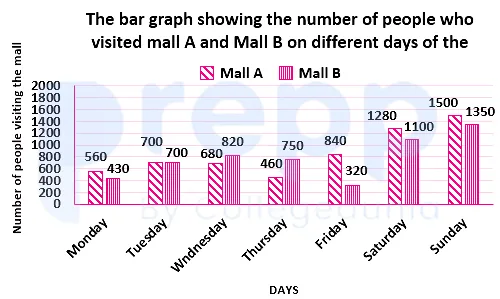
- A
80 ∶ 81
- B
27 ∶ 25
- C
81 ∶ 80
- D
25 ∶ 27
Show answer
C. 81 ∶ 80Given data:
Day
People visiting Mall A
People visiting Mall B
Monday
560
430
Tuesday
700
700
Wednesday
680
820
Thursday
460
750
Friday
840
320
Saturday
1280
1100
Sunday
1500
1350
Calculations:
Number of people visiting Mall A on Thursday, Saturday and Sunday = 460 + 1280 + 1500 = 3240
Number of people visiting Mall B on Thursday, Saturday and Sunday = 750 + 1100 + 1350 = 3200
Ratio = 3240 : 3200 = 81 : 80
∴ The ratio is 81 : 80.
Paper & answer key PDF ↗ Question 52archived
20 men can finish a work in 30 days. They started working, but 4 men left the work after 10 days. In how many days would the work be completed?
- A
25
- B
28
- C
35
- D
30
Show answer
C. 35Understanding the Work and Time Problem
This problem involves calculating the time taken to complete a work when the number of workers changes during the task. We will use the concept of 'man-days' to represent the total amount of work needed.
Calculating the Total Work
The problem states that 20 men can finish a work in 30 days. The total work can be calculated as the product of the number of men and the number of days they take to complete the work.
Total Work = Number of Men $\times$ Number of Days
Using the given information:
\(\text{Total work} = 20 \text{ men} \times 30 \text{ days} = 600 \text{ man-days}\)
So, the total amount of work required is equivalent to 600 man-days.
Calculating Work Done in the First 10 Days
20 men started working and continued for 10 days. We can calculate the work done during this period:
Work Done = Number of Men $\times$ Number of Days Worked
Using the given information:
\(\text{Work done in first 10 days} = 20 \text{ men} \times 10 \text{ days} = 200 \text{ man-days}\)
After 10 days, 200 man-days of work have been completed.
Calculating the Remaining Work
To find the remaining work, we subtract the work done from the total work.
Remaining Work = Total Work - Work Done in First 10 Days
\(\text{Remaining work} = 600 \text{ man-days} - 200 \text{ man-days} = 400 \text{ man-days}\)
400 man-days of work still need to be completed.
Calculating the Number of Remaining Men
After 10 days, 4 men left the work.
Remaining Men = Initial Number of Men - Number of Men who Left
\(\text{Remaining men} = 20 \text{ men} - 4 \text{ men} = 16 \text{ men}\)
Now, 16 men will continue to work on the remaining task.
Calculating the Time Needed for Remaining Work
The remaining work (400 man-days) will be completed by the remaining 16 men. To find the number of days needed, we divide the remaining work by the number of remaining men.
Days Needed for Remaining Work = Remaining Work / Remaining Men
\(\text{Days needed} = \frac{400 \text{ man-days}}{16 \text{ men}} = 25 \text{ days}\)
The remaining work will take 25 days for the 16 men to complete.
Calculating the Total Time to Complete the Work
The total time taken for the work to be completed is the sum of the initial days worked and the days needed for the remaining work.
Total Days = Initial Days Worked + Days Needed for Remaining Work
\(\text{Total days} = 10 \text{ days} + 25 \text{ days} = 35 \text{ days}\)
The work would be completed in a total of 35 days.
Step
Calculation
Result
Total Work
\(20 \text{ men} \times 30 \text{ days}\)
\(600 \text{ man-days}\)
Work done in first 10 days
\(20 \text{ men} \times 10 \text{ days}\)
\(200 \text{ man-days}\)
Remaining Work
\(600 - 200 \text{ man-days}\)
\(400 \text{ man-days}\)
Remaining Men
\(20 - 4 \text{ men}\)
\(16 \text{ men}\)
Days for Remaining Work
\(400 / 16 \text{ days}\)
\(25 \text{ days}\)
Total Days to Complete Work
\(10 + 25 \text{ days}\)
\(35 \text{ days}\)
Therefore, the work would be completed in 35 days.
Revision Table: Key Concepts in Work and Time
Concept
Description
Formula/Relation
Man-Days
A unit representing the total amount of work. It's the work one man does in one day.
Work = Number of Men $\times$ Number of Days
Work Rate (Efficiency)
The amount of work a person or group can do per unit of time. (Implicit in Man-days)
Higher rate means less time for the same work.
Inverse Proportion
Number of men is inversely proportional to the time taken to complete the same work (if efficiency is constant).
M$_{1}$D$_{1}$ = M$_{2}$D$_{2}$ (for the same work)
Remaining Work
The portion of work left to be completed after some part is finished.
Remaining Work = Total Work - Work Done
Additional Information on Work and Time Problems
Work and time problems are common in quantitative aptitude. They often involve calculating the time taken by individuals or groups to complete a task, sometimes with changes in the workforce or efficiency.
Basic principle: If a person can do a piece of work in \(n\) days, their one day's work is \(1/n\) of the total work.
If multiple people work together, their individual daily work contributions are added up to find the total daily work of the group.
Problems can involve varying efficiency, where one person works faster or slower than another.
Partial work completion before changes occur is a key aspect, as seen in this problem.
Units must be consistent (e.g., if work is in man-days, time is in days, and workers are men).
Solving these problems systematically by first calculating the total work, then work done, remaining work, and finally the time required for the remaining work with the new conditions helps avoid errors.
Paper & answer key PDF ↗ Question 53archived
Find the greatest 3-digit number which, when divided by 3, 4, 5 and 8, leaves remainder 2 in each case.
- A
962
- B
122
- C
958
- D
482
Show answer
A. 962Finding the Greatest 3-Digit Number with a Specific Remainder
The problem asks us to find the largest 3-digit number that, when divided by 3, 4, 5, and 8, always leaves a remainder of 2.
A number that leaves the same remainder 'r' when divided by several numbers (divisors) is of the form $\text{k} \times \text{LCM(divisors)} + \text{r}$.
In this case, the divisors are 3, 4, 5, and 8, and the remainder is 2. So, the required number must be of the form $\text{k} \times \text{LCM(3, 4, 5, 8)} + 2$, where $\text{k}$ is a whole number.
Calculating the Least Common Multiple (LCM)
First, we need to find the LCM of the divisors 3, 4, 5, and 8. We can do this by finding the prime factorization of each number:
3 = 3
4 = $2^2$
5 = 5
8 = $2^3$
The LCM is found by taking the highest power of all prime factors that appear in the factorizations:
$\text{LCM(3, 4, 5, 8)} = 2^3 \times 3^1 \times 5^1 = 8 \times 3 \times 5 = 120$
Formulating the Number and Finding the Greatest 3-Digit Value
The required numbers are of the form $120\text{k} + 2$. We are looking for the greatest 3-digit number of this form.
The greatest 3-digit number is 999.
We need to find the largest integer value of $\text{k}$ such that $120\text{k} + 2 \le 999$.
Subtract 2 from both sides:
$120\text{k} \le 999 - 2$
$120\text{k} \le 997$
Now, divide by 120:
$\text{k} \le \frac{997}{120}$
$\text{k} \le 8.308...$
Since $\text{k}$ must be an integer, the largest possible integer value for $\text{k}$ is 8.
Calculating the Specific Number
Now, substitute the largest integer value of $\text{k}$ (which is 8) back into the formula $120\text{k} + 2$:
Number = $120 \times 8 + 2$
Number = $960 + 2$
Number = $962$
Verification
Let's check if 962 is a 3-digit number (yes) and if it leaves a remainder of 2 when divided by 3, 4, 5, and 8:
$962 \div 3 = 320$ with remainder $962 - (320 \times 3) = 962 - 960 = 2$.
$962 \div 4 = 240$ with remainder $962 - (240 \times 4) = 962 - 960 = 2$.
$962 \div 5 = 192$ with remainder $962 - (192 \times 5) = 962 - 960 = 2$.
$962 \div 8 = 120$ with remainder $962 - (120 \times 8) = 962 - 960 = 2$.
The number 962 satisfies all the conditions and is the greatest 3-digit number of the form $120k + 2$.
Comparing with Options
Let's look at the given options:
Option
Number
1
962
2
122
3
958
4
482
Our calculated number, 962, matches Option 1.
Revision Table: LCM and Remainders
Concept
Description
LCM (Least Common Multiple)
The smallest positive integer that is a multiple of two or more numbers. Used when dealing with cycles or finding a number divisible by multiple numbers.
Remainder Theorem (Basic)
If a number N is divided by a divisor D, it can be written as N = Q $\times$ D + R, where Q is the quotient and R is the remainder ($0 \le$ R < D).
Numbers with Same Remainder
A number that leaves the same remainder 'r' when divided by numbers $d_1, d_2, ..., d_n$ is of the form $\text{k} \times \text{LCM}(d_1, d_2, ..., d_n) + \text{r}$.
Additional Information: Finding Numbers with Specific Remainders
Problems involving finding numbers that satisfy multiple division conditions often rely on the concept of the LCM. If a number leaves a remainder 'r' when divided by 'a', 'b', and 'c', it means the number can be written as $a\text{k}_1 + \text{r}$, $b\text{k}_2 + \text{r}$, and $c\text{k}_3 + \text{r}$ for some integers $\text{k}_1, \text{k}_2, \text{k}_3$. This implies that the number minus the remainder ($N - \text{r}$) is divisible by a, b, and c. Therefore, $N - \text{r}$ must be a multiple of $\text{LCM(a, b, c)}$.
So, the number $N$ is of the form $\text{m} \times \text{LCM(a, b, c)} + \text{r}$ for some integer m. To find the smallest such number, we typically use m=1 (if the result is positive and meets any digit requirements). To find the greatest number within a range (like greatest 3-digit number), we find the largest multiple of the LCM (plus the remainder) that fits within that range.
For example, to find the smallest number that leaves remainder 1 when divided by 6 and 9:
Find $\text{LCM(6, 9)}$. $6 = 2 \times 3$, $9 = 3^2$. $\text{LCM(6, 9)} = 2 \times 3^2 = 18$.
The numbers are of the form $18\text{k} + 1$.
For the smallest number, take $\text{k}=1$. Number = $18 \times 1 + 1 = 19$. (Note: For smallest *positive* number, if $18 \times 0 + 1 = 1$ is considered, check if it meets criteria). $1 \div 6$ gives remainder 1, $1 \div 9$ gives remainder 1. So 1 is the smallest. If *positive* numbers are implied, then 19 is the smallest positive number greater than the remainder. The context usually clarifies this.
Paper & answer key PDF ↗ Question 54archived
In a right-angled triangle, the lengths of the medians from the vertices of acute angles are 7 cm and \(4\sqrt 6 \) cm. What is the length of the hypotenuse of the triangle (in cm)?
- A
\(\frac{5}{2}\)√29
- B
2√29
- C
3.5 + 2√6
- D
√29
Show answer
B. 2√29Finding the Hypotenuse Length in a Right-Angled Triangle from Median Lengths
This problem asks us to find the length of the hypotenuse of a right-angled triangle given the lengths of the medians drawn from the vertices of the two acute angles. Let's denote the lengths of the legs of the right triangle as \(a\) and \(b\), and the length of the hypotenuse as \(c\).
In a right-angled triangle, the side opposite the right angle is the hypotenuse. The medians from the acute angles connect a vertex to the midpoint of the opposite side (which is a leg for one median and the hypotenuse for the other, but the problem states medians from acute angles, so they connect to the midpoints of the opposite legs). Let the lengths of the medians from the vertices of the acute angles be \(m_a\) and \(m_b\). Let \(a\) and \(b\) be the lengths of the sides opposite the acute angles A and B, respectively. These \(a\) and \(b\) are the legs of the right triangle. The hypotenuse is \(c\).
The formula for the square of the length of a median in a right-angled triangle from an acute angle vertex to the midpoint of the opposite leg is derived using the Pythagorean theorem. If \(m_a\) is the median from the vertex opposite side \(a\) (say vertex A) to the midpoint of side \(a\) (BC), and \(m_b\) is the median from the vertex opposite side \(b\) (say vertex B) to the midpoint of side \(b\) (AC), then:
The median from vertex A (opposite side \(a\)) connects to the midpoint of the leg BC (length \(a\)). The distance from the right angle vertex C to the midpoint of BC is \(a/2\). Using the Pythagorean theorem in the triangle formed by vertex A, the right angle vertex C, and the midpoint of BC: \(m_a^2 = AC^2 + (a/2)^2 = b^2 + \left(\frac{a}{2}\right)^2 = b^2 + \frac{a^2}{4}\).
The median from vertex B (opposite side \(b\)) connects to the midpoint of the leg AC (length \(b\)). The distance from the right angle vertex C to the midpoint of AC is \(b/2\). Using the Pythagorean theorem in the triangle formed by vertex B, the right angle vertex C, and the midpoint of AC: \(m_b^2 = BC^2 + (b/2)^2 = a^2 + \left(\frac{b}{2}\right)^2 = a^2 + \frac{b^2}{4}\).
We are given the lengths of the medians are 7 cm and \(4\sqrt{6}\) cm. Let's assume \(m_a = 7\) cm and \(m_b = 4\sqrt{6}\) cm.
Using the formulas above, we can write two equations:
\(m_a^2 = 7^2 = 49 = b^2 + \frac{a^2}{4}\)
\(m_b^2 = (4\sqrt{6})^2 = 16 \times 6 = 96 = a^2 + \frac{b^2}{4}\)
We have a system of two equations involving \(a^2\) and \(b^2\):
\(49 = b^2 + \frac{a^2}{4} \quad \cdots (1)\)
\(96 = a^2 + \frac{b^2}{4} \quad \cdots (2)\)
We want to find the length of the hypotenuse, \(c\). By the Pythagorean theorem, \(c^2 = a^2 + b^2\). We can solve the system of equations for \(a^2 + b^2\).
Let's add equation (1) and equation (2):
\(49 + 96 = \left(b^2 + \frac{a^2}{4}\right) + \left(a^2 + \frac{b^2}{4}\right)\)
\(145 = b^2 + a^2 + \frac{a^2}{4} + \frac{b^2}{4}\)
\(145 = (a^2 + b^2) + \frac{1}{4}(a^2 + b^2)\)
\(145 = (a^2 + b^2) \left(1 + \frac{1}{4}\right)\)
\(145 = (a^2 + b^2) \left(\frac{5}{4}\right)\)
Now, we can substitute \(c^2\) for \(a^2 + b^2\):
\(145 = c^2 \left(\frac{5}{4}\right)\)
Solve for \(c^2\):
\(c^2 = 145 \times \frac{4}{5}\)
\(c^2 = \frac{145 \times 4}{5}\)
Calculate the value:
\(145 \div 5 = 29\)
\(c^2 = 29 \times 4\)
\(c^2 = 116\)
Now, find the length of the hypotenuse \(c\) by taking the square root of \(c^2\):
\(c = \sqrt{116}\)
We can simplify the square root:
\(116 = 4 \times 29\)
\(c = \sqrt{4 \times 29} = \sqrt{4} \times \sqrt{29} = 2\sqrt{29}\)
The length of the hypotenuse is \(2\sqrt{29}\) cm.
Revision Table: Right Triangle Median Calculation
Concept
Formula
Application in this problem
Median from acute angle A (opposite leg \(a\))
\(m_a^2 = b^2 + (a/2)^2\)
\(7^2 = b^2 + a^2/4\)
Median from acute angle B (opposite leg \(b\))
\(m_b^2 = a^2 + (b/2)^2\)
\((4\sqrt{6})^2 = a^2 + b^2/4\)
Pythagorean Theorem
\(c^2 = a^2 + b^2\)
Used to find hypotenuse after finding \(a^2+b^2\)
Combined Median Property (Right Triangle)
\(m_a^2 + m_b^2 = \frac{5}{4}c^2\)
\(49 + 96 = 145 = \frac{5}{4}c^2\)
Additional Information: Properties of Medians in a Right Triangle
Besides the formulas for individual medians, there's a useful property relating the medians from the acute angles (\(m_a\) and \(m_b\)) and the median from the right angle (\(m_c\)) to the sides.
The median from the right angle vertex C to the hypotenuse AB has a length equal to half the length of the hypotenuse: \(m_c = c/2\). The midpoint of the hypotenuse is the circumcenter of the right triangle.
There is a specific relationship between the medians from the acute angles and the hypotenuse: \(m_a^2 + m_b^2 = \frac{5}{4}c^2\). We derived this property during our calculation by adding the two median square equations: \(m_a^2 = b^2 + a^2/4\) and \(m_b^2 = a^2 + b^2/4\). Summing them gives \(m_a^2 + m_b^2 = a^2 + b^2 + a^2/4 + b^2/4 = (a^2 + b^2) + \frac{1}{4}(a^2 + b^2)\). Since \(c^2 = a^2 + b^2\), this becomes \(m_a^2 + m_b^2 = c^2 + \frac{1}{4}c^2 = \frac{5}{4}c^2\). This property provides a quicker way to find the hypotenuse if the lengths of the medians from the acute angles are known.
Using this property directly with the given values: \(m_a = 7\) and \(m_b = 4\sqrt{6}\)
\(m_a^2 + m_b^2 = 7^2 + (4\sqrt{6})^2 = 49 + 96 = 145\)
According to the property: \(145 = \frac{5}{4}c^2\)
\(c^2 = 145 \times \frac{4}{5} = 116\)
\(c = \sqrt{116} = 2\sqrt{29}\)
This confirms the result obtained by solving the system of equations.
Paper & answer key PDF ↗ Question 55archived
If (x + y) 3- (x - y) 3- 3y(2x 2- 3y 2) = ky 3, then find the value of k.
- A
8
- B
11
- C
10
- D
10.5
Show answer
B. 11Algebraic Equation Solving: Finding the Value of k
The question asks us to find the value of $k$ in the given algebraic equation:
$$ (x + y)^3 - (x - y)^3 - 3y(2x^2 - 3y^2) = ky^3 $$
To solve this, we need to expand the terms on the left side of the equation and simplify it. We will use the standard formulas for cubic expansions:
The expansion of $(a + b)^3$ is $a^3 + 3a^2b + 3ab^2 + b^3$.
The expansion of $(a - b)^3$ is $a^3 - 3a^2b + 3ab^2 - b^3$.
Let's apply these formulas to the terms in our equation:
First term: $(x + y)^3$
Using the formula $(a + b)^3$ with $a = x$ and $b = y$, we get:
$$ (x + y)^3 = x^3 + 3x^2y + 3xy^2 + y^3 $$
Second term: $(x - y)^3$
Using the formula $(a - b)^3$ with $a = x$ and $b = y$, we get:
$$ (x - y)^3 = x^3 - 3x^2y + 3xy^2 - y^3 $$
Now, substitute these expanded forms back into the original equation:
$$ (x^3 + 3x^2y + 3xy^2 + y^3) - (x^3 - 3x^2y + 3xy^2 - y^3) - 3y(2x^2 - 3y^2) = ky^3 $$
Next, let's simplify the expression by removing the parentheses and combining like terms. Remember to distribute the negative sign for the second term:
$$ x^3 + 3x^2y + 3xy^2 + y^3 - x^3 + 3x^2y - 3xy^2 + y^3 - 3y(2x^2 - 3y^2) = ky^3 $$
Combine the terms involving $x^3$, $x^2y$, and $xy^2$ from the first two expansions:
$x^3 - x^3 = 0$
$3x^2y + 3x^2y = 6x^2y$
$3xy^2 - 3xy^2 = 0$
$y^3 + y^3 = 2y^3$
So, the first part simplifies to $6x^2y + 2y^3$. The equation now becomes:
$$ 6x^2y + 2y^3 - 3y(2x^2 - 3y^2) = ky^3 $$
Now, let's expand the third term, $-3y(2x^2 - 3y^2)$:
$$ -3y(2x^2 - 3y^2) = (-3y)(2x^2) + (-3y)(-3y^2) $$
$$ = -6x^2y + 9y^3 $$
Substitute this back into the equation:
$$ 6x^2y + 2y^3 + (-6x^2y + 9y^3) = ky^3 $$
Combine like terms on the left side:
$$ 6x^2y - 6x^2y + 2y^3 + 9y^3 = ky^3 $$
$$ 0 + 11y^3 = ky^3 $$
$$ 11y^3 = ky^3 $$
To find the value of $k$, we compare the coefficients of $y^3$ on both sides of the equation. Both sides have $y^3$, so their coefficients must be equal.
Comparing the coefficients, we have $11 = k$.
Thus, the value of $k$ is 11.
Let's quickly verify the steps and calculations:
Step
Expression/Calculation
Result
1
$(x+y)^3 - (x-y)^3$
$(x^3 + 3x^2y + 3xy^2 + y^3) - (x^3 - 3x^2y + 3xy^2 - y^3) = 6x^2y + 2y^3$
2
Expand $-3y(2x^2 - 3y^2)$
$-6x^2y + 9y^3$
3
Combine step 1 and step 2 results
$(6x^2y + 2y^3) + (-6x^2y + 9y^3) = 11y^3$
4
Equate to $ky^3$
$11y^3 = ky^3$
5
Compare coefficients of $y^3$
$k = 11$
The value of $k$ is 11.
Revision Table: Key Algebraic Expansions
Formula
Expansion
$(a+b)^2$
$a^2 + 2ab + b^2$
$(a-b)^2$
$a^2 - 2ab + b^2$
$(a+b)^3$
$a^3 + 3a^2b + 3ab^2 + b^3$
$(a-b)^3$
$a^3 - 3a^2b + 3ab^2 - b^3$
$a^2 - b^2$
$(a-b)(a+b)$
$a^3 + b^3$
$(a+b)(a^2 - ab + b^2)$
$a^3 - b^3$
$(a-b)(a^2 + ab + b^2)$
Additional Information: Polynomial Identity
The problem utilizes a form of polynomial identity derived from binomial expansions. The key identity used implicitly here is based on the difference of cubes, but simpler expansions are more direct:
$(x+y)^3 - (x-y)^3$ can also be seen as $(x^3 + 3x^2y + 3xy^2 + y^3) - (x^3 - 3x^2y + 3xy^2 - y^3)$.
This simplifies to $x^3 + 3x^2y + 3xy^2 + y^3 - x^3 + 3x^2y - 3xy^2 + y^3 = 6x^2y + 2y^3$.
The original equation becomes:
$(6x^2y + 2y^3) - 3y(2x^2 - 3y^2) = ky^3$
$6x^2y + 2y^3 - 6x^2y + 9y^3 = ky^3$
$(6x^2y - 6x^2y) + (2y^3 + 9y^3) = ky^3$
$0 + 11y^3 = ky^3$
$11y^3 = ky^3$
For this equality to hold for any general values of $x$ and $y$ (where $y \neq 0$), the coefficients of $y^3$ on both sides must be equal. Therefore, $k=11$. This confirms our result obtained through detailed expansion.
Paper & answer key PDF ↗ Question 56archived
What is the angle of elevation of the sun when the shadow of a 9-m high pole is \(3\sqrt 3 \) m long?
- A
45°
- B
90°
- C
60°
- D
30°
Show answer
C. 60°Understanding the Angle of Elevation Problem
This problem asks us to find the angle at which the sun's rays hit the ground, creating a shadow of a known length from a pole of a known height. This situation forms a right-angled triangle, where:
The height of the pole is one leg (opposite to the angle of elevation).
The length of the shadow is the other leg (adjacent to the angle of elevation).
The angle of elevation is the acute angle formed at the base of the pole (where the shadow ends) between the ground and the line of sight to the top of the pole.
Setting up the Trigonometric Relationship
In a right-angled triangle, the relationship between the opposite side, the adjacent side, and the angle is given by the tangent function. The formula is:
\(\tan(\theta) = \frac{\text{Opposite Side}}{\text{Adjacent Side}}\)
Where:
\(\theta\) is the angle of elevation we need to find.
The opposite side is the height of the pole, which is 9 m.
The adjacent side is the length of the shadow, which is \(3\sqrt 3 \) m.
Calculating the Angle of Elevation
Now, let's substitute the given values into the tangent formula:
\(\tan(\theta) = \frac{9 \text{ m}}{3\sqrt 3 \text{ m}}\)
We can simplify this expression:
\(\tan(\theta) = \frac{9}{3\sqrt 3}\)
First, divide the numerator and the denominator by 3:
\(\tan(\theta) = \frac{3}{\sqrt 3}\)
To make the denominator a rational number, we can multiply both the numerator and the denominator by \(\sqrt 3\):
\(\tan(\theta) = \frac{3}{\sqrt 3} \times \frac{\sqrt 3}{\sqrt 3}\)
\(\tan(\theta) = \frac{3\sqrt 3}{3}\)
Now, cancel out the 3 from the numerator and the denominator:
\(\tan(\theta) = \sqrt 3\)
We need to find the angle \(\theta\) whose tangent is \(\sqrt 3\). We recall the standard trigonometric values for common angles. The tangent of 60° is \(\sqrt 3\).
So,
\(\theta = \tan^{-1}(\sqrt 3)\)
\(\theta = 60^\circ\)
Therefore, the angle of elevation of the sun is 60°.
Summary of Steps
Here's a quick overview of the steps taken to find the angle of elevation:
Identify the height of the pole as the opposite side and the shadow length as the adjacent side in a right-angled triangle.
Recognize that the tangent function relates the opposite and adjacent sides to the angle of elevation.
Set up the equation \(\tan(\theta) = \frac{\text{Height of Pole}}{\text{Length of Shadow}}\).
Substitute the given values and simplify the expression for \(\tan(\theta)\).
Determine the angle \(\theta\) whose tangent is equal to the calculated value (\(\sqrt 3\)).
Revision Table: Key Trigonometric Ratios
Angle (\(\theta\))
\(\sin(\theta)\)
\(\cos(\theta)\)
\(\tan(\theta)\)
0°
0
1
0
30°
\(\frac{1}{2}\)
\(\frac{\sqrt 3}{2}\)
\(\frac{1}{\sqrt 3}\)
45°
\(\frac{1}{\sqrt 2}\)
\(\frac{1}{\sqrt 2}\)
1
60°
\(\frac{\sqrt 3}{2}\)
\(\frac{1}{2}\)
\(\sqrt 3\)
90°
1
0
Undefined
Additional Information: Angle of Elevation and Depression
The angle of elevation is the angle measured upwards from the horizontal line of sight to an object above the observer. In contrast, the angle of depression is the angle measured downwards from the horizontal line of sight to an object below the observer.
Both angles are crucial in trigonometry and are used extensively in surveying, navigation, physics, and engineering to solve problems involving heights, distances, and angles.
When dealing with problems like the height of a building or pole and its shadow, the angle of elevation of the sun is typically the angle formed at the ground level.
Paper & answer key PDF ↗ Question 57archived
Find the value of the following expression:
\(\frac{{1\frac{2}{3} \div \frac{5}{6} \times 6 + \frac{4}{5} \times \frac{1}{2} + \frac{2}{3}}}{{2 - \left[ {1\frac{1}{3} \times \left( { - \frac{3}{5}} \right) - 6\left\{ {\frac{3}{5} - \left( {3 - \frac{3}{{10}}} \right)} \right\}} \right]}}\)
- A
\({ - \frac{1}{{7}}}\)
- B
\({ \frac{4}{{3}}}\)
- C
\({ -\frac{4}{{3}}}\)
- D
\({ \frac{1}{{7}}}\)
Show answer
C. \({ -\frac{4}{{3}}}\)Evaluating Complex Mathematical Expressions
To find the value of the given expression, we need to evaluate the numerator and the denominator separately, following the order of operations (BODMAS/PEMDAS).
The expression is:
\(\frac{{1\frac{2}{3} \div \frac{5}{6} \times 6 + \frac{4}{5} \times \frac{1}{2} + \frac{2}{3}}}{{2 - \left[ {1\frac{1}{3} \times \left( { - \frac{3}{5}} \right) - 6\left\{ {\frac{3}{5} - \left( {3 - \frac{3}{{10}}} \right)} \right\}} \right]}}\)
Step 1: Evaluate the Numerator
The numerator is \(1\frac{2}{3} \div \frac{5}{6} \times 6 + \frac{4}{5} \times \frac{1}{2} + \frac{2}{3}\).
First, convert the mixed number to an improper fraction:
\(1\frac{2}{3} = \frac{1 \times 3 + 2}{3} = \frac{5}{3}\)
The numerator becomes \(\frac{5}{3} \div \frac{5}{6} \times 6 + \frac{4}{5} \times \frac{1}{2} + \frac{2}{3}\).
Next, perform division and multiplication from left to right:
\(\frac{5}{3} \div \frac{5}{6} = \frac{5}{3} \times \frac{6}{5} = \frac{5 \times 6}{3 \times 5} = \frac{30}{15} = 2\)
The expression is now \(2 \times 6 + \frac{4}{5} \times \frac{1}{2} + \frac{2}{3}\)
\(2 \times 6 = 12\)
\(\frac{4}{5} \times \frac{1}{2} = \frac{4 \times 1}{5 \times 2} = \frac{4}{10} = \frac{2}{5}\)
The numerator is now \(12 + \frac{2}{5} + \frac{2}{3}\).
Finally, add the fractions. Find a common denominator, which is 15.
\(12 = \frac{12 \times 15}{1 \times 15} = \frac{180}{15}\)
\(\frac{2}{5} = \frac{2 \times 3}{5 \times 3} = \frac{6}{15}\)
\(\frac{2}{3} = \frac{2 \times 5}{3 \times 5} = \frac{10}{15}\)
Numerator sum: \(\frac{180}{15} + \frac{6}{15} + \frac{10}{15} = \frac{180 + 6 + 10}{15} = \frac{196}{15}\).
So, the value of the numerator is \(\frac{196}{15}\).
Step 2: Evaluate the Denominator
The denominator is \(2 - \left[ {1\frac{1}{3} \times \left( { - \frac{3}{5}} \right) - 6\left\{ {\frac{3}{5} - \left( {3 - \frac{3}{{10}}} \right)} \right\}} \right]\).
Convert the mixed number:
\(1\frac{1}{3} = \frac{1 \times 3 + 1}{3} = \frac{4}{3}\)
The expression becomes \(2 - \left[ \frac{4}{3} \times \left( - \frac{3}{5} \right) - 6\left\{ \frac{3}{5} - \left( 3 - \frac{3}{10} \right) \right\} \right]\).
Work from the innermost parentheses:
\(\left( 3 - \frac{3}{10} \right) = \frac{3 \times 10}{10} - \frac{3}{10} = \frac{30}{10} - \frac{3}{10} = \frac{27}{10}\)
The expression is now \(2 - \left[ \frac{4}{3} \times \left( - \frac{3}{5} \right) - 6\left\{ \frac{3}{5} - \frac{27}{10} \right\} \right]\).
Evaluate the expression inside the braces \(\left\{...\right\}\):
\(\left\{ \frac{3}{5} - \frac{27}{10} \right\} = \frac{3 \times 2}{5 \times 2} - \frac{27}{10} = \frac{6}{10} - \frac{27}{10} = \frac{6 - 27}{10} = \frac{-21}{10}\)
The expression is now \(2 - \left[ \frac{4}{3} \times \left( - \frac{3}{5} \right) - 6 \times \left( \frac{-21}{10} \right) \right]\).
Evaluate the expression inside the brackets \(\left[...\right]\). Perform multiplication first:
\(\frac{4}{3} \times \left( - \frac{3}{5} \right) = - \frac{4 \times 3}{3 \times 5} = - \frac{12}{15} = - \frac{4}{5}\)
\(- 6 \times \left( \frac{-21}{10} \right) = - \frac{6}{1} \times \frac{-21}{10} = \frac{-6 \times -21}{10} = \frac{126}{10} = \frac{63}{5}\)
The expression inside the brackets is now \(-\frac{4}{5} + \frac{63}{5}\).
\(-\frac{4}{5} + \frac{63}{5} = \frac{-4 + 63}{5} = \frac{59}{5}\)
The expression is now \(2 - \left[ \frac{59}{5} \right]\).
Finally, perform the subtraction:
\(2 - \frac{59}{5} = \frac{2 \times 5}{5} - \frac{59}{5} = \frac{10}{5} - \frac{59}{5} = \frac{10 - 59}{5} = \frac{-49}{5}\)
So, the value of the denominator is \(\frac{-49}{5}\).
Step 3: Divide the Numerator by the Denominator
The value of the expression is \(\frac{\text{Numerator}}{\text{Denominator}} = \frac{\frac{196}{15}}{\frac{-49}{5}}\).
Dividing by a fraction is the same as multiplying by its reciprocal:
\(\frac{196}{15} \div \frac{-49}{5} = \frac{196}{15} \times \frac{5}{-49}\)
We can simplify before multiplying. Notice that \(196 = 4 \times 49\) and \(15 = 3 \times 5\):
\(\frac{4 \times 49}{3 \times 5} \times \frac{5}{-49} = \frac{4 \times \cancel{49}}{3 \times \cancel{5}} \times \frac{\cancel{5}}{-\cancel{49}} = \frac{4}{3} \times \frac{1}{-1} = \frac{4}{-3} = -\frac{4}{3}\)
The value of the expression is \(-\frac{4}{3}\).
Component
Value
Calculation
Numerator
\(\frac{196}{15}\)
\(1\frac{2}{3} \div \frac{5}{6} \times 6 + \frac{4}{5} \times \frac{1}{2} + \frac{2}{3} = \frac{5}{3} \div \frac{5}{6} \times 6 + \frac{2}{5} + \frac{2}{3} = 2 \times 6 + \frac{2}{5} + \frac{2}{3} = 12 + \frac{2}{5} + \frac{2}{3} = \frac{180+6+10}{15} = \frac{196}{15}\)
Denominator
\(-\frac{49}{5}\)
\(2 - \left[ {1\frac{1}{3} \times \left( { - \frac{3}{5}} \right) - 6\left\{ {\frac{3}{5} - \left( {3 - \frac{3}{{10}}} \right)} \right\}} \right] = 2 - \left[ \frac{4}{3} \times \left( - \frac{3}{5} \right) - 6\left\{ \frac{3}{5} - \frac{27}{10} \right\} \right] = 2 - \left[ - \frac{4}{5} - 6\left( - \frac{21}{10} \right) \right] = 2 - \left[ - \frac{4}{5} + \frac{63}{5} \right] = 2 - \frac{59}{5} = \frac{10-59}{5} = - \frac{49}{5}\)
Final Result
\(-\frac{4}{3}\)
\(\frac{196/15}{-49/5} = \frac{196}{15} \times \frac{5}{-49} = \frac{4 \times 49}{3 \times 5} \times \frac{5}{-49} = -\frac{4}{3}\)
Conclusion on Expression Value
The value of the given complex mathematical expression is \(-\frac{4}{3}\).
Revision Table: Order of Operations
The order of operations is crucial for correctly evaluating mathematical expressions like this one. It is commonly remembered using acronyms like BODMAS or PEMDAS.
Acronym
Order
Explanation
BODMAS
Brackets
Evaluate expressions inside brackets (parentheses, braces, square brackets) first.
Orders
Evaluate powers (indices, exponents) or roots.
Division and Multiplication
Perform division and multiplication from left to right.
Addition and Subtraction
Perform addition and subtraction from left to right.
PEMDAS
Parentheses
Evaluate expressions inside parentheses, brackets, or braces first.
Exponents
Evaluate exponents (powers, indices) or roots.
Multiplication and Division
Perform multiplication and division from left to right.
Addition and Subtraction
Perform addition and subtraction from left to right.
In the given problem, we followed this order by evaluating the innermost parentheses first, then the braces, then the brackets, performing multiplication and division before addition and subtraction.
Additional Information on Fractions and Mixed Numbers
Understanding how to work with fractions and mixed numbers is fundamental for solving complex expressions.
Improper Fractions: A fraction where the numerator is greater than or equal to the denominator (e.g., \(\frac{5}{3}\)).
Mixed Numbers: A combination of a whole number and a proper fraction (e.g., \(1\frac{2}{3}\)).
Converting Mixed to Improper: Multiply the whole number by the denominator and add the numerator. Place the result over the original denominator. For \(1\frac{2}{3}\), it is \((1 \times 3 + 2)/3 = 5/3\).
Dividing Fractions: To divide by a fraction, multiply by its reciprocal. The reciprocal of \(\frac{a}{b}\) is \(\frac{b}{a}\). So, \(\frac{a}{b} \div \frac{c}{d} = \frac{a}{b} \times \frac{d}{c}\).
Multiplying Fractions: Multiply the numerators together and multiply the denominators together. \(\frac{a}{b} \times \frac{c}{d} = \frac{a \times c}{b \times d}\).
Adding/Subtracting Fractions: Find a common denominator, convert the fractions, then add or subtract the numerators.
Paper & answer key PDF ↗ Question 58archived
If cot 2 α + tan 2 α = 2, 0° ≤ α ≤ 90°, then find the value of α
- A
90°
- B
60°
- C
45°
- D
0°
Show answer
C. 45°Solving the Trigonometric Equation
We are given the trigonometric equation: $\cot 2\alpha + \tan 2\alpha = 2$, with the condition $0^\circ \le \alpha \le 90^\circ$. We need to find the value of $\alpha$ that satisfies this equation within the given range.
Let's consider a general trigonometric equation of the form $\tan x + \cot x = 2$. We can rewrite this equation using the identity $\cot x = \frac{1}{\tan x}$.
So, the equation becomes:
$\tan x + \frac{1}{\tan x} = 2$
To solve for $\tan x$, we can multiply the entire equation by $\tan x$, assuming $\tan x \ne 0$.
$\tan x \cdot (\tan x + \frac{1}{\tan x}) = 2 \cdot \tan x$
$\tan^2 x + 1 = 2 \tan x$
Now, rearrange the terms to form a quadratic equation in terms of $\tan x$:
$\tan^2 x - 2 \tan x + 1 = 0$
This is a perfect square trinomial, which can be factored as:
$(\tan x - 1)^2 = 0$
Taking the square root of both sides gives:
$\tan x - 1 = 0$
Solving for $\tan x$:
$\tan x = 1$
Now, we need to relate this back to the original problem involving $\alpha$. The provided answer is $45^\circ$. If $\alpha = 45^\circ$, then $\tan \alpha = \tan 45^\circ = 1$. This matches the result $\tan x = 1$ from solving $\tan x + \cot x = 2$. This suggests that the relationship $x = \alpha$ is relevant to finding the answer from the given options.
We need to find the value of $\alpha$ in the range $0^\circ \le \alpha \le 90^\circ$ such that $\tan \alpha = 1$.
The angle $\alpha$ in the first quadrant where $\tan \alpha = 1$ is $45^\circ$.
For the given range $0^\circ \le \alpha \le 90^\circ$, the only value of $\alpha$ that satisfies $\tan \alpha = 1$ is $\alpha = 45^\circ$.
Let's verify if $\alpha = 45^\circ$ fits the condition $0^\circ \le \alpha \le 90^\circ$. Yes, $45^\circ$ is within this range.
Step-by-Step Solution
Start with the given equation: $\cot 2\alpha + \tan 2\alpha = 2$.
Recognize the form $\tan x + \cot x = 2$.
Rewrite $\cot x$ as $\frac{1}{\tan x}$: $\tan x + \frac{1}{\tan x} = 2$.
Solve for $\tan x$: $\tan^2 x + 1 = 2 \tan x \implies \tan^2 x - 2 \tan x + 1 = 0 \implies (\tan x - 1)^2 = 0 \implies \tan x = 1$.
Based on the options, identify the angle $\alpha$ in the range $0^\circ \le \alpha \le 90^\circ$ for which $\tan \alpha = 1$.
The angle is $\alpha = 45^\circ$.
Comparing with Options
Let's look at the options provided:
$90^\circ$
$60^\circ$
$45^\circ$
$0^\circ$
Our calculated value $\alpha = 45^\circ$ matches one of the options.
Angle $\alpha$
$2\alpha$
$\cot 2\alpha$
$\tan 2\alpha$
$\cot 2\alpha + \tan 2\alpha$
Does it equal 2?
$0^\circ$
$0^\circ$
Undefined
$0$
Undefined
No
$45^\circ$
$90^\circ$
$0$
Undefined
Undefined
No
$60^\circ$
$120^\circ$
$-\frac{1}{\sqrt{3}}$
$-\sqrt{3}$
$-\frac{4}{\sqrt{3}}$
No
$90^\circ$
$180^\circ$
Undefined
$0$
Undefined
No
Note: Evaluating $\cot 2\alpha + \tan 2\alpha$ directly for the option $\alpha = 45^\circ$ where $2\alpha=90^\circ$ results in undefined terms. However, the derivation from $\tan x + \cot x = 2$ leading to $\tan x = 1$ suggests a context where the equation holds, and finding the corresponding angle $\alpha$ such that $\tan \alpha = 1$ provides the answer from the options.
Revision Table: Key Trigonometric Values
Angle ($\theta$)
$\tan(\theta)$
$\cot(\theta)$
$0^\circ$
$0$
Undefined
$30^\circ$
$\frac{1}{\sqrt{3}}$
$\sqrt{3}$
$45^\circ$
$1$
$1$
$60^\circ$
$\sqrt{3}$
$\frac{1}{\sqrt{3}}$
$90^\circ$
Undefined
$0$
Additional Information on Trigonometric Identities
The relationship between tangent and cotangent is a fundamental identity. $\cot x = \frac{1}{\tan x}$ (provided $\tan x \ne 0$).
Other important identities include:
$\sin^2 \theta + \cos^2 \theta = 1$
$\sec^2 \theta - \tan^2 \theta = 1$
$\csc^2 \theta - \cot^2 \theta = 1$
$\tan \theta = \frac{\sin \theta}{\cos \theta}$
$\cot \theta = \frac{\cos \theta}{\sin \theta}$
Solving trigonometric equations often involves using these identities to simplify the equation and express it in terms of a single trigonometric function, if possible. Quadratic equations involving trigonometric functions can be solved by factoring or using the quadratic formula, treating the trigonometric function (like $\tan x$ or $\sin x$) as the variable.
Paper & answer key PDF ↗ Question 59archived
A shopkeeper bought 60 pencils at a rate of 4 for Rs. 5 and another 60 pencils at a rate of 2 for Rs. 3. He mixed all the pencils and sold them at a rate of 3 for Rs. 4. Find his gain or loss percentage.
- A
Profit \(3\frac{1}{8}\% \)
- B
Loss \(2\frac{7}{8}\% \)
- C
Loss \(3\frac{1}{33}\% \)
- D
Profit \(2\frac{7}{8}\% \)
Show answer
C. Loss \(3\frac{1}{33}\% \)Understanding the Problem: Calculating Profit or Loss Percentage
The problem involves a shopkeeper buying pencils at two different rates, mixing them, and then selling the entire lot at a single rate. We need to find if the shopkeeper made a gain (profit) or a loss, and calculate the percentage of this gain or loss.
Step-by-Step Calculation of Cost Price (CP)
The shopkeeper bought two batches of pencils. We need to calculate the cost price for each batch and then the total cost price.
Batch 1:
Number of pencils bought: 60
Rate: 4 pencils for Rs. 5
This means the cost of 4 pencils is Rs. 5. To find the cost of one pencil, we divide the cost by the number of pencils:
Cost of 1 pencil in Batch 1 \( = \frac{5}{4} \) Rs.
Now, we calculate the cost of 60 pencils in Batch 1:
Cost of 60 pencils \( = 60 \times \frac{5}{4} = 15 \times 5 = 75 \) Rs.
So, the cost price of the first 60 pencils is Rs. 75.
Batch 2:
Number of pencils bought: 60
Rate: 2 pencils for Rs. 3
This means the cost of 2 pencils is Rs. 3. To find the cost of one pencil in this batch:
Cost of 1 pencil in Batch 2 \( = \frac{3}{2} \) Rs.
Now, we calculate the cost of 60 pencils in Batch 2:
Cost of 60 pencils \( = 60 \times \frac{3}{2} = 30 \times 3 = 90 \) Rs.
So, the cost price of the second 60 pencils is Rs. 90.
Total Cost Price:
The total number of pencils is \( 60 + 60 = 120 \). The total cost price (CP) is the sum of the costs of the two batches:
Total CP \( = \) Cost of Batch 1 \( + \) Cost of Batch 2
Total CP \( = 75 + 90 = 165 \) Rs.
The total cost price for 120 pencils is Rs. 165.
Calculating Selling Price (SP)
The shopkeeper mixed all 120 pencils and sold them at a rate of 3 for Rs. 4.
Total number of pencils sold: 120
Rate: 3 pencils for Rs. 4
This means the selling price of 3 pencils is Rs. 4. To find the selling price of one pencil:
Selling Price of 1 pencil \( = \frac{4}{3} \) Rs.
Now, we calculate the selling price of all 120 pencils:
Total SP \( = 120 \times \frac{4}{3} = 40 \times 4 = 160 \) Rs.
The total selling price for 120 pencils is Rs. 160.
Determining Gain or Loss
We compare the Total Cost Price (CP) and Total Selling Price (SP):
Total CP = Rs. 165
Total SP = Rs. 160
Since the Total SP (Rs. 160) is less than the Total CP (Rs. 165), the shopkeeper incurred a loss.
Loss \( = \) Total CP \( - \) Total SP
Loss \( = 165 - 160 = 5 \) Rs.
The shopkeeper had a loss of Rs. 5.
Calculating Loss Percentage
The loss percentage is calculated with respect to the cost price using the formula:
Loss Percentage \( = \left( \frac{\text{Loss}}{\text{CP}} \right) \times 100\% \)
Loss Percentage \( = \left( \frac{5}{165} \right) \times 100\% \)
Simplify the fraction \( \frac{5}{165} \). Both numbers are divisible by 5:
\( \frac{5}{165} = \frac{5 \div 5}{165 \div 5} = \frac{1}{33} \)
Now, substitute this back into the percentage formula:
Loss Percentage \( = \frac{1}{33} \times 100\% = \frac{100}{33} \% \)
To express this as a mixed fraction, divide 100 by 33:
100 divided by 33 is 3 (since \( 33 \times 3 = 99 \)).
The remainder is \( 100 - 99 = 1 \).
So, \( \frac{100}{33} \) as a mixed fraction is \( 3 \frac{1}{33} \).
Therefore, the loss percentage is \( 3 \frac{1}{33}\% \).
Summary of Calculations
Cost of first 60 pencils: Rs. 75
Cost of second 60 pencils: Rs. 90
Total Cost Price (120 pencils): Rs. \(75 + 90 = 165\)
Selling Price (120 pencils): Rs. 160
Loss: Rs. \(165 - 160 = 5\)
Loss Percentage: \( \frac{5}{165} \times 100\% = \frac{1}{33} \times 100\% = \frac{100}{33}\% = 3\frac{1}{33}\% \)
The shopkeeper incurred a loss of \(3\frac{1}{33}\) %.
Item
Quantity
Rate
Total Cost/Selling Price
Pencils (Batch 1)
60
4 for Rs 5
\(60 \times \frac{5}{4} = 75\) Rs (CP)
Pencils (Batch 2)
60
2 for Rs 3
\(60 \times \frac{3}{2} = 90\) Rs (CP)
Total Pencils
120
-
\(75 + 90 = 165\) Rs (Total CP)
Pencils Sold
120
3 for Rs 4
\(120 \times \frac{4}{3} = 160\) Rs (Total SP)
Comparing Total CP (Rs 165) and Total SP (Rs 160), we find a Loss of Rs \(165 - 160 = 5\).
Loss Percentage \( = \left( \frac{5}{165} \right) \times 100\% = \frac{100}{33}\% = 3\frac{1}{33}\% \).
Revision Table: Key Concepts in Profit and Loss
Concept
Definition
Formula
Cost Price (CP)
The price at which an article is bought.
-
Selling Price (SP)
The price at which an article is sold.
-
Profit (Gain)
When SP > CP.
Profit = SP - CP
Loss
When SP < CP.
Loss = CP - SP
Profit Percentage
Profit expressed as a percentage of CP.
\( \left( \frac{\text{Profit}}{\text{CP}} \right) \times 100\% \)
Loss Percentage
Loss expressed as a percentage of CP.
\( \left( \frac{\text{Loss}}{\text{CP}} \right) \times 100\% \)
Additional Information: Calculating Profit or Loss with Different Rates
When items are bought or sold in batches at different rates, it's crucial to calculate the total cost price and the total selling price for the entire quantity involved before determining the overall profit or loss. Simply averaging the rates might lead to an incorrect answer.
In this problem, we first found the cost of 1 pencil for each batch based on the given rates. Then, we scaled that up to find the cost of 60 pencils in each batch. Summing these gave us the total cost. Similarly, for selling, we found the selling price of 1 pencil based on the selling rate and scaled it up for the total number of pencils sold. Comparing the total cost price and total selling price allowed us to find the net outcome (profit or loss) and calculate the percentage relative to the total cost price.
Paper & answer key PDF ↗ Question 60archived
The given histogram represents the marks of students in Mathematics test of a certain class.
The total number of students is 350 and the maximum marks of the test are 200.
Study the graph and answer the question that follows.
The total number of students whose marks are less than 100 is what percentage (correct up to one place of decimal) less than the total number of students whose marks are 120 and above?
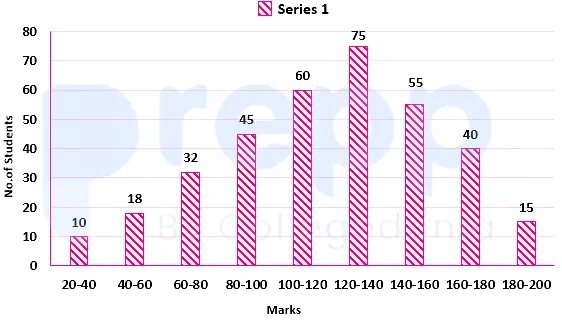
- A
36.6%
- B
43.2%
- C
51.8%
- D
32.7%
Show answer
B. 43.2%Calculations:
Students with marks less than 100 = 10 + 18 + 32 + 45 = 105
Students with marks 120 and above = 75 + 55 + 40 + 15 = 185
Difference = 185 - 105 = 80
Difference % = \(80\over 185\) × 100 = 43.2%
∴ The answer is 43.2%.
Paper & answer key PDF ↗ Question 61archived
In a triangle ABC, the bisector of angle BAC meets BC at point D such that DC = 2BD. If AC - AB = 5 cm, then find the length of AB (in cm).
- A
5
- B
7
- C
10
- D
12
Show answer
A. 5Solving Triangle Side Lengths using Angle Bisector Theorem
The problem asks us to find the length of side AB in a triangle ABC, given that the angle bisector of angle BAC meets side BC at point D, with the condition DC = 2BD, and the difference between the lengths of sides AC and AB is 5 cm (AC - AB = 5 cm).
Understanding the Angle Bisector Theorem
The Angle Bisector Theorem is a key concept here. It states that if a line segment bisects an angle of a triangle and meets the opposite side, then it divides the opposite side into two segments that are proportional to the other two sides of the triangle.
In triangle ABC, if AD is the angle bisector of ∠BAC, where D is a point on BC, the theorem states:
\[ \frac{AB}{AC} = \frac{BD}{DC} \]
Applying the Theorem and Given Information
We are given two conditions:
DC = 2BD
AC - AB = 5 cm
Let's use the first condition, DC = 2BD. We can write this as a ratio:
\[ \frac{BD}{DC} = \frac{BD}{2BD} = \frac{1}{2} \]
Now, let's use the second condition, AC - AB = 5 cm. We want to find the length of AB. Let's denote the length of AB as \(x\). Then, from AC - AB = 5, we have AC - \(x\) = 5, which means AC = \(x + 5\).
Setting up the Equation
According to the Angle Bisector Theorem, we have:
\[ \frac{AB}{AC} = \frac{BD}{DC} \]
Substitute the values and expressions we found:
AB = \(x\)
AC = \(x + 5\)
\( \frac{BD}{DC} = \frac{1}{2} \)
So, the equation becomes:
\[ \frac{x}{x+5} = \frac{1}{2} \]
Solving for the Length of AB
Now we need to solve this equation for \(x\):
Cross-multiply: \(2 \times x = 1 \times (x+5)\)
Simplify: \(2x = x + 5\)
Subtract \(x\) from both sides: \(2x - x = 5\)
Result: \(x = 5\)
Since \(x\) represents the length of AB, we have found that AB = 5 cm.
Verification
If AB = 5 cm, then AC = AB + 5 cm = 5 + 5 = 10 cm.
Using the Angle Bisector Theorem ratio: \( \frac{AB}{AC} = \frac{5}{10} = \frac{1}{2} \)
This matches the given condition \( \frac{BD}{DC} = \frac{1}{2} \) (since DC = 2BD). Thus, the calculated length for AB is consistent with all given conditions.
The length of AB is 5 cm.
Given Information
Interpretation/Result
AD bisects ∠BAC
Applies Angle Bisector Theorem: \( \frac{AB}{AC} = \frac{BD}{DC} \)
DC = 2BD
\( \frac{BD}{DC} = \frac{1}{2} \)
AC - AB = 5 cm
Let AB = \(x\), then AC = \(x+5\)
Equation from Theorem
\( \frac{x}{x+5} = \frac{1}{2} \)
Solving for \(x\)
\(x = 5\)
Length of AB
5 cm
Revision Table: Key Concepts for Triangle Problems
Concept
Description
Relevance to Problem
Angle Bisector
A line segment that divides an angle into two equal angles.
AD is the angle bisector of ∠BAC.
Angle Bisector Theorem
Ratio of sides adjacent to bisected angle equals ratio of segments on opposite side.
The fundamental theorem used: \( \frac{AB}{AC} = \frac{BD}{DC} \).
Algebraic Equations
Equations involving variables, solved to find unknown values.
Used to solve for the length of AB (our variable \(x\)).
Additional Information: Properties of Triangle Angle Bisectors
An angle bisector divides the opposite side into segments proportional to the other two sides.
The point where the three angle bisectors of a triangle meet is called the incenter. The incenter is the center of the inscribed circle of the triangle.
The distance from the incenter to each side of the triangle is equal.
Understanding these properties helps in solving various geometry problems involving triangles and angle bisectors.
Paper & answer key PDF ↗ Question 62archived
The following bar graph shows receipts and expenditure by a business firm over 5 years. Gain = Receipts - Expenditure.
In which year did the company gain the maximum amount?
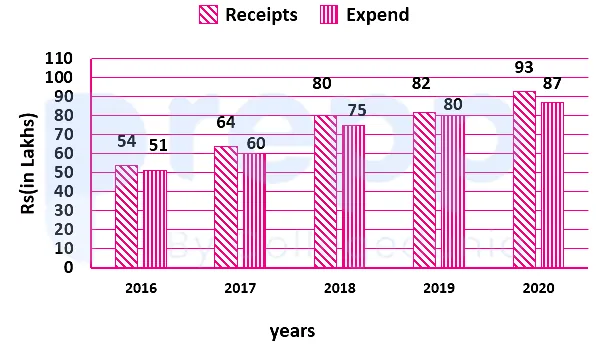
- A
2020
- B
2017
- C
2018
- D
2016
Show answer
A. 2020Given data:
Year
Receipts
Expenditure
2016
54
51
2017
64
60
2018
80
75
2019
82
80
2020
93
87
Formula used:
Gains = Receipts - Expenditure
Calculation:
Year
Receipts
Expenditure
Gains
2016
54
51
54 - 51 = 3
2017
64
60
64 - 60 = 4
2018
80
75
80 - 75 = 5
2019
82
80
82 - 80 = 2
2020
93
87
93 - 87 = 6
∴ In the year 2020, the company gained the maximum amount.
Paper & answer key PDF ↗ Question 63archived
Akhil rides first 12 km at a speed of 16 km/h and further 6 km at a speed of 20 km/h. Find his average speed (in km/h).
- A
\(16\frac{4}{5}\)
- B
\(18\frac{1}{5}\)
- C
\(17\frac{1}{2}\)
- D
\(17\frac{1}{7}\)
Show answer
D. \(17\frac{1}{7}\)Calculating Average Speed for a Journey in Parts
The question asks us to find the average speed of Akhil's journey, which is covered in two distinct parts with different speeds.
Average speed is defined as the total distance covered divided by the total time taken for the journey.
Let's break down the journey into two parts:
Part 1 of the Journey
Distance covered (\(d_1\)): 12 km
Speed during this part (\(v_1\)): 16 km/h
To find the time taken for this part (\(t_1\)), we use the formula: Time = Distance / Speed.
So, \(t_1 = \frac{d_1}{v_1} = \frac{12 \text{ km}}{16 \text{ km/h}}\)
Simplifying the fraction:
\(t_1 = \frac{12}{16} = \frac{3}{4}\) hours
Part 2 of the Journey
Distance covered (\(d_2\)): 6 km
Speed during this part (\(v_2\)): 20 km/h
To find the time taken for this part (\(t_2\)), we use the same formula:
\(t_2 = \frac{d_2}{v_2} = \frac{6 \text{ km}}{20 \text{ km/h}}\)
Simplifying the fraction:
\(t_2 = \frac{6}{20} = \frac{3}{10}\) hours
Calculating Total Distance and Total Time
The total distance (\(D\)) for the entire journey is the sum of the distances of the two parts:
\(D = d_1 + d_2 = 12 \text{ km} + 6 \text{ km} = 18 \text{ km}\)
The total time (\(T\)) for the entire journey is the sum of the times taken for the two parts:
\(T = t_1 + t_2 = \frac{3}{4} \text{ hours} + \frac{3}{10} \text{ hours}\)
To add these fractions, we need a common denominator. The least common multiple (LCM) of 4 and 10 is 20.
\(T = \frac{3 \times 5}{4 \times 5} + \frac{3 \times 2}{10 \times 2} = \frac{15}{20} + \frac{6}{20}\)
\(T = \frac{15 + 6}{20} = \frac{21}{20}\) hours
Calculating Average Speed
Now we can calculate the average speed using the total distance and total time:
Average Speed = \(\frac{\text{Total Distance}}{\text{Total Time}} = \frac{D}{T}\)
Average Speed = \(\frac{18 \text{ km}}{\frac{21}{20} \text{ hours}}\)
To divide by a fraction, we multiply by its reciprocal:
Average Speed = \(18 \times \frac{20}{21} \text{ km/h}\)
We can simplify this by dividing 18 and 21 by their common factor, 3:
Average Speed = \(\frac{18 \div 3}{21 \div 3} \times 20 = \frac{6}{7} \times 20\)
Average Speed = \(\frac{6 \times 20}{7} = \frac{120}{7}\) km/h
Converting to a Mixed Number
The question asks for the answer in km/h, and the options are given as mixed numbers. Let's convert \(\frac{120}{7}\) to a mixed number.
Divide 120 by 7:
\(120 \div 7\)
\(120 = 17 \times 7 + 1\)
So, \(\frac{120}{7} = 17 \frac{1}{7}\) km/h.
The average speed of Akhil is \(17\frac{1}{7}\) km/h.
Revision Table: Speed, Distance, Time Formulas
Concept
Formula
Speed
Speed = Distance / Time
Distance
Distance = Speed × Time
Time
Time = Distance / Speed
Average Speed
Average Speed = Total Distance / Total Time
Additional Information: Why Average Speed Isn't Just the Average of Speeds
It's important to note that average speed is not simply the average of the speeds (i.e., \(\frac{16 + 20}{2} = 18\)). This is because Akhil spends different amounts of time traveling at each speed. Average speed accounts for both the distance covered and the time taken at each segment of the journey. The formula Total Distance / Total Time correctly weights the speeds by the duration they were maintained.
Paper & answer key PDF ↗ Question 64archived
What is the compound interest (in Rs.) at the rate of 10%, compounded annually, for 3 years on the principal which in 8 years at the rate of 12% per annum gives Rs. 4,800 as simple interest?
- A
1,655
- B
1,505
- C
1,455
- D
2,045
Show answer
A. 1,655Understanding the Problem
The question asks us to calculate the compound interest (CI) for a specific principal amount over 3 years at a 10% annual rate. However, the principal is not given directly. Instead, we are told that this principal earns Rs. 4,800 as simple interest (SI) over 8 years at a 12% annual rate. Therefore, the first step is to find this principal amount using the simple interest information, and then use this principal to calculate the compound interest.
Step 1: Finding the Principal using Simple Interest
We are given the simple interest earned, the rate of interest, and the time period. The formula for simple interest is:
\(\text{SI} = \frac{P \times R \times T}{100}\)
Where:
\(\text{SI}\) = Simple Interest
\(P\) = Principal amount
\(R\) = Rate of interest per annum
\(T\) = Time period in years
From the question, we have:
\(\text{SI} = \text{Rs. } 4,800\)
\(R = 12\%\) per annum
\(T = 8\) years
We need to find the Principal (\(P\)). Let's plug the given values into the formula:
\(4800 = \frac{P \times 12 \times 8}{100}\)
Now, let's solve for \(P\):
\(4800 \times 100 = P \times (12 \times 8)\)
\(480000 = P \times 96\)
\(P = \frac{480000}{96}\)
\(P = 5000\)
So, the principal amount is Rs. 5,000.
Step 2: Calculating Compound Interest
Now that we have the principal amount (Rs. 5,000), we can calculate the compound interest. We are given:
Principal (\(P\)) = Rs. 5,000
Rate of interest (\(R\)) = 10% per annum
Time period (\(T\)) = 3 years
Compounding: Annually
The formula for the amount (\(A\)) under compound interest compounded annually is:
\(A = P \left(1 + \frac{R}{100}\right)^T\)
Let's plug in the values:
\(A = 5000 \left(1 + \frac{10}{100}\right)^3\)
\(A = 5000 \left(1 + 0.1\right)^3\)
\(A = 5000 \left(1.1\right)^3\)
\(A = 5000 \times 1.331\)
\(A = 6655\)
The amount after 3 years is Rs. 6,655.
The compound interest (\(\text{CI}\)) is the difference between the amount and the principal:
\(\text{CI} = A - P\)
\(\text{CI} = 6655 - 5000\)
\(\text{CI} = 1655\)
Final Answer
The compound interest at the rate of 10%, compounded annually, for 3 years on the principal of Rs. 5,000 is Rs. 1,655.
Revision Table: Simple vs. Compound Interest
Feature
Simple Interest (SI)
Compound Interest (CI)
Calculation Basis
Only on the original principal amount.
On the principal amount plus accumulated interest from previous periods.
Interest Growth
Linear growth.
Exponential growth (interest earns interest).
Formula (Annual)
\(\text{SI} = \frac{P \times R \times T}{100}\)
\(A = P \left(1 + \frac{R}{100}\right)^T\)
\(\text{CI} = A - P\)
Earnings Over Time
Constant amount of interest earned each period.
Increasing amount of interest earned each period.
Additional Information: Interest Calculations
Interest is a key concept in finance, representing the cost of borrowing money or the return on an investment. Simple interest and compound interest are the two primary ways to calculate interest.
Simple Interest: Simple interest is the easiest to calculate. It is always based on the initial principal amount. This type of interest is often used for short-term loans or basic calculations.
Compound Interest: Compound interest is more complex because the interest earned in each period is added to the principal, and the next period's interest is calculated on this new, larger amount. This effect is often referred to as "interest on interest" and leads to faster growth of money over time, especially over longer periods. The frequency of compounding (annually, semi-annually, quarterly, monthly, daily) significantly impacts the total compound interest earned. More frequent compounding results in higher interest.
Understanding the difference between simple and compound interest is crucial for evaluating loans, investments, and savings plans. Compound interest is often seen in savings accounts, fixed deposits, and most loan products like mortgages and personal loans.
Paper & answer key PDF ↗ Question 65archived
Two successive discounts of 20% and 25% on the marked price of an article are equal to a single discount of Rs. 250. If the marked price of the article is 25% above the cost price, the cost price (in Rs.) of the article is:
- A
450
- B
550
- C
500
- D
600
Show answer
C. 500The correct answer is 500.
Final Selling Price = 80 - 20 = Rs. The total discount is the initial price minus the final price: 100 - 60 = Rs. The equivalent single discount percentage is $\frac{\text{Total Discount}}{\text{Initial Price}} \times 100 = \frac{40}{100} \times 100 = 40\%$. This confirms the formula used in the solution and illustrates why adding successive discount percentages directly is incorrect.
Paper & answer key PDF ↗ Question 66archived
Simplify the following expression:
\(\frac{{\cos A}}{{1 - \tan A}} + \frac{{\sin A}}{{1 - \cot A}} - \sin A\)
- A
(1 + sin A) cos A
- B
1 + cos A
- C
1 + sin A
- D
cos A
Show answer
D. cos ASimplifying the Trigonometric Expression
We are asked to simplify the given trigonometric expression:
\(\frac{{\cos A}}{{1 - \tan A}} + \frac{{\sin A}}{{1 - \cot A}} - \sin A\)
To simplify this expression, we will convert \(\tan A\) and \(\cot A\) into their equivalent forms in terms of \(\sin A\) and \(\cos A\).
Step-by-Step Simplification Process
The fundamental identities we will use are:
\(\tan A = \frac{{\sin A}}{{\cos A}}\)
\(\cot A = \frac{{\cos A}}{{\sin A}}\)
Substitute these identities into the expression:
\(\frac{{\cos A}}{{1 - \frac{{\sin A}}{{\cos A}}}} + \frac{{\sin A}}{{1 - \frac{{\cos A}}{{\sin A}}}} - \sin A\)
Now, simplify the denominators of the fractions:
\(\frac{{\cos A}}{{\frac{{\cos A - \sin A}}{{\cos A}}}} + \frac{{\sin A}}{{\frac{{\sin A - \cos A}}{{\sin A}}}} - \sin A\)
Invert the denominators and multiply:
\(\cos A \cdot \frac{{\cos A}}{{\cos A - \sin A}} + \sin A \cdot \frac{{\sin A}}{{\sin A - \cos A}} - \sin A\)
This gives us:
\(\frac{{\cos^2 A}}{{\cos A - \sin A}} + \frac{{\sin^2 A}}{{\sin A - \cos A}} - \sin A\)
Notice that the denominators are \(\cos A - \sin A\) and \(\sin A - \cos A\). We can write \(\sin A - \cos A\) as \( - (\cos A - \sin A)\) to get a common denominator:
\(\frac{{\cos^2 A}}{{\cos A - \sin A}} + \frac{{\sin^2 A}}{{ - (\cos A - \sin A)}} - \sin A\)
\(\frac{{\cos^2 A}}{{\cos A - \sin A}} - \frac{{\sin^2 A}}{{\cos A - \sin A}} - \sin A\)
Combine the fractions with the common denominator:
\(\frac{{\cos^2 A - \sin^2 A}}{{\cos A - \sin A}} - \sin A\)
Recall the difference of squares identity: \(a^2 - b^2 = (a - b)(a + b)\). Apply this to the numerator, where \(a = \cos A\) and \(b = \sin A\):
\(\frac{{(\cos A - \sin A)(\cos A + \sin A)}}{{\cos A - \sin A}} - \sin A\)
Assuming \(\cos A - \sin A \neq 0\), we can cancel the term \((\cos A - \sin A)\) from the numerator and the denominator:
\((\cos A + \sin A) - \sin A\)
Finally, simplify the expression:
\(\cos A + \sin A - \sin A\)
\(\cos A\)
Understanding Key Trigonometric Identities
Simplifying trigonometric expressions often relies on knowing and applying fundamental identities. The identities used here are crucial:
Tangent in terms of Sine and Cosine: \(\tan A = \frac{{\sin A}}{{\cos A}}\)
Cotangent in terms of Sine and Cosine: \(\cot A = \frac{{\cos A}}{{\sin A}}\)
Relationship between Tan and Cot: \(\cot A = \frac{1}{{\tan A}}\)
Difference of Squares: \(\cos^2 A - \sin^2 A = (\cos A - \sin A)(\cos A + \sin A)\)
Recognizing how to manipulate terms, like changing the sign of a denominator (\(\sin A - \cos A = -(\cos A - \sin A)\)), is also a key skill in trigonometric simplification.
Original Term
Transformation
Result
\(\frac{{\cos A}}{{1 - \tan A}}\)
Substitute \(\tan A\), simplify denominator, invert & multiply
\(\frac{{\cos^2 A}}{{\cos A - \sin A}}\)
\(\frac{{\sin A}}{{1 - \cot A}}\)
Substitute \(\cot A\), simplify denominator, invert & multiply, factor out -1
\(\frac{{\sin^2 A}}{{ - (\cos A - \sin A)}}\)
Combine Fractions
Use common denominator \(\cos A - \sin A\)
\(\frac{{\cos^2 A - \sin^2 A}}{{\cos A - \sin A}}\)
Simplify Numerator
Use difference of squares identity
\((\cos A - \sin A)(\cos A + \sin A)\)
Final Simplification
Cancel terms and subtract \(\sin A\)
\(\cos A\)
Revision Table - Trigonometric Identities for Simplification
Identity
Formula
Notes
Reciprocal Identity
\(\tan A = \frac{1}{{\cot A}}\), \(\cot A = \frac{1}{{\tan A}}\)
Useful for converting between tan and cot.
Quotient Identities
\(\tan A = \frac{{\sin A}}{{\cos A}}\), \(\cot A = \frac{{\cos A}}{{\sin A}}\)
Essential for expressing tan and cot in terms of sin and cos.
Pythagorean Identities
\(\sin^2 A + \cos^2 A = 1\)
\(1 + \tan^2 A = \sec^2 A\)
\(1 + \cot^2 A = \csc^2 A\)
Often used to simplify squares of trigonometric functions.
Difference of Squares
\(a^2 - b^2 = (a - b)(a + b)\)
A general algebraic identity frequently used in trigonometry, e.g., \(\cos^2 A - \sin^2 A\).
Additional Information - Conditions for Validity
When simplifying expressions involving fractions, we assume that the denominators are not zero. In this case, for the initial expression to be defined, we must have:
\(1 - \tan A \neq 0 \implies \tan A \neq 1\)
\(1 - \cot A \neq 0 \implies \cot A \neq 1\)
\(\cos A \neq 0\) (from \(\tan A = \sin A / \cos A\))
\(\sin A \neq 0\) (from \(\cot A = \cos A / \sin A\))
Additionally, during the simplification step where we cancelled \((\cos A - \sin A)\), we assumed that \(\cos A - \sin A \neq 0\), i.e., \(\cos A \neq \sin A\).
If any of these conditions are not met, the original expression might be undefined, or the simplification steps involving division might not be valid. However, the question asks for simplification, which typically implies finding the equivalent form where the expression is defined.
The final simplified expression is \(\cos A\).
Paper & answer key PDF ↗ Question 67archived
The average of twelve numbers is 42. The average of the last five numbers is 40, and that of the first four numbers is 44. The sixth number is 6 less than the fifth number and 5 less than the seventh number. The average of the sixth and seventh numbers is:
- A
43.5
- B
45.5
- C
44.5
- D
41.5
Show answer
D. 41.5Calculating Averages and Finding Unknown Numbers
This problem involves understanding the concept of average and using given information to find specific unknown numbers within a series. We are given the average of a group of numbers and the averages of subgroups. We also have relationships between certain numbers. We need to find the average of two specific numbers from the group.
Understanding the Concept of Average
The average (or mean) of a set of numbers is calculated by dividing the sum of all the numbers by the total count of numbers. Mathematically, the formula is:
\( \text{Average} = \frac{\text{Sum of numbers}}{\text{Total count of numbers}} \)
From this, we can also find the sum if we know the average and the count:
\( \text{Sum of numbers} = \text{Average} \times \text{Total count of numbers} \)
Step-by-Step Calculation
Step 1: Calculate the Total Sum of Twelve Numbers
We are given that the average of twelve numbers is 42.
Total number of terms = 12
Average of twelve numbers = 42
Sum of twelve numbers = Average \(\times\) Total number of terms
Sum of twelve numbers = \(42 \times 12\)
Sum of twelve numbers = 504
Step 2: Calculate the Sum of the First Four Numbers
The average of the first four numbers is 44.
Number of terms in the first group = 4
Average of the first four numbers = 44
Sum of the first four numbers = Average \(\times\) Number of terms
Sum of the first four numbers = \(44 \times 4\)
Sum of the first four numbers = 176
Step 3: Calculate the Sum of the Last Five Numbers
The average of the last five numbers is 40.
Number of terms in the last group = 5
Average of the last five numbers = 40
Sum of the last five numbers = Average \(\times\) Number of terms
Sum of the last five numbers = \(40 \times 5\)
Sum of the last five numbers = 200
Step 4: Find the Sum of the Remaining Numbers
The twelve numbers can be divided into three groups: the first four numbers, the next three numbers (the fifth, sixth, and seventh), and the last five numbers.
Sum of all twelve numbers = (Sum of first 4) + (Sum of 5th, 6th, and 7th) + (Sum of last 5)
We know the sum of all twelve numbers, the sum of the first four, and the sum of the last five. We can find the sum of the fifth, sixth, and seventh numbers.
Sum of 5th, 6th, and 7th numbers = Sum of twelve numbers - (Sum of first 4) - (Sum of last 5)
Sum of 5th, 6th, and 7th numbers = \(504 - 176 - 200\)
Sum of 5th, 6th, and 7th numbers = \(504 - 376\)
Sum of 5th, 6th, and 7th numbers = 128
Step 5: Use the Relationships Between the Fifth, Sixth, and Seventh Numbers
Let the sixth number be \(x\).
The sixth number is 6 less than the fifth number:
\(x = \text{Fifth number} - 6\)
So, the fifth number is \(x + 6\).
The sixth number is 5 less than the seventh number:
\(x = \text{Seventh number} - 5\)
So, the seventh number is \(x + 5\).
Step 6: Solve for the Sixth Number
The sum of the fifth, sixth, and seventh numbers is 128. We can write this sum using our expressions in terms of \(x\):
\(\text{Fifth number} + \text{Sixth number} + \text{Seventh number} = 128\)
\((x + 6) + x + (x + 5) = 128\)
Combine like terms:
\(3x + 11 = 128\)
Subtract 11 from both sides:
\(3x = 128 - 11\)
\(3x = 117\)
Divide by 3:
\(x = \frac{117}{3}\)
\(x = 39\)
So, the sixth number is 39.
Step 7: Find the Fifth and Seventh Numbers
Using the relationships we found:
Fifth number = \(x + 6 = 39 + 6 = 45\)
Seventh number = \(x + 5 = 39 + 5 = 44\)
Let's quickly check if their sum is 128: \(45 + 39 + 44 = 84 + 44 = 128\). This is correct.
Step 8: Calculate the Average of the Sixth and Seventh Numbers
We need to find the average of the sixth number (39) and the seventh number (44).
Sum of the sixth and seventh numbers = \(39 + 44 = 83\)
Number of terms = 2
Average of the sixth and seventh numbers = \(\frac{\text{Sum of sixth and seventh numbers}}{\text{Number of terms}}\)
Average of the sixth and seventh numbers = \(\frac{83}{2}\)
Average of the sixth and seventh numbers = 41.5
Group of Numbers
Count
Average
Sum
First four
4
44
\(44 \times 4 = 176\)
Fifth, Sixth, Seventh
3
-
\(504 - 176 - 200 = 128\)
Last five
5
40
\(40 \times 5 = 200\)
All twelve
12
42
\(42 \times 12 = 504\)
Number
Expression in terms of \(x\)
Calculated Value
Fifth
\(x + 6\)
\(39 + 6 = 45\)
Sixth (\(x\))
\(x\)
39
Seventh
\(x + 5\)
\(39 + 5 = 44\)
The average of the sixth and seventh numbers is 41.5.
Revision Table - Key Concepts in Average Calculation
Concept
Formula/Description
Application in Problem
Definition of Average
Sum / Count
Used to find sums from given averages.
Sum from Average
Average \(\times\) Count
Calculated total sum and subgroup sums.
Sum of Combined Groups
Sum\(_{Total}\) = Sum\(_{Group1}\) + Sum\(_{Group2}\) + ...
Used to isolate the sum of the middle three numbers.
Algebraic Representation
Using variables for unknown values
Represented 5th, 6th, and 7th numbers with respect to \(x\).
Solving Linear Equations
Isolating the variable
Solved for \(x\) (the sixth number).
Additional Information - Working with Averages
Problems involving averages often require breaking down the total group into smaller subgroups. The key is understanding that the sum of the numbers in the whole group is equal to the sum of the sums of the subgroups. When individual numbers or relationships between numbers are given, algebraic methods using variables become useful to solve for the unknown values.
Always start by calculating the sums based on the given averages. This converts information about averages into information about sums, which is easier to work with.
If there are unknown numbers, especially with relationships given (like "6 less than" or "5 more than"), assign a variable (like \(x\)) to one of them and express the others in terms of that variable.
Set up an equation using the sums you've calculated. Often, the sum of the unknown numbers can be found by subtracting the sums of the known subgroups from the total sum.
Solve the equation to find the value of the variable.
Once you have the value of the variable, find the values of the other unknown numbers using the relationships you defined.
Finally, perform the calculation requested in the question using the numbers you found.
This structured approach helps manage the different pieces of information provided in average problems.
Paper & answer key PDF ↗ Question 68archived
If a + b + c = 11 and ab + bc + ca = 28, then find the value of a 3+ b 3+ c 3- 3abc.
- A
1093
- B
407
- C
1639
- D
2255
Show answer
B. 407Understanding the Problem: Finding the Value of an Algebraic Expression
The question asks us to find the value of the expression \( a^3 + b^3 + c^3 - 3abc \) given the values of two other expressions involving \( a \), \( b \), and \( c \): \( a + b + c = 11 \) and \( ab + bc + ca = 28 \). This problem involves using fundamental algebraic identities.
Key Algebraic Identity
The expression \( a^3 + b^3 + c^3 - 3abc \) is related to \( (a+b+c) \) and \( (a^2+b^2+c^2 - ab - bc - ca) \) through a well-known identity:
\( a^3 + b^3 + c^3 - 3abc = (a+b+c)(a^2 + b^2 + c^2 - ab - bc - ca) \)
Alternatively, the second factor can be written as \( (a^2 + b^2 + c^2) - (ab + bc + ca) \).
Finding \( a^2 + b^2 + c^2 \)
We are given \( a+b+c \) and \( ab+bc+ca \), but the identity requires the term \( a^2 + b^2 + c^2 \). We can find this term using another identity:
\( (a+b+c)^2 = a^2 + b^2 + c^2 + 2(ab+bc+ca) \)
Rearranging this identity to solve for \( a^2 + b^2 + c^2 \), we get:
\( a^2 + b^2 + c^2 = (a+b+c)^2 - 2(ab+bc+ca) \)
Step-by-Step Calculation
Now, let's substitute the given values into the formulas.
Given:
\( a+b+c = 11 \)
\( ab+bc+ca = 28 \)
Step 1: Calculate \( a^2 + b^2 + c^2 \)
Using the identity \( a^2 + b^2 + c^2 = (a+b+c)^2 - 2(ab+bc+ca) \):
\( a^2 + b^2 + c^2 = (11)^2 - 2(28) \)
\( a^2 + b^2 + c^2 = 121 - 56 \)
\( a^2 + b^2 + c^2 = 65 \)
Step 2: Calculate \( a^2 + b^2 + c^2 - ab - bc - ca \)
This is the second factor in the main identity. We have calculated \( a^2 + b^2 + c^2 = 65 \) and we are given \( ab+bc+ca = 28 \). So:
\( a^2 + b^2 + c^2 - ab - bc - ca = 65 - 28 \)
\( a^2 + b^2 + c^2 - ab - bc - ca = 37 \)
Step 3: Calculate \( a^3 + b^3 + c^3 - 3abc \)
Using the main identity \( a^3 + b^3 + c^3 - 3abc = (a+b+c)(a^2 + b^2 + c^2 - ab - bc - ca) \):
Substitute the values:
\( a^3 + b^3 + c^3 - 3abc = (11)(37) \)
Now, multiply 11 by 37:
\( 11 \times 37 = 407 \)
So, the value of \( a^3 + b^3 + c^3 - 3abc \) is 407.
Summary of Calculations
Expression
Value
Calculation / Given
\( a+b+c \)
11
Given
\( ab+bc+ca \)
28
Given
\( a^2+b^2+c^2 \)
65
\( (a+b+c)^2 - 2(ab+bc+ca) = 11^2 - 2(28) = 121 - 56 \)
\( a^2+b^2+c^2 - (ab+bc+ca) \)
37
\( (a^2+b^2+c^2) - (ab+bc+ca) = 65 - 28 \)
\( a^3+b^3+c^3 - 3abc \)
407
\( (a+b+c)(a^2+b^2+c^2 - ab - bc - ca) = 11 \times 37 \)
The calculated value is 407.
Revision Table: Key Algebraic Identities
Identity
Formula
Use Case
Square of Sum of Three Terms
\( (a+b+c)^2 = a^2 + b^2 + c^2 + 2ab + 2bc + 2ca \)
Relates the sum of terms to the sum of squares and sum of pairwise products.
Sum of Cubes minus 3abc
\( a^3 + b^3 + c^3 - 3abc = (a+b+c)(a^2 + b^2 + c^2 - ab - bc - ca) \)
Used to factor or evaluate the sum of cubes expression.
Alternative form of Sum of Cubes Identity
\( a^3 + b^3 + c^3 - 3abc = \frac{1}{2}(a+b+c)((a-b)^2 + (b-c)^2 + (c-a)^2) \)
Useful when differences of terms are known or need to be highlighted. Note that \( (a-b)^2 + (b-c)^2 + (c-a)^2 = 2(a^2+b^2+c^2 - ab - bc - ca) \).
Additional Information: When \( a+b+c = 0 \)
A special case of the identity \( a^3 + b^3 + c^3 - 3abc = (a+b+c)(a^2 + b^2 + c^2 - ab - bc - ca) \) occurs when \( a+b+c = 0 \). In this situation, the first factor on the right-hand side is zero, which means the entire product is zero.
So, if \( a+b+c = 0 \), then \( a^3 + b^3 + c^3 - 3abc = 0 \), which implies \( a^3 + b^3 + c^3 = 3abc \).
This is a very useful shortcut identity often used in algebraic problems. For example, if you have to find the sum of cubes of three numbers whose sum is zero, their sum of cubes is simply three times their product.
Paper & answer key PDF ↗ Question 69archived
AB is a chord of a circle with centre O. C is a point on the circumference of the circle in the minor sector. If ∠ABO = 40°, what is the measure (in degree) of ∠ACB?
- A
110°
- B
120°
- C
130°
- D
100°
Show answer
C. 130°Finding Angle ∠ACB in a Circle
The problem asks us to find the measure of angle ∠ACB in a circle, given that AB is a chord, O is the center, C is a point on the circumference in the minor sector, and ∠ABO = 40°.
Step-by-Step Solution for Circle Angles
Let's break down the problem using properties of circles and triangles.
Consider triangle ▵OAB. OA and OB are both radii of the same circle. Therefore, ▵OAB is an isosceles triangle with OA = OB.
In an isosceles triangle, the angles opposite the equal sides are equal. So, ∠OAB = ∠OBA.
We are given that ∠ABO = ∠OBA = 40°. Thus, ∠OAB = 40°.
Now, we can find the angle ∠AOB, which is the angle subtended by the chord AB at the center O. The sum of angles in a triangle is 180°. In ▵OAB:
$\angle AOB + \angle OAB + \angle OBA = 180^\circ$
$\angle AOB + 40^\circ + 40^\circ = 180^\circ$
$\angle AOB + 80^\circ = 180^\circ$
$\angle AOB = 180^\circ - 80^\circ = 100^\circ$
This angle, ∠AOB = 100°, is the angle subtended by the minor arc AB at the center.
The point C is located on the circumference in the minor sector. This means C is on the major arc of the circle relative to the chord AB. The angle ∠ACB is the angle subtended by the major arc AB at the circumference.
The angle subtended by an arc at the center is double the angle subtended by the same arc at any point on the remaining part of the circle (the circumference).
The angle subtended by the major arc AB at the center is the reflex angle ∠AOB. The reflex angle is $360^\circ$ minus the angle ∠AOB we calculated.
Reflex ∠AOB = $360^\circ - \angle AOB = 360^\circ - 100^\circ = 260^\circ$.
The angle ∠ACB subtended by the major arc AB at the circumference is half the reflex angle ∠AOB.
$\angle ACB = \frac{1}{2} \times \text{Reflex } \angle AOB$
$\angle ACB = \frac{1}{2} \times 260^\circ = 130^\circ$
Alternatively, we can consider the point C being in the minor sector implies that the angle ∠ACB is subtended by the major arc AB. Let D be any point on the major arc AB. Then ∠ADB would be the angle subtended by the minor arc AB at the circumference. The angle ∠ADB is half the angle subtended by the minor arc AB at the center.
$\angle ADB = \frac{1}{2} \angle AOB = \frac{1}{2} \times 100^\circ = 50^\circ$.
Since ADBC is a cyclic quadrilateral (all its vertices lie on the circle), opposite angles are supplementary. Therefore, ∠ACB + ∠ADB = 180°.
$\angle ACB + 50^\circ = 180^\circ$
$\angle ACB = 180^\circ - 50^\circ = 130^\circ$.
Both methods yield the same result, confirming the measure of ∠ACB.
Understanding Circle Geometry Concepts
This problem utilizes fundamental theorems in circle geometry:
Radii of the same circle are equal, forming isosceles triangles with chords.
The angle subtended by an arc at the center is double the angle subtended by the same arc at any point on the remaining part of the circle.
Opposite angles of a cyclic quadrilateral are supplementary (sum to 180°).
Angle
Measure
Reason
∠ABO
$40^\circ$
Given
∠OAB
$40^\circ$
▵OAB is isosceles (OA=OB)
∠AOB (minor)
$100^\circ$
Angles in ▵OAB sum to 180°
Reflex ∠AOB
$260^\circ$
$360^\circ - 100^\circ$
∠ACB
$130^\circ$
Angle at circumference = $\frac{1}{2}$ Angle at center (using major arc)
The final answer is the measure of ∠ACB, which is 130°.
Revision Table: Key Circle Theorems
Theorem
Description
Relation to Problem
Angles in Isosceles Triangle
Angles opposite equal sides are equal.
Used for ▵OAB to find ∠OAB.
Angle at Center vs. Circumference
Angle at center is double the angle at circumference subtended by the same arc.
Used to relate ∠AOB and ∠ACB (via reflex angle or supplementary angles).
Cyclic Quadrilateral Property
Opposite angles sum to $180^\circ$.
Alternative method to find ∠ACB using a point on the major arc.
Additional Information on Circle Geometry
Circle geometry deals with the properties of points, lines, and angles associated with circles. Understanding these concepts is crucial for solving geometry problems.
Chord: A line segment connecting two points on the circumference of a circle. AB is a chord in this problem.
Arc: A part of the circumference of a circle. AB defines two arcs: a minor arc and a major arc.
Sector: A region bounded by two radii and an arc. The minor sector is bounded by OA, OB, and the minor arc AB. The major sector is bounded by OA, OB, and the major arc AB. C is in the minor sector, meaning it's on the circumference corresponding to the major arc.
Angle Subtended: The angle formed by lines from two points on the circle meeting at another point (either the center or on the circumference). ∠AOB is subtended at the center, ∠ACB is subtended at the circumference.
Being able to distinguish between angles subtended by the minor arc and the major arc is key, especially when a point like C is specified as being in the minor (or major) sector, which dictates which arc subtends the required angle at that point on the circumference.
Paper & answer key PDF ↗ Question 70archived
Find the value of k such that the number k53206k is divisible by 6.
- A
1
- B
7
- C
4
- D
2
Show answer
C. 4Finding the Value of k for Divisibility by 6
The problem asks us to find the value of the digit 'k' in the number k53206k such that the entire number is divisible by 6.
To solve this, we need to use the divisibility rules for 6.
Understanding Divisibility by 6
A number is divisible by 6 if and only if it is divisible by both 2 and 3.
Divisibility by 2: A number is divisible by 2 if its last digit is an even number (0, 2, 4, 6, or 8).
Divisibility by 3: A number is divisible by 3 if the sum of its digits is divisible by 3.
Applying the Rules to k53206k
The number is k53206k. The digit 'k' appears at the beginning (ten lakhs place, assuming it's a 7-digit number and k is not 0, or hundred thousands place if it's a 6-digit number and k is not 0) and at the end (units place).
Step 1: Apply Divisibility Rule for 2
For the number k53206k to be divisible by 2, its last digit, which is 'k', must be an even digit. The possible even digits are 0, 2, 4, 6, and 8.
Since 'k' is also the first digit, it cannot be 0 if the number is truly represented as k53206k (meaning 'k' is the most significant digit). However, the problem simply asks for the value of 'k' in the structure k53206k, and 0 is a valid digit. Let's consider both possibilities for now, but primarily focus on k being an even digit.
Possible values for k based on divisibility by 2: k $\in$ {0, 2, 4, 6, 8}.
Step 2: Apply Divisibility Rule for 3
For the number k53206k to be divisible by 3, the sum of its digits must be divisible by 3.
The sum of the digits is: k + 5 + 3 + 2 + 0 + 6 + k = 16 + 2k.
We need to find the value(s) of k from the possible even digits (0, 2, 4, 6, 8) such that 16 + 2k is divisible by 3.
Step 3: Test Possible Even Values for k
Let's substitute the possible even values of k into the sum of digits (16 + 2k) and check for divisibility by 3:
If k = 0: Sum = $16 + 2(0) = 16$. Is 16 divisible by 3? No.
If k = 2: Sum = $16 + 2(2) = 16 + 4 = 20$. Is 20 divisible by 3? No.
If k = 4: Sum = $16 + 2(4) = 16 + 8 = 24$. Is 24 divisible by 3? Yes, $24 \div 3 = 8$.
If k = 6: Sum = $16 + 2(6) = 16 + 12 = 28$. Is 28 divisible by 3? No.
If k = 8: Sum = $16 + 2(8) = 16 + 16 = 32$. Is 32 divisible by 3? No.
From this test, the only even value of k that makes the sum of digits divisible by 3 is k = 4.
Step 4: Verify the Solution
When k = 4, the number is 4532064.
Last digit is 4 (even), so it is divisible by 2.
Sum of digits is $4 + 5 + 3 + 2 + 0 + 6 + 4 = 24$. 24 is divisible by 3.
Since the number 4532064 is divisible by both 2 and 3, it is divisible by 6.
Now, let's check the given options:
Option 1: k = 1. Number 1532061. Last digit 1 (odd), not divisible by 2.
Option 2: k = 7. Number 7532067. Last digit 7 (odd), not divisible by 2.
Option 3: k = 4. Number 4532064. Last digit 4 (even), divisible by 2. Sum of digits 24, divisible by 3. Divisible by 6.
Option 4: k = 2. Number 2532062. Last digit 2 (even), divisible by 2. Sum of digits 20, not divisible by 3.
Based on the analysis, the value of k that makes the number k53206k divisible by 6 is 4.
Summary of k values and divisibility checks
k
Number
Last Digit (Divisible by 2?)
Sum of Digits (16 + 2k)
Sum Divisible by 3?
Divisible by 6?
0
532060
0 (Yes)
16
No
No
1 (Option)
1532061
1 (No)
18
Yes
No
2 (Option)
2532062
2 (Yes)
20
No
No
4 (Option)
4532064
4 (Yes)
24
Yes
Yes
6
6532066
6 (Yes)
28
No
No
7 (Option)
7532067
7 (No)
30
Yes
No
8
8532068
8 (Yes)
32
No
No
Revision Table - Number Divisibility Rules
Key Divisibility Rules
Divisible By
Rule
2
The last digit is even (0, 2, 4, 6, 8).
3
The sum of the digits is divisible by 3.
6
The number is divisible by both 2 and 3.
Additional Information - Properties of Divisibility
Divisibility rules are shortcuts to determine if one number can be perfectly divided by another without performing the actual division. Understanding these rules is fundamental in number theory and helps simplify problems involving factors and multiples.
A number is divisible by a composite number (like 6) if and only if it is divisible by each of its coprime factors (the coprime factors of 6 are 2 and 3).
The sum of digits rule for divisibility by 3 works because any power of 10, when divided by 3, leaves a remainder of 1. For example, $10 \div 3 = 3$ R 1, $100 \div 3 = 33$ R 1, $1000 \div 3 = 333$ R 1. Therefore, $10^n \equiv 1 \pmod{3}$ for any non-negative integer n. This property extends to divisibility by 9 as well.
Divisibility rules for other numbers like 4, 5, 8, 9, 10, 11, etc., also exist and are useful in various mathematical contexts.
Paper & answer key PDF ↗ Question 71archived
A and B entered into a partnership with certain investments. At the end of 8 months, A withdrew and collected back his money. A and B received profit in the ratio 5 ∶ 9 at the end of the year. If B had invested Rs. 36,000, then how much (in Rs.) had A invested?
- A
36,000
- B
30,000
- C
25,000
- D
20,000
Show answer
B. 30,000Given data:
Profit ratio = 5 : 9
B's investment = 36,000 rupees
The time for which B invested = 12
The time for which A invested = 8
Used formula:
Total profit = Investment × Time
Calculation:
A's total investment = A × 8
B's total investment = 36,000 × 12 = 432,000
Ratio = 8A : 432,000
⇒ \(8A \over 432,000\) = \(5\over 9\)
⇒ A = \(432,000\times 5\over 72\) = 30,000 rupees
∴A's total investment is 30,000 rupees.
Paper & answer key PDF ↗ Question 72archived
Performance of 1800 students in grades has been shown in the following pie chart.
How many students have got either grade D or grade E?
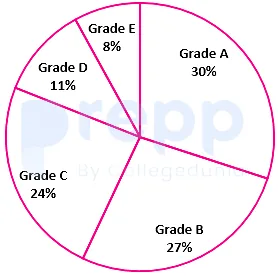
- A
359
- B
352
- C
342
- D
345
Show answer
C. 342Given data:
Students with either Grade D or Grade E = 11 + 8 = 19%
Total students = 1800
Calculation:
Total students with either Grade D or Grade E = \(19\over100\) × 1800 = 342
∴ Total students with either Grade D or Grade E is 342.
Paper & answer key PDF ↗ Question 73archived
In a circle with centre O and of radius 13 cm, two parallel chords are drawn on different sides of the centre. If the length of one chord is 10 cm and the distance between the two chords is 17 cm, then find the difference in lengths of the two chords (in cm).
- A
10
- B
24
- C
12
- D
14
Show answer
D. 14Understanding Parallel Chords in a Circle
This problem involves understanding the properties of chords in a circle, specifically parallel chords drawn on different sides of the centre. We are given the radius of the circle, the length of one chord, and the distance between the two parallel chords. Our goal is to find the difference in their lengths.
Analyzing the Given Information
Centre of the circle is O.
Radius of the circle (r) = 13 cm.
Two parallel chords are on different sides of the centre.
Length of the first chord (let's call it AB) = 10 cm.
Distance between the two chords = 17 cm.
Calculating the Distance of the First Chord from the Centre
A property of a circle states that a perpendicular from the centre to a chord bisects the chord. Let M be the midpoint of the chord AB. Then AM = MB = AB/2.
\(AM = \frac{10}{2} = 5\) cm.
OM is the perpendicular distance of the chord AB from the centre O. Triangle OMA is a right-angled triangle with OA as the hypotenuse (radius), AM as one leg, and OM as the other leg.
Using the Pythagorean theorem:
\(OA^2 = OM^2 + AM^2\)
\(r^2 = OM^2 + (5)^2\)
\(13^2 = OM^2 + 25\)
\(169 = OM^2 + 25\)
\(OM^2 = 169 - 25 = 144\)
\(OM = \sqrt{144} = 12\) cm.
So, the distance of the first chord (AB) from the centre is 12 cm.
Finding the Distance of the Second Chord from the Centre
Let the second chord be CD, and let N be its midpoint. ON is the perpendicular distance of the chord CD from the centre O. Since the two parallel chords are on different sides of the centre, the distance between them is the sum of their distances from the centre.
Distance between chords = OM + ON
Given distance between chords = 17 cm.
\(17 = 12 + ON\)
\(ON = 17 - 12 = 5\) cm.
So, the distance of the second chord (CD) from the centre is 5 cm.
Calculating the Length of the Second Chord
Similar to the first chord, triangle ONC is a right-angled triangle with OC as the hypotenuse (radius), ON as one leg, and NC as the other leg. NC is half the length of chord CD.
Using the Pythagorean theorem:
\(OC^2 = ON^2 + NC^2\)
\(r^2 = (5)^2 + NC^2\)
\(13^2 = 25 + NC^2\)
\(169 = 25 + NC^2\)
\(NC^2 = 169 - 25 = 144\)
\(NC = \sqrt{144} = 12\) cm.
The length of the second chord CD is twice NC.
\(CD = 2 \times NC = 2 \times 12 = 24\) cm.
Finding the Difference in Lengths of the Two Chords
The lengths of the two chords are 10 cm and 24 cm.
Difference in lengths = \(|24 \text{ cm} - 10 \text{ cm}| = 14\) cm.
Summary of Calculations
Item
Value
Radius (r)
13 cm
Length of Chord 1 (L1)
10 cm
Half length of Chord 1 (L1/2)
5 cm
Distance of Chord 1 from Centre (d1)
\( \sqrt{13^2 - 5^2} = 12 \) cm
Distance between chords
17 cm
Distance of Chord 2 from Centre (d2)
\( 17 - d1 = 17 - 12 = 5 \) cm
Half length of Chord 2 (L2/2)
\( \sqrt{13^2 - 5^2} = 12 \) cm
Length of Chord 2 (L2)
\( 2 \times 12 = 24 \) cm
Difference in Lengths
\( |24 - 10| = 14 \) cm
The difference in the lengths of the two chords is 14 cm.
Revision Table: Circle Geometry Concepts
Concept
Description
Relevant Property Used
Chord
A line segment connecting two points on the circumference of a circle.
-
Radius
A line segment from the centre to any point on the circumference.
Used as the hypotenuse in right triangles.
Perpendicular from Centre to Chord
A line segment from the centre that is perpendicular to a chord.
Bisects the chord.
Parallel Chords
Two chords that are parallel to each other.
Distance between them is sum or difference of their distances from centre.
Pythagorean Theorem
In a right-angled triangle, the square of the hypotenuse is equal to the sum of the squares of the other two sides (\(a^2 + b^2 = c^2\)).
Used to find unknown sides in right triangles formed by radius, half-chord, and distance from centre.
Additional Information on Parallel Chords
If two parallel chords are on the same side of the centre, the distance between them is the absolute difference of their distances from the centre.
Longer chords are closer to the centre of the circle. The diameter is the longest chord and its distance from the centre is 0.
Equal chords are equidistant from the centre.
Paper & answer key PDF ↗ Question 74archived
A fruit seller sells 45% of the oranges that he has along with one more orange to a customer. He then sells 20% of the remaining oranges and 2 more oranges to a second customer. He then sells 90% of the now remaining oranges to a third customer and is still left with 5 oranges. How many oranges did the fruit seller have initially?
- A
121
- B
111
- C
100
- D
120
Show answer
D. 120Let's solve this fruit seller problem step-by-step by working backward from the final number of oranges the seller was left with. This approach helps us determine the quantity of oranges at each stage of selling.
Understanding the Fruit Seller's Transactions
The fruit seller carried out transactions with three customers. Each transaction involved selling a percentage of the current stock, sometimes followed by selling a fixed number of additional oranges. We know the final number of oranges left, which is 5.
Step 1: Oranges Before the Third Customer
The third customer bought 90% of the oranges the seller had at that moment. After this sale, the seller was left with 5 oranges.
If 90% were sold, then the remaining 10% must be equal to the 5 oranges left.
Let $R_3$ be the number of oranges just before selling to the third customer.
Percentage sold to the third customer = 90% of $R_3$.
Percentage remaining = $100\% - 90\% = 10\%$ of $R_3$.
Remaining oranges = 5.
So, we have the equation:
$\qquad 10\% \text{ of } R_3 = 5$
$\qquad \frac{10}{100} \times R_3 = 5$
$\qquad 0.10 \times R_3 = 5$
To find $R_3$, we divide 5 by 0.10:
$\qquad R_3 = \frac{5}{0.10} = \frac{500}{10} = 50$
So, the fruit seller had 50 oranges before selling to the third customer.
Step 2: Oranges Before the Second Customer
The second customer bought 20% of the oranges remaining after the first customer's transaction, plus 2 more oranges. After this sale, the seller had $R_3 = 50$ oranges left (which is the quantity before the third customer).
Let $R_2$ be the number of oranges just before selling to the second customer (the amount remaining after the first customer).
Sold to the second customer = (20% of $R_2$) + 2.
Oranges left after selling to the second customer = $R_2 - ((20\% \text{ of } R_2) + 2) = 50$.
Now, let's write the equation:
$\qquad R_2 - \left(\frac{20}{100} \times R_2 + 2\right) = 50$
$\qquad R_2 - 0.20 \times R_2 - 2 = 50$
Combine the terms with $R_2$ and move the constant to the right side:
$\qquad R_2 - 0.20 R_2 = 50 + 2$
$\qquad (1 - 0.20) R_2 = 52$
$\qquad 0.80 R_2 = 52$
To find $R_2$, we divide 52 by 0.80:
$\qquad R_2 = \frac{52}{0.80} = \frac{5200}{80} = \frac{520}{8} = 65$
So, the fruit seller had 65 oranges before selling to the second customer. This is the number of oranges remaining after the first customer transaction.
Step 3: Initial Number of Oranges
The first customer bought 45% of the initial number of oranges the seller had, plus one more orange. After this sale, the seller had $R_2 = 65$ oranges left.
Let $N$ be the initial number of oranges.
Sold to the first customer = (45% of $N$) + 1.
Oranges left after selling to the first customer = $N - ((45\% \text{ of } N) + 1) = 65$.
Let's write the equation:
$\qquad N - \left(\frac{45}{100} \times N + 1\right) = 65$
$\qquad N - 0.45 \times N - 1 = 65$
Combine the terms with $N$ and move the constant to the right side:
$\qquad N - 0.45 N = 65 + 1$
$\qquad (1 - 0.45) N = 66$
$\qquad 0.55 N = 66$
To find $N$, we divide 66 by 0.55:
$\qquad N = \frac{66}{0.55} = \frac{6600}{55}$
We can simplify this fraction:
$\qquad N = \frac{6600 \div 55}{55 \div 55} = \frac{120}{1} = 120$
So, the fruit seller initially had 120 oranges.
Verification of the Fruit Seller Problem
Let's check our answer by working forward from the initial number of oranges, 120.
Stage
Calculation
Result (Oranges)
Initial
Starting quantity
120
Sold to Customer 1
45% of 120 + 1 = $(0.45 \times 120) + 1 = 54 + 1$
55
Remaining after Customer 1
$120 - 55$
65
Sold to Customer 2
20% of 65 + 2 = $(0.20 \times 65) + 2 = 13 + 2$
15
Remaining after Customer 2
$65 - 15$
50
Sold to Customer 3
90% of 50 = $0.90 \times 50$
45
Remaining after Customer 3
$50 - 45$
5
The final number of oranges left is 5, which matches the information given in the problem. Therefore, our calculated initial number of oranges is correct.
Conclusion: Initial Number of Oranges
By working backward through each transaction, we determined the number of oranges at each step. Starting from the final 5 oranges, we found that the fruit seller had 50 oranges before the third customer, 65 oranges before the second customer, and finally, 120 oranges initially.
The initial number of oranges the fruit seller had was 120.
Revision Table: Key Steps in Solving the Orange Problem
Step
Description
Oranges at Start of Step
Oranges Sold
Oranges Remaining
Working Backwards Calculation
End
Leftover
-
-
5
Starting point for backward calculation
Before Customer 3
After Customer 2's sale
$R_3$
90% of $R_3$
5
$10\%$ of $R_3 = 5 \implies R_3 = 50$
Before Customer 2
After Customer 1's sale
$R_2$
20% of $R_2 + 2$
50 ($=R_3$)
$R_2 - (0.2 R_2 + 2) = 50 \implies 0.8 R_2 = 52 \implies R_2 = 65$
Before Customer 1
Initial amount
$N$
45% of $N + 1$
65 ($=R_2$)
$N - (0.45 N + 1) = 65 \implies 0.55 N = 66 \implies N = 120$
Additional Information: Solving Percentage Word Problems
Percentage word problems often involve calculating parts of a whole or working with changes in quantity. When dealing with consecutive transactions or changes, it's crucial to understand what the percentage is being applied to at each step. In this fruit seller problem, the percentages were based on the *remaining* quantity, not the initial quantity, except for the first customer.
Working Backwards: This technique is useful when you know the final result and need to find the starting value. You reverse each operation described in the problem.
Representing Percentages: Convert percentages to decimals (e.g., 90% = 0.90) or fractions (e.g., 10% = 1/10) for calculations.
"Remaining" Quantity: Pay close attention to whether a percentage is taken from the initial amount or the amount currently left. This is a common point of error.
Setting up Equations: Translate the word problem into algebraic equations. Let variables represent the unknown quantities and set up relationships based on the given information.
Practicing different types of percentage problems helps build confidence in solving them accurately.
Paper & answer key PDF ↗ Question 75archived
The length of a wire (in cm) of 0.1 mm radius that can be drawn from melting a solid copper sphere of diameter 6 cm is:
- A
250000
- B
440000
- C
810000
- D
360000
Show answer
D. 360000Understanding Volume Conservation
When a solid material like a copper sphere is melted and reshaped into a different form, such as a wire, its total volume remains the same. This principle is known as volume conservation. In this problem, the volume of the original copper sphere is equal to the volume of the copper wire drawn from it, assuming no material is lost in the process.
Calculating the Sphere's Volume
The problem provides the diameter of the solid copper sphere as 6 cm. To calculate the volume of a sphere, we need its radius. The radius is half of the diameter.
Sphere Diameter = 6 cm
Sphere Radius ($\text{r}_{\text{sphere}}$) = $\frac{6 \text{ cm}}{2} = 3 \text{ cm}$
The formula for the volume of a sphere ($\text{V}_{\text{sphere}}$) is $\frac{4}{3}\pi\text{r}^3$. Let's calculate the volume of the copper sphere using the radius we found:
$\text{V}_{\text{sphere}} = \frac{4}{3}\pi (\text{3 cm})^3$
$\text{V}_{\text{sphere}} = \frac{4}{3}\pi (27 \text{ cm}^3)$
$\text{V}_{\text{sphere}} = 36\pi \text{ cm}^3$
Calculating the Wire's Volume
The wire drawn from the copper is cylindrical in shape. To calculate the volume of a cylinder, we need its radius and length (often called height). The problem gives the radius of the wire in millimeters (mm), which needs to be converted to centimeters (cm) to ensure consistency in units with the sphere's measurements.
Wire Radius ($\text{r}_{\text{wire}}$) = 0.1 mm
We know that 1 cm = 10 mm.
To convert mm to cm, we divide by 10.
Wire Radius ($\text{r}_{\text{wire}}$) = $\frac{0.1 \text{ mm}}{10 \text{ mm/cm}} = 0.01 \text{ cm}$
Let the length of the wire be $\text{h}_{\text{wire}}$ (in cm). The formula for the volume of a cylinder ($\text{V}_{\text{wire}}$) is $\pi\text{r}^2\text{h}$. Using the wire's radius and the unknown length:
$\text{V}_{\text{wire}} = \pi (\text{0.01 cm})^2 \times \text{h}_{\text{wire}}$
$\text{V}_{\text{wire}} = \pi (0.0001 \text{ cm}^2) \times \text{h}_{\text{wire}}$
Equating Volumes and Finding Wire Length
Based on the principle of volume conservation, the volume of the original copper sphere is equal to the volume of the copper wire drawn.
$\text{V}_{\text{sphere}} = \text{V}_{\text{wire}}$
Substitute the calculated volumes into this equation:
$36\pi \text{ cm}^3 = \pi (0.0001 \text{ cm}^2) \times \text{h}_{\text{wire}}$
To find the length of the wire ($\text{h}_{\text{wire}}$), we can divide both sides of the equation by $\pi (0.0001 \text{ cm}^2)$. Note that $\pi$ cancels out from both sides.
$36 \text{ cm}^3 = (0.0001 \text{ cm}^2) \times \text{h}_{\text{wire}}$
$\text{h}_{\text{wire}} = \frac{36 \text{ cm}^3}{0.0001 \text{ cm}^2}$
To perform the division, remember that dividing by a decimal like 0.0001 is the same as multiplying by the reciprocal, which is $\frac{1}{0.0001} = 10000$.
$\text{h}_{\text{wire}} = 36 \times 10000 \text{ cm}$
$\text{h}_{\text{wire}} = 360000 \text{ cm}$
Final Copper Wire Length Result
The length of the wire (in cm) that can be drawn from melting the solid copper sphere of diameter 6 cm and drawing it into a wire of 0.1 mm radius is 360000 cm.
Revision Table: Copper Geometry Calculation
Item
Property
Value
Unit
Notes
Sphere
Diameter
6
cm
Given
Sphere
Radius ($\text{r}_{\text{sphere}}$)
3
cm
Diameter / 2
Sphere
Volume ($\text{V}_{\text{sphere}}$)
$36\pi$
$\text{cm}^3$
$\frac{4}{3}\pi\text{r}_{\text{sphere}}^3$
Wire
Radius ($\text{r}_{\text{wire}}$)
0.1
mm
Given
Wire
Radius ($\text{r}_{\text{wire}}$)
0.01
cm
Unit Conversion (0.1 mm / 10 mm/cm)
Wire
Shape
Cylinder
-
Assumption for drawing
Wire
Volume ($\text{V}_{\text{wire}}$)
$\pi (0.01)^2 \text{h}_{\text{wire}}$
$\text{cm}^3$
$\pi \text{r}_{\text{wire}}^2 \text{h}_{\text{wire}}$
Equality
Volume Conservation
$\text{V}_{\text{sphere}} = \text{V}_{\text{wire}}$
-
Melting and reshaping
Result
Wire Length ($\text{h}_{\text{wire}}$)
360000
cm
Solved from equation
Additional Information: Units and Volume Formulas
Working with different units like millimeters and centimeters is common in physics and engineering problems. Always convert all measurements to a consistent unit system (like the CGS system using centimeters and grams, or the MKS system using meters and kilograms) before performing calculations involving formulas.
The formulas used here for the volume of a sphere ($\frac{4}{3}\pi\text{r}^3$) and a cylinder ($\pi\text{r}^2\text{h}$) are fundamental in geometry. Remember that 'h' for a cylinder represents its height or, in the case of a wire, its length.
Copper is chosen for wires due to its excellent electrical conductivity and ductility, which allows it to be easily drawn into thin wires. The process of drawing involves reducing the cross-sectional area of the material, which directly increases its length while conserving total volume.
Paper & answer key PDF ↗ Question 76archived
Select the most appropriate option that can substitute the underlined segment in the given sentence. If there is no need to substitute it, select ‘No substitution required’.
I can’t make out my mind about taking a vacation in winter.
- A
No substitution required
- B
make up
- C
made out
- D
make on
Show answer
B. make upWeigh the pros and cons: To consider the advantages and disadvantages of a situation before making a decision. Be on the horns of a dilemma: To be in a situation where you have to choose between two equally difficult options. Understanding such idioms helps in improving fluency and accuracy in English.
Paper & answer key PDF ↗ Question 77archived
The following sentence has been split into segments. One of them may contain an error. Identify the segment that contains a grammatical error. If you don’t find any error, mark ‘No error’ as your answer.
He was formerly / a doctor of / the corporate hospital.
- A
He was formerly
- B
the corporate hospital
- C
No error
- D
a doctor of
Show answer
D. a doctor ofAnswer: a doctor of.
The choice between 'at' and 'in' can sometimes be subtle and depend on regional usage or specific context, but 'of' is generally incorrect for stating employment location. Mastering preposition usage requires practice and exposure to correct sentence structures.
Paper & answer key PDF ↗ Question 78archived
Select the most appropriate synonym of the given word.
Arid
- A
Damp
- B
Lively
- C
Dry
- D
Fertile
Show answer
C. DryUnderstanding the Word "Arid" and its Synonym
The question asks us to find the most appropriate synonym for the word "Arid". A synonym is a word or phrase that means exactly or nearly the same as another word or phrase in the same language. To find the correct synonym, we first need to understand the meaning of "Arid".
The word Arid is commonly used to describe areas that have very little or no rain. It can also mean lacking in interest, excitement, or meaning, but in the context of the provided options, it is likely referring to the first meaning related to dryness.
Analyzing the Options for Arid Synonym
Let's look at the given options and their meanings:
Option
Meaning
Relationship to "Arid"
Damp
Slightly wet.
Opposite of dry.
Lively
Full of life and energy; active and outgoing.
Unrelated to dryness or moisture.
Dry
Free from moisture or liquid; not wet or moist.
Similar in meaning to "Arid".
Fertile
(of soil or land) Producing or capable of producing abundant vegetation or crops.
Land is often fertile because it receives enough moisture, which is the opposite of arid conditions.
Why "Dry" is the Appropriate Synonym for Arid
Based on the definitions, "Arid" describes conditions characterized by a severe lack of moisture, typically referring to land or climate. The word "Dry" means free from moisture or not wet. Therefore, "Dry" is the closest in meaning to "Arid". Arid climates are essentially very dry climates.
Eliminating Incorrect Options for Arid Synonym
Damp: Means slightly wet. This is the opposite of arid conditions, which are very dry. So, Damp is an antonym, not a synonym.
Lively: Refers to being full of life or energy. This has no relation to the dryness or moisture levels described by "Arid".
Fertile: Describes land that is productive because it has sufficient moisture and nutrients. Arid land is typically not fertile precisely because it lacks moisture. So, Fertile is often an antonym or at least refers to a condition that contrasts sharply with aridness.
Thus, among the given options, "Dry" is the most appropriate synonym for "Arid".
Conclusion: Selecting the Correct Synonym for Arid
Considering the meanings of "Arid" and the provided options, the word that is most similar in meaning to "Arid" is "Dry".
Revision Table: Understanding Synonyms
Word
Meaning
Synonym (from options)
Antonym examples
Arid
Having little or no rain; very dry.
Dry
Humid, Moist, Wet, Damp
Damp
Slightly wet.
-
Dry, Arid
Lively
Full of life and energy.
-
Dull, Lifeless
Dry
Free from moisture; not wet.
Arid
Wet, Moist, Damp
Fertile
Capable of producing vegetation.
-
Barren, Infertile, Arid (in terms of land)
Additional Information: Arid Climates and Environments
Arid is often used scientifically to classify climates. An arid climate is characterized by low precipitation levels, usually less than 250 millimeters (about 10 inches) per year. These regions are also known as deserts. Due to the lack of water, they typically have sparse vegetation and unique ecosystems adapted to extreme dryness and often high temperatures. Understanding the term 'arid' is key in geography, environmental science, and ecology.
Paper & answer key PDF ↗ Question 79archived
Select the most appropriate meaning of the given idiom.
Blow your own trumpet
- A
Play on your instrument
- B
Practise playing music
- C
Boast about one’s own qualities
- D
Keep away the dust from your instruments
Show answer
C. Boast about one’s own qualitiesContext is Key: Pay attention to how idioms are used in sentences to understand their meaning. Figurative Language: Remember that idioms don't mean what the individual words suggest; they have a figurative meaning. Practice: Try using idioms in your own sentences to help remember them. Resources: Use idiom dictionaries or online resources to learn more common English idioms.
Paper & answer key PDF ↗ Question 80archived
Sentences of a paragraph are given below in jumbled order. Arrange the sentences in the correct order to form a meaningful and coherent paragraph.
A. They always shared machinery and goods as needed without a hitch.
B. Then they had the first serious quarrel in 40 years of farming side by side.
C. And unfortunately, the long collaboration fell apart.
D. Two brothers lived on adjoining farms in a small village.
- A
DABC
- B
DBCA
- C
CADB
- D
BCAD
Show answer
A. DABCThe task is to arrange the given sentences in the correct order to form a meaningful and coherent paragraph. This involves understanding the flow of ideas and identifying the logical connections between the sentences.
The sentences are:
A. They always shared machinery and goods as needed without a hitch.
B. Then they had the first serious quarrel in 40 years of farming side by side.
C. And unfortunately, the long collaboration fell apart.
D. Two brothers lived on adjoining farms in a small village.
Analyzing Sentence Flow for Correct Paragraph Jumbling
Let's analyze each sentence to understand its role in the narrative:
Sentence D introduces the main characters (Two brothers) and their setting (adjoining farms in a small village). This sentence sets the scene and is a good starting point for a paragraph.
Sentence A describes the relationship and usual behaviour of the brothers ("They always shared machinery and goods... without a hitch"). This sentence logically follows the introduction of the brothers, detailing how they interacted for a long time. The pronoun "They" refers back to the "Two brothers" in sentence D.
Sentence B introduces a conflict or a change in the usual pattern ("Then they had the first serious quarrel..."). The word "Then" indicates a sequence of events, suggesting this event happened after a period described earlier (their usual sharing). It also refers to the brothers ("they"). This follows the description of their long, hitch-free collaboration (sentence A).
Sentence C describes the outcome or consequence of the event mentioned in sentence B ("And unfortunately, the long collaboration fell apart"). The conjunction "And" and the phrase "fell apart" indicate a result, logically following the introduction of the "serious quarrel" in sentence B. "Collaboration" refers back to their shared farming activities.
Determining the Logical Sequence of Sentences
Based on the analysis, a clear sequence emerges:
Start with the introduction of the characters and setting (D).
Describe their long-standing, positive relationship and collaboration (A).
Introduce a turning point or conflict (B).
State the final outcome or consequence of the conflict (C).
This flow leads to the order DABC.
Verifying the Coherent Paragraph Order (DABC)
Let's read the sentences in the order DABC:
D. Two brothers lived on adjoining farms in a small village.
A. They always shared machinery and goods as needed without a hitch.
B. Then they had the first serious quarrel in 40 years of farming side by side.
C. And unfortunately, the long collaboration fell apart.
Putting them together forms a smooth and logical paragraph:
Two brothers lived on adjoining farms in a small village. They always shared machinery and goods as needed without a hitch. Then they had the first serious quarrel in 40 years of farming side by side. And unfortunately, the long collaboration fell apart.
This sequence tells a complete mini-story, starting with the characters, describing their history, introducing a conflict, and concluding with the resolution (or lack thereof).
Sentence
Role in Paragraph
Connects to (Following Sentence)
D
Introduction (Characters, Setting)
A (introduces 'Two brothers')
A
Describes ongoing positive state
B (introduces a change 'Then', refers to 'They')
B
Introduces conflict/event
C (introduces outcome 'And unfortunately', refers to conflict)
C
Consequence/Outcome
End of narrative
The order DABC creates a coherent and meaningful paragraph, fitting the typical narrative structure of introducing characters, describing a situation, introducing a conflict, and stating the outcome.
Revision Table: Paragraph Arrangement
Concept
Description
Importance in Paragraph Jumbling
Introduction Sentence
Often sets the scene, introduces main subjects.
Usually the first sentence of a paragraph. Look for general statements or setting descriptions.
Connecting Words/Phrases
Pronouns (he, she, they, it), conjunctions (and, but, so), transition words (then, however, therefore).
Help link sentences logically. Pronouns often refer to nouns introduced earlier. Transition words indicate sequence, contrast, cause/effect.
Logical Flow
The natural progression of ideas from one sentence to the next.
Ensures the paragraph makes sense. Look for cause and effect, chronological order, general to specific, problem-solution structures.
Concluding Sentence
Summarizes, provides a final thought, or states an outcome.
Often comes towards the end of a paragraph.
Additional Information: Building Coherent Paragraphs
Building coherent paragraphs is a fundamental skill in reading comprehension and writing. It involves more than just stringing sentences together; it requires arranging them in a way that makes the ideas flow logically and smoothly for the reader.
Topic Sentence: Often, a paragraph starts with a topic sentence that states the main idea. While not always present in jumbled sentences tasks, understanding the potential main idea helps.
Supporting Sentences: These sentences provide details, examples, explanations, or evidence related to the topic sentence.
Concluding Sentence: This sentence wraps up the paragraph, often by restating the main idea in different words or offering a final comment.
Cohesion: This refers to how well the sentences are linked together using linguistic devices like pronouns, transition words, and repetition of keywords.
Coherence: This refers to the overall sense and logic of the paragraph. Do the ideas make sense when arranged in a certain order?
In paragraph jumbling questions, paying attention to these elements helps in reconstructing the original, logical order.
Paper & answer key PDF ↗ Question 81archived
Select the INCORRECTLY spelt word.
- A
Anonymous
- B
Announcement
- C
Annivarsary
- D
Anguish
Show answer
C. AnnivarsaryBreak Down Words: For long words, try to break them into syllables or smaller parts. Use Mnemonics: Create memory aids for tricky words (e.g., 'a lot' is two words, not one). Paying attention to details in words like 'Anniversary' vs. 'Annivarsary' is crucial for accurate spelling.
Paper & answer key PDF ↗ Question 82archived
Identify the segment in the sentence which contains the grammatical error.
Smita lived in this house since she was five years old.
- A
Smita lived
- B
since she was
- C
five years old
- D
in this house
Show answer
A. Smita livedIdentifying Grammatical Errors in Sentences
The question asks us to identify the segment in the sentence "Smita lived in this house since she was five years old" that contains a grammatical error. Let's break down the sentence and analyze each part.
Analyzing the Sentence Structure and Verb Tense
The sentence describes an action ("lived in this house") that started in the past ("since she was five years old"). The phrase "since she was five years old" indicates a point in the past from which the action has continued up to the present or a recent past. When an action starts in the past and continues into the present or has relevance to the present, we typically use the present perfect tense (e.g., "has lived") or the present perfect continuous tense (e.g., "has been living") with time expressions like "since" or "for".
The sentence uses the simple past tense verb "lived". The simple past tense is used for actions that started and finished at a specific time in the past. However, the presence of "since she was five years old" implies that the action of living in the house started at that age and continued for a duration, often up to the present.
Let's look at the segments provided in the options:
Smita lived: This segment contains the subject "Smita" and the verb "lived". The verb "lived" is in the simple past tense.
since she was: This segment introduces the time clause "since she was five years old". The structure "since + [past point in time]" is correct for indicating the start of a duration.
five years old: This is the specific past point in time in the time clause. It is grammatically correct.
in this house: This is a prepositional phrase indicating location. It is grammatically correct.
The error lies in the combination of the simple past tense verb "lived" with the time phrase "since she was five years old". To correctly express an action that started in the past and continues to the present, the present perfect tense or present perfect continuous tense should be used. For example, the sentence should be:
"Smita has lived in this house since she was five years old." (Present Perfect)
"Smita has been living in this house since she was five years old." (Present Perfect Continuous)
Therefore, the segment containing the grammatical error is the one with the incorrect verb tense, which is "Smita lived".
Correct Verb Tense Usage with 'Since'
Here's a summary of how 'since' is typically used with different tenses:
Tense
Structure with 'Since'
Example
Meaning
Present Perfect
Subject + has/have + Past Participle + ... + since + [past point in time]
She has studied French since 2010.
Action started in the past and continues up to the present.
Present Perfect Continuous
Subject + has/have + been + -ing verb + ... + since + [past point in time]
They have been waiting since morning.
Action started in the past and continues up to the present (often emphasizing duration or ongoing nature).
Past Perfect
Subject + had + Past Participle + ... + since + [earlier past point]
He said he had known her since childhood (referring to a time before another past event).
Action started before a specific past point and continued up to that point.
The simple past tense is not typically used with "since" in this way to indicate duration up to the present.
Conclusion on Grammatical Error
Based on the analysis, the segment "Smita lived" uses the incorrect verb tense (simple past) for the context provided by the time phrase "since she was five years old". The correct tense should be either present perfect ("has lived") or present perfect continuous ("has been living"). Therefore, this segment contains the grammatical error.
Revision Table: Key Grammatical Concepts
Concept
Explanation
Example
Simple Past
Completed actions in the past at a specific time.
She finished her homework yesterday.
Present Perfect
Actions started in the past, continuing to the present or with present relevance. Often used with 'since' and 'for'.
They have known each other for ten years.
I have lived here since 2015.
'Since'
Indicates the starting point of a duration. Used with perfect tenses (usually present perfect or present perfect continuous) when the duration extends to the present.
He hasn't visited since last year.
Additional Information: Perfect Tenses and Time Expressions
Understanding the perfect tenses and how they are used with time expressions like 'since' and 'for' is crucial for correct grammar. While 'since' indicates the starting point, 'for' indicates the duration (e.g., "for five years", "for two hours"). Both are commonly used with the present perfect and present perfect continuous tenses to talk about actions that began in the past and continue into the present.
Misusing the simple past tense with these duration-indicating phrases is a common grammatical error. Always check if the action described started in the past and is still happening or has a result that is still relevant now. If so, a perfect tense is likely needed.
Paper & answer key PDF ↗ Question 83archived
Identify the segment in the sentence which contains the grammatical error.
Our team have won the match.
- A
won
- B
Our team
- C
have
- D
the match
Show answer
C. haveIdentifying Grammatical Errors: Subject-Verb Agreement
The question asks us to identify the segment in the sentence "Our team have won the match." which contains a grammatical error. To do this, we need to carefully examine the sentence structure, particularly focusing on subject-verb agreement.
Understanding Subject-Verb Agreement
Subject-verb agreement means that the verb in a sentence must agree in number with its subject.
If the subject is singular, the verb should be singular.
If the subject is plural, the verb should be plural.
Collective nouns, like 'team', 'family', 'committee', 'government', etc., can be tricky. They can take either a singular or a plural verb depending on whether the members of the group are acting together as a single unit or as individuals.
Analyzing the Sentence "Our team have won the match."
Let's break down the sentence:
Subject: "Our team"
Verb phrase: "have won"
Object: "the match"
The subject is "Our team". In the context of winning a match, the team is usually considered as a single unit achieving the victory together. Therefore, the collective noun 'team' should be treated as singular.
The verb phrase is "have won". The auxiliary verb here is "have". "Have" is a plural auxiliary verb (used with plural subjects like 'they', 'we', 'you', or plural nouns). The singular form of this auxiliary verb is "has" (used with singular subjects like 'he', 'she', 'it', or singular nouns).
Locating the Grammatical Error
Since "Our team" is acting as a single unit in winning the match, it should be treated as a singular subject. A singular subject requires a singular verb. The verb used is "have won", which uses the plural auxiliary verb "have".
The correct singular form would be "has won".
Thus, the error lies in the use of the auxiliary verb "have" instead of "has".
Evaluating the Options
Let's look at the provided options based on our analysis:
1. won: 'won' is the past participle of 'win' and is correctly used here as part of the present perfect tense ('have won' or 'has won'). This part is not the error.
2. Our team: 'Our team' is the subject. While collective nouns can sometimes be tricky, the noun itself is not the error; the error is in how the verb agrees with it in this context.
3. have: 'have' is the auxiliary verb used. We determined that the singular subject 'Our team' (acting as a unit) requires the singular auxiliary verb 'has', not the plural 'have'. This is where the error is.
4. the match: 'the match' is the object of the sentence and is grammatically correct.
Based on the subject-verb agreement rule for a collective noun treated as a unit, the error is in the word "have".
Correcting the Sentence
The correct sentence should be: "Our team has won the match."
Conclusion
The grammatical error in the sentence "Our team have won the match." is in the verb segment "have" due to incorrect subject-verb agreement with the collective noun "team" when it is treated as a singular unit.
Revision Table: Subject-Verb Agreement Basics
Subject Type
Subject Example
Verb (Present Tense)
Example Sentence
Singular Noun/Pronoun
He, She, It, Cat, John
-s / is / has
He runs. The cat is sleeping. John has a book.
Plural Noun/Pronoun
They, We, You, Cats, John and Mary
(base form) / are / have
They run. The cats are sleeping. John and Mary have books.
Collective Noun (as a unit)
Team, Family, Committee
-s / is / has
The team has won. The family is going on vacation.
Collective Noun (as individuals)
Team, Family, Committee
(base form) / are / have
The team are arguing among themselves. The family have different opinions.
Additional Information: Collective Nouns in Grammar
Collective nouns name a group of people, animals, or things. Examples include audience, board, class, committee, company, crowd, family, flock, group, jury, public, staff, team.
The choice between a singular and a plural verb with a collective noun depends on the context and whether the members of the group are acting together as a single entity or separately as individuals.
Treating as Singular: When the group acts as one indivisible unit, use a singular verb. Example: "The jury has reached a verdict." (All members agreed on one verdict).
Treating as Plural: When the members of the group are acting as individuals or expressing individual actions/opinions, use a plural verb. This usage is more common in British English than American English. Example: "The jury are still debating the evidence." (Individual members are discussing).
In the sentence "Our team have won the match," winning the match is typically a collective action by the team as a single unit, making the singular verb "has" the appropriate choice in standard English.
Paper & answer key PDF ↗ Question 84archived
Select the most appropriate ANTONYM of the given word.
Famished
- A
Volatile
- B
Hesitant
- C
Starved
- D
Satiated
Show answer
D. SatiatedUnderstanding the Antonym of Famished
The question asks for the most appropriate ANTONYM of the word "Famished". An antonym is a word that has the opposite meaning of another word.
Let's first understand the meaning of the word "Famished".
Famished: This word means extremely hungry. Someone who is famished is in great need of food. It suggests a strong feeling of hunger.
Now, let's examine the given options and determine their meanings:
Volatile: This word describes something that is liable to change rapidly and unpredictably, especially for the worse. It is often used to describe substances that evaporate quickly or situations that are unstable. This meaning is not related to hunger or satisfaction.
Hesitant: This means feeling or showing a lack of confidence about doing something; cautious or reluctant. This meaning is related to one's willingness to act, not their physical state of hunger or fullness.
Starved: This means suffering or dying from hunger; unable to obtain sufficient food. This word is very similar in meaning to "famished"; in fact, "starved" can be considered a synonym or a more extreme version of being famished. Therefore, it cannot be the antonym.
Satiated: This means satisfied, typically with food; no longer feeling hungry. It describes the state of being completely full and content after having eaten enough. This is the direct opposite of being extremely hungry.
Comparing the meanings, we can see that "Satiated" has the opposite meaning of "Famished". While "Famished" means extremely hungry, "Satiated" means completely full or satisfied with food.
Therefore, the most appropriate antonym of "Famished" is "Satiated".
Comparison of Meanings
Word
Meaning
Relation to Famished
Famished
Extremely hungry
Base word
Volatile
Unstable; changing rapidly
No relation
Hesitant
Unsure; reluctant
No relation
Starved
Suffering from hunger
Synonym (or stronger)
Satiated
Satisfied with food; full
Antonym
Identifying the Correct Antonym
Based on the analysis of each option's meaning and its relationship to the word "Famished", the word that represents the opposite state of being extremely hungry is "Satiated".
Revision Table: Key Vocabulary
Word
Type
Meaning
Example Sentence
Famished
Adjective
Extremely hungry
After the long hike, I was absolutely famished.
Satiated
Adjective
Satisfied with food; full
He felt completely satiated after the large meal.
Antonym
Noun
A word opposite in meaning to another
"Hot" is an antonym of "cold".
Synonym
Noun
A word or phrase that means exactly or nearly the same as another
"Happy" is a synonym of "joyful".
Additional Information: Understanding Antonyms and Synonyms
Antonyms and synonyms are important concepts in vocabulary building. Knowing them helps in understanding nuances in language and improves reading and writing skills.
Understanding antonyms helps to define words more clearly by contrasting them with their opposites.
Understanding synonyms helps to provide alternative words for similar meanings, enriching expression.
Words can sometimes have multiple antonyms or synonyms depending on the specific context in which they are used.
For example, an antonym of "big" could be "small", "tiny", or "little", depending on the scale.
Practicing identifying antonyms and synonyms is a good way to expand your English vocabulary.
Paper & answer key PDF ↗ Question 85archived
Select the option that expresses the given sentence in active voice.
I have been informed of their decision.
- A
They have informed me of their decision.
- B
They had informed me of their decision.
- C
They informed me of their decision.
- D
They are informing me of their decision.
Show answer
A. They have informed me of their decision.The correct answer is They have informed me of their decision.
Active verb is Present Perfect Active of "inform" with subject "They", which is "have informed". New object is "me" (the subject "I" from passive becomes "me" as object). The phrase "of their decision" remains. Result: "They have informed me of their decision."
Paper & answer key PDF ↗ Question 86archived
Select the most appropriate synonym of the given word.
Tranquil
- A
Aware
- B
Dazed
- C
Calm
- D
Alert
Show answer
C. CalmUnderstanding the Synonym for 'Tranquil'
The question asks us to find the most suitable synonym for the word 'Tranquil'. A synonym is a word that means exactly or nearly the same as another word.
Meaning of Tranquil
The word 'Tranquil' describes a state of being peaceful, calm, and free from disturbance or turmoil. It evokes a sense of quiet and serenity.
Analysis of Options
Let's examine each option to see which one best matches the meaning of 'Tranquil':
Aware: This means being conscious or having knowledge of something. It doesn't relate to the peacefulness implied by 'Tranquil'.
Dazed: This means being bewildered or stunned, often unable to think clearly. This is the opposite of being calm and composed.
Calm: This means not showing or feeling nervousness, anger, or other strong emotions; peaceful and tranquil. This word perfectly captures the essence of 'Tranquil'.
Alert: This means watchful and quick to notice things, often implying readiness or vigilance. While alertness isn't necessarily disturbed, it doesn't directly mean peaceful or calm.
Identifying the Best Synonym
Comparing the meanings, 'Calm' is the word that most closely matches 'Tranquil'. Both words describe a state of peace and lack of agitation.
Conclusion on Tranquil Synonym
Therefore, the most appropriate synonym for 'Tranquil' among the given choices is 'Calm'.
Paper & answer key PDF ↗ Question 87archived
Select the most appropriate option to substitute the underlined segment in the given sentence. If there is no need to substitute it, select ‘No substitution required’.
Hardly had we get in but the train started.
- A
we get in than
- B
we got in when
- C
No substitution required
- D
we got in before
Show answer
B. we got in whenThe first action (with "Hardly had" or "No sooner had") uses the Past Perfect tense. The second action (introduced by "when" or "than") uses the Simple Past tense. Inversion (auxiliary verb before subject) is mandatory when these phrases start a sentence. Understanding these specific structures is important for correct sentence formation in English grammar.
Paper & answer key PDF ↗ Question 88archived
Select the most appropriate option to fill in the blank.
They called Mohan a ______ because he did not want to go into the dark lane.
- A
brave
- B
hero
- C
coward
- D
valiant
Show answer
C. cowardThe correct answer is coward.
If unsure, try to think of synonyms or antonyms for the options to see if they fit better or help eliminate choices. In this specific question, the word "because" clearly signals a cause-and-effect relationship. The cause is Mohan's unwillingness to enter the dark lane, and the effect is what people called him. This cause strongly suggests that the name he was called is related to a lack of bravery or an excess of fear.
Paper & answer key PDF ↗ Question 89archived
Select the option that can be used as a one-word substitute for the given group of words.
An animal with a spinal cord
- A
Vertebrate
- B
Mammal
- C
Amphibian
- D
Invertebrate
Show answer
A. VertebrateDefining 'Animal with a Spinal Cord'
The question asks for a single word that describes 'An animal with a spinal cord'. The spinal cord is a crucial part of the central nervous system, typically protected by a series of bones called vertebrae, which together form the backbone or vertebral column. Finding the correct term requires understanding the basic classification of animals based on their internal structure, specifically the presence or absence of this spinal column.
Examining One-Word Substitutes for Animals with Spinal Cords
Let's analyze the given options to find the best fit for 'An animal with a spinal cord':
Option 1: Vertebrate
A Vertebrate is an animal that belongs to the subphylum Vertebrata. A defining characteristic of all vertebrates is the presence of a backbone or spinal column, which encloses and protects the spinal cord. This term directly matches the description given in the question. Examples include fish, birds, reptiles, amphibians, and mammals.
Option 2: Mammal
A Mammal is a specific class of animals within the vertebrates. While mammals certainly possess a spinal cord and a backbone, this term is too specific. It describes a particular group of animals (like humans, dogs, cats) but not *all* animals that have a spinal cord. For instance, a snake or a fish is an animal with a spinal cord but is not a mammal.
Option 3: Amphibian
An Amphibian refers to cold-blooded vertebrates that typically start life in water (like tadpoles) and later move to land as adults (like frogs). Like mammals, amphibians are a *type* of vertebrate and therefore have a spinal cord. However, this term is also too specific to serve as a general substitute for any animal with a spinal cord.
Option 4: Invertebrate
An Invertebrate is the exact opposite of what the question is looking for. Invertebrates are animals that *lack* a backbone or vertebral column. Examples include insects, worms, jellyfish, and snails. Therefore, this option is incorrect.
Conclusion: Identifying the Correct Substitute
Comparing the options:
Vertebrate accurately describes any animal possessing a spinal cord and backbone.
Mammal and Amphibian describe specific subgroups of animals that have spinal cords, but they don't cover all such animals.
Invertebrate describes animals that lack a spinal cord.
Therefore, the most suitable one-word substitute for 'An animal with a spinal cord' is Vertebrate.
Paper & answer key PDF ↗ Question 90archived
Select the correct active voice of the given sentence.
The watchman has been bitten by a stray dog.
- A
A stray dog is biting the watchman.
- B
A watchman has bitten the stray dog.
- C
A stray dog bit the watchman.
- D
A stray dog has bitten the watchman.
Show answer
D. A stray dog has bitten the watchman.The correct answer is A stray dog has bitten the watchman.
Passive voice is useful when: The doer of the action is unknown or unimportant. You want to emphasize the action or the receiver of the action rather than the doer. In scientific or technical writing, to maintain objectivity. In most general writing, active voice makes sentences stronger and easier to read.
Paper & answer key PDF ↗ Question 91archived
Select the option that expresses the given sentence in direct speech.
The guard told the children to stay away from the flower beds.
- A
The guard said, “Children, should you stay away from the flower beds.”
- B
The guard said, “Children, stay away from the flower beds.”
- C
The guard told to the children, “ Stay away from the flower beds.”
- D
The guard says to the children, “ Stay away from the flower beds.”
Show answer
B. The guard said, “Children, stay away from the flower beds.”The correct answer is The guard said, “Children, stay away from the flower beds.”.
Reporting Exclamations: Use reporting verbs like 'exclaimed', 'cried', 'shouted', often with words like 'with joy', 'with surprise'. The exclamation is converted into a statement. Example: Direct: "What a beautiful day!" Indirect: He exclaimed that it was a beautiful day. Understanding these variations helps in correctly converting different types of sentences between direct and indirect speech.
Paper & answer key PDF ↗ Question 92archived
Select the option that can be used as a one-word substitute for the given group of words.
Able to be happy, successful, etc. again after something difficult or bad has happened
- A
Remnant
- B
Reluctant
- C
Resilient
- D
Resistant
Show answer
C. ResilientUnderstanding One-Word Substitutes: Recovering from Difficulty
This question asks for a single word that can replace the phrase describing someone or something that is able to bounce back and become happy or successful again after going through a tough or negative experience.
Let's look at the provided options and their meanings to find the best fit for this definition of being able to recover after difficulty.
Analyzing the Options for the One-Word Substitute
Remnant: A remnant is a small remaining quantity of something. It's what is left over. This word doesn't relate to recovering from difficulty.
Reluctant: Reluctant means unwilling or hesitant to do something. This describes a feeling or attitude towards an action, not an ability to recover after difficulty.
Resilient: Resilient means able to return to its original shape or position after being bent, stretched, or compressed, or able to recover quickly from difficulties. This second part of the definition perfectly matches the group of words given: "Able to be happy, successful, etc. again after something difficult or bad has happened."
Resistant: Resistant means offering opposition to something or able to withstand something. While related to facing difficulty, it's about opposing or withstanding it, not necessarily recovering from it.
Identifying the Correct One-Word Substitute
Based on the definitions, the word that means "Able to be happy, successful, etc. again after something difficult or bad has happened" is Resilient.
Someone who is resilient can face setbacks, challenges, or hardships and still recover, adapt, and move forward. This ability to recover quickly from difficulties is the core meaning of resilient in this context.
Revision Table: Key Vocabulary
Word
Meaning Relevant to Question
How it relates to "recovering from difficulty"
Remnant
A remaining part
Not related
Reluctant
Unwilling
Not related
Resilient
Able to recover quickly from difficulties
Direct match
Resistant
Able to withstand/oppose
Related to facing difficulty, but not the recovery process itself
Additional Information on Resilient and Vocabulary
The concept of being resilient is important in various fields, including psychology, materials science, and ecology. In psychology, psychological resilience refers to the ability to mentally or emotionally cope with a crisis or to return to pre-crisis status quickly.
Understanding one-word substitutes like resilient is crucial for improving vocabulary and language proficiency. These questions test your knowledge of specific word meanings and your ability to select the most precise word for a given context.
Being able to recover quickly from difficulties is a valuable trait. The word resilient encapsulates this ability effectively.
Paper & answer key PDF ↗ Question 93archived
The following sentence has been split into segments. One of them may contain an error. Identify the segment that contains a grammatical error. If you don’t find any error, mark ‘No error’ as your answer.
A shop nearby / sell all the goods / of daily use.
- A
No error
- B
A shop nearby
- C
of daily use
- D
sell all the goods
Show answer
D. sell all the goodsAnswer: sell all the goods.
No The segment containing the grammatical error is "sell all the goods". It means that the verb in a sentence must agree in number with its subject.
Paper & answer key PDF ↗ Question 94archived
Select the most appropriate meaning of the given idiom.
A snake in the grass
- A
A good fortune
- B
An unfortunate accident
- C
A sudden death
- D
A hidden enemy
Show answer
D. A hidden enemyThe correct answer is A hidden enemy.
For example: "Wolf in sheep's clothing": Someone who appears harmless or friendly but is actually dangerous or bad. Similar to a hidden enemy, but emphasizes the disguise. "Betrayal": The act of being disloyal to someone who trusts you, often done secretly or unexpectedly. Learning idioms like "A snake in the grass" helps students understand the nuances of the English language and its cultural context.
Paper & answer key PDF ↗ Question 95archived
Select the most appropriate ANTONYM of the given word.
Feeble
- A
Wild
- B
Fickle
- C
Strong
- D
Fast
Show answer
C. StrongUnderstanding the Antonym of 'Feeble'
The question asks us to find the most appropriate antonym for the word 'Feeble'. An antonym is a word that has the opposite meaning of another word. To find the correct antonym, we first need to understand the meaning of 'Feeble'.
Meaning of 'Feeble'
The word 'Feeble' means lacking physical strength, weak, delicate, or frail. Someone who is feeble might easily be injured or might not have much energy.
Analyzing the Options
Let's look at the meaning of each option provided and see which one is the opposite of 'Feeble':
Wild: This word means untamed, uncontrolled, or living in nature. For example, a wild animal versus a tame one. This meaning is not related to strength or weakness.
Fickle: This word describes someone who is changeable or inconsistent, especially in feelings or loyalty. For example, a fickle friend. This meaning is also unrelated to physical strength.
Strong: This word means having great physical power, capable of exerting force, or robust. This is the direct opposite of being weak or frail.
Fast: This word relates to speed, meaning moving or capable of moving quickly. While someone strong might also be fast, 'fast' is not the direct opposite of 'feeble'.
Identifying the Correct Antonym
Comparing the meanings, we can see that 'Feeble' means weak, while 'Strong' means having power and strength. Therefore, 'Strong' is the word that has the opposite meaning.
Conclusion
Based on the analysis, the most appropriate antonym for 'Feeble' among the given options is 'Strong'.
Paper & answer key PDF ↗ Question 96archived
Select the most appropriate option to fill in blank no. 1.
- A
turned
- B
achieved
- C
arrived
- D
reached
Show answer
C. arrivedAnalyzing the Fill in the Blank Question
This question asks us to complete a passage by selecting the most appropriate word for a specific blank. The passage describes a banker's experience upon returning to work the next morning.
The sentence we need to complete for blank number 1 is: "When he 1. ______ at work the next morning, he found the..."
We need to choose the word that best fits the context of someone appearing at their workplace at the beginning of the day.
Evaluating Options for Blank 1
Let's look at the provided options for blank 1:
turned
achieved
arrived
reached
Detailed Analysis of Each Option
turned: The word "turned" usually implies a change in direction or orientation (e.g., "turned the corner," "turned around"). "Turned at work" doesn't make sense in the context of arriving at a location.
achieved: "Achieved" means successfully bringing about or obtaining a desired result. This relates to accomplishments, not physical presence at a location.
arrived: "Arrived" means reaching a place after traveling. "Arrived at work" is a standard and common phrase used to describe someone getting to their workplace.
reached: "Reached" also means arriving at a place. However, when referring to a destination like "work," the correct usage is typically "reached work" or "reached the office," not "reached at work." "Reached at" is grammatically incorrect in this context.
Determining the Most Appropriate Word
Based on the analysis, the phrase "arrived at work" is the most appropriate and grammatically correct way to describe the banker coming to his office the next morning. It perfectly fits the context of reaching a destination.
Therefore, the most appropriate option to fill in blank no. 1 is "arrived".
Step-by-Step Passage Completion for Blank 1
The original sentence is: "When he 1. ______ at work the next morning, he found the..."
Let's insert the chosen word:
"When he arrived at work the next morning, he found the..."
This sentence now makes complete sense within the narrative of the banker's day.
Blank Number
Sentence Context
Options
Most Appropriate Word
Reasoning
1
When he ______ at work the next morning...
turned, achieved, arrived, reached
arrived
"Arrived at work" is the standard and grammatically correct phrase for reaching a workplace.
Revision Table: Understanding Word Choice in Context
Reviewing word choices helps improve vocabulary and comprehension skills for passage completion questions. It's important to consider both meaning and grammatical correctness.
Word
Typical Usage
Fits "______ at work"?
turned
Change direction, rotate, become
No
achieved
Accomplish something
No
arrived
Reach a destination
Yes
reached
Arrive at a place; often without "at" for destinations like "work"
No (grammatically incorrect usage provided)
Additional Information: Common Phrasal Verbs and Prepositions of Place
Understanding how verbs combine with prepositions is crucial for accurate language use. Here are some related points:
Arrive at/in: We usually "arrive at" a specific point or smaller place (e.g., arrive at the station, arrive at the office). We "arrive in" a city or country (e.g., arrive in London, arrive in India).
Reach: "Reach" is typically used transitively (directly followed by the noun) or with prepositions like "for." For locations, it's usually "reach + location" (e.g., reach home, reach the summit, reach work).
Come to/get to: These are also common alternatives for arriving at a place (e.g., come to work, get to work).
Choosing the correct word depends on the specific verb and the preposition (if any) that follows it, as well as the overall context of the sentence and passage.
Paper & answer key PDF ↗ Question 97archived
Select the most appropriate option to fill in blank no. 2.
- A
office
- B
picture
- C
tape
- D
child
Show answer
B. pictureUnderstanding the Fill in the Blank Passage
The passage describes a scenario in an office where a banker puts up a personal item – a picture drawn by his child. The events that follow relate to company policy and the reaction to placing this picture on the office wall. We need to carefully read the passage and understand the context to choose the most appropriate words for the blanks.
Analyzing Blank Number 2
Let's focus on the sentence that contains blank number 2:
"When he 1. ______ at work the next morning, he found the 2. ______ was covered by a 3. ______ notice, saying he was in 4. ______ of company policy..."
The sentence tells us what the banker found covered by a notice the next morning. The preceding sentence establishes that the banker had taped a picture to his office wall. The notice is related to a company policy violation.
Consider the options given for blank number 2:
office
picture
tape
child
Evaluating the Options for Blank 2 Based on Context
We need to determine which of the given options was likely covered by a notice in this situation:
office: It's highly improbable that the entire office was covered by a single notice related to a picture on the wall. This option doesn't fit the scale or specific nature of the event.
picture: The passage explicitly mentions that the banker taped a picture to the wall. A notice regarding a policy violation about personal items would most logically be placed on or covering the personal item that caused the violation – the picture itself. This makes perfect sense in the context.
tape: The tape was used to attach the picture. The violation is about the item (the picture), not the tape used to attach it. Covering just the tape with a notice would not effectively communicate the policy violation related to the personal item.
child: The child drew the picture but was not physically present in the office to be covered by a notice.
Based on the sequence of events and the logical placement of a notice addressing a policy violation related to a personal item on the wall, the most fitting word for blank number 2 is "picture". The notice was placed over the picture because the picture was the item violating the company policy.
Conclusion for Blank 2
Putting "picture" into the sentence, it reads: "...he found the picture was covered by a notice..." This creates a coherent and logical sentence that aligns with the passage's narrative.
Analyzing Options for Blank 2
Option
Reasoning
Fit?
office
Too broad; entire office unlikely covered.
No
picture
Specific item on the wall, likely target of notice.
Yes
tape
Means of attachment, not the item causing violation.
No
child
Not present in the office to be covered.
No
Revision Table: Passage Completion Skills
Improving Passage Completion
Skill Area
Importance
How to Improve
Reading Comprehension
Essential for understanding the overall story or information.
Practice reading diverse texts daily.
Vocabulary Building
Knowing word meanings to select the right fit.
Learn new words regularly, use context clues.
Contextual Analysis
Using surrounding text to determine the meaning of blanks.
Pay close attention to sentences before and after blanks.
Logical Reasoning
Ensuring the completed passage makes logical sense.
Think critically about cause and effect, sequence of events.
Additional Information: Strategies for Fill in the Blanks
Fill-in-the-blank questions test your ability to use context and vocabulary to complete a passage. Here are some helpful strategies:
Read Ahead: Always read the entire passage once before attempting to fill any blanks. This gives you the overall theme and context.
Sentence Focus: For each blank, read the specific sentence it's in multiple times. Understand the meaning the sentence is trying to convey.
Word Type: Try to identify the part of speech (noun, verb, adjective, adverb) that is missing from the blank. This can help eliminate options.
Eliminate Options: Rule out the options that clearly do not fit grammatically or contextually.
Substitute and Read: Insert your chosen word into the blank and read the sentence and surrounding sentences again to ensure it fits smoothly and logically within the passage.
Check for Consistency: If there are multiple blanks, ensure that the words you choose for different blanks work together to create a coherent passage.
Applying these techniques can significantly improve performance on passage completion tasks.
Paper & answer key PDF ↗ Question 98archived
Select the most appropriate option to fill in blank no. 3.
- A
generous
- B
substantial
- C
large
- D
considerable
Show answer
C. largeUnderstanding the Passage and Blank 3
The passage describes an incident where a banker finds a picture drawn by his child covered by a notice on his office wall. The notice states that he is violating company policy requiring personal items to be put away. The question asks us to select the most appropriate word to fill in blank number 3, which describes the 'notice'.
Analyzing Options for Blank 3
Let's look at the options provided for blank 3:
generous: This word means showing kindness or magnanimity, or larger than usual or necessary in amount. It doesn't fit the description of a notice posted about a policy violation.
substantial: This means of considerable importance, size, or worth. While a notice could be 'substantial' in terms of its content or impact, describing its physical size as 'substantial' is less common than 'large'.
large: This word simply describes something big in size or amount. A notice covering a picture would likely need to be physically large enough to do so, making this a very fitting descriptor.
considerable: This means notably large in amount, extent, or intensity. Similar to 'substantial', it could relate to the importance, but 'large' is a more direct description of physical size which is implied by the notice 'covering' the picture.
Considering that the notice 'covered' the picture, the most direct and appropriate word to describe the physical size of such a notice is 'large'. The other options don't fit the context as well when describing the physical attribute of the notice that allowed it to cover the picture.
Filling in the Blank
Based on the analysis, 'large' is the most suitable word for blank 3.
Let's consider how the sentence reads with 'large' filled in:
"When he 1. ______ at work the next morning, he found the 2. ______ was covered by a large notice, saying he was in 4. ______ of company policy..."
This makes logical sense in the context of the passage.
Revision Table - Cloze Test Vocabulary
Word
Meaning in Context
Suitability for Blank 3 (Notice)
generous
Kind; abundant
Unlikely (describes attitude/quantity)
substantial
Important; considerable in size/worth
Possible, but 'large' is more common for physical size.
large
Big in size or amount
Most appropriate (describes physical size covering picture)
considerable
Notably large; important
Possible, similar to substantial, less direct than 'large' for physical size.
Additional Information - Context and Word Choice
In cloze tests, choosing the correct word depends heavily on the surrounding context and the specific meaning the sentence needs to convey. For blank 3, the action of 'covering' the picture by the notice strongly suggests the word should describe the notice's physical dimensions. While 'substantial' or 'considerable' could sometimes refer to size, 'large' is the most straightforward and common adjective for describing the physical size of an object like a notice.
For practice, try to complete the other blanks in the passage:
1. arrived / returned / got
2. picture / drawing / photo
4. violation / breach / contravention
5. Such / This / So
Choosing the best fit for each blank helps reinforce vocabulary and reading comprehension skills.
Paper & answer key PDF ↗ Question 99archived
Select the most appropriate option to fill in blank no. 4.
- A
violation
- B
interruption
- C
damage
- D
disruption
Show answer
A. violationUnderstanding the Fill in the Blank Question
This question asks us to read a short passage with missing words and choose the most appropriate word for a specific blank from the given options. The goal is to ensure the passage makes grammatical and logical sense after filling in the blank.
The passage describes a situation where a banker's child's drawing, taped to an office wall, led to a notice indicating a problem with company policy. We need to focus on the sentence containing blank number 4:
"When he 1. ______ at work the next morning, he found the 2. ______ was covered by a 3. ______ notice, saying he was in 4. ______ of company policy which required personal items to be put away at night."
We are specifically asked to fill in blank number 4.
Analyzing the Context for Blank 4
The notice states that the banker was "in 4. ______ of company policy". This phrase describes the relationship between the banker's action (leaving the picture up) and the company policy (requiring personal items to be put away at night). The notice implies that the banker's action went against the policy.
We need a word that, when combined with "in ______ of company policy", correctly indicates that the policy was not followed.
Evaluating the Options for Blank 4
Let's look at the provided options and see which one fits the context of being "in ______ of company policy":
violation: The word 'violation' means an act of breaking or failing to observe a law, agreement, or rule. The phrase "in violation of" is commonly used to describe being in a state where a rule or policy has been broken. For example, "driving in violation of traffic laws" or "acting in violation of the terms of service".
interruption: The word 'interruption' means stopping or hindering an action or activity. While leaving a picture might 'interrupt' the neatness of the office, being "in interruption of company policy" is not a standard or correct phrase to indicate breaking a rule.
damage: The word 'damage' means physical harm or impairment. The banker's action didn't cause 'damage' to the policy itself. This word doesn't fit the context of not following a rule.
disruption: The word 'disruption' means disturbance or problems that interrupt an event, activity, or process. While the picture might be seen as a 'disruption', being "in disruption of company policy" is not the correct idiomatic phrase used to indicate breaking a rule.
Determining the Most Appropriate Word
Based on the analysis of the options and the context, the phrase "in violation of company policy" is the standard and correct way to express that someone has acted contrary to or broken a company rule. The notice is clearly stating that the banker's action constituted a breach of the policy.
Therefore, the most appropriate word to fill in blank number 4 is 'violation'.
Let's read the sentence with the chosen word:
"...saying he was in violation of company policy which required personal items to be put away at night."
This sentence makes perfect sense and fits the situation described in the passage.
Revision Table: Vocabulary in Context
Word
Meaning in Context
Fit for Blank 4 ("in ___ of company policy")
violation
Act of breaking a rule or policy
Yes, "in violation of" is standard usage for breaking rules/policies.
interruption
Stopping or hindering something
No, not the correct phrase for breaking a policy.
damage
Physical harm
No, policies are not physically 'damaged' by being broken.
disruption
Disturbance or problem
No, "in disruption of" is not the correct phrase for breaking a policy.
Additional Information: Common Phrases with "Policy"
Understanding common collocations (words that often go together) is crucial for fill-in-the-blank questions. Here are some phrases commonly used with "policy":
Adhere to policy
Comply with policy
Follow policy
Violate policy
Breach of policy
Policy is in effect
Policy dictates that...
The structure "in ______ of" combined with "policy" strongly points towards words like "violation" or sometimes "breach" (though "in breach of" is also common without "in").
Paper & answer key PDF ↗ Question 100archived
Select the most appropriate option to fill in blank no. 5.
- A
Which
- B
Such
- C
That
- D
This
Show answer
B. SuchUnderstanding Passage Completion for Blank 5
The question asks us to select the most appropriate word to fill in blank number 5 in the given passage. Let's look at the sentence containing blank 5 and the context provided by the preceding sentences.
The passage describes a banker who puts up a child's drawing. The next morning, he finds the drawing covered by a notice stating he violated company policy by not putting away personal items. The sentence with blank 5 reads: "______ a reaction was not just petty, it risked demotivating the banker completely."
This sentence is commenting on the reaction described in the previous sentences (covering the drawing with a notice about a policy violation). We need a word that refers back to this specific type of reaction.
Analyzing the Options for Blank 5
Let's examine each option provided for blank 5:
Option 1: Which
"Which a reaction" is grammatically incorrect in this context. "Which" is typically used to introduce a relative clause or in questions asking for a choice. It doesn't fit here as a determiner modifying "reaction" in this structure.
Option 2: Such
"Such a reaction" means "a reaction of this kind" or "a reaction like the one just described". This phrase perfectly fits the context, referring back to the specific action taken by the company or manager. It correctly describes the nature of the reaction.
Option 3: That
"That a reaction" is grammatically incorrect. While "That reaction" could work in some contexts, "That a reaction" with the indefinite article 'a' is not standard English grammar.
Option 4: This
"This a reaction" is grammatically incorrect. Similar to "That", while "This reaction" would be correct, "This a reaction" is not. We use "This" as a determiner directly before a noun (e.g., "this car") or as a pronoun.
Based on the grammatical analysis and the context of the passage, "Such" is the only option that correctly completes the sentence and refers appropriately to the previously described reaction.
Completing the Passage with the Correct Word
Inserting "Such" into blank 5, the sentence becomes:
"Such a reaction was not just petty, it risked demotivating the banker completely."
This sentence flows logically from the preceding ones, summarizing and commenting on the nature of the reaction the banker faced.
The completed passage snippet is:
"______ Such a reaction was not just petty, it risked demotivating the banker completely. In short, it defied common sense."
The most appropriate option to fill blank no. 5 is "Such".
Revision Table: Fill in the Blanks Analysis
Blank Number
Sentence Context
Options Analyzed
Most Appropriate Word
Reasoning
5
______ a reaction was not just petty...
Which, Such, That, This
Such
Refers back to the type of reaction previously described ("a reaction of this kind"). Grammatically correct phrase "Such a reaction".
Additional Information: Using Determiners and Demonstratives
Understanding how to use words like 'such', 'this', 'that', and 'which' is crucial for passage completion questions and overall English grammar.
Such: Used to refer to something that has been previously mentioned or identified; meaning 'of a kind that'. Often followed by 'a' or 'an' before a singular noun, or used directly before a plural or uncountable noun. Example: "He made a rude comment. Such behaviour is unacceptable." or "They faced many challenges. Such problems require careful handling."
This/That: Demonstrative determiners (used before nouns) or pronouns (used alone). 'This' refers to something nearby or just mentioned; 'That' refers to something further away or previously mentioned. They refer to specific items or ideas. Example: "This book is interesting." or "That was a strange experience."
Which: Used in questions to ask about choice or selection. Also used as a relative pronoun to introduce clauses, referring to things. Example: "Which colour do you prefer?" or "The car, which was red, sped away."
In the context of blank 5, the phrase "______ a reaction" requires a word like 'such' that can modify 'reaction' and refer back to the *type* of reaction described, making 'Such a reaction' the correct and idiomatic choice.
Paper & answer key PDF ↗ Browser storage is unavailable. You can still browse and practise; progress will last for this visit.