Question 1archived
Select the correct combination of mathematical signs that can sequentially replace the * signs and make the given equation correct.
88 * 120 * 42 * 240 * 48 * 2
- A
=, ×, +, ÷, –
- B
×, ÷, =, –, +
- C
+, ÷, –, =, ×
- D
=, –, +, ÷, ×
Show answer
D. =, –, +, ÷, ×Solving Mathematical Equation by Replacing Signs
The question asks us to find the correct sequence of mathematical signs that, when replaced sequentially in the given expression, makes the equation correct. The expression is: 88 * 120 * 42 * 240 * 48 * 2. We need to test the combinations of signs provided in the options.
Understanding the Problem Structure and Options
We are given 5 asterisks (*) and 5 signs in each option. The options provide combinations like =, –, +, ÷, ×. This implies the structure of the equation will be number operator number operator number operator number operator number operator number, or perhaps include the equals sign somewhere to form an equation.
Let's examine the structure based on the signs provided in the correct option: =, –, +, ÷, ×. If we place these signs sequentially, the equation becomes:
\(88 = 120 - 42 + 240 \div 48 \times 2\)
To verify if this equation is correct, we need to evaluate the right-hand side (RHS) using the order of operations (BODMAS/PEMDAS).
Applying the Order of Operations (BODMAS/PEMDAS)
The order of operations tells us the sequence in which mathematical operations should be performed:
Brackets (Parentheses)
Orders (Exponents, Roots)
Division and Multiplication (from left to right)
Addition and Subtraction (from left to right)
Let's evaluate the RHS of the equation \(120 - 42 + 240 \div 48 \times 2\):
Step 1: Division
First, we perform the division operation:
\(240 \div 48 = 5\)
The equation now becomes:
\(120 - 42 + 5 \times 2\)
Step 2: Multiplication
Next, we perform the multiplication operation:
\(5 \times 2 = 10\)
The equation now becomes:
\(120 - 42 + 10\)
Step 3: Subtraction and Addition (from left to right)
Now we perform the subtraction and addition from left to right:
\(120 - 42 = 78\)
The equation now becomes:
\(78 + 10\)
Finally, perform the addition:
\(78 + 10 = 88\)
Verifying the Equation
After evaluating the right-hand side, we get 88. The equation is:
\(88 = 88\)
Since the left-hand side (LHS) equals the right-hand side (RHS), the equation is correct with this combination of signs.
The sequence of signs used is =, –, +, ÷, ×.
Conclusion
The correct combination of mathematical signs that makes the given equation correct is =, –, +, ÷, ×.
Revision Table: Mathematical Signs and Operations
Sign
Operation
Description
\(+\)
Addition
Combining quantities
\(-\)
Subtraction
Finding the difference between quantities
\(\times\)
Multiplication
Repeated addition
\(\div\)
Division
Splitting into equal parts
\(=\)
Equals
Indicates that two expressions have the same value
Additional Information: The Importance of BODMAS/PEMDAS
When solving equations or expressions with multiple operations, following the correct order of operations (BODMAS or PEMDAS) is crucial. Without a standard order, the same expression could yield different results, leading to ambiguity. BODMAS/PEMDAS provides a clear rule set to ensure consistent evaluation of mathematical expressions. Remember to work from Brackets/Parentheses first, then Orders/Exponents, then Division and Multiplication (from left to right), and finally Addition and Subtraction (from left to right).
Paper & answer key PDF ↗ Question 2archived
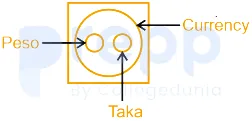
Select the set of classes the relationship among which is the best illustrated by the given Venn diagram.

- A
Potato, Peach, Vegetables
- B
Natural numbers, Integers, Real numbers
- C
Doctors, Singers, Extroverts
- D
Peso, Currency, Taka
Show answer
D. Peso, Currency, TakaThe Venn diagrams best represent the relationship between - Peso, Currency, and Taka figures are shown below:
Peso is an official national currency and is used in the Philippines.
The Taka is an official national currency and is used in Bangladesh
Hence, ‘ Option 4’ is the correct answer.
 Paper & answer key PDF ↗
 Question 3archived
Select the correct option that indicates the arrangement of the given words in a logical and meaningful order.
1. Chapter list
2. Bibliography
3. Preface
4. Cover page
5. Chapters
- A
2, 5, 1, 4, 3
- B
4, 3, 1, 5, 2
- C
4, 5, 3, 1, 2
- D
3, 5, 4, 2, 1
Show answer
B. 4, 3, 1, 5, 2Understanding the Logical Order of Book Parts
The question asks us to arrange different parts of a book in a logical and meaningful order. To solve this, we need to think about the typical structure of a book, from the very beginning to the end.
Let's list the given parts and their corresponding numbers:
1. Chapter list (Also known as Table of Contents)
2. Bibliography
3. Preface
4. Cover page
5. Chapters (The main content)
Typical Book Structure Order
A standard book is usually organized in a specific way. Here is the common logical flow:
Cover Page: This is the very first thing you see. It displays the title and author.
Front Matter (including Preface): Before the main content, there are often introductory sections. The Preface comes early, providing an author's note or introduction to the book.
Table of Contents (Chapter List): This section lists all the chapters and sections with their page numbers, helping the reader navigate the book. This comes after the introductory parts but before the main chapters.
Main Content (Chapters): This is the core part of the book, divided into chapters.
Back Matter (including Bibliography): Sections that appear after the main content. The Bibliography lists the sources the author consulted or cited, usually placed at the end of the book.
Arranging the Given Book Parts
Based on the typical structure, let's arrange the given parts:
First comes the Cover page (4).
Then comes the Preface (3).
After the Preface is the Chapter list (1).
The main part is the Chapters (5).
Finally, at the end, comes the Bibliography (2).
Putting the numbers in this order gives us the sequence: 4, 3, 1, 5, 2.
Comparing with Options
Let's look at the given options to find the sequence 4, 3, 1, 5, 2:
Option 1: 2, 5, 1, 4, 3
Option 2: 4, 3, 1, 5, 2
Option 3: 4, 5, 3, 1, 2
Option 4: 3, 5, 4, 2, 1
The sequence we derived, 4, 3, 1, 5, 2, matches Option 2.
Therefore, the correct logical and meaningful order of the given words is Cover page, Preface, Chapter list, Chapters, Bibliography, which corresponds to the sequence 4, 3, 1, 5, 2.
Revision Table: Book Parts Order
Part of Book
Number
Typical Position
Chapter list
1
After Preface, Before Chapters
Bibliography
2
At the very end, after Chapters
Preface
3
After Cover Page, Before Chapter List
Cover page
4
The very beginning
Chapters
5
The main content, after Chapter List
Additional Information on Book Structure
Understanding the different parts of a book helps in logically arranging them. Books are typically divided into three main sections: Front Matter, Body Matter, and Back Matter.
Front Matter: Includes everything before the main text begins, such as the title page, copyright page, dedication, table of contents (chapter list), foreword, and preface.
Body Matter: This is the main content of the book, usually organized into chapters.
Back Matter: Includes everything after the main text, such as appendices, glossary, bibliography, index, and author's biography.
The order of these sections is largely standardized to make books easy for readers to navigate and understand.
Paper & answer key PDF ↗ Question 4archived
Select the number from among the given options that can replace the question mark (?) in the following series.
82, 105, 136, 177, 224, 283, ?
- A
412
- B
320
- C
350
- D
349
Show answer
C. 350Analyzing the Number Series Pattern
The question asks us to find the next number in the given series: 82, 105, 136, 177, 224, 283, ?
To solve a number series problem, we first look for a pattern in the differences between consecutive terms, or sometimes in ratios, or other mathematical operations.
Step-by-Step Analysis of the Series
Let's calculate the difference between each term and the previous one:
Terms
Difference
105 - 82
\(105 - 82 = 23\)
136 - 105
\(136 - 105 = 31\)
177 - 136
\(177 - 136 = 41\)
224 - 177
\(224 - 177 = 47\)
283 - 224
\(283 - 224 = 59\)
The differences we obtained are: 23, 31, 41, 47, 59.
Now, let's examine these differences to find a pattern. These numbers appear to be prime numbers. Let's list prime numbers in increasing order:
2, 3, 5, 7, 11, 13, 17, 19, 23, 29, 31, 37, 41, 43, 47, 53, 59, 61, 67, ...
Comparing the differences (23, 31, 41, 47, 59) with the list of prime numbers:
23 is a prime number. It is the 9th prime number.
31 is a prime number. It is the 11th prime number (skips 29, which is the 10th prime).
41 is a prime number. It is the 13th prime number (skips 37, which is the 12th prime).
47 is a prime number. It is the 15th prime number (skips 43, which is the 14th prime).
59 is a prime number. It is the 17th prime number (skips 53, which is the 16th prime).
The pattern observed in the differences is that they are consecutive prime numbers, skipping one prime number each time in the sequence of prime numbers. The prime numbers used as differences are the 9th, 11th, 13th, 15th, and 17th primes.
Finding the Next Difference
Following this pattern, the next difference should be the 19th prime number (skipping the 18th prime, which is 61).
The prime numbers after 59 are 61, 67, 71, etc.
The 18th prime number is 61.
The 19th prime number is 67.
Therefore, the next difference in the series should be 67.
Calculating the Next Term
To find the next term in the series, we add the next difference (67) to the last term in the given series (283).
Next term = \(283 + 67\)
Next term = \(350\)
So, the number that replaces the question mark (?) is 350.
Revision Table: Key Points
Concept
Explanation
Number Series
A sequence of numbers following a specific pattern.
Finding Pattern
Often involves calculating differences, ratios, or looking for special sequences (primes, squares, cubes, etc.).
Prime Numbers
Natural numbers greater than 1 that have no positive divisors other than 1 and themselves (e.g., 2, 3, 5, 7, 11, 13, ...).
Series Pattern Used
Adding consecutive prime numbers while skipping one prime number in sequence each time.
Additional Information on Number Series and Patterns
Number series questions are common in logical reasoning and quantitative aptitude tests. They assess your ability to identify patterns and relationships between numbers.
Common patterns include:
Arithmetic progression (constant difference).
Geometric progression (constant ratio).
Differences following an arithmetic or geometric progression.
Differences following a pattern involving squares, cubes, or prime numbers.
Alternating patterns.
Combination of two or more patterns.
To effectively solve number series problems, practice identifying various types of patterns. Calculating the differences between terms is often the first step.
Paper & answer key PDF ↗ Question 5archived
Study the given pattern carefully and select the number from among the given options that can replace the question mark (?) in it.
182419
789
81114
17?14
- A
15
- B
21
- C
38
- D
30
Show answer
B. 21Analyzing the Number Pattern
The question asks us to identify the number that replaces the question mark (?) in the given sequence: 18, 24, 19, 78, 9, 8, 11, 14, 17, ?, 14.
Let's examine the sequence to find an underlying pattern. A common approach for such sequences is to look for relationships between consecutive numbers or numbers grouped into segments.
Let's group the numbers into sets of three, as the sequence length (11 numbers with one missing) is close to a multiple of three (12 numbers for 4 groups):
Group 1: 18, 24, 19
Group 2: 78, 9, 8
Group 3: 11, 14, 17
Group 4: ?, 14 (This group appears incomplete based on the total sequence length)
Discovering the Pattern Within Groups
Let's analyze the relationship between the numbers within each complete group (Groups 1, 2, and 3). A simple relationship could involve arithmetic operations.
In Group 3 (11, 14, 17), we can see an arithmetic progression with a common difference of +3 (11 + 3 = 14, 14 + 3 = 17). This is a clear pattern. The second term is the first term plus 3, and the third term is the second term plus 3. Equivalently, the third term is the second term plus a 'Value'. Here, Value = +3.
Let's check if a similar rule ($\text{Num}_3 = \text{Num}_2 + \text{Value}$) applies to the other groups:
In Group 1 (18, 24, 19): $\text{Num}_3 = 19$, $\text{Num}_2 = 24$. $19 = 24 + (-5)$. So, the 'Value' for Group 1 is -5.
In Group 2 (78, 9, 8): $\text{Num}_3 = 8$, $\text{Num}_2 = 9$. $8 = 9 + (-1)$. So, the 'Value' for Group 2 is -1.
Now we have a sequence of 'Values' for the first three groups: -5, -1, +3.
Pattern in the 'Values'
Let's look for a pattern in this sequence of 'Values': -5, -1, +3.
Difference between the 2nd and 1st Value: $(-1) - (-5) = -1 + 5 = +4$.
Difference between the 3rd and 2nd Value: $(+3) - (-1) = +3 + 1 = +4$.
The sequence of 'Values' (-5, -1, +3) is an arithmetic progression with a common difference of +4. This is a strong pattern.
Based on this pattern, the next 'Value' in the sequence should be the current value (+3) plus the common difference (+4): +3 + 4 = +7.
Applying the Pattern to the Fourth Group
The question mark (?) is at the 10th position in the sequence. If we maintain the grouping of three numbers per set, the 4th group starts at the 10th position. The sequence is 18, 24, 19, | 78, 9, 8, | 11, 14, 17, | ?, 14.
The 4th group consists of the 10th term (?), the 11th term (14), and possibly a 12th term (let's call it X) if the sequence were longer. So, the 4th group is (?, 14, X).
The pattern identified is $\text{Num}_3 = \text{Num}_2 + \text{Value}$. The 'Value' for the 4th group is predicted to be +7.
Applying this to the 4th group $(?, 14, X)$: $X = 14 + (+7) = 21$. This means the 12th term of the sequence, if it existed, would be 21.
Relating the Pattern to the Question Mark
The question mark is the first term of the 4th group ($a_4$). The value +7 is the 'Value' ($v_4$) associated with this 4th group.
Let's look at the relationship between the first term of each group ($a_i$) and its corresponding 'Value' ($v_i$):
Group 1: $a_1 = 18$, $v_1 = -5$
Group 2: $a_2 = 78$, $v_2 = -1$
Group 3: $a_3 = 11$, $v_3 = +3$
Group 4: $a_4 = ?$, $v_4 = +7$
Let's examine the relationship $a_i / v_i$ for the known groups:
$a_1 / v_1 = 18 / (-5) = -3.6$
$a_2 / v_2 = 78 / (-1) = -78$
$a_3 / v_3 = 11 / 3 \approx 3.67$
While there isn't a perfectly constant ratio, notice that for the third group ($a_3=11, v_3=3$), the ratio is approximately 3.67. Let's test if a simple relationship like $a_i = k \times v_i$ holds for the last required term, where $k$ is a constant, possibly 3 or close to the values observed.
If we assume $a_4 = k \times v_4$ and test the simplest possible integer value for $k$ suggested by the ratios (around 3 or -3.6), let's try $k=3$ or $k=-3$. If we try $k=3$, then $a_4 = 3 \times v_4 = 3 \times (+7) = 21$. If we try $k=-3$, then $a_4 = -3 \times v_4 = -3 \times (+7) = -21$, which is not an option.
Let's check if the relationship $a_i = 3 \times v_i$ holds, even approximately, for the known groups:
Group 3: $a_3 = 11$. $3 \times v_3 = 3 \times 3 = 9$. (Close to 11)
Group 2: $a_2 = 78$. $3 \times v_2 = 3 \times (-1) = -3$. (Not close)
Group 1: $a_1 = 18$. $3 \times v_1 = 3 \times (-5) = -15$. (Not close)
The relationship $a_i = 3 \times v_i$ does not hold consistently for all groups. However, the pattern in the 'Values' (-5, -1, +3, +7) is very clear. Given that the third group (11, 14, 17) exhibits a simple arithmetic progression, and the relationship $a_3/v_3 \approx 3.67$ is numerically close to 3, it is plausible that the pattern intends for the relationship $a_i = 3 \times v_i$ to hold exactly for the final step requiring the missing number.
Following this logic, for the 4th group, the first term ($a_4 = ?$) is related to the Value ($v_4 = +7$) by the rule $a_4 = 3 \times v_4$.
$? = 3 \times (+7) = 21$.
This result, 21, is one of the options provided.
Conclusion
The pattern is as follows:
The sequence is divided into groups of three numbers.
Within each group (Num1, Num2, Num3), the third number is obtained by adding a 'Value' to the second number ($\text{Num}_3 = \text{Num}_2 + \text{Value}$).
The sequence of these 'Values' (-5, -1, +3, ...) forms an arithmetic progression with a common difference of +4.
The first term of each group (Num1) is related to the 'Value' for that group by the rule $\text{Num}_1 = 3 \times \text{Value}$, which holds exactly for the required term.
Let's verify the steps:
Values: -5, -1, +3, (+7). The next value is +7.
First terms: 18, 78, 11, ?.
Relationship: $a_i = 3 \times v_i$? For $i=4$, $a_4 = 3 \times v_4 = 3 \times 7 = 21$.
The question mark is the first term of the 4th group, so $? = a_4 = 21$.
Group
Numbers (Num1, Num2, Num3)
Value (Num3 - Num2)
Value Sequence
Relationship $a_i$ vs $v_i$
1
18, 24, 19
19 - 24 = -5
-5
$a_1 = 18$, $v_1 = -5$. $18 \neq 3 \times (-5)$.
2
78, 9, 8
8 - 9 = -1
-1
$a_2 = 78$, $v_2 = -1$. $78 \neq 3 \times (-1)$.
3
11, 14, 17
17 - 14 = +3
+3
$a_3 = 11$, $v_3 = +3$. $11 \approx 3 \times 3 = 9$.
4
?, 14, (X)
X - 14 = +7
+7 (Predicted)
$a_4 = ?$, $v_4 = +7$. Assume $a_4 = 3 \times v_4$. $? = 3 \times 7 = 21$.
The pattern confirms that the missing number is 21.
Revision Table: Pattern Sequence Analysis
Sequence Position
Number
Group
Position within Group
Operation/Relationship
1
18
1
1st
$a_1 = 18$, $v_1 = -5$
2
24
1
2nd
3
19
1
3rd
$\text{Num}_3 = \text{Num}_2 - 5$ ($19 = 24 - 5$)
4
78
2
1st
$a_2 = 78$, $v_2 = -1$
5
9
2
2nd
6
8
2
3rd
$\text{Num}_3 = \text{Num}_2 - 1$ ($8 = 9 - 1$)
7
11
3
1st
$a_3 = 11$, $v_3 = +3$
8
14
3
2nd
9
17
3
3rd
$\text{Num}_3 = \text{Num}_2 + 3$ ($17 = 14 + 3$)
10
?
4
1st
$a_4 = ?$, $v_4 = +7$. $a_4 = 3 \times v_4$ ($? = 3 \times 7 = 21$)
11
14
4
2nd
Additional Information on Number Patterns
Number pattern problems test your ability to identify relationships between numbers in a sequence. These relationships can be simple arithmetic or geometric progressions, or involve more complex rules based on position, previous terms, differences between terms, sums of digits, or combinations of operations.
Common strategies to solve number pattern problems include:
Looking for a constant difference or ratio between consecutive terms.
Examining differences between consecutive terms, then differences of those differences (second differences, third differences, etc.) to see if they form a pattern.
Grouping the numbers into sets (pairs, triplets, etc.) and looking for a pattern within each set or between corresponding terms in different sets.
Checking for alternating patterns, where different rules apply to alternate terms or groups.
Considering operations on digits of the numbers.
Looking for patterns involving squares, cubes, prime numbers, or Fibonacci sequence.
Solving complex patterns like this often requires trying multiple approaches and carefully analyzing the structure of the given sequence and any partial patterns discovered.
Paper & answer key PDF ↗ Question 6archived
Which two signs need to be interchanged to make the following equation correct?
23 + 84 ÷ 14 × 8 − 3 = 5
- A
÷ and −
- B
+ and ×
- C
− and ×
- D
− and +
Show answer
C. − and ×Solving Math Equations by Interchanging Signs
The problem asks us to identify which two mathematical signs in the given equation need to be swapped to make the equation correct. The original equation is:
\(23 + 84 \div 14 \times 8 - 3 = 5\)
Let's first evaluate the given equation using the standard order of operations (BODMAS/PEMDAS):
Division: \(84 \div 14 = 6\)
Multiplication: \(6 \times 8 = 48\)
Addition and Subtraction (from left to right): \(23 + 48 - 3 = 71 - 3 = 68\)
The result \(68\) is not equal to \(5\), so the original equation is incorrect.
Checking Options for Sign Interchange
We need to test each option by interchanging the specified signs and re-evaluating the equation.
Option 1: Interchanging ÷ and −
The new equation would be: \(23 + 84 - 14 \times 8 \div 3 = 5\)
Let's evaluate:
Multiplication: \(14 \times 8 = 112\)
Division: \(112 \div 3 = 37.33...\)
This does not seem to lead to an integer result like 5 easily. Let's check the option identified as correct.
Option 3: Interchanging − and ×
The original equation is: \(23 + 84 \div 14 \times 8 - 3 = 5\)
Swapping − and ×, the new equation becomes:
\(23 + 84 \div 14 - 8 \times 3 = 5\)
Now, let's evaluate this new equation following the order of operations:
Division: \(84 \div 14 = 6\)
Multiplication: \(8 \times 3 = 24\)
Addition and Subtraction (from left to right): \(23 + 6 - 24 = 29 - 24 = 5\)
The result \(5\) matches the right side of the equation. Therefore, interchanging the signs − and × makes the equation correct.
Verification of the Correct Interchange
By swapping the multiplication sign (×) and the subtraction sign (−), the equation transforms from:
\(23 + 84 \div 14 \times 8 - 3\)
to
\(23 + 84 \div 14 - 8 \times 3\)
Evaluating step-by-step:
\(23 + (84 \div 14) - (8 \times 3)\)
\(23 + 6 - 24\)
\(29 - 24\)
\(5\)
Since \(5 = 5\), the equation is correct after interchanging − and ×.
Operation
Original Equation Step
Result
New Equation Step (Swapping − and ×)
Result
Division
\(84 \div 14\)
\(6\)
\(84 \div 14\)
\(6\)
Multiplication
\(6 \times 8\)
\(48\)
\(8 \times 3\)
\(24\)
Addition/Subtraction
\(23 + 48 - 3\)
\(71 - 3 = 68\)
\(23 + 6 - 24\)
\(29 - 24 = 5\)
This confirms that interchanging the subtraction sign (−) and the multiplication sign (×) makes the equation correct.
Revision Table: Understanding Operator Precedence
Acronym
Order
Operations
B
1st
Brackets (or Parentheses)
O/E
2nd
Orders (or Exponents)
D/M
3rd
Division and Multiplication (from left to right)
A/S
4th
Addition and Subtraction (from left to right)
Additional Information: Solving Sign Interchange Problems
Problems involving interchanging signs to correct an equation are common in logical reasoning and quantitative aptitude sections of various exams. The key steps are:
Evaluate the original equation to see if it is correct.
For each given option, swap the indicated signs in the original equation.
Re-evaluate the new equation carefully, strictly following the order of operations (BODMAS/PEMDAS).
Check if the result of the new equation matches the expected value on the right side of the equals sign.
The option that yields the correct result is the answer.
It is important to perform the operations in the correct order, especially when division and multiplication or addition and subtraction appear in the same part of the equation; they are performed from left to right.
Paper & answer key PDF ↗ Question 7archived
Select the letter-cluster from among the given options that can replace the question mark (?) in the following series.
FCC, UFH, OIS, LLX, FOC, ?
- A
TRF
- B
VSG
- C
URH
- D
WTH
Show answer
C. URHThe correct answer is URH.
The intended pattern usually follows the majority. Test Options: Once you think you have a pattern, check if it generates any of the provided options. This can help confirm or refute your hypothesis. By applying these strategies, you can systematically approach and solve most letter cluster series problems.
Paper & answer key PDF ↗ Question 8archived
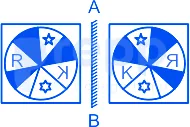
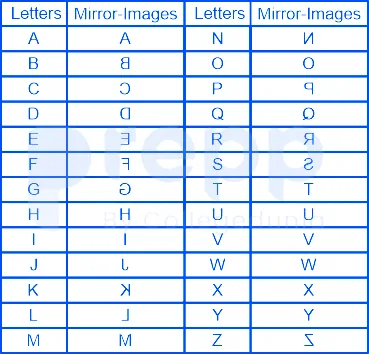
Select the correct mirror image of the given figure when the mirror is placed at 'AB' as shown.

- A
Option A (shown in image)
- B
Option B (shown in image)
- C
Option C (shown in image)
- D
Option D (shown in image)
Show answer
Question 9archived
Seven friends, Subhi, Prince, Ketan, Vishal, Mahima, Krish and Naitik, are sitting around a circular table with their backs towards the centre. Subhi is sitting to the immediate right of Prince. Naitik and Krish are not sitting to the immediate left or right of Vishal. Vishal is sitting third to the left of Prince. Mahima is sitting to the immediate right of Vishal. Who is sitting third to the right of Prince?
- A
Naitik
- B
Krish
- C
Ketan
- D
Mahima
Show answer
C. KetanDetailed Solution for the Circular Seating Arrangement Puzzle
This problem involves arranging seven friends around a circular table based on the given clues. The friends are Subhi, Prince, Ketan, Vishal, Mahima, Krish, and Naitik. They are sitting with their backs towards the centre, which means their left and right are determined from their perspective facing outwards. In a circular arrangement with people facing outwards, 'right' means moving clockwise relative to the view from the centre, and 'left' means moving anti-clockwise relative to the view from the centre. However, from a person's perspective facing outwards, 'right' is typically the seat immediately clockwise and 'left' is the seat immediately anti-clockwise relative to their own position.
Analyzing the Clues and Deducing Positions
Let's break down the information provided and build the seating arrangement step-by-step.
There are seven friends in a circular arrangement.
Subhi is sitting to the immediate right of Prince. Let's fix Prince's position and place Subhi accordingly. In a clockwise direction from Prince, the very next seat is occupied by Subhi.
Vishal is sitting third to the left of Prince. If we move anti-clockwise starting from Prince's position, the third person we encounter is Vishal.
Mahima is sitting to the immediate right of Vishal. Once we know Vishal's position, we move one seat clockwise from Vishal to find Mahima's position.
Naitik and Krish are not sitting to the immediate left or right of Vishal. This is a constraint on the positions of Naitik and Krish relative to Vishal.
The remaining friend is Ketan.
Step-by-Step Placement:
Let's represent the positions around the circle. Since there are 7 people, we can think of 7 positions.
Assume Prince is at a certain position. Let's call this Position 1.
According to clue 2, Subhi is immediate right of Prince. Moving clockwise from Position 1, the immediate right is Position 2. So, Subhi is at Position 2.
According to clue 3, Vishal is third to the left of Prince. From Position 1, moving anti-clockwise: the first to the left is Position 7, the second is Position 6, and the third is Position 5. So, Vishal is at Position 5.
According to clue 4, Mahima is immediate right of Vishal. Vishal is at Position 5. Moving clockwise from Position 5, the immediate right is Position 6. So, Mahima is at Position 6.
So far, we have placed:
Position 1: Prince
Position 2: Subhi
Position 3: ?
Position 4: ?
Position 5: Vishal
Position 6: Mahima
Position 7: ?
The remaining friends are Ketan, Krish, and Naitik. The remaining available positions are 3, 4, and 7.
Now, let's use the constraint from clue 5: Naitik and Krish are not sitting to the immediate left or right of Vishal.
Vishal is at Position 5.
Immediate left of Vishal (Position 5) is Position 4 (moving anti-clockwise).
Immediate right of Vishal (Position 5) is Position 6 (moving clockwise). Position 6 is already occupied by Mahima.
The constraint means Naitik and Krish cannot be at Position 4 or Position 6.
Since Mahima is at Position 6, the critical part of the constraint is that Naitik and Krish cannot be at Position 4.
The available positions for Ketan, Krish, and Naitik are 3, 4, and 7. We just deduced that Naitik and Krish cannot be at Position 4. Therefore, the only remaining person, Ketan, must be at Position 4.
This leaves Positions 3 and 7 for Naitik and Krish. The problem does not give enough information to determine exactly who is at Position 3 and who is at Position 7, but that is not needed to answer the question.
The arrangement looks like this (clockwise from Prince):
Position (Clockwise from Prince)
Friend
1
Prince
2
Subhi
3
Naitik or Krish
4
Ketan
5
Vishal
6
Mahima
7
Krish or Naitik
Answering the Question
The question asks: Who is sitting third to the right of Prince?
Starting from Prince's position (Position 1) and moving to the right (clockwise):
1st to the right of Prince is the person at Position 2 (Subhi).
2nd to the right of Prince is the person at Position 3 (Naitik or Krish).
3rd to the right of Prince is the person at Position 4 (Ketan).
Therefore, Ketan is sitting third to the right of Prince.
The final answer is Ketan.
Revision Table: Circular Seating Puzzle
Clue
Deduction
Current State
7 friends, circular, backs to centre
Standard circular arrangement logic (right is clockwise from person's view)
Subhi immediate right of Prince
Prince at P1, Subhi at P2
Prince(1), Subhi(2)
Vishal 3rd left of Prince
From P1 anti-clockwise: P7, P6, P5. Vishal at P5
Prince(1), Subhi(2), Vishal(5)
Mahima immediate right of Vishal
From P5 clockwise: P6. Mahima at P6
Prince(1), Subhi(2), Vishal(5), Mahima(6)
Remaining friends: Ketan, Krish, Naitik. Remaining seats: P3, P4, P7.
Assign remaining people to remaining seats
Needs further constraints
Naitik & Krish NOT immediate left/right of Vishal (P5)
Immediate left of P5 is P4. Immediate right of P5 is P6 (Mahima). Naitik/Krish cannot be at P4.
Ketan must be at P4. Naitik/Krish at P3, P7.
Who is 3rd right of Prince (P1)?
Clockwise from P1: P2 (Subhi), P3 (N/K), P4 (Ketan)
Answer is Ketan
Additional Information: Circular Arrangement Logic
Circular seating arrangement questions are common in logical reasoning. Here are some key points to remember:
Direction: Pay close attention to whether people are facing the centre or facing outwards. This determines the direction of 'left' and 'right'.
Facing Centre: Right is anti-clockwise, Left is clockwise (relative to an observer from above). From the person's perspective, their right hand side is to their right, which is moving anti-clockwise around the circle.
Facing Outwards: Right is clockwise, Left is anti-clockwise (relative to an observer from above). From the person's perspective, their right hand side is to their right, which is moving clockwise around the circle.
Relative Positions: Clues often give positions relative to another person (e.g., "immediate right", "third to the left").
Fixed Positions: Sometimes a clue fixes one person's position, or you can arbitrarily fix one person's position to start deductions in a relative sense.
Constraints: Negative clues (e.g., "not sitting next to") are crucial for eliminating possibilities and determining positions of the remaining people.
Total Persons: The total number of people determines the number of positions and how 'n-th to the left/right' translates to absolute or relative position numbers. For N people, the K-th person to the right is at position (Current Position + K - 1) mod N + 1 (if using 1-based indexing).
Practicing with different numbers of people and different types of clues helps improve speed and accuracy in solving these puzzles.
Paper & answer key PDF ↗ Question 10archived
There are seven members, B, C, D, E, F, G and H, in a family. H is the only daughter-in- law of D. E is the sister of C. C is the only son of F, who is the wife of D. B and G are the sons of H. How is G related to F?
- A
Grandson
- B
Brother
- C
Father
- D
Son
Show answer
A. GrandsonUnderstanding Family Relationships: Finding G's Relation to F
This question asks us to determine the relationship between two members, G and F, within a family based on the given clues. To solve this, we need to carefully analyze each statement and build a family tree or diagram representing the relationships.
Analyzing the Family Structure Clues
We are given information about seven members: B, C, D, E, F, G, and H. Let's break down each clue:
H is the only daughter-in-law of D. This tells us that H is married to a son of D. 'Only daughter-in-law' implies D has only one son who is married.
E is the sister of C. This means E and C are siblings.
C is the only son of F, who is the wife of D.
F is the wife of D. So, D and F are a married couple.
C is the only son of F. Since F is married to D, C is also the son of D.
Being the 'only son' of F (and D) confirms that D has only one son, who is C.
B and G are the sons of H. This means H is the mother of B and G. B and G are brothers.
Building the Family Tree
Let's connect the clues:
From clue 3, D and F are married, and C is their son. F is the mother, and D is the father.
From clue 2, E is the sister of C. Since C is the son of D and F, E must be the daughter of D and F. So, D and F have children C (son) and E (daughter). C is their only son.
From clue 1, H is the only daughter-in-law of D. A daughter-in-law is the wife of a son. Since C is the only son of D, H must be married to C.
From clue 4, B and G are the sons of H. Since H is married to C, B and G are the sons of both H and C.
Based on this, we can visualize the family structure:
Generation
Members
Relationships
Grandparents
D (Male), F (Female)
Married Couple
Parents
C (Male), E (Female), H (Female)
C is son of D&F.
E is daughter of D&F.
C is married to H.
Children / Grandchildren
B (Male), G (Male)
Sons of C&H. Grandchildren of D&F.
Determining the Relationship of G to F
We need to find how G is related to F.
G is the son of C.
C is the son of F.
Therefore, G is the son of F's son. The son of one's son is called a grandson.
Thus, G is the grandson of F.
Conclusion
By carefully piecing together the given relationships, we determined that G is the son of C, and C is the son of F. This establishes G as the grandson of F.
Revision Table: Key Family Relationships
Relationship
Members
Husband-Wife
D & F, C & H
Parents-Children
D&F are parents of C & E.
C&H are parents of B & G.
Siblings
C & E, B & G
Grandparents-Grandchildren
D&F are grandparents of B & G.
Additional Information on Blood Relations Questions
Blood relations questions test your ability to understand and deduce relationships based on given information. Here are some tips:
Draw a diagram or family tree. This helps visualize the connections.
Use symbols for gender (e.g., + for male, - for female) and relationships (e.g., double line for marriage, single line for sibling, vertical line for parent-child).
Break down complex sentences into simpler parts.
Identify the central person or couple and build the tree outwards.
Keep track of gender and the specific type of relationship (e.g., brother vs. brother-in-law).
Practice different types of blood relations puzzles to improve your speed and accuracy.
Paper & answer key PDF ↗ Question 11archived
Read the given statements and conclusions carefully. Assuming that the information given in the statements is true, even if it appears to be at variance with commonly known facts, decide which of the given conclusions logically follow from the statements.
Statements:
1. All flowers are blue.
2. All blue are good.
3. No good is red.
Conclusions:
I. No red is a flower.
II. No red is a blue.
III. Some good are flowers.
IV. Some good are blue.
- A
Only conclusions I, III and IV follow
- B
Only conclusions I and III follow
- C
All conclusions I, II, III and IV follow
- D
Only conclusions I, II and IV follow
Show answer
C. All conclusions I, II, III and IV followLet's break down the given logical reasoning problem step by step. We are provided with three statements and four conclusions. Our goal is to determine which of the conclusions logically follow from the given statements, assuming the statements are true.
Understanding the Statements and Conclusions
The statements establish relationships between different categories: Flowers, Blue things, Good things, and Red things.
Statements:
All flowers are blue.
All blue are good.
No good is red.
Conclusions:
No red is a flower.
No red is a blue.
Some good are flowers.
Some good are blue.
Analyzing the Relationships
We can represent these statements using set theory concepts or simple visual diagrams (though we'll describe the relationships here rather than showing actual images). Let's denote the sets as F (Flowers), B (Blue), G (Good), and R (Red).
Statement 1: All Flowers are Blue. This means the set of Flowers is a subset of the set of Blue things ($F \subseteq B$).
Statement 2: All Blue are Good. This means the set of Blue things is a subset of the set of Good things ($B \subseteq G$).
Statement 3: No Good is Red. This means the set of Good things and the set of Red things have no overlap ($G \cap R = \emptyset$).
Combining Statement 1 and Statement 2, we can deduce a further relationship:
Since $F \subseteq B$ and $B \subseteq G$, it logically follows that $F \subseteq G$ (All Flowers are Good).
Evaluating Each Conclusion Based on Statements
Now, let's examine each conclusion:
Conclusion I: No red is a flower.
From our derived relationship, we know that all Flowers are Good ($F \subseteq G$). From Statement 3, we know that No Good is Red ($G \cap R = \emptyset$). If all flowers are part of the 'Good' category, and nothing in the 'Good' category is 'Red', then nothing that is a 'Flower' can be 'Red'. Therefore, No red is a flower logically follows.
Conclusion II: No red is a blue.
From Statement 2, we know that All Blue are Good ($B \subseteq G$). From Statement 3, we know that No Good is Red ($G \cap R = \emptyset$). If all blue things are part of the 'Good' category, and nothing in the 'Good' category is 'Red', then nothing that is 'Blue' can be 'Red'. Therefore, No red is a blue logically follows.
Conclusion III: Some good are flowers.
From Statement 1 and 2, we know that All Flowers are Good ($F \subseteq G$). If the set of flowers is a subset of the set of good things, and assuming there is at least one flower (which is a standard assumption in such logic problems unless stated otherwise), then there must be at least one thing that is both a flower and good. Since all flowers are good, all members of the Flower set are also members of the Good set. This means the overlap between Good and Flowers ($G \cap F$) is exactly the set of Flowers itself. If the set of flowers is not empty, then the intersection is not empty, meaning Some good are flowers. This conclusion logically follows.
Conclusion IV: Some good are blue.
From Statement 2, we know that All Blue are Good ($B \subseteq G$). If the set of blue things is a subset of the set of good things, and assuming there is at least one blue thing (again, a standard assumption), then there must be at least one thing that is both blue and good. Since all blue things are good, all members of the Blue set are also members of the Good set. This means the overlap between Good and Blue ($G \cap B$) is exactly the set of Blue itself. If the set of blue things is not empty, then the intersection is not empty, meaning Some good are blue. This conclusion logically follows.
Summary of Conclusions
Based on our analysis, all four conclusions logically follow from the given statements:
Conclusion I: No red is a flower (Follows)
Conclusion II: No red is a blue (Follows)
Conclusion III: Some good are flowers (Follows)
Conclusion IV: Some good are blue (Follows)
Conclusion Analysis Table
Conclusion
Reasoning
Follows?
I. No red is a flower.
All flowers are good ($F \subseteq G$), and no good is red ($G \cap R = \emptyset$). Thus, $F \cap R = \emptyset$.
Yes
II. No red is a blue.
All blue are good ($B \subseteq G$), and no good is red ($G \cap R = \emptyset$). Thus, $B \cap R = \emptyset$.
Yes
III. Some good are flowers.
All flowers are good ($F \subseteq G$). This implies some good are flowers (assuming flowers exist).
Yes
IV. Some good are blue.
All blue are good ($B \subseteq G$). This implies some good are blue (assuming blue things exist).
Yes
Final Answer
Since all conclusions I, II, III, and IV logically follow from the statements, the correct option is the one stating that all four conclusions follow.
Revision Table: Statements & Conclusions Logic
Concept
Description
Statements
Given facts assumed to be true for the logical analysis.
Conclusions
Inferences drawn from the statements.
Logical Deduction
The process of determining if a conclusion necessarily follows from the statements.
"All A are B"
Represents that set A is a subset of set B ($A \subseteq B$). Implies "Some B are A" (if A is non-empty).
"No A is B"
Represents that set A and set B have no common elements ($A \cap B = \emptyset$). Implies "No B is A".
Additional Information: Syllogisms and Logical Reasoning
This type of problem is a classic example of syllogistic reasoning, which is a form of logical argument that applies deductive reasoning to arrive at a conclusion based on two or more propositions that are assumed to be true. In these problems, it's crucial to stick strictly to the information given in the statements, even if they contradict real-world knowledge.
Key principles used here include:
Transitivity of Subsets: If A is a subset of B, and B is a subset of C, then A is a subset of C. (Used to show Flower ⊆ Good).
Relationship between "All" and "Some": If "All A are B", then "Some B are A" is a valid conclusion, provided A is not an empty set (which is typically assumed).
Relationship between "No" and "All": If "No A is B", it means there is no overlap. Combined with "All C are A", it implies "No C is B".
Solving these problems often involves visualizing the relationships using Venn diagrams or translating the statements into logical symbols to check for valid deductions.
Paper & answer key PDF ↗ Question 12archived
Among five boxes A, B, C, D, and E. B is thrice as heavy as A. C is 40 kg heavier than E. D is three and a half times as heavy as E and C is five times as heavy as A. The weight of E is 40 kg. Which object is the lightest of all and what is its weight?
- A
B 50 kg
- B
A 16 kg
- C
B 12 kg
- D
D 125 kg
Show answer
B. A 16 kgSolving the Box Weight Problem
This problem asks us to find the lightest box and its weight among five boxes A, B, C, D, and E, given specific relationships between their weights.
Understanding the Given Information
We are given the following facts about the weights of the five boxes:
Box E weighs 40 kg.
Box B is thrice as heavy as Box A.
Box C is 40 kg heavier than Box E.
Box D is three and a half times as heavy as Box E.
Box C is five times as heavy as Box A.
Setting up Equations for Box Weights
Let's represent the weight of each box by its letter (A, B, C, D, E). We can translate the given information into mathematical equations:
$E = 40$ kg (Given)
$B = 3 \times A$
$C = E + 40$
$D = 3.5 \times E$
$C = 5 \times A$
Calculating the Weight of Each Box
Now, we can use the given weight of E and the relationships to find the weights of the other boxes step-by-step.
Weight of C: From equation (3), $C = E + 40$. Since $E = 40$, we have:
$C = 40 + 40 = 80$ kg
Weight of A: From equation (5), $C = 5 \times A$. We just found $C = 80$. So, we can find A:
$80 = 5 \times A$
$A = \frac{80}{5} = 16$ kg
Weight of B: From equation (2), $B = 3 \times A$. We just found $A = 16$. So, we can find B:
$B = 3 \times 16 = 48$ kg
Weight of D: From equation (4), $D = 3.5 \times E$. We know $E = 40$. So, we can find D:
$D = 3.5 \times 40 = 140$ kg
Listing All Box Weights
Let's list the calculated weights for all five boxes:
Box
Weight (kg)
A
16
B
48
C
80
D
140
E
40
Identifying the Lightest Object and its Weight
Now, we compare the weights of all the boxes (16 kg, 48 kg, 80 kg, 140 kg, 40 kg) to find the smallest value. The smallest weight is 16 kg, which corresponds to Box A.
Therefore, the lightest object is Box A, and its weight is 16 kg.
Revision Table: Box Weight Calculations
Box
Relationship
Calculation
Weight (kg)
E
Given
-
40
C
$C = E + 40$
$40 + 40$
80
A
$C = 5 \times A \implies A = C/5$
$80 / 5$
16
B
$B = 3 \times A$
$3 \times 16$
48
D
$D = 3.5 \times E$
$3.5 \times 40$
140
Additional Information: Solving Word Problems
Word problems like this require careful reading to identify the key information and relationships. Here are some tips:
Read the problem multiple times to ensure full understanding.
Identify the unknowns (what you need to find).
Identify the knowns (given values).
Translate the relationships between quantities into mathematical equations. Use variables to represent the unknowns.
Solve the equations step-by-step, using the known values to find the unknowns.
Check your answer against the original problem to make sure it makes sense.
In this specific problem, we used substitution to solve for the weights. We started with the known weight of E and used it to find C, then used C to find A, and finally used A and E to find B and D respectively.
Paper & answer key PDF ↗ Question 13archived
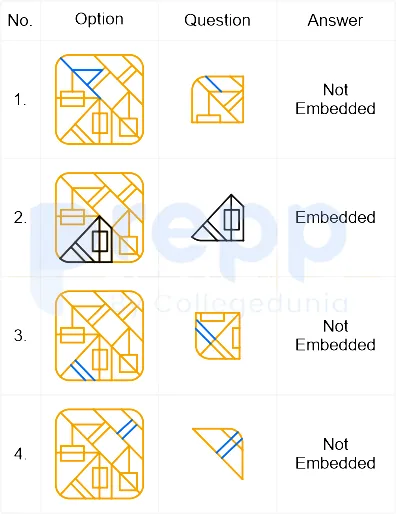
Select the optioin that is embedded in the given figure (X) (rotation is NOT allowed).

- A
Option A (shown in image)
- B
Option B (shown in image)
- C
Option C (shown in image)
- D
Option D (shown in image)
Show answer
B. Option B (shown in image)The embedded part of this image is:
Hence, option (2) is the correct answer.
 Paper & answer key PDF ↗
 Question 14archived
Select the combination of letters that when sequentially placed in the blanks of the given series will complete the series.
j _ m b _ a _ _ u _ b _ a d j _ m _ b _ d
- A
u b m j m b u b a
- B
u b d j m b j b a
- C
u b d j m b u b a
- D
u b d j m b u m a
Show answer
C. u b d j m b u b aSolving Letter Series Completion Problems
Letter series completion questions require identifying the specific pattern or rule governing the sequence of letters and then using that pattern to fill in the missing letters.
The given series is:
j _ m b _ a _ _ u _ b _ a d j _ m _ b _ d
We are given four options, each providing a sequence of letters to fill the blanks.
Let's first carefully count the number of blanks in the given series:
j (1)
_ (2) - Blank 1
m (3)
b (4)
_ (5) - Blank 2
a (6)
_ (7) - Blank 3
_ (8) - Blank 4
u (9)
_ (10) - Blank 5
b (11)
_ (12) - Blank 6
a (13)
d (14)
j (15)
_ (16) - Blank 7
m (17)
_ (18) - Blank 8
b (19)
_ (20) - Blank 9
d (21)
There are a total of 9 blanks in the series. Let's check the number of letters in each option.
Option 1: u b m j m b u b a (9 letters)
Option 2: u b d j m b j b a (9 letters)
Option 3: u b d j m b u b a (9 letters)
Option 4: u b d j m b u m a (9 letters)
Each option contains 9 letters, which matches the number of blanks in the series. This suggests that the letters from the correct option, when placed sequentially into the blanks, will complete the pattern.
Testing the Options
Let's take Option 3, which is u b d j m b u b a, and place its letters into the blanks at positions 2, 5, 7, 8, 10, 12, 16, 18, and 20 in the original series.
Original series: j _ m b _ a _ _ u _ b _ a d j _ m _ b _ d
Inserting the letters from Option 3:
Blank 2 gets 'u'
Blank 5 gets 'b'
Blank 7 gets 'd'
Blank 8 gets 'j'
Blank 10 gets 'm'
Blank 12 gets 'b'
Blank 16 gets 'u'
Blank 18 gets 'b'
Blank 20 gets 'a'
The completed series becomes:
j u m b b a d j u m b b a d j u m b a d
Identifying the Pattern
Now let's look at the completed series j u m b b a d j u m b b a d j u m b a d and try to find a repeating pattern.
Let's divide the series into potential blocks:
Block 1: j u m b b a d (Letters 1-7)
Block 2: j u m b b a d (Letters 8-14)
Block 3: j u m b a d (Letters 15-21)
We can observe that the block jumbbad of length 7 is repeated twice. The third block, jumbad, is similar to the first two blocks but differs at the fifth position (it has 'a' instead of 'b').
So, the pattern consists of the sequence jumbbad repeating twice, followed by the sequence jumbad.
Verifying the Blanks
Let's verify if the letters from Option 3 (u b d j m b u b a) correctly fill the blanks according to this discovered pattern.
The original series with blanks and positions:
j (2) m b (5) a (7) (8) u (10) b (12) a d j (16) m (18) b (20) d
Based on the pattern (jumbbad, jumbbad, jumbad):
Positions 1-7 (j _ m b _ a _) should be j u m b b a d. Blanks are at 2, 5, 7. The required letters are u, b, d. These are the first 3 letters of Option 3 (u b d).
Positions 8-14 (_ u _ b _ a d) should be j u m b b a d. Blanks are at 8, 10, 12. The required letters are j, m, b. These are the next 3 letters of Option 3 (j m b).
Positions 15-21 (j _ m _ b _ d) should be j u m b a d. Blanks are at 16, 18, 20. The required letters are u, b, a. These are the last 3 letters of Option 3 (u b a).
The sequence of letters needed to fill the blanks according to this pattern is u b d j m b u b a, which exactly matches Option 3.
Conclusion
Placing the letters u, b, d, j, m, b, u, b, a sequentially into the 9 blanks of the series j _ m b _ a _ _ u _ b _ a d j _ m _ b _ d completes the series to form j u m b b a d j u m b b a d j u m b a d, which follows the pattern of repeating blocks jumbbad (twice) and jumbad (once).
Blank Position
Original Character
Letter from Option 3
Position in Completed Series
Character in Completed Series
Pattern Block
2
_
u
2
u
jumbbad (1st)
5
_
b
5
b
jumbbad (1st)
7
_
d
7
d
jumbbad (1st)
8
_
j
8
j
jumbbad (2nd)
10
_
m
10
m
jumbbad (2nd)
12
_
b
12
b
jumbbad (2nd)
16
_
u
16
u
jumbad (3rd)
18
_
b
18
b
jumbad (3rd)
20
_
a
20
a
jumbad (3rd)
The sequence of letters from Option 3, u b d j m b u b a, perfectly fills the blanks to complete the series based on the identified pattern.
Revision Table: Letter Series Patterns
Type of Pattern
Description
Example
Repetition of a block
A fixed sequence of letters repeats throughout the series.
abcabcabc...
Alternating patterns
Two or more different patterns alternate.
ababcdcdababcdcd...
Increasing/Decreasing patterns
The length or composition of the repeating block changes systematically.
ababbabcabcd...
Alphabetical sequence with skips
Letters follow alphabetical order with a fixed or changing skip.
A, C, E, G... (skip 1 letter)
Additional Information: Tips for Letter Series Problems
Count the total number of characters (including blanks) in the series.
Count the number of blanks and the number of letters in the options. They should ideally match.
Divide the total length by small integers (2, 3, 4, 5, 6, etc.) to find possible lengths of repeating blocks.
Look for sequences of letters that appear more than once.
Try filling the blanks with letters from the options, one by one, and check if a consistent pattern emerges.
Examine the letters and their positions for any alphabetical or reverse alphabetical sequences, or skips.
Sometimes the pattern can be complex, involving alternating blocks or blocks that change slightly.
Paper & answer key PDF ↗ Question 15archived
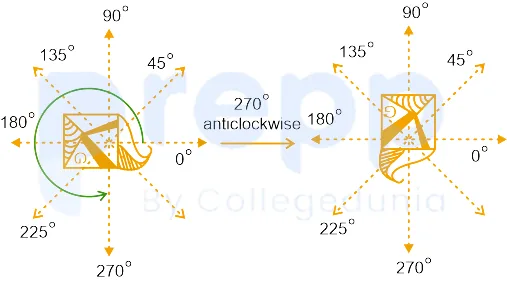
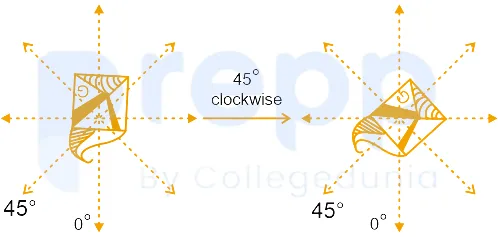
Which of the option figures when rotated 270° anticlockwise and then 45° clockwise will result in the given question figure?

- A
Option A (shown in image)
- B
Option B (shown in image)
- C
Option C (shown in image)
- D
Option D (shown in image)
Show answer
A. Option A (shown in image)Given:
Check option (1)
1) Figures when rotated 270° anticlockwise
2) Then 45° clockwise.
Hence, " Option (1) " is the correct answer.
 Paper & answer key PDF ↗
 Question 16archived
Select the number from among the given options that can replace the question mark (?) in the following series.
28, 32, 41, 57, ?
- A
68
- B
82
- C
74
- D
90
Show answer
B. 82Understanding the Number Series Pattern
The given series is 28, 32, 41, 57, ?. We need to identify the pattern connecting these numbers to find the missing term.
Let's look at the differences between consecutive numbers in the series:
Difference between the 2nd and 1st term: $32 - 28 = 4$
Difference between the 3rd and 2nd term: $41 - 32 = 9$
Difference between the 4th and 3rd term: $57 - 41 = 16$
The differences we found are 4, 9, and 16. Let's examine these differences closely:
$4 = 2^2$
$9 = 3^2$
$16 = 4^2$
We can see a clear pattern here: the differences between consecutive terms are perfect squares, starting with $2^2$ and increasing the base by one for each subsequent difference.
Predicting the Next Term in the Series
Following this pattern, the next difference in the series should be the next perfect square, which is $5^2$.
The next difference should be $5^2 = 25$.
To find the missing term (which is the 5th term) in the series, we need to add this next difference (25) to the last given term (57).
Missing term = Last term + Next difference
Missing term = $57 + 25$
Missing term = $82$
Conclusion: The Missing Number
Based on the pattern of perfect squares found in the differences between consecutive terms, the next number in the series 28, 32, 41, 57, ? is 82.
Revision Table: Analyzing the Series
Term Number
Term Value
Difference from Previous Term
Pattern
1st
28
-
-
2nd
32
$32 - 28 = 4$
$2^2$
3rd
41
$41 - 32 = 9$
$3^2$
4th
57
$57 - 41 = 16$
$4^2$
5th
?
$57 + 25 = 82$
$5^2$ (predicted)
Additional Information: Types of Number Series Patterns
Number series questions test your ability to find logical rules governing a sequence of numbers. Common patterns include:
Arithmetic Series: Each term is obtained by adding a fixed number (common difference) to the previous term. Example: 2, 5, 8, 11, ... (common difference is 3)
Geometric Series: Each term is obtained by multiplying the previous term by a fixed number (common ratio). Example: 3, 6, 12, 24, ... (common ratio is 2)
Difference Series: The differences between consecutive terms follow a pattern (like in this question). The differences themselves might form an arithmetic series, geometric series, perfect squares, cubes, etc.
Mixed Series: Combinations of different patterns.
Fibonacci Series: Each term is the sum of the two preceding terms (starting usually with 0, 1 or 1, 1). Example: 1, 1, 2, 3, 5, 8, ...
Alternating Series: Different patterns apply to alternate terms or positions (odd/even).
Solving number series problems often involves calculating differences, ratios, or looking for common mathematical operations between terms until a discernible pattern emerges.
Paper & answer key PDF ↗ Question 17archived
Select the option that is related to the third number in the same way as the second number is related to the first number and the sixth number is related to the fifth number.
3 : 17 :: 6: ? :: 9 : 47
- A
34
- B
36
- C
38
- D
32
Show answer
D. 32Understanding Numerical Analogy Questions
In numerical analogy questions, you are given a set of numbers related to each other by a specific pattern or rule. Your task is to identify this underlying relationship and apply it to a new number or set of numbers to find the missing element.
The given problem is presented as: 3 : 17 :: 6 : ? :: 9 : 47. This format indicates that the relationship between the first pair of numbers (3 and 17) is the same as the relationship between the second pair (6 and ?) and the third pair (9 and 47).
Analyzing the Given Numerical Pairs
Let's examine the relationship between the numbers in the known pairs:
First pair: 3 and 17
Third pair: 9 and 47
We need to find a mathematical operation or combination of operations that connects the first number to the second number in each pair.
Exploring Possible Patterns for 3 and 17
Let's consider a few possibilities for the relationship between 3 and 17:
Maybe 17 is obtained by multiplying 3 by a number and adding/subtracting another number. For instance, $3 \times 5 = 15$, and $15 + 2 = 17$. So, the pattern could be 'multiply by 5 and add 2'.
Another possibility: $3 \times 6 = 18$, and $18 - 1 = 17$. The pattern could be 'multiply by 6 and subtract 1'.
Could it involve squaring? $3^2 = 9$. $9 + 8 = 17$. Pattern could be 'square the number and add 8'.
Testing Patterns with 9 and 47
Now, let's check which of these potential patterns holds true for the third pair, 9 and 47.
Let's test 'multiply by 5 and add 2': $9 \times 5 = 45$, and $45 + 2 = 47$. This pattern works for the pair (9, 47).
Let's test 'multiply by 6 and subtract 1': $9 \times 6 = 54$, and $54 - 1 = 53$. This is not 47, so this pattern is incorrect.
Let's test 'square the number and add 8': $9^2 = 81$, and $81 + 8 = 89$. This is not 47, so this pattern is incorrect.
The only pattern that consistently works for both given pairs (3, 17) and (9, 47) is: Multiply the first number by 5 and add 2 to get the second number.
In mathematical terms, if the first number is $x$ and the second number is $y$, the relationship is $y = 5x + 2$.
For the first pair (3, 17): $5 \times 3 + 2 = 15 + 2 = 17$. (Correct)
For the third pair (9, 47): $5 \times 9 + 2 = 45 + 2 = 47$. (Correct)
Applying the Pattern to Find the Missing Number
Now we apply this established pattern to the second pair, 6 : ?. We need to find the number that is related to 6 by the rule 'multiply by 5 and add 2'.
Let the missing number be $?$. According to the pattern:
Missing number $= 5 \times \text{First number} + 2$
Missing number $= 5 \times 6 + 2$
Missing number $= 30 + 2$
Missing number $= 32$
Therefore, the missing number in the analogy 6 : ? is 32.
Final Answer
The analogy is 3 : 17 :: 6 : 32 :: 9 : 47.
The missing number is 32.
Revision Table: Numerical Analogy Pattern
Pair
First Number (x)
Operation
Calculation ($5x + 2$)
Second Number (y)
Verification
First
3
Multiply by 5, Add 2
$5 \times 3 + 2 = 15 + 2$
17
Matches given
Third
9
Multiply by 5, Add 2
$5 \times 9 + 2 = 45 + 2$
47
Matches given
Second
6
Multiply by 5, Add 2
$5 \times 6 + 2 = 30 + 2$
32
Calculated
Additional Information on Numerical Reasoning
Numerical reasoning questions often involve identifying patterns based on basic arithmetic operations, squares, cubes, prime numbers, or sequences. Common patterns include:
Addition or subtraction of a constant number.
Multiplication or division by a constant number.
Adding or subtracting a number that follows a sequence (e.g., arithmetic progression, geometric progression).
Squaring or cubing the number and adding/subtracting a constant.
Combining multiple operations.
Patterns involving prime numbers, composite numbers, etc.
Practicing various types of numerical series and analogy problems helps improve pattern recognition skills crucial for these questions in competitive exams.
Paper & answer key PDF ↗ Question 18archived
In a certain code language, 'so it be' is written as 'lor kor nor', 'it is done' is written as 'zor kor tor', and 'be yourself' is written as 'nor xor'. How will 'so' be written in that language?
- A
nor
- B
xor
- C
lor
- D
kor
Show answer
C. lorUnderstanding the Coding Language Problem
This problem involves decoding words in a specific language based on given sentences and their coded representations. The key is to find common words across different sentences and identify their corresponding common code words. This method helps in eliminating possibilities and isolating the code for each word.
Step-by-Step Decoding Process
Let's break down the given information:
Sentence 1: 'so it be' is coded as 'lor kor nor'
Sentence 2: 'it is done' is coded as 'zor kor tor'
Sentence 3: 'be yourself' is coded as 'nor xor'
We need to find the code word for 'so'.
Step 1: Comparing Sentence 1 and Sentence 2
Let's look at the first two sentences:
'so it be' = 'lor kor nor'
'it is done' = 'zor kor tor'
The common word in both sentences is 'it'. The common code word is 'kor'. Therefore, the code for 'it' is 'kor'.
Word
Code
it
kor
Step 2: Comparing Sentence 1 and Sentence 3
Now let's compare the first and third sentences:
'so it be' = 'lor kor nor'
'be yourself' = 'nor xor'
The common word in these two sentences is 'be'. The common code word is 'nor'. Therefore, the code for 'be' is 'nor'.
Word
Code
be
nor
Step 3: Finding the Code for 'so'
We now know the codes for 'it' and 'be'. Let's look back at Sentence 1:
'so it be' = 'lor kor nor'
Substitute the known codes:
'so' + 'kor' + 'nor' = 'lor kor nor'
If we remove 'kor' and 'nor' from both sides, we are left with 'so' on one side and 'lor' on the other.
Therefore, the code for 'so' is 'lor'.
Word
Code
so
lor
Conclusion: Code Word for 'so'
By systematically comparing the given sentences and their codes, we have determined that the code word for 'so' is 'lor'.
Revision Table: Decoded Words
Here is a summary of the words and their codes we have decoded:
English Word
Code Language
it
kor
be
nor
so
lor
Additional Information: Coding Language Logic
This type of problem is common in reasoning tests and is based on substitution. Each word in the English sentence corresponds to exactly one word in the coded sentence. The position of the word in the sentence usually does not matter; it's the word itself that has a unique code. By finding common elements between different coded phrases, you can isolate the codes for individual words. Always cross-reference across all given sentences to confirm your findings if possible, although in this case, the three sentences were sufficient to find the codes for the words needed.
Paper & answer key PDF ↗ Question 19archived
In a certain code language, ‘TANKER’ is written as ‘VCPMGT’, how will ‘SOCRATES’ be written in that language?
- A
UQETCVGU
- B
UQETCWGU
- C
UQFTCVHU
- D
UQGTCVHU
Show answer
A. UQETCVGUUnderstanding Coding-Decoding Logic
This problem is a classic example of a letter coding pattern. We are given a word, 'TANKER', and its coded form, 'VCPMGT'. Our task is to identify the rule or pattern used to transform 'TANKER' into 'VCPMGT' and then apply the same rule to the word 'SOCRATES' to find its coded form.
Analyzing the Coding Pattern
Let's compare each letter of the original word 'TANKER' with the corresponding letter in the coded word 'VCPMGT' to find the relationship.
Original Letter
Coded Letter
Position in Alphabet
Difference
T
V
T=20, V=22
$22 - 20 = +2$
A
C
A=1, C=3
$3 - 1 = +2$
N
P
N=14, P=16
$16 - 14 = +2$
K
M
K=11, M=13
$13 - 11 = +2$
E
G
E=5, G=7
$7 - 5 = +2$
R
T
R=18, T=20
$20 - 18 = +2$
From the analysis above, it is clear that each letter in the word 'TANKER' is shifted two positions forward in the English alphabet to get the corresponding letter in the coded word 'VCPMGT'. For example, T is the 20th letter, and V is the 22nd letter ($20+2=22$). Similarly, A is the 1st letter, and C is the 3rd ($1+2=3$), and so on.
Applying the Rule to SOCRATES
Now, we will apply the same '+2' shift rule to each letter of the word 'SOCRATES'.
S is the 19th letter. $19 + 2 = 21$. The 21st letter is U.
O is the 15th letter. $15 + 2 = 17$. The 17th letter is Q.
C is the 3rd letter. $3 + 2 = 5$. The 5th letter is E.
R is the 18th letter. $18 + 2 = 20$. The 20th letter is T.
A is the 1st letter. $1 + 2 = 3$. The 3rd letter is C.
T is the 20th letter. $20 + 2 = 22$. The 22nd letter is V.
E is the 5th letter. $5 + 2 = 7$. The 7th letter is G.
S is the 19th letter. $19 + 2 = 21$. The 21st letter is U.
Combining these coded letters, the word 'SOCRATES' is coded as 'UQETCVGU'.
Comparing with Options
Let's check which option matches our derived coded word 'UQETCVGU'.
Option 1: UQETCVGU
This matches our result.
Conclusion
Based on the analysis of the coding pattern applied to 'TANKER' and its coded form 'VCPMGT', the rule is a simple '+2' shift for each letter. Applying this rule to 'SOCRATES' gives the coded word 'UQETCVGU'.
Revision Table: Coding-Decoding
Original Word
Coded Word
Pattern
TANKER
VCPMGT
Each letter +2 positions in alphabet
SOCRATES
UQETCVGU
Applying the same +2 pattern
Additional Information: Types of Coding
Coding-decoding questions often involve different types of patterns. Some common types include:
Letter Coding: Letters are replaced by other letters based on a specific rule (like shifting, skipping, or reversing order).
Number Coding: Words are assigned numerical values based on letter positions, relationships, or other rules.
Symbol Coding: Letters or words are represented by symbols.
Mixed Coding: A combination of letters and numbers or symbols.
Substitution Coding: Specific words are replaced by other words (e.g., 'red' is called 'blue').
Solving these questions requires careful observation and pattern recognition.
Paper & answer key PDF ↗ Question 20archived
Select the option that is related to the third term in the same way as the second term is related to the first term.
UPRIGHT : PUVEKTH :: DESTROY : ?
- A
EDWPVYO
- B
EDPXNYO
- C
EDWWUY
- D
DEWPVOY
Show answer
A. EDWPVYOUnderstanding Letter Analogies
Letter analogies are a common type of question in logical reasoning where you are given a pair of words (like UPRIGHT : PUVEKTH) that share a specific relationship. You are then given a third word (DESTROY) and must find a fourth word that shares the same relationship with the third word.
To solve this, we first need to identify the rule or pattern that transforms the first word into the second word in the given pair. Then, we apply that same rule to the third word to find the answer.
Analyzing the Relationship: DESTROY to the Answer
Based on the options and the provided correct answer, let's analyze the transformation from the word DESTROY to the correct answer, EDWPVYO. This will help us understand the specific letter-coding rule being used.
Let's compare the letters of DESTROY and EDWPVYO position by position:
First letter: D in DESTROY becomes E in EDWPVYO. (D to E is a shift of +1)
Second letter: E in DESTROY becomes D in EDWPVYO. (E to D is a shift of -1)
Third letter: S in DESTROY becomes W in EDWPVYO. (S to W is a shift of +4)
Fourth letter: T in DESTROY becomes P in EDWPVYO. (T to P is a shift of -4)
Fifth letter: R in DESTROY becomes V in EDWPVYO. (R to V is a shift of +4)
Sixth letter: O in DESTROY becomes Y in EDWPVYO. (O to Y is a shift of +10)
Seventh letter: Y in DESTROY becomes O in EDWPVYO. (Y to O is a shift of -10)
The pattern of shifts observed is +1, -1, +4, -4, +4, +10, -10. This pattern involves alternating positive and negative shifts, with the magnitude of the shift changing across different groups of letters (first two letters, next three, last two).
Applying the Pattern to DESTROY
Now we apply the identified shift pattern (+1, -1, +4, -4, +4, +10, -10) to the word DESTROY letter by letter. We use the position of letters in the alphabet (A=1, B=2, ..., Z=26) for calculations, remembering to wrap around if we go beyond Z or before A.
First letter (D): Apply a shift of +1. The position of D is 4. $$4 + 1 = 5$$ The 5th letter is E.
Second letter (E): Apply a shift of -1. The position of E is 5. $$5 - 1 = 4$$ The 4th letter is D.
Third letter (S): Apply a shift of +4. The position of S is 19. $$19 + 4 = 23$$ The 23rd letter is W.
Fourth letter (T): Apply a shift of -4. The position of T is 20. $$20 - 4 = 16$$ The 16th letter is P.
Fifth letter (R): Apply a shift of +4. The position of R is 18. $$18 + 4 = 22$$ The 22nd letter is V.
Sixth letter (O): Apply a shift of +10. The position of O is 15. $$15 + 10 = 25$$ The 25th letter is Y.
Seventh letter (Y): Apply a shift of -10. The position of Y is 25. $$25 - 10 = 15$$ The 15th letter is O.
Combining the resulting letters, we get EDWPVYO.
Conclusion on the Letter Analogy
By applying the pattern of shifts (+1, -1, +4, -4, +4, +10, -10) derived from the relationship implied by the correct answer, the word DESTROY transforms into EDWPVYO.
This matches option 1.
Revision Table: Key Pattern Shifts
Position
DESTROY Letter
Shift
Calculation (Position)
Resulting Letter
1
D (4)
+1
$$4 + 1 = 5$$
E (5)
2
E (5)
-1
$$5 - 1 = 4$$
D (4)
3
S (19)
+4
$$19 + 4 = 23$$
W (23)
4
T (20)
-4
$$20 - 4 = 16$$
P (16)
5
R (18)
+4
$$18 + 4 = 22$$
V (22)
6
O (15)
+10
$$15 + 10 = 25$$
Y (25)
7
Y (25)
-10
$$25 - 10 = 15$$
O (15)
Additional Information: Types of Letter Coding
Letter coding and decoding questions in logical reasoning often involve various patterns. Understanding these can help solve analogy problems faster. Some common types include:
Letter Shift: Each letter is shifted by a fixed number of positions forward or backward (e.g., A > B, B > C is a +1 shift). The shift can be uniform or vary for different letters/positions.
Reverse Order: The letters of the word are simply written in reverse order.
Alphabetical Position: The coding is based on the letter's position in the alphabet (e.g., A=1, B=2). Operations like addition, subtraction, or multiplication might be applied to these positions.
Vowel/Consonant Based: The rule might apply differently to vowels and consonants.
Patterned Shifts: Shifts follow a specific sequence (like +1, -2, +3, -4, ...).
Swapping Positions: Letters within the word are swapped in pairs or groups.
Analyzing the number of letters, looking for simple shifts or reversals, and checking for patterns in position-based calculations are key strategies for solving letter analogy and coding-decoding problems.
Paper & answer key PDF ↗ Question 21archived
A cube of side 80 cm is painted yellow on all the faces and then cut into smaller cubes of sides 8 cm each. Find the number of smaller cube having all the three faces painted.
- A
32
- B
28
- C
8
- D
64
Show answer
C. 8Understanding Painted Cubes: Three Painted Faces
This problem involves a large cube that is painted on all its faces and then cut into smaller, identical cubes. We need to determine how many of these smaller cubes have exactly three of their faces painted.
When a large cube is cut into smaller cubes, the smaller cubes can have:
Three faces painted
Two faces painted
One face painted
Zero faces painted
Let's analyze where each type of smaller cube is located within the original large cube.
Identifying Cubes with Three Painted Faces
A smaller cube will have three faces painted if and only if it was originally located at a corner of the large cube. This is because each corner of the large cube exposes three faces to the outside, which are then painted.
A standard cube has a specific number of corners.
Number of corners in a cube: 8
Therefore, each of these 8 corners will yield one smaller cube with three painted faces.
Calculating the Number of Smaller Cubes along Each Edge
The side length of the large cube is 80 cm.
The side length of each smaller cube is 8 cm.
To find the number of smaller cubes along one edge of the large cube, we divide the side length of the large cube by the side length of the smaller cube:
\( \text{Number of smaller cubes along an edge} = \frac{\text{Side of large cube}}{\text{Side of small cube}} \)
\( \text{Number along edge} = \frac{80 \text{ cm}}{8 \text{ cm}} = 10 \)
So, there are 10 smaller cubes along each edge of the large cube.
Determining the Total Number of Cubes with Three Painted Faces
As established, the smaller cubes with three painted faces are those located at the corners of the original large cube.
Since a cube has 8 corners, there will be 8 smaller cubes with three painted faces.
The number of smaller cubes with three painted faces is equal to the number of corners of the large cube.
\( \text{Number of cubes with 3 painted faces} = \text{Number of corners} = 8 \)
Thus, there are 8 smaller cubes that have all three faces painted.
Revision Table: Painted Cubes
Type of Painted Face
Location in Large Cube
Formula (for n small cubes along edge)
Number for n=10
Three faces painted
Corners
8
8
Two faces painted
Edges (excluding corners)
\(12 \times (n-2)\)
\(12 \times (10-2) = 12 \times 8 = 96\)
One face painted
Faces (excluding edges/corners)
\(6 \times (n-2)^2\)
\(6 \times (10-2)^2 = 6 \times 8^2 = 6 \times 64 = 384\)
Zero faces painted
Interior
\((n-2)^3\)
\((10-2)^3 = 8^3 = 512\)
Additional Information: Cube Cutting Concepts
Problems involving cutting a large painted cube into smaller cubes are common in spatial reasoning and quantitative aptitude tests. The key is to understand how the position of a smaller cube within the original large cube determines the number of its painted faces.
Corners: Always have 3 faces painted. There are always 8 corners on any cube.
Edges (not corners): Have 2 faces painted. These are the small cubes along the edges of the large cube, but not at the very ends (corners).
Faces (not edges/corners): Have 1 face painted. These are the small cubes in the center of each face of the large cube.
Interior: Have 0 faces painted. These cubes are entirely inside the large cube and were not exposed to the paint.
If the large cube is divided into \(n \times n \times n\) smaller cubes (where \(n\) is the number of small cubes along each edge), the number of small cubes with different numbers of painted faces can be calculated using the formulas provided in the table above, where \( n = \frac{\text{Side of large cube}}{\text{Side of small cube}} \).
Paper & answer key PDF ↗ Question 22archived
Four letter-clusters have been given, out of which three are alike in some manner and one is different. Select the letter-cluster that is different.
- A
MTAH
- B
CJQY
- C
HOVC
- D
DKRY
Show answer
B. CJQYThe correct answer is CJQY.
Vowels/Consonants: The pattern might involve the sequence of vowels or consonants. Reverse Alphabetical Order: Patterns can also move backward through the alphabet. Combination of Patterns: More complex problems might combine positional changes with other rules. To solve these questions effectively, it's helpful to know the alphabetical position of each letter quickly or to write down the alphabet with positions during the exam.
Paper & answer key PDF ↗ Question 23archived
Select the figure from among the given options that can replace the question mark (?) in the following series.

- A
Option A (shown in image)
- B
Option B (shown in image)
- C
Option C (shown in image)
- D
Option D (shown in image)
Show answer
Question 24archived
The sequence of folding a piece of paper (figure i) and the manner in which the folded paper has been cut (figure ii) is shown in the following figures. Select the option that would most closely resemble the unfolded form of figure (ii).
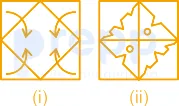
- A
Option A (shown in image)
- B
Option B (shown in image)
- C
Option C (shown in image)
- D
Option D (shown in image)
Show answer
B. Option B (shown in image)The image obtained when the paper is unfolded is,
Hence, option 2 is the correct answer.
 Paper & answer key PDF ↗
 Question 25archived
In a certain code language, ‘PARK’ is coded as ‘3749’, and ‘RACE’ is coded as ‘4762’.How will ‘CARE’ be coded in that language?
- A
6724
- B
7642
- C
7624
- D
6742
Show answer
D. 6742Understanding Coding Decoding in Code Language
This question involves a type of coding-decoding problem where letters are assigned specific numerical codes. We are given the codes for two words, 'PARK' and 'RACE', and asked to find the code for 'CARE' in the same code language.
Analyzing the Given Codes
We are given the following information:
'PARK' is coded as '3749'
'RACE' is coded as '4762'
By comparing the letters and their positions in the words and their respective codes, we can deduce the code assigned to each individual letter.
Deducing Letter Codes
Let's analyze the codes word by word:
From 'PARK' is '3749':
The first letter 'P' corresponds to the first digit '3'. So, P ⇒ 3.
The second letter 'A' corresponds to the second digit '7'. So, A ⇒ 7.
The third letter 'R' corresponds to the third digit '4'. So, R ⇒ 4.
The fourth letter 'K' corresponds to the fourth digit '9'. So, K ⇒ 9.
From 'RACE' is '4762':
The first letter 'R' corresponds to the first digit '4'. So, R ⇒ 4. (This matches the mapping from 'PARK')
The second letter 'A' corresponds to the second digit '7'. So, A ⇒ 7. (This matches the mapping from 'PARK')
The third letter 'C' corresponds to the third digit '6'. So, C ⇒ 6.
The fourth letter 'E' corresponds to the fourth digit '2'. So, E ⇒ 2.
Combining the information from both words, we have the following letter-to-digit mappings:
Letter
Code
P
3
A
7
R
4
K
9
C
6
E
2
Coding the Word 'CARE'
Now we need to find the code for the word 'CARE' using the established letter-to-digit mappings. The word 'CARE' consists of the letters C, A, R, and E.
For the first letter 'C', the code is '6'.
For the second letter 'A', the code is '7'.
For the third letter 'R', the code is '4'.
For the fourth letter 'E', the code is '2'.
Arranging the codes in the order of the letters in 'CARE', we get:
C ⇒ 6
A ⇒ 7
R ⇒ 4
E ⇒ 2
So, the code for 'CARE' is '6742'.
Comparing with Options
Let's check our derived code '6742' against the given options:
Option 1: 6724
Option 2: 7642
Option 3: 7624
Option 4: 6742
Our derived code '6742' matches Option 4.
Conclusion on Coding Decoding
Based on the coding pattern observed from 'PARK' and 'RACE', the word 'CARE' is coded as '6742'.
Revision Table: Coding Decoding
Word
Code
Letter Mappings
PARK
3749
P=3, A=7, R=4, K=9
RACE
4762
R=4, A=7, C=6, E=2
CARE
?
C=6, A=7, R=4, E=2 ⇒ 6742
Additional Information on Code Language Reasoning
Coding-decoding questions in reasoning often involve different patterns. Some common types include:
Letter Coding: Letters are coded using other letters based on patterns like shifting positions in the alphabet, reverse order, or skipping letters.
Number/Symbol Coding: Letters or words are coded using numbers or symbols. This can be direct substitution (as in this problem), positional value of letters, or patterns based on the number of letters.
Mixed Coding: Words are coded using a mix of letters, numbers, and symbols.
Sentence Coding: Whole sentences are coded, and you need to identify the code for individual words within the sentence based on common words in multiple coded sentences.
To solve these problems, carefully observe the given examples, identify the pattern or rule, and then apply that rule to the word or phrase you need to code or decode. Direct substitution is one of the simpler patterns to identify if letters consistently map to the same code across different examples.
Paper & answer key PDF ↗ Question 26archived
In December 2020, ______ became the first country in the world to approve sale of lab grown chicken products.
- A
Singapore
- B
Taiwan
- C
Vietnam
- D
Japan
Show answer
A. SingaporeUnderstanding Lab-Grown Chicken Approval
The question asks about the first country in the world to approve the sale of lab-grown chicken products in December 2020.
Lab-grown meat, also known as cultured meat, is produced from animal cells grown in a laboratory setting. This process aims to create meat without the need to raise and slaughter animals.
In December 2020, a significant milestone was reached in the food industry regarding alternative protein sources. A country granted regulatory approval for a specific company to sell its lab-grown chicken bites to consumers. This event marked the first time globally that cultured meat was approved for commercial sale.
Let's consider the options provided:
Singapore
Taiwan
Vietnam
Japan
After reviewing information about developments in the cultured meat industry and regulatory approvals, it is confirmed that Singapore was the country that made this pioneering decision in December 2020.
Specifically, the Singapore Food Agency (SFA) approved the sale of cultured chicken products produced by a US-based company called Eat Just.
Therefore, Singapore holds the distinction of being the first country to approve the sale of lab-grown chicken for human consumption.
Detailed Analysis
The approval process involved rigorous safety reviews by the Singapore Food Agency. This included evaluating the production process, the ingredients used, and the nutritional profile of the lab-grown chicken product.
The approval in Singapore was seen as a major step forward for the cultured meat industry, potentially opening doors for regulatory approvals in other countries in the future.
Summary of Approval
Aspect
Details
Product Approved
Lab-grown chicken (specific product by Eat Just)
Country
Singapore
Date of Approval
December 2020
Regulatory Body
Singapore Food Agency (SFA)
Significance
First country globally to approve sale of cultured meat
Conclusion
Based on historical events and regulatory approvals in the food technology sector, Singapore was the first country to authorize the sale of lab-grown chicken products in December 2020.
Revision Table: Lab-Grown Meat Approval
Key Term
Definition/Context
Lab-Grown Meat
Meat produced from animal cells grown in a lab; also called cultured meat or cellular agriculture.
Regulatory Approval
Official permission from a government agency (like a food safety authority) for a product to be sold to the public.
Singapore Food Agency (SFA)
The national authority in Singapore responsible for food safety and security.
Additional Information: Cultured Meat Industry
The cultured meat industry is an emerging field focused on producing meat more sustainably and ethically. Proponents highlight potential benefits such as reduced land and water use compared to traditional meat production, lower greenhouse gas emissions, and reduced risk of animalborne diseases.
However, challenges remain, including scaling up production to achieve price competitiveness with conventional meat and gaining consumer acceptance. Research and development continue globally to improve cell culture techniques and reduce production costs.
Paper & answer key PDF ↗ Question 27archived
Which of the following Amendments of the Constitution of India gave the status of state to Goa?
- A
52nd Amendment
- B
56th Amendment
- C
59th Amendment
- D
48th Amendment
Show answer
B. 56th AmendmentThe correct answer is 56 th Amendment.
The power to create new states or alter existing boundaries rests with the Parliament of India, as per Article 3 of the Constitution. Examples of other state reorganizations include the formation of: Andhra Pradesh (first state formed on linguistic basis) Maharashtra and Gujarat (from Bombay state) Punjab, Haryana, and Himachal Pradesh Chhattisgarh, Uttarakhand, and Jharkhand Telangana The 56 th Amendment is a specific instance of this ongoing process of adapting India's federal structure.
Paper & answer key PDF ↗ Question 28archived
Who among the following female wrestlers won the Ukraine Wrestling Tournament in February 2021?
- A
Kavita Devi
- B
Sakshi Malik
- C
Babita Kumari
- D
Vinesh Phogat
Show answer
D. Vinesh PhogatUkraine Wrestling Tournament 2021: Finding the Winner
The question asks us to identify the female wrestler among the given options who secured a victory at the Ukraine Wrestling Tournament held in February 2021.
Let's look at the prominent Indian female wrestlers listed in the options and their achievements around that time.
The correct answer to this question is Vinesh Phogat.
Analyzing Vinesh Phogat's Victory in Ukraine
In February 2021, Vinesh Phogat participated in the XXIV Outstanding Ukrainian Wrestlers and Coaches Memorial tournament which took place in Kyiv, Ukraine. She competed in the 53kg women's freestyle category.
Vinesh Phogat put up a strong performance throughout the tournament.
She successfully reached the final match.
In the final, she defeated her opponent to clinch the gold medal.
This victory was a significant achievement for Vinesh Phogat, marking a strong start to her 2021 international season and boosting her preparation for upcoming major events.
Considering Other Options
While Kavita Devi, Sakshi Malik, and Babita Kumari are also well-known Indian wrestlers with significant achievements in their careers, reports from February 2021 confirm that Vinesh Phogat was the one who won the gold medal at the Ukraine Wrestling Tournament held in Kyiv during that period.
Each of these wrestlers has represented India and achieved success in various competitions, but the specific win at the Ukraine tournament in Feb 2021 belongs to Vinesh Phogat.
Therefore, based on the records and news reports from February 2021 concerning the Ukraine Wrestling Tournament, Vinesh Phogat is the correct answer.
Revision Table: Key Facts about the Ukraine Wrestling Tournament 2021
EventDateLocationIndian Winner (Female)Category
Ukraine Wrestling Tournament (XXIV Outstanding Ukrainian Wrestlers and Coaches Memorial)February 2021Kyiv, UkraineVinesh Phogat53kg Women's Freestyle
Additional Information: Vinesh Phogat's Career
Vinesh Phogat is a prominent name in Indian wrestling. She comes from a family of wrestlers, including her cousins Geeta Phogat and Babita Kumari, who are also accomplished athletes. Vinesh has won medals at various international events, including:
Asian Games (Gold)
Commonwealth Games (Gold)
Asian Wrestling Championships (Multiple medals including Gold)
World Wrestling Championships (Bronze)
Her victory in the Ukraine tournament in 2021 was an important step in her journey, demonstrating her form and readiness for top-level competition.
Paper & answer key PDF ↗ Question 29archived
What is the emigration of a significant proportion of a country’s highly-skilled, highly educated professional population to other countries offering better economic and social opportunities called?
- A
Carrying capacity
- B
Brain drain
- C
Demographic transition
- D
Closed population
Show answer
B. Brain drainThe correct answer is Brain drain.
Refugee migration: Movement due to persecution or conflict. Family migration: Movement to join family members. Irregular migration: Movement outside the laws of the destination country. Brain drain is a specific type of labour migration focusing on highly skilled individuals.
Paper & answer key PDF ↗ Question 30archived
Which of the following laws deduces the expression for the force between two stationary point charges in vacuum or free space?
- A
Lenz’s Law
- B
Coulomb’s Law
- C
Gauss' Law
- D
Ohm’s Law
Show answer
B. Coulomb’s LawUnderstanding Forces Between Stationary Point Charges
The question asks to identify the law that provides the mathematical expression for the force experienced between two stationary point charges when they are placed in a vacuum or free space. This topic falls under the domain of electrostatics, which studies electric charges at rest.
Analyzing the Options for Electrostatic Force
Let's examine each option provided:
Lenz’s Law: This law relates to electromagnetic induction. It states that the direction of the induced electromotive force (EMF) and hence the induced current is such that it opposes the change in magnetic flux that produces it. This law is relevant for changing magnetic fields and induced currents, not for the force between stationary charges.
Coulomb’s Law: This fundamental law describes the electrostatic interaction between two point charges. It specifically gives the expression for the magnitude and direction of the force between two stationary point charges. The force is directly proportional to the product of the magnitudes of the charges and inversely proportional to the square of the distance between them.
Gauss' Law: Gauss's Law is another important law in electrostatics. It relates the electric flux through a closed surface to the net electric charge enclosed within that surface. While Gauss's Law is derived from Coulomb's Law and is useful for calculating electric fields (and subsequently forces) for symmetrical charge distributions, it does not directly provide the fundamental expression for the force between any two arbitrary point charges in the way Coulomb's Law does.
Ohm’s Law: This law applies to electric circuits and relates the voltage (\(V\)) across a conductor to the current (\(I\)) flowing through it and the resistance (\(R\)). It is given by the formula \(V = IR\). This law is about the flow of charge (current) in a conductor and is not related to the force between stationary charges.
Coulomb's Law: The Law for Electrostatic Force
Based on the analysis, Coulomb's Law is the law that precisely describes the force between two stationary point charges. The mathematical expression for the magnitude of the electrostatic force (\(F\)) between two point charges, \(q_1\) and \(q_2\), separated by a distance \(r\) in vacuum or free space is given by:
\(F = k \frac{|q_1 q_2|}{r^2}\)
Here, \(k\) is Coulomb's constant, which is approximately \(8.9875 \times 10^9 \, \text{N} \cdot \text{m}^2/\text{C}^2\). In vacuum, \(k\) is often expressed in terms of the permittivity of free space, \(\epsilon_0\), as \(k = \frac{1}{4\pi\epsilon_0}\).
The force is attractive if the charges have opposite signs and repulsive if they have the same sign. This force acts along the line joining the two charges.
Conclusion on the Law for Stationary Charges
The law that provides the expression for the force between two stationary point charges in vacuum or free space is Coulomb's Law.
Revision Table: Laws in Physics
Law
Primary Application
Relevance to Stationary Charges
Lenz’s Law
Electromagnetic Induction
Not applicable
Coulomb’s Law
Electrostatic force between point charges
Directly applicable
Gauss' Law
Electric flux and electric field distributions
Applicable indirectly (derived from Coulomb's)
Ohm’s Law
Electric Circuits (Voltage, Current, Resistance)
Not applicable
Additional Information on Coulomb's Law and Electrostatics
Coulomb's Law is a fundamental principle in electrostatics. Key aspects include:
Inverse Square Law: The force is inversely proportional to the square of the distance between the charges, similar to Newton's Law of Universal Gravitation.
Permittivity of Free Space (\(\epsilon_0\)): This constant represents the ability of a vacuum to permit electric fields. Its value is approximately \(8.854 \times 10^{-12} \, \text{C}^2/\text{N} \cdot \text{m}^2\). The force expression in vacuum is often written as \(F = \frac{1}{4\pi\epsilon_0} \frac{|q_1 q_2|}{r^2}\).
Medium Dependence: If the charges are placed in a medium other than vacuum, the force between them is reduced. The force in a medium is given by \(F_{\text{medium}} = \frac{1}{4\pi\epsilon} \frac{|q_1 q_2|}{r^2}\), where \(\epsilon\) is the permittivity of the medium (\(\epsilon = \epsilon_r \epsilon_0\), with \(\epsilon_r\) being the relative permittivity or dielectric constant of the medium).
Vector Form: Coulomb's Law can also be expressed in vector form to show the direction of the force. The force on charge \(q_2\) due to \(q_1\) is \(\vec{F}_{12} = \frac{1}{4\pi\epsilon_0} \frac{q_1 q_2}{r^2} \hat{r}_{12}\), where \(\hat{r}_{12}\) is the unit vector pointing from \(q_1\) to \(q_2\).
Understanding Coulomb's Law is crucial for studying electric fields, electric potential, and the behavior of charges in various configurations.
Paper & answer key PDF ↗ Question 31archived
What is the repo rate given by the Reserve Bank of India’s (RBI) Monetary Policy Committee (MPC) as on 7 April 2021?
- A
2%
- B
4%
- C
3%
- D
5%
Show answer
B. 4%Understanding the RBI Repo Rate on April 7, 2021
The question asks about a specific monetary policy rate set by the Reserve Bank of India (RBI) on a particular date: April 7, 2021. This rate is known as the repo rate. The repo rate is a crucial tool used by the RBI's Monetary Policy Committee (MPC) to manage liquidity in the banking system and influence inflation.
What is the Repo Rate?
The repo rate is the interest rate at which commercial banks borrow money from the Reserve Bank of India against government securities. It is a key policy rate that helps the RBI control the money supply and credit conditions in the economy. A lower repo rate encourages banks to borrow more, potentially leading to increased lending to businesses and individuals, stimulating economic activity. Conversely, a higher repo rate makes borrowing more expensive for banks, which can help cool down an overheated economy and control inflation.
The Role of the Monetary Policy Committee (MPC)
The Monetary Policy Committee (MPC) is a six-member body responsible for fixing the benchmark policy interest rate (repo rate) to keep inflation within the target set by the government. The committee meets periodically to review the economic situation and decide on the appropriate monetary policy stance, including setting the repo rate.
RBI Repo Rate as on April 7, 2021
As on April 7, 2021, the Reserve Bank of India's (RBI) Monetary Policy Committee announced its first bi-monthly monetary policy statement for the financial year 2021-22. In this meeting, the MPC decided to keep the key policy rates unchanged. The repo rate was maintained at the level set in earlier policies.
The specific repo rate as decided by the RBI MPC and effective from April 7, 2021, was 4%.
Key Aspect
Details
Date of Policy Announcement
April 7, 2021
Authority Setting the Rate
RBI Monetary Policy Committee (MPC)
Policy Rate in Question
Repo Rate
Repo Rate as on April 7, 2021
4%
This rate was maintained through several subsequent policy meetings in 2021 and early 2022, reflecting the RBI's stance to support economic recovery amidst prevailing conditions.
Analysis of Options
Let's look at the provided options in the context of the RBI repo rate on April 7, 2021:
2%: This rate is significantly lower than the actual rate on that date.
4%: This rate correctly matches the repo rate announced by the RBI MPC on April 7, 2021.
3%: This rate is lower than the actual rate on that date.
5%: This rate is higher than the actual rate on that date.
Based on the historical data of the RBI's monetary policy decisions, the repo rate as on April 7, 2021, was indeed 4%.
Revision Table: RBI Policy Rates
RBI Policy Rate
Definition
Purpose
Repo Rate
Rate at which RBI lends money to banks against government securities.
Key tool for controlling liquidity and inflation.
Reverse Repo Rate
Rate at which RBI borrows money from banks.
Absorbs excess liquidity from the banking system.
Marginal Standing Facility (MSF) Rate
Rate at which banks can borrow funds overnight from RBI under emergency situations.
Acts as a safety valve for banks facing liquidity crunch.
Bank Rate
Rate at which RBI lends money to banks without any security.
Also a penal rate, used for long-term loans. Linked to MSF rate.
Additional Information: RBI Monetary Policy Tools
Apart from the key policy rates like the repo rate, the RBI uses various other tools to manage liquidity and influence credit conditions in the economy. Understanding these tools is important for a comprehensive view of monetary policy.
Open Market Operations (OMOs): Buying or selling government securities in the open market to inject or absorb liquidity.
Cash Reserve Ratio (CRR): The percentage of net demand and time liabilities (deposits) that banks must hold as reserves with the RBI. It doesn't earn any interest. Changes in CRR affect the amount of money banks have available to lend.
Statutory Liquidity Ratio (SLR): The percentage of net demand and time liabilities that banks must maintain in the form of liquid assets like government securities, cash, and gold.
Moral Suasion: Persuading banks through advice, requests, or appeals to follow RBI's policy and guidelines.
All these tools, including the repo rate, are calibrated by the RBI MPC to achieve objectives like price stability (controlling inflation) while keeping in mind the objective of growth.
Paper & answer key PDF ↗ Question 32archived
From which of the following English words is the name ‘Bhangra’ derived in the context of Bhangra Dance?
- A
Hemp
- B
Rhythm
- C
Style
- D
Movement
Show answer
A. HempThe correct answer is Hemp.
It is now performed at various celebrations, including weddings, parties, and cultural events, far beyond its original harvest festival context. Key elements of Bhangra include: Powerful drum beats Energetic and athletic movements Loud vocal interjections (like 'ho ho ho' and 'balle balle') Colourful traditional attire While the dance form has evolved, its roots in the agricultural traditions and the name's link to the bhang harvest remain a key part of its history.
Paper & answer key PDF ↗ Question 33archived
Which of the following dwarf planets lies in the main asteroid belt?
- A
Eris
- B
Makemake
- C
Ceres
- D
Haumea
Show answer
C. CeresThe correct answer is Ceres.
Outer Solar System: Contains the gas giants (Jupiter, Saturn, Uranus, Neptune). Kuiper Belt: A ring of icy bodies beyond Neptune's orbit, home to many TNOs including Makemake, Haumea, and Pluto. Scattered Disc: An even more distant region with objects like Eris, scattered outwards by gravitational interactions with Neptune. Oort Cloud: A theoretical spherical cloud of icy bodies surrounding the entire solar system, thought to be the source of long-period comets.
Paper & answer key PDF ↗ Question 34archived
______ is concerned with constructing records of past climates and climatic events by analysis of tree growth characteristics, especially growth rings.
- A
Bioclimatology
- B
Historical- climatology
- C
Geo climatology
- D
Dendroclimatology
Show answer
D. DendroclimatologyUnderstanding the Question: Reconstructing Past Climates
The question asks to identify the specific scientific field concerned with reconstructing past climates and climatic events. The key method mentioned is the analysis of tree growth characteristics, particularly growth rings.
Analyzing the Options
Let's examine each option to determine which one fits the description provided in the question.
Bioclimatology: This field studies the interactions between climate and living organisms. While it relates climate to life, it doesn't specifically focus on reconstructing past climates through tree rings.
Historical Climatology: This field uses historical records (like diaries, ship logs, archival data) to study past climates. It uses written human records, not natural proxies like tree rings.
Geoclimatology: This term isn't a standard, widely recognized scientific field name. Climatology is the study of climate, and "Geo" relates to the Earth, but this option doesn't precisely describe the method of using tree rings.
Dendroclimatology: This field is a sub-discipline of dendrochronology (the study of tree rings) and climatology. It specifically uses the properties of tree rings (like ring width, density, and isotopic composition) to reconstruct past climate conditions and events. This aligns directly with the method described in the question.
The Science of Dendroclimatology
Dendroclimatology is a powerful technique for studying past climates because trees are sensitive to their environmental conditions, especially climate, as they grow. The width and characteristics of their annual growth rings reflect the climate conditions during the year they were formed. For example, in many regions, wider rings might indicate favorable conditions like sufficient rainfall and warmth, while narrower rings might suggest drought or cold temperatures.
By studying patterns in tree rings from living trees and preserved wood (like from old buildings or archaeological sites), scientists can build timelines of past climate variability that can extend back hundreds or even thousands of years. This provides valuable data for understanding natural climate change and placing recent climate shifts into a longer-term context.
Conclusion
Based on the analysis of the options and the description provided, the field specifically concerned with reconstructing past climates using tree growth rings is Dendroclimatology.
Revision Table: Comparing Climate Study Fields
Field
Primary Focus
Methods/Data Sources
Reconstruction of Past Climates?
Bioclimatology
Interaction between climate and living organisms
Ecological studies, climate data, physiological responses
Indirectly, by studying biological responses to past climate
Historical Climatology
Study of past climates using human records
Archives, diaries, logs, historical documents
Directly, using written records
Geoclimatology
Not a standard term; broadly, Earth's climate
Varies
Varies
Dendroclimatology
Reconstruction of past climates using tree rings
Tree ring analysis (width, density, isotopes)
Directly, using tree ring proxies
Additional Information on Dendroclimatology Techniques
Dendroclimatology involves several key steps and techniques:
Crossdating: Matching patterns in tree rings from different trees in the same area to ensure each ring corresponds to a specific year. This is crucial for accurate dating.
Sampling: Taking core samples from living trees or collecting samples from historical wood structures or archaeological sites.
Measurement: Measuring the width of each annual ring. Other properties like wood density and isotopic composition can also be measured.
Calibration: Comparing recent tree ring data with instrumental climate records to establish relationships between ring properties and climate variables (like temperature or precipitation).
Reconstruction: Using the established relationships to estimate climate conditions for years in the past where only tree ring data is available.
Dendroclimatology is a vital tool for paleo-climatology, helping scientists understand the natural variability of climate over long timescales.
Paper & answer key PDF ↗ Question 35archived
Which of the following revolutionaries was arrested by the British as an accused in the Alipore Bomb Conspiracy Case?
- A
Kanailal Dutta
- B
Rajendra Lahiri
- C
Roshan Singh
- D
Ashfaq Ullah Khan
Show answer
A. Kanailal DuttaThe correct answer is Kanailal Dutta.
Although Aurobindo Ghosh was acquitted, the trial brought many underground activities to light. The Kakori Conspiracy Case demonstrated the courage and commitment of revolutionaries from North India. The martyrdom of figures like Ram Prasad Bismil and Ashfaq Ullah Khan became a source of inspiration for many freedom fighters. These cases, while resulting in the capture and punishment of many revolutionaries, also ignited the spirit of nationalism and resistance among the masses.
Paper & answer key PDF ↗ Question 36archived
What was the first name of the Mughal Emperor Babur?
- A
Hasanuddin
- B
Giasuddin
- C
Zahiruddin
- D
Qaseemuddin
Show answer
C. ZahiruddinLet's explore the question about the first name of the famous Mughal Emperor Babur. Understanding the full name of historical figures like Babur helps us know them better in the context of history.
Understanding Mughal Emperor Babur's Name
Babur is widely known as the founder of the Mughal Empire in the Indian subcontinent. While 'Babur' is the name he is most commonly referred to, it is actually a nickname meaning 'tiger' in Persian or 'lion' in Turkic. His full formal name is more extensive and reveals his lineage and identity.
Identifying Babur's First Name
The full name of the Mughal Emperor Babur was Zahir-ud-din Muhammad Babur. Let's break down this name:
Zahir-ud-din: This is his first name. It means 'Defender of the Faith'.
Muhammad: This is a common middle name.
Babur: This was his personal name or nickname, which became how he was primarily known historically.
Therefore, the first name of the Mughal Emperor Babur is Zahiruddin.
Analyzing the Options
Let's look at the given options in light of Babur's full name:
Hasanuddin: This is not the first name of Babur.
Giasuddin: This is not the first name of Babur.
Zahiruddin: This matches the first part of Babur's full name, Zahir-ud-din Muhammad Babur.
Qaseemuddin: This is not the first name of Babur.
Based on historical records, the correct first name of the Mughal Emperor Babur is Zahiruddin.
Revision Table: Key Facts about Babur
Fact
Detail
Full Name
Zahir-ud-din Muhammad Babur
First Name
Zahiruddin
Known As
Babur
Meaning of Babur
Tiger or Lion (nickname)
Significance
Founder of the Mughal Empire in India
Reign Started
1526 (Battle of Panipat)
Additional Information on Mughal History Names
Many rulers and historical figures in the Mughal era and surrounding regions had names composed of several parts, often including religious or honorific titles. Understanding these names helps in tracing lineage and cultural context.
Names often included 'ud-din' (meaning 'of the faith') or 'al-din', indicating a connection to religion.
Rulers adopted regnal names upon ascending the throne, which might be different from their birth names.
Nicknames were also common, often based on physical characteristics, personality, or significant events.
For example, Babur's grandson, Akbar, was born as Abu'l-Fath Jalal-ud-din Muhammad. He later became known as Akbar, meaning 'the Great'. These naming conventions were typical of the period.
Paper & answer key PDF ↗ Question 37archived
As of April 2021, who among the following is the only Indian long jumper to have qualified for the Tokyo Olympics 2021?
- A
Virsa Singh
- B
TC Yohannan
- C
Sreeshankar Murali
- D
Sanjay Kumar Rai
Show answer
C. Sreeshankar MuraliIndian Long Jumper Tokyo Olympics 2021 Qualification
Let's analyze the question about the Indian long jumper who qualified for the Tokyo Olympics 2021 as of April 2021.
The question asks specifically about the status as of April 2021 and which Indian long jumper had qualified for the prestigious Tokyo Olympics.
Identifying the Qualified Indian Long Jumper
As of April 2021, one particular Indian long jumper had achieved the qualification standard for the Tokyo Olympics. This athlete met the required distance to secure his spot in the event.
Let's look at the options provided:
Virsa Singh
TC Yohannan
Sreeshankar Murali
Sanjay Kumar Rai
Based on athletic records and qualification announcements around April 2021, Sreeshankar Murali was the Indian long jumper who achieved the qualification mark for the Tokyo Olympics.
He qualified by setting a new national record with a jump of 8.26 meters at the Federation Cup Senior National Athletics Championships in Patiala in March 2021. This distance surpassed the Olympic qualification standard of 8.22 meters, securing his place for the Tokyo Games.
Therefore, Sreeshankar Murali was the only Indian long jumper confirmed to have qualified for the Tokyo Olympics as of the specified time frame (April 2021).
Why Other Options Are Not Correct
Virsa Singh: Not primarily known as a leading long jumper in recent years or for qualifying for the Tokyo Olympics.
TC Yohannan: A prominent long jumper from an earlier era (1970s), known for being the first Indian long jumper to surpass the 8-meter mark. He was not competing or qualifying for the Tokyo Olympics in 2021.
Sanjay Kumar Rai: Another Indian long jumper, but Sreeshankar Murali was the one who achieved the Olympic qualification standard as of April 2021.
Based on the qualification status as of April 2021, Sreeshankar Murali is the correct answer.
Revision Table: Indian Long Jumpers
Athlete
Relevance to Tokyo Olympics 2021 (as of April 2021)
Sreeshankar Murali
Qualified for Tokyo Olympics (achieved 8.26m standard)
TC Yohannan
Historical figure, not competing in 2021
Virsa Singh
Not qualified for Tokyo Olympics 2021
Sanjay Kumar Rai
Not qualified for Tokyo Olympics 2021 (as of April 2021)
Additional Information on Indian Long Jump and Olympics
Qualifying for the Olympics requires meeting specific standards set by World Athletics. These standards are designed to ensure that only top athletes from around the world compete.
The qualification period typically extends over several months, allowing athletes multiple opportunities to achieve the standard at approved competitions.
For the Tokyo Olympics Long Jump, the Men's qualification standard was 8.22 meters.
Apart from direct qualification by hitting the standard, athletes can also qualify based on their world ranking within a specific quota if the full quota is not met by direct qualifiers.
Sreeshankar Murali's jump of 8.26 meters was not only a personal best and a national record but also comfortably cleared the Olympic qualification mark.
Indian athletics has seen improvement in various disciplines over the years, with athletes striving to meet international standards and represent the country at events like the Olympics.
Understanding the qualification process helps appreciate the performance of athletes like Sreeshankar Murali in reaching the global stage of the Tokyo Olympics.
Paper & answer key PDF ↗ Question 38archived
In which year had India's ratio of public debt to GDP gone up to a record 84.2%?
- A
1991
- B
1999
- C
2003
- D
2001
Show answer
C. 2003The correct answer is 2003.
2003: This year is widely cited as a period when India's public debt to GDP ratio peaked in the recent past, largely due to sustained high fiscal deficits in the preceding years. The figure of 84.2% aligns closely with commonly reported figures for that year or the surrounding period (e.g., FY 2002-03 or FY 2003-04). Therefore, 2003 is the year when India's ratio of public debt to GDP is reported to have gone up to a record 84.2% in the period covered by the options.
Paper & answer key PDF ↗ Question 39archived
Who among the following is the author of the novel ‘Q and A’?
- A
Muchkund Dubey
- B
MK Rasgotra
- C
JN Dixit
- D
Vikas Swarup
Show answer
D. Vikas SwarupFinding the Author of the Novel 'Q and A'
Let's identify the author of the popular novel 'Q and A'. This question tests knowledge about famous books and their writers.
Understanding the Novel 'Q and A'
The novel 'Q and A' is a well-known work of fiction. It gained significant international recognition and was notably adapted into a highly successful film. Knowing the author is important for general knowledge and literature studies.
Identifying the Correct Author
The question asks to identify the author from the given options. Let's examine the options provided:
Muchkund Dubey
MK Rasgotra
JN Dixit
Vikas Swarup
We need to determine which of these individuals is the author of 'Q and A'.
Analysis of the Options
Based on literary records and authorship information, the novel 'Q and A' was written by Vikas Swarup. His work was the basis for the acclaimed movie "Slumdog Millionaire".
Muchkund Dubey: Known for his career as a diplomat.
MK Rasgotra: Known for his career as a diplomat.
JN Dixit: Known for his career as a diplomat and national security advisor.
Vikas Swarup: Known for his career as a diplomat and a novelist, authoring 'Q and A'.
Therefore, Vikas Swarup is the correct author of the novel 'Q and A'.
Conclusion on the Author of 'Q and A'
The author of the novel 'Q and A' is Vikas Swarup. This novel tells the story of a young man from the slums who wins a large sum of money on a quiz show, and how he knew the answers.
Author of 'Q and A'
Novel
Author
Q and A
Vikas Swarup
Revision Table: Key Details
Key Information about 'Q and A'
Aspect
Detail
Novel Title
Q and A
Author
Vikas Swarup
Notable Adaptation
Film 'Slumdog Millionaire'
Genre
Fiction
Additional Information on Vikas Swarup
Vikas Swarup is an Indian diplomat and writer. 'Q and A' was his debut novel, published in 2005. The novel received critical acclaim and was a bestseller. Its adaptation into the film 'Slumdog Millionaire' brought it wider international fame, and the film won multiple Academy Awards.
Other notable works by Vikas Swarup include:
Six Suspects
The Accidental Apprentice
His background as a diplomat often influences his writing, providing unique perspectives on Indian society and global interactions.
Paper & answer key PDF ↗ Question 40archived
Who among the following became the first Indian to win the Miss Deaf World title?
- A
Raghavi Shankar
- B
Vidisha Baliyan
- C
Arunima Sinha
- D
Preethi Srinivasan
Show answer
B. Vidisha BaliyanFirst Indian Miss Deaf World Winner
Let's analyze the question asking about the first Indian to win the prestigious Miss Deaf World title. This title is awarded in a beauty pageant for deaf women from around the world.
Understanding the Options
We are given four names as potential candidates:
Raghavi Shankar
Vidisha Baliyan
Arunima Sinha
Preethi Srinivasan
To find the correct answer, we need to identify which of these individuals holds the distinction of being the first Indian winner of the Miss Deaf World title.
Identifying the First Indian Winner
Researching the history of Indian participants and winners in the Miss Deaf World pageant helps us determine the correct person. The Miss Deaf World pageant is an international competition specifically for deaf women.
Upon review, it is found that Vidisha Baliyan created history by becoming the first Indian to win this title.
Vidisha Baliyan's Achievement
Vidisha Baliyan, a model and athlete, won the Miss Deaf World 2019 title. The competition was held in Mbombela, South Africa. Her victory marked a significant moment for India in the international deaf community and pageantry world.
Analyzing Other Options
Let's briefly look at the other options to confirm why they are not the correct answer for the first Indian Miss Deaf World title:
Raghavi Shankar: While active, she is not recorded as the first Indian Miss Deaf World winner.
Arunima Sinha: Known for being the first female amputee to climb Mount Everest, a remarkable achievement in mountaineering, not related to the Miss Deaf World title.
Preethi Srinivasan: A former cricketer and swimmer who became a quadriplegic. She is known for her work advocating for disability rights, not for winning the Miss Deaf World title.
Based on the facts, Vidisha Baliyan is indeed the first Indian winner of the Miss Deaf World title.
Conclusion
Therefore, the individual who became the first Indian to win the Miss Deaf World title is Vidisha Baliyan.
Candidate
Notable Achievements / Association
First Indian Miss Deaf World Winner?
Raghavi Shankar
(Information varies)
No
Vidisha Baliyan
Miss Deaf World 2019 Winner, Model, Athlete
Yes
Arunima Sinha
First female amputee to climb Mount Everest
No
Preethi Srinivasan
Former athlete, Disability Rights Activist
No
Revision Table: Miss Deaf World India
Title
Winner
Year
Significance
Miss Deaf World
Vidisha Baliyan
2019
First Indian winner
Additional Information: Indian Achievements
India has seen many individuals achieve global recognition in various fields. Vidisha Baliyan's win in the Miss Deaf World pageant highlights the achievements of deaf individuals and adds to India's presence on the international stage. Such accomplishments are inspiring and bring attention to the capabilities and talents within the deaf community.
Paper & answer key PDF ↗ Question 41archived
An amendment to the Hindu Succession Act, 1956 was passed in the year ______.
- A
2012
- B
2005
- C
2010
- D
2008
Show answer
B. 2005Understanding the Hindu Succession Act 1956 and its Key Amendment
The Hindu Succession Act, originally passed in 1956, is a law in India that governs the inheritance and succession of property among Hindus, Buddhists, Jains, and Sikhs. Initially, the Act primarily recognized sons as coparceners in Hindu Joint Family property by birth, which meant they had a right to the property from birth. Daughters, while inheriting property from their father under certain rules, were not given the same birthright in ancestral property as sons.
The Need for Amending the Hindu Succession Act 1956
Over time, it became evident that the original Hindu Succession Act, 1956, created inequality between sons and daughters regarding rights in ancestral property. This disparity was seen as discriminatory and not in line with modern principles of gender equality. There was a strong demand to reform the law to grant daughters equal rights in Hindu Undivided Family (HUF) property.
The Landmark Amendment of 2005 to the Hindu Succession Act
To address the inequality faced by daughters, a significant amendment was made to the Hindu Succession Act, 1956. This amendment aimed to grant daughters equal rights in ancestral property, making them coparceners just like sons.
The amendment that brought about this crucial change was passed in the year 2005.
Key Changes Introduced by the Hindu Succession (Amendment) Act, 2005
The Hindu Succession (Amendment) Act, 2005, which came into effect on September 9, 2005, made several important changes to the original Act of 1956. The most significant change was:
Daughters as Coparceners: A daughter of a coparcener shall by birth become a coparcener in her own right in the same manner as the son. She shall have the same rights in the coparcenary property as she would have had if she had been a son.
Same Liabilities: A daughter shall also be subject to the same liabilities in respect of the said coparcenary property as that of a son.
Rights on Partition: Upon partition of the coparcenary property, a daughter is entitled to the same share as a son.
This amendment was a pivotal step towards achieving gender equality in property inheritance rights within Hindu families governed by the Mitakshara school of Hindu law.
Summary of the Amendment Year
The question asks for the year the amendment to the Hindu Succession Act, 1956, was passed. Based on the historical legislative changes, the significant amendment granting equal coparcenary rights to daughters was passed in 2005.
Revision Table: Hindu Succession Act Key Dates
Event
Year
Original Hindu Succession Act
1956
Hindu Succession (Amendment) Act
2005
Additional Information on Hindu Succession
The 2005 amendment applies to joint family property in states where the Mitakshara school of Hindu law is followed.
The Supreme Court has clarified through various judgments (e.g., Vineeta Sharma vs Rakesh Sharma, 2020) that a daughter's right as a coparcener under the 2005 amendment is by birth, irrespective of whether her father was alive on the date of the amendment.
The Act also deals with the property of a Hindu female, succession to the property of a male Hindu dying intestate, and rules for partition.
Paper & answer key PDF ↗ Question 42archived
Which of the following elements is NOT suitable for the fabrication of a light emitting diode structure?
- A
Gallium phosphide
- B
Indium gallium nitride
- C
Germanium
- D
Gallium arsenide
Show answer
C. GermaniumUnderstanding LED Fabrication Materials
Light Emitting Diodes (LEDs) are semiconductor devices that emit light when an electric current passes through them. This process involves the recombination of electrons and holes in the semiconductor material, releasing energy in the form of photons (light).
Why Band Gap Matters for LEDs
The efficiency of light emission depends critically on the nature of the semiconductor's band gap. Semiconductors are classified into two types based on their band gap:
Direct Band Gap Semiconductors: In these materials, the minimum energy of the conduction band and the maximum energy of the valence band occur at the same momentum vector in the k-space. Electron-hole recombination is highly probable and efficient, leading to effective light emission.
Indirect Band Gap Semiconductors: In these materials, the minimum energy of the conduction band and the maximum energy of the valence band occur at different momentum vectors. Electron-hole recombination requires the involvement of a phonon (lattice vibration) to conserve momentum, making the process less probable and less efficient for light emission compared to direct band gap materials.
For efficient light emission in LEDs, direct band gap semiconductors are generally preferred.
Analyzing Potential LED Materials
Let's look at the suitability of the given materials for LED fabrication based on their properties:
Material
Type
Band Gap Nature (for light emission)
Suitability for LEDs
Gallium phosphide (GaP)
III-V Semiconductor
Can be indirect or pseudo-direct depending on composition, but used in LEDs (often alloyed or for green/yellow)
Suitable
Indium gallium nitride (InGaN)
III-V Semiconductor Alloy
Direct Band Gap
Suitable (Common for blue/green LEDs)
Germanium (Ge)
Group IV Semiconductor
Indirect Band Gap
Not Suitable for efficient light emission
Gallium arsenide (GaAs)
III-V Semiconductor
Direct Band Gap
Suitable (Common for infrared/red LEDs)
Why Germanium is Not Suitable for LEDs
Germanium is a Group IV semiconductor and has an indirect band gap. While it is an excellent semiconductor used in transistors and other electronic devices, its indirect band gap makes electron-hole recombination significantly less efficient in emitting photons compared to direct band gap materials like those from the III-V group. Therefore, Germanium is not suitable for the fabrication of efficient light-emitting diodes.
The other options listed - Gallium phosphide, Indium gallium nitride, and Gallium arsenide - are III-V semiconductors, which are well-known for their direct or pseudo-direct band gaps, making them highly suitable materials for manufacturing various types and colors of LEDs.
Conclusion
Based on the band gap properties and suitability for efficient light emission, Germanium is the element (or material) that is NOT suitable for the fabrication of a light emitting diode structure.
Revision Table: LED Materials
Material
Category
Used in LEDs?
Reason for suitability/unsuitability
Gallium phosphide (GaP)
III-V Semiconductor
Yes
Used for certain colors, can be direct or indirect depending on composition.
Indium gallium nitride (InGaN)
III-V Semiconductor Alloy
Yes
Direct band gap, used for blue/green.
Germanium (Ge)
Group IV Semiconductor
No
Indirect band gap, inefficient light emission.
Gallium arsenide (GaAs)
III-V Semiconductor
Yes
Direct band gap, used for infrared/red.
Additional Information on Semiconductor Band Gaps
The band gap energy ($\text{E}_\text{g}$) of a semiconductor is the minimum energy required to excite an electron from the valence band to the conduction band. This energy corresponds to the forbidden energy gap where no electron states exist.
In a direct band gap material, an electron can directly transition from the conduction band minimum to the valence band maximum by emitting a photon, conserving momentum. The energy of the emitted photon is approximately equal to the band gap energy, $\text{h}\nu \approx \text{E}_\text{g}$, where $\text{h}$ is Planck's constant and $\nu$ is the frequency of light.
In an indirect band gap material, such a direct transition is not possible because the momentum of the electron changes. To conserve momentum, the transition must involve a third particle, typically a phonon. This three-particle interaction makes the radiative recombination much less likely than the non-radiative recombination processes (like recombination via defects), resulting in very low light emission efficiency.
Common indirect band gap semiconductors include Silicon (Si) and Germanium (Ge).
Paper & answer key PDF ↗ Question 43archived
As per the Economic Survey, 2020, how many banks of India are there in the list of the top global 100?
- A
None
- B
One
- C
Three
- D
Two
Show answer
B. OneEconomic Survey 2020 Findings on Indian Banks
The question asks about the number of Indian banks that featured in the list of the top 100 global banks, specifically according to the Economic Survey, 2020. The Economic Survey is an annual report presented by the Government of India that reviews the country's economic development over the past year. It often includes data and analysis on various sectors, including the banking sector.
Based on the analysis presented in the Economic Survey, 2020, the status of Indian banks in global rankings was evaluated. The survey highlighted India's progress in various economic areas but also pointed out areas needing improvement.
Indian Banks in Global Top 100
According to the data and analysis provided in the Economic Survey, 2020, when considering the list of the top 100 banks globally, only a single Indian bank was present in this prestigious list. This indicates that while the Indian banking sector is significant domestically, its presence among the absolute largest global players was limited at that time, with just one institution making the cut.
The specific bank mentioned in such contexts is typically State Bank of India (SBI), which is the largest bank in India by assets and other key metrics, and often the only Indian bank to appear in the top global rankings.
Understanding Global Bank Rankings
Global bank rankings are usually based on criteria like total assets, market capitalization, revenue, and profitability. These rankings provide insights into the scale and financial strength of banks compared to their international counterparts. A higher presence of domestic banks in top global lists often reflects the size and robustness of a country's financial sector relative to the global landscape. The finding in the Economic Survey 2020, that only one Indian bank was in the top 100 global list, highlighted the need for Indian banks to grow in scale to compete more effectively on the world stage.
Therefore, as per the Economic Survey, 2020, the number of Indian banks in the list of the top global 100 was one.
Criterion
Status as per Economic Survey 2020
Number of Indian banks in Top 100 global list
One
Revision Table: Key Finding from Economic Survey 2020
Here is a summary of the key point related to Indian banks in global rankings from the Economic Survey 2020:
Source Document: Economic Survey, 2020
Topic: Global ranking of Indian banks
Finding: Only one Indian bank was ranked among the top 100 banks globally.
Additional Information: Scale of Indian Banking Sector
While the Economic Survey 2020 highlighted the limited presence of Indian banks in the absolute top tier globally (top 100), it's important to note that the Indian banking sector is vast and serves a large population and economy. It consists of a mix of public sector banks, private sector banks, small finance banks, payment banks, and cooperative banks. The focus on increasing the scale and efficiency of banks is often discussed as a way to enhance their competitiveness internationally and support the growing needs of the Indian economy. Measures such as bank mergers aim to create larger entities that can potentially compete better on a global scale in the future.
Paper & answer key PDF ↗ Question 44archived
What was the age in years of the revolutionary Bhagat Singh when he was hanged till death?
- A
20
- B
23
- C
30
- D
26
Show answer
B. 23The correct answer is 23.
He and Batukeshwar Dutt threw bombs in the Central Legislative Assembly in Delhi in 1929, not with the intent to kill, but to "make the deaf hear" and protest against unjust laws. His trial, subsequent hunger strike, and defiant attitude in court gained significant public attention and support across India. His ideas on socialism and revolution were advanced for his time, making him a lasting inspiration.
Paper & answer key PDF ↗ Question 45archived
Which of the following Sustainable Development Goals (SDG) seeks to ‘Protect, restore and promote sustainable use of terrestrial ecosystems, sustainably manage forests, combat desertification, and halt and reverse land degradation and halt biodiversity loss’?
- A
SDG 12
- B
SDG 7
- C
SDG 17
- D
SDG 15
Show answer
D. SDG 15The correct answer is SDG 15.
The loss of biodiversity through habitat destruction, climate change, pollution, and unsustainable resource use threatens the health and resilience of ecosystems and undermines human well-being. Combating desertification and halting land degradation are crucial for maintaining productive land and supporting livelihoods, particularly in arid and semi-arid regions. Sustainable forest management is vital for timber resources, carbon sequestration, and maintaining forest ecosystems' ecological functions. SDG 15 highlights the interconnectedness of these issues and the urgent need for global action to protect life on land for present and future generations.
Paper & answer key PDF ↗ Question 46archived
Which of the following is a characteristic of permanent tissue?
- A
Cells divide repeatedly
- B
Inorganic inclusions are absent
- C
Intercellular spaces are present
- D
Vacuoles are absent
Show answer
C. Intercellular spaces are presentUnderstanding Permanent Tissue Characteristics in Plants
Plant tissues are broadly classified into two main types: meristematic tissue and permanent tissue. Meristematic tissues are composed of cells that actively divide, contributing to the growth of the plant. Permanent tissues, on the other hand, are derived from meristematic tissues but have lost the ability to divide and have taken up a specific role.
Let's analyze the characteristics presented in the options to determine which one is typical of permanent tissue.
Analysis of Permanent Tissue Characteristics Options
Option 1: Cells divide repeatedly
This characteristic is true for meristematic tissues, such as apical meristems, lateral meristems, and intercalary meristems. These tissues are responsible for continuous growth. Permanent tissue cells, however, have differentiated and generally do not divide, or divide very rarely under specific conditions (like wound healing).
Option 2: Inorganic inclusions are absent
Inorganic inclusions, such as crystals (e.g., calcium oxalate), can be present in plant cells, including those of permanent tissues, particularly in vacuoles or cell walls. Their presence or absence is not a universal defining characteristic of all types of permanent tissue.
Option 3: Intercellular spaces are present
Intercellular spaces are the gaps or spaces found between adjacent plant cells. The presence or absence and size of these spaces vary depending on the type of permanent tissue. For example, parenchyma tissue, a fundamental type of permanent tissue, often has prominent intercellular spaces. Collenchyma tissue may have small spaces, while sclerenchyma tissue (like fibres and sclereids) typically lacks intercellular spaces due to tightly packed cells or thickened walls. However, the presence of intercellular spaces is a characteristic observed in many common permanent tissues, making it a possible characteristic.
Option 4: Vacuoles are absent
Mature plant cells, including those in permanent tissues, typically have large central vacuoles. These vacuoles play crucial roles in maintaining turgor pressure, storing substances, and waste disposal. The absence of vacuoles is characteristic of young, actively dividing meristematic cells, but not of differentiated permanent tissue cells.
Comparing Tissue Types: Permanent vs. Meristematic
To further clarify, here's a comparison of key features:
Characteristic
Meristematic Tissue
Permanent Tissue
Cell Division
Actively dividing
Generally non-dividing
Cell Differentiation
Undifferentiated
Differentiated (specialized)
Cell Shape
Small, isodiametric
Variable (isodiametric, elongated, irregular)
Cell Wall
Thin, primary cell wall
Primary and often thickened secondary cell wall
Vacuoles
Small or absent
Large central vacuole typically present
Intercellular Spaces
Generally absent
Present or absent depending on type
Conclusion on Permanent Tissue Characteristics
Based on the analysis, while not all permanent tissues have large intercellular spaces (like sclerenchyma), the presence of intercellular spaces is a common and distinguishing feature found in many types of permanent tissue, especially parenchyma, which makes up the bulk of many plant organs. The other options describe characteristics that are either absent in permanent tissue (repeated cell division, absent vacuoles) or not a consistent defining feature (absence of inorganic inclusions).
Therefore, among the given options, the presence of intercellular spaces is a characteristic that applies to a significant portion of permanent tissues.
Revision Table: Key Facts about Permanent Tissue
Feature
Description for Permanent Tissue
Origin
Derived from meristematic tissue
Cell Division
Generally lose the ability to divide
Differentiation
Cells are differentiated for specific functions
Structure
Cells vary in shape, size, and wall thickness
Intercellular Spaces
May be present or absent depending on the tissue type (common in parenchyma)
Vacuoles
Typically large and central
Additional Information: Types of Permanent Tissue
Permanent tissues are further classified based on their cell types:
Simple Permanent Tissues: Made up of only one type of cell.
Parenchyma: Living cells, often isodiametric, thin-walled, frequently with intercellular spaces. Involved in storage, photosynthesis, secretion.
Collenchyma: Living cells, elongated, thickened corners, provide mechanical support in growing stems and petioles. May have small or no intercellular spaces.
Sclerenchyma: Dead cells, thick-walled, lignified, provide mechanical support and rigidity. Includes fibres and sclereids. Lack intercellular spaces.
Complex Permanent Tissues: Made up of more than one type of cell working together as a unit.
Xylem: Conducts water and minerals. Includes tracheids, vessels, xylem parenchyma, xylem fibres.
Phloem: Conducts sugars. Includes sieve tubes, companion cells, phloem parenchyma, phloem fibres.
The characteristic of intercellular spaces being present is particularly prominent in parenchyma, a major component of the permanent tissue system.
Paper & answer key PDF ↗ Question 47archived
In which of the following years was an Act to provide for the reorganisation of the states of India and for matters connected therewith enacted?
- A
1947
- B
1956
- C
1959
- D
1962
Show answer
B. 1956Understanding the States Reorganisation Act
The question asks about the year the Act providing for the reorganisation of the states of India was enacted. This refers to the States Reorganisation Act, which was a major piece of legislation in India's post-independence history.
After India gained independence in 1947, there was a demand for reorganising states on linguistic lines. The original states in India were based on colonial boundaries, princely states, and administrative convenience, not language.
The States Reorganisation Act addressed this issue. It aimed to redraw the internal map of India by forming states primarily on the basis of language, while also considering administrative and geographical factors.
Let's look at the options provided:
1947: This was the year of India's independence, not the enactment of the States Reorganisation Act.
1956: This year saw the enactment of the States Reorganisation Act and the simultaneous passing of the 7th Amendment to the Constitution of India, which abolished the existing categories of states (Part A, B, C, D states) and reorganised them into 14 states and 6 union territories.
1959: No major state reorganisation act was passed in this year.
1962: No major state reorganisation act was passed in this year. Subsequent reorganisations happened later, but the primary act was earlier.
Based on historical records, the States Reorganisation Act was enacted in the year 1956.
Here is a summary:
Year
Significance related to States
1947
India's Independence; Existing state structure
1956
States Reorganisation Act enacted; Major linguistic reorganisation of states
1959
No major reorganisation act
1962
No major reorganisation act
Therefore, the Act to provide for the reorganisation of the states of India was enacted in 1956.
Revision Table: Key Events in Indian States Reorganisation
Year
Event/Act
1947
Independence of India
1948
Dar Commission submits report (suggests reorganisation based on administrative convenience, not language)
1948
JVP Committee submits report (initially opposes linguistic reorganisation, later agrees cautiously)
1953
Formation of Andhra State (first state based on language)
1953
States Reorganisation Commission (Fazal Ali Commission) appointed
1955
States Reorganisation Commission submits report
1956
States Reorganisation Act enacted; 7th Constitutional Amendment
Additional Information on States Reorganisation
The States Reorganisation Act of 1956 was a landmark legislation that fundamentally reshaped the political map of India. The primary force behind this reorganisation was the linguistic identity of people.
Background: The movement for linguistic states started even before independence, particularly in regions like Andhra. After independence, this demand grew stronger.
Commissions: The government appointed commissions like the Dar Commission (1948), JVP Committee (1948), and the States Reorganisation Commission (1953) to study the issue. The States Reorganisation Commission, headed by Fazal Ali, with members K. M. Panikkar and H. N. Kunzru, played a crucial role.
Key Provisions of the Act: The Act proposed the creation of 14 states and 6 union territories. It abolished the four-fold classification of states (Part A, B, C, D) under the original constitution.
Impact: While language was the main basis, factors like geographical contiguity, financial viability, and administrative convenience were also considered. This reorganisation largely satisfied the aspirations of linguistic groups but also led to some new disputes regarding boundaries and minority rights.
Subsequent Changes: The 1956 Act was not the final word on state boundaries. Several new states and union territories have been created since then, such as Gujarat (1960), Nagaland (1963), Haryana (1966), Himachal Pradesh (1971), Meghalaya, Manipur, Tripura (1972), Sikkim (1975), Mizoram, Arunachal Pradesh, Goa (1987), Chhattisgarh, Uttarakhand, Jharkhand (2000), and Telangana (2014).
Understanding the States Reorganisation Act 1956 is vital for studying the political and administrative history of modern India.
Paper & answer key PDF ↗ Question 48archived
Which of the following statements is/are correct?
I- Karnataka is the largest producer of coffee in India.
II- Arabica is a variety of coffee.
III- The Arabica variety initially brought from Mexico is produced in India.
- A
I, II and III
- B
Only II and III
- C
Only III
- D
Only I and II
Show answer
D. Only I and IIThe correct answer is Only I and II.
Coffee cultivation provides livelihood for many farmers in the Western and Eastern Ghats. Indian coffee is highly regarded globally, especially for its quality and shade-grown characteristics. Both Arabica and Robusta varieties are grown, with Robusta having a larger share in total production, though Arabica is valued for quality. India also exports a significant amount of its coffee production.
Paper & answer key PDF ↗ Question 49archived
In which city of Gujarat will you find the Uparkot Buddhist Caves?
- A
Bhavnagar
- B
Vadodara
- C
Junagadh
- D
Anand
Show answer
C. JunagadhThe correct answer is Junagadh.
Karla Caves: Near Pune, Maharashtra, known for its large Chaitya Hall. Bagh Caves: In Madhya Pradesh, noted for mural paintings. Undavalli Caves: In Andhra Pradesh, featuring multi-storeyed rock-cut caves. These sites, including the Uparkot Buddhist Caves, highlight the rich heritage of rock-cut architecture and the spread of Buddhism in ancient India.
Paper & answer key PDF ↗ Question 50archived
Camellia sinensis is a plant that produces ______.
- A
tea
- B
coffee
- C
jute
- D
sugarcane
Show answer
A. teaUnderstanding Camellia Sinensis and Tea Production
The question asks about the plant Camellia sinensis and what it produces. This is a fundamental concept in botany and agriculture, specifically related to beverages consumed globally.
Let's examine the options provided:
tea
coffee
jute
sugarcane
The plant species Camellia sinensis is widely known and cultivated for its leaves and leaf buds, which are used to produce tea. Different processing methods applied to the leaves of Camellia sinensis result in various types of tea, such as black tea, green tea, oolong tea, and white tea.
Analyzing the Options
Let's look at why the other options are incorrect:
Coffee: Coffee beans are produced by plants belonging to the genus Coffea, most commonly Coffea arabica or Coffea canephora (Robusta). These are entirely different plant species from Camellia sinensis.
Jute: Jute fibre is obtained from plants in the genus Corchorus, primarily Corchorus capsularis and Corchorus olitorius. Jute is a fiber crop used for making sacks, ropes, and other textiles, not a beverage plant like Camellia sinensis.
Sugarcane: Sugarcane is a tall grass in the genus Saccharum, mainly Saccharum officinarum. It is grown for sugar production from its stalks. This is very different from the leaf-based product of Camellia sinensis.
Therefore, based on botanical knowledge and the specific identity of Camellia sinensis, the product derived from this plant is tea.
Summary of Camellia Sinensis and its Product
In conclusion, the plant Camellia sinensis is the source of tea. The leaves are harvested and processed in various ways to create the many types of tea enjoyed around the world. The other options listed come from different types of plants used for different purposes.
Revision Table: Plants and Their Products
Plant Species/Genus
Primary Product
Camellia sinensis
Tea
Coffea spp.
Coffee beans
Corchorus spp.
Jute fibre
Saccharum officinarum
Sugarcane (Sugar)
Additional Information about Camellia Sinensis and Tea
Camellia sinensis is native to East Asia, the Indian Subcontinent, and Southeast Asia. It is an evergreen shrub or small tree. The difference between green tea, black tea, oolong tea, and white tea largely depends on the level of oxidation the leaves undergo after harvesting.
Green tea: Leaves are typically steamed or pan-fired quickly to prevent oxidation.
Black tea: Leaves are fully oxidized.
Oolong tea: Leaves are partially oxidized, falling between green and black tea.
White tea: Made from young leaves or buds that are minimally processed and lightly oxidized.
Understanding the origin of common products like tea from specific plants like Camellia sinensis is important for biology and general knowledge.
Paper & answer key PDF ↗ Question 51archived
The given histogram represents the marks of students in Mathematics test of a certain class. The total number of students is 350 and the maximum marks of the test are 200.
Study the graph and answer the question that follows.
What is the class average (correct up to one place of the decimal) of mathematics test?
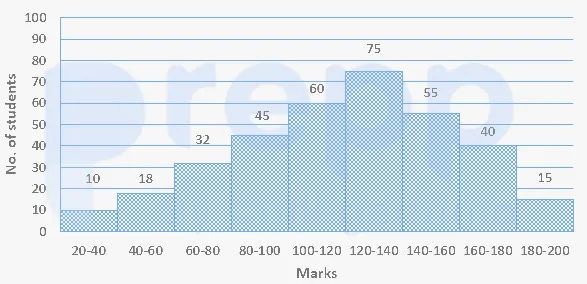
- A
119.3
- B
123.7
- C
115.8
- D
127.3
Show answer
A. 119.3Given:
The total number of students = 350
Calculation:
Arranging all values in a frequesncy chart:
MarksNumber of students (f i)Mid value of marks (x i)f ix i
20 - 40103010 × 30 = 300
40 - 60185018 × 50 = 900
60 - 80327032 × 70 = 2240
80 - 100459045 × 90 = 4050
100 - 1206011060 × 110 = 6600
120 - 1407513075 × 130 = 9750
140 - 1605515055 × 150 = 8250
160 - 1804017040 × 170 = 6800
180 - 20015190
15 × 190 = 2850
Total number of students \(\left(\displaystyle\sum_{f_i} \right)\)= 350
Also, \(\displaystyle\sum_{f_ix_i}\) = 300 + 900 + 2240 + 4050 + 6600 + 9750 + 8250 + 6800 + 2850 = 41740
The average marks \(\left(\displaystyle\sum_{f_ix_i}/\displaystyle\sum_{f_i} \right)\) = 41740/350 = 119.257... ≈ 119.3 (correct up to one place of decimal)
∴ The class average is 119.3
Paper & answer key PDF ↗ Question 52archived
In a quadrilateral ABCD, the bisectors of ∠C and ∠D meet at point E. If ∠CED = 57° and ∠A = 47°, then the measure of ∠B is:
- A
47°
- B
67°
- C
77°
- D
57°
Show answer
B. 67°Solving for Angle B in a Quadrilateral with Angle Bisectors
This problem involves finding the measure of an angle in a quadrilateral where the angle bisectors of two adjacent angles meet at a point inside the quadrilateral. We are given the measures of one angle of the quadrilateral and the angle formed by the bisectors.
Understanding the Given Information
We have a quadrilateral ABCD. The bisectors of angle ∠C and angle ∠D meet at point E. We are given:
∠CED = 57°
∠A = 47°
We need to find the measure of ∠B.
Using Properties of Triangles and Quadrilaterals
The key to solving this problem is to use the properties of the sum of angles in a triangle and a quadrilateral, along with the definition of an angle bisector.
Step 1: Analyze Triangle CED
The point E is the intersection of the angle bisectors of ∠C and ∠D. This means:
CE bisects ∠C, so ∠ECD = ∠C / 2
DE bisects ∠D, so ∠EDC = ∠D / 2
In triangle ▵CED, the sum of angles is 180°. So, we have:
\(\angle CED + \angle ECD + \angle EDC = 180^\circ\)
Substitute the given value of ∠CED and the expressions for ∠ECD and ∠EDC:
\(57^\circ + \frac{\angle C}{2} + \frac{\angle D}{2} = 180^\circ\)
Step 2: Find the Sum of Angles C and D
From the equation above, we can find the sum of half of angles C and D:
\(\frac{\angle C}{2} + \frac{\angle D}{2} = 180^\circ - 57^\circ\)
\(\frac{\angle C + \angle D}{2} = 123^\circ\)
Now, multiply by 2 to find the sum of angles C and D:
\(\angle C + \angle D = 123^\circ \times 2\)
\(\angle C + \angle D = 246^\circ\)
Step 3: Use the Properties of Quadrilateral ABCD
The sum of interior angles in any quadrilateral is 360°. For quadrilateral ABCD, we have:
\(\angle A + \angle B + \angle C + \angle D = 360^\circ\)
We are given ∠A = 47°, and we just found that ∠C + ∠D = 246°. Substitute these values into the equation:
\(47^\circ + \angle B + 246^\circ = 360^\circ\)
Step 4: Solve for Angle B
Combine the known angles:
\(\angle B + (47^\circ + 246^\circ) = 360^\circ\)
\(\angle B + 293^\circ = 360^\circ\)
Subtract 293° from 360° to find ∠B:
\(\angle B = 360^\circ - 293^\circ\)
\(\angle B = 67^\circ\)
Therefore, the measure of ∠B is 67°.
Summary of Steps
Step
Description
Calculation
1
Angles in ▵CED
\(\angle CED + \frac{\angle C}{2} + \frac{\angle D}{2} = 180^\circ\)
2
Sum of ∠C and ∠D
\(\angle C + \angle D = 2 \times (180^\circ - 57^\circ) = 246^\circ\)
3
Sum of angles in quadrilateral ABCD
\(\angle A + \angle B + \angle C + \angle D = 360^\circ\)
4
Solve for ∠B
\(\angle B = 360^\circ - \angle A - (\angle C + \angle D)\)
\(\angle B = 360^\circ - 47^\circ - 246^\circ = 67^\circ\)
Revision Table: Quadrilateral Angle Properties
Concept
Property
Application in this problem
Angle Bisector
Divides an angle into two equal parts.
∠ECD = ∠C/2, ∠EDC = ∠D/2
Sum of angles in a Triangle
Sum of interior angles is 180°.
Used in ▵CED: \(\angle CED + \angle ECD + \angle EDC = 180^\circ\)
Sum of angles in a Quadrilateral
Sum of interior angles is 360°.
Used in ABCD: \(\angle A + \angle B + \angle C + \angle D = 360^\circ\)
Additional Information: Angle Bisectors in Polygons
Angle bisectors in polygons have interesting properties depending on the type of polygon. In a triangle, the angle bisectors are concurrent at the incenter, which is the center of the inscribed circle. In quadrilaterals and other polygons, the angle bisectors do not always meet at a single point. When they do, the point is equidistant from the sides, and it is the center of the inscribed circle (if the polygon is tangential).
In this specific problem involving the bisectors of adjacent angles C and D meeting at E, the relationship \(\angle CED = 180^\circ - (\angle C + \angle D)/2\) is used, which simplifies to \(\angle CED = (\angle A + \angle B)/2\) for a quadrilateral, but this formula is only valid if the bisectors meet inside the quadrilateral. Let's verify this alternative approach:
\(\angle CED = (\angle A + \angle B)/2\)
\(57^\circ = (47^\circ + \angle B)/2\)
\(57^\circ \times 2 = 47^\circ + \angle B\)
\(114^\circ = 47^\circ + \angle B\)
\(\angle B = 114^\circ - 47^\circ\)
\(\angle B = 67^\circ\)
This alternative approach confirms the result obtained by using the sum of angles in ▵CED and the quadrilateral properties. The formula \(\angle CED = (\angle A + \angle B)/2\) is a known property for the angle formed by the intersection of angle bisectors of two adjacent angles in a quadrilateral.
Paper & answer key PDF ↗ Question 53archived
The value of 40 ÷ 5 of 2 × [18 ÷ 6 × (12 − 9) of 5 − (3 − 8)] ÷ 25 is:
- A
5
- B
7
- C
8
- D
4
Show answer
C. 8Solving Mathematical Expressions Using Order of Operations
The question asks us to find the value of the given mathematical expression: $40 \div 5 \text{ of } 2 \times [18 \div 6 \times (12 - 9) \text{ of } 5 - (3 - 8)] \div 25$.
To solve this expression correctly, we must follow the order of operations, often remembered using acronyms like BODMAS or PEDMAS.
B/P: Brackets or Parentheses
O/E: Order (powers, square roots, etc.) or Exponents
D/M: Division and Multiplication (from left to right)
A/S: Addition and Subtraction (from left to right)
In this expression, 'of' acts like multiplication but is typically evaluated after brackets/parentheses and before standard multiplication or division.
Let's break down the calculation step by step:
Given Expression: $40 \div 5 \text{ of } 2 \times [18 \div 6 \times (12 - 9) \text{ of } 5 - (3 - 8)] \div 25$
Step 1: Solve the operations inside the innermost Brackets (Parentheses).
$(12 - 9) = 3$
$(3 - 8) = -5$
The expression becomes: $40 \div 5 \text{ of } 2 \times [18 \div 6 \times 3 \text{ of } 5 - (-5)] \div 25$
Step 2: Evaluate the 'of' operations.
$5 \text{ of } 2 = 5 \times 2 = 10$
$3 \text{ of } 5 = 3 \times 5 = 15$
The expression is now: $40 \div 10 \times [18 \div 6 \times 15 - (-5)] \div 25$
Step 3: Solve the operations inside the Square Brackets. Follow BODMAS/PEDMAS within the brackets.
Inside brackets: $[18 \div 6 \times 15 - (-5)]$
Perform Division and Multiplication from left to right:
$18 \div 6 = 3$
The expression inside becomes: $[3 \times 15 - (-5)]$
$3 \times 15 = 45$
The expression inside becomes: $[45 - (-5)]$
Perform Subtraction:
$45 - (-5) = 45 + 5 = 50$
The value inside the square brackets is 50. The expression becomes: $40 \div 10 \times 50 \div 25$
Step 4: Solve the remaining operations outside the brackets. Follow BODMAS/PEDMAS from left to right.
We have Division and Multiplication. Perform them from left to right.
$40 \div 10 = 4$
The expression becomes: $4 \times 50 \div 25$
$4 \times 50 = 200$
The expression becomes: $200 \div 25$
$200 \div 25 = 8$
The final value of the expression is 8.
Let's summarize the steps in a table:
Step
Operation
Calculation
Expression Status
1
Innermost Brackets
$(12 - 9) = 3$, $(3 - 8) = -5$
$40 \div 5 \text{ of } 2 \times [18 \div 6 \times 3 \text{ of } 5 - (-5)] \div 25$
2
'of' Operations
$5 \text{ of } 2 = 10$, $3 \text{ of } 5 = 15$
$40 \div 10 \times [18 \div 6 \times 15 - (-5)] \div 25$
3
Inside Square Brackets (Division/Multiplication)
$18 \div 6 = 3$, $3 \times 15 = 45$
$40 \div 10 \times [45 - (-5)] \div 25$
4
Inside Square Brackets (Subtraction)
$45 - (-5) = 50$
$40 \div 10 \times 50 \div 25$
5
Outside Brackets (Division/Multiplication L to R)
$40 \div 10 = 4$, $4 \times 50 = 200$, $200 \div 25 = 8$
8
The value of the expression is 8.
Revision Table: Order of Mathematical Operations
Order
Operation Type
Description
1
Brackets / Parentheses
Operations inside ( ), { }, [ ] are done first. Start from the innermost.
2
Orders / 'of' / Exponents
Powers, roots, and 'of' operations are done next. 'of' means multiplication but has higher priority than standard multiplication/division.
3
Division and Multiplication
These are done from left to right as they appear in the expression.
4
Addition and Subtraction
These are done from left to right as they appear in the expression.
Additional Information: The Role of 'of' in Expressions
The term 'of' in mathematical expressions is crucial for understanding the correct order of operations. It represents multiplication but is typically performed at the 'Orders' or 'Exponents' stage of the BODMAS/PEDMAS rule, meaning it takes precedence over standard multiplication and division.
For example, in the expression $10 \div 2 \text{ of } 5$:
If we treated 'of' like regular multiplication and followed left-to-right for $\div$ and $\times$: $(10 \div 2) \times 5 = 5 \times 5 = 25$.
However, following the correct order where 'of' comes before $\div$ and $\times$: $10 \div (2 \text{ of } 5) = 10 \div (2 \times 5) = 10 \div 10 = 1$.
As shown in our main problem, we calculated $5 \text{ of } 2$ first (as 10) and $3 \text{ of } 5$ first (as 15) before performing the divisions or other multiplications at the same level.
Understanding the correct hierarchy of operations, including the specific placement of 'of', is essential for accurately solving complex mathematical expressions.
Paper & answer key PDF ↗ Question 54archived
A can complete 25% of a work in 15 days. He works for 15 days and then B alone finishes the remaining work in 30 days. In how many days will A and B working together finish 50% of the same work?
- A
24
- B
20
- C
12
- D
25
Show answer
C. 12Solving Work and Time Problems
This problem involves calculating the time taken by individuals and a group to complete a certain amount of work. We will use the concept of work rate, which is the amount of work done per unit of time (in this case, per day).
Step-by-Step Analysis of the Work Problem
Let's break down the problem statement to understand the contributions of A and B.
A completes 25% of the work in 15 days. 25% of the work is equivalent to $\frac{25}{100} = \frac{1}{4}$ of the work.
A works for 15 days.
B alone finishes the remaining work in 30 days.
Calculating Individual Work Rates
First, we find the rate at which A and B can complete the work individually.
A's Work Rate: A does $\frac{1}{4}$ of the work in 15 days. To find the total time A takes to complete the whole work (1 unit), we can set up a proportion or simply multiply:
If $\frac{1}{4}$ work is done in 15 days, then 1 whole work is done in $15 \times \frac{4}{1} = 60$ days.
So, A's daily work rate is $\frac{1}{60}$ of the work per day.
Work Done by A in 15 Days: The problem states A works for 15 days. The amount of work done by A in these 15 days is 15 days $\times$ (A's daily rate) = $15 \times \frac{1}{60} = \frac{15}{60} = \frac{1}{4}$ of the work. This matches the first piece of information given.
Remaining Work: After A works for 15 days, the remaining work is $1 - \frac{1}{4} = \frac{3}{4}$ of the work.
B's Work Rate: B finishes this remaining $\frac{3}{4}$ of the work in 30 days. To find the total time B takes to complete the whole work (1 unit):
If $\frac{3}{4}$ work is done in 30 days, then 1 whole work is done in $30 \times \frac{4}{3} = 10 \times 4 = 40$ days.
So, B's daily work rate is $\frac{1}{40}$ of the work per day.
Calculating Combined Work Rate
Now, we find the rate at which A and B work together.
Combined daily work rate of A and B = A's daily rate + B's daily rate
Combined rate = $\frac{1}{60} + \frac{1}{40}$
To add these fractions, we find a common denominator, which is the Least Common Multiple (LCM) of 60 and 40. The LCM is 120.
Combined rate = $\frac{1 \times 2}{60 \times 2} + \frac{1 \times 3}{40 \times 3} = \frac{2}{120} + \frac{3}{120} = \frac{2+3}{120} = \frac{5}{120}$
Simplify the combined rate: $\frac{5}{120} = \frac{1}{24}$ of the work per day.
Calculating Time to Complete 50% Work Together
The combined daily rate of A and B is $\frac{1}{24}$ of the work per day. This means they can complete the entire work (100%) in 24 days.
We need to find the time taken for them to finish 50% of the work.
Time to complete 100% work together = 24 days.
Time to complete 50% work together = 50% of the time taken for 100% work.
50% is equivalent to $\frac{50}{100} = \frac{1}{2}$.
Time to complete 50% work = $\frac{1}{2} \times 24$ days = 12 days.
Thus, A and B working together will finish 50% of the same work in 12 days.
Revision Table: Work and Time Concepts
Concept
Formula/Explanation
Work Rate
Amount of work done per unit of time. Work Rate = $\frac{\text{Total Work}}{\text{Total Time}}$
Total Time
Time taken to complete the entire work. Total Time = $\frac{\text{Total Work}}{\text{Work Rate}}$
Work Done
Work Done = Work Rate $\times$ Time
Combined Rate
If A's rate is $R_A$ and B's rate is $R_B$, their combined rate is $R_{A+B} = R_A + R_B$
Additional Information on Work and Time Problems
Work and time problems often involve calculating the efficiency of individuals or groups and determining how long it takes them to complete tasks, either alone or together. Key assumptions usually include:
The work rate of each person is constant.
The total work is considered as one unit or 100%.
When multiple people work together, their individual work rates are added up to find the combined work rate. This combined rate is then used to calculate the time required to complete the desired amount of work.
Understanding fractions and percentages is crucial for solving these types of quantitative aptitude problems.
Paper & answer key PDF ↗ Question 55archived
A and B start a business. A invests 33 \({\ {1} \over 3}\) % of the total capital and B invests the remaining. If the total profit at the end of the year is Rs.1,62,000, then B's share (in Rupees) is:
- A
1,08,000
- B
1,12,000
- C
1,20,000
- D
54,000
Show answer
A. 1,08,000Understanding the Business Partnership Capital Contribution
In this problem, we have a business partnership between two individuals, A and B. We are given the proportion of the total capital invested by A and the total profit earned at the end of the year. We need to determine B's share of the profit.
First, let's break down the capital investment:
A invests 33 \({\ {1} \over 3}\) % of the total capital.
B invests the remaining capital.
The percentage 33 \({\ {1} \over 3}\) % can be converted into a fraction:
33 \({\ {1} \over 3}\) % = \({\ {100} \over 3}\) % = \({\ {100} \over 3 \times 100}\) = \({\ {1} \over 3}\)
So, A invests \({\ {1} \over 3}\) of the total capital.
Calculating B's Capital Investment Proportion
Since A invests \({\ {1} \over 3}\) of the total capital, B must invest the rest. The total capital represents 1 (or 100%).
B's investment proportion = Total Capital - A's investment proportion
B's investment proportion = \(1 - {\ {1} \over 3}\) = \({\ {3} \over 3} - {\ {1} \over 3}\) = \({\ {2} \over 3}\)
So, B invests \({\ {2} \over 3}\) of the total capital.
Determining the Investment Ratio of A and B
The profit in a business partnership is typically shared in the ratio of the capital invested by each partner, assuming the investment period is the same for both (which is implied here as profit is calculated at the end of the year).
The ratio of A's investment to B's investment is:
A : B = \({\ {1} \over 3}\) : \({\ {2} \over 3}\)
To simplify the ratio, we can multiply both parts by the common denominator, which is 3:
A : B = \({\ {1} \over 3} \times 3\) : \({\ {2} \over 3} \times 3\)
A : B = 1 : 2
This means for every 1 part of capital invested by A, B invests 2 parts.
Sharing the Total Profit Based on Investment Ratio
The total profit at the end of the year is given as Rs. 1,62,000.
The total parts in the investment ratio are the sum of A's parts and B's parts:
Total ratio parts = 1 (for A) + 2 (for B) = 3 parts
The total profit of Rs. 1,62,000 will be divided into these 3 parts.
Calculating B's Share of the Total Profit
B's share of the profit will be proportional to B's part in the ratio (2 parts) out of the total parts (3 parts).
B's share = (\( {\text{B's ratio part}} \over {\text{Total ratio parts}} \) ) \(\times\) Total Profit
B's share = \({\ {2} \over 3}\) \(\times\) 1,62,000
Now, perform the calculation:
B's share = \(2 \times {\ {1,62,000} \over 3}\)
B's share = \(2 \times 54,000\)
B's share = 1,08,000
So, B's share of the total profit is Rs. 1,08,000.
Summary of Profit Distribution Calculation
Here is a quick summary of the steps:
Identified A's capital share as \({\ {1} \over 3}\) of the total.
Calculated B's capital share as \({\ {2} \over 3}\) of the total.
Determined the investment ratio A:B as 1:2.
Calculated the total ratio parts as 3.
Distributed the total profit (Rs. 1,62,000) according to the ratio 1:2.
Calculated B's share as \({\ {2} \over 3}\) of the total profit, which is Rs. 1,08,000.
Revision Table: Key Concepts in Partnership Problems
Concept
Explanation
Application Here
Capital Investment
The amount of money contributed by each partner to start or run the business.
A invests \({\ {1} \over 3}\), B invests \({\ {2} \over 3}\) of total capital.
Profit Sharing Ratio
The ratio in which the business profit is divided among partners. It is usually based on the ratio of their investments (and time period).
The investment ratio is 1:2, which is also the profit sharing ratio.
Total Profit
The total income earned by the business minus expenses over a period.
Given as Rs. 1,62,000.
Individual Partner's Share
The portion of the total profit received by a single partner, calculated based on their share in the profit sharing ratio.
B's share = (\( {\text{B's Ratio}} \over {\text{Total Ratio}} \)) \(\times\) Total Profit.
Additional Information on Profit Sharing in Business Partnerships
Understanding how profits are shared in a business partnership is crucial. While the most common method is distributing profit in the ratio of capital invested, especially when investments are for the same duration, other factors can sometimes influence profit sharing agreements:
Time Period of Investment: If partners invest different amounts for different durations, the profit sharing ratio is calculated based on the product of capital and time (Capital \(\times\) Time).
Active Participation: Sometimes, partners might agree to a different profit-sharing ratio to compensate a partner who is more actively involved in managing the business, even if their capital contribution is lower.
Partnership Deed: The terms and conditions of profit sharing are usually laid out in a formal document called the Partnership Deed. This document is legally binding and overrides default rules (like sharing equally in absence of a deed).
Fixed Salaries or Commissions: A partnership deed might also specify that partners receive a fixed salary or commission before the remaining profit is distributed according to the ratio.
In quantitative aptitude problems like this one, unless stated otherwise, assume profit is shared strictly in the ratio of capital invested if the time period is the same or not mentioned.
Paper & answer key PDF ↗ Question 56archived
A shopkeeper marks his goods at a price 20% higher than their cost price and allows 10% discount on every item. Find his gain percentage.
- A
10%
- B
10.5%
- C
9%
- D
8%
Show answer
D. 8%Let's break down this problem step-by-step to find the shopkeeper's gain percentage. We are given the markup percentage on the cost price and the discount percentage allowed on the marked price.
We can assume a value for the Cost Price (CP) to make the calculations easier. Let's assume the Cost Price of an item is Rs. 100.
Calculating Marked Price with Markup
The shopkeeper marks his goods at a price 20% higher than the cost price. This marked price (MP) is calculated as:
Marked Price (MP) = Cost Price (CP) + Markup
Markup = 20% of CP
If CP = Rs. 100,
Markup = $\frac{20}{100} \times 100 = \text{Rs. } 20$
Marked Price (MP) = $100 + 20 = \text{Rs. } 120$
So, the item is marked at Rs. 120.
Calculating Selling Price with Discount
A discount of 10% is allowed on the marked price. The selling price (SP) is calculated after applying this discount:
Selling Price (SP) = Marked Price (MP) - Discount
Discount = 10% of MP
Discount = $\frac{10}{100} \times 120 = \frac{1200}{100} = \text{Rs. } 12$
Selling Price (SP) = $120 - 12 = \text{Rs. } 108$
The item is sold for Rs. 108.
Determining the Gain or Loss
To find the gain or loss, we compare the Selling Price (SP) with the Cost Price (CP). In this case, SP (Rs. 108) is greater than CP (Rs. 100), which means there is a gain.
Gain = Selling Price (SP) - Cost Price (CP)
Gain = $108 - 100 = \text{Rs. } 8$
Calculating the Gain Percentage
The gain percentage is calculated on the Cost Price (CP) using the formula:
Gain Percentage = $\left( \frac{\text{Gain}}{\text{Cost Price}} \right) \times 100\%$
Gain Percentage = $\left( \frac{8}{100} \right) \times 100\%$
Gain Percentage = $0.08 \times 100\%$
Gain Percentage = $8\%$
So, the shopkeeper's gain percentage is 8%.
Concept
Value (assuming CP = Rs 100)
Calculation
Cost Price (CP)
Rs. 100
Assumed
Markup Percentage
20%
Given
Marked Price (MP)
Rs. 120
$100 + 20\% \text{ of } 100 = 100 + 20 = 120$
Discount Percentage
10%
Given
Discount Amount
Rs. 12
$10\% \text{ of } 120 = 0.10 \times 120 = 12$
Selling Price (SP)
Rs. 108
$120 - 12 = 108$
Gain Amount
Rs. 8
$108 - 100 = 8$
Gain Percentage
8%
$\left( \frac{8}{100} \right) \times 100\% = 8\%$
Revision Table: Profit, Loss, Markup, and Discount Formulas
Concept
Formula
Gain
Selling Price (SP) - Cost Price (CP) (when SP > CP)
Loss
Cost Price (CP) - Selling Price (SP) (when CP > SP)
Gain %
$\left( \frac{\text{Gain}}{\text{CP}} \right) \times 100\%$
Loss %
$\left( \frac{\text{Loss}}{\text{CP}} \right) \times 100\%$
Marked Price (MP)
CP + Markup Amount
Selling Price (SP) with Discount
MP - Discount Amount
Selling Price (SP) using Discount %
$\text{MP} \times \left( \frac{100 - \text{Discount}\%}{100} \right)$
Marked Price (MP) using Markup %
$\text{CP} \times \left( \frac{100 + \text{Markup}\%}{100} \right)$
Additional Information: Markup and Discount Concepts
In retail, shopkeepers often mark up the price of goods from their cost price to arrive at a Marked Price (also known as List Price or MRP). This marked price is what is usually displayed on the item.
Discounts are then offered on this Marked Price to attract customers. The actual price at which the item is sold after the discount is the Selling Price (SP).
The overall profit or loss is always calculated by comparing the final Selling Price (SP) with the original Cost Price (CP).
It's important to note that markup is calculated on the Cost Price, while discount is calculated on the Marked Price.
In this specific problem:
The 20% markup increased the price from CP to MP.
The 10% discount decreased the price from MP to SP.
The final comparison between SP and CP showed an 8% gain.
Paper & answer key PDF ↗ Question 57archived
The following bar graph shows the number of youth (in lakhs) and the number of employed youth (in lakhs) in 5 states A, B, C, D and E.
In which state( s) is the number of youth more than the average number of youth in the five states?
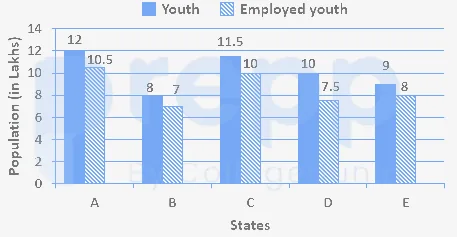
- A
A
- B
A, C
- C
A, C, D, E
- D
A, C, D
Show answer
B. A, CGiven:
Total number of states = 5
Concept used:
Average = Sum of the terms/Number of terms
Calculation:
The average number of youth (in lakhs) = (12 + 8 + 11.5 + 10 + 9)/5 = 50.5/5 = 10.1
In the given graph, the number of youth (in lakhs) in state A = 12
The number of youth (in lakhs) in state C = 11.5
∴ The number of youth more than the average number of youth in the five states in states A and C
Paper & answer key PDF ↗ Question 58archived
Six bells begin to toll together and toll, respectively, at intervals of 3, 4, 6, 7, 8 and 12 seconds. After how many seconds, will they toll together again?
- A
167
- B
168
- C
176
- D
186
Show answer
B. 168Understanding the Bells Tolling Together Problem
This question asks us to find the time when six bells, which start tolling together and then toll at regular intervals of 3, 4, 6, 7, 8, and 12 seconds, will next toll simultaneously. This type of problem requires finding the moment in time when all their individual cycles align again.
The time when all the bells will toll together again will be the smallest multiple that is common to all their individual tolling intervals. In mathematical terms, this is the Least Common Multiple (LCM) of the given intervals.
Calculating the LCM of Tolling Intervals
The given tolling intervals are 3, 4, 6, 7, 8, and 12 seconds. To find the LCM, we can use the prime factorization method. We find the prime factors of each number:
Prime factors of 3: \(3^1\)
Prime factors of 4: \(2 \times 2 = 2^2\)
Prime factors of 6: \(2 \times 3 = 2^1 \times 3^1\)
Prime factors of 7: \(7^1\)
Prime factors of 8: \(2 \times 2 \times 2 = 2^3\)
Prime factors of 12: \(2 \times 2 \times 3 = 2^2 \times 3^1\)
To find the LCM, we take the highest power of each prime factor that appears in any of the factorizations:
Highest power of 2: \(2^3\) (from the number 8)
Highest power of 3: \(3^1\) (from the numbers 3, 6, and 12)
Highest power of 7: \(7^1\) (from the number 7)
Now, we multiply these highest powers together to find the LCM:
LCM = \(2^3 \times 3^1 \times 7^1 = 8 \times 3 \times 7\)
LCM = \(24 \times 7\)
LCM = \(168\)
Conclusion: When Bells Toll Together Again
The Least Common Multiple of 3, 4, 6, 7, 8, and 12 is 168. This means that after 168 seconds, all six bells will have completed a whole number of their respective tolling cycles and will, therefore, toll together again simultaneously.
The intervals are 3, 4, 6, 7, 8, and 12 seconds. After 168 seconds:
Bell 1 (3s interval) tolls \(168 \div 3 = 56\) times.
Bell 2 (4s interval) tolls \(168 \div 4 = 42\) times.
Bell 3 (6s interval) tolls \(168 \div 6 = 28\) times.
Bell 4 (7s interval) tolls \(168 \div 7 = 24\) times.
Bell 5 (8s interval) tolls \(168 \div 8 = 21\) times.
Bell 6 (12s interval) tolls \(168 \div 12 = 14\) times.
Since 168 is a multiple of every interval, they all toll at exactly 168 seconds, marking the first time they toll together after the initial moment.
Revision Table: Key Concepts
Concept
Explanation
Relevance to Problem
Multiple
A number that can be divided by another number without a remainder.
The time when bells toll is a multiple of their interval.
Common Multiple
A number that is a multiple of two or more numbers.
The time they toll together is a common multiple of all intervals.
Least Common Multiple (LCM)
The smallest positive common multiple of two or more numbers.
The first time they toll together again (after the start) is the LCM of their intervals.
Prime Factorization
Breaking down a number into its prime factors.
A method used to calculate the LCM efficiently.
Additional Information: Applications of LCM
The concept of LCM is widely used in various real-life scenarios and mathematical problems besides bells tolling together. Here are a few examples:
Scheduling Events: Finding when recurring events (like buses arriving, lights flashing, or tasks repeating) will happen simultaneously.
Fractions: Finding the least common denominator (LCD) when adding or subtracting fractions, which is the LCM of the denominators.
Cycling Problems: Determining when objects moving in cycles (like gears meshing or planets aligning) will return to a starting configuration.
Retail: Calculating when promotions on different products that run on cycles might overlap.
Understanding how to find the LCM is a fundamental skill in number theory and has practical applications in coordinating events that occur at regular, repeating intervals.
Paper & answer key PDF ↗ Question 59archived
The angle of elevation of the top of a tall building from the points M and N at the distances of 72 m and 128 m, respectilvely, from the base of the building and in the same straight line with it, are complementary. The height of the building (in m) is:
- A
84
- B
96
- C
80
- D
90
Show answer
B. 96Solving for Building Height with Complementary Angles of Elevation
This problem involves trigonometry, specifically the concept of angles of elevation and complementary angles, applied to a right-angled triangle formed by the building, the ground, and the line of sight to the top of the building.
Let's define the terms:
Angle of Elevation: The angle between the horizontal line from the observer's eye to an object and the line of sight to the object, when the object is above the horizontal line.
Complementary Angles: Two angles are complementary if their sum is 90 degrees ($90^\circ$).
Setting up the Problem Geometry
Consider a tall building. Let the height of the building be \(H\) meters. Let the base of the building be point B and the top of the building be point T. Points M and N are on the ground, in the same straight line with the base B.
The distance from the base B to point M is given as 72 m. The distance from the base B to point N is given as 128 m.
Let the angle of elevation of the top of the building (T) from point M be \(\theta_M\) and from point N be \(\theta_N\).
The problem states that the angles of elevation from M and N are complementary. Therefore, \(\theta_M + \theta_N = 90^\circ\).
Using Trigonometry to Relate Angles and Height
We have two right-angled triangles: \(\triangle TBM\) and \(\triangle TBN\), both right-angled at B.
In \(\triangle TBM\), the opposite side to angle \(\theta_M\) is the height \(H\), and the adjacent side is the distance BM (72 m). Using the tangent ratio:
\(\tan(\theta_M) = \frac{\text{Opposite}}{\text{Adjacent}} = \frac{H}{72}\)
In \(\triangle TBN\), the opposite side to angle \(\theta_N\) is the height \(H\), and the adjacent side is the distance BN (128 m). Using the tangent ratio:
\(\tan(\theta_N) = \frac{\text{Opposite}}{\text{Adjacent}} = \frac{H}{128}\)
Applying the Complementary Angle Condition
We know that \(\theta_M + \theta_N = 90^\circ\). This implies \(\theta_M = 90^\circ - \theta_N\).
Substitute this into the equation for \(\tan(\theta_M)\):
\(\tan(90^\circ - \theta_N) = \frac{H}{72}\)
Using the trigonometric identity \(\tan(90^\circ - x) = \cot(x)\), we get:
\(\cot(\theta_N) = \frac{H}{72}\)
We also know that \(\cot(\theta_N) = \frac{1}{\tan(\theta_N)}\). From the equation for \(\tan(\theta_N)\), we have \(\tan(\theta_N) = \frac{H}{128}\). So, \(\cot(\theta_N) = \frac{128}{H}\).
Solving for the Height of the Building
Now we can equate the two expressions for \(\cot(\theta_N)\):
\(\frac{H}{72} = \frac{128}{H}\)
Multiply both sides by \(H \times 72\) to clear the denominators:
\(H \times H = 72 \times 128\)
\(H^2 = 72 \times 128\)
Now, let's calculate the product:
\(H^2 = 9216\)
To find \(H\), take the square root of both sides:
\(H = \sqrt{9216}\)
To find the square root, we can factorize the numbers:
\(72 = 8 \times 9 = 2^3 \times 3^2\)
\(128 = 2^7\)
\(H^2 = (2^3 \times 3^2) \times 2^7 = 2^{3+7} \times 3^2 = 2^{10} \times 3^2\)
\(H = \sqrt{2^{10} \times 3^2} = \sqrt{(2^5)^2 \times 3^2} = 2^5 \times 3\)
\(H = 32 \times 3\)
\(H = 96\)
So, the height of the building is 96 meters.
Verification of the Result
Let \(H = 96\).
\(\tan(\theta_M) = \frac{96}{72} = \frac{4}{3}\)
\(\tan(\theta_N) = \frac{96}{128} = \frac{3}{4}\)
We see that \(\tan(\theta_N) = \frac{1}{\tan(\theta_M)}\). This means \(\tan(\theta_N) = \cot(\theta_M)\). Since \(\cot(\theta_M) = \tan(90^\circ - \theta_M)\), we have \(\tan(\theta_N) = \tan(90^\circ - \theta_M)\). This implies \(\theta_N = 90^\circ - \theta_M\), or \(\theta_M + \theta_N = 90^\circ\). The angles are indeed complementary.
Concept
Formula/Relation
Tangent of angle in right triangle
\(\tan(\theta) = \frac{\text{Opposite Side}}{\text{Adjacent Side}}\)
Complementary Angles
If \(\alpha + \beta = 90^\circ\), then \(\alpha\) and \(\beta\) are complementary.
Trigonometric Identity for Complementary Angles
\(\tan(90^\circ - \theta) = \cot(\theta)\)
Relation between tan and cot
\(\cot(\theta) = \frac{1}{\tan(\theta)}\)
Revision Table: Angle of Elevation Problem
Step
Description
Calculation/Formula
1
Define variables (Height H, distances 72m, 128m)
2
Write tangent equations for each point
\(\tan(\theta_M) = H/72\), \(\tan(\theta_N) = H/128\)
3
Use complementary angle relation
\(\theta_M + \theta_N = 90^\circ \implies \theta_M = 90^\circ - \theta_N\)
4
Apply identity \(\tan(90^\circ - \theta) = \cot(\theta)\)
\(\tan(\theta_M) = \cot(\theta_N)\)
5
Substitute tangent expressions
\(\frac{H}{72} = \frac{128}{H}\)
6
Solve for H
\(H^2 = 72 \times 128 \implies H = \sqrt{9216} = 96\)
Additional Information: Applications of Angle of Elevation
Angles of elevation are widely used in various fields:
Surveying: To determine the height of buildings, mountains, towers, etc.
Navigation: Used by pilots and sailors to determine their position relative to ground or sea level.
Astronomy: To measure the altitude of celestial bodies above the horizon.
Engineering: In civil engineering for construction and structural design.
Photography: To compose shots involving vertical elements like buildings or trees.
Understanding angle of elevation and depression is fundamental in solving problems related to heights and distances using trigonometry.
Paper & answer key PDF ↗ Question 60archived
The simple interest on a certain sum is one-eighth of the sum when the number of years is equal to half of the rate percentage per annum. Find the simple interest (in Rupees) on Rs.15,000 at the same rate of simple interest for 8 years.
- A
5,800
- B
5,000
- C
6,000
- D
5,250
Show answer
C. 6,000Understanding the Simple Interest Problem
This problem involves calculating simple interest in two parts. First, we need to use the given information about the relationship between simple interest, principal, time, and rate to find the rate of interest. Second, we use this calculated rate to find the simple interest on a different principal amount for a different duration.
Finding the Rate of Simple Interest
We are given that the simple interest (\(SI\)) on a certain sum (\(P\)) is one-eighth of the sum. Mathematically, this is represented as:
\(SI = \frac{1}{8}P\)
We are also told that the number of years (\(T\)) is equal to half of the rate percentage per annum (\(R\)). This can be written as:
\(T = \frac{R}{2}\)
The formula for simple interest is:
\(SI = \frac{P \times R \times T}{100}\)
Now, we can substitute the given relationships into the simple interest formula:
\(\frac{P}{8} = \frac{P \times R \times \left(\frac{R}{2}\right)}{100}\)
Let's simplify the equation:
\(\frac{P}{8} = \frac{P \times \frac{R^2}{2}}{100}\)
\(\frac{P}{8} = \frac{P \times R^2}{2 \times 100}\)
\(\frac{P}{8} = \frac{P \times R^2}{200}\)
Assuming the principal \(P\) is not zero, we can divide both sides by \(P\):
\(\frac{1}{8} = \frac{R^2}{200}\)
Now, let's solve for \(R^2\):
\(R^2 = \frac{200}{8}\)
\(R^2 = 25\)
Taking the square root of both sides to find \(R\):
\(R = \sqrt{25}\)
\(R = 5\)
So, the rate of simple interest is 5% per annum.
Calculating Simple Interest for the Second Scenario
Now we need to find the simple interest on Rs. 15,000 at the rate of 5% per annum for 8 years.
Principal (\(P\)) = Rs. 15,000
Rate (\(R\)) = 5% per annum
Time (\(T\)) = 8 years
Using the simple interest formula again:
\(SI = \frac{P \times R \times T}{100}\)
Substitute the values:
\(SI = \frac{15000 \times 5 \times 8}{100}\)
Calculate the product of Rate and Time:
\(5 \times 8 = 40\)
Now substitute this back into the formula:
\(SI = \frac{15000 \times 40}{100}\)
We can cancel out the two zeros in the denominator with two zeros in the numerator:
\(SI = 150 \times 40\)
\(SI = 6000\)
The simple interest on Rs. 15,000 at 5% for 8 years is Rs. 6,000.
Summary of Calculations
Step
Description
Calculation/Formula
Result
1
Relationship given
\(SI_1 = \frac{1}{8}P_1\), \(T_1 = \frac{R}{2}\)
-
2
Formula for SI
\(SI = \frac{P \times R \times T}{100}\)
-
3
Substitute and Solve for R
\(\frac{P_1}{8} = \frac{P_1 \times R \times \frac{R}{2}}{100} \Rightarrow R = 5\%\)
Rate = 5%
4
Given for 2nd case
\(P_2 = 15000\), \(R = 5\%\), \(T_2 = 8\) years
-
5
Calculate \(SI_2\)
\(SI_2 = \frac{15000 \times 5 \times 8}{100}\)
SI = 6000
Therefore, the simple interest is Rs. 6,000.
Revision Table - Simple Interest Concepts
Concept
Definition
Formula
Principal (P)
The initial amount of money borrowed or invested.
-
Rate (R)
The percentage at which interest is charged or earned per year.
Expressed as % per annum
Time (T)
The duration for which the money is borrowed or invested.
Expressed in years
Simple Interest (SI)
Interest calculated only on the principal amount.
\(SI = \frac{P \times R \times T}{100}\)
Amount (A)
The total sum including principal and interest.
\(A = P + SI\)
Additional Information - Simple Interest Calculations
Simple interest is one of the most basic concepts in finance. It is calculated only on the initial principal amount. Unlike compound interest, where interest is calculated on the principal plus accumulated interest, simple interest remains constant throughout the investment or loan period if the principal and rate are fixed.
Key characteristics of simple interest:
Calculated only on the original principal.
Interest earned/paid per period (e.g., year) is constant.
Total interest is directly proportional to Principal, Rate, and Time.
Simple interest is often used for short-term loans or in scenarios where calculations need to be straightforward. Understanding simple interest is crucial before learning about more complex interest calculations like compound interest.
Paper & answer key PDF ↗ Question 61archived
What is the average of all the prime numbers between 70 and 90?
- A
80
- B
78.66
- C
79
- D
81.6
Show answer
C. 79Finding the Average of Prime Numbers Between 70 and 90
To find the average of prime numbers between 70 and 90, we first need to identify which numbers in this range are prime. A prime number is a natural number greater than 1 that has no positive divisors other than 1 and itself.
Identifying Prime Numbers (70-90)
We examine each number from 71 to 89 to see if it is divisible by any number other than 1 and itself. We only need to check for divisibility by prime numbers up to the square root of the largest number in the range (or roughly up to the square root of 90, which is about 9.5). The prime numbers we need to check as potential divisors are 2, 3, 5, and 7.
Numbers divisible by 2 are even (72, 74, 76, 78, 80, 82, 84, 86, 88, 90) - not prime.
Numbers divisible by 3 (sum of digits is divisible by 3): 72, 75 (ends in 5, also div by 5), 78, 81 (8+1=9), 84, 87 (8+7=15), 90.
Numbers divisible by 5 (end in 0 or 5): 75, 80, 85, 90.
Numbers divisible by 7: 70, 77 (7 × 11), 84, 91 (7 × 13, but 91 is outside the range).
Let's list the numbers between 70 and 90 and eliminate the non-prime ones:
71: Not divisible by 2, 3, 5, 7. Prime.
72: Even. Not prime.
73: Not divisible by 2, 3, 5, 7. Prime.
74: Even. Not prime.
75: Ends in 5. Not prime.
76: Even. Not prime.
77: $77 = 7 \times 11$. Not prime.
78: Even. Not prime.
79: Not divisible by 2, 3, 5, 7. Prime.
80: Even. Not prime.
81: $81 = 9 \times 9$. Not prime.
82: Even. Not prime.
83: Not divisible by 2, 3, 5, 7. Prime.
84: Even. Not prime.
85: Ends in 5. Not prime.
86: Even. Not prime.
87: $87 = 3 \times 29$. Not prime.
88: Even. Not prime.
89: Not divisible by 2, 3, 5, 7. Prime.
The prime numbers between 70 and 90 are 71, 73, 79, 83, and 89.
Calculating the Average
The average of a set of numbers is calculated by summing all the numbers in the set and then dividing by the count of numbers in the set.
Average = $\frac{\text{Sum of numbers}}{\text{Count of numbers}}$
First, find the sum of the prime numbers identified:
Sum = $71 + 73 + 79 + 83 + 89$
Sum = $144 + 79 + 83 + 89$
Sum = $223 + 83 + 89$
Sum = $306 + 89$
Sum = $395$
Next, count how many prime numbers there are:
Count = 5 (There are five prime numbers: 71, 73, 79, 83, 89)
Finally, calculate the average:
Average = $\frac{395}{5}$
Average = $79$
Therefore, the average of all the prime numbers between 70 and 90 is 79.
Prime Numbers (70-90)
Count
Sum
Average
71, 73, 79, 83, 89
5
395
$395 \div 5 = 79$
The calculated average is 79.
Revision Table: Key Steps for Average of Prime Numbers
Step
Action
Description
1
Identify Range
Determine the numbers between 70 and 90 (exclusive of 70 and 90).
2
Find Primes
List the numbers in the range that are only divisible by 1 and themselves.
3
Sum Primes
Add all the identified prime numbers together.
4
Count Primes
Count how many prime numbers were found in the range.
5
Calculate Average
Divide the sum of primes by the count of primes.
Additional Information: Understanding Prime Numbers and Averages
What is a Prime Number?
A prime number is a whole number greater than 1 whose only positive divisors are 1 and itself. Examples include 2, 3, 5, 7, 11, etc. The number 1 is not considered prime. Composite numbers are whole numbers greater than 1 that have more than two positive divisors.
How to Check if a Number is Prime:
To check if a number $n$ is prime, you only need to test for divisibility by prime numbers up to the square root of $n$. If $n$ is not divisible by any prime number less than or equal to its square root, then $n$ is prime.
What is an Average (Arithmetic Mean)?
The average, or arithmetic mean, is a central value of a set of numbers. It is calculated by dividing the sum of the values by the number of values. It's a fundamental concept in statistics and mathematics used to represent a typical value in a dataset.
Paper & answer key PDF ↗ Question 62archived
In∆ ABC , ∠A = 88°. If I is the incentre of the triangle, then the measure of ∠BICis:
- A
112°
- B
134°
- C
56°
- D
68°
Show answer
B. 134°Calculating the Angle at the Incentre of a Triangle
The question asks us to find the measure of the angle ∠BIC, where I is the incentre of triangle ABC and the measure of ∠A is given as 88°.
The incentre of a triangle is the point where the three angle bisectors of the triangle meet. An angle bisector divides an angle into two equal parts. The incenter is also the center of the inscribed circle (incircle) of the triangle.
There is a standard formula that relates the angle formed at the incenter by two angle bisectors (like ∠BIC) to the angle of the triangle at the third vertex (in this case, ∠A). The formula for ∠BIC is:
$$ \text{∠BIC} = 90^\circ + \frac{1}{2} \text{∠A} $$
Let's use this formula to calculate ∠BIC given that ∠A = 88°.
Step-by-Step Incentre Angle Calculation
We are given:
Triangle ABC
I is the incentre
∠A = 88°
We need to find ∠BIC.
Using the formula:
$$ \text{∠BIC} = 90^\circ + \frac{1}{2} \text{∠A} $$
Substitute the value of ∠A into the formula:
$$ \text{∠BIC} = 90^\circ + \frac{1}{2} \times 88^\circ $$
First, calculate half of ∠A:
$$ \frac{1}{2} \times 88^\circ = \frac{88}{2}^\circ = 44^\circ $$
Now, add this value to 90°:
$$ \text{∠BIC} = 90^\circ + 44^\circ $$
$$ \text{∠BIC} = 134^\circ $$
Therefore, the measure of ∠BIC is 134°.
Summary of Calculation
Given Angle
Formula Applied
Calculation Step
Resulting Angle
∠A = 88°
∠BIC = $90^\circ + \frac{1}{2}$ ∠A
$90^\circ + \frac{1}{2} \times 88^\circ$
$134^\circ$
Revision Table: Key Incenter Formulas
Important Incenter Angle Formulas
Angle at Incenter
Formula (using opposite vertex angle)
∠BIC
$90^\circ + \frac{1}{2}\text{∠A}$
∠AIC
$90^\circ + \frac{1}{2}\text{∠B}$
∠AIB
$90^\circ + \frac{1}{2}\text{∠C}$
Additional Information on Incenter Properties
Definition: The incenter (I) is the intersection point of the three angle bisectors of a triangle.
Equidistance: The incenter is equidistant from the sides of the triangle. The distance from the incenter to each side is the radius of the incircle.
Location: The incenter always lies inside the triangle, regardless of whether the triangle is acute, right, or obtuse.
Angle Bisectors: Lines segment BI and CI are angle bisectors of ∠B and ∠C respectively. Thus, ∠IBC = ∠ABI = $\frac{1}{2}\text{∠B}$ and ∠ICB = ∠ACI = $\frac{1}{2}\text{∠C}$.
Derivation of Formula: The formula ∠BIC = $90^\circ + \frac{1}{2}\text{∠A}$ can be derived using the angle sum property of triangle BIC and the fact that BI and CI are angle bisectors. In ▵BIC, ∠BIC + ∠IBC + ∠ICB = 180°. Substituting ∠IBC = $\frac{1}{2}\text{∠B}$ and ∠ICB = $\frac{1}{2}\text{∠C}$, we get ∠BIC + $\frac{1}{2}\text{∠B}$ + $\frac{1}{2}\text{∠C}$ = 180°. From triangle ABC, ∠A + ∠B + ∠C = 180°, so $\frac{1}{2}(\text{∠B} + \text{∠C}) = \frac{1}{2}(180^\circ - \text{∠A}) = 90^\circ - \frac{1}{2}\text{∠A}$. Substituting this back, ∠BIC + $90^\circ - \frac{1}{2}\text{∠A}$ = 180°. Rearranging gives ∠BIC = 180° - 90° + $\frac{1}{2}\text{∠A}$ = $90^\circ + \frac{1}{2}\text{∠A}$.
Paper & answer key PDF ↗ Question 63archived
If a 2+ b 2 + 49 c2 + 18 = 2(b - 28c - a) then the value of (a + b - 7c) is:
- A
4
- B
3
- C
2
- D
1
Show answer
A. 4Understanding the Algebraic Equation Problem
The question asks us to find the value of the expression $(a + b - 7c)$ given a specific algebraic equation relating the variables $a$, $b$, and $c$. The equation is $a^2 + b^2 + 49c^2 + 18 = 2(b - 28c - a)$. To solve this, we first need to determine the values of $a$, $b$, and $c$ by rearranging and simplifying the given equation.
Solving the Equation to Find a, b, and c
Let's start by expanding the right side of the equation:
\begin{equation*} a^2 + b^2 + 49c^2 + 18 = 2b - 56c - 2a \end{equation*}
Now, let's move all the terms to one side to set the equation to zero:
\begin{equation*} a^2 + b^2 + 49c^2 + 18 - 2b + 56c + 2a = 0 \end{equation*}
Rearranging the terms to group by variables:
\begin{equation*} a^2 + 2a + b^2 - 2b + 49c^2 + 56c + 18 = 0 \end{equation*}
This equation can be solved by completing the square for each variable term. We want to transform the equation into the form $(x-h)^2 + (y-k)^2 + (z-l)^2 = 0$, because the sum of squares can only be zero if each individual square term is zero (for real numbers).
Completing the Square for Each Variable
For the terms involving $a$: $a^2 + 2a$. To complete the square, we need to add $(2/2)^2 = 1^2 = 1$. So, $a^2 + 2a + 1 = (a+1)^2$.
For the terms involving $b$: $b^2 - 2b$. To complete the square, we need to add $(-2/2)^2 = (-1)^2 = 1$. So, $b^2 - 2b + 1 = (b-1)^2$.
For the terms involving $c$: $49c^2 + 56c$. This is $(7c)^2 + 2(7c)(4)$. To complete the square, we need to add $4^2 = 16$. So, $49c^2 + 56c + 16 = (7c+4)^2$.
Substituting and Grouping in the Equation
Let's rewrite the equation using the completed square forms. We had $a^2 + 2a + b^2 - 2b + 49c^2 + 56c + 18 = 0$. We can rewrite the terms as:
$(a^2 + 2a + 1) - 1$
$(b^2 - 2b + 1) - 1$
$(49c^2 + 56c + 16) - 16$
Substitute these back into the equation:
\begin{equation*} (a^2 + 2a + 1) - 1 + (b^2 - 2b + 1) - 1 + (49c^2 + 56c + 16) - 16 + 18 = 0 \end{equation*}
Group the perfect squares:
\begin{equation*} (a+1)^2 + (b-1)^2 + (7c+4)^2 - 1 - 1 - 16 + 18 = 0 \end{equation*}
Simplify the constant terms: $-1 - 1 - 16 + 18 = -18 + 18 = 0$.
So, the equation simplifies to:
\begin{equation*} (a+1)^2 + (b-1)^2 + (7c+4)^2 = 0 \end{equation*}
Finding the Values of a, b, and c
Since the sum of these squared terms is zero, and squares of real numbers are non-negative, each term must be zero:
$(a+1)^2 = 0 \implies a+1 = 0 \implies a = -1$
$(b-1)^2 = 0 \implies b-1 = 0 \implies b = 1$
$(7c+4)^2 = 0 \implies 7c+4 = 0 \implies 7c = -4 \implies c = -\frac{4}{7}$
So, the values are $a = -1$, $b = 1$, and $c = -\frac{4}{7}$.
Calculating the Value of (a + b - 7c)
Now we need to find the value of the expression $(a + b - 7c)$ using the values we found:
\begin{equation*} a + b - 7c = (-1) + (1) - 7\left(-\frac{4}{7}\right) \end{equation*}
\begin{equation*} = -1 + 1 - \left(-7 \times \frac{4}{7}\right) \end{equation*}
\begin{equation*} = 0 - (-4) \end{equation*}
\begin{equation*} = 0 + 4 \end{equation*}
\begin{equation*} = 4 \end{equation*}
Thus, the value of $(a + b - 7c)$ is 4.
Final Answer Derivation
Based on the step-by-step solution using the completing the square method, we found that $a=-1$, $b=1$, and $c=-4/7$. Substituting these values into the expression $(a + b - 7c)$ gives us 4.
Variable
Value Found
a
-1
b
1
c
-4/7
Expression to evaluate
a + b - 7c
Calculated Value
4
Revision Table: Key Steps Reviewed
Step
Description
Check
1
Rearrange the equation to set to zero.
Correctly done
2
Identify terms for completing the square for a, b, and c.
Correctly identified
3
Complete the square for each variable.
Correctly completed (a+1)\textsuperscript{2}, (b-1)\textsuperscript{2}, (7c+4)\textsuperscript{2}
4
Rewrite the equation as a sum of squares equal to zero.
Correctly transformed
5
Solve for a, b, and c by setting each squared term to zero.
Correct values obtained: a=-1, b=1, c=-4/7
6
Substitute values into the expression (a + b - 7c) and calculate.
Calculation 4 is correct
Additional Information: Completing the Square Method
Completing the square is a useful algebraic technique used to rewrite a quadratic expression in the form of a perfect square trinomial plus a constant. For a quadratic expression $Ax^2 + Bx$, to complete the square, you add and subtract $(B/2A)^2$. If the coefficient of $x^2$ is 1 (i.e., $A=1$), then for $x^2 + Bx$, you add and subtract $(B/2)^2$. The expression $x^2 + Bx + (B/2)^2$ is a perfect square trinomial equal to $(x + B/2)^2$. This method is particularly helpful in solving quadratic equations, finding the vertex of a parabola, and transforming equations of conic sections into standard forms. In this problem, applying it to multiple variables in an equation set to zero allowed us to solve for the unique values of the variables because the sum of squared real numbers is zero only if each number is zero.
Paper & answer key PDF ↗ Question 64archived
The breakup of the total number of employees of a company working in different offices (A to E), in degrees, is given in the pie chart.
Total number of employees = 2400.
In which office is the number of employees 600?
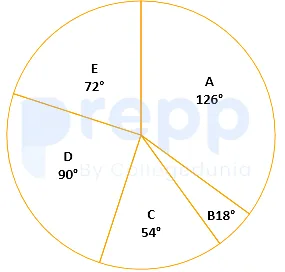
- A
E
- B
A
- C
C
- D
D
Show answer
D. DGiven:
Total number of employees = 2400
Concept used:
A circle has a total angle = 360°
Calculation:
Required number of employees = 600
600 employees will make the angle = (600/2400) × 360 = 90°
In the pie chart, the angle of employees of office D = 90°
∴ T he number of 600 employees are in office D
Paper & answer key PDF ↗ Question 65archived
The value of 1 + \(\sqrt { {\cotθ + \cosθ} \over \cotθ - \cosθ}\) , if 0° < θ < 90°, is equal to:
- A
1 − sec θ + tan θ
- B
1 − sec θ − tan θ
- C
1 + sec θ − tan θ
- D
1 + sec θ + tan θ
Show answer
D. 1 + sec θ + tan θSolving the Trigonometric Expression
The question asks us to find the value of the expression \(1 + \sqrt { {\cot\theta + \cos\theta;} \over \cot\theta - \cos\theta;}\), given that \(0^\circ < \theta < 90^\circ\). This involves simplifying a trigonometric expression.
Let's focus on simplifying the term inside the square root first:
\[
\frac{\cot\theta + \cos\theta}{\cot\theta - \cos\theta}
\]
We know that \(\cot\theta = \frac{\cos\theta}{\sin\theta}\). Substituting this identity into the expression:
\[
\frac{\frac{\cos\theta}{\sin\theta} + \cos\theta}{\frac{\cos\theta}{\sin\theta} - \cos\theta}
\]
Now, we can factor out \(\cos\theta\) from both the numerator and the denominator:
\[
\frac{\cos\theta \left(\frac{1}{\sin\theta} + 1\right)}{\cos\theta \left(\frac{1}{\sin\theta} - 1\right)}
\]
Since \(0^\circ < \theta < 90^\circ\), \(\cos\theta \neq 0\), so we can cancel out the \(\cos\theta\) term:
\[
\frac{\frac{1}{\sin\theta} + 1}{\frac{1}{\sin\theta} - 1}
\]
To further simplify, multiply the numerator and the denominator by \(\sin\theta\):
\[
\frac{\left(\frac{1}{\sin\theta} + 1\right) \times \sin\theta}{\left(\frac{1}{\sin\theta} - 1\right) \times \sin\theta} = \frac{1 + \sin\theta}{1 - \sin\theta}
\]
Now we need to find the square root of this simplified expression:
\[
\sqrt{\frac{1 + \sin\theta}{1 - \sin\theta}}
\]
To remove the square root, we can multiply the numerator and denominator inside the square root by the conjugate of the denominator, which is \(1 + \sin\theta\):
\[
\sqrt{\frac{1 + \sin\theta}{1 - \sin\theta} \times \frac{1 + \sin\theta}{1 + \sin\theta}} = \sqrt{\frac{(1 + \sin\theta)^2}{(1 - \sin\theta)(1 + \sin\theta)}}
\]
Using the identity \((a-b)(a+b) = a^2 - b^2\) in the denominator:
\[
\sqrt{\frac{(1 + \sin\theta)^2}{1^2 - \sin^2\theta}} = \sqrt{\frac{(1 + \sin\theta)^2}{1 - \sin^2\theta}}
\]
Using the Pythagorean identity \(\sin^2\theta + \cos^2\theta = 1\), we have \(1 - \sin^2\theta = \cos^2\theta\):
\[
\sqrt{\frac{(1 + \sin\theta)^2}{\cos^2\theta}}
\]
Now, take the square root of the numerator and the denominator separately:
\[
\frac{\sqrt{(1 + \sin\theta)^2}}{\sqrt{\cos^2\theta}} = \frac{|1 + \sin\theta|}{|\cos\theta|}
\]
Given that \(0^\circ < \theta < 90^\circ\), both \(\sin\theta\) and \(\cos\theta\) are positive. Therefore, \(1 + \sin\theta\) is also positive. This means we can remove the absolute value signs:
\[
\frac{1 + \sin\theta}{\cos\theta}
\]
We can separate this fraction into two terms:
\[
\frac{1}{\cos\theta} + \frac{\sin\theta}{\cos\theta}
\]
Using the reciprocal and quotient identities, \(\frac{1}{\cos\theta} = \sec\theta\) and \(\frac{\sin\theta}{\cos\theta} = \tan\theta\):
\[
\sec\theta + \tan\theta
\]
So, the value of \(\sqrt { {\cot\theta + \cos\theta;} \over \cot\theta - \cos\theta;}\) is \(\sec\theta + \tan\theta\).
The original expression is \(1 + \sqrt { {\cotθ + \cosθ} \over \cotθ - \cosθ}\). Substituting the simplified square root term:
\[
1 + (\sec\theta + \tan\theta)
\]
Thus, the value of the expression is \(1 + \sec\theta + \tan\theta\).
Let's compare this result with the given options:
Option 1: \(1 − \sec\theta + \tan\theta\)
Option 2: \(1 − \sec\theta − \tan\theta\)
Option 3: \(1 + \sec\theta − \tan\theta\)
Option 4: \(1 + \sec\theta + \tan\theta\)
Our simplified expression matches Option 4.
Revision Table: Key Trigonometric Identities
Identity Type
Identity
Quotient Identity
\(\cot\theta = \frac{\cos\theta}{\sin\theta}\)
Reciprocal Identity
\(\sec\theta = \frac{1}{\cos\theta}\)
Quotient Identity
\(\tan\theta = \frac{\sin\theta}{\cos\theta}\)
Pythagorean Identity
\(\sin^2\theta + \cos^2\theta = 1\)
Additional Information: Range of θ and Absolute Values
The condition \(0^\circ < \theta < 90^\circ\) is important. In this range (the first quadrant):
All trigonometric functions (\(\sin\theta\), \(\cos\theta\), \(\tan\theta\), \(\cot\theta\), \(\sec\theta\), \(\csc\theta\)) are positive.
This allowed us to simplify \(\sqrt{\cos^2\theta}\) to \(\cos\theta\) (instead of \(|\cos\theta|\) which would still be \(\cos\theta\) here, but crucial if \(\theta\) were in quadrants 2 or 3) and \(\sqrt{(1 + \sin\theta)^2}\) to \(1 + \sin\theta\) (since \(1 + \sin\theta\) is always positive for real \(\theta\)).
If the range of \(\theta\) were different, the absolute values would need careful consideration, potentially changing the sign of the result. For instance, if \(\theta\) were in the second quadrant (\(90^\circ < \theta < 180^\circ\)), \(\cos\theta\) would be negative, and \(\sqrt{\cos^2\theta}\) would simplify to \(|\cos\theta| = -\cos\theta\), affecting the final result.
Paper & answer key PDF ↗ Question 66archived
If the volume of a sphere is equal to that of a cylinder having the same radius, then find the ratio of the radius to the height of the cylinder.
- A
1 ∶ 2
- B
2 ∶ 3
- C
3 ∶ 4
- D
3 ∶ 5
Show answer
C. 3 ∶ 4Understanding the Problem: Sphere and Cylinder Volumes
The question asks us to find the ratio of the radius to the height of a cylinder, given that its volume is equal to the volume of a sphere. A key piece of information is that both the sphere and the cylinder have the same radius.
Formulas for Volume
To solve this problem, we need to recall the formulas for the volume of a sphere and the volume of a cylinder.
The volume of a sphere with radius \(r\) is given by \(V_{\text{sphere}} = \frac{4}{3}\pi r^3\).
The volume of a cylinder with radius \(r\) and height \(h\) is given by \(V_{\text{cylinder}} = \pi r^2 h\).
Setting up the Equation based on Equal Volumes
The problem states that the volume of the sphere is equal to the volume of the cylinder, and they share the same radius. Let the common radius be \(r\) and the height of the cylinder be \(h\). We can write the equation:
\[ V_{\text{sphere}} = V_{\text{cylinder}} \]
Substitute the volume formulas into the equation:
\[ \frac{4}{3}\pi r^3 = \pi r^2 h \]
Solving for the Ratio of Radius to Height
Now, we need to solve this equation to find the relationship between \(r\) and \(h\), and then express it as a ratio \(r:h\). Both sides of the equation have \(\pi\) and \(r^2\). Since the radius \(r\) is a physical dimension, it must be non-zero. Therefore, we can divide both sides by \(\pi r^2\).
Divide both sides by \(\pi\):
\[ \frac{4}{3} r^3 = r^2 h \]
Divide both sides by \(r^2\) (assuming \(r \neq 0\)):
\[ \frac{\frac{4}{3} r^3}{r^2} = \frac{r^2 h}{r^2} \]
This simplifies to:
\[ \frac{4}{3} r = h \]
We are looking for the ratio \(r:h\), which is equivalent to \(\frac{r}{h}\). To get this ratio, we can rearrange the equation \(\frac{4}{3} r = h\).
Divide both sides by \(h\) (assuming \(h \neq 0\), which must be true for a cylinder):
\[ \frac{\frac{4}{3} r}{h} = \frac{h}{h} \]
\[ \frac{4}{3} \frac{r}{h} = 1 \]
Now, multiply both sides by \(\frac{3}{4}\) to isolate \(\frac{r}{h}\):
\[ \frac{r}{h} = 1 \times \frac{3}{4} \]
\[ \frac{r}{h} = \frac{3}{4} \]
This means the ratio of the radius \(r\) to the height \(h\) is \(3:4\).
Conclusion
When the volume of a sphere is equal to the volume of a cylinder with the same radius, the ratio of the radius to the height of the cylinder is \(3:4\).
Shape
Radius
Height
Volume Formula
Sphere
\(r\)
N/A
\(\frac{4}{3}\pi r^3\)
Cylinder
\(r\)
\(h\)
\(\pi r^2 h\)
Revision Table: Key Concepts in Volume Calculation
Concept
Description
Formula Example
Volume
The amount of 3-dimensional space a solid occupies.
\(V\) (units cubed)
Sphere Volume
Volume contained within a sphere.
\(V = \frac{4}{3}\pi r^3\)
Cylinder Volume
Volume contained within a cylinder.
\(V = \pi r^2 h\)
Ratio
A comparison of two quantities by division.
\(a:b\) or \(\frac{a}{b}\)
Algebraic Manipulation
Rearranging equations to solve for unknown variables or ratios.
If \(4x = 3y\), then \(\frac{x}{y} = \frac{3}{4}\).
Additional Information: Related Geometric Concepts
Understanding the volumes of basic 3D shapes is fundamental in geometry. Here are a few related concepts:
Surface Area: Besides volume, another important property is surface area, which is the total area of the exterior surfaces of a 3D object. The surface area of a sphere is \(4\pi r^2\), and the total surface area of a cylinder is \(2\pi r^2 + 2\pi rh\).
Other Volumes: Familiarize yourself with volumes of other shapes like cones (\(\frac{1}{3}\pi r^2 h\)), cubes (\(s^3\)), pyramids (\(\frac{1}{3}Bh\), where B is the base area), and prisms (\(Bh\)).
Units: Volume is always measured in cubic units (e.g., cm\(^3\), m\(^3\), inches\(^3\)). Radii and heights are measured in linear units (e.g., cm, m, inches).
Applications: These volume calculations are used in many real-world applications, such as calculating the capacity of containers, the amount of material needed for construction, or the volume of liquids.
Paper & answer key PDF ↗ Question 67archived
The value of \(\left({ {1 - \cotθ} \over 1 - \tanθ}\right)^2\) - 1 when 0° < θ < 90°, is equal to:
- A
cos2θ- 1
- B
sec2 θ + 1
- C
cot2 θ - 1
- D
sin2 θ - 1
Show answer
C. cot2 θ - 1Evaluating Trigonometric Expressions
The question asks us to find the value of the expression \( \left({ {1 - \cotθ} \over 1 - \tanθ}\right)^2 - 1 \) for angles \( \theta \) between 0° and 90°.
To solve this, we will simplify the given trigonometric expression using fundamental trigonometric identities.
Step-by-Step Solution to Evaluate the Expression
We start with the expression:
\( \left({ {1 - \cotθ} \over 1 - \tanθ}\right)^2 - 1 \)
We know that \( \cotθ = \frac{\cosθ}{\sinθ} \) and \( \tanθ = \frac{\sinθ}{\cosθ} \). Let's substitute these into the expression inside the parenthesis.
The fraction inside the parenthesis is:
\( { {1 - \cotθ} \over 1 - \tanθ} = { {1 - {\cosθ \over \sinθ}} \over {1 - {\sinθ \over \cosθ}} } \)
Now, let's find a common denominator for the terms in the numerator and the denominator:
Numerator: \( 1 - {\cosθ \over \sinθ} = {\sinθ \over \sinθ} - {\cosθ \over \sinθ} = {\sinθ - \cosθ \over \sinθ} \)
Denominator: \( 1 - {\sinθ \over \cosθ} = {\cosθ \over \cosθ} - {\sinθ \over \cosθ} = {\cosθ - \sinθ \over \cosθ} \)
So the fraction becomes:
\( { {\sinθ - \cosθ \over \sinθ} \over {\cosθ - \sinθ \over \cosθ} } \)
Dividing by a fraction is the same as multiplying by its reciprocal:
\( {\sinθ - \cosθ \over \sinθ} \times {\cosθ \over \cosθ - \sinθ} \)
Notice that \( \cosθ - \sinθ = -(\sinθ - \cosθ) \). Substitute this into the expression:
\( {\sinθ - \cosθ \over \sinθ} \times {\cosθ \over -(\sinθ - \cosθ)} \)
Since \( \theta \) is between 0° and 90°, \( \sinθ \neq 0 \) and \( \cosθ \neq 0 \). If \( \sinθ = \cosθ \) (i.e., \( \theta = 45^\circ \)), the original expression's denominator \( 1 - \tan\theta \) would be zero, which is not allowed. However, the question implies the expression is well-defined for the given range. Assuming \( \sin\theta - \cos\theta \neq 0 \), we can cancel the term \( (\sinθ - \cosθ) \) from the numerator and the denominator:
\( {1 \over \sinθ} \times {\cosθ \over -1} = -{\cosθ \over \sinθ} \)
We know that \( {\cosθ \over \sinθ} = \cotθ \). So the expression simplifies to \( -\cotθ \).
Now substitute this back into the original complete expression:
\( \left({ {1 - \cotθ} \over 1 - \tanθ}\right)^2 - 1 = (-\cotθ)^2 - 1 \)
Squaring \( -\cotθ \) gives \( \cot^2θ \).
So the final simplified expression is:
\( \cot^2θ - 1 \)
Comparing this with the given options, we find that it matches one of the options.
Step
Action
Result
1
Substitute \( \cotθ = \frac{\cosθ}{\sinθ} \) and \( \tanθ = \frac{\sinθ}{\cosθ} \)
\( \left({ {1 - {\cosθ \over \sinθ}} \over {1 - {\sinθ \over \cosθ}} }\right)^2 - 1 \)
2
Simplify numerator and denominator of the fraction
\( \left({ {\sinθ - \cosθ \over \sinθ} \over {\cosθ - \sinθ \over \cosθ} }\right)^2 - 1 \)
3
Rewrite division as multiplication by reciprocal
\( \left({\sinθ - \cosθ \over \sinθ} \times {\cosθ \over \cosθ - \sinθ}\right)^2 - 1 \)
4
Use \( (\cosθ - \sinθ) = -(\sinθ - \cosθ) \) and cancel terms
\( \left({{\cosθ \over -\sinθ}}\right)^2 - 1 = (-\cotθ)^2 - 1 \)
5
Square the term
\( \cot^2θ - 1 \)
Revision Table: Key Trigonometric Identities
Identity
Formula
Reciprocal Identity (Tangent)
\( \tanθ = \frac{1}{\cotθ} \)
Quotient Identity (Tangent)
\( \tanθ = \frac{\sinθ}{\cosθ} \)
Quotient Identity (Cotangent)
\( \cotθ = \frac{\cosθ}{\sinθ} \)
Additional Information on Trigonometric Simplification
Simplifying trigonometric expressions often involves using identities to rewrite the expression in terms of fewer trigonometric functions, or to make terms cancel out. Key strategies include:
Expressing everything in terms of \( \sinθ \) and \( \cosθ \).
Using reciprocal identities like \( \secθ = 1/\cosθ \), \( \cscθ = 1/\sinθ \), \( \cotθ = 1/\tanθ \).
Using Pythagorean identities like \( \sin^2θ + \cos^2θ = 1 \), \( 1 + \tan^2θ = \sec^2θ \), \( 1 + \cot^2θ = \csc^2θ \).
Finding common denominators when adding or subtracting fractions.
Factoring or expanding expressions.
In this problem, converting \( \tanθ \) and \( \cotθ \) to \( \sinθ \) and \( \cosθ \) was the key first step to simplify the complex fraction.
Paper & answer key PDF ↗ Question 68archived
Sides AB and AC of ∆ ABC are produced to points D and E, respectively. The bisectors of ∠CBD and ∠BCE meet at P. If ∠A = 78°, then the measure of ∠P is:
- A
51°
- B
61°
- C
55°
- D
56°
Show answer
A. 51°This problem involves finding the measure of the angle formed by the bisectors of the exterior angles of a triangle.
Understanding the Triangle Geometry
We are given a triangle ABC. Sides AB and AC are extended to points D and E respectively. This creates exterior angles ∠CBD and ∠BCE.
Point P is the intersection point of the angle bisector of ∠CBD and the angle bisector of ∠BCE. We are given that the angle at vertex A, ∠A, is 78°.
We need to find the measure of the angle ∠P.
Applying the Exterior Angle Bisector Formula
There is a specific formula that relates the angle formed by the bisectors of two exterior angles of a triangle (∠P in this case) to the opposite interior angle (∠A).
The formula is:
\( \angle P = 90^\circ - \frac{1}{2} \angle A \)
This formula is derived from the properties of triangles and angles, specifically the sum of angles in a triangle, the concept of straight angles (180°), and the definition of angle bisectors.
Calculating Angle P
Given ∠A = 78°, we can substitute this value into the formula:
\( \angle P = 90^\circ - \frac{1}{2} \times 78^\circ \)
First, calculate half of ∠A:
\( \frac{1}{2} \times 78^\circ = 39^\circ \)
Now, subtract this value from 90°:
\( \angle P = 90^\circ - 39^\circ \)
\( \angle P = 51^\circ \)
So, the measure of ∠P is 51°.
Summary of Calculation
Given: ∠A = 78°.
Formula for angle formed by exterior angle bisectors: \( \angle P = 90^\circ - \frac{1}{2} \angle A \).
Substitute ∠A: \( \angle P = 90^\circ - \frac{1}{2} \times 78^\circ \).
Calculate: \( \angle P = 90^\circ - 39^\circ \).
Result: \( \angle P = 51^\circ \).
Revision Table: Angle Bisector Formulas
Type of Bisectors
Angle Formed
Formula (where ∠A is the opposite vertex angle)
Interior Angle Bisectors (meeting inside the triangle)
Angle formed by bisectors of ∠B and ∠C
\( 90^\circ + \frac{1}{2} \angle A \)
Exterior Angle Bisectors (meeting outside the triangle)
Angle formed by bisectors of exterior angles at B and C
\( 90^\circ - \frac{1}{2} \angle A \)
One Interior, One Exterior Bisector (meeting outside the triangle)
Angle formed by bisector of ∠B and exterior angle bisector at C
\( \frac{1}{2} \angle A \)
Additional Information on Triangle Properties
Understanding triangle properties is key to solving geometry problems like this one.
Exterior Angle of a Triangle: An exterior angle of a triangle is equal to the sum of the two opposite interior angles. For example, ∠CBD = ∠A + ∠ACB.
Angle Bisector: An angle bisector is a line segment or ray that divides an angle into two equal parts.
Sum of Angles in a Triangle: The sum of the interior angles in any triangle is always 180° (∠A + ∠ABC + ∠ACB = 180°).
Straight Angle: A straight angle measures 180°. Angles on a straight line sum up to 180° (e.g., ∠ABC + ∠CBD = 180°).
These fundamental concepts are used in the derivation of the angle bisector formulas.
Paper & answer key PDF ↗ Question 69archived
A and B started their journeys from X to Y and Y to X, respectively. After crossing each other, A and B completed remaining parts of their journeys in 6 \({1 {} \over 8}\) hours and 8 hours, respectively. If the speed of A is 32 km/h, then the speed, in km/h of B is:
- A
21
- B
28
- C
30
- D
25
Show answer
B. 28Understanding the Journey Problem
This question involves two individuals, A and B, traveling towards each other from points X and Y, respectively. They meet at some point and then continue their journeys to the opposite starting points. We are given the time each takes to complete the remaining part of their journey after they have met and the speed of one of them. We need to find the speed of the other.
Key Concept: Time After Meeting
When two people or objects start simultaneously from two points and travel towards each other, and after meeting, they take time \(t_A'\) and \(t_B'\) respectively to reach their destinations, the ratio of their speeds (\(v_A\) and \(v_B\)) is related to the square root of the inverse ratio of the times taken after meeting.
The formula that relates their speeds and the time taken after meeting is:
\[ \frac{v_A}{v_B} = \sqrt{\frac{t_B'}{t_A'}} \]
Where:
\(v_A\) is the speed of person A
\(v_B\) is the speed of person B
\(t_A'\) is the time taken by A to complete the remaining journey after meeting
\(t_B'\) is the time taken by B to complete the remaining journey after meeting
Applying the Formula to Find the Speed of B
We are given the following information:
Speed of A, \(v_A = 32\) km/h
Time taken by A after meeting, \(t_A' = 6 \frac{1}{8}\) hours
Time taken by B after meeting, \(t_B' = 8\) hours
First, let's convert the mixed fraction time \(t_A'\) into an improper fraction:
\(t_A' = 6 \frac{1}{8} = \frac{(6 \times 8) + 1}{8} = \frac{48 + 1}{8} = \frac{49}{8}\) hours.
Now, substitute the given values into the formula:
\[ \frac{32}{v_B} = \sqrt{\frac{8}{\frac{49}{8}}} \]
Simplify the expression inside the square root:
\[ \frac{32}{v_B} = \sqrt{8 \times \frac{8}{49}} \]
\[ \frac{32}{v_B} = \sqrt{\frac{64}{49}} \]
Calculate the square root:
\[ \frac{32}{v_B} = \frac{\sqrt{64}}{\sqrt{49}} \]
\[ \frac{32}{v_B} = \frac{8}{7} \]
Now, solve for \(v_B\). We can cross-multiply:
\(32 \times 7 = 8 \times v_B\)
\(224 = 8v_B\)
Divide both sides by 8:
\(v_B = \frac{224}{8}\)
\(v_B = 28\) km/h.
Therefore, the speed of B is 28 km/h.
Conclusion on B's Speed
Using the formula relating speeds and times taken after meeting, we found that the speed of B is 28 km/h.
Revision Table: Journey Problem Key Points
Concept
Detail
Problem Type
Two objects traveling towards each other, time after meeting given.
Key Formula
\(\frac{v_A}{v_B} = \sqrt{\frac{t_B'}{t_A'}}\)
Given \(v_A\)
32 km/h
Given \(t_A'\)
\(6 \frac{1}{8}\) hours = \(\frac{49}{8}\) hours
Given \(t_B'\)
8 hours
Calculated \(v_B\)
28 km/h
Additional Information: Derivation of the Formula
Let the point where A and B meet be M.
Distance covered by A before meeting = XM
Distance covered by B before meeting = YM
Let the time taken for A and B to meet at M be \(t\).
Then, \(XM = v_A \times t\) and \(YM = v_B \times t\).
After meeting at M, A travels from M to Y, taking time \(t_A'\). The distance MY = \(v_A \times t_A'\). But MY is the distance B covered before meeting (YM). So, \(v_A \times t_A' = YM\).
Similarly, after meeting at M, B travels from M to X, taking time \(t_B'\). The distance MX = \(v_B \times t_B'\). But MX is the distance A covered before meeting (XM). So, \(v_B \times t_B' = XM\).
We have:
\(XM = v_A \times t = v_B \times t_B'\)
\(YM = v_B \times t = v_A \times t_A'\)
From the first equation: \(t = \frac{v_B \times t_B'}{v_A}\)
Substitute this value of \(t\) into the second equation:
\(v_B \times \left(\frac{v_B \times t_B'}{v_A}\right) = v_A \times t_A'\)
\[ \frac{v_B^2 \times t_B'}{v_A} = v_A \times t_A' \]
Rearrange the terms to get the ratio of speeds:
\(v_B^2 \times t_B' = v_A^2 \times t_A'\)
\[ \frac{v_A^2}{v_B^2} = \frac{t_B'}{t_A'} \]
Taking the square root of both sides:
\[ \sqrt{\frac{v_A^2}{v_B^2}} = \sqrt{\frac{t_B'}{t_A'}} \]
\[ \frac{v_A}{v_B} = \sqrt{\frac{t_B'}{t_A'}} \]
This confirms the formula used to solve the problem. This formula is very useful for solving problems involving relative motion and time after meeting.
Paper & answer key PDF ↗ Question 70archived
The following bar chart shows the number of students enrolled in two summer Camps A and B from 2014 to 2019. Study the chart carefully and answer the question that follows.
The number of students enrolled in Camp A in 2016 and 2019 together is what percentage of the number of students enrolled in Camp B in 2015 and 2017 together?
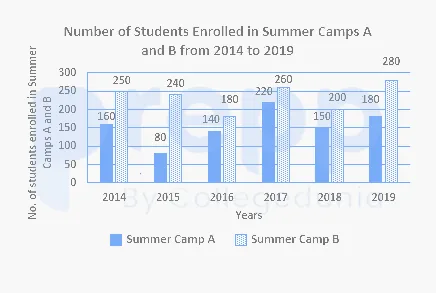
- A
64%
- B
75%
- C
60%
- D
80%
Show answer
A. 64%Given:
The following bar chart shows the number of students enrolled in two summer Camps A and B from 2014 to 2019.
Calculation:
The number of students enrolled in Camp A in 2016 and 2019 = 140 + 180 = 320
T he number of students enrolled in Camp B in 2015 and 2017 = 240 + 260 = 500
The percentage = (320/500) × 100 = 64%
∴ The number of students enrolled in Camp A in 2016 and 2019 together is 64% of the number of students enrolled in Camp B in 2015 and 2017 together.
Paper & answer key PDF ↗ Question 71archived
A cyclic quadrilateral ABCD is drawn in a circle with center O. A and C are joined O. If ∠ABC = 2p and ∠ADC = 3p, what is the measure (in degrees) of the ∠AOC reflex?
- A
200
- B
245
- C
210
- D
216
Show answer
D. 216Solving Cyclic Quadrilateral Angles
This problem involves a cyclic quadrilateral, which is a quadrilateral inscribed in a circle. We are given information about two opposite angles of the quadrilateral and asked to find the measure of a reflex angle at the center of the circle.
Understanding Cyclic Quadrilaterals
A key property of a cyclic quadrilateral is that the sum of its opposite angles is always $180^\circ$. In cyclic quadrilateral ABCD, $\angle \text{ABC}$ and $\angle \text{ADC}$ are opposite angles, as are $\angle \text{BAD}$ and $\angle \text{BCD}$.
Using the Opposite Angle Property
We are given the measures of $\angle \text{ABC}$ and $\angle \text{ADC}$ in terms of $p$:
$\angle \text{ABC} = 2p$
$\angle \text{ADC} = 3p$
Since they are opposite angles in a cyclic quadrilateral, their sum must be $180^\circ$:
$\angle \text{ABC} + \angle \text{ADC} = 180^\circ$
Substitute the given values:
$2p + 3p = 180^\circ$
$5p = 180^\circ$
Now, we can solve for the value of $p$:
$p = \frac{180^\circ}{5}$
$p = 36^\circ$
Calculating the Angles
Now that we know the value of $p$, we can find the measures of the angles:
$\angle \text{ABC} = 2p = 2 \times 36^\circ = 72^\circ$
$\angle \text{ADC} = 3p = 3 \times 36^\circ = 108^\circ$
Let's check if their sum is $180^\circ$: $72^\circ + 108^\circ = 180^\circ$. This confirms our value of $p$ is correct.
Relating Angles at the Center and Circumference
The angle subtended by an arc at the center of the circle is twice the angle subtended by the same arc at any point on the remaining part of the circle.
The angle $\angle \text{AOC}$ is the angle at the center O subtended by the arc AC. There are two such angles: the non-reflex angle and the reflex angle.
The non-reflex $\angle \text{AOC}$ is subtended by the minor arc AC. This minor arc AC subtends the angle $\angle \text{ABC}$ at the circumference (on the major arc side). Therefore, non-reflex $\angle \text{AOC} = 2 \times \angle \text{ABC}$.
The reflex $\angle \text{AOC}$ is subtended by the major arc AC. This major arc AC subtends the angle $\angle \text{ADC}$ at the circumference (on the minor arc side). Therefore, reflex $\angle \text{AOC} = 2 \times \angle \text{ADC}$.
Calculating the Reflex Angle AOC
The question asks for the measure of the reflex $\angle \text{AOC}$. Using the relationship with $\angle \text{ADC}$:
Reflex $\angle \text{AOC} = 2 \times \angle \text{ADC}$
Substitute the calculated value of $\angle \text{ADC}$:
Reflex $\angle \text{AOC} = 2 \times 108^\circ$
Reflex $\angle \text{AOC} = 216^\circ$
Let's also calculate the non-reflex angle for completeness:
Non-reflex $\angle \text{AOC} = 2 \times \angle \text{ABC}$
Non-reflex $\angle \text{AOC} = 2 \times 72^\circ$
Non-reflex $\angle \text{AOC} = 144^\circ$
The sum of the non-reflex and reflex angles is $144^\circ + 216^\circ = 360^\circ$, which is the total angle around the center.
The measure of the reflex $\angle \text{AOC}$ is $216^\circ$.
Summary of Steps
Use the property of opposite angles in a cyclic quadrilateral to find the value of $p$.
Calculate the measures of $\angle \text{ABC}$ and $\angle \text{ADC}$.
Use the relationship between the angle at the center (reflex $\angle \text{AOC}$) and the angle at the circumference ($\angle \text{ADC}$) subtended by the major arc AC.
Calculate the reflex $\angle \text{AOC}$.
Revision Table: Cyclic Quadrilateral Properties
Property
Description
Application in this problem
Opposite Angles are Supplementary
Sum of opposite angles is $180^\circ$.
Used to find $p$ from $2p + 3p = 180^\circ$.
Angle at Center vs. Angle at Circumference
Angle at center is $2 \times$ Angle at circumference subtended by the same arc.
Used to find reflex $\angle \text{AOC}$ from $\angle \text{ADC}$ (both subtended by major arc AC, one at center, one at circumference).
Additional Information: Angles in a Circle
Understanding angles within a circle is crucial for solving geometry problems like this one. Here are a few key concepts:
Inscribed Angle: An angle formed by two chords in a circle that have a common endpoint on the circle. $\angle \text{ABC}$ and $\angle \text{ADC}$ are inscribed angles.
Central Angle: An angle formed by two radii with the vertex at the center of the circle. $\angle \text{AOC}$ (both non-reflex and reflex) are central angles.
Arc: A portion of the circumference of a circle. Angles are subtended by arcs. The size of the angle depends on the arc it subtends and whether it's at the center or circumference.
Angles Subtended by the Same Arc: Angles subtended by the same arc at the circumference are equal. (Not directly used here, but a fundamental property).
Angles Subtended by a Diameter: The angle subtended by a diameter at any point on the circumference is $90^\circ$. (Not applicable here).
The relationship between central angles and inscribed angles is fundamental. The central angle subtended by an arc is twice any inscribed angle subtended by the *same* arc.
Paper & answer key PDF ↗ Question 72archived
If 8A5146B is divisible by 88, then what is the value of B - A?
- A
0
- B
-1
- C
1
- D
2
Show answer
C. 1Given number: 8A5146B
Since 88 = 8 × 11, the number must be divisible by both 8 and 11.
Step 1: Divisibility by 8
Last three digits are 46B.
460 is divisible by 8 and the next divisible number is 464.
So, B = 4.
Number becomes: 8A51464
Step 2: Divisibility by 11
Sum of digits in odd positions:
4 + 4 + 5 + 8 = 21
Sum of digits in even positions:
6 + 1 + A = 7 + A
Difference must be a multiple of 11:
21 − (7 + A) = 11
14 − A = 11
A = 3
Step 3: Find B − A
B − A = 4 − 3 = 1
Answer: 1
Paper & answer key PDF ↗ Question 73archived
If a + b + c = 6, a 2 + b 2 + c 2 = 32, and a 3 + b 3 + c 3 = 189, then the value of abc - 3 is:
- A
2
- B
3
- C
1
- D
0
Show answer
D. 0This question asks us to find the value of an algebraic expression, \( abc - 3 \), given the sums of variables and their powers. We are provided with the values of \( a+b+c \), \( a^2+b^2+c^2 \), and \( a^3+b^3+c^3 \). To find \( abc \), we need to use relevant algebraic identities that connect these terms.
Key Algebraic Identities for Solving the Problem
The following algebraic identities are crucial for solving this problem:
Identity 1: \( (a+b+c)^2 = a^2 + b^2 + c^2 + 2(ab+bc+ca) \)
Identity 2: \( a^3 + b^3 + c^3 - 3abc = (a+b+c)(a^2+b^2+c^2 - ab - bc - ca) \)
The second identity can also be written as: \( a^3 + b^3 + c^3 - 3abc = (a+b+c)(a^2+b^2+c^2 - (ab+bc+ca)) \)
Step-by-Step Solution to Find abc
Step 1: Find the value of \( (ab+bc+ca) \)
We use Identity 1 to find the value of \( (ab+bc+ca) \).
Given:
\( a+b+c = 6 \)
\( a^2+b^2+c^2 = 32 \)
Substitute these values into the identity \( (a+b+c)^2 = a^2 + b^2 + c^2 + 2(ab+bc+ca) \):
\( (6)^2 = 32 + 2(ab+bc+ca) \)
\( 36 = 32 + 2(ab+bc+ca) \)
Subtract 32 from both sides:
\( 36 - 32 = 2(ab+bc+ca) \)
\( 4 = 2(ab+bc+ca) \)
Divide by 2:
\( ab+bc+ca = \frac{4}{2} = 2 \)
So, the value of \( (ab+bc+ca) \) is 2.
Step 2: Find the value of \( abc \) using the main identity
Now we use Identity 2 to find the value of \( abc \).
Given:
\( a+b+c = 6 \)
\( a^2+b^2+c^2 = 32 \)
\( ab+bc+ca = 2 \) (calculated in Step 1)
\( a^3+b^3+c^3 = 189 \)
Substitute these values into the identity \( a^3 + b^3 + c^3 - 3abc = (a+b+c)(a^2+b^2+c^2 - (ab+bc+ca)) \):
\( 189 - 3abc = (6)(32 - 2) \)
\( 189 - 3abc = 6(30) \)
\( 189 - 3abc = 180 \)
To isolate \( 3abc \), rearrange the equation:
\( 189 - 180 = 3abc \)
\( 9 = 3abc \)
Divide by 3:
\( abc = \frac{9}{3} = 3 \)
So, the value of \( abc \) is 3.
Step 3: Calculate the value of \( abc - 3 \)
We found that \( abc = 3 \). Now we can calculate \( abc - 3 \):
\( abc - 3 = 3 - 3 \)
\( abc - 3 = 0 \)
The value of \( abc - 3 \) is 0.
Summary of Calculations
Expression
Value
How it was obtained
\( a+b+c \)
6
Given
\( a^2+b^2+c^2 \)
32
Given
\( ab+bc+ca \)
2
Calculated using \( (a+b+c)^2 \)
\( a^3+b^3+c^3 \)
189
Given
\( abc \)
3
Calculated using \( a^3+b^3+c^3 - 3abc \) identity
\( abc - 3 \)
0
Calculated from \( abc \)
The final value of \( abc - 3 \) is 0.
Revision Table: Key Algebraic Formulas
Identity Name
Formula
Square of a trinomial
\( (a+b+c)^2 = a^2 + b^2 + c^2 + 2(ab+bc+ca) \)
Sum/Difference of Cubes Identity
\( a^3 + b^3 + c^3 - 3abc = (a+b+c)(a^2+b^2+c^2 - ab - bc - ca) \)
Alternative form of Sum/Difference of Cubes Identity
\( a^3 + b^3 + c^3 - 3abc = (a+b+c)(a^2+b^2+c^2 - (ab+bc+ca)) \)
Additional Information on Algebraic Expressions
Algebraic expressions are combinations of variables (like \( a, b, c \)), constants (like 6, 32, 189, 3), and mathematical operations (+, -, ×, ÷). Understanding how to manipulate and simplify these expressions using identities is fundamental in algebra. Identities are equations that are true for all possible values of the variables involved. They serve as powerful tools for solving equations, simplifying expressions, and proving relationships in mathematics. The problem we solved demonstrates how knowing specific identities allows us to find unknown values like \( abc \) when related sums of powers are given.
Paper & answer key PDF ↗ Question 74archived
The cost prices of two articles A and B are in the ratio 4 ∶ 5. While selling these articles, the shopkeeper gains 10% on article A and 20% on article B and the difference in their selling prices is Rs. 480. The difference in the cost price (in Rs.) of articles B and A is:
- A
250
- B
300
- C
400
- D
350
Show answer
B. 300Understanding the Problem
This problem involves calculating the cost price difference between two articles, Article A and Article B, based on their cost price ratio, the profit percentages earned when selling them, and the difference in their selling prices. We are given that the ratio of the cost prices of Article A and Article B is 4:5. The shopkeeper makes a 10% profit on Article A and a 20% profit on Article B. The difference between their selling prices is Rs. 480. We need to find the difference in the cost price of Article B and Article A.
Setting up the Cost Prices
Since the ratio of the cost prices of Article A and Article B is 4:5, we can represent their cost prices using a common variable. Let the common multiple be \(x\).
Cost Price of Article A (CPA) = \(4x\)
Cost Price of Article B (CPB) = \(5x\)
Here, \(x\) represents a value in Rupees.
Calculating the Selling Prices
The selling price (SP) of an article is calculated by adding the profit to the cost price. The profit is given as a percentage of the cost price.
Selling Price of Article A (SPA)
Profit on Article A is 10%.
Profit on A = 10% of CPA = \(\frac{10}{100} \times 4x = 0.1 \times 4x = 0.4x\)
SPA = CPA + Profit on A = \(4x + 0.4x = 4.4x\)
Selling Price of Article B (SPB)
Profit on Article B is 20%.
Profit on B = 20% of CPB = \(\frac{20}{100} \times 5x = 0.2 \times 5x = 1x\)
SPB = CPB + Profit on B = \(5x + 1x = 6x\)
Using the Difference in Selling Prices
We are given that the difference in their selling prices is Rs. 480. Since the cost price of B (\(5x\)) is greater than the cost price of A (\(4x\)) and the profit percentage on B (20%) is also higher than on A (10%), the selling price of B will be greater than the selling price of A. The difference is SPB - SPA.
Difference in Selling Prices = SPB - SPA = Rs. 480
So, \(6x - 4.4x = 480\)
Solving for x
Now, we solve the equation for \(x\):
\(1.6x = 480\)
To find \(x\), we divide 480 by 1.6:
\(x = \frac{480}{1.6}\)
To simplify the division, we can multiply the numerator and denominator by 10 to remove the decimal:
\(x = \frac{4800}{16}\)
Now, perform the division:
\(x = 300\)
Calculating the Cost Prices
Now that we have the value of \(x\), we can find the actual cost prices of Article A and Article B.
CPA = \(4x = 4 \times 300 = 1200\)
CPB = \(5x = 5 \times 300 = 1500\)
So, the cost price of Article A is Rs. 1200 and the cost price of Article B is Rs. 1500.
Finding the Difference in Cost Price
The question asks for the difference in the cost price of articles B and A, which is CPB - CPA.
Difference = CPB - CPA = \(1500 - 1200 = 300\)
The difference in the cost price of articles B and A is Rs. 300.
Article
Cost Price (Ratio)
Cost Price (Value)
Profit Percentage
Profit (Value)
Selling Price (Value)
A
4
\(4x\)
10%
\(0.4x\)
\(4.4x\)
B
5
\(5x\)
20%
\(1x\)
\(6x\)
Final Answer Check
Let's verify the selling price difference with our calculated cost prices.
CPA = 1200, Profit = 10% of 1200 = 120. SPA = \(1200 + 120 = 1320\).
CPB = 1500, Profit = 20% of 1500 = 300. SPB = \(1500 + 300 = 1800\).
Difference in selling prices = SPB - SPA = \(1800 - 1320 = 480\). This matches the given information, confirming our calculations are correct.
The difference in cost price is CPB - CPA = \(1500 - 1200 = 300\).
Revision Table: Cost Price, Selling Price, and Profit
Term
Definition
Formula Relation
Cost Price (CP)
The price at which an article is bought.
Base value for calculating profit/loss.
Selling Price (SP)
The price at which an article is sold.
SP = CP + Profit (for gain)
SP = CP - Loss (for loss)
Profit
The amount gained when SP > CP.
Profit = SP - CP
Profit Percentage
Profit expressed as a percentage of the Cost Price.
Profit % = \(\left(\frac{\text{Profit}}{\text{CP}}\right) \times 100\)
Loss
The amount lost when SP < CP.
Loss = CP - SP
Loss Percentage
Loss expressed as a percentage of the Cost Price.
Loss % = \(\left(\frac{\text{Loss}}{\text{CP}}\right) \times 100\)
Additional Information: Ratios in Word Problems
Ratios are often used to represent proportional relationships between quantities. When a ratio like a:b is given for two quantities, say Q1 and Q2, it means that Q1 and Q2 can be written as \(ax\) and \(bx\) respectively, where \(x\) is a common non-zero factor. This common factor \(x\) helps us convert the ratio into actual values. Once \(x\) is found using other information in the problem (like sums, differences, or other relationships), the actual values of the quantities can be calculated.
In this problem, the ratio of cost prices was 4:5, allowing us to represent them as \(4x\) and \(5x\). This variable \(x\) was crucial in setting up equations based on profit percentages and selling price differences to solve the problem.
Paper & answer key PDF ↗ Question 75archived
\( { 11{} \over 5}\) of a number A is 22% of a number B. The number B is equal to 2.5% of a third number C. If the value of C is 5500, then the sum of 80% of A and 40% of B is:
- A
88
- B
75
- C
46
- D
66
Show answer
D. 66Understanding the Quantitative Aptitude Problem
This problem involves finding the sum of specific percentages of two numbers, A and B, based on given relationships between A, B, and a third number, C. We are given the value of C and the relationships as fractions and percentages. To solve this, we will work backward from the known value of C to find B, then use the value of B to find A, and finally calculate the required sum.
Step-by-Step Solution for Finding the Sum
Step 1: Find the Value of Number B
We are told that number B is equal to 2.5% of number C. The value of C is given as 5500.
To find B, we calculate 2.5% of 5500:
\( B = 2.5\% \text{ of } C \)
\( B = \frac{2.5}{100} \times 5500 \)
We can simplify the calculation:
\( B = \frac{2.5}{100} \times 5500 = \frac{25}{1000} \times 5500 \)
\( B = \frac{25}{10} \times 55 \)
\( B = 2.5 \times 55 \)
Multiplying 2.5 by 55:
\( B = 137.5 \)
So, the value of number B is 137.5.
Step 2: Find the Value of Number A
We are told that \( \frac{11}{5} \) of number A is equal to 22% of number B.
We can write this relationship as an equation:
\( \frac{11}{5} \times A = 22\% \text{ of } B \)
Convert the percentage to a fraction or decimal:
\( \frac{11}{5} \times A = \frac{22}{100} \times B \)
Substitute the value of B = 137.5 that we found in Step 1:
\( \frac{11}{5} \times A = \frac{22}{100} \times 137.5 \)
Calculate the right side of the equation:
\( \frac{22}{100} \times 137.5 = 0.22 \times 137.5 \)
\( 0.22 \times 137.5 = 30.25 \)
So, the equation becomes:
\( \frac{11}{5} \times A = 30.25 \)
Now, solve for A. Multiply both sides by \( \frac{5}{11} \):
\( A = 30.25 \times \frac{5}{11} \)
\( A = \frac{30.25 \times 5}{11} \)
\( A = \frac{151.25}{11} \)
Divide 151.25 by 11:
\( A = 13.75 \)
So, the value of number A is 13.75.
Step 3: Calculate 80% of A
Now we need to find 80% of A.
\( 80\% \text{ of } A = \frac{80}{100} \times A \)
Substitute the value of A = 13.75:
\( 80\% \text{ of } A = \frac{80}{100} \times 13.75 \)
\( 80\% \text{ of } A = 0.8 \times 13.75 \)
\( 0.8 \times 13.75 = 11 \)
So, 80% of A is 11.
Step 4: Calculate 40% of B
Next, we find 40% of B.
\( 40\% \text{ of } B = \frac{40}{100} \times B \)
Substitute the value of B = 137.5:
\( 40\% \text{ of } B = \frac{40}{100} \times 137.5 \)
\( 40\% \text{ of } B = 0.4 \times 137.5 \)
\( 0.4 \times 137.5 = 55 \)
So, 40% of B is 55.
Step 5: Calculate the Sum of 80% of A and 40% of B
The question asks for the sum of 80% of A and 40% of B.
Sum = (80% of A) + (40% of B)
Sum = 11 + 55
Sum = 66
Therefore, the sum of 80% of A and 40% of B is 66.
Variable
Value/Relationship
Calculation
C
5500
Given
B
2.5% of C
\( B = \frac{2.5}{100} \times 5500 = 137.5 \)
A
\( \frac{5}{11} \) of 22% of B
\( \frac{11}{5} \times A = \frac{22}{100} \times 137.5 \implies A = 13.75 \)
80% of A
80% of 13.75
\( \frac{80}{100} \times 13.75 = 11 \)
40% of B
40% of 137.5
\( \frac{40}{100} \times 137.5 = 55 \)
Sum
(80% of A) + (40% of B)
\( 11 + 55 = 66 \)
Revision Table: Key Concepts
Concept
Explanation
Formula
Percentage
A rate, number, or amount in each hundred.
\( x\% \text{ of Y} = \frac{x}{100} \times Y \)
Fraction of a Number
Multiplying the fraction by the number.
\( \frac{a}{b} \text{ of X} = \frac{a}{b} \times X \)
Solving Equations
Isolating the unknown variable by performing inverse operations.
If \( cX = d \), then \( X = \frac{d}{c} \)
Additional Information on Percentages and Fractions
Percentages and fractions are ways to represent parts of a whole. Understanding how to convert between them and perform calculations is crucial for solving quantitative aptitude problems.
Converting Percentage to Decimal: Divide the percentage by 100. E.g., 25% = \( \frac{25}{100} \) = 0.25.
Converting Decimal to Percentage: Multiply the decimal by 100. E.g., 0.75 = \( 0.75 \times 100\% \) = 75%.
Converting Fraction to Decimal: Divide the numerator by the denominator. E.g., \( \frac{3}{4} \) = 3 \( \div \) 4 = 0.75.
Converting Decimal to Fraction: Write the decimal as a fraction over a power of 10 and simplify. E.g., 0.5 = \( \frac{5}{10} = \frac{1}{2} \).
In this problem, we used these conversions repeatedly to simplify the calculations involving percentages and fractions of numbers A, B, and C.
Paper & answer key PDF ↗ Question 76archived
Select the most appropriate option to fill in the blank.
Are you looking forward ______ Nikhil again?
- A
seeing
- B
to see
- C
to be seeing
- D
to seeing
Show answer
D. to seeingThe correct answer is to seeing.
In addition to: In addition to studying , I also work part-time. Devoted to: He is devoted to helping the poor. It's important to remember that when 'to' is part of an infinitive verb (like "to go", "to eat"), it is followed by the base form of the verb. However, in phrases like "look forward to", 'to' is a preposition, and thus it must be followed by a noun or a gerund.
Paper & answer key PDF ↗ Question 77archived
Select the option that can be used as a one-word substitute for the given group of words.
A fictional being from another world
- A
Stranger
- B
Native
- C
Alien
- D
Foreigner
Show answer
C. AlienAnswer: Alien.
Indigenous: This term refers to people, plants, or animals that are native to a particular place or region, the opposite of being from elsewhere. These terms highlight how specific the meaning of 'alien' is when referring to a being from another world, especially a fictional one.
Paper & answer key PDF ↗ Question 78archived
Select the option that can be used as a one-word substitute for the given group of words.
Showing great attention to detail and correct behaviour
- A
Punctual
- B
Zealous
- C
Punctilious
- D
Disciplined
Show answer
C. PunctiliousUse new words in sentences to understand their usage. Regularly revise the words you have learned. Pay attention to root words, prefixes, and suffixes, which can help in understanding the meaning of new words. Focusing on precise vocabulary like 'punctilious' helps in expressing ideas more accurately and concisely.
Paper & answer key PDF ↗ Question 79archived
Select the option that expresses the given sentence in passive voice.
He opened the door for his mother.
- A
The door was opened by him for his mother.
- B
The door was open by him for his mother.
- C
The door had been opened by him for his mother.
- D
The door is opened by him for his mother.
Show answer
A. The door was opened by him for his mother.Converting Active Sentence to Passive Voice
The task is to rephrase the active voice sentence, "He opened the door for his mother," into the passive voice. The passive voice focuses on the action and the object receiving the action, rather than the subject performing it.
Analyzing the Active Sentence Structure
First, let's identify the components of the original active sentence:
Subject: He (the one performing the action)
Verb: opened (the action, in simple past tense)
Object: the door (the receiver of the action)
Prepositional Phrase: for his mother (provides additional context)
Mechanism of Passive Voice Conversion
Converting an active sentence to passive involves specific changes:
The object of the active sentence ("the door") becomes the new subject.
The verb is changed to its passive form. For the simple past tense ("opened"), this is "was/were + past participle". The past participle of "open" is "opened". Since the new subject ("the door") is singular, we use "was opened".
The subject of the active sentence ("He") becomes the object of the preposition "by" (the agent), forming "by him".
Other phrases, like "for his mother," are kept in their place.
Following these steps results in the passive sentence: "The door was opened by him for his mother."
Evaluating Provided Options
Let's analyze each option based on the rules of passive voice transformation:
Option 1: The door was opened by him for his mother.
Analysis: This option correctly follows the passive voice structure. The object "the door" is now the subject, the verb is correctly transformed into the past simple passive "was opened", and the original subject "He" is included as the agent "by him". The prepositional phrase is also correctly placed. This matches the expected passive form.
Option 2: The door was open by him for his mother.
Analysis: This is incorrect. The verb form "was open" is not the correct passive form. The passive voice requires the past participle ("opened"), not the adjective "open".
Option 3: The door had been opened by him for his mother.
Analysis: This option uses the Past Perfect Passive ("had been opened"). The original sentence was in the Simple Past tense ("opened"). Changing to Past Perfect Passive alters the original tense, making it incorrect.
Option 4: The door is opened by him for his mother.
Analysis: This option uses the Present Simple Passive ("is opened"). The original sentence was in the Simple Past tense. This tense mismatch makes the option incorrect.
Option 5: (No sentence provided)
Analysis: This option is incomplete and cannot be evaluated.
Final Determination
Comparing the options with the correct passive voice transformation, Option 1 is the accurate representation of the sentence "He opened the door for his mother" in the passive voice.
Paper & answer key PDF ↗ Question 80archived
Sentences of a paragraph are given below in jumbled order. Arrange the sentences in the correct order to form a meaningful and coherent paragraph.
A. The interest rates offered depends on the bank, deposit amount and the tenure you choose.
B. It not only helps you to save money but also helps you to earn a substantial interest on it.
C. One of the best ways to secure your money is by investing in fixed deposits.
D. Under the fixed deposit scheme, the depositor deposits the money only once at the time of opening the account.
- A
CDBA
- B
ADCB
- C
ACBD
- D
CABD
Show answer
A. CDBAThe correct answer is CDBA.
Single Deposit: Unlike recurring deposits, you usually deposit the principal amount only once at the beginning. Factors Affecting Interest Rate: The specific rate you get depends on factors like the bank you choose, the amount you deposit, the duration of the deposit (short-term vs. long-term), and sometimes your customer type (e.g., senior citizens might get slightly higher rates). Benefits: They help in saving money, provide a predictable return through fixed interest, and are considered a secure way to invest.
Paper & answer key PDF ↗ Question 81archived
Select the most appropriate meaning of the given idiom.
On the wane
- A
On the way
- B
On the top
- C
On the decline
- D
On the rise
Show answer
C. On the declineUnderstanding the Idiom: On the Wane
The question asks for the most appropriate meaning of the idiom "On the wane". Understanding idioms is crucial for language proficiency, especially in exams. Let's break down the meaning of this specific idiom.
Meaning of 'On the Wane'
The idiom "On the wane" is used to describe something that is decreasing in strength, size, importance, or intensity. It signifies a state of decline or reduction. Think of the moon, which is said to 'wane' as it gets smaller after the full moon.
Analyzing the Options
We are given four options, and we need to find the one that best matches the meaning of "On the wane". Let's look at each option:
Option 1: On the way
Option 2: On the top
Option 3: On the decline
Option 4: On the rise
Let's evaluate each option's meaning:
Option
Meaning
Match with 'On the Wane'?
On the way
In transit; approaching or happening soon.
No. This refers to movement or future occurrence, not decrease.
On the top
At the highest point or position; successful.
No. This refers to a peak, not a decrease from a peak or a general decline.
On the decline
Decreasing; deteriorating; losing strength, power, or importance.
Yes. This directly matches the core meaning of "On the wane".
On the rise
Increasing; improving; gaining strength, power, or importance.
No. This is the opposite of "On the wane".
Identifying the Correct Meaning
Based on the analysis, the phrase that most accurately describes something "On the wane" is "On the decline". Both phrases indicate a downward trend in quantity, quality, or influence.
Conclusion
The idiom "On the wane" means that something is decreasing, weakening, or losing importance. This is best represented by the phrase "On the decline".
Revision Table: Key Idioms
Idiom
Meaning
Example Sentence
On the wane
Decreasing in strength, size, importance, etc.
Public interest in the topic is on the wane.
On the rise
Increasing in strength, size, importance, etc.
His popularity is on the rise.
On the ball
Alert, competent, and efficient.
She's really on the ball with her work.
On cloud nine
Extremely happy.
He's on cloud nine after getting the job.
Additional Information: Understanding Idioms
Idioms are phrases or expressions whose meaning cannot be deduced from the literal meaning of its individual words. They are a significant part of language and are frequently used in everyday conversation and literature.
Learning idioms helps in:
Improving comprehension of native speakers and writers.
Making your own language sound more natural and fluent.
Understanding cultural nuances.
Context is key when trying to understand an idiom you haven't encountered before. Often, the surrounding words or the situation can provide clues to its meaning.
Paper & answer key PDF ↗ Question 82archived
Select the most appropriate ANTONYM of the given word.
Prey
- A
Predator
- B
Sufferer
- C
Loot
- D
Game
Show answer
A. PredatorUnderstanding the Antonym of Prey
The question asks us to find the most appropriate antonym for the word "Prey". An antonym is a word that means the opposite of another word. To answer this, let's first understand what "Prey" means.
The word Prey typically refers to an animal that is hunted and killed by another for food. In a broader sense, it can also mean a victim, or something that is seized or becomes a victim.
Analyzing the Options
Let's examine each option provided:
Predator: A predator is an animal that hunts, kills, and eats other animals. This is the animal that hunts the prey.
Sufferer: A sufferer is someone who experiences pain, distress, or hardship. While prey might suffer, 'sufferer' isn't a direct opposite in the context of hunting.
Loot: Loot refers to goods, especially money or property, stolen or taken by force (as in a war or riot). This is not related to the biological or victim meaning of prey.
Game: In the context of hunting, 'game' refers to wild animals that are hunted for sport or food. 'Game' can sometimes be considered similar to 'prey' in this context, not its opposite.
Identifying the Opposite
Considering the primary meaning of "Prey" as the animal being hunted, the direct opposite is the animal that does the hunting. This animal is called a Predator.
Predators hunt prey. They are the active hunters, while prey are the passive animals being hunted. Therefore, "Predator" is the antonym of "Prey".
Let's summarize the relationship:
Word
Meaning
Relationship to Prey
Prey
Animal hunted and killed for food by another animal
The hunted
Predator
Animal that hunts and kills other animals for food
The hunter (opposite of prey)
Sufferer
Person who experiences pain or hardship
Victim (related, but not the direct opposite in hunting context)
Loot
Stolen goods or property
Unrelated
Game
Wild animals hunted for sport/food
Can be considered prey (similar, not opposite)
Based on the definitions and relationships, "Predator" is the clear antonym of "Prey".
Revision Table: Prey and its Antonym
Word
Antonym
Prey
Predator
Additional Information on Prey and Predator
The relationship between predator and prey is a fundamental concept in ecology. It describes an interaction where one organism, the predator, hunts and kills another organism, the prey, for food. This relationship is crucial for maintaining the balance of ecosystems. Populations of prey and predators often influence each other; for example, an increase in the prey population can lead to an increase in the predator population due to more food availability, which in turn can cause the prey population to decrease again.
Paper & answer key PDF ↗ Question 83archived
Select the INCORRECTLY spelt word.
- A
Whitan
- B
Enlighten
- C
Hasten
- D
Brighten
Show answer
A. WhitanSilent Letters: Letters in a word that are not pronounced (e.g., 'k' in 'know', 'gh' in 'light'). Vowel Combinations: Difficulties with letter pairs like 'ie' vs 'ei'. Adding Suffixes: Rules for adding -ed, -ing, -ly, -en etc., which sometimes require dropping or doubling letters. Practicing regularly and learning common spelling rules can help improve accuracy in English spelling.
Paper & answer key PDF ↗ Question 84archived
Select the most appropriate meaning of the given idiom.
A long shot
- A
A correct prediction
- B
A perfect aim
- C
Very profitable
- D
Little chance of success
Show answer
D. Little chance of successUnderstanding Idioms: The Meaning of 'A long shot'
Idioms are phrases or expressions whose meaning cannot be deduced simply from the ordinary meaning of its individual words. Understanding common English idioms is crucial for improving vocabulary and comprehension.
The idiom in question is "A long shot". We need to find the option that best explains its meaning.
Meaning of the Idiom 'A long shot'
The idiom "A long shot" typically refers to something that has only a small chance of succeeding or happening. It implies that the outcome is unlikely, but not impossible.
Think of it like a very difficult shot in sports from a long distance – it's hard to make it, meaning it has a low probability of success.
Analyzing the Options for 'A long shot'
Let's look at the given options and see which one aligns with the meaning of "A long shot":
Option
Meaning
Relevance to 'A long shot'
1. A correct prediction
Forecasting something accurately.
This is about accuracy, not probability of success of an event. Incorrect.
2. A perfect aim
Hitting a target precisely.
This relates to skill or precision, not the likelihood of an event happening. Incorrect.
3. Very profitable
Yielding a large financial gain.
This relates to financial outcome, not the probability of something occurring. Incorrect.
4. Little chance of success
Having a low probability of achieving the desired outcome.
This directly matches the common understanding of "A long shot" as something unlikely to succeed. Correct.
Selecting the Most Appropriate Meaning
Based on the analysis, the option that most appropriately describes the meaning of the idiom "A long shot" is "Little chance of success". The idiom is used when discussing an undertaking or event that is considered very improbable.
For example:
Applying for that scholarship with only average grades was a long shot, but she decided to try anyway.
Winning the lottery is always a long shot for anyone.
Conclusion on 'A long shot' Meaning
The idiom "A long shot" is correctly interpreted as having a very small probability of success. It is often used in contexts where someone attempts something despite the low odds.
Revision Table: Key Idioms and Meanings
Idiom
Meaning
A long shot
An attempt or prediction with little chance of success.
Break a leg
Good luck (often used before a performance).
Hit the nail on the head
To describe exactly what is causing a situation or problem.
Let the cat out of the bag
To reveal a secret.
Additional Information: Idiom Analysis and Learning
Learning idioms is an important part of mastering English vocabulary and understanding native speakers. Idioms add color and depth to language, but their non-literal meanings can be challenging. Context often plays a key role in understanding which meaning of an idiom is being used.
To learn idioms effectively:
Read widely to see idioms used in different contexts.
Use idiom dictionaries or online resources.
Try using new idioms in your own sentences.
Group idioms by theme or keywords if helpful.
Understanding idioms like "A long shot" enhances your ability to comprehend complex texts and conversations.
Paper & answer key PDF ↗ Question 85archived
The following sentence has been split into four segments. Identify the segment that contains a grammatical error.
This is / too grave sin / to be / pardoned.
- A
pardoned
- B
too grave sin
- C
This is
- D
to be
Show answer
B. too grave sinIdentifying Grammatical Errors in English Sentences
Let's analyze the given sentence to identify the segment that contains a grammatical error. The sentence is presented in four segments:
This is
too grave sin
to be
pardoned
Analyzing the Sentence Segments
We will examine each segment to determine if it is grammatically correct in the context of the full sentence.
This is: This segment is grammatically correct and serves as the subject and verb for the sentence.
too grave sin: This segment contains a potential issue regarding the structure used with 'too'. When 'too' is followed by an adjective and a singular countable noun, the indefinite article ('a' or 'an') must be placed between the adjective and the noun. The correct structure is typically: too + adjective + a/an + singular countable noun. In this segment, 'grave' is an adjective and 'sin' is a singular countable noun, but the article 'a' is missing.
to be: This segment is part of an infinitive phrase and is grammatically correct in this structure, indicating the state or action that follows.
pardoned: This segment is the past participle used to form the passive infinitive 'to be pardoned', which is grammatically correct in this context.
Identifying the Grammatical Error
Based on our analysis, the segment "too grave sin" violates the standard English grammar rule for using 'too' followed by an adjective and a singular countable noun. The indefinite article 'a' is required before 'sin'.
The grammatically correct phrasing should be "too grave a sin".
Therefore, the segment containing the grammatical error is "too grave sin".
Corrected Sentence Structure
The corrected sentence would be:
This is too grave a sin to be pardoned.
This structure follows the correct pattern for expressing something that is excessively [adjective] to the point that a certain consequence or action (expressed by the infinitive phrase) cannot occur.
Incorrect Structure
Correct Structure
Explanation
too + adjective + singular countable noun
too + adjective + a/an + singular countable noun
The indefinite article ('a' or 'an') is required between the adjective and the singular countable noun when preceded by 'too'.
Revision Table: Common Structure with 'Too'
Usage of 'Too'
Structure
Example
Too + Adjective/Adverb
Too + adjective/adverb
It's too hot. She spoke too quickly.
Too + Adjective + Noun
Too + adjective + a/an + singular countable noun
It's too difficult a question. This is too grave a sin.
Too + Many/Much
Too many + plural countable noun
Too much + uncountable noun
Too many people. Too much sugar.
Additional Information on Using 'Too'
'Too' is an adverb that means 'more than enough' or 'excessively'. It is often followed by an adjective or another adverb. When it modifies an adjective that precedes a singular countable noun, the structure involving the indefinite article ('a' or 'an') is necessary.
Compare this with 'very', which simply intensifies an adjective or adverb without implying an excessive degree or a consequence. For example:
It is a very grave sin. (Intensifies 'grave')
It is too grave a sin to be pardoned. ('Too grave' implies the sin's gravity prevents pardoning)
Understanding these specific structures is crucial for avoiding common grammatical errors and improving sentence construction in English grammar.
Paper & answer key PDF ↗ Question 86archived
Select the correct active voice of the given sentence.
The poems of great English poets are being translated into other languages.
- A
They were translating the poems of great English poets into other languages.
- B
They are translating the poems of great English poets into other languages.
- C
They have translated the poems of great English poets into other languages.
- D
They translated the poems of great English poets into other languages.
Show answer
B. They are translating the poems of great English poets into other languages.Converting Passive Voice to Active Voice: Step-by-Step
Understanding how to change a sentence from passive voice to active voice is a key skill in English grammar. The active voice is generally preferred as it is more direct and dynamic.
The given sentence is:
The poems of great English poets are being translated into other languages.
Analyzing the Passive Sentence Structure
Let's break down the provided passive voice sentence:
Subject: The poems of great English poets (the recipient of the action)
Verb Phrase: are being translated
Helping Verbs: are, being
Main Verb: translated (past participle)
Object/Complement: into other languages
Agent: The doer of the action is not explicitly mentioned. In passive voice, the agent is often omitted, especially when it's unknown, unimportant, or obvious (like "people" or "they").
The structure "are being + past participle" indicates that the passive sentence is in the Present Continuous Passive tense.
Converting to Active Voice
To convert a passive sentence in the present continuous tense to active voice, we need to:
Identify the agent (the doer of the action). Since the agent is not mentioned, we can assume a general pronoun like "They" or "People". "They" is commonly used in such cases.
Make the agent the new subject of the active sentence.
Change the verb to the corresponding active voice tense, which is Present Continuous Active. The structure for Present Continuous Active is Subject + am/is/are + verb-ing (present participle) + Object.
Move the original passive subject (the recipient of the action) to become the object of the active sentence.
Applying these steps:
New Subject: They (assuming "They" are doing the translating)
Active Verb (Present Continuous): are translating
Object (Original Passive Subject): the poems of great English poets
Remaining part: into other languages
Putting it together, the active voice sentence becomes: They are translating the poems of great English poets into other languages.
Evaluating the Options
Let's compare our derived active sentence with the given options:
Option
Sentence
Tense
Voice
Matches?
1
They were translating the poems...
Past Continuous
Active
No (Incorrect tense)
2
They are translating the poems...
Present Continuous
Active
Yes
3
They have translated the poems...
Present Perfect
Active
No (Incorrect tense)
4
They translated the poems...
Simple Past
Active
No (Incorrect tense)
Option 2 matches the active voice sentence we constructed based on the Present Continuous Passive structure of the original sentence.
Conclusion
The correct active voice transformation of "The poems of great English poets are being translated into other languages" is "They are translating the poems of great English poets into other languages." This correctly identifies the implicit agent and uses the corresponding present continuous active tense.
Revision Table: Active vs. Passive Voice Tenses
Here's a quick summary of how some common tenses change between active and passive voice:
Tense
Active Voice Structure
Passive Voice Structure
Simple Present
Subject + verb (s/es) + Object
Object + is/am/are + past participle + (by Agent)
Present Continuous
Subject + is/am/are + verb-ing + Object
Object + is/am/are + being + past participle + (by Agent)
Simple Past
Subject + verb-ed + Object
Object + was/were + past participle + (by Agent)
Present Perfect
Subject + has/have + past participle + Object
Object + has/have + been + past participle + (by Agent)
Additional Information on Voice Change in English Grammar
Voice is a grammatical term used to describe the relationship between the verb and the subject. There are two voices in English: active voice and passive voice.
Active Voice: The subject performs the action. The focus is on the doer. Example: She wrote the letter. (Subject 'She' performs the action 'wrote').
Passive Voice: The subject receives the action. The focus is on the action or the recipient of the action. The doer is often mentioned using "by" or omitted. Example: The letter was written by her. (Subject 'letter' receives the action 'was written').
Using the active voice often makes sentences clearer, more concise, and more powerful. However, the passive voice is useful when the doer is unknown, unimportant, or when you want to emphasize the action or the recipient rather than the doer.
Paper & answer key PDF ↗ Question 87archived
The following sentence has been divided into parts. One of them may contain a grammatical error. Select the part that contains the error from the given options. If you don’t find any error, mark ‘No error’ as your answer.
Antique diamond necklace / was stolen / from the museum.
- A
was stolen
- B
from the museum
- C
Antique diamond necklace
- D
No error
Show answer
C. Antique diamond necklaceUnderstanding the Sentence and Identifying Grammar Errors
The question asks us to find a grammatical error in a sentence divided into parts. The sentence is: "Antique diamond necklace / was stolen / from the museum." We need to examine each part carefully.
Analyzing Each Part of the Sentence
Let's look at each segment provided:
Antique diamond necklace
was stolen
from the museum
We will now analyze each part to check for potential grammatical issues.
Part 1: Antique diamond necklace
This part functions as the subject of the sentence. It refers to a specific item: an antique diamond necklace. When referring to a specific, identifiable noun, especially one that is unique in the context (a particular necklace stolen from a particular museum), we typically need to use a definite article ('the'). Simply saying "Antique diamond necklace" without an article makes it sound like we are talking about the general concept of antique diamond necklaces, not a specific one.
Compare these examples:
"I saw a bird." (Any bird)
"The bird that I saw yesterday is back." (A specific bird)
"I like antique diamond necklaces." (General)
"The antique diamond necklace was stolen." (A specific necklace)
Since the sentence describes a specific event (a theft) involving a specific item (a particular antique diamond necklace) from a specific place (the museum), the subject should be introduced with the definite article 'the'. Therefore, "Antique diamond necklace" is grammatically incomplete and should be "The antique diamond necklace". This part contains the error.
Part 2: was stolen
This part is the verb phrase. It is in the passive voice (was + past participle). The subject ("Antique diamond necklace", which is singular) agrees with the singular form of the verb 'to be' ('was'). 'Stolen' is the past participle of 'steal'. The passive voice is appropriate here because the action (stealing) is being performed on the subject (the necklace), and the perpetrator is not mentioned or is less important than the action and the object.
This part "was stolen" is grammatically correct for a singular subject in the passive voice, past tense.
Part 3: from the museum
This is a prepositional phrase indicating the origin or location from which the theft occurred. 'From' is a correct preposition. 'The museum' uses the definite article 'the', which is appropriate because it refers to a specific museum where the necklace was located. This part is grammatically correct.
Identifying the Incorrect Part
Based on our analysis, the error lies in the first part, "Antique diamond necklace", due to the missing definite article 'the' before the subject.
Part
Sentence Fragment
Analysis
Error?
1
Antique diamond necklace
Missing definite article 'the' for a specific item.
Yes
2
was stolen
Correct passive voice for a singular subject.
No
3
from the museum
Correct prepositional phrase with definite article for a specific place.
No
The part that contains the grammatical error is "Antique diamond necklace". It should be "The antique diamond necklace".
Revision Table: Sentence Error Analysis
Original Part
Analysis of Error
Correct Form
Antique diamond necklace
Missing definite article 'the' when referring to a specific item.
The antique diamond necklace
was stolen
Correct (Passive voice, singular subject agreement)
was stolen
from the museum
Correct (Prepositional phrase, specific location)
from the museum
Additional Information: Article Usage
Articles (a, an, the) are a crucial part of English grammar. They come before nouns and tell us whether the noun is general or specific.
'A' and 'An' (Indefinite Articles): Used before singular, countable nouns when you are talking about one item of a group, or when mentioning something for the first time. Use 'a' before consonant sounds, 'an' before vowel sounds.
'The' (Definite Article): Used before singular or plural nouns (countable or uncountable) when you are talking about a specific item or group that is already known or has been mentioned before, or is unique in the context.
In the sentence "Antique diamond necklace was stolen from the museum," both the necklace and the museum are treated as specific entities involved in a particular event, hence requiring 'the'.
Paper & answer key PDF ↗ Question 88archived
Select the most appropriate synonym of the given word.
FLUKE
- A
Policy
- B
Plan
- C
Chance
- D
Contract
Show answer
C. ChanceThe correct answer is Chance.
When encountering a new word like FLUKE, try to think of situations where it might be used to better grasp its context and meaning. For example, "Winning the lottery was a complete FLUKE." Regular practice with vocabulary lists and context-based exercises can significantly improve your word power. For words related to chance, consider terms like accident, fortuity, coincidence, or serendipity, depending on the specific nuance you want to convey.
Paper & answer key PDF ↗ Question 89archived
Select the most appropriate option that can substitute the underlined segment in the given sentence. If there is no need to substitute it, select ‘No substitution required’.
The investigationrevealed that both of theyhad given false information to obtain the certificates.
- A
No substitution required
- B
reveal that them both
- C
reveals that how they both
- D
revealed that both of them
Show answer
D. revealed that both of themEnglish Grammar Substitution: Correcting Pronoun Usage
The question asks us to find the most appropriate option to replace the underlined part in the sentence: "The investigation revealed that both of theyhad given false information to obtain the certificates."
Let's break down the original sentence and identify the issue.
The problematic phrase is "both of they". In English grammar, when a pronoun follows a preposition like "of", it must be in the object case. The pronoun "they" is a subject pronoun (used when it's the subject of a verb). The object pronoun corresponding to "they" is "them". Therefore, "both of they" is grammatically incorrect; it should be "both of them".
The original sentence uses the past tense verb "revealed", which fits well with "had given", indicating a past action of revealing something that happened earlier.
Analyzing the Substitution Options
Let's look at each option provided:
Option 1: No substitution required
This option suggests the original phrase "revealed that both of theyhad given false information to obtain the certificates" is correct. As discussed, "both of they" is grammatically incorrect because "they" is a subject pronoun used after the preposition "of". So, this option is not correct.
Option 2: reveal that them both
This option uses the verb "reveal" (present tense) instead of "revealed" (past tense). While "them both" or "both of them" is grammatically correct in terms of pronoun case, changing the verb tense from "revealed" to "reveal" alters the meaning of the sentence from a past event to a present one, which may not fit the context implied by "had given". The structure "them both" is acceptable, though "both of them" is more standard when following "that".
Option 3: reveals that how they both
This option uses "reveals" (present tense) and introduces the word "how", which changes the structure and meaning of the sentence. "how they both" is also incorrect because "they" is a subject pronoun, and the structure "both of them" or "them both" is needed for pronoun case correctness.
Option 4: revealed that both of them
This option keeps the verb "revealed" in the past tense, matching the original structure and the tense of "had given". It correctly replaces "both of they" with "both of them". "Them" is the correct object pronoun to use after the preposition implied by "both of". This phrase "both of them" is grammatically sound and maintains the original sentence's intended meaning and tense.
Evaluating the Best Fit
Comparing the options, Option 4 corrects the grammatical error ("both of they" to "both of them") while keeping the original verb tense ("revealed"), which is appropriate given the context of "had given". The other options either fail to correct the pronoun error or change the verb tense/sentence structure unnecessarily.
Therefore, the most appropriate substitution is "revealed that both of them".
Original Segment
Issue
revealed that both of theyhad given
"both of they" - incorrect pronoun case. "they" is subject, needs object "them" after "of".
Option
Substitution
Analysis
Correct?
1
No substitution required
Original contains grammatical error ("both of they").
No
2
reveal that them both
Changes tense ("reveal" vs "revealed"). "them both" is acceptable pronoun usage, but tense change is likely incorrect.
No
3
reveals that how they both
Changes tense ("reveals" vs "revealed"), adds "how", uses incorrect pronoun case ("they").
No
4
revealed that both of them
Keeps tense ("revealed"), corrects pronoun case ("both of them"). Grammatically correct.
Yes
The sentence with the correct substitution reads: "The investigation revealed that both of them had given false information to obtain the certificates."
Revision Table: Key Grammar Concepts
Concept
Explanation
Example
Subject Pronouns
Used when the pronoun is the subject of a verb.
I went, You saw, He/She/It ran, We played, They sang.
Object Pronouns
Used when the pronoun is the object of a verb or a preposition.
He saw me, She spoke to you, We helped him/her/it, They visited us, I talked to them.
Pronouns after Prepositions
A pronoun following a preposition (like of, to, for, with) must be an object pronoun.
This is for us (not we). Listen to me (not I). Both of them (not they).
Additional Information: Understanding Pronoun Case
Pronoun case refers to the form a pronoun takes depending on its grammatical function in a sentence (subject, object, possessive). Mastering pronoun case is crucial for clear and correct writing.
In the given sentence, "both of they", the pronoun "they" follows the structure "both of...". While "both" can sometimes function as a subject, the "of they" part involves a preposition ("of"). Pronouns that come after prepositions must be in the object case. The object case for "they" is "them".
Consider these examples:
Incorrect: Between you and I, ... (Should be "Between you and me" because "between" is a preposition, requiring object pronouns).
Incorrect: Give it to he. (Should be "Give it to him" because "to" is a preposition, requiring an object pronoun).
Incorrect: She talked about they. (Should be "She talked about them" because "about" is a preposition, requiring an object pronoun).
Similarly, after "both of", the correct form is "both of them", "both of us", etc., using the object pronoun.
The investigation revealed that both of them had given false information.
Paper & answer key PDF ↗ Question 90archived
Select the option that expresses the given sentence in reported speech.
She said, “It is too good to be true.”
- A
She said it were too good to be true.
- B
She said that it was too good to be true.
- C
She is saying that it is too good to be true.
- D
She says that it is too good to be true.
Show answer
B. She said that it was too good to be true.Understanding Direct and Reported Speech
When we report what someone has said without using their exact words, we use reported speech (also known as indirect speech). This often involves changing the tense of the verbs and sometimes other words like pronouns and time expressions.
The original sentence provided is in direct speech:
She said, “It is too good to be true.”
Here, the exact words spoken by the speaker are enclosed in quotation marks (“”).
Converting Direct Speech to Reported Speech
To convert a sentence from direct speech to reported speech, especially when the reporting verb is in the past tense (like “said”), we usually follow these rules:
The quotation marks are removed.
A conjunction like “that” is often used to introduce the reported clause (though it can sometimes be omitted).
The tense of the verb in the reported clause is usually changed to a corresponding past tense. This is called tense shifting or backshifting.
Pronouns and time/place expressions might also change depending on the context, but this sentence doesn't have complex pronouns or time/place expressions.
Applying the Rules: Tense Shift
In the given sentence, the reporting verb is said, which is in the past tense.
The verb in the direct speech clause “It is too good to be true.” is is, which is in the present simple tense.
When the reporting verb is in the past, the present simple tense in the direct speech usually changes to the past simple tense in reported speech.
Present Simple (“is”) → Past Simple (“was”)
So, “It is” becomes “it was” in reported speech.
Analyzing the Options for Reported Speech
Let's look at the given options and see which one correctly applies the conversion rules.
Option 1: She said it were too good to be true.
The reporting verb “said” is used correctly.
The conjunction “that” is omitted, which is acceptable.
However, the verb “were” is used. For the subject “it”, the past simple form of “to be” is “was”, not “were” (unless in a specific subjunctive mood, which is not the case here). This option is grammatically incorrect.
Option 2: She said that it was too good to be true.
The reporting verb “said” is used correctly.
The conjunction “that” is correctly used.
The tense of the verb has been correctly shifted from present simple “is” to past simple “was” (“it is” becomes “it was”).
This option correctly follows the rules for converting direct speech with a past reporting verb.
Option 3: She is saying that it is too good to be true.
The reporting verb has been changed from “said” (past tense) to “is saying” (present continuous tense). This changes the meaning and is not a correct conversion of the original sentence.
The tense in the reported clause remains “is”, which is present tense. While this is acceptable if the reporting verb is in the present, the original reporting verb was past (“said”).
Option 4: She says that it is too good to be true.
The reporting verb has been changed from “said” (past tense) to “says” (present simple tense). This changes the meaning and is not a correct conversion of the original sentence.
The tense in the reported clause remains “is”, which is present tense. This is acceptable if the reporting verb is in the present, but the original reporting verb was past (“said”).
Based on the analysis, Option 2 correctly converts the direct speech sentence to reported speech by using the correct reporting verb and applying the appropriate tense shift from present simple “is” to past simple “was”.
Revision Table: Direct vs. Reported Speech
Feature
Direct Speech
Reported Speech (Past Reporting Verb)
Quotation Marks
Used
Not Used
Conjunction (e.g., that)
Not used to introduce the quote
Often used to introduce the reported clause
Verb Tense (Common Shifts)
Present Simple (is)
Past Simple (was)
Verb Tense (Common Shifts)
Present Continuous (is saying)
Past Continuous (was saying)
Verb Tense (Common Shifts)
Past Simple (said)
Past Perfect (had said)
Verb Tense (Common Shifts)
Present Perfect (has said)
Past Perfect (had said)
Verb Tense (Common Shifts)
Will
Would
Pronouns
First/Second Person (I, you)
Often Third Person (he, she, it, they)
Additional Information on Reported Speech
While tense shifts are common in reported speech when the reporting verb is past, there are exceptions:
Facts and General Truths: If the direct speech statement is a universal truth or a fact, the tense in the reported clause may remain unchanged even with a past reporting verb. Example: “The teacher said, ‘The Earth is round.’” → “The teacher said that the Earth is round.” (or was round).
Statements about the Present that are Still True: If the statement is about a present situation that is still true at the time of reporting, the tense might not shift. However, shifting the tense is also often acceptable.
Specific Verbs: Modals like 'would', 'could', 'should', 'might', 'ought to' generally do not change in reported speech.
In the context of this question, the statement “It is too good to be true” is not a universal truth or a fact, so the standard tense shift applies.
Paper & answer key PDF ↗ Question 91archived
The following sentence has been split into four segments. Identify the segment that contains a grammatical error.
She persisted / to doing / what she wanted / despite opposition.
- A
to doing
- B
what she wanted
- C
She persisted
- D
despite opposition
Show answer
A. to doingIdentifying Grammatical Errors in Sentences
The question asks us to find the part of the sentence that contains a grammatical error. The sentence is broken down into four parts:
She persisted
to doing
what she wanted
despite opposition
Let's examine each segment carefully to identify any issues with grammar, usage, or structure.
Analyzing Each Sentence Segment for Grammatical Errors
Segment 1: She persisted
This segment contains a subject ("She") and a verb ("persisted") in the simple past tense. This part is grammatically correct on its own. The verb 'persist' means to continue firmly or obstinately in an opinion or course of action in spite of difficulty or opposition.
Segment 2: to doing
This segment contains a preposition "to" followed by a gerund "doing". This combination needs to be checked in the context of the preceding verb, "persisted". The verb 'persist' is typically followed by the preposition 'in' and a gerund, or 'with' and a noun/gerund. For example, 'persist in doing something' or 'persist with something'. The structure 'persist to doing' is not standard English usage. This segment is likely where the grammatical error lies.
Segment 3: what she wanted
This segment is a noun clause acting as the object of the action (what she persisted *in doing*). It is grammatically correct: "what" acts as a pronoun referring to 'the thing which', followed by the subject "she" and the verb "wanted".
Segment 4: despite opposition
This segment is a prepositional phrase ("despite" + noun "opposition") indicating the circumstances under which she persisted. This phrase is grammatically correct and appropriately used to show contrast or hindrance.
Locating the Grammatical Error
Based on the analysis, the grammatical error is found in the segment "to doing". The correct preposition to use after the verb "persisted" when followed by a gerund is "in".
The correct sentence structure would be:
She persisted in doing what she wanted despite opposition.
Or, alternatively, using 'with' and a noun:
She persisted with her plan despite opposition.
Therefore, the segment containing the grammatical error is "to doing".
Segment
Analysis
Grammatical Correctness
She persisted
Subject + Verb
Correct
to doing
Preposition + Gerund following 'persisted'
Incorrect (should be 'in doing')
what she wanted
Noun clause
Correct
despite opposition
Prepositional phrase
Correct
The error is specifically the incorrect preposition "to" being used instead of "in" after the verb "persisted" when followed by a gerund ("doing").
Conclusion
The segment "to doing" contains the grammatical error because the verb 'persist' should be followed by 'in' when using a gerund, not 'to'.
Revision Table: Correcting the Grammatical Error
Incorrect Phrase
Correct Phrase
Explanation
persisted to doing
persisted in doing
The verb 'persist' takes the preposition 'in' before a gerund.
Additional Information: Verbs Followed by Specific Prepositions
Many verbs in English are typically followed by specific prepositions. These combinations are sometimes called phrasal verbs or simply verb-preposition collocations. Understanding these can help avoid grammatical errors. Here are a few examples:
Agree with someone / Agree on something
Believe in
Depend on
Insist on
Listen to
Succeed in
Talk about / Talk to
Learning these common verb-preposition combinations improves accuracy in writing and speaking. In this case, 'persist in' is the correct combination when followed by a gerund.
Paper & answer key PDF ↗ Question 92archived
The following sentence has been divided into parts. One of them may contain an error. Select the part that contains the error from the given options. If you don’t find any error, mark ‘No error’ as your answer.
The unseasonal rain/ caused a lot of damage/ to the crops.
- A
The unseasonal rain
- B
to the crops
- C
No error
- D
caused a lot of damage
Show answer
C. No errorSentence Error Identification: Analyzing Grammatical Correctness
We are asked to find if there is an error in the given sentence, which is divided into three parts. Let's carefully examine each part to check for grammatical correctness and proper structure.
The sentence is: The unseasonal rain / caused a lot of damage / to the crops.
Part 1: The unseasonal rain
This part serves as the subject of the sentence.
'rain' is the noun, the subject.
'unseasonal' is an adjective modifying 'rain', describing the nature of the rain.
'The' is the definite article, used correctly with the noun 'rain'.
This part is grammatically correct and functions properly as the subject.
Part 2: caused a lot of damage
This part contains the main verb and its object.
'caused' is the verb, in the past tense, which is appropriate for an action that happened.
'a lot of damage' is the object, indicating what was caused. 'a lot of' is a quantifier used correctly with the uncountable noun 'damage'.
This part is grammatically correct and forms a proper verb phrase with its object.
Part 3: to the crops
This part is a prepositional phrase.
It clarifies where or to what the damage occurred. The structure "damage to something" is a standard and correct way to express this relationship in English.
'to' is the preposition, and 'the crops' is its object, specifying the recipients of the damage.
This part is grammatically correct and fits appropriately with the preceding verb phrase.
Overall Sentence Analysis
Putting the parts together, the sentence reads: "The unseasonal rain caused a lot of damage to the crops."
The sentence follows a standard Subject-Verb-Object structure with a modifying prepositional phrase:
Subject: The unseasonal rain
Verb: caused
Object: a lot of damage
Prepositional Phrase: to the crops
The grammar, word choice, and sentence structure are all correct. There are no apparent errors in any of the parts or in how they connect.
Therefore, based on the analysis of each part and the complete sentence structure, there is no grammatical error.
Sentence Part
Analysis
Error Found?
The unseasonal rain
Correct subject phrase
No
caused a lot of damage
Correct verb phrase and object
No
to the crops
Correct prepositional phrase
No
Revision Table: Key Grammar Concepts
Concept
Explanation
Example from Sentence
Subject-Verb Agreement
The verb must agree with its subject in number. (Not directly applicable in this past tense example, but important generally).
"rain" (singular) - "caused" (past tense, no number agreement shown)
Adjective Usage
Adjectives modify nouns or pronouns.
"unseasonal" modifies "rain".
Quantifiers
Words or phrases indicating quantity (e.g., a lot of, many, much).
"a lot of" used with uncountable noun "damage".
Prepositional Phrases
Phrases starting with a preposition, providing additional information (location, time, direction, recipient, etc.).
"to the crops" indicates the recipient of the damage.
Additional Information: Expressing Damage
The phrase "damage to" is a common and correct way to express that damage occurred to something. Other prepositions might be used depending on the context or related words, but "damage to" is standard here.
Consider these correct structures:
Damage to property
Damage from the storm
Damage caused by fire
Damage on the surface (less common than 'to' for internal damage)
In our sentence, "damage to the crops" clearly and correctly indicates what suffered the damage from the unseasonal rain.
Paper & answer key PDF ↗ Question 93archived
Select the most appropriate ANTONYM of the given word.
Optional
- A
Voluntary
- B
Compulsory
- C
Arbitrary
- D
Elective
Show answer
B. CompulsoryExamples of Antonyms: Hot <--> Cold Happy <--> Sad Fast <--> Slow Examples of Synonyms: Happy <--> Joyful Fast <--> Quick Big <--> Large Recognizing these relationships helps you understand context better and express yourself more precisely. For words like 'Voluntary' and 'Elective', they are close in meaning, both implying choice, while 'Compulsory' represents the absence of choice – requirement.
Paper & answer key PDF ↗ Question 94archived
Select the option that will improve the underlined part of the given sentence. In case no improvement is needed, select 'No improvement required'.
I have been wonderingat takingskating as a hobby.
- A
on taking to
- B
about taking up
- C
to take up
- D
No improvement required
Show answer
B. about taking upUnderstanding the Sentence and Underlined Part
The sentence is "I have been wondering at taking skating as a hobby." We need to examine the underlined part, "wondering at taking," and determine if it is grammatically correct and idiomatic in this context, or if one of the given options provides a better phrasing.
The phrase "wondering at" is typically used when you are surprised or amazed by something. For example, "I was wondering at his incredible speed." However, in the given sentence, the speaker is thinking about or considering starting skating as a hobby. The appropriate phrasing for considering a possibility or thinking about something is usually "wondering about".
Furthermore, when talking about starting a hobby or activity, the common phrasal verb is "take up," not just "taking". So, "taking up skating" is the correct way to refer to starting the hobby.
Analyzing the Options for Improvement
Let's look at the given options:
on taking to
about taking up
to take up
No improvement required
Option 1: on taking to
This option uses "wondering on" and "taking to". "Wondering on" is not a standard or correct phrase in English. While "take to" can mean to start doing something regularly or to like something (e.g., "He has taken to waking up early"), the combination with "wondering on" makes this option incorrect.
Option 2: about taking up
This option uses "wondering about" and "taking up". As discussed earlier, "wondering about" is the correct phrase for considering a possibility or thinking about something. "Taking up" is the correct phrasal verb for starting a hobby. Therefore, "wondering about taking up skating" fits the meaning and is grammatically correct and idiomatic.
Option 3: to take up
This option suggests "wondering to take up". The structure "wondering to do something" is not the standard way to express considering an action. While "wonder" can be followed by an infinitive in certain contexts (e.g., "I wonder to see him here" expressing surprise), it does not apply when considering taking up a hobby. The correct structure for considering an action is usually "wondering about doing something" or "wondering whether to do something".
Option 4: No improvement required
The original phrase "wondering at taking" is not the correct or natural way to express the idea of considering starting a hobby. "Wondering at" implies surprise, and "taking" alone isn't the usual way to describe starting a hobby compared to "taking up". Therefore, improvement is required.
Conclusion
Based on the analysis, the option that correctly uses the appropriate preposition with "wondering" and the correct phrasal verb for starting a hobby is "about taking up".
The improved sentence would be: "I have been wondering about taking up skating as a hobby."
Original Phrase
Issue
Correct Phrase
Explanation
wondering at taking
Incorrect preposition 'at' after 'wondering' in this context; 'taking' alone is not idiomatic for starting a hobby.
wondering about taking up
'wondering about' is used for considering possibilities; 'taking up' is the correct phrasal verb for starting a hobby.
Revision Table: English Grammar Improvement
Part of Phrase
Incorrect Usage (Original)
Correct Usage (Improvement)
Reason
Wondering + Preposition
wondering at
wondering about
'wondering about' means considering or thinking about something; 'wondering at' means being surprised by something.
Starting a Hobby
taking skating
taking up skating
'take up' is the idiomatic phrasal verb used for starting a hobby or activity.
Additional Information: Phrasal Verbs and Prepositions
This question highlights the importance of using correct prepositions and phrasal verbs in English.
Wondering about: Used when you are thinking about something, questioning something in your mind, or considering a possibility. Example: "I'm wondering about the best way to solve this problem."
Wondering at: Used when you are amazed, surprised, or filled with awe by something. Example: "We stood there, wondering at the vastness of the universe."
Take up: A phrasal verb meaning to start a hobby, sport, or activity. Example: "She decided to take up yoga to relax." It can also mean to occupy space or time (e.g., "This sofa takes up too much room") or to accept an offer or challenge (e.g., "He took up the offer of a new job"). In the context of hobbies, "start" and "take up" are often interchangeable, but "take up" is more idiomatic for initiating a regular leisure pursuit.
Understanding these specific uses helps in choosing the right words to convey the intended meaning accurately.
Paper & answer key PDF ↗ Question 95archived
Select the most appropriate synonym of the given word.
Inscrutable
- A
Incredible
- B
Indelible
- C
Inevitable
- D
Inexplicable
Show answer
D. InexplicableThe correct answer is Inexplicable.
An inscrutable person might have a mysterious expression that gives away no emotion. An inexplicable event is something that happens without any clear reason or cause. While very close, there can be subtle differences in usage. 'Inscrutable' often implies a mysterious quality, while 'inexplicable' focuses purely on the lack of explanation.
Paper & answer key PDF ↗ Question 96archived
Select the most appropriate option to fill in blank no. 1.
- A
early
- B
ignorant
- C
infant
- D
young
Show answer
A. earlyUnderstanding the Cloze Test Passage about Marie Curie
This question is a cloze test, which assesses your vocabulary and comprehension skills. You need to read the passage about Marie Curie and select the most appropriate word from the given options to fill in the blank number 1.
Let's look at the sentence containing blank number 1:
"At an (1)__________ age, she displayed a brilliant mind and a (2)__________ personality."
The sentence describes the age at which Marie Curie showed intelligence and personality traits. We need a word that fits grammatically after "an" and makes sense in the context of demonstrating a "brilliant mind" when she was young.
Analyzing Options for Blank 1
Let's examine each option provided for blank number 1:
early: The phrase "at an early age" is commonly used to indicate that someone showed particular abilities, characteristics, or interests when they were young, perhaps younger than might be typical. This fits well with displaying a "brilliant mind." The word "early" starts with a vowel sound, so "an early age" is grammatically correct.
ignorant: "Ignorant" means lacking knowledge. It describes a state of mind or awareness, not an age. Using "ignorant" here would mean "at an age lacking knowledge," which doesn't fit the context of displaying a "brilliant mind."
infant: An "infant" is a very young child, typically under one year old. While it is a young age, displaying a "brilliant mind and a brilliant personality" in the sense usually meant in biographies is more characteristic of childhood or adolescence rather than infancy. Also, the grammar requires "an infant age," which is not a standard phrase; one might say "in infancy."
young: "Young" describes age. However, the phrase "at a young age" is more common than "at an young age." The article before the blank is "an," which suggests the word should start with a vowel sound. "Young" starts with a consonant sound (/j/).
Determining the Most Appropriate Word
Considering both the meaning and the grammar (the presence of "an" before the blank), the word "early" is the most suitable choice. The phrase "at an early age" is a common idiom that perfectly conveys the idea that Marie Curie showed signs of brilliance and personality when she was still young.
Therefore, the most appropriate option to fill in blank no. 1 is "early".
Revision Table: Key Concepts
Concept
Explanation
Relevance to Question
Cloze Test
A test where words are removed from a text and you must replace them. It tests reading comprehension and vocabulary.
This question is a cloze test based on a passage about Marie Curie.
Context Clues
Hints within the passage that help you understand the meaning of a word or phrase.
The words surrounding the blank (e.g., "brilliant mind") provide clues to the type of word needed.
Idiomatic Expressions
Phrases whose meaning cannot be deduced from the individual words (e.g., "at an early age").
"At an early age" is a common expression fitting the context.
Articles (a/an)
Words like 'a' and 'an' used before nouns. 'An' is used before words starting with a vowel sound.
The article "an" before the blank helps determine which option fits grammatically.
Additional Information: Marie Curie's Early Life
Marie Skłodowska Curie was indeed born in Warsaw in 1867. She showed remarkable intelligence and a thirst for knowledge from a young age. Despite facing significant barriers as a woman in education in Poland at the time, her determination led her to pursue studies abroad in Paris, where she eventually attended the Sorbonne (a French university). Her perseverance in the face of obstacles is a key aspect of her early life story.
Understanding the historical context of the passage can sometimes provide additional insight, although in this specific case, the best fit for the blank is primarily determined by common English phrasing and grammar.
Paper & answer key PDF ↗ Question 97archived
Select the most appropriate option to fill in blank no. 2.
- A
bruised
- B
blithe
- C
brutal
- D
bloated
Show answer
B. blitheAnalyzing the Passage and Blank 2
The passage describes the early life of Marie Curie, highlighting her intellectual ability and personality. We are asked to find the most appropriate word to fill in blank number 2, which describes her personality.
The sentence containing blank 2 reads: "At an (1)__________ age, she displayed a brilliant mind and a (2)__________ personality." This sentence connects her personality with her "brilliant mind" and the subsequent sentence mentions her "great exuberance for learning". We need a word for her personality that fits this context, suggesting something positive, energetic, or characteristic of someone with a brilliant mind and enthusiasm for learning.
Evaluating the Options for Blank 2
Let's look at the provided options and see which word best fits the description of Marie Curie's personality in this context:
bruised: This word suggests damage, injury, or emotional hurt. A "bruised personality" would imply someone is emotionally wounded or fragile. This doesn't fit the context of someone with a "brilliant mind" and "great exuberance for learning".
blithe: This word means cheerful, carefree, or happy-go-lucky. A "blithe personality" suggests a lighthearted, joyful, and energetic disposition. This aligns well with the idea of someone having "great exuberance for learning".
brutal: This word means cruel, harsh, or savagely violent. A "brutal personality" is certainly not suggested by the positive descriptions of her mind and enthusiasm for learning.
bloated: This word typically describes something physically swollen. It is not used to describe personality traits.
Choosing the Most Appropriate Word
Considering the options and the context of the passage, the word that best describes a personality associated with a "brilliant mind" and "great exuberance for learning" is 'blithe'. It suggests a cheerful and energetic nature that complements her intellectual gifts and passion for study.
Why 'Blithe' is the Correct Choice
The passage emphasizes Marie Curie's positive qualities as a young person: a sharp intellect ("brilliant mind") and a strong passion for learning ("great exuberance"). The word 'blithe' fits perfectly into this positive portrayal of her early character, suggesting a cheerful and lively spirit that likely fueled her dedication to her studies. The other options ('bruised', 'brutal', 'bloated') describe negative states or physical conditions and do not make sense in this sentence.
Option Suitability for Blank 2 (Personality)
Option
Meaning Related to Personality
Fits Passage Context?
bruised
Emotionally hurt/damaged
No
blithe
Cheerful, carefree, lively
Yes
brutal
Cruel, harsh
No
bloated
(Not applicable to personality)
No
Revision Table: Key Learnings
Revision Table: Understanding Personality Descriptors
Concept
Explanation
Example Context
Blithe Personality
Cheerful, lighthearted, carefree nature. Often associated with energy and positivity.
Someone with a blithe personality might approach challenges with optimism.
Context Clues
Words or phrases in the passage that help determine the meaning of an unknown word or the appropriate word for a blank.
"Brilliant mind" and "great exuberance for learning" are context clues for blank 2.
Vocabulary Precision
Choosing the exact word that fits the meaning and tone required by the sentence and passage.
Selecting 'blithe' over other options requires understanding their precise meanings.
Additional Information: Passage Completion Tips
When attempting passage completion questions, consider the following:
Read the entire passage first to understand the overall theme and tone.
Look at the sentences immediately before and after the blank for context clues.
Consider the part of speech needed for the blank (e.g., adjective, noun, verb).
Evaluate each option based on its meaning and how well it fits grammatically and contextually.
Eliminate options that clearly do not fit the meaning or make sense in the sentence.
Once you've filled in the blank, re-read the sentence and the surrounding sentences with the chosen word to ensure it flows smoothly and makes logical sense.
Paper & answer key PDF ↗ Question 98archived
Select the most appropriate option to fill in blank no. 3.
- A
prompted
- B
promised
- C
proposed
- D
projected
Show answer
A. promptedSolving the Fill in the Blank Question about Marie Curie
The question asks us to select the most appropriate word to fill in blank number 3 in the provided passage about Marie Curie. Let's look at the passage again with the blanks:
Marie was born in 1867 in Warsaw, Poland. At an (1)__________ age, she displayed a brilliant mind and a (2)__________ personality. Her great exuberance for learning (3)___________ her to study further. However, she became (4)____________ when she learned that the university was closed (5)___________ women. Determined to receive a higher education, she joined a French university.
We need to focus on the sentence containing blank (3): "Her great exuberance for learning (3)___________ her to study further."
This sentence talks about Marie Curie's strong enthusiasm for learning and what effect it had on her desire to study more. We need a verb that shows how her "exuberance" influenced her decision or action to "study further".
Analyzing Options for Blank 3
Let's examine the given options for blank number 3:
prompted
promised
proposed
projected
Let's consider the meaning of each option and how it fits in the sentence:
Prompted: To prompt someone means to cause or encourage them to do something, or to be the cause of an action or feeling. If her exuberance for learning prompted her to study further, it means her enthusiasm directly led her to want to study more. This fits the context logically.
Promised: To promise means to state that one will certainly do something or that something will certainly happen. Exuberance itself cannot 'promise' someone to study. This word does not fit the grammatical structure or meaning here.
Proposed: To propose means to put forward an idea or a plan for consideration. While a person can propose something, an abstract quality like 'exuberance' cannot 'propose' a person to do something. This does not fit the context.
Projected: To project can mean to estimate or forecast something, to extend outwards, or to present an image or feeling. None of these meanings fit the action of exuberance leading someone to study further.
Determining the Correct Word
Based on the analysis, the word that best describes how her enthusiasm for learning led her to study more is "prompted". Her great eagerness and excitement about learning were the cause or stimulus that encouraged her to pursue further studies.
Therefore, the most appropriate option to fill in blank number 3 is "prompted".
Revision Table: Word Meanings
Word
Meaning in Context
Fits Blank 3?
Prompted
Caused or encouraged to do something
Yes
Promised
Gave an assurance or pledge
No
Proposed
Suggested an idea or plan
No
Projected
Estimated, extended, or presented
No
Additional Information: Understanding Context Clues
Fill-in-the-blank questions, especially in reading passages, often require you to use context clues. These are hints within the sentence or surrounding sentences that help you understand the meaning of an unknown word or determine the appropriate word for a blank. In this question, the phrase "Her great exuberance for learning" is a key context clue. "Exuberance" means being full of energy, excitement, and cheerfulness. Knowing this helps us understand that the blank needs a word that shows how this positive energy and excitement influenced her action ("to study further"). Words like 'prompted', 'motivated', 'encouraged' would fit, while words suggesting prediction ('promised', 'projected') or suggestion ('proposed') would not.
Practicing with different passages helps improve your ability to identify and use context clues effectively, which is crucial for vocabulary building and reading comprehension.
Paper & answer key PDF ↗ Question 99archived
Select the most appropriate option to fill in blank no. 4.
- A
distinguished
- B
dishevelled
- C
disgruntled
- D
disfigured
Show answer
C. disgruntledUnderstanding Fill-in-the-Blanks Passages
This question asks us to complete a passage about Marie Curie by selecting the most appropriate word for each blank. We need to read the passage carefully to understand the context and the flow of ideas. Then, for each blank, we evaluate the given options to find the one that fits grammatically and meaningfully.
Analyzing Blank No. 4 in the Passage
The sentence containing blank no. 4 is: "However, she became (4)____________ when she learned that the university was closed (5)___________ women." This sentence describes Marie Curie's reaction to finding out that she could not attend the local university because of her gender.
We need a word that describes how someone would feel upon encountering such a significant obstacle to their goals, especially their educational aspirations.
Evaluating the Options for Blank No. 4
Let's look at the meaning of each option provided for blank no. 4:
distinguished: Means successful, authoritative, and commanding great respect. This describes someone who has achieved recognition, not a feeling in response to a setback.
dishevelled: Means untidy or disordered in appearance. This describes physical state, not an emotional reaction to bad news.
disgruntled: Means angry or dissatisfied. This describes feeling unhappy, annoyed, or disappointed about something. This is a strong candidate for how someone would feel when told they cannot pursue higher education due to unfair restrictions.
disfigured: Means having had the appearance spoiled. This typically refers to physical damage or alteration and is not relevant to an emotional state or reaction to a policy.
Selecting the Most Appropriate Word
Considering the context, learning that a university is closed to women would naturally lead to feelings of dissatisfaction, disappointment, and perhaps anger. The word that best captures this feeling among the given options is disgruntled.
Let's fit "disgruntled" into the sentence:
"However, she became disgruntled when she learned that the university was closed to women."
This makes perfect sense. She was understandably unhappy and dissatisfied with the discriminatory policy.
Here is a comparison of the options:
Option
Meaning
Fits Context?
Reason
distinguished
Successful, respected
No
Not an emotional reaction to a barrier.
dishevelled
Untidy in appearance
No
Refers to physical state, not feelings.
disgruntled
Angry, dissatisfied
Yes
Fits the feeling of disappointment/annoyance due to exclusion.
disfigured
Appearance spoiled
No
Refers to physical damage, not feelings.
Conclusion
Based on the analysis of the options and the context of the passage, the most appropriate word to fill in blank no. 4 is "disgruntled".
Revision Table: Key Vocabulary
Word
Meaning
Example Use
Distinguished
Successful and respected
A distinguished professor gave the lecture.
Dishevelled
Untidy; disordered (usually appearance)
He looked a bit dishevelled after the long flight.
Disgruntled
Angry or dissatisfied
The employees were disgruntled about the pay cut.
Disfigured
Spoiled the appearance of
The accident disfigured the car's front end.
Additional Information on Fill-in-the-Blanks
Fill-in-the-blank questions test your vocabulary and comprehension skills. To answer them effectively:
Read the entire passage first to get the overall meaning.
Read the sentence with the blank carefully.
Look at the words immediately before and after the blank for clues.
Consider the part of speech needed for the blank (e.g., noun, verb, adjective, adverb).
Evaluate each option provided, considering its meaning and how it fits grammatically and contextually.
Substitute your chosen word back into the sentence and reread it to ensure it makes sense.
If unsure, try eliminating options that clearly do not fit.
In this specific passage about Marie Curie, understanding key details like her brilliance and desire to learn helps you choose words that reflect her character and experiences, such as her determination despite facing barriers like universities being closed to women.
Paper & answer key PDF ↗ Question 100archived
Select the most appropriate option to fill in blank no. 5.
- A
at
- B
from
- C
to
- D
by
Show answer
C. toUnderstanding the Passage and Fill in the Blank Question
The question asks us to complete a short passage about Marie Curie by filling in five blanks with the most appropriate words. We need to focus specifically on finding the best fit for the fifth blank.
Let's look at the passage again, focusing on the part containing blank (5):
"However, she became (4)____________ when she learned that the university was closed (5)___________ women. Determined to receive a higher education, she joined a French university."
The sentence tells us Marie became upset because the university denied access to women. We need a word for blank (5) that indicates who the university was closed for or to whom access was denied.
Analyzing the Options for Blank 5
We are given four options for blank (5): 'at', 'from', 'to', and 'by'. Let's examine how each option would fit into the sentence "the university was closed (5)___________ women."
Option 1: at
If we use 'at', the sentence becomes "the university was closed at women." This doesn't make grammatical sense in this context. 'Closed at' is sometimes used to indicate a time (e.g., "the shop is closed at 5 pm"), but not to indicate who is denied entry.
Option 2: from
If we use 'from', the sentence becomes "the university was closed from women." This phrasing is also awkward and not standard English. While 'from' can indicate separation, "closed from" doesn't convey the meaning of denying entry or access to a group of people in this way.
Option 3: to
If we use 'to', the sentence becomes "the university was closed to women." This is a standard phrase in English. "Closed to" means that access is denied to a specific group of people or things. For example, "The road is closed to traffic" means traffic is not allowed on the road. In this case, "closed to women" means women were not allowed to attend the university. This fits the context of the passage, explaining why Marie was upset and had to seek education elsewhere.
Option 4: by
If we use 'by', the sentence becomes "the university was closed by women." This implies that women were the agents who caused the university to close, which is the opposite of the intended meaning (women being denied entry).
Choosing the Correct Preposition for Blank 5
Based on the analysis, the phrase "closed to women" is the only grammatically correct and contextually appropriate option to express that women were not permitted to enter or study at the university. The university was not open to them; it was closed to them.
Let's see how the completed phrase fits back into the original sentence:
"...she learned that the university was closed to women."
This sentence clearly explains the reason for Marie's disappointment and her subsequent decision to study elsewhere.
Summary of Blank 5 Options
Option
Word
Sentence with Option
Grammatical & Contextual Fit?
1
at
closed at women
No
2
from
closed from women
No
3
to
closed to women
Yes
4
by
closed by women
No (Changes meaning)
Therefore, the most appropriate word to fill in blank number 5 is 'to'.
Revision Table: Prepositions with 'Closed'
The word 'closed' can be used with different prepositions depending on the meaning. Here's a quick look at some common uses:
Phrase
Preposition
Meaning
Example
Closed to
to
Access denied to a person or group; not receptive to something.
The park is closed to visitors after dark.
He is closed to new ideas.
Closed from
from
Physically separated from something (less common usage in this context).
(Rarely used like this - 'closed off from' is more common)
Closed at
at
Closed at a specific time (for businesses/places).
The library is closed at 6 PM.
Closed by
by
Closed because of something or someone.
The road was closed by the police.
The school was closed by heavy snow.
Understanding these different uses helps in selecting the correct word in fill-in-the-blank questions.
Additional Information: Context of University Access
The passage about Marie Curie highlights a historical reality where higher education institutions were often not open to women. The phrase "closed to women" accurately describes this situation, meaning women were barred from enrolling or attending. This historical context reinforces why 'to' is the correct preposition here. Marie's determination to get a higher education despite these barriers led her to a university in France, where opportunities were different.
Paper & answer key PDF ↗ Browser storage is unavailable. You can still browse and practise; progress will last for this visit.