Question 1archived
Select the combination of letters that when sequentially placed in the blanks of the given series will complete the series.
C _ B N _ _ V_ _ H C _ B _ H
- A
VHCBNVN
- B
HVCNBVN
- C
VCBHNVN
- D
VHBNCHV
Show answer
A. VHCBNVNUnderstanding Letter Series Completion
Letter series completion questions require you to find a pattern in a given sequence of letters and then use that pattern to fill in the missing letters. The pattern can be repeating, follow a sequence based on letter positions, or have other logical rules.
Analyzing the Given Letter Series
The given series with blanks is:
C _ B N _ _ V _ _ H C _ B _ H
There are 15 positions in total. Let's count the blanks. The blanks are at positions 2, 5, 6, 8, 9, 11, and 14. There are a total of 7 blanks.
We are given four options, each containing a sequence of 7 letters to fill these blanks sequentially.
Strategy to Solve Letter Series Questions
A common strategy for this type of question is to test each option by inserting the letters into the blanks and then examining the resulting complete series to see if a clear, logical pattern emerges. Repeating patterns are very common in these series.
Testing Option 1: VHCBNVN
Let's insert the letters from Option 1 ('V', 'H', 'C', 'B', 'N', 'V', 'N') into the blanks at positions 2, 5, 6, 8, 9, 11, and 14 respectively.
Position 2: V
Position 5: H
Position 6: C
Position 8: B
Position 9: N
Position 11: V
Position 14: N
Inserting these letters into the original series C _ B N _ _ V _ _ H C _ B _ H, we get the completed series:
C V B N H C V B N H C V B N H
Identifying the Pattern in the Completed Series
Let's look closely at the completed series: C V B N H C V B N H C V B N H
We can observe that the sequence of letters 'C V B N H' repeats three times consecutively to form the entire series of 15 letters (5 letters per block * 3 blocks = 15 letters).
Let's verify if this pattern matches the originally provided letters in the series:
Position 1: C (matches)
Position 3: B (matches)
Position 4: N (matches)
Position 7: V (matches)
Position 10: H (matches)
Position 12: C (matches)
Position 13: B (matches)
Position 15: H (matches)
All the original letters in the series align perfectly with the repeating pattern 'C V B N H'.
Testing the other options would reveal that they do not produce a consistent or easily identifiable pattern like the clear repetition found with Option 1.
Conclusion
The sequence of letters 'VHCBNVN' from Option 1 successfully completes the series to form a logical pattern of repeating blocks ('CVBNHCVBNHCVBNH'). Therefore, this is the correct combination.
Letter Series Revision Table
Concept
Description
Letter Series
A sequence of letters following a specific pattern or rule.
Series Completion
Finding the missing term(s) in a series by identifying the underlying pattern.
Repeating Pattern
A common type where a block of letters repeats multiple times.
Identifying Pattern
Analyzing the sequence to find the rule (e.g., position in alphabet, skipping letters, repeating blocks).
Additional Information on Series Completion
Letter series problems are a common part of logical reasoning tests. To improve your skills, practice identifying different types of patterns:
Alphabetical Position: Patterns based on the position of letters in the alphabet (A=1, B=2, etc.).
Skipping Letters: Patterns where letters are skipped in a regular sequence.
Reversed Alphabet: Patterns using the alphabet in reverse order.
Combination Patterns: More complex patterns combining different rules.
Alternating Patterns: Two different patterns alternating within the same series.
Always write down the series, count the total terms and blanks, and methodically test potential patterns or the given options if provided.
Paper & answer key PDF ↗ Question 2archived
Study the given pattern carefully and select the number from among the given options that can replace the question mark (?) in it.
11159
1416?
753188
- A
25
- B
18
- C
13
- D
22
Show answer
C. 13Solving the Number Pattern Question
The question asks us to find the number that replaces the question mark (?) in the given sequence: 11, 15, 9, 14, 16, ?, 7, 5, 3, 18, 8.
To solve number pattern questions like this, we need to carefully observe the sequence and look for a logical rule or pattern connecting the terms. Often, complex sequences can be formed by interleaving two or more simpler sequences, or by applying operations between terms based on their position.
Let's examine the given sequence:
\(T_1 = 11\)
\(T_2 = 15\)
\(T_3 = 9\)
\(T_4 = 14\)
\(T_5 = 16\)
\(T_6 = ?\)
\(T_7 = 7\)
\(T_8 = 5\)
\(T_9 = 3\)
\(T_{10} = 18\)
\(T_{11} = 8\)
Let's try splitting the sequence into terms at odd positions and terms at even positions.
Odd Positions: 11, 9, 16, 7, 3, 8
Even Positions: 15, 14, ?, 5, 18
Let's look for a pattern within these two separate sequences or a pattern that relates terms across positions.
Consider the even positions sequence: 15, 14, ?, 5, 18.
Notice the first two terms: 15, 14. The difference is \(14 - 15 = -1\).
Let's hypothesize that the pattern for the even positions relates a term to the even term two positions before it (i.e., \(T_i\) relates to \(T_{i-2}\) for even i). Let's test this hypothesis:
\(T_4\) is related to \(T_2\): \(14 = 15 - 1\). The operation is \(-1\).
\(T_6\) is related to \(T_4\): \(? = 14 + \text{operation}_6\).
\(T_8\) is related to \(T_6\): \(5 = ? + \text{operation}_8\).
\(T_{10}\) is related to \(T_8\): \(18 = 5 + \text{operation}_{10}\).
Let's examine the operations applied:
\(T_4 = T_2 - 1\)
\(T_8 = T_6 + \text{operation}_8\)
\(T_{10} = T_8 + \text{operation}_{10}\)
This approach seems promising, especially seeing the \(-1\) operation between \(T_2\) and \(T_4\).
Let's look at the odd positions sequence and apply a similar logic (i.e., \(T_i\) relates to \(T_{i-2}\) for odd i > 1):
\(T_3\) is related to \(T_1\): \(9 = 11 - 2\). Operation is \(-2\).
\(T_5\) is related to \(T_3\): \(16 = 9 + 7\). Operation is \(+7\).
\(T_7\) is related to \(T_5\): \(7 = 16 - 9\). Operation is \(-9\).
\(T_9\) is related to \(T_7\): \(3 = 7 - 4\). Operation is \(-4\).
\(T_{11}\) is related to \(T_9\): \(8 = 3 + 5\). Operation is \(+5\).
The operations for the odd sequence are: \(-2, +7, -9, -4, +5\). There isn't an immediately obvious simple pattern in these operations.
Now let's return to the even sequence pattern:
\(T_4 = T_2 - 1\) (Operation -1)
\(T_6 = T_4 + \text{Op}_6\)
\(T_8 = T_6 + \text{Op}_8\)
\(T_{10} = T_8 + \text{Op}_{10}\)
Let's test the first operation \(-1\) again for the next step in the even sequence:
If \(T_6 = T_4 - 1\), then \(? = 14 - 1 = 13\).
Let's see if the subsequent terms in the even sequence fit with this hypothesis for \(T_6 = 13\). The even sequence becomes 15, 14, 13, 5, 18.
\(T_8\) should be related to \(T_6\): \(T_8 = T_6 + \text{Op}_8 \implies 5 = 13 + \text{Op}_8 \implies \text{Op}_8 = 5 - 13 = -8\).
\(T_{10}\) should be related to \(T_8\): \(T_{10} = T_8 + \text{Op}_{10} \implies 18 = 5 + \text{Op}_{10} \implies \text{Op}_{10} = 18 - 5 = +13\).
So, if \(? = 13\), the operations for generating terms from the term two positions before in the even sequence are \(-1, -8, +13\). This sequence of operations \(-1, -8, +13\) does not have a simple, obvious arithmetic or geometric pattern itself.
However, let's re-examine the pattern for even positions: \(T_i = T_{i-2} + \text{operation}\).
\(T_4 = T_2 - 1\)
\(T_6 = T_4 - 1\) ? If so, \(? = 14 - 1 = 13\).
Let's check the subsequent terms using this rule first, then see if a pattern emerges in the *type* of operation.
\(T_2 = 15\)
\(T_4 = T_2 - 1 = 15 - 1 = 14\) (Matches)
\(T_6 = T_4 - 1 = 14 - 1 = 13\) (Proposed value for ?)
\(T_8 = T_6 - 8 = 13 - 8 = 5\) (Matches \(T_8\))
\(T_{10} = T_8 + 13 = 5 + 13 = 18\) (Matches \(T_{10}\))
This reveals the pattern for the even positions:
\(T_4 = T_2 - 1\)
\(T_6 = T_4 - 1\)
\(T_8 = T_6 - 8\)
\(T_{10} = T_8 + 13\)
The operations applied are indeed \(-1, -1, -8, +13\). While the sequence of operations itself \(-1, -1, -8, +13\) isn't immediately simple, the rule that \(T_i = T_{i-2} + \text{operation}\) holds, and setting the second operation to \(-1\) leads to the correct values for subsequent terms (\(T_8\) and \(T_{10}\)). This is a common type of sequence where the operations applied themselves follow a pattern or are simply a defined list.
The pattern for the odd positions is \(T_i = T_{i-2} + \text{operation}\) with operations \(-2, +7, -9, -4, +5\). This pattern also holds for all given terms in the odd sequence.
Therefore, the value for the question mark \(?\) at position \(T_6\) is calculated using the pattern for the even positions.
\(T_6 = T_4 + \text{Operation for } T_6\)
The pattern for even positions starts with operation \(-1\) for \(T_4\) from \(T_2\). The next operation applied to \(T_4\) to get \(T_6\) is also \(-1\).
\(T_6 = T_4 - 1\)
\(T_6 = 14 - 1\)
\(T_6 = 13\)
Let's show the relationship in a table format for clarity:
Position (i)
Term (\(T_i\))
Previous Term (\(T_{i-2}\))
Operation
Calculation
1
11
-
-
-
2
15
-
-
-
3
9
\(T_1 = 11\)
-2
\(11 - 2 = 9\)
4
14
\(T_2 = 15\)
-1
\(15 - 1 = 14\)
5
16
\(T_3 = 9\)
+7
\(9 + 7 = 16\)
6
?
\(T_4 = 14\)
-1
\(14 - 1 = 13\)
7
7
\(T_5 = 16\)
-9
\(16 - 9 = 7\)
8
5
\(T_6 = 13\)
-8
\(13 - 8 = 5\)
9
3
\(T_7 = 7\)
-4
\(7 - 4 = 3\)
10
18
\(T_8 = 5\)
+13
\(5 + 13 = 18\)
11
8
\(T_9 = 3\)
+5
\(3 + 5 = 8\)
As shown in the table, the pattern \(T_i = T_{i-2} - 1\) for \(i=4\) and \(i=6\) in the even positions sequence, followed by \(T_i = T_{i-2} - 8\) for \(i=8\) and \(T_i = T_{i-2} + 13\) for \(i=10\), along with the pattern for odd positions, perfectly fits the given sequence when the missing number is 13.
Revision Table: Key Concepts for Number Patterns
Concept
Description
Example from this Problem
Arithmetic Progression (AP)
A sequence where the difference between consecutive terms is constant.
The sequence 7, 5, 3 is an AP with difference -2. The segment 15, 14, 13 is an AP with difference -1.
Interleaved Sequences
A sequence formed by combining two or more simpler sequences by alternating their terms.
The pattern here involves two sequences: one at odd positions and one at even positions.
Pattern based on Previous Terms
A rule where a term is determined by one or more preceding terms (e.g., adding/subtracting/multiplying previous terms).
Here, each term \(T_i\) (for i>2) is related to \(T_{i-2}\) by specific operations.
Sequence of Operations
Sometimes, the operation used to get the next term follows its own pattern or is a predefined list.
For even positions, the operations used are -1, -1, -8, +13. For odd positions (from T3), operations are -2, +7, -9, -4, +5.
Additional Information on Sequence and Series
Number sequences and series questions are common in aptitude tests and competitive exams. They test your ability to identify logical rules that govern the arrangement of numbers.
Types of Patterns: Patterns can involve arithmetic operations (addition, subtraction, multiplication, division), powers, squares, cubes, alternating operations, prime numbers, Fibonacci sequence, or combinations of these.
Splitting the Sequence: If a simple pattern isn't visible in the original sequence, try splitting it into alternating terms (odd positions, even positions) or groups of terms.
Looking at Differences/Ratios: Calculate the differences between consecutive terms, or the ratios between consecutive terms. If the first level of differences/ratios doesn't show a pattern, calculate the differences/ratios of the differences/ratios (second order, third order, etc.).
Position-Based Patterns: Sometimes, the pattern depends on the position of the term in the sequence (e.g., add the position number, multiply by the square of the position).
Practice is Key: Solving a variety of number pattern puzzles helps you recognize common types of patterns and develop strategies for finding the rule quickly.
By systematically analysing the relationships between terms, especially by looking at terms separated by a fixed number of positions, we were able to uncover the underlying pattern in this challenging sequence.
Paper & answer key PDF ↗ Question 3archived
If the signs ‘+’ and ‘÷ ' are interchanged, then which of the following equations can be correctly balanced?
- A
22 + 11 × 8 ÷ 3 = 19
- B
24 – 12 ÷ 6 + 3 = 20
- C
12 + 4 – 8 ÷ 3 = 11
- D
16 + 4 × 8 ÷ 3 = 45
Show answer
A. 22 + 11 × 8 ÷ 3 = 19The core task is to determine which mathematical equation becomes correctly balanced after swapping the '+' (addition) and '÷' (division) signs.
We need to examine each option provided, apply the sign interchange rule, and verify the resulting equation using the order of operations (BODMAS/PEMDAS).
Analyzing Sign Interchange: '+' and '÷'
The rule requires us to replace every '+' sign with a '÷' sign and every '÷' sign with a '+' sign within the given equations.
Option 1: `22 + 11 × 8 ÷ 3 = 19`
Original Equation: 22 + 11 × 8 ÷ 3 = 19
Applying the Interchange Rule: Replace '+' with '÷' and '÷' with '+'. The equation becomes: 22 ÷ 11 × 8 + 3 = 19
Calculation Steps (BODMAS/PEMDAS):
Division first: 22 ÷ 11 = 2
Multiplication next: 2 × 8 = 16
Addition last: 16 + 3 = 19
Result: The calculation yields 19, which matches the right side of the equation (19 = 19).
Conclusion: This equation is correctly balanced after the sign interchange.
Option 2: `24 – 12 ÷ 6 + 3 = 20`
Original Equation: 24 – 12 ÷ 6 + 3 = 20
Applying the Interchange Rule: The equation becomes: 24 – 12 + 6 ÷ 3 = 20
Calculation Steps (BODMAS/PEMDAS):
Division first: 6 ÷ 3 = 2
Subtraction next: 24 – 12 = 12
Addition last: 12 + 2 = 14
Result: The calculation yields 14, which does not match the right side of the equation (14 &neq 20).
Conclusion: This equation is not correctly balanced.
Option 3: `12 + 4 – 8 ÷ 3 = 11`
Original Equation: 12 + 4 – 8 ÷ 3 = 11
Applying the Interchange Rule: The equation becomes: 12 ÷ 4 – 8 + 3 = 11
Calculation Steps (BODMAS/PEMDAS):
Division first: 12 ÷ 4 = 3
Subtraction next: 3 – 8 = -5
Addition last: -5 + 3 = -2
Result: The calculation yields -2, which does not match the right side of the equation (-2 &neq 11).
Conclusion: This equation is not correctly balanced.
Option 4: `16 + 4 × 8 ÷ 3 = 45`
Original Equation: 16 + 4 × 8 ÷ 3 = 45
Applying the Interchange Rule: The equation becomes: 16 ÷ 4 × 8 + 3 = 45
Calculation Steps (BODMAS/PEMDAS):
Division first: 16 ÷ 4 = 4
Multiplication next: 4 × 8 = 32
Addition last: 32 + 3 = 35
Result: The calculation yields 35, which does not match the right side of the equation (35 &neq 45).
Conclusion: This equation is not correctly balanced.
Final Conclusion on Balanced Equations
After interchanging the '+' and '÷' signs, only the first equation results in a true statement. The other equations do not balance when the signs are swapped according to the specified rule.
Therefore, the correctly balanced equation after interchanging '+' and '÷' is:
22 ÷ 11 × 8 + 3 = 19
Paper & answer key PDF ↗ Question 4archived
Three different positions of the same dice are shown, the six faces of which are numbered from 1 to 6. Select the number that will be on the face opposite to the face having the number '5'.

- A
1
- B
3
- C
2
- D
6
Show answer
A. 1In the second and third dice 1, and 3 are common in both dice.
The second dice is rotated 180 0 clockwise on the other adjacent side of 1, 3 is '4'.
In the first and third dice 1, and 4 are common in both dice.
The first dice rotated 90 0 anti-clockwise the other adjacent side of 1,4 is '3'.
The opposite faces of given cubes are :
NumbersOpposite numbers
64
23
15
∴ Here, the opposite face of '5' is '1'.
Hence, the correct answer is "1".

 Paper & answer key PDF ↗
 Question 5archived
Select the letter-cluster from among the given options that can replace the question mark (?) in the following series.
HDMS, OVVI, VNEY, CFNO, ?
- A
JXXF
- B
JXWE
- C
JYWF
- D
KXWE
Show answer
B. JXWESolving the Letter Series Pattern
This question asks us to find the next term in the given letter series: HDMS, OVVI, VNEY, CFNO, ?. To solve this, we need to identify the pattern governing the change in letters from one term to the next in the series. Letter series questions often involve patterns based on the alphabetical position of the letters.
Analyzing the Letter Series Step-by-Step
Let's examine the change in each letter position across the series. We will use the alphabetical position of each letter (A=1, B=2, ..., Z=26).
First Letter Pattern
Let's look at the first letters: H, O, V, C, ?
H is the 8th letter.
O is the 15th letter. The difference is $15 - 8 = 7$. This can be seen as H $\xrightarrow{+7}$ O.
V is the 22nd letter. The difference is $22 - 15 = 7$. This can be seen as O $\xrightarrow{+7}$ V.
C is the 3rd letter. The difference is $3 - 22 = -19$. However, in alphabetical series, patterns often wrap around. Going forward from V: $22 + 7 = 29$. Since there are 26 letters, $29 - 26 = 3$, which is C. This confirms a $+7$ pattern with wrap-around. This can be seen as V $\xrightarrow{+7}$ C.
Following the pattern, the next first letter should be C $\xrightarrow{+7}$ ?. C is the 3rd letter. $3 + 7 = 10$. The 10th letter is J.
The first letter of the next term is J.
Second Letter Pattern
Let's look at the second letters: D, V, N, F, ?
D is the 4th letter.
V is the 22nd letter. Going backward from D: $4 - 8 = -4$. Wrapping around: $-4 + 26 = 22$, which is V. This suggests a $-8$ pattern with wrap-around. This can be seen as D $\xrightarrow{-8}$ V.
N is the 14th letter. Going backward from V: $22 - 8 = 14$, which is N. This confirms a $-8$ pattern. This can be seen as V $\xrightarrow{-8}$ N.
F is the 6th letter. Going backward from N: $14 - 8 = 6$, which is F. This confirms a $-8$ pattern. This can be seen as N $\xrightarrow{-8}$ F.
Following the pattern, the next second letter should be F $\xrightarrow{-8}$ ?. F is the 6th letter. $6 - 8 = -2$. Wrapping around: $-2 + 26 = 24$. The 24th letter is X.
The second letter of the next term is X.
Third Letter Pattern
Let's look at the third letters: M, V, E, N, ?
M is the 13th letter.
V is the 22nd letter. The difference is $22 - 13 = 9$. This can be seen as M $\xrightarrow{+9}$ V.
E is the 5th letter. Going forward from V: $22 + 9 = 31$. Wrapping around: $31 - 26 = 5$, which is E. This confirms a $+9$ pattern with wrap-around. This can be seen as V $\xrightarrow{+9}$ E.
N is the 14th letter. Going forward from E: $5 + 9 = 14$, which is N. This confirms a $+9$ pattern. This can be seen as E $\xrightarrow{+9}$ N.
Following the pattern, the next third letter should be N $\xrightarrow{+9}$ ?. N is the 14th letter. $14 + 9 = 23$. The 23rd letter is W.
The third letter of the next term is W.
Fourth Letter Pattern
Let's look at the fourth letters: S, I, Y, O, ?
S is the 19th letter.
I is the 9th letter. Going backward from S: $19 - 10 = 9$, which is I. This suggests a $-10$ pattern. This can be seen as S $\xrightarrow{-10}$ I.
Y is the 25th letter. Going backward from I: $9 - 10 = -1$. Wrapping around: $-1 + 26 = 25$, which is Y. This confirms a $-10$ pattern with wrap-around. This can be seen as I $\xrightarrow{-10}$ Y.
O is the 15th letter. Going backward from Y: $25 - 10 = 15$, which is O. This confirms a $-10$ pattern. This can be seen as Y $\xrightarrow{-10}$ O.
Following the pattern, the next fourth letter should be O $\xrightarrow{-10}$ ?. O is the 15th letter. $15 - 10 = 5$. The 5th letter is E.
The fourth letter of the next term is E.
Combining the Letters
By combining the letters found for each position, we get the next term in the series:
First letter: J
Second letter: X
Third letter: W
Fourth letter: E
The next term in the series is JXWE.
Comparing with Options
Let's compare our result with the given options:
JXXF
JXWE
JYWF
KXWE
Our calculated term JXWE matches option 2.
Revision Table: Letter Series Analysis
Term
1st Letter
2nd Letter
3rd Letter
4th Letter
HDMS
H (8)
D (4)
M (13)
S (19)
OVVI
O (15) ($+7$)
V (22) ($-8$)
V (22) ($+9$)
I (9) ($-10$)
VNEY
V (22) ($+7$)
N (14) ($-8$)
E (5) ($+9$)
Y (25) ($-10$)
CFNO
C (3) ($+7$)
F (6) ($-8$)
N (14) ($+9$)
O (15) ($-10$)
?
J (10) ($+7$)
X (24) ($-8$)
W (23) ($+9$)
E (5) ($-10$)
Additional Information on Letter Series Questions
Letter series questions are common in logical reasoning sections of various competitive exams. They test your ability to identify patterns based on alphabetical order, sequence of letters, or mathematical operations applied to letter positions.
Common Patterns: Patterns can involve adding or subtracting a constant number, adding or subtracting an increasing or decreasing number, or even patterns based on vowels/consonants or reverse alphabetical order.
Alphabetical Position: Assigning a numerical value (1-26) to each letter is a key step in solving many letter series problems.
Wrap-around: Remember that the alphabet wraps around. Going past Z ($26$) loops back to A ($1$), and going before A ($1$) loops back to Z ($26$).
Practice: Solving various types of letter series problems helps in quickly recognizing common patterns and improving problem-solving speed.
Paper & answer key PDF ↗ Question 6archived
In a code language, if PEN is written as 17717, then how will CAP be written in the same language?
- A
2319
- B
4319
- C
4219
- D
2320
Show answer
B. 4319Understanding the Code Language Pattern
This question involves decoding a simple code language based on a given example. We are told that the word PEN is coded as 17717. We need to find the code for the word CAP using the same logic.
Analysing the Code for PEN (17717)
Let's look at the letters in PEN and their positions in the English alphabet:
P is the 16th letter.
E is the 5th letter.
N is the 14th letter.
Now, let's compare these positions with the coded digits 17717. The coded form has five digits, but the word PEN has only three letters. However, the coded form can be seen as three separate numbers corresponding to the three letters: 17, 7, and 17.
Let's see if there's a pattern relating the letter positions to these numbers:
For P (16th letter), the code is 17. The difference is \(17 - 16 = 1\).
For E (5th letter), the code is 7. The difference is \(7 - 5 = 2\).
For N (14th letter), the code is 17. The difference is \(17 - 14 = 3\).
It appears the pattern is to take the alphabetical position of the letter and add a number based on its position in the word (1st letter adds 1, 2nd letter adds 2, 3rd letter adds 3). Let's verify this pattern with PEN:
1st letter is P: Position is 16. Add 1. \(16 + 1 = 17\). This matches the first part of the code.
2nd letter is E: Position is 5. Add 2. \(5 + 2 = 7\). This matches the second part of the code.
3rd letter is N: Position is 14. Add 3. \(14 + 3 = 17\). This matches the third part of the code.
The pattern is confirmed: Code = (Alphabetical Position of Letter) + (Position of Letter in the Word).
Applying the Code Logic to CAP
Now we apply the same logic to the word CAP:
C is the 1st letter of CAP and the 3rd letter of the alphabet. Its position in the word is 1.
A is the 2nd letter of CAP and the 1st letter of the alphabet. Its position in the word is 2.
P is the 3rd letter of CAP and the 16th letter of the alphabet. Its position in the word is 3.
Let's calculate the coded value for each letter in CAP:
For C (1st letter of CAP): Alphabetical position is 3. Add its position in the word (1). Code for C = \(3 + 1 = 4\).
For A (2nd letter of CAP): Alphabetical position is 1. Add its position in the word (2). Code for A = \(1 + 2 = 3\).
For P (3rd letter of CAP): Alphabetical position is 16. Add its position in the word (3). Code for P = \(16 + 3 = 19\).
Combining the coded values for C, A, and P in order, we get 4, 3, and 19.
So, the code for CAP is 4319.
Word
Letter
Alphabetical Position
Position in Word
Calculation
Coded Value
PEN
P
16
1st
\(16 + 1\)
17
E
5
2nd
\(5 + 2\)
7
N
14
3rd
\(14 + 3\)
17
Coded PEN: 17717
CAP
C
3
1st
\(3 + 1\)
4
A
1
2nd
\(1 + 2\)
3
P
16
3rd
\(16 + 3\)
19
Coded CAP: 4319
Therefore, following the same code language logic used for PEN, the word CAP is written as 4319.
Revision Table: Key Concepts
Concept
Description
Application in Problem
Coding Language
A system where words or letters are represented by numbers, symbols, or other patterns based on specific rules.
Decoding the rule for PEN=17717.
Alphabetical Position
The sequential number of a letter in the standard alphabet (A=1, B=2, ... Z=26).
Used as the base value for each letter in the code.
Positional Increment
Adding a value that depends on the position of the letter within the word being coded (e.g., 1st letter gets +1, 2nd gets +2, etc.).
The key pattern identified: add 1 for the 1st letter, 2 for the 2nd, 3 for the 3rd.
Additional Information: Types of Letter Coding
Letter coding is a common type of question in logical reasoning tests. Understanding different patterns helps solve these puzzles. Some common patterns include:
Alphabetical Position: Using the direct position (A=1, B=2) or reverse position (A=26, B=25).
Shifting: Shifting letters a fixed number of places forward or backward (e.g., A becomes C, B becomes D - a +2 shift).
Opposite Letters: Coding letters by their opposite (A is coded as Z, B as Y, etc.).
Vowel/Consonant Based: Different rules for vowels and consonants.
Patterned Increment/Decrement: Adding or subtracting values based on the letter's position in the word, as seen in this problem, or other sequences.
Substitution: Replacing letters with specific symbols or other letters according to a key.
Practicing different types of letter coding helps improve pattern recognition skills.
Paper & answer key PDF ↗ Question 7archived
If A denotes ‘addition’, B denotes ‘multiplication’, C denotes ‘subtraction’, and D denotes ‘division’, then what will be the value of the following expression?
46 C (6 A 7) B 5 A 24 D 6 B (27 D (9 D 3))
- A
65
- B
17
- C
39
- D
21
Show answer
B. 17Understanding the Operator Mapping
The problem provides a code where letters represent mathematical operators. We are given the following mapping:
A denotes ‘addition’ (+)
B denotes ‘multiplication’ (×)
C denotes ‘subtraction’ (-)
D denotes ‘division’ (÷)
We need to evaluate the given expression by replacing the letters with their corresponding mathematical operators and then performing the calculation according to the standard order of operations (BODMAS/PEMDAS).
Substituting Operators in the Expression
The given expression is: 46 C (6 A 7) B 5 A 24 D 6 B (27 D (9 D 3))
Replacing the letters with the mathematical operators, we get:
\(46 - (6 + 7) \times 5 + 24 \div 6 \times (27 \div (9 \div 3))\)
Evaluating the Expression Using Order of Operations
We will evaluate the expression step-by-step following the BODMAS/PEMDAS rule (Brackets/Parentheses, Orders/Exponents, Division and Multiplication (left to right), Addition and Subtraction (left to right)).
Innermost Brackets: First, evaluate the innermost bracket \((9 \div 3)\).
\((9 \div 3) = 3\)
The expression becomes: \(46 - (6 + 7) \times 5 + 24 \div 6 \times (27 \div 3)\)
Next Brackets: Evaluate the remaining brackets.
\((6 + 7) = 13\)
\((27 \div 3) = 9\)
The expression becomes: \(46 - 13 \times 5 + 24 \div 6 \times 9\)
Division and Multiplication (from left to right): Perform all divisions and multiplications.
\(24 \div 6 = 4\)
The expression becomes: \(46 - 13 \times 5 + 4 \times 9\)
\(13 \times 5 = 65\)
The expression becomes: \(46 - 65 + 4 \times 9\)
\(4 \times 9 = 36\)
The expression becomes: \(46 - 65 + 36\)
Addition and Subtraction (from left to right): Perform all additions and subtractions.
\(46 - 65 = -19\)
The expression becomes: \(-19 + 36\)
\(-19 + 36 = 17\)
So, the value of the expression is 17.
Final Value of the Expression
After substituting the operators and following the order of operations, the value of the expression \(46 C (6 A 7) B 5 A 24 D 6 B (27 D (9 D 3))\) is 17.
Step
Operation
Expression
Original
\(46 - (6 + 7) \times 5 + 24 \div 6 \times (27 \div (9 \div 3))\)
1
Innermost Bracket \((9 \div 3)\)
\(46 - (6 + 7) \times 5 + 24 \div 6 \times (27 \div 3)\)
2
Brackets \((6 + 7), (27 \div 3)\)
\(46 - 13 \times 5 + 24 \div 6 \times 9\)
3
Division \(24 \div 6\)
\(46 - 13 \times 5 + 4 \times 9\)
4
Multiplication \(13 \times 5\)
\(46 - 65 + 4 \times 9\)
5
Multiplication \(4 \times 9\)
\(46 - 65 + 36\)
6
Subtraction \(46 - 65\)
\(-19 + 36\)
7
Addition \(-19 + 36\)
\(17\)
Revision Table: Operator Coding & Evaluation
Letter
Operator
Meaning
A
+
Addition
B
×
Multiplication
C
-
Subtraction
D
÷
Division
Order of Operations (BODMAS/PEMDAS)
Action
B / P
Brackets / Parentheses
O / E
Orders / Exponents (not applicable here)
D / M
Division and Multiplication (from left to right)
A / S
Addition and Subtraction (from left to right)
Additional Information: Importance of Order of Operations
When evaluating mathematical expressions with multiple operations, it is crucial to follow a specific order to ensure a unique and correct result. This order is commonly known as BODMAS or PEMDAS.
Failing to follow the correct order will lead to different answers.
For example, in \(2 + 3 \times 4\), performing addition first gives \((2+3) \times 4 = 5 \times 4 = 20\), which is incorrect. Following BODMAS/PEMDAS, multiplication comes before addition, so \(2 + (3 \times 4) = 2 + 12 = 14\), which is the correct result.
In the given problem, meticulously applying the BODMAS/PEMDAS rule to the expression after substituting the operators is key to arriving at the correct numerical value. Brackets are evaluated first, followed by division and multiplication from left to right, and finally addition and subtraction from left to right.
Paper & answer key PDF ↗ Question 8archived
Read the given statements and conclusions carefully. Assuming that the information given in the statements is true, even if it appears to be at variance with commonly known facts, decide which of the given conclusions logically follow(s) from the statements.
Statements:
All fruits are leaves.
Some mangoes are rotten.
All rotten are fruits.
Conclusions:
I. Some leaves are rotten.
II. Some mangoes are fruits.
III. All leaves are either rotten or mangoes.
- A
Only conclusions I and II follow
- B
All the conclusions follow
- C
Only conclusion II follows
- D
Only conclusions II and III follow
Show answer
A. Only conclusions I and II followAnalyzing Logic Statements and Conclusions
The question asks us to read a set of statements and conclusions and determine which conclusions logically follow from the statements, assuming the statements are true.
Understanding the Statements
We are given three statements:
Statement 1: All fruits are leaves.
Statement 2: Some mangoes are rotten.
Statement 3: All rotten are fruits.
Let's represent these relationships. We can think of these as categories and the relationships between them.
"All A are B" means that the set of A is a subset of the set of B ($A \subseteq B$).
"Some A are B" means that the intersection of the set of A and the set of B is not empty ($A \cap B \ne \emptyset$). There is at least one element that belongs to both A and B.
Applying this to our statements:
Statement 1: Fruits $\subseteq$ Leaves
Statement 2: Mangoes $\cap$ Rotten $\ne \emptyset$
Statement 3: Rotten $\subseteq$ Fruits
From Statement 3 (Rotten $\subseteq$ Fruits) and Statement 1 (Fruits $\subseteq$ Leaves), we can deduce a combined relationship: If all rotten items are fruits, and all fruits are leaves, then it must logically follow that all rotten items are also leaves.
Combined Deduction: Rotten $\subseteq$ Fruits $\subseteq$ Leaves $\implies$ Rotten $\subseteq$ Leaves
Evaluating the Conclusions
Now let's examine each conclusion based on the statements and our deduction.
Conclusion I: Some leaves are rotten.
From our combined deduction, we know that All Rotten are Leaves (Rotten $\subseteq$ Leaves).
Statement 2 tells us that Some Mangoes are Rotten (Mangoes $\cap$ Rotten $\ne \emptyset$). This confirms that there is at least one item that is rotten.
Since there exists at least one item that is rotten, and all rotten items are leaves, it must be true that there is at least one item that is both rotten and a leaf.
Therefore, some leaves are rotten.
Conclusion I logically follows.
Conclusion II: Some mangoes are fruits.
Statement 2 tells us that Some Mangoes are Rotten (Mangoes $\cap$ Rotten $\ne \emptyset$). This means there is at least one item that is both a mango and rotten.
Statement 3 tells us that All Rotten are Fruits (Rotten $\subseteq$ Fruits). This means that anything that is rotten is also a fruit.
Consider the item(s) that are both mangoes and rotten (as per Statement 2). Since these items are rotten, according to Statement 3, they must also be fruits.
Thus, there exists at least one item that is both a mango and a fruit.
Therefore, some mangoes are fruits.
Conclusion II logically follows.
Conclusion III: All leaves are either rotten or mangoes.
Statement 1 says All Fruits are Leaves (Fruits $\subseteq$ Leaves). This implies that the set of Leaves contains the set of Fruits (and potentially other things).
Statement 3 says All Rotten are Fruits (Rotten $\subseteq$ Fruits).
Statement 2 says Some Mangoes are Rotten (Mangoes $\cap$ Rotten $\ne \emptyset$).
Let's consider a potential scenario. Suppose there is a type of fruit (say, an apple) that is not rotten and is not a mango. According to Statement 1, if apples are fruits, then apples are also leaves. In this scenario, an apple would be a leaf but would be neither rotten nor a mango. The statements do not prevent such a scenario from existing.
The combined information (Rotten $\subseteq$ Fruits $\subseteq$ Leaves and Mangoes $\cap$ Rotten $\ne \emptyset$) doesn't guarantee that every single leaf must belong to either the 'rotten' category or the 'mango' category. There could be leaves that are fruits but are not rotten, and these fruits might not be mangoes either. The conclusion "All leaves are either rotten or mangoes" is too strong and is not supported by the given statements alone.
Conclusion III does not logically follow.
Summary of Conclusions
Based on our analysis:
Conclusion I: Some leaves are rotten - Follows.
Conclusion II: Some mangoes are fruits - Follows.
Conclusion III: All leaves are either rotten or mangoes - Does not follow.
Therefore, only conclusions I and II follow from the given statements.
Statement/Conclusion
Relationship
Follows?
Reasoning
Statement 1
All fruits are leaves
Given
Fruits $\subseteq$ Leaves
Statement 2
Some mangoes are rotten
Given
Mangoes $\cap$ Rotten $\ne \emptyset$
Statement 3
All rotten are fruits
Given
Rotten $\subseteq$ Fruits
Deduction
All rotten are leaves
Derived
Rotten $\subseteq$ Fruits $\subseteq$ Leaves $\implies$ Rotten $\subseteq$ Leaves
Conclusion I
Some leaves are rotten
Yes
Since All Rotten are Leaves (deduced) and Some Mangoes are Rotten (Statement 2 confirms existence of Rotten), there must be Rotten items that are also Leaves.
Conclusion II
Some mangoes are fruits
Yes
Since Some Mangoes are Rotten (Statement 2) and All Rotten are Fruits (Statement 3), the mangoes that are rotten must also be fruits.
Conclusion III
All leaves are either rotten or mangoes
No
The statements allow for the existence of leaves that are fruits but are neither rotten nor mangoes.
Revision Table: Syllogism Rules
Statement Type
Description
Example
All A are B
Every member of set A is also a member of set B. (A $\subseteq$ B)
All dogs are mammals.
No A are B
No member of set A is a member of set B. (A $\cap$ B = $\emptyset$)
No fish are birds.
Some A are B
At least one member of set A is also a member of set B. (A $\cap$ B $\ne \emptyset$)
Some students are engineers.
Some A are not B
At least one member of set A is not a member of set B.
Some birds are not swans.
Additional Information: Deductive Reasoning in Logic
This type of question tests your ability in deductive reasoning, specifically involving syllogisms. Deductive reasoning starts with general statements (premises) and moves towards specific conclusions that are logically guaranteed to be true if the premises are true. In these puzzles, it's crucial to stick strictly to the information given in the statements, even if it contradicts common knowledge. You cannot use outside information. Venn diagrams are a helpful visual tool for representing the relationships between categories described in the statements and checking if conclusions hold true in all possible valid diagrams.
Paper & answer key PDF ↗ Question 9archived
Select the correct option that indicates the arrangement of the given course of actions in a logical and meaningful order.
1. Open email account
2. Compose email
3. Start computer
4. Enter email address
5. Write the content
6. Send the mail
- A
3, 2, 6, 1, 5, 4
- B
3, 1, 2, 4, 5, 6
- C
2, 5, 1, 3, 4, 6
- D
3, 1, 2, 6, 5, 4
Show answer
B. 3, 1, 2, 4, 5, 6Understanding the Logical Steps to Send an Email
Sending an email involves a series of steps that must be performed in a specific order to be successful. Let's break down the logical sequence of the actions provided in the question.
Analyzing the Given Actions for Sending Email
Here are the actions we need to arrange:
Open email account
Compose email
Start computer
Enter email address
Write the content
Send the mail
To determine the correct logical order, we need to think about what is required before each step can be performed.
Sequencing the Email Sending Process
Let's consider the necessary order:
First, you need a device to access email. This means you must Start computer. This is action number 3.
Once the computer is on, you need to access your email service. This requires you to log in or Open email account. This is action number 1.
After accessing your account, if you want to send a new email, you need to initiate the process of creating one. This means you Compose email. This is action number 2.
When composing an email, you need to specify the recipient. So, you must Enter email address. This is action number 4.
Before sending, the email needs a message. You proceed to Write the content. This is action number 5.
Finally, once the recipient's address is entered and the content is written, you are ready to dispatch the message. You Send the mail. This is action number 6.
Therefore, the logical and meaningful order of the given actions is 3, 1, 2, 4, 5, 6.
Final Logical Arrangement
Let's summarize the correct sequence:
Step Number
Action
Sequence Order
3
Start computer
1st
1
Open email account
2nd
2
Compose email
3rd
4
Enter email address
4th
5
Write the content
5th
6
Send the mail
6th
The correct order of actions is 3, 1, 2, 4, 5, 6.
Revision Table: Key Concepts in Email
Term
Explanation
Compose
To create a new email message.
Recipient
The person or people you are sending the email to.
Send
To dispatch the completed email message to the recipient(s).
Email Account
Your personal access point to send and receive emails online.
Additional Information: Beyond Basic Email Sending
While the steps outlined cover the basic process of sending an email, there are other related actions and features:
Checking Inbox: After starting the computer and opening your email account, you often check for new messages in your inbox before composing a new email.
Adding Attachments: You can add files (documents, pictures, etc.) to your email before sending it. This is usually done during the "Compose email" or "Write the content" stage.
CC and BCC: Carbon Copy (CC) and Blind Carbon Copy (BCC) fields allow you to send copies of the email to other people. CC recipients are visible to everyone; BCC recipients are not visible to others. These addresses are typically entered along with the primary recipient's address.
Subject Line: A brief summary of the email's topic, entered during the composition phase.
Drafts: If you don't finish composing an email, it is often saved as a draft, which you can access later to complete and send.
Signing Out: After finishing your email activities, it's good practice to sign out of your email account, especially on public or shared computers.
Understanding these additional concepts helps in a more complete understanding of using email.
Paper & answer key PDF ↗ Question 10archived
The sequence of folding a piece of paper and the manner in which the folded paper bas been cut is shown in the following figures. How would this paper look when unfolded?

- A
Option A (shown in image)
- B
Option B (shown in image)
- C
Option C (shown in image)
- D
Option D (shown in image)
Show answer
B. Option B (shown in image)After unfolding the paper the figure formed is as shown below :
Hence, the correct answer is "Option 2".
 Paper & answer key PDF ↗
 Question 11archived
Four letter-clusters have been given, out of which three are alike in some manner and one is different. Select the letter-cluster that is different.
- A
UWZBI
- B
NPSWB
- C
ACFJO
- D
TVYCH
Show answer
A. UWZBIThis question asks us to identify the letter cluster that does not follow the same pattern as the other three. These types of questions test our ability to identify logical sequences or rules governing the arrangement of letters, often based on their positions in the English alphabet.
Understanding Letter Cluster Patterns
To solve letter cluster reasoning questions, we typically look at the relationship between consecutive letters within each cluster. This relationship can be based on:
The difference in their alphabetical positions (e.g., A to C is +2).
Skipping a specific number of letters.
Vowel or consonant patterns.
Reverse alphabetical order.
In this specific problem, let's analyze the difference in alphabetical positions between adjacent letters in each cluster. We can assign numerical values to each letter (A=1, B=2, ..., Z=26).
Analyzing Each Letter Cluster
Let's break down each letter cluster provided in the options:
Cluster 1: UWZBI
U is the 21st letter, W is the 23rd letter. Difference: \(23 - 21 = +2\).
W is the 23rd letter, Z is the 26th letter. Difference: \(26 - 23 = +3\).
Z is the 26th letter, B is the 2nd letter (alphabet wraps around). Difference: \(26 \to 1 \to 2\), which is 2 steps or \(2 - 26 \equiv 2\) modulo 26, considering wrapping, \(26 \to A(1) \to B(2)\) is +2. Difference: +2.
B is the 2nd letter, I is the 9th letter. Difference: \(9 - 2 = +7\).
The pattern for UWZBI is: +2, +3, +2, +7.
Cluster 2: NPSWB
N is the 14th letter, P is the 16th letter. Difference: \(16 - 14 = +2\).
P is the 16th letter, S is the 19th letter. Difference: \(19 - 16 = +3\).
S is the 19th letter, W is the 23rd letter. Difference: \(23 - 19 = +4\).
W is the 23rd letter, B is the 2nd letter (alphabet wraps around). Difference: \(23 \to 24 \to 25 \to 26 \to 1 \to 2\). This is 5 steps. Difference: +5.
The pattern for NPSWB is: +2, +3, +4, +5.
Cluster 3: ACFJO
A is the 1st letter, C is the 3rd letter. Difference: \(3 - 1 = +2\).
C is the 3rd letter, F is the 6th letter. Difference: \(6 - 3 = +3\).
F is the 6th letter, J is the 10th letter. Difference: \(10 - 6 = +4\).
J is the 10th letter, O is the 15th letter. Difference: \(15 - 10 = +5\).
The pattern for ACFJO is: +2, +3, +4, +5.
Cluster 4: TVYCH
T is the 20th letter, V is the 22nd letter. Difference: \(22 - 20 = +2\).
V is the 22nd letter, Y is the 25th letter. Difference: \(25 - 22 = +3\).
Y is the 25th letter, C is the 3rd letter (alphabet wraps around). Difference: \(25 \to 26 \to 1 \to 2 \to 3\). This is 4 steps. Difference: +4.
C is the 3rd letter, H is the 8th letter. Difference: \(8 - 3 = +5\).
The pattern for TVYCH is: +2, +3, +4, +5.
Comparing Patterns and Identifying the Different Cluster
Let's compare the patterns we found for each letter cluster:
UWZBI: +2, +3, +2, +7
NPSWB: +2, +3, +4, +5
ACFJO: +2, +3, +4, +5
TVYCH: +2, +3, +4, +5
We can see that the letter clusters NPSWB, ACFJO, and TVYCH all follow a consistent pattern where the difference between consecutive letters increases by one (+2, +3, +4, +5). The letter cluster UWZBI follows a different pattern (+2, +3, +2, +7). Therefore, UWZBI is the letter cluster that is different from the others.
Conclusion: Identifying the Odd Letter Cluster
Based on the pattern analysis of the alphabetical positions of the letters in each cluster, UWZBI is the odd one out because its pattern of differences (+2, +3, +2, +7) is not the sequential +2, +3, +4, +5 pattern followed by the other three clusters.
Revision Table: Letter Cluster Analysis Summary
Letter Cluster
Letter 1 to 2 Difference
Letter 2 to 3 Difference
Letter 3 to 4 Difference
Letter 4 to 5 Difference
Pattern
UWZBI
\(23 - 21 = +2\)
\(26 - 23 = +3\)
\(2 - 26 \equiv +2\)
\(9 - 2 = +7\)
+2, +3, +2, +7
NPSWB
\(16 - 14 = +2\)
\(19 - 16 = +3\)
\(23 - 19 = +4\)
\(2 - 23 \equiv +5\)
+2, +3, +4, +5
ACFJO
\(3 - 1 = +2\)
\(6 - 3 = +3\)
\(10 - 6 = +4\)
\(15 - 10 = +5\)
+2, +3, +4, +5
TVYCH
\(22 - 20 = +2\)
\(25 - 22 = +3\)
\(3 - 25 \equiv +4\)
\(8 - 3 = +5\)
+2, +3, +4, +5
Additional Information: Letter Series Reasoning
Letter series and letter cluster reasoning are common topics in competitive exams. They require careful observation and analytical skills to identify the underlying rule or pattern. Besides differences in alphabetical position, other patterns could include:
Skipping alternating letters (e.g., A, C, E, G...).
Using vowels or consonants in a specific order.
Mirror images or reverse order of letters.
Combining letter patterns with number patterns.
Patterns based on letter symmetry or structure.
Practicing various types of letter reasoning problems helps improve speed and accuracy in identifying complex patterns.
Paper & answer key PDF ↗ Question 12archived
Select the figure from among the given options that can replace the question mark (?) in the following series.

- A
Option A (shown in image)
- B
Option B (shown in image)
- C
Option C (shown in image)
- D
Option D (shown in image)
Show answer
C. Option C (shown in image)The figure that replace the ? in the given series is as shown below :
The inner polygon of first figure moved to outer polygon of second figure and repeats same until fourth figure.
Hence, the correct answer is "Option 3".
 Paper & answer key PDF ↗
 Question 13archived
‘A # B’ means ‘A is the father of B’.
‘A % B’ means ‘A is the mother of B’.
‘A @ B’ means ‘A is the sister of B’.
‘A & B’ means ‘A is the son of B’.
If ‘G # M # T % S @ H & R & W @ U’, then which of the following statements is NOT correct?
- A
G is the paternal grandfather of T.
- B
W is the maternal grandmother of H.
- C
M is the maternal grandfather of S.
- D
R is the husband of T
Show answer
B. W is the maternal grandmother of H.Understanding Blood Relations and Coding
This question involves decoding relationships expressed using symbols. Each symbol represents a specific relation between two individuals. To solve this, we need to build a family structure or list the relationships based on the given coded expression.
Decoding the Relationship Symbols
Let's first understand what each symbol signifies:
Symbol
Meaning
#
Is the father of
%
Is the mother of
@
Is the sister of
&
Is the son of
Analyzing the Coded Expression: G # M # T % S @ H & R & W @ U
We will break down the expression from left to right to establish the relationships:
G # M: G is the father of M. (G is male).
M # T: M is the father of T. (M is male).
From the above two points, G is the father of M, and M is the father of T. This means G is the father of T's father, which makes G the paternal grandfather of T.
T % S: T is the mother of S. (T is female).
S @ H: S is the sister of H. (S is female; H is S's sibling).
From `T % S`, T is the mother of S. Since S and H are siblings, T is also the mother of H.
We know M is the father of T. T is the mother of S and H. So, M is the father of S's mother (T), which makes M the maternal grandfather of S.
H & R: H is the son of R. (H is male).
We already know T is the mother of H. Now we know H is the son of R. For H to have two parents, T and R must be the parents. Since T is the mother, R must be the father.
This implies T and R are married. Since T is female (mother) and R is male (father/son), R is the husband of T.
R & W: R is the son of W. (R is male).
W is the parent of R.
W @ U: W is the sister of U. (W is female).
Since W is female and the parent of R, W is the mother of R.
We know R is the father of H. W is the mother of R. So, W is the mother of H's father (R), which makes W the paternal grandmother of H.
Evaluating the Statements
Now, let's examine each given statement based on the relationships we've derived:
G is the paternal grandfather of T.
G is father of M, M is father of T. G is the father of T's father. This is the definition of paternal grandfather. This statement is correct.
W is the maternal grandmother of H.
W is mother of R, R is father of H. W is the mother of H's father. This is the definition of paternal grandmother. The statement says maternal grandmother. This statement is NOT correct.
M is the maternal grandfather of S.
M is father of T, T is mother of S. M is the father of S's mother (T). This is the definition of maternal grandfather. This statement is correct.
R is the husband of T.
T is mother of H, H is son of R. This means T and R are parents of H. Since T is the mother and H is R's son, R must be the father. If T and R are parents, and T is female while R is male, then R is the husband of T. This statement is correct.
Identifying the Incorrect Statement
Based on our analysis, the statement that is NOT correct is "W is the maternal grandmother of H", because W is the paternal grandmother of H.
Revision Table: Summarizing Relationships
Relation
Explanation
G # M
G is father of M
M # T
M is father of T
T % S
T is mother of S
S @ H
S is sister of H
H & R
H is son of R
R & W
R is son of W
W @ U
W is sister of U
Additional Information on Blood Relations Concepts
Understanding common blood relations is crucial for these types of questions. Here are a few key terms:
Paternal: Relating to the father's side of the family. For example, paternal grandfather is father's father.
Maternal: Relating to the mother's side of the family. For example, maternal grandmother is mother's mother.
Sibling: A brother or sister.
Spouse: A husband or wife.
In-laws: Relatives by marriage. For example, a mother-in-law is the spouse's mother.
Drawing a family tree diagram can often make these relationships clearer. Start with individuals whose relationships are directly stated and build outwards, assigning genders where indicated by the symbols or the resulting relationship (like father, mother, son, daughter, sister, brother).
Paper & answer key PDF ↗ Question 14archived
A is 25 years younger than B. The age of B would be double the age of C after 15 years. The current age of B is three times the current age of C. What is the current age of A?
- A
25 years
- B
30 years
- C
15 years
- D
20 years
Show answer
D. 20 yearsUnderstanding the Age Word Problem
This question asks us to find the current age of person A based on given relationships between the ages of three people, A, B, and C. Age problems often involve setting up equations based on the information provided for different points in time (current age, age after or before a certain number of years).
Setting Up the Equations for Ages
Let's denote the current ages of A, B, and C as $A_{current}$, $B_{current}$, and $C_{current}$, respectively. The problem gives us three pieces of information, which we can translate into mathematical equations:
A is 25 years younger than B.
This means the current age of A is the current age of B minus 25 years.
\begin{equation} A_{current} = B_{current} - 25 \quad (1) \end{equation}
The current age of B is three times the current age of C.
This relates the current ages of B and C.
\begin{equation} B_{current} = 3 \times C_{current} \quad (2) \end{equation}
The age of B would be double the age of C after 15 years.
After 15 years, B's age will be $B_{current} + 15$, and C's age will be $C_{current} + 15$. The relationship between their ages at that time is:
\begin{equation} B_{current} + 15 = 2 \times (C_{current} + 15) \quad (3) \end{equation}
Solving the Equations to Find Current Ages
We have a system of three equations with three unknowns. We can solve this system to find the current ages. It's often easiest to start with equations involving only two variables or substitute from one equation into another.
Let's use equations (2) and (3) first, as they both involve $B_{current}$ and $C_{current}$. We can substitute the expression for $B_{current}$ from equation (2) into equation (3):
Substitute $B_{current} = 3 \times C_{current}$ into equation (3):
\begin{align*} (3 \times C_{current}) + 15 &= 2 \times (C_{current} + 15) \\ 3 C_{current} + 15 &= 2 C_{current} + 2 \times 15 \\ 3 C_{current} + 15 &= 2 C_{current} + 30 \end{align*}
Now, let's solve for $C_{current}$. Subtract $2 C_{current}$ from both sides:
\begin{align*} 3 C_{current} - 2 C_{current} + 15 &= 30 \\ C_{current} + 15 &= 30 \end{align*}
Subtract 15 from both sides:
\begin{align*} C_{current} &= 30 - 15 \\ C_{current} &= 15 \text{ years} \end{align*}
Now that we have the current age of C, we can find the current age of B using equation (2):
\begin{align*} B_{current} &= 3 \times C_{current} \\ B_{current} &= 3 \times 15 \\ B_{current} &= 45 \text{ years} \end{align*}
Finally, we can find the current age of A using equation (1):
\begin{align*} A_{current} &= B_{current} - 25 \\ A_{current} &= 45 - 25 \\ A_{current} &= 20 \text{ years} \end{align*}
Verifying the Solution
Let's check if the current ages $A=20$, $B=45$, and $C=15$ satisfy all the original conditions:
Is A 25 years younger than B? $20 = 45 - 25$. Yes, $20 = 20$.
Is the current age of B three times the current age of C? $45 = 3 \times 15$. Yes, $45 = 45$.
After 15 years: B's age would be $45 + 15 = 60$. C's age would be $15 + 15 = 30$. Would B's age be double C's age? $60 = 2 \times 30$. Yes, $60 = 60$.
All conditions are met, so our calculated ages are correct.
The current age of A is 20 years.
Let's summarize the ages in a table:
Person
Current Age (Years)
Age After 15 Years (Years)
A
20
$20 + 15 = 35$
B
45
$45 + 15 = 60$
C
15
$15 + 15 = 30$
Revision Table: Key Age Problem Concepts
Concept
Explanation
Example
Current Age
Age at the present time.
If current age is $x$, age after 5 years is $x+5$.
Age after N years
Current age plus N.
If current age is $x$, age after 10 years is $x+10$.
Age N years ago
Current age minus N.
If current age is $x$, age 7 years ago was $x-7$.
Setting up Equations
Translate the word problem relationships into algebraic equations.
"A is twice as old as B" translates to $A=2B$.
Additional Information: Solving Age Problems Strategy
Solving age-related word problems often follows a similar strategy:
Read the problem carefully to identify all the people and the different time points mentioned (current, past, future).
Assign variables (like $x$, $y$, $z$ or $A$, $B$, $C$) to represent the current ages of the people involved.
Write down the ages of the people at other time points (past or future) in terms of their current ages and the given number of years. For example, if current age is $x$, age after 5 years is $x+5$.
Translate each statement in the problem into an algebraic equation using the variables and expressions for ages at different times.
Solve the system of equations you have created to find the values of the variables (the current ages).
Once you find the ages, check if they satisfy all the conditions given in the original word problem. This helps confirm your answer is correct.
This problem involved current ages and ages after 15 years, and relationships between them. By setting up and solving linear equations, we successfully found the current age of A.
Paper & answer key PDF ↗ Question 15archived
In a code language, SOUP is written as TNVO. How will BOWL be written in that language?
- A
CNXK
- B
ANVK
- C
CPVM
- D
APVM
Show answer
A. CNXKUnderstanding Coding Decoding Patterns
This question involves a common type of coding-decoding problem where letters in a word are transformed into other letters based on a specific pattern or rule. To solve this, we first need to identify the pattern applied to the given example, "SOUP" coded as "TNVO".
Analyzing the Code for SOUP
Let's look at how each letter in SOUP corresponds to the letters in TNVO:
S changes to T
O changes to N
U changes to V
P changes to O
Now, let's determine the positional change for each letter in the English alphabet. The standard positions of letters are:
Letter
Position
Letter
Position
A
1
N
14
B
2
O
15
C
3
P
16
D
4
Q
17
E
5
R
18
F
6
S
19
G
7
T
20
H
8
U
21
I
9
V
22
J
10
W
23
K
11
X
24
L
12
Y
25
M
13
Z
26
Applying this to SOUP → TNVO:
S (19) → T (20): Change is $20 - 19 = +1$
O (15) → N (14): Change is $14 - 15 = -1$
U (21) → V (22): Change is $22 - 21 = +1$
P (16) → O (15): Change is $15 - 16 = -1$
The pattern observed is a sequential application of $+1, -1, +1, -1$ to the letter positions.
Applying the Pattern to BOWL
Now, we apply the same $+1, -1, +1, -1$ pattern to the word BOWL:
B (2) : Apply $+1$. $2 + 1 = 3$. The 3rd letter is C.
O (15): Apply $-1$. $15 - 1 = 14$. The 14th letter is N.
W (23): Apply $+1$. $23 + 1 = 24$. The 24th letter is X.
L (12): Apply $-1$. $12 - 1 = 11$. The 11th letter is K.
Combining the resulting letters, BOWL is coded as CNXK.
Conclusion on BOWL Coding
Based on the coding pattern derived from SOUP → TNVO (which is +1, -1, +1, -1 for consecutive letters), the word BOWL is coded as CNXK.
Let's check the options:
Option 1: CNXK
Option 2: ANVK
Option 3: CPVM
Option 4: APVM
Our derived code CNXK matches Option 1.
Revision Table: Coding Decoding Summary
Original Word
Coded Word
Pattern Applied
Result
SOUP
TNVO
Letter +1, Letter -1, Letter +1, Letter -1
Pattern established
BOWL
?
Apply +1, -1, +1, -1 sequence
CNXK
Additional Information: Types of Coding Decoding
Coding-decoding questions are a common part of logical reasoning tests. They assess your ability to decipher patterns and rules. Common types include:
Letter Coding: Letters are replaced by other letters based on shifting positions in the alphabet (like in this problem), substitution, or jumbling.
Number/Symbol Coding: Words or letters are coded using numbers or symbols.
Mixed Coding: Words, numbers, and symbols are used together in a code.
Practicing different types of patterns, such as letter shifting (like +2, -3, +2 or sequential +1, -1, +1, -1), reverse alphabetical order, or vowels/consonants rules, helps in quickly identifying the logic in coding decoding problems.
Paper & answer key PDF ↗ Question 16archived
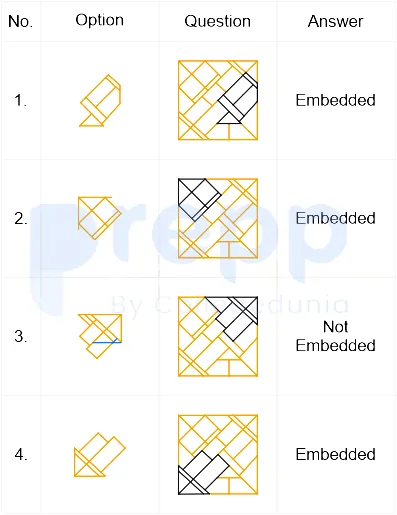
Select the option that is NOT embedded in the given figure (X) (rotation is NOT allowed).

- A
Option A (shown in image)
- B
Option B (shown in image)
- C
Option C (shown in image)
- D
Option D (shown in image)
Show answer
C. Option C (shown in image)The image not embedded in given figure is as shown below :
Hence, the correct answer is "Option 3".
 Paper & answer key PDF ↗
 Question 17archived
Select the number from among the given options that can replace the question mark (?) in the following series.
16, 35, ?, 217, 653, 1309
- A
72
- B
128
- C
77
- D
107
Show answer
D. 107Solving the Number Series Question
The question asks us to find the missing number in the given series: 16, 35, ?, 217, 653, 1309.
To solve number series problems, we need to identify the pattern or rule that connects the consecutive numbers in the sequence.
Let's examine the differences or relationships between the known terms:
From 16 to 35: The difference is \(35 - 16 = 19\). Alternatively, we can look for multiplication/addition. \(16 \times 2 = 32\), and \(32 + 3 = 35\). So, \(16 \times 2 + 3 = 35\).
From 217 to 653: The difference is \(653 - 217 = 436\). Let's try multiplication. \(217 \times 3 = 651\), and \(651 + 2 = 653\). So, \(217 \times 3 + 2 = 653\).
From 653 to 1309: The difference is \(1309 - 653 = 656\). Let's try multiplication. \(653 \times 2 = 1306\), and \(1306 + 3 = 1309\). So, \(653 \times 2 + 3 = 1309\).
Observing these steps, we can see an alternating pattern in the operations applied to get the next term:
First step: \( \times 2 + 3 \)
Third step: \( \times 3 + 2 \)
Fourth step: \( \times 2 + 3 \)
This suggests the pattern alternates between multiplying by 2 and adding 3, and multiplying by 3 and adding 2.
Let the missing number be \(X\). The sequence of operations should be:
\(16 \xrightarrow{\times 2 + 3} 35\) (Pattern: \(\times 2 + 3\))
\(35 \xrightarrow{\times 3 + 2} X\) (Pattern: \(\times 3 + 2\))
\(X \xrightarrow{\times 2 + 3} 217\) (Pattern: \(\times 2 + 3\))
\(217 \xrightarrow{\times 3 + 2} 653\) (Pattern: \(\times 3 + 2\))
\(653 \xrightarrow{\times 2 + 3} 1309\) (Pattern: \(\times 2 + 3\))
Let's apply the pattern \( \times 3 + 2 \) to the number 35 to find \(X\):
\(X = 35 \times 3 + 2\)
\(X = 105 + 2\)
\(X = 107\)
So, the missing number is 107.
Let's verify if this fits the next step where the pattern is \( \times 2 + 3 \) from \(X\) to 217:
\(107 \times 2 + 3 = 214 + 3 = 217\)
This matches the next term in the series (217), confirming that 107 is the correct missing number.
The complete series with the identified pattern is:
16
\(16 \times 2 + 3 = 35\)
\(35 \times 3 + 2 = 107\)
\(107 \times 2 + 3 = 217\)
\(217 \times 3 + 2 = 653\)
\(653 \times 2 + 3 = 1309\)
The pattern is consistent throughout the series with 107 as the missing term.
Number Series Pattern Identification
Identifying the pattern is key to solving these problems. Common patterns include arithmetic progression, geometric progression, differences, sums, squares, cubes, and alternating operations like the one found here.
Revision Table: Number Series
Term
Operation
Calculation
Result
16
-
-
16
35
\( \times 2 + 3 \)
\(16 \times 2 + 3\)
35
107
\( \times 3 + 2 \)
\(35 \times 3 + 2\)
107
217
\( \times 2 + 3 \)
\(107 \times 2 + 3\)
217
653
\( \times 3 + 2 \)
\(217 \times 3 + 2\)
653
1309
\( \times 2 + 3 \)
\(653 \times 2 + 3\)
1309
Additional Information: Logical Reasoning and Sequences
Number series questions are common in logical reasoning and quantitative aptitude tests. They assess your ability to observe, analyze, and find rules governing a set of numbers. Practice with various types of patterns can improve your problem-solving speed and accuracy.
Common techniques to analyze number series:
Calculate differences between consecutive terms.
Calculate ratios between consecutive terms.
Look for squares, cubes, or other powers of numbers.
Check for alternating patterns or multiple interleaved series.
Consider operations involving previous terms (e.g., Fibonacci-like series).
This specific problem combined multiplication and addition with an alternating rule, a slightly more complex but solvable pattern.
Paper & answer key PDF ↗ Question 18archived
Select the correct mirror image of the given combination when the mirror is placed at 'PQ' as shown.

- A
Option A (shown in image)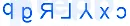
- B
Option B (shown in image)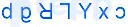
- C
Option C (shown in image)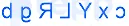
- D
Option D (shown in image)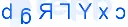
Show answer
Question 19archived
Select the option that is related to the third term in the same way as the second term is related to the first term.
FRONTIER : GSNOUHDS :: CLOSING : ?
- A
DMNRHLH
- B
DMNTHOH
- C
DKNTJOH
- D
BMPTHOH
Show answer
B. DMNTHOHUnderstanding Word Analogy and Letter Pattern
The question asks us to find the word that shares the same relationship with 'CLOSING' as 'GSNOUHDS' shares with 'FRONTIER'. This is a word analogy problem often found in logical reasoning sections.
Analyzing the FRONTIER : GSNOUHDS Relationship
Let's examine how each letter in 'FRONTIER' is transformed into the corresponding letter in 'GSNOUHDS'. We will look at the alphabetical position changes for each letter.
Position
Letter in FRONTIER
Alphabetical Position
Letter in GSNOUHDS
Alphabetical Position
Difference (Shift)
1
F
6
G
7
\(7 - 6 = +1\)
2
R
18
S
19
\(19 - 18 = +1\)
3
O
15
N
14
\(14 - 15 = -1\)
4
N
14
O
15
\(15 - 14 = +1\)
5
T
20
U
21
\(21 - 20 = +1\)
6
I
9
H
8
\(8 - 9 = -1\)
7
E
5
D
4
\(4 - 5 = -1\)
8
R
18
S
19
\(19 - 18 = +1\)
The sequence of shifts is: +1, +1, -1, +1, +1, -1, -1, +1.
Let's observe the letters in 'FRONTIER' and their shifts:
Consonants: F (+1), R (+1), N (+1), T (+1), R (+1). All consonants are shifted by \(+1\).
Vowels: O (-1), I (-1), E (-1). All vowels are shifted by \(-1\).
The discovered rule is: Consonants are shifted one position forward in the alphabet (\(+1\)), and vowels are shifted one position backward in the alphabet (\(-1\)).
Applying the Pattern to CLOSING
Now, we apply this same rule to the word 'CLOSING'. We identify each letter as a consonant or vowel and apply the corresponding shift.
Position
Letter in CLOSING
Type (Consonant/Vowel)
Rule Applied
Transformed Letter
1
C
Consonant
\(C \xrightarrow{+1} D\)
D
2
L
Consonant
\(L \xrightarrow{+1} M\)
M
3
O
Vowel
\(O \xrightarrow{-1} N\)
N
4
S
Consonant
\(S \xrightarrow{+1} T\)
T
5
I
Vowel
\(I \xrightarrow{-1} H\)
H
6
N
Consonant
\(N \xrightarrow{+1} O\)
O
7
G
Consonant
\(G \xrightarrow{+1} H\)
H
Applying the rule to each letter of CLOSING results in the sequence of letters: D M N T H O H.
Thus, 'CLOSING' is related to 'DMNTHOH'.
Comparing with Options
Let's compare our derived word 'DMNTHOH' with the given options:
DMNRHLH
DMNTHOH
DKNTJOH
BMPTHOH
Our derived word 'DMNTHOH' matches Option 2.
Revision Table: Letter Shifting Patterns in Reasoning
Pattern Type
Description
Example Rule
Fixed Shift
Each letter is shifted by a constant number of positions (e.g., all letters +3).
\(A \xrightarrow{+3} D\), \(B \xrightarrow{+3} E\)
Positional Shift
The shift amount depends on the letter's position in the word (e.g., +1 for 1st, +2 for 2nd, etc.).
\(L_1 \xrightarrow{+1} L'_1\), \(L_2 \xrightarrow{+2} L'_2\)
Alternating Shift
The shift alternates between two or more values (e.g., +1, -1, +1, -1...).
\(L_1 \xrightarrow{+1} L'_1\), \(L_2 \xrightarrow{-1} L'_2\)
Vowel/Consonant Shift
The shift depends on whether the letter is a vowel or a consonant (as seen in this problem).
Vowel \(\xrightarrow{-1}\), Consonant \(\xrightarrow{+1}\)
Reverse Order
Letters might be shifted and then the resulting word reversed.
WORD \(\xrightarrow{shift}\) SHIFTED \(\xrightarrow{reverse}\) DETFIHS
Additional Information: Analogy Solving Tips
Solving word analogy problems requires identifying the specific relationship between the first pair of words or letter sequences. Here are some common types of relationships and tips:
Letter Shifting: Look for consistent patterns of forward or backward movement in alphabetical positions (fixed, alternating, positional, vowel/consonant based).
Reverse Order: Check if the word is reversed after applying a shift or other transformation.
Skip Letter Patterns: The transformation might involve skipping a fixed number of letters in the alphabet.
Position Swapping: Letters might swap positions within the word (e.g., 1st and 2nd letters swap, 3rd and 4th swap).
Combination of Rules: Sometimes, problems combine multiple rules, such as shifting and reversing, or different rules for the first and second halves of the word.
Alphabet Knowledge: Be comfortable with the alphabetical order and quickly determine the position and preceding/succeeding letters.
Practice: Solving various types of analogy questions helps in recognizing patterns faster.
Paper & answer key PDF ↗ Question 20archived
Srinija walked 9 km towards the west from her home, then turned towards the south and walked 11 km. Then she walked 13 km towards the east, and finally walked 4 km towards the west. How far is Srinija from her initial position?
- A
13 km
- B
10 km
- C
11 km
- D
15 km
Show answer
C. 11 kmSolving the Direction and Distance Problem
The question asks us to find the straight-line distance of Srinija from her starting point after a series of movements in different directions. To solve this, we need to track her net displacement in both the east-west and north-south directions.
Analyzing Srinija's Movements
Srinija's movements are:
9 km towards the west
11 km towards the south
13 km towards the east
4 km towards the west
Calculating Net Displacement
Let's consider the movements along the East-West axis and the North-South axis separately. We can assign directions as positive or negative. For example, let East be positive and West be negative. Let North be positive and South be negative.
Net Movement in East-West Direction:
Initial movement: 9 km West (-9 km)
Next movement: 13 km East (+13 km)
Final movement: 4 km West (-4 km)
Total displacement in the East-West direction = $(-9) + (+13) + (-4)$ km
Total East-West displacement = $-9 + 13 - 4$ km
Total East-West displacement = $13 - (9 + 4)$ km
Total East-West displacement = $13 - 13$ km
Total East-West displacement = $0$ km
This means there is no net displacement in the East-West direction relative to the starting point.
Net Movement in North-South Direction:
Only one movement in the North-South direction: 11 km South (-11 km)
Total displacement in the North-South direction = $-11$ km
This means Srinija's final position is 11 km south of her starting point in the North-South direction.
Determining Final Distance from Initial Position
Srinija's final position is 0 km East/West and 11 km South from her initial position. We can visualize this as a right-angled triangle where the net East-West displacement is one side and the net North-South displacement is the other side. However, in this case, the net East-West displacement is 0.
The straight-line distance from the initial position is the magnitude of the net displacement vector. If the net East-West displacement is $\Delta x$ and the net North-South displacement is $\Delta y$, the distance $D$ is given by the formula:
\begin{equation*} D = \sqrt{(\Delta x)^2 + (\Delta y)^2} \end{equation*}
In this case, $\Delta x = 0$ km and $\Delta y = -11$ km (or simply 11 km magnitude in the South direction).
\begin{equation*} D = \sqrt{(0)^2 + (-11)^2} \end{equation*}
\begin{equation*} D = \sqrt{0 + 121} \end{equation*}
\begin{equation*} D = \sqrt{121} \end{equation*}
\begin{equation*} D = 11 \text{ km} \end{equation*}
So, Srinija is 11 km away from her initial position.
Summary of Displacements
Direction
Distance (km)
Vector Component
West
9
-9 (East/West)
South
11
-11 (North/South)
East
13
+13 (East/West)
West
4
-4 (East/West)
Net East-West displacement = $-9 + 13 - 4 = 0$ km
Net North-South displacement = $-11$ km
Distance from start = $\sqrt{(0)^2 + (-11)^2} = 11$ km.
The final answer is 11 km.
Revision Table: Key Concepts in Direction and Distance
Concept
Description
Calculation
Distance
Total length of the path covered. Scalar quantity.
Sum of magnitudes of all segments walked. (Not needed for this specific question, which asks for distance from start).
Displacement
Shortest straight-line distance from initial to final position. Vector quantity.
Calculated using net change in position along different axes.
Net Displacement
The overall change in position from start to end point.
Summing vector components along independent axes (e.g., East-West, North-South).
Distance from Initial Position
Magnitude of the net displacement vector.
$\sqrt{(\text{Net } \Delta x)^2 + (\text{Net } \Delta y)^2}$ (using Pythagorean theorem).
Additional Information: Direction and Distance Calculations
Direction and distance problems often involve visualizing movements on a 2D plane. We typically use a coordinate system where:
East is along the positive x-axis.
West is along the negative x-axis.
North is along the positive y-axis.
South is along the negative y-axis.
Each movement segment can be represented as a vector. The final position is the sum of all these displacement vectors. The distance from the initial position is the magnitude of the resultant vector.
In this problem:
9 km West is a vector $(-9, 0)$.
11 km South is a vector $(0, -11)$.
13 km East is a vector $(13, 0)$.
4 km West is a vector $(-4, 0)$.
The total displacement vector is the sum:
$(-9, 0) + (0, -11) + (13, 0) + (-4, 0) = (-9 + 0 + 13 - 4, 0 - 11 + 0 + 0) = (0, -11)$.
The final position is at coordinates $(0, -11)$ assuming the start is at $(0,0)$.
The distance from the initial position $(0,0)$ to the final position $(0, -11)$ is indeed $\sqrt{(0-0)^2 + (-11-0)^2} = \sqrt{0^2 + (-11)^2} = \sqrt{121} = 11$ km.
This vector approach confirms the result obtained by calculating net displacements along axes separately.
Paper & answer key PDF ↗ Question 21archived
Select the option that is related to the third number in the same way as the second number is related to the first number.
52 ∶ 91 : : 72 ∶ ?
- A
138
- B
109
- C
98
- D
126
Show answer
D. 126Solving Number Analogy Problems
Number analogy questions test your ability to find the relationship between a pair of numbers and apply that same relationship to another number to find a missing value. In this question, we need to find the relationship between 52 and 91 and then use that relationship to find the number related to 72.
Analyzing the Relationship between 52 and 91
Let's examine the numbers 52 and 91. We need to find a mathematical operation or pattern that connects them. Let's look for common factors or a constant ratio.
Factors of 52 are 1, 2, 4, 13, 26, 52.
Factors of 91 are 1, 7, 13, 91.
We can see that 13 is a common factor for both 52 and 91.
We can write 52 as \( 13 \times 4 \).
We can write 91 as \( 13 \times 7 \).
The relationship involves multiplying a common factor (13) by two different numbers (4 and 7). The second number's multiplier (7) is related to the first number's multiplier (4). Specifically, \( 7 = 4 + 3 \). So, the pattern is \( \text{Common Factor} \times \text{Multiplier} \) relates to \( \text{Common Factor} \times (\text{Multiplier} + 3) \).
Alternatively, we can express the relationship as a ratio:
\( \frac{91}{52} = \frac{13 \times 7}{13 \times 4} = \frac{7}{4} \)
This means the second number is \( \frac{7}{4} \) times the first number.
Applying the Relationship to Find the Missing Number
Now, we apply the same relationship to the third number, 72, to find the missing number. We assume the same ratio applies:
Missing Number \( = 72 \times \frac{7}{4} \)
Calculating the Missing Number
Let's perform the calculation:
\( 72 \times \frac{7}{4} = \frac{72}{4} \times 7 \)
First, divide 72 by 4:
\( \frac{72}{4} = 18 \)
Now, multiply the result by 7:
\( 18 \times 7 \)
To calculate \( 18 \times 7 \):
\( 10 \times 7 = 70 \)
\( 8 \times 7 = 56 \)
\( 70 + 56 = 126 \)
So, the missing number is 126.
Verifying the Pattern with the Second Pair (72 and 126)
Let's see if the common factor/multiplier pattern also works with 72 and 126.
We found \( 72 = 18 \times 4 \). If the pattern \( \text{Multiplier} + 3 \) holds, the next multiplier should be \( 4 + 3 = 7 \). The common factor would be 18.
So, the second number should be \( 18 \times 7 \).
\( 18 \times 7 = 126 \)
This confirms the pattern. The common factor changes (from 13 to 18), but the multipliers used are 4 and 7 (which is 4+3) in both pairs.
Conclusion
The relationship between 52 and 91 is that the second number is \( \frac{7}{4} \) times the first number, or they share a common factor where the multipliers are 4 and 7. Applying this relationship to 72, we find the missing number is 126.
First NumberSecond NumberRelationship (\( \times \frac{7}{4} \))Factor Pattern (\( A \times B \rightarrow A \times (B+3) \))
5291\( 52 \times \frac{7}{4} = 13 \times 7 = 91 \)\( 13 \times 4 \rightarrow 13 \times 7 \)
72?\( 72 \times \frac{7}{4} = 18 \times 7 = 126 \)\( 18 \times 4 \rightarrow 18 \times 7 \)
The missing number is 126, which corresponds to Option 4.
Revision Table: Number Analogy Concepts
ConceptDescriptionExample (based on 52:91)
Number AnalogyFinding a relationship between two numbers and applying it to another pair.52 is to 91 as 72 is to ?
Ratio MethodExpressing the relationship as a ratio \( \frac{\text{Second}}{\text{First}} \) and multiplying the third number by this ratio.Ratio \( = \frac{91}{52} = \frac{7}{4} \). Apply: \( 72 \times \frac{7}{4} \).
Factor PatternDecomposing numbers into factors to find a pattern in the multipliers or common factors.\( 52 = 13 \times 4 \), \( 91 = 13 \times 7 \). Multipliers are 4 and 7 (4+3). Find \( 72 = A \times B \), then the answer is \( A \times (B+3) \).
Additional Information: Logical Reasoning Skills
Number analogy questions are part of logical reasoning and quantitative aptitude sections in many competitive exams. To improve your skills, practice identifying different types of relationships between numbers, such as:
Addition, subtraction, multiplication, division
Squares and cubes
Prime numbers, composite numbers
Digit operations (sum of digits, product of digits)
Patterns involving factors or multiples
Combinations of these operations
Regular practice with various types of number series and analogy problems helps you quickly recognize patterns during exams.
Paper & answer key PDF ↗ Question 22archived
Select the Venn diagram that best illustrates the relationship between the following classes.
Planets, Mars, Venus
- A
Option A (shown in image)
- B
Option B (shown in image)
- C
Option C (shown in image)
- D
Option D (shown in image)
Show answer
D. Option D (shown in image)The least possible Venn diagram for the given relation is as shown below :
Mars and Venus are planets in solar system.
Hence, the correct answer is "Option 4".
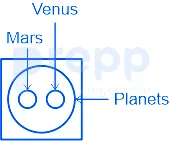 Paper & answer key PDF ↗
 Question 23archived
Select the number from among the given options that can replace the question mark (?) in the following series.
62, 74, 80, 86, 95, ?, 158
- A
113
- B
100
- C
108
- D
122
Show answer
A. 113Understanding the Number Series Pattern
The question asks us to find the missing number in the given series: 62, 74, 80, 86, 95, ?, 158. To solve this type of number series problem, we look for a pattern in the sequence. Often, this involves examining the differences between consecutive terms.
Calculating Differences Between Consecutive Terms
Let's calculate the difference between each term and the one that follows it:
Difference 1: \(74 - 62 = 12\)
Difference 2: \(80 - 74 = 6\)
Difference 3: \(86 - 80 = 6\)
Difference 4: \(95 - 86 = 9\)
Difference 5: \(? - 95\)
Difference 6: \(158 - ?\)
The sequence of differences we have so far is 12, 6, 6, 9, ?, ?. This sequence doesn't immediately show a simple arithmetic or geometric progression.
Identifying the Pattern in Differences
Let's look closer at the differences: 12, 6, 6, 9. Sometimes the pattern isn't in the differences themselves, but in the relationship between consecutive differences, such as their ratios or the differences between the differences (second differences).
Let's examine the ratio of consecutive differences:
Ratio 1 (\(d_2 / d_1\)): \(6 / 12 = 0.5\)
Ratio 2 (\(d_3 / d_2\)): \(6 / 6 = 1.0\)
Ratio 3 (\(d_4 / d_3\)): \(9 / 6 = 1.5\)
The sequence of ratios of consecutive differences is 0.5, 1.0, 1.5. This sequence shows a clear arithmetic progression with a common difference of 0.5. The pattern for the ratio of the n-th difference to the (n-1)-th difference appears to be \(0.5 \times (n-1)\) for \(n > 1\).
Following this pattern, the next ratios should be:
Ratio 4 (\(d_5 / d_4\)): \(0.5 \times 4 = 2.0\)
Ratio 5 (\(d_6 / d_5\)): \(0.5 \times 5 = 2.5\)
Calculating the Missing Difference and Term
We know \(d_4 = 9\). Using Ratio 4, we can find \(d_5\):
\(d_5 / d_4 = 2.0\)
\(d_5 / 9 = 2.0\)
\(d_5 = 9 \times 2.0 = 18\)
The missing term is the 6th term in the series. It is found by adding the 5th difference (\(d_5\)) to the 5th term (\(T_5 = 95\)):
\(T_6 = T_5 + d_5 = 95 + 18 = 113\)
So, the missing number is 113.
Verifying the Pattern
Let's verify if the pattern holds for the rest of the series using \(d_6\). The 6th term is 113, and the 7th term is 158. The 6th difference is \(158 - 113 = 45\). According to our pattern of ratios, \(d_6 / d_5\) should be 2.5.
\(d_6 / d_5 = 45 / 18 = 2.5\)
This matches the expected ratio (Ratio 5 is 2.5). Therefore, the pattern is consistent throughout the series when the missing number is 113.
Term Position
Term Value
Difference to Next Term (\(d_n\))
Ratio of Differences (\(d_n / d_{n-1}\))
Pattern in Ratios
1
62
\(d_1 = 12\)
-
-
2
74
\(d_2 = 6\)
\(6 / 12 = 0.5\)
\(0.5 \times 1\)
3
80
\(d_3 = 6\)
\(6 / 6 = 1.0\)
\(0.5 \times 2\)
4
86
\(d_4 = 9\)
\(9 / 6 = 1.5\)
\(0.5 \times 3\)
5
95
\(d_5 = 18\) (Calculated)
\(18 / 9 = 2.0\)
\(0.5 \times 4\)
6
113 (Calculated)
\(d_6 = 45\) (Calculated)
\(45 / 18 = 2.5\)
\(0.5 \times 5\)
7
158
-
-
-
The calculated missing term is 113.
Conclusion on the Number Series
Based on the pattern identified in the ratios of consecutive differences, the number that replaces the question mark (?) in the series 62, 74, 80, 86, 95, ?, 158 is 113.
Revision Table for Number Series Patterns
Pattern Type
Description
How to Identify
Example
Arithmetic Series
Constant difference between terms.
Calculate \(T_{n} - T_{n-1}\) for all terms. It should be constant.
2, 5, 8, 11 (Difference is 3)
Geometric Series
Constant ratio between terms.
Calculate \(T_{n} / T_{n-1}\) for all terms. It should be constant.
2, 6, 18, 54 (Ratio is 3)
Second-Order Differences
Differences between consecutive terms form an arithmetic series.
Calculate differences (\(d_n\)). Then calculate differences of differences (\(d_n - d_{n-1}\)). This second difference should be constant.
1, 3, 7, 13, 21 (Differences: 2, 4, 6, 8; Second differences: 2, 2, 2)
Ratio of Differences Pattern
The ratio of consecutive differences forms a simple sequence (like arithmetic or geometric).
Calculate differences (\(d_n\)). Calculate ratios \(d_n / d_{n-1}\). Look for a pattern in these ratios.
As seen in this problem (Ratios: 0.5, 1.0, 1.5, ...)
Mixed Series
Combination of patterns (e.g., arithmetic on odd terms, geometric on even terms, or operations involving digits).
Examine alternate terms, sums/products of digits, or other properties if simple difference/ratio patterns fail.
Varies widely
Additional Information on Solving Number Series Questions
Solving number series questions requires careful observation and systematic analysis. Here are some tips:
Always start by calculating the differences between consecutive terms. This is the most common pattern.
If differences don't show a clear pattern, calculate the differences of the differences (second differences).
Consider ratios of consecutive terms or ratios of consecutive differences if differences don't work.
Look for patterns involving the digits of the numbers (sum of digits, product of digits, alternating operations).
Consider patterns involving squares, cubes, prime numbers, or other special number sequences.
Check options if you are stuck. Sometimes seeing the potential next number can help reveal the pattern.
Practice with various types of number series to become familiar with common patterns.
Number series problems are common in logical reasoning and quantitative aptitude sections of competitive exams. Mastering pattern identification is key to solving them efficiently.
Paper & answer key PDF ↗ Question 24archived
Eight north-facing restaurants named P, Q, R, S, T, U, V and W are located in a straight line. S is second to the left of T. W is third to the left of P. T is between P and V. S is third to the left of V. W is to the immediate right of U. R is third to the right of P. Who is sitting fourth to the right of S?
- A
V
- B
U
- C
R
- D
W
Show answer
C. RSolving the Restaurant Seating Arrangement Puzzle
This problem requires us to deduce the seating arrangement of eight north-facing restaurants (P, Q, R, S, T, U, V, W) in a straight line based on the given clues. Since all restaurants are facing north, "left" refers to the left side of the row and "right" refers to the right side of the row from the perspective of someone facing the restaurants.
Let's list the clues and interpret them:
Clue 1: S is second to the left of T. This means there is one restaurant between S and T, and S is to the left of that restaurant. If T is at position $i$, S is at position $i-2$. We can represent this as S _ T.
Clue 2: W is third to the left of P. This means there are two restaurants between W and P. If P is at position $i$, W is at position $i-3$. We can represent this as W _ _ P.
Clue 3: T is between P and V. This implies a sequence like P...T...V or V...T...P somewhere in the arrangement.
Clue 4: S is third to the left of V. This means there are two restaurants between S and V. If V is at position $i$, S is at position $i-3$. We can represent this as S _ _ V.
Clue 5: W is to the immediate right of U. This means U and W are next to each other with U on the left. We can represent this as U W.
Clue 6: R is third to the right of P. This means there are two restaurants between P and R. If P is at position $i$, R is at position $i+3$. We can represent this as P _ _ R.
Building the Arrangement
Let's combine the clues to build the seating arrangement:
From Clue 1 (S \_ T) and Clue 4 (S \_ \_ V):
S is at position Pos(T) - 2.
S is at position Pos(V) - 3.
Equating these: Pos(T) - 2 = Pos(V) - 3, which simplifies to Pos(V) = Pos(T) + 1. This means V is immediately to the right of T.
Combining S \_ T and T V, we get the sequence S \_ T V. This represents S, followed by one restaurant, then T, then V immediately after T. Let's verify: If S is at position 1, the empty spot is at 2, T is at 3, and V is at 4. S is at 1, T at 3 (Pos(T) = Pos(S) + 2), so S is second left of T. S is at 1, V at 4 (Pos(V) = Pos(S) + 3), so S is third left of V. The fragment S \_ T V is consistent.
From Clue 2 (W \_ \_ P) and Clue 6 (P \_ \_ R):
We can combine these around P: W \_ \_ P \_ \_ R. This shows W is three positions left of P, and R is three positions right of P. This fragment spans 7 positions.
From Clue 5 (U W):
U is immediately to the left of W. We can add U to the fragment from step 2: U W \_ \_ P \_ \_ R.
This gives us a sequence of 8 positions: U W \_ \_ P \_ \_ R.
Now we have the skeleton U W \_ \_ P \_ \_ R, using U, W, P, and R. The empty spots are at positions 3, 4, 6, and 7 (assuming U is at position 1). The remaining restaurants to place are S, T, V, and Q.
We know from step 1 that S, T, and V must be arranged as S \_ T V (S, one empty spot, T, V). The available empty positions are {3, 4, 6, 7}. We need to find a combination of positions $i$, $i+1$, $i+2$, $i+3$ from these available spots such that S is at $i$, empty at $i+1$, T at $i+2$, and V at $i+3$.
Let's check possible starting positions for S from the available slots:
If S is at pos 3: Empty needs to be at 4, T at 5 (occupied by P). Not possible.
If S is at pos 4: Empty needs to be at 5 (occupied by P). Not possible based on S \_ T V fragment structure deduced initially.
Let's rethink the S \_ T V application. We know the positional relationships: Pos(S)=Pos(T)-2 and Pos(S)=Pos(V)-3.
The available slots are 3, 4, 6, 7. We need to assign S, T, V to three of these slots such that Pos(S)=Pos(T)-2 and Pos(S)=Pos(V)-3.
Let's test assigning S, T, V to available spots {3, 4, 6, 7}:
Try S at 3: T must be at 3+2=5 (occupied by P). No.
Try S at 4: T must be at 4+2=6 (available). V must be at 4+3=7 (available). This works! S at 4, T at 6, V at 7.
So, positions are:
U: 1
W: 2
Empty: 3
S: 4
P: 5
T: 6
V: 7
R: 8
The arrangement is U W \_ S P T V R. The only empty spot is at position 3.
The only remaining restaurant is Q. So, Q must be at position 3.
The final confirmed arrangement is: U W Q S P T V R.
Verifying the Final Arrangement
Let's check all original clues against U W Q S P T V R:
Position
Restaurant
1
U
2
W
3
Q
4
S
5
P
6
T
7
V
8
R
S is second left of T? S is at pos 4, T is at pos 6. $6 - 4 = 2$. Yes. (Q and P are between S and T). No, Q is between S and P. P is between S and T. Let's check positions: S(4), Q(3), W(2), U(1). Left of S is Q. Left of Q is W. Left of W is U. Right of S is P, T, V, R. Second to the left of T (at pos 6) is the person at pos 4. That is S. Yes.
W is third left of P? W is at pos 2, P is at pos 5. $5 - 2 = 3$. Yes. (Q and S are between W and P).
T is between P and V? P is at pos 5, T is at pos 6, V is at pos 7. Yes.
S is third left of V? S is at pos 4, V is at pos 7. $7 - 4 = 3$. Yes. (P and T are between S and V).
W is immediate right of U? W is at pos 2, U is at pos 1. $2 - 1 = 1$. Yes.
R is third right of P? R is at pos 8, P is at pos 5. $8 - 5 = 3$. Yes. (T and V are between P and R).
All clues are satisfied by the arrangement U W Q S P T V R.
Answering the Question
The question asks: Who is sitting fourth to the right of S?
In the arrangement U W Q S P T V R, S is at position 4.
1st to the right of S is the person at pos 5: P
2nd to the right of S is the person at pos 6: T
3rd to the right of S is the person at pos 7: V
4th to the right of S is the person at pos 8: R
Therefore, R is sitting fourth to the right of S.
Revision Table: Restaurant Positions
Position
Restaurant
1
U
2
W
3
Q
4
S
5
P
6
T
7
V
8
R
Additional Information: Solving Seating Arrangement Puzzles
Seating arrangement puzzles are common in logic and reasoning tests. They require careful reading and combining multiple pieces of information to deduce a final layout. Here are some tips:
Read Carefully: Pay close attention to terms like "left," "right," "immediate left/right," "second to the left/right," and "between." Understand exactly what each term means in the context of the arrangement (linear, circular, etc.).
Use Diagrams: Drawing a simple line or circle and filling in positions as you deduce them is highly recommended. For linear arrangements, numbering positions can help.
Combine Clues: Look for clues that involve the same individuals or link different fragments together. For example, if A is next to B, and B is opposite C, you can start linking parts of the arrangement.
Identify Fixed Points/Strong Clues: Some clues might give a relative position that can act as a anchor, or clues might link several people together strongly (like U W in this case).
Check for Contradictions: As you build the arrangement, constantly check if the current placement contradicts any of the given clues. If it does, you made an error and need to backtrack.
Process of Elimination: Once some positions are filled, you can eliminate those possibilities for other individuals.
Verify the Final Arrangement: Before concluding, go back and read every single clue again, ensuring the final arrangement satisfies all of them perfectly.
Paper & answer key PDF ↗ Question 25archived
In a certain code language, 'your attention please' is written as 'puw cuw zuw', 'kind attention' is written as 'muw zuw', and 'please pay attention' is written as 'puw zuw ruw'. How will 'pay' be written in that language?
- A
puw
- B
ruw
- C
zuw
- D
cuw
Show answer
B. ruwSolving the Coding Decoding Problem
This type of question involves decoding words based on common words and their corresponding codes found across different phrases. We are given three coded phrases:
'your attention please' is written as 'puw cuw zuw'
'kind attention' is written as 'muw zuw'
'please pay attention' is written as 'puw zuw ruw'
Our goal is to find the code for the word 'pay'. We can do this by comparing the phrases and their codes to find common elements.
Step-by-Step Decoding Process
Comparing Phrase 1 and Phrase 2
Let's look at the first two phrases:
Phrase 1: 'your attention please' $\rightarrow$ 'puw cuw zuw'
Phrase 2: 'kind attention' $\rightarrow$ 'muw zuw'
The common word in both phrases is 'attention'. The common code word in their respective codes is 'zuw'.
Therefore, we can conclude:
attention = zuw
Comparing Phrase 1 and Phrase 3
Now let's compare the first and third phrases:
Phrase 1: 'your attention please' $\rightarrow$ 'puw cuw zuw'
Phrase 3: 'please pay attention' $\rightarrow$ 'puw zuw ruw'
The common words in these two phrases are 'attention' and 'please'. The common code words in their codes are 'puw' and 'zuw'.
We already know from the previous step that 'attention' = 'zuw'. The other common word is 'please', and the other common code is 'puw'.
Therefore, we can conclude:
please = puw
Analyzing Phrase 3 to Find the Code for 'pay'
We now know the codes for 'attention' and 'please'. Let's look at the third phrase again:
Phrase 3: 'please pay attention' $\rightarrow$ 'puw zuw ruw'
Substitute the known codes into the third phrase's code:
'please' is 'puw'
'attention' is 'zuw'
The phrase 'please pay attention' has the code 'puw zuw ruw'. If 'please' is 'puw' and 'attention' is 'zuw', the only remaining word is 'pay' and the only remaining code is 'ruw'.
Therefore, we can conclude:
pay = ruw
Summary of Decoded Words
Based on our comparisons, we have found the following codes:
Word
Code
attention
zuw
please
puw
pay
ruw
We can also deduce the codes for the remaining words by looking at the phrases where they appear:
In Phrase 1 ('your attention please' $\rightarrow$ 'puw cuw zuw'), we know 'attention' is 'zuw' and 'please' is 'puw'. The remaining word is 'your' and the remaining code is 'cuw'. So, your = cuw.
In Phrase 2 ('kind attention' $\rightarrow$ 'muw zuw'), we know 'attention' is 'zuw'. The remaining word is 'kind' and the remaining code is 'muw'. So, kind = muw.
The question asks specifically for the code of 'pay'. From our analysis, the code for 'pay' is 'ruw'.
Final Answer Determination
The code for the word 'pay' is 'ruw'. Looking at the provided options:
Option 1: puw
Option 2: ruw
Option 3: zuw
Option 4: cuw
The code 'ruw' matches Option 2.
Revision Table: Coding Decoding Concepts
Let's review the key steps used in solving this type of coding decoding problem:
Step
Description
Action Taken in this Problem
Identify Common Words
Compare pairs of phrases to find words that appear in both.
Compared 'attention', 'please'.
Identify Common Codes
For the phrases being compared, find the code words that appear in both their coded forms.
Found 'zuw' and 'puw' as common codes.
Match Words and Codes
The common words correspond to the common codes. Eliminate already matched words/codes to find others.
Matched 'attention' to 'zuw', 'please' to 'puw', and deduced 'pay' to 'ruw'.
Deduce Remaining Codes
Once some words are decoded, use phrases with known codes to deduce the codes for the remaining words.
Deduced codes for 'your' and 'kind'.
Additional Information: Types of Coding Problems
Coding and decoding is a common topic in logical reasoning sections of competitive exams. Besides the direct word-to-word mapping shown here, other types include:
Letter Coding: Letters in a word are replaced by other letters based on a pattern (e.g., shifting positions in the alphabet).
Number/Symbol Coding: Words or letters are represented by numbers or symbols based on specific rules.
Mixed Letter and Number Coding: A combination where words are coded using both letters and numbers.
Sentence Coding: Similar to the problem above, but might involve more complex rules or larger sets of phrases.
Practicing different types of coding decoding problems helps improve analytical skills and speed.
Paper & answer key PDF ↗ Question 26archived
Which of the following cities won the hosting rights of the 2030 Asian Games in December 2020?
- A
Doha
- B
Jakarta
- C
Shanghai
- D
Seoul
Show answer
A. DohaUnderstanding the 2030 Asian Games Host City Decision
The question asks about the city that was awarded the hosting rights for the 2030 Asian Games in December 2020. This was a significant decision made by the Olympic Council of Asia (OCA).
The Bidding Process for the 2030 Asian Games
The selection of the host city for major international sports events like the Asian Games involves a detailed bidding process where potential host cities submit proposals outlining their plans for venues, infrastructure, logistics, and financial capabilities.
For the 2030 Asian Games, two prominent cities from the Gulf region were the main contenders:
Doha, Qatar
Riyadh, Saudi Arabia
Both cities presented strong bids to host the prestigious event.
The Decision in December 2020
The decision on the host city for the 2030 Asian Games was made during the Olympic Council of Asia's General Assembly held on December 16, 2020. The assembly members voted to determine the host city.
In a notable outcome, the OCA members decided to award the 2030 Asian Games to the city with the higher number of votes. However, in an unusual move to ensure both strong bids were acknowledged, they also decided that the city with the second highest number of votes would automatically be awarded the subsequent edition, the 2034 Asian Games.
Identifying the 2030 Host City
Following the voting process in December 2020, the results were announced. The city that received the higher number of votes for the 2030 Asian Games was Doha, Qatar. Consequently, Riyadh, Saudi Arabia, was awarded the hosting rights for the 2034 Asian Games.
Therefore, the city that won the hosting rights of the 2030 Asian Games in December 2020 is Doha.
Summary of the 2030 Asian Games Host Selection
Here is a quick summary:
Event: 2030 Asian Games
Decision Date: December 2020
Bidding Cities: Doha (Qatar), Riyadh (Saudi Arabia)
Outcome: Doha won the right to host the 2030 Asian Games.
Subsequent Award: Riyadh won the right to host the 2034 Asian Games.
Conclusion on the 2030 Asian Games Host
Based on the decision made by the Olympic Council of Asia in December 2020, Doha was selected as the host city for the 2030 Asian Games.
Revision Table: Key Facts about 2030 Asian Games Host
Event
Host City
Decision Date
Continent/Region
2030 Asian Games
Doha, Qatar
December 2020
Asia (Middle East)
2034 Asian Games
Riyadh, Saudi Arabia
December 2020
Asia (Middle East)
Additional Information: The Asian Games
The Asian Games, also known as Asiad, is a multi-sport event held every four years among athletes from all over Asia. It is the second-largest multi-sport event after the Olympic Games.
The first Asian Games were held in New Delhi, India, in 1951.
The event is regulated by the Olympic Council of Asia (OCA).
It is considered one of the most prestigious sporting events in the Asian continent.
Hosting the Asian Games requires significant investment in infrastructure, including stadiums, athlete villages, and transportation.
The decision to award both the 2030 and 2034 games simultaneously to Doha and Riyadh respectively was seen as a way to provide certainty and allow for better long-term planning for the event in the region.
Paper & answer key PDF ↗ Question 27archived
Which of the following is NOT a part of a flower?
- A
Petiole
- B
Pistil
- C
Stamen
- D
Sepal
Show answer
A. PetioleThe correct answer is Petiole.
While flowers often grow from stems that have leaves attached via petioles, the petiole itself is considered part of the leaf structure, not the flower structure. The stalk directly supporting the flower is called the pedicel. on Flower Parts Based on the functions and typical locations within plant anatomy, the Petiole is the structure that is not considered a direct part of the flower itself. It serves to connect a leaf to the stem.
Paper & answer key PDF ↗ Question 28archived
Who among the following athletes was appointed as the Deputy Superintendent of Police by the Assam Government in February 2021?
- A
Ekta Bhyan
- B
Deepika Kumari
- C
Hima Das
- D
Dutee Chand
Show answer
C. Hima DasUnderstanding the Athlete's Appointment by Assam Government
The question asks to identify the athlete who was appointed as the Deputy Superintendent of Police (DSP) by the Assam Government in February 2021. This type of appointment is often made to recognize athletes for their contributions to sports and bring their discipline and dedication into public service.
Let's analyze the context provided. We are looking for an athlete, specifically one recognized by the Assam Government with the rank of DSP in early 2021.
Identifying the Correct Athlete
Among the given options, Hima Das is a well-known Indian sprinter from Assam. Her significant achievements on the international stage have brought pride to the state and the country.
News reports from February 2021 widely covered the appointment of Hima Das as a Deputy Superintendent of Police by the Assam Government. This decision was made by the state cabinet, recognizing her outstanding performances and potential to inspire others.
Let's consider the other options:
Ekta Bhyan is an Indian para-athlete. While successful, she is not primarily associated with Assam in the context of this specific appointment.
Deepika Kumari is an Indian archer. She is from Jharkhand and not connected to this Assam government appointment.
Dutee Chand is an Indian professional sprinter. She is from Odisha and not linked to this Assam government role.
Therefore, based on verifiable information regarding appointments made by the Assam Government in February 2021, Hima Das is the correct answer.
Detailed Explanation of Hima Das's Appointment
Hima Das, also known as 'Dhing Express', is a celebrated sprinter who holds the current Indian national record in the 400 meters. Her achievements include winning a gold medal in the women's 400m at the 2018 IAAF World U20 Championships.
The Assam Government's decision to appoint her as a DSP was part of their Integrated Sports Policy, which aims to provide government jobs to successful sportspersons of the state.
Revision Table: Key Facts
Athlete
Sport
Appointment/Association (Context)
Ekta Bhyan
Para Athletics (Club Throw/Discus)
Not related to Assam DSP appointment
Deepika Kumari
Archery
From Jharkhand, not related to Assam DSP appointment
Hima Das
Athletics (Sprint)
Appointed DSP by Assam Government in Feb 2021
Dutee Chand
Athletics (Sprint)
From Odisha, not related to Assam DSP appointment
Additional Information on Hima Das
Hima Das's journey from a small village in Assam to becoming an international athlete is inspirational. Her appointment as DSP allows her to continue serving the state while also pursuing her sporting career. The government has stated that she will be allowed to continue training and participating in events.
This type of appointment serves a dual purpose: honoring athletes and leveraging their qualities like discipline, leadership, and fitness within the police force.
Paper & answer key PDF ↗ Question 29archived
Which of the following Amendments of the Constitution of India declared that the Parliament has the power to abridge or take away any of the Fundamental Rights under Article 368 and such an Act, will NOT be a law under the meaning of Article 13?
- A
Twentieth Amendment
- B
Twenty-eighth Amendment
- C
Twenty-fourth Amendment
- D
Twenty-third Amendment
Show answer
C. Twenty-fourth AmendmentThe correct answer is Twenty-fourth Amendment.
The Twenty-fourth Amendment specifically empowered Parliament to amend any provision of the Constitution using this procedure and stated that following this procedure results in a constitutional amendment, not an ordinary 'law' subject to \text{Article } 13. This explains why the Twenty-fourth Amendment is the correct answer, as it directly addressed the conflict between Parliament's amending power under \text{Article } 368 and the limitations imposed by judicial interpretations of \text{Article } 13 concerning Fundamental Rights.
Paper & answer key PDF ↗ Question 30archived
Which of the following crops is described as – ‘It is a crop which is used both as food and fodder. It is a Kharif crop that requires temperature between 21°C to 27°C and grows well in old alluvial soil’?
- A
Sesamum
- B
Maize
- C
Bajra
- D
Ragi
Show answer
B. MaizeUnderstanding the Kharif Crop Question
The question asks us to identify a specific crop based on several key characteristics. We are given that the crop:
Is used both as food and fodder.
Is a Kharif crop.
Requires a temperature between 21°C and 27°C.
Grows well in old alluvial soil.
We need to evaluate the given options against these characteristics to find the correct crop.
Analyzing Crop Characteristics: Food and Fodder Use
Let's first consider the use of the crop as both food and fodder. Many crops serve dual purposes, but some are more commonly known for one over the other. We should check if the options fit this description.
Sesamum: Primarily grown for seeds, used for oil extraction and cooking. Less commonly used as widespread fodder.
Maize (Corn): Widely consumed by humans as food (grains, flour, sweet corn). The stalks, leaves, and cobs are extensively used as fodder for livestock. This fits the description well.
Bajra (Pearl Millet): A food grain, but the stalks can be used as fodder.
Ragi (Finger Millet): Primarily a food grain. Stalks can be used as fodder, but perhaps less common than Maize.
Based on common usage, Maize strongly fits the 'food and fodder' criterion.
Kharif Crop Identification
The question states it is a Kharif crop. Kharif crops are monsoon crops, sown during the southwest monsoon season (typically June-July) and harvested in September-October.
Let's check if the options are generally classified as Kharif crops:
Sesamum: Can be grown as both Kharif and Rabi crops in different regions, but often associated with Kharif.
Maize: Primarily a Kharif crop, especially in many parts of India where it relies on monsoon rains. It can also be grown in Rabi and Zaid seasons under irrigation.
Bajra: A classic Kharif crop, well-suited to dry and warm conditions during the monsoon.
Ragi: Primarily a Kharif crop, thriving in monsoon conditions.
All listed options can be grown as Kharif crops, so this criterion doesn't immediately narrow down the options significantly among these choices.
Temperature Requirements
The crop requires a temperature range of 21°C to 27°C. This temperature range is suitable for growth during the monsoon season in many tropical and subtropical regions.
Maize: Requires warm temperatures for growth. The 21°C to 27°C range is well within the optimal temperature range for Maize cultivation, particularly during the Kharif season when temperatures are typically high.
Sesamum, Bajra, and Ragi also prefer warm conditions and are suited to the temperatures experienced during the Kharif season, although their specific optimal ranges might vary slightly.
Again, this criterion supports Maize, but might not definitively rule out others without more specific comparative data on optimal growth temperatures.
Soil Preference: Old Alluvial Soil
The crop grows well in old alluvial soil. Alluvial soils are fertile soils deposited by rivers. Old alluvial soil (Bhangar) is generally found on higher ground away from river flood plains and is less fertile than new alluvial soil (Khadar), often containing calcareous deposits.
Maize: Grows well in a variety of soils, including alluvial soils. While it prefers fertile, well-drained soils, it can adapt to different types, including older alluvial deposits if drainage is adequate.
Other crops like Bajra and Ragi are often associated with less fertile or drier soils where other crops struggle. Sesamum also prefers well-drained soil.
Maize's adaptability to fertile alluvial soils aligns with this characteristic.
Comparing Characteristics with Maize
Let's summarize how Maize fits all the described characteristics:
Food and Fodder: Yes, widely used for both.
Kharif crop: Yes, primarily grown as a Kharif crop.
Temperature (21°C to 27°C): Yes, this is within its optimal growing temperature range.
Old alluvial soil: Yes, grows well in fertile alluvial soils.
All the characteristics provided in the question align perfectly with the description of Maize.
Characteristic
Maize
Sesamum
Bajra
Ragi
Food & Fodder
Yes
Primarily Food/Oil
Yes (Food & Fodder)
Yes (Food & Fodder)
Kharif Crop
Primarily Kharif
Kharif/Rabi
Kharif
Kharif
Temperature (21°C-27°C)
Yes (Optimal)
Generally Warm
Generally Warm
Generally Warm
Soil (Old Alluvial)
Grows well
Prefers well-drained
Grows in less fertile/drier
Grows in various, including red/sandy
Based on the combined description – being a food and fodder crop, a Kharif crop requiring 21°C to 27°C temperature, and growing well in old alluvial soil – Maize is the most suitable answer among the given options.
Conclusion: Identifying the Crop
Considering all the features mentioned in the question, the crop that best fits the description of being used both as food and fodder, grown as a Kharif crop, requiring temperatures between 21°C and 27°C, and thriving in old alluvial soil is Maize.
Revision Table: Key Kharif Crop Facts
Crop
Type
Temperature (°C)
Soil Type
Key Use
Maize
Kharif (primarily)
21-27
Alluvial, well-drained
Food & Fodder
Bajra
Kharif
Warm (25-35)
Sandy, shallow black, alluvial
Food & Fodder
Rice
Kharif
>25, high humidity
Alluvial, clayey
Food
Jowar
Kharif/Rabi
25-30
Red, black, alluvial
Food & Fodder
Additional Information: Kharif Crops and Alluvial Soils
Kharif crops are planted with the onset of the monsoon rains, which bring the necessary moisture and higher temperatures needed for their growth. This contrasts with Rabi crops, which are planted in winter.
Alluvial soils are among the most fertile soils in India, deposited by river systems. They are broadly classified into Khadar (new alluvial) and Bhangar (old alluvial). Bhangar soils are older, less fertile, and are found away from the active flood plains. They often contain kankar nodules (calcareous concretions). Despite being less fertile than Khadar, Bhangar soils are still suitable for a variety of crops, including Maize, if properly managed, especially regarding irrigation and drainage.
Maize is a versatile crop and its characteristics align well with the conditions described for cultivation as a Kharif crop in regions with old alluvial soils and temperatures in the 21°C to 27°C range.
Paper & answer key PDF ↗ Question 31archived
Who among the following presidents of India gave assent to the 100th Amendment of the Constitution of India?
- A
Ram Nath Kovind
- B
Pratibha Devisingh Patil
- C
APJ Abdul Kalam
- D
Pranab Mukherjee
Show answer
D. Pranab MukherjeeThe correct answer is Pranab Mukherjee.
While the primary steps involve introduction and passage in Parliament, the President's assent is mandatory for the bill to become a constitutional amendment Act. The President does not have the power to withhold assent or return a constitutional amendment bill for reconsideration, unlike ordinary bills. The 100th Amendment was a significant step in resolving a long-standing issue with a neighboring country and required a constitutional amendment because it altered the territory of the Indian Union, which is listed in the First Schedule of the Constitution.
Paper & answer key PDF ↗ Question 32archived
During the rule of which of the following dynasties did Timur or Tamerlane invade India in 1398 AD?
- A
The Khalji dynasty
- B
The Tughlaq dynasty
- C
The Slave dynasty
- D
The Sayyad dynasty
Show answer
B. The Tughlaq dynastyThe correct answer is The Tughlaq dynasty.
It severely weakened the Tughlaq dynasty and marked a significant decline in the power and prestige of the Sultanate. Following the invasion, the Tughlaq dynasty lingered on for a few more years but its authority was largely diminished, paving the way for the eventual rise of the Sayyad dynasty. Timur's primary motivation was likely plunder and asserting his dominance, rather than establishing long-term rule in India. He raided, plundered, and massacred, taking immense wealth and artisans back to his capital, Samarkand.
Paper & answer key PDF ↗ Question 33archived
As per the Union Budget of 2021-22, how many textile parks are to be set up in 3 years?
- A
Eight
- B
Seven
- C
Five
- D
Six
Show answer
B. SevenUnderstanding the Union Budget 2021-22 and Textile Parks
The Union Budget 2021-22 included several key announcements aimed at boosting various sectors of the Indian economy. One significant area of focus was the textile industry, which is a major contributor to employment and exports in India.
To strengthen the textile sector and make it more competitive globally, the budget proposed a plan to set up new textile parks. These parks are envisioned as integrated facilities that would bring together various aspects of textile manufacturing, from spinning and weaving to processing and garmenting, in one location. This integrated approach is expected to reduce logistics costs, improve infrastructure, and attract investments.
PM MITRA Scheme and Textile Park Development
The plan to establish textile parks announced in the Union Budget 2021-22 was formalized under a scheme known as the Pradhan Mantri Mega Integrated Textile Region and Apparel (PM MITRA) Scheme. This scheme is central to the government's strategy for developing world-class infrastructure for the textile industry.
The core objective of the PM MITRA scheme is to create a competitive ecosystem for textile manufacturing and to help India regain its historical position as a leading global textile hub. By providing integrated infrastructure, the scheme aims to attract large-scale investments, promote innovation, and create significant employment opportunities.
Number of Textile Parks Planned in 3 Years
As per the announcement made during the Union Budget 2021-22, the government proposed to set up a specific number of textile parks over a period of three years. This timeline was set to ensure focused and timely implementation of the plan.
The number of textile parks planned under the PM MITRA scheme as mentioned in the budget was:
Seven textile parks.
These seven mega textile parks were planned to be set up over a span of three years from the announcement of the budget.
Key Features of PM MITRA Textile Parks
The proposed PM MITRA parks are designed to be comprehensive ecosystems. Some of their key features include:
Integrated value chain: Facilities for spinning, weaving, processing, and garmenting co-located.
World-class infrastructure: Roads, power, water, effluent treatment, etc.
Plug and play facilities: Common utilities and services readily available.
Support infrastructure: Design centres, testing labs, warehousing, etc.
Environmental sustainability: Focus on green practices and technologies.
Summary of the Textile Parks Plan
Let's summarize the key details regarding the textile parks based on the Union Budget 2021-22 announcement:
Aspect
Detail
Budget Announcement Year
Union Budget 2021-22
Scheme Name
PM MITRA Scheme
Number of Parks
Seven
Timeline for Setup
3 years
Objective
Boost textile industry, create world-class infrastructure, attract investment, generate employment.
Therefore, based on the Union Budget of 2021-22, the number of textile parks planned to be set up in 3 years is seven.
Revision Table: Key Textile Sector Initiatives
Initiative
Description
Goal
PM MITRA Scheme
Development of 7 mega textile parks with integrated facilities.
Create world-class textile infrastructure, attract investment, boost manufacturing.
Production Linked Incentive (PLI) Scheme for Textiles
Financial incentives for manufacturing MMF Apparel, MMF Fabrics, and Technical Textiles.
Promote manufacturing of high-value textiles, boost exports, create jobs.
National Technical Textiles Mission
Focus on research, development, and promotion of technical textiles.
Position India as a global leader in technical textiles.
Additional Information: Impact of Textile Parks
The establishment of integrated textile parks like those planned under the PM MITRA scheme is expected to have a significant positive impact on the Indian textile sector. Some of the potential benefits include:
Cost Reduction: Integrated facilities reduce logistics costs and improve supply chain efficiency.
Increased Investment: Better infrastructure attracts domestic and foreign investment.
Job Creation: Concentration of manufacturing units leads to significant direct and indirect employment generation.
Skill Development: Parks can become hubs for training and skill enhancement in the textile sector.
Export Promotion: Improved competitiveness helps boost textile exports.
Technology Adoption: Shared resources encourage the adoption of modern technology and best practices.
These parks are a strategic step towards making the Indian textile industry more organized, efficient, and globally competitive.
Paper & answer key PDF ↗ Question 34archived
Approximately how much percentage (nearest to integer) of total water on the surface of earth is accounted for by the oceans?
- A
97
- B
94
- C
92
- D
96
Show answer
A. 97The correct answer is 97.
It is a major source of drinking water in many areas. Surface Water: Water on the surface of the planet, such as in rivers, lakes, ponds, and swamps. This is the most accessible form of freshwater but represents a very small percentage of the total. The continuous movement of water on, above, and below the surface of the Earth is known as the water cycle (or hydrological cycle).
Paper & answer key PDF ↗ Question 35archived
The foul smell from a body specially during a sultry summer is due to the action of ________ on sweat.
- A
virus
- B
bacteria
- C
melanin
- D
moisture
Show answer
B. bacteriaUnderstanding Body Odor and Sweat Smell
The question asks about the cause of the foul smell from a body, especially during hot weather (sultry summer), linked to sweat. This phenomenon is commonly known as body odor. To understand this, we need to look at what sweat is and how it interacts with the environment on our skin.
Sweat itself is mostly water and is largely odorless when it is initially secreted by the body. However, our skin is covered in tiny organisms, including different types of bacteria. These bacteria feed on the substances found in sweat, particularly the proteins and fatty acids produced by certain sweat glands (specifically apocrine glands, found in areas like armpits and groin). As the bacteria break down these substances, they produce waste products which are volatile organic compounds. These compounds are what cause the unpleasant, foul smell we associate with body odor.
Analyzing the Options
Let's examine each option to determine which one is responsible for the foul smell from sweat:
virus: Viruses are much smaller than bacteria and require living cells to reproduce. While some viruses can cause illnesses that might affect body functions, they are not directly responsible for breaking down sweat components and producing the chemicals that cause typical body odor.
bacteria: As discussed earlier, bacteria naturally live on the skin's surface. They metabolize the organic compounds present in sweat, especially from apocrine glands, leading to the production of odorous byproducts. This process is significantly increased in warm, humid conditions (like a sultry summer) where bacteria thrive.
melanin: Melanin is a pigment responsible for skin, hair, and eye color. It is produced by specialized cells called melanocytes. Melanin has no role in breaking down sweat or causing body odor.
moisture: Moisture (sweat) provides the environment and the substances that bacteria need to grow and break down. While moisture is a necessary factor that facilitates the process, it is not the agent that causes the smell itself. The smell is a result of the breakdown process carried out by organisms.
Based on this analysis, the foul smell is caused by the action of bacteria on sweat.
Why Bacteria Cause Sweat Smell
Sweat from eccrine glands (all over the body) is mainly water and salt. Sweat from apocrine glands (armpits, groin, etc.) contains more lipids and proteins. Skin bacteria, particularly those in warm, moist areas, feed on these organic compounds. During digestion, these bacteria release waste products, which are small molecules like fatty acids and thioalcohols, that are volatile and have a strong, unpleasant odor. More sweat and warmer temperatures provide more food and a better environment for bacteria to multiply and metabolize, leading to a stronger smell.
Comparison of Factors and Body Odor
Factor
Role in Body Odor
Sweat (Moisture)
Provides substrate and environment for bacteria
Bacteria
Break down sweat components, producing odor molecules
Viruses
Not directly involved in causing typical sweat odor
Melanin
Skin pigment, no role in sweat odor
Sultry Summer (Heat/Humidity)
Increases sweat production and bacterial activity
Conclusion
The foul smell associated with sweat, especially in warm and humid conditions like a sultry summer, is primarily due to the metabolic activity of bacteria on the organic compounds present in sweat. Therefore, the correct answer is the action of bacteria on sweat.
Revision Table: Sweat and Body Odor
Key Concept
Explanation
Sweat Composition
Mostly water and salt (eccrine glands); contains fats and proteins (apocrine glands)
Skin Bacteria
Microorganisms living on skin surface, feed on sweat
Bacterial Breakdown
Metabolism of sweat components by bacteria
Odor Molecules
Volatile compounds produced by bacteria (e.g., fatty acids)
Body Odor
The foul smell resulting from bacterial activity on sweat
Contributing Factors
Heat, humidity, stress, diet, hormones, hygiene
Additional Information on Body Odor Causes
While bacteria are the main culprits behind typical sweat odor, several other factors can influence its intensity and nature:
Types of Sweat Glands: Eccrine glands produce dilute sweat for cooling. Apocrine glands produce thicker sweat containing lipids and proteins, primarily in areas with hair follicles (armpits, groin). Apocrine sweat is the main food source for odor-causing bacteria.
Skin Microbiome: The specific types of bacteria living on an individual's skin can affect the kind of odor produced. Different bacteria produce different odor molecules.
Diet: Certain foods or drinks (like garlic, onions, curry, alcohol) can contain compounds that are excreted through sweat, contributing to body odor.
Hormones: Hormonal changes, particularly during puberty, pregnancy, or menopause, can affect sweat production and composition.
Medical Conditions: Some medical conditions or medications can alter body odor.
Hygiene: Regular washing helps remove sweat and reduce bacterial populations on the skin, minimizing odor.
Understanding the role of bacteria and sweat helps in managing body odor effectively through hygiene and antiperspirant/deodorant use.
Paper & answer key PDF ↗ Question 36archived
Who among the following was the ruler of the Rashtrakuta dynasty?
- A
Dhruva
- B
Kanishka
- C
Samudragupta
- D
Ashoka
Show answer
A. DhruvaThe correct answer is Dhruva.
They were known for their religious tolerance, patronizing Hinduism, Jainism, and Buddhism. The famous rock-cut Kailasa Temple at Ellora was built during the reign of Krishna I, a Rashtrakuta ruler. The Rashtrakuta kingdom was often involved in a tripartite struggle for control over the Gangetic plains with the Palas and Pratiharas. Dhruva was a powerful ruler who successfully intervened in the North Indian conflicts, defeating both the Gurjara-Pratihara ruler Vatsaraja and the Pala ruler Dharmapala.
Paper & answer key PDF ↗ Question 37archived
The Government of National Capital Territory of Delhi (Amendment) Bill, 2021, which was passed in March 2021 amended the Government of National Capital Territory of Delhi Act, ______.
- A
1998
- B
1991
- C
1996
- D
1994
Show answer
B. 1991Understanding the Delhi Government Act Amendment 2021
The question asks about the Government of National Capital Territory of Delhi (Amendment) Bill, 2021, and which existing Act it amended. This bill, passed in March 2021, made significant changes to the governance structure of the National Capital Territory of Delhi (NCT of Delhi).
To answer this, we need to identify the principal Act that governs the administration of Delhi. The administration of the NCT of Delhi is primarily regulated by a specific Act passed by the Parliament of India.
Let's look at the context:
The NCT of Delhi has a unique status, being a Union Territory with a Legislative Assembly and Council of Ministers.
This structure and the powers of the elected government versus the Lieutenant Governor are defined by an Act of Parliament.
The Government of National Capital Territory of Delhi (Amendment) Bill, 2021, aimed to redefine certain aspects of this relationship and the powers involved.
The key piece of legislation governing the NCT of Delhi is the Government of National Capital Territory of Delhi Act. This Act was originally passed in a particular year to give effect to Article 239AA and 239AB of the Constitution, which provided for the establishment of a Legislative Assembly for the NCT of Delhi.
The Government of National Capital Territory of Delhi (Amendment) Bill, 2021 specifically sought to amend this foundational Act. Upon researching the legislative history, it is clear that the Government of National Capital Territory of Delhi Act was enacted in the year 1991.
Therefore, the Government of National Capital Territory of Delhi (Amendment) Bill, 2021 amended the Government of National Capital Territory of Delhi Act, 1991.
Analysis of Options
Let's consider the given options based on our understanding:
Option 1: 1998 - This is incorrect.
Option 2: 1991 - This aligns with the year the principal Act was passed.
Option 3: 1996 - This is incorrect.
Option 4: 1994 - This is incorrect.
The amendment bill of 2021 targeted the original Act that established the current governance framework for Delhi. That Act is the Government of National Capital Territory of Delhi Act, 1991.
Key Provisions of the GNCTD Act, 1991
The Government of National Capital Territory of Delhi Act, 1991:
Established the Legislative Assembly for the NCT of Delhi.
Defined the powers of the Legislative Assembly and the Council of Ministers.
Outlined the role and powers of the Lieutenant Governor.
Specified the relationship between the Lieutenant Governor and the Council of Ministers.
The 2021 amendment bill introduced changes primarily affecting the interpretation of "Government" and the extent of powers of the Lieutenant Governor, requiring the Delhi government to obtain the opinion of the Lieutenant Governor on certain matters.
Act/Bill
Year
Significance
Government of National Capital Territory of Delhi Act
1991
Principal Act establishing Delhi's Legislative Assembly and governance structure.
Government of National Capital Territory of Delhi (Amendment) Bill
2021
Bill passed to amend the 1991 Act, impacting powers of LG and elected government.
Conclusion
The Government of National Capital Territory of Delhi (Amendment) Bill, 2021, which was passed in March 2021, amended the Government of National Capital Territory of Delhi Act, 1991.
Revision Table: Government of National Capital Territory of Delhi Acts
Legislation
Year Enacted/Passed
Key Impact
Constitution (Sixty-ninth Amendment) Act
1991
Inserted Articles 239AA and 239AB, providing for a Legislative Assembly for Delhi.
Government of National Capital Territory of Delhi Act
1991
Enacted to give effect to the 69th Amendment; detailed the structure and powers of the Delhi government and LG.
Government of National Capital Territory of Delhi (Amendment) Bill
2021
Amended the 1991 Act; aimed to clarify and define the roles and powers, particularly emphasizing the LG's position.
Additional Information: Governance Structure of Delhi
The governance of the National Capital Territory of Delhi is a complex subject due to its status as both a Union Territory and having an elected Legislative Assembly. Here are some additional points:
Constitutional Basis: Articles 239AA and 239AB were added to the Constitution by the 69th Amendment in 1991 to grant special status to Delhi and provide for a Legislative Assembly.
Division of Powers: The 1991 Act outlines the subjects on which the Delhi Legislative Assembly can legislate. Certain subjects like public order, police, and land are excluded and remain under the purview of the Central Government, administered through the Lieutenant Governor.
Role of Lieutenant Governor (LG): The LG is the Administrator of Delhi appointed by the President. The LG plays a significant role in the administration, especially concerning subjects outside the Legislative Assembly's domain and in matters where there are differences of opinion with the Council of Ministers.
Disputes and Interpretations: There have been ongoing legal and political debates regarding the exact demarcation of powers between the elected government and the LG, leading to court cases and legislative amendments like the one in 2021.
Paper & answer key PDF ↗ Question 38archived
As a part of Mission Sagar-IV, Indian Naval Ship Jalashwa arrived at Port Anjouan, Comoros on 14 March 2021 to deliver 1,000 metric tonnes of:
- A
tea
- B
wheat
- C
sugar
- D
rice
Show answer
D. riceThe question asks about the specific cargo delivered by Indian Naval Ship (INS) Jalashwa to Port Anjouan in Comoros on March 14, 2021, as part of Mission Sagar-IV.
Mission Sagar-IV and INS Jalashwa's Delivery to Comoros
Mission Sagar (Security and Growth for All in the Region) is an initiative by India to provide assistance to Indian Ocean Region (IOR) nations. This mission involves sending humanitarian aid, disaster relief, and medical assistance to friendly countries.
Mission Sagar-IV was a phase of this initiative aimed at providing assistance to Comoros and Madagascar. As part of this mission, Indian Naval Ship (INS) Jalashwa was deployed.
On March 14, 2021, INS Jalashwa arrived at Port Anjouan, Comoros. The ship carried crucial supplies intended to help Comoros deal with its needs.
Details of the Delivery
According to official information regarding Mission Sagar-IV, INS Jalashwa delivered a significant quantity of food grains to Comoros. Specifically, the cargo consisted of 1,000 metric tonnes of rice.
This delivery was a gesture of goodwill and support from India to Comoros, highlighting India's commitment to assisting its maritime neighbours in times of need.
Analysis of Options
Tea: While India is a major producer and exporter of tea, it is not typically the primary commodity delivered for large-scale humanitarian food aid.
Wheat: Wheat is also a staple food grain, and India does export it. However, the specific cargo delivered by INS Jalashwa under Mission Sagar-IV to Comoros on this date was not wheat.
Sugar: Sugar is another food commodity but not a staple food grain typically provided in humanitarian food aid consignments of this scale.
Rice: Rice is a staple food grain widely consumed in many parts of the world, including countries in the Indian Ocean Region. The official reports for Mission Sagar-IV confirm that 1,000 metric tonnes of rice were delivered by INS Jalashwa to Comoros.
Therefore, the correct cargo delivered by INS Jalashwa as part of Mission Sagar-IV to Port Anjouan, Comoros on March 14, 2021, was 1,000 metric tonnes of rice.
Revision Table: Key Facts on Mission Sagar-IV (Comoros)
Mission
Ship
Destination
Date of Arrival
Cargo
Quantity
Mission Sagar-IV
INS Jalashwa
Port Anjouan, Comoros
14 March 2021
Rice
1,000 metric tonnes
Additional Information on Mission Sagar
Mission Sagar is a major outreach initiative by India, demonstrating its role as a preferred security partner and first responder in the Indian Ocean Region. The mission has involved multiple phases providing various forms of assistance, including food aid, medical teams, and medicines to countries like Maldives, Mauritius, Seychelles, Madagascar, Comoros, Sudan, South Sudan, Eritrea, Djibouti, and Mozambique.
Key aspects of Mission Sagar:
Focuses on humanitarian assistance and disaster relief (HADR).
Enhances maritime security cooperation.
Strengthens bilateral relations with IOR nations.
Involves Indian Naval Ships delivering essential supplies.
Mission Sagar-IV specifically targeted Comoros and Madagascar, delivering essential food supplies to help address food security concerns in these island nations.
Paper & answer key PDF ↗ Question 39archived
The value of the Gross Domestic Product (GDP) of India is published by PIB in _________.
- A
US Dollar
- B
Yen
- C
Yuan
- D
Indian Rupee
Show answer
D. Indian RupeeThe correct answer is Indian Rupee.
GDP calculated using PPP rates is often considered a better measure for comparing living standards across countries because it accounts for differences in the cost of living. India's GDP based on PPP is significantly higher than its GDP based on market exchange rates. However, regardless of how it's converted for international analysis, the original, officially published figure by Indian authorities like PIB remains in Indian Rupees.
Paper & answer key PDF ↗ Question 40archived
Which of the following diseases can't be prevented by vaccination?
- A
Rabies
- B
Typhoid
- C
Beri beri
- D
Measles
Show answer
C. Beri beriThe correct answer is Option 3: Beri beri.
Explanation:
Beri beri is a nutritional deficiency disease, not an infectious disease caused by a pathogen (like a virus or bacterium). It is caused by a severe lack of vitamin B1 (thiamine) in the diet.
Because it is not caused by a germ, the immune system cannot be trained to fight it, meaning it cannot be prevented by a vaccine. Instead, it is prevented and treated by eating thiamine-rich foods (like whole grains, legumes, meat, and nuts) or taking vitamin supplements.
Why the other options are incorrect:
The other three options are all infectious diseases that have highly effective vaccines available:
Option 1: Rabies is a deadly viral disease transmitted through animal bites. It can be prevented by both pre-exposure and immediate post-exposure rabies vaccinations.
Option 2: Typhoid is a bacterial infection caused by Salmonella typhi. Typhoid vaccines (injectable or oral) are routinely given to people living in or traveling to high-risk areas.
Option 4: Measles is a highly contagious viral respiratory infection that is safely and effectively prevented globally by the MMR (Measles, Mumps, and Rubella) vaccine.
Paper & answer key PDF ↗ Question 41archived
Who among the following first argued that in the face of high deficits, people save more?
- A
Amartya Sen
- B
Adam Smith
- C
Esther Duflo
- D
David Ricardo
Show answer
D. David RicardoThe correct answer is David Ricardo.
No uncertainty about future income or taxes. In the real world, these assumptions may not perfectly hold, which is why the empirical evidence for Ricardian Equivalence is mixed. Factors like liquidity constraints, myopia (short-sightedness), and uncertainty can cause people to react differently to government deficits than the theory predicts. However, the concept remains an important benchmark in macroeconomic analysis of fiscal policy.
Paper & answer key PDF ↗ Question 42archived
Who among the following was elected as the President of the Asian Cricket Council (ACC) in January 2021?
- A
Sourav Ganguly
- B
Jay Shah
- C
Anurag Thakur
- D
Sachin Tendulkar
Show answer
B. Jay ShahUnderstanding the Asian Cricket Council President Election 2021
Let's look at the question about who was elected as the President of the Asian Cricket Council (ACC) in January 2021. This is an important position in cricket administration in the Asian region.
Analysing the Question and Options
The question asks for the individual elected to head the ACC in January 2021. We are given four options:
Sourav Ganguly
Jay Shah
Anurag Thakur
Sachin Tendulkar
Identifying the Correct ACC President
In January 2021, a significant change occurred in the leadership of the Asian Cricket Council (ACC). The individual who took over the presidency at that time was Jay Shah. He succeeded Nazmul Hassan Papon, who was from Bangladesh.
Jay Shah is a prominent figure in Indian cricket administration, holding the position of Secretary of the Board of Control for Cricket in India (BCCI). His election as ACC President was a notable event in regional cricket governance.
Why the Other Options are Not Correct
Sourav Ganguly: While a former captain of the Indian cricket team and a key administrator, Sourav Ganguly was the President of the BCCI during this period, not the ACC.
Anurag Thakur: Anurag Thakur has held various positions in cricket administration and government, including being a former President of the BCCI. However, he was not elected as ACC President in January 2021.
Sachin Tendulkar: Sachin Tendulkar is a legendary former cricketer. He has not held administrative positions like the ACC Presidency.
Therefore, based on the election that took place in January 2021, Jay Shah was the person elected as the President of the Asian Cricket Council (ACC).
Revision Table: ACC President Election 2021
Organization
Position
Individual Elected in Jan 2021
Previous President (before Jan 2021)
Asian Cricket Council (ACC)
President
Jay Shah
Nazmul Hassan Papon (Bangladesh)
Additional Information on Cricket Administration
Understanding the roles of different cricket bodies is helpful when studying sports administration topics like the ACC President election.
Asian Cricket Council (ACC): The ACC is an umbrella body of Asian cricket nations. It organises tournaments like the Asia Cup. Its presidency rotates among member nations.
Board of Control for Cricket in India (BCCI): The governing body for cricket in India. It is one of the most influential cricket boards globally.
International Cricket Council (ICC): The global governing body for cricket. It oversees international cricket events and sets rules for the sport worldwide.
The election of the ACC President is a significant event for regional cooperation and development of cricket in Asia.
Paper & answer key PDF ↗ Question 43archived
The Nobel Prize in Literature 2020 was awarded to ______.
- A
Olga Tokarczuk
- B
Louise Gluck
- C
Kazuo Ishiguro
- D
Peter Handke
Show answer
B. Louise GluckUnderstanding the Nobel Prize in Literature
The Nobel Prize in Literature is one of the five Nobel Prizes established by the will of Alfred Nobel. It is awarded annually by the Swedish Academy to an author from any country who has, in the words of the will, produced “the most outstanding work in an idealistic direction.”
The question asks for the winner of the Nobel Prize in Literature in the year 2020.
Let's look at the options provided and determine who received this prestigious award in 2020.
Nobel Prize in Literature 2020 Winner
The Nobel Prize in Literature for the year 2020 was awarded to American poet Louise Glück.
The Swedish Academy cited “for her unmistakable poetic voice that with austere beauty makes individual existence universal.” as the reason for the award.
Examining the Options
Let's consider the other individuals mentioned in the options to clarify their Nobel Prize status:
Olga Tokarczuk: Polish writer, awarded the Nobel Prize in Literature for 2018 (announced in 2019).
Kazuo Ishiguro: British novelist, awarded the Nobel Prize in Literature for 2017.
Peter Handke: Austrian playwright and novelist, awarded the Nobel Prize in Literature for 2019.
Based on this information, Louise Glück is indeed the recipient of the Nobel Prize in Literature in 2020.
Year
Nobel Prize in Literature Laureate
Country
2017
Kazuo Ishiguro
UK
2018
Olga Tokarczuk
Poland
2019
Peter Handke
Austria
2020
Louise Glück
USA
Conclusion on Nobel Prize in Literature 2020
Reviewing the options and the factual information confirms that Louise Glück was the laureate for the Nobel Prize in Literature in 2020.
Revision Table: Recent Nobel Literature Laureates
Year
Laureate
Nationality
2017
Kazuo Ishiguro
British
2018
Olga Tokarczuk
Polish
2019
Peter Handke
Austrian
2020
Louise Glück
American
2021
Abdulrazak Gurnah
Tanzanian/British
2022
Annie Ernaux
French
2023
Jon Fosse
Norwegian
Additional Information: About the Nobel Prize
The Nobel Prizes are awarded annually for achievements in Physics, Chemistry, Physiology or Medicine, Literature, and Peace. A sixth prize, The Sveriges Riksbank Prize in Economic Sciences in Memory of Alfred Nobel, was established later.
The prizes are presented in Stockholm, Sweden, except for the Peace Prize, which is presented in Oslo, Norway.
Each laureate receives a medal, a diploma, and a monetary award.
The selection process involves nominations from eligible nominators around the world, review by prize committees, and final decisions by the respective prize-awarding institutions.
The Nobel Prize in Literature is one of the most globally recognized literary awards.
Paper & answer key PDF ↗ Question 44archived
Which law of Newton provides a quantitative definition of force?
- A
Second law of motion
- B
Universal law of gravitation
- C
First law of motion
- D
Third law of motion
Show answer
A. Second law of motionUnderstanding Newton's Laws and Force Definition
The question asks which of Newton's laws provides a quantitative definition of force. Let's examine each of Newton's famous laws of motion to understand how they relate to force.
Exploring Newton's First Law of Motion
Newton's First Law, also known as the law of inertia, states that an object at rest stays at rest and an object in motion stays in motion with the same speed and in the same direction unless acted upon by an unbalanced external force. This law primarily describes the behavior of objects when the net force is zero. It tells us that force is required to change an object's state of motion (to accelerate it), thus defining force qualitatively as the cause of changes in motion. However, it doesn't provide a formula or method to calculate the magnitude of this force based on observable effects.
Analyzing Newton's Second Law of Motion
Newton's Second Law of Motion describes how a force affects an object's motion. It states that the acceleration of an object is directly proportional to the net force acting on it, is in the same direction as the net force, and is inversely proportional to its mass. Mathematically, this is expressed as:
\[ \vec{F}_{\text{net}} = m\vec{a} \]
where:
\( \vec{F}_{\text{net}} \) is the net force acting on the object.
\( m \) is the mass of the object.
\( \vec{a} \) is the acceleration of the object.
This equation provides a way to quantify force. If you know the mass of an object and its acceleration, you can calculate the magnitude of the net force causing that acceleration. Conversely, it defines force in terms of its effect (acceleration on a given mass). Therefore, this law provides a quantitative definition of force.
Examining Newton's Third Law of Motion
Newton's Third Law of Motion states that for every action, there is an equal and opposite reaction. This law describes the interaction between two objects. When one object exerts a force on a second object, the second object simultaneously exerts a force equal in magnitude and opposite in direction on the first object. This law is crucial for understanding how forces arise from interactions and how they balance in a system, but it defines forces in pairs and describes their nature (equal, opposite, on different bodies) rather than providing a general quantitative formula for a force causing motion or acceleration of a single body.
Considering the Universal Law of Gravitation
The Universal Law of Gravitation, also formulated by Newton, describes the force of gravitational attraction between any two objects with mass. It states that every point mass attracts every other point mass with a force that is directly proportional to the product of their masses and inversely proportional to the square of the distance between their centers. The formula is:
\[ F = G \frac{m_1 m_2}{r^2} \]
where \( G \) is the gravitational constant, \( m_1 \) and \( m_2 \) are the masses, and \( r \) is the distance between them. This law *does* provide a quantitative way to calculate the gravitational force, which is a specific type of force. However, the question asks which *law of Newton provides a quantitative definition of force* in a general sense, linking force to its effect on motion (acceleration). Newton's Second Law does this for any type of net force.
Conclusion on Quantitative Force Definition
Based on the analysis, Newton's Second Law (\( \vec{F}_{\text{net}} = m\vec{a} \)) directly relates force to mass and acceleration, allowing us to calculate or measure force based on these quantities. This makes it the law that provides a quantitative definition of force in the context of mechanics.
Newton's Law
Main Idea
Relation to Force
Quantitative Definition of Force?
First Law (Inertia)
Objects resist changes in motion unless acted upon by a net force.
Force causes change in motion (acceleration).
No (Qualitative).
Second Law (Acceleration)
Net force equals mass times acceleration (\( \vec{F}_{\text{net}} = m\vec{a} \)).
Force is defined by its effect: causing acceleration of a given mass.
Yes.
Third Law (Action-Reaction)
Forces occur in equal and opposite pairs acting on different bodies.
Describes the nature of force interaction.
No (Describes force pairs).
Revision Table: Newton's Laws
Law
Statement
Formula (if applicable)
First Law
An object at rest remains at rest, and an object in motion remains in motion at constant velocity unless acted upon by a net external force.
Implies \( \vec{F}_{\text{net}} = 0 \) results in \( \vec{a} = 0 \) (constant velocity).
Second Law
The net force acting on an object is equal to the rate of change of its linear momentum. Equivalently, net force equals mass times acceleration (\( \vec{F}_{\text{net}} = m\vec{a} \)) for constant mass.
\( \vec{F}_{\text{net}} = \frac{d\vec{p}}{dt} \) or \( \vec{F}_{\text{net}} = m\vec{a} \)
Third Law
For every action, there is an equal and opposite reaction.
\( \vec{F}_{12} = -\vec{F}_{21} \)
Additional Information on Force and Momentum
Newton's Second Law is often stated in terms of momentum. Momentum (\( \vec{p} \)) is defined as the product of an object's mass (\( m \)) and its velocity (\( \vec{v} \)), \( \vec{p} = m\vec{v} \). The second law states that the net force is equal to the rate of change of momentum:
\[ \vec{F}_{\text{net}} = \frac{d\vec{p}}{dt} \]
If the mass of the object is constant, this simplifies to \( \vec{F}_{\text{net}} = m\frac{d\vec{v}}{dt} = m\vec{a} \), since acceleration (\( \vec{a} \)) is the rate of change of velocity. This momentum formulation is more general, especially useful in situations where mass changes (like a rocket expelling fuel). However, the form \( \vec{F}_{\text{net}} = m\vec{a} \) is the most common way to see the quantitative definition of force based on its effect on a fixed mass.
Units of Force: In the International System of Units (SI), the unit of force is the Newton (N). One Newton is defined as the amount of force required to accelerate a mass of one kilogram at a rate of one meter per second squared (\( 1 \, \text{N} = 1 \, \text{kg} \cdot \text{m/s}^2 \)). This definition directly stems from Newton's Second Law.
Paper & answer key PDF ↗ Question 45archived
Me-Dum-Me-Phi is an ancestor-worship festival celebrated in the state of ______.
- A
Goa
- B
Himachal Pradesh
- C
Assam
- D
Madhya Pradesh
Show answer
C. AssamUnderstanding the Me-Dum-Me-Phi Festival
The question asks to identify the state where the Me-Dum-Me-Phi festival is celebrated. This festival is a significant cultural event, primarily known for its focus on ancestor worship.
Analysing the Me-Dum-Me-Phi Festival
Me-Dum-Me-Phi is a major festival celebrated by the Ahom community. The Ahom people are historically significant in India, particularly in the northeastern region. This festival is dedicated to remembering and paying homage to ancestors and departed souls. It is a tradition deeply rooted in their culture and religious beliefs, involving prayers, offerings, and community gatherings.
The name "Me-Dum-Me-Phi" itself comes from the Ahom language, where:
'Me' means offerings
'Dum' means to offer
'Phi' means God
So, the festival is essentially about offering to the Gods and ancestors. It highlights the importance of lineage and respect for those who have passed away within the Ahom community structure.
Identifying the State
To answer the question, we need to know the geographical location where the Ahom community predominantly resides and where this specific festival is a key part of the cultural calendar. The Ahom Kingdom historically ruled a significant part of what is now the state of Assam in Northeast India for several centuries.
Based on historical context and contemporary cultural practices, the Me-Dum-Me-Phi festival is widely celebrated in Assam by the Ahom people.
Let's consider the given options:
Goa: Located in Western India, known for different cultural festivals.
Himachal Pradesh: A northern Indian state with distinct cultural practices.
Assam: A state in Northeast India, historically the seat of the Ahom kingdom.
Madhya Pradesh: A central Indian state with its own unique festivals.
Comparing the options with the known origin and celebration area of the Me-Dum-Me-Phi festival, it is clear that Assam is the correct state.
Me-Dum-Me-Phi Festival Details
Festival Name
Main Focus
Community
State Celebrated
Me-Dum-Me-Phi
Ancestor Worship, Offering to Gods
Ahom Community
Assam
Conclusion
The Me-Dum-Me-Phi festival, an important ancestor-worship festival of the Ahom community, is celebrated in the state of Assam.
Revision Table: Key Points about Me-Dum-Me-Phi
Quick Facts on Me-Dum-Me-Phi Festival
Aspect
Detail
What is it?
An ancestor-worship festival.
Who celebrates it?
The Ahom community.
Where is it celebrated?
Assam, India.
When is it celebrated?
Generally on 31st January every year.
Significance
Paying homage to ancestors and departed souls.
Additional Information: Ahom Culture and Festivals
The Ahom people, who migrated from present-day Yunnan, China, in the 13th century, established a powerful kingdom in the Brahmaputra Valley. Their rule significantly shaped the history and culture of Assam.
Their traditional religion involves the worship of spirits, gods, and ancestors. While many Ahoms have integrated into the wider Assamese society and adopted practices like Hinduism, their distinct cultural traditions, including festivals like Me-Dum-Me-Phi, continue to be observed.
Ancestor worship is a common practice in various cultures globally, but Me-Dum-Me-Phi is a unique expression of this tradition within the Ahom cultural framework. It serves as a reminder of their history, identity, and connection to their past.
Paper & answer key PDF ↗ Question 46archived
Which of the following Harappan sites is in Haryana?
- A
Rakhigarhi
- B
Dholavira
- C
Lothal
- D
Kalibangan
Show answer
A. RakhigarhiIdentifying Harappan Sites in Haryana
The question asks us to identify which of the given Harappan sites is located in the state of Haryana, India. The Harappan civilization, also known as the Indus Valley Civilization, was a Bronze Age civilization in the northwestern regions of South Asia.
Let's look at the locations of the sites mentioned in the options:
Location Analysis of Harappan Sites
Rakhigarhi: Rakhigarhi is a village and archaeological site in the Hisar district of Haryana, India. It is one of the largest sites of the Indus Valley Civilization.
Dholavira: Dholavira is an archaeological site at Kutch District, Gujarat, India. It is known for its sophisticated water harvesting system and large reservoir.
Lothal: Lothal is one of the southernmost sites of the ancient Indus Valley Civilization, located in the Bhal region of the state of Gujarat. It is famous for its dockyard.
Kalibangan: Kalibangan is located on the southern bank of the Ghaggar (Saraswati) river in the Hanumangarh District of Rajasthan. It is known for evidence of ploughed fields.
Based on the locations, Rakhigarhi is the site situated in Haryana.
Locations of Prominent Harappan Sites
Harappan Site
Modern Location (State/Country)
Rakhigarhi
Haryana, India
Dholavira
Gujarat, India
Lothal
Gujarat, India
Kalibangan
Rajasthan, India
Mohenjo-daro
Sindh, Pakistan
Harappa
Punjab, Pakistan
Therefore, among the given options, Rakhigarhi is the correct answer as it is located in Haryana.
Revision Table: Key Harappan Sites
Reviewing the key details helps solidify understanding of the Harappan sites.
Harappan Sites Overview
Site
Location
Key Finding/Significance
Harappa
Punjab, Pakistan
First site discovered; evidence of citadel & lower town
Mohenjo-daro
Sindh, Pakistan
Great Bath, Great Granary, Dancing Girl statue
Lothal
Gujarat, India
Dockyard, evidence of trade, bead making factory
Kalibangan
Rajasthan, India
Ploughed field evidence, fire altars
Dholavira
Gujarat, India
Unique water management system, large reservoir, tripartite division
Rakhigarhi
Haryana, India
One of the largest Harappan sites, significant archaeological findings
Additional Information on Harappan Civilization
The Harappan Civilization flourished around 2500 to 1750 BCE. It was known for its urban planning, brick buildings, elaborate drainage systems, and craftsmanship. Major sites are found in present-day India and Pakistan.
The civilization is named after Harappa, the first site excavated in the early 20th century.
Significant urban centers included Mohenjo-daro, Harappa, Dholavira, Lothal, Kalibangan, and Rakhigarhi.
They had a standardized system of weights and measures and used a script that remains undeciphered.
Evidence suggests sophisticated trade networks, both internal and external.
The decline of the civilization is attributed to various factors, including environmental changes and possibly invasions.
Paper & answer key PDF ↗ Question 47archived
The Deomali is the highest mountain peak of _______.
- A
West Bengal
- B
Odisha
- C
Bihar
- D
Assam
Show answer
B. OdishaUnderstanding the Deomali Peak Location
The question asks about the location of the Deomali peak, specifically which state it is the highest mountain peak of. Identifying the highest peaks in different regions is an important part of geography.
Analyzing the Options for Deomali's Location
We are given four potential states where the Deomali peak might be the highest point:
West Bengal
Odisha
Bihar
Assam
To determine the correct answer, we need to know the geographical location and elevation of the Deomali peak.
Identifying the Deomali Peak
The Deomali peak is a prominent mountain peak located in the Eastern Ghats range in India. It is situated in the Koraput district of Odisha.
Its approximate elevation is 1,672 meters (5,486 feet). This elevation makes Deomali the highest peak in the state of Odisha.
Evaluating Each State Option
Let's look at the highest peaks of the states provided in the options:
West Bengal: The highest peak in West Bengal is Sandakphu, part of the Singalila Ridge on the border with Nepal. Its elevation is significantly higher than Deomali.
Odisha: As discussed, Deomali, with an elevation of 1,672 meters, is the highest peak in Odisha.
Bihar: The highest point in Bihar is Someshwar Fort hill in the West Champaran district, part of the Shivalik Range. Its elevation is much lower than Deomali.
Assam: The highest point in Assam is the unnamed peak in the Borail Range (or the peak of Mount Tumjang in the Assam part of Borail range). Its elevation is lower than Deomali.
Conclusion on Deomali's State
Based on the geographical data, the Deomali peak is indeed the highest mountain peak of Odisha.
Highest Peaks Comparison
State
Highest Peak
Approx. Elevation
West Bengal
Sandakphu
3,636 m
Odisha
Deomali
1,672 m
Bihar
Someshwar Fort
880 m
Assam
Unnamed Peak (Borail Range) / Tumjang
~1,960 m / ~1,866 m
Comparing the elevation of Deomali to the highest points in the other states listed, it confirms that Deomali is the highest peak specifically within Odisha.
Revision Table: Key Facts on Deomali Peak
Deomali Peak Summary
Feature
Detail
Peak Name
Deomali
Location State
Odisha
District
Koraput
Mountain Range
Eastern Ghats
Elevation
1,672 meters (5,486 feet)
Significance
Highest peak in Odisha
Additional Information on Eastern Ghats and Peaks
The Eastern Ghats is a discontinuous range of mountains along India's eastern coast. Unlike the continuous Western Ghats, they are cut through by four major rivers of peninsular India: Godavari, Mahanadi, Krishna, and Kaveri. While often lower than the Western Ghats, the Eastern Ghats contain several significant peaks.
Some notable peaks in the Eastern Ghats include:
Jindhagada Peak (Andhra Pradesh) - considered by many as the highest peak of Eastern Ghats.
Arma Konda (Andhra Pradesh)
Deomali (Odisha)
Mahendragiri (Odisha)
The elevation of peaks can vary depending on surveys, but Deomali is consistently recognised as the highest point within the state of Odisha.
Paper & answer key PDF ↗ Question 48archived
Which of the following is a UNESCO recognised dance form?
- A
Kalbelia
- B
Bhangra
- C
Giddha
- D
Dalkhai
Show answer
A. KalbeliaIdentifying UNESCO Recognised Dance Forms
The question asks to identify which of the given dance forms is recognised by UNESCO. UNESCO (United Nations Educational, Scientific and Cultural Organization) recognizes various forms of cultural heritage, including performing arts, under its list of Intangible Cultural Heritage of Humanity.
Let's look at the options provided:
Kalbelia
Bhangra
Giddha
Dalkhai
Analysing the Dance Forms
We need to check the status of each of these dance forms regarding UNESCO recognition.
Kalbelia Dance
The Kalbelia dance is a folk dance from Rajasthan, India. It is performed by a community of the same name, the Kalbelia people. The dance is known for its serpentine movements, mimicking snakes, reflecting the community's traditional occupation as snake charmers. In 2010, the Kalbelia folk songs and dances of Rajasthan were inscribed on the UNESCO Representative List of the Intangible Cultural Heritage of Humanity. This makes Kalbelia a UNESCO recognised dance form.
Bhangra and Giddha
Bhangra and Giddha are popular folk dances originating from the Punjab region. Bhangra is a high-energy male dance, while Giddha is typically a female dance. Both are widely performed during festive occasions like Vaisakhi. While culturally significant and popular, Bhangra and Giddha, as specific dance forms, are not individually listed on the UNESCO Representative List of the Intangible Cultural Heritage of Humanity.
Dalkhai Dance
Dalkhai is a popular folk dance from Western Odisha, India. It is primarily performed by women during festivals like Dussehra. Like Bhangra and Giddha, Dalkhai is a significant regional folk dance but is not currently on the UNESCO Representative List of the Intangible Cultural Heritage of Humanity.
Conclusion
Based on the UNESCO recognition status, the Kalbelia dance of Rajasthan is the only one among the given options that is inscribed on the UNESCO Representative List of the Intangible Cultural Heritage of Humanity.
Therefore, Kalbelia is the correct answer.
Dance Form
Origin State
UNESCO Recognition (Intangible Cultural Heritage)
Kalbelia
Rajasthan
Yes (Inscribed in 2010)
Bhangra
Punjab
No
Giddha
Punjab
No
Dalkhai
Odisha
No
Revision Table: UNESCO Recognised Arts
Understanding which cultural practices are recognised by UNESCO is important for general knowledge and competitive exams. The inscription on the Intangible Cultural Heritage list helps in preserving and promoting these unique traditions like the Kalbelia dance.
Additional Information: Intangible Cultural Heritage
UNESCO's list of Intangible Cultural Heritage includes traditions or living expressions inherited from our ancestors and passed on to our descendants. This includes oral traditions, performing arts (like Kalbelia dance), social practices, rituals, festive events, knowledge and practices concerning nature and the universe, and traditional craftsmanship. The recognition aims to safeguard these practices and raise awareness about their importance.
Paper & answer key PDF ↗ Question 49archived
Ozone is an allotrope of ______.
- A
oxygen
- B
carbon dioxide
- C
nitrogen
- D
hydrogen
Show answer
A. oxygenOzone is an allotrope of oxygen.
While the oxygen we breathe consists of two oxygen atoms ($O_2$), ozone is a triatomic molecule made up of three oxygen atoms ($O_3$).
Key Differences Between Oxygen Allotropes
PropertyDioxygen (O2)Ozone (O3)
Number of Atoms23
StabilityHighly stableUnstable (reactive)
Color & OdorColorless and odorlessPale blue gas with a sharp, pungent odor
Role in AtmosphereEssential for respirationAbsorbs harmful ultraviolet (UV) radiation in the stratosphere
Paper & answer key PDF ↗ Question 50archived
Which of the following environment events is observed by switching off all lights at homes, business establishments, landmarks and so on for an hour?
- A
Earth Charter
- B
World Environment Day
- C
Earth Hour
- D
Earth Day
Show answer
C. Earth HourThe correct answer is Earth Hour.
Participating in Earth Hour encourages people to consider their daily energy consumption habits and look for ways to reduce their environmental footprint. This could include simple actions like using energy-efficient appliances, conserving electricity and water, reducing waste, or using public transport. Major landmarks around the world, such as the Eiffel Tower, the Sydney Opera House, and the Empire State Building, often participate by dimming or switching off their lights, making it a highly visible global event for climate awareness.
Paper & answer key PDF ↗ Question 51archived
Two common tangents AC and BD touch two equal circles each of radius 7 cm, at points A, C, B and D, respectively, as shown in the figure. If the length of BD is 48 cm, what is the length of AC?
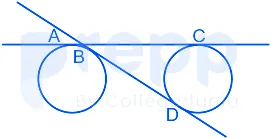
- A
50 cm
- B
40 cm
- C
48 cm
- D
30 cm
Show answer
A. 50 cmGiven:
Radius of each circle = 7 cm
BD = transverse common tangent between two circles = 48 cm
Concept used:
Length of direct transverse tangents = √(Square of the distance between the circle - Square of sum radius of the circles)
Length of the direct common tangents = √ (Square of the distance between the circle - Square of the difference between the radius of circles)
Calculation:
AC = Length of the direct common tangents
BD = Length of direct transverse tangents
Let, the distance between two circles = x cm
So, BD = √[x 2- (7 + 7) 2]
⇒ 48 = √(x 2 - 14 2 )
⇒ 48 2= x 2 - 196 [Squaring on both sides]
⇒ 2304 = x 2 - 196
⇒ x 2 = 2304 + 196 = 2500
⇒ x = √2500 = 50 cm
Also, AC = √[50 2 - (7 - 7) 2 ]
⇒ AC = √(2500 - 0) = √2500 = 50 cm
∴ The length of BD is 48 cm, length of AC is 50 cm
Paper & answer key PDF ↗ Question 52archived
The bisector of ∠B in ΔABC meets AC at D. If AB = 12 cm, BC = 18 cm and AC = 15 cm, then the length of AD (in cm) is:
- A
9
- B
6
- C
12
- D
5
Show answer
B. 6Understanding the Triangle Angle Bisector Problem
This problem asks us to find the length of a segment on one side of a triangle created by an angle bisector from the opposite vertex. We are given the lengths of all three sides of triangle ABC, and we know that BD is the bisector of angle B, meeting side AC at point D.
Applying the Angle Bisector Theorem
To solve this problem, we need to use a fundamental concept in geometry known as the Angle Bisector Theorem. This theorem provides a relationship between the lengths of the sides of a triangle and the segments created by an angle bisector on the opposite side.
The Angle Bisector Theorem states that in a triangle, the angle bisector of any angle divides the opposite side in the ratio of the lengths of the other two sides. For ΔABC, where BD is the angle bisector of ∠B meeting AC at D, the theorem says:
$\frac{AD}{DC} = \frac{AB}{BC}$
Calculating the Length of AD
We are given the following lengths:
AB = 12 cm
BC = 18 cm
AC = 15 cm
According to the Angle Bisector Theorem, we have:
$\frac{AD}{DC} = \frac{AB}{BC}$
Substitute the given values for AB and BC:
$\frac{AD}{DC} = \frac{12}{18}$
Simplify the fraction $\frac{12}{18}$:
$\frac{12}{18} = \frac{6 \times 2}{6 \times 3} = \frac{2}{3}$
So, the ratio $\frac{AD}{DC} = \frac{2}{3}$. This means that the segment AD and the segment DC are in the ratio 2 : 3. The side AC is divided into two segments, AD and DC, and their sum is equal to the length of AC.
AD + DC = AC
AD + DC = 15 cm
Since AD : DC = 2 : 3, we can consider AC as being divided into $2 + 3 = 5$ parts. The length of AD corresponds to 2 of these parts, and the length of DC corresponds to 3 of these parts.
To find the length of AD, we can use the ratio in relation to the total length of AC:
$AD = \left(\frac{\text{Ratio part for AD}}{\text{Total ratio parts}}\right) \times AC$
$AD = \left(\frac{2}{2 + 3}\right) \times 15$
$AD = \left(\frac{2}{5}\right) \times 15$
Now, calculate the value:
$AD = \frac{2 \times 15}{5}$
$AD = \frac{30}{5}$
$AD = 6$
Therefore, the length of AD is 6 cm.
We can also find the length of DC to verify:
$DC = \left(\frac{\text{Ratio part for DC}}{\text{Total ratio parts}}\right) \times AC$
$DC = \left(\frac{3}{2 + 3}\right) \times 15$
$DC = \left(\frac{3}{5}\right) \times 15$
$DC = \frac{3 \times 15}{5} = \frac{45}{5} = 9$ cm.
Check: AD + DC = 6 cm + 9 cm = 15 cm, which is indeed the length of AC.
Summary of Calculations
Given Information
Calculation Step
Result
AB = 12 cm, BC = 18 cm
Ratio $\frac{AD}{DC} = \frac{AB}{BC}$
$\frac{AD}{DC} = \frac{12}{18} = \frac{2}{3}$
AC = 15 cm, AD : DC = 2 : 3
Total ratio parts = 2 + 3
Total ratio parts = 5
AC = 15 cm, Total ratio parts = 5
Length of AD = $\frac{2}{5} \times AC$
AD = $\frac{2}{5} \times 15 = 6$ cm
AC = 15 cm, Total ratio parts = 5
Length of DC = $\frac{3}{5} \times AC$
DC = $\frac{3}{5} \times 15 = 9$ cm
AD = 6 cm, DC = 9 cm
Check AD + DC
6 + 9 = 15 cm (Matches AC)
Conclusion
Using the Angle Bisector Theorem and the given side lengths of triangle ABC, we found that the bisector of angle B divides the side AC into segments AD and DC in the ratio 2:3. By dividing the total length of AC (15 cm) according to this ratio, we determined the length of segment AD.
The length of AD is 6 cm.
Revision Table: Key Concepts for Triangle Angle Bisector
Reviewing Angle Bisector Theorem
Concept
Description
Formula (for ΔABC, BD bisects ∠B)
Angle Bisector
A line segment that divides an angle into two equal angles.
BD is the angle bisector of ∠B
Angle Bisector Theorem
A theorem relating the ratio of sides to the ratio of segments formed by an angle bisector on the opposite side.
$\frac{AD}{DC} = \frac{AB}{BC}$
Segment Division
The opposite side is divided into two segments proportional to the adjacent sides.
AD and DC are segments of AC
Additional Information: Related Geometry Concepts
Understanding the Angle Bisector Theorem is crucial for solving various geometry problems involving triangles. Here are some related concepts:
Triangle Properties: Triangles have many interesting properties related to their sides, angles, medians, altitudes, and angle bisectors.
Medians: A median connects a vertex to the midpoint of the opposite side. Medians intersect at the centroid.
Altitudes: An altitude is a perpendicular segment from a vertex to the opposite side. Altitudes intersect at the orthocenter.
Perpendicular Bisectors: A line segment perpendicular to a side and passing through its midpoint. Perpendicular bisectors intersect at the circumcenter (center of the circumscribed circle).
Incenter: The point where the three angle bisectors of a triangle intersect. The incenter is the center of the inscribed circle (incircle). The distance from the incenter to each side is equal (radius of the incircle).
Other Triangle Theorems: Besides the Angle Bisector Theorem, other important theorems include the Pythagorean theorem, Sine Rule, Cosine Rule, and theorems related to similar and congruent triangles.
Mastering these concepts helps build a strong foundation in geometry.
Paper & answer key PDF ↗ Question 53archived
If cot B = \(\frac{12}{5}\) , what is the value of sec B?
- A
\(\frac{13}{12}\)
- B
\(\frac{5}{12}\)
- C
\(\frac{13}{5}\)
- D
\(\frac{12}{13}\)
Show answer
A. \(\frac{13}{12}\)Solving Trigonometry Problem: Finding sec B from cot B
The question asks us to find the value of \( \sec B \) given that \( \cot B = \frac{12}{5} \). We can solve this trigonometry problem using the properties of a right-angled triangle or by using trigonometric identities.
Method 1: Using a Right-Angled Triangle
Recall the definitions of trigonometric ratios in a right-angled triangle. For an angle \( B \):
\( \cot B = \frac{\text{Adjacent side}}{\text{Opposite side}} \)
\( \sec B = \frac{\text{Hypotenuse}}{\text{Adjacent side}} \)
Given \( \cot B = \frac{12}{5} \), we can assume that for a right-angled triangle with angle \( B \), the adjacent side is \( 12k \) and the opposite side is \( 5k \) for some positive constant \( k \).
Now, we need to find the length of the hypotenuse. Using the Pythagorean theorem:
\( (\text{Hypotenuse})^2 = (\text{Adjacent side})^2 + (\text{Opposite side})^2 \)
Substitute the values:
\( (\text{Hypotenuse})^2 = (12k)^2 + (5k)^2 \)
\( (\text{Hypotenuse})^2 = 144k^2 + 25k^2 \)
\( (\text{Hypotenuse})^2 = 169k^2 \)
Taking the square root of both sides (and assuming the hypotenuse length is positive):
\( \text{Hypotenuse} = \sqrt{169k^2} = 13k \)
Now that we have the lengths of all three sides in terms of \( k \), we can find \( \sec B \).
\( \sec B = \frac{\text{Hypotenuse}}{\text{Adjacent side}} \)
Substitute the calculated values:
\( \sec B = \frac{13k}{12k} \)
The constant \( k \) cancels out:
\( \sec B = \frac{13}{12} \)
Method 2: Using Trigonometric Identities
We can also use trigonometric identities to solve this. We know the identity relating \( \cot B \) and \( \csc B \):
\( 1 + \cot^2 B = \csc^2 B \)
Substitute the given value \( \cot B = \frac{12}{5} \):
\( 1 + \left(\frac{12}{5}\right)^2 = \csc^2 B \)
\( 1 + \frac{144}{25} = \csc^2 B \)
\( \frac{25}{25} + \frac{144}{25} = \csc^2 B \)
\( \frac{25 + 144}{25} = \csc^2 B \)
\( \frac{169}{25} = \csc^2 B \)
Taking the square root:
\( \csc B = \pm \sqrt{\frac{169}{25}} = \pm \frac{13}{5} \)
Assuming \( B \) is an acute angle (or in a quadrant where \( \cot B \) is positive, \( \csc B \) is also positive), we take the positive value: \( \csc B = \frac{13}{5} \).
Recall that \( \csc B = \frac{1}{\sin B} \). So, \( \sin B = \frac{1}{\csc B} = \frac{1}{\frac{13}{5}} = \frac{5}{13} \).
Now, we use the identity \( \sin^2 B + \cos^2 B = 1 \).
Substitute the value of \( \sin B \):
\( \left(\frac{5}{13}\right)^2 + \cos^2 B = 1 \)
\( \frac{25}{169} + \cos^2 B = 1 \)
\( \cos^2 B = 1 - \frac{25}{169} \)
\( \cos^2 B = \frac{169 - 25}{169} \)
\( \cos^2 B = \frac{144}{169} \)
Taking the square root:
\( \cos B = \pm \sqrt{\frac{144}{169}} = \pm \frac{12}{13} \)
Assuming \( B \) is an acute angle (or in a quadrant where \( \cot B \) is positive, \( \cos B \) is also positive), we take the positive value: \( \cos B = \frac{12}{13} \).
Finally, recall that \( \sec B = \frac{1}{\cos B} \).
\( \sec B = \frac{1}{\frac{12}{13}} = \frac{13}{12} \)
Both methods yield the same result.
Summary of Ratios
Ratio
Definition
Value
\( \cot B \)
Adjacent / Opposite
\( \frac{12}{5} \) (Given)
Opposite side
\( 5k \)
Adjacent side
\( 12k \)
Hypotenuse
\( \sqrt{(\text{Adj})^2 + (\text{Opp})^2} \)
\( 13k \)
\( \sec B \)
Hypotenuse / Adjacent
\( \frac{13k}{12k} = \frac{13}{12} \)
Thus, the value of \( \sec B \) is \( \frac{13}{12} \).
Revision Table: Trigonometric Ratios
Ratio
Definition (Right Triangle)
Reciprocal Identity
\( \sin \theta \)
Opposite / Hypotenuse
\( 1 / \csc \theta \)
\( \cos \theta \)
Adjacent / Hypotenuse
\( 1 / \sec \theta \)
\( \tan \theta \)
Opposite / Adjacent
\( 1 / \cot \theta \)
\( \csc \theta \)
Hypotenuse / Opposite
\( 1 / \sin \theta \)
\( \sec \theta \)
Hypotenuse / Adjacent
\( 1 / \cos \theta \)
\( \cot \theta \)
Adjacent / Opposite
\( 1 / \tan \theta \)
Additional Information: Pythagorean Identities
The Pythagorean identities are fundamental in trigonometry. They are derived from the Pythagorean theorem (\( a^2 + b^2 = c^2 \)) applied to a right triangle with angle \( \theta \).
\( \sin^2 \theta + \cos^2 \theta = 1 \)
\( 1 + \tan^2 \theta = \sec^2 \theta \)
\( 1 + \cot^2 \theta = \csc^2 \theta \)
These identities are useful for finding one trigonometric ratio when another is known, without necessarily drawing a triangle.
For example, in this problem, we could have also used the identity \( 1 + \tan^2 B = \sec^2 B \). First, find \( \tan B = \frac{1}{\cot B} = \frac{1}{12/5} = \frac{5}{12} \). Then substitute into the identity:
\( 1 + \left(\frac{5}{12}\right)^2 = \sec^2 B \)
\( 1 + \frac{25}{144} = \sec^2 B \)
\( \frac{144}{144} + \frac{25}{144} = \sec^2 B \)
\( \frac{169}{144} = \sec^2 B \)
\( \sec B = \pm \sqrt{\frac{169}{144}} = \pm \frac{13}{12} \)
Again, assuming \( B \) is in a quadrant where \( \sec B \) is positive, we get \( \sec B = \frac{13}{12} \).
Paper & answer key PDF ↗ Question 54archived
The following histogram shows the marks scored by 40 students in a test of 30 marks. A student has to score a minimum of 10 marks to pass the test.
How many students have scored less than two-third of the total marks?
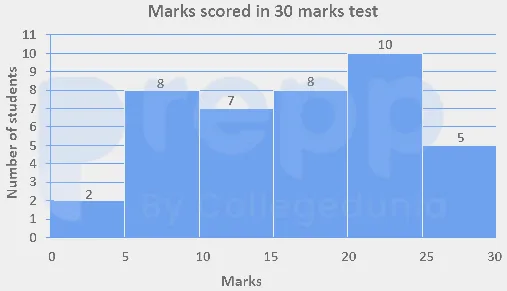
- A
25
- B
32
- C
17
- D
35
Show answer
A. 25Given:
The total marks of the test = 30
Calculation:
The two-third of the total marks = 30 × (2/3) = 20
The number of students who scored less than 20 = 2 + 8 + 7 + 8 = 25
∴ The total number of 25 students has scored less than two-thirds of the total marks.
Paper & answer key PDF ↗ Question 55archived
Find the value of 70 3+ 20 3 - 90 3.
- A
0
- B
-300000
- C
378000
- D
-378000
Show answer
D. -378000Understanding the Cube Calculation Problem
The question asks us to find the value of the expression \(70^3 + 20^3 - 90^3\). This involves calculating the cube of three numbers and then performing addition and subtraction.
We can approach this problem in two ways: direct calculation or by using a relevant algebraic identity for cubes.
Method 1: Direct Calculation of Cubes
We will calculate the cube of each number individually and then combine the results.
Calculate \(70^3\)
The cube of 70 is \(70 \times 70 \times 70\).
\(70 \times 70 = 4900\)
\(4900 \times 70 = 343000\)
So, \(70^3 = 343000\).
Calculate \(20^3\)
The cube of 20 is \(20 \times 20 \times 20\).
\(20 \times 20 = 400\)
\(400 \times 20 = 8000\)
So, \(20^3 = 8000\).
Calculate \(90^3\)
The cube of 90 is \(90 \times 90 \times 90\).
\(90 \times 90 = 8100\)
\(8100 \times 90 = 729000\)
So, \(90^3 = 729000\).
Combine the Results
Now, substitute these calculated values back into the original expression \(70^3 + 20^3 - 90^3\):
\(70^3 + 20^3 - 90^3 = 343000 + 8000 - 729000\)
First, perform the addition:
\(343000 + 8000 = 351000\)
Now, perform the subtraction:
\(351000 - 729000\)
Since we are subtracting a larger number from a smaller number, the result will be negative. We calculate the difference between the two numbers and assign a negative sign:
\(729000 - 351000\)
\[\begin{array}{@{}c@{\,}c@{}c@{}c@{}c@{}c} & 7 & 2 & 9 & 0 & 0 & 0 \\ - & 3 & 5 & 1 & 0 & 0 & 0 \\ \hline & 3 & 7 & 8 & 0 & 0 & 0 \\ \hline \end{array}\]
So, \(729000 - 351000 = 378000\).
Therefore, \(351000 - 729000 = -378000\).
Method 2: Using Algebraic Identity for Cubes
Consider the expression \(70^3 + 20^3 - 90^3\). We can rewrite this expression as \(70^3 + 20^3 + (-90)^3\).
Let \(a = 70\), \(b = 20\), and \(c = -90\).
Let's check the sum of \(a\), \(b\), and \(c\):
\(a+b+c = 70 + 20 + (-90) = 90 - 90 = 0\)
There is a useful algebraic identity that states: If \(a+b+c = 0\), then \(a^3 + b^3 + c^3 = 3abc\).
Since \(70 + 20 + (-90) = 0\) in our case, we can apply this identity directly:
\(70^3 + 20^3 + (-90)^3 = 3 \times 70 \times 20 \times (-90)\)
Now, we calculate the product \(3 \times 70 \times 20 \times (-90)\):
\(3 \times 70 = 210\)
\(210 \times 20 = 4200\)
\(4200 \times (-90)\)
To calculate \(4200 \times (-90)\), we multiply \(4200\) by \(90\) and make the result negative because we are multiplying by a negative number:
\(4200 \times 90 = 378000\)
So, \(4200 \times (-90) = -378000\).
Therefore, using the algebraic identity, \(70^3 + 20^3 - 90^3 = -378000\).
Final Answer Calculation Result
Both methods yield the same result. The value of the expression \(70^3 + 20^3 - 90^3\) is \(-378000\).
Revision Table: Cube and Identity Concepts
ConceptDescriptionHow it Applied Here
Cube of a NumberThe result of multiplying a number by itself three times (\(n^3\)).Calculated \(70^3\), \(20^3\), and \(90^3\) individually in Method 1.
Algebraic Identity for CubesIf \(a+b+c=0\), then \(a^3+b^3+c^3 = 3abc\).Recognized that \(70 + 20 + (-90) = 0\) and used this identity in Method 2.
Subtraction with Negative ResultsWhen subtracting a larger number from a smaller one, the result is negative.Applied when calculating \(351000 - 729000\).
Additional Information on Cube Calculations
Understanding how to calculate cubes, especially for numbers ending in zero, simplifies computations. For example, \(50^3 = 5^3 \times 10^3 = 125 \times 1000 = 125000\).
The algebraic identity \(a^3+b^3+c^3 = 3abc\) when \(a+b+c=0\) is a very efficient way to solve specific problems involving sums of cubes without calculating each cube separately, as demonstrated in Method 2.
It's important to pay attention to signs when dealing with negative numbers and multiplication or cubing. A negative number cubed is always negative.
Paper & answer key PDF ↗ Question 56archived
The average of 9 consecutive numbers is 20. The smallest of these numbers is:
- A
10
- B
20
- C
16
- D
12
Show answer
C. 16Finding the Smallest of Consecutive Numbers with a Given Average
This problem asks us to find the smallest number in a sequence of 9 consecutive numbers whose average is 20. Consecutive numbers follow each other in order, with a difference of 1 between them.
For a set of consecutive numbers, especially an odd number of them, the average is simply the middle number.
In this case, we have 9 consecutive numbers. The numbers can be represented as:
First number (smallest)
Second number
Third number
Fourth number
Fifth number (middle number)
Sixth number
Seventh number
Eighth number
Ninth number (largest)
The middle number is the 5th number in the sequence. Since the average of these 9 numbers is 20, the middle number (the 5th number) is 20.
Let the smallest number be \(x\). Since the numbers are consecutive, they are \(x, x+1, x+2, \dots, x+8\).
The 5th number in this sequence is \(x + (5-1) = x+4\).
We know the 5th number (the middle number) is the average, which is 20.
So, we can set up the equation:
\(x + 4 = 20\)
To find the value of \(x\), we subtract 4 from both sides of the equation:
\(x = 20 - 4\)
\(x = 16\)
Therefore, the smallest number in the sequence is 16.
Let's list the 9 consecutive numbers starting from 16 and verify their average:
Order
Number
1st
16
2nd
17
3rd
18
4th
19
5th (Middle)
20
6th
21
7th
22
8th
23
9th
24
The sum of these numbers is \(16+17+18+19+20+21+22+23+24\). A quicker way to sum consecutive numbers when the average (middle term) is known is Average × Number of terms = \(20 \times 9 = 180\).
The average is Sum / Number of terms = \(180 / 9 = 20\). This confirms our calculation.
The smallest of these numbers is indeed 16.
Steps to Solve the Consecutive Number Average Problem
Here are the steps taken to find the smallest number:
Recognize that for an odd number of consecutive integers, the average is the middle number.
Identify the number of terms (9) and determine the position of the middle term (5th term).
Set the value of the middle term equal to the given average (20).
Represent the smallest number as \(x\) and express the middle term in terms of \(x\) (which is \(x+4\)).
Form an equation: \(x+4 = 20\).
Solve for \(x\) to find the smallest number.
Revision Table: Key Concepts
Concept
Description
Consecutive Numbers
Numbers that follow each other in order, with a difference of 1. E.g., 5, 6, 7.
Average
Sum of all numbers divided by the count of numbers.
Average of Odd Consecutive Numbers
The middle number in the sequence.
Additional Information on Consecutive Numbers
Understanding consecutive numbers and their properties is useful in solving various math problems. Here are some additional points:
If the number of consecutive terms is even (e.g., 4, 6, 8), the average is the average of the two middle terms. For example, the average of 1, 2, 3, 4 is \((2+3)/2 = 2.5\).
The sum of \(n\) consecutive integers starting with \(a\) is \(n \times a + n(n-1)/2\). Using the average property is usually much faster for finding terms.
Problems involving consecutive even or consecutive odd numbers can be solved similarly, but the difference between terms is 2 instead of 1. For example, consecutive even numbers could be \(x, x+2, x+4, \dots\), and consecutive odd numbers could be \(y, y+2, y+4, \dots\).
Paper & answer key PDF ↗ Question 57archived
If 3sec 2θ + tanθ - 7 = 0, 0° < θ < 90°, then what is the value of \((\frac{2 sinθ +3 cosθ} {cosecθ +secθ})\) ?
- A
\(\frac{5}{4}\)
- B
\(\frac{5}{2}\)
- C
10
- D
\(4\sqrt2\)
Show answer
A. \(\frac{5}{4}\)Solving the Trigonometric Equation
The problem asks us to find the value of a trigonometric expression given an equation and a constraint on the angle $\theta$. The given equation is \(3\sec^2\theta + \tan\theta - 7 = 0\), and the constraint is \(0^\circ < \theta < 90^\circ\).
Our first step is to solve the given trigonometric equation to find the value of $\theta$ or a trigonometric ratio of $\theta$. The equation involves both $\sec^2\theta$ and $\tan\theta$. We can use the fundamental trigonometric identity that relates these two ratios: \(\sec^2\theta = 1 + \tan^2\theta\).
Substitute this identity into the equation:
\(3(1 + \tan^2\theta) + \tan\theta - 7 = 0\)
Now, distribute the 3 and rearrange the terms to form a quadratic equation in terms of $\tan\theta$:
\(3 + 3\tan^2\theta + \tan\theta - 7 = 0\)
\(3\tan^2\theta + \tan\theta - 4 = 0\)
Solving the Quadratic Equation for tanθ
Let \(x = \tan\theta\). The equation becomes a standard quadratic equation:
\(3x^2 + x - 4 = 0\)
We can solve this quadratic equation by factoring or using the quadratic formula. Let's try factoring. We look for two numbers that multiply to \(3 \times (-4) = -12\) and add up to the coefficient of the middle term, which is 1. These numbers are 4 and -3.
Rewrite the middle term (\(x\)) using these numbers:
\(3x^2 + 4x - 3x - 4 = 0\)
Now, group terms and factor:
\(x(3x + 4) - 1(3x + 4) = 0\)
\((3x + 4)(x - 1) = 0\)
This gives two possible solutions for \(x\), which is \(\tan\theta\):
\(3x + 4 = 0 \implies 3x = -4 \implies x = -\frac{4}{3}\)
\(x - 1 = 0 \implies x = 1\)
So, \(\tan\theta = -\frac{4}{3}\) or \(\tan\theta = 1\).
Using the Constraint on θ
The problem states that \(0^\circ < \theta < 90^\circ\). This range corresponds to the first quadrant of the trigonometric circle. In the first quadrant, all basic trigonometric ratios (sine, cosine, tangent, cotangent, secant, cosecant) are positive.
Since \(\tan\theta\) must be positive in this range, we discard the solution \(\tan\theta = -\frac{4}{3}\).
Therefore, the valid solution is \(\tan\theta = 1\).
Finding the Value of θ and other Trigonometric Ratios
If \(\tan\theta = 1\) and \(0^\circ < \theta < 90^\circ\), the unique angle $\theta$ that satisfies this is \(\theta = 45^\circ\).
Now that we know \(\theta = 45^\circ\), we can find the values of the trigonometric ratios needed for the expression: \(\sin\theta\), \(\cos\theta\), \(\operatorname{cosec}\theta\), and \(\sec\theta\).
\(\sin 45^\circ = \frac{1}{\sqrt{2}}\)
\(\cos 45^\circ = \frac{1}{\sqrt{2}}\)
\(\operatorname{cosec} 45^\circ = \frac{1}{\sin 45^\circ} = \frac{1}{1/\sqrt{2}} = \sqrt{2}\)
\(\sec 45^\circ = \frac{1}{\cos 45^\circ} = \frac{1}{1/\sqrt{2}} = \sqrt{2}\)
Evaluating the Expression
The expression we need to evaluate is \((\frac{2 \sin\theta + 3 \cos\theta} {\operatorname{cosec}\theta + \sec\theta})\). Substitute the values we found for \(\theta = 45^\circ\):
Numerator: \(2 \sin 45^\circ + 3 \cos 45^\circ = 2\left(\frac{1}{\sqrt{2}}\right) + 3\left(\frac{1}{\sqrt{2}}\right) = \frac{2}{\sqrt{2}} + \frac{3}{\sqrt{2}} = \frac{2+3}{\sqrt{2}} = \frac{5}{\sqrt{2}}\)
Denominator: \(\operatorname{cosec} 45^\circ + \sec 45^\circ = \sqrt{2} + \sqrt{2} = 2\sqrt{2}\)
Now, divide the numerator by the denominator:
\(\frac{\frac{5}{\sqrt{2}}}{2\sqrt{2}}\)
To simplify, multiply the numerator by the reciprocal of the denominator:
\(\frac{5}{\sqrt{2}} \times \frac{1}{2\sqrt{2}} = \frac{5}{2\sqrt{2} \times \sqrt{2}}\)
Since \(\sqrt{2} \times \sqrt{2} = 2\), the expression becomes:
\(\frac{5}{2 \times 2} = \frac{5}{4}\)
Final Answer Calculation
The value of the expression \((\frac{2 \sinθ +3 cosθ} {cosecθ +secθ})\) when \(3\sec^2\theta + \tan\theta - 7 = 0\) and \(0^\circ < \theta < 90^\circ\) is \(\frac{5}{4}\).
Step
Description
Calculation/Result
1
Given Equation
\(3\sec^2\theta + \tan\theta - 7 = 0\)
2
Identity Used
\(\sec^2\theta = 1 + \tan^2\theta\)
3
Quadratic in tanθ
\(3\tan^2\theta + \tan\theta - 4 = 0\)
4
Solve for tanθ
\((\tan\theta - 1)(3\tan\theta + 4) = 0\)
5
Apply Constraint \(0^\circ < \theta < 90^\circ\)
\(\tan\theta = 1\) (since \(\tan\theta > 0\))
6
Find θ
\(\theta = 45^\circ\)
7
Calculate Ratios at 45°
\(\sin 45^\circ = \frac{1}{\sqrt{2}}\), \(\cos 45^\circ = \frac{1}{\sqrt{2}}\), \(\operatorname{cosec} 45^\circ = \sqrt{2}\), \(\sec 45^\circ = \sqrt{2}\)
8
Evaluate Numerator
\(2\sin 45^\circ + 3\cos 45^\circ = \frac{5}{\sqrt{2}}\)
9
Evaluate Denominator
\(\operatorname{cosec} 45^\circ + \sec 45^\circ = 2\sqrt{2}\)
10
Final Value
\(\frac{5/\sqrt{2}}{2\sqrt{2}} = \frac{5}{4}\)
Revision Table: Key Concepts
Trigonometric Identities: Understanding identities like \(\sec^2\theta = 1 + \tan^2\theta\) is crucial for simplifying equations.
Solving Quadratic Equations: Many trigonometric equations can be reduced to quadratic forms solvable by factoring or formula.
Quadrant Rules: The sign of trigonometric functions depends on the quadrant of the angle. For \(0^\circ < \theta < 90^\circ\) (Quadrant I), all ratios are positive.
Special Angles: Knowing the trigonometric values for common angles like 0°, 30°, 45°, 60°, 90° is very helpful.
Reciprocal Identities: \(\operatorname{cosec}\theta = 1/\sin\theta\) and \(\sec\theta = 1/\cos\theta\) are important for evaluating expressions.
Additional Information: General Solutions for Trigonometric Equations
While this problem had a specific range (\(0^\circ < \theta < 90^\circ\)) that gave a unique solution for \(\theta\), trigonometric equations often have infinite solutions. The general solutions are typically expressed using periodicity.
For \(\tan\theta = k\), the general solution is \(\theta = n\pi + \alpha\), where \(n\) is an integer and \(\alpha\) is the principal value (the solution in \((-\pi/2, \pi/2)\) or \((-90^\circ, 90^\circ)\)). In our case, \(\tan\theta = 1\), the principal value is \(45^\circ\) or \(\pi/4\) radians. So the general solution would be \(\theta = n \cdot 180^\circ + 45^\circ\) or \(\theta = n\pi + \pi/4\).
The constraint \(0^\circ < \theta < 90^\circ\) restricts the value of \(n\) such that \(0^\circ < n \cdot 180^\circ + 45^\circ < 90^\circ\). This inequality holds only for \(n=0\), giving \(\theta = 45^\circ\).
Understanding general solutions is important for problems without specific range constraints.
Paper & answer key PDF ↗ Question 58archived
Which is the smallest multiple of 7, which leaves 5 as remainder in each case, when divided by 8, 9, 12 and 15?
- A
2525
- B
1085
- C
365
- D
725
Show answer
B. 1085Understanding the Smallest Multiple Problem
The question asks us to find a specific number that satisfies two main conditions:
It must be a multiple of 7.
When this number is divided by 8, 9, 12, or 15, it must leave a remainder of 5 in each case.
This type of problem involves finding a number based on its remainders when divided by several different numbers. This is a classic application of the concept of Least Common Multiple (LCM).
Finding the Least Common Multiple (LCM)
First, let's address the condition about the remainder. A number that leaves the same remainder 'r' when divided by several numbers ($n_1, n_2, \dots$) can be expressed in the form $\text{LCM}(n_1, n_2, \dots) \times k + r$, where $k$ is a non-negative integer.
In this problem, the divisors are 8, 9, 12, and 15, and the remainder is 5. So, the required number must be of the form $\text{LCM}(8, 9, 12, 15) \times k + 5$.
Let's calculate the LCM of 8, 9, 12, and 15. We can do this by using the prime factorization method:
Prime factorization of 8: $8 = 2 \times 2 \times 2 = 2^3$
Prime factorization of 9: $9 = 3 \times 3 = 3^2$
Prime factorization of 12: $12 = 2 \times 2 \times 3 = 2^2 \times 3^1$
Prime factorization of 15: $15 = 3 \times 5 = 3^1 \times 5^1$
To find the LCM, we take the highest power of all prime factors that appear in any of the factorizations:
$\text{LCM}(8, 9, 12, 15) = 2^3 \times 3^2 \times 5^1 = 8 \times 9 \times 5 = 72 \times 5 = 360$.
So, the Least Common Multiple of 8, 9, 12, and 15 is 360.
Determining the Number Form
Any number that leaves a remainder of 5 when divided by 8, 9, 12, and 15 must be 5 more than a multiple of their LCM. Therefore, the required number must be of the form:
Number $= 360k + 5$, where $k$ is a non-negative integer ($k = 0, 1, 2, 3, \dots$).
Finding the Smallest Multiple of 7
Now, we need to find the smallest number of the form $360k + 5$ that is also a multiple of 7. We can test values of $k$ starting from 0 and check if $360k + 5$ is divisible by 7.
Let's test some values for $k$:
For $k=0$: Number $= 360(0) + 5 = 5$. Is 5 divisible by 7? No.
For $k=1$: Number $= 360(1) + 5 = 365$. Is 365 divisible by 7? $365 \div 7$. $365 = 52 \times 7 + 1$. Remainder is 1. No.
For $k=2$: Number $= 360(2) + 5 = 720 + 5 = 725$. Is 725 divisible by 7? $725 \div 7$. $725 = 103 \times 7 + 4$. Remainder is 4. No.
For $k=3$: Number $= 360(3) + 5 = 1080 + 5 = 1085$. Is 1085 divisible by 7? $1085 \div 7$. $1085 = 155 \times 7 + 0$. Remainder is 0. Yes, 1085 is divisible by 7.
The smallest non-negative integer value of $k$ for which $360k + 5$ is a multiple of 7 is $k=3$.
The number is $360(3) + 5 = 1080 + 5 = 1085$.
Therefore, 1085 is the smallest multiple of 7 that leaves a remainder of 5 when divided by 8, 9, 12, and 15.
Verification of the Result
Let's quickly verify if 1085 meets all conditions:
Is 1085 a multiple of 7? Yes, $1085 \div 7 = 155$.
Does 1085 leave a remainder of 5 when divided by 8? $1085 = 135 \times 8 + 5$. Yes.
Does 1085 leave a remainder of 5 when divided by 9? $1085 = 120 \times 9 + 5$. Yes.
Does 1085 leave a remainder of 5 when divided by 12? $1085 = 90 \times 12 + 5$. Yes.
Does 1085 leave a remainder of 5 when divided by 15? $1085 = 72 \times 15 + 5$. Yes.
The number 1085 satisfies all the given conditions and is the smallest such number found by testing values of $k$ starting from 0.
Divisor
Remainder
Check with 1085
8
5
$1085 = 135 \times 8 + 5$ (Remainder 5)
9
5
$1085 = 120 \times 9 + 5$ (Remainder 5)
12
5
$1085 = 90 \times 12 + 5$ (Remainder 5)
15
5
$1085 = 72 \times 15 + 5$ (Remainder 5)
Is 1085 a multiple of 7? $1085 = 155 \times 7$ (Remainder 0). Yes.
Revision Table: Smallest Multiple Concepts
Concept
Description
Relevance to Problem
Multiple
A number that can be divided by another number without a remainder.
The final answer must be a multiple of 7.
Remainder
The amount left over after division.
The number leaves a remainder of 5 with 8, 9, 12, 15.
Least Common Multiple (LCM)
The smallest positive integer that is a multiple of two or more integers.
Used to find the general form of numbers leaving specific remainders.
General form for remainder problems
Number $= \text{LCM}(n_1, n_2, \dots) \times k + r$
The required number is $360k + 5$.
Additional Information: Number Theory Basics
This problem touches upon basic concepts in number theory, specifically related to division and multiples.
Division Algorithm: For any integer $a$ and positive integer $b$, there exist unique integers $q$ (quotient) and $r$ (remainder) such that $a = bq + r$, where $0 \le r < b$. In our problem, for example, when 1085 is divided by 8, the quotient is 135 and the remainder is 5.
Congruence Relation (Modular Arithmetic): The condition that a number $N$ leaves a remainder $r$ when divided by $n$ can be written as $N \equiv r \pmod{n}$. Our problem states $N \equiv 5 \pmod{8}$, $N \equiv 5 \pmod{9}$, $N \equiv 5 \pmod{12}$, and $N \equiv 5 \pmod{15}$. This is equivalent to saying $N-5$ is a multiple of 8, 9, 12, and 15. Therefore, $N-5$ must be a multiple of $\text{LCM}(8, 9, 12, 15) = 360$. So, $N-5 = 360k$, or $N = 360k + 5$. We then add the condition that $N$ is a multiple of 7, i.e., $N \equiv 0 \pmod{7}$. Substituting, we get $360k + 5 \equiv 0 \pmod{7}$. We can simplify 360 modulo 7: $360 = 51 \times 7 + 3$, so $360 \equiv 3 \pmod{7}$. The congruence becomes $3k + 5 \equiv 0 \pmod{7}$. Subtracting 5 from both sides: $3k \equiv -5 \pmod{7}$. Since $-5 \equiv 2 \pmod{7}$, we have $3k \equiv 2 \pmod{7}$. We need to find $k$. We can test values or find the modular multiplicative inverse of 3 modulo 7. $3 \times 1 = 3$, $3 \times 2 = 6$, $3 \times 3 = 9 \equiv 2 \pmod{7}$. So, $k \equiv 3 \pmod{7}$. The smallest non-negative value for $k$ is 3, which confirms our earlier method by testing.
Paper & answer key PDF ↗ Question 59archived
On simple interest, a certain sum becomes Rs. 59,200 in 6 years and Rs. 72,000 in 10 years. If the rate of interest had been 2% more, then in how many years would the sum have become RS. 76,000?
- A
9
- B
8
- C
7
- D
10
Show answer
A. 9Understanding the Simple Interest Problem
This question deals with simple interest. We are given how a sum of money grows over two different time periods and then asked to find the time it takes to reach a new amount if the interest rate changes.
Simple interest is calculated only on the initial principal amount. The interest earned each year is constant.
Step 1: Find the Interest Earned Between the Two Periods
We are given the amount after 6 years and the amount after 10 years. The difference in these amounts is the simple interest earned over the difference in time years (10 - 6 = 4 years).
Amount after 10 years = Rs. 72,000
Amount after 6 years = Rs. 59,200
Interest earned in (10 - 6) = 4 years = Rs. 72,000 - Rs. 59,200
Let's calculate the interest earned in these 4 years:
\( \text{Interest in 4 years} = 72,000 - 59,200 = 12,800 \)
So, the simple interest earned in 4 years is Rs. 12,800.
Step 2: Calculate the Annual Simple Interest
Since simple interest is constant each year, we can find the interest earned in one year by dividing the interest earned in 4 years by 4.
\( \text{Annual Interest} = \frac{\text{Interest in 4 years}}{4} \)
\( \text{Annual Interest} = \frac{12,800}{4} = 3,200 \)
The annual simple interest is Rs. 3,200.
Step 3: Calculate the Principal Amount
We know the amount after 6 years is Rs. 59,200. This amount is the sum of the principal and the simple interest earned over 6 years.
Amount after 6 years = Principal + (Annual Interest \(\times\) 6)
Amount after 6 years = Rs. 59,200
Annual Interest = Rs. 3,200
Let P be the principal amount.
\( 59,200 = P + (3,200 \times 6) \)
\( 59,200 = P + 19,200 \)
To find the principal, subtract the interest earned in 6 years from the amount after 6 years:
\( P = 59,200 - 19,200 \)
\( P = 40,000 \)
The principal amount is Rs. 40,000.
Step 4: Calculate the Original Rate of Simple Interest
We can use the simple interest formula: \( \text{Simple Interest (SI)} = \frac{\text{Principal (P)} \times \text{Rate (R)} \times \text{Time (T)}}{100} \).
We know the annual interest (SI for T=1 year) is Rs. 3,200, the principal (P) is Rs. 40,000, and the time (T) is 1 year. We need to find the original rate (R).
\( 3,200 = \frac{40,000 \times R \times 1}{100} \)
\( 3,200 = 400 \times R \)
To find R, divide 3,200 by 400:
\( R = \frac{3,200}{400} \)
\( R = 8 \)
The original rate of simple interest is 8% per annum.
Step 5: Determine the New Rate of Interest
The question states that the rate of interest had been 2% more than the original rate.
Original Rate = 8%
Increase in Rate = 2%
New Rate = Original Rate + Increase in Rate
\( \text{New Rate} = 8\% + 2\% = 10\% \)
The new rate of simple interest is 10% per annum.
Step 6: Calculate the Required Total Simple Interest for the Target Amount
We want to find the time it takes for the sum (principal) of Rs. 40,000 to become Rs. 76,000 at the new rate of 10%.
The total simple interest needed is the difference between the target amount and the principal.
Target Amount = Rs. 76,000
Principal = Rs. 40,000
Required Simple Interest = Target Amount - Principal
\( \text{Required SI} = 76,000 - 40,000 = 36,000 \)
A total simple interest of Rs. 36,000 is required.
Step 7: Calculate the Time Required with the New Rate
Now, we use the simple interest formula again: \( \text{SI} = \frac{\text{P} \times \text{R} \times \text{T}}{100} \).
We know:
Required SI = Rs. 36,000
Principal (P) = Rs. 40,000
New Rate (R) = 10%
Time (T) = ?
Substitute these values into the formula:
\( 36,000 = \frac{40,000 \times 10 \times T}{100} \)
\( 36,000 = \frac{400,000 \times T}{100} \)
\( 36,000 = 4,000 \times T \)
To find T, divide 36,000 by 4,000:
\( T = \frac{36,000}{4,000} \)
\( T = 9 \)
So, it would take 9 years for the sum to become Rs. 76,000 at a simple interest rate of 10% per annum.
Summary of Initial Information
ParticularValue
Amount in 6 yearsRs. 59,200
Amount in 10 yearsRs. 72,000
Interest in 4 years (10-6)Rs. 12,800
Annual Simple InterestRs. 3,200
PrincipalRs. 40,000
Original Rate (R)8% p.a.
New Rate (R+2%)10% p.a.
Target AmountRs. 76,000
Required Total InterestRs. 36,000
Revision Table: Simple Interest Key Concepts
TermDefinitionFormula (for SI)
Principal (P)The initial amount of money borrowed or invested.-
Amount (A)The total sum at the end of a period, including principal and interest.A = P + SI
Simple Interest (SI)Interest calculated only on the principal amount.\( SI = \frac{P \times R \times T}{100} \)
Rate (R)The percentage at which interest is charged or earned per unit of time (usually per year).\( R = \frac{SI \times 100}{P \times T} \)
Time (T)The duration for which the money is borrowed or invested.\( T = \frac{SI \times 100}{P \times R} \)
Additional Information: Comparing Simple and Compound Interest
It's important to distinguish between simple interest and compound interest, although this problem specifically deals with simple interest.
Simple Interest: As seen in this problem, interest is calculated only on the original principal. The interest earned remains constant over time.
Compound Interest: Interest is calculated on the initial principal AND the accumulated interest from previous periods. This means the interest earned grows over time because the base on which it's calculated increases.
The formula for the Amount (A) under compound interest is \( A = P(1 + \frac{R}{100})^T \).
In simple interest problems, finding the difference between amounts at different times helps in determining the annual interest directly if the time periods are consecutive or a simple difference.
This problem highlights how changes in the interest rate directly impact the time required to reach a specific financial goal under simple interest conditions.
Paper & answer key PDF ↗ Question 60archived
A vertical pole and a vertical tower are on the same level ground in such a way that, from the top of the pole, the angle of elevation of the top of the tower is 60° and the angle of depression of the bottom of the tower is 30°. If the height of the pole is 24 m, then find the height of the tower (in m).
- A
\(24\sqrt3(\sqrt3+1)\)
- B
\(24(\sqrt3+1)\)
- C
72
- D
96
Show answer
D. 96Calculating Tower Height Using Angle of Elevation and Depression
This problem involves using trigonometry, specifically the tangent function, to find the height of a tower given the height of a pole and the angles of elevation and depression from the top of the pole to the top and bottom of the tower, respectively.
Understanding the Geometry
Let's visualize the scenario:
Let PQ be the vertical pole with height 24 m. P is the top, and Q is the bottom.
Let TB be the vertical tower. T is the top, and B is the bottom.
The pole and tower are on the same level ground, so Q and B are on the ground.
Draw a horizontal line from the top of the pole P, meeting the tower at point R.
The angle of elevation of the top of the tower (T) from P is ∠TPR = 60°.
The angle of depression of the bottom of the tower (B) from P is ∠RPB = 30°.
The figure PQBR forms a rectangle, where PQ is parallel to RB and PR is parallel to QB.
Therefore, PQ = RB = 24 m and PR = QB. PR is the horizontal distance between the pole and the tower.
The height of the tower is TB = TR + RB.
Applying Trigonometry to Find Distances
We can use the tangent function ($\tan \theta = \frac{\text{Opposite}}{\text{Adjacent}}$) in the right triangles formed.
Step 1: Find the horizontal distance PR (or QB)
Consider the right triangle ▵PBR. The angle of depression from P to B is 30°. In this triangle, RB is the side opposite to the angle ∠RPB (which is 30°), and PR is the side adjacent to this angle. We know RB = 24 m (height of the pole).
Using tangent:
$$ \tan(30^\circ) = \frac{\text{Opposite side}}{\text{Adjacent side}} = \frac{RB}{PR} $$
$$ \tan(30^\circ) = \frac{24}{PR} $$
We know that $\tan(30^\circ) = \frac{1}{\sqrt3}$.
$$ \frac{1}{\sqrt3} = \frac{24}{PR} $$
Solving for PR:
$$ PR = 24 \times \sqrt3 = 24\sqrt3 \text{ m} $$
So, the horizontal distance between the pole and the tower is $24\sqrt3$ m.
Step 2: Find the height TR
Now consider the right triangle ▵PTR. The angle of elevation from P to T is 60°. In this triangle, TR is the side opposite to ∠TPR (which is 60°), and PR is the side adjacent to this angle. We just found PR = $24\sqrt3$ m.
Using tangent:
$$ \tan(60^\circ) = \frac{\text{Opposite side}}{\text{Adjacent side}} = \frac{TR}{PR} $$
$$ \tan(60^\circ) = \frac{TR}{24\sqrt3} $$
We know that $\tan(60^\circ) = \sqrt3$.
$$ \sqrt3 = \frac{TR}{24\sqrt3} $$
Solving for TR:
$$ TR = \sqrt3 \times 24\sqrt3 = 24 \times (\sqrt3 \times \sqrt3) = 24 \times 3 = 72 \text{ m} $$
Step 3: Calculate the total height of the tower
The total height of the tower TB is the sum of TR and RB.
$$ \text{Height of tower (TB)} = TR + RB $$
$$ \text{Height of tower (TB)} = 72 \text{ m} + 24 \text{ m} $$
$$ \text{Height of tower (TB)} = 96 \text{ m} $$
Summary of Calculations
Triangle
Angle
Opposite Side
Adjacent Side
Tangent Equation
Calculated Value
▵PBR
∠RPB = 30°
RB = 24 m
PR
$\tan(30^\circ) = \frac{24}{PR}$
PR = $24\sqrt3$ m
▵PTR
∠TPR = 60°
TR
PR = $24\sqrt3$ m
$\tan(60^\circ) = \frac{TR}{24\sqrt3}$
TR = 72 m
Total Tower Height = TR + RB = 72 m + 24 m = 96 m.
Thus, the height of the tower is 96 m.
Revision Table: Key Concepts
Concept
Description
Relevance to Problem
Angle of Elevation
The angle between the horizontal line of sight and the line of sight upwards to an object.
Used to find the upper part of the tower's height (TR).
Angle of Depression
The angle between the horizontal line of sight and the line of sight downwards to an object.
Used to find the horizontal distance between the pole and tower (PR) using the pole's height (RB).
Trigonometric Ratios
Relationships between angles and sides of right triangles (SOH CAH TOA).
Tangent ($\tan$) is used as it relates the opposite and adjacent sides.
Right Triangle
A triangle with one angle equal to 90 degrees.
▵PBR and ▵PTR are right triangles formed by the horizontal line and vertical objects.
Additional Information: Angles and Heights
Problems involving angles of elevation and depression often require drawing a clear diagram and identifying the right triangles. The horizontal line of sight from the observer's position is crucial for defining these angles correctly. The angle of depression from point P to point B is equal to the angle of elevation from point B to point P (alternate interior angles if the horizontal line is parallel to the ground).
In this specific problem:
The height of the pole gives us the height of the rectangle part below the horizontal line from the top of the pole.
The angle of depression helps find the horizontal distance using the pole's height.
The angle of elevation helps find the remaining height of the tower above the horizontal line using the horizontal distance.
The total height of the taller object (tower) is the sum of the height equal to the shorter object (pole) and the height calculated using the angle of elevation.
Paper & answer key PDF ↗ Question 61archived
The following bar graph shows the total number of youth (in lakhs) and the number of employed youth (in lakhs) in states A, B, C, D and E.
What is the ratio of the number of youth in states A, C and E taken together to the number of employed youth in states B, C and D taken together?
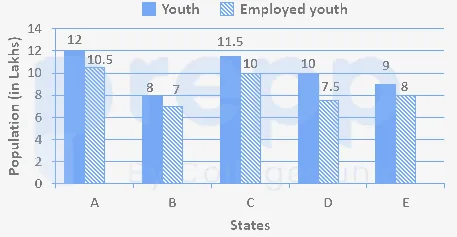
- A
57 ∶ 49
- B
8 ∶ 7
- C
65 ∶ 59
- D
65 ∶ 49
Show answer
D. 65 ∶ 49Given:
The following bar graph shows the total number of youth (in lakhs) and the number of employed youth (in lakhs) in states A, B, C, D and E.
Calculation:
T he number of youth in states A, C, and E (in lakhs) = 12 + 11.5 + 9 = 32.5
T he number of employed youth in states B, C, and D (in lakhs) = 7 + 10 + 7.5 = 24.5
The ratio = 32.5 : 24.5 = 325 : 245 = 65 : 49
∴ The ratio of the number of youth in states A, C and E taken together to the number of employed youth in states B, C and D taken together is 65 : 49
Paper & answer key PDF ↗ Question 62archived
Find the value of the following expression:
\(\frac{5-35\div 5 \times 15 + 5}{12-2}\)
- A
-9.5
- B
-13.5
- C
-2.5
- D
11.5
Show answer
A. -9.5Evaluating Mathematical Expressions using BODMAS
To find the value of the given expression, we need to follow the order of operations, commonly known as BODMAS or PEMDAS. This rule dictates the sequence in which mathematical operations should be performed:
Brackets (or Parentheses)
Orders (or Exponents)
Division and Multiplication (from left to right)
Addition and Subtraction (from left to right)
The given expression is:
\(\frac{5-35\div 5 \times 15 + 5}{12-2}\)
We will evaluate the numerator and the denominator separately first.
Evaluating the Numerator
The numerator is \(5-35\div 5 \times 15 + 5\). Following the BODMAS rule:
Division: Perform the division \(35 \div 5\).
\(35 \div 5 = 7\)
The expression becomes: \(5 - 7 \times 15 + 5\)
Multiplication: Perform the multiplication \(7 \times 15\).
\(7 \times 15 = 105\)
The expression becomes: \(5 - 105 + 5\)
Addition and Subtraction: Perform addition and subtraction from left to right.
First, \(5 - 105\): \(5 - 105 = -100\)
The expression becomes: \(-100 + 5\)
Next, \(-100 + 5\): \(-100 + 5 = -95\)
So, the value of the numerator is \(-95\).
Evaluating the Denominator
The denominator is \(12 - 2\). Following the BODMAS rule:
Subtraction: Perform the subtraction \(12 - 2\).
\(12 - 2 = 10\)
So, the value of the denominator is \(10\).
Calculating the Final Value
Now, we divide the value of the numerator by the value of the denominator:
\(\frac{\text{Numerator}}{\text{Denominator}} = \frac{-95}{10}\)
Performing the division:
\(\frac{-95}{10} = -9.5\)
The value of the given expression is \(-9.5\).
Let's look at the options provided:
-9.5
-13.5
-2.5
11.5
Our calculated value, -9.5, matches the first option.
Revision Table: Order of Operations (BODMAS/PEMDAS)
Order
Mnemonic (BODMAS)
Mnemonic (PEMDAS)
Operations
1
Brackets
Parentheses
() , {} , []
2
Orders
Exponents
Powers, Square Roots
3
Division and Multiplication
Multiplication and Division
\(\div\) , \(\times\) (from left to right)
4
Addition and Subtraction
Addition and Subtraction
+ , - (from left to right)
Additional Information on Mathematical Expression Evaluation
When evaluating mathematical expressions, strictly adhering to the order of operations is crucial to arrive at the correct answer. Mistakes often happen when operations are performed out of sequence, especially with division and multiplication or addition and subtraction, which have equal priority and should be done from left to right as they appear in the expression.
For example, in the numerator \(5 - 35 \div 5 \times 15 + 5\), it's important to do \(35 \div 5\) first (7), then \(7 \times 15\) (105), before finally handling the addition and subtraction \((5 - 105 + 5)\). Doing \(5 - 35\) first or \(5 \times 15\) before division would lead to an incorrect result.
Understanding this hierarchy ensures consistent results regardless of who is evaluating the expression.
Paper & answer key PDF ↗ Question 63archived
The price of petrol shot up by 5%. Before the hike, the price was Rs. 82 per litr e. A man travels 3045 km every month and his car gives a mileage of 15 km per litr e. What is the increase in the monthly expenditure (to the nearest Rs.) on the man's travel due to the hike in the petrol prices?
- A
944
- B
859
- C
758
- D
832
Show answer
D. 832Calculating the Increase in Monthly Petrol Expenditure
This problem asks us to determine how much more a person spends on petrol each month after a price increase. We are given the initial price, the percentage increase, the total distance traveled monthly, and the car's fuel efficiency (mileage).
Step-by-Step Calculation of Petrol Cost Increase
Here’s how we can calculate the increase in monthly expenditure:
First, calculate the total amount of petrol consumed each month.
Next, calculate the initial monthly expenditure based on the initial price.
Then, calculate the new price of petrol after the hike.
Calculate the new monthly expenditure using the new price.
Finally, find the difference between the new expenditure and the initial expenditure to get the increase.
1. Calculate Monthly Petrol Consumption
The man travels 3045 km every month, and his car gives a mileage of 15 km per litre.
Monthly distance traveled = \(3045 \text{ km}\)
Car mileage = \(15 \text{ km/litre}\)
Total petrol consumed per month = \(\frac{\text{Monthly distance}}{\text{Mileage}}\)
Monthly petrol consumption = \(\frac{3045 \text{ km}}{15 \text{ km/litre}} = 203 \text{ litres}\)
2. Calculate Initial Monthly Expenditure
The initial price of petrol was Rs. 82 per litre.
Initial price per litre = Rs. \(82\)
Monthly petrol consumption = \(203 \text{ litres}\)
Initial monthly expenditure = Monthly petrol consumption × Initial price per litre
Initial monthly expenditure = \(203 \text{ litres} \times \text{Rs. } 82/\text{litre} = \text{Rs. } 16646\)
3. Calculate the New Price of Petrol
The price of petrol shot up by 5%.
Initial price per litre = Rs. \(82\)
Percentage increase = \(5\%\)
Increase in price per litre = \(5\%\) of Rs. \(82\)
Increase in price per litre = \(0.05 \times 82 = \text{Rs. } 4.10\)
New price per litre = Initial price per litre + Increase in price per litre
New price per litre = Rs. \(82\) + Rs. \(4.10\) = Rs. \(86.10\)
4. Calculate New Monthly Expenditure
Monthly petrol consumption = \(203 \text{ litres}\)
New price per litre = Rs. \(86.10\)
New monthly expenditure = Monthly petrol consumption × New price per litre
New monthly expenditure = \(203 \text{ litres} \times \text{Rs. } 86.10/\text{litre} = \text{Rs. } 17478.30\)
5. Calculate the Increase in Monthly Expenditure
Increase in monthly expenditure = New monthly expenditure - Initial monthly expenditure
Increase in monthly expenditure = Rs. \(17478.30\) - Rs. \(16646.00\) = Rs. \(832.30\)
Alternatively, we can directly calculate the total increase based on the increase per litre:
Increase per litre = Rs. \(4.10\)
Monthly petrol consumption = \(203 \text{ litres}\)
Total increase in monthly expenditure = Monthly petrol consumption × Increase in price per litre
Total increase in monthly expenditure = \(203 \text{ litres} \times \text{Rs. } 4.10/\text{litre} = \text{Rs. } 832.30\)
The increase in monthly expenditure is Rs. 832.30.
Rounding to the Nearest Rupee
The question asks for the increase rounded to the nearest Rupee. Rs. 832.30 rounded to the nearest Rupee is Rs. 832.
Therefore, the increase in the monthly expenditure due to the hike in petrol prices is approximately Rs. 832.
Description
Value
Monthly Distance Traveled
\(3045 \text{ km}\)
Car Mileage
\(15 \text{ km/litre}\)
Monthly Petrol Consumption
\(203 \text{ litres}\)
Initial Petrol Price
Rs. \(82\)/\text{litre}
Initial Monthly Expenditure
Rs. \(16646\)
Petrol Price Hike
\(5\%\)
Increase in Price per Litre
Rs. \(4.10\)/\text{litre}
New Petrol Price
Rs. \(86.10\)/\text{litre}
New Monthly Expenditure
Rs. \(17478.30\)
Increase in Monthly Expenditure
Rs. \(832.30\)
Increase (Rounded)
Rs. \(832\)
Revision Table: Key Concepts
Understanding the core components helps in solving such problems:
Mileage: The distance a vehicle can travel per unit of fuel. Formula: Distance / Fuel Consumed.
Expenditure: The total amount of money spent. Formula: Quantity Consumed × Price per Unit.
Percentage Increase: How much a value has increased in proportion to its original value, expressed as a percentage. Formula: \(\text{Original Value} \times \frac{\text{Percentage Increase}}{100}\).
Additional Information: Managing Fuel Costs
Fuel costs are a significant part of travel expenses. Understanding mileage and petrol prices is crucial for budgeting. A small percentage increase in price can lead to a noticeable increase in monthly expenditure, especially for frequent travelers. Calculating consumption and costs helps in monitoring and potentially reducing travel expenses by optimizing routes or improving mileage through maintenance and driving habits.
Paper & answer key PDF ↗ Question 64archived
The difference between the two perpendicular sides of a right-angled triangle is 17 cm and its area is 84 cm 2. What is the perimeter (in cm) of the triangle?
- A
36
- B
49
- C
56
- D
40
Show answer
C. 56Solving the Right-Angled Triangle Perimeter Problem
This problem involves finding the perimeter of a right-angled triangle given the difference between its perpendicular sides and its area. Let the lengths of the two perpendicular sides (the legs) of the right-angled triangle be \(a\) cm and \(b\) cm. We are given two key pieces of information:
The difference between the two perpendicular sides is 17 cm.
The area of the triangle is 84 cm\(^2\).
We can express these conditions mathematically.
Setting Up the Equations
Let's assume, without loss of generality, that \(a > b\). Then the first condition gives us:
\(a - b = 17 \quad (1)\)
The area of a right-angled triangle is given by the formula \(\frac{1}{2} \times \text{base} \times \text{height}\). In a right-angled triangle, the perpendicular sides serve as the base and height. So, the area is:
\(\text{Area} = \frac{1}{2}ab\)
We are given that the area is 84 cm\(^2\). Therefore:
\(\frac{1}{2}ab = 84\)
Multiplying both sides by 2, we get:
\(ab = 168 \quad (2)\)
Finding the Lengths of the Perpendicular Sides
Now we have a system of two equations with two variables \(a\) and \(b\):
\(a - b = 17\)
\(ab = 168\)
From equation (1), we can express \(a\) in terms of \(b\):
\(a = b + 17\)
Substitute this expression for \(a\) into equation (2):
\((b + 17)b = 168\)
Expand the left side:
\(b^2 + 17b = 168\)
Rearrange the equation into a standard quadratic form:
\(b^2 + 17b - 168 = 0\)
We need to solve this quadratic equation for \(b\). We can factor the quadratic expression. We look for two numbers that multiply to -168 and add up to 17. The numbers 24 and -7 satisfy these conditions (\(24 \times -7 = -168\) and \(24 + (-7) = 17\)).
So, we can factor the equation as:
\((b + 24)(b - 7) = 0\)
This gives two possible values for \(b\):
\(b + 24 = 0 \implies b = -24\)
\(b - 7 = 0 \implies b = 7\)
Since \(b\) represents the length of a side of a triangle, it must be a positive value. Therefore, we take \(b = 7\) cm.
Now we can find \(a\) using the relationship \(a = b + 17\):
\(a = 7 + 17 = 24\) cm.
So, the lengths of the two perpendicular sides are 7 cm and 24 cm.
Calculating the Hypotenuse Length
In a right-angled triangle, the relationship between the perpendicular sides (\(a\) and \(b\)) and the hypotenuse (\(c\)) is given by the Pythagorean theorem:
\(c^2 = a^2 + b^2\)
Substitute the values of \(a\) and \(b\) we found:
\(c^2 = 24^2 + 7^2\)
\(c^2 = 576 + 49\)
\(c^2 = 625\)
To find \(c\), take the square root of both sides:
\(c = \sqrt{625}\)
\(c = 25\) cm.
The lengths of the three sides of the triangle are 7 cm, 24 cm, and 25 cm.
Finding the Perimeter
The perimeter of a triangle is the sum of the lengths of its three sides. For this right-angled triangle with sides 7 cm, 24 cm, and 25 cm, the perimeter is:
\(\text{Perimeter} = a + b + c\)
\(\text{Perimeter} = 24 + 7 + 25\)
\(\text{Perimeter} = 31 + 25\)
\(\text{Perimeter} = 56\) cm.
Thus, the perimeter of the triangle is 56 cm.
Revision Table: Right Triangle Properties
Property
Formula
Description
Area of Right Triangle
\(\frac{1}{2} \times \text{base} \times \text{height}\)
Base and height are the perpendicular sides (legs).
Pythagorean Theorem
\(a^2 + b^2 = c^2\)
Relates the lengths of the two legs (\(a, b\)) to the hypotenuse (\(c\)).
Perimeter of Triangle
Sum of all sides
For a right triangle with sides \(a, b, c\), Perimeter = \(a + b + c\).
Additional Information on Right Triangles
Right-angled triangles are fundamental in geometry and trigonometry. Here are a few related points:
They have one angle exactly equal to 90 degrees.
The side opposite the right angle is always the longest side and is called the hypotenuse.
The other two sides are called legs or perpendicular sides.
Sets of integers that satisfy the Pythagorean theorem (\(a^2 + b^2 = c^2\)) are called Pythagorean triples. Examples include (3, 4, 5), (5, 12, 13), (8, 15, 17), and (7, 24, 25), which is the set we found in this problem.
Trigonometry functions (sine, cosine, tangent) are defined based on the ratios of the sides of a right-angled triangle.
Paper & answer key PDF ↗ Question 65archived
The ratio of the speeds of two trains is 2 : 7. If the first train runs 250 km in 5 hours, then the sum of the speeds (in km/h) of both the trains is:
- A
150
- B
225
- C
175
- D
250
Show answer
B. 225Calculating Train Speeds and Their Sum
This problem involves using the relationship between speed, distance, and time, and applying a given ratio to find the speeds of two trains and their sum.
Understanding the Problem
We are given:
The ratio of the speeds of two trains is 2 : 7.
The first train covers a distance of 250 km in 5 hours.
We need to find the sum of the speeds of both trains in km/h.
Step-by-Step Solution to Find the Sum of Speeds
Step 1: Calculate the speed of the first train
The formula relating speed, distance, and time is:
$ \text{Speed} = \frac{\text{Distance}}{\text{Time}} $
For the first train:
Distance = 250 km
Time = 5 hours
Speed of the first train $= \frac{250 \text{ km}}{5 \text{ hours}}$
Speed of the first train $= 50 \text{ km/h}$
Step 2: Use the speed ratio to find the speeds
The ratio of the speeds of the two trains is given as 2 : 7.
Let the speeds of the two trains be $2x$ and $7x$ km/h, where $x$ is a common factor.
We know the speed of the first train is 50 km/h. So, we can set up the equation:
$ 2x = 50 \text{ km/h} $
Now, solve for $x$:
$ x = \frac{50}{2} $
$ x = 25 $
Now we can find the speed of the second train using $7x$:
Speed of the second train $= 7x = 7 \times 25 \text{ km/h}$
Speed of the second train $= 175 \text{ km/h}$
Step 3: Calculate the sum of the speeds
The sum of the speeds of both trains is the speed of the first train plus the speed of the second train.
Sum of speeds $= (\text{Speed of first train}) + (\text{Speed of second train})$
Sum of speeds $= 50 \text{ km/h} + 175 \text{ km/h}$
Sum of speeds $= 225 \text{ km/h}$
The sum of the speeds of both the trains is 225 km/h.
Summary of Speed Calculations
Item
Calculation
Result (km/h)
Speed of First Train
$ \frac{250}{5} $
50
Value of $x$ (from $2x=50$)
$ \frac{50}{2} $
25
Speed of Second Train
$ 7 \times 25 $
175
Sum of Speeds
$ 50 + 175 $
225
Revision Table: Key Concepts
Concept
Description
Formula/Example
Speed
The rate at which distance is covered over time.
$ \text{Speed} = \frac{\text{Distance}}{\text{Time}} $
Ratio
A comparison of two quantities. A ratio $a:b$ means the first quantity is $a$ parts and the second is $b$ parts of a whole.
Example: Speed ratio 2:7 means for every 2 units of speed of the first train, the second train has 7 units.
Additional Information: Speed, Distance, and Time
The relationship between speed, distance, and time is fundamental in physics and many quantitative problems. It can be rearranged to find any of the three quantities if the other two are known.
To find Distance: $ \text{Distance} = \text{Speed} \times \text{Time} $
To find Time: $ \text{Time} = \frac{\text{Distance}}{\text{Speed}} $
Understanding ratios is also crucial. When a ratio is given, it often represents parts of a total or relationships between quantities. Introducing a variable like $x$ helps in solving for the actual values when one value corresponding to a part of the ratio is known.
In this problem, the speed of the first train corresponded to the '2 parts' of the 2:7 ratio, allowing us to find the value of one 'part' ($x=25$), and subsequently the speed corresponding to the '7 parts' for the second train.
Paper & answer key PDF ↗ Question 66archived
A trader sells an article for Rs. 425 and loses 15%. At what price (in Rs.) should he sell the article to earn 5% profit?
- A
525
- B
510
- C
505
- D
445
Show answer
A. 525Understanding Profit and Loss Calculations
This problem involves calculating the original cost price of an article based on a given selling price and loss percentage, and then determining the new selling price required to achieve a desired profit percentage.
Let's break down the steps to solve this profit and loss problem.
Step 1: Calculate the Cost Price (CP)
We are given that the trader sells the article for Rs. 425 and incurs a loss of 15%. The selling price (SP) when there is a loss is related to the cost price (CP) by the formula:
\( \text{SP} = \text{CP} \times \left( \frac{100 - \text{Loss\%}}{100} \right) \)
We know SP = 425 and Loss% = 15. We need to find CP.
Substituting the given values:
\( 425 = \text{CP} \times \left( \frac{100 - 15}{100} \right) \)
\( 425 = \text{CP} \times \left( \frac{85}{100} \right) \)
Now, we can rearrange the formula to find CP:
\( \text{CP} = 425 \times \left( \frac{100}{85} \right) \)
We can simplify this calculation:
\( \text{CP} = \frac{42500}{85} \)
Dividing 42500 by 85:
\( \text{CP} = 500 \)
So, the cost price of the article is Rs. 500.
Step 2: Calculate the New Selling Price for 5% Profit
Now the trader wants to sell the article to earn a 5% profit on the cost price (CP). The new selling price (New SP) when there is a profit is related to the cost price (CP) by the formula:
\( \text{New SP} = \text{CP} \times \left( \frac{100 + \text{Profit\%}}{100} \right) \)
We know CP = 500 and the desired Profit% = 5. We need to find the New SP.
Substituting the values:
\( \text{New SP} = 500 \times \left( \frac{100 + 5}{100} \right) \)
\( \text{New SP} = 500 \times \left( \frac{105}{100} \right) \)
We can simplify this calculation:
\( \text{New SP} = 5 \times 105 \)
\( \text{New SP} = 525 \)
Therefore, the trader should sell the article for Rs. 525 to earn a 5% profit.
Summary of Calculations
Parameter
Value
Initial Selling Price (SP)
Rs. 425
Loss Percentage
15%
Calculated Cost Price (CP)
Rs. 500
Desired Profit Percentage
5%
Required New Selling Price (New SP)
Rs. 525
To summarize, we first used the initial selling price and loss percentage to find the cost price. Once the cost price was determined, we used the desired profit percentage to calculate the new selling price.
Revision Table: Key Concepts
Term
Definition
Formula
Cost Price (CP)
The price at which an article is bought.
-
Selling Price (SP)
The price at which an article is sold.
-
Profit
SP > CP
Profit = SP - CP
Loss
SP < CP
Loss = CP - SP
Profit %
Percentage of profit on CP.
\( \text{Profit\%} = \left( \frac{\text{Profit}}{\text{CP}} \right) \times 100 \)
Loss %
Percentage of loss on CP.
\( \text{Loss\%} = \left( \frac{\text{Loss}}{\text{CP}} \right) \times 100 \)
SP (with Profit)
Selling price when there is a profit.
\( \text{SP} = \text{CP} \times \left( \frac{100 + \text{Profit\%}}{100} \right) \)
SP (with Loss)
Selling price when there is a loss.
\( \text{SP} = \text{CP} \times \left( \frac{100 - \text{Loss\%}}{100} \right) \)
Additional Information on Profit and Loss
Profit and loss calculations are fundamental in commercial mathematics. They help traders and businesses determine the viability of selling goods at certain prices.
Profit occurs when the selling price is higher than the cost price. The difference is the profit amount.
Loss occurs when the selling price is lower than the cost price. The difference is the loss amount.
Profit or loss percentages are almost always calculated with respect to the cost price unless otherwise stated.
Understanding these basic formulas allows you to solve various problems involving changes in selling price due to desired profit or incurred loss.
This specific problem is a typical example where you need to work backwards from a selling price with a loss to find the cost price, and then work forwards from the cost price to find a new selling price with a desired profit.
Paper & answer key PDF ↗ Question 67archived
A tangent is drawn from a point P to a circle, which meets the circle at T such that PT = 10.5 cm. A secant PAB intersects the circle in points A and B. If PA = 7 cm, what is the length (in cm) of the chord AB?
- A
7.75
- B
8.5
- C
8.75
- D
8.45
Show answer
C. 8.75Calculating Chord Length using the Tangent-Secant Theorem
This problem involves a tangent and a secant drawn from an external point to a circle. We are given the length of the tangent segment and the external part of the secant segment and need to find the length of the chord segment.
Understanding the Tangent-Secant Theorem
The relationship between a tangent and a secant drawn from the same external point to a circle is described by the Tangent-Secant Theorem, which is a case of the Power of a Point Theorem. The theorem states:
If a tangent segment is drawn from an external point P to a circle, meeting the circle at point T, and a secant segment is drawn from the same point P intersecting the circle at points A and B, then the square of the length of the tangent segment is equal to the product of the lengths of the whole secant segment and its external part.
Mathematically, this is expressed as $\text{PT}^2 = \text{PA} \times \text{PB}$.
Applying the Theorem to Find the Chord Length
In this problem, we are given:
Length of the tangent segment PT = 10.5 cm.
Length of the external part of the secant PA = 7 cm.
We need to find the length of the chord AB.
The length of the whole secant segment PB is the sum of the external part PA and the internal part (chord) AB. So, $\text{PB} = \text{PA} + \text{AB}$.
Substituting the given values into the Tangent-Secant Theorem formula:
$\text{PT}^2 = \text{PA} \times \text{PB}$
$(10.5)^2 = 7 \times (7 + \text{AB})$
Step-by-Step Calculation
First, calculate the square of PT:
$(10.5)^2 = 10.5 \times 10.5 = 110.25$
Now, substitute this value back into the equation:
$110.25 = 7 \times (7 + \text{AB})$
Distribute the 7 on the right side:
$110.25 = 7 \times 7 + 7 \times \text{AB}$
$110.25 = 49 + 7 \times \text{AB}$
Subtract 49 from both sides to isolate the term with AB:
$110.25 - 49 = 7 \times \text{AB}$
$61.25 = 7 \times \text{AB}$
Now, divide both sides by 7 to find the length of AB:
$\text{AB} = \frac{61.25}{7}$
Performing the division:
$\text{AB} = 8.75$
So, the length of the chord AB is 8.75 cm.
Summary of Results
Parameter
Value (cm)
Tangent length (PT)
10.5
Secant external part (PA)
7
Whole secant length (PB = PA + AB)
7 + AB
Calculated Chord Length (AB)
8.75
Using the Tangent-Secant Theorem $\text{PT}^2 = \text{PA} \times \text{PB}$, we found that $\text{AB} = 8.75$ cm.
Revision Table: Circle Theorems
Theorem
Description
Formula
Tangent-Secant Theorem
The square of the tangent segment from an external point equals the product of the whole secant segment and its external part.
$\text{PT}^2 = \text{PA} \times \text{PB}$
Secant-Secant Theorem
If two secants are drawn from an external point P, intersecting the circle at A, B and C, D respectively, then $\text{PA} \times \text{PB} = \text{PC} \times \text{PD}$.
$\text{PA} \times \text{PB} = \text{PC} \times \text{PD}$
Intersecting Chords Theorem
If two chords intersect inside a circle, the product of the segments of one chord equals the product of the segments of the other chord.
$\text{AE} \times \text{EB} = \text{CE} \times \text{ED}$ (where chords AB and CD intersect at E)
Additional Information: Power of a Point
The Tangent-Secant Theorem is a specific case of a more general concept called the Power of a Point Theorem with respect to a circle. For any point P and any circle, if a line through P intersects the circle at points A and B, the product $\text{PA} \times \text{PB}$ is constant, regardless of the line chosen (as long as it intersects the circle). This constant value is called the power of point P with respect to the circle.
If P is outside the circle, $\text{PA} \times \text{PB} = d^2 - r^2$, where $d$ is the distance from P to the center and $r$ is the radius. The Tangent-Secant theorem $\text{PT}^2 = \text{PA} \times \text{PB}$ arises because for a tangent, points A and B coincide at T, making $\text{PT} \times \text{PT} = \text{PA} \times \text{PB}$.
If P is inside the circle (as in the Intersecting Chords Theorem), the product of the segments is also constant, equal to $r^2 - d^2$. In this case, $\text{PA} \times \text{PB}$ is constant for any line through P.
These theorems are fundamental in understanding the geometric properties of circles and lines intersecting them.
Paper & answer key PDF ↗ Question 68archived
Monthly expenditure of a family on different heads is shown in the following pie chart.
What is the percentage of family earnings spent on rent?
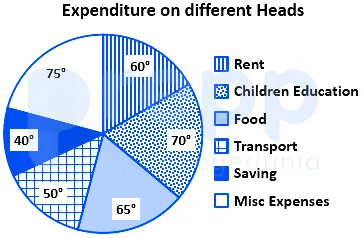
- A
\(15\frac{3}{4}\)
- B
15
- C
\(16\frac{2}{3}\)
- D
\(16\frac{1}{3}\)
Show answer
C. \(16\frac{2}{3}\)Given:
Total angle for the spent on rent = 60°
Concept used:
The total angle of a circle around the center = 360°
Calculation:
The percentage of spending on rent = (60/360) × 100
= 100/6 %
= \(16\frac{2}{3}\)%
∴ T he percentage of family earnings spent on rent is \(16\frac{2}{3}\) %
Paper & answer key PDF ↗ Question 69archived
If x + y + z = 11, xy + yz + zx = -6, and x 3 + y 3+ z 3 = 1604, then the value of xyz is:
- A
5
- B
4
- C
1
- D
25
Show answer
D. 25Solving for xyz using Algebraic Identities
This problem requires us to find the value of the product \(xyz\) given the sum of the variables, the sum of their products taken two at a time, and the sum of their cubes. We can solve this by using fundamental algebraic identities.
Given Information
We are given the following equations:
The sum: \(x + y + z = 11\)
The sum of products of pairs: \(xy + yz + zx = -6\)
The sum of cubes: \(x^3 + y^3 + z^3 = 1604\)
Our goal is to find the value of \(xyz\).
Key Algebraic Identities
Two important algebraic identities will help us solve this problem:
The square of the sum: \((x + y + z)^2 = x^2 + y^2 + z^2 + 2(xy + yz + zx)\)
The sum of cubes identity: \(x^3 + y^3 + z^3 - 3xyz = (x + y + z)(x^2 + y^2 + z^2 - xy - yz - zx)\)
Notice that the second identity can be rewritten using the sum of products term:
\(x^3 + y^3 + z^3 - 3xyz = (x + y + z)(x^2 + y^2 + z^2 - (xy + yz + zx))\)
Step-by-Step Solution
Step 1: Find the value of \(x^2 + y^2 + z^2\)
We use the first identity: \((x + y + z)^2 = x^2 + y^2 + z^2 + 2(xy + yz + zx)\). We know \(x + y + z = 11\) and \(xy + yz + zx = -6\).
Substitute the known values into the identity:
\(11^2 = x^2 + y^2 + z^2 + 2(-6)\)
\(121 = x^2 + y^2 + z^2 - 12\)
Now, solve for \(x^2 + y^2 + z^2\):
\(x^2 + y^2 + z^2 = 121 + 12\)
\(x^2 + y^2 + z^2 = 133\)
Step 2: Use the sum of cubes identity to find \(xyz\)
We use the identity: \(x^3 + y^3 + z^3 - 3xyz = (x + y + z)(x^2 + y^2 + z^2 - (xy + yz + zx))\). We know:
\(x^3 + y^3 + z^3 = 1604\)
\(x + y + z = 11\)
\(x^2 + y^2 + z^2 = 133\) (from Step 1)
\(xy + yz + zx = -6\)
Substitute these values into the identity:
\(1604 - 3xyz = (11)(133 - (-6))\)
\(1604 - 3xyz = 11(133 + 6)\)
\(1604 - 3xyz = 11(139)\)
Calculate the product \(11 \times 139\):
\(11 \times 139 = 11 \times (140 - 1) = 11 \times 140 - 11 \times 1 = 1540 - 11 = 1529\)
So the equation becomes:
\(1604 - 3xyz = 1529\)
Step 3: Solve for \(xyz\)
Rearrange the equation to isolate \(3xyz\):
\(3xyz = 1604 - 1529\)
Perform the subtraction:
\(1604 - 1529 = 75\)
So, we have:
\(3xyz = 75\)
Finally, divide by 3 to find \(xyz\):
\(xyz = \frac{75}{3}\)
\(xyz = 25\)
Conclusion
Based on the given values and using algebraic identities, the value of \(xyz\) is 25.
Revision Table: Algebraic Identities
Identity
Formula
Square of a sum of three terms
\((a+b+c)^2 = a^2+b^2+c^2+2(ab+bc+ca)\)
Sum of cubes
\(a^3+b^3+c^3-3abc = (a+b+c)(a^2+b^2+c^2-ab-bc-ca)\)
Alternative form of sum of cubes
\(a^3+b^3+c^3-3abc = (a+b+c)\left(\frac{1}{2}((a-b)^2 + (b-c)^2 + (c-a)^2)\right)\) (Useful if \(a+b+c=0\))
Additional Information: Applications of Algebraic Identities
Algebraic identities are powerful tools used in various areas of mathematics. They help simplify complex expressions and solve equations. Here are some applications:
Factoring Polynomials: Identities like the difference of squares or sum/difference of cubes help factor polynomials easily.
Simplifying Expressions: They are used to simplify complex algebraic expressions, making calculations easier.
Solving Equations: Identities can transform equations into simpler forms that are easier to solve.
Calculus: Used in differentiation and integration to simplify functions.
Trigonometry: Many trigonometric identities are based on algebraic principles.
Competitive Exams: Proficiency in using these identities is crucial for solving problems quickly in various math competitions.
Paper & answer key PDF ↗ Question 70archived
What is the remainder when the product of 335, 608 and 853 is divided by 13?
- A
11
- B
6
- C
12
- D
7
Show answer
D. 7Finding the Remainder of a Product When Divided by 13
The question asks for the remainder when the product of 335, 608, and 853 is divided by 13. To solve this problem, we can use the properties of modular arithmetic. A key property states that the remainder of a product is the same as the remainder of the product of the individual remainders.
Mathematically, if $a \equiv r_1 \pmod{n}$ and $b \equiv r_2 \pmod{n}$, then $a \times b \equiv r_1 \times r_2 \pmod{n}$. We can extend this property to the product of three or more numbers.
Step-by-Step Calculation of Remainders
We will first find the remainder of each number when divided by 13.
Finding the Remainder of 335 divided by 13:
To find the remainder of 335 when divided by 13, we perform division:
$$335 \div 13$$
We find that $13 \times 20 = 260$ and $13 \times 5 = 65$. So, $13 \times 25 = 260 + 65 = 325$.
The difference is $335 - 325 = 10$.
Thus, $335 = 13 \times 25 + 10$.
The remainder when 335 is divided by 13 is 10.
In modular arithmetic notation, $335 \equiv 10 \pmod{13}$.
Finding the Remainder of 608 divided by 13:
Next, we find the remainder of 608 when divided by 13:
$$608 \div 13$$
We can estimate $13 \times 40 = 520$. The difference is $608 - 520 = 88$.
$13 \times 6 = 78$.
So, $608 = 13 \times 40 + 88 = 13 \times 40 + 13 \times 6 + 10 = 13 \times (40 + 6) + 10 = 13 \times 46 + 10$.
The remainder when 608 is divided by 13 is 10.
In modular arithmetic notation, $608 \equiv 10 \pmod{13}$.
Finding the Remainder of 853 divided by 13:
Finally, we find the remainder of 853 when divided by 13:
$$853 \div 13$$
We can estimate $13 \times 60 = 780$. The difference is $853 - 780 = 73$.
$13 \times 5 = 65$.
So, $853 = 13 \times 60 + 73 = 13 \times 60 + 13 \times 5 + 8 = 13 \times (60 + 5) + 8 = 13 \times 65 + 8$.
The remainder when 853 is divided by 13 is 8.
In modular arithmetic notation, $853 \equiv 8 \pmod{13}$.
Calculating the Remainder of the Product
Now, we multiply the individual remainders we found and then find the remainder of this product when divided by 13.
The remainders are 10, 10, and 8.
Product of remainders = $10 \times 10 \times 8 = 100 \times 8 = 800$.
Now we find the remainder when 800 is divided by 13:
$$800 \div 13$$
We can estimate $13 \times 60 = 780$. The difference is $800 - 780 = 20$.
$13 \times 1 = 13$.
The difference is $20 - 13 = 7$.
So, $800 = 13 \times 60 + 20 = 13 \times 60 + 13 \times 1 + 7 = 13 \times (60 + 1) + 7 = 13 \times 61 + 7$.
The remainder when 800 is divided by 13 is 7.
Therefore, the remainder when the product of 335, 608, and 853 is divided by 13 is 7.
Summary of Remainders
Number
Division by 13
Remainder (modulo 13)
335
$335 = 13 \times 25 + 10$
$335 \equiv 10 \pmod{13}$
608
$608 = 13 \times 46 + 10$
$608 \equiv 10 \pmod{13}$
853
$853 = 13 \times 65 + 8$
$853 \equiv 8 \pmod{13}$
Final Remainder Calculation
Product of remainders: $10 \times 10 \times 8 = 800$.
Remainder of product of remainders when divided by 13:
$800 \div 13$, Remainder is 7.
$800 \equiv 7 \pmod{13}$.
So, the remainder when the product $335 \times 608 \times 853$ is divided by 13 is 7.
$335 \times 608 \times 853 \equiv 10 \times 10 \times 8 \pmod{13}$
$335 \times 608 \times 853 \equiv 800 \pmod{13}$
$335 \times 608 \times 853 \equiv 7 \pmod{13}$
Revision Table: Remainder of Product by 13
Key Steps for Finding Product Remainder
Concept
Description
Application to Problem
Modular Arithmetic
System of arithmetic for integers, where numbers "wrap around" upon reaching a certain value (the modulus).
Used to work with remainders.
Product Rule for Remainders
Remainder of $(a \times b) \div n$ is the same as Remainder of $((a \div n \text{ Remainder}) \times (b \div n \text{ Remainder})) \div n$.
Breaks down the problem of finding the remainder of a large product into smaller steps.
Individual Remainders
Finding $a \pmod n$, $b \pmod n$, etc.
Calculated for 335, 608, and 853 when divided by 13.
Product of Individual Remainders
Multiplying the remainders found in the previous step.
Calculated as $10 \times 10 \times 8 = 800$.
Final Remainder
Finding the remainder of the product of individual remainders when divided by the modulus (13).
Calculated as $800 \div 13$ Remainder, which is 7.
Additional Information: Properties of Modular Arithmetic
Modular arithmetic is a fundamental concept in number theory and is very useful for problems involving remainders. Here are some basic properties:
Addition Property: If $a \equiv r_1 \pmod n$ and $b \equiv r_2 \pmod n$, then $a + b \equiv r_1 + r_2 \pmod n$.
Subtraction Property: If $a \equiv r_1 \pmod n$ and $b \equiv r_2 \pmod n$, then $a - b \equiv r_1 - r_2 \pmod n$. (Note: If $r_1 - r_2$ is negative, add the modulus $n$ to get a non-negative remainder).
Multiplication Property: If $a \equiv r_1 \pmod n$ and $b \equiv r_2 \pmod n$, then $a \times b \equiv r_1 \times r_2 \pmod n$. (This is the property used in our solution).
Exponentiation Property: If $a \equiv r \pmod n$, then $a^k \equiv r^k \pmod n$ for any non-negative integer $k$.
These properties allow us to perform arithmetic operations on the remainders instead of the original numbers, which simplifies calculations, especially with large numbers.
Paper & answer key PDF ↗ Question 71archived
The given bar graph shows exports of cars of type A and B (in Rs millions) from 2014 to 2018.
Study the graph and answer the question that follows.
What is the ratio of the total exports of cars of type A in 2014 and 2018 to the total exports of cars of type B in 2015 and 2017?
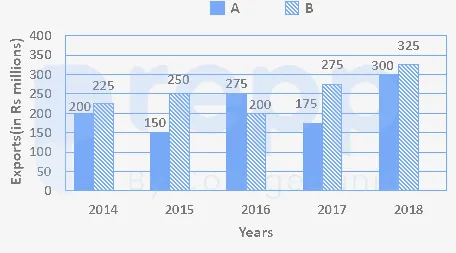
- A
5 ∶ 4
- B
20 ∶ 21
- C
10 ∶ 9
- D
13 ∶ 12
Show answer
B. 20 ∶ 21Given:
The given bar graph shows exports of cars of type A and B (in Rs millions) from 2014 to 2018.
Calculation:
T he total exports of cars of type A in 2014 and 2018 (in Rs millions) = 200 + 300 = 500
T he total exports of cars of type B in 2015 and 2017 (in Rs millions) = 250 + 275 = 525
The ratio = 500 : 525 = 20 : 21
∴ The ratio of the total exports of cars of type A in 2014 and 2018 to the total exports of cars of type B in 2015 and 2017 is 20 : 21
Paper & answer key PDF ↗ Question 72archived
A, B and C can do a work in 8, 10 and 12 days, respectively. After completing the work together, they received Rs. 5,550. What is the share of B (in Rs.) in the amount received?
- A
1,800
- B
1,696
- C
1,500
- D
1,850
Show answer
A. 1,800Given:
A, B, and C can do a work in 8, 10, and 12 days, respectively.
Total amount received = Rs. 5550
Concept used:
Efficiency or wages ratio ∝ 1/Time taken
Calculation:
A, B, and C can do a work in 8, 10, and 12 days, respectively.
The ratio = 8 : 10 : 12
The efficiency ratio of A, B, and C = 1/8 : 1/10 : 1/12
= 15 : 12 : 10
So, their wages ratio = 15 : 12 : 10
The share of B = (12/37) × 5550 = Rs. 1800
∴ Th e share of B (in Rs.) in the amount received is Rs. 1800
Paper & answer key PDF ↗ Question 73archived
What is the difference in the volume (in cm 3) of a sphere of radius 7 cm and that of a cone of radius 7 cm and height 10 cm? (Use π = \(\frac{22}{7}\) )
- A
205
- B
704
- C
1078
- D
924
Show answer
D. 924Understanding the Problem: Volume Difference
The question asks us to find the difference in volume between two geometric shapes: a sphere and a cone. We are given the dimensions for both shapes and asked to use a specific value for π.
Formulas for Volume Calculation
To solve this problem, we need the formulas for the volume of a sphere and the volume of a cone:
Volume of a sphere: \( V_{sphere} = \frac{4}{3} \pi r^3 \)
Volume of a cone: \( V_{cone} = \frac{1}{3} \pi r^2 h \)
Where:
\( r \) is the radius
\( h \) is the height
\( \pi \) is the mathematical constant (given as \(\frac{22}{7}\))
Calculating the Volume of the Sphere
Given:
Radius of the sphere \( r = 7 \) cm
\( \pi = \frac{22}{7} \)
Using the formula for the volume of a sphere:
\( V_{sphere} = \frac{4}{3} \pi r^3 \)
Substitute the given values:
\( V_{sphere} = \frac{4}{3} \times \frac{22}{7} \times (7 \text{ cm})^3 \)
\( V_{sphere} = \frac{4}{3} \times \frac{22}{7} \times 7 \times 7 \times 7 \text{ cm}^3 \)
Cancel out one 7 from the denominator and the numerator:
\( V_{sphere} = \frac{4}{3} \times 22 \times 7 \times 7 \text{ cm}^3 \)
\( V_{sphere} = \frac{4}{3} \times 22 \times 49 \text{ cm}^3 \)
\( V_{sphere} = \frac{88}{3} \times 49 \text{ cm}^3 \)
\( V_{sphere} = \frac{4312}{3} \text{ cm}^3 \)
Calculating the Volume of the Cone
Given:
Radius of the cone \( r = 7 \) cm
Height of the cone \( h = 10 \) cm
\( \pi = \frac{22}{7} \)
Using the formula for the volume of a cone:
\( V_{cone} = \frac{1}{3} \pi r^2 h \)
Substitute the given values:
\( V_{cone} = \frac{1}{3} \times \frac{22}{7} \times (7 \text{ cm})^2 \times 10 \text{ cm} \)
\( V_{cone} = \frac{1}{3} \times \frac{22}{7} \times 7 \times 7 \times 10 \text{ cm}^3 \)
Cancel out one 7 from the denominator and the numerator:
\( V_{cone} = \frac{1}{3} \times 22 \times 7 \times 10 \text{ cm}^3 \)
\( V_{cone} = \frac{1}{3} \times 1540 \text{ cm}^3 \)
\( V_{cone} = \frac{1540}{3} \text{ cm}^3 \)
Calculating the Difference in Volume
The difference in volume is the volume of the sphere minus the volume of the cone:
Difference \( = V_{sphere} - V_{cone} \)
Difference \( = \frac{4312}{3} \text{ cm}^3 - \frac{1540}{3} \text{ cm}^3 \)
Since both volumes have the same denominator, we can subtract the numerators directly:
Difference \( = \frac{4312 - 1540}{3} \text{ cm}^3 \)
Difference \( = \frac{2772}{3} \text{ cm}^3 \)
Now, perform the division:
\( 2772 \div 3 \)
\( 2772 \div 3 = 924 \)
So, the difference in volume is \( 924 \text{ cm}^3 \).
Conclusion
The difference in the volume of the sphere and the cone is 924 cm\(^3\).
Shape
Radius (r)
Height (h)
Formula
Calculated Volume
Sphere
7 cm
N/A
\( \frac{4}{3} \pi r^3 \)
\( \frac{4312}{3} \) cm\(^3\)
Cone
7 cm
10 cm
\( \frac{1}{3} \pi r^2 h \)
\( \frac{1540}{3} \) cm\(^3\)
Difference
-
-
\( V_{sphere} - V_{cone} \)
\( 924 \) cm\(^3\)
Revision Table: Key Volume Formulas
Shape
Volume Formula
Variables
Sphere
\( \frac{4}{3} \pi r^3 \)
r = radius
Cone
\( \frac{1}{3} \pi r^2 h \)
r = radius, h = height
Cylinder
\( \pi r^2 h \)
r = radius, h = height
Cube
\( a^3 \)
a = side length
Cuboid
\( l \times w \times h \)
l = length, w = width, h = height
Additional Information: Understanding Volume
Volume is a measure of the three-dimensional space occupied by a solid object or shape. It is typically measured in cubic units, such as cubic centimeters (cm\(^3\)), cubic meters (m\(^3\)), or cubic inches (in\(^3\)).
Understanding volume formulas is crucial in geometry and various real-world applications, such as calculating the capacity of containers, the amount of material needed for construction, or the space occupied by objects.
In this problem, we compared the volumes of two shapes with related dimensions. Notice that the radius of the sphere and the base radius of the cone are the same (7 cm). This shared dimension simplifies the calculation of the difference because the volumes share a common factor (\( \frac{1}{3} \pi r^2 \)).
The value of π is a mathematical constant representing the ratio of a circle's circumference to its diameter. While its value is irrational and goes on infinitely without repeating, common approximations include 3.14, 3.14159, or the fraction \( \frac{22}{7} \), which is often used in calculations for simplicity, especially when dealing with multiples of 7.
Paper & answer key PDF ↗ Question 74archived
The marked price of an article is Rs. 625. After allowing a discount of 32% on the marked price, there was a profit of Rs. 25. The profit percentage (correct to the nearest integer) is:
- A
7%
- B
4%
- C
5%
- D
6%
Show answer
D. 6%Understanding Profit and Loss Calculations
This problem involves calculating the profit percentage after a discount is applied to the marked price of an article. We are given the marked price, the discount percentage, and the actual profit made. We need to find the cost price and then the profit percentage.
Step 1: Calculate the Discount Amount
The discount is given as a percentage of the marked price. The marked price is Rs. 625 and the discount rate is 32%.
Discount Amount $$= \text{Discount Percentage} \times \text{Marked Price}$$
Discount Amount $$= \frac{32}{100} \times 625$$
Discount Amount $$= 0.32 \times 625$$
Discount Amount $$= 200$$
So, the discount allowed is Rs. 200.
Step 2: Calculate the Selling Price (SP)
The selling price is the price at which the article is sold after the discount is applied to the marked price.
Selling Price $$= \text{Marked Price} - \text{Discount Amount}$$
Selling Price $$= 625 - 200$$
Selling Price $$= 425$$
The article was sold for Rs. 425.
Step 3: Calculate the Cost Price (CP)
We know the selling price and the profit made. Profit is the difference between the selling price and the cost price.
Profit $$= \text{Selling Price} - \text{Cost Price}$$
We are given that the Profit is Rs. 25. We can rearrange the formula to find the Cost Price:
Cost Price $$= \text{Selling Price} - \text{Profit}$$
Cost Price $$= 425 - 25$$
Cost Price $$= 400$$
The cost price of the article is Rs. 400.
Step 4: Calculate the Profit Percentage
The profit percentage is calculated on the cost price.
Profit Percentage $$= \left( \frac{\text{Profit}}{\text{Cost Price}} \right) \times 100\%$$
Profit Percentage $$= \left( \frac{25}{400} \right) \times 100\%$$
Profit Percentage $$= \left( \frac{1}{16} \right) \times 100\%$$
Profit Percentage $$= 0.0625 \times 100\%$$
Profit Percentage $$= 6.25\%$$
Step 5: Round to the Nearest Integer
The question asks for the profit percentage correct to the nearest integer.
Rounding 6.25% to the nearest integer gives 6%.
Therefore, the profit percentage is approximately 6%.
Revision Table: Key Concepts
Concept
Formula
Selling Price (with Discount)
Marked Price - Discount Amount
Discount Amount
$$ \frac{\text{Discount \%}}{100} \times \text{Marked Price} $$
Cost Price (from SP and Profit)
Selling Price - Profit
Profit Percentage
$$ \left( \frac{\text{Profit}}{\text{Cost Price}} \right) \times 100\% $$
Additional Information: Profit and Loss Basics
Cost Price (CP): The price at which an article is purchased.
Selling Price (SP): The price at which an article is sold.
Marked Price (MP): The price printed on the label of an article; also known as the list price.
Discount: A reduction in the marked price, usually offered to attract customers. Discount is always calculated on the marked price.
Profit: Occurs when Selling Price > Cost Price. Profit = SP - CP.
Loss: Occurs when Selling Price < Cost Price. Loss = CP - SP.
Profit/Loss Percentage: Always calculated on the Cost Price unless stated otherwise.
Understanding these basic terms and formulas is crucial for solving problems related to profit, loss, discount, and marked price.
Paper & answer key PDF ↗ Question 75archived
At present, A is younger than B by 8 years. If 4 years ago, their ages were in the ratio 1 ∶ 2, then what is the present age of B (in years)?
- A
12
- B
20
- C
11
- D
18
Show answer
B. 20Understanding the Age Word Problem
This problem involves the ages of two people, A and B, at different points in time: the present and 4 years ago. We are given the age difference between them now and the ratio of their ages 4 years ago. Our goal is to find the present age of B.
Setting Up the Equations for the Age Problem
Let's use variables to represent their present ages:
Let the present age of A be \(A\) years.
Let the present age of B be \(B\) years.
We are given two conditions:
At present, A is younger than B by 8 years.
4 years ago, their ages were in the ratio 1 ∶ 2.
Let's translate these conditions into mathematical equations.
Condition 1: Present Age Difference
A is 8 years younger than B. This means the difference between B's age and A's age is 8 years.
\(B - A = 8\)
We can express A's age in terms of B's age from this equation:
\(A = B - 8\) (Equation 1)
Condition 2: Age Ratio 4 Years Ago
First, let's determine their ages 4 years ago:
A's age 4 years ago was \(A - 4\) years.
B's age 4 years ago was \(B - 4\) years.
The ratio of their ages 4 years ago was 1 ∶ 2. This can be written as a fraction:
\(\frac{A - 4}{B - 4} = \frac{1}{2}\) (Equation 2)
Solving the System of Equations to Find Present Age
Now we have a system of two equations with two variables (\(A\) and \(B\)):
\(A = B - 8\)
\(\frac{A - 4}{B - 4} = \frac{1}{2}\)
We can substitute the expression for \(A\) from Equation 1 into Equation 2.
Substitute \(A = B - 8\) into \(\frac{A - 4}{B - 4} = \frac{1}{2}\):
\(\frac{(B - 8) - 4}{B - 4} = \frac{1}{2}\)
Simplify the numerator:
\(\frac{B - 12}{B - 4} = \frac{1}{2}\)
Now, we can cross-multiply to solve for \(B\):
\(2 \times (B - 12) = 1 \times (B - 4)\)
\(2B - 24 = B - 4\)
Collect the \(B\) terms on one side and the constant terms on the other side:
\(2B - B = 24 - 4\)
\(B = 20\)
So, the present age of B is 20 years.
Verifying the Solution
Let's check if this value of B satisfies the original conditions.
If B's present age is 20, then A's present age (using \(A = B - 8\)) is \(20 - 8 = 12\) years.
4 years ago, A's age was \(12 - 4 = 8\) years.
4 years ago, B's age was \(20 - 4 = 16\) years.
The ratio of their ages 4 years ago was A:B = \(8:16\).
Simplify the ratio \(8:16\) by dividing both numbers by their greatest common divisor, which is 8:
\(\frac{8}{8} : \frac{16}{8} = 1 : 2\)
The ratio 4 years ago is 1:2, which matches the second condition given in the problem. The age difference now is \(20 - 12 = 8\), which matches the first condition.
Both conditions are satisfied, confirming that the present age of B is 20 years.
The present age of B is 20 years.
Revision Table: Key Steps in Solving Age Problems
Step
Description
Application in this Problem
1
Define variables for present ages.
Let A's present age = \(A\), B's present age = \(B\).
2
Translate present age conditions into equations.
A is 8 yrs younger than B → \(B - A = 8\).
3
Express past/future ages using the defined variables.
4 years ago: A's age = \(A - 4\), B's age = \(B - 4\).
4
Translate past/future age conditions (like ratios) into equations.
Ratio 4 yrs ago was 1:2 → \(\frac{A - 4}{B - 4} = \frac{1}{2}\).
5
Solve the system of equations.
Substitute \(A = B - 8\) into the ratio equation and solve for \(B\).
6
Verify the solution with the original conditions.
Check if A's age (\(B-8\)) and the past ages satisfy the ratio.
Additional Information: Solving Age Problem Concepts
Age problems are common in quantitative aptitude. They typically involve setting up linear equations based on given conditions about ages at different times (past, present, future).
Representing Ages: Always start by defining variables, usually for the present ages.
Handling Time Shifts: If a condition refers to an age \(x\) years ago, subtract \(x\) from the present age. If it refers to an age \(y\) years from now, add \(y\) to the present age. This applies to everyone mentioned in the problem.
Forming Equations: Use the relationships given (differences, sums, ratios, products) to form equations involving the ages at the specified times.
Solving Equations: Use substitution or elimination methods to solve the system of equations and find the unknown ages.
Checking the Answer: Always plug the calculated ages back into the original problem statement to ensure all conditions are met.
Ratio problems, like the one discussed, often lead to fractional equations that can be solved by cross-multiplication.
Paper & answer key PDF ↗ Question 76archived
The following sentence has been split into four segments. Identify the segment that contains a grammatical error.
My house / is more / spacious than / my sister.
- A
is more
- B
spacious than
- C
My house
- D
my sister
Show answer
D. my sisterThe correct answer is my sister.
Example: The climate of Mumbai is hotter than that of Delhi. (Comparing climate to climate) Example: The problems of today are different from those of the past. (Comparing problems to problems) Identifying faulty comparisons is a common task in grammar error questions. Always check if the items on either side of the comparison (using words like 'than' or 'as') are logically comparable.
Paper & answer key PDF ↗ Question 77archived
The following sentence has been divided into parts. One of them contains an error. Select the part that contains the error from the given options.
He was / late / for school / and punished.
- A
for school
- B
and punished
- C
late
- D
He was
Show answer
B. and punishedThe correct answer is and punished.
(Both use same verb form) In the sentence "He was late for school and punished," the first part is "He was late." The second part should ideally mirror this structure if it describes another state or passive action connected by "and". "He was punished" is the parallel structure for the consequence. Part 1: He was late (Subject + 'to be' verb + adjective) Part 2: (He) was punished (Subject (implied He) + 'to be' verb + past participle - passive voice) Omitting the second "was" breaks this parallel structure and makes the sentence grammatically unsound.
Paper & answer key PDF ↗ Question 78archived
Select the most appropriate synonym of the given word.
Duo
- A
Debt
- B
Loan
- C
Pair
- D
Bond
Show answer
C. PairThe correct answer is Pair.
Regularly practicing vocabulary through reading and exercises helps solidify learning. Use new words in sentences to understand their context. Explore antonyms for a fuller understanding. Group words by meaning or topic.
Paper & answer key PDF ↗ Question 79archived
Select the most appropriate meaning of the given idiom.
Foul play
- A
A bad smelling theatre or playground
- B
Unfair or dishonest behaviour
- C
Unpleasant weather for playing
- D
A drama which is badly produced
Show answer
B. Unfair or dishonest behaviourUnderstanding idioms requires learning their figurative meanings, as literal interpretations are often misleading. Key points about idioms: Their meaning is not the sum of the meanings of their individual words. They are often culturally specific. Learning idioms helps improve fluency and comprehension of native English speakers. Mastering idioms like "Foul play" enhances your understanding of nuanced communication.
Paper & answer key PDF ↗ Question 80archived
Sentences of a paragraph are given below in jumbled order. Arrange the sentences in the correct order to form a meaningful and coherent paragraph.
A. However, when areas in Leh began to experience water shortages, life didn’t grind to a halt.
B. Ladakh is a cold desert with a low average annual rainfall.
C. Thus, glaciers have been the main source of water for the people.
D. This was because Chewang Norphel, a retired civil engineer came up with the idea of artificial glaciers.
- A
BCDA
- B
BCAD
- C
DABC
- D
CBDA
Show answer
B. BCADThe correct answer is BCAD.
Additional Information: Artificial Glaciers Artificial glaciers, also known as "Ice Stupas," are a technique developed by Chewang Norphel and later improved by Sonam Wangchuk. They are created by freezing stream water in layers during winter, forming cone-shaped ice mounds. These melt gradually in spring and summer, providing water for irrigation and other uses in dry regions like Ladakh, especially critical as natural glaciers recede due to climate change. This sustainable water management solution has significantly benefited communities facing water scarcity.
Paper & answer key PDF ↗ Question 81archived
Select the option that can be used as a one-word substitute for the given group of words.
Formally put an end to a system, practice, or institution
- A
Stop
- B
Abolish
- C
Destroy
- D
Kill
Show answer
B. AbolishThe question asks for a single word that can replace the phrase "Formally put an end to a system, practice, or institution". We need to look at the given options and determine which one best fits this specific meaning.
Understanding the Key Phrase: Formally Ending Systems
The phrase "Formally put an end to a system, practice, or institution" implies an official action taken to terminate something established. This isn't just stopping something temporarily or destroying it physically. It's about ending it through a legal or official process.
Analyzing the Options for One-Word Substitute
Let's examine each option:
Stop: This word means to cease movement or operation, or to prevent someone or something from continuing. While it means ending something, it doesn't necessarily imply the formality or the specific context of systems, practices, or institutions. For example, you stop a car, or stop talking.
Abolish: This word means to formally put an end to (a system, practice, or institution). This definition precisely matches the phrase provided in the question. It is used for things like slavery, laws, or institutions.
Destroy: This word means to end the existence of something by damaging or attacking it. While destruction ends something, it usually implies physical ruin or rendering something unusable, which is different from formally ending an official system or practice.
Kill: This word means to cause the death of a person, animal, or plant. It is used in a biological context and is not appropriate for systems, practices, or institutions.
Identifying the Correct One-Word Substitute
Comparing the definitions, the word that exactly matches the meaning of "Formally put an end to a system, practice, or institution" is Abolish.
Therefore, Abolish is the correct one-word substitute.
Here is a summary:
Word
Meaning
Fits the Phrase?
Stop
Cease operation or movement
No (Too general, lacks formality/context)
Abolish
Formally put an end to a system, practice, or institution
Yes
Destroy
End existence by damaging/ruining
No (Implies physical ruin, not formal ending)
Kill
Cause death (biological)
No (Not applicable to systems/practices)
Revision Table: One-Word Substitutes for Ending
Phrase / Concept
One-Word Substitute
Formally put an end to a system, practice, or institution
Abolish
Stop doing something
Cease
Destroy something completely
Annihilate
Cancel or postpone a meeting or event
Adjourn
Officially cancel a law or agreement
Repeal
Additional Information: Context of Abolish
The word "abolish" is commonly used in legal, historical, and political contexts. For instance:
A government might abolish a discriminatory law.
Countries might abolish slavery.
An organization might abolish a specific practice within its operations.
It signifies a decisive and official act of termination, distinct from simply stopping or destroying something informally.
Paper & answer key PDF ↗ Question 82archived
Select the most appropriate option to substitute the underlined segment in the given sentence. If there is no need to substitute it, select ‘No substitution required’.
I wish I were listening to my parents.
- A
have listened
- B
am listening
- C
No substitution required
- D
had listened
Show answer
D. had listenedUnderstanding 'Wish' Clauses for Expressing Regret
The question asks us to find the most appropriate substitute for the underlined segment "were listening" in the sentence "I wish I were listening to my parents." This sentence uses a 'wish' clause, which is used to express desires or regrets about situations that are unreal or different from reality.
The structure of 'wish' clauses depends on whether we are talking about a present situation, a past situation, or a future situation.
Wish + Past Simple: Used to express a desire for a present situation to be different. Example: I wish I were taller. (I am not taller now).
Wish + Past Continuous: Used to express a desire for a present action or state to be different. Example: I wish I were lying on a beach right now. (I am not lying on a beach now). The original sentence "I wish I were listening to my parents" fits this structure and could mean wishing you were currently in a situation where you are paying attention to them.
Wish + Past Perfect: Used to express regret about a past action or situation. Example: I wish I had studied harder. (I did not study harder in the past, and I regret it now). This structure is used for regretting something that happened or did not happen in the past.
Analyzing the Options
Let's look at the provided options:
have listened: This is the present perfect tense. Using the present perfect after 'wish' is generally not standard for expressing unreal conditions or regrets.
am listening: This is the present continuous tense. We do not use present tenses directly after 'wish' to talk about unreal situations or regrets.
No substitution required: The original sentence "I wish I were listening to my parents" is grammatically correct if it expresses a present unreal wish or regret about a current activity/state. However, the phrase "listening to my parents" often refers to following their advice over time, which is a past action. In this common context, expressing regret about not following past advice uses a different structure.
had listened: This is the past perfect tense. Using the past perfect after 'wish' expresses regret about a past action. "I wish I had listened to my parents" means "I regret that I did not listen to my parents in the past." This perfectly fits the common meaning of regretting past decisions where parental advice was ignored.
Selecting the Most Appropriate Substitution
While the original sentence "I wish I were listening to my parents" can be grammatically correct for a specific present context, the option "had listened" is the most appropriate substitution because it conveys regret about a past action (not listening to parents' advice in the past), which is a very common and likely intended meaning of such a sentence. The 'wish + past perfect' structure specifically handles regret about the past.
Therefore, substituting "were listening" with "had listened" changes the nuance from a present unreal wish about an ongoing action to a past regret about a completed action, which is a more probable meaning in typical scenarios involving wishing about parental advice.
The most appropriate option is had listened.
Revision Table: Wish Clause Summary
Structure
Meaning
Example
Wish + Past Simple
Present unreal wish
I wish I knew the answer.
Wish + Past Continuous
Present unreal wish about an action
I wish I were travelling now.
Wish + Past Perfect
Regret about a past action
I wish I had saved more money.
Wish + Would + Verb
Wishing someone/something would do something (often expressing impatience or desire for change)
I wish it would stop raining.
Additional Information: Expressing Regret
Besides 'wish + past perfect', there are other ways to express regret in English:
Regret + -ing: Regret doing something in the past. Example: I regret not listening to my parents.
Should have + Past Participle: Used to say that something was a good idea in the past, but you didn't do it. Example: I should have listened to my parents.
If only + Past Perfect: Similar to 'wish + past perfect', often more emphatic. Example: If only I had listened to my parents!
Understanding these different structures helps in accurately conveying the intended meaning, whether it's a present desire or a past regret.
Paper & answer key PDF ↗ Question 83archived
Select the option that expresses the given sentence in passive voice.
Do you trust me?
- A
Do I am trusted by you?
- B
Am I trusted by you?
- C
Do I was trusted by you?
- D
I am trusted by you.
Show answer
B. Am I trusted by you?For questions involving question words (like Who, What, Where, When, Why, How), the structure needs careful handling. For example, "Who wrote this book?" becomes "By whom was this book written?". In informal English, sometimes "get" is used instead of "be" to form the passive, e.g., "I get trusted by you". However, the standard form uses "be".
Paper & answer key PDF ↗ Question 84archived
Select the most appropriate option to fill in the blank.
She hardly works on weekends, ______?
- A
is she
- B
isn’t she
- C
does she
- D
doesn’t she
Show answer
C. does sheThe correct answer is does she.
Example: Nothing happened, did it? Something is wrong, isn't it? Understanding the main verb and any auxiliary verbs, as well as the subject and any negative words, is crucial for forming the correct tag question in English grammar. Pay special attention to negative adverbs like 'hardly', 'seldom', etc., as they change the meaning of a seemingly positive sentence structure.
Paper & answer key PDF ↗ Question 85archived
Select the most appropriate synonym of the given word.
Paranoid
- A
Trustful
- B
Convinced
- C
Committed
- D
Distrustful
Show answer
D. DistrustfulThe correct answer is Distrustful.
The degree of paranoia can vary, ranging from mild suspicion to a severe psychological condition. The synonym "distrustful" captures the core aspect of lacking trust which is central to paranoia. When choosing the best synonym, it's important to consider the context in which the word is used. However, in a general sense, "distrustful" is the most fitting option among those provided for "Paranoid".
Paper & answer key PDF ↗ Question 86archived
Select the most appropriate ANTONYM of the given word.
Rely
- A
Distrust
- B
Await
- C
Depend
- D
Move
Show answer
A. DistrustAntonyms: Words with opposite meanings. Understanding antonyms helps clarify the meaning of a word by showing what it is *not*. Context: The meaning of a word can sometimes depend on how it is used in a sentence. Always consider the context when determining the best synonym or antonym.
Paper & answer key PDF ↗ Question 87archived
The following sentence has been divided into parts. One of them may contain an error. Select the part that contains the error from the given options. If you don’t find any error, mark ‘No error’ as your answer.
It was a surprising / to receive the gift/ from my brother.
- A
from my brother
- B
to receive the gift
- C
No error
- D
It was a surprising
Show answer
D. It was a surprisingUnderstanding the Sentence and Finding the Grammar Error
The question asks us to identify the part of the sentence that contains a grammar error. The sentence is divided into three parts:
It was a surprising
to receive the gift
from my brother
We need to examine each part to see if it follows the rules of English grammar.
Analyzing Each Part of the Sentence
Let's look at each segment closely:
Part 1: It was a surprising
This part starts with "It was a". The article 'a' is used before singular countable nouns. It can also be used before an adjective if that adjective is followed by a singular countable noun (e.g., "a tall building", "a surprising result"). In this part, we have the adjective "surprising". However, "surprising" is not followed by a noun. The structure "It was a surprising" without a noun immediately following "surprising" is grammatically incomplete or incorrect in most standard sentence constructions, especially when followed by an infinitive phrase like "to receive the gift". We would typically say "It was surprising..." (without 'a') or "It was a surprising thing..." or "It was a surprising event...".
Part 2: to receive the gift
This is an infinitive phrase. Infinitive phrases can function as nouns, adjectives, or adverbs. In this sentence structure ("It was... to receive..."), the infinitive phrase often acts as the real subject or explains 'it'. This part is grammatically sound in its structure.
Part 3: from my brother
This is a prepositional phrase ("from" + noun phrase). Prepositional phrases typically function as adverbs or adjectives, providing more information about a verb, noun, or adjective. In this context, it tells us where the gift came from. This part is grammatically correct.
Identifying the Part with the Error
Based on our analysis, the error lies in the first part, "It was a surprising". The use of the article 'a' before the adjective "surprising" without a subsequent noun makes the phrase grammatically incorrect in this sentence structure. The article 'a' signals that a noun should follow, either directly or after an adjective modifying it. Since no noun follows "surprising", the construction is flawed.
A correct way to phrase this sentence would be "It was surprising to receive the gift from my brother." (removing 'a') or "It was a surprising gift to receive from my brother." (adding a noun 'gift' after surprising).
Therefore, the segment "It was a surprising" contains the grammatical error.
The part containing the error is: It was a surprising
Revision Table: Key Grammar Concepts
Grammar Concept
Explanation
Example
Articles (a/an)
Used before singular countable nouns. 'a' is used before consonant sounds, 'an' before vowel sounds.
a book, an apple
Used before adjectives modifying singular countable nouns.
a big house, an interesting story
Adjectives
Words that describe or modify nouns or pronouns.
happy (describes a person)
surprising (describes an event or result)
Infinitive Phrases
Start with 'to' followed by the base form of a verb. Can function as nouns, adjectives, or adverbs.
To err is human. (Noun - subject)
A place to rest. (Adjective - modifies place)
He came to help. (Adverb - modifies came)
Additional Information: Common Sentence Errors
Understanding common sentence errors can help you identify and correct mistakes in grammar. Some typical errors include:
Subject-Verb Agreement Errors: The verb does not agree in number with its subject (e.g., "He go" instead of "He goes").
Pronoun Agreement Errors: A pronoun does not agree in number, gender, or person with the noun it replaces (e.g., "Each student must bring their book" - should be "his or her book" in formal context, or rephrased).
Wrong Verb Tense: Using the incorrect tense of a verb for the context of the sentence.
Errors with Modifiers: Adjectives or adverbs are misplaced or modify the wrong word (e.g., "He saw a dog walking down the street with a telescope" - suggests the dog had a telescope).
Article Errors: Incorrect use or omission of 'a', 'an', or 'the'.
Sentence Fragments: Incomplete sentences that lack a subject or a verb or do not express a complete thought.
Run-On Sentences: Two or more independent clauses are joined incorrectly (e.g., without proper punctuation or conjunction).
In the given sentence, the error is related to the incorrect use of an article ('a') with an adjective ('surprising') without a following noun in that specific sentence structure.
Paper & answer key PDF ↗ Question 88archived
The following sentence has been divided into parts. One of them may contain an error. Select the part that contains the error from the given options. If you don’t find any error, mark ‘No error’ as your answer.
The fisheries sector / have grown significantly / in the last one year.
- A
The fisheries sector
- B
No error
- C
in the last one year
- D
have grown significantly
Show answer
D. have grown significantlyUnderstanding the Sentence and Finding the Grammar Error
The question asks us to identify the part of the given sentence that contains a grammatical error. The sentence provided is split into three parts:
The fisheries sector
have grown significantly
in the last one year
We need to examine each part to see if it follows the rules of English grammar.
Analyzing Subject-Verb Agreement
A common grammatical error is incorrect subject-verb agreement. This means the verb in a sentence must agree in number (singular or plural) with its subject. Let's identify the subject and the verb in this sentence.
The subject of the sentence is "The fisheries sector".
The main verb phrase is "have grown significantly".
Now, let's determine if the subject is singular or plural. The core noun of the subject is "sector". "Sector" is a singular noun, even though it refers to a collection of activities (fisheries). When a singular noun like "sector", "committee", "team", etc., is used as the subject, the verb should also be in the singular form.
The verb phrase is "have grown". The auxiliary verb "have" is used with plural subjects (or with 'I' and 'you'). For a singular subject, the auxiliary verb should be "has". For example:
They have grown. (Plural subject)
He has grown. (Singular subject)
The sector has grown. (Singular subject)
In the given sentence, the subject "The fisheries sector" is singular, but the verb "have grown" is plural. This is where the subject-verb agreement error occurs.
Identifying the Correct Verb Form
To correct the error, the plural verb "have grown" should be changed to the singular verb "has grown" to agree with the singular subject "The fisheries sector". The corrected sentence would be:
The fisheries sector has grown significantly in the last one year.
Pinpointing the Part with the Error
The part of the sentence that contains the incorrect verb "have grown" is "have grown significantly". Looking at the options provided:
The fisheries sector - This is the subject part, which is correct.
No error - This is incorrect because there is an error.
in the last one year - This is a time phrase, which is grammatically correct in this context.
have grown significantly - This is the verb phrase part, which contains the subject-verb agreement error.
Therefore, the part that contains the error is "have grown significantly".
Summary of Analysis
Sentence Part
Analysis
Error?
The fisheries sector
Subject, singular noun "sector".
No
have grown significantly
Verb phrase, auxiliary verb "have" is plural. Does not agree with singular subject.
Yes
in the last one year
Time phrase, correctly used.
No
Based on the analysis, the error lies in the verb phrase due to a mismatch in subject-verb agreement.
Conclusion
The sentence "The fisheries sector have grown significantly in the last one year" contains a grammatical error in the part "have grown significantly". The singular subject "The fisheries sector" requires the singular verb "has grown".
Revision Table: Subject-Verb Agreement
Subject Type
Verb Form Example
Singular Noun (e.g., sector, team, cat)
\( \text{The sector has grown.} \)
Plural Noun (e.g., sectors, teams, cats)
\( \text{The sectors have grown.} \)
Pronoun 'I'
\( \text{I have grown.} \)
Pronoun 'You'
\( \text{You have grown.} \)
Plural Pronouns (e.g., we, they)
\( \text{They have grown.} \)
Additional Information: Collective Nouns and Agreement
Collective nouns like 'sector', 'committee', 'team', 'government', 'family', 'audience', etc., can sometimes be treated as singular or plural depending on whether they are acting as a single unit or as individual members. In British English, treating them as plural is more common when referring to the members' actions. However, in American English (and often in general usage for clarity), they are usually treated as singular when referring to the entity as a whole. In the sentence "The fisheries sector have grown significantly", 'sector' refers to the overall entity growing, suggesting a singular treatment is appropriate and standard, especially in the context of a general statement about its growth.
When in doubt, treating collective nouns as singular is generally safer unless the context clearly indicates individual actions of the members are being discussed.
Paper & answer key PDF ↗ Question 89archived
Select the INCORRECTLY spelt word.
- A
Progress
- B
Mystery
- C
Symtoms
- D
Pilgrim
Show answer
C. SymtomsFinding the Incorrectly Spelled Word
This question asks us to identify the word that is spelt incorrectly among the given options. To do this, we need to examine each word and check its standard English spelling.
Analyzing Each Word for Correct Spelling
Let's look at each option provided:
Progress: This word refers to forward movement or development. The spelling "Progress" is the standard and correct spelling in English.
Mystery: This word refers to something that is difficult or impossible to understand or explain. The spelling "Mystery" is also the standard and correct spelling.
Symtoms: This word appears to be an attempt to spell "symptoms," which are indications of illness or a problem. The letter 'p' is missing after 'm'. Therefore, "Symtoms" is incorrectly spelt. The correct spelling is Symptoms.
Pilgrim: This word refers to a person who journeys to a sacred place for religious reasons. The spelling "Pilgrim" is the standard and correct spelling.
Based on our analysis, three of the words are spelt correctly: "Progress," "Mystery," and "Pilgrim." The word "Symtoms" is spelt incorrectly.
Summary of Spelling Check
Word as given
Correct Spelling?
Correct Spelling
Meaning
Progress
Yes
Progress
Forward movement or development
Mystery
Yes
Mystery
Something difficult to understand or explain
Symtoms
No
Symptoms
Indications of illness or a problem
Pilgrim
Yes
Pilgrim
Person on a religious journey
Therefore, the incorrectly spelt word is "Symtoms".
Revision Table: Common Spelling Errors
Understanding common spelling errors can help improve accuracy. Here's a quick revision:
Common Error
Correct Spelling
Notes
recieve
receive
'i' before 'e' except after 'c' (usually)
acommodate
accommodate
Double 'c', double 'm'
definately
definitely
Ends with '-itely'
seperate
separate
'a' before 'r'
untill
until
Only one 'l'
Additional Information: Improving Spelling Skills
Improving your spelling takes practice. Here are some tips:
Read regularly: Seeing words in context helps you remember their spelling.
Use a dictionary or spell checker: When unsure, check the correct spelling.
Learn common rules: Rules like 'i' before 'e' can be helpful, but remember exceptions.
Practice writing: The more you write, the more familiar you become with spellings.
Break words into syllables: This can make longer words easier to spell.
Create mnemonics: Use memory aids for tricky words (e.g., 'a rat in separate').
Regular practice and attention to detail are key to mastering English spelling.
Paper & answer key PDF ↗ Question 90archived
The following sentence has been split into four segments. Identify the segment that contains a grammatical error.
My elder brother,/ which you’ll / meet later,/ is a dentist.
- A
My elder brother
- B
which you’ll
- C
meet later
- D
is a dentist
Show answer
B. which you’llFinding Grammatical Errors in Sentences
Let's carefully examine the sentence provided and identify the segment that contains a grammatical error. The sentence is split into four parts:
My elder brother,/ which you’ll / meet later,/ is a dentist.
Analyzing Each Segment for Grammatical Accuracy
We will look at each segment in the context of the whole sentence:
Segment 1: My elder brother - This segment acts as the subject of the main clause. It is grammatically correct.
Segment 2: which you’ll - This segment begins a relative clause (which you’ll meet later) that describes "My elder brother". This clause is separated by commas, indicating it is a non-restrictive relative clause, providing additional information. The choice of the relative pronoun here needs scrutiny.
Segment 3: meet later - This is part of the relative clause, completing the action performed by "you" (implied subject in "you'll"). Grammatically correct within the context of the clause structure.
Segment 4: is a dentist - This segment is the predicate of the main clause, stating what the subject ("My elder brother") is. Grammatically correct.
Understanding Relative Pronouns: Which vs. Who
The error lies in the relative clause which you’ll meet later. This clause refers back to the subject, "My elder brother". In English grammar, relative pronouns are used to introduce relative clauses. The choice of pronoun depends on what the pronoun refers to:
Who/Whom: Used for people. 'Who' is used as the subject of the relative clause verb, and 'whom' is used as the object (though 'who' is often used informally for objects).
Which: Used for things or animals.
That: Can be used for people, things, or animals in restrictive clauses (clauses essential to the meaning of the sentence), but is generally not used for non-restrictive clauses (clauses providing extra, non-essential information, usually set off by commas).
In the given sentence, the relative clause refers to "My elder brother," who is a person. Therefore, the relative pronoun should be who, not which. The phrase "which you'll" should be "who you'll".
The sentence contains a grammatical error because it uses the relative pronoun 'which' to refer to a person ('My elder brother').
Conclusion on the Grammatical Error
Based on the analysis of relative pronouns, the segment containing the grammatical error is the one that uses 'which' to refer to a person. This is the segment which you’ll.
The corrected sentence would be: "My elder brother, who you'll meet later, is a dentist."
Sentence Segment
Analysis
Grammatical Status
My elder brother
Subject of the main clause (person)
Correct
which you’ll
Starts relative clause referring to a person, uses 'which'
Incorrect
meet later
Completes the relative clause
Correct
is a dentist
Predicate of the main clause
Correct
Revision Table: Key Grammar Points
Concept
Explanation
Example
Relative Pronouns
Words like who, whom, which, that, whose. Introduce relative clauses.
The person who called...; The car which broke down...
Using 'Who'
Refers to people.
The student, who studied hard, passed.
Using 'Which'
Refers to things or animals. Used for non-restrictive clauses (with commas) or restrictive clauses (sometimes without commas).
The book, which was old, was valuable. The dog which barked...
Non-restrictive Clause
Provides extra information, not essential to the meaning. Set off by commas. Cannot use 'that'.
My brother, who lives abroad, visited.
Additional Information: Grammar Tips
Identifying grammatical errors like incorrect relative pronoun usage is crucial for clear and accurate writing. Here are some additional tips:
Always check if a relative pronoun referring to a person is 'who' or 'whom', not 'which'.
Pay attention to commas around relative clauses. Commas signal a non-restrictive clause, which typically requires 'who' or 'which', not 'that', and the information can be removed without changing the sentence's core meaning.
Practice identifying the antecedent (the noun the pronoun refers to) to ensure pronoun agreement.
Read sentences aloud to sometimes catch awkward phrasing or incorrect structures.
Paper & answer key PDF ↗ Question 91archived
Select the option that expresses the given sentence in reported speech.
Mother said, “Abhinav slipped while trying to board a bus.”
- A
Mother told that Abhinav slipped while trying to board a bus.
- B
Mother says that Abhinav slipped while trying to board a bus.
- C
Mother said that Abhinav had slipped while trying to board a bus.
- D
Mother said that Abhinav slipped while trying to board a bus.
Show answer
C. Mother said that Abhinav had slipped while trying to board a bus.Understanding Reported Speech Conversion
Reported speech, also known as indirect speech, is used to tell someone what another person said without using their exact words. When converting direct speech into reported speech, several changes might occur, including changes in pronouns, tenses, time expressions, and place expressions. The reporting verb (like 'said', 'told', 'asked') plays a crucial role in determining these changes.
Analysing the Given Direct Speech Sentence
The original sentence in direct speech is:
“Mother said, “Abhinav slipped while trying to board a bus.””
Let's break down its components:
Reporting Verb: "said" (past tense)
Quoted Speech: "Abhinav slipped while trying to board a bus."
Verb in Quoted Speech: "slipped" (Simple Past tense)
Rules for Converting Direct Speech to Reported Speech
When the reporting verb is in the past tense, the tense of the verb in the reported speech usually changes. Here's the relevant rule for this sentence:
If the direct speech contains a verb in the Simple Past tense, it changes to the Past Perfect tense in reported speech.
The Simple Past tense of "slip" is "slipped". The Past Perfect tense of "slip" is "had slipped".
Step-by-Step Conversion
1. Identify the reporting verb and its tense: "said" - Past Tense.
2. Identify the verb in the direct speech and its tense: "slipped" - Simple Past Tense.
3. Since the reporting verb is in the past tense and the direct speech verb is in Simple Past, apply the rule: Simple Past changes to Past Perfect.
4. Convert "slipped" to its Past Perfect form: "had slipped".
5. Use a connective word, typically "that", to join the reporting clause and the reported clause.
6. Combine the parts: Mother said + that + Abhinav had slipped while trying to board a bus.
The resulting reported speech sentence is: "Mother said that Abhinav had slipped while trying to board a bus."
Evaluating the Options
Let's examine each provided option based on the conversion rules:
Mother told that Abhinav slipped while trying to board a bus.
Incorrect. While "told" can be a reporting verb, it usually requires an object (e.g., "Mother told me that..."). More importantly, the tense of "slipped" has not been correctly changed from Simple Past to Past Perfect.
Mother says that Abhinav slipped while trying to board a bus.
Incorrect. The reporting verb in the original sentence is "said" (past tense), but this option uses "says" (present tense). Also, the tense of "slipped" has not been changed correctly according to the rule for a past tense reporting verb.
Mother said that Abhinav had slipped while trying to board a bus.
Correct. The reporting verb "said" is used correctly. The verb "slipped" (Simple Past) has been correctly changed to "had slipped" (Past Perfect) as required when the reporting verb is in the past tense.
Mother said that Abhinav slipped while trying to board a bus.
Incorrect. While the reporting verb "said" is correct, the tense of "slipped" has not been changed from Simple Past to Past Perfect. When the reporting verb is in the past tense, the tense in the reported clause usually shifts.
Based on the rules of reported speech conversion, Option 3 correctly transforms the sentence from direct to reported speech by changing the Simple Past tense ('slipped') to the Past Perfect tense ('had slipped') because the reporting verb ('said') is in the past tense.
Direct Speech Tense
Reported Speech Tense (Reporting verb in past)
Simple Present (slip)
Simple Past (slipped)
Present Continuous (is slipping)
Past Continuous (was slipping)
Present Perfect (has slipped)
Past Perfect (had slipped)
Simple Past (slipped)
Past Perfect (had slipped)
Past Continuous (was slipping)
Past Perfect Continuous (had been slipping)
Simple Future (will slip)
Conditional (would slip)
Revision Table: Reported Speech Rules
Here is a quick look at the key elements involved in converting Direct to Reported Speech:
Reporting Verb: Check if it's in present or past tense. Past tense usually triggers tense changes in the reported clause.
Connective: Use 'that' for statements, 'if' or 'whether' for yes/no questions, and question words (who, what, where, etc.) for WH questions.
Pronoun Changes: Adjust pronouns (I, you, he, she, etc.) to reflect the change in speaker/listener perspective.
Tense Changes: Shift tenses backward (e.g., Present to Past, Past to Past Perfect) if the reporting verb is in the past.
Time/Place Changes: Change words like 'now' to 'then', 'here' to 'there', 'today' to 'that day', 'tomorrow' to 'the next day', etc.
Modal Verb Changes: Change 'will' to 'would', 'can' to 'could', 'may' to 'might', etc.
Additional Information on Reported Speech
Sometimes, the tense in the reported speech does not change even if the reporting verb is in the past tense. This happens in certain situations:
Universal Truths or Facts: If the direct speech states a universal truth or a fact, the tense remains unchanged.
Example: He said, "The Earth revolves around the sun." → He said that the Earth revolves around the sun.
Statements involving 'would', 'could', 'might', 'should', 'ought to': These modal verbs generally do not change in reported speech.
Example: She said, "I could swim when I was four." → She said that she could swim when she was four.
Unchanged Situation: If the direct speech talks about a situation that is still true or current at the time of reporting, the tense might remain the same (though changing it is also often acceptable).
Example: He said, "I live in Paris." (If he still lives in Paris) → He said that he lives in Paris. (or) He said that he lived in Paris.
Specific Time Reference: If the direct speech includes a specific past time reference (like 'yesterday', 'last week') and the action is clearly completed, the tense might not change, or the Past Perfect is used, but the time reference must change. The Past Perfect option is generally safer.
Example: He said, "I finished the task yesterday." → He said that he had finished the task the previous day. (Past Perfect used)
Less common: He said that he finished the task the previous day. (Simple Past sometimes allowed with specific past time reference if meaning is clear).
However, in the given sentence, "Abhinav slipped" refers to a completed action without a specific past time marker, making the Past Perfect shift ('had slipped') the standard and correct transformation when the reporting verb is in the past.
Paper & answer key PDF ↗ Question 92archived
Select the option that expresses the given sentence in active voice.
Hatred can be overcome by love.
- A
Love can overcome hatred.
- B
Love overcame hatred.
- C
Love has overcome hatred.
- D
Love is overcoming hatred.
Show answer
A. Love can overcome hatred.The correct answer is Love can overcome hatred.
Agent Identification: The agent in a passive sentence is the noun or pronoun that performs the action. It is often introduced by "by". If the agent is not mentioned (e.g., "Mistakes were made"), you might assume a general or unknown agent when converting to active voice (e.g., "Someone made mistakes"). However, in this question, the agent ("love") is clearly provided.
Paper & answer key PDF ↗ Question 93archived
Select the most appropriate ANTONYM of the given word.
Appal
- A
Assure
- B
Alarm
- C
Amaze
- D
Astound
Show answer
A. AssureFinding the Antonym of Appal
The question asks us to select the most appropriate antonym of the word "Appal". An antonym is a word that means the opposite of another word.
First, let's understand the meaning of the word "Appal".
Appal: To horrify, shock, or dismay someone. It means to cause someone to feel fear, dread, or deep disappointment.
Now, let's examine the given options:
Assure: To tell someone something positively to remove their doubts; to make someone confident about something; to relieve anxiety or fear.
Alarm: To make someone feel anxious, fearful, or apprehensive; to fill with apprehension.
Amaze: To surprise someone greatly; to fill them with wonder or astonishment.
Astound: To shock or greatly surprise; to astonish.
Let's compare the meaning of "Appal" with each option:
"Appal" involves causing fear, shock, or dismay. "Alarm" is very close in meaning, also involving causing fear or anxiety. Therefore, "Alarm" is a synonym or related word, not an antonym.
"Amaze" and "Astound" both involve surprise or astonishment. While strong emotions, they are not direct opposites of causing fear or dismay. One can be amazed or astounded in a positive or negative way, but appal is specifically negative, related to fear or horror.
"Assure" means to remove fear, doubt, or anxiety, making someone feel confident and secure. This is the direct opposite of causing fear, shock, or dismay ("Appal").
Therefore, the most appropriate antonym for "Appal" is "Assure".
Detailed Analysis of Options:
Word
Meaning
Relation to "Appal"
Appal
To horrify, shock, or dismay (cause fear/distress)
The base word
Assure
To make someone confident; relieve fear/anxiety
Opposite (Antonym)
Alarm
To cause fear or anxiety
Similar (Synonym/Related)
Amaze
To surprise greatly (can be positive or negative)
Different emotion, not a direct opposite
Astound
To shock or greatly surprise
Similar to Amaze, not a direct opposite
Based on this analysis, "Assure" is the only option that represents the opposite of causing fear, shock, or dismay which is the core meaning of "Appal".
Revision Table: Antonym of Appal
Word
Antonym
Synonyms
Appal
Assure
Horrify, shock, dismay, scare, fright, terrorize
Additional Information on Antonyms and Synonyms
Understanding antonyms and synonyms is crucial for building vocabulary and improving comprehension. Here's a little more about them:
Synonym: A word that has the same or nearly the same meaning as another word (e.g., happy and joyful). Synonyms help in varying language and providing emphasis.
Antonym: A word that has the opposite meaning of another word (e.g., hot and cold). Antonyms help in expressing contrasts and clarifying meaning.
Identifying antonyms often requires understanding the core meaning of a word and finding a word that expresses the complete opposite state, feeling, or action.
Some words may have multiple antonyms depending on the specific nuance of meaning being contrasted.
In the case of "Appal," its meaning is strongly tied to negative emotions like fear and dismay. "Assure" counteracts these feelings, providing confidence and relief, thus functioning as a clear antonym.
Paper & answer key PDF ↗ Question 94archived
Select the most appropriate meaning of the given idiom.
To take after
- A
To be similar in appearance
- B
To mock someone
- C
To chase someone
- D
To change sides often
Show answer
A. To be similar in appearanceAnswer: To be similar in appearance.
This is completely different from the meaning of "To take after." Option 3: To chase someone This phrase means to pursue someone, usually by running. Runs in the family: This refers to a characteristic (like a talent, a look, or even a medical condition) that is common among members of a family.
Paper & answer key PDF ↗ Question 95archived
Select the most appropriate option to fill in blank number 1.
- A
main
- B
most
- C
maximum
- D
utmost
Show answer
B. mostUnderstanding the Passage and the Blank
The passage describes an old man who is characterized by negativity. The sentence we need to focus on for blank (1) is: "He was one of the (1) ____ unfortunate people in the world." This sentence structure, "one of the ____ + adjective + plural noun," typically requires a superlative form to indicate the highest degree among a group.
Analyzing Options for Blank (1)
Let's examine the given options for filling blank number (1):
main
most
maximum
utmost
Evaluating Each Option
Option 1: main
'Main' means chief or primary. While the old man might be a 'main' unfortunate person, the phrase "one of the main unfortunate people" doesn't fit the grammatical structure needing a superlative for 'unfortunate'. 'Main' usually modifies a noun directly, like 'main reason' or 'main problem'.
Option 2: most
'Most' is used to form the superlative degree of many adjectives (especially those with two or more syllables) or to mean 'the greatest quantity or degree'. The phrase "one of the most unfortunate people" is a standard English construction using the superlative form ('most unfortunate') after "one of the" to mean he is among the very top in terms of being unfortunate.
Option 3: maximum
'Maximum' means the greatest amount, extent, or intensity. It's usually used with nouns (e.g., maximum speed, maximum effort) or as an adjective referring to a limit. "One of the maximum unfortunate people" is not grammatically correct or commonly used in English to express the highest degree of an adjective like 'unfortunate'.
Option 4: utmost
'Utmost' means of the greatest possible extent, amount, or degree. It is often used with abstract nouns (e.g., utmost importance, utmost care). While it expresses a high degree, "one of the utmost unfortunate people" is not the standard or grammatically correct way to form a superlative with 'unfortunate' in this context. 'Most unfortunate' is the correct superlative form.
Determining the Correct Word for Blank (1)
The sentence "He was one of the (1) ____ unfortunate people in the world" requires a word that, when combined with 'unfortunate', creates a superlative meaning – indicating he was among the most unfortunate among all people. The standard way to form the superlative of 'unfortunate' is 'most unfortunate'. Therefore, 'most' is the only option that correctly fits the grammatical structure and intended meaning of the sentence.
Conclusion for Blank (1)
Based on the analysis of the options and the grammatical requirement of the sentence, the most appropriate word to fill blank number (1) is 'most'. The phrase "one of the most unfortunate people" clearly conveys that he was among those who were highly unfortunate.
Blank Number
Sentence Part
Options Analyzed
Best Fit Option
Reasoning
1
one of the ____ unfortunate people
main, most, maximum, utmost
most
Required superlative form after 'one of the'; 'most unfortunate' is the correct superlative for 'unfortunate'.
Revision Table: Key Learnings from Passage Analysis
Concept
Application in Passage
Importance
Superlative Forms
Used with "one of the" (e.g., "one of the most unfortunate")
To indicate the highest degree within a group. Essential for accurate descriptions.
Adjective Usage
Understanding how adjectives like 'unfortunate' are modified
Choosing the correct word ('most') depends on knowing how to form the superlative of the adjective.
Sentence Structure
Recognizing the "one of the ____ + adjective + plural noun" pattern
This pattern guides the choice of a superlative word or phrase.
Additional Information: Forming Superlatives
Forming the superlative degree of adjectives is crucial for fill-in-the-blank questions involving comparisons or extremes. Here are some general rules:
One-syllable adjectives: Add '-est' (e.g., tall → tallest, short → shortest).
Two-syllable adjectives ending in -y: Change 'y' to 'i' and add '-est' (e.g., happy → happiest, easy → easiest).
Adjectives with two or more syllables (not ending in -y): Use 'most' before the adjective (e.g., beautiful → most beautiful, unfortunate → most unfortunate).
Irregular superlatives: Some adjectives have irregular superlative forms (e.g., good → best, bad → worst, far → farthest/furthest).
In the given sentence, 'unfortunate' has four syllables, so its superlative form is correctly created using 'most', leading to 'most unfortunate'.
Paper & answer key PDF ↗ Question 96archived
Select the most appropriate option to fill in blank number 2.
- A
at
- B
of
- C
from
- D
by
Show answer
B. ofUnderstanding the Passage and Filling Blank 2
The passage describes an old man who is extremely negative and makes the villagers around him feel weary. We need to select the most appropriate word to fill in blank number 2, which comes after the phrase "tired". The sentence is: "The whole village was tired (2) ____ him."
Analyzing the Options for Blank 2
Let's look at the given options and see how they fit grammatically and contextually with the word "tired":
at: The phrase "tired at" is not a standard idiomatic expression in English used to describe being weary or fed up with a person. You might be "tired at work" (tired while at work), but not "tired at someone".
of: The phrase "tired of" is a common idiom that means to be weary, bored, or annoyed with someone or something, to the point of wanting it to stop. For example, "I'm tired of waiting" or "She is tired of his complaints." This fits the context perfectly, as the villagers are annoyed or fed up with the old man's constant gloom and bad mood.
from: The phrase "tired from" is used to indicate the cause of physical or mental exhaustion. For example, "tired from running" or "tired from a long day." This does not fit the context of being annoyed or fed up with a person's behaviour.
by: The phrase "tired by" can sometimes be used similarly to "tired from" (e.g., "tired by the journey"), indicating a cause of exhaustion. However, it is less common than "tired from" in this sense and does not convey the meaning of being annoyed or weary of a person's nature or actions in the way "tired of" does.
Selecting the Most Appropriate Word
Based on the analysis, the phrase "tired of him" is the correct and idiomatic way to express that the whole village was weary, bored, or annoyed by the old man's negative attitude and behaviour. Therefore, "of" is the most appropriate word to fill blank number 2.
Completed Phrase
The completed phrase for blank 2 is: "tired of him"
Revision Table: Prepositions with Tired
Phrase
Meaning
Example Context
tired of
Weary, bored, or annoyed with someone/something
tired of the noise, tired of waiting, tired of his behaviour
tired from
Exhausted due to a cause
tired from working, tired from the long walk, tired from studying
tired by
Exhausted due to a cause (less common than 'from')
tired by the heat, tired by the effort
tired at
Tired while in a certain place or activity (not idiomatic for annoyance)
tired at the end of the day, tired at work
Additional Information: Idiomatic Expressions with Tired
English has several idiomatic expressions involving the word "tired" and different prepositions. It's important to learn these common phrases as they often have specific meanings that cannot be easily guessed from the individual words.
Tired of something/someone: This is used when you are fed up with a situation, activity, or person. It implies frustration or boredom.
Tired from something: This indicates that an activity or event has caused you to become physically or mentally exhausted.
Understanding the context of a sentence is crucial for choosing the correct preposition. In this passage, the context clearly indicates the villagers' frustration with the old man's constant negativity, which is best expressed by "tired of".
Paper & answer key PDF ↗ Question 97archived
Select the most appropriate option to fill in blank number 3.
- A
commonly
- B
mostly
- C
cyclically
- D
constantly
Show answer
D. constantlyAnalyzing Sentence Completion for Blank 3
The provided passage describes an old man whose persistent negativity affects the entire village. The task is to fill in the blank numbered (3) with the most suitable word that describes his complaining behavior.
Understanding the Context
The sentence in question is: "he (3) ____ complained and was always in a bad mood." The preceding sentence mentions that the man "was always gloomy". This sets a context of continuous, habitual negative behavior. We need a word that emphasizes the frequency and persistence of his complaining.
Evaluating Options for Blank 3
Let's examine each option provided for blank (3):
commonly: This adverb means 'often' or 'frequently'. While the man did complain often, 'commonly' might not fully capture the relentless nature suggested by the overall description.
mostly: This adverb means 'mainly' or 'for the most part'. It suggests that complaining was his primary activity, but it doesn't strongly convey the continuous aspect.
cyclically: This adverb means 'happening in a recurring pattern or cycle'. Complaining isn't usually described as cyclical unless a specific pattern is mentioned, which is not the case here. This option doesn't fit the context of habitual complaining.
constantly: This adverb means 'continuously', 'happening all the time', or 'very frequently'. Given the description that he was 'always gloomy' and 'always in a bad mood', 'constantly' best fits the idea that his complaining was persistent and seemed unending. It aligns perfectly with the continuous negative state described.
Selecting the Best Fit
Comparing the options, constantly most effectively conveys the persistent and continuous nature of the old man's complaining, aligning well with the surrounding descriptions of his perpetual gloom and bad mood.
Paper & answer key PDF ↗ Question 98archived
Select the most appropriate option to fill in blank number 4.
- A
long
- B
longer
- C
lengthy
- D
longest
Show answer
B. longerUnderstanding Passage Completion Questions
Passage completion questions test your ability to understand context, grammar, vocabulary, and sentence structure within a given text. You need to read the passage carefully, consider the meaning of the surrounding words, and choose the option that best fits grammatically and contextually into the blank space.
Analyzing the Passage and Blank 4
The passage describes an old man and his negative disposition. The sentence containing blank 4 reads: "The (4) _____ he lived, the more vile he was becoming and the more (5) ____ were his words."
Let's focus on the structure "The _____, the _____". This is a common English structure used to show that one thing changes or increases in proportion to another. It typically uses comparative adjectives or adverbs after "The". Examples include:
The hotter the weather, the more uncomfortable I feel.
The faster you run, the sooner you will finish.
The more you practice, the better you become.
In the given sentence, "The _____ he lived" describes the duration of his life. As this duration increased, his vileness and the unpleasantness of his words also increased ("the more vile he was becoming", "the more _____ were his words").
Evaluating Options for Blank 4
We need a word that fits the comparative structure "The _____, the _____" and relates to the duration of life ("he lived"). Let's look at the options:
long: This is the base form of the adjective/adverb. It does not fit the comparative structure "The long he lived...".
longer: This is the comparative form of 'long'. It fits the comparative structure "The longer he lived...". This implies that as the duration of his life became longer, his negative traits increased.
lengthy: This is an adjective meaning 'long'. It is not typically used in the "The _____, the _____" structure in this way. "The lengthy he lived..." sounds incorrect.
longest: This is the superlative form of 'long'. It means the greatest duration among several options or a group, which is not the meaning required here. The structure "The longest he lived..." doesn't fit the pattern showing proportional change over time.
Determining the Correct Option for Blank 4
Based on the analysis of the "The _____, the _____" comparative structure and the options provided, the word that correctly completes the sentence for blank 4 is 'longer'. It creates the meaning that as time passed and he lived for a longer period, his negative qualities worsened.
The completed phrase using the correct word is: "The longer he lived, the more vile he was becoming..."
Revision Table: Key Concepts
Concept
Explanation
Example
Comparative Structure
"The + comparative adjective/adverb, the + comparative adjective/adverb" shows proportional change.
The warmer the weather, the happier I am.
Comparative Adjectives/Adverbs
Used to compare two things (e.g., longer, faster, more difficult). Often end in -er or use 'more'.
This book is longer than that one.
He runs faster now.
Superlative Adjectives/Adverbs
Used to compare three or more things or show the greatest degree (e.g., longest, fastest, most difficult). Often end in -est or use 'most'.
This is the longest book I've read.
She runs the fastest in the team.
Additional Information on English Sentence Structures
Understanding different sentence structures is crucial for filling in blanks correctly. The "The _____, the _____" structure is a specific type of parallel construction. Other important structures include:
Subject-Verb-Object (Basic sentence structure)
Parallelism (Using similar grammatical forms for similar ideas)
Conditional sentences (Using 'if' clauses)
Relative clauses (Using 'who', 'which', 'that')
Recognizing these patterns helps predict the type of word (e.g., adjective, adverb, verb) and the correct form (e.g., base, comparative, superlative) needed to complete a sentence logically and grammatically.
Paper & answer key PDF ↗ Question 99archived
Select the most appropriate option to fill in blank number 5.
- A
mortal
- B
pleasant
- C
poisonous
- D
fatal
Show answer
C. poisonousUnderstanding the Passage and Blank 5
The question asks us to fill in blank number 5 in the given passage. The passage describes an old man who is consistently negative and unhappy. Let's read the relevant sentence carefully: "The more he lived, the more vile he was becoming and the more (5) ____ were his words." We need to choose a word that describes how his words were becoming worse or more harmful as he became more "vile".
Analyzing Options for Blank 5
Let's look at the options provided for blank number 5:
mortal
pleasant
poisonous
fatal
Now, let's consider the meaning of each option in the context of describing someone's words, especially words from a person described as "vile" and always complaining:
Mortal: This word usually relates to death or being subject to death. While negative, it doesn't directly describe the quality of harmful or malicious words spoken by a person.
Pleasant: This word means enjoyable, friendly, or attractive. This is the opposite of the tone used to describe the old man and his mood ("gloomy", "complained", "bad mood", "vile"). Therefore, his words would not be becoming more pleasant.
Poisonous: This word literally means containing poison. Figuratively, it means harmful, malicious, or destructive, especially when referring to words or influence. This fits the description of the old man becoming more "vile" and his words reflecting that negativity and potential to harm others emotionally.
Fatal: This word means causing death. Like "mortal", it's too strong and literal when describing the effect of someone's everyday words, even if they are very negative. "Poisonous" captures the figurative harm better.
Selecting the Most Appropriate Word
Considering the context of the passage, where the old man is becoming more "vile", the word that best describes his words as becoming increasingly harmful, malicious, or bitter is "poisonous". His negative state of mind manifests in his words, making them metaphorically harmful or toxic to listen to.
Final Check
Let's insert "poisonous" into the sentence: "The more he lived, the more vile he was becoming and the more poisonous were his words." This sentence makes sense in the context of the passage, reinforcing the image of a bitter, harmful old man whose words reflect his negativity.
Revision Table: Understanding Word Choice
Word
Meaning
Fit in Context (Blank 5)
mortal
Related to death; subject to death
Poor fit for describing malicious words.
pleasant
Enjoyable; friendly
Opposite meaning; poor fit.
poisonous
Containing poison; (figuratively) harmful, malicious, destructive
Good fit; describes words reflecting a "vile" nature.
fatal
Causing death
Too strong and literal; poor fit for general negative words.
Additional Information: Context Clues in Reading Comprehension
This question highlights the importance of using context clues in reading comprehension. When encountering a blank in a passage, you should:
Read the sentences before and after the blank.
Understand the overall tone and topic of the passage.
Look for words that describe the subject related to the blank (in this case, the old man's mood and character).
Consider the meaning of each option and how it fits grammatically and contextually into the sentence and the wider passage.
Eliminate options that clearly don't fit the meaning or tone.
Choose the option that best completes the sentence and maintains the logical flow and meaning of the passage.
In this case, words like "gloomy", "complained", "bad mood", and "vile" strongly suggest that the words spoken by the old man would be negative or harmful, leading us to choose "poisonous".
Paper & answer key PDF ↗ Question 100archived
Select the option that can be used as a one-word substitute for the given group of words.
Indifferent to pleasure and pain
- A
Lusty
- B
Prudent
- C
Cynic
- D
Stoic
Show answer
D. StoicBy focusing only on what is within our control and accepting what is not, Stoics aim to achieve tranquility and inner peace, becoming resilient against the ups and downs of life. This resilience manifests as an apparent indifference to external pleasure and pain, not because these sensations aren't felt, but because they are not allowed to disturb one's inner state or judgment.
Paper & answer key PDF ↗ Browser storage is unavailable. You can still browse and practise; progress will last for this visit.