Question 1archived
Select the letter-cluster from among the given options that can replaced the question mark (?) in the following series.
KYBA, FTEE, AOHI, VJKO, ?, LZQA
- A
QENU
- B
PFNU
- C
QEMI
- D
QDNI
Show answer
A. QENUUnderstanding Letter Series and Pattern Analysis
Letter series questions require identifying the specific pattern or rule that connects consecutive terms in the given sequence. This pattern can involve operations (addition, subtraction, multiplication, etc.) on the alphabetical position of the letters, sometimes with wrapping around the alphabet (A follows Z).
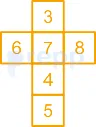
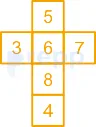
The given series is:
KYBA, FTEE, AOHI, VJKO, ?, LZQA
To find the missing term, we will analyze the pattern for each letter's position within the clusters separately.
Analyzing the Pattern for Each Letter Position
Let's assign numerical positions to each letter of the alphabet (A=1, B=2, ..., Z=26) and observe the changes from one cluster to the next.
First Letter Analysis (K, F, A, V, ?, L)
K is the 11th letter. F is the 6th letter. The change is \({6 - 11 = -5}\).
F is the 6th letter. A is the 1st letter. The change is \({1 - 6 = -5}\).
A is the 1st letter. V is the 22nd letter. The change is \({22 - 1}\) after wrapping around Z. Alternatively, \({1 - 5 = -4}\), which is equivalent to \({26 - 4 = 22}\) (V). So the change is -5.
V is the 22nd letter. The pattern appears to be consistently subtracting 5. So, the next letter should be at position \({22 - 5 = 17}\). The 17th letter is Q.
Let's check if Q leads to L in the next step: Q is the 17th letter. L is the 12th letter. The change is \({12 - 17 = -5}\).
The pattern for the first letter is indeed subtracting 5 from the alphabetical position in each step (with wrap-around).
So, the first letter of the missing cluster is Q.
Second Letter Analysis (Y, T, O, J, ?, Z)
Y is the 25th letter. T is the 20th letter. The change is \({20 - 25 = -5}\).
T is the 20th letter. O is the 15th letter. The change is \({15 - 20 = -5}\).
O is the 15th letter. J is the 10th letter. The change is \({10 - 15 = -5}\).
J is the 10th letter. The pattern appears to be consistently subtracting 5. So, the next letter should be at position \({10 - 5 = 5}\). The 5th letter is E.
Let's check if E leads to Z in the next step: E is the 5th letter. Z is the 26th letter. The change is \({26 - 5 = 21}\)? No, wrapping around. From E, subtracting 5 positions goes E > D > C > B > A > Z. So \({5 - 5 = 0}\), which corresponds to Z (or 26). The change is -5.
The pattern for the second letter is subtracting 5 from the alphabetical position in each step (with wrap-around).
So, the second letter of the missing cluster is E.
Third Letter Analysis (B, E, H, K, ?, Q)
B is the 2nd letter. E is the 5th letter. The change is \({5 - 2 = +3}\).
E is the 5th letter. H is the 8th letter. The change is \({8 - 5 = +3}\).
H is the 8th letter. K is the 11th letter. The change is \({11 - 8 = +3}\).
K is the 11th letter. The pattern appears to be consistently adding 3. So, the next letter should be at position \({11 + 3 = 14}\). The 14th letter is N.
Let's check if N leads to Q in the next step: N is the 14th letter. Q is the 17th letter. The change is \({17 - 14 = +3}\).
The pattern for the third letter is consistently adding 3 to the alphabetical position in each step.
So, the third letter of the missing cluster is N.
Fourth Letter Analysis (A, E, I, O, ?, A)
A is the 1st letter. E is the 5th letter. The change is \({5 - 1 = +4}\).
E is the 5th letter. I is the 9th letter. The change is \({9 - 5 = +4}\).
I is the 9th letter. O is the 15th letter. The change is \({15 - 9 = +6}\).
O is the 15th letter. The pattern seems to be +4, +4, then +6. Let's assume the +6 pattern continues. So, the next letter should be at position \({15 + 6 = 21}\). The 21st letter is U.
Let's check if U leads to A in the next step: U is the 21st letter. A is the 1st letter. Treating A as 27 (for wrap-around), the change is \({27 - 21 = +6}\). This matches the pattern of adding 6.
The pattern for the fourth letter is adding 4 for the first two steps, and then adding 6 for the subsequent steps (with wrap-around).
So, the fourth letter of the missing cluster is U.
Determining the Missing Letter Cluster
Combining the letters we found for each position:
First letter: Q
Second letter: E
Third letter: N
Fourth letter: U
The missing letter cluster is QENU.
Comparing with Options
Let's compare our derived cluster QENU with the given options:
Option
Letter Cluster
1
QENU
2
PFNU
3
QEMI
4
QDNI
Our derived cluster QENU matches Option 1.
Conclusion
By analyzing the independent patterns for each letter position within the given letter clusters, we determined that the sequence follows specific rules for addition or subtraction of alphabetical positions with wrap-around. The identified patterns are: First letter (-5), Second letter (-5), Third letter (+3), and Fourth letter (+4, +4, +6, +6, ...). Applying these patterns to the cluster VJKO yields the next cluster QENU.
Revision Table: Letter Series Patterns
Letter Position
Series
Pattern
1st
K(11), F(6), A(1), V(22), Q(17), L(12)
Subtract 5 (\(\mathbf{-5}\))
2nd
Y(25), T(20), O(15), J(10), E(5), Z(26)
Subtract 5 (\(\mathbf{-5}\))
3rd
B(2), E(5), H(8), K(11), N(14), Q(17)
Add 3 (\(\mathbf{+3}\))
4th
A(1), E(5), I(9), O(15), U(21), A(27/1)
Add 4 (\(\mathbf{+4}\)) twice, then Add 6 (\(\mathbf{+6}\)) thereafter
Additional Information: Solving Reasoning Series Questions
Solving reasoning series questions, especially those involving letters or alphanumeric combinations, often requires a systematic approach. Here are some tips:
Check Letter Positions: Convert letters to their numerical positions (A=1, B=2, etc.). This helps in identifying arithmetic patterns.
Look for Patterns in Differences/Ratios: Calculate the difference or ratio between consecutive terms' positions. The pattern might be constant, increasing, decreasing, or alternating.
Consider Multiple Layers: Sometimes, the pattern isn't in the terms themselves but in the differences between terms, or even the differences between the differences.
Wrap Around: Remember that the alphabet wraps around. Moving one step forward from Z leads to A, and one step backward from A leads to Z.
Analyze Each Element Separately: In letter-cluster or alphanumeric series, analyze the pattern for each letter position or number/symbol type independently.
Look for Common Patterns: Be familiar with common series patterns like arithmetic progression, geometric progression, squares, cubes, prime numbers, Fibonacci sequence, etc., applied to letter positions or values.
Check the Options: Use the options to verify the pattern you've identified. If your derived term matches an option and fits the pattern for the subsequent term (if given), you're likely correct.
Paper & answer key PDF ↗ Question 2archived
Pamila is the granddaughter of Akun who is married to Nikita. Murali is the brother-in-law of Akun who has two daughters but no son. Rahul is the cousin of Kamal and brother of Pamila. Uday and Vanmay are the sons-in-law of Nikita. Vanmay is married to Yamini and they have two daughters and one son. Uday has one son and one daughter. Tina and Smita are the daughters of Yamini. Murali is unmarried. How is Yamini related to Rahul?
- A
Daughter
- B
Aunt
- C
Sister
- D
Mother
Show answer
B. AuntUnderstanding Family Relationships: Akun, Nikita, and Rahul
This question asks us to determine the relationship between Yamini and Rahul based on a series of statements about a family. To solve this, we need to carefully read each statement and build a family tree or list the relationships as we deduce them.
Analyzing the Statements and Building the Family Tree
Let's break down the given information step-by-step:
Pamila is the granddaughter of Akun who is married to Nikita. This tells us Akun and Nikita are married and are the grandparents of Pamila.
Murali is the brother-in-law of Akun who has two daughters but no son. Since Akun has no son, Murali must be the brother of Akun's wife, Nikita. Akun and Nikita have two daughters. Let's call them Daughter 1 (D1) and Daughter 2 (D2).
Rahul is the cousin of Kamal and brother of Pamila. Pamila and Rahul are siblings. Since Pamila is a granddaughter of Akun and Nikita, Rahul is also a grandchild of Akun and Nikita. This means one of Akun's daughters is the parent of Pamila and Rahul. Rahul being Kamal's cousin implies Kamal is a child of the other daughter.
Uday and Vanmay are the sons-in-law of Nikita. Sons-in-law are husbands of daughters. So, Uday and Vanmay are married to Akun and Nikita's two daughters (D1 and D2).
Vanmay is married to Yamini and they have two daughters and one son. This explicitly names one of Akun's daughters as Yamini. So, let's say Yamini is D1. Yamini is married to Vanmay. Their children are two daughters (Tina, Smita) and one son. Based on the previous statement, this son must be Kamal (since Rahul is Kamal's cousin).
Uday has one son and one daughter. Uday must be married to the other daughter, D2. Their children are one son and one daughter. Since Pamila and Rahul are siblings and grandchildren of Akun/Nikita, they must be the children of Uday and D2. So, Rahul is the son and Pamila is the daughter of Uday and D2.
Tina and Smita are the daughters of Yamini. This confirms the children of Yamini and Vanmay.
Murali is unmarried. This confirms Murali's relationship as Nikita's brother, not through marriage to Akun's sister (which isn't possible as Akun has no siblings mentioned).
Consolidating the Family Structure
Based on the analysis, we can sketch the following family structure:
Grandparents:
Akun (Husband)
—
Nikita (Wife)
Siblings of Grandparents:
Murali (Nikita's Brother)
Children of Akun & Nikita:
Yamini (Daughter)
—
Daughter 2 (Let's call her D2)
Spouses of Daughters:
Vanmay (Married to Yamini)
—
Uday (Married to D2)
Grandchildren (Children of Yamini & Vanmay):
Tina (Daughter)
,
Smita (Daughter)
,
Kamal (Son)
Grandchildren (Children of D2 & Uday):
Rahul (Son)
,
Pamila (Daughter)
Determining the Relationship between Yamini and Rahul
We need to find out how Yamini is related to Rahul.
From our deductions, Rahul is the son of D2 and Uday.
Yamini is the daughter of Akun and Nikita, just like D2 is the daughter of Akun and Nikita.
This means Yamini is the sister of D2.
Since Rahul's mother is D2, and Yamini is D2's sister, Yamini is the sister of Rahul's mother.
The sister of one's mother is their aunt.
Therefore, Yamini is Rahul's aunt.
Revision Table: Key Relationships Solved
Individuals
Key Relationships
Akun & Nikita
Married couple, Grandparents of Pamila & Rahul, Parents of Yamini & D2
Murali
Nikita's brother, Akun's brother-in-law
Yamini
Akun's daughter (D1), Nikita's daughter, Married to Vanmay, Mother of Tina, Smita, Kamal, Sister of D2
D2 (Other Daughter)
Akun's daughter, Nikita's daughter, Married to Uday, Mother of Rahul, Pamila, Sister of Yamini
Vanmay
Nikita's son-in-law, Married to Yamini, Father of Tina, Smita, Kamal
Uday
Nikita's son-in-law, Married to D2, Father of Rahul, Pamila
Pamila
Granddaughter of Akun & Nikita, Daughter of Uday & D2, Sister of Rahul, Cousin of Kamal, Tina, Smita
Rahul
Grandson of Akun & Nikita, Son of Uday & D2, Brother of Pamila, Cousin of Kamal, Tina, Smita
Kamal
Grandson of Akun & Nikita, Son of Vanmay & Yamini, Cousin of Rahul & Pamila
Additional Information: Solving Blood Relation Puzzles
Blood relation questions test your ability to understand and deduce relationships within a family structure. Here are some tips for solving them:
Read the question carefully, identifying all individuals and stated relationships.
Start with a known couple or central figure and build outwards.
Use symbols (like lines for marriage, vertical lines for parent-child) or diagrams to represent the family tree visually. This helps track connections.
Pay close attention to gender indicators (son, daughter, brother, sister) and generational levels (parent, child, grandparent, grandchild).
Understand terms like 'brother-in-law' (sister's husband, husband's brother, wife's brother) and 'son-in-law' (daughter's husband).
Break down complex sentences into smaller pieces of information.
Work step-by-step, deducing one relationship at a time.
Verify your constructed family tree against all given statements to ensure consistency.
Practicing different types of blood relation puzzles helps improve speed and accuracy.
Paper & answer key PDF ↗ Question 3archived
Four letter-clusters have been given, out of which three are alike in some manner and one is different. Select the one that is different.
- A
FIMRX
- B
NQUZF
- C
LOSXD
- D
ZCGLS
Show answer
D. ZCGLSAnalyzing Letter Cluster Patterns
This question requires us to identify the letter cluster that does not follow the same pattern as the others. We can solve this by examining the positional value of each letter in the English alphabet and finding the difference or rule between consecutive letters within each cluster.
Let's look at the alphabetical positions:
A=1, B=2, C=3, D=4, E=5, F=6, G=7, H=8, I=9, J=10, K=11, L=12, M=13
N=14, O=15, P=16, Q=17, R=18, S=19, T=20, U=21, V=22, W=23, X=24, Y=25, Z=26
Now, let's analyze each given letter cluster:
Examining Letter Cluster Patterns
1. FIMRX
F is the 6th letter.
I is the 9th letter. Difference: \(9 - 6 = 3\). (+3)
M is the 13th letter. Difference: \(13 - 9 = 4\). (+4)
R is the 18th letter. Difference: \(18 - 13 = 5\). (+5)
X is the 24th letter. Difference: \(24 - 18 = 6\). (+6)
The pattern in FIMRX is adding \(+3, +4, +5, +6\) to the position of the previous letter.
2. NQUZF
N is the 14th letter.
Q is the 17th letter. Difference: \(17 - 14 = 3\). (+3)
U is the 21st letter. Difference: \(21 - 17 = 4\). (+4)
Z is the 26th letter. Difference: \(26 - 21 = 5\). (+5)
F is the 6th letter. Considering wrap-around (A=27, B=28...): Z to F is \(26 \to 6\). The difference is \(6 - 26 = -20\). Wrapping around, it's \(26 \to (26+6) = 32\), and \(32 - 26 = 6\). The difference is \(6\). (+6)
The pattern in NQUZF is adding \(+3, +4, +5, +6\) to the position of the previous letter, with wrap-around.
3. LOSXD
L is the 12th letter.
O is the 15th letter. Difference: \(15 - 12 = 3\). (+3)
S is the 19th letter. Difference: \(19 - 15 = 4\). (+4)
X is the 24th letter. Difference: \(24 - 19 = 5\). (+5)
D is the 4th letter. Considering wrap-around: X to D is \(24 \to 4\). The difference is \(4 - 24 = -20\). Wrapping around, it's \(24 \to (24+6) = 30\), and \(30 - 26 = 4\). The difference is \(6\). (+6)
The pattern in LOSXD is adding \(+3, +4, +5, +6\) to the position of the previous letter, with wrap-around.
4. ZCGLS
Z is the 26th letter.
C is the 3rd letter. Considering wrap-around: Z to C is \(26 \to 3\). The difference is \(3 - 26 = -23\). Wrapping around, it's \(26 \to (26+3) = 29\), and \(29 - 26 = 3\). The difference is \(3\). (+3)
G is the 7th letter. Difference: \(7 - 3 = 4\). (+4)
L is the 12th letter. Difference: \(12 - 7 = 5\). (+5)
S is the 19th letter. Difference: \(19 - 12 = 7\). (+7)
The pattern in ZCGLS is adding \(+3, +4, +5, +7\) to the position of the previous letter, with wrap-around where needed.
Identifying the Different Letter Cluster
Comparing the patterns found:
FIMRX: \(+3, +4, +5, +6\)
NQUZF: \(+3, +4, +5, +6\)
LOSXD: \(+3, +4, +5, +6\)
ZCGLS: \(+3, +4, +5, +7\)
The letter clusters FIMRX, NQUZF, and LOSXD all follow the pattern of adding consecutive numbers \(+3, +4, +5, +6\) to the alphabetical position of the preceding letter (considering wrap-around for NQUZF and LOSXD). The letter cluster ZCGLS follows the pattern \(+3, +4, +5\), but then adds \(+7\) instead of \(+6\).
Therefore, ZCGLS is the different letter cluster among the given options.
Revision Table: Letter Cluster Analysis
Letter Cluster
Positional Values
Differences (Pattern)
Follows +3,+4,+5,+6?
FIMRX
6, 9, 13, 18, 24
+3, +4, +5, +6
Yes
NQUZF
14, 17, 21, 26, 6 (32)
+3, +4, +5, +6
Yes
LOSXD
12, 15, 19, 24, 4 (30)
+3, +4, +5, +6
Yes
ZCGLS
26, 3 (29), 7, 12, 19
+3, +4, +5, +7
No
Additional Information: Types of Letter Series Reasoning
Letter series reasoning questions often involve patterns based on:
Positional Value: Adding or subtracting a constant or variable number from the alphabetical position. This was the method used in this problem.
Skipping Letters: Skipping a specific number of letters between consecutive terms.
Vowel/Consonant Patterns: Alternating between vowels and consonants.
Reverse Alphabetical Order: Using the alphabet backward (Z=1, Y=2, etc.).
Combinations: Using a mix of the above patterns or other logical rules.
Practicing different types of letter pattern and alphabet series problems helps in quickly identifying the underlying rule in reasoning questions.
Paper & answer key PDF ↗ Question 4archived
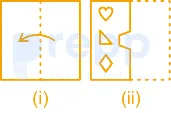
The sequence of folding a piece of paper (figure i) and the manner in which the folded paper has been cut (figure ii) is shown in the following figures. Select the option that would most closely resemble the unfolded form of figure (ii).
- A
Option A (shown in image)
- B
Option B (shown in image)
- C
Option C (shown in image)
- D
Option D (shown in image)
Show answer
A. Option A (shown in image)The image obtained when the paper is unfolded is,
Hence, " option 1" is the correct answer.
 Paper & answer key PDF ↗
 Question 5archived
Select the option that is related to the third term in the same way as the second term is related to the first term.
PATELS : BQFUTM : : NECTAR : ?
- A
FOVDBS
- B
FODUSZ
- C
FOUDSB
- D
OEUDQB
Show answer
C. FOUDSBThe coding rule can be seen by comparing PATELS and BQFUTM position-wise:
P (16) → B (2): 16+12 = 28 → 28–26 = 2.
A (1) → Q (17): 1+16 = 17.
T (20) → F (6): 20+12 = 32 → 32–26 = 6.
E (5) → U (21): 5+16 = 21.
L (12) → T (20): 12+8 = 20.
S (19) → M (13): 19–6 = 13.
The overall pattern is to alternate small forward and backward shifts producing the coded cluster. Applying the analogous position-wise shift to NECTAR yields FOUDSB, which is option 3.
Paper & answer key PDF ↗ Question 6archived
In a certain code language, MONEY is written as PRQHB. In the same code language, CREDIT will be written as:
- A
FUHGLW
- B
FUGHLW
- C
FUHGWL
- D
FHGULW
Show answer
A. FUHGLWUnderstanding Coding Decoding Logic: MONEY to PRQHB
This question asks us to decipher a specific coding pattern applied to the word "MONEY" to get "PRQHB" and then use that same pattern to find the code for the word "CREDIT".
Let's analyze the relationship between the letters in MONEY and PRQHB.
We can look at the position of each letter in the English alphabet:
A=1, B=2, C=3, ..., Z=26
Comparing the letters:
Original Word (MONEY)
Coded Word (PRQHB)
Alphabet Position (Original)
Alphabet Position (Coded)
Difference
M
P
13
16
16 - 13 = +3
O
R
15
18
18 - 15 = +3
N
Q
14
17
17 - 14 = +3
E
H
5
8
8 - 5 = +3
Y
B
25
2
2 - 25 = -23 (or +3 considering wrap around: Y → Z → A → B)
From the table, we can see a consistent pattern: each letter in the original word "MONEY" is shifted 3 positions forward in the alphabet to get the corresponding letter in the coded word "PRQHB". The shift wraps around from Z back to A.
Applying the Code Pattern to CREDIT
Now we apply the same +3 shift logic to each letter in the word "CREDIT".
C: C is the 3rd letter. 3 + 3 = 6. The 6th letter is F.
R: R is the 18th letter. 18 + 3 = 21. The 21st letter is U.
E: E is the 5th letter. 5 + 3 = 8. The 8th letter is H.
D: D is the 4th letter. 4 + 3 = 7. The 7th letter is G.
I: I is the 9th letter. 9 + 3 = 12. The 12th letter is L.
T: T is the 20th letter. 20 + 3 = 23. The 23rd letter is W.
Combining the coded letters, CREDIT is written as FUHGLW.
Matching with Options
Let's compare our result with the given options:
Option 1: FUHGLW
Option 2: FUGHLW
Option 3: FUHGWL
Option 4: FHGULW
Our derived code, FUHGLW, matches Option 1.
Revision Table: Coding Decoding Summary
Word
Pattern Applied
Coded Word
MONEY
Each letter +3 positions
PRQHB
CREDIT
Each letter +3 positions
FUHGLW
Additional Information on Letter Coding
Letter coding is a common type of question in verbal reasoning and coding-decoding sections of competitive exams. These questions test your ability to identify patterns and rules in how words are coded. Common patterns include:
Letter Shifting: Each letter is shifted forward or backward by a fixed number of positions (like the +3 shift in this problem).
Opposite Letters: Letters are replaced by their counterparts (A ↔ Z, B ↔ Y, etc.).
Position Swapping: The positions of letters within the word are changed according to a rule.
Mixed Patterns: A combination of different rules might be applied.
Practicing various examples helps in quickly identifying the pattern and solving such coding questions efficiently.
Paper & answer key PDF ↗ Question 7archived
Read the given statements and conclusions carefully. Assuming that the information given in the statements is true, even if it appears to be at variance with commonly known facts, decide which of the given conclusions logically follow(s) from the statements.
Statements :
No pink is yellow.
No yellow is white.
All reds are yellows.
Conclusions :
I. No red is pink.
II. No red is white.
III. No white is yellow.
- A
Only conclusions II and III follow
- B
Only conclusions I and III follows.
- C
Only conclusions I and II follow
- D
All the conclusions follow
Show answer
D. All the conclusions followAnalyzing the Statements
We are given three initial statements about the relationship between colors: pink, yellow, white, and red. We need to determine which of the given conclusions logically follow from these statements. Let's break down each statement:
Statement 1: No pink is yellow.
This means the categories 'pink' and 'yellow' are completely separate. If something is pink, it cannot be yellow, and vice versa.
Statement 2: No yellow is white.
Similarly, the categories 'yellow' and 'white' are mutually exclusive. If something is yellow, it cannot be white, and vice versa.
Statement 3: All reds are yellows.
This implies that the category 'red' is entirely contained within the category 'yellow'. If something is red, it must also be yellow.
Evaluating the Conclusions
Now, let's examine each conclusion based on the information provided in the statements:
Conclusion I: No red is pink.
From Statement 3, we know that all reds are yellows.
From Statement 1, we know that no pink is yellow.
Since every 'red' item is also a 'yellow' item, and no 'yellow' item can be 'pink', it must be true that no 'red' item can be 'pink'.
Therefore, Conclusion I logically follows.
Conclusion II: No red is white.
From Statement 3, we know that all reds are yellows.
From Statement 2, we know that no yellow is white.
Because every 'red' is a 'yellow', and no 'yellow' can be 'white', it logically follows that no 'red' can be 'white'.
Therefore, Conclusion II logically follows.
Conclusion III: No white is yellow.
This conclusion is stated directly in Statement 2 ("No yellow is white"). The relationship "No A is B" is symmetrical, meaning it is also true that "No B is A".
Therefore, Conclusion III logically follows directly from Statement 2.
Final Determination
Based on the analysis of each conclusion against the given statements:
Conclusion I logically follows from Statements 1 and 3.
Conclusion II logically follows from Statements 2 and 3.
Conclusion III logically follows from Statement 2.
Since all three conclusions (I, II, and III) are valid deductions from the provided statements, the correct option is the one stating that all conclusions follow.
Paper & answer key PDF ↗ Question 8archived
Select the correct option that indicates the arrangement of the given words in a logical and meaningful order.
1. Starfish
2. Blue Whale
3. Shark
4. Giant Tortoise
5. Penguin
- A
1, 5, 3, 2, 4
- B
4, 5, 1, 3, 2
- C
1, 5, 4, 3, 2
- D
1, 5, 4, 2, 3
Show answer
C. 1, 5, 4, 3, 2Analyzing the Logical Arrangement of Animals
The question asks us to arrange a list of animals - Starfish, Blue Whale, Shark, Giant Tortoise, and Penguin - in a logical and meaningful order. We need to identify a principle that connects these diverse creatures and allows for a sequential arrangement.
Let's look at the animals given and consider potential ordering principles:
1. Starfish
2. Blue Whale
3. Shark
4. Giant Tortoise
5. Penguin
Different logical principles could be used, such as habitat, evolutionary order, or size. Among these, arranging animals by size is a common and often considered 'meaningful' logical order, especially when comparing different types of creatures.
Arranging Animals by Size
Let's consider the approximate relative sizes of these animals:
Starfish: Relatively small invertebrate, typically measured in inches/centimeters.
Penguin: Medium-sized bird, size varies by species, but generally ranks above a starfish.
Giant Tortoise: Large reptile, can grow quite large, measured in feet.
Shark: Size varies greatly depending on the species (from small dogfish to large whale sharks), but many are large predators.
Blue Whale: The largest animal on Earth, measured in tens of feet/meters.
Arranging them from smallest to largest based on typical or maximum size, we get a potential sequence:
Starfish → Penguin → Giant Tortoise → Shark → Blue Whale
Let's match this order with the numbers assigned to each animal:
Starfish (1)
Penguin (5)
Giant Tortoise (4)
Shark (3)
Blue Whale (2)
This arrangement gives us the sequence 1, 5, 4, 3, 2.
Comparing with the Options
Now, let's compare this logical sequence (1, 5, 4, 3, 2) with the given options:
Option
Sequence
Animals in Sequence
1
1, 5, 3, 2, 4
Starfish, Penguin, Shark, Blue Whale, Giant Tortoise
2
4, 5, 1, 3, 2
Giant Tortoise, Penguin, Starfish, Shark, Blue Whale
3
1, 5, 4, 3, 2
Starfish, Penguin, Giant Tortoise, Shark, Blue Whale
4
1, 5, 4, 2, 3
Starfish, Penguin, Giant Tortoise, Blue Whale, Shark
Our logical sequence based on size (1, 5, 4, 3, 2) matches Option 3 exactly.
Therefore, the correct logical and meaningful order based on increasing size is Starfish, Penguin, Giant Tortoise, Shark, and Blue Whale.
Conclusion on Logical Ordering
The arrangement of the given words - Starfish, Blue Whale, Shark, Giant Tortoise, and Penguin - in a logical and meaningful order based on increasing size is 1, 5, 4, 3, 2.
Revision Table: Key Concepts
Animal
Type
Relative Size
Starfish
Invertebrate (Echinoderm)
Smallest
Penguin
Bird
Medium
Giant Tortoise
Reptile
Large
Shark
Fish
Large (varies greatly)
Blue Whale
Mammal
Largest
Additional Information: Animal Classification and Habitats
While size is a common logical ordering principle, it's also interesting to note the diverse classification and habitats of these animals, although it didn't provide a clear numerical sequence for this specific question:
Starfish: Marine invertebrates found in oceans worldwide, mostly in shallow waters.
Blue Whale: Marine mammal, found in all oceans, lives in open water.
Shark: Fish, found in all seas, varying habitats from shallow coastal areas to the deep sea.
Giant Tortoise: Reptile, often associated with terrestrial life on islands (like the Galapagos), but some species spend time in water or are semi-aquatic. The term 'Giant Tortoise' specifically often refers to land-dwelling species like those on Galapagos or Aldabra. However, in the context of other marine animals, it might be included for comparison or considered in a broader coastal/aquatic sense relative to its size.
Penguin: Marine bird, found predominantly in the Southern Hemisphere, spends about half its life on land and half in the sea.
Understanding different ways to classify and compare animals, such as by size, type (mammal, fish, bird, reptile, invertebrate), or habitat, helps in solving logical reasoning questions like this.
Paper & answer key PDF ↗ Question 9archived
Which two numbers and which two signs should be interchanged to balance the following equation?
24 ÷ 16 - 96 + 48 × 12 = 195
- A
24 and 48, × and ÷
- B
24 and 16, - and ÷
- C
12 and 16, × and ÷
- D
12 and 48, × and +
Show answer
C. 12 and 16, × and ÷The problem asks us to find which two numbers and which two signs, when swapped simultaneously in the given equation, will make the equation balanced.
The original equation is:
\(24 \div 16 - 96 + 48 \times 12 = 195\)
Let's first evaluate the original equation using the standard order of operations (BODMAS/PEMDAS):
Division: \(24 \div 16 = 1.5\)
Multiplication: \(48 \times 12 = 576\)
Now the equation is: \(1.5 - 96 + 576\)
Perform Addition and Subtraction from left to right:
\(1.5 - 96 = -94.5\)
\(-94.5 + 576 = 481.5\)
So, the original equation evaluates to \(481.5\), which is not equal to \(195\). We need to test the given options by interchanging the specified numbers and signs.
Checking Each Option for Equation Balancing
Analysis of Option 1: Swap 24 and 48, × and ÷
Let's apply the changes suggested in Option 1 to the original equation.
Original: \(24 \div 16 - 96 + 48 \times 12 = 195\)
Interchange 24 and 48:
\(48 \div 16 - 96 + 24 \times 12 = 195\)
Now, interchange × and ÷:
\(48 \times 16 - 96 + 24 \div 12 = 195\)
Let's evaluate this modified equation:
Multiplication: \(48 \times 16 = 768\)
Division: \(24 \div 12 = 2\)
Now the equation is: \(768 - 96 + 2\)
Subtraction: \(768 - 96 = 672\)
Addition: \(672 + 2 = 674\)
The result is \(674\), which is not equal to \(195\). So, Option 1 is incorrect.
Analysis of Option 2: Swap 24 and 16, - and ÷
Let's apply the changes suggested in Option 2.
Original: \(24 \div 16 - 96 + 48 \times 12 = 195\)
Interchange 24 and 16:
\(16 \div 24 - 96 + 48 \times 12 = 195\)
Now, interchange - and ÷:
\(16 - 24 \div 96 + 48 \times 12 = 195\)
Let's evaluate this modified equation:
Division: \(24 \div 96 = 0.25\)
Multiplication: \(48 \times 12 = 576\)
Now the equation is: \(16 - 0.25 + 576\)
Subtraction: \(16 - 0.25 = 15.75\)
Addition: \(15.75 + 576 = 591.75\)
The result is \(591.75\), which is not equal to \(195\). So, Option 2 is incorrect.
Analysis of Option 3: Swap 12 and 16, × and ÷
Let's apply the changes suggested in Option 3.
Original: \(24 \div 16 - 96 + 48 \times 12 = 195\)
Interchange 12 and 16:
\(24 \div 12 - 96 + 48 \times 16 = 195\)
Now, interchange × and ÷:
\(24 \times 12 - 96 + 48 \div 16 = 195\)
Let's evaluate this modified equation:
Multiplication: \(24 \times 12 = 288\)
Division: \(48 \div 16 = 3\)
Now the equation is: \(288 - 96 + 3\)
Subtraction: \(288 - 96 = 192\)
Addition: \(192 + 3 = 195\)
The result is \(195\), which is equal to \(195\). So, Option 3 correctly balances the equation.
Analysis of Option 4: Swap 12 and 48, × and +
Let's apply the changes suggested in Option 4.
Original: \(24 \div 16 - 96 + 48 \times 12 = 195\)
Interchange 12 and 48:
\(24 \div 16 - 96 + 12 \times 48 = 195\)
Now, interchange × and +:
\(24 \div 16 - 96 \times 12 + 48 = 195\)
Let's evaluate this modified equation:
Division: \(24 \div 16 = 1.5\)
Multiplication: \(96 \times 12 = 1152\)
Now the equation is: \(1.5 - 1152 + 48\)
Subtraction: \(1.5 - 1152 = -1150.5\)
Addition: \(-1150.5 + 48 = -1102.5\)
The result is \(-1102.5\), which is not equal to \(195\). So, Option 4 is incorrect.
Conclusion: Finding the Correct Interchange
By testing each option, we found that interchanging the numbers 12 and 16, and the signs × and ÷ results in a balanced equation.
\(24 \times 12 - 96 + 48 \div 16 = 195\)
\(288 - 96 + 3 = 195\)
\(192 + 3 = 195\)
\(195 = 195\)
Therefore, swapping 12 and 16, and × and ÷ balances the equation.
Revision Table: Equation Balancing Summary
Option
Numbers Swapped
Signs Swapped
Modified Equation
Result
Balanced?
Original
-
-
\(24 \div 16 - 96 + 48 \times 12\)
\(481.5\)
No
1
24, 48
×, ÷
\(48 \times 16 - 96 + 24 \div 12\)
\(674\)
No
2
24, 16
-, ÷
\(16 - 24 \div 96 + 48 \times 12\)
\(591.75\)
No
3
12, 16
×, ÷
\(24 \times 12 - 96 + 48 \div 16\)
\(195\)
Yes
4
12, 48
×, +
\(24 \div 16 - 96 \times 12 + 48\)
\(-1102.5\)
No
Additional Information: Tips for Solving Equation Balancing Problems
Solving equation balancing problems by interchanging numbers and signs requires careful application of mathematical operations and logical reasoning. Here are some tips:
Understand BODMAS/PEMDAS: Always follow the correct order of operations: Brackets, Orders (powers/roots), Division and Multiplication (from left to right), Addition and Subtraction (from left to right).
Test Each Option Systematically: Go through each option one by one. For each option, perform both the number swap and the sign swap before evaluating the equation.
Perform Swaps Carefully: Ensure you correctly swap both the specified numbers and the specified signs simultaneously. Don't swap just one type.
Calculation Accuracy: Double-check your calculations at each step, especially with divisions and multiplications, as small errors can lead to an incorrect final result.
Anticipate Changes: Consider how swapping operators like × and ÷, or + and -, might drastically change the value of the expression. Swapping numbers involved in these operations also has a significant impact.
Look for Clues (Advanced): Sometimes, looking at the magnitude of the numbers and the target value (195 in this case, which is relatively smaller than the original result \(481.5\)) can give hints about which operations or numbers might need to be changed to reduce the overall value. For example, replacing multiplication with division or division with multiplication can have a large effect.
Paper & answer key PDF ↗ Question 10archived
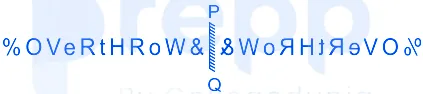
Select the correct mirror image of the given combination when the mirror is placed at 'PQ' as shown.

- A
Option A (shown in image)
- B
Option B (shown in image)
- C
Option C (shown in image)
- D
Option D (shown in image)
Show answer
A. Option A (shown in image)The correct mirror image of the given figure when the mirror is held at the right side is:
Detailed Explanation:
The line PQ is the mirror
The given word “% O V e R t H R o W &" ends with ‘&’. So the mirror image will start with “" → Option 2 is eliminated.
The mirror image of O is incorrect → Option 3 is eliminated.
The mirror image of e is incorrect → Option 4 is eliminated.
Hence, option (1) is the correct answer.
 Paper & answer key PDF ↗
 Question 11archived
Which two digits should be interchanged to make the given equation correct?
384 ÷ 16 - 72 + 9 × 10 = 2
- A
6 and 9
- B
4 and 8
- C
3 and 7
- D
7 and 9
Show answer
D. 7 and 9Understanding the Digit Interchange Problem
The question asks us to identify which pair of digits, when swapped within the given equation, will make the equation mathematically correct. The original equation is:
384 ÷ 16 - 72 + 9 × 10 = 2
Before interchanging any digits, let's evaluate the original equation using the order of operations (BODMAS/PEMDAS):
Brackets first
Orders (powers, square roots) next
Division and Multiplication from left to right
Addition and Subtraction from left to right
Evaluating the original equation:
$$384 \div 16 - 72 + 9 \times 10$$ $$= 24 - 72 + 90 \quad (\text{Performing division and multiplication})$$ $$= -48 + 90 \quad (\text{Performing subtraction})$$ $$= 42 \quad (\text{Performing addition})$$
So, the original equation is 42 = 2, which is incorrect.
Now, let's test each option by interchanging the specified digits and re-evaluating the equation.
Testing Digit Swap OptionsOption 1: Interchanging 6 and 9
Original digits in the equation: 3, 8, 4, 1, 6, 7, 2, 9, 1, 0. The digits 6 and 9 appear in 16, 72, and 9.
After swapping 6 and 9:
16 becomes 19
72 remains 72 (no 9)
9 becomes 6
10 remains 10 (digit 9 is not part of the number 10, only the number 9)
The new equation becomes: 384 ÷ 19 - 72 + 6 × 10 = 2
Evaluating the new equation:
$$384 \div 19 - 72 + 6 \times 10$$ $$= \frac{384}{19} - 72 + 60$$
Since $\frac{384}{19}$ is not an integer, and the target is a small integer (2), this option is unlikely to be correct. $\frac{384}{19} \approx 20.21$. So, $20.21 - 72 + 60 \approx 8.21$, which is not 2.
Option 2: Interchanging 4 and 8
Original digits: 3, 8, 4, 1, 6, 7, 2, 9, 1, 0. The digits 4 and 8 appear in 384.
After swapping 4 and 8:
384 becomes 348
The new equation becomes: 348 ÷ 16 - 72 + 9 × 10 = 2
Evaluating the new equation:
$$348 \div 16 - 72 + 9 \times 10$$ $$= 21.75 - 72 + 90 \quad (\text{Performing division and multiplication})$$ $$= -50.25 + 90 \quad (\text{Performing subtraction})$$ $$= 39.75 \quad (\text{Performing addition})$$
So, the equation becomes 39.75 = 2, which is incorrect.
Option 3: Interchanging 3 and 7
Original digits: 3, 8, 4, 1, 6, 7, 2, 9, 1, 0. The digits 3 and 7 appear in 384 and 72.
After swapping 3 and 7:
384 becomes 784
72 becomes 32
The new equation becomes: 784 ÷ 16 - 32 + 9 × 10 = 2
Evaluating the new equation:
$$784 \div 16 - 32 + 9 \times 10$$ $$= 49 - 32 + 90 \quad (\text{Performing division and multiplication})$$ $$= 17 + 90 \quad (\text{Performing subtraction})$$ $$= 107 \quad (\text{Performing addition})$$
So, the equation becomes 107 = 2, which is incorrect.
Option 4: Interchanging 7 and 9
Original digits: 3, 8, 4, 1, 6, 7, 2, 9, 1, 0. The digits 7 and 9 appear in 72 and 9.
After swapping 7 and 9:
72 becomes 92
9 becomes 7
10 remains 10 (digit 9 is not part of the number 10)
The new equation becomes: 384 ÷ 16 - 92 + 7 × 10 = 2
Evaluating the new equation:
$$384 \div 16 - 92 + 7 \times 10$$ $$= 24 - 92 + 70 \quad (\text{Performing division and multiplication})$$ $$= -68 + 70 \quad (\text{Performing subtraction})$$ $$= 2 \quad (\text{Performing addition})$$
So, the equation becomes 2 = 2, which is correct.
Conclusion
Interchanging the digits 7 and 9 makes the given equation correct. This confirms Option 4 is the correct answer for this digit interchange problem.
Revision Table: Digit Interchange Outcomes
Original EquationValue
$384 \div 16 - 72 + 9 \times 10$42
Digits InterchangedNew EquationEvaluated ValueCorrect?
6 and 9$384 \div 19 - 72 + 6 \times 10$$\approx 8.21$No
4 and 8$348 \div 16 - 72 + 9 \times 10$39.75No
3 and 7$784 \div 16 - 32 + 9 \times 10$107No
7 and 9$384 \div 16 - 92 + 7 \times 10$2Yes
Additional Information: Order of Operations (BODMAS/PEMDAS)
The order of operations is crucial in solving mathematical expressions. It ensures that everyone gets the same result when evaluating an expression. The commonly used mnemonics are BODMAS and PEMDAS.
BODMAS: Brackets, Orders (powers, roots), Division and Multiplication (left to right), Addition and Subtraction (left to right).
PEMDAS: Parentheses, Exponents, Multiplication and Division (left to right), Addition and Subtraction (left to right).
Both mnemonics represent the same hierarchy of operations. Division and multiplication have equal priority and are performed from left to right as they appear. Similarly, addition and subtraction have equal priority and are performed from left to right.
Paper & answer key PDF ↗ Question 12archived
A side of a square-shaped park is 12 m. If a square-shaped garden with a side of 24 m is developed around the park, what will be the total area of the park including the garden?
- A
324 m2
- B
576 m2
- C
288 m2
- D
144 m2
Show answer
B. 576 m2Calculating the Total Area of the Square Park and Garden
The problem asks us to find the total area of a square-shaped park when a larger square-shaped garden is developed around it. We are given the side length of the inner park and the side length of the larger square formed by the park and the garden combined.
Here's what we know:
The park is square-shaped with a side of 12 m.
A square-shaped garden is developed around the park.
The combined area (park plus garden) forms a larger square with a side of 24 m.
We need to find the total area of this larger square, which includes both the park and the garden.
Understanding Area of a Square
The area of any square is calculated by multiplying its side length by itself. The formula is:
\( \text{Area} = \text{side} \times \text{side} = \text{side}^2 \)
The unit for area is typically square meters (\( \text{m}^2 \)) if the side is measured in meters.
Step-by-Step Calculation of Total Area
The question states that the square-shaped garden developed around the park results in a larger square with a side of 24 m. This 24 m side represents the total length of the outer square, which encompasses both the inner park and the surrounding garden.
So, the side length of the total area (park + garden) is 24 m.
Now, we can calculate the total area using the area formula:
Side length of the total area = 24 m
Total Area = \( (\text{Side length})^2 \)
Total Area = \( (24 \text{ m})^2 \)
Total Area = \( 24 \times 24 \text{ m}^2 \)
Let's perform the multiplication:
Calculation Step
Value
\( 24 \times 4 \)
96
\( 24 \times 20 \)
480
\( 96 + 480 \)
576
So, the total area is 576 square meters.
Total Area = \( 576 \text{ m}^2 \)
This is the area of the larger square that includes the park and the garden.
Let's quickly verify the options provided:
Option 1: \( 324 \text{ m}^2 \)
Option 2: \( 576 \text{ m}^2 \)
Option 3: \( 288 \text{ m}^2 \)
Option 4: \( 144 \text{ m}^2 \) (This is the area of the park only: \( 12 \times 12 \text{ m}^2 \))
Our calculated total area matches Option 2.
Summary of the Calculation
Identify the side length of the large square formed by the park and garden. This is given as 24 m.
Use the formula for the area of a square: Area = side \(\times\) side.
Calculate \( 24 \text{ m} \times 24 \text{ m} = 576 \text{ m}^2 \).
This result, \( 576 \text{ m}^2 \), is the total area including the park and the garden.
The total area of the park including the garden is \( 576 \text{ m}^2 \).
Revision Table: Key Concepts for Area Calculation
Concept
Description
Formula (for square)
Area
The amount of two-dimensional space a shape occupies.
\( \text{side}^2 \)
Side Length
The length of one edge of the square.
N/A
Units of Area
Standard units like square meters (\( \text{m}^2 \)), square feet (\( \text{ft}^2 \)), etc.
Depends on side unit
Additional Information: Area of the Garden Only
The question asks for the total area (park + garden). However, sometimes you might be asked to find the area of the garden only.
To find the area of the garden only, you would subtract the area of the park from the total area.
Area of the park = side \(\times\) side = \( 12 \text{ m} \times 12 \text{ m} = 144 \text{ m}^2 \).
Total area (park + garden) = \( 576 \text{ m}^2 \) (as calculated above).
Area of the garden only = Total area - Area of the park
Area of the garden only = \( 576 \text{ m}^2 - 144 \text{ m}^2 \)
Area of the garden only = \( 432 \text{ m}^2 \)
This shows that the garden itself has an area of \( 432 \text{ m}^2 \), and when added to the park's area (\( 144 \text{ m}^2 \)), you get the total area of \( 576 \text{ m}^2 \).
Paper & answer key PDF ↗ Question 13archived
Study the given matrix carefully and select the number from among the given options that can replace the question mark (?) in it.
713174
925104
1130?
- A
335
- B
129
- C
431
- D
100
Show answer
C. 431Understanding the Matrix Pattern
The question presents a set of numbers arranged in a matrix format:
Column 1
Column 2
Column 3
7
13
17
49
25
10
41
13
0
Following this 3x3 matrix, there is a question mark (?). The numbers are presented in a sequence read row by row: 7, 13, 17, 49, 25, 10, 41, 13, 0, ?. This indicates the question mark is the tenth number in the sequence.
Given the visual layout, the question mark is positioned as if it is the element in the third row and a potential fourth column (position (3,4)) of an extended matrix.
Identifying the Pattern Rule
We need to find a pattern that relates the numbers in the matrix, specifically leading to the value at the position of the question mark. Let's examine the relationship between the columns within each row.
Let's try a pattern involving multiplication and addition of the elements in the first two columns and perhaps the third column to get a potential value for a fourth column.
Consider the following pattern rule for each row:
\( ( \text{Element in Column 1} \times 10 ) + \text{Element in Column 2} + 8 \)
Applying the Pattern to the Rows
Let's apply this pattern to each row of the given 3x3 matrix:
Row 1: Elements are 7, 13, and 17
Applying the pattern rule:
\( (7 \times 10) + 13 + 8 \)
\( 70 + 13 + 8 = 91 \)
Applying the rule to the first row results in 91.
Row 2: Elements are 49, 25, and 10
Applying the pattern rule:
\( (49 \times 10) + 25 + 8 \)
\( 490 + 25 + 8 = 523 \)
Applying the rule to the second row results in 523.
Row 3: Elements are 41, 13, and 0
Applying the pattern rule:
\( (41 \times 10) + 13 + 8 \)
\( 410 + 13 + 8 = 431 \)
Applying the rule to the third row results in 431.
Determining the Missing Number
The pattern \( ( \text{Column 1 element} \times 10 ) + \text{Column 2 element} + 8 \) generates the values 91, 523, and 431 when applied to rows 1, 2, and 3 respectively.
Since the question mark is positioned after the third row in the sequence and visually suggests the element at (3,4), it follows the pattern established for generating values in a hypothetical fourth column based on the first two columns of each row.
Therefore, the missing number that replaces the question mark is the result calculated for the third row, which is 431.
Revision Table: Pattern Summary
Row
Col 1
Col 2
Col 3
Pattern: \( (\text{Col 1} \times 10) + \text{Col 2} + 8 \)
Result
1
7
13
17
\( (7 \times 10) + 13 + 8 = 70 + 13 + 8 \)
91
2
49
25
10
\( (49 \times 10) + 25 + 8 = 490 + 25 + 8 \)
523
3
41
13
0
\( (41 \times 10) + 13 + 8 = 410 + 13 + 8 \)
431
Additional Information: Solving Matrix and Number Pattern Questions
Analyze the Layout: Pay close attention to how the numbers are presented. Is it a grid, a sequence, or grouped in some way?
Test Simple Arithmetic: Start by checking for basic patterns like addition, subtraction, multiplication, or division between adjacent numbers, within rows, columns, or diagonals.
Look for Squares/Cubes: Sometimes patterns involve squares or cubes of numbers within the matrix.
Combine Operations: More complex patterns might involve a combination of operations (e.g., multiply two numbers and add a third).
Check Options as Clues: The available options can sometimes hint at the type of pattern or the range of the expected answer.
Paper & answer key PDF ↗ Question 14archived
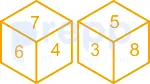
Four different positions of the same dice are shown, the six faces of which are numbered from 1 to 6. Select the number that will be on the face opposite to the one having the number '1'.

- A
3
- B
4
- C
2
- D
6
Show answer
A. 3Given:
Logic: If two dice have 2 faces in common then the third face of dice 1 is opposite to the third face of dice 2.
In second dice and third dice.
Numbers 4 and 2 are common.
Hence, the number "3" will be on the face opposite to the one having the number '1'.

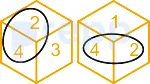 Paper & answer key PDF ↗
 Question 15archived
Select the combination of letters that when sequentially placed in the blanks of the given series will complete the series.
_ L H _ _ U _ H _ _ U _ H _ N U _ _ E N
- A
E, U, N, L, N, E, L, E, H, L
- B
U, E, L, E, N, N, L, H, N, E
- C
U, E, N, L, E, N, L, E, L, H
- D
U, E, N, L, E, L, H, L, E, H
Show answer
C. U, E, N, L, E, N, L, E, L, HSolving Letter Series Completion Questions
Letter series completion is a common type of question in logical reasoning. The goal is to identify the underlying pattern in the given sequence of letters and then use that pattern to fill in the missing blanks.
The given series is:
_ L H _ _ U _ H _ _ U _ H _ N U _ _ E N
Let's count the total number of positions in the series, including the blanks. There are 20 positions in total. The options provide 10 letters to fill the 10 blanks.
Analyzing the Series Pattern
Often, letter series can be solved by dividing the series into equal-sized groups and looking for a repeating pattern within those groups. Common group sizes are factors of the total length. Since the total length is 20, possible group sizes are 2, 4, 5, 10, or 20.
Let's examine the letters already present in the series. We see sequences like 'LH', 'UH', 'NU', 'EN'. The letter 'U' appears multiple times, as does 'H' and 'N'. This suggests a repeating block might contain these letters.
Testing the Correct Option
We are given that option 3 is the correct answer. The letters in option 3 are: U, E, N, L, E, N, L, E, L, H. Let's fill the blanks in the given series with these letters in sequence.
The blanks are at the 1st, 4th, 5th, 7th, 9th, 10th, 12th, 14th, 17th, and 18th positions.
Original series with blanks:
_ L H _ _ U _ H _ _ U _ _ H _ N U _ _ E N
Filling the blanks with the letters from option 3:
1st blank (Position 1) = U
2nd blank (Position 4) = E
3rd blank (Position 5) = N
4th blank (Position 7) = L
5th blank (Position 9) = E
6th blank (Position 10) = N
7th blank (Position 12) = L
8th blank (Position 14) = E
9th blank (Position 17) = L
10th blank (Position 18) = H
Let's write out the series with the blanks filled:
Position: 1 2 3 4 5 6 7 8 9 10 11 12 13 14 15 16 17 18 19 20
Series: U L H E N U L H E N U L H E N U L H E N
Identifying the Repeating Pattern
Looking at the filled series ULHENULHENULHENULHEN, we can clearly see a repeating block of letters.
If we group the series into blocks of 5 letters, we get:
ULHEN | ULHEN | ULHEN | ULHEN
The pattern is the sequence ULHEN repeating four times.
Verifying the Solution
Let's check if filling the original blanks with the letters U, E, N, L, E, N, L, E, L, H indeed produces this repeating pattern:
Blank No.
Position
Letter from Option 3
Letter in Repeating Pattern (ULHENULHENULHENULHEN)
Match?
1
1
U
U
Yes
2
4
E
E
Yes
3
5
N
N
Yes
4
7
L
L
Yes
5
9
E
E
Yes
6
10
N
N
Yes
7
12
L
L
Yes
8
14
E
E
Yes
9
17
L
L
Yes
10
18
H
H
Yes
All the letters from option 3 fit perfectly into the blanks to create the repeating sequence ULHEN throughout the 20 positions.
Therefore, the combination of letters U, E, N, L, E, N, L, E, L, H correctly completes the series by forming the repeating pattern ULHEN.
Revision Table: Key Concepts
Concept
Explanation
Relevance to Problem
Letter Series
A sequence of letters following a specific rule or pattern.
The core problem is a letter series with missing elements.
Pattern Recognition
Identifying the rule or sequence that governs the series.
Crucial for solving the series by finding the repeating unit (ULHEN).
Grouping
Dividing the series into smaller, equal segments.
Helps in visualizing and discovering repeating patterns within the series.
Additional Information: Tips for Solving Letter Series
Count the total number of elements (letters and blanks). This helps in determining possible lengths of repeating blocks.
Look for sequences of letters that appear more than once.
Try dividing the series into groups of 3, 4, 5, or 6 and look for patterns within or across groups.
Consider patterns based on alphabetical order, skipping letters, or other logical rules, although repeating blocks are common in this type.
Test the given options by filling in the blanks. This is especially useful when the pattern isn't immediately obvious.
Paper & answer key PDF ↗ Question 16archived
In a certain code language, 'her father is okay' is coded as 6583, 'my father is well' is coded as 5137 and 'her arm is injured' is coded as 2839. How will 'okay' be coded in that language?
- A
8
- B
3
- C
5
- D
6
Show answer
D. 6Understanding Code Language Problems
Code language problems involve deciphering a pattern where words or phrases are represented by numbers or other symbols. The key is to find the relationship between the words and their corresponding codes, often by comparing different phrases.
Step-by-Step Decoding Analysis
Let's break down the given information to find the code for 'okay'. We have three coded phrases:
'her father is okay' is coded as 6583
'my father is well' is coded as 5137
'her arm is injured' is coded as 2839
Comparing Phrases to Find Common Codes
We compare the phrases to identify common words and their likely codes.
Compare Phrase 1 and Phrase 2:
Words in common: 'father', 'is'
Codes in common: 5, 3
So, 'father' and 'is' are coded as either 5 or 3.
Compare Phrase 1 and Phrase 3:
Words in common: 'her', 'is'
Codes in common: 8, 3
So, 'her' and 'is' are coded as either 8 or 3.
Compare Phrase 2 and Phrase 3:
Words in common: 'is'
Codes in common: 3
This confirms that the code for 'is' is 3.
Deducing Individual Word Codes
Now that we know the code for 'is', we can determine the codes for other words using the comparisons made earlier:
From comparing Phrase 1 and 2, we found 'father' and 'is' are 5 and 3. Since 'is' is 3, 'father' must be 5.
From comparing Phrase 1 and 3, we found 'her' and 'is' are 8 and 3. Since 'is' is 3, 'her' must be 8.
Finding the Code for 'okay'
Now let's look at the first phrase again:
'her father is okay' is coded as 6583.
We have found the codes for three of the words:
'her' = 8
'father' = 5
'is' = 3
Substituting these codes into the code for the first phrase (6583):
The code 6583 represents 'her father is okay'.
We have the codes for 'her' (8), 'father' (5), and 'is' (3). The only remaining word is 'okay', and the only remaining code is 6.
Therefore, the code for 'okay' is 6.
Summary of Codes
Word
Code
is
3
father
5
her
8
okay
6
Based on our analysis, the code for 'okay' is 6.
Revision Table: Code Language Basics
Concept
Description
Code Language
A system where words, phrases, or letters are substituted with numbers, symbols, or other letters following a specific rule or pattern.
Decoding
The process of figuring out the original message from the coded language.
Comparison Method
A common technique in coding-decoding problems where you compare multiple coded messages to find common elements and deduce their codes.
Additional Information: Types of Coding-Decoding
Coding-decoding is a common topic in reasoning tests. Different types of coding might include:
Letter Coding: Letters are replaced by other letters.
Number Coding: Words or letters are replaced by numbers.
Symbol Coding: Words or letters are replaced by symbols.
Mixed Coding (as in this problem): Words/phrases are coded using numbers, often requiring comparison of multiple statements.
Sentence Coding: Entire sentences are coded, and parts of the sentence (words) need to be decoded.
Practicing different types helps in quickly identifying the underlying pattern.
Paper & answer key PDF ↗ Question 17archived
Select the number from among the given options that can replace the question mark (?) in the following series.
16, 33, 100, 401, ?
- A
1235
- B
804
- C
1588
- D
2006
Show answer
D. 2006Finding the Pattern in the Number Series
We are given the number series: 16, 33, 100, 401, ?. We need to find the logic or pattern that connects these numbers to determine the next number in the sequence.
Analyzing the Sequence Step-by-Step
Let's look at the relationship between consecutive terms:
From 16 to 33:
Let's see if there is a simple addition: \(33 - 16 = 17\).
Let's consider multiplication: \(16 \times 2 = 32\). If we add 1, we get \(32 + 1 = 33\). This looks promising.
From 33 to 100:
Addition: \(100 - 33 = 67\). This doesn't follow the pattern of adding 17.
Let's try multiplication and addition, continuing the idea from the previous step. We multiplied by 2, maybe the next multiplier is 3? \(33 \times 3 = 99\). If we add 1, we get \(99 + 1 = 100\). This matches the third term!
From 100 to 401:
Following the pattern, the next multiplier should be 4. \(100 \times 4 = 400\). Adding 1 gives \(400 + 1 = 401\). This matches the fourth term!
Identifying the Number Series Pattern
The pattern emerging is that each term is obtained by multiplying the previous term by a consecutive integer (starting from 2) and then adding 1 to the result.
Let's write down the pattern:
Term 2 = Term 1 \(\times\) 2 + 1: \(16 \times 2 + 1 = 32 + 1 = 33\)
Term 3 = Term 2 \(\times\) 3 + 1: \(33 \times 3 + 1 = 99 + 1 = 100\)
Term 4 = Term 3 \(\times\) 4 + 1: \(100 \times 4 + 1 = 400 + 1 = 401\)
Calculating the Missing Number
Based on the identified pattern, to find the next number (the fifth term), we need to multiply the fourth term (401) by the next consecutive integer (which is 5) and add 1.
Missing Number = Term 4 \(\times\) 5 + 1
Missing Number = \(401 \times 5 + 1\)
Let's perform the calculation:
\(401 \times 5 = 2005\)
\(2005 + 1 = 2006\)
So, the missing number in the series is 2006.
Comparing with the Options
Let's check the given options:
1. 1235
2. 804
3. 1588
4. 2006
Our calculated number, 2006, matches Option 4.
Step
Operation
Result
Term in Series
1
Start with 16
16
Term 1
2
\(16 \times 2 + 1\)
33
Term 2
3
\(33 \times 3 + 1\)
100
Term 3
4
\(100 \times 4 + 1\)
401
Term 4
5
\(401 \times 5 + 1\)
2006
Term 5 (?)
Conclusion
The number that replaces the question mark is 2006.
Revision Table: Number Series Patterns
Number series questions often follow specific patterns. Recognizing common patterns is key to solving them quickly. Here are a few types:
Arithmetic Series: A constant difference between consecutive terms (e.g., 2, 5, 8, 11... where the difference is 3).
Geometric Series: A constant ratio between consecutive terms (e.g., 3, 6, 12, 24... where the ratio is 2).
Mixed Operations: Patterns involving a combination of arithmetic operations like addition, subtraction, multiplication, and division.
Step Difference: Finding the difference between consecutive terms, then the difference between *those* differences, and so on, until a pattern is found.
Alternating Pattern: Two different patterns alternating within the same series.
Square/Cube Patterns: Patterns involving squares or cubes of numbers, often with some addition or subtraction.
Combination of Series: The series might be a combination or sum of two different simple series.
Additional Information: Solving Reasoning Number Series
Solving number series questions is a common part of logical reasoning and quantitative aptitude tests. These questions assess your ability to identify patterns and apply logical thinking.
Here are some tips for approaching number series problems:
Look at the differences between consecutive numbers. Are they constant? Increasing? Decreasing? Following a pattern?
Check for ratios between consecutive numbers, especially if the numbers are growing or shrinking rapidly.
Consider squares, cubes, square roots, or cube roots if the numbers are large or small.
Look for patterns involving multiplication and division, possibly combined with addition or subtraction (like in this question).
If the pattern isn't immediately obvious, try calculating the differences between terms. Then look for a pattern in those differences.
Check for alternating patterns if the series jumps up and down or seems to follow two different sequences.
Sometimes the pattern involves the position of the term (e.g., the nth term is related to n).
Practice is essential. The more series you analyze, the better you become at recognizing different types of patterns.
Paper & answer key PDF ↗ Question 18archived
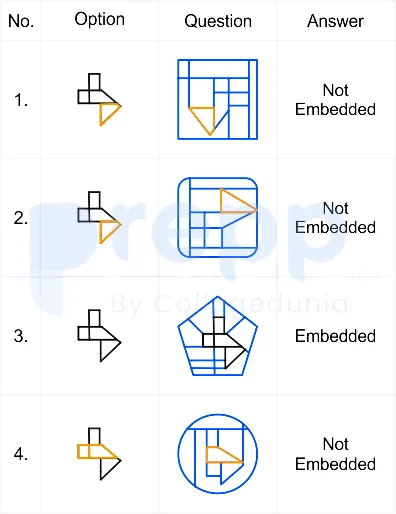
Select the option in which the given figure is embedded (rotation is NOT allowed)

- A
Option A (shown in image)
- B
Option B (shown in image)
- C
Option C (shown in image)
- D
Option D (shown in image)
Show answer
Question 19archived
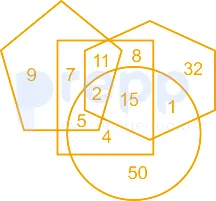
In the following Venn diagram, the hexagon stands for 'police officers', the pentagon stands for 'graduates', the circle stands for 'females', and the square stands for 'Indians'. The given numbers represent the number of persons in that particular category.
How many Indian police officers are graduates but NOT females?
- A
19
- B
11
- C
8
- D
13
Show answer
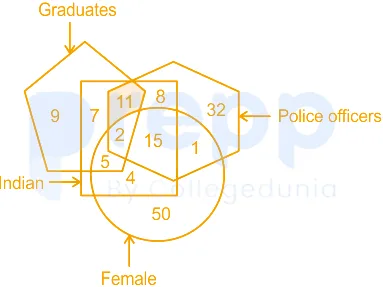
B. 11The shaded part represents Indian police officers who are graduates but NOT females .
The number representing Indian police officers who are graduates but NOT females = 11
Hence, ‘11’ is the correct answer.
 Paper & answer key PDF ↗
 Question 20archived
In a certain code language, 'RAKHI' is coded as 36 - 2 - 22 - 16 - 18 and 'SHALU' is coded as 38 - 16 - 2 - 24 - 42. How will 'MANJU' be coded in that language?
- A
13 - 2 - 28 - 10 - 24
- B
26 - 2 - 28 - 20 - 42
- C
13 - 2 - 14 - 10 - 24
- D
26 - 1 - 14 - 20 - 42
Show answer
B. 26 - 2 - 28 - 20 - 42Understanding Coding Decoding Patterns
This question asks us to decode a word based on a specific pattern observed in the coding of two other words. In coding-decoding questions, the key is to identify the rule applied to convert the letters of the original word into the given code.
Analyzing the Given Examples: RAKHI and SHALU
Let's look at the first example provided:
RAKHI is coded as 36 - 2 - 22 - 16 - 18
We need to see how each letter in RAKHI corresponds to the numbers in the code. Let's consider the alphabetical position of each letter:
R is the 18th letter
A is the 1st letter
K is the 11th letter
H is the 8th letter
I is the 9th letter
Now, compare the letter positions with the given code numbers:
R (18) → 36
A (1) → 2
K (11) → 22
H (8) → 16
I (9) → 18
It appears that each number in the code is double the alphabetical position of the corresponding letter. Let's check if this pattern holds for the second example.
The second example is:
SHALU is coded as 38 - 16 - 2 - 24 - 42
Let's check the alphabetical positions and the coded numbers:
S is the 19th letter → 38 (19 $\times$ 2)
H is the 8th letter → 16 (8 $\times$ 2)
A is the 1st letter → 2 (1 $\times$ 2)
L is the 12th letter → 24 (12 $\times$ 2)
U is the 21st letter → 42 (21 $\times$ 2)
The pattern holds true for SHALU as well. The rule is confirmed: the code for each letter is its alphabetical position multiplied by 2.
Applying the Pattern to MANJU
Now we will apply the identified coding rule to the word MANJU to find its code. We need to find the alphabetical position of each letter and multiply it by 2.
M is the 13th letter. Code for M = 13 $\times$ 2 = 26
A is the 1st letter. Code for A = 1 $\times$ 2 = 2
N is the 14th letter. Code for N = 14 $\times$ 2 = 28
J is the 10th letter. Code for J = 10 $\times$ 2 = 20
U is the 21st letter. Code for U = 21 $\times$ 2 = 42
So, the code for MANJU is 26 - 2 - 28 - 20 - 42.
Comparing with Options
Let's compare our derived code with the given options:
Option 1: 13 - 2 - 28 - 10 - 24
Option 2: 26 - 2 - 28 - 20 - 42
Option 3: 13 - 2 - 14 - 10 - 24
Option 4: 26 - 1 - 14 - 20 - 42
Our calculated code, 26 - 2 - 28 - 20 - 42, matches Option 2.
Letter
Alphabetical Position
Coding Rule (Position $\times$ 2)
Coded Value
M
13
13 $\times$ 2
26
A
1
1 $\times$ 2
2
N
14
14 $\times$ 2
28
J
10
10 $\times$ 2
20
U
21
21 $\times$ 2
42
Revision Table: Coding Decoding Summary
Original Word
Code
Coding Pattern
RAKHI
36 - 2 - 22 - 16 - 18
Alphabetical Position $\times$ 2
SHALU
38 - 16 - 2 - 24 - 42
Alphabetical Position $\times$ 2
MANJU
26 - 2 - 28 - 20 - 42
Alphabetical Position $\times$ 2
Additional Information on Coding Decoding
Coding and decoding questions are common in reasoning sections of competitive exams. They test your ability to identify patterns and rules. Common patterns include:
Alphabetical Position: Using the direct position of letters (A=1, Z=26).
Reverse Alphabetical Position: Using the position from the end (A=26, Z=1).
Adding/Subtracting a Constant: Adding or subtracting a fixed number from the position.
Multiplying/Dividing: Multiplying or dividing the position by a constant (as seen in this problem).
Vowel/Consonant Specific Rules: Different rules for vowels and consonants.
Sum of Positions: Coding a word by the sum of positions of its letters.
Pattern based on sequence: For example, position +1, position -1, position +2, position -2 etc.
Practicing various types of coding decoding problems helps improve pattern recognition skills, which is crucial for solving these questions quickly and accurately during exams.
Paper & answer key PDF ↗ Question 21archived
Select the option that is related to the third number in the same way as the second number is related to the first number.
23 : 441 : : 28 : ?
- A
692
- B
676
- C
494
- D
528
Show answer
B. 676Understanding Number Analogies
Number analogy questions test your ability to find the relationship between a pair of numbers and apply that same relationship to another number to find a missing value. In this question, we are given the analogy 23 : 441 : : 28 : ? We need to determine the pattern connecting 23 and 441 and then use that pattern to find the number related to 28.
Analyzing the Relationship between 23 and 441
Let's look at the first pair of numbers: 23 and 441.
We need to figure out how 441 is derived from 23. Often, relationships involve basic arithmetic operations like addition, subtraction, multiplication, division, squaring, cubing, or combinations of these.
Could it be simple multiplication? $23 \times \text{something} = 441$? $441 / 23 \approx 19.17$, not a simple integer.
Could it involve squaring? Let's consider numbers close to 23.
Let's think about squares of numbers near 23.
$20^2 = 400$
$21^2 = 441$
$22^2 = 484$
We see that $21^2$ is exactly 441. Now, how is 21 related to 23?
The difference is $23 - 21 = 2$.
So, the relationship between 23 and 441 appears to be: subtract 2 from the first number and then square the result.
Let's verify this pattern:
Relationship: $(\text{First Number} - 2)^2 = \text{Second Number}$
Applying this to the first pair (23 : 441):
$(23 - 2)^2 = 21^2 = 441$.
This confirms the pattern for the first pair.
Applying the Pattern to Find the Missing Number
Now we apply the same pattern to the third number, 28, to find the fourth number (the missing number).
The third number is 28.
Following the pattern: Subtract 2 from the third number and then square the result.
$(\text{Third Number} - 2)^2 = \text{Missing Number}$
$(28 - 2)^2 = \text{Missing Number}$
$26^2 = \text{Missing Number}$
Calculating the Square of 26
To find the missing number, we need to calculate $26^2$.
$26^2 = 26 \times 26$
We can calculate this as:
Calculation
Result
$26 \times 6$
156
$26 \times 20$
520
$156 + 520$
676
So, $26^2 = 676$.
The missing number is 676.
Comparing with Options
Let's check the given options:
692
676
494
528
Our calculated number, 676, matches option 2.
Conclusion
The relationship between the numbers in the analogy 23 : 441 : : 28 : ? is that the second number is the square of (the first number minus 2). Applying this pattern to 28, we get $(28 - 2)^2 = 26^2 = 676$.
Revision Table: Number Analogy Pattern
First Number
Pattern Applied
Result (Second Number)
23
$(23 - 2)^2 = 21^2$
441
28
$(28 - 2)^2 = 26^2$
676
Additional Information on Number Reasoning
Number analogy and number series questions are common in reasoning sections of competitive exams. They require identifying the rule or pattern that connects the numbers. Common patterns include:
Arithmetic Progression (constant difference)
Geometric Progression (constant ratio)
Squares or cubes of numbers (or numbers plus/minus a constant)
Operations on digits of the number
Alternating patterns
Combined operations (e.g., multiply by 2 then add 1)
Practicing various types of patterns helps in quickly identifying the relationship during an exam.
Paper & answer key PDF ↗ Question 22archived
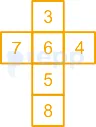
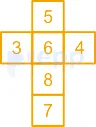
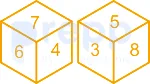
Two orientations of the same box as shown. How will this box look when unfolded?
- A
Option A (shown in image)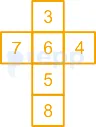
- B
Option B (shown in image)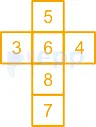
- C
Option C (shown in image)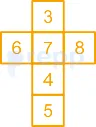
- D
Option D (shown in image)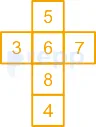
Show answer
Question 23archived
Five persons are sitting in a row facing the north. One of the two persons at the extreme ends is an introvert and the other one is an extrovert. A thin person is sitting to the immediate right of an intelligent person. A weak person is sitting to the immediate left of the extrovert person. The intelligent person is sitting exactly between the introvert and the thin persons. Which of the following persons is sitting at the centre?
- A
Weak
- B
Extrovert
- C
Intelligent
- D
Thin
Show answer
D. ThinAnalyzing the Seating Arrangement Puzzle
This problem requires us to determine the seating arrangement of five persons based on a set of clues and identify who is sitting in the centre. The persons are arranged in a row, all facing North. We need to carefully analyze each condition to build the correct seating order. Let's break down the given information about the five persons and their positions.
Decoding the Seating Arrangement Clues
Here are the key clues provided in the question:
There are five persons in a row facing North.
One person at each extreme end is an introvert, and the other is an extrovert.
A thin person sits to the immediate right of an intelligent person.
A weak person sits to the immediate left of the extrovert person.
The intelligent person is positioned exactly between the introvert and the thin persons.
Step-by-Step Deduction for the Arrangement
Let's deduce the seating order step by step using the clues:
Clue 5 Analysis: The intelligent person is between the introvert and the thin persons. This means they are seated consecutively in one of these orders: (Introvert, Intelligent, Thin) or (Thin, Intelligent, Introvert).
Clue 3 Integration: We know the thin person is to the immediate right of the intelligent person. This fits the pattern (Intelligent, Thin). Combining this with Clue 5, the only possible sequence is: (Introvert, Intelligent, Thin). This block occupies three adjacent seats.
Clue 2 Application: The two extreme ends (positions 1 and 5) are occupied by the introvert and the extrovert. Since the block identified in step 2 starts with the introvert, this introvert must be at one of the ends. Let's assume the introvert is at the leftmost end (position 1).
Arrangement Build-up: Based on the above, the first three positions are:
Position 1: Introvert
Position 2: Intelligent
Position 3: Thin
Determining the Other End: According to Clue 2, the other end (position 5) must be the extrovert. Now the arrangement looks like this:
Position 1: Introvert
Position 2: Intelligent
Position 3: Thin
Position 4: ?
Position 5: Extrovert
Clue 4 Integration: The weak person is to the immediate left of the extrovert. The extrovert is in position 5. The seat immediately to the left is position 4. Therefore, the weak person must be in position 4.
Final Seating Arrangement
The complete seating arrangement from left to right (West to East) is:
Position 1
Position 2
Position 3
Position 4
Position 5
Introvert
Intelligent
Thin
Weak
Extrovert
We can also represent this linearly: Introvert - Intelligent - Thin - Weak - Extrovert.
Identifying the Centre Person
In a row of five people, the centre position is the 3rd position. Looking at our final arrangement, the person occupying the 3rd position is the thin person.
Conclusion on Centre Seating
Therefore, the thin person is sitting in the centre of the row.
Paper & answer key PDF ↗ Question 24archived
Select the figure from among the given options that can replace the question mark (?) in the following series.

- A
Option A (shown in image)
- B
Option B (shown in image)
- C
Option C (shown in image)
- D
Option D (shown in image)
Show answer
A. Option A (shown in image)The figure that will replace the question mark (?) in the following figure series is shown below:
Figure 1 to 2 - flag rotates 45 degrees in the anti-clockwise direction.
Figure 2 to 3 - flag rotates 90 degrees in the anti-clockwise direction.
Figure 3 to 4 - flag rotates 135 degrees in the anti-clockwise direction.
Figure 4 to 5 - flag rotates 180 degrees in the anti-clockwise direction.
Hence, ‘option 1’ is the correct answer.
 Paper & answer key PDF ↗
 Question 25archived
Select the number from among the given options that can replace the question mark (?) in the following series.
10, 14, 31, 35, 73, 77, ?
- A
154
- B
157
- C
81
- D
90
Show answer
B. 157Analyzing the Number Series Pattern
Let's carefully examine the given number series: 10, 14, 31, 35, 73, 77, ?.
Our goal is to identify the underlying pattern or rule that connects the terms in this series. Once the pattern is found, we can apply it to determine the missing number.
Identifying the Pattern in the Series
Let's look at the relationship between consecutive terms:
From 10 to 14: This is an increase of 4. (${10 + 4 = 14}$)
From 14 to 31: This is an increase of 17. (${14 + 17 = 31}$)
From 31 to 35: This is an increase of 4. (${31 + 4 = 35}$)
From 35 to 73: This is an increase of 38. (${35 + 38 = 73}$)
From 73 to 77: This is an increase of 4. (${73 + 4 = 77}$)
The differences are 4, 17, 4, 38, 4. We see an alternating pattern of adding 4. Let's look closely at the other operations between the terms where we didn't add 4:
From 14 to 31: It looks like multiplication and addition. Let's try multiplying the previous term by a number and adding or subtracting. If we multiply 14 by 2, we get 28. Adding 3 gives 31. (${14 \times 2 + 3 = 28 + 3 = 31}$)
From 35 to 73: Let's try the same operation as above. If we multiply 35 by 2, we get 70. Adding 3 gives 73. (${35 \times 2 + 3 = 70 + 3 = 73}$)
This suggests the pattern alternates between two operations:
Add 4 to the current term.
Multiply the current term by 2 and add 3.
Applying the Pattern to Find the Next Number
Let's verify this pattern across the series:
Starting with 10.
First operation (Add 4): ${10 + 4 = 14}$. This matches the second term.
Second operation (Multiply by 2 and add 3): ${14 \times 2 + 3 = 28 + 3 = 31}$. This matches the third term.
Third operation (Add 4): ${31 + 4 = 35}$. This matches the fourth term.
Fourth operation (Multiply by 2 and add 3): ${35 \times 2 + 3 = 70 + 3 = 73}$. This matches the fifth term.
Fifth operation (Add 4): ${73 + 4 = 77}$. This matches the sixth term.
The last operation applied was 'Add 4'. Therefore, the next operation in the series must be 'Multiply by 2 and add 3' applied to the last term, 77.
Next term = ${77 \times 2 + 3}$
Calculation:
${77 \times 2 = 154}$
${154 + 3 = 157}$
So, the next number in the series is 157.
Term
Value
Operation to get next term
1st
10
${+ 4}$
2nd
14
${\times 2 + 3}$
3rd
31
${+ 4}$
4th
35
${\times 2 + 3}$
5th
73
${+ 4}$
6th
77
${\times 2 + 3}$
7th
?
The pattern clearly shows that after adding 4, the next operation is multiplying by 2 and adding 3. Therefore, the term following 77 is ${77 \times 2 + 3 = 157}$.
Conclusion
Based on the identified alternating pattern of adding 4 and multiplying by 2 then adding 3, the number that replaces the question mark (?) is 157.
Revision Table: Number Series Analysis
Step
Description
Calculation/Observation
1
Analyze the given series
10, 14, 31, 35, 73, 77, ?
2
Find differences between terms
${14-10=4}$, ${31-14=17}$, ${35-31=4}$, ${73-35=38}$, ${77-73=4}$
3
Identify repeating patterns
Alternating +4 observed. Look for pattern in other terms.
4
Analyze non-+4 steps
${14 \to 31}$: ${14 \times 2 + 3 = 31}$
${35 \to 73}$: ${35 \times 2 + 3 = 73}$
5
Confirm the complete pattern
Alternating operations: $+4$, then ${\times 2 + 3}$.
6
Apply pattern to the last term
Last operation was $+4$ (from 73 to 77). Next is ${\times 2 + 3}$.
7
Calculate the next term
${77 \times 2 + 3 = 154 + 3 = 157}$
Additional Information on Number Series Questions
Number series questions are common in aptitude tests and competitive exams. They assess logical reasoning and pattern recognition skills. Various types of patterns exist, including:
Arithmetic series (constant difference)
Geometric series (constant ratio)
Arithmetic-Geometric series (combination)
Difference series (pattern in the differences between terms)
Alternating patterns (like the one in this question, alternating operations or different sub-series)
Perfect squares, cubes, or related patterns
Fibonacci-like series (terms based on previous terms)
Mixed operations
Solving these questions often involves:
Finding the differences or ratios between consecutive terms.
Looking for alternating patterns.
Checking for patterns in the differences themselves (second-order differences).
Considering common mathematical operations (addition, subtraction, multiplication, division, squares, cubes) applied sequentially or alternately.
Practice with different types of series is key to improving speed and accuracy in identifying complex patterns.
Paper & answer key PDF ↗ Question 26archived
In February 2021, the Finance Minister of India announced the setting up of a Dispute Resolution Committee (DRC) for taxpayers with taxable income up to _______ and disputed income up to _________ .
- A
Rs. 5 lakh, Rs. 1 lakh
- B
Rs. 10 lakh, Rs. 2 lakh
- C
Rs. 20 lakh, Rs. 5 lakh
- D
Rs. 50 lakh, Rs. 10 lakh
Show answer
D. Rs. 50 lakh, Rs. 10 lakhUnderstanding the Dispute Resolution Committee (DRC)
The question asks about the financial thresholds for accessing the Dispute Resolution Committee (DRC) as announced in the Union Budget of February 2021 by the Finance Minister of India. This committee was introduced as a measure to provide an alternative mechanism for resolving tax disputes for small and medium taxpayers.
The key criteria for eligibility to approach the DRC are related to the taxpayer's total taxable income and the amount of income under dispute.
Eligibility Criteria for DRC (2021 Announcement)
According to the announcement made in the February 2021 budget, the Dispute Resolution Committee (DRC) is intended for a specific category of taxpayers. The limits set for eligibility are:
The taxpayer's taxable income should be up to a certain limit.
The amount of disputed income should be up to another specified limit.
Identifying the Specific Income Limits
The budget announcement specified the exact figures for these limits. Let's look at the options provided:
Rs. 5 lakh, Rs. 1 lakh
Rs. 10 lakh, Rs. 2 lakh
Rs. 20 lakh, Rs. 5 lakh
Rs. 50 lakh, Rs. 10 lakh
The correct limits announced for accessing the Dispute Resolution Committee were:
Taxable income up to Rs. 50 lakh.
Disputed income up to Rs. 10 lakh.
This means that taxpayers whose total taxable income does not exceed fifty lakh rupees and the amount of income for which there is a dispute does not exceed ten lakh rupees can approach the DRC for resolution.
Purpose of the Dispute Resolution Committee
The main objective behind setting up the DRC was to provide a faster, faceless, and simple mechanism for resolving disputes, especially for smaller taxpayers, reducing litigation and improving ease of compliance.
Conclusion on DRC Limits
Based on the announcements made in the Union Budget of February 2021, the eligibility criteria for the Dispute Resolution Committee (DRC) are a taxable income limit of Rs. 50 lakh and a disputed income limit of Rs. 10 lakh. This matches the fourth option provided.
DRC Eligibility Limits (Feb 2021)
Criteria
Limit
Maximum Taxable Income
Rs. 50 Lakh
Maximum Disputed Income
Rs. 10 Lakh
Revision Table: Key Tax Terms & Committees
Key Tax Resolution Mechanisms
Term
Brief Description
Dispute Resolution Committee (DRC)
Mechanism for resolving tax disputes for small/medium taxpayers with specified income and dispute limits.
Taxable Income
The portion of an individual's or company's income used to calculate their income tax due.
Disputed Income
The amount of income that is subject to disagreement between the taxpayer and the tax authorities.
Faceless Assessment
A system where tax assessments are done anonymously, without direct interaction between taxpayer and assessing officer, aiming for transparency and efficiency.
Additional Information: Context of 2021 Budget and DRC
The Union Budget 2021-2022, presented by Finance Minister Nirmala Sitharaman on February 1, 2021, introduced several measures aimed at simplifying tax administration and reducing litigation. The establishment of the Dispute Resolution Committee (DRC) was one such significant step in the area of direct taxes.
Goal: To lessen the burden of tax litigation, especially for smaller taxpayers who might find the existing appeal process lengthy or complex.
Nature: The DRC was envisioned as a faceless body, operating digitally, aligning with the broader government push towards faceless tax administration.
Scope: It was initially proposed for taxpayers falling within specific income brackets and having disputes up to a certain monetary limit, as discussed in the main solution.
Process: The DRC aims to resolve disputes relatively quickly, potentially within a few months, offering an alternative to the traditional appellate channels like the Commissioner of Income Tax (Appeals) or the Income Tax Appellate Tribunal (ITAT).
This initiative reflected the government's focus on creating a more taxpayer-friendly environment and reducing pendency in tax cases.
Paper & answer key PDF ↗ Question 27archived
NIP related to India's budget, which was announced in December 2019 by the Union Finance Minister of India stands for:
- A
National Indigenous Project
- B
Negotiable Instrument Protocol
- C
Neutral Interventions on Payments
- D
National Infrastructure Pipeline
Show answer
D. National Infrastructure PipelineUnderstanding NIP in India's Budget Context
The question asks for the full form of the acronym NIP, specifically in the context of India's budget announcements, referencing a key initiative announced in December 2019 by the Union Finance Minister.
Identifying the Correct Full Form of NIP
In relation to India's economic policies and budget planning, particularly the announcement made towards the end of 2019, the acronym NIP stands for a significant national initiative aimed at boosting infrastructure development.
Let's examine the options provided:
National Indigenous Project: This term isn't typically used in the context of large-scale infrastructure planning and budget allocation at the national level in India.
Negotiable Instrument Protocol: This relates to financial instruments and digital payment protocols, not physical infrastructure planning for the country.
Neutral Interventions on Payments: Similar to the previous option, this pertains to payment systems and financial mechanisms, not infrastructure development.
National Infrastructure Pipeline: This directly relates to planning and executing infrastructure projects across various sectors nationwide and aligns with major government announcements regarding economic growth and investment.
Based on the widely reported government initiatives and economic planning documents released around December 2019, NIP corresponds to the National Infrastructure Pipeline.
What is the National Infrastructure Pipeline (NIP)?
The National Infrastructure Pipeline (NIP) was a forward-looking initiative by the Government of India to boost infrastructure development across the country over a specific period. It aimed to provide a clear roadmap for infrastructure projects, identify key sectors for investment, and attract both domestic and foreign capital.
Key aspects of the NIP announced in December 2019 included:
Identification of a large number of infrastructure projects across various sectors like energy, roads, railways, urban infrastructure, irrigation, etc.
Estimation of the significant capital expenditure required for these projects.
Strategies for financing these projects through central government budgets, state government budgets, and private sector investment.
Focus on improving project preparation and implementation.
This initiative was crucial for accelerating India's economic growth by creating assets, generating employment, and improving the ease of doing business.
Statement Analysis and Elimination
Let's quickly review why the other options are incorrect based on the context of India's budget and economic initiatives:
Option 1: National Indigenous Project - Incorrect. Does not fit the context of national infrastructure planning.
Option 2: Negotiable Instrument Protocol - Incorrect. Relates to financial/payment systems, not infrastructure.
Option 3: Neutral Interventions on Payments - Incorrect. Also relates to financial/payment systems, not infrastructure.
Option 4: National Infrastructure Pipeline - Correct. This is the recognised full form of NIP in the context of the large-scale infrastructure initiative announced by the Indian government in late 2019.
Therefore, the correct full form of NIP related to India's budget announced in December 2019 is National Infrastructure Pipeline.
Revision Table: Key Terms from India's Budget
Acronym
Full Form
Context / Relevance
NIP
National Infrastructure Pipeline
Large-scale infrastructure investment plan announced in 2019.
GDP
Gross Domestic Product
Measure of the country's total economic output.
FDI
Foreign Direct Investment
Investment made by a firm or individual in one country into business interests located in another country.
Fiscal Deficit
Fiscal Deficit
The difference between the government's total expenditure and its total receipts (excluding borrowing).
Additional Information: India's Infrastructure Push
India's focus on infrastructure development is a critical component of its economic strategy. Initiatives like the National Infrastructure Pipeline are designed to address historical infrastructure gaps and create a foundation for sustainable long-term growth. Investing heavily in sectors like transport, energy, water, and urban development is expected to improve connectivity, reduce logistics costs, enhance productivity, and attract further investment.
The NIP is not just a list of projects; it's a comprehensive framework involving planning, execution, and funding mechanisms to ensure timely completion and effective utilization of infrastructure assets. The 2019 announcement was a significant step in formalizing this approach and setting ambitious targets for infrastructure spending over the subsequent years.
Paper & answer key PDF ↗ Question 28archived
The process of wastewater treatment is commonly called ______ treatment.
- A
microbe
- B
sewage
- C
pollutant
- D
bacteria
Show answer
B. sewageThe correct answer is sewage.
Sludge Treatment: The solid material (sludge) separated during the treatment process is also treated to make it safe for disposal or beneficial use. Each stage plays a vital role in reducing the level of pollutants in the wastewater before it is discharged back into the environment, protecting water quality and public health. While microbes and processes that remove pollutants are involved, the overall process for urban wastewater is most commonly called sewage treatment.
Paper & answer key PDF ↗ Question 29archived
Musi river is a tributary of which of the following rivers?
- A
Cauvery
- B
Godavari
- C
Krishna
- D
Mahanadi
Show answer
C. KrishnaThe correct answer is Krishna.
Understanding these helps in comprehending the geography of the region. Key tributaries of the Krishna river include: Left Bank Tributaries: Bhima River Dindi River Musi River Paleru River Munneru River Right Bank Tributaries: Ghataprabha River Malaprabha River Tungabhadra River (formed by Tunga and Bhadra) Vedavathi River Koyna River The confluence of these tributaries contributes significantly to the water volume and basin area of the Krishna river.
Paper & answer key PDF ↗ Question 30archived
With reference to the Constituent Assembly, which of the following statements is correct?
- A
The Constituent Assembly adopted the National Anthem in January 1950.
- B
The Constituent Assembly adopted the National song in January 1948.
- C
The Constituent Assembly adopted the National Flag in July 1949.
- D
The Constituent Assembly ratified India's membership of the Commonwealth in May 1947.
Show answer
A. The Constituent Assembly adopted the National Anthem in January 1950.Understanding the Constituent Assembly and National Symbols Adoption
The Constituent Assembly of India was formed to draft the Constitution of India. Besides drafting the Constitution, it also performed other important functions for the country, including adopting national symbols and making India a member of the Commonwealth.
Analyzing the Statements about the Constituent Assembly
Let's examine each statement provided in the options to determine which one is correct regarding the actions of the Constituent Assembly:
Statement 1: The Constituent Assembly adopted the National Anthem in January 1950.
Statement 2: The Constituent Assembly adopted the National song in January 1948.
Statement 3: The Constituent Assembly adopted the National Flag in July 1949.
Statement 4: The Constituent Assembly ratified India's membership of the Commonwealth in May 1947.
Verification of Key Dates and Adoptions
To find the correct statement, we need to recall the historical facts about when the Constituent Assembly took these significant decisions:
National Anthem: The National Anthem, "Jana Gana Mana", composed by Rabindranath Tagore, was officially adopted by the Constituent Assembly on January 24, 1950.
National Song: The National Song, "Vande Mataram", composed by Bankim Chandra Chatterjee, was also adopted by the Constituent Assembly on January 24, 1950.
National Flag: The design of the National Flag of India was adopted by the Constituent Assembly on July 22, 1947.
Commonwealth Membership: India ratified its membership of the Commonwealth of Nations in May 1949.
Key Decisions of the Constituent Assembly
Item
Date of Adoption/Ratification
National Flag
July 22, 1947
Commonwealth Membership (Ratification)
May 1949
National Anthem
January 24, 1950
National Song
January 24, 1950
Evaluating Each Option
Statement 1: "The Constituent Assembly adopted the National Anthem in January 1950." This statement aligns with the historical fact that the National Anthem was adopted on January 24, 1950. Therefore, this statement is correct.
Statement 2: "The Constituent Assembly adopted the National song in January 1948." This is incorrect. The National Song was adopted in January 1950, not 1948.
Statement 3: "The Constituent Assembly adopted the National Flag in July 1949." This is incorrect. The National Flag was adopted much earlier, in July 1947.
Statement 4: "The Constituent Assembly ratified India's membership of the Commonwealth in May 1947." This is incorrect. India ratified its Commonwealth membership in May 1949, not 1947.
Based on the verification, only the first statement is factually correct.
Conclusion
The Constituent Assembly played a crucial role in shaping independent India, not just by framing the Constitution but also by formalizing national symbols and confirming international relationships like Commonwealth membership. Knowing the specific dates of these adoptions is important for understanding India's transition to a republic.
Revision Table: Constituent Assembly Facts
Action
Correct Date
National Flag Adoption
July 22, 1947
Commonwealth Membership Ratification
May 1949
National Anthem Adoption
January 24, 1950
National Song Adoption
January 24, 1950
Additional Information: Role of Constituent Assembly
The Constituent Assembly was the sovereign body formed to draft a constitution for independent India. It was indirectly elected by the provincial assemblies. Apart from drafting the Constitution, its functions included:
Electing Dr. Rajendra Prasad as the first President of India on January 24, 1950.
Adopting the National Flag on July 22, 1947.
Adopting the National Anthem on January 24, 1950.
Adopting the National Song on January 24, 1950.
Ratifying India's membership of the Commonwealth in May 1949.
The Assembly completed its work on November 26, 1949, and the Constitution came into effect on January 26, 1950.
Paper & answer key PDF ↗ Question 31archived
The Atharvaveda is a collection of ________ khandas.
- A
20
- B
10
- C
15
- D
5
Show answer
A. 20Understanding the Atharvaveda: Structure and Content
The Atharvaveda is one of the four principal sacred texts of Hinduism, known collectively as the Vedas. It is distinct from the other three Vedas (Rigveda, Samaveda, and Yajurveda) in its focus on matters of daily life, including charms, spells, hymns, prayers, and philosophical speculations aimed at health, longevity, prosperity, and protection from evil forces.
Understanding the structure of the Atharvaveda helps us appreciate its vast collection of knowledge. The text is primarily organized into large sections called khandas or books. These khandas are further divided into hymns or suktas, which contain individual mantras.
Structure of the Atharvaveda: Number of Khandas
The Atharvaveda is traditionally described as being organized into a specific number of khandas or books. This structural division helps in categorizing the diverse content found within the text.
Let's look at the options provided regarding the number of khandas in the Atharvaveda:
20
10
15
5
Based on scholarly study and tradition, the Atharvaveda is compiled into twenty (20) khandas. These khandas vary in length and the nature of their content, covering a wide range of topics relevant to the social and religious life of the Vedic period.
Detailed Breakdown of Atharvaveda Khandas
Each of the 20 khandas serves as a distinct section within the Atharvaveda. While a full detailed breakdown of each khanda is extensive, understanding the total number is key to the question. The text contains approximately 730 hymns (suktas) and about 6,000 mantras.
Here is a simplified view of the Atharvaveda's structure:
Component
Number
Total Khandas (Books)
20
Approximate Hymns (Suktas)
730
Approximate Mantras
6,000
Thus, the Atharvaveda is a collection comprising 20 khandas.
Revision Table: Key Facts about Atharvaveda
Aspect
Description/Count
Veda Type
Fourth Veda
Primary Focus
Charms, spells, healing, daily life
Number of Khandas
20
Number of Hymns (approx.)
730
Number of Mantras (approx.)
6,000
Additional Information on Atharvaveda and Vedic Literature
The Atharvaveda is often considered to represent a different stream of tradition compared to the other three Vedas, which are more focused on sacrificial rituals and cosmic order. The hymns of the Atharvaveda provide valuable insights into the popular beliefs, fears, and practices of the time.
It includes hymns for healing diseases, winning love, ensuring prosperity, averting evil omens, and philosophical ideas about reality and time.
Two main recensions (schools or versions) of the Atharvaveda exist: the Paippalada and the Shaunakiya. The Shaunakiya version is more commonly studied.
The study of the Atharvaveda is important for understanding the transition from earlier Vedic thought to later Indian traditions.
The philosophical sections within the Atharvaveda contain some of the earliest Upanishadic thought.
Paper & answer key PDF ↗ Question 32archived
As per the Hindu Succession Act 1956, who amongst the following has the first right over the property of a Hindu woman who dies intestate?
- A
The legal heirs of her husband
- B
Her husband
- C
The legal heirs of her father
- D
Her parents
Show answer
B. Her husbandThe correct answer is Her husband.
If a female Hindu inherits property from her husband or father-in-law, that property will devolve, in the absence of any son or daughter of the deceased (including the children of any pre-deceased son or daughter), not upon the other heirs referred to in sub-section (1) in the order specified therein, but upon the heirs of the husband. However, for general property not covered by these exceptions, the order in Section 15(1) applies directly, placing the husband in the first category of heirs along with children.
Paper & answer key PDF ↗ Question 33archived
The 'Pradhan Mantri Annadata Aay Sanrakshan Abhiyan' (PM-AASHA) has________ components to rationalise the government agricultural produce price and policy for efficiency, savings by way of reduction of wastages and leakages in storage and make fiscal gains.
- A
two
- B
five
- C
three
- D
eight
Show answer
C. threeThe correct answer is three.
MSP is intended to provide a minimum guaranteed price to farmers for their produce, protecting them from market fluctuations. Schemes like PM-AASHA are designed to make the implementation of MSP and price support more effective across various crops and regions. Challenges in agricultural price policy include ensuring effective procurement mechanisms for all farmers, managing storage and distribution efficiently, and responding to dynamic market conditions while maintaining fiscal prudence.
Paper & answer key PDF ↗ Question 34archived
What is the nut of an oak tree called?
- A
Chestnut
- B
Kola nut
- C
Macadamia
- D
Acorn
Show answer
D. AcornIdentifying the Nut of an Oak Tree
The question asks to identify the name of the nut produced by an oak tree. Oak trees are well-known for bearing a specific type of nut.
Understanding Different Tree Nuts
Various trees produce nuts, and each type of nut has a distinct name and comes from a specific tree species. Let's look at the options provided:
Chestnut: A chestnut is the nut of a chestnut tree, belonging to the genus Castanea. Chestnuts are typically larger than acorns and have a different shape and husk.
Kola nut: The kola nut is the seed of trees in the genus Cola, native to tropical African rainforests. It contains caffeine and is used in various beverages. It is not related to oak trees.
Macadamia: Macadamia nuts come from trees in the genus Macadamia, native to Australia. These are hard-shelled nuts widely consumed as food. They are not produced by oak trees.
Acorn: An acorn is the nut of an oak tree (genus Quercus). It is typically contained in a cup-like structure called a cupule at its base. Acorns are a characteristic feature of oak trees and serve as a food source for many animals.
Based on the botanical classification and common knowledge, the nut of an oak tree is called an acorn.
Nut
Tree
Chestnut
Chestnut tree
Kola nut
Kola tree
Macadamia
Macadamia tree
Acorn
Oak tree
Therefore, the correct term for the nut of an oak tree among the given options is Acorn.
Revision Table: Common Tree Nuts
Nut Name
Source Tree
Key Characteristic
Acorn
Oak (Quercus)
Nut with a cupule base
Chestnut
Chestnut (Castanea)
Typically large, spiny husk
Kola Nut
Kola (Cola)
Seed, contains caffeine
Macadamia
Macadamia (Macadamia)
Hard shell, oily kernel
Additional Information on Oak Tree Nuts (Acorns)
Acorns are an important part of the ecosystem in areas where oak trees grow. They provide food for wildlife such as squirrels, deer, jays, and other birds and mammals. While acorns contain tannins which can be bitter or toxic in large amounts, they can be processed to make them edible for humans and have historically been a food source in various cultures. The shape and size of acorns can vary significantly depending on the specific species of oak tree.
Paper & answer key PDF ↗ Question 35archived
What is the percentage of rural child population to the total child population of the country in India as per Provisional population Totals of Census 2011?
- A
55.23%
- B
74.05%
- C
79.03%
- D
62.45%
Show answer
B. 74.05%The correct answer is 74.05%.
This data is subject to change after detailed scrutiny and validation, leading to the release of final population totals. However, the provisional totals are crucial for immediate policy and planning purposes. The Census of India is conducted every ten years, providing valuable insights into the country's demographic and socio-economic changes. The child population data (0-6 years) is particularly important as it indicates the future demographic profile and reflects factors like birth rates and infant mortality.
Paper & answer key PDF ↗ Question 36archived
Which of the following was a fishing colony that was used as a port for trading with the Romans and the Greco-Romans in ancient India?
- A
Badami
- B
Arikamedu
- C
Lothal
- D
Tulapurushandana
Show answer
B. ArikameduUnderstanding Ancient Indian Trading Ports and Colonies
The question asks to identify an ancient Indian fishing colony that became a significant port for trading with the Roman and Greco-Roman worlds. This requires knowledge of historical sites in India known for their maritime trade connections with the West.
Analyzing the Options for Ancient Indian Ports
Let's look at each option to determine which one fits the description of a fishing colony turned port for Roman trade:
Badami: Badami is located in Karnataka and is famous for its rock-cut cave temples and being the capital of the Early Chalukyas. While important historically, it was not primarily a fishing colony or a major port for Roman trade. Its significance is more inland and related to political and religious centers.
Arikamedu: Arikamedu is an archaeological site in Puducherry (Pondicherry), on the southeastern coast of India. Excavations here have revealed extensive evidence of trade with the Roman Empire from the 1st century BCE to the 7th century CE. Artifacts like Roman pottery (Arretine ware, amphorae), glass, and gems have been found. It is believed to have started as a fishing village that grew into a major port and trading station. This aligns well with the description.
Lothal: Lothal is a prominent city of the ancient Indus Valley Civilization (Harappan civilization), located in Gujarat. It had a sophisticated dockyard and was a major trading center, primarily trading with Mesopotamia and other regions in West Asia around the 3rd and 2nd millennia BCE. While a port, its timeframe and primary trading partners (Mesopotamia, not Romans/Greco-Romans) do not match the question's focus.
Tulapurushandana: Tulapurushandana refers to a specific ritual where a king would weigh himself against gold or other precious items, which were then distributed. It is a practice, not a geographical location or a port city. Therefore, it is not relevant to the question about a trading colony.
Arikamedu: A Key Indo-Roman Trading Port
Based on historical and archaeological evidence, Arikamedu stands out as the ancient site that fits the description. It was located near the mouth of the Ariyankuppam River. Archaeological findings confirm its role as a thriving Indo-Roman trading station. Evidence suggests it was inhabited much earlier, possibly as a fishing settlement, before developing into a significant port due to trade activities with the Roman world.
The trade involved various goods:
Exports from India: Spices, textiles, pearls, gems, and possibly ivory.
Imports from Rome: Wine (in amphorae), olive oil, fine pottery (like Arretine ware), glass, and Roman coins.
The discovery of large quantities of Roman artifacts at Arikamedu strongly supports its identification as a major center for trade between ancient India and the Roman/Greco-Roman world.
Ancient Site
Primary Historical Period
Main Significance / Trade Partners
Fits Question?
Badami
Early Chalukya (6th-8th CE)
Capital, Cave Temples
No
Arikamedu
Early Historic (1st BCE - 7th CE)
Indo-Roman Trading Port
Yes
Lothal
Indus Valley Civilization (3rd-2nd BCE)
Harappan Port, Trade with West Asia
No
Tulapurushandana
Medieval Period onward
Royal Ritual (Not a place)
No
Therefore, Arikamedu was indeed a fishing colony that evolved into an important port for trading with the Romans and Greco-Romans in ancient India.
Revision Table: Ancient Indian Ports
Here's a quick summary of key ancient Indian ports and their connections:
Bharuch (Barygaza): Major port on the west coast, mentioned in Greco-Roman texts (like the Periplus of the Erythraean Sea) for extensive trade with the Roman world.
Muziris: Ancient port in Kerala, also extensively involved in spice trade with the Roman Empire, mentioned in Roman sources.
Poompuhar (Kaveripattinam): Port on the east coast (Tamil Nadu), mentioned in Sangam literature, involved in maritime trade, possibly including Roman connections.
Arikamedu: East coast port (Puducherry), confirmed by archaeology as a key Indo-Roman trading station.
Additional Information on Indo-Roman Trade
Trade between India and the Roman Empire flourished during the early centuries CE, particularly after the Roman annexation of Egypt and the discovery of the monsoon winds, which made sailing across the Arabian Sea easier and faster. This trade significantly impacted both economies and cultures. Indian goods were highly valued in the Roman world, leading to a large outflow of Roman gold and silver coins to India, which is evidenced by hoards of Roman coins found in various parts of the subcontinent. The trade routes included both sea routes via the Red Sea and land routes.
Paper & answer key PDF ↗ Question 37archived
The Election Commission of India (ECI) is the watchdog of free and fair elections in the country and _____ of the constitution of India provides for its establishment.
- A
Article 356
- B
Article 324
- C
Article 352
- D
Article 101
Show answer
B. Article 324The correct answer is Article 324.
Key Constitutional Articles Related to Governance Article Number Subject Matter Article 324 Superintendence, direction and control of elections to be vested in an Election Commission. A separate State Election Commission is created under a state law for this purpose. The ECI consists of the Chief Election Commissioner and such number of other Election Commissioners as the President may fix from time to time. The conditions of service and tenure of office of the Election Commissioners and the Regional Commissioners shall be such as the President may by rule determine.
Paper & answer key PDF ↗ Question 38archived
After Mahatma Gandhi's release from prison in January 1931, Congress leaders met at ______ to plan the future course of action.
- A
Surat
- B
Allahabad
- C
Calcutta
- D
Lahore
Show answer
B. AllahabadThe correct answer is Allahabad.
The Allahabad meeting allowed the Congress leadership to evaluate the progress and impact of the Civil Disobedience Movement and discuss the possibility of negotiations with the Viceroy, Lord Irwin. This strategic discussion led to formal talks between Gandhi and Irwin in Delhi, culminating in the pact signed on March 5, 1931. The pact marked a temporary truce, with Congress agreeing to suspend the Civil Disobedience Movement and participate in the Second Round Table Conference.
Paper & answer key PDF ↗ Question 39archived
Justice _______ was appointed Chief Justice of the Supreme Court of India with effect from 24th April 2021.
- A
Ajjikuttira Somaiah Bopanna
- B
Kuttiyil Mathew Joseph
- C
Nuthalapati Venkata Ramana
- D
Ramayyagari Subhash Reddy
Show answer
C. Nuthalapati Venkata RamanaUnderstanding the Chief Justice of India Appointment
The question asks to identify the Justice who was appointed as the Chief Justice of the Supreme Court of India, effective from April 24, 2021.
Let's look at the options provided:
Ajjikuttira Somaiah Bopanna
Kuttiyil Mathew Joseph
Nuthalapati Venkata Ramana
Ramayyagari Subhash Reddy
The appointment to the high office of the Chief Justice of India is a significant event. This role is held by the senior-most judge of the Supreme Court who is considered fit to hold the office. The Chief Justice heads the Supreme Court and holds a tenure until they reach the age of 65 or are removed from office.
Upon the retirement of the incumbent Chief Justice, the President of India appoints the new Chief Justice based on the recommendation of the outgoing Chief Justice. In 2021, the then Chief Justice, S.A. Bobde, was set to retire.
Following the established procedure, Justice Nuthalapati Venkata Ramana was recommended as the successor. His appointment was confirmed, and he took office as the 48th Chief Justice of India on April 24, 2021.
Therefore, based on the official appointments made to the Supreme Court of India, Justice Nuthalapati Venkata Ramana was the individual who assumed the role of Chief Justice on the specified date.
Let's briefly consider the other options:
Justice Ajjikuttira Somaiah Bopanna was a judge appointed to the Supreme Court, but he was not the Chief Justice effective from April 24, 2021.
Justice Kuttiyil Mathew Joseph is also a judge of the Supreme Court, not the Chief Justice appointed on that date.
Justice Ramayyagari Subhash Reddy served as a judge of the Supreme Court but was not the Chief Justice taking office on April 24, 2021.
The correct individual appointed as the Chief Justice of India effective April 24, 2021, was Nuthalapati Venkata Ramana.
Position
Justice
Effective Date of Appointment
Chief Justice of India (48th)
Nuthalapati Venkata Ramana
April 24, 2021
Revision Table: Key Appointment Details
Justice Name
Role
Significant Date
Nuthalapati Venkata Ramana
Chief Justice of India
Appointment effective April 24, 2021
Additional Information: Chief Justice of India Role
The Chief Justice of India (CJI) is the head of the judiciary of India and the Supreme Court of India. As head of the Supreme Court, the CJI is responsible for allocating cases and appointing constitutional benches which deal with important matters of law.
The CJI is appointed by the President of India.
The outgoing CJI traditionally recommends the name of the senior-most judge of the Supreme Court as their successor.
The CJI holds office until they attain the age of 65 years.
Justice N.V. Ramana served as CJI from April 24, 2021, until his retirement on August 26, 2022.
Paper & answer key PDF ↗ Question 40archived
The chemical formula of arsenic is:
- A
Ar
- B
As
- C
Ac
- D
An
Show answer
B. AsUnderstanding the Chemical Formula of Arsenic
In chemistry, every chemical element has a unique symbol. This symbol is often an abbreviation of the element's name, usually derived from its English or Latin name. These symbols are used to represent the element in chemical formulas and equations.
Identifying the Element: Arsenic
The question asks for the chemical formula of arsenic. Arsenic is a chemical element found on the periodic table. Like all elements, it is represented by a specific symbol.
Chemical Symbol for Arsenic
The chemical symbol for arsenic is derived from its name. Let's look at the options provided and determine which one correctly represents arsenic.
Option 1: Ar is the symbol for Argon, a noble gas.
Option 2: As is the symbol for Arsenic, a metalloid.
Option 3: Ac is the symbol for Actinium, a radioactive metallic element.
Option 4: An is not a standard symbol for a chemical element.
Based on the standard symbols for chemical elements, the symbol for Arsenic is As.
Comparing Options with the Correct Symbol
We can compare the given options with the known chemical symbol for arsenic:
Option
Provided Symbol
Actual Element Represented
1
Ar
Argon
2
As
Arsenic
3
Ac
Actinium
4
An
Not a standard element symbol
From the table, it is clear that the chemical symbol As corresponds to the element Arsenic.
Conclusion on Arsenic's Chemical Formula
The chemical formula of a single atom of an element is represented by its chemical symbol. Therefore, the chemical formula of arsenic is its symbol, As.
The correct option is the one stating As.
Revision Table: Common Element Symbols
Here is a quick look at the symbols for a few common elements:
Element Name
Chemical Symbol
Hydrogen
H
Oxygen
O
Carbon
C
Nitrogen
N
Sulfur
S
Phosphorus
P
Arsenic
As
Additional Information: Chemical Element Symbols
Chemical symbols are fundamental in chemistry. They are used globally and provide a concise way to represent elements. Here are some key facts about element symbols:
Symbols are either one or two letters long.
The first letter is always capitalized, and the second letter (if present) is always lowercase (e.g., H, He, Li).
Some symbols come from Latin or other historical names of the elements (e.g., Fe for Iron from ferrum, Au for Gold from aurum).
Symbols help in writing chemical formulas for compounds (e.g., H₂O for water combines symbols of Hydrogen and Oxygen) and balancing chemical equations.
The periodic table is organized based on elements, and it lists the symbol, atomic number, atomic mass, and other properties for each element.
Paper & answer key PDF ↗ Question 41archived
Rajeev Ram is a professional tennis player from ________
- A
Slovakia
- B
Australia
- C
United Kingdom
- D
United States of America
Show answer
D. United States of AmericaThe correct answer is United States of America.
Revision Table: Rajeev Ram Details Detail Information Name Rajeev Ram Profession Professional Tennis Player Nationality American (United States of America) Known For Doubles specialist Additional Information: Rajeev Ram in Tennis Rajeev Ram is an accomplished doubles player. He has achieved significant success in Grand Slam tournaments and represented his country, the United States, in the Olympic Games. His career highlights often include winning major doubles titles, demonstrating his skill and partnership on the court. Knowing the nationality of prominent sports figures like Rajeev Ram is often relevant in sports-related general knowledge questions.
Paper & answer key PDF ↗ Question 42archived
Which of the following statements is correct with respect to chordates?
- A
Double ventral solid nerve cord
- B
Heart is dorsal or laterally placed or absent
- C
A post anal tail is absent
- D
Notochord is present
Show answer
D. Notochord is presentThe correct answer is Notochord is present.
Cephalochordata (Lancelets): Notochord and nerve cord persist throughout their life and extend the length of the body. Vertebrata (Vertebrates): The notochord is replaced by a vertebral column in the adult stage. This group includes fish, amphibians, reptiles, birds, and mammals. All three subphyla share the defining chordate characteristics at some point in their development.
Paper & answer key PDF ↗ Question 43archived
For which of the following teams is the former Indian football captain Sunil Chhetri played in 2021?
- A
Chennaiyin FC
- B
NorthEast United FC
- C
FC Goa
- D
Bengaluru FC
Show answer
D. Bengaluru FCUnderstanding Sunil Chhetri's Team in 2021
The question asks about the football team Sunil Chhetri, the former Indian football captain, played for during the year 2021. Sunil Chhetri is a legendary figure in Indian football, known for his prolific goal-scoring record and leadership.
Sunil Chhetri's Club Career
Sunil Chhetri has had a long and impactful career in Indian club football, primarily playing in the top divisions like the I-League and the Indian Super League (ISL). He has represented several prominent clubs over the years.
Analysing the Options for 2021
Let's look at the options provided and determine which club Sunil Chhetri was associated with in 2021:
Chennaiyin FC: This is an ISL club based in Chennai. While a popular team, Sunil Chhetri has not played for Chennaiyin FC.
NorthEast United FC: This ISL club is based in Guwahati. Sunil Chhetri has not played for NorthEast United FC.
FC Goa: This ISL club is based in Goa. Sunil Chhetri has not played for FC Goa.
Bengaluru FC: This club, based in Bengaluru, has been Sunil Chhetri's primary team for a significant part of his career, especially during the period relevant to the question.
Sunil Chhetri and Bengaluru FC in 2021
Sunil Chhetri joined Bengaluru FC in 2013. He has been a cornerstone of the team, captaining them to numerous titles in both the I-League and the Indian Super League, as well as domestic cup competitions. In 2021, Sunil Chhetri was indeed playing for Bengaluru FC in the Indian Super League (ISL).
Therefore, the correct team Sunil Chhetri played for in 2021 was Bengaluru FC.
Revision Table: Sunil Chhetri's Career Snapshot
Aspect
Details
Player
Sunil Chhetri
Nationality
Indian
Position
Forward
Club in 2021
Bengaluru FC
Primary League in 2021
Indian Super League (ISL)
Additional Information on Sunil Chhetri and ISL
Sunil Chhetri is not only the captain of Bengaluru FC but also the captain of the Indian national football team. He is widely regarded as one of the greatest Indian footballers of all time and holds records for international goals scored.
The Indian Super League (ISL) is the premier football league in India. Bengaluru FC joined the ISL in the 2017-18 season, and Sunil Chhetri transitioned with the club from the I-League to the ISL. He continued to play for Bengaluru FC throughout 2021, participating in the ISL season and other relevant tournaments.
Paper & answer key PDF ↗ Question 44archived
Makaravilakku festival is celebrated at the sacred grove of Lord Ayyappa in:
- A
Telangana
- B
Kerala
- C
Andhra Pradesh
- D
Karnataka
Show answer
B. KeralaUnderstanding the Makaravilakku Festival and Lord Ayyappa
The question asks about the location where the Makaravilakku festival is celebrated, specifically mentioning the sacred grove of Lord Ayyappa. To answer this, we need to identify the state where the famous Sabarimala Sree Dharma Sastha Temple, dedicated to Lord Ayyappa, is located and where this annual festival takes place.
Where is Makaravilakku Celebrated?
The Makaravilakku festival is a very significant annual festival celebrated at the Sabarimala Ayyappan Temple in Kerala. The temple is dedicated to Lord Ayyappa and is one of the most prominent pilgrimage centres in India, particularly popular with male devotees.
The festival occurs in January, coinciding with the Malayalam month of Makaram. The highlight of the festival is the appearance of the 'Makarajyothi', a light that appears on the opposite hill (Ponnambalamedu) at dusk on Makara Sankranti day, and the 'Makaravilakku', a deeparadhana (arti) performed at the temple simultaneously. Devotees consider witnessing the Makarajyothi a very sacred event.
Analyzing the Options
Let's look at the given options:
Telangana: Telangana is known for various festivals, but the Makaravilakku festival associated with Lord Ayyappa is not celebrated here.
Kerala: Kerala is home to the Sabarimala Sree Dharma Sastha Temple, the principal temple of Lord Ayyappa, where the Makaravilakku festival is celebrated with immense devotion every year.
Andhra Pradesh: While Andhra Pradesh has many important temples and festivals, the Makaravilakku festival of Lord Ayyappa is not primarily associated with this state.
Karnataka: Karnataka also has numerous religious sites and festivals, but the Makaravilakku festival at the sacred grove of Lord Ayyappa is not celebrated here; it is specific to Sabarimala in Kerala.
Based on the location of the Sabarimala temple and the traditional celebration of the Makaravilakku festival, the correct state is Kerala.
Conclusion
The Makaravilakku festival is a key event at the Sabarimala temple, which is located in Kerala. Therefore, the festival is celebrated in Kerala.
Festival
Deity
Primary Location State
Makaravilakku
Lord Ayyappa
Kerala
Revision Table: Key Facts about Makaravilakku
Aspect
Detail
Festival Name
Makaravilakku
Associated Deity
Lord Ayyappa
Main Location
Sabarimala Sree Dharma Sastha Temple
State
Kerala
Time of Year
January (Makara Sankranti)
Key Sightings
Makarajyothi, Makaravilakku deeparadhana
Additional Information on Lord Ayyappa and Sabarimala
The Sabarimala temple is situated on a hilltop in the Western Ghats, surrounded by eighteen hills. The pilgrimage to Sabarimala is unique, often involving a period of fasting and penance (Vratham) for 41 days before the arduous trek through dense forests to reach the temple. The pilgrimage season typically starts in November and concludes in January with the Makaravilakku festival.
Lord Ayyappa is considered the son of Shiva and Vishnu (in his Mohini form), making him Hariharaputra. The temple follows specific customs and traditions, and traditionally, women between the ages of 10 and 50 are not permitted to enter the shrine.
The Makaravilakku is one of the most important festivals, drawing millions of devotees from across India and abroad, who undertake the challenging pilgrimage to witness the sacred events and seek the blessings of Lord Ayyappa.
Paper & answer key PDF ↗ Question 45archived
Which of the following compounds in petroleum can cause corrosion to parts of internal combustion engines and refineries?
- A
Sodium
- B
Potassium
- C
Calcium
- D
Sulphur
Show answer
D. SulphurThe correct answer is Sulphur.
Other corrosive agents can also be present in petroleum, including: Naphthenic Acids: Organic acids present in some crude oils, corrosive at high temperatures. Chlorides: Can cause pitting and stress corrosion cracking, especially in the presence of water. Water: Essential for the formation of acidic solutions from sulphur oxides and chlorides; also causes general rusting. Sulphur content in fuels is heavily regulated globally due to both environmental concerns (acid rain from $\text{SO}_2$ emissions) and its impact on engine and refinery corrosion.
Paper & answer key PDF ↗ Question 46archived
Which of the following is the theme of International day for Monuments and Sites, 2021?
- A
Shared culture, Shared Heritage and Shared Responsibility
- B
Rural Landscapes
- C
Heritage for Generations
- D
Complex pasts: Diverse Futures
Show answer
D. Complex pasts: Diverse FuturesUnderstanding the International Day for Monuments and Sites
The question asks about the specific theme for the International Day for Monuments and Sites celebrated in the year 2021. This day is observed annually to raise public awareness about the diversity of cultural heritage, monuments, and sites around the world and the efforts required for their protection and conservation.
Exploring the Theme of International Day for Monuments and Sites, 2021
Each year, the International Council on Monuments and Sites (ICOMOS) proposes a theme for the International Day for Monuments and Sites. This theme guides the activities and discussions held globally on this day. For the year 2021, the chosen theme focused on reflecting on complex histories and looking towards diverse futures in heritage conservation.
The theme for the International Day for Monuments and Sites in 2021 was:
Complex pasts: Diverse Futures
This theme encouraged conversations about how to approach history critically and inclusively, acknowledging potentially challenging aspects of the past while striving for a more diverse and equitable future in heritage practices. It highlighted the importance of diverse interpretations of history and the need to consider different perspectives when conserving and presenting heritage sites.
Comparing the Options for the 2021 Theme
Let's look at the provided options and see how they compare to the correct theme for 2021:
Shared culture, Shared Heritage and Shared Responsibility: While related to heritage concepts, this was not the specific theme for 2021.
Rural Landscapes: Themes often change yearly to cover different aspects of heritage. This theme might have been used in a different year or context related to heritage but was not the 2021 theme.
Heritage for Generations: This is a general concept in heritage conservation, emphasizing sustainability and passing heritage down, but it was not the specific theme for 2021.
Complex pasts: Diverse Futures: This precisely matches the theme announced by ICOMOS for the International Day for Monuments and Sites in 2021.
Significance of the 2021 Theme
The theme 'Complex pasts: Diverse Futures' for the International Day for Monuments and Sites, 2021, was particularly relevant in discussions around decolonization, representation, and acknowledging difficult histories associated with certain sites. It promoted dialogue on how heritage can be a tool for understanding varied perspectives and building more inclusive narratives for the future.
Understanding the specific theme for a particular year like 2021 is important for those studying cultural heritage, history, and related fields, as it reflects the key priorities and discussions within the international heritage community during that period.
Revision Table: International Day for Monuments and Sites
Event
Date Observed
Theme (2021)
Purpose
International Day for Monuments and Sites
April 18th
Complex pasts: Diverse Futures
To promote awareness about cultural heritage, monuments, sites, and their conservation.
Additional Information: International Day for Monuments and Sites
The International Day for Monuments and Sites was established by ICOMOS in 1982 and approved by the UNESCO General Conference in 1983. It is also known as World Heritage Day. The day aims to encourage local communities and individuals to consider the importance of cultural heritage to their lives, identities, and communities, and to promote awareness of its diversity and vulnerability and the efforts required for its protection and conservation.
Activities organised on this day often include:
Visits to monuments and sites
Conferences and round tables
Newspaper articles
TV and radio broadcasts
Events involving schools and youth
The selection of a theme each year helps to focus attention on a particular aspect or challenge in the field of heritage conservation and management.
Paper & answer key PDF ↗ Question 47archived
Which of the following is the main cause of 'bad lands'?
- A
Scanty rainfall
- B
Soil erosion
- C
Excessive forest cover
- D
Open defecation
Show answer
B. Soil erosionThe correct answer is Soil erosion.
Rill Erosion: The removal of soil by concentrated flow in small channels, or rills. Gully Erosion: The removal of soil by concentrated flow in large channels, or gullies. This is a significant process in creating the dramatic topography of bad lands. Understanding the process of soil erosion is crucial to understanding how landscapes like bad lands are formed over time through the interaction of climate, geology, and topography.
Paper & answer key PDF ↗ Question 48archived
What is the name of the compound having the formula CH3CH 2OH?
- A
Ethanol
- B
Acetic acid
- C
Chloroform
- D
Methane
Show answer
A. EthanolUnderstanding the Chemical Formula CH₃CH₂OH
The question asks for the name of the compound with the chemical formula CH₃CH₂OH. This formula represents an organic compound, which is a compound containing carbon atoms, usually bonded to hydrogen, oxygen, nitrogen, and other elements. Organic compounds are typically named based on the number of carbon atoms and the presence of specific functional groups.
Analyzing the Structure of CH₃CH₂OH
Let's break down the formula CH₃CH₂OH:
The first part, CH₃, is a methyl group.
The second part, CH₂, is a methylene group.
Together, CH₃CH₂ form an ethyl group, which contains two carbon atoms.
The ending part, OH, is a hydroxyl group.
Organic compounds containing a hydroxyl group (-OH) attached to an alkyl group (like ethyl) are classified as alcohols.
Nomenclature of Alcohols
The systematic naming of alcohols according to IUPAC (International Union of Pure and Applied Chemistry) rules involves:
Finding the longest carbon chain containing the -OH group.
Naming the parent alkane corresponding to that chain length.
Dropping the final '-e' from the alkane name and adding '-ol'.
Numbering the carbon chain to give the lowest possible number to the carbon bearing the -OH group.
In the formula CH₃CH₂OH, there are two carbon atoms in the chain. The alkane with two carbon atoms is ethane (C₂H₆). Since it has an -OH group, we replace the '-e' of ethane with '-ol'. The -OH group is attached to a carbon. Since there are only two carbons, numbering isn't strictly necessary for this simple alcohol, as the -OH can only be on the end carbon (otherwise it would be an ether or something else). Thus, the name is ethanol.
Evaluating the Given Options
Let's look at the provided options and their chemical formulas:
Ethanol: The formula for ethanol is CH₃CH₂OH. This matches the given formula.
Acetic acid: Acetic acid is a carboxylic acid. Its formula is CH₃COOH. This does not match CH₃CH₂OH.
Chloroform: Chloroform is a halocarbon. Its formula is CHCl₃. This does not match CH₃CH₂OH.
Methane: Methane is an alkane with one carbon atom. Its formula is CH₄. This does not match CH₃CH₂OH.
Based on the analysis, the compound with the formula CH₃CH₂OH is Ethanol.
The chemical formula CH₃CH₂OH is correctly identified as Ethanol.
Summary of Compound Formulas
Compound Name
Chemical Formula
Matches CH₃CH₂OH?
Ethanol
CH₃CH₂OH
Yes
Acetic acid
CH₃COOH
No
Chloroform
CHCl₃
No
Methane
CH₄
No
Revision Table: Key Organic Functional Groups
Functional Group
Structure
Suffix Example (IUPAC)
Example Compound Name
Alkane
R-H
-ane
Ethane (C₂H₆)
Alcohol
R-OH
-ol
Ethanol (CH₃CH₂OH)
Carboxylic Acid
R-COOH
-oic acid
Ethanoic acid (Acetic acid, CH₃COOH)
Alkene
R₁R₂C=CR₃R₄
-ene
Ethene (C₂H₄)
Alkyne
R₁C≡CR₂
-yne
Ethyne (C₂H₂)
Additional Information: Properties and Uses of Ethanol
Ethanol, also known as ethyl alcohol, is a volatile, flammable liquid with a characteristic odor. It is a primary alcohol. Here are some key points about Ethanol (CH₃CH₂OH):
Physical Properties: It is a colorless liquid at room temperature and pressure. It is miscible with water and many organic solvents. Its boiling point is approximately 78.4 °C.
Production: Ethanol can be produced through the fermentation of sugars by yeast or through the petrochemical process (hydration of ethene).
Uses: Ethanol has wide-ranging uses. It is the alcohol found in alcoholic beverages. It is also used as a solvent in various industries (e.g., paints, varnishes, perfumes, pharmaceuticals). It is increasingly used as a fuel additive or biofuel.
Chemical Reactions: Ethanol can undergo various reactions, such as oxidation (to form acetaldehyde and then acetic acid), dehydration (to form ethene or diethyl ether), and esterification (reaction with carboxylic acids).
Understanding the structure and functional group (-OH) in CH₃CH₂OH helps in identifying it as Ethanol, an alcohol derived from ethane.
Paper & answer key PDF ↗ Question 49archived
Who is the author of the book, 'Poverty and Un-British Rule in India'?
- A
Shashi Tharoor
- B
Jairam Ramesh
- C
Annie Besant
- D
Dadabhai Naoroji
Show answer
D. Dadabhai NaorojiThe correct answer is Dadabhai Naoroji.
Profits: Profits earned by British companies operating in India, which were repatriated to Britain. Trade Patterns: Unfair trade policies that favored British manufactured goods and raw material exports from India at low prices. Dadabhai Naoroji calculated this drain and argued that it was the primary cause of India's poverty under British rule. His work provided an economic justification for the nationalist demand for self-rule.
Paper & answer key PDF ↗ Question 50archived
Which of the following musical instruments did Dwaram Venkataswamy Naidu play?
- A
Violin
- B
Veena
- C
Nadaswaram
- D
Mandolin
Show answer
A. ViolinThe correct answer is Violin.
The violin is often used as a accompanying instrument for vocalists as well as a solo instrument. Percussion Instruments: Mridangam (primary percussion), Ghatam, Kanjira, Morsing. Drone Instruments: Tambura (provides the essential tonic background). Dwaram Venkataswamy Naidu's legacy is deeply intertwined with the solo and accompanying traditions of the violin in Carnatic music.
Paper & answer key PDF ↗ Question 51archived
A pole 23 m long reaches a window which is 3 \(\sqrt5\) m above the ground on one side of a street. Keeping its foot at the same point, the pole is turned to the other side of the street to reach a window 4 \(\sqrt15\) m high. What is the width (in m) of the street?
- A
39
- B
17
- C
22
- D
35
Show answer
A. 39Understanding the Geometry Problem
This problem involves a pole used to reach windows on opposite sides of a street. The key insight is that the pole, the side of the building (height to the window), and the ground form a right-angled triangle on each side of the street. The base of each triangle is the horizontal distance from the point where the pole's foot is placed to the base of the building on that side. The width of the street is the sum of these two horizontal distances.
We can use the Pythagorean theorem to solve this problem. The Pythagorean theorem states that in a right-angled triangle, the square of the hypotenuse (the side opposite the right angle) is equal to the sum of the squares of the other two sides. Mathematically, this is expressed as:
\(a^2 + b^2 = c^2\)
Where:
\(a\) is the length of one leg (e.g., height to the window)
\(b\) is the length of the other leg (e.g., distance from the pole's foot to the building)
\(c\) is the length of the hypotenuse (the pole length)
Step-by-Step Solution for Street Width Calculation
Let's break down the problem into two parts, one for each side of the street.
Side 1: Reaching the First Window
On the first side, the pole reaches a window that is \(3 \sqrt{5}\) m above the ground. The pole is 23 m long. Let the distance from the foot of the pole to the building on this side be \(d_1\).
Height to window (\(a\)): \(3 \sqrt{5}\) m
Pole length (\(c\)): 23 m
Distance from pole to building (\(d_1\)): Unknown (\(b\))
Using the Pythagorean theorem:
\((3 \sqrt{5})^2 + d_1^2 = 23^2\)
Calculate the squares:
\((3 \sqrt{5})^2 = 3^2 \times (\sqrt{5})^2 = 9 \times 5 = 45\)
\(23^2 = 529\)
Substitute these values back into the equation:
\(45 + d_1^2 = 529\)
Solve for \(d_1^2\):
\(d_1^2 = 529 - 45\)
\(d_1^2 = 484\)
Now, find \(d_1\) by taking the square root of both sides:
\(d_1 = \sqrt{484}\)
\(d_1 = 22\) m (Since distance must be positive)
Side 2: Reaching the Second Window
On the other side, the pole reaches a window that is \(4 \sqrt{15}\) m high. The pole length remains 23 m. Let the distance from the foot of the pole to the building on this side be \(d_2\).
Height to window (\(a\)): \(4 \sqrt{15}\) m
Pole length (\(c\)): 23 m
Distance from pole to building (\(d_2\)): Unknown (\(b\))
Using the Pythagorean theorem:
\((4 \sqrt{15})^2 + d_2^2 = 23^2\)
Calculate the squares:
\((4 \sqrt{15})^2 = 4^2 \times (\sqrt{15})^2 = 16 \times 15 = 240\)
\(23^2 = 529\)
Substitute these values back into the equation:
\(240 + d_2^2 = 529\)
Solve for \(d_2^2\):
\(d_2^2 = 529 - 240\)
\(d_2^2 = 289\)
Now, find \(d_2\) by taking the square root of both sides:
\(d_2 = \sqrt{289}\)
\(d_2 = 17\) m (Since distance must be positive)
Calculating the Width of the Street
The width of the street is the sum of the distances from the foot of the pole to the buildings on each side (\(d_1 + d_2\)).
Street width = \(d_1 + d_2 = 22 + 17 = 39\) m
Summary of Calculations
Parameter
Side 1
Side 2
Pole Length (Hypotenuse)
23 m
23 m
Window Height (Leg 1)
\(3 \sqrt{5}\) m
\(4 \sqrt{15}\) m
Height Squared
\((3 \sqrt{5})^2 = 45\)
\((4 \sqrt{15})^2 = 240\)
Pole Length Squared
\(23^2 = 529\)
\(23^2 = 529\)
Distance Squared (Leg 2)
\(529 - 45 = 484\)
\(529 - 240 = 289\)
Distance from Pole (Leg 2)
\(\sqrt{484} = 22\) m
\(\sqrt{289} = 17\) m
The width of the street is the sum of the distances: \(22 + 17 = 39\) m.
Revision Table: Pole, Heights, and Street Width
Concept
Description
Application in Problem
Right-angled Triangle
A triangle with one angle equal to 90 degrees.
Formed by the pole, the building side (height), and the ground.
Pythagorean Theorem
\(a^2 + b^2 = c^2\) for sides a, b, and hypotenuse c.
Used to find the horizontal distance (base of the triangle) on each side of the street.
Hypotenuse
The longest side of a right-angled triangle, opposite the right angle.
The length of the pole (23 m) serves as the hypotenuse in both triangles.
Legs (of a right triangle)
The two sides that form the right angle.
The window height and the horizontal distance from the pole's foot to the building are the legs.
Additional Information: Real-World Pythagoras
The Pythagorean theorem is a fundamental concept in geometry and has many real-world applications beyond just finding distances in simple scenarios like this pole problem. It's used in construction, navigation, surveying, architecture, and even in computer graphics. Any time you need to calculate distances or check for right angles in a two-dimensional plane, Pythagoras is likely involved. For example, builders use it to ensure corners are square (90 degrees), and navigators use it to calculate the shortest distance between two points.
Paper & answer key PDF ↗ Question 52archived
Study the given bar graph and answer the question that follows.
The bar graph shows the exports of cars of type A and B (in Rs. millions) from 2014 to 2018.
In which year were the exports of cars of type A Rs. 55 million less than the average exports (per year) of cars of type B over the five years?
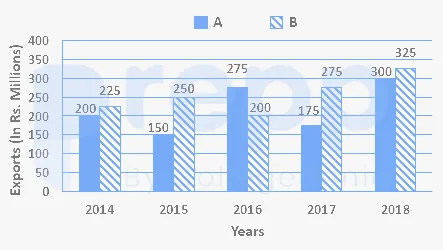
- A
2015
- B
2016
- C
2017
- D
2014
Show answer
D. 2014Given:
There are the exports of cars of type A and B (in Rs. millions) from 2014 to 2018 in the given bar graph.
Total number of years = 5
Concept used:
Average = The sum of the terms/Number of terms
Calculation:
The average exports (per year) of cars of type B (in Rs. millions) = (225 + 250 + 200 + 275 + 325)/5 = 1275/5 = 255 (in Rs. millions)
The exports of cars of type A in 2014 (in Rs. millions) = 200
Here, 255 - 55 = 200 (in Rs. millions)
Therefore, The exports of cars of type A in 2014 is Rs. 55 million less than the average exports (per year) of cars of type B over the five years
Paper & answer key PDF ↗ Question 53archived
What is the height (in cm) of an equilateral triangle whose each side is 8 cm?
- A
3\(\sqrt5\)
- B
4\(\sqrt2\)
- C
4\(\sqrt3\)
- D
3\(\sqrt2\)
Show answer
C. 4\(\sqrt3\)Finding the Height of an Equilateral Triangle
The question asks for the height of an equilateral triangle with a given side length. An equilateral triangle is a triangle where all three sides are equal in length, and all three angles are equal to 60 degrees. The height of an equilateral triangle is the perpendicular line segment from a vertex to the opposite side.
Given:
Side length of the equilateral triangle = 8 cm
To find the height of an equilateral triangle, we can use the Pythagorean theorem. When we draw the height from one vertex to the opposite side, it bisects that side and forms two congruent right-angled triangles.
Let the side length of the equilateral triangle be 'a'. The height 'h' divides the equilateral triangle into two right-angled triangles. In each right-angled triangle:
The hypotenuse is the side of the equilateral triangle, which is 'a' (8 cm).
One leg is the height 'h'.
The other leg is half the base (half the side of the equilateral triangle), which is \(\frac{a}{2}\) (\(\frac{8}{2} = 4\) cm).
Applying the Pythagorean theorem to one of these right-angled triangles:
\((\text{Hypotenuse})^2 = (\text{Leg 1})^2 + (\text{Leg 2})^2\)
\(a^2 = h^2 + \left(\frac{a}{2}\right)^2\)
Substitute the given side length \(a = 8\) cm:
\(8^2 = h^2 + \left(\frac{8}{2}\right)^2\)
\(64 = h^2 + 4^2\)
\(64 = h^2 + 16\)
Now, solve for \(h^2\):
\(h^2 = 64 - 16\)
\(h^2 = 48\)
To find \(h\), take the square root of both sides:
\(h = \sqrt{48}\)
Simplify the square root \(\sqrt{48}\):
\(\sqrt{48} = \sqrt{16 \times 3} = \sqrt{16} \times \sqrt{3} = 4 \times \sqrt{3} = 4\sqrt{3}\)
So, the height of the equilateral triangle is \(4\sqrt{3}\) cm.
Let's check the given options:
\(3\sqrt{5}\)
\(4\sqrt{2}\)
\(4\sqrt{3}\)
\(3\sqrt{2}\)
The calculated height \(4\sqrt{3}\) cm matches option 3.
Revision Table: Equilateral Triangle Height Calculation
Concept
Formula/Method
Application
Equilateral Triangle Side
\(a\)
Given as 8 cm
Pythagorean Theorem
\(c^2 = a^2 + b^2\)
Applied to right triangle formed by height
Height Formula (derived)
\(h = \frac{\sqrt{3}}{2} a\)
Alternative direct formula
Calculation Steps
\(h = \sqrt{a^2 - (a/2)^2}\)
\(\sqrt{8^2 - 4^2} = \sqrt{64 - 16} = \sqrt{48} = 4\sqrt{3}\)
Additional Information on Equilateral Triangles
Equilateral triangles are special types of triangles with unique properties:
All sides are equal (e.g., side 'a').
All interior angles are equal, each measuring 60 degrees.
The height, median, angle bisector, and perpendicular bisector from any vertex are all the same line segment.
The height \(h\) of an equilateral triangle with side \(a\) can also be found directly using the formula: \(h = \frac{\sqrt{3}}{2} a\).
The area of an equilateral triangle with side \(a\) is given by the formula: Area = \(\frac{\sqrt{3}}{4} a^2\).
Using the direct formula for height with \(a = 8\) cm:
\(h = \frac{\sqrt{3}}{2} \times 8\)
\(h = \sqrt{3} \times \frac{8}{2}\)
\(h = \sqrt{3} \times 4\)
\(h = 4\sqrt{3}\)
This confirms the result obtained using the Pythagorean theorem.
Paper & answer key PDF ↗ Question 54archived
O is the centre of a circle with diameter 20 cm. T is a point outside the circle and TA is a tangent to a circle. If OT is - 26 cm, what is the length (in cm) of the tangent TA?
- A
18
- B
20
- C
24
- D
26
Show answer
C. 24Finding the Length of a Tangent to a Circle
This problem involves finding the length of a tangent segment drawn from an external point to a circle. We are given the diameter of the circle, the distance of the external point from the center, and we need to use geometric properties, specifically the relationship between a tangent and the radius at the point of contact, and the Pythagorean theorem.
Understanding the Given Information
The circle has its center at O.
The diameter of the circle is 20 cm.
T is a point located outside the circle.
TA is a line segment tangent to the circle at point A.
The distance from the center O to the external point T is OT = 26 cm.
Step-by-Step Solution
Step 1: Calculate the Radius of the Circle
The radius of a circle is half of its diameter. The diameter is given as 20 cm.
Radius (OA) = Diameter / 2
Radius (OA) = 20 cm / 2 = 10 cm.
Step 2: Identify the Geometric Relationship at the Point of Tangency
A fundamental property of circles states that the radius drawn to the point of tangency is perpendicular to the tangent line at that point. In this case, the radius OA meets the tangent TA at point A. Therefore, the angle ∠OAT is a right angle (90 degrees).
This means that the triangle OAT is a right-angled triangle, with the right angle at A.
Step 3: Apply the Pythagorean Theorem
In a right-angled triangle, the square of the hypotenuse is equal to the sum of the squares of the other two sides. In triangle OAT:
OT is the hypotenuse (the side opposite the right angle).
OA and TA are the other two sides (legs).
According to the Pythagorean theorem:
\(\text{OT}^2 = \text{OA}^2 + \text{TA}^2\)
Step 4: Substitute the Known Values and Solve for TA
We know OT = 26 cm and OA = 10 cm. Let's plug these values into the equation:
\(26^2 = 10^2 + \text{TA}^2\)
Calculate the squares:
\(676 = 100 + \text{TA}^2\)
Now, isolate \(\text{TA}^2\):
\(\text{TA}^2 = 676 - 100\)
\(\text{TA}^2 = 576\)
To find TA, take the square root of 576:
\(\text{TA} = \sqrt{576}\)
The square root of 576 is 24.
\(\text{TA} = 24\)
So, the length of the tangent TA is 24 cm.
Summary of Calculations
Value
Description
Diameter
20 cm
Radius (OA)
10 cm
Distance OT
26 cm
Angle OAT
90° (Tangent is perpendicular to radius)
Pythagorean Theorem
\(\text{OT}^2 = \text{OA}^2 + \text{TA}^2\)
Calculation
\(26^2 = 10^2 + \text{TA}^2\) → \(676 = 100 + \text{TA}^2\) → \(\text{TA}^2 = 576\) → \(\text{TA} = 24\) cm
The length of the tangent segment TA is 24 cm.
Revision Table: Circle Geometry and Tangents
Concept
Description
Relevance to Problem
Diameter & Radius
Diameter = 2 × Radius. Radius = Diameter / 2.
Used to find OA from the given diameter.
Tangent Property
A tangent line to a circle is perpendicular to the radius drawn to the point of tangency.
Establishes that ▵OAT is a right triangle at A.
Pythagorean Theorem
In a right triangle with legs a, b and hypotenuse c, \(a^2 + b^2 = c^2\).
Used to find the unknown side (TA) in the right triangle OAT.
Additional Information: Properties of Tangents
Besides the property used in this problem (tangent is perpendicular to the radius at the point of contact), here are a couple more important properties related to tangents from an external point:
From an external point to a circle, two tangents can be drawn.
The lengths of the two tangents drawn from an external point to a circle are equal. If another tangent TB were drawn from point T to the circle, then TA would be equal to TB.
The line segment connecting the external point to the center of the circle (OT in this case) bisects the angle between the two tangents.
The line segment connecting the external point to the center also bisects the chord of contact (the segment connecting the two points of tangency).
These properties are useful in solving various geometry problems involving circles and tangents.
Paper & answer key PDF ↗ Question 55archived
A vertical pole and a vertical tower are on the same level of ground in such a way that from the top of the pole, the angle of elevation of the top of the tower is 60º and the angle of depression of the bottom of the tower is 30º. If the height of the tower is 76 m, then find the height (in m) of the pole.
- A
19\(\sqrt3\)
- B
57
- C
38
- D
19
Show answer
D. 19Understanding the Problem: Pole and Tower Heights
This problem involves trigonometry and heights of objects based on angles of elevation and depression. We have a vertical pole and a vertical tower standing on the same level ground. We are given the height of the tower and the angles observed from the top of the pole to the top and bottom of the tower.
Setting up the Geometry
Let's represent the situation with points:
Let A be the bottom of the pole and B be the top of the pole. The height of the pole is AB.
Let C be the bottom of the tower and D be the top of the tower. The height of the tower is CD = 76 m.
Points A and C are on the same level ground.
From the top of the pole (B), we draw a horizontal line BE parallel to the ground AC, where E is a point on the tower CD.
Now we can define the angles:
Angle of elevation from B to D is $\angle DBE = 60^\circ$.
Angle of depression from B to C is $\angle EBC = 30^\circ$.
Since BE is horizontal and parallel to AC, and AB and EC are vertical, ABCE forms a rectangle. Therefore, AB = EC and AC = BE.
Using Trigonometry in Right Triangles
We have two right-angled triangles formed: $\triangle EBC$ and $\triangle DBE$.
Analysis of $\triangle EBC$
In $\triangle EBC$, which is right-angled at E:
$\angle BEC = 90^\circ$.
$\angle EBC = 30^\circ$ (angle of depression).
The side opposite to $\angle EBC$ is EC.
The side adjacent to $\angle EBC$ is BE.
Using the tangent ratio:
$\tan(\angle EBC) = \frac{\text{Opposite}}{\text{Adjacent}} = \frac{EC}{BE}$
$\tan(30^\circ) = \frac{EC}{BE}$
We know $\tan(30^\circ) = \frac{1}{\sqrt{3}}$.
So, $\frac{1}{\sqrt{3}} = \frac{EC}{BE}$, which gives $EC = \frac{BE}{\sqrt{3}}$.
Since AB = EC, the height of the pole AB = $\frac{BE}{\sqrt{3}}$.
Analysis of $\triangle DBE$
In $\triangle DBE$, which is right-angled at E:
$\angle BED = 90^\circ$.
$\angle DBE = 60^\circ$ (angle of elevation).
The side opposite to $\angle DBE$ is DE.
The side adjacent to $\angle DBE$ is BE.
Using the tangent ratio:
$\tan(\angle DBE) = \frac{\text{Opposite}}{\text{Adjacent}} = \frac{DE}{BE}$
$\tan(60^\circ) = \frac{DE}{BE}$
We know $\tan(60^\circ) = \sqrt{3}$.
So, $\sqrt{3} = \frac{DE}{BE}$, which gives $DE = BE\sqrt{3}$.
Relating Tower Height and Solving for Unknowns
The height of the tower CD is the sum of CE and ED:
$CD = CE + ED$
We are given that the height of the tower CD = 76 m.
So, $76 = EC + DE$.
Substitute the expressions for EC and DE in terms of BE:
$76 = \frac{BE}{\sqrt{3}} + BE\sqrt{3}$
Factor out BE:
$76 = BE \left( \frac{1}{\sqrt{3}} + \sqrt{3} \right)$
Combine the terms inside the parenthesis:
$76 = BE \left( \frac{1 + \sqrt{3} \times \sqrt{3}}{\sqrt{3}} \right)$
$76 = BE \left( \frac{1 + 3}{\sqrt{3}} \right)$
$76 = BE \left( \frac{4}{\sqrt{3}} \right)$
Now, solve for BE:
$BE = \frac{76\sqrt{3}}{4}$
$BE = 19\sqrt{3}$ m.
Finding the Height of the Pole
The height of the pole is AB, which is equal to EC. We found $EC = \frac{BE}{\sqrt{3}}$.
Substitute the value of BE:
Height of pole (AB) $= EC = \frac{19\sqrt{3}}{\sqrt{3}}$
Height of pole (AB) $= 19$ m.
Verification
Let's check if our values are consistent with the tower height.
If $BE = 19\sqrt{3}$, then $EC = \frac{BE}{\sqrt{3}} = \frac{19\sqrt{3}}{\sqrt{3}} = 19$ m.
And $DE = BE\sqrt{3} = (19\sqrt{3})\sqrt{3} = 19 \times 3 = 57$ m.
The height of the tower $CD = EC + DE = 19 + 57 = 76$ m.
This matches the given height of the tower, so our calculation for the height of the pole is correct.
The height of the pole is 19 m.
Quantity
Value
Relation
Tower Height (CD)
76 m
Given
Angle of Elevation (DBE)
60°
Given
Angle of Depression (EBC)
30°
Given
Horizontal Distance (BE)
$19\sqrt{3}$ m
Calculated
EC
19 m
$BE/\sqrt{3}$
DE
57 m
$BE\sqrt{3}$
Pole Height (AB)
19 m
Equal to EC
Revision Table: Key Concepts for Heights and Angles
Concept
Definition
Application
Angle of Elevation
Angle between the horizontal line of sight and the line of sight to an object above the horizontal.
Used when looking upwards from a reference point.
Angle of Depression
Angle between the horizontal line of sight and the line of sight to an object below the horizontal.
Used when looking downwards from a reference point.
Trigonometric Ratios (SOH CAH TOA)
Relates the angles of a right triangle to the ratios of its side lengths (Sine, Cosine, Tangent).
Used to find unknown sides or angles in right triangles. In this problem, $\tan \theta = \frac{\text{Opposite}}{\text{Adjacent}}$.
Additional Information: Applying Trigonometry in Real-World Problems
Trigonometry is very useful for solving problems involving heights and distances that cannot be measured directly. Problems involving angles of elevation and depression are common examples.
When setting up such a problem, always draw a diagram first. Label all knowns and unknowns.
Draw a horizontal line from the observation point to create right triangles.
Remember that the angle of depression from point A to point B is equal to the angle of elevation from point B to point A (assuming they are at different heights and on the same vertical plane). This is due to alternate interior angles if you draw a horizontal line through both points. In our case, $\angle EBC = \angle BCA = 30^\circ$. You could also solve the problem using $\triangle ABC$ and $\triangle ABD$, but the method with the horizontal line from B often simplifies the setup.
Identify the right triangles formed and determine which trigonometric ratio ($\sin$, $\cos$, or $\tan$) relates the known angle and side to the unknown side you want to find.
Solve the resulting equations.
Understanding the relationship between angles and sides in right triangles is fundamental to solving these types of height and distance problems.
Paper & answer key PDF ↗ Question 56archived
The given bar graph shows export of cars of type A and B(in Rs. millions) from 2014 to 2018. Study the graph and answer the question that follows.
Exports of Cars of Type A and B (in Rs. millions) from 2014 to 2018
The total exports of cars of type B in 2014 to 2017 is what per cent more than the total exports of cars of type A in 2015 to 2018? (correct to one decimal place)
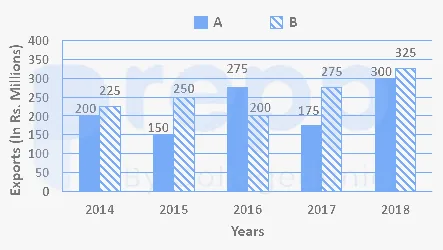
- A
6.5%
- B
4.9%
- C
5.6%
- D
7.2%
Show answer
C. 5.6%Given:
There are the exports of cars of type A and B (in Rs. millions) from 2014 to 2018 in the given bar graph.
Total number of years = 5
Calculation:
The t otal exports of cars of type B from 2014 to 2017 (in Rs. millions) = 225 + 250 + 200 + 275 = 950
The total exports of cars of type A from 2015 to 2018 (in Rs. millions) = 150 + 275 + 175 + 300 = 900
The difference (in Rs. millions) = 950 - 900 = 50
The percentage = (50/900) × 100 = 5.55...% ≈ 5.6%
∴ The total exports of cars of type B from 2014 to 2017 is 5.6% more than the total exports of cars of type A from 2015 to 2018
Paper & answer key PDF ↗ Question 57archived
The width of the path around a square field is 4.5 m and its area is 105.75 m 2. Find the cost of fencing the field at the rate of Rs. 100 per meter.
- A
Rs. 275
- B
Rs. 550
- C
Rs. 600
- D
Rs. 400
Show answer
B. Rs. 550Finding the Cost of Fencing a Square Field
This problem involves a square field with a path around it. We are given the width of the path and the area of the path, and we need to find the cost of fencing the field itself.
Understanding the Geometry
We have an inner square which is the field and an outer square which includes the field and the path. The width of the path is uniform around the field.
Let the side length of the square field be \(s\) meters.
The path has a width of 4.5 meters.
The side length of the outer square (field + path) will be \(s + 2 \times \text{path width}\). This is because the path adds its width to both sides of the inner square.
So, the side length of the outer square is \(s + 2 \times 4.5 = s + 9\) meters.
Calculating the Area of the Path
The area of the path is the difference between the area of the outer square and the area of the inner square (the field).
Area of the inner square (field) = \(s^2\) square meters.
Area of the outer square = \((s + 9)^2\) square meters.
Area of the path = Area of outer square - Area of inner square
Area of the path = \((s + 9)^2 - s^2\)
We are given that the area of the path is 105.75 square meters.
So, we have the equation:
\[ (s + 9)^2 - s^2 = 105.75 \]
Solving for the Side Length of the Field
Let's expand the equation and solve for \(s\):
\[ (s^2 + 18s + 81) - s^2 = 105.75 \]
The \(s^2\) terms cancel out:
\[ 18s + 81 = 105.75 \]
Subtract 81 from both sides:
\[ 18s = 105.75 - 81 \]
\[ 18s = 24.75 \]
Now, divide by 18 to find \(s\):
\[ s = \frac{24.75}{18} \]
\[ s = 1.375 \]
So, the side length of the square field is 1.375 meters.
Calculating the Cost of Fencing
Fencing the field means fencing its perimeter. The field is a square with side length \(s = 1.375\) meters.
Perimeter of the square field = \(4 \times s\)
Perimeter = \(4 \times 1.375\) meters
Perimeter = 5.5 meters
The cost of fencing is Rs. 100 per meter.
Cost of fencing = Perimeter \(\times\) Rate per meter
Cost of fencing = \(5.5 \times 100\)
Cost of fencing = Rs. 550
Therefore, the cost of fencing the field is Rs. 550.
Summary of Calculation
Description
Value
Unit
Width of Path
4.5
m
Area of Path
105.75
m\(^2\)
Side of Inner Square (s)
1.375
m
Perimeter of Field (4s)
5.5
m
Fencing Rate
100
Rs./m
Cost of Fencing
550
Rs.
Revision Table - Square Field and Path Problem
Let's quickly review the key formulas and steps used in this problem:
Side of inner square = \(s\)
Width of path = \(w\)
Side of outer square = \(s + 2w\)
Area of inner square = \(s^2\)
Area of outer square = \((s + 2w)^2\)
Area of path = Area of outer square - Area of inner square = \((s + 2w)^2 - s^2\)
Perimeter of inner square (for fencing) = \(4s\)
Cost of fencing = Perimeter \(\times\) Rate
Additional Information - Areas and Perimeters
Understanding how areas and perimeters work for shapes with uniform borders is important. This problem is an example of finding the dimensions of an inner shape when the dimensions and area of a surrounding border are known.
Area: The amount of surface a 2D shape covers. Measured in square units (e.g., m\(^2\), cm\(^2\)).
Perimeter: The total distance around the boundary of a 2D shape. Measured in linear units (e.g., m, cm).
For a square with side length \(a\):
Area = \(a^2\)
Perimeter = \(4a\)
When a path of uniform width \(w\) surrounds a square of side \(s\), the outer shape is also a square. Its side length becomes \(s + 2w\). The area of the path is found by subtracting the inner area from the outer area.
Paper & answer key PDF ↗ Question 58archived
An alloy contains 40% of silver, 30% of copper, and 30% of nickel. How much silver (in kg) should be added to 25 kg of the alloy so that the new alloy contains 50% of silver?
- A
20
- B
5
- C
12
- D
10
Show answer
B. 5Understanding the Alloy and Silver Percentage
The problem asks us to determine how much pure silver needs to be added to an existing alloy to increase the percentage of silver in the final mixture. We start with a known quantity and composition of the alloy.
Initial Alloy Composition
We are given an initial alloy weighing 25 kg. The composition is specified as:
Silver: 40%
Copper: 30%
Nickel: 30%
Calculating Initial Weights
First, let's calculate the weight of each metal in the initial 25 kg alloy:
Weight of Silver = $$ 40\% \times 25 \text{ kg} $$ = $$ 0.40 \times 25 \text{ kg} $$ = 10 kg
Weight of Copper = $$ 30\% \times 25 \text{ kg} $$ = $$ 0.30 \times 25 \text{ kg} $$ = 7.5 kg
Weight of Nickel = $$ 30\% \times 25 \text{ kg} $$ = $$ 0.30 \times 25 \text{ kg} $$ = 7.5 kg
The total weight is $$ 10 \text{ kg} + 7.5 \text{ kg} + 7.5 \text{ kg} = 25 \text{ kg} $$, which matches the given total weight.
Initial Weights in the 25 kg Alloy
Metal
Percentage
Weight (kg)
Silver
40%
10
Copper
30%
7.5
Nickel
30%
7.5
Total
100%
25
Calculating Added Silver for Target Percentage
We want the new alloy to contain 50% silver. Let 'x' represent the weight of pure silver (in kg) that needs to be added.
Setting up the Final Composition Equation
When 'x' kg of silver is added:
The new weight of silver will be the initial weight plus the added amount: $$ (10 + x) \text{ kg} $$
The new total weight of the alloy will be the initial weight plus the added silver: $$ (25 + x) \text{ kg} $$
The problem requires the new alloy to be 50% silver. This means the ratio of the new silver weight to the new total alloy weight must be equal to 0.50 (which is 50%):
$$ \frac{\text{New Silver Weight}}{\text{New Total Alloy Weight}} = 0.50 $$
Substituting the expressions:
$$ \frac{10 + x}{25 + x} = 0.5 $$
Solving the Equation for 'x'
We can solve this algebraic equation for 'x':
Multiply both sides by $$ (25 + x) $$ to eliminate the denominator:
$$ 10 + x = 0.5 \times (25 + x) $$
Distribute the 0.5 on the right side:
$$ 10 + x = 12.5 + 0.5x $$
To isolate 'x', first subtract $$ 0.5x $$ from both sides:
$$ 10 + x - 0.5x = 12.5 $$
$$ 10 + 0.5x = 12.5 $$
Next, subtract 10 from both sides to isolate the term with 'x':
$$ 0.5x = 12.5 - 10 $$
$$ 0.5x = 2.5 $$
Finally, divide by 0.5 (or multiply by 2) to find 'x':
$$ x = \frac{2.5}{0.5} $$
$$ x = 5 $$
Verifying the Result
Let's check if adding 5 kg of silver satisfies the condition:
New Silver Weight = $$ 10 \text{ kg} + 5 \text{ kg} = 15 \text{ kg} $$
New Total Alloy Weight = $$ 25 \text{ kg} + 5 \text{ kg} = 30 \text{ kg} $$
Percentage of Silver = $$ \frac{15 \text{ kg}}{30 \text{ kg}} \times 100\% = 50\% $$
The result matches the required 50% silver content.
Conclusion
To achieve a new alloy containing 50% silver, 5 kg of silver must be added.
Paper & answer key PDF ↗ Question 59archived
Simplify the following expression:
\({{{(a^2-4b^2)}^3} + 64 {{(b^2 - 4c^2)}^3} + {{(16c^2 -a^2})^3}} \over {{(a-2b)^3} +{(2b-4c)^3} +{(4c-a)^3}}\)
- A
-(a + 2b) (b +2c) (4c + a)
- B
2(a + 2b) (b + 2c) (4c + a)
- C
4(a + 2b) (b + 2c) (4c + a)
- D
(a + 2b) (b + 2c) (4c + a)
Show answer
B. 2(a + 2b) (b + 2c) (4c + a)Simplifying Complex Algebraic Expressions
The problem asks us to simplify a given algebraic expression which is in the form of a fraction. The expression involves cubes of binomial and trinomial terms.
The given expression is:
\[{{{({{a}^{2}}-4{{b}^{2}})}^{3}} + 64 {{(b^2 - 4c^2)}^3} + {{(16c^2 -a^2})^3}} \over {{(a-2b)^3} +{(2b-4c)^3} +{(4c-a)^3}}\]
We can simplify this expression by recognizing and applying the algebraic identity: If \(x + y + z = 0\), then \(x^3 + y^3 + z^3 = 3xyz\).
Step 1: Analyze the Denominator
Let's examine the terms in the denominator:
Let \(x = a - 2b\)
Let \(y = 2b - 4c\)
Let \(z = 4c - a\)
Now, let's check the sum of these terms:
\[x + y + z = (a - 2b) + (2b - 4c) + (4c - a)\]
Group like terms:
\[x + y + z = (a - a) + (-2b + 2b) + (-4c + 4c) = 0 + 0 + 0 = 0\]
Since \(x + y + z = 0\), we can apply the identity \(x^3 + y^3 + z^3 = 3xyz\) to the denominator.
Denominator \( = (a-2b)^3 + (2b-4c)^3 + (4c-a)^3 = 3(a-2b)(2b-4c)(4c-a)\).
We can factor out a 2 from the term \((2b - 4c)\):
\[2b - 4c = 2(b - 2c)\]
So, the denominator becomes:
\[3(a-2b) \cdot 2(b-2c) \cdot (4c-a) = 6(a-2b)(b-2c)(4c-a)\]
Step 2: Analyze the Numerator
The numerator is \({{(a^2-4b^2)}^3} + 64 {{(b^2 - 4c^2)}^3} + {{(16c^2 -a^2})^3}}\).
Notice that \(64 = 4^3\). So, the term \(64 {{(b^2 - 4c^2)}^3}\) can be written as \((4{(b^2 - 4c^2)})^3\).
Let's define the terms being cubed in the numerator (after adjusting the constant):
Let \(A = a^2 - 4b^2\)
Let \(B = 4(b^2 - 4c^2)\)
Let \(C = 16c^2 - a^2\)
Now, let's check the sum of these terms:
\[A + B + C = (a^2 - 4b^2) + 4(b^2 - 4c^2) + (16c^2 - a^2)\]
\[A + B + C = a^2 - 4b^2 + 4b^2 - 16c^2 + 16c^2 - a^2\]
Group like terms:
\[A + B + C = (a^2 - a^2) + (-4b^2 + 4b^2) + (-16c^2 + 16c^2) = 0 + 0 + 0 = 0\]
Since \(A + B + C = 0\), we can apply the identity \(A^3 + B^3 + C^3 = 3ABC\) to the numerator.
Numerator \( = A^3 + B^3 + C^3 = 3ABC\)
Substitute back the expressions for A, B, and C:
\[\text{Numerator} = 3(a^2 - 4b^2)(4(b^2 - 4c^2))(16c^2 - a^2)\]
Rearrange the constant:
\[\text{Numerator} = 3 \cdot 4 \cdot (a^2 - 4b^2)(b^2 - 4c^2)(16c^2 - a^2)\]
\[\text{Numerator} = 12(a^2 - 4b^2)(b^2 - 4c^2)(16c^2 - a^2)\]
We can further factor the terms using the difference of squares formula \((p^2 - q^2 = (p-q)(p+q))\):
\(a^2 - 4b^2 = a^2 - (2b)^2 = (a - 2b)(a + 2b)\)
\(b^2 - 4c^2 = b^2 - (2c)^2 = (b - 2c)(b + 2c)\)
\(16c^2 - a^2 = (4c)^2 - a^2 = (4c - a)(4c + a)\)
So, the numerator becomes:
\[\text{Numerator} = 12(a - 2b)(a + 2b)(b - 2c)(b + 2c)(4c - a)(4c + a)\]
Step 3: Simplify the Fraction
Now, we have the simplified numerator and denominator:
\[\text{Expression} = {{\text{Numerator}} \over {\text{Denominator}}}\]
\[\text{Expression} = {{12(a - 2b)(a + 2b)(b - 2c)(b + 2c)(4c - a)(4c + a)} \over {6(a-2b)(b-2c)(4c-a)}}\]
Cancel the common terms in the numerator and the denominator:
Cancel \((a - 2b)\) from numerator and denominator.
Cancel \((b - 2c)\) from numerator and denominator.
Cancel \((4c - a)\) from numerator and denominator.
Cancel the numerical factor: \(12 \div 6 = 2\).
The remaining terms are:
\[2(a + 2b)(b + 2c)(4c + a)\]
Conclusion
The simplified expression is \(2(a + 2b)(b + 2c)(4c + a)\).
Let's check this result against the given options:
Option
Expression
Matches Result?
1
\( -(a + 2b) (b +2c) (4c + a) \)
No
2
\( 2(a + 2b) (b + 2c) (4c + a) \)
Yes
3
\( 4(a + 2b) (b + 2c) (4c + a) \)
No
4
\( (a + 2b) (b + 2c) (4c + a) \)
No
The simplified expression matches Option 2.
Revision Table: Simplifying Algebraic Expressions
Concept
Description
How it applied here
Algebraic Identity: \(x+y+z=0 \implies x^3+y^3+z^3=3xyz\)
If the sum of three terms is zero, the sum of their cubes is three times their product.
Applied to both the denominator terms and the 'effective' numerator terms after factoring out constants.
Difference of Squares: \(p^2 - q^2 = (p-q)(p+q)\)
Factorizing a term that is the difference of two squares.
Used to factor the terms in the numerator like \(a^2-4b^2\), \(b^2-4c^2\), and \(16c^2-a^2\).
Factoring out Common Factors
Identifying and extracting common multipliers from terms.
Used in the denominator \(2b-4c = 2(b-2c)\) and cancelling common factors in the final fraction simplification.
Additional Information: Algebraic Identities and Simplification
Algebraic identities are equations that are true for all possible values of the variables involved. They are fundamental tools for simplifying expressions, solving equations, and proving other mathematical statements. The identity \(x^3 + y^3 + z^3 = 3xyz\) when \(x+y+z=0\) is a special case of the sum of cubes identity \(x^3+y^3+z^3-3xyz = (x+y+z)(x^2+y^2+z^2-xy-yz-zx)\).
Simplifying algebraic expressions makes them easier to understand and work with. It often involves factoring, expanding, combining like terms, and using identities. In fractional expressions, factorization is particularly useful for cancelling common factors in the numerator and the denominator.
The difference of squares identity is another common and powerful tool for factorization. Recognizing perfect squares (\(a^2\), \(4b^2=(2b)^2\), \(16c^2=(4c)^2\)) is key to applying this identity effectively.
Problems like this one test the ability to recognize patterns and apply the correct algebraic identities strategically. Breaking down the problem into simplifying the numerator and the denominator separately is a useful approach.
Paper & answer key PDF ↗ Question 60archived
Monthly expenditure of a family on different heads is shown in the following pie chart. The family earns Rs. 1,08,000 every month.
The money (in Rs.) spent on Misc. Expenses is how much more than that spent on Children Education?
E xpenditure on different Heads
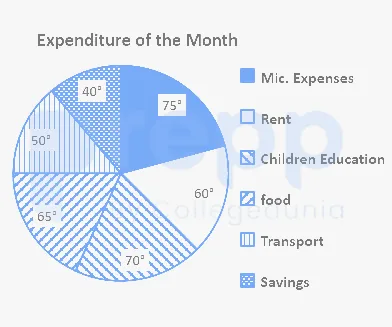
- A
1,350
- B
1,800
- C
1,500
- D
1,200
Show answer
C. 1,500Given:
There is the monthly expenditure of a family on different heads is shown in the following pie chart.
Income of the family = Rs. 108000/month
Calculation:
The total angle of all expenditures = 75° + 60° + 70° + 65° + 50° + 40° = 360°
The difference between Misc. Expenses and spent on Children's Education = 75° - 70° = 5°
So, the amount differences = (5/360) × 108000 = Rs. 1500
∴ The money (in Rs.) spent on Misc. Expenses are Rs. 1500 more than that spent on Children's Education.
Paper & answer key PDF ↗ Question 61archived
The profit earned by selling an article for Rs. 832 is equal to the loss incurred when the article is sold for Rs. 448. What will be the selling price of the article if it is sold at a 10% loss?
- A
Rs. 576
- B
Rs. 640
- C
Rs. 625
- D
Rs. 540
Show answer
A. Rs. 576Solving Profit and Loss Problems
This problem involves understanding the relationship between cost price, selling price, profit, and loss. We are given two scenarios where an article is sold, resulting in either a profit or a loss. The key piece of information is that the profit in the first case is equal to the loss in the second case.
Understanding Profit and Loss
In basic terms:
Profit occurs when the Selling Price (SP) is greater than the Cost Price (CP). Profit = SP - CP.
Loss occurs when the Cost Price (CP) is greater than the Selling Price (SP). Loss = CP - SP.
Finding the Cost Price (CP)
Let the Cost Price of the article be \(CP\).
According to the problem:
When sold for Rs. 832, there is a profit. Profit = \(832 - CP\).
When sold for Rs. 448, there is a loss. Loss = \(CP - 448\).
We are told that the profit earned is equal to the loss incurred. So, we can set up an equation:
\( \text{Profit} = \text{Loss} \)
\( 832 - CP = CP - 448 \)
Now, let's solve this equation to find the value of \(CP\):
Add \(CP\) to both sides of the equation:
\( 832 = CP + CP - 448 \)
\( 832 = 2CP - 448 \)
Add 448 to both sides of the equation:
\( 832 + 448 = 2CP \)
\( 1280 = 2CP \)
Divide both sides by 2:
\( CP = \frac{1280}{2} \)
\( CP = 640 \)
So, the Cost Price of the article is Rs. 640.
Calculating Selling Price at 10% Loss
Now that we know the Cost Price (\(CP = 640\)), we need to find the selling price if the article is sold at a 10% loss.
A 10% loss means the selling price will be 10% less than the cost price.
Loss amount = 10% of \(CP\)
Loss amount = \(10\% \times 640\)
Loss amount = \( \frac{10}{100} \times 640 \)
Loss amount = \( 0.10 \times 640 \)
Loss amount = \( 64 \)
The Selling Price (SP) with a loss is calculated as:
\( SP = CP - \text{Loss amount} \)
\( SP = 640 - 64 \)
\( SP = 576 \)
Alternatively, if there is a 10% loss, the selling price is \( (100 - 10)\% = 90\% \) of the cost price.
\( SP = 90\% \times CP \)
\( SP = \frac{90}{100} \times 640 \)
\( SP = 0.90 \times 640 \)
\( SP = 576 \)
The selling price of the article if it is sold at a 10% loss is Rs. 576.
Summary of Calculations
Description
Formula/Calculation
Result
Equation from Profit = Loss
\(832 - CP = CP - 448\)
-
Solving for CP
\(2CP = 832 + 448 = 1280\)
\(CP = 640\)
Selling Price at 10% Loss
\(SP = CP \times (1 - \frac{10}{100})\)
\(SP = 640 \times 0.90 = 576\)
Therefore, the selling price of the article when sold at a 10% loss is Rs. 576.
Revision Table: Key Profit and Loss Formulas
Concept
Formula
Profit
\(SP - CP\) (when \(SP > CP\))
Loss
\(CP - SP\) (when \(CP > SP\))
Profit Percentage
\((\frac{Profit}{CP}) \times 100\)
Loss Percentage
\((\frac{Loss}{CP}) \times 100\)
SP with Profit
\(CP \times (1 + \frac{\text{Profit}\%}{100})\)
SP with Loss
\(CP \times (1 - \frac{\text{Loss}\%}{100})\)
Additional Information on Profit and Loss Concepts
Profit and loss are fundamental concepts in business and everyday transactions. They help us understand the financial outcome of selling an item.
The Cost Price (CP) is the original price at which an article is bought or manufactured. It includes all expenses incurred to get the article ready for sale.
The Selling Price (SP) is the price at which an article is sold to the customer.
When profit equals loss, the cost price is the average of the two selling prices. In this case, \(CP = \frac{832 + 448}{2} = \frac{1280}{2} = 640\). This can be a quick way to find CP in such specific problems.
Percentages in profit and loss are always calculated with respect to the Cost Price, unless stated otherwise.
Understanding these concepts is crucial for various calculations, including markups, discounts, and net profit/loss over multiple transactions.
Paper & answer key PDF ↗ Question 62archived
Find the greatest number which divides 108, 124 and 156, leaving the same remainder.
- A
16
- B
12
- C
10
- D
18
Show answer
A. 16Finding the Greatest Number with Same Remainder
The problem asks us to find the greatest number that divides 108, 124, and 156, leaving the same remainder in each case. This is a classic problem that can be solved using the concept of the Highest Common Factor (HCF), also known as the Greatest Common Divisor (GCD).
Understanding the Concept
If a number, let's call it $d$, divides two numbers, say $a$ and $b$, and leaves the same remainder, say $r$, then it means that $a = dq_1 + r$ and $b = dq_2 + r$ for some integers $q_1$ and $q_2$. Subtracting these equations, we get $a - b = d(q_1 - q_2)$. This shows that $d$ must divide the difference between $a$ and $b$.
Extending this to three numbers, 108, 124, and 156, if a number $d$ divides all three leaving the same remainder, then $d$ must divide the differences between any pair of these numbers. The greatest such number $d$ will be the HCF of these differences.
Calculating the Differences
We need to find the differences between the given numbers:
Difference between 124 and 108: $|124 - 108| = 16$
Difference between 156 and 124: $|156 - 124| = 32$
Difference between 156 and 108: $|156 - 108| = 48$
So, the differences are 16, 32, and 48.
Finding the HCF of the Differences
The greatest number that divides 108, 124, and 156 leaving the same remainder is the HCF of 16, 32, and 48.
Let's find the HCF using the prime factorization method:
Prime factorization of 16: $16 = 2 \times 2 \times 2 \times 2 = 2^4$
Prime factorization of 32: $32 = 2 \times 2 \times 2 \times 2 \times 2 = 2^5$
Prime factorization of 48: $48 = 2 \times 2 \times 2 \times 2 \times 3 = 2^4 \times 3$
To find the HCF, we take the lowest power of the common prime factors. The only common prime factor is 2, and the lowest power is $2^4$.
HCF(16, 32, 48) = $2^4 = 16$.
So, the greatest number is 16.
Verification
Let's verify if 16 divides 108, 124, and 156 leaving the same remainder:
$108 \div 16$: $108 = 16 \times 6 + 12$. The remainder is 12.
$124 \div 16$: $124 = 16 \times 7 + 12$. The remainder is 12.
$156 \div 16$: $156 = 16 \times 9 + 12$. The remainder is 12.
Since the remainder is 12 in all three cases, our calculation is correct.
Analysing the Options
Let's look at the given options and see if they satisfy the condition:
Option
Division of 108
Division of 124
Division of 156
Same Remainder?
16
$108 = 16 \times 6 + 12$ (R=12)
$124 = 16 \times 7 + 12$ (R=12)
$156 = 16 \times 9 + 12$ (R=12)
Yes (12)
12
$108 = 12 \times 9 + 0$ (R=0)
$124 = 12 \times 10 + 4$ (R=4)
$156 = 12 \times 13 + 0$ (R=0)
No (0, 4, 0)
10
$108 = 10 \times 10 + 8$ (R=8)
$124 = 10 \times 12 + 4$ (R=4)
$156 = 10 \times 15 + 6$ (R=6)
No (8, 4, 6)
18
$108 = 18 \times 6 + 0$ (R=0)
$124 = 18 \times 6 + 16$ (R=16)
$156 = 18 \times 8 + 12$ (R=12)
No (0, 16, 12)
As shown in the table, only 16 divides 108, 124, and 156 leaving the same remainder.
Conclusion
The greatest number that divides 108, 124, and 156, leaving the same remainder is 16.
Revision Table: HCF and Same Remainder Problems
Concept
Explanation
How it Applies Here
HCF (Highest Common Factor) / GCD (Greatest Common Divisor)
The largest positive integer that divides two or more integers without leaving a remainder.
We need to find the HCF of the differences between the numbers.
Division Algorithm
For integers $a$ and $b$ ($b > 0$), there exist unique integers $q$ (quotient) and $r$ (remainder) such that $a = bq + r$, where $0 \le r < b$.
Used to verify the remainder when dividing 108, 124, and 156 by the potential answer.
Numbers Leaving Same Remainder
If $N_1$, $N_2$, $N_3$ leave the same remainder $r$ when divided by $d$, then $d$ divides $(N_1 - N_2)$, $(N_2 - N_3)$, and $(N_1 - N_3)$ exactly. The greatest such $d$ is HCF of the absolute differences.
We calculated $|124-108|=16$, $|156-124|=32$, $|156-108|=48$. The required number is HCF(16, 32, 48).
Additional Information: Finding Remainder
Once you have found the greatest number that divides the given numbers leaving the same remainder, you can find that remainder by dividing any of the original numbers by the found number.
In this problem, we found the number is 16. The original numbers are 108, 124, and 156. Let's divide any one, say 108, by 16:
$108 \div 16$
We know $16 \times 6 = 96$.
$108 - 96 = 12$.
So, $108 = 16 \times 6 + 12$. The quotient is 6 and the remainder is 12.
Dividing 124 by 16:
$16 \times 7 = 112$.
$124 - 112 = 12$.
So, $124 = 16 \times 7 + 12$. The quotient is 7 and the remainder is 12.
Dividing 156 by 16:
$16 \times 9 = 144$.
$156 - 144 = 12$.
So, $156 = 16 \times 9 + 12$. The quotient is 9 and the remainder is 12.
The remainder is indeed the same (12) for all three divisions by 16.
Paper & answer key PDF ↗ Question 63archived
X, Y and Z can do a piece of work in 46 days, 92 days and 23 days, respectively, X started the work. Y joined him after 2 days. If Z joined them after 8 days from the beginning then for how many days did X work?
- A
21
- B
18
- C
13
- D
16
Show answer
B. 18Solving the Time and Work Problem for X, Y, and Z
This problem involves calculating the total number of days X worked when X, Y, and Z complete a piece of work together in different stages. We need to determine the work rate of each person and then calculate the work done in each phase of the project.
Understanding Individual Work Rates
The work rate of a person is the amount of work they can complete in one day. It is the reciprocal of the time taken to complete the entire work.
X completes the work in 46 days.
Y completes the work in 92 days.
Z completes the work in 23 days.
So, their daily work rates are:
Work rate of X = \( \frac{1}{46} \) work/day
Work rate of Y = \( \frac{1}{92} \) work/day
Work rate of Z = \( \frac{1}{23} \) work/day
Breaking Down the Work into Stages
The work is completed in three distinct stages based on who is working:
Stage 1: X works alone
X starts the work alone. Y joins him after 2 days. So, X works alone for the first 2 days.
Work done by X in 2 days = Work rate of X \( \times \) Number of days
Work done in Stage 1 = \( \frac{1}{46} \times 2 = \frac{2}{46} = \frac{1}{23} \) of the total work.
Stage 2: X and Y work together
Y joins X after 2 days. Z joins them after 8 days from the beginning. This means X and Y work together from the beginning of day 3 until the end of day 8. The duration of this stage is \(8 - 2 = 6\) days.
Combined work rate of X and Y = Work rate of X + Work rate of Y
Combined rate of X and Y = \( \frac{1}{46} + \frac{1}{92} \)
To add these fractions, find a common denominator (LCM of 46 and 92 is 92):
\( \frac{1}{46} + \frac{1}{92} = \frac{1 \times 2}{46 \times 2} + \frac{1}{92} = \frac{2}{92} + \frac{1}{92} = \frac{2+1}{92} = \frac{3}{92} \) work/day.
Work done by X and Y in 6 days = Combined rate \( \times \) Number of days
Work done in Stage 2 = \( \frac{3}{92} \times 6 = \frac{18}{92} = \frac{9}{46} \) of the total work.
Stage 3: X, Y, and Z work together
Z joins after 8 days from the beginning. So, from day 9 onwards, X, Y, and Z work together until the work is finished. Let's say this stage lasts for \(d\) days.
Combined work rate of X, Y, and Z = Work rate of X + Work rate of Y + Work rate of Z
Combined rate of X, Y, and Z = \( \frac{1}{46} + \frac{1}{92} + \frac{1}{23} \)
To add these fractions, find a common denominator (LCM of 46, 92, and 23 is 92):
\( \frac{1}{46} + \frac{1}{92} + \frac{1}{23} = \frac{1 \times 2}{46 \times 2} + \frac{1}{92} + \frac{1 \times 4}{23 \times 4} = \frac{2}{92} + \frac{1}{92} + \frac{4}{92} = \frac{2+1+4}{92} = \frac{7}{92} \) work/day.
Work done by X, Y, and Z in \(d\) days = Combined rate \( \times \) Number of days
Work done in Stage 3 = \( \frac{7}{92} \times d \) of the total work.
Calculating Total Work and Duration of Stage 3
The sum of the work done in all three stages must equal the total work (which is 1 unit).
Work in Stage 1 + Work in Stage 2 + Work in Stage 3 = Total Work
\( \frac{1}{23} + \frac{9}{46} + \frac{7d}{92} = 1 \)
Find a common denominator for the fractions (92):
\( \frac{1 \times 4}{23 \times 4} + \frac{9 \times 2}{46 \times 2} + \frac{7d}{92} = 1 \)
\( \frac{4}{92} + \frac{18}{92} + \frac{7d}{92} = 1 \)
\( \frac{4 + 18 + 7d}{92} = 1 \)
\( \frac{22 + 7d}{92} = 1 \)
Multiply both sides by 92:
\( 22 + 7d = 92 \)
Subtract 22 from both sides:
\( 7d = 92 - 22 \)
\( 7d = 70 \)
Divide by 7:
\( d = \frac{70}{7} \)
\( d = 10 \) days.
So, X, Y, and Z worked together for 10 days.
Total Days X Worked
X worked in all three stages:
Stage 1: X worked alone for 2 days.
Stage 2: X worked with Y for 6 days.
Stage 3: X worked with Y and Z for 10 days.
Total days X worked = Days in Stage 1 + Days in Stage 2 + Days in Stage 3
Total days X worked = \( 2 + 6 + 10 = 18 \) days.
Therefore, X worked for a total of 18 days.
Revision Table: Time and Work Summary
Person
Time to complete work (days)
Daily Work Rate
X
46
\( \frac{1}{46} \)
Y
92
\( \frac{1}{92} \)
Z
23
\( \frac{1}{23} \)
Additional Information: Key Concepts in Time and Work
Understanding the relationship between time and work is crucial for solving such problems. Here are some key concepts:
Work Rate: The amount of work done per unit of time. If a person takes \(T\) days to complete a work, their daily rate is \( \frac{1}{T} \).
Total Work: Often considered as 1 unit or a common multiple of the individual times (LCM). We used 1 unit of work in this solution.
Work Done: Work Rate \( \times \) Time.
Combined Work Rate: When multiple people work together, their individual work rates are added to find the combined rate. If Person A's rate is \(R_A\) and Person B's rate is \(R_B\), their combined rate is \(R_A + R_B\).
Working in Stages: Problems often involve different groups of people working during different periods. Calculate the work done in each stage and sum them up to equal the total work.
These fundamental concepts help in breaking down complex time and work problems into manageable steps.
Paper & answer key PDF ↗ Question 64archived
What is the value of:
8 \(\sqrt3\) sin 30º tan 60º - 3 cos 0º + 3 sin 2 45º + 2 cos 2 30º?
- A
18
- B
15
- C
9
- D
12
Show answer
D. 12Evaluating the Trigonometric Expression Step-by-Step
Let's evaluate the given trigonometric expression:
\(8 \sqrt3 \sin 30^\circ \tan 60^\circ - 3 \cos 0^\circ + 3 \sin^2 45^\circ + 2 \cos^2 30^\circ\)
To solve this, we need to know the standard trigonometric values for the angles 0°, 30°, 45°, and 60°. Here are the values we will use:
Angle
\(\sin \theta\)
\(\cos \theta\)
\(\tan \theta\)
0°
0
1
0
30°
\(1/2\)
\(\sqrt3/2\)
\(1/\sqrt3\)
45°
\(1/\sqrt2\)
\(1/\sqrt2\)
1
60°
\(\sqrt3/2\)
\(1/2\)
\(\sqrt3\)
Now, let's substitute these values into the expression and evaluate each term.
Term 1: \(8 \sqrt3 \sin 30^\circ \tan 60^\circ\)
Substitute \(\sin 30^\circ = 1/2\) and \(\tan 60^\circ = \sqrt3\).
The term becomes: \(8 \sqrt3 \times (1/2) \times \sqrt3\)
Simplify: \(8 \times (1/2) \times (\sqrt3 \times \sqrt3) = 4 \times 3 = 12\)
So, the value of the first term is 12.
Term 2: \(3 \cos 0^\circ\)
Substitute \(\cos 0^\circ = 1\).
The term becomes: \(3 \times 1\)
Simplify: \(3\)
So, the value of the second term is 3.
Term 3: \(3 \sin^2 45^\circ\)
Substitute \(\sin 45^\circ = 1/\sqrt2\).
The term becomes: \(3 \times (1/\sqrt2)^2\)
Simplify: \(3 \times (1/2) = 3/2\)
So, the value of the third term is \(3/2\).
Term 4: \(2 \cos^2 30^\circ\)
Substitute \(\cos 30^\circ = \sqrt3/2\).
The term becomes: \(2 \times (\sqrt3/2)^2\)
Simplify: \(2 \times (3/4) = 6/4 = 3/2\)
So, the value of the fourth term is \(3/2\).
Combining the Terms
Now, we put the values of the terms back into the original expression:
\(12 - 3 + 3/2 + 3/2\)
Combine the fractions:
\(3/2 + 3/2 = 6/2 = 3\)
Substitute this back into the expression:
\(12 - 3 + 3\)
Perform the subtraction and addition:
\(12 - 3 = 9\)
\(9 + 3 = 12\)
Thus, the value of the given trigonometric expression is 12.
Revision Table: Key Trigonometric Values
It's helpful to remember these standard values for quick calculations:
Angle \(\theta\)
\(\sin \theta\)
\(\cos \theta\)
\(\tan \theta\)
0°
0
1
0
30°
\(1/2\)
\(\sqrt3/2\)
\(1/\sqrt3\)
45°
\(1/\sqrt2\)
\(1/\sqrt2\)
1
60°
\(\sqrt3/2\)
\(1/2\)
\(\sqrt3\)
90°
1
0
Undefined
Additional Information: Understanding Trigonometric Functions
Trigonometric functions like sine (\(\sin\)), cosine (\(\cos\)), and tangent (\(\tan\)) relate the angles of a right-angled triangle to the ratio of its sides. These functions have specific values for certain angles, often called standard angles (0°, 30°, 45°, 60°, 90°).
Sine (\(\sin \theta\)): Ratio of the length of the opposite side to the length of the hypotenuse.
Cosine (\(\cos \theta\)): Ratio of the length of the adjacent side to the length of the hypotenuse.
Tangent (\(\tan \theta\)): Ratio of the length of the opposite side to the length of the adjacent side. It can also be expressed as \(\sin \theta / \cos \theta\).
Understanding and memorizing the trigonometric values for standard angles is crucial for solving many problems in trigonometry and related fields.
Paper & answer key PDF ↗ Question 65archived
The given histogram shows the daily wages ( in Rs.) of workers in a factory.
study the histogram and answer the question that follows.
The number of workers with daily wages less than Rs. 180 is what percentage of the number of workers with daily wages more than Rs. 190? Express your answer correct to one decimal place.
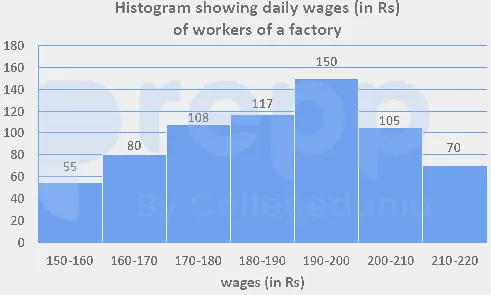
- A
75.8%
- B
85.6%
- C
74.8%
- D
86.7%
Show answer
C. 74.8%Given:
There is the histogram shows the daily wages ( in Rs.) of workers in a factory.
Calculation:
The number of workers with daily wages less than Rs. 180 = 55 + 80 + 108 = 243
T he number of workers with daily wages is more than Rs. 190 = 150 + 105 + 70 = 325
The percentage = (243/325) × 100 = 74.76...% ≈ 74.8%
∴ The number of workers with daily wages less than Rs. 180 is 74.8% of the number of workers with daily wages more than Rs. 190
Paper & answer key PDF ↗ Question 66archived
If cos (A - B) = \({\sqrt3}\over 2\) and secA = 2, 0º \(\leq\) A \(\leq\) 90º, 0º \(\leq\) B \(\leq\) 90º, then what is the measure of B?
- A
60º
- B
0º
- C
30º
- D
90º
Show answer
C. 30ºSolving Trigonometric Equations to Find Angle B
We are given two trigonometric equations and the ranges for angles A and B. Our goal is to find the measure of angle B.
The given information is:
$\cos (A - B) = \frac{\sqrt{3}}{2}$
$\sec A = 2$
$0^\circ \leq A \leq 90^\circ$
$0^\circ \leq B \leq 90^\circ$
Step 1: Find the measure of Angle A
We use the second equation, $\sec A = 2$. Recall that the secant function is the reciprocal of the cosine function: $\sec A = \frac{1}{\cos A}$.
So, we have:
$\frac{1}{\cos A} = 2$
This implies:
$\cos A = \frac{1}{2}$
We are given that $0^\circ \leq A \leq 90^\circ$. Within this range (the first quadrant), the angle whose cosine is $\frac{1}{2}$ is $60^\circ$.
Therefore, $\mathbf{A = 60^\circ}$.
Step 2: Use the value of A in the first equation
Now we substitute the value of A ($60^\circ$) into the first given equation: $\cos (A - B) = \frac{\sqrt{3}}{2}$.
Substituting $A = 60^\circ$, we get:
$\cos (60^\circ - B) = \frac{\sqrt{3}}{2}$
Step 3: Solve for the expression (60° - B)
We need to find the angle whose cosine is $\frac{\sqrt{3}}{2}$. For angles in the range $0^\circ$ to $90^\circ$, the angle whose cosine is $\frac{\sqrt{3}}{2}$ is $30^\circ$.
So, we can write:
$60^\circ - B = 30^\circ$
Step 4: Solve for Angle B
Now, we solve this simple linear equation for B:
$B = 60^\circ - 30^\circ$
$B = 30^\circ$
Step 5: Verify the range of Angle B
The calculated value for B is $30^\circ$. The given range for B is $0^\circ \leq B \leq 90^\circ$. Our value $30^\circ$ falls within this allowed range.
Thus, the measure of angle B is $30^\circ$.
Given Information
Derived Information
$\cos (A - B) = \frac{\sqrt{3}}{2}$
$60^\circ - B = 30^\circ$
$\sec A = 2$
$A = 60^\circ$
$0^\circ \leq A \leq 90^\circ$
$0^\circ \leq B \leq 90^\circ$
$B = 30^\circ$ (within range)
Revision Table: Key Trigonometric Values
Angle ($\theta$)
$\cos(\theta)$
$\sec(\theta)$
$0^\circ$
$1$
$1$
$30^\circ$
$\frac{\sqrt{3}}{2}$
$\frac{2}{\sqrt{3}}$
$45^\circ$
$\frac{\sqrt{2}}{2}$
$\sqrt{2}$
$60^\circ$
$\frac{1}{2}$
$2$
$90^\circ$
$0$
Undefined
Additional Information: Solving Trigonometric Problems
When solving trigonometric problems involving equations and unknown angles, follow these general steps:
Identify all given equations and conditions (like angle ranges).
Use inverse trigonometric functions or known values of trigonometric ratios for standard angles to find the values of unknown angles one by one.
Substitute the found values into other equations.
Solve the resulting equations for the remaining unknowns.
Always check if your calculated angles fall within the specified ranges.
Remember basic trigonometric identities like $\sec A = \frac{1}{\cos A}$, $\tan A = \frac{\sin A}{\cos A}$, $\sin^2 A + \cos^2 A = 1$, etc., as they are often useful.
Pay attention to the signs of trigonometric functions in different quadrants if the angle ranges extend beyond $0^\circ$ to $90^\circ$. In this specific problem, angles are restricted to the first quadrant, simplifying things as all basic trigonometric ratios are positive.
Paper & answer key PDF ↗ Question 67archived
In a circle with centre O, chords PR and QS meet at the point T, when produced, and PQ is a diameter. If \(\angle\) ROS = 42º, then the measure of \(\angle\) PTQ is
- A
58º
- B
59º
- C
69º
- D
48º
Show answer
C. 69ºSolving the Circle Geometry Problem
We are given a circle with center O, where PQ is a diameter. Chords PR and QS, when produced, meet at point T outside the circle. We are given that the angle subtended by the arc RS at the center is \(\angle \text{ROS} = 42^\circ\). Our goal is to find the measure of \(\angle \text{PTQ}\).
Key Geometric Properties Used
To solve this problem, we will use the following properties of circles and triangles:
Angle in a Semicircle: An angle inscribed in a semicircle is a right angle (\(90^\circ\)). Since PQ is a diameter, any angle subtended by the diameter at a point on the circumference is \(90^\circ\). Thus, \(\angle \text{PRQ} = 90^\circ\).
Angle at the Circumference and Center: The angle subtended by an arc at the center is double the angle subtended by the same arc at any point on the remaining part of the circle. So, the inscribed angle subtended by arc RS is half the central angle \(\angle \text{ROS}\). Thus, \(\angle \text{SQR} = \frac{1}{2} \angle \text{ROS}\).
Exterior Angle of a Triangle: The exterior angle of a triangle is equal to the sum of the two opposite interior angles.
Step-by-Step Calculation of \(\angle \text{PTQ}\)
Let's consider the points and angles in the diagram.
1. Find \(\angle \text{PRQ}\):
Since PQ is a diameter of the circle and R is a point on the circumference, the angle subtended by the diameter PQ at R is an angle in a semicircle.
\[ \angle \text{PRQ} = 90^\circ \]
This is because \(\angle \text{PRQ}\) subtends the arc PQ, which is a semicircle (180º), and the inscribed angle is half the arc measure.
2. Find \(\angle \text{SQR}\):
The central angle subtended by arc RS is given as \(\angle \text{ROS} = 42^\circ\). The angle subtended by the same arc RS at the circumference, at point Q, is \(\angle \text{SQR}\).
\[ \angle \text{SQR} = \frac{1}{2} \angle \text{ROS} \]
\[ \angle \text{SQR} = \frac{1}{2} \times 42^\circ \]
\[ \angle \text{SQR} = 21^\circ \]
3. Use the Exterior Angle Theorem in \(\triangle \text{RQT}\):
Consider the triangle \(\triangle \text{RQT}\). The points P, R, T are collinear, and Q, S, T are collinear. The angle \(\angle \text{PRQ}\) is the exterior angle of \(\triangle \text{RQT}\) at vertex R.
According to the exterior angle theorem, the exterior angle \(\angle \text{PRQ}\) is equal to the sum of the two opposite interior angles of \(\triangle \text{RQT}\), which are \(\angle \text{RTQ}\) and \(\angle \text{TQR}\).
\[ \angle \text{PRQ} = \angle \text{RTQ} + \angle \text{TQR} \]
Note that \(\angle \text{RTQ}\) is the same as \(\angle \text{PTQ}\) (as R, T, P are collinear) and \(\angle \text{TQR}\) is the same as \(\angle \text{SQR}\) (as Q, S, T are collinear).
Substituting these into the equation:
\[ \angle \text{PRQ} = \angle \text{PTQ} + \angle \text{SQR} \]
4. Solve for \(\angle \text{PTQ}\):
Rearrange the equation to find \(\angle \text{PTQ}\):
\[ \angle \text{PTQ} = \angle \text{PRQ} - \angle \text{SQR} \]
Substitute the values we calculated for \(\angle \text{PRQ}\) and \(\angle \text{SQR}\):
\[ \angle \text{PTQ} = 90^\circ - 21^\circ \]
\[ \angle \text{PTQ} = 69^\circ \]
Thus, the measure of \(\angle \text{PTQ}\) is \(69^\circ\).
Angle
Value
Reason
\(\angle\) ROS
\(42^\circ\)
Given (Central Angle for arc RS)
\(\angle\) PRQ
\(90^\circ\)
Angle in a semicircle (subtends diameter PQ)
\(\angle\) SQR
\(21^\circ\)
Angle at circumference subtending arc RS (\(\frac{1}{2} \angle\) ROS)
\(\angle\) PTQ
\(69^\circ\)
Exterior angle of \(\triangle\) RQT (\(\angle\) PTQ = \(\angle\) PRQ - \(\angle\) SQR)
Revision Table: Circle Theorems and Angles
Theorem/Property
Description
Application in this problem
Angle in a Semicircle
An angle subtended by a diameter at any point on the circumference is \(90^\circ\).
Used to find \(\angle\) PRQ = \(90^\circ\).
Central Angle vs. Inscribed Angle
The central angle subtending an arc is twice the inscribed angle subtending the same arc.
Used to find \(\angle\) SQR = \(\frac{1}{2}\angle\) ROS = \(21^\circ\).
Exterior Angle Theorem (Triangle)
The exterior angle of a triangle equals the sum of the two opposite interior angles.
Used in \(\triangle\) RQT, where \(\angle\) PRQ is exterior, to find \(\angle\) PTQ.
Additional Information: Angles Formed by Secants
The angle formed by two secants intersecting outside a circle is equal to half the difference of the measures of the intercepted arcs. In this problem, the secants are TR (containing chord PR) and TS (containing chord QS), meeting at T. The intercepted arcs are arc PS and arc QR.
The formula is:
\[ \angle \text{PTQ} = \frac{1}{2} | \text{measure of arc PS} - \text{measure of arc QR} | \]
While we solved the problem using triangle properties and inscribed angles, this formula provides an alternative approach if the arc measures PS and QR were directly known or easily calculable from the given information.
For example, knowing \(\angle\) PTQ = 69º and \(\angle\) ROS = 42º (arc RS = 42º), we could potentially work backwards or use other relationships (like arc PQ = 180º) to find arc PS and arc QR such that their difference divided by 2 is 69º.
However, the method using the exterior angle theorem with \(\angle\) PRQ (angle in a semicircle) and \(\angle\) SQR (inscribed angle subtending arc RS) was a more direct route given the specific information in the problem.
Paper & answer key PDF ↗ Question 68archived
Find the value of the following expression:
980 ÷ 35 x 16 + 4 - 2 x 2
- A
\(7\over 4\)
- B
556
- C
448
- D
\(15 \over2\)
Show answer
C. 448Solving the Mathematical Expression
The question asks us to find the value of the expression: \(980 \div 35 \times 16 + 4 - 2 \times 2\). To solve this, we need to follow the correct order of operations.
Understanding the Order of Operations (BODMAS/PEMDAS)
The order of operations, often remembered by acronyms like BODMAS or PEMDAS, dictates the sequence in which calculations should be performed in a mathematical expression:
Brackets (or Parentheses)
Orders (or Exponents)
Division and Multiplication (from left to right)
Addition and Subtraction (from left to right)
In the given expression, we have Division, Multiplication, Addition, and Subtraction. According to BODMAS/PEMDAS, we perform Division and Multiplication first, from left to right, followed by Addition and Subtraction, also from left to right.
Operation
Order
Brackets/Parentheses
1st
Orders/Exponents
2nd
Division and Multiplication
3rd (Left to Right)
Addition and Subtraction
4th (Left to Right)
Step-by-Step Calculation of the Expression
Let's break down the calculation:
\(980 \div 35 \times 16 + 4 - 2 \times 2\)
Step 1: Perform Division and Multiplication from left to right.
First, perform the division:
\(980 \div 35 = 28\)
The expression becomes:
\(28 \times 16 + 4 - 2 \times 2\)
Next, perform the multiplications from left to right. The first multiplication is \(28 \times 16\):
\(28 \times 16 = 448\)
The expression is now:
\(448 + 4 - 2 \times 2\)
The second multiplication is \(2 \times 2\):
\(2 \times 2 = 4\)
The expression is now:
\(448 + 4 - 4\)
Step 2: Perform Addition and Subtraction from left to right.
First, perform the addition:
\(448 + 4 = 452\)
The expression becomes:
\(452 - 4\)
Next, perform the subtraction:
\(452 - 4 = 448\)
So, the value of the expression \(980 \div 35 \times 16 + 4 - 2 \times 2\) is \(448\).
Comparing this result with the given options:
Option 1: \(7/4\)
Option 2: \(556\)
Option 3: \(448\)
Option 4: \(15/2\)
The calculated value \(448\) matches Option 3.
Revision Table: Order of Operations & Calculation
Step
Operation
Calculation
Expression
Original
-
-
\(980 \div 35 \times 16 + 4 - 2 \times 2\)
1a
Division
\(980 \div 35 = 28\)
\(28 \times 16 + 4 - 2 \times 2\)
1b
Multiplication
\(28 \times 16 = 448\)
\(448 + 4 - 2 \times 2\)
1c
Multiplication
\(2 \times 2 = 4\)
\(448 + 4 - 4\)
2a
Addition
\(448 + 4 = 452\)
\(452 - 4\)
2b
Subtraction
\(452 - 4 = 448\)
\(448\)
Additional Information on Order of Operations
It is crucial to strictly follow the order of operations. If we deviate from it, we will likely get an incorrect result. For instance, if we performed addition or subtraction before multiplication or division, the outcome would be different. BODMAS/PEMDAS provides a standard convention to ensure everyone arrives at the same result for a given mathematical expression. Remember that Division and Multiplication have equal priority, as do Addition and Subtraction. When operations of the same priority appear in an expression, we evaluate them from left to right.
Paper & answer key PDF ↗ Question 69archived
A sum invested at compound interest amounts to Rs. 7,800 in 3 years and Rs. 11,232 in 5 years. What is the rate per cent?
- A
20%
- B
26%
- C
18%
- D
15%
Show answer
A. 20%Understanding the Compound Interest Problem
This question asks us to find the rate of interest per year when a sum of money invested at compound interest grows to specific amounts over different time periods. We are given the amount after 3 years and the amount after 5 years and need to determine the annual compound interest rate.
Let the principal amount be \(P\), the annual compound interest rate be \(R\) per cent, and the time period be \(n\) years. The formula for the amount \(A\) after \(n\) years at compound interest is:
\(A = P \left(1 + \frac{R}{100}\right)^n\)
Setting Up Equations from the Given Information
We are given two pieces of information based on the compound interest growth:
Amount after 3 years (\(n=3\)) is Rs. 7,800.
Amount after 5 years (\(n=5\)) is Rs. 11,232.
Using the compound interest formula, we can write these as two equations:
For \(n=3\): \(7800 = P \left(1 + \frac{R}{100}\right)^3\)
For \(n=5\): \(11232 = P \left(1 + \frac{R}{100}\right)^5\)
Calculating the Rate of Compound Interest
To find the rate \(R\), we can eliminate the principal amount \(P\) by dividing the second equation by the first equation:
\(\frac{11232}{7800} = \frac{P \left(1 + \frac{R}{100}\right)^5}{P \left(1 + \frac{R}{100}\right)^3}\)
The \(P\) term cancels out, and we use the property of exponents \(\frac{a^m}{a^n} = a^{m-n}\):
\(\frac{11232}{7800} = \left(1 + \frac{R}{100}\right)^{5-3}\)
\(\frac{11232}{7800} = \left(1 + \frac{R}{100}\right)^2\)
Now, let's simplify the fraction \(\frac{11232}{7800}\). Both numbers are divisible by various factors. We can start by dividing both by 4:
\(\frac{11232 \div 4}{7800 \div 4} = \frac{2808}{1950}\)
Both are even, divide by 2:
\(\frac{2808 \div 2}{1950 \div 2} = \frac{1404}{975}\)
Sum of digits of 1404 = 1+4+0+4 = 9 (divisible by 3 and 9). Sum of digits of 975 = 9+7+5 = 21 (divisible by 3).
Divide by 3:
\(\frac{1404 \div 3}{975 \div 3} = \frac{468}{325}\)
Let's try to simplify this further. 325 ends in 5, so it's divisible by 5 (\(325 = 5 \times 65 = 5 \times 5 \times 13 = 25 \times 13\)). 468 is not divisible by 5. Let's check if 468 is divisible by 13: \(468 \div 13 = 36\). Yes, \(468 = 13 \times 36\).
So, we have:
\(\frac{468}{325} = \frac{13 \times 36}{13 \times 25} = \frac{36}{25}\)
Now substitute this back into our equation:
\(\left(1 + \frac{R}{100}\right)^2 = \frac{36}{25}\)
To find \(1 + \frac{R}{100}\), we take the square root of both sides:
\(1 + \frac{R}{100} = \sqrt{\frac{36}{25}}\)
\(1 + \frac{R}{100} = \frac{\sqrt{36}}{\sqrt{25}}\)
\(1 + \frac{R}{100} = \frac{6}{5}\)
Convert \(\frac{6}{5}\) to a decimal or keep as fraction:
\(1 + \frac{R}{100} = 1.2\)
Now, isolate \(\frac{R}{100}\):
\(\frac{R}{100} = 1.2 - 1\)
\(\frac{R}{100} = 0.2\)
Solve for \(R\):
\(R = 0.2 \times 100\)
\(R = 20\)
So, the rate of interest is 20% per annum.
Conclusion
The sum invested at compound interest grows at a rate of 20% per year. This rate explains the increase in the amount from Rs. 7,800 in 3 years to Rs. 11,232 in 5 years.
Time Period
Amount
3 Years
Rs. 7,800
5 Years
Rs. 11,232
The calculation confirms that a 20% annual compound interest rate yields these amounts over the specified periods.
Revision Table: Key Concepts in Compound Interest
Term
Explanation
Formula Component
Principal (P)
The initial amount invested or borrowed.
\(P\)
Amount (A)
The total sum after interest is added to the principal.
\(A\)
Rate (R)
The annual rate of interest as a percentage.
\(R\) in \(\frac{R}{100}\)
Time (n)
The duration for which the money is invested or borrowed, typically in years.
\(n\)
Compound Interest (CI)
Interest calculated on the principal amount and the accumulated interest from previous periods. \(CI = A - P\).
\(A - P\)
Additional Information on Compound Interest Calculations
When solving problems involving compound interest over different time periods, dividing the amount equations is a common and efficient method. This approach helps eliminate the unknown principal \(P\) and directly leads to an equation involving only the rate \(R\).
The difference in the exponent of \(\left(1 + \frac{R}{100}\right)\) when dividing the equations corresponds to the difference in the time periods. In this case, the time periods were 5 years and 3 years, so the difference is \(5 - 3 = 2\) years, leading to the term being raised to the power of 2.
Recognizing perfect squares or cubes in the ratio of the amounts is crucial for simplifying the calculation quickly. In this problem, simplifying \(\frac{11232}{7800}\) to \(\frac{36}{25}\) was key because 36 and 25 are perfect squares (\(6^2\) and \(5^2\)), making it easy to find the square root.
Paper & answer key PDF ↗ Question 70archived
A car runs first 275 km at an average speed of 50 km/h and the next 315 km at an average speed of 70 km/h. What is the average speed ( in km/h) for the entire journey?
- A
59
- B
62
- C
58.5
- D
60
Show answer
A. 59Understanding Average Speed Calculation
The question asks us to find the average speed of a car for its entire journey, which is completed in two distinct parts with different speeds.
Average speed is defined as the total distance covered divided by the total time taken for the journey. The formula is:
$$ \text{Average Speed} = \frac{\text{Total Distance}}{\text{Total Time}} $$
To solve this problem, we need to calculate the total distance traveled and the total time taken for the entire journey.
Step-by-Step Journey Analysis
The journey is divided into two parts:
Part 1: Distance = 275 km, Average Speed = 50 km/h
Part 2: Distance = 315 km, Average Speed = 70 km/h
Calculating Time for Each Part
We can calculate the time taken for each part of the journey using the formula: Time = Distance / Speed.
Time taken for Part 1:
$$ \text{Time}_1 = \frac{\text{Distance}_1}{\text{Speed}_1} $$
$$ \text{Time}_1 = \frac{275 \text{ km}}{50 \text{ km/h}} $$
$$ \text{Time}_1 = 5.5 \text{ hours} $$
Time taken for Part 2:
$$ \text{Time}_2 = \frac{\text{Distance}_2}{\text{Speed}_2} $$
$$ \text{Time}_2 = \frac{315 \text{ km}}{70 \text{ km/h}} $$
$$ \text{Time}_2 = 4.5 \text{ hours} $$
Calculating Total Time and Distance
Now, let's find the total distance and total time for the entire journey.
Total Distance:
$$ \text{Total Distance} = \text{Distance}_1 + \text{Distance}_2 $$
$$ \text{Total Distance} = 275 \text{ km} + 315 \text{ km} $$
$$ \text{Total Distance} = 590 \text{ km} $$
Total Time:
$$ \text{Total Time} = \text{Time}_1 + \text{Time}_2 $$
$$ \text{Total Time} = 5.5 \text{ hours} + 4.5 \text{ hours} $$
$$ \text{Total Time} = 10 \text{ hours} $$
Calculating Average Speed for the Entire Journey
Using the total distance and total time, we can now calculate the average speed for the entire journey.
$$ \text{Average Speed} = \frac{\text{Total Distance}}{\text{Total Time}} $$
$$ \text{Average Speed} = \frac{590 \text{ km}}{10 \text{ hours}} $$
$$ \text{Average Speed} = 59 \text{ km/h} $$
The average speed for the entire journey is 59 km/h.
Summary of Journey Segments
Segment
Distance (km)
Average Speed (km/h)
Time (hours)
Part 1
275
50
5.5
Part 2
315
70
4.5
Total
590
-
10
Therefore, the average speed for the entire journey is 59 km/h.
Revision Table: Key Concepts
Revision Notes for Speed, Distance, Time
Concept
Formula
Units
Speed
Distance / Time
e.g., km/h, m/s
Distance
Speed × Time
e.g., km, m
Time
Distance / Speed
e.g., hours, seconds
Average Speed
Total Distance / Total Time
Same as speed units
Additional Information: Average Speed vs. Average of Speeds
It's important to distinguish between average speed and the simple average (arithmetic mean) of the speeds.
Average Speed (Correct): Calculated as $\frac{\text{Total Distance}}{\text{Total Time}}$. This is the correct way to find the average speed over a journey with varying speeds or distances.
Average of Speeds (Incorrect): Calculated as $\frac{\text{Sum of Speeds}}{\text{Number of Speeds}}$. This method is generally incorrect unless the time taken for each segment is equal. In this problem, the times (5.5 hours and 4.5 hours) are not equal, so a simple average of 50 km/h and 70 km/h ($\frac{50+70}{2} = 60$ km/h) would be incorrect.
The correct approach is always to use the total distance and total time.
Paper & answer key PDF ↗ Question 71archived
A, B and C started a business in partnership. Initially, A invested Rs. 29,000, while B and C invested Rs. 25,000 each. After 4 months, A withdrew Rs. 3,000. After 2 more months, C invested Rs. 12,000 more. Find the share of C( in Rs.) in the profit of Rs. 33,200 at the end of the year.
- A
12,400
- B
11,067
- C
10,800
- D
10,000
Show answer
A. 12,400Understanding Partnership Profit Sharing
In a business partnership, the profit or loss is typically shared among the partners in the ratio of their effective capital investment and the duration for which the capital was invested. When the investments change over time, we calculate the equivalent investment for the entire duration, often expressed as 'investment-months' or 'investment-time units'.
Here's how we calculate the share of each partner based on their varying investments over the year:
The total duration of the partnership is 1 year, which is 12 months.
Partner A's Investment:
Initial investment: Rs. 29,000 for the first 4 months.
After 4 months, A withdrew Rs. 3,000.
New investment: $29,000 - 3,000 = \text{Rs. } 26,000$ for the remaining $12 - 4 = 8$ months.
A's total investment-months: $(29,000 \times 4) + (26,000 \times 8)$
A's total investment-months: $116,000 + 208,000 = 324,000$
Partner B's Investment:
Initial investment: Rs. 25,000 for the entire year (12 months).
B's total investment-months: $(25,000 \times 12)$
B's total investment-months: $300,000$
Partner C's Investment:
Initial investment: Rs. 25,000 for the first $4 + 2 = 6$ months. (Initially 4 months, then 2 more months passed before C changed investment)
After $4 + 2 = 6$ months, C invested Rs. 12,000 more.
New investment: $25,000 + 12,000 = \text{Rs. } 37,000$ for the remaining $12 - 6 = 6$ months.
C's total investment-months: $(25,000 \times 6) + (37,000 \times 6)$
C's total investment-months: $150,000 + 222,000 = 372,000$
Ratio of Investment-Months:
The ratio of investment-months for A, B, and C is:
$A : B : C = 324,000 : 300,000 : 372,000$
We can simplify this ratio by dividing each number by 1,000:
$324 : 300 : 372$
Further simplifying by dividing each number by their greatest common divisor, which is 12:
$324 \div 12 = 27$
$300 \div 12 = 25$
$372 \div 12 = 31$
The simplified ratio of profit sharing among A, B, and C is $27 : 25 : 31$.
Calculating Shares in Total Profit:
The total profit at the end of the year is Rs. 33,200.
The sum of the ratio parts is $27 + 25 + 31 = 83$.
To find the share of each partner, we divide the total profit by the sum of the ratio parts and then multiply by the individual ratio part.
A's share $= \frac{27}{83} \times 33,200$
B's share $= \frac{25}{83} \times 33,200$
C's share $= \frac{31}{83} \times 33,200$
We need to find the share of C. Let's calculate C's share:
C's share $= \frac{31}{83} \times 33,200$
First, calculate $\frac{33,200}{83}$:
$\frac{33,200}{83} = 400$
Now, multiply this by C's ratio part:
C's share $= 31 \times 400 = 12,400$
So, C's share in the profit of Rs. 33,200 is Rs. 12,400.
Partnership Investment Summary
Partner
Investment Period 1
Investment 1
Investment Period 2
Investment 2
Total Investment-Months
A
4 months
Rs. 29,000
8 months
Rs. 26,000
324,000
B
12 months
Rs. 25,000
-
-
300,000
C
6 months
Rs. 25,000
6 months
Rs. 37,000
372,000
The ratio of shares A:B:C is $324,000 : 300,000 : 372,000$, which simplifies to $27 : 25 : 31$. The total ratio parts are 83. C's share is $\frac{31}{83}$ of the total profit.
C's share in profit $= \frac{31}{83} \times 33,200 = 12,400$.
Revision Table: Partnership Profit Calculation
Key Steps in Profit Distribution
Step
Description
Calculation Detail
1
Identify investment periods & amounts for each partner.
A: 29k for 4mo, 26k for 8mo. B: 25k for 12mo. C: 25k for 6mo, 37k for 6mo.
2
Calculate total investment-months for each partner.
A: 324,000. B: 300,000. C: 372,000.
3
Find the ratio of investment-months.
324,000 : 300,000 : 372,000 = 27 : 25 : 31
4
Sum the ratio parts.
27 + 25 + 31 = 83
5
Calculate the desired share using the ratio.
C's share = $\frac{31}{83} \times 33,200$
6
Final Calculation.
C's share = 12,400
Additional Information: Partnership Basics
A partnership is a business structure where two or more individuals agree to share in the profits or losses of a business. Key aspects include:
Partnership Deed: A legal agreement outlining terms like profit/loss sharing ratio, capital contributions, roles, responsibilities, interest on capital, drawings, etc. If no deed exists, the law usually stipulates equal profit sharing and no interest on capital/drawings.
Capital Contribution: The initial funds or assets contributed by each partner to start the business.
Profit and Loss Sharing Ratio: The proportion in which partners divide the business's net profit or loss. This is usually based on the partnership deed. If investments vary over time, the ratio is calculated based on the time-weighted average investment, as shown in this problem using investment-months.
Types of Partners: Can include active partners (involved in day-to-day management) and sleeping/dormant partners (invest capital but not involved in management).
Understanding how profit is distributed based on investment and time is crucial for partnership accounts and business calculations.
Paper & answer key PDF ↗ Question 72archived
How many numbers are there from 500 to 650 (including both) which are neither divisible by 3 nor by 7?
- A
87
- B
99
- C
121
- D
21
Show answer
A. 87Finding Numbers Not Divisible by 3 or 7 in a Range
The question asks us to find the count of numbers within a specific range, from 500 to 650, that are not divisible by 3 and also not divisible by 7. This type of problem can be efficiently solved using the Principle of Inclusion-Exclusion.
First, let's determine the total number of integers in the given range [500, 650]. The number of integers from 'a' to 'b' (inclusive) is given by ${b - a + 1}$.
Total numbers in the range [500, 650] = ${650 - 500 + 1 = 151}$.
Now, we need to find the numbers that are divisible by 3 or 7 within this range. According to the Principle of Inclusion-Exclusion, the number of elements in the union of two sets A and B is given by:
${|A \cup B| = |A| + |B| - |A \cap B|}$
In our case, let Set A be the numbers in [500, 650] divisible by 3, and Set B be the numbers in [500, 650] divisible by 7.
Step 1: Count numbers divisible by 3 in the range [500, 650].
To find the count of numbers divisible by 3 up to N, we calculate ${\lfloor N/3 \rfloor}$. To find the count in a range [a, b], we calculate ${\lfloor b/3 \rfloor - \lfloor (a-1)/3 \rfloor}$.
Count of numbers divisible by 3 = ${\lfloor 650/3 \rfloor - \lfloor (500-1)/3 \rfloor = \lfloor 216.67 \rfloor - \lfloor 499/3 \rfloor = 216 - \lfloor 166.33 \rfloor = 216 - 166 = 50}$.
There are 50 numbers divisible by 3 between 500 and 650 (inclusive).
Step 2: Count numbers divisible by 7 in the range [500, 650].
Using the same method as above:
Count of numbers divisible by 7 = ${\lfloor 650/7 \rfloor - \lfloor (500-1)/7 \rfloor = \lfloor 92.86 \rfloor - \lfloor 499/7 \rfloor = 92 - \lfloor 71.28 \rfloor = 92 - 71 = 21}$.
There are 21 numbers divisible by 7 between 500 and 650 (inclusive).
Step 3: Count numbers divisible by both 3 and 7 in the range [500, 650].
Numbers divisible by both 3 and 7 are divisible by their least common multiple, which is ${LCM(3, 7) = 21}$. We need to count numbers divisible by 21 in the range [500, 650].
Count of numbers divisible by 21 = ${\lfloor 650/21 \rfloor - \lfloor (500-1)/21 \rfloor = \lfloor 30.95 \rfloor - \lfloor 499/21 \rfloor = 30 - \lfloor 23.76 \rfloor = 30 - 23 = 7}$.
There are 7 numbers divisible by both 3 and 7 between 500 and 650 (inclusive).
Step 4: Count numbers divisible by either 3 or 7 in the range [500, 650].
Using the Principle of Inclusion-Exclusion:
Numbers divisible by 3 or 7 = (Numbers divisible by 3) + (Numbers divisible by 7) - (Numbers divisible by 21)
Numbers divisible by 3 or 7 = ${50 + 21 - 7 = 71 - 7 = 64}$.
There are 64 numbers between 500 and 650 that are divisible by either 3 or 7 (or both).
Step 5: Count numbers neither divisible by 3 nor by 7 in the range [500, 650].
The numbers that are neither divisible by 3 nor by 7 are the total numbers in the range minus the numbers that are divisible by 3 or 7.
Numbers neither divisible by 3 nor by 7 = Total numbers - (Numbers divisible by 3 or 7)
Numbers neither divisible by 3 nor by 7 = ${151 - 64 = 87}$.
Therefore, there are 87 numbers from 500 to 650 (including both) which are neither divisible by 3 nor by 7.
Revision Table: Counting Numbers in a Range
Description
Calculation Method
Count
Total numbers in [500, 650]
${650 - 500 + 1}$
151
Numbers divisible by 3 in [500, 650]
${\lfloor 650/3 \rfloor - \lfloor 499/3 \rfloor}$
50
Numbers divisible by 7 in [500, 650]
${\lfloor 650/7 \rfloor - \lfloor 499/7 \rfloor}$
21
Numbers divisible by 21 in [500, 650]
${\lfloor 650/21 \rfloor - \lfloor 499/21 \rfloor}$
7
Numbers divisible by 3 or 7
${50 + 21 - 7}$
64
Numbers neither divisible by 3 nor 7
${151 - 64}$
87
Additional Information: Principle of Inclusion-Exclusion
The Principle of Inclusion-Exclusion is a counting technique used to find the number of elements in the union of multiple sets. For two sets A and B, it is:
${|A \cup B| = |A| + |B| - |A \cap B|}$
For three sets A, B, and C, it is:
${|A \cup B \cup C| = |A| + |B| + |C| - |A \cap B| - |A \cap C| - |B \cap C| + |A \cap B \cap C|}$
This principle is very useful in problems involving counting elements that satisfy at least one of several properties, or equivalently, finding elements that satisfy none of the properties (by subtracting from the total).
In this problem, we wanted numbers that are NOT divisible by 3 AND NOT divisible by 7. This is the complement of being divisible by 3 OR divisible by 7. So, we calculated the number of elements divisible by 3 OR 7 using the Inclusion-Exclusion Principle and subtracted that from the total number of elements in the range.
Paper & answer key PDF ↗ Question 73archived
In the first 10 overs of a cricket game, the run rate was only 7.2. What should be the average run rate in the remaining 40 overs to reach the target of 272 runs?
- A
7
- B
4
- C
6
- D
5
Show answer
D. 5Solving the Cricket Run Rate Problem
This problem requires us to calculate the average run rate needed in the remaining overs of a cricket game to reach a specific target score. We are given the run rate for the first 10 overs and the total target runs.
Understanding the Given Information
Total target runs: 272
Overs bowled initially: 10 overs
Run rate in the first 10 overs: 7.2 runs per over
Remaining overs: 40 overs
Step-by-Step Calculation
Step 1: Calculate runs scored in the first 10 overs
The runs scored in any set of overs can be calculated by multiplying the run rate by the number of overs.
Runs scored = Run Rate × Overs
In this case:
Runs scored in first 10 overs = \(7.2 \times 10\)
Runs scored in first 10 overs = \(72\) runs
Step 2: Calculate the remaining runs needed
To find out how many more runs are needed, we subtract the runs already scored from the total target runs.
Remaining runs = Target runs - Runs scored in first 10 overs
Remaining runs = \(272 - 72\)
Remaining runs = \(200\) runs
Step 3: Determine the overs remaining
The total standard overs in this format of cricket is usually 50. Since 10 overs have been played, the remaining overs are:
Remaining overs = Total overs - Overs played
Remaining overs = \(50 - 10\)
Remaining overs = \(40\) overs (This is also given in the problem statement)
Step 4: Calculate the required run rate for the remaining 40 overs
To find the average run rate needed for the remaining overs, we divide the remaining runs by the remaining overs.
Required Run Rate = \(\frac{\text{Remaining Runs}}{\text{Remaining Overs}}\)
Required Run Rate = \(\frac{200}{40}\)
Required Run Rate = \(5\) runs per over
Summary of Calculations
Item
Value
Target Runs
272
Overs Played
10
Run Rate (First 10 overs)
7.2
Runs Scored (First 10 overs)
\(7.2 \times 10 = 72\)
Remaining Runs Needed
\(272 - 72 = 200\)
Remaining Overs
\(50 - 10 = 40\)
Required Run Rate (Remaining 40 overs)
\(\frac{200}{40} = 5\)
Therefore, the average run rate needed in the remaining 40 overs to reach the target of 272 runs is 5 runs per over.
Revision Table: Cricket Run Rate Concepts
Concept
Formula
Explanation
Run Rate
\(\frac{\text{Total Runs Scored}}{\text{Total Overs Faced}}\)
Average number of runs scored per over.
Runs Scored in an Interval
Run Rate \(\times\) Number of Overs
Total runs accumulated during a specific period of overs with a known average run rate.
Remaining Runs Needed
Target Score - Runs Scored So Far
The number of additional runs required to win the match.
Required Run Rate
\(\frac{\text{Remaining Runs Needed}}{\text{Remaining Overs}}\)
The average runs per over required in the rest of the innings to achieve the target score.
Additional Information: Batting Run Rates in Cricket
The run rate is a crucial statistic in limited-overs cricket. It indicates how quickly a team is scoring runs. A higher run rate means the team is scoring faster.
Analyzing Run Rates: Teams constantly monitor the current run rate and the required run rate. If the current rate is below the required rate, they need to accelerate their scoring.
Factors Affecting Run Rate: The run rate can be affected by various factors such as the pitch condition, the quality of bowling, the field restrictions (powerplay overs), and the batsmen's approach (aggressive or defensive).
Importance in Chases: In the second innings, the chasing team's required run rate is displayed, guiding their strategy. Failing to maintain the required run rate can lead to losing the match.
Difference between Current and Required Run Rate: The current run rate is the average runs scored up to the present point in the innings, while the required run rate is the average runs per over needed from the current point onwards to win.
Paper & answer key PDF ↗ Question 74archived
The length and the breadth of a rectangle are made to increase and decrease, respectively, by 8% and 10%. What is the percentage increase or decrease in its area?
- A
Decrease by 1.8%
- B
Decrease by 2.8%
- C
Increase by 2.8%
- D
Increase by 1.8%
Show answer
B. Decrease by 2.8%Understanding Rectangle Area Percentage Change
This problem asks us to find the overall percentage change in the area of a rectangle when its length and breadth undergo specific percentage changes: an increase in length and a decrease in breadth.
The area of a rectangle is calculated using the formula: Area = Length × Breadth.
We can solve this problem using two methods: by assuming initial values or by using the formula for successive percentage changes.
Method 1: Using Base Values
Let's assume the original length of the rectangle is \(L\) and the original breadth is \(B\).
The original area is \(A = L \times B\).
Calculating New Dimensions:
The length is increased by 8%. New length \(L'\) will be:
\[L' = L + 8\%\text{ of } L = L + \frac{8}{100}L = L\left(1 + \frac{8}{100}\right) = 1.08L\]
The breadth is decreased by 10%. New breadth \(B'\) will be:
\[B' = B - 10\%\text{ of } B = B - \frac{10}{100}B = B\left(1 - \frac{10}{100}\right) = 0.90B\]
Calculating New Area:
The new area \(A'\) is the product of the new length and new breadth:
\[A' = L' \times B' = (1.08L) \times (0.90B)\]
\[A' = (1.08 \times 0.90) \times (L \times B)\]
\[A' = 0.972 \times A\]
So, the new area is 0.972 times the original area.
Calculating Percentage Change in Area:
The change in area is \(A' - A\):
\[\text{Change in Area} = 0.972A - A = (0.972 - 1)A = -0.028A\]
Since the change is negative, the area has decreased.
The percentage change in area is calculated as:
\[\text{Percentage Change} = \frac{\text{Change in Area}}{\text{Original Area}} \times 100\%\]
\[\text{Percentage Change} = \frac{-0.028A}{A} \times 100\%\]
\[\text{Percentage Change} = -0.028 \times 100\%\]
\[\text{Percentage Change} = -2.8\%\]
This means the area decreases by 2.8%.
Method 2: Using Successive Percentage Change Formula
When a quantity is affected by two successive percentage changes, say \(x\%\) and \(y\%\), the overall percentage change is given by the formula:
\[\text{Overall Change} = \left(x + y + \frac{xy}{100}\right)\%\]
In this problem:
Percentage increase in length, \(x = +8\%\)
Percentage decrease in breadth, \(y = -10\%\)
Substitute these values into the formula:
\[\text{Overall Change} = \left(8 + (-10) + \frac{8 \times (-10)}{100}\right)\%\]
\[\text{Overall Change} = \left(8 - 10 + \frac{-80}{100}\right)\%\]
\[\text{Overall Change} = \left(-2 - 0.8\right)\%\]
\[\text{Overall Change} = -2.8\%\]
The negative sign indicates a decrease. Therefore, the area decreases by 2.8%.
Conclusion on Rectangle Area Change
Both methods show that when the length of a rectangle increases by 8% and the breadth decreases by 10%, the area of the rectangle decreases by 2.8%.
Revision Table: Rectangle Area Calculations
Concept
Formula/Calculation
Explanation
Original Area
\(A = L \times B\)
Product of original length and breadth.
New Length (8% increase)
\(L' = L \times (1 + 0.08) = 1.08L\)
Original length plus 8% of original length.
New Breadth (10% decrease)
\(B' = B \times (1 - 0.10) = 0.90B\)
Original breadth minus 10% of original breadth.
New Area
\(A' = L' \times B' = (1.08L) \times (0.90B) = 0.972LB\)
Product of new length and new breadth.
Percentage Change in Area
\(\frac{A' - A}{A} \times 100\%\) or \(\left(x + y + \frac{xy}{100}\right)\%\)
Ratio of area change to original area, expressed as a percentage. Successive percentage change formula simplifies calculation.
Additional Information on Percentage Changes
Percentage change is a way to express how much a quantity changes relative to its original value. A positive percentage change indicates an increase, while a negative percentage change indicates a decrease.
An increase of \(p\%\) means multiplying the original value by \((1 + \frac{p}{100})\).
A decrease of \(p\%\) means multiplying the original value by \((1 - \frac{p}{100})\).
The successive percentage change formula is useful for problems where a quantity changes multiple times consecutively or when two factors multiplying together undergo percentage changes, like in area calculations (Length × Breadth) or product price changes.
Paper & answer key PDF ↗ Question 75archived
If \({{(4x + 2y)^3} + {(4x-2y)^3}}=16({Ax^3 + Bxy^2})\) , then what is the value of \({1\over 2 }{(\sqrt{A^2 +B^2})}\) ?
- A
3
- B
5
- C
8
- D
7
Show answer
B. 5Understanding the Problem: Expanding and Simplifying Expressions
The question asks us to evaluate a specific expression involving the sum of two cubic terms and relate it to a given polynomial form. We are given the equation:
\[ {{(4x + 2y)^3} + {(4x-2y)^3}}=16({Ax^3 + Bxy^2}) \]
Our goal is to first simplify the left-hand side of this equation. Then, by comparing the simplified form with the right-hand side, we need to find the values of the constants \(A\) and \(B\). Finally, using these values of \(A\) and \(B\), we need to calculate the value of \( \frac{1}{2 }{(\sqrt{A^2 +B^2})} \).
Expanding the Cubic Terms using Algebraic Identities
To simplify the expression \( {(4x + 2y)^3} + {(4x-2y)^3} \), we can use the algebraic identities for the cube of a sum and the cube of a difference:
\( (a+b)^3 = a^3 + 3a^2b + 3ab^2 + b^3 \)
\( (a-b)^3 = a^3 - 3a^2b + 3ab^2 - b^3 \)
Let's apply these identities to our specific terms. Let \( a = 4x \) and \( b = 2y \). Then:
\( (4x + 2y)^3 = (4x)^3 + 3(4x)^2(2y) + 3(4x)(2y)^2 + (2y)^3 \)
\( (4x - 2y)^3 = (4x)^3 - 3(4x)^2(2y) + 3(4x)(2y)^2 - (2y)^3 \)
Now, let's simplify each expanded term:
\( (4x)^3 = 64x^3 \)
\( 3(4x)^2(2y) = 3(16x^2)(2y) = 96x^2y \)
\( 3(4x)(2y)^2 = 3(4x)(4y^2) = 48xy^2 \)
\( (2y)^3 = 8y^3 \)
So, we have:
\( (4x + 2y)^3 = 64x^3 + 96x^2y + 48xy^2 + 8y^3 \)
\( (4x - 2y)^3 = 64x^3 - 96x^2y + 48xy^2 - 8y^3 \)
Now, we add these two expanded forms together:
\[ {(4x + 2y)^3} + {(4x-2y)^3} = (64x^3 + 96x^2y + 48xy^2 + 8y^3) + (64x^3 - 96x^2y + 48xy^2 - 8y^3) \]
Combining like terms:
\[ {(4x + 2y)^3} + {(4x-2y)^3} = (64x^3 + 64x^3) + (96x^2y - 96x^2y) + (48xy^2 + 48xy^2) + (8y^3 - 8y^3) \]
\[ {(4x + 2y)^3} + {(4x-2y)^3} = 128x^3 + 0 + 96xy^2 + 0 \]
\[ {(4x + 2y)^3} + {(4x-2y)^3} = 128x^3 + 96xy^2 \]
Alternatively, we could use the identity \( (a+b)^3 + (a-b)^3 = 2a^3 + 6ab^2 \).
Let \( a=4x \) and \( b=2y \).
Then \( {(4x + 2y)^3} + {(4x-2y)^3} = 2(4x)^3 + 6(4x)(2y)^2 = 2(64x^3) + 6(4x)(4y^2) = 128x^3 + 24x(4y^2) = 128x^3 + 96xy^2 \).
This gives the same simplified result.
Comparing Coefficients to Find A and B
We are given that \( {(4x + 2y)^3} + {(4x-2y)^3}}=16({Ax^3 + Bxy^2})\).
From our simplification, we found that \( {(4x + 2y)^3} + {(4x-2y)^3} = 128x^3 + 96xy^2 \).
So, we have the equation:
\[ 128x^3 + 96xy^2 = 16(Ax^3 + Bxy^2) \]
Divide both sides by 16:
\[ \frac{128x^3 + 96xy^2}{16} = Ax^3 + Bxy^2 \]
\[ \frac{128x^3}{16} + \frac{96xy^2}{16} = Ax^3 + Bxy^2 \]
\[ 8x^3 + 6xy^2 = Ax^3 + Bxy^2 \]
By comparing the coefficients of the like terms (\(x^3\) and \(xy^2\)) on both sides of the equation, we can find the values of \(A\) and \(B\).
Coefficient of \(x^3\): \( 8 = A \implies A = 8 \)
Coefficient of \(xy^2\): \( 6 = B \implies B = 6 \)
So, the values are \(A = 8\) and \(B = 6\).
Calculating the Final Value
The question asks for the value of \( \frac{1}{2 }{(\sqrt{A^2 +B^2})} \).
We have \( A = 8 \) and \( B = 6 \). Substitute these values into the expression:
\[ \frac{1}{2 }{(\sqrt{A^2 +B^2})} = \frac{1}{2 }{(\sqrt{8^2 +6^2})} \]
\[ = \frac{1}{2 }{(\sqrt{64 + 36})} \]
\[ = \frac{1}{2 }{(\sqrt{100})} \]
\[ = \frac{1}{2 }{(10)} \]
\[ = 5 \]
The value of \( \frac{1}{2 }{(\sqrt{A^2 +B^2})} \) is 5.
Step
Description
Result
1
Expand \( (4x+2y)^3 \)
\( 64x^3 + 96x^2y + 48xy^2 + 8y^3 \)
2
Expand \( (4x-2y)^3 \)
\( 64x^3 - 96x^2y + 48xy^2 - 8y^3 \)
3
Add the expansions
\( 128x^3 + 96xy^2 \)
4
Equate to the given form
\( 128x^3 + 96xy^2 = 16(Ax^3 + Bxy^2) \)
5
Divide by 16 and compare coefficients
\( A=8, B=6 \)
6
Calculate \( \frac{1}{2 }\sqrt{A^2 +B^2} \)
\( \frac{1}{2 }\sqrt{8^2 + 6^2} = 5 \)
Revision Table: Key Concepts for Cubic Expansion and Equation Solving
Concept
Description
Relevance to Problem
Cubic Expansion Identity
\( (a+b)^3 = a^3 + 3a^2b + 3ab^2 + b^3 \) and \( (a-b)^3 = a^3 - 3a^2b + 3ab^2 - b^3 \)
Used to expand the terms on the left side of the equation.
Sum/Difference of Cubes Identity Variation
\( (a+b)^3 + (a-b)^3 = 2a^3 + 6ab^2 \)
A shortcut identity that can directly simplify the sum of the two cubic terms.
Combining Like Terms
Adding or subtracting terms with the same variables raised to the same powers.
Essential step after expansion to simplify the polynomial expression.
Comparing Coefficients
If two polynomials are equal for all values of variables, the coefficients of corresponding terms must be equal.
Used to find the values of \(A\) and \(B\) by comparing the simplified left side with the right side.
Evaluating Expressions
Substituting numerical values into an expression and calculating the result.
Used to find the final value of \( \frac{1}{2 }\sqrt{A^2 +B^2} \) using the calculated values of \(A\) and \(B\).
Additional Information: Polynomial Identity Applications
The problem effectively uses polynomial identities and the principle of comparing coefficients. Understanding these concepts is crucial for solving many algebra problems.
Polynomial Identity: An equation that is true for all possible values of the variables involved. The cubic expansion formulas \( (a+b)^3 \) and \( (a-b)^3 \) are examples of identities. The identity \( (a+b)^3 + (a-b)^3 = 2a^3 + 6ab^2 \) is derived from these basic ones and is very useful when dealing with sums of cubic terms like in this problem.
Comparing Coefficients: If you have an equation where a polynomial on one side is equal to a polynomial on the other side, and this equation holds true for all values of the variables, then the coefficients of each term with the same power of the variables must be equal. This is a powerful technique for finding unknown constants within polynomial equations. For example, if \(cx^2 + dx + e = 5x^2 - 2x + 1\) for all \(x\), then by comparing coefficients, we know \(c=5\), \(d=-2\), and \(e=1\). In our problem, we compared coefficients of \(x^3\) and \(xy^2\) to find \(A\) and \(B\).
Applications: These techniques are widely used in algebra, calculus (e.g., partial fraction decomposition), and various fields of science and engineering where polynomial equations are involved.
Paper & answer key PDF ↗ Question 76archived
The following sentence has been split into four segments. Identify the segment that contains a grammatical error.
We stayed / in Jim's flat / during he was / on holiday.
- A
on holiday
- B
in Jim's flat
- C
We stayed
- D
during he was
Show answer
D. during he wasIdentifying the Grammatical Error in the Sentence
The question asks us to find the segment that contains a grammatical error in the given sentence. The sentence is divided into four parts:
We stayed
in Jim's flat
during he was
on holiday
Let's examine each segment to identify the grammatical error.
Analyzing Each Sentence Segment for Grammar
We will look closely at each part to see if it follows standard English grammar rules.
Segment 1: We stayed
This segment consists of a subject ("We") and a verb ("stayed") in the simple past tense. This is a grammatically correct phrase and forms a valid start to a sentence.
Segment 2: in Jim's flat
This is a prepositional phrase indicating location. "in" is a preposition, and "Jim's flat" is a noun phrase acting as the object of the preposition. "Jim's" is a possessive form, which is correctly used here. This segment is grammatically correct.
Segment 3: during he was
This segment uses the word "during" followed by a clause ("he was"). The word "during" is a preposition. Prepositions like "during" are typically followed by a noun or a noun phrase (e.g., "during the meeting", "during the night", "during his holiday"). They are not typically used to introduce a clause containing a subject and a verb.
To introduce a clause that specifies a time period when something happened, we usually use conjunctions like "while" or "when".
While: Used with a clause (subject + verb) to indicate something happening over a period of time. Example: "We stayed while he was away."
When: Can be used with a clause (subject + verb) to indicate a point in time or a period. Example: "We stayed when he was on holiday."
Since "during" is followed by the clause "he was", the usage here is grammatically incorrect.
Segment 4: on holiday
"On holiday" is a common and grammatically correct phrase used to indicate that someone is on vacation. This segment is correct.
Identifying the Grammatical Error
Based on our analysis, the segment "during he was" contains the grammatical error because "during" is incorrectly used before a clause ("he was on holiday") instead of a noun or noun phrase.
Correcting the Sentence
To correct the sentence, we should replace "during he was" with a suitable conjunction like "while" or "when".
Corrected sentences could be:
We stayed in Jim's flat while he was on holiday.
We stayed in Jim's flat when he was on holiday.
Alternatively, if we want to use "during", we would need to follow it with a noun phrase:
We stayed in Jim's flat during his holiday.
The original segment "during he was" is the one with the grammatical error.
Summary of Sentence Segments
Segment
Grammatical Analysis
Correct?
We stayed
Subject + Simple Past Verb
Yes
in Jim's flat
Prepositional Phrase (Location)
Yes
during he was
Incorrect use of 'during' before a clause
No
on holiday
Common idiom/Prepositional Phrase
Yes
Revision Table: Understanding Time Prepositions and Conjunctions
Comparing 'During', 'While', and 'When'
Word
Type
Usage
Example
During
Preposition
Followed by a noun or noun phrase. Indicates a period within which something happens.
during the meeting, during the night, during his stay
While
Conjunction
Followed by a clause (subject + verb). Indicates something happening over a period of time, often at the same time as something else.
while I was sleeping, while she was working, while he was on holiday
When
Conjunction / Adverb
Followed by a clause (subject + verb). Indicates a point in time or a period.
when I arrived, when the bell rang, when he was on holiday
Additional Information: Using 'During', 'While', and 'When' Correctly
Understanding when to use 'during', 'while', and 'when' is key to avoiding grammatical errors related to time.
During: Think of 'during' as answering "When?" in terms of a period. "During the storm, we stayed indoors." (The storm is the period).
While: Use 'while' to connect two actions happening at the same time, often over a duration. "I read a book while I was waiting." (Reading and waiting happen simultaneously). 'While' introduces a dependent clause with a subject and verb.
When: 'When' can refer to a specific point in time ("When I arrived, he left") or a period ("When I was a child, I lived by the sea"). Like 'while', 'when' introduces a clause with a subject and verb.
The crucial difference highlighted by the question is using the preposition 'during' before a noun/noun phrase, versus using the conjunctions 'while' or 'when' before a clause.
Paper & answer key PDF ↗ Question 77archived
Select the correct indirect speech form of the given sentence.
Mother said to me, "I'm worried about your safety."
- A
Mother told me that she had been worried about my safety.
- B
Mother told me that she was worried about my safety.
- C
Mother said she is worried about your safety.
- D
Mother said that I was worrying about your safety.
Show answer
B. Mother told me that she was worried about my safety.Answer: Mother told me that she was worried about my safety..
Pronoun (Subject) I she 'I' refers to Mother, who is the subject in indirect speech. Pronoun (Possessive) your my 'Your' refers to 'me', the object of the reporting verb.
Paper & answer key PDF ↗ Question 78archived
Select the option that expresses the given sentence in passive voice.
Give the child a nourishing diet.
- A
The child should be given a nourishing diet.
- B
The child was given a nourishing diet.
- C
The child must have given a nourishing diet.
- D
The child is given a nourishing diet
Show answer
A. The child should be given a nourishing diet.Sometimes, you might see imperative passive sentences starting with 'Let', such as "Let the child be given a nourishing diet." This is also a valid passive construction for an imperative sentence. Understanding how to change the voice of imperative sentences is important for varying sentence structure and focusing on different aspects of the action.
Paper & answer key PDF ↗ Question 79archived
Select the INCORRECTLY spelt word.
- A
Retort
- B
Revange
- C
Retrieve
- D
Return
Show answer
B. RevangeAnswer: Revange.
Additional Information: Common Spelling Errors Misspellings often occur due to letter transpositions, incorrect vowel usage, or confusing similar-sounding words. Regular reading and practice are effective ways to improve spelling skills and avoid commonly misspelled words like 'Revange' instead of 'Revenge'.
Paper & answer key PDF ↗ Question 80archived
The following sentence has been split into four segments. Identify the segment that contains a grammatical error.
He allowed / his son to drive / but he warn him / of the danger.
- A
He allowed
- B
his son to drive
- C
but he warn him
- D
of the danger
Show answer
C. but he warn himIdentifying Grammatical Errors in Sentence Segments
The question asks us to find the segment containing a grammatical error in the sentence: "He allowed / his son to drive / but he warn him / of the danger." We need to examine each part of the sentence to locate the mistake.
Analyzing Sentence Structure and Tense
The sentence describes an action in the past: allowing a son to drive and warning him about danger. The main verb in the first clause is "allowed," which is in the simple past tense. When connecting clauses with a conjunction like "but," maintaining consistent tense or logical tense progression is important for grammatical correctness.
Segment-wise Grammatical Check
Let's break down the sentence and check each segment:
Segment 1: "He allowed" - This part is grammatically correct. "He" is the subject, and "allowed" is the past tense verb, correctly agreeing with the subject.
Segment 2: "his son to drive" - This segment is also correct. It follows the common structure of "allow someone to do something," where "to drive" is the infinitive phrase indicating the action permitted.
Segment 3: "but he warn him" - This segment contains the grammatical error. The main sentence is in the past tense ("allowed"). The conjunction "but" connects this idea with the warning. The verb "warn" should also be in the past tense to match the established context. Therefore, it should be "warned," not "warn." The corrected clause would be "but he warned him."
Segment 4: " of the danger" - This prepositional phrase correctly modifies the implied warning, indicating its subject matter. The non-breaking space (` `) is a formatting character and does not constitute a grammatical error.
Conclusion on the Grammatical Mistake
The error lies in the verb tense within the third segment. The verb "warn" should be in the past tense ("warned") to align with the past tense context set by the verb "allowed."
Therefore, the segment containing the grammatical error is:
but he warn him
Paper & answer key PDF ↗ Question 81archived
Select the option that expresses the given sentence in passive voice.
She gifted me a beautiful handbag.
- A
I am gifted a beautiful handbag by her.
- B
I was gifted a beautiful handbag by her.
- C
I have been gifted a beautiful handbag by her.
- D
I am being gifted a beautiful handbag by her.
Show answer
B. I was gifted a beautiful handbag by her.(Focus on the thief) Passive (doer unimportant/unknown): The building was completed in 2020. (We don't need to mention who built it). While both voices are grammatically correct, active voice is often preferred for its clarity and energy, especially in academic and professional writing, unless there is a specific reason to use the passive voice.
Paper & answer key PDF ↗ Question 82archived
Select the most appropriate option that can substitute the underlined segment in the given sentence. If there is no need to substitute it, select 'No substitution required'.
The first meeting of the Standing Committee will be hold next week.
- A
will be held next week
- B
No substitution required
- C
will held next week
- D
will be holding next week
Show answer
A. will be held next weekAnswer: will be held next week.
Incorrect will be holding next week Future continuous active voice; changes meaning. (or simply, The meeting will be held next week.) Understanding irregular verbs, like 'hold' (hold - held - held), is crucial for forming correct past simple and past participle forms, which are essential for perfect tenses and the passive voice.
Paper & answer key PDF ↗ Question 83archived
Select the most appropriate synonym of the given word.
Taciturn
- A
Noisy
- B
Lively
- C
Verbose
- D
Reserved
Show answer
D. ReservedAnswer: Reserved.
"Taciturn" specifically implies a habit of not talking much, while "Reserved" can also imply shyness or a preference for privacy beyond just talking habits. However, in the context of synonyms for "Taciturn", "Reserved" is the closest option provided.
Paper & answer key PDF ↗ Question 84archived
Select the most appropriate ANTONYM of the given word.
ROUGH
- A
Coarse
- B
Thick
- C
Crude
- D
Smooth
Show answer
D. SmoothDefining the Antonym of ROUGH
An antonym is a word that expresses the opposite meaning of another word. To find the best antonym for ROUGH, we need to understand its meaning and then look for a word that signifies the opposite quality, particularly concerning surface texture.
Understanding the Meaning of ROUGH
The word ROUGH describes a surface that is uneven, irregular, or not smooth. It implies a texture that is coarse, abrasive, or lacks polish. Examples include tree bark, unpolished stone, or sandpaper.
Analyzing the Provided Options
Let's examine the meaning of each option provided in relation to ROUGH:
Coarse: This term often refers to a texture made up of large particles or grains. While something coarse can feel rough, "coarse" is often used similarly to rough or describes a specific type of roughness. It's not the direct opposite.
Thick: This word relates to the dimension or density of an object, not its surface texture. A surface can be thick and either rough or smooth.
Crude: This word means in a raw or natural state, lacking refinement or polish. While something crude might also be rough, the primary meaning isn't about surface texture but about the level of processing or sophistication.
Smooth: This word describes a surface that is perfectly flat and even, without any bumps, ridges, or irregularities. It represents the direct opposite quality to a surface that is ROUGH.
Selecting the Best Antonym for ROUGH
Based on the analysis, Smooth is the most fitting antonym for ROUGH because it describes the exact opposite characteristic of a surface's texture. Where ROUGH implies unevenness, Smooth implies evenness and lack of texture.
Paper & answer key PDF ↗ Question 85archived
Select the option that can be used as a one-word substitute for the given group of words.
One who supervises students in an examination hall
- A
Inspector
- B
Invigilator
- C
Teacher
- D
Examinee
Show answer
B. InvigilatorProviding necessary materials (like extra paper) if allowed. Dealing with emergencies or student queries according to protocol. Collecting all answer scripts accurately at the end of the exam. Their presence helps create a controlled environment where all students have an equal opportunity to demonstrate their knowledge without unfair advantages.
Paper & answer key PDF ↗ Question 86archived
Sentence of a paragraph are given below in jumbled order. Arrange the sentences in the correct order to form a meaningful and coherent paragraph.
A. They can help you to decide the right products for you.
B. Advertisements can be extremely useful if they are honest.
C. Teenagers are especially vulnerable to such advertisements.
D. However, some advertisements may be harmful as they try to befool you.
- A
CDAB
- B
BCAD
- C
CADB
- D
BADC
Show answer
D. BADCThe correct answer is BADC.
Concluding Sentence (Optional in short paragraphs): Summarizes the main point or transitions to the next paragraph. (Sentence C adds a specific detail, concluding the point about harmful ads and vulnerability). In this specific example, sentence B serves as the topic sentence, A supports the 'useful' aspect, D introduces the contrasting 'harmful' aspect, and C supports the 'harmful' aspect by identifying a vulnerable group. This structure reinforces the BADC order as logical and coherent.
Paper & answer key PDF ↗ Question 87archived
Select the most appropriate option to fill in the blank.
Global warming or climate change has today become a major______ to mankind.
- A
endanger
- B
punishment
- C
threat
- D
penalty
Show answer
C. threatThe correct answer is threat.
Impacts on Biodiversity: Many species struggle to adapt to rapidly changing climates, leading to habitat loss and extinction risks. Food and Water Security: Climate change can disrupt agricultural cycles and water availability, posing risks to food and water security globally. Human Health Risks: Increased heat stress, spread of vector-borne diseases, and impacts on air quality are potential health consequences. These multifaceted consequences highlight the significant danger that global warming poses, making 'threat' the most fitting description.
Paper & answer key PDF ↗ Question 88archived
Select the most appropriate meaning of the given idiom.
Cake walk
- A
Something easy
- B
Something enjoyable
- C
Something sweet
- D
Something tasty
Show answer
A. Something easyUnderstanding the Idiom: Cake Walk Meaning
The question asks for the most appropriate meaning of the idiom "Cake walk". Idioms are phrases or expressions whose meaning cannot be deduced simply from the ordinary meanings of its individual words. They have a figurative meaning.
Meaning of "Cake walk"
The idiom "Cake walk" is commonly used in English to describe something that is exceptionally easy to do or achieve. It suggests a task or situation that presents no difficulty or challenge.
Let's look at the provided options and evaluate which one best matches the meaning of "Cake walk":
Something easy: This aligns perfectly with the established meaning of the idiom. A task described as a "cake walk" is a task that is easy.
Something enjoyable: While easy things can often be enjoyable, the primary meaning of "cake walk" focuses on the lack of difficulty, not necessarily the enjoyment derived from it. A task can be a "cake walk" but still not be particularly enjoyable (e.g., a very simple, repetitive chore).
Something sweet: This option relates directly to the word "cake" in the idiom but does not represent the figurative meaning of the idiom as a whole. The idiom's meaning is not about taste or sweetness.
Something tasty: Similar to the previous option, this focuses on the literal meaning of "cake" and is irrelevant to the idiomatic meaning of "cake walk".
Based on this analysis, the most appropriate meaning of the idiom "Cake walk" is "Something easy".
Comparing the Options for "Cake walk"
Option
Relevance to "Cake walk" Meaning
Appropriateness
Something easy
Directly matches the figurative meaning of the idiom.
Most Appropriate
Something enjoyable
May sometimes be true, but not the core meaning of the idiom.
Less Appropriate
Something sweet
Relates only to the literal meaning of 'cake', not the idiom.
Incorrect
Something tasty
Relates only to the literal meaning of 'cake', not the idiom.
Incorrect
Therefore, the option that most appropriately describes the meaning of "Cake walk" is "Something easy".
Revision Table: Key Idioms and Meanings
Idiom
Meaning
Example Sentence
Cake walk
Something very easy to do.
Passing that test was a real cake walk for him.
Break a leg
Good luck (used especially before a performance).
Before she went on stage, I told her to break a leg.
Bite the bullet
To face a difficult or unpleasant situation with courage.
He had to bite the bullet and take a pay cut.
Additional Information on English Idioms
Idioms are an important part of learning any language. They add color and naturalness to communication. Understanding common idioms is crucial for comprehension and fluency.
Idioms often have origins in specific historical events, cultural practices, or common observations. The term "cake walk" itself originated from a late 19th-century African American social dance where couples paraded and the most graceful pair won a cake as a prize. The dance was considered easy and fun, hence the figurative meaning evolved.
The meaning of an idiom is usually not predictable from the meanings of the individual words. You generally need to learn them as fixed phrases.
Using idioms correctly can make your language sound more native, but using them incorrectly can lead to confusion.
Learning idioms in context (e.g., in sentences or stories) is often more effective than trying to memorize lists.
Paper & answer key PDF ↗ Question 89archived
The following sentence has been split into four segments. Identify the segment that contains a grammatical error.
Did you/ recall to meet/ her at the party/ last night?
- A
last night
- B
Did you
- C
recall to meet
- D
her at the party
Show answer
C. recall to meetHere are some common verbs often followed by a gerund: Admit Avoid Consider Deny Enjoy Finish Imagine Keep (on) Mind Miss Postpone Practice Recommend Suggest Stop (when the gerund is the action that is stopped) For example: She enjoys swimming . They finished eating . I suggest going to the park. Knowing these patterns helps in identifying and correcting grammatical errors related to verb complements.
Paper & answer key PDF ↗ Question 90archived
Select the option that gives the most appropriate meaning of the underlined idiom.
The chairman of our company takes care of the rank and file in the company.
- A
Documents and files
- B
Only the top rank people
- C
Ordinary people
- D
Officers
Show answer
C. Ordinary peopleThe question asks for the most appropriate meaning of the underlined idiom "the rank and file". Idioms are phrases or expressions whose meaning cannot be deduced from the literal meaning of its individual words.
Understanding the Idiom "Rank and File"
The idiom "rank and file" originally comes from military terminology, referring to the common soldiers as opposed to the officers. In a broader context, it refers to the ordinary members of an organization or group, as opposed to the leaders or management.
When someone refers to "the rank and file" in a company, they are talking about the regular employees, the workers who do the day-to-day tasks, rather than the executives, managers, or directors.
Analyzing the Options
Let's look at the given options and see which one best fits the meaning of "rank and file" in the context of a company chairman taking care of them.
Option 1: Documents and files
This is a literal interpretation of the words "rank" and "file" but does not represent the meaning of the idiom. The chairman would not be taking care of physical documents in this sense. This option is incorrect.
Option 2: Only the top rank people
This option suggests the opposite of the idiom's meaning. "Top rank people" in a company are the executives or managers, not the rank and file. This option is incorrect.
Option 3: Ordinary people
This option aligns perfectly with the definition of "rank and file" in a non-military context. It refers to the regular, common members or employees of the company. This option is correct.
Option 4: Officers
Similar to military context, officers are typically distinguished from the rank and file. In a company context, officers might refer to high-level executives. This contradicts the meaning of the idiom. This option is incorrect.
Conclusion
The idiom "the rank and file" refers to the ordinary members or employees of an organization. In the given sentence, the chairman taking care of the rank and file means they are looking after the welfare or interests of the regular employees.
Idiom
Meaning
Context Example
The rank and file
The ordinary members of an organization or group; common soldiers (military) or regular employees (company).
The union leader listened to the concerns of the rank and file.
Revision Table: Idioms and Meanings
Reviewing common idioms can help understand their usage in different contexts.
Idiom
Meaning
Break the ice
To start a conversation in a formal setting.
Bite the bullet
To face a difficult situation with courage.
Get out of hand
To become uncontrollable.
Additional Information: Importance of Understanding Idioms
Understanding idioms is crucial for comprehending conversational and written English, especially in professional or literary contexts. Idioms add color and depth to language but can be confusing if their non-literal meaning is not known. Learning idioms helps in improving reading comprehension and communication skills.
Idioms are culture-specific.
Their meaning is often metaphorical.
Context is key to interpreting idioms correctly.
Paper & answer key PDF ↗ Question 91archived
The following sentence has been divided into parts. One of them may contain an error. Select the part that contains the error from the given options. If you don't find any error, mark 'No error' as your answer.
Did you baked/ the chocolate cake/ yourself this time?
- A
yourself this time
- B
Did you baked
- C
the chocolate cake
- D
No error
Show answer
B. Did you bakedUnderstanding the Grammar Error in "Did you baked"
Let's analyze the sentence provided to find the grammatical error. The sentence is: "Did you baked the chocolate cake yourself this time?" It is divided into three parts:
Did you baked
the chocolate cake
yourself this time?
We need to examine each part to identify any potential errors.
Analyzing Each Part of the Sentence
Let's look closely at each segment:
Part 1: Did you baked
This part contains the auxiliary verb "Did". In English grammar, when we use the auxiliary verb "Did" (which is the past tense of 'do') to form questions or negative sentences in the simple past tense, the main verb that follows must be in its base form (also called the infinitive form without 'to').
The main verb here is "baked". "Baked" is the simple past tense form of the verb "bake". The base form of "bake" is "bake".
Therefore, using "baked" after "Did you" is grammatically incorrect. It should be "Did you bake".
Part 2: the chocolate cake
This part is a noun phrase ("the chocolate cake") acting as the object of the verb. This part is grammatically correct in structure and usage within the sentence context.
Part 3: yourself this time?
This part includes a reflexive pronoun ("yourself") and a time expression ("this time"), followed by a question mark. This part correctly functions to add detail to the question and is grammatically sound.
Identifying the Error
Based on our analysis, the error is found in the first part: "Did you baked". The verb form "baked" should be the base form "bake" when used with the auxiliary "Did".
The correct sentence structure should be: Did + Subject + Base Form of Verb + ...?
The correct sentence would be: "Did you bake the chocolate cake yourself this time?"
Part
Text
Analysis
Error?
Part 1
Did you baked
Uses 'baked' (past tense) after the auxiliary 'Did'. Needs base form 'bake'.
Yes
Part 2
the chocolate cake
Correct object phrase.
No
Part 3
yourself this time?
Correct pronoun, time expression, and punctuation.
No
Therefore, the part that contains the error is "Did you baked".
Revision Table: Simple Past Questions with Did
Rule
Correct Structure
Example (Incorrect)
Example (Correct)
Use base verb form after 'Did' in questions.
Did + Subject + Base Verb + ...?
Did you went?
Did you go?
Did she wrote a letter?
Did she write a letter?
Did they saw him?
Did they see him?
Additional Information: Auxiliary Verbs in Simple Past
In the simple past tense, the auxiliary verb "did" is used to form questions and negative statements for all subjects (I, you, he, she, it, we, they). The main verb always reverts to its base form when "did" is present.
Statements: Subject + Past Tense Verb + ... (e.g., You baked the cake.)
Questions: Did + Subject + Base Form Verb + ...? (e.g., Did you bake the cake?)
Negative Statements: Subject + did not (didn't) + Base Form Verb + ... (e.g., You did not bake the cake.)
Understanding the role of auxiliary verbs like "did" is key to forming correct questions and negatives in the simple past tense. Always remember to use the base form of the main verb after "did".
Paper & answer key PDF ↗ Question 92archived
Select the option that can be used as a one-word substitute for the given group of words.
Walk or move at a slow, relaxed pace
- A
Amble
- B
Romp
- C
Strut
- D
Prance
Show answer
A. AmbleThe correct answer is Amble.
You would trudge up a steep hill. A river might meander through the landscape. Adventurers might trek across a desert. Each word paints a slightly different picture of the movement.
Paper & answer key PDF ↗ Question 93archived
Select the most appropriate synonym of the given word.
Vertical
- A
Parallel
- B
Upright
- C
Equal
- D
Shaky
Show answer
B. UprightFinding the Right Synonym for Vertical
Understanding synonyms helps us use language more effectively. A synonym is a word that has the same or nearly the same meaning as another word. We are asked to find the most appropriate synonym for the word Vertical.
Understanding the Word Vertical
The word Vertical is an adjective. It describes something that is positioned upright rather than on its side or flat. Think of a wall, a tree, or a standing person – they are in a vertical position. It means going straight up or down from a base line or relative to the horizon.
Analyzing the Options
Let's look at the given options and see which one best matches the meaning of Vertical:
Parallel: This describes lines or planes that are side by side and have the same distance continuously between them. They never meet. This is different from Vertical.
Upright: This describes something that is in a vertical position; standing or pointing straight up. This meaning is very close to Vertical.
Equal: This means being the same in quantity, size, degree, or value. This word has nothing to do with the direction or position described by Vertical.
Shaky: This describes something that is trembling or unsteady. This relates to stability, not direction or position, so it is not a synonym for Vertical.
Comparing Meanings
Based on the definitions, the word that is closest in meaning to Vertical is Upright. Both words describe a position that is straight up or down, perpendicular to a horizontal plane.
Word
Meaning related to position/direction
Is it a synonym for Vertical?
Vertical
Straight up or down
This is the target word
Parallel
Side by side, never meeting
No
Upright
Straight up or standing
Yes
Equal
Same in size/value
No
Shaky
Unsteady, trembling
No
Conclusion
The most appropriate synonym for Vertical among the given options is Upright.
Revision Table: Key Vocabulary Concepts
Word
Definition
Example Usage
Vertical
Positioned straight up or down
The flagpole stood perfectly vertical.
Synonym
A word with the same or similar meaning
"Big" is a synonym for "large".
Antonym
A word with the opposite meaning
"Hot" is an antonym for "cold".
Parallel
Side by side and having the same distance continuously between them
The train tracks run parallel to each other.
Upright
In a vertical position; standing or pointing straight up
The statue remained upright after the storm.
Additional Information on Synonyms and Antonyms
Synonyms and antonyms are important for expanding your vocabulary and improving your writing and communication skills. Knowing synonyms allows you to avoid repetition and choose the best word to express a specific shade of meaning. Knowing antonyms helps you understand the full scope of a word's meaning by considering its opposite.
For instance, the antonym of Vertical is usually Horizontal, which means flat or level, like the ground or the horizon.
When choosing a synonym, it's important to consider the context in which the word is used, as synonyms may have slightly different connotations or be used in specific phrases.
Paper & answer key PDF ↗ Question 94archived
Select the most appropriate option to substitute the underlined segment in the given sentence. If there is no need to substitute it, select 'No substitution required'.
Of the two plans submitted by the architect, this is the one more likely to be accepted.
- A
most likelihood
- B
much likely
- C
No substitution required
- D
most likely
Show answer
C. No substitution requiredUnderstanding Comparative vs. Superlative Forms
The question asks us to evaluate if the underlined segment "more likely" in the sentence "Of the two plans submitted by the architect, this is the one more likely to be accepted" needs to be replaced. This sentence involves a comparison between two things: the two plans submitted by the architect. When comparing exactly two items, we typically use the comparative form of an adjective or adverb.
Analyzing the Adjective 'Likely'
'Likely' is an adjective (and sometimes an adverb) indicating probability. Its comparative form is 'more likely', and its superlative form is 'most likely'.
Comparative Form: Used to compare two things. Example: John is more likely to win than Mary.
Superlative Form: Used to compare three or more things, or when talking about something being the highest degree among a group. Example: Among all the candidates, she is the most likely to succeed.
Evaluating the Original Sentence
The sentence specifies "Of the two plans". This clearly indicates a comparison between exactly two items. Therefore, the comparative form of 'likely' is appropriate. The phrase "more likely" is the correct comparative form.
The structure "this is the one more likely" is also grammatically sound. When selecting a specific item from a group of two based on a comparison, the definite article 'the' is often used before the comparative form, especially when followed by a phrase that clarifies what it's being compared to (like "to be accepted" in this context, implicitly compared to the other plan's likelihood of being accepted).
Examining the Options
Let's look at the alternative options provided:
most likelihood: 'Likelihood' is a noun, meaning the state or fact of being likely; probability. Using 'most likelihood' here is grammatically incorrect because we need an adjective or adverb to modify how probable acceptance is.
much likely: While 'much' can be used to modify comparative forms (e.g., 'much taller'), 'much likely' is not the standard or correct way to form the comparative of 'likely'. The standard comparative is 'more likely'.
No substitution required: As discussed, the original sentence correctly uses the comparative form 'more likely' when comparing two plans. The structure is also correct for this context.
most likely: This is the superlative form. It would be used if we were comparing three or more plans, or if we were generally stating which plan had the highest probability among an unspecified group. Since the comparison is specifically between "two plans", the superlative is inappropriate.
Based on the analysis, the original sentence uses the correct grammatical structure and the appropriate form of the adjective 'likely' for comparing two items. Therefore, no substitution is required.
Comparison of Options
Option
Analysis
Correctness
most likelihood
Incorrect part of speech (noun instead of adjective/adverb).
Incorrect
much likely
Incorrect comparative form.
Incorrect
No substitution required
Correct comparative form ('more likely') used for comparing two items, correct sentence structure.
Correct
most likely
Superlative form, inappropriate for comparing exactly two items.
Incorrect
Conclusion on Sentence Correction
The sentence "Of the two plans submitted by the architect, this is the one more likely to be accepted" is grammatically sound and correctly uses the comparative form 'more likely' to compare the probability of acceptance for two distinct plans. Therefore, no change is needed.
Revision Table: Comparative and Superlative Forms
Forms of Adjectives and Adverbs
Degree
Adjective Examples
Adverb Examples
Usage
Positive
likely, tall, fast, beautiful
likely, quickly, happily
Describes a single item or action (e.g., a likely outcome)
Comparative
more likely, taller, faster, more beautiful
more likely, more quickly, more happily
Compares two items or actions (e.g., more likely to happen)
Superlative
most likely, tallest, fastest, most beautiful
most likely, most quickly, most happily
Compares three or more items or actions, or indicates the highest degree (e.g., the most likely winner)
Additional Information: Comparing Two Items
When explicitly comparing two items, the comparative form is almost always required. Using the superlative form for just two items is generally considered incorrect in standard English grammar. For instance:
Incorrect: Of the two brothers, John is the tallest.
Correct: Of the two brothers, John is the taller.
Similarly, for 'likely':
Incorrect: Of the two outcomes, this is the most likely.
Correct: Of the two outcomes, this is the more likely.
The sentence in the question follows this rule by using "more likely" when referring to "the two plans".
Paper & answer key PDF ↗ Question 95archived
Select the most appropriate ANTONYM of the given word.
TENACIOUS
- A
Persistent
- B
Relentless
- C
Steadfast
- D
Yielding
Show answer
D. YieldingUnderstanding the Word Tenacious and its Antonym
The question asks us to find the most appropriate antonym for the word TENACIOUS. An antonym is a word that has the opposite meaning of another word. To find the correct antonym, we first need to understand the meaning of TENACIOUS.
The word TENACIOUS is an adjective. It is used to describe someone or something that:
Holds fast to something, like a belief or a goal.
Is not easily discouraged or does not give up easily.
Is persistent, firm, and determined.
Think of a tenacious person as someone who sticks to their plans and doesn't quit, even when things get difficult. They are very determined.
Analyzing the Options for the Antonym of Tenacious
Let's look at the given options and understand their meanings:
Persistent: This means continuing firmly or obstinately in an course of action in spite of difficulty or opposition. This sounds very similar to the definition of tenacious.
Relentless: This means constant, severe, or inflexible. It can also describe something that does not abate or give up. This also seems very close in meaning to tenacious.
Steadfast: This means resolutely or dutifully firm and unwavering. Someone who is steadfast is loyal and determined. This is another word that is very similar in meaning to tenacious.
Yielding: This means inclined to give way under pressure, influence, or physical force; submissive or compliant. Someone or something that is yielding gives up or bends easily.
Identifying the Opposite Meaning
Now we need to find which option has the opposite meaning of TENACIOUS. We know that TENACIOUS means holding on firmly, being determined, and not giving up. Let's compare this to the options:
Persistent means continuing firmly – this is similar to tenacious.
Relentless means not stopping or giving up – this is similar to tenacious.
Steadfast means firm and unwavering – this is similar to tenacious.
Yielding means giving way under pressure or giving up – this is the opposite of holding on firmly and not giving up.
Therefore, the most appropriate antonym for TENACIOUS is Yielding.
Word
Meaning
Relationship to TENACIOUS
TENACIOUS
Holding fast, not giving up, persistent, determined
The main word
Persistent
Continuing firmly
Synonym
Relentless
Not stopping, constant
Synonym
Steadfast
Firm and unwavering
Synonym
Yielding
Giving way under pressure, submissive
Antonym
Conclusion: The Antonym of Tenacious
Based on the analysis of the meanings, Yielding is the word that expresses the opposite idea of TENACIOUS. While tenacious describes someone who holds on and persists, yielding describes someone or something that gives up or bends easily.
Revision Table: Tenacious Vocabulary
Word
Part of Speech
Meaning
Synonyms
Antonyms
TENACIOUS
Adjective
Holding fast; not easily giving up; persistent; determined.
Persistent, Relentless, Steadfast, Resolute, Stubborn
Yielding, Giving up, Lax, Weak, Irresolute, Wavering
Additional Information on Antonyms and Vocabulary
Understanding antonyms is a key part of building a strong vocabulary. Antonyms help clarify the meaning of a word by showing what it is not. For example, knowing that "yielding" is the opposite of "tenacious" helps us understand exactly what being tenacious means. When learning new words, it's often helpful to learn their synonyms (words with similar meanings) and antonyms (words with opposite meanings) at the same time. This creates connections between words and helps you remember them better.
Here are a few related points:
Synonyms like persistent, relentless, and steadfast reinforce the idea of firmness and determination associated with tenacious.
Antonyms like yielding highlight the contrast with giving way or surrendering.
Regularly practicing with synonyms and antonyms can significantly improve your command of the English language for exams and general communication.
Paper & answer key PDF ↗ Question 96archived
Select the most appropriate word to fill in blank number 1.
- A
minimising
- B
maximising
- C
emphasising
- D
increasing
Show answer
A. minimisingAnswer: minimising.
Reason Minimising Reducing, making smaller Yes Exercise reduces heart attack risk/incidence. The passage correctly highlights that the importance of exercise in reducing the incidence of heart attacks is significant.
Paper & answer key PDF ↗ Question 97archived
Select the most appropriate word to fill in blank number 2.
- A
capacious
- B
soothing
- C
low
- D
alarming
Show answer
D. alarmingAnswer: alarming.
capacious, soothing, low, alarming alarming Revision Table: Passage Fill-in-Blanks Analysis Understanding the meaning of each option and the context of the sentence is crucial for selecting the correct word. Words have different connotations, and selecting the word with the correct connotation (positive, negative, neutral, serious, etc.) is vital.
Paper & answer key PDF ↗ Question 98archived
Select the most appropriate word to fill in blank number 3.
- A
fraternity
- B
class
- C
persons
- D
creed
Show answer
A. fraternityAnswer: fraternity.
fraternity Refers to the community of medical professionals concerned about a health trend. Medical Fraternity The collective body of medical professionals (doctors, researchers, etc.) concerned with health issues.
Paper & answer key PDF ↗ Question 99archived
Select the most appropriate word to fill in blank number 4.
- A
requires
- B
loses
- C
finds
- D
gains
Show answer
A. requiresAnswer: requires.
Sometimes, eliminating incorrect options helps in finding the correct one. In this specific question about physical exercise, understanding that walking is being presented as an easy and accessible activity is key to selecting the correct word for blank 4.
Paper & answer key PDF ↗ Question 100archived
Select the most appropriate word to fill in blank number 5.
- A
correlation
- B
scholarship
- C
exemption
- D
membership
Show answer
D. membershipAnswer: membership.
Final Answer Selection The most appropriate word to fill in blank number 5 is 'membership'. Club Membership Something often required for other exercises, but not walking.
Paper & answer key PDF ↗ Browser storage is unavailable. You can still browse and practise; progress will last for this visit.