Question 1archived
If 19 July 2000 was a Wednesday, then what would be the day of the week on 15 June 2012?
- A
Saturday
- B
Friday
- C
Thursday
- D
Wednesday
Show answer
B. FridayStep 1 – Odd days from 19 July 2000 to 19 July 2012:
This 12-year span crosses three leap-year Februaries (2004, 2008, 2012) and nine ordinary years.
Total odd days = \(9\times 1 + 3\times 2 = 15 \equiv 1 \pmod 7\).
So 19 July 2012 = Wednesday + 1 = Thursday.
Step 2 – Roll back from 19 July 2012 to 15 June 2012:
Day difference = 34; odd days = \(34 \bmod 7 = 6\).
15 June 2012 = Thursday − 6 = Friday.
Hence, 15 June 2012 was a Friday.
Paper & answer key PDF ↗ Question 2archived
Four letter-clusters have been given, out of which three are alike in some manner and one is different. Select the letter-cluster that is different.
- A
LOUC
- B
BFLT
- C
LPVD
- D
TXDL
Show answer
A. LOUCAnalyzing Letter Clusters to Find the Odd One Out
This question asks us to identify the letter cluster that is different from the other three. To solve this, we can look for patterns in the letters within each cluster, often by considering their positions in the English alphabet.
Applying Positional Values to Letter Clusters
Let's assign a numerical value to each letter based on its position in the alphabet (A=1, B=2, ..., Z=26). Then, we can examine the relationships between consecutive letters in each cluster.
Cluster
Letter 1
Letter 2
Letter 3
Letter 4
LOUC
L (12)
O (15)
U (21)
C (3)
BFLT
B (2)
F (6)
L (12)
T (20)
LPVD
L (12)
P (16)
V (22)
D (4)
TXDL
T (20)
X (24)
D (4)
L (12)
Examining Differences Between Consecutive Letters
Now, let's calculate the difference in positional values between consecutive letters. We will consider the alphabet to be circular, so moving from Z back to A involves adding 26.
LOUC:
L to O: $\text{15} - \text{12} = +3$
O to U: $\text{21} - \text{15} = +6$
U to C: $\text{3} - \text{21} = -18$. Considering the circular alphabet, $\text{3} + \text{26} - \text{21} = +8$. The sequence of differences is +3, +6, +8.
BFLT:
B to F: $\text{6} - \text{2} = +4$
F to L: $\text{12} - \text{6} = +6$
L to T: $\text{20} - \text{12} = +8$. The sequence of differences is +4, +6, +8.
LPVD:
L to P: $\text{16} - \text{12} = +4$
P to V: $\text{22} - \text{16} = +6$
V to D: $\text{4} - \text{22} = -18$. Considering the circular alphabet, $\text{4} + \text{26} - \text{22} = +8$. The sequence of differences is +4, +6, +8.
TXDL:
T to X: $\text{24} - \text{20} = +4$
X to D: $\text{4} - \text{24} = -20$. Considering the circular alphabet, $\text{4} + \text{26} - \text{24} = +6$. The sequence of differences is +4, +6, +8.
Looking at the differences, we see a pattern of +4, +6, +8 between consecutive letters (considering the alphabet as circular) for BFLT, LPVD, and TXDL. The cluster LOUC, however, has differences of +3, +6, +8.
Identifying the Different Letter Cluster
Based on the pattern of differences between consecutive letter positions, the cluster LOUC follows a different rule (+3, +6, +8) compared to BFLT, LPVD, and TXDL (+4, +6, +8).
Conclusion: The Odd One Out
Therefore, the letter cluster that is different is LOUC.
Revision Table: Letter Cluster Analysis
Cluster
Letter Positions
Differences
Pattern Followed
LOUC
12, 15, 21, 3
+3, +6, +8
Different Pattern
BFLT
2, 6, 12, 20
+4, +6, +8
+4, +6, +8
LPVD
12, 16, 22, 4
+4, +6, +8
+4, +6, +8
TXDL
20, 24, 4, 12
+4, +6, +8
+4, +6, +8
Additional Information: Letter Series Reasoning
Problems involving letter series or clusters often test your ability to find patterns based on:
Positional values of letters.
Differences or sums of positional values.
Alphabetical sequence (forward or backward).
Vowels or consonants.
Specific sequences (like skipping letters).
Mirror images or symmetry (less common in simple clusters).
Practice with different types of letter series helps you quickly identify potential patterns during exams.
Paper & answer key PDF ↗ Question 3archived
Read the given statements and conclusions carefully. Assuming that the information given in the statements is true, even if it appears to be at variance with commonly known facts, decide which of the given conclusions logically follow(s) from the statements.
Statements:
No door is a window.
No rack is a door.
All cupboards are windows.
Conclusions:
I. Some cupboards are racks.
II. No cupboard is a door.
III. No rack is a window.
- A
None of the conclusions follow
- B
Only conclusion I follows
- C
Only conclusion II follows
- D
Only conclusions I and III follow
Show answer
C. Only conclusion II followsUnderstanding Statements and Conclusions in Logic
This question asks us to evaluate which conclusions logically follow from a set of given statements, assuming the statements are true regardless of real-world facts. This type of problem is common in logical reasoning tests and relies on deductive logic.
Analyzing the Given Statements
Let's break down the provided statements:
Statement 1: No door is a window. This establishes a relationship of mutual exclusion between 'door' and 'window'. If something is a door, it cannot be a window, and vice versa.
Statement 2: No rack is a door. This establishes a relationship of mutual exclusion between 'rack' and 'door'. If something is a rack, it cannot be a door, and vice versa.
Statement 3: All cupboards are windows. This establishes a hierarchical relationship. The set of 'cupboards' is a subset of the set of 'windows'. If something is a cupboard, it must also be a window.
Visualizing Relationships (Conceptual)
We can think of these relationships using diagrams. Imagine circles representing categories. The statements tell us:
The 'Door' circle and the 'Window' circle do not overlap.
The 'Rack' circle and the 'Door' circle do not overlap.
The 'Cupboard' circle is entirely contained within the 'Window' circle.
Note that the relationship between 'Rack' and 'Window' or 'Rack' and 'Cupboard' is not directly specified by the statements. Racks are not doors, and doors are not windows. This doesn't automatically mean racks cannot be windows or cupboards.
Evaluating the Conclusions
Now, let's assess each conclusion based on the statements.
Conclusion I: Some cupboards are racks.
From Statement 3, we know all cupboards are windows. From Statement 2, we know no racks are doors. There is no statement directly linking 'cupboards' (or 'windows') to 'racks'. Just because racks are not doors, and doors are not windows, doesn't mean racks must overlap with windows (where cupboards are located). We cannot logically deduce any relationship (overlap or no overlap) between cupboards and racks from the given information.
Therefore, Conclusion I does not follow.
Conclusion II: No cupboard is a door.
Let's use the statements to check this.
Statement 3: All cupboards are windows.
Statement 1: No door is a window (which also means No window is a door).
If something is a cupboard, then according to Statement 3, it must be a window. If it is a window, then according to Statement 1, it cannot be a door.
So, if something is a cupboard, it cannot be a door.
This conclusion logically follows from the given statements.
Conclusion III: No rack is a window.
From Statement 2, we know no rack is a door. From Statement 1, we know no door is a window. These statements establish that Racks are not Doors, and Doors are not Windows. However, they do not provide any information about the relationship between Racks and Windows. Racks could potentially be windows, or they could be something else entirely (neither doors nor windows). The statements do not exclude the possibility of a rack being a window.
Therefore, Conclusion III does not follow.
Summary of Conclusions
Based on our analysis:
Conclusion I: Some cupboards are racks. (Does NOT follow)
Conclusion II: No cupboard is a door. (Follows)
Conclusion III: No rack is a window. (Does NOT follow)
Only Conclusion II logically follows from the given statements.
Conclusion
Analysis
Logically Follows?
I. Some cupboards are racks.
No direct link between Cupboards/Windows and Racks established.
No
II. No cupboard is a door.
All cupboards are windows; No window is a door. Therefore, No cupboard is a door.
Yes
III. No rack is a window.
No direct link between Racks and Windows established. Racks could be windows.
No
Revision Table: Key Relationships
Category 1
Relationship
Category 2
Based on Statement
Door
Mutually exclusive
Window
Statement 1
Rack
Mutually exclusive
Door
Statement 2
Cupboard
Subset of
Window
Statement 3
Additional Information: Deductive vs Inductive Logic
This problem uses deductive logic. Deductive logic starts with general statements (premises) and draws conclusions that must be true if the premises are true. If the premises are true, the conclusion is guaranteed to be true. This is different from inductive logic, which uses specific observations to arrive at general conclusions that are probable but not guaranteed.
In solving statement and conclusion problems:
Always assume the statements are absolutely true, even if they contradict common knowledge.
Only draw conclusions that are strictly and necessarily derived from the given statements.
Do not use outside information or assumptions about the real world.
The goal is to test your ability to follow logical rules based purely on the provided information.
Paper & answer key PDF ↗ Question 4archived
Four number-pairs have been given, out of which three are alike in some manner and one is different. Select the number-pair that is different.
- A
12 : 288
- B
14 : 392
- C
19 : 622
- D
11 : 242
Show answer
C. 19 : 622Finding the Different Number Pair
This type of question asks us to identify a pattern that holds true for most of the given number-pairs and then find the one pair that does not follow that pattern. Let's carefully examine each pair to discover the underlying relationship between the first number and the second number.
Analyzing Each Number Pair
We are given four number-pairs:
12 : 288
14 : 392
19 : 622
11 : 242
Let's consider the first number in each pair as \(N\) and the second number as \(M\). We need to find a mathematical relationship between \(N\) and \(M\) that is consistent across three of the pairs.
Let's test some common relationships, such as multiplication, squares, cubes, or combinations of these operations.
Consider the square of the first number, \(N^2\).
For 12 : 288, \(N = 12\). \(N^2 = 12^2 = 144\). How does 144 relate to 288? We notice that \(144 \times 2 = 288\). So, \(M = 2 \times N^2\).
For 14 : 392, \(N = 14\). \(N^2 = 14^2 = 196\). How does 196 relate to 392? We notice that \(196 \times 2 = 392\). So, \(M = 2 \times N^2\).
For 19 : 622, \(N = 19\). \(N^2 = 19^2 = 361\). How does 361 relate to 622? Let's check \(2 \times N^2 = 2 \times 361 = 722\). This is not equal to 622. So, this pair might not follow the pattern \(M = 2 \times N^2\).
For 11 : 242, \(N = 11\). \(N^2 = 11^2 = 121\). How does 121 relate to 242? We notice that \(121 \times 2 = 242\). So, \(M = 2 \times N^2\).
Identifying the Pattern and the Different Pair
Based on our analysis, it appears that the pattern for three of the number-pairs is that the second number is equal to two times the square of the first number, i.e., \(M = 2 \times N^2\).
Let's summarize the findings in a table:
Number Pair (N : M)
First Number (N)
\(N^2\)
\(2 \times N^2\)
Second Number (M)
Follows \(M = 2 \times N^2\) Pattern?
12 : 288
12
\(12^2 = 144\)
\(2 \times 144 = 288\)
288
Yes
14 : 392
14
\(14^2 = 196\)
\(2 \times 196 = 392\)
392
Yes
19 : 622
19
\(19^2 = 361\)
\(2 \times 361 = 722\)
622
No
11 : 242
11
\(11^2 = 121\)
\(2 \times 121 = 242\)
242
Yes
As clearly shown in the table, the number-pairs 12 : 288, 14 : 392, and 11 : 242 follow the pattern \(M = 2 \times N^2\). The number-pair 19 : 622 does not follow this pattern, as \(2 \times 19^2 = 722\), which is not equal to 622.
Therefore, the number-pair that is different is 19 : 622.
Conclusion
The number-pair that does not fit the pattern observed in the other three pairs is 19 : 622. This makes it the different pair among the given options.
Revision Table: Number Pair Analysis
Concept
Description
Application in this Problem
Number Pattern
A sequence or set of numbers following a specific rule or relationship.
Finding the mathematical rule connecting the numbers in each pair.
Odd One Out / Classification
Identifying the element that does not belong to a group based on a common characteristic.
Selecting the number-pair that does not follow the pattern shared by the others.
Mathematical Operations
Basic arithmetic like multiplication, squaring, cubing.
Used to test potential relationships between the numbers in the pairs (\(N^2\), \(2 \times N^2\)).
Additional Information: Solving Reasoning Problems
Reasoning problems involving number patterns often require checking for various relationships between the numbers. Here are some common approaches:
Arithmetic Operations: Check for addition, subtraction, multiplication, or division between the numbers or consecutive terms.
Squares and Cubes: Look for relationships involving the squares or cubes of the numbers.
Prime Numbers: See if the numbers are prime or related to prime numbers.
Digits: Analyze the relationship between the digits of the numbers (sum of digits, product of digits, etc.).
Series: If it's a series, look for differences, ratios, or other patterns between consecutive terms.
Practice with different types of number pattern problems helps in quickly identifying the pattern and finding the different element or the next term in a series.
Paper & answer key PDF ↗ Question 5archived
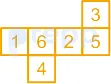
A cube is made by folding the given sheet. In the cube so formed, which of the following pairs of numbers would be opposite to each other?
- A
6 and 3
- B
4 and 5
- C
3 and 4
- D
1 and 6
Show answer
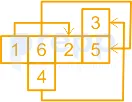
C. 3 and 4Opposite surface of the open dice can be found by the below method:-
Alternate surfaces are opposite to each other.
No two opposite surface are touched by side or by corners
So, by using the above rule we can find the opposite surface of open dice.
Below are the opposite surfaces:-
Numbers
Opposite
1
2
6
5
3
4
Option (1) 6 and 3 → No, they are not opposite to each other.
Option (2) 4 and 5 → No, they are not opposite to each other.
Option (3) 3 and 4 → Yes, they are opposite to each other.
Option (4) 1 and 6 → No, they are not opposite to each other.
So, when the table will be constructed, the letters ‘3 and 4’ will be opposite to each other.
Hence, ‘ 3 and 4 ’ is correct answer
 Paper & answer key PDF ↗
 Question 6archived
Select the option that is embedded in the given figure (rotation is not allowed.)

- A
Option A (shown in image)
- B
Option B (shown in image)
- C
Option C (shown in image)
- D
Option D (shown in image)
Show answer
A. Option A (shown in image)The embedded part of this image is:
Hence, option (1) is the correct answer.
Important Points
Do not get tensed by the complexity of the figures.
Carefully understand the structure of the given question figure.
The embedded figure may not be of exact size. It may be small or big .
Sometimes the rotation or reflection of the figures may be confusing.
So think wisely before selecting the answer.

 Paper & answer key PDF ↗
 Question 7archived
The sequence of folding a piece of paper and the manner in which the folded paper has been cut is shown in the following figures. How would this paper look when unfolded?

- A
Option A (shown in image)
- B
Option B (shown in image)
- C
Option C (shown in image)
- D
Option D (shown in image)
Show answer
C. Option C (shown in image)The image obtained when the paper is unfolded is,
Hence, option 3 is the correct answer.
 Paper & answer key PDF ↗
 Question 8archived
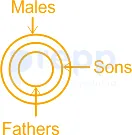
Select the set of classes, the relationship among which is best illustrated by the following Venn diagram.

- A
Fathers, Males, Sons
- B
Boys, Artists, Brothers
- C
Bats, Humans, Mammals
- D
Literates, Girls, Females
Show answer
A. Fathers, Males, SonsThe Venn diagrams best represent the relationship between - Fathers, Males, Sons figures are shown below:
Fathers, Males, Sons
All fathers can be sons and all sons and fathers are males.
Hence, ‘ option 1’ is the correct answer.
 Paper & answer key PDF ↗
 Question 9archived
Select the option in which the numbers are related in the same way as are the numbers of the following set.
(44, 24, 132)
- A
(46, 22, 306)
- B
(32, 28, 250)
- C
(16, 26, 186)
- D
(56, 26, 182)
Show answer
D. (56, 26, 182)Finding the Related Number Set: Analyzing (44, 24, 132)
This solution aims to identify the pattern connecting the numbers in the given set (44, 24, 132) and then apply this pattern to find the matching option among the choices provided. We need to find the specific relationship between the first number (let's call it A), the second number (B), and the third number (C) in the set.
Analyzing the Pattern in the Set (44, 24, 132)
Let's denote the numbers in the set as A = 44, B = 24, and C = 132. We will explore different mathematical operations to find the relationship:
Addition/Subtraction: $A + B = 44 + 24 = 68$. This is not equal to C (132). $A - B = 44 - 24 = 20$. This is not C.
Multiplication: $A \times B = 44 \times 24 = 1056$. This is much larger than C.
Division: $C / A = 132 / 44 = 3$. This suggests A is multiplied by 3 to get C. However, we also need to consider the role of B (24). $C / B = 132 / 24 = 5.5$.
Combined Operations: Let's consider a relationship involving all three numbers. What if C is related to the product of A and B?
Try dividing the product $(A \times B)$ by a constant number to see if we get C.
Calculate $\frac{A \times B}{k} = C$.
Substitute the values: $\frac{44 \times 24}{k} = 132$.
Calculate the product: $\frac{1056}{k} = 132$.
Solving for k: $k = \frac{1056}{132} = 8$.
So, the identified relationship is that the third number (C) is obtained by multiplying the first number (A) and the second number (B), and then dividing the result by 8. We can express this relationship using LaTeX as: $C = \frac{A \times B}{8}$.
Verifying the Relationship with the Options
Now, let's test this relationship $C = \frac{A \times B}{8}$ with each of the given options:
Option
Numbers (A, B, C)
Calculation: $\frac{A \times B}{8}$
Result
Matches C?
1
(46, 22, 306)
$\frac{46 \times 22}{8}$
$\frac{1012}{8} = 126.5$
No
2
(32, 28, 250)
$\frac{32 \times 28}{8}$
$\frac{896}{8} = 112$
No
3
(16, 26, 186)
$\frac{16 \times 26}{8}$
$\frac{416}{8} = 52$
No
4
(56, 26, 182)
$\frac{56 \times 26}{8}$
$\frac{1456}{8} = 182$
Yes
Conclusion
The relationship $C = \frac{A \times B}{8}$ holds true for the original set (44, 24, 132) and for Option 4 (56, 26, 182). Therefore, Option 4 is the correct answer as it follows the same pattern.
Paper & answer key PDF ↗ Question 10archived
Select the letter-cluster from among the given options that can replace the question mark (?) in the following series.
YTUQ, XVRU, ?, VZLC, UBIG
- A
WYOY
- B
WXPY
- C
WXOY
- D
WYOX
Show answer
C. WXOYFinding the Missing Letter Cluster in a Series
This question asks us to identify the pattern in a given series of letter clusters and use that pattern to find the missing cluster. The series is YTUQ, XVRU, ?, VZLC, UBIG. To solve this type of letter-cluster series problem, we should examine the changes in each letter position across the clusters.
Analyzing the Pattern in the Letter-Cluster Series
Let's analyze the series by looking at the position of each letter in the English alphabet (A=1, B=2, ..., Z=26). We will look at the first letter of each cluster, then the second, and so on.
First Letter Analysis
The first letters of the given clusters are Y, X, ?, V, U.
Y is the 25th letter.
X is the 24th letter.
V is the 22nd letter.
U is the 21st letter.
Let's look at the sequence of positions: 25, 24, ?, 22, 21. The pattern here is a consistent decrease by 1. To find the missing term, we subtract 1 from the position of X:
\(24 - 1 = 23\)
The 23rd letter of the alphabet is W. So, the first letter of the missing cluster is W.
Second Letter Analysis
The second letters are T, V, ?, Z, B.
T is the 20th letter.
V is the 22nd letter.
Z is the 26th letter.
B is the 2nd letter.
Let's look at the sequence of positions: 20, 22, ?, 26, 2. We observe the differences:
From T (20) to V (22) is \(22 - 20 = +2\).
From Z (26) to B (2): If we consider the alphabet wraps around, B is 2 positions after Z (Z > A > B). \(26 + 2 = 28\), and \(28 - 26 = 2\). This is also a difference of +2 positions considering wrap-around.
The pattern for the second letter is an increase by 2 positions. To find the missing term, we add 2 to the position of V:
\(22 + 2 = 24\)
The 24th letter of the alphabet is X. So, the second letter of the missing cluster is X.
Third Letter Analysis
The third letters are U, R, ?, L, I.
U is the 21st letter.
R is the 18th letter.
L is the 12th letter.
I is the 9th letter.
Let's look at the sequence of positions: 21, 18, ?, 12, 9. We observe the differences:
From U (21) to R (18) is \(18 - 21 = -3\).
From L (12) to I (9) is \(9 - 12 = -3\).
The pattern for the third letter is a consistent decrease by 3. To find the missing term, we subtract 3 from the position of R:
\(18 - 3 = 15\)
The 15th letter of the alphabet is O. So, the third letter of the missing cluster is O.
Fourth Letter Analysis
The fourth letters are Q, U, ?, C, G.
Q is the 17th letter.
U is the 21st letter.
C is the 3rd letter.
G is the 7th letter.
Let's look at the sequence of positions: 17, 21, ?, 3, 7. We observe the differences:
From Q (17) to U (21) is \(21 - 17 = +4\).
From C (3) to G (7) is \(7 - 3 = +4\).
The pattern for the fourth letter is a consistent increase by 4 positions. To find the missing term, we add 4 to the position of U:
\(21 + 4 = 25\)
The 25th letter of the alphabet is Y. So, the fourth letter of the missing cluster is Y.
Deriving the Missing Cluster
By combining the letters we found for each position, the missing letter cluster is:
First letter: W
Second letter: X
Third letter: O
Fourth letter: Y
The missing cluster is WXOY.
Let's summarize the pattern for each letter position:
Position
Pattern
Missing Letter (Position)
1st Letter
Decrease by 1
W (23)
2nd Letter
Increase by 2
X (24)
3rd Letter
Decrease by 3
O (15)
4th Letter
Increase by 4
Y (25)
Thus, the letter cluster that replaces the question mark is WXOY.
Revision Table for Letter Series
Understanding letter series patterns is key to solving such reasoning questions. Let's review the steps involved:
Write down the given series of letter clusters.
Assign numerical positions to each letter in the alphabet (A=1, B=2, ..., Z=26).
Analyze the sequence of numbers for each letter position across the clusters (first letters, second letters, etc.).
Identify the mathematical or logical pattern (addition, subtraction, multiplication, division, constant difference, increasing/decreasing difference, etc.). Remember to consider wrap-around for letter positions.
Apply the identified pattern to find the numerical position of the missing letter(s).
Convert the numerical positions back to letters.
Combine the letters to form the missing cluster.
Verify the complete series with the found cluster to ensure the pattern holds throughout.
Additional Information on Letter-Cluster Reasoning
Letter-cluster reasoning questions are common in competitive exams and test your ability to identify underlying sequential patterns. These patterns can be based on various principles:
Alphabetical Position: The most common pattern involves the numerical positions of letters in the alphabet, as seen in this problem.
Skip Patterns: The pattern might involve skipping a certain number of letters between consecutive terms, or the number of skipped letters might follow a pattern itself.
Vowel/Consonant Patterns: The series might involve alternating vowels and consonants, or patterns related to their positions.
Reverse Alphabetical Order: Sometimes the pattern runs backwards through the alphabet.
Combination of Patterns: Each position within a cluster might follow a different pattern, as demonstrated in this problem where the first letter decreases by 1, the second increases by 2, the third decreases by 3, and the fourth increases by 4.
Mirror Image/Symmetry: In some series, elements might be related by symmetry or reversal.
Practicing different types of letter and letter-cluster series is essential to quickly recognize the pattern and solve the problem efficiently.
Paper & answer key PDF ↗ Question 11archived
Select the combination of letters that when sequentially placed in the blanks of the given series will complete the series.
J P _ L D _ P _ M D J _ C _ D _ P C _ D
- A
C, J, C, P, O, J, P
- B
C, J, C, P, N, P, O
- C
C, J, N, P, O, J, O
- D
C, J, C, P, N, J, O
Show answer
D. C, J, C, P, N, J, OUnderstanding the Letter Series Pattern
The question asks us to identify the missing letters in a given series to complete it logically. We are provided with a series containing blanks and several options for filling those blanks.
The original series with blanks is:
J P _ L D _ P _ M D J _ C _ D _ P C _ D
There are seven blanks in the series that need to be filled.
Analysing the Options and Finding the Pattern
To solve this letter series completion problem, we can test the provided options. By substituting the sequence of letters from an option into the blanks, we can check if a discernible pattern emerges. Let's consider the sequence from the correct option:
C, J, C, P, N, J, O
Now, let's place these letters sequentially into the blanks in the original series. The blanks are located at the 3rd, 6th, 8th, 12th, 14th, 16th, and 19th positions.
Substituting these letters, the complete series becomes:
J P C L D J P C M D J P C N D J P C O D
Let's examine the structure of this completed letter series to identify the underlying pattern. We can see that the series appears to be composed of repeating blocks. Let's try dividing the series into segments of equal length.
Dividing the 20-letter series into blocks of 5 letters, we get:
Block 1: J P C L D
Block 2: J P C M D
Block 3: J P C N D
Block 4: J P C O D
Observing these blocks, we can notice a consistent structure: each block starts with 'J P C' and ends with 'D'. The fourth letter in each block changes systematically:
The fourth letter of Block 1 is L.
The fourth letter of Block 2 is M.
The fourth letter of Block 3 is N.
The fourth letter of Block 4 is O.
This shows that the letter in the fourth position of each block is incrementing alphabetically (L, M, N, O). The pattern is a repeating block of 'J P C' followed by an alphabetically progressing letter, and ending with 'D'.
Identifying the Missing Letters
Based on the discovered J P C _ D pattern with the incrementing letter, we can determine the letters that should occupy the blank positions (3, 6, 8, 12, 14, 16, 19) in the original series:
Position 3 is the 3rd letter of Block 1 (J P C L D). This position needs 'C'.
Position 6 is the 1st letter of Block 2 (J P C M D). This position needs 'J'.
Position 8 is the 3rd letter of Block 2 (J P C M D). This position needs 'C'.
Position 12 is the 2nd letter of Block 3 (J P C N D). This position needs 'P'. (Note: Checking the original series confirms the blank is here, but the completed pattern shows 'P' was the correct letter).
Position 14 is the 4th letter of Block 3 (J P C N D). This position needs 'N'.
Position 16 is the 1st letter of Block 4 (J P C O D). This position needs 'J'.
Position 19 is the 4th letter of Block 4 (J P C O D). This position needs 'O'.
The sequence of letters required to fill the blanks is C, J, C, P, N, J, O.
Conclusion
By filling the blanks with the sequence C, J, C, P, N, J, O, the series becomes J P C L D J P C M D J P C N D J P C O D, which follows a clear pattern of J P C (incrementing letter) D. This sequence matches one of the provided options.
Revision Table: Letter Series Analysis
ConceptDescription
Letter SeriesA sequence where letters follow a specific rule or pattern.
Pattern RecognitionThe process of identifying the rule that governs the sequence of letters.
Types of PatternsRepetition, alphabetical progression, skipping letters, combination rules, numerical value of letters.
Solving MethodObserve letter positions, look for repeating elements, check alphabetical gaps, test options.
Additional Information: Logical Reasoning and Sequences
Letter series questions are a common type of logical reasoning problem designed to test your pattern recognition skills. Successfully solving these requires careful observation and systematic analysis. Common patterns often involve:
Simple Repetition: A group of letters repeats exactly (e.g., ABCA BCABCA).
Alphabetical Gaps: Letters skip a consistent number of letters in the alphabet (e.g., A (skip 1) C (skip 1) E).
Incremental Changes: As seen in this question, a part of the pattern changes in a predictable way, often alphabetically or numerically (if using letter values).
Alternating Patterns: Two or more separate patterns might be interwoven within the single series.
Positional Logic: The pattern might relate to the position of the letters in the alphabet (A=1, B=2, etc.) and involve numerical operations.
Practicing with a variety of letter series problems helps develop the intuition needed to quickly spot these different types of patterns during tests.
Paper & answer key PDF ↗ Question 12archived
Select the figure from among the given options that can replace the question mark (?) in the following series.

- A
Option A (shown in image)
- B
Option B (shown in image)
- C
Option C (shown in image)
- D
Option D (shown in image)
Show answer
Question 13archived
Select the option in which the words share the same relationship as that shared by the given pair of words.
Pedology : Soil
- A
Seismology : Pressure
- B
Pomology : Fruits
- C
Cytology : Metabolism
- D
Hepatology : Blood
Show answer
B. Pomology : FruitsUnderstanding Word Relationships: Pedology and Soil
The question asks us to identify the option that shares the same relationship as the given pair of words: Pedology : Soil.
Let's first understand the relationship between Pedology and Soil.
Pedology is a scientific discipline that studies soil in its natural setting. It focuses on the origin, evolution, description, and mapping of soil.
Therefore, the relationship between Pedology and Soil is that Pedology is the study of Soil.
Analysing the Options for Study of Relationships
Now we need to examine each option to see which pair exhibits the same 'study of' relationship.
Option 1: Seismology : Pressure
Seismology is the scientific study of earthquakes and seismic waves that move through and around the Earth.
Pressure is a measure of the force applied perpendicular to the surface of an object per unit area.
Seismology is not the study of pressure. The relationship here is incorrect based on the given pair.
Option 2: Pomology : Fruits
Pomology is a branch of botany that studies fruits and their cultivation. It includes the study of fruit structure, development, storage, and processing.
Fruits are the sweet and fleshy products of a tree or other plant that contain seed and can be eaten.
Pomology is the study of Fruits. This relationship matches the relationship between Pedology and Soil.
Option 3: Cytology : Metabolism
Cytology is the study of cells, including their structure, function, and life cycle.
Metabolism is the set of life-sustaining chemical transformations within the cells of living organisms.
Cytology is not the study of metabolism. While metabolism happens within cells, cytology studies the cells themselves. The relationship is incorrect.
Option 4: Hepatology : Blood
Hepatology is the branch of medicine that deals with the study, prevention, diagnosis, and management of diseases that affect the liver, gallbladder, biliary tree, and pancreas.
Blood is a bodily fluid that transports necessary substances such as nutrients and oxygen to the cells and transports metabolic waste products away from those same cells.
Hepatology is not the study of blood. It focuses on the liver and associated organs. The relationship is incorrect.
Comparing Relationships and Finding the Match
Let's summarise the relationships:
Pair
Relationship
Pedology : Soil
Pedology is the study of Soil
Seismology : Pressure
Incorrect (Seismology is study of earthquakes)
Pomology : Fruits
Pomology is the study of Fruits
Cytology : Metabolism
Incorrect (Cytology is study of cells)
Hepatology : Blood
Incorrect (Hepatology is study of liver)
Option 2, Pomology : Fruits, is the only pair that exhibits the same 'study of' relationship as Pedology : Soil.
Revision Table: Study of Sciences
Science Name
What it Studies
Pedology
Soil
Pomology
Fruits
Seismology
Earthquakes
Cytology
Cells
Hepatology
Liver
Additional Information: Branches of Science
Many scientific fields are named with a suffix indicating 'study of'. Understanding these names helps in various analogy questions.
'-logy' is a common suffix meaning 'study of' or 'science of'. Examples include Biology (study of life), Geology (study of the Earth), Zoology (study of animals), Botany (study of plants), etc.
Understanding what specific '-logy' fields study is key to solving such analogy questions based on scientific disciplines.
Other related terms might use different suffixes, but the principle of identifying what is being studied remains the same.
Paper & answer key PDF ↗ Question 14archived
Select the correct combination of mathematical signs that can sequentially replace the * signs and balance the given equation.
14 * 7 * 39 * 133 * 19 * 130
- A
×, +, –, ÷, =
- B
×, –, +, ÷, =
- C
÷, +, –, ×, =
- D
÷, –, +, ×, =
Show answer
A. ×, +, –, ÷, =Understanding the Equation Balancing Problem
The question asks us to find the correct combination of mathematical signs that, when placed sequentially in the asterisks (*) in the given expression, will balance the equation. The expression is 14 * 7 * 39 * 133 * 19 * 130. We are provided with four possible sequences of signs, each ending with an equals sign (=).
The structure of the problem indicates that we need to place the first four signs between the first five numbers and the last number should be the result after the equals sign. So, the equation will look like: 14 [sign 1] 7 [sign 2] 39 [sign 3] 133 [sign 4] 19 = 130.
Applying the Order of Operations (BODMAS/PEMDAS)
To solve mathematical expressions involving multiple operations, we must follow a specific order of operations. This order is commonly known as BODMAS or PEMDAS.
B/P: Brackets (or Parentheses)
O/E: Orders (or Exponents)
D/M: Division and Multiplication (from left to right)
A/S: Addition and Subtraction (from left to right)
We will evaluate the left side of the equation using this rule for each given option and check if it equals the right side (130).
Testing the Options for Balancing the Equation
Let's test each option by substituting the signs into the equation 14 * 7 * 39 * 133 * 19 * 130 and evaluating the left side.
Option 1: ×, +, –, ÷, =
Equation: $$14 \times 7 + 39 - 133 \div 19 = 130$$
Let's evaluate the left side step-by-step according to BODMAS:
Division: $$133 \div 19 = 7$$ The equation becomes: $$14 \times 7 + 39 - 7 = 130$$
Multiplication: $$14 \times 7 = 98$$ The equation becomes: $$98 + 39 - 7 = 130$$
Addition: $$98 + 39 = 137$$ The equation becomes: $$137 - 7 = 130$$
Subtraction: $$137 - 7 = 130$$ The equation becomes: $$130 = 130$$
The left side equals the right side. This option balances the equation.
Option 2: ×, –, +, ÷, =
Equation: $$14 \times 7 - 39 + 133 \div 19 = 130$$
Let's evaluate the left side:
Division: $$133 \div 19 = 7$$ The equation becomes: $$14 \times 7 - 39 + 7 = 130$$
Multiplication: $$14 \times 7 = 98$$ The equation becomes: $$98 - 39 + 7 = 130$$
Subtraction: $$98 - 39 = 59$$ The equation becomes: $$59 + 7 = 130$$
Addition: $$59 + 7 = 66$$ The equation becomes: $$66 = 130$$
The left side does not equal the right side. This option does not balance the equation.
Option 3: ÷, +, –, ×, =
Equation: $$14 \div 7 + 39 - 133 \times 19 = 130$$
Let's evaluate the left side:
Division: $$14 \div 7 = 2$$ The equation becomes: $$2 + 39 - 133 \times 19 = 130$$
Multiplication: $$133 \times 19 = 2527$$ The equation becomes: $$2 + 39 - 2527 = 130$$
Addition: $$2 + 39 = 41$$ The equation becomes: $$41 - 2527 = 130$$
Subtraction: $$41 - 2527 = -2486$$ The equation becomes: $$-2486 = 130$$
The left side does not equal the right side. This option does not balance the equation.
Option 4: ÷, –, +, ×, =
Equation: $$14 \div 7 - 39 + 133 \times 19 = 130$$
Let's evaluate the left side:
Division: $$14 \div 7 = 2$$ The equation becomes: $$2 - 39 + 133 \times 19 = 130$$
Multiplication: $$133 \times 19 = 2527$$ The equation becomes: $$2 - 39 + 2527 = 130$$
Subtraction: $$2 - 39 = -37$$ The equation becomes: $$-37 + 2527 = 130$$
Addition: $$-37 + 2527 = 2490$$ The equation becomes: $$2490 = 130$$
The left side does not equal the right side. This option does not balance the equation.
Summary of Option Testing
We can summarize the results in a table:
Option
Signs Sequence
Equation
Left Side Value
Balances?
1
$\times, +, -, \div, =$
$14 \times 7 + 39 - 133 \div 19 = 130$
$130$
Yes
2
$\times, -, +, \div, =$
$14 \times 7 - 39 + 133 \div 19 = 130$
$66$
No
3
$\div, +, -, \times, =$
$14 \div 7 + 39 - 133 \times 19 = 130$
$-2486$
No
4
$\div, -, +, \times, =$
$14 \div 7 - 39 + 133 \times 19 = 130$
$2490$
No
Based on the evaluation, only Option 1 results in a balanced equation.
Conclusion: Correct Combination of Mathematical Signs
The correct combination of mathematical signs that sequentially replace the * signs and balance the given equation is $\times, +, -, \div, =$. This corresponds to Option 1.
Revision Table: Key Concepts for Balancing Equations
Concept
Description
Relevance to Problem
Mathematical Signs / Operators
Symbols representing mathematical operations ($\times, +, -, \div$).
We must correctly choose and place these signs.
Balancing Equations
Making the value of the expression on the left side equal to the value on the right side of the equals sign (=).
The ultimate goal of the problem.
Order of Operations (BODMAS/PEMDAS)
Rules defining the sequence in which operations should be performed in a mathematical expression.
Essential for correctly evaluating the expressions formed by each option.
Additional Information: Equation Solving Strategies
Problems like this often appear in reasoning or quantitative aptitude sections of exams. While trial and error with options is a primary strategy here, understanding number properties and the effect of different operators can sometimes help eliminate options faster. For instance, large multiplications or divisions can drastically change the value, which might give a hint about whether a particular sequence of signs is likely to result in the target number.
Always double-check your calculations, especially when dealing with division and potential remainders, although in this problem, all divisions were exact.
Paper & answer key PDF ↗ Question 15archived
In a certain code language, ‘PRINTER’ is coded as ‘11181814759’ and ‘LOGIC’ is coded as ‘151520924’. How will ‘TERMITE’ be coded in that language?
- A
75913182022
- B
7591418205
- C
2059131875
- D
75181392022
Show answer
A. 75913182022Understanding the Coding Language Pattern
This question involves deciphering a specific coding language used to represent words as numerical sequences. We are given two examples: 'PRINTER' coded as '11181814759' and 'LOGIC' coded as '151520924'. Our goal is to find the underlying rule and apply it to code the word 'TERMITE'.
Analyzing the Given Codes: PRINTER and LOGIC
Let's look at the letters in the given words and their positions in the English alphabet. The standard position is A=1, B=2, ..., Z=26. The reverse position is Z=1, Y=2, ..., A=26.
Letter
Standard Position
Reverse Position
P
16
11
R
18
9
I
9
18
N
14
13
T
20
7
E
5
22
R
18
9
The code for PRINTER is 11181814759. Let's try to match segments of this code with the positions:
P: Code starts with 11. Reverse position of P is 11. (Match)
R: Next segment is 18. Standard position of R is 18. (Match)
I: Next segment is 18. Reverse position of I is 18. (Match)
N: Next segment is 14. Standard position of N is 14. (Match)
T: Next segment is 7. Reverse position of T is 7. (Match)
E: Next segment is 5. Standard position of E is 5. (Match)
R: Next segment is 9. Reverse position of R is 9. (Match)
It appears the pattern for PRINTER is alternating between the reverse and standard alphabet positions for each letter.
Let's test this pattern with the second example, LOGIC:
Letter
Standard Position
Reverse Position
L
12
15
O
15
12
G
7
20
I
9
18
C
3
24
The code for LOGIC is 151520924. Applying the alternating pattern:
L: 1st letter, use Reverse position (15) → 15
O: 2nd letter, use Standard position (15) → 15
G: 3rd letter, use Reverse position (20) → 20
I: 4th letter, use Standard position (9) → 9
C: 5th letter, use Reverse position (24) → 24
Concatenating these numbers gives 151520924, which matches the given code for LOGIC.
The Coding Rule
The rule is: The code for a word is formed by taking the reverse alphabet position for the 1st, 3rd, 5th, ... letters, and the standard alphabet position for the 2nd, 4th, 6th, ... letters, and concatenating these numbers in order.
Odd position letters (1st, 3rd, 5th, ...): Use Reverse Alphabet Position.
Even position letters (2nd, 4th, 6th, ...): Use Standard Alphabet Position.
Coding the Word TERMITE
Now, let's apply this rule to the word 'TERMITE'. It has 7 letters.
T (1st letter): Odd position. Use Reverse position of T. Reverse position of T is 7.
E (2nd letter): Even position. Use Standard position of E. Standard position of E is 5.
R (3rd letter): Odd position. Use Reverse position of R. Reverse position of R is 9.
M (4th letter): Even position. Use Standard position of M. Standard position of M is 13.
I (5th letter): Odd position. Use Reverse position of I. Reverse position of I is 18.
T (6th letter): Even position. Use Standard position of T. Standard position of T is 20.
E (7th letter): Odd position. Use Reverse position of E. Reverse position of E is 22.
Concatenating these numbers gives the code for TERMITE: 75913182022.
Comparing with Options
Let's check which option matches our derived code:
75913182022
7591418205
2059131875
75181392022
Our derived code 75913182022 matches Option 1.
Revision Table
Word
Letters & Positions
Coding Rule Applied
Generated Code
PRINTER
P(1st), R(2nd), I(3rd), N(4th), T(5th), E(6th), R(7th)
Rev, Std, Rev, Std, Rev, Std, Rev
11, 18, 18, 14, 7, 5, 9 → 11181814759
LOGIC
L(1st), O(2nd), G(3rd), I(4th), C(5th)
Rev, Std, Rev, Std, Rev
15, 15, 20, 9, 24 → 151520924
TERMITE
T(1st), E(2nd), R(3rd), M(4th), I(5th), T(6th), E(7th)
Rev, Std, Rev, Std, Rev, Std, Rev
7, 5, 9, 13, 18, 20, 22 → 75913182022
Additional Information on Letter Coding
Letter coding is a common type of question in logical reasoning and competitive exams. These problems require you to find a pattern between the original word/letters and their coded form. Common patterns involve:
Shifting positions (e.g., A becomes C, B becomes D, etc.)
Using standard alphabet positions ($\text{A}=1, \text{B}=2, \dots, \text{Z}=26$)
Using reverse alphabet positions ($\text{Z}=1, \text{Y}=2, \dots, \text{A}=26$)
Using positions relative to the middle of the alphabet (M/N)
Alternating patterns (like the one in this problem)
Applying arithmetic operations (+, -, *, /) to positions
Coding based on vowels/consonants
Solving these problems effectively requires familiarity with alphabet positions and systematic checking of potential patterns using the given examples.
Paper & answer key PDF ↗ Question 16archived
Four words have been given, out of which three are alike in some manner and one is different. Select the word that is different.
- A
Nostalgic
- B
Excited
- C
Timid
- D
Energised
Show answer
C. TimidUnderstanding the Question: Identifying the Odd Word Out
The question asks us to identify the word that is different from the other three among the given four words. This is a common type of question that tests vocabulary and the ability to find common relationships or categories among words.
Analyzing the Given Words
Let's look at the four words provided:
Nostalgic: This word describes a feeling of pleasure and slight sadness when remembering things from the past. It relates to emotions tied to memory and time.
Excited: This word describes feeling very enthusiastic and eager. It is a state of high emotional arousal, often positive, anticipating something.
Timid: This word describes showing a lack of courage or confidence; easily frightened. It relates to feelings of fear or shyness.
Energised: This word describes feeling full of energy or enthusiasm; stimulated. It relates to a state of high energy and motivation.
Finding the Relationship and the Different Word
We need to find a common theme or category that links three of the words and excludes one. Let's consider the meanings:
"Excited" and "Energised" both describe states of high energy, enthusiasm, or positive emotional arousal. They are related to feeling active and stimulated.
"Nostalgic" describes an emotional state, specifically one linked to past memories. While different from "Excited" and "Energised" in focus (past vs. present/future energy), it still describes a distinct emotional feeling or state of mind.
"Timid" describes a state characterized by fear, shyness, or lack of confidence. This relates to a feeling of apprehension or inhibition.
Let's try grouping them:
Group 1: Excitement, Energy, Nostalgia. These describe feelings of enthusiasm, high energy, or a specific emotional state related to memory.
Group 2: Timid. This describes a state of fear or lack of confidence.
Comparing the words, "Excited", "Energised", and "Nostalgic" all relate to specific emotional states or feelings that are not primarily defined by fear or a lack of confidence. "Excited" and "Energised" are clearly positive and high-energy states. "Nostalgic" is a mixed but often pleasant emotional state related to the past. "Timid", however, specifically describes a state of fear, shyness, or inhibition due to lack of confidence.
Therefore, "Timid" is different from the other three words because it describes a state characterized by fear or diffidence, whereas the other words describe states related to positive arousal, energy, or specific emotional reflection (nostalgia).
Conclusion: Selecting the Different Word
Based on the analysis of the meanings, "Excited", "Energised", and "Nostalgic" describe various forms of emotional or energetic states, while "Timid" describes a state of fear or lack of confidence. Thus, "Timid" is the word that is different.
The word that is different is Timid.
Revision Table: Checking Vocabulary and Relationships
Word
Meaning Summary
Relationship to Others
Nostalgic
Longing for the past
Emotional state, distinct from fear/timidity
Excited
Very enthusiastic/eager
High-energy/positive emotional state, distinct from fear/timidity
Timid
Lack of courage/easily frightened
State of fear/lack of confidence - the different one
Energised
Full of energy/enthusiasm
High-energy/positive state, distinct from fear/timidity
Additional Information: Understanding Word Analogies and Vocabulary
Questions like this test your vocabulary range and your ability to find logical connections or differences between words. These often fall into categories such as:
Synonyms/Antonyms: Finding words that are similar or opposite in meaning.
Categories: Grouping words that belong to the same class (e.g., types of emotions, types of energy levels).
Functions/Properties: Grouping words based on what they do or describe.
Intensity: Words representing different degrees of a quality.
In this specific question about Nostalgic, Excited, Timid, and Energised, the grouping is based on the type of emotional or psychological state they represent. Three relate to forms of positive emotional or energetic engagement (even if nostalgia has a touch of sadness), while one ("Timid") relates to fear and inhibition.
Paper & answer key PDF ↗ Question 17archived
‘A # B’ means ‘A is the brother of B’.
‘A @ B’ means ‘A is the daughter of B’.
‘A & B’ means ‘A is the husband of B’.
‘A % B’ means ‘A is the wife of B’.
If ‘W # Q @ T & Y @ M % K’, then how is K related to T?
- A
Father-in-law
- B
Mother
- C
Father
- D
Mother-in-law
Show answer
A. Father-in-lawSolving the Family Relationship Puzzle
This question involves decoding a series of relationships expressed using specific symbols. We are given the definitions of the symbols and an encoded relationship string. Our goal is to determine how K is related to T based on this string.
Understanding the Relationship Codes
Let's first understand the meaning of each symbol provided:
A # B: A is the brother of B (A is male).
A @ B: A is the daughter of B (A is female).
A & B: A is the husband of B (A is male).
A % B: A is the wife of B (A is female).
Decoding the Relationship String: 'W # Q @ T & Y @ M % K'
Now, let's break down the given expression part by part to build the family tree:
'W # Q': W is the brother of Q. This tells us W is male. W and Q are siblings.
'Q @ T': Q is the daughter of T. This tells us Q is female. T is a parent of Q.
'T & Y': T is the husband of Y. This tells us T is male and Y is female. T and Y are married. Since T is a parent of Q (from step 2) and T is male, T must be the father of Q. Y is the mother of Q.
'Y @ M': Y is the daughter of M. This tells us Y is female. M is a parent of Y.
'M % K': M is the wife of K. This tells us M is female and K is male. M and K are married. Since M is a parent of Y (from step 4) and M is female, M must be the mother of Y. K is the father of Y.
Constructing the Family Tree
Based on the decoding steps, we can visualize the relationships:
K and M are a married couple (K is male, M is female).
Y is their daughter (Y is female).
Y is married to T (T is male).
Q is the daughter of T and Y (Q is female).
W is the brother of Q (W is male).
The structure can be represented as:
K (male) --- married to --- M (female)
|
Y (female) --- married to --- T (male)
|
Q (female) <--- siblings --- W (male)
Determining the Relationship between K and T
We need to find out how K is related to T. From our family tree:
K is the father of Y.
Y is the wife of T.
Therefore, K is the father of T's wife. This means K is the father-in-law of T.
Final Answer
Based on the relationship string and symbol definitions, K is the father-in-law of T.
Revision Table: Key Relationships
Symbol
Relationship
Gender Information
#
Brother of
First person is male
@
Daughter of
First person is female
&
Husband of
First person is male
%
Wife of
First person is female
Additional Information: Solving Blood Relation Questions
Blood relation questions in reasoning tests require you to build a family tree or diagram based on the given information. Here are some tips:
Always note the gender of each person if specified by the symbols or relationships.
Draw a diagram to represent the relationships. Use different symbols for male and female, and lines to show different types of connections (marriage, parent-child, siblings).
Break down complex expressions into smaller parts.
Work step-by-step from one known relationship to the next until you connect the two individuals in question.
Be careful with relations like 'sibling' where gender might not be explicitly stated for both parties unless a specific symbol indicates it.
These questions test your ability to follow instructions and deduce logical connections within a defined system.
Paper & answer key PDF ↗ Question 18archived
Select the number from among the given options that can replace the question mark (?) in the following series.
18, 29, 42, 59, 78, 101, ?
- A
121
- B
125
- C
137
- D
130
Show answer
D. 130Understanding the Number Series Problem
We are given a series of numbers: 18, 29, 42, 59, 78, 101, ?. Our goal is to find the next number in this sequence by identifying the underlying pattern.
Number series questions often involve arithmetic progressions, geometric progressions, perfect squares, cubes, or patterns based on differences between consecutive terms.
Step-by-Step Analysis of the Series
Let's examine the differences between consecutive terms in the given series.
Difference between the 2nd and 1st term: \(29 - 18 = 11\)
Difference between the 3rd and 2nd term: \(42 - 29 = 13\)
Difference between the 4th and 3rd term: \(59 - 42 = 17\)
Difference between the 5th and 4th term: \(78 - 59 = 19\)
Difference between the 6th and 5th term: \(101 - 78 = 23\)
Identifying the Pattern in Differences
The sequence of differences we obtained is: 11, 13, 17, 19, 23.
Let's look closely at this new sequence. Do these numbers follow a specific pattern?
They are all prime numbers.
They are consecutive prime numbers starting from 11.
The prime numbers in ascending order are 2, 3, 5, 7, 11, 13, 17, 19, 23, 29, 31, ...
The sequence of differences (11, 13, 17, 19, 23) exactly matches consecutive prime numbers starting from 11.
Determining the Next Term
Since the pattern of differences is consecutive prime numbers, the next difference in the series should be the next prime number after 23.
The next prime number after 23 is 29.
So, the next term in the original series will be the last term (101) plus the next difference (29).
Next term = \(101 + 29 = 130\)
Series and Differences
Term
Value
Difference from previous term
1st
18
-
2nd
29
\(29 - 18 = 11\)
3rd
42
\(42 - 29 = 13\)
4th
59
\(59 - 42 = 17\)
5th
78
\(78 - 59 = 19\)
6th
101
\(101 - 78 = 23\)
7th (?)
\(101 + 29 = 130\)
29 (Next prime after 23)
Conclusion
Based on the identified pattern where the differences between consecutive terms are prime numbers in increasing order, the next number in the series 18, 29, 42, 59, 78, 101 is 130.
Revision Table: Number Series Pattern
Series Term
Value
Difference
Pattern in Difference
1st
18
-
-
2nd
29
11
1st prime diff
3rd
42
13
2nd prime diff
4th
59
17
3rd prime diff
5th
78
19
4th prime diff
6th
101
23
5th prime diff
7th
130
29
6th prime diff
Additional Information: Solving Number Series Questions
Number series questions are common in logical reasoning and quantitative aptitude tests. Here are some general strategies to solve them:
Look for differences: Calculate the differences between consecutive terms. If the differences form a simple sequence (constant, arithmetic progression, squares, cubes, primes, etc.), you've likely found the pattern.
Look for ratios: If the numbers are increasing or decreasing rapidly, check the ratio between consecutive terms. This might indicate a geometric progression.
Look for squares or cubes: See if the terms are close to perfect squares or cubes. The pattern might involve adding or subtracting a constant or another sequence from squares/cubes.
Check for alternating patterns: Sometimes, the pattern involves two interleaved sequences.
Consider combined operations: The pattern might involve a combination of operations (e.g., multiply by 2 and add 1).
Practice: Solving many different types of number series helps you recognize patterns more quickly.
Paper & answer key PDF ↗ Question 19archived
Select the correct option that indicates the arrangement of the given words in the order in which they appear in an English dictionary.
1. Cardinal
2. Cartography
3. Cardiac
4. Carrot
5. Callous
6. Careless
- A
5, 3, 1, 6, 2, 4
- B
5, 3, 1, 4, 6, 2
- C
5, 1, 3, 6, 4, 2
- D
5, 3, 1, 6, 4, 2
Show answer
D. 5, 3, 1, 6, 4, 2Understanding Dictionary Order
Arranging words in dictionary order, also known as alphabetical order, involves comparing words letter by letter from left to right. We start by comparing the first letter of each word. If they are the same, we move to the second letter, and so on. The word with the letter that comes earlier in the alphabet is placed first.
Analyzing the Given Words for Alphabetical Sorting
We are given six words to arrange in the order they would appear in an English dictionary:
Cardinal
Cartography
Cardiac
Carrot
Callous
Careless
Let's compare these words letter by letter.
Step-by-Step Comparison
All the words begin with 'C'. Let's look at the second letter:
Cardinal
Cartography
Cardiac
Carrot
Callous
Careless
All words start with 'Ca'. We move to the third letter:
Cardinal
Cartography
Cardiac
Carrot
Callous
Careless
Comparing the third letters: 'd', 't', 'd', 'r', 'l', 'e'.
The alphabetical order of these letters is 'e', 'd', 'l', 'r', 't'. However, we must consider the words that share the same letter before moving on. Let's group them by the third letter:
Words with 'l' as the third letter: Callous (5)
Words with 'e' as the third letter: Careless (6)
Words with 'd' as the third letter: Cardinal (1), Cardiac (3)
Words with 'r' as the third letter: Carrot (4)
Words with 't' as the third letter: Cartography (2)
Based on the third letter, 'l' comes first, then 'e', then 'd', then 'r', then 't'. So, 'Callous' comes first overall, and 'Careless' comes next after comparing just the third letter of all words initially. Words starting with 'Card' come before words starting with 'Carr' and 'Cart'.
Current partial order based on the third letter's group starting points: Callous (5), Careless (6), Cardinal/Cardiac (1/3), Carrot (4), Cartography (2).
Now, let's resolve the order within the group starting with 'Card':
Cardinal (1)
Cardiac (3)
Both have 'd' as the third letter. We compare the fourth letter:
Cardinal
Cardiac
Both have 'i' as the fourth letter. Compare the fifth letter:
Cardinal
Cardiac
Comparing 'n' and 'a', 'a' comes before 'n'. So, 'Cardiac' (3) comes before 'Cardinal' (1).
The order for the 'Card' group is: Cardiac (3), Cardinal (1).
Let's re-evaluate the order considering all words based on the initial third letter comparison and resolving ties:
Callous (Starts with Cal, 'l' comes before 'r', 'e', 'd', 't')
Cardiac (Starts with Cardia, resolved 'Card' group)
Cardinal (Starts with Cardin, resolved 'Card' group)
Careless (Starts with Care, 'e' comes after 'l' but before 'd', 'r', 't' among the relevant comparisons here)
Carrot (Starts with Carr, 'r' comes after 'e' among the relevant comparisons here)
Cartography (Starts with Cart, 't' comes after 'r')
Let's refine this step-by-step based on full word comparison:
1. Compare all words based on the third letter: 'l', 't', 'd', 'r', 'l', 'e'. The order of third letters is 'e', 'd', 'l', 'r', 't'.
Words starting with 'Cal': Callous (5) - comes first.
Words starting with 'Car': Remaining words (1, 2, 3, 4, 6).
2. Now compare words starting with 'Car' based on the fourth letter: 'd', 't', 'd', 'r', 'e'. The order of these fourth letters is 'd', 'e', 'r', 't'.
Words starting with 'Card': Cardinal (1), Cardiac (3). Compare fifth letter: 'i', 'i'. Compare sixth letter: 'n', 'a'. 'a' comes before 'n'. So, Cardiac (3) comes before Cardinal (1).
Words starting with 'Care': Careless (6).
Words starting with 'Carr': Carrot (4).
Words starting with 'Cart': Cartography (2).
Arranging the 'Car' group based on the fourth letter (and subsequent letters for ties):
Cardiac (3) - Starts Card...a...
Cardinal (1) - Starts Card...i...n...
Careless (6) - Starts Care...
Carrot (4) - Starts Carr...
Cartography (2) - Starts Cart...
Combining the first word ('Callous') with the ordered 'Car' group:
Callous (5)
Cardiac (3)
Cardinal (1)
Careless (6)
Carrot (4)
Cartography (2)
The correct dictionary order is 5, 3, 1, 6, 4, 2.
Final Ordered List
The words arranged in English dictionary order are:
Callous (5)
Cardiac (3)
Cardinal (1)
Careless (6)
Carrot (4)
Cartography (2)
The sequence of numbers is 5, 3, 1, 6, 4, 2.
Comparison with Options
Let's check the given options against our derived order (5, 3, 1, 6, 4, 2).
Option
Order
Matches Correct Order?
1
5, 3, 1, 6, 2, 4
No
2
5, 3, 1, 4, 6, 2
No
3
5, 1, 3, 6, 4, 2
No
4
5, 3, 1, 6, 4, 2
Yes
Option 4 matches the correct dictionary order of the words.
Revision Table: Dictionary Ordering Process
Step
Action
Words/Comparison
Result
1
Compare 1st letter
All start with 'C'
No distinction
2
Compare 2nd letter
All start with 'Ca'
No distinction
3
Compare 3rd letter
l, t, d, r, l, e
'l' (Callous) is first. 'e' (Careless) is next. 'd' group (Cardinal, Cardiac) next. 'r' (Carrot) next. 't' (Cartography) last.
4
Resolve 'Card' group (1, 3)
Cardinal (Cardinal), Cardiac (Cardiac)
Compare 6th letter: 'n' vs 'a'. 'a' comes before 'n'. Cardiac (3) then Cardinal (1).
5
Combine and list in order
Callous, Cardiac, Cardinal, Careless, Carrot, Cartography
5, 3, 1, 6, 4, 2
Additional Information: Alphabetical Ordering Rules
Understanding alphabetical order is fundamental for using dictionaries, indexes, and sorting data. Here are some key rules:
Letter by Letter: Comparison starts with the first letter. If letters are the same, move to the next letter.
Alphabetical Sequence: The order is based on the standard English alphabet (A-Z).
Shorter Word First: If one word is a prefix of another (e.g., 'care' and 'careful'), the shorter word comes first ('care' before 'careful'). In this question, no word is a prefix of another word in the list.
Case Sensitivity: In formal alphabetical order, case is usually ignored, but for consistency, assume all words are treated the same way (e.g., all lowercase or all uppercase).
Spaces and Symbols: These rules typically apply to words composed of letters. Special characters or numbers follow different sorting rules depending on the context.
Practicing with word arrangement exercises helps improve vocabulary and attention to detail.
Paper & answer key PDF ↗ Question 20archived
Select the option in which the numbers are related in the same way as are the numbers of the following set.
(47, 64, 55)
- A
(28, 25, 34)
- B
(46, 49, 53)
- C
(56, 80, 64)
- D
(36, 100, 47)
Show answer
B. (46, 49, 53)Understanding the Number Relationship in the Given Set
The question asks us to find the option where the numbers are related in the same way as the numbers in the set (47, 64, 55). We need to identify the specific pattern or rule that connects the three numbers in the given set.
Let's analyze the given set: (47, 64, 55).
We look for a mathematical relationship between these numbers. Let's consider potential relationships involving addition, subtraction, multiplication, division, squares, cubes, etc.
Let the first number be $A$, the second number be $B$, and the third number be $C$. In the given set, $A=47$, $B=64$, and $C=55$.
Let's examine differences between the numbers:
Difference between the third and first number: $C - A = 55 - 47 = 8$.
Difference between the second and first number: $B - A = 64 - 47 = 17$.
Difference between the third and second number: $C - B = 55 - 64 = -9$ or $B - C = 64 - 55 = 9$.
Let's see if any of these differences relate to the middle number (64) or other numbers through simple operations.
Consider the difference between the third number (55) and the first number (47), which is 8. How is this difference related to the middle number (64)? We notice that $8^2 = 64$. This suggests a potential pattern.
The pattern appears to be: The middle number is the square of the difference between the third number and the first number.
Let's verify this pattern with the given set (47, 64, 55):
First Number ($A$) = 47
Third Number ($C$) = 55
Difference ($C - A$) = $55 - 47 = 8$
Square of the difference = $8^2 = 64$
Middle Number ($B$) = 64
The calculated value (64) matches the middle number in the set. So, the relationship is indeed \( B = (C - A)^2 \).
Applying the Discovered Pattern to the Options
Now, we will apply this relationship to the numbers in each option to see which option follows the same rule.
For each option (A, B, C), we calculate $(C - A)^2$ and check if it equals $B$.
Option
Numbers (A, B, C)
Difference (C - A)
Square of Difference \((C - A)^2\)
Middle Number (B)
Does \( (C - A)^2 = B \)?
1
(28, 25, 34)
$34 - 28 = 6$
$6^2 = 36$
25
$36 \neq 25$ (No)
2
(46, 49, 53)
$53 - 46 = 7$
$7^2 = 49$
49
$49 = 49$ (Yes)
3
(56, 80, 64)
$64 - 56 = 8$
$8^2 = 64$
80
$64 \neq 80$ (No)
4
(36, 100, 47)
$47 - 36 = 11$
$11^2 = 121$
100
$121 \neq 100$ (No)
Based on the analysis, only Option 2 follows the same relationship where the middle number is the square of the difference between the third and first number.
Conclusion on the Number Relationship
The set (47, 64, 55) exhibits a specific mathematical relationship: the middle number is the result of squaring the difference between the third number and the first number. By applying this pattern to all the given options, we found that the set (46, 49, 53) is the only one that satisfies this exact relationship.
In (46, 49, 53), the first number is 46, the third number is 53. The difference is $53 - 46 = 7$. Squaring this difference gives $7^2 = 49$, which is the middle number.
Set/Option
First Number
Third Number
Difference (Third - First)
Square of Difference
Middle Number
Match?
Given Set
47
55
$55 - 47 = 8$
$8^2 = 64$
64
Yes
Option 1
28
34
$34 - 28 = 6$
$6^2 = 36$
25
No ($36 \neq 25$)
Option 2
46
53
$53 - 46 = 7$
$7^2 = 49$
49
Yes ($49 = 49$)
Option 3
56
64
$64 - 56 = 8$
$8^2 = 64$
80
No ($64 \neq 80$)
Option 4
36
47
$47 - 36 = 11$
$11^2 = 121$
100
No ($121 \neq 100$)
Therefore, Option 2 shows the same relationship as the given set.
Revision Table: Key Concepts in Number Puzzles
Concept
Description
How it applies here
Pattern Recognition
Identifying a recurring sequence or rule in numbers.
Crucial for finding the relationship in the given set (47, 64, 55).
Arithmetic Operations
Using addition, subtraction, multiplication, division.
Used to find the difference between numbers.
Squaring Numbers
Multiplying a number by itself ($n^2$).
The core operation in the identified pattern $(C-A)^2 = B$.
Applying Rules
Testing a hypothesis or rule against different examples.
Checking each option against the rule derived from the original set.
Additional Information: Strategies for Solving Number Relation Problems
Solving number relation problems often involves looking for common mathematical patterns. Here are some strategies:
Check Basic Operations: Look for simple sums, differences, products, or quotients between pairs or all numbers in the set.
Look for Squares, Cubes, or Roots: Numbers might be squares or cubes of other numbers or differences/sums.
Consider Differences/Sums of Digits: Sometimes the pattern involves the digits within the numbers.
Look for Relationships with the Middle Number: The middle number is often derived from the first and third numbers using a specific rule.
Consider Position: The rule might apply based on the position of the numbers (first, second, third).
Test Your Hypothesis: Once you think you've found a pattern, test it rigorously with the original set and then apply it to the options.
Practice with various types of number sets helps in quickly recognizing common patterns in reasoning questions.
Paper & answer key PDF ↗ Question 21archived
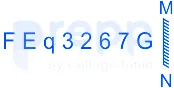
Select the correct mirror image of the given combination when the mirror is placed at MN as shown.
- A
Option A (shown in image)
- B
Option B (shown in image)
- C
Option C (shown in image)
- D
Option D (shown in image)
Show answer
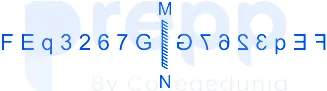
A. Option A (shown in image)The correct mirror image of the given figure when the mirror is held at the right side is:
Hence, "option (1)" is the correct answer.
Additional Information
In Mirror image left side and right side changed vice-versa where the top and bottom remain the same.
The reflection of an object into the water is its water image. It appears by inverting an object vertically i.e. upside down.
The water image of the figure looks like the mirror image of the figure in case the mirror is horizontally at the bottom of the figure.
Water image is just a reflection where top and bottom part of the images changed where left and right side of the image remain same.
 Paper & answer key PDF ↗
 Question 22archived
In a certain code language, ‘DARK’ is written as ‘CBQJ’ and ‘SOUND’ is written as ‘RPVMC’. How will ‘TOXIC’ be written in that language?
- A
SPWJB
- B
UPYJD
- C
PUYJD
- D
SNWHB
Show answer
A. SPWJBUnderstanding the Coding Decoding Pattern
This question asks us to decipher a code language based on two examples provided and then apply that logic to decode a new word. We need to find the rule or pattern that transforms the original word into its coded form.
Analyzing the Given Examples
Let's look at the first example:
Original Word: DARK
Coded Word: CBQJ
We can compare each letter in the original word with its corresponding letter in the coded word. Let's see the change in alphabetical position:
D to C: Moving one step backward in the alphabet (D → C). This is a $-1$ operation.
A to B: Moving one step forward in the alphabet (A → B). This is a $+1$ operation.
R to Q: Moving one step backward in the alphabet (R → Q). This is a $-1$ operation.
K to J: Moving one step backward in the alphabet (K → J). This is a $-1$ operation.
The pattern for 'DARK' seems to be $-1, +1, -1, -1$. However, this sequence of operations might depend on the type of letter (vowel or consonant) or its position.
Now let's look at the second example:
Original Word: SOUND
Coded Word: RPVMC
Comparing the letters:
S to R: Moving one step backward (S → R), which is $-1$.
O to P: Moving one step forward (O → P), which is $+1$.
U to V: Moving one step forward (U → V), which is $+1$.
N to M: Moving one step backward (N → M), which is $-1$.
D to C: Moving one step backward (D → C), which is $-1$.
The pattern for 'SOUND' seems to be $-1, +1, +1, -1, -1$. The first two operations ($-1, +1$) are the same as in 'DARK'. Let's consider the type of letters:
DARK: D (Consonant), A (Vowel), R (Consonant), K (Consonant)
SOUND: S (Consonant), O (Vowel), U (Vowel), N (Consonant), D (Consonant)
Let's correlate the operation with the type of letter:
DARK: C, V, C, C → $-1, +1, -1, -1$
SOUND: C, V, V, C, C → $-1, +1, +1, -1, -1$
It appears that consonants are replaced by the previous letter ($-1$), and vowels are replaced by the next letter ($+1$). Let's verify this rule with both examples:
Word
Letter
Type
Rule
Coded Letter
Actual Code
DARK
D
Consonant
Previous letter
C
C
A
Vowel
Next letter
B
B
R
Consonant
Previous letter
Q
Q
K
Consonant
Previous letter
J
J
SOUND
S
Consonant
Previous letter
R
R
O
Vowel
Next letter
P
P
U
Vowel
Next letter
V
V
N
Consonant
Previous letter
M
M
D
Consonant
Previous letter
C
C
The rule holds true for both examples.
Applying the Pattern to 'TOXIC'
Now we apply the identified rule to the word 'TOXIC'. The rule is:
Consonants are replaced by the previous letter.
Vowels (A, E, I, O, U) are replaced by the next letter.
Let's break down 'TOXIC':
T: T is a consonant. The previous letter is S.
O: O is a vowel. The next letter is P.
X: X is a consonant. The previous letter is W.
I: I is a vowel. The next letter is J.
C: C is a consonant. The previous letter is B.
Combining the coded letters, we get SPWJB.
Comparing with Options
Let's check the options provided:
SPWJB
UPYJD
PUYJD
SNWHB
Our derived code SPWJB matches the first option.
Revision Table: Coding Pattern Summary
Letter Type
Rule Applied
Operation
Example
Consonant
Replace with Previous Letter
Letter $\rightarrow$ Letter - 1 (alphabetical position)
D $\rightarrow$ C, S $\rightarrow$ R, N $\rightarrow$ M, X $\rightarrow$ W, C $\rightarrow$ B
Vowel (A, E, I, O, U)
Replace with Next Letter
Letter $\rightarrow$ Letter + 1 (alphabetical position)
A $\rightarrow$ B, O $\rightarrow$ P, U $\rightarrow$ V, I $\rightarrow$ J
Additional Information on Coding Decoding Questions
Coding-decoding is a common topic in reasoning sections of competitive exams. These questions test your ability to identify patterns and rules in letter or number sequences. Common types of coding include:
Letter Coding: Letters are substituted based on a pattern (e.g., positional shift, opposite letters, vowel/consonant rules, specific rules based on position). This is the type of question we solved.
Number Coding: Words are assigned numerical values based on letter positions or other calculations.
Symbol Coding: Letters or words are replaced by symbols.
Mixed Coding: A combination of letters, numbers, and symbols is used.
To solve coding-decoding problems, it's essential to know the alphabetical order and their positions (A=1, B=2, ..., Z=26). Practicing different types of patterns helps in quickly identifying the logic applied in a given code.
Paper & answer key PDF ↗ Question 23archived
Select the option that is related to the third word in the same way as the second word is related to the first word.
Coerce : Persuade :: Angry : ?
- A
Intimidate
- B
Furious
- C
Dangerous
- D
Damaging
Show answer
B. FuriousSolving the Analogy: Coerce : Persuade :: Angry : ?
The question asks us to find the word that has the same relationship with 'Angry' as 'Persuade' has with 'Coerce'. This is a type of verbal analogy question where we need to identify the relationship between the first pair of words and apply that relationship to the third word to find the fourth word.
Analyzing the Second Pair: Angry : ?
Let's first look at the relationship between 'Angry' and the likely answer based on the options provided. One of the options is 'Furious'. The word 'Furious' means extremely angry. Therefore, 'Furious' is an intensified degree or a stronger form of 'Angry'. This suggests a relationship of intensification or degree between the two words.
Angry: Feeling or showing strong annoyance, displeasure, or hostility.
Furious: Extremely angry.
The relationship is one of increasing intensity of emotion.
Analyzing the First Pair: Coerce : Persuade
Now let's examine the relationship between 'Coerce' and 'Persuade'.
Coerce: To persuade (an unwilling person) to do something by using force or threats.
Persuade: To induce someone to do something through reasoning or argument.
Both words relate to influencing someone to do something. However, they use different methods. 'Persuade' uses reasoning and argument, appealing to the person's will. 'Coerce' uses force or threats, bypassing the person's will and forcing compliance. While they represent different methods, coercion can be seen as a more extreme, forceful, or intense way of trying to make someone comply compared to gentle persuasion.
Considering the clear intensification relationship in the pair 'Angry : Furious', it is most probable that the analogy intends a similar relationship for 'Coerce : Persuade'. In this context, 'Coerce' can be interpreted as a more intense or forceful form of influence compared to 'Persuade'.
Applying the Relationship
The relationship identified is one of intensification or a stronger degree/form:
Less intense/forceful : More intense/forceful
Applying this to the second pair:
Angry : ?
We need a word that represents a more intense or stronger degree of 'Angry'.
Evaluating the Options
Let's look at the given options:
Intimidate: To frighten or overawe (someone), especially in order to make them do what one wants. This is an action related to causing fear, often a method used in coercion, but it is not a state of being angry or an intensified form of anger.
Furious: Extremely angry. This fits the relationship of being a more intense degree of 'Angry'.
Dangerous: Able or likely to cause harm or injury. This describes a potential characteristic or outcome associated with being angry, not an intensified state of anger itself.
Damaging: Causing harm or injury. Similar to 'Dangerous', this describes a potential consequence of actions driven by anger, not an intensified state of anger.
Comparing the options, 'Furious' is the word that best fits the relationship of being an intensified form of 'Angry', mirroring the likely intended relationship between 'Coerce' and 'Persuade' as a more forceful vs. less forceful method of influence.
Pair
Word 1
Word 2
Relationship
First Pair
Coerce
Persuade
Coerce is a more forceful/extreme method of influence compared to Persuade.
Second Pair
Angry
?
We need a word that is a more intense degree of Angry.
Based on the analysis, 'Furious' is the correct answer because it represents an intensification of 'Angry', similar to how 'Coerce' represents a more forceful approach compared to 'Persuade'.
Revision Table: Understanding Analogies
Concept
Description
Example
Verbal Analogy
A comparison between two things, typically for the purpose of explanation or clarification, establishing a relationship between two pairs of words.
Hot : Cold :: Up : Down (Antonyms)
Types of Relationships
Include synonym, antonym, part-to-whole, cause-and-effect, degree of intensity, worker and tool, action and object, etc.
Whisper : Speak (Degree)
Doctor : Stethoscope (Worker and Tool)
Solving Strategy
Identify the relationship between the first pair, then find a word for the second pair that has the same relationship with the third word.
Analyze Pair 1 (Coerce:Persuade). Identify relationship (Forceful influence : Reasoned influence / More intense : Less intense). Apply to Pair 2 (Angry:?). Find word (Furious) fitting relationship (More intense : Less intense).
Additional Information: Word Relationships in Reasoning
Verbal analogy questions are common in reasoning tests and help assess vocabulary and the ability to identify relationships between concepts. Identifying the precise relationship between the first pair is crucial. Sometimes, there might be multiple possible relationships, but only one will fit with the second pair and the given options.
Common relationships include:
Synonyms: Words with similar meanings (e.g., Happy : Joyful).
Antonyms: Words with opposite meanings (e.g., Day : Night).
Degree: One word is a stronger or weaker version of the other (e.g., Warm : Hot, Angry : Furious).
Part to Whole: One word is a component of the other (e.g., Finger : Hand).
Cause and Effect: One word describes a cause and the other an effect (e.g., Rain : Flood).
Worker and Tool: Relates a professional to their instrument (e.g., Carpenter : Hammer).
Action and Object: Relates an action to the object it is performed upon (e.g., Read : Book).
In this specific analogy, the degree of intensity relationship (Angry → Furious) in the second pair is very clear, which strongly suggests that the first pair (Coerce → Persuade) is also intended to represent a similar concept of varying intensity or forcefulness in the act of influencing someone.
Paper & answer key PDF ↗ Question 24archived
Select the option that is related to the fourth number in the same way as the first number is related to the second number and the fifth number is related to the sixth number.
485 : 25 :: ? : 21 :: 401 : 23
- A
225
- B
325
- C
246
- D
346
Show answer
B. 325Understanding the Number Analogy Question
This question asks us to find a logical relationship between pairs of numbers. The relationship between the first number (485) and the second number (25) is the same as the relationship between the fifth number (401) and the sixth number (23). We need to use this established pattern to find the missing third number, which is related to the fourth number (21) in the same way.
The analogy is presented as: 485 : 25 :: ? : 21 :: 401 : 23
Our goal is to identify the rule that connects the first number to the second in the known pairs and then apply it to the number 21 to find the corresponding first number.
Analyzing the Relationship Pattern
Let's examine the given pairs: (485, 25) and (401, 23). Since the numbers on the left side (485, 401) are significantly larger than the numbers on the right side (25, 23), the pattern likely involves some operation on the digits of the first number.
Let's represent a three-digit number by its hundreds digit ($H$), tens digit ($T$), and units digit ($U$). For example, for 485, $H=4$, $T=8$, $U=5$. For 401, $H=4$, $T=0$, $U=1$.
We need to find a function $f(H, T, U)$ such that $f(4, 8, 5) = 25$ and $f(4, 0, 1) = 23$. Then, for the missing number with digits $H, T, U$, we must have $f(H, T, U) = 21$.
Discovering the Pattern through Digit Analysis
Let's test various combinations and operations on the digits of the first number to see if we can arrive at the second number. After trying common operations like sum, product, squares, and combinations of digits, we find a specific linear combination that works.
The pattern discovered is: The second number is obtained by multiplying the hundreds digit by 5.5, subtracting 0.25 times the tens digit, and adding the units digit.
In mathematical terms, the pattern is:
Second Number $= 5.5 \times H - 0.25 \times T + 1 \times U$
Verifying the Pattern with Given Pairs
Let's confirm if this pattern holds true for the pairs provided in the question.
Pair 1: 485 : 25
The first number is 485. Its digits are: Hundreds ($H$) = 4, Tens ($T$) = 8, Units ($U$) = 5.
Applying the discovered pattern:
$5.5 \times 4 - 0.25 \times 8 + 5$
$= 22.0 - 2.0 + 5$
$= 20.0 + 5$
$= 25$
The calculated value is 25, which matches the given second number in this pair. The pattern holds here.
Pair 3: 401 : 23
The first number is 401. Its digits are: Hundreds ($H$) = 4, Tens ($T$) = 0, Units ($U$) = 1.
Applying the discovered pattern:
$5.5 \times 4 - 0.25 \times 0 + 1$
$= 22.0 - 0.0 + 1$
$= 22.0 + 1$
$= 23$
The calculated value is 23, which matches the given sixth number. The pattern holds for this pair as well.
Finding the Missing Number
The missing number is the first number in the second pair, which is related to 21. Let the missing number be $N$. Let its digits be $H$ (hundreds), $T$ (tens), and $U$ (units).
According to the consistent pattern, the second number (21) is obtained by applying the formula to the digits of the missing number $N$:
$5.5 \times H - 0.25 \times T + U = 21$
Checking the Options
We will now check each of the given options to see which number, when its digits are substituted into the formula, yields 21.
The options for the missing number are 225, 325, 246, and 346.
Evaluating Option 1: 225
If the missing number is 225, then $H=2, T=2, U=5$.
Applying the pattern: $5.5 \times 2 - 0.25 \times 2 + 5 = 11.0 - 0.5 + 5 = 10.5 + 5 = 15.5$
Since $15.5 \neq 21$, Option 1 is incorrect.
Evaluating Option 2: 325
If the missing number is 325, then $H=3, T=2, U=5$.
Applying the pattern: $5.5 \times 3 - 0.25 \times 2 + 5 = 16.5 - 0.5 + 5 = 16.0 + 5 = 21$
Since $21 = 21$, Option 2 matches the required value. This is the correct missing number.
Evaluating Option 3: 246
If the missing number is 246, then $H=2, T=4, U=6$.
Applying the pattern: $5.5 \times 2 - 0.25 \times 4 + 6 = 11.0 - 1.0 + 6 = 10.0 + 6 = 16$
Since $16 \neq 21$, Option 3 is incorrect.
Evaluating Option 4: 346
If the missing number is 346, then $H=3, T=4, U=6$.
Applying the pattern: $5.5 \times 3 - 0.25 \times 4 + 6 = 16.5 - 1.0 + 6 = 15.5 + 6 = 21.5$
Since $21.5 \neq 21$, Option 4 is incorrect.
Only the number 325, when its digits are used in the pattern formula, results in 21. Therefore, 325 is the missing number in the analogy.
Conclusion
The relationship between the first number and the second number in each pair is defined by the formula: $5.5 \times (\text{Hundreds Digit}) - 0.25 \times (\text{Tens Digit}) + (\text{Units Digit})$. Applying this rule to the given pairs and testing the options reveals that 325 is the number that correctly relates to 21 according to the same pattern.
Revision Table: Analyzing the Number Analogy Pattern
First Number
Hundreds (H)
Tens (T)
Units (U)
Pattern Calculation ($5.5H - 0.25T + U$)
Second Number
Matches Pattern?
485
4
8
5
$5.5 \times 4 - 0.25 \times 8 + 5 = 22 - 2 + 5 = 25$
25
Yes
325
3
2
5
$5.5 \times 3 - 0.25 \times 2 + 5 = 16.5 - 0.5 + 5 = 21$
21
Yes
401
4
0
1
$5.5 \times 4 - 0.25 \times 0 + 1 = 22 - 0 + 1 = 23$
23
Yes
Additional Information: Strategies for Number Analogy Problems
Number analogy questions are common in logical reasoning and quantitative aptitude tests. Success in solving them depends on recognizing patterns quickly. Here are some strategies that can be helpful:
Digit-based Operations: When the numbers have multiple digits, consider patterns involving individual digits. Look for sums, products, differences, or specific combinations of digits. Sometimes, the pattern involves powers or roots of the digits.
Arithmetic Operations: Check for basic relationships like addition, subtraction, multiplication, or division between the numbers in a pair. The relationship might involve a constant value or a value derived from the first number itself.
Powers and Roots: See if the second number is the square, cube, square root, or cube root of the first number or a number derived from it.
Sequence Patterns: In analogies with multiple pairs, the relationship itself might follow a sequence. However, the problem statement usually implies a single, consistent rule.
Position-based Digit Operations: As seen in this problem, the operation might depend on the position of the digit (hundreds, tens, units).
Trial and Error with Options: If you are stuck, sometimes applying potential patterns to the options can help verify or eliminate possibilities. In this problem, checking the options against the discovered pattern was crucial.
Breaking Down Numbers: Sometimes, splitting the number into parts (e.g., first two digits and last digit) can reveal a pattern.
Practice with various types of number analogy problems helps develop intuition for recognizing common patterns.
Paper & answer key PDF ↗ Question 25archived
How many triangles are there in the given figure?
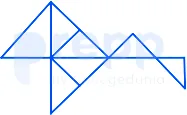
- A
10
- B
12
- C
11
- D
9
Show answer
C. 11The number of triangles in the given figure is:
So, there are a total of 11 triangles in the figure.
Hence, ‘11’ is the correct answer.
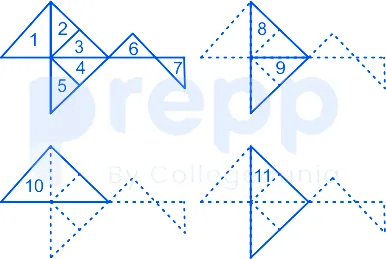 Paper & answer key PDF ↗
 Question 26archived
Gautamiputra Satakarni was a ______ ruler.
- A
Mauryan
- B
Eastern Ganga
- C
Parthian
- D
Satavahana
Show answer
D. SatavahanaThe correct answer is Satavahana.
Key Points
Gautamiputra Satakarni was the 23rd ruler of the Satavahana dynasty.
His achievements are mentioned by his mother Gautami in the Nashik inscription.
He defeated the Shaka king Nahapana and revived the Satavahana power.
Additional Information
Satavahana rule
In the mid-first century BCE, the Satavahanas became prominent in the Indian political landscape.
The founder of the Satavahana dynasty was Simuka.
Gautamiputra Satakarni (1st century CE) is considered the greatest among the Satavahana rulers.
The capital of the Satavahanas was at Pratishthan (modern Paithan) near Aurangabad in Maharashtra. They were also known as Andhras.
For the history of the Satavahanas, the Puranas and inscriptions are important sources. The inscriptions, particularly from Nashik and Nanaghat, shed significant light on the reign of Gautamiputra Satakarni.
The kings of the Ikshvaku dynasty defeated the Satavahana kings in the early decades of the third century CE and took the throne as their successors.
Paper & answer key PDF ↗ Question 27archived
Who among the following issued Mahzarnama in 1579?
- A
Humayun
- B
Shah Jahan
- C
Akbar
- D
Jahangir
Show answer
C. AkbarUnderstanding the Mahzarnama of 1579
The question asks about the historical figure who issued the decree known as the Mahzarnama in the year 1579. This is a significant event in the history of the Mughal Empire in India, related to the relationship between the ruler and religious authority.
What was the Mahzarnama?
The Mahzarnama was a document issued in 1579. It declared that the Mughal Emperor's judgment was supreme in certain religious matters, especially when there was a difference of opinion among the Ulema (religious scholars).
Essentially, it gave the Emperor the final authority to interpret Islamic law in cases of dispute, thus asserting the Emperor's position above the religious scholars in such matters. This was a step towards separating state affairs from the absolute control of the religious clergy.
Who Issued the Mahzarnama in 1579?
Let's examine the options provided:
Humayun: Humayun was the second Mughal Emperor, ruling before 1579 (with interruptions). He did not issue the Mahzarnama.
Shah Jahan: Shah Jahan was the fifth Mughal Emperor, ruling much later than 1579. He is known for the Taj Mahal, not the Mahzarnama.
Akbar: Akbar was the third Mughal Emperor, who ruled from 1556 to 1605. The Mahzarnama was issued during his reign in 1579. This document is closely associated with Akbar's attempts to consolidate his authority and pursue a more independent religious policy, which later led to concepts like Sulh-i Kul (universal peace) and Din-i Ilahi.
Jahangir: Jahangir was the fourth Mughal Emperor, ruling after Akbar. He did not issue the Mahzarnama.
Based on historical records, the Mahzarnama of 1579 was issued by Emperor Akbar.
Significance of the Mahzarnama (1579)
The Mahzarnama was a crucial step taken by Akbar. Its key implications included:
It enhanced the political authority of the Emperor by placing him above the religious scholars in interpreting religious law in certain situations.
It aimed to curb the power of the Ulema who often interfered in state affairs.
It was seen as a move towards establishing the Emperor's independence in matters of religion and state governance.
It is sometimes referred to as the 'Infallibility Decree', although this term can be misleading as it didn't make Akbar infallible, but rather the final arbiter in specific religious disputes.
Conclusion
The historical evidence clearly attributes the issuance of the Mahzarnama in 1579 to Emperor Akbar.
Mughal Emperor
Period of Reign
Association with Mahzarnama (1579)
Humayun
1530-1540, 1555-1556
Did not issue
Shah Jahan
1628-1658
Did not issue
Akbar
1556-1605
Issued in 1579
Jahangir
1605-1627
Did not issue
Revision Table: Mahzarnama Facts
Term
Description
Mahzarnama
Decree issued in 1579 asserting Emperor's supreme authority in religious interpretations during disputes among Ulema.
Year of Issue
1579
Issuer
Emperor Akbar
Purpose
To strengthen Emperor's authority, limit power of Ulema, promote religious tolerance and independence in governance.
Additional Information on Akbar and Mahzarnama
The Mahzarnama is often seen in the context of Akbar's broader policies of religious tolerance and administrative reforms. Following the Mahzarnama, Akbar introduced Din-i Ilahi, a syncretic faith which, however, did not gain widespread acceptance.
The Mahzarnama was drafted by Sheikh Mubarak, father of Abul Fazl and Faizi, and signed by leading Ulema of the time. While it empowered the Emperor, it also faced opposition from conservative sections of the Ulema.
Paper & answer key PDF ↗ Question 28archived
Which of the following is NOT a traditional water storage structure?
- A
Haryali
- B
Kund
- C
Johad
- D
Tanka
Show answer
A. HaryaliIdentifying Traditional Water Storage Structures
The question asks us to identify which option among the given choices is NOT a traditional water storage structure. Let's examine each option to understand their nature and traditional relevance in water conservation.
Understanding Kund: A Traditional Water Reservoir
A Kund (also known as a tank or tanka) is a traditional underground water storage structure. These are commonly found in arid and semi-arid regions of India, particularly Rajasthan. Kunds are essentially covered wells or underground tanks designed to collect and store rainwater, preventing evaporation and contamination. They are a vital part of indigenous water management systems.
Examining Johad: Earthen Water Harvesting Ponds
A Johad is a classic example of a traditional rainwater harvesting structure. It is a small, circular or crescent-shaped earthen check dam or pond built across streams or rivulets. The primary purpose of a Johad is to capture and store rainwater, which helps recharge the groundwater table and provides water for local communities and agriculture. These structures are particularly prevalent in regions like Rajasthan and Haryana.
Analyzing Tanka: Subterranean Rainwater Harvesting
A Tanka is another significant traditional water storage system, especially in Rajasthan. Similar to a Kund, it is an underground covered cistern built to harvest rainwater. Rainwater from rooftops or open courtyards is channelled into the Tanka. Its covered nature is crucial for minimising evaporation and keeping the water clean, making it a reliable source of drinking water in dry periods.
Evaluating Haryali: Context Beyond Structures
Haryali, in the context of water conservation in India, often refers to a specific government scheme launched around 2003-2004, named the "Hariyali" (meaning greenery) guideline. This scheme aimed to promote rainwater harvesting and conservation activities, particularly in rural areas, often through the construction of traditional structures like Johads, check dams, and tanks. However, 'Haryali' itself does not denote a specific type of water storage structure like Kund, Johad, or Tanka. It represents a broader initiative or concept rather than a physical, traditional structure designed for water storage.
Conclusion on Water Storage Structures
Based on the analysis:
Kund is a traditional underground water storage structure.
Johad is a traditional earthen water harvesting pond.
Tanka is a traditional underground rainwater harvesting structure.
Haryali refers to a government scheme or a broader concept related to greenery and water conservation, not a specific traditional water storage structure itself.
Therefore, Haryali is the option that is NOT a traditional water storage structure.
Paper & answer key PDF ↗ Question 29archived
Which of the following was NOT a part of Gondwanaland?
- A
Australia
- B
India
- C
South America
- D
North America
Show answer
D. North AmericaUnderstanding Gondwanaland: A Supercontinent History
Gondwanaland, often referred to simply as Gondwana, was a massive supercontinent that existed for a significant portion of Earth's history, starting from the Neoproterozoic eon (about 550 million years ago) and breaking apart during the Jurassic and Cretaceous periods. It was formed by the fusion of several older continental landmasses. This supercontinent occupied a large area primarily in the Southern Hemisphere.
Which Continents Formed Gondwanaland?
Gondwanaland was composed of several major landmasses that we recognize as continents or subcontinents today. These included:
South America
Africa
Antarctica
Australia
The Arabian Peninsula
The Indian Subcontinent
Madagascar
These landmasses were joined together before the supercontinent began to rift and break apart through the process of continental drift and plate tectonics.
Analyzing the Given Options
Let's examine each option provided in the question to determine which was NOT a part of Gondwanaland:
Australia: Australia was a core component of Gondwanaland. It was located towards the southeast of the supercontinent.
India: The Indian subcontinent was also a significant part of Gondwanaland, nestled between Africa, Antarctica, and Australia before it broke off and drifted north.
South America: South America formed the western part of Gondwanaland, connected to Africa.
North America: North America was primarily part of a different ancient landmass called Laurasia (which also included parts of Europe and Asia). Laurasia and Gondwanaland later joined to form the supercontinent Pangaea, but North America itself was not a constituent part of Gondwanaland before Pangaea formed or after Pangaea began to break apart, when Gondwanaland separated from Laurasia.
Identifying the Continent NOT in Gondwanaland
Based on the composition of Gondwanaland, Australia, India, and South America were all integral parts of this ancient supercontinent. North America, however, was part of Laurasia. Therefore, North America was NOT a part of Gondwanaland.
Ancient Landmass
Component Continents/Subcontinents
Gondwanaland
South America, Africa, Antarctica, Australia, India, Arabia, Madagascar
Laurasia
North America, Europe, Asia (except for India and Arabia, which were initially part of Gondwanaland)
Pangaea
Gondwanaland + Laurasia (a later supercontinent incorporating both)
Revision Table: Key Facts About Ancient Continents
Term
Description
Gondwanaland
Southern supercontinent (South America, Africa, Antarctica, Australia, India, etc.)
Laurasia
Northern supercontinent (North America, Europe, most of Asia)
Pangaea
Supercontinent formed by the collision of Gondwanaland and Laurasia
Continental Drift
Theory explaining movement of continents
Plate Tectonics
Overarching theory describing Earth's lithosphere movement
Additional Information on Plate Tectonics and Supercontinents
The history of Earth's continents is a story of constant movement, collision, and separation. This movement is driven by the dynamics of the Earth's mantle and crust, explained by the theory of plate tectonics.
Supercontinent Cycle: Earth's continents periodically assemble into a single large landmass (a supercontinent) and then break apart again. This cycle takes hundreds of millions of years. Gondwanaland and Laurasia were parts of one such supercontinent, Pangaea, which formed around 335 million years ago and began breaking up around 175 million years ago.
Evidence for Gondwanaland: Scientists found evidence for Gondwanaland through matching geological formations, fossil distribution (like the fern \(Glossopteris\)), and paleoclimate data across continents that are now widely separated. For example, similar coal deposits (formed from ancient plants like \(Glossopteris\)) are found in India, Australia, South America, and Antarctica.
Future Supercontinents: Geologists predict that the current continents are moving towards another supercontinent assembly in the distant future, possibly forming a new supercontinent called "Pangaea Proxima" or "Amasia".
Understanding the breakup of Gondwanaland helps explain the current positions of many continents and provides context for studying their unique geological and biological histories.
Paper & answer key PDF ↗ Question 30archived
With which of the following sports Prasanta Dora associated , who passed away at the age of 44 in January 2021?
- A
Cycling
- B
Volleyball
- C
Wrestling
- D
Football
Show answer
D. FootballUnderstanding the Question: Prasanta Dora and His Sport
The question asks about the sport associated with the late Prasanta Dora, who passed away in January 2021 at the age of 44. Identifying the sport is key to answering this question.
Analyzing Prasanta Dora's Association
Prasanta Dora was a well-known figure in the Indian sports scene. He was particularly famous for his skills in a specific sport. To answer correctly, we need to recall or identify which sport he excelled in and was associated with throughout his career.
Evaluating the Options
Let's look at the provided options:
Cycling
Volleyball
Wrestling
Football
Each option represents a different sport. We need to determine which of these aligns with Prasanta Dora's professional career.
Identifying the Correct Sport: Football
Research and sports records confirm that Prasanta Dora was a prominent Indian Football player. He was particularly recognized as a talented goalkeeper. He played for several prominent clubs in India during his career and also represented the Indian national team. His passing in January 2021 was a notable event in the Indian football community.
Why Other Options Are Incorrect
Based on his well-documented career, Prasanta Dora was not associated with Cycling, Volleyball, or Wrestling professionally. His entire sports career was dedicated to Football.
Conclusion on Prasanta Dora's Sport
Therefore, the sport associated with Prasanta Dora, who passed away in January 2021 at the age of 44, is Football.
Prasanta Dora Key Details
Personality
Prasanta Dora
Associated Sport
Football
Role
Goalkeeper
Year of Passing
January 2021
Age at Passing
44
Revision Table: Key Facts on Prasanta Dora
Reviewing the essential information about Prasanta Dora:
Quick Facts on Prasanta Dora
Name
Prasanta Dora
Primary Sport
Football
Known For
Goalkeeper
Demise
January 2021
Additional Information: Prasanta Dora's Football Career
Prasanta Dora had a significant career as a goalkeeper in Indian football. He played for several major clubs, including:
Calcutta Port Trust
Mohammedan Sporting
Mohun Bagan
East Bengal
He was known for his impressive goalkeeping skills and played a vital role for his teams. Representing clubs like Mohun Bagan and East Bengal, which are giants in Indian football, highlights his standing in the sport. He also had the honour of representing the Indian national football team on multiple occasions. His contribution to Indian football is well-recognized.
Paper & answer key PDF ↗ Question 31archived
Which of the following is a flightless bird?
- A
Peacock
- B
Hen
- C
Kiwi
- D
Crane
Show answer
C. KiwiUnderstanding Flightless Birds
Birds are typically known for their ability to fly, a feat made possible by their wings, lightweight skeletons, and powerful muscles. However, not all birds can fly. Some bird species have evolved over time to become flightless, often due to living in environments where flight is not necessary for survival, such as islands with no predators, or where other forms of locomotion like swimming or running are more advantageous.
Analyzing the Options for Flight Capability
Let's look at the birds listed in the options and determine their ability to fly:
Peacock: Peacocks are large birds known for their impressive tail feathers. While they are not long-distance flyers, peacocks can fly short distances, usually to escape danger or roost in trees.
Hen: Domesticated hens (female chickens) also have the ability to fly, although their flights are usually short and low to the ground. They typically fly only when necessary, for example, to get onto a perch or to escape a perceived threat.
Kiwi: Kiwis are small, nocturnal birds native to New Zealand. They are well-known for being flightless. Kiwis have tiny wings that are almost invisible under their feathers and lack the strong chest muscles and keeled sternum (breastbone) necessary for flight.
Crane: Cranes are large, long-legged birds often known for their elaborate mating dances and their ability to undertake long migratory flights. They are strong and capable flyers.
Identifying the Flightless Bird
Based on the analysis of each option, the bird that is flightless is the Kiwi. Kiwis represent a group of birds that have lost the ability to fly through evolution, adapting instead to a terrestrial lifestyle.
Why Kiwi is Flightless
Kiwis possess several features that contribute to their flightlessness:
They have very small wings relative to their body size.
Their bones are heavy and filled with marrow, unlike the hollow bones of flying birds.
They lack a prominent keeled sternum, which is where flight muscles attach in flying birds.
Their feathers are more hair-like than typical bird feathers.
They have strong legs and feet, adapted for walking and running on the ground.
These characteristics make the Kiwi uniquely adapted to its ground-dwelling niche, where it forages for insects and invertebrates.
Revision Table: Bird Flight Capabilities
Bird
Ability to Fly
Notes
Peacock
Yes (short distances)
Can fly for roosting and escaping.
Hen
Yes (short distances)
Domesticated, short low flights.
Kiwi
No
Flightless, tiny wings, heavy bones.
Crane
Yes
Strong flyer, often migratory.
Additional Information on Flightless Birds
Flightlessness has evolved independently in many different bird lineages. Examples include ostriches, emus, cassowaries, rheas, and penguins, as well as the kiwi. This adaptation often occurs in environments where flight is not the primary means of escaping predators or finding food, or where the energy cost of maintaining flight capability outweighs the benefits.
Flightless birds often have adaptations that make them successful in their specific habitats. For example, penguins are excellent swimmers, and ostriches are fast runners. The kiwi, being nocturnal and ground-dwelling, relies on its keen sense of smell and hearing to find food in the leaf litter.
Paper & answer key PDF ↗ Question 32archived
Which of the following body parts behaves like a stretched rubber sheet?
- A
Eye lens
- B
Tongue
- C
Ear drum
- D
Nostril
Show answer
C. Ear drumThe correct answer is Ear drum.
Key Points
In our body, the tympanic membrane (ear drum) acts like a stretched rubber sheet. Sound vibrations cause the tympanic membrane (ear drum) to vibrate. The tympanic membrane (ear drum) sends these vibrations to the inner ear. From there, the signals travel to the brain.
The tympanic membrane is commonly called the ear drum.
The tympanic membrane is a thin layer of tissue in the human ear that receives sound vibrations from the outside air and transmits them to the auditory ossicles, which are small bones in the tympanic (middle-ear) cavity.
Additional Information
An ear consists of three major sections: the outer ear, the middle ear, and the inner ear.
Part of the EarOrganFunction
Outer EarPinnaIt directs sound waves through the ear canal to reach the tympanic membrane.
Middle EarHammer, Anvil, and StirrupThese three bones are used to amplify sound waves in the middle ear.
Inner EarCochleaIt converts waves into electrical signals and sends them to the brain.
Paper & answer key PDF ↗ Question 33archived
Which of the following waterfalls is located in Madhya Pradesh?
- A
Dhuandhar
- B
Khandadhar
- C
Shivasamudram
- D
Dudhsagar
Show answer
A. DhuandharIdentifying Waterfalls in Madhya Pradesh
Let's analyze the options provided to determine which waterfall is located in the state of Madhya Pradesh.
The question asks us to identify the waterfall from the given list that is situated in Madhya Pradesh. To answer this, we need to know the location of each waterfall mentioned in the options.
Analysis of Waterfall Locations
Dhuandhar Waterfall: This waterfall is located on the Narmada River in Bhedaghat, Jabalpur district, Madhya Pradesh. Its name "Dhuandhar" means "smoke flow," referring to the misty appearance created by the falling water.
Khandadhar Waterfall: This is a perennial waterfall located in the Sundargarh district of Odisha, India. It is one of the highest waterfalls in Odisha.
Shivasamudram Waterfall: This waterfall is on the Kaveri River and is located in the Mandya district of Karnataka, India. It is known for its segmented structure and historical hydroelectric power plant.
Dudhsagar Waterfall: Literally meaning "Sea of Milk," this waterfall is located on the Mandovi River in the state of Goa, on the border with Karnataka.
Based on the analysis, the Dhuandhar waterfall is the one situated in Madhya Pradesh.
Summary Table of Waterfalls and Locations
Waterfall
River
State
District/Location
Dhuandhar
Narmada
Madhya Pradesh
Jabalpur (Bhedaghat)
Khandadhar
Unnamed stream
Odisha
Sundargarh
Shivasamudram
Kaveri
Karnataka
Mandya
Dudhsagar
Mandovi
Goa/Karnataka Border
South Goa/Uttara Kannada
Therefore, the waterfall located in Madhya Pradesh among the given options is Dhuandhar.
Revision Table: Waterfalls of India
Here's a quick table to help revise the locations of some significant waterfalls in India.
Waterfall
State
River/Source
Key Feature
Dhuandhar
Madhya Pradesh
Narmada
"Smoke Flow" mist
Khandadhar
Odisha
Unnamed stream
Second highest in Odisha
Shivasamudram
Karnataka
Kaveri
Segmented, Hydroelectric plant
Dudhsagar
Goa/Karnataka
Mandovi
"Sea of Milk" appearance
Jog Falls
Karnataka
Sharavathi
Second highest plunge waterfall in India
Nohkalikai Falls
Meghalaya
Rainfall
Highest plunge waterfall in India
Additional Information about Waterfalls in Madhya Pradesh
Madhya Pradesh is known for several beautiful waterfalls, many of which are formed by rivers like the Narmada and Chambal. The Dhuandhar Falls on the Narmada at Bhedaghat is one of the most famous tourist attractions in the state, particularly known for the Marble Rocks gorge through which the river flows.
Other notable waterfalls in Madhya Pradesh include:
Kapil Dhara Falls (Narmada River, Amarkantak)
Dugdha Dhara Falls (Narmada River, Amarkantak)
Bahuti Falls (Oda River, Rewa) - Often cited as the highest in MP
Chachai Falls (Bihad River, Rewa)
Keoti Falls (Mahanadi River, Rewa)
Pandav Falls (Ken River, near Panna)
Understanding the geographical location of these natural features like waterfalls is important for competitive exams focusing on Indian geography.
Paper & answer key PDF ↗ Question 34archived
The liver is affected, and skin and eyes turn yellow due to the deposit of bile pigments. Which of the following digestive disorders is described here?
- A
Diarrhoea
- B
Constipation
- C
Vomiting
- D
Jaundice
Show answer
D. JaundiceUnderstanding the Digestive Disorder: Jaundice
The question describes a digestive disorder where the liver is affected, leading to the deposit of bile pigments and causing the skin and eyes to turn yellow. Let's analyse the given options to identify which digestive disorder matches this description.
The key symptoms mentioned are:
Liver is affected.
Skin and eyes turn yellow.
This is due to the deposit of bile pigments.
Let's look at the options:
Diarrhoea: This is a condition characterised by frequent passage of loose, watery stools. It is usually caused by infections, food intolerances, or medications. It does not involve the yellowing of skin and eyes due to bile pigment deposit or primary liver affection in this manner.
Constipation: This is a condition characterised by infrequent bowel movements or difficulty passing stools. It is often related to diet, lack of fibre, or dehydration. It does not cause the skin and eyes to turn yellow or primarily affect the liver in this way.
Vomiting: This is the forceful expulsion of stomach contents through the mouth. It can be caused by various factors like infections, food poisoning, or motion sickness. It does not directly cause yellowing of skin and eyes due to bile pigment deposit or specific liver damage as described.
Jaundice: This condition is also known as icterus. It is characterised by a yellowing of the skin, mucous membranes, and whites of the eyes. This yellow colour is caused by a high level of bilirubin, a yellow-orange bile pigment, in the blood. Jaundice often indicates problems with the liver, gallbladder, or pancreas, as these organs are involved in the production, storage, and excretion of bile and bilirubin. When the liver is not functioning correctly (e.g., due to hepatitis, cirrhosis, or obstruction of bile ducts), bilirubin can build up in the bloodstream and get deposited in tissues, causing the yellow discoloration.
Comparing the symptoms described in the question with the definitions of the options, it is clear that Jaundice is the condition that involves the liver being affected, leading to the deposit of bile pigments (bilirubin) and the characteristic yellowing of the skin and eyes.
Why Jaundice Matches the Symptoms
Jaundice is a direct result of elevated levels of bilirubin in the blood, a condition called hyperbilirubinemia. Bilirubin is a byproduct of the breakdown of red blood cells. A healthy liver processes bilirubin and excretes it into bile, which then passes into the digestive tract. If the liver is damaged, or if the bile ducts are blocked, bilirubin can build up in the body, causing jaundice. The yellow pigment gets deposited in the skin, sclera (whites of the eyes), and mucous membranes.
Therefore, the description perfectly matches the symptoms and cause of Jaundice.
The final answer is Jaundice.
Revision Table: Key Digestive Disorders
Disorder
Key Symptoms
Primary Cause/Mechanism
Diarrhoea
Frequent, loose, watery stools
Infections, food intolerance, malabsorption
Constipation
Infrequent bowel movements, difficulty passing stool
Lack of fibre, dehydration, low physical activity
Vomiting
Forceful expulsion of stomach contents
Infections, toxins, motion sickness
Jaundice
Yellowing of skin/eyes, liver involvement
Accumulation of bile pigments (bilirubin) due to liver problems or bile duct issues
Additional Information on Bile Pigments and Jaundice
Bile pigments, primarily bilirubin, are formed when haemoglobin from old red blood cells is broken down. This happens mainly in the spleen. The bilirubin is then transported to the liver, where it is processed (conjugated) to become water-soluble. Conjugated bilirubin is excreted into the bile, which helps in the digestion of fats in the small intestine and is eventually eliminated from the body in stool, giving it its characteristic brown colour. A small amount is reabsorbed and excreted in urine.
Jaundice can be classified based on where the problem occurs:
Pre-hepatic Jaundice: Occurs before the liver, usually due to excessive breakdown of red blood cells (e.g., haemolytic anaemia), producing more bilirubin than the liver can process.
Hepatic Jaundice: Occurs within the liver, due to liver damage or disease (e.g., hepatitis, cirrhosis). The liver's ability to process bilirubin is impaired.
Post-hepatic Jaundice: Occurs after the liver, due to obstruction of the bile ducts that prevent bilirubin from being excreted (e.g., gallstones, tumours).
Understanding the role of the liver and bile pigments is crucial for diagnosing and treating Jaundice, which is a symptom of an underlying condition rather than a disease itself.
Paper & answer key PDF ↗ Question 35archived
The lowest temperature at which a substance catches fire is called its:
- A
melting point
- B
normal temperature
- C
boiling point
- D
ignition temperature
Show answer
D. ignition temperatureThe correct answer is Option 4: ignition temperature.
What is Ignition Temperature?
The ignition temperature (also known as the kindling temperature) is the lowest temperature at which a combustible substance catches fire and begins to burn sustainably in the presence of air or oxygen, without an external spark or flame.
Inflammable Substances: Materials that have a very low ignition temperature can catch fire easily (even with a tiny spark). Examples include petrol, alcohol, and Liquefied Petroleum Gas (LPG).
Fire Control: Knowing the ignition temperature is crucial for fire safety. For a fire to occur, three things are needed (the Fire Triangle): fuel, oxygen, and enough heat to raise the fuel to its ignition temperature. Removing the heat (by cooling it with water) lowers the temperature below the ignition point and puts out the fire.
Quick Look at the Other Options:
Melting point: The temperature at which a solid substance turns into a liquid (e.g., ice melting into water at 0°C).
Boiling point: The temperature at which a liquid turns into a gas/vapor throughout the liquid (e.g., water boiling at 100°C).
Normal temperature: Usually refers to standard room temperature or average body temperature, which is not related to combustion.
Paper & answer key PDF ↗ Question 36archived
Who among the following earned the sobriquet ‘Bharat Kokila’ from Mahatma Gandhi?
- A
Sarojini Naidu
- B
Annie Besant
- C
Toru Dutt
- D
Sucheta Kriplani
Show answer
A. Sarojini NaiduIdentifying Bharat Kokila: The Nightingale of India
The question asks who among the given options earned the famous sobriquet 'Bharat Kokila' from Mahatma Gandhi. This title, which translates to 'Nightingale of India', was bestowed upon a prominent figure known for her eloquent voice and contributions to literature and the freedom struggle.
Sarojini Naidu: The Nightingale of India
The individual honored with the title 'Bharat Kokila' by Mahatma Gandhi was Sarojini Naidu. She was a celebrated poet, orator, and a crucial participant in the Indian independence movement. Her powerful speeches and evocative poetry resonated deeply with people, much like the melodious song of the Indian cuckoo (Kokila).
Sarojini Naidu's journey was significant:
She was born on February 13, 1879.
Known as "The Nightingale of India" ('Bharat Kokila').
A key leader in the Indian freedom struggle, working closely with Mahatma Gandhi.
She served as the first woman President of the Indian National Congress (1925).
After India gained independence, she became the first Governor of Uttar Pradesh, making her the first woman to hold the position of Governor in independent India.
Her literary works include collections of poems like "The Golden Threshold", "The Bird of Time", and "The Broken Wing".
Mahatma Gandhi admired her poetic sensibility and her powerful role in the nationalist movement, hence conferring the apt title 'Bharat Kokila' upon her.
Other Notable Figures
Let's briefly look at the other options to understand why they are not the correct answer for the 'Bharat Kokila' title given by Mahatma Gandhi:
Annie Besant: A British socialist, theosophist, women's rights activist, writer, orator, educationist, and philanthropist. She was also a prominent supporter of Indian self-rule but was not known as 'Bharat Kokila'.
Toru Dutt: A Bengali translator and poet who wrote in English and French. She was a significant figure in the history of Indian literature but lived much earlier than the period of Mahatma Gandhi's major influence and was not given this title.
Sucheta Kriplani: An Indian freedom fighter and politician. She was the first woman Chief Minister of Uttar Pradesh. While a contemporary and colleague of many leaders in the freedom struggle, she was not the one called 'Bharat Kokila'.
Therefore, based on historical records and her prominent role and recognition by Mahatma Gandhi, Sarojini Naidu is definitively identified as 'Bharat Kokila'.
Revision Table: Key Figures
Figure
Notable Role/Association
Known For
'Bharat Kokila' Title?
Sarojini Naidu
Freedom Fighter, Poet
"Nightingale of India", First Woman INC President & Governor (UP)
Yes (by Mahatma Gandhi)
Annie Besant
Theosophist, Home Rule Leader
Supported Indian Self-Rule, Writer
No
Toru Dutt
Poet, Translator
Early Indian writer in English/French
No
Sucheta Kriplani
Freedom Fighter, Politician
First Woman Chief Minister (UP)
No
Additional Information: Significance of the Title
The title 'Bharat Kokila' bestowed upon Sarojini Naidu by Mahatma Gandhi was more than just a nickname. It acknowledged her significant contributions through her powerful oratory skills and her ability to inspire the masses with her words, both in speeches and poetry. The nightingale ('Kokila') is traditionally associated with a beautiful, captivating voice, symbolizing how Sarojini Naidu's voice captivated the nation and rallied support for the freedom movement. Her role extended beyond poetry; she was an active political leader and diplomat for the cause of Indian independence.
Paper & answer key PDF ↗ Question 37archived
Which of the following is located in Gujarat?
- A
Alai Darwaza
- B
Rani-ki-Vav
- C
Humayun Tomb
- D
Bibi Ka Maqbara
Show answer
B. Rani-ki-VavIdentifying Monuments Located in Gujarat
The question asks us to identify which of the given options is a monument located in the state of Gujarat, India. Let's examine the location of each monument listed in the options.
Location Analysis of Given Monuments
Alai Darwaza: This is a magnificent gateway located in the Qutb Complex in Delhi. It was built by Alauddin Khilji. Therefore, Alai Darwaza is in Delhi, not Gujarat.
Rani-ki-Vav: Also known as the Queen's Stepwell, this is a famous stepwell located in the town of Patan in Gujarat. It is a UNESCO World Heritage Site renowned for its intricate sculptures and architectural beauty. Therefore, Rani-ki-Vav is located in Gujarat.
Humayun Tomb: This is the tomb of the Mughal Emperor Humayun. It is a major tourist attraction and a UNESCO World Heritage Site located in Delhi. Therefore, Humayun Tomb is in Delhi, not Gujarat.
Bibi Ka Maqbara: This monument is located in Aurangabad, Maharashtra. It was built by Prince Azam Shah, son of Emperor Aurangzeb, in memory of his mother Dilras Banu Begum. Therefore, Bibi Ka Maqbara is in Maharashtra, not Gujarat.
Based on the location analysis of each option, it is clear that Rani-ki-Vav is the monument located in Gujarat.
Summary of Monument Locations
Monument
Location
State
Alai Darwaza
Delhi
Delhi (Union Territory)
Rani-ki-Vav
Patan
Gujarat
Humayun Tomb
Delhi
Delhi (Union Territory)
Bibi Ka Maqbara
Aurangabad
Maharashtra
Thus, the only monument from the given list that is located in Gujarat is Rani-ki-Vav.
Revision Table: Famous Indian Monuments
Monument Name
Key Feature/Significance
Location (City, State)
Alai Darwaza
Gateway to Qutb Complex, early example of Turkish architecture
Delhi, Delhi
Rani-ki-Vav
Intricately carved stepwell, UNESCO World Heritage Site
Patan, Gujarat
Humayun Tomb
Predecessor to Taj Mahal, first garden-tomb on the Indian subcontinent
Delhi, Delhi
Bibi Ka Maqbara
Resembles Taj Mahal, tomb of Dilras Banu Begum
Aurangabad, Maharashtra
Additional Information: Rani-ki-Vav in Gujarat
Rani-ki-Vav is a particularly important example of the stepwell architecture prevalent in the Indian subcontinent. It was built during the rule of the Chaulukya dynasty. The stepwell is designed as an inverted temple, highlighting the sanctity of water. It contains thousands of sculptures depicting religious, mythological, and secular figures, including deities like Vishnu and his avatars, Ganesh, Lakshmi, and Parvati, as well as apsaras and ordinary life scenes. Its conservation and historical significance led to its recognition as a UNESCO World Heritage Site in 2014.
Paper & answer key PDF ↗ Question 38archived
How many oxygen atoms are present in a molecule of potassium permanganate?
- A
Four
- B
One
- C
Two
- D
Three
Show answer
A. FourUnderstanding Potassium Permanganate Formula
The question asks about the number of oxygen atoms in a molecule of potassium permanganate. To answer this, we need to know the chemical formula for potassium permanganate.
The chemical formula for potassium permanganate is $\text{KMnO}_4$.
This formula tells us the ratio of different atoms present in one molecule of potassium permanganate. Let's break down the formula:
K: Represents the element Potassium. When there is no subscript number written next to an element symbol, it means there is one atom of that element. So, there is 1 Potassium atom.
Mn: Represents the element Manganese. Similarly, there is no subscript next to Mn, meaning there is one atom of Manganese. So, there is 1 Manganese atom.
O: Represents the element Oxygen. There is a subscript number '4' written next to the symbol O. This subscript indicates the number of atoms of that element in the molecule. So, there are 4 Oxygen atoms.
Therefore, based on the chemical formula $\text{KMnO}_4$, a molecule of potassium permanganate contains four oxygen atoms.
Analyzing the Number of Oxygen Atoms
Let's look at the options provided to see which one matches our finding:
Option 1: Four
Option 2: One
Option 3: Two
Option 4: Three
Our analysis of the $\text{KMnO}_4$ formula shows that there are four oxygen atoms. This matches Option 1.
Conclusion on Oxygen Atoms in KMnO₄
By understanding how to read chemical formulas, we can easily determine the number of atoms of each element present in a molecule. The subscript next to an element symbol tells you the quantity of that atom. In potassium permanganate, $\text{KMnO}_4$, the subscript '4' next to Oxygen (O) clearly indicates the presence of four oxygen atoms.
Revision Table: Potassium Permanganate Details
Component
Element Symbol
Number of Atoms per Molecule
Potassium
K
1
Manganese
Mn
1
Oxygen
O
4
Additional Information on Chemical Formulas and Atoms
Chemical formulas are a concise way to represent molecules or ionic compounds. They show which elements are present and the relative number of atoms of each element. For example:
$\text{H}_2\text{O}$ (Water): Contains 2 Hydrogen atoms and 1 Oxygen atom.
$\text{CO}_2$ (Carbon Dioxide): Contains 1 Carbon atom and 2 Oxygen atoms.
$\text{C}_6\text{H}_{12}\text{O}_6$ (Glucose): Contains 6 Carbon atoms, 12 Hydrogen atoms, and 6 Oxygen atoms.
Understanding subscripts is fundamental to interpreting chemical formulas and determining the composition of substances.
Paper & answer key PDF ↗ Question 39archived
The Indian Mutiny began from Meerut on 10 May 1857 and ended in:
- A
Kolkata on 13 May 1858
- B
Delhi on 18 September 1859
- C
Gwalior on 20 June 1858
- D
Jhansi on 15 August 1860
Show answer
C. Gwalior on 20 June 1858Understanding the End Point of the Indian Mutiny of 1857
The Indian Mutiny of 1857, also known as the Sepoy Mutiny or the First War of Indian Independence, was a major uprising against the rule of the British East India Company.
Beginning of the Indian Mutiny 1857
The revolt famously began on 10 May 1857 in Meerut. Indian sepoys of the British East India Company's army rose up against their British officers, primarily triggered by issues related to the use of controversial new rifle cartridges perceived as offensive to religious beliefs (greased with animal fat).
From Meerut, the mutiny quickly spread to Delhi, where the sepoys proclaimed the Mughal emperor Bahadur Shah II as the Emperor of India, attempting to revive the Mughal Empire. The revolt spread to many parts of North and Central India, including areas like Kanpur, Lucknow, Jhansi, and Gwalior.
Suppression and the End of the Mutiny
While the mutiny began on a specific date in Meerut, its suppression was a gradual process that took over a year. The British forces systematically recaptured lost territories and suppressed the rebel strongholds.
Significant events in the suppression included:
Recapture of Delhi by the British in September 1857.
Siege and relief of Lucknow, ending in March 1858.
The battle and capture of Jhansi in April 1858.
One of the final major centres of resistance was Gwalior, which was captured by the rebels after the fall of Jhansi. The British forces, led by Sir Hugh Rose, pursued the rebels and recaptured Gwalior.
The recapture of Gwalior on 20 June 1858 is widely considered the final major military action and the effective end of the Indian Mutiny of 1857. Although sporadic resistance continued in some areas for a few more months, the fall of Gwalior marked the collapse of the main rebel forces and leadership.
Timeline Summary
Event
Location
Date
Beginning of Mutiny
Meerut
10 May 1857
Recapture of Delhi
Delhi
September 1857
Fall of Gwalior (End Point)
Gwalior
20 June 1858
Therefore, the Indian Mutiny that began in Meerut on 10 May 1857 effectively ended with the recapture of Gwalior on 20 June 1858.
Revision Table: Key Facts about the Indian Mutiny 1857
Aspect
Details
Start Date
10 May 1857
Start Location
Meerut
Effective End Date
20 June 1858
End Location
Gwalior
Primary Cause (Immediate)
Greased cartridges
Key Leaders
Bahadur Shah II, Rani Lakshmibai, Nana Sahib, Tatya Tope, Begum Hazrat Mahal
Additional Information on the 1857 Mutiny
The Indian Mutiny of 1857 was a pivotal event in the history of British rule in India. Beyond the immediate trigger, there were deeper underlying causes:
Political Causes: British expansionist policies (like the Doctrine of Lapse), annexation of states, and disrespect shown to Indian rulers.
Economic Causes: High land revenue demands, destruction of traditional Indian industries, and economic exploitation.
Social and Religious Causes: British attempts at social reforms (like the abolition of Sati), introduction of Western education, and perceived interference with religious customs.
Military Causes: Discrimination against Indian sepoys, lower pay, poor prospects for promotion, and the controversial new Enfield rifle cartridges.
The mutiny led to significant changes in the administration of British India. The rule of the British East India Company was ended, and direct rule by the British Crown was established through the Government of India Act 1858. This period also saw a reorganization of the Indian army and changes in policy towards Indian states and religions.
Paper & answer key PDF ↗ Question 40archived
The name ‘QRSAM’ was in the news in November 2020. What is QRSAM?
- A
Short range surface-to-air missile system
- B
Anti-tank weapon system
- C
Indigenously designed torpedoes
- D
Inter-continental ballistic missile system
Show answer
A. Short range surface-to-air missile systemUnderstanding QRSAM: Quick Reaction Surface-to-Air Missile
The question asks about the term 'QRSAM' that was in the news around November 2020. Identifying what QRSAM stands for and its purpose is key to answering this question.
QRSAM stands for Quick Reaction Surface-to-Air Missile. As the name suggests, it is a missile system designed to provide quick defence against aerial threats.
Let's look at the options provided and analyze each one in the context of QRSAM:
Short range surface-to-air missile system: This option accurately describes the QRSAM. It is designed to intercept aerial targets at short ranges and is launched from the ground (surface). The 'Quick Reaction' aspect refers to its ability to be deployed and fired rapidly.
Anti-tank weapon system: An anti-tank weapon system is designed to destroy tanks and armored vehicles on the ground, not aerial targets. QRSAM is specifically for air defence.
Indigenously designed torpedoes: Torpedoes are underwater weapons primarily used against ships and submarines. QRSAM is an air defence missile, not an underwater weapon.
Inter-continental ballistic missile system: Inter-continental ballistic missiles (ICBMs) are long-range missiles primarily used for strategic attack against ground targets, often spanning thousands of kilometers. QRSAM is a short-range defensive system against aerial threats.
Based on the definition and purpose of QRSAM, the option that correctly identifies it is the short range surface-to-air missile system. The Quick Reaction Surface-to-Air Missile system is an indigenously developed system by India's Defence Research and Development Organisation (DRDO). It was indeed undergoing significant testing around the time mentioned (November 2020), which brought it into the news.
Analysis of the Question and Options
The question tests general knowledge about recent developments in defence technology, specifically focusing on military systems like missile systems. Understanding the basic categories of missile systems (surface-to-air, air-to-air, surface-to-surface, etc.) and their typical ranges helps in differentiating between the options.
The term 'QRSAM' itself provides a strong hint, with 'SAM' commonly standing for Surface-to-Air Missile.
Comparison of Missile Types
Missile Type
Primary Target
Launch Platform
Typical Range
QRSAM (Quick Reaction SAM)
Aerial targets (aircraft, drones, missiles)
Surface (ground-based launcher)
Short range (e.g., 25-30 km)
Anti-tank Weapon
Tanks, armored vehicles
Ground (man-portable, vehicle-mounted)
Relatively short to medium range (ground)
Torpedo
Ships, submarines
Underwater (submarine), Surface (ship), Air (aircraft/helicopter)
Underwater range
ICBM
Strategic ground targets
Ground (silos, mobile launchers), Submarine
Very long range (> 5,500 km)
As shown in the table, the characteristics of QRSAM align with a short range surface-to-air missile system, designed for quick deployment and engagement of airborne threats.
Conclusion on QRSAM Identification
Based on the meaning of the acronym and the general characteristics of different weapon systems, QRSAM is correctly identified as a short range surface-to-air missile system. Its testing in late 2020 was a significant defence development, making it a relevant news topic.
Revision Table: Key Defence Terms
Revision: Defence System Acronyms
Acronym
Full Form
Type
SAM
Surface-to-Air Missile
Launches from surface, targets aircraft/missiles
AAM
Air-to-Air Missile
Launches from aircraft, targets aircraft
ASM
Air-to-Surface Missile
Launches from aircraft, targets surface
SSM
Surface-to-Surface Missile
Launches from surface, targets surface
ICBM
Intercontinental Ballistic Missile
Long-range strategic SSM
ATGM
Anti-Tank Guided Missile
Guided weapon against tanks
Additional Information: India's Missile Development
India has a robust indigenous missile development program, primarily led by DRDO. This program covers a wide range of missile types, including strategic missiles (like Agni series), cruise missiles (like BrahMos), air defence systems (like Akash, Barak 8, and QRSAM), anti-tank missiles (like Nag), and more.
The development of systems like QRSAM is part of India's effort to enhance its air defence capabilities and achieve self-reliance (Atmanirbhar Bharat) in critical defence technologies. QRSAM is designed to be a highly mobile system, capable of protecting moving formations of the Army, offering 360-degree coverage.
Key features often associated with QRSAM include:
Quick reaction time
High mobility
All-weather capability
Ability to intercept multiple targets
Indigenous seeker technology
These features make it a valuable asset for short-range air defence.
Paper & answer key PDF ↗ Question 41archived
The initiative of jail tourism, a first of its kind, was launched in January 2021 in the state of ________.
- A
Maharashtra
- B
Uttar Pradesh
- C
Chhattisgarh
- D
Andhra Pradesh
Show answer
A. MaharashtraUnderstanding Jail Tourism Initiatives
Jail tourism is a unique concept that allows the public to visit certain historical or notable prisons, offering insights into the country's correctional system, the lives of inmates, and the history associated with these institutions. It's an effort to demystify prisons and educate people.
First Jail Tourism Launch in India
The initiative of jail tourism, marking a first of its kind in India, was officially launched in January 2021. This program aimed at opening up select prisons to the public for guided tours.
Identifying the State for Jail Tourism
The question asks for the specific state where this pioneering jail tourism initiative began in January 2021. Based on information about this historical launch, the initiative was introduced in the state of Maharashtra.
The initiative in Maharashtra commenced from the historic Yerawada Central Prison located in Pune. This prison holds significance due to its connection with several prominent freedom fighters during India's independence struggle.
Purpose of the Jail Tourism Initiative
The primary objectives behind launching the jail tourism program include:
Educating citizens about the history of prisons, especially those with historical significance related to the freedom movement.
Providing transparency regarding the functioning of correctional facilities.
Generating revenue for the state, which can potentially be used for prisoner welfare or prison infrastructure development.
Offering a unique tourism experience.
Comparing Options
Let's look at the given options in the context of the first jail tourism launch in January 2021:
Maharashtra: Launched jail tourism from Yerawada Central Prison, Pune, in January 2021. This aligns with the question details.
Uttar Pradesh: While other states might have prisons of historical importance, the first formal state-led jail tourism initiative launched nationwide in Jan 2021 is attributed elsewhere.
Chhattisgarh: Similar to Uttar Pradesh, no major nationwide launch of the first jail tourism initiative in January 2021 is linked to this state.
Andhra Pradesh: No reports suggest Andhra Pradesh was the state to launch the first of its kind jail tourism initiative in January 2021.
Based on the launch event in January 2021, the initiative was indeed launched in Maharashtra.
Conclusion on Jail Tourism State
The state where the first of its kind jail tourism initiative was launched in January 2021 is Maharashtra.
Revision Table: Key Details
Initiative
Launch Date
State
Primary Location (Example)
Jail Tourism
January 2021
Maharashtra
Yerawada Central Prison, Pune
Additional Information on Jail Tourism
Following Maharashtra's initiative, other states may also consider or develop similar programs for prisons with significant historical value. The concept taps into heritage tourism and aims to utilize historical buildings like prisons for educational and cultural purposes. Visits are typically guided tours, providing visitors with information about the prison's history, notable inmates, and daily life within the facility, under strict security protocols.
Paper & answer key PDF ↗ Question 42archived
Who is the author of the book 'Ethical Religion'?
- A
Bipan Chandra
- B
Mahatma Gandhi
- C
Swami Vivekananda
- D
Vinoba Bhave
Show answer
B. Mahatma GandhiLet's find out the author of the significant book titled 'Ethical Religion'. Understanding the authors behind important works helps us grasp the ideas and philosophies they represent.
Identifying the Author of Ethical Religion
The question asks about the authorship of the book 'Ethical Religion'. We are given four options, each representing a prominent figure in Indian history and thought.
Let's examine the options provided:
Bipan Chandra
Mahatma Gandhi
Swami Vivekananda
Vinoba Bhave
The book 'Ethical Religion' (also known as 'Sarvodaya') is a work that discusses the principles of morality and ethics, particularly from a perspective that emphasizes universal well-being and upliftment.
Analyzing the Author Options for Ethical Religion
Considering the options and their respective contributions, one name stands out as the author directly associated with the core ideas discussed in 'Ethical Religion' and its connection to movements like Sarvodaya.
Bipan Chandra: He was a renowned historian, specializing in the economic and political history of modern India. While he wrote extensively about Indian leaders and movements, he is not the author of 'Ethical Religion'.
Mahatma Gandhi: Mohandas Karamchand Gandhi, widely known as Mahatma Gandhi, was a leader of India's independence movement and the architect of a form of nonviolent civil disobedience. He translated John Ruskin's 'Unto This Last' and titled his adaptation 'Sarvodaya'. His philosophical framework, deeply rooted in ethics, morality, and the welfare of all, aligns directly with the themes of 'Ethical Religion'. He indeed wrote a booklet titled 'Ethical Religion' (published around 1907 in South Africa), which laid out his ethical principles before delving into politics.
Swami Vivekananda: A key figure in the introduction of Indian philosophies of Vedanta and Yoga to the Western world and was credited with raising interfaith awareness. His works focus on spiritual and philosophical teachings, but 'Ethical Religion' is not attributed to him.
Vinoba Bhave: A follower of Mahatma Gandhi and a proponent of the Bhoodan Movement. He carried forward many of Gandhi's ideals, including Sarvodaya, but he is not the original author of the book 'Ethical Religion'.
Based on historical records and the literary works associated with these figures, Mahatma Gandhi is the author of the book 'Ethical Religion'.
Conclusion on Ethical Religion's Author
Therefore, the correct answer is Mahatma Gandhi.
Book/Concept
Associated Author
Key Focus
Ethical Religion
Mahatma Gandhi
Ethics, Morality, Universal Upliftment (Sarvodaya)
Indian History
Bipan Chandra
Modern Indian History, Economy, Politics
Vedanta, Yoga
Swami Vivekananda
Indian Philosophy, Spirituality
Bhoodan Movement
Vinoba Bhave
Land Reform, Gandhian Ideals (Follower)
Revision Table: Key Authors and Works
Author
Notable Work(s)/Contribution(s)
Bipan Chandra
History of Modern India, India's Struggle for Independence
Mahatma Gandhi
Ethical Religion, Hind Swaraj, My Experiments with Truth, Sarvodaya (adaptation of Unto This Last)
Swami Vivekananda
Raja Yoga, Karma Yoga, lectures on Vedanta
Vinoba Bhave
Bhoodan Movement, discourses on Bhagavad Gita
Additional Information: Mahatma Gandhi's Ethical Philosophy
Mahatma Gandhi's philosophy was deeply rooted in ethics and morality, which he considered fundamental to both individual life and political action. His concept of 'Ethical Religion' highlights this belief. For Gandhi, religion was not about dogma or ritual but about moral conduct and the pursuit of truth ($\text{Satya}$) and non-violence ($\text{Ahimsa}$).
The book 'Ethical Religion' essentially argues that morality is the essence of religion. It emphasizes duties over rights and the importance of serving others. This ethical framework formed the basis for his later socio-political ideas, including Sarvodaya, which means the upliftment of all.
Gandhi believed that political and social change could only be sustainable if it was built upon a strong ethical foundation. His life itself was an experiment in living according to these ethical principles.
Paper & answer key PDF ↗ Question 43archived
The Battle of Khanwa was fought between Babur and ________.
- A
Hemu
- B
Todar Mal
- C
Rana Sanga
- D
Sher Shah Suri
Show answer
C. Rana SangaUnderstanding the Battle of Khanwa
The Battle of Khanwa is a significant event in the history of the Mughal Empire in India. It was fought shortly after the First Battle of Panipat and played a crucial role in establishing Mughal rule in the region.
Who Fought in the Battle of Khanwa?
The question asks about the main opponents in the Battle of Khanwa, specifically who Babur fought against. Babur, the founder of the Mughal dynasty in India, faced a formidable opponent in this battle.
Let's examine the options provided:
Hemu: Hemu, also known as Hemchandra Vikramaditya, was a Hindu emperor who fought against Akbar (Babur's grandson) in the Second Battle of Panipat in 1556. He was not Babur's opponent in the Battle of Khanwa.
Todar Mal: Todar Mal was a high official and a brilliant finance minister in the court of Emperor Akbar. He was not a military commander who fought against Babur.
Rana Sanga: Rana Sanga (Maharana Sangram Singh I) was the ruler of Mewar and the head of a powerful Rajput confederacy. He was a major threat to Babur's newly established power in India. Historical records confirm that the Battle of Khanwa was fought between Babur and Rana Sanga.
Sher Shah Suri: Sher Shah Suri was the founder of the Sur Empire. He defeated Babur's son, Humayun, and established his own rule. While a significant opponent of the Mughals, he fought against Humayun, not Babur, in major battles like the Battle of Chausa (1539) and the Battle of Kannauj (1540).
Based on historical accounts, the Battle of Khanwa was indeed fought between Babur and Rana Sanga.
Details of the Battle of Khanwa
The Battle of Khanwa took place on March 16, 1527, at Khanwa, near Agra. Babur, despite having a smaller army, employed superior tactics, including the use of artillery and the 'tulguhma' flanking manoeuvre, which proved decisive against the larger Rajput forces led by Rana Sanga.
Key Participants in the Battle of Khanwa
Participant
Role
Babur
Founder of the Mughal Empire in India, Commander of the Mughal Army
Rana Sanga
Ruler of Mewar, Leader of the Rajput Confederacy
The victory in the Battle of Khanwa solidified Babur's position in India and significantly weakened the power of the Rajput confederacy, paving the way for the expansion of the Mughal Empire.
Revision Table: Famous Battles of Early Mughal Period
Key Battles of Babur and his Opponents
Battle
Year
Babur fought against
First Battle of Panipat
1526
Ibrahim Lodi
Battle of Khanwa
1527
Rana Sanga
Battle of Chanderi
1528
Medini Rai
Battle of Ghagra
1529
Mahmud Lodi and Sultan Nusrat Shah
Additional Information: Significance of Battle of Khanwa
The Battle of Khanwa was more than just a military engagement; it had profound political and historical implications. Here are some key points:
Consolidation of Power: The victory established Babur as the undisputed ruler of the Delhi-Agra region and surrounding areas. It diminished the threat from the powerful Rajput states led by Rana Sanga.
Religious Dimension: Babur declared the battle a 'jihad' against non-Muslims, rallying his troops and giving the conflict a religious colour, which is a debated aspect among historians.
Military Tactics: Babur's innovative use of gunpowder artillery and tactics like 'tulguhma' highlighted the military superiority he brought from Central Asia compared to the traditional warfare methods prevalent in India at the time.
End of Rajput Supremacy Threat: While Rajput power was not completely destroyed, the defeat at Khanwa significantly checked their ambition to establish a Hindu empire in North India under Rana Sanga's leadership.
Psychological Impact: The victory boosted the morale of Babur's troops and created an aura of invincibility around him, making future conquests easier.
Understanding the Battle of Khanwa helps in appreciating the challenges Babur faced and the military and political strategies he employed to lay the foundation of the vast Mughal Empire.
Paper & answer key PDF ↗ Question 44archived
Who among the following hit the winning runs for India against Australia at the Brisbane Test of January 2021?
- A
Washington Sundar
- B
Shardul Thakur
- C
Rishabh Pant
- D
Mohammad Siraj
Show answer
C. Rishabh PantIndia's Historic Win at Brisbane Test 2021
The Test match played at Brisbane's Gabba ground in January 2021 was a pivotal moment in the Test series between India and Australia. India needed to chase down a significant target on the final day to win the match and, consequently, the series.
Several players contributed to India's batting effort in the second innings under pressure. These included Shubman Gill, Cheteshwar Pujara, and later, Rishabh Pant, Washington Sundar, and Shardul Thakur. The match was tense, and every run was crucial.
As the match neared its conclusion, India required a few more runs to achieve the victory target. The focus was on finishing the innings strongly.
Identifying the Winning Runs Scorer in Brisbane Test
The question specifically asks about the player who scored the winning runs for India in this memorable Brisbane Test match. The final moments saw India successfully chase down the target set by Australia.
Let's look at the key players involved in the latter part of the chase:
Rishabh Pant: A left-handed wicket-keeper batsman known for his aggressive style. He played a crucial, match-winning innings.
Washington Sundar: An all-rounder who provided valuable support with the bat lower down the order and also bowled well.
Shardul Thakur: Another all-rounder who performed admirably with both bat and ball in the match, contributing to a vital partnership in the first innings.
Mohammad Siraj: A fast bowler who was instrumental with the ball, especially in the second innings, but not typically involved in finishing chases with the bat.
In the thrilling conclusion of the Brisbane Test, it was Rishabh Pant who hit the boundary that secured the victory for India, allowing them to successfully chase the target and win the match and the series.
Player
Role in the Brisbane Test Chase
Winning Runs
Rishabh Pant
Crucial, aggressive batting; anchored the late chase.
Yes
Washington Sundar
Provided support lower order; part of partnerships.
No
Shardul Thakur
Contributed with bat in first innings; present during the chase.
No
Mohammad Siraj
Key bowler; not involved in finishing the chase with the bat.
No
Therefore, based on the match events, Rishabh Pant was the player who scored the winning runs for India against Australia at the Brisbane Test in January 2021.
Revision Table: India vs Australia Brisbane Test 2021
Detail
Information
Match
4th Test, India tour of Australia, 2020-21
Venue
The Gabba, Brisbane
Match Dates
January 15-19, 2021
Result
India won by 3 wickets
Target Chased by India
\(\text{264}\) runs
Player Scoring Winning Runs
Rishabh Pant
Series Result
India won the series \(\text{2-1}\)
Additional Information: The Gabba Fortress Breach
The Gabba ground in Brisbane was known as a fortress for Australia, where they had an exceptional win record and had not lost a Test match since 1988 before this game. India's victory on January 19, 2021, was historic as it broke this long-standing record and sealed a famous series win despite many key players being injured.
Rishabh Pant's innings of \(\text{89*}\) not out was instrumental in India achieving the target on the final day, marking a significant highlight in his career and in the history of Indian cricket.
Paper & answer key PDF ↗ Question 45archived
The rupee symbol, which was introduced in India in 2010, is an amalgamation of the Devanagari ‘Ra’ and the ________ ‘R’ without the stem.
- A
Roman
- B
Ol Chiki
- C
Brahmi
- D
Cyrillic
Show answer
A. RomanUnderstanding the Indian Rupee Symbol
The question asks about the origin and design of the modern Indian Rupee symbol, specifically identifying the script whose letter 'R' without a stem is combined with the Devanagari 'Ra'.
Design of the Rupee Symbol
The Indian Rupee symbol (₹) was officially adopted in 2010. Its design is a blend of elements from two different scripts, reflecting India's diverse cultural heritage and its status as a major economy.
The symbol is primarily derived from the Devanagari consonant 'Ra' (र).
It also incorporates features from a letter 'R' of another script. Specifically, it resembles the uppercase 'R' from this script but without its vertical stem.
Identifying the Second Script
The design competition for the rupee symbol specified that it should represent the Indian ethos and culture while also being easily recognizable and distinguishable globally. The chosen design cleverly combines the Devanagari 'Ra' with the letter 'R' from a widely used script.
Let's look at the options provided:
Roman: The Roman script (also known as the Latin script) is the most widely used script in the world today. Its uppercase letter 'R' looks like 'R'. If you remove the stem from 'R', it resembles the upper part of the Rupee symbol.
Ol Chiki: This is the script used for the Santali language. Its characters are distinct from the Roman or Devanagari scripts.
Brahmi: An ancient script of India, from which many modern Indian scripts, including Devanagari, are descended. While historically significant, the Rupee symbol's design is based on modern forms.
Cyrillic: This script is used for languages like Russian, Ukrainian, etc. The Cyrillic letter 'Er' (corresponding to 'R') looks like 'Р'.
Comparing the shape of the Rupee symbol with the letters from these scripts, it is clear that the symbol combines the Devanagari 'Ra' with the stem-less form of the uppercase 'R' from the Roman script.
The Amalgamation
The horizontal line in the rupee symbol serves multiple purposes:
It represents the 'shirorekha', the horizontal top line that is characteristic of the Devanagari script.
It is also said to represent the equals sign ('='), symbolizing India's aim to reduce economic disparity.
The combination of Devanagari 'Ra' and the Roman 'R' without the stem creates a unique identity for the Indian Rupee, linking it to both its Indian roots and its international context.
Conclusion
The Indian rupee symbol is an amalgamation of the Devanagari ‘Ra’ and the Roman ‘R’ without the stem. This fusion represents a blend of Indian tradition and international recognition.
Script
Relevant Letter
Contribution to Rupee Symbol
Devanagari
र (Ra)
Main shape resemblance
Roman
R (uppercase R)
Upper curve and diagonal line (without the stem)
Revision Table: Key Facts about the Rupee Symbol
Feature
Detail
Adoption Year
2010
Designer
D. Udaya Kumar
Influences
Devanagari script (Ra), Roman script (R), Indian flag (Tricolor lines can be seen conceptually)
Horizontal Lines
Represent Shirorekha (Devanagari top line) and/or equals sign
Additional Information: Currency Symbols and Scripts
Currency symbols around the world often have interesting origins, sometimes drawing from the scripts used in the countries where they originate. Here are a few examples:
Dollar ($): Origin is debated, possibly related to the Spanish dollar or peso, represented by 'Ps'.
Euro (€): Inspired by the Greek letter epsilon (ε), a reference to the cradle of European civilization, and the first letter of the word 'Europe'. The two parallel lines signify stability.
Pound Sterling (£): Derived from the Latin word 'libra', meaning pound or balance, and uses the uppercase letter 'L' from the Roman script, often with one or two crossbars.
Understanding the origin of currency symbols like the Indian Rupee symbol provides insight into linguistic influences and national identity represented in their design.
Paper & answer key PDF ↗ Question 46archived
What are the two variables whose relationship is given by the environmental Kuznets curve?
- A
Environmental degradation and per capita income
- B
Inequality and tax revenue
- C
Environmental degradation and tax revenue
- D
Inequality and per capita income
Show answer
A. Environmental degradation and per capita incomeUnderstanding the Environmental Kuznets Curve Variables
The question asks about the fundamental relationship depicted by the environmental Kuznets curve. This is a key concept in environmental economics that explores the link between economic development and environmental quality.
What is the Environmental Kuznets Curve?
The environmental Kuznets curve (EKC) is a hypothesized relationship between various indicators of environmental degradation and income per capita. It suggests that as an economy develops and income per capita rises, environmental degradation initially worsens but eventually improves after reaching a certain turning point.
The curve is typically represented as an inverted 'U' shape:
Initial Stages: At low levels of income per capita, economic growth often relies on resource-intensive industries and lacks stringent environmental regulations. This leads to increasing environmental degradation.
Turning Point: As income per capita rises beyond a certain level, societies may gain greater environmental awareness, demand cleaner environments, and have the resources to invest in cleaner technologies and enforce environmental policies.
Later Stages: At high levels of income per capita, structural changes in the economy (e.g., shift towards service industries), technological advancements, and effective environmental regulations can lead to a decrease in environmental degradation.
Identifying the Variables
Based on the definition and representation of the environmental Kuznets curve, the two core variables involved are:
Environmental degradation (measured by various indicators like pollution levels, deforestation rates, etc.)
Income per capita (often measured as GDP per capita)
The curve plots environmental degradation on the vertical axis and income per capita on the horizontal axis.
Analyzing the Options
Let's look at the given options:
Option 1: Environmental degradation and per capita income - This directly matches the two variables that define the environmental Kuznets curve.
Option 2: Inequality and tax revenue - These variables are related to economic studies but not specifically the environmental Kuznets curve. Income inequality is depicted by the standard Kuznets curve (not environmental).
Option 3: Environmental degradation and tax revenue - While tax revenue can influence environmental policies or be generated from environmental taxes, it is not one of the core variables plotted in the environmental Kuznets curve.
Option 4: Inequality and per capita income - As mentioned, the relationship between inequality and per capita income is described by the original Kuznets curve, which is distinct from the environmental Kuznets curve.
Therefore, the variables whose relationship is given by the environmental Kuznets curve are environmental degradation and per capita income.
Conclusion
The environmental Kuznets curve illustrates the theoretical link between economic prosperity, measured by per capita income, and the state of the environment, indicated by environmental degradation. The curve suggests that environmental quality may initially decline with growth but improve at higher income levels.
Concept
Variables Related
Typical Curve Shape
Environmental Kuznets Curve
Environmental Degradation & Per Capita Income
Inverted U
(Standard) Kuznets Curve
Income Inequality & Per Capita Income
Inverted U
Revision Table: Key Points on Environmental Kuznets Curve
Aspect
Description
Definition
Hypothesized relationship between environmental degradation and per capita income.
Variables
Environmental degradation (Y-axis), Per capita income (X-axis).
Shape
Inverted U-shape.
Initial Phase
Increasing environmental degradation with rising income.
Turning Point
Level of income where degradation starts to decrease.
Later Phase
Decreasing environmental degradation with further rising income.
Additional Information: Factors Influencing the EKC
While the environmental Kuznets curve presents a general pattern, the exact shape and turning point can vary significantly depending on several factors:
Type of environmental issue: The curve is more likely to hold for local pollutants (like sulfur dioxide in cities) than for global issues (like CO2 emissions).
Policy and Governance: Strong environmental regulations, effective enforcement, and good governance can lower the turning point and reduce overall degradation.
Technology: Access to and adoption of cleaner technologies play a crucial role in decoupling economic growth from environmental harm.
Economic Structure: Economies shifting from heavy industry to service-based sectors tend to have a different environmental impact pattern.
Trade: Developed countries might import goods produced in less developed countries with weaker environmental standards, effectively outsourcing pollution (the "pollution haven hypothesis").
Understanding these factors provides a more nuanced view of the complex relationship between economic development and the environment beyond the simplified EKC model.
Paper & answer key PDF ↗ Question 47archived
Who among the following appoints the Speaker 'Pro tem' of the Lok Sabha?
- A
President
- B
Prime Minister
- C
Chief Justice of Supreme Court
- D
Chief Election Commissioner
Show answer
A. PresidentUnderstanding the Lok Sabha Speaker Pro Tem Appointment
The Speaker Pro Tem is a temporary Speaker of the Lok Sabha. This position is created for a specific, short period, primarily to administer the oath to the newly elected members of Parliament and to preside over the first sitting of the Lok Sabha after a general election until the permanent Speaker is elected.
Who Appoints the Speaker Pro Tem?
The appointment of the Speaker Pro Tem is a significant constitutional function carried out before the regular business of the new Lok Sabha begins. Let's examine the roles of the individuals listed in the options to determine who is responsible for this appointment.
President of India: The President is the head of the state and has various executive, legislative, and judicial powers. The President plays a crucial role in summoning Parliament and administering oaths.
Prime Minister of India: The Prime Minister is the head of the government, leading the Council of Ministers. Their primary role is in governance and policy-making.
Chief Justice of Supreme Court: The Chief Justice is the head of the judiciary. Their role is primarily related to the administration of justice and judicial functions.
Chief Election Commissioner: The Chief Election Commissioner heads the Election Commission of India, which is responsible for conducting elections in the country.
Based on the constitutional provisions and parliamentary practices in India, the authority to appoint the Speaker Pro Tem rests with the President of India.
Detailed Analysis of the Appointment
After a general election, the President appoints a member of the Lok Sabha as the Speaker Pro Tem. Conventionally, the senior-most member (in terms of years of membership in the Lok Sabha) is usually chosen for this role. The main duties of the Speaker Pro Tem include:
Administering the oath or affirmation to all the newly elected Members of Parliament.
Presiding over the first meeting of the newly constituted Lok Sabha.
Conducting the election for the permanent Speaker of the Lok Sabha.
Once the permanent Speaker is elected, the office of the Speaker Pro Tem ceases to exist.
Examining the Options
Let's consider the provided options in light of the above explanation:
Option 1: President - The President is indeed the constitutional authority who appoints the Speaker Pro Tem.
Option 2: Prime Minister - The Prime Minister does not have the power to appoint the Speaker Pro Tem. This is not a function of the executive head of government.
Option 3: Chief Justice of Supreme Court - The Chief Justice is the head of the judiciary and is not involved in the appointment of parliamentary officers like the Speaker Pro Tem.
Option 4: Chief Election Commissioner - The Chief Election Commissioner conducts elections but does not appoint officers of the newly elected legislature after the results are declared.
Therefore, the correct answer is the President.
Office
Role in Speaker Pro Tem Appointment
President
Appoints the Speaker Pro Tem
Prime Minister
No role in this appointment
Chief Justice of Supreme Court
No role in this appointment
Chief Election Commissioner
No role in this appointment
Revision Table: Key Facts on Speaker Pro Tem
Aspect
Details
Appointed By
President of India
Purpose
Temporary role after General Election
Main Duties
Administer oath to new MPs, preside over first sitting, conduct Speaker election
Duration
Until the permanent Speaker is elected
Selection Basis (Convention)
Usually the senior-most member of the Lok Sabha
Additional Information: Beyond the Speaker Pro Tem
While the Speaker Pro Tem serves a crucial temporary purpose, the permanent Speaker is a key figure in the Lok Sabha.
Election of Permanent Speaker: The permanent Speaker is elected by the members of the Lok Sabha from amongst themselves by a simple majority. The election date is fixed by the President.
Role of Permanent Speaker: The permanent Speaker presides over the sittings of the Lok Sabha, maintains order, interprets the rules of procedure, and is the custodian of the rights and privileges of the House and its members.
Deputy Speaker: After the Speaker is elected, a Deputy Speaker is also elected by the Lok Sabha members. The Deputy Speaker performs the duties of the Speaker when the office is vacant or the Speaker is absent.
Understanding the roles of both the temporary Speaker Pro Tem and the permanent Speaker is essential for comprehending the initial functioning of a newly formed Lok Sabha.
Paper & answer key PDF ↗ Question 48archived
Through which amendment was the Tenth Schedule added to the Constitution of India?
- A
42nd
- B
53rd
- C
52nd
- D
43rd
Show answer
C. 52ndThe question asks about the specific constitutional amendment responsible for adding the Tenth Schedule to the Constitution of India. This schedule is famously associated with the anti-defection law in India.
Understanding the Tenth Schedule and Anti-defection Law
The Tenth Schedule was added to the Constitution of India to curb the practice of political defections by Members of Parliament and State Legislatures. Defection means changing political parties, which could lead to instability in governments. The law specifies the circumstances under which a legislator can be disqualified on grounds of defection.
Identifying the Amendment for the Tenth Schedule
The Tenth Schedule was introduced through a specific amendment act. Let's look at the options provided:
42nd Amendment: This is known as the 'Mini Constitution' due to the significant changes it brought, including adding Fundamental Duties, making India a 'Socialist, Secular' republic, etc. It was enacted in 1976.
53rd Amendment: This amendment was enacted in 1986. It granted special status to Mizoram, protecting its customary laws and social practices.
52nd Amendment: This amendment was enacted in 1985. Its primary objective was to combat political defections. It introduced the Tenth Schedule to the Constitution.
43rd Amendment: This amendment, enacted in 1977, repealed some of the provisions of the 42nd Amendment Act.
Based on the purpose and year of enactment, the 52nd Amendment Act of 1985 is the one that added the Tenth Schedule to the Constitution of India.
Amendment Number
Year
Key Provisions
42nd
1976
'Mini Constitution', Fundamental Duties, Socialist, Secular, etc.
52nd
1985
Added Tenth Schedule (Anti-defection Law)
53rd
1986
Special Status for Mizoram
43rd
1977
Repealed some 42nd Amendment provisions
Conclusion
The amendment that added the Tenth Schedule to the Constitution of India was the 52nd Amendment in 1985. This schedule is crucial for the implementation of the anti-defection law, aimed at ensuring stability in the parliamentary system.
Revision Table: Indian Constitution Amendments
Amendment
Year
Significance (Tenth Schedule Context)
42nd Amendment
1976
Major changes, but not related to the Tenth Schedule.
52nd Amendment
1985
Added the Tenth Schedule (Anti-defection Law). This is the correct answer.
53rd Amendment
1986
Related to Mizoram, not the Tenth Schedule.
43rd Amendment
1977
Related to repealing parts of the 42nd, not the Tenth Schedule.
Additional Information on Tenth Schedule and Anti-defection Law
The Tenth Schedule outlines the grounds for disqualification of a legislator:
If a member voluntarily gives up membership of their political party.
If a member votes or abstains from voting contrary to the party's direction (whip), without prior permission, and the party does not condone this action within 15 days.
An independent member joining a political party after election.
A nominated member joining a political party after the expiry of six months from the date of taking seat.
The decision on disqualification under the Tenth Schedule rests with the presiding officer of the house (Speaker in Lok Sabha/Assembly, Chairman in Rajya Sabha/Council).
Paper & answer key PDF ↗ Question 49archived
________ is one of the most popular folk dances of Odisha.
- A
Giddha
- B
Hojagiri
- C
Dalkhai
- D
Rauf
Show answer
C. DalkhaiThe correct answer is Dalkhai.
Dalkhai is one of the most popular folk dances of Western Odisha, especially performed in the districts of Sambalpur, Bargarh, Bolangir and Sundargarh. It is danced by young unmarried women during the Bhaijiuntia and Dussehra festivals, accompanied by male musicians playing the Dhol, Nisan, Tasha, Mahuri and Muhuri.
The dance is dedicated to Goddess Dalkhai, and dancers wear brightly coloured saris, elaborate jewellery and hold coloured scarves. Giddha is Punjabi, Hojagiri belongs to the Reang tribe of Tripura, and Rauf is a folk dance of Kashmir. Only Dalkhai is Odia.
Paper & answer key PDF ↗ Question 50archived
India's first seaplane service, that was launched in November 2020, operates between Kevadiya and ________.
- A
Surat
- B
Vadodara
- C
Rajkot
- D
Ahmedabad
Show answer
D. AhmedabadIndia's First Seaplane Service Route Explained
The question asks about the destination city connected to Kevadiya by India's first seaplane service, launched in November 2020. Seaplane services are a unique way to travel, using aircraft that can take off and land on water bodies.
This first-of-its-kind service in India was started with the aim of boosting tourism and connectivity, especially for reaching the Statue of Unity located near Kevadiya in Gujarat. The service connected Kevadiya directly to a major city in Gujarat, reducing travel time significantly compared to road or rail.
Let's look at the options provided:
Surat
Vadodara
Rajkot
Ahmedabad
The inaugural route for India's first seaplane service was established between the Statue of Unity in Kevadiya and the Sabarmati Riverfront in Ahmedabad.
Therefore, the correct city is Ahmedabad.
Understanding the Kevadiya-Ahmedabad Seaplane Route
The seaplane service linked the Sardar Vallabhbhai Patel statue site near Kevadiya with Ahmedabad. This route was designed to provide easy access for tourists visiting the Statue of Unity from Ahmedabad and other parts of the country via Ahmedabad airport.
Key aspects of this service included:
Connecting a popular tourist destination (Statue of Unity) to a major urban center (Ahmedabad).
Utilizing water bodies (Sabarmati Riverfront in Ahmedabad and a lake near Kevadiya) for take-off and landing.
Offering a faster travel option compared to surface transport.
Seaplane Service Details
Feature
Detail
Service Launch Date
November 2020
Origin
Kevadiya (near Statue of Unity)
Destination
Ahmedabad (Sabarmati Riverfront)
Significance
India's first seaplane service, boosts tourism and connectivity
Revision Table: India's First Seaplane Service
Key Facts - First Seaplane Route
Component
Description
Service
India's first seaplane service
Year Launched
2020
Connecting Cities
Kevadiya and Ahmedabad
Purpose
Tourism, Connectivity to Statue of Unity
Additional Information: Seaplanes and Regional Connectivity
Seaplanes are amphibious aircraft, meaning they can operate from both land and water. They are particularly useful for connecting areas with abundant water bodies but limited traditional airport infrastructure.
This service aligns with initiatives aimed at improving regional air connectivity, such as the UDAN (Ude Desh ka Aam Nagrik) scheme, although the specific seaplane service might operate under a slightly different model or partnership. Enhancing connectivity to tourist spots like the Statue of Unity is crucial for promoting economic activity and making these locations more accessible to visitors.
The use of seaplanes opens up possibilities for connecting remote or difficult-to-access locations using lakes, rivers, or coastal areas as operational bases.
Paper & answer key PDF ↗ Question 51archived
The value of 54 ÷ 16 of 3 × [12 ÷ 4 of {6 × 3 ÷ (11 - 2)}] ÷ (12 ÷ 8 × 2) is:
- A
\(\frac{9}{8}\)
- B
\(\frac{9}{16}\)
- C
\(\frac{3}{8}\)
- D
\(\frac{3}{4}\)
Show answer
B. \(\frac{9}{16}\)Evaluating the Mathematical Expression
This problem requires simplifying a complex numerical expression using the standard order of operations (BODMAS/PEMDAS).
Understanding the Order of Operations (BODMAS/PEMDAS)
To correctly evaluate the expression, we follow the BODMAS rule:
Brackets: Operations within parentheses or brackets are performed first. This includes (), [], {}.
Orders: Powers and roots are calculated next.
Division and Multiplication: These are performed from left to right as they appear.
Addition and Subtraction: These are performed last, from left to right.
The term 'of' in mathematics typically signifies multiplication and is usually performed after brackets but before division and multiplication, similar to 'Orders'.
Detailed Breakdown of the Calculation
The expression given is:
54 ÷ 16 of 3 × [12 ÷ 4 of {6 × 3 ÷ (11 - 2)}] ÷ (12 ÷ 8 × 2)
Step 1: Innermost Parentheses
We start by simplifying the expression inside the innermost parentheses:
\(11 - 2 = 9\)
Substituting this back into the expression:
54 ÷ 16 of 3 × [12 ÷ 4 of {6 × 3 ÷ 9}] ÷ (12 ÷ 8 × 2)
Step 2: Innermost Brackets (Curly Braces)
Next, we evaluate the expression within the curly braces { }:
6 × 3 ÷ 9
According to BODMAS, multiplication and division are done from left to right.
First, the multiplication: \(6 \times 3 = 18\)
Then, the division: \(18 \div 9 = 2\)
So, the value inside the curly braces is 2.
The expression now looks like this:
54 ÷ 16 of 3 × [12 ÷ 4 of 2] ÷ (12 ÷ 8 × 2)
Step 3: Square Brackets
Now, we simplify the expression within the square brackets [ ]:
12 ÷ 4 of 2
The operation 'of' is performed before division:
4 of 2 means \(4 \times 2 = 8\).
So the expression inside the brackets becomes 12 ÷ 8.
Evaluating this division:
\(12 \div 8 = \frac{12}{8}\)
Simplifying the fraction:
\(\frac{12 \div 4}{8 \div 4} = \frac{3}{2}\)
The expression is updated to:
54 ÷ 16 of 3 × \(\frac{3}{2}\) ÷ (12 ÷ 8 × 2)
Step 4: Remaining Parentheses
We evaluate the expression within the remaining parentheses ( ):
12 ÷ 8 × 2
Performing division and multiplication from left to right:
First, the division: \(12 \div 8 = \frac{12}{8} = \frac{3}{2}\)
Next, the multiplication: \(\frac{3}{2} \times 2 = 3\)
The expression simplifies to:
54 ÷ 16 of 3 × \(\frac{3}{2}\) ÷ 3
Step 5: Handling 'of' Operation
The expression still contains 'of'. We calculate this next:
16 of 3 means \(16 \times 3 = 48\).
The expression becomes:
54 ÷ 48 × \(\frac{3}{2}\) ÷ 3
Step 6: Final Division and Multiplication
Lastly, we perform the division and multiplication operations, working from left to right:
54 ÷ 48 × \(\frac{3}{2}\) ÷ 3
First, the division 54 ÷ 48:
\(\frac{54}{48}\)
Simplify the fraction by dividing numerator and denominator by 6:
\(\frac{54 \div 6}{48 \div 6} = \frac{9}{8}\)
The expression is now:
\(\frac{9}{8} \times \frac{3}{2} \div 3\)
Next, perform the multiplication \(\frac{9}{8} \times \frac{3}{2}\):
\(\frac{9 \times 3}{8 \times 2} = \frac{27}{16}\)
The expression simplifies further to:
\(\frac{27}{16} \div 3\)
Finally, perform the division. Dividing by 3 is equivalent to multiplying by \(\frac{1}{3}\):
\(\frac{27}{16} \times \frac{1}{3} = \frac{27 \times 1}{16 \times 3} = \frac{27}{48}\)
Simplify the resulting fraction by dividing the numerator and denominator by 3:
\(\frac{27 \div 3}{48 \div 3} = \frac{9}{16}\)
Conclusion
The final calculated value of the expression is \(\frac{9}{16}\).
Paper & answer key PDF ↗ Question 52archived
If 9(a 2+ b 2) + c 2+ 20 = 12(a + 2b), then the value of \(\sqrt{6a + 9b + 2c}\) is:
- A
6
- B
3
- C
4
- D
2
Show answer
C. 4Solving the Algebraic Equation to Find the Square Root Value
We are given an algebraic equation and asked to find the value of a specific square root expression. The given equation is:
\(9(a^2 + b^2) + c^2 + 20 = 12(a + 2b)\)
Our goal is to manipulate this equation to find the values of the variables \(a\), \(b\), and \(c\). Often, equations like this can be solved by rearranging terms and completing the square to form a sum of non-negative terms equal to zero.
Step 1: Rearrange the Equation
First, let's expand the terms and move everything to one side to set the equation to zero:
\(9a^2 + 9b^2 + c^2 + 20 = 12a + 24b\)
\(9a^2 - 12a + 9b^2 - 24b + c^2 + 20 = 0\)
Step 2: Complete the Square for Variables a and b
We can group the terms involving \(a\) and \(b\) and try to complete the square for each variable. The expression \(ax^2 + bx\) can be part of a perfect square trinomial \(ax^2 + bx + (\frac{b}{2\sqrt{a}})^2 = (\sqrt{a}x + \frac{b}{2\sqrt{a}})^2\) if \(a > 0\).
For the terms involving \(a\): \(9a^2 - 12a\). This looks like \((3a)^2 - 2(3a)(2)\). To make it a perfect square \((3a - k)^2\), we need a \((2)^2 = 4\) term. So we can write \(9a^2 - 12a = (3a)^2 - 2(3a)(2) = (3a - 2)^2 - 2^2 = (3a - 2)^2 - 4\).
For the terms involving \(b\): \(9b^2 - 24b\). This looks like \((3b)^2 - 2(3b)(4)\). To make it a perfect square \((3b - k)^2\), we need a \((4)^2 = 16\) term. So we can write \(9b^2 - 24b = (3b)^2 - 2(3b)(4) = (3b - 4)^2 - 4^2 = (3b - 4)^2 - 16\).
Step 3: Substitute Completed Squares Back into the Equation
Now, substitute these completed square forms back into the rearranged equation:
\(( (3a - 2)^2 - 4 ) + ( (3b - 4)^2 - 16 ) + c^2 + 20 = 0\)
Combine the constant terms:
\((3a - 2)^2 + (3b - 4)^2 + c^2 - 4 - 16 + 20 = 0\)
\((3a - 2)^2 + (3b - 4)^2 + c^2 = 0\)
Step 4: Determine the Values of a, b, and c
We have a sum of three squared terms equal to zero. Since the square of any real number is always non-negative (\(\ge 0\)), the only way their sum can be zero is if each individual term is zero.
Therefore, we must have:
\(3a - 2 = 0 \implies 3a = 2 \implies a = \frac{2}{3}\)
\(3b - 4 = 0 \implies 3b = 4 \implies b = \frac{4}{3}\)
\(c^2 = 0 \implies c = 0\)
We have found the values of \(a\), \(b\), and \(c\) that satisfy the given equation.
Step 5: Calculate the Value of the Expression
Now we need to find the value of \(\sqrt{6a + 9b + 2c}\). Substitute the values of \(a\), \(b\), and \(c\) we found:
\(6a + 9b + 2c = 6\left(\frac{2}{3}\right) + 9\left(\frac{4}{3}\right) + 2(0)\)
Perform the calculations:
\(6\left(\frac{2}{3}\right) = \frac{12}{3} = 4\)
\(9\left(\frac{4}{3}\right) = \frac{36}{3} = 12\)
\(2(0) = 0\)
So, \(6a + 9b + 2c = 4 + 12 + 0 = 16\).
Finally, calculate the square root:
\(\sqrt{6a + 9b + 2c} = \sqrt{16}\)
The principal square root of 16 is 4.
Conclusion
The value of \(\sqrt{6a + 9b + 2c}\) is 4.
Variable
Calculated Value
a
\(\frac{2}{3}\)
b
\(\frac{4}{3}\)
c
0
Revision Table: Key Steps in Solving the Equation
Step
Action
Purpose
1
Rearrange the equation
Set equation to zero and group terms by variable.
2
Complete the square
Transform terms involving \(a\) and \(b\) into perfect squares.
3
Substitute back
Rewrite the equation as a sum of squares.
4
Equate terms to zero
Find individual variable values from the sum of squares being zero.
5
Evaluate expression
Substitute variable values into the target expression \(\sqrt{6a + 9b + 2c}\).
Additional Information: Sum of Squares Property
The technique used in this problem relies on a fundamental property of real numbers: the square of any real number is greater than or equal to zero. That is, for any real number \(x\), \(x^2 \ge 0\).
If you have a sum of squares equal to zero, like \(X^2 + Y^2 + Z^2 = 0\), where \(X\), \(Y\), and \(Z\) are expressions involving variables (which evaluate to real numbers), then the only way this equation can hold true is if each term is individually equal to zero. This is because if any term, say \(X^2\), were positive, then \(Y^2 + Z^2\) would have to be negative (which is impossible for real numbers) for the sum to be zero.
In our problem, we arrived at \((3a - 2)^2 + (3b - 4)^2 + c^2 = 0\). Here, \(X = 3a - 2\), \(Y = 3b - 4\), and \(Z = c\). Since their squares sum to zero, each expression must be zero: \(3a - 2 = 0\), \(3b - 4 = 0\), and \(c = 0\).
This property is very useful for solving equations that can be manipulated into the form of a sum of squares equal to zero, as it allows us to find unique values for the variables.
Paper & answer key PDF ↗ Question 53archived
If sin α + sin β = cos α + cos β = 1, then sin α + cos α = ?
- A
1
- B
0
- C
2
- D
-1
Show answer
A. 1Let's analyze the given trigonometry problem. We are provided with two equations involving trigonometric functions of angles α and β:
Equation 1: \( \sin \alpha + \sin \beta = 1 \)
Equation 2: \( \cos \alpha + \cos \beta = 1 \)
Our goal is to find the value of \( \sin \alpha + \cos \alpha \).
Solving Trigonometric Equations
We have a system of two trigonometric equations with two unknown angles, α and β. We can manipulate these equations to find the required expression \( \sin \alpha + \cos \alpha \).
Using Fundamental Trigonometric Identity
A key trigonometric identity is \( \sin^2 \theta + \cos^2 \theta = 1 \), which holds true for any angle \( \theta \). We can use this identity for angle β.
From Equation 1, we can express \( \sin \beta \) in terms of \( \sin \alpha \):
\( \sin \beta = 1 - \sin \alpha \)
From Equation 2, we can express \( \cos \beta \) in terms of \( \cos \alpha \):
\( \cos \beta = 1 - \cos \alpha \)
Now, substitute these expressions for \( \sin \beta \) and \( \cos \beta \) into the identity \( \sin^2 \beta + \cos^2 \beta = 1 \):
\( (1 - \sin \alpha)^2 + (1 - \cos \alpha)^2 = 1 \)
Expanding and Simplifying the Equation
Let's expand the squared terms:
\( (1 - 2 \sin \alpha + \sin^2 \alpha) + (1 - 2 \cos \alpha + \cos^2 \alpha) = 1 \)
Rearrange the terms:
\( 1 - 2 \sin \alpha + \sin^2 \alpha + 1 - 2 \cos \alpha + \cos^2 \alpha = 1 \)
\( ( \sin^2 \alpha + \cos^2 \alpha ) - 2 \sin \alpha - 2 \cos \alpha + 1 + 1 = 1 \)
Using the identity \( \sin^2 \alpha + \cos^2 \alpha = 1 \):
\( 1 - 2 \sin \alpha - 2 \cos \alpha + 2 = 1 \)
\( 3 - 2 (\sin \alpha + \cos \alpha) = 1 \)
Solving for sin alpha + cos alpha
Now we have a simple linear equation in terms of \( \sin \alpha + \cos \alpha \). Let's solve for it:
\( 3 - 2 (\sin \alpha + \cos \alpha) = 1 \)
Subtract 1 from both sides:
\( 3 - 1 = 2 (\sin \alpha + \cos \alpha) \)
\( 2 = 2 (\sin \alpha + \cos \alpha) \)
Divide both sides by 2:
\( \frac{2}{2} = \sin \alpha + \cos \alpha \)
\( 1 = \sin \alpha + \cos \alpha \)
Thus, the value of \( \sin \alpha + \cos \alpha \) is 1.
Let's quickly check if this value is consistent. If \( \sin \alpha + \cos \alpha = 1 \), then from the original equations:
\( \sin \beta = 1 - \sin \alpha \)
\( \cos \beta = 1 - \cos \alpha \)
Summing these:
\( \sin \beta + \cos \beta = (1 - \sin \alpha) + (1 - \cos \alpha) = 2 - (\sin \alpha + \cos \alpha) = 2 - 1 = 1 \).
This means that if \( \sin \alpha + \cos \alpha = 1 \), then \( \sin \beta + \cos \beta \) must also be 1. This consistency supports our result.
The steps taken to find the value of \( \sin \alpha + \cos \alpha \) are summarized below:
Use the given equations to express \( \sin \beta \) and \( \cos \beta \) in terms of \( \sin \alpha \) and \( \cos \alpha \).
Substitute these expressions into the identity \( \sin^2 \beta + \cos^2 \beta = 1 \).
Expand and simplify the resulting equation using the identity \( \sin^2 \alpha + \cos^2 \alpha = 1 \).
Solve the simplified equation for \( \sin \alpha + \cos \alpha \).
Summary of Result
Based on the calculations, if \( \sin \alpha + \sin \beta = 1 \) and \( \cos \alpha + \cos \beta = 1 \), then \( \sin \alpha + \cos \alpha = 1 \).
Given Information
Derived Relationship
Goal
\( \sin \alpha + \sin \beta = 1 \)
\( \sin \beta = 1 - \sin \alpha \)
Find \( \sin \alpha + \cos \alpha \)
\( \cos \alpha + \cos \beta = 1 \)
\( \cos \beta = 1 - \cos \alpha \)
\( \sin^2 \beta + \cos^2 \beta = 1 \)
\( (1 - \sin \alpha)^2 + (1 - \cos \alpha)^2 = 1 \)
\( \sin^2 \alpha + \cos^2 \alpha = 1 \)
\( 3 - 2(\sin \alpha + \cos \alpha) = 1 \)
\( \sin \alpha + \cos \alpha = 1 \)
Revision Table: Key Trigonometric Concepts
Concept
Description
Identity/Formula
Sine function (\( \sin \theta \))
Ratio of opposite side to hypotenuse in a right triangle.
Range: [-1, 1]
Cosine function (\( \cos \theta \))
Ratio of adjacent side to hypotenuse in a right triangle.
Range: [-1, 1]
Pythagorean Identity
Relates sine and cosine of the same angle.
\( \sin^2 \theta + \cos^2 \theta = 1 \)
Solving System of Equations
Finding values for variables that satisfy all equations simultaneously.
Substitution, elimination, etc.
Additional Information: Trigonometric Identities and Solving Problems
Trigonometric identities are fundamental equalities that involve trigonometric functions and are true for every value of the occurring variables for which both sides of the equality are defined. These identities are crucial for simplifying expressions, solving equations, and proving other relationships in trigonometry.
When solving problems involving trigonometric equations, especially systems of equations, it is often helpful to:
Look for opportunities to use fundamental identities like \( \sin^2 \theta + \cos^2 \theta = 1 \).
Try to express one variable (or function of an angle) in terms of another from one equation and substitute it into another equation.
Square the equations if it helps utilize the \( \sin^2 \theta + \cos^2 \theta = 1 \) identity or sum/difference formulas.
In this specific problem, expressing \( \sin \beta \) and \( \cos \beta \) using the first two equations and substituting into the Pythagorean identity for angle β proved to be an efficient method. This approach directly led to an equation involving only \( \sin \alpha \) and \( \cos \alpha \), which could then be solved for the required expression.
Paper & answer key PDF ↗ Question 54archived
If (2x + y) 3- (x - 2y) 3= (x + 3y)[Ax 2+ By 2+ Cxy], then what is the value of (A + 2B + C)?
- A
7
- B
13
- C
14
- D
10
Show answer
D. 10Algebraic Identity Expansion and Coefficient Matching
Understanding the Given Algebraic Identity
The problem asks us to find the value of the expression (A + 2B + C) based on the following algebraic identity:
$$(2x + y)^3 - (x - 2y)^3 = (x + 3y)[Ax^2 + By^2 + Cxy]$$
To solve this, we need to expand the left side of the equation, compare it to the right side to identify the coefficients A, B, and C, and then calculate the specified sum. This involves careful algebraic manipulation and comparison of terms.
Expanding the Cubic Expression: LHS Calculation
We will use the standard algebraic identity for the difference of cubes: a3 - b3 = (a - b)(a2 + ab + b2).
Let's define the terms a and b for our problem:
a = 2x + y
b = x - 2y
First, calculate the factor (a - b):
$$ a - b = (2x + y) - (x - 2y) $$
Distribute the negative sign:
$$ a - b = 2x + y - x + 2y $$
Combine like terms:
$$ a - b = (2x - x) + (y + 2y) = x + 3y $$
This result, x + 3y, matches the first factor on the right side of the given identity. Now, we need to calculate the terms required for the second factor, (a2 + ab + b2).
1. Calculate a2:
We use the square of a binomial formula: (p + q)2 = p2 + 2pq + q2.
$$ a^2 = (2x + y)^2 = (2x)^2 + 2(2x)(y) + y^2 $$
$$ a^2 = 4x^2 + 4xy + y^2 $$
2. Calculate b2:
We use the square of a binomial formula: (p - q)2 = p2 - 2pq + q2.
$$ b^2 = (x - 2y)^2 = x^2 - 2(x)(2y) + (2y)^2 $$
$$ b^2 = x^2 - 4xy + 4y^2 $$
3. Calculate ab:
We multiply a by b using the distributive property (FOIL method):
$$ ab = (2x + y)(x - 2y) = 2x(x - 2y) + y(x - 2y) $$
$$ ab = (2x^2 - 4xy) + (xy - 2y^2) $$
Combine like terms:
$$ ab = 2x^2 - 3xy - 2y^2 $$
Next, we sum these results to find (a2 + ab + b2):
$$ a^2 + ab + b^2 = (4x^2 + 4xy + y^2) + (2x^2 - 3xy - 2y^2) + (x^2 - 4xy + 4y^2) $$
Group the terms by powers of x and y:
$$ = (4x^2 + 2x^2 + x^2) + (4xy - 3xy - 4xy) + (y^2 - 2y^2 + 4y^2) $$
Simplify the expression by combining coefficients:
$$ = 7x^2 - 3xy + 3y^2 $$
Therefore, the fully expanded form of the left side of the identity is:
$$ (2x + y)^3 - (x - 2y)^3 = (x + 3y)(7x^2 - 3xy + 3y^2) $$
Comparing Coefficients: Identifying A, B, and C
Now, we equate this expanded form with the right side of the original identity:
$$ (x + 3y)(7x^2 - 3xy + 3y^2) = (x + 3y)[Ax^2 + By^2 + Cxy] $$
Assuming x + 3y ≠ 0, we can compare the quadratic factors on both sides:
$$ Ax^2 + By^2 + Cxy = 7x^2 + 3y^2 - 3xy $$
For this equation to hold true for all values of x and y, the coefficients of the corresponding terms on both sides must be equal. Matching the coefficients:
Coefficient of x^2: A = 7
Coefficient of y^2: B = 3
Coefficient of xy: C = -3
We have successfully identified the values of A, B, and C.
Calculating the Final Value: (A + 2B + C)
Finally, substitute the identified values of A, B, and C into the expression (A + 2B + C):
$$ A + 2B + C = 7 + 2(3) + (-3) $$
Perform the multiplication first:
$$ = 7 + 6 - 3 $$
Now, perform the addition and subtraction from left to right:
$$ = 13 - 3 $$
$$ = 10 $$
Final Result Summary
The calculated value of the expression (A + 2B + C) is 10.
Paper & answer key PDF ↗ Question 55archived
The given histogram represents the marks obtained by 128 students. Read the graph and answer the question that follows.
What percent of students got marks less than 60?
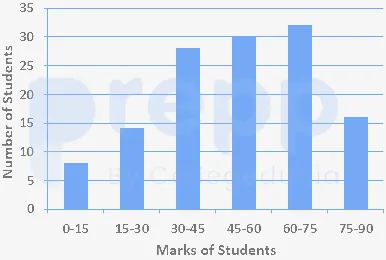
- A
62.5%
- B
72.5%
- C
75%
- D
67.5%
Show answer
A. 62.5%In 0 to 15 = 8
In 15 to 30 = 14
In 30 to 45 = 28
In 45 to 60 = 30
Total = 80
Percentage = (80/128) × 100
⇒ 62.5%
∴ P ercent of students got marks less than 60 is 62.5%
Paper & answer key PDF ↗ Question 56archived
When x is subtracted from each of the numbers 54, 49, 22 and 21, the numbers so obtained are in proportion. The ratio of (8x - 25) to (7x - 26) is:
- A
15 : 13
- B
5 : 4
- C
29 : 24
- D
27 : 26
Show answer
C. 29 : 24Solving Proportion Problems with Subtraction
This problem involves finding a specific number, let's call it $x$, which when subtracted from a set of four numbers (54, 49, 22, and 21) makes the resulting numbers form a proportion. When four numbers, say $a, b, c, d$, are in proportion, it means the ratio of the first two is equal to the ratio of the last two. Mathematically, this is written as $\frac{a}{b} = \frac{c}{d}$.
Setting up the Proportion Equation
According to the problem, after subtracting $x$ from each number, the new numbers are $(54-x)$, $(49-x)$, $(22-x)$, and $(21-x)$. Since these numbers are in proportion, we can write the equation:
$$ \frac{54 - x}{49 - x} = \frac{22 - x}{21 - x} $$
Solving for the Value of x
To solve for $x$, we can cross-multiply:
$$ (54 - x)(21 - x) = (49 - x)(22 - x) $$
Now, we expand both sides of the equation:
$$ (54 \times 21) - (54 \times x) - (x \times 21) + (x \times x) = (49 \times 22) - (49 \times x) - (x \times 22) + (x \times x) $$
Calculate the products:
$$ 1134 - 54x - 21x + x^2 = 1078 - 49x - 22x + x^2 $$
Combine the $x$ terms on each side:
$$ 1134 - 75x + x^2 = 1078 - 71x + x^2 $$
Notice that both sides have an $x^2$ term. We can subtract $x^2$ from both sides:
$$ 1134 - 75x = 1078 - 71x $$
Now, rearrange the terms to isolate $x$. Move the $x$ terms to one side and the constant terms to the other:
$$ 1134 - 1078 = 75x - 71x $$
Perform the subtractions:
$$ 56 = 4x $$
Finally, solve for $x$ by dividing both sides by 4:
$$ x = \frac{56}{4} $$
$$ x = 14 $$
So, the value of $x$ is 14.
Calculating the Required Ratio
The question asks for the ratio of $(8x - 25)$ to $(7x - 26)$. Now that we know $x = 14$, we can substitute this value into the expressions:
First expression: $8x - 25$
$$ 8(14) - 25 = 112 - 25 = 87 $$
Second expression: $7x - 26$
$$ 7(14) - 26 = 98 - 26 = 72 $$
The ratio is the first expression divided by the second expression:
$$ \frac{8x - 25}{7x - 26} = \frac{87}{72} $$
Simplifying the Ratio
We need to simplify the ratio $\frac{87}{72}$ to its simplest form. We find the greatest common divisor (GCD) of 87 and 72.
Factors of 87: 1, 3, 29, 87
Factors of 72: 1, 2, 3, 4, 6, 8, 9, 12, 18, 24, 36, 72
The greatest common divisor of 87 and 72 is 3.
Divide both the numerator and the denominator by 3:
$$ \frac{87 \div 3}{72 \div 3} = \frac{29}{24} $$
So, the ratio of $(8x - 25)$ to $(7x - 26)$ is 29 : 24.
Summary of Steps
Set up the proportion equation based on the problem statement.
Solve the equation for the variable $x$ using cross-multiplication and algebraic manipulation.
Substitute the found value of $x$ into the expressions for the ratio.
Calculate the values of the expressions.
Form the ratio and simplify it to its lowest terms.
Step
Description
Calculation
1
Proportion Equation
$\frac{54 - x}{49 - x} = \frac{22 - x}{21 - x}$
2
Solve for $x$
$x = 14$
3
Calculate $8x - 25$
$8(14) - 25 = 87$
4
Calculate $7x - 26$
$7(14) - 26 = 72$
5
Form and Simplify Ratio
$\frac{87}{72} = \frac{29}{24}$
Revision Table: Key Concepts in Proportion and Ratio
Concept
Definition
Example
Ratio
A comparison of two quantities by division. Written as $a:b$ or $\frac{a}{b}$.
The ratio of 4 apples to 5 oranges is 4:5.
Proportion
An equality between two ratios. If $\frac{a}{b} = \frac{c}{d}$, then $a, b, c, d$ are in proportion.
$\frac{2}{4} = \frac{5}{10}$ is a proportion. 2, 4, 5, 10 are in proportion.
Extremes and Means
In a proportion $\frac{a}{b} = \frac{c}{d}$ or $a:b::c:d$, $a$ and $d$ are the extremes, $b$ and $c$ are the means.
In $2:4::5:10$, 2 and 10 are extremes, 4 and 5 are means.
Product of Extremes and Means
In a proportion, the product of the extremes equals the product of the means ($ad = bc$). This is the basis for cross-multiplication.
For $\frac{2}{4} = \frac{5}{10}$, $2 \times 10 = 20$ and $4 \times 5 = 20$.
Additional Information on Proportion Problems
Proportion problems often appear in various forms in mathematics. Understanding the fundamental principle that the ratio between the first pair of numbers is equal to the ratio between the second pair is key. When a variable is involved, especially when it's being added to or subtracted from the numbers, the problem becomes an algebraic equation that needs to be solved.
Common variations of this type of problem include:
Finding a number to add to a set of numbers to make them proportional.
Finding a number to multiply or divide each number by to make them proportional.
Problems involving mean proportionals (where the middle two terms are the same, e.g., $a:b::b:c$).
Word problems applying proportion concepts to real-life scenarios like scaling, mixing ratios, or rates.
Solving these problems relies on setting up the correct algebraic expression based on the definition of proportion and then using standard algebraic techniques to solve for the unknown variable. Always remember to check if the final ratio needs to be simplified.
Paper & answer key PDF ↗ Question 57archived
ABCD is a cyclic quadrilateral in which ∠A = x°, ∠B = 5y°, ∠C = 2x° and ∠D = y°. What is the value of (3x - y)?
- A
60
- B
90
- C
120
- D
150
Show answer
D. 150Understanding the Cyclic Quadrilateral Angle Problem
A cyclic quadrilateral is a quadrilateral whose vertices all lie on a single circle. A key property of cyclic quadrilaterals is that the sum of opposite angles is always $180^\circ$. This property is crucial for solving this problem involving the cyclic quadrilateral ABCD.
Applying Cyclic Quadrilateral Properties
In the given cyclic quadrilateral ABCD, we are provided with the measures of the angles:
$\angle A = x^\circ$
$\angle B = 5y^\circ$
$\angle C = 2x^\circ$
$\angle D = y^\circ$
Using the property that the sum of opposite angles in a cyclic quadrilateral is $180^\circ$, we can set up two equations:
The sum of angles A and C is $180^\circ$:
$\angle A + \angle C = 180^\circ$
$x^\circ + 2x^\circ = 180^\circ$
The sum of angles B and D is $180^\circ$:
$\angle B + \angle D = 180^\circ$
$5y^\circ + y^\circ = 180^\circ$
Solving for x and y
Now we solve the two equations simultaneously to find the values of x and y.
From equation 1:
$$x + 2x = 180$$
$$3x = 180$$
Dividing both sides by 3:
$$x = \frac{180}{3}$$
$$x = 60$$
So, the value of x is 60.
From equation 2:
$$5y + y = 180$$
$$6y = 180$$
Dividing both sides by 6:
$$y = \frac{180}{6}$$
$$y = 30$$
So, the value of y is 30.
Calculating the Value of (3x - y)
The question asks for the value of $(3x - y)$. We have found $x = 60$ and $y = 30$. Now we substitute these values into the expression $(3x - y)$.
$$(3x - y) = (3 \times 60) - 30$$
$$(3x - y) = 180 - 30$$
$$(3x - y) = 150$$
Thus, the value of $(3x - y)$ is 150.
Checking the Angles
Let's verify the angles using the values $x=60$ and $y=30$:
$\angle A = x^\circ = 60^\circ$
$\angle B = 5y^\circ = 5 \times 30^\circ = 150^\circ$
$\angle C = 2x^\circ = 2 \times 60^\circ = 120^\circ$
$\angle D = y^\circ = 30^\circ$
Check opposite angles sum:
$\angle A + \angle C = 60^\circ + 120^\circ = 180^\circ$ (Correct)
$\angle B + \angle D = 150^\circ + 30^\circ = 180^\circ$ (Correct)
The calculated values of x and y are consistent with the properties of a cyclic quadrilateral.
Angle
Given
Calculated Value
$\angle A$
$x^\circ$
$60^\circ$
$\angle B$
$5y^\circ$
$150^\circ$
$\angle C$
$2x^\circ$
$120^\circ$
$\angle D$
$y^\circ$
$30^\circ$
Final Answer
The value of $(3x - y)$ is 150.
Revision Table: Cyclic Quadrilateral Properties
Property
Description
Definition
A quadrilateral whose all four vertices lie on the circumference of a circle.
Opposite Angles Sum
The sum of each pair of opposite angles is $180^\circ$.
Exterior Angle
An exterior angle is equal to the interior opposite angle.
Ptolemy's Theorem
For a cyclic quadrilateral ABCD, AC × BD = (AB × CD) + (BC × AD).
Additional Information: Angles in Quadrilaterals
A quadrilateral is a polygon with four sides and four vertices. The sum of the interior angles in any quadrilateral (cyclic or not) is always $360^\circ$. For a cyclic quadrilateral, the special property regarding opposite angles provides additional conditions that can be used to solve problems involving angles.
In this problem, we used the property $\angle A + \angle C = 180^\circ$ and $\angle B + \angle D = 180^\circ$. We could also check that the sum of all angles is $360^\circ$: $\angle A + \angle B + \angle C + \angle D = x + 5y + 2x + y = 3x + 6y$. Substituting $x=60$ and $y=30$, we get $3(60) + 6(30) = 180 + 180 = 360^\circ$. This confirms our values for x and y are correct within the context of a quadrilateral.
Paper & answer key PDF ↗ Question 58archived
A dealer bought some toys for Rs. 1800. He sold 40% of these at a loss of 15% and \(33\frac{1}{3}\%\) of the remaining toys at 20% profit. At what percent profit should he sell the remaining toys to earn an overall profit of 10%.
- A
30%
- B
25%
- C
20%
- D
24%
Show answer
A. 30%Understanding the Profit and Loss Problem
This problem involves calculating the required profit percentage on a portion of items (toys) after other portions have been sold at different profit/loss percentages. The goal is to achieve a specific overall profit percentage on the total investment.
We are given the total cost price, the percentage and profit/loss for the first two parts of the sale, and the desired overall profit percentage. We need to find the profit percentage for the final part of the sale.
Step-by-Step Profit Calculation
Let's break down the problem into smaller steps to calculate the required profit percentage on the remaining toys.
1. Calculate the Total Desired Selling Price:
The dealer bought toys for Rs. 1800. He wants an overall profit of 10%. The total selling price (SP) needed is the cost price plus the desired profit.
Total Cost Price (CP) = Rs. 1800
Desired Overall Profit = 10% of CP
\(\text{Desired Overall Profit} = \frac{10}{100} \times 1800 = 0.10 \times 1800 = \text{Rs. } 180\)
Total Desired Selling Price = Total CP + Desired Overall Profit
\(\text{Total Desired SP} = 1800 + 180 = \text{Rs. } 1980\)
The dealer needs to sell all the toys for a total of Rs. 1980.
2. Calculate Cost Price and Selling Price for the First Part (40%):
The first part is 40% of the toys.
Cost Price of First Part = 40% of Total CP
\(\text{CP of 1st Part} = \frac{40}{100} \times 1800 = 0.40 \times 1800 = \text{Rs. } 720\)
This part was sold at a loss of 15%.
Loss on First Part = 15% of CP of First Part
\(\text{Loss on 1st Part} = \frac{15}{100} \times 720 = 0.15 \times 720 = \text{Rs. } 108\)
Selling Price of First Part = CP of First Part - Loss on First Part
\(\text{SP of 1st Part} = 720 - 108 = \text{Rs. } 612\)
3. Calculate Cost Price and Selling Price for the Second Part (\(33\frac{1}{3}\%\) of Remaining):
After selling 40%, the remaining toys are 100% - 40% = 60% of the total.
Cost Price of Remaining Toys = 60% of Total CP
\(\text{CP of Remaining Toys} = \frac{60}{100} \times 1800 = 0.60 \times 1800 = \text{Rs. } 1080\)
The second part is \(33\frac{1}{3}\%\) of these remaining toys.
\(33\frac{1}{3}\%\) is equivalent to \(\frac{100}{3}\%\) or \(\frac{1}{3}\).
Quantity of Second Part = \(\frac{1}{3}\) of Remaining Toys
In terms of percentage of total toys: \(\frac{1}{3} \times 60\% = 20\%\)
Cost Price of Second Part = 20% of Total CP
\(\text{CP of 2nd Part} = \frac{20}{100} \times 1800 = 0.20 \times 1800 = \text{Rs. } 360\)
This part was sold at a profit of 20%.
Profit on Second Part = 20% of CP of Second Part
\(\text{Profit on 2nd Part} = \frac{20}{100} \times 360 = 0.20 \times 360 = \text{Rs. } 72\)
Selling Price of Second Part = CP of Second Part + Profit on Second Part
\(\text{SP of 2nd Part} = 360 + 72 = \text{Rs. } 432\)
4. Calculate Cost Price of the Remaining Toys:
The first part was 40% of total toys.
The second part was \(33\frac{1}{3}\%\) of the remaining (which is 20% of total toys).
Total percentage sold so far = 40% + 20% = 60% of total toys.
The remaining toys for the third sale are 100% - 60% = 40% of total toys.
Cost Price of Remaining Toys (Third Part) = 40% of Total CP
\(\text{CP of 3rd Part} = \frac{40}{100} \times 1800 = 0.40 \times 1800 = \text{Rs. } 720\)
5. Calculate the Required Selling Price for the Remaining Toys:
The total desired selling price for all toys is Rs. 1980.
The selling price obtained from the first two parts is:
\(\text{Total SP from 1st and 2nd Parts} = \text{SP of 1st Part} + \text{SP of 2nd Part}\)
\(\text{Total SP from 1st and 2nd Parts} = 612 + 432 = \text{Rs. } 1044\)
The required selling price for the remaining toys (Third Part) is the total desired SP minus the SP from the first two parts.
\(\text{Required SP for 3rd Part} = \text{Total Desired SP} - \text{Total SP from 1st and 2nd Parts}\)
\(\text{Required SP for 3rd Part} = 1980 - 1044 = \text{Rs. } 936\)
6. Calculate the Profit Percentage on the Remaining Toys:
We know the Cost Price of the third part is Rs. 720 and the required Selling Price is Rs. 936.
Profit on Third Part = Required SP for 3rd Part - CP of 3rd Part
\(\text{Profit on 3rd Part} = 936 - 720 = \text{Rs. } 216\)
Now, calculate the profit percentage on the third part based on its cost price.
\(\text{Profit Percentage on 3rd Part} = \frac{\text{Profit on 3rd Part}}{\text{CP of 3rd Part}} \times 100\)
\(\text{Profit Percentage on 3rd Part} = \frac{216}{720} \times 100\)
\(\text{Profit Percentage on 3rd Part} = \frac{21600}{720} = \frac{2160}{72}\)
Divide 2160 by 72:
\(2160 \div 72 = 30\)
So, the profit percentage on the remaining toys should be 30%.
Summary of Toy Sales and Profit
Part of Toys
Percentage of Total Toys
Cost Price (Rs.)
Profit/Loss %
Profit/Loss Amount (Rs.)
Selling Price (Rs.)
First Part
40%
720
-15% (Loss)
-108
612
Second Part
20% (\(33\frac{1}{3}\%\) of 60%)
360
+20% (Profit)
+72
432
Third Part (Remaining)
40% (100% - 40% - 20%)
720
+30% (Calculated)
+216
936 (Required)
Total
1800
Overall Desired: +10%
Overall Achieved: +180
1980
The calculations show that selling the remaining 40% of the toys at a 30% profit is necessary to achieve an overall profit of 10% on the total cost price of Rs. 1800.
Revision Table: Key Profit and Loss Formulas
Concept
Formula
Profit
Selling Price (SP) > Cost Price (CP)
Loss
Selling Price (SP) < Cost Price (CP)
Profit Amount
SP - CP
Loss Amount
CP - SP
Profit Percentage
\(\frac{\text{Profit}}{\text{CP}} \times 100\)
Loss Percentage
\(\frac{\text{Loss}}{\text{CP}} \times 100\)
SP when Profit is \(P\%\)
\(CP \times \left(1 + \frac{P}{100}\right)\)
SP when Loss is \(L\%\)
\(CP \times \left(1 - \frac{L}{100}\right)\)
Additional Information on Profit and Loss Concepts
Profit and loss are fundamental concepts in business and accounting. They measure the financial gain or loss resulting from a transaction or a series of transactions.
Cost Price (CP): The price at which an item is bought. This includes the purchase price plus any expenses incurred for transportation, installation, etc.
Selling Price (SP): The price at which an item is sold.
Profit: Occurs when the Selling Price is greater than the Cost Price. It represents a financial gain.
Loss: Occurs when the Selling Price is less than the Cost Price. It represents a financial deficit.
Percentage Calculations: Profit and loss are often expressed as a percentage of the Cost Price. This allows for easy comparison across different transactions or items with varying costs.
Overall Profit/Loss: When dealing with multiple items or transactions, the overall profit or loss is the sum of individual profits and losses. The overall percentage is calculated based on the total cost price of all items involved.
Understanding how to calculate percentages of quantities and applying the profit/loss formulas correctly are crucial for solving such problems.
Paper & answer key PDF ↗ Question 59archived
ΔABC is an equilateral triangle with side 18 cm. D is a point of BC such that \(BD=\frac{1}{3}BC\) . The length (in cm) of AD is:
- A
6√7
- B
7√6
- C
8√3
- D
6√3
Show answer
A. 6√7Equilateral Triangle Geometry Problem: Finding Length of AD
This problem involves an equilateral triangle ABC with a point D on side BC. We are given the side length of the triangle and the position of point D relative to BC. Our goal is to find the length of the line segment AD.
Given:
Triangle ABC is equilateral.
Side length of the triangle is 18 cm, so AB = BC = AC = 18 cm.
D is a point on BC such that \(BD = \frac{1}{3} BC\).
First, let's calculate the length of BD.
\(BD = \frac{1}{3} \times BC = \frac{1}{3} \times 18\) cm
\(BD = 6\) cm
To find the length of AD, we can use the properties of an equilateral triangle and the Pythagorean theorem. Let's draw an altitude from vertex A to the side BC. In an equilateral triangle, the altitude from a vertex to the opposite side is also the median and the angle bisector.
Let M be the midpoint of BC. Then AM is the altitude from A to BC, and AM is perpendicular to BC. Also, M is the midpoint of BC.
\(BM = MC = \frac{1}{2} \times BC = \frac{1}{2} \times 18\) cm
\(BM = MC = 9\) cm
Now, consider the right-angled triangle AMC. By the Pythagorean theorem:
\(AC^2 = AM^2 + MC^2\)
\(18^2 = AM^2 + 9^2\)
\(324 = AM^2 + 81\)
\(AM^2 = 324 - 81\)
\(AM^2 = 243\)
\(AM = \sqrt{243}\)
To simplify \(\sqrt{243}\), we find the largest perfect square factor of 243. \(243 = 81 \times 3\).
\(AM = \sqrt{81 \times 3} = \sqrt{81} \times \sqrt{3} = 9\sqrt{3}\) cm.
Now, we need to find the position of point D relative to M. We know BD = 6 cm and BM = 9 cm. Since D is on BC, and M is the midpoint, the distance MD is the difference between BM and BD.
\(MD = |BM - BD| = |9 - 6|\) cm
\(MD = 3\) cm.
Now, consider the right-angled triangle AMD. AM is perpendicular to BC, and D is on BC, so AM is perpendicular to MD. By the Pythagorean theorem in triangle AMD:
\(AD^2 = AM^2 + MD^2\)
\(AD^2 = (9\sqrt{3})^2 + 3^2\)
\(AD^2 = (81 \times 3) + 9\)
\(AD^2 = 243 + 9\)
\(AD^2 = 252\)
\(AD = \sqrt{252}\)
To simplify \(\sqrt{252}\), we find the largest perfect square factor of 252. \(252 = 4 \times 63 = 4 \times 9 \times 7 = 36 \times 7\).
\(AD = \sqrt{36 \times 7} = \sqrt{36} \times \sqrt{7} = 6\sqrt{7}\) cm.
Thus, the length of AD is \(6\sqrt{7}\) cm.
Summary of lengths:
Segment
Length (cm)
BC
18
BD
6
MC
9
BM
9
MD
3
AM (Altitude)
\(9\sqrt{3}\)
AD
\(6\sqrt{7}\)
Revision Table: Equilateral Triangle Concepts
Concept
Description
Equilateral Triangle
A triangle with all three sides equal in length and all three angles equal (each 60°).
Altitude
A perpendicular line segment from a vertex to the opposite side.
Median
A line segment from a vertex to the midpoint of the opposite side.
Pythagorean Theorem
In a right-angled triangle, the square of the hypotenuse is equal to the sum of the squares of the other two sides (\(a^2 + b^2 = c^2\)).
Simplifying Radicals
Finding the largest perfect square factor of the number under the square root and taking its square root out.
Additional Information: Properties of Equilateral Triangles
Equilateral triangles have several unique properties:
All angles are equal, each measuring 60°.
The altitude, median, and angle bisector from any vertex are the same line segment.
The centroid, orthocenter, circumcenter, and incenter all coincide at a single point.
The length of the altitude (h) of an equilateral triangle with side length 's' is given by the formula: \(h = \frac{\sqrt{3}}{2} s\). In our case, \(h = \frac{\sqrt{3}}{2} \times 18 = 9\sqrt{3}\) cm, which matches our calculation for AM.
The area (A) of an equilateral triangle with side length 's' is given by the formula: \(A = \frac{\sqrt{3}}{4} s^2\).
Understanding these properties is crucial for solving geometry problems involving equilateral triangles.
Paper & answer key PDF ↗ Question 60archived
The marked price of an article is Rs. 180. Renu sells it after 20% discount on its market price and still gain 25%. The cost price (in Rs.) of the article is:
- A
110.80
- B
115.20
- C
125.50
- D
120.80
Show answer
B. 115.20Calculating the Cost Price with Discount and Gain
This problem involves understanding the relationship between Marked Price, Discount, Selling Price, Cost Price, and Gain Percentage. We are given the marked price of an article, the discount percentage offered on it, and the gain percentage earned after selling it. Our goal is to find the original cost price of the article.
Understanding the Terms
Marked Price (MP): The price listed on the article. In this case, it is Rs. 180.
Discount: A reduction in the marked price. A 20% discount is offered.
Selling Price (SP): The price at which the article is actually sold after the discount.
Cost Price (CP): The price at which the article was bought or manufactured. This is what we need to find.
Gain (or Profit): The amount by which the selling price exceeds the cost price. A 25% gain is made on the cost price.
Step-by-Step Calculation
Step 1: Calculate the Selling Price (SP)
The article is sold after a 20% discount on the marked price. The formula to calculate the selling price after a discount is:
$\text{Selling Price (SP)} = \text{Marked Price (MP)} \times \left(1 - \frac{\text{Discount Percentage}}{100}\right)$
Given:
Marked Price (MP) = Rs. 180
Discount Percentage = 20%
Calculating the Selling Price:
$\text{SP} = 180 \times \left(1 - \frac{20}{100}\right)$
$\text{SP} = 180 \times \left(1 - 0.20\right)$
$\text{SP} = 180 \times 0.80$
$\text{SP} = 144$
So, the Selling Price of the article is Rs. 144.
Step 2: Calculate the Cost Price (CP)
Renu gains 25% after selling the article at Rs. 144. The gain percentage is calculated on the cost price. The relationship between Selling Price, Cost Price, and Gain Percentage is:
$\text{Selling Price (SP)} = \text{Cost Price (CP)} \times \left(1 + \frac{\text{Gain Percentage}}{100}\right)$
We know the Selling Price (SP) and the Gain Percentage. We need to find the Cost Price (CP). We can rearrange the formula:
$\text{Cost Price (CP)} = \frac{\text{Selling Price (SP)}}{1 + \frac{\text{Gain Percentage}}{100}}$
Given:
Selling Price (SP) = Rs. 144
Gain Percentage = 25%
Calculating the Cost Price:
$\text{CP} = \frac{144}{1 + \frac{25}{100}}$
$\text{CP} = \frac{144}{1 + 0.25}$
$\text{CP} = \frac{144}{1.25}$
To divide 144 by 1.25, we can rewrite 1.25 as a fraction $\frac{5}{4}$ or multiply both numerator and denominator by 100 to remove the decimal:
$\text{CP} = \frac{144}{1.25} = \frac{144 \times 100}{1.25 \times 100} = \frac{14400}{125}$
Now, perform the division:
$\text{CP} = \frac{14400}{125}$
Dividing 14400 by 125 gives:
$\text{CP} = 115.20$
So, the Cost Price of the article is Rs. 115.20.
Summary of Calculation Steps
Step
Calculation
Result
1
Calculate Discount Amount
$180 \times 20\% = 180 \times 0.20 = 36$
2
Calculate Selling Price (SP)
$\text{MP} - \text{Discount} = 180 - 36 = 144$
3
Assume CP as 'C'. SP = C + 25% of C
$144 = C + 0.25C$
4
Solve for CP
$144 = 1.25C$ > $C = \frac{144}{1.25} = 115.20$
Revision Table: Key Formulas
Concept
Formula
Selling Price with Discount
$\text{SP} = \text{MP} \times \left(\frac{100 - \text{Discount}\%}{100}\right)$
Selling Price with Gain
$\text{SP} = \text{CP} \times \left(\frac{100 + \text{Gain}\%}{100}\right)$
Cost Price from SP and Gain
$\text{CP} = \text{SP} \times \left(\frac{100}{100 + \text{Gain}\%}\right)$
Additional Information on Profit and Loss Concepts
In percentage and commercial arithmetic problems, understanding the core concepts is crucial. Here’s a bit more detail:
Profit (or Gain): Occurs when Selling Price > Cost Price. Profit = SP - CP.
Loss: Occurs when Selling Price < Cost Price. Loss = CP - SP.
Profit Percentage: Calculated on the Cost Price. $\text{Profit}\% = \left(\frac{\text{Profit}}{\text{CP}}\right) \times 100$.
Loss Percentage: Calculated on the Cost Price. $\text{Loss}\% = \left(\frac{\text{Loss}}{\text{CP}}\right) \times 100$.
Discount Percentage: Always calculated on the Marked Price. $\text{Discount}\% = \left(\frac{\text{Discount Amount}}{\text{MP}}\right) \times 100$.
These concepts are fundamental for solving problems related to buying and selling articles, especially in competitive exams.
Paper & answer key PDF ↗ Question 61archived
Study the following table and answer the question:
Year →
Institue ↓
201320142015201620172018
A120135130135128140
B125132138132135142
C125120125138140135
D100125122140128138
E105110115147130145
Number of students enrolled for Vocational Courses (VC) in five institutes - A, B, C, D & E.
What is the sum of the average number of students enrolled for VC in institute B in 2014, 2015 and 2017 and the average number of students enrolled in institute E in 2013 and 2018?
- A
260
- B
250
- C
255
- D
265
Show answer
A. 260Calculating Vocational Course Enrollment Averages from Table Data
The question asks us to find the sum of two average values from the provided table showing the number of students enrolled for Vocational Courses (VC) in five institutes (A, B, C, D, & E) over six years (2013 to 2018).
The two averages we need to calculate are:
The average number of students enrolled for VC in institute B in the years 2014, 2015, and 2017.
The average number of students enrolled for VC in institute E in the years 2013 and 2018.
Step 1: Extracting Data for Institute B and Institute E
Let's find the required enrollment numbers from the table:
Institute
2013
2014
2015
2016
2017
2018
A
120
135
130
135
128
140
B
125
132
138
132
135
142
C
125
120
125
138
140
135
D
100
125
122
140
128
138
E
105
110
115
147
130
145
From the table, we get the following enrollment numbers:
Institute B in 2014: 132
Institute B in 2015: 138
Institute B in 2017: 135
Institute E in 2013: 105
Institute E in 2018: 145
Step 2: Calculate Average Enrollment for Institute B (2014, 2015, 2017)
The average is the sum of the values divided by the number of values. For Institute B, we sum the enrollments for 2014, 2015, and 2017 and divide by 3.
Sum for Institute B = $132 + 138 + 135 = 405$
Average for Institute B = $\frac{\text{Sum for Institute B}}{\text{Number of years}} = \frac{405}{3}$
Average for Institute B = $135$
Step 3: Calculate Average Enrollment for Institute E (2013, 2018)
For Institute E, we sum the enrollments for 2013 and 2018 and divide by 2.
Sum for Institute E = $105 + 145 = 250$
Average for Institute E = $\frac{\text{Sum for Institute E}}{\text{Number of years}} = \frac{250}{2}$
Average for Institute E = $125$
Step 4: Calculate the Sum of the Two Averages
Now, we add the calculated averages from Step 2 and Step 3.
Sum of Averages = Average for Institute B + Average for Institute E
Sum of Averages = $135 + 125$
Sum of Averages = $260$
Final Answer
The sum of the average number of students enrolled for VC in institute B in 2014, 2015 and 2017 and the average number of students enrolled in institute E in 2013 and 2018 is 260.
Revision Table: Key Calculations for Vocational Course Enrollment
Calculation
Values
Sum
Number of Years
Average
Institute B Average (2014, 2015, 2017)
132, 138, 135
405
3
135
Institute E Average (2013, 2018)
105, 145
250
2
125
Sum of Averages
135, 125
260
N/A
N/A
Additional Information: Understanding Averages and Data Interpretation
This problem is a classic example of data interpretation from a table. Understanding how to calculate the average is crucial for such questions. An average (or arithmetic mean) is calculated by summing a set of numbers and then dividing by the count of those numbers.
In data interpretation questions involving tables, always:
Read the question carefully to understand exactly what is being asked.
Identify the specific data points required from the table (institute, year, type of data).
Perform the required calculations (sum, average, percentage, ratio, difference, etc.) step-by-step to avoid errors.
Double-check your calculations, especially when dealing with multiple steps.
Vocational Courses (VC) enrollment data like this can be used for various analyses, such as identifying trends over time, comparing performance across institutes, or forecasting future enrollment. This problem focuses specifically on calculating and summing averages for selected periods and institutes.
Paper & answer key PDF ↗ Question 62archived
Lucky spends 85% of her income. If her expenditure increases by x%, savings increase by 60% and income increases by 26%, then what is the value of x?
- A
26
- B
30
- C
34
- D
20
Show answer
D. 20Calculating Expenditure Percentage Increase from Income and Savings
This question involves understanding the relationship between income, expenditure, and savings. The basic formula connecting these three is:
\(\text{Income} = \text{Expenditure} + \text{Savings}\)
We are given information about initial expenditure as a percentage of income, and then percentage increases in expenditure (which we need to find), savings, and income. Let's assume an initial income to make the calculations easier. A base of 100 units is often helpful.
Item
Initial Value (assuming Income = 100)
Initial Income
100
Initial Expenditure
85% of 100 = \(0.85 \times 100 = 85\)
Initial Savings
Initial Income - Initial Expenditure = \(100 - 85 = 15\)
Calculating New Income and Savings
Now, let's calculate the new values after the given percentage increases.
New Income: Income increases by 26%.
New Income = Initial Income + 26% of Initial Income
New Income = \(100 + (0.26 \times 100) = 100 + 26 = 126\)
New Savings: Savings increase by 60%.
New Savings = Initial Savings + 60% of Initial Savings
New Savings = \(15 + (0.60 \times 15) = 15 + 9 = 24\)
Finding the New Expenditure
Using the fundamental relationship, we can find the new expenditure:
New Income = New Expenditure + New Savings
Substituting the values we calculated:
\(126 = \text{New Expenditure} + 24\)
Solving for New Expenditure:
\(\text{New Expenditure} = 126 - 24 = 102\)
Calculating the Percentage Increase in Expenditure
The question states that the expenditure increases by x%. We know the initial expenditure was 85 and the new expenditure is 102. The increase in expenditure is \(102 - 85 = 17\).
The percentage increase (x%) is calculated using the formula:
\(\text{Percentage Increase} = \left( \frac{\text{Increase}}{\text{Original Value}} \right) \times 100\%\)
In this case, the original value is the Initial Expenditure (85), and the increase is 17.
\(x\% = \left( \frac{17}{85} \right) \times 100\%\)
\(x\% = \left( \frac{1}{5} \right) \times 100\%\)
\(x\% = 0.20 \times 100\%\)
\(x\% = 20\%\)
Therefore, the value of x is 20.
Revision Table: Income, Expenditure, Savings
Item
Initial
Change
New
Income
100
+26% (\(+26\))
126
Savings
15
+60% (\(+9\))
24
Expenditure
85
+x% (\(+17\))
102
Additional Information: Percentage Change Concepts
Understanding percentage change is crucial for solving problems like this. A percentage increase or decrease is always calculated relative to the original value.
Percentage Increase: \( \frac{\text{New Value} - \text{Original Value}}{\text{Original Value}} \times 100\% \)
Percentage Decrease: \( \frac{\text{Original Value} - \text{New Value}}{\text{Original Value}} \times 100\% \)
Alternatively, a new value after a percentage increase can be calculated as: New Value = Original Value \(\times (1 + \text{percentage increase as a decimal})\). For example, a 26% increase means multiplying by \(1 + 0.26 = 1.26\).
Similarly, a new value after a percentage decrease is: New Value = Original Value \(\times (1 - \text{percentage decrease as a decimal})\).
In this problem, we used the first method to find the percentage increase in expenditure after calculating the initial and new expenditure values.
Paper & answer key PDF ↗ Question 63archived
Find the value of \(cosec(60° + A) - sec(30° - A) +\frac{cosec49^{\circ}}{sec 41^{\circ}}\) .
- A
1
- B
-1
- C
2
- D
0
Show answer
A. 1Solving Trigonometry Expression: Step-by-Step
Let's find the value of the given trigonometry expression: \(cosec(60° + A) - sec(30° - A) +\frac{cosec49^{\circ}}{sec 41^{\circ}}\).
To solve this, we will analyze and simplify each part of the expression using trigonometric identities, specifically focusing on complementary angles.
Understanding Complementary Angle Identities
Two angles are called complementary if their sum is \(90^\circ\). There are standard trigonometric identities relating functions of complementary angles:
\(sin(90^\circ - \theta) = cos(\theta)\)
\(cos(90^\circ - \theta) = sin(\theta)\)
\(tan(90^\circ - \theta) = cot(\theta)\)
\(cot(90^\circ - \theta) = tan(\theta)\)
\(sec(90^\circ - \theta) = cosec(\theta)\)
\(cosec(90^\circ - \theta) = sec(\theta)\)
Simplifying the First Part: \(cosec(60° + A) - sec(30° - A)\)
Consider the angles \((60° + A)\) and \((30° - A)\). Let's check their sum:
\((60° + A) + (30° - A) = 60° + A + 30° - A = 90°\)
Since the sum of the angles is \(90^\circ\), they are complementary angles.
We can use the identity \(sec(90^\circ - \theta) = cosec(\theta)\).
Let \(\theta = 60° + A\). Then \(90^\circ - \theta = 90^\circ - (60° + A) = 90° - 60° - A = 30° - A\).
So, \(sec(30° - A) = sec(90^\circ - (60° + A))\).
Using the identity, \(sec(90^\circ - (60° + A)) = cosec(60° + A)\).
Thus, \(sec(30° - A) = cosec(60° + A)\).
Now substitute this back into the first part of the expression:
\(cosec(60° + A) - sec(30° - A) = cosec(60° + A) - cosec(60° + A) = 0\)
Simplifying the Second Part: \(\frac{cosec49^{\circ}}{sec 41^{\circ}}\)
Consider the angles \(49^\circ\) and \(41^\circ\). Let's check their sum:
\(49^\circ + 41^\circ = 90^\circ\)
Since the sum is \(90^\circ\), these angles are also complementary.
We can use the identity \(sec(90^\circ - \theta) = cosec(\theta)\).
Let \(\theta = 49^\circ\). Then \(90^\circ - \theta = 90^\circ - 49^\circ = 41^\circ\).
So, \(sec(41^\circ) = sec(90^\circ - 49^\circ)\).
Using the identity, \(sec(90^\circ - 49^\circ) = cosec(49^\circ)\).
Thus, \(sec(41^\circ) = cosec(49^\circ)\).
Now substitute this into the second part of the expression:
\(\frac{cosec49^{\circ}}{sec 41^{\circ}} = \frac{cosec49^{\circ}}{cosec49^{\circ}}\)
Assuming \(cosec49^{\circ} \neq 0\) (which is true as \(sin49^{\circ} \neq 0\)), the fraction simplifies to 1.
\(\frac{cosec49^{\circ}}{sec 41^{\circ}} = 1\)
Combining the Simplified Parts
The original expression is the sum of the two simplified parts:
\((cosec(60° + A) - sec(30° - A)) + (\frac{cosec49^{\circ}}{sec 41^{\circ}})\)
Substitute the simplified values:
\(0 + 1 = 1\)
Final Value of the Expression
The value of the given trigonometry expression is \(1\).
Part of Expression
Simplification
Value
\(cosec(60° + A) - sec(30° - A)\)
Using \(sec(30° - A) = cosec(60° + A)\)
0
\(\frac{cosec49^{\circ}}{sec 41^{\circ}}\)
Using \(sec(41°) = cosec(49°)\)
1
Total Expression Value
Sum of simplified parts
0 + 1 = 1
Revision Table: Key Trigonometry Concepts
Concept
Description
Relevant Identities
Complementary Angles
Two angles whose sum is \(90^\circ\).
\(\theta\) and \(90^\circ - \theta\) are complementary.
Trigonometric Ratios
Ratios of sides in a right-angled triangle (sin, cos, tan, cosec, sec, cot).
\(cosec\theta = 1/sin\theta\), \(sec\theta = 1/cos\theta\), \(cot\theta = 1/tan\theta\).
Complementary Angle Identities
Relationships between trigonometric ratios of complementary angles.
\(sec(90^\circ - \theta) = cosec(\theta)\), \(cosec(90^\circ - \theta) = sec(\theta)\), etc.
Additional Information on Trigonometric Identities
Trigonometric identities are equations involving trigonometric functions that are true for every single value of the occurring variables where both sides of the equality are defined. These identities are fundamental in trigonometry and are used to simplify expressions, solve equations, and prove other relationships.
The complementary angle identities are special cases of the angle addition/subtraction formulas, but they are often remembered separately due to their frequent use in simplifying expressions involving angles like \((90^\circ - \theta)\). They help in converting trigonometric ratios of angles greater than \(45^\circ\) to ratios of angles less than \(45^\circ\) or in relating co-functions (like sin and cos, tan and cot, sec and cosec).
Mastering these identities is crucial for solving trigonometry problems, especially those encountered in exams. Practice applying these identities to various problems to become proficient in simplifying complex trigonometric expressions.
Paper & answer key PDF ↗ Question 64archived
The following bar graph shows the amount (in Lakh Rs.) invested by a Company in purchasing raw material over the years and the values (in Lakh Rs.) of finished goods sold by the Company over the years.
The ratio of total amount invested for purchasing raw material from 2013 to 2015 to the total sales of finished goods in 2014, 2016 and 2017 is:
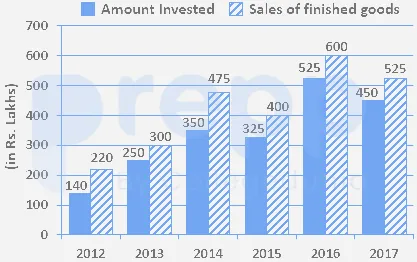
- A
37 : 64
- B
27 : 56
- C
56 : 27
- D
64 : 37
Show answer
A. 37 : 64Amount invested in 2013 = 250
Amount invested in 2014 = 350
Amount invested in 2015 = 325
Total = 250 + 350 + 325 = 925
Sales of finished goods in 2014 = 475
Sales of finished goods in 2016 = 600
Sales of finished goods in 2017 = 525
Total = 1600
Ratio = 925 : 1600
⇒ 37 : 64
∴ Required ratio is 37 : 64
Paper & answer key PDF ↗ Question 65archived
The perimeter of a circular lawn is 1232 m. There is 7 m wide path around the lawn. The area (in m 2) of the path is:
Take \(\left(\pi=\frac{22}{7}\right)\)
- A
8778
- B
8756
- C
8558
- D
8800
Show answer
A. 8778Calculating the Area of the Path Around a Circular Lawn
This problem asks us to find the area of a path surrounding a circular lawn. We are given the perimeter of the circular lawn and the width of the path. To solve this, we first need to find the radius of the lawn using its perimeter. Then, we can find the radius of the larger circle that includes the lawn and the path. Finally, we calculate the area of both circles and subtract the area of the lawn from the area of the larger circle to find the area of the path.
Finding the Radius of the Circular Lawn
The perimeter of a circle is given by the formula \( P = 2\pi r \), where \( P \) is the perimeter and \( r \) is the radius. We are given that the perimeter of the circular lawn is 1232 m and we should use \( \pi = \frac{22}{7} \). Let \( r_1 \) be the radius of the circular lawn.
So, we have:
\( 2\pi r_1 = 1232 \)
\( 2 \times \frac{22}{7} \times r_1 = 1232 \)
\( \frac{44}{7} r_1 = 1232 \)
To find \( r_1 \), we multiply both sides by \( \frac{7}{44} \):
\( r_1 = \frac{1232 \times 7}{44} \)
We can simplify this calculation. Divide 1232 by 44:
\( 1232 \div 44 = (1232 \div 4) \div 11 = 308 \div 11 = 28 \)
So, \( r_1 = 28 \times 7 \)
\( r_1 = 196 \) m.
The radius of the circular lawn is 196 m.
Determining the Radius of the Outer Circle
A 7 m wide path is around the circular lawn. This means the outer circle, which includes the lawn and the path, has a radius that is the radius of the lawn plus the width of the path. Let \( r_2 \) be the radius of the outer circle.
\( r_2 = \text{radius of lawn} + \text{width of path} \)
\( r_2 = r_1 + 7 \)
\( r_2 = 196 + 7 \)
\( r_2 = 203 \) m.
The radius of the outer circle is 203 m.
Calculating the Area of the Path
The path is the region between the outer circle and the inner circle (the lawn). This shape is called an annulus. The area of the path is the area of the outer circle minus the area of the inner circle. The area of a circle is given by the formula \( A = \pi r^2 \).
Area of the path \( A_{path} = \text{Area of outer circle} - \text{Area of inner circle} \)
\( A_{path} = \pi r_2^2 - \pi r_1^2 \)
We can factor out \( \pi \):
\( A_{path} = \pi (r_2^2 - r_1^2) \)
We know \( r_1 = 196 \) m and \( r_2 = 203 \) m, and \( \pi = \frac{22}{7} \).
\( A_{path} = \frac{22}{7} (203^2 - 196^2) \)
We can use the difference of squares formula, \( a^2 - b^2 = (a-b)(a+b) \), to simplify the calculation:
\( 203^2 - 196^2 = (203 - 196)(203 + 196) \)
\( 203 - 196 = 7 \)
\( 203 + 196 = 399 \)
So, \( 203^2 - 196^2 = 7 \times 399 \).
Now substitute this back into the area of the path formula:
\( A_{path} = \frac{22}{7} \times (7 \times 399) \)
We can cancel out the 7 in the denominator and the numerator:
\( A_{path} = 22 \times 399 \)
Finally, perform the multiplication:
\( 22 \times 399 = 22 \times (400 - 1) = (22 \times 400) - (22 \times 1) \)
\( 22 \times 400 = 8800 \)
\( 22 \times 1 = 22 \)
\( A_{path} = 8800 - 22 = 8778 \) m\(^2\).
The area of the path around the circular lawn is 8778 m\(^2\).
Revision Table: Key Formulas for Circular Area Problems
Concept
Formula
Description
Circumference (Perimeter) of a Circle
\( C = 2\pi r \) or \( C = \pi d \)
Distance around the circle. \( r \) is radius, \( d \) is diameter.
Area of a Circle
\( A = \pi r^2 \)
Space enclosed by the circle. \( r \) is radius.
Area of an Annulus (Path)
\( A_{path} = \pi (r_2^2 - r_1^2) \)
Area between two concentric circles. \( r_1 \) is inner radius, \( r_2 \) is outer radius.
Additional Information on Circular Geometry
Understanding the geometry of circles is fundamental in solving problems like finding the area of a path. Here are a few related concepts:
Annulus: The ring-shaped region between two concentric circles (circles with the same center but different radii). The path in this problem is an example of an annulus.
Units: Always pay attention to the units given in the problem. Perimeter is a length and is measured in meters (m), while area is a measure of two-dimensional space and is measured in square meters (m\(^2\)).
Value of \( \pi \): The problem specifies using \( \pi = \frac{22}{7} \). In other problems, you might be asked to use \( \pi \approx 3.14 \) or a more precise value. Using the specified value is important for matching the expected answer.
Difference of Squares: The algebraic identity \( a^2 - b^2 = (a-b)(a+b) \) is very useful in geometry problems involving the difference of areas of squares or circles, as shown in this solution.
Paper & answer key PDF ↗ Question 66archived
Triangles ABC and DBC are right-angled triangles with common hypotenuse BC. BD and AC intersect at P when produced. If PA = 8 cm, PC = 4 cm and PD = 3.2 cm, then the length of BD, in cm, is:
- A
6.8
- B
7.2
- C
6.4
- D
5.6
Show answer
A. 6.8Solving Geometry Problems with Power of a Point Theorem
The question describes two right-angled triangles, ABC and DBC, sharing a common hypotenuse BC. This is a key piece of information in geometry.
When two right-angled triangles share the same hypotenuse, the vertices A, B, C, and D are concyclic, meaning they lie on a circle. The common hypotenuse BC acts as the diameter of this circle. This is because the angle subtended by a diameter at any point on the circumference is always a right angle (\(90^\circ\)). Thus, ABCD forms a cyclic quadrilateral.
Applying the Power of a Point Theorem
The lines BD and AC, when produced, intersect at a point P. We are given the lengths of the segments from P to the points on the lines: PA = 8 cm, PC = 4 cm, and PD = 3.2 cm.
Since ABCD is a cyclic quadrilateral and the lines AC and BD intersect at P outside the circle (as they are produced to meet), we can apply the Power of a Point Theorem for intersecting secants. The theorem states that for a point P outside a circle and a secant line through P intersecting the circle at points A and C, and another secant line through P intersecting the circle at points D and B, the product of the lengths of the segments from P to the intersection points along one secant is equal to the product of the lengths of the segments along the other secant. Mathematically, this is expressed as:
\(\text{PA} \times \text{PC} = \text{PD} \times \text{PB}\)
Calculating the Length PB
We are given PA = 8 cm, PC = 4 cm, and PD = 3.2 cm. We can use the formula to find the length of PB:
\(8 \times 4 = 3.2 \times \text{PB}\)
\(32 = 3.2 \times \text{PB}\)
To find PB, divide 32 by 3.2:
\(\text{PB} = \frac{32}{3.2} = \frac{320}{32}\)
\(\text{PB} = 10 \text{ cm}\)
Finding the Length of BD
The point P, D, and B lie on a straight line. Since BD and AC intersect when produced, the point D must lie between P and B. Therefore, the length of the segment PB is the sum of the lengths PD and DB (or BD):
\(\text{PB} = \text{PD} + \text{DB}\)
We know PB = 10 cm and PD = 3.2 cm. Substitute these values into the equation:
\(10 = 3.2 + \text{DB}\)
Now, subtract 3.2 from 10 to find the length of DB:
\(\text{DB} = 10 - 3.2\)
\(\text{DB} = 6.8 \text{ cm}\)
Thus, the length of BD is 6.8 cm.
Segment
Length (cm)
PA
8
PC
4
PD
3.2
PB
10 (Calculated)
BD
6.8 (Calculated)
Conclusion on BD Length
Based on the calculations using the Power of a Point Theorem, the length of BD is 6.8 cm.
Revision Table: Key Concepts for Cyclic Quadrilaterals and Power of a Point
Concept
Description
Relevance to Problem
Cyclic Quadrilateral
A quadrilateral whose vertices all lie on a single circle.
ABCD is cyclic because angles ABC and DBC are \(90^\circ\) on common hypotenuse BC.
Angles in a Semicircle
The angle subtended by a diameter at any point on the circumference of a circle is a right angle (\(90^\circ\)).
Used to prove that A, B, C, D are concyclic with BC as diameter.
Power of a Point Theorem (Intersecting Secants)
For a point P outside a circle, if secants PAB and PCD intersect the circle at A, B and C, D respectively, then \(PA \times PB = PC \times PD\).
Applied directly to the intersecting lines PAC and PDB.
Additional Information: Related Geometry Theorems
The Power of a Point theorem has different cases depending on where the point P is located relative to the circle and what type of lines pass through P and intersect the circle.
Case 1: Point P inside the circle - If two chords AB and CD intersect at P inside the circle, then \(\text{PA} \times \text{PB} = \text{PC} \times \text{PD}\).
Case 2: Point P outside the circle (Two Secants) - As used in this problem, if two secants PAB and PCD from P intersect the circle at A, B and C, D respectively, then \(\text{PA} \times \text{PB} = \text{PC} \times \text{PD}\). Note that PB includes the entire segment from P to the furthest intersection point, and PA is the segment from P to the nearest intersection point. In our problem, PAC and PDB were the secants, so it was \(PA \times PC = PD \times PB\).
Case 3: Point P outside the circle (Tangent and Secant) - If a tangent from P touches the circle at T, and a secant PAB intersects the circle at A and B, then \(\text{PT}^2 = \text{PA} \times \text{PB}\).
Understanding these different cases of the Power of a Point theorem is crucial for solving various geometry problems involving circles and intersecting lines.
Paper & answer key PDF ↗ Question 67archived
There are some children in a camp and their average weight is 40 kg. If 5 children with average weight 36 kg join the camp or if 5 children with average weight 43.2 kg leave the camp, the average weight of children in both cases is equal. How many children are there in the camp, initially?
- A
35
- B
45
- C
40
- D
50
Show answer
B. 45Understanding the Children Camp Average Weight Problem
This problem involves calculating the initial number of children in a camp given their average weight and how that average changes under two different scenarios: when children join or when children leave. The key information is that the final average weight is the same in both scenarios.
Let's break down the problem step-by-step using variables to represent the unknown quantities.
Let the initial number of children in the camp be $n$.
The initial average weight of these children is given as 40 kg.
The initial total weight of all children is the number of children multiplied by their average weight, which is $n \times 40 = 40n$ kg.
Scenario 1: Children Join the Camp
In this scenario, 5 children join the camp. These 5 children have an average weight of 36 kg.
Number of children joining = 5.
Total weight of children joining = $5 \times 36 = 180$ kg.
The new total number of children in the camp becomes $n + 5$.
The new total weight of all children becomes the initial total weight plus the weight of the joining children: $40n + 180$ kg.
The new average weight in this scenario is the new total weight divided by the new number of children:
\text{Average weight (Scenario 1)} = \frac{\text{New Total Weight}}{\text{New Number of Children}} = \frac{40n + 180}{n + 5}
Scenario 2: Children Leave the Camp
In this scenario, 5 children leave the camp. These 5 children have an average weight of 43.2 kg.
Number of children leaving = 5.
Total weight of children leaving = $5 \times 43.2 = 216$ kg.
The new total number of children in the camp becomes $n - 5$. Note that for children to leave, the initial number $n$ must be greater than 5.
The new total weight of all children becomes the initial total weight minus the weight of the children leaving: $40n - 216$ kg.
The new average weight in this scenario is the new total weight divided by the new number of children:
\text{Average weight (Scenario 2)} = \frac{\text{New Total Weight}}{\text{New Number of Children}} = \frac{40n - 216}{n - 5}
Equating the Average Weights
The problem states that the average weight of children in both cases is equal. Therefore, we can set the expressions for the new average weights from Scenario 1 and Scenario 2 equal to each other:
$$ \frac{40n + 180}{n + 5} = \frac{40n - 216}{n - 5} $$
Now, we need to solve this equation for $n$. We can do this by cross-multiplication.
$$ (40n + 180)(n - 5) = (40n - 216)(n + 5) $$
Solving the Equation for the Initial Number of Children
Let's expand both sides of the equation:
Left side:
$$ (40n + 180)(n - 5) = 40n(n - 5) + 180(n - 5) $$
$$ = 40n^2 - 200n + 180n - 900 $$
$$ = 40n^2 - 20n - 900 $$
Right side:
$$ (40n - 216)(n + 5) = 40n(n + 5) - 216(n + 5) $$
$$ = 40n^2 + 200n - 216n - 1080 $$
$$ = 40n^2 - 16n - 1080 $$
Now, set the expanded left side equal to the expanded right side:
$$ 40n^2 - 20n - 900 = 40n^2 - 16n - 1080 $$
Subtract $40n^2$ from both sides:
$$ -20n - 900 = -16n - 1080 $$
Add $16n$ to both sides:
$$ -20n + 16n - 900 = -1080 $$
$$ -4n - 900 = -1080 $$
Add 900 to both sides:
$$ -4n = -1080 + 900 $$
$$ -4n = -180 $$
Divide by -4:
$$ n = \frac{-180}{-4} $$
$$ n = 45 $$
So, the initial number of children in the camp was 45.
Verifying the Solution (Optional)
Let's check if $n=45$ satisfies the condition:
Initial number of children = 45, Initial average weight = 40 kg.
Initial total weight = $45 \times 40 = 1800$ kg.
Scenario 1 (Join):
5 children join with average 36 kg (total weight $5 \times 36 = 180$ kg).
New number of children = $45 + 5 = 50$.
New total weight = $1800 + 180 = 1980$ kg.
New average weight = $\frac{1980}{50} = 39.6$ kg.
Scenario 2 (Leave):
5 children leave with average 43.2 kg (total weight $5 \times 43.2 = 216$ kg).
New number of children = $45 - 5 = 40$.
New total weight = $1800 - 216 = 1584$ kg.
New average weight = $\frac{1584}{40} = 39.6$ kg.
Since the average weight in both scenarios is 39.6 kg, which is equal, our calculated initial number of children, 45, is correct.
Revision Table: Average Weight Concepts
Concept
Formula
Description
Average (Mean)
$$ \text{Average} = \frac{\text{Sum of all values}}{\text{Number of values}} $$
A measure of central tendency; the sum of a set of numbers divided by the count of the numbers.
Total Value
$$ \text{Total Value} = \text{Average} \times \text{Number of values} $$
The sum of all values in a set. Useful for calculating overall sums when averages are known.
Change in Average
Involves recalculating the sum and count after additions or removals.
Understanding how adding or removing elements with different values affects the group's average.
Additional Information: Applications of Average Weight Problems
Problems involving average weights, ages, or scores are common in quantitative aptitude tests. They test your ability to understand and apply the concept of averages and algebraic equation solving. These skills are useful in various fields, including statistics, data analysis, and everyday calculations like budgeting or performance tracking.
When solving such problems, always define your variables clearly, set up the equations based on the given information, and solve systematically. Pay attention to whether elements are being added to or removed from the group, as this affects both the total sum and the total count.
Paper & answer key PDF ↗ Question 68archived
Study the following table and answer the question:
Number of students enrolled for Vocational Courses (VC) in five institutes - A, B, C, D & E.
Year →
Institue ↓
201320142015201620172018
A120135130135128140
B125132138132135142
C125120125138140135
D100125122140128138
E105110115147130145
The total number of students enrolled for VC in institutes A, B and D in 2015 is what percent more than the total number of students enrolled in institutes C and E in 2018? (correct to one decimal point)
- A
39.3
- B
35.7
- C
36.8
- D
28.2
Show answer
A. 39.3Analyzing Vocational Course Enrollment Data
The problem asks us to analyze the given table which shows the number of students enrolled for Vocational Courses (VC) in five different institutes (A, B, C, D, & E) over six years (2013 to 2018).
We need to find the percentage by which the total enrollment in institutes A, B, and D in the year 2015 is more than the total enrollment in institutes C and E in the year 2018.
Step-by-Step Calculation
Step 1: Find the total enrollment in institutes A, B, and D in 2015
From the table, the enrollment numbers for 2015 are:
Institute A: 130
Institute B: 138
Institute D: 122
Total enrollment in A, B, and D in 2015 = \(130 + 138 + 122\)
Total enrollment in A, B, and D in 2015 = \(390\)
Step 2: Find the total enrollment in institutes C and E in 2018
From the table, the enrollment numbers for 2018 are:
Institute C: 135
Institute E: 145
Total enrollment in C and E in 2018 = \(135 + 145\)
Total enrollment in C and E in 2018 = \(280\)
Step 3: Calculate the difference between the two totals
Difference = (Total enrollment in A, B, D in 2015) - (Total enrollment in C and E in 2018)
Difference = \(390 - 280\)
Difference = \(110\)
Step 4: Calculate the percentage more
The question asks "what percent more than the total number of students enrolled in institutes C and E in 2018?". This means we need to calculate the difference as a percentage of the total enrollment in C and E in 2018.
Percentage More = \(\left( \frac{\text{Difference}}{\text{Total enrollment in C and E in 2018}} \right) \times 100\)
Percentage More = \(\left( \frac{110}{280} \right) \times 100\)
Percentage More = \(\left( \frac{11}{28} \right) \times 100\)
Percentage More \(\approx 0.392857 \times 100\)
Percentage More \(\approx 39.2857\)
Step 5: Round the result to one decimal point
Rounding 39.2857 to one decimal point gives 39.3.
So, the total number of students enrolled for VC in institutes A, B, and D in 2015 is approximately 39.3 percent more than the total number of students enrolled in institutes C and E in 2018.
Year →
Institue ↓
2013
2014
2015
2016
2017
2018
A
120
135
130
135
128
140
B
125
132
138
132
135
142
C
125
120
125
138
140
135
D
100
125
122
140
128
138
E
105
110
115
147
130
145
Summary of Totals
Total Enrollment (A, B, D in 2015): \(130 + 138 + 122 = 390\)
Total Enrollment (C, E in 2018): \(135 + 145 = 280\)
Percentage More: \(\left( \frac{390 - 280}{280} \right) \times 100 = \left( \frac{110}{280} \right) \times 100 \approx 39.3\%\)
Revision Table: Key Concepts for Data Interpretation
Concept
Explanation
Application in this problem
Reading Data Tables
Extracting specific numerical values based on row and column headers.
Finding enrollment numbers for specific institutes in specific years (e.g., A in 2015, C in 2018).
Summation
Adding multiple numbers to find a total.
Calculating the total enrollment for multiple institutes in a year.
Percentage Change (Percent More)
Calculating the increase from one value to another as a percentage of the original value: \(\frac{\text{New Value} - \text{Original Value}}{\text{Original Value}} \times 100\).
Finding how much more the 2015 total is compared to the 2018 total, relative to the 2018 total.
Additional Information: Understanding Percentage Increase
Percentage increase is a common concept in data interpretation and quantitative analysis. It tells us the relative change between two numbers. When we say 'X is what percent more than Y', we are calculating the difference \((X - Y)\) as a percentage of the original value \(Y\).
The formula is: \(\text{Percentage Increase} = \frac{\text{Increase Amount}}{\text{Original Amount}} \times 100\)
In this problem:
The 'New Value' is the total enrollment in A, B, D in 2015 (390).
The 'Original Value' (what we are comparing against) is the total enrollment in C, E in 2018 (280).
The 'Increase Amount' is the difference between the two totals \((390 - 280 = 110)\).
So, Percentage More = \(\frac{110}{280} \times 100\), which we calculated as approximately 39.3%.
Being able to quickly and accurately read data from tables and perform basic arithmetic operations like summation and percentage calculations is crucial for solving such data interpretation questions in exams.
Paper & answer key PDF ↗ Question 69archived
To do a certain work. the ratio of efficiencies of X and Y is 5 : 7. Working together, X and Y can complete the same work in 70 days. X alone started the work and left after 42 days. Y alone will complete the remaining work in:
- A
72 days
- B
96 days
- C
80 days
- D
90 days
Show answer
D. 90 daysUnderstanding Work and Efficiency for X and Y
This problem involves the concepts of work, time, and efficiency. Efficiency is the rate at which work is done. The more efficient a person is, the less time they take to complete a certain amount of work. The total work is often considered as a fixed amount, and it can be calculated by multiplying the total time taken by the combined efficiency of the people working together.
Calculating Total Work Based on Combined Efficiency
We are given that the ratio of efficiencies of X and Y is 5 : 7. Let's assume their efficiencies are $5$ units of work per day and $7$ units of work per day, respectively.
Efficiency of X = $5$ units/day
Efficiency of Y = $7$ units/day
When X and Y work together, their combined efficiency is the sum of their individual efficiencies.
Combined efficiency of X and Y = Efficiency of X + Efficiency of Y = $(5 + 7)$ units/day = $12$ units/day.
We are also told that working together, X and Y can complete the work in $70$ days. The total work can be calculated using the formula:
Total Work = Combined Efficiency $\times$ Time taken together
Total Work = $(12 \text{ units/day}) \times (70 \text{ days})$
Total Work = $840$ units.
So, the total amount of work to be done is $840$ units.
Work Done by X Alone in 42 Days
X started the work alone and worked for $42$ days. We know the efficiency of X is $5$ units/day. The work done by X in $42$ days is calculated as:
Work done by X = Efficiency of X $\times$ Number of days X worked
Work done by X = $(5 \text{ units/day}) \times (42 \text{ days})$
Work done by X = $210$ units.
Calculating the Remaining Work
After X worked for $42$ days and completed $210$ units of work, the remaining work is the total work minus the work done by X.
Remaining Work = Total Work - Work done by X
Remaining Work = $840 \text{ units} - 210 \text{ units}$
Remaining Work = $630$ units.
This $630$ units of work is the remaining part that Y needs to complete alone.
Time Taken by Y to Complete Remaining Work
Y will complete the remaining work alone. We know the efficiency of Y is $7$ units/day. The time taken by Y to complete the remaining $630$ units of work is calculated using the formula:
Time taken by Y = Remaining Work / Efficiency of Y
Time taken by Y = $(630 \text{ units}) / (7 \text{ units/day})$
Time taken by Y = $90$ days.
Therefore, Y alone will complete the remaining work in $90$ days.
Summary of Calculations
Parameter
Value
Calculation/Notes
Efficiency Ratio (X:Y)
5:7
Given
Assumed Efficiency of X
5 units/day
Based on ratio
Assumed Efficiency of Y
7 units/day
Based on ratio
Combined Efficiency (X+Y)
12 units/day
$5 + 7$
Time taken by X & Y together
70 days
Given
Total Work
840 units
$12 \times 70$
Days X worked alone
42 days
Given
Work done by X
210 units
$5 \times 42$
Remaining Work
630 units
$840 - 210$
Time for Y to finish remaining work
90 days
$630 / 7$
Revision Table: Key Concepts in Work and Time
Concept
Explanation
Formula
Efficiency
Rate of doing work per unit of time.
Efficiency = Work / Time
Total Work
The total amount of work to be completed. Often assumed as 1 unit or calculated based on efficiency and time.
Total Work = Efficiency $\times$ Time
Time Taken
The duration required to complete a certain amount of work.
Time = Work / Efficiency
Combined Efficiency
Sum of individual efficiencies when multiple people work together.
Efficiency (A+B) = Efficiency(A) + Efficiency(B)
Additional Information on Work and Time Problems
Work and time problems often involve scenarios where people work together or alone for different durations. The key is to standardize the work done per unit of time (efficiency) and calculate the total work.
If a person can do a work in $D$ days, their efficiency is $1/D$ of the work per day.
If efficiency ratio is given, like X:Y = $a:b$, you can assume their daily work units are $ak$ and $bk$ or simply $a$ and $b$ for calculations, as the constant $k$ will cancel out.
Work done in a certain period = Efficiency $\times$ Time.
Remaining work is the total work minus the work already completed.
These principles allow us to solve various problems involving different workers, varying efficiencies, and staggered working schedules.
Paper & answer key PDF ↗ Question 70archived
If x + y + z = 2, x 3+ y 3+ z 3- 3xyz = 74, then (x 2 + y 2+ z 2) is equal to:
- A
22
- B
29
- C
24
- D
26
Show answer
D. 26Understanding the Algebra Problem
The question asks us to find the value of \(x^2 + y^2 + z^2\) given two algebraic relationships involving \(x\), \(y\), and \(z\). These relationships are:
The sum of the variables: \(x + y + z = 2\)
A relationship involving cubes and the product: \(x^3 + y^3 + z^3 - 3xyz = 74\)
To solve this, we need to use some fundamental algebraic identities that connect these expressions.
Using Key Algebraic Identities
There are two important identities that are crucial for solving this problem:
The sum of squares in terms of sum and sum of products:
$$(x + y + z)^2 = x^2 + y^2 + z^2 + 2(xy + yz + zx)$$
This identity relates \((x+y+z)\), \((x^2+y^2+z^2)\), and \((xy+yz+zx)\). We can rearrange it to express \((x^2+y^2+z^2)\) or \((xy+yz+zx)\) in terms of the others.
The factorization of the sum of cubes minus three times the product:
$$x^3 + y^3 + z^3 - 3xyz = (x + y + z)(x^2 + y^2 + z^2 - xy - yz - zx)$$
This identity directly involves the expressions given in the problem.
Step-by-Step Calculation
Let's use the given information and the identities to find \(x^2 + y^2 + z^2\).
Step 1: Substitute values into the second identity
We are given \(x + y + z = 2\) and \(x^3 + y^3 + z^3 - 3xyz = 74\). Substitute these into the identity:
$$x^3 + y^3 + z^3 - 3xyz = (x + y + z)(x^2 + y^2 + z^2 - xy - yz - zx)$$
$$74 = (2)(x^2 + y^2 + z^2 - (xy + yz + zx))$$
Divide both sides by 2:
$$37 = x^2 + y^2 + z^2 - (xy + yz + zx)$$
Let \(S_2 = x^2 + y^2 + z^2\) (what we want to find) and \(P_2 = xy + yz + zx\). The equation becomes:
$$37 = S_2 - P_2 \quad \text{(Equation 1)}$$
Step 2: Use the first identity to relate \(S_2\) and \(P_2\)
We know \((x + y + z)^2 = x^2 + y^2 + z^2 + 2(xy + yz + zx)\).
Substitute \(x + y + z = 2\), \(S_2 = x^2 + y^2 + z^2\), and \(P_2 = xy + yz + zx\):
$$(2)^2 = S_2 + 2P_2$$
$$4 = S_2 + 2P_2 \quad \text{(Equation 2)}$$
Step 3: Solve the system of equations
Now we have a system of two linear equations with two variables, \(S_2\) and \(P_2\):
Equation 1: \(S_2 - P_2 = 37\)
Equation 2: \(S_2 + 2P_2 = 4\)
We want to find \(S_2\). We can solve this system using substitution or elimination.
Using substitution: From Equation 1, we can express \(P_2\) in terms of \(S_2\):
$$P_2 = S_2 - 37$$
Substitute this expression for \(P_2\) into Equation 2:
$$S_2 + 2(S_2 - 37) = 4$$
$$S_2 + 2S_2 - 74 = 4$$
$$3S_2 - 74 = 4$$
Add 74 to both sides:
$$3S_2 = 4 + 74$$
$$3S_2 = 78$$
Divide by 3:
$$S_2 = \frac{78}{3}$$
$$S_2 = 26$$
So, \(x^2 + y^2 + z^2 = 26\).
Given
Identity Used
Resulting Equation
\(x + y + z = 2\)
\(x^3 + y^3 + z^3 - 3xyz = (x + y + z)(x^2 + y^2 + z^2 - xy - yz - zx)\)
\(37 = x^2 + y^2 + z^2 - (xy + yz + zx)\)
\(x^3 + y^3 + z^3 - 3xyz = 74\)
\(x + y + z = 2\)
\((x + y + z)^2 = x^2 + y^2 + z^2 + 2(xy + yz + zx)\)
\(4 = x^2 + y^2 + z^2 + 2(xy + yz + zx)\)
Solving the system:
Equation 1: \(S_2 - P_2 = 37\)
Equation 2: \(S_2 + 2P_2 = 4\)
Multiply Equation 1 by 2: \(2S_2 - 2P_2 = 74\)
Add this new equation to Equation 2:
\((2S_2 - 2P_2) + (S_2 + 2P_2) = 74 + 4\)
\(3S_2 = 78\)
\(S_2 = 26\)
Both methods confirm that \(x^2 + y^2 + z^2\) is equal to 26.
Conclusion on the Value of \(x^2 + y^2 + z^2\)
Based on the given conditions \(x + y + z = 2\) and \(x^3 + y^3 + z^3 - 3xyz = 74\), and by applying standard algebraic identities, we found that the value of \(x^2 + y^2 + z^2\) is 26.
Revision Table: Key Concepts
Concept
Description
Relevant Identity
Sum of squares
The sum of the squares of variables, \(x^2 + y^2 + z^2\).
Used in both main identities.
Sum of products (pairwise)
The sum of products of distinct pairs of variables, \(xy + yz + zx\).
Connects the sum \((x+y+z)\) and sum of squares \((x^2+y^2+z^2)\).
Sum of cubes minus 3xyz
The expression \(x^3 + y^3 + z^3 - 3xyz\).
Factorizes into a product involving \((x+y+z)\) and \((x^2+y^2+z^2 - xy - yz - zx)\).
Algebraic Identity
An equation that is true for all possible values of the variables.
Key tools for simplifying and relating algebraic expressions.
Additional Information: Related Identities and Applications
The identities used here are fundamental in algebra and have many applications. For instance:
The identity \(x^3 + y^3 + z^3 - 3xyz = (x + y + z)(x^2 + y^2 + z^2 - xy - yz - zx)\) is particularly useful when \(x+y+z=0\). In this case, the right side becomes \(0 \times (\text{something})\), which is 0. This implies that if \(x+y+z=0\), then \(x^3 + y^3 + z^3 = 3xyz\). This is a frequently used special case.
The term \((x^2 + y^2 + z^2 - xy - yz - zx)\) can also be written as \(\frac{1}{2}((x-y)^2 + (y-z)^2 + (z-x)^2)\). This form shows that if \(x^2 + y^2 + z^2 - xy - yz - zx = 0\), and \(x, y, z\) are real numbers, then \((x-y)^2 + (y-z)^2 + (z-x)^2 = 0\). Since squares of real numbers are non-negative, this is only possible if \(x-y=0\), \(y-z=0\), and \(z-x=0\), which means \(x=y=z\).
These identities are often used in solving problems involving symmetric expressions in \(x, y, z\) and in topics like cubic equations and number theory.
Paper & answer key PDF ↗ Question 71archived
A person borrowed a sum of Rs. 30800 at 10% p.a. for 3 years, interest compounded annually. At the end of two years, he paid a sum of Rs. 13268. At the end of 3rd year, he paid Rs. x to clear of the debt. What is the value of x?
- A
26510
- B
26200
- C
26620
- D
26400
Show answer
D. 26400Understanding the Compound Interest Problem
This problem involves calculating the final payment required to clear a loan taken at compound interest. The principal amount, interest rate, and loan duration are given. A key element is that a partial payment is made partway through the loan term, which affects the outstanding balance for the subsequent period.
Compound interest means that the interest earned (or charged) in each period is added to the principal, and the interest for the next period is calculated on this new, larger principal. In this case, the interest is compounded annually.
Step-by-Step Calculation of Final Payment
Let's break down the calculation year by year to determine the final payment required to clear the debt.
Year 1 Calculation
The initial principal borrowed is Rs. 30800 at a rate of 10% per annum compounded annually.
Amount at the end of Year 1 (\(A_1\)) is calculated using the formula: \(A = P(1 + \frac{R}{100})^n\)
Here, P = 30800, R = 10%, n = 1 year.
\[ A_1 = 30800 \left(1 + \frac{10}{100}\right)^1 \]
\[ A_1 = 30800 \left(1 + 0.1\right) \]
\[ A_1 = 30800 \times 1.1 \]
\[ A_1 = 33880 \]
So, the amount due at the end of Year 1 is Rs. 33880.
Year 2 Calculation (Before Payment)
The principal for Year 2 is the amount outstanding at the end of Year 1, which is Rs. 33880. The interest rate remains 10% p.a.
Amount at the end of Year 2 (\(A_2\)) before any payment:
\[ A_2 = A_1 \left(1 + \frac{10}{100}\right)^1 \]
\[ A_2 = 33880 \left(1 + 0.1\right) \]
\[ A_2 = 33880 \times 1.1 \]
\[ A_2 = 37268 \]
The total amount due at the end of two years, before the partial payment, is Rs. 37268.
Payment and Remaining Debt at the End of Year 2
At the end of two years, the person paid a sum of Rs. 13268.
Remaining debt at the end of Year 2 = Amount due at end of Year 2 - Payment made
Remaining debt = \(37268 - 13268 = 24000\)
This remaining amount, Rs. 24000, becomes the principal for the third year.
Year 3 Calculation (Final Payment)
The principal for Year 3 is the remaining debt, Rs. 24000. The interest rate is still 10% p.a.
Amount at the end of Year 3 (\(A_3\)), which is the final payment \(x\), is calculated on the principal of Rs. 24000 for one year.
\[ A_3 = 24000 \left(1 + \frac{10}{100}\right)^1 \]
\[ A_3 = 24000 \left(1 + 0.1\right) \]
\[ A_3 = 24000 \times 1.1 \]
\[ A_3 = 26400 \]
The value of x, the amount paid at the end of the 3rd year to clear the debt, is Rs. 26400.
Summary of Calculations
Period
Starting Principal (Rs.)
Interest Rate (%)
Interest for the period (Rs.)
Amount before Payment (Rs.)
Payment (Rs.)
Ending Principal (Rs.)
Year 1
30800
10
3080
33880
0
33880
Year 2
33880
10
3388
37268
13268
24000
Year 3
24000
10
2400
26400
x = 26400
0
The final amount paid, x, is Rs. 26400.
Revision Table: Compound Interest Concepts
Term
Definition
Formula Snippet (Annual Compounding)
Principal (P)
The initial amount borrowed or invested.
Used in \(P(1 + \frac{R}{100})^n\)
Rate (R)
The annual interest rate.
Used in \(P(1 + \frac{R}{100})^n\)
Time (n)
The number of periods interest is compounded.
Used as exponent in \(P(1 + \frac{R}{100})^n\)
Amount (A)
The total value after compounding, including principal and interest.
\(A = P(1 + \frac{R}{100})^n\)
Compound Interest (CI)
The interest earned on the principal plus accumulated interest.
\(CI = A - P\)
Additional Information: Loan Amortization Basics
While this specific problem is a step-by-step calculation, real-world loans often involve structured payments over time, known as amortization. In a typical amortizing loan, each payment covers both interest accrued since the last payment and a portion of the principal. Early payments consist of mostly interest, while later payments consist of mostly principal.
Partial payments can reduce the outstanding principal, potentially shortening the loan term or reducing future interest, depending on the loan agreement.
Compounding frequency (annually, semi-annually, monthly, etc.) significantly impacts the total interest paid over the life of a loan. More frequent compounding leads to higher total interest.
Understanding how payments reduce the principal is crucial for managing debt effectively.
Paper & answer key PDF ↗ Question 72archived
If \(\frac{1}{1-sin\theta}+\frac{1}{1+sin\theta}=4sec \theta, 0^{\circ}<\theta<90^{\circ}\) , then the value of cot θ + cosec θ is:
- A
√3
- B
\(\frac{4\sqrt3}{3}\)
- C
3√3
- D
\(\frac{5\sqrt3}{3}\)
Show answer
A. √3Solving the Trigonometric Equation
We are given a trigonometric equation:
\(\frac{1}{1-\sin\theta}+\frac{1}{1+\sin\theta}=4\sec \theta\)
where \(0^{\circ}<\theta<90^{\circ}\). Our goal is to find the value of \(\cot\theta + \csc\theta\).
First, let's simplify the left side of the equation. We can combine the two fractions by finding a common denominator, which is \((1-\sin\theta)(1+\sin\theta)\).
The left side becomes:
\(\frac{(1+\sin\theta) + (1-\sin\theta)}{(1-\sin\theta)(1+\sin\theta)}\)
Simplifying the numerator:
\(1+\sin\theta + 1-\sin\theta = 2\)
Simplifying the denominator using the difference of squares formula \((a-b)(a+b) = a^2 - b^2\):
\((1-\sin\theta)(1+\sin\theta) = 1^2 - \sin^2\theta = 1 - \sin^2\theta\)
Using the fundamental trigonometric identity \(\sin^2\theta + \cos^2\theta = 1\), we know that \(1 - \sin^2\theta = \cos^2\theta\).
So, the left side of the equation simplifies to:
\(\frac{2}{\cos^2\theta}\)
Now, let's rewrite the right side of the original equation using the definition of \(\sec\theta\): \(\sec\theta = \frac{1}{\cos\theta}\).
The right side is \(4\sec\theta = \frac{4}{\cos\theta}\).
The equation now is:
\(\frac{2}{\cos^2\theta} = \frac{4}{\cos\theta}\)
Since \(0^{\circ}<\theta<90^{\circ}\), \(\cos\theta\) is non-zero. We can multiply both sides by \(\cos^2\theta\):
\(2 = \frac{4}{\cos\theta} \cdot \cos^2\theta\)
\(2 = 4\cos\theta\)
Now, solve for \(\cos\theta\):
\(\cos\theta = \frac{2}{4} = \frac{1}{2}\)
Determining the Value of \(\theta\)
We found that \(\cos\theta = \frac{1}{2}\). We are given that \(0^{\circ}<\theta<90^{\circ}\). In the first quadrant, the angle whose cosine is \(\frac{1}{2}\) is \(60^{\circ}\).
Therefore, \(\theta = 60^{\circ}\).
Calculating \(\cot\theta + \csc\theta\)
Now we need to find the value of \(\cot\theta + \csc\theta\) for \(\theta = 60^{\circ}\).
We know the standard trigonometric values for \(60^{\circ}\):
\(\sin 60^{\circ} = \frac{\sqrt{3}}{2}\)
\(\cos 60^{\circ} = \frac{1}{2}\)
Now, let's find \(\cot 60^{\circ}\) and \(\csc 60^{\circ}\):
\(\cot\theta = \frac{\cos\theta}{\sin\theta}\)
\(\cot 60^{\circ} = \frac{\cos 60^{\circ}}{\sin 60^{\circ}} = \frac{1/2}{\sqrt{3}/2} = \frac{1}{\sqrt{3}}\)
To rationalize the denominator:
\(\cot 60^{\circ} = \frac{1}{\sqrt{3}} \cdot \frac{\sqrt{3}}{\sqrt{3}} = \frac{\sqrt{3}}{3}\)
\(\csc\theta = \frac{1}{\sin\theta}\)
\(\csc 60^{\circ} = \frac{1}{\sin 60^{\circ}} = \frac{1}{\sqrt{3}/2} = \frac{2}{\sqrt{3}}\)
To rationalize the denominator:
\(\csc 60^{\circ} = \frac{2}{\sqrt{3}} \cdot \frac{\sqrt{3}}{\sqrt{3}} = \frac{2\sqrt{3}}{3}\)
Finally, calculate \(\cot 60^{\circ} + \csc 60^{\circ}\):
\(\cot 60^{\circ} + \csc 60^{\circ} = \frac{\sqrt{3}}{3} + \frac{2\sqrt{3}}{3}\)
\(\cot 60^{\circ} + \csc 60^{\circ} = \frac{\sqrt{3} + 2\sqrt{3}}{3} = \frac{3\sqrt{3}}{3}\)
\(\cot 60^{\circ} + \csc 60^{\circ} = \sqrt{3}\)
Verification and Conclusion
The calculated value of \(\cot\theta + \csc\theta\) is \(\sqrt{3}\), which matches one of the given options.
Let's summarize the steps:
Simplified the given trigonometric equation.
Solved for \(\cos\theta\).
Determined the value of \(\theta\) based on the domain.
Calculated the values of \(\cot\theta\) and \(\csc\theta\) for the determined \(\theta\).
Added \(\cot\theta\) and \(\csc\theta\) to find the final value.
Step
Calculation
Result
Simplify LHS
\(\frac{1}{1-\sin\theta}+\frac{1}{1+sin\theta}\)
\(\frac{2}{\cos^2\theta}\)
Equate LHS and RHS
\(\frac{2}{\cos^2\theta} = 4\sec\theta = \frac{4}{\cos\theta}\)
\(\cos\theta = \frac{1}{2}\)
Find \(\theta\)
\(\cos\theta = \frac{1}{2}, 0^{\circ}<\theta<90^{\circ}\)
\(\theta = 60^{\circ}\)
Calculate \(\cot 60^{\circ}\)
\(\frac{\cos 60^{\circ}}{\sin 60^{\circ}} = \frac{1/2}{\sqrt{3}/2}\)
\(\frac{1}{\sqrt{3}} = \frac{\sqrt{3}}{3}\)
Calculate \(\csc 60^{\circ}\)
\(\frac{1}{\sin 60^{\circ}} = \frac{1}{\sqrt{3}/2}\)
\(\frac{2}{\sqrt{3}} = \frac{2\sqrt{3}}{3}\)
Calculate \(\cot 60^{\circ} + \csc 60^{\circ}\)
\(\frac{\sqrt{3}}{3} + \frac{2\sqrt{3}}{3}\)
\(\frac{3\sqrt{3}}{3} = \sqrt{3}\)
Revision Table: Key Trigonometric Identities and Values
Identity/Value
Formula/\(60^{\circ}\) Value
Pythagorean Identity
\(\sin^2\theta + \cos^2\theta = 1\)
Reciprocal Identity
\(\sec\theta = \frac{1}{\cos\theta}\)
Reciprocal Identity
\(\csc\theta = \frac{1}{\sin\theta}\)
Quotient Identity
\(\cot\theta = \frac{\cos\theta}{\sin\theta}\)
\(\sin 60^{\circ}\)
\(\frac{\sqrt{3}}{2}\)
\(\cos 60^{\circ}\)
\(\frac{1}{2}\)
\(\tan 60^{\circ}\)
\(\sqrt{3}\)
\(\cot 60^{\circ}\)
\(\frac{1}{\sqrt{3}}\) or \(\frac{\sqrt{3}}{3}\)
\(\sec 60^{\circ}\)
2
\(\csc 60^{\circ}\)
\(\frac{2}{\sqrt{3}}\) or \(\frac{2\sqrt{3}}{3}\)
Additional Information: Solving Trigonometric Equations
Solving trigonometric equations often involves using algebraic manipulations and trigonometric identities to isolate a trigonometric function of the angle. Once the value of the trigonometric function is known, the angle can be found, usually within a specified domain.
Simplify: Use identities to simplify complex expressions. Common identities include Pythagorean identities (\(\sin^2\theta + \cos^2\theta = 1\)), reciprocal identities (\(\sec\theta = 1/\cos\theta\), \(\csc\theta = 1/\sin\theta\), \(\cot\theta = 1/\tan\theta\)), and quotient identities (\(\tan\theta = \sin\theta/\cos\theta\), \(\cot\theta = \cos\theta/\sin\theta\)).
Isolate the function: Treat the trigonometric function (like \(\sin\theta\) or \(\cos\theta\)) as a variable and solve the equation algebraically.
Find the angle: Use inverse trigonometric functions or knowledge of standard angles to find the value(s) of \(\theta\).
Consider the domain: Make sure the solutions for \(\theta\) fall within the specified range (e.g., \(0^{\circ} \le \theta < 360^{\circ}\) or \(0^{\circ} < \theta < 90^{\circ}\)).
Check for restrictions: Be mindful of values of \(\theta\) that might make denominators zero (e.g., \(\cos\theta = 0\) for \(\sec\theta\) or \(\tan\theta\)). In this problem, \(\cos\theta \ne 0\) because \(\theta\) is in the first quadrant.
This problem involved simplifying fractions using identities and then solving for a basic trigonometric function (\(\cos\theta\)). The first quadrant domain restriction made finding the specific angle straightforward.
Paper & answer key PDF ↗ Question 73archived
If the 9-digit number 89x64287y is divisible by 72, then what is the value of (3x + 2y)?
- A
30
- B
25
- C
31
- D
28
Show answer
D. 28Understanding the Problem: Divisibility by 72
The question asks us to find the value of the expression (3x + 2y) for a specific 9-digit number 89x64287y that is divisible by 72. To solve this, we need to use the rules of divisibility.
A number is divisible by 72 if it is divisible by both 8 and 9, because 8 and 9 are coprime factors of 72 (their greatest common divisor is 1).
Step 1: Apply the Divisibility Rule for 8
A number is divisible by 8 if the number formed by its last three digits is divisible by 8.
In the given number 89x64287y, the last three digits are 87y. So, the number 87y must be divisible by 8.
We need to find the digit y (which can be any digit from 0 to 9) such that 87y is divisible by 8. Let's test the possible values for y:
If y = 0, 870. \(870 \div 8\) is not an integer.
If y = 1, 871. \(871 \div 8\) is not an integer.
If y = 2, 872. \(872 \div 8 = 109\). This is an integer. So, y = 2 is a possible value.
If y = 3, 873. \(873 \div 8\) is not an integer.
If y = 4, 874. \(874 \div 8\) is not an integer.
If y = 5, 875. \(875 \div 8\) is not an integer.
If y = 6, 876. \(876 \div 8\) is not an integer.
If y = 7, 877. \(877 \div 8\) is not an integer.
If y = 8, 878. \(878 \div 8\) is not an integer.
If y = 9, 879. \(879 \div 8\) is not an integer.
The only digit y for which 87y is divisible by 8 is 2. Therefore, the value of y is 2.
Step 2: Apply the Divisibility Rule for 9
A number is divisible by 9 if the sum of its digits is divisible by 9.
The digits of the number 89x64287y are 8, 9, x, 6, 4, 2, 8, 7, and y.
The sum of the digits is \(8 + 9 + x + 6 + 4 + 2 + 8 + 7 + y\).
Sum \(= (8 + 9 + 6 + 4 + 2 + 8 + 7) + x + y = 44 + x + y\).
From Step 1, we know that y = 2. Substitute this value into the sum:
Sum \(= 44 + x + 2 = 46 + x\).
For the number to be divisible by 9, the sum of its digits (\(46 + x\)) must be divisible by 9.
We need to find the digit x (which can be any digit from 0 to 9) such that \(46 + x\) is divisible by 9. Let's test the possible values for x:
If x = 0, \(46 + 0 = 46\). \(46 \div 9\) is not an integer.
If x = 1, \(46 + 1 = 47\). \(47 \div 9\) is not an integer.
If x = 2, \(46 + 2 = 48\). \(48 \div 9\) is not an integer.
If x = 3, \(46 + 3 = 49\). \(49 \div 9\) is not an integer.
If x = 4, \(46 + 4 = 50\). \(50 \div 9\) is not an integer.
If x = 5, \(46 + 5 = 51\). \(51 \div 9\) is not an integer.
If x = 6, \(46 + 6 = 52\). \(52 \div 9\) is not an integer.
If x = 7, \(46 + 7 = 53\). \(53 \div 9\) is not an integer.
If x = 8, \(46 + 8 = 54\). \(54 \div 9 = 6\). This is an integer. So, x = 8 is a possible value.
If x = 9, \(46 + 9 = 55\). \(55 \div 9\) is not an integer.
The only digit x for which \(46 + x\) is divisible by 9 is 8. Therefore, the value of x is 8.
Step 3: Calculate the Value of (3x + 2y)
We have found x = 8 and y = 2.
Now, we need to calculate the value of the expression \(3x + 2y\).
Substitute the values of x and y into the expression:
\(3x + 2y = 3(8) + 2(2)\)
\(3(8) = 24\)
\(2(2) = 4\)
\(3x + 2y = 24 + 4 = 28\)
The value of \((3x + 2y)\) is 28.
Summary of Results
Variable
Value
x
8
y
2
3x + 2y
28
Revision Table: Divisibility Rules
Divisible By
Rule
8
The number formed by the last three digits is divisible by 8.
9
The sum of the digits is divisible by 9.
72
Divisible by both 8 and 9.
Additional Information: Co-prime Factors in Divisibility
When a number is divisible by a composite number (like 72), we can break down the composite number into its co-prime factors. If the number is divisible by each of these co-prime factors, it is also divisible by the composite number.
For example, 72 can be factored in several ways: \(72 = 2 \times 36\), \(72 = 3 \times 24\), \(72 = 4 \times 18\), \(72 = 6 \times 12\), \(72 = 8 \times 9\).
The pairs of factors that are co-prime are (8, 9). The other pairs are not co-prime (e.g., gcd(2, 36) = 2, gcd(3, 24) = 3, gcd(4, 18) = 2, gcd(6, 12) = 6).
Using the co-prime factors (8 and 9) allows us to use their individual divisibility rules to determine divisibility by 72. This method is reliable because if a number is divisible by two co-prime numbers 'a' and 'b', it must be divisible by their product \(a \times b\).
Applying this principle was key to solving the problem of the 9-digit number 89x64287y being divisible by 72.
Paper & answer key PDF ↗ Question 74archived
The bisector of ∠A in ΔABC meets side BC at D. If AB = 12 cm, AC = 15 cm and BC = 18 cm, then the length of DC is:
- A
8 cm
- B
10 cm
- C
9 cm
- D
6 cm
Show answer
B. 10 cmUnderstanding the Problem: Applying the Angle Bisector Theorem
The question asks us to find the length of the segment DC on side BC of a triangle ABC, given that AD is the angle bisector of angle A, and the lengths of sides AB, AC, and BC are provided. This problem can be solved using a fundamental theorem in geometry known as the Angle Bisector Theorem.
What is the Angle Bisector Theorem?
The Angle Bisector Theorem states that in a triangle, the angle bisector of any angle divides the opposite side in the ratio of the other two sides. For a triangle ABC, if AD is the angle bisector of ∠A, meeting BC at D, then the theorem states:
$\frac{AB}{AC} = \frac{BD}{DC}$
Applying the Angle Bisector Theorem to Triangle ABC
In the given triangle ABC, AD is the bisector of ∠A, and it meets side BC at point D. We are given the following lengths:
AB = 12 cm
AC = 15 cm
BC = 18 cm
According to the Angle Bisector Theorem, we can write the ratio:
$\frac{AB}{AC} = \frac{BD}{DC}$
Substitute the given values for AB and AC:
$\frac{12}{15} = \frac{BD}{DC}$
We can simplify the ratio $\frac{12}{15}$ by dividing both numerator and denominator by 3:
$\frac{12 \div 3}{15 \div 3} = \frac{4}{5}$
So the relationship between BD and DC is:
$\frac{4}{5} = \frac{BD}{DC}$
This means that BD is to DC in the ratio 4:5.
Finding the Length of DC
We know that point D lies on the side BC, so the sum of the lengths of segments BD and DC is equal to the length of BC.
$BD + DC = BC$
We are given that BC = 18 cm. So,
$BD + DC = 18$
From the Angle Bisector Theorem, we have $\frac{BD}{DC} = \frac{4}{5}$. We can express BD in terms of DC from this ratio:
$BD = \frac{4}{5} DC$
Now substitute this expression for BD into the equation $BD + DC = 18$:
$\left(\frac{4}{5} DC\right) + DC = 18$
To combine the terms involving DC, find a common denominator, which is 5:
$\frac{4}{5} DC + \frac{5}{5} DC = 18$
$\left(\frac{4}{5} + \frac{5}{5}\right) DC = 18$
$\frac{9}{5} DC = 18$
Now, solve for DC by multiplying both sides by $\frac{5}{9}$:
$DC = 18 \times \frac{5}{9}$
$DC = \frac{18 \times 5}{9}$
Divide 18 by 9:
$DC = 2 \times 5$
$DC = 10$
The length of DC is 10 cm.
Verification
If DC = 10 cm, then BD = BC - DC = 18 - 10 = 8 cm.
Let's check if the ratio $\frac{BD}{DC}$ matches $\frac{AB}{AC}$:
$\frac{BD}{DC} = \frac{8}{10} = \frac{4}{5}$
$\frac{AB}{AC} = \frac{12}{15} = \frac{4}{5}$
Since $\frac{BD}{DC} = \frac{AB}{AC}$, our calculated length for DC is correct according to the Angle Bisector Theorem.
Side Length
Value (cm)
AB
12
AC
15
BC
18
BD
8 (Calculated)
DC
10 (Calculated)
Summary of Steps
Identify the triangle and the angle bisector.
State the Angle Bisector Theorem: $\frac{AB}{AC} = \frac{BD}{DC}$.
Substitute the known side lengths AB and AC into the ratio.
Simplify the ratio $\frac{AB}{AC}$.
Use the fact that $BD + DC = BC$ (total length of the opposite side).
Express BD in terms of DC using the ratio from the theorem.
Substitute this expression into the equation $BD + DC = BC$.
Solve the resulting equation for DC.
Verify the answer by checking the ratios.
Revision Table: Key Concepts
Concept
Description
Formula/Relation
Angle Bisector
A line segment that divides an angle into two equal angles.
∠BAD = ∠CAD (if AD bisects ∠A)
Angle Bisector Theorem (Interior)
Divides the opposite side in the ratio of the adjacent sides.
$\frac{AB}{AC} = \frac{BD}{DC}$
Side Addition
Segments on a line add up to the total length.
$BD + DC = BC$
Additional Information: Angle Bisector Properties
The Angle Bisector Theorem we used is for the interior angle bisector. There is also an Exterior Angle Bisector Theorem. The interior angle bisector of an angle of a triangle divides the opposite side internally in the ratio of the sides containing the angle. The exterior angle bisector divides the opposite side externally in the ratio of the sides containing the angle.
The converse of the Angle Bisector Theorem is also true: If a point D on the side BC of a triangle ABC divides BC in the ratio $\frac{BD}{DC} = \frac{AB}{AC}$, then AD is the angle bisector of ∠A.
Angle bisectors have other interesting properties, such as the fact that the three interior angle bisectors of a triangle are concurrent (meet at a single point), called the incenter. The incenter is equidistant from the sides of the triangle and is the center of the inscribed circle.
Understanding the Angle Bisector Theorem is crucial for solving problems involving triangle geometry and ratios of side lengths.
Paper & answer key PDF ↗ Question 75archived
A train running at 48 km/h crosses a man going with the speed of 12 km/h, in the same direction in 18 seconds and passes a woman coming from the opposite direction in 12 seconds. The speed (in km/h) of the woman is:
- A
8
- B
9
- C
10
- D
6
Show answer
D. 6Understanding the Train Speed Problem
This problem involves calculating relative speeds when a train crosses a moving person. We are given the train's speed, the speed of a man moving in the same direction, and the time taken to cross the man. We are also given the time taken to cross a woman coming from the opposite direction and need to find her speed.
The key concepts here are:
Relative Speed: When two objects move, their relative speed is used to calculate the distance between them or the time it takes for them to cross each other.
Crossing Time: When a train crosses a stationary object or a person, the distance covered is the length of the train. When crossing a moving person or object, the distance covered is still the length of the train, but we use the relative speed.
We will use the formula: Distance = Relative Speed $\times$ Time.
We need to ensure units are consistent. The speeds are given in km/h and time in seconds. We should convert everything to a consistent system, such as meters and seconds (m/s).
Conversion factor: 1 km/h = $\frac{5}{18}$ m/s.
Calculating the Length of the Train
First, let's find the length of the train using the information about crossing the man moving in the same direction.
Train speed = 48 km/h
Man's speed = 12 km/h
Direction: Same
Time to cross the man = 18 seconds
Convert speeds to m/s:
Train speed = $48 \times \frac{5}{18} = \frac{8 \times 5}{3} = \frac{40}{3}$ m/s.
Man's speed = $12 \times \frac{5}{18} = \frac{2 \times 5}{3} = \frac{10}{3}$ m/s.
When objects move in the same direction, the relative speed is the difference between their speeds:
Relative speed (Train and Man) = Train speed - Man's speed
Relative speed = $\frac{40}{3} \text{ m/s} - \frac{10}{3} \text{ m/s} = \frac{30}{3} \text{ m/s} = 10$ m/s.
The distance covered by the train to cross the man is equal to the length of the train. Let the length of the train be L meters.
L = Relative speed $\times$ Time
L = $10 \text{ m/s} \times 18 \text{ s} = 180$ meters.
So, the length of the train is 180 meters.
Finding the Speed of the Woman
Now, let's use the information about crossing the woman coming from the opposite direction.
Train speed = 48 km/h ($\frac{40}{3}$ m/s)
Woman's speed = Let this be W km/h
Direction: Opposite
Time to cross the woman = 12 seconds
Length of the train = 180 meters
Convert woman's speed to m/s: Woman's speed = $W \times \frac{5}{18}$ m/s.
When objects move in opposite directions, the relative speed is the sum of their speeds:
Relative speed (Train and Woman) = Train speed + Woman's speed
Relative speed = $\frac{40}{3} \text{ m/s} + W \times \frac{5}{18} \text{ m/s}$.
The distance covered by the train to cross the woman is the length of the train, which is 180 meters.
L = Relative speed $\times$ Time
$180 \text{ m} = \left( \frac{40}{3} + W \times \frac{5}{18} \right) \text{ m/s} \times 12 \text{ s}$.
Divide both sides by 12:
$\frac{180}{12} = \frac{40}{3} + W \times \frac{5}{18}$
$15 = \frac{40}{3} + W \times \frac{5}{18}$
Subtract $\frac{40}{3}$ from both sides:
$15 - \frac{40}{3} = W \times \frac{5}{18}$
Find a common denominator (3) for the left side:
$\frac{15 \times 3}{3} - \frac{40}{3} = W \times \frac{5}{18}$
$\frac{45}{3} - \frac{40}{3} = W \times \frac{5}{18}$
$\frac{5}{3} = W \times \frac{5}{18}$
Now, solve for W by multiplying both sides by $\frac{18}{5}$:
$W = \frac{5}{3} \times \frac{18}{5}$
$W = \frac{18}{3}$
$W = 6$
The speed of the woman is 6 km/h.
Scenario
Train Speed (km/h)
Person Speed (km/h)
Direction
Relative Speed
Time (s)
Distance (Train Length)
Man
48
12
Same
48 - 12 = 36 km/h
18
36 km/h $\times$ 18 s
Woman
48
W
Opposite
48 + W km/h
12
(48 + W) km/h $\times$ 12 s
Alternatively, we could have calculated the train length using km/h and hours:
Train speed = 48 km/h, Man speed = 12 km/h, Time = 18 seconds = $\frac{18}{3600}$ hours = $\frac{1}{200}$ hours.
Relative speed (same direction) = 48 - 12 = 36 km/h.
Train length (km) = Relative speed $\times$ Time = $36 \text{ km/h} \times \frac{1}{200} \text{ hours} = \frac{36}{200} = \frac{9}{50}$ km.
Now for the woman:
Relative speed (opposite direction) = (48 + W) km/h.
Time = 12 seconds = $\frac{12}{3600}$ hours = $\frac{1}{300}$ hours.
Train length (km) = Relative speed $\times$ Time
$\frac{9}{50} = (48 + W) \times \frac{1}{300}$
Multiply both sides by 300:
$\frac{9}{50} \times 300 = 48 + W$
$9 \times 6 = 48 + W$
$54 = 48 + W$
$W = 54 - 48 = 6$
The speed of the woman is 6 km/h.
Revision Table: Train Speed Concepts
Scenario
Relative Speed Formula
Objects moving in the same direction
Difference of speeds (Faster - Slower)
Objects moving in opposite directions
Sum of speeds
Additional Information on Relative Speed
Relative speed is a crucial concept in physics and is often applied to problems involving trains, boats, and planes. It describes the speed of an object with respect to another object. When dealing with time and distance problems, especially those involving crossing times, understanding relative speed simplifies calculations significantly.
When a train crosses a point object (like a man or a pole), the distance covered is the length of the train itself. However, if the object is also moving, we consider the speed relative to that moving object.
If objects move in the same direction, their relative speed is the absolute difference between their individual speeds. This represents how quickly the distance between them is changing.
If objects move in opposite directions, their relative speed is the sum of their individual speeds. This represents how quickly they are approaching each other.
Using consistent units (either meters and seconds or kilometers and hours) is vital to avoid errors in calculation.
Paper & answer key PDF ↗ Question 76archived
Directions: Select the INCORRECTLY spelt word.
- A
Inconclusive
- B
Impeccable
- C
Incandesent
- D
Impervious
Show answer
C. IncandesentIdentifying Incorrectly Spelled Vocabulary Words
The question asks us to find the word that is spelled incorrectly among the given options. To do this, we need to examine each word and check its standard English spelling.
Analyzing Each Vocabulary Word for Spelling
Inconclusive: This word means not leading to a firm conclusion. The spelling "inconclusive" is correct.
Impeccable: This word means in accordance with the highest standards; faultless. The spelling "impeccable" is correct.
Incandesent: This word is likely intended to mean emitting light as a result of being heated. The correct spelling is "incandescent". The 's' is followed by 'cent', not 'sent'. Therefore, "Incandesent" is incorrectly spelled.
Impervious: This word means unable to be affected by or resistant to. The spelling "impervious" is correct.
Based on the analysis, the word "Incandesent" is the one that is spelled incorrectly.
Correcting the Misspelled Word
The correct spelling of "Incandesent" is incandescent.
Summary of Word Spellings
Word
Spelling Check
Correctness
Inconclusive
in-con-clu-sive
Correct
Impeccable
im-pec-ca-ble
Correct
Incandesent
in-can-de-sent (incorrect)
Incorrect
Impervious
im-per-vi-ous
Correct
The word that is incorrectly spelled is "Incandesent".
Revision Table: Spelling Check Summary
Given Word
Correct Spelling
Status
Inconclusive
Inconclusive
Correctly Spelled
Impeccable
Impeccable
Correctly Spelled
Incandesent
Incandescent
Incorrectly Spelled
Impervious
Impervious
Correctly Spelled
Additional Information on Common Spelling Errors
Checking for correctly spelled words is important for clear communication. Misspellings, like using "sent" instead of "scent" or "cent" at the end of words, are common errors. Often, these errors occur because words might sound similar but have different spellings and origins. Paying attention to common suffixes and prefixes can help improve spelling accuracy. For example, words ending in -escent often relate to processes of becoming or emitting, such as incandescent (emitting light), fluorescent (emitting light due to fluorescence), or effervescent (bubbling or fizzy).
Paper & answer key PDF ↗ Question 77archived
Directions: Sentences of a paragraph are given below in jumbled order. Arrange the sentences in the right order to form a meaningful and coherent paragraph.
A. The mouse, however, reached his hole in safety.
B. A bull was bitten by a mouse, and, pained by the wound, tried to capture him.
C. The mouse, peeping out, crept up his flank and, again biting him, retreated to his hole.
D. The bull dug into the walls with his horns until wearied, he crouched down and slept by the hole.
- A
DACB
- B
ADBC
- C
BADC
- D
BCDA
Show answer
C. BADCUnderstanding Jumbled Sentences for Paragraph Arrangement
Jumbled sentences questions require you to rearrange a set of sentences to form a coherent and meaningful paragraph. The key is to look for logical connections, transitions, and the flow of ideas or narrative.
Analyzing the Provided Jumbled Sentences
Let's look at the given sentences:
A. The mouse, however, reached his hole in safety.
B. A bull was bitten by a mouse, and, pained by the wound, tried to capture him.
C. The mouse, peeping out, crept up his flank and, again biting him, retreated to his hole.
D. The bull dug into the walls with his horns until wearied, he crouched down and slept by the hole.
Step-by-Step Reasoning for Sentence Order
To arrange these sentences into a logical paragraph, we need to identify the starting sentence and the connections between subsequent sentences.
Sentence B introduces the main characters (bull, mouse) and the initial event (mouse bites bull, bull tries to capture mouse). This is a clear starting point for a story or incident.
Sentence A describes the immediate outcome of the bull trying to capture the mouse mentioned in sentence B. The word "however" suggests a contrast or an unexpected result – the mouse escaped. It mentions the mouse reaching its "hole in safety," which provides a location.
Sentence C describes the mouse's actions *after* reaching its hole (mentioned in A). The mouse "peeping out" from its hole, biting the bull *again*, and retreating back to the hole naturally follows the mouse being in the hole.
Sentence D describes the bull's reaction to the mouse being in the hole (as established in C). The bull digging at the walls "until wearied" and then sleeping by the hole is a logical consequence of the bull being unable to catch the mouse that retreated into the hole.
Based on this analysis, the logical sequence is B (Introduction) → A (Initial Escape) → C (Second Attack and Retreat) → D (Bull's Reaction to Mouse in Hole).
Thus, the correct order is BADC.
Constructing the Coherent Paragraph
Arranging the sentences in the order BADC gives the following paragraph:
A bull was bitten by a mouse, and, pained by the wound, tried to capture him. The mouse, however, reached his hole in safety. The mouse, peeping out, crept up his flank and, again biting him, retreated to his hole. The bull dug into the walls with his horns until wearied, he crouched down and slept by the hole.
This arrangement tells a complete, logical story about a bull and a persistent mouse.
Sentence
Role in Paragraph
Connection to Previous Sentence
B
Introduces conflict
Starts the narrative
A
Describes outcome
Follows B, explains result of bull's capture attempt ("however")
C
Describes mouse's next move
Follows A, explains actions after reaching the hole
D
Describes bull's reaction
Follows C, explains what bull does after mouse retreats to hole
Revision Table: Checking the Order BADC
Order
Sentence
Content
Flow Check
1
B
Bull bitten, tries to catch mouse.
Establishes the scene.
2
A
Mouse escapes to hole ("however").
Logical follow-up to bull trying to catch; explains initial escape.
3
C
Mouse peeks out, bites again, retreats to hole.
Logical follow-up to mouse being in the hole (from A); describes re-emergence and second bite.
4
D
Bull digs at hole, sleeps.
Logical follow-up to mouse retreating into hole (from C); describes bull's subsequent actions.
The order BADC creates a smooth and sensible narrative flow.
Additional Information on Paragraph Structure
A well-structured paragraph typically has:
A Topic Sentence: Introduces the main idea (often the first sentence, like B here).
Supporting Sentences: Develop the main idea with details, examples, or narrative steps (A, C, D in this case).
Cohesion: Sentences connect smoothly using transition words (like "however") or by referring back to previous ideas or subjects.
In narrative paragraphs like this one, the structure often follows a chronological sequence of events.
Paper & answer key PDF ↗ Question 78archived
Directions: Select the most appropriate synonym of the given word.
Shimmer
- A
Quake
- B
Shake
- C
Shine
- D
Shiver
Show answer
C. ShineFinding the Synonym for Shimmer
The question asks us to identify the most appropriate synonym for the word "Shimmer" from the given options.
Understanding the Word "Shimmer"
The word "Shimmer" typically means to shine with a soft, slightly wavering light. Think of sunlight on water or distant stars.
Analyzing the Options
Let's examine each option provided:
Quake: This word means to shake or tremble, usually due to fear or seismic activity (like an earthquake). This is related to physical movement, not light.
Shake: This means to move something back and forth or up and down quickly. Again, this relates to physical movement, not light.
Shine: This word means to give out a bright light; be bright or shiny. This directly relates to emitting light.
Shiver: This means to shake slightly and uncontrollably, typically because of cold, fear, or excitement. This is a physical reaction, not related to light.
Comparing and Identifying the Synonym
Comparing the meaning of "Shimmer" (shining with a soft light) with the options, "Shine" is the only word directly related to light. While "Shimmer" implies a specific type of soft or wavering light, "Shine" is a broader term that encompasses giving off light. Among the given choices, "Shine" is the closest and most appropriate synonym for "Shimmer".
Conclusion
Based on the definitions and comparison, the most appropriate synonym for Shimmer among the given options is Shine.
Word and its Synonym
Word
Definition of Shimmer
Synonym Found
Shimmer
To shine with a soft, slightly wavering light.
Shine
Revision Table: Common Synonyms
Understanding Synonyms
Word
Common Synonym
Context
Happy
Joyful
Feeling or showing great pleasure
Sad
Unhappy
Feeling or showing sorrow; not happy
Big
Large
Of considerable size, extent, or intensity
Additional Information: Vocabulary Building
Building your vocabulary is crucial for understanding and using English effectively, especially for exams. Learning synonyms helps you express yourself with more variety and precision. When learning a new word, try to find its synonyms and antonyms, and use it in a sentence.
For words like Shimmer and Shine, observing their usage in different contexts can also help. For example, a lake might shimmer in the sunlight, while a polished surface might shine brightly.
Paper & answer key PDF ↗ Question 79archived
Directions: Select the option that can be used as a one-word substitute for the given group of words.
A family of young birds
- A
Offspring
- B
Litter
- C
Kids
- D
Brood
Show answer
D. BroodUnderstanding "A Family of Young Birds" - One-Word Substitute
The question asks for a single word that means "A family of young birds". Let's examine the given options to find the most accurate substitute.
Analyzing the Options
Here's a look at each option and its typical meaning:
Offspring: This term refers to the young of any living organism, including humans, animals, and birds. While a family of young birds are offspring, the word "offspring" itself refers to the individuals, not specifically the group or family unit.
Litter: This word is typically used for a group of young mammals born at the same time, such as kittens or puppies. It is not commonly used for birds.
Kids: This is an informal term for young goats. It is also a very common and informal term for human children. It is not used for young birds.
Brood: This term specifically refers to a family of young birds hatched at the same time, or the act of a bird sitting on eggs to hatch them. It perfectly describes the group of young birds in a family unit.
Identifying the Correct One-Word Substitute
Based on the analysis, the word that precisely means "A family of young birds" is "Brood".
A brood consists of the young birds that hatch together and are cared for by their parents as a group.
Why Brood is the Correct Term
The term brood is specifically defined as a group of young birds hatched at the same time and reared together. It fits the phrase "A family of young birds" directly and accurately, unlike the other options which refer to young of different species or the general concept of young.
Revision Table: One-Word Substitutes
Let's summarize the typical usage of the terms:
Word
Typical Usage
Offspring
Young of any living organism (individual or collective)
Litter
Group of young mammals born at the same time (e.g., puppies, kittens)
Kids
Young goats; informal term for human children
Brood
Group of young birds hatched at the same time
Additional Information: Collective Nouns for Animals
English has many specific collective nouns for groups of animals. While "brood" is specific to young birds, here are a few other examples:
A pride of lions
A flock of sheep or birds (general term)
A school of fish
A pack of wolves or dogs
A herd of cattle or elephants
Knowing these specific terms helps in using language more precisely.
Paper & answer key PDF ↗ Question 80archived
Directions: Sentences of a paragraph are given below in jumbled order. Arrange the sentences in the right order to form a meaningful and coherent paragraph.
A. It is essential for the marketer to study the behavior of the consumers in order to make better strategic marketing decisions.
B. The study of consumer behavior is equally important for non-profit organizations such as governmental agencies, hospitals, NGOs, charitable organizations.
C. Thus, studying consumer behavior before and during purchase helps in production scheduling, designing, pricing, positioning, segmentation, advertising and other promotional activities.
D. If the marketer has complete knowledge about the consumer’s likings or disliking, then he can predict the response of the potential customers towards his offerings.
- A
ADCB
- B
ACBD
- C
BCAD
- D
CDBA
Show answer
A. ADCBUnderstanding the Task: Arranging Jumbled Sentences
The question asks us to arrange four jumbled sentences (A, B, C, and D) into a coherent and meaningful paragraph. To do this, we need to read each sentence carefully, understand its meaning, and identify the logical connections between them to create a smooth flow of ideas.
Analyzing the Sentences
Let's look at each sentence:
Sentence A: It is essential for the marketer to study the behavior of the consumers in order to make better strategic marketing decisions. (Introduces the importance of studying consumer behavior for marketers.)
Sentence B: The study of consumer behavior is equally important for non-profit organizations such as governmental agencies, hospitals, NGOs, charitable organizations. (Expands the importance to non-profit organizations.)
Sentence C: Thus, studying consumer behavior before and during purchase helps in production scheduling, designing, pricing, positioning, segmentation, advertising and other promotional activities. (Lists specific marketing activities that benefit from studying consumer behavior.)
Sentence D: If the marketer has complete knowledge about the consumer’s likings or disliking, then he can predict the response of the potential customers towards his offerings. (Explains a direct benefit for marketers having knowledge of consumer behavior - prediction.)
Finding the Starting Sentence
A good starting sentence usually introduces the main topic or idea of the paragraph.
Sentence A introduces the core topic: the importance of studying consumer behavior, specifically for marketers. Sentence B talks about non-profits, which seems like an extension of the idea. Sentences C and D provide details or consequences related to the study of consumer behavior, making them less likely as opening sentences. Therefore, Sentence A is the most logical starting point.
Establishing the Logical Flow (A to D, D to C, C to B)
Now that we have identified A as the start, let's see which sentence follows logically.
Sentence A states that studying consumer behavior is essential for marketers to make strategic decisions.
Sentence D explains *why* this study is beneficial for marketers: knowing likes/dislikes allows predicting customer response. This explains the direct value proposition introduced in A. So, AD is a strong sequence.
Sentence C starts with "Thus," which indicates a conclusion or a consequence of the preceding idea. It lists the specific marketing activities where studying behavior helps. This seems to build upon the idea of gaining knowledge and predicting response (from D), showing the practical applications derived from that knowledge. So, ADC seems like a logical flow.
Sentence B introduces the importance of consumer behavior study for non-profit organizations. This is a distinct application area compared to commercial marketing. It serves well as a concluding thought or an additional point after the main discussion about marketers (A, D, C) is complete. Placing it at the end broadens the scope of the initial idea.
Based on this analysis, the sequence ADCB forms a coherent paragraph. It starts with the main point for marketers, explains the immediate benefit, details the areas of application, and then extends the idea to another domain (non-profits).
Checking the Order ADCB
Let's read the sentences in the order ADCB:
A. It is essential for the marketer to study the behavior of the consumers in order to make better strategic marketing decisions.
D. If the marketer has complete knowledge about the consumer’s likings or disliking, then he can predict the response of the potential customers towards his offerings.
C. Thus, studying consumer behavior before and during purchase helps in production scheduling, designing, pricing, positioning, segmentation, advertising and other promotional activities.
B. The study of consumer behavior is equally important for non-profit organizations such as governmental agencies, hospitals, NGOs, charitable organizations.
This order creates a smooth and logical paragraph.
Final Arranged Paragraph
It is essential for the marketer to study the behavior of the consumers in order to make better strategic marketing decisions. If the marketer has complete knowledge about the consumer’s likings or disliking, then he can predict the response of the potential customers towards his offerings. Thus, studying consumer behavior before and during purchase helps in production scheduling, designing, pricing, positioning, segmentation, advertising and other promotional activities. The study of consumer behavior is equally important for non-profit organizations such as governmental agencies, hospitals, NGOs, charitable organizations.
Sentence
Role in Paragraph
A
Introduces the main topic: Importance for marketers.
D
Explains the benefit for marketers: Prediction.
C
Lists specific applications based on the study/knowledge.
B
Extends importance to non-profit organizations.
Revision Table: Consumer Behavior Paragraph
Original Order
Logical Flow
Reasoning
A
Start
Introduces the core subject (importance for marketers).
D
Follows A
Explains the direct benefit of A (predicting response).
C
Follows D
Details the practical uses/applications derived from the study and prediction. "Thus" links to the preceding ideas.
B
Follows C
Adds another context/scope where the study is important (non-profits), completing the thought.
Additional Information: Importance of Studying Consumer Behavior
Studying consumer behavior is crucial for businesses for several reasons:
Market Segmentation: Helps identify different consumer groups with distinct needs and preferences.
Targeting: Allows companies to focus their marketing efforts on the most promising segments.
Product Development: Provides insights into what features consumers want or need.
Pricing Strategies: Helps understand how consumers perceive value and price sensitivity.
Promotion and Advertising: Guides the creation of effective marketing messages and choosing appropriate channels.
Distribution Channels: Informs decisions about where and how to make products available to consumers.
Building Customer Relationships: Understanding behavior helps in creating loyalty programs and improving customer service.
Even non-profit organizations benefit by understanding the behavior of their target audience, whether they are donors, volunteers, or beneficiaries, to tailor their communication and programs effectively.
Paper & answer key PDF ↗ Question 81archived
Directions: Select the most appropriate synonym of the given word.
Uncanny
- A
Unprotected
- B
Mysterious
- C
Exposed
- D
Plain
Show answer
B. MysteriousFinding the Synonym for Uncanny: A Vocabulary Question
This question asks us to identify the most appropriate synonym for the word "Uncanny". A synonym is a word that has the same or nearly the same meaning as another word. To find the correct synonym, we need to understand the meaning of "Uncanny" and compare it with the meanings of the given options.
What does Uncanny Mean?
The word "Uncanny" is an adjective used to describe something that is strange or mysterious, often in an unsettling or unnatural way. It can suggest something that is beyond normal explanation or that seems supernatural.
Something uncanny might feel strangely familiar yet odd.
It often creates a sense of wonder or unease.
Analyzing the Options for the Synonym of Uncanny
Let's look at each option provided and determine if it is a synonym for "Uncanny".
Unprotected: This means not shielded or guarded from danger. It has no relation to strangeness or mystery. Therefore, "Unprotected" is not a synonym for "Uncanny".
Mysterious: This word describes something that is difficult or impossible to understand, explain, or identify. This meaning aligns closely with the sense of strangeness and inexplicable nature implied by "Uncanny".
Exposed: This means made visible, not covered, or revealed. It does not relate to being strange or mysterious. Therefore, "Exposed" is not a synonym for "Uncanny".
Plain: This means simple, ordinary, or not decorated. This is essentially the opposite of "Uncanny", which implies something out of the ordinary and strange. Therefore, "Plain" is not a synonym for "Uncanny".
Identifying the Correct Synonym
Comparing the meaning of "Uncanny" with the options, "Mysterious" is the word that best captures the sense of strangeness, inexplicability, and otherworldliness associated with "Uncanny".
Conclusion on Uncanny Synonym
Based on the analysis of the meanings, the most appropriate synonym for the word "Uncanny" is "Mysterious".
Understanding Uncanny: Examples and Usage
To further understand the word "Uncanny", let's look at some examples:
She had an uncanny ability to predict the weather. (Meaning: A strange, almost supernatural ability)
The resemblance between the two strangers was uncanny. (Meaning: Strangely similar, unusually alike)
The old house had an uncanny silence about it. (Meaning: An unsettling, mysterious silence)
Revision Table: Uncanny Synonym
Word
Meaning
Synonym (from options)
Not a Synonym (from options)
Uncanny
Strange, mysterious, unsettling, supernatural
Mysterious
Unprotected, Exposed, Plain
Additional Information: Expanding Vocabulary
Understanding synonyms and antonyms is crucial for improving vocabulary. Here's a little more on related concepts:
Synonyms: Words with similar meanings (e.g., happy — joyful).
Antonyms: Words with opposite meanings (e.g., happy — sad).
Context: The words and sentences surrounding a word that help clarify its meaning. The best synonym can sometimes depend on the specific context in which the word is used.
Some other words similar in meaning to Uncanny include weird, strange, eerie, spooky, supernatural, bizarre, inexplicable.
Antonyms for Uncanny could include ordinary, normal, usual, common, plain.
Paper & answer key PDF ↗ Question 82archived
Directions: Select the most appropriate option to substitute the underlined segment in the given sentence. If no substitution is required, select ‘No substitution’.
Many artisans were almost without any work during the pandemic.
- A
No substitution
- B
any without almost
- C
without any almost
- D
almost any without
Show answer
A. No substitutionUnderstanding Sentence Structure and Adverbs
The question asks us to identify the most appropriate substitute for the underlined segment "almost without any work" in the sentence: "Many artisans were almost without any work during the pandemic." We need to consider if the original phrasing is correct and if any of the given options provide a better or equally correct alternative.
Analyzing the Underlined Segment: "almost without any work"
Let's break down the meaning of the phrase "almost without any work":
almost: This is an adverb that means "nearly" or "very nearly". It modifies the phrase that follows it.
without: This is a preposition indicating absence.
any work: This phrase is commonly used in negative contexts (like with "without") to mean "no work at all".
So, "without any work" means having no work. When you add "almost" before it, "almost without any work" means they had nearly no work, or very little work. This phrasing is grammatically correct and clearly conveys the intended meaning that the artisans had very little or virtually no employment during the pandemic.
Evaluating the Substitution Options
Let's look at the provided options and see if they make grammatical sense or improve the sentence:
No substitution: This suggests the original phrase "almost without any work" is correct as it is.
any without almost: This arrangement is grammatically incorrect and doesn't form a coherent phrase. Adverbs like "almost" typically modify verbs, adjectives, or other adverbs/phrases. The placement of "any" here is also wrong.
without any almost: In this option, "almost" is placed after "any". This order is awkward and incorrect in standard English. "Almost" should generally precede the phrase it modifies ("without any work").
almost any without: This phrase is grammatically incorrect and confusing. "almost any" would typically precede a noun (e.g., "almost any car"), meaning nearly all cars. Here, it's followed by "without", which creates an nonsensical structure. It doesn't convey the meaning of having nearly no work.
Phrase
Analysis
Correctness
almost without any work
'almost' modifies 'without any work'. Means 'nearly no work'. Standard usage.
Correct
any without almost
Incorrect word order.
Incorrect
without any almost
Incorrect placement of 'almost'.
Incorrect
almost any without
Incorrect word order and structure.
Incorrect
Conclusion
Comparing the original phrase "almost without any work" with the alternative options, it is clear that the original phrasing is grammatically correct and effectively communicates the intended meaning. The other options are grammatically incorrect and make the sentence confusing. Therefore, no substitution is required.
Revision Table: Checking Sentence Validity
Let's re-read the full sentence with the correct segment:
"Many artisans were almost without any work during the pandemic."
This sentence is grammatically sound and conveys the intended message that the pandemic severely impacted the employment of many artisans, leaving them with very little or no work.
Additional Information on Adverb Placement
The placement of adverbs like "almost" can significantly affect the meaning of a sentence. "Almost" usually goes before the word or phrase it modifies. For example:
"He almost finished the race." (He did not finish, but came close). Here 'almost' modifies 'finished'.
"He finished almost the entire race." (He finished nearly all of the race). Here 'almost' modifies 'the entire race'.
In the original sentence, "almost" modifies the entire phrase "without any work", correctly indicating the degree to which they were without work (nearly completely without work).
Paper & answer key PDF ↗ Question 83archived
Directions: The following sentence has been divided into parts. One of them contains an error. Select the part that contains the error from the given options.
It is misleading / to imagine that / computers can think / same like human beings.
- A
to imagine that
- B
same like human beings
- C
computers can think
- D
It is misleading
Show answer
B. same like human beingsIdentifying Grammatical Errors in Sentences
The question asks us to identify the part of the sentence that contains a grammatical error. Let's examine the given sentence and its parts:
The sentence is: "It is misleading / to imagine that / computers can think / same like human beings."
The sentence is divided into the following parts:
Part 1: It is misleading
Part 2: to imagine that
Part 3: computers can think
Part 4: same like human beings
Analyzing Each Part for Errors
We will now analyze each part to check for any grammatical mistakes, particularly focusing on the comparison structure used in the sentence about computers thinking like human beings.
Part 1: It is misleading
This part serves as an introductory phrase, stating that something (the idea that follows) is misleading. The structure "It is [adjective]" is a standard way to start sentences introducing a state or quality. "Misleading" is correctly used here as an adjective describing the idea. This part appears grammatically correct.
Part 2: to imagine that
This is an infinitive phrase acting as the subject or complement of the introductory "It is misleading". The structure "to imagine that [clause]" is grammatically sound for introducing the idea being imagined or considered. This part also appears correct.
Part 3: computers can think
This is a clause serving as the object of "imagine that". It uses the plural noun "computers" followed by the modal verb "can" and the base verb "think". This structure is grammatically correct and expresses the possibility of computers thinking.
Part 4: same like human beings
This part intends to make a comparison between how computers can think and how human beings think. The phrase used for comparison is "same like". In standard English, the correct phrases for comparison in this context are typically:
"the same as human beings" (e.g., Computers can think the same as human beings.)
"like human beings" (e.g., Computers can think like human beings.)
The construction "same like" is not standard English and is considered grammatically incorrect. The word "same" is usually preceded by "the" and followed by "as" when used in a comparative structure like this. Alternatively, the single word "like" serves the purpose of comparison directly.
Therefore, the error lies in the phrase "same like human beings". It should be corrected to "the same as human beings" or simply "like human beings".
Conclusion on the Grammatical Error
Based on the analysis, the error is found in the part that attempts to compare the thinking capability of computers to that of human beings using the incorrect phrase "same like". The correct comparative structure should be used.
Identifying the Error Part from Options
The options provided correspond to the divided parts of the sentence:
Option 1: to imagine that (Part 2) - No error found here.
Option 2: same like human beings (Part 4) - Error found here due to the incorrect use of "same like".
Option 3: computers can think (Part 3) - No error found here.
Option 4: It is misleading (Part 1) - No error found here.
The part containing the error is "same like human beings".
Sentence Part
Analysis
Error
It is misleading
Correct introductory phrase.
No
to imagine that
Correct infinitive phrase structure.
No
computers can think
Correct subject-verb structure.
No
same like human beings
Incorrect comparative phrase "same like". Should be "the same as" or "like".
Yes
Revision Table: Common Comparison Structures
Understanding correct comparison structures is key to avoiding errors like the one in the sentence. Here are some common ways to express similarity:
Structure
Usage
Example
the same as
Comparing two nouns or clauses for similarity.
Her car is the same as mine.
like
Comparing two nouns or clauses for similarity (informal or direct comparison).
He sings like a professional.
as... as
Comparing two things with respect to an adjective or adverb.
She is as tall as her brother.
similar to
Expressing similarity.
This situation is similar to the last one.
Additional Information: Correct Usage of 'Same' and 'Like'
The word 'same' is typically used with 'the' and followed by 'as' when making a comparison expressing identity or exact similarity. For example:
"They attend the same school as I do."
"Her opinion is the same as mine."
The word 'like' is a preposition or conjunction used to show similarity. It means 'similar to' or 'in the same way that'. For example:
"She looks like her mother." (preposition)
"He behaves like he owns the place." (conjunction)
Using "same like" is a common error, often a mix-up of "the same as" and "like". Remember to use the correct phrase depending on the intended meaning and structure.
Paper & answer key PDF ↗ Question 84archived
Directions: Select the most appropriate ANTONYM of the given word.
Impoverished
- A
Rich
- B
Deprived
- C
Unlucky
- D
Needy
Show answer
A. RichFinding the Antonym of Impoverished
The question asks us to find the most appropriate antonym for the word "Impoverished". An antonym is a word that means the opposite of another word.
First, let's understand the meaning of the word Impoverished.
Impoverished: This word means reduced to poverty; poor. It can also mean deprived of strength, vitality, or fertility (for soil). In the context of people or places, it primarily means lacking sufficient money or resources.
Now, let's examine the given options to find the word that has the opposite meaning to "Impoverished".
1. Rich: This word means having a great deal of money, possessions, or assets; wealthy. This is directly opposite to being poor or lacking resources.
2. Deprived: This word means suffering a severe lack of basic material and cultural benefits or lacking something considered essential. While related to lack, it describes a state of lacking something, not necessarily the opposite of being poor. It's often a consequence of being impoverished.
3. Unlucky: This word means having or resulting from bad luck. Bad luck can contribute to poverty, but it is not the opposite of being impoverished.
4. Needy: This word means lacking the necessities of life; impoverished. This word is a synonym for impoverished, not an antonym.
Comparing the options, the word "Rich" directly means the opposite of being poor or lacking resources, which is the core meaning of "Impoverished".
Therefore, the most appropriate antonym for "Impoverished" is "Rich".
Word
Meaning
Relation to Impoverished
Impoverished
Poor, lacking resources
The word itself
Rich
Wealthy, having many resources
Antonym
Deprived
Lacking something essential
Related, can be a consequence
Unlucky
Having bad luck
Possible cause, not an opposite
Needy
Poor, lacking necessities
Synonym
Antonym of Impoverished Explained
The question asks for the word that means the opposite of 'Impoverished'. 'Impoverished' means poor. The opposite of poor is rich. Let's look at the options again:
Rich: Means having a lot of money and things. This is the opposite of being poor.
Deprived: Means not having things you need. This is similar to being poor, not the opposite.
Unlucky: Means having bad luck. Bad luck can make you poor, but it isn't the opposite of being poor.
Needy: Means poor. This is the same meaning, not the opposite.
So, 'Rich' is the correct antonym.
Revision Table: Understanding Antonyms
Term
Definition
Example
Antonym
A word opposite in meaning to another
Hot <--> Cold, Up <--> Down, Impoverished <--> Rich
Synonym
A word having the same or nearly the same meaning as another
Happy <--> Joyful, Big <--> Large, Impoverished <--> Needy
Additional Information: Vocabulary Building for Exams
Improving your vocabulary is crucial for language exams. Learning synonyms and antonyms is a very effective way to do this. When you learn a new word like "Impoverished", try to find words that mean the same (synonyms) and words that mean the opposite (antonyms). This helps you understand the word's meaning more deeply and remember it better.
Think about root words and prefixes/suffixes.
Use flashcards to test yourself.
Try to use new words in sentences.
Read widely to see words used in different contexts.
Paper & answer key PDF ↗ Question 85archived
Directions: Select the most appropriate option to fill in the blank.
The invention of fertilizers and insecticides has increased agricultural ______ which is required to feed the swelling population of the world.
- A
output
- B
goods
- C
cargo
- D
product
Show answer
A. outputAnalyzing the Impact of Fertilizers and Insecticides on Agriculture
The question asks to fill in the blank with the most appropriate word describing what has increased due to the invention of fertilizers and insecticides, which is necessary to feed the world's growing population.
Let's evaluate the given options:
Output: In the context of production, 'output' refers to the amount of something produced. Agricultural output specifically means the total quantity of crops, livestock, or other agricultural products harvested or produced. This directly relates to increasing the amount of food available.
Goods: This is a general term for items that are bought and sold. While agricultural products are considered goods, the term 'goods' doesn't specifically highlight the *amount* of production increase needed to feed a population.
Cargo: This refers to goods transported in bulk, typically by vehicle, ship, or aircraft. While agricultural products might become cargo after production, 'cargo' describes the transportation phase, not the production increase itself.
Product: This refers to something produced. An agricultural product is a specific item like wheat, corn, or milk. While fertilizers and insecticides increase the production of agricultural products, the term 'output' is more encompassing, referring to the overall volume or quantity produced, which is crucial for feeding a large population.
Fertilizers provide nutrients to soil, enhancing plant growth and increasing crop yield per unit area. Insecticides protect crops from damaging insects, reducing losses and ensuring a larger harvest. Both inventions directly contribute to increasing the total amount of food produced from agricultural land.
Considering the need to feed a "swelling population," the key aspect is the *quantity* of food produced. 'Output' is the term that best describes the overall quantity or volume produced in agriculture.
Therefore, the invention of fertilizers and insecticides has increased agricultural output, which is required to feed the swelling population of the world.
Comparison of Options
Term
Meaning in Context
Fit for the Blank?
Output
Total quantity produced (e.g., tons of grain)
Yes, directly relates to increasing food availability for population.
Goods
Items for sale (general)
Less specific; doesn't emphasize quantity produced.
Cargo
Goods for transport
Relates to transport, not production increase.
Product
A specific item produced (e.g., one ear of corn)
Refers to individual items; 'output' better describes the overall volume.
Based on this analysis, 'output' is the most suitable word to complete the sentence.
Revision Table: Key Terms in Agriculture
Term
Definition
Agriculture
The science or practice of farming, including cultivation of the soil for the growing of crops and the rearing of animals to provide food, wool, and other products.
Fertilizers
Chemical or natural substances added to soil or land to increase its fertility.
Insecticides
Substances used for killing insects.
Agricultural Output
The total amount of crops, livestock, or other agricultural products produced in a specific area or during a specific period.
Population
The total number of inhabitants of a particular town, area, or country.
Additional Information: Importance of Agricultural Output
Increasing agricultural output is a critical challenge globally, driven by factors like population growth, climate change, and limited arable land. Innovations like improved fertilizers, pesticides, genetically modified crops, and efficient irrigation techniques are aimed at boosting yield and productivity.
Sustainable agriculture practices are also gaining importance to ensure that increasing output does not lead to environmental degradation. These practices focus on maintaining soil health, conserving water, reducing chemical runoff, and protecting biodiversity while still aiming for high productivity.
Feeding a swelling population requires not just increasing the total quantity of food (output) but also ensuring its equitable distribution and minimizing food waste.
Paper & answer key PDF ↗ Question 86archived
Directions: Select the most appropriate ANTONYM of the given word.
Ramify
- A
Insulate
- B
Divide
- C
Isolate
- D
Unite
Show answer
D. UniteFinding the Antonym of Ramify
The question asks us to find the most appropriate antonym for the word 'Ramify' from the given options. An antonym is a word that has the opposite meaning of another word.
Understanding the Word 'Ramify'
The word 'Ramify' means to spread out into branches or branch out. It can also mean to become more complex or complicated, often by developing many subdivisions or branches.
Think of how the branches of a tree ramify from the trunk.
Consider how a problem might ramify into many smaller issues.
Analyzing the Options
Let's examine each option to see which one is the most appropriate antonym for 'Ramify'.
Insulate: To protect something by surrounding it with a material that prevents the passage of heat, sound, or electricity; to protect from unpleasant influences. This word relates to separation or protection, but not directly to the process of branching or spreading out. It is not the opposite of ramify.
Divide: To split into parts or cause to split into parts. Dividing is similar to branching out or ramifying in that it involves separation into smaller units. Therefore, 'Divide' is closer in meaning to 'Ramify' (a synonym or related concept) rather than an antonym.
Isolate: To separate something from others. Like 'Divide', 'Isolate' involves separation. It means setting something apart from others. This is also related to the idea of separating or spreading out, not its opposite.
Unite: To come together or be joined together as a whole. This word means to combine, merge, or bring together. This is the direct opposite of spreading out, branching, or splitting into parts.
Determining the Correct Antonym
Based on the analysis, 'Ramify' involves spreading out or branching, essentially separating into parts. The opposite of separating into parts is joining together or combining. Therefore, 'Unite' is the most appropriate antonym for 'Ramify'.
Here is a comparison:
Word
Meaning
Relationship to 'Ramify'
Ramify
To branch out; to spread out; to divide into branches or subdivisions.
The main word.
Insulate
To protect by separating; to cover.
Unrelated.
Divide
To split into parts.
Similar meaning (involves separation).
Isolate
To separate from others.
Similar meaning (involves separation).
Unite
To join together; to come together as a whole.
Opposite meaning.
The action of ramifying causes things to spread apart or become separate branches. The action of uniting causes things to come together or merge. Thus, 'Unite' is the direct opposite.
Conclusion
The most appropriate antonym for 'Ramify' among the given options is 'Unite'.
Revision Table: Understanding Antonyms
Concept
Explanation
Example
Antonym
A word that means the opposite of another word.
Hot $\neq$ Cold
Synonym
A word that means the same or nearly the same as another word.
Happy $\approx$ Joyful
Ramify
To branch or spread out.
Roots ramify in the soil.
Unite
To join together.
Teams unite for a common goal.
Additional Information: Expanding Vocabulary on Ramify
To further understand 'Ramify' and its related words, consider its usage and synonyms:
'Ramify' is often used when describing systems or structures that grow more complex over time by adding layers or branches.
Synonyms for 'Ramify' can include: branch out, diverge, spread out, subdivide, proliferate.
Understanding the core meaning of 'spreading into branches' helps in finding its antonym, which must involve bringing together or merging.
Antonyms like 'Unite', 'Merge', 'Combine', or 'Converge' represent the opposite action of ramifying.
Paper & answer key PDF ↗ Question 87archived
Directions: Select the INCORRECTLY spelt word.
- A
Review
- B
Deceive
- C
Reciept
- D
Perceive
Show answer
C. RecieptFinding the Incorrectly Spelt Word
The question asks us to identify the word that is spelt incorrectly among the given options. Let's examine each word.
Analysis of the Options
Option 1: Review
The spelling "Review" is correct. It means to look at or examine something again, or a formal assessment of something.
Option 2: Deceive
The spelling "Deceive" is correct. It means to make someone believe something that is not true, typically in order to gain some personal advantage.
Option 3: Reciept
The spelling "Reciept" is incorrect. The correct spelling is "Receipt". A receipt is a piece of paper or electronic document that shows that goods or services have been paid for.
Option 4: Perceive
The spelling "Perceive" is correct. It means to become aware of something; to come to realize or understand something.
Identifying the Incorrect Spelling
Based on the analysis, the word "Reciept" is the only one that is spelt incorrectly.
The confusion often arises from the common English spelling rule: "i before e, except after c, or when sounded as 'a' as in neighbor and weigh".
"Deceive" and "Perceive" follow the "except after c" part of the rule (deceive, perceive).
"Review" doesn't fit this rule directly, but its spelling is standard.
"Receipt" is an exception to the "i before e" rule. The 'e' comes before the 'i' even though it follows a 'c'. The silent 'p' is also a common point of error for learners.
Conclusion
The word "Reciept" is incorrectly spelt. The correct spelling is "Receipt".
Word
Spelling Correctness
Correct Spelling (if applicable)
Review
Correct
N/A
Deceive
Correct
N/A
Reciept
Incorrect
Receipt
Perceive
Correct
N/A
Revision Table: Common Spelling Errors
Incorrect Spelling
Correct Spelling
Reciept
Receipt
Achieve
Achieve
Believe
Believe
recieve
receive
wierd
weird
Focusing on commonly misspelled words can significantly improve spelling accuracy.
Additional Information: English Spelling Rules and Exceptions
English spelling has many rules, but also many exceptions. Understanding these can help, but often memorization and practice are key to mastering difficult words.
The 'i before e' Rule: "i before e, except after c, or when sounded as 'a' as in neighbor and weigh."
Examples following the rule: achieve, believe, friend, pierce.
Examples after 'c': receive, deceive, conceive, perceive.
Examples sounding as 'a': neighbor, weigh, sleigh.
Common Exceptions: There are many exceptions to the 'i before e' rule, such as: seize, weird, height, foreign, leisure, protein, science, species, sufficient, ancient. And, as seen in this question, receipt.
Silent Letters: Many English words have silent letters that can cause spelling difficulties, such as the silent 'p' in receipt, silent 'k' in know, silent 'w' in write, silent 'b' in doubt, silent 'h' in ghost.
Practicing spelling by reading widely and writing frequently can help reinforce the correct forms of words.
Paper & answer key PDF ↗ Question 88archived
Directions: Select the most appropriate meaning of the given idiom.
A square deal
- A
A dishonest transaction
- B
A nice decoration
- C
An unfair agreement
- D
A fair agreement
Show answer
D. A fair agreementUnderstanding the Idiom: A Square Deal
Idioms are phrases or expressions whose meaning cannot be determined by the literal meaning of the words used. They have a figurative meaning that is understood through common usage.
The idiom we need to understand is "A square deal". Let's break down its meaning and how it is used.
Meaning of 'A Square Deal'
The word "square" in this context often implies fairness, honesty, and straightforwardness. When applied to a "deal," it suggests an arrangement or transaction that is just and equitable to all parties involved.
Therefore, "A square deal" means an agreement or transaction that is fair and honest, without any hidden tricks or disadvantages for anyone.
Analyzing the Options for 'A Square Deal'
Let's examine the given options to find the most appropriate meaning:
Option 1: A dishonest transaction
This is the opposite of what "square" implies. A dishonest transaction is unfair and involves deceit. Thus, this option is incorrect.
Option 2: A nice decoration
This option is completely unrelated to the concept of a deal or agreement. Decoration refers to adornment. Thus, this option is incorrect.
Option 3: An unfair agreement
Similar to "a dishonest transaction," an unfair agreement lacks fairness and equity, which is contrary to the meaning of "square" in this idiom. Thus, this option is incorrect.
Option 4: A fair agreement
This option aligns perfectly with the concept of "square" meaning fair and just when applied to a "deal" or agreement. It describes a situation where everyone is treated justly.
Based on the analysis, "A fair agreement" is the correct meaning of the idiom "A square deal".
Explanation Summary
The idiom "A square deal" is used to describe a situation, transaction, or agreement that is equitable and just. When someone says they want "a square deal," they are asking to be treated fairly.
Idiom
Meaning
Opposite Meaning
A square deal
A fair agreement/transaction
A dishonest transaction, An unfair agreement
Revision Table: Key Concepts
Term
Explanation
Idiom
A phrase whose meaning is not literal, but figurative.
A square deal
A fair and honest agreement or transaction.
Fair agreement
An agreement where all parties are treated justly and equitably.
Unfair agreement
An agreement where one or more parties are treated unjustly.
Additional Information: Related Idioms on Fairness
Here are a few other idioms related to fairness or unfairness in dealings:
Playing fair: Acting honestly and following the rules.
Above board: Open, honest, and legitimate.
Straightforward: Honest and direct.
Stacked deck: A situation unfairly arranged to favor one side.
Rigged: Manipulated unfairly.
Understanding idioms like "A square deal" helps in comprehending the nuances of English and how concepts like fairness are expressed metaphorically.
Paper & answer key PDF ↗ Question 89archived
Directions: Select the option that expresses the given sentence in indirect speech.
Kruti asked Gopal, “Have you heard the news about the inauguration of the new bridge?"
- A
Kruti asked to Gopal you have heard the news about the inauguration of the new bridge.
- B
Kruti asked Gopal if he had heard the news about the inauguration of the new bridge.
- C
Kruti asked Gopal if they have heard the news about the inauguration of the new bridge.
- D
Kruti asked Gopal if you have hear the news about the inauguration of the new bridge.
Show answer
B. Kruti asked Gopal if he had heard the news about the inauguration of the new bridge.Converting Direct Speech to Indirect Speech: Kruti Asked Gopal
The question asks us to convert a sentence from direct speech into indirect speech. The original sentence is a question asked by Kruti to Gopal.
The sentence in direct speech is: Kruti asked Gopal, “Have you heard the news about the inauguration of the new bridge?”
Let's break down the conversion process for a yes/no question like this one.
Rules for Changing Yes/No Questions to Indirect Speech
When converting a direct speech sentence that is a yes/no question into indirect speech, we follow specific rules:
The reporting verb (like 'said to' or 'asked') usually remains 'asked' or is changed to 'enquired', 'wanted to know', etc. Here, 'asked' is already used, so we keep it.
The interrogative form is changed into an assertive or statement form.
The conjunction 'if' or 'whether' is used to introduce the reported question.
Pronouns are changed according to the speaker, listener, and the subject of the reported speech.
The tense of the verb in the reported speech is changed according to the standard rules for tense changes when converting to indirect speech.
Punctuation marks like the comma before the reported speech and the question mark at the end of the reported speech are removed.
Applying the Rules to the Sentence
Let's apply these rules to the given sentence:
Reporting Verb: “Kruti asked Gopal” remains “Kruti asked Gopal”.
Conjunction: Since it's a yes/no question (“Have you heard...”), we introduce the reported speech with “if” or “whether”. Let's use “if”.
Pronoun Change: The pronoun “you” refers to Gopal. When reporting this, “you” changes to “he”.
Tense Change: The verb “Have heard” is in the Present Perfect tense. According to the rules of tense change in indirect speech, the Present Perfect tense changes to the Past Perfect tense. So, “Have heard” becomes “had heard”.
Remaining part: The rest of the sentence “the news about the inauguration of the new bridge” remains the same.
Putting it all together:
Kruti asked Gopal + if + he + had heard + the news about the inauguration of the new bridge.
This gives us the indirect speech sentence: Kruti asked Gopal if he had heard the news about the inauguration of the new bridge.
Comparing with the Options
Let's look at the given options and see which one matches our converted sentence:
Option 1: Kruti asked to Gopal you have heard the news... (Incorrect: “asked to”, wrong pronoun “you”, wrong tense “have heard”, no conjunction “if/whether”)
Option 2: Kruti asked Gopal if he had heard the news about the inauguration of the new bridge. (Correct: Uses “if”, correct pronoun “he”, correct tense “had heard”)
Option 3: Kruti asked Gopal if they have heard the news... (Incorrect: Wrong pronoun “they”, wrong tense “have heard”)
Option 4: Kruti asked Gopal if you have hear the news... (Incorrect: Wrong pronoun “you”, grammatically incorrect “have hear”, wrong tense “have hear”)
Option 2 correctly converts the direct speech question into indirect speech by following the rules of tense change, pronoun change, and using the appropriate conjunction for a yes/no question.
Revision Table: Direct to Indirect Speech Rules
Type of Sentence
Reporting Verb
Conjunction
Tense Changes
Pronoun Changes
Statement
Said to → told
that
Present → Past, Past → Past Perfect, etc.
Change according to context (speaker, listener)
Question (Yes/No)
Asked (or enquired, wanted to know)
if / whether
Present Simple → Past Simple, Present Perfect → Past Perfect, etc.
Change according to context
Question (Wh- word)
Asked (or enquired, wanted to know)
The Wh- word (who, what, where, etc.)
Present Simple → Past Simple, etc.
Change according to context
Command/Request
Ordered, requested, advised, forbade, etc.
to + infinitive (positive) / not to + infinitive (negative)
No tense change of the infinitive
Change according to context
Additional Information: Key Concepts in Narration Change
Changing narration means converting direct speech into indirect speech and vice versa. Understanding the core concepts is crucial for mastering this topic in English grammar.
Direct Speech: This is when we report the exact words used by a speaker. It is usually enclosed in quotation marks (“ ”). Example: He said, “I am busy.”
Indirect Speech (Reported Speech): This is when we report what the speaker said without using their exact words. We summarize or paraphrase. Quotation marks are not used. Example: He said that he was busy.
Reporting Verb: The verb used to introduce the reported speech (e.g., said, asked, told, enquired). The tense of the reporting verb influences the tense changes in the reported speech. In “Kruti asked Gopal...”, “asked” is the reporting verb.
Reported Speech: The actual words spoken by the speaker (in direct speech) or the content of what was spoken (in indirect speech). In the example, “Have you heard the news about the inauguration of the new bridge?” is the reported speech in direct form.
Changes in Time and Place: Words indicating time (like 'now', 'yesterday', 'tomorrow') and place (like 'here', 'this', 'these') also change in indirect speech if the time and place of reporting are different from the time and place of speaking. (e.g., now → then, yesterday → the previous day). In this specific question, no such words were present.
Mastering the rules for tense and pronoun changes, especially for different types of sentences like statements, questions, and commands, is key to correctly converting direct speech to indirect speech.
Paper & answer key PDF ↗ Question 90archived
Directions: Select the most appropriate option to substitute the underlined segment in the given sentence. If no substitution is required, select ‘No substitution’.
Sameer gave very less information to Muneer about the progress of the work.
- A
gave very less informations
- B
give very less information
- C
gave very little information
- D
No substitution
Show answer
C. gave very little informationAnalyzing Sentence Substitution and Grammar Usage
The question asks us to identify the most appropriate substitution for the underlined segment "gave very less information" in the sentence: "Sameer gave very less information to Muneer about the progress of the work." This task requires us to examine the grammar and appropriate word choice within the sentence.
Identifying the Grammatical Issue: Less vs. Little
The core issue lies in the use of "less" with the noun "information". "Information" is generally considered an uncountable noun (also known as a mass noun). When referring to a small quantity of an uncountable noun, the word "little" or "much" (in negative or interrogative sentences) is typically used. The word "less" is primarily used for comparisons (e.g., "less money," "less time") or with uncountable nouns when comparing quantities, but "little" is the standard quantifier for a small amount of an uncountable noun.
Therefore, "very less information" is grammatically awkward and less precise than using "little" to indicate a small quantity of information.
Evaluating the Substitution Options
Let's look at the provided options and analyze each one:
Option 1: gave very less informations
This option uses "informations," which is incorrect. "Information" is almost always used in its singular form, even when referring to multiple pieces of information. Also, it retains the less preferred use of "less" with "information."
Option 2: give very less information
This option uses the verb "give" in the present tense. The original sentence uses "gave," which is the past tense. The context of the sentence (past action) requires a past tense verb. Therefore, "give" is incorrect here. It also retains the less preferred use of "less."
Option 3: gave very little information
This option uses the correct past tense verb "gave". It also uses "little" with the uncountable noun "information". "Very little information" is the standard and grammatically appropriate way to express a small quantity of information. This correctly addresses the issues present in the original sentence.
Option 4: No substitution
Since Option 3 provides a grammatically more appropriate and natural phrasing than the original sentence, a substitution is required.
Determining the Correct Substitution
Comparing the options, "gave very little information" is the only one that uses the correct tense ("gave") and the appropriate quantifier ("little") for the uncountable noun "information". Thus, it is the most appropriate substitution.
Revision Table: Correcting Grammar Issues
Original SegmentIssue(s)CorrectionExplanation
gave very less information"less" used with uncountable noun "information" to indicate quantity (less appropriate than "little")gave very little information"little" is the standard quantifier for a small amount of an uncountable noun like "information". Tense ("gave") is correct.
gave very less informations"informations" (incorrect plural); "less" with uncountable noungave very little information"Information" is uncountable. "Little" is appropriate quantifier.
give very less informationIncorrect tense ("give" instead of "gave"); "less" with uncountable noungave very little informationCorrect tense ("gave") needed. "Little" is appropriate quantifier.
Additional Information on Quantifiers
Understanding when to use quantifiers like "little," "few," "less," and "fewer" is crucial for correct grammar.
Little: Used with uncountable nouns (e.g., water, time, information, money) to indicate a small amount.
Few: Used with countable nouns (e.g., books, cars, students) to indicate a small number.
Less: Primarily used for comparisons with uncountable nouns (e.g., "less sugar than before") or with numbers when referring to a single quantity (e.g., "less than 5 miles"). Often used instead of "fewer" in informal contexts, but "fewer" is preferred with countable nouns.
Fewer: Used for comparisons with countable nouns (e.g., "fewer students this year").
In the context of indicating a small quantity of an uncountable noun like "information," "little" is the most standard and appropriate choice.
Paper & answer key PDF ↗ Question 91archived
Directions: Select the option that expresses the given sentence in passive voice.
The armed forces put up an impressive parade on Republic Day
- A
An impressive parade was put up by the armed forces on Republic Day.
- B
An impressive parade is putting up by the armed forces on Republic Day.
- C
An impressive parade have been put up by the armed forces on Republic Day.
- D
An impressive parade was being put up on Republic Day by the armed forces.
Show answer
A. An impressive parade was put up by the armed forces on Republic Day.Understanding Active and Passive Voice Conversion
The question asks us to convert a sentence from active voice to passive voice. Let's first understand what active and passive voice are.
Active Voice: The subject of the sentence performs the action. The structure is typically Subject + Verb + Object.
Passive Voice: The subject of the sentence receives the action. The structure is typically Object + Be verb + Past Participle of Verb + by + Subject.
Converting Simple Past Tense to Passive Voice
The given sentence is "The armed forces put up an impressive parade on Republic Day". Let's identify the components in active voice:
Subject: The armed forces
Verb: put up (Simple Past tense)
Object: an impressive parade
Adverbial Phrase: on Republic Day
The verb 'put up' is in the simple past tense. The rule for converting a simple past active sentence to passive voice is:
\(\text{Object} + \text{was/were} + \text{Past Participle of Verb} + \text{by} + \text{Subject}\)
Applying this rule to our sentence:
The Object is "an impressive parade". Since 'parade' is singular, we use 'was'.
The Past Participle of 'put up' is 'put up'.
The Subject is "the armed forces". We add "by the armed forces".
The adverbial phrase "on Republic Day" remains in the sentence, usually at the end.
So, the passive voice sentence becomes: "An impressive parade was put up by the armed forces on Republic Day."
Analysing the Options
Let's examine the given options based on our understanding of passive voice conversion, especially for the simple past tense.
Option
Sentence
Analysis
1
An impressive parade was put up by the armed forces on Republic Day.
This sentence follows the correct passive voice structure for the simple past tense (Object + was + Past Participle + by + Subject). The object "an impressive parade" is singular, so 'was' is correctly used. 'put up' is the past participle.
2
An impressive parade is putting up by the armed forces on Republic Day.
This uses "is putting up," which is a passive structure for the present continuous tense ("is being put up"). The original sentence is in the simple past tense, so this is incorrect.
3
An impressive parade have been put up by the armed forces on Republic Day.
This uses "have been put up," which is a passive structure for the present perfect tense ("has been put up" for a singular subject like 'parade'). The original sentence is in the simple past tense, so this is incorrect.
4
An impressive parade was being put up on Republic Day by the armed forces.
This uses "was being put up," which is a passive structure for the past continuous tense. The original sentence is in the simple past tense, so this is incorrect.
Based on the analysis, only option 1 correctly converts the active voice sentence "The armed forces put up an impressive parade on Republic Day" into the passive voice using the correct tense and structure for the simple past tense.
Revision Table: Active vs. Passive Voice
Feature
Active Voice
Passive Voice
Focus
On the doer of the action (Subject)
On the action or the receiver of the action (Object becomes Subject)
Structure (Simple Past)
Subject + Verb (Past Tense) + Object
Object + was/were + Past Participle + (by Subject)
Example (Simple Past)
The armed forces put up the parade.
The parade was put up by the armed forces.
Additional Information: Tense and Voice Conversion
Understanding how different tenses change when converting from active to passive voice is crucial. The 'be' verb in the passive structure always matches the tense of the active voice verb.
Simple Present: Active (Subject + Verb) > Passive (Object + is/am/are + Past Participle)
Simple Past: Active (Subject + Verb-ed) > Passive (Object + was/were + Past Participle)
Present Continuous: Active (Subject + is/am/are + Verb-ing) > Passive (Object + is/am/are + being + Past Participle)
Past Continuous: Active (Subject + was/were + Verb-ing) > Passive (Object + was/were + being + Past Participle)
Present Perfect: Active (Subject + has/have + Past Participle) > Passive (Object + has/have + been + Past Participle)
Past Perfect: Active (Subject + had + Past Participle) > Passive (Object + had + been + Past Participle)
The original sentence used the simple past tense verb 'put up'. Therefore, the passive conversion requires the simple past form of the 'be' verb ('was' or 'were') followed by the past participle.
Paper & answer key PDF ↗ Question 92archived
Directions: The following sentence has been divided into parts. One of them may contain an error. Select the part that contains the error from the given options. If there is no error, select ‘No error’.
The balloon flew up / as soon as / the man cutting the string.
- A
as soon as
- B
The balloon flew up
- C
No error
- D
the man cutting the string
Show answer
D. the man cutting the stringAnalyzing the Grammar Error in the Sentence
The sentence provided for analysis is: "The balloon flew up / as soon as / the man cutting the string." We need to identify which part of this sentence contains a grammatical error.
Let's break down the sentence into its parts and examine each one:
Part 1: The balloon flew up
Part 2: as soon as
Part 3: the man cutting the string
Detailed Analysis of Sentence Parts
We will look at each part to check for correctness in grammar and usage within the context of the whole sentence.
Part 1: The balloon flew up
This part acts as the main clause or one of the clauses in the sentence. "The balloon" is the subject, and "flew up" is the verb phrase. "flew" is the past tense of "fly". This structure is grammatically correct as a simple past tense clause.
Part 2: as soon as
"as soon as" is a subordinating conjunction. It introduces a subordinate clause that indicates when the action in the main clause happened. It means 'immediately after' or 'when one event follows another quickly'. Using "as soon as" to connect two events in the past is standard grammar. The structure typically involves past tense verbs in both clauses when referring to past events, e.g., "As soon as he arrived, we started." or "The phone rang as soon as I sat down."
Part 3: the man cutting the string
This part follows the conjunction "as soon as". This phrase, "the man cutting the string," contains a noun ("the man") followed by a present participle phrase ("cutting the string"). A present participle phrase like "cutting the string" can act as an adjective modifying a noun (e.g., "the man cutting the string is my father") or be part of a progressive verb tense (e.g., "the man was cutting the string"). However, when used after a conjunction like "as soon as" to describe an action that happened at a specific past point in time, it needs a finite verb to form a complete clause. The structure "as soon as + subject + verb" requires the verb to be in a tense appropriate for the context. In this case, since the main clause ("The balloon flew up") uses the past tense, the action introduced by "as soon as" should also typically be in a past tense, specifically the simple past tense, to indicate a completed action that triggered the balloon flying up.
The phrase "the man cutting the string" lacks a finite verb that shows tense and agreement with the subject "the man". To make it a grammatically complete clause describing a past action, it should be "the man cut the string". Therefore, the use of "cutting" here without an auxiliary verb (like 'was' or 'is') is incorrect in this sentence structure.
Identifying the Error
Based on the analysis, the error is in the third part of the sentence because it uses a present participle phrase ("cutting the string") where a finite past tense verb is required to form a proper clause after the conjunction "as soon as". The structure should be "as soon as + Subject + Past Simple Verb".
The correct sentence would be something like: "The balloon flew up as soon as the man cut the string."
Conclusion
The part containing the error is "the man cutting the string".
Sentence Part
Analysis
Error?
The balloon flew up
Subject + Simple Past Verb. Correct.
No
as soon as
Subordinating conjunction. Correct usage here.
No
the man cutting the string
Subject + Present Participle Phrase instead of a finite verb clause required by "as soon as".
Yes
Revision Table: Sentence Structure and Conjunctions
Let's summarise key points about using conjunctions like "as soon as" and common sentence structures.
Conjunctions connect clauses or words. "As soon as" connects two events, indicating one follows immediately after the other.
When connecting two completed actions in the past, the structure is often: "As soon as + Subject + Past Simple Verb, Subject + Past Simple Verb."
A clause must contain a finite verb that shows tense (past, present, future) and agrees with its subject.
A participle phrase (like "cutting the string") can function as an adjective or part of a verb phrase (with an auxiliary verb), but by itself, it cannot form a complete clause expressing a past action following a conjunction like "as soon as".
Additional Information: Participle Phrases
Understanding participle phrases is important for identifying such errors. A participle phrase consists of a participle (present or past) and any modifiers or objects.
Present Participle Phrase: Starts with a present participle (verb + -ing). Example: "Running quickly, he caught the bus." (Modifies "he")
Past Participle Phrase: Starts with a past participle (often verb + -ed or irregular forms). Example: "Edited carefully, the essay was perfect." (Modifies "essay")
In the original sentence, "cutting the string" is a present participle phrase. While it can modify "the man" in some contexts (e.g., "The man cutting the string is wearing a hat"), it cannot stand alone as the main verb phrase in a clause introduced by "as soon as" when describing a completed action.
Paper & answer key PDF ↗ Question 93archived
Directions: Select the most appropriate option to fill in the blank.
It is said that civilized man has ______ about twenty wild animals.
- A
tamed
- B
stunned
- C
amazed
- D
staggered
Show answer
A. tamedUnderstanding the Fill in the Blank Question
This question asks you to choose the most suitable word to complete the sentence: "It is said that civilized man has ______ about twenty wild animals." To answer correctly, we need to understand the meaning of each option and how it fits the context of what civilized man has done with wild animals throughout history.
Analyzing the Options
Let's look at the meaning of each word provided as an option:
Tamed: To bring an animal under human control, often by training it to be docile or useful to humans. This process is also known as domestication.
Stunned: To shock or overwhelm someone or something; also, to make someone or something unconscious or dazed.
Amazed: To cause someone to feel great surprise or wonder.
Staggered: To walk or move unsteadily, as if about to fall; also, to shock or deeply affect someone with a sudden, strong feeling of surprise, worry, or a large amount (like staggering figures).
Determining the Correct Word
The sentence talks about what "civilized man" has done with "wild animals." Over long periods, humans have interacted with wild animals in various ways. The phrase "about twenty wild animals" suggests a significant number of different species.
Consider the options in the context of human history and interaction with wild animal species:
Could civilized man have "stunned" about twenty wild animals? While humans might stun individual animals (e.g., for hunting), it doesn't describe a general action performed on a significant number of *species* over time as a characteristic of civilized man's interaction.
Could civilized man have "amazed" about twenty wild animals? Animals don't typically feel "amazed" in the human sense. This word describes a human emotional reaction.
Could civilized man have "staggered" about twenty wild animals? Similar to "stunned" or "amazed," this word doesn't describe a historical action taken by humans towards multiple species of wild animals.
Could civilized man have "tamed" about twenty wild animals? Yes. Historically, humans have captured, trained, and domesticated various wild animal species to make them useful for work, food, companionship, or other purposes. This process of taming or domestication has been applied to a number of species over thousands of years, leading to animals like dogs, cats, cattle, sheep, horses, chickens, etc. The number "about twenty" is a reasonable estimate for the number of key animal species successfully tamed and domesticated by humans throughout history.
Therefore, the word that accurately describes a significant historical interaction between civilized man and multiple species of wild animals is "tamed."
Completing the Sentence
Substituting the correct word, the sentence becomes:
"It is said that civilized man has tamed about twenty wild animals."
Conclusion
Based on the meanings of the words and the context of human history, the most appropriate word to fill in the blank is "tamed". This word reflects the historical process of domestication, which is a key interaction between civilized man and wild animal species.
Revision Table: Understanding Vocabulary
Word
Meaning in Context
Fits Sentence?
Tamed
Brought under human control; domesticated.
Yes - describes historical human action on animal species.
Stunned
Shocked or made unconscious.
No - not a general action on species over time.
Amazed
Caused surprise or wonder (human emotion).
No - not applicable to animals in this context.
Staggered
Walked unsteadily or greatly shocked/overwhelmed.
No - doesn't fit the action towards animal species.
Additional Information: Domestication of Animals
The taming or domestication of wild animals is a crucial part of human history. It allowed for the development of agriculture, transportation, sources of food and clothing, and companionship. Some of the earliest animals to be domesticated include dogs, followed by livestock such as sheep, goats, cattle, and pigs. Later, horses, chickens, cats, and many other species were also successfully tamed and integrated into human society. The exact number can vary depending on what is counted (primary species vs. breeds, limited vs. widespread domestication), but mentioning "about twenty" key species is a reasonable generalization in this context.
Paper & answer key PDF ↗ Question 94archived
Directions: Select the option that can be used as a one-word substitute for the given group of words.
An incongruous or chaotic mixture
- A
Discord
- B
Cacophony
- C
Harmony
- D
Melody
Show answer
B. CacophonyUnderstanding the Term: An Incongruous or Chaotic Mixture
The question asks for a single word that can substitute the phrase "An incongruous or chaotic mixture". Let's break down the meaning of the phrase and then examine the given options to find the best fit.
Incongruous: Lacking in harmony; incompatible. Something that is incongruous doesn't seem right or fitting in a particular situation.
Chaotic mixture: A mix of things that is completely disordered and confused.
So, we are looking for a word that describes a disorganized, unpleasant, or incompatible collection of things, ideas, or elements.
Analyzing the Options
Let's look at the meanings of the provided options:
Discord:
Discord typically refers to a lack of agreement or harmony, often in ideas, feelings, or actions. It can also mean a lack of harmony in musical sounds.
Cacophony:
Cacophony primarily means a harsh, discordant mixture of sounds. However, it can also be used more broadly to describe a chaotic or jarring mixture of things that are unpleasant or incompatible, extending beyond just sound to colors, ideas, or elements.
Harmony:
Harmony means agreement or concord. In music, it refers to the combination of simultaneously sounded musical notes to produce chords and chord progressions with a pleasing effect. It represents order and compatibility.
Melody:
Melody refers to a sequence of single notes that is musically satisfying. It is a structured and often pleasing arrangement of sounds.
Evaluating the Best Fit
We need a word that describes an "incongruous or chaotic mixture".
Harmony and Melody clearly describe pleasant and organized arrangements, which are the opposite of "incongruous or chaotic mixture". Therefore, they are incorrect.
Discord describes a lack of harmony or agreement. While related to incongruity, it often focuses on the conflict or disagreement itself rather than the nature of the mixture.
Cacophony describes a harsh, discordant, and chaotic mixture. Although often applied to sounds, its broader usage perfectly captures the idea of an unpleasant, disorganized, and incongruous collection of elements described by the phrase. The word implies a jarring lack of harmony and a sense of chaos in the mixture.
Considering the nuances, 'Cacophony' is the most appropriate one-word substitute for "an incongruous or chaotic mixture", as it strongly conveys the sense of a harsh, disordered, and unpleasant combination of elements.
Term
Meaning
Fit for "Incongruous or Chaotic Mixture"?
Discord
Lack of agreement/harmony; conflicting sounds.
Partially, but less emphasis on the 'mixture' aspect compared to cacophony.
Cacophony
Harsh, discordant mixture (often of sounds, but can be broader).
Yes, describes a chaotic and incongruous mixture well.
Harmony
Agreement; pleasing combination (especially of sounds).
No, opposite meaning.
Melody
Pleasing sequence of notes.
No, opposite meaning.
Conclusion
Based on the analysis of the meanings, the word 'Cacophony' best fits the description of an incongruous or chaotic mixture.
The final answer is Cacophony.
Revision Table: Vocabulary for Mixtures and Sounds
Word
Primary Context
Connotation
Cacophony
Sounds, general mixtures
Harsh, unpleasant, chaotic
Discord
Relationships, opinions, sounds
Lack of agreement, conflict
Harmony
Sounds, relationships, colours
Pleasing combination, agreement
Melody
Sounds (music)
Pleasing sequence, tune
Jumble
Physical objects, thoughts
Confused, disordered heap/mass
Medley
Music, various items
A varied mixture or assortment (can be pleasing or not)
Additional Information: Understanding Word Substitutes
One-word substitution questions test your vocabulary and ability to understand the precise meaning of a phrase or description. They often involve abstract concepts, actions, or descriptions of people or things. To answer these effectively, it's helpful to:
Break down the meaning of the given phrase.
Consider the literal and figurative meanings of the options.
Look for synonyms or related terms that fit the context.
Eliminate options that have opposite or unrelated meanings.
Expanding your vocabulary by learning roots, prefixes, and suffixes, and reading widely can significantly improve your performance on such questions.
Paper & answer key PDF ↗ Question 95archived
Directions: Select the most appropriate meaning of the given idiom.
On edge
- A
Nervous and unable to relax
- B
Doing exercises regularly
- C
Keeping things safely
- D
Playing a tiring game
Show answer
A. Nervous and unable to relaxUnderstanding the Idiom 'On Edge'
The question asks for the most appropriate meaning of the idiom "On edge". Idioms are phrases whose meaning cannot be deduced from the literal meaning of the words.
Meaning of 'On Edge'
The idiom "On edge" is used to describe someone who is feeling nervous, anxious, or irritable. They are typically tense and find it difficult to relax because they are worried about something, anticipating an event, or simply feeling stressed.
Analyzing the Options
Let's examine the given options to find the one that best matches the meaning of "On edge":
Option 1: Nervous and unable to relax
This definition perfectly aligns with the common understanding of being "on edge". It captures the feeling of tension, anxiety, and restlessness associated with the idiom.
Option 2: Doing exercises regularly
This option is completely unrelated to the meaning of the idiom "on edge". The idiom describes an emotional or mental state, not a physical activity.
Option 3: Keeping things safely
This option relates to security or carefulness, which has no connection to the idiom "on edge".
Option 4: Playing a tiring game
While playing a tiring game might make someone feel tired, it doesn't necessarily mean they are "on edge" in the sense of being nervous or anxious. This option is not the correct meaning.
Identifying the Correct Meaning of 'On Edge'
Based on the analysis, the most appropriate meaning of the idiom "On edge" is "Nervous and unable to relax".
Examples of Using 'On Edge'
She's been on edge all day, waiting for the exam results.
The suspense before the announcement left everyone on edge.
He's been a bit on edge since he started his new job.
Idiom
Meaning
On edge
Nervous, anxious, tense, unable to relax
Revision Table: Key Idioms and Meanings
Idiom
Meaning
Example
On edge
Nervous and unable to relax
Waiting for news left him on edge.
Break a leg
Good luck
"Break a leg!" she told the actor.
Hit the books
To study hard
I need to hit the books tonight for the test.
Additional Information on Idioms
Idioms are an important part of language, adding richness and color. They are fixed phrases that have a figurative meaning different from the literal meaning of their words. Learning common idioms like "on edge" helps improve understanding and fluency in English. Context is often key to understanding the meaning of an idiom.
Paper & answer key PDF ↗ Question 96archived
Select the most appropriate option to fill in blank 1.
- A
height
- B
growth
- C
peak
- D
summit
Show answer
A. heightUnderstanding the Passage and Blank 1
The passage describes waterfalls, also known as cataracts, and then introduces related geographical features like cascades and rapids. It explains how these features are formed by changes in a river channel.
The first sentence talks about waterfalls arising from an abrupt steepening causing water to drop vertically. The second sentence specifically mentions "Waterfalls of small ___(1)___ and lesser steepness are called cascades". This sentence is defining cascades by comparing them to waterfalls, highlighting two characteristics: smallness in some aspect and less steepness. We need a word that describes the vertical measure of a waterfall or cascade.
Analyzing Options for Blank 1
Let's look at the options provided for blank (1):
height: This refers to the vertical distance from the top to the bottom. This fits perfectly with the description of water dropping vertically in a waterfall. A cascade is a smaller waterfall, implying a smaller vertical drop or 'height'.
growth: This refers to the process of increasing in size over time. It doesn't describe a characteristic measure of a waterfall at a given point in time.
peak: This typically refers to the pointed top of a mountain or a highest point. While a waterfall starts at a certain elevation, 'peak' doesn't describe the magnitude of the drop itself.
summit: Similar to 'peak', this refers to the highest point. It's not appropriate for describing the size of a waterfall's drop.
Selecting the Most Appropriate Option
Considering the context, the passage is comparing cascades to waterfalls based on their physical characteristics. Cascades have "small ___(1)___ and lesser steepness". The word that best describes the vertical size or drop of a waterfall or cascade is 'height'. Therefore, "Waterfalls of small height" accurately describes cascades as smaller versions of waterfalls in terms of vertical drop.
Let's fit 'height' into the sentence:
"Waterfalls of small height and lesser steepness are called cascades..."
This sentence makes complete sense and aligns with the common understanding of geographical features like waterfalls and cascades.
Conclusion for Blank 1
Based on the analysis of the context and the options, the most appropriate word to fill blank (1) is 'height'. It correctly describes the vertical dimension that distinguishes cascades from larger waterfalls.
Revision Table: Key Terms Analysis
Term
Meaning in Context
Relevance to Blank (1)
Waterfalls (Cataracts)
Where river water drops vertically or nearly vertically.
The feature whose size is being described.
Cascades
Smaller waterfalls with lesser steepness.
Defined by having "small (1) and lesser steepness", implying (1) relates to size/drop.
Height
Vertical extent or measurement from base to top.
Directly measures the vertical drop of a waterfall/cascade.
Additional Information: Types of River Features
Beyond waterfalls and cascades, rivers exhibit various features shaped by geology and water flow:
Rapids: Sections where the river gradient increases slightly, causing turbulent flow and white water, but without a significant vertical drop like a waterfall. The passage mentions these later.
Pools: Deeper, slower-moving sections of a river, often found above or below rapids or waterfalls.
Gorges/Canyons: Narrow, deep valleys carved by a river, often associated with steep gradients and features like waterfalls or rapids.
Meanders: Bends or curves in a river channel, common in flatter areas where the river flows more slowly.
Understanding these terms helps interpret descriptions of river landscapes, as seen in the passage provided.
Paper & answer key PDF ↗ Question 97archived
Select the most appropriate option to fill in blank 2.
- A
idiom
- B
example
- C
call
- D
term
Show answer
D. termUnderstanding Water Feature Terminology
This question requires us to fill in a blank in a passage describing different types of water flows, specifically focusing on blank number 2. The passage explains how various features like waterfalls, cascades, and rapids are distinguished based on their steepness and characteristics.
Analyzing Blank 2 Context
Let's look at the sentence containing blank 2:
"Waterfalls of small ___(1)___ and lesser steepness are called cascades; the ___(2)___ is often applied to a series of small falls ___(3)___ a river."
The sentence is defining 'cascades'. It first states that cascades are smaller, less steep waterfalls. Then, it explains that the specific word or name related to this concept (blank 2) is used for a sequence of small drops in a river.
Evaluating Options for Blank 2
We need to choose the most suitable word for blank 2 from the given options: 'idiom', 'example', 'call', and 'term'. Let's consider each:
Idiom: An idiom is a phrase with a figurative meaning. This doesn't fit the context, as we are looking for a word to name a type of waterfall feature.
Example: While a series of small falls could be an example of something, the phrasing "the example is often applied..." sounds awkward and doesn't fit the definitional nature of the sentence.
Call: The word 'call' doesn't grammatically fit here. "The call is often applied..." makes no sense in this context.
Term: The word 'term' refers to a word or phrase used to describe a thing or express a concept, especially in a particular kind of language or branch of study. In this context, "the term is often applied to a series of small falls" means that the specific word (which is 'cascade', as established earlier in the sentence) is used to describe such a feature. This fits the context perfectly, as the passage is defining and naming different types of water flows.
Conclusion for Blank 2
The word 'term' best completes the sentence by indicating that a specific name or word is used to describe a series of small falls in a river. The sentence structure implies that the word 'cascade' itself is the term being referred to.
Final Answer Selection
Based on the analysis, the most appropriate option for blank 2 is 'term'.
The correct option is 4. term
Paper & answer key PDF ↗ Question 98archived
Select the most appropriate option to fill in blank 3.
- A
beyond
- B
overhead
- C
above
- D
along
Show answer
D. alongFilling Blank 3 in the Waterfalls Passage
The question asks us to select the most appropriate word to fill in blank 3 in the provided passage about waterfalls, cascades, and rapids. Let's look at the sentence containing blank 3:
"Waterfalls of small ___(1)___ and lesser steepness are called cascades; the ___(2)___ is often applied to a series of small falls ___(3)___ a river."
We need to find the word that best describes the relationship between "a series of small falls" and "a river". The phrase describes where these small falls are located in relation to the river.
Analyzing Options for Blank 3
Let's examine each option:
beyond: This means on the far side of or past a certain point. While a river extends beyond falls, a series of falls isn't typically described as being "beyond" a river in this context.
overhead: This means directly above. Falls are part of the river channel itself, not suspended above it.
above: This means at a higher level. While water falls from a higher level, describing a series of falls as being "above" a river doesn't fit the typical phrase used to indicate their location within the river's course.
along: This means moving in a constant direction on or situated in a line parallel with something. When talking about a series of features in a river, "along" is commonly used to indicate that these features occur sequentially within the river channel as it flows. For example, "rapids along the river" or "trees along the riverbank".
Selecting the Most Appropriate Word
Considering the options and the context of describing features within a river channel, "along" is the most fitting word. A series of small falls (cascades) occurs sequentially as the river flows, located "along" its course.
Let's put the chosen word into the sentence:
"Waterfalls of small ___(1)___ and lesser steepness are called cascades; the ___(2)___ is often applied to a series of small falls along a river."
This sentence structure and word choice make grammatical and contextual sense, describing how cascades are a type of waterfall occurring in a series within a river's path.
Revision Table: Filling Blank 3
Option
Word
Analysis in Context
Fit for Blank 3
1
beyond
Indicates being on the other side or further away. Doesn't describe location within the river's course.
Poor Fit
2
overhead
Indicates being directly above. Falls are part of the river, not suspended above it.
Poor Fit
3
above
Indicates being at a higher level. While water drops, this doesn't describe the location of a series of falls within the river channel's length.
Poor Fit
4
along
Indicates being situated sequentially within or following the course of something. Fits well for describing a series of features in a river channel.
Best Fit
Additional Information: Water Features
The passage discusses different types of water features based on how the river channel drops and the water flows:
Waterfalls: These are points where a river channel drops abruptly and steeply, causing the water to fall vertically or nearly vertically. They are sometimes called cataracts, especially very large ones.
Cascades: These are essentially smaller waterfalls with lesser steepness. The term is often used for a series of these small falls along a river. They are less dramatic drops compared to full waterfalls.
Rapids: These occur in gentler parts of a river where, despite the less steep gradient, the water becomes turbulent and appears white (white water). This turbulence is caused by a local increase or change in the channel gradient or obstacles in the flow.
Understanding these terms helps in comprehending the relationships described in the passage and correctly filling in the blanks.
Paper & answer key PDF ↗ Question 99archived
Select the most appropriate option to fill in blank 4.
- A
exhibit
- B
boast
- C
parade
- D
flourish
Show answer
A. exhibitFilling Blanks in a Passage about Water Features
The passage describes different types of river features based on how the water flows and the steepness of the river channel. It starts by defining waterfalls, then moves to cascades, and finally discusses rapids. We need to select the most appropriate word for blank 4, considering the context of the sentence it appears in.
The sentence with blank 4 is: "Still gentler reaches of rivers that nonetheless ___(4)___ turbulent flow and white water in response to a local ___(5)___ in channel gradient are rapids."
This sentence explains that rapids are sections of a river where the gradient (steepness) might be gentler than waterfalls or cascades, but there is still significant turbulent flow and white water. The word for blank 4 should describe how these river reaches show or display the turbulent flow and white water.
Analyzing Options for Blank 4
Let's examine the given options:
exhibit: This means to show, display, or demonstrate something. If a river reach "exhibits" turbulent flow, it means the turbulent flow is present and visible there.
boast: This means to talk with excessive pride, often about one's possessions or achievements. Rivers do not "boast"; this word is used for people.
parade: This means a public procession or display, often in a ceremonial way. Rivers do not "parade" turbulent flow; the word is typically used for planned displays or marches.
flourish: This means to grow or develop in a healthy or vigorous way; to thrive. While a river might "flourish" in general terms (meaning it's healthy), it doesn't directly describe how it presents turbulent flow. "Flourish" can also mean to wave something, which is not relevant here.
Determining the Most Appropriate Word
Considering the analysis, the word that best fits the context of a river reach showing or displaying turbulent flow and white water is "exhibit". The sentence structure "reaches... that nonetheless exhibit turbulent flow..." logically describes the characteristics these river sections possess and show.
Therefore, the most appropriate option to fill in blank 4 is "exhibit".
Revision Table: River Features Described
Feature
Description
Steepness
Flow Type
Waterfall (Cataract)
Abrupt steepening of channel causing vertical drop
Steep
Vertical drop
Cascade
Waterfall of small size and lesser steepness; often a series of small falls
Less steep than waterfall
Dropping flow
Rapid
Still gentler reaches responding to local change in gradient
Gentler than cascade/waterfall
Turbulent flow, white water
Additional Information about River Gradient and Flow
The gradient of a river refers to the slope of the river bed. A steeper gradient means the river bed drops more significantly over a given distance. This steepness is a primary factor influencing the speed and nature of the water flow.
High Gradient: Leads to faster flow and often turbulent conditions, forming features like waterfalls and rapids.
Low Gradient: Leads to slower flow, often resulting in meandering rivers and calmer sections.
Turbulent flow is characterized by chaotic changes in pressure and flow velocity, resulting in swirling eddies and often leading to white water as air gets mixed into the water.
Understanding the relationship between river gradient and flow characteristics helps in classifying different river features like waterfalls, cascades, and rapids, as discussed in the passage.
Paper & answer key PDF ↗ Question 100archived
Select the most appropriate option to fill in blank 5.
- A
spread
- B
proliferation
- C
growth
- D
intensification
Show answer
D. intensificationUnderstanding the Passage on Waterfalls, Cascades, and Rapids
The passage describes different natural features found in river channels, specifically focusing on how the change in the river bed's slope affects the water flow, leading to waterfalls, cascades, and rapids. We need to select the most appropriate word for each blank based on the context.
Analyzing Blank 5 in the River Passage
Let's focus on the sentence containing blank 5:
"Still gentler reaches of rivers that nonetheless ___(4)___ turbulent flow and white water in response to a local ___(5)___ in channel gradient are rapids."
This sentence defines rapids. It states that rapids occur in parts of the river that are "still gentler" than waterfalls or cascades, but they still have "turbulent flow and white water". This turbulence happens "in response to a local ___(5)___ in channel gradient". Channel gradient refers to the slope of the river bed. A change in this slope is what causes the water flow to become turbulent and form rapids.
We need a word for blank 5 that describes this "local change" in channel gradient that leads to rapids. Let's examine the given options:
Spread: This usually refers to distribution over an area or increase in range. While a gradient might cover an area, "a local spread in channel gradient" doesn't accurately describe the nature of the change causing rapids.
Proliferation: This means rapid increase in numbers. It is not applicable to a single physical attribute like gradient in a specific location.
Growth: This means an increase in size or amount. While the gradient might increase, "growth in channel gradient" is not the most precise or common term used in this context to describe a local steepening that causes turbulence.
Intensification: This means the action of making or becoming more intense. An "intensification in channel gradient" means the slope becomes more severe or steeper in that local area. This is precisely what causes the water flow to accelerate and become turbulent, leading to rapids.
Comparing the options, "intensification" most accurately describes a local increase in the steepness or severity of the channel gradient that results in turbulent flow and white water, defining rapids.
Selecting the Most Appropriate Option for Blank 5
Based on the analysis, "intensification" is the most suitable word to complete the sentence and accurately describe the cause of rapids.
The completed phrase would be "a local intensification in channel gradient".
The full sentence with blank 5 filled would be:
"Still gentler reaches of rivers that nonetheless ___(4)___ turbulent flow and white water in response to a local intensification in channel gradient are rapids."
figure class="table">
<table>
<caption>Analysis of Options for Blank 5</caption>
<thead>
<tr>
<th>Option</th>
<th>Meaning Relevant to Context</th>
<th>Fit in Sentence</th>
</tr>
</thead>
<tbody>
<tr>
<td>spread</td>
<td>Distribution over an area.</td>
<td>Poor fit.</td>
</tr>
<tr>
<td>proliferation</td>
<td>Rapid increase in numbers.</td>
<td>Incorrect meaning for gradient.</td>
</tr>
<tr>
<td>growth</td>
<td>Increase in size/amount.</td>
<td>Possible, but less precise than intensification.</td>
</tr>
<tr>
<td>intensification</td>
<td>Making/becoming more intense/severe.</td>
<td>Excellent fit, describes steepening.</td>
</tr>
</tbody>
</table>
</figure>
Revision Table - Key River Terms
figure class="table">
<table>
<caption>Revision Table: River Features</caption>
<thead>
<tr>
<th>Term</th>
<th>Description</th>
<th>Related to</th>
</tr>
</thead>
<tbody>
<tr>
<td>Waterfall (Cataract)</td>
<td>Abrupt, steep drop in a river channel where water falls vertically or nearly vertically.</td>
<td>Steep gradient change</td>
</tr>
<tr>
<td>Cascade</td>
<td>Waterfall of small magnitude and lesser steepness; often a series of small falls.</td>
<td>Moderate gradient change</td>
</tr>
<tr>
<td>Rapids</td>
<td>Section of a river with turbulent flow and white water, caused by a local steepening (intensification) in channel gradient.</td>
<td>Local gradient intensification</td>
</tr>
<tr>
<td>Channel Gradient</td>
<td>The slope of the river bed.</td>
<td>Water flow speed and type</td>
</tr>
<tr>
<td>Turbulent Flow</td>
<td>Water flow that is chaotic, with irregular currents and mixing.</td>
<td>Rapids, steep sections</td>
</tr>
</tbody>
</table>
</figure>
Additional Information - Vocabulary and Context
This question tests vocabulary in context, specifically related to geographical features shaped by rivers. Understanding the precise meaning of words like 'gradient', 'turbulent', 'cascade', and 'cataract' is crucial. The passage builds upon these terms, defining each feature based on the degree and nature of the slope change in the river channel.
The term 'cataract' is often used interchangeably with 'waterfall', especially for large ones.
'Cascade' implies a smaller, less dramatic drop than a typical waterfall.
'Rapids' are characterized by fast, turbulent flow over a section where the river bed gets locally steeper, even if not a sheer drop. The "white water" comes from the air mixed into the turbulent flow.
The relationship between channel gradient and water flow type is fundamental in fluvial geomorphology (the study of landforms created by rivers). A steeper gradient generally leads to faster, more turbulent flow.
Choosing the correct word in a fill-in-the-blank question requires reading the entire sentence and sometimes the surrounding sentences to grasp the full meaning and identify which word logically and grammatically fits the context.
Paper & answer key PDF ↗ Browser storage is unavailable. You can still browse and practise; progress will last for this visit.