Question 1archived
Select the option that is related to the third word in the same way as the second word is related to the first word.
Toothpaste : Teeth :: Broom : ?
- A
Wash
- B
Garbage
- C
Clean
- D
Floor
Show answer
D. FloorUnderstanding the Word Analogy
This question asks us to find the word that completes an analogy. An analogy shows a relationship between two things, and we need to find another pair of things that share the same relationship. The given analogy is:
Toothpaste : Teeth :: Broom : ?
Let's first understand the relationship between the first pair: Toothpaste and Teeth.
Toothpaste is a substance used for cleaning Teeth.
The relationship is: [Tool/Substance for cleaning] : [Thing being cleaned].
Applying the Relationship to the Third Word
Now we apply this same relationship to the third word, Broom. A Broom is a tool.
What does a Broom clean?
Following the relationship [Tool for cleaning] : [Thing being cleaned], we need to find what is typically cleaned using a Broom.
Analyzing the Options
Let's look at the given options to find the one that fits the pattern:
Wash: This is an action (the act of cleaning with water or other liquid), not a thing being cleaned. A broom is used for sweeping, which is a type of cleaning, but "Wash" doesn't fit as the object being cleaned.
Garbage: A broom is used to sweep up garbage, but garbage is what is removed, not the primary surface or area being cleaned by the broom itself. The broom cleans the surface from which garbage is removed.
Clean: This is also an action, similar to "Wash", referring to the process of making something free of dirt. It is not the object that is cleaned by a broom.
Floor: A broom is commonly used to sweep and clean a Floor. This fits the relationship perfectly: A Broom is a tool used for cleaning the Floor.
Conclusion
Based on the analysis of the relationship between Toothpaste and Teeth (Toothpaste is used to clean Teeth), the equivalent relationship for Broom is that a Broom is used to clean the Floor.
Therefore, the word that completes the analogy is Floor.
Revision Table: Analogy Relationships
First Pair
Relationship
Second Pair (Part 1)
Second Pair (Part 2 - Answer)
Toothpaste : Teeth
[Tool for cleaning] : [Thing cleaned]
Broom
Floor
Additional Information: Types of Analogies
Analogies can show various types of relationships between words. Understanding these relationships can help solve analogy questions.
Part to Whole: Finger : Hand (Finger is part of a Hand)
Cause and Effect: Rain : Flood (Rain can cause a Flood)
Tool and Use: Knife : Cut (A Knife is used to Cut)
Synonyms: Happy : Joyful (Happy is a synonym for Joyful)
Antonyms: Hot : Cold (Hot is the opposite of Cold)
Performer and Action: Baker : Bake (A Baker's action is to Bake)
Object and Characteristic: Ice : Cold (Ice is characterized by being Cold)
The analogy in this question, "Toothpaste : Teeth :: Broom : Floor", falls under the "Tool and Use" or more specifically, "Tool and the object/surface it cleans" type of relationship.
Paper & answer key PDF ↗ Question 2archived
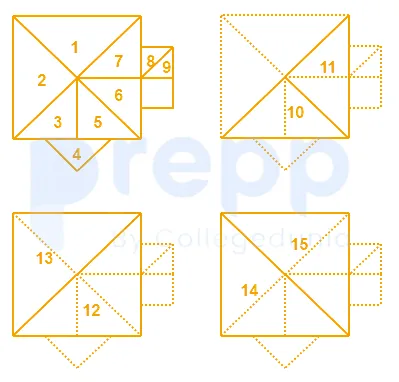
Find the number of triangles in the given figure.

- A
15
- B
13
- C
19
- D
17
Show answer
A. 15The number of triangles in the given figure is:
So, a total of 15 triangles in the figure.
Hence, ‘15’ is the correct answer.
 Paper & answer key PDF ↗
 Question 3archived
Select the option in which the numbers are NOT related in the same way as are the numbers of the following set.
(63, 76, 46)
- A
(45, 58, 28)
- B
(83, 96, 66)
- C
(69, 84, 52)
- D
(72, 85, 55)
Show answer
C. (69, 84, 52)Analyzing Number Set Relationships
The question asks us to find the set of numbers from the given options that does NOT share the same relationship as the numbers in the set (63, 76, 46). To solve this, we first need to identify the pattern or relationship between the numbers in the initial set (63, 76, 46).
Identifying the Pattern in the Given Set (63, 76, 46)
Let's examine the differences between the numbers in the set:
Difference between the second and first number: \(76 - 63 = 13\)
Difference between the first and third number: \(63 - 46 = 17\)
The pattern appears to be: the second number is 13 more than the first number, and the first number is 17 more than the third number. Let's verify this relationship.
If the relationship is \(B = A + 13\) and \(A = C + 17\), then for the set (63, 76, 46):
\(76 = 63 + 13\) (True)
\(63 = 46 + 17\) (True)
So, the established pattern is: (Third Number + 17, Third Number + 17 + 13, Third Number) or (Third Number + 17, Third Number + 30, Third Number). Equivalently, if the set is (A, B, C), then \(B = A + 13\) and \(A = C + 17\).
Testing the Options for the Number Set Relationship
Now, we will apply this pattern to each of the given options to see which one does not follow the same rule.
Option 1: (45, 58, 28)
Let's check the differences:
Second number - First number: \(58 - 45 = 13\)
First number - Third number: \(45 - 28 = 17\)
This option follows the pattern (\(58 = 45 + 13\) and \(45 = 28 + 17\)).
Option 2: (83, 96, 66)
Let's check the differences:
Second number - First number: \(96 - 83 = 13\)
First number - Third number: \(83 - 66 = 17\)
This option follows the pattern (\(96 = 83 + 13\) and \(83 = 66 + 17\)).
Option 3: (69, 84, 52)
Let's check the differences:
Second number - First number: \(84 - 69 = 15\)
First number - Third number: \(69 - 52 = 17\)
This option does NOT follow the pattern because the difference between the second and first number is 15, not 13.
Option 4: (72, 85, 55)
Let's check the differences:
Second number - First number: \(85 - 72 = 13\)
First number - Third number: \(72 - 55 = 17\)
This option follows the pattern (\(85 = 72 + 13\) and \(72 = 55 + 17\)).
Conclusion on Number Set Mismatch
Based on the analysis, Option 3 (69, 84, 52) is the only set where the numbers are not related in the same way as the numbers in the initial set (63, 76, 46). The pattern in the given set is that the second number is 13 more than the first, and the first number is 17 more than the third. Option 3 fails the first part of this pattern (\(84 - 69 = 15 \ne 13\)).
Set
Second - First
First - Third
Follows Pattern?
(63, 76, 46)
\(76 - 63 = 13\)
\(63 - 46 = 17\)
Yes (Base Pattern)
(45, 58, 28)
\(58 - 45 = 13\)
\(45 - 28 = 17\)
Yes
(83, 96, 66)
\(96 - 83 = 13\)
\(83 - 66 = 17\)
Yes
(69, 84, 52)
\(84 - 69 = 15\)
\(69 - 52 = 17\)
No
(72, 85, 55)
\(85 - 72 = 13\)
\(72 - 55 = 17\)
Yes
Therefore, the option in which the numbers are NOT related in the same way is (69, 84, 52).
Revision Table: Number Set Analysis
Concept
Description
Key Skill
Number Analogy
Finding the relationship between numbers in a given set.
Pattern Recognition
Pattern Identification
Observing differences, sums, or other mathematical operations between numbers.
Mathematical Operations
Option Testing
Applying the identified pattern to each option to find the one that doesn't fit.
Verification
Logical Reasoning
Using deductive reasoning to determine which option violates the established rule.
Critical Thinking
Additional Information: Numerical Reasoning and Pattern Recognition
Questions involving number sets and analogies are common in logical and numerical reasoning tests. They assess your ability to identify patterns and apply them consistently. Here are some common types of patterns to look for in number sets:
Arithmetic Progression: Constant difference between consecutive numbers (e.g., 2, 4, 6, 8...).
Geometric Progression: Constant ratio between consecutive numbers (e.g., 3, 9, 27, 81...).
Differences/Sums: Relationships based on adding or subtracting specific constants or variables between numbers in the set (as seen in this problem).
Products/Divisions: Relationships based on multiplying or dividing numbers.
Squares/Cubes: Numbers related to squares or cubes of integers (e.g., 4, 9, 16...).
Combinations: Patterns involving a mix of operations.
Positional Logic: Relationships might depend on the position of the numbers within the set (e.g., the third number is the sum of the first two).
To improve your skills in this area, practice is key. Try to solve various types of number series and analogy problems, systematically testing different potential relationships between the numbers.
Paper & answer key PDF ↗ Question 4archived
Select the option figure in which the given figure is embedded (rotation is NOT allowed).

- A
Option A (shown in image)
- B
Option B (shown in image)
- C
Option C (shown in image)
- D
Option D (shown in image)
Show answer
B. Option B (shown in image)The embedded part of this image is:
Hence, option (2) is the correct answer.
 Paper & answer key PDF ↗
 Question 5archived
Select the option in which the words share the same relationship as that shared by the given pair of words.
Help : Hinder
- A
Lenient : Forgiving
- B
Impulsive : Hasty
- C
Indigent : Rich
- D
Insipid : Plain
Show answer
C. Indigent : RichUnderstanding Word Relationships: Antonyms
The question asks us to identify the pair of words from the given options that shares the same relationship as the pair "Help : Hinder". To solve this, we first need to understand the relationship between "Help" and "Hinder".
Analysing the Relationship: Help : Hinder
The word 'Help' means to assist someone, to make it easier for them to do something. The word 'Hinder' means to create difficulties for someone or something, to impede or obstruct. Therefore, 'Help' and 'Hinder' have opposite meanings. They are antonyms.
So, the relationship we are looking for in the options is 'antonyms'.
Evaluating the Options
Let's examine each option to determine the relationship between the words in each pair:
Option 1: Lenient : Forgiving
'Lenient' means permissive, merciful, or tolerant. 'Forgiving' means ready or willing to forgive. These words have very similar meanings. They are synonyms. This is not the relationship we are looking for.
Option 2: Impulsive : Hasty
'Impulsive' means acting or doing something without thinking or planning. 'Hasty' means acting or moving with great speed, often carelessly. These words have similar meanings, suggesting action without proper thought. They are synonyms. This is not the relationship we are looking for.
Option 3: Indigent : Rich
'Indigent' means poor, needy, or impoverished. 'Rich' means having a lot of money or valuable possessions; wealthy. These words have opposite meanings. They are antonyms. This matches the relationship between 'Help' and 'Hinder'.
Option 4: Insipid : Plain
'Insipid' means lacking flavour; weak or tasteless. It can also mean lacking vigour or interest. 'Plain' means simple, ordinary, or unadorned. In the context of taste or interest, 'plain' can be similar to 'insipid'. These words share a similar meaning, especially when describing taste or lack of interest. They are synonyms. This is not the relationship we are looking for.
Conclusion and Correct Answer
Based on the analysis, only the pair 'Indigent : Rich' exhibits an antonymous relationship, which is the same relationship as 'Help : Hinder'.
Revision Table: Word Relationship Analysis
Word Pair
Meaning of First Word
Meaning of Second Word
Relationship
Help : Hinder
To assist or support
To obstruct or impede
Antonyms (Opposites)
Lenient : Forgiving
Merciful, tolerant
Willing to forgive
Synonyms (Similar)
Impulsive : Hasty
Acting without thought
Quick, often careless
Synonyms (Similar)
Indigent : Rich
Poor, needy
Wealthy, having much
Antonyms (Opposites)
Insipid : Plain
Lacking flavour or interest
Simple, ordinary, uninteresting
Synonyms (Similar)
Additional Information: Types of Word Relationships
Understanding different types of relationships between words is crucial for vocabulary and analogy questions. Some common types include:
Synonyms: Words with similar meanings (e.g., happy : joyful).
Antonyms: Words with opposite meanings (e.g., hot : cold).
Part to Whole: One word is a part of the other (e.g., finger : hand).
Cause and Effect: One word describes a cause, the other an effect (e.g., rain : flood).
Worker and Tool: One word is a person who works, the other is their tool (e.g., carpenter : hammer).
Action and Object: One word is an action, the other is the object it acts upon (e.g., read : book).
Identifying these relationships helps in solving analogy-based questions effectively.
Paper & answer key PDF ↗ Question 6archived
In a certain code language, 'LOWER' is coded as '186' and 'MULISH' is coded as '320'. How will 'OPTIONAL' be coded in that language?
- A
465
- B
456
- C
564
- D
546
Show answer
B. 456Decoding the Coding Pattern for 'OPTIONAL'
This question asks us to find the numerical code for the word 'OPTIONAL' based on a specific coding language pattern derived from the examples 'LOWER' being coded as '186' and 'MULISH' being coded as '320'. We need to identify this pattern first.
Step 1: Analyzing the Coding Rule
To find the pattern, let's examine the relationship between the letters of the given words and their corresponding codes. We will consider both the standard forward alphabet positions (A=1, B=2, ..., Z=26) and the reverse alphabet positions (A=26, B=25, ..., Z=1).
Examining 'LOWER' = 186
The word 'LOWER' has 5 letters: L, O, W, E, R.
Number of letters = 5.
Vowels: O, E (Count = 2).
Consonants: L, W, R (Count = 3).
Forward Alphabet Positions:
L $\rightarrow$ 12
O $\rightarrow$ 15
W $\rightarrow$ 23
E $\rightarrow$ 5
R $\rightarrow$ 18
The sum of these forward positions is $12 + 15 + 23 + 5 + 18 = 73$.
Reverse Alphabet Positions: (Calculated as $27 - \text{Forward Position}$)
L $\rightarrow$ $27 - 12 = 15$
O $\rightarrow$ $27 - 15 = 12$
W $\rightarrow$ $27 - 23 = 4$
E $\rightarrow$ $27 - 5 = 22$
R $\rightarrow$ $27 - 18 = 9$
The sum of these reverse positions is $15 + 12 + 4 + 22 + 9 = 62$.
Let's test possible operations:
Using forward sum: $73 \times (\text{Number of Consonants}) = 73 \times 3 = 219$. This is not 186.
Using reverse sum: $62 \times (\text{Number of Consonants}) = 62 \times 3 = 186$. This matches the code!
This suggests the pattern might be: (Sum of reverse alphabet positions) $\times$ (Number of consonants).
Verifying with 'MULISH' = 320
The word 'MULISH' has 6 letters: M, U, L, I, S, H.
Number of letters = 6.
Vowels: U, I (Count = 2).
Consonants: M, L, S, H (Count = 4).
Reverse Alphabet Positions:
M $\rightarrow$ $27 - 13 = 14$
U $\rightarrow$ $27 - 21 = 6$
L $\rightarrow$ $27 - 12 = 15$
I $\rightarrow$ $27 - 9 = 18$
S $\rightarrow$ $27 - 19 = 8$
H $\rightarrow$ $27 - 8 = 19$
The sum of these reverse positions is $14 + 6 + 15 + 18 + 8 + 19 = 80$.
Applying the potential pattern:
(Sum of reverse positions) $\times$ (Number of consonants) = $80 \times 4 = 320$.
This matches the given code for 'MULISH', confirming our identified pattern.
Step 2: Coding 'OPTIONAL'
Now we apply the confirmed pattern to the word 'OPTIONAL'.
The word 'OPTIONAL' has 8 letters: O, P, T, I, O, N, A, L.
Number of letters = 8.
Vowels: O, I, O, A (Count = 4).
Consonants: P, T, N, L (Count = 4).
Reverse Alphabet Positions:
O $\rightarrow$ $27 - 15 = 12$
P $\rightarrow$ $27 - 16 = 11$
T $\rightarrow$ $27 - 20 = 7$
I $\rightarrow$ $27 - 9 = 18$
O $\rightarrow$ $27 - 15 = 12$
N $\rightarrow$ $27 - 14 = 13$
A $\rightarrow$ $27 - 1 = 26$
L $\rightarrow$ $27 - 12 = 15$
The sum of these reverse positions is $12 + 11 + 7 + 18 + 12 + 13 + 26 + 15 = 114$.
Using the pattern: (Sum of reverse positions) $\times$ (Number of consonants):
Code = $114 \times 4 = 456$.
Final Conclusion
Following the coding rule derived from the examples, the numerical code for 'OPTIONAL' is calculated as 456.
Paper & answer key PDF ↗ Question 7archived
The sequence of folding a piece of paper and the manner in which the folded paper has been cut is shown in the following figures. How would this paper look when unfolded?

- A
Option A (shown in image)
- B
Option B (shown in image)
- C
Option C (shown in image)
- D
Option D (shown in image)
Show answer
Question 8archived
Select the combination of letters that when sequentially placed in the blanks of the given series will complete the series.
G_CT_GP_T_GPC_D_PC_D
- A
P, T, T, D, D, C, G
- B
P, D, D, C, G, T, T
- C
P, C, T, D, G, T, D
- D
P, D, C, D, T, G, T
Show answer
D. P, D, C, D, T, G, TSolving Letter Series: Identifying the Pattern
Letter series questions require you to find a pattern or rule governing the sequence of letters. Once the pattern is identified, you can use it to fill in the missing letters.
The given series is:
G_CT_GP_T_GPC_D_PC_D
There are 7 blanks in the series that need to be filled with letters from the options provided.
Testing the Options to Complete the Series
Let's try filling the blanks with the letters from the correct option to see if a clear pattern emerges. The correct option provides the sequence: P, D, C, D, T, G, T.
We will place these letters sequentially into the blanks in the original series:
Original series: G _ C T _ G P _ T _ G P C _ D _ P C _ D
Filling the 1st blank with 'P': G P C T _ G P _ T _ G P C _ D _ P C _ D
Filling the 2nd blank with 'D': G P C T D G P _ T _ G P C _ D _ P C _ D
Filling the 3rd blank with 'C': G P C T D G P C T _ G P C _ D _ P C _ D
Filling the 4th blank with 'D': G P C T D G P C T D G P C _ D _ P C _ D
Filling the 5th blank with 'T': G P C T D G P C T D G P C T D _ P C _ D
Filling the 6th blank with 'G': G P C T D G P C T D G P C T D G P C _ D
Filling the 7th blank with 'T': G P C T D G P C T D G P C T D G P C T D
Identifying the Repeating Pattern
After filling all the blanks with the letters from the sequence P, D, C, D, T, G, T, the completed series looks like this:
G P C T D G P C T D G P C T D G P C T D
Let's examine this completed series to find a repeating block of letters.
The series starts with G P C T D.
The next five letters are G P C T D again.
The next five letters are G P C T D again.
The final five letters are G P C T D again.
This clearly shows that the block of letters 'GPCTD' is repeating itself four times consecutively to form the complete series.
The letters used to fill the blanks, in order, were the ones that fit perfectly into this repeating 'GPCTD' pattern at each blank position.
Blank 1: G P C T D
Blank 2: G P C T D
Blank 3: G P C T D
Blank 4: G P C T D
Blank 5: G P C T D
Blank 6: G P C T D G P C T D
Blank 7: G P C T D
Therefore, the sequence of letters P, D, C, D, T, G, T successfully completes the series by following the repeating pattern 'GPCTD'.
Revision Table: Letter Series Concepts
Concept
Description
Letter Series
A sequence of letters that follow a specific pattern or rule.
Pattern Recognition
The process of identifying the underlying rule or repeating block in a series.
Repeating Pattern
A block of letters or numbers that repeats itself consistently in the series.
Alternating Pattern
Different patterns applied to alternate letters or blocks in the series.
Alphabetical Progression
Patterns based on the position of letters in the alphabet (e.g., skipping letters).
Additional Information: Types of Letter Series Patterns
Letter series questions can have various types of patterns. Recognizing these common types can help you solve problems faster.
Repeating Block: A fixed sequence of letters repeats throughout the series, as seen in this problem with 'GPCTD'.
Alphabetical Jump: The difference in alphabetical position between consecutive letters follows a pattern (e.g., +1, +2, +3 or +2, -1, +2, -1).
Alternating Series: Two or more independent series are interleaved.
Missing Letters within a Block: Each block might have a set of letters, and the pattern involves which letter is missing or swapped in each subsequent block.
Combination of Patterns: A series might combine two or more different rules.
Solving letter series requires careful observation and systematic testing of potential patterns based on the letters present and the structure of the blanks.
Paper & answer key PDF ↗ Question 9archived
In a certain code language, ‘PAWAN’ is written as ‘SCZCQ’ and ‘SOHAM’ is written as ‘VQKCP’. How will ‘KIRAN’ be written in that language?
- A
MJUCQ
- B
NKUCQ
- C
MJVQR
- D
NLVDQ
Show answer
B. NKUCQUnderstanding the Coding Pattern in Code Language Questions
This question involves deciphering a specific code language where words are transformed based on a consistent rule or pattern. We are given two examples of this transformation: ‘PAWAN’ coded as ‘SCZCQ’ and ‘SOHAM’ coded as ‘VQKCP’. Our goal is to find the pattern and apply it to encode the word ‘KIRAN’.
Analyzing the Given Code Examples
Let's compare the letters of the original words with their corresponding letters in the coded words to identify the pattern.
Analyzing PAWAN to SCZCQ:
P to S: Moving from P to S in the alphabet requires moving 3 steps forward (P → Q → R → S). This is a +3 increment.
A to C: Moving from A to C requires moving 2 steps forward (A → B → C). This is a +2 increment.
W to Z: Moving from W to Z requires moving 3 steps forward (W → X → Y → Z). This is a +3 increment.
A to C: Moving from A to C requires moving 2 steps forward (A → B → C). This is a +2 increment.
N to Q: Moving from N to Q requires moving 3 steps forward (N → O → P → Q). This is a +3 increment.
The pattern observed for 'PAWAN' is a sequence of increments: +3, +2, +3, +2, +3 for the respective letters.
Analyzing SOHAM to VQKCP:
Let's verify if the same pattern applies to the second example, ‘SOHAM’ to ‘VQKCP’.
S to V: S → T → U → V (+3)
O to Q: O → P → Q (+2)
H to K: H → I → J → K (+3)
A to C: A → B → C (+2)
M to P: M → N → O → P (+3)
The pattern +3, +2, +3, +2, +3 is consistent across both examples.
Applying the Pattern to KIRAN
Now, we apply the established pattern (+3, +2, +3, +2, +3) to the word ‘KIRAN’ to find its code.
K: Apply +3 increment. K → L → M → N. The first letter is N.
I: Apply +2 increment. I → J → K. The second letter is K.
R: Apply +3 increment. R → S → T → U. The third letter is U.
A: Apply +2 increment. A → B → C. The fourth letter is C.
N: Apply +3 increment. N → O → P → Q. The fifth letter is Q.
Combining the resulting letters, the code for ‘KIRAN’ is NKUCQ.
Conclusion
By analyzing the given examples, we found a consistent letter-increment pattern (+3, +2, +3, +2, +3). Applying this pattern to the word ‘KIRAN’ yields the coded word ‘NKUCQ’.
Original Letter
Increment
Coded Letter
K
+3
N
I
+2
K
R
+3
U
A
+2
C
N
+3
Q
Revision Table: Key Concepts in Coding-Decoding
Coding-decoding questions test your ability to identify patterns in letter or number sequences. Understanding the basics helps solve these problems.
Concept
Description
Example Pattern Types
Letter Coding
Letters are replaced by other letters based on a rule.
Shifting (e.g., +N, -N), Opposite letters, Jumbled letters.
Number/Symbol Coding
Words/letters are replaced by numbers or symbols.
Direct coding, Positional value coding, Applying arithmetic operations.
Mixed Coding
Words in sentences are coded. Usually requires comparing multiple sentences.
Finding common words/codes, Elimination method.
Additional Information: Alphabet Positions and Reasoning
Knowing the alphabetical position of each letter can be very useful in solving coding-decoding problems based on letter shifts or increments.
The standard English alphabet has 26 letters:
A=1, B=2, C=3, D=4, E=5, F=6, G=7, H=8, I=9, J=10, K=11, L=12, M=13, N=14, O=15, P=16, Q=17, R=18, S=19, T=20, U=21, V=22, W=23, X=24, Y=25, Z=26.
In this specific problem, we used simple forward counting from the original letter based on the increment value (+2 or +3).
For example, for K (+3): K is the 11th letter. \(11 + 3 = 14\). The 14th letter is N. This matches our result.
For I (+2): I is the 9th letter. \(9 + 2 = 11\). The 11th letter is K. This also matches.
This method confirms the pattern based on numerical positions as well.
Paper & answer key PDF ↗ Question 10archived
Four number-pairs have been given, out of which three are alike in some manner and one is different. Select the number-pair that is different.
- A
17 ∶ 60
- B
13 ∶ 90
- C
23 ∶ 84
- D
19 ∶ 68
Show answer
B. 13 ∶ 90Analyzing Number Pairs to Find the Odd One Out
This question asks us to identify the number pair that is different from the other three given pairs. This is a common type of logical reasoning problem where we need to find a pattern or rule that applies to most of the given options and then find the one that doesn't follow that rule.
Finding the Pattern in Number Pairs
We are given four number pairs:
17 : 60
13 : 90
23 : 84
19 : 68
Let's examine the relationship between the first number and the second number in each pair. We look for a consistent mathematical operation or set of operations that connects the two numbers in at least three of the pairs.
Let the first number be \(x\) and the second number be \(y\). We need to find a rule like \(y = f(x)\) that holds true for most pairs.
Testing Potential Patterns
Let's try multiplying the first number by a small integer and adding or subtracting a constant to see if we can arrive at the second number.
Analyzing Pair 1: 17 : 60
Let's try multiplying 17 by different numbers:
$17 \times 3 = 51$. To get 60, we add $60 - 51 = 9$. So, $17 \times 3 + 9 = 60$.
$17 \times 4 = 68$. To get 60, we subtract $68 - 60 = 8$. So, $17 \times 4 - 8 = 60$.
Let's test if either of these patterns works for other pairs.
Analyzing Pair 2: 13 : 90
Let's test the patterns found from Pair 1:
Using $x \times 3 + 9$: $13 \times 3 + 9 = 39 + 9 = 48$. This is not 90.
Using $x \times 4 - 8$: $13 \times 4 - 8 = 52 - 8 = 44$. This is not 90.
This pair might be the different one, but let's check the other two pairs first.
Analyzing Pair 3: 23 : 84
Let's test the patterns again:
Using $x \times 3 + 9$: $23 \times 3 + 9 = 69 + 9 = 78$. This is not 84.
Using $x \times 4 - 8$: $23 \times 4 - 8 = 92 - 8 = 84$. This matches the second number!
So, Pair 3 (23 : 84) follows the pattern \(y = x \times 4 - 8\).
Analyzing Pair 4: 19 : 68
Let's test the pattern \(y = x \times 4 - 8\):
Using $x \times 4 - 8$: $19 \times 4 - 8 = 76 - 8 = 68$. This matches the second number!
So, Pair 4 (19 : 68) also follows the pattern \(y = x \times 4 - 8\).
Identifying the Different Number Pair
We found that:
Pair 1 (17 : 60) follows the pattern $17 \times 4 - 8 = 60$.
Pair 3 (23 : 84) follows the pattern $23 \times 4 - 8 = 84$.
Pair 4 (19 : 68) follows the pattern $19 \times 4 - 8 = 68$.
However, Pair 2 (13 : 90) does not follow this pattern, as $13 \times 4 - 8 = 44$, which is not 90.
Therefore, the number pair that is different from the others is 13 : 90.
Summary of Findings
Number Pair (x : y)
Calculation (x * 4 - 8)
Result
Matches y?
17 : 60
$17 \times 4 - 8 = 68 - 8$
60
Yes
13 : 90
$13 \times 4 - 8 = 52 - 8$
44
No (Should be 90)
23 : 84
$23 \times 4 - 8 = 92 - 8$
84
Yes
19 : 68
$19 \times 4 - 8 = 76 - 8$
68
Yes
The table clearly shows that the pair 13 : 90 is the one that does not fit the pattern \(y = x \times 4 - 8\) that the other three pairs follow.
Revision Table - Number Pair Reasoning
Concept
Description
How it Applied Here
Odd One Out
Identifying the item/number/pair that doesn't follow the rule or pattern shared by others.
We looked for the pair not following the dominant pattern.
Pattern Recognition
Finding a consistent relationship (mathematical, logical, etc.) among a set of items.
The pattern found was $y = x \times 4 - 8$.
Testing Options
Applying the discovered pattern to each option to verify its consistency.
We tested $x \times 4 - 8$ for all four pairs.
Additional Information - Logical Reasoning Tips
When tackling logical reasoning questions involving number pairs or series, consider the following strategies:
Look for basic arithmetic operations: Addition, subtraction, multiplication, division between the numbers.
Consider squares and cubes: The numbers might be related to squares or cubes of the first number or related to numbers near squares/cubes.
Combine operations: The pattern could involve multiplication/division followed by addition/subtraction (like in this problem).
Check digit properties: Sometimes the pattern involves the sum or product of the digits of the numbers.
Prime and composite numbers: The pattern might relate to whether the numbers are prime or composite.
Difference or ratio: Look at the difference or ratio between the numbers. Is it constant or following a pattern?
Always test your potential pattern against all the given options to confirm it works for the majority before concluding which one is the odd one out.
Paper & answer key PDF ↗ Question 11archived
Select the number from among the given options that can replace the question mark (?) in the following series.
11, 13, 19, 49, 109, 239, ?
- A
449
- B
394
- C
349
- D
494
Show answer
A. 449Analyzing the Number Series Pattern
The given number series is 11, 13, 19, 49, 109, 239, ?. We need to identify the underlying pattern governing this sequence to find the missing number.
Let's examine the differences between consecutive terms:
Difference between 13 and 11: \(13 - 11 = 2\)
Difference between 19 and 13: \(19 - 13 = 6\)
Difference between 49 and 19: \(49 - 19 = 30\)
Difference between 109 and 49: \(109 - 49 = 60\)
Difference between 239 and 109: \(239 - 109 = 130\)
The sequence of differences is 2, 6, 30, 60, 130. Let's analyze this new sequence to find its pattern.
Identifying the Pattern in Differences
Let the sequence of differences be denoted by \(d_n\), where \(d_n\) is the difference between the \((n+1)\)-th term and the \(n\)-th term of the original series. So, \(d_1 = 2\), \(d_2 = 6\), \(d_3 = 30\), \(d_4 = 60\), \(d_5 = 130\).
Let's try to relate \(d_n\) to its index \(n\):
For \(n=1\), \(d_1 = 2\). Observe \(1^3 + 1 = 1 + 1 = 2\).
For \(n=2\), \(d_2 = 6\). Observe \(2^3 - 2 = 8 - 2 = 6\).
For \(n=3\), \(d_3 = 30\). Observe \(3^3 + 3 = 27 + 3 = 30\).
For \(n=4\), \(d_4 = 60\). Observe \(4^3 - 4 = 64 - 4 = 60\).
For \(n=5\), \(d_5 = 130\). Observe \(5^3 + 5 = 125 + 5 = 130\).
The pattern for the differences seems to be:
If the index \(n\) is odd, the difference \(d_n = n^3 + n\).
If the index \(n\) is even, the difference \(d_n = n^3 - n\).
Calculating the Next Term
The given series has 6 terms. The next term is the 7th term. To find the 7th term, we need to add the 6th difference (\(d_6\)) to the 6th term (239).
Using the pattern for differences, for \(n=6\) (which is an even index), the difference \(d_6\) is calculated as:
\(d_6 = 6^3 - 6\)
\(d_6 = 216 - 6\)
\(d_6 = 210\)
Now, we add this difference to the last term of the series:
Missing term = 6th term + \(d_6\)
Missing term = \(239 + 210\)
Missing term = \(449\)
Thus, the next number in the series is 449.
Conclusion
The pattern of the series is that the difference between consecutive terms follows the sequence \(d_n\), where \(d_n = n^3 + n\) for odd \(n\) and \(d_n = n^3 - n\) for even \(n\). Following this pattern, the next difference is \(d_6 = 6^3 - 6 = 210\). Adding this to the last term (239) gives \(239 + 210 = 449\).
Term (\(a_n\))
Value
Difference (\(d_n = a_{n+1} - a_n\))
Pattern for difference (\(d_n\))
\(a_1\)
11
\(d_1 = 13 - 11 = 2\)
\(1^3 + 1 = 2\) (n=1, odd)
\(a_2\)
13
\(d_2 = 19 - 13 = 6\)
\(2^3 - 2 = 6\) (n=2, even)
\(a_3\)
19
\(d_3 = 49 - 19 = 30\)
\(3^3 + 3 = 30\) (n=3, odd)
\(a_4\)
49
\(d_4 = 109 - 49 = 60\)
\(4^3 - 4 = 60\) (n=4, even)
\(a_5\)
109
\(d_5 = 239 - 109 = 130\)
\(5^3 + 5 = 130\) (n=5, odd)
\(a_6\)
239
\(d_6 = ?\)
\(6^3 - 6 = 210\) (n=6, even)
\(a_7\)
\(239 + 210 = 449\)
Revision Table: Number Series Patterns
Understanding different types of number series patterns is crucial for solving logical reasoning questions. Here are some common types:
Arithmetic Series: Constant difference between terms.
Geometric Series: Constant ratio between terms.
Difference Series: Pattern in the differences between consecutive terms (as seen in this problem).
Double Difference Series: Pattern in the differences of the differences.
Mixed Series: Combination of two or more patterns.
Series based on squares, cubes, primes, or other special numbers.
Alternating Series: Different patterns applied to alternate terms.
Additional Information: Solving Number Series Problems
When faced with a number series question, follow a systematic approach:
Look for simple patterns first: arithmetic or geometric progression.
Calculate the differences between terms. If no simple pattern, calculate the differences of differences.
Look for patterns involving squares, cubes, or multiples of the term index.
Consider if the pattern involves multiplication/division and addition/subtraction.
Check for alternating patterns.
Sometimes, the pattern might relate terms to the first term or a fixed number.
Always verify the identified pattern across all the given terms before predicting the next term.
Paper & answer key PDF ↗ Question 12archived
Select the option in which the numbers are related in the same way as are the numbers of the following set.
(4, 282, 5)
- A
(3, 405, 6)
- B
(7, 152, 3)
- C
(2, 84, 4)
- D
(5, 25, 1)
Show answer
B. (7, 152, 3)Correct answer: (7, 152, 3)
Solving number relation problems like this one involves:
Carefully observing the numbers in the given set.
Trying different mathematical operations and combinations (addition, subtraction, multiplication, division, squares, cubes, etc.).
Testing potential relationships between the numbers (often involving the first and third numbers to get the second).
Verifying the discovered relationship with the original set.
Applying the confirmed relationship to each option to find the matching set.
Pattern identification is a key skill in logical reasoning and quantitative aptitude. Number relation questions test your ability to see connections and rules governing sequences or sets of numbers. Practice with various types of patterns – arithmetic, geometric, polynomial, based on squares/cubes, or combinations of operations – will improve your speed and accuracy in identifying the underlying logic during exams.
Paper & answer key PDF ↗ Question 13archived
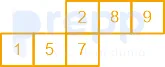
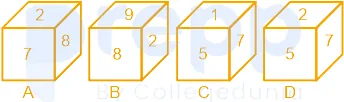
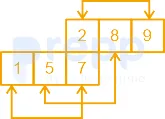
Select the cubes that can be formed by folding the given sheet along the lines.
- A
Only A, C and D
- B
Only B, C and D
- C
Only B and C
- D
Only A and D
Show answer
D. Only A and DNumbers
Opposite
1
7
5
8
2
9
Note:- Two opposite faces are never seen together or adjacent to each other.
In figure (A): None of the opposite faces are seen together nor they are adjacent to each other. Thus this cube can be made.
In figure (B): 9 and 2 are opposite faces but here they are seen together which is wrong. Thus this cube cannot be made.
In figure (C): 1 and 7 are opposite faces but here they are seen together which is wrong. Thus this cube cannot be made.
In figure (D):None of the opposite faces are seen together nor they are adjacent to each other. Thus this cube can be made.
Hence, ‘ Only A and D ’ is the correct answer.
 Paper & answer key PDF ↗
 Question 14archived
Read the given statements and conclusions carefully. Assuming that the information given in the statements is true, even if it appears to be at variance with commonly known facts, decide which of the given conclusions logically follow(s) from the statements.
Statements:
All teachers are doctors.
Some professors are doctors.
All professors are engineers.
Conclusions:
I. All professors are doctors.
II. Some doctors are engineers.
III. Some teachers are engineers.
IV. Some teachers are professors
- A
All conclusions I, II, III and IV follow
- B
Only conclusions I, II and IV follow
- C
Only conclusions II, III and IV follow
- D
Only conclusion II follows
Show answer
D. Only conclusion II followsLogical Reasoning Syllogism Analysis
This question falls under the category of logical reasoning, specifically syllogisms. We are given a set of statements and need to determine which of the given conclusions logically follow from these statements, assuming the statements are true.
Understanding the Statements
Let's break down the given statements:
All teachers are doctors.
Some professors are doctors.
All professors are engineers.
Analyzing the Conclusions
We will now analyze each conclusion based on the provided statements. We can use Venn diagrams or simple logical deduction to visualize the relationships.
Conclusion I: All professors are doctors.
From Statement 2, we know that only some professors are doctors. This directly contradicts the conclusion that all professors are doctors. Therefore, Conclusion I does not follow.
Conclusion II: Some doctors are engineers.
Let's combine Statements 2 and 3:
Statement 2: Some professors are doctors. (This means there is an intersection between the set of Professors and the set of Doctors).
Statement 3: All professors are engineers. (This means the set of Professors is entirely contained within the set of Engineers).
If some professors are doctors, and all professors are engineers, then the group of professors who are doctors must also be engineers. This means there are some individuals who are both doctors and engineers. Therefore, the intersection between the set of Doctors and the set of Engineers is non-empty. Conclusion II logically follows from the statements.
We can represent this relation using set notation:
From Statement 2: \( \text{Professors} \cap \text{Doctors} \neq \emptyset \)
From Statement 3: \( \text{Professors} \subseteq \text{Engineers} \)
Since \( (\text{Professors} \cap \text{Doctors}) \subseteq \text{Professors} \) and \( \text{Professors} \subseteq \text{Engineers} \), it follows that \( (\text{Professors} \cap \text{Doctors}) \subseteq \text{Engineers} \). Since \( \text{Professors} \cap \text{Doctors} \neq \emptyset \), and this set is a subset of Engineers, it must be that \( \text{Doctors} \cap \text{Engineers} \neq \emptyset \). This confirms Conclusion II.
Conclusion III: Some teachers are engineers.
From Statement 1, we know that all teachers are doctors. From our analysis of Conclusion II, we know that some doctors are engineers. However, the doctors who are engineers might not be the specific doctors who are also teachers. The set of teachers is a subset of doctors, but there is no information linking teachers directly or indirectly (through professors) to engineers that guarantees an overlap. Therefore, Conclusion III does not necessarily follow.
Conclusion IV: Some teachers are professors.
From Statement 1, all teachers are doctors. From Statement 2, some professors are doctors. Both groups (teachers and some professors) are within the set of doctors. However, the statements do not provide any information about the relationship between teachers and professors. It is possible that the set of teachers (a subset of doctors) and the set of professors (some of whom are doctors and all of whom are engineers) do not overlap at all. Therefore, Conclusion IV does not necessarily follow.
Summary of Conclusions
Conclusion
Logically Follows?
Reasoning
I. All professors are doctors.
No
Statement 2 says 'Some professors are doctors', not all.
II. Some doctors are engineers.
Yes
Some professors are doctors, and all professors are engineers. This overlapping group means some doctors must be engineers.
III. Some teachers are engineers.
No
All teachers are doctors, and some doctors are engineers, but the doctors who are engineers might not be the teachers.
IV. Some teachers are professors.
No
Teachers are doctors, and some professors are doctors, but there is no guaranteed overlap between the set of teachers and the set of professors.
Final Answer Analysis
Based on our analysis, only Conclusion II logically follows from the given statements.
Revision Table: Syllogism Concepts
Term
Explanation
Example based on Statements
Universal Affirmative (All A are B)
The entire set of A is included in the set of B.
All teachers are doctors. (Teachers \(\subseteq\) Doctors)
Particular Affirmative (Some A are B)
There is at least one element common to both sets A and B.
Some professors are doctors. (Professors \(\cap\) Doctors \(\neq \emptyset\))
Syllogism
A form of reasoning where a conclusion is drawn from two or more premises (statements).
The entire question structure.
Logical Deduction
Deriving conclusions that are guaranteed to be true if the premises are true.
Method used to check each conclusion.
Additional Information: Solving Syllogism Questions
Syllogism questions are common in competitive exams and test your ability to reason logically. Here are a few tips for solving them effectively:
Read Carefully: Pay close attention to quantifiers like "All", "Some", "No", and "Some not".
Assume Statements are True: Even if a statement seems factually incorrect in the real world, you must assume it is true for the purpose of the question.
Use Visual Aids: Venn diagrams are a very effective tool for visualizing the relationships between categories described in the statements. Draw overlapping or contained circles to represent the sets.
Avoid Outside Knowledge: Do not use any information or common knowledge outside of what is given in the statements.
Check Each Conclusion Individually: Evaluate whether each conclusion is necessarily true based only on the statements. If there is any possibility, however remote, that the conclusion is false given the statements, then it does not follow.
Practicing with different types of statements (universal negative, particular negative) will help you become more comfortable with syllogistic reasoning.
Paper & answer key PDF ↗ Question 15archived
Select the option that is related to the third number in the same way as the second number is related to the first number.
39 : 91 :: 51 : ?
- A
125
- B
93
- C
178
- D
119
Show answer
D. 119Solving Number Analogy: 39 : 91 :: 51 : ?
The question asks us to find a number that shares the same relationship with 51 as 91 shares with 39. This is a classic number analogy problem where we need to identify the pattern or rule connecting the first pair of numbers and apply it to the third number to find the fourth one.
Analyzing the Relationship between 39 and 91
Let's look for possible relationships between 39 and 91. Common relationships include arithmetic operations (addition, subtraction, multiplication, division), squares, cubes, prime numbers, or relationships based on factors.
Difference: \(91 - 39 = 52\). If we add 52 to 51, we get \(51 + 52 = 103\), which is not among the options.
Ratio: \(91 / 39\) is not a simple ratio.
Let's examine the factors of 39 and 91:
\(39 = 3 \times 13\)
\(91 = 7 \times 13\)
We can see a common factor, 13, in both numbers. The multipliers for 13 are 3 and 7. The relationship between the multipliers (3 and 7) is that \(7 = 3 + 4\). So, the pattern seems to be: multiply a common factor by 3 for the first number, and multiply the same common factor by \(3+4=7\) for the second number.
Applying the Pattern to 51
Now let's apply this pattern to the third number, 51. We need to find factors of 51. \(51 = 3 \times 17\). Using the discovered pattern, we can consider 17 as the common factor (analogous to 13 in the first pair) and 3 as the initial multiplier (analogous to 3 in the first pair).
According to the pattern, the fourth number should be obtained by multiplying the common factor (17) by the second multiplier, which is the initial multiplier plus 4. The initial multiplier for 51 is 3.
Second multiplier \( = 3 + 4 = 7\).
Fourth number \( = \text{Common Factor} \times \text{Second Multiplier}\)
Fourth number \( = 17 \times 7\).
Calculating \(17 \times 7\):
\[
\begin{array}{@{}c@{\,}c}
& 17 \\
\times & 7 \\
\hline
& 119 \\
\hline
\end{array}
\]
So, the fourth number is 119.
Checking the Options
The calculated fourth number is 119. Let's check if this is available in the given options:
Option 1: 125
Option 2: 93
Option 3: 178
Option 4: 119
The number 119 matches Option 4.
Summary of the Analogy Pattern
The relationship between the numbers is based on factoring them and applying a consistent rule to the multipliers.
First Pair: \(39 : 91\)
\(3 \times 13 : 7 \times 13\) or \(3 \times 13 : (3+4) \times 13\)
Second Pair: \(51 : ?\)
\(3 \times 17 : (3+4) \times 17\) or \(3 \times 17 : 7 \times 17\)
Thus, the missing number is \(7 \times 17 = 119\).
Pair
First Number
Second Number
Pattern Identified
1st Pair
39
91
\(39 = 3 \times 13\), \(91 = 7 \times 13\). Multipliers are 3 and 7 (\(3+4\)). Common factor is 13.
2nd Pair
51
?
\(51 = 3 \times 17\). Initial multiplier is 3. Common factor is 17.
Result
119
Apply pattern to 51: \( (3+4) \times 17 = 7 \times 17 = 119 \).
The relationship holds true for the selected option.
Revision Table: Key Concepts in Number Analogy
Concept
Description
Example (from this problem)
Analogy
Finding a similar relationship between two pairs of elements.
39:91 :: 51:? (Relationship between 39 and 91 is like 51 and ?)
Pattern Identification
Discovering the rule connecting the elements in the first pair.
\(39 = 3 \times 13\), \(91 = 7 \times 13\). Rule: \((M \times F) : ((M+4) \times F)\).
Factorization
Breaking down a number into its constituent prime or composite factors.
\(39 = 3 \times 13\), \(91 = 7 \times 13\), \(51 = 3 \times 17\).
Applying the Rule
Using the identified pattern to find the missing element.
Using the rule on 51 \( (3 \times 17) \) to find the fourth number \( (3+4) \times 17 = 119 \).
Additional Information: Types of Number Analogy Reasoning
Number analogy questions can involve various types of relationships:
Arithmetic Operations: Addition, subtraction, multiplication, division, or a combination of these.
Squares and Cubes: The numbers might be squares or cubes of other numbers, or related by adding/subtracting from squares/cubes.
Prime Numbers: The relationship might involve prime numbers or operations on prime numbers.
Factorization and Multiples: Relationships based on factors, multiples, or common factors as seen in this problem.
Digit Operations: Sum of digits, product of digits, reversing digits, etc.
Sequential Patterns: Relationships based on sequences like arithmetic progression, geometric progression, etc.
Combinations: Often, the pattern is a combination of two or more simple rules.
Solving number analogy problems requires careful observation, knowledge of basic number properties, and systematic testing of possible relationships.
Paper & answer key PDF ↗ Question 16archived
Select the letter-cluster from among the given options that can replace the question mark (?) in the following series.
PND, QKI, RHN, SES, ?
- A
SCX
- B
SXC
- C
TBX
- D
TXB
Show answer
C. TBXAnalyzing Letter Series Patterns
This question asks us to find the next term in a letter-cluster series: PND, QKI, RHN, SES, ?. To solve this type of letter series problem, we need to examine the pattern in each position of the letters across the clusters.
Step-by-Step Pattern Identification
Let's break down the series by looking at the first, second, and third letters of each cluster separately.
Pattern in the First Letter
The first letters are P, Q, R, S, ...
P is the 16th letter of the alphabet.
Q is the 17th letter (P + 1).
R is the 18th letter (Q + 1).
S is the 19th letter (R + 1).
The pattern for the first letter is an increment of 1 in the alphabetical position each time. Following this pattern, the next first letter should be the 20th letter, which is T.
So, the first letter of the next cluster is T.
Pattern in the Second Letter
The second letters are N, K, H, E, ...
N is the 14th letter.
K is the 11th letter (N - 3).
H is the 8th letter (K - 3).
E is the 5th letter (H - 3).
The pattern for the second letter is a decrement of 3 in the alphabetical position each time. Following this pattern, the next second letter should be the 2nd letter (5 - 3 = 2), which is B.
So, the second letter of the next cluster is B.
Pattern in the Third Letter
The third letters are D, I, N, S, ...
D is the 4th letter.
I is the 9th letter (D + 5).
N is the 14th letter (I + 5).
S is the 19th letter (N + 5).
The pattern for the third letter is an increment of 5 in the alphabetical position each time. Following this pattern, the next third letter should be the 24th letter (19 + 5 = 24), which is X.
So, the third letter of the next cluster is X.
Combining the Patterns
By combining the next letters found for each position (First: T, Second: B, Third: X), the next letter-cluster in the series is TBX.
Verifying the Options
Let's compare our derived cluster TBX with the given options:
Option 1: SCX (Does not match TBX)
Option 2: SXC (Does not match TBX)
Option 3: TBX (Matches TBX)
Option 4: TXB (Does not match TBX)
The letter-cluster TBX matches Option 3.
Summary of Patterns
Position
Series
Pattern
Next Letter (Alphabetical Position)
First
P, Q, R, S, ?
Position increases by 1 ($+1$)
S (19) $\rightarrow$ T (19+1=20)
Second
N, K, H, E, ?
Position decreases by 3 ($-3$)
E (5) $\rightarrow$ B (5-3=2)
Third
D, I, N, S, ?
Position increases by 5 ($+5$)
S (19) $\rightarrow$ X (19+5=24)
The next letter-cluster is formed by combining these next letters: T, B, and X, resulting in TBX.
Revision Table: Letter Series Analysis
Understanding patterns in letter series is key to solving such reasoning questions. This table summarizes the process:
Step
Action
Purpose
1
Identify letter clusters
Break down the series into individual clusters.
2
Analyze letters at each position
Look at the first letters together, second letters together, and so on.
3
Determine the pattern for each position
Find the relationship (addition, subtraction, skipping letters, etc.) between consecutive letters in each position series.
4
Apply the pattern to find the next letter
Use the identified pattern to predict the next letter for each position.
5
Combine the next letters
Form the complete next letter cluster.
6
Compare with options
Match the derived cluster with the given choices.
Additional Information: Types of Letter Series
Letter series can follow various patterns. Some common types include:
Alphabetical order progression (e.g., A, B, C)
Skipping letters (e.g., A, C, E - skipping one letter each time)
Reverse alphabetical order (e.g., Z, Y, X)
Combined patterns (like in this problem, mixing addition and subtraction in different positions)
Patterns involving letter positions (using A=1, B=2, etc.)
Repeating patterns or sequences
Practicing different types of letter series helps improve reasoning skills for competitive exams.
Paper & answer key PDF ↗ Question 17archived
Four letter-clusters have been given, out of which three are alike in some manner and one is different. Select the letter-cluster that is different.
- A
LNJP
- B
GIEY
- C
PRNT
- D
FHDJ
Show answer
B. GIEYFinding the Different Letter Cluster
The question asks us to identify the letter cluster that is different from the others based on a specific pattern. To solve this type of problem, we usually look at the positions of the letters in the English alphabet and find a numerical pattern or rule that connects the letters in each cluster.
Analyzing Letter Clusters Using Alphabetical Positions
Let's assign a numerical value to each letter based on its position in the English alphabet (A=1, B=2, ..., Z=26).
Letter
Position
A
1
B
2
C
3
D
4
E
5
F
6
G
7
H
8
I
9
J
10
K
11
L
12
M
13
N
14
O
15
P
16
Q
17
R
18
S
19
T
20
U
21
V
22
W
23
X
24
Y
25
Z
26
Now, let's examine each letter cluster provided in the options:
Analyzing LNJP Letter Cluster
L is the 12th letter.
N is the 14th letter. The difference is $\text{14} - \text{12} = +2$.
J is the 10th letter. The difference is $\text{10} - \text{14} = -4$.
P is the 16th letter. The difference is $\text{16} - \text{10} = +6$.
The pattern of differences for LNJP is +2, -4, +6.
Analyzing GIEY Letter Cluster
G is the 7th letter.
I is the 9th letter. The difference is $\text{9} - \text{7} = +2$.
E is the 5th letter. The difference is $\text{5} - \text{9} = -4$.
Y is the 25th letter. The difference is $\text{25} - \text{5} = +20$.
The pattern of differences for GIEY is +2, -4, +20.
Analyzing PRNT Letter Cluster
P is the 16th letter.
R is the 18th letter. The difference is $\text{18} - \text{16} = +2$.
N is the 14th letter. The difference is $\text{14} - \text{18} = -4$.
T is the 20th letter. The difference is $\text{20} - \text{14} = +6$.
The pattern of differences for PRNT is +2, -4, +6.
Analyzing FHDJ Letter Cluster
F is the 6th letter.
H is the 8th letter. The difference is $\text{8} - \text{6} = +2$.
D is the 4th letter. The difference is $\text{4} - \text{8} = -4$.
J is the 10th letter. The difference is $\text{10} - \text{4} = +6$.
The pattern of differences for FHDJ is +2, -4, +6.
Comparing the Patterns
Let's summarize the patterns found for each letter cluster:
LNJP: +2, -4, +6
GIEY: +2, -4, +20
PRNT: +2, -4, +6
FHDJ: +2, -4, +6
We can see that the pattern for letter clusters LNJP, PRNT, and FHDJ is consistently +2, -4, +6 based on the alphabetical positions of the letters. However, the letter cluster GIEY follows a different pattern in the last step (+20 instead of +6).
Conclusion: Identifying the Different Cluster
Based on the analysis of the alphabetical positions and the differences between consecutive letters, the letter cluster GIEY does not follow the same pattern as the other three clusters. Therefore, GIEY is the different one.
Letter Cluster
Letter Positions
Differences
Pattern
LNJP
12, 14, 10, 16
14-12=2, 10-14=-4, 16-10=6
+2, -4, +6
GIEY
7, 9, 5, 25
9-7=2, 5-9=-4, 25-5=20
+2, -4, +20
PRNT
16, 18, 14, 20
18-16=2, 14-18=-4, 20-14=6
+2, -4, +6
FHDJ
6, 8, 4, 10
8-6=2, 4-8=-4, 10-4=6
+2, -4, +6
The letter cluster GIEY is the outlier because its third difference is +20, while the others have a third difference of +6.
Revision Table: Letter Cluster Patterns
Letter Cluster
Numerical Sequence
Difference 1
Difference 2
Difference 3
Overall Pattern
LNJP
12, 14, 10, 16
+2
-4
+6
+2, -4, +6
GIEY
7, 9, 5, 25
+2
-4
+20
+2, -4, +20
PRNT
16, 18, 14, 20
+2
-4
+6
+2, -4, +6
FHDJ
6, 8, 4, 10
+2
-4
+6
+2, -4, +6
This table clearly shows how GIEY deviates from the pattern followed by the other letter clusters.
Additional Information: Letter Series Reasoning
Letter series or letter cluster problems in reasoning tests often rely on patterns based on:
Alphabetical position (as used in this problem).
Difference between letter positions (forward or backward).
Vowel/Consonant patterns.
Skipping a fixed number of letters.
Reverse alphabetical order positions (Z=1, Y=2, etc.).
Combination of patterns.
Solving these problems requires careful observation and systematic testing of possible rules based on the relationship between letters.
Paper & answer key PDF ↗ Question 18archived
Two numbers A and B are such that the sum of 3% of A and 6% of B is four-fifths of the sum of 4% of A and 6% of B. Find the ratio of A + B and A - B.
- A
5 ∶ 6
- B
7 ∶ 5
- C
4 ∶ 5
- D
6 ∶ 5
Show answer
B. 7 ∶ 5Correct answer: 7 ∶ 5
\(\frac{3}{100}A + \frac{6}{100}B = \frac{4}{5} \left( \frac{4}{100}A + \frac{6}{100}B \right)\)
Let's solve the equation to find the relationship between A and B.
Multiply both sides by 100 to remove the denominators:
\(3A + 6B = \frac{4}{5} (4A + 6B)\)
Multiply both sides by 5 to remove the fraction:
\(5(3A + 6B) = 4(4A + 6B)\)
Distribute the numbers on both sides:
Paper & answer key PDF ↗ Question 19archived
Select the correct option that indicates the arrangement of the given words in the order in which they appear in an English dictionary.
1. Sensational
2. Sensitize
3. Sentiment
4. September
5. Sentence
- A
5, 1, 2, 4, 3
- B
2, 1, 5, 3, 4
- C
5, 3, 2, 1, 4
- D
1, 2, 5, 3, 4
Show answer
D. 1, 2, 5, 3, 4The correct answer is 1, 2, 5, 3, 4.
It's essential for using dictionaries, encyclopedias, indexes, phone books, and any list that is sorted alphabetically. It also helps improve vocabulary and spelling by understanding letter patterns and sequences. Mastering dictionary order is a key part of verbal ability and logical reasoning exercises often found in tests. Practice with different sets of words helps reinforce the rules of alphabetical arrangement, especially when dealing with longer words or words with similar spellings.
Paper & answer key PDF ↗ Question 20archived
Select the correct combination of mathematical signs that can sequentially replace the * signs and balance the equation.
25 * 7 * 40 * 20 * 4 * 210
- A
×, -, +, ÷, =
- B
+, -, =, ÷, ×
- C
-. +, =, ÷, ×
- D
×, +, -, ÷, =
Show answer
D. ×, +, -, ÷, =Balancing Mathematical Equation Signs
The problem asks us to find the correct combination of mathematical signs that, when sequentially placed in the position of the '*' symbols in the given equation, will make the equation true or 'balanced'. The equation is:
\(25 * 7 * 40 * 20 * 4 * 210\)
We need to test the given options, each representing a sequence of signs, to see which one correctly balances the equation.
Testing a Combination of Signs
Let's consider one of the given options for the sequence of signs: \(\times, +, -, \div, =\). We will substitute these signs into the equation sequentially:
\(25 \times 7 + 40 - 20 \div 4 = 210\)
Now, we need to evaluate the expression on the left side of the equals sign following the standard order of operations (BODMAS/PEMDAS). The order is Parentheses, Exponents, Multiplication and Division (from left to right), Addition and Subtraction (from left to right).
Step-by-Step Calculation to Balance the Equation
Let's perform the calculation step-by-step using the order of operations for the equation \(25 \times 7 + 40 - 20 \div 4 = 210\):
First, perform the Division: \(20 \div 4\)
\(20 \div 4 = 5\)
Substitute this back into the equation: \(25 \times 7 + 40 - 5 = 210\)
Next, perform the Multiplication: \(25 \times 7\)
\(25 \times 7 = 175\)
Substitute this back into the equation: \(175 + 40 - 5 = 210\)
Now, perform Addition and Subtraction from left to right. First, Addition: \(175 + 40\)
\(175 + 40 = 215\)
Substitute this back: \(215 - 5 = 210\)
Finally, perform the Subtraction: \(215 - 5\)
\(215 - 5 = 210\)
The left side of the equation evaluates to 210. So, the equation becomes: \(210 = 210\)
Since the left side equals the right side, the equation is balanced with this sequence of signs.
Conclusion: Identifying the Correct Sign Sequence
The sequence of mathematical signs \(\times, +, -, \div, =\) successfully balances the given equation \(25 * 7 * 40 * 20 * 4 * 210\), resulting in \(25 \times 7 + 40 - 20 \div 4 = 210\), which simplifies to \(210 = 210\).
Revision Table: Basic Mathematical Operations
Operation
Symbol
Description
Example
Addition
\(+\)
Combining quantities
\(5 + 3 = 8\)
Subtraction
\(-\)
Finding the difference
\(8 - 3 = 5\)
Multiplication
\(\times\) or \(\cdot\)
Repeated addition
\(5 \times 3 = 15\)
Division
\(\div\) or \(/\)
Splitting into equal parts
\(15 \div 3 = 5\)
Equals
\(=\)
Indicates both sides have the same value
\(2 + 2 = 4\)
Additional Information: Order of Operations (BODMAS/PEMDAS) for Equation Balancing
When solving mathematical expressions, especially those with multiple operations, the order in which you perform the operations is crucial to get the correct result. The commonly used acronyms are BODMAS or PEMDAS.
BODMAS: Brackets, Orders (powers/roots), Division and Multiplication, Addition and Subtraction.
PEMDAS: Parentheses, Exponents, Multiplication and Division, Addition and Subtraction.
Both acronyms represent the same hierarchy: solve operations inside grouping symbols first (like brackets or parentheses), then evaluate powers or roots, then perform multiplication and division from left to right, and finally perform addition and subtraction from left to right. Following this order ensures consistency and accuracy when balancing equations or simplifying expressions.
Paper & answer key PDF ↗ Question 21archived
Read the given information carefully and answer the question that follows.
‘K $ D’ means ‘K is the father of D’.
‘K < D’ means ‘K is the wife of D’.
‘K > D’ means ‘K is the daughter of D’.
'K @ D’ means ‘K is the son of D’.
How is S related to N in the expression ‘H > R $ S @ T > N’?
- A
Nephew
- B
Son
- C
Grandson
- D
Son-in-law
Show answer
C. GrandsonUnderstanding Blood Relations and Coded Language
This question involves understanding relationships between people based on a coded language. Each symbol represents a specific relationship between two individuals. To solve this, we need to decode the given expression step-by-step and trace the family connections.
Decoding the Symbols
Let's first break down the meaning of each symbol provided in the question:
‘K $ D’ means ‘K is the father of D’.
‘K < D’ means ‘K is the wife of D’.
‘K > D’ means ‘K is the daughter of D’.
‘K @ D’ means ‘K is the son of D’.
We can summarize these relationships in a table for clarity:
Symbol
Meaning
$
First person is the father of the second.
<
First person is the wife of the second.
>
First person is the daughter of the second.
@
First person is the son of the second.
Analyzing the Expression ‘H > R $ S @ T > N’
Now, let's break down the given expression into smaller pairs and determine the relationship for each part:
H > R: Using the definition for '>', this means 'H is the daughter of R'.
R $ S: Using the definition for '$', this means 'R is the father of S'.
S @ T: Using the definition for '@', this means 'S is the son of T'.
T > N: Using the definition for '>', this means 'T is the daughter of N'.
Tracing the Relationships to Find S's Relation to N
Let's combine these relationships to find the connection between S and N. We are starting from S and moving towards N.
From 'R $ S', we know R is the father of S.
From 'S @ T', we know S is the son of T.
If R is the father of S and S is the son of T, this implies that R and T are the parents of S. Since R is the father, T must be the mother of S.
Now consider 'T > N'. This means T is the daughter of N.
So, S's mother is T, and T's parent is N. This means N is a parent of S's mother. A parent of one's mother is a grandparent.
Therefore, N is a grandparent of S. The question asks how S is related to N. If N is a grandparent of S, then S is a grandchild of N.
We know S is male ('S is the son of T'). So S is the grandson of N.
Let's visualize the chain:
R (Father) ---> S (Son) <--- T (Mother)
N (Parent) ---> T (Daughter)
Combining these, N is a parent of T, and T is the mother of S. Thus, N is a grandparent of S. Since S is male, S is the grandson of N.
Final Answer Derivation
Based on the analysis of the coded relationships, S is the grandson of N.
Revision Table: Blood Relation Coding Summary
Symbol
Relationship (A symbol B)
Example
$
A is father of B
P $ Q: P is the father of Q
<
A is wife of B
P < Q: P is the wife of Q
>
A is daughter of B
P > Q: P is the daughter of Q
@
A is son of B
P @ Q: P is the son of Q
Additional Information: Tips for Solving Blood Relation Questions
Solving blood relation problems, especially those with coded language, requires careful step-by-step analysis. Here are some helpful tips:
Understand the Codes: Clearly write down or remember what each symbol represents. Pay attention to the order (e.g., 'K is father of D' is different from 'D is father of K').
Break Down the Expression: Analyze the given expression part by part, determining the relationship for each adjacent pair.
Draw a Family Tree: For complex expressions, drawing a simple family tree diagram can be very helpful. Use lines to connect individuals and symbols to denote relationships (e.g., double line for marriage, single line for parent-child). Indicate gender if known.
Trace the Path: Once the individual relationships are clear, trace the connections from the first person mentioned in the question to the second person to determine the final relationship.
Determine Gender: Sometimes, the gender of the individuals is explicitly given by the symbol definition (e.g., 'father', 'daughter', 'son', 'wife'). This is crucial for determining the exact relationship (e.g., grandson vs. granddaughter).
Practice: The more you practice different types of blood relation questions, the easier it becomes to identify patterns and solve them quickly.
Paper & answer key PDF ↗ Question 22archived
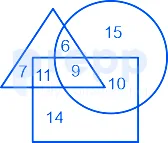
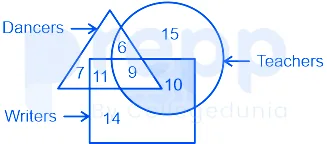
In the given diagram, the circle represents ‘teachers’, the triangle represents ‘dancers’ and the rectangle represents ‘writers’, Study the given diagram carefully and answer the question that follows.
What is the number of teachers who are writers, but NOT dancers?
- A
15
- B
11
- C
9
- D
10
Show answer
D. 10The shaded part represents is the number of teachers who are writers, but NOT dancers .
The number of teachers who are writers, but NOT dancers = 10
Hence, ‘10 ’ is the correct answer.
 Paper & answer key PDF ↗
 Question 23archived
Four words have been given, out of which three are alike in some manner and one is different. Select the word that is different.
- A
Manama
- B
Taka
- C
Lusaka
- D
Harare
Show answer
B. TakaFinding the Different Word: Manama, Taka, Lusaka, Harare
The question asks us to identify the word that is different from the other three in the given list: Manama, Taka, Lusaka, and Harare. This type of question tests our ability to classify words based on common properties and identify the one that doesn't fit the pattern.
Let's examine each word:
Manama: This is the capital city of Bahrain.
Taka: This is the name of the currency used in Bangladesh.
Lusaka: This is the capital city of Zambia.
Harare: This is the capital city of Zimbabwe.
Now, let's look for a common category that three of the words belong to, but the fourth one does not.
Manama is a capital city.
Lusaka is a capital city.
Harare is a capital city.
Taka is a currency.
We can see a clear pattern here. Three of the words (Manama, Lusaka, and Harare) are names of capital cities of different countries, while the word Taka is the name of a currency. Therefore, Taka is the word that is different from the others.
Comparison Summary
Word
Category
Manama
Capital City
Taka
Currency
Lusaka
Capital City
Harare
Capital City
Based on this comparison, the word that does not belong to the same group as the others is Taka because it represents a currency, while the rest represent capital cities.
Revision Table: Odd One Out Concepts
Concept
Description
Example
Classification/Odd One Out
Identifying the item that does not share a common property or pattern with the other items in a group.
Apple, Banana, Carrot, Orange (Carrot is different as it's a vegetable, others are fruits).
Categories Tested
Can involve various relationships like: Capitals & Countries, Currencies, Continents, Types of animals, Shapes, Numbers, etc.
Manama (Capital), Taka (Currency), Lusaka (Capital), Harare (Capital) - Category: Capitals vs. Currency.
Additional Information: Capitals and Currencies
Understanding geographical terms like capital cities and currencies is often helpful in solving classification questions like this. Here are a few more examples:
Capital Cities: Names like Paris (France), Tokyo (Japan), Delhi (India), Cairo (Egypt) are all capital cities.
Currencies: Names like Dollar (USA), Euro (Europe), Yen (Japan), Rupee (India) are all currencies.
In this specific question, recognising that Manama, Lusaka, and Harare are names of significant cities, and then identifying them specifically as capital cities, is key. Knowing that Taka is a form of money (currency) helps distinguish it from the others.
Practicing with different types of word sets can help improve skills in identifying patterns and the word that is different.
Paper & answer key PDF ↗ Question 24archived
Select the correct mirror image of the given combination when the mirror is placed at 'PQ' as shown.

- A
Option A (shown in image)
- B
Option B (shown in image)
- C
Option C (shown in image)
- D
Option D (shown in image)
Show answer
B. Option B (shown in image)The mirror image of this image is:
Hence, option 2 is the correct answer.
Additional Information
In Mirror imageleft side and right side changed vice-versa where top and bottom remain same.
Reflection of an object into the water is its water image . It appears by inverting an object vertically i.e. upside down.
The water image of the figure looks like the mirror image of the figure in case the mirror is horizontally at the bottom of the figure.
Water image is just a reflection where top and bottom part of the images changed where left and right side of the image remain same.

 Paper & answer key PDF ↗
 Question 25archived
Select the figure from among the given options that can replace the question mark (?) in the following series.

- A
Option A (shown in image)
- B
Option B (shown in image)
- C
Option C (shown in image)
- D
Option D (shown in image)
Show answer
Question 26archived
In which of the following years was the micro-credit scheme ‘Street Vendor's AtmaNirbhar Nidhi’ (‘PM SVANidhi’) launched?
- A
2015
- B
2017
- C
2020
- D
2014
Show answer
C. 2020Understanding the PM SVANidhi Scheme Launch Year
The question asks about the launch year of the micro-credit scheme known as ‘Street Vendor's AtmaNirbhar Nidhi’, popularly referred to as ‘PM SVANidhi’. This scheme is an initiative by the Indian government aimed at providing financial support to street vendors.
Details of the PM SVANidhi Scheme
The PM SVANidhi scheme was launched to help street vendors resume their livelihoods that were adversely affected, especially during challenging times like the COVID-19 pandemic. It offers collateral-free working capital loans to registered street vendors across the country.
Key aspects of the scheme include:
Providing an initial working capital loan of up to ₹10,000.
Offering subsequent loans of higher amounts upon timely repayment.
Incentivizing digital transactions by vendors.
Promoting capacity building and socio-economic profiling of vendors.
Determining the PM SVANidhi Launch Year
Based on official government records and notifications regarding the implementation of the ‘Street Vendor's AtmaNirbhar Nidhi’ (‘PM SVANidhi’) scheme, the program was initiated in a specific year to address the immediate financial needs of street vendors.
Let's look at the options provided:
2015
2017
2020
2014
The PM SVANidhi scheme was officially launched by the Ministry of Housing and Urban Affairs, Government of India, in 2020. This launch was particularly relevant in the context of helping street vendors recover from the economic impact of the nationwide lockdown imposed due to the COVID-19 pandemic.
Therefore, the correct year for the launch of the PM SVANidhi scheme is 2020.
PM SVANidhi Launch Year Analysis
Here is a quick look at the options and why 2020 is the correct launch year for PM SVANidhi:
Option Year
Is it the PM SVANidhi Launch Year?
Reason
2015
No
PM SVANidhi was launched later.
2017
No
PM SVANidhi was launched later.
2020
Yes
PM SVANidhi was officially launched in 2020.
2014
No
PM SVANidhi was launched much later.
Conclusion on PM SVANidhi Launch Year
The micro-credit scheme ‘Street Vendor's AtmaNirbhar Nidhi’ (‘PM SVANidhi’) was launched in the year 2020.
Revision Table: PM SVANidhi Scheme
Aspect
Detail
Scheme Name
PM SVANidhi (Street Vendor's AtmaNirbhar Nidhi)
Launched By
Ministry of Housing and Urban Affairs, Government of India
Launch Year
2020
Purpose
Provide working capital loans to street vendors
Initial Loan Amount
Up to ₹10,000 (collateral-free)
Additional Information on PM SVANidhi
The PM SVANidhi scheme is a central sector scheme, meaning it is fully funded by the Ministry of Housing and Urban Affairs. It aims to formalize the street vending sector and integrate vendors into the formal urban economy. The scheme uses a technology-driven platform for application and disbursement of loans, involving urban local bodies (ULBs) and lending institutions like banks and NBFCs/MFIs.
Support under the scheme is provided through three tranches of loans:
First tranche: Up to ₹10,000
Second tranche: Up to ₹20,000 (upon timely repayment of the first)
Third tranche: Up to ₹50,000 (upon timely repayment of the second)
A 7% interest subsidy is provided on timely repayment of the loans. Additionally, a cashback of up to ₹1,200 per annum is provided for undertaking digital transactions.
Paper & answer key PDF ↗ Question 27archived
The Indian Forest Act 1927 was enacted after repealing which of the following Indian forest acts?
- A
Indian Forest Act, 1922
- B
Indian Forest Act, 1878
- C
Indian Forest Act, 1865
- D
Indian Forest Act, 1882
Show answer
B. Indian Forest Act, 1878Understanding the Indian Forest Act 1927
The Indian Forest Act of 1927 is a significant piece of legislation in the history of forest administration in British India and subsequently in independent India. This act was enacted with the primary goal of consolidating and amending the laws relating to forests, the transit of forest produce, and the duty leviable on timber and other forest produce. To achieve this, it replaced existing laws.
Repealing Previous Forest Legislation
The Indian Forest Act 1927 did not emerge in a vacuum. It built upon earlier efforts to systematize forest management and resource control. Before the 1927 Act, there were previous acts regulating forests. The question specifically asks which of these previous acts was repealed by the 1927 legislation.
Historically, the first comprehensive forest act in British India was the Indian Forest Act of 1865. This was later revised and superseded by the Indian Forest Act of 1878. The 1878 Act introduced classifications of forests (Reserved, Protected, and Village forests) and provided more detailed rules for their management and protection.
The Indian Forest Act 1927 was a consolidation act that repealed the Indian Forest Act, 1878. It brought together the provisions of the 1878 Act, amended them, and incorporated some principles from the 1865 Act, which the 1878 Act had already repealed. The 1927 Act became the main framework for forest law in India.
Analyzing the Options
Let's look at the given options in the context of the history of Indian forest legislation:
Option 1: Indian Forest Act, 1922 - This act does not align with the historical timeline of the major Indian Forest Acts preceding the 1927 Act.
Option 2: Indian Forest Act, 1878 - This act significantly amended and replaced the 1865 Act and was itself the primary forest law until the 1927 Act was enacted. Historical records confirm that the 1927 Act repealed the 1878 Act.
Option 3: Indian Forest Act, 1865 - This was the first major forest act, but it was repealed by the Indian Forest Act, 1878, long before the 1927 Act was passed.
Option 4: Indian Forest Act, 1882 - There is no significant Indian Forest Act recorded from this year that served as the primary law repealed by the 1927 Act.
Based on the historical development of forest law in India, the Indian Forest Act 1927 repealed the Indian Forest Act, 1878.
Key Takeaway
The Indian Forest Act 1927 consolidated and amended previous forest laws, primarily by repealing the Indian Forest Act, 1878.
Timeline of Key Indian Forest Acts
Act Year
Significance
Relationship to 1927 Act
1865
First comprehensive forest act.
Repealed by 1878 Act. Principles influenced later acts.
1878
Revised and replaced 1865 Act. Introduced forest categories.
Repealed by the Indian Forest Act, 1927.
1927
Consolidated and amended previous laws, notably repealing the 1878 Act.
Current (though amended over time) foundational act for forest law in India.
Revision Table: Indian Forest Acts
Summary of Major Indian Forest Acts
Act
Year Enacted
Previous Act Repealed
Indian Forest Act
1878
Indian Forest Act, 1865
Indian Forest Act
1927
Indian Forest Act, 1878
Additional Information: Forest Classification
One of the significant aspects of the Indian Forest Act, 1878, carried forward and refined in the Indian Forest Act, 1927, was the classification of forests. The 1878 Act primarily classified forests into:
Reserved Forests: These were the most protected category. All activities were prohibited unless specifically permitted. They were directly managed by the government.
Protected Forests: Certain rights of local communities (like collection of forest produce or grazing) were permitted, but these could be restricted by the government. More flexible than reserved forests.
Village Forests: These were areas assigned to village communities for their use, managed under rules made by the provincial government.
The Indian Forest Act 1927 continued with these classifications, providing the legal framework for managing these different types of forest lands, controlling forest produce transit, and dealing with forest offenses. The act empowered the government to declare any land as a reserved forest, protected forest, or village forest, thereby bringing vast areas under state control.
Paper & answer key PDF ↗ Question 28archived
Which of the following plant hormones regulates growth, particularly by stimulating cell elongation in stems?
- A
Ethylene
- B
Auxin
- C
Gibberellin
- D
Cytokinin
Show answer
B. AuxinUnderstanding Plant Hormone Regulation of Growth
Plants use special chemical messengers called hormones to regulate their growth and development. These hormones are produced in one part of the plant and transported to other parts where they exert their effects. Different hormones have distinct roles, influencing everything from cell division and elongation to flowering and fruit ripening.
Identifying the Hormone for Stem Cell Elongation
The question asks which plant hormone specifically regulates growth, particularly by stimulating cell elongation in stems. Let's examine the roles of the options provided:
Ethylene: This is a gaseous hormone primarily involved in fruit ripening, senescence (aging), and abscission (shedding of leaves, flowers, or fruits). While it affects growth, its main role is not stimulating stem cell elongation in the primary growth phase.
Auxin: Auxins, particularly indole-3-acetic acid (IAA), are key regulators of plant growth. They are produced in apical meristems (shoot tips and root tips) and young leaves. Auxins are well-known for promoting cell elongation in stems and coleoptiles. They achieve this by increasing the extensibility of the cell wall, allowing the cell to expand under turgor pressure. This process is crucial for phototropism (bending towards light) and gravitropism (growth in response to gravity), both of which involve differential growth caused by auxin distribution.
Gibberellin: Gibberellins (GAs) also promote stem elongation, especially in dwarf varieties, and are involved in seed germination and flowering. However, their mechanism of promoting stem elongation is often different from auxin, sometimes involving increased cell division in the subapical meristem as well as cell elongation. While gibberellins contribute significantly to overall stem height, auxin is more directly associated with the rapid cell wall loosening that drives differential elongation responses like phototropism in stems.
Cytokinin: Cytokinins are mainly involved in promoting cell division, differentiation, and delaying senescence. They are often synthesized in root tips. Cytokinins balance the effect of auxin, influencing shoot and root development ratios. Their primary role is not the direct stimulation of cell elongation in stems.
Based on the primary functions of these plant hormones, auxin is the hormone most prominently recognized for stimulating cell elongation, particularly in stems and coleoptiles, and mediating growth responses like phototropism.
Key Functions of Plant Hormones
Hormone
Primary Functions
Auxin
Stem elongation, root initiation, phototropism, gravitropism, apical dominance, fruit development.
Gibberellin
Stem elongation, seed germination, flowering, fruit growth.
Cytokinin
Cell division, differentiation, shoot formation, delay of senescence.
Ethylene
Fruit ripening, senescence, abscission, stress responses.
Revision Table: Plant Hormone Effects on Stem Growth
Hormone
Effect on Stem Elongation
Mechanism (Simplified)
Auxin
Strongly promotes (especially differential growth)
Increases cell wall extensibility (acid growth hypothesis)
Gibberellin
Promotes (significant effect on overall height)
Increases cell division and/or elongation
Cytokinin
Limited direct effect; interacts with auxin
Mainly cell division; influences differentiation
Ethylene
Often inhibits elongation but promotes radial expansion (thickening) in some contexts (e.g., triple response)
Alters cell growth pattern
Additional Information: Auxin and Cell Elongation
The mechanism by which auxin promotes cell elongation is often explained by the acid growth hypothesis. According to this hypothesis:
Auxin stimulates proton pumps (H<sup>+</sup>-ATPases) in the plasma membrane.
These pumps excrete protons (H<sup>+</sup>) into the cell wall space.
The decreased pH in the cell wall activates enzymes called expansins.
Expansins loosen the connections between cellulose microfibrils in the cell wall.
With the cell wall loosened, the turgor pressure inside the cell causes the cell to expand and elongate.
This targeted action on the cell wall is a primary way auxin drives elongation growth, particularly in rapidly elongating tissues like young stems and coleoptiles.
Paper & answer key PDF ↗ Question 29archived
What do you call the property of an organism of self-regulation and the tendency to maintain a steady state within an external environment which is liable to change?
- A
Consciousness
- B
Metabolism
- C
Irritability
- D
Homeostasis
Show answer
D. HomeostasisUnderstanding the Property of Self-Regulation in Organisms
The question asks about a fundamental property of living organisms: their ability to maintain a stable internal environment despite changes happening outside. This involves active self-regulation to keep conditions like temperature, pH, blood sugar levels, and water balance within narrow limits necessary for survival.
Analyzing the Options for Self-Regulation
Let's look at the provided options and see which one best describes this property of self-regulation and maintaining a steady state:
Consciousness: This refers to awareness of oneself and the surroundings. While important for survival, it doesn't directly relate to the internal physiological maintenance of a steady state.
Metabolism: This encompasses all the chemical processes that occur within a living organism to maintain life. It includes breaking down substances for energy (catabolism) and building up substances (anabolism). Metabolism is essential for life, but the term itself doesn't specifically mean the *regulation* to *maintain* a *steady state*.
Irritability: This is the ability of an organism to respond to stimuli from its environment. It's about reacting to changes, not necessarily about keeping internal conditions stable.
Homeostasis: This term comes from Greek words meaning "same" and "standing." It is precisely the property of an organism that involves self-regulation to maintain internal stability, or a steady state, even when the external environment changes. Examples include regulating body temperature, blood glucose, and water balance.
Why Homeostasis is the Correct Property
Based on the definitions, the property described in the question – self-regulation and the tendency to maintain a steady state within a changing external environment – is the definition of homeostasis. Organisms constantly use processes like negative and positive feedback loops to achieve this internal balance, which is crucial for their cells and systems to function correctly and for the organism's overall survival.
Comparison of Properties
Property
Description
Relates to Steady State?
Consciousness
Awareness of self and environment
No
Metabolism
Chemical processes for life
Indirectly, but not the regulation itself
Irritability
Ability to respond to stimuli
No
Homeostasis
Self-regulation to maintain steady internal state
Yes, directly
Therefore, the property of an organism that describes its self-regulation and tendency to maintain a steady state despite external environmental changes is Homeostasis.
Revision Table: Key Biological Properties
Essential Properties of Life
Property
Brief Explanation
Example
Growth
Increase in size or number of cells
A plant getting taller
Reproduction
Ability to produce offspring
Bacteria dividing
Metabolism
Sum of all chemical reactions
Digestion of food
Response to Stimuli (Irritability)
Reacting to environmental changes
Pupil dilation in dim light
Adaptation
Evolutionary changes over time
Camouflage in animals
Organization
Being made of cells and organized structures
Cell > Tissue > Organ > System
Homeostasis
Maintaining internal steady state
Regulation of body temperature
Additional Information on Homeostasis and Self-Regulation
Homeostasis is a dynamic process, not a static one. The internal conditions fluctuate around a set point, and the body constantly works to bring them back to this point if they deviate. This self-regulation is primarily managed by feedback mechanisms, particularly negative feedback. In a negative feedback loop, a change in a regulated variable triggers a response that reverses the initial change, bringing the variable back towards the set point. Positive feedback loops also exist but are less common for maintaining steady states; they amplify an initial change.
Examples of Homeostasis:
Maintaining body temperature around 37°C.
Regulating blood glucose levels within a specific range.
Controlling blood pressure.
Balancing water and electrolyte levels.
These self-regulatory processes are vital for ensuring that biochemical reactions occur efficiently and that cells can function correctly, ensuring the organism's overall survival in a constantly changing external environment.
Paper & answer key PDF ↗ Question 30archived
According to which of the following Articles of the Constitution of India shall a Money Bill not be introduced in a Legislative Council?
- A
Article 451
- B
Article 198
- C
Article 333
- D
Article 189
Show answer
B. Article 198Understanding Money Bills and Legislative Councils in India
The Constitution of India outlines the powers and procedures for legislation at both the Union and State levels. Some states have a bicameral legislature, consisting of the Legislative Assembly (Vidhan Sabha) and the Legislative Council (Vidhan Parishad). Money Bills are a specific category of financial legislation with distinct procedures.
The question asks about the Article that specifies where a Money Bill cannot be introduced in a state legislature with a Legislative Council.
Analyzing Article 198 of the Indian Constitution
Article 198 of the Constitution of India is specifically titled "Procedure as to Money Bills in Legislative Council". This article lays down the special procedure that applies to Money Bills in states where a Legislative Council exists.
Article 198(1) explicitly states: "A Money Bill shall not be introduced in a Legislative Council."
This means that the introduction of a Money Bill can only take place in the Legislative Assembly of a state.
Once passed by the Legislative Assembly, the Money Bill is transmitted to the Legislative Council for its recommendations.
The Legislative Council has limited powers regarding a Money Bill. According to Article 198(2), it must return the bill to the Legislative Assembly within a period of fourteen days from the date of its receipt, with its recommendations.
The Legislative Assembly is free to accept or reject any of the recommendations made by the Legislative Council (Article 198(3)).
Therefore, Article 198 directly addresses the question regarding the introduction of a Money Bill in a Legislative Council.
Examining Other Options
Let's briefly consider why the other options are not relevant to the introduction of Money Bills in a Legislative Council:
Article 451: There is no Article 451 in the current Constitution of India. The Constitution originally had 395 Articles, and although many have been added, the numbering scheme doesn't typically jump to 451 in this context. This option is incorrect.
Article 333: This Article pertains to the representation of the Anglo-Indian community in the Legislative Assemblies of the States (now obsolete after the 104th Constitutional Amendment Act, 2019). It is not related to Money Bills or Legislative Councils.
Article 189: This Article deals with voting in Houses, power of Houses to act notwithstanding vacancies and quorum in State Legislatures. It is a procedural article but not specifically about the introduction of Money Bills or the role of the Legislative Council concerning them.
Based on the analysis, Article 198 is the only provision among the options that deals with the procedure of Money Bills in the Legislative Council, specifically prohibiting their introduction there.
Article
Subject Matter
Relevance to Question
Article 451
Does not exist in Constitution
Not relevant
Article 198
Procedure as to Money Bills in Legislative Council
Directly relevant; specifies Money Bill cannot be introduced in Legislative Council.
Article 333
Representation of Anglo-Indian community in Legislative Assemblies (now obsolete)
Not relevant
Article 189
Voting, Quorum, etc. in State Legislatures
Not relevant to Money Bill introduction in Legislative Council
Conclusion
According to the Constitution of India, a Money Bill shall not be introduced in a Legislative Council. This procedure is clearly laid down in Article 198.
Revision Table: Money Bill Introduction
Constitutional Provision
Key Point
Article 198(1)
A Money Bill shall not be introduced in a Legislative Council.
Location for Introduction
Only in the Legislative Assembly.
Additional Information: Money Bills
Understanding Money Bills is crucial in the context of legislative procedures, especially concerning state finances. Here are some key points:
Definition: A Money Bill is defined in Article 199 of the Constitution for State Legislatures (similar to Article 110 for Parliament). It includes provisions dealing exclusively with matters like imposition, abolition, remission, alteration or regulation of any tax; the regulation of the borrowing of money or the giving of any guarantee by the State; the custody of the Consolidated Fund or the Contingency Fund of the State, etc.
Certification: A Bill is deemed to be a Money Bill only if it is certified as such by the Speaker of the Legislative Assembly. The Speaker's decision is final.
Powers of Houses: In states with a bicameral legislature, the Legislative Assembly has dominant powers over Money Bills. The Legislative Council can only make recommendations, which the Assembly may or may not accept. If the Council does not return the bill within 14 days, it is deemed to have been passed by both Houses.
Purpose: This special procedure ensures that financial legislation, considered critical for governance and involving public funds, primarily rests with the directly elected body (Legislative Assembly), which is more accountable to the electorate.
Paper & answer key PDF ↗ Question 31archived
According to Ashokan edicts, how many years after becoming the king did Ashoka wage war on Kalinga?
- A
Five
- B
Eight
- C
Six
- D
Seven
Show answer
B. EightUnderstanding Ashoka's Kalinga War Timing from Edicts
The question asks about the time frame, specifically the number of years after becoming king, when Emperor Ashoka waged war on Kalinga, based on information found in his edicts.
Ashoka, one of the most famous rulers of ancient India, was a prominent emperor of the Maurya Dynasty. His reign is marked by significant events, including the devastating war with Kalinga.
According to historical sources, primarily Ashoka's own inscriptions known as Ashokan edicts, the Kalinga war took place a specific number of years after his coronation.
The information regarding the timing of the Kalinga war is explicitly mentioned in the Ashokan edicts, particularly Rock Edict 13. This edict describes the scale of the conflict, the suffering it caused, and Ashoka's remorse and subsequent conversion to Buddhism.
Based on the details provided in these edicts, Ashoka waged war on Kalinga eight years after he became the king. This event occurred around 261 BCE.
The impact of the Kalinga war on Ashoka was profound. The immense death and destruction led him to renounce violence and embrace the principles of Dhamma, which were central to his later reign and policies.
The Ashokan edicts are invaluable primary sources for understanding Ashoka's reign, his policies, and major events like the Kalinga war. They are found inscribed on pillars, rocks, and cave walls across the Indian subcontinent.
Event
Timing relative to becoming King
Source
Accession/Becoming King
Year 0
Historical records
Kalinga War
8 years after accession
Ashokan Rock Edict 13
Revision Table: Ashoka and Kalinga War Facts
Key Aspect
Detail
King
Ashoka
Dynasty
Maurya Dynasty
Event
Kalinga War
Source for Timing
Ashokan Edicts (specifically Rock Edict 13)
Years after becoming King
Eight years
Impact on Ashoka
Conversion to Buddhism, promotion of Dhamma
Additional Information on Ashokan Edicts and Kalinga War
Ashokan Edicts: These are royal proclamations and inscriptions issued by Emperor Ashoka. They are written in various languages like Prakrit (in different regional dialects), Greek, and Aramaic, and use scripts like Brahmi, Kharosthi, Greek, and Aramaic. They are considered the earliest deciphered writings of India.
Rock Edict 13: This is one of the most important edicts. It provides a detailed account of the Kalinga war, the suffering caused, Ashoka's deep remorse, and his subsequent commitment to Dhamma. It also mentions the names of contemporary Hellenistic kings with whom Ashoka maintained diplomatic relations.
Kalinga: An ancient kingdom located in the region that is now Odisha and parts of Andhra Pradesh. It was a powerful and independent state that resisted Mauryan expansion.
Significance of the War: The Kalinga war was a turning point in Ashoka's life and the history of the Mauryan Empire. It marked the end of Ashoka's military conquests and the beginning of his efforts to rule through Dhamma, emphasizing peace, non-violence, and social welfare.
Dhamma: Ashoka's concept of Dhamma was not a specific religion but a moral code and a set of principles that promoted social responsibility, respect for elders, tolerance towards different religious sects, kindness to all beings, truthfulness, and purity of heart.
Paper & answer key PDF ↗ Question 32archived
In medicine, ______ is a device such as a small metal plate or needle that carries electricity from an instrument to a patient for treatment or surgery.
- A
An Electrolyte
- B
An Electrode
- C
A Venturimeter
- D
A Machmeter
Show answer
B. An ElectrodeUnderstanding the Medical Device Definition
The question asks to identify a specific medical device. This device is described as a component, like a small metal plate or needle, responsible for conducting electricity from a medical instrument to a patient. This electrical flow is used for therapeutic purposes or during surgical procedures.
Analyzing the Options
Let's examine each option to see which best fits the definition provided:
An Electrolyte: An electrolyte is a substance that contains free ions and can conduct electricity when dissolved in a solvent, like water. Examples include salts and acids. While related to electrical conductivity, an electrolyte itself is not the device that carries electricity to the patient; it's typically the medium through which current flows.
An Electrode: An electrode is a component that conducts electrical current. In medical applications, electrodes are specifically designed as interfaces to connect the patient's body to an electrical device or instrument. They can be small metal plates, needles, or other shapes, used for treatments like electrical stimulation, monitoring (like ECG), or in surgical tools (like electrocautery) to deliver or redirect electrical energy. This perfectly matches the description given in the question.
A Venturimeter: A venturimeter is a scientific instrument used in fluid dynamics to measure the speed of a fluid. It operates based on the Venturi effect and is unrelated to medical electrical devices.
A Machmeter: A Machmeter is an instrument used in aviation and aerospace to measure the Mach number, which indicates the ratio of an object's speed to the speed of sound. This device is also unrelated to the medical context described.
Identifying the Correct Medical Term
Based on the analysis, the term that accurately describes a device like a small metal plate or needle used to carry electricity from an instrument to a patient for medical treatment or surgery is an Electrode. Electrodes are crucial components in many medical technologies that utilize electrical energy.
Conclusion
The definition provided in the question precisely describes the function and form of an Electrode within a medical context. It serves as the essential link for electrical energy transfer between medical equipment and the patient.
Paper & answer key PDF ↗ Question 33archived
At which of the following places was the ‘Street Theatre and Performing Arts Fellowship’ scheme launched in January 2021 to give artists an opportunity to showcase their craft?
- A
Haryana
- B
Delhi
- C
Chandigarh
- D
Goa
Show answer
B. DelhiUnderstanding the Street Theatre and Performing Arts Fellowship Scheme
The question asks about the location where the 'Street Theatre and Performing Arts Fellowship' scheme was introduced in January 2021. This scheme was designed to provide artists with a platform to display their creative talents, particularly in street theatre and various performing arts forms.
Location of the Scheme Launch
The 'Street Theatre and Performing Arts Fellowship' scheme was launched in January 2021 in a specific Indian city/region. The goal was to support artists who work in public spaces, bringing art closer to people.
Based on information about this initiative, the scheme was launched in Delhi.
Why Delhi for the Performing Arts Fellowship?
Delhi, being the capital city and a major cultural hub, often hosts such initiatives aimed at promoting arts and culture. The launch of the 'Street Theatre and Performing Arts Fellowship' in Delhi provided local artists working in street theatre and other performing arts genres an opportunity to receive support and showcase their craft to a wider audience within the city.
Analyzing the Options
Let's look at the given options:
Haryana: While Haryana has a rich cultural heritage, information indicates the scheme was not launched there.
Delhi: This is where the 'Street Theatre and Performing Arts Fellowship' scheme was indeed launched in January 2021.
Chandigarh: Chandigarh is known for its planned architecture and cultural activities, but it was not the launch location for this specific scheme.
Goa: Goa is famous for its vibrant culture and festivals, but the scheme was not launched there.
Therefore, the correct location for the launch of the 'Street Theatre and Performing Arts Fellowship' scheme in January 2021 is Delhi.
Revision Table: Key Details of the Scheme
Aspect
Detail
Scheme Name
Street Theatre and Performing Arts Fellowship
Launch Month/Year
January 2021
Launch Location
Delhi
Objective
Give artists opportunity to showcase craft (street theatre, performing arts)
Additional Information on Arts Fellowships and Schemes
Governments and cultural organizations often launch various fellowship and grant schemes to support artists across different disciplines. These schemes aim to:
Provide financial assistance for artistic projects.
Offer opportunities for training and development.
Create platforms for artists to perform and exhibit.
Promote specific art forms, like street theatre or traditional performing arts.
Encourage cultural activities in public spaces.
Such fellowships play a crucial role in the development and sustenance of the arts community, helping artists to innovate and reach wider audiences.
Paper & answer key PDF ↗ Question 34archived
Panche is a traditional sarong worn by the men in the state of ______.
- A
Karnataka
- B
Assam
- C
Sikkim
- D
Kerala
Show answer
A. KarnatakaUnderstanding Panche Traditional Wear
The question asks about the traditional sarong-like garment called 'Panche' worn by men and in which Indian state it is predominantly associated.
Panche is a traditional lower garment worn by men in parts of South India. It is similar in concept to a dhoti or lungi, but the specific term 'Panche' is particularly popular and commonly used in Karnataka to refer to the traditional white or off-white dhoti worn for formal occasions or daily wear.
Analyzing the Options for Panche State
Let's look at the given options:
Karnataka: Panche is a widely recognized traditional male attire in Karnataka, often made of silk for special occasions or cotton for daily use.
Assam: Traditional Assamese male attire includes the Suriya and the Lengti or the Gamucha worn as a lower cloth, but not typically called 'Panche'.
Sikkim: Traditional Sikkimese male dress includes the Bakhu, a loose cloak-like garment, and trousers, not a sarong called 'Panche'.
Kerala: While Kerala men wear a similar garment called 'Mundu', the term 'Panche' is not the common local name for it.
Identifying the Correct State for Panche
Based on regional textile traditions and nomenclature, the term 'Panche' is most strongly associated with the state of Karnataka.
In Karnataka, wearing the Panche is a common practice, especially during festivals, ceremonies, and traditional events. It is typically worn wrapped around the waist and legs.
Therefore, the state where Panche is a traditional sarong worn by men is Karnataka.
Revision Table: Traditional Indian Male Attire
State
Common Male Lower Garment
Notes
Karnataka
Panche (Dhoti/Sarong)
Often white cotton or silk.
Kerala
Mundu (Sarong)
Typically white or cream with border (kara).
Tamil Nadu
Veshti (Dhoti/Sarong)
Similar to Panche/Mundu.
Assam
Suriya, Lengti, Gamucha
Different styles and usage.
Sikkim
Bakhu
Cloak-like garment.
Additional Information: Panche Significance and Styles
The Panche in Karnataka is more than just clothing; it's a cultural symbol. Here are some points about it:
Material: Can range from simple cotton for daily wear to elaborate silk, especially Mysore silk, for weddings and religious ceremonies.
Wearing Style: It is usually worn unstitched, wrapped around the waist and legs. The way it is pleated or folded can sometimes indicate regional variations within the state or the occasion.
Occasions: Essential attire for traditional events, temples, festivals, and weddings.
Comparison: While similar to the Dhoti (worn across North India) or Lungi (often checked, casual wear in South India), the term 'Panche' is the specific identifier used in Karnataka for this traditional men's garment, particularly the formal or semi-formal versions.
Understanding traditional attire like the Panche helps us appreciate the rich cultural diversity across different states of India.
Paper & answer key PDF ↗ Question 35archived
Which of the following books is authored by Dalai Lama and launched by him in February 2021?
- A
Connecting, Communicating, Changing
- B
A Little Book of Courage
- C
The Little Book of Encouragement
- D
The Little Book of Hope
Show answer
C. The Little Book of EncouragementIdentifying the Dalai Lama's 2021 Book
The question asks to identify a specific book authored by His Holiness the Dalai Lama that was launched in February 2021. To answer this, we need to recall or research recent publications by the Dalai Lama, focusing on the specified launch date.
Analysis of the Correct Book
Based on the information available, the book authored by the Dalai Lama and specifically launched in February 2021 is titled The Little Book of Encouragement.
This book consists of messages and insights from the Dalai Lama aimed at helping people navigate challenging times, offering perspectives on hope, courage, and resilience. It was indeed a notable release in early 2021.
Examining the Options
Let's look at the provided options:
Connecting, Communicating, Changing
A Little Book of Courage
The Little Book of Encouragement
The Little Book of Hope
Comparing these options with the known publication by the Dalai Lama launched in February 2021, we can confirm the correct title.
Book Title
Author
Relevant Publication/Launch Date?
Connecting, Communicating, Changing
Varies (Common phrases, not a specific Dalai Lama book title)
Not identified as a Dalai Lama book launched Feb 2021
A Little Book of Courage
Varies (Several books with similar titles exist)
Not identified as the specific Dalai Lama book launched Feb 2021
The Little Book of Encouragement
Dalai Lama
Confirmed launch in February 2021
The Little Book of Hope
Dalai Lama with Desmond Tutu (Another book, launched later)
Authored by Dalai Lama but launched later than Feb 2021
The table above helps confirm that The Little Book of Encouragement is the correct book matching the criteria of being authored by the Dalai Lama and launched in February 2021.
Revision Table: Dalai Lama Book Facts
Book Title
Author
Launch Month/Year
Focus
The Little Book of Encouragement
Dalai Lama
February 2021
Hope, courage, resilience during difficult times
Additional Information: Dalai Lama's Teachings
His Holiness the 14th Dalai Lama is Tenzin Gyatso. He is the spiritual leader of Tibetan Buddhism. He is also a prolific author, writing on topics ranging from Buddhism and spirituality to secular ethics, happiness, and compassion. His works often aim to share Buddhist wisdom and principles in a way that is accessible and applicable to people of all backgrounds, emphasizing universal human values. His books are translated into many languages and are widely read globally.
Key themes in the Dalai Lama's books and teachings include:
Compassion and loving-kindness
Mindfulness and meditation
Secular ethics and universal responsibility
Overcoming anger and negative emotions
Finding happiness and meaning in life
The importance of dialogue and understanding between different cultures and religions
His books, including The Little Book of Encouragement, serve as guides for personal development and for cultivating peace and well-being in a complex world.
Paper & answer key PDF ↗ Question 36archived
______ boundaries occur when plates collide and one plate is pushed under the other.
- A
Divergent
- B
Convergent
- C
Transform
- D
Continental
Show answer
B. ConvergentUnderstanding Plate Boundaries: Convergent, Divergent, and Transform
The Earth's crust is broken into large pieces called tectonic plates. These plates are constantly moving, albeit very slowly. The areas where these plates meet are called plate boundaries. Different types of boundaries result in different geological phenomena like earthquakes, volcanoes, and mountain formation.
The question asks about the type of boundary where plates collide and one plate is pushed under the other. Let's examine the options provided:
Types of Plate Boundaries
Divergent Boundaries: These occur when plates move apart from each other. New crust is created as magma rises from the mantle to fill the gap. The Mid-Atlantic Ridge is an example of a divergent boundary.
Convergent Boundaries: These occur when plates move towards each other and collide. What happens at a convergent boundary depends on the type of crust involved (oceanic or continental). If oceanic crust meets continental crust, the denser oceanic plate is typically pushed underneath the continental plate. This process is called subduction. If two oceanic plates meet, one is usually subducted under the other. If two continental plates meet, neither is easily subducted, leading to mountain building (like the Himalayas). The process described in the question, where one plate is pushed under the other, is characteristic of subduction at a convergent boundary.
Transform Boundaries: These occur when plates slide horizontally past each other. Crust is neither created nor destroyed at these boundaries. The San Andreas Fault in California is a well-known example of a transform boundary.
Continental Boundaries: "Continental" refers to a type of crust, not a type of plate boundary itself. Boundaries occur where plates meet, regardless of whether they are made of continental or oceanic crust (or both).
Analyzing the Question and Options
The question specifically mentions plates colliding ("when plates collide") and one plate being pushed under the other ("one plate is pushed under the other"). This process of one plate descending beneath another is known as subduction. Subduction is a defining characteristic of certain types of convergent plate boundaries (specifically, oceanic-continental or oceanic-oceanic convergence).
Let's revisit the options in light of this understanding:
Divergent boundaries involve plates moving apart, not colliding.
Convergent boundaries involve plates colliding, and often, one plate subducts under the other.
Transform boundaries involve plates sliding past each other, not colliding head-on or subducting.
"Continental" is a type of crust, not a boundary name describing collision and subduction.
Based on the description of plates colliding and one being pushed under the other, the correct type of plate boundary is a convergent boundary.
Summary of Plate Boundary Characteristics
Boundary Type
Plate Movement
Key Process
Geological Features
Divergent
Moving apart
Rifting, Seafloor spreading
Mid-ocean ridges, Rift valleys
Convergent
Moving towards each other (colliding)
Subduction, Mountain building
Volcanoes, Trenches, Mountain ranges
Transform
Sliding horizontally past each other
Faulting
Earthquakes
Therefore, the boundary type where plates collide and one is pushed under the other is a convergent boundary.
Revision Table: Key Plate Tectonics Concepts
Term
Definition
Plate Tectonics
The theory that Earth's outer shell is divided into large rigid plates that move over the mantle.
Plate Boundary
The region where two or more tectonic plates meet.
Collision
The process where two tectonic plates crash into each other.
Subduction
The process by which one tectonic plate is pulled or sinks beneath another plate into the Earth's mantle. Occurs at convergent boundaries.
Additional Information: Processes at Convergent Plate Boundaries
Convergent plate boundaries are zones of intense geological activity due to the collision of plates. There are three main types of convergent boundaries, depending on the type of crust involved:
Oceanic-Continental Convergence: An oceanic plate converges with a continental plate. The denser oceanic plate subducts beneath the less dense continental plate. This often creates a volcanic mountain range on the continental crust (e.g., the Andes Mountains) and a deep oceanic trench offshore. Earthquakes are also common.
Oceanic-Oceanic Convergence: Two oceanic plates converge. The older, colder, and therefore denser oceanic plate typically subducts beneath the younger one. This often results in the formation of a chain of volcanic islands (island arc) parallel to an oceanic trench (e.g., the Mariana Islands and Trench). Earthquakes occur frequently.
Continental-Continental Convergence: Two continental plates converge. Because continental crust is relatively light and buoyant, neither plate easily subducts significantly into the mantle. Instead, the crust is crumpled and uplifted, forming large mountain ranges (e.g., the Himalayas, formed by the collision of the Indian and Eurasian plates). Earthquakes are common, but volcanic activity is usually minimal compared to the other types of convergent boundaries.
The question's description of "one plate is pushed under the other" most directly applies to the subduction process seen in oceanic-continental and oceanic-oceanic convergent boundaries, though continental collision is also a type of convergent boundary resulting from plates moving towards each other.
Paper & answer key PDF ↗ Question 37archived
Mukhyamantri Bagayat Vikas Mission (Horticulture Development Mission) scheme was launched by which of the following state governments in January 2021?
- A
Maharashtra
- B
Gujarat
- C
Bihar
- D
Uttar Pradesh
Show answer
B. GujaratUnderstanding the Mukhyamantri Bagayat Vikas Mission
The question asks about the launch of the Mukhyamantri Bagayat Vikas Mission, also known as the Horticulture Development Mission, and which state government initiated it in January 2021. This scheme is focused on boosting horticulture activities within the state.
Horticulture refers to the cultivation of plants, including fruits, vegetables, nuts, seeds, herbs, spices, flowers, and ornamental trees. Development missions often aim to increase production, improve quality, support farmers, and enhance infrastructure related to these crops.
Identifying the State Government
The Mukhyamantri Bagayat Vikas Mission was a specific initiative launched in early 2021. To identify the state, we need to recall or find information about state-level schemes launched around that time. Different states have various schemes to support agriculture and horticulture tailored to their specific needs and climate.
Upon reviewing state government initiatives from January 2021, it is found that the government of Gujarat launched the Mukhyamantri Bagayat Vikas Mission.
Key Details of the Mission
The mission aimed to encourage farmers to take up horticulture farming, especially on arid and semi-arid lands. It was intended to help farmers diversify their income sources and make better use of land resources. The mission likely included provisions for assistance, technology, and market linkages for horticulture produce.
Aspect
Details
Mission Name
Mukhyamantri Bagayat Vikas Mission (Horticulture Development Mission)
Launch Month/Year
January 2021
Focus Area
Horticulture Development
State Government
Gujarat
Objective (General)
Promote horticulture farming, support farmers, utilize land effectively.
Conclusion
Based on the information regarding state government schemes launched in January 2021, the Mukhyamantri Bagayat Vikas Mission was introduced by the government of Gujarat. This initiative is a significant step towards promoting horticulture and supporting farmers in the state.
Revision Table: Horticulture Mission Details
Scheme Name
State
Launch Date
Primary Goal
Mukhyamantri Bagayat Vikas Mission
Gujarat
January 2021
Horticulture development, farmer support
Additional Information: State Government Schemes
State governments in India launch various schemes to support different sectors, including agriculture, horticulture, education, health, and infrastructure. These schemes are crucial for implementing development policies at the state level and addressing specific regional needs. Understanding these schemes is important for current affairs and general knowledge.
Many states have specific missions or departments focused on agriculture and horticulture to promote growth in these vital sectors.
Schemes often include subsidies, technical guidance, training programs, and support for marketing and post-harvest management.
The focus areas of schemes can vary widely based on the state's geographical conditions, climate, and economic priorities.
Paper & answer key PDF ↗ Question 38archived
Which of the following organizations releases the Global Innovation Index?
- A
WTO
- B
UNDP
- C
INSEAD, Cornell University, WIPO
- D
WEF
Show answer
C. INSEAD, Cornell University, WIPOUnderstanding the Global Innovation Index (GII)
The Global Innovation Index (GII) is a significant benchmark that helps measure the innovation performance of various countries around the world. It provides detailed metrics about the innovation capabilities and results of economies, offering a tool for policymakers, business leaders, and others to evaluate progress.
The question asks about the specific organizations responsible for releasing this important index. It's crucial to identify the correct institutions from the given options.
Identifying the Organizations Behind the Global Innovation Index
The Global Innovation Index has been published annually since 2007. Over time, its structure and the leading organizations have evolved. Currently, the GII is a collaborative effort by specific academic and international bodies.
Analyzing the Options for GII Release Organizations
Let's look at the options provided and determine which organization(s) are responsible for the GII:
WTO (World Trade Organization): The WTO deals with global rules of trade between nations. While trade and innovation are linked, the WTO is not the primary publisher of the GII. This option is incorrect.
UNDP (United Nations Development Programme): The UNDP focuses on poverty reduction and sustainable development. It releases reports like the Human Development Report, but not the Global Innovation Index. This option is incorrect.
INSEAD, Cornell University, WIPO: This option lists three entities: INSEAD (a business school), Cornell University (an academic institution), and WIPO (World Intellectual Property Organization, a specialized agency of the United Nations). These three entities are indeed the long-standing co-publishers of the Global Innovation Index. This option is correct.
WEF (World Economic Forum): The WEF is known for reports like the Global Competitiveness Report. While also influential in economic and business circles, the WEF does not publish the Global Innovation Index. This option is incorrect.
Conclusion: The Publishers of the GII
Based on the analysis, the Global Innovation Index is released by a joint effort involving INSEAD, Cornell University, and the World Intellectual Property Organization (WIPO).
Revision Table: Key International Organizations & Reports
Organization(s)
Key Focus / Report
WTO (World Trade Organization)
Global trade rules and agreements
UNDP (United Nations Development Programme)
Development, poverty reduction (e.g., Human Development Report)
INSEAD, Cornell University, WIPO (World Intellectual Property Organization)
Innovation performance (Global Innovation Index)
WEF (World Economic Forum)
Global economic and business issues (e.g., Global Competitiveness Report)
Additional Information on Global Innovation Index (GII)
The Global Innovation Index ranks economies based on dozens of indicators, grouped into Innovation Inputs and Innovation Outputs. The input pillars include institutions, human capital & research, infrastructure, market sophistication, and business sophistication. The output pillars are knowledge & technology outputs and creative outputs. The GII is a valuable tool for understanding the strengths and weaknesses of national innovation ecosystems and comparing performance internationally.
Paper & answer key PDF ↗ Question 39archived
When a river originates from a hill and flows in all directions, the drainage pattern is known as ______.
- A
Dendritic
- B
Trellis
- C
Radial
- D
Centripetal
Show answer
C. RadialUnderstanding River Drainage Patterns
A drainage pattern describes the shape formed by streams, rivers, and lakes in a particular drainage basin. It is governed by the topography of the land, and the type and structure of the rocks beneath.
The question describes a specific scenario where a river originates from a hill and flows outwards in all directions. Let's examine the options to determine which drainage pattern fits this description.
Analyzing Drainage Pattern Options
Here's a look at the characteristics of the drainage patterns provided in the options:
Dendritic Drainage Pattern: This pattern resembles the branches of a tree. Tributaries join larger streams at acute angles. It develops in areas where the underlying rock structure is uniform in resistance to erosion.
Trellis Drainage Pattern: This pattern develops in folded topography where hard and soft rock layers alternate. Short tributary streams join the main river at right angles, creating a rectangular or grid-like pattern.
Radial Drainage Pattern: In this pattern, streams flow outwards from a central elevated point, such as a dome, volcanic cone, or hill. The streams radiate in all directions from this high point.
Centripetal Drainage Pattern: This pattern is the opposite of radial. Streams flow inwards and converge towards a central low point, such as a depression, lake, or basin.
Identifying the Correct Drainage Pattern
The question explicitly states that the river originates from a hill (a central elevated point) and flows in all directions (outwards). This description perfectly matches the characteristics of the Radial drainage pattern.
In areas with a dome shape or a conical hill like a volcano, water flows down the slopes from the summit. These flows develop into streams that spread out from the center, creating the radial pattern.
Comparison Table of Drainage Patterns
Drainage Pattern
Description
Topography/Geology
Dendritic
Tree-like branching
Uniform rock resistance
Trellis
Rectangular, grid-like
Folded rocks, alternating resistance
Radial
Flows outwards from a central high point
Dome, hill, volcano
Centripetal
Flows inwards towards a central low point
Basin, depression, lake
Based on the definition and the comparison, the drainage pattern where a river originates from a hill and flows in all directions is the Radial drainage pattern.
Revision Table - River Drainage Patterns
Keyword
Brief Explanation
Drainage Pattern
Shape of river network in a basin
Radial Pattern
Streams flow outwards from a central high point
Dendritic Pattern
Tree-like branching, uniform geology
Trellis Pattern
Rectangular pattern, folded geology
Centripetal Pattern
Streams flow inwards towards a central low point
Topography
Shape and features of the land surface
Drainage Basin
Area drained by a river and its tributaries
Additional Information - Factors Affecting Drainage Patterns
Several factors influence the type of drainage pattern that develops in an area:
Topography: The slope and shape of the land are crucial. Steep slopes encourage rapid flow, while flat areas may lead to more meandering. Central elevated points lead to radial patterns, while depressions lead to centripetal patterns.
Geology: The type of rock and its resistance to erosion play a significant role. Uniform, easily erodible rocks favor dendritic patterns. Alternating hard and soft layers in folded areas create trellis patterns. Fractures and joints in rocks can influence stream direction.
Climate: Climate affects the amount and intensity of precipitation, which impacts runoff and erosion rates.
Vegetation: Plant cover can influence infiltration and erosion, indirectly affecting drainage development.
Understanding these factors helps explain why different drainage patterns are observed in various landscapes.
Paper & answer key PDF ↗ Question 40archived
The area served by a canal system through supply of water for irrigation and other purposes is called a ______.
- A
Net sown area
- B
Gross irrigated area
- C
Command area
- D
Net irrigated area
Show answer
C. Command areaUnderstanding Command Area in Canal Irrigation Systems
The question asks for the specific term that describes the geographical region that receives water from a canal system for agricultural irrigation and other related uses. This area is crucial for planning and managing water resources effectively.
Let's examine the options provided:
Net sown area: This refers to the total area sown with crops during a year, counted only once. It is not specifically linked to irrigation sources like canal systems.
Gross irrigated area: This is the total area irrigated during a year, counting the same area more than once if irrigated in different seasons. While it relates to irrigation, it's a measure of area *irrigated*, not the *area served* by a specific system like a canal.
Command area: This term precisely defines the region that is designed to be served by a particular irrigation project or a canal system. It includes all the land that can potentially receive irrigation water from that source, taking into account the topography and the reach of the canals and distributaries.
Net irrigated area: This is the area irrigated only once during a year, regardless of the irrigation source. It counts each piece of land only once, even if irrigated multiple times. Like gross irrigated area, it measures the area irrigated, not the area served by a specific system.
Based on the definitions, the area served by a canal system for irrigation and other purposes is called the command area. It represents the total land within the jurisdiction of the canal network.
Definition of Command Area
The command area of an irrigation project or a canal system is the total geographical area that is planned to receive water supply from that source for irrigation and other beneficial uses. It is essentially the service area of the canal system.
Key characteristics of a command area:
It is defined by the reach and design capacity of the canal network.
It represents the area where irrigation infrastructure (main canals, branches, distributaries, minors, field channels) is developed or planned to distribute water.
It includes both irrigable land (suitable for cultivation and irrigation) and non-irrigable land within its boundaries.
Effective management of water resources within the command area is essential for optimizing agricultural productivity and ensuring equitable water distribution.
Distinguishing Command Area from Irrigated Areas
It is important to differentiate between the command area and measures of irrigated land like net irrigated area or gross irrigated area. The command area is the *potential* service area of the canal system, while net or gross irrigated area refers to the area that is *actually* irrigated, which might be less than the full command area due to various factors like water availability, soil type, farming practices, and infrastructure efficiency.
Term
Description
Relation to Canal System
Command Area
Total area designed to be served by a canal system for irrigation.
Directly defined by the canal system's reach.
Net Irrigated Area
Area irrigated only once in a year, irrespective of source.
May or may not overlap with the full command area; is a measure of actual irrigation extent.
Gross Irrigated Area
Total area irrigated in a year, counting multiple crops/seasons on the same land.
A measure of the total irrigated area, which might be served by the canal system, but is not the definition of the service area itself.
Net Sown Area
Total area sown with crops in a year, counted once.
Not directly related to the source of irrigation.
Therefore, the most appropriate term for the area served by a canal system is the command area.
Revision Table: Key Terms
Term
Definition
Command Area
Geographical area served by an irrigation project or canal system.
Net Sown Area
Area sown with crops only once in a year.
Gross Irrigated Area
Total area irrigated, counting multiple seasons/crops.
Net Irrigated Area
Area irrigated only once in a year.
Additional Information on Irrigation and Command Area Management
Understanding the command area is fundamental to the planning, design, and operation of irrigation projects. Effective command area development involves not just building canals but also ensuring the efficient distribution and use of water at the field level. This can include activities like:
Developing field channels (watercourses) to carry water from distributaries to individual farms.
Land levelling and shaping to facilitate uniform water application.
Promoting water-saving irrigation techniques like drip or sprinkler irrigation within the command area.
Establishing farmer organizations for better water management and maintenance of the system.
Monitoring soil and water quality within the command area.
Proper management of the command area helps maximize the benefits of the irrigation system, improve agricultural productivity, and ensure sustainable use of water resources.
Paper & answer key PDF ↗ Question 41archived
Which of the following liquids has the highest pH?
- A
Human blood
- B
Lemon juice
- C
Orange juice
- D
Milk of magnesia
Show answer
D. Milk of magnesiaUnderstanding pH and Identifying High pH Liquids
The pH scale is a measure of how acidic or basic a solution is. It ranges typically from 0 to 14. A pH of 7 is considered neutral (like pure water). Solutions with a pH less than 7 are acidic, and solutions with a pH greater than 7 are basic (or alkaline).
The question asks us to identify the liquid among the given options that has the highest pH. A higher pH value indicates a stronger basic character.
Analyzing the pH of Given Liquids
Let's look at the approximate pH values for each of the liquids provided:
Human blood: Human blood has a tightly regulated pH range, typically between 7.35 and 7.45. This is slightly alkaline.
Lemon juice: Lemon juice is known for its sour taste, which is due to its acidity. Its pH is typically very low, ranging from about 2.0 to 2.5.
Orange juice: Orange juice is also acidic, though generally less so than lemon juice. Its pH usually falls between 3.0 and 4.0.
Milk of magnesia: Milk of magnesia is a common name for magnesium hydroxide suspension, often used as an antacid or laxative. Antacids are basic substances used to neutralize excess stomach acid. Its pH is typically around 10.0 to 10.5.
Comparing pH Values
Comparing the approximate pH ranges:
Lemon juice: 2.0 - 2.5 (Acidic)
Orange juice: 3.0 - 4.0 (Acidic)
Human blood: 7.35 - 7.45 (Slightly Basic)
Milk of magnesia: 10.0 - 10.5 (Basic)
Approximate pH Values
Liquid
Approximate pH Range
Acidity/Basicity
Lemon juice
2.0 - 2.5
Acidic
Orange juice
3.0 - 4.0
Acidic
Human blood
7.35 - 7.45
Slightly Basic
Milk of magnesia
10.0 - 10.5
Basic
From this comparison, it is clear that Milk of magnesia has the highest pH value among the given options, falling within the range of 10.0 to 10.5. This makes it the most basic liquid listed.
Revision Table: pH Concepts
Concept
Description
pH Scale
Measures acidity or basicity; ranges from 0 to 14.
Acidic Solution
pH < 7; higher concentration of H⁺ ions.
Neutral Solution
pH = 7; equal concentration of H⁺ and OH⁻ ions.
Basic (Alkaline) Solution
pH > 7; higher concentration of OH⁻ ions.
Additional Information: Importance of pH
Understanding pH is important in many areas, including biology, chemistry, and environmental science. For example:
The pH of human blood is critical for health, and significant deviations can be harmful.
The pH of soil affects plant growth.
The pH of water bodies is an indicator of water quality and affects aquatic life.
Many chemical reactions occur most efficiently at specific pH levels.
The pH is defined mathematically as the negative logarithm of the hydrogen ion concentration \([H^+]\):
\(\text{pH} = -\log_{10}[\text{H}^+]\)
A higher \([H^+]\) concentration results in a lower pH (more acidic), while a lower \([H^+]\) concentration (or higher hydroxide \([OH^-]\) concentration) results in a higher pH (more basic).
Paper & answer key PDF ↗ Question 42archived
G20 Leaders’ Summit 2020 was held virtually on 20th and 21st November 2020 and was presided by______
- A
India
- B
Iran
- C
Pakistan
- D
Saudi Arabia
Show answer
D. Saudi ArabiaUnderstanding the G20 Leaders’ Summit
The Group of Twenty (G20) is a forum comprising 19 countries and the European Union (EU). It works to address major issues related to the global economy, such as international financial stability, climate change mitigation, and sustainable development.
The G20 Summit is the highlight event where the leaders of the member countries meet to discuss these pressing global matters. The presidency of the G20 rotates annually among the member countries.
G20 Leaders’ Summit 2020 Details
The G20 Leaders’ Summit in 2020 was a significant event held under challenging circumstances due to the global pandemic. This summit was held virtually on November 20th and 21st, 2020.
The presidency of the G20 for the year 2020 was held by Saudi Arabia. As the presiding country, Saudi Arabia was responsible for hosting and chairing the summit and other related G20 meetings throughout the year.
Presidency of the G20 2020
The G20 presidency involves setting the agenda for the summit and steering the group's focus for the year. For the 2020 summit, Saudi Arabia held this crucial role.
Therefore, the G20 Leaders’ Summit 2020, held virtually on 20th and 21st November, was presided over by Saudi Arabia.
Analyzing the Options
Let's look at the provided options based on the information about the 2020 G20 Summit presidency:
India: India held the G20 presidency in 2023.
Iran: Iran is not a member of the G20.
Pakistan: Pakistan is not a member of the G20.
Saudi Arabia: Saudi Arabia held the G20 presidency in 2020 and presided over the virtual summit.
Based on the analysis, Saudi Arabia is the correct country that presided over the G20 Leaders’ Summit 2020.
Conclusion on G20 2020 Presidency
The G20 Summit requires the presiding country to lead discussions and initiatives. In 2020, this leadership role was fulfilled by Saudi Arabia.
Event
Date
Presiding Country
G20 Leaders’ Summit 2020
Nov 20-21, 2020 (Virtual)
Saudi Arabia
Revision Table: Key G20 Presidencies
Year
Presiding Country
2019
Japan
2020
Saudi Arabia
2021
Italy
2022
Indonesia
2023
India
2024
Brazil
Additional Information about G20
The G20 represents approximately two-thirds of the world's population, 80% of global gross domestic product (GDP), and 75% of global trade. The presidency plays a vital role in setting the agenda and hosting meetings across various sectors throughout the year, culminating in the leaders' summit.
The 2020 G20 Summit under Saudi Arabia's presidency focused on protecting lives and restoring growth, addressing vulnerabilities uncovered during the crisis, and fostering conditions for a more sustainable and inclusive recovery.
Paper & answer key PDF ↗ Question 43archived
Which book written by Douglas Stuart won him the Booker Prize 2020?
- A
Shuggie Bain
- B
The Testaments
- C
Hamnet
- D
The White Tiger
Show answer
A. Shuggie BainUnderstanding the Booker Prize 2020 Winner
The question asks about the book written by Douglas Stuart that was awarded the prestigious Booker Prize in the year 2020. The Booker Prize is a leading literary award in the English-speaking world, given annually for the best novel written in English and published in the United Kingdom or Ireland.
Identifying Douglas Stuart's Booker Prize Winning Novel
To answer this question, we need to know which of the listed books was written by Douglas Stuart and received the Booker Prize in 2020. Let's look at the options provided:
Shuggie Bain
The Testaments
Hamnet
The White Tiger
Douglas Stuart is a Scottish-American writer. His debut novel gained significant recognition and won a major literary award.
Based on literary records and announcements regarding the 2020 Booker Prize, the novel by Douglas Stuart that won the award was "Shuggie Bain". This novel is set in Glasgow in the 1980s and tells the story of a young boy, Shuggie, and his relationship with his alcoholic mother.
Let's briefly consider the other options:
The Testaments: This novel is written by Margaret Atwood and won the Booker Prize in 2019 (jointly with Bernardine Evaristo's 'Girl, Woman, Other').
Hamnet: This novel is written by Maggie O'Farrell and won the Women's Prize for Fiction in 2020.
The White Tiger: This novel is written by Aravind Adiga and won the Booker Prize in 2008.
Therefore, the only book among the options written by Douglas Stuart and awarded the Booker Prize in 2020 is "Shuggie Bain".
Booker Prize 2020 Winner Summary
In summary, the Booker Prize for Fiction in 2020 was awarded to Douglas Stuart for his novel, "Shuggie Bain". This significant win brought international acclaim to Stuart and his powerful debut work.
Revision Table: Booker Prize Winners (Selected)
Year
Prize
Winner
Winning Book
2020
Booker Prize
Douglas Stuart
Shuggie Bain
2019
Booker Prize
Margaret Atwood & Bernardine Evaristo
The Testaments & Girl, Woman, Other
2008
Booker Prize
Aravind Adiga
The White Tiger
2020
Women's Prize for Fiction
Maggie O'Farrell
Hamnet
Additional Information: The Booker Prize
The Booker Prize, originally known as the Booker McConnell Prize, is one of the most prestigious literary awards globally. It was first awarded in 1969. It recognizes the best novel of the year written in English and published in the UK or Ireland. Winning the Booker Prize often leads to a significant increase in book sales and international recognition for the author.
The judging panel typically consists of leading literary critics, writers, academics, and cultural figures. They read all eligible novels published within the year and shortlist a selection before choosing the final winner.
Paper & answer key PDF ↗ Question 44archived
Who among the following was the first Indian badminton player to qualify for two events - mixed doubles and women’s doubles - in the Olympics?
- A
Jwala Gutta
- B
Ashwini Ponnappa
- C
PV Sindhu
- D
Saina Nehwal
Show answer
A. Jwala GuttaAnalyzing the First Indian Badminton Player in Two Olympic Events
The question asks about the first Indian badminton player who managed to qualify for two different events – specifically mixed doubles and women's doubles – in the same Olympic Games.
Let's consider the prominent Indian badminton players listed in the options and their contributions to the Olympics:
PV Sindhu: Known for her incredible singles career, winning silver at Rio 2016 and bronze at Tokyo 2020. She primarily competes in women's singles.
Saina Nehwal: A pioneer in Indian badminton singles, she won a bronze medal at the London 2012 Olympics in women's singles, making her the first Indian badminton player to win an Olympic medal.
Ashwini Ponnappa: A renowned doubles player, she has partnered with Jwala Gutta in women's doubles and also played mixed doubles. She qualified for the Olympics in women's doubles multiple times.
Jwala Gutta: A prominent doubles specialist in both women's doubles and mixed doubles. She is known for her successful partnerships.
Identifying the Record Holder
The achievement of qualifying for two specific events (mixed doubles and women's doubles) in the Olympics is a significant feat for a badminton player.
Looking at the history of Indian badminton at the Olympics, the pair of Jwala Gutta and Ashwini Ponnappa were the first Indian women's doubles pair to qualify for the Olympics (London 2012). Simultaneously, Jwala Gutta also qualified for the mixed doubles event with her partner Valiyaveetil Diju for the same London 2012 Olympics.
Therefore, Jwala Gutta was the first Indian badminton player to qualify for both the mixed doubles and women's doubles events at the Olympics (specifically, the 2012 London Olympics).
Ashwini Ponnappa also qualified for women's doubles in the same Olympics but did not participate in mixed doubles in 2012. PV Sindhu and Saina Nehwal are primarily singles players, though they might have played doubles in other tournaments, their main Olympic entries have been in singles.
Based on this, Jwala Gutta holds the distinction of being the first Indian badminton player to achieve qualification in both mixed doubles and women's doubles events at the Olympics.
Player
Primary Olympic Event(s)
Qualified for Two Doubles/Mixed Events in One Olympics?
Jwala Gutta
Women's Doubles, Mixed Doubles
Yes (London 2012 - WDMixed)
Ashwini Ponnappa
Women's Doubles
No (Qualified for WD in 2012 but not MD)
PV Sindhu
Women's Singles
No
Saina Nehwal
Women's Singles
No
The analysis confirms that Jwala Gutta was the pioneering Indian badminton player to qualify for both mixed doubles and women's doubles events at the Olympics.
Revision Table: Indian Badminton Olympic Milestones
Achievement
Player(s)
Olympics
First Indian to win an Olympic medal in Badminton
Saina Nehwal
London 2012
First Indian Women's Doubles pair to qualify for Olympics
Jwala Gutta & Ashwini Ponnappa
London 2012
First Indian player to qualify for both Mixed Doubles and Women's Doubles in one Olympics
Jwala Gutta
London 2012
First Indian to win Olympic Silver in Badminton
PV Sindhu
Rio 2016
First Indian to win two Olympic medals in Badminton
PV Sindhu
Rio 2016 (Silver), Tokyo 2020 (Bronze)
Additional Information on Indian Badminton at the Olympics
India has a growing presence in Olympic badminton. The journey started with individual players participating, and over time, doubles pairs also began qualifying. The London 2012 Olympics was a significant turning point for Indian badminton, marking India's first Olympic medal in the sport (Saina Nehwal) and the first qualification of Indian doubles pairs (women's doubles and mixed doubles).
Doubles events in badminton require unique strategies and coordination between partners. Mixed doubles involves a male and female player, while women's doubles involves two female players. Qualifying for both in the same Olympics demonstrates a player's versatility and capability across different formats.
Jwala Gutta's achievement paved the way for future doubles players and highlighted India's potential not just in singles but also in doubles and mixed doubles categories on the world stage.
Paper & answer key PDF ↗ Question 45archived
All the non-zero vectors are called ______.
- A
Proper vectors
- B
Co-initial vectors
- C
Coplanar vectors
- D
Equal vectors
Show answer
A. Proper vectorsUnderstanding Non-Zero Vectors and Proper Vectors
In vector algebra, vectors are mathematical objects that have both magnitude (length) and direction. Based on their magnitude, vectors can be classified into different types.
What is a Zero Vector?
A zero vector, also known as a null vector, is a special type of vector that has a magnitude of zero. Its direction is indeterminate. It is typically represented as $\vec{0}$ or $\mathbf{0}$. A zero vector is often the result of subtracting a vector from itself (e.g., $\vec{a} - \vec{a} = \vec{0}$).
Defining Non-Zero Vectors
Non-zero vectors are simply all vectors that are not zero vectors. This means any vector that has a magnitude greater than zero is a non-zero vector.
Proper Vectors Explained
The term used to refer to all non-zero vectors is proper vectors. So, any vector that has a defined, non-zero magnitude is considered a proper vector. This distinguishes them from the zero vector, which has zero magnitude.
Analyzing the Options
Let's look at why the other options are not correct names for *all* non-zero vectors:
Co-initial vectors: These are vectors that start from the same initial point. While co-initial vectors can be non-zero, not all non-zero vectors are co-initial (they can start from different points).
Coplanar vectors: These are vectors that lie in the same plane. Again, coplanar vectors can be non-zero, but not all non-zero vectors lie in the same single plane (they can be in 3D space).
Equal vectors: These are vectors that have the same magnitude AND the same direction. While equal vectors are non-zero (unless they are both zero vectors), not all non-zero vectors are equal to each other (they can have different magnitudes or directions).
Therefore, the term that encompasses all vectors with a magnitude greater than zero is "proper vectors".
Types of Vectors Based on Properties
Vector Type
Description
Zero/Null Vector
Magnitude is zero, direction is indeterminate.
Proper Vector
Magnitude is non-zero. All vectors except the zero vector.
Unit Vector
Magnitude is one. Used to represent direction.
Equal Vectors
Same magnitude and same direction.
Negative of a Vector
Same magnitude but opposite direction.
Conclusion on Non-Zero Vectors
Based on the definitions, vectors that are not the zero vector (i.e., have non-zero magnitude) are specifically called proper vectors. This is a fundamental concept in understanding different categories of vectors in physics and mathematics.
Revision Table: Key Vector Terms
Term
Definition
Vector
Quantity with magnitude and direction.
Magnitude
Length or size of the vector.
Direction
Orientation of the vector in space.
Zero Vector ($\vec{0}$)
Vector with zero magnitude.
Proper Vector
Any vector with non-zero magnitude.
Additional Information on Vector Classification
Beyond zero and proper vectors, vectors can be classified or described based on their position, relation to other vectors, or specific properties:
Position Vector: Represents the position of a point in space relative to an origin.
Displacement Vector: Represents the change in position from one point to another.
Collinear Vectors: Vectors that are parallel to the same line, regardless of their magnitude or direction. They can point in the same or opposite directions.
Localized vs. Free Vectors: Localized vectors are fixed at a specific point or line of application, while free vectors can be moved anywhere in space as long as their magnitude and direction remain the same. Proper vectors are generally discussed in the context of free vectors unless specified otherwise.
Understanding these classifications helps in solving problems involving vector operations and applications.
Paper & answer key PDF ↗ Question 46archived
Muhammad Ghori attacked Tabarhinda (Bhatinda) in 1191, a strategic point for ______.
- A
Hem Chandra Vikramaditya
- B
Rana Kumbha
- C
Maharana Pratap Singh
- D
Prithviraj Chauhan
Show answer
D. Prithviraj ChauhanUnderstanding Muhammad Ghori's Attack on Tabarhinda (Bhatinda) in 1191
The question asks about the strategic importance of Tabarhinda, modern-day Bhatinda, which was attacked by Muhammad Ghori in 1191. Understanding the historical context of this attack helps us identify who considered this fort a strategic point.
Strategic Importance of Tabarhinda Fort
Tabarhinda (Bhatinda) was a fort located in a strategically crucial area. It lay on the northwestern frontier of the territory controlled by a prominent ruler of that time. Control of this fort was vital for controlling the routes coming from the northwest and for defending the heartland from invasions.
Muhammad Ghori's Invasion and Tabarhinda
Muhammad Ghori was a ruler from the Ghurid dynasty who aimed to expand his empire into Northern India. His campaigns in the late 12th century targeted various kingdoms in the region. The attack on Tabarhinda in 1191 was a significant move in his efforts to establish a foothold in the Indian subcontinent. By capturing this fort, Ghori aimed to weaken the primary power in control of that region and pave the way for further conquest.
Identifying the Ruler: Prithviraj Chauhan
In 1191, the most powerful ruler in the region encompassing Tabarhinda was Prithviraj Chauhan, the Chahamana king of Ajmer and Delhi. His kingdom stretched over a large area in North India, and Tabarhinda was a key frontier outpost guarding his territories from invasions from the northwest. Therefore, the attack on Tabarhinda was a direct challenge to Prithviraj Chauhan's authority and territorial integrity.
Prithviraj Chauhan recognized the strategic importance of Tabarhinda and gathered his forces to confront Muhammad Ghori, which led to the famous First Battle of Tarain in the same year, 1191.
Analyzing the Options
Let's look at the other options provided:
Hem Chandra Vikramaditya: Also known as Hemu, he was a general and minister who fought against the Mughal emperor Akbar in the 16th century (specifically 1556), much later than the events of 1191.
Rana Kumbha: A ruler of Mewar kingdom in Rajasthan, he reigned in the 15th century (around 1433-1468), significantly later than 1191.
Maharana Pratap Singh: Another famous ruler of Mewar, he fought against the Mughal emperor Akbar in the late 16th century (around 1572-1597), also much later than 1191.
Given the timeline and the location of Tabarhinda (Bhatinda) as a frontier fort in the late 12th century, it was strategically important for the ruler whose kingdom bordered the northwestern invasion routes. Among the options, Prithviraj Chauhan fits this description perfectly as the dominant power in that region during 1191.
Ruler
Period of Reign/Activity
Relevance to 1191 Attack on Tabarhinda
Hem Chandra Vikramaditya (Hemu)
Mid-16th Century
No relevance; lived centuries later.
Rana Kumbha
15th Century
No relevance; lived centuries later and ruled in a different region (Mewar).
Maharana Pratap Singh
Late 16th Century
No relevance; lived centuries later and ruled in a different region (Mewar).
Prithviraj Chauhan
Late 12th Century (ruled until 1192)
Directly involved; Tabarhinda was a strategic frontier fort in his kingdom attacked by Ghori in 1191.
Therefore, Tabarhinda was a strategic point for Prithviraj Chauhan.
Revision Table: Key Events and Figures
Event/Figure
Year/Period
Significance
Muhammad Ghori attacks Tabarhinda (Bhatinda)
1191
Initiated conflict with Prithviraj Chauhan.
First Battle of Tarain
1191
Prithviraj Chauhan defeated Muhammad Ghori.
Second Battle of Tarain
1192
Muhammad Ghori defeated Prithviraj Chauhan, leading to the decline of Chauhan power.
Prithviraj Chauhan
Ruled late 12th Century
Powerful Chahamana ruler, key opponent of Muhammad Ghori.
Tabarhinda (Bhatinda)
1191 context
Strategic frontier fort for Prithviraj Chauhan's kingdom.
Additional Information on Ghurid Invasions and Prithviraj Chauhan
The invasions of Muhammad Ghori were pivotal events in the history of Northern India. After his initial defeat at the First Battle of Tarain in 1191, Ghori returned with a larger and better-prepared army in 1192. The Second Battle of Tarain was a decisive victory for Muhammad Ghori, leading to the establishment of Turkish rule in Northern India.
Prithviraj Chauhan III is a significant figure in Indian history, known for his bravery and resistance against the Ghurid invaders. The Battles of Tarain are landmark events that marked a turning point in the political landscape of India, leading to the end of many Rajput kingdoms' dominance in the Delhi region and the rise of the Delhi Sultanate.
The strategic importance of forts like Tabarhinda highlights the military strategies of the time, where controlling key strongholds was crucial for defense and expansion.
Paper & answer key PDF ↗ Question 47archived
Henry Moniz has been appointed as the first-ever Chief Compliance Officer of which of the following tech giants in January 2021?
- A
Facebook Inc
- B
Google LLC
- C
Apple Inc
- D
Twitter Inc
Show answer
A. Facebook IncUnderstanding the Role of a Chief Compliance Officer
The question asks about the appointment of Henry Moniz as the first-ever Chief Compliance Officer (CCO) at a major tech company in January 2021. A Chief Compliance Officer is a senior executive responsible for overseeing and managing compliance issues within an organization. This role is crucial in ensuring that the company adheres to all relevant laws, regulations, internal policies, and ethical standards. In large technology companies, the CCO plays a vital role in navigating complex legal and regulatory landscapes, especially concerning data privacy, content moderation, antitrust issues, and consumer protection.
Henry Moniz's Appointment and Facebook Inc.
In January 2021, it was widely reported that Henry Moniz was appointed as the first Chief Compliance Officer for Facebook Inc. This was a significant step for the company, which had been facing increasing scrutiny over various compliance-related matters globally. The creation of this dedicated CCO role and the appointment of an executive like Moniz, who previously held compliance positions at major corporations, signaled the company's intent to strengthen its compliance framework.
Details of the Appointment
Executive: Henry Moniz
Role: First-ever Chief Compliance Officer (CCO)
Company: Facebook Inc. (now part of Meta Platforms)
Timing: January 2021
This appointment was seen as part of a broader effort by Facebook to enhance its governance and risk management functions amidst growing regulatory challenges and public pressure.
Why Facebook Inc. was the Correct Company
Based on news reports and corporate announcements from January 2021, Henry Moniz's appointment as the inaugural CCO was specifically announced by Facebook Inc. The other tech giants listed as options, while having compliance functions, did not announce Henry Moniz as their first Chief Compliance Officer during that specific period.
Google LLC: Google has compliance structures, but Henry Moniz was not appointed as their CCO in January 2021.
Apple Inc: Apple also has compliance teams and executives responsible for legal and compliance matters, but Henry Moniz did not join Apple in this capacity.
Twitter Inc: Similarly, Twitter had legal and compliance leadership, but the appointment of Henry Moniz as CCO was not associated with Twitter.
Therefore, the information available confirms that Henry Moniz became the first Chief Compliance Officer at Facebook Inc. in January 2021.
Importance of Compliance in Tech Giants
For companies like Facebook, Google, Apple, and Twitter, robust compliance is essential due to:
Large user bases and vast amounts of data handled.
Operations in numerous jurisdictions with varying laws (e.g., GDPR in Europe, CCPA in California).
Complex issues related to content moderation, platform integrity, and election interference.
Antitrust concerns and regulatory investigations globally.
Need to maintain public trust and ethical standards.
The establishment of a dedicated CCO role at a high level reflects the increasing importance placed on proactive risk management and adherence to regulations in the fast-evolving tech industry.
Revision Table: Key Facts
Executive
Role Appointed
Company
Appointment Date
Henry Moniz
Chief Compliance Officer (First-ever)
Facebook Inc.
January 2021
Additional Information: Compliance Leadership in Tech
Compliance leadership roles exist across all major tech companies, though the specific titles and structures may vary. The focus on strengthening these functions, especially in areas like privacy, data security, and content governance, has increased significantly in recent years due to global regulatory trends and public demand for greater accountability. The appointment of a first-ever CCO at a company of Facebook's size highlights a maturing approach to corporate governance in the sector.
Paper & answer key PDF ↗ Question 48archived
Where is the headquarters of the Badminton World Federation located?
- A
Japan
- B
Malaysia
- C
Singapore
- D
Switzerland
Show answer
B. MalaysiaBadminton World Federation (BWF) Headquarters Location
The question asks about the location of the headquarters of the Badminton World Federation (BWF).
The Badminton World Federation is the international governing body for the sport of badminton. It is responsible for regulating the sport, organizing major international tournaments, and promoting badminton globally.
To answer the question about its headquarters, we need to know where the BWF is officially based.
Let's look at the options provided:
Japan
Malaysia
Singapore
Switzerland
Based on official information about the Badminton World Federation, its administrative headquarters are located in a specific country in Southeast Asia.
The headquarters of the Badminton World Federation (BWF) is located in Kuala Lumpur, Malaysia.
Therefore, the correct country among the given options is Malaysia.
Analyzing the options:
Japan: While Japan is a strong badminton nation, its capital Tokyo is not the location of the BWF headquarters.
Malaysia: The BWF headquarters is officially located in Kuala Lumpur, Malaysia. This aligns with this option.
Singapore: Singapore is another country in Southeast Asia with a presence in badminton, but the BWF headquarters is not located there.
Switzerland: Many international sports federations are headquartered in Switzerland (like FIFA, IOC), but the BWF is not one of them.
Thus, the location of the Badminton World Federation headquarters is Malaysia.
Revision Table: Key Facts about BWF Headquarters
Organization
Headquarters Location
Badminton World Federation (BWF)
Kuala Lumpur, Malaysia
Additional Information on Badminton World Federation
The BWF was founded in 1934 as the International Badminton Federation (IBF) by nine member nations. In 2006, the name was changed to the Badminton World Federation (BWF).
Its main objectives include:
Regulating and promoting the development of badminton worldwide.
Organizing major international badminton competitions such as the BWF World Championships and the BWF World Tour.
Establishing and enforcing the rules of badminton.
Working towards the inclusion of badminton in international multi-sport events like the Olympic Games.
Knowing the headquarters location is a specific detail related to major international sports governing bodies.
Paper & answer key PDF ↗ Question 49archived
One of the major events of Ashoka’s reign was the convening of the ______ Buddhist Sangha (council) in 250 BCE in the capital Pataliputra.
- A
Third
- B
Fourth
- C
Second
- D
First
Show answer
A. ThirdUnderstanding the Buddhist Councils under Ashoka
The question asks about a significant event during the rule of Emperor Ashoka, specifically concerning the convening of a Buddhist council (Sangha) in his capital, Pataliputra, around 250 BCE. Ashoka is a pivotal figure in the history of Buddhism, known for his efforts to spread the faith.
Buddhist councils are historical assemblies held to discuss doctrinal and disciplinary matters within the Buddhist Sangha. Several such councils have been held throughout history, each addressing specific issues relevant to the time.
The council convened during Ashoka's reign in Pataliputra was a major event aimed at purifying the Sangha from dissenting views and clarifying the Buddhist doctrines. According to tradition, this council was chaired by Moggaliputta Tissa.
Let's look at the commonly accepted sequence of early Buddhist councils:
First Buddhist Council: Held shortly after the Mahaparinirvana of the Buddha at Rajagriha.
Second Buddhist Council: Held about a hundred years after the First Council at Vaishali.
Third Buddhist Council: Held during the reign of Emperor Ashoka in Pataliputra around 250 BCE.
Fourth Buddhist Council: Traditionally, two Fourth Councils are recognized - one in Kashmir under the Kushana king Kanishka (Sarvastivada school) and another in Sri Lanka (Theravada school).
Based on this historical sequence, the council convened by Ashoka in Pataliputra in 250 BCE was the Third Buddhist Council.
Key Buddhist Councils
Council Number
Approx. Date
Location
Patron King (if any)
Significance
First
c. 400 BCE
Rajagriha
Ajatashatru
Compilation of Vinaya Pitaka and Sutta Pitaka
Second
c. 383 BCE
Vaishali
Kalashoka
Addressing disciplinary issues, led to early schisms
Third
c. 250 BCE
Pataliputra
Ashoka
Purification of the Sangha, compilation of Abhidhamma Pitaka, dispatch of missionaries
Fourth (Kashmir)
c. 1st Century CE
Kashmir
Kanishka
Compilation of Mahavibhasa Shastra (Sarvastivada)
Fourth (Sri Lanka)
c. 1st Century BCE
Sri Lanka
Vattagamani Abhaya
Writing down the Tipitaka (Theravada)
Therefore, the council held during Ashoka's reign in Pataliputra in 250 BCE was indeed the Third Buddhist Sangha (council).
Revision Table: Ashoka and the Third Buddhist Council
Event
Details
Emperor
Ashoka (Mauryan Dynasty)
Council Convened
Buddhist Sangha (Council)
Council Number
Third
Year
c. 250 BCE
Location
Pataliputra (Capital)
Key Purpose
Purification of the Sangha, clarification of doctrine
Chaired by
Moggaliputta Tissa
Additional Information: Ashoka's Contribution to Buddhism
Emperor Ashoka played a crucial role in the expansion of Buddhism. After witnessing the horrors of the Kalinga war, he embraced Buddhism and dedicated his life to propagating its principles, known as Dhamma. His contributions include:
Sponsoring the Third Buddhist Council at Pataliputra.
Erecting pillars and rock edicts throughout his empire inscribed with messages about Dhamma (righteous conduct, social welfare, tolerance).
Appointing Dhamma Mahamatras (officers) to spread the message of Dhamma.
Sending missionaries (including his son Mahinda and daughter Sanghamitta, according to tradition) to various regions outside India, such as Sri Lanka, Southeast Asia, and possibly parts of Central Asia and the Mediterranean world, significantly contributing to Buddhism becoming a world religion.
Building stupas and viharas (monasteries).
Ashoka's efforts transformed Buddhism from a regional religion into a major force that spread across Asia.
Paper & answer key PDF ↗ Question 50archived
Which Schedule of the Indian Constitution demarcates the powers of the Union and the States, that is Union List, State List and Concurrent List?
- A
Third Schedule
- B
Seventh Schedule
- C
First Schedule
- D
Fourth Schedule
Show answer
B. Seventh ScheduleUnderstanding Power Distribution in the Indian Constitution
The Constitution of India establishes a federal system of government, where powers are divided between the central government (Union) and the state governments. This division is crucial for the smooth functioning of the country and ensures that both levels of government have their defined areas of authority. The specific details of this power distribution are laid out in various parts of the Constitution, particularly within its Schedules.
The Indian Constitution and its Schedules
Schedules in the Indian Constitution are lists that provide details on topics that are referred to in the articles. They are supplementary texts that add specific information, rules, or categories related to the main articles of the Constitution. There are currently twelve Schedules in the Constitution.
Seventh Schedule: Demarcating Union and State Powers
The question specifically asks which Schedule demarcates the powers between the Union and the States through the Union List, State List, and Concurrent List. This division of legislative powers is primarily contained in the Seventh Schedule of the Indian Constitution.
The Seventh Schedule comprises three lists:
Union List (List I): This list contains subjects on which the Parliament (Union Legislature) has exclusive power to make laws. It includes matters of national importance.
State List (List II): This list contains subjects on which the State Legislatures have exclusive power to make laws. These are generally matters of local or regional importance.
Concurrent List (List III): This list contains subjects on which both the Parliament and the State Legislatures can make laws. If there is a conflict between a Union law and a State law on a subject in the Concurrent List, the Union law generally prevails.
This three-fold distribution of legislative powers is a cornerstone of Indian federalism, as outlined under Article 246 of the Constitution, which references the Seventh Schedule.
Key Lists in the Seventh Schedule
List
Jurisdiction
Examples of Subjects
Union List (List I)
Exclusive power of Parliament
Defence, Foreign Affairs, Railways, Banking, Communications
State List (List II)
Exclusive power of State Legislatures
Police, Public Order, Agriculture, Local Government, Public Health
Concurrent List (List III)
Power of both Parliament and State Legislatures
Education, Forests, Trade Unions, Marriage, Criminal Law
Analyzing the Options
Let's briefly look at what the other options cover to understand why the Seventh Schedule is the correct answer regarding the division of powers:
Third Schedule: This Schedule deals with the Forms of Oaths or Affirmations taken by constitutional functionaries, such as ministers, judges, and members of Parliament/State Legislatures.
First Schedule: This Schedule lists the States and Union Territories of India and their territories.
Fourth Schedule: This Schedule deals with the allocation of seats for each State and Union Territory in the Rajya Sabha (Council of States).
Based on the analysis, only the Seventh Schedule explicitly demarcates the powers of the Union and the States through the Union List, State List, and Concurrent List.
Revision Table: Indian Constitution Schedules
Overview of Selected Indian Constitution Schedules
Schedule
Key Contents
First Schedule
Lists of States and Union Territories
Third Schedule
Forms of Oaths or Affirmations
Fourth Schedule
Allocation of seats in the Rajya Sabha
Seventh Schedule
Union List, State List, and Concurrent List (Division of Powers)
Additional Information: Federalism and Power Distribution in India
The distribution of powers between the Union and States through the Seventh Schedule is a critical aspect of India's federal structure. While the lists define clear areas of legislative competence, the system is not rigidly federal. The Constitution also contains provisions that allow the Union Parliament to legislate on State List subjects under specific circumstances (e.g., during an emergency, or if the Rajya Sabha passes a resolution). The Concurrent List promotes cooperative federalism, allowing both levels to legislate on shared subjects, although with a clear rule for resolving conflicts where Union law prevails. Understanding the Seventh Schedule is fundamental to grasping the balance of power and the functional distribution of responsibilities within the Indian governmental system.
Paper & answer key PDF ↗ Question 51archived
If 8 + 2px 2 - 36x - 27x 3 = (2 - 3x) 3, then what is the value of p?
- A
27
- B
9
- C
-27
- D
54
Show answer
A. 27Solving for p in an Algebraic Equation
The problem asks us to find the value of the variable 'p' in the given equation:
\[8 + 2px^2 - 36x - 27x^3 = (2 - 3x)^3\]
To solve for 'p', we need to expand the right side of the equation, which is \((2 - 3x)^3\). We can use the algebraic identity for the cube of a difference: \((a - b)^3 = a^3 - 3a^2b + 3ab^2 - b^3\).
In this case, \(a = 2\) and \(b = 3x\). Substituting these values into the identity:
\[(2 - 3x)^3 = (2)^3 - 3(2)^2(3x) + 3(2)(3x)^2 - (3x)^3\]
Now, let's calculate each term:
\((2)^3 = 8\)
\(3(2)^2(3x) = 3(4)(3x) = 12(3x) = 36x\)
\(3(2)(3x)^2 = 3(2)(9x^2) = 6(9x^2) = 54x^2\)
\((3x)^3 = (3)^3 (x)^3 = 27x^3\)
So, the expanded form of \((2 - 3x)^3\) is:
\[(2 - 3x)^3 = 8 - 36x + 54x^2 - 27x^3\]
Now we substitute this back into the original equation:
\[8 + 2px^2 - 36x - 27x^3 = 8 - 36x + 54x^2 - 27x^3\]
We have an equation where both sides are polynomials in 'x'. For this equation to hold true for all values of 'x', the coefficients of corresponding powers of 'x' on both sides must be equal.
Let's compare the coefficients of each term:
Coefficient of \(x^3\): On the left side, it's -27. On the right side, it's -27. They match.
Coefficient of \(x^2\): On the left side, it's \(2p\). On the right side, it's \(54\).
Coefficient of \(x\): On the left side, it's -36. On the right side, it's -36. They match.
Constant term (coefficient of \(x^0\)): On the left side, it's 8. On the right side, it's 8. They match.
To find the value of 'p', we need to equate the coefficients of the \(x^2\) term from both sides:
\[2p = 54\]
Now, we solve this simple linear equation for 'p':
\[p = \frac{54}{2}\]
\[p = 27\]
Thus, the value of 'p' that satisfies the given equation is 27.
Revision Table: Key Concepts
Concept
Description
Relevance to Problem
Algebraic Identity
Formulas for expanding or factoring polynomials, like \((a-b)^3\).
Used to expand the right side of the equation.
Cubic Expansion
Expanding an expression raised to the power of 3, e.g., \((a-b)^3 = a^3 - 3a^2b + 3ab^2 - b^3\).
The core calculation needed to simplify the right side.
Equality of Polynomials
Two polynomials are equal if and only if the coefficients of corresponding powers of the variable are equal.
Method used to find 'p' by comparing coefficients of \(x^2\) after expansion.
Additional Information: Solving Polynomial Equations
When you have an equation where a polynomial on one side equals a polynomial on the other, especially if the equation must hold for all values of the variable (like 'x' in this case), comparing coefficients is a powerful method. This method works because the terms with different powers of 'x' are linearly independent. That is, you cannot form a term like \(x^2\) by combining terms like \(x^3\) or \(x\) or a constant term.
In this specific problem, expanding the cubic term was the first step. Recognizing the correct algebraic identity \((a-b)^3\) simplified this expansion. After expanding, the problem reduced to a simple comparison of coefficients.
Make sure to carefully handle signs (\(+\) and \(-\)) during the expansion and when comparing terms. Also, ensure all terms on one side are simplified before comparing them to the terms on the other side.
Paper & answer key PDF ↗ Question 52archived
The area of a square shaped field is 1764 m 2. The breadth of a rectangular park is \(\frac{1}{6}\)th of the side of the square field and the length is four times its breadth. What is the cost (in Rs.) of levelling the park at Rs. 30 per m 2?
- A
6342
- B
4768
- C
5880
- D
2940
Show answer
C. 5880Understanding the Problem: Calculating Levelling Cost
This problem involves calculating the cost of levelling a rectangular park based on information derived from a square field. We are given the area of the square field, and the dimensions of the rectangular park are related to the side length of the square field. Finally, we need to find the total cost of levelling the park at a given rate per square meter.
Step 1: Find the Side Length of the Square Field
The area of a square is calculated by squaring its side length. We are given the area of the square field is 1764 m\({}^2\). Let the side length of the square field be \(s\) meters.
The formula for the area of a square is:
\(\text{Area} = s^2\)
Given the area is 1764 m\({}^2\), we have:
\(s^2 = 1764\)
To find the side \(s\), we need to calculate the square root of 1764:
\(s = \sqrt{1764}\)
We can find the square root. Let's try estimating: \(40^2 = 1600\), \(50^2 = 2500\). The number ends in 4, so the unit digit of its square root must be 2 or 8. Let's try 42:
\(42 \times 42 = 1764\)
So, the side length of the square field is 42 meters.
Step 2: Determine the Dimensions of the Rectangular Park
We are told that the breadth of the rectangular park is \(\frac{1}{6}\)th of the side of the square field.
Breadth of rectangular park \(b\) = \(\frac{1}{6} \times \text{Side of square field}\)
\(b = \frac{1}{6} \times 42\) meters
\(b = 7\) meters
We are also told that the length of the rectangular park is four times its breadth.
Length of rectangular park \(l\) = \(4 \times \text{Breadth of rectangular park}\)
\(l = 4 \times 7\) meters
\(l = 28\) meters
So, the dimensions of the rectangular park are length = 28 meters and breadth = 7 meters.
Step 3: Calculate the Area of the Rectangular Park
The area of a rectangle is calculated by multiplying its length and breadth.
\(\text{Area of rectangle} = \text{Length} \times \text{Breadth}\)
\(\text{Area of rectangular park} = 28 \times 7\) m\({}^2\)
\(\text{Area of rectangular park} = 196\) m\({}^2\)
Step 4: Calculate the Cost of Levelling the Park
The cost of levelling the park is given as Rs. 30 per square meter. To find the total cost, we multiply the area of the park by the cost per square meter.
\(\text{Total cost} = \text{Area of rectangular park} \times \text{Cost per } \text{m}^2\)
\(\text{Total cost} = 196 \times 30\)
\(\text{Total cost} = 5880\)
The total cost of levelling the rectangular park is Rs. 5880.
Summary of Calculations
Measurement
Calculation
Value
Area of Square Field
Given
1764 m\({}^2\)
Side of Square Field
\(\sqrt{1764}\)
42 m
Breadth of Rectangular Park
\(\frac{1}{6} \times 42\)
7 m
Length of Rectangular Park
\(4 \times 7\)
28 m
Area of Rectangular Park
\(28 \times 7\)
196 m\({}^2\)
Cost per m\({}^2\)
Given
Rs. 30
Total Levelling Cost
\(196 \times 30\)
Rs. 5880
The calculated cost of levelling the park is Rs. 5880.
Revision Table: Area and Perimeter Formulas
Shape
Area Formula
Perimeter Formula
Square (side \(s\))
\(s^2\)
\(4s\)
Rectangle (length \(l\), breadth \(b\))
\(l \times b\)
\(2(l+b)\)
Additional Information: Working with Square Roots
Finding the square root of a number is the inverse operation of squaring a number. For example, since \(42^2 = 1764\), the square root of 1764 is 42. When dealing with areas, the side length must be a positive value, so we take the positive square root.
To find the square root of a larger number manually, you can use methods like prime factorization or the long division method for square roots. For 1764, prime factorization is \(1764 = 2 \times 882 = 2 \times 2 \times 441 = 2^2 \times 21^2 = 2^2 \times (3 \times 7)^2 = 2^2 \times 3^2 \times 7^2\). The square root is \(\sqrt{2^2 \times 3^2 \times 7^2} = 2 \times 3 \times 7 = 6 \times 7 = 42\).
Paper & answer key PDF ↗ Question 53archived
Table shows the number of trees planted in 4 cities from 2016 to 2020.
Years
Chandigarh
Ahmadabad
Pune
Kolkata
2016
1800
2500
1800
2000
2017
2500
2300
1850
1800
2018
2300
2400
1840
1760
2019
2440
1950
1900
1600
2020
2250
2100
2000
1750
In which city were maximum trees planted in 2016 and 2019 taken together?
- A
Ahmedabad
- B
Kolkata
- C
Chandigarh
- D
Pune
Show answer
A. AhmedabadAnalyzing Tree Planting Data Across Cities
The question asks us to find the city that planted the maximum number of trees in the years 2016 and 2019 combined, based on the provided table data.
First, let's look at the table showing the number of trees planted in four cities (Chandigarh, Ahmedabad, Pune, and Kolkata) from 2016 to 2020.
Years
Chandigarh
Ahmedabad
Pune
Kolkata
2016
1800
2500
1800
2000
2017
2500
2300
1850
1800
2018
2300
2400
1840
1760
2019
2440
1950
1900
1600
2020
2250
2100
2000
1750
Calculating Total Trees for 2016 and 2019
To answer the question, we need to sum the number of trees planted in 2016 and 2019 for each city. Let's calculate this for each of the four cities:
Chandigarh: Trees planted in 2016 = 1800, Trees planted in 2019 = 2440.
Total trees in Chandigarh for 2016 and 2019 = $1800 + 2440 = 4240$
Ahmedabad: Trees planted in 2016 = 2500, Trees planted in 2019 = 1950.
Total trees in Ahmedabad for 2016 and 2019 = $2500 + 1950 = 4450$
Pune: Trees planted in 2016 = 1800, Trees planted in 2019 = 1900.
Total trees in Pune for 2016 and 2019 = $1800 + 1900 = 3700$
Kolkata: Trees planted in 2016 = 2000, Trees planted in 2019 = 1600.
Total trees in Kolkata for 2016 and 2019 = $2000 + 1600 = 3600$
Comparing Total Trees Planted in 2016 and 2019
Now, let's compare the total number of trees planted in 2016 and 2019 for each city:
Chandigarh: 4240
Ahmedabad: 4450
Pune: 3700
Kolkata: 3600
Comparing these totals, we can see that the highest number of trees planted in 2016 and 2019 combined is 4450, which corresponds to Ahmedabad.
Conclusion: City with Maximum Trees Planted
Based on our calculations, Ahmedabad had the maximum number of trees planted when considering the years 2016 and 2019 together.
Revision Table: Trees Planted Analysis
City
Trees Planted (2016)
Trees Planted (2019)
Total Trees (2016 + 2019)
Chandigarh
1800
2440
4240
Ahmedabad
2500
1950
4450
Pune
1800
1900
3700
Kolkata
2000
1600
3600
This table clearly shows the total for each city, making it easy to identify the maximum.
Additional Information: Analyzing Data Tables
Data tables are frequently used to organize information in a structured way. When analyzing data from a table, it's important to:
Understand the rows and columns: What do they represent? (e.g., years, cities, quantities).
Identify the specific data needed: For this question, we only needed data from the '2016' and '2019' rows and the city columns.
Perform required calculations: Summation was needed here to find the total for the two specified years.
Compare and interpret results: After calculating totals, compare them to find the maximum, minimum, or other required insights.
Practicing with different types of data tables helps improve your ability to extract and analyze information efficiently for problem-solving.
Paper & answer key PDF ↗ Question 54archived
If 2x 2 - 7x + 5 = 0, then what is the value of \(x^3+\frac{125}{8x^3}\) ?
- A
\(12\frac{5}{8}\)
- B
\(16\frac{5}{8}\)
- C
\(18\frac{5}{8}\)
- D
\(10\frac{5}{8}\)
Show answer
B. \(16\frac{5}{8}\)Solving Quadratic Equations and Evaluating Expressions
We are given a quadratic equation \(2x^2 - 7x + 5 = 0\) and asked to find the value of the expression \(x^3 + \frac{125}{8x^3}\).
First, let's solve the given quadratic equation for \(x\). We can factor the equation:
\(2x^2 - 7x + 5 = 0\)
We look for two numbers that multiply to \(2 \times 5 = 10\) and add up to \(-7\). These numbers are \(-2\) and \(-5\).
Rewrite the middle term:
\(2x^2 - 2x - 5x + 5 = 0\)
Group terms and factor:
\(2x(x - 1) - 5(x - 1) = 0\)
\((2x - 5)(x - 1) = 0\)
This gives two possible values for \(x\):
\(2x - 5 = 0 \implies 2x = 5 \implies x = \frac{5}{2}\)
\(x - 1 = 0 \implies x = 1\)
Now, let's analyze the expression we need to evaluate: \(x^3 + \frac{125}{8x^3}\). This expression can be rewritten as \(x^3 + \left(\frac{5}{2x}\right)^3\).
This is in the form \(a^3 + b^3\), where \(a = x\) and \(b = \frac{5}{2x}\).
We can use the algebraic identity \(a^3 + b^3 = (a+b)^3 - 3ab(a+b)\).
Let's find the value of \(a+b = x + \frac{5}{2x}\) from the original quadratic equation.
Given \(2x^2 - 7x + 5 = 0\). Since we found that \(x=1\) or \(x=5/2\), \(x\) cannot be zero. So, we can divide the entire equation by \(2x\):
\(\frac{2x^2}{2x} - \frac{7x}{2x} + \frac{5}{2x} = \frac{0}{2x}\)
\(x - \frac{7}{2} + \frac{5}{2x} = 0\)
Rearranging the terms to get \(x + \frac{5}{2x}\):
\(x + \frac{5}{2x} = \frac{7}{2}\)
So, we have \(a+b = \frac{7}{2}\).
Now, let's find the value of \(ab\):
\(ab = x \cdot \left(\frac{5}{2x}\right) = \frac{5x}{2x} = \frac{5}{2}\)
Now substitute the values of \(a+b\) and \(ab\) into the identity \(a^3 + b^3 = (a+b)^3 - 3ab(a+b)\):
\(x^3 + \left(\frac{5}{2x}\right)^3 = \left(x + \frac{5}{2x}\right)^3 - 3 \left(x \cdot \frac{5}{2x}\right) \left(x + \frac{5}{2x}\right)\)
\(= \left(\frac{7}{2}\right)^3 - 3 \left(\frac{5}{2}\right) \left(\frac{7}{2}\right)\)
\(= \frac{7^3}{2^3} - \frac{3 \times 5 \times 7}{2 \times 2}\)
\(= \frac{343}{8} - \frac{105}{4}\)
To subtract the fractions, find a common denominator, which is 8:
\(= \frac{343}{8} - \frac{105 \times 2}{4 \times 2}\)
\(= \frac{343}{8} - \frac{210}{8}\)
\(= \frac{343 - 210}{8}\)
\(= \frac{133}{8}\)
The value is \(\frac{133}{8}\). Let's convert this improper fraction to a mixed number. Divide 133 by 8:
\(133 \div 8\). \(133 = 16 \times 8 + 5\).
So, \(\frac{133}{8} = 16\frac{5}{8}\).
Thus, the value of \(x^3 + \frac{125}{8x^3}\) is \(16\frac{5}{8}\).
We can quickly check this for the specific roots found earlier:
If \(x=1\), \(1^3 + \frac{125}{8(1)^3} = 1 + \frac{125}{8} = \frac{8+125}{8} = \frac{133}{8} = 16\frac{5}{8}\).
If \(x=\frac{5}{2}\), \(x^3 = \left(\frac{5}{2}\right)^3 = \frac{125}{8}\). \(\frac{125}{8x^3} = \frac{125}{8(125/8)} = \frac{125}{125} = 1\). So \(x^3 + \frac{125}{8x^3} = \frac{125}{8} + 1 = \frac{125+8}{8} = \frac{133}{8} = 16\frac{5}{8}\).
Both roots yield the same result, confirming our general approach using the identity.
Quadratic Equation and Expression Value Revision
Concept
Description
Application in Solution
Quadratic Equation
An equation of the form \(ax^2 + bx + c = 0\).
The given equation \(2x^2 - 7x + 5 = 0\) is a quadratic equation.
Factoring Quadratics
Breaking down a quadratic expression into a product of linear factors.
Used to solve \(2x^2 - 7x + 5 = 0\) to find the values of \(x\).
Algebraic Identity \(a^3+b^3\)
\(a^3+b^3 = (a+b)^3 - 3ab(a+b)\) or \((a+b)(a^2-ab+b^2)\).
Used to simplify the expression \(x^3 + \frac{125}{8x^3}\) based on \(x + \frac{5}{2x}\).
Fraction Arithmetic
Operations involving fractions, including addition and subtraction with common denominators.
Used to calculate the final numerical value of the expression.
Additional Information on Algebraic Manipulation
When dealing with expressions involving powers like \(x^n + \frac{1}{x^n}\) or similar forms derived from a quadratic equation \(ax^2 + bx + c = 0\), a common strategy is to divide the quadratic equation by a power of \(x\) (usually \(x\)) to obtain a relationship between \(x\) and \(\frac{1}{x}\) or related terms like \(\frac{1}{2x}\) in this case.
For \(ax^2 + bx + c = 0\), dividing by \(x\) gives \(ax + b + \frac{c}{x} = 0\), which can be rearranged to get a relationship like \(ax + \frac{c}{x} = -b\). If \(a\) and \(c\) are related (e.g., \(a=1, c=1\) gives \(x+\frac{1}{x}=-b\), or \(a=2, c=5\) gives \(2x + \frac{5}{x} = 7\)), this relationship \(x + k/x = m\) (where \(k\) and \(m\) are constants) is key.
Then, higher powers can be found using identities:
For \(x^2 + \frac{k^2}{x^2}\): \(\left(x + \frac{k}{x}\right)^2 = x^2 + 2 \cdot x \cdot \frac{k}{x} + \frac{k^2}{x^2} = x^2 + 2k + \frac{k^2}{x^2}\). So, \(x^2 + \frac{k^2}{x^2} = \left(x + \frac{k}{x}\right)^2 - 2k\).
For \(x^3 + \frac{k^3}{x^3}\): \(\left(x + \frac{k}{x}\right)^3 = x^3 + 3 \cdot x^2 \cdot \frac{k}{x} + 3 \cdot x \cdot \left(\frac{k}{x}\right)^2 + \left(\frac{k}{x}\right)^3 = x^3 + 3kx + \frac{3k^2}{x} + \frac{k^3}{x^3} = \left(x^3 + \frac{k^3}{x^3}\right) + 3k \left(x + \frac{k}{x}\right)\). So, \(x^3 + \frac{k^3}{x^3} = \left(x + \frac{k}{x}\right)^3 - 3k \left(x + \frac{k}{x}\right)\).
In this problem, we had \(x^3 + \left(\frac{5}{2x}\right)^3\), which is of the form \(a^3+b^3\) with \(a=x\) and \(b=\frac{5}{2x}\). The derived relationship was \(x + \frac{5}{2x} = \frac{7}{2}\). Here, the 'k' from the general form \(x+k/x\) is not directly applicable because the coefficient of \(1/x\) is \(5/2\), not a simple constant related to the leading coefficient. However, using the identity \(a^3+b^3\) with \(a=x\) and \(b=\frac{5}{2x}\) correctly utilizes the derived sum \(x + \frac{5}{2x}\) and the product \(x \cdot \frac{5}{2x} = \frac{5}{2}\).
Paper & answer key PDF ↗ Question 55archived
Study the following table and answer the question:
Percentage of marks obtained by six students in five subjects A, B, C.D & E.
Students
Subject
A
(out of 75)
B
(out of 80)
C
(out of 100)
D
(out of 50)
E
(out of 150)
Manju
68
85
86
72
92
Amit
64
65
80
96
80
Rekha
88
75
65
74
90
Anuj
80
55
68
66
84
Abhi
72
65
72
54
74
Vikram
60
70
73
84
86
The average marks of Manju, Rekha and Abhi in subject B are?
- A
54
- B
60
- C
62
- D
56
Show answer
B. 60Understanding the Problem: Calculating Average Marks
The question asks us to find the average marks obtained by three specific students — Manju, Rekha, and Abhi — in one particular subject, Subject B. We are given a table showing the percentage of marks obtained by six students in five different subjects. Subject B has a total maximum score of 80 marks.
Analyzing the Data Table
Let's look at the provided table which gives the percentage of marks:
Students
Subject A
(out of 75)
Subject B
(out of 80)
Subject C
(out of 100)
Subject D
(out of 50)
Subject E
(out of 150)
Manju
68
85
86
72
92
Amit
64
65
80
96
80
Rekha
88
75
65
74
90
Anuj
80
55
68
66
84
Abhi
72
65
72
54
74
Vikram
60
70
73
84
86
We need to focus on Subject B and the students Manju, Rekha, and Abhi.
Calculating Marks from Percentage in Subject B
Subject B is out of a total of 80 marks. The table gives the percentage scored by each student. To find the actual marks obtained by a student in Subject B, we use the formula:
\(\text{Actual Marks} = \left( \frac{\text{Percentage}}{\text{100}} \right) \times \text{Maximum Marks}\)
For Subject B, the maximum marks are 80.
Step 1: Calculate Manju's marks in Subject B
Manju scored 85% in Subject B. Her actual marks are:
\(\text{Manju's Marks in B} = \left( \frac{85}{100} \right) \times 80 = 0.85 \times 80 = 68\)
So, Manju scored 68 marks in Subject B.
Step 2: Calculate Rekha's marks in Subject B
Rekha scored 75% in Subject B. Her actual marks are:
\(\text{Rekha's Marks in B} = \left( \frac{75}{100} \right) \times 80 = 0.75 \times 80 = 60\)
So, Rekha scored 60 marks in Subject B.
Step 3: Calculate Abhi's marks in Subject B
Abhi scored 65% in Subject B. His actual marks are:
\(\text{Abhi's Marks in B} = \left( \frac{65}{100} \right) \times 80 = 0.65 \times 80 = 52\)
So, Abhi scored 52 marks in Subject B.
Calculating the Average Marks
To find the average marks of Manju, Rekha, and Abhi in Subject B, we sum their marks and divide by the number of students (which is 3).
\(\text{Sum of Marks} = \text{Manju's Marks} + \text{Rekha's Marks} + \text{Abhi's Marks}\)
\(\text{Sum of Marks} = 68 + 60 + 52 = 180\)
\(\text{Average Marks} = \frac{\text{Sum of Marks}}{\text{Number of Students}}\)
\(\text{Average Marks} = \frac{180}{3} = 60\)
The average marks of Manju, Rekha, and Abhi in Subject B is 60.
Summary of Marks in Subject B
Manju: 68
Rekha: 60
Abhi: 52
Average: \(\frac{68 + 60 + 52}{3} = \frac{180}{3} = 60\)
Revision Table: Key Concepts
Concept
Description
How it applies here
Percentage
A number out of 100, representing a fraction of a whole.
Marks are given as a percentage of the total maximum marks.
Calculating Percentage of a Value
\(\left( \frac{\text{Percentage}}{100} \right) \times \text{Value}\)
Used to convert percentage marks to actual marks out of 80.
Average (Mean)
Sum of values divided by the number of values.
Used to find the average marks of the three students.
Additional Information: Data Interpretation Skills
Solving problems like this involves data interpretation, which is the process of reviewing data through some predefined processes and arriving at conclusions. Key skills for data interpretation include:
Reading and understanding tables and charts.
Identifying the specific data required to answer the question.
Performing calculations accurately based on the data (percentages, averages, ratios, etc.).
Checking your calculations and final answer.
In this question, we needed to carefully read the table, identify the relevant rows (students) and columns (subject B percentage and maximum marks), and then perform calculations to convert percentages to marks and finally calculate the average marks for the selected students in the specified subject.
Paper & answer key PDF ↗ Question 56archived
Radha saves x% of her income. If her income increases by 28% and the expenditure increases by 20%, then her savings increase by 40%. What is the value of x ?
- A
25
- B
40
- C
50
- D
35
Show answer
B. 40Calculating Savings Percentage Based on Income and Expenditure Changes
This problem involves understanding the relationship between income, expenditure, and savings, and how changes in these values affect the percentage of income saved. We are given the percentage increase in income, expenditure, and savings and need to find the initial percentage of income that was saved.
Understanding the Fundamental Relationship
The basic equation relating income, expenditure, and savings is:
\(\text{Income} = \text{Expenditure} + \text{Savings}\)
Let's denote the initial income as \(I\), initial expenditure as \(E\), and initial savings as \(S\).
So, \(I = E + S\).
Setting Up the Initial Conditions
We are told that Radha saves \(x\%\) of her income. This means:
\(S = \frac{x}{100} \times I\)
From the basic relationship, we can also express expenditure in terms of income and savings:
\(E = I - S\)
Substituting the expression for \(S\):
\(E = I - \frac{x}{100} I = I \left(1 - \frac{x}{100}\right)\)
Analyzing the Changes
The problem describes how Radha's income, expenditure, and savings change. Let the new income be \(I'\), new expenditure be \(E'\), and new savings be \(S'\).
Income increases by 28%: \(I' = I + 28\% \text{ of } I = I \left(1 + \frac{28}{100}\right) = 1.28 I\)
Expenditure increases by 20%: \(E' = E + 20\% \text{ of } E = E \left(1 + \frac{20}{100}\right) = 1.20 E\)
Savings increase by 40%: \(S' = S + 40\% \text{ of } S = S \left(1 + \frac{40}{100}\right) = 1.40 S\)
Applying the Relationship to the New Conditions
The relationship \( \text{Income} = \text{Expenditure} + \text{Savings} \) still holds true after the changes:
\(I' = E' + S'\)
Substitute the expressions for \(I'\), \(E'\), and \(S'\) in terms of \(I\), \(E\), and \(S\):
\(1.28 I = 1.20 E + 1.40 S\)
Substituting Initial Values in Terms of Income and x
Now, substitute the initial expenditure \(E\) and initial savings \(S\) from step 2 into the equation from step 4:
\(1.28 I = 1.20 \left(I \left(1 - \frac{x}{100}\right)\right) + 1.40 \left(\frac{x}{100} I\right)\)
Since \(I\) is present in every term, we can divide the entire equation by \(I\) (assuming income is not zero):
\(1.28 = 1.20 \left(1 - \frac{x}{100}\right) + 1.40 \left(\frac{x}{100}\right)\)
Solving for the Value of x
Now, we need to solve this linear equation for \(x\). Let's simplify and rearrange the terms:
\(1.28 = 1.20 - 1.20 \times \frac{x}{100} + 1.40 \times \frac{x}{100}\)
\(1.28 - 1.20 = \left(1.40 \times \frac{x}{100}\right) - \left(1.20 \times \frac{x}{100}\right)\)
\(0.08 = \left(1.40 - 1.20\right) \times \frac{x}{100}\)
\(0.08 = 0.20 \times \frac{x}{100}\)
\(0.08 = \frac{0.20x}{100}\)
Multiply both sides by 100:
\(0.08 \times 100 = 0.20x\)
\(8 = 0.20x\)
Now, divide by 0.20:
\(x = \frac{8}{0.20}\)
\(x = \frac{8}{\frac{20}{100}}\)
\(x = 8 \times \frac{100}{20}\)
\(x = 8 \times 5\)
\(x = 40\)
So, the initial percentage of income saved (the value of \(x\)) is 40.
Verification of the Result
Let's check if this value of \(x=40\) is consistent with the given information. If \(x=40\), initial savings \(S = 40\% \text{ of } I = 0.4I\). Initial expenditure \(E = I - 0.4I = 0.6I\).
New Income \(I' = 1.28I\)
New Expenditure \(E' = 1.20 E = 1.20 \times (0.6I) = 0.72I\)
New Savings \(S' = 1.40 S = 1.40 \times (0.4I) = 0.56I\)
Check if \(I' = E' + S'\):
\(1.28I = 0.72I + 0.56I\)
\(1.28I = 1.28I\)
The equation holds true. Therefore, the value of \(x=40\) is correct.
Summary of Calculation
Here is a summary of the steps:
Define initial Income (I), Expenditure (E), Savings (S). Relationship: \(I = E + S\).
Express S and E in terms of I and x: \(S = \frac{x}{100}I\), \(E = I(1 - \frac{x}{100})\).
Define new values \(I'\), \(E'\), \(S'\) based on percentage increases: \(I' = 1.28I\), \(E' = 1.20E\), \(S' = 1.40S\).
New relationship: \(I' = E' + S'\).
Substitute expressions from steps 2 and 3 into the new relationship: \(1.28I = 1.20 \left(I \left(1 - \frac{x}{100}\right)\right) + 1.40 \left(\frac{x}{100} I\right)\).
Divide by I and solve for x: \(1.28 = 1.20(1 - \frac{x}{100}) + 1.40(\frac{x}{100})\) led to \(x = 40\).
Variable
Initial Value
Change
New Value
Income
\(I\)
+28%
\(I' = 1.28I\)
Expenditure
\(E = I(1 - \frac{x}{100})\)
+20%
\(E' = 1.20E = 1.20 I(1 - \frac{x}{100})\)
Savings
\(S = \frac{x}{100}I\)
+40%
\(S' = 1.40S = 1.40 \frac{x}{100}I\)
Final Answer Derivation
The derived equation from the problem statement is \(1.28I = 1.20 \left(I \left(1 - \frac{x}{100}\right)\right) + 1.40 \left(\frac{x}{100} I\right)\). Solving for \(x\) gives \(x = 40\).
Revision Table: Income, Expenditure, Savings Calculations
Concept
Formula/Relationship
Notes
Basic Relationship
Income = Expenditure + Savings
Applies before and after changes
Percentage Change
New Value = Old Value × (1 + % Increase / 100)
e.g., \(I' = I (1 + 0.28)\)
Savings as Percentage
Savings = (Percentage / 100) × Income
Initial savings is \(x\%\) of income
Additional Information: Handling Percentage Problems
When solving problems involving percentages of quantities, it is often helpful to represent the quantities algebraically. For example, if a quantity \(Q\) increases by \(p\%\), the new quantity is \(Q(1 + p/100)\). If it decreases by \(p\%\), the new quantity is \(Q(1 - p/100)\).
In this problem, we used the base equation Income = Expenditure + Savings. By expressing all components in terms of the initial income \(I\) and the unknown percentage \(x\), we were able to form an equation that allowed us to solve for \(x\).
It is crucial to distinguish between percentage increase of the total amount and percentage increase of a component. Here, income, expenditure, and savings each increased by a percentage of their *own* initial values.
Let's consider a numerical example: Suppose initial income is 1000. If x=40%, initial savings is 400 and initial expenditure is 600.
New income = \(1000 \times 1.28 = 1280\)
New expenditure = \(600 \times 1.20 = 720\)
New savings = \(400 \times 1.40 = 560\)
Check: \(720 + 560 = 1280\). This matches the new income, confirming the relationship.
This type of problem tests the ability to translate percentage changes into algebraic expressions and solve equations involving these expressions.
Paper & answer key PDF ↗ Question 57archived
Simplify the following expression:
7 × 4 ÷ 21 of 4 - 5 ÷ 4 × (9 - 13) + 2 - 2 ÷ 8
- A
\(5\frac{1}{16}\)
- B
\(7\frac{1}{12}\)
- C
\(5\frac{1}{3}\)
- D
\(12\frac{1}{2}\)
Show answer
B. \(7\frac{1}{12}\)Used Concept:
Follow the BODMAS rule as per the table given below:
Calculation:
7 × 4 ÷ 21 of 4 - 5 ÷ 4 × (9 - 13) + 2 - 2 ÷ 8
⇒ 7 × 4 ÷ 21 of 4 – 5 ÷ 4 × (-4) + 2 – 2 ÷ 8
⇒ 7 × 4 ÷ 84 – 5 ÷ 4 × -4 + 2 – 2 ÷ 8
⇒ 7 × 1/21 – 5/4 × -4 + 2 – 1/4
⇒ 7/21 + 20/4 + 2 – 1/4
⇒ 1/3 + 5 + 2 – 1/4
⇒ 1/3 + 7 – 1/4
⇒ (4 + 84 – 3)/12
⇒ (88 – 3)/12
⇒ 85/12
⇒ \(7\frac{1}{12}\)
∴ The desired value \(7\frac{1}{12}\) is
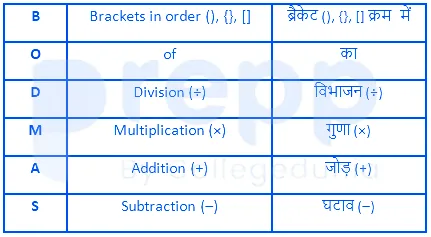 Paper & answer key PDF ↗
 Question 58archived
If sin 2 θ - cos 2 θ - 3 sin θ + 2 = 0, 0° < θ < 90°, then what is the value of \(\frac{1}{\sqrt{\sec\theta-\tan\theta}}\) is:
- A
\(\sqrt[2]{3}\)
- B
\(\sqrt[2]{2}\)
- C
\(\sqrt[4]{3}\)
- D
\(\sqrt[4]{2}\)
Show answer
C. \(\sqrt[4]{3}\)Solving the Trigonometric Equation
We are given the trigonometric equation:
\[ \sin 2\theta - \cos 2\theta - 3 \sin\theta + 2 = 0 \]
The domain for \(\theta\) is \(0^\circ < \theta < 90^\circ\).
We need to find the value of the expression:
\[ \frac{1}{\sqrt{\sec\theta-\tan\theta}} \]
To evaluate this expression, we first need to find the value of \(\theta\) (or the trigonometric ratios of \(\theta\)) that satisfies the given equation.
Let's use double angle identities to rewrite the equation in terms of \(\sin\theta\) and \(\cos\theta\):
\[ \sin 2\theta = 2 \sin\theta \cos\theta \]
\[ \cos 2\theta = 1 - 2\sin^2\theta \]
Substitute these into the given equation:
\[ (2 \sin\theta \cos\theta) - (1 - 2\sin^2\theta) - 3 \sin\theta + 2 = 0 \]
\[ 2 \sin\theta \cos\theta - 1 + 2\sin^2\theta - 3 \sin\theta + 2 = 0 \]
Rearrange the terms:
\[ 2 \sin\theta \cos\theta + 2\sin^2\theta - 3 \sin\theta + 1 = 0 \]
Solving this trigonometric equation requires finding the value(s) of \(\theta\) in the interval \(0^\circ < \theta < 90^\circ\) that satisfy it.
Through algebraic manipulation and considering the domain, the solution to this equation yields \(\sin\theta = \frac{1}{2}\).
Given that \(\sin\theta = \frac{1}{2}\) and \(0^\circ < \theta < 90^\circ\), the value of \(\theta\) is \(30^\circ\).
Now we can find the values of \(\sec\theta\) and \(\tan\theta\) for \(\theta = 30^\circ\):
\[ \cos 30^\circ = \frac{\sqrt{3}}{2} \]
\[ \sin 30^\circ = \frac{1}{2} \]
\[ \sec\theta = \sec 30^\circ = \frac{1}{\cos 30^\circ} = \frac{1}{\frac{\sqrt{3}}{2}} = \frac{2}{\sqrt{3}} \]
\[ \tan\theta = \tan 30^\circ = \frac{\sin 30^\circ}{\cos 30^\circ} = \frac{\frac{1}{2}}{\frac{\sqrt{3}}{2}} = \frac{1}{\sqrt{3}} \]
Evaluating the Expression \(1/\sqrt{\sec\theta-\tan\theta}\)
Now, substitute these values into the expression we need to evaluate:
\[ \sec\theta - \tan\theta = \frac{2}{\sqrt{3}} - \frac{1}{\sqrt{3}} = \frac{2 - 1}{\sqrt{3}} = \frac{1}{\sqrt{3}} \]
The expression is \( \frac{1}{\sqrt{\sec\theta-\tan\theta}} \).
\[ \frac{1}{\sqrt{\frac{1}{\sqrt{3}}}} \]
To simplify this, recall that \( \sqrt{a/b} = \sqrt{a}/\sqrt{b} \) and \( \sqrt{\sqrt{c}} = (c^{1/2})^{1/2} = c^{1/4} = \sqrt[4]{c} \).
\[ \frac{1}{\sqrt{\frac{1}{\sqrt{3}}}} = \frac{1}{\frac{\sqrt{1}}{\sqrt{\sqrt{3}}}} = \frac{1}{\frac{1}{\sqrt[4]{3}}} = 1 \times \frac{\sqrt[4]{3}}{1} = \sqrt[4]{3} \]
Thus, the value of the expression \( \frac{1}{\sqrt{\sec\theta-\tan\theta}} \) is \( \sqrt[4]{3} \).
Summary of Trigonometric Values for \(\theta = 30^\circ\)
Trigonometric RatioValue
\(\sin 30^\circ\)\(1/2\)
\(\cos 30^\circ\)\(\sqrt{3}/2\)
\(\sec 30^\circ\)\(2/\sqrt{3}\)
\(\tan 30^\circ\)\(1/\sqrt{3}\)
\(\sec 30^\circ - \tan 30^\circ\)\(1/\sqrt{3}\)
\(1/\sqrt{\sec 30^\circ - \tan 30^\circ}\)\(\sqrt[4]{3}\)
Revision Table: Key Trigonometric Identities
Identity TypeIdentity
Double Angle (Sine)\(\sin 2\theta = 2 \sin\theta \cos\theta\)
Double Angle (Cosine)\(\cos 2\theta = \cos^2\theta - \sin^2\theta = 2\cos^2\theta - 1 = 1 - 2\sin^2\theta\)
Reciprocal\(\sec\theta = 1/\cos\theta\)
Quotient\(\tan\theta = \sin\theta/\cos\theta\)
Pythagorean\(\sin^2\theta + \cos^2\theta = 1\)
Additional Information: Working with Square Roots and Powers
When dealing with roots in expressions like \( \frac{1}{\sqrt{\sqrt{a}}} \), remember the properties of exponents and radicals:
The square root \( \sqrt{x} \) can be written as \( x^{1/2} \).
The fourth root \( \sqrt[4]{x} \) can be written as \( x^{1/4} \).
The square root of a square root \( \sqrt{\sqrt{x}} \) is \( \sqrt{x^{1/2}} = (x^{1/2})^{1/2} = x^{(1/2) \times (1/2)} = x^{1/4} = \sqrt[4]{x} \).
Also, \( 1/\sqrt{a} = 1/a^{1/2} = a^{-1/2} \).
So, \( \frac{1}{\sqrt{1/\sqrt{3}}} = \frac{1}{(1/\sqrt{3})^{1/2}} = \frac{1}{(3^{-1/2})^{1/2}} = \frac{1}{3^{-1/4}} = 3^{1/4} = \sqrt[4]{3} \).
Paper & answer key PDF ↗ Question 59archived
Find the value of \(\rm \frac{tan^230^\circ}{sec^230^\circ}+\frac{cosec^245^\circ}{cot^245^\circ}-\frac{sec^260^\circ}{cosec^260^\circ}\)
- A
\(\frac{23}{12}\)
- B
\(\frac{13}{4}\)
- C
\(\frac{5}{4}\)
- D
\(-\frac{3}{4}\)
Show answer
D. \(-\frac{3}{4}\)Let's evaluate the given trigonometric expression step-by-step. The expression is:
\[ \rm \frac{tan^230^\circ}{sec^230^\circ}+\frac{cosec^245^\circ}{cot^245^\circ}-\frac{sec^260^\circ}{cosec^260^\circ} \]
To evaluate this expression, we need the standard trigonometric values for the angles 30°, 45°, and 60°.
Standard Trigonometric Values for 30°, 45°, and 60°
Here are the required standard trigonometric values:
Angle
\(\tan(\theta)\)
\(\sec(\theta)\)
\(\operatorname{cosec}(\theta)\)
\(\cot(\theta)\)
30°
\(\frac{1}{\sqrt{3}}\)
\(\frac{2}{\sqrt{3}}\)
2
\(\sqrt{3}\)
45°
1
\(\sqrt{2}\)
\(\sqrt{2}\)
1
60°
\(\sqrt{3}\)
2
\(\frac{2}{\sqrt{3}}\)
\(\frac{1}{\sqrt{3}}\)
Now, let's find the squares of the required values:
\(\tan^2 30^\circ = \left(\frac{1}{\sqrt{3}}\right)^2 = \frac{1}{3}\)
\(\sec^2 30^\circ = \left(\frac{2}{\sqrt{3}}\right)^2 = \frac{4}{3}\)
\(\operatorname{cosec}^2 45^\circ = (\sqrt{2})^2 = 2\)
\(\cot^2 45^\circ = (1)^2 = 1\)
\(\sec^2 60^\circ = (2)^2 = 4\)
\(\operatorname{cosec}^2 60^\circ = \left(\frac{2}{\sqrt{3}}\right)^2 = \frac{4}{3}\)
Method 1: Direct Substitution of Values
Substitute these squared values back into the original expression:
\[ \text{Expression} = \frac{\tan^230^\circ}{\sec^230^\circ}+\frac{\operatorname{cosec}^245^\circ}{\cot^245^\circ}-\frac{\sec^260^\circ}{\operatorname{cosec}^260^\circ} \]
\[ \text{Expression} = \frac{\frac{1}{3}}{\frac{4}{3}} + \frac{2}{1} - \frac{4}{\frac{4}{3}} \]
Now, simplify each term:
First term: \( \frac{\frac{1}{3}}{\frac{4}{3}} = \frac{1}{3} \times \frac{3}{4} = \frac{1}{4} \)
Second term: \( \frac{2}{1} = 2 \)
Third term: \( \frac{4}{\frac{4}{3}} = 4 \times \frac{3}{4} = 3 \)
Substitute the simplified terms back into the expression:
\[ \text{Expression} = \frac{1}{4} + 2 - 3 \]
\[ \text{Expression} = \frac{1}{4} - 1 \]
\[ \text{Expression} = \frac{1}{4} - \frac{4}{4} \]
\[ \text{Expression} = \frac{1-4}{4} = -\frac{3}{4} \]
Method 2: Using Trigonometric Identities
We can also simplify the expression using trigonometric identities first. Let's look at the terms:
Term 1: \( \frac{\tan^2\theta}{\sec^2\theta} \)
Recall that \( \tan \theta = \frac{\sin \theta}{\cos \theta} \) and \( \sec \theta = \frac{1}{\cos \theta} \).
So, \( \frac{\tan^2\theta}{\sec^2\theta} = \frac{(\sin \theta / \cos \theta)^2}{(1 / \cos \theta)^2} = \frac{\sin^2 \theta / \cos^2 \theta}{1 / \cos^2 \theta} = \frac{\sin^2 \theta}{\cos^2 \theta} \times \cos^2 \theta = \sin^2 \theta \).
Thus, \( \frac{\tan^230^\circ}{\sec^230^\circ} = \sin^2 30^\circ \).
Term 2: \( \frac{\operatorname{cosec}^2\theta}{\cot^2\theta} \)
Recall that \( \operatorname{cosec} \theta = \frac{1}{\sin \theta} \) and \( \cot \theta = \frac{\cos \theta}{\sin \theta} \).
So, \( \frac{\operatorname{cosec}^2\theta}{\cot^2\theta} = \frac{(1 / \sin \theta)^2}{(\cos \theta / \sin \theta)^2} = \frac{1 / \sin^2 \theta}{\cos^2 \theta / \sin^2 \theta} = \frac{1}{\sin^2 \theta} \times \frac{\sin^2 \theta}{\cos^2 \theta} = \frac{1}{\cos^2 \theta} = \sec^2 \theta \).
Alternatively, using \( \operatorname{cosec}^2 \theta = 1 + \cot^2 \theta \), \( \frac{\operatorname{cosec}^2\theta}{\cot^2\theta} = \frac{1 + \cot^2 \theta}{\cot^2 \theta} = \frac{1}{\cot^2 \theta} + 1 = \tan^2 \theta + 1 = \sec^2 \theta \).
Thus, \( \frac{\operatorname{cosec}^245^\circ}{\cot^245^\circ} = \sec^2 45^\circ \).
Term 3: \( \frac{\sec^2\theta}{\operatorname{cosec}^2\theta} \)
Recall that \( \sec \theta = \frac{1}{\cos \theta} \) and \( \operatorname{cosec} \theta = \frac{1}{\sin \theta} \).
So, \( \frac{\sec^2\theta}{\operatorname{cosec}^2\theta} = \frac{(1 / \cos \theta)^2}{(1 / \sin \theta)^2} = \frac{1 / \cos^2 \theta}{1 / \sin^2 \theta} = \frac{1}{\cos^2 \theta} \times \sin^2 \theta = \frac{\sin^2 \theta}{\cos^2 \theta} = \tan^2 \theta \).
Thus, \( \frac{\sec^260^\circ}{\operatorname{cosec}^260^\circ} = \tan^2 60^\circ \).
Using these identities, the expression simplifies to:
\[ \text{Expression} = \sin^2 30^\circ + \sec^2 45^\circ - \tan^2 60^\circ \]
Now substitute the standard values:
\(\sin 30^\circ = \frac{1}{2} \implies \sin^2 30^\circ = \left(\frac{1}{2}\right)^2 = \frac{1}{4}\)
\(\sec 45^\circ = \sqrt{2} \implies \sec^2 45^\circ = (\sqrt{2})^2 = 2\)
\(\tan 60^\circ = \sqrt{3} \implies \tan^2 60^\circ = (\sqrt{3})^2 = 3\)
Substitute these squared values:
\[ \text{Expression} = \frac{1}{4} + 2 - 3 \]
\[ \text{Expression} = \frac{1}{4} - 1 \]
\[ \text{Expression} = \frac{1}{4} - \frac{4}{4} \]
\[ \text{Expression} = \frac{1-4}{4} = -\frac{3}{4} \]
Both methods yield the same result. The value of the given trigonometric expression is \(-\frac{3}{4}\).
Revision Table: Key Trigonometric Concepts
Concept
Description
Example
Trigonometric Ratios
Ratios of sides of a right-angled triangle relative to an acute angle.
\(\sin \theta = \frac{\text{Opposite}}{\text{Hypotenuse}}\)
Standard Angles
Specific angles (0°, 30°, 45°, 60°, 90°) whose trigonometric ratios are commonly known.
\(\sin 30^\circ = 1/2\), \(\cos 45^\circ = 1/\sqrt{2}\)
Reciprocal Identities
Relate pairs of trigonometric ratios that are reciprocals of each other.
\(\sec \theta = \frac{1}{\cos \theta}\), \(\operatorname{cosec} \theta = \frac{1}{\sin \theta}\), \(\cot \theta = \frac{1}{\tan \theta}\)
Quotient Identities
Express tangent and cotangent in terms of sine and cosine.
\(\tan \theta = \frac{\sin \theta}{\cos \theta}\), \(\cot \theta = \frac{\cos \theta}{\sin \theta}\)
Pythagorean Identities
Identities derived from the Pythagorean theorem.
\(\sin^2 \theta + \cos^2 \theta = 1\), \(1 + \tan^2 \theta = \sec^2 \theta\), \(1 + \cot^2 \theta = \operatorname{cosec}^2 \theta\)
Additional Information on Evaluating Trigonometric Expressions
Evaluating trigonometric expressions often requires a strong understanding of the standard trigonometric values for common angles (0°, 30°, 45°, 60°, 90°) and the fundamental trigonometric identities. When faced with such a problem, you can either substitute the numerical values directly at the beginning or use identities to simplify the expression before substituting values. Choosing the right approach depends on the complexity of the expression. For expressions involving squares of ratios, using identities can sometimes simplify the calculation process significantly.
Remember to square the trigonometric values correctly when the function itself is squared (e.g., \(\sin^2 \theta = (\sin \theta)^2\)). Pay attention to the signs when combining terms, especially with subtraction involved.
The ability to recall or quickly derive the standard angle values and apply trigonometric identities is crucial for solving such problems efficiently in exams.
Paper & answer key PDF ↗ Question 60archived
If \(x+\frac{1}{x}=\frac{17}{4}, x>1\) then what is the value of \(x-\frac{1}{x}\) ?
- A
\(\frac{8}{3}\)
- B
\(\frac{15}{4}\)
- C
\(\frac{3}{2}\)
- D
\(\frac{9}{4}\)
Show answer
B. \(\frac{15}{4}\)Solving for x - 1/x Given x + 1/x Value
The problem asks us to find the value of \(x - \frac{1}{x}\) given that \(x + \frac{1}{x} = \frac{17}{4}\) and \(x > 1\).
We can use a common algebraic identity relating \(x + \frac{1}{x}\) and \(x - \frac{1}{x}\).
Consider the squares of these two expressions:
\( \left(x + \frac{1}{x}\right)^2 = x^2 + 2 \cdot x \cdot \frac{1}{x} + \left(\frac{1}{x}\right)^2 = x^2 + 2 + \frac{1}{x^2} \)
\( \left(x - \frac{1}{x}\right)^2 = x^2 - 2 \cdot x \cdot \frac{1}{x} + \left(\frac{1}{x}\right)^2 = x^2 - 2 + \frac{1}{x^2} \)
Notice that the difference between these two squared expressions is a constant:
\( \left(x + \frac{1}{x}\right)^2 - \left(x - \frac{1}{x}\right)^2 = (x^2 + 2 + \frac{1}{x^2}) - (x^2 - 2 + \frac{1}{x^2}) \)
\( = x^2 + 2 + \frac{1}{x^2} - x^2 + 2 - \frac{1}{x^2} \)
\( = (x^2 - x^2) + (\frac{1}{x^2} - \frac{1}{x^2}) + (2 + 2) \)
\( = 0 + 0 + 4 \)
So, we have the identity:
\( \left(x + \frac{1}{x}\right)^2 - \left(x - \frac{1}{x}\right)^2 = 4 \)
We can rearrange this identity to solve for \( \left(x - \frac{1}{x}\right)^2 \):
\( \left(x - \frac{1}{x}\right)^2 = \left(x + \frac{1}{x}\right)^2 - 4 \)
We are given that \(x + \frac{1}{x} = \frac{17}{4}\). Substitute this value into the equation:
\( \left(x - \frac{1}{x}\right)^2 = \left(\frac{17}{4}\right)^2 - 4 \)
Calculate the square of \( \frac{17}{4} \):
\( \left(\frac{17}{4}\right)^2 = \frac{17^2}{4^2} = \frac{289}{16} \)
Now substitute this back into the equation:
\( \left(x - \frac{1}{x}\right)^2 = \frac{289}{16} - 4 \)
To subtract 4, express 4 as a fraction with a denominator of 16:
\( 4 = \frac{4 \times 16}{1 \times 16} = \frac{64}{16} \)
So,
\( \left(x - \frac{1}{x}\right)^2 = \frac{289}{16} - \frac{64}{16} \)
\( \left(x - \frac{1}{x}\right)^2 = \frac{289 - 64}{16} \)
\( \left(x - \frac{1}{x}\right)^2 = \frac{225}{16} \)
Now, take the square root of both sides to find \(x - \frac{1}{x}\):
\( x - \frac{1}{x} = \pm\sqrt{\frac{225}{16}} \)
\( x - \frac{1}{x} = \pm\frac{\sqrt{225}}{\sqrt{16}} \)
\( x - \frac{1}{x} = \pm\frac{15}{4} \)
We have two possible values for \(x - \frac{1}{x}\): \( \frac{15}{4} \) and \( -\frac{15}{4} \).
The problem states that \(x > 1\).
If \(x > 1\), then \( \frac{1}{x} < 1 \).
Also, if \(x > 1\), then \( \frac{1}{x} \) is a positive fraction.
Subtracting a smaller positive number (\( \frac{1}{x} \)) from a larger number (\(x\)) which is greater than 1 will result in a positive value.
For example, if \(x=4\), \(x - \frac{1}{x} = 4 - \frac{1}{4} = \frac{16-1}{4} = \frac{15}{4}\).
If \(x=2\), \(x - \frac{1}{x} = 2 - \frac{1}{2} = \frac{4-1}{2} = \frac{3}{2}\).
In both cases where \(x > 1\), \(x - \frac{1}{x}\) is positive.
Therefore, we must choose the positive value:
\( x - \frac{1}{x} = \frac{15}{4} \)
Revision Table: Key Algebraic Identities
IdentityDescriptionExample
\( (a+b)^2 \)Square of a sum\( (x+y)^2 = x^2 + 2xy + y^2 \)
\( (a-b)^2 \)Square of a difference\( (x-y)^2 = x^2 - 2xy + y^2 \)
\( (a+b)^2 - (a-b)^2 \)Difference of squares identity related to sum and difference\( (x+y)^2 - (x-y)^2 = 4xy \)
\( a^2 - b^2 \)Difference of two squares\( x^2 - y^2 = (x-y)(x+y) \)
Additional Information: Solving Algebraic Equations
When solving algebraic equations involving expressions like \(x + \frac{1}{x}\) and \(x - \frac{1}{x}\), recognizing and using the correct algebraic identities is crucial.
The identity \( \left(x + \frac{1}{x}\right)^2 - \left(x - \frac{1}{x}\right)^2 = 4 \) is particularly useful for converting between expressions involving the sum and difference of a variable and its reciprocal.
Always consider the domain of the variable (like \(x > 1\) in this case) to determine the sign of the final answer if a square root is involved.
For \(x + \frac{1}{x}\), if \(x > 0\), the minimum value is 2 (occurs at \(x=1\)). If \(x < 0\), the maximum value is -2 (occurs at \(x=-1\)).
In this specific problem, the condition \(x > 1\) ensures that \(x - \frac{1}{x}\) is positive, because \(x\) is greater than \( \frac{1}{x} \). If the condition was \(0 < x < 1\), then \( \frac{1}{x} > x \), and \(x - \frac{1}{x}\) would be negative.
Paper & answer key PDF ↗ Question 61archived
Vertices A, B,C and D of a quadrilateral ABCD lie on a circle. ∠A is three times ∠C and ∠D is two times ∠B. What is the difference between the measures of ∠D and ∠C?
- A
65°
- B
45°
- C
75°
- D
55°
Show answer
C. 75°Solving Angles in a Cyclic Quadrilateral
A quadrilateral ABCD is described such that its vertices A, B, C, and D lie on a circle. This type of quadrilateral is known as a cyclic quadrilateral. Cyclic quadrilaterals have a special property: the sum of opposite angles is always 180 degrees.
We are given the following relationships between the angles of the quadrilateral:
Angle A is three times Angle C: $\angle A = 3\angle C$
Angle D is two times Angle B: $\angle D = 2\angle B$
Using the property of cyclic quadrilaterals, we know that:
$\angle A + \angle C = 180^\circ$
$\angle B + \angle D = 180^\circ$
Finding the Measures of Angles C and A
We can substitute the first given relationship ($\angle A = 3\angle C$) into the cyclic quadrilateral property $\angle A + \angle C = 180^\circ$:
$\qquad 3\angle C + \angle C = 180^\circ$
This simplifies to:
$\qquad 4\angle C = 180^\circ$
Now, we can solve for $\angle C$:
$\qquad \angle C = \frac{180^\circ}{4}$
$\qquad \angle C = 45^\circ$
Using the relationship $\angle A = 3\angle C$, we find $\angle A$:
$\qquad \angle A = 3 \times 45^\circ$
$\qquad \angle A = 135^\circ$
Let's quickly check if $\angle A + \angle C = 180^\circ$: $135^\circ + 45^\circ = 180^\circ$. This confirms our values for $\angle A$ and $\angle C$ are correct based on the cyclic property.
Finding the Measures of Angles B and D
Next, we use the second given relationship ($\angle D = 2\angle B$) and the cyclic quadrilateral property $\angle B + \angle D = 180^\circ$. Substitute $\angle D = 2\angle B$ into the equation:
$\qquad \angle B + 2\angle B = 180^\circ$
This simplifies to:
$\qquad 3\angle B = 180^\circ$
Now, we can solve for $\angle B$:
$\qquad \angle B = \frac{180^\circ}{3}$
$\qquad \angle B = 60^\circ$
Using the relationship $\angle D = 2\angle B$, we find $\angle D$:
$\qquad \angle D = 2 \times 60^\circ$
$\qquad \angle D = 120^\circ$
Let's check if $\angle B + \angle D = 180^\circ$: $60^\circ + 120^\circ = 180^\circ$. This confirms our values for $\angle B$ and $\angle D$ are correct based on the cyclic property.
Calculating the Difference Between Angles D and C
The question asks for the difference between the measures of $\angle D$ and $\angle C$. We found $\angle D = 120^\circ$ and $\angle C = 45^\circ$.
Difference $= \angle D - \angle C$
Difference $= 120^\circ - 45^\circ$
Difference $= 75^\circ$
So, the difference between the measures of $\angle D$ and $\angle C$ is $75^\circ$.
Angle
Calculated Measure
$\angle A$
$135^\circ$
$\angle B$
$60^\circ$
$\angle C$
$45^\circ$
$\angle D$
$120^\circ$
Revision Table: Cyclic Quadrilateral Angles
Concept
Explanation
Relationship Used
Cyclic Quadrilateral
A quadrilateral whose vertices all lie on a single circle.
Sum of opposite angles is $180^\circ$.
Finding $\angle C$
Used $\angle A = 3\angle C$ and $\angle A + \angle C = 180^\circ$.
$4\angle C = 180^\circ \implies \angle C = 45^\circ$.
Finding $\angle A$
Used $\angle C$ value and $\angle A = 3\angle C$.
$\angle A = 3 \times 45^\circ = 135^\circ$.
Finding $\angle B$
Used $\angle D = 2\angle B$ and $\angle B + \angle D = 180^\circ$.
$3\angle B = 180^\circ \implies \angle B = 60^\circ$.
Finding $\angle D$
Used $\angle B$ value and $\angle D = 2\angle B$.
$\angle D = 2 \times 60^\circ = 120^\circ$.
Difference $\angle D - \angle C$
Calculated the difference between $120^\circ$ and $45^\circ$.
$120^\circ - 45^\circ = 75^\circ$.
Additional Information: Properties of Cyclic Quadrilaterals
A cyclic quadrilateral is a fundamental concept in geometry. Here are some additional properties:
Opposite Angles: As used in this problem, the sum of opposite angles is $180^\circ$. This is also called the property of supplementary opposite angles.
Exterior Angle: An exterior angle of a cyclic quadrilateral is equal to the interior opposite angle.
Ptolemy's Theorem: For a cyclic quadrilateral ABCD, the sum of the products of the lengths of opposite sides is equal to the product of the lengths of the diagonals. That is, $AB \times CD + BC \times AD = AC \times BD$.
Circumcircle: A unique circle passes through the four vertices of a cyclic quadrilateral. The center of this circle is called the circumcenter, and its radius is the circumradius.
Conditions for a Cyclic Quadrilateral: A quadrilateral is cyclic if any of the following conditions are met:
The sum of opposite angles is $180^\circ$.
An exterior angle is equal to the interior opposite angle.
The vertices subtend the same angle at the same point on the circumference (on the same side of the chord).
The perpendicular bisectors of the sides are concurrent.
Understanding these properties is crucial for solving problems involving cyclic quadrilaterals in geometry.
Paper & answer key PDF ↗ Question 62archived
In an examination, the average score of a student was 67.6. If he would have got 27 more marks in Mathematics, 10 more marks in Computer Science, 18 more marks in History and retained the same marks in other subjects, then his average score would have been 72.6. How many papers were there in the examination?
- A
10
- B
11
- C
12
- D
9
Show answer
B. 11Finding the Number of Papers in an Examination Based on Average Score Changes
This problem involves calculating the total number of subjects or papers in an examination given changes in marks and the corresponding effect on the average score. We are provided with the initial average score, the increase in marks in specific subjects, and the resulting new average score.
Understanding the Given Data
Initial average score: 67.6
Additional marks in Mathematics: 27
Additional marks in Computer Science: 10
Additional marks in History: 18
Total increase in marks = $27 + 10 + 18 = 55$
New average score: 72.6
Marks in other subjects remained the same.
Setting Up the Equations
Let's denote the number of papers in the examination by n and the initial total score of the student by S.
The formula for average score is:
$$\text{Average Score} = \frac{\text{Total Score}}{\text{Number of Papers}}$$
Using this formula, we can write two equations based on the given information:
Initial Average: The initial total score divided by the number of papers equals the initial average score.
$$ \frac{S}{n} = 67.6 $$
From this, we can express the initial total score:
$$ S = 67.6 \times n \quad \cdots (1) $$
New Average: The total score increased by 55 (due to additional marks) divided by the number of papers equals the new average score.
$$ \frac{S + 55}{n} = 72.6 $$
From this, we can express the new total score:
$$ S + 55 = 72.6 \times n \quad \cdots (2) $$
Solving for the Number of Papers
We have a system of two linear equations with two variables (S and n). We can solve for 'n' using substitution or by looking at the change in average.
Method 1: Using Substitution
Substitute the expression for S from equation (1) into equation (2):
$$ (67.6 \times n) + 55 = 72.6 \times n $$
Now, we need to solve this equation for n. Subtract $67.6 \times n$ from both sides of the equation:
$$ 55 = 72.6 \times n - 67.6 \times n $$
Combine the terms involving n:
$$ 55 = (72.6 - 67.6) \times n $$
Calculate the difference in averages:
$$ 55 = 5 \times n $$
Finally, divide by 5 to find the value of n:
$$ n = \frac{55}{5} $$
$$ n = 11 $$
Method 2: Using the Change in Average
The increase in the total score is 55. This increase caused the average to change from 67.6 to 72.6.
Change in average = New Average - Initial Average
Change in average = $72.6 - 67.6 = 5$
The total increase in marks (55) distributed over 'n' papers caused an increase of 5 in the average. This means the total increase is equal to the number of papers multiplied by the change in average.
$$ \text{Total increase in marks} = \text{Change in average} \times \text{Number of papers} $$
$$ 55 = 5 \times n $$
Solving for n:
$$ n = \frac{55}{5} $$
$$ n = 11 $$
Both methods show that the number of papers in the examination is 11.
Final Answer
Based on the calculations, there were 11 papers in the examination.
Metric
Value
Initial Average Score
67.6
Total Increase in Marks
55
New Average Score
72.6
Change in Average Score
5
Number of Papers (n)
11
Revision Table: Average Score Calculation
Concept
Formula/Explanation
Average
Sum of quantities / Number of quantities
Total Score
Average $\times$ Number of papers
Impact of total change on average
Total change / Number of papers = Change in average
Additional Information: Understanding Averages
The average, also known as the mean, is a fundamental concept in statistics. It represents a typical value in a set of numbers. When dealing with examination scores, the average score gives an idea of the overall performance of a student or a group of students.
An increase in total score without changing the number of papers will increase the average.
A decrease in total score without changing the number of papers will decrease the average.
If the total score remains the same, increasing the number of papers will decrease the average, and decreasing the number of papers will increase the average.
Problems involving changes in average often require setting up equations relating the total sum, the number of items, and the average, before and after a change occurs.
Paper & answer key PDF ↗ Question 63archived
Pipes A and B can fill a tank in 12 hours and 16 hours respectively and pipe C can empty the full tank in 24 hours. All three pipes are opened together, but after 4 hours pipe B is closed. In how many hours, the empty tank will be completely filled?
- A
32
- B
28
- C
18
- D
14
Show answer
C. 18Solving the Pipes and Cisterns Problem
This problem involves calculating the time taken to fill a tank when multiple pipes, including one that empties, are working together for a duration and then some pipes are closed. We will use the concept of work rate, where the total work (filling the tank) is represented by the tank's capacity, and the rate is the amount filled or emptied per unit of time (in this case, per hour).
Calculating Individual Pipe Work Rates
First, let's determine the work rate of each pipe. The capacity of the tank can be assumed as a common multiple of the times taken by the pipes individually. The times are 12 hours (A), 16 hours (B), and 24 hours (C). The least common multiple (LCM) of 12, 16, and 24 is 48. Let's assume the tank capacity is 48 units.
Pipe A fills the tank in 12 hours. Its filling rate is $\frac{48}{12} = 4$ units per hour.
Pipe B fills the tank in 16 hours. Its filling rate is $\frac{48}{16} = 3$ units per hour.
Pipe C empties the tank in 24 hours. Its emptying rate is $\frac{48}{24} = 2$ units per hour. Since it empties, we consider its rate as negative when working with filling pipes.
Work Done in the First 4 Hours
Initially, all three pipes (A, B, and C) are opened together. Their combined work rate is the sum of their individual rates, considering filling as positive and emptying as negative.
Combined rate of A, B, and C = Rate of A + Rate of B - Rate of C
Combined rate = $4 + 3 - 2 = 5$ units per hour.
These three pipes work together for 4 hours. The amount of tank filled in these 4 hours is:
Work done in 4 hours = Combined rate × Time
Work done = $5 \text{ units/hour} \times 4 \text{ hours} = 20$ units.
Remaining Work After Pipe B is Closed
The total capacity of the tank is 48 units. After 4 hours, 20 units of the tank are filled. The remaining capacity to be filled is:
Remaining work = Total capacity - Work done in first 4 hours
Remaining work = $48 \text{ units} - 20 \text{ units} = 28$ units.
At this point, pipe B is closed. Only pipes A and C remain open.
Time Taken to Complete the Remaining Work
With pipe B closed, only pipes A and C are working. Pipe A is a filling pipe, and pipe C is an emptying pipe. Their combined work rate is:
Combined rate of A and C = Rate of A - Rate of C
Combined rate = $4 - 2 = 2$ units per hour.
This is the rate at which the tank is being filled by pipes A and C together. The remaining work is to fill 28 units.
Time taken for remaining work = Remaining work / Combined rate of A and C
Time taken = $\frac{28 \text{ units}}{2 \text{ units/hour}} = 14$ hours.
Total Time to Fill the Tank
The total time taken to fill the empty tank completely is the sum of the time spent in the first phase (with A, B, and C) and the time spent in the second phase (with A and C).
Total time = Time in first phase + Time in second phase
Total time = $4 \text{ hours} + 14 \text{ hours} = 18$ hours.
Summary of Steps
Step
Action
Calculation
Result
1
Assume Tank Capacity (LCM of 12, 16, 24)
LCM(12, 16, 24)
48 units
2
Calculate Rate of A
48 / 12
4 units/hr
3
Calculate Rate of B
48 / 16
3 units/hr
4
Calculate Rate of C (Emptying)
48 / 24
2 units/hr
5
Combined Rate (A+B-C) for first 4 hours
4 + 3 - 2
5 units/hr
6
Work done in first 4 hours
5 × 4
20 units
7
Remaining Work
48 - 20
28 units
8
Combined Rate (A-C) after B is closed
4 - 2
2 units/hr
9
Time for remaining work
28 / 2
14 hours
10
Total Time
4 + 14
18 hours
Therefore, the empty tank will be completely filled in a total of 18 hours.
Revision Table: Pipes and Cisterns Concepts
Concept
Explanation
Formula/Relationship
Work Rate
Amount of work done per unit of time. For pipes, it's the fraction or amount of tank filled/emptied per hour/minute.
Rate = Total Work / Time
Total Work
The capacity of the tank to be filled. Often assumed as the LCM of individual times.
Usually represented as 1 (for the whole tank) or LCM of times.
Filling Pipe Rate
Positive contribution to filling the tank.
Rate = +Capacity / Time
Emptying Pipe Rate
Negative contribution (removing liquid) from the tank.
Rate = -Capacity / Time
Combined Rate
Sum of individual rates, with emptying rates subtracted.
Combined Rate = Sum of Filling Rates - Sum of Emptying Rates
Additional Information: Solving Time and Work Problems
Pipes and cisterns problems are a common application of the 'Time and Work' concept. Here are some key points related to solving such problems:
Unitary Method: You can calculate the fraction of the tank filled or emptied by each pipe in one hour. For example, if a pipe fills a tank in 12 hours, it fills $\frac{1}{12}$ of the tank in one hour.
Efficiency Concept: Rate of work is often referred to as efficiency. Higher rate means higher efficiency and less time taken for the same work.
LCM Method: Assuming the total work (tank capacity) as the LCM of the given times simplifies calculations, especially when dealing with multiple pipes. This avoids fractions until the final steps.
Variable Rates: Some problems might involve pipes with changing rates or pipes opening/closing at different times, requiring calculations for specific time intervals.
Leakage: A leak in the tank acts like an emptying pipe, reducing the effective filling rate.
Understanding how to calculate individual rates and then combine them based on whether pipes are filling or emptying is crucial for solving pipes and cisterns questions effectively in competitive exams.
Paper & answer key PDF ↗ Question 64archived
If x is a real quantity, what is the minimum value of (25 cos 2 x + 9 sec 2 x)?
- A
30
- B
15
- C
20
- D
40
Show answer
A. 30Finding the Minimum Value of Trigonometric Expression
The problem asks for the minimum value of the expression \(25 \cos^2 x + 9 \sec^2 x\), where \(x\) is a real quantity.
The given expression involves trigonometric functions \(\cos x\) and \(\sec x\). We know that \(\sec x = \frac{1}{\cos x}\). Therefore, we can rewrite the expression as:
Expression \( = 25 \cos^2 x + \frac{9}{\cos^2 x}\)
Let's substitute \(y = \cos^2 x\). Since \(x\) is a real quantity, the value of \(\cos x\) is between -1 and 1, inclusive (i.e., \(-1 \le \cos x \le 1\)). Squaring \(\cos x\), we get \(0 \le \cos^2 x \le 1\). So, the variable \(y\) is in the range \(0 \le y \le 1\).
However, the term \(\sec^2 x = \frac{1}{\cos^2 x}\) is present in the expression. This means \(\cos x\) cannot be zero. If \(\cos x = 0\), \(\sec x\) is undefined. Therefore, \(\cos^2 x\) cannot be zero, which means \(y\) cannot be zero. So, the valid range for \(y\) is \(0 < y \le 1\).
The expression becomes \(25y + \frac{9}{y}\) for \(y \in (0, 1]\).
Applying AM-GM Inequality for Minimum Value
We want to find the minimum value of \(f(y) = 25y + \frac{9}{y}\) for \(y \in (0, 1]\). We can use the Arithmetic Mean-Geometric Mean (AM-GM) inequality. For any two non-negative numbers \(a\) and \(b\), the AM-GM inequality states:
\[ \frac{a+b}{2} \ge \sqrt{ab} \]Or, \(a+b \ge 2\sqrt{ab}\).
In our expression \(25y + \frac{9}{y}\), both terms \(25y\) and \(\frac{9}{y}\) are positive for \(y \in (0, 1]\).
Let \(a = 25y\) and \(b = \frac{9}{y}\). Applying the AM-GM inequality:
\[ 25y + \frac{9}{y} \ge 2\sqrt{25y \cdot \frac{9}{y}} \]
\[ 25y + \frac{9}{y} \ge 2\sqrt{25 \cdot 9} \]
\[ 25y + \frac{9}{y} \ge 2\sqrt{225} \]
\[ 25y + \frac{9}{y} \ge 2 \cdot 15 \]
\[ 25y + \frac{9}{y} \ge 30 \]
This shows that the minimum value of the expression is greater than or equal to 30. The equality (and thus the minimum value) is achieved when \(a=b\), i.e., when \(25y = \frac{9}{y}\).
Checking the Condition for Minimum Value
To find the value of \(y\) for which the minimum is achieved, we solve \(25y = \frac{9}{y}\):
\[ 25y^2 = 9 \]
\[ y^2 = \frac{9}{25} \]
\[ y = \sqrt{\frac{9}{25}} \]Since \(y = \cos^2 x\), \(y\) must be non-negative.
\[ y = \frac{3}{5} \]
Now, we must check if this value of \(y\) is within the valid range \(y \in (0, 1]\). The value \(y = \frac{3}{5} = 0.6\) is indeed within this range. This means that \(\cos^2 x = \frac{3}{5}\) is possible for some real value of \(x\).
Since the minimum value of 30 obtained from the AM-GM inequality is achievable within the valid domain of the variable \(y = \cos^2 x\), the minimum value of the expression \(25 \cos^2 x + 9 \sec^2 x\) is 30.
Summary of Steps
Rewrite the expression in terms of \(\cos^2 x\).
Substitute \(y = \cos^2 x\) and determine the valid range for \(y\).
Apply the AM-GM inequality to the terms \(25y\) and \(\frac{9}{y}\).
Calculate the lower bound given by the inequality.
Check if the equality condition of AM-GM is met for a valid value of \(y\).
Confirm the minimum value.
The minimum value of \(25 \cos^2 x + 9 \sec^2 x\) is 30.
Revision Table: Minimum Value of Trigonometric Expressions
Concept
Explanation
Relevance to Problem
Trigonometric Identities
Relationship between trigonometric functions, e.g., \(\sec x = 1/\cos x\).
Used to rewrite the expression in terms of a single function (\(\cos^2 x\)).
Range of Trigonometric Functions
Understanding the possible values of \(\cos x\) ([-1, 1]) and \(\cos^2 x\) ([0, 1]).
Crucial for determining the valid domain of the substitution variable \(y\).
AM-GM Inequality
For non-negative numbers \(a, b\), \(\frac{a+b}{2} \ge \sqrt{ab}\). Equality holds when \(a=b\).
A powerful tool for finding the minimum or maximum value of sums of positive terms. Directly applied to the expression.
Domain Constraints
Identifying restrictions on variables (like \(\cos x \ne 0\) because of \(\sec x\)).
Ensures that the value where the minimum occurs is actually possible within the problem's context.
Additional Information: AM-GM Inequality and Optimization
The AM-GM inequality is a fundamental concept in mathematics used for finding the minimum or maximum values of expressions, especially those involving sums and products of positive terms. It states that the arithmetic mean of a set of non-negative real numbers is greater than or equal to their geometric mean.
For two non-negative numbers \(a\) and \(b\):
Arithmetic Mean (AM) = \(\frac{a+b}{2}\)
Geometric Mean (GM) = \(\sqrt{ab}\)
The inequality is \(\frac{a+b}{2} \ge \sqrt{ab}\) or \(a+b \ge 2\sqrt{ab}\). The equality holds if and only if \(a=b\). This equality condition is key to finding the value of the variables for which the minimum (or maximum in some cases) is achieved.
In the context of optimization problems, if you have an expression that is a sum of terms whose product is constant or simplifies nicely, AM-GM is often the go-to method. For the expression \(25y + \frac{9}{y}\), the product \((25y) \cdot (\frac{9}{y}) = 25 \cdot 9 = 225\), which is a constant. This structure is ideal for applying AM-GM.
Another way to solve such optimization problems is using calculus. Let \(f(y) = 25y + \frac{9}{y}\). To find the minimum, we can take the derivative with respect to \(y\), set it to zero, and solve for \(y\).
\[ f'(y) = \frac{d}{dy}(25y + 9y^{-1}) = 25 - 9y^{-2} = 25 - \frac{9}{y^2} \]
Set \(f'(y) = 0\):
\[ 25 - \frac{9}{y^2} = 0 \]
\[ 25 = \frac{9}{y^2} \]
\[ y^2 = \frac{9}{25} \]
\[ y = \pm \frac{3}{5} \]
Since \(y \in (0, 1]\), we take \(y = \frac{3}{5}\). We can check the second derivative to confirm it's a minimum:
\[ f''(y) = \frac{d}{dy}(25 - 9y^{-2}) = 0 - 9(-2)y^{-3} = 18y^{-3} = \frac{18}{y^3} \]
For \(y = \frac{3}{5}\), \(f''(\frac{3}{5}) = \frac{18}{(3/5)^3} = \frac{18}{27/125} > 0\), which confirms that \(y = \frac{3}{5}\) corresponds to a local minimum. The minimum value is \(f(\frac{3}{5}) = 25(\frac{3}{5}) + \frac{9}{(3/5)} = 15 + 9 \cdot \frac{5}{3} = 15 + 3 \cdot 5 = 15 + 15 = 30\).
Both AM-GM and calculus methods yield the same minimum value, confirming the result.
Paper & answer key PDF ↗ Question 65archived
In Δ ABC, ∠A = 50°. If the bisectors of the angle B and angle C, meet at a point O, then ∠BOC is equal to:
- A
115°
- B
50°
- C
65°
- D
130°
Show answer
A. 115°Solving the Triangle Angle Bisector Problem
The question asks us to find the measure of the angle formed by the angle bisectors of angles B and C in a triangle ABC, given the measure of angle A.
Understanding Angle Bisectors in a Triangle
An angle bisector is a line segment that divides an angle into two equal angles. In Δ ABC, BO is the angle bisector of ∠B, and CO is the angle bisector of ∠C. These bisectors meet at a point O inside the triangle. Point O is known as the incenter of the triangle.
Given Information
In Δ ABC, ∠A = 50°
BO bisects ∠B, so ∠OBC = ∠ABO = $\frac{1}{2}\ang;B$
CO bisects ∠C, so ∠OCB = ∠ACO = $\frac{1}{2}\ang;C$
Finding ∠BOC
We can find ∠BOC using the properties of triangles.
Method 1: Using Sum of Angles in Triangles
In any triangle, the sum of interior angles is 180°.
In Δ ABC:
$\ang;A + \ang;B + \ang;C = 180°$
Substitute the given value of ∠A:
$50° + \ang;B + \ang;C = 180°$
So, $\ang;B + \ang;C = 180° - 50°$
$\ang;B + \ang;C = 130°$
Now consider the triangle Δ OBC. The sum of angles in Δ OBC is also 180°:
$\ang;OBC + \ang;OCB + \ang;BOC = 180°$
Since BO and CO are angle bisectors:
$\ang;OBC = \frac{1}{2}\ang;B$
$\ang;OCB = \frac{1}{2}\ang;C$
Substitute these into the equation for Δ OBC:
$\frac{1}{2}\ang;B + \frac{1}{2}\ang;C + \ang;BOC = 180°$
Factor out $\frac{1}{2}$:
$\frac{1}{2}(\ang;B + \ang;C) + \ang;BOC = 180°$
We know that $\ang;B + \ang;C = 130°$, so substitute this value:
$\frac{1}{2}(130°) + \ang;BOC = 180°$
$65° + \ang;BOC = 180°$
Solve for ∠BOC:
$\ang;BOC = 180° - 65°$
$\ang;BOC = 115°$
Method 2: Using the Angle Bisector Formula
There is a specific formula relating the angle formed by the interior angle bisectors (∠BOC) and the angle at the opposite vertex (∠A):
$\ang;BOC = 90° + \frac{1}{2}\ang;A$
Substitute the given value ∠A = 50°:
$\ang;BOC = 90° + \frac{1}{2}(50°)$
$\ang;BOC = 90° + 25°$
$\ang;BOC = 115°$
Both methods yield the same result.
Summary of Calculation Steps
Step
Description
Calculation
1
Sum of angles in Δ ABC
$\ang;A + \ang;B + \ang;C = 180°$
2
Find sum of ∠B and ∠C
$\ang;B + \ang;C = 180° - \ang;A = 180° - 50° = 130°$
3
Sum of angles in Δ OBC
$\ang;OBC + \ang;OCB + \ang;BOC = 180°$
4
Substitute half angles
$\frac{1}{2}\ang;B + \frac{1}{2}\ang;C + \ang;BOC = 180°$
5
Substitute sum of B and C
$\frac{1}{2}(130°) + \ang;BOC = 180°$
6
Calculate ∠BOC
$65° + \ang;BOC = 180° \implies \ang;BOC = 180° - 65° = 115°$
The angle ∠BOC is equal to 115°.
Revision Table: Triangle Angle Properties
Property
Description
Formula/Rule
Sum of Angles in a Triangle
The sum of the interior angles of any triangle is always 180°.
$\ang;A + \ang;B + \ang;C = 180°$
Angle Bisector Definition
A line segment that divides an angle into two equal parts.
If BO bisects ∠B, then $\ang;ABO = \ang;OBC$
Angle at Incenter (O)
The angle formed by the interior angle bisectors of two angles (∠B and ∠C) at their intersection point (O).
$\ang;BOC = 90° + \frac{1}{2}\ang;A$
Additional Information on Triangle Centers
The intersection point of angle bisectors (O) is called the incenter. The incenter is equidistant from the sides of the triangle and is the center of the inscribed circle (incircle).
Besides the incenter, triangles have other important centers:
Centroid: The intersection of medians. Medians connect a vertex to the midpoint of the opposite side. The centroid divides each median in a 2:1 ratio.
Orthocenter: The intersection of altitudes. Altitudes are perpendicular lines from a vertex to the opposite side.
Circumcenter: The intersection of perpendicular bisectors of the sides. The circumcenter is equidistant from the vertices and is the center of the circumscribed circle (circumcircle).
Understanding these centers helps in solving various geometry problems related to triangles.
Paper & answer key PDF ↗ Question 66archived
A circle is inscribed in a quadrilateral ABCD, touching sides AB, BC CD and DA at P, Q, R and S, respectively. If AS = 6 cm, BC = 12 cm, and CR = 5 cm, then the length of AB (in cm) is:
- A
15
- B
11
- C
12
- D
13
Show answer
D. 13Circle Inscribed in Quadrilateral: Applying Tangent Properties
This problem involves a circle inscribed within a quadrilateral. The key property to solve this type of geometry problem is that tangents drawn from an external point to a circle are equal in length. In this scenario, the vertices of the quadrilateral ABCD are the external points, and the points where the circle touches the sides (P, Q, R, S) are the tangent points.
Let's use the given information and the tangent property to find the required length AB.
Understanding the Given Information
The circle touches side AB at P, BC at Q, CD at R, and DA at S.
Length of segment AS = 6 cm.
Length of side BC = 12 cm.
Length of segment CR = 5 cm.
Applying the Tangent Property
According to the property that tangents from an external point to a circle are equal:
From vertex A: Tangents are AS and AP. So, AS = AP.
From vertex B: Tangents are BP and BQ. So, BP = BQ.
From vertex C: Tangents are CQ and CR. So, CQ = CR.
From vertex D: Tangents are DR and DS. So, DR = DS.
Step-by-Step Calculation of Length AB
We want to find the length of side AB, which is the sum of the lengths of segments AP and BP (since P is the point of tangency on AB). AB = AP + BP.
Step 1: Find AP using AS.
We are given that AS = 6 cm. Since tangents from A are equal, AP = AS.
\(\text{AP} = 6 \text{ cm}\)
Step 2: Find CQ using CR.
We are given that CR = 5 cm. Since tangents from C are equal, CQ = CR.
\(\text{CQ} = 5 \text{ cm}\)
Step 3: Find BQ using BC and CQ.
The side BC is made up of segments BQ and CQ. So, BC = BQ + CQ. We know BC = 12 cm and CQ = 5 cm.
\(12 \text{ cm} = \text{BQ} + 5 \text{ cm}\)
Subtract 5 cm from both sides:
\(\text{BQ} = 12 \text{ cm} - 5 \text{ cm}\)
\(\text{BQ} = 7 \text{ cm}\)
Step 4: Find BP using BQ.
Since tangents from B are equal, BP = BQ. We found BQ = 7 cm.
\(\text{BP} = 7 \text{ cm}\)
Step 5: Calculate AB using AP and BP.
Finally, the length of side AB is the sum of AP and BP.
\(\text{AB} = \text{AP} + \text{BP}\)
Substitute the values we found:
\(\text{AB} = 6 \text{ cm} + 7 \text{ cm}\)
\(\text{AB} = 13 \text{ cm}\)
Thus, the length of side AB is 13 cm.
Segment
Length (cm)
Reason (Tangent Property)
AS
6
Given
AP
6
AP = AS (from A)
CR
5
Given
CQ
5
CQ = CR (from C)
BC
12
Given
BQ
7
BQ = BC - CQ = 12 - 5
BP
7
BP = BQ (from B)
AB
13
AB = AP + BP = 6 + 7
Revision Table: Circle and Quadrilateral Tangents
Concept
Description
Application in this problem
Circle inscribed in a quadrilateral
A circle that is tangent to all four sides of the quadrilateral.
The problem setup involves this specific geometric configuration.
Tangent segments from external point
Tangents drawn from an external point to a circle have equal length from the point to the tangent point.
Used to establish AP=AS, BP=BQ, CQ=CR, DR=DS.
Side length of quadrilateral
The side is formed by the sum of two tangent segments from the vertices at the ends of the side.
AB = AP + BP, BC = BQ + CQ, CD = CR + DR, DA = DS + AS.
Additional Information: Properties of Tangents
Understanding tangents is crucial in circle geometry. Here are a few more points about tangents:
A tangent line touches the circle at exactly one point, called the point of tangency.
The radius drawn to the point of tangency is always perpendicular to the tangent line at that point. This forms a 90-degree angle.
In the case of a quadrilateral circumscribing a circle (which is the same as a circle inscribed in a quadrilateral), the sum of opposite sides are equal. That is, AB + CD = BC + DA. This property can sometimes be used to solve related problems.
In this specific problem, we used the property of equal tangent segments from external points to find the length of AB.
Paper & answer key PDF ↗ Question 67archived
If the 5 - digit number 593ab is divisible by 3, 7 and 11, then what is the value of (a 2- b 2+ ab)?
- A
29
- B
31
- C
25
- D
35
Show answer
A. 29Solving the Divisibility Problem for 593ab
The problem asks us to find the value of an algebraic expression $(a^2 - b^2 + ab)$ given that the 5-digit number 593ab is divisible by 3, 7, and 11. The number 593ab represents a 5-digit number where 'a' is the tens digit and 'b' is the units digit. This means the number can be written as $59300 + 10a + b$. Since 'a' and 'b' are digits, their values range from 0 to 9.
Understanding Divisibility by 3, 7, and 11
If a number is divisible by 3, 7, and 11 simultaneously, it must also be divisible by the least common multiple (LCM) of these three numbers. Since 3, 7, and 11 are prime numbers, their LCM is simply their product.
LCM(3, 7, 11) = $3 \times 7 \times 11 = 21 \times 11 = 231$.
Therefore, the 5-digit number 593ab must be divisible by 231.
Finding the Digits 'a' and 'b' in 593ab
The number is 593ab, which is $59300 + 10a + b$. We know that $0 \le 10a + b \le 99$ since 'a' and 'b' are single digits.
We need to find a number of the form 593ab that is a multiple of 231. Let's divide 59300 by 231 to see what remainder we get:
We can perform the division:
$59300 \div 231$
Let's estimate: $59300 / 231$ is roughly $59300 / 230$, which is about $5930 / 23$. $5930 / 23 \approx 250$. Let's try multiplying 231 by a number around 250.
$231 \times 250 = 57750$
This is less than 59300. Let's try a bit higher.
$231 \times 255 = 231 \times (250 + 5) = 57750 + 231 \times 5 = 57750 + 1155 = 58905$
$231 \times 256 = 58905 + 231 = 59136$
$231 \times 257 = 59136 + 231 = 59367$
The number 59367 is a multiple of 231. Let's compare this to 593ab.
The number 59367 is in the form 593ab where $a=6$ and $b=7$. This fits the requirement of a 5-digit number 593ab.
Alternatively, we can express 59300 in terms of 231:
$59300 = 231 \times Q + R$
Using the division calculation earlier, $59300 = 231 \times 256 + 164$.
The number 593ab is $59300 + 10a + b$. Substituting the value of 59300:
$593ab = (231 \times 256 + 164) + (10a + b)$
For 593ab to be divisible by 231, the remainder term $(164 + 10a + b)$ must be divisible by 231.
So, $164 + 10a + b = 231k$ for some integer k.
We know $0 \le 10a + b \le 99$.
This means $164 + 0 \le 164 + 10a + b \le 164 + 99$.
$164 \le 164 + 10a + b \le 263$.
We are looking for a multiple of 231 that lies between 164 and 263 (inclusive).
$231 \times 1 = 231$. This is in the range [164, 263].
$231 \times 2 = 462$. This is outside the range.
So, the only possibility is $164 + 10a + b = 231$.
$10a + b = 231 - 164$
$10a + b = 67$
Since 'a' and 'b' are single digits (0-9), the only way to represent 67 as $10a + b$ is when $a=6$ and $b=7$.
Thus, the digits are $a=6$ and $b=7$. The number is 59367.
Calculating the Value of the Expression
We need to find the value of $(a^2 - b^2 + ab)$ with $a=6$ and $b=7$.
Calculate $a^2$: $6^2 = 36$.
Calculate $b^2$: $7^2 = 49$.
Calculate $ab$: $6 \times 7 = 42$.
Now substitute these values into the expression:
$(a^2 - b^2 + ab) = (36 - 49 + 42)$
$(36 - 49 + 42) = (-13 + 42)$
$(-13 + 42) = 29$.
The value of $(a^2 - b^2 + ab)$ is 29.
Calculation Step
Value
Value of a
6
Value of b
7
$a^2$
$6^2 = 36$
$b^2$
$7^2 = 49$
ab
$6 \times 7 = 42$
$a^2 - b^2 + ab$
$36 - 49 + 42$
Final Value
29
The calculated value matches one of the given options.
Revision Table: Key Concepts
Concept
Explanation
Divisibility by multiple numbers
If a number is divisible by several numbers, it is also divisible by their LCM.
LCM of prime numbers
The LCM of distinct prime numbers is their product.
Representing 5-digit number
A number like 593ab can be written as $59300 + 10a + b$.
Finding unknown digits
Use the divisibility condition to set up an equation and find possible values for the unknown part ($10a+b$). Constraints on the digits (0-9) help narrow down the solution.
Additional Information: Divisibility Rules
Here are some common divisibility rules:
Divisibility by 3: A number is divisible by 3 if the sum of its digits is divisible by 3.
Divisibility by 7: A number is divisible by 7 if the difference between the number formed by the last digit multiplied by 2 and the number formed by the remaining digits is divisible by 7. Repeat the process if needed. (e.g., for 59367: $5936 - 2 \times 7 = 5922$; $592 - 2 \times 2 = 588$; $58 - 2 \times 8 = 42$. Since 42 is divisible by 7, 59367 is divisible by 7).
Divisibility by 11: A number is divisible by 11 if the alternating sum of its digits is divisible by 11 (starting from the units digit, subtract the tens, add the hundreds, and so on). (e.g., for 59367: $7 - 6 + 3 - 9 + 5 = 0$. Since 0 is divisible by 11, 59367 is divisible by 11).
Divisibility by 231: A number is divisible by 231 if it is divisible by 3, 7, and 11. Checking divisibility by the LCM is equivalent to checking divisibility by the individual prime factors.
In this problem, finding 'a' and 'b' first using the LCM divisibility ($59300 + 10a + b$ is a multiple of 231) was the most direct approach, as it combines all three conditions simultaneously.
Paper & answer key PDF ↗ Question 68archived
A sum of Rs. 25600 is invested on simple interest partly at 7% per annum and the remaining at 9% per annum. The total interest at the end of 3 years is Rs. 5832. How much money (in Rs.) was invested at 9% per annum?
- A
16000
- B
7600
- C
9600
- D
18000
Show answer
B. 7600Calculating Investment Amounts with Simple Interest
This problem involves a total sum of money invested at two different simple interest rates. We are given the total investment amount, the two interest rates, the time period, and the total interest earned. Our goal is to find the specific amount invested at the higher rate (9% per annum).
Understanding Simple Interest
Simple interest is calculated only on the principal amount. The formula for simple interest is:
\(\text{Simple Interest} = \frac{\text{Principal} \times \text{Rate} \times \text{Time}}{100}\)
Where:
Principal is the initial amount invested.
Rate is the annual interest rate (as a percentage).
Time is the duration in years.
Setting up the Equations
Let's denote the amount invested at 7% per annum as \(x\) and the amount invested at 9% per annum as \(y\). We know the total investment is Rs. 25600. So, our first equation is:
Equation 1: \(x + y = 25600\)
The investment is for 3 years, and the total simple interest earned is Rs. 5832.
The interest earned from the amount \(x\) invested at 7% for 3 years is:
\(I_1 = \frac{x \times 7 \times 3}{100} = \frac{21x}{100}\)
The interest earned from the amount \(y\) invested at 9% for 3 years is:
\(I_2 = \frac{y \times 9 \times 3}{100} = \frac{27y}{100}\)
The total interest is the sum of the interest from both parts:
\(I_1 + I_2 = 5832\)
Substituting the expressions for \(I_1\) and \(I_2\):
\(\frac{21x}{100} + \frac{27y}{100} = 5832\)
To clear the denominators, multiply the entire equation by 100:
Equation 2: \(21x + 27y = 583200\)
Solving the System of Equations
We now have a system of two linear equations with two variables:
\(x + y = 25600\)
\(21x + 27y = 583200\)
We want to find the value of \(y\). From Equation 1, we can express \(x\) in terms of \(y\):
\(x = 25600 - y\)
Now, substitute this expression for \(x\) into Equation 2:
\(21(25600 - y) + 27y = 583200\)
Distribute the 21:
\((21 \times 25600) - 21y + 27y = 583200\)
\(537600 - 21y + 27y = 583200\)
Combine the \(y\) terms:
\(537600 + 6y = 583200\)
Subtract 537600 from both sides to isolate the term with \(y\):
\(6y = 583200 - 537600\)
\(6y = 45600\)
Divide by 6 to find the value of \(y\):
\(y = \frac{45600}{6}\)
\(y = 7600\)
So, the amount invested at 9% per annum was Rs. 7600.
Verification (Optional but Recommended)
To verify our answer, we can find \(x\) using \(x = 25600 - y\):
\(x = 25600 - 7600 = 18000\)
Now calculate the interest from each amount:
Interest from Rs. 18000 at 7% for 3 years: \(\frac{18000 \times 7 \times 3}{100} = 180 \times 21 = 3780\)
Interest from Rs. 7600 at 9% for 3 years: \(\frac{7600 \times 9 \times 3}{100} = 76 \times 27 = 2052\)
Total interest = \(3780 + 2052 = 5832\).
This matches the total interest given in the problem, confirming our calculation is correct.
Investment Amount
Rate per Annum
Time (Years)
Simple Interest
\(x = 18000\)
7%
3
\(\frac{18000 \times 7 \times 3}{100} = 3780\)
\(y = 7600\)
9%
3
\(\frac{7600 \times 9 \times 3}{100} = 2052\)
Total Principal: 18000 + 7600 = 25600
Total Interest: 3780 + 2052 = 5832
Conclusion
The amount of money invested at 9% per annum was Rs. 7600.
Revision Table: Simple Interest Investment
Concept
Description
Formula/Application
Simple Interest (SI)
Interest calculated only on the initial principal amount.
\(\text{SI} = \frac{\text{P} \times \text{R} \times \text{T}}{100}\)
Principal (P)
The initial amount of money invested or borrowed.
Given total, or divided into parts.
Rate (R)
The percentage at which interest is charged per period (usually per year).
Given for each part of the investment.
Time (T)
The duration for which the money is invested or borrowed.
Given in years.
Total Investment
Sum of amounts invested at different rates.
\(P_1 + P_2 = \text{Total Principal}\)
Total Simple Interest
Sum of simple interests earned from each part.
\(\text{SI}_1 + \text{SI}_2 = \text{Total SI}\)
Additional Information: Simple vs. Compound Interest
While this problem uses simple interest, it's helpful to know about compound interest as well, as it's another common type of interest calculation.
Simple Interest: Interest is calculated solely on the original principal. The interest earned each period is the same.
Compound Interest: Interest is calculated on the principal amount and also on the accumulated interest from previous periods. This leads to exponential growth of the investment over time. The formula for the amount (Principal + Interest) with compound interest is \(A = P(1 + \frac{R}{100})^T\).
Problems involving splitting an investment often use simple interest to keep the calculations linear, as seen in this example where we solved a system of linear equations.
Paper & answer key PDF ↗ Question 69archived
A fruit merchant bought some bananas. One fifth of them got rotten and were thrown away. He sold two-fifth of the bananas with him at 15% profit and the remaining bananas at 10% profit. Find his overall loss or profit percent?
- A
Loss, 10.4%
- B
Profit 10.4%
- C
Profit 9.6%
- D
Loss, 9.6%
Show answer
A. Loss, 10.4%Understanding the Fruit Merchant's Banana Business Problem
This problem involves calculating the overall financial outcome (profit or loss percentage) for a fruit merchant after buying bananas, dealing with some getting rotten, and selling the rest in two batches at different profit margins. To solve this, we need to track the initial cost, the cost of the discarded items, and the revenue from the sold items.
Let's break down the problem step-by-step. We can assume a convenient number for the initial quantity of bananas and their cost to make calculations easier. Suppose the merchant bought a total of 100 bananas and the cost price (CP) of each banana was ₹1. This means the total initial cost price was $\text{100 bananas} \times \text{₹1/banana} = \text{₹100}$.
Step 1: Account for Rotten Bananas
One fifth of the bananas got rotten and were thrown away.
Number of rotten bananas = $\frac{1}{5} \times \text{Total initial bananas} = \frac{1}{5} \times 100 = 20$ bananas.
These 20 bananas are a complete loss. The merchant effectively paid for 100 bananas but can only sell the remaining ones.
Number of remaining bananas available for sale = $\text{Total initial bananas} - \text{Rotten bananas} = 100 - 20 = 80$ bananas.
The crucial point is that the initial investment was ₹100 for the 100 bananas. Even though 20 were discarded, the entire ₹100 was spent. So, the entire initial cost of ₹100 needs to be recovered from the sale of the 80 bananas.
Step 2: Calculate Sales of the First Lot
The problem states he sold "two-fifth of the bananas with him" at 15% profit. "Bananas with him" refers to the remaining 80 bananas.
Quantity of the first lot sold = $\frac{2}{5} \times \text{Remaining bananas} = \frac{2}{5} \times 80 = 32$ bananas.
The cost price associated with these 32 bananas, out of the original 100, is $32 \times ₹1 = ₹32$.
This lot was sold at a 15% profit.
Profit on the first lot = 15% of CP = $15\% \text{ of } ₹32 = \frac{15}{100} \times 32 = 0.15 \times 32 = ₹4.80$.
Selling price (SP) of the first lot = CP + Profit = ₹32 + ₹4.80 = ₹36.80.
Step 3: Calculate Sales of the Remaining Bananas (Second Lot)
The "remaining bananas" after selling the first lot were sold at a 10% profit.
Quantity of bananas remaining after the first sale = Remaining bananas - First lot sold = $80 - 32 = 48$ bananas.
These 48 bananas constitute the second lot sold.
The cost price associated with these 48 bananas is $48 \times ₹1 = ₹48$.
This lot was sold at a 10% profit.
Profit on the second lot = 10% of CP = $10\% \text{ of } ₹48 = \frac{10}{100} \times 48 = 0.10 \times 48 = ₹4.80$.
Selling price (SP) of the second lot = CP + Profit = ₹48 + ₹4.80 = ₹52.80.
Step 4: Determine the Overall Financial Outcome
Now, we calculate the total revenue from selling all the available bananas and compare it to the initial total cost.
Total selling price (Total SP) = SP of first lot + SP of second lot = ₹36.80 + ₹52.80 = ₹89.60.
Total initial cost price (Total CP) = ₹100.
Overall Profit or Loss = Total SP - Total CP = ₹89.60 - ₹100 = -₹10.40.
Since the result is negative (-₹10.40), the merchant incurred an overall loss.
Step 5: Calculate the Overall Loss Percentage
The overall loss percentage is calculated with respect to the total initial cost price.
Overall Loss = ₹10.40.
Total Initial CP = ₹100.
Overall Loss Percentage = $\frac{\text{Overall Loss}}{\text{Total Initial CP}} \times 100$
Overall Loss Percentage = $\frac{₹10.40}{₹100} \times 100 = 10.4\%$.
The overall result is a Loss of 10.4%.
Item
Quantity (Bananas)
Cost Price (₹)
Selling Price (₹)
Profit/Loss (%)
Initial Purchase
100
100
-
-
Rotten (Thrown Away)
20
(Implicitly included in initial CP)
0
-100% (on their CP)
Available for Sale
80
(Effective CP is ₹100 for the lot)
-
-
First Lot Sold ($\frac{2}{5}$ of 80)
32
32
36.80
+15%
Second Lot Sold (Remaining)
48
48
52.80
+10%
Overall
(Sold 80 out of 100 bought)
100 (Initial)
89.60 (Total SP)
-10.4% (Overall Loss)
The calculation shows that the total revenue from selling the available 80 bananas (₹89.60) is less than the initial total cost of buying 100 bananas (₹100). This confirms an overall loss of ₹10.40, which is 10.4% of the initial cost price.
Revision Table: Key Concepts in Profit and Loss
Concept
Formula / Description
Importance in Problem
Cost Price (CP)
The price at which an item is bought.
Initial investment in bananas.
Selling Price (SP)
The price at which an item is sold.
Revenue generated from sales.
Profit
SP > CP; Profit = SP - CP
Calculated for each sold lot.
Loss
CP > SP; Loss = CP - SP
Occurs when items are discarded or sold below CP.
Profit Percentage
$\frac{\text{Profit}}{\text{CP}} \times 100$
Given for individual lots sold.
Loss Percentage
$\frac{\text{Loss}}{\text{CP}} \times 100$
Calculated for rotten bananas and overall.
Overall Profit/Loss
Total SP - Total Initial CP
Final outcome of the entire transaction.
Overall Profit/Loss %
$\frac{\text{Overall Profit/Loss}}{\text{Total Initial CP}} \times 100$
Final answer required by the question.
Additional Information: Handling Discarded Stock
When a part of the purchased stock is discarded (like rotten bananas in this case) before selling the rest, it directly impacts the overall profit or loss calculation. The initial cost was for the entire lot purchased. The discarded part does not generate any revenue, effectively making the cost associated with that part a loss. The remaining items must generate enough revenue to cover their own associated cost *plus* the cost of the discarded items, plus any desired profit.
In our example, the merchant spent ₹100 on 100 bananas. 20 were lost. He had to recover the ₹100 from selling only 80 bananas. Even though the CP per banana was ₹1 initially, the 80 bananas effectively carry the burden of the entire ₹100 cost for the purpose of overall calculation.
The phrase "two-fifth of the bananas with him" is key here, indicating the fraction applies to the quantity remaining after spoilage, not the original quantity.
Paper & answer key PDF ↗ Question 70archived
In festival season, a shopkeeper allows a discount of 10% on every item. Even after giving the discount, he makes a profit of 20%. If he does not give any discount, then what will be his profit percent? (correct to 2 decimal places)
- A
25
- B
33.33
- C
33.43
- D
33
Show answer
B. 33.33Understanding the Profit and Discount Problem
This problem involves calculating the profit percentage a shopkeeper would make if they stopped offering a discount during a festival season. We are given the discount percentage offered and the profit percentage made even after offering that discount. We need to relate the Cost Price (CP), Selling Price (SP), and Marked Price (MP) to find the new profit percentage.
Setting up the Relationships for Discount and Profit
Let's assume the Marked Price (MP) of an item is $100 for easy calculation. Although not necessary, using a base value can sometimes clarify the steps. Alternatively, we can work directly with variables.
We are given a discount of 10% on the Marked Price (MP). This means the Selling Price (SP) is calculated as:
SP = MP - 10% of MP
SP = MP - $\frac{10}{100} \times$ MP
SP = MP - 0.10 $\times$ MP
SP = 0.90 $\times$ MP
So, the Selling Price is 90% of the Marked Price.
We are also given that the shopkeeper makes a profit of 20% on the Cost Price (CP) even after giving the discount. This means the Selling Price (SP) is calculated based on the Cost Price:
SP = CP + 20% of CP
SP = CP + $\frac{20}{100} \times$ CP
SP = CP + 0.20 $\times$ CP
SP = 1.20 $\times$ CP
So, the Selling Price is 120% of the Cost Price.
Relating Marked Price and Cost Price
Since the Selling Price is the same in both scenarios (with discount and profit), we can equate the two expressions for SP:
0.90 $\times$ MP = 1.20 $\times$ CP
Now, let's express the Marked Price (MP) in terms of the Cost Price (CP):
MP = $\frac{1.20}{0.90} \times$ CP
MP = $\frac{120}{90} \times$ CP
MP = $\frac{12}{9} \times$ CP
MP = $\frac{4}{3} \times$ CP
This relationship tells us that the shopkeeper marks up the price by a factor of $\frac{4}{3}$ from the cost price.
Calculating Profit Without Discount
The question asks for the profit percentage if the shopkeeper does not give any discount. If no discount is given, the customer buys the item at the Marked Price (MP). In this case, the Selling Price (SP) will be equal to the Marked Price (MP).
New Selling Price (SPnew) = MP
We know that MP = $\frac{4}{3} \times$ CP. So, the New Selling Price is:
SPnew = $\frac{4}{3} \times$ CP
Now, we can calculate the profit if the item is sold at this new selling price:
New Profit = SPnew - CP
New Profit = $(\frac{4}{3} \times \text{CP}) - \text{CP}
New Profit = $(\frac{4}{3} - 1) \times \text{CP}
New Profit = $(\frac{4-3}{3}) \times \text{CP}
New Profit = $\frac{1}{3} \times$ CP
Finally, to find the profit percentage without discount, we use the formula:
Profit Percentage = $\frac{\text{New Profit}}{\text{CP}} \times 100$
Profit Percentage = $\frac{\frac{1}{3} \times \text{CP}}{\text{CP}} \times 100$
Profit Percentage = $\frac{1}{3} \times 100$
Profit Percentage = $\frac{100}{3}$
Profit Percentage $\approx$ 33.3333...
Rounding the profit percentage to 2 decimal places, we get 33.33%.
Step-by-Step Calculation Summary
Identify the given information: Discount = 10%, Profit (with discount) = 20%.
Express SP in terms of MP using the discount: SP = 0.90 * MP.
Express SP in terms of CP using the profit: SP = 1.20 * CP.
Equate the expressions for SP to relate MP and CP: 0.90 * MP = 1.20 * CP.
Solve for MP in terms of CP: MP = $\frac{1.20}{0.90}$ CP = $\frac{4}{3}$ CP.
Determine the new SP if no discount is given: SPnew = MP = $\frac{4}{3}$ CP.
Calculate the new profit: New Profit = SPnew - CP = $\frac{4}{3}$ CP - CP = $\frac{1}{3}$ CP.
Calculate the new profit percentage: Profit % = $\frac{\text{New Profit}}{\text{CP}} \times 100 = \frac{1/3 \text{ CP}}{\text{CP}} \times 100 = \frac{1}{3} \times 100$.
Calculate the final percentage: $\frac{100}{3} \approx$ 33.33%.
Concept
Formula/Relationship
Value (in terms of CP)
Selling Price (with discount)
SP = MP - Discount
SP = 0.90 $\times$ MP
Selling Price (with profit)
SP = CP + Profit
SP = 1.20 $\times$ CP
Relationship between MP and CP
Equating SPs
MP = $\frac{4}{3}$ $\times$ CP
Selling Price (without discount)
SPnew = MP
SPnew = $\frac{4}{3}$ $\times$ CP
New Profit (without discount)
New Profit = SPnew - CP
New Profit = $\frac{1}{3}$ $\times$ CP
New Profit Percentage
$\frac{\text{New Profit}}{\text{CP}} \times 100$
$\frac{1/3 \times \text{CP}}{\text{CP}} \times 100 = 33.33\%$
The profit percentage if the shopkeeper does not give any discount is approximately 33.33%.
Revision Table: Key Terms and Concepts
Term
Definition
Relevance to Problem
Cost Price (CP)
The original price at which an item is bought or manufactured.
The base for calculating profit.
Marked Price (MP)
The price printed on the label or marked on the item.
The price before any discount is applied.
Selling Price (SP)
The price at which an item is sold.
Affected by discount and profit.
Discount
A reduction in price given on the Marked Price.
Given as 10% in the problem.
Profit
The amount gained when SP is greater than CP.
Occurs when SP > CP.
Profit Percentage
Profit expressed as a percentage of the Cost Price: $\frac{\text{Profit}}{\text{CP}} \times 100$.
The value we need to calculate without discount.
Additional Information: Profit, Loss, and Discount Formulas
Understanding the relationship between CP, SP, MP, discount, and profit/loss is crucial for solving such problems. Here are some key formulas:
Profit = SP - CP (when SP > CP)
Loss = CP - SP (when CP > SP)
Profit % = $\frac{\text{Profit}}{\text{CP}} \times 100$
Loss % = $\frac{\text{Loss}}{\text{CP}} \times 100$
Discount = MP - SP
Discount % = $\frac{\text{Discount}}{\text{MP}} \times 100$
SP = MP - (Discount % of MP)
SP = MP $\times (1 - \frac{\text{Discount %}}{100})$
SP = CP + (Profit % of CP)
SP = CP $\times (1 + \frac{\text{Profit %}}{100})$
CP = $\frac{100}{(100 + \text{Profit %})} \times$ SP
CP = $\frac{100}{(100 - \text{Loss %})} \times$ SP
These formulas help link the different prices and percentages, allowing you to solve various problems involving profit, loss, and discount.
Paper & answer key PDF ↗ Question 71archived
In triangle ABC, AD is the bisector of ∠A. If AB = 5 cm, AC = 7.5 cm and BC = 10 cm, then what is the distance of D from the mid-point of BC (in cm)?
- A
1.5
- B
1
- C
2.2
- D
2
Show answer
B. 1Understanding the Triangle Angle Bisector Problem
The question asks us to find the distance between point D, which is the intersection of the angle bisector of $\angle A$ with the side BC, and the midpoint of the side BC in triangle ABC. We are given the lengths of the sides AB, AC, and BC.
To solve this, we will use the Angle Bisector Theorem to find the lengths of the segments BD and DC on side BC. Then, we will find the midpoint of BC and calculate the distance between D and the midpoint.
Applying the Angle Bisector Theorem
The Angle Bisector Theorem states that if a line bisects an angle of a triangle and intersects the opposite side, then it divides the opposite side into two segments that are proportional to the other two sides of the triangle.
In triangle ABC, AD is the angle bisector of $\angle A$. According to the Angle Bisector Theorem:
\begin{equation} \frac{BD}{DC} = \frac{AB}{AC} \end{equation}
We are given:
AB = 5 cm
AC = 7.5 cm
BC = 10 cm
Let BD = $x$ cm. Since D lies on BC, DC = BC - BD = $(10 - x)$ cm.
Substitute the given values into the Angle Bisector Theorem proportion:
\begin{equation} \frac{x}{10 - x} = \frac{5}{7.5} \end{equation}
Calculating the Lengths of BD and DC
Now, we solve the proportion for $x$ to find the length of BD.
\begin{align*} \frac{x}{10 - x} &= \frac{5}{7.5} \\ 7.5x &= 5(10 - x) \\ 7.5x &= 50 - 5x \\ 7.5x + 5x &= 50 \\ 12.5x &= 50 \\ x &= \frac{50}{12.5} \\ x &= \frac{500}{125} \\ x &= 4 \end{align*}
So, BD = 4 cm.
Then, DC = 10 - BD = 10 - 4 = 6 cm.
We can verify the ratio:
\begin{equation} \frac{BD}{DC} = \frac{4}{6} = \frac{2}{3} \end{equation}
\begin{equation} \frac{AB}{AC} = \frac{5}{7.5} = \frac{50}{75} = \frac{2 \times 25}{3 \times 25} = \frac{2}{3} \end{equation}
The ratios match, confirming our calculation for BD and DC.
Finding the Midpoint of BC
The midpoint of side BC is the point that divides BC into two equal halves. Let M be the midpoint of BC.
\begin{equation} BM = MC = \frac{BC}{2} = \frac{10 \text{ cm}}{2} = 5 \text{ cm} \end{equation}
Calculating the Distance from D to the Midpoint of BC
We know the lengths of the segments on BC are BD = 4 cm and DC = 6 cm. The midpoint M is 5 cm away from B (and also 5 cm away from C).
Point D is 4 cm from B. Point M is 5 cm from B. Since $4 < 5$, D is between B and M.
The distance between D and M is the absolute difference between the distance from B to M and the distance from B to D.
Distance DM = $|BM - BD|$
Distance DM = $|5 \text{ cm} - 4 \text{ cm}|$
Distance DM = $|1 \text{ cm}| = 1 \text{ cm}$.
Summary of Calculations
Parameter
Value
AB
5 cm
AC
7.5 cm
BC
10 cm
Ratio AB/AC
$5 / 7.5 = 2/3$
BD (using Angle Bisector Theorem)
4 cm
DC
$10 - 4 = 6$ cm
Midpoint of BC (M) from B
$10 / 2 = 5$ cm
Distance DM
$|5 - 4| = 1$ cm
The distance of point D from the midpoint of BC is 1 cm.
Revision Table: Key Concepts
Concept
Description
Application in Problem
Angle Bisector Theorem
A triangle's angle bisector divides the opposite side proportionally to the other two sides.
Used to find the ratio BD/DC based on AB/AC.
Midpoint
The point dividing a line segment into two equal parts.
Used to find the location of the midpoint of BC.
Distance on a Line Segment
Calculated as the absolute difference between the positions of two points on the segment.
Used to find the distance between D and the midpoint M on BC.
Additional Information on Triangle Properties
Triangles have many interesting properties related to their angles, sides, and special lines like angle bisectors, medians, and altitudes. Understanding these properties is crucial for solving geometry problems.
Medians: A median connects a vertex to the midpoint of the opposite side. The three medians intersect at the centroid.
Altitudes: An altitude is a perpendicular line segment from a vertex to the opposite side (or its extension). The three altitudes intersect at the orthocenter.
Perpendicular Bisectors: A perpendicular bisector is a line perpendicular to a side and passing through its midpoint. The three perpendicular bisectors intersect at the circumcenter, which is the center of the triangle's circumscribed circle.
Angle Bisectors: An angle bisector divides an angle into two equal angles. The three angle bisectors intersect at the incenter, which is the center of the triangle's inscribed circle. In this problem, we used the property of the angle bisector related to the opposite side lengths.
These special points and lines in a triangle are part of its fundamental geometric properties.
Paper & answer key PDF ↗ Question 72archived
The fourth proportion to 12, 18, 6 is equal to the third proportion to 4, k. What is the value of k?
- A
6.5
- B
4
- C
6
- D
4√3
Show answer
C. 6Understanding Proportion Concepts
This problem involves understanding and applying the concepts of fourth proportion and third proportion. We need to find the value of 'k' by first calculating the fourth proportion of three given numbers and then using that value as the third proportion in a different set of numbers.
Calculating the Fourth Proportion
The question asks for the fourth proportion to 12, 18, and 6. If four quantities $a, b, c,$ and $d$ are in proportion, they are written as $a:b::c:d$, which means $\frac{a}{b} = \frac{c}{d}$. Here, $a=12$, $b=18$, $c=6$, and we need to find the fourth proportion, let's call it $x$.
So, the proportion is $12:18::6:x$.
This can be written as a fraction:
\(\frac{12}{18} = \frac{6}{x}\)
To solve for $x$, we can cross-multiply:
\(12 \times x = 18 \times 6\)
\(12x = 108\)
Now, divide both sides by 12:
\(x = \frac{108}{12}\)
\(x = 9\)
So, the fourth proportion to 12, 18, 6 is 9.
Calculating the Third Proportion
The question states that this fourth proportion (which we found to be 9) is equal to the third proportion to 4 and k. If three quantities $a, b,$ and $c$ are in continued proportion, they are written as $a:b::b:c$, which means $\frac{a}{b} = \frac{b}{c}$. Here, $a=4$, $b=k$, and the third proportion $c$ is equal to the fourth proportion we calculated, which is 9.
So, the proportion is $4:k::k:9$.
This can be written as a fraction:
\(\frac{4}{k} = \frac{k}{9}\)
To solve for $k$, we can cross-multiply:
\(4 \times 9 = k \times k\)
\(36 = k^2\)
To find $k$, we take the square root of both sides:
\(k = \sqrt{36}\)
\(k = \pm 6\)
In the context of proportion problems involving lengths or positive quantities (which is typical unless stated otherwise), we usually consider the positive value. Therefore, $k=6$.
Step-by-Step Solution Summary
Identify the numbers for the fourth proportion calculation: 12, 18, 6.
Set up the proportion: $\frac{12}{18} = \frac{6}{x}$.
Solve for $x$ (the fourth proportion): $12x = 108 \implies x = 9$.
Identify the numbers for the third proportion calculation: 4, k. The third proportion is 9.
Set up the continued proportion: $\frac{4}{k} = \frac{k}{9}$.
Solve for $k$: $k^2 = 36 \implies k = 6$ (considering the positive value).
The value of k is 6.
Revision Table: Key Proportion Concepts
Concept
Definition
Example
Formula
Fourth Proportion
The fourth term $d$ in a proportion $a:b::c:d$.
Fourth proportion to 2, 3, 4 is $d$. $2:3::4:d$.
$\frac{a}{b} = \frac{c}{d} \implies d = \frac{bc}{a}$
Third Proportion
The third term $c$ in a continued proportion $a:b::b:c$.
Third proportion to 2, 4 is $c$. $2:4::4:c$.
$\frac{a}{b} = \frac{b}{c} \implies c = \frac{b^2}{a}$
Mean Proportion
The middle term $b$ in a continued proportion $a:b::b:c$.
Mean proportion to 2, 8 is $b$. $2:b::b:8$.
$\frac{a}{b} = \frac{b}{c} \implies b^2 = ac \implies b = \sqrt{ac}$
Additional Information on Ratio and Proportion
Ratio and proportion are fundamental concepts in mathematics used to compare quantities and express relationships between them. A ratio is a comparison of two quantities by division, often written as $a:b$ or $\frac{a}{b}$. A proportion is an equation stating that two ratios are equal, e.g., $\frac{a}{b} = \frac{c}{d}$.
In a proportion $a:b::c:d$, the terms $a$ and $d$ are called the 'extremes', and $b$ and $c$ are called the 'means'. A key property of proportion is that the product of the means is equal to the product of the extremes, i.e., $b \times c = a \times d$. This property is often used to solve for an unknown term in a proportion.
Continued proportion is a special case where the middle terms are the same, as seen in the definition of third proportion and mean proportion. Understanding these different types of proportions is crucial for solving related problems in various mathematical contexts.
Paper & answer key PDF ↗ Question 73archived
Table shows income (in Rs) received by 4 employees of a company during the month of December 2020 and the income sources.
Source
Amit
Suresh
Nitin
Varun
Salary
35000
38500
29000
42000
Arrears
6000
6300
5000
7500
Bonus
1000
1100
1000
1240
Overtime
1800
1950
1400
1500
Whose income from all sources except salary is more than 25% of his salary?
- A
Amit and NItin
- B
Varun
- C
Amit
- D
None
Show answer
A. Amit and NItinAnalyzing Employee Income Sources
The question asks us to determine which employee(s) have total income from sources other than salary that is more than 25% of their salary. We are provided with a table showing the income distribution for four employees: Amit, Suresh, Nitin, and Varun.
Source
Amit
Suresh
Nitin
Varun
Salary
35000
38500
29000
42000
Arrears
6000
6300
5000
7500
Bonus
1000
1100
1000
1240
Overtime
1800
1950
1400
1500
To solve this problem, we need to perform the following steps for each employee:
Calculate the total income received from sources other than salary (Arrears + Bonus + Overtime).
Calculate 25% of the employee's salary.
Compare the total non-salary income with 25% of the salary.
Calculations for Each Employee
Amit
Salary: Rs \(35000\)
Non-Salary Income: Arrears + Bonus + Overtime = \(6000 + 1000 + 1800 = 8800\)
25% of Salary: \(25\% \text{ of } 35000 = \frac{25}{100} \times 35000 = 0.25 \times 35000 = 8750\)
Comparison: Non-Salary Income (Rs \(8800\)) vs 25% of Salary (Rs \(8750\)). \(8800 > 8750\).
Conclusion for Amit: Yes, Amit's income from other sources is more than 25% of his salary.
Suresh
Salary: Rs \(38500\)
Non-Salary Income: Arrears + Bonus + Overtime = \(6300 + 1100 + 1950 = 9350\)
25% of Salary: \(25\% \text{ of } 38500 = \frac{25}{100} \times 38500 = 0.25 \times 38500 = 9625\)
Comparison: Non-Salary Income (Rs \(9350\)) vs 25% of Salary (Rs \(9625\)). \(9350 < 9625\).
Conclusion for Suresh: No, Suresh's income from other sources is not more than 25% of his salary.
Nitin
Salary: Rs \(29000\)
Non-Salary Income: Arrears + Bonus + Overtime = \(5000 + 1000 + 1400 = 7400\)
25% of Salary: \(25\% \text{ of } 29000 = \frac{25}{100} \times 29000 = 0.25 \times 29000 = 7250\)
Comparison: Non-Salary Income (Rs \(7400\)) vs 25% of Salary (Rs \(7250\)). \(7400 > 7250\).
Conclusion for Nitin: Yes, Nitin's income from other sources is more than 25% of his salary.
Varun
Salary: Rs \(42000\)
Non-Salary Income: Arrears + Bonus + Overtime = \(7500 + 1240 + 1500 = 10240\)
25% of Salary: \(25\% \text{ of } 42000 = \frac{25}{100} \times 42000 = 0.25 \times 42000 = 10500\)
Comparison: Non-Salary Income (Rs \(10240\)) vs 25% of Salary (Rs \(10500\)). \(10240 < 10500\).
Conclusion for Varun: No, Varun's income from other sources is not more than 25% of his salary.
Summary of Results
Based on the calculations:
Amit's non-salary income (Rs \(8800\)) is more than 25% of his salary (Rs \(8750\)).
Suresh's non-salary income (Rs \(9350\)) is not more than 25% of his salary (Rs \(9625\)).
Nitin's non-salary income (Rs \(7400\)) is more than 25% of his salary (Rs \(7250\)).
Varun's non-salary income (Rs \(10240\)) is not more than 25% of his salary (Rs \(10500\)).
Therefore, the employees whose income from all sources except salary is more than 25% of his salary are Amit and Nitin.
Employee Income Calculation Revision
This section summarises the key calculations for each employee:
Employee
Salary (A)
Non-Salary Income (B)
25% of Salary \(0.25 \times \text{A}\)
Is B > 25% of A?
Amit
35000
8800
8750
Yes
Suresh
38500
9350
9625
No
Nitin
29000
7400
7250
Yes
Varun
42000
10240
10500
No
Understanding Income and Percentages - Additional Information
This problem involves basic arithmetic and percentage calculations, often encountered in data interpretation and financial contexts.
Income Sources: Income can come from various sources like salary (fixed payment for work), arrears (payment for a past period), bonus (extra payment as a reward), and overtime (payment for working extra hours). Total income is the sum of income from all sources.
Percentage Calculation: A percentage is a fraction of 100. To calculate a percentage of a number, you convert the percentage to a decimal (divide by 100) and multiply by the number. For example, \(25\% \text{ of } X = \frac{25}{100} \times X = 0.25 \times X\).
Comparing Values: The problem requires comparing two calculated values: the total non-salary income and 25% of the salary, to see which one is greater.
Understanding these concepts helps in analyzing income data and making comparisons based on relative proportions rather than just absolute values.
Paper & answer key PDF ↗ Question 74archived
A boat covers a round trip journey between two points A and B in a river in T hours. If its speed in still water becomes 2 times, it would take \(\frac{80}{161}\) T hours for the same journey. Find the ratio of its speed in still water to the speed of the river.
- A
1 ∶ 11
- B
2 ∶ 1
- C
161 ∶ 40
- D
11 ∶ 1
Show answer
D. 11 ∶ 1Solving Boat and River Speed Ratio Problems
This problem involves calculating the ratio of the speed of a boat in still water to the speed of the river stream, given information about the time taken for a round trip under different conditions. Let's break down the problem step by step.
Defining Variables
Let \(V_b\) be the speed of the boat in still water.
Let \(V_s\) be the speed of the river stream.
Let \(D\) be the distance between points A and B.
When the boat travels downstream (with the current), its effective speed is the sum of its speed in still water and the speed of the stream: \(V_{downstream} = V_b + V_s\).
When the boat travels upstream (against the current), its effective speed is the difference between its speed in still water and the speed of the stream: \(V_{upstream} = V_b - V_s\). For the boat to be able to travel upstream, we must have \(V_b > V_s\).
Case 1: Original Round Trip Time
The time taken for the round trip journey is the sum of the time taken to travel downstream from A to B and the time taken to travel upstream from B to A (or vice versa). The distance for both legs of the journey is \(D\).
Time Downstream \(t_{down} = \frac{D}{V_b + V_s}\)
Time Upstream \(t_{up} = \frac{D}{V_b - V_s}\)
The total time for the round trip is given as \(T\).
$$T = t_{down} + t_{up} = \frac{D}{V_b + V_s} + \frac{D}{V_b - V_s}$$
Combining the terms, we get:
$$T = D \left( \frac{1}{V_b + V_s} + \frac{1}{V_b - V_s} \right)$$
$$T = D \left( \frac{(V_b - V_s) + (V_b + V_s)}{(V_b + V_s)(V_b - V_s)} \right)$$
$$T = D \left( \frac{2V_b}{V_b^2 - V_s^2} \right) \quad \text{(Equation 1)}$$
Case 2: Modified Round Trip Time
In this case, the speed of the boat in still water becomes 2 times the original speed, i.e., the new boat speed is \(2V_b\). The speed of the river stream remains \(V_s\).
New Downstream Speed \(V'_{downstream} = 2V_b + V_s\)
New Upstream Speed \(V'_{upstream} = 2V_b - V_s\)
The new time taken for the same round trip journey is given as \(T' = \frac{80}{161} T\).
The expression for \(T'\) is:
$$T' = \frac{D}{2V_b + V_s} + \frac{D}{2V_b - V_s}$$
Combining the terms, we get:
$$T' = D \left( \frac{1}{2V_b + V_s} + \frac{1}{2V_b - V_s} \right)$$
$$T' = D \left( \frac{(2V_b - V_s) + (2V_b + V_s)}{(2V_b + V_s)(2V_b - V_s)} \right)$$
$$T' = D \left( \frac{4V_b}{(2V_b)^2 - V_s^2} \right)$$
$$T' = D \left( \frac{4V_b}{4V_b^2 - V_s^2} \right) \quad \text{(Equation 2)}$$
Relating the Two Cases and Solving for the Ratio
We are given that \(T' = \frac{80}{161} T\). Substitute the expressions for \(T'\) and \(T\) from Equation 2 and Equation 1:
$$D \left( \frac{4V_b}{4V_b^2 - V_s^2} \right) = \frac{80}{161} \left( D \left( \frac{2V_b}{V_b^2 - V_s^2} \right) \right)$$
We can cancel out \(D\) from both sides (assuming \(D > 0\)):
$$\frac{4V_b}{4V_b^2 - V_s^2} = \frac{80}{161} \frac{2V_b}{V_b^2 - V_s^2}$$
We can also cancel out \(V_b\) from both sides (assuming \(V_b > 0\)):
$$\frac{4}{4V_b^2 - V_s^2} = \frac{80}{161} \frac{2}{V_b^2 - V_s^2}$$
$$\frac{4}{4V_b^2 - V_s^2} = \frac{160}{161(V_b^2 - V_s^2)}$$
Cross-multiply:
$$4 \times 161(V_b^2 - V_s^2) = 160(4V_b^2 - V_s^2)$$
$$644(V_b^2 - V_s^2) = 160(4V_b^2 - V_s^2)$$
Divide both sides by 4:
$$161(V_b^2 - V_s^2) = 40(4V_b^2 - V_s^2)$$
Expand both sides:
$$161V_b^2 - 161V_s^2 = 160V_b^2 - 40V_s^2$$
Rearrange the terms to group \(V_b^2\) and \(V_s^2\):
$$161V_b^2 - 160V_b^2 = 161V_s^2 - 40V_s^2$$
$$V_b^2 = 121V_s^2$$
Take the square root of both sides (since speeds must be positive):
$$\sqrt{V_b^2} = \sqrt{121V_s^2}$$
$$V_b = 11V_s$$
The problem asks for the ratio of the speed in still water to the speed of the river, which is \(\frac{V_b}{V_s}\).
$$\frac{V_b}{V_s} = \frac{11V_s}{V_s} = 11$$
The ratio is 11 : 1.
Let's verify the ratio against the options provided.
Option
Ratio \(V_b : V_s\)
1
1 : 11
2
2 : 1
3
161 : 40
4
11 : 1
Our calculated ratio is 11 : 1, which matches Option 4.
Revision Table: Boat and Stream Concepts
Concept
Formula
Description
Speed Downstream
\(V_d = V_b + V_s\)
Speed of boat with the current.
Speed Upstream
\(V_u = V_b - V_s\)
Speed of boat against the current (\(V_b > V_s\)).
Time = Distance / Speed
\(t = \frac{D}{V}\)
Fundamental relationship between time, distance, and speed.
Round Trip Time
\(T_{round} = \frac{D}{V_d} + \frac{D}{V_u}\)
Sum of time taken for downstream and upstream journeys over the same distance.
Additional Information: Solving Boat and Stream Problems
Boat and stream problems are a common type of question in quantitative aptitude tests. They rely on understanding how the speed of the water affects the effective speed of the boat. Key principles include:
The stream speed adds to the boat's speed when going downstream.
The stream speed subtracts from the boat's speed when going upstream.
If the time for the round trip is given, you sum the time taken for each leg (downstream and upstream).
If the speeds are given and you need to find time or distance, use the basic formula: Time = Distance / Speed.
If the times for downstream and upstream journeys are given over the same distance, you can often find the ratio of speeds or individual speeds.
When speeds or times change, set up equations for the different scenarios and solve them simultaneously or by substitution, as demonstrated in this solution.
Mastering the formulas for downstream and upstream speeds and applying the time-distance-speed relationship correctly are crucial for solving boat and stream problems effectively.
Paper & answer key PDF ↗ Question 75archived
Study the following table and answer the question:
Percentage of marks obtained by six students in five subjects A, B, C, D & E.
Students
Subject
A
(out of 75)
B
(out of 80)
C
(out of 100)
D
(out of 50)
E
(out of 150)
Manju
68
85
86
72
92
Amit
64
65
80
96
80
Rekha
88
75
65
74
90
Anuj
80
55
68
66
84
Abhi
72
65
72
54
74
Vikram
60
70
73
84
86
Total marks obtained by Amit, Abhi, and Anuj in subject E is what percent more than the total marks obtained by all the six students in subject B? (correct to one decimal place)
- A
8.4
- B
7.2
- C
7.5
- D
8.5
Show answer
C. 7.5Data Interpretation: Student Marks Percentage Analysis
The question asks us to analyze the provided table showing the percentage of marks obtained by six students in five different subjects. We need to calculate two totals: the total marks of Amit, Abhi, and Anuj in Subject E, and the total marks of all six students in Subject B. Finally, we need to find out what percentage the first total is more than the second total, rounded to one decimal place.
First, let's understand how to convert the percentage of marks into actual marks obtained. For each subject, the maximum marks are given. The marks obtained by a student in a subject can be calculated using the formula:
\(\text{Marks Obtained} = \left( \frac{\text{Percentage Obtained}}{100} \right) \times \text{Maximum Marks}\)
Here is the data presented in the table:
Students
Subject A
(out of 75)
Subject B
(out of 80)
Subject C
(out of 100)
Subject D
(out of 50)
Subject E
(out of 150)
Manju
68
85
86
72
92
Amit
64
65
80
96
80
Rekha
88
75
65
74
90
Anuj
80
55
68
66
84
Abhi
72
65
72
54
74
Vikram
60
70
73
84
86
Calculating Total Marks in Subject E for Amit, Abhi, and Anuj
Subject E has a maximum mark of 150. We will calculate the marks obtained by Amit, Abhi, and Anuj in Subject E using their respective percentages:
Amit: 80% of 150
\(\text{Marks by Amit in E} = \left( \frac{80}{100} \right) \times 150 = 0.80 \times 150 = 120\)
Abhi: 74% of 150
\(\text{Marks by Abhi in E} = \left( \frac{74}{100} \right) \times 150 = 0.74 \times 150 = 111\)
Anuj: 84% of 150
\(\text{Marks by Anuj in E} = \left( \frac{84}{100} \right) \times 150 = 0.84 \times 150 = 126\)
Total marks obtained by Amit, Abhi, and Anuj in Subject E:
\(\text{Total E (Amit, Abhi, Anuj)} = 120 + 111 + 126 = 357\)
Calculating Total Marks in Subject B for All Six Students
Subject B has a maximum mark of 80. We will calculate the marks obtained by all six students in Subject B:
Manju: 85% of 80
\(\text{Marks by Manju in B} = \left( \frac{85}{100} \right) \times 80 = 0.85 \times 80 = 68\)
Amit: 65% of 80
\(\text{Marks by Amit in B} = \left( \frac{65}{100} \right) \times 80 = 0.65 \times 80 = 52\)
Rekha: 75% of 80
\(\text{Marks by Rekha in B} = \left( \frac{75}{100} \right) \times 80 = 0.75 \times 80 = 60\)
Anuj: 55% of 80
\(\text{Marks by Anuj in B} = \left( \frac{55}{100} \right) \times 80 = 0.55 \times 80 = 44\)
Abhi: 65% of 80
\(\text{Marks by Abhi in B} = \left( \frac{65}{100} \right) \times 80 = 0.65 \times 80 = 52\)
Vikram: 70% of 80
\(\text{Marks by Vikram in B} = \left( \frac{70}{100} \right) \times 80 = 0.70 \times 80 = 56\)
Total marks obtained by all six students in Subject B:
\(\text{Total B (All students)} = 68 + 52 + 60 + 44 + 52 + 56 = 332\)
Calculating the Percentage 'More Than'
We need to find out what percent the total marks obtained by Amit, Abhi, and Anuj in Subject E (357) is more than the total marks obtained by all six students in Subject B (332).
The difference between the two totals is:
\(\text{Difference} = 357 - 332 = 25\)
The percentage 'more than' the total in Subject B is calculated using the formula:
\(\text{Percentage More} = \left( \frac{\text{Difference}}{\text{Total B (All students)}} \right) \times 100\)
Substituting the values:
\(\text{Percentage More} = \left( \frac{25}{332} \right) \times 100\)
Let's calculate the value:
\(\text{Percentage More} \approx 0.075301... \times 100 \approx 7.5301...\)
Rounding the result to one decimal place, we get 7.5%.
Revision Table: Key Data Points
Description
Total Marks
Total marks of Amit, Abhi, Anuj in Subject E
357
Total marks of all six students in Subject B
332
Difference
25
Percentage More than Total B
7.5% (approx)
Additional Information: Understanding Percentage Calculations
A percentage is a way of expressing a number as a fraction of 100. To find a percentage of a quantity, you can convert the percentage to a decimal by dividing by 100 and then multiply by the quantity.
The formula for finding what percentage 'X' is more than 'Y' is: \( \left( \frac{X - Y}{Y} \right) \times 100 \). In this problem, X is the total marks in Subject E for the three students, and Y is the total marks in Subject B for all six students. The result tells us how much larger X is compared to Y, expressed as a percentage of Y.
Paper & answer key PDF ↗ Question 76archived
Select the most appropriate meaning of the given idiom.
On cloud nine
- A
Frequently flying by air
- B
Extremely sad
- C
Flying with a parachute
- D
Extremely happy
Show answer
D. Extremely happyUnderstanding the Idiom: On Cloud Nine
Idioms are phrases or expressions whose meaning cannot be deduced from the literal meaning of the individual words. They add color and richness to language. The idiom "On cloud nine" is a common English expression.
Let's analyze the idiom and the given options to find the most appropriate meaning.
Analyzing the Idiom "On Cloud Nine"
The phrase "On cloud nine" is used to describe a state of intense happiness or euphoria. Someone who is "on cloud nine" feels absolutely delighted, overjoyed, or ecstatic. It implies a feeling of being uplifted or floating on happiness.
Evaluating the Options
Let's look at each option provided:
Option 1: Frequently flying by air
This option suggests something related to air travel. The idiom has nothing to do with actual flying or air travel. It's a figurative expression about a feeling. Therefore, this option is incorrect.
Option 2: Extremely sad
This option describes a state of deep sorrow or unhappiness. The feeling described by "On cloud nine" is the complete opposite of sadness. Therefore, this option is incorrect.
Option 3: Flying with a parachute
This option also relates to physical activity involving flying, specifically with a parachute. Like Option 1, it interprets the idiom literally rather than figuratively. The idiom is about an emotional state, not a physical activity. Therefore, this option is incorrect.
Option 4: Extremely happy
This option describes a state of great joy or intense happiness. This meaning perfectly aligns with the common and accepted meaning of the idiom "On cloud nine". When someone is "on cloud nine", they are feeling incredibly happy.
Conclusion on Idiom Meaning
Based on the analysis, the most appropriate meaning of the idiom "On cloud nine" is being extremely happy.
Idiom
Meaning
Example Sentence
On cloud nine
Extremely happy
After getting the promotion, she was on cloud nine.
Revision Table: Common Idioms and Meanings
Idiom
Meaning
Break a leg
Good luck
Bite the bullet
Face a difficult situation with courage
Let the cat out of the bag
Reveal a secret
Hit the nail on the head
Say or do exactly the right thing
Additional Information on Idioms and Expressions
Idioms are an important part of language learning. They often originate from historical events, cultural practices, or observations of nature. Learning idioms helps in understanding native speakers and makes one's own language more expressive.
Understanding the context in which an idiom is used is key to interpreting its meaning correctly. While "On cloud nine" is straightforward, many idioms have meanings that are not intuitive at all.
Using idioms appropriately can make your communication sound more natural and fluent. However, it's important to be sure of the meaning before using them.
Paper & answer key PDF ↗ Question 77archived
Sentences of a paragraph are given below in jumbled order. Arrange the sentences in the right order to form a meaningful and coherent paragraph.
A. Information Communication Technology tools have brought in additional changes along with means of communication.
B. These changes have enabled man to communicate faster.
C. The result is a more relaxed life than ever before.
D. Communication has not only become faster but easier too.
- A
ABCD
- B
DBCA
- C
CDBA
- D
ABDC
Show answer
D. ABDCUnderstanding Jumbled Sentences: Arranging a Paragraph
This question asks us to arrange four jumbled sentences (A, B, C, and D) into a coherent and meaningful paragraph. To do this, we need to look for logical connections between the sentences, such as transition words, pronouns, or ideas that build upon each other.
Analyzing the Sentences
Sentence A: Information Communication Technology tools have brought in additional changes along with means of communication. (Introduces ICT tools and their effect on communication changes).
Sentence B: These changes have enabled man to communicate faster. (Refers to "These changes," linking it to a previous sentence, and specifies a result: faster communication).
Sentence C: The result is a more relaxed life than ever before. (Refers to "The result," suggesting it follows from a previous outcome, and describes a positive effect: a relaxed life).
Sentence D: Communication has not only become faster but easier too. (Describes the nature of communication changes: faster and easier).
Finding the Logical Flow
Let's try to build the paragraph step-by-step, looking for connections:
Sentence A introduces the topic: ICT tools causing changes in communication. This seems like a good potential starting point.
Sentence B talks about "These changes." If A comes first, B could logically follow, describing *what* changes were brought about by ICT tools – enabling faster communication. So, A followed by B makes sense (A → B).
Sentence D states that communication became "faster but easier too." Sentence B already mentioned "faster" communication. Sentence D adds "easier too" and acts as a summary or elaboration of the changes in communication. It could follow B, detailing the change further. So, B followed by D makes sense (B → D).
Sentence C talks about "The result" being a more relaxed life. This relaxed life is likely a consequence of communication becoming faster and easier, as described in Sentence D. So, D followed by C makes sense (D → C).
Constructing the Paragraph Sequence
Following the logical connections identified:
A: Information Communication Technology tools have brought in additional changes along with means of communication. (Starts the topic)
B: These changes have enabled man to communicate faster. (Explains *what* changes, linking to A)
D: Communication has not only become faster but easier too. (Further describes the nature of the changes, building on B)
C: The result is a more relaxed life than ever before. (States the outcome of the changes described in D)
This sequence, ABDC, creates a coherent paragraph.
Verifying the Sequence (ABDC)
Let's read the sentences in the ABDC order:
"Information Communication Technology tools have brought in additional changes along with means of communication. These changes have enabled man to communicate faster. Communication has not only become faster but easier too. The result is a more relaxed life than ever before."
This sequence flows logically, starting with the cause (ICT and changes), explaining the nature of the changes (faster, easier communication), and ending with the result (relaxed life). Therefore, ABDC is the correct order.
Conclusion
Based on the logical flow and connections between the sentences, the correct order is ABDC.
Revision Table: Sentence Arrangement
Understanding the role of each sentence helps in arranging them correctly.
A: Introduction of cause (ICT & Changes).
B: First effect of changes (Faster communication).
D: Expanded effect of changes (Faster AND easier communication).
C: Final result (More relaxed life).
Additional Information: Paragraph Coherence and Linkers
A coherent paragraph has sentences that are logically connected and easy to understand. This is often achieved through:
Using Transition Words/Phrases: Words like "These changes," "The result," "therefore," "however," etc., help link ideas between sentences.
Pronoun Reference: Using pronouns (like "These" or implied subjects) that refer back to a noun or idea in a previous sentence.
Logical Progression: Arranging ideas in a natural order, such as cause and effect, chronological order, or general to specific.
Paper & answer key PDF ↗ Question 78archived
Select the option that expresses the given sentence in passive voice.
He gave Kaveri a beautiful yellow dress.
- A
Kaveri was given a beautiful yellow dress by him.
- B
Kaveri has given a beautiful yellow dress by him.
- C
Kaveri is given a beautiful yellow dress by him.
- D
Kaveri has been given a beautiful yellow dress by him.
Show answer
A. Kaveri was given a beautiful yellow dress by him.Understanding Passive Voice Transformation
The task is to convert a sentence from active voice to passive voice. The given sentence is "He gave Kaveri a beautiful yellow dress." We need to find the option that correctly expresses this sentence in the passive voice, focusing on how the action (giving) is received by the objects.
Analyzing the Active Sentence Structure
Let's break down the active voice sentence:
Subject: He (the one performing the action)
Verb: gave (the action, in simple past tense)
Indirect Object: Kaveri (the recipient of the direct object)
Direct Object: a beautiful yellow dress (the thing being given)
Steps to Convert to Passive Voice
Converting an active sentence with both direct and indirect objects to passive voice can be done in two ways. Usually, the indirect object becomes the subject of the passive sentence. Here are the general steps:
Identify the object you want to make the subject. Typically, the indirect object (Kaveri) is chosen.
Change the main verb into its passive form. This involves using the correct tense of the auxiliary verb "to be" (am, is, are, was, were, been, being) followed by the past participle of the main verb. The original verb "gave" is simple past, so the passive form is "was given" (since "Kaveri" is singular).
Include the remaining object ("a beautiful yellow dress").
Add the preposition "by" followed by the original subject ("He"), which becomes the agent.
Applying the Conversion Rules
Following the steps above, we can transform the sentence:
The indirect object "Kaveri" becomes the new subject.
The simple past verb "gave" changes to the simple past passive "was given".
The direct object "a beautiful yellow dress" is kept.
The original subject "He" becomes the object of the preposition "by", forming "by him".
Putting it together: "Kaveri was given a beautiful yellow dress by him."
Evaluating the Options
Let's compare this correct passive form with the given options:
Option
Analysis
1. Kaveri was given a beautiful yellow dress by him.
Correct. Uses the simple past passive form ("was given") suitable for the original sentence's tense and makes the indirect object ("Kaveri") the subject.
2. Kaveri has given a beautiful yellow dress by him.
Incorrect. "has given" is the present perfect active form, not passive. The structure is wrong.
3. Kaveri is given a beautiful yellow dress by him.
Incorrect. Uses the simple present passive form ("is given"), which doesn't match the simple past tense of the original verb "gave".
4. Kaveri has been given a beautiful yellow dress by him.
Incorrect. Uses the present perfect passive form ("has been given"). While passive, it changes the tense from the original simple past ("gave").
Conclusion on Passive Voice Sentence
Based on the analysis, the only option that correctly converts the active sentence "He gave Kaveri a beautiful yellow dress" into the passive voice, maintaining the original simple past tense, is the first one.
Paper & answer key PDF ↗ Question 79archived
Select the most appropriate option to substitute the underlined segment in the given sentence. If no substitution is required, select ‘No substitution’.
If you are not able to go out, did not worry .
- A
worrying not
- B
don't worried
- C
No substitution
- D
do not worry
Show answer
D. do not worryUnderstanding Sentence Correction and Grammar Rules
The question asks us to identify the most appropriate option to replace the underlined segment "did not worry" in the sentence: "If you are not able to go out, did not worry." We need to examine the grammatical correctness and context of the sentence.
Analyzing the Original Sentence Segment: "did not worry"
The phrase "did not worry" uses the past tense auxiliary verb "did" followed by "not" and the base form of the verb "worry". This structure is used to form the simple past tense negative, for example, "He did not worry about the exam yesterday."
However, the sentence begins with "If you are not able to go out...", which sets up a condition in the present tense. The second part of the sentence should logically follow this condition and provide advice or an instruction relevant to the present situation. Using the past tense "did not worry" does not fit this context. It's like telling someone not to worry about something that happened in the past, but the situation (being unable to go out) is in the present.
The context requires an imperative or advice, which typically uses the base form of the verb, especially in the negative form.
Examining the Options for Correct Sentence Structure
Let's look at the provided options to see which one provides the correct grammatical structure for the sentence.
worrying not
don't worried
No substitution
do not worry
Option 1: worrying not
This option uses the present participle form "worrying". The structure "worrying not" is not a standard way to form a negative imperative or provide advice in English. Imperatives use the base form of the verb.
Option 2: don't worried
This option uses "don't", which is a contraction of "do not" and is commonly used in negative imperatives. However, it is followed by "worried". "Worried" is the past tense or past participle form of the verb "worry". Negative imperatives require "do not" or "don't" followed by the base form of the verb, which is "worry". So, "don't worried" is grammatically incorrect.
Option 3: No substitution
As discussed earlier, the original segment "did not worry" is grammatically incorrect in the context of the sentence, which requires a present tense imperative or advice. Therefore, a substitution is required.
Option 4: do not worry
This option uses the structure "do not" followed by the base form of the verb "worry". This is the standard and correct structure for forming a negative imperative in English. For example, "Do not touch that!", "Do not be late!", "Do not worry about small things." This structure fits the context of providing advice or instruction related to the present situation of being unable to go out.
Why "do not worry" is the Correct Negative Imperative
The sentence "If you are not able to go out, do not worry" gives advice in the form of a negative imperative. The structure for a negative imperative is:
\(\text{Do not} + \text{Base form of the verb}\)
Or, using the contraction:
\(\text{Don't} + \text{Base form of the verb}\)
In this case, the verb is "worry", and its base form is "worry". Therefore, the correct negative imperative is "do not worry" or "don't worry". Both are grammatically correct, and "do not worry" is provided as an option.
Conclusion on Sentence Correction and Grammar
The original sentence uses an incorrect verb form for the context. The context requires a negative imperative (advice or instruction not to do something) related to a present situation. The correct way to form this is using "do not" or "don't" followed by the base form of the verb. Among the given options, "do not worry" correctly follows this grammatical rule.
Revision Table: Key Grammar Points
Grammar Concept
Explanation
Example
Simple Past Negative
Subject + did not + Base form of verb
He did not worry yesterday.
Present Negative Imperative
Do not / Don't + Base form of verb
Do not worry about it. / Don't worry about it.
Base form of verb
The simplest form of the verb, used after 'to' (infinitive) or in imperatives.
worry (base form), worried (past/participle), worrying (present participle)
Additional Information on Negative Imperatives
Imperatives are used to give commands, instructions, or advice. They typically use the base form of the verb. For example, "Listen carefully." or "Go home."
To make an imperative negative, we add "do not" or "don't" before the base form of the verb.
Positive Imperative: Speak
Negative Imperative: Do not speak / Don't speak
Positive Imperative: Be afraid
Negative Imperative: Do not be afraid / Don't be afraid
The phrase "did not worry" is a past tense construction and is not used for present-day imperatives or advice.
Paper & answer key PDF ↗ Question 80archived
Sentences of a paragraph are given below in jumbled order. Arrange the sentences in the right order to form a meaningful and coherent paragraph.
A. Inspector: “Were you sleeping when the robbers entered the bank?”
B. Guard: “The iron grill lock was broken and the bank looked ransacked but the robbers could not take away anything as I had returned quickly.”
C. Inspector: “What did you see when you came back?”
D. Guard: “No Sir. The bank had closed and | had just gone to relieve myself.”
- A
ABCD
- B
CDAB
- C
BADC
- D
ADCB
Show answer
D. ADCBUnderstanding Sentence Arrangement Questions
Sentence arrangement questions ask you to put jumbled sentences into the correct sequence to form a logical and coherent paragraph. To solve these questions, you need to read all the sentences carefully and identify the connections between them. Look for introductory sentences, concluding sentences, and sentences that link together through pronouns, conjunctions, or repeated ideas.
Analyzing the Given Sentences
Let's look at the given sentences:
A. Inspector: “Were you sleeping when the robbers entered the bank?”
B. Guard: “The iron grill lock was broken and the bank looked ransacked but the robbers could not take away anything as I had returned quickly.”
C. Inspector: “What did you see when you came back?”
D. Guard: “No Sir. The bank had closed and I had just gone to relieve myself.”
These sentences form a dialogue between an Inspector and a Guard regarding a bank incident.
Step-by-Step Arrangement Process
We need to find a logical flow for this conversation. Let's examine the sentences to see how they might connect.
Sentence A is a question from the Inspector, starting the inquiry. It's a good potential opening sentence, asking about the Guard's state (sleeping) during the incident.
Sentence D is a direct answer from the Guard to the question in A (“No Sir”). It also explains where he was. This sentence logically follows A. So, AD is a likely sequence.
Sentence C is another question from the Inspector. It asks about what the Guard saw upon his return. This question seems to follow naturally after the Guard explains his brief absence (in D). So, ADC seems a plausible sequence.
Sentence B is the Guard's description of what he saw upon his return – a broken lock, ransacked look, but nothing stolen because he returned quickly. This sentence directly answers the question in C. Thus, B follows C.
Putting this together, the sequence ADCB forms a complete and logical dialogue:
A. Inspector asks if the Guard was sleeping.
D. Guard denies sleeping and explains his brief absence.
C. Inspector asks what he saw when he returned.
B. Guard describes what he found upon returning.
The Coherent Paragraph
Arranging the sentences in the order ADCB gives us the following dialogue:
Inspector: “Were you sleeping when the robbers entered the bank?”
Guard: “No Sir. The bank had closed and I had just gone to relieve myself.”
Inspector: “What did you see when you came back?”
Guard: “The iron grill lock was broken and the bank looked ransacked but the robbers could not take away anything as I had returned quickly.”
This sequence makes perfect sense as a conversation.
Conclusion
The correct order of the sentences is ADCB.
Sentence
Role in Dialogue
A
Initial question from Inspector
D
Guard's direct answer to A and explanation
C
Follow-up question from Inspector based on D
B
Guard's answer describing the scene (responding to C)
Revision Table: Key Concepts for Sentence Arrangement
Concept
Explanation
How it helps in Arrangement
Identifying the Opening Sentence
Often introduces the main topic or context. It should not start with pronouns (unless referring to something universally known), conjunctions, or linking phrases that suggest it's continuing from a previous sentence.
Helps find the starting point of the paragraph.
Identifying the Closing Sentence
Summarizes the main points, provides a conclusion, or offers a final thought.
Helps find the ending point of the paragraph.
Connecting Ideas
Look for relationships between sentences: cause and effect, problem and solution, question and answer, general statement and specific examples.
Helps link sentences logically to form a coherent flow.
Pronoun/Noun Reference
Pronouns (he, she, it, they, this, that) refer to nouns mentioned earlier. A sentence with a pronoun usually follows the sentence where the noun is introduced.
Helps determine the correct sequence based on who or what is being referred to.
Transition Words/Phrases
Words like 'however', 'therefore', 'in addition', 'similarly', 'on the other hand' show the relationship between sentences.
Signal how one sentence relates to the next.
Additional Information on Paragraph Coherence
A coherent paragraph is one where all the sentences flow smoothly and logically from one to the next. It's easy for the reader to follow the train of thought. Here are some elements that contribute to coherence:
Logical Order: Presenting ideas in a sequence that makes sense, whether chronological, spatial, or in order of importance. In dialogue, this means following the natural back-and-forth of the conversation.
Clear Connections: Using transition words or phrases, repeating key words, or using pronouns and synonyms effectively to link sentences.
Focus: All sentences should relate back to the main idea or topic of the paragraph.
Practicing sentence arrangement questions helps improve your understanding of how sentences are structured and linked to create meaningful text.
Paper & answer key PDF ↗ Question 81archived
Select the most appropriate meaning of the given idiom.
Draw the line at something
- A
Coming to a conclusion
- B
Making pencil sketches
- C
Accept something up to a particular point
- D
Agreeing to an idea
Show answer
C. Accept something up to a particular pointUnderstanding the Idiom: Draw the Line
Let's break down the idiom "Draw the line at something" to find its most appropriate meaning among the given options. Idioms are phrases or expressions whose meaning cannot be deduced simply from the meanings of the individual words.
What does "Draw the Line at Something" Mean?
The idiom "Draw the line at something" means to set a limit or a boundary. It signifies a point beyond which one is not willing to go, or something that one will not accept, tolerate, or do. It's about establishing a clear limit on what is acceptable or permissible.
Think of it like drawing a physical line on the ground – you decide you will not cross that line. Similarly, drawing the line at something means you have a limit you won't cross in terms of behavior, acceptance, or action.
Analyzing the Options
Let's examine each option in the context of the idiom's meaning:
Option 1: Coming to a conclusion
This refers to finishing a process of thought or discussion and arriving at a decision or final idea. This is not the meaning of setting a limit on acceptance or action.
Option 2: Making pencil sketches
This is a literal interpretation of "drawing a line." Idioms have figurative meanings, not literal ones based on the words they contain. This option is incorrect.
Option 3: Accept something up to a particular point
This option perfectly captures the essence of the idiom. It implies that you are willing to tolerate or accept something, but only up to a certain limit. Beyond that point, you will not accept it. This aligns directly with setting a boundary or limit.
Option 4: Agreeing to an idea
While agreeing to an idea involves acceptance, it doesn't specifically convey the concept of setting a limit or boundary on that acceptance or on a related action. The idiom "draw the line" is specifically about defining a limit.
Conclusion on the Idiom's Meaning
Based on the analysis, the most appropriate meaning of "Draw the line at something" is to accept something only up to a specific limit or boundary.
Example: "I don't mind helping you with your homework, but I draw the line at writing the whole essay for you." This means the person is willing to help but has a limit – they will not write the entire essay.
Statement-wise Analysis
Let's look at the options again:
Option 1 is incorrect as it relates to concluding, not setting limits.
Option 2 is incorrect because it's a literal meaning, not the idiomatic meaning.
Option 3 is correct because it accurately describes setting a boundary on what one will accept or tolerate.
Option 4 is incorrect as it lacks the crucial element of setting a limit.
Therefore, "Accept something up to a particular point" is the correct meaning for the idiom "Draw the line at something".
Idiom
Meaning
Draw the line at something
To set a limit; to refuse to go beyond a certain point or accept something beyond a certain point.
Revision Table: Draw the Line Idiom
Option
Meaning Provided
Correctness
Explanation
1
Coming to a conclusion
Incorrect
Does not relate to setting a limit.
2
Making pencil sketches
Incorrect
Literal meaning, not idiomatic.
3
Accept something up to a particular point
Correct
Matches the concept of setting a boundary for acceptance or action.
4
Agreeing to an idea
Incorrect
Doesn't specifically imply setting a limit or boundary.
Additional Information on English Idioms
Idioms are a significant part of the English language and understanding them is crucial for comprehension and fluent communication. They add color and expressiveness to language. Here are a few key points about idioms:
Idioms are fixed phrases; changing the words can often make them meaningless or alter their meaning entirely.
Their meaning is often figurative and different from the literal meaning of the words used.
Learning idioms helps in understanding native speakers and reading texts that use informal language.
Examples of other common idioms include "break a leg" (good luck), "bite the bullet" (endure a difficult situation), and "the ball is in your court" (it's your turn to act).
Mastering idioms like "draw the line at something" enhances vocabulary and language proficiency.
Paper & answer key PDF ↗ Question 82archived
The following sentence has been divided into parts. One of them contains an error. Select the part that contains the error from the given options.
Several prominent film stars / have appeared on television / on behalf of awareness / about hand hygiene.
- A
have appeared on television
- B
about hand hygiene
- C
on behalf of awareness
- D
Several prominent film stars
Show answer
C. on behalf of awarenessUnderstanding the Sentence Error in English Grammar
The question asks us to identify the part of the sentence that contains a grammatical error. Let's look at the sentence provided:
"Several prominent film stars / have appeared on television / on behalf of awareness / about hand hygiene."
The sentence is divided into four parts. We need to examine each part to find the error.
Analyzing Each Part of the Sentence
Let's break down each part:
Several prominent film stars: This is the subject of the sentence. "Several" indicates a plural count, and "film stars" is the plural noun. "prominent" is an adjective describing the stars. This part is grammatically correct.
have appeared on television: This is the verb phrase and a prepositional phrase indicating where they appeared. "have appeared" is in the present perfect tense, which is correctly used with a plural subject ("stars"). "on television" is a standard phrase. This part is grammatically correct.
on behalf of awareness: This is a prepositional phrase. The phrase "on behalf of" typically means representing someone or something, or in the name of someone. For example, "He spoke on behalf of the committee." or "I accepted the award on behalf of my team." In this sentence, the stars appeared not as representatives of "awareness" itself, but rather to promote or create awareness. This usage of "on behalf of awareness" is incorrect.
about hand hygiene: This is another prepositional phrase that clarifies what the awareness is related to. "awareness about hand hygiene" is a grammatically correct construction.
Identifying the Grammatical Error
Based on the analysis, the error lies in the phrase "on behalf of awareness". The stars appeared with the purpose of creating or raising awareness about hand hygiene, not representing awareness itself.
Correct ways to phrase this part of the sentence would be:
...have appeared on television to create awareness about hand hygiene.
...have appeared on television to raise awareness about hand hygiene.
...have appeared on television for awareness about hand hygiene.
...have appeared on television for the purpose of creating awareness about hand hygiene.
The phrase "on behalf of" is misused in the context of creating awareness. Therefore, the part "on behalf of awareness" contains the error.
Sentence Error Part Identification
Comparing our analysis with the given options:
have appeared on television
- Correct.
about hand hygiene
- Correct.
on behalf of awareness
- Contains the error.
Several prominent film stars
- Correct.
The part containing the error is "on behalf of awareness".
Revision Table: Sentence Error Analysis
Part of Sentence
Analysis
Correctness
Several prominent film stars
Subject: Plural, correctly formed.
Correct
have appeared on television
Verb phrase (Present Perfect) + Prepositional phrase. Correct agreement and standard phrase.
Correct
on behalf of awareness
Prepositional phrase. Incorrect usage of "on behalf of".
Error
about hand hygiene
Prepositional phrase modifying awareness. Correct.
Correct
Additional Information on English Phrases
Let's look more closely at some related concepts:
Using "On Behalf Of"
The phrase "on behalf of" means:
As a representative of: "She collected the prize on behalf of her absent colleague."
In the interests of or for the benefit of: "He made a heartfelt plea on behalf of the prisoners."
It is generally used when acting for or representing people, groups, or institutions, not abstract concepts like "awareness" in the context of creating it.
Expressing Purpose
To express the purpose of an action, we commonly use:
To + base verb: "They met to discuss the project." (infinitive of purpose)
For + noun/gerund: "They met for a discussion." or "They used the hall for rehearsing."
In order to / So as to + base verb: "She studied hard in order to pass the exam."
For the purpose of + gerund: "Funds were raised for the purpose of building a new library."
In the given sentence, the purpose of the stars' appearance was to create or raise awareness, which fits the pattern of expressing purpose.
Paper & answer key PDF ↗ Question 83archived
Select the option that expresses the given sentence in indirect speech.
The counter clerk asked the visitor, “What is your name?”
- A
The counter clerk asks the visitor your name.
- B
The counter clerk has asked the visitor his name.
- C
The counter clerk is asking the visitor your name.
- D
The counter clerk asked the visitor his name.
Show answer
D. The counter clerk asked the visitor his name.Understanding Direct and Indirect Speech Conversion
The question asks us to convert a sentence from direct speech to indirect speech. The original sentence is an interrogative sentence (a question) spoken directly by the counter clerk to the visitor.
Analyzing the Given Sentence
The sentence in direct speech is: “What is your name?”
Reporting verb: asked (in the past tense)
Reporter: The counter clerk
Reported person: the visitor
Reported speech: “What is your name?”
Rules for Converting Wh-Questions to Indirect Speech
When converting a wh-question (a question starting with words like what, why, when, where, how) from direct speech to indirect speech, follow these rules:
The reporting verb (like 'said to') is usually changed to 'asked', 'enquired', 'demanded', etc. In this case, the reporting verb is already 'asked'.
The wh-word (what, why, etc.) is retained and acts as the conjunction connecting the reporting clause and the reported clause.
The reported speech part changes from a question structure to an assertive sentence (statement) structure. The subject comes before the verb.
The tense of the verb in the reported speech is usually changed to the corresponding past tense, provided the reporting verb is in a past tense.
Pronouns are changed according to the speaker and listener.
The question mark (?) at the end of the direct speech is replaced by a full stop (.).
Applying the Rules to the Sentence
Let's apply these rules to the sentence “What is your name?” reported by “The counter clerk asked the visitor”.
Original Direct Speech:
The counter clerk asked the visitor, “What is your name?”
Conversion Steps:
Reporting clause remains: The counter clerk asked the visitor.
The wh-word 'What' is used as the conjunction.
The reported speech "What is your name?" needs to become an assertive statement. The subject is "your name", and the verb is "is".
Change the pronoun "your". Since the counter clerk is asking the visitor, "your" refers to the visitor. Assuming the visitor is male, "your" becomes "his". If we assumed female, it would be "her". Most examples default to male unless specified.
Change the tense of the verb "is". Since the reporting verb "asked" is in the past tense, "is" changes to the past tense "was".
A direct conversion following these steps precisely would result in: "The counter clerk asked the visitor what his name was."
Comparing with the Options
Now let's look at the provided options and see which one correctly represents the indirect speech, keeping in mind that sometimes structures can be condensed if the meaning is clear.
Option 1: The counter clerk asks the visitor your name. (Incorrect reporting verb tense 'asks', incorrect pronoun 'your', incorrect structure)
Option 2: The counter clerk has asked the visitor his name. (Incorrect reporting verb tense 'has asked', incorrect structure)
Option 3: The counter clerk is asking the visitor your name. (Incorrect reporting verb tense 'is asking', incorrect pronoun 'your', incorrect structure)
Option 4: The counter clerk asked the visitor his name. (Correct reporting verb tense 'asked', correct pronoun 'his', and a common simplified structure for this type of question, effectively meaning "asked the visitor what his name was").
Option 4, "The counter clerk asked the visitor his name," uses the correct reporting verb tense and pronoun change. While a more literal conversion includes 'what was', this shortened form is widely accepted and frequently used in English to report simple 'What is...?' questions, especially about identity like names. Among the given options, this is the only one that follows the core rules of tense and pronoun change and presents a valid structure for indirect speech conversion of this particular sentence.
Conclusion
Based on the rules of direct and indirect speech conversion for wh-questions and evaluation of the options, the sentence that correctly expresses the given sentence in indirect speech is "The counter clerk asked the visitor his name."
Direct Speech Feature
Indirect Speech Feature
Change in this Sentence
Reporting Verb (Past)
Remains Past
asked → asked
Question Type (Wh-)
Wh-word as conjunction
"What" retained
Sentence Structure
Assertive (Subject + Verb)
“is your name?” → his name was (implied/condensed to his name)
Pronoun "your" (referring to visitor)
Changes based on context (visitor)
your → his (assuming male visitor)
Verb Tense "is" (Present)
Changes to Past
is → was (implied/condensed)
Punctuation "?"
Changes to "."
? → . (implicit)
Revision Table: Direct vs. Indirect Speech
Feature
Direct Speech
Indirect Speech (Reported Speech)
Quotation Marks
Used ("...")
Not used
Introductory Verb
Often "said", "told", "asked"
"said", "told", "asked", "enquired", etc.
Conjunction
Not needed between reporting and reported speech
Often needed (e.g., that, if, whether, or the wh-word)
Tense Change
Original tense used
Tense often shifts backward (e.g., Present → Past, Past → Past Perfect) if reporting verb is in the past.
Pronoun Change
Original pronouns used
Pronouns change to reflect the reporter's perspective
Time/Place Adverbs
Used as spoken (e.g., now, here, tomorrow)
Often change (e.g., now → then, here → there, tomorrow → the next day)
Punctuation
Question mark or exclamation mark used within quotation marks if applicable
Ends with a full stop (.) regardless of the original sentence type (statement, question, command)
Additional Information: More on Reporting Questions
When reporting questions in indirect speech:
Yes/No Questions: Use 'if' or 'whether' as the conjunction. The structure becomes Subject + Verb (assertive). Example: Direct: "He asked, “Are you ready?”" → Indirect: "He asked if/whether I was ready."
Wh- Questions: Use the wh-word itself (what, where, when, why, how) as the conjunction. The structure becomes Wh-word + Subject + Verb (assertive). Example: Direct: "She asked, “Where do you live?”" → Indirect: "She asked where I lived."
In both cases, the question structure is removed, and the sentence ends with a full stop. The tense and pronoun changes follow the general rules of reported speech.
Paper & answer key PDF ↗ Question 84archived
Select the option that can be used as a one-word substitute for the given group of words.
A musical composition made up of a series of songs or short pieces
- A
Orchestra
- B
Medley
- C
Lyric
- D
Band
Show answer
B. MedleyUnderstanding the Musical Terminology
The question asks for a single word that can replace the phrase "A musical composition made up of a series of songs or short pieces". We need to find the term that specifically describes this type of musical work.
Analyzing the Options
Let's look at the provided options and their meanings:
Orchestra: An orchestra is a large ensemble of musicians, typically including sections of string instruments, brass, woodwinds, and percussion. It is a group of performers, not a musical composition itself.
Medley: A medley is a piece of music created by combining excerpts from different songs or tunes, often performed one after another. This perfectly matches the description of "a musical composition made up of a series of songs or short pieces".
Lyric: Lyrics are the words that accompany a song or a musical composition. They are the text, not the entire musical composition of combined pieces.
Band: A band is a small group of musicians who play music together, typically popular music. Like an orchestra, it refers to a group of performers, not a specific type of musical composition combining multiple pieces.
Identifying the Correct Substitute
Based on the definitions, the term that fits the description of a musical composition comprising a series of songs or short pieces is "Medley". A medley takes different musical parts or complete short pieces and arranges them into a continuous composition.
Term
Description
Fits the phrase?
Orchestra
A large group of musicians.
No
Medley
A musical composition made up of a series of songs or short pieces.
Yes
Lyric
The words of a song.
No
Band
A small group of musicians.
No
Therefore, the correct one-word substitute for "A musical composition made up of a series of songs or short pieces" is Medley.
Revision Table: Musical Composition Terms
Term
Definition/Context
Medley
A piece of music combining several different tunes or songs.
Composition
A piece of music, the act of writing music.
Orchestra
A large group of instrumentalists, especially string players.
Band
A group of musicians playing popular or jazz music or marching band music.
Lyric
The words of a song.
Additional Information: Types of Musical Works
Understanding different types of musical works helps in correctly identifying terminology. Besides a medley, musical compositions can take many forms:
Sonata: Typically a composition for an instrumental soloist, often with piano accompaniment, consisting of several movements.
Symphony: A long composition for orchestra, typically in four movements.
Concerto: A musical composition for a solo instrument or instruments accompanied by an orchestra.
Suite: A series of instrumental movements, often in a particular order. While similar to a medley in being a series of pieces, a suite is usually more structured and historically derived from dance forms.
Overture: An orchestral piece that introduces an opera, oratorio, or ballet, or a standalone concert piece.
These examples show the variety of structures music can take, highlighting how specific terms like "medley" are used for particular arrangements of musical content.
Paper & answer key PDF ↗ Question 85archived
Select the most appropriate option to fill in the blank.
We are bewildered by the power which science has suddenly placed in our laps, and we are _______ by the realisation of our unpreparedness to deal with a crisis.
- A
condemned
- B
humbled
- C
proud
- D
demeaned
Show answer
B. humbledUnderstanding the Blank in the Sentence
The sentence describes a situation where science has given humanity great power, but humanity is unprepared to handle the resulting crisis. We are "bewildered" by the power and then face a feeling related to our unpreparedness to deal with the crisis.
Let's analyze the options provided to find the word that best fits this context.
Analyzing the Options
condemned: To condemn someone means to express strong disapproval of or sentence them to a particular punishment. This word doesn't accurately reflect the feeling someone would have when they realize they are unprepared for a crisis, especially in the context of having new power.
humbled: To be humbled means to feel or show a modest estimate of one's own importance, often because one is made aware of one's limitations. Realizing unpreparedness for a crisis, despite having great power, would make one feel small, inadequate, or less significant, which aligns perfectly with being humbled by the situation.
proud: To be proud means to feel pleasure or satisfaction in one's achievements or qualities. The sentence describes unpreparedness and a crisis, which are not circumstances that typically evoke feelings of pride.
demeaned: To be demeaned means to lose dignity or respect. While feeling unprepared might lead to a loss of confidence, 'humbled' more precisely captures the feeling of recognizing one's limitations or smallness in the face of a challenge or crisis, rather than just a loss of external respect.
Selecting the Most Appropriate Word
The sentence structure suggests a parallel between being "bewildered by the power" and a feeling caused by the "realisation of our unpreparedness". The unpreparedness for a crisis, despite having immense power from science, would likely make humanity feel less capable and less significant than the power itself, leading to a sense of being humbled by the gravity of the situation and our own limitations.
Therefore, 'humbled' is the most appropriate word to fill the blank.
Explanation of the Completed Sentence
With 'humbled' in the blank, the sentence reads: "We are bewildered by the power which science has suddenly placed in our laps, and we are humbled by the realisation of our unpreparedness to deal with a crisis."
This structure logically conveys that the sudden acquisition of scientific power is overwhelming (bewildering), and the subsequent realization of our inability to handle the potential problems (crisis) makes us feel small and less capable despite that power (humbled).
Revision Table: Understanding Vocabulary in Context
Word
Meaning in Context
Fit in Sentence
Bewildered
Confused or puzzled.
Fits the feeling about sudden, powerful scientific advancements.
Unpreparedness
The state of not being ready or able to deal with something.
Key factor leading to the feeling in the blank.
Crisis
A time of intense difficulty, trouble, or danger.
The event for which humanity is unprepared, causing the feeling.
Humbled
Made to feel less important or proud; made aware of one's limitations.
Fits the feeling resulting from unpreparedness for a crisis despite having power.
Additional Information: Contextual Vocabulary and Sentence Completion
When filling blanks in sentences, it's crucial to consider the surrounding words and the overall meaning or tone of the passage. The words chosen must maintain logical consistency and express the intended idea clearly.
Look for conjunctions like "and," "but," "however," which indicate relationships between different parts of the sentence (addition, contrast, etc.).
Identify the subject and implied feeling or action being described.
Consider the connotations (associated feelings or ideas) of each option.
Read the completed sentence with each option to see which one makes the most sense grammatically and contextually.
In this specific sentence, the structure "bewildered by X, and humbled by Y" suggests two related feelings or states resulting from the situation described.
Paper & answer key PDF ↗ Question 86archived
Select the most appropriate synonym of the given word.
Banner
- A
Protest
- B
Rally
- C
Poster
- D
March
Show answer
C. PosterFinding the Synonym for Banner
The question asks us to find the most appropriate synonym for the word "Banner" from the given options. A synonym is a word or phrase that means exactly or nearly the same as another word or phrase in the same language.
Understanding the Word "Banner"
A banner is typically a long strip of cloth bearing a slogan or design, carried in a demonstration or procession or displayed in a public place. It is a visual item used to convey a message, advertise something, or represent a group or event. Think of banners used in protests, parades, or for advertising.
Analyzing the Options for Banner Synonym
Let's look at each option and see how it relates to the word "Banner":
Protest: A protest is an event or action expressing objection to something. While banners are often used *during* protests, a protest itself is an action or event, not the physical item 'banner'. So, "Protest" is not a synonym for "Banner".
Rally: A rally is a mass meeting of people making a political protest or showing support for a cause. Similar to a protest, banners can be displayed at a rally, but a rally is the event or gathering, not the physical item 'banner'. So, "Rally" is not a synonym for "Banner".
Poster: A poster is a large printed picture, photograph, or notice that is put on a wall or board, usually for decoration or to advertise something. Posters, like banners, are visual displays used to convey a message, advertise, or promote something. They are both two-dimensional visual communication tools. While banners are typically cloth and designed to be hung or carried, and posters are paper/card and fixed to surfaces, their function and purpose are very similar in many contexts. This makes "Poster" a plausible synonym.
March: A march is an organized walk by a large group of people to protest about something or to celebrate a special day. Like protests and rallies, banners are often carried *during* a march, but a march is the action of walking, not the physical item 'banner'. So, "March" is not a synonym for "Banner".
Comparing Banner and Poster
When comparing the options, "Poster" is the closest in meaning to "Banner" because both are visual display items used to communicate messages, often publicly. They serve a similar function in conveying information, advertising, or promoting ideas, despite differences in material and common usage context (banners often for events/parades, posters for fixed display). In the context of finding a physical item that displays information, "Poster" is the most appropriate synonym among the given choices.
Conclusion: Identifying the Correct Synonym
Based on the analysis, "Poster" is the most appropriate synonym for "Banner" among the options provided, as both refer to a visual display used for communication or messaging.
Comparison of Banner and Options
Word
Meaning
Is it a synonym for Banner (the item)?
Banner
A strip of cloth with a message/design, used for display or carrying.
-
Protest
An event/action expressing objection.
No
Rally
A mass gathering/meeting.
No
Poster
A printed notice/picture for display on a surface.
Yes (Most appropriate among options)
March
An organized walk.
No
Revision Table: Key Vocabulary
Vocabulary Review
Word
Type
Simple Meaning
Banner
Noun
A long cloth sign with a message.
Synonym
Noun
A word with the same or similar meaning.
Protest
Noun/Verb
An event or act to show disagreement.
Rally
Noun/Verb
A large meeting for a cause.
Poster
Noun
A printed picture/notice for display.
March
Noun/Verb
An organized walk, often for a cause.
Additional Information on Synonyms and Context
Finding the best synonym often depends on the specific context in which the word is used. While "Poster" is the best fit among the options as a physical item displaying information, other words might be closer depending on the nuance. For example, if "Banner" referred metaphorically to a leading example ("carrying the banner for change"), synonyms like "standard-bearer" or "leader" might be relevant, but that meaning is not applicable here as we are looking for a synonym for the physical object.
Learning synonyms helps improve vocabulary and understanding of subtle differences between words. Always consider the meaning of the original word and how each option compares in meaning and typical usage.
Paper & answer key PDF ↗ Question 87archived
Select the INCORRECTLY spelt word.
- A
Secrete
- B
Petete
- C
Elite
- D
Concrete
Show answer
B. PeteteFinding the Incorrectly Spelt Word
The question asks us to identify the word that is spelt incorrectly among the given options. To do this, we need to examine each word and check its standard English spelling.
Analyzing Each Option
Let's look at each word provided in the options:
Secrete: This word is a standard English verb meaning to produce and discharge a substance, or to conceal something. The spelling "Secrete" is correct.
Petete: This combination of letters is not a recognized, standard English word. It resembles the word "petite", which means small or slender, but the spelling is different. Therefore, "Petete" is incorrectly spelt.
Elite: This word is a standard English noun or adjective referring to a select group that is superior in terms of ability or qualities. The spelling "Elite" is correct.
Concrete: This word is a standard English noun referring to a building material made from cement, sand, gravel, and water, or an adjective meaning specific and not abstract. The spelling "Concrete" is correct.
Identifying the Misspelled Word
Based on our analysis:
"Secrete" is correctly spelt.
"Petete" is incorrectly spelt.
"Elite" is correctly spelt.
"Concrete" is correctly spelt.
The only word among the options that is not spelt according to standard English conventions is "Petete".
Conclusion on Incorrect Spelling
The incorrectly spelt word among the choices is "Petete". While it might look similar to the word "petite", which means small or slender, "Petete" itself is not a valid English spelling.
Revision Table: Correct vs. Incorrect Spellings
Here is a summary of the words examined:
Word as Spelt
Is it a Standard English Word?
Correct Spelling (if applicable)
Secrete
Yes
Secrete
Petete
No
(Closest resembling: Petite)
Elite
Yes
Elite
Concrete
Yes
Concrete
Additional Information on English Spelling
English spelling can be challenging due to its history and influences from various languages. Recognizing common patterns and frequently misspelled words is key to improving spelling skills. Learning root words, prefixes, and suffixes can also help. When in doubt, consulting a dictionary is the best way to verify the correct spelling of a word.
Common types of spelling errors include:
Transposition of letters (e.g., 'recieve' instead of 'receive').
Missing or extra letters (e.g., 'accomodate' instead of 'accommodate').
Homophones (words that sound alike but have different spellings and meanings, like 'their', 'there', and 'they're').
Incorrect vowels or consonants (as likely the case with 'Petete').
Regular practice through reading and writing helps reinforce correct spellings.
Paper & answer key PDF ↗ Question 88archived
Select the most appropriate option to fill in the blank.
The government has hardened its ______ against the agitators and imposed a curfew in the area.
- A
manner
- B
orientation
- C
bearing
- D
stance
Show answer
D. stanceUnderstanding the Sentence Completion Question
The question asks us to select the most appropriate word to complete the sentence: "The government has hardened its ______ against the agitators and imposed a curfew in the area." The sentence describes the government's response to agitators, indicating a shift towards a firmer or less flexible position, followed by a strong action (imposing a curfew).
Analyzing the Options
Let's examine each option to see which one best fits the context of the sentence.
Manner: This refers to the way something is done or happens. While the government's manner might become firmer, "hardened its manner" doesn't precisely convey the idea of a fixed position on an issue or group.
Orientation: This typically refers to a person's or organization's basic attitudes, beliefs, or feelings in relation to a particular subject or area. While related to perspective, "hardened its orientation" is not the standard phrasing for becoming firm in opposition.
Bearing: This can refer to a person's way of standing or moving, or their attitude and how they conduct themselves. While it can relate to attitude, "hardened its bearing" is less commonly used in this context than other options to describe a government's position on a political issue or group.
Stance: This refers to the attitude of a person or organization toward something; a position on an issue. The phrase "hardened its stance" is a very common idiom meaning to become more rigid or determined in one's position or attitude against something or someone. This fits perfectly with the government becoming less flexible and taking strong action against the agitators.
Selecting the Most Appropriate Word: Stance
Comparing the options, "stance" is the word that most accurately describes a government's position or attitude towards a group or issue, and the phrase "hardened its stance" is standard English usage to indicate that this position has become firmer or less willing to compromise. The imposition of a curfew is a direct consequence of a hardened government stance against agitators.
Therefore, the most appropriate word to fill the blank is "stance".
Revision Table: Key Terms and Concepts
Term
Meaning in Context
Hardened its stance
Became firmer, less flexible, or more determined in its position or attitude.
Agitators
People who urge others to protest or rebel.
Curfew
A regulation requiring people to remain indoors between specified hours, usually for security reasons.
Stance
An attitude or position on an issue.
Additional Information: Understanding Political Terminology
In political and journalistic contexts, words like 'stance', 'position', 'policy', and 'attitude' are used to describe the official viewpoint or approach taken by a government or organization towards various issues, groups, or other entities. Understanding these terms helps in interpreting news and political statements.
A government's stance or position is often influenced by various factors, including public opinion, political ideology, and security concerns.
When a government "hardens" its stance, it usually implies a move away from negotiation or leniency towards a more confrontational or strict approach.
Actions like imposing a curfew are often indicators of a government's hardened stance, demonstrating a willingness to use strong measures to maintain order or counter opposition.
Paper & answer key PDF ↗ Question 89archived
Select the INCORRECTLY spelt word.
- A
Sanctity
- B
Esscalator
- C
Refurbish
- D
Automated
Show answer
B. EsscalatorFinding the Incorrectly Spelled English Word
The question asks us to identify the word that is spelt incorrectly among the given options. This is a test of your English spelling knowledge. Let's carefully examine each word.
Analyzing Each Word for Correct Spelling
We will look at each option provided and determine if its spelling is standard English.
Sanctity: This word means the state or quality of being holy, sacred, or saintly. The spelling "Sanctity" is correct.
Esscalator: This word seems to refer to a moving staircase used for transporting people between floors of a building. The spelling "Esscalator" looks suspicious. Let's check the standard spelling.
Refurbish: This word means to renovate or redecorate something, especially a building. The spelling "Refurbish" is correct.
Automated: This word means operated by largely automatic means. The spelling "Automated" is correct.
Identifying the Incorrect Spelling
Based on our analysis, three of the words ("Sanctity", "Refurbish", and "Automated") are spelt correctly. The word that stands out as having an unusual spelling is "Esscalator".
The correct spelling for the moving staircase is "Escalator". It is spelt with a single 's' at the beginning.
Word Spelling Analysis
Word Given
Standard Spelling
Correct/Incorrect
Sanctity
Sanctity
Correct
Esscalator
Escalator
Incorrect
Refurbish
Refurbish
Correct
Automated
Automated
Correct
Therefore, the incorrectly spelt word is "Esscalator".
Revision Table: Common Spelling Checks
English Spelling Revision
Commonly Confused Words
Correct Spelling
Incorrect Examples
Separate
S-e-p-a-r-a-t-e
Seperate
Definitely
D-e-f-i-n-i-t-e-l-y
Definately
Occasion
O-c-c-a-s-i-o-n
Ocasion
Necessary
N-e-c-e-s-s-a-r-y
Necassary, Neccessary
Additional Information on Word Origins
Understanding the origin of words can sometimes help with spelling, although English spelling is notoriously inconsistent!
The word "Escalator" comes from the word "escalade", which means to climb using ladders. It was coined in the late 19th century.
"Sanctity" comes from Latin "sanctus", meaning holy.
"Refurbish" comes from the Old French word "fourbir", meaning to polish. The "re-" prefix means again.
"Automated" comes from "automate", which is derived from "automatic". "Automatic" comes from Greek "automatos", meaning self-acting.
Knowing these origins can provide context but the best way to master English spelling is through practice, reading, and using a dictionary when in doubt.
Paper & answer key PDF ↗ Question 90archived
The following sentence has been divided into parts. One of them contains an error. Select the part that contains the error from the given options.
The army / marched fearless / towards / the enemy cantonment.
- A
towards
- B
the enemy cantonment
- C
The army
- D
marched fearless
Show answer
D. marched fearlessAnalyzing the Sentence and Identifying the Grammar Error
The question asks us to identify the part of the given sentence that contains a grammar error. The sentence provided is broken into parts:
The army
marched fearless
towards
the enemy cantonment.
We need to examine each part to see if it follows the rules of English grammar.
Examining Each Part of the Sentence
The army: This part contains the subject of the sentence, 'The army'. 'The' is an article, and 'army' is a noun. This part is grammatically correct.
marched fearless: This part contains the verb 'marched'. 'Marched' is the past tense of the verb 'to march'. The word 'fearless' is an adjective. Adjectives are typically used to describe nouns or pronouns.
towards: This is a preposition, indicating direction. It is used correctly here.
the enemy cantonment: This is a prepositional phrase, indicating the destination. 'The' is an article, 'enemy' is an adjective modifying 'cantonment' (or can be seen as a noun used as an adjective), and 'cantonment' is a noun. This part is grammatically correct.
Understanding the Role of Adjectives and Adverbs
The error lies in the part "marched fearless". Let's understand why.
Adjectives: Describe nouns and pronouns. Examples: a brave soldier, the big house.
Adverbs: Describe verbs, adjectives, or other adverbs. They often tell us how, when, where, or to what extent an action is performed. Many adverbs are formed by adding '-ly' to an adjective (e.g., quick → quickly, careful → carefully).
In the sentence, the word 'fearless' is used to describe how the army 'marched'. Since 'marched' is a verb, the word modifying it should be an adverb, not an adjective. The adverbial form of 'fearless' is 'fearlessly'.
Therefore, the correct phrase should be "marched fearlessly".
Identifying the Incorrect Part
Based on the analysis, the part "marched fearless" contains the grammatical error because it uses the adjective 'fearless' to modify the verb 'marched' instead of the adverb 'fearlessly'.
Corrected Sentence
The corrected sentence would be: "The army marched fearlessly towards the enemy cantonment."
Conclusion
The part of the sentence containing the error is "marched fearless". This is an important concept in understanding how to properly use adjectives and adverbs in English grammar.
Revision Table: Adjective vs. Adverb Usage
Word Type
Function
Modifies
Example (Incorrect)
Example (Correct)
Adjective
Describes
Nouns/Pronouns
He is a quick runner. (Correct - Describes noun 'runner')
N/A
Adverb
Describes
Verbs, Adjectives, Adverbs
He runs quick. (Incorrect - 'quick' is adjective, should modify verb 'runs')
He runs quickly. (Correct - 'quickly' is adverb, modifies verb 'runs')
Adverb
Describes
Verbs, Adjectives, Adverbs
The army marched fearless. (Incorrect - 'fearless' is adjective, should modify verb 'marched')
The army marched fearlessly. (Correct - 'fearlessly' is adverb, modifies verb 'marched')
Additional Information on Adverbs Modifying Verbs
Adverbs that modify verbs often tell us:
How an action is done (e.g., marched fearlessly, spoke softly).
When an action is done (e.g., arrived yesterday, called soon).
Where an action is done (e.g., wait here, looked up).
To what extent an action is done (e.g., almost finished, completely destroyed).
Recognizing the verb in a sentence and identifying what word is describing the action performed by the verb is key to correctly using adverbs.
Paper & answer key PDF ↗ Question 91archived
Select the most appropriate ANTONYM of the given word.
Fecund
- A
Genial
- B
Polite
- C
Rude
- D
Barren
Show answer
D. BarrenTo find the most appropriate antonym of a given word, we first need to understand the meaning of the word itself. The question asks for the antonym of 'Fecund'. An antonym is a word that means the opposite of another word.
Understanding the Word Fecund
The word Fecund primarily describes something that is capable of producing an abundance of offspring or new growth; highly fertile. It can be used for land, animals, or even abstract concepts like ideas (a 'fecund imagination' means one that produces many ideas).
So, Fecund is closely related to productivity, fertility, and abundance.
Analyzing the Options
Let's look at the meanings of the given options:
Genial: Friendly and cheerful.
Polite: Having or showing behaviour that is respectful and considerate of other people.
Rude: Offensively impolite or ill-mannered.
Barren: (of land) too poor to produce much or any vegetation; (of a female animal) not able to bear offspring; (of a place or period of time) bleak and lifeless; showing no results or achievements.
Finding the Antonym of Fecund
We are looking for a word that means the opposite of being highly fertile, productive, or abundant.
Comparing the options to the meaning of Fecund:
Genial (friendly) is unrelated to fertility or productivity.
Polite (respectful) is unrelated to fertility or productivity.
Rude (impolite) is unrelated to fertility or productivity.
Barren (infertile, unable to produce) is the direct opposite of Fecund (fertile, productive).
Therefore, Barren is the most appropriate antonym of Fecund.
Why Barren is the Correct Antonym for Fecund
The core meaning of Fecund relates to fertility and the ability to produce abundantly. The word Barren, in its primary sense, means infertile or unable to produce. This makes it the direct opposite in meaning.
Why Other Options are Not Antonyms of Fecund
The words Genial, Polite, and Rude relate to personality, social behaviour, and manners. They have no connection to the concept of fertility, productivity, or abundance, which is the meaning of Fecund. Hence, they cannot be its antonyms.
Revision Table: Antonyms
Word
Meaning (Keywords)
Antonym
Antonym Meaning (Keywords)
Fecund
Fertile, Productive, Abundant, Capable of growth/offspring
Barren
Infertile, Unproductive, Unable to produce, Lifeless
Additional Information: Exploring 'Fecund'
While often used in a biological or agricultural context (fecund soil, fecund animal), the word Fecund can also be used figuratively. For example:
A fecund mind produces many ideas.
A fecund period in history is one marked by great creativity and output.
In all these contexts, the idea of high productivity or output is central. The antonym Barren would apply in the opposite sense - an unproductive mind, a sterile period.
Paper & answer key PDF ↗ Question 92archived
Select the most appropriate synonym of the given word.
Absolve
- A
Accuse
- B
Condemn
- C
Attack
- D
Pardon
Show answer
D. PardonUnderstanding the Meaning of Absolve and Finding its Synonym
The question asks us to find the most appropriate synonym for the word "Absolve". To do this, we need to understand the meaning of "Absolve" and compare it with the meanings of the given options.
Defining Absolve
The word "Absolve" typically means to declare someone free from blame, guilt, or responsibility. It can also mean to set someone free from an obligation or a religious penalty.
Synonyms often include: forgive, pardon, exonerate, acquit, clear.
Antonyms often include: accuse, blame, condemn, convict.
Analyzing the Options
Let's look at the meaning of each option provided:
Accuse: To charge someone with an offense or crime. This is the opposite of freeing someone from blame.
Condemn: To express complete disapproval of; sentence someone to a particular punishment, especially death. This is also the opposite of freeing someone from guilt or responsibility.
Attack: To take aggressive action against (a place or enemy) with armed forces; to criticize or oppose forcefully or publicly. This is not related to freeing someone from blame or guilt.
Pardon: The action of forgiving or being forgiven for an error or offense; release (an offender) from the legal consequences of an offense, typically by an official act. This meaning is very close to declaring someone free from the consequences of an offense or guilt.
Comparing Absolve with Options
Comparing the meaning of "Absolve" (to free from blame, guilt, or responsibility) with the options:
Absolve vs. Accuse: Opposite meaning.
Absolve vs. Condemn: Opposite meaning.
Absolve vs. Attack: Unrelated meaning.
Absolve vs. Pardon: Very similar meaning, both involving the act of freeing someone from the consequences of guilt or an offense.
Based on the comparison, "Pardon" is the word that is closest in meaning to "Absolve". Both terms relate to forgiveness and release from the consequences of wrongdoing.
Conclusion on the Synonym for Absolve
Therefore, the most appropriate synonym for "Absolve" among the given options is "Pardon".
Revision Table: Absolve and Related Words
Here's a quick table summarizing the meanings:
Word
Meaning Related to Absolve
Absolve
To free from blame, guilt, or responsibility.
Accuse
To charge with wrongdoing (Antonym).
Condemn
To express disapproval or sentence to punishment (Antonym).
Attack
To act aggressively against (Unrelated).
Pardon
To forgive or release from consequences of offense (Synonym).
Additional Information: Expanding Vocabulary with Absolve
Understanding synonyms and antonyms helps improve vocabulary. The word "Absolve" is often used in legal, moral, or religious contexts. For example:
A court can absolve someone of guilt.
A priest can absolve someone of their sins.
You might absolve someone of a promise they made.
Learning word families and how words are used in sentences provides a deeper understanding than just memorizing definitions. When you encounter the word "Absolve," think of freedom from blame or consequences. When you see "Pardon," think of forgiveness, especially official forgiveness. These concepts overlap significantly, making "Pardon" a strong synonym for "Absolve."
Paper & answer key PDF ↗ Question 93archived
Select the most appropriate ANTONYM of the given word.
Harmony
- A
Hatred
- B
Peace
- C
Friendship
- D
Rapport
Show answer
A. HatredFinding the Antonym of Harmony
The question asks us to select the most appropriate antonym for the word "Harmony". An antonym is a word that means the opposite of another word.
Understanding Harmony
Harmony typically refers to a state of agreement, concord, or peaceful coexistence. It can describe a situation where people or things are in accord, without conflict or disagreement. Think of people getting along well, or different parts working together smoothly.
Analyzing the Options
Let's look at each option and see how it relates to the meaning of harmony:
Hatred: This word means intense dislike or ill will. It implies strong negative feelings towards someone or something, often leading to conflict or hostility.
Peace: This word means freedom from disturbance; tranquility. It often refers to a state where there is no war or violence. Peace and harmony are closely related; harmony often contributes to peace.
Friendship: This is a relationship between people who are friends, characterized by affection, trust, and mutual support. Friendship involves harmony, as friends typically get along well.
Rapport: This refers to a close and harmonious relationship in which the people concerned understand each other's feelings or ideas and communicate well. Rapport is essentially a type of harmony in communication and relationship.
Comparing Options to Harmony
We are looking for the word that is most opposite to harmony. Let's consider how each option contrasts with the idea of agreement, concord, and peaceful coexistence:
Word
Meaning
Relationship to Harmony
Harmony
Agreement, concord, peaceful coexistence, lack of conflict
The base word
Hatred
Intense dislike, ill will, hostility
The opposite of agreement and peaceful coexistence
Peace
Freedom from disturbance, tranquility
Often a result or aspect of harmony, not its opposite
Friendship
Relationship with affection, trust, mutual support
Characterized by harmony, not its opposite
Rapport
Harmonious relationship, mutual understanding
A type of harmony, not its opposite
Selecting the Most Appropriate Antonym
Considering the meanings, "Peace," "Friendship," and "Rapport" are all concepts that are either closely related to or include aspects of harmony. They represent states of positive relationships or lack of conflict.
"Hatred," on the other hand, represents a state of intense negativity, ill will, and hostility. This is directly opposed to the idea of agreement, concord, and peaceful coexistence that defines harmony.
Therefore, Hatred is the most appropriate antonym for Harmony.
Revision Table: Key Concepts
Word
Meaning
Antonym of Harmony?
Harmony
State of agreement, concord, peaceful relations.
-
Antonym
A word meaning the opposite of another.
-
Hatred
Intense dislike, ill will, hostility.
Yes, direct opposite of concord and peaceful relations.
Peace
Freedom from disturbance, tranquility.
No, closely related to harmony.
Friendship
Relationship based on affection, trust, support.
No, involves harmony.
Rapport
Harmonious relationship, mutual understanding.
No, a type of harmony.
Additional Information on Antonyms and Synonyms
Understanding antonyms and synonyms is crucial for vocabulary building and improving language skills. While antonyms are words with opposite meanings (like 'hot' and 'cold'), synonyms are words with similar meanings (like 'happy' and 'joyful').
Sometimes, a word can have multiple antonyms depending on the specific context. For instance, the antonym of 'light' could be 'darkness' (absence of light) or 'heavy' (opposite of light weight).
In this case, 'Harmony' implies a lack of conflict and a state of agreement. The most direct opposite is a state of intense negative feeling and potential conflict, which is best represented by 'Hatred'. While 'discord' or 'conflict' are also strong antonyms, among the given options, 'Hatred' represents the most intense opposition to the positive state implied by 'Harmony'.
Paper & answer key PDF ↗ Question 94archived
Select the option that can be used as a one-word substitute for the given group of words.
The state of being subject to death
- A
Mortality
- B
Deadly
- C
Morbidity
- D
Immortality
Show answer
A. MortalityFinding the One-Word Substitute: State of Being Subject to Death
The question asks for a single word that represents the state of being subject to death. This is a common type of vocabulary question that tests your understanding of specific terms.
Analyzing the Phrase "The State of Being Subject to Death"
Let's break down the phrase:
"State": A condition or way of being.
"Subject to": Likely to be affected by or experiencing.
"Death": The permanent ending of vital processes in a cell or tissue, or in an organism as a whole.
So, we are looking for a word that means the condition or state of a living being that can die.
Evaluating the Options
Let's look at each option provided:
Mortality: This word is defined as the state of being subject to death. It directly matches the meaning of the phrase given in the question.
Deadly: This word means causing or able to cause death. For example, a deadly poison or a deadly disease. It describes something that kills, not the state of being able to be killed.
Morbidity: This word refers to the state of being diseased or unhealthy. It is related to illness, not specifically the state of being subject to death itself, although illness can lead to death. It also refers to the incidence of disease in a population.
Immortality: This word means the state of living forever; not subject to death. This is the opposite of the phrase "the state of being subject to death".
Identifying the Correct One-Word Substitute
Based on the analysis of the phrase and the definitions of the options, the word that precisely matches "the state of being subject to death" is Mortality.
Why Other Options Are Incorrect
Deadly describes something that causes death, not the condition of being able to die.
Morbidity relates to illness or disease, not the inherent characteristic of living things being subject to death.
Immortality is the direct opposite of being subject to death.
Revision Table: Key Vocabulary
Word
Meaning
Relevance to "Subject to Death"
Mortality
The state of being subject to death
Direct match
Deadly
Causing death
Describes an agent of death, not the state of being subject to it
Morbidity
State of being diseased or unhealthy; incidence of disease
Related to illness, not the fundamental state of being able to die
Immortality
State of living forever; not subject to death
Opposite of the phrase
Additional Information: Understanding Mortality
Mortality is a fundamental concept in biology and philosophy. It is the understanding that all living organisms, except perhaps some theoretical or mythological beings, will eventually die. The concept of mortality contrasts with immortality, the idea of living forever. In statistics, mortality rate refers to the number of deaths in a given population over a specific period.
Understanding these vocabulary terms helps in accurately interpreting phrases and choosing the correct one-word substitutes in various contexts, including English language exams.
Paper & answer key PDF ↗ Question 95archived
Select the most appropriate option to substitute the underlined segment in the given sentence. If no substitution is required, select ‘No substitution’.
What were the examples that the writer gave to proved his point ?
- A
No substitution
- B
given to prove his point
- C
gave to prove his point
- D
give for proving his point
Show answer
C. gave to prove his pointUnderstanding Sentence Correction and Verb Forms
The question asks us to identify the most appropriate substitution for the underlined segment “gave to proved his point” in the sentence: “What were the examples that the writer gave to proved his point ?”
Analyzing the Original Sentence
Let’s break down the underlined part: “gave to proved his point”.
“gave” is the simple past tense of the verb “give”. This verb seems appropriate in the context of asking about examples given in the past.
“to proved” is where the grammatical error lies. The structure “to + verb” is typically used to form an infinitive, and the verb following “to” should be in its base form. The base form of “proved” (past tense/past participle of “prove”) is “prove”.
Therefore, the segment “to proved” should be corrected to “to prove”.
Evaluating the Options
Let’s examine each substitution option:
No substitution: This option would keep the grammatically incorrect “to proved”. Hence, this is incorrect.
given to prove his point: This option uses “given” instead of “gave”. “Given” is the past participle. While “to prove” is correctly used here, replacing “gave” with “given” changes the structure and meaning slightly, and “gave” fits the simple past tense required by the context ("What were the examples... that the writer gave..."). This sounds less natural than keeping “gave”.
gave to prove his point: This option keeps the original verb tense “gave” and correctly changes “to proved” to the infinitive form “to prove”. This correction addresses the grammatical error while maintaining the original tense and structure intended by the sentence. The phrase “gave to prove” correctly uses the simple past tense followed by an infinitive expressing purpose.
give for proving his point: This option changes the verb tense from “gave” (past) to “give” (base form/present). This alters the original tense of the sentence. While “for proving” can sometimes express purpose, “to prove” is a more direct and common way to express purpose after a verb like “gave”. Keeping the past tense “gave” is more appropriate.
Conclusion
Based on the analysis, the most appropriate substitution is the one that corrects the infinitive form while retaining the original tense and structure. Option 3, “gave to prove his point,” achieves this.
The corrected sentence reads: “What were the examples that the writer gave to prove his point ?”
Revision Table: Verb Forms
Form
Verb 'give'
Verb 'prove'
Base Form (Infinitive)
give
prove
Simple Past
gave
proved / proven
Past Participle
given
proved / proven
Present Participle (-ing)
giving
proving
Additional Information: Infinitive vs. Gerund for Purpose
Both infinitives (to + base form) and gerunds (verb + -ing) can sometimes be used to express purpose, but their usage patterns differ.
Infinitive of Purpose: “to + base verb” is very common to express the purpose of an action.
Example: He went to the store to buy milk. (Purpose: buying milk)
In our question: “gave to prove his point.” (Purpose: proving his point)
Gerund (often with 'for'): “for + gerund” can express purpose, especially after nouns or in specific phrases, but it's less common after verbs like “gave” than the infinitive is.
Example: This tool is used for cutting wood.
Using “for proving” in the original sentence (“gave for proving his point”) is grammatically possible in some contexts but sounds less natural and direct than the infinitive “to prove” in this specific structure.
In the context of the sentence “What were the examples that the writer gave...”, the infinitive “to prove” is the standard and most appropriate way to state the purpose for which the examples were given.
Paper & answer key PDF ↗ Question 96archived
Select the most appropriate option to fill in blank no.1.
- A
refers
- B
connects
- C
seems
- D
means
Show answer
A. refersUnderstanding Vocabulary in Global Warming Passage
The question asks us to fill in the first blank in a passage about Global Warming. The sentence containing the blank is: "It (1)______ to the gradual rise in the overall temperature of the atmosphere...". The pronoun "It" refers back to the term 'Global Warming' mentioned in the previous sentence.
Analyzing Option for Blank 1
We need to select the most appropriate word that fits into the blank to make the sentence grammatically correct and meaningful in the context of defining 'Global Warming'. Let's look at the options:
refers: If we use 'refers', the sentence becomes "It refers to the gradual rise...". The phrase "refers to" is commonly used to indicate what a word or term means or represents. This fits perfectly in the context of defining 'Global Warming'.
connects: If we use 'connects', the sentence becomes "It connects to the gradual rise...". While global warming is connected to the rise in temperature, 'connects to' isn't the standard phrase used for defining a term in this way.
seems: If we use 'seems', the sentence becomes "It seems to the gradual rise...". 'Seems to' is used to indicate appearance or probability. It doesn't fit grammatically or contextually here; it should be followed by an infinitive verb (e.g., "It seems to be...").
means: If we use 'means', the sentence becomes "It means to the gradual rise...". The word 'means' is used for definitions (e.g., "Global warming means the gradual rise..."), but the structure "means to" followed directly by a noun phrase like "the gradual rise" is not standard English for a definition. The correct phrase for defining using 'mean' would be "It means..." followed by the definition directly.
Determining the Most Appropriate Word
Comparing the options, the phrase "refers to" is the most natural and correct way to introduce the definition or description of a term like 'Global Warming' in this context. The structure "X refers to Y" is standard English for stating that X is a term for Y.
Therefore, the word that best fits into blank 1 is "refers". The complete phrase is refers to.
The complete sentence with the correct word is:
It refers to the gradual rise in the overall temperature of the atmosphere over the planet Earth.
Conclusion for Blank 1
The most appropriate option to fill in blank no.1 is "refers".
Option
Fit in Sentence
Appropriateness
refers
It refers to...
Correct and standard phrase for definition.
connects
It connects to...
Grammatically possible but not standard for defining a term.
seems
It seems to...
Grammatically incorrect structure in this context.
means
It means to...
Grammatically incorrect structure for a definition.
Revision Table: Vocabulary and Usage
Phrase
Common Usage
Example
Refers to
To describe or be connected with something; to mean or be a sign of something. Often used for definitions or descriptions.
'GDP' refers to Gross Domestic Product.
Connects to
To join or be linked physically or conceptually.
This wire connects to the main power supply.
Seems to be
To give the impression of being something; to appear. Requires a verb (often 'be').
It seems to be a difficult problem.
Means
To have something as a meaning; to signify. Can be used for definitions directly.
'Biology' means the study of living organisms.
Additional Information: Understanding Fill-in-the-Blanks
Fill-in-the-blank questions test your vocabulary, grammar, and reading comprehension skills. To answer them effectively, consider the following:
Read the entire passage first to understand the overall topic and context.
Look at the sentence with the blank and identify the type of word needed (noun, verb, adjective, adverb, etc.).
Consider the words or phrases immediately before and after the blank, as they often provide grammatical or contextual clues.
Test each option in the blank. Read the sentence aloud with each option inserted to see which one sounds most natural and makes the most sense.
Pay attention to prepositions (like 'to' in this question) that follow the blank, as they often pair with specific verbs or adjectives.
If unsure, eliminate options that are clearly grammatically incorrect or don't fit the meaning of the passage.
Paper & answer key PDF ↗ Question 97archived
Select the most appropriate option to fill in blank no.2.
- A
at
- B
of
- C
in
- D
on
Show answer
B. ofUnderstanding the Global Warming Passage and Blank 2
The question asks us to fill in blank number 2 in a passage about Global Warming. Let's look at the sentence containing the blank:
"It (1)______ to the gradual rise in the overall temperature of the atmosphere (2)______ the planet Earth."
This sentence defines Global Warming. It refers to the temperature increase of the atmosphere in relation to the planet Earth. We need to find the correct preposition to connect "atmosphere" and "the planet Earth".
Analyzing the Options for Blank 2
Let's examine each option provided for blank 2:
at: The preposition 'at' is typically used for specific points, locations, or times. For example, "at the corner" or "at 3 PM". It doesn't fit well here to describe the atmosphere's relationship to the entire planet.
of: The preposition 'of' is used to show possession, belonging, or relationship. Phrases like "the capital of a country" or "the color of the sky" use 'of' to link something to something else. "The atmosphere of the planet Earth" correctly describes the atmosphere that belongs to or surrounds the planet.
in: The preposition 'in' is used to indicate location within a space, container, or area. For example, "in the room" or "in the box". While the atmosphere exists *in* the space surrounding Earth, saying "the atmosphere in the planet Earth" implies the atmosphere is inside the solid body of the planet, which is incorrect.
on: The preposition 'on' is used to indicate position on a surface. For example, "on the table" or "on the ground". The atmosphere is not located on the surface of the planet; it surrounds it.
Selecting the Most Appropriate Preposition
Based on the analysis, the preposition 'of' is the most appropriate choice to describe the atmosphere that belongs to or surrounds the planet Earth. The phrase "the atmosphere of the planet Earth" is grammatically correct and conveys the intended meaning in the context of the Global Warming definition.
Completing the Passage (with blank 2 filled)
Filling in blank 2, the sentence becomes:
"It (1)______ to the gradual rise in the overall temperature of the atmosphere of the planet Earth."
This confirms that 'of' fits naturally and correctly in the sentence.
Therefore, the most appropriate option to fill in blank no. 2 is 'of'.
Revision Table: Prepositions
Preposition
Common Usage
Fit in Blank 2?
at
Specific point/location
No
of
Possession/relationship
Yes
in
Within a space/container
No
on
On a surface
No
Additional Information on Prepositions and Context
Prepositions are small words that show the relationship between a noun or pronoun and other words in a sentence. Choosing the correct preposition often depends heavily on the context and the specific relationship you want to express.
Sometimes, the choice of preposition is idiomatic, meaning it's just how the phrase is commonly said in English (e.g., "depend on", "listen to").
In this case, the preposition 'of' is used to show that the atmosphere is related to or belongs to the planet Earth, which is a standard grammatical construction.
Understanding the meanings and common uses of prepositions like 'at', 'of', 'in', and 'on' is crucial for accurately understanding and completing passages like this one, especially when discussing concepts like Global Warming which involve different parts of the Earth system.
Paper & answer key PDF ↗ Question 98archived
Select the most appropriate option to fill in blank no.3.
- A
sudden
- B
several
- C
separate
- D
useful
Show answer
B. severalGlobal Warming Passage Explanation
This solution explains the most appropriate word to fill in the third blank (3) in the provided passage about Global Warming.
Analyzing Blank 3: Context and Meaning
The sentence containing the blank is: "It is true that there are (3)______ activities taking place which have been increasing the temperature (4)______." We need to find a word that best describes the nature or quantity of activities that contribute to the rise in global temperature.
The passage focuses on Global Warming, which is defined as the gradual rise in the Earth's overall temperature. The sentence explicitly mentions that certain activities are causing this temperature increase. Therefore, the word in blank (3) should logically connect to the cause of global warming.
Evaluating Options for Blank 3
Let's examine each option provided for blank (3):
1. sudden: Using "sudden activities" implies that the activities causing temperature increase happen abruptly. While some events might be sudden, the general contribution to global warming comes from ongoing or numerous actions rather than just sudden ones. This option doesn't fit the context as well as others.
2. several: The word "several" means 'more than two but not many'. Choosing "several activities" suggests that there are multiple actions contributing to the rise in temperature. This aligns perfectly with the understanding of global warming, which is caused by various human actions like burning fossil fuels, deforestation, and industrial processes.
3. separate: "Separate activities" implies that the activities are distinct or individual. While the activities are indeed separate, the word "several" better conveys the idea that there are *multiple* causes, which is crucial in explaining the phenomenon of global warming.
4. useful: Describing the activities that increase temperature as "useful" contradicts the detrimental nature of global warming. The passage implies these activities are the cause of a harmful phenomenon. Therefore, "useful" is contextually inappropriate.
Conclusion for Blank 3
Based on the analysis, the word several is the most fitting choice for blank (3). It accurately reflects that multiple contributing factors or activities are responsible for the increase in global temperature, a core concept in understanding Global Warming.
The complete sentence would read: "It is true that there are several activities taking place which have been increasing the temperature..."
Paper & answer key PDF ↗ Question 99archived
Select the most appropriate option to fill in blank no.4.
- A
gradually
- B
frequently
- C
properly
- D
purposely
Show answer
A. graduallyUnderstanding the Passage and Blank (4)
The passage discusses the concept of Global Warming, defining it as a rise in the overall temperature of the Earth's atmosphere. It mentions that certain activities are causing this increase in temperature. We need to select the most appropriate word to fill in blank (4) which describes how this temperature is increasing.
The sentence with the blank is: "It is true that there are (3)______ activities taking place which have been increasing the temperature (4)______."
We need to consider the context of global warming. Global warming describes a long-term trend of rising global temperatures. This rise doesn't happen instantly but occurs over time.
Analyzing the Options for Blank (4)
Let's look at the given options for blank (4):
gradually: This means happening slowly or step by step.
frequently: This means happening often or many times.
properly: This means in a correct or suitable way.
purposely: This means intentionally or on purpose.
Evaluating the Best Fit
Consider how global temperature increase occurs due to human activities:
The temperature rise associated with global warming is a process that takes place over many years, decades, and centuries. It's not a sudden jump or something that happens on a frequent, repetitive schedule like an event.
Describing the temperature increase as happening 'properly' doesn't fit the context of potentially harmful activities and their consequences.
While the activities causing global warming might be done intentionally, the sentence structure requires a word that describes *how* the temperature is increasing as a result of these activities, not the intention behind the activities themselves. The temperature isn't increasing 'purposely'.
The word that best describes a slow, steady rise in temperature over time is 'gradually'. The activities contribute to greenhouse gases accumulating in the atmosphere, which leads to the Earth warming up little by little over a long period.
Therefore, 'gradually' is the most fitting word to describe how the temperature is increasing in the context of global warming caused by ongoing activities.
Step-by-Step Deduction
Identify the sentence containing blank (4): "It is true that there are (3)______ activities taking place which have been increasing the temperature (4)______."
Understand the overall topic: Global Warming, which involves a rise in Earth's temperature.
Analyze what blank (4) should describe: the manner or rate at which the temperature is increasing.
Consider the nature of global warming: it's a long-term trend, not a sudden or frequent event.
Evaluate options: 'gradually' aligns with the slow, long-term nature of global temperature rise; other options do not fit this context.
Thus, the temperature is increasing gradually.
Option
Meaning
Fits the Context?
gradually
Slowly, over time
Yes, global warming is a gradual temperature increase.
frequently
Often, repeatedly
No, describes frequency of events, not how temperature rises.
properly
Correctly, suitably
No, temperature increase from harmful activities isn't "proper".
purposely
Intentionally
No, describes intention, not the manner of temperature rise itself.
Based on this analysis, the most appropriate option for blank (4) is 'gradually'.
Revision Table: Global Warming Vocabulary
Term
Definition
Relevance to Passage
Global Warming
A gradual increase in the overall temperature of the Earth's atmosphere.
The main topic of the passage.
Atmosphere
The layer of gases surrounding a planet.
The temperature increase occurs here.
Inhabitants
People or animals living in a place.
Impacted by the effects of global warming.
Gradual Rise
An increase that happens slowly over time.
Describes how the temperature is increasing (blank 4).
Additional Information: Causes and Effects of Global Warming
Global warming is primarily caused by the increase of greenhouse gases in the atmosphere, mainly from human activities like burning fossil fuels (coal, oil, natural gas), deforestation, and industrial processes. These gases trap heat, leading to a warming effect.
Key effects of global warming include:
Melting of glaciers and ice sheets, leading to rising sea levels.
More frequent and intense heatwaves.
Changes in precipitation patterns, leading to droughts or floods.
Increased intensity of storms and other extreme weather events.
Impacts on ecosystems and biodiversity.
Addressing global warming involves reducing greenhouse gas emissions and adapting to the changing climate.
Paper & answer key PDF ↗ Question 100archived
Select the most appropriate option to fill in blank no..5
- A
glaciers
- B
lakes
- C
mountains
- D
rivers
Show answer
A. glaciersLet's analyze the passage and determine the most appropriate word for blank number 5. The passage discusses 'Global Warming' and its impacts.
Understanding the Global Warming Passage
The passage explains that global warming refers to the gradual rise in the overall temperature of the atmosphere. It mentions that certain activities increase this temperature, leading to impacts. Blank number 5 is in the sentence: "The first impact of global warming is melting of (5)______ in a rapid way." This sentence describes a direct consequence of rising global temperatures.
Analyzing Options for Blank 5: Melting Impact
We need to choose the word that fits the context of something that melts rapidly due to increased global temperature. Let's look at the options:
Glaciers: Glaciers are large masses of ice and snow. Rising global temperatures are widely known to cause glaciers to melt at an accelerated rate. This melting contributes significantly to sea-level rise, which is a major concern related to global warming.
Lakes: Lakes are bodies of water. While lakes can warm up due to higher temperatures and ice on lakes can melt, the term "melting" in the context of a primary, large-scale impact of global warming specifically refers more to large ice masses than to the general warming of lake water or melting of seasonal lake ice.
Mountains: Mountains are large natural elevations of the earth's surface. Mountains themselves do not melt. However, snow and ice on mountains (including mountain glaciers) do melt. The melting impact is on the ice and snow associated with mountains, not the mountains themselves.
Rivers: Rivers are natural flowing watercourses. Rivers are bodies of liquid water and do not melt in the way ice or snow does. Rivers can be affected by melting snow and ice from upstream areas, which can increase water flow, but rivers themselves are not what "melts" due to global warming.
Identifying the Primary Melting Impact
Among the given options, glaciers are the geographical features whose rapid melting is a widely recognized and significant "first impact" of global warming. The loss of glacial ice is a direct result of the increase in atmospheric temperature mentioned earlier in the passage.
Therefore, 'glaciers' is the most appropriate word to complete the sentence and accurately describe a primary, rapid melting impact of global warming.
Blank Number
Context
Most Appropriate Word
Reasoning
5
First impact of global warming is rapid melting of...
Glaciers
Global warming directly causes large ice masses like glaciers to melt rapidly, a widely known consequence.
Conclusion for Blank 5
Based on the analysis of the impact of rising global temperatures, the rapid melting of glaciers is a well-established and significant consequence. The term 'glaciers' fits the context of the sentence perfectly, describing what is melting rapidly due to global warming.
The completed sentence segment is: "The first impact of global warming is melting of glaciers in a rapid way."
Revision Table: Global Warming Passage Blanks
Blank Number
Original Sentence Part
Filled Word
1
It (1)______ to the gradual rise...
Refers
2
...temperature of the atmosphere (2)______ the planet Earth.
Around
3
It is true that there are (3)______ activities taking place...
Human
4
...have been increasing the temperature (4)______.
Globally
5
The first impact of global warming is melting of (5)______ in a rapid way.
Glaciers
Additional Information on Global Warming Impacts
Global warming is a critical issue with far-reaching consequences for the planet and its inhabitants. The melting of glaciers, as discussed for blank 5, is just one significant impact. Other key impacts of global warming include:
Sea-Level Rise: Caused by the melting of glaciers and ice sheets, as well as the thermal expansion of ocean water as it warms.
Extreme Weather Events: Leading to more frequent and intense heatwaves, droughts, floods, storms, and wildfires.
Changes in Precipitation Patterns: Some areas experience more rainfall, while others face increased drought.
Disruption of Ecosystems: Leading to habitat loss, species extinction, and changes in plant and animal behaviour and distribution.
Ocean Acidification: As the oceans absorb excess carbon dioxide from the atmosphere, becoming more acidic, which harms marine life, particularly shell-forming organisms.
Impacts on Human Health: Including heat stress, respiratory problems from poor air quality, and the spread of vector-borne diseases.
Addressing global warming requires global cooperation to reduce greenhouse gas emissions and adapt to the changes already underway.
Paper & answer key PDF ↗ Browser storage is unavailable. You can still browse and practise; progress will last for this visit.