Question 1archived
Four letter-clusters have been given, out of which three are alike in some manner and one is different. Select the letter-cluster that is different.
- A
NRJG
- B
DHSP
- C
FJQN
- D
TXCZ
Show answer
A. NRJGPattern Analysis of Letter Clusters
The question asks us to identify the letter cluster that is different from the others among the given options. To solve this, we first assign numerical positions to each letter of the alphabet (A=1, B=2, ..., Z=26). Then, we analyze the pattern of differences between consecutive letters within each cluster.
Letter Position Mapping
We map each letter to its corresponding position in the alphabet:
A=1, B=2, C=3, D=4, E=5, F=6, G=7, H=8, I=9, J=10, K=11, L=12, M=13, N=14, O=15, P=16, Q=17, R=18, S=19, T=20, U=21, V=22, W=23, X=24, Y=25, Z=26.
Calculating Differences Between Consecutive Letters
Let's calculate the difference in alphabetical positions between consecutive letters for each cluster:
Cluster
Step 1: Letter 1 → Letter 2
Step 2: Letter 2 → Letter 3
Step 3: Letter 3 → Letter 4
NRJG
$N_{14} \rightarrow R_{18} = +4$
$R_{18} \rightarrow J_{10} = -8$
$J_{10} \rightarrow G_{7} = -3$
DHSP
$D_{4} \rightarrow H_{8} = +4$
$H_{8} \rightarrow S_{19} = +11$
$S_{19} \rightarrow P_{16} = -3$
FJQN
$F_{6} \rightarrow J_{10} = +4$
$J_{10} \rightarrow Q_{17} = +7$
$Q_{17} \rightarrow N_{14} = -3$
TXCZ
$T_{20} \rightarrow X_{24} = +4$
$X_{24} \rightarrow C_{3} = +5 \pmod{26}$
$C_{3} \rightarrow Z_{26} = +23$
Note: For TXCZ, the difference from X (24) to C (3) is calculated modulo 26. The shortest path is $X \rightarrow Y \rightarrow Z \rightarrow A \rightarrow B \rightarrow C$, which corresponds to a difference of +5.
Identifying the Odd Letter Cluster
By comparing the sequences of differences obtained:
NRJG: (+4, -8, -3)
DHSP: (+4, +11, -3)
FJQN: (+4, +7, -3)
TXCZ: (+4, +5, +23)
We can observe a pattern related to the difference between the second and third letters in each cluster:
In NRJG, the difference $R \rightarrow J$ is -8 (negative).
In DHSP, the difference $H \rightarrow S$ is +11 (positive).
In FJQN, the difference $J \rightarrow Q$ is +7 (positive).
In TXCZ, the difference $X \rightarrow C$ is +5 (positive, considering wrap-around).
The cluster NRJG is different because the step between the second and third letters results in a negative difference (-8), whereas the other clusters (DHSP, FJQN, TXCZ) exhibit a positive difference for this step.
Conclusion
Based on the analysis of the differences between consecutive letter positions, the letter cluster NRJG stands out as different from the rest due to the negative difference calculated between its second and third letters.
Paper & answer key PDF ↗ Question 2archived
Select the option in which the numbers are related in the same way as are the numbers of the following set.
(18, 24, 144)
- A
(26, 15, 130)
- B
(22, 18, 246)
- C
(16, 12, 109)
- D
(18, 20, 137)
Show answer
A. (26, 15, 130)Solving Number Set Analogy Problems
Number set analogy questions require us to find the relationship or pattern between the numbers in a given set and then identify the option that follows the same relationship. Let's analyze the provided set: (18, 24, 144).
Analyzing the Given Number Set (18, 24, 144)
Let the three numbers in the set be A, B, and C. So, for the given set, A = 18, B = 24, and C = 144.
We need to figure out how 18, 24, and 144 are related. Let's try some common arithmetic operations:
Is C a direct sum or product of A and B?
A + B = 18 + 24 = 42. This is not 144.
A $\times$ B = 18 $\times$ 24. Let's calculate this:
18
$\times$ 24
---
72 (18 $\times$ 4)
360 (18 $\times$ 20)
---
432
So, A $\times$ B = 432. The third number is 144. How can we get 144 from 432? We can divide 432 by something to get 144.
$432 \div 144 = 3$.
This means that 144 is equal to 432 divided by 3. Since $432 = A \times B$, the relationship appears to be:
$$C = \frac{A \times B}{3}$$
Let's verify this rule with the given set:
$$ \frac{18 \times 24}{3} = \frac{432}{3} = 144 $$
The rule $C = (A \times B) / 3$ holds true for the given set (18, 24, 144).
Testing the Number Analogy Rule on Options
Now, we will apply this rule $C = (A \times B) / 3$ to each of the given options to find the set that follows the same pattern.
Option 1: (26, 15, 130)
Here, A = 26, B = 15, C = 130. Let's check if $(A \times B) / 3$ equals C:
$$ \frac{26 \times 15}{3} = \frac{390}{3} $$
Let's perform the division:
$390 \div 3$
$3 \div 3 = 1$
$9 \div 3 = 3$
$0 \div 3 = 0$
Result: 130
So, $(26 \times 15) / 3 = 130$. This matches the third number in the set (130). Thus, Option 1 follows the same number relationship as the given set.
Option 2: (22, 18, 246)
Here, A = 22, B = 18, C = 246. Let's check if $(A \times B) / 3$ equals C:
$$ \frac{22 \times 18}{3} = \frac{396}{3} $$
$$ 396 \div 3 = 132 $$
This does not match the third number in the set (246).
Option 3: (16, 12, 109)
Here, A = 16, B = 12, C = 109. Let's check if $(A \times B) / 3$ equals C:
$$ \frac{16 \times 12}{3} = \frac{192}{3} $$
$$ 192 \div 3 = 64 $$
This does not match the third number in the set (109).
Option 4: (18, 20, 137)
Here, A = 18, B = 20, C = 137. Let's check if $(A \times B) / 3$ equals C:
$$ \frac{18 \times 20}{3} = \frac{360}{3} $$
$$ 360 \div 3 = 120 $$
This does not match the third number in the set (137).
Conclusion on Number Set Relationship
Based on our analysis, only Option 1 (26, 15, 130) follows the same rule $C = (A \times B) / 3$ that was found in the given set (18, 24, 144).
Revision Table: Number Set Analogy
Set
A
B
C
Calculated $(A \times B) / 3$
Matches C?
Given Set
18
24
144
$(18 \times 24) / 3 = 432 / 3 = 144$
Yes
Option 1
26
15
130
$(26 \times 15) / 3 = 390 / 3 = 130$
Yes
Option 2
22
18
246
$(22 \times 18) / 3 = 396 / 3 = 132$
No (132 $\neq$ 246)
Option 3
16
12
109
$(16 \times 12) / 3 = 192 / 3 = 64$
No (64 $\neq$ 109)
Option 4
18
20
137
$(18 \times 20) / 3 = 360 / 3 = 120$
No (120 $\neq$ 137)
Additional Information on Number Set Patterns
Number set analogy questions are common in logical reasoning and quantitative aptitude tests. They can involve various types of patterns, not just the product/division pattern seen here. Some other common types of relationships include:
Arithmetic Progression: Numbers increase or decrease by a constant difference.
Geometric Progression: Numbers are multiplied or divided by a constant ratio.
Squares and Cubes: Numbers might be squares, cubes, or related to squares/cubes of other numbers in the set.
Sum/Difference/Product of Digits: The relationship might involve operations on the individual digits of the numbers.
Combined Operations: A mix of different arithmetic operations. For example, $C = A^2 + B$, or $C = (A+B) \times k$.
Prime or Composite Numbers: The numbers might follow a pattern related to their prime or composite nature.
To solve these problems effectively, it's helpful to try out different simple arithmetic operations and look for common mathematical relationships between the numbers.
Paper & answer key PDF ↗ Question 3archived
Select the number from among the given options that can replace the question mark (?) in the following series.
6, 7, 23, 41, 125, ?
- A
345
- B
245
- C
354
- D
254
Show answer
B. 245Analyzing the Number Series Pattern
The given series is 6, 7, 23, 41, 125, ?. We need to identify the logical rule or pattern that connects the terms in this sequence to find the missing number.
Let's examine the relationship between consecutive terms:
From 6 to 7: 7 - 6 = 1
From 7 to 23: 23 - 7 = 16
From 23 to 41: 41 - 23 = 18
From 41 to 125: 125 - 41 = 84
The differences (1, 16, 18, 84) do not show a simple arithmetic or geometric progression.
Let's look for a pattern involving multiplication and addition/subtraction relating a term to the previous term.
Step 1: From 6 to 7
We can see that $6 \times 1 + 1 = 7$.
Step 2: From 7 to 23
Let's try multiplying 7 by a small integer. $7 \times 3 = 21$. Adding 2 gives 21 + 2 = 23. So, $7 \times 3 + 2 = 23$.
Step 3: From 23 to 41
Let's try multiplying 23 by a small integer. $23 \times 1 = 23$, need to add 18. $23 \times 2 = 46$. Subtracting 5 gives 46 - 5 = 41. So, $23 \times 2 - 5 = 41$.
Step 4: From 41 to 125
Let's try multiplying 41. $41 \times 3 = 123$. Adding 2 gives 123 + 2 = 125. So, $41 \times 3 + 2 = 125$.
Let's summarize the operations found:
$6 \xrightarrow{\times 1 + 1} 7$
$7 \xrightarrow{\times 3 + 2} 23$
$23 \xrightarrow{\times 2 - 5} 41$
$41 \xrightarrow{\times 3 + 2} 125$
Looking at the sequence of operations: $(\times 1 + 1)$, $(\times 3 + 2)$, $(\times 2 - 5)$, $(\times 3 + 2)$.
It appears the pattern might be a unique first step $(\times 1 + 1)$, followed by alternating operations: $(\times 3 + 2)$ and $(\times 2 - 5)$.
Let's test this hypothesis for the next term (the missing number):
The operations sequence is: Step 1, Step 2 (Op A), Step 3 (Op B), Step 4 (Op A).
The next step, Step 5, should follow Operation B.
Operation A: $\times 3 + 2$
Operation B: $\times 2 - 5$
Applying Operation B to the last known term (125):
Next term $= 125 \times 2 - 5$
Calculation:
$125 \times 2 = 250$
250 - 5 = 245
So, the missing number in the series is 245.
Revision Table: Series Pattern Summary
Step
From Term
To Term
Operation
Calculation
1
6
7
$\times 1 + 1$
$6 \times 1 + 1 = 7$
2
7
23
$\times 3 + 2$ (Op A)
$7 \times 3 + 2 = 21 + 2 = 23$
3
23
41
$\times 2 - 5$ (Op B)
$23 \times 2 - 5 = 46 - 5 = 41$
4
41
125
$\times 3 + 2$ (Op A)
$41 \times 3 + 2 = 123 + 2 = 125$
5
125
?
$\times 2 - 5$ (Op B)
$125 \times 2 - 5 = 250 - 5 = 245$
Additional Information on Number Series
Number series questions are common in logical reasoning and quantitative aptitude tests. They require you to identify a specific pattern that governs the sequence of numbers. These patterns can be based on various mathematical operations, including:
Arithmetic progressions (constant difference)
Geometric progressions (constant ratio)
Differences of differences (second-order arithmetic series, etc.)
Multiplication and addition/subtraction
Squares, cubes, or other powers
Alternating patterns (like the one seen here, or alternating operations, or alternating differences)
Fibonacci sequence or similar recursive relations
Combination of multiple patterns
To solve number series problems, it's helpful to calculate the differences between terms, look for ratios, try simple arithmetic operations (addition, subtraction, multiplication, division), and check for patterns involving powers or alternating rules. Sometimes, looking at the structure of the numbers themselves (e.g., prime numbers, perfect squares) can also reveal the pattern.
Paper & answer key PDF ↗ Question 4archived
Which two numbers should be interchanged to make the given equation correct?
78 ÷ 48 × 8 + (26 × 7) – 39 + (45 + 15) = 210
- A
26 and 15
- B
45 and 48
- C
48 and 39
- D
78 and 45
Show answer
C. 48 and 39Understanding the Equation and the Problem
The question asks us to find which pair of numbers, when swapped in the given equation, makes the equation mathematically correct. The original equation is:
$$78 \div 48 \times 8 + (26 \times 7) – 39 + (45 + 15) = 210$$
To solve this, we need to test each given option. Each option suggests interchanging two numbers. We will substitute the numbers as suggested by each option and then evaluate the equation using the order of operations (BODMAS/PEMDAS) to see if the left side equals 210.
Checking Option 1: Interchange 26 and 15
If we interchange 26 and 15, the equation becomes:
$$78 \div 48 \times 8 + (15 \times 7) – 39 + (45 + 26)$$
Let's evaluate this expression:
First, calculate the values inside the parentheses: $15 \times 7 = 105$ and $45 + 26 = 71$.
The equation is now: $$78 \div 48 \times 8 + 105 – 39 + 71$$
Next, perform division and multiplication from left to right: $78 \div 48 = 1.625$.
The equation is now: $$1.625 \times 8 + 105 – 39 + 71$$
Next, multiplication: $1.625 \times 8 = 13$.
The equation is now: $$13 + 105 – 39 + 71$$
Finally, perform addition and subtraction from left to right:
$$13 + 105 = 118$$
$$118 – 39 = 79$$
$$79 + 71 = 150$$
The result is 150, which is not equal to 210. So, interchanging 26 and 15 does not make the equation correct.
Checking Option 2: Interchange 45 and 48
If we interchange 45 and 48, the equation becomes:
$$78 \div 45 \times 8 + (26 \times 7) – 39 + (48 + 15)$$
Let's evaluate this expression:
First, calculate the values inside the parentheses: $26 \times 7 = 182$ and $48 + 15 = 63$.
The equation is now: $$78 \div 45 \times 8 + 182 – 39 + 63$$
Next, perform division and multiplication from left to right: $78 \div 45 \approx 1.733$.
The equation is now: $$1.733 \times 8 + 182 – 39 + 63$$
Next, multiplication: $1.733 \times 8 \approx 13.864$.
The equation is now: $$13.864 + 182 – 39 + 63$$
Finally, perform addition and subtraction from left to right:
$$13.864 + 182 = 195.864$$
$$195.864 – 39 = 156.864$$
$$156.864 + 63 = 219.864$$
The result is approximately 219.864, which is not equal to 210. So, interchanging 45 and 48 does not make the equation correct.
Checking Option 3: Interchange 48 and 39
If we interchange 48 and 39, the equation becomes:
$$78 \div 39 \times 8 + (26 \times 7) – 48 + (45 + 15)$$
Let's evaluate this expression:
First, calculate the values inside the parentheses: $26 \times 7 = 182$ and $45 + 15 = 60$.
The equation is now: $$78 \div 39 \times 8 + 182 – 48 + 60$$
Next, perform division and multiplication from left to right: $78 \div 39 = 2$.
The equation is now: $$2 \times 8 + 182 – 48 + 60$$
Next, multiplication: $2 \times 8 = 16$.
The equation is now: $$16 + 182 – 48 + 60$$
Finally, perform addition and subtraction from left to right:
$$16 + 182 = 198$$
$$198 – 48 = 150$$
$$150 + 60 = 210$$
The result is 210, which is equal to the right side of the equation. So, interchanging 48 and 39 makes the equation correct.
Checking Option 4: Interchange 78 and 45
If we interchange 78 and 45, the equation becomes:
$$45 \div 48 \times 8 + (26 \times 7) – 39 + (78 + 15)$$
Let's evaluate this expression:
First, calculate the values inside the parentheses: $26 \times 7 = 182$ and $78 + 15 = 93$.
The equation is now: $$45 \div 48 \times 8 + 182 – 39 + 93$$
Next, perform division and multiplication from left to right: $45 \div 48 = 0.9375$.
The equation is now: $$0.9375 \times 8 + 182 – 39 + 93$$
Next, multiplication: $0.9375 \times 8 = 7.5$.
The equation is now: $$7.5 + 182 – 39 + 93$$
Finally, perform addition and subtraction from left to right:
$$7.5 + 182 = 189.5$$
$$189.5 – 39 = 150.5$$
$$150.5 + 93 = 243.5$$
The result is 243.5, which is not equal to 210. So, interchanging 78 and 45 does not make the equation correct.
Conclusion: Finding the Correct Interchange
After checking all options, we found that interchanging 48 and 39 results in a correct equation ($210 = 210$). Therefore, the numbers 48 and 39 should be interchanged.
Revision Table: Checking Equation Interchanges
Option
Numbers Interchanged
New Equation
Calculated Value
Correct?
1
26 and 15
$78 \div 48 \times 8 + (15 \times 7) – 39 + (45 + 26)$
150
No
2
45 and 48
$78 \div 45 \times 8 + (26 \times 7) – 39 + (48 + 15)$
$\approx 219.864$
No
3
48 and 39
$78 \div 39 \times 8 + (26 \times 7) – 48 + (45 + 15)$
210
Yes
4
78 and 45
$45 \div 48 \times 8 + (26 \times 7) – 39 + (78 + 15)$
243.5
No
Additional Information: Order of Operations (BODMAS/PEMDAS)
When solving mathematical equations like this, it is essential to follow the correct order of operations. This ensures that everyone gets the same result for the same expression. The common mnemonics for the order of operations are BODMAS or PEMDAS.
BODMAS: Brackets, Orders (powers and square roots), Division and Multiplication (from left to right), Addition and Subtraction (from left to right).
PEMDAS: Parentheses, Exponents, Multiplication and Division (from left to right), Addition and Subtraction (from left to right).
In the given equation, we first evaluated the expressions within the parentheses, then performed division and multiplication from left to right, and finally addition and subtraction from left to right.
Paper & answer key PDF ↗ Question 5archived
Read the given statements and conclusions carefully. Assuming that the information given in the statements is true, even if it appears to be at variance with commonly known facts, decide which of the given conclusions logically follow(s) from the statements.
Statements:
All dustbins are plastic items.
No plastic item is stone.
All woods are stones.
Conclusions:
I. No dustbin is wood.
II. No plastic item is wood.
III. Some woods may be dustbins.
- A
All the conclusions follow
- B
Only conclusion I follows
- C
Only conclusion II follows
- D
Only conclusions I and II follow
Show answer
D. Only conclusions I and II followLogical Reasoning Syllogism Solution
This problem requires us to analyze logical statements and determine which conclusions can be validly drawn from them. This type of question is known as a syllogism.
Understanding the Statements
We are given three statements, which we must assume are true:
Statement 1: All dustbins are plastic items.
Statement 2: No plastic item is stone.
Statement 3: All woods are stones.
Let's represent these statements using basic set theory concepts for clarity:
Statement 1 implies that the set of 'dustbins' is completely contained within the set of 'plastic items'.
Statement 2 implies that the set of 'plastic items' and the set of 'stones' have no elements in common. They are mutually exclusive sets.
Statement 3 implies that the set of 'woods' is completely contained within the set of 'stones'.
From these statements, we can deduce relationships between the categories:
Since all dustbins are plastic items (Statement 1) and no plastic item is stone (Statement 2), it logically follows that no dustbin can be a stone.
Since all woods are stones (Statement 3) and no plastic item is stone (Statement 2), it logically follows that no plastic item can be wood.
Analyzing the Conclusions
Now, let's examine each conclusion based on the statements and our deductions.
Conclusion I: No dustbin is wood.
Let's trace the relationship:
Statement 1: Dustbins → Plastic Items (All Dustbins are Plastic Items)
Statement 2: Plastic Items \(\cap\) Stone = \(\emptyset\) (No Plastic Item is Stone)
Combining 1 & 2: Dustbins must also be \(\cap\) Stone = \(\emptyset\) (No Dustbin is Stone)
Statement 3: Woods → Stones (All Woods are Stones)
Since No Dustbin is Stone, and All Woods are Stones, it means Dustbins and Woods belong to categories that are separate from each other (Dustbins are not Stones, Woods are Stones). Therefore, no dustbin can be wood.
Conclusion I logically follows from the statements.
Conclusion II: No plastic item is wood.
Let's trace this relationship:
Statement 2: Plastic Items \(\cap\) Stone = \(\emptyset\) (No Plastic Item is Stone)
Statement 3: Woods → Stones (All Woods are Stones)
Since All Woods are Stones, and No Plastic Item is Stone, there can be no overlap between Plastic Items and Woods. If plastic items were woods, they would have to be stones (because all woods are stones), but plastic items are not stones. This is a contradiction. Therefore, no plastic item is wood.
Conclusion II logically follows from the statements.
Conclusion III: Some woods may be dustbins.
This conclusion suggests a possibility of overlap between Woods and Dustbins.
From our analysis of Conclusion I, we established that No Dustbin is Stone.
From Statement 3, we know that All Woods are Stones.
For 'Some woods to be dustbins' to be possible, there would need to be an intersection between the set of Woods and the set of Dustbins.
However, Dustbins are not Stones, and Woods are Stones. These two sets (Dustbins and Woods) are fundamentally separated by their relationship (or lack thereof) with Stones.
Therefore, there is no possibility, not even a 'may be', for some woods to be dustbins. The sets 'Woods' and 'Dustbins' are mutually exclusive based on the given statements.
Conclusion III does not follow from the statements; it is impossible according to the statements.
Summary of Conclusion Analysis
Based on our analysis:
Conclusion I (No dustbin is wood) is valid.
Conclusion II (No plastic item is wood) is valid.
Conclusion III (Some woods may be dustbins) is invalid.
Therefore, only conclusions I and II follow from the given statements.
Conclusion
Follows?
Reasoning
I. No dustbin is wood.
Yes
Dustbins are plastic items; Plastic items are not stones; Woods are stones. → Dustbins are not stones; Woods are stones. → No overlap between Dustbins and Woods.
II. No plastic item is wood.
Yes
Plastic items are not stones; Woods are stones. → No overlap between Plastic Items and Woods.
III. Some woods may be dustbins.
No
Dustbins are not stones; Woods are stones. → No overlap possible.
Revision Table: Syllogism Basics
Understanding the types of statements in syllogism is key.
Statement Type
Form
Example
Universal Affirmative
All A are B
All cats are mammals.
Universal Negative
No A is B
No dog is a cat.
Particular Affirmative
Some A are B
Some students are tall.
Particular Negative
Some A are not B
Some students are not tall.
Additional Information: Syllogism Rules and Deductions
Syllogism is a form of logical argument that applies deductive reasoning to arrive at a conclusion based on two or more propositions that are asserted or assumed to be true.
Common rules for determining validity involve the distribution of terms and the quality (affirmative/negative) and quantity (universal/particular) of the statements. For example:
If both statements are particular, no universal conclusion can be drawn.
If both statements are negative, no valid conclusion can be drawn.
If one statement is negative, the conclusion must be negative.
A term distributed in the conclusion must be distributed in the statements.
The middle term (the term appearing in both statements but not the conclusion) must be distributed in at least one statement.
In this specific problem, the statements 'All dustbins are plastic items' and 'No plastic item is stone' lead to the conclusion 'No dustbin is stone' because 'plastic item' is the middle term distributed in the negative statement.
Similarly, 'No plastic item is stone' and 'All woods are stones' lead to 'No plastic item is wood' because 'stone' is the middle term distributed in the universal negative statement ('No plastic item is stone').
Paper & answer key PDF ↗ Question 6archived
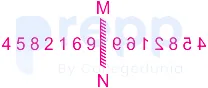
Select the correct mirror image of the given combination when the mirror is placed at MN as shown.
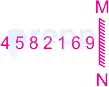
- A
Option A (shown in image)
- B
Option B (shown in image)
- C
Option C (shown in image)
- D
Option D (shown in image)
Show answer
Question 7archived
If ‘A # B’ means ‘A is the sister of B’ and ‘A @ B’ means ‘A is the mother of B’, then which of the following expressions means ‘C is the mother of F’?
- A
C @ H # M # F
- B
H @ C # M # F
- C
C @ H # M @ F
- D
F @ H # M # C
Show answer
A. C @ H # M # FFinding the Expression for 'C is the Mother of F' in Blood Relations
This question involves decoding relationships represented by symbols. We are given two specific relationships:
A # B means A is the sister of B.
A @ B means A is the mother of B.
Our goal is to find which of the given expressions correctly represents the relationship C is the mother of F.
Analyzing Each Expression Option
Let's break down each option based on the given symbol definitions:
Option 1: C @ H # M # F
C @ H: C is the mother of H. (C is female)
H # M: H is the sister of M. (H is female)
M # F: M is the sister of F. (M is female)
From these relationships, we can infer:
C is the mother of H.
H is the sister of M, and M is the sister of F. This means H, M, and F are siblings.
Since C is the mother of H (who is a sibling of M and F), C must also be the mother of M and F.
Thus, the expression C @ H # M # F means C is the mother of F. This matches the relationship we are looking for.
Option 2: H @ C # M # F
H @ C: H is the mother of C. (H is female)
C # M: C is the sister of M. (C is female)
M # F: M is the sister of F. (M is female)
From these relationships, we can infer:
H is the mother of C.
C is the sister of M, and M is the sister of F. This means C, M, and F are siblings.
Since H is the mother of C (who is a sibling of M and F), H must also be the mother of M and F.
Thus, the expression H @ C # M # F means H is the mother of F, not C is the mother of F.
Option 3: C @ H # M @ F
C @ H: C is the mother of H. (C is female)
H # M: H is the sister of M. (H is female)
M @ F: M is the mother of F. (M is female)
From these relationships, we can infer:
C is the mother of H.
H is the sister of M. So, H and M are siblings, and C is their mother.
M is the mother of F.
Thus, C is the mother of M, and M is the mother of F. This means C is the grandmother of F, not the mother.
Option 4: F @ H # M # C
F @ H: F is the mother of H. (F is female)
H # M: H is the sister of M. (H is female)
M # C: M is the sister of C. (M is female)
From these relationships, we can infer:
F is the mother of H.
H is the sister of M, and M is the sister of C. This means H, M, and C are siblings.
Since F is the mother of H (who is a sibling of M and C), F must also be the mother of M and C.
Thus, the expression F @ H # M # C means F is the mother of C, not C is the mother of F.
Conclusion
Comparing the analysis of each option with the target relationship 'C is the mother of F', we find that only Option 1 matches this requirement.
Expression
Relationships Decoded
Resulting Relationship (C to F)
C @ H # M # F
C is mother of H; H is sister of M; M is sister of F
C is the mother of F
H @ C # M # F
H is mother of C; C is sister of M; M is sister of F
H is the mother of F (C is sister of F)
C @ H # M @ F
C is mother of H; H is sister of M; M is mother of F
C is the grandmother of F
F @ H # M # C
F is mother of H; H is sister of M; M is sister of C
F is the mother of C
Therefore, the expression that means 'C is the mother of F' is C @ H # M # F.
Revision Table: Blood Relation Symbols
Symbol
Meaning
Gender Implied (First Person)
#
is the sister of
Female
@
is the mother of
Female
Additional Information on Blood Relation Puzzles
Blood relation problems often involve decoding symbolic representations of family relationships. To solve these, it's helpful to:
Clearly understand the meaning of each symbol or code.
Break down the given expression into individual relationships step-by-step, following the order of the symbols.
Draw a family tree diagram if the relationships become complex, assigning genders where possible.
Carefully trace the connection between the specific individuals mentioned in the question.
Pay attention to the gender implications of each relationship (e.g., mother implies female, sister implies female, but sibling doesn't imply gender for the second person).
Practicing different types of blood relation puzzles helps in quickly decoding the relationships and arriving at the correct answer.
Paper & answer key PDF ↗ Question 8archived
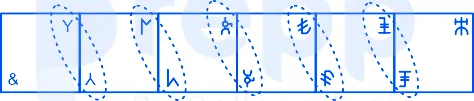
Select the figure from among the given options that can replace the question mark (?) in the following series.

- A
Option A (shown in image)
- B
Option B (shown in image)
- C
Option C (shown in image)
- D
Option D (shown in image)
Show answer
D. Option D (shown in image)The logic followed here is:-
1) The bottom left side symbol will remove in all next steps.
2) The bottom left side symbol of the second figure is the water image of the top right side symbol of the first figure, the b ottom left side symbol of the third figure is the water image of top right side symbol of the second figure and so on.
3) New symbol added in top right corner in each next figure.
Hence, "option 4" is the correct answer.
 Paper & answer key PDF ↗
 Question 9archived
In a certain code language, ‘NOSTALGIA’ is coded as ‘81’. How will ‘FRICTION’ be coded in that language?
- A
64
- B
105
- C
85
- D
36
Show answer
A. 64Coding Language Pattern Analysis
Let's analyze the pattern used in this coding language question. We are given that the word ‘NOSTALGIA’ is coded as ‘81’.
Analyzing the Code for NOSTALGIA
First, let's count the number of letters in the word ‘NOSTALGIA’:
N
O
S
T
A
L
G
I
A
There are a total of 9 letters in the word ‘NOSTALGIA’. The given code is 81.
We can observe a relationship between the number of letters and the code:
Number of letters = 9
Code = 81
It appears that the code is the square of the number of letters. Let's check this:
\(9^2 = 9 \times 9 = 81\)
This matches the given code for ‘NOSTALGIA’. So, the rule in this code language is likely: Code = (Number of letters in the word)2.
Applying the Pattern to FRICTION
Now we need to find the code for the word ‘FRICTION’ using the same pattern. Let's count the number of letters in ‘FRICTION’:
F
R
I
C
T
I
O
N
There are a total of 8 letters in the word ‘FRICTION’.
Using the pattern we identified, the code for ‘FRICTION’ will be the square of the number of letters:
Number of letters = 8
Code = (Number of letters)2
Code = \(8^2\)
Code = \(8 \times 8\)
Code = 64
Conclusion
Following the established pattern from ‘NOSTALGIA’, the code for ‘FRICTION’ is 64.
Revision Table: Code Pattern Summary
Word
Number of Letters
Calculated Code (Letters2)
Given/Resulting Code
NOSTALGIA
9
\(9^2 = 81\)
81 (Given)
FRICTION
8
\(8^2 = 64\)
64 (Calculated)
Additional Information: Letter and Word Coding
Coding and decoding questions often involve finding a hidden pattern based on the letters or the word structure. Common patterns include:
Positional Value: Using the alphabetical position of each letter (A=1, B=2, ... Z=26). The code could be the sum of positional values, difference, product, or other operations.
Reverse Positional Value: Using reverse alphabetical position (A=26, B=25, ... Z=1).
Opposite Letters: Pairing letters that are equidistant from the beginning and end of the alphabet (A with Z, B with Y, etc.).
Number of Letters: As seen in this problem, the code might directly relate to the count of letters in the word, often involving squaring, cubing, or other mathematical operations on the count.
Vowel/Consonant Count: The code could be based on the number of vowels or consonants.
Rearrangement: Letters might be rearranged in a specific order (alphabetical, reverse alphabetical, swapping positions, etc.).
To solve such problems, it's important to look for consistent relationships between the given word(s) and their codes. Testing simple hypotheses first, like counting letters or summing positional values, is often a good starting point.
Paper & answer key PDF ↗ Question 10archived
Select the option in which the words share the same relationship as that shared by the given pair of words.
Mauritius: Port Louis
- A
Zambia : Harare
- B
Nigeria : Senegal
- C
Kenya : Nairobi
- D
Sudan : Tanzania
Show answer
C. Kenya : NairobiUnderstanding the Analogy Relationship
The given analogy pair is Mauritius : Port Louis. To solve this, we first need to identify the relationship between the two words. Mauritius is a country, and Port Louis is its capital city. So, the relationship is Country : Capital.
Our task is to find the option among the choices that shares the exact same relationship as Country : Capital.
Analyzing the Option Relationships
Let's examine each option:
Option 1: Zambia : Harare
Zambia is a country. Harare is the capital city of Zimbabwe, not Zambia. The capital of Zambia is Lusaka. So, this pair is not Country : Capital of that Country.
Option 2: Nigeria : Senegal
Nigeria is a country. Senegal is also a country. This pair represents a Country : Country relationship, which is different from the original pair's relationship.
Option 3: Kenya : Nairobi
Kenya is a country. Nairobi is the capital city of Kenya. This pair represents a Country : Capital of that Country relationship. This matches the relationship in the original pair (Mauritius : Port Louis).
Option 4: Sudan : Tanzania
Sudan is a country. Tanzania is also a country. This pair represents a Country : Country relationship, which is different from the original pair's relationship.
Identifying the Matching Analogy
Based on our analysis, only the pair Kenya : Nairobi exhibits the same Country : Capital relationship as Mauritius : Port Louis.
Revision Table: Country Capitals
Country
Capital City
Mauritius
Port Louis
Kenya
Nairobi
Zambia
Lusaka
Zimbabwe
Harare
Nigeria
Abuja
Senegal
Dakar
Sudan
Khartoum
Tanzania
Dodoma (Official), Dar es Salaam (Former/Commercial)
Additional Information: Types of Analogies
Verbal analogies test your ability to see relationships between words. Besides the Country : Capital relationship seen here, other common types include:
Part : Whole (e.g., Finger : Hand)
Synonyms (e.g., Happy : Joyful)
Antonyms (e.g., Hot : Cold)
Cause : Effect (e.g., Rain : Flood)
Worker : Tool (e.g., Carpenter : Hammer)
Action : Object (e.g., Read : Book)
Practicing identifying these different relationships is key to mastering analogy questions in competitive exams.
Paper & answer key PDF ↗ Question 11archived
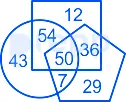
In the following Venn diagram, the square stands for ‘Doctors’, the circle stands for ‘Blood donators’, and the pentagon stands for “Women. The given numbers represent the number of persons in that particular category.
How many women doctors are blood donators?
- A
54
- B
57
- C
50
- D
36
Show answer
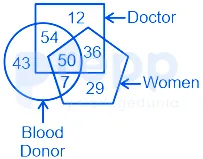
C. 50The Venn diagram is given below:-
The shaded part represents women doctors are blood donators = 50.
Hence, "option 3" is the correct answer.
 Paper & answer key PDF ↗
 Question 12archived
Select the combination of letters that when sequentially placed in the blanks of the given series will complete the series.
K _ C T Q _ O C _ _ K O _ T _ K O _ T T
- A
O, K, T, R, C, S, C
- B
O, K, U, R, C, S, C
- C
P, K, T, R, C, S, C
- D
O, K, T, R, C, T, C
Show answer
A. O, K, T, R, C, S, CComplete the Letter Series Pattern
The question asks us to find the combination of letters that will complete the given series: K _ C T Q _ O C _ _ K O _ T _ K O _ T T.
To solve this, we need to test the given options by sequentially placing the letters from an option into the blanks in the series. The correct option will reveal a discernible pattern in the completed series.
Analyzing the Series and Options
The original series has 7 blanks:
K _ C T Q _ O C _ _ K O _ T _ K O _ T T
Let's number the positions in the series (including blanks) for clarity:
1 2 3 4 5 6 7 8 9 10 11 12 13 14 15 16 17 18 19 20 21
K _ C T Q _ O C _ _ K O _ T _ K O _ T T
The blanks are at positions: 2, 6, 9, 10, 13, 15, and 18.
We are given options with sequences of 7 letters. Let's test the letters from Option 1: O, K, T, R, C, S, C.
We place these letters into the blanks:
Blank 1 (Pos 2): O
Blank 2 (Pos 6): K
Blank 3 (Pos 9): T
Blank 4 (Pos 10): R
Blank 5 (Pos 13): C
Blank 6 (Pos 15): S
Blank 7 (Pos 18): C
Substituting these letters into the original series, we get the complete series:
K O C T Q K O C T R K O C T S K O C T T T
Now let's examine this completed series to find the pattern.
Identifying the Pattern in the Completed Series
The completed series is: K O C T Q K O C T R K O C T S K O C T T T (Length 21).
Let's look for repeating segments or logical sequences within this series.
We can observe a recurring sequence: K O C T.
The series starts with K O C T Q.
The next part is K O C T R.
Following that is K O C T S.
The final part is K O C T T T.
Let's break down the series into these segments:
Segment 1: K O C T Q
Segment 2: K O C T R
Segment 3: K O C T S
Segment 4: K O C T T T
When we concatenate these segments (place them one after another), we get:
K O C T Q + K O C T R + K O C T S + K O C T T T = K O C T Q K O C T R K O C T S K O C T T T.
This perfectly matches the series we obtained by filling the blanks with the letters from Option 1.
The pattern is therefore composed of four sequential blocks. The first three blocks follow the structure K O C T + (Incrementing Letter), where the incrementing letters are Q, R, and S. The final block is K O C T T T.
This pattern is consistent and fills the original blanks correctly.
We can confirm that Option 1 (O, K, T, R, C, S, C) is the correct combination of letters that completes the series according to this pattern.
Let's verify the blank positions against this pattern structure:
Position (1-21)
Original Series Character
Filled Series Character
Corresponds to Segment
1
K
K
Segment 1
2
_
O
Segment 1 (Blank 1)
3
C
C
Segment 1
4
T
T
Segment 1
5
Q
Q
Segment 1
6
_
K
Segment 2 (Blank 2)
7
O
O
Segment 2
8
C
C
Segment 2
9
_
T
Segment 2 (Blank 3)
10
_
R
Segment 2 (Blank 4)
11
K
K
Segment 3
12
O
O
Segment 3
13
_
C
Segment 3 (Blank 5)
14
T
T
Segment 3
15
_
S
Segment 3 (Blank 6)
16
K
K
Segment 4
17
O
O
Segment 4
18
_
C
Segment 4 (Blank 7)
19
T
T
Segment 4
20
T
T
Segment 4
21
T
T
Segment 4
The letters from the option (O, K, T, R, C, S, C) correctly fill the blanks at positions 2, 6, 9, 10, 13, 15, and 18, resulting in the series K O C T Q K O C T R K O C T S K O C T T T which follows the identified sequential block pattern.
Conclusion
The combination of letters O, K, T, R, C, S, C successfully completes the series by forming the pattern of sequential blocks: K O C T Q, K O C T R, K O C T S, K O C T T T.
Revision Table: Key Concepts
Concept
Description
Letter Series
A sequence of letters that follows a specific pattern.
Series Completion
Finding the missing elements in a series based on its pattern.
Pattern Recognition
Identifying the rule or sequence that governs the arrangement of elements in a series.
Sequential Pattern
A pattern where elements or blocks follow each other in a predictable order.
Additional Information: Types of Letter Series Patterns
Letter series questions in competitive exams often feature various types of patterns. Understanding these can help in solving series completion problems.
Alphabetical Order: Letters follow standard alphabetical sequence (A, B, C...). This can be forward or backward, or with skips (A, C, E...).
Positional Value: The pattern is based on the position of letters in the alphabet (A=1, B=2, ... Z=26). Operations like addition, subtraction, or multiplication might be applied to these values.
Repeating Pattern: A specific block of letters repeats throughout the series (e.g., ABC ABC ABC...).
Alternating Pattern: Two or more different patterns are interleaved in the same series.
Skipping Letters: Letters are skipped in a specific order (e.g., skip 1, skip 2, skip 3...).
Combination of Patterns: More than one type of pattern might be combined in a single series. For example, one part of the series follows an alphabetical pattern, while another part follows a repeating pattern or a numerical logic based on positions.
Sequential Blocks: As seen in this problem, the series can be formed by placing distinct blocks one after another, where each block might have a minor variation (like an incrementing letter) while a core part remains constant.
Solving letter series problems requires careful observation, breaking down the series into smaller parts, and testing different possible rules or patterns.
Paper & answer key PDF ↗ Question 13archived
Select the option in which the numbers are related in the same way as are the numbers of the following set.
(5, 11, 275)
- A
(6, 18, 180)
- B
(9, 15, 270)
- C
(4, 16, 256)
- D
(8, 14, 490)
Show answer
C. (4, 16, 256)Analyzing the Number Relationship in (5, 11, 275)
The problem asks us to find the option where the numbers have the same relationship as the numbers in the set (5, 11, 275).
Let's examine the given set (5, 11, 275). We need to figure out how the third number (275) is related to the first two numbers (5 and 11).
Let the numbers in the set be A, B, and C. So, for the given set, A=5, B=11, and C=275.
Let's try to find a mathematical relationship between A, B, and C.
Is C the sum of A and B? $5 + 11 = 16 \neq 275$.
Is C the product of A and B? $5 \times 11 = 55 \neq 275$.
Is C related to squares or cubes of A or B? $5^2 = 25$, $11^2 = 121$. $5^3 = 125$. $11^3 = 1331$. None seem directly related to 275.
How about combining operations involving A and B to get C?
Let's look at multiplication more closely. The product of the first two numbers is $5 \times 11 = 55$. How can we get 275 from 55 and the original numbers? We notice that $275 = 55 \times 5$. The number 5 is the first number (A) in the set.
So, the relationship appears to be: The third number (C) is the product of the first number (A) and the second number (B), multiplied by the first number (A) again.
Mathematically, this relationship can be written as: $C = (A \times B) \times A$, which simplifies to $C = A^2 \times B$.
Let's verify this relationship with the given set (5, 11, 275):
$A=5$, $B=11$, $C=275$.
Using the formula $C = A^2 \times B$:
$5^2 \times 11 = 25 \times 11 = 275$.
This matches the third number in the given set. So, the identified pattern is likely correct.
Applying the Number Relationship to the Options
Now, we will test this rule ($C = A^2 \times B$) on each of the given options to see which one follows the same pattern.
Option Set (A, B, C)
Calculation: $A^2 \times B$
Expected C
Actual C
Matches?
(6, 18, 180)
$6^2 \times 18 = 36 \times 18$
648
180
No
(9, 15, 270)
$9^2 \times 15 = 81 \times 15$
1215
270
No
(4, 16, 256)
$4^2 \times 16 = 16 \times 16$
256
256
Yes
(8, 14, 490)
$8^2 \times 14 = 64 \times 14$
896
490
No
Detailed Analysis of Options
Let's examine each option carefully:
Option 1: (6, 18, 180)
Here, A=6, B=18, C=180. According to the rule $C = A^2 \times B$, the third number should be $6^2 \times 18 = 36 \times 18 = 648$. The actual third number is 180. This does not match.
Option 2: (9, 15, 270)
Here, A=9, B=15, C=270. According to the rule $C = A^2 \times B$, the third number should be $9^2 \times 15 = 81 \times 15 = 1215$. The actual third number is 270. This does not match.
Option 3: (4, 16, 256)
Here, A=4, B=16, C=256. According to the rule $C = A^2 \times B$, the third number should be $4^2 \times 16 = 16 \times 16 = 256$. The actual third number is 256. This matches the rule.
Option 4: (8, 14, 490)
Here, A=8, B=14, C=490. According to the rule $C = A^2 \times B$, the third number should be $8^2 \times 14 = 64 \times 14 = 896$. The actual third number is 490. This does not match.
Based on the analysis, only option 3 follows the same relationship $C = A^2 \times B$ as the initial set (5, 11, 275).
Conclusion
The set (5, 11, 275) follows the relationship where the third number is the square of the first number multiplied by the second number ($C = A^2 \times B$). Option (4, 16, 256) also follows this relationship because $4^2 \times 16 = 16 \times 16 = 256$.
Revision Table: Number Relationship Analysis
Set
First Number (A)
Second Number (B)
Third Number (C)
Relationship Check ($A^2 \times B$)
Result
Given Set
5
11
275
$5^2 \times 11 = 25 \times 11 = 275$
Matches
Option 1
6
18
180
$6^2 \times 18 = 36 \times 18 = 648$
No Match
Option 2
9
15
270
$9^2 \times 15 = 81 \times 15 = 1215$
No Match
Option 3
4
16
256
$4^2 \times 16 = 16 \times 16 = 256$
Matches
Option 4
8
14
490
$8^2 \times 14 = 64 \times 14 = 896$
No Match
Additional Information: Number Analogy Questions
Number analogy questions test your ability to identify the relationship between a given set of numbers and then apply that relationship to other sets. These questions often involve basic arithmetic operations like addition, subtraction, multiplication, division, squaring, cubing, or combinations of these operations.
Tips for solving number analogy problems:
Look for simple arithmetic relationships first (sum, difference, product, quotient).
Consider squares, cubes, and their roots.
Check for relationships between the first and second number, the second and third, or the first and third.
Look for patterns involving sums or differences of numbers.
Sometimes the relationship might involve multiplying or dividing by a constant number or one of the numbers in the set.
Test your hypothesis with the given set before applying it to the options.
Systematically check each option using the identified rule.
Paper & answer key PDF ↗ Question 14archived
Select the letter-cluster from among the given options that can replace the question mark (?) in the following series.
NZK, MBH, LDE, KFB, ?
- A
HIY
- B
JHY
- C
JHZ
- D
JHX
Show answer
B. JHYSolving Letter Cluster Series Questions
This question asks us to identify the pattern in a series of letter clusters and find the next term. The given series is: NZK, MBH, LDE, KFB, ?
Let's analyze the pattern for each letter position separately.
Analyzing the First Letter Pattern
Look at the first letter of each cluster:
NZK → N
MBH → M
LDE → L
KFB → K
The sequence of the first letters is N, M, L, K. This is a simple backward alphabetical sequence. Each letter is one step before the previous letter in the alphabet.
N is 1 step before M (N − 1) - Correction: M is 1 step before N (N → M is -1)
M is 1 step before L (M − 1)
L is 1 step before K (L − 1)
So, the next first letter should be one step before K.
K − 1 step in the alphabet is J.
Analyzing the Second Letter Pattern
Look at the second letter of each cluster:
NZK → Z
MBH → B
LDE → D
KFB → F
The sequence of the second letters is Z, B, D, F. Let's find the steps between these letters, considering the alphabet wraps around from Z to A.
From Z to B: Z → A → B. This is moving 2 steps forward in the alphabet ($+2$).
From B to D: B → C → D. This is moving 2 steps forward in the alphabet ($+2$).
From D to F: D → E → F. This is moving 2 steps forward in the alphabet ($+2$).
The pattern for the second letter is adding 2 steps in the alphabetical sequence each time.
So, the next second letter should be 2 steps after F.
F → G → H. F $+2$ steps in the alphabet is H.
Analyzing the Third Letter Pattern
Look at the third letter of each cluster:
NZK → K
MBH → H
LDE → E
KFB → B
The sequence of the third letters is K, H, E, B. Let's find the steps between these letters, moving backward.
From K to H: K → J → I → H. This is moving 3 steps backward in the alphabet ($-3$).
From H to E: H → G → F → E. This is moving 3 steps backward in the alphabet ($-3$).
From E to B: E → D → C → B. This is moving 3 steps backward in the alphabet ($-3$).
The pattern for the third letter is subtracting 3 steps in the alphabetical sequence each time.
So, the next third letter should be 3 steps before B.
Moving backward from B: B → A → Z → Y. B − 3 steps in the alphabet is Y.
Combining the Patterns
Based on our analysis:
The next first letter is J.
The next second letter is H.
The next third letter is Y.
Combining these letters, the next letter cluster in the series is JHY.
Comparing with Options
Let's check the given options:
HIY
JHY
JHZ
4. JHX
Our calculated next term, JHY, matches Option 2.
Summary of the Pattern
Position
Pattern
First Letter
Subtract 1 (backward in alphabet)
Second Letter
Add 2 (forward in alphabet, wrapping around)
Third Letter
Subtract 3 (backward in alphabet, wrapping around)
Applying this pattern to the last term KFB:
First letter: K − 1 = J
Second letter: F $+2$ = H
Third letter: B − 3 = Y
The resulting cluster is JHY.
Revision Table: Letter Series Patterns
Understanding different types of letter series patterns is key to solving these questions quickly. Here are some common patterns:
Alphabetical Order: Letters moving forward (A, B, C...).
Reverse Alphabetical Order: Letters moving backward (Z, Y, X...).
Skipping Letters: Skipping a fixed number of letters (e.g., A, C, E - skipping 1 letter each time).
Adding/Subtracting Positions: The position of the letter in the alphabet is changed by a fixed number (e.g., A is 1, C is 3; $3 = 1+2$).
Patterns with increasing/decreasing steps: The number of skipped letters or the value added/subtracted changes in a pattern (e.g., +1, +2, +3...).
Vowel/Consonant Patterns: The series might alternate between vowels and consonants or follow a specific vowel/consonant sequence.
Combination Patterns: Different patterns applied to different positions within a cluster (like in this question).
Wrapping Around: Patterns that treat the alphabet cyclically (after Z comes A, before A comes Z).
Additional Information: Reasoning Skills
Letter series questions are part of verbal or non-verbal reasoning sections in many exams. They test your ability to identify logical sequences and patterns. To improve your skills:
Memorize the alphabetical positions of letters (A=1, B=2, ... Z=26). This helps in quickly calculating steps.
Practice identifying different types of patterns, including arithmetic progressions in letter positions, alternate letter patterns, and patterns based on vowels/consonants.
When dealing with letter clusters, always try analyzing each letter's position separately first.
If a pattern isn't immediately obvious, try writing down the letter positions and look for numerical patterns.
Be mindful of patterns that involve wrapping around the alphabet (A-Z).
Paper & answer key PDF ↗ Question 15archived
Select the option that is related to the fourth number in the same way as the first number is related to the second number and the fifth number is related to the sixth number.
83 : 3 :: ? : 5 :: 258 : 4
- A
222
- B
627
- C
123
- D
527
Show answer
B. 627Understanding the Number Analogy Problem
The question asks us to find a number that has the same relationship with 5 as 83 has with 3, and 258 has with 4. These types of questions test our logical reasoning and pattern recognition skills. We need to analyze the given pairs of numbers to identify the underlying rule or relationship.
Analyzing the Given Analogies
Let's examine the two complete analogies provided:
First analogy: 83 : 3
Second analogy: 258 : 4
We need to find the relationship between the first number and the second number in each pair.
Exploring Possible Relationships
Let's try different mathematical operations or digit manipulations to see if a pattern emerges.
Sum of digits: For 83, \(8+3=11\). For 258, \(2+5+8=15\). These sums do not relate directly to 3 or 4.
Product of digits: For 83, \(8 \times 3=24\). For 258, \(2 \times 5 \times 8=80\). These products do not relate directly to 3 or 4.
Direct arithmetic operations: Simple addition, subtraction, multiplication, or division between the two numbers in each pair doesn't yield an obvious consistent pattern (e.g., \(83-3=80\), \(258-4=254\)).
Discovering the Pattern
Let's consider division and remainders. Let's divide the first number by the second number in each given pair:
For 83 : 3, \(83 \div 3\). Using division with remainder: \(83 = 3 \times 27 + 2\). The quotient is 27, and the remainder is 2.
For 258 : 4, \(258 \div 4\). Using division with remainder: \(258 = 4 \times 64 + 2\). The quotient is 64, and the remainder is 2.
We observe that in both cases, the remainder is 2. This might be part of the pattern. Let's look at the quotients: 27 and 64. Is there a relationship between the second number (3 and 4) and the quotient (27 and 64)?
For the first pair (83 : 3), the second number is 3, and the quotient is 27. Notice that \(3^3 = 3 \times 3 \times 3 = 27\).
For the second pair (258 : 4), the second number is 4, and the quotient is 64. Notice that \(4^3 = 4 \times 4 \times 4 = 64\).
This reveals a consistent pattern! The relationship between the first number (N1) and the second number (N2) is:
\[N1 = N2 \times (N2)^3 + 2\]
This means the first number is equal to the second number multiplied by the cube of the second number, plus a remainder of 2.
Applying the Pattern to Find the Missing Number
We need to find the missing number in the analogy ? : 5. Let the missing number be X. Here, the second number (N2) is 5. Using the pattern we discovered:
\[X = 5 \times (5)^3 + 2\]
\[X = 5 \times (5 \times 5 \times 5) + 2\]
\[X = 5 \times 125 + 2\]
\[X = 625 + 2\]
\[X = 627\]
So, the missing number is 627.
Verifying with Options
Let's check if 627 is among the given options.
222
627
123
527
Our calculated missing number, 627, matches option 2.
Summary of the Pattern
Analogy
First Number (N1)
Second Number (N2)
Calculation: \(N2 \times (N2)^3 + 2\)
Result
83 : 3
83
3
\(3 \times 3^3 + 2 = 3 \times 27 + 2 = 81 + 2\)
83
258 : 4
258
4
\(4 \times 4^3 + 2 = 4 \times 64 + 2 = 256 + 2\)
258
? : 5
X
5
\(5 \times 5^3 + 2 = 5 \times 125 + 2 = 625 + 2\)
627
The pattern holds true for the given pairs and leads to 627 for the third pair.
Conclusion
Based on the identified pattern, where the first number is equal to the second number multiplied by the cube of the second number plus 2, the missing number that relates to 5 is 627.
Revision Table: Number Analogy Pattern
Review the key concept used in this problem:
Concept
Description
Application in this problem
Number Analogy
Finding a relationship between pairs of numbers to solve for a missing term.
Used to find the relationship in (83, 3) and (258, 4).
Pattern Recognition
Identifying a consistent rule governing the relationships.
Discovered the \(N1 = N2 \times (N2)^3 + 2\) pattern.
Cube of a Number
A number multiplied by itself three times (\(n^3\)).
The quotient in the division pattern was the cube of the second number.
Division with Remainder
Expressing a number as a multiple of a divisor plus a remainder.
Observed a consistent remainder of 2 in the given pairs.
Additional Information: Solving Number Analogy Problems
Number analogy questions require careful observation and systematic testing of possible relationships. Here are some common types of patterns to look for:
Basic arithmetic operations (addition, subtraction, multiplication, division) between the numbers.
Operations involving digits of the numbers (sum of digits, product of digits, difference of digits, reversing digits).
Squares, cubes, or other powers of the numbers or their digits.
Relationships involving sequences (arithmetic progression, geometric progression).
Prime numbers, composite numbers, or other number properties.
Combinations of the above patterns.
It's often helpful to test simple patterns first before moving to more complex ones. In this problem, looking at division and then the resulting quotient helped reveal the cubic relationship.
Paper & answer key PDF ↗ Question 16archived
In a certain code language, ‘SURROUND’ is written as ‘RRUSDNUO’. How will ‘MITIGATE’ be written in that language?
- A
TIMTEAG
- B
ITIEMTAG
- C
ITIMETAG
- D
ITIMETGA
Show answer
C. ITIMETAGUnderstanding the Code Language
The problem provides an example of a word transformed into a coded word in a specific code language. We are given that ‘SURROUND’ is written as ‘RRUSDNUO’. Our task is to decipher the rule governing this transformation and apply it to the word ‘MITIGATE’ to find its coded form.
Analyzing the Transformation of 'SURROUND'
Let's look at the letters in 'SURROUND' and their corresponding letters in 'RRUSDNUO' based on their positions.
Original Word: SURROUND
S
U
R
R
O
U
N
D
Original Position:
1
2
3
4
5
6
7
8
Coded Word: RRUSDNUO
R
R
U
S
D
N
U
O
Coded Position:
1
2
3
4
5
6
7
8
Comparing the letters and their positions, let's try to find a pattern. A common technique in such coding problems is rearranging letters, often by splitting the word into parts.
Let's split the 8-letter word 'SURROUND' into four pairs:
Pair 1: SU (positions 1, 2)
Pair 2: RR (positions 3, 4)
Pair 3: OU (positions 5, 6)
Pair 4: ND (positions 7, 8)
The coded word is RRUSDNUO. Let's split the coded word similarly:
Coded Pair 1: RR (positions 1, 2)
Coded Pair 2: US (positions 3, 4)
Coded Pair 3: DN (positions 5, 6)
Coded Pair 4: UO (positions 7, 8)
Let's see how the original pairs relate to the coded pairs:
Original Pair 1 (SU) seems related to Coded Pair 2 (US). Notice that 'US' is the reverse of 'SU'.
Original Pair 2 (RR) seems related to Coded Pair 1 (RR). This pair is not reversed.
Original Pair 3 (OU) seems related to Coded Pair 4 (UO). Notice that 'UO' is the reverse of 'OU'.
Original Pair 4 (ND) seems related to Coded Pair 3 (DN). Notice that 'DN' is the reverse of 'ND'.
This suggests a pattern involving swapping and reversing pairs:
Split the 8-letter word into four pairs (1-2, 3-4, 5-6, 7-8).
Swap the first two pairs (pairs 1 & 2).
Swap the last two pairs (pairs 3 & 4).
Reverse the letters within each of the four resulting pairs.
Let's test this pattern on 'SURROUND':
Original word: S U R R O U N D
Pairs: (SU) (RR) (OU) (ND)
Swap pairs 1&2 and 3&4: (RR) (SU) (ND) (OU)
Reverse letters in each pair: (RR) (US) (DN) (UO)
Combine: RRUSDNUO
This matches the given coded word for 'SURROUND'. So, this is the correct pattern.
Applying the Pattern to 'MITIGATE'
Now, let's apply the same pattern to the word ‘MITIGATE’.
The word is MITIGATE.
Step 1: Split into four pairs:
Pair 1: MI (positions 1, 2)
Pair 2: TI (positions 3, 4)
Pair 3: GA (positions 5, 6)
Pair 4: TE (positions 7, 8)
Step 2: Swap the first two pairs (MI & TI):
(TI) (MI) (GA) (TE)
Step 3: Swap the last two pairs (GA & TE):
(TI) (MI) (TE) (GA)
Step 4: Reverse the letters within each pair:
Reverse TI → IT
Reverse MI → IM
Reverse TE → ET
Reverse GA → AG
The resulting pairs are (IT) (IM) (ET) (AG).
Step 5: Combine the reversed pairs:
ITIMETAG
So, the coded word for ‘MITIGATE’ is ITIMETAG.
Comparing with Options
Let's check the given options:
TIMTEAG
ITIEMTAG
ITIMETAG
ITIMETGA
Our derived coded word, ITIMETAG, matches Option 3.
Conclusion
By analyzing the transformation of 'SURROUND' to 'RRUSDNUO', we found a pattern involving splitting the word into pairs, swapping specific pairs, and reversing the letters within each pair. Applying this same pattern to 'MITIGATE' yields the coded word ITIMETAG.
Revision Table: Code Language Pattern
Step
Description
Example: SURROUND
Example: MITIGATE
1
Split into 4 pairs
(SU)(RR)(OU)(ND)
(MI)(TI)(GA)(TE)
2
Swap 1st & 2nd pairs
(RR)(SU)(OU)(ND)
(TI)(MI)(GA)(TE)
3
Swap 3rd & 4th pairs
(RR)(SU)(ND)(OU)
(TI)(MI)(TE)(GA)
4
Reverse each pair
(RR)(US)(DN)(UO)
(IT)(IM)(ET)(AG)
5
Combine
RRUSDNUO
ITIMETAG
Additional Information: Letter Coding Concepts
Letter coding is a common type of question in logical reasoning sections of competitive exams. These questions test your ability to identify patterns and rules governing the transformation of words.
Common patterns include:
Positional Changes: Letters move to different positions based on a fixed rule (e.g., reverse order, fixed shift, split and rearrange).
Letter Shifts: Each letter is shifted forward or backward in the alphabet by a fixed number (e.g., A becomes C, B becomes D - a shift of +2).
Opposite Letters: Letters are replaced by their counterparts from the opposite end of the alphabet (e.g., A becomes Z, B becomes Y).
Vowel/Consonant Changes: Different rules apply to vowels and consonants.
Substitution: Each letter is replaced by a specific different letter or symbol.
Combination of Rules: The code might involve multiple steps or a combination of the above patterns, as seen in this question which combines splitting, swapping, and reversing pairs.
To solve these problems, carefully observe the given example, try breaking down the word and the code, and look for consistent rules based on position, letter value, or groups of letters. Applying the suspected rule to the target word helps confirm the pattern.
Paper & answer key PDF ↗ Question 17archived
Select the correct option that indicates the arrangement of the given words in the order in which they appear in an English dictionary.
1. Turban
2. Terminator
3. Twister
4. Temptation
5. Terrorism
- A
4, 5, 2, 1, 3
- B
4, 1, 3, 2, 5
- C
4, 2, 5, 1, 3
- D
4, 2, 1, 3, 5
Show answer
C. 4, 2, 5, 1, 3Understanding Dictionary Order for Word Arrangement
Arranging words in the order they appear in an English dictionary is also known as alphabetical order. This involves comparing words letter by letter from left to right. If the first letters are the same, you move to the second letter, and so on, until you find a difference.
Step-by-Step Dictionary Arrangement of Words
Let's take the given words and arrange them according to dictionary rules:
Turban
Terminator
Twister
Temptation
Terrorism
First, let's list the words and their corresponding numbers:
Turban (1)
Terminator (2)
Twister (3)
Temptation (4)
Terrorism (5)
Now, let's compare them letter by letter:
Comparing First Letters
All words begin with the letter 'T'. So, we move to the second letter.
Comparing Second Letters
Turban: Turban
Terminator: Terminator
Twister: Twister
Temptation: Temptation
Terrorism: Terrorism
The second letters are 'u', 'e', 'w', 'e', 'e'. In alphabetical order, 'e' comes before 'u' and 'w'. The words starting with 'Te' are Terminator, Temptation, and Terrorism. The words starting with 'Tu' and 'Tw' will come later.
Arranging Words Starting with 'Te'
Let's compare Terminator (2), Temptation (4), and Terrorism (5). They all start with 'Te'. We look at the third letter:
Terminator: Terminator
Temptation: Temptation
Terrorism: Terrorism
The third letters are 'm', 'p', 'r'. In alphabetical order, 'm' comes before 'p', and 'p' comes before 'r'. So, the order among these three is:
Temptation (Temptation)
Terminator (Terminator)
Terrorism (Terrorism)
Wait, let's re-check the third letters: Terminator (r), Temptation (m), Terrorism (r). The third letters are 'r', 'm', 'r'. In alphabetical order, 'm' comes before 'r'. So, Temptation comes first among these three.
Now compare Terminator and Terrorism, both starting with 'Ter'. Look at the fourth letter:
Terminator: Terminator
Terrorism: Terrorism
The fourth letters are 'm' and 'r'. In alphabetical order, 'm' comes before 'r'. So, Terminator comes before Terrorism.
Correct order for 'Te' words:
Temptation (4)
Terminator (2)
Terrorism (5)
Arranging Remaining Words
The remaining words are Turban (1) and Twister (3). Let's compare them. They both start with 'T'. Look at the second letter:
Turban: Turban
Twister: Twister
The second letters are 'u' and 'w'. In alphabetical order, 'u' comes before 'w'. So, Turban comes before Twister.
Order for remaining words:
Turban (1)
Twister (3)
Combining the Ordered Groups
The words starting with 'Te' come before words starting with 'Tu' and 'Tw'. Combining the ordered groups, the final dictionary order is:
Temptation (4)
Terminator (2)
Terrorism (5)
Turban (1)
Twister (3)
The sequence of numbers is 4, 2, 5, 1, 3.
Let's put this in a table for clarity:
Original Number
Word
Comparison Steps
Final Dictionary Order
4
Temptation
Te > Tem ('m' is 3rd letter) > Temp ('p' is 4th letter) ...
1
2
Terminator
Te > Ter ('r' is 3rd letter) > Term ('m' is 4th letter) ...
2
5
Terrorism
Te > Ter ('r' is 3rd letter) > Terr ('r' is 4th letter) > Terro ('o' is 5th letter) ...
3
1
Turban
Tu ('u' is 2nd letter) ...
4
3
Twister
Tw ('w' is 2nd letter) ...
5
Comparing the words letter by letter until a difference is found gives us the order Temptation, Terminator, Terrorism, Turban, Twister. The corresponding sequence of numbers is 4, 2, 5, 1, 3.
Revision Table: Key Dictionary Order Concepts
Concept
Description
How it Applies Here
Alphabetical Comparison
Comparing words letter by letter from left to right.
Used to compare T, Te, Ter, Tem, etc.
Comparing Identical Prefixes
If prefixes are the same, compare the next letter.
Comparing 'Terminator' and 'Terrorism' after 'Ter'.
Shorter Word with Same Prefix
A shorter word with the same prefix as a longer word comes first (e.g., 'cat' comes before 'catalog'). This rule wasn't needed here as no word was a prefix of another.
Not applicable in this specific problem.
Additional Information: Importance of Alphabetical Order and Word Arrangement
Alphabetical order is fundamental for organizing information efficiently. It's used in dictionaries, encyclopedias, indexes, library catalogs, phone books, and digital lists. Understanding how to arrange words alphabetically is a crucial skill for quickly finding information.
Dictionaries: Words are listed alphabetically to help users easily locate definitions.
Indexes: Topics or names are arranged alphabetically for quick reference.
Filing Systems: Documents are often filed alphabetically by name or subject.
Data Sorting: In computing and data management, sorting data alphabetically is a common task.
Mastering dictionary order helps improve vocabulary skills and information retrieval efficiency.
Paper & answer key PDF ↗ Question 18archived
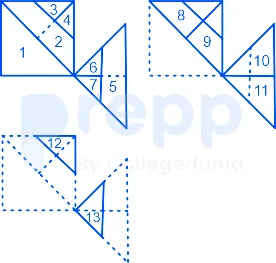
How many triangles are there in the given figure?

- A
15
- B
13
- C
12
- D
14
Show answer
B. 13The diagram is given below:-
The total number of triangles is 13.
Hence, "option 2" is the correct answer.
 Paper & answer key PDF ↗
 Question 19archived
What was the day of the week on 10 June 2011?
- A
Saturday
- B
Sunday
- C
Monday
- D
Friday
Show answer
D. FridayLet's find the day of the week on 10 June 2011 by calculating the number of 'odd days'. Odd days are the extra days left after forming complete weeks from a given number of days. We typically use a reference point, and a common method is to calculate the total odd days from a known date (like the beginning of the Gregorian calendar) up to the required date.
Understanding Odd Days for Calendar Calculations
The concept of odd days is crucial for determining the day of the week. Here's how it works:
A normal year has 365 days. $365 = 52 \times 7 + 1$. So, a normal year has 1 odd day.
A leap year has 366 days. $366 = 52 \times 7 + 2$. So, a leap year has 2 odd days.
The number of odd days in a certain number of days is the remainder when the total number of days is divided by 7.
Calculating Odd Days Up to 2010
We need to find the total number of odd days up to the end of the year 2010. We can break this down into centuries and then the remaining years.
Odd Days in Centuries:
100 years: 5 odd days
200 years: 3 odd days
300 years: 1 odd day
400 years: 0 odd days (since 400 is a leap century)
This pattern of odd days (5, 3, 1, 0) repeats every 400 years.
Odd Days up to 2000 years: $2000 = 5 \times 400$. Since 400 years have 0 odd days, 2000 years also have $5 \times 0 = 0$ odd days.
Odd Days from 2001 to 2010: This period includes 10 full years.
We need to count the number of leap years and ordinary years between 2001 and 2010.
Leap years in this period are 2004 and 2008 (years divisible by 4). There are 2 leap years.
Ordinary years are $10 - 2 = 8$ years.
Total odd days in these 10 years = (Number of ordinary years $\times$ 1) + (Number of leap years $\times$ 2)
Total odd days = $(8 \times 1) + (2 \times 2) = 8 + 4 = 12$ days.
Odd days modulo 7 = $12 \pmod{7} = 5$ odd days.
Total Odd Days up to 2010: Odd days (up to 2000) + Odd days (2001-2010) = $0 + 5 = 5$ odd days.
Calculating Odd Days in 2011 up to 10 June
Now, let's calculate the odd days from the beginning of 2011 up to 10 June 2011. Note that 2011 is not a leap year.
January: 31 days $\equiv 31 \pmod{7} = 3$ odd days
February: 28 days (2011 is not a leap year) $\equiv 28 \pmod{7} = 0$ odd days
March: 31 days $\equiv 31 \pmod{7} = 3$ odd days
April: 30 days $\equiv 30 \pmod{7} = 2$ odd days
May: 31 days $\equiv 31 \pmod{7} = 3$ odd days
June: 10 days $\equiv 10 \pmod{7} = 3$ odd days
Total odd days in 2011 up to 10 June = $3 + 0 + 3 + 2 + 3 + 3 = 14$ odd days.
Odd days modulo 7 = $14 \pmod{7} = 0$ odd days.
Finding the Day of the Week
We sum the total odd days calculated:
Total odd days = (Odd days up to 2010) + (Odd days in 2011 up to June 10)
Total odd days = $5 + 0 = 5$ odd days.
We map the total number of odd days to the day of the week using the standard convention:
Odd Days
Day of the Week
0
Sunday
1
Monday
2
Tuesday
3
Wednesday
4
Thursday
5
Friday
6
Saturday
Since the total number of odd days is 5, the day of the week on 10 June 2011 was Friday.
Revision Table: Key Odd Day Values
Period/Duration
Odd Days
100 years
5
200 years
3
300 years
1
400 years
0
Ordinary Year (365 days)
1
Leap Year (366 days)
2
Number of days $\pmod{7}$
Remainder
Additional Information: Leap Year Rules
A year is a leap year if it is divisible by 4, unless it is a century year (divisible by 100). Century years are leap years only if they are also divisible by 400.
Examples of leap years: 2000 (divisible by 400), 2004, 2008, 2012, 2016, etc.
Examples of ordinary years: 2001, 2002, 2003, 2010, 2011, 1900 (century year, but not divisible by 400).
Understanding leap years is essential for accurate odd day calculations over longer periods.
Paper & answer key PDF ↗ Question 20archived
Four number-pairs have been given, out of which three are alike in some manner and one is different. Select the number-pair that is different.
- A
25 ∶ 631
- B
30 ∶ 908
- C
22 ∶ 490
- D
21 ∶ 447
Show answer
B. 30 ∶ 908Finding the Different Number Pair in Reasoning Problems
This question asks us to identify the number pair that is different from the other three, meaning three pairs follow a similar rule or pattern, and one does not. These types of problems test our ability to find mathematical or logical relationships between numbers.
We are given four number pairs:
25 ∶ 631
30 ∶ 908
22 ∶ 490
21 ∶ 447
Let's analyze the relationship between the first number and the second number in each pair. Often, in such reasoning questions, the relationship involves squaring, cubing, multiplication, addition, or subtraction of the first number.
Let's try to find a pattern based on squaring the first number.
Analyzing the Number Pairs
We will examine each pair and see if there's a consistent mathematical operation linking the two numbers.
Pair 1: 25 ∶ 631
Let's square the first number, 25:
\(25^2 = 25 \times 25 = 625\)
The second number is 631. The difference between 631 and 625 is:
\(631 - 625 = 6\)
So, the relationship could be \((\text{First number})^2 + 6\). Let's check if this pattern holds for other pairs.
Pair 2: 30 ∶ 908
Let's apply the possible pattern \((\text{First number})^2 + 6\) here. Square the first number, 30:
\(30^2 = 30 \times 30 = 900\)
Add 6 to this value:
\(900 + 6 = 906\)
The second number in this pair is 908. Since 906 is not equal to 908, this pair does not follow the pattern \((\text{First number})^2 + 6\).
This pair seems different. However, let's verify the pattern with the remaining pairs to be sure.
Pair 3: 22 ∶ 490
Apply the pattern \((\text{First number})^2 + 6\). Square the first number, 22:
\(22^2 = 22 \times 22 = 484\)
Add 6 to this value:
\(484 + 6 = 490\)
The second number in this pair is 490. This matches the calculated value, so this pair follows the pattern \((\text{First number})^2 + 6\).
Pair 4: 21 ∶ 447
Apply the pattern \((\text{First number})^2 + 6\). Square the first number, 21:
\(21^2 = 21 \times 21 = 441\)
Add 6 to this value:
\(441 + 6 = 447\)
The second number in this pair is 447. This matches the calculated value, so this pair also follows the pattern \((\text{First number})^2 + 6\).
Conclusion
Based on our analysis, three of the number pairs follow the pattern where the second number is obtained by squaring the first number and adding 6. The pattern is:
\(\text{Second Number} = (\text{First Number})^2 + 6\)
Let's summarize our findings in a table:
Number Pair
First Number (\(x\))
\(x^2\)
\(x^2 + 6\)
Given Second Number
Follows Pattern?
25 ∶ 631
25
625
631
631
Yes
30 ∶ 908
30
900
906
908
No
22 ∶ 490
22
484
490
490
Yes
21 ∶ 447
21
441
447
447
Yes
As the table clearly shows, the pair 30 ∶ 908 is the only one that does not follow the pattern \((\text{First number})^2 + 6\).
Therefore, the number-pair that is different is 30 ∶ 908.
Revision Table: Number Pair Reasoning
Concept
Description
How it Applies Here
Number Pair
A set of two numbers presented together, often related by a rule.
We analyze four given number pairs to find a relationship.
Pattern Recognition
Identifying a consistent rule or sequence in numbers or objects.
We look for a mathematical pattern linking the two numbers in each pair.
Odd One Out
Selecting the item that does not fit the pattern or category of the others.
We find the pair that doesn't follow the pattern observed in the other three.
Squaring Numbers
Multiplying a number by itself (\(x^2\)).
The pattern found involves squaring the first number.
Mathematical Relationship
A rule or formula connecting numbers (e.g., addition, subtraction, multiplication, powers).
The relationship found is \(y = x^2 + 6\), where \(x\) is the first number and \(y\) is the second.
Additional Information: Solving Reasoning Patterns
When tackling reasoning questions involving number pairs or series, consider these common strategies:
Arithmetic Operations: Look for simple addition, subtraction, multiplication, or division between the numbers.
Powers and Roots: Check if the second number is related to the square, cube, square root, or cube root of the first number.
Combinations: The pattern might involve a combination of operations, like \(x^2 + k\), \(x^3 - k\), \(ax + b\), etc.
Digit Properties: Sometimes the pattern relates to the sum of digits, product of digits, or specific digits within the numbers.
Prime/Composite Numbers: The relationship might be based on whether the numbers are prime or composite.
Sequence Rules: If there's a series of pairs, the pattern might involve the position of the pair or a cumulative rule.
Systematically testing potential relationships is key to solving these reasoning pattern problems.
Paper & answer key PDF ↗ Question 21archived
Four words have been given, out of which three are alike in some manner and one is different. Select the word that is different.
- A
Psychiatrists
- B
Cardiologists
- C
Pulmonologists
- D
Nephrologists
Show answer
A. PsychiatristsIdentifying the Different Medical Specialist
In this question, we are given four words, all of which represent medical specialists. We need to find the one word that is different from the other three based on some common characteristic.
Let's look at the meanings of each word:
Psychiatrists: Medical doctors who specialize in the diagnosis, prevention, study, and treatment of mental disorders.
Cardiologists: Medical doctors who specialize in diagnosing and treating diseases or conditions of the heart and blood vessels.
Pulmonologists: Medical doctors who specialize in diseases of the lungs and respiratory system.
Nephrologists: Medical doctors who specialize in kidney diseases.
Now let's analyze the specializations:
Cardiologists, Pulmonologists, and Nephrologists are all medical doctors who specialize in diseases related to specific physical organ systems in the body: the heart/circulatory system, the lungs/respiratory system, and the kidneys/urinary system, respectively.
Psychiatrists, while also medical doctors, specialize in mental health and behavioral disorders. While mental health is intrinsically linked to the brain, a physical organ, the field of psychiatry focuses on the cognitive, emotional, and behavioral aspects rather than purely physical diseases of a specific organ system like cardiology, pulmonology, or nephrology do.
Therefore, based on their area of specialization, Psychiatrists are different from Cardiologists, Pulmonologists, and Nephrologists because they focus on mental health, whereas the others focus on specific physical organ systems.
The word that is different is Psychiatrists.
Revision Table: Comparing Medical Specialists
Here is a simple comparison of the areas of focus for these medical specialists:
Specialist
Area of Focus
Psychiatrists
Mental health and behavioral disorders
Cardiologists
Heart and circulatory system
Pulmonologists
Lungs and respiratory system
Nephrologists
Kidneys and urinary system
As you can see from the table, Psychiatrists have a different area of focus compared to the other three specialists.
Additional Information on Medical Specializations
The field of medicine is vast and includes many different specializations. These specializations allow doctors to gain deep expertise in specific areas, leading to better diagnosis and treatment for patients.
Here are a few other examples of medical specialists:
Neurologists: Specialize in disorders of the nervous system (brain, spinal cord, nerves).
Gastroenterologists: Specialize in the digestive system.
Dermatologists: Specialize in the skin, hair, and nails.
Orthopedic Surgeons: Specialize in the musculoskeletal system (bones, joints, ligaments, tendons).
Understanding these different areas can help in identifying the odd one out in questions like this, which often test knowledge about categories or groups.
Paper & answer key PDF ↗ Question 22archived
Select the option that is embedded in the given figure ( rotation is NOT allowed) .

- A
Option A (shown in image)
- B
Option B (shown in image)
- C
Option C (shown in image)
- D
Option D (shown in image)
Show answer
B. Option B (shown in image)The embedded figure in the given figure ( rotation is NOT allowed ) is given below:-
Hence, "Option 2" is the correct answer.
 Paper & answer key PDF ↗
 Question 23archived
Select the cube(s) that can be formed by folding the given sheet along the lines.
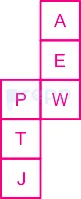
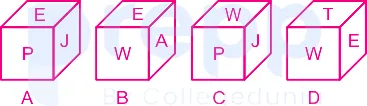
- A
Only A and D
- B
Only A and C
- C
No figure can be formed
- D
Only C and D
Show answer
Question 24archived
The sequence of folding a piece of paper and the manner in which the folded paper has been cut is shown in the following figures. How would this paper look when unfolded?

- A
Option A (shown in image)
- B
Option B (shown in image)
- C
Option C (shown in image)
- D
Option D (shown in image)
Show answer
A. Option A (shown in image)For this question, we have unfolded the given situation to get the actual image as shown:-
So, the final image is similar to option 1.
Hence, "option 1" is the correct answer.
 Paper & answer key PDF ↗
 Question 25archived
Select the option that is related to the third word in the same way as the second word is related to the first word.
Conceit : Modesty : : Despair : ?
- A
Plain
- B
Gloom
- C
Anguish
- D
Hope
Show answer
D. HopeWord Analogy Reasoning: Conceit to Modesty, Despair to What?
This question asks us to find the word that has the same relationship with "Despair" as "Modesty" has with "Conceit". This type of question tests our vocabulary and understanding of word relationships, specifically antonyms.
Understanding the Relationship: Conceit : Modesty
Let's analyze the first pair of words:
Conceit: This word means excessive pride or self-importance. Someone with conceit is often arrogant or boasts about themselves.
Modesty: This word means the quality of being unassuming or moderate in the estimation of one's abilities. A modest person is humble and doesn't boast.
Looking at the meanings, "Conceit" and "Modesty" are opposite in meaning. They are antonyms.
Applying the Relationship: Despair : ?
Now we need to find a word that is the antonym of "Despair".
Despair: This word means the complete loss or absence of hope. It is a feeling of hopelessness and dejection.
We are looking for the opposite of losing hope, which is having hope.
Evaluating the Options
Let's look at the given options and see which one is the antonym of "Despair":
Option
Word
Meaning
Relationship to Despair
1
Plain
Simple, ordinary.
Not related.
2
Gloom
A state of depression or despondency.
Similar meaning (synonym or related).
3
Anguish
Severe mental or physical pain or suffering.
Related to despair, but not the opposite.
4
Hope
A feeling of expectation and desire for a certain thing to happen.
Opposite meaning (antonym).
Based on the analysis, "Hope" is the direct opposite of "Despair". Therefore, the relationship between Despair and Hope is the same as the relationship between Conceit and Modesty (antonyms).
Conclusion
The relationship between "Conceit" and "Modesty" is that they are antonyms. We need to find the antonym of "Despair". The antonym of "Despair" is "Hope".
Thus, the correct option is "Hope".
Revision Table: Key Analogy Terms
Word
Meaning
Antonym Example
Conceit
Excessive pride
Modesty
Modesty
Humility, lack of boastfulness
Conceit
Despair
Loss of hope
Hope
Hope
Feeling of expectation and desire
Despair
Additional Information: Understanding Word Analogies
Word analogies are common in vocabulary and reasoning tests. They require you to identify the relationship between the first pair of words and then find a word that has the same relationship with the third word.
Common relationships in word analogies include:
Antonyms (opposites)
Synonyms (similar meanings)
Part to Whole (e.g., Finger : Hand)
Cause and Effect (e.g., Study : Grade)
Tool and User (e.g., Pen : Writer)
Action and Object (e.g., Read : Book)
Category and Item (e.g., Fruit : Apple)
Practicing identifying these relationships helps improve vocabulary and logical reasoning skills.
Paper & answer key PDF ↗ Question 26archived
Parsec is a unit of ______.
- A
Speed
- B
acceleration
- C
length
- D
time
Show answer
C. lengthUnderstanding the Unit Parsec
The question asks about the physical quantity that the unit 'Parsec' measures. Understanding units is fundamental in physics and astronomy as they provide context and scale to measurements.
Let's examine the options provided:
Speed
Acceleration
Length
Time
What is a Parsec?
A parsec (symbol: pc) is a unit of length used to measure large distances to astronomical objects outside the Solar System. It is defined as the distance at which one astronomical unit (AU) subtends an angle of one arcsecond.
In simpler terms, imagine Earth orbiting the Sun. The average distance between the Earth and the Sun is defined as one Astronomical Unit (AU). Now, picture a star far away. If the angle formed by lines from that star to the Earth at two different points in its orbit (six months apart, essentially seeing the Earth-Sun distance from the star's perspective) is one arcsecond (1/3600th of a degree), then the distance to that star is one parsec.
The name 'parsec' itself comes from 'parallax of one arcsecond'. Parallax is the apparent shift in the position of an object when viewed from different angles.
Relating Parsec to Other Units of Length
A parsec is a very large unit of distance. Its approximate value is:
1 parsec $\approx$ 3.26 light-years
1 parsec $\approx$ 30.86 trillion kilometers (3.086 × 10¹³ km)
1 parsec $\approx$ 19.2 trillion miles (1.92 × 10¹³ miles)
1 parsec $\approx$ 206,265 astronomical units (AU)
Since the parsec is defined as a distance, it is clearly a unit of length.
Analyzing the Options
Let's consider why the other options are incorrect:
Speed: Speed is the rate at which an object changes its position, typically measured in units like meters per second (m/s), kilometers per hour (km/h), or miles per hour (mph). Parsec does not measure speed.
Acceleration: Acceleration is the rate at which an object's velocity changes, measured in units like meters per second squared (m/s²). Parsec does not measure acceleration.
Time: Time is measured in units like seconds, minutes, hours, or years. While light-year is a unit of length based on time (the distance light travels in one year), parsec is fundamentally defined based on geometry (the parallax angle and the AU distance), making it a direct measure of length, not time.
Length: Length (or distance) is a measure of how far apart two points are. Units include meters, kilometers, miles, astronomical units, light-years, and parsecs. As established, parsec is a unit used for measuring astronomical distances, which is a form of length.
Therefore, Parsec is a unit of length.
Quantity
Common Units
Does Parsec measure this?
Speed
m/s, km/h, mph
No
Acceleration
m/s²
No
Length (Distance)
meter, km, miles, AU, light-year
Yes
Time
second, minute, hour, year
No
Based on the definition and common usage in astronomy, the parsec is a unit of length for measuring vast cosmic distances.
Revision Table: Astronomical Units
Unit
Quantity Measured
Approximate Value
Astronomical Unit (AU)
Length (Distance)
Average distance between Earth and Sun ($\approx$ 150 million km)
Light-Year (ly)
Length (Distance)
Distance light travels in one year ($\approx$ 9.46 trillion km)
Parsec (pc)
Length (Distance)
Distance corresponding to a parallax of one arcsecond ($\approx$ 3.26 light-years)
Additional Information on Parsec and Cosmic Distance Measurement
Astronomers use various methods to measure distances to stars and galaxies. For relatively nearby stars (within a few hundred parsecs), the parallax method, which gives the parsec its definition, is the primary technique. This method relies on measuring the apparent shift of a star against the background of more distant stars as the Earth orbits the Sun. The larger the parallax angle, the closer the star.
For greater distances, other methods are employed, such as using standard candles (objects with known luminosity, like Cepheid variables or Type Ia supernovae) or redshift measurements (for very distant galaxies). However, the parsec remains a fundamental unit in astronomy, often used for galactic and intergalactic scales, typically expressed in kiloparsecs (kpc), megaparsecs (Mpc), or even gigaparsecs (Gpc).
Understanding the parsec as a unit of length is crucial for comprehending the vast scales of the universe.
Paper & answer key PDF ↗ Question 27archived
In 1977, who became the President of the Janata Party, which formed a coalition government at the centre with Morarji Desai as the Prime Minister?
- A
George Fernandes
- B
Madhu Dandavate
- C
Charan Singh
- D
Chandra Shekhar
Show answer
D. Chandra ShekharUnderstanding the Question: Janata Party Leadership in 1977
The question asks about the individual who served as the President of the Janata Party in the year 1977. This was a significant year in Indian politics as the Janata Party formed the first non-Congress government at the centre following the General Elections, with Morarji Desai becoming the Prime Minister.
Formation of the Janata Party and the 1977 Election
The Janata Party was formed in 1977 as a coalition of various opposition parties that united against the Emergency rule imposed by Prime Minister Indira Gandhi. These parties included the Indian National Congress (Organisation), the Bharatiya Jana Sangh, the Bharatiya Lok Dal, and the Socialist Party. This formation was a crucial event leading up to the 1977 General Election.
In the 1977 election, the Janata Party and its allies achieved a decisive victory, ending decades of Congress rule. Following this victory, Morarji Desai was chosen as the leader of the parliamentary party and consequently sworn in as the Prime Minister of India.
Identifying the Janata Party President in 1977
At the time the Janata Party was formed and won the historic 1977 elections, the person who held the position of its President was Chandra Shekhar.
Chandra Shekhar was a prominent socialist leader who had been a member of the Congress Party but was imprisoned during the Emergency for his opposition.
Upon his release, he played a key role in the formation of the Janata Party.
He served as the President of the Janata Party during this critical phase of its formation and rise to power.
Analysing the Options
Let's consider the provided options in the context of the Janata Party leadership in 1977:
George Fernandes: A prominent trade unionist and socialist leader, also a key figure in the Janata Party and a minister in the 1977 government, but not the party president in 1977.
Madhu Dandavate: Another respected socialist leader and member of the Janata Party, he served as a minister in the Morarji Desai government. He was not the party president in 1977.
Charan Singh: A significant leader of the Bharatiya Lok Dal component of the Janata Party and served as Home Minister and later Deputy Prime Minister in the 1977 government. He became Prime Minister later, but was not the Janata Party President in 1977.
Chandra Shekhar: A socialist leader and former Congress member, he was indeed the President of the Janata Party when it came to power in 1977.
Based on historical facts, Chandra Shekhar was the President of the Janata Party during the period when Morarji Desai became the Prime Minister in 1977.
Conclusion
The President of the Janata Party in 1977, when Morarji Desai formed the government at the centre, was Chandra Shekhar.
Revision Table: Key Figures of Janata Party in 1977
Role
Individual
Prime Minister
Morarji Desai
Janata Party President (1977)
Chandra Shekhar
Prominent Leaders/Ministers
Charan Singh, George Fernandes, Madhu Dandavate, L.K. Advani, Atal Bihari Vajpayee, etc.
Additional Information on Chandra Shekhar and Janata Party
Chandra Shekhar's presidency of the Janata Party in 1977 was crucial in consolidating the diverse factions that had come together. He was known for his strong anti-establishment stance and his 'Bharat Yatra' (Walk across India) in 1983, which aimed at understanding the rural issues.
The Janata Party government of 1977, despite its historic victory, faced internal conflicts and eventually collapsed in 1979. Chandra Shekhar himself would later become the Prime Minister of India for a brief period in 1990-1991, heading a minority government with outside support.
Paper & answer key PDF ↗ Question 28archived
In connection with the issue of adoption of villages by parliamentarians, a scheme named ‘SAGY’ was launched. What does the 'A' in SAGY stand for?
- A
Adarsh
- B
Atmanirbhar
- C
Apna
- D
Anubhav
Show answer
A. AdarshUnderstanding the SAGY Scheme for Village Development
The question asks about the acronym SAGY, specifically what the letter 'A' stands for, in connection with the adoption of villages by parliamentarians in India. SAGY is a significant government initiative aimed at rural development.
Breaking Down the Acronym SAGY
SAGY stands for Saansad Adarsh Gram Yojana.
Let's look at each part of the acronym:
S stands for Saansad (meaning Member of Parliament)
A stands for Adarsh (meaning Ideal or Model)
G stands for Gram (meaning Village)
Y stands for Yojana (meaning Scheme)
Thus, SAGY translates to the Saansad Adarsh Gram Yojana, or the Members of Parliament's Model Village Scheme.
Significance of 'Adarsh' in Saansad Adarsh Gram Yojana
The term 'Adarsh' is central to the scheme's objective. An 'Adarsh Gram' is envisioned as a model village that other villages can emulate. The scheme encourages Members of Parliament (MPs) to adopt villages and guide their development towards becoming 'Adarsh Grams'. This development encompasses various aspects, including social development, infrastructure, environmental sustainability, and good governance.
The focus is not just on infrastructure development but also on creating a holistic development model led by the community, inspired and facilitated by the MP.
Analysing the Options
Let's examine the given options in the context of the SAGY acronym:
Option
Meaning
Relevance to SAGY
1. Adarsh
Ideal/Model
This aligns directly with the full form of SAGY (Saansad Adarsh Gram Yojana).
2. Atmanirbhar
Self-reliant
While self-reliance is a goal in village development, 'Atmanirbhar' is not part of the official SAGY acronym.
3. Apna
Our own
This term is not part of the official SAGY acronym.
4. Anubhav
Experience
This term is not part of the official SAGY acronym.
Based on the full form of the Saansad Adarsh Gram Yojana, the 'A' in SAGY stands for 'Adarsh'.
Conclusion on SAGY Acronym
The Saansad Adarsh Gram Yojana (SAGY) is a scheme where 'Adarsh' signifies the goal of creating model villages. Therefore, the letter 'A' in SAGY correctly represents 'Adarsh'.
Revision Table: Key Details about SAGY
Aspect
Details
Scheme Name
Saansad Adarsh Gram Yojana (SAGY)
Launched On
11th October 2014 (on the birth anniversary of Jayaprakash Narayan)
Objective
To develop model villages (Adarsh Grams) through holistic development led by Members of Parliament.
Key Focus Areas
Social development, infrastructure, clean environment, local economic development, human development, social harmony, and good governance.
Role of MP
Identify a Gram Panchayat to adopt, formulate and implement a Village Development Plan.
Additional Information on Village Development Schemes
SAGY is one of several initiatives by the government focused on rural and village development. Understanding the context of such schemes is important for comprehensive knowledge. Other schemes often target specific areas like infrastructure (roads, housing), sanitation, employment generation (MGNREGA), or social security.
SAGY is unique in its approach of leveraging the leadership and influence of MPs to drive participatory development and create replicable models. It aims to instil certain values like cleanliness, tranquility, and harmony in the adopted villages, going beyond just physical infrastructure.
It is important to distinguish SAGY from other rural development programs and correctly identify the meaning of its components, such as what 'A' stands for, which is 'Adarsh'.
Paper & answer key PDF ↗ Question 29archived
Which of the following is an award for contribution in the field of science and technology?
- A
Shanti Swarup Bhatnagar (SSB) Award
- B
Deenanath Mangeshkar Award
- C
Jnanpith Award
- D
Dronacharya Award
Show answer
A. Shanti Swarup Bhatnagar (SSB) AwardIdentifying Science and Technology Awards
The question asks us to identify which of the given options represents an award specifically for contributions in the field of science and technology.
Analysing the Given Awards
Let's examine each option to determine its area of recognition:
Shanti Swarup Bhatnagar (SSB) Award: This is a prestigious science award in India. It is named after Dr. Shanti Swarup Bhatnagar, the founder Director of the Council of Scientific & Industrial Research (CSIR). The award is given annually by the CSIR for notable and outstanding research, applied or fundamental, in various branches of science and technology.
Deenanath Mangeshkar Award: This award is given to individuals for their remarkable contributions to music, art, culture, and social work. It is not related to science and technology.
Jnanpith Award: This is India's highest literary award. It is presented annually to Indian writers for their outstanding contribution to literature. It is not related to science and technology.
Dronacharya Award: This award is presented by the Government of India for excellence in sports coaching. It recognizes outstanding coaches who have successfully trained sportspersons or teams and enabled them to achieve outstanding results in international competitions. It is not related to science and technology.
Based on the analysis of each award's focus area, the Shanti Swarup Bhatnagar (SSB) Award is clearly the one presented for contributions in the field of science and technology.
Revision Table: Awards in India
Award NameField of ContributionAwarded By
Shanti Swarup Bhatnagar (SSB) AwardScience and TechnologyCouncil of Scientific & Industrial Research (CSIR)
Deenanath Mangeshkar AwardMusic, Art, Culture, Social WorkDeenanath Mangeshkar Smruti Pratishthan Charitable Trust
Jnanpith AwardLiteratureBharatiya Jnanpith
Dronacharya AwardSports CoachingGovernment of India (Ministry of Youth Affairs and Sports)
Additional Information on Science and Technology Awards
The Shanti Swarup Bhatnagar Prize is considered one of the most coveted science awards in India. It is awarded to scientists below the age of 45. The prize includes a cash component, a citation, and a plaque. The award is given across various scientific disciplines, including Biological Sciences, Chemical Sciences, Earth, Atmosphere, Ocean & Planetary Sciences, Engineering Sciences, Mathematical Sciences, Medical Sciences, and Physical Sciences.
Recognizing contributions through awards like the SSB Award is crucial for promoting scientific research and technological development in the country. It motivates scientists and researchers to pursue excellence and innovation.
Paper & answer key PDF ↗ Question 30archived
With which of the following sports do you associate the term '16-yard hit'?
- A
Golf
- B
Lawn tennis
- C
Cricket
- D
Field hockey
Show answer
D. Field hockeyUnderstanding the '16-Yard Hit' in Sports
The question asks us to identify the sport associated with the term '16-yard hit'. Let's examine the options provided and understand what this term means in the context of sports.
The term '16-yard hit' is a specific rule or action within a particular sport. We need to determine which of the given sports utilizes this term.
What is a '16-Yard Hit'?
A '16-yard hit', also known as a 'free hit' taken from the 16-yard line, is a common term in field hockey. It is awarded to the defending team in several situations, typically when the attacking team commits an offense within the attacking 23-meter area or when the ball goes over the backline having last been touched by an attacker.
It is taken from a spot on the 16-yard line nearest to where the offense occurred or where the ball went out of play.
All players from the opposing team must be at least 5 meters away from the ball when the hit is taken.
The player taking the hit can either pass the ball to a teammate or run with the ball themselves after taking the hit.
Analyzing the Options
Let's consider the other sports listed:
Golf: Golf involves hitting a ball into a series of holes using clubs. Terms in golf include 'drive', 'putt', 'chip', 'birdie', 'bogey', etc. The term '16-yard hit' is not used in golf.
Lawn tennis: Tennis is played on a court with a net, hitting a ball with rackets. Terms include 'serve', 'volley', 'forehand', 'backhand', 'ace', 'deuce', etc. The term '16-yard hit' is not part of tennis terminology.
Cricket: Cricket is a bat-and-ball game. Terms include 'bowling', 'batting', 'wicket', 'run', 'four', 'six', 'LBW', etc. The term '16-yard hit' is not used in cricket.
Field hockey: As discussed above, the '16-yard hit' is a fundamental concept and action in field hockey rules, used to restart play.
Based on the analysis, the term '16-yard hit' is directly associated with field hockey.
Conclusion
The term '16-yard hit' is a specific rule in field hockey used to restart play from the 16-yard line under certain conditions. It is not a term used in golf, lawn tennis, or cricket.
Revision Table: Sports Terminology
Sport
Associated Term(s)
Does it use '16-yard hit'?
Golf
Drive, Putt, Chip, Birdie
No
Lawn Tennis
Serve, Volley, Ace, Deuce
No
Cricket
Bowler, Batsman, Wicket, Run
No
Field Hockey
16-yard hit, Penalty corner, Foul
Yes
Additional Information on Field Hockey Rules
Field hockey has various ways to restart play after a stoppage. These include:
Centre Pass: Used to start the game and after a goal is scored.
Side-in: Awarded when the ball goes off the sideline.
16-Yard Hit: Awarded to the defense when the ball goes over the backline off an attacker, or for certain fouls by attackers in the defensive 23-meter area.
Penalty Corner: Awarded for fouls by defenders in the circle or intentional fouls in the 23-meter area.
Penalty Stroke: Awarded for fouls by defenders that prevent a probable goal.
Free Hit: Awarded for most fouls outside the circles.
Understanding these different restarts helps in comprehending the flow and rules of field hockey, including the specific instance of a '16-yard hit'.
Paper & answer key PDF ↗ Question 31archived
Which of the following is the SI unit for measuring the amount of a substance?
- A
kelvin (K)
- B
candela (cd)
- C
mole (mol)
- D
metre (m)
Show answer
C. mole (mol)Understanding the SI Unit for Amount of Substance
The question asks to identify the SI unit used for measuring the amount of a substance. In science and chemistry, it is essential to have a standard way to quantify how much of a substance is present, not by its mass or volume necessarily, but by the number of fundamental particles it contains.
The International System of Units (SI) provides a standard set of base units for various physical quantities. Let's look at the options provided and see which one corresponds to the measurement of the amount of a substance.
Analyzing the Options for Amount of Substance SI Unit
kelvin (K): The kelvin is the SI base unit for thermodynamic temperature. It measures how hot or cold something is. Therefore, kelvin is not the unit for the amount of a substance.
candela (cd): The candela is the SI base unit for luminous intensity. It measures the power emitted by a light source in a particular direction, weighted by the luminosity function. This unit is related to light, not the amount of substance.
mole (mol): The mole is defined as the amount of a substance that contains exactly $6.02214076 \times 10^{23}$ elementary entities. These entities can be atoms, molecules, ions, electrons, or any other specified group of particles. This definition directly relates the mole to the number of particles, which is how the amount of substance is measured. Thus, the mole is the correct SI unit for the amount of a substance.
metre (m): The metre is the SI base unit for length. It measures distance. Therefore, metre is not the unit for the amount of a substance.
The Correct SI Unit for Amount of Substance
Based on the analysis of the options and the definitions of the SI base units, the unit specifically designed to measure the amount of a substance is the mole (mol).
Here is a summary of the seven SI base units and the physical quantities they measure:
Quantity
SI Base Unit
Symbol
Length
metre
m
Mass
kilogram
kg
Time
second
s
Electric current
ampere
A
Thermodynamic temperature
kelvin
K
Amount of substance
mole
mol
Luminous intensity
candela
cd
As the table clearly shows, the mole (mol) is the SI base unit for the amount of substance.
Revision Table: SI Units and Amount of Substance
Concept
Key Point
Amount of Substance
Measures the quantity of elementary entities (atoms, molecules, etc.).
SI Unit
International standard system of measurement.
Mole (mol)
The SI base unit for Amount of Substance.
Avogadro's Number
The number of entities in one mole ($\approx 6.022 \times 10^{23}$).
Additional Information on the Mole and Amount of Substance
The concept of the mole is fundamental in chemistry. It provides a way to relate the macroscopic properties of a substance (like mass or volume) to the microscopic world of atoms and molecules. For example, the molar mass of a substance is the mass of one mole of that substance, usually expressed in grams per mole (g/mol). This is a very useful concept for calculations involving chemical reactions.
Understanding the mole allows chemists to predict the amounts of reactants and products in chemical reactions using balanced chemical equations, where coefficients represent the relative number of moles of each substance involved.
Paper & answer key PDF ↗ Question 32archived
The rules made for the ______ were written down in a book called ‘Vinaya Pitaka'.
- A
Shakta cult
- B
Buddhist sangha
- C
Vaishnavites
- D
Lingayats
Show answer
B. Buddhist sanghaUnderstanding Vinaya Pitaka and Buddhist Sangha Rules
The question asks about the specific group for whom the rules documented in the religious text called ‘Vinaya Pitaka’ were created.
The Vinaya Pitaka is a key religious text in Buddhism. It is one of the three parts of the Tripitaka, which is the traditional collection of Buddhist scriptures. The word ‘Vinaya’ generally translates to discipline or conduct, and the Vinaya Pitaka is primarily concerned with the rules and regulations governing the monastic community.
The Buddhist Sangha is the monastic community of ordained Buddhist monks and nuns. It is one of the "Three Jewels" of Buddhism (the other two being the Buddha and the Dharma or teachings).
The Vinaya Pitaka contains a detailed set of rules, procedures, and guidelines for the members of the Buddhist Sangha. These rules cover various aspects of monastic life, including:
Rules related to ordination
Regulations concerning daily life, conduct, and discipline
Procedures for resolving conflicts within the community
Guidelines for communal living
Let’s briefly look at the other options:
Shakta cult: This refers to a major tradition of Hinduism focused on the worship of Shakti or Devi (the Divine Mother). Their scriptures and rules are distinct from Buddhism.
Vaishnavites: These are followers of Vishnu, one of the principal deities of Hinduism. Their religious texts include Puranas and Agamas related to Vishnu worship.
Lingayats: This is a distinct religious tradition in India, primarily focused on the worship of Shiva. Their practices and texts are separate from Buddhist traditions.
Based on the content of the Vinaya Pitaka, it is clear that the rules within this text were specifically compiled for the members of the Buddhist Sangha to guide their conduct and maintain order within the monastic community.
Therefore, the rules made for the Buddhist sangha were written down in a book called ‘Vinaya Pitaka'.
Text
Primary Focus
Associated Group
Vinaya Pitaka
Monastic Rules & Discipline
Buddhist Sangha
Related Hindu Texts (e.g., Puranas, Agamas)
Deity Worship, Rituals, Philosophy
Shakta, Vaishnavites, Lingayats (depending on tradition)
Revision Table: Key Concepts
Term
Description
Vinaya Pitaka
Collection of Buddhist scriptures focusing on monastic rules.
Buddhist Sangha
The monastic community of monks and nuns in Buddhism.
Tripitaka
The traditional collection of Buddhist scriptures, consisting of Vinaya Pitaka, Sutta Pitaka, and Abhidhamma Pitaka.
Additional Information on Buddhist Texts and Rules
The Tripitaka, also known as the Pali Canon (in Theravada Buddhism), is divided into three ‘baskets’ or sections:
Vinaya Pitaka: Contains the rules and regulations for the monastic order (Sangha).
Sutta Pitaka: Contains the discourses and teachings attributed to the Buddha and sometimes his close disciples.
Abhidhamma Pitaka: Contains philosophical and psychological analysis and systematization of the teachings.
The rules in the Vinaya Pitaka, known as the Pratimoksha (or Patimokkha), are central to the discipline of the Buddhist Sangha and are recited regularly by monks and nuns.
Paper & answer key PDF ↗ Question 33archived
IPR 1956 formed the basis of the ______ Five Year Plan of India.
- A
First
- B
Third
- C
Second
- D
Fourth
Show answer
C. SecondUnderstanding the Industrial Policy Resolution 1956 (IPR 1956) and its Impact
The Industrial Policy Resolution of 1956 (IPR 1956) was a landmark statement by the Government of India that significantly shaped the direction of the Indian economy and industrial development for decades. It laid down the framework for classifying industries and defined the respective roles of the public and private sectors in the process of industrialization.
Key Features of IPR 1956
The IPR 1956 outlined several important principles:
It categorized industries into three schedules, reserving certain key industries primarily for the public sector.
It emphasized the role of the state in accelerating industrialization, especially in basic and heavy industries.
It promoted import substitution to achieve self-reliance.
It aimed at reducing disparities in income and wealth and preventing monopolies.
It stressed the importance of cottage and small-scale industries for employment generation and regional development.
IPR 1956 and India's Five Year Plans
India adopted a system of Five Year Plans for its planned economic development. Each plan had specific objectives and strategies. The IPR 1956 provided the foundational policy framework that guided the strategy of one particular Five Year Plan.
Let's look at the objectives and focus of the initial Five Year Plans:
First Five Year Plan (1951-1956): Primarily focused on agriculture, irrigation, and power projects to address food shortages and lay basic infrastructure.
Second Five Year Plan (1956-1961): This plan, also known as the Mahalanobis Plan, emphasized rapid industrialization, with a focus on heavy industries like steel, coal, heavy engineering, and machine-building. It strongly advocated for a dominant role for the public sector in these strategic areas.
Third Five Year Plan (1961-1966): Aimed at self-sufficiency in food grains and expansion of basic industries, continuing the thrust on industrialization from the Second Plan.
Fourth Five Year Plan (1969-1974): Focused on growth with stability and progressive achievement of self-reliance, addressing issues like poverty and income distribution.
Comparing the features of the IPR 1956 with the focus of the Five Year Plans, it becomes evident that the principles and objectives outlined in the IPR 1956 directly aligned with and formed the basis for the strategy adopted during the Second Five Year Plan. The strong emphasis on heavy industries, the expansion of the public sector, and rapid industrialization were the cornerstones of the Second Plan, all derived from the IPR 1956.
Conclusion
The Industrial Policy Resolution 1956 was instrumental in shaping India's path towards becoming an industrialized nation. Its focus on state intervention and heavy industries directly translated into the strategic priorities of the Second Five Year Plan. Therefore, the IPR 1956 formed the basis of the Second Five Year Plan of India.
Policy/Plan
Period
Key Focus Relevant to IPR 1956
IPR 1956
1956
Framework for industrial development; emphasis on public sector, heavy industry, import substitution.
First Five Year Plan
${1951 \text{-} 1956}$
Agriculture, infrastructure.
Second Five Year Plan
${1956 \text{-} 1961}$
Rapid industrialization; heavy industries; public sector dominance (aligned with IPR 1956).
Third Five Year Plan
${1961 \text{-} 1966}$
Self-sufficiency in food; continued industrial expansion.
Revision Table: IPR 1956 & Five Year Plans
This table summarizes the connection:
Policy/Plan
Significance
Industrial Policy Resolution 1956
Defined the framework for industrial development, emphasizing the public sector and heavy industries.
Second Five Year Plan (1956-1961)
Implemented the strategy based on the IPR 1956, focusing on rapid industrialization and heavy industries.
Additional Information: Mahalanobis Model and Second Plan
The Second Five Year Plan was heavily influenced by the Mahalanobis model, developed by statistician P. C. Mahalanobis. This model advocated for a strategy of investing heavily in capital goods industries to achieve long-term growth. This approach was directly in line with the IPR 1956's focus on heavy and basic industries under state control, further cementing the IPR 1956 as the foundation for this plan's strategy.
Paper & answer key PDF ↗ Question 34archived
_______ is the largest union territory in India in terms of area.
- A
Chandigarh
- B
Puducherry
- C
Ladakh
- D
Jammu and kashmir
Show answer
C. LadakhUnderstanding India's Union Territories and Area
India is divided into States and Union Territories (UTs). States have their own elected governments, while Union Territories are directly governed by the Central Government of India, although some have legislative assemblies.
The question asks to identify the largest union territory in India in terms of area. To answer this, we need to compare the geographical areas of the various Union Territories currently existing in India.
Comparing Areas of Indian Union Territories
Let's look at the approximate areas of some of the major Union Territories:
Union Territory
Approximate Area (in sq km)
Ladakh
59,146
Jammu and Kashmir
42,241
Andaman and Nicobar Islands
8,249
Delhi
1,484
Puducherry
490
Dadra and Nagar Haveli and Daman and Diu
603
Chandigarh
114
Lakshadweep
32
From the table above, we can clearly see the areas of the Union Territories listed in the options:
Chandigarh: Approximately 114 sq km
Puducherry: Approximately 490 sq km
Ladakh: Approximately 59,146 sq km
Jammu and Kashmir: Approximately 42,241 sq km
Comparing these figures, Ladakh has the largest area among the given options and is also the largest Union Territory in India overall by area.
Identifying the Largest Union Territory by Area
Based on the area comparison, Ladakh stands out as having the largest geographical expanse among all the Union Territories of India. It was constituted as a Union Territory on 31 October 2019, following the Jammu and Kashmir Reorganisation Act, 2019. Its vast area covers a significant portion of the former state of Jammu and Kashmir.
Therefore, the Union Territory that is the largest in India in terms of area is Ladakh.
Revision Table: Key Facts about UTs
Feature
Details
Definition of UT
Directly governed by the Central Government
Largest UT by Area
Ladakh
Second Largest UT by Area (among options)
Jammu and Kashmir
Smallest UT by Area
Lakshadweep
Additional Information: Union Territories of India
As of recent reorganizations, India currently has 8 Union Territories:
Andaman and Nicobar Islands
Chandigarh
Dadra and Nagar Haveli and Daman and Diu
Delhi (National Capital Territory of Delhi)
Jammu and Kashmir
Ladakh
Lakshadweep
Puducherry
While Delhi and Puducherry, and Jammu and Kashmir have their own legislative assemblies, others are governed more directly by the central government representative (Lieutenant Governor or Administrator).
Knowing the areas and locations of these Union Territories is important for understanding India's political geography.
Paper & answer key PDF ↗ Question 35archived
Atoms of which element combines with hydrogen to give water?
- A
Iodine
- B
Oxygen
- C
Carbon
- D
Nitrogen
Show answer
B. OxygenUnderstanding Water Composition: Which Element Combines with Hydrogen?
The question asks us to identify the element that combines with hydrogen atoms to form water. Water is one of the most common and essential substances on Earth. Its chemical composition is well-defined.
The chemical formula for water is known to be H\(_2\)O. This formula tells us exactly which elements are present in a water molecule and in what proportion.
The 'H' in the formula stands for the element Hydrogen.
The 'O' in the formula stands for the element Oxygen.
The subscript '2' next to 'H' indicates that there are two atoms of hydrogen in each water molecule.
When there is no subscript next to an element symbol (like 'O'), it means there is one atom of that element in the molecule.
Therefore, the chemical formula H\(_2\)O shows that one molecule of water is made up of two hydrogen atoms and one oxygen atom. This directly tells us that hydrogen atoms combine with oxygen atoms to form water.
Chemical Reaction to Form Water
Water is formed when hydrogen gas (H\(_2\)) reacts with oxygen gas (O\(_2\)). The balanced chemical equation for this reaction is:
\(2\text{H}_2\text{(g)} + \text{O}_2\text{(g)} \rightarrow 2\text{H}_2\text{O(l)}\)
This equation shows that hydrogen and oxygen combine chemically under suitable conditions to produce water. The reaction involves the atoms of hydrogen and oxygen rearranging to form new chemical bonds in water molecules.
Analyzing the Options
Let's look at the given options and see which one fits the chemical composition of water:
Iodine: Iodine is a halogen element (symbol I). It does not combine with hydrogen to form water. It can form hydrogen iodide (HI), which is a different compound.
Oxygen: Oxygen is a non-metal element (symbol O). As we saw from the formula H\(_2\)O, oxygen atoms combine with hydrogen atoms to form water. This matches the known composition of water.
Carbon: Carbon is an element (symbol C) that forms a vast number of compounds, particularly organic compounds. Carbon combines with hydrogen to form hydrocarbons (like methane, CH\(_4\)), not water.
Nitrogen: Nitrogen is an element (symbol N) that makes up a large part of the Earth's atmosphere. Nitrogen combines with hydrogen to form ammonia (NH\(_3\)), not water.
Based on the chemical formula of water (H\(_2\)O) and the elements involved in its formation, Oxygen is the element that combines with hydrogen to give water.
Element
Symbol
Combines with Hydrogen to Form
Forms Water?
Iodine
I
Hydrogen Iodide (HI)
No
Oxygen
O
Water (H\(_2\)O)
Yes
Carbon
C
Hydrocarbons (e.g., CH\(_4\))
No
Nitrogen
N
Ammonia (NH\(_3\))
No
Conclusion
The element that combines with hydrogen to form water is Oxygen, as represented by the chemical formula H\(_2\)O.
Revision Table: Water Formation Key Concepts
Concept
Description
Chemical Formula of Water
H\(_2\)O
Elements in Water
Hydrogen (H) and Oxygen (O)
Atoms per molecule
2 Hydrogen atoms, 1 Oxygen atom
Formation
Chemical reaction between Hydrogen and Oxygen
Additional Information: Properties of Hydrogen and Oxygen
Understanding the properties of Hydrogen and Oxygen helps explain why they combine to form water.
Hydrogen (H): It is the lightest element. It exists as a diatomic gas (H\(_2\)) under normal conditions. It is highly flammable and reacts readily with oxygen.
Oxygen (O): It is a highly reactive non-metal. It exists as a diatomic gas (O\(_2\)) under normal conditions. Oxygen is essential for combustion and respiration. When hydrogen and oxygen react, they form strong bonds, releasing a significant amount of energy, which is why the reaction can be explosive.
The combination of these two elements results in water, a stable compound with properties vastly different from its constituent elements, such as being a liquid at room temperature and being essential for life.
Paper & answer key PDF ↗ Question 36archived
Who is the General Secretary of Communist Party of India as of January 2021?
- A
Sujan Chakrabarti
- B
Brinda Karat
- C
S Sudhakar Reddy
- D
D Raja
Show answer
D. D RajaGeneral Secretary of Communist Party of India Explained
The General Secretary is a key leadership position within a political party. They often serve as the chief executive or administrative head, responsible for the party's day-to-day functioning, organization, and strategy. In the Communist Party of India (CPI), the General Secretary holds significant authority and represents the party both nationally and internationally.
Identifying the CPI General Secretary in January 2021
The question asks specifically about the General Secretary of the Communist Party of India (CPI) as of January 2021. To answer this, we need to know who held that position at that specific time.
Based on the records of the Communist Party of India (CPI), the leader who held the position of General Secretary in January 2021 was D Raja.
Analysis of Options for CPI General Secretary
Let's look at the provided options and understand why D Raja was the correct person and why the others were not the General Secretary of the CPI in January 2021:
Sujan Chakrabarti: Sujan Chakrabarti is a prominent leader, but he is associated with the Communist Party of India (Marxist), or CPI(M), which is a different political party from the CPI. He is not a member or leader of the CPI.
Brinda Karat: Brinda Karat is also a well-known figure in Indian politics, and she is a leader of the Communist Party of India (Marxist) (CPI(M)), not the Communist Party of India (CPI).
S Sudhakar Reddy: S Sudhakar Reddy served as the General Secretary of the Communist Party of India (CPI) before D Raja. D Raja took over the position from S Sudhakar Reddy in July 2019. Therefore, in January 2021, S Sudhakar Reddy was not the General Secretary.
D Raja: D Raja assumed the role of General Secretary of the Communist Party of India (CPI) in July 2019. He continued to hold this position through January 2021 and beyond. Thus, he was the General Secretary of the CPI at that time.
Summary of the Correct CPI Leader
In summary, verifying the leadership of the Communist Party of India (CPI) in January 2021 confirms that D Raja was serving as the General Secretary during that period.
Revision Table - CPI Leadership
Position
Holder (as of Jan 2021)
Notes
General Secretary (CPI)
D Raja
Assumed office July 2019
Former General Secretary (CPI)
S Sudhakar Reddy
Predecessor to D Raja
Prominent Leaders (CPI(M))
Sujan Chakrabarti, Brinda Karat
Leaders of a different party (CPI(M))
Additional Information - Communist Party of India (CPI)
The Communist Party of India (CPI) is one of the oldest political parties in India. It was founded in 1925. The party's ideology is based on Marxism-Leninism. It has historically played a significant role in India's labour movements and political landscape. The CPI is distinct from the Communist Party of India (Marxist) (CPI(M)), which originated from a split in the CPI in 1964. Both parties advocate for socialist principles but have different organizational structures and political strategies.
Paper & answer key PDF ↗ Question 37archived
Who is the author of the book, 'Men in White - A Book of Cricket'?
- A
Boria Mazumdar
- B
Harsha Bhogle
- C
Mukul Kesavan
- D
Sanjay Manjrekar
Show answer
C. Mukul KesavanAnalyzing the Author of 'Men in White' Cricket Book
The question asks to identify the author of the book titled 'Men in White - A Book of Cricket'. This is a question about sports literature, specifically focusing on books about cricket. To answer this, one needs to know the prominent authors in the field of cricket writing and their notable works.
Identifying the Author of 'Men in White'
'Men in White - A Book of Cricket' is a well-known collection of essays and writings on the sport of cricket. It delves into various aspects of the game, its history, culture, and significant moments. Authors who write on cricket often have deep insights into the game, whether as journalists, historians, players, or ardent followers.
Let's consider the provided options:
Boria Mazumdar: A prominent Indian sports historian and journalist, known for books like 'Cricket Nation'.
Harsha Bhogle: A very famous Indian cricket commentator and journalist. He has also authored books on cricket, such as 'Out of the Box'.
Mukul Kesavan: An Indian historian, essayist, and novelist. He is notably the author of 'Men in White - A Book of Cricket'.
Sanjay Manjrekar: A former Indian cricketer and now a well-known commentator. He has also written an autobiography titled 'Imperfect'.
Based on the authorship of 'Men in White', the correct individual is Mukul Kesavan. His book is recognized for its engaging prose and insightful perspectives on the game's nuances.
Confirming the Author
Various sources confirm that Mukul Kesavan is indeed the author of 'Men in White - A Book of Cricket'. This book is considered one of his significant contributions to sports literature, particularly in the context of Indian writing on cricket.
Revision Table: Cricket Authors and Their Works
Author
Known For
Notable Cricket Book(s)
Mukul Kesavan
Historian, Essayist
'Men in White - A Book of Cricket'
Boria Mazumdar
Sports Historian, Journalist
'Cricket Nation', 'Sachin Tendulkar: A Definitive Biography'
Harsha Bhogle
Cricket Commentator, Journalist
'Out of the Box: The Harsha Bhogle Story'
Sanjay Manjrekar
Former Cricketer, Commentator
'Imperfect' (Autobiography)
Additional Information: Understanding Cricket Literature
Cricket literature encompasses a wide range of books, from historical accounts and biographies to analytical essays and fictional works centered around the sport. 'Men in White' falls into the category of essays and reflections on cricket, offering a literary perspective on the game.
Studying authors and their works helps in understanding the various facets of cricket writing and the contributions made by different personalities to documenting and interpreting the sport. Mukul Kesavan's 'Men in White' is a notable example of insightful cricket writing.
Paper & answer key PDF ↗ Question 38archived
______ festival in the Bastar region is celebrated along with the worship of the local goddess, Kesharpal Kesharpalin Devi.
- A
Madai
- B
Phool Dei
- C
Khatarua
- D
Harela
Show answer
A. MadaiUnderstanding Festivals in the Bastar Region
The question asks us to identify a specific festival celebrated in the Bastar region of Chhattisgarh that involves the worship of the local goddess, Kesharpal Kesharpalin Devi. The Bastar region is known for its rich tribal culture and unique festivals.
Analyzing the Options
Let's look at the provided options and see which one fits the description:
Madai
Phool Dei
Khatarua
Harela
We need to determine which of these festivals is primarily associated with the Bastar region and the worship of Kesharpal Kesharpalin Devi.
Examining the Madai Festival
The Madai festival is a significant cultural and religious event widely celebrated in the Bastar region and other parts of Chhattisgarh and neighbouring states with tribal populations. It is not a single-day event but a series of festivals held in different locations across the region during the winter season (typically from December to March). The festival involves:
Processions carrying local deities.
Gatherings of people from nearby villages.
Cultural performances, music, and dance.
Markets and fairs.
Worship of local goddesses and deities.
Crucially, the Madai festival held in specific locations within the Bastar region, such as Kesharpal, is directly linked to the worship of the presiding deity of that area, which in this case is Kesharpal Kesharpalin Devi. The festival serves as an annual congregation for the local community to pay homage to the goddess and seek blessings.
Evaluating Other Options
Let's briefly consider the other options:
Phool Dei: This is primarily a harvest festival celebrated in the state of Uttarakhand, usually in March. It involves children offering flowers and sweets to the doorways of houses. It is not associated with the Bastar region or Kesharpal Kesharpalin Devi.
Khatarua: This festival is also mainly celebrated in Uttarakhand and parts of Himachal Pradesh. It marks the beginning of the autumn season and involves bonfires. It is not associated with the Bastar region or Kesharpal Kesharpalin Devi.
Harela: This is a Hindu festival celebrated in Uttarakhand and parts of Himachal Pradesh, typically in the month of Shravan (July/August). It is associated with greenery and the monsoon season. It is not associated with the Bastar region or Kesharpal Kesharpalin Devi.
Based on the geographical and religious associations, the Madai festival is the only option that aligns with being celebrated in the Bastar region and involving the worship of a local goddess like Kesharpal Kesharpalin Devi.
Conclusion
The festival in the Bastar region that is celebrated along with the worship of the local goddess, Kesharpal Kesharpalin Devi, is the Madai festival. This festival is a central part of the cultural and religious life in Bastar, involving community gatherings and deity worship.
Therefore, the correct answer is Madai.
Revision Table: Festivals and Regions
Festival
Primary Region/State
Associated Deity/Theme
Madai
Bastar Region (Chhattisgarh), Odisha, Telangana, Andhra Pradesh
Local deities, community gatherings, cultural exchange (includes Kesharpal Kesharpalin Devi in Kesharpal)
Phool Dei
Uttarakhand
Harvest, spring, nature (flowers)
Khatarua
Uttarakhand, Himachal Pradesh
Beginning of autumn, bonfires
Harela
Uttarakhand, Himachal Pradesh
Greenery, monsoon, Shiva-Parvati wedding
Additional Information on Bastar Festivals
Bastar is renowned for its vibrant tribal festivals, which are deeply connected to nature, local deities, and community life. These festivals are not just religious events but also social gatherings, cultural performances, and economic activities (through associated markets). Besides Madai, other notable festivals in the Bastar region include:
Bastar Dussehra: A unique and extended Dussehra celebration lasting over 75 days, centered around the goddess Danteshwari.
Goncha Festival: Celebrated during Rath Yatra, involving a unique tradition of shooting 'gonchas' (bamboo pistols) with 'tukis' (fruit missiles).
Hareli: An agricultural festival celebrated in July/August, marking the start of the sowing season.
These festivals highlight the distinct traditions and cultural identity of the indigenous communities in the Bastar region.
Paper & answer key PDF ↗ Question 39archived
Which of the following is a district-cum-tourism hotspot of Arunachal Pradesh?
- A
Tawang
- B
Alipurdaur
- C
Jalpaiguri
- D
Kalimpong
Show answer
A. TawangIdentifying Arunachal Pradesh Tourism Hotspots
The question asks to identify which option represents a district that is also a significant tourism hotspot within Arunachal Pradesh. Let's examine the options provided:
Tawang
Alipurdaur
Jalpaiguri
Kalimpong
To answer this, we need to consider the geographical location and tourism significance of each place.
Analyzing the Options
Let's look at where each place is located and its status as a district and tourism area:
Tawang: Tawang is a district located in the state of Arunachal Pradesh, India. It is widely recognized as a major tourism destination known for its stunning natural beauty, rich culture, and significant Buddhist monasteries, including the famous Tawang Monastery.
Alipurdaur: Alipurduar is a district located in the state of West Bengal, India, in the foothills of the Himalayas. While it has tourism potential, especially with Buxa Tiger Reserve nearby, it is not located in Arunachal Pradesh.
Jalpaiguri: Jalpaiguri is also a district located in the state of West Bengal, India, known for tea gardens and proximity to Dooars forests. It is not in Arunachal Pradesh.
Kalimpong: Kalimpong is a town and district in the state of West Bengal, India, famous for its scenic beauty, monasteries, and nurseries. It is not located in Arunachal Pradesh.
Based on the analysis, Tawang is the only option that is both a district and a significant tourism hotspot located within the state of Arunachal Pradesh.
Why Tawang is a Tourism Hotspot District
Tawang's appeal as a tourism hotspot stems from several factors:
It is home to the second largest monastery in the world, the Tawang Monastery, which is a major cultural and religious attraction.
The district offers breathtaking landscapes with high mountains, valleys, lakes like Pankang Teng Tso and Sela Lake, and waterfalls.
It has historical significance, being the birthplace of the 6th Dalai Lama.
The unique Monpa culture of the region is also a significant draw for tourists interested in local traditions and lifestyle.
Comparison of Options
Place
State
District Status
Tourism Hotspot
Tawang
Arunachal Pradesh
Yes
Yes (Major)
Alipurdaur
West Bengal
Yes
Yes (Moderate/Developing)
Jalpaiguri
West Bengal
Yes
Yes (Moderate)
Kalimpong
West Bengal
Yes
Yes (Significant)
From the table, it is clear that only Tawang fits the criteria of being a district-cum-tourism hotspot specifically in Arunachal Pradesh.
Conclusion on Arunachal Pradesh Hotspot District
Considering the location and tourism importance of each place, Tawang is the district in Arunachal Pradesh that is widely known as a major tourism hotspot.
Revision Table: Arunachal Pradesh Tourism
Key Term
Description
Arunachal Pradesh
A state in Northeast India, known for its natural beauty and cultural diversity.
Tawang District
A district in Arunachal Pradesh famous for its monastery and scenic landscapes.
Tourism Hotspot
A place that attracts a large number of tourists.
District
An administrative division of a state or territory.
Additional Information on Arunachal Pradesh Tourism
Arunachal Pradesh, often called the "Land of the Dawn-Lit Mountains," is a state rich in biodiversity and cultural heritage. Besides Tawang, other places of interest in Arunachal Pradesh include:
Itanagar (the capital)
Ziro Valley (known for the Apatani tribe)
Bomdila (another beautiful town with a monastery)
Along (now Aalo, known for its scenic beauty)
The state offers various types of tourism, including adventure tourism (trekking, river rafting), cultural tourism (visiting tribal areas and monasteries), and nature tourism (exploring wildlife sanctuaries and national parks).
Paper & answer key PDF ↗ Question 40archived
The Kamaicha is a bowed lute played by the Manganiars of:
- A
west Kerala
- B
west Bihar
- C
west Rajasthan
- D
west Goa
Show answer
C. west RajasthanUnderstanding the Kamaicha and Manganiars of Rajasthan
The question asks about the region where the Kamaicha, a specific type of bowed lute, is played by a community known as the Manganiars. This relates to the traditional folk music and culture of India.
The Kamaicha is a unique string instrument. It is a bowed lute, meaning it is played by drawing a bow across the strings, similar to a violin or cello, but it is a traditional Indian instrument with a distinct sound and structure.
The Manganiars are a hereditary community of musicians primarily found in the desert regions of India and Pakistan. They have a rich tradition of folk music and are known for playing various instruments, including the Kamaicha.
Let's look at the options provided:
west Kerala
west Bihar
west Rajasthan
west Goa
The Manganiar community is most strongly associated with the western part of Rajasthan, particularly in the Thar Desert region. Their music is an integral part of the culture of this area. The Kamaicha is one of the principal instruments used by the Manganiars in their performances, often accompanying vocal music.
Considering the geographical distribution and cultural association of the Manganiar community and the Kamaicha instrument, the correct region is west Rajasthan.
The other options are not correct:
West Kerala is known for different musical traditions and communities.
West Bihar also has its own unique folk music but not typically associated with Manganiars or the Kamaicha.
West Goa has distinct musical forms, influenced by local and historical factors, different from the music of the Manganiars.
Therefore, the Kamaicha bowed lute is played by the Manganiars primarily in west Rajasthan.
Revision Table: Key Facts about Kamaicha and Manganiars
Aspect
Description
Instrument Name
Kamaicha
Instrument Type
Bowed Lute
Playing Method
Played with a bow
Associated Community
Manganiars
Primary Region
West Rajasthan, India
Cultural Context
Traditional Folk Music
Additional Information: Folk Music of Rajasthan
Rajasthan has a vibrant and diverse tradition of folk music and dance. The state is home to several communities of hereditary musicians and performers, including the Manganiars and the Langas. These communities have historically performed for patrons and continue to preserve and evolve their musical heritage.
The Kamaicha is an important instrument in the folk music of Rajasthan. It is typically carved from a single piece of wood and has a goat-skin resonator. It has multiple strings, usually three main gut strings (which are bowed) and several sympathetic strings (which resonate without being directly bowed, adding to the richness of the sound). The music played on the Kamaicha often features complex melodies and rhythmic patterns, reflecting the unique style of the Manganiar musicians. Learning about these instruments and communities helps us appreciate the depth and variety of India's cultural landscape.
Paper & answer key PDF ↗ Question 41archived
Which of the following diseases is caused by bacteria?
- A
Diphtheria
- B
Zika fever
- C
Polio
- D
Rubelia
Show answer
A. DiphtheriaUnderstanding Bacterial vs. Viral Diseases
The question asks us to identify which of the listed diseases is caused by bacteria. To answer this, we need to know the causative agent for each disease provided in the options.
Analyzing the Disease Options and Causes
Let's examine each option:
Diphtheria: This is a serious infection caused by strains of bacteria called Corynebacterium diphtheriae that make toxin.
Zika fever: This illness is caused by the Zika virus. It is transmitted primarily by Aedes mosquitoes.
Polio: Poliomyelitis, or polio, is a disabling and life-threatening disease caused by the poliovirus.
Rubella: Also known as German measles or three-day measles, Rubella is an infection caused by the rubella virus.
Based on this information, we can see that Diphtheria is caused by a bacterium, while Zika fever, Polio, and Rubella are caused by viruses.
Identifying the Bacterial Disease
Comparing the causative agents:
Disease
Causative Agent
Type of Agent
Diphtheria
Corynebacterium diphtheriae
Bacteria
Zika fever
Zika virus
Virus
Polio
Poliovirus
Virus
Rubella
Rubella virus
Virus
Therefore, the disease caused by bacteria among the given options is Diphtheria.
Revision Table: Key Disease Types
Category
Characteristics
Examples (from options)
Bacterial Diseases
Caused by single-celled organisms called bacteria. Can often be treated with antibiotics.
Diphtheria
Viral Diseases
Caused by viruses, which are much smaller than bacteria and require living hosts to reproduce. Antibiotics are not effective against viruses.
Zika fever, Polio, Rubella
Additional Information: Understanding Bacteria and Viruses
It's important to understand the basic difference between bacteria and viruses as they cause different types of infections and require different treatments.
Bacteria: These are prokaryotic microorganisms. Most are harmless, and some are even beneficial (like those in our gut). However, pathogenic bacteria can cause diseases like strep throat, urinary tract infections, and Diphtheria.
Viruses: These are obligate intracellular parasites, meaning they can only reproduce inside the living cells of other organisms. They are much smaller than bacteria. Viral diseases include the common cold, flu, chickenpox, Polio, Zika fever, and Rubella.
Understanding whether a disease is bacterial or viral is crucial for proper diagnosis and treatment, as antibiotics work against bacteria but not viruses.
Paper & answer key PDF ↗ Question 42archived
The archaeological site of Atranjikhera is located in ______.
- A
Himachal Pradesh
- B
Uttarakhand
- C
Uttar Pradesh
- D
Maharashtra
Show answer
C. Uttar PradeshUnderstanding the Archaeological Site of Atranjikhera
Let's analyze the location of the important archaeological site known as Atranjikhera. Understanding the geographical context of historical sites is crucial for studying ancient Indian history and archaeology.
Identifying the Location of Atranjikhera
Atranjikhera is a significant archaeological site that has yielded important artifacts and information about various periods of Indian history, particularly the Iron Age. Excavations at this site have provided insights into early human settlements, agricultural practices, and technological developments in ancient India.
Based on extensive archaeological research and historical records, the site of Atranjikhera is situated in the state of Uttar Pradesh in India.
Geographical Context within Uttar Pradesh
Atranjikhera is located in the Etah district of Uttar Pradesh. Its location along the Kali River (a tributary of the Yamuna) was strategically important for early inhabitants.
Significance of Atranjikhera Findings
Archaeological excavations at Atranjikhera have uncovered evidence dating back to different cultural phases, including:
Ochre Coloured Pottery (OCP) culture
Painted Grey Ware (PGW) culture
Northern Black Polished Ware (NBPW) culture
The findings here have significantly contributed to our understanding of the transition from the Late Harappan period to the Iron Age in the Gangetic plain.
Analyzing the Options
Let's look at the provided options:
Himachal Pradesh: This state is located in the northern Himalayas and is known for different historical sites, but Atranjikhera is not located here.
Uttarakhand: Also a northern state, part of the Himalayan region. Atranjikhera is not located in Uttarakhand.
Uttar Pradesh: This large state in northern India is home to many important historical and archaeological sites, including Atranjikhera.
Maharashtra: Located in western India, Maharashtra has its own set of significant historical sites, distinct from Atranjikhera.
Comparing the known location of Atranjikhera with the given options, it is clear that the site is located in Uttar Pradesh.
Revision Table: Key Details about Atranjikhera
Aspect
Detail
Site Name
Atranjikhera
Location
Uttar Pradesh, India
District
Etah District
Associated Cultures
OCP, PGW, NBPW
Significance
Major Iron Age site, evidence of early agriculture & settlements
Additional Information: Archaeological Sites in Uttar Pradesh
Uttar Pradesh is a state rich in archaeological heritage. Apart from Atranjikhera, other notable sites include:
Sarnath (near Varanasi): Famous for Buddhist monuments, where Buddha gave his first sermon.
Kaushambi (near Prayagraj): An ancient city important during the Mahajanapada period and later Buddhism.
Ahichchhatra (near Bareilly): Capital of Northern Panchala Mahajanapada, known for terracotta figures.
Hastinapur (near Meerut): Mentioned in the Mahabharata, site of PGW culture findings.
These sites, including Atranjikhera, provide invaluable data for reconstructing the history and culture of ancient India, particularly the Gangetic plain region.
Paper & answer key PDF ↗ Question 43archived
Weber per second is equivalent to ______.
- A
ampere
- B
volt
- C
ohm
- D
coulomb
Show answer
B. voltThe correct answer is volt.
Key Points
Weber per second is equal to volt.
The SI unit of magnetic flux is Weber (Wb).
Magnetic flux is a measure of the total magnetic field passing through a given area.
Magnetic flux is the product of the average magnetic field entering the perpendicular area.
The SI unit of magnetic field (B) is weber/meter2(Wbm-2) or tesla.
Additional Information
Ampere - This is the unit of electric current.
Volt - This is the derived unit of electric potential.
Ohm - This is the unit of electric resistance.
Coulomb - This is the SI unit of electric charge.
 Paper & answer key PDF ↗
 Question 44archived
The ______ sultanate was ruled by the Sharqi dynasty.
- A
Agra
- B
Bharatpur
- C
Jaunpur
- D
Delhi
Show answer
C. JaunpurThe correct answer is Jaunpur.
The Sharqi dynasty ruled over Jaunpur.
Malik-ul-Shark was the founder of the Sharqi dynasty.
Malik-ul-Shark made Jaunpur his capital and established his rule from Etawah to Bengal and from Vindhyachal to Nepal.
Malik-ul-Shark, the founder of the Sharqi dynasty, died in 1398 AD.
Paper & answer key PDF ↗ Question 45archived
In 2020, Kolkata Port Trust was renamed as ______.
- A
Syama Prasad Mookerjee Trust
- B
Sri Aurobindo Trust
- C
Ramakrishna Trust
- D
Subhash Chandra Bose Trust
Show answer
A. Syama Prasad Mookerjee TrustThe question asks about the new name given to the Kolkata Port Trust in the year 2020.
Understanding the Renaming of Kolkata Port Trust
In a significant move, the Kolkata Port Trust, one of India's oldest major ports, underwent a renaming ceremony in 2020. This change was made to honor a prominent figure.
Let's look at the options provided:
Syama Prasad Mookerjee Trust
Sri Aurobindo Trust
Ramakrishna Trust
Subhash Chandra Bose Trust
The correct answer identifies the individual after whom the port was renamed.
Details of the Kolkata Port Trust Renaming
The Kolkata Port Trust was officially renamed Syama Prasad Mookerjee Port Trust on its 150th anniversary. The announcement was made by Prime Minister Narendra Modi during a ceremony in Kolkata on January 12, 2020. This renaming was done to pay tribute to Dr. Syama Prasad Mookerjee, a distinguished statesman, academician, and the founder of the Bharatiya Jana Sangh.
Dr. Syama Prasad Mookerjee had strong connections to West Bengal and played a crucial role in Indian politics. Renaming a major port in the state after him is seen as a way to acknowledge his contributions.
Therefore, the correct answer is that the Kolkata Port Trust was renamed as Syama Prasad Mookerjee Port Trust.
Old Name
New Name
Year of Renaming
Kolkata Port Trust
Syama Prasad Mookerjee Port Trust
2020
Revision Table: Kolkata Port Trust Renaming Facts
Subject
Detail
Original Name
Kolkata Port Trust
New Name (2020)
Syama Prasad Mookerjee Port Trust
Reason for Renaming
Honoring Dr. Syama Prasad Mookerjee
Occasion
150th Anniversary of the Port
Announced By
Prime Minister Narendra Modi
Additional Information: Kolkata Port and Syama Prasad Mookerjee
The Kolkata Port is the oldest operating port in India and was established by the British East India Company. It is a riverine port, located on the Hooghly River, and serves as a major trade hub for Eastern India.
Syama Prasad Mookerjee was a prominent figure in Indian history. He served as the Minister for Industry and Supply in the first cabinet of independent India. He later founded the Bharatiya Jana Sangh, a precursor to the Bharatiya Janata Party (BJP). He was also the Vice-Chancellor of the University of Calcutta.
The renaming of important institutions and places after historical figures is a practice seen across the world to commemorate their legacy and contributions.
Paper & answer key PDF ↗ Question 46archived
Alamgir was the title of which Mughal emperor?
- A
Akbar
- B
Babur
- C
Aurangzeb
- D
Shah Jahan
Show answer
C. AurangzebUnderstanding the Title "Alamgir"
The question asks about the Mughal emperor who was known by the title "Alamgir". Titles were often adopted by rulers to signify their power, achievements, or aspirations. In the context of the Mughal Empire, emperors frequently took grand titles upon accession to the throne.
Identifying the Mughal Emperor "Alamgir"
"Alamgir" is a Persian title meaning "Conqueror of the World". This powerful title was used by one of the prominent Mughal emperors. Let's look at the options provided:
Akbar
Babur
Aurangzeb
Shah Jahan
Each of these emperors was a significant ruler in Mughal history, but only one is historically known for using the title "Alamgir".
Aurangzeb: The Emperor Titled Alamgir
Historical records confirm that the title "Alamgir" was adopted by the sixth Mughal emperor, Muhi al-Din Muhammad. He ascended the throne in 1658 after a war of succession. He ruled for nearly 50 years. His full regal name and title upon coronation were 'Al-Sultan al-Azam Wal Khagan al-Mukarram Abul Muzaffar Muhiuddin Muhammad Aurangzeb Bahadur Alamgir I, Padshah Ghazi'. Thus, he is widely known in history as Aurangzeb Alamgir.
Brief Look at Other Mughal Emperors and Titles
To further clarify, let's briefly consider the other emperors listed:
Akbar: Known as Akbar the Great, his full name and title were Al-Sultan al-'Azam wal Khagan al-Mukarram, Malik-i-Sultanat, Abu'l-Fath Jalal ud-din Muhammad Akbar Padshah Ghazi. He did not use the title Alamgir.
Babur: The founder of the Mughal dynasty in India. His full name was Zahīr-ud-Dīn Muhammad Bābur. He is known by the name Babur.
Shah Jahan: Grandfather of Aurangzeb. His full name and title were Al-Sultan al-'Azam wal Khagan al-Mukarram, Malik-ul-Sultanat, A'la Hazart Abu'l-Muzaffar Shihab ud-din Muhammad Shahab-ud-Din Sahib-i-Qiran-i-Sani, Shah Jahan Padshah Ghazi Zillu'llah. He did not use the title Alamgir.
Based on historical facts, Aurangzeb is the only emperor among the options who adopted and is widely known by the title "Alamgir".
Therefore, the Mughal emperor titled Alamgir was Aurangzeb.
Revision Table: Mughal Emperors and Key Information
Emperor
Reign Period
Notable Title(s)
Key Contribution/Event
Babur
1526-1530
Padshah
Founded the Mughal Empire
Akbar
1556-1605
Akbar the Great, Padshah Ghazi
Consolidated the empire, administrative reforms
Shah Jahan
1628-1658
Shah Jahan, Sahib-i-Qiran-i-Sani
Known for architecture (Taj Mahal)
Aurangzeb
1658-1707
Alamgir, Padshah Ghazi
Expanded empire to its greatest extent, conservative policies
Additional Information on Mughal Emperor Titles and History
Mughal emperors often used elaborate titles to assert their authority and connect themselves to prestigious lineage or religious significance. Titles like 'Padshah' (equivalent to Emperor or King), 'Ghazi' (warrior for Islam), 'Sahib-i-Qiran' (Lord of the Fortunate Conjunction, a title used by Timur), and epithets like 'the Great' were common.
The title 'Alamgir' adopted by Aurangzeb reflected his ambition for conquest and his long period of military campaigns aimed at expanding the empire's boundaries. His reign saw the empire reach its largest territorial extent, although it was also marked by numerous challenges and conflicts.
Understanding these titles helps in grasping the self-perception and political ideology of the Mughal rulers and their place in history.
Paper & answer key PDF ↗ Question 47archived
The Arjuna Awards are given by the Ministry of Youth Affairs and Sports to recognise outstanding achievement in sports and games. It was instituted in ____.
- A
1969
- B
1961
- C
1956
- D
1947
Show answer
B. 1961Arjuna Awards: Recognizing Excellence in Sports
The Arjuna Awards are highly prestigious national awards given in India to recognize outstanding achievements in sports and games. These awards are presented by the Ministry of Youth Affairs and Sports, Government of India.
The question asks about the year when the Arjuna Awards were instituted. Instituting an award means establishing or starting it. Understanding the history of these awards is important for recognizing India's efforts in promoting sports.
Institution Year of Arjuna Awards
Based on historical records and information regarding national sports awards in India, the Arjuna Awards were first established to honor the top sportspersons of the country. Let's look at the options provided and determine the correct institution year.
1969
1961
1956
1947
The Arjuna Awards were instituted in the year 1961. This marked a significant step by the government to acknowledge and encourage excellence in various sports disciplines across India.
Understanding the Arjuna Award
The award is named after Arjuna, a character from the ancient Indian epic Mahabharata, symbolizing dedication, skill, and discipline in sports. The award aims to motivate athletes to achieve even greater heights and bring glory to the nation.
Key aspects of the Arjuna Award include:
It is given for outstanding performance over the preceding four years.
It recognizes consistent performance and potential for excellence.
Recipients receive a bronze statuette of Arjuna, a certificate, a ceremonial dress, and a cash award (the amount has changed over the years).
Key Details about Arjuna Awards
Award Name
Arjuna Award
Instituted In
1961
Presented By
Ministry of Youth Affairs and Sports
Purpose
Recognize outstanding achievement in sports and games
Eligibility Criteria
Outstanding performance over preceding four years, leadership qualities, sportsmanship, discipline
The institution of the Arjuna Awards in 1961 laid the foundation for a structured recognition system for athletes in India, preceding other major sports awards like the Rajiv Gandhi Khel Ratna (now Major Dhyan Chand Khel Ratna Award) and the Dronacharya Award.
Conclusion on the Institution Year
The question specifically asks for the year the Arjuna Awards were instituted. Based on established facts, the awards were started in 1961.
Therefore, the correct answer is 1961.
Revision Table: Arjuna Award Facts
Fact
Detail
Award For
Outstanding performance in sports
Awarded By
Ministry of Youth Affairs and Sports
Year Instituted
1961
Symbolizes
Excellence and discipline in sports
Additional Information: Other Indian Sports Awards
Besides the Arjuna Award, India has other significant awards to honor sportspersons, coaches, and organizations promoting sports:
Major Dhyan Chand Khel Ratna Award: India's highest sporting honor, awarded for spectacular and most outstanding performance in sports over the preceding four years. (Instituted in 1991-92 as Rajiv Gandhi Khel Ratna).
Dronacharya Award: Given to outstanding coaches in sports and games. (Instituted in 1985). Named after Dronacharya, the guru of Arjuna.
Major Dhyan Chand Award: Award for Lifetime Achievement in Sports and Games. (Instituted in 2002).
Rashtriya Khel Protsahan Puruskar: Awarded to corporate entities and individuals for their contribution in promotion and development of sports.
These awards collectively form a comprehensive system for recognizing and encouraging excellence across the Indian sports ecosystem.
Paper & answer key PDF ↗ Question 48archived
With which of the following states does Bangladesh NOT share its border?
- A
Meghalaya
- B
Nagaland
- C
Assam
- D
Tripura
Show answer
B. NagalandUnderstanding India's Border with Bangladesh
The question asks which of the given Indian states does NOT share a border with Bangladesh. To answer this, we need to know which Indian states lie along the border with Bangladesh.
India shares a long international border with Bangladesh. This border runs through several Indian states.
Indian States Sharing a Border with Bangladesh
The Indian states that share a land boundary with Bangladesh are:
West Bengal
Assam
Meghalaya
Tripura
Mizoram
The total length of the border is approximately 4,096 kilometers.
Analyzing the Options
Let's examine each of the given options to see if they are among the states bordering Bangladesh:
Meghalaya: Meghalaya is located in Northeast India and shares a significant portion of its southern border with Bangladesh. Therefore, Meghalaya borders Bangladesh.
Nagaland: Nagaland is also a state in Northeast India, but it is located further to the east and shares borders with Assam, Arunachal Pradesh, Manipur, and Myanmar. Nagaland does NOT share a border with Bangladesh.
Assam: Assam is another state in Northeast India that shares a border with Bangladesh, particularly in its southern part. Therefore, Assam borders Bangladesh.
Tripura: Tripura is a state in Northeast India that is almost surrounded by Bangladesh on three sides (north, south, and west). Therefore, Tripura borders Bangladesh.
Identifying the State Without a Bangladesh Border
Based on the analysis, Nagaland is the only state among the given options that does not share a border with Bangladesh. The other states listed (Meghalaya, Assam, and Tripura) all share a border with Bangladesh.
Revision Table: India-Bangladesh Bordering States
Indian State
Shares Border with Bangladesh?
West Bengal
Yes
Assam
Yes
Meghalaya
Yes
Tripura
Yes
Mizoram
Yes
Nagaland
No
Additional Information about India's International Borders
India shares land borders with several countries. Knowing these borders is important for understanding India's geography and international relations. Besides Bangladesh, India shares land borders with:
Pakistan (West)
China (North and Northeast)
Nepal (North)
Bhutan (Northeast)
Myanmar (East)
India also has maritime borders with Sri Lanka and the Maldives.
Understanding the geographical location and neighboring countries of Indian states is a key part of Indian geography studies.
Paper & answer key PDF ↗ Question 49archived
Which of the following is the nodal ministry for implementation of the ‘SVAMITVA’ scheme launched in 2020?
- A
Ministry of Panchayati Raj
- B
Ministry of Urban and Rural Development
- C
Ministry of Education
- D
Ministry of Agriculture and Farmers’ Welfare
Show answer
A. Ministry of Panchayati RajUnderstanding the SVAMITVA Scheme and its Nodal Ministry
The question asks about the nodal ministry responsible for implementing the SVAMITVA scheme, which was launched in 2020. Identifying the correct nodal ministry is crucial for understanding the administrative structure and focus of this important initiative.
What is the SVAMITVA Scheme?
The SVAMITVA scheme stands for Survey of Villages Abadi and Mapping with Improvised Technology in Village Areas. It is a Central Sector Scheme of the Ministry of Panchayati Raj. The primary aim of the SVAMITVA scheme is to provide rural people with the right to document their residential properties so that they can use their properties as a financial asset.
Objectives of the SVAMITVA Scheme
The key objectives of the SVAMITVA scheme include:
To create accurate land records for rural areas using drone technology.
To issue 'Property Cards' or Title Deeds to property owners.
To facilitate monetization of rural residential assets by enabling individuals to take loans using their property as collateral.
To help in rural planning and reduce property-related disputes.
Nodal Ministry for SVAMITVA
The SVAMITVA scheme is designed to map inhabited areas (Abadi) in rural villages. This mapping and the subsequent issuance of property cards are directly related to the administration and development of villages. In India, the administrative body primarily responsible for rural local self-governance and development at the village level is the Panchayati Raj institution.
Given the focus of the scheme on rural land records, property rights, and village development, the ministry overseeing Panchayati Raj institutions is the natural fit for the nodal role.
Based on the structure of government ministries and the objectives of the SVAMITVA scheme, the Ministry of Panchayati Raj is the nodal ministry responsible for its implementation. Other ministries like the Ministry of Rural Development, State Revenue Departments, State Panchayati Raj Departments, and Survey of India also play significant roles in the execution of the scheme, but the overall nodal responsibility lies with the Ministry of Panchayati Raj.
Statement Analysis and Conclusion
Let's look at the options provided:
Ministry of Panchayati Raj: This ministry is responsible for Panchayati Raj Institutions which are the local self-governments in rural areas. The SVAMITVA scheme focuses on rural inhabited areas.
Ministry of Urban and Rural Development: While there is a Ministry of Rural Development, the scheme's core focus aligns more specifically with the administrative domain of Panchayati Raj. Also, 'Urban Development' is a separate area.
Ministry of Education: This ministry deals with education and is not related to land mapping or property rights in rural areas.
Ministry of Agriculture and Farmers’ Welfare: This ministry focuses on agriculture, farming practices, and farmer welfare, which is distinct from property mapping in inhabited rural areas.
Considering the scope and administration of the SVAMITVA scheme launched in 2020, the Ministry of Panchayati Raj is the nodal ministry.
Aspect
SVAMITVA Scheme Details
Scheme Name
SVAMITVA (Survey of Villages Abadi and Mapping with Improvised Technology in Village Areas)
Launch Year
2020
Primary Goal
Property validation & issuance of Property Cards in rural inhabited areas
Nodal Ministry
Ministry of Panchayati Raj
Technology Used
Drone Technology
Revision Table: Key Facts on SVAMITVA Scheme
Here is a quick summary for revision:
Scheme: SVAMITVA
Launched: 2020
Purpose: Mapping rural properties, issuing property cards
Nodal Ministry: Ministry of Panchayati Raj
Additional Information: Role of Panchayati Raj in Rural Development
The Ministry of Panchayati Raj plays a vital role in strengthening Panchayati Raj Institutions (PRIs) across India. PRIs are responsible for planning and implementation of various rural development and poverty alleviation programs. The SVAMITVA scheme directly supports the work of PRIs by providing clear property records, which can help in better planning, collection of property tax (where applicable), and resolution of disputes at the local level. The scheme aligns with the broader goals of rural empowerment and governance facilitated by the Ministry of Panchayati Raj.
Paper & answer key PDF ↗ Question 50archived
World Leprosy Day 2021 was celebrated in India on ______ January 2021.
- A
31
- B
22
- C
30
- D
25
Show answer
C. 30Understanding World Leprosy Day in India
World Leprosy Day is an annual observance that aims to raise awareness about leprosy (also known as Hansen's disease) and its impact. The day seeks to educate the public about the disease, challenge the stigma associated with it, and advocate for its elimination.
When is World Leprosy Day Observed?
Globally, World Leprosy Day is traditionally observed on the last Sunday of January. This date was chosen by French philanthropist Raoul Follereau in 1953 as a tribute to Mahatma Gandhi's life and his compassion for people affected by leprosy.
World Leprosy Day in India
In India, World Leprosy Day has a special significance and is observed on a specific date, not necessarily the last Sunday of January. India commemorates World Leprosy Day on January 30th each year. This date coincides with the death anniversary of Mahatma Gandhi, who had a deep concern for people suffering from leprosy and worked towards their integration into society.
Therefore, World Leprosy Day 2021 was celebrated in India on January 30, 2021.
Why is the Date Important?
Choosing January 30th in India honors Mahatma Gandhi's legacy and his efforts to destigmatize leprosy and improve the lives of affected individuals. It serves as a day to renew commitment towards the goal of a leprosy-free India.
Key Points about World Leprosy Day in India 2021
Observed on January 30, 2021.
Coincides with Mahatma Gandhi's death anniversary.
Focuses on raising awareness, fighting stigma, and working towards leprosy elimination.
Highlights India's National Leprosy Eradication Programme.
Revision Table: World Leprosy Day Key Facts
Aspect
Global Observance
India Observance
Date
Last Sunday of January
January 30th
Significance
Raises global awareness, challenges stigma
Honors Mahatma Gandhi, focuses on national efforts
Purpose
Advocating for elimination
Renewing commitment to leprosy-free India
Additional Information: Leprosy and Eradication Efforts
Leprosy is a chronic infectious disease caused by the bacterium Mycobacterium leprae. It primarily affects the skin, the peripheral nerves, the upper respiratory tract mucosa, the eyes, and the testes. The disease is curable with multidrug therapy (MDT).
India has made significant progress in reducing the prevalence of leprosy through the National Leprosy Eradication Programme (NLEP). The program focuses on early detection, complete treatment with MDT, preventing disability and deformation, and providing medical rehabilitation.
World Leprosy Day serves as a vital platform to remind people that leprosy is curable and that discrimination against affected individuals is unacceptable. Continued efforts are needed to detect hidden cases and provide equitable access to treatment and care.
Paper & answer key PDF ↗ Question 51archived
The cost of tiling the floor of a rectangular room is Rs. 9100 at Rs. 65 per m 2. The ratio of the length and breadth of the floor is 7 ∶ 5. The perimeter (in m) of the floor of the room is:
- A
28.8
- B
48
- C
24
- D
36
Show answer
B. 48Finding the Perimeter of a Rectangular Room Floor
This problem asks us to find the perimeter of a rectangular room's floor. We are given the total cost of tiling the floor, the cost per square meter, and the ratio of the length and breadth of the floor. To find the perimeter, we first need to determine the dimensions (length and breadth) of the rectangular floor.
Calculating the Area of the Rectangular Floor
The total cost of tiling is given, as is the cost per square meter. The area of the floor can be calculated by dividing the total cost by the cost per square meter.
Area = $\frac{\text{Total Cost}}{\text{Cost per m}^2}$
Given:
Total Cost = Rs. 9100
Cost per m$^2$ = Rs. 65
Area = $\frac{9100}{65}$ m$^2$
Let's perform the calculation:
Area = $140$ m$^2$
So, the area of the rectangular floor is 140 square meters.
Using the Ratio to Find Length and Breadth
The ratio of the length and breadth of the rectangular floor is given as 7 : 5.
Let the length of the floor be $7x$ meters and the breadth be $5x$ meters, where $x$ is a common multiplier.
The area of a rectangle is given by the formula: Area = Length $\times$ Breadth.
We know the area is 140 m$^2$. So, we can set up the equation:
$(7x) \times (5x) = 140$
$35x^2 = 140$}
Now, we solve for $x$:
$x^2 = \frac{140}{35}$
$x^2 = 4$
$x = \sqrt{4}$
Since length and breadth must be positive, we take the positive root:
$x = 2$
Now we can find the actual length and breadth:
Length = $7x = 7 \times 2 = 14$ meters
Breadth = $5x = 5 \times 2 = 10$ meters
Calculating the Perimeter of the Floor
The perimeter of a rectangle is given by the formula: Perimeter = $2 \times (\text{Length} + \text{Breadth})$.
Using the length (14 m) and breadth (10 m) we found:
Perimeter = $2 \times (14 + 10)$
Perimeter = $2 \times (24)$
Perimeter = $48$ meters
The perimeter of the floor of the room is 48 meters.
Summary of Dimensions and Perimeter
Measurement
Value
Area
140 m$^2$
Length
14 m
Breadth
10 m
Perimeter
48 m
The final answer is 48 m.
Revision Table: Rectangular Room Tiling Problem
Let's review the key steps to solve this type of problem involving area, cost, ratio, and perimeter for a rectangular floor.
Calculate the area using the total tiling cost and the cost per unit area.
Use the given ratio of length and breadth to express them in terms of a variable (e.g., $7x$ and $5x$).
Form an equation using the area formula (Area = Length $\times$ Breadth) and solve for the variable.
Calculate the actual length and breadth using the value of the variable.
Calculate the perimeter using the length and breadth and the perimeter formula (Perimeter = $2(\text{Length} + \text{Breadth})$).
Additional Information: Area and Perimeter Concepts
Understanding the concepts of area and perimeter is crucial for solving problems involving geometric shapes like rectangles. For a rectangular room floor:
Area: The amount of two-dimensional space the floor covers. It is measured in square units (like m$^2$). It is calculated as length multiplied by breadth. Area relates to the space being tiled or covered.
Perimeter: The total distance around the boundary of the floor. It is measured in linear units (like meters). It represents the total length of the edges of the rectangle. Perimeter relates to the length of skirting boards needed or the distance walked around the room's edge.
Ratio: A ratio expresses the relative size of two or more values. In this problem, the ratio 7 : 5 for length : breadth means that for every 7 units of length, there are 5 units of breadth. Using a multiplier ($x$) helps convert the ratio into actual dimensions while maintaining the correct proportion.
Paper & answer key PDF ↗ Question 52archived
By selling an article for Rs. 131.25, a trader gains as much percent as the number representing the cost price of the article. In order to earn 40% profit, at what price (in Rs.) should he sell the article?
- A
100
- B
105
- C
75
- D
140
Show answer
B. 105Understanding the Profit and Loss Problem
This problem involves calculating the cost price (CP) of an article based on a specific profit condition and then determining a new selling price (SP) to achieve a desired profit percentage. The key piece of information is that the profit percentage earned when selling the article for Rs. 131.25 is numerically equal to the cost price of the article.
Finding the Cost Price (CP)
Let's denote the cost price of the article as \(x\) Rupees.
According to the problem statement, the gain percent is equal to the number representing the cost price. So, the Gain Percent is also \(x\).
The formula for calculating gain is:
Gain = Selling Price (SP) - Cost Price (CP)
The formula for calculating gain percent is:
Gain Percent = \(\left( \frac{\text{Gain}}{\text{CP}} \right) \times 100\)
We are given the Selling Price (SP) as Rs. 131.25.
So, the Gain amount = \(131.25 - x\).
Substituting the values into the gain percent formula:
\(x = \left( \frac{131.25 - x}{x} \right) \times 100\)
Now, let's solve this equation for \(x\):
Multiply both sides by \(x\):
\(x^2 = (131.25 - x) \times 100\)
Distribute the 100:
\(x^2 = 13125 - 100x\)
Rearrange into a quadratic equation:
\(x^2 + 100x - 13125 = 0\)
We can solve this quadratic equation by factoring. We look for two numbers that multiply to -13125 and add up to +100. These numbers are +175 and -75.
\((x + 175)(x - 75) = 0\)
This gives us two possible values for \(x\):
\(x + 175 = 0 \implies x = -175\)
\(x - 75 = 0 \implies x = 75\)
Since the cost price cannot be negative, we discard \(x = -175\).
Therefore, the Cost Price (CP) of the article is Rs. 75.
Calculating the New Selling Price for 40% Profit
The trader wants to earn a 40% profit on the cost price.
Cost Price (CP) = Rs. 75.
Desired Profit Percentage = 40%.
The profit amount will be 40% of the CP:
Profit = \(\frac{40}{100} \times \text{CP}\)
Profit = \(\frac{40}{100} \times 75\)
Profit = \(\frac{2}{5} \times 75\)
Profit = \(2 \times 15\)
Profit = Rs. 30
The new Selling Price (SP) is the sum of the Cost Price and the desired Profit:
New SP = CP + Profit
New SP = \(75 + 30\)
New SP = Rs. 105
Alternatively, the new Selling Price can be calculated directly using the formula:
New SP = \(\text{CP} \times \left(1 + \frac{\text{Profit Percent}}{100}\right)\)
New SP = \(75 \times \left(1 + \frac{40}{100}\right)\)
New SP = \(75 \times \left(1 + 0.40\right)\)
New SP = \(75 \times 1.40\)
New SP = \(75 \times \frac{140}{100}\)
New SP = \(75 \times \frac{14}{10}\)
New SP = \(75 \times \frac{7}{5}\)
New SP = \(15 \times 7\)
New SP = Rs. 105
So, in order to earn a 40% profit, the trader should sell the article for Rs. 105.
Revision Table for Profit and Loss Concepts
Term
Abbreviation
Definition
Cost Price
CP
The price at which an article is purchased.
Selling Price
SP
The price at which an article is sold.
Profit
Occurs when SP > CP. Calculated as SP - CP.
Loss
Occurs when SP < CP. Calculated as CP - SP.
Profit Percentage
Profit %
\(\left( \frac{\text{Profit}}{\text{CP}} \right) \times 100\)
Loss Percentage
Loss %
\(\left( \frac{\text{Loss}}{\text{CP}} \right) \times 100\)
Additional Information on Percentage Calculations
Understanding percentages is crucial for solving profit and loss problems. A percentage is essentially a fraction out of 100. For example, 40% means \(\frac{40}{100}\) or 0.40.
To increase a quantity by a certain percentage, you can calculate the percentage amount and add it to the original quantity, or you can multiply the original quantity by \((1 + \text{percentage}/100)\). In our problem, increasing the CP (75) by 40% was done by multiplying \(75 \times (1 + 40/100) = 75 \times 1.40\).
Problems where the profit or loss percentage is related to the cost price value often lead to quadratic equations, as seen in this solution. It's important to set up the equation carefully based on the problem's wording. Always remember that cost price and percentage values (in typical business contexts) are non-negative.
Paper & answer key PDF ↗ Question 53archived
Δ ABC is an equilateral triangle. D is a point on side BC such that BD ∶ BC = 1 ∶ 3. If AD = 5√7 cm, then the side of the triangle is:
- A
18 cm
- B
15 cm
- C
12 cm
- D
20 cm
Show answer
B. 15 cmFinding the Side Length of an Equilateral Triangle
The problem asks us to find the side length of an equilateral triangle Δ ABC. We are given that D is a point on side BC such that the ratio of BD to BC is 1:3, and the length of the line segment AD is $5\sqrt{7}$ cm.
Understanding the Given Information
Δ ABC is an equilateral triangle. This means all sides are equal in length (let's call this length 'a'), and all interior angles are $60^\circ$. So, AB = BC = AC = a, and $\angle$ A = $\angle$ B = $\angle$ C = $60^\circ$.
D is a point on side BC.
The ratio BD : BC = 1 : 3. Since BC = a, this ratio means BD = $\frac{1}{3}$ BC = $\frac{a}{3}$.
As D is on BC, we can find the length of DC: DC = BC - BD = a - $\frac{a}{3} = \frac{3a - a}{3} = \frac{2a}{3}$.
The length of AD is given as $5\sqrt{7}$ cm.
Applying the Cosine Rule
We can use the Cosine Rule in Δ ABD to relate the sides and the angle. The Cosine Rule states that in any triangle with sides x, y, and z, and angle $\theta$ opposite side z, we have $z^2 = x^2 + y^2 - 2xy \cos \theta$.
In Δ ABD, the sides are AB, BD, and AD, and the angle $\angle$ B is $60^\circ$. Applying the Cosine Rule to find AD$^2$:
$AD^2 = AB^2 + BD^2 - 2 \cdot AB \cdot BD \cdot \cos(\angle B)$
Substituting Values and Solving for the Side Length
We substitute the known values into the Cosine Rule equation:
AD = $5\sqrt{7}$ cm, so $AD^2 = (5\sqrt{7})^2 = 25 \cdot 7 = 175$.
AB = a.
BD = $\frac{a}{3}$.
$\angle$ B = $60^\circ$, so $\cos(\angle B) = \cos(60^\circ) = \frac{1}{2}$.
The equation becomes:
$175 = a^2 + \left(\frac{a}{3}\right)^2 - 2 \cdot a \cdot \left(\frac{a}{3}\right) \cdot \frac{1}{2}$
Simplify the equation:
$175 = a^2 + \frac{a^2}{9} - 2 \cdot \frac{a^2}{3} \cdot \frac{1}{2}$
$175 = a^2 + \frac{a^2}{9} - \frac{a^2}{3}$
To combine the terms with $a^2$, find a common denominator, which is 9:
$175 = \frac{9a^2}{9} + \frac{a^2}{9} - \frac{3a^2}{9}$
$175 = \frac{9a^2 + a^2 - 3a^2}{9}$
$175 = \frac{(10 - 3)a^2}{9}$
$175 = \frac{7a^2}{9}$
Now, solve for $a^2$:
$7a^2 = 175 \cdot 9$
$a^2 = \frac{175 \cdot 9}{7}$
Since $175 = 25 \cdot 7$, we can simplify:
$a^2 = \frac{25 \cdot 7 \cdot 9}{7}$
$a^2 = 25 \cdot 9$
Finally, find the value of 'a' by taking the square root of both sides:
$a = \sqrt{25 \cdot 9} = \sqrt{25} \cdot \sqrt{9} = 5 \cdot 3 = 15$
So, the side length of the equilateral triangle is 15 cm.
Conclusion
The side of the equilateral triangle is 15 cm.
Given
Value
Triangle Type
Equilateral Δ ABC
Point D location
On BC
Ratio BD : BC
1 : 3
Length AD
$5\sqrt{7}$ cm
Angle $\angle$ B
$60^\circ$ (Equilateral triangle property)
Revision Table: Equilateral Triangle and Cosine Rule
Concept
Description
Equilateral Triangle
A triangle with all three sides equal in length and all three angles equal to $60^\circ$.
Cosine Rule
In any triangle ABC, $c^2 = a^2 + b^2 - 2ab \cos C$, where a, b, c are side lengths opposite angles A, B, C respectively. Useful for finding a side when two sides and the included angle are known, or finding an angle when all three sides are known.
Ratio on a Line Segment
If a point D divides a line segment BC in the ratio m:n, and BC has length L, then BD = $\frac{m}{m+n} L$ and DC = $\frac{n}{m+n} L$. In this problem, the ratio is BD:BC = 1:3, meaning BD = $\frac{1}{3}$ BC.
Additional Information: Properties of Equilateral Triangles
Equilateral triangles have several useful properties that are often used in geometry problems:
All sides are equal (AB = BC = AC).
All angles are equal ($\angle$ A = $\angle$ B = $\angle$ C = $60^\circ$).
The medians, altitudes, angle bisectors, and perpendicular bisectors from any vertex are all the same line segment.
The centroid, orthocenter, circumcenter, and incenter all coincide at a single point.
The altitude from a vertex to the opposite side bisects that side and the angle at the vertex. The length of the altitude is $\frac{\sqrt{3}}{2} \times \text{side length}$.
The area of an equilateral triangle is $\frac{\sqrt{3}}{4} \times (\text{side length})^2$.
In this specific problem, while the full set of properties wasn't needed, knowing the angle $\angle$ B = $60^\circ$ was crucial for applying the Cosine Rule.
Paper & answer key PDF ↗ Question 54archived
Study the following table and answer the question:
Number of cars sold by dealers A, B, C, D & E during first six months of 2018.
Dealer
Month
January
February
March
April
May
June
A
620
640
628
635
430
625
B
600
642
635
580
450
620
C
640
635
640
540
625
740
D
520
645
722
740
600
780
E
548
638
720
740
650
800
The average number of cars sold by dealer C in February, April and May exceeds the number of cars sold by the dealer E in January by x . The value of x lies between
- A
40 and 45
- B
50 and 55
- C
55 and 60
- D
45 and 50
Show answer
B. 50 and 55The correct answer is 50 and 55.
Comparing values and identifying relationships. Understanding units and labels in the data representation. In this problem, calculating the average and finding the difference were the key steps. Always double-check your calculations to avoid errors.
Paper & answer key PDF ↗ Question 55archived
Ina trapezium PQRS, PQ is parallel to RS, and diagonals PR and QS intersect at O. If PQ = 4 cm, SR = 10 cm, then what is area(ΔPOQ) ∶ area(ΔSOR)?
- A
2 ∶ 3
- B
4 ∶ 9
- C
2 ∶ 5
- D
4 ∶ 25
Show answer
D. 4 ∶ 25The correct answer is 4 ∶ 25.
For ΔABC $\sim$ ΔXYZ with corresponding sides AB and XY, BC and YZ, AC and XZ: Ratio of sides: $\frac{\text{AB}}{\text{XY}} = \frac{\text{BC}}{\text{YZ}} = \frac{\text{AC}}{\text{XZ}} = k$ Ratio of perimeters: $\frac{\text{Perimeter}(\Delta \text{ABC})}{\text{Perimeter}(\Delta \text{XYZ})} = k$ Ratio of areas: $\frac{\text{area}(\Delta \text{ABC})}{\text{area}(\Delta \text{XYZ})} = k^2$ In our trapezium problem, the ratio of the parallel sides $\frac{\text{PQ}}{\text{SR}}$ is the ratio of the corresponding sides of the similar triangles ΔPOQ and ΔSOR. This ratio is $\frac{4}{10} = \frac{2}{5}$. Therefore, the ratio of their areas is $\left(\frac{2}{5}\right)^2 = \frac{4}{25}$. This property is fundamental in solving problems involving areas of similar figures.
Paper & answer key PDF ↗ Question 56archived
Medicines of three different flavors - A, B and C (in lakh bottles) manufactured by a pharmaceutical company over a period of five years from 2010 to 2014 is given in the bar graph.
Production of flavor A in 2012 is what percent less than the average production of flavor B in all the years (correct to 2 decimal places)?
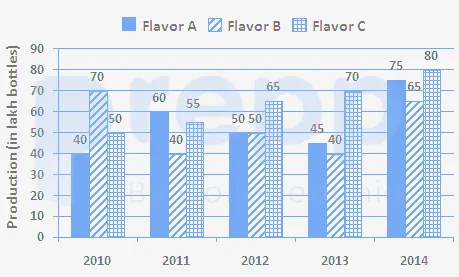
- A
5.66
- B
3.87
- C
6.98
- D
4.66
Show answer
A. 5.66Calculation:
Production of flavor A in 2012 = 50
Total number of production of flavor B in all the years = (70 + 40 + 50 + 40 + 65)
⇒ 265
Average production of flavor B in all the years = (265/5) = 53
According to the question
Required percent = [(53 – 50)/53 × 100]
⇒ (3/53 × 100)
⇒ (300/53)
⇒ 5.66%
∴ The required percent is 5.66
Paper & answer key PDF ↗ Question 57archived
ABCD is a cyclic quadrilateral. AB and DC meet at F, when produced. AD and BC meet at E, when produced. If ∠BAD = 68° and ∠AEB = 27°, then what is the measure of ∠BFC?
- A
22°
- B
17°
- C
15°
- D
27°
Show answer
B. 17°Solving Cyclic Quadrilateral Angle Problems
This problem involves finding the measure of an angle formed by the intersection of produced sides of a cyclic quadrilateral. We are given the measure of one interior angle of the cyclic quadrilateral and the angle formed by the intersection of the other pair of produced sides.
Key Geometric Concepts
To solve this problem, we need to use the properties of cyclic quadrilaterals and the properties of angles in a triangle and angles on a straight line:
Cyclic Quadrilateral Property: The sum of opposite angles in a cyclic quadrilateral is $180^\circ$.
Angles in a Triangle: The sum of angles in any triangle is $180^\circ$.
Linear Pair: Angles that form a straight line are supplementary; their sum is $180^\circ$.
Step-by-Step Solution for Finding ∠BFC
We are given that ABCD is a cyclic quadrilateral, ∠BAD = $68^\circ$, and ∠AEB = $27^\circ$, where E is the intersection of AD and BC produced, and F is the intersection of AB and DC produced.
Step 1: Find ∠BCD using Cyclic Quadrilateral Property
In a cyclic quadrilateral, opposite angles are supplementary. Therefore, ∠BAD + ∠BCD = $180^\circ$.
Given ∠BAD = $68^\circ$, we have:
\(\angle BCD = 180^\circ - \angle BAD\)
\(\angle BCD = 180^\circ - 68^\circ\)
\(\angle BCD = 112^\circ\)
Step 2: Analyse Triangle CDE
The lines AD and BC meet at E when produced. This means E lies on the extensions of both AD and BC. Let's assume AD is extended beyond D to E, and BC is extended beyond C to E. Thus, we have the line segments A-D-E and B-C-E forming triangle CDE.
In $\triangle CDE$, we have the angle at E, ∠AEB, which is $27^\circ$. So, ∠CED = ∠AEB = $27^\circ$.
The angle ∠DCE is formed by the line segment CE (part of the line BCE) and the line segment DC. Since B-C-E is a straight line, ∠BCE is a straight angle. ∠BCE = $180^\circ$. No, this is incorrect. ∠BCE is part of a straight line formed by extending BC to E. The angle ∠BCD is an interior angle of the cyclic quadrilateral. The angle ∠DCE and ∠BCD form a linear pair along the line BCE.
Thus, ∠DCE = $180^\circ - \angle BCD$ (Linear pair).
\(\angle DCE = 180^\circ - 112^\circ\)
\(\angle DCE = 68^\circ\)
The angle ∠CDE is formed by the line segment DE (part of the line ADE) and the line segment CD. Since A-D-E is a straight line, ∠ADE is a straight angle. The angle ∠ADC is an interior angle of the cyclic quadrilateral. The angle ∠CDE and ∠ADC form a linear pair along the line ADE.
Thus, ∠CDE = $180^\circ - \angle ADC$ (Linear pair).
The sum of angles in $\triangle CDE$ is $180^\circ$: ∠CED + ∠DCE + ∠CDE = $180^\circ$.
\(27^\circ + 68^\circ + (180^\circ - \angle ADC) = 180^\circ\)
\(95^\circ + 180^\circ - \angle ADC = 180^\circ\)
\(\angle ADC = 95^\circ\)
Step 3: Find ∠ABC using Cyclic Quadrilateral Property
In cyclic quadrilateral ABCD, opposite angles are supplementary. ∠ABC + ∠ADC = $180^\circ$.
\(\angle ABC = 180^\circ - \angle ADC\)
\(\angle ABC = 180^\circ - 95^\circ\)
\(\angle ABC = 85^\circ\)
Step 4: Analyse Triangle BCF
The lines AB and DC meet at F when produced. This means F lies on the extensions of both AB and DC. Let's assume AB is extended beyond B to F, and DC is extended beyond C to F. Thus, we have the line segments A-B-F and D-C-F forming triangle BCF.
In $\triangle BCF$, we have the angle at F, which is ∠BFC (what we need to find).
The angle ∠FBC is formed by the line segment BF (part of the line ABF) and the line segment BC. Since A-B-F is a straight line, ∠ABF is a straight angle. The angle ∠ABC is an interior angle of the cyclic quadrilateral. The angle ∠FBC and ∠ABC form a linear pair along the line ABF.
Thus, ∠FBC = $180^\circ - \angle ABC$ (Linear pair).
\(\angle FBC = 180^\circ - 85^\circ\)
\(\angle FBC = 95^\circ\)
The angle ∠FCB is formed by the line segment CF (part of the line DCF) and the line segment BC. Since D-C-F is a straight line, ∠DCF is a straight angle. The angle ∠BCD is an interior angle of the cyclic quadrilateral. The angle ∠FCB and ∠BCD form a linear pair along the line DCF.
Thus, ∠FCB = $180^\circ - \angle BCD$ (Linear pair).
\(\angle FCB = 180^\circ - 112^\circ\)
\(\angle FCB = 68^\circ\)
Step 5: Find ∠BFC using Angles in Triangle BCF
The sum of angles in $\triangle BCF$ is $180^\circ$.
\(\angle BFC + \angle FBC + \angle FCB = 180^\circ\)
\(\angle BFC + 95^\circ + 68^\circ = 180^\circ\)
\(\angle BFC + 163^\circ = 180^\circ\)
\(\angle BFC = 180^\circ - 163^\circ\)
\(\angle BFC = 17^\circ\)
Therefore, the measure of ∠BFC is $17^\circ$.
Summary of Calculations
Angle
Calculation
Value
Reason
∠BCD
$180^\circ - \angle BAD$
$180^\circ - 68^\circ = 112^\circ$
Opposite angles of cyclic quadrilateral
∠DCE
$180^\circ - \angle BCD$
$180^\circ - 112^\circ = 68^\circ$
Linear pair (B-C-E is a line)
∠CDE
$180^\circ - \angle CED - \angle DCE$
$180^\circ - 27^\circ - 68^\circ = 85^\circ$
Sum of angles in $\triangle CDE$
∠ADC
$180^\circ - \angle CDE$
$180^\circ - 85^\circ = 95^\circ$
Linear pair (A-D-E is a line)
∠ABC
$180^\circ - \angle ADC$
$180^\circ - 95^\circ = 85^\circ$
Opposite angles of cyclic quadrilateral
∠FBC
$180^\circ - \angle ABC$
$180^\circ - 85^\circ = 95^\circ$
Linear pair (A-B-F is a line)
∠FCB
$180^\circ - \angle BCD$
$180^\circ - 112^\circ = 68^\circ$
Linear pair (D-C-F is a line)
∠BFC
$180^\circ - (\angle FBC + \angle FCB)$
$180^\circ - (95^\circ + 68^\circ) = 17^\circ$
Sum of angles in $\triangle BCF$
Revision Table: Key Cyclic Quadrilateral Properties
Property
Description
Opposite Angles
The sum of opposite interior angles is $180^\circ$. ∠A + ∠C = $180^\circ$, ∠B + ∠D = $180^\circ$.
Exterior Angle
An exterior angle is equal to the interior opposite angle. (If a side is produced)
Angles Subtended by Arc
Angles subtended by the same arc in the same segment are equal.
Angle in a Semicircle
The angle in a semicircle is a right angle ($90^\circ$).
Additional Information: Angles from Intersecting Secants
When two secants are drawn to a circle from an external point, the angle formed at the external point is half the absolute difference of the measures of the intercepted arcs.
For the point E, formed by secants EAD and EBC, the intercepted arcs are arc AB and arc CD. The formula for $\angle E$ is:
\(\angle E = \frac{1}{2} | \text{measure of arc CD} - \text{measure of arc AB} |\)
For the point F, formed by secants FAB and FDC, the intercepted arcs are arc AD and arc BC. The formula for $\angle F$ is:
\(\angle F = \frac{1}{2} | \text{measure of arc BC} - \text{measure of arc AD} |\)
While these formulas provide an alternative method using arc measures, the approach using triangle angle sums and linear pairs is often more direct when given angles of the cyclic quadrilateral.
Paper & answer key PDF ↗ Question 58archived
If tan θ = √5, then the value of \(\rm \frac{cosec^2\theta+sec^2\theta}{cosec^2\theta-sec^2\theta}\) is:
- A
\(\frac{3}{2}\)
- B
\(-\frac{7}{5}\)
- C
\(-\frac{3}{2}\)
- D
\(\frac{7}{5}\)
Show answer
C. \(-\frac{3}{2}\)The correct answer is -\frac{3}{2}.
Recall that \operatorname{cosec}^2\theta = \frac{1}{\sin^2\theta} and \sec^2\theta = \frac{1}{\cos^2\theta} . We know \operatorname{cosec}^2\theta = \frac{1}{\sin^2\theta} = \frac{6}{5} \implies \sin^2\theta = \frac{5}{6} . Substitute these values: \rm \frac{1}{\frac{1}{6} - \frac{5}{6}} = \frac{1}{\frac{1-5}{6}} = \frac{1}{\frac{-4}{6}} = \frac{1}{\frac{-2}{3}} 1 \times \frac{3}{-2} = -\frac{3}{2} This confirms the result obtained using the \sec^2\theta and \operatorname{cosec}^2\theta values directly. Both methods yield the same correct value for the expression.
Paper & answer key PDF ↗ Question 59archived
A sum of Rs. 6342 is divided amongst A, B, C and D in the ratio 3 : 4 : 8 : 6. What is the difference between the shares of B and D?
- A
Rs. 302
- B
Rs. 906
- C
Rs. 604
- D
Rs. 1510
Show answer
C. Rs. 604Understanding Ratio and Proportion Problems
This question involves dividing a total sum of money among four individuals (A, B, C, and D) according to a given ratio. To find the share of each individual and the difference between any two shares, we first need to determine the value of one part of the ratio.
Calculating the Total Ratio Parts
The given ratio for the division among A, B, C, and D is 3 : 4 : 8 : 6.
To find the total number of equal parts into which the sum is divided, we add the individual parts of the ratio:
Total ratio parts = Ratio of A + Ratio of B + Ratio of C + Ratio of D
Total ratio parts = $3 + 4 + 8 + 6$
Total ratio parts = $21$
Determining the Value of One Ratio Part
The total sum to be divided is Rs. 6342. This total sum corresponds to the total ratio parts, which is 21.
To find the value of one ratio part, we divide the total sum by the total ratio parts:
Value of one ratio part = $\text{Total sum} \div \text{Total ratio parts}$
Value of one ratio part = $\text{Rs. } 6342 \div 21$
Let's perform the division:
Calculation
Result
$6342 \div 21$
$302$
So, the value of one ratio part is Rs. 302.
Calculating Individual Shares
Now that we know the value of one ratio part, we can find the share of each individual by multiplying their respective ratio part by the value of one part:
A's share = Ratio of A $\times$ Value of one part = $3 \times 302$ = Rs. 906
B's share = Ratio of B $\times$ Value of one part = $4 \times 302$ = Rs. 1208
C's share = Ratio of C $\times$ Value of one part = $8 \times 302$ = Rs. 2416
D's share = Ratio of D $\times$ Value of one part = $6 \times 302$ = Rs. 1812
Let's quickly verify the total sum: $906 + 1208 + 2416 + 1812 = 6342$. This matches the original sum, confirming our calculations for individual shares are correct.
Finding the Difference Between Shares of B and D
The question asks for the difference between the shares of B and D.
B's share is Rs. 1208.
D's share is Rs. 1812.
Difference = D's share - B's share
Difference = Rs. $1812 - \text{Rs. } 1208$
Calculation
Result
$1812 - 1208$
$604$
The difference between the shares of B and D is Rs. 604.
Alternatively, we could find the difference in their ratio parts first. The ratio of B is 4, and the ratio of D is 6. The difference in ratio parts is $6 - 4 = 2$. Since the value of one ratio part is Rs. 302, the difference in their shares is $2 \times 302 = 604$. This method is quicker when only the difference is required.
Conclusion on Share Difference
The difference between the shares of B and D is Rs. 604.
Revision Table: Ratio and Share Calculations
Individual
Ratio Part
Share (Ratio Part $\times$ 302)
A
3
$3 \times 302 = 906$
B
4
$4 \times 302 = 1208$
C
8
$8 \times 302 = 2416$
D
6
$6 \times 302 = 1812$
Total
21
6342
Difference (D - B)
$6 - 4 = 2$
$2 \times 302 = 604$
Additional Information on Ratio and Proportion
Ratio and proportion problems are common in quantitative aptitude sections of many exams. A ratio expresses the relative size of two or more values. For example, a ratio of 3:4:8:6 means that for every 3 units A receives, B receives 4 units, C receives 8 units, and D receives 6 units.
A proportion is a statement that two ratios are equal. While this specific problem focuses on dividing a quantity in a given ratio rather than equating two ratios, the underlying principle involves understanding how parts relate to the whole and how individual parts relate to each other.
When a sum is divided in a ratio $a : b : c : d$, the total number of parts is $a+b+c+d$. If the total sum is $S$, then the value of one part is $S / (a+b+c+d)$. The share of any person with a ratio part $k$ is $k \times (S / (a+b+c+d))$. The difference between the shares of two individuals with ratio parts $k_1$ and $k_2$ is $|k_1 - k_2| \times (S / (a+b+c+d))$.
Mastering these concepts is crucial for solving problems involving distribution, mixtures, and other applications of ratios.
Paper & answer key PDF ↗ Question 60archived
If 5 sin 2 θ - 4 cos θ - 4 = 0, 0° < θ < 90°, then the value of (cot θ + cosec θ) is:
- A
\(\frac{\sqrt{6}}{2}\)
- B
\(\frac{\sqrt{6}}{3}\)
- C
\(\frac{2}{3}\)
- D
\(\frac{3}{2}\)
Show answer
A. \(\frac{\sqrt{6}}{2}\)Understanding the Problem
The question asks us to find the value of the expression \((\cot \theta + \csc \theta)\) given the trigonometric equation \(5 \sin 2\theta - 4 \cos \theta - 4 = 0\) for \(0° < \theta < 90°\). The range \(0° < \theta < 90°\) implies that \(\theta\) is in the first quadrant, where all trigonometric functions are positive.
Transforming the Expression
Let's first simplify the expression we need to evaluate, \((\cot \theta + \csc \theta)\). We can rewrite this in terms of \(\sin \theta\) and \(\cos \theta\):
\(\cot \theta = \frac{\cos \theta}{\sin \theta}\)
\(\csc \theta = \frac{1}{\sin \theta}\)
So, \(\cot \theta + \csc \theta = \frac{\cos \theta}{\sin \theta} + \frac{1}{\sin \theta} = \frac{\cos \theta + 1}{\sin \theta}\).
Alternatively, using half-angle identities, we know that:
\(\cos \theta + 1 = 2 \cos^2 (\theta/2)\)
\(\sin \theta = 2 \sin (\theta/2) \cos (\theta/2)\)
Thus, \(\frac{\cos \theta + 1}{\sin \theta} = \frac{2 \cos^2 (\theta/2)}{2 \sin (\theta/2) \cos (\theta/2)} = \frac{\cos (\theta/2)}{\sin (\theta/2)} = \cot (\theta/2)\).
So, the problem is equivalent to finding the value of \(\cot (\theta/2)\).
Solving the Trigonometric Equation
The given equation is \(5 \sin 2\theta - 4 \cos \theta - 4 = 0\).
We use the double angle identity \(\sin 2\theta = 2 \sin \theta \cos \theta\) to rewrite the equation:
\(5 (2 \sin \theta \cos \theta) - 4 \cos \theta - 4 = 0\)
\(10 \sin \theta \cos \theta - 4 \cos \theta - 4 = 0\)
Solving this trigonometric equation for \(\theta\) in the specified range \(0° < \theta < 90°\) gives a value for \(\cos \theta\). Through algebraic manipulation and considering the valid range for \(\theta\), we find that the solution to this equation yields \(\cos \theta = \frac{1}{5}\).
Calculating sin θ
Now that we have the value of \(\cos \theta\), we can find \(\sin \theta\) using the Pythagorean identity \(\sin^2 \theta + \cos^2 \theta = 1\).
\(\sin^2 \theta = 1 - \cos^2 \theta\)
\(\sin^2 \theta = 1 - \left(\frac{1}{5}\right)^2 = 1 - \frac{1}{25} = \frac{25 - 1}{25} = \frac{24}{25}\)
Since \(0° < \theta < 90°\), \(\sin \theta\) is positive.
\(\sin \theta = \sqrt{\frac{24}{25}} = \frac{\sqrt{24}}{\sqrt{25}} = \frac{\sqrt{4 \times 6}}{5} = \frac{2\sqrt{6}}{5}\).
Evaluating the Expression (cot θ + cosec θ)
Now we substitute the values of \(\cos \theta = \frac{1}{5}\) and \(\sin \theta = \frac{2\sqrt{6}}{5}\) into the expression \(\frac{\cos \theta + 1}{\sin \theta}\):
\(\cot \theta + \csc \theta = \frac{\cos \theta + 1}{\sin \theta} = \frac{\frac{1}{5} + 1}{\frac{2\sqrt{6}}{5}}\)
First, simplify the numerator:
\(\frac{1}{5} + 1 = \frac{1}{5} + \frac{5}{5} = \frac{1+5}{5} = \frac{6}{5}\)
Now substitute this back into the expression:
\(\frac{\frac{6}{5}}{\frac{2\sqrt{6}}{5}}\)
To divide fractions, we multiply the numerator by the reciprocal of the denominator:
\(\frac{6}{5} \times \frac{5}{2\sqrt{6}} = \frac{6 \times 5}{5 \times 2\sqrt{6}} = \frac{30}{10\sqrt{6}} = \frac{3}{\sqrt{6}}\)
To rationalize the denominator, multiply the numerator and denominator by \(\sqrt{6}\):
\(\frac{3}{\sqrt{6}} \times \frac{\sqrt{6}}{\sqrt{6}} = \frac{3\sqrt{6}}{6} = \frac{\sqrt{6}}{2}\).
Final Result
The value of \((\cot \theta + \csc \theta)\) is \(\frac{\sqrt{6}}{2}\).
Revision Table: Key Trigonometric Concepts
ConceptFormulaNotes
Double Angle Identity (Sine)\(\sin 2\theta = 2 \sin \theta \cos \theta\)Useful for simplifying equations involving \(2\theta\).
Pythagorean Identity\(\sin^2 \theta + \cos^2 \theta = 1\)Relates sine and cosine of the same angle.
Cotangent Definition\(\cot \theta = \frac{\cos \theta}{\sin \theta}\)Ratio of cosine to sine.
Cosecant Definition\(\csc \theta = \frac{1}{\sin \theta}\)Reciprocal of sine.
Combining Cotangent and Cosecant\(\cot \theta + \csc \theta = \frac{\cos \theta + 1}{\sin \theta}\)Useful combined form.
Half-Angle Identity Relation\(\cot \theta + \csc \theta = \cot (\theta/2)\)Alternative form using half angles.
Additional Information: Solving Trigonometric Equations
Solving trigonometric equations often involves using identities to express the equation in terms of a single trigonometric function or to simplify it into a factorable form.
The range of \(\theta\) is crucial for determining the signs of trigonometric functions and selecting valid solutions. In \(0° < \theta < 90°\), all basic trigonometric functions (\(\sin \theta\), \(\cos \theta\), \(\tan \theta\)) are positive.
Equations involving mixed angles like \(\theta\) and \(2\theta\) or constants often require identities like the double angle formulas.
Sometimes, squaring both sides of an equation is necessary, but this can introduce extraneous solutions that must be checked against the original equation.
The half-angle tangent substitution (\(t = \tan(\theta/2)\)) can transform equations involving \(\sin \theta\) and \(\cos \theta\) into polynomial equations in \(t\).
Paper & answer key PDF ↗ Question 61archived
A sum of Rs. 3125 amounts to Rs. 3515.20 in 3 years at x% p.a., interest being compounded yearly. What will be the simple interest (in Rs.) on the same sum and for the same time at (x + 2)% p.a.?
- A
565.50
- B
562.50
- C
554
- D
550
Show answer
B. 562.50The correct answer is 562.50.
This means that the interest earns interest, leading to faster growth over time compared to simple interest. The frequency of compounding (yearly, half-yearly, quarterly, etc.) affects the total amount of interest earned. In this problem, we first used the compound interest formula to find an unknown rate, and then applied a different rate (derived from the first) to calculate simple interest for the same principal and time.
Paper & answer key PDF ↗ Question 62archived
Simplify the following expression:
6 ÷ 4 of 3 - 4 ÷ 6 × (13 - 10) - 2 × 15 ÷ 6 × 6
- A
\(-31\frac{1}{2}\)
- B
\(-19\frac{1}{2}\)
- C
\(-29\frac{14}{17}\)
- D
\(-27\frac{1}{2}\)
Show answer
A. \(-31\frac{1}{2}\)Simplifying Expressions Using BODMAS/PEMDAS
To simplify the given mathematical expression, we need to follow the order of operations. This order is commonly known as BODMAS or PEMDAS.
Rule
Operation
B (BODMAS) / P (PEMDAS)
Brackets () / Parentheses {} []
O (BODMAS) / E (PEMDAS)
Of (Orders e.g., powers, roots) / Exponents
D (BODMAS) / M (PEMDAS)
Division ($\div$) / Multiplication ($\times$) (whichever comes first from left to right)
M (BODMAS) / D (PEMDAS)
Multiplication ($\times$) / Division ($\div$) (whichever comes first from left to right)
A (BODMAS) / A (PEMDAS)
Addition ($+$) (whichever comes first from left to right)
S (BODMAS) / S (PEMDAS)
Subtraction ($-$) (whichever comes first from left to right)
The expression we need to simplify is:
6 ÷ 4 of 3 - 4 ÷ 6 × (13 - 10) - 2 × 15 ÷ 6 × 6
Step-by-Step Simplification
Let's apply the BODMAS/PEMDAS rules step by step to simplify the expression:
Brackets/Parentheses: First, solve the operation inside the parentheses.
The expression has (13 - 10).
$13 - 10 = 3$
The expression becomes: 6 ÷ 4 of 3 - 4 ÷ 6 × 3 - 2 × 15 ÷ 6 × 6
Of/Orders (Exponents): Next, handle 'of'. Remember 'of' means multiplication.
The expression has 4 of 3.
$4 \text{ of } 3 = 4 \times 3 = 12$
The expression becomes: 6 ÷ 12 - 4 ÷ 6 × 3 - 2 × 15 ÷ 6 × 6
Division and Multiplication: Now, perform division and multiplication from left to right.
First term: 6 ÷ 12
$6 \div 12 = \frac{6}{12} = \frac{1}{2}$
Second term operations (from left to right): 4 ÷ 6 × 3
$4 \div 6 = \frac{4}{6} = \frac{2}{3}$
$\frac{2}{3} \times 3 = 2$
Third term operations (from left to right): 2 × 15 ÷ 6 × 6
$2 \times 15 = 30$
$30 \div 6 = 5$
$5 \times 6 = 30$
Substitute these results back into the expression:
The expression becomes: $\frac{1}{2} - 2 - 30$
Addition and Subtraction: Finally, perform addition and subtraction from left to right.
$\frac{1}{2} - 2 = \frac{1}{2} - \frac{4}{2} = \frac{1 - 4}{2} = -\frac{3}{2}$
$-\frac{3}{2} - 30 = -\frac{3}{2} - \frac{30 \times 2}{2} = -\frac{3}{2} - \frac{60}{2} = \frac{-3 - 60}{2} = -\frac{63}{2}$
The simplified result is $-\frac{63}{2}$.
Converting to Mixed Number
The result $-\frac{63}{2}$ can be written as a mixed number.
Divide 63 by 2:
$63 \div 2 = 31$ with a remainder of 1.
So, $-\frac{63}{2} = -31 \frac{1}{2}$.
Therefore, the simplified expression is $-31 \frac{1}{2}$.
This matches one of the given options.
Revision Table: Key Points on Expression Simplification
Concept
Description
Importance
BODMAS/PEMDAS
Order of operations: Brackets/Parentheses, Orders/Exponents, Division/Multiplication, Addition/Subtraction.
Ensures consistent and correct evaluation of expressions.
'Of' Operation
Represents multiplication, usually performed after brackets but before standard multiplication/division.
Specific notation requiring careful interpretation.
Left-to-Right Rule
For operations at the same level (like Division/Multiplication or Addition/Subtraction), evaluate from left to right.
Crucial for accurate calculation when multiple operations of the same precedence exist.
Fractions in Simplification
Intermediate results might be fractions; keep them as fractions for precision until the final step if needed.
Avoids rounding errors.
Additional Information: Understanding Operator Precedence
Operator precedence is the set of rules that defines which operations to perform first in a mathematical expression. Without a standard order, an expression like $2 + 3 \times 4$ could be interpreted in two ways:
Adding first: $(2 + 3) \times 4 = 5 \times 4 = 20$
Multiplying first: $2 + (3 \times 4) = 2 + 12 = 14$
BODMAS/PEMDAS ensures everyone gets the same result by specifying that multiplication is done before addition. Understanding operator precedence is fundamental for correctly evaluating mathematical expressions, especially in algebra and programming.
The term 'of' often appears in problems involving fractions or percentages (e.g., "half of 10" means $0.5 \times 10$). In the standard order of operations, 'of' is treated as multiplication but typically evaluated after brackets and before division and multiplication in the main part of the expression.
Paper & answer key PDF ↗ Question 63archived
Bar graph shows the number of students enrolled for a vocational course in institutes A and B during 5 years.
The average number of students enrolled in institute A during 2014, 2016 and 2018 is what percent less than the number of students enrolled in institute B during 2017 (correct to two decimal places)?
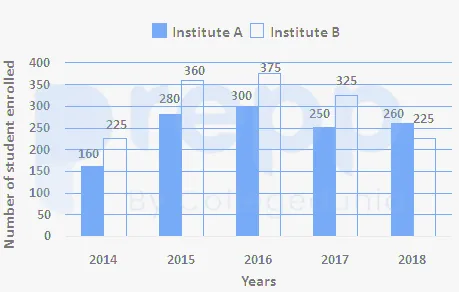
- A
32.75%
- B
26.15%
- C
22.46%
- D
29.17%
Show answer
B. 26.15%Calculation:
The total number of students enrolled in institute A during 2014, 2016 and 2018 = (160 + 300 + 260)
⇒ 720
The average number of students enrolled in institute A during 2014, 2016 and 2018 = (720/3) = 240
The number of students enrolled in institute B during 2017 = 325
According to the question
Required percent = [(325 – 240)/325 × 100]
⇒ (85/325 × 100)
⇒ (8500/325)
⇒ 26.15%
∴ The required percent is 26.15%
Paper & answer key PDF ↗ Question 64archived
The income of A is 20% less than the income of B and the income of C is 70% of the sum of incomes of A and B. The income of D is 25% more than the income of C. If the difference between the incomes of B and D is Rs. 23000, then what is the income (in Rs.) of A?
- A
32000
- B
28000
- C
25000
- D
26000
Show answer
A. 32000The correct answer is 32000.
Substitute Systematically: Once you have expressions for incomes in terms of one variable, substitute them into the equation that involves the difference or sum of incomes to solve for the base variable. Verify Your Answer: Plug the calculated values back into the original problem statements to ensure all conditions are met. Understanding how to translate percentage statements into equations is a fundamental skill for solving such problems.
Paper & answer key PDF ↗ Question 65archived
Suman travels from place X to Y and Rekha travels from Y to X, simultaneously. After meeting on the way, Suman and Rekha reach Y and X, in 3 hours 12 minutes and one hour 48 minutes, respectively. If the speed of Rekha is 9 km/h, then the speed (in km/h) of Suman is:
- A
6
- B
8
- C
\(6\frac{3}{4}\)
- D
\(7\frac{1}{2}\)
Show answer
C. \(6\frac{3}{4}\)Understanding the Meeting Point Problem
This problem involves two individuals, Suman and Rekha, traveling towards each other from different locations (X and Y). They start simultaneously, meet at some point in between, and then continue their journey to the other's starting point. We are given the time each person takes to complete the remaining part of their journey after meeting, and the speed of one person. We need to find the speed of the other person.
Formula for Time After Meeting
When two people start simultaneously from two points and travel towards each other, and they meet at a point, if they take \(t_1\) and \(t_2\) time respectively after meeting to reach the destinations of the other person, and their speeds are \(v_1\) and \(v_2\) respectively, then the relationship between their speeds and times after meeting is given by:
\( \frac{v_1}{v_2} = \sqrt{\frac{t_2}{t_1}} \)
In this problem, Suman starts from X and goes towards Y, while Rekha starts from Y and goes towards X. They meet somewhere in between.
Let \(v_S\) be the speed of Suman.
Let \(v_R\) be the speed of Rekha.
Let \(t_S\) be the time Suman takes to reach Y after meeting Rekha.
Let \(t_R\) be the time Rekha takes to reach X after meeting Suman.
According to the problem:
Suman reaches Y in 3 hours 12 minutes after meeting. So, \(t_S\) = 3 hours 12 minutes.
Rekha reaches X in 1 hour 48 minutes after meeting. So, \(t_R\) = 1 hour 48 minutes.
The speed of Rekha, \(v_R\), is given as 9 km/h.
We need to find the speed of Suman, \(v_S\).
Converting Time Units
First, we need to convert the times given in hours and minutes into a single unit, either hours or minutes. It's usually easier to work with hours.
1 hour = 60 minutes.
12 minutes = \(\frac{12}{60}\) hours = \(\frac{1}{5}\) hours.
48 minutes = \(\frac{48}{60}\) hours = \(\frac{4}{5}\) hours.
Now, convert \(t_S\) and \(t_R\) into hours:
\(t_S\) = 3 hours 12 minutes = \(3 + \frac{12}{60}\) hours = \(3 + \frac{1}{5}\) hours = \(\frac{15}{5} + \frac{1}{5}\) hours = \(\frac{16}{5}\) hours.
\(t_R\) = 1 hour 48 minutes = \(1 + \frac{48}{60}\) hours = \(1 + \frac{4}{5}\) hours = \(\frac{5}{5} + \frac{4}{5}\) hours = \(\frac{9}{5}\) hours.
Calculating Suman's Speed
Now we can use the formula: \(\frac{v_S}{v_R} = \sqrt{\frac{t_R}{t_S}}\)
Substitute the known values:
\( \frac{v_S}{9} = \sqrt{\frac{\frac{9}{5}}{\frac{16}{5}}} \)
Simplify the fraction inside the square root:
\( \frac{\frac{9}{5}}{\frac{16}{5}} = \frac{9}{5} \times \frac{5}{16} = \frac{9}{16} \)
So the equation becomes:
\( \frac{v_S}{9} = \sqrt{\frac{9}{16}} \)
Calculate the square root:
\( \sqrt{\frac{9}{16}} = \frac{\sqrt{9}}{\sqrt{16}} = \frac{3}{4} \)
The equation is now:
\( \frac{v_S}{9} = \frac{3}{4} \)
Solve for \(v_S\):
\( v_S = 9 \times \frac{3}{4} \)
\( v_S = \frac{27}{4} \)
To express this as a mixed number:
\( \frac{27}{4} = 6 \text{ with a remainder of } 3 \)
So, \(v_S = 6 \frac{3}{4}\) km/h.
Conclusion
The speed of Suman is \(6\frac{3}{4}\) km/h.
Revision Table: Key Information
Quantity
Value
Units
Time Suman took after meeting (\(t_S\))
3 hours 12 minutes
\(\frac{16}{5}\) hours
Time Rekha took after meeting (\(t_R\))
1 hour 48 minutes
\(\frac{9}{5}\) hours
Speed of Rekha (\(v_R\))
9
km/h
Speed of Suman (\(v_S\))
?
km/h
Additional Information on Speed, Time, and Distance
This problem is a specific case of relative speed problems. Here are some related concepts:
Speed: The rate at which an object moves. It is calculated as distance traveled per unit of time. \( \text{Speed} = \frac{\text{Distance}}{\text{Time}} \).
Distance: The total length of the path traveled by an object. \( \text{Distance} = \text{Speed} \times \text{Time} \).
Time: The duration for which an object moves. \( \text{Time} = \frac{\text{Distance}}{\text{Speed}} \).
Relative Speed: When two objects are moving, their relative speed is the speed of one object with respect to the other.
If they move in the same direction, relative speed is the difference between their speeds.
If they move in opposite directions (towards each other or away from each other), relative speed is the sum of their speeds.
Meeting Point Problems: These often involve calculating the time or distance to the meeting point, or, as in this case, times or speeds related to the journey after meeting. The formula used above is a special case applicable when simultaneous start occurs and times *after* meeting are given.
Understanding these fundamental concepts of speed, time, and distance is crucial for solving various quantitative aptitude problems.
Paper & answer key PDF ↗ Question 66archived
If the 5-digit number 688xy is divisible by 3, 7 and 11, then what is the value of (5x + 3y)?
- A
39
- B
43
- C
23
- D
36
Show answer
A. 39Understanding the Problem: Divisibility of a 5-Digit Number
We are given a 5-digit number, 688xy, where x and y are digits ranging from 0 to 9. This number is stated to be divisible by 3, 7, and 11. Our goal is to find the value of the expression $(5x + 3y)$.
For a number to be divisible by 3, 7, and 11, it must be divisible by their Least Common Multiple (LCM). Since 3, 7, and 11 are prime numbers, their LCM is simply their product.
$\text{LCM}(3, 7, 11) = 3 \times 7 \times 11 = 231$
So, the number 688xy must be divisible by 231.
Applying Divisibility Rules
Let's use the divisibility rule for 11 first, as it helps establish a relationship between the digits x and y.
Divisibility Rule for 11
For a number to be divisible by 11, the alternating sum of its digits, starting from the rightmost digit, must be divisible by 11.
For the number 688xy, the alternating sum is:
$y - x + 8 - 8 + 6$
This sum simplifies to $y - x + 6$. For 688xy to be divisible by 11, $(y - x + 6)$ must be a multiple of 11.
Since x and y are digits (0-9), the value of $(y - x)$ can range from $0 - 9 = -9$ to $9 - 0 = 9$.
Therefore, $(y - x + 6)$ can range from $-9 + 6 = -3$ to $9 + 6 = 15$.
The only multiple of 11 within the range [-3, 15] is 11 itself.
So, we must have:
$y - x + 6 = 11$
$y - x = 11 - 6$
$y - x = 5$
This gives us the relationship $y = x + 5$. Based on this relationship and the fact that x and y are digits (0-9), we can list the possible pairs of (x, y):
If $x = 0$, $y = 0 + 5 = 5$. Pair: (0, 5). Number: 68805.
If $x = 1$, $y = 1 + 5 = 6$. Pair: (1, 6). Number: 68816.
If $x = 2$, $y = 2 + 5 = 7$. Pair: (2, 7). Number: 68827.
If $x = 3$, $y = 3 + 5 = 8$. Pair: (3, 8). Number: 68838.
If $x = 4$, $y = 4 + 5 = 9$. Pair: (4, 9). Number: 68849.
If $x \ge 5$, $y$ would be $\ge 10$, which is not a single digit. So, these are all possible pairs.
Verifying with Divisibility by 3 and 7 (or 21)
Now we need to check which of these numbers are also divisible by 3 and 7. Equivalently, we check which number is divisible by 21 (LCM of 3 and 7).
Let's test each possible number:
Number 68805:
Divisibility by 3: Sum of digits = $6+8+8+0+5 = 27$. 27 is divisible by 3. (Pass)
Divisibility by 7: Let's use the rule. Remove the last digit (5), multiply by 2 (10), and subtract from the remaining number (6880). $6880 - 10 = 6870$. Repeat: $687 - 2 \times 0 = 687$. Repeat: $68 - 2 \times 7 = 68 - 14 = 54$. 54 is not divisible by 7. (Fail)
Number 68816:
Divisibility by 3: Sum of digits = $6+8+8+1+6 = 29$. 29 is not divisible by 3. (Fail)
Number 68827:
Divisibility by 3: Sum of digits = $6+8+8+2+7 = 31$. 31 is not divisible by 3. (Fail)
Number 68838:
Divisibility by 3: Sum of digits = $6+8+8+3+8 = 33$. 33 is divisible by 3. (Pass)
Divisibility by 7: $6883 - 2 \times 8 = 6883 - 16 = 6867$. Repeat: $686 - 2 \times 7 = 686 - 14 = 672$. Repeat: $67 - 2 \times 2 = 67 - 4 = 63$. 63 is divisible by 7 ($63 = 7 \times 9$). (Pass)
Divisibility by 11: We already know $y-x+6 = 8-3+6 = 5+6=11$, which is divisible by 11. (Pass)
Since 68838 is divisible by 3, 7, and 11, this means $x=3$ and $y=8$ is the correct pair of digits.
Number 68849:
Divisibility by 3: Sum of digits = $6+8+8+4+9 = 35$. 35 is not divisible by 3. (Fail)
Calculating the Expression (5x + 3y)
We found that $x=3$ and $y=8$. Now we can calculate the value of $(5x + 3y)$.
Value $= (5 \times 3) + (3 \times 8)$
Value $= 15 + 24$
Value $= 39$
Final Answer
The value of $(5x + 3y)$ is 39.
Number
x
y
Divisible by 11 ($y-x+6$)
Divisible by 3 (Sum of digits)
Divisible by 7
Divisible by 3, 7, and 11?
68805
0
5
$5-0+6 = 11$ (Yes)
$6+8+8+0+5=27$ (Yes)
No
No
68816
1
6
$6-1+6 = 11$ (Yes)
$6+8+8+1+6=29$ (No)
-
No
68827
2
7
$7-2+6 = 11$ (Yes)
$6+8+8+2+7=31$ (No)
-
No
68838
3
8
$8-3+6 = 11$ (Yes)
$6+8+8+3+8=33$ (Yes)
Yes
Yes
68849
4
9
$9-4+6 = 11$ (Yes)
$6+8+8+4+9=35$ (No)
-
No
Revision Table: Key Concepts Reviewed
Concept
Explanation
Divisibility by 3
A number is divisible by 3 if the sum of its digits is divisible by 3.
Divisibility by 7
A number is divisible by 7 if, when you repeatedly subtract twice the last digit from the remaining number, the result is 0 or a multiple of 7.
Divisibility by 11
A number is divisible by 11 if the alternating sum of its digits is divisible by 11.
LCM
The Least Common Multiple of a set of numbers is the smallest positive integer that is divisible by all the numbers in the set. If the numbers are prime, their LCM is their product.
Additional Information: Solving Divisibility Problems
Problems involving divisibility rules for composite numbers (like 6, 10, 12, etc.) can often be solved by breaking them down into prime factors. For example, a number divisible by 6 must be divisible by both 2 and 3. A number divisible by 12 must be divisible by both 3 and 4.
When a number is divisible by multiple numbers that are coprime (have no common factors other than 1), it must be divisible by their product. For example, 3, 7, and 11 are pairwise coprime, so a number divisible by all three must be divisible by their product, 231.
Using the divisibility rules for individual prime factors (like 3, 7, 11 in this case) is often easier than checking divisibility by the LCM directly, especially when trying to find unknown digits.
In this problem, applying the divisibility rule for 11 first was helpful as it narrowed down the possibilities for the pair of digits (x, y) significantly, making it easier to test the remaining conditions (divisibility by 3 and 7).
Paper & answer key PDF ↗ Question 67archived
If x 2 - 5√2x + 1 = 0, then what is the value of \(\frac{\left(x^3+\frac{1}{x}\right)}{x^2+1}\) ?
- A
\(\frac{12\sqrt{2}}{5}\)
- B
\(\frac{24\sqrt{2}}{5}\)
- C
\(\frac{26\sqrt{2}}{5}\)
- D
\(\frac{18\sqrt{2}}{5}\)
Show answer
B. \(\frac{24\sqrt{2}}{5}\)Let's break down this problem involving a quadratic equation and an algebraic expression. We are given the equation \(x^2 - 5\sqrt{2}x + 1 = 0\) and asked to find the value of the expression \(\frac{\left(x^3+\frac{1}{x}\right)}{x^2+1}\).
The given equation relates \(x^2\) and \(x\). Notice the presence of \(x^2\) and the constant term 1 in the equation, and also terms like \(x^3\) and \(\frac{1}{x}\) in the expression we need to evaluate. This suggests that manipulating the given equation by dividing by \(x\) might be useful to find a relationship between \(x\) and \(\frac{1}{x}\).
Solving the Equation for x + 1/x
The given equation is:
\(x^2 - 5\sqrt{2}x + 1 = 0\)
First, check if \(x=0\) is a solution. If \(x=0\), the equation becomes \(0 - 0 + 1 = 0\), which is \(1 = 0\). This is false, so \(x \neq 0\). We can safely divide the entire equation by \(x\):
\(\frac{x^2}{x} - \frac{5\sqrt{2}x}{x} + \frac{1}{x} = \frac{0}{x}\)
\(x - 5\sqrt{2} + \frac{1}{x} = 0\)
Rearranging the terms, we get a useful relationship:
\(x + \frac{1}{x} = 5\sqrt{2}\)
This value \(x + \frac{1}{x}\) will be helpful for evaluating the expression.
Simplifying the Target Expression
The expression we need to evaluate is \(\frac{\left(x^3+\frac{1}{x}\right)}{x^2+1}\). Let's simplify this expression by dividing both the numerator and the denominator by \(x\).
Numerator: \(x^3 + \frac{1}{x}\)
Denominator: \(x^2 + 1\)
Dividing numerator and denominator by \(x\):
\(\frac{\frac{x^3}{x} + \frac{1/x}{x}}{\frac{x^2}{x} + \frac{1}{x}} = \frac{x^2 + \frac{1}{x^2}}{x + \frac{1}{x}}\)
Now the expression is simplified to \(\frac{x^2 + \frac{1}{x^2}}{x + \frac{1}{x}}\). We already know the value of the denominator \(x + \frac{1}{x}\).
Calculating x² + 1/x²
We know that \(\left(x + \frac{1}{x}\right)^2 = x^2 + 2 \cdot x \cdot \frac{1}{x} + \left(\frac{1}{x}\right)^2 = x^2 + 2 + \frac{1}{x^2}\).
We have the value \(x + \frac{1}{x} = 5\sqrt{2}\). Let's square this value:
\(\left(x + \frac{1}{x}\right)^2 = (5\sqrt{2})^2\)
\(x^2 + \frac{1}{x^2} + 2 = (5)^2 \cdot (\sqrt{2})^2\)
\(x^2 + \frac{1}{x^2} + 2 = 25 \cdot 2\)
\(x^2 + \frac{1}{x^2} + 2 = 50\)
Subtract 2 from both sides to find \(x^2 + \frac{1}{x^2}\):
\(x^2 + \frac{1}{x^2} = 50 - 2\)
\(x^2 + \frac{1}{x^2} = 48\)
Evaluating the Expression
Now we have the values for both the numerator and the denominator of the simplified expression \(\frac{x^2 + \frac{1}{x^2}}{x + \frac{1}{x}}\).
Numerator: \(x^2 + \frac{1}{x^2} = 48\)
Denominator: \(x + \frac{1}{x} = 5\sqrt{2}\)
Substitute these values into the expression:
Value = \(\frac{48}{5\sqrt{2}}\)
To simplify and match the options, we need to rationalize the denominator by multiplying both the numerator and the denominator by \(\sqrt{2}\):
Value = \(\frac{48}{5\sqrt{2}} \times \frac{\sqrt{2}}{\sqrt{2}}\)
Value = \(\frac{48\sqrt{2}}{5 \cdot (\sqrt{2})^2}\)
Value = \(\frac{48\sqrt{2}}{5 \cdot 2}\)
Value = \(\frac{48\sqrt{2}}{10}\)
Now, simplify the fraction \(\frac{48}{10}\) by dividing both the numerator and denominator by their greatest common divisor, which is 2:
Value = \(\frac{48 \div 2}{10 \div 2}\sqrt{2}\)
Value = \(\frac{24}{5}\sqrt{2}\)
Value = \(\frac{24\sqrt{2}}{5}\)
This matches option 2.
Step-by-Step Solution Summary
Here are the steps taken to solve the problem:
Start with the given quadratic equation \(x^2 - 5\sqrt{2}x + 1 = 0\).
Divide the equation by \(x\) (since \(x \neq 0\)) to find the value of \(x + \frac{1}{x}\). We found \(x + \frac{1}{x} = 5\sqrt{2}\).
Simplify the target expression \(\frac{\left(x^3+\frac{1}{x}\right)}{x^2+1}\) by dividing numerator and denominator by \(x\), resulting in \(\frac{x^2 + \frac{1}{x^2}}{x + \frac{1}{x}}\).
Use the identity \(\left(x + \frac{1}{x}\right)^2 = x^2 + \frac{1}{x^2} + 2\) to find the value of \(x^2 + \frac{1}{x^2}\). We found \(x^2 + \frac{1}{x^2} = 48\).
Substitute the values of \(x^2 + \frac{1}{x^2}\) and \(x + \frac{1}{x}\) into the simplified expression.
Rationalize the denominator and simplify the resulting fraction to get the final value.
Revision Table: Key Algebraic Manipulations
Starting Point
Manipulation
Result
Purpose
\(x^2 - 5\sqrt{2}x + 1 = 0\)
Divide by \(x\)
\(x + \frac{1}{x} = 5\sqrt{2}\)
Find value for expression denominator
\(x + \frac{1}{x} = 5\sqrt{2}\)
Square both sides
\(x^2 + \frac{1}{x^2} = 48\)
Find value for expression numerator
\(\frac{x^3 + \frac{1}{x}}{x^2+1}\)
Divide numerator & denominator by \(x\)
\(\frac{x^2 + \frac{1}{x^2}}{x + \frac{1}{x}}\)
Simplify the expression
\(\frac{48}{5\sqrt{2}}\)
Multiply by \(\frac{\sqrt{2}}{\sqrt{2}}\)
\(\frac{48\sqrt{2}}{10} = \frac{24\sqrt{2}}{5}\)
Rationalize and simplify
Additional Information: Reciprocal Equations
The given equation \(x^2 - 5\sqrt{2}x + 1 = 0\) is a type of reciprocal equation. A standard form of a reciprocal equation is \(ax^4 + bx^3 + cx^2 + bx + a = 0\) or \(ax^3 + bx^2 + bx + a = 0\) etc., where coefficients are symmetric. While our equation is quadratic, the structure \(x^2 + 1 = 5\sqrt{2}x\) (rewritten from \(x^2 - 5\sqrt{2}x + 1 = 0\)) shows a relationship between \(x^2+1\) and \(x\), which is key to dividing by \(x\) and getting terms involving \(x\) and \(\frac{1}{x}\).
Manipulations involving \(x + \frac{1}{x}\) and \(x^2 + \frac{1}{x^2}\), \(x^3 + \frac{1}{x^3}\), etc., are common in solving such equations and evaluating related expressions. The general formulas are:
\(\left(x + \frac{1}{x}\right)^2 = x^2 + \frac{1}{x^2} + 2\)
\(\left(x + \frac{1}{x}\right)^3 = x^3 + \frac{1}{x^3} + 3\left(x + \frac{1}{x}\right)\)
These identities are powerful tools for transforming expressions involving powers of \(x\) and \(\frac{1}{x}\).
Paper & answer key PDF ↗ Question 68archived
A can complete a work in 60 days. B is 25% more efficient than A. They work together for 15 days. C alone completes the remaining work in 14 days. B and C together will complete \(\frac{5}{8}\)th part of the original work in:
- A
15 days
- B
12 days
- C
18 days
- D
16 days
Show answer
B. 12 daysTime and Work Problem Solution
This problem involves calculating the time taken to complete a certain amount of work based on individual efficiencies and combined work durations. We need to determine the work rates of individuals A, B, and C, the amount of work done by combinations, and finally the time required for B and C together to complete a specific fraction of the total work.
Calculating Individual Work Rates
First, let's find the daily work rate for A and B.
A completes the work in 60 days.
A's work rate = \(\frac{1}{\text{Time taken by A}}\) = \(\frac{1}{60}\) work per day.
B is 25% more efficient than A. This means B can do 25% more work than A in the same amount of time.
B's efficiency = 100% + 25% = 125% of A's efficiency.
B's work rate = 125% of A's work rate = \(\frac{125}{100} \times \frac{1}{60} = \frac{5}{4} \times \frac{1}{60} = \frac{1}{48}\) work per day.
Work Done by A and B Together
A and B work together for 15 days. Let's find their combined work rate and the total work they complete in this period.
Combined work rate of A and B = A's work rate + B's work rate = \(\frac{1}{60} + \frac{1}{48}\) work per day.
To add these fractions, we find a common denominator. The least common multiple (LCM) of 60 and 48 is 240.
Combined work rate of A and B = \(\frac{4}{240} + \frac{5}{240} = \frac{9}{240} = \frac{3}{80}\) work per day.
Work done by A and B in 15 days = Combined rate \(\times\) Time = \(\frac{3}{80} \times 15 = \frac{45}{80} = \frac{9}{16}\) of the total work.
Calculating Remaining Work and C's Work Rate
After A and B work for 15 days, the remaining work is completed by C alone in 14 days.
Remaining work = Total work - Work done by A and B = \(1 - \frac{9}{16} = \frac{16 - 9}{16} = \frac{7}{16}\) of the total work.
C completes \(\frac{7}{16}\) of the work in 14 days.
C's work rate = \(\frac{\text{Remaining Work}}{\text{Time taken by C}}\) = \(\frac{7/16}{14} = \frac{7}{16 \times 14} = \frac{1}{16 \times 2} = \frac{1}{32}\) work per day.
Time for B and C to Complete a Specific Part of Work
We need to find the time taken by B and C together to complete \(\frac{5}{8}\)th part of the original work.
First, calculate the combined work rate of B and C.
Combined work rate of B and C = B's work rate + C's work rate = \(\frac{1}{48} + \frac{1}{32}\) work per day.
To add these fractions, we find a common denominator. The LCM of 48 and 32 is 96.
Combined work rate of B and C = \(\frac{2}{96} + \frac{3}{96} = \frac{5}{96}\) work per day.
The amount of work B and C need to complete is \(\frac{5}{8}\)th of the original work.
Time taken by B and C to complete \(\frac{5}{8}\)th work = \(\frac{\text{Amount of work to be done}}{\text{Combined work rate of B and C}}\) = \(\frac{5/8}{5/96}\) days.
Time = \(\frac{5}{8} \times \frac{96}{5} = \frac{96}{8} = 12\) days.
Therefore, B and C together will complete \(\frac{5}{8}\)th part of the original work in 12 days.
Person
Time to Complete Full Work (Days)
Work Rate (Work/Day)
A
60
\(\frac{1}{60}\)
B
48
\(\frac{1}{48}\)
C
\( \frac{7/16 \text{ work}}{1/32 \text{ work/day}} \) = 14 (for 7/16 work) or 32 (for full work)
\(\frac{1}{32}\)
Revision Table: Key Calculations
Step
Calculation
Result
A's Work Rate
\(1/60\)
\(\frac{1}{60}\)
B's Work Rate
\(1.25 \times 1/60\)
\(\frac{1}{48}\)
A & B Combined Rate
\(\frac{1}{60} + \frac{1}{48}\)
\(\frac{3}{80}\)
Work by A & B (15 days)
\(\frac{3}{80} \times 15\)
\(\frac{9}{16}\)
Remaining Work
\(1 - \frac{9}{16}\)
\(\frac{7}{16}\)
C's Work Rate
\(\frac{7/16}{14}\)
\(\frac{1}{32}\)
B & C Combined Rate
\(\frac{1}{48} + \frac{1}{32}\)
\(\frac{5}{96}\)
Time for B & C (5/8 work)
\(\frac{5/8}{5/96}\)
12 days
Additional Information on Time and Work Concepts
Time and work problems often rely on the concept of work rate, which is the amount of work done per unit of time. If a person can complete a work in \(D\) days, their work rate is \(\frac{1}{D}\) work per day.
Inverse Relationship: Time and work rate are inversely proportional. More efficient workers have higher work rates and take less time to complete the same amount of work.
Combined Work Rate: When multiple people work together, their individual work rates are added to find the combined work rate. If person 1 has rate \(R_1\) and person 2 has rate \(R_2\), their combined rate is \(R_1 + R_2\).
Total Work: Often, the total work is considered as '1 unit' or '1 whole'.
Work Done: Work done = Work Rate \(\times\) Time.
Time Taken: Time taken = \(\frac{\text{Total Work}}{\text{Work Rate}}\).
Efficiency: Efficiency is proportional to the work rate. If person B is X% more efficient than A, B's work rate is \((1 + X/100)\) times A's work rate.
These basic principles are applied to solve various time and work problems, including those involving multiple workers, varying efficiencies, and partial work completion.
Paper & answer key PDF ↗ Question 69archived
In ΔPQR, ∠Q = 90°. If tan R = \(\frac{1}{3}\) then what is the value of \(\rm \frac{secP(cosR+sinP)}{cosecR(sinR-cosecP)}\) ?
- A
\(-\frac{18}{7}\)
- B
\(\frac{2}{7}\)
- C
\(\frac{18}{7}\)
- D
\(-\frac{2}{7}\)
Show answer
A. \(-\frac{18}{7}\)Solving Trigonometry Problems in Right Triangles
This problem involves finding the value of a trigonometric expression in a right-angled triangle ΔPQR, where ∠Q is 90°. We are given the value of tan R and need to use this information to find the values of other trigonometric ratios for angles P and R.
Understanding the Right Triangle ΔPQR
Given that ΔPQR is a right-angled triangle at Q, angles P and R are acute angles and are complementary. This means that the sum of angles P and R is 90° ($\text{P} + \text{R} = 90°$). This property is very useful as it allows us to relate the trigonometric ratios of angle P to those of angle R using complementary angle identities.
Using the Given Information: tan R
We are given that tan R = $\frac{1}{3}$. In a right-angled triangle, the tangent of an angle is defined as the ratio of the length of the side opposite the angle to the length of the side adjacent to the angle.
For angle R in ΔPQR:
Side opposite to R is PQ.
Side adjacent to R is QR.
So, tan R = $\frac{\text{PQ}}{\text{QR}} = \frac{1}{3}$.
We can assume that PQ = $k$ and QR = $3k$ for some positive constant $k$.
Finding the Hypotenuse PR
In a right-angled triangle, the square of the hypotenuse is equal to the sum of the squares of the other two sides (Pythagoras theorem). Here, PR is the hypotenuse.
$\text{PR}^2 = \text{PQ}^2 + \text{QR}^2$
$\text{PR}^2 = (k)^2 + (3k)^2$
$\text{PR}^2 = k^2 + 9k^2$
$\text{PR}^2 = 10k^2$
$\text{PR} = \sqrt{10k^2} = k\sqrt{10}$
Now we have the lengths of all three sides in terms of $k$: PQ = $k$, QR = $3k$, and PR = $k\sqrt{10}$.
Calculating Trigonometric Ratios for Angle R
Using the side lengths, we can find the trigonometric ratios for angle R:
sin R = $\frac{\text{Opposite}}{\text{Hypotenuse}} = \frac{\text{PQ}}{\text{PR}} = \frac{k}{k\sqrt{10}} = \frac{1}{\sqrt{10}}$
cos R = $\frac{\text{Adjacent}}{\text{Hypotenuse}} = \frac{\text{QR}}{\text{PR}} = \frac{3k}{k\sqrt{10}} = \frac{3}{\sqrt{10}}$
tan R = $\frac{\text{Opposite}}{\text{Adjacent}} = \frac{\text{PQ}}{\text{QR}} = \frac{k}{3k} = \frac{1}{3}$ (This matches the given information)
cosec R = $\frac{1}{\text{sin R}} = \frac{1}{1/\sqrt{10}} = \sqrt{10}$
sec R = $\frac{1}{\text{cos R}} = \frac{1}{3/\sqrt{10}} = \frac{\sqrt{10}}{3}$
Calculating Trigonometric Ratios for Angle P
Since P + R = 90°, we can use the complementary angle identities:
sin P = cos R = $\frac{3}{\sqrt{10}}$
cos P = sin R = $\frac{1}{\sqrt{10}}$
tan P = cot R = $\frac{1}{\text{tan R}} = \frac{1}{1/3} = 3$
cosec P = sec R = $\frac{\sqrt{10}}{3}$
sec P = cosec R = $\sqrt{10}$
Evaluating the Expression
The expression we need to evaluate is: $\rm \frac{secP(cosR+sinP)}{cosecR(sinR-cosecP)}$
Let's substitute the values we found:
sec P = $\sqrt{10}$
cos R = $\frac{3}{\sqrt{10}}$
sin P = $\frac{3}{\sqrt{10}}$
cosec R = $\sqrt{10}$
sin R = $\frac{1}{\sqrt{10}}$
cosec P = $\frac{\sqrt{10}}{3}$
Substitute these values into the expression:
Numerator: sec P (cos R + sin P)
= $\sqrt{10} \left(\frac{3}{\sqrt{10}} + \frac{3}{\sqrt{10}}\right)$
= $\sqrt{10} \left(\frac{3+3}{\sqrt{10}}\right)$
= $\sqrt{10} \left(\frac{6}{\sqrt{10}}\right)$
= $6$
Denominator: cosec R (sin R - cosec P)
= $\sqrt{10} \left(\frac{1}{\sqrt{10}} - \frac{\sqrt{10}}{3}\right)$
To simplify the term in the parenthesis, find a common denominator:
= $\sqrt{10} \left(\frac{1 \times 3 - \sqrt{10} \times \sqrt{10}}{3\sqrt{10}}\right)$
= $\sqrt{10} \left(\frac{3 - 10}{3\sqrt{10}}\right)$
= $\sqrt{10} \left(\frac{-7}{3\sqrt{10}}\right)$
= $\frac{\sqrt{10} \times -7}{3\sqrt{10}}$
= $\frac{-7}{3}$
Now, divide the Numerator by the Denominator:
Value of expression = $\frac{6}{-7/3}$
= $6 \times \left(-\frac{3}{7}\right)$
= $-\frac{18}{7}$
Summary of Ratios
Ratio
Value for R
Value for P
sin
$\frac{1}{\sqrt{10}}$
$\frac{3}{\sqrt{10}}$
cos
$\frac{3}{\sqrt{10}}$
$\frac{1}{\sqrt{10}}$
tan
$\frac{1}{3}$
$3$
cosec
$\sqrt{10}$
$\frac{\sqrt{10}}{3}$
sec
$\frac{\sqrt{10}}{3}$
$\sqrt{10}$
cot
$3$
$\frac{1}{3}$
Final Answer Calculation
Substituting values into $\rm \frac{secP(cosR+sinP)}{cosecR(sinR-cosecP)}$:
Numerator: $\sqrt{10} \left(\frac{3}{\sqrt{10}} + \frac{3}{\sqrt{10}}\right) = \sqrt{10} \left(\frac{6}{\sqrt{10}}\right) = 6$
Denominator: $\sqrt{10} \left(\frac{1}{\sqrt{10}} - \frac{\sqrt{10}}{3}\right) = \sqrt{10} \left(\frac{3-10}{3\sqrt{10}}\right) = \sqrt{10} \left(\frac{-7}{3\sqrt{10}}\right) = -\frac{7}{3}$
Expression value = $\frac{6}{-7/3} = 6 \times \left(-\frac{3}{7}\right) = -\frac{18}{7}$
Revision Table: Right Triangle Trigonometry
Review key concepts related to right-angled triangles and trigonometric ratios.
Concept
Description
Formula (for angle $\theta$)
SohCahToa
Mnemonics for basic ratios
sin $\theta$ = Opp/Hyp, cos $\theta$ = Adj/Hyp, tan $\theta$ = Opp/Adj
Reciprocal Ratios
Defined from basic ratios
cosec $\theta$ = 1/sin $\theta$, sec $\theta$ = 1/cos $\theta$, cot $\theta$ = 1/tan $\theta$
Pythagoras Theorem
Relates sides of a right triangle
Hypotenuse² = Opposite² + Adjacent²
Complementary Angles
Angles summing to 90°
sin(90°-$\theta$) = cos $\theta$, cos(90°-$\theta$) = sin $\theta$, tan(90°-$\theta$) = cot $\theta$, etc.
Additional Information: Trigonometric Identities
Understanding trigonometric identities helps simplify expressions and solve problems efficiently. Some fundamental identities include:
Pythagorean Identities:
sin² $\theta$ + cos² $\theta$ = 1
1 + tan² $\theta$ = sec² $\theta$
1 + cot² $\theta$ = cosec² $\theta$
Quotient Identities:
tan $\theta$ = $\frac{\text{sin } \theta}{\text{cos } \theta}$
cot $\theta$ = $\frac{\text{cos } \theta}{\text{sin } \theta}$
Reciprocal Identities: (Already covered in the table)
These identities are derived from the definitions of the trigonometric ratios and the Pythagoras theorem. They are crucial tools for manipulating and simplifying trigonometric expressions in various problems.
Paper & answer key PDF ↗ Question 70archived
If x + y + z = 1, xy + yz + zx = xyz = -4, then what is the value of (x 3 + y 3 + z 3)?
- A
8
- B
1
- C
-1
- D
-8
Show answer
B. 1Correct answer: 1
Substituting the given values:
Factoring the polynomial: \(t^2(t-1) - 4(t-1) = (t^2-4)(t-1) = (t-2)(t+2)(t-1)\). The roots are \(t=1, t=2, t=-2\). So, the set {x, y, z} is {1, 2, -2}. Let's quickly check the original conditions:
Sum: \(1 + 2 + (-2) = 1\) (Matches)
Pairwise product sum: \((1)(2) + (2)(-2) + (-2)(1) = 2 - 4 - 2 = -4\) (Matches)
Product: \((1)(2)(-2) = -4\) (Matches)
Now, let's check the sum of cubes for these roots:
This confirms our result obtained using algebraic identities, although solving the polynomial was not required for the original question.
Paper & answer key PDF ↗ Question 71archived
A shopkeeper buys an article at 30% discount on its marked price and sells it at 5% discount on its marked price. If he earns a profit of Rs. 65, then what is the marked price (in Rs.) of the article?
- A
325
- B
227.50
- C
292.50
- D
260
Show answer
D. 260Calculating Marked Price with Discounts and Profit
This problem involves understanding the relationship between Marked Price, Cost Price, Selling Price, discounts, and profit. We are given the discounts at which an article is bought and sold relative to the Marked Price, and the actual profit earned. Our goal is to find the Marked Price of the article.
Understanding the Terms
Marked Price (MP): The price listed on the article.
Cost Price (CP): The price at which the shopkeeper buys the article. In this case, it's after a discount on the MP.
Selling Price (SP): The price at which the shopkeeper sells the article. In this case, it's after a discount on the MP.
Discount: A reduction in price, usually calculated as a percentage of the Marked Price or List Price.
Profit: The difference between the Selling Price and the Cost Price when SP > CP. Profit = SP - CP.
Setting up the Problem
Let's assume the Marked Price (MP) of the article is \(x\) Rupees.
The shopkeeper buys the article at a 30% discount on the Marked Price. This means his Cost Price (CP) is:
CP = MP - 30% of MP
CP = \(x - 0.30x\)
CP = \(0.70x\)
The shopkeeper sells the article at a 5% discount on the Marked Price. This means his Selling Price (SP) is:
SP = MP - 5% of MP
SP = \(x - 0.05x\)
SP = \(0.95x\)
The profit earned by the shopkeeper is given as Rs. 65.
Profit = SP - CP
\(65 = 0.95x - 0.70x\)
Solving for the Marked Price
Now, we need to solve the equation for \(x\):
\(65 = 0.95x - 0.70x\)
\(65 = (0.95 - 0.70)x\)
\(65 = 0.25x\)
To find \(x\), we divide 65 by 0.25:
\(x = \frac{65}{0.25}\)
\(x = \frac{65}{\frac{1}{4}}\)
\(x = 65 \times 4\)
\(x = 260\)
So, the Marked Price of the article is Rs. 260.
Verification
Let's check if the profit is indeed Rs. 65 when the Marked Price is Rs. 260.
CP = 70% of MP = \(0.70 \times 260 = 182\)
SP = 95% of MP = \(0.95 \times 260 = 247\)
Profit = SP - CP = \(247 - 182 = 65\)
The calculated profit matches the given profit, confirming our Marked Price is correct.
The marked price of the article is Rs. 260.
Concept
Formula/Relationship
Cost Price (CP) with discount on MP
MP × \(\left(1 - \frac{\text{Discount} \%}{100}\right)\)
Selling Price (SP) with discount on MP
MP × \(\left(1 - \frac{\text{Discount} \%}{100}\right)\)
Profit
SP - CP (when SP > CP)
Loss
CP - SP (when CP > SP)
Revision Table: Key Concepts in Profit and Loss
Term
Description
Calculation Basis
Cost Price (CP)
Price at which an article is bought.
Actual purchase price.
Selling Price (SP)
Price at which an article is sold.
Actual sale price.
Marked Price (MP)
List price or tag price.
Price before discount.
Discount
Reduction offered on MP.
Calculated on MP.
Profit
Gain from sale (SP > CP).
SP - CP
Loss
Incurred from sale (CP > SP).
CP - SP
Profit Percentage
Profit as a % of CP.
\(\left(\frac{\text{Profit}}{\text{CP}}\right) \times 100\)
Loss Percentage
Loss as a % of CP.
\(\left(\frac{\text{Loss}}{\text{CP}}\right) \times 100\)
Discount Percentage
Discount as a % of MP.
\(\left(\frac{\text{Discount}}{\text{MP}}\right) \times 100\)
Additional Information: Discounts and Profit Calculations
In retail, discounts are typically given on the Marked Price or List Price. The Selling Price is the price after the discount is applied. Profit or Loss, however, is always calculated based on the relationship between the Selling Price and the Cost Price.
When a shopkeeper buys at a discount on MP, that discounted price becomes their Cost Price. When they sell at a different discount on MP, that price becomes the Selling Price for the customer, and thus the shopkeeper's Selling Price.
It's crucial to distinguish between the base used for calculating discount (usually MP) and the base used for calculating profit or loss percentage (always CP). In this problem, both CP and SP are derived from the Marked Price, making the Marked Price a convenient variable to use in the calculation.
The formula used: \( \text{Profit} = \text{Selling Price} - \text{Cost Price} \) is fundamental to solving such problems. By expressing CP and SP in terms of the Marked Price and the given discounts, we can set up an equation to solve for the unknown Marked Price.
Paper & answer key PDF ↗ Question 72archived
Study the following table and answer the question:
Number of cars sold by dealers A, B, C, D & E during first six months of 2018.
Dealer
Month
January
February
March
April
May
June
A
620
640
628
635
430
625
B
600
642
635
580
450
620
C
640
635
640
540
625
740
D
520
645
722
740
600
780
E
548
638
720
740
650
800
80% the total number of cars sold by dealers B and E in April is what percent less than the total number of cars sold by the dealers C and D in February?
- A
15%
- B
12.5%
- C
17.5%
- D
16%
Show answer
C. 17.5%Analyzing Car Sales Data by Dealers and Months
The question asks us to analyze the car sales data presented in the table and find a percentage difference between specific sales figures from different dealers and months.
Here is the table showing the number of cars sold by five dealers (A, B, C, D, E) over the first six months of 2018:
Dealer
January
February
March
April
May
June
A
620
640
628
635
430
625
B
600
642
635
580
450
620
C
640
635
640
540
625
740
D
520
645
722
740
600
780
E
548
638
720
740
650
800
We need to perform the following calculations based on the car sales data:
Find the total number of cars sold by dealers B and E in April.
Calculate 80% of this total.
Find the total number of cars sold by dealers C and D in February.
Calculate the percentage less than the total from step 3 is the value from step 2.
Step-by-Step Car Sales Calculation
Step 1: Total Sales for Dealers B and E in April
From the table:
Cars sold by Dealer B in April = 580
Cars sold by Dealer E in April = 740
Total cars sold by dealers B and E in April = $580 + 740 = 1320$ cars.
Step 2: 80% of Total Sales for Dealers B and E in April
We need to calculate 80% of the total sales in April for dealers B and E.
$80\%\text{ of } 1320 = \frac{80}{100} \times 1320$
$= 0.80 \times 1320$
$= 1056$ cars.
Step 3: Total Sales for Dealers C and D in February
From the table:
Cars sold by Dealer C in February = 635
Cars sold by Dealer D in February = 645
Total cars sold by dealers C and D in February = $635 + 645 = 1280$ cars.
Step 4: Calculate the Percentage Less
We need to find what percentage less than the total sales of C and D in February (1280) is 80% of the total sales of B and E in April (1056).
First, find the difference between the two values:
Difference = Total (C + D in February) - 80% of Total (B + E in April)
Difference = $1280 - 1056 = 224$ cars.
Now, calculate the percentage this difference represents compared to the total sales of C and D in February (1280):
Percentage less $= \frac{\text{Difference}}{\text{Total (C + D in February)}} \times 100\%$
Percentage less $= \frac{224}{1280} \times 100\%$
To simplify the fraction $\frac{224}{1280}$:
Divide both numerator and denominator by their greatest common divisor, or simplify step by step.
Divide by 8: $\frac{224 \div 8}{1280 \div 8} = \frac{28}{160}$
Divide by 4: $\frac{28 \div 4}{160 \div 4} = \frac{7}{40}$
Now calculate the percentage:
Percentage less $= \frac{7}{40} \times 100\%$
$= \frac{7 \times 100}{40}\%$
$= \frac{700}{40}\%$
$= \frac{70}{4}\%$
$= 17.5\%$
Conclusion on Car Sales Data Analysis
80% of the total number of cars sold by dealers B and E in April (1056 cars) is 17.5% less than the total number of cars sold by dealers C and D in February (1280 cars).
Revision Table: Key Car Sales Figures
Calculation Step
Dealers/Months
Value
Total Sales (B & E in April)
B (April) + E (April)
$580 + 740 = 1320$
80% of Total (B & E in April)
80% of 1320
$0.80 \times 1320 = 1056$
Total Sales (C & D in February)
C (February) + D (February)
$635 + 645 = 1280$
Difference
$1280 - 1056$
$224$
Percentage Less
$\frac{224}{1280} \times 100\%$
$17.5\%$
Additional Information on Data Interpretation and Percentage Change
Data interpretation questions often require careful reading of tables or charts and performing calculations like sums, averages, ratios, and percentages. Understanding how to calculate percentage change or percentage difference is crucial.
When calculating "what percentage A is less than B", the formula used is:
$\text{Percentage less} = \frac{\text{B} - \text{A}}{\text{B}} \times 100\%$
In this problem, A is 80% of (B + E in April) sales (1056) and B is (C + D in February) sales (1280). So we calculated $\frac{1280 - 1056}{1280} \times 100\%$.
Being accurate in reading the data from the table for the correct dealer and month is the first critical step in solving such problems. Any error in picking the numbers will lead to an incorrect final answer.
Paper & answer key PDF ↗ Question 73archived
A chord AB of circle C 1of radius 17 cm touches circle C 2which is concentric to C 1. The radius of C 2is 8 cm. What is the length (in cm) of AB?
- A
25
- B
24
- C
30
- D
20
Show answer
C. 30Finding the Length of a Chord in Concentric Circles
This problem involves two concentric circles, which means they share the same center point. We are given the radius of the larger circle (C1) and the radius of the smaller circle (C2). A chord of the larger circle touches the smaller circle at exactly one point, which means the chord is tangent to the smaller circle.
Understanding the Geometry
Let O be the common center of circle C1 and circle C2.
The radius of C1 is $R_1 = 17$ cm.
The radius of C2 is $R_2 = 8$ cm.
Let AB be the chord of circle C1 that is tangent to circle C2.
Let M be the point where the chord AB touches circle C2. M is the point of tangency.
A fundamental geometric property states that the radius drawn to the point of tangency is perpendicular to the tangent line at that point. Therefore, the radius OM of circle C2 is perpendicular to the chord AB at point M. So, $\angle OMA = 90^\circ$.
Another property of circles is that a line segment from the center perpendicular to a chord bisects the chord. Since OM is perpendicular to AB and passes through the center O, M is the midpoint of the chord AB. This means $AM = MB$.
Applying the Pythagorean Theorem
Consider the triangle OMA. Since $\angle OMA = 90^\circ$, triangle OMA is a right-angled triangle. We can use the Pythagorean theorem to find the length of AM.
In $\triangle OMA$:
OA is the radius of circle C1, which is the hypotenuse of the right triangle. $OA = R_1 = 17$ cm.
OM is the radius of circle C2, which is one leg of the right triangle. $OM = R_2 = 8$ cm.
AM is the other leg of the right triangle, which is half the length of the chord AB.
According to the Pythagorean theorem:
$(Hypotenuse)^2 = (Leg_1)^2 + (Leg_2)^2$
$OA^2 = OM^2 + AM^2$
Substitute the known values:
$17^2 = 8^2 + AM^2$
Calculating the Length of AM
First, calculate the squares:
$17^2 = 17 \times 17 = 289$
$8^2 = 8 \times 8 = 64$
The equation becomes:
$289 = 64 + AM^2$
To find $AM^2$, subtract 64 from 289:
$AM^2 = 289 - 64$
$AM^2 = 225$
Now, take the square root of 225 to find AM:
$AM = \sqrt{225}$
$AM = 15$ cm
Calculating the Length of Chord AB
Since M is the midpoint of chord AB, the length of AB is twice the length of AM.
$AB = 2 \times AM$
$AB = 2 \times 15$ cm
$AB = 30$ cm
Therefore, the length of the chord AB is 30 cm.
Dimension
Value (cm)
Description
Radius of C1 (OA)
17
Hypotenuse of $\triangle OMA$
Radius of C2 (OM)
8
Leg of $\triangle OMA$
Half Chord Length (AM)
15
Calculated using Pythagoras
Full Chord Length (AB)
30
$2 \times AM$
Revision Table: Concentric Circles and Chords
Concept
Description
Relevance to Problem
Concentric Circles
Circles sharing the same center.
C1 and C2 are concentric.
Chord
A line segment connecting two points on a circle.
AB is a chord of C1.
Tangent
A line or segment that touches a circle at exactly one point.
Chord AB is tangent to C2.
Radius to Tangent Property
The radius drawn to the point of tangency is perpendicular to the tangent.
OM $\perp$ AB at M, so $\angle OMA = 90^\circ$.
Perpendicular from Center to Chord
A perpendicular from the center to a chord bisects the chord.
OM bisects AB, so $AM = MB$.
Pythagorean Theorem
In a right-angled triangle, $a^2 + b^2 = c^2$.
Used in $\triangle OMA$ ($OM^2 + AM^2 = OA^2$) to find AM.
Additional Information: Properties of Circles and Chords
Understanding the properties related to chords and tangents is crucial for solving geometry problems involving circles. Here are a few key points:
A longer chord is closer to the center than a shorter chord.
Equal chords are equidistant from the center.
The longest chord in a circle is the diameter, which passes through the center.
A line tangent to a circle is perpendicular to the radius at the point of tangency. This property is central to solving problems where a chord of a larger circle is tangent to a smaller concentric circle.
The perpendicular bisector of a chord passes through the center of the circle.
In this specific problem with concentric circles, the chord of the outer circle that is tangent to the inner circle is the shortest possible chord of the outer circle that does not intersect the inner circle's interior. Its length depends directly on the radii of the two circles, as shown by the Pythagorean theorem application.
Paper & answer key PDF ↗ Question 74archived
The average of ten numbers is 32.5. The average of first four numbers is 25.6 and that of the last three numbers is 38.2. The 5 th number is 50% more than the 6th number and 8 less than the 7 th number. What is the average of 5 th and 7 th numbers?
- A
41
- B
41.5
- C
42.4
- D
42
Show answer
B. 41.5Understanding the Average Problem
This problem involves calculating the average of a set of numbers and using given information about subsets of these numbers to find specific values and ultimately another average. We are given the total average of ten numbers, the average of the first four, and the average of the last three. We also have relationships between the 5th, 6th, and 7th numbers.
Calculating Sums from Averages
The average of a set of numbers is calculated as the sum of the numbers divided by the count of the numbers. Therefore, the sum of a set of numbers is the average multiplied by the count.
Total number of numbers = 10
Average of ten numbers = 32.5
Sum of ten numbers = Average $\times$ Count
Sum of ten numbers = \(32.5 \times 10 = 325\)
Now, let's calculate the sum of the first four numbers:
Number of first four numbers = 4
Average of first four numbers = 25.6
Sum of first four numbers = \(25.6 \times 4 = 102.4\)
Next, we calculate the sum of the last three numbers:
Number of last three numbers = 3
Average of last three numbers = 38.2
Sum of last three numbers = \(38.2 \times 3 = 114.6\)
Finding the Sum of the Middle Numbers
The ten numbers can be thought of as: (First 4 numbers) + (5th number) + (6th number) + (7th number) + (Last 3 numbers).
The sum of all ten numbers is the sum of the first four, plus the sum of the 5th, 6th, and 7th numbers, plus the sum of the last three numbers.
So, the sum of the 5th, 6th, and 7th numbers can be found by subtracting the sum of the first four and the sum of the last three from the total sum of ten numbers.
\[
\text{Sum of 5th, 6th, and 7th numbers} = (\text{Sum of ten numbers}) - (\text{Sum of first four numbers}) - (\text{Sum of last three numbers})
\]
\[
\text{Sum of 5th, 6th, and 7th numbers} = 325 - 102.4 - 114.6
\]
\[
\text{Sum of 5th, 6th, and 7th numbers} = 325 - (102.4 + 114.6)
\]
\[
\text{Sum of 5th, 6th, and 7th numbers} = 325 - 217
\]
\[
\text{Sum of 5th, 6th, and 7th numbers} = 108
\]
Let's represent the 5th, 6th, and 7th numbers using variables based on their relationships.
Setting Up Equations for Number Relationships
We are given the following relationships:
The 5th number is 50% more than the 6th number.
The 5th number is 8 less than the 7th number.
Let the 6th number be represented by \(x\).
From the first relationship:
\[
\text{5th number} = \text{6th number} + 50\% \text{ of 6th number}
\]
\[
\text{5th number} = x + 0.50x
\]
\[
\text{5th number} = 1.5x
\]
From the second relationship:
\[
\text{5th number} = \text{7th number} - 8
\]
Rearranging this, we get:
\[
\text{7th number} = \text{5th number} + 8
\]
Substituting the expression for the 5th number (\(1.5x\)):
\[
\text{7th number} = 1.5x + 8
\]
Now we have the three numbers in terms of \(x\):
6th number = \(x\)
5th number = \(1.5x\)
7th number = \(1.5x + 8\)
Solving for the Specific Numbers
We know that the sum of the 5th, 6th, and 7th numbers is 108. We can set up an equation using the expressions in terms of \(x\):
\[
\text{5th number} + \text{6th number} + \text{7th number} = 108
\]
\[
1.5x + x + (1.5x + 8) = 108
\]
Combine the terms with \(x\):
\[
(1.5x + x + 1.5x) + 8 = 108
\]
\[
4x + 8 = 108
\]
Subtract 8 from both sides:
\[
4x = 108 - 8
\]
\[
4x = 100
\]
Divide by 4:
\[
x = \frac{100}{4}
\]
\[
x = 25
\]
Now we can find the values of the 5th, 6th, and 7th numbers:
6th number = \(x = 25\)
5th number = \(1.5x = 1.5 \times 25 = 37.5\)
7th number = \(1.5x + 8 = 1.5 \times 25 + 8 = 37.5 + 8 = 45.5\)
Let's verify that their sum is 108: \(37.5 + 25 + 45.5 = 108\). The values are correct.
Calculating the Average of 5th and 7th Numbers
The question asks for the average of the 5th and 7th numbers.
\[
\text{Average} = \frac{\text{Sum of numbers}}{\text{Count of numbers}}
\]
\[
\text{Average of 5th and 7th numbers} = \frac{\text{5th number} + \text{7th number}}{2}
\]
\[
\text{Average of 5th and 7th numbers} = \frac{37.5 + 45.5}{2}
\]
\[
\text{Average of 5th and 7th numbers} = \frac{83}{2}
\]
\[
\text{Average of 5th and 7th numbers} = 41.5
\]
The average of the 5th and 7th numbers is 41.5.
Summary of Calculations
Item
Calculation
Value
Sum of 10 numbers
\(32.5 \times 10\)
325
Sum of first 4 numbers
\(25.6 \times 4\)
102.4
Sum of last 3 numbers
\(38.2 \times 3\)
114.6
Sum of 5th, 6th, & 7th numbers
\(325 - 102.4 - 114.6\)
108
6th number (let as \(x\))
Solving \(4x+8=108\)
25
5th number
\(1.5 \times 25\)
37.5
7th number
\(37.5 + 8\)
45.5
Average of 5th & 7th numbers
\(\frac{37.5 + 45.5}{2}\)
41.5
Revision Table: Key Concepts
Revision Table: Average and Sum Concepts
Concept
Formula
Explanation
Average
\(\text{Average} = \frac{\text{Sum}}{\text{Count}}\)
Central value of a set of numbers.
Sum
\(\text{Sum} = \text{Average} \times \text{Count}\)
Total value when all numbers are added together. Useful for finding missing parts of a sum.
Percentage Increase
Original Value $\times$ \((1 + \text{Percentage Increase as Decimal})\)
Calculating a value that is a certain percentage more than another.
Additional Information: Algebraic Approach in Average Problems
Many problems involving averages of parts of a series of numbers, especially when relationships between unknown numbers are given, can be effectively solved using algebraic methods. By assigning a variable (like \(x\)) to one of the unknown numbers and expressing the others in terms of this variable, you can form an equation based on the sum of these numbers. Solving the equation for the variable allows you to find the specific values of the numbers and then calculate the required average or other quantity.
In this specific problem, letting the 6th number be \(x\) was a good choice because the 5th number's relationship was directly based on the 6th number (percentage increase), making its expression \(1.5x\). The 7th number's relationship was based on the 5th number, so expressing it as \(1.5x + 8\) followed naturally. This structured approach helps in setting up and solving the equation correctly.
Paper & answer key PDF ↗ Question 75archived
What is the constant term in the expansion of \(\left(5x^2-\frac{1}{x}\right)^3\) ?
- A
5
- B
15
- C
75
- D
-15
Show answer
B. 15Finding the Constant Term in Binomial Expansion
The problem asks for the constant term in the expansion of the binomial expression \(\left(5x^2-\frac{1}{x}\right)^3\). The constant term is the term that does not contain the variable \(x\), which means the power of \(x\) in that term is zero.
Using the Binomial Theorem
The binomial theorem states that the expansion of \((a+b)^n\) is given by:
\((a+b)^n = \sum_{r=0}^n \binom{n}{r} a^{n-r} b^r\)
The general term (or the \((r+1)^{th}\) term) in this expansion is given by:
\(T_{r+1} = \binom{n}{r} a^{n-r} b^r\)
In our given expression \(\left(5x^2-\frac{1}{x}\right)^3\):
\(a = 5x^2\)
\(b = -\frac{1}{x} = -x^{-1}\)
\(n = 3\)
Calculating the General Term
Let's substitute the values of \(a\), \(b\), and \(n\) into the general term formula:
\(T_{r+1} = \binom{3}{r} (5x^2)^{3-r} (-x^{-1})^r\)
Now, let's simplify the expression, separating the coefficients and the powers of \(x\):
\(T_{r+1} = \binom{3}{r} 5^{3-r} (x^2)^{3-r} (-1)^r (x^{-1})^r\)
Using the exponent rules \((x^m)^n = x^{mn}\) and \(x^m \cdot x^n = x^{m+n}\):
\(T_{r+1} = \binom{3}{r} 5^{3-r} x^{2(3-r)} (-1)^r x^{-r}\)
\(T_{r+1} = \binom{3}{r} 5^{3-r} (-1)^r x^{6-2r} x^{-r}\)
\(T_{r+1} = \binom{3}{r} 5^{3-r} (-1)^r x^{6-2r-r}\)
\(T_{r+1} = \binom{3}{r} 5^{3-r} (-1)^r x^{6-3r}\)
This is the general term of the expansion.
Finding the Value of 'r' for the Constant Term
For the term to be a constant term, the exponent of \(x\) must be 0. So, we set the exponent of \(x\) in the general term to zero:
\(6 - 3r = 0\)
Solving for \(r\):
\(3r = 6\)
\(r = \frac{6}{3}\)
\(r = 2\)
Since \(r=2\) is a non-negative integer and \(0 \le r \le n\) (i.e., \(0 \le 2 \le 3\)), this value of \(r\) is valid.
Calculating the Constant Term
Now, substitute \(r=2\) back into the general term formula to find the constant term:
\(T_{2+1} = T_3 = \binom{3}{2} 5^{3-2} (-1)^2 x^{6-3(2)}\)
\(T_3 = \binom{3}{2} 5^1 (-1)^2 x^{6-6}\)
\(T_3 = \binom{3}{2} \cdot 5 \cdot 1 \cdot x^0\)
Recall that \(\binom{n}{k} = \frac{n!}{k!(n-k)!}\). So, \(\binom{3}{2} = \frac{3!}{2!(3-2)!} = \frac{3!}{2!1!} = \frac{3 \times 2 \times 1}{(2 \times 1) \times 1} = 3\).
Also, \(x^0 = 1\) (for \(x \ne 0\)).
Substituting these values:
\(T_3 = 3 \cdot 5 \cdot 1 \cdot 1\)
\(T_3 = 15\)
The constant term in the expansion is 15.
Summary of Steps
Identify the binomial expression and \(n\).
Write the general term using the binomial theorem formula.
Simplify the general term, combining terms with \(x\) and their exponents.
Set the exponent of \(x\) in the general term to zero to find the value of \(r\) for the constant term.
Substitute the value of \(r\) back into the general term (excluding \(x\)) to calculate the constant term.
Step
Description
Calculation
1
General Term Formula
\(T_{r+1} = \binom{n}{r} a^{n-r} b^r\)
2
Applying to \(\left(5x^2-\frac{1}{x}\right)^3\)
\(T_{r+1} = \binom{3}{r} (5x^2)^{3-r} (-x^{-1})^r\)
3
Simplifying Exponents of x
\(x^{2(3-r)} x^{-r} = x^{6-2r-r} = x^{6-3r}\)
4
Condition for Constant Term
\(6-3r = 0 \implies r=2\)
5
Calculating Term for \(r=2\)
\(\binom{3}{2} 5^{3-2} (-1)^2 = 3 \cdot 5^1 \cdot 1 = 15\)
Conclusion
The constant term in the expansion of \(\left(5x^2-\frac{1}{x}\right)^3\) is 15.
Revision Table: Binomial Expansion Basics
Concept
Explanation
Formula/Example
Binomial Expression
An algebraic expression with two terms.
\(a+b\), \(3x-y\)
Binomial Theorem
A formula for expanding powers of a binomial.
\((a+b)^n = \sum_{r=0}^n \binom{n}{r} a^{n-r} b^r\)
General Term \(T_{r+1}\)
The \((r+1)^{th}\) term in the expansion, where \(r\) starts from 0.
\(T_{r+1} = \binom{n}{r} a^{n-r} b^r\)
Binomial Coefficient \(\binom{n}{r}\)
Read as "n choose r", represents the number of ways to choose \(r\) items from a set of \(n\).
\(\binom{n}{r} = \frac{n!}{r!(n-r)!}\)
Constant Term
A term in the expansion that does not contain the variable (power of variable is 0).
In \(x^2+5x+3\), 3 is the constant term.
Additional Information: Finding Specific Terms
The method used to find the constant term can be generalized to find any specific term in a binomial expansion, such as the term containing \(x^k\).
To find the term containing \(x^k\) in the expansion of \((ax^p + bx^q)^n\):
Write the general term: \(T_{r+1} = \binom{n}{r} (ax^p)^{n-r} (bx^q)^r\).
Simplify the powers of \(x\): \(x^{p(n-r)} x^{qr} = x^{p(n-r) + qr}\).
Set the total power of \(x\) equal to \(k\): \(p(n-r) + qr = k\).
Solve this equation for \(r\). If \(r\) is a non-negative integer between 0 and \(n\) inclusive, then a term with \(x^k\) exists.
Substitute the value of \(r\) back into the coefficient part of the general term \(\binom{n}{r} a^{n-r} b^r\) to find the coefficient of \(x^k\).
For the constant term, we simply set \(k=0\) in step 3.
Paper & answer key PDF ↗ Question 76archived
Select the most appropriate option to substitute the underlined segment in the given sentence. If no substitution is required, select ‘No substitution’.
With magnifying glass , we can observe how minute insects like ants behave.
- A
No substitution
- B
By a magnifying glass
- C
With a magnifying glass
- D
Using magnifying glass
Show answer
C. With a magnifying glassAnalyzing Sentence Structure: Correct Use of 'Magnifying Glass'
The question asks us to find the best way to phrase the part of the sentence involving a 'magnifying glass'. We need to look at how we use tools and instruments in English sentences.
Understanding the Role of 'Magnifying Glass'
A 'magnifying glass' is an instrument or a tool used for making things look larger. When we talk about using a tool to perform an action, we often use specific prepositions and articles.
Evaluating Sentence Options
Let's break down the sentence and the given options:
The original sentence implies the phrase: "With magnifying glass , we can observe..."
Original Phrase Implication: "With magnifying glass"
Context: Using a tool (magnifying glass) for observation.
Option 1: No substitution
This suggests the original phrase "With magnifying glass" is correct. However, in English, when referring to a single, countable tool like a magnifying glass, we usually need an article (like 'a' or 'the'). The original phrase is missing this article, making it sound incomplete or grammatically awkward in this context.
Option 2: By a magnifying glass
The preposition 'by' is typically used to indicate the agent (who does something) or the method of transport (e.g., 'by car'). While 'by' can sometimes indicate means, 'with' is generally preferred when talking about using a tool or instrument. So, "by a magnifying glass" is not the most natural or standard choice here.
Option 3: With a magnifying glass
The preposition 'with' is commonly used to indicate the instrument or tool being used (e.g., 'write with a pen', 'cut with a knife'). Additionally, 'a' is the correct indefinite article to use before 'magnifying glass' because it refers to one instance of this tool. This option correctly uses both the preposition and the article, making the sentence grammatically sound and natural.
Option 4: Using magnifying glass
This option uses a present participle ('using'). While sentences can sometimes start with such phrases (e.g., "Using a magnifying glass, she examined the leaf."), the phrase itself still requires the indefinite article 'a' before 'magnifying glass' for standard grammar ("Using a magnifying glass"). Compared to Option 3, "With a magnifying glass" is a more direct and common way to express the means.
Conclusion on the Best Substitution
Based on standard English grammar rules for using tools and instruments:
The preposition 'with' is the most appropriate choice for indicating the tool being used.
The indefinite article 'a' is necessary before the singular countable noun 'magnifying glass' in this context.
Therefore, the phrase 'With a magnifying glass' is the most suitable substitution.
Paper & answer key PDF ↗ Question 77archived
Select the option that expresses the given sentence in reported speech.
The policeman said, “It is clear that this is the work of a professional robber”
- A
The policeman said that it had been clearly the work of a professional robber.
- B
The policeman said that it was clear that this was the work of a professional robber.
- C
The policeman said it was clear that is the work of a professional robber.
- D
The policeman said that it must be clear that this was the work of a professional robber.
Show answer
B. The policeman said that it was clear that this was the work of a professional robber.Understanding Reported Speech Transformation
Reported speech, also known as indirect speech, is used to tell someone what another person said without using their exact words. When converting direct speech to reported speech, several changes usually occur, especially regarding tenses, pronouns, and time/place references. These changes depend on the tense of the reporting verb (the verb introducing the reported speech, like 'said', 'told', 'asked', etc.).
Analyzing the Given Sentence
The original sentence in direct speech is:
“It is clear that this is the work of a professional robber”
The reporting verb is "said", which is in the past tense. This indicates that tense changes will likely occur in the reported speech.
Key Rules for Converting Direct to Reported Speech (Past Reporting Verb)
The conjunction 'that' is often used after the reporting verb.
Present tenses usually shift to their corresponding past tenses:
Simple Present ($\text{is}$, $\text{am}$, $\text{are}$) changes to Simple Past ($\text{was}$, $\text{were}$).
Present Continuous ($\text{is}$/$\text{am}$/$\text{are}$ + -ing) changes to Past Continuous ($\text{was}$/$\text{were}$ + -ing).
Present Perfect ($\text{has}$/$\text{have}$ + Past Participle) changes to Past Perfect ($\text{had}$ + Past Participle).
Demonstrative pronouns like 'this' may change to 'that'.
Applying the Rules to the Policeman's Statement
Let's apply these rules to the direct speech: "It is clear that this is the work of a professional robber".
The reporting verb is "said" (past tense).
The first clause "It is clear" contains the simple present tense verb "is". This should change to simple past "was". So, "It is clear" becomes "it was clear".
The second clause "this is the work" contains the simple present tense verb "is" and the demonstrative pronoun "this". The verb "is" should change to simple past "was". The pronoun "this" referring to the situation/work often changes to "that" in reported speech, but keeping it as "this" can also be acceptable if the context remains close or unambiguous, although "that" is more standard. So, "this is the work" becomes "this was the work" or "that was the work".
Combining these changes with the reporting clause "The policeman said", and adding the conjunction 'that', we get:
"The policeman said that it was clear that this was the work of a professional robber."
Evaluating the Options for Reported Speech
Let's examine how each option transforms the original sentence based on the rules.
Option 1: "The policeman said that it had been clearly the work of a professional robber."
"is clear" changed to "had been clearly". "is clear" (Simple Present) should change to "was clear" (Simple Past), not "had been" (Past Perfect). The adverb "clearly" also alters the original statement "It is clear". This option is incorrect.
Option 2: "The policeman said that it was clear that this was the work of a professional robber."
"is clear" changed to "was clear" (Simple Present to Simple Past - Correct).
"this is the work" changed to "this was the work" (Simple Present to Simple Past, 'this' remains 'this' - Correct transformation). This option correctly applies the tense changes.
Option 3: "The policeman said it was clear that is the work of a professional robber."
"is clear" changed to "was clear" (Simple Present to Simple Past - Correct).
"is the work" remained "is the work" (Simple Present - Incorrect tense change). Also, the conjunction 'that' is missing after "said". This option is incorrect.
Option 4: "The policeman said that it must be clear that this was the work of a professional robber."
Introduces "must be clear", which changes the meaning from a statement of fact ("It is clear") to an expression of deduction or strong probability. This is not a correct reported speech transformation of the original sentence. This option is incorrect.
Based on the analysis, Option 2 correctly transforms the direct speech sentence into reported speech following the standard rules for tense changes when the reporting verb is in the past tense.
Revision Table: Reported Speech Transformations
Direct Speech Tense
Reported Speech Tense (Past Reporting Verb)
Example Change
Simple Present ($\text{is}$, $\text{am}$, $\text{are}$)
Simple Past ($\text{was}$, $\text{were}$)
He said, "I am happy." → He said that he was happy.
Simple Present (Verb)
Simple Past (Verb-ed)
She said, "I like pizza." → She said that she liked pizza.
Simple Past (Verb-ed)
Past Perfect ($\text{had}$ + Verb-ed)
He said, "I went home." → He said that he had gone home.
Present Continuous
Past Continuous
They said, "We are playing." → They said that they were playing.
Present Perfect
Past Perfect
She said, "I have finished." → She said that she had finished.
Future (will)
Conditional (would)
He said, "I will come." → He said that he would come.
Additional Information on Reported Speech
Beyond tense changes, other elements also transform in reported speech:
Pronouns: First and second person pronouns usually change to third person pronouns to reflect the reporter's perspective (e.g., "I" to "he/she", "you" to "I/he/she/they").
Time and Place References: Words referring to closeness in time or place often change to words indicating distance (e.g., "now" to "then", "here" to "there", "today" to "that day", "tomorrow" to "the next day", "this" to "that").
Questions: Direct questions become statements in reported speech, introduced by verbs like 'asked', 'inquired', etc. 'if' or 'whether' is used for yes/no questions, and question words (what, where, when, etc.) are used for wh-questions.
Commands and Requests: These are usually reported using an infinitive construction (e.g., "He told me to sit down", "She asked him not to leave").
Understanding these systematic changes is crucial for accurately converting direct speech into reported speech in English grammar.
Paper & answer key PDF ↗ Question 78archived
Select the option that can be used as a one-word substitute for the given group of words.
The act or habit of talking in one's sleep
- A
Monologue
- B
Prologue
- C
Somniloquy
- D
Soliloquy
Show answer
C. SomniloquyUnderstanding One-Word Substitutes for Talking in Sleep
The question asks us to find a single word that accurately describes the act or habit of talking while a person is asleep. This type of question tests vocabulary and the ability to identify specific terms for common actions or conditions.
Analyzing the Phrase: Talking in One's Sleep
The core concept here is speaking that happens during sleep. We need to look for a word that specifically relates sleep to talking.
Evaluating the Options
Let's examine each of the provided options:
Monologue: A monologue is a long speech by one actor in a play or film, or as part of a theatrical or broadcast programme. It is spoken while awake and is usually directed at others or the audience. This does not involve sleep.
Prologue: A prologue is a separate introductory section of a literary, dramatic, or musical work. It sets the scene before the main story or performance begins. It has nothing to do with talking during sleep.
Somniloquy: This term is derived from Latin roots. 'Somni-' relates to sleep (like in insomnia, somnolence), and '-loquy' relates to talking or speaking (like in eloquent, colloquial). Therefore, somniloquy literally means talking in one's sleep.
Soliloquy: A soliloquy is an act of speaking one's thoughts aloud when by oneself or regardless of any hearers, especially by a character in a play. Like a monologue, it is spoken while awake, often to reveal inner thoughts to the audience. It does not happen during sleep.
Comparing the Terms
Let's put the terms side-by-side for clarity:
Term
Meaning
Related to Sleep?
Monologue
Long speech by one person (awake)
No
Prologue
Introductory section of a work
No
Somniloquy
Talking in one's sleep
Yes
Soliloquy
Speaking thoughts aloud when alone (awake)
No
Conclusion on Talking in Sleep Terminology
Based on the analysis, the term that specifically means the act or habit of talking in one's sleep is Somniloquy.
Revision Table: Understanding Sleep and Speaking Terms
Reviewing the key terms helps solidify understanding.
Term
Definition
Example Context
Somniloquy
Talking during sleep.
Some people experience somniloquy frequently during their sleep cycles.
Somnambulism
Sleepwalking; performing actions while asleep.
Somnambulism is another common sleep disorder.
Monologue
A long speech by one character in a play.
The actor delivered a powerful monologue in the final scene.
Soliloquy
Speaking one's thoughts aloud when alone (typically in drama).
Hamlet's "To be or not to be" is a famous soliloquy.
Additional Information on Sleep Talking (Somniloquy)
Somniloquy is a common sleep disorder. It is considered a type of parasomnia, which are abnormal behaviours that occur during sleep. Sleep talking can range from mumbling or complete gibberish to clear conversations.
It can occur during any stage of sleep, but is often less understandable during deeper sleep stages.
It is generally considered harmless.
Stress, fever, sleep deprivation, and certain medications can sometimes trigger or increase instances of somniloquy.
Understanding these related concepts helps to distinguish Somniloquy from other forms of speech or sleep phenomena.
Paper & answer key PDF ↗ Question 79archived
Select the most appropriate ANTONYM of the given word.
Conceited
- A
Proud
- B
Vain
- C
Modest
- D
Superior
Show answer
C. ModestUnderstanding the Antonym of Conceited
The question asks us to find the most appropriate antonym for the word "Conceited". An antonym is a word that has the opposite meaning of another word. Let's analyze the meaning of "Conceited" and the given options.
Defining Conceited
The word Conceited describes someone who has an excessively high opinion of their own abilities, appearance, or importance. They often show this high opinion in a way that is arrogant or boastful. A conceited person thinks they are much better than others.
Analyzing the Options for the Antonym of Conceited
We need to find the word among the options that means the opposite of being conceited (having an excessively high opinion of oneself).
Option 1: Proud
Proud means feeling deep pleasure or satisfaction as a result of one's own achievements, qualities, or possessions or those of someone with whom one is closely associated. While someone conceited might also be proud, "proud" itself doesn't always carry the negative connotation of excessive self-admiration. It is not a direct antonym; it is often related to or a consequence of conceitedness.
Option 2: Vain
Vain means having or showing an excessively high opinion of one's appearance, abilities, or worth. This is very close in meaning to "Conceited". Therefore, "Vain" is a synonym, not an antonym.
Option 3: Modest
Modest means not excessively proud or boastful about one's achievements or abilities; humble. This is the direct opposite of having an excessively high opinion of oneself and showing it. A modest person tends to downplay their accomplishments and not seek attention for them.
Option 4: Superior
Superior means higher in rank, status, or quality. While a conceited person often feels or acts superior, "Superior" describes a state or quality, not the attitude of excessive self-regard in itself, nor is it the opposite attitude. Feeling superior can be a characteristic of being conceited, but "Superior" is not the antonym.
Identifying the Most Appropriate Antonym
Based on the analysis, "Modest" is the word that means the opposite of "Conceited". Conceited is about excessive self-importance and arrogance, while modest is about humility and lack of boastfulness.
Summary: Conceited vs. Modest
Word
Meaning
Relation to Antonym
Conceited
Having an excessively high opinion of oneself; arrogant.
The word we need to find the opposite of.
Proud
Feeling satisfaction in achievements; can be positive or negative.
Related, but not a direct antonym.
Vain
Having an excessively high opinion of oneself; especially appearance.
Synonym.
Modest
Humble; not boastful; not thinking excessively highly of oneself.
Antonym.
Superior
Higher in rank, status, or quality; can be felt by a conceited person.
Related, but not an antonym.
Revision Table: Key Vocabulary
Word
Definition
Type (Synonym/Antonym)
Conceited
Excessively proud of oneself; arrogant.
Original Word
Modest
Humble; not boastful.
Antonym of Conceited
Vain
Excessively proud of one's appearance/achievements.
Synonym of Conceited
Proud
Feeling satisfaction in achievements.
Related to Conceited
Superior
Higher in rank/quality.
Related to Conceited (feeling)
Additional Information on Antonyms and Vocabulary
Understanding antonyms is crucial for building a strong vocabulary. Antonyms help us grasp the full spectrum of meaning for a word by showing its opposite. For example, knowing that "modest" is the opposite of "conceited" helps solidify the meaning of both words. When learning new words, it's helpful to look for their synonyms (words with similar meanings) and antonyms.
Let's consider another example:
Word: Happy
Synonym: Joyful, Glad
Antonym: Sad, Unhappy
By learning word relationships like synonyms and antonyms, you can improve your comprehension and expression.
Paper & answer key PDF ↗ Question 80archived
Select the INCORRECTLY spelt word.
- A
Teacher
- B
Director
- C
Proffesser
- D
Headmaster
Show answer
C. ProffesserIdentifying the INCORRECTLY Spelt Word
The question asks us to select the word that is spelt incorrectly among the given options. To answer this, we need to carefully look at the spelling of each word and compare it to the correct English spelling.
Analyzing Each Word's Spelling
Teacher: The spelling 'Teacher' is the standard and correct spelling for a person who teaches.
Director: The spelling 'Director' is the standard and correct spelling for a person who directs, often in charge of an organization or part of one.
Proffesser: Let's examine this word closely. Is 'Proffesser' the correct spelling? The standard spelling in English for a university academic of the highest rank is 'Professor'. It has one 'f' and two 's's. Therefore, 'Proffesser' with two 'f's and two 's's is an incorrect spelling.
Headmaster: The spelling 'Headmaster' is the standard and correct spelling for the person in charge of a school, particularly a private school for boys (historically, but often used more broadly now).
Based on the analysis, three of the words are spelt correctly, while one word, 'Proffesser', is spelt incorrectly.
Summary of Word Spellings
Word
Provided Spelling
Correct Spelling
Status
Teacher
Teacher
Teacher
Correct
Director
Director
Director
Correct
Professor
Proffesser
Professor
Incorrect
Headmaster
Headmaster
Headmaster
Correct
The INCORRECTLY Spelt Word
Comparing the provided spellings to the correct spellings, it is clear that 'Proffesser' is the word that is spelt INCORRECTLY. The correct spelling is 'Professor'.
Revision Table: Common Occupational Titles Spelling
Title
Correct Spelling
Common Misspelling Example
Teacher
Teacher
Techer
Professor
Professor
Proffessor, Professer, Proffesser
Doctor
Doctor
Docter
Engineer
Engineer
Engeneer, Enginere
Scientist
Scientist
Scintist
Additional Information: Improving Spelling Accuracy
Improving spelling accuracy is crucial for clear communication. Many common errors occur with double letters, silent letters, or confusing similar-sounding words. Here are some tips:
Read Widely: Reading helps you see words spelt correctly in context.
Learn Rules: Understand basic spelling rules (e.g., 'i before e except after c').
Use a Dictionary: When in doubt, check the spelling.
Practice: Write frequently and proofread your work carefully.
Identify Personal Errors: Keep a list of words you commonly misspell and practice them.
Focusing on frequently misspelled words, like 'Professor', can significantly boost your spelling skills.
Paper & answer key PDF ↗ Question 81archived
Select the most appropriate option to substitute the underlined segment in the given sentence. If no substitution is required, select ‘No substitution’.
Suresh has only been working here since one month and he has already learnt the job.
- A
here ever since one month
- B
No substitution
- C
here from one month
- D
here for one month
Show answer
D. here for one monthSentence Correction: Understanding 'Since' vs 'For'
The question asks us to find the most appropriate substitution for the underlined segment "here since one month" in the sentence: "Suresh has only been working here since one month and he has already learnt the job."
Let's analyze the original sentence. It uses the present perfect continuous tense ("has been working"). This tense is often used to describe an action that started in the past and continues up to the present.
The sentence also refers to a period of time ("one month") for which the action (working) has been ongoing. In English grammar, when we refer to the duration of an action, we typically use the preposition 'for'.
Since: Used to indicate a specific point in time when an action started (e.g., since Monday, since 2010, since he arrived).
For: Used to indicate the duration or length of time that an action has lasted (e.g., for two days, for five years, for one month).
In the given sentence, "one month" represents a duration, not a specific point in time. Therefore, using "since" with "one month" is grammatically incorrect.
Analyzing the Options
Let's look at the provided options:
here ever since one month
No substitution
here from one month
here for one month
Option 1: here ever since one month
"Ever since" emphasizes continuity from a specific past point. Similar to "since," it's used with a point in time, not a duration like "one month." This is incorrect.
Option 2: No substitution
Since "since one month" is grammatically incorrect for expressing duration, a substitution is required. This option is incorrect.
Option 3: here from one month
"From" is typically used to indicate a starting point in time, often for a period that follows (e.g., from Monday onwards). While it indicates a start, it's not the standard preposition used with the present perfect or present perfect continuous tense to express the entire duration up to the present. "For" is the correct choice here. This is incorrect.
Option 4: here for one month
Using "for" with "one month" correctly indicates the duration of time that Suresh has been working here. This fits the grammatical rules for expressing duration with the present perfect continuous tense. This is the most appropriate substitution.
The correct substitution replaces "since one month" with "for one month".
The corrected sentence is: "Suresh has only been working here for one month and he has already learnt the job."
Revision Table: 'Since' vs 'For'
Preposition
Usage
Example (Present Perfect/Continuous)
Since
Refers to a specific starting point in time.
I have lived here since 2015.
She has been studying since 9 AM.
For
Refers to a duration or length of time.
I have lived here for 7 years.
She has been studying for 3 hours.
Additional Information: Present Perfect Continuous
The present perfect continuous tense is formed with has/have + been + verb-ing.
It is used to talk about:
An action that started in the past and is still continuing in the present. (Often used with 'since' or 'for' to show how long the action has been happening).
An action that has recently stopped, but its effects are still visible or felt.
In the sentence about Suresh, the action (working) started in the past (one month ago) and is continuing up to the present. This makes the present perfect continuous tense appropriate, and it requires the correct preposition ('for') to indicate the duration.
Paper & answer key PDF ↗ Question 82archived
Select the INCORRECTLY spelt word.
- A
Referred
- B
Rhyme
- C
Reciept
- D
Restaurant
Show answer
C. RecieptUnderstanding Incorrectly Spelt Words
Identifying incorrectly spelt words is an important part of mastering the English language. Spelling rules can be tricky, and some words don't follow typical patterns. Let's look at the options provided to find the word that is spelt incorrectly.
Analyzing the Provided Words
We are given four words and asked to select the one that is spelt incorrectly. Let's examine each word:
Referred: This is the past participle of the verb 'refer'. It follows the rule of doubling the final consonant when adding a suffix like '-ed' if the stress is on the last syllable and the word ends in a single consonant preceded by a single vowel. 'Refer' fits this pattern. The spelling Referred is correct.
Rhyme: This word refers to a correspondence of sound between words or the endings of words, especially when these are used at the ends of lines of poetry. The spelling Rhyme is correct.
Reciept: This word is intended to mean a written acknowledgment that something has been received. Let's consider its spelling.
Restaurant: This word refers to a place where people pay to sit and eat meals that are cooked and served on the premises. The spelling Restaurant is correct.
Identifying the Incorrect Spelling
Upon reviewing the words, the spelling of Reciept stands out as potentially incorrect. The common spelling for the word meaning a written acknowledgment of receiving something is Receipt. This is a common point of confusion, often related to the 'i before e except after c' rule, but 'receipt' is an exception to this common guideline.
Therefore, the word that is INCORRECTLY spelt is Reciept.
Spelling Analysis of Options
Word as Written
Correct Spelling
Correct/Incorrect
Referred
Referred
Correct
Rhyme
Rhyme
Correct
Reciept
Receipt
Incorrect
Restaurant
Restaurant
Correct
Revision Table: Common Spelling Errors
Revisiting common spelling errors helps reinforce correct spellings. Words like 'receipt' are often misspelled. Paying attention to common patterns and exceptions is key.
Spelling Revision
Common Incorrect Spelling
Correct Spelling
Reciept
Receipt
Neice
Niece
Seperate
Separate
Accomodate
Accommodate
Additional Information: Spelling Rules and Exceptions
English spelling has many rules, but also many exceptions. The 'i before e except after c' rule is famous, but it has exceptions like 'receive', 'deceive', 'conceive', and, as seen here, 'receipt'. Learning frequently misspelled words and understanding common patterns (like doubling consonants before suffixes) is crucial for improving spelling accuracy.
Regular practice and reading can also help in recognizing correct spellings automatically.
Paper & answer key PDF ↗ Question 83archived
Sentences of a paragraph are given below in jumbled order. Arrange the sentences in the right order to form a meaningful and coherent paragraph.
A. Shopkeeper: “Here, I have packed them all.”
B. Mala: “Please give me a packet of balloons, two packets of streamers, and some candles.”
C. Shopkeeper: “Since we are offering some discount on the balloons, you need to pay only thirty rupees.”
D. Mala: “How much do I need to pay?”
- A
ABCD
- B
DABC
- C
BADC
- D
CDAB
Show answer
C. BADCArranging Jumbled Sentences in a Paragraph
The task is to arrange the given sentences to form a meaningful and coherent paragraph, which describes a simple transaction between a customer (Mala) and a shopkeeper.
Let's analyze each sentence:
Sentence A: Shopkeeper: “Here, I have packed them all.” - This indicates the shopkeeper has gathered the requested items.
Sentence B: Mala: “Please give me a packet of balloons, two packets of streamers, and some candles.” - This is the customer initiating the transaction by asking for specific items.
Sentence C: Shopkeeper: “Since we are offering some discount on the balloons, you need to pay only thirty rupees.” - This is the shopkeeper stating the final price, mentioning a discount.
Sentence D: Mala: “How much do I need to pay?” - This is the customer asking for the total cost after receiving the items or knowing they are ready.
To form a logical sequence, we need to follow the natural flow of a conversation in a shop:
The customer requests items.
The shopkeeper gathers and perhaps packs the items.
The customer asks for the price.
The shopkeeper states the price.
Applying this flow to the given sentences:
Sentence B (Mala asking for items) is the logical start of the conversation.
After Mala asks, the shopkeeper would likely prepare the items. Sentence A (Shopkeeper packing items) fits this step.
Once the items are ready, Mala would ask about the cost. Sentence D (Mala asking the price) follows sentence A.
Finally, the shopkeeper would inform Mala of the price. Sentence C (Shopkeeper stating the price) logically follows sentence D.
Thus, the correct sequence of sentences is B -> A -> D -> C.
Step-by-Step Arrangement
Step
Action
Sentence
1
Customer requests items
B
2
Shopkeeper confirms items are ready/packed
A
3
Customer asks for price
D
4
Shopkeeper states price
C
The arranged paragraph reads:
Mala: “Please give me a packet of balloons, two packets of streamers, and some candles.”
Shopkeeper: “Here, I have packed them all.”
Mala: “How much do I need to pay?”
Shopkeeper: “Since we are offering some discount on the balloons, you need to pay only thirty rupees.”
This sequence (BADC) forms a coherent and meaningful conversation between Mala and the Shopkeeper.
Revision Table: Analyzing Sentence Order
Sequence
Logical Flow
ABCD
Requests -> Packs -> Price -> Asks Price (Illogical order of D and C)
DABC
Asks Price -> Requests -> Packs -> Price (Illogical start with asking price)
BADC
Requests -> Packs -> Asks Price -> Price (Logical conversational flow)
CDAB
Price -> Asks Price -> Packs -> Requests (Illogical sequence)
Additional Information: Tips for Arranging Jumbled Sentences
Arranging jumbled sentences to form a coherent paragraph requires identifying the logical connections between sentences. Here are some tips:
Find the opening sentence: Look for a sentence that introduces the topic or situation. It often doesn't start with conjunctions (like 'and', 'but', 'so') or pronouns (like 'he', 'she', 'it', 'they') that refer to something mentioned previously.
Identify connecting ideas: Look for sentences that logically follow each other. Pronouns, transition words (like 'therefore', 'however', 'also'), and repeated keywords can help link sentences.
Look for concluding sentences: Some sentences summarize the main idea or provide a final statement.
Follow chronological order: If the sentences describe events, arrange them in the order they happened.
Understand the context: Read all sentences to grasp the overall theme or story.
Check for cause and effect: Some sentences describe a cause, and others describe an effect.
Paper & answer key PDF ↗ Question 84archived
Select the most appropriate option to fill in the blank.
Himank's health has ______ ever since he has refused to get himself treated.
- A
depreciated
- B
disparaged
- C
deteriorated
- D
denigrated
Show answer
C. deterioratedUnderstanding Vocabulary for Health Condition Questions
The question asks us to select the most suitable word to describe the worsening of Himank's health because he has stopped getting treatment. We need a word that means to become worse in condition or quality, especially regarding health.
Analyzing the Options
Let's look at the meanings of the given options:
depreciated: This word is typically used to describe a decrease in the value of an asset over time. For example, a car depreciates in value. It is not used to describe health.
disparaged: This means to regard or represent as being of little worth; belittle. It's used when talking about someone's reputation, work, or ideas, not their physical health.
deteriorated: This word means to become progressively worse. It is commonly used to describe the decline in the condition or quality of something, including a person's health.
denigrated: This means to criticize unfairly or belittle someone's character or reputation. It is similar to 'disparaged' and is not related to physical health condition.
Why 'Deteriorated' is the Correct Choice
'Deteriorated' perfectly fits the context of health getting worse. When someone refuses treatment for an illness, their condition is likely to worsen, or deteriorate. The sentence describes exactly this situation: Himank's health has declined (gotten worse) because he isn't getting treated.
Comparing the options:
Word
Common Usage
Applicable to Health?
depreciated
Value of assets, currency
No
disparaged
Reputation, ideas, worth
No
deteriorated
Condition, quality, health
Yes
denigrated
Character, reputation
No
Based on the meanings, 'deteriorated' is the only word that accurately describes the worsening of health. The other words relate to value, reputation, or criticism, not physical condition.
Conclusion
The sentence requires a word that means 'become worse', especially in relation to health. The word 'deteriorated' has this meaning and is commonly used in this context. Therefore, the most appropriate option to fill in the blank is 'deteriorated'.
Revision Table: Key Vocabulary for Describing Change
Word
Meaning
Context Example
Depreciate
To decrease in value over time
Cars depreciate quickly.
Disparage
To regard or represent as being of little worth
Don't disparage his efforts.
Deteriorate
To become progressively worse
Her health deteriorated rapidly.
Denigrate
To criticize unfairly; belittle
He felt denigrated by the comments.
Additional Information: Vocabulary Related to Health Status
Understanding vocabulary related to health conditions is crucial for clear communication. Here are a few more terms and their meanings:
Improve: To get better. (Opposite of deteriorate)
Recover: To return to a normal state of health, mind, or strength.
Stabilize: To become or make stable or fixed; stop worsening.
Fluctuate: To rise and fall irregularly in number or amount; vary. (Health can fluctuate, meaning it gets better and worse intermittently).
Regress: To return to a former or less developed state. (Can be used in a medical context, e.g., a tumor regressed).
Using the correct term helps accurately convey the situation, whether discussing a patient's condition or general well-being.
Paper & answer key PDF ↗ Question 85archived
Sentences of a paragraph are given below in jumbled order. Arrange the sentences in the right order to form a meaningful and coherent paragraph.
A. They stopped at a village on the way to rest and drink water and found the entire village had gathered to watch a weightlifter who was putting on a performance.
B. Tenali was very impressed and exclaimed, “You are very strong!”
C. With his big arms and bulging muscles, he picked up a 200-kg bag of rice with ease.
D. One day Tenali Raman and his wife were on their way to Hampi.
- A
DBCA
- B
CDAB
- C
BDCA
- D
DACB
Show answer
D. DACBArranging Jumbled Sentences for Paragraph Coherence
The task is to arrange the given sentences (A, B, C, D) in a logical order to form a meaningful and coherent paragraph. We need to identify the flow of events or ideas presented in the sentences.
Let's analyze each sentence:
Sentence D: "One day Tenali Raman and his wife were on their way to Hampi." This sentence introduces the main characters, Tenali Raman and his wife, and sets the scene by stating where they were going. This is a typical introductory sentence for a narrative paragraph.
Sentence A: "They stopped at a village on the way to rest and drink water and found the entire village had gathered to watch a weightlifter who was putting on a performance." This sentence describes an event that happened during their journey introduced in sentence D. Stopping on the way to Hampi fits logically after starting the journey.
Sentence C: "With his big arms and bulging muscles, he picked up a 200-kg bag of rice with ease." This sentence describes the weightlifter mentioned in sentence A performing an act of strength. This sentence provides details about the "performance" referred to in A.
Sentence B: "Tenali was very impressed and exclaimed, “You are very strong!”" This sentence describes Tenali Raman's reaction to witnessing the weightlifter's act described in sentence C. A reaction typically follows an action or event.
Based on this analysis, the most logical sequence is as follows:
Start with the introduction of the characters and their journey (D).
Describe something that happened during the journey, like stopping somewhere (A).
Describe the specific event or performance they witnessed at that stop (C).
Describe the reaction to that event (B).
This leads to the order D → A → C → B, which is DACB.
Let's read the sentences in the order DACB to check for coherence:
One day Tenali Raman and his wife were on their way to Hampi.
They stopped at a village on the way to rest and drink water and found the entire village had gathered to watch a weightlifter who was putting on a performance.
With his big arms and bulging muscles, he picked up a 200-kg bag of rice with ease.
Tenali was very impressed and exclaimed, “You are very strong!”
This sequence forms a clear and meaningful narrative about Tenali Raman's journey and an interesting stop along the way where they witnessed a weightlifter and reacted to the performance. The flow of events is smooth and logical.
Revision Table: Jumbled Sentence Arrangement
Sentence
Content
Logical Place
Reasoning
D
Journey begins (Tenali and wife to Hampi)
1st
Introduces characters and setting.
A
Stop at village; find weightlifter performance
2nd
Happens during the journey (on the way).
C
Description of weightlifter's feat (picking 200-kg bag)
3rd
Details the performance mentioned in A.
B
Tenali's reaction (impressed, calls him strong)
4th
Reaction follows witnessing the feat in C.
Additional Information: Paragraph Structure and Coherence
A well-structured paragraph typically follows a logical flow to ensure coherence. Understanding common paragraph structures can help in arranging jumbled sentences. Some common structures include:
Narrative: Presents events in chronological order, like a story. The sentences about Tenali Raman follow this structure.
Descriptive: Describes a person, place, or thing using sensory details.
Expository: Explains a concept, provides information, or defines something.
Persuasive: Presents an argument and supports it with evidence.
To solve jumbled sentence problems, look for:
Introductory sentence: Often introduces the main topic or characters (like D).
Connecting words and phrases: Words like "therefore," "however," "in addition," "on the way," "then," "later" can indicate links between sentences.
Pronoun references: Pronouns (he, she, it, they) often refer back to nouns mentioned in previous sentences (e.g., "They" in A refers to Tenali Raman and his wife from D; "he" in C refers to the "weightlifter" in A).
Cause and effect: One sentence might describe a cause, and the next describes its effect.
Action and reaction: A sentence describes an action, and the following sentence describes a reaction to it (like C and B).
By carefully analyzing these elements, you can piece together the correct order of sentences to form a coherent paragraph.
Paper & answer key PDF ↗ Question 86archived
Select the most appropriate synonym of the given word.
BRAT
- A
Spoilt child
- B
Wise man
- C
Rich person
- D
Plumb lady
Show answer
A. Spoilt childFinding the Synonym for BRAT
The question asks us to select the most appropriate synonym for the given word "BRAT". A synonym is a word or phrase that means exactly or nearly the same as another word or phrase in the same language.
Understanding the Word BRAT
The word "BRAT" is typically used informally, often disapprovingly, to describe a child. It refers to a child who is badly behaved, rude, or annoying, often because they are spoilt or demanding.
Analyzing the Options
Let's examine each option to see which one best matches the meaning of "BRAT":
Spoilt child: A spoilt child is one who is allowed to do or have anything they want, and consequently, they often behave badly or are demanding. This definition aligns very closely with the common usage and meaning of "BRAT".
Wise man: A wise man is someone who has experience, knowledge, and good judgment. This meaning is completely opposite to the meaning of "BRAT".
Rich person: A rich person is someone who has a lot of money or possessions. While a spoilt child might come from a wealthy background, the word "BRAT" specifically refers to behavior and character, not financial status.
Plumb lady: This phrase doesn't represent a standard English idiom or term with a widely recognized meaning that relates to the behavior of a child. Assuming it might relate to 'plump' (slightly fat) or 'plumb' in the sense of direct/exact, neither fits the meaning of "BRAT".
Identifying the Correct Synonym
Based on the analysis, the option that is the most appropriate synonym for "BRAT" is "Spoilt child". Both terms describe a child exhibiting undesirable behavior often linked to being indulged or demanding.
Word
Meaning
Synonym Match?
BRAT
A badly-behaved or spoilt child.
-
Spoilt child
A child indulged to the extent of being badly behaved.
Yes
Wise man
Person with good judgment and knowledge.
No
Rich person
Person with much wealth.
No (relates to wealth, not behavior)
Plumb lady
Not a standard term related to child behavior.
No
Therefore, "Spoilt child" is the best synonym for "BRAT".
Revision Table: Vocabulary Practice
Word
Synonym
Antonym (if applicable)
Example Sentence
BRAT
Spoilt child
Well-behaved child
He was acting like a little brat because he didn't get his way.
Wise
Sagacious, Knowledgeable
Foolish, Ignorant
She is known as a wise leader who makes thoughtful decisions.
Rich
Wealthy, Affluent
Poor, Impoverished
They became very rich after their business succeeded.
Additional Information: Understanding Synonyms
Synonyms are important for improving vocabulary and making writing and speech more varied and interesting. While synonyms have similar meanings, they are not always interchangeable in every context. The best synonym often depends on the specific nuance or connotation you want to convey.
Using synonyms helps avoid repetition.
Choosing the right synonym can add precision to your language.
Context is key when selecting a synonym.
For example, "happy" has synonyms like "joyful," "cheerful," "ecstatic," and "content." Each word implies a slightly different degree or kind of happiness.
Paper & answer key PDF ↗ Question 87archived
Select the most appropriate option to fill in the blank.
Use your logical thinking for ______ decisions today as you will certainly succeed.
- A
critical
- B
severe
- C
dangerous
- D
desperate
Show answer
A. criticalUnderstanding the Sentence and Finding the Right Word
The question asks us to complete the sentence: "Use your logical thinking for ______ decisions today as you will certainly succeed." We need to select the word from the options that best fits the blank, making the sentence grammatically correct and logically sound.
The sentence suggests that applying logical thinking to certain types of decisions will lead to success. This implies that the decisions are significant enough to require careful thought, and that logical thinking is a key factor in achieving a positive outcome.
Analyzing the Options for Logical Thinking and Decisions
Let's look at each option and consider how well it fits the context, especially the idea that logical thinking leads to success in these particular decisions.
Option 1: critical
The word 'critical' means involving an important decision or a crucial stage. Critical decisions are those that have significant consequences and require careful evaluation. Using logical thinking is essential for making sound critical decisions. The promise of certain success aligns well with the idea that applying the right approach (logical thinking) to important decisions yields positive results.
Option 2: severe
'Severe' typically describes something bad or undesirable, like severe pain or severe weather. Severe decisions isn't a common or appropriate phrase in this context. Logical thinking helps deal with severe situations, but 'severe decisions' itself doesn't fit the intended meaning of choices that lead to success.
Option 3: dangerous
'Dangerous' implies risk and potential harm. While logical thinking is vital when making decisions in dangerous situations to minimize risk, the sentence promises 'certain success', which doesn't naturally follow from merely making a decision in a dangerous context. The focus here is on the type of decision where logical thought guarantees success, not just mitigating danger.
Option 4: desperate
'Desperate' decisions are often made in a state of urgency or hopelessness, sometimes without thorough consideration. Logical thinking can be hard to apply when feeling desperate. Furthermore, 'certain success' is not typically associated with decisions made out of desperation; they are often last resorts with uncertain outcomes.
Evaluating the Best Fit for Logical Thinking and Success
Comparing the options, 'critical' is the most suitable word. Critical decisions are important and require logical thinking, and applying logical thinking to them can indeed lead to success. The other options describe negative or risky situations rather than the type of important choices where logical thought is the direct path to a successful outcome as implied by the sentence.
Comparison of Options with Sentence Context
Option
Meaning Related to Decisions
Fits "Use logical thinking"?
Fits "certainly succeed"?
Overall Fit
critical
Important, crucial
Yes, essential for critical decisions
Yes, logical thinking on critical decisions leads to success
Strong
severe
Intensely bad (not typically applied to decisions)
Indirectly (dealing with severe situations)
No
Poor
dangerous
Involving risk, potential harm
Yes, to mitigate risk
No, success isn't certain in dangerous situations
Poor
desperate
Made out of hopelessness/urgency
Often difficult to apply
No, outcomes are uncertain
Poor
Therefore, using logical thinking for critical decisions today is presented as a path to certain success.
Revision Table: Key Learnings
Understanding Vocabulary in Context
Concept
Explanation
Relevance to Question
Logical Thinking
Using reason and evidence to make conclusions or decisions.
The core tool mentioned for making decisions.
Critical Decisions
Important choices with significant consequences.
The type of decisions likely requiring logical thinking for success.
Vocabulary in Context
Choosing words based on how they fit the meaning of the surrounding text.
Essential for selecting the correct option.
Additional Information: The Importance of Critical Thinking and Decision Making
The sentence highlights the value of applying logical thinking, often part of critical thinking, to important choices. Critical thinking involves analyzing information objectively and making reasoned judgments. When faced with critical decisions, using a structured approach can be very helpful. This might involve:
Identifying the decision clearly.
Gathering relevant information.
Analyzing the information.
Identifying possible options.
Evaluating each option based on criteria and potential outcomes.
Choosing the best option based on the logical analysis.
This systematic process, powered by logical thinking, increases the likelihood of making effective critical decisions and achieving desired outcomes, much like the "certain success" mentioned in the sentence.
Paper & answer key PDF ↗ Question 88archived
The following sentence has been divided into parts. One of them contains an error. Select the part that contains the error from the given options.
No sooner did Priya / get her report card / when she started jumping / with joy.
- A
get her report card
- B
with joy
- C
No sooner did Priya
- D
when she started jumping
Show answer
D. when she started jumpingIdentifying Grammatical Errors in Sentences
The question asks us to find the part of the given sentence that contains a grammatical error. Let's examine the sentence and its parts.
The sentence is: No sooner did Priya / get her report card / when she started jumping / with joy.
It is divided into the following parts:
No sooner did Priya
get her report card
when she started jumping
with joy
We need to identify which of these parts has an error.
Analyzing the Sentence Structure: No Sooner
The sentence begins with "No sooner did Priya...". This structure, starting with "No sooner", is an example of inversion, where the auxiliary verb ("did") comes before the subject ("Priya"). This structure is commonly used to emphasize that one event happened immediately after another.
The phrase "No sooner" is part of a correlative conjunction pair. Correlative conjunctions are pairs of words used to connect elements of equal grammatical rank. The correct correlative conjunction paired with "No sooner" is "than". The structure is typically "No sooner + auxiliary verb + subject + main verb + ... + than + second clause".
Locating the Error
In the given sentence, the first part is "No sooner did Priya", which correctly uses the inverted structure with "No sooner" and the auxiliary verb "did". The second part, "get her report card", is the main action following the auxiliary verb. The third part is "when she started jumping". The fourth part is "with joy".
According to the rule for "No sooner", it should be followed by "than" to introduce the second event. However, the sentence uses "when" instead of "than" in the third part ("when she started jumping").
Let's compare the incorrect and correct structures:
Incorrect: No sooner did Priya get her report card when she started jumping with joy.
Correct: No sooner did Priya get her report card than she started jumping with joy.
Therefore, the part "when she started jumping" contains the error because it uses "when" instead of the required conjunction "than" after "No sooner".
Conclusion
The error lies in the use of "when" after "No sooner". The correct conjunction to follow "No sooner" is "than".
The part containing the error is "when she started jumping".
Sentence Parts Analysis
Part
Sentence Segment
Analysis
Error?
1
No sooner did Priya
Correct use of No sooner + inversion
No
2
get her report card
Correct main verb form after 'did'
No
3
when she started jumping
Incorrect conjunction 'when' after 'No sooner'; should be 'than'
Yes
4
with joy
Prepositional phrase modifying the action
No
Revision Table: Correlative Conjunctions and Inversion
Correlative Conjunctions and Inversion Rules
Conjunction/Phrase
Pairing Conjunction
Example (with inversion)
No sooner
than
No sooner had I finished studying than the power went out.
Hardly
when/before
Hardly had I left the house when it started raining.
Scarcely
when/before
Scarcely had they begun the show when the lights flickered.
Additional Information: Negative Inversion
Starting a sentence with certain negative adverbs or adverbial phrases often requires inversion, where the auxiliary verb comes before the subject. This adds emphasis.
Examples of phrases that trigger inversion:
Never
Rarely
Seldom
Little
Only then
Not only... but also
Under no circumstances
On no account
No sooner... than
Hardly/Scarcely... when/before
For instance:
Incorrect: I have never seen such a beautiful sight. (Standard order)
Correct (Inversion): Never have I seen such a beautiful sight.
Incorrect: He not only finished the work but also helped others. (Standard order)
Correct (Inversion): Not only did he finish the work, but he also helped others.
In the given question, "No sooner did Priya get..." is a correct application of inversion following "No sooner". The error was solely in using "when" instead of "than".
Paper & answer key PDF ↗ Question 89archived
Select the most appropriate ANTONYM of the given word.
Comfort
- A
Happiness
- B
Discontentment
- C
Luxury
- D
Enjoyment
Show answer
B. DiscontentmentFinding the Antonym of Comfort
The question asks us to select the most appropriate antonym of the given word, which is Comfort.
First, let's understand the meaning of the word Comfort. Comfort generally refers to a state of physical ease and freedom from pain or constraint, or a state of emotional ease, contentment, and freedom from worry or anxiety.
An antonym is a word that means the opposite of another word.
Now let's analyze the given options to find the word that is most opposite in meaning to Comfort:
Happiness: This refers to a state of well-being and contentment. While related to comfort, it is often a result of comfort or a feeling that accompanies it, rather than its direct opposite.
Discontentment: This refers to a state of unhappiness or dissatisfaction. This is the opposite of contentment, ease, and satisfaction which are key aspects of comfort. If someone is in a state of discomfort, they are likely experiencing discontentment.
Luxury: This refers to a state of great comfort, extravagance, and elegance, especially when involving great expense. Luxury is a heightened form of comfort, not its opposite.
Enjoyment: This refers to the state or process of taking pleasure in something. Like happiness, it is related to positive feelings often associated with comfort, but it is not the opposite of comfort itself.
Comparing the options, Discontentment represents a state of dissatisfaction, unhappiness, or lack of ease, which is the most appropriate opposite to the state of ease and contentment implied by Comfort.
Word Analysis: Comfort and Options
Word
Meaning
Relationship to Comfort
Comfort
State of physical/emotional ease, contentment
Given word
Happiness
State of well-being, contentment
Related, often a result
Discontentment
State of unhappiness, dissatisfaction
Opposite (Antonym)
Luxury
State of great comfort, extravagance
Related, enhanced form
Enjoyment
State of taking pleasure
Related, often associated
Based on the analysis, Discontentment is the most appropriate antonym for Comfort.
Revision Table: Understanding Antonyms
Key Concepts: Antonyms
Term
Definition
Example
Antonym
A word opposite in meaning to another word.
Hot <> Cold
Synonym
A word similar in meaning to another word.
Happy <> Joyful
Additional Information: Expanding Your Vocabulary
Understanding antonyms and synonyms is a crucial part of building strong vocabulary. When you learn a new word, try to find words with similar meanings (synonyms) and opposite meanings (antonyms). This helps you understand the nuances of language and use words more effectively in different contexts.
For example, other words related to a lack of comfort or discomfort might include: unease, discomfort, suffering, hardship, misery. The exact antonym can sometimes depend on the specific context in which the word 'comfort' is used (physical vs. emotional comfort).
Paper & answer key PDF ↗ Question 90archived
Select the most appropriate synonym of the given word.
Deride
- A
Mock
- B
Lift
- C
Admire
- D
Approve
Show answer
A. MockUnderstanding the Word Deride and Finding its Synonym
The question asks us to find the most appropriate synonym for the word "Deride". A synonym is a word that has the same or nearly the same meaning as another word.
Let's first understand the meaning of the word "Deride".
Definition of Deride
The word "Deride" means to express contempt for; ridicule; make fun of. It involves treating someone or something as ridiculous or worthless.
Analyzing the Options
Now let's examine each of the given options:
Mock: To mock someone or something means to make fun of them in a cruel way; ridicule. This meaning is very close to that of "Deride".
Lift: To lift means to raise something or someone to a higher position. This word is related to physical movement and has no relation to the meaning of "Deride".
Admire: To admire means to regard with respect or warm approval. This is the opposite of "Deride", as it involves showing respect rather than contempt.
Approve: To approve means to officially agree to or accept something as satisfactory. This word is about giving consent or permission and is not related to the meaning of "Deride".
Identifying the Most Appropriate Synonym
Comparing the meaning of "Deride" with the options, "Mock" is the word that shares the closest meaning, both involving making fun of or ridiculing someone or something with contempt.
Therefore, the most appropriate synonym for "Deride" is "Mock".
Synonyms and Antonyms of Deride
Understanding related words can further clarify the meaning.
Synonyms of Deride: Mock, ridicule, scoff at, jibe at, make fun of, taunt, sneer at, disparage, belittle.
Antonyms of Deride: Admire, praise, applaud, commend, respect, approve.
Based on this analysis, "Mock" is clearly the correct synonym among the given options.
Word and its Meaning
Word
Meaning
Deride
To ridicule or mock with contempt.
Mock
To ridicule or make fun of.
Lift
To raise something to a higher position.
Admire
To regard with respect or approval.
Approve
To agree to or accept as satisfactory.
Thus, the option that is the most appropriate synonym of "Deride" is "Mock".
Revision Table: Quick Vocabulary Review
Vocabulary Quick Check
Word
Type
Meaning
Synonym Example
Antonym Example
Deride
Verb
To mock or ridicule with contempt.
Scoff at
Admire
Mock
Verb
To make fun of or ridicule.
Deride
Praise
Additional Information: Expanding Vocabulary
Learning synonyms and antonyms is a great way to improve your vocabulary. When you learn a new word like "Deride", try to find other words with similar meanings (synonyms) and opposite meanings (antonyms). This helps you understand the nuances of language and express yourself more precisely.
Consider these points when expanding your vocabulary:
Understand the context in which a word is used.
Look up definitions in reliable dictionaries.
Practice using new words in sentences.
Explore word families (different forms of the same word, e.g., deride - derision - derisive).
Building a strong vocabulary is crucial for excelling in language-based exams and improving communication skills.
Paper & answer key PDF ↗ Question 91archived
Select the most appropriate meaning of the following idiom.
Lion's share
- A
The strongest and richest partner in a group
- B
The part that must be left for the guests in a party
- C
The greatest and most desirable portion of something
- D
The sound produced by a lion when it is attacking a prey
Show answer
C. The greatest and most desirable portion of somethingUnderstanding the "Lion's Share" Idiom
The question asks for the most appropriate meaning of the idiom "Lion's share". Idioms are phrases or expressions whose meaning cannot be deduced from the ordinary meanings of its individual words. Understanding common English idioms is important for improving vocabulary and comprehension.
Meaning of "Lion's Share"
The idiom "Lion's share" originates from a fable by Aesop where a lion hunts with other animals but claims the largest portion of the prey for himself, asserting his strength and dominance.
Thus, the "Lion's share" refers to the largest, greatest, or most desirable part of something that is divided or shared.
Analyzing the Options
Let's examine the given options in the context of the idiom's meaning:
Option 1: The strongest and richest partner in a group. While a lion is strong, the idiom specifically refers to the portion received, not the nature of the partner receiving it. This option is incorrect.
Option 2: The part that must be left for the guests in a party. This refers to something reserved for others, which is the opposite of claiming the largest part for oneself. This option is incorrect.
Option 3: The greatest and most desirable portion of something. This accurately reflects the meaning derived from the fable – the largest and best part taken by the dominant party (the lion). This option is correct.
Option 4: The sound produced by a lion when it is attacking a prey. This option relates to a literal sound a lion makes, not the figurative meaning of sharing or dividing something. This option is incorrect.
Conclusion on the "Lion's Share" Idiom
Based on the analysis of the options and the established meaning of the idiom "Lion's share", the most appropriate meaning is "The greatest and most desirable portion of something".
Revision Table: Key Idioms and Meanings
Idiom
Meaning
Example Usage
Lion's Share
The largest or greatest portion of something
He took the lion's share of the profits.
Beat around the bush
Avoiding the main topic; not speaking directly
Stop beating around the bush and tell me what you want.
Break a leg
Good luck (often said to actors before a performance)
Go on stage and break a leg!
Let the cat out of the bag
To reveal a secret by mistake
I accidentally let the cat out of the bag about the surprise party.
Additional Information on Idioms
Idioms are a fascinating part of any language. They add color and depth to communication but can be tricky for learners because their meaning isn't obvious from the individual words.
Here are some points about idioms:
They are fixed phrases; changing the words can change or destroy the meaning.
They often have cultural or historical origins, like "Lion's share" from Aesop's fables.
Learning idioms helps in understanding native speakers and enhances your own expressive ability.
Context is key to understanding and using idioms correctly.
Mastering idioms like "Lion's share" is a valuable step in improving your English language proficiency for exams and everyday communication.
Paper & answer key PDF ↗ Question 92archived
The following sentence has been divided into parts. One of them contains an error. Select the part that contains the error from the given options.
Four of earliest civilisations / of the world / were located / on the banks of or near large rivers.
- A
Four of earliest civilisations
- B
of the world
- C
were located on the banks of
- D
or near large rivers
Show answer
A. Four of earliest civilisationsUnderstanding the Grammar Error in the Sentence
The question asks us to identify the part of the given sentence that contains a grammatical error. The sentence is divided into four parts:
Four of earliest civilisations
of the world
were located
on the banks of or near large rivers.
We need to examine each part to find the mistake.
Analyzing Each Part of the Sentence
Let's look closely at each segment:
Part 1: Four of earliest civilisations
This part discusses "earliest civilisations". When we talk about a specific number or group out of the "earliest" (which is a superlative form of the adjective 'early') items from a set, we usually use "of the" before the superlative adjective. For example, "one of the best", "some of the largest". In this case, "earliest civilisations" refers to the civilisations that existed first. When selecting "Four" from this group using "of", the definite article 'the' is required before 'earliest'. So, the correct phrasing should be "Four of the earliest civilisations". This part seems to contain an error.
Part 2: of the world
This phrase modifies "civilisations" and is grammatically correct in this context, specifying the scope (civilisations belonging to the world).
Part 3: were located on the banks of
"were located" is the correct passive voice verb form for a plural subject ("civilisations"). "on the banks of" is a standard prepositional phrase used to indicate location next to a river. This part appears grammatically sound.
Part 4: or near large rivers
This part continues the description of the location, offering an alternative ("near large rivers") connected by the conjunction "or". This structure is grammatically correct and logical in the sentence.
Identifying the Part with the Error
Based on our analysis, the first part, "Four of earliest civilisations", is missing the definite article 'the' before the superlative adjective 'earliest'. The correct structure when using "of" with a superlative adjective followed by a plural noun is typically "of + the + superlative adjective + plural noun".
Therefore, the part containing the error is "Four of earliest civilisations".
Correcting the Sentence
The corrected sentence would read: "Four of the earliest civilisations of the world were located on the banks of or near large rivers."
Summary of Sentence Parts and Error Status
Part
Text
Contains Error?
Explanation
1
Four of earliest civilisations
Yes
Missing 'the' before 'earliest'.
2
of the world
No
Grammatically correct.
3
were located on the banks of
No
Grammatically correct verb and phrase.
4
or near large rivers
No
Grammatically correct phrase and conjunction.
The option corresponding to the incorrect part is "Four of earliest civilisations".
Revision Table: Sentence Grammar Error Analysis
Revision Points for Article Usage with Superlatives
Grammar Concept
Rule
Example from Sentence
Correct Form
Articles with Superlatives (using 'of')
When using "of" to select from a group described by a superlative, use "of the" before the superlative adjective and plural noun.
"Four of earliest civilisations"
"Four of the earliest civilisations"
Additional Information: Using 'the' with Superlatives
The definite article 'the' is almost always used before a superlative adjective. Superlative adjectives are used to describe an item that is at the upper or lower limit of a quality (e.g., tallest, smallest, fastest, earliest, latest).
Rule: Use 'the' before a superlative adjective.
Example: Mount Everest is the highest mountain in the world.
When you use a structure like "one of...", "some of...", "four of...", etc., followed by a superlative adjective and a plural noun, you are picking one or more items from a specific group that is the "most" or "least" in some quality. In this construction, 'the' is essential.
Correct Structure: [Number/Quantifier] of the + superlative adjective + plural noun.
Examples:
One of the best books I have read.
Some of the most interesting facts.
Five of the largest cities in the country.
Four of the earliest civilisations (as in our sentence).
Failing to include 'the' in this context is a common grammatical error involving articles and superlative adjectives.
Paper & answer key PDF ↗ Question 93archived
Select the option that can be used as a one-word substitute for the given group of words.
A person who thinks that bad things are more likely to happen or who emphasises the bad part of a situation
- A
Complainer
- B
Optimist
- C
Misanthropist
- D
Pessimist
Show answer
D. PessimistUnderstanding the One-Word Substitute Requirement
The question asks us to identify a single word that accurately describes a specific type of person. The definition provided is: "A person who thinks that bad things are more likely to happen or who emphasises the bad part of a situation". We need to find the best fit among the given options for this description.
Analyzing the Core Definition: Focusing on Negativity
The key characteristics highlighted in the definition are:
Expecting negative outcomes: The person believes that undesirable events are probable.
Emphasizing the negative side: The person tends to focus on the downsides or difficulties in any situation, rather than the positives.
We are looking for a term that encapsulates this generally negative or gloomy outlook on life and circumstances.
Evaluating Each Option
Option 1: Complainer
A Complainer is someone who frequently expresses dissatisfaction or annoyance about things. While a person who expects bad things might often complain, the word 'complainer' focuses on the expression of discontent rather than the underlying belief or expectation that bad things will happen. Therefore, it doesn't fully capture the essence of the definition.
Option 2: Optimist
An Optimist is defined as a person who tends to be hopeful and confident about the future or the success of something. This perspective is the direct opposite of the description given in the question, which focuses on expecting bad things. An optimist looks for the good, whereas the described person looks for the bad.
Option 3: Misanthropist
A Misanthropist is someone who dislikes humankind and tends to avoid human society. This term relates specifically to a dislike of people and society in general. The definition in the question is about expecting bad things to happen in various situations, not necessarily about hating people. Thus, 'misanthropist' is not the correct substitute.
Option 4: Pessimist
A Pessimist is a person who tends to see all the worst aspects of things or believe that the worst will happen. This definition aligns perfectly with the description provided: expecting bad things to be likely and emphasizing the negative parts of situations. A pessimist anticipates failure or difficulty.
Comparison of Terms
Meanings of Related Terms
Term
Definition
Relation to Question
Complainer
One who expresses dissatisfaction.
May complain due to expecting bad things, but focus is on expression.
Optimist
One who expects good outcomes and focuses on the positive.
Opposite of the described person.
Misanthropist
One who dislikes humankind.
Focuses on people, not general outlook on situations.
Pessimist
One who expects bad things and focuses on the negative aspects.
Directly matches the definition provided.
Conclusion: Identifying the Best One-Word Substitute
Based on the analysis, the word that most accurately and specifically serves as a one-word substitute for "A person who thinks that bad things are more likely to happen or who emphasises the bad part of a situation" is Pessimist. This term captures both the expectation of negative events and the tendency to focus on the downside of circumstances.
Paper & answer key PDF ↗ Question 94archived
Select the option that expresses the given sentence in passive voice.
The boy's cricket ball broke the neighbour's window.
- A
The neighbour's window was broken by the boy's cricket ball.
- B
The neighbour's window had been broke by the boy's cricket ball.
- C
The neighbour's window was broke by the boy's cricket ball
- D
The neighbour's window is broken by the boy's cricket ball
Show answer
A. The neighbour's window was broken by the boy's cricket ball.Understanding Active and Passive Voice
The question asks us to convert a sentence from active voice to passive voice. The original sentence is: "The boy's cricket ball broke the neighbour's window."
Let's break down the original sentence:
Subject: The boy's cricket ball
Verb: broke
Object: the neighbour's window
This sentence is in the active voice because the subject (The boy's cricket ball) is performing the action (broke).
Converting Past Simple Active to Passive Voice
The verb "broke" is in the simple past tense. To convert a sentence from active voice (simple past) to passive voice, we follow this structure:
Object + was/were + Past Participle of the main verb + by + Subject
Let's apply this structure to our sentence:
The object is "the neighbour's window". This becomes the new subject in the passive sentence.
The new subject "the neighbour's window" is singular, so we use "was".
The main verb is "broke". The past participle of "break" is "broken".
The original subject is "the boy's cricket ball". This becomes the object of "by" in the passive sentence.
Putting it all together, the passive voice sentence is:
The neighbour's window + was + broken + by + the boy's cricket ball.
So, the sentence in passive voice is: "The neighbour's window was broken by the boy's cricket ball."
Analysing the Options for Passive Voice
Let's look at the given options:
The neighbour's window was broken by the boy's cricket ball.
The neighbour's window had been broke by the boy's cricket ball.
The neighbour's window was broke by the boy's cricket ball
The neighbour's window is broken by the boy's cricket ball
Comparing these options with our constructed passive sentence:
Option 1 matches our correctly formed passive sentence in the simple past tense. It uses "was" and the past participle "broken".
Option 2 uses "had been broke". This structure ("had been" + past participle) is for the Past Perfect Passive voice. Also, "broke" is incorrect; the past participle is "broken". The original sentence is in the simple past, not past perfect.
Option 3 uses "was broke". While it uses "was" for the simple past passive, it incorrectly uses the simple past form "broke" instead of the past participle "broken".
Option 4 uses "is broken". This structure ("is" + past participle) is for the Present Simple Passive voice. The original sentence is in the simple past tense ("broke"), so the passive form must also be in the past.
Therefore, only Option 1 correctly converts the original simple past active sentence into the simple past passive voice.
Revision Table: Active vs. Passive Voice (Simple Past)
Aspect
Active Voice (Simple Past)
Passive Voice (Simple Past)
Structure
Subject + Verb (Past Tense) + Object
Object + was/were + Past Participle + by + Subject
Focus
On the doer of the action (Subject)
On the action and the receiver (Object becoming new Subject)
Example (Our Sentence)
The boy's cricket ball broke the neighbour's window.
The neighbour's window was broken by the boy's cricket ball.
Additional Information on Voice Change
Changing the voice of a sentence means altering the relationship between the subject and the verb. In the active voice, the subject performs the action. In the passive voice, the subject receives the action.
The choice between active and passive voice often depends on what you want to emphasize. If the doer of the action is more important or known, active voice is usually preferred. If the action itself or the recipient of the action is more important, or if the doer is unknown, passive voice is often used.
Not all verbs can be used in the passive voice. Transitive verbs (verbs that take an object) can usually be made passive, while intransitive verbs (verbs that do not take an object) cannot.
Remember that the tense of the verb remains the same when converting from active to passive voice. If the active sentence is in the simple past, the passive sentence will also be in the simple past using "was/were" + past participle.
Paper & answer key PDF ↗ Question 95archived
Select the most appropriate meaning of the following idiom.
A live wire
- A
A dangerous and evil person
- B
A very active or energetic person
- C
An influential and powerful person
- D
An angry and bad-tempered person
Show answer
B. A very active or energetic personUnderstanding Idioms: The Meaning of 'A Live Wire'
Idioms are phrases where the meaning isn't obvious from the individual words. Understanding common English idioms is important for improving language skills. Let's explore the meaning of the idiom "A live wire".
What does 'A Live Wire' mean?
The idiom "A live wire" uses the image of an electrical wire that is currently carrying electricity – full of energy and potentially exciting or unpredictable. Metaphorically, it refers to a person who is full of energy, very active, enthusiastic, and often lively or spirited.
Analyzing the Options for 'A Live Wire'
Let's look at the given options and see which one best fits the meaning of "A live wire":
Option 1: A dangerous and evil person
This meaning does not align with the common understanding of "A live wire," which focuses on energy and activity, not danger or malice.
Option 2: A very active or energetic person
This option perfectly captures the essence of the idiom. A "live wire" is someone who is always busy, full of life, and has a lot of energy.
Option 3: An influential and powerful person
While an energetic person might become influential, the idiom itself specifically describes their energy level and activity, not necessarily their power or influence.
Option 4: An angry and bad-tempered person
This description is contrary to the meaning of "A live wire," which suggests enthusiasm and activity, not anger or bad temper.
Conclusion: The Correct Meaning of 'A Live Wire'
Based on the analysis, the most appropriate meaning of the idiom "A live wire" is a person who is very active and energetic.
The correct option is therefore: A very active or energetic person.
Idiom
Meaning
A live wire
A very active or energetic person
Revision Table: Key Idiom Meanings
Idiom
Meaning
Example Usage
A live wire
A very active, energetic, and enthusiastic person.
She's such a live wire; she's always organizing events and full of ideas.
A couch potato
A lazy person who spends a lot of time watching television.
After work, he turns into a couch potato and just watches TV all evening.
Full of beans
Having a lot of energy and enthusiasm.
The kids were full of beans after the party.
Additional Information: Exploring Energy-Related Idioms
English has many idioms to describe people's energy levels and personalities. Understanding these idioms helps in grasping nuances in conversation and writing. For instance, while "a live wire" suggests positive, vibrant energy, other idioms might describe different kinds of energy or lack thereof.
Some idioms describe low energy or laziness, like "a couch potato" or "lazy bones".
Others describe someone who is easily excited or restless, though "a live wire" usually implies productive energy rather than just restlessness.
Comparing idioms like "full of beans" and "a live wire" can show subtle differences in meaning – "full of beans" often describes temporary high spirits, while "a live wire" can describe a more consistent personality trait.
Learning idioms in context, through examples and practice, is an effective way to remember their meanings.
Paper & answer key PDF ↗ Question 96archived
Select the most appropriate option to fill in blank number (1).
- A
by
- B
of
- C
in
- D
at
Show answer
B. ofUnderstanding the Passage and Blank (1)
The passage discusses tourism as a significant global industry and its economic importance, while also highlighting its contribution to climate change.
The sentence containing blank (1) is: "Tourism is one (1)______ the biggest businesses in the world..."
We need to select the most appropriate word to fill this blank from the given options.
Analyzing the Options for Blank (1)
Let's look at the options provided for blank (1):
Option 1: by
Option 2: of
Option 3: in
Option 4: at
Selecting the Correct Word for Blank (1)
The structure "one ______ the" is commonly used in English to talk about one item from a group or collection. The standard phrase for this is "one of the".
"one of the biggest businesses" means one business from the group of "the biggest businesses". This structure is grammatically correct and makes perfect sense in the context of the sentence.
Let's consider why the other options are not suitable:
"one by the biggest businesses": This phrase is not standard English and doesn't convey the intended meaning of identifying tourism as one among the biggest businesses.
"one in the biggest businesses": While "in" can indicate location, "one in the biggest businesses" is not the idiomatic way to say "one among the group of biggest businesses". You might say "one company in the biggest businesses" but "one in the biggest businesses" as a standalone phrase following "Tourism is" is incorrect here.
"one at the biggest businesses": Similar to "in", "at" indicates location or position. "One at the biggest businesses" does not fit the grammatical structure or meaning required here.
Therefore, the only option that correctly completes the phrase "one ______ the biggest businesses" to mean "one example from the group of the biggest businesses" is "of".
The completed sentence fragment is "Tourism is one of the biggest businesses in the world..."
Conclusion for Blank (1)
Based on the analysis of the grammatical structure and common English phrases, the most appropriate word to fill in blank number (1) is "of". This forms the standard phrase "one of the biggest businesses".
Analysis of Options for Blank (1)
Option
Word
Suitability
Reason
1
by
Incorrect
Does not form a standard or meaningful phrase in this context.
2
of
Correct
Forms the standard phrase "one of the", meaning one from a group.
3
in
Incorrect
Grammatically awkward and not the idiomatic way to express this idea.
4
at
Incorrect
Grammatically awkward and not the idiomatic way to express this idea.
Revision Table: Understanding "One of the" Structure
Key Concepts: "One of the"
Structure
Usage
Example
One of the + plural noun
Used to identify a single item/person from a group of multiple similar items/people.
She is one of the best students in the class.
One of + possessive pronoun/noun + plural noun
Similar usage, referring to a group belonging to someone or something.
That is one of my favourite books.
One of the + superlative adjective + plural noun
Used to indicate something is a single instance among the most extreme examples of a quality.
Mount Everest is one of the highest mountains in the world. (Like in the passage)
Additional Information: Importance of Prepositions
This question highlights the critical role of prepositions in English grammar. Prepositions like 'of', 'in', 'at', 'by', 'for', etc., connect nouns, pronouns, or phrases to other words in a sentence, indicating relationships like location, time, direction, or possession.
Choosing the correct preposition is essential for clear and accurate communication.
Many verbs, nouns, and adjectives are followed by specific prepositions, forming fixed phrases (e.g., 'fond of', 'believe in', 'arrive at', 'responsible for').
Understanding these idiomatic expressions and grammatical structures is key to mastering English fill-in-the-blanks questions.
In the context of "one of the", 'of' is the standard preposition used to show selection from a group.
Paper & answer key PDF ↗ Question 97archived
Select the most appropriate option to fill in blank number (2).
- A
at least
- B
at most
- C
at last
- D
at much
Show answer
A. at leastUnderstanding the Tourism Passage and Blank (2)
The passage discusses tourism as a significant global industry with both positive economic impacts (job creation) and negative environmental consequences (climate change due to carbon emissions). We need to select the most appropriate word or phrase to fill in blank number (2).
The sentence containing blank (2) is: "Tourism is one (1)______ the biggest businesses in the world, generating (2)______ 200 million jobs."
The phrase needed for blank (2) should describe the quantity of jobs generated by tourism, specifically in relation to "200 million". Let's look at the options.
Analyzing the Options for Blank (2)
We need to choose the phrase that best fits the context of describing the scale of job creation.
at least: This phrase means 'not less than; at the minimum'. If tourism generates 'at least 200 million jobs', it means the number of jobs is 200 million or more.
at most: This phrase means 'not more than; at the maximum'. If tourism generates 'at most 200 million jobs', it means the number of jobs is 200 million or less.
at last: This phrase means 'eventually, after a long time' or 'finally'. It refers to a point in time or the conclusion of something.
at much: This phrase is grammatically incorrect in this context. "Much" is typically used with uncountable nouns. To indicate a large quantity with a countable noun like "jobs", phrases like "a lot of" or simply a number like "200 million" are used. "At much" does not convey a specific meaning of quantity or limit in this structure.
Evaluating Options in Context
The passage highlights tourism as "one of the biggest businesses in the world". This suggests a large scale of operation and impact. Generating "200 million jobs" sounds like a very large number, consistent with being a "biggest business".
Saying it generates "at most 200 million jobs" would imply that 200 million is the upper limit, potentially suggesting the number might be less, which doesn't fully convey the scale expected from "one of the biggest businesses".
Saying it generates "at last 200 million jobs" makes no sense grammatically or contextually. It doesn't relate to the quantity of jobs generated.
Saying it generates "at much 200 million jobs" is grammatically incorrect.
Saying it generates "at least 200 million jobs" indicates that 200 million is a minimum number, suggesting the actual number could be even higher. This aligns well with the description of tourism as one of the world's biggest businesses and the scale of job creation it implies.
Conclusion for Blank (2)
Based on the analysis of the options and the context of the sentence, the phrase "at least" is the most appropriate choice for blank (2).
The completed sentence would be: "It is vital for the economies of (3)______ countries. The downside is that tourism is a major (4)______ of climate change through the carbon (5)______ it causes." (Note: This is the sentence following the blank (2) sentence, provided for full passage context).
The sentence in question is: "Tourism is one (1)______ the biggest businesses in the world, generating at least 200 million jobs."
Revision Table: Analyzing Fill in the Blanks Options
Option
Meaning
Fit in Context
Appropriateness for Blank (2)
at least
Not less than; minimum
Indicates a minimum number of jobs, suggesting a large scale aligned with "biggest businesses".
Most appropriate
at most
Not more than; maximum
Indicates an upper limit, less emphatic about the large scale.
Less appropriate
at last
Eventually; finally
Refers to time; does not fit the context of quantity.
Incorrect
at much
Incorrect phrase for countable nouns like jobs.
Grammatically incorrect.
Incorrect
Additional Information: Common Phrases with "At"
Understanding common phrases can help solve fill-in-the-blanks questions. Here are a few phrases using "at" and their meanings:
At least: As discussed, indicates a minimum. (e.g., You should study for at least two hours.)
At most: As discussed, indicates a maximum. (e.g., I can spend at most fifty dollars.)
At last: Finally, after delay. (e.g., At last, the train arrived.)
At first: Initially, in the beginning. (e.g., At first, I found it difficult, but then it got easier.)
At once: Immediately. (e.g., Please come here at once.)
At random: Without a plan or pattern. (e.g., Numbers were chosen at random.)
Choosing the correct phrase often depends on the surrounding words and the overall meaning of the sentence and passage.
Paper & answer key PDF ↗ Question 98archived
Select the most appropriate option to fill in blank number (3).
- A
less
- B
many
- C
enough
- D
much
Show answer
B. manyUnderstanding the Passage and Blank (3)
The passage discusses tourism, highlighting its economic significance globally and its negative environmental impact. We are asked to fill in blank number (3) which is part of the sentence: "It is vital for the economies of (3)______ countries." This sentence emphasizes the positive economic contribution of tourism to different nations.
Analyzing the Options for Blank (3)
Let's look at the given options and consider how each one fits into the sentence "It is vital for the economies of ______ countries."
less: The word 'less' is typically used with uncountable nouns (e.g., less water, less time) or to indicate a smaller quantity or degree. When used with countable nouns, 'fewer' is preferred. Even grammatically incorrect usage with 'countries', "less countries" doesn't convey the intended meaning that tourism is vital for numerous economies.
many: The word 'many' is used with countable nouns (like 'countries') to indicate a large number. The phrase "many countries" fits grammatically and makes sense in the context, as tourism is indeed a significant economic driver for a large number of nations around the world.
enough: The word 'enough' indicates sufficiency or adequacy. "Enough countries" doesn't fit the context of discussing how widespread the economic benefit of tourism is. It refers to a required quantity, not a general large number.
much: The word 'much' is primarily used with uncountable nouns (e.g., much sugar, much information). It is not used with countable nouns like 'countries'. Grammatically, "much countries" is incorrect.
Option
Word Type/Usage
Fits Blank (3)?
Reasoning
less
Used with uncountable nouns; 'fewer' for countable.
No
Grammatically incorrect with 'countries' and doesn't fit context.
many
Used with countable nouns.
Yes
Grammatically correct with 'countries' and fits the context of widespread economic impact.
enough
Indicates sufficiency.
No
Doesn't fit the context of describing the number of countries benefiting from tourism.
much
Used with uncountable nouns.
No
Grammatically incorrect with 'countries'.
Based on the analysis of grammar and context, the most appropriate word to fill blank (3) is "many". Tourism is vital for the economies of a large number of countries.
Completing the Passage (with Blank 3 filled)
Here is the passage with blank (3) filled:
Tourism is one (1)______ the biggest businesses in the world, generating (2)______ 200 million jobs. It is vital for the economies of many countries. The downside is that tourism is a major (4)______ of climate change through the carbon (5)______ it causes.
Revision Table: Blank Filling Exercise
Blank Number
Sentence Context
Correct Word
Reason
(3)
It is vital for the economies of ______ countries.
many
'Many' is used with countable nouns like 'countries' to indicate a large number, fitting the context of tourism's broad economic importance.
Additional Information: Countable vs. Uncountable Nouns
Understanding the difference between countable and uncountable nouns is crucial for choosing the correct quantifiers like 'many' and 'much'.
Countable Nouns: These are nouns that can be counted as individual units. They have singular and plural forms (e.g., country/countries, book/books, idea/ideas). We use quantifiers like 'many', 'few', 'a few', 'several' with countable nouns.
Uncountable Nouns: These are nouns that cannot be counted as individual units; they are treated as a mass or concept. They typically do not have a plural form (e.g., water, information, sugar, happiness). We use quantifiers like 'much', 'little', 'a little', 'a great deal of' with uncountable nouns.
In the given sentence, 'countries' is a countable noun because you can count individual countries (\(1\) country, \(2\) countries, \(10\) countries, etc.). Therefore, 'many' is the appropriate quantifier to indicate a large number of countries.
Paper & answer key PDF ↗ Question 99archived
Select the most appropriate option to fill in blank number (4).
- A
revolver
- B
contributor
- C
contractor
- D
quantifier
Show answer
B. contributorUnderstanding the Passage and Blank (4)
The passage discusses the tourism industry, highlighting both its economic benefits (generating jobs) and its negative environmental impact. It states that tourism is a major cause of climate change. Blank (4) is placed in the sentence: "The downside is that tourism is a major (4)______ of climate change through the carbon (5)______ it causes." We need a word that describes the role tourism plays in causing climate change.
Analyzing the Options for Blank (4)
Let's examine the given options to find the most appropriate word to fill blank (4):
revolver: This word refers to a type of firearm or something that revolves or rotates. It does not fit the context of tourism causing climate change.
contributor: A contributor is someone or something that helps to cause or bring about something, especially something negative. In this context, tourism helps to cause climate change, making 'contributor' a fitting word.
contractor: A contractor is a person or company that performs work for a client under contract. This term is related to business and construction, not directly to causing climate change in this context.
quantifier: A quantifier is a word or phrase (like 'many', 'few', 'much') used to express quantity. This is a grammatical term and has no relevance to how tourism impacts climate change.
Selecting the Most Appropriate Option
Based on the analysis, the word that best fits the meaning of the sentence is 'contributor'. Tourism is presented as something that adds to or contributes to the problem of climate change.
The sentence becomes: "The downside is that tourism is a major contributor of climate change through the carbon it causes." This makes logical sense within the passage.
Explanation of Why Other Options Are Incorrect
'revolver' is incorrect because its meaning is unrelated to the environmental impact discussed.
'contractor' is incorrect as it refers to a business role, not a factor causing environmental damage.
'quantifier' is incorrect because it is a linguistic term used to express amount, not a term describing something that causes climate change.
Therefore, 'contributor' is the only option that correctly describes the relationship between tourism and climate change as presented in the passage.
Revision Table: Key Terms Review
Term
Meaning in Context
Relevance to Passage
Tourism
Business of providing travel and accommodation for tourists.
Subject of the passage, discussed for its economic and environmental impact.
Climate Change
Long-term shift in temperatures and weather patterns.
Negative consequence discussed as being caused by tourism.
Contributor
Something that helps cause something else.
Describes tourism's role in causing climate change.
Additional Information: Tourism and Environmental Impact
Tourism is a large global industry with significant economic benefits for many countries, creating jobs and revenue. However, its growth also leads to various environmental challenges. These impacts include:
Increased carbon emissions from transportation (flights, cars, etc.).
Increased energy and water consumption in hotels and tourist facilities.
Waste generation and pollution (plastic waste, sewage).
Damage to ecosystems (coral reefs, wildlife habitats) through overcrowding and activities.
Contribution to climate change through greenhouse gas emissions.
Sustainable tourism practices aim to minimize these negative impacts while maximizing the benefits, ensuring the industry can continue in the long term without causing irreparable harm to the environment or local communities.
Paper & answer key PDF ↗ Question 100archived
Select the most appropriate option to fill in blank number (5).
- A
omissions
- B
variations
- C
emissions
- D
options
Show answer
C. emissionsAnalyzing Carbon Emissions from Tourism
This question requires understanding the environmental impact of tourism, particularly concerning climate change. The passage highlights that while tourism is a major global business, it contributes to climate change. We need to find the correct word to fill in blank number (5) in the sentence: "...tourism is a major ______ of climate change through the carbon ______ it causes." The focus here is on the specific type of environmental impact related to 'carbon'.
Understanding the Context for Blank (5)
The sentence structure points towards identifying the consequence or byproduct of tourism that affects climate change. Specifically, it mentions "carbon ______ it causes". This phrase refers to the release of carbon-based gases, which are known contributors to the greenhouse effect and global warming.
Evaluating the Options for Blank (5)
Let's examine each option provided for blank (5):
omissions: This word refers to things that have been left out or excluded. It does not relate to the release of gases or environmental pollution. Therefore, 'omissions' is not suitable here.
variations: This term means changes or differences in something. While climate itself experiences variations, the carbon aspect caused by tourism isn't described as a variation in this context. So, 'variations' is incorrect.
emissions: This word specifically refers to the production and discharge of gases or substances, particularly greenhouse gases like carbon dioxide, into the atmosphere. This aligns perfectly with the concept of the 'carbon' impact of tourism on climate change. For example, the carbon footprint of travel involves carbon emissions.
options: This means choices or alternatives. It has no relevance to the environmental impact described in the sentence. Therefore, 'options' is incorrect.
Conclusion on Carbon Impact
Based on the analysis, the word 'emissions' accurately describes the release of carbon gases resulting from tourism activities, which contributes significantly to climate change. The phrase "carbon emissions" is a standard term used in discussions about environmental pollution and global warming.
Paper & answer key PDF ↗ Browser storage is unavailable. You can still browse and practise; progress will last for this visit.