Question 1archived
Given below are four words out of which three are alike in a certain context and one of them is inconsistent. Select that inconsistent word.
- A
Arthritis
- B
Gout
- C
Hypertension
- D
Rickets
Show answer
C. HypertensionThe question asks us to identify the inconsistent word among four given medical terms: Arthritis, Gout, Hypertension, and Rickets. Three of these terms are alike in a specific context, while one is different. Let's examine each term to understand the context.
Understanding the Medical Terms
Let's define each of the medical conditions listed in the options:
Arthritis: This is a term for inflammation of one or more joints. It typically causes joint pain and stiffness. There are many different types of arthritis.
Gout: This is a type of inflammatory arthritis. It's caused by a buildup of uric acid crystals in the joints, leading to sudden, severe attacks of pain, swelling, redness, and tenderness.
Hypertension: This is the medical term for high blood pressure. It is a long-term medical condition in which the blood pressure in the arteries is persistently elevated. Hypertension affects the circulatory system, specifically the heart and blood vessels.
Rickets: This is a condition that affects bone development in children. It causes soft, weak bones that can lead to deformities. It is usually caused by a lack of vitamin D, calcium, or phosphate. Rickets primarily affects the skeletal system.
Comparing the Conditions
Now, let's compare these conditions to find the commonality among three of them and identify the inconsistent one. We can group them based on the primary body system they affect.
Medical Term
Primary Body System Affected
Arthritis
Musculoskeletal System (Joints)
Gout
Musculoskeletal System (Joints, Bones - due to uric acid buildup)
Hypertension
Circulatory System (Heart, Blood Vessels)
Rickets
Skeletal System (Bones)
From this comparison, we can see that Arthritis, Gout, and Rickets all primarily affect the musculoskeletal or skeletal system, dealing with joints and bones. Arthritis and Gout are specifically related to joint inflammation, while Rickets affects the bones themselves.
Hypertension, on the other hand, is a condition related to the circulatory system and involves high blood pressure. It does not primarily affect the joints or bones.
Identifying the Inconsistent Word
Based on the primary body system affected, Arthritis, Gout, and Rickets form a group related to the musculoskeletal/skeletal system. Hypertension belongs to a different category, related to the circulatory system.
Therefore, Hypertension is the inconsistent word among the given options.
Conclusion
The inconsistent word is Hypertension because it affects the circulatory system, whereas Arthritis, Gout, and Rickets are conditions affecting the musculoskeletal or skeletal system.
The final answer is Hypertension.
Revision Table: Medical Condition Comparison
Condition
Affected Area
Category
Arthritis
Joints
Musculoskeletal
Gout
Joints (related to uric acid)
Musculoskeletal
Hypertension
Blood Vessels / Heart
Circulatory
Rickets
Bones
Skeletal
Additional Information: Related Medical Conditions
Understanding different categories of medical conditions can help in identifying patterns. Here are some related concepts:
Musculoskeletal Disorders: These affect bones, muscles, cartilage, ligaments, tendons, and joints. Examples include arthritis, osteoporosis, tendinitis.
Skeletal Disorders: Specifically relate to bones. Rickets and osteoporosis are examples.
Circulatory System Disorders: Affect the heart, blood vessels, and blood circulation. Examples include hypertension, heart attack, stroke, atherosclerosis.
Metabolic Disorders: Conditions affecting metabolism, which can sometimes impact other systems. Gout is sometimes considered a metabolic disorder because it's related to uric acid metabolism, although its primary manifestation is joint inflammation.
In the context of the given options, the most apparent difference is the primary body system affected, clearly separating Hypertension from the other three conditions.
Paper & answer key PDF ↗ Question 2archived
In a certain code language, 'FORENSIC' is coded as '61218221419183', and 'DORM' is coded as '4121813'. How will 'CARAMEL'. be coded In that language?
- A
301100113221
- B
3260926130512
- C
3261826142212
- D
3261826132212
Show answer
D. 3261826132212Decoding the Pattern in FORENSIC and DORM
This coding question requires us to identify the specific pattern used to convert letters into numbers for the words 'FORENSIC' and 'DORM'. Once the pattern is understood, we can apply it to find the code for 'CARAMEL'.
Let's examine the given examples:
'FORENSIC' is coded as '61218221419183'.
'DORM' is coded as '4121813'.
We can compare the letters with their standard alphabetical positions (A=1, B=2, ..., Z=26) and the given codes.
Letter
FORENSIC Code
Alphabetical Position
F
6
6
O
12
15
R
18
18
E
22
5
N
14
14
S
19
19
I
18
9
C
3
3
Letter
DORM Code
Alphabetical Position
D
4
4
O
12
15
R
18
18
M
13
13
Observing the tables, we notice that some letters (F, R, N, S, C, D, M) are coded using their direct alphabetical position. However, other letters (O, E, I) are coded differently.
Let's check if the letters coded differently are vowels (A, E, I, O, U) and the ones coded directly are consonants.
Vowels in FORENSIC are O, E, I. Consonants are F, R, N, S, C.
Vowels in DORM are O. Consonants are D, R, M.
This seems to be the distinction. Now let's figure out the coding for vowels.
O (position 15) is coded as 12. Notice $12 = 27 - 15$.
E (position 5) is coded as 22. Notice $22 = 27 - 5$.
I (position 9) is coded as 18. Notice $18 = 27 - 9$.
The pattern is now clear:
Consonants are coded by their standard alphabetical position.
Vowels are coded by their reverse alphabetical position ($27 - \text{alphabetical position}$).
Applying the Pattern to Code CARAMEL
Now we apply this identified coding pattern to the word 'CARAMEL'. We will determine if each letter is a consonant or a vowel and apply the corresponding rule.
Letter
Type
Alphabetical Position
Coding Rule
Code
C
Consonant
3
Direct Position
3
A
Vowel
1
Reverse Position ($27 - 1$)
26
R
Consonant
18
Direct Position
18
A
Vowel
1
Reverse Position ($27 - 1$)
26
M
Consonant
13
Direct Position
13
E
Vowel
5
Reverse Position ($27 - 5$)
22
L
Consonant
12
Direct Position
12
Concatenating the individual letter codes for 'CARAMEL', we get:
3 (for C) + 26 (for A) + 18 (for R) + 26 (for A) + 13 (for M) + 22 (for E) + 12 (for L)
Resulting code: 3261826132212.
Conclusion: Coding Decoding for CARAMEL
Based on the pattern derived from the coded words 'FORENSIC' and 'DORM', the word 'CARAMEL' is coded as 3261826132212. This involves using the standard alphabetical position for consonants and the reverse alphabetical position ($27 - \text{position}$) for vowels.
Revision Table: Coding Decoding Patterns
Letter Type
Coding Rule
Example (Letter, Position)
Coded Value
Consonant
Standard Alphabetical Position
F, 6
6
Vowel
Reverse Alphabetical Position ($27 - \text{Position}$)
O, 15
$27 - 15 = 12$
Additional Information: Logical Reasoning and Coding
Coding-decoding questions are common in logical reasoning sections of competitive exams. They test your ability to observe patterns and apply rules. The patterns can be based on:
Alphabetical positions (forward or reverse).
Skipping letters.
Vowel/Consonant differentiation.
Substitution of letters with other letters or symbols.
Mathematical operations on letter positions.
Practicing various types of coding-decoding problems helps in quickly identifying the underlying logic during the exam.
Paper & answer key PDF ↗ Question 3archived
The total of three numbers is 240. The second number is four times the first number. The third number is three times the first number. What will be the average of the three numbers?
- A
80
- B
50
- C
60
- D
70
Show answer
A. 80Finding the Average of Three Numbers
Let's break down this word problem step by step to find the average of the three numbers. We are given the total sum of the three numbers and how the second and third numbers relate to the first number.
Setting up the Relationship Between the Numbers
We need to represent the three unknown numbers using variables based on the information given:
Let the first number be represented by the variable \(x\).
The second number is four times the first number, so the second number is \(4 \times x = 4x\).
The third number is three times the first number, so the third number is \(3 \times x = 3x\).
Using the Total Sum to Find the Value of the First Number
The total of the three numbers is given as 240. We can write this as an equation:
First number + Second number + Third number = Total
\(x + 4x + 3x = 240\)
Now, we combine the terms with \(x\):
\((1 + 4 + 3)x = 240\)
\(8x = 240\)
To find the value of \(x\), we divide both sides of the equation by 8:
\(x = \frac{240}{8}\)
\(x = 30\)
So, the first number is 30.
Calculating the Value of Each Number
Now that we know the first number is 30, we can find the values of the second and third numbers:
First number \( = x = 30\)
Second number \( = 4x = 4 \times 30 = 120\)
Third number \( = 3x = 3 \times 30 = 90\)
Let's quickly check if their sum is indeed 240:
\(30 + 120 + 90 = 150 + 90 = 240\)
The sum is correct.
Calculating the Average of the Three Numbers
The average of a set of numbers is found by dividing the total sum by the count of numbers. In this case, we have three numbers.
Average = \(\frac{\text{Total sum of the numbers}}{\text{Number of numbers}}\)
We are given that the total sum is 240, and there are three numbers.
Average = \(\frac{240}{3}\)
Average = 80
Therefore, the average of the three numbers is 80.
Number
Relationship to First Number
Calculated Value
First Number
\(x\)
30
Second Number
\(4x\)
120
Third Number
\(3x\)
90
Revision Table: Key Concepts Reviewed
Concept
Description
Formula/Method
Setting up Equations
Representing word problems using algebraic expressions and equations.
Assign variables, write relationships as equations.
Solving Linear Equations
Finding the value of the unknown variable in an equation.
Isolate the variable using inverse operations.
Calculating Average
Finding the central value of a set of numbers.
Average = \(\frac{\text{Sum}}{\text{Count}}\)
Additional Information: Understanding Averages
The average, also known as the arithmetic mean, is a fundamental concept in statistics. It gives us a single value that summarizes the center of a dataset. It's calculated by adding up all the numbers in a set and then dividing by the count of those numbers.
In this problem, the numbers (30, 120, 90) vary quite a bit, but their average (80) gives us a single number that is representative of the group as a whole. Averages are useful for comparing different sets of data or tracking changes over time.
Other types of averages exist, such as the median (the middle value when numbers are ordered) and the mode (the number that appears most frequently), but the term "average" usually refers to the arithmetic mean.
Paper & answer key PDF ↗ Question 4archived
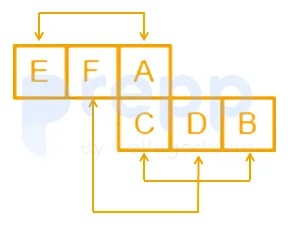
A cube is made by folding the given sheet. In the cube so formed, which of the following pairs of letters would be opposite to each other?

- A
D and F
- B
A and D
- C
E and B
- D
E and C
Show answer
A. D and FOpposite surface of the open dice can be found by the below method:-
Alternate surfaces are opposite to each other.
No two opposite surface are touched by side or by corners
So, by using the above rule we can find the opposite surface of open dice.
Below are the opposite surfaces:-
Numbers
Opposite
A
E
B
C
F
D
Option (1): D and F → Yes, they are opposite to each other.
Option (2): A and D → No, they are not opposite to each other.
Option (3): E and B → No, they are not opposite to each other.
Option (4): E and C → No, they are not opposite to each other.
So, when the table will be constructed, the letters ‘D and F’ will be opposite to each other.
Hence, ‘D and F’ is correct answer.
 Paper & answer key PDF ↗
 Question 5archived
Read the given statements and conclusions carefully. Assuming that the information given in the statements is true, even if it appears to be at variance with commonly known facts, decide which of the given conclusions logically follows from the statements.
Statements:
Some bowls are cups.
All cups are glasses.
Some glasses are plates.
All plates are utensils.
Conclusions:
I. All bowls cannot be utensils.
II. All glasses cannot be utensils
- A
Only conclusion I follows
- B
Both the conclusion follow
- C
Only conclusion II follows
- D
Neither conclusion I nor II follows
Show answer
D. Neither conclusion I nor II followsAnalyzing Statements and Conclusions on Bowls, Cups, Glasses, Plates, and Utensils
The problem requires us to evaluate two conclusions based on a set of given statements. We must assume the statements are true and determine which conclusions logically follow from them.
Understanding the Statements
Let's break down the given statements:
Some bowls are cups. (This indicates an overlap between the set of bowls and the set of cups.)
All cups are glasses. (This means the entire set of cups is contained within the set of glasses.)
Some glasses are plates. (This indicates an overlap between the set of glasses and the set of plates.)
All plates are utensils. (This means the entire set of plates is contained within the set of utensils.)
Evaluating Conclusion I: All bowls cannot be utensils.
This conclusion claims it's impossible for all bowls to be utensils. Let's see if we can construct a scenario (a possible Venn diagram representation) where all bowls are utensils, without contradicting any of the statements.
From statement 1 & 2: Some bowls are cups, and all cups are glasses. This implies that some bowls are glasses.
From statement 3 & 4: Some glasses are plates, and all plates are utensils. This implies that some glasses are utensils.
Now consider if all bowls can be utensils. The statements only guarantee that some bowls are glasses (because they are cups). What about the other bowls (if any)? Or even the bowls that are glasses? The statements do not restrict bowls from being plates or utensils directly. It is possible to draw a diagram where:
Some bowls are cups (and thus glasses).
The part of bowls that are glasses overlaps with plates (which are utensils).
The remaining bowls (those not cups) are also within the set of utensils (perhaps overlapping with plates or just being utensils directly).
For instance, imagine if the set of 'bowls' was entirely contained within the set of 'utensils'. This would not contradict any statement: 'Some bowls are cups' could still be true (that specific 'some' portion of bowls is also cups and thus utensils), 'All cups are glasses' would be true, 'Some glasses are plates' would be true, and 'All plates are utensils' would be true. Since it is possible for all bowls to be utensils, the conclusion "All bowls cannot be utensils" does not logically follow.
Evaluating Conclusion II: All glasses cannot be utensils.
This conclusion claims it's impossible for all glasses to be utensils. Let's see if we can construct a scenario where all glasses are utensils, without contradicting any of the statements.
From statement 3 & 4: Some glasses are plates, and all plates are utensils. This directly implies that some glasses are utensils.
Can all glasses be utensils? The statements only guarantee that some glasses are utensils (specifically, the ones that are plates). What about the rest of the glasses? The statements do not restrict glasses from being utensils. It is possible to draw a diagram where:
The entire set of glasses is contained within the set of utensils.
The 'some glasses' that are plates (and thus utensils) exist within this larger set of glasses.
Since statement 3 says "Some glasses are plates" and statement 4 says "All plates are utensils", we know that the set of plates is a subset of glasses AND a subset of utensils. This guarantees an overlap between glasses and utensils. However, this does not preclude the possibility that the entire set of glasses is also a subset of utensils. Since it is possible for all glasses to be utensils, the conclusion "All glasses cannot be utensils" does not logically follow.
Conclusion Summary
Based on our analysis:
Conclusion I ("All bowls cannot be utensils") does not follow because it is possible for all bowls to be utensils.
Conclusion II ("All glasses cannot be utensils") does not follow because it is possible for all glasses to be utensils.
Therefore, neither conclusion logically follows from the given statements.
Statement
Relationship
Some bowls are cups.
Bowls ∩ Cups ≠ ∅
All cups are glasses.
Cups ⊂ Glasses
Some glasses are plates.
Glasses ∩ Plates ≠ ∅
All plates are utensils.
Plates ⊂ Utensils
Result
Neither conclusion I nor conclusion II follows from the given statements.
Revision Table: Syllogism Basics
Term
Explanation
Statement (Premise)
A proposition assumed to be true for the purpose of an argument.
Conclusion
A proposition that is claimed to follow logically from the statements.
Syllogism
A form of deductive reasoning where a conclusion is drawn from two or more given premises.
Follows Logically
Means the conclusion must be true if the statements are true, in all possible scenarios consistent with the statements.
Does Not Follow
Means there is at least one possible scenario consistent with the statements where the conclusion is false.
Additional Information: Types of Statements in Syllogism
Statements in syllogism problems typically fall into one of four categories:
Universal Affirmative (A): All S are P. (e.g., All cups are glasses)
Universal Negative (E): No S are P. (e.g., No cups are plates)
Particular Affirmative (I): Some S are P. (e.g., Some bowls are cups)
Particular Negative (O): Some S are not P. (e.g., Some glasses are not plates)
Understanding these types helps in visually representing the relationships using Venn diagrams or analyzing them using rules of logic. "Cannot be" in a conclusion often implies a particular negative statement, or checking for the possibility of the opposite (a universal affirmative or particular affirmative).
Paper & answer key PDF ↗ Question 6archived
The sequence of folding a piece of paper and the manner in which the folded paper has been cut is shown in the following figures. How would this paper look when unfolded?

- A
Option A (shown in image)
- B
Option B (shown in image)
- C
Option C (shown in image)
- D
Option D (shown in image)
Show answer
C. Option C (shown in image)The image obtained when the paper is unfolded is,
Hence, option 3 is the correct answer.
 Paper & answer key PDF ↗
 Question 7archived
Select the option that is related to the third number in the same way as the second number is related to the first number.
39 : 27 :: 43 : ?
- A
6
- B
38
- C
12
- D
20
Show answer
C. 12Understanding Number Analogy Questions
Number analogy questions test your ability to identify the relationship between a pair of numbers and apply that same relationship to another number to find a missing term. These relationships can be based on various mathematical operations like addition, subtraction, multiplication, division, squares, cubes, or even operations on the digits of the numbers.
Analyzing the First Pair: 39 : 27
Let's examine the relationship between the first two numbers, 39 and 27. We need to find a rule that connects 39 to 27.
Consider the digits of the first number, 39. The digits are 3 and 9.
Let's try some simple operations on these digits.
Sum of digits: $3 + 9 = 12$. This is not 27.
Difference of digits: $9 - 3 = 6$. This is not 27.
Product of digits: $3 \times 9 = 27$. This matches the second number!
The relationship appears to be that the second number is obtained by multiplying the digits of the first number.
Applying the Rule to the Second Pair: 43 : ?
Now, we apply the same rule (product of digits) to the first number of the second pair, which is 43.
Consider the digits of the number 43. The digits are 4 and 3.
Apply the rule: Multiply the digits of 43.
Calculation: $4 \times 3 = 12$.
So, according to the established rule, the missing number is 12.
Verifying the Answer with Options
Let's check if 12 is one of the given options:
Option 1: 6
Option 2: 38
Option 3: 12
Option 4: 20
The calculated number, 12, is present as Option 3.
Conclusion on the Number Analogy
The relationship in the given number analogy 39 : 27 :: 43 : ? is that the second number is the product of the digits of the first number. Applying this rule, 39 relates to $3 \times 9 = 27$, and 43 relates to $4 \times 3 = 12$. Therefore, the missing number is 12.
First Number
Relationship
Second Number
39
Product of digits ($3 \times 9$)
27
43
Product of digits ($4 \times 3$)
12
Revision Table: Key Concepts in Number Analogies
Concept
Explanation
Example (based on 39:27::43:12)
Identifying the Pattern
Finding the mathematical or logical relationship between the first pair of numbers.
The pattern between 39 and 27 is the product of the digits.
Applying the Pattern
Using the same identified pattern to find the missing number in the second pair.
Apply the 'product of digits' rule to 43 to get $4 \times 3 = 12$.
Types of Patterns
Common patterns involve arithmetic operations, squares, cubes, prime numbers, or digit manipulation.
Digit manipulation (product of digits) was used here.
Additional Information: Solving Reasoning Questions
Solving reasoning questions, especially number analogies, requires careful observation and systematic testing of potential relationships. It's often helpful to break down the numbers and look at their components (like digits) or apply basic arithmetic operations first. Practice with various types of number series and analogies can significantly improve your ability to spot patterns quickly.
Remember to consider:
Simple arithmetic (+, -, ×, ÷).
Squares and cubes.
Operations on digits (sum, product, difference, etc.).
Prime numbers or other special sequences.
Paper & answer key PDF ↗ Question 8archived
Select the alternative which has the same relation between the words as between the words of the given word pair.
Swan : Cygnet
- A
Deer : Joey
- B
Whale : Fry
- C
Fish : Cub
- D
Turkey : Poult
Show answer
D. Turkey : PoultUnderstanding Analogies: Swan and Cygnet Relationship
The question asks us to identify the pair of words that shares the same relationship as the given pair, "Swan : Cygnet". To solve this analogy question, we first need to understand the relationship between the words in the original pair.
In the pair "Swan : Cygnet", a Swan is an adult bird, and a Cygnet is a young Swan. Therefore, the relationship is Adult Animal : Young Animal.
Analyzing the Options based on Animal Young Names
We need to examine each option to see which pair also represents an Adult Animal and its Young Animal.
Deer : Joey
A Deer is an adult animal. A Joey is the term used for a young kangaroo, wallaby, or opossum. A young deer is called a fawn.
So, the relationship here is Adult Animal : Young of a Different Animal. This is not the same as the Swan : Cygnet relationship.
Whale : Fry
A Whale is an adult animal. Fry is the term used for young fish. A young whale is called a calf.
So, the relationship here is Adult Animal : Young of a Different Animal. This is not the same as the Swan : Cygnet relationship.
Fish : Cub
A Fish is an adult animal. A Cub is the term used for the young of various carnivorous mammals like bears, lions, tigers, and foxes. A young fish is called a fry or fingerling.
So, the relationship here is Adult Animal : Young of a Different Animal. This is not the same as the Swan : Cygnet relationship.
Turkey : Poult
A Turkey is an adult bird. A Poult is the term used for a young turkey.
So, the relationship here is Adult Animal : Young Animal. This matches the relationship between Swan and Cygnet.
Conclusion: Finding the Matching Relationship
Comparing the relationship in the original pair (Swan : Cygnet - Adult : Young) with the relationships in the options, we find that only the pair "Turkey : Poult" exhibits the same Adult : Young relationship.
Adult Animal
Young Animal Name
Relationship Status with "Adult : Young"
Swan
Cygnet
Original Pair (Adult : Young)
Deer
Joey (Incorrect for Deer)
Adult : Young of Different Animal
Whale
Fry (Incorrect for Whale)
Adult : Young of Different Animal
Fish
Cub (Incorrect for Fish)
Adult : Young of Different Animal
Turkey
Poult
Matching Pair (Adult : Young)
Therefore, the alternative that has the same relation between the words as between the words of the given word pair, Swan : Cygnet, is Turkey : Poult.
Revision Table: Animal Names and Their Young
Adult Animal
Young Animal Name
Swan
Cygnet
Turkey
Poult
Deer
Fawn
Kangaroo/Wallaby/Opossum
Joey
Whale/Dolphin/Seal/Cow/Elephant
Calf
Fish
Fry / Fingerling
Bear/Lion/Tiger/Fox
Cub
Chicken
Chick
Sheep
Lamb
Goat
Kid
Additional Information: Solving Analogies
Analogies test your ability to recognize relationships between words or concepts. To solve analogies effectively:
Identify the relationship between the first pair of words. Common relationships include:
Part to Whole (e.g., Finger : Hand)
Synonyms (e.g., Happy : Joyful)
Antonyms (e.g., Hot : Cold)
Cause and Effect (e.g., Rain : Flood)
Worker and Tool (e.g., Carpenter : Hammer)
Adult and Young (e.g., Cat : Kitten)
Male and Female (e.g., Bull : Cow)
Action and Object (e.g., Read : Book)
Apply the same relationship to the options provided.
Choose the option that best fits the identified relationship.
Sometimes, there might be multiple possible relationships; look for the most direct and specific one.
In this specific analogy, the relationship was clearly Adult Animal to its Young, which is a common type of analogy.
Paper & answer key PDF ↗ Question 9archived
Select the correct mirror image of the given combination when the mirror is placed at 'PQ' as shown.

- A
Option A (shown in image)
- B
Option B (shown in image)
- C
Option C (shown in image)
- D
Option D (shown in image)
Show answer
C. Option C (shown in image)The correct mirror image of the given figure when the mirror is held at the right side is:
Hence, "option (3)" is the correct answer.
 Paper & answer key PDF ↗
 Question 10archived
Choose the option which is related to the third word in the same way as the second word is related to the first.
Pauper : Rich :: Vengeful : ?
- A
Centrist
- B
Forgettable
- C
Intrepid
- D
Remissive
Show answer
D. RemissiveThis question is an analogy question, where we need to find the word that has the same relationship with the third word as the second word has with the first word. The given analogy is: Pauper : Rich :: Vengeful : ?
Understanding the Relationship
First, let's analyze the relationship between the first pair of words: Pauper and Rich.
Pauper means a very poor person.
Rich means having a lot of money or possessions.
These two words have opposite meanings. They are antonyms.
Applying the Relationship to the Second Pair
The relationship between the first pair (Pauper : Rich) is that they are antonyms. We need to find a word that is the antonym of the third word, Vengeful.
Vengeful means seeking revenge or being characterized by a desire for revenge. A vengeful person is unforgiving and wants to retaliate for harm done to them.
We are looking for a word that means the opposite of being vengeful or unforgiving.
Evaluating the Options
Let's look at the given options and see which one is the antonym of Vengeful:
Centrist: A person who holds moderate political views. This has no relation to being vengeful or its opposite.
Forgettable: Something or someone easily forgotten. This is not related to the concept of revenge or forgiveness.
Intrepid: Fearless; adventurous. This describes courage, not the opposite of being vengeful.
Remissive: Inclined to pardon or forgive; showing remission (as in remission of sins or punishment). This is the opposite of being unforgiving or seeking revenge. A remissive person is ready to forgive.
Identifying the Correct Antonym
Based on the analysis, the word that is the antonym of Vengeful is Remissive.
Therefore, the complete analogy is: Pauper : Rich :: Vengeful : Remissive.
Revision Table
Word
Meaning
Relationship with its Pair
Pauper
Very poor person
Antonyms
Rich
Having a lot of money
Vengeful
Seeking revenge; unforgiving
Antonyms
Remissive
Inclined to pardon or forgive
Additional Information on Analogies
Analogies are comparisons between two things for the purpose of explanation or clarification. In verbal reasoning questions, analogies test your ability to identify the relationship between a pair of words and apply that same relationship to another word to find its corresponding partner.
Common types of relationships in word analogies include:
Antonyms (Opposites) - as seen in this question (Pauper/Rich, Vengeful/Remissive)
Synonyms (Similar meanings)
Part to Whole (e.g., Finger : Hand)
Cause and Effect (e.g., Rain : Flood)
Worker and Tool (e.g., Carpenter : Hammer)
Action and Object (e.g., Read : Book)
Degree of Intensity (e.g., Warm : Hot)
Solving analogies requires a good vocabulary and the ability to think critically about the precise relationship between words.
Paper & answer key PDF ↗ Question 11archived
In a certain code language, ‘YOU TOOK MY PLACE IN’ is written as ‘COU POON LC QVAKE IJ’. How will ‘COMPILE’ be written in that language?
- A
KQLQME
- B
KOLQIVE
- C
KOLTYLE
- D
YOLTLE
Show answer
B. KOLQIVEUnderstanding the Code Language Pattern
The question presents a code language where the phrase ‘YOU TOOK MY PLACE IN’ is encoded as ‘COU POON LC QVAKE IJ’. We need to find the code for the word ‘COMPILE’ in this language.
Let's compare the original words and their coded forms to identify the pattern:
YOU → COU
TOOK → POON
MY → LC
PLACE → QVAKE
IN → IJ
By observing the transformation, we can notice a pattern related to vowels and consonants.
Identifying the Coding Rules
Let's examine how each letter is transformed:
Y → C
O → O (stays the same)
U → U (stays the same)
T → P
O → O (stays the same)
O → O (stays the same)
K → N
M → L
Y → C (already seen)
P → Q
L → V
A → A (stays the same)
C → K
E → E (stays the same)
I → I (stays the same)
N → J
From this observation, it appears that vowels (A, E, I, O, U) remain unchanged in this code language. Consonants, however, are replaced by different consonants according to a specific substitution.
Consonant Substitution Mapping
Let's consolidate the consonant transformations we observed from the given examples:
Y is coded as C
T is coded as P
K is coded as N
M is coded as L
P is coded as Q
L is coded as V
C is coded as K
N is coded as J
This gives us the complete set of consonant mappings needed for the letters present in the original phrase.
Encoding the word 'COMPILE'
Now we apply these rules to the word ‘COMPILE’.
Let's break down the word letter by letter:
C: This is a consonant. According to our mapping, C is coded as K.
O: This is a vowel. Vowels stay the same, so O remains O.
M: This is a consonant. According to our mapping, M is coded as L.
P: This is a consonant. According to our mapping, P is coded as Q.
I: This is a vowel. Vowels stay the same, so I remains I.
L: This is a consonant. According to our mapping, L is coded as V.
E: This is a vowel. Vowels stay the same, so E remains E.
Combining the coded letters, we get:
C → K
O → O
M → L
P → Q
I → I
L → V
E → E
So, the word ‘COMPILE’ is written as ‘KOLQIVE’ in this code language.
Comparing with Options
Let's compare our result ‘KOLQIVE’ with the given options:
Option
Code
Matches KOLQIVE?
1
KQLQME
No
2
KOLQIVE
Yes
3
KOLTYLE
No
4
YOLTLE
No
Our derived code ‘KOLQIVE’ matches Option 2.
Revision Table: Code Language Summary
Letter Type
Rule
Examples
Vowels (A, E, I, O, U)
Remain Unchanged
O→O, U→U, A→A, E→E, I→I
Consonants
Substitution based on observed mapping
Y→C, T→P, K→N, M→L, P→Q, L→V, C→K, N→J
Additional Information: Types of Coding Decoding
Coding-decoding questions test your ability to decipher a rule or pattern in how words, letters, or numbers are represented and apply that rule to a new item. Common types include:
Letter Coding: Letters are replaced by other letters based on a shift (e.g., +2, -3), a reverse alphabetical order, or specific patterns.
Number/Symbol Coding: Words are coded using numbers or symbols based on letter positions, counts, or arbitrary assignments.
Mixed Coding: Words might be coded using a mix of numbers and letters, or a set of sentences are given with their codes to find the code for a specific word.
Substitution Coding: Objects or names are directly substituted for others (e.g., 'red is green' means red is now called green).
This problem is an example of Letter Coding involving a mixed rule (vowels constant, consonants substituted based on a discovered mapping).
Paper & answer key PDF ↗ Question 12archived
Select the combination of letters that when sequentially placed in the blanks of the given series will complete the series.
r_ uktrj_ kt_ juk_rju_trj_kt
- A
u, j, r, t, j, u
- B
j, r, u, k, t, u
- C
j, r, u, t, u, k
- D
j, u, r, t, k, u
Show answer
D. j, u, r, t, k, uSolving Letter Series Completion Problems
Letter series completion questions require you to identify a pattern within a sequence of letters and then use that pattern to fill in the missing terms (blanks). These patterns can involve repetition of blocks of letters, alphabetical order sequences, skipping letters, or combinations of these.
Let's analyze the given letter series with blanks:
r_ uktrj_ kt_ juk_rju_trj_kt
This series contains letters and blanks. Our goal is to fill the blanks using the provided options to form a complete series that follows a logical pattern, typically a repeating block of letters.
Analyzing the Options and Finding the Pattern
We are given four options, each providing a sequence of letters to fill the six blanks in the series. Let's test each option by substituting the letters into the blanks and observing the resulting series.
The blanks are located at the following positions (starting from 1): 2, 8, 11, 15, 19, 23.
Testing Option 1: u, j, r, t, j, u
Inserting these letters into the blanks gives:
r(u)uktrj(j)kt(r)juk(t)rju(j)trj(u)kt
Resulting series: ruuktrjjktrjuktrjjutrjukt
Let's look for a repeating pattern. This series does not show a clear, simple repeating block upon initial inspection.
Testing Option 2: j, r, u, k, t, u
Inserting these letters into the blanks gives:
r(j)uktrj(r)kt(u)juk(k)rju(t)trj(u)kt
Resulting series: rjuktrjrktujuktrjutrjukt
Again, a clear, simple repeating block is not immediately apparent in this series.
Testing Option 3: j, r, u, t, u, k
Inserting these letters into the blanks gives:
r(j)uktrj(r)kt(u)juk(t)rju(u)trj(k)kt
Resulting series: rjuktrjrktujuktrjutrjktk
This series also does not display an obvious repeating pattern.
Testing Option 4: j, u, r, t, k, u
Inserting these letters into the blanks at positions 2, 8, 11, 15, 19, and 23:
Original: r _ u k t r j _ k t _ j u k _ r j u _ t r j _ k t
Fill 2nd blank with 'j': r j u k t r j _ k t _ j u k _ r j u _ t r j _ k t
Fill 8th blank with 'u': r j u k t r j u k t _ j u k _ r j u _ t r j _ k t
Fill 11th blank with 'r': r j u k t r j u k t r j u k _ r j u _ t r j _ k t
Fill 15th blank with 't': r j u k t r j u k t r j u k t r j u _ t r j _ k t
Fill 19th blank with 'k': r j u k t r j u k t r j u k t r j u k t r j _ k t
Fill 23rd blank with 'u': r j u k t r j u k t r j u k t r j u k t r j u k t
The resulting complete series is:
rjuktrjuktrjuktrjuktrjukt
Identifying the Repeating Pattern
Let's examine the resulting series rjuktrjuktrjuktrjuktrjukt. We can look for repeating blocks of letters.
The first 5 letters are 'rjukt'.
The next 5 letters are 'rjukt'.
The next 5 letters are 'rjukt'.
The next 5 letters are 'rjukt'.
The final 5 letters are 'rjukt'.
The series is formed by the block 'rjukt' repeating 5 times in sequence.
The repeating block pattern is rjukt.
Verifying the Solution
Let's write out the series based on the repeating pattern and compare it to the original series with blanks:
Repeating Pattern: rjukt
Series based on pattern (5 repetitions): rjukt rjukt rjukt rjukt rjukt
Original Series with blanks: r_ uktrj_ kt_ juk_rju_trj_kt
Comparing positions:
Position
Pattern Series
Original Series
Letter Filled
1
r
r
-
2
j
_
j
3
u
u
-
4
k
k
-
5
t
t
-
6
r
r
-
7
j
j
-
8
u
_
u
9
k
k
-
10
t
t
-
11
r
_
r
12
j
j
-
13
u
u
-
14
k
k
-
15
t
_
t
16
r
r
-
17
j
j
-
18
u
u
-
19
k
_
k
20
t
t
-
21
r
r
-
22
j
j
-
23
u
_
u
24
k
k
-
25
t
t
-
The letters needed to fill the blanks according to the repeating pattern are j, u, r, t, k, u. These are exactly the letters provided in Option 4.
Conclusion
By testing the options and identifying the repeating block pattern, we determined that Option 4 correctly completes the letter series, forming the repeating sequence 'rjukt'.
Revision Table - Letter Series Pattern
Concept
Description
How it Applies Here
Letter Series
A sequence of letters following a specific pattern.
The given problem is a letter series with missing terms.
Repeating Pattern
A block or sequence of elements that repeats throughout the series.
The identified pattern is 'rjukt', which repeats 5 times.
Series Completion
Filling in missing terms in a series based on the identified pattern.
We filled the blanks using Option 4 to complete the series based on the repeating pattern.
Option Testing
Evaluating each given option to see which one fits the pattern.
We tested each option to find the one that created a logical, repeating series.
Additional Information - Reasoning Skills
Letter series questions are common in reasoning tests. They assess your ability to identify patterns and apply logical deduction. Here are some types of patterns you might encounter:
Repeating Block Pattern: A fixed sequence of letters repeats multiple times, as seen in this problem.
Alphabetical Sequencing: Letters follow alphabetical order, possibly skipping a fixed number of letters (e.g., A, C, E, G...).
Positional Value Pattern: Patterns based on the position of letters in the alphabet (A=1, B=2, etc.), where the sequence might follow arithmetic or geometric progression based on these values.
Alternating Pattern: Two or more different patterns might alternate within the series.
To solve letter series questions effectively:
Examine the series closely and look for any obvious repetitions or sequences.
Note the letters involved and their frequency.
If options are provided, test each option by filling the blanks and checking for a consistent pattern.
Determine the length of the potential repeating block if a repeating pattern is suspected.
Verify the identified pattern across the entire series.
Paper & answer key PDF ↗ Question 13archived
Select the option in which the numbers are related in the same way as are the numbers of the following set.
(7, 9, 252)
- A
(6, 9, 188)
- B
(12, 10, 260)
- C
(8, 11, 352)
- D
(6, 8, 212)
Show answer
C. (8, 11, 352)Solving Number Set Analogy Questions
This question asks us to identify a set of numbers that shares the same relationship between its elements as the given set (7, 9, 252).
The given set is (7, 9, 252). Let's call the numbers in the set A, B, and C, where A=7, B=9, and C=252. We need to find a rule or pattern that connects A, B, and C.
We can explore various mathematical operations involving A and B that might result in C. Common relationships involve multiplication, addition, subtraction, squares, cubes, or combinations of these.
Let's try simple operations:
A + B = 7 + 9 = 16 (Not 252)
A × B = 7 × 9 = 63 (Not 252)
A<sup>2</sup> = 49, B<sup>2</sup> = 81. A<sup>2</sup> + B<sup>2</sup> = 49 + 81 = 130 (Not 252)
The third number, 252, is significantly larger than 7 and 9, suggesting multiplication or possibly powers are involved. Let's consider multiples of the product A × B.
We found A × B = 63. How can we get from 63 to 252?
Let's check if 252 is a multiple of 63:
\( \frac{252}{63} = 4 \)
This suggests a possible rule: the third number (C) is the product of the first two numbers (A and B) multiplied by 4.
Mathematically, the rule is: \( C = A \times B \times 4 \)
Verifying the Pattern in the Given Set (7, 9, 252)
Let's apply the proposed rule to the given set (7, 9, 252):
A = 7
B = 9
According to the rule, C should be \( 7 \times 9 \times 4 \)
\( 7 \times 9 = 63 \)
\( 63 \times 4 = 252 \)
The calculated value (252) matches the third number in the given set. So, the rule \( C = A \times B \times 4 \) holds for the set (7, 9, 252).
Testing Options for the Same Number Pattern
Now, we will test each option provided to see which set follows the same rule \( C = A \times B \times 4 \).
Option 1: (6, 9, 188)
A = 6, B = 9
Applying the rule: \( C = 6 \times 9 \times 4 \)
\( 6 \times 9 = 54 \)
\( 54 \times 4 = 216 \)
The third number in the option is 188. \( 216 \neq 188 \). This option does not follow the pattern.
Option 2: (12, 10, 260)
A = 12, B = 10
Applying the rule: \( C = 12 \times 10 \times 4 \)
\( 12 \times 10 = 120 \)
\( 120 \times 4 = 480 \)
The third number in the option is 260. \( 480 \neq 260 \). This option does not follow the pattern.
Option 3: (8, 11, 352)
A = 8, B = 11
Applying the rule: \( C = 8 \times 11 \times 4 \)
\( 8 \times 11 = 88 \)
\( 88 \times 4 = 352 \)
The third number in the option is 352. \( 352 = 352 \). This option follows the pattern.
Option 4: (6, 8, 212)
A = 6, B = 8
Applying the rule: \( C = 6 \times 8 \times 4 \)
\( 6 \times 8 = 48 \)
\( 48 \times 4 = 192 \)
The third number in the option is 212. \( 192 \neq 212 \). This option does not follow the pattern.
Based on the analysis, only Option 3 follows the same number set pattern as the given set (7, 9, 252).
Set (A, B, C)
A × B × 4 Calculation
Result
Matches C?
(7, 9, 252)
\( 7 \times 9 \times 4 \)
252
Yes
(6, 9, 188)
\( 6 \times 9 \times 4 \)
216
No
(12, 10, 260)
\( 12 \times 10 \times 4 \)
480
No
(8, 11, 352)
\( 8 \times 11 \times 4 \)
352
Yes
(6, 8, 212)
\( 6 \times 8 \times 4 \)
192
No
Conclusion
The number set (8, 11, 352) is related in the same way as the set (7, 9, 252), following the rule where the third number is equal to the product of the first two numbers multiplied by 4.
Revision Table: Number Set Analogy
Reviewing key concepts for solving number set analogy problems:
Understand the structure: Typically involves finding a rule between 2 or 3 numbers in a given set.
Identify common patterns: Look for relationships involving addition, subtraction, multiplication, division, squares, cubes, square roots, cube roots, differences, sums, or combinations.
Test the rule: Apply the potential rule to the given set to ensure it holds true.
Apply to options: Test the same rule on each provided option. The option that satisfies the rule is the correct answer.
Be systematic: Check simple relationships first before moving to more complex ones.
Additional Information: Number Patterns and Logical Reasoning
Number analogy questions are a common type of logical reasoning problem used to test a candidate's ability to identify patterns and relationships between numbers. These questions require careful observation and systematic testing of possible rules.
Developing skills in pattern recognition is crucial for various aptitude tests. Practice with different types of number series and set-based problems helps improve logical thinking and problem-solving speed.
Sometimes, the relationship might involve properties of the numbers themselves, such as whether they are prime, even, odd, etc., in addition to arithmetic operations. Always consider multiple possibilities when the initial attempts don't reveal a clear pattern.
Paper & answer key PDF ↗ Question 14archived
Select the figure from among the given options that can replace the question mark (?) in the following series.

- A
Option A (shown in image)
- B
Option B (shown in image)
- C
Option C (shown in image)
- D
Option D (shown in image)
Show answer
D. Option D (shown in image)The figure that will replace the question mark (?) in the following figure series is shown below:
1) Centre figure is rotated in 90° Anti-clockwise direction.
2) Triangle shape is move in each corner of square Anti-clockwise direction and every time when it is move has become dark or no fill respectively.
Hence, ‘ option 4 ’ is the correct answer.
 Paper & answer key PDF ↗
 Question 15archived
Four letter-clusters have been given, out of which three are alike in some manner and one is different. Select the letter-cluster that is different
- A
OIDZ
- B
ZTOl
- C
AUPL
- D
JDYU
Show answer
B. ZTOlAnalyzing Letter Clusters to Find the Odd One Out
In this question, we are given four letter clusters: OIDZ, ZTOl, AUPL, and JDYU. We need to find the one that is different from the other three based on some common pattern.
Let's examine each letter cluster and look for possible patterns. Common patterns involve letter positions in the alphabet, vowel and consonant counts, difference between letter positions, etc.
Let's consider the count of vowels (A, E, I, O, U) in each cluster. For this type of puzzle, the letter 'Y' is sometimes treated as a vowel, depending on the pattern required. Let's count vowels in each cluster:
OIDZ: Contains the letters O, I, D, Z. Vowels are O and I. Number of vowels = 2.
ZTOl: Contains the letters Z, T, O, l. Assuming 'l' is the lowercase letter L (a consonant). The vowel is O. Number of vowels = 1.
AUPL: Contains the letters A, U, P, L. Vowels are A and U. Number of vowels = 2.
JDYU: Contains the letters J, D, Y, U. Assuming 'Y' is treated as a vowel for this pattern. Vowels are Y and U. Number of vowels = 2.
Let's summarize the vowel counts in a table:
Letter Cluster
Letters
Vowels
Number of Vowels
OIDZ
O, I, D, Z
O, I
2
ZTOl
Z, T, O, l (lowercase L)
O
1
AUPL
A, U, P, L
A, U
2
JDYU
J, D, Y, U
Y, U (assuming Y is a vowel)
2
Based on the vowel count, we observe the following:
OIDZ has 2 vowels.
ZTOl has 1 vowel.
AUPL has 2 vowels.
JDYU has 2 vowels (assuming Y is treated as a vowel).
Three of the letter clusters (OIDZ, AUPL, JDYU) have 2 vowels each, while one letter cluster (ZTOl) has only 1 vowel. This difference in the number of vowels forms the pattern that makes ZTOl the odd one out.
Conclusion
By analyzing the number of vowels in each letter cluster, we found that OIDZ, AUPL, and JDYU each contain 2 vowels (treating Y as a vowel in JDYU), whereas ZTOl contains only 1 vowel. Therefore, ZTOl is different from the other three clusters.
Revision Table: Letter Cluster Analysis
Letter Cluster
Vowel Count
Pattern Fit
OIDZ
2
Fits the '2 Vowels' pattern
ZTOl
1
Does not fit the '2 Vowels' pattern
AUPL
2
Fits the '2 Vowels' pattern
JDYU
2
Fits the '2 Vowels' pattern (assuming Y is vowel)
Additional Information: Letter Puzzles and Reasoning
Letter cluster puzzles are common in logical reasoning sections of exams. They test your ability to identify patterns based on various properties of letters, such as:
Alphabetical Position: The position of letters (A=1, B=2, ... Z=26). Patterns can involve differences, sums, or other mathematical operations on these positions.
Vowels and Consonants: The type of letters (vowel or consonant) and their counts within the cluster.
Sequence: Patterns based on skipping letters in the alphabet or moving forward/backward a certain number of steps.
Symmetry or Structure: Less common, but sometimes relates to visual properties or symmetry.
When solving such problems, it's helpful to systematically check for these common patterns. Sometimes, the letter 'Y' can act as either a vowel or a consonant, depending on which assumption creates a consistent pattern among three of the options.
Paper & answer key PDF ↗ Question 16archived
Select the correct option that indicates the arrangement of the given words in the order in which they appear in an English dictionary.
1. Recreation
2. Recede
3. Recorder
4. Recliner
5. Reconcile
6. Recognition
- A
2, 4, 6, 5, 3, 1
- B
2, 4, 5, 6, 3, 1
- C
2, 4, 5, 6, 1, 3
- D
4, 2, 6, 5, 3, 1
Show answer
A. 2, 4, 6, 5, 3, 1Correct answer: 2, 4, 6, 5, 3, 1
The correct sequence of numbers is 2, 4, 6, 5, 3, 1.
Paper & answer key PDF ↗ Question 17archived
Four number-pairs have been given, out of which three are alike in some manner and one is different. Select the number-pair that is different.
- A
406321 : 493
- B
324335 : 577
- C
253471 : 778
- D
111617 : 278
Show answer
B. 324335 : 577Understanding the Question: Finding the Odd Number Pair
The question presents four pairs of numbers. In these types of problems, we are looking for a specific relationship or pattern that connects the two numbers in each pair. Three of the pairs will follow the same rule, while one pair will not. Our task is to identify the pair that is different from the others based on this hidden pattern.
Analyzing the Given Number Pairs
Let's list the four number pairs provided:
Pair 1: 406321 : 493
Pair 2: 324335 : 577
Pair 3: 253471 : 778
Pair 4: 111617 : 278
We need to examine these pairs and find a consistent mathematical or logical relationship between the first number (a larger number) and the second number (a smaller number) in three of the pairs.
Discovering the Pattern
Let's try to find a connection between the numbers in each pair. A common pattern in such problems involves the digits of the numbers, such as their sum, product, or arrangement. Let's explore the sum of the digits for each number in the pairs.
Consider the sum of digits for the first number in each pair:
Pair 1 (406321): \(4 + 0 + 6 + 3 + 2 + 1 = 16\)
Pair 2 (324335): \(3 + 2 + 4 + 3 + 3 + 5 = 20\)
Pair 3 (253471): \(2 + 5 + 3 + 4 + 7 + 1 = 22\)
Pair 4 (111617): \(1 + 1 + 1 + 6 + 1 + 7 = 17\)
Now, let's calculate the sum of digits for the second number in each pair:
Pair 1 (493): \(4 + 9 + 3 = 16\)
Pair 2 (577): \(5 + 7 + 7 = 19\)
Pair 3 (778): \(7 + 7 + 8 = 22\)
Pair 4 (278): \(2 + 7 + 8 = 17\)
Applying the Pattern and Identifying the Different Pair
Let's compare the sum of digits for both numbers in each pair:
Pair
First Number
Sum of Digits (First Number)
Second Number
Sum of Digits (Second Number)
Relationship
1
406321
16
493
16
Sum of digits match (16 = 16)
2
324335
20
577
19
Sum of digits do not match (20 ≠ 19)
3
253471
22
778
22
Sum of digits match (22 = 22)
4
111617
17
278
17
Sum of digits match (17 = 17)
From the table, we can see the following:
Pair 1: The sum of digits of the first number (406321) is 16, which is equal to the sum of digits of the second number (493).
Pair 3: The sum of digits of the first number (253471) is 22, which is equal to the sum of digits of the second number (778).
Pair 4: The sum of digits of the first number (111617) is 17, which is equal to the sum of digits of the second number (278).
Pair 2: The sum of digits of the first number (324335) is 20, but the sum of digits of the second number (577) is 19. The sums do not match.
The pattern that holds for three of the pairs is that the sum of the digits of the first number is equal to the sum of the digits of the second number. Pair 2 (324335 : 577) is the only pair that does not follow this pattern.
Therefore, the number pair that is different from the others is 324335 : 577.
Revision Table: Sum of Digits Pattern
Pair
First Number
Sum of Digits (First Number)
Second Number
Sum of Digits (Second Number)
Follows Pattern?
1
406321
16
493
16
Yes
2
324335
20
577
19
No
3
253471
22
778
22
Yes
4
111617
17
278
17
Yes
Additional Information on Number Patterns
Finding patterns in numbers is a key skill in logical reasoning and quantitative aptitude. Problems like this often appear in competitive exams. Common patterns include:
Arithmetic Progression: A sequence where the difference between consecutive terms is constant.
Geometric Progression: A sequence where each term after the first is found by multiplying the previous one by a fixed, non-zero number called the common ratio.
Square and Cube Relationships: Numbers might be squares, cubes, or related to squares/cubes plus/minus a constant.
Digit-Based Patterns: Relationships based on the sum of digits, product of digits, arrangement of digits, or properties of individual digits.
Prime Numbers: The pattern might involve prime numbers.
Fibonacci Sequence: A sequence where each number is the sum of the two preceding ones (e.g., 0, 1, 1, 2, 3, 5, 8...).
Solving number pattern problems requires careful observation, trial and error with different potential relationships, and systematic checking of hypotheses across all given examples.
Paper & answer key PDF ↗ Question 18archived
Select the option figure in which the given figure is embedded (rotation is NOT allowed)

- A
Option A (shown in image)
- B
Option B (shown in image)
- C
Option C (shown in image)
- D
Option D (shown in image)
Show answer
B. Option B (shown in image)The embedded part of this image is:
Hence, option (2) is the correct answer.
 Paper & answer key PDF ↗
 Question 19archived
Select the letter-cluster from among the given options that can replace the question mark (?) in the following series.
DOWN, CRRU, BUMB, AXHI, ?
- A
ZACP
- B
APCZ
- C
ACPZ
- D
CAPZ
Show answer
A. ZACPUnderstanding the Letter Cluster Series
This question asks us to find the next term in a given series of letter clusters: DOWN, CRRU, BUMB, AXHI, ?. To solve this, we need to identify the pattern or rule that governs the transformation from one letter cluster to the next. We will examine the progression of letters at each position within the clusters.
Step-by-Step Letter Series Analysis
Let's analyze the series term by term, focusing on the letters in the first, second, third, and fourth positions.
First Letter Pattern
The first letters of the clusters are D, C, B, A, ?. Let's look at their positions in the English alphabet:
D is the 4th letter.
C is the 3rd letter.
B is the 2nd letter.
A is the 1st letter.
The pattern for the first letter is a decrease by 1 position in the alphabet (D → C → B → A). Following this pattern, the next letter should be 1 position before A. In the alphabet, this wraps around to Z.
So, the next first letter is Z.
Second Letter Pattern
The second letters are O, R, U, X, ?. Let's find the difference in their alphabet positions:
O is the 15th letter.
R is the 18th letter (15 + 3).
U is the 21st letter (18 + 3).
X is the 24th letter (21 + 3).
The pattern for the second letter is an increase by 3 positions in the alphabet (O → R → U → X). Following this pattern, the next letter should be 3 positions after X. X is the 24th letter, so 24 + 3 = 27. In the 26-letter alphabet, this wraps around to the 1st letter, which is A.
So, the next second letter is A.
Third Letter Pattern
The third letters are W, R, M, H, ?. Let's find the difference in their alphabet positions:
W is the 23rd letter.
R is the 18th letter (23 - 5).
M is the 13th letter (18 - 5).
H is the 8th letter (13 - 5).
The pattern for the third letter is a decrease by 5 positions in the alphabet (W → R → M → H). Following this pattern, the next letter should be 5 positions before H. H is the 8th letter, so 8 - 5 = 3. The 3rd letter is C.
So, the next third letter is C.
Fourth Letter Pattern
The fourth letters are N, U, B, I, ?. Let's find the difference in their alphabet positions:
N is the 14th letter.
U is the 21st letter (14 + 7).
B is the 2nd letter. Let's see the difference: 21 → 2. This is 21 + 7 = 28. Wrapping around the 26 letters: 28 - 26 = 2. So, U → B is +7.
I is the 9th letter (2 + 7).
The pattern for the fourth letter is an increase by 7 positions in the alphabet with wrap-around (N → U → B → I). Following this pattern, the next letter should be 7 positions after I. I is the 9th letter, so 9 + 7 = 16. The 16th letter is P.
So, the next fourth letter is P.
Combining the Patterns for the Next Letter Cluster
Based on our analysis of each letter position, the next letter cluster is formed by combining the next letters found for each position:
First letter: Z
Second letter: A
Third letter: C
Fourth letter: P
Putting these together, the next letter cluster in the series is ZACP.
Let's summarize the patterns:
Position
Letters
Pattern
Next Letter
1st
D, C, B, A
Decrement by 1 ($\text{-}1$)
Z
2nd
O, R, U, X
Increment by 3 ($\text{+}3$)
A
3rd
W, R, M, H
Decrement by 5 ($\text{-}5$)
C
4th
N, U, B, I
Increment by 7 ($\text{+}7$) with wrap-around
P
Conclusion
By analyzing the patterns in the series DOWN, CRRU, BUMB, AXHI, ?, we found that the pattern for each position is consistent. The first letter decreases by 1, the second increases by 3, the third decreases by 5, and the fourth increases by 7 (with wrap-around). Applying these rules, the next letter cluster is ZACP.
Revision Table: Letter Series Patterns
Understanding different types of letter series patterns is crucial for solving such questions. Here is a brief overview:
Alphabetical Position: Patterns based on the position of letters (A=1, B=2, ... Z=26).
Differences: Constant differences (like +2, -3) between consecutive letters' positions.
Increasing/Decreasing Differences: Differences change in a pattern (e.g., +1, +2, +3...).
Alternating Patterns: Different patterns apply to odd and even terms, or to different positions within a term.
Skip Letters: Patterns involving skipping a fixed number of letters in the alphabet.
Additional Information: Solving Letter Reasoning Problems
Letter reasoning questions, like letter series completion, test your ability to identify logical sequences and patterns involving letters. Here are some tips for solving them:
Write down the alphabet with its numerical positions (A=1, B=2, ..., Z=26) as a reference.
Analyze the pattern position by position if the terms are clusters or words.
Look for arithmetic progressions (+ or - constant number), geometric progressions (multiplication or division - less common for letters), or other numerical sequences in the differences between letter positions.
Consider patterns that wrap around the alphabet (e.g., going from Z to A or A to Z).
Check for alternating patterns if a single pattern doesn't seem to fit.
Practice with various types of letter series to become familiar with common patterns.
Paper & answer key PDF ↗ Question 20archived
Select the correct combination of mathematical signs that can sequentially replace the * signs and balance the given equation.
14 * 7 * 39 * 133 * 19 * 130
- A
÷, +, -, ×, =
- B
×, -, +, ÷, =
- C
×, +, -, ÷, =
- D
÷, -, +, ×, =
Show answer
C. ×, +, -, ÷, =Identifying Correct Mathematical Signs to Balance Equation
This problem requires us to find the correct sequence of mathematical signs to make the equation 14 * 7 * 39 * 133 * 19 * 130 true. We need to substitute the asterisks (*) with operators from the given options and verify the result using the standard order of operations (PEMDAS/BODMAS).
Understanding the Equation Balancing Task
The core task is to replace each asterisk (*) in the sequence with the appropriate mathematical sign:
14 * 7
... * 39
... * 133
... * 19
... = 130
We must test the provided combinations of signs to see which one satisfies the equation.
Key Mathematical Concepts: Order of Operations
To solve this, we must follow the order of operations, commonly remembered by the acronym PEMDAS/BODMAS:
Parentheses / Brackets
Exponents / Orders
Multiplication and Division (performed from left to right)
Addition and Subtraction (performed from left to right)
We will apply these rules when testing the options.
Evaluating the Options Systematically
Let's examine the options. We need to find the sequence that makes the equation valid.
Testing the Proposed Correct Combination: ×, +, -, ÷, =
The correct answer suggests using the sequence: multiplication (×), addition (+), subtraction (-), division (÷), and equals (=).
Let's substitute these signs into the original equation:
14 × 7 + 39 - 133 ÷ 19 = 130
Step-by-Step Verification
Now, we apply the order of operations (PEMDAS/BODMAS) to the equation:
Multiplication and Division (Left to Right):
Calculate the multiplication first: 14 × 7
14 × 7 = 98
Next, calculate the division: 133 ÷ 19
133 ÷ 19 = 7
The equation simplifies to:
98 + 39 - 7 = 130
Addition and Subtraction (Left to Right):
Perform the addition: 98 + 39
98 + 39 = 137
Now, perform the subtraction: 137 - 7
137 - 7 = 130
The equation now reads:
130 = 130
The result shows that the left side of the equation equals the right side, confirming that this sequence of signs is correct.
Conclusion
By systematically applying the order of operations, we confirmed that the sequence ×, +, -, ÷, = correctly balances the given equation. Therefore, this is the right combination of signs.
Paper & answer key PDF ↗ Question 21archived
Study the given pattern carefully and select the number that can replace the question mark (?) in it.
357
232731
69135?
- A
155
- B
217
- C
266
- D
93
Show answer
B. 217Understanding the Number Pattern
The given sequence of numbers is 357, 232, 731, 691, 35, ?. We need to find the number that replaces the question mark.
Let's examine the numbers closely and try to find a mathematical relationship or pattern between them. Observing the numbers, we can notice that many of them are close to the cubes of certain integers.
Identifying the Pattern: Base Cubed Plus a Constant
Let's investigate if each number in the sequence can be represented in the form $\text{Base}^3 + \text{Constant}$.
For the first term, 357: The nearest perfect cube is $7^3 = 343$. The difference is $357 - 343 = 14$. So, $357 = 7^3 + 14$. The base is 7, the constant is 14.
For the second term, 232: The nearest perfect cube is $6^3 = 216$. The difference is $232 - 216 = 16$. So, $232 = 6^3 + 16$. The base is 6, the constant is 16.
For the third term, 731: The nearest perfect cube is $9^3 = 729$. The difference is $731 - 729 = 2$. So, $731 = 9^3 + 2$. The base is 9, the constant is 2.
For the fifth term, 35: The nearest perfect cube is $3^3 = 27$. The difference is $35 - 27 = 8$. So, $35 = 3^3 + 8$. The base is 3, the constant is 8.
For the fourth term, 691: The nearest perfect cube could be $8^3 = 512$ or $9^3 = 729$. $691 - 512 = 179$ and $691 - 729 = -38$. Let's keep these in mind while analyzing the base sequence.
For the sixth term, ?: We need to find its base and constant. Let's denote the base as $B_6$ and the constant as $C_6$. The term is $B_6^3 + C_6$.
Analyzing the Sequence of Bases and Constants
Based on the above, we have the following sequence of bases and constants:
Term (N)
Number
Base ($B_N$)
Constant ($C_N$)
Formula
1
357
7
14
$7^3 + 14$
2
232
6
16
$6^3 + 16$
3
731
9
2
$9^3 + 2$
4
691
? ($B_4$)
? ($C_4$)
$B_4^3 + C_4$
5
35
3
8
$3^3 + 8$
6
?
? ($B_6$)
? ($C_6$)
$B_6^3 + C_6$
Let's examine the sequence of bases we've identified: 7, 6, 9, $B_4$, 3, $B_6$. This sequence can be split into two interleaved sequences:
Odd positions (1st, 3rd, 5th): Bases are 7, 9, 3. The differences are $9 - 7 = +2$ and $3 - 9 = -6$. The pattern of differences is +2, then -6.
Even positions (2nd, 4th, 6th): Bases are 6, $B_4$, $B_6$. Let's look for a similar pattern of differences. Starting from 6, if we apply differences similar in structure to the odd sequence, we might consider adding a value then subtracting a value. A simple pattern could be adding 2, then subtracting 2.
Starting with 6 (for Term 2)
Add 2: $6 + 2 = 8$. So, $B_4 = 8$.
Subtract 2: $8 - 2 = 6$. So, $B_6 = 6$.
This gives us the complete sequence of bases: 7, 6, 9, 8, 3, 6.
This sequence follows the pattern:
Odd positions: 7 (+2) $\rightarrow$ 9 (-6) $\rightarrow$ 3
Even positions: 6 (+2) $\rightarrow$ 8 (-2) $\rightarrow$ 6
Based on this pattern, the base for the 6th term ($B_6$) is 6.
Determining the Missing Term
The 6th term is of the form $B_6^3 + C_6$. Since $B_6 = 6$, the 6th term is $6^3 + C_6 = 216 + C_6$.
Now let's look at the constants we've identified using this base pattern (including $B_4=8$ for the 4th term):
$C_1 = 14$ (for base 7)
$C_2 = 16$ (for base 6)
$C_3 = 2$ (for base 9)
$C_4 = 691 - 8^3 = 691 - 512 = 179$ (for base 8)
$C_5 = 8$ (for base 3)
$C_6$ (for base 6)
The sequence of constants is 14, 16, 2, 179, 8, $C_6$. Let's look at the interleaved constant sequences:
Odd positions (1st, 3rd, 5th): Constants are 14, 2, 8. The differences are $2 - 14 = -12$ and $8 - 2 = +6$. The pattern of differences is -12, then +6.
Even positions (2nd, 4th, 6th): Constants are 16, 179, $C_6$. The differences are $179 - 16 = +163$ and $C_6 - 179$. There isn't a simple arithmetic pattern easily discernible here.
Let's check the given options to see which one fits the form $216 + C_6$.
Option 1: 155. $155 = 216 + C_6 \implies C_6 = 155 - 216 = -61$.
Option 2: 217. $217 = 216 + C_6 \implies C_6 = 217 - 216 = 1$.
Option 3: 266. $266 = 216 + C_6 \implies C_6 = 266 - 216 = 50$.
Option 4: 93. $93 = 216 + C_6 \implies C_6 = 93 - 216 = -123$.
If the missing number is 217, the constant $C_6$ is 1. The full sequence of constants would be 14, 16, 2, 179, 8, 1. The even constants are 16, 179, 1. While the pattern in even constants is not as simple as the odd constants, having $B_6=6$ and the constant $C_6=1$ derived from option 217 completes the sequence based on the highly probable base pattern.
The most consistent pattern identified is in the bases, which determines the base for the missing term. The correct option provides the value for the missing term, which in turn determines the constant for that term, fitting the overall Base^3 + Constant structure.
Therefore, the number that replaces the question mark is 217.
Revision Table: Pattern Summary
Term
Number
Base
Constant
Base Pattern (Odd: +2, -6; Even: +2, -2)
Constant Pattern (Odd: -12, +6)
Formula
1
357
7
14
Starting Odd Base
Starting Odd Constant
$7^3 + 14$
2
232
6
16
Starting Even Base
Starting Even Constant
$6^3 + 16$
3
731
9
2
$7 + 2 = 9$
$14 - 12 = 2$
$9^3 + 2$
4
691
8
179
$6 + 2 = 8$
$16 + 163 = 179$
$8^3 + 179$
5
35
3
8
$9 - 6 = 3$
$2 + 6 = 8$
$3^3 + 8$
6
217
6
1
$8 - 2 = 6$
$179 - 178 = 1$
$6^3 + 1$
Note: While the base pattern shows clear arithmetic sequences of differences within the interleaved sets, the constant pattern for even terms (16, 179, 1) is less obvious based purely on simple arithmetic differences (+163, -178). However, the constant 1 is derived from the correct answer option and the established base pattern.
Additional Information on Number Series and Patterns
Number series and pattern recognition questions test your ability to identify rules that govern a sequence of numbers. These rules can be arithmetic, geometric, based on squares or cubes, alternating patterns, or even combinations of multiple operations or interleaved sequences.
Arithmetic Progression: Each term is obtained by adding a constant difference to the previous term.
Geometric Progression: Each term is obtained by multiplying the previous term by a constant ratio.
Square/Cube Series: The terms are related to squares or cubes of integers, possibly with an added or subtracted constant.
Alternating Series: The pattern alternates between two different rules or applies to interleaved terms separately.
Difference/Ratio Series: The differences or ratios between consecutive terms form a new pattern.
Mixed Series: A combination of different patterns.
Solving these types of questions often requires careful observation, calculating differences or ratios, checking for squares or cubes, and testing various hypotheses for pattern formation.
Paper & answer key PDF ↗ Question 22archived
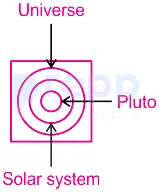
Select the Venn diagram that best illustrates the relationship between the following classes.
Universe, Pluto, Solar system
- A
Option A (shown in image)
- B
Option B (shown in image)
- C
Option C (shown in image)
- D
Option D (shown in image)
Show answer
A. Option A (shown in image)The Venn diagrams best represent the relationship between - Universe, Pluto, Solar system
figures are shown below:
.
Pluto is a part of the solar system and the solar system is eventually part of the universe.
Hence, ‘ option 1’ is the correct answer.
Note: In the official answer key of SSC CGL, option 2 was given as the answer which is wrong. According to NASA, dwarf planets are considered a part of the solar system.
Confusion Points
Although, Pluto is not a planet now; but, according to the definition of the Solar system given by NASA, Our solar system consists of our star, the Sun, and everything bound to it by gravity – the planets Mercury, Venus, Earth, Mars, Jupiter, Saturn, Uranus, and Neptune; dwarf planets such as Pluto ; dozens of moons; and millions of asteroids, comets, and meteoroids.
 Paper & answer key PDF ↗
 Question 23archived
Select the number from among the given options that can replace the question mark (?) in the following series.
17, 20, 80, 85, ?, 517
- A
504
- B
412
- C
213
- D
510
Show answer
D. 510Understanding the Number Series Pattern
In this question, we are given a number series: 17, 20, 80, 85, ?, 517. Our goal is to find the number that replaces the question mark (?) by identifying the underlying pattern in the series. Number series problems are common in reasoning and quantitative aptitude sections of competitive exams, requiring careful pattern recognition.
Analyzing the Series Pattern
Let's examine the relationship between consecutive numbers in the given series to discover the pattern. We can look at differences, ratios, or a combination of operations.
From 17 to 20: The difference is \(20 - 17 = 3\). This is an addition: \(+3\).
From 20 to 80: The difference is \(80 - 20 = 60\). This is a large jump compared to the first step. Let's check multiplication: \(20 \times 4 = 80\). This fits. This is a multiplication: \(\times 4\).
From 80 to 85: The difference is \(85 - 80 = 5\). This is an addition: \(+5\).
Observing the operations and the numbers used in the first three steps:
Step 1: \(17 \xrightarrow{+3} 20\) (Operation: Addition, Number: 3)
Step 2: \(20 \xrightarrow{\times 4} 80\) (Operation: Multiplication, Number: 4)
Step 3: \(80 \xrightarrow{+5} 85\) (Operation: Addition, Number: 5)
The pattern appears to involve alternating operations (+ and \(\times\)) and the numbers used in these operations (3, 4, 5) are consecutive integers increasing by one at each step.
Let's hypothesize that this pattern continues for the subsequent terms in the number series:
Step 4: The operation should be multiplication (\(\times\)) as it alternates after addition, and the number should be 6 (the next consecutive integer after 5). We apply this to the previous term, 85.
Step 5: The operation should be addition (\(+\)) as it alternates after multiplication, and the number should be 7 ( the next consecutive integer after 6). We apply this to the result of Step 4. This final result should be the last term in the series, 517.
Applying the Pattern to Find the Missing Number
Based on the identified pattern (\(+3, \times 4, +5, \times 6, +7\)), let's calculate the missing term step-by-step:
Starting term: 17
Apply Step 1: \(17 + 3 = 20\) (Matches the second term)
Apply Step 2: \(20 \times 4 = 80\) (Matches the third term)
Apply Step 3: \(80 + 5 = 85\) (Matches the fourth term)
Apply Step 4 to find the missing number: Multiply 85 by the next consecutive integer, which is 6.
\[85 \times 6 = 510\]
So, the missing number that replaces the question mark is 510.
Let's verify this result by applying the next step in the pattern (adding the next consecutive integer, 7) to 510.
\[510 + 7 = 517\]
This matches the last number given in the series (517), confirming our pattern is correct.
The complete pattern is confirmed as \(+3, \times 4, +5, \times 6, +7\).
We can visualize the steps and the pattern clearly in a table:
Starting Term
Operation & Number
Calculation
Resulting Term
17
\(+3\)
\(17 + 3\)
20
20
\(\times 4\)
\(20 \times 4\)
80
80
\(+5\)
\(80 + 5\)
85
85
\(\times 6\)
\(85 \times 6\)
510 (?)
510
\(+7\)
\(510 + 7\)
517
Conclusion: The Missing Number Found
Following the identified pattern of alternating addition and multiplication, with the numbers involved increasing consecutively (\(+3, \times 4, +5, \times 6, +7\)), the number that correctly replaces the question mark in the series 17, 20, 80, 85, ?, 517 is 510. This corresponds to one of the given options.
Revision Table: Key Concepts for Number Series Questions
Successfully solving number series problems often depends on recognizing common types of patterns. Here are some key concepts:
Arithmetic Progression: Each term increases or decreases by a constant value (the common difference).
Geometric Progression: Each term is multiplied or divided by a constant value (the common ratio).
Mixed Operation Series: Patterns involve a combination of operations (+, -, \(\times\), \(\div\)), which might alternate or follow a sub-pattern. This is the type of pattern seen in this question.
Difference Series: Analyze the differences between consecutive terms; these differences might form a simpler series with a recognizable pattern.
Series Based on Squares or Cubes: Terms might be squares, cubes, or related to squares/cubes of consecutive numbers.
Additional Information: Advanced Series Types and Strategies
For more challenging number series problems, you might encounter:
Double or Triple Series: Two or three independent series interleaved together.
Fibonacci or Related Series: Terms are derived from the sum or difference of previous terms.
Prime Number Series: The series involves prime numbers or operations based on them.
Look-and-Say Series: Each term describes the previous term.
A systematic approach is crucial: first, look for simple arithmetic or geometric patterns. If those don't fit, check differences. Then, investigate alternating operations and look for patterns in the numbers used for these operations, as demonstrated in this solution.
Paper & answer key PDF ↗ Question 24archived
Ramesh is the father of Manideep. Ramesh has only two children. Manideep is the brother of Niharika. Niharika is the daughter of Kavita. Ananya is the granddaughter of Kavita. Sujit is the father of Ananya. How is Sujit related to Manideep?
- A
Son
- B
Brother
- C
Brother-in-law
- D
Son-in-law
Show answer
C. Brother-in-lawSolving the Blood Relation Puzzle
To solve this blood relation question, we need to carefully read each statement and build a family tree step by step. We are asked to find the relationship between Sujit and Manideep.
Building the Family Tree
Let's analyze the given statements:
Ramesh is the father of Manideep. This tells us Ramesh is one generation above Manideep.
Ramesh has only two children. So, Manideep has one sibling.
Manideep is the brother of Niharika. This identifies Niharika as Manideep's sibling. Since Ramesh has only two children, these must be Manideep and Niharika. Ramesh is the father of both.
Niharika is the daughter of Kavita. Since Ramesh is the father of Niharika and Kavita is the mother of Niharika, Kavita must be the wife of Ramesh. Ramesh and Kavita are parents of Manideep and Niharika.
Ananya is the granddaughter of Kavita. This means Ananya is the child of either Manideep or Niharika.
Sujit is the father of Ananya.
Determining Ananya's Parentage
Ananya is the granddaughter of Kavita. This means Ananya's parent is a child of Kavita (either Manideep or Niharika).
If Ananya was the daughter of Manideep, then Sujit (Ananya's father) would be Manideep's wife. However, Sujit is stated as the father, implying he is male. This contradicts the possibility of Ananya being Manideep's daughter.
Therefore, Ananya must be the daughter of Niharika.
Connecting Sujit and Manideep
We know:
Ananya is the daughter of Niharika.
Sujit is the father of Ananya.
This means Sujit is the husband of Niharika.
We also know that Niharika is the sister of Manideep.
Sujit is the husband of Manideep's sister.
The relationship of the husband of one's sister is brother-in-law.
Therefore, Sujit is the brother-in-law of Manideep.
Person
Relationship
Ramesh
Father of Manideep & Niharika; Husband of Kavita
Kavita
Mother of Manideep & Niharika; Wife of Ramesh
Manideep
Son of Ramesh & Kavita; Brother of Niharika
Niharika
Daughter of Ramesh & Kavita; Sister of Manideep; Wife of Sujit; Mother of Ananya
Ananya
Granddaughter of Ramesh & Kavita; Daughter of Niharika & Sujit
Sujit
Father of Ananya; Husband of Niharika; Brother-in-law of Manideep
Based on our step-by-step analysis and the constructed family relationships, Sujit is related to Manideep as his brother-in-law.
Revision Table: Key Relationships
Relationship Type
Example from Problem
Parent-Child
Ramesh is father of Manideep; Niharika is daughter of Kavita
Siblings
Manideep is brother of Niharika
Spousal
Ramesh is husband of Kavita; Sujit is husband of Niharika
Grandparent-Grandchild
Ananya is granddaughter of Kavita
In-law
Sujit is brother-in-law of Manideep
Additional Information on Blood Relations
Blood relation questions test your ability to understand and decode complex relationships within a family tree. Key terms and concepts often encountered include:
Maternal: Relations from the mother's side.
Paternal: Relations from the father's side.
Sibling: Brother or sister.
Cousin: Child of an uncle or aunt.
In-laws: Relations through marriage (e.g., brother-in-law, sister-in-law, father-in-law, mother-in-law).
Nieces and Nephews: Children of one's sibling.
Drawing a diagram or family tree is often the most effective way to solve these problems accurately. Start with the central person or the most direct relationship and branch out according to the statements.
Paper & answer key PDF ↗ Question 25archived
How many triangles are there in the given figure?

- A
14
- B
13
- C
12
- D
11
Show answer
Question 26archived
In which of the following years did Japan invade India resulting in the Battle of Imphal?
- A
1944
- B
1901
- C
1862
- D
1899
Show answer
A. 1944The correct answer is 1944.
The Battle of Imphal was fought from March to July 1944 between the Imperial Japanese Army (supported by the Indian National Army under Subhas Chandra Bose) and British and Commonwealth forces of the British Fourteenth Army under Lieutenant-General William Slim. The Japanese offensive (Operation U-Go) aimed to capture Imphal and Kohima and open a route into India.
The battle, along with the parallel Battle of Kohima, ended in a decisive Allied victory and marked the turning point of the Burma Campaign in World War II. The other years (1862, 1899, 1901) predate WWII entirely.
Paper & answer key PDF ↗ Question 27archived
Who among the following received the 'Global Goalkeeper’ Award in 2019?
- A
Abi Ahmed
- B
Narendra Modi
- C
Nadia Murad
- D
Elon Musk
Show answer
B. Narendra ModiGlobal Goalkeeper Award 2019 Recipient Analysis
The question asks about the individual who received the prestigious 'Global Goalkeeper’ Award in the year 2019. This award recognizes leaders for their efforts in achieving the Sustainable Development Goals (SDGs).
Let's analyze the options provided:
Abi Ahmed
Narendra Modi
Nadia Murad
Elon Musk
The 'Global Goalkeeper’ Award is presented by the Bill & Melinda Gates Foundation. In 2019, this award was given to Mr. Narendra Modi, the Prime Minister of India.
He was recognized for his leadership and the country's progress towards the Sustainable Development Goals, specifically highlighting the Swachh Bharat Abhiyan (Clean India Mission). This initiative significantly improved sanitation coverage across India, contributing towards SDG 6, which focuses on ensuring availability and sustainable management of water and sanitation for all.
Therefore, among the given options, Narendra Modi was the recipient of the 'Global Goalkeeper’ Award in 2019.
Revision Table: Global Goalkeeper Award
Award Name
Awarding Body
Recipient (2019)
Reason (2019)
Global Goalkeeper’ Award
Bill & Melinda Gates Foundation
Narendra Modi
Leadership in sanitation improvement (Swachh Bharat Abhiyan) towards SDGs
Additional Information: Sustainable Development Goals and Global Awards
The 'Global Goalkeeper’ Award is part of the Gates Foundation's Goalkeepers initiative, which tracks progress towards the Sustainable Development Goals and highlights effective leadership and innovation.
The Sustainable Development Goals (SDGs) are a collection of 17 interlinked global goals designed to be a "blueprint to achieve a better and more sustainable future for all". The SDGs were set in 2015 by the United Nations General Assembly and are intended to be achieved by the year 2030.
Awards like the Global Goalkeeper Award serve to draw attention to important global issues and celebrate those making significant strides in addressing them.
Paper & answer key PDF ↗ Question 28archived
In 2020, who among the following became the most successful F1 driver with the most career wins, overtaking Michael Schumacher?
- A
Sebastian Vettel
- B
Fernando Alonso
- C
Lewis Hamilton
- D
Kimi Raikkonen
Show answer
C. Lewis HamiltonUnderstanding the Most Successful F1 Drivers by Career Wins
Formula 1 is a sport rich in history and incredible achievements. One of the most sought-after records for a driver is the total number of career wins. For many years, the benchmark was set by the legendary German driver, Michael Schumacher.
Michael Schumacher held the record for the most career wins in Formula 1, achieving a remarkable total of 91 victories during his illustrious career. This record stood for a long time and was considered one of the toughest records to break in motorsport history.
Lewis Hamilton Surpasses the F1 Wins Record in 2020
In the 2020 Formula 1 season, the British driver Lewis Hamilton achieved a monumental milestone. He surpassed Michael Schumacher's long-standing record of 91 wins. Hamilton's career trajectory saw him consistently winning races, and in 2020, he took the top spot in terms of total career victories, solidifying his place among the greatest drivers in F1 history.
Lewis Hamilton's victory at the Portuguese Grand Prix on October 25, 2020, was his 92nd career win, officially breaking Michael Schumacher's record.
Comparing Top F1 Drivers by Wins
While many great drivers have competed in Formula 1, only a select few have reached the pinnacle of success in terms of race victories. Here's a look at some of the top drivers by career wins (figures are approximate and change over time for active drivers):
Driver
Career Wins (Approx.)
Championships
Lewis Hamilton
103+
7
Michael Schumacher
91
7
Sebastian Vettel
53
4
Alain Prost
51
4
Ayrton Senna
41
3
Looking at the options provided:
Sebastian Vettel is a highly successful driver with multiple championships but has fewer wins than Schumacher and Hamilton.
Fernando Alonso is a two-time world champion and a long-standing F1 driver, but his win tally is significantly lower than the record.
Kimi Raikkonen is a former world champion known for his longevity in the sport, but he also has fewer career wins compared to the record holders.
Lewis Hamilton is the driver who surpassed Michael Schumacher's record in 2020.
Therefore, the driver who became the most successful F1 driver with the most career wins, overtaking Michael Schumacher in 2020, was Lewis Hamilton.
Revision Table: Key Facts on F1 Wins Record
Topic
Detail
Previous Record Holder
Michael Schumacher
Previous Record (Wins)
91
Driver who broke Record
Lewis Hamilton
Year Record was broken
2020
Hamilton's Milestone Win
92nd win (Portuguese GP 2020)
Additional Information on F1 Career Records
Beyond career wins, Formula 1 drivers compete for many other records that define their success and dominance in the sport. Some important F1 records include:
Most World Championships: Shared between Michael Schumacher and Lewis Hamilton (7 each).
Most Pole Positions: Held by Lewis Hamilton.
Most Fastest Laps: Held by Lewis Hamilton.
Most Podium Finishes: Held by Lewis Hamilton.
Most Races Started: Held by Kimi Raikkonen.
These records collectively paint a picture of a driver's overall performance, consistency, and longevity in the demanding world of Formula 1 racing.
Paper & answer key PDF ↗ Question 29archived
In 2020, which of the following tiger reserves won the ‘TX2 Award’ for its efforts to increase the tiger population?
- A
Periyar Tiger Reserve
- B
Pilibhit Tiger Reserve
- C
Ranthambhore Tiger Reserve
- D
Sariska Tiger Reserve
Show answer
B. Pilibhit Tiger ReserveUnderstanding the TX2 Award and Tiger Conservation
The question asks about a specific award given in 2020 to a tiger reserve for its significant efforts in increasing the tiger population. This award is known as the 'TX2 Award'. The 'TX2' goal was established by the global community, aiming to double the number of wild tigers by the year 2022.
Conservation areas and governments working towards this goal are sometimes recognized for their remarkable progress. The TX2 Award specifically celebrates those who have achieved this doubling milestone.
Identifying the 2020 TX2 Award Winner
In 2020, a notable tiger reserve in India was recognized internationally for having doubled its tiger population well ahead of the 2022 target set by the TX2 goal. This achievement highlighted the success of dedicated conservation efforts and habitat management within the reserve.
Let's look at the options provided:
Periyar Tiger Reserve: Located in Kerala, known for tigers and elephants.
Pilibhit Tiger Reserve: Located in Uttar Pradesh, recognized for its significant tiger population increase.
Ranthambhore Tiger Reserve: Located in Rajasthan, a popular tiger viewing destination.
Sariska Tiger Reserve: Located in Rajasthan, known for successful tiger reintroduction.
Based on international conservation news and reports from 2020, the Pilibhit Tiger Reserve was indeed the recipient of the prestigious TX2 Award. They achieved the doubling of their tiger population in just four years, a remarkable feat.
Why Pilibhit Tiger Reserve Won the Award
Pilibhit Tiger Reserve won the TX2 Award in 2020 because it successfully doubled its tiger population from approximately 25 tigers in 2014 to over 65 tigers by 2018, confirming this count by 2020. This achievement was a significant contribution towards the global TX2 goal and demonstrated effective conservation strategies, including anti-poaching measures, habitat protection, and community involvement.
Significance of the TX2 Award
The TX2 Award is a global recognition presented by conservation bodies like the World Wide Fund for Nature (WWF), Global Tiger Forum (GTF), International Union for Conservation of Nature (IUCN), and others. It encourages tiger range countries and specific conservation sites to intensify their efforts towards tiger recovery and protection. Winning this award brings international attention to successful conservation models and inspires other regions.
Tiger Reserve
State
Known For
TX2 Award (2020)
Periyar Tiger Reserve
Kerala
Tigers, Elephants
No
Pilibhit Tiger Reserve
Uttar Pradesh
Tiger Population Increase
Yes
Ranthambhore Tiger Reserve
Rajasthan
Tiger Tourism
No
Sariska Tiger Reserve
Rajasthan
Tiger Reintroduction
No
Therefore, among the given options, Pilibhit Tiger Reserve is the correct answer as it was the recipient of the TX2 Award in 2020 for its exceptional success in doubling its tiger population.
Revision Table: Key Facts on TX2 Award and Pilibhit
Term/Event
Description
Relevance to Question
TX2 Goal
Global aim to double wild tiger population by 2022
Context for the award
TX2 Award
Recognition for achieving the TX2 goal (doubling tiger numbers)
The award mentioned in the question
Pilibhit Tiger Reserve
Tiger reserve in Uttar Pradesh, India
Winner of the 2020 TX2 Award
2020
Year the award was given
Specific timeframe in the question
Tiger Population Increase
The criterion for winning the award
Reason for Pilibhit's recognition
Additional Information: Tiger Conservation in India
India is home to a large percentage of the world's wild tiger population. The country has numerous tiger reserves managed under Project Tiger, an initiative launched in 1973. These reserves play a crucial role in protecting tigers and their habitats.
India achieved its national goal of doubling the tiger population significantly ahead of the 2022 deadline.
Tiger population estimation in India is done through a comprehensive process involving camera traps, scat analysis, and other methods.
Conservation efforts face challenges such as habitat loss, human-wildlife conflict, and poaching.
International collaboration and awards like TX2 motivate conservationists and governments to continue their efforts.
The success of reserves like Pilibhit highlights the effectiveness of focused conservation strategies and community support in achieving significant increases in tiger numbers.
Paper & answer key PDF ↗ Question 30archived
Rajnikant Devidas Shroff was awarded the Padma Bhushan in the field of ______ in January 2021.
- A
art
- B
trade and industry
- C
politics
- D
science
Show answer
B. trade and industryLet's analyze the question regarding the Padma Bhushan awardees of January 2021, specifically focusing on Rajnikant Devidas Shroff.
The Padma Bhushan is the third-highest civilian award in the Republic of India, after the Bharat Ratna and the Padma Vibhushan. It is awarded for distinguished service of a high order.
Understanding Rajnikant Devidas Shroff and the Padma Bhushan 2021
Rajnikant Devidas Shroff is a prominent figure known for his contributions to a specific sector in India. The question asks about the field in which he was honoured with the prestigious Padma Bhushan award in January 2021.
Based on the information related to the Padma Awards announced in January 2021, Rajnikant Devidas Shroff was indeed among the recipients of the Padma Bhushan.
The fields for which Padma Awards are given include art, social work, public affairs, science & engineering, trade & industry, medicine, literature & education, sport, and civil service.
Identifying the Correct Field for Rajnikant Devidas Shroff
We need to determine which of the given options corresponds to the field for which Mr. Shroff received the award:
art
trade and industry
politics
science
Rajnikant Devidas Shroff is widely recognized as the founder and chairman of UPL Ltd. (formerly United Phosphorus Limited), which is a multinational company in the agrochemical industry. His work involves significant contributions to the growth and development of this sector, which falls under the broader category of business and commerce.
Considering his background and his leadership role in a major industrial enterprise, the field for which he was awarded the Padma Bhushan aligns with his professional achievements and contributions to the economic sector.
Therefore, the appropriate field among the given options is 'trade and industry'.
Conclusion on Rajnikant Devidas Shroff's Honour
Rajnikant Devidas Shroff was awarded the Padma Bhushan in January 2021 for his distinguished service in the field of trade and industry.
This recognition highlights his impact and contributions to the Indian economy through his work in the industrial sector.
The final answer is trade and industry.
Revision Table: Padma Awards
Award
Rank
Significance
Bharat Ratna
1st
Highest civilian honour
Padma Vibhushan
2nd
Exceptional and distinguished service
Padma Bhushan
3rd
Distinguished service of high order
Padma Shri
4th
Distinguished service
Additional Information: Rajnikant Devidas Shroff and UPL
Rajnikant Devidas Shroff founded UPL in 1969. The company has grown to become a major player in the global agrochemical market. His leadership has been instrumental in its expansion and success. The Padma Bhushan award in 2021 recognized decades of his work and contribution to the trade and industry sector, particularly in the chemical and agriculture-related industries.
Paper & answer key PDF ↗ Question 31archived
Which of the following statements is correct?
- A
Magnetic flux is a vector quantity.
- B
Two magnetic field lines may intersect.
- C
The net magnetic flux through any closed surface is zero.
- D
Earth's magnetic poles coincide with the geographic poles.
Show answer
C. The net magnetic flux through any closed surface is zero.Understanding Magnetic Fields and Flux
Let's analyze each statement regarding magnetic fields and magnetic flux to determine which one is correct. This topic is fundamental in understanding electromagnetism.
Analyzing Each Statement on Magnetic Properties
Here's a breakdown of each given statement:
Statement 1: Magnetic flux is a vector quantity.
Analysis: Magnetic flux ($\Phi_B$) is defined as the measure of the total magnetic field passing through a given area. It is calculated by the integral of the magnetic field ($\vec{B}$) over the area ($\vec{A}$): $\Phi_B = \int \vec{B} \cdot d\vec{A}$. The dot product of two vectors results in a scalar quantity. Therefore, magnetic flux is a scalar quantity, representing the 'amount' of magnetic field lines passing through a surface, not having a direction itself.
This statement is incorrect.
Statement 2: Two magnetic field lines may intersect.
Analysis: Magnetic field lines are drawn to represent the direction of the magnetic field at any point. If two magnetic field lines were to intersect at a point, it would mean that the magnetic field at that specific point has two different directions simultaneously. This is physically impossible, as the magnetic field at any given point in space has a unique direction (and magnitude). Think of a compass needle placed at that point; it would point in only one direction.
This statement is incorrect.
Statement 3: The net magnetic flux through any closed surface is zero.
Analysis: This statement is a direct consequence of Gauss's Law for Magnetism. Gauss's Law for Magnetism states that the net magnetic flux through any closed surface is always zero ($\oint \vec{B} \cdot d\vec{A} = 0$). This law reflects the fundamental observation that magnetic monopoles (isolated north or south poles) do not exist. Magnetic field lines always form closed loops, originating from the north pole and terminating at the south pole of a magnet, and continuing within the magnet. Because there are no isolated sources (monopoles) for magnetic field lines to begin or end independently within a closed surface, the number of magnetic field lines entering any closed surface must equal the number leaving it, resulting in a net flux of zero.
This statement is correct.
Statement 4: Earth's magnetic poles coincide with the geographic poles.
Analysis: Earth acts like a giant magnet, creating a magnetic field. However, Earth's magnetic poles do not exactly coincide with its geographic poles (the points where the axis of rotation intersects the surface). The magnetic poles are located near the geographic poles but are typically offset by several degrees. Furthermore, the position of the magnetic poles slowly drifts over time, and occasionally, the Earth's magnetic field polarity reverses over geological timescales.
This statement is incorrect.
Conclusion on the Correct Statement
Based on the analysis of each statement, only the third statement, which relates to Gauss's Law for Magnetism and the absence of magnetic monopoles, is physically correct.
Summary of Statement Analysis
Statement
Correctness
Reason
Magnetic flux is a vector quantity.
Incorrect
Magnetic flux is a scalar quantity.
Two magnetic field lines may intersect.
Incorrect
Magnetic field lines never intersect.
The net magnetic flux through any closed surface is zero.
Correct
This is Gauss's Law for Magnetism (no magnetic monopoles).
Earth's magnetic poles coincide with the geographic poles.
Incorrect
Earth's magnetic poles are near but not exactly aligned with geographic poles and drift over time.
Therefore, the correct statement is that the net magnetic flux through any closed surface is zero.
Revision Table: Key Magnetic Concepts
Key Concepts Related to Magnetic Fields
Concept
Description
Magnetic Field Lines
Visual representation of the direction of the magnetic field; they form closed loops and never intersect.
Magnetic Flux ($\Phi_B$)
Scalar quantity representing the total amount of magnetic field passing through a surface; calculated as $\int \vec{B} \cdot d\vec{A}$.
Gauss's Law for Magnetism
States that the net magnetic flux through any closed surface is zero ($\oint \vec{B} \cdot d\vec{A} = 0$), indicating the absence of magnetic monopoles.
Magnetic Monopoles
Hypothetical isolated magnetic north or south pole; their non-existence is implied by Gauss's Law for Magnetism.
Earth's Magnetic Field
Dipole field generated by currents in Earth's core; magnetic poles are near but not coincident with geographic poles and drift.
Additional Information: Gauss's Law in Physics
Gauss's Law is a fundamental law in physics, particularly in the study of electric and magnetic fields. It relates a field passing through a closed surface to the sources of that field within the surface.
Gauss's Law for Electricity: States that the net electric flux ($\Phi_E$) through any closed surface is proportional to the net electric charge ($q_{enc}$) enclosed by that surface: $\oint \vec{E} \cdot d\vec{A} = \frac{q_{enc}}{\epsilon_0}$. This law highlights that electric charges are the sources and sinks of electric field lines.
Gauss's Law for Magnetism: As discussed, this law states that the net magnetic flux ($\Phi_B$) through any closed surface is zero: $\oint \vec{B} \cdot d\vec{A} = 0$. This is often interpreted as the statement that magnetic monopoles do not exist. Magnetic field lines do not have sources or sinks in the way electric field lines do from positive and negative charges; they form continuous loops.
These two laws, along with Faraday's Law of Induction and Ampere's Law (with Maxwell's addition), form the basis of Maxwell's equations, which are the fundamental equations governing classical electromagnetism.
Paper & answer key PDF ↗ Question 32archived
Alivardi Khan was a Nawab of ____.
- A
Deccan
- B
Malabar
- C
Awadh
- D
Bengal
Show answer
D. BengalUnderstanding Alivardi Khan and His Nawabship
The question asks about the region where Alivardi Khan served as a Nawab. To answer this correctly, we need to recall the historical context of the Indian subcontinent during the 18th century, particularly the decline of the Mughal Empire and the rise of regional powers.
Who was Alivardi Khan?
Alivardi Khan (also known as Alahverdi Khan) was a key figure in the history of eastern India. He rose through the ranks and eventually established himself as a powerful ruler.
Analyzing the Options for Alivardi Khan's Nawabship
Let's examine the given options:
Deccan: The Deccan region was a major administrative and political area, but Alivardi Khan's primary activities and rule were not centered here.
Malabar: The Malabar Coast is in southwestern India and is not associated with Alivardi Khan's rule.
Awadh: Awadh (or Oudh) was another significant state in northern India, ruled by its own line of Nawabs, distinct from Alivardi Khan.
Bengal: Alivardi Khan is historically recognized as a prominent Nawab of Bengal. He seized control of Bengal from the previous Nawab, Sarfaraz Khan, in 1740 and ruled until his death in 1756.
Alivardi Khan's Rule in Bengal
Alivardi Khan's tenure as the Nawab of Bengal, Bihar, and Odisha was marked by efforts to consolidate power and face external threats, notably the Maratha invasions. He was the predecessor of Siraj-ud-Daulah, the Nawab who confronted the British East India Company at the Battle of Plassey in 1757.
Based on historical records, Alivardi Khan was indeed the Nawab of Bengal.
Conclusion on Alivardi Khan's Region
Considering the historical evidence, Alivardi Khan was the Nawab of Bengal.
Nawabs and Regions
Option
Region
Associated with Alivardi Khan?
1
Deccan
No
2
Malabar
No
3
Awadh
No
4
Bengal
Yes
Therefore, the correct answer is Bengal.
Revision Table: Key Facts About Alivardi Khan
Alivardi Khan Summary
Aspect
Details
Title
Nawab of Bengal (including Bihar and Odisha)
Period of Rule
1740 – 1756
Predecessor
Sarfaraz Khan
Successor
Siraj-ud-Daulah
Key Challenge
Maratha invasions (Bargi invasions)
Additional Information: The Nawabs of Bengal
The Nawab of Bengal, Bihar, and Odisha was the hereditary ruler of the region under the nominal suzerainty of the Mughal Emperor. This position became increasingly independent as Mughal power declined in the 18th century. Murshid Quli Khan is considered the first independent Nawab of Bengal. The line of Nawabs ruled Bengal until the Battle of Plassey significantly altered the political landscape, paving the way for British dominance.
Understanding the history of regional kingdoms like the Nawabship of Bengal is crucial for comprehending the transition period in Indian history leading up to British colonial rule. Alivardi Khan's reign is particularly important as it immediately preceded the events that led to the Battle of Plassey.
Paper & answer key PDF ↗ Question 33archived
Plants grown at which of the following places take up carbon dioxide during the night?
- A
Ocean beds
- B
Deserts
- C
Roof tops
- D
Hilly terrains
Show answer
B. DesertsUnderstanding Carbon Dioxide Uptake in Plants
Plants require carbon dioxide ($\text{CO}_2$) for photosynthesis, the process they use to convert light energy into chemical energy in the form of sugars. Most plants, known as C3 plants, open their stomata (tiny pores on leaves) during the day to take in $\text{CO}_2$. However, this also leads to water loss through transpiration.
Photosynthesis Adaptations in Different Environments
Different environments present unique challenges for plants, leading to various adaptations in their photosynthetic mechanisms. For example, plants in hot, dry climates face the significant challenge of conserving water.
CAM Photosynthesis: Taking $\text{CO}_2$ at Night
Some plants, particularly those found in arid or dry environments like deserts, have evolved a special type of photosynthesis called CAM (Crassulacean Acid Metabolism). This adaptation allows them to survive in conditions where water is scarce and temperatures are high during the day.
The key feature of CAM photosynthesis is that these plants open their stomata during the cooler night hours to take in $\text{CO}_2$. They store this $\text{CO}_2$ by incorporating it into organic acids, such as malic acid, which are stored in vacuoles within their cells. During the day, when the stomata are closed to prevent water loss, the stored organic acids are broken down, releasing $\text{CO}_2$ internally. This released $\text{CO}_2$ is then used in the Calvin cycle (the light-independent reactions of photosynthesis) to produce sugars, using the energy captured during the day's light-dependent reactions.
This mechanism allows CAM plants to carry out photosynthesis during the day while keeping their stomata closed, significantly reducing water loss compared to plants that open stomata during the hot, dry day.
Why Desert Plants Take Up Carbon Dioxide at Night
Deserts are characterized by extreme heat and dryness, especially during the day. For plants living in deserts, conserving water is critical for survival. CAM photosynthesis is a direct adaptation to these conditions.
Stomata open at night: Cooler temperatures and higher humidity at night reduce water loss.
$\text{CO}_2$ uptake and storage: $\text{CO}_2$ is absorbed and stored as organic acids.
Stomata close during the day: Prevents excessive water loss during hot daytime hours.
Internal $\text{CO}_2$ release: Stored $\text{CO}_2$ is used for photosynthesis during the day.
Examples of CAM plants include many succulents like cacti, agaves, and sedums, which are commonly found in desert ecosystems.
Analyzing the Options
Ocean beds: Plants (like seaweed and seagrasses) in ocean beds live in an aquatic environment where water conservation through stomatal regulation is not a primary concern in the same way it is for terrestrial plants in arid climates. Their $\text{CO}_2$ uptake mechanisms are different and generally occur during daylight hours when light is available for photosynthesis.
Deserts: As discussed, plants in deserts often use CAM photosynthesis as an adaptation to conserve water. This involves opening stomata and taking up $\text{CO}_2$ at night.
Roof tops: Plants grown on roof tops (green roofs) are typically cultivated species that may be C3, C4, or sometimes CAM, depending on what is planted. However, the environment of a rooftop itself doesn't mandate nighttime $\text{CO}_2$ uptake as a necessary survival strategy across all plant types grown there, unlike the inherent conditions of a desert that favor CAM.
Hilly terrains: Hilly terrains can encompass diverse climates and ecosystems, from forests to grasslands to rocky outcrops. While specific microclimates might exist, the general conditions of hilly terrains do not universally necessitate nighttime $\text{CO}_2$ uptake as a primary adaptation for most plants found there. Standard C3 or C4 photosynthesis during the day is common depending on the specific climate and plant type.
Therefore, plants specifically adapted to take up carbon dioxide during the night are predominantly found in environments like deserts, where water conservation is a major challenge.
Conclusion
Plants that take up carbon dioxide during the night are typically those that perform CAM photosynthesis, an adaptation common in arid environments to conserve water. Of the given options, deserts represent the environment where this adaptation is most prevalent and crucial for plant survival.
Revision Table: Photosynthesis Types and $\text{CO}_2$ Uptake
Photosynthesis Type
Environment
$\text{CO}_2$ Uptake Time
Water Conservation Strategy
C3 Photosynthesis
Temperate, Moist Climates
Daytime (Stomata Open)
Moderate; Stomata open during the day leading to transpiration.
C4 Photosynthesis
Hot, Sunny Climates (Grasslands, Tropics)
Daytime (Stomata partially closed)
Better than C3; Efficient $\text{CO}_2$ use allows partial stomatal closure during the day.
CAM Photosynthesis
Arid, Hot Climates (Deserts)
Nighttime (Stomata Open)
High; Stomata closed during the hot, dry day.
Additional Information on CAM Plants and Deserts
CAM plants are a fascinating example of how life adapts to extreme conditions. Their ability to temporally separate $\text{CO}_2$ uptake from the Calvin cycle is a brilliant evolutionary solution to the trade-off between gas exchange ($\text{CO}_2$ intake) and water loss (transpiration) in environments where water is scarce. Many desert plants, like cacti and succulents, have other adaptations too, such as fleshy stems or leaves for water storage, a thick waxy cuticle to reduce evaporation, and shallow root systems to capture infrequent rainfall.
Paper & answer key PDF ↗ Question 34archived
Bombay Stock Exchange became the first stock exchange in India to launch commodity derivatives contract in gold and ______.
- A
Diamond
- B
Silver
- C
Platinum
- D
Equity
Show answer
B. SilverUnderstanding Bombay Stock Exchange and Commodity Derivatives
The question asks about the specific commodities included in the very first commodity derivatives contract launched by the Bombay Stock Exchange (BSE) in India. This was a significant step in expanding the financial instruments available for trading on the exchange.
BSE's Launch of Commodity Derivatives
The Bombay Stock Exchange (BSE), one of India's leading stock exchanges, holds the distinction of being the first in the country to introduce commodity derivatives trading. This initiative allowed market participants to trade futures and options contracts based on underlying commodities, providing tools for hedging price risks and speculating on future price movements.
When BSE launched this service, it began with specific commodities. The question states that gold was one of the commodities included in this initial offering. We need to identify the other commodity.
Identifying the Second Commodity
Based on historical records and financial news regarding BSE's pioneering move into commodity derivatives, the two commodities chosen for the initial launch were indeed gold and silver.
Let's look at the provided options:
Diamond: While diamonds are a valuable commodity, they were not part of BSE's initial commodity derivatives launch.
Silver: Silver, along with gold, is a precious metal and a widely traded commodity. BSE chose silver as the second commodity for its first derivatives contract.
Platinum: Platinum is another precious metal, but it was not included in the initial BSE commodity derivatives offering.
Equity: Equity refers to stocks, which are already the primary focus of a stock exchange like BSE. Equity derivatives (like stock futures and options) are different from commodity derivatives and were already traded.
Therefore, the commodity launched alongside gold in BSE's first commodity derivatives contract was silver.
Commodity
Included in BSE's First Commodity Derivatives?
Gold
Yes (stated in the question)
Diamond
No
Silver
Yes
Platinum
No
Equity
Not a commodity derivative in this context
Understanding Commodity Derivatives
Commodity derivatives are financial contracts whose value is derived from the price of an underlying commodity. Common types include:
Futures contracts: Agreements to buy or sell a commodity at a predetermined price on a specific date in the future.
Options contracts: Give the buyer the right, but not the obligation, to buy or sell a commodity at a specific price within a certain timeframe.
These instruments are used by producers to hedge against price fluctuations, by consumers to lock in future prices, and by speculators to profit from price movements.
BSE's Role in Commodity Trading
By launching commodity derivatives, BSE expanded its trading platform beyond equities and debt instruments to include physical commodities like metals. This diversification aimed to attract a broader range of participants and provide more comprehensive trading and hedging opportunities within a regulated exchange environment.
Revision Table: Key Facts about BSE Commodity Derivatives
Feature
Description
Exchange
Bombay Stock Exchange (BSE)
Significance
First stock exchange in India to launch commodity derivatives
Initial Commodities
Gold and Silver
Instrument Type
Derivatives (Futures and Options)
Additional Information: Commodity Market in India
Commodity trading in India occurs on various exchanges. Before stock exchanges entered the space, dedicated commodity exchanges like MCX (Multi Commodity Exchange) and NCDEX (National Commodity and Derivatives Exchange) were primary platforms. With regulatory changes, stock exchanges like BSE and NSE were also allowed to offer commodity derivative segments, increasing competition and market accessibility. Precious metals like gold and silver are among the most popular commodities traded.
Paper & answer key PDF ↗ Question 35archived
______ is an alphanumeric code that uniquely identifies a bank-branch participating in the NEFT system.
- A
IFSC
- B
STP
- C
SFMS
- D
RTGS
Show answer
A. IFSCUnderstanding Alphanumeric Bank Branch Codes
The question asks to identify the alphanumeric code used to uniquely identify a bank branch participating in the NEFT system. This type of code is crucial for routing electronic fund transfers correctly.
Analyzing the Options
Let's look at the given options and understand what each one represents:
IFSC (Indian Financial System Code): This is an 11-character alphanumeric code that uniquely identifies each bank branch in India that participates in online money transfers like NEFT and RTGS. The first four characters represent the bank, the fifth character is always '0' (zero), and the remaining six characters represent the branch code.
STP (Straight Through Processing): This refers to the automation of financial transactions. It's a process designed to reduce human intervention, not a code that identifies a bank branch.
SFMS (Structured Financial Messaging System): This is a secure messaging standard used by banks in India for various communications, including NEFT and RTGS messages. It's a platform, not an identifier for a bank branch itself.
RTGS (Real-Time Gross Settlement): This is a system for processing fund transfers individually on a real-time basis. It is a payment system, not a code that identifies a bank branch.
Identifying the Correct Code for NEFT
Based on the analysis, the code specifically designed to uniquely identify a bank branch for systems like NEFT and RTGS is the IFSC. It provides the necessary details (bank and branch) for the electronic transfer to reach the intended recipient's bank branch.
Therefore, the alphanumeric code that uniquely identifies a bank branch participating in the NEFT system is IFSC.
Comparison of Financial Codes and Systems
Term
Type
Primary Function
Used to Identify Bank Branch?
IFSC
Alphanumeric Code
Uniquely identify bank branches for online transfers
Yes
STP
Process/Automation
Automate transaction processing
No
SFMS
Messaging System
Secure interbank communication
No (It carries messages, which might include IFSC)
RTGS
Payment System
Real-time fund settlement
No (Requires IFSC for routing)
The question specifically asks for the code that identifies the bank branch itself within the NEFT framework. IFSC perfectly fits this description.
Conclusion
The correct alphanumeric code used for uniquely identifying a bank branch in the NEFT system is the IFSC.
Revision Table: Key Terms in Online Fund Transfers
Term
Definition
NEFT
National Electronic Funds Transfer - A system for facilitating one-to-one funds transfers electronically.
RTGS
Real-Time Gross Settlement - A system where funds transfer takes place from one bank to another on a "real time" and "gross" basis.
IFSC
Indian Financial System Code - An 11-character alphanumeric code used to identify specific bank branches in India.
Additional Information: How IFSC Works with NEFT
When you initiate an NEFT transfer, you need the recipient's account number and the IFSC of their bank branch. The NEFT system uses this IFSC to route the payment instruction to the correct destination bank and then to the specific branch where the recipient holds an account. The structure of the IFSC code helps in this routing process by first identifying the bank and then the specific branch.
Paper & answer key PDF ↗ Question 36archived
Which of the following is NOT a storage root?
- A
Napiform root
- B
Breathing root
- C
Conical root
- D
Fusiform root
Show answer
B. Breathing rootUnderstanding Modified Roots for Storage
Plants often modify their roots to perform functions beyond anchorage and absorption. One common modification is for storage, where roots become swollen and store food materials, usually carbohydrates, helping the plant survive unfavorable conditions or providing energy for flowering and fruiting.
Analyzing Different Types of Roots
Let's look at the root types mentioned in the options to understand their primary functions.
Napiform Root Explained
A napiform root is a type of storage root that is greatly swollen at the upper part and tapers abruptly towards the lower end, giving it a top-like or turnip-like shape. Examples include the turnip and beet.
Primary Function: Food storage.
Conical Root Explained
A conical root is another type of storage root. It is broad at the base and gradually tapers towards the apex, forming a cone shape. A common example is the carrot.
Primary Function: Food storage.
Fusiform Root Explained
A fusiform root is a storage root that is swollen in the middle and tapers towards both ends, giving it a spindle shape. The radish is a classic example of a fusiform root.
Primary Function: Food storage.
Breathing Root (Pneumatophore) Explained
Breathing roots, scientifically known as pneumatophores, are specialized root modifications found in plants growing in waterlogged or swampy areas, such as mangroves. These areas have soil with very low oxygen content.
Unlike storage roots, breathing roots grow vertically upwards from the main root system and emerge above the water or soil surface. They have small pores called lenticels on their surface.
Primary Function: Gas exchange (uptake of oxygen for respiration) in oxygen-deficient environments.
Breathing roots do not store significant amounts of food; their primary role is to facilitate the plant's respiration in difficult conditions.
Identifying the Root That is NOT for Storage
Based on the analysis:
Napiform roots are storage roots.
Conical roots are storage roots.
Fusiform roots are storage roots.
Breathing roots (pneumatophores) are roots modified for respiration, not primarily for food storage.
Therefore, the breathing root is the type that is NOT a storage root among the given options.
Revision Table: Root Types and Functions
Root Type
Shape/Description
Primary Function
Example
Napiform Root
Swollen top, tapers sharply
Storage
Turnip, Beet
Conical Root
Broad base, tapers gradually
Storage
Carrot
Fusiform Root
Swollen middle, tapers at ends
Storage
Radish
Breathing Root (Pneumatophore)
Grows upwards, emerges above water/soil
Respiration (gas exchange)
Mangroves
Additional Information on Root Modifications
Roots can be modified for various other functions besides storage and respiration. Some examples include:
Prop Roots: Grow downwards from lateral branches into the soil for support (e.g., Banyan tree).
Stilt Roots: Grow obliquely from the base of the stem into the soil for support (e.g., Sugarcane, Maize).
Climbing Roots: Help plants climb by clinging to supports (e.g., Money plant).
Parasitic Roots (Haustoria): Absorb nutrients from host plants (e.g., Cuscuta).
Understanding these modifications helps in recognizing the diverse roles roots play in plant survival and adaptation.
Paper & answer key PDF ↗ Question 37archived
The main collections of Vedic hymns are called ______.
- A
Sutra
- B
Pad
- C
Samhita
- D
Mukh
Show answer
C. SamhitaUnderstanding Vedic Hymns and Their Collections
The Vedas are ancient Indian scriptures that form the foundation of Hinduism. They are considered to be among the oldest literary works in the world. The Vedas are divided into four main parts, each containing different types of texts related to rituals, philosophy, and hymns.
The core part of each Veda consists of a collection of hymns, prayers, incantations, and sacrificial formulas. These main collections are specifically known by a particular name.
What are Samhitas?
The term 'Samhita' (\(\text{Samhita}\)) in the context of the Vedas refers to the primary collection or compilation of mantras or hymns. Each of the four Vedas (Rigveda, Samaveda, Yajurveda, and Atharvaveda) has its own Samhita.
The Rigveda Samhita is the oldest, containing hymns praising various deities.
The Samaveda Samhita consists mainly of hymns from the Rigveda set to musical tunes for chanting during sacrifices.
The Yajurveda Samhita contains prose mantras and verses used for sacrificial rituals.
The Atharvaveda Samhita includes hymns, spells, and incantations for daily life, healing, and protection.
These Samhitas are considered the most ancient layer of Vedic texts and are the main collections of Vedic hymns.
Analyzing the Options
Let's look at why the other options are not the main collections of Vedic hymns:
Sutra: Sutra literature came later than the Vedic Samhitas. Sutras are typically concise aphorisms or rules used to formulate different branches of knowledge, like grammar, philosophy (e.g., Yoga Sutras, Brahma Sutras), or ritual procedures (e.g., Kalpa Sutras). They are not the main collections of hymns.
Pad: 'Pad' (\(\text{Pad}\)) in Vedic context can refer to a word, a foot of verse, or a step. While it's related to the structure of hymns, it is not the name for the entire collection of hymns.
Mukh: 'Mukh' (\(\text{Mukh}\)) means 'mouth' or 'face' in Sanskrit. This term is not used to refer to collections of Vedic texts.
Based on the structure of the Vedas and the meaning of the terms, the main collections of Vedic hymns are called Samhitas.
Comparison of Terms
Term
Meaning/Context
Is it the Main Hymn Collection?
Samhita
Collection of mantras/hymns (primary Vedic texts)
Yes
Sutra
Aphorisms, rules (later Vedic literature)
No
Pad
Word, foot of verse, step
No
Mukh
Mouth, face
No
Conclusion
The main collections of Vedic hymns are known as Samhitas. Each of the four Vedas has its own Samhita, which contains the core body of mantras and prayers.
Revision Table: Vedic Texts
Vedic Text Type
Description
Samhita
Collections of hymns, mantras, and prayers. The oldest part of each Veda.
Brahmana
Prose texts explaining the meaning of the Samhita hymns and the procedure for rituals.
Aranyaka
"Forest texts," containing philosophical and mystical interpretations, often connecting rituals to philosophical ideas.
Upanishad
Philosophical texts focusing on concepts like Brahman, Atman, karma, and moksha. Often found at the end of Aranyakas.
Additional Information on Vedic Literature
Vedic literature is broadly classified into two categories: Shruti and Smriti. The Vedas themselves (Samhitas, Brahmanas, Aranyakas, and Upanishads) fall under Shruti, meaning "that which is heard" and is considered revealed knowledge. Smriti means "that which is remembered" and includes texts like the Puranas, Epics (Mahabharata, Ramayana), and Dharmasutras. The Samhitas are the foundational layer of the Shruti literature, containing the divine hymns and prayers.
The study and recitation of the Samhitas have been preserved through a long tradition of oral transmission before being written down. This highlights their central importance in Vedic culture and practice.
Paper & answer key PDF ↗ Question 38archived
In which of the following years was the Rajya Sabha first constituted?
- A
1952
- B
1947
- C
1950
- D
1948
Show answer
A. 1952Understanding the Constitution of Rajya Sabha
The question asks about the year the Rajya Sabha was first constituted. The Rajya Sabha is a very important part of the Indian Parliament. It is known as the Council of States.
Formation of the Indian Parliament
India became a republic on January 26, 1950, when its Constitution came into effect. The Parliament of India consists of the President and the two Houses: the Rajya Sabha (Council of States) and the Lok Sabha (House of the People).
While the framework for these Houses was laid down in the Constitution, their actual formation and first sittings took place later.
When was Rajya Sabha First Constituted?
The first general elections under the new Constitution were held in 1951-1952. Following these elections, the two Houses of Parliament were constituted.
Specifically, the Rajya Sabha was first duly constituted on April 3, 1952. The first session of the Rajya Sabha commenced on May 13, 1952, along with the first session of the Lok Sabha.
Let's look at the options provided:
1952: This is the year when the Rajya Sabha was first constituted.
1947: India gained independence in 1947, but the Constitution came later, and the Parliament under the Constitution was formed after that.
1950: India became a republic and the Constitution came into force in 1950, but the first Rajya Sabha was constituted later.
1948: This year is before the Constitution came into effect and well before the first Parliament was formed under the republic.
Based on historical records and the timeline of India's parliamentary system development, the Rajya Sabha was indeed first constituted in 1952.
Key Points about Rajya Sabha
It is the upper house of the Parliament of India.
It represents the states and union territories of India.
Members are elected by the elected members of the Legislative Assemblies of the States and the Electoral College for the Union Territories.
It is a permanent body and is not subject to dissolution. One-third of its members retire every second year.
Revision Table: Indian Parliament Houses
Feature
Lok Sabha
Rajya Sabha
Also Known As
House of the People
Council of States
Representation
People of India
States and Union Territories
Method of Election
Directly elected by eligible voters
Indirectly elected by MLAs and UT representatives
Term
Generally 5 years (can be dissolved)
Permanent body; members have 6-year terms
First Constituted
1952
1952
Additional Information: Evolution of Parliament in India
Before the Constitution, India had a central legislative body under British rule, like the Central Legislative Assembly. However, the Parliament as we know it today, consisting of the Rajya Sabha and Lok Sabha under the Constitution of the Republic of India, began its journey after the Constitution was adopted and the first elections were held.
The process involved delimitation of constituencies, voter registration, holding elections, and then constituting the Houses with the elected members and nominated members (in the case of Rajya Sabha).
Therefore, the year 1952 marks a significant milestone in India's democratic history, signifying the formation of its bicameral legislature under the new constitutional framework.
Paper & answer key PDF ↗ Question 39archived
Who among the following is the founder of the field of psychoanalysis?
- A
Carl Jung
- B
Kai T Erikson
- C
Jean Piaget
- D
Sigmund Freud
Show answer
D. Sigmund FreudUnderstanding the Founder of Psychoanalysis
The question asks to identify the founder of the field of psychoanalysis. Psychoanalysis is a set of psychological theories and therapeutic techniques that have their origin in the work and theories of a specific neurologist.
Identifying the Founder of Psychoanalysis
Psychoanalysis is a distinct field within psychology that focuses on the unconscious mind and its influence on behavior. It involves methods like talk therapy, dream analysis, and the exploration of childhood experiences.
Let's look at the options provided:
Carl Jung: Carl Jung was a Swiss psychiatrist and psychoanalyst who founded analytical psychology. While he was initially a close associate of Sigmund Freud and a prominent figure in the early psychoanalytic movement, he later developed his own theories and separated from Freud's school of thought. He is not considered the founder of psychoanalysis itself.
Kai T Erikson: Kai T. Erikson is an American sociologist known for his work on disaster and community. His contributions are in the field of sociology, not psychology, and he is not associated with the founding of psychoanalysis.
Jean Piaget: Jean Piaget was a Swiss psychologist known for his work on child development. He is famous for his theory of cognitive development, which describes how children's intellectual abilities develop. His field is developmental psychology, not psychoanalysis.
Sigmund Freud: Sigmund Freud was an Austrian neurologist who founded the discipline of psychoanalysis. He developed key concepts such as the unconscious mind, defense mechanisms, and the Oedipus complex. His work laid the foundation for psychoanalytic therapy and heavily influenced the field of psychology.
Based on the historical development of psychology and the origins of therapeutic techniques, Sigmund Freud is widely recognized as the sole founder of psychoanalysis.
Key Contributions of Sigmund Freud to Psychoanalysis
Development of the concept of the unconscious mind.
Introduction of techniques like free association and dream analysis in therapy.
Formulation of theories regarding psychosexual development and the structure of the psyche (id, ego, superego).
Establishment of psychoanalytic therapy as a method for treating psychological distress.
Therefore, the correct answer is Sigmund Freud.
Revision Table: Key Figures in Psychology
Figure
Primary Field/Contribution
Relation to Psychoanalysis
Sigmund Freud
Psychoanalysis, Unconscious Mind, Therapy
Founder of Psychoanalysis
Carl Jung
Analytical Psychology, Archetypes, Collective Unconscious
Early associate of Freud, later developed own school
Jean Piaget
Cognitive Development, Child Psychology
No direct relation to psychoanalysis
Kai T Erikson
Sociology of Disaster, Community Studies
No relation to psychology or psychoanalysis
Additional Information on Psychoanalysis
Psychoanalysis is not just a therapy method but also a theory of personality. It suggests that unconscious drives, often sexual and aggressive, and childhood experiences significantly influence adult personality and behavior. While psychoanalysis has evolved and faced criticism over time, its concepts have had a profound impact on psychology, therapy, literature, and culture.
Other important figures contributed to the development and expansion of psychoanalytic thought after Freud, including Anna Freud (his daughter), Melanie Klein, and Jacques Lacan, but the foundational work is attributed to Sigmund Freud.
Paper & answer key PDF ↗ Question 40archived
The ‘Lezim’ dance form is peculiar to which of the following states?
- A
Karnataka
- B
Bihar
- C
Maharashtra
- D
Gujarat
Show answer
C. MaharashtraUnderstanding the Lezim Dance Form
The question asks about the specific Indian state to which the traditional folk dance form known as ‘Lezim’ belongs.
Lezim is a popular folk dance performed in India. It is known for its energetic movements and the use of a unique musical instrument, also called Lezim. This instrument is a small idiophone, resembling a tambourine, consisting of a wooden stick with thin metal discs that produce a jingling sound when struck together.
Lezim Dance and its State of Origin
The Lezim dance form is deeply rooted in the culture of the state of Maharashtra.
It is often performed during festivals, religious processions, and social gatherings, particularly during Ganesh Chaturthi and other celebrations. The dance involves performers in a circle or rows, moving in unison to the rhythm created by the Lezim instruments and drums like the dholki.
Analyzing the Given Options
Let's look at the options provided and see which state is correctly associated with the Lezim dance:
Karnataka: Karnataka is known for various folk dance forms, such as Yakshagana, Dollu Kunitha, and Lavani (though Lavani is also prominent in Maharashtra). Lezim is not primarily associated with Karnataka.
Bihar: Bihar has its own rich tradition of folk dances, including Jata-Jatin, Bidesia, and Kajari. Lezim is not a typical dance form of Bihar.
Maharashtra: As discussed, Lezim is a traditional and popular folk dance form widely practiced across Maharashtra. Its origin and prominent performance are linked to this state.
Gujarat: Gujarat is famous for vibrant dance forms like Garba and Dandiya Raas, especially during the Navratri festival. Lezim is not a characteristic dance of Gujarat.
Based on the analysis, the ‘Lezim’ dance form is peculiar to Maharashtra.
Revision Table: Famous Indian Folk Dances
Dance Form
Associated State(s)
Brief Description
Lezim
Maharashtra
Energetic dance using Lezim instruments, often performed in groups.
Garba & Dandiya Raas
Gujarat
Circle dance with clapping (Garba) or sticks (Dandiya), popular during Navratri.
Yakshagana
Karnataka
Traditional theatre form combining dance, drama, music, and costume.
Bidesia
Bihar
Folk theatre form depicting social issues, often incorporating dance.
Additional Information: Maharashtra's Folk Arts
Beyond Lezim, Maharashtra boasts a diverse range of folk arts and dance forms that reflect its cultural heritage. Some other notable examples include:
Lavani: A popular genre of music and dance, particularly in Maharashtra, known for its powerful rhythm and expressive performance.
Dhangari Gaja: A dance performed by shepherds from the Sholapur region, offering prayers for good fortune.
Povadas: Marathi ballads that narrate historical events or heroic deeds.
Koli Dance: Performed by the fishermen community (Kolis) of Maharashtra, depicting their lifestyle and connection to the sea.
These diverse forms contribute to the rich cultural tapestry of Maharashtra.
Paper & answer key PDF ↗ Question 41archived
The colour of an emerald is generally _______
- A
green
- B
blue
- C
yellow
- D
red
Show answer
A. greenUnderstanding Emerald Gemstone Colour
Emeralds are famous and highly valued gemstones. They are a variety of the mineral beryl (Be<sub>3</sub>Al<sub>2</sub>(SiO<sub>3</sub>)<sub>6</sub>) coloured green by trace amounts of chromium and/or vanadium.
Identifying the General Colour of an Emerald
The characteristic and defining colour of an emerald is green. The depth and shade of the green can vary depending on the concentration of the colouring elements and the light conditions, but the primary colour is always green.
Let's look at the given options:
Option 1: green
Option 2: blue
Option 3: yellow
Option 4: red
Based on the mineral composition and the visual characteristics of emeralds, the generally accepted colour is green.
Other gemstones might be blue (like sapphire), yellow (like citrine), or red (like ruby), but an emerald is specifically known for its vibrant green hue.
Conclusion on Emerald Colour
The question asks for the general colour of an emerald. As established, the defining feature of an emerald is its green colouration, caused by the presence of chromium or vanadium within the beryl structure.
Therefore, the correct answer is green.
Revision Table: Gemstone Colours
Gemstone
Typical Colour
Emerald
Green
Ruby
Red
Sapphire
Blue (but can be other colours too)
Amethyst
Purple
Topaz
Colourless, yellow, blue, pink, brown, etc.
Additional Information about Emeralds
Emeralds are part of the "precious four" gemstones, along with diamonds, rubies, and sapphires. Their colour is a crucial factor in their value, with the most highly prized emeralds having a vivid green colour with a slight bluish tint.
The term "emerald" is only used for beryl that is green due to chromium or vanadium. Beryl coloured green by iron is typically called green beryl, not emerald, as the tone is usually lighter and less intense.
In addition to colour, the value of an emerald is also determined by its clarity, cut, and carat weight. Inclusions, which are often visible in emeralds, are sometimes referred to as "jardin" (French for garden) because of their mossy appearance.
Paper & answer key PDF ↗ Question 42archived
ISRO’s Polar Satellite Launch Vehicle (PSLV) successfully launched a remote sensing satellite of which country on 28th February 2021?
- A
Spain
- B
Brazil
- C
Mexico
- D
Cuba
Show answer
B. BrazilISRO PSLV Launch and Remote Sensing Satellite Details
The question asks about a specific mission by ISRO's Polar Satellite Launch Vehicle (PSLV) on February 28th, 2021, where it launched a remote sensing satellite for another country. Identifying the correct country requires recalling or looking up the details of ISRO's PSLV missions around that date.
ISRO's PSLV is a reliable launch vehicle used for various missions, including placing satellites into polar and sun-synchronous orbits, which are ideal for Earth observation and remote sensing satellites.
On February 28, 2021, ISRO's PSLV-C51 mission was launched from the Satish Dhawan Space Centre (SDSC) SHAR, Sriharikota. This mission was significant as it was the first dedicated commercial mission of NSIL (NewSpace India Limited), ISRO's commercial arm. The mission carried multiple satellites.
The primary satellite on the PSLV-C51 mission launched on February 28, 2021, was the Amazonia-1 satellite.
Satellite Name: Amazonia-1
Type: Earth Observation/Remote Sensing Satellite
Developed by: National Institute for Space Research (INPE)
Country: Brazil
In addition to Amazonia-1, the PSLV-C51 mission also carried 18 co-passenger satellites, including four from India and fourteen from the USA.
Considering the primary satellite and the date mentioned in the question, the remote sensing satellite successfully launched by ISRO's PSLV on February 28, 2021, belonged to Brazil.
Analysis of Options
Let's look at the provided options in the context of the PSLV-C51 mission:
Spain: ISRO has launched satellites for Spain in the past, but not the primary satellite on PSLV-C51 on Feb 28, 2021.
Brazil: The Amazonia-1 satellite, the primary payload of PSLV-C51 launched on Feb 28, 2021, was indeed a remote sensing satellite developed by Brazil.
Mexico: ISRO has launched satellites for Mexico, but not as the primary payload on PSLV-C51 on Feb 28, 2021.
Cuba: There is no record of a Cuban remote sensing satellite being the primary payload on ISRO's PSLV-C51 mission on Feb 28, 2021.
Based on the mission details of PSLV-C51, the remote sensing satellite successfully launched on February 28, 2021, was for Brazil.
Conclusion on ISRO PSLV Mission
The PSLV-C51 mission on February 28, 2021, was a successful launch by ISRO. The main payload was a remote sensing satellite, Amazonia-1, built by Brazil. Therefore, the remote sensing satellite belonged to Brazil.
Launch Vehicle
Mission Date
Primary Satellite
Satellite Type
Country
PSLV-C51
February 28, 2021
Amazonia-1
Remote Sensing / Earth Observation
Brazil
Revision Table: ISRO PSLV Facts
This table helps consolidate key information about the PSLV-C51 launch.
Key Detail
Information for PSLV-C51 (Feb 28, 2021)
Launch Vehicle
PSLV-C51
Launch Date
February 28, 2021
Launch Site
Satish Dhawan Space Centre, Sriharikota
Primary Payload
Amazonia-1
Primary Payload Country
Brazil
Mission Type
Commercial (NSIL's first dedicated mission)
Number of Co-passengers
18 (4 from India, 14 from USA)
Additional Information: ISRO and Remote Sensing Satellites
ISRO has a strong history in remote sensing. These satellites are crucial for monitoring Earth's environment, resources, and weather patterns.
Remote Sensing: The process of gathering information about an area or object without being in direct physical contact with it, often done using satellites which carry sensors to capture data about the Earth's surface.
Applications: Remote sensing satellites are used for various purposes like agriculture monitoring, forestry, urban planning, disaster management, climate studies, and mapping.
ISRO's Role: India, through ISRO, is one of the leading nations in satellite-based remote sensing and has launched numerous Earth observation satellites under series like IRS (Indian Remote Sensing). ISRO also provides launch services for remote sensing satellites of other countries using its PSLV.
The PSLV is a versatile vehicle capable of launching different types of satellites into various orbits, making it a popular choice for international customers seeking launch services for their satellites, including remote sensing ones.
Paper & answer key PDF ↗ Question 43archived
Which of the following states renamed the dragon fruit as ‘Kamalam’ in January 2021?
- A
Rajasthan
- B
Gujarat
- C
Uttar Pradesh
- D
Tamil Nadu
Show answer
B. GujaratUnderstanding the Renaming of Dragon Fruit
The question asks about a specific event that occurred in January 2021 concerning the renaming of the dragon fruit. Dragon fruit is a tropical fruit known for its vibrant appearance and nutritional benefits. Several states in India cultivate dragon fruit due to its growing popularity and adaptability.
In January 2021, one particular state government decided to change the name of the dragon fruit cultivated within its borders to ‘Kamalam’. This decision garnered significant attention. The name ‘Kamalam’ translates to lotus in Sanskrit and Hindi, which is also the symbol of the ruling political party in the state and the national flower of India. The state government explained that the name ‘dragon fruit’ was not appealing and the new name ‘Kamalam’ better reflected the fruit’s appearance, particularly its outer layers which resemble lotus petals.
Identifying the State that Renamed Dragon Fruit to Kamalam
Let's examine the options provided to determine which state took this action:
Rajasthan
Gujarat
Uttar Pradesh
Tamil Nadu
Based on official announcements and reports from January 2021, the state government that made the decision to rename dragon fruit as ‘Kamalam’ was Gujarat. The Chief Minister of Gujarat at the time announced this renaming initiative, stating it was for branding purposes and to remove the association with the word 'dragon'.
Significance of the Name Change to Kamalam
The renaming of dragon fruit to ‘Kamalam’ in Gujarat had multiple layers of significance:
Branding: The state government aimed to give the fruit a more appealing and perhaps indigenous-sounding name for local and possibly international markets.
Symbolism: The name 'Kamalam' links the fruit to the lotus, a significant cultural and political symbol in India.
Agricultural Promotion: Renaming was also seen as a way to boost the cultivation and marketing of the fruit among farmers in Gujarat, who were increasingly adopting dragon fruit farming due to its drought resistance and profitability.
The renaming primarily affects the branding and marketing efforts within Gujarat and does not change the scientific name of the fruit, which remains Hylocereus undatus (or similar species depending on the variety).
Dragon Fruit Cultivation in Gujarat
Gujarat has become one of the states promoting dragon fruit cultivation. The fruit is suitable for cultivation in arid and semi-arid regions, making parts of Gujarat ideal. The state government has provided incentives and support to farmers for growing this high-value crop. The renaming to 'Kamalam' was part of a broader effort to promote this fruit.
Key Details of Dragon Fruit Renaming
Original Name
Dragon Fruit
New Name (in Gujarat)
Kamalam
State
Gujarat
Month/Year of Renaming
January 2021
Meaning of New Name
Lotus
Revision Table: Dragon Fruit Renaming Facts
Topic
Detail
Fruit Renamed
Dragon Fruit
New Name
Kamalam
Renaming State
Gujarat
Year of Renaming
2021
Reason Mentioned
Branding, removing 'dragon' association
Additional Information on Dragon Fruit and State Initiatives
Dragon fruit, native to the Americas, is globally recognized for its unique appearance and health benefits, being rich in antioxidants, vitamins, and fiber. Its cultivation has spread to various parts of Asia, including India.
Several Indian states are promoting dragon fruit cultivation as it offers good returns to farmers and requires less water compared to many other crops, making it suitable for drought-prone areas.
The renaming of 'dragon fruit' to 'Kamalam' by Gujarat is an example of a state-level initiative to rebrand agricultural produce, aiming to create a unique identity and potentially boost its market value and appeal among consumers. Such initiatives are sometimes undertaken by governments to promote specific crops or products under a local or culturally relevant name.
Paper & answer key PDF ↗ Question 44archived
Sandalwood grows in which type of forests?
- A
Savanna forests
- B
Equatorial evergreen forests
- C
Tropical rainforests
- D
Tropical deciduous forests
Show answer
D. Tropical deciduous forestsUnderstanding Sandalwood's Forest Habitat
Sandalwood is a valuable tree known for its fragrant wood and oil. Understanding the specific environmental conditions it requires to thrive is key to identifying its natural habitat. The question asks about the type of forest where sandalwood typically grows.
Characteristics of Sandalwood and Its Preferred Climate
Sandalwood trees (genus Santalum) are hemiparasitic, meaning they obtain some nutrients and water by attaching their roots to the roots of other plants. They are slow-growing and sensitive to environmental conditions, particularly rainfall patterns and temperature.
Key requirements for sandalwood growth include:
Moderate rainfall
Distinct dry season
Warm temperatures
Specific soil types (often sandy or lateritic)
Analyzing Forest Types and Sandalwood Growth
Let's examine the given forest types and see which best matches the requirements for sandalwood:
Savanna forests: Characterized by grasslands with scattered trees. While they have a distinct dry season, the overall environment might be too dry or prone to fires, which can be detrimental to young sandalwood.
Equatorial evergreen forests: Found near the equator, these forests receive very high rainfall throughout the year and have no distinct dry season. This continuous moisture is generally not ideal for sandalwood, which prefers a period of dryness.
Tropical rainforests: Similar to equatorial evergreen forests, tropical rainforests experience high rainfall year-round with little to no dry season. This humid environment is not the preferred habitat for sandalwood.
Tropical deciduous forests: These forests are found in regions that experience warm temperatures and have distinct wet and dry seasons. The trees in these forests shed their leaves during the dry season to conserve water. This pattern of moderate rainfall followed by a pronounced dry period aligns well with the climatic needs of sandalwood. Sandalwood trees are often found scattered within these forests, particularly in hilly areas with suitable soil.
Why Tropical Deciduous Forests Suit Sandalwood
Tropical deciduous forests provide the specific conditions that allow sandalwood to flourish. The seasonal rainfall supports growth, while the dry period helps in the maturation process and may be necessary for seed dispersal or germination in some species. The moderate tree density compared to rainforests might also provide the right balance of sunlight and shade.
Forest Type
Rainfall Pattern
Sandalwood Suitability
Savanna forests
Seasonal, often low overall
Less suitable (possibly too dry/fire-prone)
Equatorial evergreen forests
High, year-round
Unsuitable (no dry season)
Tropical rainforests
High, year-round
Unsuitable (no dry season)
Tropical deciduous forests
Moderate, seasonal (wet/dry)
Most Suitable
Based on the environmental requirements of sandalwood, tropical deciduous forests offer the most suitable climate and habitat.
Revision Table: Sandalwood Habitat
Keyword
Concept
Sandalwood
Fragrant wood/oil tree, hemiparasitic
Forest Type
Natural habitat classification
Tropical Deciduous
Forest with distinct wet and dry seasons
Habitat Requirements
Moderate rainfall, dry season, warm temp.
India Sandalwood
Santalum album, native to South Asia
Additional Information: Sandalwood and Deciduous Forests
Indian sandalwood (Santalum album) is native to the tropical deciduous forests of South Asia, particularly in states like Karnataka, Tamil Nadu, and Kerala. These regions exemplify the tropical deciduous climate with distinct monsoon (wet) and dry seasons. The dry season helps the tree produce its valuable heartwood. Due to overharvesting, sandalwood is now considered vulnerable, and cultivation efforts often focus on replicating the conditions found in its natural tropical deciduous forest habitat. Other species of sandalwood exist in different regions (like Australia and Pacific Islands), which may grow in slightly varied environments, but the most well-known species thrives in the tropical deciduous biome.
Paper & answer key PDF ↗ Question 45archived
Who among the following was the first Indian table tennis player ever to become a nine times senior national champion as of January 2021?
- A
Manav Thakkar
- B
Soumyajit Ghosh
- C
Achanta Sharath Kamal
- D
Harmeet Desai
Show answer
C. Achanta Sharath KamalAchanta Sharath Kamal: First Indian 9-Time National Table Tennis Champion
The question asks to identify the first Indian table tennis player who had won the senior national championship nine times as of January 2021. This is a specific record related to dominance in domestic table tennis circuits in India.
The Senior National Table Tennis Championship is a prestigious event in India, determining the top players in the country. Winning this championship multiple times signifies a player's consistent high performance over many years.
Analyzing the Options for India's Top TT Players
Manav Thakkar: A young and upcoming player in Indian table tennis. While talented, he had not achieved nine senior national titles by January 2021.
Soumyajit Ghosh: Another prominent Indian table tennis player, known for representing India internationally. However, he also did not hold the record for winning nine senior national titles by the specified time.
Achanta Sharath Kamal: A veteran and one of the most successful table tennis players India has produced. He has consistently performed at the highest level nationally and internationally for many years.
Harmeet Desai: A skilled Indian player who has won national titles and represented India. He had not reached the milestone of nine senior national titles by January 2021.
Achanta Sharath Kamal's Historic Achievement
Achanta Sharath Kamal is renowned for his longevity and success in Indian table tennis. He has won the Senior National Table Tennis Championship numerous times. By January 2021, he had already surpassed the nine-title mark, becoming the first Indian player ever to achieve this feat.
His consistent victories over two decades demonstrate his unparalleled skill and fitness in the Indian context. This record underscores his status as a legend in Indian table tennis history.
Comparison of Players and Titles (as of Jan 2021, focus on 9+ titles)
Player
Senior National Titles (as of Jan 2021)
First to Reach 9 Titles?
Manav Thakkar
Significantly less than 9
No
Soumyajit Ghosh
Significantly less than 9
No
Achanta Sharath Kamal
9 or more
Yes
Harmeet Desai
Significantly less than 9
No
Based on the historical records available up to January 2021, Achanta Sharath Kamal was indeed the first Indian table tennis player to win nine senior national championships.
Conclusion on the First 9-Time Indian TT Champion
Considering the achievements of the listed players in the Indian Senior National Table Tennis Championships up to January 2021, Achanta Sharath Kamal holds the distinction of being the first player to secure nine titles.
Revision Table: Indian Table Tennis Champions
Let's quickly review the key player identified:
Player
Key Achievement (relevant to question)
Significance
Achanta Sharath Kamal
First Indian to win 9 Senior National TT titles
Historic record in Indian table tennis
Additional Information: Indian Table Tennis Landscape
Understanding the broader context of Indian table tennis helps appreciate such records:
National Championships: These are crucial for ranking players domestically and selecting teams for international events.
Other Dominant Players: Before Achanta Sharath Kamal, players like Kamlesh Mehta held records for most national titles (8 times).
International Stage: While national titles show domestic dominance, Indian players also compete fiercely at Commonwealth Games, Asian Games, and Olympics, bringing laurels for the country. Achanta Sharath Kamal has also been successful on the international stage.
Current Scenario: Indian table tennis continues to grow, with new talents emerging and challenging established players.
Paper & answer key PDF ↗ Question 46archived
______ are thick deposits of glacial clay and other materials embedded with moraines.
- A
Karewas
- B
Bhabars
- C
Duars
- D
Duns
Show answer
A. KarewasUnderstanding Glacial Deposits: Karewas Explained
The question asks about thick deposits of glacial clay and other materials embedded with moraines. This specific geological feature, found in certain regions shaped by glaciation, is known by a particular name.
Let's analyze the options provided to identify which one matches this description.
Karewas: These are thick deposits of glacial clay and other sediments like sand, silt, and gravel. They are often found embedded with moraines, which are accumulations of debris carried or deposited by a glacier. Karewas are famously found in the Kashmir Valley. Their formation is linked to the deposition of materials in ancient lakes that existed in glaciated areas. These lacustrine deposits, interbedded with glacial till (moraine material), form the distinctive Karewa landforms.
Bhabars: The Bhabar is a narrow belt located at the foothills of the Shiwalik range. It consists of pebbles and boulders deposited by rivers descending from the mountains. Water often disappears underground in this region due to the porous nature of the deposits. Bhabars are alluvial deposits, not glacial deposits.
Duars: The Duars are floodplains and foothills in the eastern Himalayas in Northeast India around Bhutan. Like Bhabars, they are formed by alluvial deposits from rivers flowing down from the mountains, not glacial processes.
Duns: Duns are longitudinal valleys that lie between the Lesser Himalayas and the Shiwalik range. These valleys are tectonic in origin but filled with alluvial deposits brought by rivers. They are structural and depositional features, but not primarily composed of glacial clay and moraines like Karewas.
Based on the characteristics described in the question – thick deposits, glacial clay, and embedded moraines – the term that fits perfectly is Karewas.
Comparing Different Geological Features
To further clarify, here's a comparison of the features mentioned:
Feature
Formation Type
Primary Composition
Associated Region (Example)
Karewas
Glacial/Lacustrine
Thick glacial clay, silt, sand, gravel, embedded moraines
Kashmir Valley
Bhabars
Alluvial
Pebbles, boulders (highly porous)
Shiwalik foothills (Western)
Duars
Alluvial
Fine sediments (alluvial floodplains)
Eastern Himalayan foothills
Duns
Tectonic/Alluvial
Alluvial deposits filling valleys
Valleys between Lesser Himalayas & Shiwaliks
As evident from the comparison, Karewas are distinct glacial deposits, aligning with the description provided in the question.
Revision Table: Key Geological Terms
Term
Definition Summary
Karewas
Thick glacial/lacustrine deposits with clay, silt, and moraines.
Bhabar
Alluvial belt of pebbles and boulders at foothills.
Duars
Alluvial floodplains in eastern Himalayan foothills.
Duns
Longitudinal valleys filled with alluvium.
Additional Information on Karewas and Glacial Deposits
Karewas are not just geological curiosities; they are economically significant. The fine-grained sediments of Karewas are very fertile and are particularly famous for the cultivation of saffron, almonds, walnuts, and apples in Kashmir. The study of Karewa deposits also provides valuable insights into the paleoclimate and geological history of the region, including past glacial cycles and lake formations. The thick layers represent long periods of deposition, preserving records of environmental changes.
Paper & answer key PDF ↗ Question 47archived
Siddhendra Yogi, a doyen of the ______ dance form, was lauded as Adi Guru.
- A
Bharatanatyam
- B
Kuchipudi
- C
Kathkali
- D
Kathak
Show answer
B. KuchipudiUnderstanding Siddhendra Yogi and Kuchipudi Dance
The question asks about Siddhendra Yogi and the classical Indian dance form with which he is associated as the 'Adi Guru'. Identifying the correct dance form requires knowledge of the history and founders of various classical dance traditions in India.
Identifying the Adi Guru of Kuchipudi
Siddhendra Yogi is a highly revered figure in the history of Indian classical dance. He is specifically known for his significant contributions to one particular dance style, elevating it from a folk art to a structured classical form performed in temples and royal courts. He is traditionally credited with systematizing the theory and practice of this dance form and composing key texts and performances, most notably the 'Bhama Kalapam'.
Based on historical accounts and the lineage of gurus, Siddhendra Yogi is widely recognized as the Adi Guru, or the first major teacher and codifier, of the Kuchipudi dance form.
Analyzing the Options
Let's look at the given options:
Bharatanatyam: This dance form originated in Tamil Nadu. While it has a rich history and many important gurus, Siddhendra Yogi is not associated with its origin or development as its Adi Guru.
Kuchipudi: This dance form originates from the village of Kuchipudi in Andhra Pradesh. Siddhendra Yogi is traditionally considered its founder and systematizer, making him the Adi Guru of Kuchipudi. His composition, the 'Bhama Kalapam', is a cornerstone of the Kuchipudi repertoire.
Kathakali: This is a major form of classical Indian dance, known for its elaborate costumes, makeup, and dramatic representation of Puranic legends. It originated in Kerala. Siddhendra Yogi is not associated with Kathakali.
Kathak: This dance form originated in North India, particularly in the courts and temples of Uttar Pradesh. While it has its own lineage of gurus and gharanas (schools), Siddhendra Yogi's work is not related to Kathak.
Therefore, Siddhendra Yogi is the Adi Guru of the Kuchipudi dance form.
Dance Form
Origin Region
Associated Adi Guru / Key Figures
Bharatanatyam
Tamil Nadu
Bharata Muni (Natya Shastra), various Nattuvanars and Gurus
Kuchipudi
Andhra Pradesh
Siddhendra Yogi
Kathakali
Kerala
Various early performers and patrons
Kathak
North India (UP)
Various gurus across different Gharanas (Lucknow, Jaipur, Benares)
Conclusion
Based on the analysis of the historical context and the significant contributions of Siddhendra Yogi, it is clear that he is revered as the Adi Guru of the Kuchipudi dance form. His efforts were instrumental in shaping Kuchipudi into the classical dance style recognized today.
Revision Table: Classical Indian Dances and Founders
Dance Form
Adi Guru / Key Revitalizer
Kuchipudi
Siddhendra Yogi
Bharatanatyam
Considered ancient (Bharata Muni), systematized by later gurus
Kathakali
No single Adi Guru, evolved over time
Kathak
Multiple historical influences, various gharanas
Additional Information: Siddhendra Yogi and Kuchipudi's Development
Siddhendra Yogi is not just credited with founding Kuchipudi but also with the composition of pivotal works that form the backbone of its repertoire. His most famous work is 'Bhama Kalapam', a dance-drama centered around the character of Satyabhama, one of Lord Krishna's consorts. This work is essential learning for any Kuchipudi dancer. Siddhendra Yogi is said to have trained young Brahmin boys in this art form, which was traditionally performed by men (Bhagavata Melam tradition). His efforts were crucial in standardizing the movements, music, and thematic content of Kuchipudi performances, ensuring its continuity and evolution as a distinct classical style.
Paper & answer key PDF ↗ Question 48archived
As of January 2021, who among the following is the Union Minister for Information and Broadcasting.
- A
Smriti Irani
- B
Prakash Javadekar
- C
Babul Supriyo
- D
Ravi Shankar Prasad
Show answer
B. Prakash JavadekarUnderstanding the Union Minister for Information and Broadcasting in India
The question asks about the individual who held the position of Union Minister for Information and Broadcasting in the Government of India as of January 2021. This role is crucial as the ministry is responsible for formulating and administering rules, regulations, and laws relating to information, broadcasting, the press, and films in India.
To answer this question, we need to recall or verify the cabinet ministers of India as they stood in January 2021. Ministerial portfolios can change over time due to cabinet reshuffles.
Identifying the Minister in January 2021
Let's examine the provided options:
Smriti Irani: Smriti Irani has held several ministerial positions, including Information and Broadcasting, but she was not the minister for this portfolio in January 2021.
Prakash Javadekar: Prakash Javadekar held the portfolio of the Ministry of Information and Broadcasting during the specified period, January 2021.
Babul Supriyo: Babul Supriyo was a Minister of State, not a Union Cabinet Minister, and he did not hold the Information and Broadcasting portfolio in January 2021.
Ravi Shankar Prasad: Ravi Shankar Prasad held other key portfolios like Law and Justice, and Electronics and Information Technology during that time, but not Information and Broadcasting.
Based on the ministerial appointments as of January 2021, Prakash Javadekar was the Union Minister for Information and Broadcasting.
Here is a summary of the options and their status regarding the Information and Broadcasting portfolio in January 2021:
Option
Held I&B Portfolio in Jan 2021?
Smriti Irani
No
Prakash Javadekar
Yes
Babul Supriyo
No (Also not a Union Cabinet Minister)
Ravi Shankar Prasad
No
Therefore, the correct answer is Prakash Javadekar.
Revision Table: Union Ministers in India
Ministry
Minister (as of Jan 2021)
Key Responsibilities
Information and Broadcasting
Prakash Javadekar
Press, Broadcasting (Radio, TV), Films, Advertising
Environment, Forest and Climate Change
Prakash Javadekar
Environmental policy, conservation
Heavy Industries and Public Enterprises
Prakash Javadekar
Public sector undertakings, heavy industries
Women and Child Development & Textiles
Smriti Irani
Policies for women & children, textile industry
Law and Justice & Electronics and Information Technology
Ravi Shankar Prasad
Legal affairs, IT policies, digital governance
Additional Information: Role of Information and Broadcasting Ministry
The Ministry of Information and Broadcasting (MIB) in India is a key government body responsible for disseminating information to the public and regulating various media platforms. Its functions include:
Policy formulation and administration for All India Radio and Doordarshan (Prasar Bharati).
Regulation of private satellite TV channels and cable services.
Certification and censorship of films through the Central Board of Film Certification (CBFC).
Policy regarding the press and publications, including the Press Information Bureau (PIB).
Regulation of advertising standards.
Dissemination of information about government policies and programs.
Understanding the role of this ministry and the ministers who head it is important for staying updated on India's media and information landscape.
Paper & answer key PDF ↗ Question 49archived
Chandragupta led a revolt against the ______ and overthrew them.
- A
Shishunagas
- B
Kushanas
- C
Haryankas
- D
Nandas
Show answer
D. NandasUnderstanding Chandragupta Maurya's Revolt
The question asks about the dynasty against which Chandragupta Maurya led a revolt and overthrew them to establish his own empire. This is a key event in ancient Indian history, marking the beginning of the Maurya Empire.
Analyzing the Options
Let's look at the options provided:
Shishunagas
Kushanas
Haryankas
Nandas
We need to identify which of these dynasties was ruling Magadha before Chandragupta Maurya rose to power.
Shishunagas: The Shishunaga dynasty preceded the Nanda dynasty in ruling Magadha.
Kushanas: The Kushana Empire flourished much later, primarily in the northwestern part of the Indian subcontinent, several centuries after the Maurya Empire.
Haryankas: The Haryanka dynasty was one of the earliest major dynasties of Magadha, preceding the Shishunagas and Nandas.
Nandas: The Nanda dynasty ruled Magadha immediately before the rise of Chandragupta Maurya. The last ruler of the Nanda dynasty was Dhana Nanda.
Chandragupta Maurya and the Nanda Dynasty
Historical accounts widely credit Chandragupta Maurya, often with the guidance and strategy of his mentor Chanakya (also known as Kautilya or Vishnugupta), with leading a revolt against the tyrannical rule of the Nanda king, Dhana Nanda. This successful revolt resulted in the overthrow of the Nanda dynasty and the establishment of the powerful Maurya Empire, with its capital at Pataliputra (modern Patna).
Therefore, Chandragupta led a revolt against the Nandas and overthrew them.
Conclusion on Chandragupta's Target
Based on historical evidence, the dynasty that Chandragupta Maurya overthrew was the Nanda dynasty.
Magadha Dynasties in Chronological Order (Relevant Period)
Dynasty
Period (Approximate)
Key Information
Haryanka
c. 544 – 413 BCE
Early major dynasty, includes Bimbisara, Ajatashatru
Shishunaga
c. 413 – 345 BCE
Succeeded Haryankas
Nanda
c. 345 – 321 BCE
Known for large army, overthrown by Chandragupta Maurya
Maurya
c. 321 – 185 BCE
Founded by Chandragupta Maurya
Revision Table: Key Facts about Chandragupta Maurya
Aspect
Detail
Founder of Empire
Maurya Empire
Dynasty Overthrown
Nanda Dynasty
Last Nanda Ruler
Dhana Nanda
Mentor/Advisor
Chanakya (Kautilya/Vishnugupta)
Capital City
Pataliputra
Additional Information: The Significance of Chandragupta's Revolt
Chandragupta Maurya's overthrow of the Nanda dynasty and the subsequent establishment of the Maurya Empire was a pivotal moment in Indian history. It led to the creation of one of the largest empires in ancient India, unifying much of the subcontinent under a single rule for the first time. The Maurya administration, documented extensively in texts like Kautilya's Arthashastra, laid the groundwork for future statecraft. The Maurya Empire saw significant advancements in administration, trade, and culture, particularly under Chandragupta's grandson, Ashoka the Great.
Paper & answer key PDF ↗ Question 50archived
______ is the external agency applied on a body to change its state of rest or uniform motion.
- A
Heat
- B
Power
- C
Energy
- D
Force
Show answer
D. ForceUnderstanding the External Agency for Changing Motion
The question asks to identify the external agency that causes a change in a body's state of rest or uniform motion. This concept is fundamental in physics, specifically in the study of mechanics.
Defining the Agency: Force
In physics, the term that precisely fits this description is Force. According to Newton's first law of motion, a body at rest remains at rest, and a body in uniform motion continues in uniform motion with constant velocity, unless acted upon by a net external force. This law highlights that a change in the state of motion (either starting to move from rest, stopping, changing speed, or changing direction) is directly caused by a net external force.
Force is often described as a push or a pull. It is a vector quantity, meaning it has both magnitude and direction. The effect of a force on a body depends on its strength, direction, and point of application.
Mathematically, according to Newton's second law, a net force ($\vec{F}_{net}$) acting on an object causes it to accelerate ($\vec{a}$), and the acceleration is directly proportional to the net force and inversely proportional to the mass ($m$) of the object:
\begin{equation} \vec{F}_{net} = m\vec{a} \end{equation}
Acceleration is the rate of change of velocity. A change in velocity means a change in the state of motion (either speed or direction). Thus, force causes acceleration, which in turn changes the state of rest or uniform motion.
Why Other Options Are Not Correct
Let's consider the other options provided and why they do not fit the description:
Heat: Heat is a form of energy transfer. While adding or removing heat can affect a body's temperature, phase (like melting or boiling), and sometimes cause expansion, it is not the direct external agency that changes its state of motion or rest in the sense described by Newton's laws.
Power: Power is the rate at which work is done or energy is transferred. It is a measure of how quickly force is applied over a distance (doing work) or how quickly energy is converted or moved. Power is a consequence or measure related to force and motion, but it is not the agency itself that causes the change in motion.
Energy: Energy is the capacity to do work. A body possessing energy has the potential to cause changes, including changes in motion (e.g., kinetic energy is energy of motion, potential energy can be converted into kinetic energy). However, energy itself is a property or a quantity, not an external agency applied to a body to initiate or alter its motion. The application of force over a distance results in work done, which changes the body's energy.
Based on the definitions and fundamental principles of mechanics, Force is the correct term for the external agency that changes a body's state of rest or uniform motion.
Term
Definition
Role in Changing State of Motion/Rest
Force
A push or pull; an external agency.
Directly causes acceleration, changing velocity and thus state of motion/rest.
Heat
Energy transferred due to temperature difference.
Affects temperature, phase; not the direct cause of changes in overall linear or rotational motion.
Power
Rate of doing work or transferring energy.
Related to the rate at which force does work; not the agency causing the change in motion itself.
Energy
Capacity to do work.
A property; changes in energy are often results of force doing work, but energy is not the applied agency.
Revision Table: Key Concepts in Motion
Concept
Description
State of Rest
Velocity is zero and remains zero.
State of Uniform Motion
Velocity is constant (constant speed and direction).
Change in State of Motion
Acceleration is non-zero (velocity changes).
External Agency
Something acting on the body from outside.
Additional Information: Force and Newton's Laws
The relationship between force and the state of motion is primarily described by Newton's three laws of motion, which form the basis of classical mechanics:
Newton's First Law (Law of Inertia): A body stays in its state of rest or uniform motion unless acted upon by a net external force. This law emphasizes that force is required to change the state of motion.
Newton's Second Law: The net force acting on a body is equal to the product of its mass and acceleration ($\vec{F}_{net} = m\vec{a}$). This law quantifies how much the state of motion changes (acceleration) for a given force and mass.
Newton's Third Law: For every action, there is an equal and opposite reaction. Forces always occur in pairs.
Understanding force is crucial to understanding how objects move and interact in the physical world. It is the fundamental concept that explains why things start moving, stop, speed up, slow down, or change direction.
Paper & answer key PDF ↗ Question 51archived
Study the following table and answer the question:
Number of student Appeared (A) and Passed (P) in an annual examination from schools Q, R, S & T in five years (2014 to 2018)
Year
Schools
Q
R
S
T
A
P
A
P
A
P
A
P
2014
320
240
400
340
420
273
250
225
2015
400
320
380
285
350
280
300
228
2016
440
286
360
288
330
264
320
256
2017
350
252
420
294
380
247
350
315
2018
375
320
450
405
400
344
375
300
The ratio of the total number of students appeared from school Q in 2017 and from school S in 2018 to the total number of students passed from school R in 2018 and school T in 2014 is:
- A
16 ∶ 9
- B
5 ∶ 7
- C
7 ∶ 8
- D
25 ∶ 21
Show answer
D. 25 ∶ 21Solve Ratio of Students Appeared and Passed from School Data
The question asks us to calculate a specific ratio based on the data provided in the table showing the number of students who Appeared (A) and Passed (P) from four schools (Q, R, S, & T) over five years (2014 to 2018).
The ratio required is:
$$ \frac{\text{Total students appeared from school Q in 2017 and from school S in 2018}}{\text{Total students passed from school R in 2018 and school T in 2014}} $$
Understanding the Data Table
The table is structured with years in rows and schools (Q, R, S, T) in columns. For each school and year combination, it gives two values: 'A' for Appeared students and 'P' for Passed students.
Identify Required Student Data
Let's extract the specific values needed from the table:
Students appeared from school Q in 2017: Look at the row for 2017, find the column for School Q, and read the value under 'A'. This value is 350.
Students appeared from school S in 2018: Look at the row for 2018, find the column for School S, and read the value under 'A'. This value is 400.
Students passed from school R in 2018: Look at the row for 2018, find the column for School R, and read the value under 'P'. This value is 405.
Students passed from school T in 2014: Look at the row for 2014, find the column for School T, and read the value under 'P'. This value is 225.
Calculate Total Appeared and Total Passed
Now, let's calculate the sums required for the ratio:
Total appeared from Q (2017) and S (2018):
$$ \text{Total Appeared} = (\text{Appeared Q in 2017}) + (\text{Appeared S in 2018}) $$
$$ \text{Total Appeared} = 350 + 400 = 750 $$
Total passed from R (2018) and T (2014):
$$ \text{Total Passed} = (\text{Passed R in 2018}) + (\text{Passed T in 2014}) $$
$$ \text{Total Passed} = 405 + 225 = 630 $$
Determine the Ratio
The required ratio is the total appeared (750) to the total passed (630).
$$ \text{Ratio} = \text{Total Appeared} \ratio \text{Total Passed} $$
$$ \text{Ratio} = 750 \ratio 630 $$
To simplify the ratio, we find the greatest common divisor (GCD) of 750 and 630.
Both numbers end in 0, so they are divisible by 10.
$$ 750 \ratio 630 = \frac{750}{10} \ratio \frac{630}{10} = 75 \ratio 63 $$
Now, consider 75 and 63. The sum of digits of 75 is $7+5=12$, which is divisible by 3. The sum of digits of 63 is $6+3=9$, which is divisible by 3. So both numbers are divisible by 3.
$$ 75 \ratio 63 = \frac{75}{3} \ratio \frac{63}{3} = 25 \ratio 21 $$
The numbers 25 and 21 have no common factors other than 1 (25 = $5 \times 5$, 21 = $3 \times 7$). So, the ratio in its simplest form is $25 \ratio 21$.
Conclusion on Student Ratio
The ratio of the total number of students appeared from school Q in 2017 and from school S in 2018 to the total number of students passed from school R in 2018 and school T in 2014 is $25 \ratio 21$.
Revision Table: Key Data Points
Category
School & Year
Value
Calculation Part
Appeared Students
Q in 2017
350
Numerator
Appeared Students
S in 2018
400
Numerator
Passed Students
R in 2018
405
Denominator
Passed Students
T in 2014
225
Denominator
Total for Ratio
Numerator Sum
$350 + 400 = 750$
Numerator
Total for Ratio
Denominator Sum
$405 + 225 = 630$
Denominator
Final Ratio
Simplified
$25 \ratio 21$
Result
Additional Information: Data Interpretation and Ratios
Data interpretation questions often involve extracting specific pieces of information from tables, graphs, or charts and then performing calculations like sums, averages, percentages, or ratios. Accuracy in reading the data is the first crucial step.
Ratios: A ratio is a comparison of two quantities. It can be written as $a:b$, $a/b$, or "$a$ to $b$". Ratios are usually expressed in their simplest form by dividing both parts by their greatest common divisor.
Table Reading: Pay close attention to row and column headers. In this table, rows represent years, and columns represent schools, with sub-columns for Appeared (A) and Passed (P) counts.
Quantitative Aptitude: Questions like these test your ability to quickly and accurately perform basic arithmetic operations on data presented in a structured format. Practicing with different types of data representations (tables, bar graphs, line graphs, pie charts) is essential.
Paper & answer key PDF ↗ Question 52archived
The value of \(\rm (sin37^\circ cos53^\circ + cos37^\circ sin53^\circ)-\frac{4cos^237^\circ-7+4cos^253^\circ}{tan^247^\circ +4-cosec^243^\circ}\) is
- A
1
- B
-2
- C
0
- D
2
Show answer
D. 2Understanding the Trigonometric Expression
The problem asks us to find the value of a given trigonometric expression:
\( \rm (sin37^\circ cos53^\circ + cos37^\circ sin53^\circ)-\frac{4cos^237^\circ-7+4cos^253^\circ}{tan^247^\circ +4-cosec^243^\circ} \)
This expression can be broken down into two main parts:
The first part: \( \sin 37^\circ \cos 53^\circ + \cos 37^\circ \sin 53^\circ \)
The second part: The fraction \( \frac{4\cos^2 37^\circ - 7 + 4\cos^2 53^\circ}{\tan^2 47^\circ + 4 - \cosec^2 43^\circ} \)
We will evaluate each part separately using trigonometric identities.
Evaluating the First Part
The first part of the expression is \( \sin 37^\circ \cos 53^\circ + \cos 37^\circ \sin 53^\circ \).
Recall the trigonometric identity for the sine of the sum of two angles:
\( \sin(A+B) = \sin A \cos B + \cos A \sin B \)
Comparing this identity with our expression, we can see that \( A = 37^\circ \) and \( B = 53^\circ \).
So, the first part is equal to:
\( \sin(37^\circ + 53^\circ) \)
Adding the angles:
\( 37^\circ + 53^\circ = 90^\circ \)
Therefore, the first part simplifies to:
\( \sin(90^\circ) \)
The value of \( \sin(90^\circ) \) is 1.
So, the value of the first part is 1.
Evaluating the Second Part (The Fraction)
The second part is the fraction \( \frac{4\cos^2 37^\circ - 7 + 4\cos^2 53^\circ}{\tan^2 47^\circ + 4 - \cosec^2 43^\circ} \). We will simplify the numerator and the denominator separately.
Simplifying the Numerator
The numerator is \( 4\cos^2 37^\circ - 7 + 4\cos^2 53^\circ \).
We can use the complementary angle identity \( \cos \theta = \sin (90^\circ - \theta) \).
So, \( \cos 53^\circ = \cos (90^\circ - 37^\circ) = \sin 37^\circ \).
Substitute this into the numerator:
\( 4\cos^2 37^\circ - 7 + 4(\sin 37^\circ)^2 \)
\( 4\cos^2 37^\circ - 7 + 4\sin^2 37^\circ \)
Factor out 4 from the terms with squares:
\( 4(\cos^2 37^\circ + \sin^2 37^\circ) - 7 \)
Recall the Pythagorean identity \( \sin^2 \theta + \cos^2 \theta = 1 \).
So, \( \cos^2 37^\circ + \sin^2 37^\circ = 1 \).
Substitute this into the expression:
\( 4(1) - 7 \)
\( 4 - 7 = -3 \)
The numerator simplifies to -3.
Simplifying the Denominator
The denominator is \( \tan^2 47^\circ + 4 - \cosec^2 43^\circ \).
We can use the complementary angle identity \( \tan \theta = \cot (90^\circ - \theta) \).
So, \( \tan 47^\circ = \tan (90^\circ - 43^\circ) = \cot 43^\circ \).
Substitute this into the denominator:
\( (\cot 43^\circ)^2 + 4 - \cosec^2 43^\circ \)
\( \cot^2 43^\circ + 4 - \cosec^2 43^\circ \)
Rearrange the terms involving the square of trigonometric functions:
\( (\cot^2 43^\circ - \cosec^2 43^\circ) + 4 \)
Recall the Pythagorean identity \( 1 + \cot^2 \theta = \cosec^2 \theta \). Rearranging this identity, we get \( \cot^2 \theta - \cosec^2 \theta = -1 \).
Using this identity with \( \theta = 43^\circ \), we have \( \cot^2 43^\circ - \cosec^2 43^\circ = -1 \).
Substitute this into the expression:
\( (-1) + 4 \)
\( -1 + 4 = 3 \)
The denominator simplifies to 3.
Evaluating the Fraction
Now we have the simplified numerator and denominator for the second part:
Numerator = -3
Denominator = 3
The fraction is \( \frac{-3}{3} \).
\( \frac{-3}{3} = -1 \)
The value of the second part (the fraction) is -1.
Calculating the Final Value of the Expression
The original expression is \( (\text{First Part}) - (\text{Second Part}) \).
We found:
First Part = 1
Second Part = -1
Substitute these values back into the original expression:
\( 1 - (-1) \)
\( 1 - (-1) = 1 + 1 = 2 \)
The value of the given trigonometric expression is 2.
Part of Expression
Original Form
Simplified Value
Identity Used
First Part
\( \sin 37^\circ \cos 53^\circ + \cos 37^\circ \sin 53^\circ \)
1
\( \sin(A+B) = \sin A \cos B + \cos A \sin B \)
Second Part (Numerator)
\( 4\cos^2 37^\circ - 7 + 4\cos^2 53^\circ \)
-3
Complementary angle: \( \cos(90^\circ - \theta) = \sin \theta \)
Pythagorean identity: \( \sin^2 \theta + \cos^2 \theta = 1 \)
Second Part (Denominator)
\( \tan^2 47^\circ + 4 - \cosec^2 43^\circ \)
3
Complementary angle: \( \tan(90^\circ - \theta) = \cot \theta \)
Pythagorean identity: \( 1 + \cot^2 \theta = \cosec^2 \theta \)
Second Part (Fraction)
\( \frac{\text{Numerator}}{\text{Denominator}} \)
-1
\( \frac{-3}{3} = -1 \)
Final Expression
(First Part) - (Second Part)
2
\( 1 - (-1) = 2 \)
Revision Table: Key Trigonometric Identities
Identity Type
Formula
Example Used Here
Angle Sum Identity
\( \sin(A+B) = \sin A \cos B + \cos A \sin B \)
\( \sin(37^\circ+53^\circ) = \sin 90^\circ = 1 \)
Complementary Angles
\( \cos(90^\circ - \theta) = \sin \theta \)
\( \tan(90^\circ - \theta) = \cot \theta \)
\( \cos 53^\circ = \sin 37^\circ \)
\( \tan 47^\circ = \cot 43^\circ \)
Pythagorean Identity
\( \sin^2 \theta + \cos^2 \theta = 1 \)
\( 1 + \cot^2 \theta = \cosec^2 \theta \)
\( \sin^2 37^\circ + \cos^2 37^\circ = 1 \)
\( \cot^2 43^\circ - \cosec^2 43^\circ = -1 \)
Additional Information on Trigonometric Simplification
Simplifying trigonometric expressions often involves using identities to rewrite terms in a more convenient form. Key strategies include:
Recognizing standard formulas: Look for patterns that match angle sum/difference identities like \( \sin(A+B) \), \( \cos(A-B) \), etc.
Using complementary angle relationships: If angles sum up to \( 90^\circ \) (like \( 37^\circ \) and \( 53^\circ \), or \( 47^\circ \) and \( 43^\circ \)), use identities like \( \sin \theta = \cos(90^\circ - \theta) \), \( \tan \theta = \cot(90^\circ - \theta) \), etc. This helps in reducing the number of different angles in the expression.
Applying Pythagorean identities: Identities like \( \sin^2 \theta + \cos^2 \theta = 1 \), \( 1 + \tan^2 \theta = \sec^2 \theta \), and \( 1 + \cot^2 \theta = \cosec^2 \theta \) are fundamental. They allow you to convert between different trigonometric functions raised to the power of two. Remember their rearranged forms too, like \( \tan^2 \theta - \sec^2 \theta = -1 \) or \( \cot^2 \theta - \cosec^2 \theta = -1 \).
Factoring: Look for common factors or opportunities to group terms, as shown in simplifying the numerator of the fraction.
By systematically applying these techniques, complex trigonometric expressions can often be reduced to a simple numerical value or a much simpler expression.
Paper & answer key PDF ↗ Question 53archived
AB is a chord of a circle in minor segment with center O. C is a point on the minor arc of the circle between the points A and B. The tangents to the circle at A and B meet at the point P. If ∠ACB = 102°, then what is the measure of ∠APB?
- A
27°
- B
29°
- C
24°
- D
23°
Show answer
C. 24°Understanding the Geometry Problem
We are given a circle with center O, a chord AB, and a point C located on the minor arc between A and B. Tangents drawn to the circle at points A and B intersect at point P. We are given the measure of angle ∠ACB as 102°, and we need to find the measure of angle ∠APB.
This problem involves several key geometric concepts:
Angles subtended by a chord on different parts of the circle.
Properties of cyclic quadrilaterals.
Properties of tangents drawn from an external point to a circle.
Step-by-Step Solution to Find ∠APB
Let's break down the problem to find the value of ∠APB.
Step 1: Finding the Angle on the Major Arc
The point C is on the minor arc AB. Let's consider a point D on the major arc AB. The quadrilateral ACBD is a cyclic quadrilateral because all its vertices lie on the circle. In a cyclic quadrilateral, the sum of opposite angles is 180°.
Therefore, ∠ACB + ∠ADB = 180°.
We are given ∠ACB = 102°.
So, ∠ADB = 180° - ∠ACB
∠ADB = 180° - 102°
∠ADB = 78°.
This is the angle subtended by the chord AB on the major arc.
Step 2: Finding the Angle at the Center (∠AOB)
The angle subtended by an arc (or chord) at the center of the circle is double the angle subtended by the same arc at any point on the remaining part of the circle (the major arc in this case).
The angle subtended by the chord AB at the center O is ∠AOB. The angle subtended by the same chord on the major arc is ∠ADB.
So, ∠AOB = 2 × ∠ADB
∠AOB = 2 × 78°
∠AOB = 156°.
Step 3: Using Properties of Tangents and Quadrilateral PAOB
PA and PB are tangents to the circle from point P. The radius drawn to the point of tangency is perpendicular to the tangent.
Therefore, ∠OAP = 90° and ∠OBP = 90°.
Consider the quadrilateral PAOB. The sum of the interior angles of a quadrilateral is 360°.
So, ∠APB + ∠PAO + ∠AOB + ∠OBP = 360°.
Substitute the known values:
∠APB + 90° + 156° + 90° = 360°
∠APB + 336° = 360°
Step 4: Calculating ∠APB
Subtract 336° from 360° to find ∠APB:
∠APB = 360° - 336°
∠APB = 24°.
Thus, the measure of angle ∠APB is 24°.
Step
Calculation
Reason
1
∠ADB = 180° - 102° = 78°
Opposite angles of a cyclic quadrilateral are supplementary. (Assuming D is on the major arc such that ADBC is cyclic)
2
∠AOB = 2 × 78° = 156°
Angle at the center is twice the angle at the circumference (on the major arc).
3
∠OAP = 90°, ∠OBP = 90°
Radius is perpendicular to the tangent at the point of contact.
4
∠APB + 90° + 156° + 90° = 360°
Sum of angles in quadrilateral PAOB.
5
∠APB = 360° - 336° = 24°
Solving for ∠APB.
Revision Table: Key Concepts
Concept
Description
Application in Problem
Cyclic Quadrilateral
A quadrilateral whose vertices lie on a circle. Opposite angles sum to 180°.
Used to find the angle on the major arc AB from the angle on the minor arc AB.
Angle at Center Theorem
The angle subtended by an arc at the center is double the angle subtended by the same arc at any point on the remaining part of the circle.
Used to find ∠AOB from ∠ADB.
Tangent-Radius Property
The radius through the point of contact is perpendicular to the tangent at that point.
Used to establish ∠OAP = ∠OBP = 90°.
Sum of Angles in a Quadrilateral
The sum of interior angles of any quadrilateral is 360°.
Used in quadrilateral PAOB to find ∠APB.
Additional Information: Tangents from an External Point
When two tangents are drawn from an external point P to a circle with center O, touching the circle at points A and B, several properties hold true:
The lengths of the tangents from P to the points of contact are equal: PA = PB.
The line segment PO bisects the angle between the tangents, ∠APB.
The line segment PO bisects the angle between the lines joining the center to the points of contact, ∠AOB.
The quadrilateral PAOB has angles ∠PAO and ∠PBO equal to 90°. The sum of opposite angles ∠APB + ∠AOB = 180° because ∠PAO + ∠PBO = 90° + 90° = 180°, leaving the remaining two angles to sum to 180°. This property ∠APB + ∠AOB = 180° is a quick way to relate ∠APB and ∠AOB once ∠AOB is found.
In our solution, we used the quadrilateral property directly (∠APB + ∠PAO + ∠AOB + ∠OBP = 360°), which is equivalent to using ∠APB + ∠AOB = 180° after establishing ∠PAO = ∠OBP = 90°.
Let's re-check with the property ∠APB + ∠AOB = 180°:
We found ∠AOB = 156°.
∠APB + 156° = 180°
∠APB = 180° - 156°
∠APB = 24°.
This confirms our previous calculation.
Paper & answer key PDF ↗ Question 54archived
A shopkeeper marked every item 25% above the cost price and allowed 10% discount. Shruti being a regular customer got 5% additional discount on the bill and paid Rs. 2394 for the item purchased. What is the cost price of the item (in Rs.)?
- A
2440
- B
2240
- C
2220
- D
2420
Show answer
B. 2240Solving the Shopkeeper's Markup and Discount Problem
This problem involves calculating the original cost price of an item after a series of pricing adjustments made by a shopkeeper. The shopkeeper first marks up the price, then offers a general discount, and finally provides an additional discount to a regular customer.
Let's break down the steps to find the cost price (CP) of the item.
We are given the following information:
Marked price is 25% above the cost price.
A general discount of 10% is allowed on the marked price.
An additional discount of 5% is given on the bill (which is the selling price after the first discount).
The final price paid by Shruti is Rs. 2394.
Step 1: Calculate the Marked Price (MP)
The marked price is 25% above the cost price. If the cost price is CP, then the markup amount is \(25\%\) of CP, which is \(0.25 \times CP\). The marked price is the cost price plus the markup.
Marked Price (MP) = CP + Markup
\(MP = CP + 0.25 \times CP\)
\(MP = CP(1 + 0.25)\)
\(MP = 1.25 \times CP\)
Step 2: Calculate the Selling Price (SP) after the first discount
A 10% discount is allowed on the marked price. This means the selling price after the first discount is \(10\%\) less than the marked price. The discount amount is \(10\%\) of MP, which is \(0.10 \times MP\). The selling price is the marked price minus the discount.
Selling Price (SP) = MP - Discount 1
\(SP = MP - 0.10 \times MP\)
\(SP = MP(1 - 0.10)\)
\(SP = 0.90 \times MP\)
Substitute the expression for MP from Step 1:
\(SP = 0.90 \times (1.25 \times CP)\)
\(SP = (0.90 \times 1.25) \times CP\)
\(SP = 1.125 \times CP\)
Step 3: Calculate the Final Price (FP) after the additional discount
Shruti received an additional 5% discount on the bill, which means on the selling price calculated in Step 2. This additional discount amount is \(5\%\) of SP, which is \(0.05 \times SP\). The final price is the selling price minus the additional discount.
Final Price (FP) = SP - Discount 2
\(FP = SP - 0.05 \times SP\)
\(FP = SP(1 - 0.05)\)
\(FP = 0.95 \times SP\)
Substitute the expression for SP from Step 2:
\(FP = 0.95 \times (1.125 \times CP)\)
\(FP = (0.95 \times 1.125) \times CP\)
\(FP = 1.06875 \times CP\)
Step 4: Solve for the Cost Price (CP)
We are given that the final price paid by Shruti is Rs. 2394. So, we can set the expression for FP equal to 2394.
\(FP = 1.06875 \times CP\)
\(2394 = 1.06875 \times CP\)
To find the cost price (CP), divide the final price by the combined multiplier:
\(CP = \frac{2394}{1.06875}\)
Let's perform the division:
\(CP = 2240\)
The cost price of the item is Rs. 2240.
Let's verify the steps with the calculated CP = 2240:
MP = 1.25 * 2240 = 2800
SP = 0.90 * 2800 = 2520 (after 10% discount on MP)
FP = 0.95 * 2520 = 2394 (after 5% additional discount on SP)
The calculated final price matches the given amount paid, so the cost price is correct.
The cost price of the item is Rs. 2240.
Revision Table: Key Concepts in Pricing
Term
Definition
Relationship
Cost Price (CP)
The original price at which an item is purchased by the seller.
Starting point for pricing.
Marked Price (MP)
The price displayed on the item, often set above CP.
\(MP = CP + \text{Markup}\%\text{ of } CP\)
Discount
A reduction in the marked price.
\(SP = MP - \text{Discount}\%\text{ of } MP\)
Selling Price (SP)
The price at which the item is sold to the customer after discount(s).
\(SP = MP - \text{Discount}\)
Additional Information: Successive Discounts Calculation
When multiple successive discounts are given, it's often easier to calculate the net selling price factor. If there is a discount of \(d_1\%\) followed by a discount of \(d_2\%\), the final price is calculated on the remaining percentage after each discount.
After a \(d_1\%\) discount, the price is \(100\% - d_1\%\) of the original price, or \((1 - d_1/100)\) times the original price.
After a successive \(d_2\%\) discount, the price is \(100\% - d_2\%\) of the *discounted* price, or \((1 - d_2/100)\) times the first discounted price.
So, if the original price is P, the final price after two successive discounts of \(d_1\%\) and \(d_2\%\) is:
\(P_{final} = P \times (1 - \frac{d_1}{100}) \times (1 - \frac{d_2}{100})\)
In our problem, the price started effectively from the Marked Price (MP). The first discount was 10% (\(d_1 = 10\)) on MP, and the second discount was 5% (\(d_2 = 5\)) on the price after the first discount (which we called SP). So, the final price (FP) is related to the Marked Price (MP) by:
\(FP = MP \times (1 - \frac{10}{100}) \times (1 - \frac{5}{100})\)
\(FP = MP \times (0.90) \times (0.95)\)
\(FP = MP \times 0.855\)
We also know that \(MP = 1.25 \times CP\). Substituting this into the equation for FP:
\(FP = (1.25 \times CP) \times 0.855\)
\(FP = (1.25 \times 0.855) \times CP\)
\(FP = 1.06875 \times CP\)
This confirms the combined multiplier calculation from the step-by-step method and provides an alternative way to think about successive percentages.
Paper & answer key PDF ↗ Question 55archived
The average of x occurring 5 times and y occurring 7 times is 37. Also, the average of x occurring 7 times and y occurring 5 times is 35. The value of y is:
- A
30
- B
27
- C
42
- D
45
Show answer
C. 42Understanding the Average Problem and Setting up Equations
The problem asks us to find the value of 'y' based on two pieces of information about the average of 'x' and 'y' when they occur a certain number of times. The average is calculated by dividing the sum of all values by the total count of values.
Let's represent the given information as mathematical equations:
Scenario 1: x occurs 5 times, and y occurs 7 times. The average is 37.
The sum of terms is \(5x + 7y\).
The total number of terms is \(5 + 7 = 12\).
The average is \(\frac{5x + 7y}{12}\).
So, the first equation is:
\(\frac{5x + 7y}{12} = 37\)
Multiplying both sides by 12 gives us:
\(5x + 7y = 37 \times 12\)
\(5x + 7y = 444 \quad \text{(Equation 1)}\)
Scenario 2: x occurs 7 times, and y occurs 5 times. The average is 35.
The sum of terms is \(7x + 5y\).
The total number of terms is \(7 + 5 = 12\).
The average is \(\frac{7x + 5y}{12}\).
So, the second equation is:
\(\frac{7x + 5y}{12} = 35\)
Multiplying both sides by 12 gives us:
\(7x + 5y = 35 \times 12\)
\(7x + 5y = 420 \quad \text{(Equation 2)}\)
Now we have a system of two linear equations with two variables, x and y:
\(5x + 7y = 444\)
\(7x + 5y = 420\)
Solving the System of Equations to Find y
We can solve this system using either the substitution method or the elimination method. Let's use the elimination method to find the value of y.
To eliminate x, we can multiply Equation 1 by 7 and Equation 2 by 5 so that the coefficients of x become equal.
Multiply Equation 1 by 7:
\(7 \times (5x + 7y) = 7 \times 444\)
\(35x + 49y = 3108 \quad \text{(Equation 3)}\)
Multiply Equation 2 by 5:
\(5 \times (7x + 5y) = 5 \times 420\)
\(35x + 25y = 2100 \quad \text{(Equation 4)}\)
Now, subtract Equation 4 from Equation 3 to eliminate x:
\((35x + 49y) - (35x + 25y) = 3108 - 2100\)
\(35x + 49y - 35x - 25y = 1008\)
\((35x - 35x) + (49y - 25y) = 1008\)
\(0x + 24y = 1008\)
\(24y = 1008\)
Now, divide by 24 to find the value of y:
\(y = \frac{1008}{24}\)
Let's perform the division:
\(y = 42\)
The value of y is 42.
Although the question only asks for y, we could also find x by substituting the value of y (42) into either Equation 1 or Equation 2.
Using Equation 1: \(5x + 7(42) = 444\)
\(5x + 294 = 444\)
\(5x = 444 - 294\)
\(5x = 150\)
\(x = \frac{150}{5}\)
\(x = 30\)
So, the value of x is 30 and the value of y is 42.
The question specifically asks for the value of y, which we found to be 42.
Revision Table: Key Concepts
Concept
Description
Formula/Example
Average
Sum of a set of values divided by the number of values.
Average = \(\frac{\text{Sum}}{\text{Count}}\)
Linear Equation
An equation where variables have a power of 1. Graph is a straight line.
\(ax + by = c\)
System of Linear Equations
A set of two or more linear equations involving the same variables.
\(a_1x + b_1y = c_1\)
\(a_2x + b_2y = c_2\)
Elimination Method
Solving a system of equations by adding or subtracting equations to eliminate one variable.
Steps involve multiplying equations and then adding/subtracting.
Additional Information: Applications of Systems of Equations
Systems of linear equations are used to solve problems involving two or more unknown quantities where relationships between them can be expressed as linear equations. These problems appear in various fields:
Mixture Problems: Combining different quantities with different properties (e.g., different concentrations or costs).
Distance, Rate, and Time Problems: Relating these three variables for multiple journeys or objects.
Financial Analysis: Budgeting, investments, and cost analysis.
Physics and Engineering: Analyzing circuits, forces, and motion.
In this specific problem, we used the concept of average to set up the equations. The average calculation itself is a simple form of weighted average when one considers the 'weights' being the number of times each value occurs.
Paper & answer key PDF ↗ Question 56archived
In an examination, 45% of all the students who appeared are boys and the rest are girls. If 60% of the boys and 70% of the girls passed, then what is the percentage of students who failed?
- A
36
- B
35.4
- C
40
- D
34.5
Show answer
D. 34.5Understanding the Percentage Problem
This problem asks us to find the total percentage of students who failed an examination, given the distribution of boys and girls and their respective pass percentages.
Step-by-Step Solution
Let's break down the problem into smaller steps to find the total percentage of students who failed.
1. Determine the Percentage of Girls
The total percentage of students is 100%. If 45% are boys, the rest are girls.
Percentage of girls = Total percentage of students - Percentage of boys
Percentage of girls = $\text{100% - 45% = 55%}$
So, 55% of the students who appeared are girls.
2. Calculate the Percentage of Boys Who Failed
We are told that 60% of the boys passed. To find the percentage of boys who failed, we subtract the pass percentage from 100%.
Percentage of boys who failed = 100% - Percentage of boys who passed
Percentage of boys who failed = $\text{100% - 60% = 40%}$
This means 40% of the boys failed the examination.
3. Calculate the Percentage of Girls Who Failed
Similarly, 70% of the girls passed. The percentage of girls who failed is:
Percentage of girls who failed = 100% - Percentage of girls who passed
Percentage of girls who failed = $\text{100% - 70% = 30%}$
So, 30% of the girls failed the examination.
4. Calculate the Percentage of Total Students Who Are Failed Boys
We know that 45% of the total students are boys, and 40% of these boys failed. To find what percentage of the *total* students are failed boys, we calculate 40% of 45%.
Percentage of total students who are failed boys = Percentage of boys $\times$ Percentage of boys who failed
Percentage of total students who are failed boys = $\text{45% of 40% = } \frac{45}{100} \times \frac{40}{100}$
Percentage of total students who are failed boys = $\frac{45 \times 40}{100 \times 100} = \frac{1800}{10000} = 0.18$
Converting this back to a percentage of the total students: $\text{0.18} \times \text{100% = 18%}$.
So, 18% of the total students are boys who failed.
5. Calculate the Percentage of Total Students Who Are Failed Girls
We know that 55% of the total students are girls, and 30% of these girls failed. To find what percentage of the *total* students are failed girls, we calculate 30% of 55%.
Percentage of total students who are failed girls = Percentage of girls $\times$ Percentage of girls who failed
Percentage of total students who are failed girls = $\text{55% of 30% = } \frac{55}{100} \times \frac{30}{100}$
Percentage of total students who are failed girls = $\frac{55 \times 30}{100 \times 100} = \frac{1650}{10000} = 0.165$
Converting this back to a percentage of the total students: $\text{0.165} \times \text{100% = 16.5%}$.
So, 16.5% of the total students are girls who failed.
6. Calculate the Total Percentage of Students Who Failed
The total percentage of students who failed is the sum of the percentage of failed boys (as a percentage of total students) and the percentage of failed girls (as a percentage of total students).
Total percentage of students who failed = Percentage of total students who are failed boys + Percentage of total students who are failed girls
Total percentage of students who failed = $\text{18% + 16.5% = 34.5%}$
Therefore, the percentage of students who failed is 34.5%.
Here is a summary of the calculations:
Category
Percentage of Total Students
Pass Percentage (within category)
Fail Percentage (within category)
Percentage of Total Students Who Failed (Category % × Fail %)
Boys
45%
60%
$\text{100% - 60% = 40%}$
$\text{45% of 40% = 18%}$
Girls
55%
70%
$\text{100% - 70% = 30%}$
$\text{55% of 30% = 16.5%}$
Total Failed Percentage = Percentage of total students who are failed boys + Percentage of total students who are failed girls
Total Failed Percentage = $\text{18% + 16.5% = 34.5%}$
Revision Table: Key Concepts in Percentage Problems
Concept
Description
Formula/Method
Percentage
A fraction of 100. Represented by the symbol %.
$\text{Percentage = } \frac{\text{Part}}{\text{Whole}} \times \text{100%}$
Finding a Percentage of a Quantity
Calculating a portion of a given number based on a percentage.
$\text{Percentage of Quantity = } \frac{\text{Given Percentage}}{100} \times \text{Quantity}$
Complementary Percentages
If a percentage represents a part, the remaining percentage represents the rest (up to 100%).
If P% of something is X, then (100-P)% is the rest.
Combining Percentages (Weighted Average)
When percentages are from different subgroups, they must be converted to percentages of the total group before adding.
$\text{Overall % = (Group1 % of Total) } \times \text{ (Result % in Group1) + (Group2 % of Total) } \times \text{ (Result % in Group2)}$
Additional Information: Solving Percentage Problems
When tackling percentage problems involving different groups, it's crucial to distinguish between percentages calculated within a subgroup and percentages calculated with respect to the total. In this problem, 60% is the pass percentage *of the boys*, not 60% of the *total* students. Similarly, 70% is the pass percentage *of the girls*, not 70% of the *total* students.
To find the percentage of failed students out of the total, you must first find the number (or percentage) of failed students in each group and then express this number (or percentage) as a proportion of the total number of students. Summing these proportions gives the total percentage of students who failed.
Using 100 as a base value for the total number of students can often simplify percentage calculations, as percentages directly translate to numbers. If there were 100 students:
Boys = 45
Girls = 55
Boys who failed = 40% of 45 = $\frac{40}{100} \times 45 = 0.4 \times 45 = 18$
Girls who failed = 30% of 55 = $\frac{30}{100} \times 55 = 0.3 \times 55 = 16.5$
Total students who failed = $18 + 16.5 = 34.5$
Since we assumed a total of 100 students, the total number of failed students (34.5) is also the total percentage of students who failed (34.5%).
Paper & answer key PDF ↗ Question 57archived
The value of 18 ÷ [26 - {25 - (15 - 5) ÷ 2}] of 12 + 2 - 2 ÷ 4 × 16 is:
- A
\(\frac{9}{4}\)
- B
\(\frac{3}{2}\)
- C
\(-\frac{25}{2}\)
- D
\(-\frac{23}{4}\)
Show answer
D. \(-\frac{23}{4}\)Evaluating Mathematical Expressions with BODMAS
To evaluate a mathematical expression like the one given, we need to follow a specific order of operations. This order is often remembered using the acronyms BODMAS or PEMDAS.
B/P: Brackets (Parentheses) - Evaluate expressions inside brackets first, starting from the innermost ones.
O/E: Orders (Exponents) - Evaluate powers and square roots.
D/M: Division and Multiplication - Perform division and multiplication from left to right.
A/S: Addition and Subtraction - Perform addition and subtraction from left to right.
The 'of' operator is sometimes included in BODMAS, and it usually means multiplication, performed after brackets but sometimes before division/multiplication in the D/M step, specifically when it appears in a structure like 'A of B' where A is the result of evaluating a bracket or a number immediately preceding 'of'. In the given expression, we have '[...]' followed by 'of 12'. This means the result of the expression inside the square brackets will be multiplied by 12, and this multiplication happens before the division outside the square brackets.
Step-by-Step Evaluation of the Expression
Let's evaluate the expression step-by-step:
The expression is: \(18 \div [26 - \{25 - (15 - 5) \div 2\}] \text{ of } 12 + 2 - 2 \div 4 \times 16\)
Step 1: Evaluate the innermost brackets.
\((15 - 5) = 10\)
The expression becomes: \(18 \div [26 - \{25 - 10 \div 2\}] \text{ of } 12 + 2 - 2 \div 4 \times 16\)
Step 2: Evaluate the expression inside the curly braces.
Inside the curly braces, we have \(\{25 - 10 \div 2\}\). Following BODMAS, perform the division first:
\(10 \div 2 = 5\)
Now, perform the subtraction inside the curly braces:
\(\{25 - 5\} = 20\)
The expression becomes: \(18 \div [26 - 20] \text{ of } 12 + 2 - 2 \div 4 \times 16\)
Step 3: Evaluate the expression inside the square brackets.
Inside the square brackets, we have \([26 - 20]\):
\([26 - 20] = 6\)
The expression becomes: \(18 \div 6 \text{ of } 12 + 2 - 2 \div 4 \times 16\)
Step 4: Evaluate the 'of' operation.
We have \(6 \text{ of } 12\), which means \(6 \times 12\). This multiplication takes precedence over the division outside the brackets.
\(6 \text{ of } 12 = 6 \times 12 = 72\)
The expression becomes: \(18 \div 72 + 2 - 2 \div 4 \times 16\)
Step 5: Perform Division and Multiplication from left to right.
First division: \(18 \div 72 = \frac{18}{72} = \frac{1}{4}\)
The expression is now: \(\frac{1}{4} + 2 - 2 \div 4 \times 16\)
Next division: \(2 \div 4 = \frac{2}{4} = \frac{1}{2}\)
The expression is now: \(\frac{1}{4} + 2 - \frac{1}{2} \times 16\)
Next multiplication: \(\frac{1}{2} \times 16 = \frac{16}{2} = 8\)
The expression is now: \(\frac{1}{4} + 2 - 8\)
Step 6: Perform Addition and Subtraction from left to right.
First addition: \(\frac{1}{4} + 2 = \frac{1}{4} + \frac{2 \times 4}{4} = \frac{1}{4} + \frac{8}{4} = \frac{1 + 8}{4} = \frac{9}{4}\)
The expression is now: \(\frac{9}{4} - 8\)
Finally, subtraction: \(\frac{9}{4} - 8 = \frac{9}{4} - \frac{8 \times 4}{4} = \frac{9}{4} - \frac{32}{4} = \frac{9 - 32}{4} = \frac{-23}{4}\)
The final value of the expression is \(-\frac{23}{4}\).
Revision Table: Key BODMAS Concepts
Operation Type
Order
Notes
Brackets (Parentheses)
1st
Innermost first.
Orders (Exponents, Roots)
2nd
Powers and roots.
'Of'
Often 3rd
Multiplication associated with brackets, done before D/M in sequence.
Division and Multiplication
4th
From left to right.
Addition and Subtraction
5th
From left to right.
Additional Information on Order of Operations
Understanding the correct order of operations is crucial for solving mathematical expressions accurately. Without a standard order, the same expression could yield different results depending on which operation is performed first. BODMAS (or PEMDAS) provides this standard.
It's important to remember that division and multiplication have equal priority and should be performed from left to right as they appear in the expression. Similarly, addition and subtraction have equal priority and are performed from left to right.
The 'of' operator is a specific case, often encountered in problems from certain curricula. While it signifies multiplication, its place in the order is generally considered after brackets are resolved but before the general division and multiplication sequence begins. Always handle expressions within brackets completely before moving outside.
Paper & answer key PDF ↗ Question 58archived
What is the difference (in Rs.) between the simple interest and the compound interest on a sum of Rs. 8000 for \(2\frac{2}{5}\) years at the rate of 10% p.a. when the interest is compounded yearly?
- A
152.80
- B
150
- C
155
- D
147.20
Show answer
D. 147.20Understanding Simple and Compound Interest Difference
This problem asks us to find the difference between the simple interest (SI) and the compound interest (CI) earned on a principal amount over a specific period at a given rate. The time period is not a whole number of years, and the interest is compounded yearly.
Given Information:
Principal Amount (P) = Rs. 8000
Rate of Interest (R) = 10% per annum (p.a.)
Time Period (T) = \(2\frac{2}{5}\) years
Calculating Simple Interest (SI)
Simple interest is calculated on the original principal amount for the entire time period. The formula for simple interest is:
SI = \( \frac{P \times R \times T}{100} \)
The time period is \(2\frac{2}{5}\) years, which can be written as \(2.4\) years.
Plugging in the values:
SI = \( \frac{8000 \times 10 \times 2.4}{100} \)
SI = \( \frac{8000 \times 10 \times \frac{24}{10}}{100} \)
SI = \( \frac{8000 \times 24}{100} \)
SI = \( 80 \times 24 \)
SI = Rs. 1920
Calculating Compound Interest (CI) for Fractional Period
When interest is compounded yearly and the time period is a fraction, we calculate the compound interest for the whole number of years and then calculate the simple interest on the accumulated amount for the fractional part of the year.
The time period is \(2\frac{2}{5}\) years. We will calculate CI for 2 full years and then SI on the amount after 2 years for the remaining \( \frac{2}{5} \) year.
Step 1: Calculate Amount and CI for the first 2 years
The formula for the amount with compound interest is:
A = \( P(1 + \frac{R}{100})^n \), where n is the number of years.
Amount after 2 years (A2):
A2 = \( 8000(1 + \frac{10}{100})^2 \)
A2 = \( 8000(1 + 0.1)^2 \)
A2 = \( 8000(1.1)^2 \)
A2 = \( 8000 \times 1.21 \)
A2 = Rs. 9680
Compound Interest for the first 2 years (CI2) = A2 - P
CI2 = \( 9680 - 8000 \)
CI2 = Rs. 1680
Step 2: Calculate Simple Interest for the fractional part
The fractional part of the time is \( \frac{2}{5} \) year. We calculate simple interest on the amount accumulated at the end of 2 years (A2 = Rs. 9680) for this period at the given rate (R = 10%).
Interest for fractional part = \( \frac{A_2 \times R \times \text{fractional time}}{100} \)
Interest for fractional part = \( \frac{9680 \times 10 \times \frac{2}{5}}{100} \)
Interest for fractional part = \( \frac{9680 \times 10 \times 2}{100 \times 5} \)
Interest for fractional part = \( \frac{9680 \times 20}{500} \)
Interest for fractional part = \( \frac{968 \times 2}{5} \)
Interest for fractional part = \( \frac{1936}{5} \)
Interest for fractional part = Rs. 387.20
Step 3: Calculate Total Compound Interest
Total CI = CI for 2 years + Interest for the fractional part
Total CI = \( 1680 + 387.20 \)
Total CI = Rs. 2067.20
Finding the Difference between CI and SI
Difference = Total CI - Total SI
Difference = \( 2067.20 - 1920 \)
Difference = Rs. 147.20
The difference between the simple interest and the compound interest is Rs. 147.20.
Calculation Type
Value (Rs.)
Simple Interest (SI)
1920.00
Compound Interest (CI) for 2 years
1680.00
Amount after 2 years
9680.00
Simple Interest on Amount after 2 years for \( \frac{2}{5} \) year
387.20
Total Compound Interest (CI)
2067.20
Difference (CI - SI)
147.20
Revision Table: Key Formulas
Concept
Formula
Notes
Simple Interest (SI)
\( \text{SI} = \frac{P \times R \times T}{100} \)
P=Principal, R=Rate, T=Time
Compound Interest Amount (A)
\( A = P(1 + \frac{R}{100})^n \)
n=number of years, compounded yearly
Compound Interest (CI)
\( \text{CI} = A - P \)
CI is the difference between Amount and Principal
CI for fractional time (compounded yearly)
CI for whole years + SI on Amount after whole years for fractional time
Applicable when compounding frequency matches the whole number of years
Additional Information: Handling Fractional Time in CI
When dealing with compound interest for a period that includes a fraction of a year, and the interest is compounded annually, the interest for the full years is compounded, and the interest for the fractional part is calculated as simple interest on the amount accumulated at the end of the last full year. If the compounding frequency were different (e.g., half-yearly), the approach would change. For example, if compounded half-yearly, a period of \(2\frac{2}{5}\) years would involve 4 half-year periods plus a fraction of a half-year period.
Understanding the difference between SI and CI is crucial. CI grows faster than SI because the interest earned in each period is added to the principal for the next period, leading to interest on interest. The difference increases with higher principal, rate, and time.
Paper & answer key PDF ↗ Question 59archived
If x 4 + y 4 + x 2y 2 = 21 and x 2 + y 2 - xy = 7, then what is the value of \(\frac{x}{y}+\frac{y}{x}\) ?
- A
\(\frac{3}{4}\)
- B
\(-\frac{3}{2}\)
- C
\(-\frac{5}{2}\)
- D
\(\frac{5}{4}\)
Show answer
C. \(-\frac{5}{2}\)Solving Algebraic Equations to Find the Value
The problem asks us to find the value of a specific expression given two algebraic equations. We are given:
Equation 1: \(x^4 + y^4 + x^2y^2 = 21\)
Equation 2: \(x^2 + y^2 - xy = 7\)
We need to find the value of the expression \(\frac{x}{y} + \frac{y}{x}\).
Let's first simplify the expression we need to find:
\(\frac{x}{y} + \frac{y}{x} = \frac{x^2}{xy} + \frac{y^2}{xy} = \frac{x^2 + y^2}{xy}\)
So, we need to find the values of \(x^2 + y^2\) and \(xy\) from the given equations.
Using Algebraic Identities
Consider Equation 1: \(x^4 + y^4 + x^2y^2 = 21\).
This expression looks similar to an algebraic identity involving squares. Recall the identity for the sum of squares:
\((a+b)^2 = a^2 + 2ab + b^2\)
\((a-b)^2 = a^2 - 2ab + b^2\)
A useful identity related to the given equation is:
\(x^4 + y^4 + x^2y^2 = (x^2 + y^2)^2 - (xy)^2\)
This is a difference of squares, which can be factored as \((a^2 - b^2) = (a-b)(a+b)\). Here, \(a = x^2 + y^2\) and \(b = xy\).
So, \(x^4 + y^4 + x^2y^2 = ((x^2 + y^2) - xy)((x^2 + y^2) + xy)\)
Rearranging the terms within the parentheses:
\(x^4 + y^4 + x^2y^2 = (x^2 + y^2 - xy)(x^2 + y^2 + xy)\)
Substituting Given Values
We are given \(x^4 + y^4 + x^2y^2 = 21\) and \(x^2 + y^2 - xy = 7\).
Substitute these values into the factored identity:
\(21 = (7)(x^2 + y^2 + xy)\)
Now, we can solve for the term \((x^2 + y^2 + xy)\):
\(x^2 + y^2 + xy = \frac{21}{7}\)
\(x^2 + y^2 + xy = 3\)
Solving a System of Equations
We now have a system of two linear equations in terms of \((x^2 + y^2)\) and \(xy\):
\(x^2 + y^2 - xy = 7\)
\(x^2 + y^2 + xy = 3\)
Let's solve this system to find the values of \((x^2 + y^2)\) and \(xy\).
Add Equation 1 and Equation 2:
\((x^2 + y^2 - xy) + (x^2 + y^2 + xy) = 7 + 3\)
\(2(x^2 + y^2) = 10\)
\(x^2 + y^2 = \frac{10}{2}\)
\(x^2 + y^2 = 5\)
Subtract Equation 1 from Equation 2:
\((x^2 + y^2 + xy) - (x^2 + y^2 - xy) = 3 - 7\)
\(x^2 + y^2 + xy - x^2 - y^2 + xy = -4\)
\(2xy = -4\)
\(xy = \frac{-4}{2}\)
\(xy = -2\)
Calculating the Final Expression Value
We need to find the value of \(\frac{x^2 + y^2}{xy}\).
Substitute the values we found:
\(x^2 + y^2 = 5\)
\(xy = -2\)
Value of \(\frac{x}{y} + \frac{y}{x} = \frac{x^2 + y^2}{xy} = \frac{5}{-2} = -\frac{5}{2}\).
Summary of Steps
Step
Description
Result
1
Simplify the target expression \(\frac{x}{y} + \frac{y}{x}\)
\(\frac{x^2+y^2}{xy}\)
2
Factor \(x^4 + y^4 + x^2y^2\) using identities
\((x^2 + y^2 - xy)(x^2 + y^2 + xy)\)
3
Substitute given values into the factored identity
\(21 = 7 \times (x^2 + y^2 + xy)\)
4
Solve for \(x^2 + y^2 + xy\)
\(x^2 + y^2 + xy = 3\)
5
Solve the system of equations for \(x^2 + y^2\) and \(xy\)
\(x^2 + y^2 = 5\), \(xy = -2\)
6
Substitute calculated values into the target expression
\(\frac{5}{-2} = -\frac{5}{2}\)
Thus, the value of \(\frac{x}{y} + \frac{y}{x}\) is \(-\frac{5}{2}\).
Revision Table: Algebraic Equation Solving
Concept
Key Idea
Algebraic Identity
Recognizing patterns like \(a^4 + b^4 + a^2b^2 = (a^2+b^2)^2 - (ab)^2 = (a^2+b^2-ab)(a^2+b^2+ab)\).
System of Equations
Solving multiple equations simultaneously to find values of variables or expressions. Methods include substitution or elimination.
Simplifying Expressions
Rewriting expressions in a more convenient form, e.g., \(\frac{x}{y} + \frac{y}{x} = \frac{x^2+y^2}{xy}\).
Additional Information: Related Algebraic Identities
Understanding common algebraic identities is crucial for solving many problems efficiently. Some other related identities include:
\((a+b)^2 = a^2 + 2ab + b^2\)
\((a-b)^2 = a^2 - 2ab + b^2\)
\(a^2 - b^2 = (a-b)(a+b)\)
\((a+b)^3 = a^3 + 3a^2b + 3ab^2 + b^3\)
\((a-b)^3 = a^3 - 3a^2b + 3ab^2 - b^3\)
\(a^3 + b^3 = (a+b)(a^2 - ab + b^2)\)
\(a^3 - b^3 = (a-b)(a^2 + ab + b^2)\)
The identity \(x^4 + y^4 + x^2y^2 = (x^2 + y^2 - xy)(x^2 + y^2 + xy)\) is a specific case derived from the difference of squares identity applied to \((x^2+y^2)^2 - (xy)^2\).
Problems involving these identities often require recognizing the structure of the given expressions and manipulating them to fit known patterns.
Paper & answer key PDF ↗ Question 60archived
The data given in the table shows the number of boys and girls enrolled in three different streams in a school over 5 years. (2012 to 2020)
Years
Arts
Science
Commerce
Boys
Girls
Boys
Girls
Boys
Girls
2012
48
36
40
35
35
45
2014
42
43
42
32
32
42
2016
45
42
38
30
36
38
2018
39
46
41
23
28
34
2020
36
43
39
30
39
41
What is the difference between the average of the number of boys in the commerce stream for the 5 years and the average of the number of the girls in the Arts stream for the 5 years?
- A
40
- B
12
- C
10
- D
8
Show answer
D. 8Analyzing School Enrollment Data
The question asks us to find the difference between the average number of boys in the Commerce stream and the average number of girls in the Arts stream over the 5 specified years (2012, 2014, 2016, 2018, 2020) based on the provided school enrollment data table.
To solve this, we need to:
Extract the number of boys enrolled in the Commerce stream for each of the 5 years.
Calculate the average number of boys in the Commerce stream over these 5 years.
Extract the number of girls enrolled in the Arts stream for each of the 5 years.
Calculate the average number of girls in the Arts stream over these 5 years.
Find the difference between these two averages.
Extracting Data from the School Enrollment Table
Let's first extract the relevant data from the given table.
Year
Arts Boys
Arts Girls
Science Boys
Science Girls
Commerce Boys
Commerce Girls
2012
48
36
40
35
35
45
2014
42
43
42
32
32
42
2016
45
42
38
30
36
38
2018
39
46
41
23
28
34
2020
36
43
39
30
39
41
Commerce Stream Boys Enrollment Over 5 Years
From the table, the number of boys in the Commerce stream for the years 2012, 2014, 2016, 2018, and 2020 are:
2012: 35
2014: 32
2016: 36
2018: 28
2020: 39
Arts Stream Girls Enrollment Over 5 Years
From the table, the number of girls in the Arts stream for the years 2012, 2014, 2016, 2018, and 2020 are:
2012: 36
2014: 43
2016: 42
2018: 46
2020: 43
Calculating the Averages
Average Number of Commerce Boys
To find the average number of boys in the Commerce stream, we sum the enrollment numbers for the 5 years and divide by 5.
Sum of Commerce Boys enrollment = $35 + 32 + 36 + 28 + 39 = 170$
Average Commerce Boys = $\frac{\text{Sum of Commerce Boys}}{\text{Number of Years}} = \frac{170}{5}$
Average Commerce Boys = $34$
Average Number of Arts Girls
To find the average number of girls in the Arts stream, we sum the enrollment numbers for the 5 years and divide by 5.
Sum of Arts Girls enrollment = $36 + 43 + 42 + 46 + 43 = 210$
Average Arts Girls = $\frac{\text{Sum of Arts Girls}}{\text{Number of Years}} = \frac{210}{5}$
Average Arts Girls = $42$
Calculating the Difference Between Averages
Now we find the difference between the average number of girls in the Arts stream and the average number of boys in the Commerce stream.
Difference = Average Arts Girls - Average Commerce Boys
Difference = $42 - 34$
Difference = $8$
The difference between the average number of boys in the commerce stream for the 5 years and the average number of the girls in the Arts stream for the 5 years is 8.
Revision Table: Key Calculations Summary
Calculation
Values Used
Sum
Number of Years
Average
Commerce Boys Average
35, 32, 36, 28, 39
170
5
34
Arts Girls Average
36, 43, 42, 46, 43
210
5
42
Difference = Average Arts Girls - Average Commerce Boys = $42 - 34 = 8$
Additional Information: Understanding Averages and Data Analysis
The average (or arithmetic mean) is a central value of a set of numbers. It is calculated by summing all the numbers in the set and then dividing by the count of those numbers. Averages are useful for summarizing data and making comparisons.
In this problem, we used averages to compare enrollment trends across different streams and genders over a period of time. Analyzing data from tables like this helps understand patterns and differences in enrollment numbers.
The steps involved in solving problems based on data tables often include:
Identifying the specific data points required by the question.
Extracting these data points accurately from the table.
Performing the necessary calculations (like sum, average, difference, percentage, ratio) based on the question.
Interpreting the results in the context of the question.
Understanding how to calculate averages and interpret data from tables is a fundamental skill in data analysis and is frequently tested.
Paper & answer key PDF ↗ Question 61archived
Study the following table and answer the question:
Number of student Appeared (A) and Passed (P) in an annual examination from schools Q, R, S & T in five years (2014 to 2018)
Year
Schools
Q
R
S
T
A
P
A
P
A
P
A
P
2014
320
240
400
340
420
273
250
225
2015
400
320
380
285
350
280
300
228
2016
440
286
360
288
330
264
320
256
2017
350
252
420
294
380
247
350
315
2018
375
320
450
405
400
344
375
300
The total number of students passed from school Q in 2014 and 2018 is what percent less than the total number of students appeared from school R and S in 2017?
- A
35.4%
- B
30%
- C
25%
- D
42.9%
Show answer
B. 30%Understanding the Student Data Question
The question asks us to compare two specific values derived from the provided table showing student appearance and passing data for schools Q, R, S, and T across five years (2014 to 2018).
We need to calculate:
The total number of students who passed from school Q in the years 2014 and 2018.
The total number of students who appeared from school R and school S in the year 2017.
Finally, we need to find out what percentage the first total (Q passed in 2014 and 2018) is less than the second total (R and S appeared in 2017).
Extracting Data from the Student Table
Let's pull the required numbers from the table:
School
Year
Data Type
Value
Q
2014
Passed (P)
240
Q
2018
Passed (P)
320
R
2017
Appeared (A)
420
S
2017
Appeared (A)
380
Calculating the Required Totals
Now, let's calculate the sums based on the data extracted:
Total students passed from school Q in 2014 and 2018:
Total Q Passed $= \text{Q Passed in 2014} + \text{Q Passed in 2018}$
Total Q Passed $= 240 + 320 = 560$
Total students appeared from school R and school S in 2017:
Total R&S Appeared $= \text{R Appeared in 2017} + \text{S Appeared in 2017}$
Total R&S Appeared $= 420 + 380 = 800$
Calculating the Percentage Less
We need to find out what percentage the Total Q Passed (560) is less than the Total R&S Appeared (800).
First, find the difference between the two totals:
Difference $= \text{Total R&S Appeared} - \text{Total Q Passed}$
Difference $= 800 - 560 = 240$
Now, express this difference as a percentage of the Total R&S Appeared (800), as the question asks "what percent less than the total number of students appeared from school R and S in 2017".
Percentage Less $= \left( \frac{\text{Difference}}{\text{Total R&S Appeared}} \right) \times 100\%$
Percentage Less $= \left( \frac{240}{800} \right) \times 100\%$
Percentage Less $= \left( \frac{24}{80} \right) \times 100\%$
Percentage Less $= \left( \frac{3}{10} \right) \times 100\%$
Percentage Less $= 0.3 \times 100\%$
Percentage Less $= 30\%$
So, the total number of students passed from school Q in 2014 and 2018 is 30% less than the total number of students appeared from school R and S in 2017.
Revision Table: Key Calculations
Description
Calculation
Result
Total Q Passed (2014 + 2018)
$240 + 320$
$560$
Total R&S Appeared (2017)
$420 + 380$
$800$
Difference
$800 - 560$
$240$
Percentage Less
$\left( \frac{240}{800} \right) \times 100\%$
$30\%$
Additional Information: Percentage Calculations
Understanding percentage calculations is crucial for data interpretation questions. Here are a few key concepts:
Percentage Increase/Decrease: When comparing a new value to an original value, the percentage change is calculated as $\left( \frac{\text{New Value} - \text{Original Value}}{\text{Original Value}} \right) \times 100\%$. A positive result is an increase, and a negative result is a decrease.
Percentage More/Less Than: When asked "A is what percent less than B?", the formula is $\left( \frac{\text{B} - \text{A}}{\text{B}} \right) \times 100\%$. When asked "A is what percent more than B?", the formula is $\left( \frac{\text{A} - \text{B}}{\text{B}} \right) \times 100\%$. The denominator is always the value you are comparing against (the value after "than").
Percentage Of: When asked "A is what percent of B?", the formula is $\left( \frac{\text{A}}{\text{B}} \right) \times 100\%$.
In this problem, we used the "percentage less than" concept, comparing the first total (Q Passed) to the second total (R&S Appeared), hence dividing the difference by the second total.
Paper & answer key PDF ↗ Question 62archived
If 3 sin 2 θ - cos θ - 1 = 0, 0° < θ < 90°, then what is the value of cot θ + cosec θ ?
- A
2√5
- B
2√3
- C
\(\frac{3\sqrt{2}}{2}\)
- D
√5
Show answer
D. √5Solving the Trigonometric Equation and Finding cot θ + cosec θ
The problem asks us to find the value of the expression \( \cot \theta + \csc \theta \) given the trigonometric equation \( 3 \sin 2\theta - \cos \theta - 1 = 0 \) for \( 0^\circ < \theta < 90^\circ \).
First, let's rewrite the given equation using the double angle identity for sine, \( \sin 2\theta = 2 \sin \theta \cos \theta \):
\( 3 (2 \sin \theta \cos \theta) - \cos \theta - 1 = 0 \)
\( 6 \sin \theta \cos \theta - \cos \theta - 1 = 0 \)
Now, let's consider the expression we need to find, \( \cot \theta + \csc \theta \). We can rewrite this expression in terms of sine and cosine:
\( \cot \theta + \csc \theta = \frac{\cos \theta}{\sin \theta} + \frac{1}{\sin \theta} = \frac{\cos \theta + 1}{\sin \theta} \)
Let's assume the value of \( \cot \theta + \csc \theta \) is \( x \). So, \( x = \frac{\cos \theta + 1}{\sin \theta} \).
This gives us the relation:
\( x \sin \theta = \cos \theta + 1 \)
Since \( 0^\circ < \theta < 90^\circ \), we know that \( \sin \theta > 0 \) and \( \cos \theta > 0 \). Also, \( \cot \theta > 0 \) and \( \csc \theta > 0 \), so \( x > 0 \).
We can express \( \sin \theta \) in terms of \( \cos \theta \): \( \sin \theta = \sqrt{1 - \cos^2 \theta} \) for \( 0^\circ < \theta < 90^\circ \).
Substitute this into the relation \( x \sin \theta = \cos \theta + 1 \):
\( x \sqrt{1 - \cos^2 \theta} = \cos \theta + 1 \)
Square both sides of the equation:
\( x^2 (1 - \cos^2 \theta) = (\cos \theta + 1)^2 \)
\( x^2 - x^2 \cos^2 \theta = \cos^2 \theta + 2 \cos \theta + 1 \)
Rearrange the terms to form a quadratic equation in terms of \( \cos \theta \):
\( (x^2 + 1) \cos^2 \theta + 2 \cos \theta + (1 - x^2) = 0 \)
This is a quadratic equation in \( \cos \theta \). The value of \( x \) is one of the options provided.
Let's consider the possibility that the value of \( \cot \theta + \csc \theta \) is \( \sqrt{5} \).
If \( x = \sqrt{5} \), the quadratic equation in \( \cos \theta \) becomes:
\( ((\sqrt{5})^2 + 1) \cos^2 \theta + 2 \cos \theta + (1 - (\sqrt{5})^2) = 0 \)
\( (5 + 1) \cos^2 \theta + 2 \cos \theta + (1 - 5) = 0 \)
\( 6 \cos^2 \theta + 2 \cos \theta - 4 = 0 \)
Divide the equation by 2:
\( 3 \cos^2 \theta + \cos \theta - 2 = 0 \)
We can solve this quadratic equation for \( \cos \theta \) by factoring or using the quadratic formula. Factoring gives:
\( (3 \cos \theta - 2)(\cos \theta + 1) = 0 \)
This yields two possible values for \( \cos \theta \):
\( 3 \cos \theta - 2 = 0 \implies \cos \theta = \frac{2}{3} \)
\( \cos \theta + 1 = 0 \implies \cos \theta = -1 \)
Given the condition \( 0^\circ < \theta < 90^\circ \), \( \cos \theta \) must be positive and less than 1. Therefore, \( \cos \theta = \frac{2}{3} \) is the only valid solution for \( \cos \theta \) in this range.
Now, we can find \( \sin \theta \) using the identity \( \sin^2 \theta + \cos^2 \theta = 1 \):
\( \sin^2 \theta = 1 - \cos^2 \theta = 1 - \left(\frac{2}{3}\right)^2 = 1 - \frac{4}{9} = \frac{9 - 4}{9} = \frac{5}{9} \)
Since \( 0^\circ < \theta < 90^\circ \), \( \sin \theta \) is positive:
\( \sin \theta = \sqrt{\frac{5}{9}} = \frac{\sqrt{5}}{3} \)
With \( \cos \theta = \frac{2}{3} \) and \( \sin \theta = \frac{\sqrt{5}}{3} \), let's calculate \( \cot \theta + \csc \theta \):
\( \cot \theta + \csc \theta = \frac{\cos \theta + 1}{\sin \theta} = \frac{\frac{2}{3} + 1}{\frac{\sqrt{5}}{3}} = \frac{\frac{2+3}{3}}{\frac{\sqrt{5}}{3}} = \frac{\frac{5}{3}}{\frac{\sqrt{5}}{3}} \)
\( \cot \theta + \csc \theta = \frac{5}{3} \times \frac{3}{\sqrt{5}} = \frac{5}{\sqrt{5}} \)
Rationalize the denominator:
\( \frac{5}{\sqrt{5}} = \frac{5 \sqrt{5}}{\sqrt{5} \sqrt{5}} = \frac{5 \sqrt{5}}{5} = \sqrt{5} \)
Thus, if \( \cot \theta + \csc \theta = \sqrt{5} \), it leads to valid trigonometric values \( \cos \theta = 2/3 \) and \( \sin \theta = \sqrt{5}/3 \) for the given range of \( \theta \).
Summary of Trigonometric Values
Trigonometric Function
Value
\( \cos \theta \)
\( \frac{2}{3} \)
\( \sin \theta \)
\( \frac{\sqrt{5}}{3} \)
\( \cot \theta + \csc \theta \)
\( \sqrt{5} \)
The value of \( \cot \theta + \csc \theta \) is \( \sqrt{5} \).
Revision Table: Key Trigonometric Identities
Identity
Formula
Double Angle Sine Identity
\( \sin 2\theta = 2 \sin \theta \cos \theta \)
Pythagorean Identity
\( \sin^2 \theta + \cos^2 \theta = 1 \)
Cotangent Identity
\( \cot \theta = \frac{\cos \theta}{\sin \theta} \)
Cosecant Identity
\( \csc \theta = \frac{1}{\sin \theta} \)
Sum of Cotangent and Cosecant
\( \cot \theta + \csc \theta = \frac{\cos \theta + 1}{\sin \theta} \)
Additional Information on Solving Trigonometric Equations
Solving trigonometric equations often involves using identities to express different trigonometric functions in terms of a single function or to simplify the equation. Common techniques include:
Using double angle, half angle, sum/difference, or product-to-sum identities to simplify expressions.
Replacing expressions like \( \cot \theta, \csc \theta, \tan \theta, \sec \theta \) with their sine and cosine equivalents.
Factoring the equation into simpler parts.
Squaring both sides (remembering that this can introduce extraneous solutions that need to be checked).
Using a substitution like \( t = \tan(\theta/2) \) to convert the equation into a polynomial in \( t \).
After finding potential solutions for the trigonometric functions (like \( \sin \theta \) or \( \cos \theta \)), it is crucial to check if these solutions are valid within the specified domain or range of \( \theta \).
Paper & answer key PDF ↗ Question 63archived
The following Bar Graphs represent the Export of Tea (in lakh tonnes) by two companies A and B during the years 2010 to 2015.
Study the chart and answer the question written below:
(Note: The data shown below is only for mathematical exercise. They do not represent the actual figures).
What is the ratio of the total exports of company B in 2011 and 2014 to the total exports of company A in 2012 and 2015?
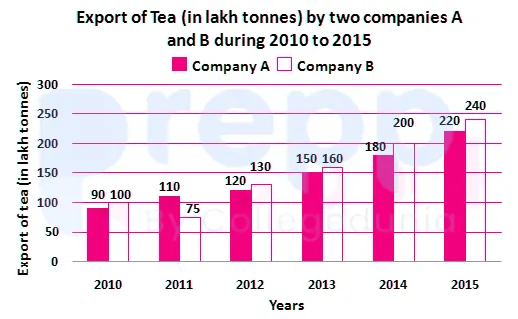
- A
55 ∶ 68
- B
29 ∶ 37
- C
68 ∶ 55
- D
37 ∶ 29
Show answer
A. 55 ∶ 68Total exports of company B in 2011 and 2014 = 75 + 200
⇒ 275
Total exports of company A in 2012 and 2015 = 120 + 220
⇒ 340
Ratio = 275 : 340
⇒ 55 : 68
∴ Required ratio is 55 : 68
Paper & answer key PDF ↗ Question 64archived
if x + y = 3 and \(\frac{1}{x}+\frac{1}{y}=-\frac{3}{10}\) , then the value of (x 2 + y 2) is:
- A
28
- B
34
- C
29
- D
26
Show answer
C. 29Solving Simultaneous Equations to Find x² + y²
We are given two equations involving variables \(x\) and \(y\):
Equation 1: \(x + y = 3\)
Equation 2: \(\frac{1}{x} + \frac{1}{y} = -\frac{3}{10}\)
Our goal is to find the value of \(x^2 + y^2\).
Step 1: Simplify the Second Equation
The second equation involves fractions. We can combine the terms on the left side by finding a common denominator, which is \(xy\):
\[ \frac{1}{x} + \frac{1}{y} = \frac{y}{xy} + \frac{x}{xy} = \frac{y+x}{xy} \]Thus, Equation 2 can be rewritten as:
\[ \frac{x+y}{xy} = -\frac{3}{10} \]
Step 2: Use the First Equation to Substitute
From Equation 1, we know that \(x + y = 3\). We can substitute this value into the simplified Equation 2:
\[ \frac{3}{xy} = -\frac{3}{10} \]
Step 3: Solve for the Product \(xy\)
Now we have a simple equation with \(xy\). We can solve for \(xy\) by cross-multiplication or by isolating \(xy\):
Multiply both sides by \(10xy\) to clear the denominators:
\[ 10 \times 3 = -3 \times xy \]
\[ 30 = -3xy \]
Now, divide both sides by \(-3\):
\[ xy = \frac{30}{-3} \]
\[ xy = -10 \]
So, the product of \(x\) and \(y\) is \(-10\).
Step 4: Use an Algebraic Identity to Find x² + y²
We want to find \(x^2 + y^2\). We know the values of \(x+y\) and \(xy\). There is a useful algebraic identity that relates these terms:
\[ (x+y)^2 = x^2 + 2xy + y^2 \]
We can rearrange this identity to solve for \(x^2 + y^2\):
\[ x^2 + y^2 = (x+y)^2 - 2xy \]
Step 5: Substitute the Known Values and Calculate
Substitute the values \(x+y = 3\) and \(xy = -10\) into the rearranged identity:
\[ x^2 + y^2 = (3)^2 - 2(-10) \]
\[ x^2 + y^2 = 9 - (-20) \]
\[ x^2 + y^2 = 9 + 20 \]
\[ x^2 + y^2 = 29 \]
Therefore, the value of \(x^2 + y^2\) is \(29\).
Given Information
Derived Information
Target Value
\(x+y = 3\)
\(xy = -10\)
\(x^2 + y^2\)
Final Answer
Based on the calculations, the value of \(x^2 + y^2\) is 29.
Revision Table: Key Algebraic Concepts
Concept
Description
Example (related to problem)
Combining Fractions
Adding or subtracting fractions requires a common denominator.
\(\frac{1}{x} + \frac{1}{y} = \frac{y+x}{xy}\)
Solving Equations
Manipulating equations to isolate a variable or expression.
Solving \(\frac{3}{xy} = -\frac{3}{10}\) for \(xy\).
Algebraic Identity
An equation that is true for all values of the variables involved.
\((a+b)^2 = a^2 + 2ab + b^2\)
Substitution
Replacing a variable or expression with its equivalent value.
Substituting \(x+y = 3\) into \(\frac{x+y}{xy} = -\frac{3}{10}\).
Additional Information: Other Algebraic Identities
Understanding algebraic identities is crucial for simplifying expressions and solving equations. Here are a few other common identities you might encounter:
Square of a difference: \((a-b)^2 = a^2 - 2ab + b^2\)
Difference of squares: \(a^2 - b^2 = (a-b)(a+b)\)
Cube of a sum: \((a+b)^3 = a^3 + 3a^2b + 3ab^2 + b^3\)
Cube of a difference: \((a-b)^3 = a^3 - 3a^2b + 3ab^2 - b^3\)
Sum of cubes: \(a^3 + b^3 = (a+b)(a^2 - ab + b^2)\)
Difference of cubes: \(a^3 - b^3 = (a-b)(a^2 + ab + b^2)\)
These identities help in transforming expressions into more manageable forms, which is useful in various algebraic problems, including those involving simultaneous equations like the one we solved.
Paper & answer key PDF ↗ Question 65archived
Simplify the following expression.
\(\frac{(375+125)^2-(125-375)^2}{375\times375-125\times125}\)
- A
\(\frac{15}{8}\)
- B
\(\frac{3}{4}\)
- C
\(\frac{3}{2}\)
- D
\(\frac{27}{28}\)
Show answer
C. \(\frac{3}{2}\)Simplifying a Complex Algebraic Expression
We are asked to simplify the following expression:
\(\frac{(375+125)^2-(125-375)^2}{375\times375-125\times125}\)
This expression looks complicated with numbers, but we can simplify it significantly by using algebraic identities. Let's represent the numbers with variables to see the structure more clearly.
Let \(a = 375\) and \(b = 125\).
The expression can be rewritten as:
\(\frac{(a+b)^2-(b-a)^2}{a^2-b^2}\)
Analyzing the Numerator
The numerator is \((a+b)^2-(b-a)^2\). We know that \((b-a)^2 = (-(a-b))^2 = (a-b)^2\). So the numerator is actually \((a+b)^2 - (a-b)^2\).
We can use the algebraic identity: \((x+y)^2 - (x-y)^2 = 4xy\).
Using this identity with \(x=a\) and \(y=b\), the numerator simplifies to \(4ab\).
Analyzing the Denominator
The denominator is \(a^2-b^2\).
We can use the algebraic identity: \(x^2 - y^2 = (x-y)(x+y)\).
Using this identity with \(x=a\) and \(y=b\), the denominator simplifies to \((a-b)(a+b)\).
Simplifying the Entire Expression
Now substitute the simplified numerator and denominator back into the expression:
\(\frac{\text{Numerator}}{\text{Denominator}} = \frac{4ab}{(a-b)(a+b)}\)
Substituting the Values of a and b
Now, substitute \(a = 375\) and \(b = 125\) back into the simplified expression:
\(\frac{4 \times 375 \times 125}{(375-125)(375+125)}\)
Calculate the values in the denominator:
\(375 - 125 = 250\)
\(375 + 125 = 500\)
So the expression becomes:
\(\frac{4 \times 375 \times 125}{250 \times 500}\)
Now, let's simplify this fraction by cancelling common factors. Notice that \(250 = 2 \times 125\) and \(500 = 4 \times 125\) or \(500 = 2 \times 250\).
\(\frac{4 \times 375 \times 125}{250 \times 500} = \frac{4 \times 375 \times 125}{(2 \times 125) \times (4 \times 125)}\)
Cancel the 4 and 125 from the numerator and denominator:
\(\frac{4 \times 375 \times 125}{(2 \times 125) \times (4 \times 125)} = \frac{375}{2 \times 125} = \frac{375}{250}\)
Now simplify the fraction \(\frac{375}{250}\). Both numbers are divisible by 25.
\(375 \div 25 = 15\)
\(250 \div 25 = 10\)
The fraction becomes \(\frac{15}{10}\).
Both numbers are divisible by 5.
\(15 \div 5 = 3\)
\(10 \div 5 = 2\)
The simplified fraction is \(\frac{3}{2}\).
Final Answer
The simplified value of the given expression is \(\frac{3}{2}\).
Step
Description
Expression
1
Original Expression
\(\frac{(375+125)^2-(125-375)^2}{375^2-125^2}\)
2
Let \(a=375, b=125\)
\(\frac{(a+b)^2-(b-a)^2}{a^2-b^2}\)
3
Simplify Numerator using \((a+b)^2-(a-b)^2=4ab\)
\(4ab\)
4
Simplify Denominator using \(a^2-b^2=(a-b)(a+b)\)
\((a-b)(a+b)\)
5
Simplified Expression (algebraic)
\(\frac{4ab}{(a-b)(a+b)}\)
6
Substitute back \(a=375, b=125\)
\(\frac{4 \times 375 \times 125}{(375-125)(375+125)}\)
7
Calculate denominator values
\(\frac{4 \times 375 \times 125}{(250)(500)}\)
8
Simplify the fraction
\(\frac{3}{2}\)
Revision Table: Key Algebraic Identities for Simplification
Understanding key algebraic identities is crucial for simplifying such expressions quickly and accurately. The identities used here are fundamental.
Square of Sum: \((x+y)^2 = x^2 + 2xy + y^2\)
Square of Difference: \((x-y)^2 = x^2 - 2xy + y^2\)
Difference of Squares: \(x^2 - y^2 = (x-y)(x+y)\)
Derived Identity: \((x+y)^2 - (x-y)^2 = (x^2 + 2xy + y^2) - (x^2 - 2xy + y^2) = x^2 + 2xy + y^2 - x^2 + 2xy - y^2 = 4xy\)
Additional Information: Applying Identities in Math Problems
Using algebraic identities is a powerful technique in mathematics, especially in competitive exams and algebra simplification problems. They help in converting complex expressions into simpler forms, making calculations easier. Recognizing patterns like the difference of squares or the difference of squared sums/differences allows you to bypass lengthy arithmetic calculations. In this specific problem, recognizing \((a+b)^2 - (a-b)^2\) as \(4ab\) and \(a^2 - b^2\) as \((a-b)(a+b)\) was key to simplifying the problem efficiently. Always look for opportunities to apply these standard identities when dealing with squares or differences in algebraic or numerical expressions.
Paper & answer key PDF ↗ Question 66archived
A and B together can complete a certain work in 20 days whereas B and C together can complete it in 24 days. If A is twice as good a workman as C, then in what time will B alone do 40% of the same work?
- A
12 days
- B
10 days
- C
18 days
- D
15 days
Show answer
A. 12 daysUnderstanding the Time and Work Problem
This problem involves understanding the concept of time and work, specifically how individuals working together complete a task and how their efficiencies relate to each other.
We are given information about the time taken by pairs of workers (A and B, B and C) to complete a certain work. We are also given a relationship between the efficiencies of A and C. We need to find the time taken by B alone to complete 40% of the same work.
Setting up the Problem: Efficiency and Total Work
Let's assume the total work to be a certain number of units. A common method is to take the Least Common Multiple (LCM) of the days given. The days given are 20 days (for A and B) and 24 days (for B and C).
LCM(20, 24) = 120 units.
Let the efficiency of A, B, and C (i.e., the amount of work they do per day) be \(a\), \(b\), and \(c\) units/day, respectively.
Formulating Equations based on Given Information
1. A and B together complete the work in 20 days:
Total work = (Combined efficiency) \(\times\) Time taken
\(120 = (a + b) \times 20\)
Dividing both sides by 20, we get the combined efficiency of A and B:
\(a + b = \frac{120}{20} = 6\) units/day. (Equation 1)
2. B and C together complete the work in 24 days:
Total work = (Combined efficiency) \(\times\) Time taken
\(120 = (b + c) \times 24\)
Dividing both sides by 24, we get the combined efficiency of B and C:
\(b + c = \frac{120}{24} = 5\) units/day. (Equation 2)
3. A is twice as good a workman as C:
This means the efficiency of A is twice the efficiency of C.
\(a = 2c\) units/day. (Equation 3)
Solving the System of Equations
We have a system of three linear equations with three variables (\(a\), \(b\), \(c\)):
1. \(a + b = 6\)
2. \(b + c = 5\)
3. \(a = 2c\)
Substitute Equation 3 into Equation 1:
\(2c + b = 6\) (Equation 4)
Now we have two equations (Equation 2 and Equation 4) involving only \(b\) and \(c\):
Equation 4: \(b + 2c = 6\)
Equation 2: \(b + c = 5\)
Subtract Equation 2 from Equation 4:
\((b + 2c) - (b + c) = 6 - 5\)
\(b + 2c - b - c = 1\)
\(c = 1\) unit/day.
Now that we have the value of \(c\), we can find \(a\) using Equation 3:
\(a = 2c = 2 \times 1 = 2\) units/day.
Finally, we can find \(b\) using Equation 2 (or Equation 1):
Using Equation 2: \(b + c = 5\)
\(b + 1 = 5\)
\(b = 5 - 1 = 4\) units/day.
So, the efficiencies are: A does 2 units/day, B does 4 units/day, and C does 1 unit/day.
Calculating Time for B Alone to do 40% Work
The total work is 120 units.
We need to find the time B alone takes to complete 40% of the work.
Amount of work B needs to complete = 40% of 120 units
Work = \(0.40 \times 120 = \frac{40}{100} \times 120 = \frac{2}{5} \times 120 = 2 \times 24 = 48\) units.
The efficiency of B is 4 units/day.
Time taken by B alone to complete 48 units of work = \(\frac{\text{Amount of Work}}{\text{Efficiency of B}}\)
Time = \(\frac{48}{4} = 12\) days.
Conclusion
B alone will take 12 days to complete 40% of the same work.
Workers
Combined Time (days)
Combined Efficiency (units/day)
A + B
20
\(\frac{120}{20} = 6\)
B + C
24
\(\frac{120}{24} = 5\)
Worker
Efficiency (units/day)
A
2
B
4
C
1
40% of total work = \(0.40 \times 120 = 48\) units.
Time for B to do 40% work = \(\frac{48 \text{ units}}{4 \text{ units/day}} = 12 \text{ days}\).
Revision Table: Key Concepts
Concept
Description
Time and Work Relationship
Work = Efficiency \(\times\) Time
Efficiency
The amount of work done per unit of time. Higher efficiency means less time taken to complete work.
Combined Efficiency
When multiple people work together, their efficiencies add up.
Assuming Total Work
Taking LCM of the given time periods simplifies calculations by making the total work an integer.
Additional Information: Variations in Time and Work Problems
Time and work problems can have several variations, including:
Problems involving different efficiencies of workers (like A is twice as good as C).
Problems where workers join or leave the work at different times.
Problems involving wages earned for the work done, which are usually proportional to the work done or efficiency.
Problems involving pipes and cisterns, which are similar to time and work problems where pipes fill or empty a tank (work) over time.
Solving these problems often involves calculating individual or combined efficiencies and then using the relationship Work = Efficiency \(\times\) Time to find the unknown quantity.
Paper & answer key PDF ↗ Question 67archived
Point P lies outside a circle with centre O. Tangents PA and PB are drawn to meet the circle at A and B respectively. If ∠APB = 80°, then ∠OAB is equal to:
- A
140°
- B
40°
- C
70°
- D
35°
Show answer
B. 40°Finding Angle OAB when Tangents PA and PB are Given
This problem involves understanding the properties of tangents drawn from an external point to a circle. We are given a circle with centre O, an external point P, and tangents PA and PB touching the circle at points A and B respectively. We are also given the angle between the tangents, \(\angle\text{APB} = 80^\circ\).
Understanding Key Properties of Tangents and Circles
To solve this problem, we need to recall a few important geometric properties:
A tangent to a circle is perpendicular to the radius through the point of contact. This means \(\angle\text{OAP} = 90^\circ\) and \(\angle\text{OBP} = 90^\circ\).
Tangents drawn from an external point to a circle are equal in length (\(\text{PA} = \text{PB}\)).
The line segment joining the centre of the circle to the external point (PO) bisects the angle between the tangents (\(\angle\text{APB}\)) and also the angle subtended by the chord of contact (AB) at the centre (\(\angle\text{AOB}\)). While PO bisects \(\angle\text{APB}\) and \(\angle\text{AOB}\) is true, a more direct approach uses the quadrilateral OAPB.
The sum of angles in a quadrilateral is \(360^\circ\).
The radii of the same circle are equal (\(\text{OA} = \text{OB}\)). This makes triangle OAB an isosceles triangle.
Step-by-Step Solution to Find Angle OAB
Let's use these properties to find the value of \(\angle\text{OAB}\).
We are given that \(\angle\text{APB} = 80^\circ\).
Since PA and PB are tangents from point P to the circle with centre O, we know that the radii OA and OB are perpendicular to the tangents at points A and B respectively. Therefore, \(\angle\text{OAP} = 90^\circ\) and \(\angle\text{OBP} = 90^\circ\).
Consider the quadrilateral OAPB. The sum of the interior angles of a quadrilateral is \(360^\circ\). So, we have:
\[\angle\text{AOB} + \angle\text{OAP} + \angle\text{OBP} + \angle\text{APB} = 360^\circ\]
Substitute the known values into the equation:
\[\angle\text{AOB} + 90^\circ + 90^\circ + 80^\circ = 360^\circ\]
Simplify the equation:
\[\angle\text{AOB} + 260^\circ = 360^\circ\]
Solve for \(\angle\text{AOB}\):
\[\angle\text{AOB} = 360^\circ - 260^\circ\]
\[\angle\text{AOB} = 100^\circ\]
Now consider the triangle OAB. OA and OB are radii of the same circle, so \(\text{OA} = \text{OB}\). This means that triangle OAB is an isosceles triangle.
In an isosceles triangle, the angles opposite the equal sides are equal. Thus, \(\angle\text{OAB} = \angle\text{OBA}\).
The sum of angles in a triangle is \(180^\circ\). For triangle OAB:
\[\angle\text{OAB} + \angle\text{OBA} + \angle\text{AOB} = 180^\circ\]
Since \(\angle\text{OAB} = \angle\text{OBA}\), let's denote both by \(x\). Substitute the value of \(\angle\text{AOB}\) we found:
\[x + x + 100^\circ = 180^\circ\]
Simplify and solve for \(x\):
\[2x + 100^\circ = 180^\circ\]
\[2x = 180^\circ - 100^\circ\]
\[2x = 80^\circ\]
\[x = \frac{80^\circ}{2}\]
\[x = 40^\circ\]
Therefore, \(\angle\text{OAB} = 40^\circ\).
The value of \(\angle\text{OAB}\) is \(40^\circ\).
Angle/Side
Value/Property
Reason
\(\angle\text{APB}\)
\(80^\circ\)
Given
\(\angle\text{OAP}\)
\(90^\circ\)
Radius is perpendicular to tangent
\(\angle\text{OBP}\)
\(90^\circ\)
Radius is perpendicular to tangent
OAPB
Quadrilateral
Formed by centre, external point, and points of contact
Sum of angles in OAPB
\(360^\circ\)
Property of quadrilateral
\(\angle\text{AOB}\)
\(100^\circ\)
\(360^\circ - (90^\circ + 90^\circ + 80^\circ)\)
OA = OB
Radii
Radii of the same circle are equal
\(\triangle\text{OAB}\)
Isosceles Triangle
OA = OB
\(\angle\text{OAB} = \angle\text{OBA}\)
Equal angles
Angles opposite equal sides in \(\triangle\text{OAB}\)
\(\angle\text{OAB}\)
\(40^\circ\)
\((180^\circ - 100^\circ) / 2\)
Revision Table: Circle Tangent Properties
Property
Description
Relevance to this problem
Tangent-Radius Property
A tangent at any point of a circle is perpendicular to the radius through the point of contact.
Used to determine \(\angle\text{OAP} = \angle\text{OBP} = 90^\circ\).
Tangents from External Point
The lengths of tangents drawn from an external point to a circle are equal.
\(\text{PA} = \text{PB}\) (implies \(\triangle\text{PAB}\) is isosceles, though not directly used in this specific calculation path).
Line joining Centre to External Point
The line joining the centre to the external point bisects the angle between the tangents and the chord of contact.
PO bisects \(\angle\text{APB}\) and AB. (Used implicitly in some alternative solution paths, but the quadrilateral method is more direct here).
Angles in Quadrilateral
The sum of interior angles in a quadrilateral is \(360^\circ\).
Used to find \(\angle\text{AOB}\) from \(\angle\text{APB}\), \(\angle\text{OAP}\), \(\angle\text{OBP}\).
Angles in Isosceles Triangle
In an isosceles triangle, the angles opposite the equal sides are equal.
Used in \(\triangle\text{OAB}\) to find \(\angle\text{OAB}\) and \(\angle\text{OBA}\) from \(\angle\text{AOB}\).
Additional Information: Alternative Approach
Another way to approach this problem is using the bisection property of PO.
Since PO bisects \(\angle\text{APB}\), \(\angle\text{APO} = \angle\text{BPO} = \frac{80^\circ}{2} = 40^\circ\).
Consider the right-angled triangle OAP (since \(\angle\text{OAP} = 90^\circ\)).
The sum of angles in \(\triangle\text{OAP}\) is \(180^\circ\).
\[\angle\text{AOP} + \angle\text{OAP} + \angle\text{APO} = 180^\circ\]
Substitute known values:
\[\angle\text{AOP} + 90^\circ + 40^\circ = 180^\circ\]
Solve for \(\angle\text{AOP}\):
\[\angle\text{AOP} + 130^\circ = 180^\circ\]
\[\angle\text{AOP} = 180^\circ - 130^\circ\]
\[\angle\text{AOP} = 50^\circ\]
PO also bisects \(\angle\text{AOB}\), so \(\angle\text{AOB} = 2 \times \angle\text{AOP} = 2 \times 50^\circ = 100^\circ\). This matches the previous method.
Now, proceed with triangle OAB as before: \(\triangle\text{OAB}\) is isosceles with \(\text{OA} = \text{OB}\).
\[\angle\text{OAB} = \angle\text{OBA} = \frac{180^\circ - \angle\text{AOB}}{2} = \frac{180^\circ - 100^\circ}{2} = \frac{80^\circ}{2} = 40^\circ\]
Both methods yield the same result, \(\angle\text{OAB} = 40^\circ\).
Paper & answer key PDF ↗ Question 68archived
Akhil takes 30 minutes extra to cover a distance of 150 km if he drives 10 km/h slower than his usual speed. How much time will be take to drive 90 km if he drives 15 km per hour slower than his usual speed?
- A
2 h 15 m
- B
2 h
- C
2 h 45 m
- D
2 h 30 m
Show answer
B. 2 hUnderstanding the Speed, Distance, and Time Problem
This problem involves calculating the time taken for a journey based on different speeds. We are given information about how a change in speed affects the time taken to cover a certain distance. We need to use this information to find the original speed and then calculate the time for a different distance at a different reduced speed.
Setting Up the Equations for Akhil's Journey
Let's define the variables for Akhil's usual journey:
Let the usual speed of Akhil be \(v\) km/h.
Let the usual time taken to cover 150 km be \(t\) hours.
The relationship between distance, speed, and time is: Distance = Speed × Time.
For the usual journey of 150 km:
\[150 = v \times t \quad \text{(Equation 1)}\]
In the first scenario described, Akhil drives 10 km/h slower than his usual speed. This means his new speed is \((v - 10)\) km/h.
He takes 30 minutes extra. 30 minutes is equal to 0.5 hours. So, the new time taken is \((t + 0.5)\) hours.
The distance covered in this scenario is still 150 km.
Using the distance formula for this scenario:
\[150 = (v - 10) \times (t + 0.5) \quad \text{(Equation 2)}\]
Solving for Akhil's Usual Speed
We now have two equations with two unknowns, \(v\) and \(t\). We can solve these equations simultaneously.
From Equation 1, we can express \(t\) in terms of \(v\):
\[t = \frac{150}{v}\]
Substitute this expression for \(t\) into Equation 2:
\[150 = (v - 10) \left(\frac{150}{v} + 0.5\right)\]
Now, let's expand the right side of the equation:
\[150 = v \times \frac{150}{v} + v \times 0.5 - 10 \times \frac{150}{v} - 10 \times 0.5\]
\[150 = 150 + 0.5v - \frac{1500}{v} - 5\]
Subtract 150 from both sides:
\[0 = 0.5v - \frac{1500}{v} - 5\]
Multiply the entire equation by \(v\) to eliminate the denominator:
\[0 = 0.5v^2 - 1500 - 5v\]
Rearrange the terms to form a quadratic equation:
\[0.5v^2 - 5v - 1500 = 0\]
Multiply by 2 to get rid of the decimal:
\[v^2 - 10v - 3000 = 0\]
We can solve this quadratic equation for \(v\) using factoring. We need two numbers that multiply to -3000 and add up to -10. These numbers are -60 and 50.
\[(v - 60)(v + 50) = 0\]
This gives two possible values for \(v\):
\(v - 60 = 0 \implies v = 60\)
\(v + 50 = 0 \implies v = -50\)
Since speed cannot be negative, Akhil's usual speed \(v\) is 60 km/h.
Calculating Time for the Second Scenario
Now we need to find the time Akhil will take to drive 90 km if he drives 15 km per hour slower than his usual speed.
His usual speed is 60 km/h.
The new speed is 15 km/h slower, so the new speed is \(60 - 15 = 45\) km/h.
The distance to cover is 90 km.
Using the distance formula, Time = Distance / Speed:
\[\text{Time} = \frac{90 \text{ km}}{45 \text{ km/h}}\]
\[\text{Time} = 2 \text{ hours}\]
The time taken to drive 90 km at 45 km/h is 2 hours.
Summary of Calculations
Aspect
Usual Journey
Scenario 1 (150 km)
Scenario 2 (90 km)
Distance
150 km
150 km
90 km
Speed
\(v\) km/h (found to be 60 km/h)
\(v - 10\) km/h (60 - 10 = 50 km/h)
\(v - 15\) km/h (60 - 15 = 45 km/h)
Time
\(t\) hours
\(t + 0.5\) hours
? hours (calculated to be 2 hours)
The calculation shows that Akhil will take 2 hours to drive 90 km at a speed of 45 km/h.
Revision Table: Key Concepts Review
Concept
Explanation
Formula
Speed
Rate at which distance is covered per unit of time.
Speed = Distance / Time
Distance
Total length of the path covered during a journey.
Distance = Speed × Time
Time
Duration taken to cover a certain distance at a specific speed.
Time = Distance / Speed
Solving Equations
Using algebraic methods (like substitution or elimination) to find unknown variables in a system of equations.
Example: \(ax + by = c\), \(dx + ey = f\)
Quadratic Equations
Equations of the form \(ax^2 + bx + c = 0\), where \(x\) is the variable and \(a, b, c\) are coefficients. Can be solved by factoring, completing the square, or the quadratic formula.
Formula: \(x = \frac{-b \pm \sqrt{b^2 - 4ac}}{2a}\)
Additional Information on Speed, Distance, and Time Problems
Speed, distance, and time problems are common in quantitative aptitude. They often involve scenarios where one variable changes, affecting the others. It's crucial to set up the relationships correctly using the fundamental formula: Distance = Speed × Time.
Key strategies for solving these problems include:
Defining variables clearly for unknown quantities (like usual speed or usual time).
Translating the given information into mathematical equations. Pay attention to units (km, hours, minutes) and convert them if necessary (e.g., minutes to hours).
Solving the system of equations to find the unknown variables. This might involve substitution, elimination, or solving quadratic equations.
Once the base values (like usual speed) are found, use them to calculate the required quantity in the second part of the problem.
Always check if the calculated values make sense in the context of the problem (e.g., speed cannot be negative).
These problems test your ability to apply algebraic skills to practical situations.
Paper & answer key PDF ↗ Question 69archived
Chord AB of a circle of radius 10 cm is at a distance 8 cm from the centre O. If tangents drawn at A and B intersect at P., then the length of the tangent AP (in cm) is:
- A
4
- B
15
- C
3.75
- D
7.5
Show answer
D. 7.5Finding the Length of the Tangent to a Circle
This problem involves a circle, a chord, its distance from the centre, and tangents drawn from the endpoints of the chord that intersect at an external point. We need to find the length of one of these tangents.
Understanding the Geometry
Let O be the centre of the circle and R be its radius. We are given R = 10 cm. Let AB be the chord, and the distance of the chord from the centre O is given as 8 cm. Let M be the midpoint of the chord AB, such that OM is perpendicular to AB. Thus, OM = 8 cm.
In the right-angled triangle OMA, OA is the radius (hypotenuse), OM is the distance from the centre, and AM is half the length of the chord. We can use the Pythagorean theorem here.
According to the Pythagorean theorem:
\(OA^2 = OM^2 + AM^2\)
Substituting the given values:
\(10^2 = 8^2 + AM^2\)
\(100 = 64 + AM^2\)
\(AM^2 = 100 - 64\)
\(AM^2 = 36\)
\(AM = \sqrt{36} = 6\) cm (Since length must be positive)
So, the length of AM is 6 cm. Since M is the midpoint of AB, the length of the chord AB is \(2 \times AM = 2 \times 6 = 12\) cm.
Tangents from an External Point
Tangents are drawn at points A and B on the circle, and they intersect at point P outside the circle. A property of tangents drawn from an external point to a circle is that they are equal in length. So, AP = BP.
Also, the radius drawn to the point of contact of a tangent is perpendicular to the tangent at that point. Therefore, OA is perpendicular to AP, and OB is perpendicular to BP. This means that \(\angle OAP = 90^\circ\) and \(\angle OBP = 90^\circ\).
Consider the triangle OAP. It is a right-angled triangle with the right angle at A. We know OA = 10 cm. We need to find the length of the tangent AP.
Using Similarity of Triangles
Let's consider the triangles OMA and OAP. Both are right-angled triangles (\(\angle OMA = 90^\circ\) and \(\angle OAP = 90^\circ\)).
We can show that these two triangles are similar using the AA similarity criterion.
\(\angle OMA = \angle OAP = 90^\circ\) (Right angles)
Let's look at angles. In \(\triangle OMA\), \(\angle OAM = 90^\circ - \angle AOM\).
Consider the quadrilateral OAPB. The sum of angles is 360°. \(\angle OAP + \angle APB + \angle PBO + \angle BOA = 360^\circ\). Since \(\angle OAP = \angle PBO = 90^\circ\), we have \(90^\circ + \angle APB + 90^\circ + \angle BOA = 360^\circ\), which simplifies to \(\angle APB + \angle BOA = 180^\circ\).
The line segment OP bisects the angle \(\angle APB\) and also the angle \(\angle BOA\). So, \(\angle AOP = \angle BOP\) and \(\angle APO = \angle BPO\).
Also, \(\angle BOA = 2 \times \angle AOM\). Therefore, \(\angle AOP = \frac{1}{2} \angle BOA = \angle AOM\). This is incorrect. OP bisects the chord perpendicularly, and also the angle subtended by the chord at the centre. Thus, M lies on OP. Let's correct this. The line joining the centre to the external point P bisects the chord AB at M. This means O, M, and P are collinear.
Let's reconsider the similarity using angles. In right triangle OMA, \(\angle MOA + \angle OAM = 90^\circ\).
In right triangle OAP, \(\angle AOP + \angle APO = 90^\circ\).
Since O, M, P are collinear, \(\angle AOP = \angle AOM\). This is the correct relationship. The line OMP bisects the chord AB and also the angle ∠AOB.
Therefore, \(\angle AOM = \angle AOP\).
Now comparing \(\triangle OMA\) and \(\triangle OAP\):
\(\angle OMA = \angle OAP = 90^\circ\)
\(\angle AOM = \angle AOP\) (Common angle)
By AA similarity, \(\triangle OMA \sim \triangle OAP\).
Now we can use the ratio of corresponding sides from the similar triangles.
The side opposite to \(\angle OAM\) in \(\triangle OMA\) is OM. The side opposite to \(\angle OPA\) (which is \(\angle OAM\) since sum of angles in OMA is 180 and OAP is 180, and AOM=AOP, 90=90, then OAM must be equal to OPA) in \(\triangle OAP\) is OA.
The side opposite to \(\angle AOM\) in \(\triangle OMA\) is AM. The side opposite to \(\angle AOP\) in \(\triangle OAP\) is AP.
The side opposite to \(\angle OMA\) in \(\triangle OMA\) is OA. The side opposite to \(\angle OAP\) in \(\triangle OAP\) is OP.
So, the ratios of corresponding sides are:
\(\frac{OM}{OA} = \frac{AM}{AP} = \frac{OA}{OP}\)
We need to find AP. Let's use the first ratio:
\(\frac{OM}{OA} = \frac{AM}{AP}\)
Substitute the known values: OM = 8 cm, OA = 10 cm, and AM = 6 cm.
\(\frac{8}{10} = \frac{6}{AP}\)
Now, solve for AP:
\(8 \times AP = 10 \times 6\)
\(8 \times AP = 60\)
\(AP = \frac{60}{8}\)
\(AP = \frac{30}{4}\)
\(AP = 7.5\) cm
Thus, the length of the tangent AP is 7.5 cm.
Quantity
Value
Source
Circle Radius (OA)
10 cm
Given
Distance of Chord from Centre (OM)
8 cm
Given
Half Chord Length (AM)
6 cm
Calculated from Pythagorean theorem
Triangle OMA
Right-angled at M
Geometry
Triangle OAP
Right-angled at A
Radius perpendicular to tangent
Similarity
\(\triangle OMA \sim \triangle OAP\)
AA Similarity (\(\angle OMA = \angle OAP = 90^\circ\), \(\angle AOM = \angle AOP\))
Ratio of sides
\(\frac{OM}{OA} = \frac{AM}{AP}\)
From similarity
Length of tangent AP
7.5 cm
Calculated
Revision Table: Circle Geometry Concepts
Concept
Description
Relevance to Problem
Pythagorean Theorem
In a right-angled triangle, the square of the hypotenuse is equal to the sum of the squares of the other two sides (\(a^2 + b^2 = c^2\)).
Used to find half the chord length (AM) in \(\triangle OMA\).
Radius perpendicular to Chord
A line from the centre perpendicular to a chord bisects the chord.
Establishes M as the midpoint of AB and \(\angle OMA = 90^\circ\).
Tangent-Radius Property
The radius drawn to the point of contact of a tangent is perpendicular to the tangent.
Establishes \(\angle OAP = 90^\circ\).
Tangents from External Point
Tangents drawn from an external point to a circle are equal in length. The line joining the centre to the external point bisects the angle between the tangents and the angle subtended by the chord at the centre.
Establishes AP = BP and that O, M, P are collinear, leading to \(\angle AOM = \angle AOP\).
Similarity of Triangles
Two triangles are similar if their corresponding angles are equal (AA, AAA criteria) or if the ratio of corresponding sides is equal (SSS criterion) or two sides are proportional and the included angle is equal (SAS criterion).
Used to establish \(\triangle OMA \sim \triangle OAP\) and set up proportions to find AP.
Additional Information on Tangents and Chords
A tangent is a line that touches a circle at exactly one point, called the point of contact. A chord is a line segment connecting two points on a circle.
Key properties used in solving problems like this:
The perpendicular from the centre of a circle to a chord bisects the chord.
The line joining the centre of a circle to an external point from which two tangents are drawn bisects the angle between the tangents and the chord joining the points of contact. This line also passes through the midpoint of the chord and is perpendicular to the chord.
The angle between a tangent and the chord through the point of contact is equal to the angle in the alternate segment (Tangent-Chord Theorem). While not directly used in this specific calculation method, it's another important property involving tangents and chords.
Understanding these geometric relationships is crucial for solving problems involving circles, chords, and tangents.
Paper & answer key PDF ↗ Question 70archived
The perimeter of a semi circle is 25.7 cm. What is its diameter (in cm)? (π = 3.14)
- A
8
- B
12
- C
10
- D
9
Show answer
C. 10Calculating Semicircle Diameter from Perimeter
The question asks us to find the diameter of a semicircle given its perimeter and the value of $\pi$. We are given:
Perimeter of the semicircle = $25.7$ cm
Value of $\pi$ = $3.14$
Let the diameter of the semicircle be $d$ cm. The perimeter of a semicircle is the sum of the length of the curved arc (which is half the circumference of a full circle) and the length of the straight edge (which is the diameter).
The circumference of a full circle with diameter $d$ is given by the formula $C = \pi d$.
The length of the curved arc of the semicircle is half of the circumference: $\frac{1}{2} \times \pi d$.
The straight edge is the diameter, which is $d$.
Therefore, the perimeter of the semicircle is given by the formula:
$\text{Perimeter} = (\text{Curved Arc}) + (\text{Straight Edge})$
$\text{Perimeter} = \frac{1}{2}\pi d + d$
We can factor out $d$ from the formula:
$\text{Perimeter} = d \left(\frac{\pi}{2} + 1\right)$
Now, we substitute the given values into the formula:
$25.7 = d \left(\frac{3.14}{2} + 1\right)$
First, calculate the value inside the parenthesis:
$\frac{3.14}{2} = 1.57$
So, the equation becomes:
$25.7 = d (1.57 + 1)$
$25.7 = d (2.57)$
To find the diameter $d$, we need to divide the perimeter by $2.57$:
$d = \frac{25.7}{2.57}$
Performing the division:
$d = 10$
The diameter of the semicircle is $10$ cm.
Now let's check the given options:
Option 1: $8$ cm
Option 2: $12$ cm
Option 3: $10$ cm
Option 4: $9$ cm
Our calculated diameter of $10$ cm matches Option 3.
Revision Table for Semicircle Perimeter
Concept
Formula
Notes
Circumference (full circle)
$C = \pi d$ or $C = 2\pi r$
$d$ is diameter, $r$ is radius ($d=2r$)
Area (full circle)
$A = \pi r^2$ or $A = \frac{\pi d^2}{4}$
Perimeter (semicircle)
$P = \frac{1}{2}\pi d + d$ or $P = \pi r + 2r$
Sum of curved arc and diameter
Area (semicircle)
$A = \frac{1}{2}\pi r^2$ or $A = \frac{\pi d^2}{8}$
Half the area of a full circle
Additional Information on Semicircle Calculations
A semicircle is essentially half of a circle. When dealing with semicircle problems, it's crucial to distinguish between its area and its perimeter. The area is straightforward - it's half the area of the corresponding full circle.
However, the perimeter is often where mistakes happen. The perimeter includes the curved part (the arc) and the straight part (the diameter). Think of it as walking around the edge of the shape. You walk along the curve and then back across the straight line that cuts the circle in half.
The value of $\pi$ is approximately $3.14159$. In many problems, a rounded value like $3.14$ or $\frac{22}{7}$ is provided to simplify calculations. Always use the value given in the question.
Understanding the relationship between radius ($r$) and diameter ($d$), where $d=2r$, is also fundamental for these types of geometry problems.
Paper & answer key PDF ↗ Question 71archived
Find the value of sin 4 30° + cos 4 30° - sin 25° cos 65° - sin 65° cos25°.
- A
\(\frac{5}{8}\)
- B
\(-\frac{3}{8}\)
- C
\(\frac{13}{8}\)
- D
0
Show answer
B. \(-\frac{3}{8}\)Evaluating Trigonometric Expressions: Step-by-Step Solution
We need to find the value of the given trigonometric expression: \( \sin^4 30^\circ + \cos^4 30^\circ - \sin 25^\circ \cos 65^\circ - \sin 65^\circ \cos 25^\circ \).
Let's break down the expression into two main parts and evaluate each part separately.
Part 1: Evaluating \( \sin^4 30^\circ + \cos^4 30^\circ \)
First, recall the standard trigonometric values for \(30^\circ\):
\( \sin 30^\circ = \frac{1}{2} \)
\( \cos 30^\circ = \frac{\sqrt{3}}{2} \)
Now, let's calculate the fourth powers:
\( \sin^4 30^\circ = (\sin 30^\circ)^4 = \left(\frac{1}{2}\right)^4 = \frac{1^4}{2^4} = \frac{1}{16} \)
\( \cos^4 30^\circ = (\cos 30^\circ)^4 = \left(\frac{\sqrt{3}}{2}\right)^4 = \frac{(\sqrt{3})^4}{2^4} = \frac{(\sqrt{3}^2)^2}{16} = \frac{3^2}{16} = \frac{9}{16} \)
Adding these two values:
\( \sin^4 30^\circ + \cos^4 30^\circ = \frac{1}{16} + \frac{9}{16} = \frac{1+9}{16} = \frac{10}{16} \)
This fraction can be simplified by dividing the numerator and denominator by their greatest common divisor, which is 2:
\( \frac{10}{16} = \frac{10 \div 2}{16 \div 2} = \frac{5}{8} \)
So, the first part of the expression evaluates to \( \frac{5}{8} \).
Part 2: Evaluating \( \sin 25^\circ \cos 65^\circ + \sin 65^\circ \cos 25^\circ \)
The second part of the expression is \( -(\sin 25^\circ \cos 65^\circ + \sin 65^\circ \cos 25^\circ) \). Let's evaluate the term inside the parenthesis.
This term looks like a familiar trigonometric identity. Recall the sine addition formula:
\( \sin(A+B) = \sin A \cos B + \cos A \sin B \)
Comparing this with our term, \( \sin 25^\circ \cos 65^\circ + \sin 65^\circ \cos 25^\circ \), we can see that it matches the right side of the identity with \( A = 25^\circ \) and \( B = 65^\circ \). Note that the order of the second term is reversed in the original expression (\( \sin 65^\circ \cos 25^\circ \) instead of \( \cos 25^\circ \sin 65^\circ \)), but multiplication is commutative, so \( \sin 65^\circ \cos 25^\circ = \cos 25^\circ \sin 65^\circ \).
Using the identity:
\( \sin 25^\circ \cos 65^\circ + \sin 65^\circ \cos 25^\circ = \sin(25^\circ + 65^\circ) = \sin 90^\circ \)
We know that \( \sin 90^\circ = 1 \).
Alternatively, we could use complementary angle identities. Since \( 25^\circ + 65^\circ = 90^\circ \), \( 65^\circ \) is the complement of \( 25^\circ \). Thus:
\( \cos 65^\circ = \cos(90^\circ - 25^\circ) = \sin 25^\circ \)
\( \sin 65^\circ = \sin(90^\circ - 25^\circ) = \cos 25^\circ \)
Substituting these into the term \( \sin 25^\circ \cos 65^\circ + \sin 65^\circ \cos 25^\circ \):
\( \sin 25^\circ (\sin 25^\circ) + (\cos 25^\circ) \cos 25^\circ = \sin^2 25^\circ + \cos^2 25^\circ \)
Recall the fundamental trigonometric identity \( \sin^2 \theta + \cos^2 \theta = 1 \). With \( \theta = 25^\circ \), we have:
\( \sin^2 25^\circ + \cos^2 25^\circ = 1 \)
Both methods confirm that \( \sin 25^\circ \cos 65^\circ + \sin 65^\circ \cos 25^\circ = 1 \).
So, the second part of the original expression, \( -(\sin 25^\circ \cos 65^\circ + \sin 65^\circ \cos 25^\circ) \), evaluates to \( -(1) = -1 \).
Combining the Parts to Find the Final Value
The original expression is the sum of the results from Part 1 and the negative of the result from Part 2:
Expression Value = (Value of \( \sin^4 30^\circ + \cos^4 30^\circ \)) - (Value of \( \sin 25^\circ \cos 65^\circ + \sin 65^\circ \cos 25^\circ \))
Expression Value = \( \frac{5}{8} - 1 \)
To subtract 1 from \( \frac{5}{8} \), we write 1 as a fraction with a denominator of 8:
\( 1 = \frac{8}{8} \)
So, Expression Value = \( \frac{5}{8} - \frac{8}{8} = \frac{5-8}{8} = \frac{-3}{8} \)
The final value of the expression is \( -\frac{3}{8} \).
Summary of Evaluation Steps
Here is a summary of the steps taken to evaluate the expression:
Identified the expression components.
Evaluated \( \sin 30^\circ \) and \( \cos 30^\circ \).
Calculated \( \sin^4 30^\circ \) and \( \cos^4 30^\circ \).
Summed the fourth powers: \( \frac{1}{16} + \frac{9}{16} = \frac{10}{16} = \frac{5}{8} \).
Recognized the second part as a sum/difference identity or used complementary angles.
Evaluated \( \sin 25^\circ \cos 65^\circ + \sin 65^\circ \cos 25^\circ \) as \( \sin(25^\circ + 65^\circ) = \sin 90^\circ = 1 \).
Combined the results: \( \frac{5}{8} - 1 = -\frac{3}{8} \).
Part
Expression
Evaluation
Value
Part 1
\( \sin^4 30^\circ + \cos^4 30^\circ \)
\( (\frac{1}{2})^4 + (\frac{\sqrt{3}}{2})^4 = \frac{1}{16} + \frac{9}{16} = \frac{10}{16} \)
\( \frac{5}{8} \)
Part 2
\( \sin 25^\circ \cos 65^\circ + \sin 65^\circ \cos 25^\circ \)
\( \sin(25^\circ + 65^\circ) = \sin 90^\circ \)
\( 1 \)
Full Expression
\( (\sin^4 30^\circ + \cos^4 30^\circ) - (\sin 25^\circ \cos 65^\circ + \sin 65^\circ \cos 25^\circ) \)
\( \frac{5}{8} - 1 \)
\( -\frac{3}{8} \)
Revision Table: Key Trigonometric Values & Identities
Angle (\( \theta \))
\( \sin \theta \)
\( \cos \theta \)
\( \tan \theta \)
\( 30^\circ \)
\( \frac{1}{2} \)
\( \frac{\sqrt{3}}{2} \)
\( \frac{1}{\sqrt{3}} \)
\( 90^\circ \)
\( 1 \)
\( 0 \)
Undefined
Important Identities Used:
Pythagorean Identity: \( \sin^2 \theta + \cos^2 \theta = 1 \)
Complementary Angle Identity: \( \cos(90^\circ - \theta) = \sin \theta \) and \( \sin(90^\circ - \theta) = \cos \theta \)
Sum Formula for Sine: \( \sin(A+B) = \sin A \cos B + \cos A \sin B \)
Additional Information: Understanding Higher Powers of Sine and Cosine
Calculating higher powers like \( \sin^4 \theta \) and \( \cos^4 \theta \) simply means raising the value of \( \sin \theta \) or \( \cos \theta \) to the power of 4. For example, \( \sin^4 30^\circ = (\sin 30^\circ)^4 \). There are also reduction formulas for higher powers, but for standard angles like \( 30^\circ \) where the basic values are known, direct calculation is straightforward.
The sum formula for sine, \( \sin(A+B) = \sin A \cos B + \cos A \sin B \), is a fundamental identity derived from the unit circle or geometric proofs. It allows us to find the sine of a sum of two angles if we know the sines and cosines of the individual angles. In this problem, recognizing the pattern \( \sin A \cos B + \cos A \sin B \) with \( A=25^\circ \) and \( B=65^\circ \) was key to simplifying the second part of the expression quickly by calculating \( \sin(25^\circ+65^\circ) = \sin 90^\circ \).
Complementary angle identities are useful when dealing with angles that add up to \( 90^\circ \). They show the relationship between trigonometric functions of an angle and its complement. For instance, \( \cos 65^\circ = \sin 25^\circ \) because \( 65^\circ + 25^\circ = 90^\circ \).
Paper & answer key PDF ↗ Question 72archived
Find the ratio between the fourth proportional of 12, 16, 6 and the third proportional of 4, 6.
- A
11 ∶ 5
- B
3 ∶ 2
- C
4 ∶ 3
- D
8 ∶ 9
Show answer
D. 8 ∶ 9Understanding Proportions and Ratios Concepts
This problem requires us to find the ratio between two values derived from proportions: the fourth proportional of three given numbers and the third proportional of two given numbers. Let's break down how to find each of these values.
Calculating the Fourth Proportional
When four numbers, say \(a, b, c,\) and \(d\), are in proportion, they satisfy the relationship \(a:b :: c:d\). This can be written as the equality of two ratios: \(\frac{a}{b} = \frac{c}{d}\). Here, \(d\) is called the fourth proportional to \(a, b,\) and \(c\).
We are given the numbers 12, 16, and 6, and we need to find the fourth proportional. Let the fourth proportional be \(x\). So, we have the proportion:
\(12 : 16 :: 6 : x\)
Writing this as fractions, we get:
\(\frac{12}{16} = \frac{6}{x}\)
To solve for \(x\), we can cross-multiply:
\(12 \times x = 16 \times 6\)
\(12x = 96\)
Now, divide both sides by 12:
\(x = \frac{96}{12}\)
\(x = 8\)
So, the fourth proportional of 12, 16, and 6 is 8.
Calculating the Third Proportional
When three numbers, say \(a, b,\) and \(c\), are in continued proportion, they satisfy the relationship \(a:b :: b:c\). This means the ratio of the first two terms is equal to the ratio of the second and third terms. This can be written as the equality of two ratios: \(\frac{a}{b} = \frac{b}{c}\). Here, \(c\) is called the third proportional to \(a\) and \(b\), and \(b\) is called the mean proportional between \(a\) and \(c\).
We are given the numbers 4 and 6, and we need to find the third proportional. Let the third proportional be \(y\). The continued proportion is:
\(4 : 6 :: 6 : y\)
Writing this as fractions, we get:
\(\frac{4}{6} = \frac{6}{y}\)
To solve for \(y\), we can cross-multiply:
\(4 \times y = 6 \times 6\)
\(4y = 36\)
Now, divide both sides by 4:
\(y = \frac{36}{4}\)
\(y = 9\)
So, the third proportional of 4 and 6 is 9.
Determining the Final Ratio
The question asks for the ratio between the fourth proportional of 12, 16, 6 and the third proportional of 4, 6.
Fourth proportional = 8
Third proportional = 9
The ratio is simply the first value compared to the second value:
Ratio = (Fourth proportional) : (Third proportional)
Ratio = 8 : 9
This ratio cannot be simplified further, as 8 and 9 have no common factors other than 1.
Summary of Proportion Calculations
Here is a summary of the calculated values:
ConceptGiven NumbersCalculationResult
Fourth Proportional12, 16, 6\(\frac{12}{16} = \frac{6}{x} \implies 12x = 96 \implies x = 8\)8
Third Proportional4, 6\(\frac{4}{6} = \frac{6}{y} \implies 4y = 36 \implies y = 9\)9
The ratio of these results is 8 : 9.
Revision Table: Key Proportion Definitions
Understanding different types of proportionals is crucial:
TermDefinitionRelationship
RatioA comparison of two quantities.\(a:b\) or \(\frac{a}{b}\)
ProportionAn equality of two ratios.\(\frac{a}{b} = \frac{c}{d}\)
Fourth ProportionalIn \(a:b = c:d\), \(d\) is the fourth proportional.\(ad = bc\)
Third ProportionalIn \(a:b = b:c\), \(c\) is the third proportional.\(ac = b^2\)
Mean ProportionalIn \(a:b = b:c\), \(b\) is the mean proportional between \(a\) and \(c\).\(b^2 = ac\)
Additional Information on Ratios and Proportions
Ratios and proportions are fundamental concepts in arithmetic and algebra. They are used to compare quantities and understand relationships between them.
Ratio: Expresses how many times one number contains another. It can be written as \(a:b\) or as a fraction \(\frac{a}{b}\). Ratios can be simplified by dividing both parts by their greatest common divisor.
Proportion: A statement that two ratios are equal. For example, \(a:b = c:d\). This indicates that \(a\) is to \(b\) as \(c\) is to \(d\). Proportions are useful for solving problems involving scaling, recipes, mixtures, and more.
Finding proportionals (third, fourth, mean) involves setting up the correct proportional relationship based on the given numbers and solving for the unknown term. Always ensure the terms are placed in the correct order according to the definition of the specific proportional you are looking for.
Paper & answer key PDF ↗ Question 73archived
If the 8-digit number 888x53y4 is divisible by 72, then what is the value of (7x + 2y), for the maximum value of y?
- A
19
- B
15
- C
23
- D
27
Show answer
C. 23Understanding Divisibility by 72
A number is divisible by 72 if it is divisible by both 8 and 9, as 72 is the product of 8 and 9, and 8 and 9 are coprime numbers.
The given 8-digit number is 888x53y4. For this number to be divisible by 72, it must satisfy the divisibility rules for both 8 and 9.
Applying Divisibility Rules for 8 and 9
Divisibility Rule for 8
A number is divisible by 8 if the number formed by its last three digits is divisible by 8.
In the number 888x53y4, the last three digits form the number 3y4. So, 3y4 must be divisible by 8.
We need to find the possible values of the digit y (where y can be 0, 1, 2, ..., 9) such that 3y4 is divisible by 8. We are looking for the maximum value of y.
Let's test values for y:
If y=0, the number is 304. \(304 \div 8 = 38\). So, y=0 is possible.
If y=1, the number is 314. \(314 \div 8\) is not an integer.
If y=2, the number is 324. \(324 \div 8\) is not an integer.
If y=3, the number is 334. \(334 \div 8\) is not an integer.
If y=4, the number is 344. \(344 \div 8 = 43\). So, y=4 is possible.
If y=5, the number is 354. \(354 \div 8\) is not an integer.
If y=6, the number is 364. \(364 \div 8\) is not an integer.
If y=7, the number is 374. \(374 \div 8\) is not an integer.
If y=8, the number is 384. \(384 \div 8 = 48\). So, y=8 is possible.
If y=9, the number is 394. \(394 \div 8\) is not an integer.
The possible values for y are 0, 4, and 8. The maximum value of y is 8.
Divisibility Rule for 9
A number is divisible by 9 if the sum of its digits is divisible by 9.
The digits of the number 888x53y4 are 8, 8, 8, x, 5, 3, y, 4.
The sum of the digits is \(8 + 8 + 8 + x + 5 + 3 + y + 4 = 36 + x + y\).
Since the number is divisible by 72, it must be divisible by 9. Therefore, the sum of the digits (\(36 + x + y\)) must be divisible by 9.
We found the maximum value of y from the divisibility by 8 condition to be y = 8. We substitute this value into the sum of digits:
Sum of digits = \(36 + x + 8 = 44 + x\)
For \(44 + x\) to be divisible by 9, and x being a single digit (0-9), we check possible values for x:
If \(44 + x = 45\), then \(x = 1\). (45 is divisible by 9)
If \(44 + x = 54\), then \(x = 10\). (10 is not a single digit, so this is not possible)
The only single-digit value for x that makes \(44 + x\) divisible by 9 is x = 1.
So, for the maximum value of y (which is 8), the corresponding value of x is 1.
Calculating the Expression (7x + 2y)
We need to find the value of the expression \(7x + 2y\) using the values x = 1 and y = 8.
\(7x + 2y = 7(1) + 2(8)\)
\(= 7 + 16\)
\(= 23\)
Final Answer for Divisibility Problem
For the 8-digit number 888x53y4 to be divisible by 72, with the maximum value of y, we found x = 1 and y = 8.
The value of \(7x + 2y\) is 23.
Revision Table: Key Concepts
Concept
Description
Application in Problem
Divisibility by 72
Number must be divisible by both 8 and 9.
Used as the primary condition for 888x53y4.
Divisibility Rule for 8
Last three digits form a number divisible by 8.
Applied to 3y4 to find possible values of y.
Divisibility Rule for 9
Sum of digits must be divisible by 9.
Applied to the sum 8+8+8+x+5+3+y+4.
Maximum Value of y
Identify the largest y from the possible values found by divisibility by 8.
Selected y=8 from {0, 4, 8}.
Finding x
Use the sum of digits and the maximum y to find the corresponding x.
Calculated \(44 + x\) must be divisible by 9, leading to x=1.
Additional Information: Understanding Divisibility Rules
Divisibility rules are shortcuts to determine if a number is divisible by another number without performing long division. They are very useful in number theory problems and competitive exams.
Divisibility by 8: Look at the number formed by the last three digits. If this number is divisible by 8, the original number is divisible by 8. Example: In 123456, the last three digits form 456. \(456 \div 8 = 57\), so 123456 is divisible by 8.
Divisibility by 9: Sum up all the digits of the number. If the sum is divisible by 9, the original number is divisible by 9. Example: In 12345, the sum of digits is \(1+2+3+4+5 = 15\). 15 is not divisible by 9, so 12345 is not divisible by 9. In 123453, the sum of digits is \(1+2+3+4+5+3 = 18\). 18 is divisible by 9, so 123453 is divisible by 9.
Divisibility by Composite Numbers: To check divisibility by a composite number like 72, factor it into coprime numbers (like 8 and 9). If the number is divisible by all these coprime factors, it is divisible by the composite number.
These rules help simplify problems involving unknown digits in numbers based on their divisibility properties.
Paper & answer key PDF ↗ Question 74archived
Δ ABC ∼ Δ DEF. If the areas of Δ ABC and Δ DEF are 100 cm 2and 81 cm 2respectively and the altitude of Δ DEF is 6.3 cm, then the corresponding altitude of Δ ABC is:
- A
5.6 cm
- B
9 cm
- C
7 cm
- D
8.4 cm
Show answer
C. 7 cmUnderstanding Similar Triangles and Area Ratio
The problem involves two similar triangles, Δ ABC and Δ DEF. Similar triangles have corresponding angles that are equal and corresponding sides that are proportional. A key property of similar triangles relates their areas to the square of the ratio of their corresponding sides, altitudes, medians, or angle bisectors.
Problem Statement Analysis
We are given the following information about the two similar triangles:
Δ ABC ∼ Δ DEF
Area of Δ ABC = 100 cm²
Area of Δ DEF = 81 cm²
Altitude of Δ DEF (let's call it $h_{\text{DEF}}$) = 6.3 cm
We need to find the corresponding altitude of Δ ABC (let's call it $h_{\text{ABC}}$).
Applying the Property of Similar Triangles
For similar triangles, the ratio of their areas is equal to the square of the ratio of their corresponding altitudes. This can be written as:
$\frac{\text{Area}(\Delta \text{ ABC})}{\text{Area}(\Delta \text{ DEF})} = \left(\frac{\text{Corresponding Altitude of } \Delta \text{ ABC}}{\text{Corresponding Altitude of } \Delta \text{ DEF}}\right)^2$
Substituting the given values into this formula:
$\frac{100}{81} = \left(\frac{h_{\text{ABC}}}{h_{\text{DEF}}}\right)^2$
$\frac{100}{81} = \left(\frac{h_{\text{ABC}}}{6.3}\right)^2$
Solving for the Altitude of Δ ABC
To find $h_{\text{ABC}}$, we first take the square root of both sides of the equation:
$\sqrt{\frac{100}{81}} = \sqrt{\left(\frac{h_{\text{ABC}}}{6.3}\right)^2}$
$\frac{\sqrt{100}}{\sqrt{81}} = \frac{h_{\text{ABC}}}{6.3}$
$\frac{10}{9} = \frac{h_{\text{ABC}}}{6.3}$
Now, we can solve for $h_{\text{ABC}}$ by multiplying both sides by 6.3:
$h_{\text{ABC}} = \frac{10}{9} \times 6.3$
We can write 6.3 as $\frac{63}{10}$:
$h_{\text{ABC}} = \frac{10}{9} \times \frac{63}{10}$
Cancel out the 10s:
$h_{\text{ABC}} = \frac{63}{9}$
Divide 63 by 9:
$h_{\text{ABC}} = 7$
So, the corresponding altitude of Δ ABC is 7 cm.
Conclusion
Based on the areas of the similar triangles Δ ABC and Δ DEF and the altitude of Δ DEF, the calculated corresponding altitude of Δ ABC is 7 cm.
Revision Table: Similar Triangles
Property
Relationship for Similar Triangles
Ratio of Corresponding Sides
$s_1 : s_2$
Ratio of Corresponding Altitudes
$h_1 : h_2 = s_1 : s_2$
Ratio of Perimeters
$P_1 : P_2 = s_1 : s_2$
Ratio of Areas
$A_1 : A_2 = s_1^2 : s_2^2 = h_1^2 : h_2^2$
Additional Information: Properties of Similar Triangles
Similar triangles are fundamental in geometry. Beyond the area and altitude relationships discussed in this problem, here are some other important properties:
Corresponding Angles: All pairs of corresponding angles are equal. If Δ ABC ∼ Δ DEF, then $\angle$A = $\angle$D, $\angle$B = $\angle$E, and $\angle$C = $\angle$F.
Corresponding Sides: The ratio of the lengths of corresponding sides is constant. This constant ratio is called the scale factor. If Δ ABC ∼ Δ DEF, then $\frac{AB}{DE} = \frac{BC}{EF} = \frac{AC}{DF} = k$, where $k$ is the scale factor.
Corresponding Medians: The ratio of corresponding medians is equal to the ratio of corresponding sides (the scale factor).
Corresponding Angle Bisectors: The ratio of corresponding angle bisectors is equal to the ratio of corresponding sides (the scale factor).
Ratio of Perimeters: The ratio of the perimeters of two similar triangles is equal to the ratio of their corresponding sides (the scale factor).
Understanding these properties is crucial for solving problems involving similar figures.
Paper & answer key PDF ↗ Question 75archived
A trader sells an article at 16% below its cost price. Had he sold it for Rs. 192.20 more, he would have gained 15%. The cost price (in Rs.) of the article is:
- A
720
- B
620
- C
640
- D
680
Show answer
B. 620Finding the Cost Price of an Article in a Trader Problem
This problem involves calculating the original cost price of an article based on two different selling scenarios: one resulting in a loss and the other in a gain, with a given difference in their selling prices.
Understanding the Problem Scenarios
Initially, the trader sells the article at a loss of 16% on the cost price.
In a second scenario, if the selling price were Rs. 192.20 higher than the initial selling price, the trader would have made a gain of 15% on the cost price.
We need to find the cost price (CP) of the article.
Setting up the Equations
Let the Cost Price of the article be CP (in Rs.).
Scenario 1: Selling at a 16% Loss
The selling price in the first scenario (SP1) is the Cost Price minus the loss amount.
Loss amount = 16% of CP
Loss amount = 16100×CP
SP1 = CP − Loss amount
SP1 = CP−16100CP
SP1 = CP×1−16100
SP1 = CP×100−16100
SP1 = CP×84100
SP1 = 0.84×CP
Scenario 2: Selling for Rs. 192.20 More, Resulting in a 15% Gain
The selling price in the second scenario (SP2) is SP1 plus Rs. 192.20.
SP2 = SP1 + 192.20
Also, SP2 represents a 15% gain on the Cost Price.
Gain amount = 15% of CP
Gain amount = 15100×CP
SP2 = CP + Gain amount
SP2 = CP+15100CP
SP2 = CP×1+15100
SP2 = CP×100+15100
SP2 = CP×115100
SP2 = 1.15×CP
Solving for the Cost Price (CP)
We have two expressions for SP2:
SP2 = SP1 + 192.20
SP2 = 1.15×CP
Substitute the expression for SP1 (0.84×CP) into the first equation:
1.15×CP=0.84×CP+192.20
Now, rearrange the equation to group the CP terms:
1.15×CP−0.84×CP=192.20
Subtract the CP terms:
1.15−0.84×CP=192.20
0.31×CP=192.20
Now, solve for CP by dividing 192.20 by 0.31:
CP=192.200.31
To simplify the division, multiply both the numerator and denominator by 100 to remove the decimals:
CP=192.20×1000.31×100
CP=1922031
Performing the division:
19220÷31=620
So, the Cost Price (CP) of the article is Rs. 620.
Summary of Calculation
Description
Value/Expression
Let Cost Price
CP
Initial Loss Percentage
16%
Initial Selling Price (SP1)
CP×(1−0.16)=0.84CP
Gain Percentage in Second Scenario
15%
Selling Price in Second Scenario (SP2)
CP×(1+0.15)=1.15CP
Difference in Selling Prices (SP2 - SP1)
192.20
Equation
1.15CP−0.84CP=192.20
Simplified Equation
0.31CP=192.20
Cost Price (CP)
192.200.31=620
The cost price of the article is Rs. 620.
Revision Table: Profit and Loss Concepts
Term
Definition
Formula
Cost Price (CP)
The price at which an article is bought.
-
Selling Price (SP)
The price at which an article is sold.
-
Profit
When SP > CP.
Profit = SP − CP
Loss
When SP < CP.
Loss = CP − SP
Profit Percentage
Profit expressed as a percentage of CP.
Profit %=ProfitCP×100
Loss Percentage
Loss expressed as a percentage of CP.
Loss %=LossCP×100
SP with Profit %
SP = CP×1+Profit %100
SP with Loss %
SP = CP×1−Loss %100
Additional Information: Percentage Difference in Selling Prices
In this problem, the difference of Rs. 192.20 in selling prices corresponds to the combined effect of changing from a 16% loss to a 15% gain. The total percentage change relative to the cost price is the sum of the loss percentage and the gain percentage because one is below CP and the other is above CP.
Going from a 16% loss means the price moved 16% UP towards the Cost Price (100% of CP).
Going from the Cost Price to a 15% gain means the price moved another 15% UP from the Cost Price.
Total percentage difference = 16% (to reach CP) + 15% (to go above CP)
Total percentage difference = 16%+15%=31%
This 31% difference is on the Cost Price. So, 31% of CP is equal to the difference in selling prices, which is Rs. 192.20.
31%×CP=192.20
31100×CP=192.20
CP=192.20×10031
CP=1922031
CP=620
This confirms the result obtained through the previous method and highlights the direct relationship between the price difference and the total percentage change relative to the cost price when switching from a loss to a gain scenario (or vice versa).
Paper & answer key PDF ↗ Question 76archived
Directions: Select the INCORRECTLY spelt word.
- A
Seasonal
- B
Hygeinic
- C
Celestial
- D
Gymnastic
Show answer
B. HygeinicUnderstanding Incorrectly Spelled Words
The question asks us to identify the word that is spelled incorrectly among the given options. This requires checking the standard spelling of each word provided.
Analyzing the Spelling Options
Let's examine each word to determine its correct spelling:
Seasonal: This word refers to things related to or dependent on a particular season. Its spelling is correct.
Hygeinic: Let's look closely at this word. The correct spelling related to health and cleanliness is "Hygienic". This word appears to have an incorrect spelling.
Celestial: This word relates to the sky or outer space. Its spelling is correct.
Gymnastic: This word relates to or is used in gymnastics. Its spelling is correct.
Identifying the Incorrectly Spelled Word
Based on our analysis, the word "Hygeinic" is not spelled correctly. The standard and correct spelling is "Hygienic". The other words, "Seasonal", "Celestial", and "Gymnastic", are all spelled correctly.
Therefore, the incorrectly spelled word is "Hygeinic".
Correcting the Spelling
The correct spelling of "Hygeinic" is:
Hygienic
This word relates to maintaining health and preventing disease, especially through cleanliness.
Given Word
Standard Spelling
Correct/Incorrect
Seasonal
Seasonal
Correct
Hygeinic
Hygienic
Incorrect
Celestial
Celestial
Correct
Gymnastic
Gymnastic
Correct
Revision Table: Spelling Check
Reviewing common spelling errors can help improve accuracy.
Common Misspelling
Correct Spelling
Hint
recieve
receive
'i' before 'e' except after 'c'
wierd
weird
Exception to the 'i' before 'e' rule
acommodate
accommodate
Two 'c's, two 'm's
definately
definitely
Ends with '-itely'
Additional Information: Improving Spelling Skills
Improving spelling takes practice and attention to detail. Here are a few tips:
Read Widely: Reading exposes you to correct spellings and expands your vocabulary.
Use a Dictionary: When in doubt, always look up the word in a dictionary (physical or online).
Practice Writing: Regularly writing helps reinforce correct spellings.
Learn Common Patterns and Rules: Understanding rules like 'i' before 'e' can be helpful, but also learn exceptions.
Proofread Carefully: Always review your writing for spelling errors before finalizing it.
Paper & answer key PDF ↗ Question 77archived
Select the option that will substitute the underlined part of the given sentence. In case no substitution is needed, select ‘No substitution required’.
When I met the couple yesterday I noticed that the wife was more taller than her husband.
- A
much tallest
- B
much tall
- C
No substitution required
- D
taller
Show answer
D. tallerAnalyzing Sentence Structure and Comparative Adjectives
The original sentence is: "When I met the couple yesterday I noticed that the wife was more taller than her husband."
The underlined part "more taller" contains a grammatical error. This is a common mistake involving comparative adjectives.
Understanding Comparative Adjectives
Adjectives are words that describe nouns. Comparative adjectives are used to compare two things. They show which of the two has a higher degree of the quality.
Most one-syllable adjectives form the comparative by adding "-er" (e.g., tall - taller, short - shorter, fast - faster). Some two-syllable adjectives ending in -y also follow this pattern (e.g., happy - happier).
For most adjectives with two or more syllables, we use "more" before the adjective to form the comparative (e.g., beautiful - more beautiful, interesting - more interesting).
Identifying the Error: Double Comparative
The adjective "tall" is a one-syllable word. Its comparative form is "taller". The sentence compares the wife and her husband based on height, so a comparative form is needed.
Using "more taller" is incorrect because it combines both methods of forming the comparative ("more" and "-er"). This is called a double comparative and is grammatically wrong.
Evaluating the Options for Correct Substitution
Let's examine the given options to find the correct substitution for "more taller":
much tallest: "tallest" is the superlative form, used for comparing three or more items. The sentence compares only two people (the wife and the husband), so the superlative is inappropriate. "Much" can modify comparative or superlative adjectives, but "tallest" doesn't fit the context.
much tall: "tall" is the base form of the adjective. We need a comparative form to compare two people. "Much tall" is not a standard comparative structure.
No substitution required: As explained, "more taller" is a double comparative and incorrect grammar. Therefore, substitution is required.
taller: "taller" is the correct comparative form of the adjective "tall". This fits the sentence structure which compares the wife's height to her husband's height using "than".
Selecting the Correct Substitution
Based on the analysis, the correct comparative form needed is "taller". Substituting "more taller" with "taller" makes the sentence grammatically correct.
The corrected sentence is: "When I met the couple yesterday I noticed that the wife was taller than her husband."
Summary of Correct Option
The option that correctly substitutes the underlined part "more taller" is " taller".
Revision Table: Degrees of Adjectives
Degree
Purpose
Formation (Examples)
Positive
Describes a single noun (no comparison)
tall, happy, beautiful
Comparative
Compares two nouns
taller, happier, more beautiful
Superlative
Compares three or more nouns
tallest, happiest, most beautiful
Additional Information: Common Adjective Errors
Double Comparatives/Superlatives: Using both "-er"/ "-est" and "more"/"most" together (e.g., more happier, most friendliest). Always use only one method.
Incorrect Form: Using the wrong form (e.g., using superlative instead of comparative when comparing two things).
Irregular Forms: Some adjectives have irregular comparative and superlative forms (e.g., good - better - best, bad - worse - worst).
Modifying Comparatives/Superlatives: Words like "much", "far", "a lot", "a little", "slightly" can be used to modify comparatives (e.g., much taller, slightly happier). "Much" can also modify superlatives (e.g., much the tallest). However, words like "very" usually modify positive adjectives, not comparatives/superlatives.
Paying attention to the number of things being compared (two for comparative, three or more for superlative) and the correct formation rules helps avoid these common adjective errors.
Paper & answer key PDF ↗ Question 78archived
Select the option that can be used as a one-word substitute for the given group of words.
Something that is to your advantage but happened by chance
- A
Occidental
- B
Purposeful
- C
Deliberate
- D
Fortuitous
Show answer
D. FortuitousUnderstanding the Phrase: Advantage by Chance
The question asks for a single word that describes something beneficial or favourable (to your advantage) that happens purely by accident or without planning (by chance).
Let's break down the key elements:
Advantage: Something good, beneficial, or helpful.
Happened by chance: Occurred accidentally, unexpectedly, or without deliberate intent.
We are looking for a word that combines these two ideas: a lucky accident or a fortunate coincidence.
Analyzing the Options for One-Word Substitution
Let's examine each of the given options and see which one best fits the definition of something advantageous that happened by chance.
Option 1: Occidental
The word 'Occidental' means relating to the countries of the West. It has no connection to chance or advantage.
Option 2: Purposeful
The word 'Purposeful' means having or showing determination or resolve; done with a definite purpose. This is the opposite of something happening by chance.
Option 3: Deliberate
The word 'Deliberate' means done consciously and intentionally. Like 'purposeful', this describes something planned, not something that happened by chance.
Option 4: Fortuitous
The word 'Fortuitous' means happening by chance, especially as a lucky chance that brings good fortune. This definition directly matches the phrase "Something that is to your advantage but happened by chance". It signifies a positive outcome that occurred accidentally.
Selecting the Correct One-Word Substitute
Comparing the definitions, 'Fortuitous' is the only word that encompasses both the element of 'chance' and the element of 'advantage' or 'good fortune'. The other options relate to intent or geography, not a beneficial accident.
Therefore, 'Fortuitous' is the appropriate one-word substitute for the phrase "Something that is to your advantage but happened by chance".
Revision Table: Key Vocabulary
Word
Meaning
Fits "Advantage by Chance"?
Occidental
Relating to the West
No
Purposeful
Done with intent
No
Deliberate
Done intentionally
No
Fortuitous
Happening by chance, bringing good fortune
Yes
Additional Information on Vocabulary Substitutes
One-word substitutes are common in English vocabulary tests. They require understanding the meaning of a phrase or definition and finding a single word that concisely expresses that meaning. Focusing on the core concepts within the phrase, such as 'advantage' and 'chance' in this case, helps in identifying the correct substitute word. It's helpful to learn groups of words that share related meanings or opposites, like intentional actions versus chance occurrences.
Paper & answer key PDF ↗ Question 79archived
Select the option that expresses the given sentence in indirect speech.
Sneha said to me, “I was watching TV.”
- A
Sneha told me that she was watching TV.
- B
Sneha said to me that I was watching TV.
- C
Sneha told me that she had been watching TV.
- D
Sneha told me that I was watching TV.
Show answer
C. Sneha told me that she had been watching TV.Understanding Indirect Speech Conversion
Converting a sentence from direct speech to indirect speech involves reporting what someone said without using their exact words. Several changes need to be made, including changes in pronouns, tenses, and sometimes time and place references. The given sentence is in direct speech:
“Sneha said to me, “I was watching TV.””
Let's break down the conversion process for this specific sentence.
Key Changes in Indirect Speech
Reporting Verb: The reporting verb “said to” is usually changed to “told” when followed by an object (like “me”).
Conjunction: The conjunction “that” is often used to introduce the reported speech.
Pronoun Change: The pronoun “I” in the direct speech refers to the speaker (Sneha), so it changes to “she” in indirect speech.
Tense Change: This is a crucial rule. When the reporting verb is in the past tense (like “said”), the tense of the verb in the reported speech usually changes according to specific rules. The direct speech “I was watching TV” is in the Past Continuous tense. The rule for changing Past Continuous tense to indirect speech is to convert it into Past Perfect Continuous tense.
Applying the Rules to the Sentence
Let's apply these rules to “Sneha said to me, “I was watching TV.””:
“Sneha said to me” becomes “Sneha told me”.
Introduce “that”.
“I” changes to “she”.
The tense “was watching” (Past Continuous) changes to “had been watching” (Past Perfect Continuous).
Combining these parts, the indirect speech conversion should be “Sneha told me that she had been watching TV.”
Analyzing the Given Options
Let's examine each option provided:
Sneha told me that she was watching TV.
This option correctly changes “said to me” to “told me” and changes the pronoun “I” to “she”. However, it keeps the tense as Past Continuous (“was watching”), instead of changing it to Past Perfect Continuous.
Sneha said to me that I was watching TV.
This option incorrectly keeps “said to me” instead of changing it to “told me”. It also incorrectly changes the pronoun “I” to “I” instead of “she” and keeps the tense as Past Continuous.
Sneha told me that she had been watching TV.
This option correctly changes “said to me” to “told me”, changes the pronoun “I” to “she”, and correctly changes the Past Continuous tense (“was watching”) to Past Perfect Continuous tense (“had been watching”).
Sneha told me that I was watching TV.
This option correctly changes “said to me” to “told me”. However, it incorrectly changes the pronoun “I” to “I” instead of “she” and keeps the tense as Past Continuous.
Based on the rules of converting direct speech to indirect speech, especially the tense change from Past Continuous to Past Perfect Continuous, option 3 is the correct conversion.
Revision Table: Direct to Indirect Speech Tense Changes
Direct Speech Tense
Indirect Speech Tense
Example
Present Simple (play)
Past Simple (played)
He said, "I play." → He said that he played.
Present Continuous (am playing)
Past Continuous (was playing)
He said, "I am playing." → He said that he was playing.
Present Perfect (have played)
Past Perfect (had played)
He said, "I have played." → He said that he had played.
Past Simple (played)
Past Perfect (had played)
He said, "I played." → He said that he had played.
Past Continuous (was playing)
Past Perfect Continuous (had been playing)
He said, "I was playing." → He said that he had been playing.
Past Perfect (had played)
No Change (had played)
He said, "I had played." → He said that he had played.
Future Simple (will play)
Conditional Simple (would play)
He said, "I will play." → He said that he would play.
Additional Information on Indirect Speech
Converting sentences to indirect speech involves more than just tense changes. Here are a few other points to remember:
Changes in Time and Place: Words indicating proximity often change to words indicating distance. For example, “now” changes to “then”, “here” changes to “there”, “today” changes to “that day”, “tomorrow” changes to “the next day” or “the following day”.
Reporting Questions: When reporting questions, the conjunction “if” or “whether” is used for yes/no questions, and the question word (who, what, where, etc.) is used for WH-questions. The sentence structure changes from interrogative to assertive. The reporting verb changes to “asked” or “enquired”.
Reporting Commands/Requests: Commands and requests are usually reported using infinitive verbs (to + base verb). The reporting verb changes to “ordered”, “requested”, “advised”, “told”, etc.
Reporting Exclamations: Exclamations are reported using reporting verbs like “exclaimed”, “cried out”, “wished”, etc., often followed by “that”.
No Tense Change Exception: If the reporting verb is in the Present or Future tense (e.g., "He says," "He will say"), the tense in the reported speech usually does not change. Also, if the reported speech is a universal truth or a habitual action, the tense might not change even if the reporting verb is in the past tense.
Paper & answer key PDF ↗ Question 80archived
Select the most appropriate meaning of the given idiom.
A kick in the teeth
- A
Severe toothache
- B
A grave setback
- C
Removing tooth cavities
- D
Hitting someone hard
Show answer
B. A grave setbackUnderstanding the Idiom: A Kick in the Teeth
The question asks for the most appropriate meaning of the idiom "A kick in the teeth". Idioms are phrases or expressions whose meaning cannot be deduced simply from the literal meaning of the words used. They have a figurative meaning that is widely understood by native speakers.
What does 'A Kick in the Teeth' mean?
The idiom "A kick in the teeth" is used to describe an event or experience that is a significant disappointment, a grave setback, or a painful insult. It implies something that causes considerable harm or distress to a person's plans, hopes, or feelings.
Analyzing the Options
Let's examine the given options:
Option 1: Severe toothache
This is a literal interpretation of the word "teeth". Since "A kick in the teeth" is an idiom, its meaning is figurative, not literal. Therefore, this option is incorrect.
Option 2: A grave setback
This option describes a serious obstacle or disappointment that hinders progress or causes failure. This aligns perfectly with the figurative meaning of "A kick in the teeth". For example, if someone was expecting a promotion and didn't get it, they might feel it was "a kick in the teeth".
Option 3: Removing tooth cavities
This refers to a dental procedure. Like option 1, it relates to the literal meaning of teeth and has nothing to do with the idiomatic meaning. This option is incorrect.
Option 4: Hitting someone hard
While a physical "kick in the teeth" would involve hitting someone hard, the idiom is not used to describe physical violence. It's used for figurative setbacks or insults. Therefore, this option is not the most appropriate meaning.
Conclusion on the Idiom's Meaning
Based on the analysis, the most appropriate meaning of the idiom "A kick in the teeth" is "A grave setback". It represents a significant disappointment or difficulty that someone experiences.
Example Usage
Here are a couple of examples showing how the idiom is used:
Losing the final match after practicing so hard was a real kick in the teeth for the team.
Finding out his application was rejected after putting in so much effort felt like a kick in the teeth.
Meaning of 'A Kick in the Teeth'
Idiom
Figurative Meaning
A kick in the teeth
A grave setback; a severe disappointment or insult
Revision Table: Common Idioms and Meanings
Understanding common idioms is crucial for English proficiency. Here's a brief revision table:
Idiom
Meaning
Break a leg
Good luck
Bite the bullet
To face a difficult situation with courage
Let the cat out of the bag
To reveal a secret
Hit the nail on the head
To describe exactly what is causing a situation or problem
Additional Information: Idioms and Figurative Language
Idioms are part of a broader category of figurative language, which includes metaphors, similes, personification, etc. Figurative language uses words in a way that deviates from their literal meaning to achieve a more complex or potent effect. Understanding figurative language, especially idioms, is essential for comprehending conversational English and literature.
Idioms are culturally specific and need to be learned as whole units.
Mistaking an idiom for its literal meaning can lead to confusion.
Using idioms correctly can make your language sound more natural and fluent.
Practice is key to mastering idioms. Try to notice them in conversations, books, and media.
Paper & answer key PDF ↗ Question 81archived
Select the option that expresses the given sentence in passive voice.
Imran has found two good jobs in the advertisements of the newspaper.
- A
Two good jobs are being found by Imran in the advertisements of the newspaper.
- B
Two good jobs had found by Imran in the advertisements of the newspaper.
- C
Two good jobs have been found by Imran in the advertisements of the newspaper.
- D
Two good jobs has found by Imran in the advertisements of the newspaper
Show answer
C. Two good jobs have been found by Imran in the advertisements of the newspaper.Understanding Active and Passive Voice
The question asks us to transform a given sentence from active voice to passive voice. Let's first understand what active and passive voice mean.
Active Voice: In the active voice, the subject performs the action. The structure is typically Subject + Verb + Object. Example: Imran found jobs.
Passive Voice: In the passive voice, the subject receives the action. The object of the active sentence becomes the subject of the passive sentence. The structure is typically Object + be (in the correct tense) + Past Participle of the verb + (by + Subject). Example: Jobs were found by Imran.
Analyzing the Given Sentence
The given sentence is: "Imran has found two good jobs in the advertisements of the newspaper."
Let's identify the key components in the active voice sentence:
Subject: Imran
Verb: has found (This is in the Present Perfect tense)
Object: two good jobs
Adverbial Phrase: in the advertisements of the newspaper
Transforming to Passive Voice
To change a sentence from active voice (specifically Present Perfect tense) to passive voice, we follow these steps:
Identify the object of the active sentence. This will become the subject of the passive sentence. In our case, the object is "two good jobs".
Identify the tense of the verb in the active sentence. The verb "has found" is in the Present Perfect tense.
Determine the correct passive structure for the Present Perfect tense. The structure is: has/have + been + Past Participle of the main verb.
Use 'has' if the new subject is singular, and 'have' if the new subject is plural. The new subject is "two good jobs", which is plural, so we use "have".
The past participle of "find" is "found".
Combine the auxiliary verbs and the past participle: "have been found".
Add "by" followed by the original subject. So, "by Imran".
Add any remaining parts of the sentence, such as adverbial phrases. "in the advertisements of the newspaper".
Putting it all together, the passive voice sentence becomes: "Two good jobs have been found by Imran in the advertisements of the newspaper."
Evaluating the Options
Let's examine the given options:
Option 1: "Two good jobs are being found by Imran in the advertisements of the newspaper." - This uses the structure for Present Continuous passive ("are being found"), not Present Perfect passive. Incorrect.
Option 2: "Two good jobs had found by Imran in the advertisements of the newspaper." - This uses the Past Perfect active tense ("had found") and incorrect structure (missing 'been' and 'by'). Incorrect.
Option 3: "Two good jobs have been found by Imran in the advertisements of the newspaper." - This uses the correct Present Perfect passive structure ("have been found") and correctly places the original subject after "by". Correct.
Option 4: "Two good jobs has found by Imran in the advertisements of the newspaper." - This uses the active voice structure ("has found") and has incorrect subject-verb agreement (plural subject "Two good jobs" with singular verb "has"). Incorrect.
Based on our analysis, Option 3 correctly expresses the given sentence in the passive voice, maintaining the original tense (Present Perfect).
Revision Table: Voice Change Rules (Present Perfect)
Voice Type
Structure
Example (Using 'find')
Active Voice (Present Perfect)
Subject + has/have + Past Participle + Object
Imran has found two good jobs.
Passive Voice (Present Perfect)
Object + has/have + been + Past Participle + (by + Subject)
Two good jobs have been found by Imran.
Additional Information: Uses of Passive Voice
The passive voice is often used in English when:
The doer of the action (the subject in active voice) is unknown, unimportant, or obvious from the context.
The focus is on the action itself or the recipient of the action, rather than the doer.
Reporting news or scientific findings where the process or result is more important than who did it.
To make a sentence sound more formal or objective.
In the context of the given sentence, using the passive voice might shift the focus from "Imran" to "two good jobs" and their discovery.
Paper & answer key PDF ↗ Question 82archived
The following sentence has been divided into parts. One of them contains an error. Select the part that contains the error from the given options.
We don't really / want a large house; / we are looking for some comfort / and some convenience on a moderate price.
- A
and some convenience on a moderate price
- B
want a large house
- C
We don't really
- D
we are looking for some comfort
Show answer
A. and some convenience on a moderate priceUnderstanding Sentence Errors
The question asks us to identify the part of the given sentence that contains a grammatical error. The sentence is divided into four parts, and we need to examine each part carefully.
Let's look at the sentence parts:
We don't really
want a large house;
we are looking for some comfort
and some convenience on a moderate price.
Analyzing Each Part for Errors
We will now analyze each segment of the sentence to check for any errors in grammar, usage, or structure.
Part 1: We don't really
This part "We don't really" is grammatically correct. 'We' is the subject, 'don't' (do not) is the auxiliary verb and negation, and 'really' is an adverb modifying the verb 'want'. There is no error here.
Part 2: want a large house;
This part "want a large house;" is also grammatically sound. 'want' is the main verb, 'a large house' is the object. The semicolon is used correctly here to connect two independent clauses that are closely related in meaning ("We don't really want a large house" and "we are looking for some comfort and some convenience..."). There is no error in this part.
Part 3: we are looking for some comfort
The third part "we are looking for some comfort" uses the present continuous tense "are looking" which is appropriate here to describe a current ongoing search or desire. "some comfort" is a valid phrase. This part is grammatically correct.
Part 4: and some convenience on a moderate price.
This final part "and some convenience on a moderate price" needs careful checking. The phrase "on a moderate price" sounds incorrect. When referring to the cost or price point of something, the standard preposition used is typically "at". For example, we say "at a high price", "at a low price", or "at a reasonable price". Using "on" in this context is not standard English usage.
Identifying the Error Location
Based on the analysis, the error lies in the preposition used in the phrase "on a moderate price". The correct preposition should be "at". Therefore, the phrase should be "at a moderate price".
The part of the sentence containing this error is "and some convenience on a moderate price".
Conclusion
The part of the sentence that contains the error is "and some convenience on a moderate price". The error is the incorrect use of the preposition 'on' instead of 'at' when referring to a price point.
Sentence Part
Text
Contains Error?
Explanation
Part 1
We don't really
No
Grammatically correct.
Part 2
want a large house;
No
Grammatically correct.
Part 3
we are looking for some comfort
No
Grammatically correct.
Part 4
and some convenience on a moderate price.
Yes
Incorrect preposition 'on'. Should be 'at'.
Revision Table: Prepositions with Price
Let's review the correct prepositions to use when talking about prices.
Context
Preposition
Example
Referring to the specific price point
at
You can buy it at a low price. The house was sold at a high price.
Referring to something being "on" sale
on
This item is on sale. The shoes are on offer.
Referring to something being "in" a price range
in
The product is available in a different price range.
Additional Information: Common Preposition Errors
Prepositions can be tricky in English. Many errors occur with prepositions because their usage is often idiomatic and doesn't always follow strict rules. Here are a few common areas where preposition errors happen:
Time: Using 'in', 'on', or 'at' incorrectly (e.g., 'on Sunday morning', 'in July', 'at 3 PM').
Place: Using 'in', 'on', or 'at' incorrectly (e.g., 'in the table' vs 'on the table', 'at the corner' vs 'in the corner').
Movement: Confusing 'to', 'into', 'in', 'at' (e.g., 'go to school', 'jump into the water', 'arrive at the station').
Abstract Concepts: Using prepositions with verbs or nouns that require specific prepositions (e.g., 'depend on', 'believe in', 'interested in', 'fond of').
Practicing with common phrases and paying attention to how native speakers use prepositions is key to mastering them.
Paper & answer key PDF ↗ Question 83archived
Select the most appropriate synonym of the given word.
Testify
- A
Affirm
- B
Oppose
- C
Disprove
- D
Invalidate
Show answer
A. AffirmFinding the Best Synonym for Testify
Let's break down the meaning of the word "Testify" and compare it with the given options to find the most appropriate synonym. Understanding the nuances of each word is key to selecting the correct answer in vocabulary questions.
Understanding the Word Testify
The word "Testify" primarily means to give evidence as a witness in a court of law. More broadly, it means to bear witness to or affirm facts or truth. It involves making a formal statement, often under oath, or providing a clear indication of something's existence or truth.
Analyzing the Options
We need to look at the definitions of each provided option:
Affirm: To state something as true; to assert positively and strongly.
Oppose: To disagree with or resist (a policy, plan, or idea); to object to.
Disprove: To prove that something is false.
Invalidate: To make something invalid, especially legally; to cancel or nullify.
Let's put these definitions into a table for easier comparison with "Testify":
Word
Primary Meaning
Testify
To give evidence, bear witness, affirm truth/facts.
Affirm
To state as true, assert positively.
Oppose
To resist, disagree, object.
Disprove
To prove false.
Invalidate
To make invalid, cancel.
Comparing Testify with the Options
"Testify" involves stating something is true, often in a formal setting like court, or providing evidence to support a truth. Let's see which option aligns best:
"Oppose" is the opposite of supporting or affirming something. It means to be against something. This is clearly not a synonym for "Testify".
"Disprove" means to show that something is false. This is also the opposite of what "Testify" implies, which is asserting truth.
"Invalidate" means to cancel or make something legally void. While testimony can be invalidated, the act of testifying itself is not about invalidating something; it's about validating or supporting something.
"Affirm" means to state something as true or assert it positively. This aligns closely with the core meaning of "Testify" – to bear witness to truth or facts, essentially affirming them.
Conclusion
Based on the definitions and comparison, "Affirm" is the word that most closely matches the meaning of "Testify". Both words involve stating or asserting something as true.
Revision Table: Vocabulary Review
Word
Meaning related to Testify/Affirm
Relationship to Testify
Testify
To give evidence, affirm truth
Original word
Affirm
To state as true, assert positively
Synonym
Oppose
To resist, disagree
Antonym/Opposite
Disprove
To prove false
Antonym/Opposite
Invalidate
To make invalid
Related concept (what can happen to testimony), but not a synonym for the act of testifying
Additional Information on Vocabulary Building
Building your vocabulary is essential for language proficiency. Here are some tips:
Read widely: Encountering words in different contexts helps understanding.
Use a dictionary: Look up meanings, synonyms, and antonyms.
Use flashcards or vocabulary apps: Practice active recall.
Use new words in sentences: This helps solidify your understanding and usage.
Focus on word roots, prefixes, and suffixes: This can help you guess the meaning of unfamiliar words.
Understanding synonyms and antonyms, like finding the best synonym for "Testify", is a great way to expand your word knowledge.
Paper & answer key PDF ↗ Question 84archived
Sentences of a paragraph are given below in jumbled order. Arrange the sentences in the right order to form a meaningful and coherent paragraph.
A. But a dove that happened to be sitting on a neighbouring tree saw the ant’s danger and, plucking off a leaf, let it drop into the water before him.
B. Just at that time, a fowler was spreading his net and was in the act of ensnaring the dove, when the ant, perceiving his object, bit his heel.
C. An ant went to a fountain to quench his thirst and, tumbling in, almost drowned.
D. The ant mounting upon it, was presently wafted safely ashore.
- A
ABCD
- B
CBAD
- C
CADB
- D
DCAB
Show answer
C. CADBArranging Jumbled Sentences for Coherent Paragraphs
Arranging jumbled sentences requires identifying the logical flow and connections between ideas to form a meaningful paragraph. Let's analyze the given sentences (A, B, C, and D) to find the correct sequence that creates a coherent narrative about the ant and the dove.
Identifying the Starting Sentence
A good starting sentence often introduces the main subject or sets the scene. Let's look at each sentence:
Sentence A: Starts with "But," implying it follows something else.
Sentence B: Starts with "Just at that time," indicating it happens concurrently with or immediately after previous events.
Sentence C: Introduces an ant going to a fountain and almost drowning. This sets up the main character and the initial situation.
Sentence D: Describes the ant "mounting upon it," referring to something mentioned previously.
Sentence C is the most suitable opening sentence as it introduces the main character (an ant) and the primary event that sets the story in motion (going to a fountain and nearly drowning). So, C is likely the first sentence.
Establishing the Sentence Order (CADB)
Following sentence C (Ant is in danger), we look for what happens next. Sentence A describes a dove seeing the ant's danger and helping by dropping a leaf. This directly follows the ant's predicament in C. So, A comes after C.
Next, consider what happens after the leaf is dropped (A). Sentence D says, "The ant mounting upon it, was presently wafted safely ashore." The "it" clearly refers to the leaf dropped by the dove in sentence A. So, D follows A.
Finally, sentence B introduces a new development involving a fowler trying to catch the dove, and the ant returning the favour by biting the fowler's heel. This event happens "Just at that time," concluding the story by showing the ant's gratitude. This logically follows the sequence of the ant being saved. So, B comes after D.
This gives us the order C → A → D → B, forming the sequence CADB.
Verifying the Sentence Order (CADB)
Let's read the sentences in the order CADB to see if they form a smooth and logical paragraph:
An ant went to a fountain to quench his thirst and, tumbling in, almost drowned. (C)
But a dove that happened to be sitting on a neighbouring tree saw the ant’s danger and, plucking off a leaf, let it drop into the water before him. (A)
The ant mounting upon it, was presently wafted safely ashore. (D)
Just at that time, a fowler was spreading his net and was in the act of ensnaring the dove, when the ant, perceiving his object, bit his heel. (B)
This sequence forms a complete and coherent short narrative about an ant being saved by a dove and later saving the dove in return. The transitions between sentences are logical and easy to follow.
Sentence
Reasoning for Placement
C
Introduces the main character and initial problem.
A
Describes the immediate help offered in response to the problem in C.
D
Shows the successful outcome of the help provided in A.
B
Introduces a subsequent event linked in time ("Just at that time") and provides a resolution involving both characters.
Therefore, the correct order of the sentences is CADB.
Revision Table: Jumbled Sentence Arrangement
Understanding how to connect sentences is key to arranging jumbled paragraphs. Pay attention to pronouns, conjunctions, and time indicators.
Connecting Word/Phrase
Function
Example from Text
But
Indicates contrast or addition, often linking consequences.
"But a dove..." (Sentence A follows C, adding the dove's action)
it
Pronoun referring to a previously mentioned noun (the leaf).
"mounting upon it" (Sentence D refers to the leaf in A)
Just at that time
Indicates simultaneity or immediate sequence.
"Just at that time, a fowler..." (Sentence B follows the events in C, A, D)
Additional Information: Paragraph Cohesion
Paragraph cohesion refers to how well the sentences within a paragraph flow together and make sense as a single unit. Key elements include:
Topic Sentence: Often introduces the main idea (Sentence C functions similarly here).
Logical Order: Events or ideas are presented in a sensible sequence (chronological order is used in this narrative).
Transition Words/Phrases: Words like "but," "therefore," "however," "just at that time," etc., link sentences smoothly.
Pronoun Reference: Using pronouns like "it," "he," "she," "they" to refer back to previously mentioned nouns, creating links (e.g., "it" in D referring to the leaf in A).
Repetition of Keywords: Repeating key terms (ant, dove) helps maintain focus.
Mastering these elements helps in effectively arranging jumbled sentences and writing clear paragraphs.
Paper & answer key PDF ↗ Question 85archived
Select the most appropriate synonym of the given word.
Abolish
- A
Eliminate
- B
Establish
- C
Continue
- D
Introduce
Show answer
A. EliminateUnderstanding the Synonym for Abolish
The question asks us to find the most appropriate synonym for the word "Abolish" from the given options.
What does "Abolish" mean?
"Abolish" means to formally put an end to a system, practice, or institution. It implies cancelling or getting rid of something completely.
Analyzing the Options for Abolish Synonym
Let's look at each option and its meaning:
Option 1: Eliminate
"Eliminate" means to completely remove or get rid of something. This aligns very closely with the meaning of "Abolish", which is about ending something formally or completely.
Option 2: Establish
"Establish" means to set up or create something, especially an organization, system, or set of rules, on a firm or permanent basis. This is the opposite of "Abolish".
Option 3: Continue
"Continue" means to keep doing something or to happen or exist without stopping. This is also the opposite of "Abolish".
Option 4: Introduce
"Introduce" means to bring something into use or operation for the first time. This is generally the opposite of "Abolish".
Identifying the Correct Synonym
Comparing the meanings, "Eliminate" is the word that is closest in meaning to "Abolish". Both words imply getting rid of something entirely or putting a stop to it.
Therefore, the most appropriate synonym for "Abolish" among the given options is "Eliminate".
Word Meanings Comparison
Word
Meaning
Relationship to "Abolish"
Abolish
Formally put an end to a system, practice, or institution.
Target word
Eliminate
Completely remove or get rid of something.
Synonym
Establish
Set up or create something.
Antonym
Continue
Keep doing something.
Antonym
Introduce
Bring something into use for the first time.
Antonym
Revision Table: Key Vocabulary
Word
Definition
Example Usage
Abolish
To formally put an end to a system, practice, or institution.
The government plans to abolish the old tax system.
Eliminate
To completely remove or get rid of something.
We need to eliminate waste in the process.
Establish
To set up or create.
They plan to establish a new school.
Continue
To keep doing something.
Please continue your work.
Introduce
To bring something into existence or use for the first time.
The company will introduce a new product next month.
Additional Information: More Synonyms and Antonyms of Abolish
"Abolish" is a strong word often used in formal contexts like laws, systems, or institutions. Understanding its related words can further improve vocabulary.
Other Synonyms: Repeal, revoke, cancel, terminate, annul, invalidate, quash.
Antonyms: Create, establish, institute, continue, introduce, maintain, keep, preserve.
Choosing the best synonym depends on the specific context. For instance, you might abolish a law, but eliminate a problem or a competitor.
Paper & answer key PDF ↗ Question 86archived
Select the most appropriate option to fill in the blank.
Some people were tired of the long ______ in front of the mall and left without entering.
- A
wait
- B
waist
- C
weight
- D
waste
Show answer
A. waitUnderstanding the Question: Choosing the Right Word
The question asks us to select the most appropriate word to complete the sentence: "Some people were tired of the long ______ in front of the mall and left without entering." We need to find a word that logically fits the context of people being tired and leaving because of something long happening in front of a mall entrance.
Let's look at the options provided:
wait
waist
weight
waste
We need to understand the meaning of each word to determine which one makes sense in the sentence.
Analyzing the Options for Sentence Completion
Let's break down each option:
1. wait
The word "wait" refers to a period of time spent waiting for something or someone. It can also refer to a line or queue of people waiting, as in "a long wait".
In the context of a mall, people often have to wait in line to enter, especially during busy times. Being tired of a "long wait" makes perfect sense in this sentence.
2. waist
The word "waist" refers to the part of the human body between the ribs and hips.
A "long waist" is a physical characteristic of a person and has no relevance to people being tired and leaving a mall entrance. This option does not fit the sentence.
3. weight
The word "weight" refers to the measure of how heavy something is.
A "long weight" does not describe something you encounter in front of a mall entrance that would make people tired and leave. This option does not fit the sentence.
4. waste
The word "waste" can refer to unwanted material or to the inefficient use of something.
A "long waste" does not describe a situation in front of a mall entrance that would cause people to leave. This option does not fit the sentence.
Identifying the Appropriate Word: The Long Wait
Based on the analysis, the word that logically completes the sentence is "wait". People waiting in a long line or experiencing a long period of waiting would understandably get tired and leave without entering the mall.
The sentence "Some people were tired of the long wait in front of the mall and left without entering" conveys that the queue or the waiting time was excessive, causing frustration and leading to people leaving.
Conclusion: Selecting the Correct Vocabulary Word
The most appropriate option to fill in the blank is "wait", as it accurately describes the situation where people are tired of spending a long time queuing or waiting to enter the mall.
Revision Table: Reviewing Key Vocabulary
Word
Meaning in Context
Fits the Sentence?
wait
A period of time spent waiting, a queue
Yes
waist
Part of the body
No
weight
Measure of heaviness
No
waste
Unwanted material, inefficient use
No
Additional Information: Understanding Homophones
The options presented in this question (wait, waist, weight, waste) are examples of words that sound similar but have different spellings and meanings. While not strictly homophones (words with the exact same pronunciation), they are often confused due to their similar sounds. Understanding the distinct meaning of each word is crucial for choosing the correct one in a given context, like filling in the blank in a sentence.
Paying attention to context clues in the sentence is the best way to determine which word is appropriate. The phrase "tired of the long ______ in front of the mall" strongly suggests a situation involving waiting or queuing.
Paper & answer key PDF ↗ Question 87archived
The following sentence has been divided into parts. One of them contains an error. Select the part that contains the error from the given options.
Lalitha will go / to sister’s house / in Mumbai / this summer.
- A
to sister’s house
- B
in Mumbai
- C
Lalitha will go
- D
this summer
Show answer
A. to sister’s houseIdentifying Grammar Errors in Sentences
The question asks us to find the part of the sentence that contains a grammar error. The sentence provided is divided into four parts:
Lalitha will go
to sister’s house
in Mumbai
this summer
Let's examine each part to identify any grammatical issues.
Analyzing Each Part of the Sentence
Part 1: Lalitha will go
This part introduces the subject, "Lalitha," and the future action, "will go." This is a grammatically correct structure for stating someone's future action. "Lalitha" is a proper noun, and "will go" is the future tense of the verb "go." There is no error in this part.
Part 2: to sister’s house
This part describes the destination of Lalitha's action. The phrase "to sister’s house" uses the preposition "to" followed by "sister’s house." While "sister’s" correctly uses the possessive form, the phrase is incomplete or grammatically unusual in most contexts. Typically, you would refer to "her sister’s house," "my sister’s house," "his sister’s house," or specify which sister if there are multiple (e.g., "to Sunita’s sister’s house"). Simply saying "to sister’s house" without a preceding possessive pronoun or identifier makes the phrase grammatically awkward and likely incorrect in standard English. A possessive pronoun like "her" is needed before "sister’s" to clarify whose sister is being referred to. Therefore, this part contains the error.
Part 3: in Mumbai
This part specifies the location. "In Mumbai" uses the correct preposition "in" for a city and the name of the city, "Mumbai." This phrase correctly functions as an adverbial phrase modifying the location of the house. There is no error in this part.
Part 4: this summer
This part specifies the time frame. "This summer" is a common and grammatically correct phrase used to indicate a specific period in the near future. This phrase functions as an adverbial phrase modifying when the action will take place. There is no error in this part.
Identifying the Error
Based on the analysis, the error lies in the phrase "to sister’s house" because it is missing a possessive pronoun (like 'her') before "sister’s" to make it grammatically complete and clear in standard English.
Conclusion
The part of the sentence containing the error is "to sister’s house".
Revision Table: Analyzing Sentence Parts
Part of Sentence
Grammar Analysis
Contains Error?
Lalitha will go
Subject + Future Verb Phrase
No
to sister’s house
Preposition + Possessive Noun Phrase (Missing Possessive Pronoun)
Yes
in Mumbai
Preposition + Noun Phrase (Location)
No
this summer
Determiner + Noun (Time)
No
Additional Information: Possessives and Pronouns
Understanding possessives and pronouns is key to avoiding this type of grammar error. A possessive form (like "sister's") shows ownership or relation. Possessive pronouns (like 'my', 'your', 'his', 'her', 'its', 'our', 'their') are used before nouns to show possession or relation. In the sentence "to sister’s house", the phrase indicates the house belongs to a sister, but it doesn't specify whose sister. Adding a possessive pronoun makes the relationship clear. For example:
She went to her sister’s house. (Specifies the sister belongs to 'she')
I went to my sister’s house. (Specifies the sister belongs to 'I')
He went to his sister’s house. (Specifies the sister belongs to 'he')
Using just "sister’s house" without a preceding possessive pronoun is generally considered incomplete or incorrect in most standard English contexts, especially when referring to a relative like a sister.
Paper & answer key PDF ↗ Question 88archived
Select the most appropriate meaning of the given idiom.
A stumbling block
- A
Putting stones along the way
- B
An obstacle to progress
- C
Skipping over a hurdle
- D
Removing stones on the way
Show answer
B. An obstacle to progressUnderstanding the Idiom: A Stumbling Block
The question asks for the most appropriate meaning of the idiom "A stumbling block." Idioms are phrases or expressions that have a figurative, non-literal meaning. To understand the meaning of "A stumbling block," we need to think about what "stumbling" and "block" represent metaphorically.
A "stumbling block" literally refers to an object that causes someone to trip or stumble while walking. Figuratively, it represents something that hinders progress or causes difficulty.
Analyzing the Options for 'A Stumbling Block'
Let's look at the given options and see which one best fits the figurative meaning of "A stumbling block":
Option 1: Putting stones along the way
This describes a literal action involving stones on a path. An idiom's meaning is usually not literal. So, this option is likely incorrect.
Option 2: An obstacle to progress
An obstacle is something that prevents or hinders movement or achievement. Progress is moving forward or improving. Something that blocks progress is a hindrance or difficulty, which aligns perfectly with the figurative meaning of causing one to "stumble" or be stopped. This option seems correct.
Option 3: Skipping over a hurdle
This describes an action of overcoming a difficulty (a hurdle). "A stumbling block" *is* the difficulty itself, not the act of overcoming it. So, this option is incorrect.
Option 4: Removing stones on the way
This describes the action of clearing obstacles. Like Option 3, this is the opposite of being the obstacle. "A stumbling block" is the obstacle, not the act of removing it. So, this option is incorrect.
Determining the Most Appropriate Meaning
Based on the analysis, the most appropriate meaning of the idiom "A stumbling block" is something that acts as a hindrance or difficulty, preventing one from moving forward or making progress.
Comparing this with the options, Option 2, "An obstacle to progress," accurately captures this meaning.
Conclusion: Meaning of A Stumbling Block
The idiom "A stumbling block" refers to something that impedes progress or causes difficulty. Therefore, "An obstacle to progress" is the correct meaning.
Revision Table: Understanding Idioms
Idiom
Literal Idea
Figurative Meaning
A stumbling block
Something you trip over
An obstacle or hindrance
Break the ice
Breaking actual ice
Starting a conversation or social interaction in a stiff situation
Bite the bullet
Literally biting a bullet
Facing a difficult or unpleasant situation with courage
Additional Information: Obstacles and Progress
Understanding idioms like "A stumbling block" is crucial for improving vocabulary and comprehension in English. Recognizing that words can have meanings beyond their literal definition helps in interpreting various texts and conversations.
Synonyms for "a stumbling block" could include:
Hindrance
Impediment
Barrier
Difficulty
Setback
Antonyms for "a stumbling block" could include:
Aid
Advantage
Help
Facilitator
Identifying stumbling blocks is often the first step in overcoming them and continuing towards a goal or making progress.
Paper & answer key PDF ↗ Question 89archived
Select the most appropriate option to fill in the blank.
Keats and Shelley were poets of the same period; they were ______.
- A
colleagues
- B
associates
- C
contemporaries
- D
acquaintances
Show answer
C. contemporariesUnderstanding Contemporaries: Keats and Shelley
The question asks us to find the most suitable word to describe John Keats and Percy Bysshe Shelley, given that they were poets from the same historical period.
Let's look at the options provided and understand what each word means:
Colleagues: This term usually refers to people who work together, especially in a professional setting. While Keats and Shelley were both poets, they didn't necessarily collaborate or work together in a single 'workplace'.
Associates: This is a broader term that can mean people connected in some way, whether professionally or socially. It doesn't specifically highlight the fact that they lived during the same time.
Contemporaries: This word specifically refers to people who lived or live at the same time. If someone is a contemporary of another person, they belong to the same era or period.
Acquaintances: This refers to people one knows slightly, but not intimately. This term describes the level of personal relationship, not the time period in which they lived.
The question emphasizes that Keats and Shelley were poets of the "same period". The word that precisely captures the idea of living and being active during the same time is 'contemporaries'. They were prominent figures in English literature during the Romantic era, making them contemporaries of each other.
Therefore, the most appropriate option to fill in the blank is 'contemporaries'.
Word Meanings and Relevance
Word
Meaning
Relevance to "Same Period"
Colleagues
People who work together
Low
Associates
People connected in some way
Low
Contemporaries
People living at the same time
High
Acquaintances
People one knows slightly
Low
Revision Table: Key Concepts
Understanding Key Terms
Term
Definition
Example
Contemporary
Someone living or existing at the same time as another person or thing.
Keats and Shelley were contemporaries. Shakespeare and Queen Elizabeth I were contemporaries.
Period/Era
A length of time identified by particular events or characteristics.
The Romantic period, the Victorian era.
Additional Information on Literary Contemporaries
In literature, identifying contemporaries is important for understanding the literary landscape of a specific era. Writers who are contemporaries often influence each other, respond to similar historical events, or share common artistic movements and themes. Keats and Shelley were both key figures in the Romantic Movement in English poetry, which flourished in the late 18th and early 19th centuries. Studying their works together as contemporaries provides insight into the ideas, styles, and concerns prevalent during that time.
While they were contemporaries, meaning they lived at the same time, their relationship was complex. Shelley admired Keats greatly and even wrote an elegy, "Adonais," upon Keats's death. This interaction is possible precisely because they were contemporaries.
Understanding the term 'contemporaries' helps us place historical figures, artists, and writers within their proper chronological context, which is fundamental to studying history, art history, and literature.
Paper & answer key PDF ↗ Question 90archived
Select the option that can be used as a one-word substitute for the given group of words.
To throw an event into confusion or disorder
- A
Disrupt
- B
Detonate
- C
Erupt
- D
Explode
Show answer
A. DisruptUnderstanding the Meaning of "Confusion or Disorder in an Event"
The question asks for a single word that means "To throw an event into confusion or disorder". This phrase describes causing an interruption or disturbance that prevents an event or process from continuing as planned or expected.
Analyzing the Options for One-Word Substitution
Let's look at the meanings of the given options to find the word that best fits the description of throwing an event into confusion or disorder:
Disrupt: This word means to interrupt an event, activity, or process by causing a disturbance or problem. It directly implies causing disorder or confusion, especially in a planned situation like an event.
Detonate: This means to explode or cause to explode. While an explosion can cause confusion, "detonate" specifically refers to the action of exploding, not the act of causing general confusion or disorder in an event through various means.
Erupt: This typically refers to a volcano becoming active and ejecting material, or to a sudden release of something like laughter, anger, or a skin rash. It doesn't fit the context of throwing an event into confusion or disorder.
Explode: Similar to detonate, this means to burst or shatter violently as a result of rapid combustion or an increase in internal pressure. Like "detonate", it describes a specific type of violent bursting, not the general act of causing disorder in an event's organization or flow.
Comparing the meanings, the word that most accurately captures the idea of causing confusion or disorder specifically within the context of an event or process is "Disrupt".
Word
Meaning
Fits "To throw an event into confusion or disorder"?
Disrupt
To interrupt (an event, activity, or process) by causing a disturbance or problem.
Yes
Detonate
Explode or cause to explode.
No (too specific to explosion)
Erupt
(of a volcano) become active and eject lava, ash, and gases; break out suddenly and dramatically.
No (wrong context)
Explode
Burst or shatter violently and noisily as a result of rapid combustion; increase suddenly and dramatically.
No (too specific to explosion/sudden increase)
Conclusion
Based on the analysis of the definitions, the word "Disrupt" is the most appropriate one-word substitute for the phrase "To throw an event into confusion or disorder". It directly conveys the action of interfering with something in a way that causes it to become disordered or chaotic.
Therefore, the correct option is Disrupt.
Revision Table: Key Vocabulary
Term
Definition
Example Use
Disrupt
To interrupt an event, activity, or process by causing a disturbance or problem.
Bad weather can disrupt travel plans.
Disorder
A state of confusion.
The room was in complete disorder after the party.
Confusion
Lack of understanding; uncertainty.
There was widespread confusion about the new rules.
Additional Information: Synonyms and Context
Understanding synonyms and the context in which words are used is crucial for one-word substitution questions. For "disrupt", synonyms can include words like:
Disturb
Upset
Disorganize
Interfere with
However, "disrupt" often implies a more significant or widespread interference that breaks the usual flow or order. The context of "throwing an event into confusion or disorder" strongly suggests this kind of impactful interference, making "disrupt" the best fit among the given options.
Paper & answer key PDF ↗ Question 91archived
Select the option that will improve the underlined part of the sentence. In case no improvement is needed, select 'No improvement'.
The teacher advised the children to not went near the lake.
- A
don't go
- B
not to go
- C
not to be going
- D
No improvement
Show answer
B. not to goUnderstanding the Sentence and Identifying the Error
The sentence given is, "The teacher advised the children to not went near the lake." We need to find the best option to replace the underlined part "to not went" or determine if no improvement is needed.
Let's break down the sentence. The main verb is "advised". When verbs like advise, tell, ask, warn, etc., are used to tell someone what to do or not to do, they are typically followed by an object (the person being advised) and then an infinitive clause.
The basic structure is: Verb + Object + Infinitive (to + base form of the verb)
In our sentence, the object is "the children". The action they were advised about is related to "going near the lake". The verb related to this action is "go". The base form of the verb is "go".
The underlined part attempts to use an infinitive structure ("to went"), but "went" is the past tense of "go", not the base form. The correct infinitive is "to go".
Furthermore, the sentence involves a negative instruction: "not went near the lake", meaning they were advised not to go near the lake.
To make an infinitive negative, the standard structure is not + to + base form of the verb. For example, "to eat" becomes "not to eat".
Applying this rule, the negative infinitive for "to go" is "not to go".
Therefore, the underlined part "to not went" is grammatically incorrect because it uses the past tense ("went") instead of the base form ("go") and the negation structure is not standard ("to not go" vs "not to go", although "to not go" is sometimes used, "not to go" is more common and generally preferred, but "to not went" is definitely wrong).
Analyzing the Options for Improvement
Let's look at the given options to see which one correctly replaces the underlined part:
don't go
not to go
not to be going
No improvement
Evaluation of Each Option:
Option 1: don't go
This is used for direct negative commands (e.g., "Don't go!") or in certain subordinate clauses. It is not the correct structure to follow "advised + object". We say "advise someone to do something" or "advise someone not to do something". We do not say "advise someone don't do something".
Option 2: not to go
This follows the correct grammatical structure for a negative infinitive clause used after verbs like advise + object. It correctly uses the base form of the verb "go" and the standard negation structure "not to".
Option 3: not to be going
This uses the negative form of the 'to be + -ing' infinitive (continuous infinitive). This form implies an ongoing action or a future arrangement. In this context, the advice is about avoiding the action of going near the lake generally, not specifically about an ongoing or future continuous action. The simple infinitive is appropriate here.
Option 4: No improvement
As we've established that "to not went" is grammatically incorrect, improvement is definitely needed.
Conclusion on the Best Improvement
Based on the analysis, the only option that correctly replaces the underlined phrase "to not went" with the proper grammatical structure for a negative infinitive following "advised + object" is "not to go".
Original Phrase
to not went
Verb Form
Incorrect infinitive structure (uses past tense "went")
Correct Structure Needed
Negative infinitive (not + to + base form)
Correct Form
not to go
Therefore, the improved sentence should be: "The teacher advised the children not to go near the lake."
Revision Table: Common Verb Patterns with 'Advise'
Structure
Example
advise + object + to + base verb
The doctor advised him to rest.
advise + object + not + to + base verb
She advised us not to be late.
advise + -ing verb (when no object is mentioned)
I advise waiting until tomorrow.
Additional Information: Negative Infinitives
The negative infinitive is formed by putting not before the to-infinitive (to + base verb).
To be → Not to be
To do → Not to do
To see → Not to see
This structure is commonly used after various verbs and adjectives, especially when reporting advice, requests, or warnings. For instance:
He told them not to worry.
It is important not to forget your passport.
They warned us not to touch the wires.
She decided not to accept the offer.
While "to not + base verb" (split infinitive) is sometimes used, especially in informal contexts, "not + to + base verb" is generally preferred and considered the standard form in formal writing and speech.
Paper & answer key PDF ↗ Question 92archived
Select the most appropriate ANTONYM of the given word.
Revel
- A
Appreciate
- B
Rejoice
- C
Mourn
- D
Enjoy
Show answer
C. MournFinding the Antonym of Revel
The question asks us to select the most appropriate antonym for the word 'Revel' from the given options. An antonym is a word that has the opposite meaning of another word.
Understanding the Word 'Revel'
The word 'Revel' typically means to enjoy oneself in a lively and noisy way, especially with drinking and dancing. It implies celebrating, making merry, or taking great pleasure in something.
Synonyms for 'Revel' might include: celebrate, carouse, feast, party, rejoice, luxuriate, bask, delight.
Analyzing the Options
Let's look at the meanings of the given options:
Appreciate: To recognize the full worth of something or to understand a situation. This word is related to value or understanding, not directly to intense joy or sorrow.
Rejoice: To feel or show great joy or delight. This word is a synonym for 'Revel', indicating happiness and celebration, not an antonym.
Mourn: To feel or show sorrow or regret for something, typically a death. This word is related to sadness, grief, and sorrow, which is the opposite of feeling great joy and celebrating.
Enjoy: To take pleasure in something. This word is also a synonym for 'Revel', indicating pleasure, though perhaps less intensely than 'Revel'. It is not an antonym.
Determining the Antonym
Comparing the meaning of 'Revel' (lively enjoyment, celebration) with the options, we see that 'Mourn' (to grieve, show sorrow) represents the most direct opposite in meaning. While 'Revel' is about expressing happiness and pleasure, 'Mourn' is about expressing sadness and grief.
Word Comparison
Word
Meaning Related to Emotion/Activity
Relationship to 'Revel'
Revel
Lively enjoyment, celebration, great pleasure
Target word
Appreciate
Recognizing worth, understanding
Unrelated
Rejoice
Great joy, delight
Synonym
Mourn
Sorrow, grief, regret
Opposite
Enjoy
Take pleasure in
Synonym
Based on the analysis, 'Mourn' is the word that expresses the opposite sentiment and activity compared to 'Revel'.
Conclusion
The most appropriate antonym for 'Revel' is 'Mourn'.
Revision Table: Antonyms of Revel
Word
Meaning
Antonym
Revel
To enjoy oneself in a lively, noisy way; to take great pleasure
Mourn
Additional Information: Understanding Antonyms
Antonyms are crucial for building vocabulary and understanding the nuances of language. They help us express contrast and opposition in meaning.
Types of Antonyms:
Gradable Antonyms: Words that exist on a scale (e.g., hot/cold, big/small).
Complementary Antonyms: Words that are direct opposites, where one excludes the other (e.g., alive/dead, true/false).
Relational Antonyms: Words that describe a relationship where one cannot exist without the other (e.g., buyer/seller, teacher/student).
Identifying antonyms requires a good understanding of the precise meaning and common usage of words.
Context can sometimes influence which word is the most appropriate antonym in a specific situation.
Paper & answer key PDF ↗ Question 93archived
Sentences of a paragraph are given below in jumbled order. Arrange the sentences in the right order to form a meaningful and coherent paragraph.
A. However, its importance is primarily for its location.
B. But unlike other rivers, it is not used for shipping.
C. Although not the longest river, the Rio Grande is the most important river in America.
D. America has several long river systems.
- A
DABC
- B
DCBA
- C
ABCD
- D
DCAB
Show answer
B. DCBAArranging Sentences to Form a Coherent Paragraph
The question asks us to arrange the given jumbled sentences (A, B, C, and D) in the correct order to form a meaningful and coherent paragraph. Let's analyze each sentence to understand its role in the paragraph.
Sentence A: However, its importance is primarily for its location. This sentence starts with "However," suggesting it contrasts with or clarifies something mentioned earlier. It talks about the importance of something, likely the river introduced in C.
Sentence B: But unlike other rivers, it is not used for shipping. This sentence starts with "But unlike," indicating a contrast or comparison. It refers to "it," which is likely the Rio Grande mentioned in C, and compares its usage (not shipping) to "other rivers." The mention of "other rivers" connects back to the general statement about rivers in D.
Sentence C: Although not the longest river, the Rio Grande is the most important river in America. This sentence introduces the main subject, the Rio Grande, and states its significance as the "most important river" despite not being the longest.
Sentence D: America has several long river systems. This is a general introductory statement about rivers in America.
Now, let's determine the logical flow for arranging these jumbled sentences:
We need to start with a general statement that sets the context. Sentence D, "America has several long river systems," serves this purpose by introducing the topic of rivers in America.
Following the general statement, we should introduce the specific subject of the paragraph, which is the Rio Grande. Sentence C, "Although not the longest river, the Rio Grande is the most important river in America," does this by naming the river and highlighting its importance. This logically follows the mention of "several long river systems" in D.
Next, we need to provide more detail or contrast about the Rio Grande. Sentence B, "But unlike other rivers, it is not used for shipping," contrasts the Rio Grande's usage with that of other rivers mentioned or implied earlier. The "But unlike other rivers" directly links to the context set by D and C.
Finally, Sentence A, "However, its importance is primarily for its location," explains *why* the Rio Grande is considered important (as stated in C), despite a limitation like not being used for shipping (as stated in B). The "However" connects this explanation to the preceding statements about its importance (C) and its lack of use for shipping (B).
Thus, the logical and coherent order of the sentences is D-C-B-A.
Let's read the paragraph in this order:
America has several long river systems. Although not the longest river, the Rio Grande is the most important river in America. But unlike other rivers, it is not used for shipping. However, its importance is primarily for its location.
This arrangement forms a smooth and meaningful paragraph, starting with a general introduction, focusing on a specific important river, mentioning a detail about it, and then explaining the reason for its importance.
Sentence
Role in Paragraph
D
General introduction (Topic: River systems in America)
C
Introduces specific subject (Rio Grande) and its main attribute (importance)
B
Provides a specific detail about the subject (Not used for shipping) and contrasts it with others
A
Explains the reason for the main attribute (Importance due to location)
Revision Table: Understanding Sentence Arrangement
Mastering sentence arrangement and paragraph ordering is crucial for improving reading comprehension and writing skills. Here's a quick look at the process:
Read all sentences carefully to grasp the overall theme.
Identify the opening sentence (usually a general statement or introduction).
Look for sentences that logically follow the opening, perhaps introducing a specific topic or detail.
Identify connecting words like 'however', 'but', 'therefore', 'also', pronouns (it, he, she, they), and transition phrases.
Look for concluding sentences that summarize or provide a final thought.
Arrange the sentences based on chronological order, cause and effect, general to specific, or contrast/comparison.
Read the arranged paragraph to ensure it flows smoothly and makes sense.
Additional Information: Coherent Paragraphs and Verbal Ability
A coherent paragraph has sentences that are logically connected and flow together smoothly. This coherence is achieved through various methods, including:
Logical Order: Arranging ideas in a sequence that makes sense (e.g., time, space, importance).
Transitions: Using words or phrases (like 'however', 'therefore', 'in addition') to show the relationship between ideas.
Repetition of Keywords: Repeating important words or phrases to reinforce the topic.
Pronoun Reference: Using pronouns (it, he, she, they) to refer back to previously mentioned nouns, creating links between sentences.
Practice with jumbled sentences and paragraph ordering is an effective way to enhance verbal ability, improve logical reasoning, and strengthen reading comprehension skills, which are vital for various exams and communication.
Paper & answer key PDF ↗ Question 94archived
Select the most appropriate ANTONYM of the given word.
Downcast
- A
Disappointed
- B
Distressed
- C
Successful
- D
Cheerful
Show answer
D. CheerfulFinding the Antonym of Downcast: Explained
Understanding the meaning of words and their opposites (antonyms) is crucial for building strong vocabulary. The question asks for the most appropriate antonym of the word "Downcast".
Understanding the word "Downcast"
The word 'Downcast' is an adjective used to describe someone who is feeling sad, depressed, disheartened, or discouraged. It often implies looking downwards, which is associated with sadness or shame.
Examples of 'Downcast' in a sentence:
After failing the test, he looked quite downcast.
She was downcast by the bad news.
Analyzing the Options
Let's examine each given option to determine which one is the most appropriate antonym for 'Downcast'.
Disappointed: This means feeling unhappy because someone or something has failed to fulfill their hopes or expectations. While related to sadness, it's a specific kind of unhappiness and not a direct opposite of general sadness or being disheartened. It's more like a synonym or related feeling.
Distressed: This means suffering from extreme anxiety, sorrow, or pain. This indicates a strong negative feeling, similar to or even more intense than being downcast. It is not an antonym.
Successful: This means achieving a goal or desired aim. Success can certainly make someone feel happy and not downcast, but 'successful' describes a state of achievement, not a feeling that is the opposite of sadness or discouragement. It's not a direct emotional antonym.
Cheerful: This means noticeably happy and optimistic. It describes a positive emotional state characterized by happiness and good spirits, which is the direct opposite of being sad, depressed, or disheartened (downcast).
Conclusion
Comparing the options, 'Cheerful' is the word that represents the opposite feeling of 'Downcast'. While 'Successful' might indirectly lead to a non-downcast state, 'Cheerful' directly describes the feeling that is the antonym of being sad or disheartened.
Word
Meaning
Relationship to Downcast
Downcast
Sad, depressed, disheartened
Original word
Disappointed
Unhappy due to unfulfilled hopes
Synonym/Related feeling
Distressed
Suffering extreme anxiety/sorrow
Synonym/Related feeling
Successful
Having achieved a goal
Indirectly related (often leads to happiness)
Cheerful
Happy and optimistic
Antonym
Therefore, the most appropriate antonym of 'Downcast' is 'Cheerful'.
Revision Table: Understanding Antonyms
Concept
Definition
Example
Antonym
A word opposite in meaning to another.
Hot <—> Cold
Synonym
A word similar in meaning to another.
Happy <—> Joyful
Downcast
Feeling sad or disheartened.
He was downcast after the loss.
Cheerful
Feeling happy and optimistic.
She felt cheerful after the good news.
Additional Information: Expanding Vocabulary
Learning antonyms and synonyms is a great way to improve vocabulary. When you learn a new word like 'Downcast', try to think of words that mean the same thing (synonyms) and words that mean the opposite (antonyms). This helps you remember the word better and use it more effectively in different contexts.
Synonyms for Downcast could include: sad, unhappy, disheartened, discouraged, dejected, depressed, glum, melancholy.
Antonyms for Downcast could include: cheerful, happy, optimistic, joyful, elated, buoyant, encouraged.
Understanding the subtle differences between synonyms also enhances language precision. For example, 'disappointed' is a specific type of sadness related to unmet expectations, while 'downcast' is a more general term for feeling low in spirit.
Paper & answer key PDF ↗ Question 95archived
Select the INCORRECTLY spelt word.
- A
Lizard
- B
Scorpeon
- C
Chameleon
- D
Caterpillar
Show answer
B. ScorpeonIdentifying Incorrect Spellings in English
This question asks us to find the word that is not spelt correctly from the given options. Correct spelling is important for clear communication in English.
Let's examine each word provided in the options:
Lizard: This is a common word for a reptile. The spelling "Lizard" is correct.
Scorpeon: This word seems to be attempting to spell the name of an arachnid with a stinger. Let's check the correct spelling. The correct spelling is "Scorpion". Therefore, "Scorpeon" is spelt incorrectly.
Chameleon: This is another word for a type of lizard known for changing color. The spelling "Chameleon" is correct.
Caterpillar: This word refers to the larval stage of a butterfly or moth. The spelling "Caterpillar" is correct.
Comparing the spellings, we can see that "Scorpeon" is the only word among the options that is spelt incorrectly.
Explanation of the Incorrect Word
The word intended is likely "Scorpion". The incorrect spelling "Scorpeon" differs by using 'e' instead of 'i' in the second syllable.
Correct spelling: Scorpion
Incorrect spelling in the option: Scorpeon
Therefore, the word that is INCORRECTLY spelt is "Scorpeon".
Spelling Analysis of Options
Word from Option
Spelling Correct?
Correct Spelling (if incorrect)
Lizard
Yes
-
Scorpeon
No
Scorpion
Chameleon
Yes
-
Caterpillar
Yes
-
Revision Table: English Spelling Practice
Commonly Confused Spellings
Incorrect Spelling Example
Correct Spelling
beleive
believe
recieve
receive
seperate
separate
definate
definite
Additional Information on Improving Spelling
Improving spelling in English takes practice. Here are some tips:
Read widely: Reading exposes you to correct spellings.
Use a dictionary: Look up words you are unsure about.
Practice writing: The more you write, the more familiar you become with words.
Learn common spelling rules: Rules like 'i before e except after c' (though there are exceptions) can be helpful.
Proofread your work: Always check for errors after writing.
Use flashcards or spelling apps: Make learning fun and interactive.
Paper & answer key PDF ↗ Question 96archived
Select the most appropriate option to fill in blank number 1.
- A
Firstly
- B
Ultimately
- C
Eventually
- D
Originally
Show answer
D. OriginallyUnderstanding the Panchatantra Passage and Blank 1
The question asks us to fill in the first blank in a passage about the Panchatantra. The sentence containing the first blank is: (1)______ composed in the 2nd century BC, Panchatantra is ______ to be written by Vishnu Sharma ______ with many other scholars.
We need to select the most appropriate word from the given options to fit into blank (1). The phrase "composed in the 2nd century BC" indicates the time when the Panchatantra was created or written.
Analyzing the Options for Blank 1
Let's look at each option:
Firstly: This word is typically used when listing points or steps in order (e.g., Firstly, we did this, Secondly, we did that). It doesn't fit naturally when describing the time an object was initially created.
Ultimately: This word means finally, in the end, or after a process. It refers to a final state or outcome, not the beginning of composition.
Eventually: This word means after some time, especially after a series of events or difficulties. Like 'ultimately', it refers to a later point in time, not the original creation time.
Originally: This word means from the beginning, initially, or in the first place. It is used to describe how something was in the beginning or when it was first created.
Selecting the Correct Word for Blank 1
The sentence states that the Panchatantra was "composed in the 2nd century BC". This refers to its initial creation time. The word that best fits the meaning of "in the beginning" or "initially" when describing the time of composition is "Originally".
Substituting "Originally" into the sentence gives: Originally composed in the 2nd century BC, Panchatantra is... This makes perfect sense, indicating that the Panchatantra was initially created in that specific century.
Therefore, the most appropriate option for blank number 1 is "Originally".
Final Answer for Blank 1
The word that correctly completes the sentence describing the initial composition date of the Panchatantra is "Originally".
Blank Number
Sentence Context
Most Appropriate Word
1
______ composed in the 2nd century BC
Originally
Revision Table: Understanding Adverbs of Time
Adverb
Meaning
Usage Example
Firstly
Used to introduce the first point or reason.
Firstly, heat the pan. Secondly, add oil.
Ultimately
Finally, in the end.
After many attempts, he ultimately succeeded.
Eventually
After some time, especially after delay or difficulty.
The train was delayed, but it eventually arrived.
Originally
From the beginning, initially.
The house was originally built in 1920.
Additional Information about The Panchatantra
The Panchatantra is an ancient Indian collection of interconnected animal fables in Sanskrit verse and prose. Attributed to Vishnu Sharma, it is believed to be an ancient work of Indian literature. Its moral stories have been popular worldwide for centuries and have been translated into numerous languages. The tales often feature animals behaving like humans to teach lessons on kingship, human conduct, and relationships.
Paper & answer key PDF ↗ Question 97archived
Select the most appropriate option to fill in blank number 2.
- A
believed
- B
designed
- C
established
- D
alleged
Show answer
A. believedUnderstanding the Panchatantra Passage and Fill in the Blank
The question asks us to fill in the second blank in a passage about the Panchatantra, a famous collection of Indian stories. We need to choose the most appropriate word from the given options to complete the sentence accurately and grammatically.
Analyzing Blank Number 2 in the Passage
The sentence containing blank number 2 is: "______ composed in the 2nd century BC, Panchatantra is (2)______ to be written by Vishnu Sharma (3)______ with many other scholars."
The part we are focusing on is "Panchatantra is (2)______ to be written by Vishnu Sharma". This sentence talks about the traditional authorship of the Panchatantra.
Evaluating the Options for Blank 2
Let's look at the meaning of each option and how it fits into the sentence:
believed: This word means 'accepted as true' or 'thought to exist or be true'. If we say "Panchatantra is believed to be written by Vishnu Sharma", it means that Vishnu Sharma is traditionally considered or thought to be the author. This fits the context of how authorship is often attributed to historical literary works where definitive proof might be unavailable, but there's a strong tradition.
designed: This word means 'planned or developed for a specific purpose'. Saying "Panchatantra is designed to be written by Vishnu Sharma" doesn't make logical sense. Works are written by authors; they aren't 'designed to be written' by them in this way.
established: This word means 'proven to be true' or 'firmly set up'. While Vishnu Sharma is widely accepted as the author, it's difficult to definitively 'establish' authorship from such ancient times with absolute proof. 'Established' is a stronger word than necessary and might not accurately reflect the historical attribution.
alleged: This word means 'claimed without proof'. While there might be some academic discussion, using 'alleged' can sometimes imply doubt or suspicion about the claim. 'Believed' is a more neutral and common term for describing traditional authorship attribution that is widely accepted.
Selecting the Most Appropriate Word
Comparing the options, 'believed' is the most suitable word. It accurately reflects the common understanding and traditional attribution of the Panchatantra's authorship to Vishnu Sharma. It indicates that this is the widely accepted view, even if there isn't absolute historical proof available today.
Therefore, the completed part of the sentence reads: "Panchatantra is believed to be written by Vishnu Sharma".
Option
Meaning
Fit in Sentence?
Reason
believed
Accepted as true; thought to be.
Yes
Indicates traditional and accepted authorship.
designed
Planned for a purpose.
No
Incorrect usage for authorship attribution.
established
Proven true; firmly set up.
Less likely
'Believed' is more appropriate for ancient attribution.
alleged
Claimed without proof.
Less likely
Can imply doubt; 'believed' is more neutral.
Based on the analysis, the most appropriate option for blank number 2 is 'believed'.
Revision Table: Panchatantra Passage
Blank Number
Context
Most Likely Word Type
Considerations
(1)
Starts sentence about composition time.
Connecting word/phrase
Likely an introductory phrase.
(2)
"Panchatantra is ___ to be written by..."
Verb (passive voice)
Describes how the authorship is viewed.
(3)
"...Vishnu Sharma ___ with many other scholars."
Preposition/Connecting word
Describes relationship between Vishnu Sharma and scholars.
(4)
"The purpose behind the composition ___ to implant..."
Verb (linking)
Connects the subject ('purpose') to the description ('to implant...').
(5)
"...implant moral values and governing ___ in the young sons..."
Noun (plural)
Refers to principles or rules of governance/life.
Additional Information: Understanding Fill-in-the-Blank Questions
Fill-in-the-blank questions, also known as cloze tests, assess your vocabulary and understanding of context, grammar, and sentence structure. To answer these questions effectively, follow these steps:
Read the entire passage once to understand the overall topic and flow.
Read the sentence with the blank carefully.
Look at the options provided for that specific blank.
Consider the grammatical role the missing word plays (e.g., verb, noun, adjective, adverb, preposition).
Try inserting each option into the blank.
Evaluate if the resulting sentence makes sense contextually and is grammatically correct.
Choose the option that fits best in terms of meaning, grammar, and overall tone of the passage.
After filling in a blank, re-read the sentence and surrounding sentences to ensure coherence.
Practicing with different types of passages helps improve your ability to choose the most appropriate words.
Paper & answer key PDF ↗ Question 98archived
Select the most appropriate option to fill in blank number 3.
- A
near
- B
next
- C
beside
- D
along
Show answer
D. alongUnderstanding the Panchatantra Passage and Fill-in-the-Blank
The question asks us to fill in the third blank in a passage about the Panchatantra. The passage describes the origin and purpose of this famous collection of stories. We need to select the most appropriate word from the given options to complete the sentence logically and grammatically.
Analyzing the Sentence with Blank 3
The relevant part of the passage is: "The Panchatantra is a legendary collection of short stories from India. (1)______ composed in the 2nd century BC, Panchatantra is (2)______ to be written by Vishnu Sharma (3)______ with many other scholars."
We are focusing on the blank number 3:
"...Panchatantra is (2)______ to be written by Vishnu Sharma (3)______ with many other scholars."
The blank comes after the name "Vishnu Sharma" and before the phrase "with many other scholars". The phrase "with many other scholars" suggests that Vishnu Sharma was not the only person involved in writing the Panchatantra; other scholars also contributed. We need a word that indicates participation or association alongside others.
Evaluating the Options for Blank 3
Let's look at the meaning and usage of each option:
near: This word means 'at, to, or by a short distance away from'. It refers to physical proximity. Using "near with many other scholars" doesn't make grammatical sense in this context.
next: This word means 'immediately following in time, order, or space'. It typically indicates position or sequence. Using "next with many other scholars" is grammatically incorrect.
beside: This word means 'at the side of; next to'. Like "near", it indicates physical location. Using "beside with many other scholars" is not grammatically correct and doesn't convey the intended meaning of collaboration.
along: This word, when used with 'with' (as in "along with"), means 'in addition to' or 'together with'. The phrase "along with many other scholars" means that Vishnu Sharma wrote the Panchatantra together with other scholars. This perfectly fits the context of collaborative authorship.
Determining the Correct Word
Based on the analysis, the word "along" is the most appropriate choice because the phrase "along with many other scholars" correctly conveys that Vishnu Sharma was associated with or worked together with other scholars in the writing of the Panchatantra.
Let's place "along" into the sentence:
"...Panchatantra is (2)______ to be written by Vishnu Sharma along with many other scholars."
This sentence now makes grammatical sense and fits the likely meaning that the Panchatantra is attributed to Vishnu Sharma *and* other scholars who worked with him.
Final Answer for Blank 3
The most appropriate option to fill in blank number 3 is "along".
Option
Word
Fit in Sentence?
Reason
1
near
No
Indicates physical proximity, not collaboration. "near with" is incorrect grammar.
2
next
No
Indicates sequence or position. "next with" is incorrect grammar.
3
beside
No
Indicates physical location. "beside with" is incorrect grammar.
4
along
Yes
"along with" means together with or in addition to, fitting the context of joint authorship.
Revision Table: Panchatantra Fill-in-the-Blank
Concept
Explanation
Importance in MCQs
Context Clues
Using surrounding words and sentences to understand the meaning and choose the correct filler word.
Crucial for solving passage-based fill-in-the-blank questions accurately.
Phrasal Verbs/Idioms
Understanding common phrases like "along with" which have specific meanings.
Essential for selecting words that form correct and meaningful phrases.
Grammar and Usage
Knowing how words are used correctly in sentences and with prepositions.
Ensures the chosen word fits grammatically. "along with" is a common correct usage.
Vocabulary
Understanding the precise meanings of the given options (near, next, beside, along).
Allows for elimination of incorrect options and selection of the most suitable one.
Additional Information: Understanding Fill-in-the-Blanks and Panchatantra
Fill-in-the-blank questions in passages test your vocabulary, grammar, and comprehension skills. You need to read the entire passage or at least the sentences surrounding the blank to understand the context and the intended meaning.
The Panchatantra is an ancient Indian collection of interlinked animal fables. The original text is believed to be a Sanskrit work, attributed to Vishnu Sharma. The stories were intended to teach moral lessons and wise conduct, especially to young princes, in an engaging way through animal characters.
These stories have traveled across the world and have been translated into numerous languages.
They often teach practical wisdom for navigating life and dealing with others.
The attribution to Vishnu Sharma along with other scholars suggests that the work might have evolved over time or was a compilation effort.
When tackling such questions, always read the options carefully and try substituting each one into the blank to see which one makes the most sense in terms of both meaning and grammar within the given context.
Paper & answer key PDF ↗ Question 99archived
Select the most appropriate option to fill in blank number 4.
- A
are
- B
was
- C
be
- D
were
Show answer
B. wasUnderstanding the Passage and Fill in the Blank Questions
The provided passage discusses the Panchatantra, a famous collection of Indian stories. It describes its origin, author, and purpose. Fill-in-the-blank questions test your understanding of grammar, vocabulary, and context within a passage.
We need to find the most appropriate word to fill in blank number 4, which is part of the sentence: "The purpose behind the composition (4)______ to implant moral values and governing (5)______ in the young sons of the king."
Analysing Blank Number 4 in the Panchatantra Passage
Let's look at the sentence containing blank number 4:
"The purpose behind the composition (4)______ to implant moral values and governing (5)______ in the young sons of the king."
We need a verb for this blank. This verb should connect the subject ("The purpose behind the composition") to the infinitive phrase ("to implant moral values..."). The subject is singular: "The purpose". The passage describes a historical event (the composition of the Panchatantra), implying the action happened in the past.
Evaluating Options for Blank 4
Let's examine the given options:
are
was
be
were
Option 1: are
The verb 'are' is a form of the verb 'to be' used with plural subjects in the present tense (e.g., "They are happy"). The subject in our sentence is "The purpose", which is singular. Also, the context is historical, suggesting a past tense verb is needed. Therefore, 'are' is not appropriate for blank 4.
Option 2: was
The verb 'was' is a form of the verb 'to be' used with singular subjects in the past tense (e.g., "He was happy", "The book was interesting"). The subject "The purpose" is singular, and the context requires a past tense verb. "The purpose behind the composition was to implant..." fits grammatically and contextually. This seems like the correct option.
Option 3: be
'Be' is the base form or infinitive form of the verb 'to be'. It is not a finite verb form that can function as the main verb of a simple declarative sentence with a singular subject like "The purpose". We need a conjugated form of 'to be'. Therefore, 'be' is not appropriate for blank 4.
Option 4: were
The verb 'were' is a form of the verb 'to be' used with plural subjects in the past tense (e.g., "They were happy"). It is also used with 'you' (singular or plural) and in certain conditional or subjunctive clauses. The subject in our sentence is "The purpose", which is singular. Therefore, 'were' is not appropriate for blank 4.
Determining the Most Appropriate Option for Blank 4
Based on subject-verb agreement (singular subject "The purpose") and the historical context (past tense), the only option that correctly fits blank 4 is 'was'.
The completed sentence fragment for blank 4 would be:
"The purpose behind the composition was to implant moral values..."
Option
Verb Form
Agreement (with singular subject "Purpose")
Tense (Historical Context)
Appropriate?
are
Present Plural
Incorrect
Incorrect (Needs past)
No
was
Past Singular
Correct
Correct
Yes
be
Base/Infinitive
Incorrect (Needs finite verb)
Incorrect (Needs finite verb)
No
were
Past Plural
Incorrect
Correct (Tense), but wrong agreement
No
Conclusion for Blank 4
The word that correctly fills blank number 4, maintaining grammatical correctness and fitting the context of the passage about the Panchatantra, is 'was'.
Revision Table: Fill in the Blank Practice
Concept
Key Point
Example (from this question)
Subject-Verb Agreement
Verb must agree in number with its subject.
"The purpose" (singular subject) requires a singular verb like "was".
Verb Tense
Choose tense based on when the action occurred.
Discussing historical composition needs past tense ("was").
Context Clues
Use surrounding text to understand meaning and grammar.
The mention of "2nd century BC" indicates a historical, past context.
Additional Information: Understanding 'To Be' Verbs
The verb 'to be' is one of the most common verbs in English and has several forms depending on the subject and tense. Understanding these forms is essential for correct subject-verb agreement.
Present Tense: am (with I), is (with he, she, it, singular nouns), are (with we, you, they, plural nouns)
Past Tense: was (with I, he, she, it, singular nouns), were (with we, you, they, plural nouns)
Base Form/Infinitive: be
Present Participle: being
Past Participle: been
In the sentence "The purpose behind the composition ______ to implant...", the subject "The purpose" is singular, and the context is historical (past). Therefore, the past tense singular form 'was' is required.
Paper & answer key PDF ↗ Question 100archived
Select the most appropriate option to fill in blank number 5.
- A
faculties
- B
flair
- C
skills
- D
gifts
Show answer
C. skillsFilling Blank 5 in the Panchatantra Passage
The question asks us to select the most appropriate word to fill in blank number 5 in the following sentence from the passage:
"The purpose behind the composition (4)______ to implant moral values and governing (5)______ in the young sons of the king."
We need to consider the context. The Panchatantra is a collection of stories written to teach young princes. The purpose is stated as implanting "moral values" and "governing ______". This suggests the missing word should represent the practical abilities or competencies needed by someone who will rule a kingdom.
Analyzing the Options for Blank 5
Let's look at the provided options and consider how well each fits into the phrase "governing ______" in the context of educating future rulers:
Option
Meaning
Fit in Context?
faculties
Innate powers or abilities, especially mental ones.
"Governing faculties" could refer to the inherent capacity for understanding governance, but the text mentions "implanting," suggesting something taught or developed, not just innate. Less direct fit than practical abilities.
flair
A special or instinctive aptitude or ability for doing something well; stylishness.
"Governing flair" implies a natural talent or style in ruling. While useful, it doesn't encompass the fundamental competencies needed for governance. The purpose was broader education, not just stylishness.
skills
Ability to do something well; expertise.
"Governing skills" refers to the practical abilities required for effective rule, such as decision-making, administration, diplomacy, etc. These are abilities that can be taught and developed, fitting perfectly with the idea of "implanting" them in the young princes.
gifts
Natural talents; abilities given naturally.
"Governing gifts" implies innate talent for governing. Similar to "faculties," this doesn't align as well with the verb "implant," which suggests teaching or instilling something learned, rather than relying solely on natural ability.
Choosing the Most Appropriate Word
Comparing the options, "skills" is the most suitable word to complete the phrase "governing ______". The purpose of the Panchatantra was to educate the princes not only in morals but also in the practical abilities needed to govern effectively. These practical abilities are best described as "skills". The word "implant" further supports this choice, as skills are typically taught and developed.
Conclusion
Based on the analysis of the context and the meaning of the options, the most appropriate word for blank number 5 is "skills". The phrase "to implant moral values and governing skills" clearly describes the educational objective of the Panchatantra for the young princes.
Revision Table: Understanding Governing Skills
Concept
Relevance to Governance
Example Skills
Moral Values
Foundation for ethical leadership and just rule.
Honesty, fairness, compassion, integrity.
Governing Skills
Practical abilities needed to manage a state and its people.
Decision-making, administration, negotiation, strategic planning, conflict resolution.
Additional Information: Panchatantra and Education
The Panchatantra is a classic example of how fables and animal stories were used in ancient India to impart wisdom, particularly to those in positions of power. The stories are designed to teach lessons in practical conduct (niti), including statecraft, diplomacy, and ethical behavior. The collection is structured around teaching these principles to princes, highlighting the importance of education for future rulers.
Origin: Traditionally attributed to Vishnu Sharma in the 2nd century BC.
Purpose: To educate ignorant princes in statecraft and human conduct.
Method: Stories often feature animals as characters to illustrate complex ideas simply.
Themes: Includes wisdom, morality, political strategy, human nature.
Paper & answer key PDF ↗ Browser storage is unavailable. You can still browse and practise; progress will last for this visit.