Question 1archived
Four number-pairs have been given, out of which three are alike in some manner and one is different. Select the number-pair that is different.
- A
(16, 112)
- B
(15, 105)
- C
(18, 128)
- D
(17, 119)
Show answer
C. (18, 128)Analyzing Number Pairs to Find the Different One
The question asks us to identify the number pair that is different from the other three given pairs. To do this, we need to look for a common pattern or relationship between the numbers in each pair. Let's examine each option:
Pair 1: (16, 112)
Pair 2: (15, 105)
Pair 3: (18, 128)
Pair 4: (17, 119)
Identifying the Pattern in the Number Pairs
Let's try to find a relationship between the first number and the second number in each pair. A common approach is to check for multiplication, division, addition, or subtraction, or possibly a combination of these operations.
Let's see if the second number is a multiple of the first number in each pair:
For (16, 112): Let's divide 112 by 16. $\frac{112}{16} = 7$. So, $16 \times 7 = 112$.
For (15, 105): Let's divide 105 by 15. $\frac{105}{15} = 7$. So, $15 \times 7 = 105$.
For (18, 128): Let's divide 128 by 18. $\frac{128}{18} \approx 7.11$. This is not a whole number. Let's check $18 \times 7 = 126$. So, $18 \times 7 \neq 128$.
For (17, 119): Let's divide 119 by 17. $\frac{119}{17} = 7$. So, $17 \times 7 = 119$.
Based on this analysis, it is clear that for pairs (16, 112), (15, 105), and (17, 119), the second number is exactly 7 times the first number. The pattern is: Second Number = First Number $\times$ 7.
However, for the pair (18, 128), the second number (128) is not 7 times the first number (18). $18 \times 7 = 126$, not 128.
Conclusion: Finding the Different Pair
The pattern identified is that the second number is 7 times the first number. Three of the pairs follow this pattern, while one pair does not. The pair that does not follow the pattern is (18, 128).
Let's summarize the relationship in a table:
Number Pair
Relationship Check (Second Number $\div$ First Number)
Result
Follows Pattern ($\times$ 7)?
(16, 112)
$112 \div 16$
7
Yes
(15, 105)
$105 \div 15$
7
Yes
(18, 128)
$128 \div 18$
$\approx 7.11$
No ($18 \times 7 = 126$)
(17, 119)
$119 \div 17$
7
Yes
Therefore, the number-pair that is different from the others is (18, 128).
Revision Table: Key Concepts in Finding the Different Pair
Concept
Explanation
Application in this Problem
Pattern Identification
Finding a consistent rule or relationship among a set of items.
Identifying that most pairs have a second number which is 7 times the first number.
Logical Reasoning
Using rules and relationships to draw conclusions.
Applying the identified pattern to each pair to find the one that deviates.
Numerical Ability
Skill in performing calculations and understanding number relationships.
Performing multiplication and division accurately for each pair.
Additional Information: Approaching Odd One Out Questions
Odd one out questions, especially with numbers, require careful observation and systematic checking of potential relationships. Here are some common relationships to look for:
Arithmetic Operations: Addition, subtraction, multiplication, or division between the numbers in a pair or sequence.
Prime or Composite Numbers: Checking if numbers are prime or composite.
Squares or Cubes: Checking if numbers are perfect squares or cubes, or related to them (e.g., $n^2+1$).
Digit Properties: Sum of digits, product of digits, individual digits.
Even or Odd Numbers: Checking the parity of the numbers.
Sequential Patterns: If there's a series, looking for differences, ratios, or other step-by-step rules.
Always test a potential pattern on all given options to confirm it holds for most items before identifying the one that is different.
Paper & answer key PDF ↗ Question 2archived
In a certain code language, ‘PLIGHT’ is written as ‘JMQUIH’. How will ‘CANDLE’ be written in that language?
- A
ODBFME
- B
OBDFEM
- C
BODMFE
- D
OBDFME
Show answer
D. OBDFMESplit the word into two equal halves, reverse the letters in each half, then shift every letter forward by 1 in the alphabet.
Verify on PLIGHT:
Halves: PLI | GHT.
Reverse each half: ILP | THG.
Shift each letter by \(+1\): I→J, L→M, P→Q | T→U, H→I, G→H → JMQUIH ✓
Apply to CANDLE:
Halves: CAN | DLE.
Reverse each half: NAC | ELD.
Shift \(+1\): N→O, A→B, C→D | E→F, L→M, D→E → OBDFME.
Hence CANDLE is coded as OBDFME, option (4).
Paper & answer key PDF ↗ Question 3archived
Select the number from among the given options that can replace the question mark (?) in the following series.
215, 231, 256, 292, ?
- A
328
- B
341
- C
369
- D
402
Show answer
B. 341Finding the Missing Number in the Series 215, 231, 256, 292, ?
This question asks us to identify the pattern in the given number series and use it to find the number that replaces the question mark. The series is 215, 231, 256, 292, ?
Analyzing the Pattern in the Number Series
To find the pattern in a number series, we often look at the difference between consecutive terms. Let's calculate these differences:
Difference between the 2nd and 1st term: \(231 - 215 = 16\)
Difference between the 3rd and 2nd term: \(256 - 231 = 25\)
Difference between the 4th and 3rd term: \(292 - 256 = 36\)
The differences we found are 16, 25, and 36. Let's examine these differences for a pattern.
Terms
Difference
Pattern
231 - 215
16
\(4^2\)
256 - 231
25
\(5^2\)
292 - 256
36
\(6^2\)
The differences 16, 25, and 36 are consecutive perfect squares: \(4^2\), \(5^2\), and \(6^2\). This suggests that the pattern is that the difference between consecutive terms increases by the next perfect square.
Predicting the Next Term in the Series
Following this pattern, the next difference should be the next perfect square after \(6^2\), which is \(7^2\).
Next difference = \(7^2 = 49\)
To find the next term in the series (the number that replaces the question mark), we add this next difference to the last term in the given series (292).
Next term = Last term + Next difference
Next term = \(292 + 49\)
Next term = \(341\)
Conclusion
Based on the pattern of adding consecutive perfect squares (\(4^2\), \(5^2\), \(6^2\), \(7^2\)...), the number that replaces the question mark in the series 215, 231, 256, 292, ? is 341.
Revision Table: Number Series Pattern
Term
Value
Difference from Previous Term
Difference Pattern
1st
215
-
-
2nd
231
\(231 - 215 = 16\)
\(4^2\)
3rd
256
\(256 - 231 = 25\)
\(5^2\)
4th
292
\(292 - 256 = 36\)
\(6^2\)
5th
?
\(292 + 49 = 341\)
\(7^2\)
Additional Information on Number Series Reasoning
Number series questions are common in aptitude tests and measure your ability to identify patterns and logical rules. Common patterns include:
Arithmetic Progression: Adding or subtracting a constant value.
Geometric Progression: Multiplying or dividing by a constant value.
Differences: The difference between terms follows a pattern (like in this question - differences are perfect squares).
Double Differences: The difference between the differences follows a pattern.
Squares or Cubes: Terms are squares, cubes, or related to them (e.g., \(n^2\), \(n^2+1\)).
Fibonacci Series: Each term is the sum of the two preceding ones.
Alternating Patterns: Different patterns apply to alternate terms.
Solving number series problems often involves calculating differences, ratios, or looking for relationships between term positions and their values. Practice with various types of series helps improve pattern recognition skills.
Paper & answer key PDF ↗ Question 4archived
Select the option that is related to the fourth number in the same way as the first number is related to the second number and the fifth number is related to the sixth number.
396 : 24 : : ? : 28 : : 672 : 30
- A
504
- B
536
- C
588
- D
572
Show answer
D. 572Understanding Number Analogy Questions
This question is a type of number analogy where you need to find the relationship or pattern between pairs of numbers. The structure is given as A : B :: C : D :: E : F. This means that A is related to B in the same way that C is related to D, and E is related to F. We are given the pairs 396 : 24 and 672 : 30, and a partial pair ? : 28. We need to find the missing number represented by the question mark.
Analyzing the Given Number Pairs and Finding the Pattern
Let's look at the two complete pairs: 396 : 24 and 672 : 30. We need to find a consistent mathematical or logical pattern that connects the first number in each pair to the second number.
Let's break down the first number in each pair into its digits. For a three-digit number XYZ, the digits are X, Y, and Z.
For 396 : 24, the number is 396. The digits are D1=3, D2=9, D3=6. The result is 24.
For 672 : 30, the number is 672. The digits are D1=6, D2=7, D3=2. The result is 30.
Let's try applying various operations on the digits to see if we can arrive at the result.
Consider the product of the first two digits (D1 \(\times\) D2):
For 396: D1 \(\times\) D2 = 3 \(\times\) 9 = 27. The result is 24. The difference is \(27 - 24 = 3\). Notice that 3 is the first digit (D1). So, \(27 - 3 = 24\). This fits the pattern \((D1 \times D2) - D1 = \text{Result}\).
For 672: D1 \(\times\) D2 = 6 \(\times\) 7 = 42. The result is 30. The difference is \(42 - 30 = 12\). Notice that 12 is the product of the first and third digit (D1 \(\times\) D3 = 6 \(\times\) 2 = 12). So, \(42 - 12 = 30\). This fits the pattern \((D1 \times D2) - (D1 \times D3) = \text{Result}\).
We observe that the pattern involves calculating the product of the first two digits and then subtracting a value derived from the digits. However, the subtracted value seems to be different for the two given pairs: D1 for the first pair, and D1 \(\times\) D3 for the third pair (672 : 30 is the third pair in the analogy sequence A:B :: C:D :: E:F).
This suggests a pattern where the rule for subtraction depends on the position of the pair in the sequence. Let's hypothesize the following position-based rules:
For the first pair (A:B): Result = (D1 \(\times\) D2) - D1
For the second pair (C:D): Result = (D1 \(\times\) D2) - D2
For the third pair (E:F): Result = (D1 \(\times\) D2) - (D1 \(\times\) D3)
Let's verify these rules with the given pairs:
Pair 1 (396 : 24): Digits are 3, 9, 6. Applying the first rule: \((3 \times 9) - 3 = 27 - 3 = 24\). This matches the given result.
Pair 3 (672 : 30): Digits are 6, 7, 2. Applying the third rule: \((6 \times 7) - (6 \times 2) = 42 - 12 = 30\). This matches the given result.
The rules seem consistent for the given pairs based on their position in the analogy sequence.
Finding the Missing Number using the Pattern
The missing number is in the second pair, ? : 28. Let the missing number be XYZ, with digits D1=X, D2=Y, D3=Z. According to our hypothesized position-based rules, the rule for the second pair is:
Result = (D1 \(\times\) D2) - D2
We are given that the result for this pair is 28. So, we need to find an option number XYZ such that:
\((D1 \times D2) - D2 = 28\)
Let's test the given options:
Option 1: 504
Digits are 5, 0, 4. D1=5, D2=0, D3=4.
Calculate: \((5 \times 0) - 0 = 0 - 0 = 0\). This is not 28.
Option 2: 536
Digits are 5, 3, 6. D1=5, D2=3, D3=6.
Calculate: \((5 \times 3) - 3 = 15 - 3 = 12\). This is not 28.
Option 3: 588
Digits are 5, 8, 8. D1=5, D2=8, D3=8.
Calculate: \((5 \times 8) - 8 = 40 - 8 = 32\). This is not 28.
Option 4: 572
Digits are 5, 7, 2. D1=5, D2=7, D3=2.
Calculate: \((5 \times 7) - 7 = 35 - 7 = 28\). This matches the required result.
Thus, the number 572 follows the pattern determined for the second pair in the analogy sequence.
Conclusion
The number related to 28 in the same way as 396 is related to 24 and 672 is related to 30 is 572. The pattern depends on the position of the number pair in the analogy: for the first pair, subtract the first digit from the product of the first two digits; for the second pair, subtract the second digit from the product of the first two digits; and for the third pair, subtract the product of the first and third digits from the product of the first two digits.
The final answer is 572.
Revision Table: Number Analogy Pattern
Analogy Pair
Number
Digits (D1, D2, D3)
Pattern Rule
Calculation
Result
Given Result
First (A:B)
396
3, 9, 6
\((D1 \times D2) - D1\)
\((3 \times 9) - 3 = 27 - 3\)
24
24
Second (C:D)
? (572)
5, 7, 2
\((D1 \times D2) - D2\)
\((5 \times 7) - 7 = 35 - 7\)
28
28
Third (E:F)
672
6, 7, 2
\((D1 \times D2) - (D1 \times D3)\)
\((6 \times 7) - (6 \times 2) = 42 - 12\)
30
30
Additional Information on Logical Reasoning and Number Patterns
Number analogy questions are common in logical reasoning tests. They assess your ability to identify patterns and relationships between numbers. These patterns can be based on various properties and operations, including:
Basic arithmetic operations (addition, subtraction, multiplication, division).
Operations involving squares, cubes, or other powers.
Operations based on the digits of the number (sum of digits, product of digits, operations on specific digits like first, last, or middle).
Positional patterns, as seen in this question, where the rule applied might depend on the position of the number in the sequence or series.
Prime numbers, composite numbers, or other number classifications.
Sequences or series with a specific progression rule.
Solving these problems often requires systematic testing of different possible patterns and careful observation of the properties of the given numbers and results. Practice with various types of number pattern problems can help improve your ability to quickly identify the underlying logic.
Paper & answer key PDF ↗ Question 5archived
Select the correct combination of mathematical signs that can sequentially replace the * signs and make the equation correct.
48 * 12 * 8 * 15 * 3 * 44
- A
×, ÷, =, −, +
- B
÷, ×, +, −, =
- C
=, ×, +, ÷, −
- D
+, ÷, −, =, ×
Show answer
B. ÷, ×, +, −, =Setup: The expression \(48 * 12 * 8 * 15 * 3 * 44\) has five asterisks that must be replaced so the equation holds.
Step 1 - Test option 2 (divide, multiply, +, -, =): Substituting gives \(48 \div 12 \times 8 + 15 - 3 = 44\).
Step 2 - Apply BODMAS - division and multiplication left to right:
\(48 \div 12 = 4\)
\(4 \times 8 = 32\)
Step 3 - Then addition/subtraction: \(32 + 15 - 3 = 44\).
Step 4 - Compare with RHS: LHS = 44 = RHS. The equation is balanced.
Hence the correct sequence is divide, multiply, +, -, =.
Paper & answer key PDF ↗ Question 6archived
The sequence of folding a piece of paper and the manner in which the folded paper has been cut is shown in the following figures. How would this paper look when unfolded?

- A
Option A (shown in image)
- B
Option B (shown in image)
- C
Option C (shown in image)
- D
Option D (shown in image)
Show answer
Question 7archived
Four words have been given, out of which three are alike in some manner and one is different. Select the word that is different.
- A
Guide
- B
Mistress
- C
Instructor
- D
Mentor
Show answer
B. MistressFinding the Odd Word Out: Guide, Mistress, Instructor, Mentor
The question asks us to identify the word that is different in meaning or category from the other three words provided: Guide, Mistress, Instructor, and Mentor.
Let's examine the meaning of each word:
Guide: A person who helps someone to understand something or find their way somewhere. This role involves providing direction or advice.
Mistress: This word has a few meanings, but common ones include a woman in a position of authority or control (often historical or literary, like a schoolmistress) or a woman having an affair with a married man.
Instructor: A person who teaches something. This role involves imparting knowledge or skills.
Mentor: An experienced and trusted adviser. This role involves providing guidance, support, and advice, often over a period of time.
Now, let's compare these meanings:
The words 'Guide', 'Instructor', and 'Mentor' all relate to roles where a person provides assistance, teaching, advice, or direction to others. They are roles focused on education, training, or personal development.
A Guide shows the way or advises.
An Instructor teaches.
A Mentor advises and supports.
These three words share a common theme of educating or guiding others.
The word 'Mistress', however, does not fit this pattern. While one meaning can refer to a female authority figure (historically, like a head of a household or school), its other prominent modern meaning relates to a romantic or sexual relationship outside of marriage. Neither of these primary meanings aligns with the roles of teaching, guiding, or advising in an educational or developmental context in the way that Guide, Instructor, and Mentor do.
Therefore, 'Mistress' is the word that is different from the others.
Word
Primary Role/Meaning
Related to Teaching/Guidance?
Guide
Provides direction or advice
Yes
Mistress
Female authority (historical) or partner in an affair
Generally No (in the context of the other words)
Instructor
Teaches knowledge or skills
Yes
Mentor
Provides trusted advice and support
Yes
The three words Guide, Instructor, and Mentor belong to a category of roles focused on leading, teaching, or advising others. Mistress does not belong to this category.
Revision Table: Word Analysis
Word
Meaning Connection
Guide
Leads, directs, advises
Mistress
Authority figure (historical), illicit partner
Instructor
Teaches, educates
Mentor
Advises, supports, guides experienced
Additional Information: Roles in Education and Guidance
Many words describe people who help others learn or develop. Understanding these roles can help in vocabulary questions like this one.
Teacher: A general term for someone who educates students.
Tutor: Provides individual or small-group instruction.
Coach: Guides performance, often in sports, but also in business or life skills.
Facilitator: Helps a group understand common objectives and supports them in achieving their goals.
Adviser/Advisor: Offers suggestions and recommendations.
While there can be overlaps, each role has a specific focus. Comparing the core functions helps determine relationships between words.
Paper & answer key PDF ↗ Question 8archived
Ram, Rajat and Ramesh are the three sons of Kavita. Mukul is the son of Ram. Mukul’s paternal grandfather is Jay. Jay has one daughter, Nikita. Rajat’s son, Abhiram is married to Rani and their daughter is Ina. Nirmala is the daughter of Nikita. How is Jay related to Ina?
- A
Great grandfather
- B
Grandfather
- C
Paternal uncle
- D
Father-in-law
Show answer
A. Great grandfatherUnderstanding Blood Relations
Blood relation questions test your ability to trace relationships within a family tree. We are given several relationships and need to determine how two specific individuals, Jay and Ina, are related.
Step-by-Step Analysis of Relationships
Let's break down the relationships given in the question:
Ram, Rajat, and Ramesh are the three sons of Kavita.
Mukul is the son of Ram. This means Ram is Mukul's father.
Mukul’s paternal grandfather is Jay. Paternal grandfather means the father of the father. Since Ram is Mukul's father, Jay must be the father of Ram.
Since Ram, Rajat, and Ramesh are brothers and Jay is Ram's father, Jay is also the father of Rajat and Ramesh.
Jay has one daughter, Nikita. Since Ram, Rajat, and Ramesh are Jay's sons, Nikita is their sister.
Rajat’s son is Abhiram. So, Rajat is Abhiram's father.
Abhiram is married to Rani.
Their daughter is Ina. So, Abhiram is Ina's father.
Nirmala is the daughter of Nikita. This relationship is not directly needed to find the relation between Jay and Ina.
Tracing the Lineage from Jay to Ina
We need to find the relationship between Jay and Ina. Let's trace the connection through the family members:
We know Jay is the father of Rajat. (One generation below Jay)
We know Rajat is the father of Abhiram. (Two generations below Jay)
We know Abhiram is the father of Ina. (Three generations below Jay)
This lineage shows that Jay is three generations above Ina. Specifically, Jay is the father of Rajat, who is the father of Abhiram, who is the father of Ina.
Therefore, Jay is the great grandfather of Ina.
Conclusion: Jay's Relation to Ina
Based on the family tree relationships established:
Jay → Father of Rajat
Rajat → Father of Abhiram
Abhiram → Father of Ina
This confirms that Jay is the great grandfather of Ina.
Revision Table: Key Relationships for Jay to Ina
Individual 1
Relationship to Individual 2
Individual 2
Generation Difference
Jay
Father of
Rajat
1 (Rajat is 1 gen below Jay)
Rajat
Father of
Abhiram
1 (Abhiram is 1 gen below Rajat, 2 below Jay)
Abhiram
Father of
Ina
1 (Ina is 1 gen below Abhiram, 3 below Jay)
Thus, Jay is three generations older and in the direct paternal line relative to Ina (via Rajat and Abhiram).
Additional Information: Understanding Generational Terms
In blood relation puzzles, understanding generational terms is crucial:
Parent: One generation above.
Grandparent: Two generations above (parent's parent).
Great Grandparent: Three generations above (grandparent's parent).
Child: One generation below.
Grandchild: Two generations below (child's child).
Great Grandchild: Three generations below (grandchild's child).
Sibling: Same generation (brother, sister).
Uncle/Aunt: Parent's sibling (one generation above, but related horizontally).
Cousin: Child of an uncle/aunt (same generation).
Nephew/Niece: Child of a sibling (one generation below, but related horizontally).
In this problem, Jay is three generations above Ina, placing him in the great grandfather position relative to Ina.
Paper & answer key PDF ↗ Question 9archived
Select the option in which the words share the same relationship as that shared by the given pair of words.
Flower : Floriculture
- A
Mushroom : Viticulture
- B
Silk : Silviculture
- C
Earthworm : Vermiculture
- D
Honey : Horticulture
Show answer
C. Earthworm : VermicultureCorrect answer: Earthworm : Vermiculture
Understanding these specific cultivation terms is key to solving such analogy questions.
Analogy questions often test your knowledge of specific terms and their relationships. In this case, the relationship is between a specific item and its associated cultivation practice. To tackle such questions effectively:
Identify the precise relationship in the given pair (e.g., Item : Cultivation, Part : Whole, Cause : Effect, Synonym, Antonym).
Define the terms in the original pair and in each option if necessary.
Test the identified relationship against each option.
Eliminate options that do not fit the relationship.
This type of question highlights the importance of vocabulary related to various fields, including agriculture and biology.
Paper & answer key PDF ↗ Question 10archived
In a certain code language, ‘MANGO’ is coded as ‘13-2-42-28-75’and ‘GRAPE’ is coded as ‘7-36-3-64-25’. How will ‘APPLE’ be coded in that language?
- A
1-32-24-21-30
- B
2-16-48-21-25
- C
1-32-48-48-25
- D
2-32-48-24-28
Show answer
C. 1-32-48-48-25Decoding the Pattern in Coding Language Questions
This question asks us to find the code for the word 'APPLE' based on the coding pattern used for 'MANGO' and 'GRAPE' in a specific language. These types of problems require us to identify the rule or logic applied to convert a word into a code, often involving the letters' positions in the alphabet or their positions within the word.
Analyzing the Given Codes: MANGO and GRAPE
Let's look at the codes for 'MANGO' and 'GRAPE' and compare them with the alphabetical positions of their letters (A=1, B=2, ..., Z=26).
For MANGO:
Letter
Alphabetical Position
Position in Word
Given Code
M
13
1st
13
A
1
2nd
2
N
14
3rd
42
G
7
4th
28
O
15
5th
75
Let's observe the relationship between the alphabetical position, position in the word, and the given code. It appears the code might be the product of the alphabetical position and the position in the word.
For M (1st letter): \(13 \times 1 = 13\)
For A (2nd letter): \(1 \times 2 = 2\)
For N (3rd letter): \(14 \times 3 = 42\)
For G (4th letter): \(7 \times 4 = 28\)
For O (5th letter): \(15 \times 5 = 75\)
This pattern perfectly matches the code for MANGO (13-2-42-28-75).
Let's verify this pattern with GRAPE:
Letter
Alphabetical Position
Position in Word
Given Code
Calculated Code (Alpha Pos × Word Pos)
G
7
1st
7
\(7 \times 1 = 7\)
R
18
2nd
36
\(18 \times 2 = 36\)
A
1
3rd
3
\(1 \times 3 = 3\)
P
16
4th
64
\(16 \times 4 = 64\)
E
5
5th
25
\(5 \times 5 = 25\)
The calculated codes for GRAPE also match the given code (7-36-3-64-25). The pattern is confirmed.
Applying the Pattern to APPLE
Now, we will apply the same rule to find the code for the word 'APPLE'.
Rule: Code for a letter = (Alphabetical position of the letter) × (Position of the letter in the word)
Letter
Alphabetical Position
Position in Word
Calculated Code
A
1
1st
\(1 \times 1 = 1\)
P
16
2nd
\(16 \times 2 = 32\)
P
16
3rd
\(16 \times 3 = 48\)
L
12
4th
\(12 \times 4 = 48\)
E
5
5th
\(5 \times 5 = 25\)
So, the code for 'APPLE' is 1-32-48-48-25.
Comparing with Options
Let's compare our calculated code with the given options:
Option 1: 1-32-24-21-30
Option 2: 2-16-48-21-25
Option 3: 1-32-48-48-25
Option 4: 2-32-48-24-28
Our calculated code, 1-32-48-48-25, matches Option 3.
Therefore, in this code language, 'APPLE' is coded as '1-32-48-48-25'.
Revision Table: Coding Decoding Key Concepts
Concept
Description
Example (from this problem)
Alphabetical Position
The numerical order of a letter in the English alphabet (A=1, B=2, ...).
A=1, M=13, P=16, L=12, E=5
Position in Word
The sequential position of a letter within a given word (1st, 2nd, 3rd, ...).
In APPLE, the first P is 2nd, the second P is 3rd.
Coding Pattern
The specific rule or logic used to transform a word or letter into a code. Can involve arithmetic operations, letter swapping, etc.
Code = Alphabetical Position × Position in Word.
Decoding
Applying the reverse logic of the coding pattern to find the original word from the code, or applying the identified pattern to a new word.
Finding the code for APPLE using the MANGO/GRAPE pattern.
Additional Information: Types of Coding Decoding
Coding and decoding questions are common in competitive exams and test your logical reasoning ability. Besides the letter position-based pattern seen here, other common types include:
Letter Coding: Letters are replaced by other letters based on a shift (e.g., A becomes C, B becomes D - shift by +2) or a specific pattern.
Number Coding: Words are coded as numbers based on patterns related to alphabetical position, sum of positions, number of letters, etc., similar to this problem.
Symbol Coding: Letters or words are replaced by symbols.
Mixed Coding: Words and codes are given in sentences, and you need to deduce the code for a specific word by comparing sentences.
Substitution: Words are replaced by other words (e.g., 'red' is called 'blue', 'blue' is called 'green').
Practicing different types helps in quickly identifying the pattern during an exam.
Paper & answer key PDF ↗ Question 11archived
Read the given statements and conclusions carefully. Assuming that the information given in the statements is true, even if it appears to be at variance with commonly known facts, decide which of the given conclusions logically follow(s) from the statements.
Statements:
No guest is trained.
All trained are employees.
Some employees are tall.
Conclusions:
I. Some tall are trained.
II. Some employees are trained.
III. No tall is a guest.
- A
All the conclusions follow
- B
Only conclusion II follows
- C
Only conclusion I follows
- D
Only conclusions I and II follow
Show answer
B. Only conclusion II followsAnalyzing Statements and Conclusions in Logic
This question asks us to determine which of the given conclusions logically follow from the provided statements. We must assume the statements are true, even if they contradict common knowledge. This type of problem tests our ability to apply deductive reasoning based solely on the information given.
Let's break down the statements:
Statement 1: No guest is trained. This means the set of 'guests' and the set of 'trained' individuals are completely separate. There is no overlap between them.
Statement 2: All trained are employees. This means the set of 'trained' individuals is entirely contained within the set of 'employees'. If someone is trained, they must be an employee.
Statement 3: Some employees are tall. This means there is an overlap between the set of 'employees' and the set of 'tall' individuals. There is at least one employee who is tall.
We can visualize these relationships using Venn diagrams or analyze them using simple set logic. Let's analyze each conclusion based on these statements.
Evaluating Conclusion I: Some tall are trained.
This conclusion claims there is an overlap between the set of 'tall' individuals and the set of 'trained' individuals. We know that:
Some employees are tall (Statement 3).
All trained are employees (Statement 2).
The group of employees includes all trained individuals. When Statement 3 says "Some employees are tall," the tall employees could be those who are trained, or those who are not trained (but are still employees), or a mix of both. The statements do not provide enough information to definitively say that the overlap between 'employees' and 'tall' *must* include the 'trained' portion of the employees. Therefore, we cannot logically conclude that some tall are trained.
Conclusion I does not logically follow.
Evaluating Conclusion II: Some employees are trained.
This conclusion states there is an overlap between the set of 'employees' and the set of 'trained' individuals. We are given:
All trained are employees (Statement 2).
If every single person who is trained is also an employee, then it automatically means that the group of employees contains all the trained individuals. By definition, this implies that there are some employees who are trained (specifically, the entire group of trained people). This is a direct and unavoidable consequence of Statement 2.
Conclusion II logically follows.
Evaluating Conclusion III: No tall is a guest.
This conclusion claims there is no overlap between the set of 'tall' individuals and the set of 'guests'. We know:
No guest is trained (Statement 1).
All trained are employees (Statement 2).
Some employees are tall (Statement 3).
Statement 1 establishes a separation between guests and trained people. Statements 2 and 3 link trained people, employees, and tall people. However, there is no direct statement linking 'guests' and 'tall' individuals, nor is there an indirect link that creates a necessary separation between them based *only* on the given information. It is possible, based on these statements alone, that some guests might be tall (as long as those tall guests are not also trained, which Statement 1 prevents, but Statement 1 doesn't prevent guests from being tall employees or just tall individuals not connected to the employee group). Since we cannot definitively prove that no tall person is a guest from the given information, this conclusion does not logically follow.
Conclusion III does not logically follow.
Summary of Conclusions:
Conclusion
Logically Follows?
Reasoning
I. Some tall are trained.
No
Overlap between Tall and Employee does not guarantee overlap with the Trained subset of Employees.
II. Some employees are trained.
Yes
Directly follows from "All trained are employees".
III. No tall is a guest.
No
Statements don't provide information to establish a necessary separation between Tall and Guest.
Based on our analysis, only Conclusion II logically follows from the given statements.
Revision Table: Key Deductions
Let's review the core relationships established by the statements for logical deduction:
Guest <--> Trained: Mutually exclusive (No overlap)
Trained <--> Employees: Trained is a subset of Employees (All Trained are Employees, therefore Some Employees are Trained)
Employees <--> Tall: Partially overlapping (Some Employees are Tall)
Notice there is no direct or indirect link established between Guest and Tall that necessitates them being mutually exclusive or overlapping in any specific way. The only information connecting them is through 'Trained' and 'Employees', but the chain (Guest <--> Trained <--> Employees <--> Tall) doesn't force a conclusion about Guest and Tall because the link from Employee to Tall is only "Some" and the link from Trained to Employee includes all Trained within Employees. The crucial separation is between Guest and Trained, not Guest and Tall.
Additional Information: Syllogisms and Logic
This type of question is similar to a categorical syllogism, although it might involve more than three categories or slightly different phrasing. The key principle is to deduce conclusions that *must* be true if the premises (statements) are true. We cannot introduce outside information or make assumptions about overlaps that are not explicitly stated or necessarily implied.
Using Venn diagrams is a common method to visualize these relationships:
Draw circles representing each category (Guest, Trained, Employees, Tall).
Represent "No X is Y" by drawing circles X and Y separately.
Represent "All X are Y" by drawing circle X completely inside circle Y.
Represent "Some X are Y" by drawing circles X and Y overlapping.
When checking a conclusion, see if the relationship depicted in the conclusion is *forced* by the way you have to draw the diagrams based on the statements. If you can draw the diagrams in a way that satisfies all statements but contradicts the conclusion, then the conclusion does not logically follow.
In this case:
Guest and Trained circles are separate.
Trained circle is inside the Employee circle.
Tall circle overlaps with the Employee circle.
When drawing the Tall circle overlapping with Employee, you can draw the overlap area either entirely outside the Trained circle (which is inside Employee) or partially/fully inside the Trained circle. Since you have this flexibility based on the statements, Conclusion I ("Some tall are trained") is not necessary. Similarly, you can draw the Tall circle's overlap with Employee in a way that it does not touch the Guest circle at all. Since there's no link between Tall and Guest established by the statements, you cannot conclude "No tall is a guest" (Conclusion III) as a necessity.
However, because the Trained circle is *entirely* within the Employee circle, any drawing representing the statements must show that the Employee circle contains the entire Trained circle, meaning there are indeed some employees who are trained. This supports Conclusion II.
Paper & answer key PDF ↗ Question 12archived
Select the figure from among the given options that can replace the question mark (?) in the following series.

- A
Option A (shown in image)
- B
Option B (shown in image)
- C
Option C (shown in image)
- D
Option D (shown in image)
Show answer
D. Option D (shown in image)The figure that will replace the question mark (?) in the following figure series is shown below:
1) The series is rotating in an Anti-clockwise direction and after rotating figure increase with one line.
2) In the first figure 'angle' with two sides, the second figure 'triangle' with three sides, the third figure 'square' with four sides and the last fourth figure 'pentagon' with five sides.
3) Circle are also rotating anti-clockwise direction but no shape change of the circle.
Hence, ‘option 4’ is the correct answer.
 Paper & answer key PDF ↗
 Question 13archived
Select the option that is related to the third word in the same way as the second word is related to the first word.
Sheep : Lamb : : Cockroach : ?
- A
Caterpillar
- B
Nymph
- C
Filly
- D
Larva
Show answer
B. NymphUnderstanding the Analogy: Sheep and Cockroach
The question asks us to find the word that completes the analogy: Sheep : Lamb : : Cockroach : ?
An analogy compares two pairs of words or phrases to show a relationship between them. In this specific analogy, we need to identify the relationship between the first pair (Sheep and Lamb) and apply the same relationship to the third word (Cockroach) to find the fourth word.
Identifying the Relationship (Sheep : Lamb)
The first pair is Sheep : Lamb.
A Sheep is a common domesticated ruminant animal.
A Lamb is the young one of a Sheep.
So, the relationship between Sheep and Lamb is that of an adult animal to its young one.
Applying the Relationship to Cockroach
Now, we apply the same adult-to-young relationship to the third word, Cockroach. We need to find the term for the young one of a Cockroach.
A Cockroach is an insect that undergoes incomplete metamorphosis.
We need to find the term for the young one of a Cockroach from the given options.
Analyzing the Options for Cockroach Young
Let's look at the given options:
Caterpillar
Nymph
Filly
Larva
Let's examine each option:
Caterpillar: A caterpillar is the larval stage of insects undergoing complete metamorphosis, specifically butterflies and moths. A cockroach undergoes incomplete metamorphosis. Therefore, this is incorrect.
Nymph: A nymph is the immature form of some insects that undergo incomplete metamorphosis. Insects like grasshoppers, termites, and cockroaches have a nymph stage that resembles the adult but is smaller and lacks fully developed wings. This fits the definition of the young of a cockroach.
Filly: A filly is a young female horse. This is completely unrelated to insects like cockroaches. Therefore, this is incorrect.
Larva: A larva is the immature form of insects that undergo complete metamorphosis (like beetles, flies, butterflies). Cockroaches undergo incomplete metamorphosis. Therefore, this is incorrect.
Based on the analysis, the young one of a Cockroach is called a Nymph.
Completing the Analogy
Sheep : Lamb (Adult : Young) : : Cockroach : Nymph (Adult : Young)
Therefore, the word that completes the analogy is Nymph.
Animal
Young One
Metamorphosis Type
Sheep
Lamb
Not applicable (Mammal)
Cockroach
Nymph
Incomplete Metamorphosis
Butterfly/Moth
Caterpillar (Larva)
Complete Metamorphosis
Horse (female)
Filly
Not applicable (Mammal)
Revision Table: Animal Young Ones
Adult Animal
Term for Young One
Sheep
Lamb
Cow
Calf
Dog
Puppy
Cat
Kitten
Chicken
Chick
Horse
Foal (Male: Colt, Female: Filly)
Goose
Gosling
Duck
Duckling
Frog
Tadpole (Larva)
Butterfly/Moth
Caterpillar (Larva)
Cockroach
Nymph
Grasshopper
Nymph
Additional Information: Insect Metamorphosis
Insects grow and develop through a process called metamorphosis. There are two main types:
Complete Metamorphosis: Insects go through four distinct stages: egg, larva, pupa, and adult. The larva looks very different from the adult (e.g., caterpillar to butterfly, maggot to fly, grub to beetle).
Incomplete Metamorphosis: Insects go through three stages: egg, nymph, and adult. The nymph usually resembles a smaller version of the adult, often without fully developed wings. They molt several times, getting larger with each molt until they reach the adult stage (e.g., cockroach, grasshopper, cricket, dragonfly).
Understanding the type of metamorphosis helps identify the correct term for the young stage of an insect.
Paper & answer key PDF ↗ Question 14archived
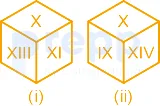
Two different positions of the same dice are shown, the faces of which are marked with the number IX, X, XI, XII, XIII and XIV. Select the number that will be on the face opposite to the face having the number 'XIV'.

- A
IX
- B
XII
- C
XI
- D
X
Show answer
C. XIFor this question, the relation is given below -
Logic: If two dice have the same face value in the given image then their clockwise or anticlockwise wise number are known as opposite numbers in dice.
In first dice and second dice.
Number X is common.
The left letter will be opposite to each other writing them clockwise starting from X.
Number
Opposite
XI
XIV
XIII
IX
X
XII
Hence, the correct answer is “XI”
 Paper & answer key PDF ↗
 Question 15archived
Select the option that is embedded in the given figure (rotation is NOT allowed).

- A
Option A (shown in image)
- B
Option B (shown in image)
- C
Option C (shown in image)
- D
Option D (shown in image)
Show answer
D. Option D (shown in image)The embedded part of this image is:
Hence, option (4) is the correct answer.
 Paper & answer key PDF ↗
 Question 16archived
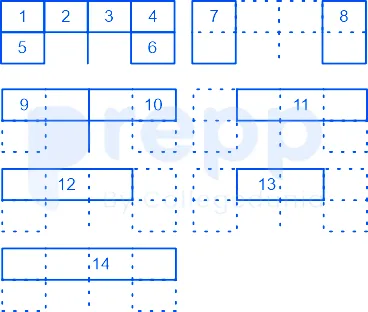
How many rectangles are there in the given figure?

- A
14
- B
12
- C
8
- D
10
Show answer
A. 14The number of rectangles in the given figure is:
So, there are a total of 14 rectangles in the figure.
Hence, ‘14’ is the correct answer.
 Paper & answer key PDF ↗
 Question 17archived
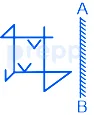
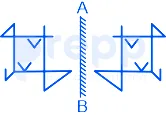
Select the correct mirror image of the given figure when the mirror is placed to its right side.
- A
Option A (shown in image)
- B
Option B (shown in image)
- C
Option C (shown in image)
- D
Option D (shown in image)
Show answer
A. Option A (shown in image)The mirror image of this image is:
Hence, option 1 is the correct answer.
 Paper & answer key PDF ↗
 Question 18archived
Select the letter-cluster from among the given options that can replace the question mark (?) in the following series.
ABD, CEI, EHN, ?
- A
GHJ
- B
FJR
- C
GIM
- D
GKS
Show answer
D. GKSSolving the Letter Series Reasoning Question
The question asks us to find the next letter-cluster in the series: ABD, CEI, EHN, ?
To solve this, we need to identify the pattern in the series by looking at the position of each letter in the English alphabet.
Let's analyze the pattern for each position:
First Letter: Look at the first letter of each cluster: A, C, E.
Second Letter: Look at the second letter of each cluster: B, E, H.
Third Letter: Look at the third letter of each cluster: D, I, N.
Analyzing the First Letters (A, C, E)
We find the alphabetical position of each letter:
A is the 1st letter.
C is the 3rd letter.
E is the 5th letter.
The sequence of positions is 1, 3, 5. The pattern here is adding 2 to the previous position.
$$1 + 2 = 3$$
$$3 + 2 = 5$$
Following this pattern, the position for the next first letter should be $$5 + 2 = 7$$. The 7th letter in the alphabet is G.
Analyzing the Second Letters (B, E, H)
We find the alphabetical position of each letter:
B is the 2nd letter.
E is the 5th letter.
H is the 8th letter.
The sequence of positions is 2, 5, 8. The pattern here is adding 3 to the previous position.
$$2 + 3 = 5$$
$$5 + 3 = 8$$
Following this pattern, the position for the next second letter should be $$8 + 3 = 11$$. The 11th letter in the alphabet is K.
Analyzing the Third Letters (D, I, N)
We find the alphabetical position of each letter:
D is the 4th letter.
I is the 9th letter.
N is the 14th letter.
The sequence of positions is 4, 9, 14. Let's look at the difference between consecutive terms:
$$9 - 4 = 5$$
$$14 - 9 = 5$$
The pattern here is adding 5 to the previous position.
$$4 + 5 = 9$$
$$9 + 5 = 14$$
Following this pattern, the position for the next third letter should be $$14 + 5 = 19$$. The 19th letter in the alphabet is S.
Combining the Patterns
The next first letter is G (7th position).
The next second letter is K (11th position).
The next third letter is S (19th position).
Therefore, the next letter-cluster in the series is GKS.
Cluster
1st Letter
2nd Letter
3rd Letter
ABD
A (1)
B (2)
D (4)
CEI
C (3)
E (5)
I (9)
EHN
E (5)
H (8)
N (14)
?
G (7)
K (11)
S (19)
Pattern Summary:
1st letter position: +2
2nd letter position: +3
3rd letter position: +5
Applying these patterns to EHN (5, 8, 14):
Next 1st letter position: $$5 + 2 = 7$$ (G)
Next 2nd letter position: $$8 + 3 = 11$$ (K)
Next 3rd letter position: $$14 + 5 = 19$$ (S)
The resulting letter cluster is GKS.
Revision Table: Understanding Letter Series
Concept
Explanation
Example
Alphabetical Position
Each letter corresponds to a number (A=1, B=2, ... Z=26).
C=3, L=12, Y=25
Series Pattern
The rule that governs the progression from one term to the next. This could be addition, subtraction, multiplication, specific sequences (prime numbers, squares), etc.
A, C, E, G... (+2 position)
Letter Cluster Series
A series where each term is a group of letters. The pattern often applies independently to each position within the cluster.
ABD, CEI, EHN... (as in this question)
Additional Information on Letter Series Reasoning
Letter series reasoning questions are common in various exams. They test your ability to identify patterns based on alphabetical order and numerical sequences. Here are some common types of patterns you might encounter:
Constant Difference: Adding or subtracting the same number to the alphabetical position.
Increasing/Decreasing Difference: The difference between terms increases or decreases in a predictable way (e.g., +2, +3, +4...).
Alternating Pattern: Two different patterns might alternate.
Patterns based on Vowels/Consonants: The pattern might involve only vowels or only consonants.
Reverse Alphabetical Order: The series might follow the alphabet backward.
Combinations: Different positions within a letter cluster might follow different independent patterns, as seen in this problem.
Practicing different types of letter series helps in quickly recognizing the underlying logic.
Paper & answer key PDF ↗ Question 19archived
There are 28 persons present at a press conference. After the conference they all shake hands with each other. If 7 of them refuse to shake hands at all, then how many hands shakes will be there altogether?
- A
231
- B
378
- C
420
- D
210
Show answer
D. 210Calculating Handshakes at a Press Conference
Let's break down this handshake problem step by step to find the total number of handshakes that occurred at the press conference.
Understanding the Handshake Problem
A handshake occurs between two people. If a group of 'n' people all shake hands with each other, the total number of handshakes is given by the combination formula, as the order of shaking hands doesn't matter (Person A shaking hands with Person B is the same handshake as Person B shaking hands with Person A). The formula for the number of combinations of 'n' items taken 'k' at a time is:
\( \binom{n}{k} = \frac{n!}{k!(n-k)!} \)
For handshakes among 'n' people, where each handshake involves 2 people (k=2), the formula simplifies to:
\( \binom{n}{2} = \frac{n(n-1)}{2} \)
Applying the Formula to the Press Conference Scenario
In this press conference scenario, we have:
Total number of persons: 28
Number of persons who refuse to shake hands: 7
The persons who refuse to shake hands do not participate in any handshakes, neither among themselves nor with the other attendees. Therefore, only the remaining persons will shake hands with each other.
Number of persons who will shake hands = Total persons - Persons refusing to shake hands
Number of persons who will shake hands = \( 28 - 7 = 21 \)
These 21 people will shake hands with each other. We need to find the number of handshakes among these 21 people.
Using the handshake formula with \( n = 21 \):
Total handshakes = \( \binom{21}{2} = \frac{21 \times (21-1)}{2} \)
Total handshakes = \( \frac{21 \times 20}{2} \)
Total handshakes = \( \frac{420}{2} \)
Total handshakes = \( 210 \)
Thus, there will be a total of 210 handshakes among the persons who participate in the handshake activity at the press conference.
Revision Table: Handshake Problem Key Points
Concept
Description
Formula/Note
Total Persons
Number of people initially present.
28
Persons Refusing Handshake
Number of people who do not shake hands at all.
7
Persons Participating in Handshake
Number of people who will shake hands with each other.
Total Persons - Refusing Persons = 21
Handshakes among 'n' people
Number of ways 2 people can be chosen from 'n'.
\( \binom{n}{2} = \frac{n(n-1)}{2} \)
Result
Total handshakes among the participating persons.
\( \binom{21}{2} = 210 \)
Additional Information on Combinations and Handshakes
The handshake problem is a classic example solved using combinations. Combinations are used when the order of selection does not matter. In a handshake, the pair of people is what matters, not who initiated the shake. If the order mattered, we would use permutations.
Combinations: Selection of items where the order does not matter. \( \binom{n}{k} \)
Permutations: Arrangement of items where the order matters. \( P(n, k) = \frac{n!}{(n-k)!} \)
In this press conference problem, the refusal of 7 people simplifies the problem by reducing the effective group size for the handshake calculation. The calculation is only performed on the group that actually shakes hands with each other.
Paper & answer key PDF ↗ Question 20archived
Select the option in which the numbers are related in the same way as are the numbers of the following set.
(4, 8, 16)
- A
(18, 6, 15)
- B
(11, 16, 51)
- C
(24, 15, 44)
- D
(20, 24, 16)
Show answer
D. (20, 24, 16)Finding the Pattern in the Number Set (4, 8, 16)
The question asks us to identify the relationship between the numbers in the set (4, 8, 16) and find another set of numbers from the options that shares the same relationship.
Let's analyze the given set (4, 8, 16). We need to look for a consistent rule or pattern connecting these three numbers. Let the numbers be represented as a, b, and c.
Difference between the second and first number: \(8 - 4 = 4\)
Difference between the third and second number: \(16 - 8 = 8\)
Observing the differences, we see that the second difference (8) is exactly twice the first difference (4). So, the relationship could be based on the differences between consecutive numbers.
Another way to express this relationship using absolute differences is:
Absolute difference between the second and first number: \(|8 - 4| = 4\)
Absolute difference between the third and second number: \(|16 - 8| = 8\)
Here, \(|16 - 8| = 2 \times |8 - 4|\). This means the absolute difference between the second and third number is double the absolute difference between the first and second number.
Analyzing Options for the Same Number Relation
Now, let's apply this identified pattern to each of the given options to see which one fits the same rule.
Option 1: (18, 6, 15)
Absolute difference between second and first: \(|6 - 18| = |-12| = 12\)
Absolute difference between third and second: \(|15 - 6| = |9| = 9\)
Check the pattern: Is \(|15 - 6| = 2 \times |6 - 18|\)? Is \(9 = 2 \times 12\)? No, \(9 \neq 24\). This option does not follow the pattern.
Option 2: (11, 16, 51)
Absolute difference between second and first: \(|16 - 11| = |5| = 5\)
Absolute difference between third and second: \(|51 - 16| = |35| = 35\)
Check the pattern: Is \(|51 - 16| = 2 \times |16 - 11|\)? Is \(35 = 2 \times 5\)? No, \(35 \neq 10\). This option does not follow the pattern.
Option 3: (24, 15, 44)
Absolute difference between second and first: \(|15 - 24| = |-9| = 9\)
Absolute difference between third and second: \(|44 - 15| = |29| = 29\)
Check the pattern: Is \(|44 - 15| = 2 \times |15 - 24|\)? Is \(29 = 2 \times 9\)? No, \(29 \neq 18\). This option does not follow the pattern.
Option 4: (20, 24, 16)
Absolute difference between second and first: \(|24 - 20| = |4| = 4\)
Absolute difference between third and second: \(|16 - 24| = |-8| = 8\)
Check the pattern: Is \(|16 - 24| = 2 \times |24 - 20|\)? Is \(8 = 2 \times 4\)? Yes, \(8 = 8\). This option follows the pattern.
Conclusion on the Number Relationship
Based on the analysis, the pattern observed in the set (4, 8, 16), where the absolute difference between the second and third number is twice the absolute difference between the first and second number, is matched by option (20, 24, 16).
Set
\(|\text{Second} - \text{First}|\)
\(|\text{Third} - \text{Second}|\)
Pattern Match? \(|\text{Third} - \text{Second}| = 2 \times |\text{Second} - \text{First}|\)
(4, 8, 16)
\(|8 - 4| = 4\)
\(|16 - 8| = 8\)
\(8 = 2 \times 4\) (Yes)
(18, 6, 15)
\(|6 - 18| = 12\)
\(|15 - 6| = 9\)
\(9 = 2 \times 12\) (No)
(11, 16, 51)
\(|16 - 11| = 5\)
\(|51 - 16| = 35\)
\(35 = 2 \times 5\) (No)
(24, 15, 44)
\(|15 - 24| = 9\)
\(|44 - 15| = 29\)
\(29 = 2 \times 9\) (No)
(20, 24, 16)
\(|24 - 20| = 4\)
\(|16 - 24| = 8\)
\(8 = 2 \times 4\) (Yes)
Revision Table: Understanding Number Relationships
Concept
Description
Example (based on this problem)
Number Set Analogy
Finding a set of numbers that follows the same mathematical rule or pattern as a given set.
Matching (4, 8, 16) with (20, 24, 16) based on absolute differences.
Identifying Patterns
Looking for arithmetic operations (addition, subtraction, multiplication, division), sequences (arithmetic, geometric), or other logical rules connecting the numbers.
Calculating differences between consecutive numbers.
Absolute Difference
The positive difference between two numbers, regardless of their order. Represented as \(|a - b|\).
\(|8 - 4| = 4\), \(|16 - 24| = 8\).
Additional Information: Types of Number Patterns
Number set analogy problems often involve various types of patterns. Here are a few common ones:
Arithmetic Progression (AP): Each term after the first is obtained by adding a constant difference to the previous term. Example: (3, 6, 9) - difference is 3.
Geometric Progression (GP): Each term after the first is obtained by multiplying the previous term by a constant ratio. Example: (2, 6, 18) - ratio is 3. The original set (4, 8, 16) is also a GP with ratio 2, but this wasn't the pattern found in the matching option.
Difference Based Patterns: The differences between consecutive terms might follow a pattern (e.g., arithmetic progression of differences, constant difference, or as seen here, one difference being a multiple of another).
Sum/Product Based Patterns: The third number might be the sum or product of the first two, or some operation involving the first two. Example: (2, 3, 5) - third is sum of first two.
Digit Based Patterns: Sometimes the pattern involves operations on the digits of the numbers. (Not applicable here).
Solving number set analogy problems requires careful observation and testing different potential relationships until a consistent rule is found that applies to both the given set and one of the options.
Paper & answer key PDF ↗ Question 21archived
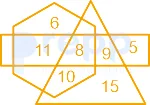
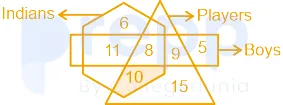
In the following Venn diagram, the triangle stands for 'Players', the hexagon stands for 'Indians', and the rectangle stands for 'Boys'. The given numbers represent the number of persons in that particular category.
How many Indians are players but are NOT boys?
- A
9
- B
11
- C
10
- D
8
Show answer
C. 10The 'Rectangle' represents 'Boys', the 'Triangle' stands for 'Players' and the 'Hexagon' stands for 'Indians'.
The shaded part represents the Indians are players but are NOT boys i.e = 10
Hence, "10" is the correct answer.
 Paper & answer key PDF ↗
 Question 22archived
Select the combination of letters that when sequentially placed in the blanks of the given series will complete the series.
_ Q _ S P _ R _ _ Q _ _ P _ R _
- A
P, R, Q, S, Q, S, P, R, S
- B
S, P, R, S, P, R, Q, Q, S
- C
P, R, Q, S, P, R, S, Q, S
- D
P, R, Q, S, P, R, R, P, Q
Show answer
C. P, R, Q, S, P, R, S, Q, SSolving the Letter Series Completion Question
This question asks us to find the correct combination of letters to fill in the blanks in a given series so that it forms a logical pattern. Letter series questions test our ability to identify patterns and sequences.
Understanding the Given Letter Series
The given series with blanks is:
_ Q _ S P _ R _ _ Q _ _ P _ R _
We need to select one of the provided options, each containing a sequence of letters, and place these letters sequentially into the blanks. The goal is to create a complete series that follows a recognizable pattern.
Analyzing the Options to Complete the Series
Let's take the letters from each option and fill in the blanks in the given series. We will then examine the resulting series to see if it forms a repeating pattern or logical sequence.
The blanks are at positions 1, 3, 6, 8, 9, 12, 13, 15, and 16 in the original series string:
1 2 3 4 5 6 7 8 9 0 1 2 3 4 5 6 (Position Index - second digit for >=10)
_ Q _ S P _ R _ _ Q _ _ P _ R _
Let's test the provided correct answer option:
Option 3: P, R, Q, S, P, R, S, Q, S
Inserting these letters into the blanks:
Blank 1: P
Blank 3: R
Blank 6: Q
Blank 8: S
Blank 9: P
Blank 12: R
Blank 13: S
Blank 15: Q
Blank 16: S
The series becomes:
P Q R S P Q R S P Q R S P Q R S
Identifying the Pattern in the Completed Series
Looking at the completed series P Q R S P Q R S P Q R S P Q R S, we can clearly see a repeating block of letters. The sequence 'PQRS' repeats exactly 4 times.
The pattern is a simple repetition of the four letters P, Q, R, and S in that specific order.
Let's verify if the letters inserted from Option 3 perfectly fit this pattern:
Position 1: P (Filled, matches pattern)
Position 2: Q (Given, matches pattern)
Position 3: R (Filled, matches pattern)
Position 4: S (Given, matches pattern)
Position 5: P (Given, matches pattern)
Position 6: Q (Filled, matches pattern)
Position 7: R (Given, matches pattern)
Position 8: S (Filled, matches pattern)
Position 9: P (Filled, matches pattern)
Position 10: Q (Given, matches pattern)
Position 11: R (Given, matches pattern)
Position 12: S (Filled, matches pattern)
Position 13: P (Given, matches pattern)
Position 14: Q (Given, matches pattern)
Position 15: R (Filled, matches pattern)
Position 16: S (Filled, matches pattern)
All the given letters match the 'PQRS' repeating pattern, and the letters from Option 3 fill the blanks perfectly to complete this pattern.
Trying other options would result in series that do not exhibit such a clear and consistent repeating pattern.
Therefore, the sequence of letters from Option 3 correctly completes the given series by forming the repeating pattern 'PQRS'.
Conclusion
By inserting the letters P, R, Q, S, P, R, S, Q, S into the blanks of the series _ Q _ S P _ R _ _ Q _ _ P _ R _, we get the complete series P Q R S P Q R S P Q R S P Q R S, which is a clear repetition of the block 'PQRS'. This confirms that Option 3 provides the correct sequence to complete the letter series.
Blank Position
Letter from Option 3
Resulting Series Segment
Pattern Check
1
P
P Q _ S P _ R _ _ Q _ _ P _ R _
Starts PQRS
3
R
P Q R S P _ R _ _ Q _ _ P _ R _
Completes first PQRS block start
6
Q
P Q R S P Q R _ _ Q _ _ P _ R _
Starts second PQRS block
8
S
P Q R S P Q R S _ Q _ _ P _ R _
Completes second PQRS block
9
P
P Q R S P Q R S P Q _ _ P _ R _
Starts third PQRS block
12
R
P Q R S P Q R S P Q R S P _ R _
Completes third PQRS block
13
S
P Q R S P Q R S P Q R S P _ R _
Part of fourth PQRS block
15
Q
P Q R S P Q R S P Q R S P Q R _
Part of fourth PQRS block
16
S
P Q R S P Q R S P Q R S P Q R S
Completes fourth PQRS block
Revision Table: Key Concepts
Concept
Description
Relevance to Problem
Letter Series
A sequence of letters following a specific pattern.
The core problem involves completing this type of series.
Pattern Recognition
Identifying the rule or sequence governing the series.
Essential skill required to solve letter series.
Repeating Pattern
A block of elements (letters, numbers, etc.) that repeats throughout the series.
The pattern identified in this specific letter series is a repeating block ('PQRS').
Logical Reasoning
Using logic to solve problems and find patterns.
Letter series questions are a common test of logical reasoning ability.
Additional Information: Types of Letter Series Patterns
Letter series problems can have various types of patterns. Recognizing these common patterns helps in solving such questions faster.
Alphabetical Order: Letters following the standard alphabetical sequence (e.g., A, C, E, G...).
Skipping Letters: Letters with a specific number of letters skipped in between (e.g., A, D, G, J... skipping 2 letters each time).
Reverse Alphabetical Order: Letters in descending order (e.g., Z, X, V, T...).
Repeating Blocks: A specific sequence of letters repeats itself (e.g., ABCA BCA BCA...). This was the pattern in our problem.
Increasing/Decreasing Gaps: The number of skipped letters changes in a pattern (e.g., A, C, F, K... skipping 1, 2, 3 letters).
Combination of Rules: Sometimes multiple rules are combined.
Solving more letter series questions helps in becoming familiar with these different types of patterns.
Paper & answer key PDF ↗ Question 23archived
Select the correct option that indicates the arrangement of the given words in the order in which they appear in an English dictionary.
1. Hygienic
2. Hydroplane
3. Hydroelectric
4. Hydroxide
5. Hydrology
- A
3, 5, 1, 4, 2
- B
1, 2, 3, 4, 5
- C
3, 5, 2, 4, 1
- D
3, 5, 1, 2, 4
Show answer
C. 3, 5, 2, 4, 1Arranging Words Alphabetically for Dictionary Order
The task is to arrange the given list of words in the order they would appear in an English dictionary. This process involves comparing words letter by letter from the beginning.
The words provided are:
1. Hygienic
2. Hydroplane
3. Hydroelectric
4. Hydroxide
5. Hydrology
Step-by-Step Comparison of Given Words
We compare the words based on alphabetical order:
Initial Comparison: All words start with 'Hy'.
Second Letter Comparison:
Hygienic starts with 'Hyg...'
Hydroplane starts with 'Hyd...'
Hydroelectric starts with 'Hyd...'
Hydroxide starts with 'Hyd...'
Hydrology starts with 'Hyd...'
Since 'd' comes before 'g' in the alphabet, all words starting with 'Hyd' will come before 'Hygienic'. Therefore, 'Hygienic' (1) will be placed after the 'Hyd' words.
Comparing 'Hyd' Words: Now we need to order the words starting with 'Hyd': Hydroplane, Hydroelectric, Hydroxide, Hydrology.
All these words start with 'Hydro'.
We look at the letter immediately following 'Hydro':
Hydroplane
Hydroelectric
Hydroxide
Hydrology
The alphabetical order of these differentiating letters (p, e, x, l) is 'e', 'l', 'p', 'x'.
This gives us the order for these four words:
Hydroelectric (3)
Hydrology (5)
Hydroplane (2)
Hydroxide (4)
Final Arrangement: Combining the order of the 'Hyd' words with 'Hygienic', which comes last, we get the final sequence based on the original numbering:
3. Hydroelectric
5. Hydrology
2. Hydroplane
4. Hydroxide
1. Hygienic
Determining the Correct Dictionary Sequence
Based on the step-by-step comparison, the correct alphabetical order of the given words corresponds to the sequence of their original numbers: 3, 5, 2, 4, 1.
This sequence matches one of the provided options.
Paper & answer key PDF ↗ Question 24archived
Four letter-clusters have been given, out of which three are alike in some manner and one is different. Select the letter-cluster that is different.
- A
PSV
- B
MPS
- C
NQT
- D
QTV
Show answer
D. QTVSolving Letter Cluster Reasoning Questions
This question asks us to identify the letter cluster that is different from the other three based on a pattern. To solve this type of reasoning problem, we need to examine the relationship between the letters within each cluster, usually based on their position in the English alphabet.
Let's look at the positional values of the letters in each given cluster:
PSV: P is the 16th letter, S is the 19th letter, and V is the 22nd letter.
MPS: M is the 13th letter, P is the 16th letter, and S is the 19th letter.
NQT: N is the 14th letter, Q is the 17th letter, and T is the 20th letter.
QTV: Q is the 17th letter, T is the 20th letter, and V is the 22nd letter.
Now, let's find the difference in positional values between consecutive letters in each cluster:
PSV: The difference between S (19) and P (16) is \(19 - 16 = 3\). The difference between V (22) and S (19) is \(22 - 19 = 3\). The pattern here is \(+3, +3\).
MPS: The difference between P (16) and M (13) is \(16 - 13 = 3\). The difference between S (19) and P (16) is \(19 - 16 = 3\). The pattern here is \(+3, +3\).
NQT: The difference between Q (17) and N (14) is \(17 - 14 = 3\). The difference between T (20) and Q (17) is \(20 - 17 = 3\). The pattern here is \(+3, +3\).
QTV: The difference between T (20) and Q (17) is \(20 - 17 = 3\). The difference between V (22) and T (20) is \(22 - 20 = 2\). The pattern here is \(+3, +2\).
Comparing the patterns:
PSV follows the pattern \(+3, +3\).
MPS follows the pattern \(+3, +3\).
NQT follows the pattern \(+3, +3\).
QTV follows the pattern \(+3, +2\).
Three of the letter clusters (PSV, MPS, NQT) follow the same pattern of adding 3 to the positional value of the previous letter to get the next letter. The cluster QTV follows a different pattern, adding 3 then adding 2.
Therefore, the letter-cluster that is different is QTV.
Revision Table: Letter Cluster Analysis
Letter Cluster
Positional Values
Difference Pattern
PSV
16, 19, 22
+3, +3
MPS
13, 16, 19
+3, +3
NQT
14, 17, 20
+3, +3
QTV
17, 20, 22
+3, +2
Additional Information on Letter Series Reasoning
Letter series and letter cluster questions are common in logical reasoning sections of competitive exams. They test a candidate's ability to identify patterns based on the English alphabet.
Common patterns include:
Adding or subtracting a constant number to the positional values of letters.
Adding or subtracting numbers that follow a sequence (e.g., +1, +2, +3... or +2, +4, +6...).
Alternating patterns.
Vowel/Consonant patterns.
Skipping letters (e.g., skipping 1 letter, then 2 letters, etc.).
Reverse alphabetical order.
Understanding the positional value of each letter (A=1, B=2, ..., Z=26) is fundamental to solving these types of problems quickly and accurately.
Paper & answer key PDF ↗ Question 25archived
Select the option in which the numbers areNOT related i n the same way as are the numbers of the following set.
(7, 51, 22)
- A
(3, 11, 18)
- B
(4, 18, 19)
- C
(6, 38, 22)
- D
(11, 123, 26)
Show answer
C. (6, 38, 22)Numerical Reasoning: Finding the Odd Set Out
This question asks us to identify the set of numbers among the options that does not follow the same relationship as the given set (7, 51, 22).
To solve this, we first need to analyze the relationship between the numbers in the set (7, 51, 22). Let's call the numbers in a set $\text{Number}_1$, $\text{Number}_2$, and $\text{Number}_3$. In the given set, $\text{Number}_1 = 7$, $\text{Number}_2 = 51$, and $\text{Number}_3 = 22$.
Analyzing the Relationship in the Set (7, 51, 22)
Let's look at how $\text{Number}_2$ is related to $\text{Number}_1$:
Square of $\text{Number}_1$: $7^2 = 49$.
$\text{Number}_2$ is 51. The difference is $51 - 49 = 2$.
So, it seems $\text{Number}_2 = (\text{Number}_1)^2 + 2$. Let's check this: $7^2 + 2 = 49 + 2 = 51$. This relationship holds true for the first two numbers.
Now, let's look at how $\text{Number}_3$ is related to $\text{Number}_1$:
The numbers are 7 and 22.
Is there a simple addition/subtraction? $22 - 7 = 15$. So, maybe $\text{Number}_3 = \text{Number}_1 + 15$. Let's check this: $7 + 15 = 22$. This relationship also holds true for the first and third numbers.
So, the likely relationships governing the set (7, 51, 22) are:
$\text{Number}_2 = (\text{Number}_1)^2 + 2$
$\text{Number}_3 = \text{Number}_1 + 15$
Testing the Relationships on the Options
Now, we will apply these two rules to each given option to see which one does NOT follow the same pattern.
Option 1: (3, 11, 18)
Here, $\text{Number}_1 = 3$, $\text{Number}_2 = 11$, $\text{Number}_3 = 18$.
Rule 1: $\text{Number}_2 = (\text{Number}_1)^2 + 2$? $3^2 + 2 = 9 + 2 = 11$. This matches $\text{Number}_2$.
Rule 2: $\text{Number}_3 = \text{Number}_1 + 15$? $3 + 15 = 18$. This matches $\text{Number}_3$.
Option 1 follows both rules.
Option 2: (4, 18, 19)
Here, $\text{Number}_1 = 4$, $\text{Number}_2 = 18$, $\text{Number}_3 = 19$.
Rule 1: $\text{Number}_2 = (\text{Number}_1)^2 + 2$? $4^2 + 2 = 16 + 2 = 18$. This matches $\text{Number}_2$.
Rule 2: $\text{Number}_3 = \text{Number}_1 + 15$? $4 + 15 = 19$. This matches $\text{Number}_3$.
Option 2 follows both rules.
Option 3: (6, 38, 22)
Here, $\text{Number}_1 = 6$, $\text{Number}_2 = 38$, $\text{Number}_3 = 22$.
Rule 1: $\text{Number}_2 = (\text{Number}_1)^2 + 2$? $6^2 + 2 = 36 + 2 = 38$. This matches $\text{Number}_2$.
Rule 2: $\text{Number}_3 = \text{Number}_1 + 15$? $6 + 15 = 21$. The $\text{Number}_3$ in the option is 22. $21 \neq 22$.
Option 3 follows Rule 1 but NOT Rule 2.
Option 4: (11, 123, 26)
Here, $\text{Number}_1 = 11$, $\text{Number}_2 = 123$, $\text{Number}_3 = 26$.
Rule 1: $\text{Number}_2 = (\text{Number}_1)^2 + 2$? $11^2 + 2 = 121 + 2 = 123$. This matches $\text{Number}_2$.
Rule 2: $\text{Number}_3 = \text{Number}_1 + 15$? $11 + 15 = 26$. This matches $\text{Number}_3$.
Option 4 follows both rules.
Summary of Checks
Set
Number$_1$
Number$_2$
$(\text{Number}_1)^2 + 2$
Rule 1 Followed?
Number$_3$
$\text{Number}_1 + 15$
Rule 2 Followed?
Follows both rules?
(7, 51, 22)
7
51
$7^2 + 2 = 51$
Yes
22
$7 + 15 = 22$
Yes
Yes
(3, 11, 18)
3
11
$3^2 + 2 = 11$
Yes
18
$3 + 15 = 18$
Yes
Yes
(4, 18, 19)
4
18
$4^2 + 2 = 18$
Yes
19
$4 + 15 = 19$
Yes
Yes
(6, 38, 22)
6
38
$6^2 + 2 = 38$
Yes
22
$6 + 15 = 21$
No
No
(11, 123, 26)
11
123
$11^2 + 2 = 123$
Yes
26
$11 + 15 = 26$
Yes
Yes
Conclusion: Identifying the Outlier Set
Based on the analysis, the sets (7, 51, 22), (3, 11, 18), (4, 18, 19), and (11, 123, 26) all follow the relationships: $\text{Number}_2 = (\text{Number}_1)^2 + 2$ and $\text{Number}_3 = \text{Number}_1 + 15$. The set (6, 38, 22) follows the first relationship but not the second one.
Therefore, the set (6, 38, 22) is NOT related in the same way as the numbers of the original set and the other options.
Revision Table: Number Pattern Analysis
Review the key steps to solve this type of number relationship question:
Examine the given set to identify potential relationships between the numbers. Look for simple arithmetic operations, squares, cubes, or combinations.
Formulate hypothesis based on the observed relationships.
Test the hypothesis on the given options.
Identify the option that does not fit the established rules.
Additional Information: Types of Number Relationships
Numerical reasoning questions often involve various types of relationships within a set of numbers. Common patterns include:
Arithmetic progressions (constant difference).
Geometric progressions (constant ratio).
Relationships involving squares or cubes of numbers.
Relationships involving sums, differences, products, or divisions of the numbers.
Relationships involving specific properties like prime numbers, odd/even numbers, etc.
Combinations of multiple simple relationships, as seen in this problem.
Practicing different types of patterns helps improve pattern recognition skills for numerical reasoning tests.
Paper & answer key PDF ↗ Question 26archived
What is the botanical name of mango?
- A
Monoon longifolium
- B
Mangifera indica
- C
Cocos nucifera
- D
Casuarina
Show answer
B. Mangifera indicaUnderstanding Botanical Names in Biology
In the study of plants, using scientific or botanical names is crucial for clear and consistent communication globally. These names follow a standardized system, primarily binomial nomenclature, developed by Carl Linnaeus. A botanical name typically consists of two parts: the genus name and the specific epithet (species name).
Identifying the Botanical Name of Mango
The question asks for the botanical name of the mango tree, a widely cultivated fruit tree known for its delicious fruit. We need to examine the given options to find the correct scientific name assigned to mango.
Analyzing the Given Options
Let's look at each option provided:
Option
Name
Analysis
1
Monoon longifolium
This is a botanical name, but it refers to a species of tree, often known as the Ashoka tree, not mango.
2
Mangifera indica
This name follows the binomial nomenclature format, with 'Mangifera' as the genus and 'indica' as the specific epithet. 'Mangifera' is the genus to which mango belongs, and 'indica' signifies its origin from India. This is the widely accepted botanical name for the common mango.
3
Cocos nucifera
This is the botanical name for the coconut tree, not the mango tree.
4
Casuarina
This is a genus of trees, commonly known as she-oaks or casuarinas. It is not the specific botanical name for mango.
Determining the Correct Botanical Name
Based on standard botanical classification, the scientific name for the mango is Mangifera indica. This name uniquely identifies the common mango species within the plant kingdom.
Therefore, the correct option that represents the botanical name of mango is Mangifera indica.
Revision Table: Botanical Names
Common Name
Botanical Name
Mango
Mangifera indica
Ashoka Tree
Monoon longifolium (or Polyalthia longifolia)
Coconut Tree
Cocos nucifera
Casuarina
Casuarina (Genus)
Additional Information: Binomial Nomenclature
Binomial nomenclature is a formal system of naming species whereby each species is assigned a name consisting of two parts, both of which use Latin grammatical forms, although they can be based on words from other languages. The first part of the name – the generic name – identifies the genus to which the species belongs, while the second part – the specific epithet or species name – distinguishes the species within the genus. For example, in Mangifera indica:
Mangifera is the genus name.
indica is the specific epithet.
Rules for writing scientific names:
The genus name is always capitalized.
The specific epithet is never capitalized.
Both parts are typically italicized when printed (e.g., Mangifera indica) or underlined when handwritten.
This system provides a universal language for biologists, ensuring that the same organism is referred to by the same name worldwide, avoiding confusion caused by different common names used in various regions and languages.
Paper & answer key PDF ↗ Question 27archived
Who among the following economists formulated the Law of Diminishing Marginal Utility (DMU)?
- A
Adam Smith
- B
David Ricardo
- C
Milton Friedman
- D
HH Gossen
Show answer
D. HH GossenFormulating the Law of Diminishing Marginal Utility
The Law of Diminishing Marginal Utility (DMU) is a core concept in microeconomics that describes how the additional satisfaction a person derives from consuming successive units of a good or service decreases over time. This holds true as long as the consumption of other goods remains constant, and the time interval between consumption is short.
For instance, consider eating slices of cake. The first slice typically provides the highest level of satisfaction. The second slice usually offers less additional satisfaction, and subsequent slices offer progressively smaller amounts of extra satisfaction. This principle is fundamental to understanding consumer choice and the downward slope of demand curves.
HH Gossen's Foundational Work on Diminishing Utility
The economist credited with first formally stating and developing the Law of Diminishing Marginal Utility was HH Gossen.
Gossen, a German economist and mathematician, introduced this law in his 1854 book titled 'Entwickelung der Gesetze des menschlichen Verkehrs und der daraus fließenden Regeln für menschliches Handeln' (which translates to 'The Development of the Laws of Human Traffic and the Rules Arising Therefrom for Human Action'). His work established foundational principles of marginal utility, often referred to as Gossen's Laws. Although his contribution was significant, it wasn't widely recognized until later economic thinkers rediscovered and built upon his ideas.
Comparing Economists' Contributions
To clarify the contributions of the economists mentioned:
Adam Smith: Often called the "father of modern economics," Adam Smith is renowned for his work on free markets and capitalism, particularly in his book 'The Wealth of Nations'. His focus was on national economies, division of labour, and the "invisible hand," not the formulation of DMU.
David Ricardo: A leading figure in classical economics, Ricardo significantly contributed to theories on rent, value, and international trade through concepts like comparative advantage. His economic analyses predate the formal articulation of DMU.
Milton Friedman: A prominent 20th-century economist associated with the Chicago School, Friedman made significant contributions to monetarism and macroeconomic policy. His influential work focused on the quantity theory of money and consumer spending habits, rather than originating the DMU concept.
Paper & answer key PDF ↗ Question 28archived
Who is the author of the book ‘Tarikh-i Dilkusha'?
- A
Charaka
- B
Sushruta
- C
Panini
- D
Bhimsen
Show answer
D. BhimsenIdentifying the Author of Tarikh-i Dilkusha
The question asks us to identify the author of the historical book titled 'Tarikh-i Dilkusha'. This is a significant historical source from the Mughal period.
Who was Bhimsen and what is Tarikh-i Dilkusha?
The book 'Tarikh-i Dilkusha', also sometimes referred to as 'Nuskha-i Dilkusha', is a memoir or chronicle written by Bhimsen Burhanpuri. Bhimsen was a Hindu Kayastha from Burhanpur who served in the Mughal administration, particularly under the command of Ruhullah Khan I and Daud Khan Panni in the Deccan region during the reign of Emperor Aurangzeb.
His work is considered a very valuable primary source for understanding the events, administration, and social conditions in the Deccan during the latter half of Aurangzeb's reign, a period marked by extensive Mughal campaigns against the Marathas and the Deccan Sultanates.
Analysing the Options for the Author of Tarikh-i Dilkusha
Let's look at the given options:
Charaka: Charaka was an ancient Indian physician, one of the principal contributors to Ayurveda. His famous work is the 'Charaka Samhita'. He is not associated with the historical chronicle 'Tarikh-i Dilkusha'.
Sushruta: Sushruta was another ancient Indian physician and surgeon, considered the 'Father of Indian Surgery'. His main work is the 'Sushruta Samhita'. Like Charaka, he is related to ancient medicine, not the history of the Mughal period.
Panini: Panini was an ancient Sanskrit philologist, grammarian, and scholar. He is best known for his treatise on Sanskrit grammar, the 'Ashtadhyayi'. He is not the author of 'Tarikh-i Dilkusha'.
Bhimsen: Bhimsen Burhanpuri is the recognized author of the historical account 'Tarikh-i Dilkusha', detailing events during Aurangzeb's reign, especially in the Deccan.
Conclusion: The Author of Tarikh-i Dilkusha
Based on historical records, the author of the book 'Tarikh-i Dilkusha' is Bhimsen Burhanpuri. His work provides crucial insights into the late Mughal period.
Book Title
Author
Field
Period
Charaka Samhita
Charaka
Medicine (Ayurveda)
Ancient India
Sushruta Samhita
Sushruta
Medicine/Surgery
Ancient India
Ashtadhyayi
Panini
Sanskrit Grammar
Ancient India
Tarikh-i Dilkusha (Nuskha-i Dilkusha)
Bhimsen Burhanpuri
History/Memoir
Late Mughal Period (Aurangzeb's Reign)
Revision Table: Tarikh-i Dilkusha and Its Author
Aspect
Detail
Book Title
Tarikh-i Dilkusha (also Nuskha-i Dilkusha)
Author
Bhimsen Burhanpuri
Period Covered
Primarily the reign of Mughal Emperor Aurangzeb (late 17th & early 18th century)
Geographical Focus
Mainly the Deccan region
Significance
Valuable primary source for Mughal history, administration, military campaigns, and social life in the Deccan.
Additional Information: Historical Sources of the Mughal Period
Studying historical works like 'Tarikh-i Dilkusha' is essential for understanding the Mughal Empire. Several types of sources provide information about this period:
Official Chronicles (Farmans, Akhbarat): Records maintained by the state, detailing administrative orders, court news, etc.
Court Histories (e.g., Akbarnama, Padshahnama): Biographies and histories commissioned by emperors, often written by court historians.
Personal Memoirs and Biographies (e.g., Tuzuk-i-Baburi, Tarikh-i Dilkusha): Accounts written by rulers themselves or individuals serving in the administration. These often provide personal perspectives and details not found in official histories.
Travel Accounts: Writings by foreign visitors (e.g., Bernier, Tavernier) offering external observations.
Administrative Documents: Records related to land revenue, military organisation, etc.
'Tarikh-i Dilkusha' falls under the category of a personal memoir or chronicle, offering a view from within the administrative and military setup of the time, particularly focusing on the challenging campaigns in the Deccan.
Paper & answer key PDF ↗ Question 29archived
Who among the following was the first to conclude that in vacuum all objects fall with the same acceleration g and reach the ground at the same time?
- A
Albert Einstein
- B
Galileo Galilei
- C
Thomas Alva Edison
- D
Isaac Newton
Show answer
B. Galileo GalileiCorrect Answer: Option 2 – Galileo Galilei
Explanation:
Before Galileo, the Greek philosopher Aristotle believed that heavier objects fall faster than lighter ones.
Galileo Galilei challenged this idea and showed that, in the absence of air resistance, all objects fall with the same acceleration due to gravity, regardless of their mass.
He concluded that:
• Differences in falling speed are mainly caused by air resistance.
• In a vacuum, all objects fall at the same rate.
• Mass does not affect the acceleration due to gravity.
This principle was later demonstrated during the Apollo 15 Moon mission in 1971, when an astronaut dropped a hammer and a feather simultaneously, and both reached the surface at the same time because there was no air resistance.
Why the other options are incorrect:
Option 1: Albert Einstein
Einstein developed the Theory of General Relativity, which explained gravity in terms of spacetime, but he was not the first to state that all objects fall at the same rate in a vacuum.
Option 3: Thomas Alva Edison
Edison was a famous inventor known for the electric bulb, phonograph, and other inventions, not for studies of gravity.
Option 4: Isaac Newton
Newton formulated the Laws of Motion and the Law of Universal Gravitation, building on Galileo's earlier work.
Therefore, Galileo Galilei was the first scientist to conclude that all objects fall at the same rate in a vacuum.
Paper & answer key PDF ↗ Question 30archived
As of January 2021, who among the following was the Chairperson of the Central Board of Film Certification?
- A
Rekha
- B
Prasoon Joshi
- C
Asha Parekh
- D
Shekhar Kapoor
Show answer
B. Prasoon JoshiUnderstanding the Central Board of Film Certification (CBFC) Chairperson
The question asks about the individual who held the position of Chairperson of the Central Board of Film Certification (CBFC) as of January 2021. The CBFC is a statutory body under the Ministry of Information and Broadcasting, Government of India. Its main function is to regulate the public exhibition of films under the provisions of the Cinematograph Act, 1952. Films are certified by the CBFC for public exhibition.
Identifying the CBFC Chairperson in January 2021
To answer this question, we need to know who was heading the CBFC around January 2021. Let's look at the options provided:
Rekha
Prasoon Joshi
Asha Parekh
Shekhar Kapoor
Checking the history of the CBFC Chairperson position reveals that Prasoon Joshi, a noted lyricist and poet, took over as the Chairperson in August 2017. He continued to hold this position through January 2021 and beyond.
Let's consider the other options:
Rekha: While a famous actress, she has not served as the Chairperson of the CBFC.
Asha Parekh: A veteran actress, she previously served as the Chairperson of the CBFC from 1998 to 2001. However, she was not the Chairperson in January 2021.
Shekhar Kapoor: A renowned filmmaker, he has not held the position of CBFC Chairperson.
Therefore, based on the historical record, Prasoon Joshi was the Chairperson of the Central Board of Film Certification in January 2021.
Analyzing the Options
We can summarize the status of each person in relation to the CBFC Chairperson position in January 2021:
Name
Role in January 2021
Notes
Rekha
Not CBFC Chairperson
Famous actress, no record of chairing CBFC.
Prasoon Joshi
CBFC Chairperson
Appointed in August 2017, served through January 2021.
Asha Parekh
Not CBFC Chairperson
Served from 1998 to 2001.
Shekhar Kapoor
Not CBFC Chairperson
Renowned filmmaker, no record of chairing CBFC.
Conclusion on CBFC Chairperson
The analysis confirms that Prasoon Joshi was the person holding the office of Chairperson for the Central Board of Film Certification as of January 2021.
Revision Table: Understanding CBFC Leadership
CBFC Chairperson
Tenure
Key Information
Asha Parekh
1998 - 2001
Veteran actress
Anupam Kher
2003 - 2004
Actor
Sharmila Tagore
2004 - 2011
Actress
Pahlaj Nihalani
2015 - 2017
Producer
Prasoon Joshi
2017 - Present (as of the time frame)
Lyricist, poet
Additional Information: Central Board of Film Certification Facts
The CBFC is commonly known as the Censor Board, although its official function is certification, not censorship in the strict sense.
The Board consists of non-official members and a Chairperson, all appointed by the Central Government.
The certification process involves examining films to decide whether they are suitable for public exhibition and assigning categories like U (Universal), U/A (Parental Guidance), A (Adults Only), and S (Specialized Group).
The headquarters of the CBFC is located in Mumbai.
Paper & answer key PDF ↗ Question 31archived
Which one of the following element is Monatomic unit?
- A
Sulphur
- B
Hydrogen
- C
Phosphorus
- D
Gold
Show answer
D. GoldUnderstanding Monatomic Elements
An element is made up of only one type of atom. The way these atoms arrange themselves determines the element's physical state and properties. Some elements exist as individual atoms, while others bond together to form molecules.
A monatomic element is an element whose smallest stable unit is a single atom. This means the element does not form diatomic or polyatomic molecules under typical conditions. The noble gases (like Helium, Neon, Argon) are classic examples of monatomic elements in their gaseous state because their atoms are very stable and do not readily bond with each other.
Let's examine the given options to determine which one is typically monatomic:
Analyzing the Options for Monatomic Nature
Sulphur (S): Sulphur typically exists as $S_8$ molecules (a ring structure containing 8 sulphur atoms) in its most stable allotrope at room temperature. Therefore, it is polyatomic, not monatomic.
Hydrogen (H): Hydrogen exists as diatomic molecules ($H_2$) under normal conditions. Two hydrogen atoms bond together. Thus, it is diatomic, not monatomic.
Phosphorus (P): White phosphorus, a common and highly reactive allotrope, exists as $P_4$ molecules (a tetrahedron of 4 phosphorus atoms). Other forms also exist as polyatomic structures. It is not monatomic.
Gold (Au): Gold is a metal. Metals in their solid state consist of a vast network or lattice of individual metal atoms held together by metallic bonds. They do not form discrete molecules like $H_2$ or $S_8$. While in the gas phase at very high temperatures, gold exists as single atoms (Au), in its standard solid metallic state, it is considered to consist of individual monatomic units within the lattice. Compared to the other options which form distinct polyatomic molecules, gold behaves like a collection of single atoms in its common form.
Based on this analysis, Gold is the element among the options that exists as individual atoms in its common state, making it the most appropriate answer for a monatomic element from the given choices.
Summary of Element Structures
Element
Typical Form/Molecule
Classification
Sulphur (S)
$S_8$
Polyatomic
Hydrogen (H)
$H_2$
Diatomic (Polyatomic)
Phosphorus (P)
$P_4$ (White Phosphorus)
Polyatomic
Gold (Au)
Au (Metallic Lattice)
Monatomic (in solid/gas phase)
Conclusion on Monatomic Element
Considering the typical forms of the elements provided in the options, Gold is the one that exists as individual atoms in its metallic structure, unlike Sulphur, Hydrogen, and Phosphorus which form molecules with multiple atoms.
Revision Table: Element Units
Element
Common Unit
Number of Atoms per Unit
Sulphur
$S_8$ molecule
8
Hydrogen
$H_2$ molecule
2
Phosphorus
$P_4$ molecule
4
Gold
Au atom (in lattice)
1
Additional Information: Atomic vs. Molecular Elements
Elements can be classified based on how their atoms are organized:
Monatomic Elements: These exist as single atoms. Examples include all noble gases (He, Ne, Ar, Kr, Xe, Rn) and metallic elements in their gaseous state at high temperatures (e.g., Na(g), Au(g)). Solid metals are considered monatomic units within the lattice structure.
Diatomic Elements: These exist as molecules made of two atoms of the same element. There are seven common diatomic elements: Hydrogen ($H_2$), Nitrogen ($N_2$), Oxygen ($O_2$), Fluorine ($F_2$), Chlorine ($Cl_2$), Bromine ($Br_2$), and Iodine ($I_2$).
Polyatomic Elements: These exist as molecules made of three or more atoms of the same element. Examples include Ozone ($O_3$), Sulphur ($S_8$), and Phosphorus ($P_4$).
Understanding the common forms of elements is important in chemistry when writing chemical formulas and equations.
Paper & answer key PDF ↗ Question 32archived
Which Ministry of the Government of India received the SKOCH Challenger Award for ‘Best Performance in e-Governance’ in January 2021?
- A
Ministry of Information and Broadcasting
- B
Ministry of Parliamentary Affairs
- C
Ministry of Education
- D
Ministry of Tribal Affairs
Show answer
D. Ministry of Tribal AffairsUnderstanding the SKOCH Challenger Award for e-Governance
The question asks about a specific award received by a Ministry of the Government of India in January 2021. The award is the SKOCH Challenger Award in the category of 'Best Performance in e-Governance'. SKOCH Awards are independent awards recognizing contributions to socio-economic development in India, often highlighting digital transformation and governance initiatives.
Identifying the Award-Winning Ministry
In January 2021, several ministries were recognized by the SKOCH group for various achievements. The specific award mentioned, the SKOCH Challenger Award for 'Best Performance in e-Governance', was conferred upon the Ministry of Tribal Affairs.
The Ministry of Tribal Affairs was recognized for its efforts in leveraging technology and digital platforms to improve governance and service delivery for tribal communities. Their initiatives in e-governance aimed at enhancing transparency, efficiency, and accessibility of government programs and schemes.
Analyzing the Options
Let's briefly look at why the other options are not the correct answer for this specific award in January 2021:
Ministry of Information and Broadcasting: While this ministry is involved in communication and media, the SKOCH Challenger Award for 'Best Performance in e-Governance' in Jan 2021 was not awarded to them.
Ministry of Parliamentary Affairs: This ministry deals with parliamentary proceedings and liaison. It was not the recipient of this specific e-governance award in the mentioned period.
Ministry of Education: The Ministry of Education (formerly HRD) undertakes various initiatives, including digital ones, but this particular SKOCH award for e-governance performance in Jan 2021 went to a different ministry.
Ministry of Tribal Affairs: This Ministry was indeed recognized with the SKOCH Challenger Award for 'Best Performance in e-Governance' in January 2021 for its significant strides in digital transformation and online service delivery benefiting tribal populations.
Key Details of the Award
Here's a summary of the award details:
Award Name
Category
Recipient
Month & Year
SKOCH Challenger Award
Best Performance in e-Governance
Ministry of Tribal Affairs
January 2021
The recognition highlights the success of the Ministry of Tribal Affairs' digital initiatives in improving governance and reaching its target beneficiaries effectively through electronic means.
Revision Table: SKOCH Awards and e-Governance
Concept
Description
Relevance to Question
SKOCH Awards
Independent awards recognizing governance, socio-economic development, technology, etc.
The award received by the Ministry.
e-Governance
Use of information and communication technology (ICT) to deliver government services, exchange information, communication transactions, integration of various standalone systems and services.
The category in which the Ministry received the award.
Ministry of Tribal Affairs
Government body responsible for the welfare and development of Scheduled Tribes.
The specific Ministry that won the award in Jan 2021.
Additional Information: Ministry of Tribal Affairs e-Governance Initiatives
The Ministry of Tribal Affairs has implemented various e-governance initiatives. Some examples include:
Developing portals and mobile applications for disseminating information about schemes and accessing services.
Using Direct Benefit Transfer (DBT) to ensure transparent and direct flow of financial assistance to beneficiaries.
Implementing online systems for monitoring project implementation and tracking progress.
Leveraging technology for educational initiatives and scholarships for tribal students.
These digital efforts contribute to better governance, increased transparency, and improved service delivery, which led to the recognition with the SKOCH Challenger Award for 'Best Performance in e-Governance'.
Paper & answer key PDF ↗ Question 33archived
Which of the following does NOT figure among the main functions of the root system of a plant?
- A
Absorption of water from the soil
- B
Absorption of mineral from the soil
- C
Providing a proper anchorage to the plant parts
- D
Supply of food to plant parts
Show answer
D. Supply of food to plant partsUnderstanding Plant Root System Functions
The root system is a vital part of a plant, typically found below the ground. Roots perform several crucial functions that are essential for the plant's survival and growth.
Main Functions of the Root System
Let's look at the primary roles of the root system:
Absorption of Water and Minerals: Roots, especially the root hairs, are the main structures responsible for taking up water and dissolved mineral nutrients from the soil. This absorbed water and minerals are then transported to the rest of the plant.
Anchorage: The root system firmly anchors the plant in the soil, providing stability and preventing it from being blown over by wind or washed away by water. Different root system structures like taproots and fibrous roots offer varying degrees of anchorage.
Storage: Roots can store food (like starch and sugars) and water, which the plant can use later, particularly during unfavorable conditions. Examples include carrots, radishes, and sweet potatoes, which are modified roots used for storage.
Synthesis of Plant Growth Regulators: Roots produce certain plant hormones (like cytokinins) that are transported upwards and influence the growth and development of the shoot system.
Aeration: In some plants (like mangroves), specialized roots called pneumatophores grow upwards to help the roots get oxygen from the air in waterlogged soils.
Evaluating the Given Options
Now let's consider the options provided in the question and compare them with the main functions of the root system:
Absorption of water from the soil: As discussed, this is a primary function of the root system.
Absorption of mineral from the soil: This is also a crucial function of the root system, working alongside water absorption.
Providing a proper anchorage to the plant parts: Anchoring the plant firmly in the soil is another fundamental role of the root system.
Supply of food to plant parts: This statement refers to distributing food throughout the plant. While roots can store food, the primary production of food (sugars) happens during photosynthesis, which mainly occurs in the leaves (part of the shoot system). The food produced in the leaves is then transported to other parts of the plant, including the roots, through the vascular tissue (phloem). Therefore, the root system's main role is not the overall "supply of food to plant parts" in the sense of producing and distributing it; it is more about receiving and storing food produced elsewhere.
Conclusion on Root System Functions
Based on the analysis, the "Supply of food to plant parts" is not considered a primary or main function of the root system itself, although roots are crucial recipients and sometimes storage sites for food produced by the shoot system.
Key Functions of Plant Parts
Plant Part
Main Functions
Root System
Absorption of water and minerals, Anchorage, Storage, Synthesis of hormones
Shoot System (Stem, Leaves, Flowers, Fruits)
Transport of water and nutrients (Stem), Photosynthesis (Leaves), Reproduction (Flowers, Fruits)
Revision Table: Root Functions
Summary of Root System Roles
Function
Description
Is it a main root function?
Absorption of water
Taking water from soil
Yes
Absorption of minerals
Taking nutrients from soil
Yes
Anchorage
Holding plant in place
Yes
Storage of food/water
Storing energy/moisture
Yes (especially modified roots)
Synthesis of hormones
Making certain plant chemicals
Yes
Supply/Production of food
Making and distributing sugars
No (This is mainly photosynthesis in leaves)
Additional Information on Plant Systems
Plants have two main organ systems: the root system and the shoot system. Understanding the division of labor between these two systems helps clarify their functions.
Root System: Typically underground, responsible for absorption, anchorage, storage, and support.
Shoot System: Typically above ground, consisting of stems, leaves, flowers, and fruits. The stem provides support and transport, leaves are the primary sites for photosynthesis (food production), and flowers/fruits are involved in reproduction.
The vascular tissues, xylem and phloem, connect the root and shoot systems, allowing for the transport of water and minerals upwards (xylem) and sugars/food downwards and upwards (phloem) throughout the plant.
Paper & answer key PDF ↗ Question 34archived
Which of the following civic bodies was declared as the ‘Best Performing Municipal Corporation’ in India in December 2020 for implementing the Pradhan Mantri Awas YojanaUrban Mission? The annual awards were announced by the Ministry of Housing and Urban Affairs.
- A
West Delhi Municipal Corporation
- B
Guwahati Municipal Corporation
- C
Bhopal Municipal Corporation
- D
Greater Vishakhapatnam Municipal Corporation
Show answer
D. Greater Vishakhapatnam Municipal CorporationUnderstanding Pradhan Mantri Awas Yojana Urban Awards 2020
The question asks about a specific award given by the Ministry of Housing and Urban Affairs in December 2020 as part of annual awards recognizing performance under the Pradhan Mantri Awas Yojana - Urban (PMAY-U) Mission. Specifically, it focuses on which civic body was declared the 'Best Performing Municipal Corporation'.
Pradhan Mantri Awas Yojana - Urban (PMAY-U) Overview
The Pradhan Mantri Awas Yojana - Urban (PMAY-U) is a flagship mission implemented by the Ministry of Housing and Urban Affairs (MoHUA). Its primary objective is to address the housing needs of the urban poor by providing affordable housing. The mission aims to achieve the vision of “Housing for All” in urban areas by 2022. Various components are part of this mission, including:
In-situ Slum Redevelopment (ISSR)
Credit Linked Subsidy Scheme (CLSS)
Affordable Housing in Partnership (AHP)
Beneficiary-led Construction (BLC)
The government periodically reviews and awards states, union territories, and urban local bodies for their performance and progress in implementing the PMAY-U mission.
Analyzing the Best Performing Municipal Corporation Award 2020
In December 2020, the Ministry of Housing and Urban Affairs announced its annual awards for performance under the Pradhan Mantri Awas Yojana - Urban mission. Among various categories, an award was given for the 'Best Performing Municipal Corporation'. This award recognized the civic body that demonstrated exemplary performance in planning, execution, and overall progress of PMAY-U projects within its jurisdiction.
Based on the information available regarding the awards announced in December 2020 for PMAY-U implementation, the civic body recognized as the 'Best Performing Municipal Corporation' was the Greater Vishakhapatnam Municipal Corporation.
Summary of Performance
The performance evaluation for these awards typically considers various factors such as the number of houses sanctioned, completed, and occupied, financial progress, adoption of innovative technologies, effective implementation of different PMAY-U components, and citizen participation.
Award Category (Dec 2020 PMAY-U)
Recipient
Best Performing Municipal Corporation
Greater Vishakhapatnam Municipal Corporation
Best Performing State
Uttar Pradesh (often awarded in various PMAY categories)
Best Performing Union Territory
Puducherry (often awarded in various PMAY categories)
Therefore, the Greater Vishakhapatnam Municipal Corporation received the distinction of being the ‘Best Performing Municipal Corporation’ in India for its efforts in implementing the Pradhan Mantri Awas Yojana-Urban Mission, as announced by the Ministry of Housing and Urban Affairs in December 2020.
Revision Table: PMAY-U Awards Key Facts
Aspect
Detail
Mission
Pradhan Mantri Awas Yojana - Urban (PMAY-U)
Implementing Ministry
Ministry of Housing and Urban Affairs (MoHUA)
Award Year
Announced December 2020
Award Category
Best Performing Municipal Corporation
Recipient
Greater Vishakhapatnam Municipal Corporation
Additional Information: Significance of Urban Missions
Missions like PMAY-U are crucial for urban development in India. They aim to improve the quality of life for urban residents, especially those from economically weaker sections. The success of such missions depends heavily on the effective implementation by state governments and local civic bodies like Municipal Corporations.
Impact on Housing: PMAY-U directly addresses the shortage of housing by promoting construction and providing financial assistance.
Economic Activity: Construction activities boost employment and contribute to the economy.
Social Equity: Providing safe and affordable housing contributes to social equity and reduces informal settlements.
Role of Municipal Corporations: Municipal Corporations are vital at the ground level for identifying beneficiaries, approving plans, monitoring construction, and ensuring infrastructure connectivity. Awards like the one given in December 2020 recognize and encourage their critical role.
Understanding the structure and performance of these government missions and the roles played by different levels of government is important for understanding India's urban development landscape.
Paper & answer key PDF ↗ Question 35archived
Who among the following along with Motilal Nehru was instrumental in the creation of the Swaraj Party?
- A
Chittaranjan Das
- B
Bipin Chandra Pal
- C
Subhash Chandra Bose
- D
Surendranath Banerjee
Show answer
A. Chittaranjan DasFormation of the Swaraj Party in India
The Swaraj Party, officially known as the Congress-Khilafat Swarajaya Party, was formed in 1923. This party emerged from a significant difference of opinion within the Indian National Congress regarding the approach to the legislative councils established by the Government of India Act 1919.
Following the suspension of the Non-Cooperation Movement after the Chauri Chaura incident in 1922, many Congress leaders felt the need for a new strategy to continue the fight against British rule. A faction within the Congress, known as the 'Pro-changers' or 'Council Entry' group, advocated for participation in the legislative council elections to obstruct the government from within.
The leaders who championed this approach were prominently Chittaranjan Das and Motilal Nehru. They believed that entering the councils would expose the flaws of the British government and use the platform to advance nationalist goals.
Another faction, the 'No-changers', led by leaders like C. Rajagopalachari and Sardar Vallabhbhai Patel, opposed council entry and favoured continuing the boycott of legislative bodies, focusing instead on constructive programs like Khadi, Hindu-Muslim unity, and removal of untouchability.
Unable to reconcile these differences, Chittaranjan Das (who became the first President) and Motilal Nehru (who became the first Secretary) resigned from the Congress and announced the formation of the Swaraj Party in December 1922/January 1923. The party aimed to "end or mend" the councils by contesting elections and entering them to create deadlocks and oppose government policies.
Role of Chittaranjan Das and Motilal Nehru
Chittaranjan Das, also known as 'Deshbandhu', and Motilal Nehru were the principal architects and leaders of the Swaraj Party. Their vision was to shift the nationalist struggle into the legislative arenas, adding a new dimension to the independence movement. They actively campaigned for the first elections to the Central Legislative Assembly and provincial councils held in 1923 under the 1919 Act, achieving notable success, particularly in areas like Bengal.
Analysing the Options for Swaraj Party Formation
Chittaranjan Das: As discussed, C.R. Das was one of the two main founders of the Swaraj Party along with Motilal Nehru. This aligns with historical facts.
Bipin Chandra Pal: Bipin Chandra Pal was a prominent nationalist leader, part of the 'Lal-Bal-Pal' trio, known for his extremist views in the early 20th century. He was not a co-founder of the Swaraj Party in 1923.
Subhash Chandra Bose: Subhash Chandra Bose emerged as a significant leader later in the independence movement. While he respected C.R. Das as his mentor, he was not involved in the formation of the Swaraj Party in 1923.
Surendranath Banerjee: Surendranath Banerjee was a moderate leader of the early Congress and a pioneer of the Indian national movement. He was not associated with the formation of the Swaraj Party.
Based on the historical evidence, Chittaranjan Das, along with Motilal Nehru, was instrumental in establishing the Swaraj Party.
Revision Table: Swaraj Party
Aspect
Details
Party Name
Congress-Khilafat Swarajaya Party
Year of Formation
1923
Key Founders
Chittaranjan Das, Motilal Nehru
Primary Objective
Enter legislative councils to obstruct government
Reason for Formation
Differences within Congress after Non-Cooperation Movement suspension
Additional Information: Impact of Swaraj Party
The Swaraj Party's entry into the legislative councils had several impacts:
They successfully exposed the limitations of the 1919 reforms.
They raised important national issues within the legislative forums.
They managed to create deadlocks on several occasions, challenging the British administration.
Their activities kept the nationalist spirit alive during a period when mass movements were suspended.
They played a role in the appointment of the Muddiman Committee (1924) to investigate the working of the Dyarchy system introduced by the 1919 Act.
Despite internal differences and the death of C.R. Das in 1925, which weakened the party, the Swaraj Party's brief existence marked an important phase in India's struggle for independence, demonstrating the strategic use of constitutional means alongside extra-constitutional agitation.
Paper & answer key PDF ↗ Question 36archived
The language ‘Idu Mishmi’ is spoken in the state of ______.
- A
Punjab
- B
Madhya Pradesh
- C
Kerala
- D
Arunachal Pradesh
Show answer
D. Arunachal PradeshUnderstanding the Idu Mishmi Language Location
The question asks about the state where the language 'Idu Mishmi' is spoken. The Idu Mishmi people are an indigenous community primarily residing in a specific region of India. Their language, also known as 'Idu' or 'Mishmi', is a crucial part of their cultural identity.
Let's examine the options provided:
Punjab: Punjab is located in northern India and is known for the Punjabi language. The Idu Mishmi people do not inhabit this state, and their language is not spoken here.
Madhya Pradesh: Located in central India, Madhya Pradesh has various regional languages, predominantly Hindi and its dialects. The Idu Mishmi community is not associated with this state.
Kerala: Kerala is in southern India, where Malayalam is the primary language. The Idu Mishmi people are not found in Kerala.
Arunachal Pradesh: Arunachal Pradesh is a state in Northeast India, known for its diverse indigenous communities and languages. The Idu Mishmi people are one of the major tribes of Arunachal Pradesh, and the Idu Mishmi language is predominantly spoken in certain districts of this state, particularly in the Lower Dibang Valley and Dibang Valley districts.
Based on the geographical distribution of the Idu Mishmi people and linguistic studies, the Idu Mishmi language is spoken in Arunachal Pradesh.
Geographical Context of Idu Mishmi Language
The Idu Mishmi are a tribe of Arunachal Pradesh. They live mainly in the districts of Lower Dibang Valley and Dibang Valley. Their language is part of the Sino-Tibetan language family, though its exact classification within this family is debated.
Understanding the distribution of indigenous languages helps in appreciating India's linguistic diversity. Each language is tied to the history, culture, and traditions of its speakers.
Therefore, the state where the Idu Mishmi language is spoken is Arunachal Pradesh.
Revision Table: Idu Mishmi Language
Language
Primary State Spoken
Region
Idu Mishmi
Arunachal Pradesh
Northeast India
Additional Information on Arunachal Pradesh Languages
Arunachal Pradesh is often called the "Orchid State of India" and "Land of the Rising Sun" due to its easternmost location. It is known for its rich cultural heritage and numerous tribes.
Some other prominent languages and dialects spoken in Arunachal Pradesh include:
Nishi
Adi
Galong
Wancho
Nocte
Tangsa
Apatani
Mishing (also spoken in Assam)
This linguistic diversity reflects the state's tribal composition and varied landscapes. The Idu Mishmi language is just one example among the many vibrant languages spoken in this beautiful state.
Paper & answer key PDF ↗ Question 37archived
According to 'The Ramayana', Ratnakar was the other name of ______.
- A
Gautam
- B
Valmiki
- C
VIshvamitra
- D
Durbasa
Show answer
B. ValmikiUnderstanding Ratnakar's Identity in The Ramayana
The question asks for the other name of Ratnakar according to 'The Ramayana'. This refers to a popular legend associated with the transformation of a character into a great sage who is traditionally credited with authoring the epic.
Analyzing the Legend of Ratnakar
According to widely accepted legends connected with 'The Ramayana', the sage Valmiki was not always known by that name. Before becoming a sage, he was said to be a highway robber named Ratnakar. A transformative encounter, often described as involving divine figures or other sages, led him to a path of repentance and spiritual growth, eventually culminating in his transformation into the wise sage Valmiki, the Adi Kavi (first poet).
Examining the Options
Let's consider the given options:
Gautam: Sage Gautam is a different figure in Hindu mythology, associated with various stories, notably involving his wife Ahalya.
Valmiki: This is the sage traditionally credited as the author of 'The Ramayana'. Legends link his past to a person named Ratnakar.
Vishvamitra: Sage Vishvamitra is another prominent figure in 'The Ramayana', known for his penance, rivalry with Vashistha, and his role as Rama and Lakshmana's guru.
Durbasa: Sage Durbasa is known for his short temper and is mentioned in various Hindu scriptures, not specifically identified as Ratnakar in 'The Ramayana' context.
Identifying Ratnakar's Other Name
Based on the legend commonly associated with the authorship of 'The Ramayana', Ratnakar was the name of the person who later became the sage Valmiki. His transformation story is a significant part of his legend.
Therefore, Ratnakar was the other name of Valmiki.
The correct option identifies Valmiki as the individual known as Ratnakar prior to his spiritual transformation and authorship of the epic.
Revision Table: Key Figures
Figure
Known Association with Ramayana/Legend
Known Alias/Previous Name (if applicable)
Valmiki
Author of The Ramayana (Adi Kavi)
Ratnakar (according to legend)
Gautam
Mentioned in stories (e.g., Ahalya)
Not known as Ratnakar
Vishvamitra
Guru of Rama and Lakshmana
Not known as Ratnakar
Durbasa
Known for his temper; mentioned in various texts
Not known as Ratnakar
Additional Information: The Legend of Valmiki
The transformation of Ratnakar into Valmiki is a powerful story illustrating themes of redemption and the impact of spiritual guidance. The legend varies slightly in different retellings, but a common thread is Ratnakar, a highway robber, being enlightened by sages or divine beings who teach him the importance of devotion and the concept of karma. He is often told to chant a holy name, and through intense penance, he becomes the revered sage Valmiki, who is inspired to compose The Ramayana.
Paper & answer key PDF ↗ Question 38archived
What was the total number of goals scored in the finals of the FIFA World Cup 2018?
- A
Four
- B
Six
- C
Three
- D
Five
Show answer
B. SixUnderstanding the FIFA World Cup 2018 Final Goals
The question asks for the total number of goals scored in the final match of the FIFA World Cup 2018. To answer this, we need to recall or find the result of that specific match.
The FIFA World Cup 2018 Final was contested by France and Croatia.
Analyzing the FIFA World Cup 2018 Final Match Result
The match took place on 15 July 2018 at the Luzhniki Stadium in Moscow. The final score of the match was France 4, Croatia 2.
Let's break down the scoring:
Goals scored by France: 4
Goals scored by Croatia: 2
Calculating the Total Goals Scored
To find the total number of goals scored in the FIFA World Cup 2018 Final, we simply add the goals scored by both teams:
Total goals = Goals scored by France + Goals scored by Croatia
Total goals = ${4} + ${2}$
Total goals = ${6}$
So, the total number of goals scored in the finals of the FIFA World Cup 2018 was six.
Let's compare this calculated total with the given options:
Four
Six
Three
Five
Our calculated total of six matches option 2.
Revision Table: FIFA World Cup 2018 Final Facts
Event
Detail
Competition
FIFA World Cup 2018 Final
Teams
France vs. Croatia
Date
15 July 2018
Venue
Luzhniki Stadium, Moscow
Final Score
France 4 - 2 Croatia
Total Goals
6
Additional Information: FIFA World Cup Finals
The FIFA World Cup final match is the culmination of the tournament, where the champion is decided. It is one of the most-watched sporting events globally. The number of goals in a final can vary greatly depending on the teams, their strategies, and how the match unfolds. The 2018 final with 6 goals was relatively high-scoring compared to many previous finals.
For example, the 2014 final between Germany and Argentina ended 1-0, while the 1958 final between Brazil and Sweden had 7 goals (Brazil won 5-2). The FIFA World Cup 2018 Final provided an exciting six-goal thriller.
Paper & answer key PDF ↗ Question 39archived
The river Ganga divides the state of Bihar into ______ parts.
- A
five
- B
three
- C
four
- D
two
Show answer
D. twoUnderstanding the Ganga River's Division of Bihar
The question asks about the number of parts the mighty river Ganga divides the state of Bihar into. The Ganga River is a very important geographical feature of Bihar, influencing its geography, culture, and economy.
The Ganga River flows through Bihar from west to east, entering the state near Buxar and leaving near Katihar. As it flows, it creates a significant natural division within the state.
Geographically, the state of Bihar is distinctly divided by the Ganga River into two main regions:
North Bihar: This region lies to the north of the Ganga River. It is known for its fertile plains and is often affected by floods from rivers originating in the Himalayas, which are tributaries of the Ganga or flow into it from the north.
South Bihar: This region is situated to the south of the Ganga River. It includes plains and some plateau areas towards the south. Rivers from the south, like the Son, also join the Ganga.
Therefore, based on this prominent geographical division, the river Ganga effectively separates the state of Bihar into two principal parts.
Division of Bihar by River Ganga
Region
Location Relative to Ganga
North Bihar
North of the Ganga River
South Bihar
South of the Ganga River
This division by the Ganga River has historically and geographically shaped the development and characteristics of these two regions within Bihar.
Revision Table: Key Facts about Ganga and Bihar
Key Facts for Revision
Feature
Detail
River Dividing Bihar
Ganga
Number of Parts
Two
Northern Part
North Bihar
Southern Part
South Bihar
Additional Information on Bihar Geography and Rivers
Bihar's geography is largely defined by its rivers. Besides the Ganga, other major rivers flow through or along its borders, contributing to its fertile agricultural landscape. These rivers include the Kosi, Gandak, Bagmati, Budhi Gandak, Mahananda (in North Bihar), and the Son, Punpun, Phalgu (in South Bihar). The confluence of several major rivers, including the Ghagra, Gandak, Son, Punpun, and ultimately the Kosi and others, with the Ganga within Bihar highlights the centrality of the Ganga river system to the state's environment and life.
The presence of the Ganga river as a major waterway has also influenced connectivity and transportation within the state over centuries, although crossing the river was historically a significant barrier until bridges were built.
Paper & answer key PDF ↗ Question 40archived
How many microns are there in a metre?
- A
1000
- B
1000000
- C
100000
- D
10000
Show answer
B. 1000000Understanding Microns and Metres Conversion
Let's understand the relationship between a micron and a metre. These are both units used to measure length, but on very different scales. The metre is the base unit of length in the International System of Units (SI).
A micron, also known as a micrometer, is a much smaller unit of length. The term 'micro' as a prefix in the metric system means one millionth of something. So, a micrometer is one millionth of a metre.
This relationship can be expressed mathematically:
1 metre = 1,000,000 micrometres (microns)
1 micrometer (micron) = $\frac{1}{1,000,000}$ metre
1 micrometer (micron) = $10^{-6}$ metre
The question asks how many microns are there in a metre. Based on the definition of a micron, 1 metre contains 1,000,000 microns.
Let's look at the provided options:
1000
1000000
100000
10000
Comparing our conversion (1 metre = 1,000,000 microns) with the options, we can see which one matches.
The number of microns in a metre is 1,000,000.
Metric Length Unit Conversion
Understanding prefixes in the metric system helps with conversions like this. Here's a simple table showing how common metric units of length relate to the metre:
Unit
Symbol
Relationship to Metre
Metres in Unit
Kilometre
km
1000 metres
$10^3$ m
Hectometre
hm
100 metres
$10^2$ m
Decametre
dam
10 metres
$10^1$ m
Metre
m
Base unit
$10^0$ m
Decimetre
dm
0.1 metre
$10^{-1}$ m
Centimetre
cm
0.01 metre
$10^{-2}$ m
Millimetre
mm
0.001 metre
$10^{-3}$ m
Micrometre (Micron)
µm
0.000001 metre
$10^{-6}$ m
Nanometre
nm
0.000000001 metre
$10^{-9}$ m
From the table, we can confirm that 1 micrometre (micron) is $10^{-6}$ metres. To find out how many micrometres are in 1 metre, we can rearrange the relationship:
$1 \text{ µm} = 10^{-6} \text{ m}$
Divide 1 m by the length of a micron in metres:
Number of microns in 1 metre = $\frac{1 \text{ m}}{1 \text{ µm}} = \frac{1 \text{ m}}{10^{-6} \text{ m}} = 10^{6}$
$10^{6}$ is equal to 1,000,000.
Therefore, there are 1,000,000 microns in a metre.
Revision Table: Length Units Conversion
From
To
Multiply by
Metre (m)
Centimetre (cm)
100
Metre (m)
Millimetre (mm)
1000
Metre (m)
Micron (µm)
1,000,000
Kilometre (km)
Metre (m)
1000
Centimetre (cm)
Metre (m)
0.01 or $10^{-2}$
Millimetre (mm)
Metre (m)
0.001 or $10^{-3}$
Micron (µm)
Metre (m)
0.000001 or $10^{-6}$
Additional Information: The Micron Unit
The micron, or micrometer (symbol µm), is a very small unit of length. It is commonly used in various scientific and engineering fields, including:
Biology, for measuring cells and microorganisms.
Engineering, for specifying tolerances in manufacturing.
Physics, for wavelengths of infrared radiation.
Materials science, for particle sizes.
For example, the diameter of a human hair typically ranges from about 17 to 181 microns. A common bacterium might be a few microns in length.
Understanding the scale of a micron helps appreciate how small 1,000,000 microns are when they make up a full metre.
Paper & answer key PDF ↗ Question 41archived
As per Article _______ of the Constitution of India, English is the official language for all the high courts in the country.
- A
329 (1)
- B
348 (1)
- C
315 (1)
- D
336 (1)
Show answer
B. 348 (1)Understanding Official Language for High Courts
The Constitution of India specifies the official language to be used in the Supreme Court and the High Courts. This is a crucial aspect of judicial administration and accessibility.
Let's examine the relevant Article that addresses the language of the High Courts.
Key Provisions of Article 348 Regarding Language in Courts
Article 348 of the Constitution of India deals with the language to be used in the Supreme Court and in the High Courts, and for Acts, Bills, etc.
Specifically, Article 348(1) states:
Notwithstanding anything in the foregoing provisions of this Part, until Parliament by law otherwise provides—
(a) all proceedings in the Supreme Court and in every High Court shall be in the English language;
(b) the authoritative texts—
(i) of all Bills to be introduced or amendments thereto to be moved in either House of Parliament or in the House or either House of the Legislature of a State,
(ii) of all Acts passed by Parliament or the Legislature of a State and of all Ordinances promulgated by the President or the Governor of a State, and
(iii) of all orders, rules, regulations and bye-laws issued under this Constitution or under any law made by Parliament or the Legislature of a State,
shall be in the English language.
This means that, unless Parliament makes a law stating otherwise, English is the official language for all proceedings in the High Courts across the country, as well as the Supreme Court.
Other clauses within Article 348 allow for the use of Hindi or another official language of the State in High Court proceedings with the previous consent of the Governor of the State and the President of India, but the primary rule established by Article 348(1) designates English as the official language.
Analysing the Options
Let's look at the provided options in the context of constitutional Articles:
Option
Relevant Article
Subject Matter
329 (1)
Article 329(a)
Bars courts from interfering in electoral matters (specifically regarding the validity of any law relating to the delimitation of constituencies or the allotment of seats).
348 (1)
Article 348(1)
Specifies that the language of proceedings in the Supreme Court and High Courts shall be in English.
315 (1)
Article 315(1)
Provides for a Public Service Commission for the Union and a Public Service Commission for each State.
336 (1)
Article 336(1)
Deals with special provision for the Anglo-Indian community in certain services (now historically relevant due to the 104th Constitutional Amendment Act, 2019, discontinuing nominations).
Based on the analysis, Article 348(1) is the specific provision that establishes English as the official language for all High Courts in India.
Conclusion on High Court Official Language
The question asks about the Article that makes English the official language for all the high courts. As we have seen, Article 348 (1) directly addresses this point, stating that proceedings in every High Court shall be in the English language until Parliament legislates otherwise.
Revision Table: Official Languages in Courts
Constitutional Provision
Key Subject
Relevance to High Courts
Article 348(1)
Language for Supreme Court and High Courts, and authoritative texts of laws.
Explicitly states English as the official language for all proceedings in High Courts.
Article 348(2)
Use of Hindi or other official State language in High Courts.
Allows for exceptions (with consent) to the rule in Article 348(1), but the default is English.
Additional Information on Constitutional Languages
The Constitution of India contains detailed provisions regarding the official language of the Union and the languages to be used for various purposes, including in the judiciary and legislatures. Part XVII of the Constitution deals with Official Language.
Article 343: Declares Hindi in Devanagari script as the official language of the Union. English was also to be used for fifteen years, after which Parliament could provide for its continued use.
Article 345: Authorises the Legislature of a State to adopt any one or more of the languages in use in the State or Hindi as the language or languages to be used for all or any of the official purposes of that State.
Article 346: States that the language for communication between one State and another, and between a State and the Union, shall be the official language of the Union (Hindi). However, if two or more States agree that Hindi should be the official language of communication between them, that language may be used.
Article 347: Provides for special provision relating to language spoken by a section of the population of a State.
Eighth Schedule: Lists the recognised languages of India. Originally had 14 languages, currently lists 22 languages.
While states have flexibility for administrative languages, the language used in High Courts is primarily governed by Article 348(1).
Paper & answer key PDF ↗ Question 42archived
Name the captain of the Indian men's hockey team, as on January 2021:
- A
Manpreet Singh Pawar
- B
Simranjeet Singh
- C
Lalit Upadhyay
- D
SV Sunil
Show answer
A. Manpreet Singh PawarUnderstanding the Indian Men's Hockey Team Captain in January 2021
The question asks us to identify the captain of the Indian men's hockey team during the specific time frame of January 2021. The captain plays a crucial role in leading the team on the field and off, guiding strategy, and maintaining team morale.
In January 2021, the Indian men's hockey team was actively preparing for major tournaments, including the Tokyo Olympics which were later held in the summer of 2021. The leadership of the team was well-established during this period.
Identifying the Correct Indian Hockey Captain
Let's look at the options provided and determine who was serving as the Indian men's hockey team captain in January 2021:
Manpreet Singh Pawar: Manpreet Singh has been a prominent figure in Indian hockey for many years. He took over the captaincy and led the team through several important campaigns.
Simranjeet Singh: Simranjeet Singh is a talented player in the Indian team, often playing in the midfield or forward positions. While a key member, he was not the captain in January 2021.
Lalit Upadhyay: Lalit Upadhyay is a forward for the Indian team, known for his scoring abilities. He is a vital part of the squad but did not hold the captain's position at that time.
SV Sunil: SV Sunil is an experienced forward, known for his speed and skill. He had served as vice-captain in the past but was not the captain in January 2021.
Based on the roles and captaincy records of these players, Manpreet Singh Pawar was indeed the captain of the Indian men's hockey team in January 2021. He continued to lead the team through the successful Tokyo Olympics campaign where India won a bronze medal.
Conclusion on Indian Hockey Team Captaincy
Therefore, the captain of the Indian men's hockey team, as on January 2021, was Manpreet Singh Pawar.
Player Name
Role in Jan 2021
Manpreet Singh Pawar
Captain
Simranjeet Singh
Team Member (Midfielder/Forward)
Lalit Upadhyay
Team Member (Forward)
SV Sunil
Team Member (Forward/Experienced Player)
Revision Table: Indian Men's Hockey Team
Detail
Information (as of Jan 2021)
Team
Indian Men's Hockey Team
Captain
Manpreet Singh Pawar
Significance of period
Preparation phase for Tokyo Olympics
Additional Information: Indian Hockey Captains
The captaincy of a national sports team like the Indian men's hockey team is a rotating responsibility sometimes, but Manpreet Singh Pawar held the role consistently for a significant period leading up to and including the Tokyo Olympics. The captain is chosen based on leadership qualities, experience, and performance. Other players like PR Sreejesh have also captained the team at different times or served as vice-captain, providing crucial support to the captain.
Understanding who captains the team at a specific point in time is important for following the team's performance and leadership structure.
Paper & answer key PDF ↗ Question 43archived
The story of Maynamati and Gopichandra is a part of which of the following literary works?
- A
Manasamangal Kavya
- B
Nath literature
- C
Chandimangal Kavya
- D
Sanskrit epics
Show answer
B. Nath literatureUnderstanding the Story of Maynamati and Gopichandra
The question asks about the literary work that contains the story of Maynamati and Gopichandra. This is a famous narrative found in a specific genre of Bengali literature.
Analyzing the Options
Let's look at the given options and determine which one is associated with the story of Maynamati and Gopichandra:
Manasamangal Kavya: This literary work focuses on the story of the goddess Manasa and her attempts to establish her worship on Earth, particularly through the merchant Chand Sadagar. The story of Maynamati and Gopichandra is not part of this Kavya.
Nath literature: This body of literature is associated with the Nath sect, which has roots in Hatha Yoga and Shaivism. It includes stories and songs related to figures like Gorakhnath, Hadipa, and others. The narrative of Queen Maynamati, her son Gopichandra, and her guru Hadipa, is a central and well-known part of Nath literature, particularly in Bengal and surrounding regions. Maynamati tries to persuade her son Gopichandra to become a yogi and renounce worldly life.
Chandimangal Kavya: This literary work is dedicated to the goddess Chandi and typically narrates stories involving her worship and the benefits received by her devotees, often through the tales of figures like Dhanapati and Kalaketu. The story of Maynamati and Gopichandra is not found here.
Sanskrit epics: Sanskrit epics like the Ramayana and Mahabharata are ancient Indian literary works of immense scope and cultural significance. While they contain numerous stories and characters, the specific narrative of Maynamati and Gopichandra is not part of these major Sanskrit epics.
Identifying the Correct Literary Work
Based on the analysis, the story of Maynamati and Gopichandra is directly linked to Nath literature. This literature preserves the traditions, philosophies, and legends of the Nath yogis. The tale of Maynamati guiding her son Gopichandra towards the path of asceticism is a significant narrative within this tradition, illustrating themes of renunciation, yogic practices, and spiritual guidance.
Therefore, the story of Maynamati and Gopichandra is a part of Nath literature.
Final Answer Explanation
The story of Queen Maynamati and her son King Gopichandra is a popular folk narrative found in the Nath tradition. Queen Maynamati, who was spiritually inclined and a disciple of the Nath guru Hadipa, urged her son Gopichandra to renounce his kingdom and become a yogi to achieve spiritual liberation and avoid an early death. This story is a classic example of the themes explored in Nath literature, which often revolves around the teachings and practices of the Nath yogis, the importance of the guru, and the path of asceticism.
Literary Work/Genre
Associated Story/Theme
Maynamati & Gopichandra
Manasamangal Kavya
Goddess Manasa, Chand Sadagar
Not Included
Nath literature
Nath Yogis, Guru-disciple relationship, Renunciation
Included
Chandimangal Kavya
Goddess Chandi, Dhanapati, Kalaketu
Not Included
Sanskrit epics
Ramayana, Mahabharata (ancient heroic and moral tales)
Not Included
Revision Table: Key Literary Works
Literary Work
Key Figures/Stories
Genre/Period (General)
Manasamangal Kavya
Manasa, Chand Sadagar, Behula
Bengali Mangalkavya (Medieval)
Nath literature
Gorakhnath, Hadipa, Maynamati, Gopichandra
Associated with Nath tradition (Medieval, varies)
Chandimangal Kavya
Chandi, Dhanapati, Kalaketu, Khullana
Bengali Mangalkavya (Medieval)
Ramayana
Rama, Sita, Ravana
Ancient Indian Epic (Sanskrit)
Mahabharata
Pandavas, Kauravas, Krishna
Ancient Indian Epic (Sanskrit)
Additional Information on Nath Literature
Nath literature is a significant part of the devotional and folk traditions in various parts of India, including Bengal, Bihar, and Uttar Pradesh. It is characterized by narratives focusing on the mystical and yogic practices of the Nath Siddhas, often emphasizing the importance of spiritual discipline, conquering the physical body, and the guidance of a true guru. The story of Maynamati and Gopichandra is one of its most famous cycles, highlighting themes of worldly detachment and spiritual pursuit over material power and pleasures. These stories were often transmitted orally or through manuscripts and reflect a blend of popular religion, yoga, and local legends.
Paper & answer key PDF ↗ Question 44archived
Yerla, Warna and Dindi are tributaries of the ______ river system.
- A
Krishna
- B
Kaveri
- C
Godavari
- D
Brahmaputra
Show answer
A. KrishnaIdentifying the River System for Yerla, Warna, and Dindi
The question asks to identify the major river system to which the tributaries Yerla, Warna, and Dindi belong. Understanding the key tributaries of India's major rivers is crucial for geographical studies. Let's examine the options provided.
Analysing the Options and River Systems
We are given four options, each representing a major river system in India:
Krishna
Kaveri
Godavari
Brahmaputra
Let's look at some of the well-known tributaries for each of these river systems to determine which one includes Yerla, Warna, and Dindi.
Krishna River System and its Tributaries
The Krishna River is one of the major rivers in peninsular India. It flows through the states of Maharashtra, Karnataka, Telangana, and Andhra Pradesh before emptying into the Bay of Bengal. The Krishna river system is known for its many tributaries joining it from both the left and right banks.
Some of the important tributaries of the Krishna River include:
Bhima
Tungabhadra
Ghataprabha
Malaprabha
Musi
Koyna
Yerla
Warna
Dindi
As we can see from this list, the Yerla, Warna, and Dindi are indeed tributaries of the Krishna river system.
Kaveri River System and its Tributaries
The Kaveri River, also known as Cauvery, is another major river in South India. It flows through Karnataka and Tamil Nadu. Its tributaries are distinct from those of the Krishna.
Some important tributaries of the Kaveri River include:
Hemavati
Kabini
Bhavani
Arkavathy
Lakshmana Tirtha
Noyyal
Yerla, Warna, and Dindi are not part of the Kaveri river system.
Godavari River System and its Tributaries
The Godavari is the second-longest river in India, originating in Maharashtra and flowing eastward through Telangana and Andhra Pradesh before reaching the Bay of Bengal. It is often called the "Dakshin Ganga" (Ganges of the South). The Godavari river system has its own set of tributaries.
Some important tributaries of the Godavari River include:
Pravara
Purna
Manjira
Penganga
Wainganga
Wardha
Indravati
Sabari
Yerla, Warna, and Dindi are not tributaries of the Godavari river system.
Brahmaputra River System and its Tributaries
The Brahmaputra is one of the major rivers of Asia. It originates in the Himalayas in Tibet and flows through India and Bangladesh before joining the Ganga delta. The Brahmaputra river system is located in a different geographical region compared to the peninsular rivers like Krishna, Kaveri, and Godavari.
Some important tributaries of the Brahmaputra River include:
Dibang
Lohit
Subansiri
Manas
Teesta
Jaldhaka
Yerla, Warna, and Dindi are clearly not tributaries of the Brahmaputra river system.
Conclusion on Yerla, Warna, and Dindi
Based on the analysis of the tributaries of each major river system, it is evident that Yerla, Warna, and Dindi are tributaries of the Krishna river system.
Comparison of River Systems and Tributaries
River System
Key Tributaries
Includes Yerla, Warna, Dindi?
Krishna
Bhima, Tungabhadra, Ghataprabha, Malaprabha, Musi, Koyna, Yerla, Warna, Dindi
Yes
Kaveri
Hemavati, Kabini, Bhavani, Arkavathy
No
Godavari
Pravara, Purna, Manjira, Penganga, Wainganga, Wardha, Indravati, Sabari
No
Brahmaputra
Dibang, Lohit, Subansiri, Manas, Teesta
No
Revision Table: Major Indian River Systems and Tributaries
Summary of River Systems and Their Tributaries
River System
Origin Region
Flows Through States (India)
Selected Tributaries
Krishna
Western Ghats (near Mahabaleshwar)
Maharashtra, Karnataka, Telangana, Andhra Pradesh
Bhima, Tungabhadra, Ghataprabha, Malaprabha, Musi, Koyna, Yerla, Warna, Dindi
Kaveri
Western Ghats (Talakaveri in Karnataka)
Karnataka, Tamil Nadu
Hemavati, Kabini, Bhavani, Arkavathy, Lakshmana Tirtha, Noyyal
Godavari
Western Ghats (near Nashik, Maharashtra)
Maharashtra, Telangana, Andhra Pradesh, Chhattisgarh, Odisha
Pravara, Purna, Manjira, Penganga, Wainganga, Wardha, Indravati, Sabari
Brahmaputra
Himalayas (Tibet)
Arunachal Pradesh, Assam
Dibang, Lohit, Subansiri, Manas, Teesta
Additional Information on River Systems and Tributaries
A river system includes a main river and all its tributaries. Tributaries are smaller streams or rivers that flow into a larger river. Understanding tributaries helps in studying the drainage basin or catchment area of a river system, which is the area of land where precipitation collects and drains off into a common outlet, such as a river, bay, or other body of water.
The Krishna river system is significant for agriculture and hydropower generation in the states it flows through. The tributaries like Yerla, Warna, and Dindi contribute water to the main river, influencing its flow volume, especially during different seasons. Studying these tributaries helps in managing water resources, controlling floods, and planning irrigation projects within the Krishna basin. The confluence points of tributaries with the main river are often important geographical locations.
Paper & answer key PDF ↗ Question 45archived
Which of the following states banned online gaming in October 2020?
- A
Maharashtra
- B
Andhra Pradesh
- C
Gujarat
- D
Madhya Pradesh
Show answer
B. Andhra PradeshUnderstanding State Bans on Online Gaming
The question asks which specific state implemented a ban on online gaming activities during October 2020. Understanding the legal landscape surrounding online gaming in India requires looking at regulations enacted by individual states, as this is an area where states have significant authority.
Analyzing the Online Gaming Ban in October 2020
In October 2020, a particular state government took a decisive step to prohibit online gaming, specifically those involving wagering or betting. This move was prompted by concerns over potential addiction and financial losses among citizens.
Let's consider the options provided:
Maharashtra: While Maharashtra has regulations related to gambling, a complete ban on online gaming in October 2020 by the state government was not the widely reported event at that time in the context of a specific state-level ban on all online gaming with stakes.
Andhra Pradesh: The government of Andhra Pradesh indeed amended its gaming act in October 2020 to ban online gaming platforms involving real money or wagering, citing concerns about youth and social impact. This was a significant legislative action widely reported during that period.
Gujarat: Gujarat has laws related to gambling, but a comprehensive ban on online gaming specifically in October 2020 was not the prominent action associated with this state during that time.
Madhya Pradesh: Similar to other states, Madhya Pradesh has regulations, but the major statewide ban on online gaming in October 2020 was not attributed to this state.
Based on reports and legislative actions taken by states in October 2020 regarding online gaming, the state that enacted a ban was Andhra Pradesh.
Conclusion on the State Banning Online Gaming
Therefore, the state that banned online gaming in October 2020, according to official state government actions and reports from that period, was Andhra Pradesh.
State
Action on Online Gaming (Oct 2020)
Maharashtra
No widely reported complete ban on online gaming with stakes in Oct 2020.
Andhra Pradesh
Enacted ban on online gaming involving wagering/betting.
Gujarat
No widely reported complete ban on online gaming with stakes in Oct 2020.
Madhya Pradesh
No widely reported complete ban on online gaming with stakes in Oct 2020.
Revision Table: Key Facts about Online Gaming Bans
Topic
Details
State Involved
Andhra Pradesh
Action Taken
Banned online gaming with wagering/betting
Timeframe
October 2020
Reason for Ban
Concerns over addiction, financial losses, social impact
Legislative Basis
Amendment to state gaming act
Additional Information: Online Gaming Regulations in India
Online gaming regulations in India are complex and vary significantly from state to state. Gambling, including online gambling, falls under the purview of state governments as per the Constitution of India.
Some states have specific laws addressing online gaming, while others rely on older acts designed for physical gambling.
The legality often depends on whether the game is considered a 'game of skill' or a 'game of chance'. Games of skill are generally permitted, while games of chance are often restricted or banned.
Several states, like Andhra Pradesh and Telangana, have attempted to ban online gaming involving stakes, considering them games of chance or detrimental to public order.
Legal challenges to these state bans are common, and court rulings have sometimes struck down aspects of these bans, particularly concerning games deemed to be predominantly based on skill.
The central government is also exploring options for regulating online gaming at a national level, given the rapid growth of the industry.
Understanding the specific laws and their enforcement in each state is crucial for anyone involved with online gaming in India.
Paper & answer key PDF ↗ Question 46archived
Which of the following statements is related to positive economics?
- A
Inflation is better than deflation.
- B
An increase in money supply implies a price rise in an economy.
- C
Inequalities in the distribution of wealth and incomes should be reduced.
- D
More production of luxury goods is not good for a less developed country.
Show answer
B. An increase in money supply implies a price rise in an economy.Understanding Positive Economics
Economics is broadly divided into two main branches: positive economics and normative economics.
Positive economics describes and explains economic phenomena as they are. It deals with factual statements, cause-and-effect relationships, and what 'is' or 'was' or 'will be' based on analysis. These statements can be tested or verified against data.
Normative economics involves value judgments, opinions, and statements about what 'ought to be' or what 'should be'. It prescribes courses of action based on ethical or societal preferences.
The question asks to identify the statement related to positive economics from the given options. Let's analyze each statement:
Analyzing Each Statement
<p>Inflation is better than deflation.</p>
This statement expresses a preference or value judgment about which economic state (inflation or deflation) is more desirable. The word "better" indicates an opinion. This is a statement of normative economics.
<p>An increase in money supply implies a price rise in an economy.</p>
This statement describes a potential cause-and-effect relationship between an increase in money supply and a price rise (inflation) in an economy. This is a testable hypothesis based on economic theory (like the Quantity Theory of Money). It describes an economic phenomenon as it is believed to occur. This is a statement of positive economics.
<p>Inequalities in the distribution of wealth and incomes should be reduced.</p>
This statement includes the phrase "should be reduced," which clearly indicates a prescription or a value judgment about a desired state of wealth and income distribution. This is a statement of normative economics.
<p>More production of luxury goods is not good for a less developed country.</p>
This statement contains the phrase "is not good," which represents a value judgment about the desirability of producing luxury goods in a specific context (a less developed country). This is a statement of normative economics.
Identifying the Positive Economics Statement
Based on the analysis, only the statement "An increase in money supply implies a price rise in an economy" describes a factual relationship or a testable hypothesis about how the economy works, without expressing a value judgment about whether that outcome is good or bad.
Statement
Type of Economics
Reasoning
Inflation is better than deflation.
Normative
Value judgment ("better").
An increase in money supply implies a price rise in an economy.
Positive
Cause-and-effect description, testable.
Inequalities in distribution should be reduced.
Normative
Prescription ("should be reduced").
More production of luxury goods is not good.
Normative
Value judgment ("is not good").
Conclusion
The statement related to positive economics is the one that objectively describes an economic relationship or phenomenon, free from personal opinions or prescriptions about what should happen. The statement "An increase in money supply implies a price rise in an economy" fits this description.
Revision Table: Key Economic Concepts
Concept
Description
Keywords
Positive Economics
Describes and explains economic phenomena as they are; focuses on facts and cause-and-effect relationships; testable statements.
What is, facts, objective, descriptive, testable, prediction
Normative Economics
Deals with what the economy should be; involves value judgments, opinions, and prescriptions; not testable against facts alone.
What should be, opinions, subjective, prescriptive, value judgment
Additional Information: Positive Economic Analysis
Positive economic analysis often involves the use of economic models and empirical data to understand and predict economic outcomes. For example, economists use models to study the relationship between money supply and inflation. They can collect data on historical money supply levels and price levels to test the validity of the statement: $\text{Increase in Money Supply} \implies \text{Price Rise}$. While real-world relationships can be complex and influenced by many factors, the statement itself, positing a cause-and-effect link, falls within the realm of positive economics because it aims to describe how the economy functions.
Understanding the distinction between positive and normative economics is crucial because positive analysis provides the objective information and predictions that can then be used in normative discussions about policy goals and desirable outcomes.
Paper & answer key PDF ↗ Question 47archived
To which neighbouring country was the Indian Peace Keeping Force (IPKF) sent in the year 1987?
- A
Sri Lanka
- B
Bhutan
- C
Nepal
- D
Burma
Show answer
A. Sri LankaIndian Peace Keeping Force (IPKF) Deployment in 1987
The question asks about the neighbouring country to which the Indian Peace Keeping Force (IPKF) was sent in the year 1987. This involves understanding India's foreign policy and military interventions in its neighbourhood during that period.
Understanding the Indian Peace Keeping Force (IPKF)
The Indian Peace Keeping Force (IPKF) was a military contingent from India. Its primary objective was to enforce peace in a conflict zone in a neighbouring country. The specific mission in 1987 was related to an ethnic conflict.
IPKF Mission in 1987
In 1987, India and a neighbouring country signed an accord aimed at resolving a long-standing ethnic conflict. As part of this accord, India agreed to send a peacekeeping force to disarm various militant groups and ensure the safety and security of the population. The IPKF was deployed for this purpose.
Identifying the Neighbouring Country
Let's consider the options provided:
Sri Lanka
Bhutan
Nepal
Burma (Myanmar)
India has active relationships and borders with all these countries. However, the major ethnic conflict and the signing of an accord involving India in 1987 specifically points to one of these nations.
Analyzing the Options
Sri Lanka: Sri Lanka experienced a severe ethnic conflict between the Sinhalese majority and the Tamil minority. In 1987, the Indo-Sri Lanka Accord was signed to bring an end to this conflict, and the IPKF was deployed in the Northern and Eastern provinces of Sri Lanka as part of this agreement.
Bhutan: While India has close ties with Bhutan, there was no large-scale military intervention or a peacekeeping mission like the IPKF deployed there in 1987 related to an ethnic conflict.
Nepal: India and Nepal share a close relationship, but there was no military intervention or peacekeeping force deployed by India in Nepal in 1987.
Burma (Myanmar): India shares a border with Myanmar, but there was no IPKF deployment there in 1987.
Based on historical events, the Indian Peace Keeping Force (IPKF) was sent to Sri Lanka in 1987 following the Indo-Sri Lanka Accord.
Conclusion
The Indian Peace Keeping Force (IPKF) was sent to Sri Lanka in 1987 to implement the Indo-Sri Lanka Accord and enforce peace in the ongoing ethnic conflict.
Summary of IPKF Deployment (1987)
Force
Year of Deployment
Neighbouring Country
Purpose
Indian Peace Keeping Force (IPKF)
1987
Sri Lanka
Implement Indo-Sri Lanka Accord, Disarm militants, Peacekeeping
Revision Table: Key Facts about IPKF in Sri Lanka
Aspect
Details
Force Name
Indian Peace Keeping Force (IPKF)
Year Sent
1987
Destination Country
Sri Lanka
Basis of Deployment
Indo-Sri Lanka Accord (signed July 29, 1987)
Primary Mission
Disarm Tamil militant groups, protect Tamil population, restore order
Provinces of Operation
Northern and Eastern Provinces of Sri Lanka
Duration of Deployment
July 1987 to March 1990
Additional Information: The Indo-Sri Lanka Accord and IPKF Mission
The Indo-Sri Lanka Accord was signed between the Indian Prime Minister Rajiv Gandhi and Sri Lankan President J.R. Jayewardene. The accord aimed to provide a political solution to the ethnic conflict, granting more autonomy to the Tamil regions and integrating militants into the political process. The IPKF's initial mission was to supervise the surrender of arms by militant groups, primarily the LTTE (Liberation Tigers of Tamil Eelam).
However, the mission quickly became controversial and challenging. The LTTE refused to fully disarm, leading to direct conflict between the IPKF and the LTTE. The IPKF mission lasted for nearly three years and involved significant casualties on both sides. The mission concluded in March 1990 with the withdrawal of the IPKF from Sri Lanka.
The deployment of the Indian Peace Keeping Force (IPKF) in Sri Lanka in 1987 is a significant event in the history of India's foreign policy and its engagement with its neighbours.
Paper & answer key PDF ↗ Question 48archived
______ was conferred the honorary rank of General of the Nepali Army in November 2020.
- A
Bipin Rawat
- B
Rakesh Kumar Singh Bhadauria
- C
MM Naravane
- D
Karambir Singh
Show answer
C. MM NaravaneNepali Army Confers Honorary General Rank
The question asks who was awarded the honorary rank of General by the Nepali Army in November 2020. This honorary title is part of a long-standing tradition between India and Nepal, where the Army Chiefs of both countries are conferred the honorary rank equivalent to their position.
Let's analyze the options based on who held prominent military positions in India around November 2020:
Bipin Rawat: At the time, General Bipin Rawat was serving as the first Chief of Defence Staff (CDS) of India, a position he took on in January 2020 after serving as the Chief of Army Staff. While a highly respected military leader, he was not the Indian Army Chief in November 2020.
Rakesh Kumar Singh Bhadauria: Air Chief Marshal R.K.S. Bhadauria was the Chief of the Air Staff of the Indian Air Force during that period. The honorary rank conferred by the Nepali Army is typically given to the Chief of Army Staff, not the Air Force Chief.
MM Naravane: General Manoj Mukund Naravane took charge as the Chief of Army Staff of the Indian Army on 31 December 2019. He was indeed the Indian Army Chief in November 2020.
Karambir Singh: Admiral Karambir Singh was the Chief of the Naval Staff of the Indian Navy in November 2020. The honorary rank is conferred upon the Army Chief.
Based on the positions held by these individuals in November 2020 and the nature of the tradition, the person conferred the honorary rank of General by the Nepali Army was the then Indian Army Chief.
In November 2020, General MM Naravane, the Chief of Army Staff of the Indian Army, visited Nepal. During this visit, the then President of Nepal, Bidya Devi Bhandari, conferred upon him the honorary rank of General of the Nepali Army. This ceremony took place at the President's official residence in Kathmandu.
This tradition highlights the close military ties and mutual respect between the armies of India and Nepal. India also confers the honorary rank of General on the Chief of the Nepali Army during their visits to India.
Therefore, the individual who received this honour in November 2020 was MM Naravane.
Understanding India-Nepal Military Honours
The practice of conferring the honorary rank of General dates back many decades. It symbolizes the strong bond and cooperation between the armed forces of the two neighboring countries. It's a reciprocal arrangement where the head of one country's army receives the highest honorary rank from the other country's army.
Here is a summary:
Individual
Position in Nov 2020
Received Honorary Nepali Army Rank in Nov 2020?
Bipin Rawat
Chief of Defence Staff (CDS)
No
Rakesh Kumar Singh Bhadauria
Chief of Air Staff (IAF)
No
MM Naravane
Chief of Army Staff (Indian Army)
Yes
Karambir Singh
Chief of Naval Staff (Indian Navy)
No
Revision Table: Key Facts on Nepali Army Rank
Event
Details
Honour Conferred
Honorary Rank of General of the Nepali Army
Recipient in Nov 2020
MM Naravane
Recipient's Position (India)
Chief of Army Staff, Indian Army
Conferred By
President of Nepal
Location
Kathmandu, Nepal
Significance
Symbolizes strong India-Nepal military ties and mutual respect
Additional Information: India-Nepal Defence Relations
India and Nepal share extensive defence cooperation. This includes:
Joint military exercises (e.g., "Surya Kiran").
Training exchanges and capacity building.
Supply of military equipment and logistics support to the Nepali Army.
Exchange of visits at various levels, including the Army Chiefs.
The tradition of conferring the honorary rank of General, highlighting the unique bond between the two armies.
This relationship is built on mutual trust and historical ties, playing a crucial role in regional security and stability.
Paper & answer key PDF ↗ Question 49archived
Identify the state animal of Assam.
- A
Snow Leopard
- B
Ox
- C
One-horned Rhino
- D
Elephant
Show answer
C. One-horned RhinoUnderstanding the Assam State Animal
This question asks us to identify the official state animal of Assam. State symbols are chosen to represent the unique characteristics, biodiversity, or cultural significance of a particular state or region. Let's look at the options provided and determine which one is the state animal of Assam.
The options are:
Snow Leopard
Ox
One-horned Rhino
Elephant
Analysing the Options for Assam State Animal
Let's consider each option in relation to Assam:
Snow Leopard: Snow leopards are typically found in high mountain ranges like the Himalayas. While India is home to snow leopards, they are primarily found in states like Jammu and Kashmir, Himachal Pradesh, Uttarakhand, Sikkim, and Arunachal Pradesh. Assam's geography doesn't align with the snow leopard's habitat.
Ox: The term 'Ox' can refer to various bovine animals. While cattle and buffaloes are common in Assam, a specific 'Ox' is not designated as the state animal.
One-horned Rhino: The Great Indian One-horned Rhino is famous for inhabiting the grasslands and forests of the Brahmaputra Valley, which is predominantly in Assam. Assam's Kaziranga National Park is home to the world's largest population of this species. This strong association makes the One-horned Rhino a very likely candidate for the state animal of Assam.
Elephant: The Indian Elephant is also found in Assam and holds cultural significance. However, the Elephant is the state animal of Jharkhand, Karnataka, and Kerala, and the national heritage animal of India. While present in Assam, it is not Assam's official state animal.
Identifying the Correct Assam State Animal
Based on the strong connection between the One-horned Rhino and Assam, particularly due to conservation efforts and the significant population in the state's national parks, the One-horned Rhino is indeed the official state animal of Assam.
Revision Table: Assam State Symbols
Symbol
Animal/Bird/Plant
State Animal of Assam
One-horned Rhino (Great Indian Rhinoceros)
State Bird of Assam
White-winged Wood Duck (Deo Hans)
State Tree of Assam
Hollong
State Flower of Assam
Foxtail Orchid (Kopou Phul)
Additional Information: Assam Rhino Conservation
The One-horned Rhino (Rhinoceros unicornis) is a vulnerable species. Assam has played a crucial role in the conservation of this magnificent animal. Kaziranga National Park, a UNESCO World Heritage Site, is particularly famous for its successful conservation story of the One-horned Rhino. Protecting this animal is a matter of great pride and importance for the state of Assam, making it a fitting choice for the state animal.
Paper & answer key PDF ↗ Question 50archived
Mahavira, who was known in Pali literature as Nigantha Nataputta, founded a religion called ______.
- A
Sikhism
- B
Zoroastrianism
- C
Baháʼí Faith
- D
Jainism
Show answer
D. JainismUnderstanding Mahavira and the Founding of Jainism
The question asks about Mahavira, known in Pali literature as Nigantha Nataputta, and the religion he founded. Let's analyze the information provided.
Who was Mahavira?
Mahavira was a central figure in the Jain religion. He is considered the twenty-fourth and last Tirthankara of the current cosmic age. Tirthankaras are considered saviours and spiritual teachers who have conquered the cycle of death and rebirth and opened a path for others.
In ancient texts, particularly in Buddhist Pali literature, Mahavira is often referred to as Nigantha Nataputta. 'Nigantha' refers to the ascetic community (free from bonds), and 'Nataputta' means 'son of Natta' or 'son of the Nata clan', referencing his lineage.
The Religion Founded by Mahavira
Mahavira revitalized and organized a religion that is now known as Jainism. While Jain tradition holds that the religion is eternal and Mahavira was the last in a long line of Tirthankaras, he is considered the historical founder of Jainism in its present form and the key figure through whom its doctrines became widely known.
Analyzing the Options
Let's look at the given options:
Sikhism: Founded by Guru Nanak in the 15th century in the Punjab region of the Indian subcontinent. This is much later than Mahavira.
Zoroastrianism: An ancient Persian religion founded by the prophet Zoroaster (also known as Zarathustra). Its origins are debated but date back much further than Mahavira, likely to the 2nd millennium BCE or earlier.
Baháʼí Faith: A relatively modern religion founded by Bahá'u'lláh in the 19th century in Persia.
Jainism: A religion traditionally believed to be eternal, with Rishabhanatha as the first Tirthankara and Mahavira as the twenty-fourth and last Tirthankara of this age. Mahavira is recognized as the figure who gave Jainism its present form and structure.
Based on historical and religious texts, Mahavira (Nigantha Nataputta) is directly associated with the founding and propagation of Jainism.
Key Figure and Associated Religion
Here is a quick summary of the founders of the religions listed in the options:
Religion
Founder / Key Figure
Approximate Period
Sikhism
Guru Nanak
15th Century CE
Zoroastrianism
Zoroaster (Zarathustra)
Debated, possibly 2nd Millennium BCE or earlier
Baháʼí Faith
Bahá'u'lláh
19th Century CE
Jainism
Mahavira (Vardhamana)
6th Century BCE
This table clearly shows that Mahavira is linked to Jainism.
Conclusion on Mahavira's Religion
Mahavira, known as Nigantha Nataputta in Pali literature, founded the religion known as Jainism, establishing its core principles and monastic order in their current form.
Revision Table: Mahavira and Jainism Facts
Aspect
Detail
Mahavira's Name in Pali
Nigantha Nataputta
Mahavira's Role in Jainism
24th and last Tirthankara (of this age); consolidated and propagated Jain teachings
Founded Religion
Jainism
Historical Period
Circa 6th Century BCE
Additional Information on Jainism and Mahavira
Jainism is an ancient Indian religion. Its central tenets revolve around non-violence (Ahimsa), truthfulness (Satya), non-stealing (Asteya), celibacy/chastity (Brahmacharya), and non-possession/non-attachment (Aparigraha). Mahavira preached that complete knowledge (Kevala Jnana) and liberation (Moksha) could be attained through rigorous ascetic practices and adherence to these principles. The teachings of Mahavira were compiled by his disciples and passed down through oral tradition before being written down much later.
Paper & answer key PDF ↗ Question 51archived
The pie chart shows the percentage distribution of a total of 800 employees in different departments of a company.
How many employees are working in the field of marketing?
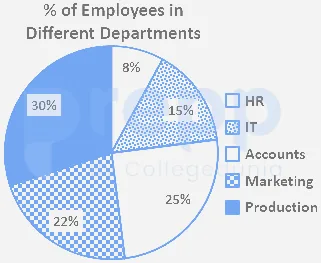
- A
200
- B
240
- C
120
- D
176
Show answer
D. 176Calculation:
Total no. of employees = 800
% of people woring in the field of marketing = 22%
Total no. employees working in the field of marketing = 800 × 22/100
⇒ 176
∴ 176 employees are working in the field of marketing.
Paper & answer key PDF ↗ Question 52archived
The cost price and the marked price of an item are Rs. 720 and Rs. 900 respectively. When it is sold at a discount of x%, the profit is \(\frac{5x}{3}\%\) . What is the vale of x?
- A
\(5\frac{5}{7}\)
- B
\(7\frac{4}{7}\)
- C
\(8\frac{4}{7}\)
- D
\(5\frac{4}{7}\)
Show answer
C. \(8\frac{4}{7}\)Calculating Discount Percentage and Profit Percentage
This problem involves understanding the relationship between Cost Price (CP), Marked Price (MP), Selling Price (SP), discount percentage, and profit percentage. We are given the CP and MP, a discount percentage in terms of 'x', and a profit percentage also in terms of 'x'. Our goal is to find the value of 'x'.
Understanding Key Terms
Cost Price (CP): The price at which an item is bought. Given as Rs. 720.
Marked Price (MP): The price marked on the item. This is the price before any discount. Given as Rs. 900.
Selling Price (SP): The price at which the item is actually sold after applying the discount.
Discount: A reduction offered on the Marked Price. Given as x%.
Profit: The gain made when the Selling Price is more than the Cost Price. Given as \(\frac{5x}{3}\%\).
Relating SP, MP, and Discount
The selling price is obtained by reducing the marked price by the discount amount. The discount amount is calculated as a percentage of the Marked Price.
Discount Amount = Discount Percentage of MP
Discount Amount = \( \frac{x}{100} \times \text{MP} \)
Given MP = Rs. 900, the Discount Amount is:
Discount Amount = \( \frac{x}{100} \times 900 = 9x \)
The Selling Price (SP) is then:
SP = MP - Discount Amount
SP = \( 900 - 9x \)
Relating SP, CP, and Profit
The selling price can also be obtained by adding the profit amount to the cost price. The profit amount is calculated as a percentage of the Cost Price.
Profit Amount = Profit Percentage of CP
Profit Amount = \( \frac{\frac{5x}{3}}{100} \times \text{CP} \)
Profit Amount = \( \frac{5x}{300} \times \text{CP} \)
Given CP = Rs. 720, the Profit Amount is:
Profit Amount = \( \frac{5x}{300} \times 720 \)
Let's simplify this expression:
Profit Amount = \( \frac{5x}{300} \times 720 = \frac{5x \times 720}{300} = \frac{5x \times 72}{30} = \frac{x \times 72}{6} = 12x \)
The Selling Price (SP) is then:
SP = CP + Profit Amount
SP = \( 720 + 12x \)
Finding the Value of x
Since the Selling Price must be the same regardless of whether we calculate it using the discount on MP or the profit on CP, we can equate the two expressions for SP:
\( 900 - 9x = 720 + 12x \)
Now, we need to solve this linear equation for x. Let's gather the x terms on one side and the constant terms on the other side:
\( 900 - 720 = 12x + 9x \)
\( 180 = 21x \)
To find x, divide both sides by 21:
\( x = \frac{180}{21} \)
Both 180 and 21 are divisible by 3. \( 180 \div 3 = 60 \) and \( 21 \div 3 = 7 \).
\( x = \frac{60}{7} \)
To express this as a mixed number, divide 60 by 7. \( 60 = 7 \times 8 + 4 \).
\( x = 8 \frac{4}{7} \)
The value of x is \( 8 \frac{4}{7} \).
Verification
Let's verify the result by calculating the discount and profit percentages and the resulting SP using \( x = \frac{60}{7} \).
Discount Percentage = \( x\% = \frac{60}{7}\% \)
Discount Amount = \( \frac{60/7}{100} \times 900 = \frac{60}{700} \times 900 = \frac{6}{70} \times 900 = \frac{6}{7} \times 90 = \frac{540}{7} \)
SP = MP - Discount Amount = \( 900 - \frac{540}{7} = \frac{6300 - 540}{7} = \frac{5760}{7} \)
Profit Percentage = \( \frac{5x}{3}\% = \frac{5 \times (60/7)}{3}\% = \frac{300/7}{3}\% = \frac{300}{21}\% = \frac{100}{7}\% \)
Profit Amount = \( \frac{100/7}{100} \times 720 = \frac{100}{700} \times 720 = \frac{1}{7} \times 720 = \frac{720}{7} \)
SP = CP + Profit Amount = \( 720 + \frac{720}{7} = \frac{720 \times 7 + 720}{7} = \frac{5040 + 720}{7} = \frac{5760}{7} \)
Both calculations yield the same Selling Price, which confirms our value of x is correct.
Item Detail
Value
Cost Price (CP)
Rs. 720
Marked Price (MP)
Rs. 900
Discount Percentage
x%
Profit Percentage
\(\frac{5x}{3}\%\)
Calculated x value
\(8 \frac{4}{7}\)
Revision Table: Profit, Loss & Discount Concepts
Concept
Formula
Selling Price with Discount
\(SP = MP \times (1 - \frac{\text{Discount}\%}{100})\)
Selling Price with Profit
\(SP = CP \times (1 + \frac{\text{Profit}\%}{100})\)
Discount Amount
\(MP - SP\) or \(MP \times \frac{\text{Discount}\%}{100}\)
Profit Amount
\(SP - CP\) or \(CP \times \frac{\text{Profit}\%}{100}\)
Profit %
\( \frac{\text{Profit Amount}}{CP} \times 100 \)
Discount %
\( \frac{\text{Discount Amount}}{MP} \times 100 \)
Additional Information on Profit and Loss Calculations
Problems involving CP, MP, discount, and profit often require setting up equations based on the selling price. The selling price is the link connecting the cost price (via profit/loss) and the marked price (via discount).
When a discount is given, the selling price is always less than or equal to the marked price. When a profit is made, the selling price is always greater than the cost price. If there is a loss, the selling price is less than the cost price.
It is important to remember that profit or loss percentage is always calculated on the Cost Price, unless stated otherwise. Discount percentage is always calculated on the Marked Price.
In this specific problem, expressing both the discount and profit percentages in terms of a single variable 'x' allowed us to create an equation by equating the two ways of calculating the Selling Price, thus enabling us to solve for 'x'.
Paper & answer key PDF ↗ Question 53archived
The following bar graph shows the demand and production (in Lakhs) of motor cycles of five different companies A, B, C, D and E in 2020.
What is the ratio of total production of motor cycles of companies A, B, C, D and E, to that of the total demand of motor cycles of all the companies during the five years?
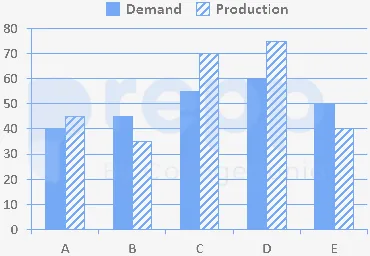
- A
33 : 50
- B
53 : 50
- C
23 : 50
- D
13 : 50
Show answer
B. 53 : 50Production of company A = 45 lakhs
Production of company B = 35 lakhs
Production of company C = 70 lakhs
Production of company D = 75 lakhs
Production of company E = 40 lakhs
Total production = 45 + 35 + 70 + 75 + 40 = 265 lakhs
Demand of company A = 40 lakhs
Demand of company B = 45 lakhs
Demand of company C = 55 lakhs
Demand of company D = 60 lakhs
Demand of company E = 50 lakhs
Total demand = 40 + 45 + 55 + 60 + 50 = 250 lakhs
Ratio of total production to total demand = 265 : 250 = 53 : 50
∴ Required ratio is 53 : 50
Paper & answer key PDF ↗ Question 54archived
Simplify the following expression.
\(\left(\frac{7}{16} \div \frac{1}{2}\:of\: \frac{1}{5}\right)\times \frac{4}{5}-\frac{1}{3}\times\frac{5}{8}\div \frac{1}{2}+\frac{3}{4}\)
- A
\(\frac{10}{3}\)
- B
\(\frac{71}{150}\)
- C
\(\frac{23}{6}\)
- D
\(\frac{317}{96}\)
Show answer
C. \(\frac{23}{6}\)Simplifying Complex Fraction Expressions
To simplify the given mathematical expression, we need to follow the order of operations, often remembered by acronyms like BODMAS or PEMDAS. The expression is:
\(\left(\frac{7}{16} \div \frac{1}{2}\:of\: \frac{1}{5}\right)\times \frac{4}{5}-\frac{1}{3}\times\frac{5}{8}\div \frac{1}{2}+\frac{3}{4}\)
Let's break down the expression and simplify it step-by-step.
Step 1: Handle the 'of' operation within the brackets
The term \(\frac{1}{2}\:of\: \frac{1}{5}\) means \(\frac{1}{2} \times \frac{1}{5}\).
\(\frac{1}{2} \times \frac{1}{5} = \frac{1 \times 1}{2 \times 5} = \frac{1}{10}\)
Now the expression inside the brackets becomes \(\frac{7}{16} \div \frac{1}{10}\).
Step 2: Perform the division inside the brackets
Dividing by a fraction is the same as multiplying by its reciprocal.
\(\frac{7}{16} \div \frac{1}{10} = \frac{7}{16} \times \frac{10}{1} = \frac{7 \times 10}{16 \times 1} = \frac{70}{16}\)
This fraction can be simplified by dividing the numerator and denominator by their greatest common divisor, which is 2.
\(\frac{70}{16} = \frac{70 \div 2}{16 \div 2} = \frac{35}{8}\)
The expression now looks like:
\(\left(\frac{35}{8}\right)\times \frac{4}{5}-\frac{1}{3}\times\frac{5}{8}\div \frac{1}{2}+\frac{3}{4}\)
Step 3: Perform the multiplication outside the first bracket
Next, calculate \(\frac{35}{8}\times \frac{4}{5}\).
\(\frac{35}{8}\times \frac{4}{5} = \frac{35 \times 4}{8 \times 5} = \frac{140}{40}\)
Simplify this fraction by dividing numerator and denominator by 10, then by 4 (or directly by 40, or stepwise by common factors).
\(\frac{140}{40} = \frac{140 \div 10}{40 \div 10} = \frac{14}{4}\)
\(\frac{14}{4} = \frac{14 \div 2}{4 \div 2} = \frac{7}{2}\)
The expression is now:
\(\frac{7}{2}-\frac{1}{3}\times\frac{5}{8}\div \frac{1}{2}+\frac{3}{4}\)
Step 4: Perform multiplication and division from left to right in the middle part
The middle part is \(-\frac{1}{3}\times\frac{5}{8}\div \frac{1}{2}\). First, multiply:
\(-\frac{1}{3}\times\frac{5}{8} = -\frac{1 \times 5}{3 \times 8} = -\frac{5}{24}\)
Now, divide the result by \(\frac{1}{2}\). Remember to multiply by the reciprocal.
\(-\frac{5}{24} \div \frac{1}{2} = -\frac{5}{24} \times \frac{2}{1} = -\frac{5 \times 2}{24 \times 1} = -\frac{10}{24}\)
Simplify this fraction by dividing numerator and denominator by 2.
\(-\frac{10}{24} = -\frac{10 \div 2}{24 \div 2} = -\frac{5}{12}\)
The expression is now simplified to:
\(\frac{7}{2} - \frac{5}{12} + \frac{3}{4}\)
Step 5: Perform addition and subtraction from left to right
To add and subtract these fractions, we need a common denominator. The denominators are 2, 12, and 4. The least common multiple (LCM) of 2, 12, and 4 is 12.
Convert each fraction to an equivalent fraction with a denominator of 12:
\(\frac{7}{2} = \frac{7 \times 6}{2 \times 6} = \frac{42}{12}\)
\(\frac{5}{12}\) remains \(\frac{5}{12}\)
\(\frac{3}{4} = \frac{3 \times 3}{4 \times 3} = \frac{9}{12}\)
Now substitute these into the expression:
\(\frac{42}{12} - \frac{5}{12} + \frac{9}{12}\)
Combine the numerators over the common denominator:
\(\frac{42 - 5 + 9}{12}\)
Calculate the numerator:
\(42 - 5 = 37\)
\(37 + 9 = 46\)
So the expression simplifies to:
\(\frac{46}{12}\)
Step 6: Simplify the final fraction
The fraction \(\frac{46}{12}\) can be simplified by dividing the numerator and denominator by their greatest common divisor, which is 2.
\(\frac{46}{12} = \frac{46 \div 2}{12 \div 2} = \frac{23}{6}\)
The simplified expression is \(\frac{23}{6}\).
Operation
Calculation
Result
\(\frac{1}{2}\:of\: \frac{1}{5}\)
\(\frac{1}{2} \times \frac{1}{5}\)
\(\frac{1}{10}\)
\(\frac{7}{16} \div \frac{1}{10}\)
\(\frac{7}{16} \times \frac{10}{1} = \frac{70}{16}\)
\(\frac{35}{8}\)
\(\frac{35}{8} \times \frac{4}{5}\)
\(\frac{35 \times 4}{8 \times 5} = \frac{140}{40}\)
\(\frac{7}{2}\)
\(-\frac{1}{3} \times \frac{5}{8}\)
\(-\frac{1 \times 5}{3 \times 8}\)
\(-\frac{5}{24}\)
\(-\frac{5}{24} \div \frac{1}{2}\)
\(-\frac{5}{24} \times \frac{2}{1} = -\frac{10}{24}\)
\(-\frac{5}{12}\)
\(\frac{7}{2} - \frac{5}{12} + \frac{3}{4}\)
\(\frac{42}{12} - \frac{5}{12} + \frac{9}{12} = \frac{42-5+9}{12} = \frac{46}{12}\)
\(\frac{23}{6}\)
Revision Table: Key Concepts in Fraction Simplification
Concept
Description
Order of Operations
Follow BODMAS/PEMDAS: Brackets > Of > Division/Multiplication > Addition/Subtraction.
Fraction Multiplication
Multiply numerators together and denominators together. \(\frac{a}{b} \times \frac{c}{d} = \frac{a \times c}{b \times d}\).
Fraction Division
Multiply the first fraction by the reciprocal of the second fraction. \(\frac{a}{b} \div \frac{c}{d} = \frac{a}{b} \times \frac{d}{c}\).
'Of' Operation
In mathematics, 'of' between fractions means multiplication. \(\frac{a}{b}\:of\: \frac{c}{d} = \frac{a}{b} \times \frac{c}{d}\).
Finding Common Denominator
Necessary for adding or subtracting fractions. Find the LCM of the denominators.
Simplifying Fractions
Divide the numerator and denominator by their greatest common divisor (GCD).
Additional Information: Understanding BODMAS/PEMDAS
The order of operations ensures that mathematical expressions are evaluated consistently, leading to a single correct answer. Different regions use slightly different acronyms, but the order of operations is the same:
B/P: Brackets / Parentheses - Evaluate expressions inside brackets or parentheses first.
O/E: Orders / Exponents - Evaluate powers and roots. This step is not applicable in the given problem.
D/M: Division and Multiplication - Perform these operations from left to right as they appear in the expression.
A/S: Addition and Subtraction - Perform these operations from left to right as they appear in the expression.
In the given problem, the 'of' operation (\(\frac{1}{2}\:of\: \frac{1}{5}\)) acts like multiplication but is typically performed before other multiplication and division operations outside of brackets, similar to how you would evaluate an exponent or an operation within a grouping symbol. Within the standard order of operations, 'of' falls under the 'Orders' or 'Exponents' category conceptually in some interpretations when it's used in this context, meaning it takes precedence over standard multiplication/division that is not part of a grouping. However, within the context of brackets as seen here \(\left(\frac{7}{16} \div \frac{1}{2}\:of\: \frac{1}{5}\right)\), you first evaluate the 'of' within the bracket, then the division within the bracket, before moving outside the bracket.
Applying this to our problem ensured we correctly handled the division and 'of' within the brackets first, then the multiplication outside, and finally the remaining multiplication/division before the final addition and subtraction.
Paper & answer key PDF ↗ Question 55archived
If \(4x^4=5x^2-1, x>\frac{1}{\sqrt 2}\) , then what is the vale of (2x 2- x - 1)?
- A
1
- B
-2
- C
2
- D
0
Show answer
D. 0Understanding the Problem
The question asks us to find the value of a specific algebraic expression, \(2x^2 - x - 1\), given an equation relating \(x\) and a condition on the value of \(x\). The given equation is \(4x^4 = 5x^2 - 1\), and the condition is \(x > \frac{1}{\sqrt 2}\).
Solving the Given Equation
The given equation is \(4x^4 = 5x^2 - 1\). This looks like a polynomial equation. We can rearrange it to set it equal to zero:
\(4x^4 - 5x^2 + 1 = 0\)
Notice that the powers of \(x\) are 4 and 2. This type of equation is called a biquadratic equation, which can be solved by treating it as a quadratic equation in terms of \(x^2\). Let \(y = x^2\). Substituting \(y\) into the equation, we get:
\(4y^2 - 5y + 1 = 0\)
This is a standard quadratic equation in the variable \(y\). We can solve this quadratic equation by factoring, using the quadratic formula, or completing the square. Factoring seems straightforward here. We look for two numbers that multiply to \(4 \times 1 = 4\) and add up to -5. These numbers are -4 and -1.
We can rewrite the middle term (\(-5y\)) as \(-4y - y\):
\(4y^2 - 4y - y + 1 = 0\)
Now, we can group terms and factor:
\(4y(y - 1) - 1(y - 1) = 0\)
\((4y - 1)(y - 1) = 0\)
This gives us two possible solutions for \(y\):
\(4y - 1 = 0 \implies 4y = 1 \implies y = \frac{1}{4}\)
\(y - 1 = 0 \implies y = 1\)
Finding the Valid Value of x
We found two possible values for \(y\), which is equal to \(x^2\). So, we have:
\(x^2 = \frac{1}{4}\)
\(x^2 = 1\)
Taking the square root of both sides for each case:
From \(x^2 = \frac{1}{4}\), we get \(x = \pm \sqrt{\frac{1}{4}} = \pm \frac{1}{2}\). The possible values for \(x\) are \(\frac{1}{2}\) and \(-\frac{1}{2}\).
From \(x^2 = 1\), we get \(x = \pm \sqrt{1} = \pm 1\). The possible values for \(x\) are \(1\) and \(-1\).
So, the potential values for \(x\) are \(-\frac{1}{2}, \frac{1}{2}, -1, 1\).
Now we need to consider the given condition: \(x > \frac{1}{\sqrt 2}\).
Let's approximate the value of \(\frac{1}{\sqrt 2}\). Since \(\sqrt 2 \approx 1.414\), \(\frac{1}{\sqrt 2} \approx \frac{1}{1.414} \approx 0.707\).
We check which of the potential values of \(x\) satisfy the condition \(x > 0.707\):
\(x = -\frac{1}{2} = -0.5\). This is not greater than 0.707.
\(x = \frac{1}{2} = 0.5\). This is not greater than 0.707.
\(x = -1\). This is not greater than 0.707.
\(x = 1\). This is greater than 0.707.
Only \(x = 1\) satisfies the condition \(x > \frac{1}{\sqrt 2}\).
Evaluating the Expression
We need to find the value of the expression \(2x^2 - x - 1\) for the valid value of \(x\), which is \(x = 1\). Substitute \(x = 1\) into the expression:
\(2(1)^2 - (1) - 1\)
First, calculate the term with the exponent:
\(1^2 = 1\)
Now substitute this back into the expression:
\(2(1) - 1 - 1\)
Perform the multiplication:
\(2 - 1 - 1\)
Perform the subtraction:
\(2 - 1 - 1 = 1 - 1 = 0\)
The value of the expression \(2x^2 - x - 1\) for \(x=1\) is 0.
Final Answer
The value of the expression \(2x^2 - x - 1\) when \(4x^4=5x^2-1\) and \(x>\frac{1}{\sqrt 2}\) is 0.
Revision Table: Key Concepts
Concept
Description
Application in this Problem
Biquadratic Equation
An equation of the form \(ax^4 + bx^2 + c = 0\).
The equation \(4x^4 - 5x^2 + 1 = 0\) is solved by treating \(x^2\) as a variable.
Quadratic Formula
Formula to solve \(ay^2 + by + c = 0\): \(y = \frac{-b \pm \sqrt{b^2-4ac}}{2a}\).
Could be used to solve \(4y^2 - 5y + 1 = 0\) for \(y\).
Factoring Quadratics
Expressing a quadratic polynomial as a product of linear factors.
Used to solve \(4y^2 - 5y + 1 = 0\) as \((4y-1)(y-1)=0\).
Inequality Condition
A condition that restricts the possible values of a variable.
The condition \(x > \frac{1}{\sqrt 2}\) is used to select the unique valid value of \(x\).
Expression Evaluation
Substituting a specific value for the variable(s) into an expression and calculating the result.
The final step of substituting the valid \(x\) value into \(2x^2 - x - 1\).
Additional Information: Solving Equations
Solving equations is a fundamental skill in algebra. Different types of equations require different approaches:
Linear Equations: Equations where the highest power of the variable is 1 (e.g., \(2x + 3 = 7\)). Solved by isolating the variable.
Quadratic Equations: Equations where the highest power of the variable is 2 (e.g., \(ax^2 + bx + c = 0\)). Solved by factoring, completing the square, or the quadratic formula.
Polynomial Equations: Equations involving higher powers of the variable (e.g., \(x^3 - 2x + 1 = 0\)). Solving these can be more complex and may involve factoring, rational root theorem, or numerical methods.
Biquadratic Equations: A specific type of polynomial equation of the form \(ax^4 + bx^2 + c = 0\), which can be transformed into a quadratic equation by substituting \(y = x^2\).
It's crucial to always check if the solutions obtained satisfy any given conditions or domain restrictions on the variable.
Paper & answer key PDF ↗ Question 56archived
Simplify the following expression:
\(\frac{108\times108\times108-92\times92\times92}{108\times108+92\times92+108\times92}\)
- A
200
- B
16
- C
1
- D
-1
Show answer
B. 16Simplifying Expressions Using Algebraic Identities
The given expression is:
\(\frac{108\times108\times108-92\times92\times92}{108\times108+92\times92+108\times92}\)
We can rewrite the expression using exponents:
\(\frac{108^3 - 92^3}{108^2 + 92^2 + 108 \times 92}\)
This expression looks like a standard algebraic identity. Let's consider the difference of cubes formula:
\(a^3 - b^3 = (a-b)(a^2 + ab + b^2)\)
Comparing the given expression with this identity, we can identify \(a\) and \(b\). Here, \(a = 108\) and \(b = 92\).
The numerator of the given expression is \(108^3 - 92^3\), which is in the form \(a^3 - b^3\). Using the identity, we can expand the numerator:
\(108^3 - 92^3 = (108 - 92)(108^2 + 108 \times 92 + 92^2)\)
Now substitute this expanded form back into the original expression:
\(\frac{(108 - 92)(108^2 + 108 \times 92 + 92^2)}{108^2 + 92^2 + 108 \times 92}\)
Notice that the term \((108^2 + 108 \times 92 + 92^2)\) appears in both the numerator and the denominator. Assuming this term is not zero (which is true as it's a sum of positive terms), we can cancel it out.
\(\frac{(108 - 92)\cancel{(108^2 + 108 \times 92 + 92^2)}}{\cancel{108^2 + 92^2 + 108 \times 92}} = 108 - 92\)
Now, we simply calculate the value of \(108 - 92\):
\(108 - 92 = 16\)
Thus, the simplified value of the expression is 16.
Step-by-Step Simplification
Identify the given expression: \(\frac{108^3 - 92^3}{108^2 + 92^2 + 108 \times 92}\).
Recognize the numerator as a difference of cubes, \(a^3 - b^3\), with \(a = 108\) and \(b = 92\).
Recall the algebraic identity: \(a^3 - b^3 = (a-b)(a^2 + ab + b^2)\).
Apply the identity to the numerator: \(108^3 - 92^3 = (108-92)(108^2 + 108 \times 92 + 92^2)\).
Substitute the expanded numerator into the expression: \(\frac{(108-92)(108^2 + 108 \times 92 + 92^2)}{108^2 + 92^2 + 108 \times 92}\).
Cancel out the common term \((108^2 + 108 \times 92 + 92^2)\) from the numerator and denominator.
The expression simplifies to \(108 - 92\).
Calculate the final result: \(108 - 92 = 16\).
Revision Table: Key Algebraic Identities
Identity
Formula
Difference of Cubes
\(a^3 - b^3 = (a-b)(a^2 + ab + b^2)\)
Sum of Cubes
\(a^3 + b^3 = (a+b)(a^2 - ab + b^2)\)
Difference of Squares
\(a^2 - b^2 = (a-b)(a+b)\)
Perfect Square Trinomial
\((a+b)^2 = a^2 + 2ab + b^2\)
Perfect Square Trinomial
\((a-b)^2 = a^2 - 2ab + b^2\)
Additional Information: Applying Algebraic Identities
Algebraic identities are powerful tools for simplifying complex expressions and solving equations. Recognizing patterns in expressions, like the difference of cubes in this problem, allows us to use these identities to quickly simplify calculations that would otherwise be lengthy and prone to errors.
Always look for patterns in mathematical expressions that match known identities.
Common identities involve squares and cubes of binomials.
Applying identities can turn multiplication/division problems into simpler addition/subtraction.
Understanding these identities is crucial for various areas of mathematics and quantitative aptitude tests.
In this specific problem, without recognizing the difference of cubes, one would have to calculate \(108^3\), \(92^3\), \(108^2\), \(92^2\), \(108 \times 92\), perform subtraction, addition, and then division, which is significantly more complex than simply calculating \(108 - 92\).
Paper & answer key PDF ↗ Question 57archived
In triangle ABC, D is a point on BC such that BD : DC = 3 : 4. E is a point on AD such that AE : ED = 2 : 3. Find the ratio area (ΔECD) : area (ΔAEB).
- A
2 : 1
- B
1 : 2
- C
9 : 8
- D
8 : 9
Show answer
A. 2 : 1Understanding Triangle Area Ratios
This problem involves finding the ratio of areas of two triangles within a larger triangle, where points on the sides and an internal segment divide them in given ratios. The key principle we will use is that:
If two triangles share the same height, the ratio of their areas is equal to the ratio of their bases.
If two triangles share the same base, the ratio of their areas is equal to the ratio of their heights.
Let's apply this principle to the given triangle ABC with points D on BC and E on AD.
Analyzing the Ratios on BC and AD
We are given the following ratios:
D is on BC such that BD : DC = 3 : 4.
E is on AD such that AE : ED = 2 : 3.
Step-by-Step Area Calculation
Let's break down the areas based on the given ratios.
Step 1: Relating Areas of ΔABD and ΔACD
Triangles ABD and ACD share a common vertex A and their bases BD and DC lie on the same line BC. This means they share the same height from vertex A to the base BC.
Therefore, the ratio of their areas is equal to the ratio of their bases:
$\frac{\text{Area}(\Delta\text{ABD})}{\text{Area}(\Delta\text{ACD})} = \frac{\text{BD}}{\text{DC}} = \frac{3}{4}$
Let's assume Area($\Delta$ABD) = $3x$ and Area($\Delta$ACD) = $4x$ for some variable $x$.
Step 2: Relating Areas within ΔABD using point E
Point E is on AD such that AE : ED = 2 : 3. Consider $\Delta$ABD. The segment AD is divided at E. Triangles AEB and EBD share a common vertex B and their bases AE and ED lie on the same line AD. This means they share the same height from vertex B to the base AD.
Therefore, the ratio of their areas is equal to the ratio of their bases:
$\frac{\text{Area}(\Delta\text{AEB})}{\text{Area}(\Delta\text{EBD})} = \frac{\text{AE}}{\text{ED}} = \frac{2}{3}$
The sum of their areas is Area($\Delta$ABD). So, Area($\Delta$AEB) + Area($\Delta$EBD) = Area($\Delta$ABD).
Area($\Delta$AEB) is $\frac{2}{2+3} = \frac{2}{5}$ of Area($\Delta$ABD).
Area($\Delta$AEB) = $\frac{2}{5} \times \text{Area}(\Delta\text{ABD})$
Substituting Area($\Delta$ABD) = $3x$:
Area($\Delta$AEB) = $\frac{2}{5} \times 3x = \frac{6x}{5}$.
Step 3: Relating Areas within ΔACD using point E
Point E is on AD such that AE : ED = 2 : 3. Consider $\Delta$ACD. The segment AD is divided at E. Triangles AEC and ECD share a common vertex C and their bases AE and ED lie on the same line AD. This means they share the same height from vertex C to the base AD.
Therefore, the ratio of their areas is equal to the ratio of their bases:
$\frac{\text{Area}(\Delta\text{AEC})}{\text{Area}(\Delta\text{ECD})} = \frac{\text{AE}}{\text{ED}} = \frac{2}{3}$
The sum of their areas is Area($\Delta$ACD). So, Area($\Delta$AEC) + Area($\Delta$ECD) = Area($\Delta$ACD).
Area($\Delta$ECD) is $\frac{3}{2+3} = \frac{3}{5}$ of Area($\Delta$ACD).
Area($\Delta$ECD) = $\frac{3}{5} \times \text{Area}(\Delta\text{ACD})$
Substituting Area($\Delta$ACD) = $4x$:
Area($\Delta$ECD) = $\frac{3}{5} \times 4x = \frac{12x}{5}$.
Step 4: Finding the Ratio Area(ΔECD) : Area(ΔAEB)
We need to find the ratio of Area($\Delta$ECD) to Area($\Delta$AEB).
Area($\Delta$ECD) = $\frac{12x}{5}$
Area($\Delta$AEB) = $\frac{6x}{5}$
Ratio = $\frac{\text{Area}(\Delta\text{ECD})}{\text{Area}(\Delta\text{AEB})} = \frac{\frac{12x}{5}}{\frac{6x}{5}}$
Ratio = $\frac{12x}{5} \times \frac{5}{6x} = \frac{12}{6} = 2$
The ratio Area(ΔECD) : Area(ΔAEB) is 2 : 1.
Triangle
Area (in terms of x)
ΔABD
$3x$
ΔACD
$4x$
ΔAEB
$\frac{6x}{5}$
ΔECD
$\frac{12x}{5}$
Conclusion
By using the property of areas of triangles sharing a common height, we determined the areas of $\Delta$AEB and $\Delta$ECD in terms of a common variable related to the initial division of the base BC. The calculated ratio Area(ΔECD) : Area(ΔAEB) is 2 : 1.
Revision Table: Key Area Ratio Concepts
Condition
Triangles
Area Ratio
Same Height
ΔPQR, ΔPST (bases QR, ST on same line)
Area(ΔPQR) : Area(ΔPST) = QR : ST
Same Base
ΔPQR, ΔSQR (bases QR common)
Area(ΔPQR) : Area(ΔSQR) = Height from P : Height from S
Additional Information: Ceva's Theorem and Menelaus' Theorem
Problems involving points on sides and internal segments of a triangle often relate to concepts like Ceva's Theorem and Menelaus' Theorem, although this specific area ratio problem was solvable using basic area principles. These theorems provide relationships between the lengths of segments created when lines intersect the sides of a triangle.
Ceva's Theorem: Deals with concurrent cevians (lines from vertices to opposite sides).
Menelaus' Theorem: Deals with a transversal line intersecting the sides (or their extensions) of a triangle.
While not directly used in this area ratio calculation, understanding these theorems can be helpful for solving related geometry problems involving ratios of lengths and points within a triangle.
Paper & answer key PDF ↗ Question 58archived
Points A and B are on a circle with centre O. PAM and PBN are tangents to the circle at A and B respectively from a point P outside the circle. Point Q is on the major arc AB such that ∠QAM = 58° and ∠QBN = 50°, then find the measure (in degrees) of ∠APB.
- A
36
- B
30
- C
40
- D
32
Show answer
A. 36Understanding the Circle Geometry Problem
The problem involves a circle, tangents drawn from an external point, and a point on the arc. We are given angles formed by tangents and chords and asked to find the angle between the two tangents.
Let's break down the given information:
A circle with centre O.
P is a point outside the circle.
PAM and PBN are tangents to the circle at A and B respectively. This implies PA = PB (lengths of tangents from an external point to a circle are equal).
Q is a point on the major arc AB.
∠QAM = 58°. This is the angle between the tangent PAM and the chord AQ.
∠QBN = 50°. This is the angle between the tangent PBN and the chord BQ.
We need to find the measure of ∠APB, the angle between the tangents PA and PB.
Applying Circle Theorems and Properties
We can use the properties of tangents and chords, specifically the Alternate Segment Theorem, and the properties of triangles to solve this problem.
Alternate Segment Theorem
The Alternate Segment Theorem states that the angle between a tangent and a chord through the point of contact is equal to the angle in the alternate segment.
The angle between tangent PAM and chord AQ is ∠QAM. The angle in the alternate segment (subtended by chord AQ) is ∠ABQ. Therefore, according to the theorem:
$$\angle ABQ = \angle QAM = 58^\circ$$
The angle between tangent PBN and chord BQ is ∠QBN. The angle in the alternate segment (subtended by chord BQ) is ∠BAQ. Therefore, according to the theorem:
$$\angle BAQ = \angle QBN = 50^\circ$$
Angles in Triangle ABQ
Now consider the triangle ▵ABQ. We know two of its angles: ∠BAQ and ∠ABQ. The sum of angles in a triangle is 180°.
In ▵ABQ:
$$\angle AQB + \angle BAQ + \angle ABQ = 180^\circ$$
Substitute the values we found:
$$\angle AQB + 50^\circ + 58^\circ = 180^\circ$$
$$\angle AQB + 108^\circ = 180^\circ$$
Calculate ∠AQB:
$$\angle AQB = 180^\circ - 108^\circ = 72^\circ$$
Relating to the Angle Between Tangents (∠APB)
Now, let's consider the angle between the tangents ∠APB. This angle is part of ▵PAB. We know that PA = PB (tangents from P to the circle). Therefore, ▵PAB is an isosceles triangle, which means ∠PAB = ∠PBA.
Let's apply the Alternate Segment Theorem again, this time using the chord AB:
The angle between tangent PA and chord AB is ∠PAB. The angle in the alternate segment (subtended by chord AB) is ∠AQB (since Q is on the major arc AB). Therefore:
$$\angle PAB = \angle AQB$$
The angle between tangent PB and chord AB is ∠PBA. The angle in the alternate segment (subtended by chord AB) is also ∠AQB. Therefore:
$$\angle PBA = \angle AQB$$
From the previous step, we found ∠AQB = 72°. So, we have:
∠PAB = 72°
∠PBA = 72°
Angles in Triangle PAB
Finally, consider ▵PAB. The sum of angles in ▵PAB is 180°.
In ▵PAB:
$$\angle APB + \angle PAB + \angle PBA = 180^\circ$$
Substitute the values we found for ∠PAB and ∠PBA:
$$\angle APB + 72^\circ + 72^\circ = 180^\circ$$
$$\angle APB + 144^\circ = 180^\circ$$
Calculate ∠APB:
$$\angle APB = 180^\circ - 144^\circ = 36^\circ$$
Conclusion
Using the Alternate Segment Theorem and the angle sum property of a triangle, we determined the measure of ∠APB.
Angle
Value
Reason
∠QAM
58°
Given
∠QBN
50°
Given
∠ABQ
58°
Alternate Segment Theorem (∠QAM = ∠ABQ)
∠BAQ
50°
Alternate Segment Theorem (∠QBN = ∠BAQ)
∠AQB
72°
Angle sum in ▵ABQ (∠AQB + 50° + 58° = 180°)
∠PAB
72°
Alternate Segment Theorem (∠PAB = ∠AQB)
∠PBA
72°
Alternate Segment Theorem (∠PBA = ∠AQB)
∠APB
36°
Angle sum in ▵PAB (∠APB + 72° + 72° = 180°)
Thus, the measure of ∠APB is 36°.
Revision Table: Circle Geometry Angles
Concept
Description
Relevance to Problem
Tangent from External Point
Two tangents from an external point to a circle are equal in length.
PA = PB, making ▵PAB isosceles.
Alternate Segment Theorem
Angle between tangent and chord through point of contact equals angle in alternate segment.
Used to find ∠ABQ, ∠BAQ, ∠PAB, ∠PBA.
Angle Sum Property of Triangle
Sum of interior angles in a triangle is 180°.
Used to find ∠AQB in ▵ABQ and ∠APB in ▵PAB.
Isosceles Triangle Properties
Base angles opposite equal sides are equal.
∠PAB = ∠PBA in ▵PAB.
Additional Information on Tangent Properties and Circle Angles
Tangents are lines that touch a circle at exactly one point. The point where a tangent touches the circle is called the point of contact.
Radius is Perpendicular to Tangent: The radius drawn to the point of contact is perpendicular to the tangent at that point. This means ∠OAP = 90° and ∠OBP = 90° (where O is the center of the circle). This property wasn't directly needed to find ∠APB in this specific problem, but it's a fundamental tangent property.
Quadrilateral PAOB: Since ∠OAP = 90° and ∠OBP = 90°, the sum of angles in quadrilateral PAOB is ∠APB + ∠PAO + ∠AOB + ∠PBO = 360°.
∠APB + 90° + ∠AOB + 90° = 360°
∠APB + ∠AOB = 180°
The angle between the tangents from an external point is supplementary to the angle subtended by the chord of contact at the center. So, ∠AOB = 180° - ∠APB.
Angle at Centre vs. Angle at Circumference: The angle subtended by an arc at the centre is double the angle subtended by the same arc at any point on the remaining part of the circle. For chord AB, the angle at the center is ∠AOB, and the angle at the circumference on the major arc is ∠AQB. Thus, ∠AOB = 2 × ∠AQB. This confirms the relationship ∠APB = 180° - ∠AOB = 180° - 2 × ∠AQB. Since we found ∠AQB = 72°, ∠APB = 180° - 2 × 72° = 180° - 144° = 36°. This provides an alternative way to verify the answer using the relationship between the central angle and the angle between tangents.
Paper & answer key PDF ↗ Question 59archived
If 4sin 2(2x - 10)° = 3, 0 ≤ (2x - 10) ≤ 90, then find the value of \(\frac{sin^4(x-5)^{\circ}+cos^4(x-5)^{\circ}}{1-2sin^2(3x-15)^{\circ}cos^2(3x-15)^{\circ}}\)
- A
-1
- B
1
- C
\(-\frac{5}{8}\)
- D
\(\frac{5}{8}\)
Show answer
D. \(\frac{5}{8}\)Solving the Trigonometric Equation and Evaluating the Expression
We are given a trigonometric equation and asked to evaluate a complex trigonometric expression using the information from the equation. Let's break down the problem into steps.
Step 1: Solving the Given Trigonometric Equation
The given equation is \(4\sin^2(2x - 10)^{\circ} = 3\) with the condition \(0 \le (2x - 10) \le 90\).
Divide both sides by 4:
\(\sin^2(2x - 10)^{\circ} = \frac{3}{4}\)
Take the square root of both sides:
\(\sin(2x - 10)^{\circ} = \pm\sqrt{\frac{3}{4}} = \pm\frac{\sqrt{3}}{2}\)
We are given the condition \(0 \le (2x - 10) \le 90\). In this range (the first quadrant), the sine of an angle is always positive.
Therefore, we take the positive value:
\(\sin(2x - 10)^{\circ} = \frac{\sqrt{3}}{2}\)
We need to find the angle in the range \(0^{\circ}\) to \(90^{\circ}\) whose sine is \(\frac{\sqrt{3}}{2}\). This angle is \(60^{\circ}\).
So, we have:
\(2x - 10 = 60\)
Step 2: Determining the Angles for the Expression
The expression we need to evaluate involves the angles \((x-5)^{\circ}\) and \((3x-15)^{\circ}\). Let's see how these relate to the angle we just found, \((2x-10)^{\circ}\).
Notice that:
\((x - 5)\) is half of \((2x - 10)\). If \(2x - 10 = 60\), then \(x - 5 = \frac{60}{2} = 30\). So, \((x-5)^{\circ} = 30^{\circ}\).
\((3x - 15)\) is three times \((x - 5)\). If \(x - 5 = 30\), then \(3x - 15 = 3(x - 5) = 3 \times 30 = 90\). So, \((3x-15)^{\circ} = 90^{\circ}\).
Now we know the specific angles involved in the expression: \(30^{\circ}\) and \(90^{\circ}\).
Step 3: Evaluating the Trigonometric Expression
The expression is \(\frac{\sin^4(x-5)^{\circ}+\cos^4(x-5)^{\circ}}{1-2\sin^2(3x-15)^{\circ}\cos^2(3x-15)^{\circ}}\).
Substitute the angles we found:
\(\frac{\sin^4(30)^{\circ}+\cos^4(30)^{\circ}}{1-2\sin^2(90)^{\circ}\cos^2(90)^{\circ}}\)
Recall the standard trigonometric values for \(30^{\circ}\) and \(90^{\circ}\):
\(\sin(30^{\circ}) = \frac{1}{2}\)
\(\cos(30^{\circ}) = \frac{\sqrt{3}}{2}\)
\(\sin(90^{\circ}) = 1\)
\(\cos(90^{\circ}) = 0\)
Now, substitute these values into the expression:
Numerator: \(\sin^4(30^{\circ})+\cos^4(30^{\circ}) = \left(\frac{1}{2}\right)^4 + \left(\frac{\sqrt{3}}{2}\right)^4 = \frac{1}{16} + \frac{(\sqrt{3})^4}{2^4} = \frac{1}{16} + \frac{9}{16} = \frac{1 + 9}{16} = \frac{10}{16}\)
Simplify the numerator: \(\frac{10}{16} = \frac{5}{8}\)
Denominator: \(1-2\sin^2(90)^{\circ}\cos^2(90)^{\circ} = 1 - 2(1)^2(0)^2 = 1 - 2(1)(0) = 1 - 0 = 1\)
Now, put the numerator and denominator back together to get the value of the expression:
\(\frac{\frac{5}{8}}{1} = \frac{5}{8}\)
The value of the expression is \(\frac{5}{8}\).
Expression Part
Calculation
Value
\(\sin(2x-10)^{\circ}\)
From equation \(4\sin^2(2x - 10)^{\circ} = 3\) and condition \(0 \le (2x - 10) \le 90\)
\(\frac{\sqrt{3}}{2}\)
\((2x-10)^{\circ}\)
Angle whose sine is \(\frac{\sqrt{3}}{2}\) in range 0-90°
\(60^{\circ}\)
\((x-5)^{\circ}\)
\(\frac{1}{2}(2x-10)^{\circ}\)
\(30^{\circ}\)
\((3x-15)^{\circ}\)
\(3(x-5)^{\circ}\)
\(90^{\circ}\)
\(\sin(30^{\circ})\)
Standard value
\(\frac{1}{2}\)
\(\cos(30^{\circ})\)
Standard value
\(\frac{\sqrt{3}}{2}\)
\(\sin(90^{\circ})\)
Standard value
\(1\)
\(\cos(90^{\circ})\)
Standard value
\(0\)
Numerator \(\sin^4(30^{\circ})+\cos^4(30^{\circ})\)
\((\frac{1}{2})^4 + (\frac{\sqrt{3}}{2})^4 = \frac{1}{16} + \frac{9}{16}\)
\(\frac{10}{16} = \frac{5}{8}\)
Denominator \(1-2\sin^2(90^{\circ})\cos^2(90^{\circ})\)
\(1 - 2(1)^2(0)^2\)
\(1\)
Final Expression Value
\(\frac{\frac{5}{8}}{1}\)
\(\frac{5}{8}\)
Revision Table: Key Concepts and Formulas
Concept
Description / Formula
Solving \(\sin^2\theta = k\)
\(\sin\theta = \pm\sqrt{k}\). Use the given range to determine the sign.
Standard Angles
Knowing values of trigonometric functions for angles like 0°, 30°, 45°, 60°, 90°.
Evaluating Expressions
Substitute known values and simplify arithmetic.
Power of Trigonometric Functions
\(\sin^n\theta = (\sin\theta)^n\), \(\cos^n\theta = (\cos\theta)^n\).
Additional Information: Related Trigonometry Concepts
This problem combined solving a simple trigonometric equation with evaluating an expression. Here are some related concepts:
Trigonometric Identities: Although not strictly needed for the denominator simplification since cos(90°) is 0, the expression \(\sin^4\theta + \cos^4\theta\) can sometimes be simplified using identities like \(\sin^2\theta + \cos^2\theta = 1\). For example, \(\sin^4\theta + \cos^4\theta = (\sin^2\theta + \cos^2\theta)^2 - 2\sin^2\theta\cos^2\theta = 1 - 2\sin^2\theta\cos^2\theta\). In this problem, we evaluated directly using the numerical values of \(\sin(30^{\circ})\) and \(\cos(30^{\circ})\), which was straightforward.
Solving Trigonometric Equations: Equations like \(4\sin^2(2x - 10)^{\circ} = 3\) often have multiple solutions within a larger range. The given condition \(0 \le (2x - 10) \le 90\) limited the solution to a single value, making the problem simpler. For broader ranges, you would need to consider periodicity and other quadrants where sine is positive or negative.
Angles in Degrees: The problem uses degrees (\({}^{\circ}\)). Make sure your calculator is in degree mode if you are checking standard values.
Paper & answer key PDF ↗ Question 60archived
Each one of five men independently can complete a work in 20 days. The work is started by one person. Next day one more person joins and every next day one more person joins. From the fifth day, five persons continued working as a team. In how many days, will the work be completed?
- A
3
- B
5
- C
2
- D
6
Show answer
D. 6Solving the Work and Time Problem
This problem involves understanding the concept of work rate and how it changes when the number of workers varies over time. Each person works independently, and their work rate is constant.
Understanding Individual Work Rate
Each of the five men can complete the work independently in 20 days. This means that in one day, a single person can complete $\frac{1}{20}$ of the total work.
Let the total work be represented by $W$ units. The work rate of one person is $\frac{W}{20}$ units per day.
Calculating Work Done Day by Day
The number of people working increases each day for the first four days. From the fifth day onwards, the number of people remains constant at five.
Day 1: 1 person works. Work done = $1 \times \frac{W}{20} = \frac{W}{20}$ units.
Day 2: 2 persons work. Work done = $2 \times \frac{W}{20} = \frac{2W}{20}$ units.
Day 3: 3 persons work. Work done = $3 \times \frac{W}{20} = \frac{3W}{20}$ units.
Day 4: 4 persons work. Work done = $4 \times \frac{W}{20} = \frac{4W}{20}$ units.
Total Work Done in the First Four Days
The total work done in the first four days is the sum of the work done each day:
Total work (Days 1-4) = $\frac{W}{20} + \frac{2W}{20} + \frac{3W}{20} + \frac{4W}{20} = \frac{(1+2+3+4)W}{20} = \frac{10W}{20} = \frac{W}{2}$ units.
Calculating Remaining Work
After 4 days, half of the total work is completed. The remaining work is:
Remaining work = Total work - Work done (Days 1-4) = $W - \frac{W}{2} = \frac{W}{2}$ units.
Work from the Fifth Day Onwards
From the fifth day, five persons work together. The combined work rate of five persons is:
Combined rate (5 persons) = $5 \times \frac{W}{20} = \frac{5W}{20} = \frac{W}{4}$ units per day.
Days to Complete Remaining Work
The remaining work is $\frac{W}{2}$ units, and the five persons work at a rate of $\frac{W}{4}$ units per day. The number of days required to complete the remaining work is:
Days for remaining work = $\frac{\text{Remaining work}}{\text{Combined rate}} = \frac{W/2}{W/4} = \frac{W}{2} \times \frac{4}{W} = \frac{4W}{2W} = 2$ days.
Total Time to Complete the Work
The work took 4 days for the first phase (with increasing numbers of workers) and 2 days for the second phase (with five workers). The total time to complete the work is:
Total days = Days (Phase 1) + Days (Phase 2) = $4 \text{ days} + 2 \text{ days} = 6 \text{ days}$.
Summary of Work Progress
Day
Number of Persons
Work Done on Day
Cumulative Work Done
1
1
$\frac{W}{20}$
$\frac{W}{20}$
2
2
$\frac{2W}{20}$
$\frac{W}{20} + \frac{2W}{20} = \frac{3W}{20}$
3
3
$\frac{3W}{20}$
$\frac{3W}{20} + \frac{3W}{20} = \frac{6W}{20}$
4
4
$\frac{4W}{20}$
$\frac{6W}{20} + \frac{4W}{20} = \frac{10W}{20} = \frac{W}{2}$
5
5
$\frac{5W}{20}$
$\frac{W}{2} + \frac{5W}{20} = \frac{10W + 5W}{20} = \frac{15W}{20} = \frac{3W}{4}$
6
5
$\frac{5W}{20}$
$\frac{3W}{4} + \frac{5W}{20} = \frac{15W + 5W}{20} = \frac{20W}{20} = W$
As shown in the table, the total work $W$ is completed by the end of Day 6.
Revision Table: Key Concepts in Work and Time Problems
Concept
Explanation
Formula
Work Rate
The amount of work a person or group can do in one unit of time (e.g., day).
Work Rate = $\frac{\text{Total Work}}{\text{Total Time}}$
Total Work
The entire task to be completed. Can be represented as 1 unit or a specific value.
Total Work = Work Rate $\times$ Time
Time Taken
The duration required to complete a certain amount of work.
Time Taken = $\frac{\text{Amount of Work}}{\text{Work Rate}}$
Multiple Workers
If workers have individual rates, their combined rate when working together is the sum of their individual rates (assuming they don't affect each other).
Combined Rate = Sum of Individual Rates
Additional Information on Work and Time Calculations
Work and time problems often involve calculating rates of work, total work, and the time taken under various conditions, such as changing numbers of workers, varying efficiencies, or different work durations per day.
It's often helpful to assume the total work as 1 unit or a value that is a multiple of the individual time periods (like LCM) to simplify calculations. In this case, assuming total work as $20 \times 5 = 100$ units (since 5 men could finish it in 20 days if they worked together from the start) would also work. One man's rate would be $100/20 = 5$ units per day.
Day 1: 1 person, 5 units. Cumulative: 5 units.
Day 2: 2 persons, $2 \times 5 = 10$ units. Cumulative: $5+10=15$ units.
Day 3: 3 persons, $3 \times 5 = 15$ units. Cumulative: $15+15=30$ units.
Day 4: 4 persons, $4 \times 5 = 20$ units. Cumulative: $30+20=50$ units.
Remaining work: $100 - 50 = 50$ units.
From Day 5: 5 persons work. Combined rate = $5 \times 5 = 25$ units per day.
Days to complete remaining 50 units = $50 / 25 = 2$ days.
Total days = 4 (initial days) + 2 (remaining days) = 6 days.
Both methods (using fraction of work or total work units) yield the same result.
These problems test your ability to break down the work process into stages and apply the work rate formula correctly for each stage.
Paper & answer key PDF ↗ Question 61archived
What is the area of the square (in cm 2) whose vertices lie on a circle of radius 5 cm?
- A
80
- B
100
- C
50
- D
75
Show answer
C. 50Understanding the Problem: Area of an Inscribed Square
The problem asks for the area of a square whose vertices are on a circle with a radius of 5 cm. This means the square is inscribed within the circle. When a square is inscribed in a circle, the diagonal of the square is equal to the diameter of the circle.
Connecting the Circle's Dimensions to the Square's Dimensions
We are given the radius of the circle:
Radius ($r$) = 5 cm
The diameter of the circle ($d$) is twice the radius:
Diameter ($d$) = $2 \times r = 2 \times 5 \text{ cm} = 10 \text{ cm}$
Since the square's vertices lie on the circle, the diagonal of the square is equal to the diameter of the circle.
Diagonal of the square = Diameter of the circle = 10 cm
Calculating the Side Length of the Square
Let the side length of the square be $s$. In a square, the relationship between the diagonal ($d$) and the side length ($s$) is given by the Pythagorean theorem or the diagonal formula:
$d = s\sqrt{2}$
We know the diagonal is 10 cm, so we can set up the equation:
$10 = s\sqrt{2}$
To find the side length $s$, we rearrange the equation:
$s = \frac{10}{\sqrt{2}}$
To rationalize the denominator, multiply the numerator and denominator by $\sqrt{2}$:
$s = \frac{10 \times \sqrt{2}}{\sqrt{2} \times \sqrt{2}} = \frac{10\sqrt{2}}{2} = 5\sqrt{2} \text{ cm}$
Calculating the Area of the Square
The area of a square is calculated by squaring its side length:
Area = $s^2$
Substitute the value of $s$ we found:
Area = $(5\sqrt{2})^2$
Area = $(5)^2 \times (\sqrt{2})^2$
Area = $25 \times 2$
Area = $50 \text{ cm}^2$
Thus, the area of the square whose vertices lie on a circle of radius 5 cm is 50 cm$^2$.
Summary of Steps
Find the diameter of the circle.
Equate the diameter to the diagonal of the inscribed square.
Use the diagonal to find the side length of the square.
Calculate the area of the square using the side length.
Measurement
Value
Circle Radius ($r$)
5 cm
Circle Diameter ($d$)
10 cm
Square Diagonal
10 cm
Square Side ($s$)
$5\sqrt{2}$ cm
Square Area
50 cm$^2$
Revision Table: Key Formulas
Shape
Formula
Notes
Circle Diameter
$d = 2r$
$r$ is radius
Square Diagonal
$d_{sq} = s\sqrt{2}$
$s$ is side length
Square Area
Area $= s^2$
$s$ is side length
Additional Information: Inscribed Shapes
When a shape is inscribed in a circle, all of its vertices lie on the circle's circumference. For a square inscribed in a circle:
The center of the circle is also the center of the square.
The radius of the circle is half the diagonal of the square.
The diameter of the circle is equal to the diagonal of the square.
This relationship is crucial for solving problems involving squares inscribed in circles or circles circumscribed around squares.
Paper & answer key PDF ↗ Question 62archived
If 7cos 2θ + 5sin 2θ - 6 = 0, (0° < θ < 90°), then what is the vale of \(\sqrt{\frac{cosec\theta+tan\theta}{sec\theta-cot\theta}}\)
- A
√3 + 1
- B
√3 - 1
- C
√2 + 1
- D
√2 - 1
Show answer
C. √2 + 1Evaluating the Trigonometric Expression
We are asked to find the value of the expression \(\sqrt{\frac{cosec\theta+tan\theta}{sec\theta-cot\theta}}\) for \(0^\circ < \theta < 90^\circ\).
Let's first simplify the expression inside the square root. We can rewrite the trigonometric functions in terms of \(\sin\theta\) and \(\cos\theta\):
\(\frac{cosec\theta+tan\theta}{sec\theta-cot\theta} = \frac{\frac{1}{\sin\theta}+\frac{\sin\theta}{\cos\theta}}{\frac{1}{\cos\theta}-\frac{\cos\theta}{\sin\theta}}\)
Find a common denominator for the terms in the numerator and the denominator:
\(\frac{\frac{\cos\theta+\sin^2\theta}{\sin\theta \cos\theta}}{\frac{\sin\theta-\cos^2\theta}{\sin\theta \cos\theta}}\)
Since the denominators \(\sin\theta \cos\theta\) cancel out, the expression simplifies to:
\(\frac{\cos\theta+\sin^2\theta}{\sin\theta-\cos^2\theta}\)
Now, let's consider the possibility that a standard angle for \(\theta\) might yield one of the simple values in the options. Let's test \(\theta = 45^\circ\), which is within the given range \(0^\circ < \theta < 90^\circ\). For \(\theta = 45^\circ\), we know that \(\sin 45^\circ = \frac{1}{\sqrt{2}}\) and \(\cos 45^\circ = \frac{1}{\sqrt{2}}\).
Substitute these values into the simplified expression:
\(\frac{\cos 45^\circ+\sin^2 45^\circ}{\sin 45^\circ-\cos^2 45^\circ} = \frac{\frac{1}{\sqrt{2}} + \left(\frac{1}{\sqrt{2}}\right)^2}{\frac{1}{\sqrt{2}} - \left(\frac{1}{\sqrt{2}}\right)^2} = \frac{\frac{1}{\sqrt{2}} + \frac{1}{2}}{\frac{1}{\sqrt{2}} - \frac{1}{2}}\)
To eliminate the fractions within the numerator and denominator, multiply both by \(2\sqrt{2}\):
\(\frac{\left(\frac{1}{\sqrt{2}} + \frac{1}{2}\right) \times 2\sqrt{2}}{\left(\frac{1}{\sqrt{2}} - \frac{1}{2}\right) \times 2\sqrt{2}} = \frac{2 + \sqrt{2}}{2 - \sqrt{2}}\)
To rationalize the denominator, multiply the numerator and the denominator by the conjugate of the denominator, which is \(2 + \sqrt{2}\):
\(\frac{(2 + \sqrt{2})(2 + \sqrt{2})}{(2 - \sqrt{2})(2 + \sqrt{2})} = \frac{(2 + \sqrt{2})^2}{2^2 - (\sqrt{2})^2} = \frac{4 + (\sqrt{2})^2 + 2 \times 2 \times \sqrt{2}}{4 - 2} = \frac{4 + 2 + 4\sqrt{2}}{2} = \frac{6 + 4\sqrt{2}}{2}\)
Simplify the expression:
\(\frac{6 + 4\sqrt{2}}{2} = 3 + 2\sqrt{2}\)
So, for \(\theta = 45^\circ\), the value of \(\frac{cosec\theta+tan\theta}{sec\theta-cot\theta}\) is \(3 + 2\sqrt{2}\). Now, we need to find the square root of this value:
\(\sqrt{3 + 2\sqrt{2}}\)
Recognize that \(3 + 2\sqrt{2}\) is in the form \(a^2+b^2+2ab\), specifically \((\sqrt{2})^2 + 1^2 + 2 \times \sqrt{2} \times 1\). Thus:
\(\sqrt{3 + 2\sqrt{2}} = \sqrt{(\sqrt{2} + 1)^2} = \sqrt{2} + 1\)
So, the value of the expression is \(\sqrt{2} + 1\) when \(\theta = 45^\circ\).
Analyzing the Trigonometric Equation
The given equation is \(7\cos 2\theta + 5\sin 2\theta - 6 = 0\).
We can solve this equation to find the value(s) of \(\theta\) that satisfy it. Let \(t = \tan\theta\). Using the double angle formulas \(\cos 2\theta = \frac{1-\tan^2\theta}{1+\tan^2\theta}\) and \(\sin 2\theta = \frac{2\tan\theta}{1+\tan^2\theta}\), we substitute into the equation:
\(7\left(\frac{1-t^2}{1+t^2}\right) + 5\left(\frac{2t}{1+t^2}\right) - 6 = 0\)
Multiply the entire equation by \(1+t^2\) (which is non-zero for real \(\theta\)):
\(7(1-t^2) + 5(2t) - 6(1+t^2) = 0\)
\(7 - 7t^2 + 10t - 6 - 6t^2 = 0\)
Combine like terms to form a quadratic equation in \(t\):
\(-13t^2 + 10t + 1 = 0\)
Or, multiplying by \(-1\):
\(13t^2 - 10t - 1 = 0\)
This quadratic equation can be solved for \(t = \tan\theta\) using the quadratic formula. Since \(0^\circ < \theta < 90^\circ\), we are looking for a positive value of \(\tan\theta\).
The value of the expression \(\sqrt{\frac{cosec\theta+tan\theta}{sec\theta-cot\theta}}\) is found to be \(\sqrt{2}+1\) when \(\theta=45^\circ\), and \(\sqrt{2}+1\) is one of the given options.
Therefore, the value of the expression is \(\sqrt{2}+1\).
Revision Table: Important Trigonometry Identities
Identity Type
Examples
Reciprocal Identities
\(\cosec\theta = \frac{1}{\sin\theta}\), \(\sec\theta = \frac{1}{\cos\theta}\), \(\cot\theta = \frac{1}{\tan\theta}\)
Quotient Identities
\(\tan\theta = \frac{\sin\theta}{\cos\theta}\), \(\cot\theta = \frac{\cos\theta}{\sin\theta}\)
Pythagorean Identities
\(\sin^2\theta + \cos^2\theta = 1\), \(1 + \tan^2\theta = \sec^2\theta\), \(1 + \cot^2\theta = \cosec^2\theta\)
Double Angle Identities
\(\sin 2\theta = 2\sin\theta\cos\theta\), \(\cos 2\theta = \cos^2\theta - \sin^2\theta\), \(\tan 2\theta = \frac{2\tan\theta}{1-\tan^2\theta}\)
Additional Information: Solving Trigonometric Problems
When approaching problems that combine trigonometric equations and expressions, consider the following strategies:
Simplify the given expression first using fundamental identities. Expressing functions in terms of sine and cosine is often helpful.
Analyze the equation to find information about the angle \(\theta\) or its trigonometric functions (like \(\tan\theta\)). This might involve using double angle or half angle formulas to get a polynomial equation in terms of a single function of \(\theta\) or \(\theta/2\).
If the equation leads to a specific value for a trigonometric function of \(\theta\) (e.g., \(\tan\theta = k\)), use this value to find the values of other trigonometric functions needed for the expression. A right-angled triangle can be useful here, keeping the quadrant of \(\theta\) in mind.
If the expression simplifies nicely for standard angles (\(30^\circ, 45^\circ, 60^\circ\)), check if substituting such an angle into the original equation helps, especially in multiple-choice questions.
Be mindful of the domain or range given for \(\theta\) (e.g., \(0^\circ < \theta < 90^\circ\)), as this affects the signs of trigonometric functions and helps choose appropriate roots from polynomial equations.
In some complex problems, expressing all terms in terms of a single variable, such as \(t = \tan(\theta/2)\), can transform both the equation and the expression into algebraic forms that are easier to manipulate, though this often leads to more complex polynomials.
Paper & answer key PDF ↗ Question 63archived
In a circle, a ten cm long chord is at a distance of 12 cm from the centre of the circle. The length of the diameter of the circle (in cm) is:
- A
20
- B
22
- C
13
- D
26
Show answer
D. 26Understanding the Circle Geometry Problem
The problem asks us to find the length of the diameter of a circle given the length of a chord and its distance from the center of the circle. This is a standard problem involving the properties of circles and the Pythagorean theorem.
Analyzing the Given Information
We are given:
Length of the chord = 10 cm
Distance of the chord from the center = 12 cm
We need to find the diameter of the circle.
Applying Circle Properties
A key property of a circle is that a line drawn from the center perpendicular to a chord bisects the chord. In this case, the distance of the chord from the center (12 cm) is measured along a line segment that is perpendicular to the chord and passes through the center.
When the perpendicular from the center meets the chord, it divides the chord into two equal parts. The length of each half of the chord is:
Half chord length \( = \frac{\text{Length of chord}}{2} = \frac{10 \text{ cm}}{2} = 5 \text{ cm} \)
Forming a Right-Angled Triangle
Consider the following points:
The center of the circle.
One endpoint of the chord.
The midpoint of the chord (where the perpendicular from the center meets the chord).
These three points form a right-angled triangle. The sides of this triangle are:
One leg is the distance from the center to the chord (12 cm).
The other leg is half the length of the chord (5 cm).
The hypotenuse is the radius of the circle (the line segment from the center to an endpoint of the chord).
Using the Pythagorean Theorem to Find the Radius
The Pythagorean theorem states that in a right-angled triangle, the square of the hypotenuse is equal to the sum of the squares of the other two sides.
Let \(r\) be the radius of the circle. According to the Pythagorean theorem:
\( \text{radius}^2 = (\text{distance from center})^2 + (\text{half chord length})^2 \)
\( r^2 = (12 \text{ cm})^2 + (5 \text{ cm})^2 \)
\( r^2 = 144 \text{ cm}^2 + 25 \text{ cm}^2 \)
\( r^2 = 169 \text{ cm}^2 \)
To find the radius, we take the square root of 169:
\( r = \sqrt{169} \text{ cm} \)
\( r = 13 \text{ cm} \)
So, the radius of the circle is 13 cm.
Calculating the Diameter
The diameter of a circle is twice its radius.
\( \text{Diameter} = 2 \times \text{Radius} \)
\( \text{Diameter} = 2 \times 13 \text{ cm} \)
\( \text{Diameter} = 26 \text{ cm} \)
Therefore, the length of the diameter of the circle is 26 cm.
Step-by-Step Solution Summary
Identify the given information: chord length (10 cm) and distance from center (12 cm).
Recall that the perpendicular from the center bisects the chord. Calculate half the chord length: \( \frac{10}{2} = 5 \) cm.
Recognize that the radius, the distance from the center, and half the chord form a right-angled triangle.
Apply the Pythagorean theorem \( r^2 = a^2 + b^2 \), where \(a\) is the distance from the center and \(b\) is half the chord length. \( r^2 = 12^2 + 5^2 = 144 + 25 = 169 \).
Calculate the radius \( r = \sqrt{169} = 13 \) cm.
Calculate the diameter: \( \text{Diameter} = 2 \times \text{Radius} = 2 \times 13 = 26 \) cm.
Given
Value
Chord Length
10 cm
Distance from Centre
12 cm
Half Chord Length
5 cm
Calculation
Formula
Result
Radius squared (\(r^2\))
\((\text{Distance})^2 + (\text{Half Chord})^2\)
\(12^2 + 5^2 = 144 + 25 = 169 \text{ cm}^2\)
Radius (\(r\))
\( \sqrt{r^2} \)
\( \sqrt{169} = 13 \text{ cm} \)
Diameter
\( 2 \times r \)
\( 2 \times 13 = 26 \text{ cm} \)
Revision Table: Circle Geometry Basics
Term
Definition
Relation to Radius/Diameter
Circle
Set of all points in a plane equidistant from a fixed point (the center).
Defined by its center and radius.
Center
The fixed point inside the circle from which all points on the circle are equidistant.
Reference point for distance and radius.
Radius
A line segment from the center to any point on the circle.
\( r \)
Diameter
A line segment passing through the center with endpoints on the circle. Longest chord.
\( D = 2r \)
Chord
A line segment connecting two points on the circle.
Distance from center and length are related to radius.
Additional Information: Related Circle Concepts
Understanding the relationship between the radius, chord, and distance from the center is fundamental in circle geometry. Here are some related concepts:
Perpendicular Bisector of a Chord: The perpendicular bisector of any chord of a circle always passes through the center of the circle.
Congruent Chords: Chords that are equidistant from the center are congruent (have the same length). Conversely, congruent chords are equidistant from the center.
Longest Chord: The longest chord in a circle is its diameter. It is the chord that passes through the center.
Pythagorean Triples: In this problem, the sides of the right triangle are 5, 12, and 13. (5, 12, 13) is a common Pythagorean triple, meaning \(5^2 + 12^2 = 13^2\). Recognizing common triples can sometimes speed up calculations.
These properties are essential for solving various problems involving chords and distances within a circle.
Paper & answer key PDF ↗ Question 64archived
In triangle ABC, P and Q are the mid points of AB and AC, respectively. R is a point on PQ such that PR : RQ = 3 : 5 and QR = 20 cm, then what is the length (in cm) of BC?
- A
24
- B
40
- C
64
- D
66.66
Show answer
C. 64Solving the Triangle Midpoint Problem
The problem involves a triangle ABC where P and Q are the midpoints of sides AB and AC, respectively. We are given information about a point R on the segment PQ and need to find the length of the base BC.
Understanding the Midpoint Theorem
The Midpoint Theorem is crucial for solving this problem. It states that the line segment connecting the midpoints of two sides of a triangle is:
Parallel to the third side.
Exactly half the length of the third side.
In triangle ABC, since P is the midpoint of AB and Q is the midpoint of AC, the segment PQ is parallel to BC and its length is half the length of BC. Mathematically, this means:
\( \text{PQ} \parallel \text{BC} \)
\( \text{PQ} = \frac{1}{2} \times \text{BC} \)
Therefore, if we can find the length of PQ, we can find the length of BC by doubling PQ: \( \text{BC} = 2 \times \text{PQ} \).
Using the Given Ratio to Find PQ
We are given that R is a point on the segment PQ such that the ratio of PR to RQ is 3 : 5. We are also given that the length of RQ is 20 cm.
The ratio PR : RQ = 3 : 5 can be written as:
\( \frac{\text{PR}}{\text{RQ}} = \frac{3}{5} \)
We know RQ = 20 cm. Substituting this value:
\( \frac{\text{PR}}{20} = \frac{3}{5} \)
Now, we can solve for the length of PR:
\( \text{PR} = \frac{3}{5} \times 20 \)
\( \text{PR} = 3 \times \frac{20}{5} \)
\( \text{PR} = 3 \times 4 \)
\( \text{PR} = 12 \text{ cm} \)
The total length of the segment PQ is the sum of PR and RQ:
\( \text{PQ} = \text{PR} + \text{RQ} \)
\( \text{PQ} = 12 \text{ cm} + 20 \text{ cm} \)
\( \text{PQ} = 32 \text{ cm} \)
Calculating the Length of BC
Now that we have the length of PQ (32 cm), we can use the Midpoint Theorem relationship \( \text{BC} = 2 \times \text{PQ} \) to find the length of BC.
\( \text{BC} = 2 \times 32 \text{ cm} \)
\( \text{BC} = 64 \text{ cm} \)
Therefore, the length of BC is 64 cm.
Step
Description
Calculation
1
Use the ratio PR : RQ to find PR.
\( \frac{\text{PR}}{20} = \frac{3}{5} \implies \text{PR} = 12 \text{ cm} \)
2
Calculate the length of PQ.
\( \text{PQ} = \text{PR} + \text{RQ} = 12 + 20 = 32 \text{ cm} \)
3
Use the Midpoint Theorem to find BC.
\( \text{BC} = 2 \times \text{PQ} = 2 \times 32 = 64 \text{ cm} \)
Revision Table: Key Concepts
Concept
Description
Relevance to Problem
Midpoint
A point that divides a line segment into two equal parts. P is the midpoint of AB, Q is the midpoint of AC.
Defines the segment PQ.
Ratio
A comparison of two quantities (PR and RQ) using division.
Used to determine the lengths of PR and PQ.
Midpoint Theorem
Segment joining midpoints of two sides is parallel to and half the third side.
Connects the length of PQ to the length of BC.
Additional Information on Midpoint Theorem and Applications
The Midpoint Theorem is a powerful tool in geometry, especially when dealing with triangles and parallel lines. Here are some additional points:
Converse of Midpoint Theorem: A line drawn through the midpoint of one side of a triangle, parallel to another side, bisects the third side. This is the reverse of the main theorem.
Varignon's Theorem: The midpoints of the sides of any quadrilateral form a parallelogram. This theorem can be proven using the Midpoint Theorem repeatedly on the triangles formed by the quadrilateral's diagonals.
Applications: The Midpoint Theorem is used in various geometric proofs and constructions. It helps establish relationships between line segments within a triangle. It's a fundamental concept in coordinate geometry as well.
Vector Approach: The Midpoint Theorem can also be proven using vectors, which offers a different perspective on this geometric property.
Paper & answer key PDF ↗ Question 65archived
Find the sum of squares of the greatest value and the smallest value of K in the number so that the number 45082K is divisible by 3.
- A
50
- B
68
- C
100
- D
64
Show answer
B. 68Understanding Divisibility by 3
The question asks us to find the sum of squares of the greatest and smallest possible values of the digit K such that the number 45082K is divisible by 3. A key concept here is the divisibility rule for 3.
A number is divisible by 3 if and only if the sum of its digits is divisible by 3.
Calculating the Sum of Digits
The given number is 45082K. This number has six digits, where K is the digit in the units place.
Let's find the sum of the known digits:
Sum of known digits = 4 + 5 + 0 + 8 + 2 = 19.
The sum of all digits in the number 45082K is the sum of the known digits plus the digit K. So, the total sum of digits is $19 + K$.
Finding Possible Values for K
For the number 45082K to be divisible by 3, the sum of its digits ($19 + K$) must be divisible by 3.
Since K is a single digit, its possible values are 0, 1, 2, 3, 4, 5, 6, 7, 8, and 9.
We need to check which of these values, when added to 19, results in a number divisible by 3.
Value of K
Sum of digits (19 + K)
Is (19 + K) divisible by 3?
Possible Value of K?
0
$19 + 0 = 19$
No
No
1
$19 + 1 = 20$
No
No
2
$19 + 2 = 21$
Yes ($21 \div 3 = 7$)
Yes
3
$19 + 3 = 22$
No
No
4
$19 + 4 = 23$
No
No
5
$19 + 5 = 24$
Yes ($24 \div 3 = 8$)
Yes
6
$19 + 6 = 25$
No
No
7
$19 + 7 = 26$
No
No
8
$19 + 8 = 27$
Yes ($27 \div 3 = 9$)
Yes
9
$19 + 9 = 28$
No
No
The possible values for K that make the number 45082K divisible by 3 are 2, 5, and 8.
Identifying Smallest and Greatest Values of K
From the possible values {2, 5, 8}:
The smallest value of K is 2.
The greatest value of K is 8.
Calculating the Sum of Squares
The question asks for the sum of squares of the greatest value and the smallest value of K.
Smallest value squared = $2^2 = 2 \times 2 = 4$.
Greatest value squared = $8^2 = 8 \times 8 = 64$.
Sum of squares = Smallest value squared + Greatest value squared
Sum of squares = $4 + 64 = 68$.
Therefore, the sum of squares of the greatest value and the smallest value of K is 68.
Step-by-Step Solution Summary
Understand the divisibility rule for 3: A number is divisible by 3 if the sum of its digits is divisible by 3.
Calculate the sum of the known digits in the number 45082K: $4 + 5 + 0 + 8 + 2 = 19$.
Determine the expression for the sum of all digits: $19 + K$.
Identify the possible single-digit values for K (0 through 9).
Test each value of K to see if $19 + K$ is divisible by 3. The possible values are 2, 5, and 8.
Identify the smallest possible value of K (2) and the greatest possible value of K (8).
Calculate the square of the smallest value: $2^2 = 4$.
Calculate the square of the greatest value: $8^2 = 64$.
Calculate the sum of these squares: $4 + 64 = 68$.
Revision Table: Divisibility Rules and K
Concept
Explanation
Application to 45082K
Divisibility by 3
Sum of digits is divisible by 3.
Sum of digits $19 + K$ must be divisible by 3.
Possible Values of K
K is a single digit (0-9).
Tested values 0, 1, ..., 9.
Values of K for Divisibility
Values of K that make $19 + K$ divisible by 3.
K = 2, 5, 8.
Smallest Value of K
Minimum K from possible values.
2
Greatest Value of K
Maximum K from possible values.
8
Sum of Squares
(Smallest K)$^2$ + (Greatest K)$^2$.
$2^2 + 8^2 = 4 + 64 = 68$.
Additional Information: More on Divisibility Rules
Understanding divisibility rules is very helpful in number theory and arithmetic problems. Here are a few other common divisibility rules:
Divisibility by 2: A number is divisible by 2 if its last digit is an even number (0, 2, 4, 6, or 8).
Divisibility by 4: A number is divisible by 4 if the number formed by its last two digits is divisible by 4.
Divisibility by 5: A number is divisible by 5 if its last digit is 0 or 5.
Divisibility by 6: A number is divisible by 6 if it is divisible by both 2 and 3.
Divisibility by 9: A number is divisible by 9 if the sum of its digits is divisible by 9.
Divisibility by 10: A number is divisible by 10 if its last digit is 0.
These rules can simplify checking if large numbers are divisible by smaller numbers without performing long division.
Paper & answer key PDF ↗ Question 66archived
The marked price of an article is Rs. 240. A shopkeeper sells it by allowing 18% discount on its marked price and still gains 23%. What is the cost price (in Rs.) of the article?
- A
160
- B
180
- C
200
- D
150
Show answer
A. 160160
The value is closer to 12300, maybe around 160.
Paper & answer key PDF ↗ Question 67archived
A man can row a distance of 8 km downstream in a certain time and can row 6 km upstream in the same time. If he rows 24 km upstream and the same distance downstream in \(1\frac{3}{4}\) hours, then the speed (in km/h) of the current is:
- A
\(4\frac{1}{2}\)
- B
4
- C
3
- D
\(2\frac{1}{2}\)
Show answer
B. 4Solving the Boat and Stream Problem
This problem involves understanding the concepts of relative speed in the context of boat and stream motion. When a man rows downstream, the speed of the current adds to his speed in still water. When he rows upstream, the speed of the current opposes his speed in still water.
Defining Variables
Let the speed of the man in still water be \(v_m\) km/h.
Let the speed of the current be \(v_c\) km/h.
Understanding Downstream and Upstream Speeds
Speed downstream = Speed of man in still water + Speed of current \( = v_m + v_c\).
Speed upstream = Speed of man in still water - Speed of current \( = v_m - v_c\).
Note that for upstream motion to be possible, the speed of the man in still water must be greater than the speed of the current (\(v_m > v_c\)).
Setting Up Equations from the Given Information
We are given two pieces of information that allow us to set up equations:
A man rows 8 km downstream and 6 km upstream in the same amount of time.
He rows 24 km upstream and the same distance (24 km) downstream in a total of \(1\frac{3}{4}\) hours.
From the first condition (Equal Time):
Time = Distance / Speed.
Time taken to row 8 km downstream is \(T_1 = \frac{8}{v_m + v_c}\).
Time taken to row 6 km upstream is \(T_2 = \frac{6}{v_m - v_c}\).
Since \(T_1 = T_2\), we have:
\(\frac{8}{v_m + v_c} = \frac{6}{v_m - v_c}\)
Cross-multiplying gives:
\(8(v_m - v_c) = 6(v_m + v_c)\)
\(8v_m - 8v_c = 6v_m + 6v_c\)
Rearranging the terms to one side:
\(8v_m - 6v_m = 6v_c + 8v_c\)
\(2v_m = 14v_c\)
Dividing by 2, we get a relationship between \(v_m\) and \(v_c\):
\(v_m = 7v_c\) --- (Equation 1)
This means the man's speed in still water is 7 times the speed of the current.
From the second condition (Total Time):
The total time taken to row 24 km upstream and 24 km downstream is \(1\frac{3}{4}\) hours, which is \(\frac{7}{4}\) hours.
Time taken to row 24 km upstream = \(\frac{24}{v_m - v_c}\).
Time taken to row 24 km downstream = \(\frac{24}{v_m + v_c}\).
The sum of these times is the total time:
\(\frac{24}{v_m - v_c} + \frac{24}{v_m + v_c} = \frac{7}{4}\) --- (Equation 2)
Solving the System of Equations
Now we substitute Equation 1 (\(v_m = 7v_c\)) into Equation 2.
First, find the upstream and downstream speeds in terms of \(v_c\):
Speed upstream \( = v_m - v_c = 7v_c - v_c = 6v_c\).
Speed downstream \( = v_m + v_c = 7v_c + v_c = 8v_c\).
Substitute these into Equation 2:
\(\frac{24}{6v_c} + \frac{24}{8v_c} = \frac{7}{4}\)
Simplify the fractions on the left side:
\(\frac{4}{v_c} + \frac{3}{v_c} = \frac{7}{4}\)
Combine the terms on the left side:
\(\frac{4 + 3}{v_c} = \frac{7}{4}\)
\(\frac{7}{v_c} = \frac{7}{4}\)
To find \(v_c\), we can cross-multiply or notice that the numerators are equal, so the denominators must also be equal (assuming \(v_c \neq 0\), which it must be for a current to exist):
\(7 \times 4 = 7 \times v_c\)
\(28 = 7v_c\)
Divide by 7:
\(v_c = \frac{28}{7}\)
\(v_c = 4\)
The speed of the current is 4 km/h.
Verification
If \(v_c = 4\) km/h, then \(v_m = 7 \times 4 = 28\) km/h.
Upstream speed \( = v_m - v_c = 28 - 4 = 24\) km/h.
Downstream speed \( = v_m + v_c = 28 + 4 = 32\) km/h.
Check the first condition: Time for 8 km downstream = \(8/32 = 1/4\) hour. Time for 6 km upstream = \(6/24 = 1/4\) hour. This matches.
Check the second condition: Time for 24 km upstream = \(24/24 = 1\) hour. Time for 24 km downstream = \(24/32 = 3/4\) hour. Total time = \(1 + 3/4 = 7/4 = 1\frac{3}{4}\) hours. This also matches.
Final Answer
The speed of the current is 4 km/h.
Concept
Formula
Downstream Speed
\(v_{down} = v_m + v_c\)
Upstream Speed
\(v_{up} = v_m - v_c\)
Time
Time = Distance / Speed
Revision Table: Boat and Stream Concepts
Term
Description
Speed in Still Water (\(v_m\))
The speed of the boat or man in water that is not flowing.
Speed of Current (\(v_c\))
The speed at which the water is flowing.
Downstream
Moving in the same direction as the current.
Upstream
Moving against the direction of the current.
Relative Speed
The speed of an object relative to another object or a medium. In this case, the boat's speed relative to the ground is affected by the water's speed.
Additional Information: Relative Speed in Fluids
The problems involving boats and streams are practical applications of the concept of relative speed. When an object moves in a fluid (like water or air) that is also moving, its speed relative to a stationary point on the ground (or outside the fluid) is the vector sum of its speed relative to the fluid and the speed of the fluid itself.
Moving with the fluid (Downstream/Tailwind): The speeds add up. Relative speed = Speed of object in still fluid + Speed of fluid.
Moving against the fluid (Upstream/Headwind): The fluid's speed is subtracted from the object's speed in still fluid. Relative speed = Speed of object in still fluid - Speed of fluid.
This principle is used not only in boat and stream problems but also in aircraft navigation where wind speed affects the plane's ground speed.
Paper & answer key PDF ↗ Question 68archived
The ratio of present ages of A and B is 7 : 8. After 6 years from now, the ratio of their ages will be 8 : 9. If C's present age is 10 years more than the present age of A, then the present age (in years) of C is:
- A
59
- B
56
- C
45
- D
52
Show answer
D. 5252
Present age of A = 42 years Present age of C = Present age of A + 10 years Present age of C = 42 + 10 = 52 years Therefore, the present age of C is 52 years.
Paper & answer key PDF ↗ Question 69archived
The average score of 40 students in a class test is 45. Later on, it was found that at two places 25 was read as 35 and at one place 38 was read as 32. What is the actual average score of the class?
- A
44.65
- B
45.35
- C
39.69
- D
43.80
Show answer
A. 44.65Calculating the Actual Average Score
This problem involves finding the correct average score of students in a class test after identifying errors in the initially recorded scores. We are given the reported average, the number of students, and specific errors in reading some scores. To find the actual average, we first need to determine the total reported score, calculate the net effect of the errors, find the actual total score, and finally compute the actual average score.
Step 1: Calculate the Total Reported Score
The average score is calculated by dividing the total score of all students by the number of students. We are given the reported average and the number of students.
Number of students ($N$) = 40
Reported average score = 45
The total reported score can be found using the formula:
$\text{Total Score} = \text{Average Score} \times \text{Number of Students}$
Total Reported Score = $45 \times 40 = 1800$
Step 2: Identify and Quantify the Errors
We are told about two types of errors made while reading the scores:
At two places, a score of 25 was read as 35.
At one place, a score of 38 was read as 32.
Let's calculate the difference between the read value and the actual value for each error:
Error 1: Actual score = 25, Read score = 35. Difference = Read - Actual = $35 - 25 = +10$. This means 10 extra points were added to the total for each occurrence. This happened at two places.
Error 2: Actual score = 38, Read score = 32. Difference = Read - Actual = $32 - 38 = -6$. This means 6 points were subtracted from the total for each occurrence. This happened at one place.
Step 3: Calculate the Net Correction Needed
We need to find the total impact of these errors on the reported sum.
For the first error (25 read as 35), the total extra added is $2 \times (+10) = +20$.
For the second error (38 read as 32), the total change is $1 \times (-6) = -6$.
The net correction needed for the total score is the sum of these changes:
Net Correction = Total change from Error 1 + Total change from Error 2
Net Correction = $+20 + (-6) = +14$
This means the reported total score was 14 more than the actual total score. To get the actual total score, we need to subtract this net correction from the reported total score.
Error Type
Actual Score
Read Score
Difference (Read - Actual)
Number of Occurrences
Total Change
1
25
35
$+10$
2
$2 \times (+10) = +20$
2
38
32
$-6$
1
$1 \times (-6) = -6$
Total Net Change = $+20 + (-6) = +14$
Step 4: Calculate the Actual Total Score
The actual total score is obtained by adjusting the reported total score using the net correction.
Actual Total Score = Reported Total Score - Net Correction
Actual Total Score = $1800 - 14 = 1786$
Step 5: Calculate the Actual Average Score
Now that we have the actual total score and the number of students, we can calculate the actual average score.
Actual Average Score = $\frac{\text{Actual Total Score}}{\text{Number of Students}}$
Actual Average Score = $\frac{1786}{40}$
Actual Average Score = $44.65$
Therefore, the actual average score of the class is 44.65.
Revision Table: Average Score Calculation
Concept
Formula/Method
Value in this Problem
Reported Total Score
Reported Average $\times$ No. of Students
$45 \times 40 = 1800$
Error Calculation
Sum of [(Read Value - Actual Value) $\times$ Occurrences]
$(35-25) \times 2 + (32-38) \times 1 = 10 \times 2 + (-6) \times 1 = 20 - 6 = 14$
Actual Total Score
Reported Total Score - Net Error Correction
$1800 - 14 = 1786$
Actual Average Score
Actual Total Score / No. of Students
$1786 / 40 = 44.65$
Additional Information: Understanding Averages and Data Correction
The average (or arithmetic mean) is a fundamental concept in statistics used to represent a typical value in a dataset. It is calculated by summing all the values in the dataset and dividing by the number of values.
When errors occur in recording data, the calculated average will be incorrect. Correcting the average involves identifying these errors and adjusting the total sum accordingly. The net correction is the sum of the differences between the incorrectly recorded values and the actual values, considering how many times each error occurred.
Correcting the total sum is the most direct way to find the correct average, as the number of data points (students) remains the same. The formula for the corrected average is:
$\text{Correct Average} = \frac{\text{Incorrect Total Sum} \pm \text{Net Correction}}{\text{Number of Items}}$
Here, the net correction is positive if the errors resulted in an overestimation of the sum, and negative if they resulted in an underestimation. In our case, the errors led to the sum being overestimated by 14, so we subtract 14 from the reported sum.
Understanding how to correct averages for errors is important in various fields, including data analysis, finance, and scientific research, to ensure that conclusions drawn from the data are accurate.
Paper & answer key PDF ↗ Question 70archived
A man borrowed a certain sum and agrees to repay it by paying Rs. 4000 at the end of first year and Rs. 7700 at the end of second year. If the rate of compound interest compounded annually is 10% per annum, then find the sum (in Rs.) borrowed.
- A
9000
- B
115000
- C
11000
- D
10000
Show answer
D. 10000Understanding the Compound Interest Loan Repayment Problem
This question asks us to find the original sum borrowed, also known as the principal amount, when the loan is repaid through a series of installments. The key concept here is compound interest, where the interest earned in each period is added to the principal for calculating the interest in the next period. When dealing with loan repayments, we often use the concept of present value.
The sum borrowed today is equivalent to the sum of the present values of all the future payments (installments). The present value is the amount of money that, if invested today at the given compound interest rate, would grow to the amount of the future payment by the time the payment is made.
Given Information:
First installment: Rs. 4000 paid at the end of the 1st year.
Second installment: Rs. 7700 paid at the end of the 2nd year.
Rate of compound interest: 10% per annum, compounded annually.
Goal:
Find the sum (Principal, P) borrowed at the beginning.
Calculating the Present Value of Each Installment
The formula for the present value (PV) of a future value (FV) lump sum under compound interest is:
$$PV = \frac{FV}{(1 + r)^n}$$
Where:
\(FV\) is the future value (the installment amount).
\(r\) is the annual interest rate (as a decimal).
\(n\) is the number of years until the payment is made.
In this problem, the annual interest rate \(r = 10\% = 0.10\).
Present Value of the First Installment (Rs. 4000)
The first installment of Rs. 4000 is paid at the end of Year 1. So, \(FV = 4000\) and \(n = 1\).
$$PV_1 = \frac{4000}{(1 + 0.10)^1} = \frac{4000}{1.10}$$
$$PV_1 = \frac{4000}{\frac{11}{10}} = 4000 \times \frac{10}{11} = \frac{40000}{11}$$
Present Value of the Second Installment (Rs. 7700)
The second installment of Rs. 7700 is paid at the end of Year 2. So, \(FV = 7700\) and \(n = 2\).
$$PV_2 = \frac{7700}{(1 + 0.10)^2} = \frac{7700}{(1.10)^2} = \frac{7700}{1.21}$$
$$PV_2 = \frac{7700}{\frac{121}{100}} = 7700 \times \frac{100}{121} = \frac{770000}{121}$$
To simplify $\frac{770000}{121}$, we can notice that $121 = 11 \times 11$ and $77 = 7 \times 11$.
$$PV_2 = \frac{77 \times 10000}{11 \times 11} = \frac{(7 \times 11) \times 10000}{11 \times 11} = \frac{7 \times 10000}{11} = \frac{70000}{11}$$
Finding the Sum Borrowed (Principal)
The total sum borrowed (P) is the sum of the present values of the two installments.
$$P = PV_1 + PV_2$$
$$P = \frac{40000}{11} + \frac{70000}{11}$$
Since the fractions have the same denominator, we can add the numerators directly.
$$P = \frac{40000 + 70000}{11} = \frac{110000}{11}$$
$$P = 10000$$
Thus, the sum borrowed was Rs. 10000.
Verification
Let's verify this result. If Rs. 10000 was borrowed at 10% compound interest:
Amount at the end of Year 1 = $10000 \times (1 + 0.10) = 10000 \times 1.1 = 11000$.
After paying the first installment of Rs. 4000, the remaining balance is $11000 - 4000 = 7000$.
This remaining balance of Rs. 7000 accrues interest for the second year.
Amount at the end of Year 2 = $7000 \times (1 + 0.10) = 7000 \times 1.1 = 7700$.
This matches the second installment. The loan is fully repaid.
The calculation is correct.
Payment
Amount (FV)
Year (n)
Present Value (PV) Calculation
Present Value (PV)
1st Installment
Rs. 4000
1
\(\frac{4000}{(1.10)^1}\)
\(\frac{40000}{11}\)
2nd Installment
Rs. 7700
2
\(\frac{7700}{(1.10)^2}\)
\(\frac{70000}{11}\)
Sum Borrowed = \(PV_1 + PV_2 = \frac{40000}{11} + \frac{70000}{11} = \frac{110000}{11} = 10000\).
Revision Table: Compound Interest and Loan Repayment
Concept
Description
Formula
Compound Interest (Amount)
Interest added to the principal for subsequent calculations. Amount after n years.
\(A = P(1 + r)^n\)
Compound Interest (Interest)
Total interest earned.
\(CI = A - P = P((1 + r)^n - 1)\)
Present Value
The current worth of a future sum of money given a specific rate of return.
\(PV = \frac{FV}{(1 + r)^n}\)
Loan Repayment via Installments
Sum borrowed equals the total present value of all future installments.
\(Principal = \sum PV\) of all installments
Additional Information on Present Value and Annuities
The method used here calculates the present value of individual future payments. When there is a series of equal payments made at regular intervals, it is called an annuity. There are specific formulas to calculate the present value of an ordinary annuity (payments at the end of the period) or an annuity due (payments at the beginning of the period). However, in this question, the installments are not equal, so we must calculate the present value of each payment separately and sum them up to find the original sum borrowed.
Understanding present value is crucial in finance for evaluating investments, loans, and future cash flows. It helps in comparing money received or paid at different points in time by bringing them all to a common point in time (the present).
Paper & answer key PDF ↗ Question 71archived
The value of \(\frac{\sqrt2tan(60^{\circ}-\theta)tan(30^{\circ}+\theta)}{sin^2(45^{\circ}+\theta)+sin^2(45^{\circ}-\theta)}\) is:
- A
1
- B
√2
- C
2
- D
\(\frac{1}{\sqrt2}\)
Show answer
B. √2Evaluating the Given Trigonometric Expression
We are asked to find the value of the expression:
\[ \frac{\sqrt2\tan(60^{\circ}-\theta)\tan(30^{\circ}+\theta)}{\sin^2(45^{\circ}+\theta)+\sin^2(45^{\circ}-\theta)} \]
To evaluate this expression, we will simplify the numerator and the denominator separately using trigonometric identities.
Simplifying the Numerator of the Trigonometric Expression
The numerator is \(\sqrt2\tan(60^{\circ}-\theta)\tan(30^{\circ}+\theta)\).
Let's look at the angles inside the tangent functions: \((60^{\circ}-\theta)\) and \((30^{\circ}+\theta)\).
Notice that the sum of these two angles is \((60^{\circ}-\theta) + (30^{\circ}+\theta) = 60^{\circ} + 30^{\circ} - \theta + \theta = 90^{\circ}\). This indicates that the angles are complementary.
We know the complementary angle identity for tangent: \(\tan(90^{\circ}-x) = \cot(x)\).
Let \(x = 30^{\circ}+\theta\). Then \(90^{\circ}-x = 90^{\circ} - (30^{\circ}+\theta) = 90^{\circ} - 30^{\circ} - \theta = 60^{\circ} - \theta\).
So, we can write \(\tan(60^{\circ}-\theta) = \tan(90^{\circ} - (30^{\circ}+\theta))\). Using the identity, we get:
\[ \tan(60^{\circ}-\theta) = \cot(30^{\circ}+\theta) \]
Now substitute this back into the numerator expression:
\[ \text{Numerator} = \sqrt2 \times \cot(30^{\circ}+\theta) \times \tan(30^{\circ}+\theta) \]
Recall the reciprocal identity: \(\cot(x) = \frac{1}{\tan(x)}\). Therefore, \(\cot(x)\tan(x) = 1\), provided \(\tan(x) \neq 0\).
Assuming \(\tan(30^{\circ}+\theta) \neq 0\), the product \(\cot(30^{\circ}+\theta)\tan(30^{\circ}+\theta)\) simplifies to 1.
So, the numerator simplifies to:
\[ \text{Numerator} = \sqrt2 \times 1 = \sqrt2 \]
Simplifying the Denominator of the Trigonometric Expression
The denominator is \(\sin^2(45^{\circ}+\theta)+\sin^2(45^{\circ}-\theta)\).
Let's look at the angles inside the sine functions: \((45^{\circ}+\theta)\) and \((45^{\circ}-\theta)\).
Notice that the sum of these two angles is \((45^{\circ}+\theta) + (45^{\circ}-\theta) = 45^{\circ} + 45^{\circ} + \theta - \theta = 90^{\circ}\). These angles are also complementary.
We know the complementary angle identity for sine: \(\sin(90^{\circ}-x) = \cos(x)\).
Let \(x = 45^{\circ}+\theta\). Then \(90^{\circ}-x = 90^{\circ} - (45^{\circ}+\theta) = 90^{\circ} - 45^{\circ} - \theta = 45^{\circ} - \theta\).
So, we can write \(\sin(45^{\circ}-\theta) = \sin(90^{\circ} - (45^{\circ}+\theta))\). Using the identity, we get:
\[ \sin(45^{\circ}-\theta) = \cos(45^{\circ}+\theta) \]
Now substitute this into the denominator expression:
\[ \text{Denominator} = \sin^2(45^{\circ}+\theta) + (\cos(45^{\circ}+\theta))^2 \]
\[ \text{Denominator} = \sin^2(45^{\circ}+\theta) + \cos^2(45^{\circ}+\theta) \]
Recall the fundamental trigonometric identity (Pythagorean identity): \(\sin^2(y) + \cos^2(y) = 1\).
Here, \(y = 45^{\circ}+\theta\). So, the denominator simplifies to:
\[ \text{Denominator} = 1 \]
Calculating the Final Value of the Expression
Now we combine the simplified numerator and the simplified denominator to find the value of the original expression:
\[ \text{Value} = \frac{\text{Numerator}}{\text{Denominator}} = \frac{\sqrt2}{1} = \sqrt2 \]
Thus, the value of the given trigonometric expression is \(\sqrt2\).
Summary of Identities Used
Identity
Applied To
Result
\(\tan(90^{\circ}-x) = \cot(x)\)
\(\tan(60^{\circ}-\theta)\) with \(x=30^{\circ}+\theta\)
\(\tan(60^{\circ}-\theta) = \cot(30^{\circ}+\theta)\)
\(\cot(x)\tan(x) = 1\)
\(\cot(30^{\circ}+\theta)\tan(30^{\circ}+\theta)\)
1
\(\sin(90^{\circ}-x) = \cos(x)\)
\(\sin(45^{\circ}-\theta)\) with \(x=45^{\circ}+\theta\)
\(\sin(45^{\circ}-\theta) = \cos(45^{\circ}+\theta)\)
\(\sin^2(y)+\cos^2(y) = 1\)
\(\sin^2(45^{\circ}+\theta)+\cos^2(45^{\circ}+\theta)\)
1
Revision Table: Key Trigonometric Concepts
Understanding trigonometric identities is crucial for simplifying expressions and solving problems. Here is a quick revision of the key concepts used:
Complementary Angles: Two angles are complementary if their sum is 90 degrees (\(90^{\circ}\) or \(\frac{\pi}{2}\) radians).
Complementary Angle Identities:
\(\sin(90^{\circ}-x) = \cos(x)\)
\(\cos(90^{\circ}-x) = \sin(x)\)
\(\tan(90^{\circ}-x) = \cot(x)\)
\(\cot(90^{\circ}-x) = \tan(x)\)
\(\sec(90^{\circ}-x) = \csc(x)\)
\(\csc(90^{\circ}-x) = \sec(x)\)
Reciprocal Identities:
\(\cot(x) = \frac{1}{\tan(x)}\) (and \(\tan(x) = \frac{1}{\cot(x)}\))
\(\sec(x) = \frac{1}{\cos(x)}\)
\(\csc(x) = \frac{1}{\sin(x)}\)
Pythagorean Identities:
\(\sin^2(x) + \cos^2(x) = 1\)
\(\tan^2(x) + 1 = \sec^2(x)\)
\(\cot^2(x) + 1 = \csc^2(x)\)
Additional Information on Trigonometric Identities
Trigonometric identities are equations that are true for all values of the variables for which the expressions are defined. They are fundamental in trigonometry and are used extensively in calculus, physics, and engineering.
Identities help simplify complex trigonometric expressions.
They are useful for solving trigonometric equations.
Understanding the unit circle can provide a visual representation of many identities, especially for common angles.
Practicing problems involving various types of identities (sum/difference, double angle, half angle, etc.) helps build proficiency.
In this problem, recognizing the complementary angles was the key step in simplifying both the numerator and the denominator using the appropriate identities.
Paper & answer key PDF ↗ Question 72archived
A sports-goods shop has tennis balls of 3 colors - red, green and white. The number of white balls is 60% more than number of red balls and the number of green balls is 12.5% less than the number of white balls. If total number of balls is 120, then how many green balls are there?
- A
42
- B
48
- C
40
- D
30
Show answer
A. 42Understanding the Tennis Ball Quantity Problem
This problem asks us to find the number of green tennis balls in a sports shop. We are given information about the relationships between the quantities of red, green, and white balls, and the total number of balls.
Let's define variables for the number of balls of each color:
Let \(R\) be the number of red balls.
Let \(W\) be the number of white balls.
Let \(G\) be the number of green balls.
Setting Up Equations from the Problem Statement
We can translate the given information into mathematical equations:
The number of white balls is 60% more than the number of red balls. This means the number of white balls is 100% of red balls plus 60% of red balls, which is 160% of red balls.
$$W = 160\% \text{ of } R$$
$$W = \frac{160}{100} \times R$$
$$W = 1.60 \times R$$
The number of green balls is 12.5% less than the number of white balls. This means the number of green balls is 100% of white balls minus 12.5% of white balls, which is 87.5% of white balls.
$$G = (100\% - 12.5\%) \text{ of } W$$
$$G = 87.5\% \text{ of } W$$
$$G = \frac{87.5}{100} \times W$$
$$G = 0.875 \times W$$
The total number of balls is 120.
$$R + G + W = 120$$
Solving for the Number of Each Color Ball
Now we have a system of equations. We need to find the value of \(G\). We can express \(G\) and \(W\) in terms of \(R\) and substitute them into the total number equation.
We know \(W = 1.60 \times R\). Substitute this into the equation for \(G\):
$$G = 0.875 \times W$$
$$G = 0.875 \times (1.60 \times R)$$
To calculate \(0.875 \times 1.60\):
\(0.875\) can be written as the fraction \(\frac{875}{1000}\), which simplifies to \(\frac{7}{8}\).
\(1.60\) can be written as \(\frac{160}{100}\), which simplifies to \(\frac{16}{10}\) or \(\frac{8}{5}\).
$$G = \frac{7}{8} \times \frac{8}{5} \times R$$
$$G = \frac{7 \times 8}{8 \times 5} \times R$$
$$G = \frac{7}{5} \times R$$
$$G = 1.4 \times R$$
So, we have the relationships in terms of \(R\):
\(R = R\)
\(W = 1.6 \times R\)
\(G = 1.4 \times R\)
Now substitute these into the total number equation \(R + G + W = 120\):
$$R + (1.4 \times R) + (1.6 \times R) = 120$$
Combine the terms with \(R\):
$$(1 + 1.4 + 1.6) \times R = 120$$
$$4 \times R = 120$$
Solve for \(R\):
$$R = \frac{120}{4}$$
$$R = 30$$
Now that we have the number of red balls (\(R=30\)), we can find the number of white and green balls using the relationships we found:
White balls \(W = 1.6 \times R = 1.6 \times 30 = 48\)
Green balls \(G = 1.4 \times R = 1.4 \times 30 = 42\)
To verify, let's check if the total number of balls is 120:
$$R + G + W = 30 + 42 + 48 = 120$$
The total matches the given information, so our calculations are correct.
The number of green balls is 42.
Summary of Ball Quantities
Color
Number of Balls
Red (R)
30
White (W)
48
Green (G)
42
Revision Table - Key Calculations
Description
Calculation
Result
White balls (W) vs Red balls (R)
\(W = 1.6 \times R\)
Ratio 1.6:1
Green balls (G) vs White balls (W)
\(G = 0.875 \times W\)
Ratio 0.875:1
Express G in terms of R
\(G = 0.875 \times (1.6 \times R) = 1.4 \times R\)
Ratio 1.4:1
Total Balls Equation
\(R + 1.4R + 1.6R = 120\)
\(4R = 120\)
Number of Red Balls (R)
\(R = \frac{120}{4}\)
30
Number of White Balls (W)
\(W = 1.6 \times 30\)
48
Number of Green Balls (G)
\(G = 1.4 \times 30\)
42
Additional Information - Percentage Increase and Decrease
Understanding percentage increase and decrease is crucial for problems like this.
Percentage Increase: If a quantity is increased by \(x\%\), the new quantity is the original quantity plus \(x\%\) of the original quantity. Mathematically, New Quantity = Original Quantity + \(\frac{x}{100} \times\) Original Quantity = Original Quantity \(\times (1 + \frac{x}{100})\). In our problem, white balls are 60% more than red balls, so \(W = R \times (1 + \frac{60}{100}) = R \times (1 + 0.60) = 1.60 \times R\).
Percentage Decrease: If a quantity is decreased by \(y\%\), the new quantity is the original quantity minus \(y\%\) of the original quantity. Mathematically, New Quantity = Original Quantity - \(\frac{y}{100} \times\) Original Quantity = Original Quantity \(\times (1 - \frac{y}{100})\). In our problem, green balls are 12.5% less than white balls, so \(G = W \times (1 - \frac{12.5}{100}) = W \times (1 - 0.125) = 0.875 \times W\).
Being comfortable converting percentages to decimals or fractions (like 12.5% = 0.125 = \(\frac{1}{8}\), so 87.5% = \(\frac{7}{8}\)) can simplify calculations.
Paper & answer key PDF ↗ Question 73archived
The following Pie charts represent the distribution of candidates who were enrolled for competitive examination and the candidates (out of those enrolled) who passed the exam from five different institutes P, Q, R, S and T.
Fig. Total number of candidates enrolled in five different institutes = 7500
Fig. Total number of candidates passed the examination from five institutes = 4000
What is the pass percentage for institute Q? (correct up to one decimal place.)
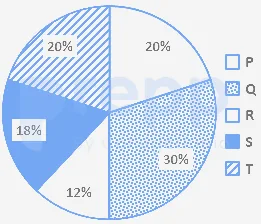
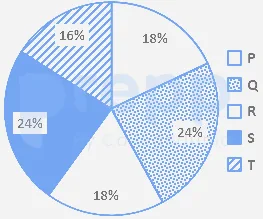
- A
80%
- B
42.7%
- C
48%
- D
71.1%
Show answer
B. 42.7%Calculation:-
Total number of candidates enrolled in Q = 7500 × 3/10
⇒ 2250
Total number of candidates passed in Q = 4000 × 24/100
⇒ 960
Pass percentage = (960/2250) × 100
⇒ 42.66% ≈ 42.7%
∴ The pass percentage for institute Q is 42.7%
Paper & answer key PDF ↗ Question 74archived
Bar graph shows the number of students enrolled for a vocational course in institutes A and B during 5 years from 2014 to 2018.
The total number of students enrolled in institutes B during 2014, 2016 and 2018 is what percent of the total number of students enrolled in institute A during the five years?
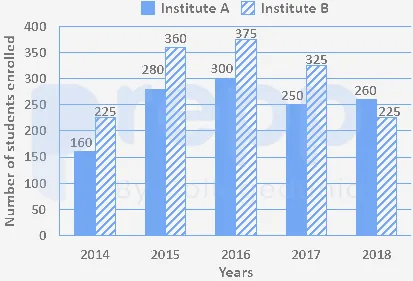
- A
49%
- B
57%
- C
66%
- D
75%
Show answer
C. 66%Total number of students enrolled in institutes B in 2014 = 225
Total number of students enrolled in institutes B in 2016 = 375
Total number of students enrolled in institutes B in 2018 = 225
Total number of students enrolled in institutes B in three years = 225 + 375 + 225
⇒ 825
Total number of students enrolled in institutes A in five years = 160 + 280 + 300 + 250 + 260
⇒ 1250
Percentage = (825/1250) × 100
⇒ 66%
∴ Required percentage is 66%
Paper & answer key PDF ↗ Question 75archived
If x 2+ 9y 2+ 4z 2= 12(x - 2y + 2z) - 88, then the value of (x - 3y + z) is:
- A
13
- B
5
- C
11
- D
10
Show answer
A. 13Solving the Given Equation to Find the Value of (x - 3y + z)
The problem asks us to find the value of the expression $(x - 3y + z)$, given the equation $x^2 + 9y^2 + 4z^2 = 12(x - 2y + 2z) - 88$. To solve this equation, we need to find the values of x, y, and z that satisfy it.
Analyzing and Rearranging the Equation
Let's first expand the right side of the equation and bring all terms to one side to set the equation to zero:
Given equation:
$\qquad x^2 + 9y^2 + 4z^2 = 12(x - 2y + 2z) - 88$
Expand the right side:
$\qquad x^2 + 9y^2 + 4z^2 = 12x - 24y + 24z - 88$
Move all terms to the left side:
$\qquad x^2 - 12x + 9y^2 + 24y + 4z^2 - 24z + 88 = 0$
Using the Complete the Square Method
The rearranged equation contains quadratic terms for x, y, and z, along with linear terms. This structure suggests that we can use the method of completing the square for each variable independently. The general idea is to rewrite expressions like $ax^2 + bx$ as part of a perfect square $(cx + d)^2$.
Let's complete the square for the terms involving x:
$\qquad x^2 - 12x$
To complete the square for $x^2 - 12x$, we need to add $(-\frac{12}{2})^2 = (-6)^2 = 36$. So, $x^2 - 12x + 36 = (x - 6)^2$.
Next, let's complete the square for the terms involving y:
$\qquad 9y^2 + 24y$
This can be written as $(3y)^2 + 2(3y)(4)$. To complete the square for $(3y)^2 + 2(3y)(4)$, we need to add $4^2 = 16$. So, $9y^2 + 24y + 16 = (3y + 4)^2$.
Finally, let's complete the square for the terms involving z:
$\qquad 4z^2 - 24z$
This can be written as $(2z)^2 - 2(2z)(6)$. To complete the square for $(2z)^2 - 2(2z)(6)$, we need to add $6^2 = 36$. So, $4z^2 - 24z + 36 = (2z - 6)^2$.
Rewriting the Equation by Completing the Square
Now, let's substitute these completed squares back into the rearranged equation. Remember that we added 36, 16, and 36 to complete the squares, so we must also account for these additions using the constant term 88.
The equation was: $x^2 - 12x + 9y^2 + 24y + 4z^2 - 24z + 88 = 0$
Group terms:
$\qquad (x^2 - 12x) + (9y^2 + 24y) + (4z^2 - 24z) + 88 = 0$
Complete the square for each group and adjust the constant term:
$\qquad (x^2 - 12x + 36) - 36 + (9y^2 + 24y + 16) - 16 + (4z^2 - 24z + 36) - 36 + 88 = 0$
Rewrite the completed squares:
$\qquad (x - 6)^2 - 36 + (3y + 4)^2 - 16 + (2z - 6)^2 - 36 + 88 = 0$
Combine the constant terms: $-36 - 16 - 36 + 88 = -88 + 88 = 0$.
The equation simplifies to:
$\qquad (x - 6)^2 + (3y + 4)^2 + (2z - 6)^2 = 0$
Finding the Values of x, y, and z
The equation $(x - 6)^2 + (3y + 4)^2 + (2z - 6)^2 = 0$ is a sum of three squared terms equal to zero. Since the square of any real number is non-negative (greater than or equal to zero), the only way for the sum of non-negative terms to be zero is if each term is individually zero.
Therefore, we must have:
$(x - 6)^2 = 0 \implies x - 6 = 0 \implies x = 6$
$(3y + 4)^2 = 0 \implies 3y + 4 = 0 \implies 3y = -4 \implies y = -\frac{4}{3}$
$(2z - 6)^2 = 0 \implies 2z - 6 = 0 \implies 2z = 6 \implies z = 3$
So, the values are $x = 6$, $y = -\frac{4}{3}$, and $z = 3$.
Calculating the Value of the Expression (x - 3y + z)
Now that we have the values of x, y, and z, we can substitute them into the expression $(x - 3y + z)$:
$\qquad x - 3y + z = 6 - 3\left(-\frac{4}{3}\right) + 3$
$\qquad = 6 - (-4) + 3$
$\qquad = 6 + 4 + 3$
$\qquad = 10 + 3$
$\qquad = 13$
The value of the expression $(x - 3y + z)$ is 13.
Conclusion
By rearranging the given equation and completing the square for the terms involving x, y, and z, we found the unique values for each variable. Substituting these values into the required expression yielded the final answer.
Variable
Value
x
6
y
-4/3
z
3
Revision Table: Key Steps to Solve the Equation
Step
Description
1
Rearrange the equation to set it to zero.
2
Group terms involving each variable (x, y, z).
3
Complete the square for the terms involving each variable.
4
Rewrite the equation as a sum of squares equal to zero.
5
Equate each squared term to zero to solve for x, y, and z.
6
Substitute the values of x, y, and z into the target expression.
7
Calculate the final value of the expression.
Additional Information: Completing the Square
Completing the square is a useful algebraic technique for rewriting a quadratic expression, like $ax^2 + bx$, into the form $a(x-h)^2 + k$. When $a=1$, the expression $x^2 + bx$ can be completed into $(x + b/2)^2 - (b/2)^2$. In our case, we had expressions like $x^2 - 12x$, which becomes $(x - 6)^2 - 36$, and $9y^2 + 24y = 9(y^2 + \frac{24}{9}y) = 9(y^2 + \frac{8}{3}y)$. Completing the square inside the parenthesis gives $9((y + \frac{4}{3})^2 - (\frac{4}{3})^2) = 9(y + \frac{4}{3})^2 - 9(\frac{16}{9}) = 9(y + \frac{4}{3})^2 - 16$. This is equivalent to $(3(y + \frac{4}{3}))^2 - 16 = (3y + 4)^2 - 16$. Similarly, for $4z^2 - 24z = 4(z^2 - 6z)$, we get $4((z - 3)^2 - 3^2) = 4(z - 3)^2 - 36$. This is equivalent to $(2(z - 3))^2 - 36 = (2z - 6)^2 - 36$. The method used in the solution, where we directly recognize $9y^2+24y$ as $(3y)^2 + 2(3y)(4)$ needing $4^2$, and $4z^2-24z$ as $(2z)^2 - 2(2z)(6)$ needing $6^2$, is a shortcut when the leading coefficients are perfect squares.
The technique is powerful for solving quadratic equations, finding the vertex of parabolas, and simplifying expressions, especially those involving sums of squares equal to zero, as shown in this problem.
Paper & answer key PDF ↗ Question 76archived
Select the most appropriate ANTONYM of the given word.
Dividing
- A
Parting
- B
Breaking
- C
Connecting
- D
Detaching
Show answer
C. ConnectingFinding the Antonym of Dividing
The question asks for the most appropriate antonym of the word "Dividing". An antonym is a word that has the opposite meaning of another word. To find the correct antonym, we need to understand the meaning of "Dividing" and the meanings of the given options.
Understanding the Word Dividing
"Dividing" means to separate something into parts or pieces. It involves creating a split, partition, or division between things or within something.
Analyzing the Options
Let's examine the meaning of each provided option:
Parting: This word means separating or splitting, often used when people leave each other or things are pulled apart. It is similar in meaning to "Dividing".
Breaking: This means separating something into pieces, often by force. It is also similar in meaning to "Dividing".
Connecting: This word means joining things together, linking them, or establishing a relationship between them. This is the opposite action of separating things.
Detaching: This means separating or disconnecting one thing from another. It is similar in meaning to "Dividing".
We are looking for the word that means the opposite of separating into parts. Based on the analysis:
Word
Meaning
Relationship to "Dividing"
Dividing
Separating into parts
Base word
Parting
Separating
Similar meaning
Breaking
Separating into pieces
Similar meaning
Connecting
Joining together
Opposite meaning
Detaching
Separating, disconnecting
Similar meaning
Identifying the Antonym for Dividing
Comparing the meanings, "Connecting" is the word that describes the action of bringing things together or joining them, which is the direct opposite of "Dividing" (separating them).
Therefore, the most appropriate antonym for "Dividing" is "Connecting".
Revision Table: Antonyms and Synonyms of Dividing
Word
Type
Examples
Dividing
Base Word
Dividing a cake, Dividing tasks
Parting
Synonym
Parting ways, Parting hair
Breaking
Synonym (in some contexts)
Breaking a stick, Breaking ties
Connecting
Antonym
Connecting wires, Connecting ideas
Detaching
Synonym
Detaching a part, Detaching oneself
Additional Information: Understanding Antonyms
Antonyms are crucial for building vocabulary and understanding the nuances of language. They help clarify meanings by providing contrasting concepts. Recognizing antonyms requires understanding the core meaning of a word and then identifying the word that represents the opposing idea. Some words can have multiple antonyms depending on the specific context in which they are used.
For example, an antonym for 'hot' is 'cold'. An antonym for 'fast' is 'slow'. In this case, the opposite of 'Dividing' (separating) is 'Connecting' (joining).
Paper & answer key PDF ↗ Question 77archived
Directions: Select the most appropriate option to substitute the underlined segment in the given sentence. If no substitution is required, select ‘No substitution’.
The teacher asked the students for fill the form before entering the classroom.
- A
the students to fill the form
- B
the students for filled the form
- C
the students to filled the form
- D
No substitution
Show answer
A. the students to fill the formUnderstanding the Grammar of 'Ask'
The sentence provided is: "The teacher asked the students for fill the form before entering the classroom." We need to look at the underlined segment, "for fill the form", and determine if it needs substitution to make the sentence grammatically correct.
Analysing the Sentence Structure with 'Ask'
The verb 'ask' is often followed by an object and then an action that the object is asked to perform. When we ask someone to do something, the structure is typically:
ask + object + infinitive (to + base form of the verb)
For example:
She asked me to help her.
He asked them to wait.
They asked us to bring a dish.
In the given sentence, the teacher is asking the students to perform an action: filling the form. Following the standard structure, it should be "asked the students to fill the form".
Evaluating the Original Segment: 'for fill the form'
The original segment uses the preposition 'for' followed by the base form of the verb 'fill'. This structure ("ask [someone] for [base verb]") is not standard English grammar when asking someone to perform an action. While 'ask for' is a valid phrasal verb, it usually means requesting something (e.g., "He asked for a glass of water") or requesting permission (e.g., "She asked for leave"). It is not used to request that someone *do* an action using the base verb directly after 'for'.
Examining the Substitution Options
Let's look at the given options to see which one correctly substitutes the underlined segment:
the students to fill the form: This option uses the structure "ask + object + to + base verb (infinitive)". This matches the correct grammatical pattern for asking someone to perform an action. "asked the students to fill the form" is grammatically sound.
the students for filled the form: This option keeps the incorrect preposition 'for' and uses the past tense or past participle 'filled' instead of the base form 'fill'. This is grammatically incorrect.
the students to filled the form: This option uses the infinitive structure with 'to' but incorrectly follows it with the past tense or past participle 'filled' instead of the base form 'fill'. The infinitive is always 'to' + the base form of the verb. This is grammatically incorrect.
No substitution: As we've determined that the original segment "for fill the form" is grammatically incorrect in this context, substitution is required.
Based on the analysis, option 1 provides the correct grammatical structure needed to fix the sentence.
The corrected sentence is: "The teacher asked the students to fill the form before entering the classroom."
Segment
Structure
Correctness
Explanation
for fill the form (original)
for + base verb
Incorrect
Incorrect structure for asking someone to perform an action.
to fill the form (Option 1)
to + base verb (infinitive)
Correct
Standard structure for asking someone to perform an action.
for filled the form (Option 2)
for + past/participle
Incorrect
Incorrect preposition and verb form.
to filled the form (Option 3)
to + past/participle
Incorrect
Incorrect verb form after 'to' (should be base form).
Revision Table: Key Verb Patterns with 'Ask'
Pattern
Meaning
Example
Ask for [something]
Request something
She asked for permission.
Ask [someone] to [do something]
Request someone to perform an action
He asked her to close the door.
Ask [question word] [infinitive]
Ask about how/when/where etc. to do something
I asked how to get there.
Ask [someone] [question word] [clause]
Ask someone a question
He asked me why I was late.
Additional Information: Verbs Followed by Object and Infinitive
Many verbs in English are followed by an object and then an infinitive (to + base verb) to indicate that the object is being directed or requested to do something. Understanding these patterns is crucial for sentence correction questions.
Common verbs that follow the structure verb + object + infinitive include:
Ask
Tell
Advise
Allow
Cause
Enable
Encourage
Force
Invite
Order
Permit
Persuade
Remind
Require
Teach
Urge
Want
Warn
Recognizing these patterns helps in identifying and correcting grammatical errors related to verb complements.
Paper & answer key PDF ↗ Question 78archived
Select the most appropriate synonym of the given word.
Grumble
- A
Ring
- B
Call
- C
Groan
- D
Grin
Show answer
C. GroanFinding the Synonym for Grumble
The question asks us to identify the most appropriate synonym for the word "Grumble" from the given options. A synonym is a word that has the same or nearly the same meaning as another word.
Understanding the Word 'Grumble'
The word "Grumble" typically means to complain about something in a bad-tempered way. It can also refer to a low rumbling sound, like thunder or a stomach noise, but in the context of synonyms for how someone might speak or feel, it refers to complaining.
Analyzing the Options
Let's examine each option to see which one is the best synonym for "Grumble":
Ring: This word usually refers to the sound a bell makes or putting a ring on something. It has no relation to complaining or making a sound of displeasure.
Call: This means to shout or speak loudly, or to make a phone call. It doesn't involve complaining or expressing dissatisfaction.
Groan: This word means to make a deep, inarticulate sound in response to pain, despair, or dissatisfaction. People often groan when they are unhappy, frustrated, or in discomfort, which is very close in meaning to complaining or expressing discontent quietly, as in grumbling.
Grin: This means to smile broadly, showing your teeth. It expresses happiness or amusement, which is the opposite of grumbling.
Identifying the Best Synonym
Comparing the meanings, "Groan" is the word that most closely relates to expressing unhappiness, dissatisfaction, or discomfort through sound, similar to how someone might grumble. While "Grumble" is often a quiet complaint in words and "Groan" is a sound, both express negative feelings or discomfort.
Word
Meaning
Relation to 'Grumble'
Grumble
Complain in a bad-tempered way; make a low rumbling sound.
Base word
Ring
Sound of a bell; put a ring on.
No relation
Call
Shout or speak loudly; make a phone call.
No relation
Groan
Make a deep sound expressing pain, despair, or dissatisfaction.
Closest meaning expressing negative feelings/discomfort
Grin
Smile broadly.
Opposite meaning
Based on the analysis, "Groan" is the most appropriate synonym among the given options for "Grumble" in the context of expressing negative feelings.
Revision Table: Synonym for Grumble
Reviewing the options helps solidify the understanding of why "Groan" is the best fit.
Additional Information: Exploring Synonyms
Learning synonyms is crucial for improving vocabulary and understanding nuances in language. While "Groan" is a fitting synonym in some contexts of dissatisfaction, other words like 'complain', 'murmur', 'protest', or 'grouse' can also be synonyms for 'Grumble' depending on the specific situation and intensity of the complaint. Understanding the subtle differences between synonyms helps in using the right word in the right context.
Paper & answer key PDF ↗ Question 79archived
Select the option that can be used as a one-word substitute for the given group of words.
Soft, inner part of a nut or fruit-stone
- A
Kernel
- B
Caramel
- C
Bean
- D
Pulp
Show answer
A. KernelUnderstanding the Question: Soft Inner Part of a Nut or Fruit-Stone
The question asks for a single word that describes the soft, inner part found within a nut or the hard stone of a fruit. We need to look at the given options and find the one that best matches this description.
Analyzing the Options
Let's examine each option provided:
Kernel: This word commonly refers to the edible inner part of a nut, seed, or fruit stone. For example, the part inside a walnut shell is called a kernel, and the soft part inside a peach stone can also be referred to as a kernel. This fits the description perfectly.
Caramel: Caramel is a confectionary product made by heating sugars. It is a sweet, sticky substance and has no relation to the inner part of nuts or fruit stones.
Bean: A bean is a seed from plants in the Fabaceae family, such as kidney beans or soybeans. While it is a seed, it is not typically used to describe the inner part of a nut or fruit stone.
Pulp: Pulp is the soft, moist, often edible part of a fruit, usually surrounding the stone or seeds. While soft, it's typically the outer fleshy part of the fruit, not the inner part contained within the hard shell of a nut or fruit stone.
Identifying the Correct One-Word Substitute
Based on the analysis, the word that accurately describes the soft, inner part of a nut or fruit-stone is 'Kernel'.
Comparison of Options
Word
Meaning
Fits Question?
Kernel
Soft, inner part of a nut, seed, or fruit-stone
Yes
Caramel
Heated sugar confection
No
Bean
Type of seed from Fabaceae family
No
Pulp
Soft, fleshy part of fruit (usually outer)
No
Detailed Explanation of Kernel Meaning
The term 'kernel' is widely used to describe the core, usually edible, part found inside the hard shell of a nut or the stone (pit) of a fruit. Think of breaking open a walnut or almond – the part you eat inside is the kernel. Similarly, the small seed-like structure inside a peach or cherry stone is also a kernel, though not always eaten.
Revision Table: Vocabulary Building
Key Vocabulary from the Question
Term
Simple Definition
Example Context
Nut
A hard-shelled fruit containing a seed (kernel).
Walnuts and almonds are types of nuts.
Fruit-stone
The hard, woody layer surrounding the seed of some fruits (like peaches, plums, cherries). Also called a pit.
He removed the stone from the cherry before eating it.
Kernel
The soft, edible part inside a nut or fruit-stone.
The kernel of the walnut was delicious.
Additional Information: Related Terms
Understanding related terms can help improve vocabulary. Here are a few related concepts:
Seed: A unit of reproduction of a flowering plant, typically a small, often round or oval body produced by the plant. A kernel is essentially a type of seed, but the term 'kernel' specifically implies it's within a hard casing (nut or stone).
Cotyledon: The part of the embryo within the seed of a plant, storing food (or enabling absorption of stored food) and forming the embryonic first leaves. The bulk of a kernel is often made up of cotyledons.
Endosperm: Tissue produced inside the seeds of most flowering plants around the time of fertilization. It surrounds the embryo and provides nutrition in the form of starch, though it can also contain oils and protein.
Paper & answer key PDF ↗ Question 80archived
Select the most appropriate ANTONYM of the given word.
Segregate
- A
Correlate
- B
Allude
- C
Integrate
- D
Implicate
Show answer
C. IntegrateUnderstanding the Word: Segregate
The word "Segregate" means to separate people or things from the main group or body, or to keep them apart. It often implies setting something aside or maintaining separation.
Finding the Antonym
We are looking for the most appropriate antonym of "Segregate". An antonym is a word that has the opposite meaning of another word. So, we need a word that means the opposite of separating or keeping apart.
Analyzing the Options
Let's look at each option and understand its meaning:
Option 1: Correlate
Correlate means to have a mutual relationship or connection, in which one thing affects or depends on another.
This word is about relationships or connections between things that are already there, not about bringing separate things together or keeping them apart. Therefore, it is not the opposite of Segregate.
Option 2: Allude
Allude means to hint at, suggest, or refer to something indirectly.
This word is related to communication and hinting, which has no connection to separating or joining things. Therefore, it is not the opposite of Segregate.
Option 3: Integrate
Integrate means to combine one thing with another to make it a whole, or to mix people or groups that were previously separated.
This word directly means the opposite of separating or keeping apart. It means bringing together or combining. Therefore, Integrate is an appropriate antonym for Segregate.
Option 4: Implicate
Implicate means to show someone to be involved in something, especially something dishonest or criminal. It can also mean to convey something indirectly.
This word relates to involvement or suggestion, not the act of separating or joining. Therefore, it is not the opposite of Segregate.
The Most Appropriate Antonym for Segregate
Comparing the meanings, Integrate is the word that means the opposite of Segregate. While Segregate means to separate, Integrate means to bring together or combine.
Therefore, the most appropriate antonym is Integrate.
Word
Meaning (Simplified)
Relationship to Segregate
Segregate
To separate or keep apart
The word in question
Correlate
To have a connection
Not an antonym
Allude
To hint at
Not an antonym
Integrate
To combine or bring together
Appropriate Antonym
Implicate
To show involvement or suggest
Not an antonym
Revision Table: Antonyms and Meanings
Understanding word meanings and their opposites (antonyms) is key to vocabulary building. Here is a quick recap:
Segregate: Separate, isolate.
Integrate: Combine, unite, mix.
These words represent opposing actions regarding groups or items.
Additional Vocabulary Information
Learning antonyms helps in understanding the full spectrum of a word's meaning. For "Segregate," knowing that "Integrate" is its opposite provides a clear contrast and reinforces the concept of separation versus unity. Similarly, knowing synonyms for "Segregate" like "separate," "isolate," or "keep apart" can further clarify its meaning.
Paper & answer key PDF ↗ Question 81archived
Directions: Select the most appropriate option to substitute the underlined segment in the given sentence. If no substitution is required, select ‘No substitution’.
No one are supposed to react to her prejudiced comments.
- A
No one has supposed to react
- B
No substitution
- C
No one is supposed to react
- D
No one had supposed to react
Show answer
C. No one is supposed to reactUnderstanding Subject-Verb Agreement with "No one"
The original sentence is: "No one are supposed to react to her prejudiced comments." The underlined segment is "are supposed". We need to determine if this segment is grammatically correct in the context of the sentence.
Analyzing the Subject and Verb
In the sentence, the subject is "No one". "No one" is an indefinite pronoun. Indefinite pronouns like "no one", "everyone", "someone", "anyone", "everybody", "somebody", "anybody", "nobody", "each", and "either" are generally considered singular in standard English grammar, even though they may refer to multiple people.
According to the rules of subject-verb agreement, a singular subject requires a singular verb, and a plural subject requires a plural verb.
The verb used with "No one" in the original sentence is "are". "Are" is a form of the verb "to be" and is used with plural subjects (e.g., "They are") or the pronoun "you" ("You are"). Since "No one" is singular, the plural verb "are" is incorrect.
Correcting the Verb Form
The sentence uses the structure "be supposed to", which is used to indicate obligation, expectation, or what is generally believed. The correct form of "be" needed here should agree with the singular subject "No one". The singular present tense form of "be" is "is". Therefore, the correct phrasing should be "is supposed".
Evaluating the Options for Substitution
Let's look at the given options:
Option 1: "No one has supposed to react"
This uses "has supposed". The structure "have/has supposed to" is not the standard grammatical way to express the intended meaning of expectation or obligation, which requires the "be supposed to" structure.
Option 2: "No substitution"
The original sentence "No one are supposed..." is grammatically incorrect because of the disagreement between the singular subject "No one" and the plural verb "are". Therefore, substitution is required.
Option 3: "No one is supposed to react"
This option uses the singular verb "is" which correctly agrees with the singular indefinite pronoun "No one". It follows the correct structure "be supposed to". This sentence is grammatically correct.
Option 4: "No one had supposed to react"
This uses the past perfect form "had supposed". This doesn't fit the standard structure "be supposed to" for expressing obligation or expectation and changes the tense and meaning inappropriately.
Conclusion
Based on the analysis of subject-verb agreement and the correct usage of the phrase "be supposed to", the only grammatically correct option to substitute the underlined segment is "is supposed".
The correct sentence is: "No one is supposed to react to her prejudiced comments."
Revision Table: Subject-Verb Agreement with Indefinite Pronouns
Indefinite Pronoun (Singular)
Correct Verb Form (Present)
Example
No one
is / does / goes
No one is here. No one goes there.
Everyone
is / does / goes
Everyone is happy. Everyone does their best.
Someone
is / does / goes
Someone is at the door. Someone has left.
Anything
is / does / goes
Anything is possible. Anything goes.
Additional Information: The Phrase "Be Supposed To"
The phrase "be supposed to" is commonly used in English to express several meanings:
Obligation or Duty: What someone is required or expected to do. Example: "You are supposed to finish your homework before watching TV."
Expectation: What is expected to happen or be true. Example: "The train is supposed to arrive at 3 PM."
General Belief or Reputation: What people generally believe about something or someone, which may or may not be true. Example: "That restaurant is supposed to be the best in town."
Fault or Blame (often in questions): Used to ask who should have done something. Example: "Who is supposed to clean up this mess?"
In the given sentence, "No one is supposed to react...", it most likely expresses an expectation or perhaps a rule/duty that no person should react to the comments.
Paper & answer key PDF ↗ Question 82archived
Directions: Sentences of a paragraph are given below in jumbled order. Arrange the sentences in the right order to form a meaningful and coherent paragraph.
A. In some cases, the problem of the lowering of the river bottom has caused the water table of the surrounding area to drop, which has adversely affected agriculture.
B. Also, another problem, canalization with its extensive system of locks and navigation dams, often seriously disrupts riverine ecosystems.
C. The ever-increasing exploitation of rivers has given rise to a variety of problems.
D. Further, extensive commercial navigation of rivers has resulted in much artificial improvement of natural channels, including increasing the depth of the channels to permit passage of larger vessels.
- A
CDAB
- B
BDAC
- C
DCAB
- D
CABD
Show answer
D. CABDArranging Sentences for a Coherent Paragraph on River Exploitation
This question requires us to arrange four jumbled sentences (A, B, C, D) into a logical and meaningful paragraph about the problems caused by river exploitation. We need to identify the topic sentence, supporting details, and the correct sequence based on the flow of ideas and connecting words.
Identifying the Topic Sentence
The first step is to find the sentence that introduces the main theme. Sentence C states, "The ever-increasing exploitation of rivers has given rise to a variety of problems." This is a general statement that sets the context for the entire paragraph, making it the ideal topic sentence.
Building the Paragraph: CABD Order Explained
Let's analyze the placement of each sentence in the proposed order: CABD.
C: "The ever-increasing exploitation of rivers has given rise to a variety of problems."
This sentence effectively introduces the central theme: the negative consequences of exploiting rivers.
A: "In some cases, the problem of the lowering of the river bottom has caused the water table of the surrounding area to drop, which has adversely affected agriculture."
Following the general introduction (C), this sentence provides a specific example of a problem. The phrase "In some cases" indicates it's an illustration of the "variety of problems" mentioned in C. It focuses on the impact of a lowered river bottom on agriculture.
B: "Also, another problem, canalization with its extensive system of locks and navigation dams, often seriously disrupts riverine ecosystems."
The connector "Also" signals that another related point is being added. This sentence introduces a second distinct problem – canalization – and its negative effect on ecosystems. It fits logically after A, providing another example of the problems arising from river exploitation.
D: "Further, extensive commercial navigation of rivers has resulted in much artificial improvement of natural channels, including increasing the depth of the channels to permit passage of larger vessels."
The word "Further" suggests adding more information. This sentence elaborates on the specific *activities* involved in river exploitation, such as commercial navigation leading to channel improvements. While sentences A and B describe the resulting problems, sentence D explains the underlying actions or methods of exploitation that contribute to these issues. Placing it after A and B provides further context and detail about the nature of the exploitation discussed.
Final Paragraph Structure
The sequence CABD creates a coherent flow:
Introduction: General statement about problems from river exploitation (C).
Example 1: A specific problem and its consequences (A).
Example 2: Another problem, linked by "Also" (B).
Elaboration: Further details on the methods of exploitation causing these issues (D).
This structure moves from a general topic to specific examples and then provides further context on the activities involved, forming a well-reasoned paragraph.
Paper & answer key PDF ↗ Question 83archived
Select the option that expresses the given sentence in passive voice.
Who wrote the Ramayana?
- A
By whom was the Ramayana written?
- B
By whom was that who wrote the Ramayana?
- C
Who was that who wrote the Ramayana?
- D
By who was the Ramayana written?
Show answer
A. By whom was the Ramayana written?Understanding Active and Passive Voice Transformation
The question asks us to convert a sentence from active voice to passive voice. The given sentence is an interrogative sentence (a question) starting with 'Who'.
The original sentence in active voice is:
\(\text{Who wrote the Ramayana?}\)
In this sentence:
'Who' is the subject (performing the action).
'wrote' is the verb (past tense).
'the Ramayana' is the object (receiving the action).
Converting Interrogative Sentences (Starting with 'Who') to Passive Voice
When converting an interrogative sentence that begins with 'Who' from active to passive voice, the structure changes as follows:
The subject 'Who' changes to 'By whom' in the passive voice, as 'Who' is the agent performing the action.
The object of the active sentence becomes the subject of the passive sentence.
The verb is changed to the passive form, which is generally 'be' + past participle of the main verb. The form of 'be' depends on the tense of the active verb and the new subject.
The sentence remains interrogative.
The general structure for a simple past tense sentence starting with 'Who' in passive voice is:
\(\text{By whom} + \text{was/were} + \text{new subject} + \text{past participle of verb} + \text{?}\)
Applying the Conversion to the Given Sentence
Let's apply the rules to the sentence "Who wrote the Ramayana?".
'Who' becomes 'By whom'.
The object 'the Ramayana' becomes the new subject.
The verb 'wrote' is in the simple past tense. The new subject 'the Ramayana' is singular. The passive form for simple past singular is 'was written'.
Putting it together in the interrogative structure:
\(\text{By whom} + \text{was} + \text{the Ramayana} + \text{written?}\)
This gives us the passive voice sentence: "By whom was the Ramayana written?".
Analyzing the Options
Let's examine the given options:
Option 1: By whom was the Ramayana written? This exactly matches the passive voice sentence we derived.
Option 2: By whom was that who wrote the Ramayana? This structure is grammatically incorrect and does not follow the standard rules for active-passive conversion.
Option 3: Who was that who wrote the Ramayana? This sentence is still in an active voice structure and is essentially a rephrasing of the original question, not a conversion to passive voice.
Option 4: By who was the Ramayana written? While sometimes used informally, the grammatically correct form when 'who' is the object of the preposition 'by' is 'whom'. Therefore, 'By whom' is preferred in standard English grammar.
Based on the analysis, Option 1 correctly expresses the given sentence in passive voice according to standard English grammar rules.
Correct Passive Voice Transformation
The correct passive voice conversion of "Who wrote the Ramayana?" is "By whom was the Ramayana written?". This follows the grammatical rules for transforming 'Who' questions in the simple past tense to passive voice.
Feature
Active Voice: Who wrote the Ramayana?
Passive Voice: By whom was the Ramayana written?
Subject
Who (agent)
The Ramayana (recipient of action)
Object
The Ramayana
N/A (becomes subject)
Verb Tense
Simple Past (wrote)
Simple Past Passive (was written)
Agent
Implicit (Who)
Explicitly introduced with 'By whom'
Sentence Type
Interrogative
Interrogative
Revision Table: Active and Passive Voice Rules
Understanding active and passive voice conversions is crucial for effective communication. Here's a quick summary:
Voice
Focus
Structure Example (Simple Past)
Active
Subject performing the action
Subject + verb (past tense) + object
e.g., She wrote a letter.
Passive
Action and the recipient of the action
Object + was/were + past participle (+ by + agent)
e.g., A letter was written by her.
Additional Information: Voice in English Grammar
Voice is a grammatical category that indicates the relationship of the subject of a verb to the action that the verb expresses. There are two main voices in English:
Active Voice: In the active voice, the subject of the sentence performs the action. This voice is generally more direct and vigorous. Example: The dog chased the ball. (Subject 'dog' performs the action 'chased').
Passive Voice: In the passive voice, the subject of the sentence receives the action. The doer of the action is often mentioned after 'by' or is omitted if it is unknown, unimportant, or obvious. Example: The ball was chased by the dog. (Subject 'ball' receives the action 'was chased').
Choosing between active and passive voice depends on what you want to emphasize in the sentence. Use the active voice when you want to highlight who or what is doing the action. Use the passive voice when you want to highlight the action itself or the recipient of the action, or when the doer is unknown.
Paper & answer key PDF ↗ Question 84archived
Select the option that can be used as a one-word substitute for the given group of words.
A news article that reports the recent death of a person
- A
Review
- B
Mortuary
- C
Obituary
- D
Editorial
Show answer
C. ObituaryUnderstanding the One-Word Substitute Question
The question asks for a single word that can replace the phrase "A news article that reports the recent death of a person". This is a common type of vocabulary question that tests your knowledge of specific terms used to describe particular concepts or situations.
Analyzing the Given Options
Let's examine each option provided:
Review: A review is a critical assessment of something, such as a book, film, product, or event. It expresses an opinion on the quality or performance of the subject. This does not relate to reporting a death.
Mortuary: A mortuary, also known as a funeral home or morgue, is a place where dead bodies are kept before burial or cremation. It is a location, not a news article.
Obituary: An obituary is a notice of a death, especially in a newspaper, that usually includes a brief account of the deceased person's life. This precisely matches the description given in the question.
Editorial: An editorial is an article in a newspaper or magazine that expresses the opinion of the editor or publisher on a topic. While it is a news article, its purpose is commentary or opinion, not the simple reporting of a death.
Identifying the Correct One-Word Substitute
Based on the analysis of the options:
A "Review" is an assessment.
A "Mortuary" is a place.
An "Editorial" is an opinion piece.
An "Obituary" is a news article reporting a death, often with biographical details.
Therefore, the word that best fits the description "A news article that reports the recent death of a person" is 'Obituary'.
Detailed Explanation of "Obituary"
An obituary serves several purposes in a newspaper or online news platform:
It formally announces the death of an individual.
It provides details about the deceased, such as their date of birth, date of death, cause of death (sometimes), and surviving family members.
It often includes a summary of the person's life, achievements, career, and contributions.
It may include information about funeral or memorial services.
Obituaries are a standard part of news reporting and serve as a public record of a person's passing.
Term
Meaning
Fits the Description?
Review
Critical assessment
No
Mortuary
Place for dead bodies
No
Obituary
News article reporting a death with biography
Yes
Editorial
Opinion article
No
Thus, the only word that functions as a one-word substitute for a news article reporting a recent death of a person is 'Obituary'.
Revision Table: Understanding News Terminology
Term
Function in News
Key Characteristic
Obituary
Reports a death
Focuses on the deceased person's life
Editorial
Expresses opinion
Reflects the publication's stance
News Report
Reports events
Objective presentation of facts
Feature Article
In-depth exploration
Often creative or analytical
Additional Information: Types of News Articles
Newspapers and news websites feature various types of articles, each serving a distinct purpose:
Hard News: Reports timely, significant events objectively (e.g., crime, politics, natural disasters).
Feature Stories: Explores topics in-depth, often with a human interest angle, less time-sensitive than hard news.
Editorials: Articles expressing the opinion of the editorial board.
Op-Eds (Opposite the Editorial Page): Opinion pieces written by individuals not affiliated with the editorial board.
Reviews: Critical evaluations of cultural products or events.
Obituaries: Announcements and biographies of recently deceased individuals.
Understanding these different types of news articles helps in selecting the correct term to describe a specific piece of writing, like an obituary reporting a death.
Paper & answer key PDF ↗ Question 85archived
Select the most appropriate meaning of the following idiom.
Pat on the back
- A
Friendly tap to push someone
- B
Mild form of disapproval or blame
- C
Good massage for aches and pains
- D
Praise or approval for doing something good
Show answer
D. Praise or approval for doing something goodUnderstanding the Idiom: Pat on the Back
Let's break down the meaning of the idiom "Pat on the back" and analyze the provided options to find the most appropriate meaning.
Meaning of "Pat on the Back" Idiom
The idiom "Pat on the back" is a common English expression. It does not refer to a physical action taken literally, but rather a figurative expression used to describe a form of positive feedback or recognition.
When someone gives you a "pat on the back," they are essentially giving you praise or showing their approval for something good you have done, such as achieving a goal, completing a task successfully, or demonstrating positive behaviour.
Idiom
Meaning
Pat on the back
Praise, approval, or recognition for good work or achievement.
Analyzing the Options
Let's evaluate each option based on our understanding of the idiom "Pat on the back":
Option 1: Friendly tap to push someone.
This describes a literal physical action, potentially for encouragement in a different context, but it doesn't match the figurative meaning of giving praise or approval. So, this option is incorrect for the idiom.
Option 2: Mild form of disapproval or blame.
This meaning is the opposite of praise or approval. The idiom "Pat on the back" is always positive reinforcement. Therefore, this option is incorrect.
Option 3: Good massage for aches and pains.
This is a literal physical action related to health or relaxation. Idioms use words to mean something different from their literal definition. This option describes a literal physical action, not the figurative meaning of the idiom. So, this option is incorrect.
Option 4: Praise or approval for doing something good.
This option perfectly aligns with the established meaning of the idiom "Pat on the back." It describes the act of giving recognition or commendation to someone who has performed well or achieved something positive.
Conclusion on "Pat on the Back" Meaning
Based on the analysis, the most appropriate meaning of the idiom "Pat on the back" is receiving praise or approval for doing something good. This is how the phrase is commonly used in English to acknowledge someone's positive contribution or achievement.
Revision Table: Key Idioms and Meanings
Idiom
Common Meaning
Context Example
Pat on the back
Praise/Approval for good work
The team leader gave everyone a pat on the back after they successfully completed the difficult project.
Bite the bullet
Endure a difficult situation
He had to bite the bullet and take a pay cut to keep the company afloat.
Break a leg
Good luck (especially before a performance)
Before the show, the director told the actors to break a leg.
Additional Information on English Idioms
Idioms are phrases or expressions where the meaning cannot be deduced from the literal meanings of the words within them. They are a crucial part of conversational English and understanding them helps improve comprehension and fluency.
Idioms add color and expressiveness to language.
They often originate from specific cultural or historical contexts.
Learning common idioms is essential for mastering English nuances.
"Pat on the back" is a widely recognized idiom for positive reinforcement.
Paper & answer key PDF ↗ Question 86archived
Select the INCORRECTLY spelt word.
- A
Custard
- B
Comedian
- C
Caravan
- D
Camoflage
Show answer
D. CamoflageIdentifying the Incorrectly Spelt Word
The question asks us to identify the word that is spelt incorrectly from the given options. To do this, we need to examine each word and check its standard English spelling.
Analyzing Each Option's Spelling
Custard: This word is correctly spelt. Custard is a sweet sauce made with milk or cream, egg yolk, and sugar.
Comedian: This word is correctly spelt. A comedian is an entertainer who performs in a style intended to make an audience laugh.
Caravan: This word is correctly spelt. A caravan can refer to a vehicle equipped for living in, typically towed by a car and used for holidays, or a group of people, especially traders or pilgrims, travelling together across a desert in Asia or North Africa.
Camoflage: This word is incorrectly spelt. The correct spelling is camouflage. Camouflage is the disguising of military personnel, equipment, and installations by painting or covering them to make them blend in with their surroundings; or the natural coloration or form of an animal or vegetable that enables it to blend in with its surroundings.
Conclusion on Incorrect Spelling
Based on the analysis of each word's spelling, the word 'Camoflage' is the one that is spelt incorrectly. The correct spelling is 'camouflage'. The other words provided, 'Custard', 'Comedian', and 'Caravan', are all spelt correctly.
Spelling Analysis
Word as Given
Correct Spelling
Is Spelling Correct?
Custard
Custard
Yes
Comedian
Comedian
Yes
Caravan
Caravan
Yes
Camoflage
Camouflage
No
Therefore, the incorrectly spelt word is 'Camoflage'.
Revision Table: Common Spelling Errors
Reviewing Common Spelling Mistakes
Common Incorrect Spelling
Correct Spelling
Tip for Remembering
recieve
receive
'i' before 'e' except after 'c' (usually)
beleive
believe
'i' before 'e' (usually)
seperate
separate
There's 'a rat' in separate
definately
definitely
It has 'finite' in it
untill
until
Only one 'l' at the end
Additional Information: Improving Spelling Skills
Improving your spelling involves practice and attention to detail. Here are some tips:
Read Widely: Reading exposes you to correct spellings in context.
Use a Dictionary: When in doubt, look up the word. This confirms the correct spelling and helps you remember it.
Break Down Words: For longer words, try breaking them into syllables or smaller parts.
Learn Common Patterns: Recognize common prefixes, suffixes, and root words.
Practice Regularly: Use flashcards, spelling apps, or write words out multiple times.
Proofread: Always review your writing carefully to catch any errors.
Paper & answer key PDF ↗ Question 87archived
Select the INCORRECTLY spelt word.
- A
Amount
- B
Adress
- C
Astound
- D
Advice
Show answer
B. AdressIdentifying the Incorrectly Spelt Word
The question asks us to find the word that is spelt incorrectly among the given options. We need to examine each word carefully to determine its correct spelling.
Analysing Each Word for Spelling
Let's look at each word provided in the options:
Amount: This word refers to a quantity or sum. The spelling 'Amount' is correct.
Adress: This word is intended to refer to the location of a place or person. The spelling 'Adress' has only one 'd' and one 's'.
Astound: This word means to shock or greatly surprise someone. The spelling 'Astound' is correct.
Advice: This word refers to guidance or recommendations offered. The spelling 'Advice' is correct.
Identifying the Spelling Error
Upon reviewing the words, we can see that 'Amount', 'Astound', and 'Advice' are all spelt correctly according to standard English spelling rules.
The word 'Adress' is a common misspelling of the word that indicates a location. The correct spelling requires two 'd's and two 's's.
The correct spelling is:
Address
Therefore, 'Adress' is the word that is incorrectly spelt in the given options.
Spelling Check Summary
Word Provided
Spelling Status
Correct Spelling
Amount
Correct
Amount
Adress
Incorrect
Address
Astound
Correct
Astound
Advice
Correct
Advice
Conclusion on Incorrect Spelling
Based on the analysis of each option, the word 'Adress' is incorrectly spelt. The correct spelling is 'Address'. All other words ('Amount', 'Astound', 'Advice') are spelt correctly.
Revision Table: Common Misspellings
Reviewing Common Spelling Errors
Common Misspelling
Correct Spelling
Notes
Adress
Address
Often missing a 'd' or 's'.
Acquire
Acquire
Often misspelt as 'aquire'.
Believe
Believe
Follows 'i before e except after c'.
Receive
Receive
Example of 'ei' after 'c'.
Separate
Separate
Often misspelt with 'e' in the middle.
Additional Information on English Spelling
English spelling can be tricky due to its history and influences from various languages. However, understanding common patterns and frequently confused words can help improve accuracy.
Many words, like 'address', have doubled letters that are essential for correct spelling.
Learning root words, prefixes, and suffixes can sometimes help in spelling longer words.
Regular practice, reading widely, and using spell checkers are good ways to reinforce correct spelling.
Words that sound similar but have different meanings and spellings (homophones), like 'their,' 'there,' and 'they're', are common sources of errors.
Focusing on commonly misspelt words is a good strategy for improving spelling skills for exams and general communication.
Paper & answer key PDF ↗ Question 88archived
Directions: Sentences of a paragraph are given below in jumbled order. Arrange the sentences in the right order to form a meaningful and coherent paragraph.
A. He was caught by the police on the spot.
B. Anil bought a car last week.
C. Unfortunately, the car met with an accident today.
D. The accident took place due to the carelessness of his driver.
- A
CDBA
- B
BCDA
- C
BACD
- D
ABDC
Show answer
B. BCDAUnderstanding Sentence Rearrangement
Sentence rearrangement, also known as paragraph jumbles or para jumbles, requires you to arrange a set of jumbled sentences into a coherent and meaningful paragraph. The key is to identify the logical flow of ideas and the connections between sentences.
Analysing the Jumbled Sentences
Let's look at the provided sentences:
A. He was caught by the police on the spot.
B. Anil bought a car last week.
C. Unfortunately, the car met with an accident today.
D. The accident took place due to the carelessness of his driver.
Finding the Starting Sentence
We need to find a sentence that introduces a topic or sets the context without relying on a previous sentence. Let's examine each one:
Sentence A starts with "He", which is a pronoun and usually refers to someone mentioned earlier. So, A is unlikely to be the first sentence.
Sentence B introduces a person (Anil) and an action (bought a car) in a specific timeframe (last week). This sounds like a good introductory sentence.
Sentence C starts with "Unfortunately, the car...", referring to "the car". This "car" must have been mentioned before. So, C is unlikely to be the first sentence.
Sentence D starts with "The accident...", referring to "The accident". This "accident" must have been mentioned before. So, D is unlikely to be the first sentence.
Based on this analysis, Sentence B is the most likely starting sentence.
Establishing Sentence Connections
Now, let's see which sentence logically follows B:
B. Anil bought a car last week.
Sentence C talks about "the car" meeting with an accident. This directly follows the mention of the car in B. The word "Unfortunately" also suggests a negative event happening after the car was bought. So, C seems to follow B. (BC)
Sentence D talks about "The accident". This would follow the sentence that mentions an accident. Since C mentions an accident, D could follow C. (BCD)
Sentence A talks about "He" being caught by the police on the spot. Sentence D introduces "his driver". The "He" in A likely refers to the driver mentioned in D, who was careless and caused the accident. Being caught by the police is a consequence of the accident caused by the driver. So, A seems to follow D. (BCDA)
Forming the Coherent Paragraph
Let's put the sentences together in the BCDA order:
Anil bought a car last week.
Unfortunately, the car met with an accident today.
The accident took place due to the carelessness of his driver.
He was caught by the police on the spot.
Reading this sequence, we see a clear and logical flow of events:
Introduction of Anil and his new car.
A negative event involving the car (accident).
Explanation for the accident (driver's carelessness).
Consequence for the driver (caught by police).
This sequence forms a meaningful and coherent paragraph. This corresponds to the order BCDA.
Revision Table: Sentence Order Analysis
Sentence
Content / Clues
Potential Placement
A
Pronoun "He", consequence (caught by police)
Likely follows mention of the person ("his driver" in D) and the event (accident in C).
B
Introduces subject (Anil) and topic (car purchase)
Strong candidate for the starting sentence.
C
Refers to "the car", negative event (accident)
Must follow the sentence mentioning the car (B).
D
Refers to "The accident", cause (carelessness), introduces "his driver"
Must follow the sentence mentioning the accident (C). Sets up sentence A.
Additional Information on Paragraph Jumbles
Solving sentence rearrangement questions effectively involves several strategies:
Look for the introductory sentence: This sentence usually introduces the main topic or character and doesn't start with pronouns (like he, she, it, they, this, that, these, those), conjunctions (like and, but, so), or transition words (like therefore, however, moreover).
Identify connecting ideas: Look for sentences that follow logically. One sentence might introduce a problem, and the next might offer a solution or explain the cause.
Find mandatory pairs: Some sentences form a pair that must appear together (e.g., a question followed by its answer, a cause followed by its effect, an action followed by its result). Look for pronoun references (like "he" referring to a name mentioned earlier) or specific noun repetitions ("the car" after "a car"). Sentence C follows B, and D explains C, and A is a consequence of D, forming BCDA.
Check for concluding sentences: Sometimes, a sentence summarises the main point or presents a final outcome.
Read through the arranged paragraph: Once you have an order, read the sentences in that sequence to ensure it flows well and makes complete sense.
By carefully analysing the connections and the meaning of each sentence, you can successfully arrange the jumbled sentences into a coherent paragraph.
Paper & answer key PDF ↗ Question 89archived
Directions: Select the option that expresses the given sentence in indirect speech.
“I will work hard to get the first rank in class,” said Rohan.
- A
Rohan said that he should work hard to get the first rank in class.
- B
Rohan said that he would work hard to get the first rank in class.
- C
Rohan said that he ought to work hard to get the first rank in class.
- D
Rohan said that he could work hard to get the first rank in class.
Show answer
B. Rohan said that he would work hard to get the first rank in class.Converting Direct Speech to Indirect Speech
The question asks us to convert a sentence from direct speech into indirect speech. The original sentence is: “I will work hard to get the first rank in class,” said Rohan.
Direct speech uses the exact words of the speaker, enclosed in quotation marks. Indirect speech (or reported speech) reports what the speaker said without using their exact words. Several changes occur when converting from direct to indirect speech, especially when the reporting verb (like 'said' in this case) is in the past tense.
Key Changes from Direct to Indirect Speech
When the reporting verb is in the past tense, the following changes typically happen:
The quotation marks are removed.
A conjunction like 'that' is often used to introduce the reported speech.
Pronouns are changed according to the speaker and listener (in this case, 'I' changes to 'he' because Rohan is speaking).
The tense of the verb is usually changed to the corresponding past tense.
Modals like 'will' change to 'would', 'can' changes to 'could', 'may' changes to 'might', etc.
Time and place adverbs may change (e.g., 'now' to 'then', 'here' to 'there', 'today' to 'that day'). (Not applicable in this sentence).
Applying Changes to the Given Sentence
Let's apply these rules to the sentence “I will work hard to get the first rank in class,” said Rohan.
Reporting verb: 'said' (past tense).
Original sentence in direct speech: "I will work hard to get the first rank in class."
Remove quotation marks and add 'that': Rohan said that...
Change pronoun 'I': 'I' refers to Rohan, so it changes to 'he'. Rohan said that he...
Change modal 'will': 'will' changes to 'would' because the reporting verb is in the past tense. Rohan said that he would...
The rest of the sentence remains the same: work hard to get the first rank in class.
Combining these changes, the indirect speech sentence becomes: Rohan said that he would work hard to get the first rank in class.
Analyzing the Options for Indirect Speech Conversion
Let's examine the given options:
Rohan said that he should work hard to get the first rank in class.
This option changes 'will' to 'should'. 'Should' implies obligation or recommendation, which is not the meaning conveyed by 'will' in the original sentence (which expresses a future intention or determination). This option is incorrect.
Rohan said that he would work hard to get the first rank in class.
This option correctly changes 'will' to 'would' and 'I' to 'he'. This aligns with the rules for converting direct speech to indirect speech when the reporting verb is in the past tense. This option is correct.
Rohan said that he ought to work hard to get the first rank in class.
Similar to 'should', 'ought to' also implies obligation or strong recommendation. This changes the meaning of the original sentence, which stated a future intention ('will'). This option is incorrect.
Rohan said that he could work hard to get the first rank in class.
This option changes 'will' to 'could'. 'Could' typically expresses possibility or ability, not a future intention or determination as expressed by 'will'. This option is incorrect.
Based on the analysis, option 2 correctly converts the direct speech to indirect speech by changing 'will' to 'would' and adjusting the pronoun.
Direct Speech Element
Indirect Speech Change
Applied to Sentence
Reporting Verb
Remains 'said' (past tense)
Rohan said...
Pronoun 'I'
Changes to 'he' (referring to Rohan)
...that he...
Modal 'will'
Changes to 'would'
...would work hard...
Rest of the sentence
Remains the same
...to get the first rank in class.
Conclusion on Converting Direct Speech
The correct conversion of the direct speech sentence “I will work hard to get the first rank in class,” said Rohan, into indirect speech is Rohan said that he would work hard to get the first rank in class.
Revision Table: Direct to Indirect Speech Rules
Original Modal Verb (Direct Speech)
Changed Modal Verb (Indirect Speech)
(When reporting verb is past tense)
will
would
can
could
may
might
shall
should / would
must
had to / would have to
Additional Information on Direct and Indirect Speech
Understanding direct and indirect speech conversion rules is crucial for effective communication and grammar. Here are some additional points:
If the reporting verb is in the present or future tense (e.g., says, will say), the tense of the verb in the reported speech generally does not change.
Universal truths or facts stated in direct speech usually do not change their tense in indirect speech, even if the reporting verb is past tense. Example: Direct: "The sun rises in the east," said the teacher. Indirect: The teacher said that the sun rises in the east.
When converting questions, commands, or requests, the structure changes differently, often using verbs like asked, ordered, requested, advised, etc., followed by an infinitive or a conjunction like 'if' or 'whether'.
Mastering these rules helps in accurately reporting conversations and statements.
Paper & answer key PDF ↗ Question 90archived
Directions: Select the most appropriate option to fill in the blank.
A major advertising ______ was planned to launch the new brand of garments.
- A
ambush
- B
pension
- C
election
- D
campaign
Show answer
D. campaignUnderstanding the Question: Filling the Blank
The question asks us to select the most appropriate word to complete the sentence: "A major advertising ______ was planned to launch the new brand of garments." We need to choose a word that correctly describes a large, planned effort in advertising.
Analyzing the Options
Let's look at each option and see if it fits the context of the sentence, which is about launching a new brand using advertising.
Option 1: ambush
An 'ambush' usually means a surprise attack. While some marketing tactics might involve surprising competitors or consumers, a major planned effort to launch a brand through advertising is not typically called an 'ambush'. This word doesn't fit the idea of a comprehensive, coordinated plan.
Option 2: pension
A 'pension' is a regular payment made to a person after they have retired from work. This word is completely unrelated to advertising or launching a new brand. It does not fit the sentence at all.
Option 3: election
An 'election' is a formal and organized choice by vote of a person for a political office or other position. While elections involve campaigning and advertising, the term 'election' itself refers to the voting process, not the advertising effort for a product launch. It is out of context here.
Option 4: campaign
A 'campaign' is a series of organized activities or efforts aimed at achieving a particular result, especially in politics, advertising, or fundraising. An 'advertising campaign' specifically refers to a planned series of advertisements and promotional activities designed to achieve a specific goal, such as launching a new product or increasing sales. This perfectly fits the description of a "major advertising ______ was planned to launch the new brand of garments."
Identifying the Correct Word
Based on the analysis, the word that best fits the blank to describe a major, planned advertising effort for launching a new brand is "campaign". The phrase "advertising campaign" is a standard term used in marketing.
The completed sentence is: "A major advertising campaign was planned to launch the new brand of garments."
Explanation for the Correct Option
The term 'campaign' is widely used to describe a set of marketing activities planned to achieve a specific objective over a period. Launching a new brand involves significant planning and coordinated advertising efforts across various media, which is precisely what an advertising campaign entails.
Revision Table: Key Terms
Term
Meaning in Context
Relevance to Advertising
Ambush
Surprise attack
Not suitable for a planned, major effort.
Pension
Retirement payment
No relevance.
Election
Voting process
Relevant to political campaigns, but not product advertising launches.
Campaign
Organized series of activities to achieve a goal
Highly relevant; 'advertising campaign' is a standard marketing term for planned promotional efforts.
Additional Information: Advertising Campaigns
An advertising campaign involves more than just creating a few ads. It typically includes:
Setting clear objectives (e.g., build brand awareness, drive sales).
Identifying the target audience.
Developing a creative strategy and messaging.
Choosing appropriate media channels (TV, radio, social media, print, etc.).
Setting a budget.
Planning the timing and duration of the campaign.
Measuring the results.
Launching a new brand is a significant undertaking, and a major advertising campaign is crucial for introducing the brand to the target market and generating initial interest and sales.
Paper & answer key PDF ↗ Question 91archived
Select the most appropriate synonym of the given word.
Wander
- A
Think
- B
Run
- C
Roam
- D
Sing
Show answer
C. RoamUnderstanding the Word Wander and Its Synonyms
The question asks us to find the most appropriate synonym for the word 'Wander'. A synonym is a word or phrase that means exactly or nearly the same as another word or phrase in the same language. We need to look at the options provided and see which word has a meaning closest to 'Wander'.
What does 'Wander' mean?
The word 'Wander' generally means to walk or move in a leisurely, casual, or aimless way. It implies movement without a specific destination or purpose, often for pleasure or exploration.
Moving without a fixed path.
Exploring idly.
Drifting from place to place.
Analyzing the Options for the Synonym of Wander
Let's examine each option to determine its meaning and how well it fits as a synonym for 'Wander'.
Option
Meaning
Comparison to Wander
Think
To direct one's mind toward any subject; to exercise the mind as in considering or reasoning.
This refers to mental activity, not physical movement. It is not a synonym for wander.
Run
To move rapidly on foot, in such a way that for an instant all feet are off the ground in each stride.
This refers to fast physical movement with a specific gait. While it involves movement, it doesn't capture the aimless or leisurely nature of wandering.
Roam
To walk or travel about a country or area without a definite aim or a fixed route.
This meaning is very close to 'Wander'. It involves moving without a specific destination or purpose.
Sing
To make musical sounds with the voice, usually a melody.
This refers to making vocal music, not physical movement. It is not a synonym for wander.
Selecting the Most Appropriate Synonym
Based on the meanings, the word 'Roam' is the closest match to 'Wander'. Both words describe moving from place to place without a particular destination or purpose. While 'Run' involves movement, it's typically fast and can be purposeful, unlike 'Wander' or 'Roam'. 'Think' and 'Sing' are entirely different activities unrelated to physical movement.
Therefore, the most appropriate synonym for 'Wander' among the given options is 'Roam'.
Revision Table: Understanding Synonyms
Reviewing the concept of synonyms is crucial for vocabulary building.
Term
Definition
Example
Synonym
A word or phrase that means exactly or nearly the same as another word or phrase.
Happy - Joyful
Antonym
A word opposite in meaning to another word.
Happy - Sad
Additional Information on Vocabulary Building
Expanding your vocabulary is key to improving language skills. Here are some tips:
Read widely from different sources.
Learn new words in context.
Use a dictionary or thesaurus to find meanings and synonyms.
Practice using new words in sentences.
Learn word roots, prefixes, and suffixes.
Paper & answer key PDF ↗ Question 92archived
Directions: Select the most appropriate option to fill in the blank.
______ yourself with the new perfume.
- A
Prosper
- B
Percolate
- C
Pamper
- D
Purify
Show answer
C. PamperFill in the Blank Question Analysis
The question asks us to select the most appropriate word to complete the sentence: "______ yourself with the new perfume." We need to choose a verb that describes an action one might perform upon oneself using a new perfume, typically implying a form of self-indulgence or enjoyment.
Let's examine the given options:
Prosper: This word means to be successful, especially financially. It is not related to using perfume on oneself.
Percolate: This means to filter gradually through a porous surface or to spread gradually. It is used for liquids like coffee or for ideas, not for applying perfume to oneself in this context.
Pamper: This means to indulge with every attention, kindness, and comfort; to spoil. Using a luxurious item like a new perfume is often seen as a way to pamper oneself, providing a sense of comfort, luxury, or special treatment.
Purify: This means to make something clean or pure. While hygiene is related to using scents, perfume's primary purpose is not purification in this context; it's typically for fragrance and enjoyment.
Considering the meaning of each word and the context of using a "new perfume" on oneself, the most suitable word to complete the sentence is "pamper." The act of using a new perfume can be a way to treat yourself well or indulge in a small luxury.
Therefore, the completed sentence reads: "Pamper yourself with the new perfume."
Step-by-Step Solution to Fill in the Blank
To arrive at the correct answer, follow these steps:
Read the sentence carefully and understand the context: "______ yourself with the new perfume." The sentence implies an action performed on oneself using a new, likely pleasant item (perfume).
Consider the grammatical structure. The blank requires a verb that can take "yourself" as a direct object and fits semantically with "with the new perfume."
Evaluate each option based on its meaning and suitability in the context of using perfume on oneself:
Option 1: Prosper
Meaning: To succeed, especially financially.
Fit: Does not fit the context of using perfume.
Option 2: Percolate
Meaning: To filter through; to spread gradually.
Fit: Does not fit the action of applying perfume to oneself.
Option 3: Pamper
Meaning: To indulge or treat with special kindness/comfort.
Fit: Fits perfectly. Using perfume can be a form of self-pampering.
Option 4: Purify
Meaning: To make clean or pure.
Fit: Perfume is not typically used for purification in this sense.
Select the option that best completes the sentence logically and semantically. "Pamper" is the most fitting choice.
Comparing Options for Best Fit
Let's look at how each word would sound in the sentence and their meaning:
Option
Sentence
Meaning in Context
Appropriateness
Prosper
Prosper yourself with the new perfume.
Doesn't make sense.
Incorrect
Percolate
Percolate yourself with the new perfume.
Doesn't make sense.
Incorrect
Pamper
Pamper yourself with the new perfume.
Treat yourself well/indulge with the perfume.
Correct
Purify
Purify yourself with the new perfume.
Doesn't align with the typical use of perfume.
Incorrect
Based on this comparison, "Pamper" is clearly the most appropriate word to fill the blank and complete the sentence meaningfully.
Revision Table: Key Vocabulary
Word
Definition
Example Sentence
Pamper
To treat with excessive kindness or care; indulge.
She decided to pamper herself with a spa day.
Prosper
To succeed in a financially or otherwise healthy way.
The business continued to prosper.
Percolate
To filter through; to spread gradually.
The water percolated through the sand. Ideas began to percolate in his mind.
Purify
To remove contaminants from; make pure.
Filters are used to purify water.
Additional Information: Context and Word Choice
This question is an example of a vocabulary question that tests understanding of word meanings in specific contexts. When choosing a word to fill a blank, it's important to consider:
The grammatical structure of the sentence.
The overall meaning or theme of the sentence (in this case, self-care/indulgence related to a new item).
The precise meaning of each option word.
How well each option fits both grammatically and semantically into the sentence.
Using a new perfume is often associated with feeling good about oneself, enhancing mood, or treating oneself. The word "pamper" aligns best with these associations compared to the other options provided.
Paper & answer key PDF ↗ Question 93archived
Directions: The following sentence has been divided into parts. One of them contains an error. Select the part that contains the error from the given options.
He win / several accolades / for his / music compositions.
- A
several accolades
- B
music compositions
- C
for his
- D
He win
Show answer
D. He winAnalyzing Sentence Parts for Grammar Errors
The question asks us to identify the part of the sentence that contains a grammatical error. The sentence provided is "He win several accolades for his music compositions." Let's break it down into the given parts:
He win
several accolades
for his
music compositions
Identifying the Subject and Verb
In the part "He win", 'He' is the subject and 'win' is the verb. The subject 'He' is a third-person singular pronoun.
Checking for Subject-Verb Agreement
In simple present tense, the verb must agree with the subject. For third-person singular subjects (like he, she, it, a name), we usually add '-s' or '-es' to the base form of the verb. The base form of the verb is 'win'.
Let's look at the subject-verb agreement rule for the verb 'win' in the simple present tense:
Subject
Verb (Simple Present)
I
win
You
win
He/She/It
wins
We
win
They
win
According to this table, for the subject 'He', the correct verb form in the simple present tense is 'wins', not 'win'.
Locating the Error in the Sentence Part
The part of the sentence is "He win". Based on the subject-verb agreement rule, the verb 'win' should be 'wins' because the subject is 'He'. Therefore, the part "He win" contains the grammatical error.
Examining Other Sentence Parts
several accolades: 'accolades' is a plural noun, and 'several' is a quantifier used with plural nouns. This part is grammatically correct.
for his: 'for' is a preposition, and 'his' is a possessive determiner modifying something that belongs to 'He'. This part is grammatically correct.
music compositions: 'compositions' is a plural noun, and 'music' is used as an adjective here. This part is grammatically correct.
Conclusion
The only part containing a grammatical error is "He win" due to incorrect subject-verb agreement in the simple present tense. It should be "He wins".
Revision Table: Grammar Error Analysis
Sentence Part
Analysis
Error?
He win
Incorrect subject-verb agreement (He requires 'wins')
Yes
several accolades
Correct plural noun and quantifier
No
for his
Correct preposition and possessive determiner
No
music compositions
Correct noun phrase
No
Additional Information: Subject-Verb Agreement Rules
Subject-verb agreement is a fundamental grammar rule in English. The verb in a sentence must agree in number (singular or plural) with its subject. Here are some key points:
Singular subjects take singular verbs (usually ending in -s or -es in the simple present tense).
Plural subjects take plural verbs (usually the base form of the verb in the simple present tense).
The pronouns I and You are exceptions; they take the plural verb form in the simple present tense (e.g., I win, You win).
Phrases between the subject and the verb usually do not affect subject-verb agreement.
Compound subjects joined by 'and' usually take a plural verb.
Compound subjects joined by 'or' or 'nor' take a verb that agrees with the subject closest to it.
Understanding these rules helps in identifying and correcting common grammatical errors in sentences.
Paper & answer key PDF ↗ Question 94archived
Directions: The following sentence has been divided into parts. One of them contains an error. Select the part that contains the error from the given options.
When she went for a walk / Maya couldn't take off her scarf / because it was / too much windy.
- A
Maya couldn't take off her scarf
- B
When she went for a walk
- C
too much windy
- D
because it was
Show answer
C. too much windyIdentifying the Grammatical Error in the Sentence
Let's break down the given sentence part by part to find the error:
"When she went for a walk / Maya couldn't take off her scarf / because it was / too much windy."
The sentence is divided into four parts:
When she went for a walk
Maya couldn't take off her scarf
because it was
too much windy
We need to examine each part to see if it contains a grammatical mistake.
Analyzing Each Part
Part 1: When she went for a walk
This part is grammatically correct. 'When she went for a walk' is a subordinate clause indicating the time of the action in the main clause.
Part 2: Maya couldn't take off her scarf
This part is grammatically correct. 'Maya' is the subject, 'couldn't take off' is the verb phrase, and 'her scarf' is the object. The structure is sound.
Part 3: because it was
This part is grammatically correct. 'because it was' introduces a subordinate clause giving the reason for the main action. The subject-verb agreement ('it was') is correct.
Part 4: too much windy
This part contains a grammatical error. The word 'windy' is an adjective. The phrase 'too much' is typically used with uncountable nouns (e.g., too much water, too much noise, too much information). When modifying adjectives (like 'windy'), we usually use the adverb 'too' directly before the adjective, or 'very', or other adverbs of degree.
Understanding the Error: "Too Much" vs. "Too"
The adverb 'too' is used before adjectives or adverbs to mean 'more than necessary' or 'more than is desirable'.
Example: It is too cold outside. (Correct: 'too' + adjective)
Example: She drives too quickly. (Correct: 'too' + adverb)
The phrase 'too much' is generally used before uncountable nouns.
Example: There is too much salt in the soup. ('salt' is an uncountable noun)
Example: He has too much work to do. ('work' is an uncountable noun)
In the given sentence, 'windy' is an adjective describing the weather. Therefore, the correct phrase should be 'too windy', not 'too much windy'.
The corrected sentence would be: "When she went for a walk, Maya couldn't take off her scarf because it was too windy."
Identifying the Error Location and Corresponding Option
The error is in the part "too much windy". This corresponds to the option "too much windy".
The incorrect part is:
too much windy
Conclusion
Based on the analysis, the part of the sentence that contains the error is "too much windy".
Sentence Part
Analysis
Error?
When she went for a walk
Correct subordinate clause of time.
No
Maya couldn't take off her scarf
Correct main clause structure.
No
because it was
Correct subordinate clause conjunction and subject-verb agreement.
No
too much windy
Incorrect usage of 'too much' with an adjective. Should be 'too windy'.
Yes
Revision Table: Correct Usage of "Too" and "Too Much"
Structure
Usage
Example
Too + Adjective / Adverb
Used before adjectives or adverbs to indicate excessiveness.
too hot, too quickly, too difficult
Too Much + Uncountable Noun
Used before uncountable nouns to indicate an excessive quantity.
too much noise, too much sugar, too much time
Too Many + Plural Countable Noun
Used before plural countable nouns to indicate an excessive number.
too many cars, too many people, too many questions
Additional Information on Adverbs of Degree
Adverbs of degree tell us the intensity or extent of an action, adjective, or another adverb. 'Too' is an adverb of degree.
Too: Indicates something is more than desired or needed (often with a negative connotation). Examples: too hot, too difficult.
Very: Indicates something is to a high degree (usually neutral or positive). Examples: very hot, very difficult.
Much: Can be used with 'too' before uncountable nouns (too much noise) or with comparative/superlative adjectives/adverbs (much better, much faster). It can also be used to modify verbs (He doesn't eat much).
So: Similar to 'very', indicating a high degree, often used in exclamations or with 'that' clauses. Examples: so happy, so tired that I fell asleep.
Understanding the difference between these adverbs helps in using them correctly to modify adjectives and nouns.
Paper & answer key PDF ↗ Question 95archived
Select the most appropriate meaning of the following idiom.
Wild goose chase
- A
A safari to spot rare animals
- B
A worthless hunt or chase
- C
Going to watch uncommon birds
- D
A long search for hidden prey
Show answer
B. A worthless hunt or chaseUnderstanding the Idiom 'Wild Goose Chase'
Idioms are phrases or expressions whose meaning is figurative, different from the literal meaning of the words. The idiom "wild goose chase" is commonly used in English. Let's break down its meaning and look at the given options.
What is a 'Wild Goose Chase'?
The idiom "wild goose chase" describes a search or pursuit that is pointless, frustrating, and has no hope of success. Imagine trying to catch a wild goose by chasing it – it would be very difficult, if not impossible, and likely a waste of time and effort. This is the origin of the figurative meaning of the idiom.
Analyzing the Options for 'Wild Goose Chase'
Let's examine each option to find the one that best fits the meaning of a 'wild goose chase':
Option 1: A safari to spot rare animals. This involves a planned trip with a specific goal, even if the animals are rare. It's not necessarily a pointless or worthless hunt.
Option 2: A worthless hunt or chase. This option perfectly matches the definition of a wild goose chase. It emphasizes that the hunt or chase is without value or purpose.
Option 3: Going to watch uncommon birds. Similar to option 1, this describes a specific activity with a clear purpose (watching birds). It doesn't imply that the activity is pointless or unsuccessful.
Option 4: A long search for hidden prey. A long search doesn't automatically make it a worthless search. Finding hidden prey is the goal, and the search might eventually be successful. A wild goose chase is specifically about the pointlessness of the effort.
Based on the meaning of the idiom, option 2, "A worthless hunt or chase," is the most appropriate description of a 'wild goose chase'.
Example Usage of 'Wild Goose Chase'
Here's an example to help understand how the idiom is used:
"Trying to find my lost keys in the whole city turned out to be a complete wild goose chase; they were in my pocket all along!"
In this example, the search was extensive but ultimately pointless and unsuccessful because the keys were not lost where the person was looking.
Revision Table: Idioms and Meanings
Idiom
Meaning
Wild goose chase
A futile, useless, or hopeless search or pursuit.
Break a leg
Good luck (used especially before a performance).
Bite the bullet
Endure a difficult situation with courage.
Additional Information: Understanding Idioms
Idioms are a fundamental part of everyday language. Learning idioms helps in understanding native speakers and makes your own language sound more natural. They often have cultural origins and can be quite challenging for non-native speakers because their meaning cannot be guessed from the individual words.
Recognizing common idioms like 'wild goose chase' is important for vocabulary building and comprehension, especially in reading and listening tests.
Paper & answer key PDF ↗ Question 96archived
Select the most appropriate option to fill in blank number 1.
- A
a
- B
many
- C
an
- D
much
Show answer
A. aAnalyzing the Fill-in-the-Blank Passage
The question asks us to fill in blanks in a passage about someone committing a crime. We need to select the most appropriate word for each blank from the given options. This type of question tests vocabulary, grammar, and context understanding.
Filling Blank Number 1: Understanding Articles and Nouns
The first blank is before the word "crime". We are given four options: "a", "many", "an", and "much". We need to determine which one fits grammatically and contextually.
Context of "Crime" in the Passage
The passage says Ben committed ___(1)___ crime when he ___(2)___ a bank. Robbing a bank is a specific act, a particular instance of breaking the law. In this context, "crime" is used as a singular countable noun, referring to 'an act of crime'.
Evaluating the Options for Blank 1
a: This is an indefinite article used before singular countable nouns that start with a consonant sound. The word "crime" starts with the consonant sound /k/.
many: This quantifier is used before plural countable nouns. "Crime" is used as singular here.
an: This is an indefinite article used before singular countable nouns that start with a vowel sound. "Crime" starts with a consonant sound.
much: This quantifier is used before uncountable nouns. While "crime" can sometimes be used as an uncountable noun (referring to criminal activity in general, e.g., "There is too much crime in the city"), the context of committing 'a crime' (a specific act like robbing a bank) requires the countable form.
Since "crime" is used as a singular countable noun starting with a consonant sound in this specific sentence, the indefinite article "a" is the correct choice.
Applying the Correct Article to the Sentence
Inserting "a" into the blank gives us: "Ben committed a crime when he ___(2)___ a bank." This sentence structure is grammatically correct and makes sense in the context of describing a single criminal act.
Why Other Options Are Incorrect
"many crime" is incorrect because "many" requires a plural noun ("many crimes").
"an crime" is incorrect because "an" is used before vowel sounds ("an apple", "an hour"). "Crime" starts with a consonant sound.
"much crime" is incorrect because while "much" is used with the uncountable form of "crime", the context here indicates a specific, countable instance of crime.
Conclusion for Blank 1
Based on the grammatical rules for articles and the context provided in the passage, the most appropriate option to fill in blank number 1 is "a".
Summary for Blank 1
Option
Type
Usage
Applicability to "crime" in context
Correctness
a
Indefinite Article
Singular countable nouns, consonant sound
Matches (singular countable noun, consonant sound)
Correct
many
Quantifier
Plural countable nouns
Does not match (singular noun used)
Incorrect
an
Indefinite Article
Singular countable nouns, vowel sound
Does not match (consonant sound)
Incorrect
much
Quantifier
Uncountable nouns
Does not match (countable noun used in context)
Incorrect
Revision Table: Articles and Quantifiers
Understanding when to use articles ("a", "an", "the") and quantifiers ("many", "much", "some", "any", etc.) is key to filling blanks correctly.
Articles a/an: Used with singular countable nouns for the first mention or when not referring to a specific item. Use 'a' before consonant sounds, 'an' before vowel sounds.
The: Used with singular or plural countable nouns, and uncountable nouns, when referring to something specific or previously mentioned.
Many: Used with plural countable nouns (e.g., many books, many crimes).
Much: Used with uncountable nouns (e.g., much water, much crime - referring to criminal activity in general).
Additional Information: Countable vs. Uncountable Nouns
Some nouns can be both countable and uncountable, depending on the context. "Crime" is one such noun.
Countable "crime": Refers to a specific illegal act. Example: "He committed a serious crime." "They investigated three crimes."
Uncountable "crime": Refers to illegal activity in general. Example: "The city is trying to reduce crime." "There is too much crime in the area."
In the context "committed ___ crime when he ___ a bank", the specific act of robbing a bank means "crime" is used in its countable form.
Paper & answer key PDF ↗ Question 97archived
Select the most appropriate option to fill in blank number 2.
- A
liked
- B
entered
- C
noticed
- D
robbed
Show answer
D. robbedSolving Fill in the Blank Questions
This question requires us to complete a passage by selecting the most appropriate word for each blank from the given options. We need to read the passage carefully and consider the context of each sentence to determine which word makes the most sense grammatically and semantically.
The passage describes a crime committed by Ben involving a bank.
Ben committed ___(1)___ crime when he ___(2)___ a bank.
Someone ___(3)___ the crime and told the police.
The police charged him ___(4)___ the crime and put him behind bars.
They also accused his twin brother, Bill, of being his ___(5)___.
We are asked to fill in blank number 2.
Analyzing Blank Number 2
The sentence for blank number 2 is: "Ben committed ___(1)___ crime when he ___(2)___ a bank." This sentence explains the nature of the crime Ben committed. The blank ___(2)___ describes Ben's action related to the bank that constituted the crime.
Evaluating the Options for Blank 2
Let's look at the provided options for blank number 2:
liked
entered
noticed
robbed
Now, let's substitute each option into the blank and see if it fits the context:
liked: "when he liked a bank." Liking a bank is not a crime. This option does not fit the context of committing a crime.
entered: "when he entered a bank." Entering a bank is a normal activity and not a crime by itself. While entering is necessary to commit a crime inside, 'entered' alone doesn't describe the criminal act itself in this context.
noticed: "when he noticed a bank." Noticing a bank is not a crime. This option is completely irrelevant to the context of committing a crime.
robbed: "when he robbed a bank." Robbing a bank is a common and specific type of crime involving a bank, which fits perfectly with the phrase "committed ___ crime when he ___ a bank". This option clearly describes the criminal action.
Identifying the Correct Word for Blank 2
Based on the analysis, the word "robbed" is the only option that describes a crime involving a bank and makes sense in the context of the sentence. Therefore, it is the most appropriate word to fill blank number 2.
Revision Table: Fill in the Blank
Blank Number
Context
Most Appropriate Word
Reasoning
2
Action related to a bank that constitutes a crime.
robbed
Robbing a bank is a specific crime that fits the sentence structure and overall passage theme.
Additional Information: Understanding Context Clues
Fill in the blank questions, especially those involving a passage, rely heavily on context clues. These are hints within the text that help you understand the meaning of a word or phrase and determine what word best fits a blank. In this passage, words like "crime," "police," "charged him," and "put him behind bars" are strong context clues that indicate illegal activity, leading us to look for options that describe a criminal action.
When solving such questions, always:
Read the entire passage first to get the overall meaning.
Focus on the sentence containing the blank.
Look at the words before and after the blank.
Consider the options provided and substitute each one to see which fits grammatically and contextually.
Eliminate options that clearly do not fit.
Paper & answer key PDF ↗ Question 98archived
Select the most appropriate option to fill in blank number 3.
- A
moved
- B
witnessed
- C
spoke
- D
signed
Show answer
B. witnessedAnalyzing the Crime Passage Fill-in-the-Blank
Let's carefully examine the given passage and the options for blank number 3. The passage describes a crime committed by Ben and what happened afterwards. The sentence containing blank 3 is: "Someone ___(3)___ the crime and told the police." This sentence describes an action taken by someone regarding the crime Ben committed, leading to the police being informed.
Understanding the Context of Blank 3
The phrase "and told the police" indicates that the action in blank 3 directly resulted in the police being notified about the crime. This suggests that the person observed or became aware of the crime in a way that allowed them to report it. We need to find the word that best fits this context among the given options.
Evaluating the Options for Blank 3
Let's look at each option provided for blank number 3:
Option 1: moved - The word "moved" means to change position or location. You cannot "move" a crime in this sense. This word does not fit the context of someone observing or reporting a crime.
Option 2: witnessed - The word "witnessed" means to see an event happen. When someone witnesses a crime, they see it occur. People who witness crimes often report them to the police. This aligns perfectly with the structure and meaning of the sentence.
Option 3: spoke - The word "spoke" refers to talking. While someone might speak *about* a crime, you don't "speak the crime" itself. This word is grammatically incorrect and doesn't convey the meaning of observing the event.
Option 4: signed - The word "signed" means to write one's name on something. You might sign a document related to a crime (like a statement), but you don't "sign the crime". This word is completely out of context.
Selecting the Most Appropriate Word
Based on the analysis, the word "witnessed" is the only option that logically and grammatically fits the blank. Someone who witnesses a crime sees it happen, and this act of seeing or observing is typically what enables them to report it to the authorities. The sentence "Someone witnessed the crime and told the police" makes perfect sense in describing how the police were alerted.
Completed Sentence with Blank 3
Inserting "witnessed" into blank 3, the sentence becomes: "Someone witnessed the crime and told the police."
Revision Table: Fill-in-the-Blank Analysis
Blank Number
Context Clues
Options
Best Fit
Reasoning
3
"...the crime and told the police."
moved, witnessed, spoke, signed
witnessed
Means seeing the crime; leads to reporting to police.
Additional Information: Crime and Reporting Vocabulary
Understanding vocabulary related to crime and law enforcement is helpful for fill-in-the-blank questions like this. Here are a few related terms:
Witness: A person who sees an event, typically a crime or accident, take place.
Report: To give a detailed account of something, often to an official authority like the police.
Victim: A person harmed, injured, or killed as a result of a crime, accident, or other event or action.
Suspect: A person thought to be guilty of a crime or offence.
Accomplice: A person who helps another commit a crime. (This relates to blank 5 in the passage).
Evidence: The available body of facts or information indicating whether a belief or proposition is true or valid.
Arrest: To seize (someone) by legal authority and take them into custody.
Charge: To formally accuse someone of something, especially an offence under law. (This relates to blank 4 in the passage).
Choosing the correct word in a fill-in-the-blank question requires understanding the meaning of the words and how they fit into the grammatical structure and overall context of the passage.
Paper & answer key PDF ↗ Question 99archived
Select the most appropriate option to fill in blank number 4.
- A
on
- B
in
- C
with
- D
of
Show answer
C. withUnderstanding Prepositions: Charged With a Crime
The question asks us to find the most appropriate word to fill in blank number 4 in the passage. The sentence containing blank 4 is: "The police charged him ___(4)___ the crime and put him behind bars."
Let's analyze the meaning of the verb "charged" in this context. When the police charge someone, it means they formally accuse that person of committing a crime. We need a preposition that connects the verb "charged" with the specific crime the person is accused of.
Analyzing the Options for Blank 4
Here are the given options for blank 4:
on
in
with
of
Let's consider each option in the sentence "The police charged him ____ the crime":
charged him on the crime: This phrasing is not standard English when referring to the crime someone is accused of.
charged him in the crime: While someone can be "involved in a crime," they are not typically "charged in a crime" in this grammatical structure.
charged him with the crime: This is a common and correct idiom. The standard way to express that someone is formally accused of a crime is to say they are "charged with" that crime. For example, "He was charged with theft."
charged him of the crime: While "accused of" is common, "charged of" is less standard than "charged with" in modern English, especially in legal contexts. "Charged with" is the prevailing usage.
Selecting the Most Appropriate Option
Based on standard English grammar and common legal terminology, the correct preposition to use after "charged" when specifying the crime is "with". Therefore, the most appropriate option for blank 4 is "with".
The sentence correctly becomes: "The police charged him with the crime and put him behind bars."
Preposition Option
Usage in Sentence
Appropriateness
on
charged him on the crime
Incorrect
in
charged him in the crime
Incorrect
with
charged him with the crime
Correct
of
charged him of the crime
Less standard than 'with'
Revision Table: Prepositions with 'Charged'
Verb
Preposition
Context/Meaning
Example
Charge
with
Formally accuse of a crime
He was charged with burglary.
Accuse
of
Blame for a crime or wrongdoing
They accused him of lying.
Additional Information: Idiomatic Expressions
Many verbs in English require specific prepositions to form correct idiomatic expressions. Knowing these common pairings is essential for fluency and accuracy. In the context of law and crime:
Someone is "charged with a crime."
Someone is "accused of a crime."
Someone is "suspected of a crime."
Someone is "arrested for a crime."
The passage uses "charged him with the crime," which is grammatically correct and commonly used.
Paper & answer key PDF ↗ Question 100archived
Select the most appropriate option to fill in blank number 5.
- A
accomplice
- B
colleague
- C
admirer
- D
adventurer
Show answer
A. accompliceCompleting a Passage: Finding the Right Word
This question asks us to fill in the blanks in a given passage to make it coherent and grammatically correct. The passage tells a short story about a crime. We need to select the most appropriate word for each blank from the given options. Let's focus on understanding the context for blank number 5.
Analyzing Blank Number 5
The sentence containing blank 5 reads: "They also accused his twin brother, Bill, of being his ___(5)___."
The previous sentences establish that Ben committed a crime (robbing a bank), someone reported him, the police charged him, and he was put in jail. Now, the police are also involving his twin brother, Bill, in the accusations related to the crime.
Evaluating the Options for Blank 5
Let's examine each option:
accomplice: An accomplice is a person who helps another person commit a crime. If the police are accusing Bill in connection with Ben's crime, it is likely they suspect Bill helped Ben commit the crime. This meaning fits the context perfectly.
colleague: A colleague is someone you work with in a job or profession. This word has no relevance to participating in a crime like bank robbery.
admirer: An admirer is someone who thinks highly of someone else. While Bill might admire Ben, being an admirer does not imply involvement in a crime.
adventurer: An adventurer is someone who seeks exciting or risky experiences. While robbing a bank is certainly risky, calling someone an "adventurer" doesn't describe their specific role as someone involved in the crime alongside the main perpetrator.
Determining the Most Appropriate Word
Based on the analysis, the word that best fits the context of police accusing Bill of being involved in Ben's crime is 'accomplice'. It specifically describes someone who assists another in committing a crime.
Let's look at the completed sentence with the chosen word:
"They also accused his twin brother, Bill, of being his accomplice."
This sentence logically follows the narrative of Ben committing a crime and the police investigating others possibly involved.
Option Analysis for Blank 5
Option
Meaning
Fit in Context
accomplice
Person who helps commit a crime
Excellent fit - police suspect involvement in crime
colleague
Workmate
No fit - irrelevant to crime
admirer
Someone who admires another
No fit - irrelevant to crime involvement
adventurer
One who seeks adventure
Poor fit - describes attitude, not role in crime
Final Answer for Blank 5
The most appropriate option to fill in blank number 5 is 'accomplice'.
Revision Table: Key Vocabulary
Important Words from the Passage and Options
Word
Definition in Context
Committed crime
Performed an illegal act.
Robbed a bank
Stole money from a bank, usually by force or threat.
Charged him
Formally accused him of a crime.
Behind bars
In prison.
Accused
Blamed someone for doing something wrong, specifically a crime in this context.
Accomplice
A person who helps another commit a crime.
Colleague
A person with whom one works.
Additional Information: Words Related to Crime and Law
Understanding vocabulary related to crime and the legal system is helpful for passages like this. Here are a few related terms:
Suspect: A person thought to be guilty of a crime.
Verdict: The decision made by a jury or judge in a trial.
Sentence: The punishment given to someone found guilty of a crime.
Prosecute: To bring a criminal case against someone in court.
Felony: A serious crime, typically one involving violence.
Misdemeanor: A less serious crime.
When completing passages, always look for context clues from the surrounding sentences to determine the meaning and the most suitable word for each blank.
Paper & answer key PDF ↗ Browser storage is unavailable. You can still browse and practise; progress will last for this visit.