Question 1archived
Study the given pattern carefully and select the number that can replace the question mark> in it.
11 13 17
33 35 39
189 191 ?
- A
203
- B
199
- C
217
- D
195
Show answer
D. 195This solution explains how to find the missing number in the given numerical pattern by analyzing the relationship between numbers in each row.
Understanding the Number Pattern Puzzle
The task is to identify the missing number represented by the question mark (?) in the provided sequence. The numbers are arranged in rows, and we need to discover the pattern governing this arrangement.
The given pattern is:
11 13 17
33 35 39
189 191 ?
Analyzing the Pattern Within Each Row
Let's examine the relationship between the numbers listed horizontally in each row.
Row 1: 11, 13, 17
To get from the first number (11) to the second number (13), we add 2: $11 + 2 = 13$.
To get from the second number (13) to the third number (17), we add 4: $13 + 4 = 17$.
The pattern for Row 1 is: Add 2, then add 4.
Row 2: 33, 35, 39
To get from the first number (33) to the second number (35), we add 2: $33 + 2 = 35$.
To get from the second number (35) to the third number (39), we add 4: $35 + 4 = 39$.
The pattern for Row 2 is the same as Row 1: Add 2, then add 4.
We have identified a consistent pattern across the first two rows: each row starts with a number, the next number is obtained by adding 2, and the number after that is obtained by adding 4 to the second number.
Applying the Pattern to Find the Missing Number
We can now apply this identified pattern (add 2, then add 4) to the third row to find the missing number.
The third row starts with the number 189.
First, we add 2 to the starting number: $189 + 2 = 191$. This matches the second number given in the third row.
Next, we add 4 to this second number (191) to find the missing number: $191 + 4 = 195$.
So, the missing number in the pattern is 195.
Matching the Result with the Options
The calculated missing number is 195. Let's compare this with the given options:
Option 1: 203
Option 2: 199
Option 3: 217
Option 4: 195
The calculated number, 195, corresponds to Option 4.
Paper & answer key PDF ↗ Question 2archived
Four words have been given, out of which three are alike in some manner and one different. Select the odd word.
- A
Africa
- B
Europe
- C
Russia
- D
Asia
Show answer
C. RussiaFinding the Odd Word Out: Africa, Europe, Russia, Asia Reasoning
The question asks us to identify the word that is different from the others in a given list of four words. The list is: Africa, Europe, Russia, and Asia. To solve this type of problem, we need to look for a common characteristic or pattern shared by three of the words and find the one word that does not fit that pattern.
Let's examine each word:
Africa
Europe
Russia
Asia
We can classify each word based on what it represents in geography.
Africa is a continent.
Europe is a continent.
Russia is a country.
Asia is a continent.
Three of the words (Africa, Europe, Asia) are names of continents. One word (Russia) is the name of a country.
Therefore, the common characteristic is being a continent, and Russia is the word that does not share this characteristic because it is a country, not a continent.
Based on this classification, Russia is the odd word out.
Word
Classification
Fits the Pattern (Continent)?
Africa
Continent
Yes
Europe
Continent
Yes
Russia
Country
No
Asia
Continent
Yes
The pattern observed is that three words represent continents, while one word represents a country. Hence, Russia is the word that is different.
Revision Table: Geographic Classification
Term
Type
Africa
Continent
Europe
Continent
Russia
Country
Asia
Continent
Additional Information: Continents and Countries
Understanding the difference between continents and countries is key to solving this type of reasoning question. A continent is a large, continuous mass of land on Earth's surface. Traditionally, there are considered to be seven continents: Africa, Antarctica, Asia, Australia/Oceania, Europe, North America, and South America. A country is a sovereign state with its own government and borders, often located within one or more continents. For example, Russia is a single country that is geographically located in both Europe and Asia, making it the largest country in the world by area.
Paper & answer key PDF ↗ Question 3archived
Select the letter that can replace the question mark? In the following series.
C, E, H, J, M, O ,R,?
- A
D
- B
T
- C
S
- D
W
Show answer
B. TFinding the Pattern in Letter Series Questions
The question asks us to identify the letter that logically continues the given series: C, E, H, J, M, O, R, ?
To solve letter series problems, we need to examine the differences or relationships between consecutive letters. This usually involves looking at their positions in the alphabetical order.
Analyzing the Letter Series Pattern
Let's look at the position of each letter in the English alphabet:
C is the 3rd letter.
E is the 5th letter.
H is the 8th letter.
J is the 10th letter.
M is the 13th letter.
O is the 15th letter.
R is the 18th letter.
Now let's find the difference in position between consecutive letters:
From C (3) to E (5): ${5 - 3 = +2}$
From E (5) to H (8): ${8 - 5 = +3}$
From H (8) to J (10): ${10 - 8 = +2}$
From J (10) to M (13): ${13 - 10 = +3}$
From M (13) to O (15): ${15 - 13 = +2}$
From O (15) to R (18): ${18 - 15 = +3}$
The pattern of differences between consecutive letters is clearly +2, +3, +2, +3, +2, +3. This is an alternating pattern of adding 2 then adding 3 to the position of the current letter to get the position of the next letter.
Determining the Next Letter in the Series
Following the identified pattern, the next step after R should be to add 2 to its position.
R is the 18th letter.
Add 2 to the position of R: ${18 + 2 = 20}$
The 20th letter of the English alphabet is T.
Therefore, the letter that replaces the question mark is T.
Letter
Position
Difference
C
3
-
E
5
+2
H
8
+3
J
10
+2
M
13
+3
O
15
+2
R
18
+3
T
20
+2
The series continues with T, following the established +2, +3 pattern.
Revision Table: Letter Series Patterns
Understanding common patterns helps in solving letter series questions quickly.
Pattern Type
Description
Example
Constant Difference
Adding or subtracting a fixed number to letter positions.
A (+2) C (+2) E...
Alternating Difference
Adding or subtracting numbers in an alternating sequence.
A (+1) B (+2) D (+1) E (+2) G...
Increasing/Decreasing Difference
The difference between letters increases or decreases by a constant value each time.
A (+1) B (+2) D (+3) G...
Skip Letters
Skipping a fixed or patterned number of letters between terms.
A (skip 1) C (skip 1) E...
Additional Information: Tips for Solving Letter Series
Here are some tips for tackling letter series problems in reasoning sections:
Write down the alphabet: Having the alphabet A-Z written down with their positions (1-26) can be very helpful.
Calculate differences: Find the difference in alphabetical position between consecutive letters.
Look for repeating patterns: See if the differences or skips repeat in a sequence.
Check for increasing/decreasing patterns: Sometimes the pattern itself changes consistently.
Consider skipping: Count the number of letters skipped between the given letters.
Prime/Composite numbers: The differences or positions might follow prime or composite number sequences.
Practicing different types of series helps in recognizing patterns faster.
Paper & answer key PDF ↗ Question 4archived
In a certain code language, ‘FOX’ is coded as ‘108’ is ‘SOUP’ is coded as ‘148’. How will ‘UPSIDE’ be coded as in that language?
- A
528
- B
385
- C
494
- D
590
Show answer
A. 528Decoding the Code Language Pattern for 'UPSIDE'
This problem involves deciphering a specific coding language where words are represented by numbers. We are given two examples: 'FOX' is coded as 108 and 'SOUP' is coded as 148. Our task is to determine the coding rule and apply it to find the code for 'UPSIDE'.
Understanding the Coding Logic
The core task is to find a consistent mathematical relationship between the letters of a word and its numerical code. We will examine the alphabetical positions of the letters.
A common method in these types of problems is to use the standard alphabetical order (A=1, B=2, ..., Z=26) or the reverse order (Z=1, Y=2, ..., A=26). Let's explore the reverse order approach, where the position is calculated as $27 - (\text{standard position})$.
Step 1: Analyze the Code for 'FOX'
The word 'FOX' has 3 letters.
We find the reverse alphabetical position for each letter:
F: Standard position is 6. Reverse position = $27 - 6 = 21$.
O: Standard position is 15. Reverse position = $27 - 15 = 12$.
X: Standard position is 24. Reverse position = $27 - 24 = 3$.
Summing these reverse positions: $21 + 12 + 3 = 36$.
To reach the code 108, we multiply the sum by the number of letters in the word:
Calculation: $36 \times 3 = 108$.
This matches the given code for 'FOX', suggesting the pattern involves the sum of reverse positions multiplied by the word length.
Step 2: Verify the Pattern with 'SOUP'
The word 'SOUP' has 4 letters.
We find the reverse alphabetical position for each letter:
S: Standard position is 19. Reverse position = $27 - 19 = 8$.
O: Standard position is 15. Reverse position = $27 - 15 = 12$.
U: Standard position is 21. Reverse position = $27 - 21 = 6$.
P: Standard position is 16. Reverse position = $27 - 16 = 11$.
Summing these reverse positions: $8 + 12 + 6 + 11 = 37$.
Now, we multiply this sum by the number of letters (4):
Calculation: $37 \times 4 = 148$.
This confirms the pattern holds for 'SOUP' as well.
Step 3: Coding 'UPSIDE'
The established coding rule is: Multiply the sum of the reverse alphabetical positions of the letters in a word by the total number of letters in that word.
Let's apply this rule to the word 'UPSIDE':
The word 'UPSIDE' has 6 letters.
Find the reverse alphabetical position for each letter:
U: Standard position = 21. Reverse position = $27 - 21 = 6$.
P: Standard position = 16. Reverse position = $27 - 16 = 11$.
S: Standard position = 19. Reverse position = $27 - 19 = 8$.
I: Standard position = 9. Reverse position = $27 - 9 = 18$.
D: Standard position = 4. Reverse position = $27 - 4 = 23$.
E: Standard position = 5. Reverse position = $27 - 5 = 22$.
Calculate the sum of these reverse positions:
Sum = $6 + 11 + 8 + 18 + 23 + 22 = 88$.
Finally, multiply the sum by the number of letters in 'UPSIDE' (which is 6):
Final Calculation: $88 \times 6 = 528$.
Conclusion
Following the coding logic derived from 'FOX' and 'SOUP', the word 'UPSIDE' is coded as 528.
Paper & answer key PDF ↗ Question 5archived
Select the number that can replace the question mark? In the following series
45, 63, 101, 160, 241, ?
- A
368
- B
345
- C
305
- D
319
Show answer
B. 345Solving the Number Series Pattern
The question asks us to find the missing number in the given series: 45, 63, 101, 160, 241, ?
To solve number series problems like this, we look for a pattern. A common method is to find the difference between consecutive terms.
Step 1: Find the Differences Between Consecutive Terms
Let's calculate the difference between each adjacent pair of numbers in the series:
Difference between 63 and 45: $63 - 45 = 18$
Difference between 101 and 63: $101 - 63 = 38$
Difference between 160 and 101: $160 - 101 = 59$
Difference between 241 and 160: $241 - 160 = 81$
The first-level differences are: 18, 38, 59, 81.
Step 2: Find the Differences Between the Differences (Second-Level Differences)
Now, let's examine the differences we found (18, 38, 59, 81) and find the difference between these numbers:
Difference between 38 and 18: $38 - 18 = 20$
Difference between 59 and 38: $59 - 38 = 21$
Difference between 81 and 59: $81 - 59 = 22$
The second-level differences are: 20, 21, 22.
Step 3: Identify the Pattern in the Second-Level Differences
We can see a clear pattern in the second-level differences: 20, 21, 22. This is an arithmetic progression where each term is obtained by adding 1 to the previous term.
Step 4: Predict the Next Differences Based on the Pattern
Following the pattern 20, 21, 22, the next second-level difference should be $22 + 1 = 23$.
Now, we use this next second-level difference (23) to find the next first-level difference. The last first-level difference was 81. So, the next first-level difference will be $81 + 23 = 104$.
Step 5: Calculate the Next Term in the Series
The last term in the original series is 241. The next term is found by adding the next first-level difference (104) to the last term:
Next term $= 241 + 104 = 345$.
So, the number that replaces the question mark is 345.
Series
45
63
101
160
241
?
1st Differences
$63 - 45 = 18$
$101 - 63 = 38$
$160 - 101 = 59$
$241 - 160 = 81$
$241 + 104 = 345$
2nd Differences
$38 - 18 = 20$
$59 - 38 = 21$
$81 - 59 = 22$
$81 + 23 = 104$
3rd Differences
$21 - 20 = 1$
$22 - 21 = 1$
$23 - 22 = 1$
The pattern of a constant third difference (which is 1 in this case) indicates a cubic relationship, or in this case, a second-level difference that is an arithmetic progression, leading to a quadratic relationship between the term number and the term value.
Conclusion
The next number in the series 45, 63, 101, 160, 241, ? is 345.
Revision Table: Number Series Patterns
Pattern Type
Description
Example
Arithmetic Progression
Constant difference between consecutive terms.
2, 5, 8, 11... (Difference is 3)
Geometric Progression
Constant ratio between consecutive terms.
3, 6, 12, 24... (Ratio is 2)
Difference Series
The differences between terms form a pattern (e.g., AP, GP, or another series). As seen in this question, the second or third level differences can be constant or follow a pattern.
1, 3, 7, 13, 21... (Differences are 2, 4, 6, 8 - an AP)
Mixed Series
Combines two or more different patterns.
1, 5, 2, 6, 3, 7... (Alternating +4, -3)
Additional Information: Solving Number Series Questions
When tackling number series problems, consider these strategies:
Check Differences: Always start by finding the difference between consecutive terms. If there's no immediate pattern, check the differences of the differences (second-level), and so on.
Check Ratios: See if there's a constant multiplier between terms. This indicates a geometric progression.
Look for Squares/Cubes: Terms might be related to squares or cubes of natural numbers, often with an addition or subtraction. (e.g., $n^2+1$, $n^3-1$).
Alternating Patterns: The series might consist of two interleaved patterns. Look at terms at odd positions and terms at even positions separately.
Fibonacci-like Series: Each term might be the sum of the previous two terms, or a variation of this.
Combine Operations: The pattern might involve a combination of arithmetic and multiplication/division (e.g., multiply by a number and then add/subtract a number).
Practice with various types of series helps in quickly recognizing the pattern.
Paper & answer key PDF ↗ Question 6archived
A piece of paper is folded and cut as shown below in the question figures. Select from the given answer figures, how it will paper when unfolded.

- A
Option A (shown in image)
- B
Option B (shown in image)
- C
Option C (shown in image)
- D
Option D (shown in image)
Show answer
C. Option C (shown in image)The paper when unfolded, will appear as shown below:
Hence, option 3 is the correct answer.
 Paper & answer key PDF ↗
 Question 7archived
In certain code language, ‘TAPE’ is written as ‘SUZBOQDF’. How will ‘MOCK’ be written as in that language?
- A
LOPQBCKL
- B
LNNPBDJL
- C
MOPQDELM
- D
KNNPBEBL
Show answer
B. LNNPBDJLAnalyzing the Given Code Language Problem
The problem provides a coding rule where the word ‘TAPE’ is transformed into ‘SUZBOQDF’. We need to decipher this rule and apply it to the word ‘MOCK’ to find its coded form in the same language.
Deciphering the Coding Rule for TAPE
Let's examine how each letter in ‘TAPE’ is transformed into the corresponding letters in ‘SUZBOQDF’:
The first letter of ‘TAPE’ is 'T'. The first two letters of ‘SUZBOQDF’ are 'S' and 'U'. 'S' is the letter immediately before 'T' in the English alphabet, and 'U' is the letter immediately after 'T'.
The second letter of ‘TAPE’ is 'A'. The next two letters of ‘SUZBOQDF’ are 'Z' and 'B'. 'Z' is the letter immediately before 'A' (considering the alphabet wraps around), and 'B' is the letter immediately after 'A'.
The third letter of ‘TAPE’ is 'P'. The next two letters are 'O' and 'Q'. 'O' is the letter immediately before 'P', and 'Q' is the letter immediately after 'P'.
The fourth letter of ‘TAPE’ is 'E'. The last two letters are 'D' and 'F'. 'D' is the letter immediately before 'E', and 'F' is the letter immediately after 'E'.
The pattern is clear: Each letter in the original word is replaced by the letter immediately preceding it and the letter immediately succeeding it in the English alphabet. The preceding letter comes first, followed by the succeeding letter.
Applying the Coding Rule to MOCK
Now, let's apply this rule to the word ‘MOCK’:
For the letter 'M': The letter before 'M' is 'L', and the letter after 'M' is 'N'. So, 'M' becomes 'LN'.
For the letter 'O': The letter before 'O' is 'N', and the letter after 'O' is 'P'. So, 'O' becomes 'NP'.
For the letter 'C': The letter before 'C' is 'B', and the letter after 'C' is 'D'. So, 'C' becomes 'BD'.
For the letter 'K': The letter before 'K' is 'J', and the letter after 'K' is 'L'. So, 'K' becomes 'JL'.
Combining the coded pairs for each letter gives us the coded word for ‘MOCK’:
\(M \rightarrow LN\)
\(O \rightarrow NP\)
\(C \rightarrow BD\)
\(K \rightarrow JL\)
Putting these together in order: LN + NP + BD + JL = LNNPBDJL.
Comparing with Options
Let's check the derived coded word ‘LNNPBDJL’ against the given options:
LOPQBCKL
LNNPBDJL
MOPQDELM
KNNPBEBL
Our calculated coded word ‘LNNPBDJL’ matches Option 2.
Detailed Step-by-Step Derivation
Let's write down the original letters and their coded forms based on the rule \(X \rightarrow (X-1), (X+1)\), where \(X-1\) is the preceding letter and \(X+1\) is the succeeding letter.
Original Letter
Preceding Letter (\(X-1\))
Succeeding Letter (\(X+1\))
Coded Form
M
L
N
LN
O
N
P
NP
C
B
D
BD
K
J
L
JL
Concatenating the coded forms in order gives LNNPBDJL.
Revision Table: Code Language Mapping
Original Word
Coded Word
Rule Applied
TAPE
SUZBOQDF
Each letter \(X\) becomes \(X-1\) followed by \(X+1\)
MOCK
LNNPBDJL
Each letter \(X\) becomes \(X-1\) followed by \(X+1\)
Additional Information: Alphabetical Coding Techniques
This problem uses a simple substitution cipher based on alphabetical position. Other common coding techniques include:
Caesar Cipher: Each letter is shifted a fixed number of positions down or up the alphabet. For example, a shift of 3 would make A become D, B become E, and so on.
Substitution Cipher: Each letter is replaced by a different specific letter or symbol. This can be a simple one-to-one mapping.
Polyalphabetic Cipher: Uses different substitution alphabets for different letters in the plaintext.
Transposition Cipher: Rearranges the order of letters in the plaintext without changing the letters themselves.
Understanding the basic principles of these ciphers is helpful for solving various coding-decoding questions in competitive exams.
Paper & answer key PDF ↗ Question 8archived
‘Family’ is related to ‘Upbringing’ in the same way as ‘School’ is related to ‘______’
- A
Children
- B
Parents
- C
Education
- D
Curriculum
Show answer
C. EducationAnalogy Question Analysis: Family, School, and Relationships
Analogy questions test your ability to understand the relationship between two things and apply that same relationship to a different pair of things. In this question, we are given the relationship between 'Family' and 'Upbringing' and asked to find the word that has a similar relationship with 'School'.
Analyzing the First Pair: Family and Upbringing
The phrase 'Family is related to Upbringing' suggests a core function or service that a family provides. A family is primarily responsible for the upbringing of its members, especially children. Upbringing includes caring, teaching values, social skills, and preparing individuals for life.
Applying the Relationship to the Second Pair: School and ______
We need to find something that a 'School' provides in the same way that a 'Family' provides 'Upbringing'. Let's look at the options provided:
Evaluating the Options
Children: Schools have children, but children are the people who receive something from the school, not what the school provides as its primary function in this context.
Parents: Parents are stakeholders in a school system and interact with schools, but the school does not provide parents.
Education: Schools are institutions specifically designed to provide education. Education involves teaching and learning, structured knowledge, and skills development. This seems to fit the role of a school much like upbringing fits the role of a family.
Curriculum: Curriculum is the set of courses, content, and subjects taught in a school. While essential to school, it is a part of what constitutes education, rather than the overarching service provided by the school itself, in the same way that upbringing is the overarching process provided by a family.
Identifying the Correct Relationship
The relationship between 'Family' and 'Upbringing' is one where the first entity (Family) is the primary provider of the second concept (Upbringing). Applying this logic, 'School' is the primary provider of 'Education'.
Why Education is the Best Fit
Just as a family provides the environment and guidance for upbringing, a school provides the environment, structure, and teaching for education. Education is the fundamental purpose and service of a school, making it the most fitting completion of the analogy.
Revision Table: Key Concepts
Entity
Primary Function/Service Provided
Family
Upbringing
School
Education
Additional Information: Types of Analogies
Analogies can be based on various types of relationships. Understanding common relationships helps in solving analogy questions. Some common types include:
Synonym: (e.g., Happy : Joyful)
Antonym: (e.g., Hot : Cold)
Part to Whole: (e.g., Finger : Hand)
Cause and Effect: (e.g., Rain : Flood)
Worker and Tool: (e.g., Carpenter : Hammer)
Action and Object: (e.g., Read : Book)
Function: (like Family : Upbringing or School : Education)
Identifying the specific relationship in the first pair is the key step to solving any analogy question.
Paper & answer key PDF ↗ Question 9archived
Pointing to the photograph of a girl Akanksha, Rajeev said, “Her daughter’s father’s wife’s mother is my wife’s daughter’s mother’s mother-in-law.” How is Rajeev related to Akanksha?
- A
Father
- B
Parental uncle
- C
Maternal Uncle
- D
Brother
Show answer
D. BrotherRajeev's Relationship Analysis with Akanksha
This problem involves analyzing a relationship described through a statement made by Rajeev about a girl in a photograph, identified as Akanksha. The goal is to determine how Rajeev is related to Akanksha by carefully decoding the relationships mentioned.
Breaking Down Rajeev's Statement
Rajeev's statement is: "Her daughter’s father’s wife’s mother is my wife’s daughter’s mother’s mother-in-law." Let's analyze the two main parts of this statement separately.
Part 1: "Her daughter’s father’s wife’s mother"
We will decode this part referring to the girl in the photograph (Akanksha):
"Her daughter" refers to Akanksha's daughter.
"Her daughter's father" is the father of Akanksha's daughter, which means Akanksha's husband.
"Her daughter's father's wife" is the wife of Akanksha's husband. Since Akanksha is married to her daughter's father, this refers to Akanksha herself.
"Her daughter's father's wife's mother" is the mother of Akanksha. So, this entire phrase simplifies to Akanksha's mother.
Part 2: "my wife’s daughter’s mother’s mother-in-law"
Now, let's decode this part referring to Rajeev:
"My wife" refers to Rajeev's wife.
"My wife's daughter" is the daughter of Rajeev's wife. Assuming they are parents together, this is Rajeev's daughter.
"My wife's daughter's mother" is the mother of Rajeev's daughter, which means it is Rajeev's wife.
"My wife's daughter's mother's mother-in-law" refers to the mother-in-law of Rajeev's wife. The mother-in-law of a person is the mother of their spouse. Therefore, this refers to the mother of Rajeev's wife's husband (Rajeev). This means the phrase refers to Rajeev's mother.
Connecting the Two Parts
Rajeev's statement equates the person described in Part 1 with the person described in Part 2.
From Part 1, we identified the person as Akanksha's mother.
From Part 2, we identified the person as Rajeev's mother.
Therefore, the statement implies that Akanksha's mother is Rajeev's mother.
Determining Rajeev's Relation to Akanksha
If Akanksha and Rajeev share the same mother, they are siblings. Since Rajeev is male, he is Akanksha's brother.
Conclusion: Rajeev is Akanksha's Brother.
Paper & answer key PDF ↗ Question 10archived
What day of the week was 5 February 2008?
- A
Wednesday
- B
Thursday
- C
Monday
- D
Tuesday
Show answer
D. TuesdayCalculating the Day of the Week for 5 February 2008
Finding the day of the week for a specific date like 5 February 2008 is a common type of calendar problem. These problems can be solved using various methods, often involving the concept of 'odd days'. The odd day method helps us determine the number of days in excess of a complete week.
To find the day of the week for 5 February 2008, we can calculate the total number of odd days from a reference point up to the given date. A convenient reference point is often the start of a century or a known base year like 2000.
Understanding Odd Days
An ordinary year has 365 days. $365 \div 7 = 52$ weeks and 1 day. So, an ordinary year has 1 odd day.
A leap year has 366 days. $366 \div 7 = 52$ weeks and 2 days. So, a leap year has 2 odd days.
The number of odd days in a month depends on the number of days in the month:
Months with 31 days (Jan, Mar, May, Jul, Aug, Oct, Dec): $31 \div 7 = 4$ weeks and 3 days. 3 odd days.
Months with 30 days (Apr, Jun, Sep, Nov): $30 \div 7 = 4$ weeks and 2 days. 2 odd days.
February: 28 days in ordinary year ($28 \div 7 = 4$ weeks, 0 odd days), 29 days in leap year ($29 \div 7 = 4$ weeks and 1 day, 1 odd day).
Calculating Odd Days for 5 February 2008
We need to calculate the total odd days until 5 February 2008. We can break this down:
Odd days in completed years up to the end of 2007.
Odd days in the year 2008 until 5 February.
1. Odd Days in Completed Years (Up to the end of 2007)
Let's calculate odd days from the year 2000, as it's a leap century year (divisible by 400), and the number of odd days in 400 years is 0. So, odd days up to 2000 = 0.
We need to find the odd days in the years 2001 to 2007 (7 years).
We need to identify the number of leap years and ordinary years in this period (2001-2007).
A year is a leap year if it is divisible by 4, unless it is a century year not divisible by 400.
In the years 2001, 2002, 2003, 2004, 2005, 2006, 2007, the only year divisible by 4 is 2004.
So, there is 1 leap year (2004) and $7 - 1 = 6$ ordinary years.
Total odd days in these 7 years:
Odd days in 6 ordinary years = $6 \times 1 = 6$
Odd days in 1 leap year = $1 \times 2 = 2$
Total odd days from 2001 to 2007 = $6 + 2 = 8$
Total odd days up to the end of 2007 = Odd days up to 2000 + Odd days from 2001 to 2007 = $0 + 8 = 8$.
We take the remainder when divided by 7: $8 \div 7 = 1$ week and 1 day. So, 1 odd day.
Odd days up to the end of 2007 = 1.
2. Odd Days in the Year 2008 (Until 5 February)
The year 2008 is divisible by 4, so it is a leap year. February 2008 has 29 days.
We need to count the odd days from the beginning of 2008 until 5 February:
January 2008: 31 days. Odd days = $31 \pmod{7} = 3$.
February 2008: Up to 5th day. Odd days = 5.
Total odd days in 2008 until 5 February = $3 + 5 = 8$.
We take the remainder when divided by 7: $8 \pmod{7} = 1$.
Odd days in 2008 until 5 February = 1.
3. Total Odd Days and Determining the Day
Total odd days until 5 February 2008 = Odd days up to end of 2007 + Odd days in 2008 until 5 Feb.
Total odd days = $1 + 1 = 2$.
Now we map the total number of odd days to the day of the week. A common convention for this method is:
Total Odd Days
Day of the Week
0
Sunday
1
Monday
2
Tuesday
3
Wednesday
4
Thursday
5
Friday
6
Saturday
Since the total number of odd days is 2, the day of the week for 5 February 2008 is Tuesday.
Summary of Calculation
Odd days up to end of 2007: 1
Odd days from Jan 1, 2008 to Feb 5, 2008: 1 (Jan: 3 odd days; Feb: 5 days. Total 8 odd days, $8 \pmod{7} = 1$)
Total odd days = $1 + 1 = 2$
Mapping 2 odd days corresponds to Tuesday.
Revision Table: Key Concepts for Calendar Problems
Concept
Explanation
Odd Days
Ordinary Year
365 days
1
Leap Year
366 days
2
Century (100 yrs)
Usually 76 ordinary + 24 leap years
5 ($76 \times 1 + 24 \times 2 = 124 \pmod{7} = 5$)
400 Years
Includes 97 leap years
0 ($5 \times 4 + 1 = 21 \pmod{7} = 0$)
Days in Month
31 days
3
Days in Month
30 days
2
February (Ordinary)
28 days
0
February (Leap)
29 days
1
Additional Information: Calendar Odd Day Method
The odd day method is a powerful technique for solving calendar-based reasoning problems. It relies on the fact that the day of the week repeats every 7 days. By calculating the total number of days from a known point in time and finding the remainder when divided by 7, we can determine the day of the week for any given date.
The base day convention (which day corresponds to 0 odd days) can vary, but the method of calculating odd days remains consistent. The key is accurately accounting for leap years, as they add an extra day (and thus an extra odd day) in February.
Leap years occur every 4 years, except for century years unless they are divisible by 400. So, 1900 was not a leap year (divisible by 100 but not 400), but 2000 was a leap year (divisible by 400).
This method is widely used in aptitude tests and competitive exams to quickly solve date-related questions.
Paper & answer key PDF ↗ Question 11archived
Select the option that is related to the third number in the same way as the second number is related to the first number.
23 : 527 :: 19 : ?
- A
402
- B
359
- C
325
- D
363
Show answer
B. 359Solving the Number Analogy Problem
The question asks us to find the number that relates to 19 in the same way that 527 relates to 23. This is a common type of reasoning question where we need to identify the pattern or rule connecting the first pair of numbers and then apply that rule to the third number to find the fourth one.
Identifying the Relationship between 23 and 527
Let's look at the numbers 23 and 527. We need to find a mathematical operation or series of operations that transforms 23 into 527. Let's consider common relationships like squaring, cubing, multiplication, addition, subtraction, or combinations thereof.
Let's try squaring the first number:
Calculating the square of 23:
$\text{23}^2 = 23 \times 23 = 529$
Now, let's compare this result to the second number, 527:
$529 - 527 = 2$
It appears that the relationship between the first number (23) and the second number (527) is that the second number is 2 less than the square of the first number. We can express this relationship as: $n \rightarrow n^2 - 2$, where $n$ is the first number in the pair.
Applying the Pattern to Find the Missing Number
Now we apply the same rule to the third number, which is 19. According to our identified pattern, the missing fourth number should be $19^2 - 2$.
Calculating the square of 19:
$\text{19}^2 = 19 \times 19 = 361$
Now, subtract 2 from this result:
$361 - 2 = 359$
So, the missing number in the analogy 19 : ? is 359.
Verifying the Answer with the Options
Let's check if 359 is available in the given options:
Option 1: 402
Option 2: 359
Option 3: 325
Option 4: 363
The calculated number, 359, matches Option 2.
Conclusion for the Number Analogy
The pattern followed in the number analogy 23 : 527 :: 19 : ? is $n : n^2 - 2$. Applying this pattern to 19 gives us $19^2 - 2 = 361 - 2 = 359$. Therefore, the correct answer is 359.
Revision Table: Key Concepts in Number Analogy
Concept
Description
Example (based on this problem)
Number Analogy
Finding a relationship between a pair of numbers and applying it to another number.
23 : 527 :: 19 : ?
Identifying Pattern
Discovering the rule (mathematical operation) connecting the first pair.
Relation between 23 and 527 is $n \rightarrow n^2 - 2$.
Applying Pattern
Using the identified rule on the third number to find the fourth.
Applying $n^2 - 2$ rule to 19 to get $19^2 - 2$.
Additional Information: Types of Number Series Patterns
Number analogy problems often rely on patterns similar to those found in number series. Understanding these common patterns can help solve such problems faster. Some frequent patterns include:
Arithmetic Progression: Adding or subtracting a constant number.
Geometric Progression: Multiplying or dividing by a constant number.
Square Series: Numbers are squares of consecutive integers ($1^2, 2^2, 3^2, ...$) or related to squares ($n^2 \pm k$).
Cube Series: Numbers are cubes of consecutive integers ($1^3, 2^3, 3^3, ...$) or related to cubes ($n^3 \pm k$).
Combination Series: Patterns involving a mix of operations (e.g., $2n + 1$, $3n - 2$, $n^2 + n$, $n^3 - 1$).
Difference Patterns: Looking at the differences between consecutive numbers; these differences might form a pattern themselves.
Digit Operations: Operations involving the digits of the number (sum of digits, product of digits, etc.).
Practicing with various types of number analogy and number series problems is key to improving pattern recognition skills.
Paper & answer key PDF ↗ Question 12archived
Select the option in which the numbers are related in the same way as are the numbers in the given set.
(14, 17, 961)
- A
(13, 19, 1024)
- B
(12, 18, 851)
- C
(15, 14, 743)
- D
(11, 12, 729)
Show answer
A. (13, 19, 1024)Understanding Number Analogies and Relationships
The question asks us to identify the set of numbers from the given options that shares the same relationship as the provided set (14, 17, 961). This type of problem tests our ability to find patterns and rules governing number sets.
Analyzing the Given Number Set (14, 17, 961)
Let's examine the relationship between the three numbers in the set (14, 17, 961).
We have three numbers: the first number is 14, the second number is 17, and the third number is 961.
Let's try combining the first two numbers using basic arithmetic operations (addition, subtraction, multiplication, division) and see if we can arrive at the third number, 961.
Sum of the first two numbers: $14 + 17 = 31$
Difference of the first two numbers: $17 - 14 = 3$
Product of the first two numbers: $14 \times 17 = 238$
The third number is 961. Let's see if 961 is related to the sum or difference of the first two numbers. We notice that 961 is a perfect square.
Let's check the square of the sum (31):
\( (14 + 17)^2 = 31^2 \)
To calculate \(31^2\):
\( 31 \times 31 = (30 + 1) \times (30 + 1) = 30 \times 30 + 30 \times 1 + 1 \times 30 + 1 \times 1 = 900 + 30 + 30 + 1 = 961 \)
So, \( (14 + 17)^2 = 961 \).
The relationship in the given set (14, 17, 961) is that the third number is the square of the sum of the first two numbers.
Rule: (First Number + Second Number)$^2$ = Third Number.
Applying the Relationship Rule to the Options
Now, we will test each given option to see which one follows the same rule:
Option 1: (13, 19, 1024)
First Number = 13
Second Number = 19
Third Number = 1024
Sum of the first two numbers: \( 13 + 19 = 32 \)
Square of the sum: \( 32^2 \)
\( 32^2 = 32 \times 32 = 1024 \)
Since \( (13 + 19)^2 = 32^2 = 1024 \), the third number matches. This option follows the rule.
Option 2: (12, 18, 851)
First Number = 12
Second Number = 18
Third Number = 851
Sum of the first two numbers: \( 12 + 18 = 30 \)
Square of the sum: \( 30^2 \)
\( 30^2 = 30 \times 30 = 900 \)
Since \( 900 \neq 851 \), this option does not follow the rule.
Option 3: (15, 14, 743)
First Number = 15
Second Number = 14
Third Number = 743
Sum of the first two numbers: \( 15 + 14 = 29 \)
Square of the sum: \( 29^2 \)
\( 29^2 = 29 \times 29 = 841 \)
Since \( 841 \neq 743 \), this option does not follow the rule.
Option 4: (11, 12, 729)
First Number = 11
Second Number = 12
Third Number = 729
Sum of the first two numbers: \( 11 + 12 = 23 \)
Square of the sum: \( 23^2 \)
\( 23^2 = 23 \times 23 = 529 \)
Since \( 529 \neq 729 \), this option does not follow the rule.
Conclusion
Comparing the results, only Option 1 (13, 19, 1024) follows the same relationship rule as the given set (14, 17, 961), where the third number is the square of the sum of the first two numbers.
Set
First Number
Second Number
Sum
(Sum)$^2$
Third Number
Follows Rule?
(14, 17, 961)
14
17
\(14+17=31\)
\(31^2 = 961\)
961
Yes (Given)
(13, 19, 1024)
13
19
\(13+19=32\)
\(32^2 = 1024\)
1024
Yes
(12, 18, 851)
12
18
\(12+18=30\)
\(30^2 = 900\)
851
No
(15, 14, 743)
15
14
\(15+14=29\)
\(29^2 = 841\)
743
No
(11, 12, 729)
11
12
\(11+12=23\)
\(23^2 = 529\)
729
No
Revision Table: Key Concepts in Number Analogy
Concept
Description
Relevance to Problem
Number Set Analogy
Finding a relationship between numbers in one set and applying it to find a similarly related set among options.
This entire problem is an example of number set analogy.
Pattern Recognition
Identifying a repeating or consistent rule or structure in a series or set of numbers.
Recognizing the relationship (sum squared) in the given set is crucial for solving this problem.
Mathematical Operations
Using addition, subtraction, multiplication, division, squaring, cubing, etc., to find relationships.
Squaring the sum of the first two numbers was the key operation here.
Testing Hypotheses
Formulating a possible rule based on observation and checking if it holds true for the given set and options.
We hypothesized the sum-squared rule and tested it on all options.
Additional Information: Tips for Solving Number Analogy Questions
Solving number analogy questions effectively requires practice and a systematic approach. Here are some tips:
Look for Simple Operations First: Start by checking for basic relationships like addition, subtraction, multiplication, or division between numbers.
Consider Squares and Cubes: Often, the third number might be the square or cube of the sum, difference, or even one of the first two numbers. Recognize common perfect squares and cubes.
Check for Differences or Ratios: Sometimes the pattern involves a constant difference, a constant ratio, or differences between differences.
Combine Operations: The relationship might involve a combination of operations, such as multiplying two numbers and then adding a constant, or squaring the sum.
Look at Digits: In some complex cases, the pattern might involve the digits of the numbers themselves.
Be Systematic: Test potential rules one by one. Don't assume the first rule you think of is correct; verify it with the given set and then test options.
Practice Regularly: The more you practice, the quicker you will become at spotting common patterns and relationships in number analogy problems.
Paper & answer key PDF ↗ Question 13archived
Which of the following Venn diagrams best represents the relationship between the following classes?
Utensils, Spoons, Steel items
- A
Option A (shown in image)
- B
Option B (shown in image)
- C
Option C (shown in image)
- D
Option D (shown in image)
Show answer
B. Option B (shown in image)The venn diagram that best represents the relationship between the classes Utensils, Spoons, Steel items is shown below:
All spoons are utensils, and some spoons and utensils are steel items.
Hence, option 2 is the correct answer.
 Paper & answer key PDF ↗
 Question 14archived
Select the letter-cluster that can replace the question mark? in the following series.
PROGRESS, QTOGRESS, QTRKRESS, ?, QTRKWKZA
- A
QTRKWKSS
- B
QTRKWKTY
- C
QTRKVMSS
- D
PRRKWKSS
Show answer
A. QTRKWKSSFinding the Pattern in the Letter Series
This question asks us to identify the missing letter-cluster in the given series: PROGRESS, QTOGRESS, QTRKRESS, ?, QTRKWKZA.
To solve letter series problems like this, we need to observe how each letter-cluster transforms into the next one. We look for changes in letter positions and the relationship between the letters (e.g., adding a certain number to the letter's position in the alphabet).
Analyzing the Transformations Step-by-Step
Let's compare consecutive terms in the series:
Step 1: PROGRESS to QTOGRESS
PROGRESS: P R O G R E S S
QTOGRESS: Q T O G R E S S
Comparing letter by letter:
P → Q: P is the 16th letter, Q is the 17th. This is a change of $+1$.
R → T: R is the 18th letter, T is the 20th. This is a change of $+2$.
O → O: No change.
G → G: No change.
R → R: No change.
E → E: No change.
S → S: No change.
S → S: No change.
The change happens in the first two letters: The first letter is shifted by $\text{+1}$ and the second by $\text{+2}$. The rest of the letters remain the same.
Step 2: QTOGRESS to QTRKRESS
QTOGRESS: Q T O G R E S S
QTRKRESS: Q T R K R E S S
Comparing letter by letter:
Q → Q: No change.
T → T: No change.
O → R: O is the 15th letter, R is the 18th. This is a change of $+3$.
G → K: G is the 7th letter, K is the 11th. This is a change of $+4$.
R → R: No change.
E → E: No change.
S → S: No change.
S → S: No change.
The change happens in the third and fourth letters: The third letter is shifted by $\text{+3}$ and the fourth by $\text{+4}$. The first two letters and the last four letters remain the same.
Identifying the Overall Pattern
From the first two steps, we can see a clear pattern emerging:
The first two letters are changed by adding $\text{+1}$ and $\text{+2}$ to their positions.
The next two letters (3rd and 4th) are changed by adding $\text{+3}$ and $\text{+4}$.
The next transformation should involve the 5th and 6th letters, likely with increments $\text{+5}$ and $\text{+6}$.
The final transformation should involve the 7th and 8th letters, likely with increments $\text{+7}$ and $\text{+8}$.
Let's verify this pattern using the transition from the missing term (?) to the last term (QTRKWKZA).
Applying the Pattern to Find the Missing Term
The missing term follows QTRKRESS. According to our pattern, the 5th and 6th letters of QTRKRESS should be changed by $\text{+5}$ and $\text{+6}$ respectively.
QTRKRESS: Q T R K R E S S
5th letter is R. R is the 18th letter. $18 + 5 = 23$. The 23rd letter is W.
6th letter is E. E is the 5th letter. $5 + 6 = 11$. The 11th letter is K.
The other letters (1st, 2nd, 3rd, 4th, 7th, 8th) should remain the same as in QTRKRESS.
So, the missing term is QTRKWKSS.
Verifying the Next Step of the Pattern
Now, let's check if QTRKWKSS transforms into QTRKWKZA using the next increments $\text{+7}$ and $\text{+8}$ on the 7th and 8th letters.
QTRKWKSS: Q T R K W K S S
7th letter is S. S is the 19th letter. $19 + 7 = 26$. The 26th letter is Z.
8th letter is S. S is the 19th letter. $19 + 8 = 27$. Since there are only 26 letters, we wrap around. 27 is 1 past Z, which is A.
The first six letters (Q T R K W K) remain the same.
So, QTRKWKSS transforms into QTRKWKZA. This matches the last term in the given series, confirming our pattern is correct.
Conclusion
The missing term in the series is QTRKWKSS.
Step
From
To
Letters Changed
Operation
1
PROGRESS
QTOGRESS
1st, 2nd
Letter$_1 \to$ Letter$_1 + \text{1}$
Letter$_2 \to$ Letter$_2 + \text{2}$
2
QTOGRESS
QTRKRESS
3rd, 4th
Letter$_3 \to$ Letter$_3 + \text{3}$
Letter$_4 \to$ Letter$_4 + \text{4}$
3
QTRKRESS
QTRKWKSS
5th, 6th
Letter$_5 \to$ Letter$_5 + \text{5}$
Letter$_6 \to$ Letter$_6 + \text{6}$
4
QTRKWKSS
QTRKWKZA
7th, 8th
Letter$_7 \to$ Letter$_7 + \text{7}$
Letter$_8 \to$ Letter$_8 + \text{8}$
Revision Table: Letter Series Patterns
Understanding common patterns is key to solving letter series questions. Here are a few types:
Positional Shifts: Each letter shifts by a fixed number of positions (e.g., +2, -3).
Increasing/Decreasing Shifts: The shift amount changes in a pattern (e.g., +1, +2, +3; or -2, -4, -6).
Alternating Shifts: The shift pattern alternates between positions or types (e.g., +1, -1, +1, -1).
Multiple Series: The series might be composed of two or more independent sub-series.
Alphabetical Order/Reverse Order: Based on the position of letters in the alphabet.
Vowel/Consonant Patterns: Changes related to vowels or consonants.
Additional Information: Logical Reasoning Strategies
Letter series problems are part of logical reasoning or verbal reasoning. Here are some general strategies:
Write down the alphabet (A-Z) and their positions (1-26) for quick reference.
Compare the first letter of each term, then the second, and so on.
Look for patterns in the differences in letter positions.
Check for repeating segments or alternating patterns.
Consider the length of the terms – if it changes, there's a different pattern.
If direct letter-by-letter comparison is difficult, try looking at the pattern in pairs or groups of letters.
Paper & answer key PDF ↗ Question 15archived
If ‘A’ stands for ‘subtraction, ‘B stands for ‘Multiplication’, ‘C’ stands for ‘additions’, and D stands for ‘division’, the what is the value of the following expression?
43C 29B 3A 14B (5C4)C 11C (14A 3)A 64 D 8 B2
- A
10
- B
27
- C
110
- D
83
Show answer
A. 10Understanding the Symbol Substitution Problem
This question requires us to decode a given expression where mathematical operations are represented by letters. We are provided with a key that tells us which letter corresponds to which operation. After replacing the letters with their respective mathematical symbols, we need to evaluate the resulting expression following the standard order of operations.
Decoding the Expression Symbols
Let's first understand the mapping provided:
‘A’ stands for ‘subtraction’ ($\text{-}$)
‘B’ stands for ‘Multiplication’ ($\times$)
‘C’ stands for ‘additions’ ($\text{+}$)
‘D’ stands for ‘division’ ($\div$)
The given expression is: 43C 29B 3A 14B (5C4)C 11C (14A 3)A 64 D 8 B2
Rewriting the Expression with Operators
Now, we will substitute the letters with the corresponding mathematical operators:
The expression becomes:
$\text{43 + 29} \times \text{3 - 14} \times \text{(5 + 4) + 11 + (14 - 3) - 64} \div \text{8} \times \text{2}$
Evaluating the Expression Using Order of Operations
To find the value of the expression, we must follow the order of operations, often remembered by acronyms like BODMAS or PEMDAS.
B/P: Brackets or Parentheses
O/E: Orders or Exponents
D/M: Division or Multiplication (from left to right)
A/S: Addition or Subtraction (from left to right)
Let's evaluate the expression step-by-step:
Step 1: Solve operations inside Brackets (Parentheses)
First bracket: (5 + 4) = 9
Second bracket: (14 - 3) = 11
The expression is now: $\text{43 + 29} \times \text{3 - 14} \times \text{9 + 11 + 11 - 64} \div \text{8} \times \text{2}$
Step 2: Perform Multiplication and Division from left to right
$29 \times 3 = 87$
$14 \times 9 = 126$
$64 \div 8 = 8$
$8 \times 2 = 16$
The expression is now: $\text{43 + 87 - 126 + 11 + 11 - 16}$
Step 3: Perform Addition and Subtraction from left to right
$43 + 87 = 130$
$130 - 126 = 4$
$4 + 11 = 15$
$15 + 11 = 26$
$26 - 16 = 10$
The final value of the expression is 10.
Final Answer Calculation
By carefully following the symbol substitutions and the order of operations, we arrived at the value of the expression.
The calculated value is $\text{10}$.
Revision Table: Key Steps in Symbol Operations
StepDescriptionExample (from this problem)
1Identify symbol-operation mappingA = -, B = $\times$, C = +, D = $\div$
2Substitute symbols in the expression43C 29B 3A ... $\rightarrow$ 43 + 29 $\times$ 3 - ...
3Apply Order of Operations (BODMAS/PEMDAS)Parentheses first, then Multiplication/Division, then Addition/Subtraction
4Evaluate step-by-step(5+4)=9, 29*3=87, etc.
5Arrive at the final numerical valueResult: 10
Additional Information: Order of Operations (BODMAS/PEMDAS) Explained
The order of operations is a rule that tells us the correct sequence for evaluating a mathematical expression. It ensures that everyone gets the same answer for the same expression.
Brackets/Parentheses: Operations inside brackets are always performed first.
Orders/Exponents: Powers and roots are evaluated next.
Division and Multiplication: These are done from left to right as they appear in the expression. They have equal priority.
Addition and Subtraction: These are done last, also from left to right as they appear. They also have equal priority.
Failing to follow this order will generally lead to an incorrect result. Symbol substitution problems often test your ability to correctly apply this rule after replacing the symbols.
Paper & answer key PDF ↗ Question 16archived
For letter-cluster have been given, out of which three are alike in some manner and is different. Select the odd letter-cluster.
- A
DPG
- B
EYH
- C
BFF
- D
CIF
Show answer
C. BFFUnderstanding Letter-Cluster Analogy Questions
In letter-cluster analogy questions, you are typically given a set of letter clusters, and you need to identify the one that does not follow the same pattern as the others. The pattern usually involves the alphabetical positions of the letters, differences between positions, sums of positions, or other logical rules based on the alphabet.
Analyzing the Given Letter Clusters
We are given four letter clusters:
DPG
EYH
BFF
CIF
To find the odd one out, let's assign each letter its corresponding position in the English alphabet (A=1, B=2, ..., Z=26).
Alphabetical Positions of Letters
Letter
Position
A1
B2
C3
D4
E5
F6
G7
H8
I9
J10
K11
L12
M13
N14
O15
P16
Q17
R18
S19
T20
U21
V22
W23
X24
Y25
Z26
Applying Alphabetical Positions to Clusters
Let's convert each letter cluster into a sequence of numbers based on their alphabetical positions:
DPG: D is 4th, P is 16th, G is 7th. The sequence is 4, 16, 7.
EYH: E is 5th, Y is 25th, H is 8th. The sequence is 5, 25, 8.
BFF: B is 2nd, F is 6th, F is 6th. The sequence is 2, 6, 6.
CIF: C is 3rd, I is 9th, F is 6th. The sequence is 3, 9, 6.
Identifying the Pattern Among the Clusters
Let's examine the relationship between the numbers in each sequence. A common pattern in these types of questions involves differences or sums of the letter positions.
Let's look at the relationship between the first and third letters in each cluster:
DPG (4, 16, 7): Position of G (7) - Position of D (4) = \(7 - 4 = 3\).
EYH (5, 25, 8): Position of H (8) - Position of E (5) = \(8 - 5 = 3\).
BFF (2, 6, 6): Position of F (6) - Position of B (2) = \(6 - 2 = 4\).
CIF (3, 9, 6): Position of F (6) - Position of C (3) = \(6 - 3 = 3\).
From this analysis, we can see a clear pattern:
For DPG, EYH, and CIF, the difference between the alphabetical position of the third letter and the first letter is 3.
For BFF, the difference between the alphabetical position of the third letter and the first letter is 4.
Therefore, the letter cluster BFF is different from the others because it does not follow the pattern where the difference between the third and first letter's alphabetical position is 3.
Conclusion
Based on the pattern identified from the alphabetical positions of the letters, BFF is the odd letter-cluster out.
Revision Table: Letter Cluster Analysis
Analysis of Letter Clusters and Patterns
Letter Cluster
Alphabetical Positions
Pattern Analysis (3rd - 1st Position)
Follows Pattern (Difference = 3)?
DPG
4, 16, 7
\(7 - 4 = 3\)
Yes
EYH
5, 25, 8
\(8 - 5 = 3\)
Yes
BFF
2, 6, 6
\(6 - 2 = 4\)
No
CIF
3, 9, 6
\(6 - 3 = 3\)
Yes
Additional Information: Types of Letter Series Patterns
Letter series and letter cluster reasoning problems can have various patterns. Here are some common types:
Alphabetical Position: Patterns based on the serial numbers of letters (A=1, B=2, etc.).
Difference/Sum of Positions: The numbers represent differences or sums between consecutive letters or letters at specific positions within the cluster.
Skip Letter Pattern: Letters are skipped in a sequence following a specific rule (e.g., skipping 1 letter, then 2, then 3, etc.).
Reverse Alphabetical Order: The pattern follows the alphabet backward.
Vowel/Consonant Pattern: The series might be based on the arrangement or number of vowels and consonants.
Specific Letter Properties: Patterns related to letters being in the first half or second half of the alphabet, or having specific shapes.
Solving these questions requires careful observation and testing different possible rules or patterns based on the letter positions.
Paper & answer key PDF ↗ Question 17archived
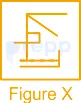
Select the option in which the given figure X is embedded (rotation is not allowed).
- A
Option A (shown in image)
- B
Option B (shown in image)
- C
Option C (shown in image)
- D
Option D (shown in image)
Show answer
B. Option B (shown in image)The option figure in which the given figure is embedded is option ‘2’.
Hence, option ‘2’ is the correct answer.
 Paper & answer key PDF ↗
 Question 18archived
Four numbers –pairs have given, out of which three are alike some manner and one is different. Select the number-pair that is different from the rest.
- A
55 : 25
- B
44 : 16
- C
76 : 42
- D
28 : 56
Show answer
D. 28 : 561) 55 : 25 → 55 : (5 × 5) = 25
2) 44 : 16 → 44 : (4 × 4) = 16
3) 76 : 42 → 76 : (7 × 6) = 42
4) 28 : 56 → 28 : (2 × 8) ≠ 56
Therefore, ‘28 : 56’ is the correct answer.
Paper & answer key PDF ↗ Question 19archived
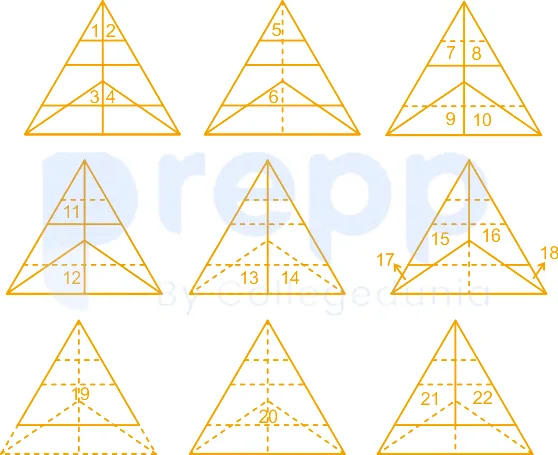
How many triangles are there in the given figure?

- A
20
- B
23
- C
22
- D
24
Show answer
C. 22The number of triangles in the figure is shown below:
Hence, ‘22’ is the correct answer.
 Paper & answer key PDF ↗
 Question 20archived
Select the correct mirror image of the given alphanumeric-cluster when a mirror is placed on the right side of the cluster.

- A
Option A (shown in image)
- B
Option B (shown in image)
- C
Option C (shown in image)
- D
Option D (shown in image)
Show answer
A. Option A (shown in image)The correct mirror image of the given figure when the mirror is placed on the right of the figure is shown below:
Hence, option 1 is the correct answer.
 Paper & answer key PDF ↗
 Question 21archived
Arrange the following words in a logical and meaningful order.
1. Nose
2. Forehead
3. Chin
4. Waist
5. Chest
- A
2, 1, 3, 5, 4
- B
2, 4, 1, 5, 3
- C
2, 3, 1, 4, 5
- D
3, 2, 4, 2, 1
Show answer
A. 2, 1, 3, 5, 4This question asks us to arrange a given set of words in a logical and meaningful order. The words provided are parts of the human body. A common logical ordering for body parts is from top to bottom.
Let's look at the words and their corresponding numbers:
Nose
Forehead
Chin
Waist
Chest
Logical Ordering of Body Parts
We will arrange these body parts based on their position in the human body, starting from the top and moving downwards. Let's consider the relative positions of these parts:
The Forehead is at the top of the face/head.
The Nose is below the forehead on the face.
The Chin is below the nose on the face.
The Chest is located below the head/face region, in the upper torso.
The Waist is located below the chest.
Arranging them from top to bottom, we get the following sequence:
Forehead → Nose → Chin → Chest → Waist
Now, let's map these body parts back to their numbers from the question:
Forehead corresponds to number 2.
Nose corresponds to number 1.
Chin corresponds to number 3.
Chest corresponds to number 5.
Waist corresponds to number 4.
Therefore, the logical and meaningful order of the numbers is 2, 1, 3, 5, 4.
Comparing with Options
Let's compare our derived logical sequence (2, 1, 3, 5, 4) with the given options:
Option 1: 2, 1, 3, 5, 4 - This matches our sequence.
Option 2: 2, 4, 1, 5, 3 (Forehead, Waist, Nose, Chest, Chin) - This order is not logical from top to bottom.
Option 3: 2, 3, 1, 4, 5 (Forehead, Chin, Nose, Waist, Chest) - This order is not logical from top to bottom.
Option 4: 3, 2, 4, 2, 1 (Chin, Forehead, Waist, Forehead, Nose) - This order is not logical and repeats a number.
The sequence 2, 1, 3, 5, 4 correctly arranges the body parts (Forehead, Nose, Chin, Chest, Waist) from top to bottom, making it the logical and meaningful order.
Logical Order of Body Parts
Position
Body Part
Number
Top
Forehead
2
↓
Nose
1
↓
Chin
3
↓
Chest
5
Bottom
Waist
4
Revision Table: Logical Sequence Review
Reviewing the Logical Sequence
Order
Number
Body Part
1st
2
Forehead
2nd
1
Nose
3rd
3
Chin
4th
5
Chest
5th
4
Waist
Additional Information on Logical Ordering
Logical ordering questions can appear in various forms. Besides arranging items by physical position (like body parts from top to bottom), they can also require arrangement based on:
Size: Smallest to largest, or vice versa.
Time/Chronology: Events in the order they happened.
Process/Steps: Actions in the order they are performed.
Hierarchy: Ranking from highest to lowest authority or importance.
Sequence: Items that follow each other naturally (e.g., day, week, month, year).
To solve such questions, it's important to identify the underlying principle for the logical connection between the given items. In this specific question, the principle is the anatomical arrangement of body parts from head to waist.
Paper & answer key PDF ↗ Question 22archived
Select the option in which the words share the same relationship as that shared by the given pair of words.
Arteries : Circulatory system
- A
Kidney : Respiratory system
- B
Eyes : Endocrine system
- C
Lungs : Olfactory system
- D
Nerves : Nervous system
Show answer
D. Nerves : Nervous systemUnderstanding the Relationship: Arteries and the Circulatory System
The question asks us to identify a pair of words that share the same relationship as "Arteries : Circulatory system". Let's first understand the relationship between arteries and the circulatory system.
Arteries are blood vessels that are a fundamental and vital part of the circulatory system. The circulatory system, also known as the cardiovascular system, is responsible for transporting blood throughout the body. Arteries carry oxygenated blood (usually) away from the heart to the rest of the body's tissues and organs. Therefore, arteries are key components or organs that make up the circulatory system.
The relationship is: Component/Organ : System it belongs to.
Analyzing the Options Based on the Relationship
We need to examine each option to see which pair exhibits the same "Component/Organ : System it belongs to" relationship.
Option 1: Kidney : Respiratory system
Kidneys are organs, but they are part of the urinary system, which filters waste from the blood to produce urine. The respiratory system is responsible for breathing and gas exchange (like taking in oxygen and releasing carbon dioxide) and includes organs like the lungs and trachea. So, a kidney is not a component of the respiratory system. This relationship does not match.
Option 2: Eyes : Endocrine system
Eyes are organs responsible for vision and are part of the sensory system, which is closely linked to the nervous system. The endocrine system is made up of glands that produce hormones, which regulate various bodily functions. Eyes are not a component of the endocrine system. This relationship does not match.
Option 3: Lungs : Olfactory system
Lungs are vital organs that are part of the respiratory system, responsible for breathing and gas exchange. The olfactory system is responsible for the sense of smell and includes organs like the nasal cavity and olfactory bulbs. Lungs are not a component of the olfactory system. This relationship does not match.
Option 4: Nerves : Nervous system
Nerves are bundles of nerve fibers that are fundamental components of the nervous system. The nervous system is a complex network of nerves and cells that carry messages to and from the brain and spinal cord to various parts of the body. Nerves are indeed key structures that make up the nervous system, allowing communication throughout the body. This relationship (Nerves are components of the Nervous system) matches the relationship between Arteries and the Circulatory system.
Conclusion
Comparing the relationships, the pair "Nerves : Nervous system" is the only one that shows the same type of relationship as "Arteries : Circulatory system", where the first word is a major component or organ of the system named in the second word.
Revision Table: Body Systems and Key Components
System
Key Components/Organs
Circulatory System
Heart, Arteries, Veins, Capillaries, Blood
Respiratory System
Lungs, Trachea, Bronchi, Diaphragm
Urinary System
Kidneys, Ureters, Bladder, Urethra
Nervous System
Brain, Spinal Cord, Nerves
Endocrine System
Glands (e.g., Pituitary, Thyroid, Adrenal)
Olfactory System
Nasal Cavity, Olfactory Receptors, Olfactory Bulb
Sensory System (related to Eyes)
Eyes, Optic Nerve, Parts of the Brain
Additional Information: Human Body Systems
The human body is organized into several organ systems that work together to perform necessary functions for survival. Understanding these systems and their components is crucial in biology and health sciences.
The Circulatory System transports oxygen, nutrients, hormones, and waste products.
The Nervous System controls and coordinates actions and sensory information by transmitting signals between different parts of the body.
The Respiratory System is responsible for gas exchange (breathing).
The Urinary System filters blood and eliminates waste products as urine.
The Endocrine System produces and secretes hormones that regulate various processes like growth, metabolism, and reproduction.
The Sensory System allows the body to receive information from its environment (e.g., sight, hearing, smell, taste, touch).
The Olfactory System is specifically the sensory system for smell.
Each component, like arteries or nerves, plays a specific role within its system, contributing to the overall function of the organism.
Paper & answer key PDF ↗ Question 23archived
A cube is made by folding the given sheet. In the cube so formed, which of the following pairs of symbols will be on opposite sides?

- A
# and @
- B
@ and %
- C
& and %
- D
$ and +
Show answer
A. # and @When the box will be constructed, the following symbols will be opposite to each other as shown below:
#
$
%
@
&
+
1) # and @ → Yes
2) @ and % → No
3) & and % → No
4) $ and + → No
So, when the box will be constructed, the symbols ‘# and @’ will be opposite to each other.
Hence, ‘# and @’ is the correct answer.
 Paper & answer key PDF ↗
 Question 24archived
Read the given statements and conclusions carefully. Assuming that the information given in the statements is true, even if it appears to be at variance with commonly known facts, which of the given conclusions logically(s) follow. From the statements.
Statements:
1. Some bottles are glasses.
2. Some glasses are bowls.
Conclusions:
I. Some bowls are bottles.
II. Some glasses are bottles
III. No bowl is a bottle
- A
All Conclusions I, II and III follow.
- B
Only Conclusions II and III follow.
- C
Either Conclusion II or III follows.
- D
Only Conclusions II and either Conclusion I or III follow.
Show answer
D. Only Conclusions II and either Conclusion I or III follow.Understanding Syllogism and Logical Deduction
This question is an example of a syllogism, a type of logical argument where a conclusion is inferred from two or more statements. To solve such problems, we assume the given statements are true and use them to determine which of the provided conclusions logically follow. We can use methods like Venn diagrams or logical deduction to visualize and analyze the relationships described in the statements.
Analyzing the Statements
We are given two statements:
Statement 1: Some bottles are glasses.
Statement 2: Some glasses are bowls.
Let's represent the categories:
Bottles (B)
Glasses (G)
Bowls (Bo)
Statement 1 tells us there is at least one item that is both a bottle and a glass. There is an overlap between the category of Bottles and the category of Glasses.
Statement 2 tells us there is at least one item that is both a glass and a bowl. There is an overlap between the category of Glasses and the category of Bowls.
Analyzing the Conclusions
Now let's look at the conclusions and see if they must be true based on the statements.
Conclusion I: Some bowls are bottles.
Based on the statements:
We know some Bottles are Glasses.
We know some Glasses are Bowls.
Consider the overlap between Glasses and Bowls (from Statement 2). These glasses could be the 'some glasses' that are also bottles (from Statement 1). If this is the case, then there would be an overlap between Bowls and Bottles, meaning 'Some bowls are bottles' would be true.
However, it's also possible that the 'some glasses' that are bowls are *different* glasses from the 'some glasses' that are bottles. In this scenario, there would be no overlap between Bowls and Bottles, and 'Some bowls are bottles' would be false.
Since this conclusion is true in some possible arrangements of the categories but not in all arrangements, Conclusion I does not definitely follow from the statements alone. It is a possibility.
Conclusion II: Some glasses are bottles.
This conclusion is the converse of Statement 1 ("Some bottles are glasses"). If Statement 1 is true, meaning there is an intersection between the set of Bottles and the set of Glasses, then it necessarily follows that there are some items within the set of Glasses that are also in the set of Bottles. Therefore, 'Some glasses are bottles' logically follows directly from Statement 1.
Conclusion III: No bowl is a bottle.
Based on the statements, we saw that it is possible for there to be no overlap between Bowls and Bottles (in the second scenario described for Conclusion I). In that specific scenario, 'No bowl is a bottle' would be true.
However, we also saw that it is possible for there to be an overlap between Bowls and Bottles (in the first scenario described for Conclusion I). If there is even one bowl that is a bottle, then 'No bowl is a bottle' would be false.
Since this conclusion is true in some possible arrangements but not in all, Conclusion III does not definitely follow from the statements alone. It is a possibility.
Comparing Conclusions I and III
Let's look at Conclusion I (Some bowls are bottles) and Conclusion III (No bowl is a bottle) together. These two conclusions are contradictory. If 'Some bowls are bottles' is true, then 'No bowl is a bottle' must be false. Conversely, if 'No bowl is a bottle' is true, then 'Some bowls are bottles' must be false.
Based on the statements, we established that it is *possible* for 'Some bowls are bottles' to be true, and it is *possible* for 'No bowl is a bottle' to be true. These two possibilities cover all potential relationships between Bowls and Bottles based on the given statements. Therefore, either one must be true, but both cannot be true simultaneously, and both cannot be false simultaneously.
This means that either Conclusion I follows or Conclusion III follows. This is known as a complementary pair or 'either/or' case in syllogisms.
Summary of Conclusion Analysis
Conclusion
Analysis
Logically Follows?
I. Some bowls are bottles.
Possible based on statements, but not definite.
No (not definitely)
II. Some glasses are bottles.
Converse of Statement 1. Definitely follows.
Yes
III. No bowl is a bottle.
Possible based on statements, but not definite. Contradictory to Conclusion I.
No (not definitely)
Determining the Final Answer
From our analysis:
Conclusion II definitely follows from the statements.
Either Conclusion I or Conclusion III must follow (because they are contradictory and exhaust the possibilities regarding the relationship between bowls and bottles).
Therefore, the conclusions that logically follow are Conclusion II, and either Conclusion I or Conclusion III.
Revision Table: Key Syllogism Concepts
Concept
Explanation
Statements
Propositions assumed to be true for the purpose of the argument.
Conclusions
Propositions derived from the statements using logical rules.
Logically Follows
A conclusion logically follows if it *must* be true whenever the statements are true.
Converse
Swapping the subject and predicate of a statement (e.g., "Some A are B" vs. "Some B are A"). "Some" statements have valid converses.
Either/Or Case
When two conclusions are contradictory, and based on the statements, one of them must be true, but we cannot determine which one definitely follows.
Additional Information on Syllogism Types
Syllogisms often involve different types of statements:
Universal Affirmative (All A are B): Every member of set A is also a member of set B.
Universal Negative (No A is B): No member of set A is a member of set B. The sets A and B are completely separate.
Particular Affirmative (Some A are B): At least one member of set A is also a member of set B. There is an overlap between sets A and B.
Particular Negative (Some A are not B): At least one member of set A is not a member of set B.
Understanding the implications of these statement types and how they can be combined is crucial for solving syllogism problems. Venn diagrams can be a very helpful tool to visualize these relationships and test the validity of conclusions.
Paper & answer key PDF ↗ Question 25archived
Select the figure that can replace the question mark? in the following series.

- A
Option A (shown in image)
- B
Option B (shown in image)
- C
Option C (shown in image)
- D
Option D (shown in image)
Show answer
A. Option A (shown in image)Given series:
As we move one step forward in the series, we see that vertical lines are increasing by one and horizontal lines are decreasing by one.
So, in the ‘?’ figure, there will be 5 vertical lines and 1 horizontal line, as shown in option 1.
Hence, option 1 is the correct answer.

 Paper & answer key PDF ↗
 Question 26archived
________ was appointed Chief Justice of India with effect from 18 November 2019.
- A
Ranjan Gogoi
- B
Ashok Bhushan
- C
Sharad Arvind Bobde
- D
Dipak Misra
Show answer
C. Sharad Arvind BobdeUnderstanding the Chief Justice of India Appointment
The question asks about the individual who took office as the Chief Justice of India (CJI) on November 18, 2019. The Chief Justice of India is the head of the Supreme Court of India, the highest judicial body in the country.
Role of the Chief Justice of India
The Chief Justice of India plays a crucial role in the Indian judicial system. They are responsible for:
Presiding over the Supreme Court.
Allocating cases and appointing constitutional benches.
Administering the Supreme Court.
Heading the collegium that recommends the appointment and transfer of judges.
Analysis of Options for the CJI Appointment
Let's look at the individuals mentioned in the options in the context of the Chief Justice of India position around November 2019:
Ranjan Gogoi: He was the 46th Chief Justice of India, serving before the appointment in question. His tenure ended on November 17, 2019.
Ashok Bhushan: He is a judge of the Supreme Court of India, but he has not held the office of the Chief Justice of India.
Sharad Arvind Bobde: He was a senior judge in the Supreme Court at the time and was next in line after Ranjan Gogoi.
Dipak Misra: He was the 45th Chief Justice of India, serving before Ranjan Gogoi. His tenure ended in October 2018.
Identifying the Chief Justice Appointed on November 18, 2019
Following the retirement of Chief Justice Ranjan Gogoi on November 17, 2019, the next most senior judge of the Supreme Court was appointed to the office. This appointment took effect from November 18, 2019.
Based on the seniority and the established practice for appointing the Chief Justice of India, Justice Sharad Arvind Bobde was the individual appointed to this position with effect from November 18, 2019. He served as the 47th Chief Justice of India.
Revision Table: Chief Justices Around 2019
Chief Justice of India
Tenure Start Date
Tenure End Date
Dipak Misra
28 August 2017
2 October 2018
Ranjan Gogoi
3 October 2018
17 November 2019
Sharad Arvind Bobde
18 November 2019
23 April 2021
Additional Information on CJI Appointment
The Chief Justice of India is appointed by the President of India. According to tradition, the outgoing Chief Justice recommends the name of the next most senior judge of the Supreme Court for appointment as the Chief Justice of India. This recommendation is usually accepted by the government, and the appointment is then made by the President.
The Chief Justice of India holds office until they attain the age of 65 years or are removed from office through impeachment by Parliament.
Paper & answer key PDF ↗ Question 27archived
Which of the following was NOT a type of sacrifice performed by kings in ancient India to establish their position?
- A
Muvendavelan
- B
Rajasuya
- C
Vajapeya
- D
Ashvamedha
Show answer
A. MuvendavelanUnderstanding Ancient Indian Royal Sacrifices
Ancient Indian kings often performed elaborate sacrifices and rituals to assert their power, legitimacy, and sovereignty. These sacrifices were not just religious ceremonies but also political statements that helped consolidate their position and authority over their kingdom and sometimes, over neighbouring territories.
The question asks to identify which of the given options was NOT a type of sacrifice performed by kings for this purpose.
Analyzing the Options
Rajasuya: This was a very significant sacrifice performed by a king upon his coronation to achieve imperial sovereignty. It was a complex ritual involving various ceremonies that lasted for several days. The performance of the Rajasuya sacrifice signified the king's supreme power and authority. Thus, Rajasuya was indeed a sacrifice performed by kings to establish their position.
Vajapeya: This sacrifice, meaning 'drink of strength' or 'chariot race,' was performed to gain strength, prosperity, and a higher status among rulers. It often involved a competitive chariot race where the king's chariot was made to win symbolically, reinforcing his superiority. This was another important ritual performed by kings for asserting their position.
Ashvamedha: Also known as the Horse Sacrifice, this was arguably the most elaborate and significant ritual performed by powerful kings aiming to establish their imperial sovereignty over large territories. A consecrated horse was allowed to roam free for a year, accompanied by the king's army. If the horse entered another kingdom and its ruler did not obstruct it, it meant the king's sovereignty was accepted. If the horse was challenged, it led to war. Upon the horse's successful return, a grand sacrifice was held, affirming the king's imperial status. Ashvamedha was a definitive sacrifice for establishing a king's position and imperial power.
Muvendavelan: This term is associated with South Indian history, particularly the Chola period. 'Muvendavelan' was a title conferred upon wealthy landholders (Vellalars) who served the three kings (Chera, Chola, and Pandya). It indicates a position or title of honour and service bestowed by kings, not a type of sacrifice performed by the kings themselves.
Conclusion
Based on the analysis, Rajasuya, Vajapeya, and Ashvamedha were all well-known types of sacrifices performed by ancient Indian kings to establish and assert their position and power. Muvendavelan, however, was a title given to individuals who served kings, and it was not a sacrifice.
Therefore, Muvendavelan was NOT a type of sacrifice performed by kings to establish their position.
Comparison of Terms
Term
Description
Type of Sacrifice?
Rajasuya
Royal consecration sacrifice for sovereignty.
Yes
Vajapeya
Sacrifice for strength, prosperity, and status (involved chariot race).
Yes
Ashvamedha
Horse sacrifice for imperial sovereignty.
Yes
Muvendavelan
Title for landholders serving kings (South India).
No
Revision Table: Ancient Royal Rituals
Key Royal Sacrifices and Titles in Ancient India
Term
Associated Significance
Region/Period Context (if specific)
Rajasuya Yajna
Establishment of supreme sovereignty, coronation.
Vedic period onwards
Vajapeya Yajna
Attainment of strength, prosperity, elevated status.
Vedic period onwards
Ashvamedha Yajna
Assertion of imperial power and territorial claims.
Vedic period onwards
Muvendavelan Title
Title for wealthy landholders serving three kings.
South India (Chola period)
Additional Information on Ancient Indian Titles and Land Grants
Apart from performing elaborate sacrifices, kings in ancient India also used other means to consolidate power and administer their kingdoms. Conferring titles and granting land were common practices.
Titles like 'Muvendavelan', 'Arayar' (chief), 'Samantar' (feudatory chief) were given to individuals who held important positions in the administration or army, or who were influential members of society, like wealthy landowners. These titles acknowledged their service and loyalty to the king.
Land grants (like 'Brahmadeya' to Brahmins, 'Shalabhoga' for maintenance of a school, 'Devadana' to temples) were another way kings patronized different sections of society and ensured stability. These grants were often recorded on copper plates or stone inscriptions.
Understanding these titles and land grants provides context for the administrative and social structure of ancient kingdoms, differentiating them from the religious and political rituals like sacrifices.
Paper & answer key PDF ↗ Question 28archived
As of January 2020, _____ has the maximum number of seats in the Rajya Sabha.
- A
Uttar Pradesh
- B
Maharashtra
- C
Tamil Nadu
- D
Karnataka
Show answer
A. Uttar PradeshUnderstanding Rajya Sabha Seat Allocation
The Rajya Sabha, also known as the Council of States, is the upper house of the Parliament of India. Members of the Rajya Sabha are elected by the elected members of the Legislative Assemblies of the States and Union Territories. The number of representatives from each state or union territory in the Rajya Sabha is determined by its population. States with larger populations get more seats in the Rajya Sabha compared to states with smaller populations.
State with Maximum Rajya Sabha Seats
As of January 2020, the allocation of seats in the Rajya Sabha was based on the population figures from the 1971 Census, as mandated by law. Among the Indian states, Uttar Pradesh is the most populous state. Due to its large population, Uttar Pradesh is allocated the highest number of seats in the Rajya Sabha.
Let's look at the seat distribution for the states mentioned in the options as of January 2020:
Uttar Pradesh: 31 seats
Maharashtra: 19 seats
Tamil Nadu: 18 seats
Karnataka: 12 seats
Comparing these numbers, it is clear that Uttar Pradesh had the maximum number of seats in the Rajya Sabha as of January 2020.
Analyzing the Options
Let's examine each option based on the Rajya Sabha seat allocation as of January 2020:
Uttar Pradesh: With 31 seats, Uttar Pradesh has the highest representation in the Rajya Sabha among all Indian states due to its large population.
Maharashtra: Maharashtra has 19 seats in the Rajya Sabha, which is significantly less than Uttar Pradesh.
Tamil Nadu: Tamil Nadu has 18 seats in the Rajya Sabha, also less than Uttar Pradesh.
Karnataka: Karnataka has 12 seats in the Rajya Sabha, fewer than Uttar Pradesh, Maharashtra, and Tamil Nadu.
Therefore, based on the seat allocation in January 2020, Uttar Pradesh held the maximum number of Rajya Sabha seats.
State
Number of Rajya Sabha Seats (as of Jan 2020)
Uttar Pradesh
31
Maharashtra
19
Tamil Nadu
18
Karnataka
12
Revision Table: Rajya Sabha Seat Allocation
This table helps summarize the Rajya Sabha seat distribution for key states.
State
Rajya Sabha Seats
Uttar Pradesh
31
Maharashtra
19
Tamil Nadu
18
Karnataka
12
Bihar
16
West Bengal
16
Andhra Pradesh
11
Gujarat
11
Madhya Pradesh
11
Rajasthan
10
Additional Information: Rajya Sabha
The Rajya Sabha plays a crucial role in the Indian parliamentary system. Here are some additional points about the Rajya Sabha:
The Rajya Sabha is a permanent body and is not subject to dissolution.
One-third of its members retire every second year, and new members are elected to fill the vacancies.
The Vice-President of India is the ex-officio Chairman of the Rajya Sabha.
Members of the Rajya Sabha have a term of six years.
The allocation of seats is based on the Fourth Schedule of the Constitution of India.
Unlike the Lok Sabha, the Rajya Sabha represents the states and union territories.
Understanding the composition and role of the Rajya Sabha is important for comprehending the structure of the Indian Parliament.
Paper & answer key PDF ↗ Question 29archived
In January 2020, China tested the world’s first high-speed driverless bullet train between Beijing and ________.
- A
Haikou
- B
Shanghai
- C
Lhasa
- D
Zhangjiakou
Show answer
D. ZhangjiakouUnderstanding China's First Driverless High-Speed Train
The question asks about the destination of the world's first high-speed driverless bullet train route launched by China in January 2020, originating from Beijing.
China has been at the forefront of developing high-speed rail technology. The route mentioned is particularly significant because it was the first time a high-speed train operated fully automatically at such speeds (up to 350 km/h).
This driverless train line was a key infrastructure project linked to the 2022 Beijing Winter Olympics, connecting the host city Beijing with venues in Zhangjiakou.
Route Details: Beijing to Zhangjiakou
The specific route for the world's first high-speed driverless bullet train in January 2020 was from Beijing to Zhangjiakou. This line is part of the Beijing-Zhangjiakou intercity railway.
Key features of this route and train included:
Automated driving system (ATO) for starting, stopping, and adjusting speed.
Operation at speeds up to 350 km/h.
Advanced technology like 5G network coverage, facial recognition for boarding, and smart lighting.
Significantly reduced travel time between the two cities.
Analyzing the Options
Let's look at the given options:
Haikou: Haikou is the capital of Hainan province, a southern island. While it has rail connections, it was not the destination of this specific driverless high-speed route from Beijing in 2020.
Shanghai: Shanghai is a major economic hub and connected to Beijing by high-speed rail, but the driverless route launched in 2020 was not between Beijing and Shanghai.
Lhasa: Lhasa is the capital of Tibet and is connected by rail, but not by a high-speed route capable of 350 km/h, and it was not the destination of the 2020 driverless train from Beijing.
Zhangjiakou: Zhangjiakou is a city in Hebei province, northwest of Beijing. It co-hosted the 2022 Winter Olympics with Beijing, and this high-speed driverless train line was specifically built to connect Beijing with the Olympic venues in Zhangjiakou.
Based on the facts about this pioneering train service, the correct destination was Zhangjiakou.
Beijing - Zhangjiakou Driverless Train Summary
Feature
Detail
Origin City
Beijing
Destination City
Zhangjiakou
Launch Date (Driverless)
January 2020
Maximum Speed
350 km/h
Significance
World's first high-speed driverless train
Context
Preparation for 2022 Winter Olympics
Therefore, the world's first high-speed driverless bullet train tested by China in January 2020 ran between Beijing and Zhangjiakou.
Revision Table: China High-Speed Rail Facts
Key Facts about China's High-Speed Rail
Aspect
Notes
Network Size
Largest in the world.
Maximum Operating Speed
Up to 350 km/h on certain lines.
Key Technologies
Advanced signalling, track design, train control systems (including ATO).
Beijing-Zhangjiakou Line
Notable for being the first high-speed line with driverless operation at 350 km/h.
Additional Information: Automated Train Operation (ATO)
Automated Train Operation (ATO) is a system used to automate train movement. While commonly used in metro systems, applying it to high-speed rail running at 350 km/h requires significant technological advancement and safety measures.
How it works: ATO systems manage acceleration, braking, and stopping at stations without human input.
Benefits: Can improve punctuality, energy efficiency, and potentially increase line capacity.
High-Speed Challenge: Implementing ATO at high speeds involves complex interaction with signalling systems and ensuring safety under dynamic conditions.
Beijing-Zhangjiakou Implementation: This line showcased the capability to run high-speed trains autonomously, representing a major step in rail technology.
Paper & answer key PDF ↗ Question 30archived
Article _____ of the Constitution of India deals with provisions related to the administration and control of Scheduled Areas and Scheduled Tribes.
- A
222(1)
- B
244(1)
- C
244(2)
- D
222(2)
Show answer
B. 244(1)Understanding Constitutional Provisions for Scheduled Areas and Tribes
The question asks about the specific Article in the Constitution of India that contains provisions related to the administration and control of Scheduled Areas and Scheduled Tribes. These are special provisions designed to protect the rights and promote the welfare of these communities.
Key Constitutional Article: Article 244
Article 244 of the Constitution of India specifically deals with the administration of Scheduled Areas and tribal areas. This Article has two clauses:
Article 244(1): This clause relates to the administration of the Scheduled Areas and Scheduled Tribes in any State other than the States of Assam, Meghalaya, Tripura, and Mizoram. It operates in conjunction with the provisions of the Fifth Schedule to the Constitution.
Article 244(2): This clause relates to the administration of tribal areas in the States of Assam, Meghalaya, Tripura, and Mizoram. It operates in conjunction with the provisions of the Sixth Schedule to the Constitution.
Since the question asks about the administration and control of "Scheduled Areas and Scheduled Tribes" generally, and does not specify the North-Eastern states covered by the Sixth Schedule, Article 244(1) is the most relevant provision that governs the administration of Scheduled Areas and Scheduled Tribes as defined under the Fifth Schedule.
Role of the Fifth Schedule
The Fifth Schedule of the Constitution details the provisions for the administration and control of Scheduled Areas and Scheduled Tribes in the states to which it applies (all states except Assam, Meghalaya, Tripura, and Mizoram). It provides for the establishment of Tribal Advisory Councils, application and modification of laws, and other measures to ensure the protection and welfare of Scheduled Tribes in these areas.
Analysing the Options
Let's look at what the other options pertain to:
Article 222(1): This Article deals with the transfer of a Judge from one High Court to another. It has no relation to Scheduled Areas or Scheduled Tribes.
Article 244(2): As discussed, this relates to the administration of tribal areas in Assam, Meghalaya, Tripura, and Mizoram under the Sixth Schedule. While related to tribal administration, it is distinct from the provisions for Scheduled Areas and Scheduled Tribes under the Fifth Schedule, which is the primary focus of Article 244(1).
Article 222(2): This clause is related to compensatory allowance payable to a Judge transferred from one High Court to another. Like Article 222(1), it is unrelated to Scheduled Areas or Scheduled Tribes.
Based on the analysis, Article 244(1) is the constitutional provision that directly addresses the administration and control of Scheduled Areas and Scheduled Tribes under the Fifth Schedule.
Revision Table: Key Articles and Schedules
Article/Schedule
Subject Matter
Article 244(1)
Administration of Scheduled Areas and Scheduled Tribes (Fifth Schedule)
Article 244(2)
Administration of Tribal Areas in Assam, Meghalaya, Tripura, Mizoram (Sixth Schedule)
Fifth Schedule
Provisions relating to the administration and control of Scheduled Areas and Scheduled Tribes
Sixth Schedule
Provisions relating to the administration of Tribal Areas in Assam, Meghalaya, Tripura and Mizoram
Article 222(1)
Transfer of High Court Judges
Additional Information: Administration of Scheduled Areas
The administration of Scheduled Areas under the Fifth Schedule involves several key aspects:
The Governor of each state having Scheduled Areas has special responsibilities regarding their administration.
The Governor submits an annual report to the President regarding the administration of Scheduled Areas in the state.
A Tribal Advisory Council (TAC) is required to be constituted in each state having Scheduled Areas, advising on the welfare and advancement of the Scheduled Tribes.
Parliament or the state legislature has the power to apply or modify laws in their application to Scheduled Areas.
These provisions highlight the unique administrative framework established by the Constitution to protect the interests of Scheduled Tribes residing in Scheduled Areas.
Paper & answer key PDF ↗ Question 31archived
The spice, cinnamon, is native to ________.
- A
Bhutan
- B
Malaysia
- C
Sri Lanka
- D
Afghanistan
Show answer
C. Sri LankaCinnamon's Native Geographic Origin Explained
This question focuses on identifying the **native** region of the spice **cinnamon**. Cinnamon is a highly valued spice obtained from the inner bark of trees from the genus Cinnamomum. Its distinctive flavor and aroma have made it a staple in kitchens and cultural practices worldwide.
Investigating the True Origin of Cinnamon
The specific type of cinnamon commonly referred to as "true cinnamon" or Ceylon cinnamon comes from the species Cinnamomum verum. Determining the **native** place of this spice is key to answering the question.
Sri Lanka as the Native Home: Botanical and historical records strongly indicate that Sri Lanka is the primary **native** location for Cinnamomum verum. The island's climate and soil conditions are ideal for its cultivation.
Historical Trade Routes: Sri Lanka has been a significant exporter of cinnamon for thousands of years, playing a crucial role in ancient spice trade routes.
Distinction from Other Varieties: It's important to note that other species, like Cassia cinnamon (Cinnamomum cassia), are native to different regions, such as China. However, when discussing true cinnamon, the focus remains on the Sri Lankan variety.
Evaluating the Options for Cinnamon's Origin
Let's examine the choices provided to pinpoint the correct **native** region for **cinnamon**:
Bhutan: This Himalayan kingdom is not associated with the **native** cultivation of cinnamon.
Malaysia: While Malaysia is a producer of various spices, it is not considered the **native** origin of true cinnamon.
Sri Lanka: This island nation is widely recognized as the geographical origin and **native** place for the spice **cinnamon** (Cinnamomum verum).
Afghanistan: The geography and climate of Afghanistan are unsuitable for the **native** growth of the true cinnamon tree.
Therefore, based on established botanical and historical information, the **native** place for the spice **cinnamon** is Sri Lanka.
Paper & answer key PDF ↗ Question 32archived
______ was executed at Lahore in November 1915 for his role in the Ghadar Conspiracy in February 1915.
- A
Kartar Singh Sarabha
- B
Tantia Mama
- C
Vijay Singh Pathik
- D
Maganbhai Patel
Show answer
A. Kartar Singh SarabhaUnderstanding the Ghadar Conspiracy and Key Figures
The question asks about a prominent individual executed in Lahore in November 1915 for their involvement in the Ghadar Conspiracy, which took place in February 1915. The Ghadar Conspiracy was a plan for a pan-Indian rebellion against British rule by members of the Ghadar Party, primarily based in the United States and Canada.
Identifying the Ghadar Conspiracy Martyr
Let's analyze the options provided to determine who fits the description:
Kartar Singh Sarabha: Kartar Singh Sarabha was a key figure in the Ghadar Party. He was one of the youngest and most enthusiastic leaders. He returned to India to participate in the planned uprising. Following the failure of the Ghadar Conspiracy in February 1915 due to betrayal, many revolutionaries were arrested. Kartar Singh Sarabha was among them. He was tried in the First Lahore Conspiracy Case. Despite being very young, he boldly accepted his role and was sentenced to death. He was indeed executed in Lahore in November 1915.
Tantia Mama: Tantia Mama (also known as Tantia Bhil) was a tribal revolutionary from the Nimad region of present-day Madhya Pradesh. He was known for his resistance against British exploitation and was active in the late 19th century, long after the 1857 revolt and before the Ghadar movement. He is not associated with the Ghadar Conspiracy or execution in Lahore in 1915.
Vijay Singh Pathik: Vijay Singh Pathik was a prominent Indian revolutionary and freedom fighter, known primarily for his leadership in peasant movements in Rajasthan, such as the Bijoliya movement. While he was a contemporary revolutionary, he was not directly involved in the Ghadar Conspiracy or executed in Lahore in 1915.
Maganbhai Patel: This name is not widely associated with the prominent leaders of the Ghadar Conspiracy or other major revolutionary movements leading to execution in 1915.
Based on historical records of the Ghadar Conspiracy and the First Lahore Conspiracy Case, Kartar Singh Sarabha was a central figure who was arrested, tried, and executed in Lahore in November 1915 for his role in the conspiracy. This aligns perfectly with the details provided in the question.
Conclusion
Therefore, the individual executed at Lahore in November 1915 for his role in the Ghadar Conspiracy in February 1915 was Kartar Singh Sarabha.
Revolutionary
Key Movement/Role
Associated Period
Fate (relevant to 1915)
Kartar Singh Sarabha
Ghadar Party, Ghadar Conspiracy
Early 20th Century (1915)
Executed in Lahore, Nov 1915
Tantia Mama
Tribal Resistance
Late 19th Century
Not related to Ghadar/1915
Vijay Singh Pathik
Peasant Movements (Rajasthan)
Early 20th Century
Not related to Ghadar/1915 Lahore execution
Maganbhai Patel
Less prominent in this context
-
Not related to Ghadar/1915
Revision Table: Key Events & Figures
Event/Figure
Significance
Year
Ghadar Party Foundation
Formed by Indian immigrants, primarily in the USA and Canada, with the aim of liberating India from British rule.
1913
Ghadar Conspiracy Plan
A plan by the Ghadar Party to initiate a nationwide rebellion in India.
February 1915
First Lahore Conspiracy Case
Trial of Ghadar revolutionaries arrested after the failed conspiracy.
1915-1916
Kartar Singh Sarabha
Prominent young Ghadar revolutionary, involved in the 1915 plan.
Executed Nov 1915
Additional Information: Ghadar Movement Context
The Ghadar Movement was a significant early 20th-century effort by overseas Indians to overthrow British rule. The movement gained traction among expatriates, particularly Sikhs in North America, who faced discrimination and desired independence for their homeland. The outbreak of World War I in 1914 was seen as an opportune moment to strike against the British Empire. The Ghadarites planned to return to India and incite a rebellion among Indian soldiers.
The planned uprising in February 1915, however, was compromised due to informants, leading to mass arrests. The subsequent trials, including the Lahore Conspiracy Cases, resulted in severe punishments, including executions, life imprisonment, and long jail terms for many Ghadar leaders and activists. Kartar Singh Sarabha's execution at the young age of 19 made him a martyr and an inspiration for future revolutionaries.
Paper & answer key PDF ↗ Question 33archived
Haemophobia is the fear of ________.
- A
blood
- B
water
- C
heights
- D
darkness
Show answer
A. bloodUnderstanding Haemophobia: The Fear of Blood
Haemophobia is a specific type of phobia characterized by an extreme and irrational fear of blood. The word itself comes from the Greek word 'haema' meaning blood, and 'phobos' meaning fear. People with haemophobia may experience intense anxiety, nausea, dizziness, or even fainting when they see blood, think about blood, or encounter medical procedures involving needles or injuries where blood might be present.
This phobia is more than just feeling uncomfortable around blood; it's a debilitating fear that can significantly impact a person's life, potentially causing them to avoid medical care, specific jobs, or even situations where they might see blood, like watching certain movies or visiting a doctor's office.
Let's look at the options provided and see which one matches the definition of Haemophobia:
Option 1: blood - As discussed, Haemophobia is the fear of blood. This aligns with the definition.
Option 2: water - The fear of water is known as Hydrophobia.
Option 3: heights - The fear of heights is known as Acrophobia.
Option 4: darkness - The fear of darkness is known as Nyctophobia or Lygophobia.
Based on the meaning of the term and common phobia definitions, Haemophobia is specifically the fear of blood.
Revision Table: Common Phobias
Phobia
Fear Of
Haemophobia
Blood
Hydrophobia
Water
Acrophobia
Heights
Nyctophobia
Darkness
Arachnophobia
Spiders
Claustrophobia
Confined Spaces
Additional Information on Specific Phobias
Phobias are a type of anxiety disorder. They are intense, irrational fears of specific objects or situations that lead to avoidance behavior. While many people dislike certain things, a phobia involves a level of fear that is disproportionate to the actual danger and significantly interferes with a person's daily life.
Specific phobias, like Haemophobia, Hydrophobia, Acrophobia, and Nyctophobia, fall into several categories, including:
Animal type (e.g., spiders, snakes)
Natural environment type (e.g., heights, storms, water)
Blood-injection-injury type (e.g., blood, needles, medical procedures)
Situational type (e.g., enclosed spaces, flying)
Other type (e.g., choking, loud noises)
Haemophobia is classified under the blood-injection-injury type phobias. This category is unique because exposure to the feared stimulus can often cause a vasovagal response, leading to a drop in heart rate and blood pressure, and sometimes fainting. This physiological reaction is less common in other types of specific phobias, which typically cause increased heart rate and blood pressure.
Paper & answer key PDF ↗ Question 34archived
Which of the following books is NOT authored by RK Narayan?
- A
The Jungle Book
- B
The Guide
- C
Swami and Friends
- D
Malgudi Days
Show answer
A. The Jungle BookIdentifying Books by RK Narayan
The question asks us to identify which book from the given options was NOT written by the renowned Indian author R.K. Narayan. R.K. Narayan is famous for his works set in the fictional South Indian town of Malgudi.
Examining the Options
Let's look at each option and determine its author:
The Jungle Book: This is a collection of stories by the English author Rudyard Kipling, first published in 1894. These stories are set in a forest in India and feature characters like Mowgli, Baloo, and Bagheera.
The Guide: Authored by R.K. Narayan, this novel was published in 1958. It won the Sahitya Akademi Award in 1960 and was later adapted into a successful Hindi film.
Swami and Friends: This is R.K. Narayan's debut novel, published in 1935. It is the first of his novels set in Malgudi and introduces the character Swami.
Malgudi Days: This is a collection of short stories by R.K. Narayan, mostly set in Malgudi. While published as a collection in various forms over time, the stories are quintessential R.K. Narayan.
Determining the Author
Based on the examination, we can see that 'The Guide', 'Swami and Friends', and 'Malgudi Days' are all works by R.K. Narayan. 'The Jungle Book' is the only book among the options that was written by a different author, Rudyard Kipling.
Therefore, 'The Jungle Book' is the book NOT authored by R.K. Narayan.
Books and Authors
Book Title
Author
Authored by RK Narayan?
The Jungle Book
Rudyard Kipling
No
The Guide
R.K. Narayan
Yes
Swami and Friends
R.K. Narayan
Yes
Malgudi Days
R.K. Narayan
Yes
Conclusion on RK Narayan's Works
The analysis clearly shows that 'The Jungle Book' is the outlier among the listed books when considering R.K. Narayan's authorship. His famous works include novels and short story collections set in the fictional South Indian town of Malgudi, which serve as a backdrop for exploring various aspects of Indian life and human nature.
Revision Table: RK Narayan and His Books
Key Books by RK Narayan
Book Title
Genre
Setting
Swami and Friends
Novel
Malgudi
The Guide
Novel
Malgudi
Malgudi Days
Short Stories
Malgudi
The Vendor of Sweets
Novel
Malgudi
The English Teacher
Novel
Malgudi
Additional Information on Indian Literature and Authors
R.K. Narayan is considered one of the pioneers of early Indian literature in English, along with Mulk Raj Anand and Raja Rao. This trio is often referred to as the "Trinity" of Indian English literature. His simple yet profound storytelling style, focus on ordinary lives, and the vivid creation of Malgudi have earned him international acclaim.
Rudyard Kipling, on the other hand, was a British writer who was born in India and spent his early years there. His works, like 'The Jungle Book' and 'Kim', often reflect Indian settings and themes but are distinct in style and perspective from R.K. Narayan's writings.
Understanding the prominent works of different authors helps in distinguishing between their contributions to literature.
Paper & answer key PDF ↗ Question 35archived
Crocodiles have a ______ chambered heart.
- A
three
- B
single
- C
four
- D
two
Show answer
C. fourUnderstanding Crocodile Heart Chambers
The heart is a vital organ in animals, responsible for pumping blood throughout the body. The structure of the heart varies across different animal groups, particularly in the number of chambers it possesses. These chambers help in receiving and pumping blood efficiently, and the number of chambers often relates to the animal's metabolic needs and how blood circulation is managed.
Comparing Heart Chambers in Vertebrates
Let's look at the typical heart structures found in different vertebrate classes:
Fish: Have a two-chambered heart (one atrium, one ventricle).
Amphibians: Typically have a three-chambered heart (two atria, one ventricle).
Most Reptiles: Most reptiles, like lizards and snakes, have a three-chambered heart with an incompletely divided ventricle.
Birds and Mammals: Have a four-chambered heart (two atria, two ventricles).
Crocodile Heart: A Unique Case Among Reptiles
Crocodiles are a fascinating exception among reptiles. While most reptiles have a three-chambered heart, crocodiles possess a four-chambered heart. This is similar to the heart structure found in birds and mammals.
The four chambers in a crocodile heart are:
Right Atrium: Receives deoxygenated blood from the body.
Right Ventricle: Pumps deoxygenated blood to the lungs.
Left Atrium: Receives oxygenated blood from the lungs.
Left Ventricle: Pumps oxygenated blood to the body.
Having a four-chambered heart allows for complete separation of oxygenated and deoxygenated blood. This is generally more efficient for supplying oxygen to the body's tissues, supporting a higher metabolic rate compared to animals with three-chambered hearts where some mixing of blood can occur in the ventricle.
However, crocodiles also have a unique structure called the Foramen of Panizza, which connects the left and right aortas after they leave the ventricles. This allows for some controlled shunting of blood under certain conditions, such as during diving.
Analyzing the Options for Crocodile Heart Chambers
The question asks about the number of chambers in a crocodile heart. Based on our understanding:
Option 1: three - This is typical for most reptiles, but not crocodiles.
Option 2: single - This is not a typical vertebrate heart structure; fish have two chambers.
Option 3: four - This correctly describes the number of chambers in a crocodile heart.
Option 4: two - This is typical for fish, but not reptiles or crocodiles.
Therefore, a crocodile has a four-chambered heart.
Animal Group
Typical Heart Chambers
Fish
Two
Amphibians
Three
Most Reptiles
Three (with incomplete ventricular division)
Crocodiles
Four
Birds
Four
Mammals
Four
Revision Table: Heart Chambers Quick Facts
Organism
Number of Chambers
Significance
Fish
2
Single circulation; mixing of oxygenated/deoxygenated blood in body.
Amphibians & Most Reptiles
3
Double circulation; some mixing of oxygenated/deoxygenated blood in the ventricle.
Crocodiles, Birds, Mammals
4
Complete separation of oxygenated/deoxygenated blood; efficient double circulation.
Additional Information: Blood Circulation
The number of heart chambers is directly related to the type of circulatory system an animal has:
Single Circulation: Blood passes through the heart only once in a complete circuit (e.g., Fish). Deoxygenated blood goes from heart to gills, gets oxygenated, and then flows directly to the body tissues.
Double Circulation: Blood passes through the heart twice in a complete circuit. There are two loops:
Pulmonary Circulation: Heart to lungs and back.
Systemic Circulation: Heart to body tissues and back.
Animals with three or four-chambered hearts have double circulation. The efficiency increases with more chambers, leading to better separation of oxygenated and deoxygenated blood.
The four-chambered heart of the crocodile, along with birds and mammals, represents an advanced circulatory system that efficiently delivers oxygen to meet high metabolic demands.
Paper & answer key PDF ↗ Question 36archived
______ was awarded the Nobel Prize in 1913 and a knighthood in 1915.
- A
Rabindranath Tagore
- B
Mother Teresa
- C
Mahatma Gandhi
- D
Sarojini Naidu
Show answer
A. Rabindranath TagoreUnderstanding the Question: Nobel Prize and Knighthood
The question asks to identify a prominent personality who received two significant honours: the Nobel Prize in 1913 and a knighthood in 1915. This points to a specific historical figure known for their achievements around this time period, particularly in the fields recognised by these awards (Nobel Prize has various categories, knighthood is a British honour).
Analysing the Options
Let's examine each of the provided options to determine who fits the description:
Rabindranath Tagore: A highly renowned Indian polymath - poet, writer, playwright, composer, philosopher, social reformer, and painter. His work significantly reshaped Bengali literature and music, as well as Indian art with contextual modernism.
Mother Teresa: An Albanian-Indian Roman Catholic nun and missionary. She founded the Missionaries of Charity in Kolkata. She is known for her humanitarian work.
Mahatma Gandhi: The leader of India's non-violent independence movement against British rule. He is an iconic figure in Indian history and philosophy.
Sarojini Naidu: An Indian independence activist and poet, known as the 'Nightingale of India'. She was the first Indian woman President of the Indian National Congress and the first woman Governor of an Indian state.
Identifying the Correct Personality
We need to match the timeline and the specific awards mentioned (Nobel Prize 1913, Knighthood 1915) with the achievements of each person.
Rabindranath Tagore: He was awarded the Nobel Prize in Literature in 1913 for his profoundly sensitive, fresh and beautiful verse, by which, with consummate skill, he has made his poetic thought, expressed in his own English words, a part of the literature of the West. He was indeed knighted by the British Government in 1915, but he later renounced the knighthood in 1919 following the Jallianwala Bagh massacre.
Mother Teresa: She received the Nobel Peace Prize much later, in 1979. She was never awarded a British knighthood.
Mahatma Gandhi: He was nominated for the Nobel Peace Prize multiple times but never received it. He was not awarded a British knighthood, although he did receive the Kaiser-i-Hind medal from the British in 1915, which he later returned.
Sarojini Naidu: She was a prominent figure but is not recorded as having received the Nobel Prize or a British knighthood.
Based on this analysis, Rabindranath Tagore is the only personality among the options who was awarded the Nobel Prize in 1913 and a knighthood in 1915.
Conclusion: The Laureate and Knight
The individual who received the Nobel Prize in 1913 and a knighthood in 1915 was Rabindranath Tagore. His Nobel Prize was for literature, recognising his immense contribution to poetry, particularly his work 'Gitanjali'. The knighthood was conferred in 1915, although he later gave it up.
Personality
Nobel Prize Year
Knighthood Year
Notes
Rabindranath Tagore
1913 (Literature)
1915 (Renounced 1919)
Awarded both as per question timeline.
Mother Teresa
1979 (Peace)
Not applicable
Awards received much later.
Mahatma Gandhi
Never awarded (Nominated)
Not awarded (Received Kaiser-i-Hind 1915, returned)
Did not receive these specific honours.
Sarojini Naidu
Not awarded
Not awarded
Did not receive these specific honours.
Revision Table: Key Awards and Years
Award
Recipient
Year
Category (if Nobel)
Nobel Prize
Rabindranath Tagore
1913
Literature
Knighthood
Rabindranath Tagore
1915
British Honour
Nobel Prize
Mother Teresa
1979
Peace
Additional Information on Rabindranath Tagore's Honours
Rabindranath Tagore was a figure of immense global standing. His Nobel Prize in 1913 was a landmark achievement, being the first non-European to win the prize for literature. The knighthood from the British government in 1915 recognised his status and contributions, but his decision to renounce it in 1919 was a powerful act of protest against the Jallianwala Bagh massacre, demonstrating his solidarity with the Indian people and his stance against British atrocities. This act further cemented his position as a national hero and conscience keeper.
Paper & answer key PDF ↗ Question 37archived
Which of the following is a beach in Goa?
- A
Marina
- B
Varkala
- C
Kudle
- D
Palolem
Show answer
D. PalolemFinding Beaches in Goa: Analyzing the Options
The question asks us to identify which of the given options is a beach located in Goa, India. To answer this, we need to know the locations of the beaches listed in the options.
Analyzing Each Option
Let's examine each beach name provided:
Marina: Marina Beach is a famous urban beach, but it is located in Chennai, Tamil Nadu, on the east coast of India. Therefore, Marina Beach is not in Goa.
Varkala: Varkala Beach is a popular beach destination known for its cliff, located in the state of Kerala, in South India. Thus, Varkala Beach is not in Goa.
Kudle: Kudle Beach is a well-known beach, particularly popular with tourists, located near Gokarna town in the state of Karnataka, just south of Goa. Kudle Beach is not in Goa.
Palolem: Palolem Beach is a beautiful crescent-shaped beach located in Canacona, South Goa district, in the state of Goa. Palolem is indeed one of the most famous beaches in Goa.
Based on this analysis, only Palolem is located in Goa.
Conclusion: Identifying the Goa Beach
By evaluating the location of each beach listed in the options, we find that Palolem Beach is situated in Goa. The other beaches, Marina, Varkala, and Kudle, are located in different states of India.
Beach Locations
Beach Name
Location (State)
Is it in Goa?
Marina
Tamil Nadu
No
Varkala
Kerala
No
Kudle
Karnataka
No
Palolem
Goa
Yes
Revision Table: Understanding Indian Beaches
Revision Table: Indian Beach Destinations
Beach
State
Key Feature (Brief)
Palolem Beach
Goa
Beautiful crescent shape, calm waters
Marina Beach
Tamil Nadu
Longest urban beach in India
Varkala Beach
Kerala
Beach with a cliff overlooking the Arabian Sea
Kudle Beach
Karnataka
Popular crescent beach near Gokarna
Baga Beach
Goa
Famous for nightlife and water sports
Anjuna Beach
Goa
Known for its flea market
Additional Information on Goa Beaches
Goa is famous worldwide for its beautiful beaches. The coastline of Goa is divided into North Goa and South Goa, each offering a different vibe.
North Goa Beaches: These are generally more crowded and known for vibrant nightlife, markets, and water sports. Examples include Baga, Calangute, Anjuna, and Vagator.
South Goa Beaches: These are typically more tranquil and less commercialized, offering a peaceful retreat. Examples include Palolem, Agonda, Colva, and Benaulim.
Palolem Beach, located in South Goa, is particularly well-regarded for its scenic beauty and relatively calm waters, making it suitable for swimming and relaxing. It's a popular spot for tourists seeking a balance between natural beauty and accessible amenities.
Paper & answer key PDF ↗ Question 38archived
The Government of India launched the ________ Initiative on 16 January 2016, with the objective of supporting entrepreneurs, building a robust start-up ecosystem and transforming India into a country of job creators instead of job seekers.
- A
Skill India
- B
Digital India
- C
Empower India
- D
Start-up India
Show answer
D. Start-up IndiaUnderstanding the Start-up India Initiative
The question asks about a significant initiative launched by the Government of India on January 16, 2016, with specific goals related to supporting entrepreneurs, fostering a start-up ecosystem, and encouraging job creation.
Let's examine the options provided:
Skill India: This initiative focuses primarily on skilling the Indian workforce to improve employability and productivity. While important for the overall economy, its core objective is different from directly supporting start-ups and creating an entrepreneurial ecosystem.
Digital India: This program aims to transform India into a digitally empowered society and knowledge economy. Its focus is on digital infrastructure, services, and literacy. While digitalization benefits start-ups, the initiative's main goal is broader digital transformation, not specifically fostering new ventures.
Empower India: This is a very general term and does not refer to a specific, widely recognized government initiative launched on January 16, 2016, with the stated objectives.
Start-up India: This initiative was indeed launched on January 16, 2016. Its stated objectives precisely match the description in the question: supporting entrepreneurs, building a strong ecosystem for nurturing innovation and start-ups, and transforming India into a country of job creators.
Start-up India: Key Objectives and Pillars
The Start-up India initiative is designed to promote entrepreneurship through innovation-driven start-ups. Its main objectives include:
Simplification and Handholding: Making it easier to start and operate a business.
Funding Support and Incentives: Providing financial assistance and tax benefits.
Industry-Academia Partnership and Incubation: Building knowledge infrastructure and providing incubation support.
These objectives clearly align with the goal of supporting entrepreneurs and building a robust start-up ecosystem.
Comparing Government Initiatives
Here's a brief comparison of the initiatives mentioned in the options:
Initiative
Launch Date
Primary Focus
Skill India
July 15, 2015
Skill development and training for employability.
Digital India
July 1, 2015
Digital infrastructure, services, and literacy.
Start-up India
January 16, 2016
Supporting entrepreneurs, building a start-up ecosystem, job creation.
Empower India
Not a specific government initiative name.
N/A
Based on the launch date (January 16, 2016) and the specific objectives of supporting entrepreneurs and the start-up ecosystem, the correct initiative is Start-up India.
Revision Table: Government Initiatives in India
Initiative Name
Launch Year
Core Aim
Start-up India
2016
Boost entrepreneurship & start-up ecosystem
Skill India
2015
Enhance workforce skills
Digital India
2015
Digital transformation
Additional Information on Start-up India
The Start-up India initiative includes various programs and policies aimed at achieving its goals, such as:
Fund of Funds for Startups (FFS)
Credit Guarantee Scheme for Startups (CGSS)
Income Tax exemptions
Relaxations in public procurement norms
Organizing Start-up Fests
Establishing Incubation Centres
These measures collectively work towards simplifying the process of starting and running a business, providing necessary financial and infrastructural support, and fostering a culture of innovation and entrepreneurship across the country.
Paper & answer key PDF ↗ Question 39archived
Kandhamal Haldi, a variety of turmeric indigenous to ______, earned the Geographical Indication (GI) tag from Intellectual Property (India) in April, 2019.
- A
Meghalaya
- B
Odisha
- C
Assam
- D
Nagaland
Show answer
B. OdishaUnderstanding Kandhamal Haldi and GI Tag
The question asks about the origin state of Kandhamal Haldi, a specific type of turmeric that received a Geographical Indication (GI) tag in April 2019. A GI tag is a sign used on products that have a specific geographical origin and possess qualities or a reputation that are due to that origin.
Kandhamal Haldi is well-known for its medicinal properties, distinct aroma, and rich colour. It is primarily cultivated by tribal people in the hilly terrain of Kandhamal district.
Origin of Kandhamal Haldi
Kandhamal district is located in the state of Odisha in India. This particular variety of turmeric is indigenous to this region and has been cultivated there for generations.
Geographical Indication (GI) Tag for Kandhamal Haldi
The GI tag for Kandhamal Haldi was awarded by Intellectual Property India, an office under the Department for Promotion of Industry and Internal Trade, Ministry of Commerce & Industry, Government of India. The tag signifies that the product originates from a specific geographical area, in this case, Kandhamal district in Odisha, and its unique characteristics are linked to this origin.
Receiving the GI tag helps protect the product's name and prevents others from using the name for turmeric not originating from Kandhamal. This benefits the farmers and producers in the region.
Key Facts about Kandhamal Haldi GI Tag
Product: Kandhamal Haldi (Turmeric)
Origin State: Odisha
Origin District: Kandhamal
Awarding Body: Intellectual Property (India)
Year of GI Tag: 2019 (specifically April 2019)
Based on the information about its origin, Kandhamal Haldi is indigenous to Odisha.
Revision Table: Important GI Tags in India
Product
State of Origin
Key Feature
Kandhamal Haldi
Odisha
Indigenous turmeric with medicinal properties
Darjeeling Tea
West Bengal
First Indian product to get a GI tag
Mysore Silk
Karnataka
Famous for unique weaving style
Kanjeevaram Silk
Tamil Nadu
Known for heavy silk and gold Zari work
Additional Information on Geographical Indication
A Geographical Indication (GI) is essentially a quality assurance tag based on geographical origin. It's covered under the World Trade Organization (WTO) Agreement on Trade-Related Aspects of Intellectual Property Rights (TRIPS). In India, the Geographical Indications of Goods (Registration and Protection) Act, 1999, provides legal protection to GI tags.
The GI tag helps promote the economic prosperity of producers of goods produced in a geographical territory. It acts as a certification that the product possesses certain qualities due to its origin.
Examples of other products with GI tags include agricultural products like Basmati Rice, Nagpur Orange, and textiles like Banarasi Brocades and Sarees.
Paper & answer key PDF ↗ Question 40archived
The Kyaik Htee Yoe pagoda is located in:
- A
Nepal
- B
Sri Lanka
- C
Bhutan
- D
Myanmar
Show answer
D. MyanmarUnderstanding the Kyaik Htee Yoe Pagoda Location
The question asks about the geographical location of the famous Kyaik Htee Yoe pagoda. This pagoda is a significant religious site known for its precarious position.
Identifying the Location of Kyaik Htee Yoe Pagoda
The Kyaik Htee Yoe pagoda, also known as the Golden Rock pagoda, is a well-known landmark. It is famous for a large gilded boulder balanced on the edge of a cliff, topped by a small pagoda.
Let's consider the options provided:
Nepal: Nepal is known for the Himalayas and Buddhist sites like Swayambhunath and Boudhanath, but not the Kyaik Htee Yoe pagoda.
Sri Lanka: Sri Lanka is famous for Buddhist sites like the Temple of the Tooth Relic in Kandy and the ancient city of Polonnaruwa, but the Kyaik Htee Yoe pagoda is not located here.
Bhutan: Bhutan is known for its monasteries and stunning landscapes, such as Paro Taktsang (Tiger's Nest Monastery), but the Kyaik Htee Yoe pagoda is not in Bhutan.
Myanmar: Myanmar (formerly Burma) is home to many famous pagodas, including Shwedagon Pagoda in Yangon, Bagan's temples, and the Kyaik Htee Yoe pagoda. The Kyaik Htee Yoe pagoda is situated in the Mon State of Myanmar.
Based on geographical and historical information, the Kyaik Htee Yoe pagoda is located in Myanmar.
Kyaik Htee Yoe Pagoda in Myanmar
The Kyaik Htee Yoe pagoda is a major pilgrimage site for Buddhists in Myanmar. It is located near Yangon and attracts many visitors annually. The site is perched atop Mount Kyaiktiyo.
Conclusion on Kyaik Htee Yoe Location
After examining the options and verifying the location of the Kyaik Htee Yoe pagoda, it is clear that it is situated in Myanmar.
Revision Table: Asian Pagoda Locations
Country
Notable Religious Site Examples
Kyaik Htee Yoe Pagoda Location
Nepal
Swayambhunath, Boudhanath
Not located here
Sri Lanka
Temple of the Tooth Relic, Polonnaruwa
Not located here
Bhutan
Paro Taktsang (Tiger's Nest)
Not located here
Myanmar
Kyaik Htee Yoe, Shwedagon, Bagan temples
Located here
Additional Information on Southeast Asian Landmarks
Southeast Asia is rich in Buddhist heritage and iconic religious structures. Understanding the famous landmarks in different countries helps in identifying locations like that of the Kyaik Htee Yoe pagoda.
Myanmar: Besides Kyaik Htee Yoe, the Shwedagon Pagoda in Yangon is a golden stupa and a national icon. The ancient city of Bagan boasts thousands of temples and pagodas from the 9th to 13th centuries.
Thailand: Famous for Wat Arun, Wat Phra Kaeo (Temple of the Emerald Buddha), and the temples in Sukhothai and Ayutthaya.
Cambodia: Home to the magnificent Angkor Wat, the largest religious monument in the world, which was originally a Hindu temple but later became Buddhist.
Laos: Known for Pha That Luang in Vientiane and numerous temples in Luang Prabang.
Each country has its unique architectural styles and significant religious sites, making it important to distinguish them.
Paper & answer key PDF ↗ Question 41archived
Which of the following monuments bears a similarity to the French war memorial, the Arcde-Triomphe?
- A
Gateway of India
- B
Charminar
- C
India Gate
- D
Victoria Memorial
Show answer
C. India GateUnderstanding the Question: Monument Similarities
The question asks us to identify which Indian monument shares a resemblance with the famous French war memorial, the Arc de Triomphe.
The Arc de Triomphe in Paris is a large, iconic triumphal arch built to honor those who fought and died for France in the French Revolutionary and Napoleonic Wars. It is known for its monumental archway structure.
Analyzing the Options for Monument Comparison
Let's examine each of the given options and compare them to the architectural style and purpose of the Arc de Triomphe:
Gateway of India: Located in Mumbai, it is also an arch monument, built to commemorate the landing of King George V and Queen Mary in 1911. While an arch, its architectural style and specific purpose differ from the Arc de Triomphe.
Charminar: Situated in Hyderabad, the Charminar is a mosque and monument with four minarets. Its design is distinctly different from a triumphal arch.
India Gate: Located in New Delhi, India Gate is a war memorial arch. It was built to commemorate the soldiers of British India who died in World War I and the Third Anglo-Afghan War. Architecturally, it is a large archway.
Victoria Memorial: Found in Kolkata, the Victoria Memorial is a large marble building, a museum, and a memorial to Queen Victoria. It is an imposing structure but is not an arch.
Comparing India Gate and Arc de Triomphe
When we look at the options, India Gate stands out due to its form and function:
Form: Both are large, monumental archways. The basic structure of a single, grand arch is common to both.
Function: Both serve as war memorials, commemorating soldiers who sacrificed their lives. The Arc de Triomphe honors French soldiers, while India Gate honors soldiers of British India.
While there are differences in scale, specific design details, and historical context, the architectural type (triumphal arch) and commemorative purpose create a significant similarity between India Gate and the Arc de Triomphe.
Conclusion: Identifying the Similar Monument
Based on the analysis, the Indian monument that bears the strongest similarity to the French war memorial, the Arc de Triomphe, among the given options is India Gate, due to its form as a monumental arch and its purpose as a war memorial.
Revision Table: Key Monument Comparisons
Monument
Location
Type
Primary Purpose
Similarity to Arc de Triomphe (Form/Purpose)
Arc de Triomphe
Paris, France
Triumphal Arch
War Memorial
Baseline for comparison
Gateway of India
Mumbai, India
Arch
Commemorative Monument
Arch form only, different purpose/style
Charminar
Hyderabad, India
Monument & Mosque
Historic/Religious
Very different form (not an arch)
India Gate
New Delhi, India
War Memorial Arch
War Memorial
Strong similarity in both form (arch) and purpose (war memorial)
Victoria Memorial
Kolkata, India
Building/Museum
Memorial to Queen Victoria
Very different form (not an arch)
Additional Information: Global War Memorials
Many countries have erected war memorials to honor the sacrifices made by their soldiers. These memorials take various forms, including arches, obelisks, statues, and walls inscribed with names. The idea of a triumphal arch dates back to ancient Roman times and was revived in later periods, especially in Europe, to celebrate military victories or commemorate national heroes.
India Gate is one such example within India, serving as a powerful reminder of historical events and the soldiers involved. Comparing architectural styles across different cultures and periods helps us understand the influences and shared ideas in monument design.
Paper & answer key PDF ↗ Question 42archived
Christiaan Barnard is famous for ________.
- A
first publishing tables of logarithms
- B
delivering the world's first test-tube baby
- C
performing the world's first human heart transplant
- D
cloning the first mammal ever
Show answer
C. performing the world's first human heart transplantUnderstanding Christiaan Barnard's Famous Achievement
The question asks about the reason behind Christiaan Barnard's fame. Christiaan Barnard was a pioneering South African cardiac surgeon who made significant contributions to the field of medicine.
Analyzing the Options for Christiaan Barnard's Fame
Let's examine each option to determine what Christiaan Barnard is most famous for:
Option
Statement
Analysis
1
first publishing tables of logarithms
Tables of logarithms are typically associated with mathematicians like John Napier. This is not related to Christiaan Barnard's field or known achievements.
2
delivering the world's first test-tube baby
The first successful in-vitro fertilization (IVF) resulting in a live birth (the world's first test-tube baby) was achieved by British scientists Patrick Steptoe and Robert Edwards in 1978, leading to the birth of Louise Brown. This is not Christiaan Barnard.
3
performing the world's first human heart transplant
Christiaan Barnard is historically recognized for performing the world's first successful human-to-human heart transplant on December 3, 1967. This groundbreaking surgery took place in Cape Town, South Africa. This aligns with his major medical achievement.
4
cloning the first mammal ever
The cloning of the first mammal (Dolly the sheep) was announced in 1997 by researchers at the Roslin Institute in Scotland. This achievement is not associated with Christiaan Barnard.
Conclusion on Christiaan Barnard's Fame
Based on the analysis, the most famous achievement of Christiaan Barnard is performing the world's first human heart transplant.
Revision Table: Key Medical Milestones
Achievement
Associated Figure(s)
Year (approx.)
First human heart transplant
Christiaan Barnard
1967
First test-tube baby (IVF)
Patrick Steptoe & Robert Edwards
1978
First mammal cloned (Dolly the sheep)
Ian Wilmut & Keith Campbell (Roslin Institute)
1997
First tables of logarithms
John Napier
Early 17th Century
Additional Information on Christiaan Barnard and Heart Transplants
Christiaan Barnard's first human heart transplant surgery involved transplanting the heart of a young woman, Denise Darvall, who had died in a car accident, into the body of Louis Washkansky, a patient suffering from irreversible heart damage. While Washkansky only survived for 18 days after the surgery due to pneumonia, the procedure marked a monumental step forward in medical history. The success of the surgery, despite the short survival time, proved that human heart transplantation was technically possible and paved the way for future developments in transplant surgery and immunosuppression that have since saved countless lives. Christiaan Barnard became an international celebrity overnight due to this pioneering achievement.
Paper & answer key PDF ↗ Question 43archived
Snails belong to Phylum _________.
- A
Arthropoda
- B
Mollusca
- C
Echinodermata
- D
Chordata
Show answer
B. MolluscaUnderstanding Phylum Mollusca for Snails
The question asks to identify the phylum to which snails belong. To answer this, we need to understand the characteristics of different animal phyla.
Let's look at the options provided:
Arthropoda
Mollusca
Echinodermata
Chordata
Identifying Snails and Their Characteristics
Snails are invertebrates known for their soft bodies, often protected by a shell. They move using a muscular foot.
Analyzing the Given Phyla
Arthropoda: This phylum includes insects, spiders, crustaceans, etc. They are characterized by jointed legs, a segmented body, and an exoskeleton. Snails do not have jointed legs, segmentation, or a hard exoskeleton like arthropods.
Mollusca: This phylum includes organisms like snails, slugs, clams, oysters, squid, and octopuses. Molluscs typically have a soft body, a muscular foot for movement, and a mantle that often secretes a shell. Snails fit this description perfectly. They have a soft body, a muscular foot, and most have a prominent shell secreted by the mantle.
Echinodermata: This phylum includes starfish, sea urchins, sea cucumbers, etc. They are marine animals with radial symmetry (usually five-pointed) and a spiny skin. Snails do not share these characteristics.
Chordata: This phylum includes vertebrates (fish, amphibians, reptiles, birds, mammals) and some invertebrates like tunicates and lancelets. Chordates are characterized by having a notochord, dorsal hollow nerve cord, pharyngeal slits, and a post-anal tail at some stage of their life. Snails are not chordates.
Conclusion: Snails Belong to Mollusca
Based on the defining characteristics, snails belong to the Phylum Mollusca because they exhibit the key features of molluscs: a soft body, a muscular foot, and typically a shell.
Comparison of Phyla Characteristics Relevant to Snails
Phylum
Key Characteristics
Examples
Do Snails Fit?
Arthropoda
Jointed legs, segmented body, exoskeleton
Insects, Spiders
No
Mollusca
Soft body, muscular foot, mantle (often with shell)
Snails, Clams, Squid
Yes
Echinodermata
Radial symmetry, spiny skin, marine
Starfish, Sea Urchin
No
Chordata
Notochord, dorsal nerve cord, pharyngeal slits
Fish, Birds, Mammals
No
Revision Table: Key Phyla in Animal Kingdom
Animal Phyla Overview
Phylum
Description
Porifera
Sponges; simplest multicellular animals, lack true tissues.
Cnidaria
Jellyfish, corals, anemones; radial symmetry, true tissues, stinging cells.
Platyhelminthes
Flatworms; bilateral symmetry, tissues, but no body cavity.
Nematoda
Roundworms; cylindrical, bilateral symmetry, complete digestive system.
Annelida
Segmented worms (earthworms, leeches); segmented body.
Mollusca
Snails, clams, squid; soft body, muscular foot, mantle.
Arthropoda
Insects, crustaceans, spiders; jointed appendages, exoskeleton, segmentation.
Echinodermata
Starfish, sea urchins; marine, spiny skin, radial symmetry (adults).
Chordata
Fish, amphibians, reptiles, birds, mammals; possess a notochord.
Additional Information: Classification of Mollusca
The Phylum Mollusca is very diverse and is divided into several classes. Some major classes include:
Gastropoda: This is the largest class and includes snails, slugs, conches, etc. They typically move using a muscular foot and many have a coiled shell.
Bivalvia: Includes clams, oysters, mussels, and scallops. They have a body enclosed within two shells (valves).
Cephalopoda: Includes squid, octopuses, cuttlefish, and nautiluses. They are often marine predators with tentacles and a well-developed nervous system.
Polyplacophora: Includes chitons, which have an oval body covered by eight dorsal plates.
Snails belong specifically to the Class Gastropoda within the Phylum Mollusca.
Paper & answer key PDF ↗ Question 44archived
The first Wimbledon Championship was held in ________.
- A
1877
- B
1896
- C
1863
- D
1884
Show answer
A. 1877Understanding the First Wimbledon Championship
Let's analyze the question asking about the year the first Wimbledon Championship was held. Wimbledon is a world-renowned tennis tournament, the oldest and most prestigious of the four Grand Slam tennis events.
Identifying the Correct Year
The question asks for the specific year when this historic event first took place. We are given four options:
1877
1896
1863
1884
To find the correct answer, we need to recall or determine the historical facts about the origins of the Wimbledon tournament.
Historical Context of the Wimbledon Championship
The All England Club, where the tournament is held, was originally established for croquet. Tennis, then known as 'sphairistikè', was introduced later. The first championship was organized primarily to raise funds for the club.
Historical records confirm that the first Wimbledon tournament, which was exclusively a Gentlemen's Singles event, was held in the year 1877. This marked the beginning of a long and rich tradition in the sport of tennis.
Evaluating the Options
1877: This is the year the first tournament was held at the All England Club.
1896: This year is not associated with the commencement of the Wimbledon Championships. It is the year of the first modern Olympic Games in Athens.
1863: This year is not the start year for Wimbledon. The All England Club itself was founded in 1868, and tennis was added later.
1884: While significant years in Wimbledon history include the start of the Ladies' Singles and Gentlemen's Doubles in 1884, it was not the year the championship began.
Based on historical facts, the first Wimbledon Championship took place in 1877.
Conclusion on the First Wimbledon Year
The historical data unequivocally points to 1877 as the year the first Wimbledon tournament was held.
The correct option is 1877.
Revision Table: Key Wimbledon Dates
Year
Event
1868
All England Club founded (as a Croquet club)
1877
First Wimbledon Championship (Gentlemen's Singles only)
1884
Ladies' Singles and Gentlemen's Doubles introduced
Additional Information about Wimbledon History
Wimbledon is held annually in late June and early July. It is played on grass courts, making it the only Grand Slam event still played on this surface. The tournament has a number of long-standing traditions, including a strict dress code for players (predominantly white clothing) and the consumption of strawberries and cream by spectators.
The Gentlemen's Singles trophy is the Challenge Cup, while the Ladies' Singles champion receives the Venus Rosewater Dish. Winning Wimbledon is considered one of the highest achievements in professional tennis.
Paper & answer key PDF ↗ Question 45archived
The amalgamation of Vijaya Bank and Dena Bank with Bank of Baroda (BoB) came into effect from _________.
- A
1 June 2019
- B
1 January 2019
- C
1 April 2018
- D
1 April 2019
Show answer
D. 1 April 2019Understanding Bank Amalgamation in India
The question asks for the exact date when the amalgamation of Vijaya Bank and Dena Bank with Bank of Baroda became effective. This was a major event in the Indian banking sector, consolidating three public sector banks into a single, larger entity.
Based on the information, the amalgamation officially took effect from the beginning of the financial year following the government's announcement and approval.
The effective date for the merger of Vijaya Bank and Dena Bank into Bank of Baroda was April 1, 2019.
This merger was part of the government's strategy to consolidate public sector banks, aiming to create stronger, more efficient banks.
Key Banks Involved in the Amalgamation
Bank of Baroda (BoB)
Vijaya Bank
Dena Bank
Effective Date of Merger
The integration of operations, systems, and branches of Vijaya Bank and Dena Bank into Bank of Baroda was completed, making the new entity effective from the specified date.
Therefore, the correct answer is the date that marks the commencement of the new, unified Bank of Baroda, incorporating the business and operations of Vijaya Bank and Dena Bank.
Revision Table: Bank Amalgamation Details
Event
Banks Involved
Effective Date
Amalgamation
Vijaya Bank & Dena Bank merged into Bank of Baroda
April 1, 2019
Additional Information on Bank Mergers
Bank amalgamation or merger is the process where two or more banks combine to form a new, larger entity or one bank absorbs another. The primary objectives behind such mergers often include:
Creating bigger banks with larger capital base and balance sheets.
Improving operational efficiency and profitability.
Reducing the number of public sector banks for better governance and management.
Strengthening the banking sector to better compete globally.
Rationalizing branch networks and reducing overlapping operations.
The amalgamation of Vijaya Bank and Dena Bank with Bank of Baroda was one of the initial steps in a series of consolidations that occurred in the Indian public sector banking space around that period.
Paper & answer key PDF ↗ Question 46archived
Which of the following is an inert gas most commonly found in light bulbs?
- A
Hydrogen
- B
Argon
- C
Oxygen
- D
Radon
Show answer
B. ArgonCorrect Answer: Option 2 – Argon
Explanation:
In a traditional incandescent light bulb, a tungsten filament is heated by an electric current until it glows and produces light.
Argon is used inside the bulb because:
• It is a noble gas and is chemically inert.
• It does not react with the hot tungsten filament, even at very high temperatures.
• It reduces the evaporation of tungsten from the filament.
• It helps increase the life of the bulb and prevents the glass from blackening.
Argon is the most commonly used gas in incandescent bulbs and is sometimes mixed with nitrogen.
Why the other options are incorrect:
Option 1: Hydrogen
Hydrogen is highly flammable and can be dangerous inside a hot bulb.
Option 3: Oxygen
Oxygen would react with the hot tungsten filament and cause it to burn out quickly.
Option 4: Radon
Radon is a radioactive noble gas and is unsafe for use in light bulbs.
Therefore, argon is commonly used in electric bulbs because it is inert and protects the tungsten filament.
Paper & answer key PDF ↗ Question 47archived
Name the state capital located 530 metres above sea level between 93 East longitude and 27 North latitude.
- A
Hyderabad
- B
Dispur
- C
Itanagar
- D
Patna
Show answer
C. ItanagarFinding the State Capital by Location Details
The question asks us to identify a specific state capital of India based on its geographical location, which includes its altitude above sea level, its longitude (East), and its latitude (North).
The given location details are:
Altitude: approximately 530 metres above sea level
Longitude: approximately 93° East
Latitude: approximately 27° North
We need to examine the provided options and see which state capital best fits these criteria.
Analyzing the Options for State Capital Location
Let's look at the approximate geographical locations of the given state capitals:
State Capital
State
Approximate Latitude (°N)
Approximate Longitude (°E)
Approximate Altitude (m)
Matches Criteria?
Hyderabad
Telangana
17.4
78.5
542
No (Latitude & Longitude do not match)
Dispur
Assam
26.1
91.7
53
No (Altitude, Latitude & Longitude do not fully match)
Itanagar
Arunachal Pradesh
27.1
93.6
530 - 700
Yes (Matches closely)
Patna
Bihar
25.6
85.1
53
No (Altitude, Latitude & Longitude do not match)
Identifying the Correct State Capital
Comparing the geographical coordinates and altitude from the options with the details given in the question:
Hyderabad: Located around $\text{17.4}^\circ\text{ N, 78.5}^\circ\text{ E}$ at an altitude of about $\text{542 m}$. The altitude is close to $\text{530 m}$, but the latitude and longitude are significantly different from $\text{27}^\circ\text{ N}$ and $\text{93}^\circ\text{ E}$.
Dispur: Located around $\text{26.1}^\circ\text{ N, 91.7}^\circ\text{ E}$ at an altitude of about $\text{53 m}$. The altitude is much lower than $\text{530 m}$, and the latitude and longitude do not match the required $\text{27}^\circ\text{ N}$ and $\text{93}^\circ\text{ E}$.
Itanagar: Located around $\text{27.1}^\circ\text{ N, 93.6}^\circ\text{ E}$. The altitude is generally reported in the range of $\text{530 m}$ to $\text{700 m}$, depending on the specific area within the city. These coordinates ($\text{27.1}^\circ\text{ N, 93.6}^\circ\text{ E}$) are very close to the specified $\text{27}^\circ\text{ N}$ and $\text{93}^\circ\text{ E}$, and the altitude range includes $\text{530 m}$.
Patna: Located around $\text{25.6}^\circ\text{ N, 85.1}^\circ\text{ E}$ at an altitude of about $\text{53 m}$. Like Dispur, the altitude is much lower than $\text{530 m}$, and the coordinates are different.
Based on this comparison, Itanagar, the capital of Arunachal Pradesh, is the state capital that is located closest to the specified latitude, longitude, and altitude.
Revision Table: Key Geographic Concepts
Term
Definition
Unit
Latitude
Angular distance, north or south of the Equator
Degrees (°)
Longitude
Angular distance, east or west of the Prime Meridian
Degrees (°)
Altitude
Height above sea level
Metres (m) or Feet (ft)
Additional Information on State Capitals and Geography
Understanding latitude, longitude, and altitude is fundamental to locating places on Earth. Every point on the Earth's surface can be defined by a unique set of coordinates. State capitals, being important administrative centers, often have their precise locations documented.
Latitude lines run east-west, parallel to the Equator ($\text{0}^\circ$). The North Pole is $\text{90}^\circ\text{ N}$, and the South Pole is $\text{90}^\circ\text{ S}$.
Longitude lines run north-south, from pole to pole. The Prime Meridian ($\text{0}^\circ$) passes through Greenwich, London. Longitude ranges from $\text{0}^\circ$ to $\text{180}^\circ\text{ East}$ and $\text{0}^\circ$ to $\text{180}^\circ\text{ West}$.
Altitude helps describe the height or elevation of a location relative to mean sea level.
Itanagar is a prominent city in Northeast India and serves as the capital of the state of Arunachal Pradesh.
Paper & answer key PDF ↗ Question 48archived
The Mission Indradhanush, an initiative of Govt. of India, is associated with ________.
- A
digitalisation
- B
highway development
- C
immunisation
- D
cleanliness
Show answer
C. immunisationUnderstanding Mission Indradhanush
The question asks about the core area associated with Mission Indradhanush, an initiative launched by the Government of India. To answer this correctly, we need to know what this mission aims to achieve.
What is Mission Indradhanush?
Mission Indradhanush is a major health initiative launched by the Government of India. Its primary goal is to boost the coverage of routine immunization across the country. The mission focuses on areas with low vaccination rates and targets unvaccinated or partially vaccinated children under two years of age and pregnant women.
Mission Indradhanush and its Association
The name 'Indradhanush' means rainbow, and the mission initially aimed to cover seven vaccine-preventable diseases, representing the seven colours of the rainbow. These diseases include Diphtheria, Whooping Cough, Tetanus, Polio, Tuberculosis, Measles, and Hepatitis B. Over time, the scope expanded to include more vaccines and diseases.
Let's examine the given options:
Digitalisation: This refers to the adoption and use of digital technologies. While health records might be digitized, Mission Indradhanush itself is not primarily about digitalisation.
Highway development: This pertains to the construction and improvement of roads and transportation networks. This is clearly unrelated to a health initiative like Mission Indradhanush.
Immunisation: This is the process of protecting a person against a disease through vaccination. Mission Indradhanush is specifically designed to provide vaccinations and improve immunisation coverage.
Cleanliness: This relates to sanitation and hygiene. While public health includes cleanliness, Mission Indradhanush's direct focus is on providing vaccines to prevent diseases.
Based on the mission's objective and activities, it is directly and strongly associated with immunisation.
Conclusion on Mission Indradhanush
Therefore, Mission Indradhanush, a flagship program of the Government of India, is fundamentally associated with the critical public health activity of immunisation, aiming to ensure that no child or pregnant woman is left behind in receiving life-saving vaccines.
Mission Indradhanush Association
Initiative
Primary Association
Mission Indradhanush
Immunisation
Revision Table: Key Government Initiatives
Reviewing Government Programs
Initiative
Area of Focus
Mission Indradhanush
Immunisation
Digital India
Digitalisation, technology access
Bharatmala Pariyojana
Highway & road development
Swachh Bharat Abhiyan
Cleanliness, sanitation
Additional Information on Mission Indradhanush
Mission Indradhanush was launched on December 25, 2014. It is implemented by the Ministry of Health and Family Welfare. The program targets underserved populations and areas with low immunization coverage to reduce vaccine-preventable diseases. Various phases and intensifications (like Intensified Mission Indradhanush - IMI) have been carried out since its launch to further accelerate the progress towards full immunization coverage.
Paper & answer key PDF ↗ Question 49archived
______ was the first host country of the FIFA (Federation Internationale de Football Association) World Cup.
- A
France
- B
Brazil
- C
Uruguay
- D
Italy
Show answer
C. UruguayUnderstanding the First FIFA World Cup Host
The question asks to identify the country that hosted the inaugural FIFA World Cup tournament.
The FIFA World Cup is the most prestigious international football tournament, contested by the senior men's national teams of the members of the Fédération Internationale de Football Association (FIFA), the sport's global governing body. The tournament has been held every four years since the inaugural tournament in 1930, except in 1942 and 1946, when it was not held because of the Second World War.
Identifying the First Host Nation
The decision for the host of the first FIFA World Cup was made by the FIFA Congress. Several countries expressed interest, but ultimately, a specific South American nation was selected.
The country chosen to host the first-ever FIFA World Cup in 1930 was Uruguay. This decision was made partly because Uruguay was celebrating the centenary of its first constitution and had also won the Olympic football tournaments in 1924 and 1928, showcasing their football prowess.
Analyzing the Options
Let's look at the given options in the context of the first FIFA World Cup host:
France: France is a major footballing nation and has hosted the World Cup multiple times, but not the first one. France hosted in 1938 and 1998.
Brazil: Brazil is renowned for its football history and has hosted the World Cup twice, in 1950 and 2014. They were not the first host.
Uruguay: As discussed, Uruguay hosted the first FIFA World Cup in 1930.
Italy: Italy has also hosted the World Cup twice, in 1934 and 1990. They were the second host nation, not the first.
Based on the history of the tournament, Uruguay was indeed the host of the first FIFA World Cup.
Key Details of the 1930 FIFA World Cup in Uruguay
Host: Uruguay
Year: 1930
Participants: 13 teams (7 from South America, 4 from Europe, and 2 from North America)
Champion: Uruguay (They defeated Argentina in the final)
Year
Host Country
Champion
1930
Uruguay
Uruguay
1934
Italy
Italy
1938
France
Italy
This table clearly shows Uruguay as the host of the 1930 tournament.
Revision Table: FIFA World Cup History
FIFA World Cup Year
First Host Country
Key Fact
1930
Uruguay
Inaugural tournament, hosted to celebrate 100 years of Uruguay's constitution and their Olympic successes.
Additional Information: Early FIFA World Cups
The decision to hold the first World Cup in Uruguay in 1930 presented challenges for European teams due to the long and costly sea voyage required to travel to South America. Consequently, many European teams did not participate.
The tournament took place entirely in Montevideo, the capital of Uruguay, using three stadiums, the primary one being the Estadio Centenario, built specifically for the tournament.
The success of the 1930 tournament laid the groundwork for future FIFA World Cups, establishing it as the premier global football event.
Paper & answer key PDF ↗ Question 50archived
Which of the following is the only correct pair as described by Chola inscriptions?
- A
Shalabhoga – land gifted to Brahmanas
- B
Pallichchhandam – land donated to Jaina institutions
- C
Brahmadeya – land gifted to temples
- D
Vellanvagai – land of Brahmana peasant proprietors
Show answer
B. Pallichchhandam – land donated to Jaina institutionsUnderstanding Chola Land Grants from Inscriptions
The question asks to identify the only correct pair describing land grants during the Chola period based on their inscriptions. Chola inscriptions are a crucial source of information about their administration, society, and economy, including different types of land tenures and grants.
Let's examine each pair presented in the options:
Shalabhoga: This term refers to land granted for the maintenance of a school or a place of learning. Therefore, the pairing "Shalabhoga – land gifted to Brahmanas" is incorrect. Land gifted to Brahmanas was typically known by a different term.
Pallichchhandam: This term specifically denotes land donated to Jaina institutions or monasteries (Pallis). Historical records and inscriptions from the Chola period confirm this type of grant for the support of Jaina establishments. Thus, the pairing "Pallichchhandam – land donated to Jaina institutions" is accurate.
Brahmadeya: This term refers to land gifted to individual Brahmanas or a group of Brahmanas, often rent-free. Therefore, the pairing "Brahmadeya – land gifted to temples" is incorrect. Land gifted to temples was known by another term, often Devadana or Tirunamattukkani.
Vellanvagai: This term denotes land held by non-Brahmana peasant proprietors. These were common villagers who owned land. Therefore, the pairing "Vellanvagai – land of Brahmana peasant proprietors" is incorrect. Land of Brahmana proprietors would fall under Brahmadeya or similar categories.
Based on the analysis of Chola inscriptions and historical records, only the second pair, "Pallichchhandam – land donated to Jaina institutions", accurately describes the type of land grant and its recipient during the Chola period.
Different Types of Land Grants in Chola Inscriptions
Chola inscriptions mention various types of land grants, each with specific beneficiaries:
Term
Description
Beneficiary
Vellanvagai
Land held by peasant proprietors
Non-Brahmana peasants
Brahmadeya
Land gifted to Brahmanas
Individual Brahmanas or groups of Brahmanas
Shalabhoga
Land for the maintenance of a school
Educational institutions
Pallichchhandam
Land donated to Jaina institutions
Jaina monasteries and institutions
Devadana / Tirunamattukkani
Land gifted to temples
Temples and religious establishments
Comparing the provided options with these standard classifications found in Chola inscriptions, it is clear that only the pairing for Pallichchhandam is correct.
Analysis of Options
Option 1 (Shalabhoga – land gifted to Brahmanas): Incorrect. Shalabhoga was for schools.
Option 2 (Pallichchhandam – land donated to Jaina institutions): Correct. Pallichchhandam was for Jaina institutions.
Option 3 (Brahmadeya – land gifted to temples): Incorrect. Brahmadeya was for Brahmanas.
Option 4 (Vellanvagai – land of Brahmana peasant proprietors): Incorrect. Vellanvagai was for non-Brahmana peasants.
Therefore, the only correct pair as described by Chola inscriptions is Pallichchhandam – land donated to Jaina institutions.
Revision Table: Chola Land Grants
Grant Type
Recipient
Brahmadeya
Brahmanas
Shalabhoga
School maintenance
Pallichchhandam
Jaina institutions
Vellanvagai
Non-Brahmana peasants
Devadana
Temples
Additional Information: Chola Inscriptions and Society
Chola inscriptions are invaluable sources for understanding the history of South India. They are found on temple walls, stones, and copper plates.
Sources of History: Inscriptions provide details about administrative divisions, taxation, irrigation systems, village assemblies (ur, sabha, nagaram), land grants, social structure, and religious practices.
Land System: The Chola economy was agrarian, and land ownership and grants played a significant role. Land grants were made to various individuals and institutions, influencing the social and economic hierarchy.
Religious Patronage: Chola rulers and elites patronized various religious sects, including Shaivism, Vaishnavism, Buddhism, and Jainism, which is reflected in the land grants made to temples, monasteries, and other religious institutions.
Village Autonomy: Inscriptions like the Uttiramerur inscription provide detailed accounts of the functioning of village assemblies and local self-governance, highlighting the autonomy enjoyed by villages in certain aspects of administration.
Paper & answer key PDF ↗ Question 51archived
The following table shows the income (in rupees) for a particular month, together with their source, in respect of 5 employees (A, B, C, D and E).
A
B
C
D
E
Salary
52,000
48,500
42,000
31,000
25,000
Overtime
0
0
1,500
2,500
3,200
Arrears
5.500
4,500
4,000
3,000
1,500
Bonus
3,500
3,000
2,500
2,000
2,000
Miscellaneous income
5,000
3,000
1,500
1,500
0
Total
66,000
59,000
40,000
40,000
31,700
For employee D, the income from overtime is what percentage of his total income?
- A
6.25%
- B
5%
- C
22.5%
- D
7.5%
Show answer
A. 6.25%Analyzing Employee Income Data
This question asks us to calculate the percentage of income from overtime relative to the total income for employee D, based on the provided table showing income sources for five employees.
Understanding the Question
We need to focus specifically on the data for employee D and use the values for 'Overtime' and 'Total' income to find the required percentage.
Employee
Salary
Overtime
Arrears
Bonus
Miscellaneous income
Total
A
52,000
0
5,500
3,500
5,000
66,000
B
48,500
0
4,500
3,000
3,000
59,000
C
42,000
1,500
4,000
2,500
1,500
40,000
D
31,000
2,500
3,000
2,000
1,500
40,000
E
25,000
3,200
1,500
2,000
0
31,700
Extracting Data for Employee D
From the table, we find the following income details for employee D:
Overtime Income: 2,500 rupees
Total Income: 40,000 rupees
Calculating Percentage of Overtime Income
To find what percentage the overtime income is of the total income for employee D, we use the formula:
$$\text{Percentage} = \left( \frac{\text{Part}}{\text{Whole}} \right) \times 100$$
In this case, the 'Part' is the overtime income, and the 'Whole' is the total income.
Substituting the values for employee D:
$$\text{Percentage of Overtime Income} = \left( \frac{\text{Overtime Income for D}}{\text{Total Income for D}} \right) \times 100$$
$$\text{Percentage} = \left( \frac{2500}{40000} \right) \times 100$$
Step-by-Step Calculation
Let's perform the calculation:
Divide the overtime income by the total income: $$\frac{2500}{40000} = \frac{25}{400}$$
Simplify the fraction: $$\frac{25}{400} = \frac{1}{16}$$
Convert the fraction to a decimal: $$\frac{1}{16} = 0.0625$$
Multiply by 100 to get the percentage: $$0.0625 \times 100 = 6.25\%$$
So, the income from overtime for employee D is 6.25% of his total income.
Final Answer
The income from overtime for employee D is 6.25% of his total income.
Revision Table: Key Metrics for Employee D
Income Source
Amount (Rupees)
Salary
31,000
Overtime
2,500
Arrears
3,000
Bonus
2,000
Miscellaneous income
1,500
Total Income
40,000
Additional Information: Understanding Income Sources
Income can come from various sources. In this table, we see common sources like:
Salary: The regular fixed payment for work.
Overtime: Extra payment for working beyond normal hours.
Arrears: Money that is owed from the past.
Bonus: Additional payment given as a reward.
Miscellaneous income: Other sources of income not fitting standard categories.
Calculating percentages helps in understanding the contribution of each income source to the total income, providing insights into the financial structure.
Paper & answer key PDF ↗ Question 52archived
The following table the number of students enrolled in different streams in a particular college.
Science
Arts
Commerce
Vocational
Boys
Girls
Boys
Girls
Boys
Girls
Boys
Girls
32
18
28
45
42
42
13
30
The ratio of the number of girls studying Arts to the number of girls studying in all other streams is:
- A
2 : 1
- B
1 : 2
- C
1 : 3
- D
3 : 1
Show answer
B. 1 : 2Analyzing Student Enrollment Data
The problem provides a table showing the number of boys and girls enrolled in different streams within a college: Science, Arts, Commerce, and Vocational. We need to find the ratio of the number of girls studying Arts to the number of girls studying in all other streams.
Extracting Data on Girls' Enrollment by Stream
Let's break down the number of girls in each stream based on the provided table:
Girls in Science: 18
Girls in Arts: 45
Girls in Commerce: 42
Girls in Vocational: 30
Stream
Boys
Girls
Science
32
18
Arts
28
45
Commerce
42
42
Vocational
13
30
Calculating the Number of Girls in Other Streams
The 'other streams' include Science, Commerce, and Vocational. To find the total number of girls in these streams, we sum the number of girls in each of them:
Total girls in other streams = Girls in Science + Girls in Commerce + Girls in Vocational
Total girls in other streams = 18 + 42 + 30
Total girls in other streams = 90
Determining the Required Ratio
The question asks for the ratio of the number of girls studying Arts to the number of girls studying in all other streams.
Ratio = (Girls in Arts) : (Total girls in other streams)
Ratio = 45 : 90
Simplifying the Ratio of Girls in Arts to Other Streams
To simplify the ratio 45 : 90, we need to find the greatest common divisor (GCD) of 45 and 90. Both numbers are divisible by 45.
\text{Ratio} = \frac{45}{90}
\text{Ratio} = \frac{45 \div 45}{90 \div 45}
\text{Ratio} = \frac{1}{2}
So, the simplified ratio is 1 : 2.
Final Answer Summary
The number of girls studying Arts is 45. The number of girls studying in all other streams (Science, Commerce, Vocational) is 90. The ratio of girls studying Arts to girls studying in all other streams is 45:90, which simplifies to 1:2.
Revision Table: Key Calculations
Category
Number of Girls
Girls in Arts
45
Girls in Science
18
Girls in Commerce
42
Girls in Vocational
30
Total Girls in Other Streams (Science + Commerce + Vocational)
18 + 42 + 30 = 90
Ratio (Arts : Other Streams)
45 : 90 or 1 : 2
Additional Information: Understanding Ratios
A ratio is a comparison of two quantities. It shows how many times one quantity contains another. Ratios can be written using a colon (a:b), as a fraction ($\frac{a}{b}$), or with the word 'to' (a to b). When working with ratios, it's often helpful to simplify them to their lowest terms, just like simplifying fractions. This is done by dividing both parts of the ratio by their greatest common divisor. Ratios are widely used in various fields, including mathematics, science, business, and everyday life, to express relationships between different quantities or proportions.
Paper & answer key PDF ↗ Question 53archived
In a circle, AB is the diameter and CD is a chord. AB and CD produced meet at a point P, outside the circle. If PD = 15.3 cm, CD = 11.9 cm and AP = 30.6 cm, then the radius of the circle is:
- A
7.5 cm
- B
9 cm
- C
8.5 cm
- D
8 cm
Show answer
C. 8.5 cmUnderstanding the Circle Geometry Problem
The problem describes a circle with a diameter AB and a chord CD. Both the diameter and the chord are extended beyond the circle's boundary to meet at a point P, located outside the circle. We are given the lengths of segments PD, CD, and AP. Our goal is to determine the radius of the circle.
Given Information:
PD = 15.3 cm
CD = 11.9 cm
AP = 30.6 cm
AB is the diameter of the circle.
P is a point outside the circle where lines AB and CD intersect.
Applying the Power of a Point Theorem
When two secants are drawn to a circle from an external point, the product of the lengths of the secant segment and its external part is the same for both secants. In this case, PC and PA are secant segments from point P, and PD and PB are their respective external parts. The relevant theorem is the Power of a Point Theorem for intersecting secants:
\(PD \times PC = PA \times PB\)
Calculating Segment Lengths
First, we need to find the length of the segment PC. Since CD is part of the secant PCD, PC is the sum of PD and CD.
\(PC = PD + CD\)
\(PC = 15.3 \text{ cm} + 11.9 \text{ cm}\)
\(PC = 27.2 \text{ cm}\)
Now, let's consider the secant PAB. AB is the diameter of the circle. Let R be the radius of the circle. Then the diameter AB is \(2R\). The segment PB is the external part of the secant PAB. Since A, B, and P are collinear in that order (as AB is extended to P), PB can be expressed in terms of AP and AB:
\(AP = AB + PB\)
\(30.6 = 2R + PB\)
So, \(PB = 30.6 - 2R\)
Solving for the Circle's Radius
Now we can substitute the known and calculated lengths into the Power of a Point theorem equation:
\(PD \times PC = PA \times PB\)
\(15.3 \times 27.2 = 30.6 \times (30.6 - 2R)\)
Let's perform the multiplication on the left side:
\(15.3 \times 27.2 = 416.16\)
The equation becomes:
\(416.16 = 30.6 \times (30.6 - 2R)\)
Distribute \(30.6\) on the right side:
\(416.16 = (30.6 \times 30.6) - (30.6 \times 2R)\)
\(416.16 = 936.36 - 61.2R\)
Now, rearrange the equation to solve for R. Move the term with R to the left side and the constant term to the right side:
\(61.2R = 936.36 - 416.16\)
Perform the subtraction on the right side:
\(61.2R = 520.2\)
Finally, divide by 61.2 to find R:
\(R = \frac{520.2}{61.2}\)
\(R = 8.5\)
The radius of the circle is 8.5 cm.
Segment
Length (cm)
PD
15.3
CD
11.9
PC (\(PD + CD\))
\(15.3 + 11.9 = 27.2\)
AP
30.6
Radius (R)
R
Diameter (AB)
\(2R\)
PB (\(AP - AB\))
\(30.6 - 2R\)
Using the Power of a Point: \(PD \times PC = PA \times PB\)
\(15.3 \times 27.2 = 30.6 \times (30.6 - 2R)\)
\(416.16 = 936.36 - 61.2R\)
\(61.2R = 520.2\)
\(R = 8.5\)
Conclusion
Based on the given lengths and the application of the Power of a Point theorem, the calculated radius of the circle is 8.5 cm.
Revision Table: Circle Geometry Concepts
Term
Definition
Circle
A set of points in a plane equidistant from a central point.
Diameter
A chord passing through the center of the circle. It is the longest chord.
Chord
A line segment connecting two points on the circle.
Secant
A line that intersects a circle at two distinct points.
External Point
A point located outside the boundary of the circle.
Power of a Point Theorem
A theorem relating the distances from a given point to a circle. For a point P outside a circle and two secants PCD and PAB, \(PD \times PC = PA \times PB\).
Additional Information: Power of a Point Variations
The Power of a Point theorem has different forms depending on whether the lines from the external point are secants, tangents, or both. The general principle is that a specific value, the "power" of the point with respect to the circle, is constant regardless of the line drawn through the point that intersects the circle.
Two Secants: As used in this problem, if a point P outside the circle has secants PCA and PDB, then \(PA \times PC = PB \times PD\). (Note: our problem uses PAB and PCD, so \(PA \times PB = PC \times PD\)).
Two Tangents: If two tangent segments are drawn from an external point P to points of tangency A and B on the circle, then \(PA = PB\).
One Secant and One Tangent: If a point P outside the circle has a tangent PTA (where T is the point of tangency) and a secant PBC, then \(PT^2 = PB \times PC\).
These theorems are fundamental in circle geometry for solving problems involving lengths of segments formed by intersecting lines.
Paper & answer key PDF ↗ Question 54archived
From an external point P, a tangent PQ is drawn to a circle, with the centre O, touching the circle at Q. if the distance of P from the centre is 13 cm and length of the tangent PQ is 12 cm, then the radius of the circle is:
- A
5 cm
- B
12.5 cm
- C
10 cm
- D
3 cm
Show answer
A. 5 cmThis problem involves a fundamental concept in circle geometry: the relationship between a tangent to a circle and the radius at the point of tangency. We are given the length of a tangent from an external point and the distance of that point from the circle's centre. We need to find the radius of the circle.
Understanding the Geometry of Tangents and Circles
When a tangent line touches a circle at a specific point (the point of contact), the radius drawn from the centre of the circle to this point of contact is always perpendicular to the tangent line at that point. This is a crucial property for solving this problem.
In this question:
O is the centre of the circle.
P is an external point.
PQ is the tangent drawn from P to the circle, touching the circle at Q. Q is the point of contact.
OQ is the radius of the circle (from the centre O to the point of contact Q).
OP is the distance of the external point P from the centre O.
According to the tangent-radius property, the radius OQ is perpendicular to the tangent PQ at Q. This means that the angle ∠OQP is a right angle (90 degrees).
Applying the Pythagorean Theorem
Since ∠OQP = 90 degrees, the triangle ▵OQP is a right-angled triangle, with the right angle at Q. In a right-angled triangle, the side opposite the right angle is the hypotenuse. In ▵OQP, the hypotenuse is the side OP.
The Pythagorean theorem states that in a right-angled triangle, the square of the hypotenuse is equal to the sum of the squares of the other two sides.
For ▵OQP, the theorem can be written as:
\(\text{OP}^2 = \text{OQ}^2 + \text{PQ}^2\)
Solving for the Radius of the Circle
We are given the following values:
Distance of P from the centre O (OP) = 13 cm
Length of the tangent PQ = 12 cm
We need to find the radius of the circle (OQ).
Let's substitute the given values into the Pythagorean theorem equation:
\(13^2 = \text{OQ}^2 + 12^2\)
Now, we calculate the squares:
\(13^2 = 13 \times 13 = 169\)
\(12^2 = 12 \times 12 = 144\)
Substitute these values back into the equation:
\(169 = \text{OQ}^2 + 144\)
To find \(\text{OQ}^2\), we subtract 144 from 169:
\(\text{OQ}^2 = 169 - 144\)
\(\text{OQ}^2 = 25\)
To find OQ, we take the square root of 25:
\(\text{OQ} = \sqrt{25}\)
\(\text{OQ} = 5\)
So, the radius of the circle is 5 cm.
Let's verify this with the given options:
Option 1: 5 cm
Option 2: 12.5 cm
Option 3: 10 cm
Option 4: 3 cm
Our calculated radius is 5 cm, which matches Option 1.
Therefore, the radius of the circle is 5 cm.
Revision Table: Key Concepts
Concept
Description
Relevance to Problem
Tangent to a Circle
A line that touches the circle at exactly one point.
PQ is the tangent line.
Point of Contact
The single point where a tangent line touches the circle.
Q is the point of contact.
Radius at Point of Contact
The radius drawn from the circle's centre to the point of contact.
OQ is the radius.
Tangent-Radius Property
The radius through the point of contact is perpendicular to the tangent at that point.
Forms a right angle at Q (\(\angle\text{OQP} = 90^\circ\)), making \(\triangle\text{OQP}\) a right triangle.
Pythagorean Theorem
In a right triangle, \(a^2 + b^2 = c^2\), where c is the hypotenuse.
Used to relate OP, OQ, and PQ in \(\triangle\text{OQP}\). OP is the hypotenuse.
Additional Information on Circle Tangents
Tangents to a circle have several interesting properties:
Tangent-Radius Property: As used in this problem, the radius at the point of contact is perpendicular to the tangent. This is a fundamental theorem.
Length of Tangents from an External Point: If two tangents are drawn to a circle from the same external point, their lengths from the external point to their respective points of contact are equal. For instance, if another tangent PR were drawn from P to the circle, then PQ would be equal in length to PR.
Angle Subtended by Chord and Tangent: The angle between a tangent and a chord through the point of contact is equal to the angle in the alternate segment of the circle.
Tangents from Point on Circle: Only one tangent can be drawn to a circle at a given point on the circle.
Tangents from External Point: Exactly two tangents can be drawn to a circle from an external point.
These properties are important for solving various geometry problems involving circles and tangents.
Paper & answer key PDF ↗ Question 55archived
If x + 3y + 2 = 0 then value of x 3+ 27y 3+ 8 - 18xy is:
- A
1
- B
-2
- C
0
- D
2
Show answer
C. 0Finding the Value of an Algebraic Expression Using Identities
The problem asks us to find the value of the expression \(x^3 + 27y^3 + 8 - 18xy\) given the condition \(x + 3y + 2 = 0\).
Let's examine the given expression and the condition closely.
The expression is \(x^3 + 27y^3 + 8 - 18xy\).
We can rewrite this expression to see if it fits a standard algebraic identity. Notice that \(27y^3 = (3y)^3\) and \(8 = 2^3\). The expression can be written as:
\(x^3 + (3y)^3 + 2^3 - 18xy\)
Let's consider the algebraic identity for the sum of cubes with an additional term:
\(a^3 + b^3 + c^3 - 3abc\)
Comparing our expression \(x^3 + (3y)^3 + 2^3 - 18xy\) with the identity \(a^3 + b^3 + c^3 - 3abc\), we can let:
\(a = x\)
\(b = 3y\)
\(c = 2\)
Now, let's calculate \(3abc\) with these values:
\(3abc = 3(x)(3y)(2) = 3 \times x \times 3y \times 2 = 18xy\)
So, the given expression \(x^3 + 27y^3 + 8 - 18xy\) is exactly in the form \(a^3 + b^3 + c^3 - 3abc\) where \(a=x\), \(b=3y\), and \(c=2\).
There is a very important property related to the identity \(a^3 + b^3 + c^3 - 3abc\):
If \(a + b + c = 0\), then \(a^3 + b^3 + c^3 - 3abc = 0\).
Let's check the given condition \(x + 3y + 2 = 0\). With \(a=x\), \(b=3y\), and \(c=2\), the condition \(x + 3y + 2 = 0\) is equivalent to \(a + b + c = 0\).
Since the condition \(a + b + c = 0\) is satisfied, we can use the property:
\(a^3 + b^3 + c^3 - 3abc = 0\)
Substituting back \(a=x\), \(b=3y\), and \(c=2\), we get:
\(x^3 + (3y)^3 + 2^3 - 3(x)(3y)(2) = 0\)
Simplifying this gives:
\(x^3 + 27y^3 + 8 - 18xy = 0\)
Therefore, the value of the expression \(x^3 + 27y^3 + 8 - 18xy\) when \(x + 3y + 2 = 0\) is 0.
Revision Table: Key Concepts
Concept
Description
Algebraic Expression
A combination of variables, constants, and mathematical operators.
Algebraic Identity
An equation that is true for all possible values of the variables it contains.
Cube Identity (Specific)
\(a^3 + b^3 + c^3 - 3abc = 0\) if \(a + b + c = 0\).
Additional Information: The Identity \(a^3 + b^3 + c^3 - 3abc\)
The general identity involving the sum of cubes is:
\(a^3 + b^3 + c^3 - 3abc = (a+b+c)(a^2 + b^2 + c^2 - ab - bc - ca)\)
This identity is true for any values of a, b, and c.
In our problem, we were given the condition \(x + 3y + 2 = 0\). If we let \(a=x\), \(b=3y\), and \(c=2\), this condition becomes \(a+b+c = 0\).
Now, look at the general identity again:
\(a^3 + b^3 + c^3 - 3abc = (a+b+c)(a^2 + b^2 + c^2 - ab - bc - ca)\)
If \(a+b+c = 0\), the right side of the identity becomes:
\((0)(a^2 + b^2 + c^2 - ab - bc - ca)\)
Any number multiplied by zero is zero. So, the right side is 0.
Therefore, if \(a+b+c = 0\), then \(a^3 + b^3 + c^3 - 3abc = 0\).
This confirms the property we used to solve the problem quickly. Recognizing that the given expression fits the form \(a^3 + b^3 + c^3 - 3abc\) and the condition matches \(a+b+c=0\) is the key to solving this problem efficiently.
Paper & answer key PDF ↗ Question 56archived
If an amount of Rs. 990 is divided among A, B and C in the ratio of 3 : 4 : 2, then B will get:
- A
Rs. 350
- B
Rs. 440
- C
Rs. 247.5
- D
Rs. 110
Show answer
B. Rs. 440Calculating Shares When Dividing an Amount in a Ratio
The question asks us to divide a total amount of Rs. 990 among three individuals, A, B, and C, according to a specific ratio, which is 3 : 4 : 2. We need to find the share that B receives from this division.
When an amount is divided in a given ratio, the total number of parts in the ratio represents the total number of equal portions the amount is divided into. The individual shares are determined by their respective parts in the ratio multiplied by the value of one part.
Steps to Divide the Amount According to the Ratio
Find the total number of ratio parts: Add the individual parts of the ratio together.
The given ratio for A : B : C is \(3 : 4 : 2\).
Total ratio parts = \(3 + 4 + 2 = 9\)
Calculate the value of one ratio part: Divide the total amount by the total number of ratio parts.
Total amount to be divided = Rs. 990
Total ratio parts = 9
\(\text{Value of one part} = \frac{\text{Total amount}}{\text{Total parts}} = \frac{990}{9}\)
\(\text{Value of one part} = 110\)
So, each ratio part is worth Rs. 110.
Calculate B's share: Multiply the value of one part by B's ratio part.
B's ratio part = 4
Value of one part = Rs. 110
\(\text{B's share} = \text{B's ratio part} \times \text{Value of one part}\)
\(\text{B's share} = 4 \times 110\)
\(\text{B's share} = 440\)
Therefore, B will get Rs. 440 from the total amount of Rs. 990.
We can also calculate the shares of A and C for completeness:
A's share = A's ratio part \(\times\) Value of one part = \(3 \times 110 = 330\). A gets Rs. 330.
C's share = C's ratio part \(\times\) Value of one part = \(2 \times 110 = 220\). C gets Rs. 220.
To verify, the sum of the shares should equal the total amount: \(330 + 440 + 220 = 990\). This matches the total amount given.
Revision Table: Ratio Division Key Concepts
Concept
Description
Formula/Method
Ratio
Comparison of two or more quantities of the same kind.
a : b or a : b : c
Sum of Ratio Parts
Total number of equal divisions of the whole amount.
Add all parts of the ratio.
Value of One Part
The amount corresponding to a single unit of the ratio.
Total Amount / Sum of Ratio Parts
Individual Share
The amount received by one person.
Individual Ratio Part × Value of One Part
Additional Information: Applications of Ratio Division
Dividing quantities in a specific ratio is a fundamental concept with many real-world applications. Understanding ratio division is crucial for various problems.
Business and Finance: Dividing profits among partners based on investment ratio, allocating budgets.
Mixtures: Determining the quantity of ingredients needed in a recipe or a chemical mixture based on a given ratio.
Geometry: Dividing a line segment in a given ratio, scaling drawings.
Resource Allocation: Distributing resources, tasks, or rewards according to specific criteria or proportions.
Mastering ratio division helps in solving problems involving proportional distribution and comparison of quantities.
Paper & answer key PDF ↗ Question 57archived
Eight persons can finish a work in 20 days. After 5 days they were requested to complete the work in the next 8 days. How many more persons should join the group to fulfill the requirement?
- A
12
- B
15
- C
23
- D
7
Show answer
D. 7Understanding the Work and Time Problem
This question is a classic example of a work and time problem, where the total amount of work is constant, and the time taken to complete it depends on the number of people working. The key concept here is that the total "person-days" or "person-hours" required to complete a task remains the same, assuming everyone works at the same rate.
Calculating Total Work
Initially, we are told that 8 persons can finish the work in 20 days. We can think of the total work required as the product of the number of persons and the time taken. This is often referred to as "person-days".
Total Work = Number of Persons $\times$ Time
Total Work = $8 \text{ persons} \times 20 \text{ days} = 160 \text{ person-days}$
So, the total work is equivalent to 160 person-days.
Work Done in the First 5 Days
The 8 persons worked for the first 5 days. We need to calculate how much work was completed during this period.
Work Done = Number of Persons $\times$ Time Worked
Work Done in 5 days = $8 \text{ persons} \times 5 \text{ days} = 40 \text{ person-days}$
Calculating Remaining Work
The total work is 160 person-days, and 40 person-days of work have been completed. We can find the remaining work by subtracting the work done from the total work.
Remaining Work = Total Work - Work Done in 5 days
Remaining Work = $160 \text{ person-days} - 40 \text{ person-days} = 120 \text{ person-days}$
So, 120 person-days of work still need to be completed.
Determining Persons Needed for Remaining Work
The request is to complete the remaining work (120 person-days) in the next 8 days. We need to find out how many persons are required to finish 120 person-days of work in just 8 days.
Let the number of persons required for the remaining work be $P$.
Remaining Work = $P \times$ Time Allotted for Remaining Work
$120 \text{ person-days} = P \times 8 \text{ days}$
To find $P$, we rearrange the equation:
$P = \frac{120 \text{ person-days}}{8 \text{ days}}$
$P = 15 \text{ persons}$
Therefore, a total of 15 persons are needed to complete the remaining work in 8 days.
Calculating Additional Persons Required
The group already has 8 persons. To meet the new requirement, the total number of persons must be 15. The number of additional persons needed is the difference between the total required persons and the number of persons already in the group.
Additional Persons = Total Persons Required - Initial Number of Persons
Additional Persons = $15 \text{ persons} - 8 \text{ persons} = 7 \text{ persons}$
So, 7 more persons should join the group to fulfill the requirement.
Summary of Steps
Calculate the total work in person-days.
Calculate the work done in the initial period (5 days) by the original group.
Calculate the remaining work.
Determine the total number of persons required to complete the remaining work within the new time limit (8 days).
Subtract the initial number of persons from the total required persons to find the additional persons needed.
Let's verify the calculation:
Initial work rate: 8 persons doing 1/20th of the work per day.
Work done in 5 days: 8 persons $\times$ 5 days = 40 person-days.
Total work = 8 persons $\times$ 20 days = 160 person-days.
Remaining work = 160 - 40 = 120 person-days.
Remaining time = 8 days.
Persons needed for remaining work = Remaining work / Remaining time = 120 person-days / 8 days = 15 persons.
Additional persons needed = 15 persons - 8 persons = 7 persons.
Revision Table: Work and Time Concepts
Concept
Explanation
Formula
Total Work
The total amount of effort needed to complete a task. Often measured in "person-days" or "person-hours".
Work = Number of Persons $\times$ Time
Work Done
The portion of the total work completed in a given time by a certain number of people.
Work Done = Number of Persons $\times$ Time Worked
Remaining Work
The portion of work that is not yet completed.
Remaining Work = Total Work - Work Done
Inverse Proportion
In work problems, the number of persons and the time taken are inversely proportional (if efficiency is constant). More persons mean less time.
$P_1 T_1 = P_2 T_2$ (for the same amount of work)
Additional Information on Work and Time Problems
Work and time problems often involve scenarios where the number of workers, the time spent, or the amount of work changes. The core principle is maintaining the constant relationship between work, the number of workers, and the time taken, assuming a constant rate of work per person.
Efficiency: Sometimes, problems introduce different efficiency levels for different workers. In this problem, we assumed all 8 persons (and any new persons) have the same efficiency.
Units: Ensure consistent units. If time is in days, work is in person-days. If time is in hours, work is in person-hours.
Partial Work: When only a fraction of work is done or remains, use the proportion of the total work. For instance, if half the work is done, it's 0.5 times the total person-days.
This problem involved calculating the remaining work and then finding the number of additional workers required to finish it within a shorter timeframe. Understanding the 'person-days' concept simplifies such calculations.
Paper & answer key PDF ↗ Question 58archived
A cell phone was marked at 20% above the cost price and discount of 10% was given on its marked price. What is the profit percentage?
- A
9%
- B
11%
- C
8%
- D
10%
Show answer
C. 8%Calculating Profit Percentage with Markup and Discount
This problem involves calculating the final profit percentage on a cell phone after applying a markup and then a discount on the marked price. Let's break down the concepts involved and then go through the steps to find the solution.
Understanding Key Terms in Profit and Loss
Cost Price (CP): The original price at which the cell phone was bought or manufactured.
Marked Price (MP): The price listed on the cell phone after adding a markup to the cost price. This is often the price at which the seller intends to sell before any discounts.
Markup: The amount added to the cost price to arrive at the marked price. It's usually expressed as a percentage of the cost price.
Discount: A reduction offered on the marked price. It's usually expressed as a percentage of the marked price.
Selling Price (SP): The final price at which the cell phone is actually sold after the discount is applied to the marked price.
Profit: When the Selling Price (SP) is greater than the Cost Price (CP). Profit = SP - CP.
Profit Percentage: The profit expressed as a percentage of the Cost Price. Profit Percentage = \(\left(\frac{\text{Profit}}{\text{CP}}\right) \times 100\).
Step-by-Step Calculation of Profit Percentage
To solve this problem, we can assume a convenient value for the Cost Price (CP), for example, ₹100. This makes the calculations involving percentages straightforward.
Step 1: Calculate the Marked Price (MP)
The cell phone was marked at 20% above the cost price.
Let CP = ₹100
Markup amount = 20% of CP
Markup amount = \(\frac{20}{100} \times 100 = ₹20\)
Marked Price (MP) = CP + Markup amount
MP = ₹100 + ₹20 = ₹120
Step 2: Calculate the Discount Amount
A discount of 10% was given on the marked price (MP).
Discount percentage = 10%
Discount amount = 10% of MP
Discount amount = \(\frac{10}{100} \times 120 = ₹12\)
Step 3: Calculate the Selling Price (SP)
The Selling Price is the Marked Price minus the Discount.
Selling Price (SP) = MP - Discount amount
SP = ₹120 - ₹12 = ₹108
Step 4: Calculate the Profit
Profit is the difference between the Selling Price and the Cost Price.
Profit = SP - CP
Profit = ₹108 - ₹100 = ₹8
Step 5: Calculate the Profit Percentage
The profit percentage is calculated on the Cost Price.
Profit Percentage = \(\left(\frac{\text{Profit}}{\text{CP}}\right) \times 100\)
Profit Percentage = \(\left(\frac{8}{100}\right) \times 100 = 8\%\)
Final Profit Percentage Result
By following these steps, we find that the profit percentage on the cell phone is 8%.
Concept
Calculation
Value (assuming CP = ₹100)
Cost Price (CP)
Assumed
₹100
Markup Amount
20% of CP
\(\frac{20}{100} \times 100 = ₹20\)
Marked Price (MP)
CP + Markup
\(100 + 20 = ₹120\)
Discount Amount
10% of MP
\(\frac{10}{100} \times 120 = ₹12\)
Selling Price (SP)
MP - Discount
\(120 - 12 = ₹108\)
Profit
SP - CP
\(108 - 100 = ₹8\)
Profit Percentage
\(\left(\frac{\text{Profit}}{\text{CP}}\right) \times 100\)
\(\left(\frac{8}{100}\right) \times 100 = 8\%\)
Revision Table: Profit and Loss Calculations
Term
Relation
Formula Example
Marked Price (MP)
CP + Markup
MP = CP + (Markup% of CP)
Selling Price (SP)
MP - Discount
SP = MP - (Discount% of MP)
Profit
SP - CP
Profit = SP - CP (If SP > CP)
Loss
CP - SP
Loss = CP - SP (If CP > SP)
Profit Percentage
\(\left(\frac{\text{Profit}}{\text{CP}}\right) \times 100\)
\(\frac{\text{SP} - \text{CP}}{\text{CP}} \times 100\)
Loss Percentage
\(\left(\frac{\text{Loss}}{\text{CP}}\right) \times 100\)
\(\frac{\text{CP} - \text{SP}}{\text{CP}} \times 100\)
Additional Information: Alternative Approach
While assuming a CP of 100 is often the easiest way, you can also solve this using variables.
Let CP = \(x\)
MP = \(x + 20\%\) of \(x = x + 0.20x = 1.20x\)
Discount = 10% of MP = 10% of \(1.20x = 0.10 \times 1.20x = 0.12x\)
SP = MP - Discount = \(1.20x - 0.12x = 1.08x\)
Profit = SP - CP = \(1.08x - x = 0.08x\)
Profit Percentage = \(\left(\frac{\text{Profit}}{\text{CP}}\right) \times 100 = \left(\frac{0.08x}{x}\right) \times 100 = 0.08 \times 100 = 8\%\)
Both methods yield the same result and reinforce the understanding of how markup and discount affect the final selling price and profit percentage relative to the original cost price.
Paper & answer key PDF ↗ Question 59archived
The following table gives the frequency of vowels used in the page of a book.
Vowels
a
e
i
o
u
Frequency
75
125
80
70
75
As per the given data, which vowels occur less than 80 times?
- A
a, i, o, u
- B
a, e, i
- C
a, o, u
- D
a, e
Show answer
C. a, o, uUnderstanding the Vowel Frequency Data
The question provides a table showing the frequency of occurrence for each vowel (a, e, i, o, u) on a page of a book. We need to find out which of these vowels appear less than 80 times based on the data given in the table.
Vowel
Frequency
a
75
e
125
i
80
o
70
u
75
Identifying Vowels Occurring Less Than 80 Times
To find the vowels that occur less than 80 times, we need to look at the 'Frequency' column for each vowel and check if the number is strictly less than 80. 'Strictly less than' means the number must be smaller than 80, not equal to 80.
Vowel 'a': The frequency is 75. Is 75 < 80? Yes, 75 is less than 80. So, 'a' occurs less than 80 times.
Vowel 'e': The frequency is 125. Is 125 < 80? No, 125 is greater than 80. So, 'e' does not occur less than 80 times.
Vowel 'i': The frequency is 80. Is 80 < 80? No, 80 is equal to 80, not less than 80. So, 'i' does not occur less than 80 times.
Vowel 'o': The frequency is 70. Is 70 < 80? Yes, 70 is less than 80. So, 'o' occurs less than 80 times.
Vowel 'u': The frequency is 75. Is 75 < 80? Yes, 75 is less than 80. So, 'u' occurs less than 80 times.
Based on this analysis, the vowels that occur less than 80 times are 'a', 'o', and 'u'.
Comparing with the Options
Let's check the given options:
a, i, o, u
a, e, i
a, o, u
a, e
Our findings show that the vowels occurring less than 80 times are a, o, and u. This matches option 3.
Conclusion on Vowel Frequency Analysis
By examining the frequency table and comparing each vowel's count to the threshold of 80, we have identified the specific vowels that appear fewer than 80 times on the page of the book. The vowels meeting this condition are 'a', 'o', and 'u'.
Revision Table: Checking Conditions
Vowel
Frequency
Is Frequency < 80?
Occurs < 80 Times
a
75
75 < 80 (True)
Yes
e
125
125 < 80 (False)
No
i
80
80 < 80 (False)
No
o
70
70 < 80 (True)
Yes
u
75
75 < 80 (True)
Yes
Additional Information on Data Analysis
This problem is a simple example of data analysis, specifically looking at frequencies in a dataset. Frequency tables help us organize data to easily see how often different values or categories appear. Analyzing data often involves comparing values to a specific number (like 80 in this case) to filter or group the data.
Frequency: The number of times a particular value or category appears in a dataset.
Dataset: A collection of data. In this case, the frequencies of different vowels.
Analysis: The process of examining data to find patterns, trends, or answers to questions.
Understanding how to read tables and apply conditions (<, >, =, <=, >=) is fundamental in interpreting data correctly.
Paper & answer key PDF ↗ Question 60archived
The value of cos 10° cos 30°cos 50° cos 70° cos 90° is:
- A
1
- B
5
- C
0
- D
3
Show answer
C. 0Understanding the Trigonometric Product
The question asks for the value of the product of several cosine terms: $\cos 10^\circ \cos 30^\circ \cos 50^\circ \cos 70^\circ \cos 90^\circ$. To find the value of this entire product, we need to evaluate each term and then multiply them together.
The expression is:
$\text{Value} = \cos 10^\circ \times \cos 30^\circ \times \cos 50^\circ \times \cos 70^\circ \times \cos 90^\circ$
Evaluating the Cosine Terms
We need to know the values of each cosine term. While $\cos 10^\circ$, $\cos 50^\circ$, and $\cos 70^\circ$ are not standard angles typically memorized, $\cos 30^\circ$ and $\cos 90^\circ$ are standard values.
The value of $\cos 30^\circ$ is $\frac{\sqrt{3}}{2}$.
The value of $\cos 90^\circ$ is $0$.
The product can be written as:
$\text{Value} = \cos 10^\circ \times \frac{\sqrt{3}}{2} \times \cos 50^\circ \times \cos 70^\circ \times 0$
Effect of Multiplying by Zero
In mathematics, any number or any product of numbers, when multiplied by zero, results in zero. This property is fundamental.
Since one of the terms in the product is $\cos 90^\circ$, which has a value of $0$, the entire product will become $0$, regardless of the values of the other cosine terms.
Calculating the Final Value
Using the property of multiplication by zero:
$\text{Value} = (\cos 10^\circ \times \frac{\sqrt{3}}{2} \times \cos 50^\circ \times \cos 70^\circ) \times 0$
$\text{Value} = 0$
Therefore, the value of $\cos 10^\circ \cos 30^\circ \cos 50^\circ \cos 70^\circ \cos 90^\circ$ is $0$. This means the product becomes zero because one of its factors is zero.
Revision Table: Key Trigonometric Values
Angle ($\theta$)
$\cos(\theta)$
$\sin(\theta)$
$0^\circ$
$1$
$0$
$30^\circ$
$\frac{\sqrt{3}}{2}$
$\frac{1}{2}$
$45^\circ$
$\frac{1}{\sqrt{2}}$
$\frac{1}{\sqrt{2}}$
$60^\circ$
$\frac{1}{2}$
$\frac{\sqrt{3}}{2}$
$90^\circ$
$0$
$1$
Additional Information: Properties of Cosine Function
The cosine function relates an angle of a right triangle to the ratio of the length of the adjacent side to the length of the hypotenuse. Here are some important properties:
The cosine function is periodic with a period of $360^\circ$ or $2\pi$ radians. $\cos(\theta + 360^\circ) = \cos(\theta)$.
The cosine function is an even function. $\cos(-\theta) = \cos(\theta)$.
The range of $\cos(\theta)$ is between $-1$ and $1$, inclusive: $-1 \leq \cos(\theta) \leq 1$.
Specific values for cosine at key angles (like $0^\circ, 30^\circ, 45^\circ, 60^\circ, 90^\circ$) are derived from the unit circle or special right triangles.
The value $\cos 90^\circ = 0$ is a crucial point where the cosine function crosses the x-axis on its graph.
Paper & answer key PDF ↗ Question 61archived
If p + q = 7, pq = 5, then the value of p 3+ q 3is:
- A
448
- B
64
- C
238
- D
34
Show answer
C. 238Understanding the Problem: Finding the Value of p<sup>3</sup> + q<sup>3</sup>
The question asks us to find the value of \(p^3 + q^3\) given two conditions: the sum of p and q (\(p+q\)) is 7, and the product of p and q (\(pq\)) is 5. This is a classic algebra problem that can be solved using algebraic identities.
Algebraic Identities for Sum and Product
To find the value of \(p^3 + q^3\), we can use the algebraic identity for the sum of cubes. The relevant identity is:
\(a^3 + b^3 = (a+b)(a^2 - ab + b^2)\)
In our case, \(a\) is p and \(b\) is q, so the identity becomes:
\(p^3 + q^3 = (p+q)(p^2 - pq + q^2)\)
We are given the values of \(p+q\) and \(pq\). However, the identity also requires the value of \(p^2 + q^2\). We can find this value using another algebraic identity relating the sum and product of p and q:
\((p+q)^2 = p^2 + 2pq + q^2\)
From this identity, we can rearrange to find \(p^2 + q^2\):
\(p^2 + q^2 = (p+q)^2 - 2pq\)
Step-by-Step Calculation to Find p<sup>2</sup> + q<sup>2</sup>
Let's first calculate the value of \(p^2 + q^2\) using the given values:
Given \(p+q = 7\)
Given \(pq = 5\)
Substitute these values into the formula for \(p^2 + q^2\):
\(p^2 + q^2 = (p+q)^2 - 2pq\)
\(p^2 + q^2 = (7)^2 - 2(5)\)
\(p^2 + q^2 = 49 - 10\)
\(p^2 + q^2 = 39\)
So, the value of \(p^2 + q^2\) is 39.
Step-by-Step Calculation to Find p<sup>3</sup> + q<sup>3</sup>
Now we have all the necessary values to use the sum of cubes identity:
\(p+q = 7\) (given)
\(pq = 5\) (given)
\(p^2 + q^2 = 39\) (calculated)
Substitute these values into the identity \(p^3 + q^3 = (p+q)(p^2 - pq + q^2)\). We can rewrite \(p^2 - pq + q^2\) as \((p^2 + q^2) - pq\) for easier substitution:
\(p^3 + q^3 = (p+q)((p^2 + q^2) - pq)\)
\(p^3 + q^3 = (7)(39 - 5)\)
\(p^3 + q^3 = (7)(34)\)
Finally, calculate the product:
\(p^3 + q^3 = 7 \times 34\)
\(p^3 + q^3 = 238\)
Summary of Calculations
Given Information
Derived Value
Final Calculation
\(p+q = 7\)
\(p^2+q^2 = (p+q)^2 - 2pq = 7^2 - 2(5) = 49 - 10 = 39\)
\(p^3+q^3 = (p+q)(p^2 - pq + q^2)\)
\(pq = 5\)
\(p^3+q^3 = (p+q)((p^2 + q^2) - pq)\)
\(p^3+q^3 = (7)(39 - 5)\)
\(p^3+q^3 = (7)(34)\)
\(p^3+q^3 = 238\)
The calculated value of \(p^3 + q^3\) is 238.
Checking the Options
Let's compare our result with the given options:
Option 1: 448
Option 2: 64
Option 3: 238
Option 4: 34
Our calculated value, 238, matches Option 3.
Revision Table: Key Concepts
Concept
Description
Identity Used
Sum of Two Variables
The sum \(p+q\). Given as 7.
N/A
Product of Two Variables
The product \(pq\). Given as 5.
N/A
Sum of Squares
The sum \(p^2+q^2\). Derived from \((p+q)^2\).
\((p+q)^2 = p^2 + 2pq + q^2\)
Sum of Cubes
The sum \(p^3+q^3\). Calculated using the identity.
\(p^3 + q^3 = (p+q)(p^2 - pq + q^2)\)
Additional Information: Alternate Sum of Cubes Identity
There is an alternative form of the sum of cubes identity that directly uses the sum \((p+q)\) and the product \((pq)\):
\(p^3 + q^3 = (p+q)^3 - 3pq(p+q)\)
Let's use this identity to double-check our result. We are given \(p+q=7\) and \(pq=5\).
Substitute the values into the alternative identity:
\(p^3 + q^3 = (7)^3 - 3(5)(7)\)
\(p^3 + q^3 = 343 - (15)(7)\)
\(p^3 + q^3 = 343 - 105\)
\(p^3 + q^3 = 238\)
Using this alternative identity also gives the value 238, confirming our previous calculation.
Understanding these algebraic identities is very helpful for solving problems involving sums and products of powers of variables.
Paper & answer key PDF ↗ Question 62archived
In the triangle, if AB = AC and ∠ABC = 72°, then ∠BAC is:
- A
54°
- B
18°
- C
30°
- D
36°
Show answer
D. 36°Understanding the Isosceles Triangle Problem
The question asks us to find the measure of angle ∠BAC in a triangle ABC. We are given that two sides, AB and AC, are equal in length, and one angle, ∠ABC, measures 72°.
A triangle with two sides of equal length is called an isosceles triangle. A key property of isosceles triangles is that the angles opposite the equal sides are also equal.
Applying Isosceles Triangle Properties
In triangle ABC, we are given that AB = AC.
Side AB is opposite to angle ∠ACB.
Side AC is opposite to angle ∠ABC.
Since AB = AC, the angles opposite these sides must be equal. Therefore, ∠ACB = ∠ABC.
We are given that ∠ABC = 72°. So, ∠ACB must also be 72°.
Let's summarize the known angles:
Angle
Measure
∠ABC
$72°$
∠ACB
$72°$
Calculating Angle BAC using Angle Sum Property
The sum of the interior angles in any triangle is always 180°. For triangle ABC, this means:
$\text{∠BAC} + \text{∠ABC} + \text{∠ACB} = 180°$
Now, substitute the known values for ∠ABC and ∠ACB:
$\text{∠BAC} + 72° + 72° = 180°$
Combine the angles:
$\text{∠BAC} + 144° = 180°$
To find ∠BAC, subtract 144° from 180°:
$\text{∠BAC} = 180° - 144°$
$\text{∠BAC} = 36°$
Conclusion: Finding the Angle BAC
Based on the properties of isosceles triangles and the angle sum property of triangles, the measure of angle ∠BAC is 36°.
Revision Table: Key Concepts for Triangle Angles
Concept
Description
Application
Isosceles Triangle Property
If two sides are equal, angles opposite them are equal.
AB = AC $\implies$ ∠ABC = ∠ACB
Triangle Angle Sum Property
Sum of all angles in a triangle is $180°$.
∠BAC + ∠ABC + ∠ACB = $180°$
Additional Information: Types of Triangles and Angles
Triangles can be classified by their sides and angles.
Classification by Sides:
Equilateral Triangle: All three sides are equal. All three angles are equal ($60°$ each).
Isosceles Triangle: Two sides are equal. The angles opposite the equal sides are equal.
Scalene Triangle: All three sides are different lengths. All three angles are different measures.
Classification by Angles:
Acute Triangle: All three angles are acute (less than $90°$).
Right Triangle: One angle is a right angle ($90°$).
Obtuse Triangle: One angle is obtuse (greater than $90°$).
Understanding these classifications helps in solving geometry problems involving triangles.
Paper & answer key PDF ↗ Question 63archived
The value of (cosec 30° - tan 45°) cot 60° tan 30° is:
- A
1/3
- B
\(\left( {2{\rm{\;}} + {\rm{\;}}1} \right)\frac{1}{{\sqrt 3 }} \times \;\frac{1}{{\sqrt 3 }}\)
- C
√3
- D
4
Show answer
A. 1/3Evaluating Trigonometric Expressions: Step-by-Step Solution
The question asks for the value of the trigonometric expression: $(\text{cosec } 30^\circ - \text{tan } 45^\circ) \text{ cot } 60^\circ \text{ tan } 30^\circ$.
To solve this, we need to know the standard values of the trigonometric ratios for the angles $30^\circ$, $45^\circ$, and $60^\circ$. Let's list the required values:
$\text{cosec } 30^\circ$
$\text{tan } 45^\circ$
$\text{cot } 60^\circ$
$\text{tan } 30^\circ$
Standard Trigonometric Values
Here are the standard values for these angles:
The value of $\text{sin } 30^\circ$ is $1/2$. Since $\text{cosec } \theta = 1 / \text{sin } \theta$, $\text{cosec } 30^\circ = 1 / (1/2) = 2$.
The value of $\text{tan } 45^\circ$ is $1$.
The value of $\text{tan } 60^\circ$ is $\sqrt{3}$. Since $\text{cot } \theta = 1 / \text{tan } \theta$, $\text{cot } 60^\circ = 1 / \text{tan } 60^\circ = 1/\sqrt{3}$.
The value of $\text{tan } 30^\circ$ is $1/\sqrt{3}$.
Let's put these values into a quick table for reference:
Trigonometric Ratio
Value
$\text{cosec } 30^\circ$
$2$
$\text{tan } 45^\circ$
$1$
$\text{cot } 60^\circ$
$\frac{1}{\sqrt{3}}$
$\text{tan } 30^\circ$
$\frac{1}{\sqrt{3}}$
Evaluating the Expression
Now, substitute these values back into the original expression:
Original expression: $(\text{cosec } 30^\circ - \text{tan } 45^\circ) \text{ cot } 60^\circ \text{ tan } 30^\circ$
Substitute the values:
$ (2 - 1) \times \left(\frac{1}{\sqrt{3}}\right) \times \left(\frac{1}{\sqrt{3}}\right) $
First, calculate the value inside the parenthesis:
$ (2 - 1) = 1 $
Now, multiply the results:
$ 1 \times \left(\frac{1}{\sqrt{3}}\right) \times \left(\frac{1}{\sqrt{3}}\right) $
When multiplying fractions, multiply the numerators together and the denominators together:
$ \frac{1 \times 1 \times 1}{\sqrt{3} \times \sqrt{3}} $
Remember that $\sqrt{a} \times \sqrt{a} = a$. So, $\sqrt{3} \times \sqrt{3} = 3$.
The expression becomes:
$ \frac{1}{3} $
So, the value of the expression $(\text{cosec } 30^\circ - \text{tan } 45^\circ) \text{ cot } 60^\circ \text{ tan } 30^\circ$ is $1/3$.
Comparing with Options
Let's compare our result with the given options:
Option 1: $1/3$
Option 2: $\left( {2{\rm{\;}} + {\rm{\;}}1} \right)\frac{1}{{\sqrt 3 }} \times \;\frac{1}{{\sqrt 3 }}$ (This expression simplifies to $(3) \times (1/3) = 1$)
Option 3: $\sqrt{3}$
Option 4: $4$
Our calculated value, $1/3$, matches Option 1.
Revision Table: Standard Trigonometric Values (0° to 90°)
Angle ($\theta$)
$\text{sin } \theta$
$\text{cos } \theta$
$\text{tan } \theta$
$\text{cosec } \theta$
$\text{sec } \theta$
$\text{cot } \theta$
$0^\circ$
$0$
$1$
$0$
Undefined
$1$
Undefined
$30^\circ$
$\frac{1}{2}$
$\frac{\sqrt{3}}{2}$
$\frac{1}{\sqrt{3}}$
$2$
$\frac{2}{\sqrt{3}}$
$\sqrt{3}$
$45^\circ$
$\frac{1}{\sqrt{2}}$
$\frac{1}{\sqrt{2}}$
$1$
$\sqrt{2}$
$\sqrt{2}$
$1$
$60^\circ$
$\frac{\sqrt{3}}{2}$
$\frac{1}{2}$
$\sqrt{3}$
$\frac{2}{\sqrt{3}}$
$2$
$\frac{1}{\sqrt{3}}$
$90^\circ$
$1$
$0$
Undefined
$1$
Undefined
$0$
Additional Information: Reciprocal Trigonometric Identities
Understanding the reciprocal relationships between trigonometric ratios is key to solving many problems. The main reciprocal identities are:
$\text{sin } \theta = \frac{1}{\text{cosec } \theta}$ or $\text{cosec } \theta = \frac{1}{\text{sin } \theta}$
$\text{cos } \theta = \frac{1}{\text{sec } \theta}$ or $\text{sec } \theta = \frac{1}{\text{cos } \theta}$
$\text{tan } \theta = \frac{1}{\text{cot } \theta}$ or $\text{cot } \theta = \frac{1}{\text{tan } \theta}$
These identities are useful when you know the value of one ratio and need to find its reciprocal.
Also, remember the quotient identities:
$\text{tan } \theta = \frac{\text{sin } \theta}{\text{cos } \theta}$
$\text{cot } \theta = \frac{\text{cos } \theta}{\text{sin } \theta}$
These identities help in expressing tangent and cotangent in terms of sine and cosine.
Paper & answer key PDF ↗ Question 64archived
PAQ is a tangent to a circle with centre O, at a point A on it. AB is a chord such that ∠BAQ = x° (x < 90°). C is a point on the major arc AB such that ∠ACB = y°. If ∠ABO = 32°, then the value of x + y is:
- A
112°
- B
98°
- C
116°
- D
110°
Show answer
C. 116°Understanding the Circle Geometry Problem
This problem involves a circle, a tangent line, a chord, and points on the circumference. We are given certain angles and asked to find the sum of two unknown angles, x and y, based on the geometric properties of the circle.
Let's break down the given information:
PAQ is a tangent to the circle at point A.
O is the center of the circle.
AB is a chord.
∠BAQ = x° (x is the angle between the tangent and the chord AB).
C is a point on the major arc AB.
∠ACB = y° (y is the angle subtended by the arc AB at point C on the circumference).
∠ABO = 32°.
We need to find the value of x + y.
Using Properties of Triangles and Circles
First, consider the triangle ▵OAB. OA and OB are radii of the same circle, so OA = OB. This means ▵OAB is an isosceles triangle.
In an isosceles triangle, the angles opposite the equal sides are equal. Therefore, ∠OAB = ∠OBA.
Given ∠ABO = 32°, we have ∠OAB = 32°.
Now, we can find the angle ∠AOB, which is the angle subtended by the chord (and arc) AB at the center O. The sum of angles in a triangle is 180°.
In ▵OAB:
$\angle \text{AOB} + \angle \text{OAB} + \angle \text{OBA} = 180^\circ$
$\angle \text{AOB} + 32^\circ + 32^\circ = 180^\circ$
$\angle \text{AOB} + 64^\circ = 180^\circ$
$\angle \text{AOB} = 180^\circ - 64^\circ = 116^\circ$
Angle at the Center and Angle at the Circumference
The angle subtended by an arc at the center is double the angle subtended by the same arc at any point on the remaining part of the circle (the circumference).
Here, ∠AOB is the angle at the center subtended by arc AB, and ∠ACB (which is y°) is the angle at the circumference subtended by the same arc AB.
So, $\angle \text{AOB} = 2 \times \angle \text{ACB}$
$116^\circ = 2 \times y^\circ$
$y = \frac{116}{2} = 58^\circ$
Applying the Alternate Segment Theorem
The Alternate Segment Theorem states that the angle between a tangent and a chord through the point of contact is equal to the angle in the alternate segment.
In this case, PAQ is the tangent at A, and AB is the chord through A. The angle between the tangent and the chord is ∠BAQ (which is x°).
The alternate segment is the segment that contains point C. The angle in this alternate segment subtended by chord AB is ∠ACB (which is y°).
According to the Alternate Segment Theorem:
$\angle \text{BAQ} = \angle \text{ACB}$
$x^\circ = y^\circ$
Since we found $y = 58^\circ$, we have $x = 58^\circ$.
The condition $x < 90^\circ$ is satisfied as $58^\circ < 90^\circ$.
Calculating the Value of x + y
We have found that $x = 58^\circ$ and $y = 58^\circ$.
Now, we can find the sum x + y:
$x + y = 58^\circ + 58^\circ = 116^\circ$
Angle
Value
Reason
∠ABO
32°
Given
∠OAB
32°
Isosceles ▵OAB (OA=OB)
∠AOB
116°
Angles in ▵OAB sum to 180°
∠ACB (y)
58°
Angle at center is twice angle at circumference
∠BAQ (x)
58°
Alternate Segment Theorem
x + y
116°
Sum of x and y
The value of x + y is 116°.
Revision Table: Key Circle Theorems
Theorem
Description
Application in this problem
Isosceles Triangle Property
In a triangle with two equal sides, the angles opposite those sides are equal.
▵OAB is isosceles (OA=OB), so ∠OAB = ∠OBA.
Angle Sum Property of Triangle
The sum of interior angles in a triangle is 180°.
Used to find ∠AOB in ▵OAB.
Angle at Center vs Circumference
The angle subtended by an arc at the center is double the angle subtended by the same arc at any point on the circumference.
∠AOB = 2 × ∠ACB, used to find y.
Alternate Segment Theorem
The angle between a tangent and a chord through the point of contact is equal to the angle in the alternate segment.
∠BAQ = ∠ACB, used to find x.
Additional Information on Circle Geometry
Circle geometry is a branch of geometry that deals with the properties of circles. Understanding key theorems is crucial for solving problems like this one.
Tangent: A line that touches a circle at exactly one point.
Chord: A line segment connecting two points on a circle.
Arc: A part of the circumference of a circle.
Segment: The area of a circle enclosed by a chord and an arc. There is a minor segment and a major segment. The alternate segment is the segment opposite to the angle formed by the tangent and chord.
Mastering these terms and the related theorems, such as the ones used in this solution (Isosceles Triangle, Angle at Center/Circumference, Alternate Segment Theorem), will help you solve various geometry problems involving circles.
Paper & answer key PDF ↗ Question 65archived
The greatest number which may replace * in the number 1190*6 make the number divisible by 9 is
- A
3
- B
1
- C
0
- D
9
Show answer
B. 1Divisibility Rule for 9 Explained
The fundamental rule to check if a number is divisible by 9 is to sum all its digits. If the sum of the digits is a multiple of 9 (like 9, 18, 27, etc.), then the original number is divisible by 9.
Number 1190*6 Divisibility Check
We are given the number 1190*6 and need to find the largest digit that can replace the asterisk (*) to make the number divisible by 9.
Let's represent the unknown digit in the asterisk's position as $d$. The number can be written as $1190d6$.
To apply the divisibility rule, we calculate the sum of all the digits in $1190d6$.
Sum of Digits Calculation
The digits of the number are 1, 1, 9, 0, $d$, and 6.
The sum of the digits is calculated as follows:
Sum $= 1 + 1 + 9 + 0 + d + 6$
Summing the known digits:
$1 + 1 + 9 + 0 + 6 = 17$.
So, the total sum of the digits is $17 + d$.
Finding the Replacement Digit for Divisibility by 9
For the number $1190d6$ to be divisible by 9, the sum of its digits, $17 + d$, must be a multiple of 9.
The digit $d$ must be an integer between 0 and 9, inclusive (i.e., $0 \le d \le 9$).
We look for multiples of 9 that can be formed by adding $d$ to 17:
If $17 + d = 18$ (the first multiple of 9 greater than or equal to 17), then $d = 18 - 17 = 1$. This is a valid digit as it is between 0 and 9.
If $17 + d = 27$ (the next multiple of 9), then $d = 27 - 17 = 10$. This is not a valid digit because $d$ must be a single digit (0-9).
Checking subsequent multiples of 9 (like 36, 45, etc.) will yield values of $d$ greater than 10, which are not possible for a single digit.
Identifying the Greatest Possible Digit
The only single digit value for $d$ that satisfies the condition ($17+d$ being a multiple of 9) is $d=1$. Therefore, 1 is the greatest digit that can replace the asterisk.
If we substitute $d=1$ back into the number, we get 119016. The sum of its digits is $1 + 1 + 9 + 0 + 1 + 6 = 18$. Since 18 is divisible by 9, the number 119016 is confirmed to be divisible by 9.
Comparing the Result with Provided Options
The calculation shows that the digit 1 is the required digit. Let's check this against the given options:
Option 1: 3
Option 2: 1
Option 3: 0
Option 4: 9
The digit 1, which we found to be the correct replacement for the asterisk, matches Option 2.
Paper & answer key PDF ↗ Question 66archived
A car dealer purchased an old car Rs. 1,08,500 and spent some amount on its maintenance. He sold it for Rs. 1,56, 250, thereby earning a profit of 25%. How money did he spend on the maintenance of the car?
- A
Rs. 47,750
- B
Rs. 20,650
- C
Rs. 16,500
- D
Rs. 8,687,7.5
Show answer
C. Rs. 16,500Calculating Car Maintenance Cost Based on Profit Percentage
This problem involves calculating the amount spent on maintenance of a car, given its initial purchase price, selling price, and the profit percentage earned.
We are given the following information:
Initial Purchase Price of the car = Rs. 1,08,500
Selling Price of the car = Rs. 1,56,250
Profit Percentage earned on the total cost = 25%
Amount spent on Maintenance = Unknown (Let's call this M)
The total cost price of the car includes the initial purchase price and the amount spent on maintenance. Let Total Cost Price be TCP.
So, \( \text{TCP} = \text{Initial Purchase Price} + \text{Maintenance Cost} \)
\( \text{TCP} = 108500 + M \)
The profit is calculated as a percentage of the Total Cost Price. The relationship between Selling Price (SP), Total Cost Price (TCP), and Profit Percentage is:
\( \text{SP} = \text{TCP} \times \left(1 + \frac{\text{Profit } \%}{100}\right) \)
We can use this formula to find the Total Cost Price (TCP).
\( 156250 = \text{TCP} \times \left(1 + \frac{25}{100}\right) \)
\( 156250 = \text{TCP} \times (1 + 0.25) \)
\( 156250 = \text{TCP} \times 1.25 \)
Now, we can solve for TCP:
\( \text{TCP} = \frac{156250}{1.25} \)
\( \text{TCP} = 125000 \)
So, the Total Cost Price of the car, including maintenance, was Rs. 1,25,000.
Now we can find the amount spent on maintenance using the equation for TCP:
\( \text{TCP} = \text{Initial Purchase Price} + \text{Maintenance Cost} \)
\( 125000 = 108500 + M \)
Solving for M:
\( M = 125000 - 108500 \)
\( M = 16500 \)
The amount spent on the maintenance of the car was Rs. 16,500.
Let's verify the profit:
Total Cost Price = Rs. 108500 + Rs. 16500 = Rs. 125000
Selling Price = Rs. 156250
Profit = Selling Price - Total Cost Price = Rs. 156250 - Rs. 125000 = Rs. 31250
Profit Percentage = \( \left(\frac{\text{Profit}}{\text{Total Cost Price}}\right) \times 100 = \left(\frac{31250}{125000}\right) \times 100 = 0.25 \times 100 = 25\% \)
This matches the given profit percentage, so our calculation is correct.
Item
Amount (Rs.)
Initial Purchase Price
1,08,500
Maintenance Cost
16,500 (Calculated)
Total Cost Price
1,25,000
Selling Price
1,56,250
Profit
31,250 (156250 - 125000)
Profit %
25% (31250 / 125000 * 100)
Revision Table: Car Cost & Profit
Concept
Formula
Value in this problem
Total Cost Price (TCP)
Initial Price + Maintenance Cost
Rs. 1,25,000
Profit
Selling Price - TCP
Rs. 31,250
Profit %
\( \left(\frac{\text{Profit}}{\text{TCP}}\right) \times 100 \)
25%
Selling Price (SP)
\( \text{TCP} \times \left(1 + \frac{\text{Profit } \%}{100}\right) \)
Rs. 1,56,250
Additional Information: Understanding Profit and Cost
In business and finance, understanding cost price, selling price, profit, and loss is fundamental. Here are some key points:
Cost Price (CP): This is the total amount spent to acquire a product or asset, including purchase price, transportation, maintenance, and any other expenses incurred before selling. In this problem, the Total Cost Price includes the initial purchase price and the maintenance cost.
Selling Price (SP): This is the price at which a product or asset is sold.
Profit: Occurs when the Selling Price is greater than the Cost Price. \( \text{Profit} = \text{SP} - \text{CP} \).
Loss: Occurs when the Selling Price is less than the Cost Price. \( \text{Loss} = \text{CP} - \text{SP} \).
Profit Percentage: Calculated as \( \left(\frac{\text{Profit}}{\text{CP}}\right) \times 100 \). It shows the profit as a percentage of the cost price.
Loss Percentage: Calculated as \( \left(\frac{\text{Loss}}{\text{CP}}\right) \times 100 \). It shows the loss as a percentage of the cost price.
It's crucial to always calculate profit or loss percentage with respect to the Cost Price unless explicitly stated otherwise.
Paper & answer key PDF ↗ Question 67archived
The compound interest on a certain sum at the end of two years is Rs. 408. The simple interest on the same sum for the same time is Rs. 400. The rate of interest per annum is:
- A
80%
- B
40%
- C
4%
- D
8%
Show answer
C. 4%Understanding the Problem: Compound vs Simple Interest
The question asks us to find the annual rate of interest given the compound interest (CI) and simple interest (SI) on the same principal sum for the same period of two years. We are given that the compound interest for two years is Rs. 408 and the simple interest for two years is Rs. 400.
Simple interest is calculated only on the principal amount. Compound interest, on the other hand, is calculated on the principal amount plus any accumulated interest from previous periods. This difference is key to solving this problem.
Calculating the Simple Interest per Year
Simple interest is the same for each year because it's always calculated on the initial principal. Since the total simple interest for two years is Rs. 400, the simple interest for one year is simply half of the total simple interest.
Simple Interest for 1 year $(\text{SI}_1) = \frac{\text{Total Simple Interest for 2 years}}{2}$
$\text{SI}_1 = \frac{400}{2} = 200$
So, the simple interest earned in the first year is Rs. 200, and in the second year is also Rs. 200.
Finding the Difference Between Compound and Simple Interest
The difference between the compound interest and simple interest for two years arises because, in compound interest, the interest earned in the first year also earns interest in the second year. This extra interest is exactly the difference between CI and SI for two years.
Difference (Diff) = Compound Interest (2 years) - Simple Interest (2 years)
Diff = $408 - 400 = 8$
The difference of Rs. 8 is the interest earned on the simple interest of the first year (Rs. 200) during the second year.
Determining the Rate of Interest
The extra interest of Rs. 8 is the simple interest on the first year's simple interest (Rs. 200) for one year at the unknown rate (let's call it R%). We can set up an equation using the simple interest formula:
Simple Interest = $\frac{\text{Principal} \times \text{Rate} \times \text{Time}}{100}$
Here, the 'Principal' is the simple interest of the first year (Rs. 200), the 'Simple Interest' earned on this principal is the difference (Rs. 8), and the 'Time' is 1 year.
$8 = \frac{200 \times R \times 1}{100}$
Solving for the Rate
Now, we can solve this equation to find the value of R:
$8 = \frac{200 \times R}{100}$
$8 = 2 \times R$
$R = \frac{8}{2}$
$R = 4$
So, the rate of interest per annum is 4%.
Summary of Calculations
Description
Value (Rs.)
Simple Interest (2 years)
400
Simple Interest (1 year)
200
Compound Interest (2 years)
408
Difference (CI - SI) for 2 years
$408 - 400 = 8$
Interest earned on 1st year's SI in 2nd year
8
Principal for this extra interest (1st year's SI)
200
Time for this extra interest
1 year
Rate calculation: $8 = \frac{200 \times R \times 1}{100}$
$R = 4\%$
The rate of interest per annum is 4%.
Revision Table: Key Concepts
Concept
Formula (where P=Principal, R=Rate, T=Time)
Description
Simple Interest (SI)
$\text{SI} = \frac{P \times R \times T}{100}$
Calculated only on the principal amount for the entire duration.
Compound Interest (CI)
$\text{Amount} = P \left(1 + \frac{R}{100}\right)^T$
$\text{CI} = \text{Amount} - P$
Calculated on the principal plus accumulated interest from previous periods. Interest earns interest.
Difference between CI and SI (for T=2 years)
$\text{Diff} = \text{CI}_2 - \text{SI}_2 = \frac{P R^2}{100^2}$
or $\text{Diff} = \frac{\text{SI}_1 \times R}{100}$
The extra interest earned in CI is due to interest on the first year's interest.
Additional Information: Relating CI, SI, and Rate
For a period of 2 years, there is a direct relationship between the simple interest (SI), compound interest (CI), principal (P), and rate (R).
Simple Interest for 2 years: $\text{SI}_2 = \frac{P \times R \times 2}{100}$
Simple Interest for 1 year: $\text{SI}_1 = \frac{\text{SI}_2}{2} = \frac{P \times R}{100}$
Compound Interest for 2 years: $\text{CI}_2 = P \left(1 + \frac{R}{100}\right)^2 - P$
Difference between CI and SI for 2 years: $\text{Diff} = \text{CI}_2 - \text{SI}_2 = \left( P \left(1 + \frac{R}{100}\right)^2 - P \right) - \frac{2PR}{100}$
Expanding the CI term:
$\text{CI}_2 = P \left( 1 + \frac{2R}{100} + \frac{R^2}{100^2} \right) - P = P + \frac{2PR}{100} + \frac{PR^2}{100^2} - P = \frac{2PR}{100} + \frac{PR^2}{100^2}$
So, $\text{Diff} = \left( \frac{2PR}{100} + \frac{PR^2}{100^2} \right) - \frac{2PR}{100} = \frac{PR^2}{100^2}$
We also know that $\text{SI}_1 = \frac{PR}{100}$. Substituting this into the difference formula:
$\text{Diff} = \frac{PR}{100} \times \frac{R}{100} = \text{SI}_1 \times \frac{R}{100}$
This confirms the method used in the solution: the difference in interest for two years is the simple interest on the first year's simple interest at the given rate. This relationship is particularly useful for finding the rate or principal when the CI and SI for 2 years are known.
Paper & answer key PDF ↗ Question 68archived
The perimeter of a square plot is the same as that of a rectangular plot with sides 35 m and 15 m. The side of the square plot is:
- A
20 m
- B
25 m
- C
50 m
- D
100 m
Show answer
B. 25 mUnderstanding the Problem: Square and Rectangle Perimeters
The problem involves comparing the perimeters of two different shapes: a square plot and a rectangular plot. We are given the dimensions of the rectangular plot and told that its perimeter is equal to the perimeter of the square plot. Our goal is to find the length of the side of the square plot.
Calculating the Perimeter of the Rectangular Plot
The rectangular plot has sides measuring 35 m and 15 m. The formula for the perimeter of a rectangle is \(P_{\text{rectangle}} = 2 \times (\text{length} + \text{width})\).
Given:
Length = 35 m
Width = 15 m
Let's calculate the perimeter of the rectangular plot:
\[
P_{\text{rectangle}} = 2 \times (35 \text{ m} + 15 \text{ m})
\]
\[
P_{\text{rectangle}} = 2 \times (50 \text{ m})
\]
\[
P_{\text{rectangle}} = 100 \text{ m}
\]
So, the perimeter of the rectangular plot is 100 m.
Relating Perimeters: Square and Rectangle
The question states that the perimeter of the square plot is the same as that of the rectangular plot. Therefore, the perimeter of the square plot is also 100 m.
\[ P_{\text{square}} = P_{\text{rectangle}} \]
\[ P_{\text{square}} = 100 \text{ m} \]
Calculating the Side of the Square Plot
A square has four equal sides. The formula for the perimeter of a square is \(P_{\text{square}} = 4 \times \text{side}\).
Let 's' be the length of the side of the square plot.
We know the perimeter of the square plot is 100 m. Using the formula:
\[ 4 \times s = 100 \text{ m} \]
To find the side 's', we need to divide the perimeter by 4:
\[ s = \frac{100 \text{ m}}{4} \]
\[ s = 25 \text{ m} \]
Thus, the side of the square plot is 25 m.
Summary of Calculations
Shape
Dimensions
Perimeter Calculation
Perimeter
Rectangular Plot
Length = 35 m
Width = 15 m
\(2 \times (35 + 15)\)
100 m
Square Plot
Side = s
\(4 \times s\)
100 m (given)
Equating the perimeter of the square to the calculated perimeter of the rectangle:
\[ 4 \times s = 100 \text{ m} \]
\[ s = \frac{100}{4} \text{ m} \]
\[ s = 25 \text{ m} \]
Final Answer Check
If the side of the square is 25 m, its perimeter is \(4 \times 25 \text{ m} = 100 \text{ m}\). The perimeter of the rectangle with sides 35 m and 15 m is \(2 \times (35 + 15) \text{ m} = 2 \times 50 \text{ m} = 100 \text{ m}\). The perimeters are indeed the same, confirming our answer.
Revision Table: Geometry Perimeter Formulas
Shape
Description
Perimeter Formula
Variables
Square
4 equal sides, 4 right angles
\(P = 4 \times \text{side}\)
side = length of one side
Rectangle
Opposite sides equal and parallel, 4 right angles
\(P = 2 \times (\text{length} + \text{width})\)
length = longer side
width = shorter side
Additional Information: Area vs. Perimeter
It's important to distinguish between perimeter and area.
Perimeter: The total distance around the outside boundary of a shape. It is a one-dimensional measurement, usually in units like meters (m), centimeters (cm), etc.
Area: The amount of surface a shape covers. It is a two-dimensional measurement, usually in square units like square meters (\(m^2\)), square centimeters (\(cm^2\)), etc.
In this problem, we only dealt with the perimeter of the plots. The area calculation for these shapes would be different:
Area of square = \( \text{side} \times \text{side} = s^2 \)
Area of rectangle = \( \text{length} \times \text{width} \)
Shapes can have the same perimeter but different areas, or the same area but different perimeters.
Paper & answer key PDF ↗ Question 69archived
In a class, the average score of thirty students in a test is 69. Later on, it was found that the score of one student was wrongly marked as 88 instead of 58. The actual average score is:
- A
58
- B
68
- C
69
- D
88
Show answer
B. 68Calculating Actual Average Score After Error Correction
This problem involves finding the correct average score of students in a test after discovering a data entry error. We are given the initial average score, the number of students, the wrongly recorded score, and the actual correct score for one student. To find the actual average, we first need to determine the initial total score, then adjust it based on the error, and finally calculate the new average.
Understanding Average Score
The average of a set of numbers is the sum of the numbers divided by the count of the numbers. In this case, the average score is the total score of all students divided by the number of students.
Mathematically, the average (\(\text{Average}\)) is given by:
\(\text{Average} = \frac{\text{Total Score}}{\text{Number of Students}}\)
Given Information Analysis
Number of students: 30
Initial average score: 69
Wrongly marked score: 88
Correct score: 58
Step-by-Step Calculation of Actual Average Score
Step 1: Calculate the Initial Total Score
Using the formula for average, we can find the initial total score before the error was discovered.
\(\text{Initial Total Score} = \text{Initial Average Score} \times \text{Number of Students}\)
\(\text{Initial Total Score} = 69 \times 30\)
\(\text{Initial Total Score} = 2070\)
Step 2: Identify the Error in the Score
One student's score was incorrectly recorded. The wrongly marked score is 88, but the correct score should have been 58.
The difference between the wrongly marked score and the correct score is \(88 - 58 = 30\).
Since the recorded score (88) is higher than the actual score (58), the initial total score is inflated by this difference.
Step 3: Calculate the Adjustment Needed for the Total Score
To find the actual total score, we need to subtract the excess value that was added due to the incorrect entry.
\(\text{Adjustment} = \text{Wrongly Marked Score} - \text{Correct Score}\)
\(\text{Adjustment} = 88 - 58 = 30\)
This means the initial total score was 30 points too high.
Step 4: Calculate the Actual Total Score
Subtract the adjustment from the initial total score to get the actual total score.
\(\text{Actual Total Score} = \text{Initial Total Score} - \text{Adjustment}\)
\(\text{Actual Total Score} = 2070 - 30\)
\(\text{Actual Total Score} = 2040\)
Step 5: Calculate the Actual Average Score
Now, divide the actual total score by the number of students to find the actual average score.
\(\text{Actual Average Score} = \frac{\text{Actual Total Score}}{\text{Number of Students}}\)
\(\text{Actual Average Score} = \frac{2040}{30}\)
\(\text{Actual Average Score} = 68\)
So, the actual average score of the thirty students is 68.
Summary of Calculation
Parameter
Value
Calculation/Notes
Number of Students
30
Given
Initial Average Score
69
Given
Initial Total Score
2070
\(69 \times 30\)
Wrong Score
88
Given
Correct Score
58
Given
Score Difference (Error)
30
\(88 - 58\)
Actual Total Score
2040
\(2070 - 30\)
Actual Average Score
68
\(2040 \div 30\)
Revision Table: Key Concepts for Average Calculations
Concept
Definition
Formula
Average (Mean)
A measure of central tendency; the sum of a set of values divided by the number of values.
\(\text{Average} = \frac{\text{Sum of Values}}{\text{Number of Values}}\)
Total Score
The sum of all individual scores in a test or dataset.
\(\text{Total Score} = \text{Average} \times \text{Number of Students}\)
Error Correction in Average
Adjusting the total sum based on incorrect data points and then recalculating the average.
New Average = \(\frac{\text{Old Total} \pm \text{Adjustment}}{\text{Number of items}}\)
Additional Information on Data Errors and Averages
Mistakes in data recording, like marking a score incorrectly, are common. When this happens, measures like the average (mean) can be affected. It's important to correct these errors to get accurate statistical values. In this case, an inflated score (88 instead of 58) led to an inflated total score and, consequently, an inflated average. Correcting the score involves subtracting the difference between the incorrect and correct values from the total sum before recalculating the average. If the error had been marking a score too low, you would add the difference to the total sum.
This type of problem is a good example of how errors in individual data points can impact summary statistics like the average and highlights the importance of data accuracy.
Paper & answer key PDF ↗ Question 70archived
The price of cooking oil increased by 25%. Find by how much percentage a family must reduce its consumption in order to maintain the same budget.
- A
70%
- B
30%
- C
20%
- D
80%
Show answer
C. 20%Solving Cooking Oil Price Increase and Consumption Reduction
This problem asks us to find the percentage reduction in consumption of cooking oil needed to keep the total expenditure constant, given that the price has increased by a certain percentage.
The relationship between Expenditure, Price, and Consumption is given by:
\( \text{Expenditure} = \text{Price} \times \text{Consumption} \)
If the expenditure needs to remain the same, an increase in price must be offset by a decrease in consumption. This is an example of inverse proportionality.
Step-by-Step Calculation for Cooking Oil Consumption
Let's assume some initial values to make the calculation clear. Suppose the initial price of cooking oil is ₹100 per unit, and the family consumes 100 units.
Initial Price (P₁): ₹100
Initial Consumption (C₁): 100 units
Initial Expenditure (E₁): \( P_1 \times C_1 = 100 \times 100 = ₹10000 \)
Now, the price of cooking oil increased by 25%.
Increase in Price: 25% of ₹100 = \( \frac{25}{100} \times 100 = ₹25 \)
New Price (P₂): Initial Price + Increase in Price = \( 100 + 25 = ₹125 \)
The family wants to maintain the same budget, meaning the new expenditure (E₂) must be equal to the initial expenditure (E₁).
Desired New Expenditure (E₂): ₹10000
We know \( E_2 = P_2 \times \text{New Consumption} (C_2) \).
\( 10000 = 125 \times C_2 \)
To find the new consumption (C₂), we rearrange the equation:
\( C_2 = \frac{10000}{125} \)
Let's calculate the new consumption:
\( C_2 = 80 \) units
So, the family must reduce its consumption from 100 units to 80 units to maintain the same budget.
Calculating Percentage Reduction in Consumption
Now, we need to find the percentage decrease in consumption.
Reduction in Consumption: Initial Consumption (C₁) - New Consumption (C₂) = \( 100 - 80 = 20 \) units
Percentage Reduction in Consumption is calculated as:
\( \text{Percentage Reduction} = \frac{\text{Reduction in Consumption}}{\text{Initial Consumption}} \times 100\% \)
\( \text{Percentage Reduction} = \frac{20}{100} \times 100\% \)
\( \text{Percentage Reduction} = 0.20 \times 100\% \)
\( \text{Percentage Reduction} = 20\% \)
Using a General Formula for Price and Consumption Changes
Alternatively, when the price of an item increases by R%, and the expenditure is to remain constant, the consumption must be reduced by \( \frac{R}{100+R} \times 100 \) %.
In this problem, the price increase (R) is 25%.
\( \text{Percentage Reduction in Consumption} = \frac{25}{100 + 25} \times 100\% \)
\( \text{Percentage Reduction in Consumption} = \frac{25}{125} \times 100\% \)
\( \text{Percentage Reduction in Consumption} = \frac{1}{5} \times 100\% \)
\( \text{Percentage Reduction in Consumption} = 20\% \)
Both methods show that the family must reduce its consumption of cooking oil by 20%.
Metric
Initial
After Price Increase (Before Consumption Change)
After Consumption Reduction (Desired)
Price (₹)
100
125 (100 + 25% of 100)
125
Consumption (units)
100
100 (if not reduced)
80 (Calculated)
Expenditure (₹)
10000 (100 x 100)
12500 (125 x 100)
10000 (125 x 80)
Revision Table: Price and Consumption Basics
Concept
Relationship
Keeping Expenditure Constant
Expenditure, Price, Consumption
Expenditure = Price × Consumption
If Expenditure is constant, Price is inversely proportional to Consumption.
Price Increase Effect
Higher Price means Higher Expenditure (if Consumption is constant)
To keep Expenditure constant after a Price increase, Consumption must decrease.
Price Decrease Effect
Lower Price means Lower Expenditure (if Consumption is constant)
To keep Expenditure constant after a Price decrease, Consumption must increase.
Additional Information: Percentage Change Calculations
Understanding percentage change is crucial for solving problems like this one involving cooking oil price and consumption.
Percentage Increase: If a value V₁ increases to V₂, the percentage increase is \( \frac{V_2 - V_1}{V_1} \times 100\% \).
Percentage Decrease: If a value V₁ decreases to V₂, the percentage decrease is \( \frac{V_1 - V_2}{V_1} \times 100\% \).
In this problem, the price increased by 25%. If initial price is P, new price is \( P + 0.25P = 1.25P \). The increase is \( 1.25P - P = 0.25P \). Percentage increase is \( \frac{0.25P}{P} \times 100\% = 25\% \).
We calculated the consumption decreased from 100 units to 80 units. The decrease is \( 100 - 80 = 20 \) units. Percentage decrease is \( \frac{20}{100} \times 100\% = 20\% \). Note that the percentage decrease is calculated with respect to the initial consumption.
Paper & answer key PDF ↗ Question 71archived
The distance between two stations, A and B, is 575 km, A train from station ‘A’ at 3.00 p.m and moves towards station ‘B’ at an average speed of 50 km/h. Another train starts from station ‘B’ at 3.30 p.m and moves towards station ‘A’ at an average speed of 60 km/h, how far from station ‘A’ will the trains meet?
- A
325 km
- B
300 km
- C
275 km
- D
225 km
Show answer
C. 275 kmUnderstanding the Train Meeting Point Problem
This question asks us to find the distance from station 'A' where two trains, starting from different stations at different times and moving towards each other, will meet. We are given the total distance between the stations, the starting times of both trains, and their average speeds.
To solve this problem, we need to account for the fact that the trains start at different times. We can calculate how far the first train travels before the second train starts, and then consider the remaining distance and the relative speed of the trains moving towards each other.
Step-by-Step Solution to Find the Meeting Distance
1. Calculate the distance covered by the first train before the second train starts.
Train 'A' starts at 3:00 p.m. Train 'B' starts at 3:30 p.m. This means Train 'A' travels for 30 minutes before Train 'B' begins its journey.
Time difference = 3:30 p.m. - 3:00 p.m. = 30 minutes.
Convert time to hours: 30 minutes = \( \frac{30}{60} \) hours = 0.5 hours.
Speed of Train 'A' = 50 km/h.
Distance covered by Train 'A' in 0.5 hours = Speed $\times$ Time
Distance = \( 50 \, \text{km/h} \times 0.5 \, \text{h} = 25 \, \text{km} \).
2. Calculate the remaining distance between the trains when the second train starts.
The total distance between station 'A' and station 'B' is 575 km. When Train 'B' starts, Train 'A' has already covered 25 km.
Total distance = 575 km.
Distance covered by Train 'A' initially = 25 km.
Remaining distance between trains = Total distance - Distance covered by Train 'A' initially
Remaining distance = \( 575 \, \text{km} - 25 \, \text{km} = 550 \, \text{km} \).
This 550 km is the distance that needs to be covered by both trains together, starting from 3:30 p.m., for them to meet.
3. Calculate the relative speed of the two trains.
Since the trains are moving towards each other, their speeds add up to determine how quickly the distance between them decreases. This is called their relative speed.
Speed of Train 'A' = 50 km/h.
Speed of Train 'B' = 60 km/h.
Relative speed = Speed of Train 'A' + Speed of Train 'B'
Relative speed = \( 50 \, \text{km/h} + 60 \, \text{km/h} = 110 \, \text{km/h} \).
4. Calculate the time taken for the trains to meet after the second train starts.
The remaining distance (550 km) will be covered at the relative speed (110 km/h).
Time taken to meet = Remaining distance / Relative speed
Time = \( \frac{550 \, \text{km}}{110 \, \text{km/h}} = 5 \, \text{hours} \).
This means the trains will meet 5 hours after Train 'B' starts (which is at 3:30 p.m.). The meeting time is 3:30 p.m. + 5 hours = 8:30 p.m.
5. Calculate the total distance covered by Train 'A' from its starting point until the meeting point.
Train 'A' started at 3:00 p.m. and they meet at 8:30 p.m. The total duration Train 'A' travels is the time from 3:00 p.m. to 8:30 p.m.
Total time Train 'A' travels = Time from 3:00 p.m. to 8:30 p.m.
Total time = 5 hours and 30 minutes = 5.5 hours.
Speed of Train 'A' = 50 km/h.
Distance from station 'A' where they meet = Speed of Train 'A' $\times$ Total time Train 'A' travels
Distance = \( 50 \, \text{km/h} \times 5.5 \, \text{h} = 275 \, \text{km} \).
So, the trains will meet 275 km away from station 'A'.
Verification:
Let's check the distance covered by Train 'B'. Train 'B' travels for 5 hours (from 3:30 p.m. to 8:30 p.m.) at a speed of 60 km/h.
Distance covered by Train 'B' = Speed of Train 'B' $\times$ Time Train 'B' travels
Distance = \( 60 \, \text{km/h} \times 5 \, \text{h} = 300 \, \text{km} \).
The meeting point is 275 km from A and 300 km from B. The sum of these distances is \( 275 \, \text{km} + 300 \, \text{km} = 575 \, \text{km} \), which matches the total distance between A and B. This verifies our answer.
Parameter
Train A
Train B
Starting Time
3:00 p.m.
3:30 p.m.
Speed
50 km/h
60 km/h
Distance covered before 3:30 p.m.
25 km (in 0.5 hours)
0 km
Remaining distance from B at 3:30 p.m.
550 km (from A)
0 km (from B)
Time travelled together (from 3:30 p.m.)
5 hours
5 hours
Total distance covered till meeting point
25 km + (50 km/h $\times$ 5 h) = 25 + 250 = 275 km (from A)
60 km/h $\times$ 5 h = 300 km (from B)
Conclusion on the Meeting Distance
Based on our calculations, the trains will meet 275 km away from station 'A'.
Revision Table: Key Concepts for Train Problems
Concept
Explanation
Formula
Distance, Speed, Time
Fundamental relationship between distance, speed, and time.
\( \text{Distance} = \text{Speed} \times \text{Time} \)
Relative Speed (towards each other)
When two objects move towards each other, their relative speed is the sum of their individual speeds. Used to calculate the time taken to cover the distance between them.
\( \text{Relative Speed} = \text{Speed}_1 + \text{Speed}_2 \)
Relative Speed (in the same direction)
When two objects move in the same direction, their relative speed is the difference between their speeds (faster speed - slower speed). Used to calculate the time taken for the faster object to overtake the slower one.
\( \text{Relative Speed} = |\text{Speed}_1 - \text{Speed}_2| \)
Handling Different Starting Times
Calculate the distance covered by the first object during the time difference. Subtract this from the total distance. Then use the remaining distance and relative speed to find the time until they meet or the faster overtakes.
N/A (Process based)
Additional Information on Relative Motion in Train Problems
Problems involving trains or other vehicles moving towards or away from each other are common in quantitative aptitude. The concept of relative speed is crucial here. When objects move towards each other, the distance between them decreases rapidly, hence we add their speeds. When they move in the same direction, the distance between them changes based on the difference in their speeds.
Understanding how to handle different starting times is also vital. It often simplifies the problem to calculate the situation at the moment the last vehicle starts its journey. By finding the distance already covered by the earlier vehicle, we reduce the problem to one where both vehicles start simultaneously from adjusted positions.
Always ensure units are consistent (e.g., km and km/h, or meters and m/s). If time is given in minutes, convert it to hours or seconds as needed for consistency with the speed units.
Paper & answer key PDF ↗ Question 72archived
The value of \(\frac{{3\left( {1 - 2si{n^2}x} \right)}}{{co{s^2}x - si{n^2}x}}\) is:
- A
2
- B
4
- C
3
- D
1
Show answer
C. 3Understanding the Trigonometric Expression
The problem asks us to find the value of a given trigonometric expression:
\[\frac{{3\left( {1 - 2si{n^2}x} \right)}}{{co{s^2}x - si{n^2}x}}\]
To simplify this expression, we need to recall some fundamental trigonometric identities, specifically the double angle formulas for cosine.
Applying Trigonometric Identities
We will use the following well-known trigonometric identities related to the cosine of a double angle:
The cosine of a double angle, \(\cos(2x)\), can be expressed as \(\cos^2x - \sin^2x\).
Another form of the cosine double angle identity is \(\cos(2x) = 1 - 2\sin^2x\).
A third form is \(\cos(2x) = 2\cos^2x - 1\).
Let's look at the numerator and the denominator of the given expression:
The numerator is \(3(1 - 2\sin^2x)\). Using the identity \(\cos(2x) = 1 - 2\sin^2x\), the term inside the parenthesis, \(1 - 2\sin^2x\), is equal to \(\cos(2x)\). So, the numerator becomes \(3\cos(2x)\).
The denominator is \(\cos^2x - \sin^2x\). Using the identity \(\cos(2x) = \cos^2x - \sin^2x\), the denominator is equal to \(\cos(2x)\).
Simplifying the Expression
Now, substitute the simplified numerator and denominator back into the original expression:
\[\frac{{3\left( {1 - 2si{n^2}x} \right)}}{{co{s^2}x - si{n^2}x}} = \frac{{3(\cos(2x))}}{{\cos(2x)}}\]
Assuming that \(\cos(2x) \neq 0\), we can cancel out the \(\cos(2x)\) terms from the numerator and the denominator.
\[\frac{{3\cancel{{\cos(2x)}}}}{{\cancel{{\cos(2x)}}}} = 3\]
Thus, the value of the given expression is 3, provided \(\cos(2x) \neq 0\).
Final Answer Determination
Based on our simplification using trigonometric identities, the value of the expression is 3.
Step
Expression
Reasoning
1
\(\frac{{3\left( {1 - 2si{n^2}x} \right)}}{{co{s^2}x - si{n^2}x}}\)
Original expression
2
\(\frac{{3(\cos(2x))}}{{\cos^2x - si{n^2}x}}\)
Using \(1 - 2\sin^2x = \cos(2x)\) in the numerator
3
\(\frac{{3\cos(2x)}}{{\cos(2x)}}\)
Using \(\cos^2x - \sin^2x = \cos(2x)\) in the denominator
4
\(3\)
Cancelling \(\cos(2x)\) (assuming \(\cos(2x) \neq 0\))
Revision Table: Key Trigonometric Identities for Simplification
Identity
Description
Application Example
\(\cos(2x) = \cos^2x - \sin^2x\)
Cosine double angle
Simplifies denominator \(\cos^2x - \sin^2x\)
\(\cos(2x) = 1 - 2\sin^2x\)
Cosine double angle
Simplifies term \(1 - 2\sin^2x\) in numerator
\(\cos(2x) = 2\cos^2x - 1\)
Cosine double angle
Alternative form, not used directly here
Additional Information: Conditions for Validity
The simplification \(\frac{{3\cos(2x)}}{{\cos(2x)}} = 3\) is valid only when the denominator is not zero. In this case, the denominator is \(\cos(2x)\). Therefore, the value 3 is obtained for all values of \(x\) such that \(\cos(2x) \neq 0\).
This condition means that \(2x\) should not be equal to \(\frac{\pi}{2} + n\pi\), where \(n\) is an integer. Dividing by 2, \(x\) should not be equal to \(\frac{\pi}{4} + \frac{n\pi}{2}\), where \(n\) is an integer.
For typical MCQ problems asking for 'the value' of an expression, it's usually implied that we consider the principal values or general cases where the expression is defined.
Paper & answer key PDF ↗ Question 73archived
The value of 515 × 485 is:
- A
20825
- B
250225
- C
200825
- D
249775
Show answer
D. 249775The problem asks us to determine the numerical value of the product 515 multiplied by 485. While direct multiplication is possible, recognizing the structure of the numbers can allow us to use an algebraic shortcut, specifically an algebraic identity, to simplify the calculation.
Calculating 515 × 485 Using Identity
We can observe that the two numbers, 515 and 485, are positioned symmetrically around a central number, which is 500. Specifically:
$515 = 500 + 15$
$485 = 500 - 15$
This form, $(a+b)(a-b)$, is recognizable as the factors in the difference of squares identity:
$\qquad (a+b)(a-b) = a^2 - b^2$
In this case, we can set $a = 500$ and $b = 15$.
So, the multiplication 515 × 485 can be rewritten as:
$\qquad 515 \times 485 = (500 + 15)(500 - 15)$
Step-by-Step Evaluation
Using the difference of squares identity, $(a+b)(a-b) = a^2 - b^2$, with $a=500$ and $b=15$:
$\qquad 515 \times 485 = (500)^2 - (15)^2$
Now, we need to calculate the squares of 500 and 15:
The square of 500 is $500^2 = 500 \times 500 = 250000$.
The square of 15 is $15^2 = 15 \times 15 = 225$.
Substitute these squared values back into the expression:
$\qquad 515 \times 485 = 250000 - 225$
Finally, perform the subtraction:
$\qquad 250000 - 225 = 249775$
Thus, the value of 515 × 485 is 249775.
Matching the Result with Options
Let's compare our calculated value with the provided options:
OptionValueMatch
120825No
2250225No
3200825No
4249775Yes
The calculated value 249775 matches the value given in Option 4.
Revision Table: Algebraic Identities
IdentityFormUsefulness
Difference of Squares$a^2 - b^2 = (a+b)(a-b)$Simplifying multiplication of numbers like $(N+k)(N-k)$, difference of two perfect squares.
Perfect Square Trinomial$(a+b)^2 = a^2 + 2ab + b^2$Squaring binomials.
Perfect Square Trinomial$(a-b)^2 = a^2 - 2ab + b^2$Squaring binomials.
Additional Information: Benefits of Using Identities
Using algebraic identities like the difference of squares ($a^2 - b^2$) can significantly simplify calculations, especially when dealing with large numbers or when numbers are easily expressible in the form $(a+b)$ and $(a-b)$. This method reduces the chance of errors compared to traditional long multiplication and demonstrates a deeper understanding of number properties. It's a valuable technique in competitive exams and general quantitative problem-solving.
Paper & answer key PDF ↗ Question 74archived
As per data shown in the following table, what is the percentage of students who got less than 50 marks?
Marks obtained
10 to 20
20 to 30
30 to 40
40 to 50
50 to 60
60 to 70
70 to 80
Number of Students
5
11
18
38
39
24
15
- A
38%
- B
48%
- C
74%
- D
72%
Show answer
B. 48%Calculating Percentage of Students Below 50 Marks
This problem requires us to determine the percentage of students who obtained less than 50 marks, using the provided frequency distribution table. A frequency distribution table organizes data into classes or intervals and shows the number of data points (frequency) falling into each class.
Data Table Analysis: Marks and Student Counts
The table below shows the distribution of marks obtained by students and the corresponding number of students in each mark range:
Marks Obtained
Number of Students
10 to 20
5
20 to 30
11
30 to 40
18
40 to 50
38
50 to 60
39
60 to 70
24
70 to 80
15
Steps to Calculate the Percentage
To find the percentage of students who scored less than 50 marks, we follow these steps:
Identify the class intervals where marks are less than 50.
Sum the number of students (frequency) in these specific class intervals to find the total number of students who scored less than 50 marks.
Calculate the total number of students by summing the number of students across all class intervals.
Use the percentage formula: \(\text{Percentage} = \left( \frac{\text{Number of students scoring less than 50}}{\text{Total number of students}} \right) \times 100\).
Identifying Students Scoring Less Than 50 Marks
The class intervals representing marks less than 50 are 10 to 20, 20 to 30, 30 to 40, and 40 to 50. Students in these ranges fall below the 50-mark threshold.
The number of students in each of these relevant intervals are:
10 to 20 marks: 5 students
20 to 30 marks: 11 students
30 to 40 marks: 18 students
40 to 50 marks: 38 students
The total number of students scoring less than 50 marks is the sum of students in these intervals:
\( \text{Number of students < 50} = 5 + 11 + 18 + 38 \)
\( \text{Number of students < 50} = 16 + 18 + 38 \)
\( \text{Number of students < 50} = 34 + 38 \)
\( \text{Number of students < 50} = 72 \) students.
Calculating Total Number of Students
To find the total number of students, we sum the number of students in all the given class intervals:
\( \text{Total students} = 5 + 11 + 18 + 38 + 39 + 24 + 15 \)
\( \text{Total students} = 72 + 39 + 24 + 15 \)
\( \text{Total students} = 111 + 24 + 15 \)
\( \text{Total students} = 135 + 15 \)
\( \text{Total students} = 150 \) students.
Calculating the Required Percentage
Now, we calculate the percentage of students who scored less than 50 marks using the formula:
\( \text{Percentage of students < 50} = \left( \frac{\text{Number of students < 50}}{\text{Total number of students}} \right) \times 100 \)
Substitute the values we calculated:
\( \text{Percentage} = \left( \frac{72}{150} \right) \times 100 \)
\( \text{Percentage} = \frac{72}{150} \times 100 \)
\( \text{Percentage} = \frac{72}{15} \times 10 \)
\( \text{Percentage} = \frac{24}{5} \times 10 \)
\( \text{Percentage} = 24 \times 2 \)
\( \text{Percentage} = 48 \)
Therefore, the percentage of students who got less than 50 marks is 48%.
Revision Table: Frequency Distribution Data
Here is a quick review of the key values derived from the frequency table for this calculation:
Description
Value
Number of students scoring < 50 marks
72
Total number of students
150
Percentage of students scoring < 50 marks
48%
Additional Information: Understanding Data Distribution
Frequency distribution tables are a fundamental tool in statistics for summarizing data. They help in understanding how data is spread across different ranges. Each row typically represents a 'class interval' (like 10 to 20 marks), and the corresponding 'frequency' tells you how many observations fall into that interval. Analyzing these distributions allows us to make observations about the data, such as the most common range of marks (which is 40-50 and 50-60 in this case, having the highest frequencies) or the proportion of students below or above a certain score, as calculated in this problem.
Paper & answer key PDF ↗ Question 75archived
The value of (26 - 13 × 2) ÷ 2 + 1 is:
- A
26/3
- B
114
- C
1
- D
0
Show answer
C. 1Understanding the Order of Operations
To find the value of the expression (26 - 13 × 2) ÷ 2 + 1, we need to follow the correct order of operations. This is often remembered using acronyms like BODMAS or PEMDAS.
Brackets / Parentheses: Operations inside brackets or parentheses are performed first.
Orders / Exponents: Powers and square roots are calculated next.
Division and Multiplication: These are performed from left to right.
Addition and Subtraction: These are performed from left to right after division and multiplication.
Solving the Expression Step-by-Step
Let's apply the BODMAS rule to the given expression: (26 - 13 × 2) ÷ 2 + 1.
Step 1: Solve the expression inside the Brackets (Parentheses).
The expression inside the brackets is (26 - 13 × 2). Within these brackets, we have both multiplication and subtraction. According to BODMAS, Multiplication comes before Subtraction.
Step 2: Perform Multiplication inside the Brackets.
Calculate 13 × 2.
\(13 \times 2 = 26\)
Now substitute this back into the expression inside the brackets:
\((26 - 26)\)
Step 3: Perform Subtraction inside the Brackets.
Calculate 26 - 26.
\(26 - 26 = 0\)
So, the expression inside the brackets simplifies to 0. The original expression now becomes:
\(0 \div 2 + 1\)
Step 4: Perform Division.
Next, we perform the division: 0 ÷ 2.
\(0 \div 2 = 0\)
The expression is now:
\(0 + 1\)
Step 5: Perform Addition.
Finally, we perform the addition: 0 + 1.
\(0 + 1 = 1\)
The value of the expression (26 - 13 × 2) ÷ 2 + 1 is 1.
Let's summarise the steps in a table:
Step
Operation
Expression
Result
1
Inside Brackets (Multiplication)
\(13 \times 2\)
\(26\)
2
Inside Brackets (Subtraction)
\(26 - 26\)
\(0\)
3
Division
\(0 \div 2\)
\(0\)
4
Addition
\(0 + 1\)
\(1\)
Final Result
The calculated value of the expression (26 - 13 × 2) ÷ 2 + 1 is 1.
Revision Table: Key Order of Operations Concepts
Rule
Explanation
Example
Brackets/Parentheses
Evaluate expressions inside grouping symbols first.
\((5 + 3) \times 2 \rightarrow 8 \times 2\)
Orders/Exponents
Evaluate powers and roots.
\(4^2 - 10 \rightarrow 16 - 10\)
Division and Multiplication
Perform from left to right.
\(12 \div 4 \times 3 \rightarrow 3 \times 3\)
Addition and Subtraction
Perform from left to right.
\(10 - 5 + 2 \rightarrow 5 + 2\)
Additional Information on Mathematical Expressions
Understanding the order of operations is fundamental in mathematics to ensure that expressions are evaluated consistently and correctly. Without a standard order, an expression could have multiple possible values, leading to confusion.
Parentheses are used to override the standard order, forcing the calculation within them to be performed first. If there are nested parentheses (parentheses within parentheses), you work from the innermost set outwards.
Division and multiplication have equal priority, as do addition and subtraction. When these operations appear together in an expression without parentheses, you perform them in the order they appear from left to right.
Paper & answer key PDF ↗ Question 76archived
Select the most appropriate option to substitute the underlined segment in the given sentence. If there is no need to substitute it, select No improvement.
Long after those five horses finishdrinking water from the trough, an old horse appeared over the brow of the hill.
- A
have finished
- B
had finished
- C
had been finishing
- D
No Improvement
Show answer
B. had finishedAnalyzing the Sentence and Verb Tense
The original sentence is: "Long after those five horses finishdrinking water from the trough, an old horse appeared over the brow of the hill."
The underlined segment "finishdrinking" is grammatically incorrect and awkward. It seems like a combination of the verb "finish" and the gerund/present participle "drinking". We need to find the correct verb tense to replace it.
Understanding the Time Sequence
The sentence describes two events in the past:
Five horses finished drinking water.
An old horse appeared.
The phrase "Long after" indicates that the first event (horses finishing drinking) happened significantly earlier than the second event (old horse appearing). When we talk about an action that was completed before another action in the past, we typically use the past perfect tense for the earlier action and the simple past tense for the later action.
Evaluating the Options for Verb Tense
Let's look at the given options to substitute "finishdrinking":
Option 1: have finished
This is the present perfect tense. The present perfect is used for actions that started in the past and continue to the present, or actions completed in the recent past with relevance to the present. It is not appropriate here because both events are clearly situated in the past, described using the simple past tense ("appeared").
Option 2: had finished
This is the past perfect tense. The past perfect tense ($\text{had} + \text{past participle}$) is used to indicate an action that was completed before another action or point in the past. This fits perfectly with the context of the sentence. The horses finished drinking water (earlier past action) long before the old horse appeared (later past action).
Option 3: had been finishing
This is the past perfect continuous tense ($\text{had been} + \text{verb} + \text{ing}$). This tense is used to talk about an action that started in the past and continued up to another point in the past. While it can describe duration leading up to a past event, the action of "finishing drinking" is typically viewed as a completed event rather than a continuous process leading up to another event. "Had finished" is more precise for a completed action that occurred long before another past action.
Option 4: No Improvement
The original segment "finishdrinking" is grammatically incorrect. Therefore, improvement is needed.
Conclusion: Choosing the Best Substitution
Based on the analysis of the time sequence and the function of verb tenses, the past perfect tense "had finished" is the most appropriate choice to indicate an action completed long before another action in the past.
The corrected sentence becomes: "Long after those five horses had finished water from the trough, an old horse appeared over the brow of the hill."
Revision Table: Understanding Past Tenses
Tense
Form
Usage relevant here
Example
Simple Past
Verb (ed/irregular)
Completed action in the past
The old horse appeared.
Past Perfect
had + Past Participle
Action completed before another past action
The horses had finished drinking before...
Past Perfect Continuous
had been + Verb-ing
Action ongoing up to a point in the past
They had been waiting for hours before...
Present Perfect
have/has + Past Participle
Action started in past, continues to present or completed recently with present relevance
They have arrived. (Relevance now)
Additional Information: Why Past Perfect After "Long after"?
Phrases like "after", "before", "by the time", "when", and "long after" often signal the need to consider the sequence of past events. When one past event clearly finished before another past event, the past perfect helps to show that earlier completion.
In this case, "Long after [Event 1], [Event 2 happened]". Event 1 is the horses finishing drinking. Event 2 is the old horse appearing. Event 1 happened long before Event 2. To show that Event 1 was completed before Event 2, we use the past perfect for Event 1:
Event 1: Horses had finished drinking.
Event 2: Old horse appeared.
So, "Long after those five horses had finished water from the trough, an old horse appeared over the brow of the hill."
Using simple past for both ("Long after the horses finished, an old horse appeared") is sometimes acceptable, especially in informal contexts, but the past perfect "had finished" is more precise and standard when emphasizing that the first action was completed *long after* (i.g., well before) the second action happened.
Paper & answer key PDF ↗ Question 77archived
Select the most appropriate option to fill in the blank.
The popular leader is remarkable for the way in which he ______ the qualities of a good politician and a world-class thinker.
- A
shows
- B
controls
- C
portrait
- D
conditions
Show answer
A. showsAnalyzing the Sentence and Options
The question asks us to choose the most appropriate word to complete the sentence:
"The popular leader is remarkable for the way in which he ______ the qualities of a good politician and a world-class thinker."
We need a verb that describes how the leader possesses or displays the qualities of a politician and a thinker. Let's look at the options:
shows: This verb means to exhibit or display. It fits well in the context of displaying qualities.
controls: This verb means to manage or regulate. It doesn't fit the idea of having or displaying qualities.
portrait: This word is a noun, referring to a likeness or depiction. It is not a verb and cannot fill the blank.
conditions: This word can be a noun (referring to states or circumstances) or a verb (meaning to train or establish). Neither meaning fits the context of displaying qualities.
Evaluating the Best Fit
Considering the meaning of the sentence, the leader is notable because of how he seems to possess or exhibit both sets of qualities simultaneously. The verb that best captures this idea of displaying or having these qualities is "shows".
Let's insert "shows" into the sentence:
"The popular leader is remarkable for the way in which he shows the qualities of a good politician and a world-class thinker."
This sentence makes perfect sense. The leader displays or exhibits these desirable qualities.
Conclusion
Based on the analysis of the meaning and grammatical function required by the blank, the word "shows" is the most appropriate choice to complete the sentence.
Revision Table: Understanding Vocabulary
Word
Part of Speech
Common Meaning
Fits the Blank?
shows
Verb
Displays, exhibits
Yes
controls
Verb
Manages, regulates
No
portrait
Noun
Likeness, depiction
No (Incorrect part of speech)
conditions
Noun/Verb
States/Train, establish
No
Additional Information: Choosing the Right Word
When filling blanks in sentences, consider the following:
Context: Read the entire sentence carefully to understand its meaning.
Grammar: Determine what part of speech (noun, verb, adjective, adverb, etc.) is needed for the blank.
Meaning: Check if the word's meaning makes sense in the context of the sentence.
Collocation: Think about which words naturally go together. Sometimes, a word might be grammatically correct but doesn't sound natural with the surrounding words.
In this case, understanding that the blank needed a verb to describe how the leader exhibits qualities and checking the meaning of each verb option helped select the correct answer.
Paper & answer key PDF ↗ Question 78archived
Select the most appropriate synonym of the given word.
RELIEF
- A
Stress
- B
Anger
- C
Aid
- D
Emotion
Show answer
C. AidUnderstanding the Word Relief
The word "RELIEF" has several meanings. It can refer to a feeling of reassurance and relaxation following the release from anxiety or distress. For example, "He felt a great sense of relief when the exam was over."
However, "RELIEF" can also mean assistance, especially in the form of money, food, or other resources given to those in need. For instance, "Disaster relief efforts were sent to the affected area." This second meaning is crucial for finding the appropriate synonym among the given options.
Analyzing Synonym Options for Relief
Let's examine each of the provided options to see which word shares a similar meaning with "RELIEF", particularly in the sense of providing assistance or help.
Stress: Stress is a state of mental or emotional strain or tension resulting from adverse or demanding circumstances. This is clearly the opposite of the feeling of relief (release from tension) and unrelated to the 'assistance' meaning.
Anger: Anger is a strong feeling of annoyance, displeasure, or hostility. This is an emotion, but not a synonym for "RELIEF" in either sense.
Aid: Aid means help, typically of a practical nature. This aligns perfectly with the second meaning of "RELIEF", which refers to assistance or help provided to those in need. For example, financial relief is financial aid.
Emotion: Emotion is a natural instinctive state of mind deriving from one's circumstances, mood, or relationships. While relief is an emotion, "emotion" itself is a very general term and not a specific synonym for "RELIEF".
Selecting the Appropriate Synonym: Relief and Aid
Considering the different meanings of "RELIEF", the option that serves as the most appropriate synonym is "Aid". "Aid" specifically means help or assistance, which is one of the key meanings of "RELIEF". When we talk about giving relief to victims of a disaster, we are essentially providing aid to them.
Comparison of Terms
Here's a simple comparison of the words:
Word
Primary Meaning (Feeling)
Secondary Meaning (Assistance)
Relation to "RELIEF"
RELIEF
Release from stress/anxiety
Assistance/Help
The main word
Stress
Mental/emotional tension
N/A
Opposite of feeling relief
Anger
Strong displeasure emotion
N/A
Unrelated emotion
Aid
N/A
Assistance/Help
Synonym (in the assistance sense)
Emotion
General state of mind
N/A
Too general, relief is one type of emotion
From the analysis, it is clear that "Aid" is the only option that functions as a direct synonym for "RELIEF" in one of its common usages.
Revision Table: Key Vocabulary
Word
Meaning relevant to question
Synonym/Antonym/Related
RELIEF
Assistance, help given
Main word
Stress
Mental/emotional tension
Antonym (of feeling relief)
Anger
Strong displeasure
Unrelated emotion
Aid
Help, assistance
Synonym
Emotion
General feeling state
Category (relief is an emotion)
Additional Information on Synonyms and Word Meanings
Understanding that words can have multiple meanings (polysemy) is important in vocabulary questions. When finding a synonym, you need to consider the context or the most likely intended meaning. In this case, while "RELIEF" is an emotion, none of the other emotion words fit. However, "Aid" fits perfectly with the meaning of "RELIEF" as help or assistance. Always consider all possible common meanings of a word before choosing a synonym.
Synonyms are words that mean exactly or nearly the same as another word in the same language. They are important for improving vocabulary and writing skills.
Paper & answer key PDF ↗ Question 79archived
Select the word which means the same as the group of words given.
A building where grain is kept or stored
- A
Greenery
- B
Granary
- C
Grate
- D
Grandstand
Show answer
B. GranaryUnderstanding the Meaning of Words for Storage Buildings
The question asks us to identify the single word that means "A building where grain is kept or stored". To answer this, we need to look at the provided options and understand the meaning of each word.
Analyzing the Options
Let's examine each option:
Greenery: This word refers to vegetation, plants, or a place with abundant plants. It does not relate to storing grain.
Granary: This word specifically refers to a storehouse or building where threshed grain is stored. This meaning directly matches the group of words given in the question.
Grate: This word can refer to a framework of bars, typically used to cover an opening (like a drain) or as part of a fireplace. It has nothing to do with storing grain.
Grandstand: This refers to a large stand, usually roofed, providing a view for spectators at sporting events or parades. It is not a place for storing grain.
Identifying the Correct Word
Comparing the meanings of the options with the definition "A building where grain is kept or stored", we find that the word 'Granary' is the only word that fits this description precisely.
Step-by-Step Solution
Here's how we arrive at the correct answer:
Read the given group of words: "A building where grain is kept or stored".
Consider the first option, 'Greenery'. Does it mean a building for storing grain? No.
Consider the second option, 'Granary'. Does it mean a building for storing grain? Yes.
Consider the third option, 'Grate'. Does it mean a building for storing grain? No.
Consider the fourth option, 'Grandstand'. Does it mean a building for storing grain? No.
The only word that accurately describes a building where grain is kept or stored is 'Granary'.
Therefore, the word which means the same as the group of words given is Granary.
Word
Meaning
Fits "Building for Grain Storage"?
Greenery
Plants/Vegetation
No
Granary
Building for storing grain
Yes
Grate
Framework of bars
No
Grandstand
Spectator seating structure
No
Revision Table: Grain Storage Vocabulary
Term
Definition
Grain
Seeds of cereal plants such as wheat, maize, and rice used as food.
Storage
The action or method of storing something for future use.
Building
A structure with a roof and walls, such as a house or factory.
Granary
A storehouse for threshed grain.
Additional Information: Types of Storage
Storing grain properly is important to prevent spoilage and protect it from pests. Different methods and types of buildings are used for grain storage, depending on the scale and duration.
Silos: Tall cylindrical structures often used for storing large quantities of grain or other bulk materials.
Warehouses: General buildings that can be adapted for storing various goods, including bagged grain.
On-farm storage: Smaller bins, sheds, or granaries used by farmers to store their harvest before selling or further processing.
The term 'granary' is a general term for any building designed or used specifically for keeping grain.
Paper & answer key PDF ↗ Question 80archived
Select the most appropriate antonym of the given word.
Humane
- A
Sympathetic
- B
Cruel
- C
Living
- D
Kind
Show answer
B. CruelUnderstanding Antonyms: Finding the Opposite of Humane
The question asks us to find the most appropriate antonym for the word "Humane". An antonym is a word that has the opposite meaning of another word. To answer this, we need to understand what "Humane" means and then examine the given options.
The word "Humane" describes someone or something that shows compassion, kindness, and benevolence towards others, especially towards humans or animals who are suffering or vulnerable. It implies a sense of empathy and a desire to alleviate suffering.
Analyzing the Options for the Antonym of Humane
Let's look at each option provided and determine its meaning:
Sympathetic: This means feeling or showing sympathy; compassionate. Sympathy involves understanding and sharing the feelings of others, especially their suffering. This word is similar in meaning to humane, not the opposite.
Cruel: This means wilfully causing pain or suffering to others, or feeling no concern for it. Cruelty is characterized by a lack of empathy and a deliberate intention to inflict harm or discomfort. This meaning is directly opposite to showing compassion and kindness.
Living: This simply means being alive; not dead. This word describes a state of existence and has no relation to the quality of being compassionate or unkind. It is not an antonym of humane.
Kind: This means having or showing a friendly, generous, and considerate nature. Kindness is a core component of being humane. This word is a synonym or closely related to humane, not its opposite.
Determining the Most Appropriate Antonym
Comparing the meanings, "Cruel" is the most direct opposite of "Humane". While humane involves showing kindness and compassion and alleviating suffering, cruel involves inflicting suffering and lacking concern for it. Therefore, the most appropriate antonym of humane is cruel.
Revision Table: Understanding Humane and its Antonyms
Here is a summary of the word Humane and its opposite based on the options:
Word: Humane
Meaning: Showing compassion, kindness, and benevolence.
Antonym (from options): Cruel
Meaning of Antonym: Wilfully causing pain or suffering; lacking concern for suffering.
Additional Information: Exploring Related Concepts
Understanding synonyms and antonyms is crucial for vocabulary building. Let's consider some related concepts:
Synonyms of Humane: Compassionate, kind, benevolent, merciful, tender-hearted.
Other Antonyms of Humane: Inhumane, brutal, merciless, unfeeling, savage.
Usage of Humane: The animal shelter is known for its humane treatment of animals. / She advocated for more humane prison conditions.
Usage of Cruel: It is cruel to neglect pets. / He was known for his cruel words.
By understanding the nuances of words like humane and cruel, you can improve your vocabulary and comprehension skills.
Paper & answer key PDF ↗ Question 81archived
Given below are four jumbled sentences. Out of the given options pick the one that gives their correct order.
A. So, in the agrarian era, you destroy your enemy’s productive capacity by burning his crops or fields.
B. Now, in the information era, destroying the enemy’s productive capacity means destroying their information infrastructure.
C. You battle with your enemy by destroying the enemy’s productive capacity, which will be different depending upon the foundation of economy.
D. But in the industrial era, ending productive capacity meant bombing of the factories that are located in cities and main industrial areas.
- A
ACDB
- B
BDAC
- C
ACBD
- D
CADB
Show answer
D. CADBUnderstanding Sentence Rearrangement Questions
Sentence rearrangement questions, often called para jumbles, require you to arrange a set of jumbled sentences into a coherent paragraph. The key is to identify the logical flow of ideas, transitions between sentences, and the overall theme.
Analyzing the Jumbled Sentences
Let's look at the provided jumbled sentences:
A. So, in the agrarian era, you destroy your enemy’s productive capacity by burning his crops or fields.
B. Now, in the information era, destroying the enemy’s productive capacity means destroying their information infrastructure.
C. You battle with your enemy by destroying the enemy’s productive capacity, which will be different depending upon the foundation of economy.
D. But in the industrial era, ending productive capacity meant bombing of the factories that are located in cities and main industrial areas.
Finding the Correct Order
To find the correct order, we need to look for a sentence that introduces the main topic and then identify sentences that provide supporting details or follow a chronological or logical sequence. We should also pay attention to transition words like "So," "But," and "Now."
Step-by-Step Reasoning:
Identify the introductory sentence: Sentence C introduces the main concept – how battling an enemy involves destroying productive capacity, and how this method changes with the economic foundation. This sentence sets the stage for the rest and is the most likely opening sentence.
Look for supporting examples: Sentences A, B, and D all provide examples of how productive capacity is destroyed in different economic eras (agrarian, information, industrial). These should follow the introductory sentence C.
Determine the sequence of examples: The sentences mention different eras. A discusses the agrarian era, D discusses the industrial era, and B discusses the information era. A natural progression would follow historical development: agrarian → industrial → information.
Check transitions:
Sentence A starts with "So," suggesting it follows from a general statement (like C) and gives an example based on that statement.
Sentence D starts with "But," indicating a contrast or shift from a previous point, likely a different era's method.
Sentence B starts with "Now," strongly suggesting it refers to the current era and should come towards the end.
Evaluate the order CADB:
C (Introduction): Sets up the idea that destroying productive capacity changes with the economy.
A (Agrarian Era): Follows C, giving the first specific historical example (agrarian). The "So" connects it to the general statement in C.
D (Industrial Era): Follows A, giving the next historical example (industrial). The "But" indicates how this method differs from the previous one or the general idea. This transition fits well after discussing the agrarian era.
B (Information Era): Follows D, giving the final and current example (information). The "Now" places it logically at the end of the historical sequence.
The order CADB follows a clear logical progression: start with the general principle, then move through historical examples chronologically, using transitions to connect the ideas smoothly.
The Correct Arrangement (CADB)
Putting the sentences together in the CADB order gives us the following paragraph:
C. You battle with your enemy by destroying the enemy’s productive capacity, which will be different depending upon the foundation of economy.
A. So, in the agrarian era, you destroy your enemy’s productive capacity by burning his crops or fields.
D. But in the industrial era, ending productive capacity meant bombing of the factories that are located in cities and main industrial areas.
B. Now, in the information era, destroying the enemy’s productive capacity means destroying their information infrastructure.
This arrangement creates a cohesive and logical paragraph.
Revision Table: Key Sentence Rearrangement Strategies
Strategy
Description
How it Applied Here
Identify the Opener
Look for a sentence that introduces the main topic without depending on previous sentences.
Sentence C introduces the concept of destroying productive capacity changing with the economy.
Find Connections
Look for links between sentences (pronouns, transition words, repeated ideas).
"So," "But," and "Now" are transition words indicating sequence and contrast.
Follow the Flow
Determine if the paragraph follows a chronological order, cause-effect, general-to-specific, etc.
The sentences follow a historical progression of economic eras: Agrarian → Industrial → Information.
Identify Closers
Sometimes a sentence summarizes or concludes the topic (less common in short jumbles).
Sentence B uses "Now," often indicating a current or final point.
Additional Information: Types of Sentence Rearrangement Questions
Sentence rearrangement questions can come in several formats, but the core skill is always identifying the logical flow. Some common types include:
Four/Five Sentence Jumbles: A set of a few sentences that need to be arranged into a paragraph.
Paragraph with Fixed Sentences: The first and/or last sentence might be fixed, and you need to arrange the sentences in between.
Longer Passages: More sentences forming a longer passage, often broken into smaller groups or requiring a deeper understanding of the overall narrative.
Mastering sentence rearrangement improves reading comprehension and logical reasoning skills, which are crucial for many exams.
Paper & answer key PDF ↗ Question 82archived
Select the most appropriate option for the blank numbered 1.
- A
stage
- B
seat
- C
counter
- D
plate
Show answer
B. seatUnderstanding the Restaurant Passage Blank 1
The passage describes the experience of entering a restaurant. It asks you to select the most appropriate word to fill the first blank, which follows the phrase "When you enter a restaurant, you take your ___ (1) ___". We need to consider what action or item is typically 'taken' upon entering a restaurant in the context of being seated.
Analysis of Options for Blank 1
Let's look at the provided options for the first blank:
stage: A "stage" is a raised platform, usually in a theatre or for performances. This word does not fit the context of entering a restaurant as a customer. You do not "take your stage" in a restaurant.
seat: A "seat" is a place where you can sit, like a chair or bench. When you enter a restaurant, you are typically shown to a table and invited to sit down. You "take your seat" at the table. This fits the context perfectly.
counter: A "counter" is a long flat-topped fixture over which food or drinks are served, common in bars, cafes, or some restaurant types. While you might sit at a counter, the phrase "take your counter" is not standard phrasing for taking a place to eat in a restaurant. "Take your seat" is the more general and common expression used when being shown to a place to sit, whether at a table or sometimes even a counter stool.
plate: A "plate" is a flat dish used for holding food. You receive a plate when your food is served, not when you first enter and are directed to a place to sit. You do not "take your plate" upon entering the restaurant to sit down.
Considering the typical sequence of events when entering a restaurant and the common English phrasing, "take your seat" is the most appropriate and natural choice for the first blank.
Choosing the Best Word for Blank 1
The sentence "When you enter a restaurant, you take your ___ (1) ___" describes the action of finding or being given a place to sit down. Of the options provided, "seat" is the word that refers to a place to sit and is correctly used with the verb "take" in this context ("take your seat"). The other options do not make sense in the context of being seated in a restaurant.
Therefore, the most appropriate option for blank (1) is "seat".
Revision Table: Understanding Restaurant Vocabulary
Reviewing the meaning of the words in the options can help understand why "seat" is correct in this restaurant context.
Word
Meaning in Context
Fits Blank (1)?
stage
A raised platform (e.g., for performances)
No
seat
A place to sit
Yes
counter
A long surface for serving food/drinks
Less common usage with "take your" in this context
plate
A dish for holding food
No
Additional Information: Common Restaurant Phrases
Understanding common phrases used in restaurant settings can help in fill-in-the-blank questions like this. Here are a few examples:
Take your seat / Be seated
Look at the menu
Order food/drinks
Ask the waiter
Be served (food/water)
Pay the bill
These phrases describe typical actions a customer or staff might perform in a restaurant.
Paper & answer key PDF ↗ Question 83archived
Select the most appropriate option for the blank numbered 2.
- A
wallet
- B
pen
- C
place
- D
time
Show answer
D. timeUnderstanding Passage Completion Questions
Passage completion questions test your ability to understand the context and choose the most appropriate word or phrase to fill in a blank. This involves reading the surrounding text carefully and considering the meaning and common usage of the words provided in the options.
Analyzing Blank Number 2 in the Passage
Let's focus on the sentence containing blank number 2:
"You take your ___ (2) ___ to decide what you should order."
This sentence describes an action a person takes in a restaurant before placing an order. The purpose of this action is explicitly stated: "to decide what you should order." We need to find a word that, when combined with "You take your...", fits this context of making a decision about food.
Evaluating the Options for Blank 2
We are given the following options for blank (2):
wallet
pen
place
time
Let's examine each option in the context of the sentence "You take your ___ (2) ___ to decide what you should order."
Option 1: wallet
If you say "You take your wallet", it usually refers to getting out your wallet to pay. You don't typically "take your wallet to decide what to order". This option doesn't fit the meaning of the sentence.
Option 2: pen
You might use a pen to write down your order, but the phrase "You take your pen to decide" is not standard English. Deciding doesn't involve taking out a pen in this context.
Option 3: place
The phrase "take your place" means to sit down or go to your assigned spot. While you do sit down in a restaurant before deciding, the phrasing "You take your place to decide" is awkward and not the most natural way to express that you are sitting down in order to make a decision. "Take your place" usually refers just to the act of sitting.
Option 4: time
The phrase "take your time" is a very common idiom in English. It means to do something without rushing, using as much time as you need. When you are deciding what to order in a restaurant, you typically want to "take your time" to look at the menu and make a choice. This fits the context perfectly: "You take your time to decide what you should order."
Conclusion for Blank 2
Based on the analysis of the context and the options, the most appropriate word to fill in blank (2) is "time". The idiom "take your time" accurately describes the action of deciding what to order without being rushed.
Blank Number
Context
Appropriate Word
Reasoning
(2)
"You take your ___ (2) ___ to decide what you should order."
time
The idiom "take your time" means to not rush and fits the act of deciding what to order from a menu.
Revision Table: Passage Completion Skills
Skill
Description
Application in this question
Reading Comprehension
Understanding the overall meaning of the passage.
Understanding the scenario of entering a restaurant and ordering food.
Vocabulary
Knowing the meanings of the given options.
Understanding "wallet", "pen", "place", "time".
Contextual Appropriateness
Choosing the word that makes sense in the specific sentence and passage.
Determining which option fits the action of deciding what to order.
Idioms/Phrasal Verbs
Recognizing common English expressions.
Identifying "take your time" as a common idiom.
Additional Information: The Idiom "Take Your Time"
The phrase "take your time" is a very useful English idiom. It means to use as much time as you need to do something, without feeling pressured to finish quickly. It implies careful consideration or a relaxed approach.
Example 1: "Don't rush the test, just take your time and check your answers."
Example 2: "When building a model, it's better to take your time and be precise."
Example 3: "Look at the menu and take your time deciding what you want."
In the context of the restaurant passage, "take your time to decide what you should order" is a natural and correct use of this idiom.
Paper & answer key PDF ↗ Question 84archived
Select the most appropriate option for the blank numbered 3.
- A
manager
- B
cleaner
- C
waiter
- D
friend
Show answer
C. waiterUnderstanding the Restaurant Passage and Blank 3
The passage describes a common experience of entering a restaurant, taking a seat, receiving water, and preparing to order food. It focuses on the interaction with the restaurant staff.
We need to select the most appropriate word to fill in blank (3) in the sentence: "When a ___ (3) ___ appears, you ask him the routine question, “___ (4) ___ do you have?” The waiter will begin to recite ___ (5) ___ day’s menus..."
Analyzing the Context for Blank (3)
The sentence leading up to blank (3) describes deciding what to order. The sentence following blank (3) explicitly mentions "The waiter will begin to recite...". This strongly suggests that the person who "appears" and is asked about the menu is the person whose job it is to take orders and present the menu details. In a restaurant setting, this role is typically filled by a waiter.
Evaluating the Options for Blank (3)
Let's look at the provided options:
manager: A manager oversees the restaurant's operations. While you might interact with a manager, they are not usually the first person who comes to take your order and recite the menu details.
cleaner: A cleaner's job is to clean. They would not be involved in taking food orders or reciting the menu.
waiter: A waiter is a person whose job is to serve food and drinks at the tables in a restaurant. They take orders, answer questions about the menu, and serve the meals. This role perfectly fits the description in the passage.
friend: A friend might be dining with you, but the passage is describing interaction with restaurant staff regarding ordering food.
Selecting the Correct Option for Blank (3)
Based on the analysis of the context and the roles described in the options, the word that best fits blank (3) is "waiter". The sentence immediately following confirms this by referring to "The waiter".
The completed sentence fragment would be: "When a waiter appears, you ask him the routine question..."
Completed Passage Fragment
When you enter a restaurant, you take your ___ (1) ___ and you are served a glass of water. You take your ___ (2) ___ to decide what you should order. When a waiter appears, you ask him the routine question, “___ (4) ___ do you have?” The waiter will begin to recite ___ (5) ___ day’s menus, generally with nothing new in it, but you like to hear it all over again.
Revision Table: Understanding Restaurant Vocabulary
Term
Role in a Restaurant
Waiter/Waitress
Takes orders, serves food and drinks, answers menu questions.
Manager
Oversees restaurant operations, handles customer issues, manages staff.
Host/Hostess
Greets customers, manages reservations, seats guests.
Chef
Prepares the food in the kitchen.
Busser
Clears tables, refills water glasses.
Additional Information: Fill in the Blank Questions
Fill in the blank questions test your vocabulary and understanding of context. To answer them effectively:
Read the entire passage to understand the overall topic and flow.
Look closely at the sentence containing the blank.
Pay attention to the words immediately before and after the blank, as they provide crucial context.
Consider the options provided and think about how each word would fit grammatically and contextually in the sentence.
Eliminate options that clearly do not fit the meaning or grammar of the sentence.
Choose the option that makes the most sense in the overall passage.
Paper & answer key PDF ↗ Question 85archived
Select the most appropriate option for the blank numbered 4.
- A
When
- B
How
- C
Why
- D
What
Show answer
D. WhatUnderstanding the Passage and the Context
The passage describes a common experience of entering a restaurant and interacting with the staff to order food. We need to select the most appropriate word to fill in blank (4), which is part of a question asked to the waiter.
Let's look at the sentence containing the blank:
When a ___ (3) ___ appears, you ask him the routine question, “___ (4) ___ do you have?” The waiter will begin to recite ___ (5) ___ day’s menus...
The question “___ (4) ___ do you have?” is addressed to the waiter and is followed by the waiter reciting menus. This indicates the question is about what food items, dishes, or menus are available.
Analyzing the Options for Blank (4)
Let's consider each option provided for blank (4) and see which one fits grammatically and logically in the context of asking a waiter about available food.
Option 1: <p>When</p>
Inserting "When" would form the question “When do you have?” This question doesn't make sense in this context. You wouldn't ask a waiter "when" they have food; you'd ask what food they have.
Option 2: <p>How</p>
Inserting "How" would form the question “How do you have?” This question is grammatically incorrect and nonsensical when asking about menu items.
Option 3: <p>Why</p>
Inserting "Why" would form the question “Why do you have?” This question asks for a reason, which is not appropriate when simply inquiring about available dishes.
Option 4: <p>What</p>
Inserting "What" would form the question “What do you have?” This is a very common and appropriate question to ask a waiter when you want to know what food items, dishes, or menus are available for ordering. For example, "What do you have today?" or "What do you have for specials?".
Selecting the Most Appropriate Word
Based on the analysis, the most appropriate word to complete the question “___ (4) ___ do you have?” in the context of asking a waiter about the menu is "What". This forms the standard question, “What do you have?”
Completed Sentence with Blank (4) Filled
The sentence with blank (4) filled correctly reads:
When a ___ (3) ___ appears, you ask him the routine question, “What do you have?” The waiter will begin to recite ___ (5) ___ day’s menus...
Blank (4) Options Analysis
Option
Word
Resulting Question
Appropriate?
1
When
When do you have?
No
2
How
How do you have?
No
3
Why
Why do you have?
No
4
What
What do you have?
Yes
Revision Table: Key Learnings
Revision Table: Questioning in English
Question Word
Purpose
Example
What
Asking about a thing or action
What is your name? What do you want?
When
Asking about time
When did you arrive? When is the meeting?
Where
Asking about place
Where do you live? Where is the book?
Why
Asking for a reason
Why are you late? Why did you do that?
How
Asking about manner or condition
How are you? How did you solve it?
Additional Information: Restaurant Vocabulary and Phrases
Here are some related terms and phrases you might encounter in a restaurant setting:
Menu: A list of available food and drinks.
Waiter/Waitress/Server: A person who takes your order and serves food.
Host/Hostess: A person who greets you and shows you to your table.
Order: To request food or drinks from the menu.
Special(s): Dishes that are available for a limited time or are not usually on the regular menu.
"What do you recommend?" A common question to ask the waiter for suggestions.
"Could I see the menu?" A polite way to ask for the menu.
Paper & answer key PDF ↗ Question 86archived
Select the most appropriate option for the blank numbered 5.
- A
the
- B
an
- C
this
- D
a
Show answer
A. theAnalyzing the Passage and Blank 5
The passage describes the typical experience of entering a restaurant and ordering food. We need to select the most appropriate word to fill in the fifth blank, which appears in the sentence: "The waiter will begin to recite ___ (5) ___ day’s menus..."
Let's look at the context of the sentence. The waiter is telling the customer about the available food items for a specific day – likely the current day or the day's specials. The phrase "day's menus" refers to the menus belonging to that particular day.
Evaluating Options for Blank 5
We are given four options for blank 5:
the
an
this
a
Let's consider how each option fits grammatically and contextually with "day's menus":
the: 'The' is a definite article used to refer to a specific or particular item. In this context, "the day's menus" refers to the specific set of menus available on that day. This makes perfect sense.
an: 'An' is an indefinite article used before singular nouns starting with a vowel sound. "Day" starts with a consonant sound ('d'), and "menus" is plural. So, 'an' is not appropriate here.
this: 'This' is a demonstrative determiner used to refer to something specific that is near or just mentioned. "This day's menus" is grammatically possible and refers to the menus of the current day. However, in common English usage, when referring to the menus available on a specific day, "the day's menus" is more standard and natural, especially in this general description.
a: 'A' is an indefinite article used before singular nouns starting with a consonant sound. "Menus" is plural, so 'a' is not appropriate here.
Determining the Most Appropriate Word
Based on the analysis, 'an' and 'a' are incorrect because "menus" is plural. While 'this' is grammatically possible, 'the' is the most common and natural-sounding article to use before "day's menus" in this context, specifying the menus belonging to that particular day.
Therefore, 'the' is the most appropriate option to fill the blank.
Completing the Passage
Let's consider how the complete sentence reads with 'the':
"The waiter will begin to recite the day’s menus..."
This sentence is grammatically correct and fits the narrative flow of the passage describing a restaurant experience.
While the question only asks for blank 5, let's quickly consider the likely fills for the other blanks for a better understanding of the passage:
Blank Number
Context
Likely Fill
Reason
1
take your ___ (1) ___
seat
When entering a restaurant, you take your seat.
2
take your ___ (2) ___ to decide
time
You take your time to decide what to order.
3
When a ___ (3) ___ appears
waiter
The passage is about a waiter.
4
ask him the routine question, “___ (4) ___ do you have?”
What
A common question is "What do you have?" or "What are the specials?".
5
recite ___ (5) ___ day’s menus
the
Refers to the specific menus of the day.
Filling in all blanks with the likely words gives a coherent passage:
When you enter a restaurant, you take your seat and you are served a glass of water. You take your time to decide what you should order. When a waiter appears, you ask him the routine question, “What do you have?” The waiter will begin to recite the day’s menus, generally with nothing new in it, but you like to hear it all over again.
This confirms that 'the' is indeed the most appropriate word for blank 5.
Revision Table: Understanding Articles
Article
Type
Usage
Examples
a
Indefinite
Used before singular, countable nouns starting with a consonant sound. Refers to a non-specific item.
a cat, a book, a university
an
Indefinite
Used before singular, countable nouns starting with a vowel sound. Refers to a non-specific item.
an apple, an hour, an idea
the
Definite
Used before singular or plural nouns when the noun is specific or has already been mentioned. Refers to a particular item(s).
the sun, the moon, the book I read, the dogs outside
Additional Information: Determiners
Articles (a, an, the) are a type of determiner. Determiners are words that come before nouns to specify quantity or to clarify what the noun is referring to. Other types of determiners include:
Possessives: my, your, his, her, its, our, their (e.g., my car)
Demonstratives: this, that, these, those (e.g., this house)
Quantifiers: some, any, much, many, few, little, all, most (e.g., some sugar)
Numbers: one, two, three, first, second (e.g., two cats)
In the phrase "the day's menus", 'the' is an article, and "day's" (acting like a possessive/genitive) also functions somewhat like a determiner specifying whose menus they are.
Understanding determiners helps in choosing the correct word to precede a noun in different contexts.
Paper & answer key PDF ↗ Question 87archived
Select the incorrectly spelt word.
- A
Grammatical
- B
Occurrence
- C
Professional
- D
Fasineting
Show answer
D. FasinetingIdentifying Incorrectly Spelt Words
The question asks us to identify the word that is spelt incorrectly among the given options. To do this, we need to carefully examine the spelling of each word provided.
Analysing Each Word's Spelling
Let's look at each word individually and check its standard spelling:
Grammatical: This word relates to grammar, the rules governing a language. The spelling "Grammatical" is correct.
Occurrence: This word refers to an event or instance of something happening. The spelling "Occurrence" is correct. It has a double 'c' and a double 'r'.
Professional: This word describes someone in a profession or related to a profession. The spelling "Professional" is correct.
Fasineting: We need to check the standard spelling of this word. The intended word is likely related to being very interesting or attractive. The correct spelling for this meaning is "Fascinating". The given spelling "Fasineting" is missing the letter 'c' after 's'.
Identifying the Misspelt Word
Based on our analysis, three of the words are spelt correctly, while one word, "Fasineting", is spelt incorrectly. The correct spelling is "Fascinating".
Therefore, the incorrectly spelt word is "Fasineting".
Given Word
Standard Spelling
Correctness
Grammatical
Grammatical
Correct
Occurrence
Occurrence
Correct
Professional
Professional
Correct
Fasineting
Fascinating
Incorrect
Revision Table: Common Spelling Errors
Spelling can be tricky! Here are some common areas where errors occur, often involving silent letters, double letters, or confusing letter combinations.
Incorrect Spelling
Correct Spelling
Rule/Tip
Achive
Achieve
'i' before 'e' except after 'c', or when sounding like 'a' as in 'neighbour' and 'weigh'.
Recieve
Receive
'e' before 'i' after 'c'.
Seperate
Separate
Remember the 'a' before the 'r'.
Definate
Definite
Ends with '-ite'.
Calender
Calendar
Ends with '-ar'.
Additional Information on Spelling and Vocabulary
Improving your spelling involves more than just memorizing words. Understanding root words, prefixes, suffixes, and common letter patterns can help you predict spellings and avoid errors.
Root Words: The core part of a word that carries its main meaning (e.g., 'graph' in autograph, graphology).
Prefixes: Letters added to the beginning of a word (e.g., 'un-' in unhappy, 're-' in rewrite).
Suffixes: Letters added to the end of a word (e.g., '-ing' in walking, '-ly' in quickly).
For words like "Occurrence", understanding that the root involves 'curr' (to run or happen) can sometimes help, though the double 'r' is specific to how the suffix '-ence' is added in this case. Similarly, "Fascinating" comes from the root 'fascinate', which includes the 'sc' combination.
Regular reading and writing expose you to correct spellings and help reinforce them in your memory. When in doubt, always use a dictionary or a reliable online resource to check the spelling of a word.
Paper & answer key PDF ↗ Question 88archived
Select the correct indirect form of the given sentence.
Johnny’s mother said, “Johnny, run down to the grocer’s and get a loaf of French bread and a pound of cheddar cheese.”
- A
Johnny’s mother asked him to run down to the grocer’s and get a loaf of French bread and a pound of cheddar cheese.
- B
Johnny commanded his mother to go down to the grocer and buy a loaf of French bread and a pound of cheddar cheese.
- C
Johnny’s mother pleaded with John to run down to the grocer’s and get her a loaf of French bread and a pound of cheddar cheese.
- D
Johnny asked his mother to run down to the grocer’s and get a loaf of French bread and a pound of cheddar cheese.
Show answer
A. Johnny’s mother asked him to run down to the grocer’s and get a loaf of French bread and a pound of cheddar cheese.Understanding Direct and Indirect Speech Conversion
The question asks us to convert a sentence from direct speech to indirect speech. The original sentence is in direct speech, where the exact words spoken by Johnny's mother are enclosed in quotation marks.
The direct speech sentence is:
Johnny’s mother said, “Johnny, run down to the grocer’s and get a loaf of French bread and a pound of cheddar cheese.”
Analyzing the Direct Speech Sentence
Let's break down the components of this direct speech sentence:
Speaker: Johnny’s mother
Reporting Verb: said
Listener: Johnny (addressed directly)
Spoken Words: "run down to the grocer’s and get a loaf of French bread and a pound of cheddar cheese."
Type of Sentence Spoken: This is an imperative sentence, giving an instruction or request.
Rules for Converting Imperative Sentences to Indirect Speech
When converting an imperative sentence from direct to indirect speech, we typically follow these steps:
Change the reporting verb (like 'said', 'told') to verbs that express command, request, advice, urge, ask, order, etc., depending on the tone of the sentence. Common reporting verbs for requests or mild commands are 'asked' or 'told'.
Remove the quotation marks.
Connect the reporting clause to the reported clause using 'to' + the base form of the verb. The imperative verb in the direct speech becomes an infinitive in the indirect speech.
Make necessary changes in pronouns and possessives, and sometimes time/place expressions, though none are required in this specific sentence.
Applying the Rules and Evaluating Options
The mother is telling Johnny what to do. This is best expressed as a request or an instruction, making 'asked' or 'told' suitable reporting verbs.
The imperative verb is "run". In indirect speech, this becomes "to run". The subsequent imperative "get" also becomes "to get". The structure will be: [Speaker] + [Reporting verb] + [Listener] + to + [infinitive form of verb] + [rest of the sentence].
Let's look at the options:
Johnny’s mother asked him to run down to the grocer’s and get a loaf of French bread and a pound of cheddar cheese.
Reporting verb "asked him" is appropriate.
The imperative "run down" is converted correctly to "to run down".
The imperative "get" is converted correctly to "and get" (the "to" is shared with "run").
Pronouns are handled correctly ("him" refers to Johnny).
This option follows the rules for converting imperative sentences.
Johnny commanded his mother to go down to the grocer and buy a loaf of French bread and a pound of cheddar cheese.
This option reverses the speaker and listener, making Johnny the one speaking to his mother, which is incorrect according to the original sentence.
Johnny’s mother pleaded with John to run down to the grocer’s and get her a loaf of French bread and a pound of cheddar cheese.
"Pleaded" means begged, which is likely too strong a word for a mother giving instructions to her son. "Asked" or "told" is more neutral and fitting.
Adding "get her" implies the items are specifically for the mother, which isn't explicitly stated in the direct speech.
Johnny asked his mother to run down to the grocer’s and get a loaf of French bread and a pound of cheddar cheese.
Similar to option 2, this option reverses the speaker and listener.
Conclusion
Based on the analysis and the rules for converting imperative sentences to indirect speech, Option 1 is the correct conversion.
Revision Table: Direct vs. Indirect Speech
Feature
Direct Speech
Indirect Speech
Exact words
Quoted using quotation marks ("...")
Words are reported, not quoted exactly
Reporting verb
Often "said", "told"
Can change based on sentence type (asked, told, ordered, requested, advised, etc.)
Imperative verbs
Base form (e.g., Run!)
Converted to infinitive (e.g., to run)
Punctuation
Uses quotation marks, comma before quoted speech
No quotation marks, conjunctions or 'to' often used to connect clauses
Pronouns/Adverbs
May change to reflect the perspective of the reporter
Changed as needed (e.g., I to he/she, here to there)
Additional Information on Reported Speech
Reported speech, also known as indirect speech, is used to tell someone what another person said without using their exact words. The verb in the reporting clause (e.g., 'said', 'asked') is usually in the past tense, which often causes tense changes in the reported clause (known as 'backshifting'). However, for imperatives converted with 'to' + infinitive, backshifting of the main verb doesn't apply directly in the same way it does for statements or questions.
Different types of sentences (statements, questions, commands/requests, exclamations) have different rules for conversion into indirect speech. For statements, we often use 'that' and backshift the tense. For questions, we use 'asked' and 'if' or 'whether' (for yes/no questions) or a question word (for wh-questions), and the sentence structure becomes declarative.
The choice of reporting verb in indirect speech is important as it conveys the speaker's intention (e.g., ordering, requesting, advising, suggesting). In the given sentence, "asked" accurately reflects the mother's instruction to Johnny.
Paper & answer key PDF ↗ Question 89archived
Select the incorrectly spelt word.
- A
Presence
- B
Labarotary
- C
Definite
- D
Absence
Show answer
B. LabarotaryIdentifying the Incorrectly Spelt Word
The question asks us to find the word that is spelt incorrectly among the given options. Let's examine each word carefully to determine its correct spelling.
Analyzing Each Option for Spelling Errors
We need to check the spelling of each word provided in the options:
Option 1: Presence
Option 2: Labarotary
Option 3: Definite
Option 4: Absence
Let's verify the standard spelling of each word:
Presence: This word refers to the state or fact of being in a particular place. The spelling 'P-r-e-s-e-n-c-e' is correct.
Labarotary: This word seems to be related to a place equipped for scientific experiments or research. Let's compare this spelling to the standard one. The standard spelling for this word is 'L-a-b-o-r-a-t-o-r-y'. The option shows 'L-a-b-a-r-o-t-a-r-y', which has an 'a' instead of an 'o' in the third syllable. This spelling is incorrect.
Definite: This word means clearly stated or decided; not vague or doubtful. The spelling 'D-e-f-i-n-i-t-e' is correct.
Absence: This word refers to the state of being away from a place or occasion. The spelling 'A-b-s-e-n-c-e' is correct.
Comparing the provided spellings with the correct spellings, we can see that 'Labarotary' is misspelt.
Identifying the Misspelt Word
Based on our analysis, the word spelt incorrectly is 'Labarotary'. The correct spelling is 'Laboratory'.
Conclusion: The Incorrectly Spelt Word
The word from the options that is spelt incorrectly is 'Labarotary'.
Revision Table: Common Spelling Checks
Here is a quick table summarizing the spellings:
Word (as given)
Standard Spelling
Correct or Incorrect?
Presence
Presence
Correct
Labarotary
Laboratory
Incorrect
Definite
Definite
Correct
Absence
Absence
Correct
Additional Information on Common Spelling Errors
Identifying incorrectly spelt words is a key part of improving English language skills. Spelling errors often occur due to:
Similar-sounding words (homophones).
Adding or omitting letters.
Transposing letters.
Incorrect vowel usage in multi-syllable words, as seen with 'Labarotary' vs. 'Laboratory'.
Practicing regularly and being mindful of common mistakes can help in avoiding such errors.
Paper & answer key PDF ↗ Question 90archived
Select the most appropriate meaning of the following idiom.
To bark up the wrong tree
- A
To sound or appear ferocious but not actually so
- B
To cover oneself with the outer covering of a wrong tree
- C
To do something that will not get the result you want
- D
To make a sound like that of a dog
Show answer
C. To do something that will not get the result you wantUnderstanding the Idiom: To Bark Up the Wrong Tree
The question asks for the most appropriate meaning of the idiom "To bark up the wrong tree". Idioms are phrases or expressions whose meaning cannot be deduced simply from the individual words in the phrase. They have a figurative meaning that is different from their literal meaning.
Meaning of "To Bark Up the Wrong Tree"
The idiom "to bark up the wrong tree" originates from hunting, where dogs might follow a scent to a tree where the prey is not actually located, and thus bark at that empty tree. Figuratively, this means directing your efforts, accusations, or search towards the wrong person, place, or course of action, which will not yield the desired result.
Analyzing the Options
Let's examine each provided option to determine which one best fits the meaning of the idiom "to bark up the wrong tree".
Option 1: To sound or appear ferocious but not actually so
This describes someone who is all talk but lacks actual power or intent to harm. While related to a dog's behaviour (barking), this meaning does not align with the core idea of the idiom "bark up the wrong tree," which is about being mistaken or misdirected in one's actions.
Option 2: To cover oneself with the outer covering of a wrong tree
This is a literal interpretation of part of the phrase (wrong tree) and does not make sense as an idiomatic expression. Idioms typically have figurative meanings.
Option 3: To do something that will not get the result you want
This option accurately captures the essence of the idiom. If you are "barking up the wrong tree," your efforts are misdirected. You are pursuing a path or targeting someone or something that will not lead you to the correct answer, solution, or outcome you desire. You are essentially wasting your time and energy on a futile endeavour because your focus is incorrect.
Option 4: To make a sound like that of a dog
This is another literal interpretation related to the word "bark" but ignores the context of the entire idiom "to bark up the wrong tree." The idiom's meaning is figurative, not literal.
Conclusion
Based on the analysis, Option 3, "To do something that will not get the result you want," is the most appropriate meaning for the idiom "To bark up the wrong tree." It correctly identifies the core concept of misdirected effort leading to failure in achieving the desired outcome.
Summary of Options Analysis
Option
Meaning
Match with Idiom "To bark up the wrong tree"?
1
Appearing ferocious but not being so
No
2
Literal interpretation of covering oneself with tree bark
No
3
Doing something that won't get the desired result
Yes
4
Making a sound like a dog
No
Examples of Using "To Bark Up the Wrong Tree"
If you think I stole your pen, you're barking up the wrong tree; I haven't seen it. (Meaning: You are accusing the wrong person.)
The police were barking up the wrong tree when they initially suspected the neighbour. (Meaning: The police were investigating the wrong person.)
Trying to solve this math problem using that formula means you're barking up the wrong tree. (Meaning: You are using the wrong method.)
Revision Table: Idioms and Meanings
Key Idioms for Revision
Idiom
Meaning
To bark up the wrong tree
To pursue a mistaken course of action or be mistaken about something
Break a leg
Good luck
Hit the books
To study hard
Spill the beans
To reveal a secret
Additional Information: Understanding English Idioms
Idioms are a vital part of mastering any language, including English. They add color and depth to communication. Understanding idioms is crucial for both comprehension and fluent expression. Here are some points about idioms:
Figurative Language: Idioms rely on figurative rather than literal meaning. The words together create a meaning that individual words do not possess.
Cultural Context: Many idioms are rooted in cultural practices, history, or specific contexts (like hunting, sailing, sports).
Usage: Idioms are commonly used in informal conversation, literature, and sometimes in formal writing, though their use depends on the context and desired tone.
Learning Idioms: Learning idioms often requires memorization and exposure through reading and listening to native speakers. Grouping idioms by theme or origin can be helpful.
Recognizing and correctly using idioms like "to bark up the wrong tree" significantly enhances one's proficiency in English.
Paper & answer key PDF ↗ Question 91archived
In the sentence identify the segment which contains the grammatical error.
It’s raining heavily, so you should take an umbrella, but you will get wet.
- A
should take an umbrella
- B
so you
- C
It’s raining heavily
- D
but you will get wet
Show answer
D. but you will get wetIdentifying the Grammatical Error in a Sentence
The question asks us to find the segment containing a grammatical error in the sentence: "It’s raining heavily, so you should take an umbrella, but you will get wet."
Let's break down the sentence and analyze each part.
The sentence consists of three clauses connected by conjunctions:
Clause 1: It’s raining heavily (Describes the condition)
Conjunction: so (Indicates consequence or result)
Clause 2: you should take an umbrella (Offers advice based on the condition)
Conjunction: but (Typically indicates contrast or opposition)
Clause 3: you will get wet (States a consequence)
Analyzing the Conjunction 'but'
The conjunction "but" is used to connect ideas that contrast with each other. For example:
She is small, but she is strong. (Smallness contrasts with strength)
He studied hard, but he failed the exam. (Studying hard contrasts with failing)
In the given sentence, the first part "It’s raining heavily, so you should take an umbrella" suggests a logical action to avoid getting wet. Taking an umbrella is intended to prevent you from getting wet when it is raining heavily.
The phrase "but you will get wet" is connected using "but". This implies that despite taking the umbrella, you will get wet. This creates a contradiction because taking an umbrella is usually done precisely to avoid getting wet in heavy rain. Therefore, using "but" to connect "you should take an umbrella" and "you will get wet" is grammatically incorrect in this context as it expresses an illogical contrast.
Examining the Options
Let's look at the given options:
should take an umbrella
This segment provides advice and is grammatically correct on its own and in its connection to the preceding clause using "so".
so you
This segment includes the conjunction "so" and the pronoun "you". "So" correctly connects the reason (heavy rain) to the consequence/advice (take an umbrella). This part is grammatically sound.
It’s raining heavily
This is the initial independent clause setting the scene. It is grammatically correct.
but you will get wet
This segment starts with the conjunction "but". As explained, "but" incorrectly introduces a consequence that contradicts the action suggested in the previous clause (taking an umbrella). The intended meaning might have been that you should take an umbrella; otherwise, you will get wet, or perhaps even with an umbrella, you might still get wet (which would require different phrasing like "even if you take an umbrella, you might still get wet" or using a different conjunction). The use of "but" here is the source of the grammatical error.
Conclusion on the Grammatical Error
The error lies in the misuse of the conjunction "but" to connect taking an umbrella with getting wet, as these two ideas are typically opposed when discussing protection from rain.
Common Conjunctions and Their Uses
Conjunction
Function
Example
and
Adds information
It was cold, and it was windy.
but
Shows contrast
He is slow, but he is steady.
or
Shows choice/alternative
You can have tea, or you can have coffee.
so
Shows result/consequence
It was cold, so we stayed inside.
Based on the analysis, the segment containing the grammatical error is "but you will get wet."
Revision Table: Understanding Conjunction Usage
Correctly using conjunctions like 'but' is crucial for clear and logical sentence construction. 'But' indicates a contrast. If there is no contrast, a different conjunction or sentence structure is needed.
Additional Information: Improving Sentence Structure
To correct the sentence "It’s raining heavily, so you should take an umbrella, but you will get wet," one could rewrite it depending on the intended meaning:
If the intention is to state the consequence of *not* taking the umbrella: "It’s raining heavily, so you should take an umbrella; otherwise, you will get wet."
If the intention is that even with an umbrella, you might get wet (expressing a concession or possibility): "It’s raining heavily, so you should take an umbrella, though you might still get wet" or "It’s raining heavily. You should take an umbrella, but don't be surprised if you still get a bit wet."
Understanding the logical relationship between clauses helps in choosing the correct conjunction or connector.
Paper & answer key PDF ↗ Question 92archived
Select the most appropriate meaning of the following idiom.
To take a back seat
- A
To go through a short but unpleasant period of time
- B
To become less important or to give up control over things
- C
To lecture or criticise the person who is actually in control of something
- D
To be less successful in one’s efforts
Show answer
B. To become less important or to give up control over thingsUnderstanding the Idiom: To Take a Back Seat
The question asks for the most appropriate meaning of the idiom "To take a back seat". Idioms are phrases or expressions whose meaning cannot be deduced from the ordinary meaning of its individual words. Understanding idioms is crucial for mastering English vocabulary.
Meaning of "To Take a Back Seat"
The idiom "To take a back seat" is commonly used to describe a situation where someone or something becomes less important, less involved, or gives up control or influence. Imagine being in a car; the driver is in control (the front seat), while someone in the back seat has less control over direction or speed. This imagery helps understand the idiom's meaning.
Analyzing the Options for "To Take a Back Seat"
Let's look at each option provided and determine if it matches the meaning of "To take a back seat":
Option 1: To go through a short but unpleasant period of time
This option describes a temporary hardship or difficult experience. This meaning is not related to the idiom "To take a back seat". An idiom like "to weather the storm" or "to be in hot water" might be closer to this meaning, but "to take a back seat" is not.
Option 2: To become less important or to give up control over things
This option perfectly aligns with the common understanding and usage of "To take a back seat". When someone or something "takes a back seat", they are choosing or being forced to reduce their prominence, influence, or direct involvement in a situation. They are no longer in the primary position of importance or control.
Option 3: To lecture or criticise the person who is actually in control of something
This option describes the act of criticizing someone in charge. This is the opposite of taking a back seat, which involves stepping away from control or importance, not commenting on someone else's control.
Option 4: To be less successful in one’s efforts
This option focuses on the outcome or success of an effort. While taking a back seat might *result* in less success in one's *personal* efforts if they are no longer leading, the idiom itself describes the *act* of yielding importance or control, not the result of an effort.
Conclusion on "To Take a Back Seat"
Based on the analysis of the options, the most appropriate meaning of the idiom "To take a back seat" is "To become less important or to give up control over things". This meaning accurately captures the sense of reduced prominence or influence implied by the idiom.
Idiom
Meaning
To take a back seat
To become less important or to give up control/influence
Revision Table: Key Idioms and Meanings
Reviewing other related idioms can help reinforce understanding:
Idiom
Approximate Meaning
To be in the driver's seat
To be in control
To call the shots
To be the person making decisions
To take charge
To assume control or responsibility
To step aside
To leave a position (often for someone else)
Additional Information on Idioms
Idioms are a key part of fluent English. Learning idioms related to common themes like control, importance, emotion, or time can significantly improve comprehension and expression. "To take a back seat" is a good example of an idiom related to status or control within a group or situation. Understanding the context in which an idiom is used is vital to grasping its correct meaning.
Paper & answer key PDF ↗ Question 93archived
Given below are four jumbled sentences. Out of the given options pick the one that gives their correct order.
A. They were all very bright and eager to learn, and the sage was proud of them.
B. One day he realized that he had imparted sufficient knowledge to his disciples.
C. Once upon a time, a great sage had a group of obedient disciples.
D. There was only one thing that he had not taught them – a special mantra that could bring the dead back to life.
- A
DBAC
- B
ADBC
- C
ACBD
- D
CABD
Show answer
D. CABDUnderstanding Sentence Reordering
This type of question asks you to arrange jumbled sentences into a coherent paragraph or story. To solve these questions, you need to read all the sentences carefully and look for clues that indicate the logical flow or sequence of events.
Analyzing the Jumbled Sentences
Let's look at the four jumbled sentences provided:
They were all very bright and eager to learn, and the sage was proud of them.
One day he realized that he had imparted sufficient knowledge to his disciples.
Once upon a time, a great sage had a group of obedient disciples.
There was only one thing that he had not taught them – a special mantra that could bring the dead back to life.
Finding the Correct Sequence
We need to determine the best starting sentence and how the others follow logically.
Sentence C: "Once upon a time, a great sage had a group of obedient disciples." This sentence introduces the main characters (the sage and his disciples) and sets the scene, making it a strong candidate for the opening sentence.
Sentence A: "They were all very bright and eager to learn, and the sage was proud of them." This sentence describes the characteristics of the disciples introduced in sentence C and the sage's feeling about them. It logically follows the introduction.
Sentence B: "One day he realized that he had imparted sufficient knowledge to his disciples." This sentence describes a turning point or realization by the sage, indicating that a period of teaching is nearing its end. This would typically come after establishing the relationship and the ongoing learning.
Sentence D: "There was only one thing that he had not taught them – a special mantra that could bring the dead back to life." This sentence introduces an exception or a specific piece of knowledge that is missing, following the idea that the sage had taught them 'sufficient knowledge' but not everything. This logically follows sentence B.
Based on this analysis, the logical flow is: Introduction of characters (C) → Description of disciples (A) → Sage's realization about teaching (B) → The one thing not taught (D).
This gives the sequence CABD.
Let's check how the paragraph reads in this order:
"Once upon a time, a great sage had a group of obedient disciples. They were all very bright and eager to learn, and the sage was proud of them. One day he realized that he had imparted sufficient knowledge to his disciples. There was only one thing that he had not taught them – a special mantra that could bring the dead back to life."
This sequence forms a coherent and flowing narrative.
Conclusion on Sentence Order
The correct order of the jumbled sentences that creates a meaningful paragraph is CABD.
Sentence
Reasoning for Position
C
Introduces the main characters and setting.
A
Describes the disciples introduced in C.
B
Shows the sage's realization after teaching (follows A).
D
Introduces the exception to the completed teaching (follows B).
Revision Table: Sentence Reordering Skills
To improve your sentence reordering skills, practice identifying:
Introductory sentences (often setting the scene or introducing characters).
Sentences that describe events in chronological order.
Sentences that provide details or descriptions related to previous sentences.
Sentences that introduce a conclusion, a turning point, or an exception.
Connecting words or phrases (like "one day," "therefore," "however," "this").
Additional Information: Narrative Structure
Stories and paragraphs often follow a basic structure:
Introduction: Introduces characters, setting, or topic.
Rising Action: Develops the plot or adds details.
Climax (optional): The main turning point.
Falling Action (optional): Events after the climax.
Resolution (optional): The conclusion.
In sentence reordering, look for sentences that fit these parts of a structure to guide your arrangement.
Paper & answer key PDF ↗ Question 94archived
Select the word which means the same as the group of words given.
Working very hard and very carefully
- A
Indigent
- B
Dilatory
- C
Diligent
- D
Indulgent
Show answer
C. DiligentUnderstanding Word Meanings: Working Hard and Carefully
The question asks us to find a single word that means "working very hard and very carefully". Let's look at the options provided and understand their meanings.
Analyzing the Vocabulary Options
We need to examine each word to see which one best fits the description "working very hard and very carefully".
Indigent: This word describes someone who is poor, needy, or impoverished. It has nothing to do with how someone works.
Dilatory: This word means slow to act or slow in doing something. It describes someone who is delaying or procrastinating. This is the opposite of working hard.
Diligent: This word describes someone who shows care and conscientiousness in one's work or duties. A diligent person works hard and carefully, paying close attention to detail.
Indulgent: This word describes someone who is overly generous or lenient towards someone. It can also mean allowing oneself to enjoy the pleasure of something. This word relates to giving in to desires, not to working hard or carefully.
Comparing the meanings, the word that accurately describes someone "working very hard and very carefully" is 'Diligent'.
Meaning Comparison Table
Word
Meaning
Indigent
Poor; needy
Dilatory
Slow to act; delaying
Diligent
Hard-working and careful; showing care and conscientiousness
Indulgent
Having or indicating a readiness or over-readiness to 'indulge' or allow the satisfaction of someone's desires; lenient
Based on the definitions, the word 'Diligent' is the only one that matches the phrase "working very hard and very carefully".
Revision Table: Key Vocabulary
Word
Definition
Example Usage
Indigent
Needy; poor
The government provides aid to indigent families.
Dilatory
Slow; delaying
The student was criticized for his dilatory approach to the project.
Diligent
Hard-working and careful
A diligent student studies consistently and pays attention in class.
Indulgent
Permitting excessive freedom; lenient
Grandparents can often be quite indulgent towards their grandchildren.
Additional Information: Diligent and Related Words
Understanding words like 'diligent' is important for expanding your vocabulary. Here are some related concepts:
Synonyms for Diligent: Assiduous, industrious, conscientious, painstaking, persistent, hardworking.
Antonyms for Diligent: Lazy, idle, negligent, careless, lackadaisical, sluggardly.
Diligent work often leads to success because it involves both effort and attention to detail.
Being diligent is a valued quality in academic, professional, and personal pursuits.
Learning these related words helps you better understand the nuances of meaning and improves your ability to choose the right word in different contexts.
Paper & answer key PDF ↗ Question 95archived
Select the correct passive form of the given sentence.
Conduct all the exams in a fair and proper manner.
- A
The exams were all conducted in a fair and proper manner.
- B
Let all exams should be conducted in fair and proper manner.
- C
Let all the exams be conducted in a fair and proper manner.
- D
All the exams are conducted in a fair and proper manner.
Show answer
C. Let all the exams be conducted in a fair and proper manner.Converting Active Imperative to Passive Voice
The question asks us to select the correct passive form for the imperative sentence: "Conduct all the exams in a fair and proper manner." Imperative sentences give commands, requests, or instructions. In active voice, the subject (usually 'you' understood) performs the action. In passive voice, the focus shifts to the action or the receiver of the action.
Understanding Imperative Sentences and Passive Voice Conversion
An imperative sentence in the active voice typically has the base form of the verb followed by an object (if any) and other sentence elements. For example:
Active Imperative: Verb + (Object) + (Rest of the sentence)
When converting an active imperative sentence with a direct object into the passive voice, a common structure is used. This structure often begins with 'Let'.
Passive Imperative: Let + Object + be + Past Participle of the verb + (Rest of the sentence)
Applying the Rule to the Given Sentence
Let's break down the given sentence: "Conduct all the exams in a fair and proper manner."
The verb is "Conduct".
The object is "all the exams".
The rest of the sentence is "in a fair and proper manner" (adverbial phrase).
Now, let's apply the passive imperative structure:
Let + Object + be + Past Participle + Rest of the sentence
Let + all the exams + be + conducted + in a fair and proper manner.
This gives us the passive sentence: "Let all the exams be conducted in a fair and proper manner."
Analyzing the Options
Let's examine the given options based on our derived passive form:
The exams were all conducted in a fair and proper manner.
This uses the past tense auxiliary verb "were". Converting an imperative sentence doesn't typically change the tense to the past. This is incorrect for converting an imperative command.
Let all exams should be conducted in fair and proper manner.
This option uses "should be" after "Let". The correct structure with "Let" is followed by the object and then "be + past participle". Using "should be" here is grammatically incorrect in this imperative passive construction.
Let all the exams be conducted in a fair and proper manner.
This option perfectly matches the structure "Let + Object (all the exams) + be + Past Participle (conducted) + Rest of the sentence (in a fair and proper manner)". This is the correct passive form for the given active imperative sentence.
All the exams are conducted in a fair and proper manner.
This uses the present tense auxiliary verb "are". While it's a passive sentence, it's not the standard or correct way to convert an imperative command into the passive voice. This sounds more like a statement about a regular occurrence rather than a command or instruction.
Based on the analysis, the correct passive form of the imperative sentence "Conduct all the exams in a fair and proper manner" is "Let all the exams be conducted in a fair and proper manner."
Revision Table: Active vs. Passive Imperative
Sentence Type
Active Voice Structure
Passive Voice Structure (with Object)
Imperative Command
Verb (base form) + Object + ...
Let + Object + be + Past Participle + ...
Example
Conduct the exams.
Let the exams be conducted.
Additional Information on Imperative Passive Forms
While the "Let + object + be + past participle" structure is common for imperative sentences with a direct object, especially for commands or orders, there are other ways to express passive ideas related to instructions:
For imperatives without an object: These are often difficult to convert directly into a standard passive voice using the 'Let' structure. Sometimes, a different phrasing is used, or the passive voice is not appropriate. Example: "Walk slowly." (Cannot easily be made passive with 'Let').
For prohibitions (Negative Imperatives): The structure is often "Let + not + object + be + past participle". Example: "Do not touch this wire." → "Let not this wire be touched." Or "Let this wire not be touched."
Using 'You are requested/ordered/advised to...': Another way to convert imperative sentences, especially requests or advice, into a more formal passive structure is by using phrases like "You are requested to...", "You are ordered to...", or "You are advised to...". Example: "Please submit your work." → "You are requested to submit your work." Or "Submit your work." → "You are ordered to submit your work." This method is often used when the subject ('you') needs to be included or implied.
In the context of conducting exams in a proper manner, the 'Let' structure effectively transforms the command into a passive instruction focusing on the exams themselves.
Paper & answer key PDF ↗ Question 96archived
Select the most appropriate option to substitute the underlined segment in the given sentence.
You must go to the book fair if you are liking it or not.
- A
whether you have liked
- B
if you like it
- C
although you are liking it
- D
whether you like it
Show answer
D. whether you like itUnderstanding the Grammar in the Sentence
The sentence is: "You must go to the book fair if you are liking it or not."
We need to find the most appropriate option to replace the underlined phrase "if you are liking it or not".
The phrase "if you are liking it or not" is grammatically incorrect and awkward. There are two main issues:
Using the continuous tense ("are liking") with the verb "like" to express a general preference or opinion. "Like" is typically a stative verb, and the simple present tense ("like") is usually used in such cases.
The structure "if...or not" is incorrect. To express uncertainty between two possibilities or to mean "regardless of whether", the structure "whether...or not" is used.
The sentence intends to convey that going to the book fair is mandatory, regardless of whether the person likes it or not. This meaning requires a construction like "whether you like it or not".
Analyzing the Options for Correct Substitution
Let's examine each option to see which one correctly substitutes the underlined segment and fits the intended meaning and grammar.
whether you have liked
This option uses the present perfect tense ("have liked"), which refers to an action or state that started in the past and continues or has an effect in the present. This tense doesn't fit the context of a current preference or general condition ("whether you like it or not" at the time you must go). Also, while it uses "whether", the tense is inappropriate here.
if you like it
This option uses "if you like it", which means "on the condition that you like it". This changes the meaning of the original sentence significantly. The original sentence implies you must go regardless of your preference, whereas this option implies you only need to go if you like it. It also omits the "or not" part, which is crucial for conveying the sense of two possibilities.
although you are liking it
This option uses "although", which means "in spite of the fact that". "Although you are liking it" would mean "even though you like it". This doesn't fit the intended meaning of "regardless of whether you like it or not". Furthermore, it still uses the incorrect continuous form "are liking" for expressing a general preference.
whether you like it
This option correctly uses "whether" to introduce the two possibilities (liking it or not liking it). It uses the simple present tense "like", which is appropriate for expressing a general preference. While the full phrase is typically "whether you like it or not", "whether you like it" correctly begins this construction and is the grammatically sound replacement for the original faulty phrase "if you are liking it or not" in the context of the sentence's implied meaning.
Evaluating the Best Fit
Comparing the options, option 4 "whether you like it" is the only one that uses the correct conjunction ("whether") and the correct tense and form of the verb ("like" in simple present) to convey the meaning "regardless of whether you like it or not" within the context of the sentence structure.
Therefore, the most appropriate substitution is "whether you like it".
Conclusion on Substituting the Segment
Substituting the underlined segment with "whether you like it" results in the sentence: "You must go to the book fair whether you like it or not." This sentence is grammatically correct and clearly conveys the intended meaning.
Original Phrase
Issues
Intended Meaning
if you are liking it or not
Incorrect verb form ("are liking"), Incorrect conjunction structure ("if...or not")
Regardless of whether you like it or not
Option
Analysis
Appropriateness
whether you have liked
Incorrect tense (present perfect)
Incorrect
if you like it
Changes meaning (conditional), omits "or not" implication
Incorrect
although you are liking it
Changes meaning ("in spite of liking"), incorrect verb form ("are liking")
Incorrect
whether you like it
Correct conjunction ("whether"), correct verb form (simple present)
Correct
Revision Table: Sentence Substitution
Let's review the key grammatical points covered in this question.
Stative verbs vs. Action verbs: Verbs like "like", "love", "hate", "know", "believe" describe states or conditions, not actions. They are typically used in simple tenses, not continuous tenses, especially when expressing preferences or opinions.
Using "Whether... or not": This structure is used to introduce two alternatives or to mean "regardless of which of the two alternatives is true". It is correctly used to express the idea of "regardless of whether you like it or not".
Additional Information: Using 'Whether' and 'If'
'Whether' and 'if' can sometimes be used interchangeably when reporting yes/no questions (e.g., "She asked whether/if I was going"). However, they are not interchangeable in all situations. 'Whether' is required in the following cases:
Before an infinitive phrase (e.g., "She couldn't decide whether to go or stay").
After a preposition (e.g., "We talked about whether the meeting would happen").
When introducing two alternatives linked by "or not" (explicitly or implicitly, as in the question sentence's intended meaning).
When 'whether' introduces the subject of a sentence (e.g., "Whether he comes or not doesn't matter").
'If' is primarily used to introduce conditional clauses (e.g., "If it rains, we will stay inside"). In the original sentence, "if you are liking it or not" attempts to use 'if' in a structure where 'whether' is necessary to convey the idea of alternatives or indifference.
Paper & answer key PDF ↗ Question 97archived
In the sentence identify the segment which contains the grammatical error.
The big ship sank and everyone abroad drowned.
- A
abroad drowned
- B
sank
- C
and everyone
- D
The big ship
Show answer
A. abroad drownedIdentify Grammatical Errors in Sentence Segments
Let's carefully examine the given sentence to find the part that contains a grammatical error. Understanding how words are used in context is key to identifying such errors.
The sentence provided is: "The big ship sank and everyone abroad drowned."
We need to analyze each segment and the words within them to check for correctness in grammar, usage, tense, and vocabulary.
Analyzing the Sentence for Grammatical Errors
The first part of the sentence is "The big ship sank". Here, "ship" is the subject and "sank" is the past tense of the verb "sink". This part is grammatically correct and makes sense in the context of a ship.
The second part is "and everyone abroad drowned". "Everyone" is a pronoun acting as the subject, and "drowned" is the past tense of the verb "drown". The word "abroad" is an adverb or adjective here, describing the location or state of "everyone".
Understanding the Error: Abroad vs. Aboard
The word "abroad" means in or to a foreign country. For example: "She went abroad for her studies."
The word "aboard" means on or into a ship, aircraft, train, or other vehicle. For example: "Welcome aboard the train." or "All passengers are now aboard."
In the sentence "The big ship sank and everyone abroad drowned," the people were on the ship when it sank. They were not in a foreign country relative to the ship. Therefore, the correct word to use when referring to being on a ship is "aboard".
Identifying the Grammatical Error Segment
The segment "abroad drowned" contains the word "abroad", which is incorrectly used in this context. The correct word should be "aboard". Although "drowned" is the correct verb and tense, the presence of the incorrect word "abroad" makes the entire segment grammatically incorrect in terms of word choice.
Correcting the Grammatical Error
To correct the sentence, replace "abroad" with "aboard".
The corrected sentence is: "The big ship sank and everyone aboard drowned."
Revision Table: Understanding Abroad and Aboard
Word
Meaning
Context Example
Abroad
In or to a foreign country.
Travelling abroad requires a passport.
Aboard
On or into a ship, plane, train, etc.
The passengers were already aboard the flight.
Additional Information on Common English Usage Errors
Many grammatical errors involve confusing words that look or sound similar but have different meanings. Paying attention to context is crucial.
Principal vs. Principle: 'Principal' means main or most important (or head of a school). 'Principle' is a fundamental truth or belief.
Loose vs. Lose: 'Loose' is an adjective meaning not tight. 'Lose' is a verb meaning to misplace something or fail to win.
Than vs. Then: 'Than' is used for comparison. 'Then' refers to time.
Careful proofreading and understanding the precise meaning of words can help avoid these common mistakes in English grammar.
Paper & answer key PDF ↗ Question 98archived
Select the most appropriate antonym of the given word.
Extol
- A
Censure
- B
Realistic
- C
Exposure
- D
Boorish
Show answer
A. CensureExtol Meaning and Antonym Explanation
The question asks for the most appropriate antonym for the word "Extol". An antonym is a word that means the opposite of another word. To find the correct antonym, we first need to understand the meaning of "Extol" and then examine the meanings of the given options.
Defining Extol
The word "Extol" means to praise enthusiastically or to praise highly. It signifies expressing approval or admiration for someone or something.
Analyzing the Options
Let's look at the meaning of each option provided:
Censure: This word means to express severe disapproval or criticize formally. It often involves finding fault with someone or something.
Realistic: This adjective describes someone or something that understands the situation as it really is; practical rather than idealistic.
Exposure: This noun refers to the state of being subject to an influence, or the fact of something being seen or known publicly.
Boorish: This adjective describes someone as rough, crude, and lacking good manners or sensitivity.
Identifying the Opposite of Extol
We are looking for the word that means the opposite of praising highly or enthusiastically.
"Censure" involves severe disapproval and criticism, which is the direct opposite of praising highly ("Extol").
"Realistic" relates to practicality and does not relate to praise or criticism.
"Exposure" refers to being revealed or subjected to something, not directly related to praise or criticism.
"Boorish" describes bad manners, which is unrelated to the meaning of "Extol".
Therefore, "Censure" is the most fitting antonym for "Extol" because it represents strong criticism and disapproval, contrasting directly with enthusiastic praise.
Paper & answer key PDF ↗ Question 99archived
Select the most appropriate option to fill in the blank.
Today’s graduates should ______ their skills constantly to be able to excel in their career and life.
- A
active
- B
encourage
- C
dilute
- D
upgrade
Show answer
D. upgradeChoosing the Right Verb to Enhance Skills
This question asks us to find the most suitable word to complete the sentence: "Today’s graduates should ______ their skills constantly to be able to excel in their career and life." The core idea is about how graduates can achieve success by managing their skills over time. We need a word that means improvement or development in the context of professional abilities.
Analyzing Vocabulary Options for Skill Management
Let's look at each option to see how well it fits the sentence:
Option 1: active - The word 'active' is an adjective, describing a state of doing or being. It doesn't function as a verb in the way needed here. You cannot grammatically "active your skills". The sentence requires a verb that describes an action performed *on* the skills.
Option 2: encourage - While 'encourage' means to support or promote growth, the phrasing "encourage their skills" is slightly awkward. Usually, one encourages people or development, not skills directly in this manner. It doesn't convey the sense of personal improvement as strongly as other options might.
Option 3: dilute - The word 'dilute' means to weaken or make less concentrated. Applying this to skills would mean making them less effective or potent. This is the opposite of what graduates need to do to succeed and excel in their career.
Option 4: upgrade - 'Upgrade' means to improve, update, or enhance something to a better standard or level. This aligns perfectly with the goal of needing to constantly improve one's abilities to stay relevant and perform well professionally. Improving skills is crucial for long-term success.
Why 'upgrade' Fits the Career Context
In today's rapidly changing professional world, continuous learning and skill development are essential. The word 'upgrade' perfectly captures this need. Graduates must continually upgrade their existing skills and acquire new ones to adapt to new technologies, methodologies, and industry demands. This proactive approach to skill enhancement is key to excelling throughout their career and life.
Step-by-Step Selection Process
Identify Sentence Goal: The sentence emphasizes the need for graduates to continuously improve their abilities for career success.
Analyze Verb Requirement: The blank needs a verb that acts upon 'skills'.
Evaluate Options:
'active' (adjective) - Incorrect grammar.
'encourage' - Awkward phrasing, less direct meaning.
'dilute' - Opposite meaning needed.
'upgrade' - Means to improve/enhance, fitting the context perfectly.
Conclusion: 'Upgrade' is the most appropriate word because it signifies the necessary action of improving skills constantly for career advancement.
Paper & answer key PDF ↗ Question 100archived
Select the most appropriate synonym of the given word.
Inclement
- A
Dignified
- B
Wonderful
- C
Pleasant
- D
Stormy
Show answer
D. StormyFinding the Synonym for Inclement
Let's find the most appropriate synonym for the given word: Inclement.
Understanding the meaning of the word is the first step to finding its synonym. The word "inclement" is most commonly used to describe weather. Inclement weather is unpleasant, cold, wet, stormy, or severe.
Analyzing the Options for Inclement
We are given four options:
Dignified
Wonderful
Pleasant
Stormy
Let's look at each option and see if it fits the meaning of "inclement":
Dignified: This word describes someone or something that is respected or behaves in a formal way. It has nothing to do with weather or severity. Therefore, "dignified" is not a synonym for "inclement".
Wonderful: This word means inspiring delight, pleasure, or admiration; extremely good; marvellous. This is the opposite of unpleasant or severe weather. Therefore, "wonderful" is not a synonym for "inclement".
Pleasant: This word means giving a sense of happy satisfaction or enjoyment; agreeable or enjoyable. Like "wonderful", this describes something good or enjoyable, which is the opposite of inclement weather. Therefore, "pleasant" is not a synonym for "inclement".
Stormy: This word describes weather characterized by strong winds and rain or other precipitation. This meaning aligns directly with the common use of "inclement" to describe severe or unpleasant weather conditions. Therefore, "stormy" is an appropriate synonym for "inclement".
Conclusion on Inclement Synonym
Based on the analysis of the meaning of "inclement" and the given options, the most appropriate synonym among the choices is "Stormy".
Word
Meaning (relevant context)
Is it a synonym for Inclement?
Inclement
(especially of weather) unpleasant, cold, wet, stormy, or severe.
Original word
Dignified
Having or showing a serious or formal manner.
No
Wonderful
Extremely good; inspiring delight.
No
Pleasant
Agreeable or enjoyable.
No
Stormy
Characterized by strong winds and rain or other precipitation.
Yes
Understanding Inclement in Sentences
Here are examples of how "inclement" might be used:
The game was cancelled due to the inclement weather. (Meaning severe or stormy weather)
They were forced to seek shelter from the inclement conditions. (Meaning harsh or unpleasant conditions)
Revision Table: Inclement and Synonyms
Word
Synonym
Antonym
Inclement
Stormy, Severe, Harsh, Foul
Pleasant, Mild, Clear, Fine
Additional Information about Synonyms and Vocabulary
Synonyms are words that have similar meanings. Learning synonyms helps expand your vocabulary and allows you to express yourself more precisely and with greater variety. When finding a synonym, it's important to consider the context in which the word is used.
Vocabulary building is a crucial part of improving language skills. Regularly learning new words and their synonyms and antonyms can significantly enhance reading comprehension and writing abilities.
For words like "inclement", which are often used in specific contexts (like weather), understanding that specific usage is key to identifying the correct synonym among multiple choices.
Paper & answer key PDF ↗ Browser storage is unavailable. You can still browse and practise; progress will last for this visit.