Question 1archived
Select the correct mirror image of the given letter-Cluster when a vertical mirror is placed on the right side of the cluster.

- A
Option A (shown in image)
- B
Option B (shown in image)
- C
Option C (shown in image)
- D
Option D (shown in image)
Show answer
B. Option B (shown in image)The correct mirror image of the given letter-Cluster when a vertical mirror is placed on the right side of the cluster is,
Hence, option 2 is the correct answer.
 Paper & answer key PDF ↗
 Question 2archived
Study the given pattern carefully and select the number that can replace the question mark in it.
15 18 ?
8 9 12
161 243 432
- A
26
- B
22
- C
20
- D
24
Show answer
D. 24Understanding the Number Pattern Problem
The question asks us to carefully study a given pattern of numbers arranged in a grid and determine the number that should replace the question mark. We need to find the underlying rule or relationship between the numbers in the pattern.
Analyzing the Given Number Grid
The numbers are presented in three rows and three columns:
Column 1Column 2Column 3
1518?
8912
161243432
Let's look for a relationship, possibly column-wise or row-wise. Often, number patterns involve arithmetic operations like addition, subtraction, multiplication, division, or powers.
Discovering the Pattern Logic
Let's examine the relationship between the numbers in each column. Let the numbers in a column be R1, R2, and R3 (from top to bottom).
Column 1: 15, 8, 161
Column 2: 18, 9, 243
Column 3: ?, 12, 432
Let's try to see if a relationship exists between R1, R2, and R3. Consider the squares of the first two numbers. For Column 1: $15^2 = 225$, $8^2 = 64$. Let's try subtracting the squares: $225 - 64 = 161$. This matches the third number in Column 1!
Let's test this pattern on Column 2:
For Column 2: $18^2 = 324$, $9^2 = 81$. Let's subtract the squares: $324 - 81 = 243$. This matches the third number in Column 2!
The pattern seems to be: $(\text{Number in Row 1})^2 - (\text{Number in Row 2})^2 = \text{Number in Row 3}$ for each column.
We can express this relationship mathematically as: $R1^2 - R2^2 = R3$.
Applying the Pattern to Find the Missing Number
Now we will apply this pattern to the third column to find the missing number (which is in Row 1). Let the missing number be $x$.
Row 1: $x$
Row 2: 12
Row 3: 432
According to the pattern, we have:
$\qquad x^2 - 12^2 = 432$
First, calculate $12^2$:
$\qquad 12^2 = 144$
Substitute this value back into the equation:
$\qquad x^2 - 144 = 432$
To find $x^2$, add 144 to both sides of the equation:
$\qquad x^2 = 432 + 144$
$\qquad x^2 = 576$
Now, we need to find the value of $x$ by taking the square root of 576:
$\qquad x = \sqrt{576}$
We know that $20^2 = 400$ and $30^2 = 900$. Since 576 ends in 6, the square root must end in either 4 or 6. Let's try 24:
$\qquad 24 \times 24 = 576$
So, the value of $x$ is 24.
Conclusion
The missing number in the pattern is 24.
Revision Table: Number Pattern Analysis
ColumnRow 1 (R1)Row 2 (R2)Row 3 (R3)Pattern Check (R1<sup>2</sup> - R2<sup>2</sup>)Result
1158161$15^2 - 8^2 = 225 - 64 = 161$Matches R3
2189243$18^2 - 9^2 = 324 - 81 = 243$Matches R3
3? (x)12432$x^2 - 12^2 = x^2 - 144$Must equal R3 (432)
Additional Information: Solving Number Grid Puzzles
Number grid puzzles, like the one presented, are common in reasoning and quantitative aptitude tests. They require you to identify a logical rule or pattern that connects the numbers within the grid. Here are some common strategies to tackle such problems:
Examine rows and columns individually for arithmetic or geometric progressions.
Look for relationships between numbers in the same position in different rows or columns.
Consider operations involving squares, cubes, or roots of the numbers.
Check if the sum, difference, product, or quotient of two numbers relates to a third number in the grid.
Sometimes, patterns might involve digital sums or properties of the numbers themselves.
Systematic testing of common relationships is key when the pattern isn't immediately obvious.
Practicing various types of number pattern problems helps in quickly identifying the underlying logic during an exam.
Paper & answer key PDF ↗ Question 3archived
Select the letter will replace the question mark in the following series.
A, J, E, L, I, N, O, P, U, ?
- A
K
- B
R
- C
W
- D
B
Show answer
B. RSolving Letter Series Reasoning Problems
Letter series questions are a common type of logical reasoning problem. To solve them, you need to identify the pattern or rule that governs the sequence of letters. This pattern can involve alphabetical positions, skipping letters, or even combining multiple simple series.
Analyzing the Given Letter Series
The series provided is: A, J, E, L, I, N, O, P, U, ?
Let's look at the alphabetical position of each letter:
A is the 1st letter.
J is the 10th letter.
E is the 5th letter.
L is the 12th letter.
I is the 9th letter.
N is the 14th letter.
O is the 15th letter.
P is the 16th letter.
U is the 21st letter.
? is the letter we need to find.
Letter
Position
A
1
J
10
E
5
L
12
I
9
N
14
O
15
P
16
U
21
?
?
Looking at the positions (1, 10, 5, 12, 9, 14, 15, 16, 21, ?), there doesn't seem to be a simple arithmetic progression across the entire series.
Identifying Interleaved Letter Patterns
Often, a complex letter series can be formed by combining two or more simpler series. Let's examine the letters at alternate positions:
Series 1 (Odd Positions: 1st, 3rd, 5th, 7th, 9th, ...):
The letters are: A, E, I, O, U
Their positions are: 1, 5, 9, 15, 21
Let's look at the difference between consecutive terms in this sub-series:
E - A: \(5 - 1 = 4\)
I - E: \(9 - 5 = 4\)
O - I: \(15 - 9 = 6\)
U - O: \(21 - 15 = 6\)
The pattern of differences here seems to be \(+4, +4, +6, +6, \dots\)
Series 2 (Even Positions: 2nd, 4th, 6th, 8th, 10th, ...):
The letters are: J, L, N, P, ?
Their positions are: 10, 12, 14, 16, ?
Let's look at the difference between consecutive terms in this sub-series:
L - J: \(12 - 10 = 2\)
N - L: \(14 - 12 = 2\)
P - N: \(16 - 14 = 2\)
This sub-series shows a consistent pattern: each letter is 2 positions after the previous letter in this sub-series. The pattern is simply adding 2 to the alphabetical position.
Finding the Missing Letter
The question mark is at the 10th position in the original series. The 10th position is an even position, so it belongs to Series 2.
The last letter in Series 2 we have is P, which is at the 8th position in the original series.
To find the letter at the 10th position, we apply the pattern of Series 2 to the letter P.
The pattern is to add 2 to the alphabetical position.
The alphabetical position of P is 16.
Adding 2: \(16 + 2 = 18\)
The 18th letter of the alphabet is R.
Conclusion
The letter that replaces the question mark is R, following the pattern of adding 2 to the alphabetical position in the interleaved sub-series of even-positioned letters.
Revision Table for Letter Series
Series Type
Positions Examined
Pattern Found
Application
Interleaved (Series 1)
Odd (1st, 3rd, 5th, 7th, 9th)
Position differences: +4, +4, +6, +6
Not needed to find the '?'
Interleaved (Series 2)
Even (2nd, 4th, 6th, 8th, 10th)
Consistent position difference: +2
Applied to the 8th letter (P) to find the 10th letter
Additional Information on Letter Puzzles
Letter series and puzzles test your logical reasoning and pattern recognition skills. Here are some common patterns you might encounter:
Alphabetical Order: Simple sequences like A, B, C, D or Z, Y, X, W.
Skipping Letters: Skipping a fixed number of letters (e.g., A, C, E, G - skipping one letter each time).
Increasing/Decreasing Skips: The number of skipped letters changes in a pattern (e.g., A, C, F, K - skipping 1, then 2, then 3).
Alphabetical Position Arithmetic: Operations (+, -, *, /) on the alphabetical position numbers.
Reverse Alphabetical Order: Patterns starting from Z and going backwards.
Vowels/Consonants: Series might consist only of vowels (A, E, I, O, U) or consonants.
Interleaved Series: As seen in this problem, two or more simple patterns are combined.
Pattern Reversal: A pattern might run forward for a few terms and then reverse.
Practicing different types of series helps you quickly identify the underlying logic during exams.
Paper & answer key PDF ↗ Question 4archived
Arrange the following words in a logical and meaningful order.
1. Casting
2. Acting
3. Film Shooting
4. Final Film
5. Editing
- A
3, 2, 1, 4, 5
- B
1, 2, 3, 5, 4
- C
3, 1, 2, 5, 4
- D
4, 3, 5, 1, 2
Show answer
B. 1, 2, 3, 5, 4Understanding the Logical Order of Film Production
The question asks us to arrange the given steps in the process of making a film in a logical and meaningful order. Let's analyze each step provided:
Casting: This is the process of selecting actors to play the roles in the film.
Acting: This refers to the performance of the actors during the filming process.
Film Shooting: This is the actual recording of the film footage, where scenes are captured.
Final Film: This is the completed movie after all production and post-production steps are finished.
Editing: This is the process of assembling, arranging, and modifying the recorded footage to create the final cut of the film.
Arranging the Film Production Steps Logically
To determine the logical sequence of these steps, consider the natural flow of creating a movie:
Before you can shoot a film or have actors perform, you need to select the actors for the roles. This is the Casting process.
Once actors are cast, they will perform their roles. This performance, or Acting, happens during the actual filming.
The process where the camera rolls and the scenes are recorded, with actors performing, is called Film Shooting. Acting is integrated within film shooting, but conceptually follows the selection of actors.
After all the necessary footage is shot, it needs to be pieced together, trimmed, and enhanced. This post-production step is called Editing.
Only after all the shooting and editing are complete do you have the finished product, the Final Film.
Based on this analysis, the logical order is:
Casting → Acting → Film Shooting → Editing → Final Film
Mapping this back to the numbers provided:
1 (Casting) → 2 (Acting) → 3 (Film Shooting) → 5 (Editing) → 4 (Final Film)
So, the logical sequence is 1, 2, 3, 5, 4.
Comparing with Options
Let's check the given options against our derived logical order (1, 2, 3, 5, 4):
Option
Sequence
Analysis
Option 1
3, 2, 1, 4, 5
Film Shooting, Acting, Casting, Final Film, Editing - Incorrect (Casting is before Shooting)
Option 2
1, 2, 3, 5, 4
Casting, Acting, Film Shooting, Editing, Final Film - Correct
Option 3
3, 1, 2, 5, 4
Film Shooting, Casting, Acting, Editing, Final Film - Incorrect (Casting is before Shooting)
Option 4
4, 3, 5, 1, 2
Final Film, Film Shooting, Editing, Casting, Acting - Incorrect (Final Film is last, Casting is early)
The logical order that follows the natural progression of making a film is Casting, followed by Acting within the Film Shooting process, then Editing the recorded footage, and finally resulting in the Final Film.
Conclusion
The correct logical and meaningful order of the given steps in film production is Casting, Acting, Film Shooting, Editing, and Final Film, which corresponds to the sequence 1, 2, 3, 5, 4.
Revision Table: Key Film Production Steps
Step Number
Activity
Timing in Production
1
Casting
Pre-production
2
Acting
During Production (Film Shooting)
3
Film Shooting
Production
5
Editing
Post-production
4
Final Film
End Result (Post-production)
Additional Information: The Film Making Process Overview
Making a film involves several distinct phases, which generally occur in a specific order:
Development: Writing the script, getting financing, initial planning.
Pre-production: Planning the shoot, storyboarding, budgeting, location scouting, and critically, Casting the actors and crew.
Production: The actual filming or Film Shooting takes place during this phase. This is where the Acting happens.
Post-production: Everything that happens after filming is complete, including Editing the footage, adding visual effects, sound design, and scoring.
Distribution: Releasing the Final Film to audiences (theatres, streaming, etc.).
The steps provided in the question cover key elements spanning the Production and Post-production phases, starting logically with selecting the talent (Casting) before you can begin filming and subsequently editing to create the final product.
Paper & answer key PDF ↗ Question 5archived
Select the option in which the words share the same relationship as that shared by the given pair of words.
Temple : Worship
- A
University : President
- B
Garden : Plants
- C
Church : Prayer
- D
Golden Temple : Amritsar
Show answer
C. Church : PrayerThe question asks us to identify the pair of words that shares the same relationship as the given pair: Temple : Worship.
First, let's understand the relationship between "Temple" and "Worship". A Temple is a place of worship, and Worship is the primary activity performed in a Temple. So, the relationship is Place : Primary Activity performed at that place.
Now, let's examine each option based on this relationship:
Option 1: University : President
A University is a place of learning. A President is the head or leader of the university. The relationship here is Place : Head Person. This is different from the Place : Primary Activity relationship.
Option 2: Garden : Plants
A Garden is a place where Plants grow or are cultivated. Plants are things found in a garden, not the primary activity performed *in* the garden, although gardening (cultivating plants) is an activity. However, the most direct relationship implied by the primary function of the place isn't just the existence of plants.
Option 3: Church : Prayer
A Church is a place of worship. Prayer is a primary activity performed in a Church, similar to how worship is performed in a Temple. This pair shares the same Place : Primary Activity relationship as Temple : Worship.
Option 4: Golden Temple : Amritsar
The Golden Temple is a specific religious site. Amritsar is the city where the Golden Temple is located. The relationship here is Specific Place : Location (City). This is different from the Place : Primary Activity relationship.
Comparing the relationships, the pair Church : Prayer has the same relationship as Temple : Worship.
Therefore, the correct option is Church : Prayer.
Understanding Analogies in Verbal Reasoning
Analogies are questions that test your ability to identify relationships between pairs of words and apply that same relationship to another pair. To solve analogies effectively, you need to:
Identify the relationship between the first pair of words.
Analyze the options and determine the relationship between each pair.
Select the option where the relationship is the most similar or identical to the first pair.
Types of Word Relationships in Analogies
Common relationships seen in word analogies include:
Part and Whole (e.g., Finger : Hand)
Cause and Effect (e.g., Rain : Flood)
Synonyms (e.g., Happy : Joyful)
Antonyms (e.g., Hot : Cold)
Tool and User (e.g., Pen : Writer)
Object and Function (e.g., Knife : Cut)
Place and Dweller (e.g., Cave : Bear)
Place and Activity (e.g., School : Study)
Worker and Product (e.g., Baker : Bread)
Degree (e.g., Warm : Hot)
In this specific question, the relationship identified is Place : Primary Activity.
Revision Table: Analogy Breakdown
Pair
Relationship
Temple : Worship
Place : Primary Activity
University : President
Place : Head Person
Garden : Plants
Place : Objects Found There (or Place : Result of Activity)
Church : Prayer
Place : Primary Activity
Golden Temple : Amritsar
Specific Place : Location (City)
Additional Information: Religious Sites and Practices
Different religions have different places of worship and associated practices. Understanding common examples can be helpful for analogy questions:
Temple: Often associated with religions like Hinduism, Buddhism, Sikhism (like the Golden Temple), or Jainism. Activities include worship, prayer, meditation, offerings, rituals.
Church: Associated with Christianity. Primary activities include prayer, worship services, sermons, sacraments.
Mosque: Associated with Islam. Primary activities include prayer (Salah), sermons (Khutbah), reading the Quran.
Synagogue: Associated with Judaism. Primary activities include prayer, reading the Torah, studying religious texts.
The analogy Temple : Worship highlights the general function of such places, which is mirrored by the relationship Church : Prayer.
Paper & answer key PDF ↗ Question 6archived
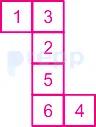
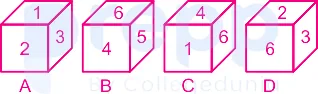
Select the dice that can be formed by folding the given sheet along the lines.
- A
Only A and B
- B
Only B and D
- C
Only A
- D
Only A, B and C
Show answer
A. Only A and BAccording to the given figure,
‘1’ lies opposite to ‘4’
‘3’ lies opposite to ‘5’
And,
‘2’ lies opposite to ‘6’
From the given dice,
Only A and B follow the above conditions.
Hence, “only A and B” is the correct answer.
Paper & answer key PDF ↗ Question 7archived
Select the option in which the numbers are related in the same way as are the numbers in the given set.
(22, 64, 352)
- A
(24, 16, 108)
- B
(14, 68, 238)
- C
(27, 52, 453)
- D
(19, 52, 257)
Show answer
B. (14, 68, 238)Analyzing Number Relationships in Sets
The question asks us to find an option where the numbers share the same relationship as the numbers in the set (22, 64, 352).
Let's examine the relationship between the numbers in the given set (22, 64, 352). Let the three numbers be A, B, and C respectively. So, A = 22, B = 64, and C = 352.
We need to find a rule or pattern connecting A, B, and C. Let's try some common arithmetic operations:
Addition/Subtraction: $A+B = 22+64 = 86 \neq 352$
Multiplication: $A \times B = 22 \times 64 = 1408 \neq 352$
Division: $C/A = 352/22$. Let's calculate this: $352 \div 22 = 16$. So, $C = A \times 16$.
Now let's see if this factor, 16, is related to B (64). We notice that $64 \div 4 = 16$.
This suggests a potential relationship: The third number (C) is equal to the first number (A) multiplied by the second number (B) divided by 4. Mathematically, this can be written as:
\(C = A \times \left(\frac{B}{4}\right)\)
Let's verify this relationship with the given set (22, 64, 352):
\(22 \times \left(\frac{64}{4}\right) = 22 \times 16 = 352\)
The relationship \(C = A \times \left(\frac{B}{4}\right)\) holds true for the given set (22, 64, 352).
Now, we will test each of the given options to see which one follows the same relationship.
Testing the Relationship with Options
Let's apply the relationship \(C' = A' \times \left(\frac{B'}{4}\right)\) to the numbers in each option (A', B', C').
Option 1: (24, 16, 108)
Here, A' = 24, B' = 16, C' = 108.
Calculate \(A' \times \left(\frac{B'}{4}\right)\):
\(24 \times \left(\frac{16}{4}\right) = 24 \times 4 = 96\)
Check if this equals C': \(96 \neq 108\). So, this option does not follow the relationship.
Option 2: (14, 68, 238)
Here, A' = 14, B' = 68, C' = 238.
Calculate \(A' \times \left(\frac{B'}{4}\right)\):
\(14 \times \left(\frac{68}{4}\right) = 14 \times 17\)
To calculate $14 \times 17$: $14 \times 17 = 14 \times (10 + 7) = 14 \times 10 + 14 \times 7 = 140 + 98 = 238$.
Check if this equals C': \(238 = 238\). This option follows the relationship.
Option 3: (27, 52, 453)
Here, A' = 27, B' = 52, C' = 453.
Calculate \(A' \times \left(\frac{B'}{4}\right)\):
\(27 \times \left(\frac{52}{4}\right) = 27 \times 13\)
To calculate $27 \times 13$: $27 \times 13 = 27 \times (10 + 3) = 27 \times 10 + 27 \times 3 = 270 + 81 = 351$.
Check if this equals C': \(351 \neq 453\). So, this option does not follow the relationship.
Option 4: (19, 52, 257)
Here, A' = 19, B' = 52, C' = 257.
Calculate \(A' \times \left(\frac{B'}{4}\right)\):
\(19 \times \left(\frac{52}{4}\right) = 19 \times 13\)
To calculate $19 \times 13$: $19 \times 13 = 19 \times (10 + 3) = 19 \times 10 + 19 \times 3 = 190 + 57 = 247$.
Check if this equals C': \(247 \neq 257\). So, this option does not follow the relationship.
Conclusion
Based on the analysis, only Option 2 follows the same number relationship as the given set (22, 64, 352), where the third number is the product of the first number and one-fourth of the second number.
Set/Option
Numbers (A, B, C)
Relationship Check: \(A \times (B/4)\)
Result (should equal C)
Matches Relationship?
Given Set
(22, 64, 352)
\(22 \times (64/4) = 22 \times 16\)
352
Yes
Option 1
(24, 16, 108)
\(24 \times (16/4) = 24 \times 4\)
96
No ($96 \neq 108$)
Option 2
(14, 68, 238)
\(14 \times (68/4) = 14 \times 17\)
238
Yes ($238 = 238$)
Option 3
(27, 52, 453)
\(27 \times (52/4) = 27 \times 13\)
351
No ($351 \neq 453$)
Option 4
(19, 52, 257)
\(19 \times (52/4) = 19 \times 13\)
247
No ($247 \neq 257$)
Revision Table: Number Analogy Practice
Revisiting the process of finding relationships in number sets is key for analogy questions. Here's a quick summary of approaches:
Look for arithmetic relationships: addition, subtraction, multiplication, division between the numbers.
Consider ratios or proportions between pairs of numbers.
Check for relationships involving squares, cubes, or other powers.
Look for relationships between digits (less common with larger numbers).
Combine operations, like the pattern found here: multiplication involving a result of division.
Additional Information: Solving Number Series and Analogies
Number analogy questions are common in reasoning tests. They require you to identify the underlying pattern or relationship between numbers in a given set and apply it to find a similar relationship in the options. These questions test your logical thinking and numerical ability.
Tips for solving number analogies:
Start with simple relationships (addition, subtraction, multiplication, division).
Look for patterns between the first two numbers relating to the third, or vice versa.
If simple arithmetic doesn't work, consider operations like squares, cubes, roots, or prime numbers.
Sometimes, the relationship involves the position of the numbers in the set (e.g., first number relates to the second, which relates to the third).
Be systematic when testing options once you think you've found a rule.
Practice with different types of number sets can help you become quicker at recognizing common patterns and relationships.
Paper & answer key PDF ↗ Question 8archived
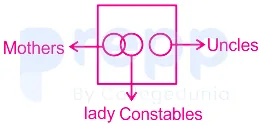
Which of the following Venn diagrams best represents the relationship between the following classes?
Lady Constables, Uncles, Mothers
- A
Option A (shown in image)
- B
Option B (shown in image)
- C
Option C (shown in image)
- D
Option D (shown in image)
Show answer
A. Option A (shown in image)Mothers can also be Lady Constables.
And,
Uncles are represented separately.
The correct Venn diagram is,
Hence, option 1 is the correct answer.
 Paper & answer key PDF ↗
 Question 9archived
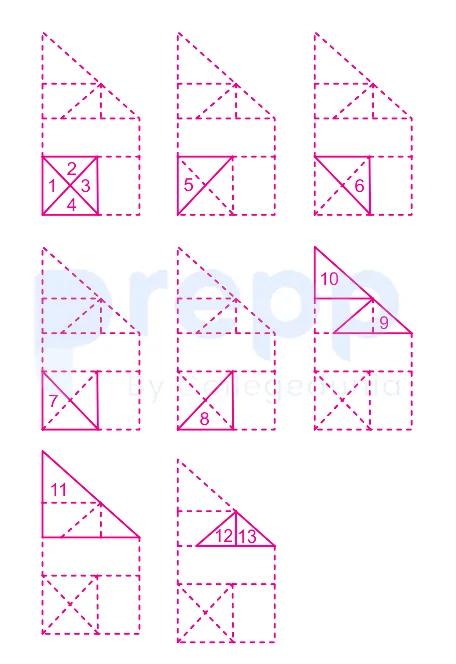
How many triangles are there in the given figure?

- A
14
- B
13
- C
12
- D
15
Show answer
B. 13The number of triangles in the given figure is,
Hence, “13” is the correct answer.
 Paper & answer key PDF ↗
 Question 10archived
Select the option in which the given figure X is embedded (rotation is not allowed).

- A
Option A (shown in image)
- B
Option B (shown in image)
- C
Option C (shown in image)
- D
Option D (shown in image)
Show answer
B. Option B (shown in image)The given figure is embedded in,
Hence, option 2 is the correct answer.
 Paper & answer key PDF ↗
 Question 11archived
In a certain code language, ‘SPECIAL’ is coded as ‘20176410213’. How will ‘MACHINE’ be coded as in that language?
- A
1424910156
- B
1424901056
- C
1524910156
- D
1324810155
Show answer
A. 14249101561424910156
Comparing with Options Let's check the given options: Option 1: 1424910156 Option 2: 1424901056 Option 3: 1524910156 Option 4: 1324810155 Our calculated code 1424910156 matches Option 1.
Paper & answer key PDF ↗ Question 12archived
Four letter- cluster have been given, out of which three are alike in some manner and one is different. Select the odd letter-cluster.
- A
LO
- B
GT
- C
KN
- D
AZ
Show answer
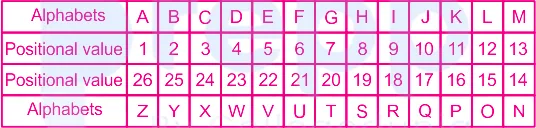
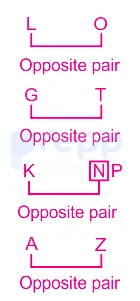
C. KNThe pattern followed is,
All follow the same pattern, except ‘KN’.
Hence, “KN” is the odd letter cluster.
 Paper & answer key PDF ↗
 Question 13archived
‘Photoshop’ is related to ‘Software’ in the same way as ‘Optical Mouse’ is related to ‘______’
- A
Touch-Screen
- B
Malware
- C
Hardware
- D
Hard-disc
Show answer
C. HardwareUnderstanding the Analogy: Photoshop and Optical Mouse
The question asks us to understand the relationship between the first pair of words and apply the same relationship to the second pair. The first pair is ‘Photoshop’ and ‘Software’. The second pair is ‘Optical Mouse’ and the blank space.
Analyzing the First Pair: Photoshop and Software
Let's look at the relationship between ‘Photoshop’ and ‘Software’:
Photoshop: This is a specific application program used for image editing.
Software: This is a general term for the programs and other operating information used by a computer.
So, the relationship is that Photoshop is a specific type or example of Software. Software is the broad category, and Photoshop is an instance within that category.
Applying the Relationship to the Second Pair: Optical Mouse and the Blank
Now, we need to find something that has the same relationship with ‘Optical Mouse’. We need a general category to which an ‘Optical Mouse’ belongs.
Optical Mouse: This is a physical device that connects to a computer and is used to control the cursor on the screen.
We need to find a general category for this physical device from the given options.
Evaluating the Options
Let's examine each option:
Touch-Screen: A Touch-Screen is another type of input device, but it is also a specific item, not a general category that includes an Optical Mouse. This doesn't fit the "specific item : general category" pattern.
Malware: Malware is a type of software designed to harm computer systems. It is completely unrelated to a physical device like an Optical Mouse. This is incorrect.
Hardware: Hardware refers to the physical components of a computer system, such as the monitor, keyboard, mouse, hard drive, etc. An Optical Mouse is a physical component that you can touch. This fits the description of Hardware. Hardware is the general category, and an Optical Mouse is an example of Hardware. This matches the relationship found in the first pair (Photoshop : Software).
Hard-disc: A Hard-disc (or Hard Drive) is a specific type of storage device, which is a component of computer hardware. Like Touch-Screen, it's a specific item, not the general category for an Optical Mouse.
Conclusion
The relationship in the first pair is "Specific Software : General Software Category". Applying this to the second pair, we need "Specific Hardware : General Hardware Category". An Optical Mouse is a specific piece of computer Hardware. Therefore, the blank should be filled with ‘Hardware’.
Specific Item
General Category
Photoshop
Software
Optical Mouse
Hardware
Revision Table: Analogy Relationships
Term 1
Term 2
Relationship
Photoshop
Software
Specific Example : General Category
Optical Mouse
Hardware
Specific Example : General Category
Additional Information: Hardware vs. Software
It's important to understand the fundamental difference between Hardware and Software in computing:
Hardware: This refers to the physical components of a computer system that you can see and touch. Examples include the CPU, RAM, motherboard, monitor, keyboard, mouse, printer, hard drive, etc. Hardware performs the actual computations and physical tasks.
Software: This refers to the non-physical instructions and data that tell the hardware what to do. It includes operating systems (like Windows, macOS, Linux) and application programs (like Photoshop, Word, web browsers, games). Software runs on the hardware.
An Optical Mouse is a physical input device, making it a piece of Hardware. Photoshop is a program installed on a computer, making it Software.
Paper & answer key PDF ↗ Question 14archived
Four number-pairs have been given, out of which three are alike in some manner and one is different. Select the number- pair that is different.
- A
21 : 154
- B
39 : 270
- C
31 : 214
- D
37 : 256
Show answer
A. 21 : 154Understanding the Number Pair Relationships
In this problem, we are given four pairs of numbers. Our task is to identify the pair that does not follow the same pattern or rule as the other three pairs. To do this, we need to examine each pair and try to find a relationship between the first number and the second number in the pair.
The given number pairs are:
21 : 154
39 : 270
31 : 214
37 : 256
Let's try to find a mathematical rule that connects the first number (let's call it \(N\)) to the second number (let's call it \(M\)) for each pair.
Analyzing Each Number Pair for a Pattern
We can test common relationships like multiplication, division, addition, or subtraction. Often, the second number is related to the first number by multiplying it by a constant, or multiplying by a constant and then adding/subtracting another value.
Let's explore if there's a multiplier that relates the numbers. For example, if we multiply the first number by 7, how close is the result to the second number?
Number Pair (N : M)
First Number (N)
Calculation (\( N \times 7 \))
Second Number (M)
Difference (\( M - (N \times 7) \))
21 : 154
21
\( 21 \times 7 = 147 \)
154
\( 154 - 147 = 7 \)
39 : 270
39
\( 39 \times 7 = 273 \)
270
\( 270 - 273 = -3 \)
31 : 214
31
\( 31 \times 7 = 217 \)
214
\( 214 - 217 = -3 \)
37 : 256
37
\( 37 \times 7 = 259 \)
256
\( 256 - 259 = -3 \)
Identifying the Consistent and Different Patterns
From the table above, we can see a clear pattern emerging in the "Difference" column:
For the number pairs 39 : 270, 31 : 214, and 37 : 256, the difference between the second number \(M\) and \(7\) times the first number \(N\) is always \( -3 \).
This means that for these three pairs, the relationship is \( M = N \times 7 - 3 \).
Let's verify this rule for the three pairs:
For 39 : 270: \( 39 \times 7 - 3 = 273 - 3 = 270 \). This holds true.
For 31 : 214: \( 31 \times 7 - 3 = 217 - 3 = 214 \). This holds true.
For 37 : 256: \( 37 \times 7 - 3 = 259 - 3 = 256 \). This holds true.
Now, let's look at the first number pair, 21 : 154. The difference \( M - (N \times 7) \) for this pair is \( 7 \). This means the relationship for this pair is \( M = N \times 7 + 7 \).
Let's verify this for 21 : 154: \( 21 \times 7 + 7 = 147 + 7 = 154 \). This also holds true for this specific pair.
Conclusion: Which Number Pair is Different?
We have found that three of the number pairs (39:270, 31:214, and 37:256) follow the same rule: the second number is obtained by multiplying the first number by 7 and then subtracting 3. The number pair 21 : 154 follows a different rule: the second number is obtained by multiplying the first number by 7 and then adding 7.
Therefore, the number pair that is different from the others is 21 : 154.
Revision Table: Summary of Number Pair Rules
Number Pair
Relationship Discovered
21 : 154
\( \text{Second Number} = \text{First Number} \times 7 + 7 \)
39 : 270
\( \text{Second Number} = \text{First Number} \times 7 - 3 \)
31 : 214
\( \text{Second Number} = \text{First Number} \times 7 - 3 \)
37 : 256
\( \text{Second Number} = \text{First Number} \times 7 - 3 \)
Additional Information: Strategies for Finding Number Patterns
When tackling problems that require identifying the odd pair or the next number in a series, consider these strategies:
Calculate Differences: Find the difference between consecutive numbers or between the numbers in a pair. See if there's a constant difference or a pattern in the differences.
Calculate Ratios: Find the ratio between consecutive numbers or between the numbers in a pair. See if there's a constant ratio.
Look for Multiplication/Division with Offset: As in this problem, the relationship might be \( N \times k + c \) or \( N / k + c \).
Consider Squares and Cubes: The numbers might be related to squares, cubes, or their neighbors (e.g., \( n^2+1 \), \( n^3-1 \)).
Check Digit Properties: Sometimes the pattern relates to the sum of digits, product of digits, or individual digits.
Prime/Composite Numbers: The pattern might involve prime numbers or composite numbers.
Combine Operations: The pattern could be a combination of several simple operations.
Be Systematic: Test simple rules first before moving to more complex ones.
Paper & answer key PDF ↗ Question 15archived
In a certain code language, ‘FIXATION’ is written as ‘AXIFNOIT’. How will ‘GLYCERIN’ be written as in that language?
- A
CYLGNIRE
- B
NIRECYLG
- C
LGZDGINR
- D
YLGECRNI
Show answer
A. CYLGNIREUnderstanding the Coding Decoding Logic
In coding-decoding questions, we need to identify the pattern or rule used to transform one word into another. Once the rule is found, we apply it to the new word to find its coded form.
Analyzing the Given Code: FIXATION to AXIFNOIT
The word provided is ‘FIXATION’ and its coded form is ‘AXIFNOIT’. Let's examine the transformation:
Original word: FIXATION
Coded word: AXIFNOIT
Let's look at the letters and their positions. The word FIXATION has 8 letters. We can try splitting the word into two halves:
First half: FIXA
Second half: TION
Now, let's look at the coded word AXIFNOIT:
The first four letters are AXIF. This is the reverse of the first half FIXA.
The next four letters are NOIT. This is the reverse of the second half TION.
So, the rule appears to be: Split the word into two equal halves and reverse each half independently. Then, join the reversed halves to get the coded word.
Applying the Logic to GLYCERIN
Now, we apply this same logic to the word ‘GLYCERIN’.
The word GLYCERIN also has 8 letters.
Step 1: Split the word into two halves.
First half: GLYC (letters 1 to 4)
Second half: ERIN (letters 5 to 8)
Step 2: Reverse the first half.
Reversed first half of GLYC is CYLG.
Step 3: Reverse the second half.
Reversed second half of ERIN is NIRE.
Step 4: Join the two reversed halves.
Joining CYLG and NIRE gives CYLGNIRE.
So, ‘GLYCERIN’ will be written as ‘CYLGNIRE’ in that code language.
Comparing with Options
Let's check our result against the given options:
Option 1: CYLGNIRE - Matches our derived coded word.
Option 2: NIRECYLG - This is the reverse of the entire word GLYCERIN, not the reverse of each half joined.
Option 3: LGZDGINR - Does not follow the identified pattern.
Option 4: YLGECRNI - Does not follow the identified pattern.
Based on our analysis and application of the coding rule, the correct coded form for GLYCERIN is CYLGNIRE.
Original Word
Split Halves
Reversed Halves
Coded Word
FIXATION
FIXA | TION
AXIF | NOIT
AXIFNOIT
GLYCERIN
GLYC | ERIN
CYLG | NIRE
CYLGNIRE
Revision Table: Coding Decoding Key Points
Reviewing the concepts is crucial for coding decoding problems:
Always look for patterns: letter shifting, reversal, substitution, grouping, etc.
Compare the positions of letters in the original and coded words.
Consider splitting the word into halves or groups if the pattern isn't straightforward.
Test the identified rule with the given example before applying it to the new word.
Additional Information: Types of Coding Decoding
Coding and decoding questions often appear in competitive exams and test logical reasoning. Common types include:
Letter Coding: Letters are replaced by other letters based on a specific rule (like shifting positions in the alphabet, reversing, etc.). This question is an example of letter coding based on position manipulation.
Number Coding: Words are coded using numbers.
Symbol Coding: Letters or words are coded using symbols.
Mixed Coding: A combination of the above, or sentences are coded based on specific words.
Practicing different types helps in quickly identifying the underlying logic.
Paper & answer key PDF ↗ Question 16archived
Select the option that is related to the third number in the same way as the second number is related to the first number.
3 : 51 :: 7 : ?
- A
319
- B
609
- C
335
- D
679
Show answer
D. 679Solving the Number Analogy: 3 : 51 :: 7 : ?
This question asks us to find the number that relates to 7 in the same way that 51 relates to 3. This type of problem is a number analogy, where we need to identify the pattern or rule connecting the first pair of numbers (3 and 51) and then apply that same rule to the third number (7) to find the missing fourth number.
Identifying the Relationship between 3 and 51
Let's analyze the first pair, 3 and 51. We need to figure out what operation or sequence of operations transforms 3 into 51. Possible relationships include multiplication, addition, powers, or a combination of these.
Is it simple multiplication? $51 \div 3 = 17$. So, $3 \times 17 = 51$. The second number is 17 times the first number.
Is there a pattern involving powers? $3^2 = 9$, $3^3 = 27$, $3^4 = 81$. 51 is between $3^3$ and $3^4$.
The simplest relationship we found is multiplication by 17. Now, we need to see if we can find a logical connection between the first number (3) and the multiplier (17).
Discovering the Pattern for the Multiplier
Let the first number be \(n\). For the first pair, \(n=3\), and the multiplier is 17. We need a rule that derives 17 from 3. Let's consider potential patterns for the multiplier based on \(n\):
Is the multiplier related to \(n^2\)? $3^2 = 9$. How can we get 17 from 9? $9 + 8 = 17$. So maybe the multiplier is $n^2 + 8$? If this pattern holds, the second number would be $n \times (n^2 + 8)$. Let's check: $3 \times (3^2 + 8) = 3 \times (9 + 8) = 3 \times 17 = 51$. This works for the first pair.
Now, let's apply this potential pattern ($n \times (n^2 + 8)$) to the third number, 7. Here, \(n=7\).
Result = $7 \times (7^2 + 8) = 7 \times (49 + 8) = 7 \times 57$.
Calculating $7 \times 57$: $7 \times 57 = 399$. Let's check the options: 319, 609, 335, 679. 399 is not among the options. So, the pattern $n \times (n^2 + 8)$ is likely not the correct one.
Let's revisit the multiplier for the first pair: 17. We need a rule that gives 17 from 3. Let's consider other ways the multiplier might depend on \(n\).
Let the relationship be \(n : n \times M(n)\), where \(M(n)\) is the multiplier dependent on \(n\). For the first pair, $n=3$, the result is 51, so $3 \times M(3) = 51 \implies M(3) = 17$.
Now consider the options for the missing number related to 7. Let the missing number be \(x\). Then $7 : x$. This means $7 \times M(7) = x$. We need to find \(M(7)\) based on how \(M(3)\) was found from 3.
Let's look at the options and see what multiplier for 7 each option implies:
Option
Missing Number (x)
Multiplier M(7) = x / 7
1
319
$319 \div 7 \approx 45.57$
2
609
$609 \div 7 = 87$
3
335
$335 \div 7 \approx 47.86$
4
679
$679 \div 7 = 97$
The possible multipliers for \(n=7\) are approximately 45.57, 87, 47.86, and 97. The multipliers for \(n=3\) and \(n=7\) are (3, 17) and (7, {45.57, 87, 47.86, 97}). Let's look for a pattern between \(n\) and its multiplier \(M(n)\) using these pairs.
Let's assume the multiplier \(M(n)\) is a linear function of \(n\), i.e., $M(n) = an + b$.
For $n=3$, $M(3) = 17$. So, $3a + b = 17$ (Equation 1).
Now, let's test the multiplier from the correct option (which is not revealed at this stage, but we use it to verify the pattern once found). If the correct answer is 679, the multiplier for $n=7$ is 97. So, $M(7) = 97$.
For $n=7$, $M(7) = 97$. So, $7a + b = 97$ (Equation 2).
We have a system of two linear equations:
$(1) \quad 3a + b = 17$
$(2) \quad 7a + b = 97$
Subtract Equation (1) from Equation (2):
$(7a + b) - (3a + b) = 97 - 17$
$4a = 80$
$a = \frac{80}{4} = 20$
Now substitute the value of \(a\) into Equation (1):
$3(20) + b = 17$
$60 + b = 17$
$b = 17 - 60 = -43$
So, the pattern for the multiplier is $M(n) = 20n - 43$. The second number is obtained by $n \times (20n - 43)$.
Verifying the Pattern
Let's verify this pattern with the first pair:
For $n=3$: Second number $= 3 \times (20 \times 3 - 43) = 3 \times (60 - 43) = 3 \times 17 = 51$. This matches the given pair.
Applying the Pattern to Find the Missing Number
Now, let's apply this pattern to the third number, 7. Here, \(n=7\).
Missing number $= 7 \times (20 \times 7 - 43) = 7 \times (140 - 43) = 7 \times 97$.
Calculating $7 \times 97$:
$7 \times 97 = 7 \times (100 - 3) = 7 \times 100 - 7 \times 3 = 700 - 21 = 679$.
The missing number is 679.
Checking the Options
Let's compare our result (679) with the given options:
Option 1: 319
Option 2: 609
Option 3: 335
Option 4: 679
Our calculated number, 679, matches Option 4.
Therefore, the relationship is that the second number is the first number multiplied by $(20 \times \text{first number} - 43)$. Applying this rule to 7 gives 679.
Revision Table: Number Analogy Pattern
First Number (n)
Multiplier M(n) = 20n - 43
Second Number = n × M(n)
3
$20(3) - 43 = 60 - 43 = 17$
$3 \times 17 = 51$
7
$20(7) - 43 = 140 - 43 = 97$
$7 \times 97 = 679$
Additional Information on Number Reasoning
Number analogy questions are common in reasoning tests. They assess your ability to identify patterns and relationships between numbers. The relationships can be based on various mathematical operations or properties, including:
Arithmetic operations (addition, subtraction, multiplication, division)
Squares, cubes, or higher powers
Square roots or cube roots
Prime numbers, composite numbers, even/odd numbers
Sequences (arithmetic progression, geometric progression, etc.)
Combinations of the above
To solve these problems effectively, it is helpful to:
Practice recognizing squares, cubes, and common multiples.
Systematically try different simple operations first.
Consider relationships between the number and the multiplier or difference between the pair.
If simple patterns don't work, look for more complex relationships like polynomials or other functions of the number.
Check the options provided, as they can sometimes give clues about the nature of the pattern (e.g., if options are very large, powers might be involved).
Solving a variety of number analogy problems will help you become more adept at identifying different types of patterns quickly.
Paper & answer key PDF ↗ Question 17archived
Which two signs should be interchanged to make the given equation correct?
14 × 3 ÷ 27 + 54 – 9 = 21
- A
× and ÷
- B
+ and –
- C
× and -
- D
÷ and -
Show answer
D. ÷ and -Solving Equation Problems by Swapping Signs
The question asks us to find which two mathematical signs in the given equation should be interchanged to make the equation correct. The equation is:
\(14 \times 3 \div 27 + 54 – 9 = 21\)
To solve this, we need to test each option provided. For each option, we will swap the specified signs in the equation and then evaluate the expression using the BODMAS (or PEMDAS) rule for the order of operations. The BODMAS rule states that we should perform calculations in the following order:
Brackets (Parentheses)
Orders (Exponents, Roots)
Division and Multiplication (from left to right)
Addition and Subtraction (from left to right)
Evaluating the Original Equation
Let's first evaluate the original equation to see if it is already correct:
\(14 \times 3 \div 27 + 54 - 9\)
Multiplication and Division (from left to right): \(14 \times 3 = 42\), then \(42 \div 27\).
\(42 \div 27 = \frac{42}{27} = \frac{14}{9}\). The expression becomes \(\frac{14}{9} + 54 - 9\).
Addition and Subtraction (from left to right): \(\frac{14}{9} + 54 = \frac{14 + 54 \times 9}{9} = \frac{14 + 486}{9} = \frac{500}{9}\).
\(\frac{500}{9} - 9 = \frac{500 - 9 \times 9}{9} = \frac{500 - 81}{9} = \frac{419}{9}\).
Since \(\frac{419}{9}\) is not equal to 21, the original equation is incorrect.
Testing the Options for Sign Interchange
Option 1: Interchange \(\times\) and \(\div\)
Swap the signs \(\times\) and \(\div\) in the equation:
\(14 \div 3 \times 27 + 54 - 9\)
Division and Multiplication (from left to right): \(14 \div 3 = \frac{14}{3}\).
\(\frac{14}{3} \times 27 = 14 \times \frac{27}{3} = 14 \times 9 = 126\). The expression becomes \(126 + 54 - 9\).
Addition and Subtraction (from left to right): \(126 + 54 = 180\).
\(180 - 9 = 171\).
Since 171 is not equal to 21, interchanging \(\times\) and \(\div\) does not make the equation correct.
Option 2: Interchange \(+\) and \(-\)
Swap the signs \(+\) and \(-\) in the equation:
\(14 \times 3 \div 27 - 54 + 9\)
Multiplication and Division (from left to right): \(14 \times 3 = 42\).
\(42 \div 27 = \frac{42}{27} = \frac{14}{9}\). The expression becomes \(\frac{14}{9} - 54 + 9\).
Addition and Subtraction (from left to right): \(\frac{14}{9} - 54 = \frac{14 - 54 \times 9}{9} = \frac{14 - 486}{9} = \frac{-472}{9}\).
\(\frac{-472}{9} + 9 = \frac{-472 + 9 \times 9}{9} = \frac{-472 + 81}{9} = \frac{-391}{9}\).
Since \(\frac{-391}{9}\) is not equal to 21, interchanging \(+\) and \(-\) does not make the equation correct.
Option 3: Interchange \(\times\) and \(-\)
Swap the signs \(\times\) and \(-\) in the equation:
\(14 - 3 \div 27 + 54 \times 9\)
Division and Multiplication (from left to right): \(3 \div 27 = \frac{3}{27} = \frac{1}{9}\).
\(54 \times 9 = 486\). The expression becomes \(14 - \frac{1}{9} + 486\).
Addition and Subtraction (from left to right): \(14 - \frac{1}{9} = \frac{14 \times 9 - 1}{9} = \frac{126 - 1}{9} = \frac{125}{9}\).
\(\frac{125}{9} + 486 = \frac{125 + 486 \times 9}{9} = \frac{125 + 4374}{9} = \frac{4499}{9}\).
Since \(\frac{4499}{9}\) is not equal to 21, interchanging \(\times\) and \(-\) does not make the equation correct.
Option 4: Interchange \(\div\) and \(-\)
Swap the signs \(\div\) and \(-\) in the equation:
\(14 \times 3 - 27 + 54 \div 9\)
Division and Multiplication (from left to right): \(14 \times 3 = 42\).
\(54 \div 9 = 6\). The expression becomes \(42 - 27 + 6\).
Addition and Subtraction (from left to right): \(42 - 27 = 15\).
\(15 + 6 = 21\).
Since 21 is equal to the right side of the equation, interchanging \(\div\) and \(-\) makes the equation correct.
Conclusion
After testing all the options, we found that swapping the signs \(\div\) and \(-\) makes the equation \(14 \times 3 \div 27 + 54 – 9 = 21\) correct.
Option
Signs Swapped
New Equation
Result
Correct?
Original
None
\(14 \times 3 \div 27 + 54 - 9\)
\(\frac{419}{9}\)
No
Option 1
\(\times\) and \(\div\)
\(14 \div 3 \times 27 + 54 - 9\)
171
No
Option 2
\(+\) and \(-\)
\(14 \times 3 \div 27 - 54 + 9\)
\(\frac{-391}{9}\)
No
Option 3
\(\times\) and \(-\)
\(14 - 3 \div 27 + 54 \times 9\)
\(\frac{4499}{9}\)
No
Option 4
\(\div\) and \(-\)
\(14 \times 3 - 27 + 54 \div 9\)
21
Yes
Revision Table: Key Concepts for Equation Solving
Concept
Explanation
Importance
Order of Operations (BODMAS/PEMDAS)
Rule defining the sequence for performing mathematical operations: Brackets, Orders, Division/Multiplication, Addition/Subtraction.
Ensures consistent and correct evaluation of expressions.
Sign Interchange Problems
Problems where two operational signs need to be swapped to correct an equation.
Tests understanding of operation order and algebraic manipulation.
Equation Verification
Checking if the left side of an equation equals the right side after performing calculations.
Confirms the correctness of the solved equation.
Additional Information: Understanding BODMAS
The BODMAS rule is fundamental to solving mathematical expressions. It provides a clear hierarchy for operations:
Brackets: Calculations inside brackets (parentheses) are always done first.
Orders: This includes powers (like squares, cubes) and roots (like square roots).
Division and Multiplication: These are done next. If both are present, work from left to right across the expression. They have equal priority.
Addition and Subtraction: These are done last. If both are present, work from left to right across the expression. They also have equal priority.
Following BODMAS ensures that everyone gets the same answer when evaluating the same expression. In this problem, correctly applying BODMAS after swapping the signs is crucial to determine if the equation becomes correct.
Paper & answer key PDF ↗ Question 18archived
What day of the week was 29 June 2010?
- A
Sunday
- B
Tuesday
- C
Wednesday
- D
Monday
Show answer
B. TuesdayFinding the Day of the Week for 29 June 2010
Let's determine the day of the week for the specific date, 29 June 2010. To do this, we use the concept of 'odd days' in a calendar. Odd days are the number of days remaining after dividing the total number of days by 7 (the number of days in a week).
The calculation involves finding the total number of odd days from a reference point (usually the beginning of the Christian era, Year 0 or Year 1) up to the day before the given date, and then adding the odd days for the days in the current year up to the given date. The sum of odd days is then divided by 7 to find the final odd day count, which corresponds to a specific day of the week.
Calculating Odd Days up to 2009
First, we calculate the number of odd days for the years completed before 29 June 2010, which is up to the end of the year 2009.
Odd days in 100 years = 5
Odd days in 200 years = \(2 \times 5 = 10 \equiv 3 \pmod{7}\)
Odd days in 300 years = \(3 \times 5 = 15 \equiv 1 \pmod{7}\)
Odd days in 400 years = Odd days in 300 years + Odd days in 100 years + 1 (for the leap year century) = \(1 + 5 + 1 = 7 \equiv 0 \pmod{7}\)
Since the number of odd days in 400 years is 0, the number of odd days in any multiple of 400 years is also 0. This applies to the year 2000, which is a multiple of 400.
Odd days in 2000 years = 0
Now, let's consider the remaining years from 2001 to 2009. This is a period of 9 years.
We need to identify the number of leap years and ordinary years in this period.
A year is a leap year if it is divisible by 4, except for century years which must be divisible by 400.
In the years 2001 to 2009, the leap years are 2004 and 2008. There are 2 leap years.
The number of ordinary years is \(9 - 2 = 7\) ordinary years.
An ordinary year has 365 days, which is \(52 \times 7 + 1\) day. So, an ordinary year has 1 odd day.
A leap year has 366 days, which is \(52 \times 7 + 2\) days. So, a leap year has 2 odd days.
Total odd days from 7 ordinary years = \(7 \times 1 = 7\) odd days.
Total odd days from 2 leap years = \(2 \times 2 = 4\) odd days.
Total odd days from 2001 to 2009 = \(7 + 4 = 11\) odd days.
Number of odd days \(11 \pmod{7} = 4\).
Total odd days up to the end of 2009 = Odd days in 2000 years + Odd days in 2001-2009
Total odd days up to 2009 = \(0 + 4 = 4\) odd days.
Calculating Odd Days in 2010 up to 29 June
Now, we calculate the odd days for the months in the year 2010 up to 29 June. The year 2010 is not divisible by 4, so it is an ordinary year.
January (31 days): \(31 \pmod{7} = 3\) odd days.
February (28 days in an ordinary year): \(28 \pmod{7} = 0\) odd days.
March (31 days): \(31 \pmod{7} = 3\) odd days.
April (30 days): \(30 \pmod{7} = 2\) odd days.
May (31 days): \(31 \pmod{7} = 3\) odd days.
June (up to 29 days): \(29 \pmod{7} = 1\) odd day.
Total odd days from January 1, 2010, to June 29, 2010:
\(3 + 0 + 3 + 2 + 3 + 1 = 12\) odd days.
Number of odd days \(12 \pmod{7} = 5\).
Total Odd Days and Determining the Day
Total odd days from the beginning of the calendar up to 29 June 2010 = Odd days up to end of 2009 + Odd days in 2010 up to 29 June.
Total odd days = \(4 + 5 = 9\) odd days.
The final number of odd days is the remainder when the total is divided by 7:
Final odd days = \(9 \pmod{7} = 2\).
We map this final odd day count to the day of the week based on a standard convention (often starting with Sunday as 0 or Monday as 1):
Odd Day Count
Day of the Week
0
Sunday
1
Monday
2
Tuesday
3
Wednesday
4
Thursday
5
Friday
6
Saturday
Since the final odd day count is 2, the day of the week for 29 June 2010 is Tuesday.
Conclusion
By calculating the total number of odd days up to the given date, we determined that 29 June 2010 was a Tuesday.
Revision Table - Day of Week Calculation
Period
Calculation
Odd Days
Modulo 7 Odd Days
Up to 2000
2000 years (multiple of 400)
0
0
2001-2009 (9 years)
7 ordinary years (\(7 \times 1\)) + 2 leap years (\(2 \times 2\)) = 7 + 4
11
4
Jan 2010
31 days (\(31 \pmod{7}\))
3
3
Feb 2010 (Ordinary)
28 days (\(28 \pmod{7}\))
0
0
Mar 2010
31 days (\(31 \pmod{7}\))
3
3
Apr 2010
30 days (\(30 \pmod{7}\))
2
2
May 2010
31 days (\(31 \pmod{7}\))
3
3
June 2010 (up to 29)
29 days (\(29 \pmod{7}\))
1
1
Total
Sum of Modulo 7 Odd Days from Years + Sum of Modulo 7 Odd Days from Months = \(4 + (3+0+3+2+3+1) = 4 + 12\)
16
\(16 \pmod{7} = 2\)
Alternatively, summing up the intermediate modulo 7 odd days: \(4 + (3+0+3+2+3+1) = 4 + 12 = 16\). \(16 \pmod{7} = 2\).
Additional Information - Calendar Concepts
Understanding how to calculate the day of the week for any given date relies on a few key calendar concepts:
Ordinary Year: A year with 365 days. It has one odd day (\(365 \div 7 = 52\) weeks and 1 day).
Leap Year: A year with 366 days. It has two odd days (\(366 \div 7 = 52\) weeks and 2 days). Leap years occur every 4 years, except for years divisible by 100 but not by 400.
Odd Days: The extra days left after forming complete weeks from a given number of days. The number of odd days is the remainder when the total number of days is divided by 7.
Reference Point: Calculations often use the beginning of the calendar era (e.g., 00/00/0000 or 01/01/0001) as a starting point with 0 odd days. The odd day count accumulated up to a specific date determines the day of the week. Different calculation methods might use different reference points or base odd day counts for centuries. The method used above establishes the pattern of odd days for centuries (100 yrs = 5, 200 yrs = 3, 300 yrs = 1, 400 yrs = 0).
The final odd day count (0 to 6) is mapped to the days of the week, typically starting with Sunday=0 or Monday=1, depending on the specific method or table used. The method used here corresponds to Sunday=0, Monday=1, Tuesday=2, and so on.
Paper & answer key PDF ↗ Question 19archived
Select the letter-cluster that can replace the question mark in the following series.
NAVIGATE, PCVIGATE, NAXKGATE, ?, NAVIGAVG
- A
NAXKICTE
- B
NAVIJCTF
- C
NAVIICTE
- D
PCVIICUG
Show answer
C. NAVIICTEUnderstanding the Letter Cluster Series
The question asks us to find the missing letter cluster in the given series: NAVIGATE, PCVIGATE, NAXKGATE, ?, NAVIGAVG.
This is a letter cluster series problem where each term is derived from the previous term by applying a specific rule or set of rules. To solve this, we need to analyze the changes occurring between consecutive terms to identify the underlying pattern.
Analyzing the Pattern in the Letter Cluster Series
Let's examine how the letters change position by position from one term to the next.
From NAVIGATE to PCVIGATE:
Position 1: N $\xrightarrow{+2}$ P ($\text{N}$ is the 14th letter, $\text{P}$ is the 16th. $14+2=16$)
Position 2: A $\xrightarrow{+2}$ C ($\text{A}$ is the 1st letter, $\text{C}$ is the 3rd. $1+2=3$)
Positions 3 to 8 (VIGATE): Remain unchanged.
The change is applying a $\boldsymbol{+2}$ shift to the letters at positions 1 and 2.
From PCVIGATE to NAXKGATE:
Position 1: P $\xrightarrow{-2}$ N ($\text{P}$ is the 16th letter, $\text{N}$ is the 14th. $16-2=14$)
Position 2: C $\xrightarrow{-2}$ A ($\text{C}$ is the 3rd letter, $\text{A}$ is the 1st. $3-2=1$)
Position 3: V $\xrightarrow{+2}$ X ($\text{V}$ is the 22nd letter, $\text{X}$ is the 24th. $22+2=24$)
Position 4: I $\xrightarrow{+2}$ K ($\text{I}$ is the 9th letter, $\text{K}$ is the 11th. $9+2=11$)
Positions 5 to 8 (GATE): Remain unchanged.
The change is applying a $\boldsymbol{-2}$ shift to positions 1 and 2, and a $\boldsymbol{+2}$ shift to positions 3 and 4.
Based on the first two steps, a pattern of shifts and affected positions seems to be emerging:
Step 1 (Term 1 to Term 2): Positions 1, 2 shifted by $\boldsymbol{+2}$.
Step 2 (Term 2 to Term 3): Positions 1, 2 shifted by $\boldsymbol{-2}$, Positions 3, 4 shifted by $\boldsymbol{+2}$.
Identifying the Sequential Pattern
It appears the pattern involves sequentially affecting groups of positions and alternating the shifts between $\boldsymbol{+2}$ and $\boldsymbol{-2}$. Let's assume the pattern continues as follows:
Step 1: Shift Pos 1, 2 by $\boldsymbol{+2}$.
Step 2: Shift Pos 1, 2 by $\boldsymbol{-2}$, Pos 3, 4 by $\boldsymbol{+2}$.
Step 3: Shift Pos 3, 4 by $\boldsymbol{-2}$, Pos 5, 6 by $\boldsymbol{+2}$.
Step 4: Shift Pos 5, 6 by $\boldsymbol{-2}$, Pos 7, 8 by $\boldsymbol{+2}$.
Finding the Missing Term (Term 4)
To find the missing term (Term 4), we need to apply Step 3 of the identified pattern to Term 3 (NAXKGATE).
Term 3: NAXKGATE
Positions 3, 4 need a $\boldsymbol{-2}$ shift:
Position 3: X $\xrightarrow{-2}$ V ($\text{X}$ is 24th, $\text{V}$ is 22nd. $24-2=22$)
Position 4: K $\xrightarrow{-2}$ I ($\text{K}$ is 11th, $\text{I}$ is 9th. $11-2=9$)
Positions 5, 6 need a $\boldsymbol{+2}$ shift:
Position 5: G $\xrightarrow{+2}$ I ($\text{G}$ is 7th, $\text{I}$ is 9th. $7+2=9$)
Position 6: A $\xrightarrow{+2}$ C ($\text{A}$ is 1st, $\text{C}$ is 3rd. $1+2=3$)
Positions 1, 2, 7, 8 remain unchanged.
Applying these changes to NAXKGATE:
Pos 1: N (unchanged)
Pos 2: A (unchanged)
Pos 3: X becomes V
Pos 4: K becomes I
Pos 5: G becomes I
Pos 6: A becomes C
Pos 7: T (unchanged)
Pos 8: E (unchanged)
Putting these letters together, the missing term is NAVIICTE.
Verification with the Last Term
Let's verify if applying Step 4 (Shift Pos 5, 6 by $\boldsymbol{-2}$, Pos 7, 8 by $\boldsymbol{+2}$) to NAVIICTE results in the last term, NAVIGAVG.
From NAVIICTE to NAVIGAVG:
Positions 5, 6 need a $\boldsymbol{-2}$ shift:
Position 5: I $\xrightarrow{-2}$ G ($\text{I}$ is 9th, $\text{G}$ is 7th. $9-2=7$)
Position 6: C $\xrightarrow{-2}$ A ($\text{C}$ is 3rd, $\text{A}$ is 1st. $3-2=1$)
Positions 7, 8 need a $\boldsymbol{+2}$ shift:
Position 7: T $\xrightarrow{+2}$ V ($\text{T}$ is 20th, $\text{V}$ is 22nd. $20+2=22$)
Position 8: E $\xrightarrow{+2}$ G ($\text{E}$ is 5th, $\text{G}$ is 7th. $5+2=7$)
Positions 1, 2, 3, 4 remain unchanged.
Applying these changes to NAVIICTE: NAVIICTE $\rightarrow$ NAVIGAVG. This matches the last term in the series. The identified pattern is correct.
Therefore, the letter-cluster that replaces the question mark is NAVIICTE.
Revision Table: Letter Cluster Series Changes
Step
From Term
To Term
Positions Affected
Shift Amount
1
NAVIGATE
PCVIGATE
1, 2
+2
2
PCVIGATE
NAXKGATE
1, 2
3, 4
-2
+2
3
NAXKGATE
NAVIICTE
3, 4
5, 6
-2
+2
4
NAVIICTE
NAVIGAVG
5, 6
7, 8
-2
+2
Additional Information on Letter Series Patterns
Letter series problems are common in logical reasoning and verbal ability tests. They often involve sequences of letters or letter clusters that follow a specific rule. Identifying this rule is key to solving the problem. Common patterns include:
Alphabetical Position Shift: Letters are replaced by letters a fixed number of positions away in the alphabet (e.g., +1, -3, +2, +2 pattern).
Alternating Patterns: Different rules might apply to alternate terms, or the rule might alternate between different types of changes.
Positional Changes: The changes might affect specific positions within the letter cluster, and these affected positions might shift or cycle through the word.
Combination of Rules: More complex series can involve a combination of the above, where different rules apply to different parts of the term or change from one step to the next.
Solving these problems requires careful observation, breaking down the changes term by term and position by position, and looking for consistent rules or sequences in the changes.
Paper & answer key PDF ↗ Question 20archived
Select the number that can replace the question mark in the following series.
39, 50, 63, 80, ?, 122, 151, 182
- A
105
- B
90
- C
99
- D
108
Show answer
C. 99The pattern followed is,
Hence, “99” is the correct answer.
 Paper & answer key PDF ↗
 Question 21archived
Read the given statements and conclusions carefully. Assuming that the information given in the statements is true, even if it appears to be at variance with commonly known facts, decide which of the given conclusions logically follows(s) from the statements.
Statements:
1. No garden is a park.
2. Some garden are schools.
Conclusions:
I. No park is a garden.
II. Some schools are gardens.
III. Some parks are gardens
- A
Only conclusions II and III fallow
- B
Either conclusion I or III and conclusion II follow
- C
Either conclusion I or III follows
- D
Only conclusions I and II follow
Show answer
D. Only conclusions I and II followAnalyzing the Logic Statements and Conclusions
Let's break down the given statements and conclusions to determine which conclusions logically follow from the statements. We must assume the statements are true, regardless of common knowledge.
Statements:
Statement 1: No garden is a park.
Statement 2: Some gardens are schools.
Conclusions:
Conclusion I: No park is a garden.
Conclusion II: Some schools are gardens.
Conclusion III: Some parks are gardens.
Step-by-Step Analysis of Conclusions
Analyzing Conclusion I: No park is a garden
Statement 1 tells us, "No garden is a park." This establishes a complete separation between the category of 'gardens' and the category of 'parks'. There is no overlap between these two groups.
Conclusion I states, "No park is a garden." This is the converse of Statement 1. In logic, if it is true that no item of type A is an item of type B, it is also logically true that no item of type B is an item of type A. If gardens and parks have no members in common from the perspective of gardens, they also have no members in common from the perspective of parks.
Therefore, Conclusion I logically follows from Statement 1.
Analyzing Conclusion II: Some schools are gardens
Statement 2 says, "Some gardens are schools." This indicates that there is at least one instance (or member) that belongs to both the category of 'gardens' and the category of 'schools'. The two categories have a non-empty intersection.
Conclusion II says, "Some schools are gardens." This is the converse of Statement 2. If there are some items from category A that are also in category B, then it is logically true that there are some items from category B that are also in category A. If some gardens are schools, those specific items are both schools and gardens, meaning some schools are gardens.
Therefore, Conclusion II logically follows from Statement 2.
Analyzing Conclusion III: Some parks are gardens
Statement 1 clearly states, "No garden is a park." This means there are absolutely no items that are both a garden and a park. The intersection of the sets of gardens and parks is empty.
Conclusion III claims, "Some parks are gardens." This statement asserts the existence of at least one item that is simultaneously a park and a garden. This directly contradicts the information given in Statement 1.
Therefore, Conclusion III does not logically follow from the statements. It is inconsistent with Statement 1.
Summary of Logical Conclusions
Based on the analysis of each statement and conclusion:
Conclusion I ("No park is a garden") is the converse of Statement 1 ("No garden is a park") and is logically equivalent.
Conclusion II ("Some schools are gardens") is the converse of Statement 2 ("Some gardens are schools") and is logically equivalent.
Conclusion III ("Some parks are gardens") directly contradicts Statement 1 ("No garden is a park") and therefore does not follow.
Thus, only conclusions I and II logically follow from the given statements.
Revision Table: Logic Statements and Deductions
Statement/Conclusion
Type
Analysis
Logical Follows?
Statement 1: No garden is a park.
Universal Negative (E)
Sets 'Garden' and 'Park' are disjoint.
N/A (Premise)
Statement 2: Some gardens are schools.
Particular Affirmative (I)
Sets 'Garden' and 'School' intersect.
N/A (Premise)
Conclusion I: No park is a garden.
Universal Negative (E)
Converse of Statement 1. Equivalent.
Yes
Conclusion II: Some schools are gardens.
Particular Affirmative (I)
Converse of Statement 2. Equivalent.
Yes
Conclusion III: Some parks are gardens.
Particular Affirmative (I)
Contradicts Statement 1.
No
Additional Information: Categorical Syllogisms and Converses
This question is an example of logical deduction based on categorical statements, which are fundamental building blocks of syllogisms. A categorical statement relates two categories (or terms).
The four standard forms of categorical statements are:
A: All S are P (Universal Affirmative)
E: No S is P (Universal Negative)
I: Some S are P (Particular Affirmative)
O: Some S are not P (Particular Negative)
The converse of a statement is formed by swapping the subject and predicate terms. For example, the converse of "No garden is a park" is "No park is a garden".
It's important to know when a converse is logically equivalent to the original statement:
E statements (No S is P) are logically equivalent to their converses (No P is S).
I statements (Some S are P) are logically equivalent to their converses (Some P are S).
A statements (All S are P) are not logically equivalent to their converses (All P are S). For example, "All dogs are mammals" is true, but "All mammals are dogs" is false.
O statements (Some S are not P) are not logically equivalent to their converses (Some P are not S). For example, "Some animals are not dogs" is true, but "Some dogs are not animals" is false.
In this problem, Conclusion I is the logically equivalent converse of the E type Statement 1. Conclusion II is the logically equivalent converse of the I type Statement 2. Conclusion III is an I type statement that is contradicted by the E type Statement 1.
Paper & answer key PDF ↗ Question 22archived
A – B means ‘A is the sister of B’;
A × B means ‘A is the husband of B’;
A ÷ B means ‘A is the son of B’.
If, Y × M – T – Z ÷ L × U, then how is U related to Y?
- A
Mother
- B
Mother-in-law
- C
Father
- D
Father-in-law
Show answer
B. Mother-in-lawUnderstanding the Blood Relation Problem
This question involves decoding a set of symbols representing family relationships and then using these decoded relationships to determine how two individuals in a given expression are related.
Decoding the Relationship Symbols
Let's break down the meaning of each symbol provided:
A – B means 'A is the sister of B'. This indicates a sibling relationship where A is female.
A × B means 'A is the husband of B'. This indicates a marital relationship where A is male and B is female.
A ÷ B means 'A is the son of B'. This indicates a parent-child relationship where A is male and B is a parent (gender unknown from this part alone).
Analyzing the Given Expression: Y × M – T – Z ÷ L × U
Now, let's apply these rules to the expression segment by segment:
Y × M: According to the rule for ×, Y is the husband of M. This tells us Y is male and M is female.
M – T: According to the rule for –, M is the sister of T. We already know M is female. T's gender is not yet specified by this relationship alone.
T – Z: According to the rule for –, T is the sister of Z. We now know T is female. Z's gender is not yet specified by this relationship alone.
Z ÷ L: According to the rule for ÷, Z is the son of L. This tells us Z is male. L is a parent of Z, but L's gender is not yet specified.
L × U: According to the rule for ×, L is the husband of U. This tells us L is male and U is female.
Building the Family Connections
Let's connect the relationships derived from the expression:
Y is the husband of M.
M is the sister of T.
T is the sister of Z.
From the above, M, T, and Z are siblings. M and T are female, and Z is male.
Z is the son of L. Since Z is a sibling of M and T, M and T are also children of L.
L is the husband of U. This means L and U are married and are the parents of Z, T, and M.
Since L is male and the husband of U, L is the father of Z, T, and M. Since U is female and the wife of L, U is the mother of Z, T, and M.
So, we have established the following key relationships:
Y is married to M.
U is the mother of M (as U is the mother of M's sibling Z, and L is the father).
Determining the Relationship between U and Y
We need to find out how U is related to Y. We know that U is the mother of M, and M is the wife of Y.
The mother of one's wife is their mother-in-law.
Therefore, U is the mother-in-law of Y.
Summary of Relationships
Relation
Individuals
Gender/Status
Husband & Wife
Y × M
Y (Male), M (Female)
Siblings
M – T – Z
M (Female), T (Female), Z (Male)
Parent & Child
Z ÷ L
Z (Son), L (Parent)
Husband & Wife
L × U
L (Male), U (Female)
Deduced Parent & Children
L & U are parents of M, T, Z
L (Father), U (Mother)
Key Connection
U is M's mother
U (Mother), M (Daughter)
Final Relation
U and Y
U is Y's Mother-in-law
Conclusion
Based on the step-by-step analysis of the given expression Y × M – T – Z ÷ L × U, and decoding the blood relation symbols, we find that U is the mother of M, and M is the wife of Y. Thus, U is Y's mother-in-law.
Revision Table: Blood Relation Symbols
Symbol
Meaning
Example (A symbol B)
Implied Genders
–
Sister of
A is the sister of B
A is Female
×
Husband of
A is the husband of B
A is Male, B is Female
÷
Son of
A is the son of B
A is Male
Additional Information: Solving Blood Relation Problems
Blood relation problems are common in logical reasoning sections of various exams. The key to solving them is to carefully decode the relationships given in symbolic or verbal form and then construct a clear picture of the family tree or chain of relationships. Here are some tips:
Read the relationship definitions carefully, paying attention to the order of individuals (A vs. B).
Break down the expression into smaller segments, translating each symbol individually.
Assign genders where indicated by the rules. Some relations only specify the gender of one person (e.g., 'sister of'), while others specify both (e.g., 'husband of').
Combine the segments step-by-step to build the complete set of relationships. Drawing a diagram or family tree can be very helpful, especially for complex problems.
Finally, trace the connection between the two individuals asked about in the question.
Pay close attention to terms like 'in-law' which connect relations across marriages.
Paper & answer key PDF ↗ Question 23archived
Four words have been given, out of which three are alike in some manner, and one is different, Select the odd word.
- A
Bone Marrow
- B
Diabetes
- C
Cancer
- D
Asthma
Show answer
A. Bone MarrowFinding the Odd Word: Bone Marrow vs. Diseases
The question asks us to identify the word that is different from the other three in a given set of four words. We are given the words: Bone Marrow, Diabetes, Cancer, and Asthma.
Let's examine each word to understand its meaning and nature.
Bone Marrow: This is a spongy tissue found inside bones, responsible for producing blood cells like red blood cells, white blood cells, and platelets. It is a part of the human body's anatomy, specifically a tissue/organ within the skeletal system.
Diabetes: This is a chronic metabolic disorder characterized by high levels of blood sugar (glucose). It affects how the body uses food for energy and growth. It is a disease or a medical condition.
Cancer: This is a disease caused by an uncontrolled division of abnormal cells in a part of the body. It can affect various organs and tissues. It is a disease or a medical condition.
Asthma: This is a chronic respiratory disease that affects the airways in the lungs. It causes breathing difficulties due to inflammation and narrowing of the airways. It is a disease or a medical condition.
Based on the analysis, we can see that Diabetes, Cancer, and Asthma are all classified as diseases or medical conditions that affect the body's normal functioning. Bone Marrow, however, is a specific tissue or organ that is a normal part of the body's structure and function (producing blood cells), although it can be affected by diseases like leukemia or aplastic anemia.
Therefore, Bone Marrow is different from the other three words because it represents a normal body part/tissue, while Diabetes, Cancer, and Asthma represent diseases.
Odd Word Out Analysis
Let's summarize the classification of the given words:
Word
Classification
Bone Marrow
Body Tissue/Organ
Diabetes
Disease/Medical Condition
Cancer
Disease/Medical Condition
Asthma
Disease/Medical Condition
From the table, it is clear that Bone Marrow belongs to a different category than the other three words. The other three words are all diseases.
Conclusion: Selecting the Odd Word
The word that is different from the rest is Bone Marrow, as it is a tissue of the body, unlike Diabetes, Cancer, and Asthma, which are diseases.
Revision Table: Understanding Body Parts and Diseases
Here's a quick look at key terms related to body structure and common diseases discussed:
Term
Type
Brief Description
Bone Marrow
Tissue/Organ
Soft tissue inside bones producing blood cells.
Diabetes
Disease
Metabolic disorder affecting blood sugar.
Cancer
Disease
Disease of abnormal cell growth.
Asthma
Disease
Chronic respiratory condition affecting airways.
Additional Information on Diseases and Body Systems
Understanding the difference between body parts (anatomy) and diseases (pathology) is fundamental in biology and medicine. Here are some related concepts:
Anatomy: The study of the structure of the body and its parts. Bone marrow is a part of the skeletal and hematopoietic systems.
Physiology: The study of how the body and its parts work. Diseases often involve the malfunctioning of physiological processes.
Pathology: The study of the causes and effects of diseases. Diabetes, Cancer, and Asthma are subjects of pathology.
Types of Diseases: Diseases can be classified in many ways, such as infectious, chronic, genetic, deficiency, etc. Diabetes and Asthma are often considered chronic diseases, while Cancer is a complex disease involving cell pathology.
Impact of Diseases: Diseases like Diabetes, Cancer, and Asthma disrupt the normal structure and function of body parts, including potentially affecting the bone marrow (e.g., leukemia is a cancer of the bone marrow). However, bone marrow itself is a fundamental component of a healthy body.
This distinction helps us categorize the given words and identify the one that does not fit the pattern of being a disease.
Paper & answer key PDF ↗ Question 24archived
The sequence of folding a piece of paper and the manner in which the folded paper been cut is shown in the following figures. How would this paper look when unfolded?

- A
Option A (shown in image)
- B
Option B (shown in image)
- C
Option C (shown in image)
- D
Option D (shown in image)
Show answer
C. Option C (shown in image)The paper when unfolded look like,
Hence, option 3 is the correct answer.
 Paper & answer key PDF ↗
 Question 25archived
Select the figure that can replace the question mark in the following series.

- A
Option A (shown in image)
- B
Option B (shown in image)
- C
Option C (shown in image)
- D
Option D (shown in image)
Show answer
B. Option B (shown in image)The pattern followed is,
The symbols in the given figure are moving in the following manner:
North-west → Centre → North-east → South-east → South-west.
The symbol in the northwest corner is placed at the centre in the image which comes next and a new symbol is added to the northwest corner in each figure.
The image which will come next in the pattern is,
Hence, option 2 is the correct answer.
 Paper & answer key PDF ↗
 Question 26archived
Who signed the treaty of Alinagar with the British?
- A
Mir Qasim
- B
Siraj-ud-Daula
- C
Alivardi Khan
- D
Mir Jafar
Show answer
B. Siraj-ud-DaulaUnderstanding the Treaty of Alinagar
The question asks about the person who signed the Treaty of Alinagar with the British. This treaty is a significant event in the history of Bengal, marking a phase in the interactions between the British East India Company and the Nawab of Bengal.
What was the Treaty of Alinagar?
The Treaty of Alinagar was signed in 1757. It was an agreement between the British East India Company and the Nawab of Bengal following the Nawab's capture of Calcutta (renamed Alinagar). The British forces, led by Robert Clive, had recaptured Calcutta, leading to this treaty.
Who was the Nawab of Bengal at the time of the Treaty of Alinagar?
At the time the Treaty of Alinagar was signed in 1757, the Nawab of Bengal was Siraj-ud-Daula.
Signatories of the Treaty
The Treaty of Alinagar was signed on behalf of the British East India Company by Robert Clive and Admiral Charles Watson. On behalf of the Nawab of Bengal, it was signed by Nawab Siraj-ud-Daula himself.
Key Terms of the Treaty of Alinagar
The Treaty of Alinagar included several important terms:
The British were allowed to carry on their trade in Bengal without any restrictions.
They were granted the right to fortify Calcutta again.
They were permitted to mint coins in Bengal.
The Nawab agreed to compensate the British for the losses they suffered.
This treaty temporarily restored peace and confirmed the British Company's trading rights and status in Bengal, which had been challenged by the Nawab.
Conclusion on the Treaty of Alinagar
Based on historical records, the Treaty of Alinagar was signed between the British East India Company and the Nawab of Bengal, who was Siraj-ud-Daula at that time. Therefore, Siraj-ud-Daula signed the Treaty of Alinagar with the British.
Revision Table: Treaty of Alinagar Facts
Treaty Name
Year Signed
Parties Involved
Nawab of Bengal
Context
Treaty of Alinagar
1757
British East India Company & Nawab of Bengal
Siraj-ud-Daula
Signed after British recapture of Calcutta from Nawab
Additional Information about Bengal Nawabs and Treaties
Alivardi Khan: He was the grandfather and predecessor of Siraj-ud-Daula as the Nawab of Bengal. He maintained good relations with the European trading companies but kept them under check.
Mir Jafar: He was the commander of Siraj-ud-Daula's army and later became the Nawab after the Battle of Plassey (1757), which followed the Treaty of Alinagar period. He was supported by the British.
Mir Qasim: He was the son-in-law of Mir Jafar and succeeded him as Nawab. He attempted to assert independence from the British, leading to further conflict and the Battle of Buxar (1764).
The Treaty of Alinagar was a precursor to the Battle of Plassey, highlighting the escalating tensions and power struggle between the British and the Nawab of Bengal.
Paper & answer key PDF ↗ Question 27archived
Which of the following rivers was known as Purushni in the Vedic period?
- A
Ravi
- B
Sutlej
- C
Chenab
- D
Beas
Show answer
A. RaviThe Vedic period in ancient India is known for its sacred texts, primarily the Rigveda, which provides valuable insights into the geography and life of the people at that time. The Rigveda mentions several rivers that were central to the life and culture of the early Indo-Aryans. Many of these rivers are still important today, but their names have changed over millennia.
Understanding Vedic River Names
Identifying the modern names of the Vedic rivers helps us understand the geographical spread of the Vedic civilization. The hymns of the Rigveda frequently refer to rivers, indicating their significance for irrigation, transportation, and religious rituals. Learning these ancient names is important for studying ancient Indian history and geography.
Let's look at some of the prominent rivers mentioned in the Vedic texts and their corresponding modern names:
Vedic Name
Modern Name
Sarasvati
Considered mythical or associated with Ghaggar-Hakra system (now mostly dried up)
Sindhu
Indus
Vitasta
Jhelum
Asikni
Chenab
Purushni
Ravi
Vipasha
Beas
Sutudri
Sutlej
Kubha
Kabul
Suvastu
Swat
Based on historical and linguistic analysis, the Vedic river Purushni is identified with the modern-day Ravi river. The Rigveda mentions the Battle of the Ten Kings (Dasarajna) fought on the banks of the river Purushni, which places it in the Punjab region.
Analyzing the Options
Let's consider the given options in light of the known Vedic names:
Ravi: Corresponds to the Vedic name Purushni.
Sutlej: Corresponds to the Vedic name Sutudri.
Chenab: Corresponds to the Vedic name Asikni.
Beas: Corresponds to the Vedic name Vipasha.
Therefore, the river known as Purushni in the Vedic period is the Ravi.
Revision Table: Key Vedic Rivers
Vedic Name
Modern Name
Purushni
Ravi
Sutudri
Sutlej
Asikni
Chenab
Vipasha
Beas
Vitasta
Jhelum
Additional Information on Vedic Rivers
The Sapta Sindhu region, meaning the land of seven rivers, was a significant area in the early Vedic period. While the exact identification of all seven rivers is debated, the Indus and its major tributaries (Jhelum, Chenab, Ravi, Beas, Sutlej) along with the Sarasvati are often considered part of this group. The hymns of the Rigveda provide geographical clues that scholars use to map these ancient river systems to their modern counterparts. Understanding these connections is crucial for reconstructing the geography and history of the Vedic civilization.
Paper & answer key PDF ↗ Question 28archived
What is the rank of India in the Human Development Index 2019?
- A
89th
- B
130th
- C
128th
- D
129th
Show answer
D. 129thUnderstanding the Human Development Index (HDI)
The Human Development Index (HDI) is a summary measure of average achievement in key dimensions of human development: a long and healthy life, being knowledgeable, and having a decent standard of living. It was created by the United Nations Development Programme (UNDP) and is a crucial tool for comparing countries' development progress.
Key Dimensions of the Human Development Index
The Human Development Index is calculated based on three main dimensions:
Health: Measured by life expectancy at birth. A higher life expectancy suggests better health conditions and healthcare access.
Education: Measured by the average years of schooling for adults aged 25 years and expected years of schooling for children of school-entering age. This reflects the level of knowledge and education attainment in a country.
Standard of Living: Measured by Gross National Income (GNI) per capita based on purchasing power parity (PPP) in constant US dollars. This indicates the economic resources available to a country's people.
These dimensions are combined using a specific formula to arrive at the final HDI value, which ranges from 0 to 1. Countries are then ranked based on this value.
India's Human Development Index Rank in 2019
The question asks about the rank of India in the Human Development Index for the year 2019. The Human Development Report 2019, published by the UNDP in December 2019, provides the HDI values and ranks based on data primarily from 2018. According to this report, India's rank in the Human Development Index 2019 was 129th.
India's HDI value in the 2019 report was 0.647, placing it in the medium human development category. This rank represented an improvement from the 130th rank in the 2018 report (based on 2017 data).
Comparing India's 2019 HDI Rank
Let's look at the specific rank for India in the Human Development Index 2019.
Based on the Human Development Report 2019, India's rank was confirmed as the 129th position among 189 countries and territories.
HDI Report Year
Data Year
India's HDI Value
India's HDI Rank
Total Countries Ranked
2018
2017
0.640
130
189
2019
2018
0.647
129
189
The table shows the progression of India's rank. The Human Development Report 2019 specifically reported India at the 129th rank based on the 2018 data.
Revision Table: Key Facts on Human Development Index
Concept
Description
What is HDI?
Summary measure of average achievement in key dimensions of human development: health, education, standard of living.
Who publishes HDI?
United Nations Development Programme (UNDP).
Dimensions of HDI
Life Expectancy at Birth, Expected Years of Schooling, Mean Years of Schooling, GNI per capita (PPP$).
India's HDI Rank (2019 Report)
129th
India's HDI Value (2019 Report)
0.647
HDI Category (2019 Report)
Medium Human Development
Additional Information on Human Development and HDI
The Human Development Index is not just a rank; it's an important indicator used to assess a country's progress beyond purely economic measures like GDP. It emphasizes that people and their capabilities should be the ultimate criteria for assessing the development of a country, not economic growth alone.
Importance of HDI: It provides a broader picture of well-being by including health and education, which are fundamental for human capabilities and opportunities.
Calculation of HDI: The HDI is calculated using geometric means of normalized indices for each of the three dimensions. The formula for a dimension index (e.g., Life Expectancy Index) is generally $\frac{\text{Actual Value} - \text{Minimum Value}}{\text{Maximum Value} - \text{Minimum Value}}$. The final HDI is the geometric mean of the three dimension indices.
Beyond HDI: The UNDP also publishes other composite indices in the Human Development Reports, such as the Inequality-adjusted HDI (IHDI), Gender Development Index (GDI), Gender Inequality Index (GII), and Multidimensional Poverty Index (MPI). These provide a more nuanced view of human development challenges.
HDI Trends: Tracking a country's HDI value and rank over time helps understand its development trajectory and identify areas needing improvement. While India has shown progress in its HDI value over the years, its rank can fluctuate depending on the progress of other countries.
Understanding the Human Development Index and India's performance in it, like the 129th rank in 2019, is crucial for evaluating national progress and identifying areas for future policy focus.
Paper & answer key PDF ↗ Question 29archived
Constantan is an alloy of copper and _______.
- A
tin
- B
aluminium
- C
nickel
- D
iron
Show answer
C. nickelUnderstanding Constantan Alloy Composition
Constantan is a well-known alloy valued for its stable electrical properties. Understanding the composition of alloys like Constantan is important in physics and materials science.
The question asks about the composition of Constantan, specifically the element it is alloyed with besides copper.
Let's look at the options provided:
Option 1: tin
Option 2: aluminium
Option 3: nickel
Option 4: iron
Constantan is primarily composed of two main elements: copper and nickel. The percentage composition can vary slightly, but it is typically around 55% copper and 45% nickel.
This specific composition gives Constantan its desirable properties, such as high electrical resistivity and a very low temperature coefficient of resistance. These properties make it suitable for applications like thermocouples, strain gauges, and electrical resistors.
Comparing this information with the given options, we find that nickel is the correct element that forms Constantan when alloyed with copper.
Composition Analysis of Constantan
Let's briefly consider why the other options are incorrect:
Tin: Alloys of copper and tin are known as bronze, which has different properties and applications compared to Constantan.
Aluminium: Alloys of copper and aluminium are known as aluminium bronze or duralumin (which also includes magnesium and manganese), distinct from Constantan.
Iron: Copper and iron can form alloys, but Constantan specifically requires nickel for its characteristic electrical properties.
Summary of Constantan Composition
Alloy Name
Primary Components
Approximate Composition
Constantan
Copper (Cu) & Nickel (Ni)
∼55% Copper, ∼45% Nickel
Based on the standard composition of Constantan, the correct answer is that it is an alloy of copper and nickel.
Revision Table: Key Alloys and Components
Alloy
Main Components
Key Property/Use
Constantan
Copper, Nickel
High resistivity, Low-temperature coefficient of resistance; used in resistors, thermocouples
Brass
Copper, Zinc
Corrosion resistance, Malleability; used in plumbing, musical instruments
Bronze
Copper, Tin
Hardness, Durability; used in statues, bearings
Nichrome
Nickel, Chromium (often Iron)
High resistance, Heat resistance; used in heating elements
Additional Information on Alloys and Properties
An alloy is a mixture of two or more elements, where at least one is a metal, and the resulting material has metallic properties. Alloying is done to improve the properties of pure metals.
Why are alloys used? Pure metals often lack the strength, hardness, or corrosion resistance needed for many applications. Alloying can enhance these properties.
Electrical Resistivity: This is a measure of how strongly a material opposes the flow of electric current. Materials with high resistivity are useful for making resistors.
Temperature Coefficient of Resistance: This indicates how much a material's electrical resistance changes with temperature. A low temperature coefficient means the resistance is relatively stable across a range of temperatures, which is crucial for precise resistors and measuring devices like strain gauges. Constantan's very low temperature coefficient makes it ideal for these applications.
In summary, Constantan's unique electrical properties stem from its specific composition as an alloy of copper and nickel.
Paper & answer key PDF ↗ Question 30archived
Who among the following initiated 'Din-i-Ilahi'?
- A
Jahangir
- B
Humayun
- C
Akbar
- D
Babur
Show answer
C. AkbarUnderstanding Din-i-Ilahi and its Founder
The question asks about the initiator of 'Din-i-Ilahi'. To answer this, we need to understand what Din-i-Ilahi was and its historical context within the Mughal Empire.
What was Din-i-Ilahi?
Din-i-Ilahi, which translates to 'Divine Faith', was a syncretic religious path or system proposed by a Mughal emperor in the late 16th century. It was intended to merge the best elements of different religions of the empire, such as Islam, Hinduism, Christianity, Jainism, and Zoroastrianism, into a single faith to foster unity among his subjects. It was more of an ethical system and a set of practices rather than a strict religion with scriptures or priests.
Who Initiated Din-i-Ilahi?
The historical records clearly attribute the initiation of Din-i-Ilahi to Emperor Akbar. Akbar, the third Mughal emperor, was known for his policies of religious tolerance (Sulh-i-Kul) and his keen interest in different faiths. He held discussions with scholars and theologians of various religions in his Ibadat Khana (House of Worship) in Fatehpur Sikri. Din-i-Ilahi emerged from these discussions and Akbar's vision of a universal faith.
Analysis of the Options
Let's look at the provided options:
Jahangir: He was Akbar's son and the fourth Mughal emperor. While he inherited the empire, he did not initiate Din-i-Ilahi.
Humayun: He was Akbar's father and the second Mughal emperor. Din-i-Ilahi was initiated during Akbar's reign, much later than Humayun's time.
Akbar: He was the third Mughal emperor, known for his administrative reforms and religious policies, including the introduction of Din-i-Ilahi.
Babur: He was the founder of the Mughal Empire and Akbar's grandfather. Din-i-Ilahi was developed long after Babur's reign.
Based on historical facts, Emperor Akbar was the initiator of Din-i-Ilahi.
Revision Table: Mughal Emperors and Din-i-Ilahi
Mughal Emperor
Relation to Akbar
Initiated Din-i-Ilahi?
Notes
Babur
Grandfather
No
Founder of Mughal Empire
Humayun
Father
No
Second Mughal Emperor
Akbar
Himself
Yes
Third Mughal Emperor, known for Sulh-i-Kul
Jahangir
Son
No
Fourth Mughal Emperor
Additional Information on Din-i-Ilahi
Din-i-Ilahi was not widely accepted and did not survive beyond Akbar's reign. It primarily attracted a small number of nobles in Akbar's court, and participation was voluntary. It was seen by some as a reflection of Akbar's desire to be viewed as a spiritual as well as a political leader. Key tenets included belief in one God, reverence for the emperor, and adherence to virtues like truthfulness, compassion, and tolerance. After Akbar's death, the movement essentially faded away.
Paper & answer key PDF ↗ Question 31archived
What does 'C' stand for in ITCZ?
- A
Convergence
- B
Convection
- C
Constant
- D
Circulation
Show answer
A. ConvergenceUnderstanding the ITCZ and What 'C' Stands For
The question asks about the meaning of the letter 'C' in the abbreviation ITCZ. ITCZ is a very important term in meteorology and climatology, referring to a major weather system near the equator.
What is the ITCZ?
ITCZ stands for the Intertropical Convergence Zone. It is a belt of low pressure which circles the Earth generally near the equator where the trade winds of the Northern and Southern Hemispheres come together.
This zone is characterized by:
Convergence of air masses.
Warm, moist air rising.
Formation of clouds and thunderstorms.
Heavy rainfall.
It is also sometimes known as the equatorial convergence zone or the doldrums.
Breaking Down the Abbreviation ITCZ
Let's look at what each letter in ITCZ stands for:
Letter
Stands For
I
Intertropical
T
Tropical
C
Convergence
Z
Zone
The Meaning of 'C': Convergence
As the table shows, 'C' in ITCZ stands for Convergence.
Convergence in meteorology means the coming together of air masses. In the case of the ITCZ, it is where the trade winds, which blow towards the equator from the subtropics in both hemispheres, converge. When these air masses meet, the air is forced upwards because it has nowhere else to go horizontally. This rising motion is crucial for the formation of the clouds and precipitation associated with the ITCZ.
Why Other Options Are Less Suitable
While the ITCZ is associated with certain atmospheric processes, 'Convergence' is the specific term used in its official name:
Convection: Convection (rising of warm air) definitely happens within the ITCZ as part of the process driven by convergence, but 'Convection' is not what the 'C' in ITCZ stands for.
Constant: The ITCZ is not constant in position; it shifts north and south seasonally following the sun.
Circulation: There is significant atmospheric circulation related to the ITCZ (part of the Hadley Cell), but 'Circulation' is not the specific term represented by the 'C'.
Therefore, based on the official meteorological term, 'C' in ITCZ specifically stands for Convergence.
Revision Table: Key ITCZ Facts
Term
Meaning
ITCZ
Intertropical Convergence Zone
Location
Near the equator (shifts seasonally)
Key Process
Convergence of trade winds
Associated Weather
Low pressure, rising air, thunderstorms, heavy rain
Additional Information on Convergence and the ITCZ
The concept of convergence is fundamental in understanding weather patterns. When air converges horizontally, it has to move vertically, either upwards or downwards. In the ITCZ, the horizontal convergence at the surface forces the air to rise. This rising air cools, leading to condensation and precipitation.
The ITCZ is a major component of the global atmospheric circulation and significantly influences the climate of tropical regions, including monsoon systems in some areas. Its seasonal movement affects wet and dry seasons in equatorial and tropical zones.
Paper & answer key PDF ↗ Question 32archived
Who among the following is the Chief Minister of Mizoram as on November 2019?
- A
PU Zoramthanga
- B
Laldenga
- C
Conrad Kongkal Sangma
- D
Neiphiu Rio
Show answer
A. PU ZoramthangaUnderstanding the Chief Minister of Mizoram in November 2019
This question asks us to identify the individual serving as the Chief Minister of the Indian state of Mizoram during the specific time frame of November 2019. The role of a Chief Minister is crucial as they head the state government, leading the council of ministers and playing a significant role in the state's administration and policy-making.
Analyzing the Options for Mizoram Chief Minister
Let's examine the options provided to determine who among them was the Chief Minister of Mizoram in November 2019:
PU Zoramthanga: PU Zoramthanga is a prominent political leader in Mizoram and has served as Chief Minister multiple times. We need to verify if his tenure included November 2019.
Laldenga: Laldenga was a significant figure in Mizoram's history, known for leading the Mizo National Front (MNF) and becoming the first Chief Minister of Mizoram after it gained statehood. However, his tenure was much earlier than 2019.
Conrad Kongkal Sangma: Conrad Kongkal Sangma is a political leader associated with the state of Meghalaya, not Mizoram. He is known for his role in Meghalaya politics.
Neiphiu Rio: Neiphiu Rio is a political leader associated with the state of Nagaland, not Mizoram. He has served as the Chief Minister of Nagaland.
Identifying the Chief Minister of Mizoram as of November 2019
To accurately answer the question, we need to know the political leadership of Mizoram in November 2019. Following the state assembly elections held in late 2018, the Mizo National Front (MNF) came into power. The leader of the MNF, PU Zoramthanga, was sworn in as the Chief Minister of Mizoram in December 2018.
Therefore, in November 2019, PU Zoramthanga was indeed serving as the Chief Minister of Mizoram.
Option
Association
Relevance to Mizoram CM in Nov 2019
PU Zoramthanga
Mizo National Front (MNF)
Was the Chief Minister of Mizoram in November 2019.
Laldenga
Mizo National Front (MNF)
Former Chief Minister of Mizoram (earlier tenure).
Conrad Kongkal Sangma
National People's Party (NPP)
Chief Minister of Meghalaya (as of Nov 2019).
Neiphiu Rio
Nationalist Democratic Progressive Party (NDPP)
Chief Minister of Nagaland (as of Nov 2019).
Based on this analysis, PU Zoramthanga was the Chief Minister of Mizoram in November 2019.
Revision Table: Key Political Figures
State
Chief Minister (as of Nov 2019)
Mizoram
PU Zoramthanga
Meghalaya
Conrad Sangma
Nagaland
Neiphiu Rio
Additional Information on State Leadership
The Chief Minister is the elected head of government of each of the twenty-eight states and sometimes a union territory (e.g., Puducherry, Delhi) of India. According to the Constitution of India, the governor is the state's head, but de facto executive authority rests with the chief minister. Following elections to the state legislative assembly, the governor usually invites the party or coalition with a majority of seats to form the government. The governor appoints the chief minister, whose council of ministers are collectively responsible to the assembly.
Understanding who holds key positions like Chief Minister at specific times is important for understanding the political and governance structure of India's states.
Paper & answer key PDF ↗ Question 33archived
In 2019, IIT-Madras launched the country's first indigenously designed standing wheelchair ________.
- A
Optimist
- B
Awake
- C
Arise
- D
Marathon
Show answer
C. AriseUnderstanding IIT Madras's Standing Wheelchair Innovation
The question asks about a significant development by IIT-Madras in 2019: the launch of the first indigenously designed standing wheelchair in India. This innovation is crucial for improving the quality of life for individuals with mobility challenges.
Standing wheelchairs allow users to move into a standing position, providing numerous health and social benefits that conventional wheelchairs do not offer. Developing such advanced assistive technology within the country makes it more accessible and affordable for many.
Identifying the Correct Standing Wheelchair Name
In 2019, the Indian Institute of Technology Madras (IIT-M), specifically its TTK Center for Rehabilitation Engineering, in collaboration with Phoenix Medical Systems, successfully developed and launched this groundbreaking product.
The name given to this country's first indigenously designed standing wheelchair is key to answering the question. Let's look at the options provided:
Optimist
Awake
Arise
Marathon
Based on information regarding this specific launch by IIT-Madras in 2019, the correct name associated with this standing wheelchair is 'Arise'.
The name 'Arise' itself suggests the act of standing up, which aligns perfectly with the primary function of the device.
Significance of the 'Arise' Standing Wheelchair
The launch of 'Arise' was a landmark event because:
It was the country's first standing wheelchair designed and manufactured indigenously.
Indigenous design helps in potentially reducing the cost compared to imported alternatives, making it more accessible.
It promotes independence and well-being for users.
It was a result of collaboration between an academic institution (IIT-Madras) and an industry partner (Phoenix Medical Systems).
Benefits of Using a Standing Wheelchair
Standing wheelchairs like 'Arise' offer several advantages over traditional sitting wheelchairs, including:
Improved Circulation: Standing helps in better blood flow.
Pressure Relief: It reduces prolonged pressure on sitting areas, helping prevent pressure sores.
Enhanced Bone Health: Weight-bearing can help maintain bone density.
Better Organ Function: Standing can aid in digestion and respiratory function.
Increased Social Interaction: Being at eye level with standing individuals can improve social engagement and confidence.
Comparison of Options
Let's briefly consider the options provided:
Option
Relevance to IIT-M Standing Wheelchair
Optimist
Not the name of the standing wheelchair launched by IIT-Madras.
Awake
Not the name of the standing wheelchair launched by IIT-Madras.
Arise
Correct name of the first indigenously designed standing wheelchair launched by IIT-Madras in 2019.
Marathon
Not the name of the standing wheelchair launched by IIT-Madras.
Therefore, the correct option is 'Arise'.
Revision Table: IIT Madras 'Arise' Wheelchair
Feature
Details
Innovation
Standing Wheelchair
Institution
IIT-Madras (TTK Center for Rehabilitation Engineering)
Year of Launch
2019
Name
Arise
Significance
First indigenously designed standing wheelchair in India
Collaborator
Phoenix Medical Systems
Additional Information on Assistive Technology
Assistive technology refers to any item, piece of equipment, or product system, whether acquired commercially off-the-shelf, modified, or customized, that is used to increase, maintain, or improve functional capabilities of individuals with disabilities.
The development of 'Arise' is an example of how research institutions and industry can collaborate to create impactful assistive devices. Such innovations are vital for promoting inclusion and enabling people with disabilities to participate more fully in society.
IIT-Madras has been involved in various projects related to rehabilitation engineering and assistive technology, aiming to provide affordable and effective solutions for people with diverse needs.
Paper & answer key PDF ↗ Question 34archived
The rating for a fuse used in a household electric circuit is provided on the basis of:
- A
resistance
- B
current
- C
voltage
- D
power
Show answer
B. currentUnderstanding Fuse Rating in Household Circuits
A fuse is an essential safety device used in household electric circuits. Its primary function is to protect appliances and wiring from damage due to overcurrents or short circuits. When the current flowing through the circuit exceeds a certain limit, the fuse wire melts, breaking the circuit and stopping the flow of current. This prevents potential fire hazards and damage to electrical equipment.
How Does a Fuse Work?
The working principle of a fuse is based on the heating effect of electric current, also known as Joule's Law of Heating. According to Joule's Law, the heat produced in a conductor is directly proportional to the square of the current flowing through it, the resistance of the conductor, and the time for which the current flows. Mathematically, this is represented as:
\(H = I^2 R t\)
Where:
\(H\) is the heat produced
\(I\) is the current
\(R\) is the resistance
\(t\) is the time
A fuse contains a thin wire made of a material with a low melting point, such as an alloy of lead and tin. When an excessive current (an overcurrent) flows through this wire, the amount of heat generated becomes large enough to raise the temperature of the wire to its melting point. The wire then melts, creating a gap in the circuit and interrupting the current flow. This action safeguards the rest of the circuit.
Why is Fuse Rating Based on Current?
The rating of a fuse is specified in amperes (A). This rating indicates the maximum amount of current that can flow through the fuse continuously without melting the fuse wire. If the current exceeds this rated value, the fuse is designed to blow (melt) within a specified time. The melting point of the fuse wire is fixed, and the heat generated depends significantly on the current squared (\(I^2\)), as per Joule's Law. Therefore, the critical factor that determines when the fuse will melt is the amount of current flowing through it.
Let's consider why the other options are not the primary basis for fuse rating:
Resistance: While the resistance of the fuse wire contributes to heat generation (\(H = I^2 R t\)), the rating is not based on resistance itself. A specific resistance value is chosen to ensure the wire melts at a certain current level, but the user rating is given in amperes, indicating the current limit.
Voltage: Voltage is the potential difference across the circuit. While voltage is necessary for current flow (\(V = IR\)), the fuse rating is not directly based on the voltage of the circuit. A fuse is designed to break the current flow regardless of the voltage causing that flow, once the current limit is reached. Fuses do have a voltage rating, indicating the maximum voltage they can safely interrupt without arcing, but the primary protective rating is based on current.
Power: Power is the rate at which energy is transferred (\(P = VI\) or \(P = I^2 R\)). While power dissipation in the fuse wire causes heating, the fuse rating is not given in watts. The fundamental cause of excessive heat leading to melting is the overcurrent flowing through the fixed resistance of the fuse wire. The rating in amperes directly specifies this overcurrent limit.
Thus, the rating for a fuse used in a household electric circuit is fundamentally provided on the basis of the maximum safe current it can carry.
Analysis of Options
Let's evaluate the given options based on our understanding of fuse operation:
Option
Basis for Rating?
Explanation
resistance
No
Resistance is a property of the wire, contributing to heat, but the rating specifies the current limit.
current
Yes
The fuse is designed to melt when the current exceeds a specific level. The rating indicates this level in Amperes.
voltage
No
While fuses have a voltage rating for safe interruption, the protective rating is based on the maximum current.
power
No
Power dissipation causes heating, but the rating specifies the current limit that leads to excessive power dissipation and melting.
The rating of a fuse directly tells us the maximum current it can handle before it melts and breaks the circuit. Therefore, the rating is provided on the basis of current.
Conclusion on Fuse Rating
Based on the working principle and purpose of a fuse, its rating in a household electric circuit is determined by the maximum current it can safely carry before melting. This current rating is crucial for selecting the correct fuse to protect electrical wiring and appliances from overcurrents.
Revision Table: Fuse Rating Key Concepts
Concept
Description
Rating Basis
Fuse
Safety device to protect circuits from overcurrent.
Current (Amperes)
Working Principle
Heating effect of current (Joule's Law).
High current generates heat, melts wire.
Fuse Rating
Maximum current the fuse can carry continuously.
If current exceeds rating, fuse blows.
Additional Information on Electrical Fuses
Beyond the basic current rating, there are other aspects of fuses:
Voltage Rating: A fuse also has a voltage rating, which is the maximum voltage at which the fuse can safely interrupt the circuit. If the voltage is too high for the fuse's rating, an arc might form across the gap after the wire melts, allowing current to continue flowing.
Breaking Capacity: This is the maximum current that the fuse can safely interrupt at the rated voltage. It's an important consideration in high-fault current situations.
Types of Fuses: Fuses come in various types, including cartridge fuses, blade type fuses (common in cars), and re-wirable fuses (less common now in new installations).
Fuse Selection: The appropriate fuse rating for a circuit or appliance depends on the normal operating current. A common rule of thumb is to select a fuse with a rating slightly higher than the normal operating current, but low enough to blow quickly in case of an overload or short circuit.
Understanding fuse ratings, especially the current rating, is vital for electrical safety in homes and other applications.
Paper & answer key PDF ↗ Question 35archived
How many medals did India won in the 2012 Summer Olympics?
- A
4
- B
6
- C
5
- D
3
Show answer
B. 6India's Medal Count at the 2012 Summer Olympics
The question asks about the total number of medals won by India at the 2012 Summer Olympics. The 2012 Summer Olympics, also known as the Games of the XXX Olympiad, were held in London, United Kingdom.
India participated in the 2012 London Olympics with a contingent of 83 athletes across 13 sports. The performance of the Indian athletes was closely watched, and they managed to secure a record number of medals for the country at that time.
Let's look at India's medal performance at the 2012 London Olympics:
Shooting: Gagan Narang (Bronze), Vijay Kumar (Silver)
Wrestling: Sushil Kumar (Silver), Yogeshwar Dutt (Bronze)
Badminton: Saina Nehwal (Bronze)
Boxing: Mary Kom (Bronze)
Counting these individual medals, we find the total number of medals won by India:
Silver Medals: 2
Bronze Medals: 4
The total number of medals is the sum of Silver and Bronze medals.
Total Medals = Number of Silver Medals + Number of Bronze Medals
Total Medals = 2 + 4 = 6
Therefore, India won a total of 6 medals at the 2012 Summer Olympics in London.
This total of 6 medals represented India's best performance at the Olympic Games up to that point, surpassing their previous best of 3 medals at the 2008 Beijing Olympics.
Sport
Athlete
Medal
Shooting
Gagan Narang
Bronze
Shooting
Vijay Kumar
Silver
Wrestling
Sushil Kumar
Silver
Wrestling
Yogeshwar Dutt
Bronze
Badminton
Saina Nehwal
Bronze
Boxing
Mary Kom
Bronze
Revision Table: India at 2012 London Olympics
Event
Medal Count
2012 Summer Olympics (London)
6
Additional Information on India's Olympic Performance
India's performance at the 2012 Summer Olympics was a significant milestone. Following this, India continued to aim for higher medal counts in subsequent Olympic Games. Understanding the context of the 2012 performance helps appreciate the growth of sports in India.
Some key points about India's Olympic journey:
India first participated at the Olympic Games in 1900.
The country sent its first official team to the Summer Olympics in 1920.
Hockey was historically India's strongest sport at the Olympics, winning multiple gold medals.
The 2012 London Olympics saw a diversification of sports where India won medals, including shooting, wrestling, badminton, and boxing.
The number of medals won at the Olympics is often seen as an indicator of a country's sporting infrastructure and athlete development programs.
The 2012 Summer Olympics performance highlighted the potential of Indian athletes in individual sports on the global stage.
Paper & answer key PDF ↗ Question 36archived
Which of the following ministries is NOT associated with the initiative of Beti Bachao, Beti Padhao Scheme?
- A
Ministry of Health and Family Welfare
- B
Ministry of Rural Development
- C
Ministry of Women and Child Development
- D
Ministry of Human Resource Development
Show answer
B. Ministry of Rural DevelopmentUnderstanding the Beti Bachao, Beti Padhao Scheme
The Beti Bachao, Beti Padhao (BBBP) scheme is a flagship initiative launched by the Government of India. Its primary goals are to address the declining Child Sex Ratio (CSR) and related issues of empowerment of women over a life cycle continuum. The scheme focuses on promoting gender equality and the importance of educating girls.
The Beti Bachao, Beti Padhao scheme is a joint initiative that involves multiple ministries working together. The main ministries associated with the implementation and objectives of the scheme are:
Ministry of Women and Child Development
Ministry of Health and Family Welfare
Ministry of Human Resource Development (now known as the Ministry of Education)
These ministries play crucial roles in different aspects of the scheme, such as awareness campaigns, health interventions (like preventing female foeticide), and ensuring girls' education.
Identifying the Ministry NOT Associated with Beti Bachao, Beti Padhao
Based on the core objectives and the listed primary implementing ministries of the Beti Bachao, Beti Padhao scheme, let's examine the given options:
Ministry of Health and Family Welfare: This ministry is directly involved, especially in addressing health-related issues contributing to the low Child Sex Ratio and ensuring maternal and child health.
Ministry of Rural Development: While development in rural areas is crucial and can benefit from schemes like BBBP, this ministry is NOT listed as one of the primary, core ministries driving the Beti Bachao, Beti Padhao initiative itself. Its focus is broadly on rural infrastructure, poverty alleviation, and employment generation schemes specific to rural areas.
Ministry of Women and Child Development: This is the nodal ministry for the Beti Bachao, Beti Padhao scheme, responsible for overall coordination and implementation, particularly focusing on child protection and women's empowerment aspects.
Ministry of Human Resource Development (now Ministry of Education): This ministry is involved in promoting girl's education, which is a key component of the 'Beti Padhao' part of the scheme.
Therefore, the Ministry of Rural Development is the one among the options provided that is NOT primarily associated with the direct implementation and core objectives of the Beti Bachao, Beti Padhao scheme.
Core Ministries of Beti Bachao, Beti Padhao
To summarise, the three main ministries associated with the Beti Bachao, Beti Padhao scheme are:
Ministry
Role in BBBP
Ministry of Women and Child Development
Nodal Ministry, Coordination, Women's Empowerment, Child Protection
Ministry of Health and Family Welfare
Addressing CSR issues, Health Interventions, Safe Deliveries
Ministry of Human Resource Development (Education)
Promoting Girl's Education and Enrollment
The Ministry of Rural Development, while important for overall national development, is not listed as one of the key ministries directly responsible for the design or execution of the Beti Bachao, Beti Padhao initiative.
Revision Table: Beti Bachao, Beti Padhao Key Aspects
Aspect
Description
Launch Year
2015
Primary Objective
Address declining Child Sex Ratio, Empower Girls
Associated Ministries
Women & Child Development, Health & Family Welfare, Human Resource Development (Education)
Key Pillars
Awareness & Advocacy, Multi-sectoral Action, Enabling Environment for Girls
Additional Information: Scope of Beti Bachao, Beti Padhao
The Beti Bachao, Beti Padhao scheme implements a range of strategies including mass communication campaigns to challenge gender stereotypes, community mobilisation, and convergence of services across various sectors. It initially focused on districts with low Child Sex Ratio but has since been expanded. The success of the scheme relies heavily on the coordinated efforts of the associated ministries and state governments.
Understanding which government ministries are responsible for specific schemes like Beti Bachao, Beti Padhao is important for comprehending governance and policy implementation in India.
Paper & answer key PDF ↗ Question 37archived
Who among the following was the mascot of the Men's Hockey World Cup held at Bhubaneswar in 2018?
- A
Shera
- B
Turtle Olly
- C
Borobi
- D
Millie
Show answer
B. Turtle OllyUnderstanding Sports Mascots: The 2018 Hockey World Cup
Sports events often feature mascots to represent the spirit of the tournament, the host city, or even significant local wildlife or culture. These mascots become memorable symbols associated with the event.
The question asks specifically about the mascot for the Men's Hockey World Cup held in Bhubaneswar in 2018. Identifying the correct mascot requires knowledge of major sporting events and their associated symbols.
Analyzing the Options for the 2018 Bhubaneswar Hockey World Cup Mascot
Let's look at the provided options and see which one served as the mascot for the Men's Hockey World Cup 2018 in Bhubaneswar:
Shera: Shera was the mascot for the 2010 Commonwealth Games held in Delhi, India. Therefore, Shera is not the correct mascot for the 2018 Hockey World Cup.
Turtle Olly: Olly the Turtle is a well-known mascot associated with Odisha, the state where Bhubaneswar is located. Olly represents the endangered Olive Ridley sea turtles that nest on Odisha's coast. Olly was indeed the official mascot for the FIH Men's Hockey World Cup 2018 held in Bhubaneswar.
Borobi: Borobi was the mascot for the 2018 Commonwealth Games held on the Gold Coast, Australia. Borobi is a blue koala. Thus, Borobi is not the mascot for the 2018 Hockey World Cup.
Millie: Millie was the mascot for the 2002 Commonwealth Games held in Manchester, England. Millie was a cat. Therefore, Millie is not the mascot for the 2018 Hockey World Cup.
Based on this analysis, Turtle Olly was the mascot for the Men's Hockey World Cup held in Bhubaneswar in 2018.
Why Turtle Olly was Chosen
The choice of Olly the Turtle as the mascot for the 2018 Hockey World Cup in Bhubaneswar was significant. It highlighted the environmental sensitivity of the region, particularly concerning the Olive Ridley sea turtles. These turtles are a crucial part of Odisha's coastal ecosystem, and using Olly as the mascot helped raise awareness about their conservation.
Summary of Mascots and Events
Here is a quick summary of the mascots mentioned in the options and the events they represented:
Mascot
Event
Year and Location
Shera
Commonwealth Games
2010, Delhi, India
Turtle Olly
FIH Men's Hockey World Cup
2018, Bhubaneswar, India
Borobi
Commonwealth Games
2018, Gold Coast, Australia
Millie
Commonwealth Games
2002, Manchester, England
Therefore, the mascot for the Men's Hockey World Cup held at Bhubaneswar in 2018 was indeed Turtle Olly.
Revision Table: 2018 Hockey World Cup Mascot
Event
Year
Host City/Country
Mascot
Mascot Significance
FIH Men's Hockey World Cup
2018
Bhubaneswar, India
Turtle Olly
Represents Olive Ridley sea turtles, highlights conservation
Additional Information: FIH Hockey World Cup
The FIH Men's Hockey World Cup is an international field hockey competition organized by the International Hockey Federation (FIH). It is held every four years, roughly midway between the Olympic Games. The 2018 edition was hosted by India in Bhubaneswar. India has a rich history in field hockey and has hosted the World Cup multiple times.
Paper & answer key PDF ↗ Question 38archived
Which of the following events did NOT occur in 1919?
- A
Rowlatt Act was passed
- B
Jallianwala Bagh tragedy took place
- C
Partition of Bengal took place
- D
Montague Chelmsford Reform was announced
Show answer
C. Partition of Bengal took placeUnderstanding Key Events in Indian History
The question asks us to identify which event among the given options did NOT take place in the year 1919. To answer this, we need to know the years when each of these historical events occurred.
Analysis of Given Options and Years
Let's examine each option provided:
Rowlatt Act was passed: The Rowlatt Act, officially known as the Anarchical and Revolutionary Crimes Act, was passed in March 1919 by the Imperial Legislative Council.
Jallianwala Bagh tragedy took place: The tragic Jallianwala Bagh massacre occurred on April 13, 1919, in Amritsar, Punjab.
Partition of Bengal took place: The first Partition of Bengal was announced by Lord Curzon and implemented on October 16, 1905. Bengal was reunited in 1911. Therefore, the Partition of Bengal did not take place in 1919.
Montagu-Chelmsford Reform was announced: The Montagu-Chelmsford Reforms led to the Government of India Act 1919, which was enacted in 1919. The reforms were announced in 1918 and implemented through the Act in 1919.
Based on the years of these events, we can clearly see that the Partition of Bengal is the only event that did not happen in 1919. It happened much earlier, in 1905.
Identifying the Event NOT in 1919
Comparing the years of the events with the year 1919:
Rowlatt Act: 1919
Jallianwala Bagh tragedy: 1919
Partition of Bengal: 1905
Montagu-Chelmsford Reforms (Government of India Act 1919): 1919
The event that did NOT occur in 1919 is the Partition of Bengal.
Summary Table of Events and Years
Event
Year of Occurrence
Rowlatt Act passed
1919
Jallianwala Bagh tragedy
1919
Partition of Bengal
1905
Montagu-Chelmsford Reform (Govt. of India Act)
1919
Revision Table: Important Events Around 1919
Event
Significance
Partition of Bengal (1905)
Divided Bengal into two parts, leading to widespread protests and the Swadeshi movement.
Montagu-Chelmsford Reforms (1919)
Introduced dyarchy in provinces, expanding legislative councils.
Rowlatt Act (1919)
Allowed detention without trial; sparked widespread protests.
Jallianwala Bagh Tragedy (1919)
British troops fired on unarmed civilians in Amritsar, a major turning point in the freedom struggle.
Additional Information: Context of 1919 Events
The year 1919 was significant in Indian history, marked by intense political activity and events following the end of World War I. The dissatisfaction with the British government's actions, particularly the Rowlatt Act, led to increased nationalist fervour and significant incidents like the Jallianwala Bagh tragedy. The Montagu-Chelmsford Reforms were also a response to demands for greater Indian participation in administration, though they were widely criticized as insufficient.
Understanding the timeline of these events is crucial for studying India's struggle for independence.
Paper & answer key PDF ↗ Question 39archived
'Pedology' is the study of ________.
- A
soil
- B
skin disease
- C
childhood illness
- D
ground water
Show answer
A. soilUnderstanding Pedology: The Study of Soil
The question asks to identify the subject of study for the term 'Pedology'. Let's break down the term and the options provided to find the correct answer.
Pedology is a branch of science that focuses specifically on soil. It involves studying the origin, formation, characteristics, classification, and mapping of soils in their natural environment. Pedologists examine the processes that lead to soil development, such as weathering of rocks, organic matter decomposition, and movement of water and minerals through the soil profile.
Let's look at the given options:
soil
skin disease
childhood illness
ground water
Based on the definition, Pedology is clearly the study of soil.
Let's briefly consider why the other options are incorrect:
Skin disease is studied in Dermatology.
Childhood illness is studied in Pediatrics.
Ground water is studied as part of Hydrology or Hydrogeology.
Therefore, the science known as Pedology is dedicated to the study of soil.
Scientific Field
Subject of Study
Pedology
Soil (in its natural environment)
Edaphology
Soil (in relation to plant growth)
Dermatology
Skin and its diseases
Pediatrics
Childhood illnesses and development
Hydrology
Water, including ground water
This table helps distinguish Pedology from other related or similar-sounding fields.
Revision Table: Key Terms and Definitions
Term
Definition
Pedology
The scientific study of soil in its natural environment.
Soil Profile
A vertical cross-section through the soil showing its horizons (layers).
Soil Formation (Pedogenesis)
The process by which soil is created.
Additional Information on Soil Science and Pedology
Pedology is one of the two main branches of soil science, the other being Edaphology. While Pedology studies soil as a natural body and focuses on its formation, classification, and properties, Edaphology studies soil from the perspective of plant growth and how soil properties influence living organisms, especially plants.
Soil itself is a vital component of the Earth's ecosystem, playing crucial roles in agriculture, forestry, environmental sustainability, and supporting biodiversity. Understanding soil through Pedology is essential for managing land resources effectively, addressing issues like soil erosion, degradation, and pollution, and supporting global food security.
Factors influencing soil formation, often remembered by the acronym CLORPT, include:
Climate: Temperature and precipitation affect weathering and decomposition.
Organisms: Plants, animals, microbes influence organic matter and soil structure.
Relief (Topography): Slope and aspect affect drainage, erosion, and sun exposure.
Parent material: The underlying rock or sediment that weathers to form soil.
Time: Soil formation is a slow process occurring over centuries or millennia.
Pedologists use field observations, laboratory analyses, and mapping techniques to study soils and classify them into different types based on systems like the World Reference Base for Soil Resources (WRB) or the USDA soil taxonomy.
Paper & answer key PDF ↗ Question 40archived
Which among the following is a non-biodegradable waste?
- A
Dead animals
- B
Plastic
- C
Vegetables
- D
Flowers
Show answer
B. PlasticUnderstanding Biodegradable vs. Non-Biodegradable Waste
Waste materials are often categorized based on how they break down in the environment. This process is called decomposition. There are two main types of waste based on decomposition:
Biodegradable Waste: These materials can be broken down naturally by microorganisms like bacteria and fungi. This decomposition process usually happens relatively quickly. Examples include food scraps, paper, wood, and natural fibers.
Non-biodegradable Waste: These materials cannot be broken down by natural processes or take hundreds to thousands of years to decompose. Microorganisms do not have the necessary enzymes to break down these substances. Examples include plastics, glass, metals, and certain chemicals.
Analyzing Waste Options
Let's look at the options provided in the question and determine whether they are biodegradable or non-biodegradable waste:
Waste Material
Decomposition Process
Type of Waste
Explanation
Dead animals
Decompose naturally by microorganisms.
Biodegradable waste
Organic matter that breaks down relatively quickly.
Plastic
Does not decompose naturally or takes centuries.
Non-biodegradable waste
Synthetic material that persists in the environment.
Vegetables
Decompose naturally by microorganisms.
Biodegradable waste
Organic matter that breaks down quickly.
Flowers
Decompose naturally by microorganisms.
Biodegradable waste
Organic matter that breaks down quickly.
Based on the analysis, dead animals, vegetables, and flowers are all organic materials that decompose naturally, making them biodegradable waste. Plastic, however, is a synthetic material that does not decompose naturally or takes a very long time to break down, classifying it as non-biodegradable waste.
Conclusion: Identifying Non-Biodegradable Waste
The question asks which among the options is a non-biodegradable waste. From our analysis, plastic is the material that fits this description because it resists natural decomposition processes.
Revision Table: Key Waste Concepts
Term
Definition
Examples
Biodegradable
Can be broken down naturally by microorganisms.
Food scraps, paper, wood, garden waste, dead plants/animals.
Non-biodegradable
Cannot be broken down naturally or takes a very long time.
Plastic, glass, metal, electronic waste, rubber.
Additional Information on Waste Management
Understanding the difference between biodegradable and non-biodegradable waste is crucial for effective waste management. Non-biodegradable waste, especially plastics, poses significant environmental challenges because it accumulates in landfills and pollutes ecosystems. Proper disposal, recycling, and reducing the use of non-biodegradable materials are important steps to mitigate their impact.
Recycling helps turn non-biodegradable waste materials like plastic, glass, and metal into new products, reducing the need for virgin resources and decreasing the amount of waste sent to landfills. Composting is a process used to decompose biodegradable waste like food scraps and garden waste into nutrient-rich soil.
Paper & answer key PDF ↗ Question 41archived
Under which Amendment to the Constitution of India was Goods and Services Tax imposed?
- A
99th
- B
101st
- C
97th
- D
103rd
Show answer
B. 101stUnderstanding the Goods and Services Tax (GST) Amendment in India
The Goods and Services Tax (GST) is a significant indirect tax reform in India. It was introduced to replace multiple cascading taxes levied by the central and state governments. For such a major change in the taxation structure, an amendment to the Constitution of India was necessary.
Which Constitutional Amendment Introduced GST?
The introduction of the Goods and Services Tax required changes to the constitutional provisions related to the power of the Union and the States to levy taxes. This was achieved through a specific amendment to the Constitution of India.
The Constitutional Amendment Act that paved the way for the implementation of GST in India is the 101st Constitutional Amendment Act, 2016.
This amendment inserted new articles into the Constitution, such as Article 246A, which gives concurrent power to both the Union and the States to make laws with respect to GST. It also amended other articles to align the constitutional framework with the GST regime.
Impact of the 101st Amendment on Indian Taxation
The 101st Amendment fundamentally changed the indirect tax landscape in India by:
Granting concurrent taxing powers for GST to both the Central and State governments.
Providing for the creation of the Goods and Services Tax Council (GST Council) to make recommendations on various aspects of GST, including tax rates, exemptions, thresholds, etc.
Replacing multiple central and state taxes with a single tax (GST).
Ensuring a uniform tax structure across the country.
Comparing Amendments Related to GST
Let's briefly look at the options provided and their relevance:
Amendment Number
Subject Matter
Relevance to GST
97th Amendment Act, 2011
Constitutional status and protection to co-operative societies.
Not related to GST.
101st Amendment Act, 2016
Introduced the Goods and Services Tax (GST).
Directly related to GST (Correct Amendment).
99th Amendment Act, 2014
Established the National Judicial Appointments Commission (NJAC). (Note: This amendment was later declared unconstitutional by the Supreme Court).
Not related to GST.
103rd Amendment Act, 2019
Provided for 10% reservation in government jobs and educational institutions for the Economically Weaker Sections (EWS) in the general category.
Not related to GST.
Based on this comparison and historical facts, the 101st Amendment Act is the correct one associated with the imposition of Goods and Services Tax in India.
Revision Table: Key Constitutional Amendments
Amendment Number
Year
Key Subject
97th
2011
Co-operative Societies
99th
2014
National Judicial Appointments Commission (NJAC)
101st
2016
Goods and Services Tax (GST)
103rd
2019
Economically Weaker Sections (EWS) Reservation
Additional Information on GST Implementation and the 101st Amendment
The journey to implement GST involved extensive consultations and required constitutional backing. The 101st Amendment provided this by restructuring the power to tax. Prior to GST, the central government taxed production (excise duty) and inter-state sales (Central Sales Tax), while state governments taxed sales within the state (VAT), entertainment, luxury, etc. GST consolidated these, aiming for a single tax on the supply of goods and services.
The amendment is a crucial piece of legislation in India's economic history, signifying a move towards a unified national market and simplifying the indirect tax structure.
Paper & answer key PDF ↗ Question 42archived
Which of the following states does NOT share its boundary with Nepal?
- A
Assam
- B
Uttar Pradesh
- C
West Bengal
- D
Bihar
Show answer
A. AssamUnderstanding India's Border with Nepal
The question asks us to identify which of the given Indian states does not share a boundary with Nepal. India shares a long land border with Nepal. Several Indian states are located along this border.
Indian States Sharing a Border with Nepal
The Indian states that share a border with Nepal are:
Uttarakhand
Uttar Pradesh
Bihar
West Bengal
Sikkim
Now let's examine the options provided:
Assam: Located to the east of West Bengal. It is not adjacent to the Nepal border.
Uttar Pradesh: Shares a significant portion of its northern border with Nepal.
West Bengal: Shares a border with Nepal in its northern part.
Bihar: Shares a long border with Nepal in its northern region.
Based on the geographical location of these states, Assam does not share a border with Nepal, while Uttar Pradesh, West Bengal, and Bihar do.
Therefore, the state from the options that does NOT share its boundary with Nepal is Assam.
Detailed Analysis of Options
State
Shares Border with Nepal?
Explanation
Assam
No
Located east of West Bengal, not directly adjacent to Nepal.
Uttar Pradesh
Yes
Located to the south of Nepal, shares a long border.
West Bengal
Yes
Shares a border with Nepal in its northern part.
Bihar
Yes
Located to the south of Nepal, shares a long border.
Revision Table: India-Nepal Border States
Country
Bordering Indian States
Nepal
Uttarakhand, Uttar Pradesh, Bihar, West Bengal, Sikkim
Additional Information on India-Nepal Border
The border between India and Nepal is approximately 1,751 kilometers long. It is an open border, meaning people can move freely between the two countries with minimal restrictions. This open border facilitates close cultural and economic ties between India and Nepal.
Understanding the geographical location of Indian states is important for questions related to international borders and regional geography.
Paper & answer key PDF ↗ Question 43archived
Who of the following authored the book 'Revolution 2020'?
- A
Chetan Bhagat
- B
Devdutt Pattnaik
- C
Arvind Kejriwal
- D
Rupa Pai
Show answer
A. Chetan BhagatUnderstanding the Author of 'Revolution 2020'
The question asks about the author of the popular book titled 'Revolution 2020'. Identifying the correct author is key to answering this general knowledge question related to literature.
Analyzing the Options for 'Revolution 2020' Author
Let's look at the authors provided in the options:
Chetan Bhagat
Devdutt Pattnaik
Arvind Kejriwal
Rupa Pai
Each of these individuals is a known personality in different fields, including literature, mythology, and politics. We need to determine which one is credited with writing 'Revolution 2020'.
Identifying the Correct Author of 'Revolution 2020'
'Revolution 2020: Love, Corruption, Ambition' is a well-known novel. This book was authored by Chetan Bhagat.
Chetan Bhagat is an Indian author known for writing several bestselling novels that are often adapted into Bollywood films. 'Revolution 2020' is one of his notable works.
Let's briefly consider the other options to confirm:
Devdutt Pattnaik is a well-known author, but he primarily writes on Indian mythology.
Arvind Kejriwal is a prominent Indian politician. While he might have written books related to politics, he is not the author of 'Revolution 2020'.
Rupa Pai is an Indian author who writes extensively for children.
Based on the literary works associated with these individuals, Chetan Bhagat is the author of 'Revolution 2020'.
Therefore, the correct answer is Chetan Bhagat.
Revision Table: Key Books and Authors
Book Title
Author
Genre/Subject
Revolution 2020
Chetan Bhagat
Fiction (Love, Corruption, Ambition)
The Immortals of Meluha
Amish Tripathi
Mythological Fiction
The Palace of Illusion
Chitra Banerjee Divakaruni
Mythological Fiction
My Experiments with Truth
Mahatma Gandhi
Autobiography
Additional Information on Indian Authors and Literature
Understanding famous authors and their works is important for general knowledge and literature-related questions in exams. Indian literature in English has a rich history with many celebrated writers.
Chetan Bhagat: Known for relatable, often youth-centric stories. Other popular books include 'Five Point Someone', 'Two States', 'Half Girlfriend', and 'The 3 Mistakes of My Life'.
Devdutt Pattnaik: Popularizer of Indian mythology for a wide audience. Works include 'Myth&Mithya', 'Jaya: An Illustrated Retelling of the Mahabharata', and 'Sita: An Illustrated Retelling of the Ramayana'.
Many Indian authors have gained international acclaim, writing on diverse themes ranging from historical events, social issues, family sagas, and modern life in India.
Keeping track of Booker Prize winners or other prestigious awards won by Indian authors can also be helpful.
Paper & answer key PDF ↗ Question 44archived
In July 2019, which of the following schemes was launched to accelerate water harvesting and conservation measures?
- A
Jal hi dhan hai Abhiyan
- B
Jal Bachao Abhiyan
- C
Jal Vikas Abhiyan
- D
Jal Shakti Abhiyan
Show answer
D. Jal Shakti AbhiyanUnderstanding Water Conservation Schemes in India
The question asks about a specific scheme launched in July 2019 aimed at accelerating water harvesting and conservation efforts across India. Several government initiatives focus on water management, but the key is to identify the one corresponding to the specified date and purpose.
Analyzing the Options for Water Schemes
Let's look at the provided options:
Jal hi dhan hai Abhiyan
Jal Bachao Abhiyan
Jal Vikas Abhiyan
Jal Shakti Abhiyan
These options represent potential government campaigns or schemes related to water. To find the correct one, we need to recall or identify the scheme launched in July 2019 with the mentioned objective.
Details of the Jal Shakti Abhiyan
The Jal Shakti Abhiyan was indeed a campaign launched by the Government of India. It was initiated in July 2019 with the primary objective of focusing on water conservation and water security in water-stressed districts across the country.
Key features and focus areas of the Jal Shakti Abhiyan included:
Water conservation and rain water harvesting
Renovation of traditional and other water bodies/tanks
Reuse, borewell recharge structure
Watershed development
Intensive afforestation
The campaign involved the participation of various government ministries and departments, working together with state governments to implement measures at the ground level. Its launch date and focus directly match the description in the question.
Comparison of Schemes (Based on typical government scheme names)
While the other options sound like potential water-related campaigns, the Jal Shakti Abhiyan is the widely recognized major government initiative launched in July 2019 specifically for accelerated water conservation and harvesting efforts.
Scheme Name
Likely Focus
Launched in July 2019?
Jal hi dhan hai Abhiyan
General awareness (Hypothetical)
Unlikely to be the major 2019 launch
Jal Bachao Abhiyan
Water saving awareness (Hypothetical)
Unlikely to be the major 2019 launch
Jal Vikas Abhiyan
Water resource development (Hypothetical)
Unlikely to be the major 2019 launch
Jal Shakti Abhiyan
Accelerated water conservation & harvesting
Yes, launched July 2019
Based on the launch date and the specific objectives mentioned, the Jal Shakti Abhiyan is the correct answer.
Conclusion: Identifying the 2019 Water Scheme
The question correctly points to the Jal Shakti Abhiyan as the scheme launched in July 2019 to accelerate water harvesting and conservation measures. This campaign was a significant step by the government to address water stress across the country through various interventions and community participation.
Revision Table: Key Water Conservation Scheme Facts
Scheme Name
Launch Month/Year
Primary Objective
Jal Shakti Abhiyan
July 2019
Accelerating water conservation and harvesting in water-stressed areas.
Additional Information: Ministry of Jal Shakti
It is worth noting that the Ministry of Jal Shakti was also formed in May 2019 by merging the Ministry of Water Resources, River Development & Ganga Rejuvenation with the Ministry of Drinking Water and Sanitation. The creation of this integrated ministry provided a strong foundation for launching comprehensive initiatives like the Jal Shakti Abhiyan to tackle water challenges in a holistic manner.
The Jal Shakti Abhiyan emphasizes public participation (Jan Andolan) to make water conservation a movement.
Paper & answer key PDF ↗ Question 45archived
In which state is the festival of Uttarayan uniquely celebrated?
- A
Kerala
- B
Uttar Pradesh
- C
Gujarat
- D
Jharkhand
Show answer
C. GujaratUnderstanding the Uttarayan Festival
The question asks about the state where the festival of Uttarayan is celebrated in a unique way. Festivals are a significant part of India's cultural heritage, and many are celebrated differently across various regions.
Uttarayan: The Unique Kite Festival of Gujarat
Uttarayan is a popular festival celebrated mainly in the state of Gujarat. While the day coincides with Makar Sankranti, which is celebrated across India under different names and traditions, the way Uttarayan is observed in Gujarat is considered unique, particularly for its grand kite-flying event.
Uttarayan marks the day when the sun begins to travel northwards (Uttara-ayana).
It typically falls on January 14th each year.
In Gujarat, the highlight of Uttarayan is the International Kite Festival (known locally as 'Uttarayan').
The skies over cities like Ahmedabad, Surat, Vadodara, and Rajkot get filled with thousands of kites from dawn till dusk.
People engage in friendly kite-flying competitions, trying to cut down each other's kites using specially prepared kite strings called 'manja'.
Special sweet dishes like Undhiyu and Chikki are traditionally made and enjoyed during this festival.
This large-scale, competitive kite flying makes the celebration of Uttarayan in Gujarat distinct from Makar Sankranti celebrations in many other states, where the focus might be more on harvest rituals, bathing in holy rivers, or worshipping the sun god.
Comparison with Other Options
Let's briefly look at how this period is celebrated in the other states mentioned:
State
Festival Name(s) around this time (Jan 14/15)
Key Celebration Aspects
Kerala
Makaravilakku (at Sabarimala), Pongal (by Tamil community)
Religious rituals, harvest festival aspects.
Uttar Pradesh
Makar Sankranti, Khichdi
Bathing in rivers (Ganga, Yamuna), charity, flying kites (less widespread/competitive than Gujarat).
Gujarat
Uttarayan, Makar Sankranti
Extensive, competitive kite flying (unique scale), feasting, social gatherings.
Jharkhand
Makar Sankranti
Bathing in rivers, traditional fairs (mela), preparing traditional foods.
As the table illustrates, while Makar Sankranti is celebrated across India, Gujarat's Uttarayan is specifically renowned for its unique and massive kite festival, making the celebration style distinct.
Conclusion
Considering the unique and widespread kite-flying tradition that defines the festival, Uttarayan is most uniquely celebrated in Gujarat compared to the other options provided.
Revision Table: Key Facts about Uttarayan
Aspect
Description
Festival Name
Uttarayan
Main State of Unique Celebration
Gujarat
Approximate Date
January 14th (coincides with Makar Sankranti)
Key Unique Activity
Extensive and competitive kite flying
Significance
Marks the sun's northward journey, transition to longer days
Other Celebrations
Feasting (Undhiyu, Chikki), social gatherings
Additional Information: Makar Sankranti Across India
Makar Sankranti is a pan-Indian harvest festival celebrated under various regional names, all marking the transition of the sun into the zodiac sign of Makara (Capricorn). It signifies the end of the winter solstice and the start of longer days. While Gujarat has Uttarayan with kite flying, other states have different primary traditions:
Tamil Nadu: Pongal - A multi-day harvest festival.
Punjab/Haryana: Lohri - Celebrated the night before, marking the end of winter.
Assam: Magh Bihu or Bhogali Bihu - A harvest festival with bonfires and feasts.
West Bengal: Poush Sankranti - Pitha (rice cakes) making and Gangasagar Mela.
Uttar Pradesh/Bihar: Khichdi/Makar Sankranti - Bathing in rivers, charity, eating Khichdi.
These diverse celebrations highlight the rich cultural tapestry of India, with Uttarayan in Gujarat holding a special place due to its vibrant and unique kite festival tradition.
Paper & answer key PDF ↗ Question 46archived
Which tales are related to the painting and sculptures of the Ajanta caves?
- A
Panchatantra Tales
- B
Pentamerone Tales
- C
Jataka Tales
- D
Hitopadesha Tales
Show answer
C. Jataka TalesUnderstanding the Art of Ajanta Caves
The Ajanta Caves are a collection of rock-cut Buddhist cave monuments located in the Aurangabad district of Maharashtra, India. These caves are famous for their exquisite paintings and sculptures, which are considered masterpieces of ancient Indian art. The art within these caves depicts a variety of themes related to Buddhism, including the life of the Buddha and significant events from Buddhist history.
Exploring the Tales Depicted in Ajanta
A major theme found consistently in the paintings and sculptures throughout the Ajanta caves is the depiction of stories. These narratives serve to illustrate moral principles, teachings, and events central to Buddhist beliefs. The specific tales prominently featured in the art of Ajanta are known as the Jataka Tales.
What are Jataka Tales?
Jataka Tales are a vast collection of stories concerning the previous births or lives of Gautama Buddha in both human and animal form.
These tales describe how the Bodhisattva (future Buddha) cultivated various perfections (paramitas) such as generosity, morality, patience, energy, meditation, and wisdom, which were necessary for his eventual enlightenment.
Each story typically includes a moral lesson, demonstrating Buddhist ethics and virtues.
The artists of Ajanta skillfully rendered these Jataka Tales on the cave walls and ceilings through vibrant frescoes and detailed sculptures, bringing these ancient narratives to life and making the caves a visual encyclopedia of Buddhist lore.
Let's briefly look at the other options provided:
Panchatantra Tales: These are ancient Indian fables, primarily anthropomorphic animal stories, used to impart moral lessons, but they are not the central theme of Ajanta paintings.
Pentamerone Tales: This is a 17th-century collection of fairy tales from Italy, unrelated to Indian art or the Ajanta Caves.
Hitopadesha Tales: Similar to Panchatantra, these are a collection of Indian fables in Sanskrit, but they are not the main focus of the art in the Ajanta Caves.
Therefore, the tales specifically related to the painting and sculptures of the Ajanta caves are the Jataka Tales.
Revision Table: Comparing Ancient Indian Tales
Tale Collection
Primary Theme/Content
Relation to Ajanta Caves
Jataka Tales
Previous lives of the Buddha, Buddhist virtues
Directly depicted in paintings and sculptures
Panchatantra Tales
Animal fables with moral lessons
Generally not the focus of Ajanta art
Hitopadesha Tales
Fables, moral and political advice
Generally not the focus of Ajanta art
Additional Information on Ajanta Art and Jataka Tales
The Ajanta caves are a UNESCO World Heritage Site, recognized for their significant artistic and historical value. The paintings use a technique called fresco, applied on a dry plaster surface. The vibrant colours, expressive figures, and detailed scenes offer invaluable insights into the life, culture, and religious beliefs of the time.
Depicting Jataka Tales in art served a didactic purpose, educating the laypeople and monks about Buddhist principles and the path to enlightenment through engaging visual storytelling. The variety of Jataka Tales chosen for depiction in Ajanta reflects the diverse aspects of the Bodhisattva's journey.
Paper & answer key PDF ↗ Question 47archived
What is the rank of India in the Global Peace Index 2019?
- A
143
- B
141
- C
144
- D
142
Show answer
B. 141Understanding India's Rank in the Global Peace Index 2019
The Global Peace Index (GPI) is a report produced by the Institute for Economics & Peace (IEP) which measures the relative position of countries and regions according to their levels of peacefulness. It is calculated using 23 qualitative and quantitative indicators, each weighted on a scale of 1-5. The index measures peace in three domains:
Societal Safety and Security
Ongoing Domestic and International Conflict
Militarisation
The 2019 report, the 13th edition of the index, provided a comprehensive analysis of global peace trends.
India's Position in Global Peace Index 2019
In the Global Peace Index 2019, India was ranked among the less peaceful nations globally. The specific rank of India in the Global Peace Index 2019 was 141.
This ranking reflects various factors contributing to peace and conflict within the country, as assessed by the GPI indicators.
Key Findings of the Global Peace Index 2019
While focusing on India's rank, it's useful to know the broader context:
Iceland remained the most peaceful country in the world.
Afghanistan was ranked as the least peaceful country.
The global average level of peace deteriorated slightly compared to the previous year.
Global Peace Index 2019 Summary (India)
Index
Year
India's Rank
Publisher
Global Peace Index (GPI)
2019
141
Institute for Economics & Peace (IEP)
Revision Table: Global Peace Index Ranks
Important Global Peace Index Ranks
Index
Year
Country
Rank
Global Peace Index
2019
India
141
Global Peace Index
2019
Most Peaceful
Iceland (1)
Global Peace Index
2019
Least Peaceful
Afghanistan (163)
Additional Information on Global Peace Index (GPI)
The Global Peace Index is the leading measure of global peacefulness. The report provides analysis on the economic value of peace, trends in peace and violence, and how peacefulness can be developed. Understanding the GPI helps in assessing the state of peace across different regions and the factors that influence it.
The IEP is an independent, non-partisan, non-profit think tank dedicated to shifting the world’s focus to peace as a positive, achievable, and tangible measure of human well-being and progress.
Paper & answer key PDF ↗ Question 48archived
How many molecules of ATP are obtained by the anaerobic respiration of one molecule of glucose?
- A
38
- B
2
- C
4
- D
36
Show answer
B. 2Understanding Anaerobic Respiration of Glucose
Anaerobic respiration is a type of cellular respiration that occurs in the absence of oxygen. It allows organisms or cells to produce energy in the form of ATP when oxygen is not available. When one molecule of glucose is broken down through anaerobic pathways, the amount of ATP produced is significantly less compared to aerobic respiration.
Process of Anaerobic Respiration with Glucose
In most common forms of anaerobic respiration starting with glucose, the process begins with glycolysis, followed by fermentation. Glycolysis is the initial breakdown of glucose into pyruvate, which can occur with or without oxygen. Fermentation pathways follow glycolysis when oxygen is absent, primarily to regenerate NAD<sup>+</sup>, a molecule essential for glycolysis to continue.
ATP Production during Glycolysis
Glycolysis is a ten-step metabolic pathway that takes place in the cytoplasm. During glycolysis, one molecule of glucose is converted into two molecules of pyruvate. This process involves the direct production of some ATP through substrate-level phosphorylation.
Two molecules of ATP are consumed during the initial steps of glycolysis (energy investment phase).
Four molecules of ATP are produced during the later steps (energy payoff phase).
The net gain of ATP from glycolysis is the total produced minus the total consumed: \(4 - 2 = 2\) ATP molecules.
Additionally, two molecules of NADH are produced, which carry energy. However, in anaerobic conditions, these NADH molecules are used in the subsequent fermentation step and do not typically lead to further ATP production via an electron transport chain as they would in aerobic respiration.
Role of Fermentation after Glycolysis
After glycolysis in anaerobic conditions, pyruvate is converted into various end products depending on the organism or cell type (e.g., lactic acid in muscle cells or ethanol and carbon dioxide in yeast). This process, called fermentation, does not directly produce any ATP. Its main function is to oxidize NADH back to NAD<sup>+</sup>, ensuring a supply of NAD<sup>+</sup> is available for glycolysis to continue, thereby allowing for continued, albeit limited, ATP production through glycolysis.
Total ATP Yield from Anaerobic Respiration of One Glucose Molecule
Since fermentation itself does not yield ATP, the total ATP obtained from the anaerobic respiration of one molecule of glucose comes exclusively from the net gain during glycolysis.
Therefore, the net ATP yield from the anaerobic breakdown of one glucose molecule is 2 ATP molecules.
Summary of ATP Production in Anaerobic Respiration
Process
ATP Consumed
ATP Produced (Gross)
ATP Produced (Net)
Glycolysis
2
4
2
Fermentation
0
0
0
Total (Anaerobic)
2
4
2
Revision Table: Key Concepts in Anaerobic Respiration
Term
Description
Anaerobic Respiration
Energy production without oxygen.
Glucose
The primary sugar molecule used as fuel.
Glycolysis
First stage, breaks down glucose to pyruvate, produces net 2 ATP and NADH.
Fermentation
Follows glycolysis in absence of oxygen, regenerates NAD<sup>+</sup>, no ATP produced directly.
ATP (Adenosine Triphosphate)
The main energy currency of the cell.
Additional Information: Types of Fermentation Pathways
While the net ATP yield from glucose is the same (2 ATP from glycolysis) regardless of the type of fermentation, the end products differ:
Lactic Acid Fermentation: Pyruvate is converted to lactic acid. This occurs in muscle cells during strenuous exercise and in some bacteria (like those in yogurt).
Alcoholic Fermentation: Pyruvate is converted to acetaldehyde and then to ethanol, releasing carbon dioxide. This occurs in yeast and some plants.
Both pathways regenerate NAD<sup>+</sup> from NADH, allowing glycolysis to continue and produce ATP in anaerobic conditions.
Paper & answer key PDF ↗ Question 49archived
Who among the following is NOT a recipient of the 2019 Mother Teresa Memorial Awards for Social Justice?
- A
Kailash Satyarthi
- B
Ajeet Singh
- C
Medha Patkar
- D
Priti Patkar
Show answer
C. Medha PatkarThe Mother Teresa Memorial Awards for Social Justice are prestigious awards presented annually to individuals and organizations that promote peace, social justice, and equality. These awards were instituted by Harmony Foundation.
Understanding the 2019 Mother Teresa Memorial Awards
The 2019 edition of the Mother Teresa Memorial Awards focused on the theme "Justice in Action". These awards recognized individuals and groups who demonstrated exceptional commitment to upholding justice and human dignity through their work and actions.
Analyzing the Nominees for the Social Justice Award
Let's look at the individuals mentioned in the options and their connection to the 2019 Mother Teresa Memorial Awards for Social Justice:
Kailash Satyarthi: A Nobel Peace Laureate, he is renowned for his work against child labour and child trafficking. He was indeed one of the prominent recipients of the 2019 Mother Teresa Memorial Awards for Social Justice.
Ajeet Singh: He is associated with the organization 'Stop Acid Attacks'. The organization 'Stop Acid Attacks' and its key representatives, including Ajeet Singh, were honored at the 2019 awards ceremony for their courageous work in advocating for acid attack survivors and fighting against such violence.
Medha Patkar: A highly respected social activist known for her work with the Narmada Bachao Andolan, she has been involved in numerous social and environmental movements. However, based on the reported list of recipients for the 2019 Mother Teresa Memorial Awards for Social Justice, she was not among the honorees for that specific year.
Priti Patkar: She is a co-founder of Prerana, an NGO working with women and children vulnerable to commercial sexual exploitation and trafficking. Priti Patkar was also a recipient of the 2019 Mother Teresa Memorial Awards for Social Justice for her dedicated efforts in this field.
Identifying the Individual Not Awarded in 2019
Based on the recipients of the 2019 Mother Teresa Memorial Awards for Social Justice, we can see that Kailash Satyarthi, Ajeet Singh (representing Stop Acid Attacks), and Priti Patkar were among those honored. Medha Patkar, while a significant figure in social justice in India, was not listed as a recipient of this specific award in 2019.
Therefore, the individual among the options who was NOT a recipient of the 2019 Mother Teresa Memorial Awards for Social Justice is Medha Patkar.
Summary of 2019 Mother Teresa Awardees (Selected)
Recipient
Area of Work
Recipient of 2019 Award?
Kailash Satyarthi
Child Rights Activism
Yes
Ajeet Singh / Stop Acid Attacks
Advocacy for Acid Attack Survivors
Yes
Medha Patkar
Environmental & Social Activism
No
Priti Patkar
Anti-Trafficking & Child Protection
Yes
Revision Table: Key Facts on 2019 Social Justice Awards
Award
Year
Theme
Key Recipients (from options)
Mother Teresa Memorial Awards for Social Justice
2019
Justice in Action
Kailash Satyarthi, Ajeet Singh, Priti Patkar
Additional Information on Mother Teresa Memorial Awards
The Mother Teresa Memorial Awards for Social Justice aim to honor individuals and organizations who work tirelessly, often in challenging circumstances, to promote human welfare and social harmony. Each year, the awards highlight different aspects of social justice, bringing attention to critical issues and celebrating those who make significant contributions to address them. The awards serve as a tribute to the legacy of Mother Teresa and her unwavering commitment to serving the poorest of the poor.
Paper & answer key PDF ↗ Question 50archived
Which of the following is the lowermost layer of the Atmosphere?
- A
Exosphere
- B
Mesosphere
- C
Thermosphere
- D
Troposphere
Show answer
D. TroposphereUnderstanding Earth's Atmospheric Layers
Earth's atmosphere is divided into several distinct layers, each with its unique characteristics. These layers are primarily defined by how temperature changes with altitude.
Identifying the Lowermost Atmospheric Layer
Let's examine the different layers to determine which one is the closest to Earth's surface, making it the lowermost layer.
Troposphere: This is the layer of the atmosphere that we live in. It extends from the Earth's surface up to an average altitude of about 7 to 15 kilometers (around 4 to 9 miles). The height of the troposphere varies depending on location and season; it's generally thicker at the equator than at the poles. Most of the Earth's weather phenomena, such as clouds, rain, and storms, occur in this layer. As altitude increases within the troposphere, the temperature generally decreases. This decrease in temperature with height is called the environmental lapse rate.
Stratosphere: Located above the troposphere, extending up to about 50 kilometers (31 miles). It contains the ozone layer, which absorbs most of the Sun's ultraviolet (UV) radiation. Temperature generally increases with altitude in this layer due to the absorption of UV radiation by ozone.
Mesosphere: Situated above the stratosphere, reaching up to about 85 kilometers (53 miles). This is the coldest layer of the atmosphere, with temperatures dropping significantly with increasing altitude. Meteors often burn up in this layer.
Thermosphere: Extends above the mesosphere up to about 600 kilometers (370 miles) or even higher. Temperatures can be very high in this layer due to the absorption of high-energy solar radiation by sparse gas molecules. However, the air density is so low that it would feel very cold. The International Space Station orbits within this layer.
Exosphere: The outermost layer, gradually fading into outer space. It starts from the top of the thermosphere and extends outwards for thousands of kilometers. The air is extremely thin here, with particles eventually escaping into space.
Based on the description of these layers, the Troposphere is the layer closest to the Earth's surface, making it the lowermost layer of the Atmosphere.
Earth's Atmospheric Layers Summary
Layer
Approximate Altitude Range
Key Characteristics
Troposphere
0 - 7-15 km
Lowermost layer, weather occurs here, temperature decreases with altitude
Stratosphere
15 - 50 km
Contains ozone layer, temperature increases with altitude
Mesosphere
50 - 85 km
Coldest layer, meteors burn up, temperature decreases with altitude
Thermosphere
85 - 600+ km
Very hot temperatures (but low density), contains ionosphere, temperature increases with altitude
Exosphere
600+ km - Outer space
Outermost layer, very thin air, particles escape into space
Revision Table: Atmospheric Layers
Let's review the layers of the Atmosphere from bottom to top:
Troposphere
Stratosphere
Mesosphere
Thermosphere
Exosphere
The question asks for the lowermost layer, which is the one at the bottom of this list, adjacent to the Earth's surface.
Additional Information: Importance of the Troposphere
The Troposphere is crucial for life on Earth for several reasons:
It contains the air we breathe (primarily nitrogen and oxygen).
Almost all weather phenomena occur here, which significantly impacts climate and ecosystems.
It holds most of the atmospheric water vapor, which is essential for precipitation.
The boundary between the Troposphere and the Stratosphere is called the Tropopause, where the temperature stops decreasing with height and starts increasing.
Paper & answer key PDF ↗ Question 51archived
Study the following table and answer the question.
Expenditures of a company (in Lakh Rupees) per annum over the given Years
Year
Items of Expenditures for the company
Salary
Fuel and Transport
Bonus
Interest on Loans
Taxes
2014
284
98
3.00
23.4
74
2015
342
112
2.52
32.5
98
2016
314
101
3.84
41.4
83
2017
346
134
3.68
36.6
88
2018
425
141
3.96
49.4
108
Total expenditures on all the items in 2014 was approximately what percent of the total expenditures in 2018?
- A
60.32%
- B
66.32%
- C
68.32%
- D
65.32%
Show answer
B. 66.32%Calculating Company Expenditures Percentage
The question asks us to determine the total expenditure of the company in the year 2014 as a percentage of the total expenditure in the year 2018, based on the provided table data.
Analyzing the Company Expenditure Data Table
Let's first look at the expenditures for the relevant years, 2014 and 2018, from the given table.
Year
Salary
Fuel and Transport
Bonus
Interest on Loans
Taxes
2014
284
98
3.00
23.47
4
2015
342
112
2.52
32.59
8
2016
314
101
3.84
41.48
3
2017
346
134
3.68
36.68
8
2018
425
141
3.96
49.4
108
Calculating Total Expenditure for 2014
To find the total expenditure in 2014, we sum up the amounts spent on all items in that year:
\(\text{Total Expenditure in 2014} = \text{Salary} + \text{Fuel and Transport} + \text{Bonus} + \text{Interest on Loans} + \text{Taxes}\)
\(\text{Total Expenditure in 2014} = 284 + 98 + 3.00 + 23.47 + 4\)
\(\text{Total Expenditure in 2014} = 412.47 \text{ Lakh Rupees}\)
Calculating Total Expenditure for 2018
Similarly, we sum up the amounts spent on all items in 2018:
\(\text{Total Expenditure in 2018} = \text{Salary} + \text{Fuel and Transport} + \text{Bonus} + \text{Interest on Loans} + \text{Taxes}\)
\(\text{Total Expenditure in 2018} = 425 + 141 + 3.96 + 49.4 + 108\)
\(\text{Total Expenditure in 2018} = 727.36 \text{ Lakh Rupees}\)
Calculating the Percentage
Now, we need to find what percentage the total expenditure in 2014 was of the total expenditure in 2018. The formula for percentage is:
\(\text{Percentage} = \left( \frac{\text{Value 1}}{\text{Value 2}} \right) \times 100\)
In this case, Value 1 is the Total Expenditure in 2014, and Value 2 is the Total Expenditure in 2018.
\(\text{Percentage} = \left( \frac{\text{Total Expenditure in 2014}}{\text{Total Expenditure in 2018}} \right) \times 100\)
\(\text{Percentage} = \left( \frac{412.47}{727.36} \right) \times 100\)
\(\text{Percentage} \approx 0.567063 \times 100\)
\(\text{Percentage} \approx 56.7063\%\)
Rounding the percentage to two decimal places gives approximately 56.71%.
Revision Table: Key Calculations
Year
Total Expenditure (Lakh Rupees)
2014
412.47
2018
727.36
Percentage Calculation Summary:
Calculate total for 2014.
Calculate total for 2018.
Divide 2014 total by 2018 total.
Multiply by 100 to get percentage.
Additional Information on Percentage Calculations from Tables
When working with data tables like this, calculating percentages is a common task. Here are some related concepts:
Percentage Change: To find the percentage increase or decrease from one year to another (e.g., change in Salary from 2014 to 2018), you would calculate \(\left( \frac{\text{New Value} - \text{Original Value}}{\text{Original Value}} \right) \times 100\).
Proportion: A percentage is a way to express a proportion or fraction out of 100. In our case, 56.71% means that the 2014 expenditure was about 56.71 out of every 100 units of the 2018 expenditure.
Ratio: Percentages are closely related to ratios. The ratio of 2014 expenditure to 2018 expenditure is approximately 412.47 : 727.36, which simplifies to approximately 0.567 : 1.
Understanding how to extract data and perform these calculations is crucial for data interpretation questions.
Paper & answer key PDF ↗ Question 52archived
If a = 2b = 8c and a + b + c = 13 then the value of \(\frac{{\sqrt {{a^2} + {b^2} + {c^2}} }}{{2c}}\) is:
- A
-5/6
- B
9/2
- C
-9/2
- D
5/6
Show answer
B. 9/2Understanding the Problem: Solving Algebraic Equations
The problem asks us to find the value of a specific algebraic expression involving variables \(a\), \(b\), and \(c\), given a system of two equations relating these variables.
The given information is:
Equation 1: \(a = 2b = 8c\)
Equation 2: \(a + b + c = 13\)
We need to evaluate the expression \(\frac{{\sqrt {{a^2} + {b^2} + {c^2}} }}{{2c}}\).
Step-by-Step Solution for Solving Variables
First, we need to find the specific values of \(a\), \(b\), and \(c\) that satisfy both equations. We can use the first equation to express \(a\) and \(b\) in terms of \(c\).
From \(a = 2b = 8c\), we have two equalities:
\(a = 8c\)
\(2b = 8c\)
From the second equality (\(2b = 8c\)), we can solve for \(b\):
\(b = \frac{{8c}}{2}\)
\(b = 4c\)
Now we have expressions for \(a\) and \(b\) in terms of \(c\):
\(a = 8c\)
\(b = 4c\)
Next, substitute these expressions for \(a\) and \(b\) into the second equation, \(a + b + c = 13\).
\((8c) + (4c) + c = 13\)
Combine the terms involving \(c\):
\((8 + 4 + 1)c = 13\)
\(13c = 13\)
Now, solve for \(c\):
\(c = \frac{{13}}{{13}}\)
\(c = 1\)
Now that we have the value of \(c\), we can find the values of \(a\) and \(b\) using the expressions we found earlier:
\(a = 8c = 8(1) = 8\)
\(b = 4c = 4(1) = 4\)
So, the values of the variables are \(a = 8\), \(b = 4\), and \(c = 1\).
Evaluating the Algebraic Expression
Now that we have the values of \(a\), \(b\), and \(c\), we can evaluate the given expression \(\frac{{\sqrt {{a^2} + {b^2} + {c^2}} }}{{2c}}\).
Let's evaluate the numerator first: \(\sqrt {{a^2} + {b^2} + {c^2}}\)
Substitute the values \(a=8\), \(b=4\), and \(c=1\):
\(\sqrt {{8^2} + {4^2} + {1^2}}\)
Calculate the squares:
\(\sqrt {64 + 16 + 1}\)
Add the numbers inside the square root:
\(\sqrt {81}\)
Calculate the square root:
\(\sqrt {81} = 9\)
So, the numerator is 9.
Now let's evaluate the denominator: \(2c\)
Substitute the value \(c=1\):
\(2(1) = 2\)
So, the denominator is 2.
Finally, evaluate the entire expression by dividing the numerator by the denominator:
\(\frac{{\sqrt {{a^2} + {b^2} + {c^2}} }}{{2c}} = \frac{9}{2}\)
Conclusion
By solving the system of equations to find the values of \(a\), \(b\), and \(c\), and then substituting these values into the given expression, we found the value to be \(\frac{9}{2}\).
Revision Table: Key Steps
Step
Description
Result
1
Express \(a\) and \(b\) in terms of \(c\) from \(a = 2b = 8c\).
\(a = 8c\), \(b = 4c\)
2
Substitute expressions into \(a + b + c = 13\) and solve for \(c\).
\(c = 1\)
3
Calculate \(a\) and \(b\) using \(c=1\).
\(a = 8\), \(b = 4\)
4
Evaluate the numerator \(\sqrt {{a^2} + {b^2} + {c^2}}\).
9
5
Evaluate the denominator \(2c\).
2
6
Calculate the final expression value.
\(\frac{9}{2}\)
Additional Information: Systems of Linear Equations
A system of linear equations is a set of two or more linear equations involving the same variables. The goal is often to find a set of values for the variables that satisfies all equations simultaneously. In this problem, we had a system disguised within the first equation \(a = 2b = 8c\), which implies \(a = 2b\), \(a = 8c\), and \(2b = 8c\), along with the second linear equation \(a + b + c = 13\).
Common methods for solving systems of linear equations include:
Substitution: Solve one equation for one variable, and then substitute that expression into the other equation(s). This is the method used in this problem.
Elimination (or Addition): Multiply equations by constants so that when added or subtracted, one variable cancels out.
Matrix Methods: Using matrices to represent and solve the system, especially for larger systems.
This problem also involved simplifying a radical expression (\(\sqrt{81}\)), which is a fundamental skill in algebra.
Paper & answer key PDF ↗ Question 53archived
Arrange the angles of the triangle from the smallest to the largest in the triangle, where the sides are AB = 7 cm, AC = 8 cm, BC = 9 cm.
- A
C, B, A
- B
B, A, C
- C
C, B, D
- D
A, B, C
Show answer
A. C, B, ASolving the Triangle Angles Arrangement Problem
The problem asks us to arrange the angles of a triangle, given the lengths of its sides. We are given a triangle with sides AB, AC, and BC, and their respective lengths.
Given side lengths:
AB = 7 cm
AC = 8 cm
BC = 9 cm
In any triangle, there is a relationship between the lengths of the sides and the measures of the angles opposite those sides. The fundamental principle is:
The longest side is opposite the largest angle.
The shortest side is opposite the smallest angle.
The side with a middle length is opposite the angle with a middle measure.
Let's first order the side lengths from smallest to largest:
\(7 \text{ cm} < 8 \text{ cm} < 9 \text{ cm}\)
So, the side lengths in increasing order are AB, AC, and BC.
Now, let's identify the angle opposite each side:
The side AB is opposite angle C.
The side AC is opposite angle B.
The side BC is opposite angle A.
We can summarize this in a table:
Side
Length (cm)
Opposite Angle
AB
7
Angle C
AC
8
Angle B
BC
9
Angle A
Based on the principle mentioned earlier, the order of the angles from smallest to largest will correspond to the order of the side lengths opposite them from smallest to largest.
Since \(7 \text{ cm} < 8 \text{ cm} < 9 \text{ cm}\), and these are the lengths of sides AB, AC, and BC respectively, the angles opposite them will also be in increasing order of measure.
Smallest angle is opposite the shortest side (AB = 7 cm), which is Angle C.
Middle angle is opposite the middle side (AC = 8 cm), which is Angle B.
Largest angle is opposite the longest side (BC = 9 cm), which is Angle A.
Therefore, the angles of the triangle arranged from smallest to largest are C, B, A.
Revision Table: Triangle Side-Angle Relationship
Concept
Description
Side-Angle Relationship
In a triangle, the angle opposite a longer side is larger than the angle opposite a shorter side.
Smallest Angle
Opposite the shortest side.
Largest Angle
Opposite the longest side.
Additional Information on Triangle Properties
The relationship between side lengths and opposite angles is a fundamental concept in triangle geometry. It's often proven using the Law of Sines or the Law of Cosines, but the basic principle holds true for all triangles.
Law of Sines: \(\frac{a}{\sin A} = \frac{b}{\sin B} = \frac{c}{\sin C}\). This shows that larger sides correspond to sines of larger angles.
Law of Cosines: \(c^2 = a^2 + b^2 - 2ab \cos C\). This can also be used to find angle measures if all sides are known, and can confirm the side-angle relationship.
Triangle Inequality Theorem: The sum of the lengths of any two sides of a triangle must be greater than the length of the third side. In this case:
\(7 + 8 > 9\) (\(15 > 9\), true)
\(7 + 9 > 8\) (\(16 > 8\), true)
\(8 + 9 > 7\) (\(17 > 7\), true)
This confirms that a triangle can indeed be formed with these side lengths.
Paper & answer key PDF ↗ Question 54archived
Solve the following.
\(\frac{{2sin{{22}^0}}}{{cos{{68}^0}}} - \frac{{2cot{{75}^0}}}{{5tan{{15}^0}}} - \frac{{8tan{{45}^0}tan{{20}^0}tan{{40}^0}tan{{50}^0}tan{{70}^0}}}{5}\)
- A
3
- B
0
- C
1
- D
2
Show answer
B. 0Solving Trigonometry Problems Using Identities
This problem requires us to simplify a given trigonometric expression by using various trigonometric identities, especially those related to complementary angles.
Let's break down the given expression into three parts and evaluate each part separately.
The expression is: \(\frac{{2sin{{22}^0}}}{{cos{{68}^0}}} - \frac{{2cot{{75}^0}}}{{5tan{{15}^0}}} - \frac{{8tan{{45}^0}tan{{20}^0}tan{{40}^0}tan{{50}^0}tan{{70}^0}}}{5}\)
We will call the three parts Part 1, Part 2, and Part 3.
Part 1: \(\frac{{2sin{{22}^0}}}{{cos{{68}^0}}}\)
Part 2: \(\frac{{2cot{{75}^0}}}{{5tan{{15}^0}}}\)
Part 3: \(\frac{{8tan{{45}^0}tan{{20}^0}tan{{40}^0}tan{{50}^0}tan{{70}^0}}}{5}\)
Evaluating Part 1 using Complementary Angles
Part 1 is \(\frac{{2sin{{22}^0}}}{{cos{{68}^0}}}\). We know that for complementary angles, \(\text{cos}(90^\circ - \theta) = \text{sin}(\theta)\). Here, \(68^\circ + 22^\circ = 90^\circ\), so \(68^\circ\) and \(22^\circ\) are complementary angles.
We can write \(cos{{68}^0}\) as \(cos(90^\circ - {{22}^0})\). Using the identity, \(cos(90^\circ - {{22}^0}) = sin{{22}^0}\).
Substituting this into Part 1:
\(\frac{{2sin{{22}^0}}}{{cos{{68}^0}}} = \frac{{2sin{{22}^0}}}{{sin{{22}^0}}}\)
Since \(sin{{22}^0}\) is in both the numerator and the denominator, we can cancel it out (assuming \(sin{{22}^0} \neq 0\), which is true).
So, Part 1 evaluates to 2.
Evaluating Part 2 using Complementary Angles
Part 2 is \(\frac{{2cot{{75}^0}}}{{5tan{{15}^0}}}\). We know that for complementary angles, \(\text{cot}(90^\circ - \theta) = \text{tan}(\theta)\). Here, \(75^\circ + 15^\circ = 90^\circ\), so \(75^\circ\) and \(15^\circ\) are complementary angles.
We can write \(cot{{75}^0}\) as \(cot(90^\circ - {{15}^0})\). Using the identity, \(cot(90^\circ - {{15}^0}) = tan{{15}^0}\).
Substituting this into Part 2:
\(\frac{{2cot{{75}^0}}}{{5tan{{15}^0}}} = \frac{{2tan{{15}^0}}}{{5tan{{15}^0}}}\)
Since \(tan{{15}^0}\) is in both the numerator and the denominator, we can cancel it out (assuming \(tan{{15}^0} \neq 0\), which is true).
So, Part 2 evaluates to \(\frac{2}{5}\).
Evaluating Part 3 using Special Angles and Complementary Angles
Part 3 is \(\frac{{8tan{{45}^0}tan{{20}^0}tan{{40}^0}tan{{50}^0}tan{{70}^0}}}{5}\). We know the value of \(tan{{45}^0}\).
\(tan{{45}^0} = 1\)
Now consider the other angles: \(20^\circ, 40^\circ, 50^\circ, 70^\circ\).
Notice the pairs of complementary angles:
\(20^\circ + 70^\circ = 90^\circ\)
\(40^\circ + 50^\circ = 90^\circ\)
We can use the complementary angle identity \(\text{tan}(90^\circ - \theta) = \text{cot}(\theta)\).
\(tan{{70}^0} = tan(90^\circ - {{20}^0}) = cot{{20}^0}\)
\(tan{{50}^0} = tan(90^\circ - {{40}^0}) = cot{{40}^0}\)
Now substitute these values into Part 3:
\(\frac{{8tan{{45}^0}tan{{20}^0}tan{{40}^0}tan{{50}^0}tan{{70}^0}}}{5} = \frac{{8 \times 1 \times tan{{20}^0} \times tan{{40}^0} \times cot{{40}^0} \times cot{{20}^0}}}{5}\)
We also know the identity \(\text{tan}(\theta) \times \text{cot}(\theta) = 1\).
Rearrange the terms and apply this identity:
\(\frac{{8 \times (tan{{20}^0} \times cot{{20}^0}) \times (tan{{40}^0} \times cot{{40}^0})}}{5}\)
\(= \frac{{8 \times 1 \times 1}}{5} = \frac{8}{5}\)
So, Part 3 evaluates to \(\frac{8}{5}\).
Combining the Results
Now we combine the results of the three parts according to the original expression:
Expression = Part 1 - Part 2 - Part 3
Expression = \(2 - \frac{2}{5} - \frac{8}{5}\)
To subtract the fractions, we can combine them first:
\(2 - (\frac{2}{5} + \frac{8}{5}) = 2 - \frac{2+8}{5}\)
\(= 2 - \frac{10}{5}\)
Simplify the fraction \(\frac{10}{5}\):
\(\frac{10}{5} = 2\)
So the expression becomes:
\(2 - 2 = 0\)
Thus, the value of the given expression is 0.
Summary of Calculations
Part
Original Expression
Simplified Value
Part 1
\(\frac{{2sin{{22}^0}}}{{cos{{68}^0}}}\)
2
Part 2
\(\frac{{2cot{{75}^0}}}{{5tan{{15}^0}}}\)
\(\frac{2}{5}\)
Part 3
\(\frac{{8tan{{45}^0}tan{{20}^0}tan{{40}^0}tan{{50}^0}tan{{70}^0}}}{5}\)
\(\frac{8}{5}\)
Combined
Part 1 - Part 2 - Part 3
\(2 - \frac{2}{5} - \frac{8}{5} = 0\)
Revision Table: Key Trigonometric Identities
Important Trigonometry Formulas
Identity Type
Formula
Complementary Angles
\(\text{sin}(90^\circ - \theta) = \text{cos}(\theta)\)
Complementary Angles
\(\text{cos}(90^\circ - \theta) = \text{sin}(\theta)\)
Complementary Angles
\(\text{tan}(90^\circ - \theta) = \text{cot}(\theta)\)
Complementary Angles
\(\text{cot}(90^\circ - \theta) = \text{tan}(\theta)\)
Reciprocal Identity
\(\text{tan}(\theta) \times \text{cot}(\theta) = 1\)
Special Angle Value
\(\text{tan}(45^\circ) = 1\)
Additional Information: Understanding Complementary Angles in Trigonometry
Complementary angles are two angles that add up to \(90^\circ\). In a right-angled triangle, the two acute angles are always complementary. The relationship between trigonometric ratios of complementary angles is fundamental.
For example, consider a right-angled triangle with acute angles \(\theta\) and \(90^\circ - \theta\). If \(\theta\) is one angle, the other acute angle is \(90^\circ - \theta\).
The sine of one acute angle is equal to the cosine of the other acute angle.
The tangent of one acute angle is equal to the cotangent of the other acute angle.
The secant of one acute angle is equal to the cosecant of the other acute angle.
These relationships help simplify trigonometric expressions involving angles that add up to \(90^\circ\), as seen in the problem we just solved.
Also, remembering the values of trigonometric ratios for special angles like \(0^\circ, 30^\circ, 45^\circ, 60^\circ,\) and \(90^\circ\) is very useful in solving many trigonometry problems.
Paper & answer key PDF ↗ Question 55archived
A shopkeeper buys two books for 300. He sells the first book at a profit of 20% and the second book at a loss of 10% what is the selling price of the first book, if, in the whole transaction there is no profit no loss?
- A
Rs. 120
- B
Rs. 125
- C
Rs. 110
- D
Rs. 115
Show answer
A. Rs. 120Finding the Selling Price of the First Book
This solution explains how to determine the selling price of the first book when a shopkeeper buys two books, sells one at a profit and the other at a loss, resulting in no overall profit or loss for the entire transaction.
Understanding the Problem Statement
We are given the following key details about the shopkeeper's transaction:
The total cost price (CP) for two books combined is Rs. 300.
The first book was sold incurring a profit of 20%.
The second book was sold incurring a loss of 10%.
The condition for the whole transaction is that there is no profit and no loss. This means the total selling price (SP) must equal the total cost price.
The objective is to find the specific selling price of the first book.
Setting Up Equations for Cost and Selling Prices
Let's define the variables:
$ CP_1 $: Cost Price of the first book
$ CP_2 $: Cost Price of the second book
$ SP_1 $: Selling Price of the first book
$ SP_2 $: Selling Price of the second book
Based on the problem information, we can write the following equations:
Total Cost Price: The sum of the cost prices of both books is Rs. 300.
$$ CP_1 + CP_2 = 300 $$
Selling Price Calculation (First Book): The first book is sold at a 20% profit. The formula for selling price with profit is $ CP \times (1 + \text{Profit Percent}) $.
$$ SP_1 = CP_1 \times (1 + 0.20) $$
$$ SP_1 = 1.20 \times CP_1 $$
Selling Price Calculation (Second Book): The second book is sold at a 10% loss. The formula for selling price with loss is $ CP \times (1 - \text{Loss Percent}) $.
$$ SP_2 = CP_2 \times (1 - 0.10) $$
$$ SP_2 = 0.90 \times CP_2 $$
Condition of No Profit, No Loss: The total selling price equals the total cost price.
$$ SP_1 + SP_2 = CP_1 + CP_2 $$
Since the total cost price is Rs. 300, the total selling price must also be Rs. 300.
$$ SP_1 + SP_2 = 300 $$
Solving for the Cost Price of the First Book ($ CP_1 $)
To find the selling price of the first book, we first need to determine its cost price ($ CP_1 $). We can use the equations derived above.
Substitute the expressions for $ SP_1 $ and $ SP_2 $ from points 2 and 3 into the equation from point 4:
$$ (1.20 \times CP_1) + (0.90 \times CP_2) = 300 $$
Now we have a system of two equations:
$$ CP_1 + CP_2 = 300 $$
$$ 1.20 \times CP_1 + 0.90 \times CP_2 = 300 $$
Let's solve this system. From the first equation, we can express $ CP_2 $ in terms of $ CP_1 $:
$$ CP_2 = 300 - CP_1 $$
Substitute this into the second equation:
$$ 1.20 \times CP_1 + 0.90 \times (300 - CP_1) = 300 $$
Expand the equation:
$$ 1.20 \times CP_1 + 270 - 0.90 \times CP_1 = 300 $$
Group the $ CP_1 $ terms:
$$ (1.20 - 0.90) \times CP_1 + 270 = 300 $$
$$ 0.30 \times CP_1 + 270 = 300 $$
Isolate the $ CP_1 $ term by subtracting 270 from both sides:
$$ 0.30 \times CP_1 = 300 - 270 $$
$$ 0.30 \times CP_1 = 30 $$
Solve for $ CP_1 $:
$$ CP_1 = \frac{30}{0.30} $$
$$ CP_1 = 100 $$
So, the cost price of the first book ($ CP_1 $) is Rs. 100.
Calculating the Selling Price of the First Book ($ SP_1 $)
We have found that the cost price of the first book is Rs. 100. Now we can calculate its selling price ($ SP_1 $) using the 20% profit margin:
$$ SP_1 = 1.20 \times CP_1 $$
$$ SP_1 = 1.20 \times 100 $$
$$ SP_1 = 120 $$
Thus, the selling price of the first book is Rs. 120.
Verification Step (Optional)
To ensure our calculation is correct, let's check the details for the second book:
Cost Price of the second book: $ CP_2 = 300 - CP_1 = 300 - 100 = 200 $.
Selling Price of the second book: $ SP_2 = 0.90 \times CP_2 = 0.90 \times 200 = 180 $.
Total Selling Price: $ SP_1 + SP_2 = 120 + 180 = 300 $.
Total Cost Price: $ CP_1 + CP_2 = 100 + 200 = 300 $.
Since the Total Selling Price (Rs. 300) equals the Total Cost Price (Rs. 300), the condition of no profit or loss is met, confirming our result.
Conclusion
The selling price of the first book, after being sold at a 20% profit, is Rs. 120.
Paper & answer key PDF ↗ Question 56archived
If 5cotθ = 3, find the value of \(\frac{{6sin{\rm{\theta }} - 3{\rm{cos\theta }}}}{{7sin{\rm{\theta }} + 3{\rm{cos\theta }}}}\)
- A
44/21
- B
21/44
- C
11/40
- D
20/41
Show answer
B. 21/44Understanding the Trigonometry Problem
The problem asks us to find the value of a trigonometric expression involving $\sin \theta$ and $\cos \theta$, given the value of $\cot \theta$. We are given the relation $5\cot \theta = 3$ and need to evaluate \(\frac{{6sin{\rm{\theta }} - 3{\rm{cos\theta }}}}{{7sin{\rm{\theta }} + 3{\rm{cos\theta }}}}\).
Step-by-Step Solution to Evaluate the Expression
Let's break down the problem and solve it step by step.
Step 1: Find the value of $\cot \theta$.
We are given the equation:
\[ 5\cot \theta = 3 \]
To isolate $\cot \theta$, divide both sides by 5:
\[ \cot \theta = \frac{3}{5} \]
Step 2: Rewrite the given expression using $\cot \theta$.
The expression we need to evaluate is:
\[ \frac{{6sin{\rm{\theta }} - 3{\rm{cos\theta }}}}{{7sin{\rm{\theta }} + 3{\rm{cos\theta }}}} \]
Recall the definition of $\cot \theta$: \(\cot \theta = \frac{\cos \theta}{\sin \theta}\). To introduce $\cot \theta$ into the expression, we can divide both the numerator and the denominator by $\sin \theta$ (assuming $\sin \theta \neq 0$).
Divide the numerator by $\sin \theta$:
\[ \frac{6\sin \theta - 3\cos \theta}{\sin \theta} = \frac{6\sin \theta}{\sin \theta} - \frac{3\cos \theta}{\sin \theta} = 6 - 3 \cot \theta \]
Divide the denominator by $\sin \theta$:
\[ \frac{7\sin \theta + 3\cos \theta}{\sin \theta} = \frac{7\sin \theta}{\sin \theta} + \frac{3\cos \theta}{\sin \theta} = 7 + 3 \cot \theta \]
So, the expression becomes:
\[ \frac{6 - 3 \cot \theta}{7 + 3 \cot \theta} \]
Step 3: Substitute the value of $\cot \theta$ into the rewritten expression.
We found that \(\cot \theta = \frac{3}{5}\). Substitute this value into the expression:
\[ \frac{6 - 3 \left(\frac{3}{5}\right)}{7 + 3 \left(\frac{3}{5}\right)} \]
Step 4: Simplify the expression.
Calculate the terms in the numerator and the denominator:
Numerator: \(6 - 3 \times \frac{3}{5} = 6 - \frac{9}{5}\)
To subtract, find a common denominator (which is 5):
\[ 6 - \frac{9}{5} = \frac{6 \times 5}{5} - \frac{9}{5} = \frac{30}{5} - \frac{9}{5} = \frac{30 - 9}{5} = \frac{21}{5} \]
Denominator: \(7 + 3 \times \frac{3}{5} = 7 + \frac{9}{5}\)
To add, find a common denominator (which is 5):
\[ 7 + \frac{9}{5} = \frac{7 \times 5}{5} + \frac{9}{5} = \frac{35}{5} + \frac{9}{5} = \frac{35 + 9}{5} = \frac{44}{5} \]
Now, the expression is:
\[ \frac{\frac{21}{5}}{\frac{44}{5}} \]
To divide fractions, multiply the numerator by the reciprocal of the denominator:
\[ \frac{21}{5} \div \frac{44}{5} = \frac{21}{5} \times \frac{5}{44} \]
Cancel out the common factor of 5:
\[ \frac{21}{\cancel{5}} \times \frac{\cancel{5}}{44} = \frac{21}{44} \]
Thus, the value of the expression is \(\frac{21}{44}\).
Comparing with Options
Let's check the calculated value against the given options:
Option
Value
1
44/21
2
21/44
3
11/40
4
20/41
Our calculated value \(\frac{21}{44}\) matches Option 2.
Revision Table: Key Trigonometry Concepts
Concept
Description
Trigonometric Ratios
Ratios of the sides of a right-angled triangle related to its angles. Sine, Cosine, Tangent, Cosecant, Secant, Cotangent are the six trigonometric ratios.
Cotangent ($\cot \theta$)
Defined as the ratio of the adjacent side to the opposite side in a right-angled triangle. It is also the reciprocal of the tangent, \(\cot \theta = \frac{1}{\tan \theta}\), and can be expressed as \(\cot \theta = \frac{\cos \theta}{\sin \theta}\).
Simplifying Expressions
Algebraic manipulation techniques used to reduce expressions to their simplest form. Dividing by a common term ($\sin \theta$ in this case) is a useful strategy when dealing with ratios of trigonometric functions.
Additional Information on Trigonometric Identities
Understanding trigonometric identities can help solve various problems. Some fundamental identities include:
Pythagorean Identities:
\(\sin^2 \theta + \cos^2 \theta = 1\)
\(1 + \tan^2 \theta = \sec^2 \theta\)
\(1 + \cot^2 \theta = \csc^2 \theta\)
Reciprocal Identities:
\(\csc \theta = \frac{1}{\sin \theta}\)
\(\sec \theta = \frac{1}{\cos \theta}\)
\(\cot \theta = \frac{1}{\tan \theta}\)
Quotient Identities:
\(\tan \theta = \frac{\sin \theta}{\cos \theta}\)
\(\cot \theta = \frac{\cos \theta}{\sin \theta}\)
In this specific problem, using the quotient identity \(\cot \theta = \frac{\cos \theta}{\sin \theta}\) was the key to transforming the expression into a form where the given value of $\cot \theta$ could be directly substituted.
Paper & answer key PDF ↗ Question 57archived
If 5 divided the integer n, the remainder is 2. What will be remainder if 7n is divided by 5?
- A
3
- B
4
- C
1
- D
2
Show answer
B. 4Understanding the Remainder Problem
The question asks us to find the remainder when $7n$ is divided by 5, given that the remainder is 2 when the integer $n$ is divided by 5. This type of problem deals with the concept of modular arithmetic, which is a system of arithmetic for integers, where numbers "wrap around" upon reaching a certain value—the modulus.
Analyzing the Given Information
We are told that when an integer $n$ is divided by 5, the remainder is 2. This can be expressed using mathematical notation in a few ways:
$n = 5q + 2$, where $q$ is an integer (the quotient).
$n \equiv 2 \pmod{5}$. This is the standard notation in modular arithmetic, meaning $n$ and 2 have the same remainder when divided by 5.
We need to find the remainder of $7n$ when divided by 5, which is $7n \pmod{5}$.
Applying Modular Arithmetic Properties
Modular arithmetic has several useful properties. One key property states that if we have a congruence $a \equiv b \pmod{m}$, then for any integer $k$, we also have $ka \equiv kb \pmod{m}$.
In our case, we have the congruence $n \equiv 2 \pmod{5}$. We want to find $7n \pmod{5}$. We can use the property by multiplying both sides of the congruence by 7:
$7 \times n \equiv 7 \times 2 \pmod{5}$
$7n \equiv 14 \pmod{5}$
Now, we need to find the remainder of 14 when divided by 5. To do this, we can perform the division:
$14 = 5 \times 2 + 4$
So, the remainder when 14 is divided by 5 is 4. In modular arithmetic notation, this is:
$14 \equiv 4 \pmod{5}$
Since $7n \equiv 14 \pmod{5}$ and $14 \equiv 4 \pmod{5}$, by the transitive property of congruences ($a \equiv b \pmod m$ and $b \equiv c \pmod m$ implies $a \equiv c \pmod m$), we can conclude:
$7n \equiv 4 \pmod{5}$
This means that when $7n$ is divided by 5, the remainder is 4.
Alternative Method: Using the General Form of n
We know that $n$ gives a remainder of 2 when divided by 5. So, we can write $n$ in the form $n = 5q + 2$, where $q$ is some integer.
Now, let's find $7n$:
$7n = 7(5q + 2)$
$7n = 35q + 14$
We want to find the remainder when $7n$ is divided by 5. We can rewrite the expression for $7n$ to separate the terms divisible by 5:
$7n = (35q) + 14$
Since $35q$ is a multiple of 5 (as 35 is $5 \times 7$), the remainder when $35q$ is divided by 5 is 0.
So, the remainder of $7n$ when divided by 5 is the same as the remainder of 14 when divided by 5.
As calculated before, $14 \div 5$ gives a quotient of 2 and a remainder of 4 ($14 = 5 \times 2 + 4$).
Therefore, the remainder when $7n$ is divided by 5 is 4.
Summary of the Remainder Calculation
Given $n \equiv 2 \pmod{5}$.
We need to find $7n \pmod{5}$.
Using modular properties:
$7n \equiv 7 \times 2 \pmod{5}$
$7n \equiv 14 \pmod{5}$
To find $14 \pmod{5}$, divide 14 by 5:
$14 \div 5 = 2$ with a remainder of 4.
$14 \equiv 4 \pmod{5}$
Therefore, $7n \equiv 4 \pmod{5}$.
The remainder is 4.
Revision Table: Understanding Remainders
Concept
Explanation
Example
Division Algorithm
For integers $a$ and $d > 0$, there exist unique integers $q$ (quotient) and $r$ (remainder) such that $a = dq + r$, where $0 \le r < d$.
$14 \div 5$: $14 = 5 \times 2 + 4$. Here $a=14, d=5, q=2, r=4$. Remainder is 4.
Modular Congruence
$a \equiv b \pmod{m}$ means $a - b$ is divisible by $m$, or $a$ and $b$ have the same remainder when divided by $m$.
$14 \equiv 4 \pmod{5}$ because $14 - 4 = 10$, which is divisible by 5. Also, $14 = 5 \times 2 + 4$ and $4 = 5 \times 0 + 4$. Both have remainder 4 when divided by 5.
Property Used
If $a \equiv b \pmod{m}$, then $ka \equiv kb \pmod{m}$ for any integer $k$.
Given $n \equiv 2 \pmod{5}$. Multiply by 7: $7n \equiv 7 \times 2 \pmod{5} \implies 7n \equiv 14 \pmod{5}$.
Additional Information: Properties of Modular Arithmetic
Modular arithmetic is very useful in number theory and computer science. Here are some basic properties:
Addition: If $a \equiv b \pmod{m}$ and $c \equiv d \pmod{m}$, then $a+c \equiv b+d \pmod{m}$.
Subtraction: If $a \equiv b \pmod{m}$ and $c \equiv d \pmod{m}$, then $a-c \equiv b-d \pmod{m}$.
Multiplication: If $a \equiv b \pmod{m}$ and $c \equiv d \pmod{m}$, then $ac \equiv bd \pmod{m}$. The property $ka \equiv kb \pmod m$ is a special case of this where $c=k$ and $d=k$.
Exponentiation: If $a \equiv b \pmod{m}$, then $a^k \equiv b^k \pmod{m}$ for any positive integer $k$.
These properties allow us to perform arithmetic operations on congruences without needing to know the exact values of the numbers, only their remainders.
Paper & answer key PDF ↗ Question 58archived
If x, y, z are three numbers such that x + y = 13, y + z = 15 and z + x = 16, then the value of \(\frac{{xy + xz}}{{xyz}}\) is:
- A
36/5
- B
5/18
- C
18/5
- D
5/36
Show answer
B. 5/18Solving System of Equations and Evaluating Expression
We are given three equations relating three numbers x, y, and z:
Equation 1: \(x + y = 13\)
Equation 2: \(y + z = 15\)
Equation 3: \(z + x = 16\)
Our goal is to find the value of the expression \(\frac{{xy + xz}}{{xyz}}\).
Simplifying the Expression \(\frac{{xy + xz}}{{xyz}}\)
Let's first simplify the given algebraic expression. The numerator is \(xy + xz\). We can factor out a common term 'x' from the numerator:
\(xy + xz = x(y + z)\)
So the expression becomes:
\(\frac{{x(y + z)}}{{xyz}}\)
Assuming that x is not equal to zero, we can cancel 'x' from the numerator and the denominator:
\(\frac{{\cancel{x}(y + z)}}{{\cancel{x}yz}} = \frac{{y + z}}{{yz}}\)
Now, we can see that the value of the expression depends only on y and z. We are already given the value of \(y + z\) from Equation 2, which is 15. So the numerator of the simplified expression is 15. We just need to find the product of y and z (yz).
To find y and z (and x), we need to solve the system of the three linear equations.
Solving the System of Linear Equations
We have the following system:
\(x + y = 13\)
\(y + z = 15\)
\(z + x = 16\)
A common method to solve such a system is to add all three equations together:
\((x + y) + (y + z) + (z + x) = 13 + 15 + 16\)
\(2x + 2y + 2z = 44\)
Factor out 2 from the left side:
\(2(x + y + z) = 44\)
Divide both sides by 2 to find the sum of x, y, and z:
\(x + y + z = \frac{44}{2}\)
\(x + y + z = 22\)
Now we can use this sum along with the original equations to find the individual values of x, y, and z.
To find z: Subtract Equation 1 (\(x + y = 13\)) from the sum (\(x + y + z = 22\)).
\((x + y + z) - (x + y) = 22 - 13\)
\(z = 9\)
To find x: Subtract Equation 2 (\(y + z = 15\)) from the sum (\(x + y + z = 22\)).
\((x + y + z) - (y + z) = 22 - 15\)
\(x = 7\)
To find y: Subtract Equation 3 (\(z + x = 16\)) from the sum (\(x + y + z = 22\)).
\((x + y + z) - (z + x) = 22 - 16\)
\(y = 6\)
Let's quickly verify these values with the original equations:
\(x + y = 7 + 6 = 13\) (Correct)
\(y + z = 6 + 9 = 15\) (Correct)
\(z + x = 9 + 7 = 16\) (Correct)
The values are indeed x = 7, y = 6, and z = 9.
Since x = 7 (which is not 0), our simplification step (\(\frac{{xy + xz}}{{xyz}} = \frac{{y + z}}{{yz}}\)) was valid.
Calculating the Final Value
We need to find the value of the simplified expression \(\frac{{y + z}}{{yz}}\).
From the problem statement (Equation 2), we know \(y + z = 15\).
Using the values we found, \(y = 6\) and \(z = 9\), we can calculate the product yz:
\(yz = 6 \times 9 = 54\)
Now substitute the values of \(y + z\) and \(yz\) into the simplified expression:
\(\frac{{y + z}}{{yz}} = \frac{15}{54}\)
Finally, simplify the fraction \(\frac{15}{54}\). Both the numerator and denominator are divisible by their greatest common divisor, which is 3.
\(\frac{15 \div 3}{54 \div 3} = \frac{5}{18}\)
Thus, the value of the expression \(\frac{{xy + xz}}{{xyz}}\) is \(\frac{5}{18}\).
Step
Process
Result
1
Simplify the expression \(\frac{{xy + xz}}{{xyz}}\)
\(\frac{{y + z}}{{yz}}\)
2
Add the three equations: \(x+y=13, y+z=15, z+x=16\)
\(2(x+y+z) = 44\)
3
Solve for \(x+y+z\)
\(x+y+z = 22\)
4
Find x, y, z using the sum and original equations
\(x=7, y=6, z=9\)
5
Substitute \(y+z\) and \(yz\) into the simplified expression
\(\frac{15}{6 \times 9} = \frac{15}{54}\)
6
Simplify the fraction
\(\frac{5}{18}\)
Revision Table: Key Concepts
Concept
Description
System of Linear Equations
A set of two or more linear equations involving the same variables. Solutions are values for the variables that satisfy all equations simultaneously.
Solving by Elimination/Addition
Adding or subtracting equations in a system to eliminate one or more variables, making it easier to solve for the remaining ones.
Algebraic Expression Simplification
Rewriting an expression in a simpler equivalent form by factoring, canceling terms, or combining like terms.
Fraction Simplification
Dividing the numerator and denominator of a fraction by their greatest common divisor (GCD) to get an equivalent fraction in its simplest form.
Additional Information: Solving Systems of Equations
Solving systems of linear equations is a fundamental skill in algebra. Besides the addition/elimination method used here, other common methods include:
Substitution Method: Solve one equation for one variable in terms of the others, and then substitute that expression into the other equations. This reduces the number of variables and equations.
Matrix Method (using Cramer's Rule or Gaussian Elimination): For larger systems, representing the coefficients of the variables as a matrix can be an efficient way to solve the system using matrix operations.
In this problem, the structure of the equations (\(x+y\), \(y+z\), \(z+x\)) made the addition method particularly straightforward.
The final expression \(\frac{{xy + xz}}{{xyz}}\) is an example of a rational expression (a fraction where the numerator and denominator are polynomials). Simplifying such expressions often involves factoring and canceling common factors, similar to simplifying numerical fractions.
Paper & answer key PDF ↗ Question 59archived
Solve the following expression.
11 + 11 × 11 – 11 ÷ 11
- A
121
- B
22
- C
11
- D
131
Show answer
D. 131Solving Mathematical Expressions Using Order of Operations
The question asks us to solve the mathematical expression $11 + 11 \times 11 – 11 \div 11$. To solve this expression correctly, we need to follow the standard order of operations. The order of operations is a rule that tells us the correct sequence for performing calculations in an expression. A common acronym used to remember this order is BODMAS or PEMDAS.
Understanding the Order of Operations (BODMAS/PEMDAS)
BODMAS stands for:
Brackets (or Parentheses)
Orders (or Exponents/Indices)
Division
Multiplication
Addition
Subtraction
PEMDAS stands for:
Parentheses
Exponents
Multiplication
Division
Addition
Subtraction
In both acronyms, the order is the same: Brackets/Parentheses first, then Orders/Exponents, followed by Division and Multiplication (from left to right), and finally Addition and Subtraction (from left to right).
Step-by-Step Solution
Let's apply the BODMAS/PEMDAS rule to the given expression: $11 + 11 \times 11 – 11 \div 11$.
The operations present are Addition (+), Multiplication (×), and Division (÷), and Subtraction (–).
Division and Multiplication: According to the order of operations, Division and Multiplication come before Addition and Subtraction. We perform them from left to right.
First, calculate the division: $11 \div 11$
$\qquad 11 \div 11 = 1$
Next, calculate the multiplication: $11 \times 11$
$\qquad 11 \times 11 = 121$
Addition and Subtraction: Now, the expression simplifies to $11 + 121 - 1$. We perform Addition and Subtraction from left to right.
First, perform the addition: $11 + 121$
$\qquad 11 + 121 = 132$
Next, perform the subtraction: $132 - 1$
$\qquad 132 - 1 = 131$
So, the final result of the expression $11 + 11 \times 11 – 11 \div 11$ is 131.
Here is the calculation summary:
Original expression: $11 + 11 \times 11 – 11 \div 11$
Perform Division: $11 + 11 \times 11 – (11 \div 11) = 11 + 11 \times 11 – 1$
Perform Multiplication: $11 + (11 \times 11) – 1 = 11 + 121 – 1$
Perform Addition: $(11 + 121) – 1 = 132 – 1$
Perform Subtraction: $132 – 1 = 131$
The value of the expression is 131.
Operation
Step
Result
Division
$11 \div 11$
1
Multiplication
$11 \times 11$
121
Expression becomes
$11 + 121 - 1$
Addition
$11 + 121$
132
Subtraction
$132 - 1$
131
Revision Table: BODMAS/PEMDAS
Order
Operation Type
Acronym Part (BODMAS)
Acronym Part (PEMDAS)
1st
Brackets / Parentheses
B
P
2nd
Orders / Exponents / Indices
O
E
3rd (Left to Right)
Division and Multiplication
DM
MD
4th (Left to Right)
Addition and Subtraction
AS
AS
Additional Information: Why Order of Operations is Important
Following the correct order of operations is crucial in mathematics to ensure that everyone gets the same answer when evaluating an expression. Without a standard order, an expression like $11 + 11 \times 11$ could be interpreted differently:
If you add first: $(11 + 11) \times 11 = 22 \times 11 = 242$
If you multiply first (correct BODMAS): $11 + (11 \times 11) = 11 + 121 = 132$
As you can see, the results are different. The order of operations provides a universal rule to avoid such ambiguity and ensure consistency in mathematical calculations.
Paper & answer key PDF ↗ Question 60archived
A man wanted to sell his bat at a discount of 8%. His brother who was a cricketer wanted to buy the bat, so the man sells it at a discount of 10%. In this deal, the man reduces Rs.70 in profit. What was the market value of the bat?
- A
Rs. 3,200
- B
Rs. 2,500
- C
Rs. 3,000
- D
Rs. 3,500
Show answer
D. Rs. 3,500Understanding the Problem of Bat's Market Value and Discounts
The question describes a scenario where a man initially plans to sell a bat at an 8% discount on its market value. However, he ends up selling it to his brother, a cricketer, at a higher discount of 10%. This increase in discount leads to a reduction of Rs. 70 in his profit. We need to find the original market value (marked price) of the bat.
Defining Key Terms for Discount Calculations
Market Value (MV) / Marked Price (MP): This is the price listed on the item before any discount. Let's denote the Market Value of the bat as \(M\).
Discount: A reduction offered on the Market Value. It is usually expressed as a percentage.
Selling Price (SP): The price at which the item is actually sold after the discount is applied. The formula is:
\( \text{Selling Price} = \text{Market Value} - \text{Discount Amount} \)
\( \text{Discount Amount} = \left( \frac{\text{Discount Percentage}}{100} \right) \times \text{Market Value} \)
Setting up the Scenarios
We have two different selling scenarios based on the discount offered:
Scenario 1: Original Planned Sale (8% Discount)
Discount Percentage = 8%
Discount Amount = \(0.08 \times M\)
Selling Price 1 (\(SP_1\)) = \(M - 0.08M = (1 - 0.08)M = 0.92M\)
Scenario 2: Actual Sale to Brother (10% Discount)
Discount Percentage = 10%
Discount Amount = \(0.10 \times M\)
Selling Price 2 (\(SP_2\)) = \(M - 0.10M = (1 - 0.10)M = 0.90M\)
Relating Profit Reduction to Selling Price Difference
The problem states that the reduction in profit is Rs. 70. When the cost price (CP) remains constant (which is implied here), the change in profit is directly equal to the change in selling price.
\( \text{Profit} = \text{Selling Price} - \text{Cost Price} \)
Profit 1 (at 8% discount) = \(SP_1 - CP\)
Profit 2 (at 10% discount) = \(SP_2 - CP\)
The reduction in profit is Profit 1 - Profit 2:
\( (\text{Profit 1}) - (\text{Profit 2}) = (SP_1 - CP) - (SP_2 - CP) = SP_1 - SP_2 \)
We are given that the reduction in profit is Rs. 70. So,
\( SP_1 - SP_2 = 70 \)
Solving for the Market Value
Now, substitute the expressions for \(SP_1\) and \(SP_2\) in terms of \(M\) into the equation \(SP_1 - SP_2 = 70\):
\( 0.92M - 0.90M = 70 \)
Combine the terms involving \(M\):
\( (0.92 - 0.90)M = 70 \)
\( 0.02M = 70 \)
To find \(M\), divide 70 by 0.02:
\( M = \frac{70}{0.02} \)
To simplify the division, multiply the numerator and denominator by 100 to remove the decimal:
\( M = \frac{70 \times 100}{0.02 \times 100} = \frac{7000}{2} \)
Perform the division:
\( M = 3500 \)
So, the Market Value of the bat was Rs. 3,500.
Verification
Let's check the selling prices with a Market Value of Rs. 3,500:
\(SP_1\) (8% discount) = \(3500 \times (1 - 0.08) = 3500 \times 0.92 = 3220\) Rs.
\(SP_2\) (10% discount) = \(3500 \times (1 - 0.10) = 3500 \times 0.90 = 3150\) Rs.
Difference in Selling Price = \(SP_1 - SP_2 = 3220 - 3150 = 70\) Rs.
This difference in selling price is exactly the reduction in profit stated in the problem, confirming our calculated Market Value is correct.
Final Answer Determination
Based on our calculation, the market value of the bat is Rs. 3,500.
Scenario
Discount Percentage
Selling Price (in terms of M)
Original Plan
8%
0.92M
Actual Sale
10%
0.90M
Revision Table: Key Concepts Revisited
Term
Definition/Formula
Relevance to Problem
Market Value (MV)
Marked Price; initial price.
The unknown we are solving for (M).
Discount
Reduction on MV (%)
Given as 8% and 10%. Affects SP.
Selling Price (SP)
MV - Discount Amount
Calculated for both scenarios ($SP_1$, $SP_2$).
Profit Reduction
Change in SP when CP is constant.
Given as Rs. 70, equals $SP_1 - SP_2$.
Additional Information: Discount and Profit Relationship
Understanding the relationship between discount, selling price, and profit is crucial for these types of problems:
Discount and Selling Price: A higher discount percentage on the same Market Value leads to a lower Selling Price.
Selling Price and Profit: Assuming the Cost Price remains unchanged, a lower Selling Price directly results in a lower Profit, and a higher Selling Price results in a higher Profit.
Change in Discount and Change in Profit: If only the discount rate changes while the Market Value and Cost Price are fixed, the change in profit is solely due to the change in the selling price caused by the change in discount. Specifically, the difference between the two selling prices will be equal to the difference between the two profits (or the profit reduction/increase).
In this problem, the 2% increase in discount (from 8% to 10%) directly caused a Rs. 70 reduction in profit. This 2% difference in discount, when applied to the Market Value, accounts for the Rs. 70 difference in selling price.
\( (10\% \text{ of } M) - (8\% \text{ of } M) = 70 \)
\( (0.10 - 0.08)M = 70 \)
\( 0.02M = 70 \)
This confirms the direct relationship we used to solve the problem.
Paper & answer key PDF ↗ Question 61archived
The volumes of spheres A and B are in the ratio 125 : 64. If the sum of radii of A and B is 36 cm, then the surface area (in cm 2) of A is:
- A
1600π
- B
1024π
- C
512π
- D
800π
Show answer
A. 1600πCalculating Surface Area of Sphere A from Volume Ratio and Radii Sum
This problem involves understanding the relationship between the volume, radius, and surface area of a sphere. We are given the ratio of the volumes of two spheres and the sum of their radii. We need to find the surface area of one of the spheres.
Let the radius of sphere A be $r_A$ and the radius of sphere B be $r_B$.
Step 1: Relate Volume Ratio to Radius Ratio
The formula for the volume of a sphere is $V = \frac{4}{3}\pi r^3$.
We are given that the ratio of the volumes of spheres A and B is 125 : 64. So, $\frac{V_A}{V_B} = \frac{125}{64}$.
Substituting the volume formula for each sphere:
$$ \frac{\frac{4}{3}\pi r_A^3}{\frac{4}{3}\pi r_B^3} = \frac{125}{64} $$
The terms $\frac{4}{3}\pi$ cancel out:
$$ \frac{r_A^3}{r_B^3} = \frac{125}{64} $$
This can be written as:
$$ \left(\frac{r_A}{r_B}\right)^3 = \frac{125}{64} $$
Step 2: Find the Ratio of Radii
To find the ratio of the radii, we take the cube root of both sides of the equation from Step 1:
$$ \frac{r_A}{r_B} = \sqrt[3]{\frac{125}{64}} $$
We know that $\sqrt[3]{125} = 5$ (since $5 \times 5 \times 5 = 125$) and $\sqrt[3]{64} = 4$ (since $4 \times 4 \times 4 = 64$).
So, the ratio of the radii is:
$$ \frac{r_A}{r_B} = \frac{5}{4} $$
This means $r_A : r_B = 5 : 4$.
Step 3: Use the Sum of Radii to Find Individual Radii
We are given that the sum of the radii of spheres A and B is 36 cm:
$$ r_A + r_B = 36 $$
Since $r_A : r_B = 5 : 4$, we can express the radii in terms of a common multiple, say $k$. Let $r_A = 5k$ and $r_B = 4k$.
Substitute these into the sum equation:
$$ 5k + 4k = 36 $$
$$ 9k = 36 $$
Now, solve for $k$:
$$ k = \frac{36}{9} $$
$$ k = 4 $$
Now we can find the actual radii:
Radius of sphere A, $r_A = 5k = 5 \times 4 = 20$ cm.
Radius of sphere B, $r_B = 4k = 4 \times 4 = 16$ cm.
We can check if their sum is 36 cm: $20 + 16 = 36$ cm. This confirms our radii are correct.
Step 4: Calculate the Surface Area of Sphere A
The formula for the surface area of a sphere is $SA = 4\pi r^2$.
We need to find the surface area of sphere A, which has a radius $r_A = 20$ cm.
$$ SA_A = 4\pi (r_A)^2 $$
Substitute the value of $r_A$:
$$ SA_A = 4\pi (20 \text{ cm})^2 $$
$$ SA_A = 4\pi (400 \text{ cm}^2) $$
$$ SA_A = 1600\pi \text{ cm}^2 $$
The surface area of sphere A is $1600\pi$ cm$^2$.
Quantity
Sphere A
Sphere B
Volume Ratio ($V_A:V_B$)
125 : 64
Radius Ratio ($r_A:r_B$)
5 : 4
Sum of Radii ($r_A+r_B$)
36 cm
Calculated Radius ($r$)
20 cm
16 cm
Surface Area ($4\pi r^2$)
$4\pi (20)^2 = 1600\pi$ cm$^2$
$4\pi (16)^2 = 4\pi (256) = 1024\pi$ cm$^2$
The calculated surface area of sphere A is $1600\pi$ cm$^2$. This matches one of the given options.
Revision Table: Sphere Geometry Formulas
Concept
Formula
Variables
Volume of a Sphere
$V = \frac{4}{3}\pi r^3$
$r$ = radius
Surface Area of a Sphere
$SA = 4\pi r^2$
$r$ = radius
Additional Information: Cube Roots and Ratios in Geometry Problems
When dealing with the volumes of similar 3D shapes, the ratio of their volumes is equal to the cube of the ratio of their corresponding linear dimensions (like radius or side length). Conversely, the ratio of their linear dimensions is the cube root of the ratio of their volumes. Understanding this relationship, $\frac{V_1}{V_2} = (\frac{L_1}{L_2})^3$ or $\frac{L_1}{L_2} = \sqrt[3]{\frac{V_1}{V_2}}$, is crucial for solving such problems.
Ratios can also be expressed using a common multiplier (e.g., if $a:b = m:n$, then $a=mk$ and $b=nk$). This technique is helpful when the sum or difference of the quantities is known, allowing you to set up an equation to find the value of the multiplier $k$. Once $k$ is found, the actual values of the quantities can be calculated.
Paper & answer key PDF ↗ Question 62archived
In a circle, chords PQ and TS are produced to meet at R. if RQ = 14.4 cm, PQ = 11.2 cm, and SR = 12.8 cm, then the length of chord TS is:
- A
18 cm
- B
16 cm
- C
14.2 cm
- D
112.4 cm
Show answer
B. 16 cmCalculating Circle Chord Length using Secant Theorem
This problem involves a property of circles related to secants drawn from an external point. When two secants are drawn from an external point R intersecting a circle, say one secant intersects the circle at P and Q (with P between R and Q) and the other intersects at T and S (with T between R and S), the product of the length of the external part and the length of the whole secant is constant for both secants.
In this specific case, chords PQ and TS are produced to meet at point R. This means R, P, Q are collinear and R, T, S are collinear. Point R is outside the circle, and the lines RQP and RTS are secants. According to the Power of a Point theorem, for secants RQP and RTS:
\[ RQ \times RP = RS \times RT \]
We are given the following lengths:
RQ = 14.4 cm
PQ = 11.2 cm
SR = 12.8 cm
We need to find the length of chord TS. Let the length of TS be \(x\) cm.
Now, let's find the lengths of the full secants from R:
The length of the secant RQP from R to Q is \(RP = RQ + PQ\).
Substituting the given values, \(RP = 14.4 \, \text{cm} + 11.2 \, \text{cm}\).
So, \(RP = 25.6 \, \text{cm}\).
The length of the secant RTS from R to S is \(RT = RS + TS\).
Substituting the given values, \(RT = 12.8 \, \text{cm} + x \, \text{cm}\).
So, \(RT = (12.8 + x) \, \text{cm}\).
Now, we apply the Power of a Point theorem equation:
\[ RQ \times RP = RS \times RT \]
Substitute the known values into the equation:
\[ 14.4 \times 25.6 = 12.8 \times (12.8 + x) \]
Let's calculate the left side of the equation:
\[ 14.4 \times 25.6 = 368.64 \]
So the equation becomes:
\[ 368.64 = 12.8 \times (12.8 + x) \]
To find the value of \((12.8 + x)\), divide 368.64 by 12.8:
\[ \frac{368.64}{12.8} = 12.8 + x \]
\[ 28.8 = 12.8 + x \]
Now, solve for \(x\) by subtracting 12.8 from both sides:
\[ x = 28.8 - 12.8 \]
\[ x = 16 \]
So, the length of the chord TS is 16 cm.
Let's summarize the given and calculated values:
Parameter
Value (cm)
RQ
14.4
PQ
11.2
SR
12.8
RP (\(RQ+PQ\))
25.6
TS (Calculated)
16
RT (\(RS+TS\))
\(12.8 + 16 = 28.8\)
Verification:
\(RQ \times RP = 14.4 \times 25.6 = 368.64\)
\(RS \times RT = 12.8 \times 28.8 = 368.64\)
The products are equal, confirming our calculated length for TS is correct according to the Power of a Point theorem.
Revision Table: Circle Theorems for Secants
Theorem
Description
Formula (for secants from R)
Power of a Point (Secant-Secant)
If two secants RQP and RTS are drawn from an external point R to a circle, then the product of the external segment and the whole secant is equal for both secants.
\(RQ \times RP = RS \times RT\)
Additional Information: Power of a Point and its Applications
The Power of a Point theorem is a fundamental concept in circle geometry. It describes the relationship between distances from a point to a circle. The "power" of a point R with respect to a circle is a value calculated based on any line passing through R that intersects the circle. For a point R outside the circle, the power is positive.
Secant-Secant Case: If a line through R intersects the circle at points A and B, and another line through R intersects the circle at points C and D, then \(RA \times RB = RC \times RD\). In our problem, RQP and RTS are the secants, so \(RQ \times RP = RS \times RT\).
Tangent-Secant Case: If a tangent from R touches the circle at point T, and a secant from R intersects the circle at points A and B (with A between R and B), then \(RT^2 = RA \times RB\).
Chord-Chord (Intersecting Chords) Case: If two chords AB and CD intersect inside the circle at point P, then \(AP \times PB = CP \times PD\).
These cases are all unified under the concept of the Power of a Point. The power is the product of the signed distances from the point to the two intersection points of a line through the point with the circle. The sign convention ensures the power is constant regardless of the line chosen.
This theorem is useful in solving problems involving lengths of segments created by intersecting lines and circles, whether the intersection occurs inside or outside the circle.
Paper & answer key PDF ↗ Question 63archived
The following table shows the imports and exports (in Rs. crore) of a country over 4 years (2016 to 2019).
Years
2016
2017
2018
2019
Imports
125
145
165
188
Exports
130
150
175
200
The average trade balance (in Rs. crores) is:
- A
12
- B
8
- C
6
- D
4
Show answer
B. 8Understanding and Calculating Average Trade Balance
The question asks us to calculate the average trade balance of a country over four years, from 2016 to 2019, based on the provided import and export data.
The trade balance for a specific year is the difference between the value of a country's exports and its imports in that year.
The formula for trade balance is:
$$ \text{Trade Balance} = \text{Exports} - \text{Imports} $$
A positive trade balance is called a trade surplus, indicating exports exceed imports. A negative trade balance is called a trade deficit, indicating imports exceed exports. A balance of zero is sometimes called balanced trade.
Let's first look at the data provided in the table:
Years
Imports (Rs. crore)
Exports (Rs. crore)
2016
125
130
2017
145
150
2018
165
175
2019
188
200
Calculating Trade Balance for Each Year
We will now calculate the trade balance for each year using the formula:
For 2016: Trade Balance = Exports - Imports = 130 - 125 = 5 Rs. crore
$$ \text{Trade Balance}_{2016} = 130 - 125 = 5 \text{ Rs. crore} $$
For 2017: Trade Balance = Exports - Imports = 150 - 145 = 5 Rs. crore
$$ \text{Trade Balance}_{2017} = 150 - 145 = 5 \text{ Rs. crore} $$
For 2018: Trade Balance = Exports - Imports = 175 - 165 = 10 Rs. crore
$$ \text{Trade Balance}_{2018} = 175 - 165 = 10 \text{ Rs. crore} $$
For 2019: Trade Balance = Exports - Imports = 200 - 188 = 12 Rs. crore
$$ \text{Trade Balance}_{2019} = 200 - 188 = 12 \text{ Rs. crore} $$
Calculating Total Trade Balance
Next, we sum the trade balances calculated for each of the four years to find the total trade balance over this period.
Total Trade Balance = Trade Balance (2016) + Trade Balance (2017) + Trade Balance (2018) + Trade Balance (2019)
$$ \text{Total Trade Balance} = 5 + 5 + 10 + 12 = 32 \text{ Rs. crore} $$
Calculating Average Trade Balance
The average trade balance is calculated by dividing the total trade balance by the number of years, which is 4 in this case.
Average Trade Balance = Total Trade Balance / Number of Years
$$ \text{Average Trade Balance} = \frac{32}{4} = 8 \text{ Rs. crore} $$
Thus, the average trade balance over the 4 years is 8 Rs. crore.
Revision Table: Imports, Exports, and Trade Balance
Year
Imports (Rs. crore)
Exports (Rs. crore)
Trade Balance (Exports - Imports) (Rs. crore)
2016
125
130
5
2017
145
150
5
2018
165
175
10
2019
188
200
12
Total
32
Average
32 / 4 = 8
Additional Information on Trade Balance and Economics
Understanding the trade balance is important in economics as it is a key component of a country's balance of payments. Here are some related concepts:
Trade Surplus: Occurs when the value of a country's exports exceeds the value of its imports over a given period. It is often seen as favorable, potentially leading to accumulation of foreign exchange reserves.
Trade Deficit: Occurs when the value of a country's imports exceeds the value of its exports. A persistent trade deficit can have implications for a country's currency value and foreign debt.
Balance of Payments (BOP): A summary of all economic transactions between residents of a country and the rest of the world over a specific time period. The trade balance is part of the current account within the BOP.
Factors Affecting Trade Balance: These can include exchange rates, domestic and foreign economic growth, trade policies (tariffs, quotas), and competitiveness of domestic industries.
Paper & answer key PDF ↗ Question 64archived
A certain sum amounts to Rs. 280900 in 2 years at 6% per annum, interest compounded annually. The sum is:
- A
Rs. 550000
- B
Rs. 200000
- C
Rs. 250000
- D
Rs. 350000
Show answer
C. Rs. 250000Understanding the Compound Interest Problem
The problem asks us to find the original sum of money, also known as the principal amount, that grew to a specific amount over a certain period due to compound interest. We are given the final amount, the time period, and the annual interest rate compounded annually.
Given Information:
Amount (A) = Rs. 280900
Time Period (n) = 2 years
Rate of Interest (r) = 6% per annum
Compounding Frequency: Annually
We need to find the Principal Amount (P).
Compound Interest Formula for Annual Compounding
The formula that relates the future amount (A), principal (P), rate of interest (r), and time period (n) when interest is compounded annually is:
$$A = P\left(1 + \frac{r}{100}\right)^n$$
To find the Principal (P), we can rearrange this formula:
$$P = \frac{A}{\left(1 + \frac{r}{100}\right)^n}$$
Step-by-Step Calculation of the Principal Sum
Now, let's substitute the given values into the rearranged formula to calculate the principal sum:
Given: A = 280900, r = 6, n = 2
$$P = \frac{280900}{\left(1 + \frac{6}{100}\right)^2}$$
First, calculate the term inside the parenthesis:
$$1 + \frac{6}{100} = 1 + 0.06 = 1.06$$
Next, calculate the term in the denominator:
$$(1.06)^2 = 1.06 \times 1.06 = 1.1236$$
Now, substitute this value back into the formula for P:
$$P = \frac{280900}{1.1236}$$
Perform the division:
$$P = 250000$$
So, the original principal sum is Rs. 250000.
Conclusion
The sum that amounts to Rs. 280900 in 2 years at 6% per annum compound interest is Rs. 250000.
Summary of Compound Interest Calculation
Term
Symbol
Value
Amount
A
Rs. 280900
Rate
r
6% p.a.
Time
n
2 years
Principal
P
Rs. 250000
Revision Table: Key Compound Interest Terms
Key Concepts in Compound Interest
Term
Definition
Principal
The initial amount of money invested or borrowed.
Amount
The total money after the interest has been added to the principal.
Interest Rate
The percentage at which interest is calculated on the principal.
Time Period
The duration for which the money is invested or borrowed.
Compounding Frequency
How often the interest is calculated and added to the principal (e.g., annually, half-yearly, quarterly).
Additional Information: Compound vs. Simple Interest
It is helpful to understand the difference between compound interest and simple interest.
Simple Interest: Interest is calculated only on the initial principal amount for the entire duration. The formula is $$SI = \frac{P \times R \times T}{100}$$.
Compound Interest: Interest is calculated on the principal amount plus any accumulated interest from previous periods. This means interest earns interest, leading to faster growth of the investment or debt over time.
In this problem, compound interest was specified, requiring the use of the compound interest formula.
Paper & answer key PDF ↗ Question 65archived
A, B and C can individually complete a task in 24 days, 16 days and 32 days respectively. If A and C start the work and worked for 6 days and left, then the number of days required by B to complete the remaining task, is:
- A
9
- B
\(17\frac{1}{2}\)
- C
\(12\frac{1}{2}\)
- D
\(7\frac{1}{2}\)
Show answer
A. 9Understanding the Work and Time Problem
This question involves the concept of work and time, specifically dealing with individuals working at different rates to complete a task. We are given the time it takes for three individuals, A, B, and C, to complete a task individually. We need to find out how many days it will take for B to complete the remaining task after A and C have worked together for a specific period.
Step-by-Step Solution to Calculate Remaining Work
Let's break down the problem into smaller steps to find the solution.
1. Determine Individual Work Rates
The work rate of a person is the amount of work they can complete in one day. If a person can complete a task in 'n' days, their work rate per day is \( \frac{1}{n} \).
A completes the task in 24 days. So, A's work rate per day is \( \frac{1}{24} \).
B completes the task in 16 days. So, B's work rate per day is \( \frac{1}{16} \).
C completes the task in 32 days. So, C's work rate per day is \( \frac{1}{32} \).
2. Calculate Combined Work Rate of A and C
When A and C work together, their combined work rate is the sum of their individual work rates.
Combined work rate of A and C per day \( = \) Work rate of A \( + \) Work rate of C
\( = \frac{1}{24} + \frac{1}{32} \)
To add these fractions, we find a common denominator, which is the Least Common Multiple (LCM) of 24 and 32. The LCM of 24 and 32 is 96.
\( = \frac{1 \times 4}{24 \times 4} + \frac{1 \times 3}{32 \times 3} \)
\( = \frac{4}{96} + \frac{3}{96} \)
\( = \frac{4+3}{96} = \frac{7}{96} \)
So, A and C together complete \( \frac{7}{96} \) of the task each day.
3. Calculate Work Done by A and C in 6 Days
A and C worked together for 6 days. The total work done by them in 6 days is their combined work rate multiplied by the number of days they worked.
Work done by A and C in 6 days \( = \) Combined work rate of A and C \( \times \) Number of days
\( = \frac{7}{96} \times 6 \)
\( = \frac{7 \times 6}{96} = \frac{42}{96} \)
We can simplify the fraction \( \frac{42}{96} \) by dividing both the numerator and the denominator by their greatest common divisor, which is 6.
\( \frac{42 \div 6}{96 \div 6} = \frac{7}{16} \)
So, A and C completed \( \frac{7}{16} \) of the total task in 6 days.
4. Calculate the Remaining Work
The total task is considered as 1 unit of work. The remaining work is the total work minus the work done by A and C.
Remaining Work \( = \) Total Work \( - \) Work done by A and C
\( = 1 - \frac{7}{16} \)
\( = \frac{16}{16} - \frac{7}{16} \)
\( = \frac{16-7}{16} = \frac{9}{16} \)
So, \( \frac{9}{16} \) of the task remains to be completed.
5. Calculate Days Required by B to Complete the Remaining Work
Now, B needs to complete the remaining \( \frac{9}{16} \) of the task. B's work rate per day is \( \frac{1}{16} \).
The number of days required by B to complete the remaining work is the remaining work divided by B's work rate per day.
Days required by B \( = \) Remaining Work \( \div \) B's work rate per day
\( = \frac{9}{16} \div \frac{1}{16} \)
Dividing by a fraction is the same as multiplying by its reciprocal.
\( = \frac{9}{16} \times \frac{16}{1} \)
\( = \frac{9 \times 16}{16 \times 1} \)
\( = 9 \)
Therefore, B will take 9 days to complete the remaining task.
Final Answer
The number of days required by B to complete the remaining task is 9.
Person
Time to Complete Task Individually (Days)
Work Rate Per Day
A
24
\( \frac{1}{24} \)
B
16
\( \frac{1}{16} \)
C
32
\( \frac{1}{32} \)
Step
Calculation
Result
Combined work rate of A and C
\( \frac{1}{24} + \frac{1}{32} \)
\( \frac{7}{96} \) per day
Work done by A and C in 6 days
\( \frac{7}{96} \times 6 \)
\( \frac{42}{96} = \frac{7}{16} \)
Remaining work
\( 1 - \frac{7}{16} \)
\( \frac{9}{16} \)
Days for B to complete remaining work
\( \frac{9}{16} \div \frac{1}{16} \)
9 days
Revision Table: Work and Time Concepts
Concept
Description
Formula
Work Rate
Amount of work done per unit of time.
\( \text{Work Rate} = \frac{1}{\text{Time taken}} \)
Total Work
Usually taken as 1 unit or LCM of times.
\( \text{Work} = \text{Rate} \times \text{Time} \)
Combined Work Rate
Sum of individual work rates when people work together.
\( R_{total} = R_1 + R_2 + \dots \)
Time Taken Together
Time taken by multiple people to complete work together.
\( \text{Time} = \frac{\text{Total Work}}{\text{Combined Rate}} \)
Remaining Work
The part of the work left after some work is done.
\( \text{Remaining Work} = \text{Total Work} - \text{Work Done} \)
Time for Remaining Work
Time for an individual/group to finish the remaining work.
\( \text{Time} = \frac{\text{Remaining Work}}{\text{Work Rate}} \)
Additional Information: Understanding Work Problems
Work and time problems are common in quantitative aptitude. They often involve calculating how quickly people or machines can complete a task individually or together. A fundamental principle is that the amount of work done is proportional to the time taken and the efficiency of the worker. Efficiency is often represented by the work rate.
If a person works for 'd' days at a rate of 'r' per day, the total work done is \( r \times d \).
If multiple people work together, their efficiencies (work rates) are added up to find the combined efficiency.
Problems can involve scenarios where some workers leave or new workers join after a certain period, requiring calculations of remaining work and the time needed by the new team to finish it.
The total work is often assumed to be 1 unit, making calculations based on fractions of work completed per day easier. Alternatively, using the LCM of the individual times as the total work unit can sometimes simplify calculations involving fractions.
Paper & answer key PDF ↗ Question 66archived
If a 2+ b 2– c 2= 0, then the value of \(\frac{{2\left( {{a^6} + {b^6} - {c^6}} \right)}}{{3{a^2}{b^2}{c^2}}}\) is:
- A
1
- B
0
- C
-2
- D
2
Show answer
C. -2We are given a mathematical problem that requires us to find the value of a specific expression under a given condition. The condition provided is \(a^2 + b^2 - c^2 = 0\), and we need to find the value of the expression \( \frac{{2\left( {{a^6} + {b^6} - {c^6}} \right)}}{{3{a^2}{b^2}{c^2}}} \).
Understanding the Given Condition
The condition \(a^2 + b^2 - c^2 = 0\) can be rewritten as \(a^2 + b^2 = c^2\). This relationship connects the squares of the variables \(a\), \(b\), and \(c\).
Analyzing the Expression to Evaluate
The expression we need to evaluate is \( \frac{{2\left( {{a^6} + {b^6} - {c^6}} \right)}}{{3{a^2}{b^2}{c^2}}} \). Notice that the terms inside the parenthesis in the numerator are powers of 6, while the terms in the denominator are powers of 2. This suggests that we might be able to use the given condition relating the squares (\(a^2, b^2, c^2\)) to simplify the terms with powers of 6 (\(a^6, b^6, c^6\)).
Using Algebraic Identities
Let's consider a general algebraic identity. If we have three quantities, say \(x\), \(y\), and \(z\), such that \(x + y = z\), then there is a relationship between their cubes. Cubing both sides of \(x+y=z\), we get:
\( (x+y)^3 = z^3 \)
\( x^3 + y^3 + 3xy(x+y) = z^3 \)
Since \(x+y = z\), we can substitute \(z\) for \((x+y)\):
\( x^3 + y^3 + 3xyz = z^3 \)
Rearranging this equation, we get:
\( x^3 + y^3 - z^3 = -3xyz \)
This identity is very useful when dealing with cubes of quantities that satisfy a linear relationship.
Applying the Identity to the Problem
In our problem, the given condition is \(a^2 + b^2 = c^2\). Let's make a substitution to use the identity we just discussed. Let:
\(x = a^2\)
\(y = b^2\)
\(z = c^2\)
With these substitutions, the condition \(a^2 + b^2 = c^2\) becomes \(x + y = z\). Now we can apply the identity \(x^3 + y^3 - z^3 = -3xyz\):
\( (a^2)^3 + (b^2)^3 - (c^2)^3 = -3(a^2)(b^2)(c^2) \)
\( a^6 + b^6 - c^6 = -3a^2b^2c^2 \)
Evaluating the Expression
Now we can substitute the value of \(a^6 + b^6 - c^6\) into the given expression \( \frac{{2\left( {{a^6} + {b^6} - {c^6}} \right)}}{{3{a^2}{b^2}{c^2}}} \):
\( \frac{{2\left( {{a^6} + {b^6} - c^6} \right)}}{{3{a^2}{b^2}{c^2}}} = \frac{{2\left( {-3a^2b^2c^2} \right)}}{{3{a^2}{b^2}{c^2}}} \)
Assuming \(a, b, c\) are non-zero (so that the denominator \(3a^2b^2c^2\) is not zero), we can cancel the term \(3a^2b^2c^2\) from the numerator and the denominator:
\( \frac{{2 \times (-3a^2b^2c^2)}}{{3a^2b^2c^2}} = \frac{{2 \times (-3)}}{3} \)
\( \frac{{2 \times (-3)}}{3} = \frac{{-6}}{3} = -2 \)
Thus, the value of the expression \( \frac{{2\left( {{a^6} + {b^6} - {c^6}} \right)}}{{3{a^2}{b^2}{c^2}}} \) given \(a^2 + b^2 - c^2 = 0\) is -2.
Comparing with Options
Let's compare our result with the given options:
Option
Value
1
1
2
0
3
-2
4
2
Our calculated value is -2, which matches Option 3.
Revision Table - Key Steps
Step
Description
1
Rewrite the given condition \(a^2 + b^2 - c^2 = 0\) as \(a^2 + b^2 = c^2\).
2
Identify the expression to evaluate: \( \frac{{2\left( {{a^6} + {b^6} - c^6} \right)}}{{3{a^2}{b^2}{c^2}}} \).
3
Recognize the structure \(a^6 = (a^2)^3\), etc., suggesting the use of a cubic identity.
4
Recall or derive the identity: If \(x+y=z\), then \(x^3+y^3-z^3 = -3xyz\).
5
Apply the identity with \(x=a^2\), \(y=b^2\), \(z=c^2\), using the condition \(a^2+b^2=c^2\).
6
This gives \(a^6 + b^6 - c^6 = -3a^2b^2c^2\).
7
Substitute this result into the given expression.
8
Simplify the expression by cancelling common terms (assuming \(a,b,c \neq 0\)).
9
Obtain the final value, -2.
Additional Information - Algebraic Identities
Algebraic identities are equalities that hold true for any values of the variables involved. They are fundamental tools for simplifying expressions and solving equations. The identity used in this problem, \(x^3+y^3+z^3-3xyz=0\) if \(x+y+z=0\) (or \(x^3+y^3-z^3=-3xyz\) if \(x+y=z\)), is a powerful one.
Sum of Cubes Identity: \(x^3 + y^3 = (x+y)(x^2 - xy + y^2)\)
Difference of Cubes Identity: \(x^3 - y^3 = (x-y)(x^2 + xy + y^2)\)
Identity for \(x+y+z=0\): If \(x+y+z=0\), then \(x^3+y^3+z^3 = 3xyz\). This is closely related to the identity used in the solution. If we let \(z_{new} = -z_{old}\), then \(x+y+z_{old}=0\) implies \(x+y+(-z_{new})=0\), or \(x+y=z_{new}\). The identity becomes \(x^3+y^3+(-z_{new})^3 = 3xy(-z_{new})\), which simplifies to \(x^3+y^3-z_{new}^3 = -3xyz_{new}\). This confirms the version used.
Understanding and being able to apply these identities is crucial for solving many algebra problems efficiently.
Paper & answer key PDF ↗ Question 67archived
Amit travelled a distance of 50 km in 9 hours. He travelled partly on foot at 5 km/h and partly by bicycle at 10 km/h. The distance travelled on the bicycle is:
- A
11 km
- B
13 km
- C
10 km
- D
12 km
Show answer
C. 10 kmUnderstanding the Time and Distance Problem
This question involves a classic time and distance problem where a total journey is divided into parts, each covered at a different speed. We are given the total distance, total time, and the speed for each part of the journey. Our goal is to find the distance covered in one specific part, which is the distance travelled by bicycle.
Setting Up the Problem Variables
Let's define the variables we will use to solve this problem:
Total distance travelled = 50 km
Total time taken = 9 hours
Speed while travelling on foot = 5 km/h
Speed while travelling by bicycle = 10 km/h
Let the distance travelled on foot be \(d_f\) km.
Let the distance travelled by bicycle be \(d_b\) km.
Let the time spent travelling on foot be \(t_f\) hours.
Let the time spent travelling by bicycle be \(t_b\) hours.
Formulating Equations
We can create two equations based on the given information:
The total distance is the sum of the distances travelled on foot and by bicycle:
\(d_f + d_b = 50\) (Equation 1)
The total time is the sum of the time spent on foot and by bicycle:
\(t_f + t_b = 9\) (Equation 2)
We also know the relationship between distance, speed, and time: Time = Distance / Speed.
Time spent on foot: \(t_f = \frac{d_f}{5}\)
Time spent by bicycle: \(t_b = \frac{d_b}{10}\)
Substitute these expressions for \(t_f\) and \(t_b\) into Equation 2:
\(\frac{d_f}{5} + \frac{d_b}{10} = 9\) (Equation 3)
Solving for the Distance Travelled by Bicycle
We have a system of two equations with two unknowns (\(d_f\) and \(d_b\)):
1) \(d_f + d_b = 50\)
2) \(\frac{d_f}{5} + \frac{d_b}{10} = 9\)
From Equation 1, we can express \(d_f\) in terms of \(d_b\):
\(d_f = 50 - d_b\)
Now substitute this expression for \(d_f\) into Equation 3:
\(\frac{50 - d_b}{5} + \frac{d_b}{10} = 9\)
To eliminate the denominators, multiply the entire equation by the least common multiple of 5 and 10, which is 10:
\(10 \times \left(\frac{50 - d_b}{5}\right) + 10 \times \left(\frac{d_b}{10}\right) = 10 \times 9\)
\(2(50 - d_b) + d_b = 90\)
Distribute the 2:
\(100 - 2d_b + d_b = 90\)
Combine the \(d_b\) terms:
\(100 - d_b = 90\)
Subtract 90 from both sides and add \(d_b\) to both sides:
\(100 - 90 = d_b\)
\(d_b = 10\)
So, the distance travelled by bicycle is 10 km.
Verification
Let's check if this answer makes sense. If \(d_b = 10\) km, then \(d_f = 50 - 10 = 40\) km.
Time taken on foot \(t_f = \frac{d_f}{5} = \frac{40}{5} = 8\) hours.
Time taken by bicycle \(t_b = \frac{d_b}{10} = \frac{10}{10} = 1\) hour.
Total time = \(t_f + t_b = 8 + 1 = 9\) hours. This matches the total time given in the question, confirming our calculation is correct.
The distance travelled on the bicycle is 10 km.
Mode of Travel
Distance
Speed
Time
Foot
\(d_f = 40\) km
5 km/h
\(t_f = \frac{40}{5} = 8\) hours
Bicycle
\(d_b = 10\) km
10 km/h
\(t_b = \frac{10}{10} = 1\) hour
Total
\(40 + 10 = 50\) km
\(8 + 1 = 9\) hours
Revision Table: Time and Distance Concepts
Concept
Formula
Explanation
Speed
Speed = Distance / Time
How fast an object is moving; distance covered per unit of time.
Distance
Distance = Speed \(\times\) Time
The total path covered by an object.
Time
Time = Distance / Speed
The duration for which the motion occurs.
Additional Information: Solving Mixed Travel Problems
Problems involving travel at different speeds for different parts of a journey can be solved using systems of equations. Key steps include:
Identify the total distance and total time.
Define variables for the distance and/or time for each part of the journey.
Use the relationship Distance = Speed \(\times\) Time to form equations based on the total distance and total time.
Solve the system of equations to find the unknown variables.
Always check your answer by plugging the calculated values back into the original conditions.
Paper & answer key PDF ↗ Question 68archived
The average of 4 terms is 30 and the 1 st term is 1/3 of the sum of the remaining terms. What is the first term?
- A
20
- B
30
- C
60
- D
40
Show answer
B. 30Understanding the Problem: Average of Terms
The question asks us to find the value of the first term out of four terms, given their average and a specific relationship between the first term and the sum of the remaining terms. We are told that the average of the 4 terms is 30.
Let the four terms be represented by $a_1$, $a_2$, $a_3$, and $a_4$.
Calculating the Sum of the Terms
The average of a set of numbers is calculated by dividing the sum of the numbers by the count of the numbers. In this case, the average of the 4 terms is 30.
The formula for average is:
$$ \text{Average} = \frac{\text{Sum of terms}}{\text{Number of terms}} $$
We are given:
Number of terms = 4
Average = 30
So, we can write:
$$ 30 = \frac{a_1 + a_2 + a_3 + a_4}{4} $$
To find the sum of the 4 terms, we can multiply the average by the number of terms:
$$ a_1 + a_2 + a_3 + a_4 = 30 \times 4 $$
$$ a_1 + a_2 + a_3 + a_4 = 120 $$
The sum of the four terms is 120.
Setting up the Relationship Between Terms
The problem states that the first term ($a_1$) is $\frac{1}{3}$ of the sum of the remaining terms. The remaining terms are $a_2$, $a_3$, and $a_4$. The sum of the remaining terms is $a_2 + a_3 + a_4$.
So, the relationship can be written as:
$$ a_1 = \frac{1}{3} \times (a_2 + a_3 + a_4) $$
Solving for the First Term
We have two key equations:
$a_1 + a_2 + a_3 + a_4 = 120$
$a_1 = \frac{1}{3} \times (a_2 + a_3 + a_4)$
From equation (1), we can express the sum of the remaining terms ($a_2 + a_3 + a_4$) in terms of the first term ($a_1$):
$$ a_2 + a_3 + a_4 = 120 - a_1 $$
Now, substitute this expression for $(a_2 + a_3 + a_4)$ into equation (2):
$$ a_1 = \frac{1}{3} \times (120 - a_1) $$
Now, we need to solve this equation for $a_1$. Multiply both sides by 3:
$$ 3 \times a_1 = 120 - a_1 $$
Add $a_1$ to both sides of the equation:
$$ 3 \times a_1 + a_1 = 120 $$
Combine the terms with $a_1$:
$$ 4 \times a_1 = 120 $$
Divide both sides by 4 to find the value of $a_1$:
$$ a_1 = \frac{120}{4} $$
$$ a_1 = 30 $$
So, the first term is 30.
Verification
Let's check if this value satisfies the original conditions.
If the first term $a_1 = 30$, then the sum of the remaining terms $a_2 + a_3 + a_4 = 120 - 30 = 90$.
Is the first term $\frac{1}{3}$ of the sum of the remaining terms? $30 = \frac{1}{3} \times 90$?
$30 = 30$. Yes, the condition is satisfied.
The average of the 4 terms would be $(30 + 90) / 4 = 120 / 4 = 30$. Yes, the average is correct.
The value $a_1=30$ is consistent with the problem statement.
Description
Value / Expression
Number of Terms
4
Average of 4 terms
30
Sum of 4 terms ($a_1 + a_2 + a_3 + a_4$)
$4 \times 30 = 120$
Sum of remaining terms ($a_2 + a_3 + a_4$)
$120 - a_1$
Relation given ($a_1$)
$\frac{1}{3} \times (a_2 + a_3 + a_4)$
Substituting
$a_1 = \frac{1}{3} \times (120 - a_1)$
Solving for $a_1$
$a_1 = 30$
Revision Table: Key Concepts
Here's a quick summary of the concepts used in solving this average problem:
Average: The sum of a set of numbers divided by the count of numbers. It represents a central value.
Sum: The total obtained by adding all the numbers in a set. Can be found by multiplying the average by the count.
Algebraic Equations: Using variables to represent unknown quantities and setting up equations based on the given information to solve for the unknowns.
Substitution: Replacing one part of an equation with an equivalent expression from another equation to simplify and solve.
Additional Information: Problems on Average and Terms
Problems involving averages often require you to first calculate the sum of the quantities. Once the sum is known, you can use other given conditions or relationships between the terms to find individual values or other properties of the set. It's common to represent the unknown terms with variables and set up equations based on the problem description. Always double-check your answer by plugging the calculated value back into the original problem statement to ensure it satisfies all conditions.
Similar problems might involve:
Consecutive numbers
Numbers in a specific ratio
One term being a certain amount more or less than another
Changes in average when a term is added or removed
Understanding how to translate word problems into algebraic equations is crucial for solving these types of quantitative aptitude questions.
Paper & answer key PDF ↗ Question 69archived
When 2 is subtracted from each of the given n numbers, then the sum of the numbers so obtained is 102. When 5 is subtracted from each of them, then the sum of the numbers so obtained is 12. What is the average of the given n numbers?
- A
5.4
- B
5.8
- C
6.6
- D
6.2
Show answer
A. 5.4This solution explains how to find the average of a set of 'n' numbers based on two conditions involving subtraction and the resulting sums.
Understanding the Problem Statement
We are given a scenario involving 'n' numbers. We need to determine the average of these original numbers. We receive two pieces of information:
If 2 is subtracted from each of the 'n' numbers, the sum of the new numbers is 102.
If 5 is subtracted from each of the original 'n' numbers, the sum of the new numbers is 12.
Our goal is to find the average of the original 'n' numbers.
Defining Variables and Equations
Let the 'n' original numbers be $x_1, x_2, x_3, ..., x_n$.
Let the sum of these 'n' numbers be denoted by $S$. So, $S = x_1 + x_2 + ... + x_n$.
The average ($A$) of these 'n' numbers is given by the formula: $A = \frac{S}{n}$.
Now, let's translate the given conditions into mathematical equations:
Condition 1: When 2 is subtracted from each number, the sum is 102.
The new numbers are $(x_1 - 2), (x_2 - 2), ..., (x_n - 2)$.
The sum is $(x_1 - 2) + (x_2 - 2) + ... + (x_n - 2) = 102$.
This can be rewritten as $(x_1 + x_2 + ... + x_n) - (2 + 2 + ... + 2 \text{ [n times]}) = 102$.
Using our definition for $S$, this becomes:
$S - n \times 2 = 102$
$S - 2n = 102$ (Equation 1)
Condition 2: When 5 is subtracted from each number, the sum is 12.
The new numbers are $(x_1 - 5), (x_2 - 5), ..., (x_n - 5)$.
The sum is $(x_1 - 5) + (x_2 - 5) + ... + (x_n - 5) = 12$.
This can be rewritten as $(x_1 + x_2 + ... + x_n) - (5 + 5 + ... + 5 \text{ [n times]}) = 12$.
Using our definition for $S$, this becomes:
$S - n \times 5 = 12$
$S - 5n = 12$ (Equation 2)
Solving the System of Equations
We now have two equations and two unknowns ($S$ and $n$):
$S - 2n = 102$
$S - 5n = 12$
To solve for $n$ and $S$, we can use the method of elimination. Let's subtract Equation 2 from Equation 1:
$$ (S - 2n) - (S - 5n) = 102 - 12 $$
Simplify the equation:
$$ S - 2n - S + 5n = 90 $$
Combine like terms:
$$ 3n = 90 $$
Solve for $n$ by dividing both sides by 3:
$$ n = \frac{90}{3} $$
$$ n = 30 $$
So, there are 30 numbers in the set.
Now, substitute the value of $n$ (which is 30) back into Equation 1 to find the sum $S$:
$$ S - 2(30) = 102 $$
$$ S - 60 = 102 $$
Add 60 to both sides to solve for $S$:
$$ S = 102 + 60 $$
$$ S = 162 $$
The sum of the original 'n' numbers is 162.
Calculating the Average
We need to find the average of the original 'n' numbers, which is $A = \frac{S}{n}$.
We found that $S = 162$ and $n = 30$.
$$ A = \frac{162}{30} $$
To simplify the calculation, we can divide both the numerator and the denominator:
$$ A = \frac{162 \div 6}{30 \div 6} = \frac{27}{5} $$
Converting the fraction to a decimal:
$$ A = 5.4 $$
Final Answer Conclusion
The average of the given 'n' numbers is 5.4.
Paper & answer key PDF ↗ Question 70archived
The value of (cosec A + cot A + 1) (cosec A – cot A +1) – 2cosec A is:
- A
3cosecA
- B
0
- C
4cosecA
- D
2
Show answer
D. 2Evaluating Trigonometric Expressions
The question asks for the value of the expression \((\text{cosec A} + \text{cot A} + 1) (\text{cosec A} – \text{cot A} +1) – 2\text{cosec A}\).
To solve this, we can group the terms in the first two parentheses and use algebraic identities along with trigonometric identities.
Step-by-Step Solution
Let the given expression be \(E\).
\(E = (\text{cosec A} + \text{cot A} + 1) (\text{cosec A} – \text{cot A} +1) – 2\text{cosec A}\)
We can rearrange the terms within the parentheses. Let's group \(( \text{cosec A} + 1 )\) together:
\(E = [(\text{cosec A} + 1) + \text{cot A}] [(\text{cosec A} + 1) - \text{cot A}] – 2\text{cosec A}\)
This expression is in the form \((a+b)(a-b)\), where \(a = (\text{cosec A} + 1)\) and \(b = \text{cot A}\).
Using the algebraic identity \( (a+b)(a-b) = a^2 - b^2 \), we get:
\(E = (\text{cosec A} + 1)^2 - (\text{cot A})^2 – 2\text{cosec A}\)
Now, expand \((\text{cosec A} + 1)^2\) using the identity \((x+y)^2 = x^2 + 2xy + y^2\):
\((\text{cosec A} + 1)^2 = \text{cosec}^2 \text{A} + 2(\text{cosec A})(1) + 1^2 = \text{cosec}^2 \text{A} + 2\text{cosec A} + 1\)
Substitute this back into the expression for \(E\):
\(E = (\text{cosec}^2 \text{A} + 2\text{cosec A} + 1) - \text{cot}^2 \text{A} – 2\text{cosec A}\)
Now, rearrange the terms and simplify:
\(E = \text{cosec}^2 \text{A} - \text{cot}^2 \text{A} + 2\text{cosec A} – 2\text{cosec A} + 1\)
The terms \(+2\text{cosec A}\) and \(-2\text{cosec A}\) cancel each other out:
\(E = \text{cosec}^2 \text{A} - \text{cot}^2 \text{A} + 1\)
Recall the fundamental trigonometric identity relating cosecant and cotangent:
\(\text{cosec}^2 \theta - \text{cot}^2 \theta = 1\)
Using this identity with \(\theta = \text{A}\), we can substitute \(\text{cosec}^2 \text{A} - \text{cot}^2 \text{A} = 1\) into the expression for \(E\):
\(E = 1 + 1\)
Therefore, the value of the expression is:
\(E = 2\)
Analyzing the Options
Let's compare our result with the given options:
Option 1: \(3\text{cosec A}\)
Option 2: \(0\)
Option 3: \(4\text{cosec A}\)
Option 4: \(2\)
Our calculated value is \(2\), which matches Option 4.
Conclusion
By simplifying the given trigonometric expression using algebraic identities and the fundamental identity \(\text{cosec}^2 \text{A} - \text{cot}^2 \text{A} = 1\), we found the value to be \(2\).
Revision Table: Trigonometric Identities
Identity Type
Identity
Reciprocal Identity
\(\text{cosec A} = \frac{1}{\text{sin A}}\)
Ratio Identity
\(\text{cot A} = \frac{\text{cos A}}{\text{sin A}}\)
Pythagorean Identity
\(\text{sin}^2 \text{A} + \text{cos}^2 \text{A} = 1\)
Pythagorean Identity (derived)
\(\text{sec}^2 \text{A} - \text{tan}^2 \text{A} = 1\)
Pythagorean Identity (derived)
\(\text{cosec}^2 \text{A} - \text{cot}^2 \text{A} = 1\)
Additional Information: Simplifying Trigonometric Expressions
Simplifying trigonometric expressions often involves using fundamental identities to rewrite the expression in a simpler form. Key strategies include:
Converting to sine and cosine: Sometimes rewriting all terms in terms of \(\text{sin A}\) and \(\text{cos A}\) can help simplify.
Using Pythagorean identities: Identities like \(\text{sin}^2 \text{A} + \text{cos}^2 \text{A} = 1\), \(\text{sec}^2 \text{A} - \text{tan}^2 \text{A} = 1\), and \(\text{cosec}^2 \text{A} - \text{cot}^2 \text{A} = 1\) are crucial.
Factoring: Look for opportunities to factor expressions, similar to factoring polynomials.
Using algebraic identities: Identities like \((a+b)^2\), \((a-b)^2\), \(a^2-b^2\), etc., are often applicable to trigonometric terms.
Finding a common denominator: When adding or subtracting fractions involving trigonometric functions.
Practice with various problems helps in recognizing which identities and strategies are most useful in a given situation.
Paper & answer key PDF ↗ Question 71archived
A train X travelling at 60 km/h overtakes another train Y, 225 m long, and completely passes it in 72 seconds. If the trains had been going in opposite directions, they would have passed each other in 18 seconds. The length (in m) of X and the speed (in km/h) of Y are, respectively:
- A
255 and 36
- B
255 and 40
- C
245 and 54
- D
245 and 45
Show answer
A. 255 and 36Understanding the Train Speed and Length Problem
This question involves two trains, X and Y, moving in different scenarios: overtaking while going in the same direction and passing while going in opposite directions. To solve this, we need to use the concepts of relative speed and the distance covered when trains pass each other.
Let's define the variables:
\(L_X\) = Length of train X (in meters)
\(S_X\) = Speed of train X (in km/h) = 60 km/h
\(L_Y\) = Length of train Y (in meters) = 225 m
\(S_Y\) = Speed of train Y (in km/h)
When trains pass each other or one overtakes the other, the total distance covered for the event to be complete (from the moment the front ends meet to the moment the rear ends separate) is the sum of their lengths: \(L_X + L_Y\).
The relative speed depends on the direction of movement:
In the same direction: Relative speed = Difference in speeds (assuming the faster train's speed minus the slower train's speed). Since X overtakes Y, \(S_X > S_Y\). Relative speed = \(S_X - S_Y\).
In opposite directions: Relative speed = Sum of speeds. Relative speed = \(S_X + S_Y\).
It's important to maintain consistent units. Let's convert the speeds from km/h to m/s using the conversion factor \(1 \text{ km/h} = \frac{5}{18} \text{ m/s}\).
\(S_X = 60 \text{ km/h} = 60 \times \frac{5}{18} \text{ m/s} = \frac{300}{18} \text{ m/s} = \frac{50}{3} \text{ m/s}\)
Let \(s_Y\) be the speed of train Y in m/s. So, \(s_Y = S_Y \times \frac{5}{18} \text{ m/s}\).
Setting up Equations based on Train Scenarios
Scenario 1: Overtaking in the Same Direction
Train X overtakes train Y and passes it completely in 72 seconds.
Distance covered = \(L_X + L_Y = L_X + 225\) meters.
Relative speed = \(S_X - S_Y\) km/h = \((\frac{50}{3} - s_Y)\) m/s.
Time taken = 72 seconds.
Using the formula Distance = Relative Speed × Time:
\(L_X + 225 = \left(\frac{50}{3} - s_Y\right) \times 72\)
\(L_X + 225 = \frac{50}{3} \times 72 - s_Y \times 72\)
\(L_X + 225 = 50 \times 24 - 72s_Y\)
\(L_X + 225 = 1200 - 72s_Y\)
\(L_X + 72s_Y = 1200 - 225\)
\(L_X + 72s_Y = 975\) (Equation 1)
Scenario 2: Passing in Opposite Directions
The trains pass each other in 18 seconds.
Distance covered = \(L_X + L_Y = L_X + 225\) meters.
Relative speed = \(S_X + S_Y\) km/h = \((\frac{50}{3} + s_Y)\) m/s.
Time taken = 18 seconds.
Using the formula Distance = Relative Speed × Time:
\(L_X + 225 = \left(\frac{50}{3} + s_Y\right) \times 18\)
\(L_X + 225 = \frac{50}{3} \times 18 + s_Y \times 18\)
\(L_X + 225 = 50 \times 6 + 18s_Y\)
\(L_X + 225 = 300 + 18s_Y\)
\(L_X - 18s_Y = 300 - 225\)
\(L_X - 18s_Y = 75\) (Equation 2)
Solving the System of Equations for Train Length and Speed
We have a system of two linear equations with two variables, \(L_X\) and \(s_Y\):
Equation 1: \(L_X + 72s_Y = 975\)
Equation 2: \(L_X - 18s_Y = 75\)
We can solve this system using elimination or substitution. Let's use elimination by subtracting Equation 2 from Equation 1:
\((L_X + 72s_Y) - (L_X - 18s_Y) = 975 - 75\)
\(L_X + 72s_Y - L_X + 18s_Y = 900\)
\(90s_Y = 900\)
\(s_Y = \frac{900}{90}\)
\(s_Y = 10 \text{ m/s}\)
Now substitute the value of \(s_Y\) into either Equation 1 or Equation 2 to find \(L_X\). Using Equation 2:
\(L_X - 18s_Y = 75\)
\(L_X - 18(10) = 75\)
\(L_X - 180 = 75\)
\(L_X = 75 + 180\)
\(L_X = 255 \text{ meters}\)
Converting Speed back to km/h
The speed of train Y in m/s is \(s_Y = 10\) m/s. We need to convert this back to km/h (\(S_Y\)) using the conversion factor \(1 \text{ m/s} = \frac{18}{5} \text{ km/h}\).
\(S_Y = 10 \times \frac{18}{5} \text{ km/h}\)
\(S_Y = 2 \times 18 \text{ km/h}\)
\(S_Y = 36 \text{ km/h}\)
So, the length of train X is 255 m and the speed of train Y is 36 km/h.
Final Answer
The length of train X is 255 m and the speed of train Y is 36 km/h.
Train
Length
Speed (km/h)
Speed (m/s)
X
\(L_X = 255\) m
\(S_X = 60\) km/h
\(\frac{50}{3}\) m/s
Y
\(L_Y = 225\) m
\(S_Y = 36\) km/h
\(s_Y = 10\) m/s
Revision Table: Train Problems Concepts
Concept
Description
Formula
Distance Covered
When one train passes/overtakes another, the distance covered is the sum of their lengths.
\(D = L_1 + L_2\)
Relative Speed (Same Direction)
If two objects move in the same direction, their relative speed is the difference between their speeds.
\(V_{rel} = |v_1 - v_2|\)
Relative Speed (Opposite Directions)
If two objects move in opposite directions, their relative speed is the sum of their speeds.
\(V_{rel} = v_1 + v_2\)
Speed, Distance, Time
The fundamental relationship between speed, distance, and time.
\(D = V \times T\) or \(V = D/T\) or \(T = D/V\)
Unit Conversion (km/h to m/s)
Converting speed from kilometers per hour to meters per second.
\(x \text{ km/h} = x \times \frac{5}{18} \text{ m/s}\)
Unit Conversion (m/s to km/h)
Converting speed from meters per second to kilometers per hour.
\(y \text{ m/s} = y \times \frac{18}{5} \text{ km/h}\)
Additional Information: Relative Speed and Train Problems
Relative speed is a crucial concept in solving problems involving moving objects like trains, boats, or cars. When two objects are moving, their relative speed is the speed of one object as observed from the other. This concept simplifies calculations for overtaking or meeting scenarios.
When solving train problems, always consider the distance covered as the sum of the lengths of the trains if one is completely passing the other.
Ensure all units (distance, speed, time) are consistent before applying formulas. Converting everything to a standard system (like meters and seconds or kilometers and hours) is a common approach.
Relative speed is particularly useful because it allows us to treat the problem as if one object is stationary and the other is moving at the relative speed, covering the required distance (sum of lengths).
These types of problems often appear in quantitative aptitude sections of exams and require careful handling of relative speeds and unit conversions.
Paper & answer key PDF ↗ Question 72archived
A wheel covers a distance of 1,100 cm in one round. The diameter of the wheel is:
- A
125 cm
- B
100 cm
- C
350 cm
- D
150 cm
Show answer
C. 350 cmUnderstanding Wheel Circumference and Diameter
The question asks for the diameter of a wheel, given the distance it covers in one complete round. When a wheel completes one full rotation, the distance it covers on the ground is equal to its circumference.
So, the distance covered in one round is the circumference of the wheel.
Distance covered in one round = 1,100 cm
This distance is equal to the circumference of the wheel.
The formula for the circumference of a circle (or a wheel) is:
\(C = \pi d\)
where:
\(C\) is the circumference
\(\pi\) (pi) is a mathematical constant, approximately equal to \(\frac{22}{7}\) or 3.14159
\(d\) is the diameter of the circle/wheel
Calculating the Wheel's Diameter
We know the circumference \(C\) is 1,100 cm. We need to find the diameter \(d\). We can use the formula \(C = \pi d\) and rearrange it to solve for \(d\):
\(d = \frac{C}{\pi}\)
Using the value \(\pi \approx \frac{22}{7}\), we can substitute the values:
\(d = \frac{1100}{\frac{22}{7}}\)
To divide by a fraction, we multiply by its reciprocal:
\(d = 1100 \times \frac{7}{22}\)
Now, we can perform the multiplication. We can simplify the calculation by dividing 1100 by 22:
\(1100 \div 22 = (11 \times 100) \div (11 \times 2) = \frac{100}{2} = 50\)
So, the calculation becomes:
\(d = 50 \times 7\)
\(d = 350\)
The diameter of the wheel is 350 cm.
Matching the Diameter with Options
We calculated the diameter to be 350 cm. Let's compare this with the given options:
Option 1: 125 cm
Option 2: 100 cm
Option 3: 350 cm
Option 4: 150 cm
Our calculated diameter of 350 cm matches Option 3.
Revision Table: Wheel Dimensions
Concept
Definition/Formula
Relationship
Diameter (d)
Distance across a circle through its center.
\(d = 2r\)
Radius (r)
Distance from the center to any point on the circle.
\(r = d/2\)
Circumference (C)
Distance around the circle; distance covered in one wheel rotation.
\(C = \pi d\) or \(C = 2\pi r\)
\(\pi\) (Pi)
Ratio of a circle's circumference to its diameter.
\(\pi \approx 3.14159\) or \(\frac{22}{7}\)
Additional Information on Circular Motion and Distance
When dealing with wheels or circular objects rotating, understanding the relationship between the rotation and the distance covered is key. Each full rotation corresponds exactly to traversing a distance equal to the object's circumference. This principle is fundamental in various applications, from calculating the distance covered by a vehicle based on its wheel rotations to understanding gears and pulleys.
For example, if a wheel makes 100 rounds, the total distance covered would be 100 times its circumference. If you know the distance covered and the number of rounds, you can find the circumference of the wheel.
The value of \(\pi\) is an irrational number, meaning its decimal representation is non-terminating and non-repeating. For most calculations, using \(\frac{22}{7}\) or 3.14 is sufficient, especially in problems where exact measurements aren't critical or options are distinct. Using \(\frac{22}{7}\) is often easier when dealing with numbers that are multiples of 11 or 7, as seen in this problem (1100 is a multiple of 11).
Paper & answer key PDF ↗ Question 73archived
Find the height of a cuboid whose volume is 330 cm 3and the base area is 15 cm 2.
- A
24 cm
- B
21 cm
- C
22 cm
- D
19 cm
Show answer
C. 22 cmFinding the Height of a Cuboid
The problem asks us to find the height of a cuboid given its volume and the area of its base. Understanding the relationship between these properties is key to solving this.
Understanding the Properties of a Cuboid
A cuboid is a three-dimensional solid shape with six rectangular faces. Its volume is the amount of space it occupies.
The volume of a cuboid is calculated using the formula:
\[ \text{Volume} = \text{Base Area} \times \text{Height} \]
In this formula:
Volume: The total space inside the cuboid.
Base Area: The area of one of its rectangular bases (length × width).
Height: The perpendicular distance between the two bases.
Applying the Formula to Find the Height
We are given the following information:
Volume of the cuboid \( = 330 \text{ cm}^3 \)
Base Area of the cuboid \( = 15 \text{ cm}^2 \)
We need to find the Height. Let's use the formula:
\[ \text{Volume} = \text{Base Area} \times \text{Height} \]
Substitute the given values into the formula:
\[ 330 \text{ cm}^3 = 15 \text{ cm}^2 \times \text{Height} \]
To find the Height, we need to rearrange the formula. We can do this by dividing the Volume by the Base Area:
\[ \text{Height} = \frac{\text{Volume}}{\text{Base Area}} \]
Now, plug in the given numbers:
\[ \text{Height} = \frac{330 \text{ cm}^3}{15 \text{ cm}^2} \]
Calculating the Height
Let's perform the division:
\[ \text{Height} = \frac{330}{15} \text{ cm} \]
We can simplify the fraction or perform the division directly.
\[ 330 \div 15 \]
Dividing 330 by 15 gives:
\[ 330 \div 15 = 22 \]
So, the height of the cuboid is 22 cm.
Final Answer
The height of the cuboid is 22 cm.
Revision Table: Cuboid Formulas
Property
Formula
Notes
Volume
\( \text{Volume} = l \times w \times h \)
\( l \)=length, \( w \)=width, \( h \)=height
Volume
\( \text{Volume} = \text{Base Area} \times h \)
Base Area \( = l \times w \)
Surface Area
\( \text{SA} = 2(lw + wh + hl) \)
Sum of the areas of all 6 faces
Diagonal
\( d = \sqrt{l^2 + w^2 + h^2} \)
Length of the longest diagonal
Additional Information: Cuboid and its Properties
A cuboid is a fundamental 3D shape in geometry. It's also known as a rectangular prism.
Faces: A cuboid has 6 faces, which are all rectangles. Opposite faces are identical in shape and size.
Edges: It has 12 edges. Edges meeting at a vertex are perpendicular to each other.
Vertices: It has 8 vertices (corners).
Cube: A special case of a cuboid where all edges are equal in length. In a cube, length = width = height = side length. The volume of a cube is \( s^3 \) and the base area (a square) is \( s^2 \).
Understanding how volume, base area, length, width, and height relate to each other is crucial for solving problems involving cuboids and other prism-like shapes.
Paper & answer key PDF ↗ Question 74archived
There is a continuous decrease in production over the months in:
- A
Company II
- B
Company I
- C
Company III
- D
Company IV
Show answer
B. Company IAnalyzing Fertilizer Production Data
The question asks us to identify which company shows a continuous decrease in fertilizer production over the five months from January to May based on the provided table.
Here is the table showing the production of fertilizers (in lakh tonne) by six companies for 5 months:
Months
Company I
Company II
Company III
Company IV
Company V
Company VI
January
327
71
180
185
137
145
February
326
79
187
162
146
140
March
320
160
188
173
135
135
April
318
167
177
180
140
140
May
310
150
169
178
140
128
To find the company with a continuous decrease in production, we need to examine the production figures for each company month by month and check if the production in any given month is less than the production in the previous month, consecutively from January to May.
Checking Production Trends for Each Company
Company I:
Production figures are 327 (Jan), 326 (Feb), 320 (Mar), 318 (Apr), 310 (May).
Let's compare month by month:
Jan to Feb: $327 > 326$ (Decrease)
Feb to Mar: $326 > 320$ (Decrease)
Mar to Apr: $320 > 318$ (Decrease)
Apr to May: $318 > 310$ (Decrease)
Production continuously decreases from January to May for Company I.
Company II:
Production figures are 71 (Jan), 79 (Feb), 160 (Mar), 167 (Apr), 150 (May).
Let's compare month by month:
Jan to Feb: $71 < 79$ (Increase)
Production increases from January to February. It does not show a continuous decrease.
Company III:
Production figures are 180 (Jan), 187 (Feb), 188 (Mar), 177 (Apr), 169 (May).
Let's compare month by month:
Jan to Feb: $180 < 187$ (Increase)
Production increases from January to February. It does not show a continuous decrease.
Company IV:
Production figures are 185 (Jan), 162 (Feb), 173 (Mar), 180 (Apr), 178 (May).
Let's compare month by month:
Jan to Feb: $185 > 162$ (Decrease)
Feb to Mar: $162 < 173$ (Increase)
Production decreases initially but then increases. It does not show a continuous decrease.
Company V:
Production figures are 137 (Jan), 146 (Feb), 135 (Mar), 140 (Apr), 140 (May).
Let's compare month by month:
Jan to Feb: $137 < 146$ (Increase)
Production increases from January to February. It does not show a continuous decrease.
Company VI:
Production figures are 145 (Jan), 140 (Feb), 135 (Mar), 140 (Apr), 128 (May).
Let's compare month by month:
Jan to Feb: $145 > 140$ (Decrease)
Feb to Mar: $140 > 135$ (Decrease)
Mar to Apr: $135 < 140$ (Increase)
Production decreases initially but then increases. It does not show a continuous decrease.
Conclusion on Continuous Decrease in Production
Based on the detailed month-by-month analysis of fertilizer production, only Company I shows a consistent decrease in production throughout the period from January to May.
Revision Table: Production Trends Summary
Company
Jan
Feb
Mar
Apr
May
Continuous Decrease (Jan-May)?
I
327
326
320
318
310
Yes ($327>326>320>318>310$)
II
71
79
160
167
150
No ($71 \not> 79$)
III
180
187
188
177
169
No ($180 \not> 187$)
IV
185
162
173
180
178
No ($162 \not> 173$)
V
137
146
135
140
140
No ($137 \not> 146$)
VI
145
140
135
140
128
No ($135 \not> 140$)
Additional Information on Data Interpretation
Data interpretation questions often involve analyzing tables, charts, or graphs to find specific trends, values, or relationships. To solve such questions effectively:
Carefully read the question to understand exactly what is being asked.
Examine the table or chart, paying attention to headings, labels, and units.
For trend analysis, like continuous increase or decrease, compare consecutive data points for the specific category (in this case, company production over months).
Calculations or comparisons should be done accurately based on the data.
Summarizing findings, possibly in a simple table or list, can help visualize the trends and arrive at the correct conclusion.
This question required a careful step-by-step comparison of production values across months for each company to identify the one exhibiting a continuous downward trend.
Paper & answer key PDF ↗ Question 75archived
In which month does Company II have a contribution of approximately 20% in the total fertilizer production by it?
- A
May
- B
April
- C
January
- D
March
Show answer
B. AprilAnalyzing Fertilizer Production Data
The question asks us to find the month where the fertilizer production by Company II is approximately 20% of its total production across the five given months (January to May). To solve this, we first need to determine the total production of Company II over these months and then calculate 20% of that total. Finally, we compare this target value with the actual production of Company II in each month to find the closest match.
Fertilizer Production Data for Company II (Lakh Tonne)
Month
Company II Production
January
171
February
179
March
160
April
167
May
150
Calculating Total Production of Company II
To find the total production of Company II from January to May, we sum the production figures for each month:
Total Production = Production in January + Production in February + Production in March + Production in April + Production in May
Total Production $= 171 + 179 + 160 + 167 + 150$
Total Production $= 827$ lakh tonne.
Calculating Approximately 20% of Total Production
Next, we calculate 20% of the total production of Company II, which is 827 lakh tonne.
Target Production $= 20\%$ of Total Production
Target Production $= \frac{20}{100} \times 827$
Target Production $= 0.20 \times 827$
Target Production $= 165.4$ lakh tonne.
So, we are looking for a month where Company II's production is approximately 165.4 lakh tonne.
Comparing Monthly Production to the Target
Now, we compare the actual production of Company II in each month with the target production of 165.4 lakh tonne to find the closest value:
January: Production is 171. Difference is $|171 - 165.4| = 5.6$.
February: Production is 179. Difference is $|179 - 165.4| = 13.6$.
March: Production is 160. Difference is $|160 - 165.4| = 5.4$.
April: Production is 167. Difference is $|167 - 165.4| = 1.6$.
May: Production is 150. Difference is $|150 - 165.4| = 15.4$.
The smallest difference is 1.6, which occurs in April. The production in April (167) is the closest to the target production of 165.4 lakh tonne.
Conclusion: Identifying the Month
Based on the comparison, Company II's production in April (167 lakh tonne) is the closest to 20% of its total production (165.4 lakh tonne). Therefore, April is the month where Company II's contribution is approximately 20% of its total fertilizer production.
Revision Table: Key Calculations for Fertilizer Production Analysis
Calculation Step
Value/Result
Total Production (Company II)
827 lakh tonne
20% of Total Production
165.4 lakh tonne
Closest Monthly Production
167 lakh tonne (April)
Month with Approx. 20% Contribution
April
Additional Information: Percentage Contribution Analysis
Understanding percentage contribution is crucial in analyzing data like fertilizer production. Percentage contribution helps in determining the relative importance or share of a specific part compared to the whole. In this case, we calculated the contribution of a single month's production towards the total production over several months for Company II. This method can be applied to analyze sales data, market share, or any scenario where a part needs to be compared against a total.
The steps involved generally include:
Identify the part you want to analyze (e.g., production in April).
Identify the total against which the part is compared (e.g., total production from January to May).
Calculate the percentage: $(\text{Part} / \text{Total}) \times 100\%$.
For Company II in April, the exact percentage contribution is $(167 / 827) \times 100\%$.
$\frac{167}{827} \times 100\% \approx 0.2019 \times 100\% \approx 20.19\%$
This confirms that April's production is indeed approximately 20% of the total production by Company II, aligning with our approximation method.
Paper & answer key PDF ↗ Question 76archived
Select the most appropriate synonym of the given word.
Abort
- A
Hate
- B
Continue
- C
End
- D
Begin
Show answer
C. EndFinding the Right Synonym for Abort
The question asks us to find the most appropriate synonym for the word "Abort". Understanding the meaning of "Abort" is the first step.
Understanding the Word Abort
The word "Abort" primarily means to stop or terminate something prematurely, before it has been completed or fully developed. It is often used in contexts like stopping a mission, cancelling a project, or ending a pregnancy.
Analyzing the Options
Let's look at the given options and see how their meanings compare to "Abort":
Hate: This word means to have intense dislike for someone or something. This meaning is completely unrelated to stopping or ending something. So, "Hate" is not a synonym for "Abort".
Continue: This word means to keep doing something or keep happening. This is the opposite of stopping or ending something. So, "Continue" is an antonym, not a synonym, for "Abort".
End: This word means to cease, stop, or complete something. While "Abort" specifically implies a premature or sudden stop, "End" is a broader term for bringing something to a close. In the context of synonyms, "End" is the closest match among the given options as it shares the core meaning of stopping or terminating an action or process.
Begin: This word means to start or commence something. This is the opposite of stopping or ending something. So, "Begin" is an antonym, not a synonym, for "Abort".
Identifying the Most Appropriate Synonym
Comparing the options, "End" is the only word that signifies stopping or terminating an action or process, which aligns with the meaning of "Abort". While "Abort" suggests stopping something *before* its intended completion, "End" is a general term for bringing something to a conclusion. However, in the context of finding the *most appropriate synonym* from the given choices, "End" is the best fit.
Let's summarize the comparison:
Word
Meaning
Relation to Abort
Abort
Stop or terminate prematurely
—
Hate
Intense dislike
Unrelated
Continue
Keep going
Antonym
End
Stop; bring to a close
Synonym (most appropriate)
Begin
Start
Antonym
Therefore, the most appropriate synonym for "Abort" among the given options is "End".
Revision Table: Understanding Synonyms
Term
Definition
Example
Synonym
A word or phrase that means exactly or nearly the same as another word or phrase in the same language.
Happy and Joyful are synonyms.
Antonym
A word opposite in meaning to another.
Happy and Sad are antonyms.
Word Meaning
The definition or sense of a word.
Understanding the meaning helps find synonyms/antonyms.
Additional Information on Word Relationships
Understanding different relationships between words, such as synonyms and antonyms, is crucial for building vocabulary and improving comprehension. Many words have multiple synonyms depending on the specific context in which they are used. For example, other synonyms for "Abort" in different contexts might include "cancel", "terminate", "halt", or "stop". Always consider the options provided in a question to select the best fit.
Paper & answer key PDF ↗ Question 77archived
Select the most appropriate option to substitute the underlined segment in the given sentence. If there is no need to substitute it, select No improvement.
I was sitting at home doing nothing when I had heard that song again.
- A
hears
- B
has heard
- C
heard
- D
No improvement
Show answer
C. heardAnalyzing the Sentence and Verb Tense
The given sentence is: "I was sitting at home doing nothing when I had heard that song again." We need to select the most appropriate option to substitute the underlined segment, "had heard." This involves understanding the correct verb tense to use in this context.
The sentence describes a past situation where the speaker "was sitting" (past continuous tense), indicating an ongoing action in the past. While this action was happening, another event occurred: the speaker "heard that song again." This second event is a specific, completed action in the past that happened at a particular moment indicated by "when."
Examining the Underlined Segment: "had heard"
The underlined segment uses the past perfect tense ("had" + past participle). The past perfect is typically used to describe an action that happened before another action in the past. For example: "By the time he arrived, I had finished my work." In this example, finishing work happened before he arrived.
In the given sentence, the action of hearing the song didn't necessarily happen before the action of sitting. Instead, hearing the song happened *during* or *at a specific point in time while* the sitting was ongoing. Therefore, the past perfect tense "had heard" is not the most appropriate verb tense here.
Evaluating the Options for Substitution
Let's look at the provided options and see which one fits the context of the sentence best:
hears: This is the simple present tense. The sentence describes a past event ("was sitting"), so the present tense "hears" is incorrect.
has heard: This is the present perfect tense. The present perfect links a past action to the present or describes an action that happened at an unspecified time in the past. The sentence describes a specific event that happened "when" the speaker was sitting in the past, not an action linked to the present. So, "has heard" is incorrect.
heard: This is the simple past tense. The simple past tense is used for completed actions in the past. When used with "when" after a past continuous clause, it often indicates an action that happened suddenly or at a specific moment during the ongoing past action. This perfectly fits the context: "I was sitting..." (ongoing past action) "...when I heard..." (specific past action interrupting or occurring during the ongoing action).
No improvement: As explained earlier, "had heard" is not the most appropriate tense in this specific sentence structure. Therefore, some improvement is needed.
Conclusion: Selecting the Correct Verb Tense
Based on the analysis of the sentence structure and the appropriate use of verb tenses, the simple past tense "heard" is the most suitable substitute for the underlined segment "had heard." It correctly describes a specific past event that occurred while another past action was in progress.
The corrected sentence would be: "I was sitting at home doing nothing when I heard that song again."
Verb Tense Analysis
Option
Tense
Suitability in Context
hears
Simple Present
Incorrect (past context)
has heard
Present Perfect
Incorrect (specific past event)
heard
Simple Past
Correct (specific past event during past continuous)
No improvement
N/A
Incorrect (original tense is inappropriate)
Revision Table: Understanding Verb Tense Usage
This table summarizes the key points about the verb tenses relevant to this sentence correction question.
Key Verb Tenses
Tense
Structure
Typical Use
Example
Simple Past
Verb + -ed (or irregular form)
Completed action in the past
I heard the song yesterday.
Past Continuous
was/were + Verb + -ing
Ongoing action in the past; action interrupted by another past action
I was sitting at home.
Past Perfect
had + Past Participle
Action completed before another past action
By the time I heard the song, I had finished my work.
Additional Information: Combining Past Continuous and Simple Past
It is very common to use the past continuous and the simple past tense together in a sentence, often connected by words like "when" or "while."
The past continuous describes the background or the longer, ongoing action.
The simple past describes the shorter action that happened at a specific moment, often interrupting the longer action or happening during it.
In the sentence "I was sitting at home doing nothing when I heard that song again," "I was sitting" is the ongoing action, and "I heard" is the shorter action that occurred at a specific point in time during the sitting. This structure is grammatically correct and common in English.
Using the past perfect ("had heard") would imply that the action of hearing the song finished *before* the action of sitting at home began, which is not what the sentence means. The sentence describes the hearing happening *while* the sitting was in progress.
Paper & answer key PDF ↗ Question 78archived
Given below are four jumbled sentences. Out of the given options pick the one that gives their correct order.
A. They also visit ailing friends and relatives or attend to personal matters even during office hours.
B. Once in office, they receive friends and relatives who call them any time without prior appointment.
C. We can frequently find a large number of people sitting here and there and doing nothing.
D. Even those who are employed often come late to office and leave early unless they are forced to be punctual.
- A
CDBA
- B
ABCD
- C
DCAB
- D
ACDB
Show answer
A. CDBAUnderstanding Jumbled Sentences and Finding Order
This question asks us to rearrange four jumbled sentences (A, B, C, and D) to form a coherent paragraph. To do this effectively, we need to read each sentence carefully and look for logical connections, transitional words, or a natural flow of ideas.
Let's analyze each sentence:
Sentence A: They also visit ailing friends and relatives or attend to personal matters even during office hours. (This talks about specific actions during office hours, likely following a more general point about people's behavior).
Sentence B: Once in office, they receive friends and relatives who call them any time without prior appointment. (This also discusses office behavior related to visitors, starting with "Once in office").
Sentence C: We can frequently find a large number of people sitting here and there and doing nothing. (This makes a broad, general observation about idleness).
Sentence D: Even those who are employed often come late to office and leave early unless they are forced to be punctual. (This narrows the focus to employed people and their habits, contrasting with the general idleness or providing an example within that context).
Finding the Correct Sequence for the Jumbled Sentences
Let's try to build a logical flow:
Sentence C makes a general statement about many people being idle. This seems like a good introductory sentence that sets the scene.
Sentence D talks about employed people's lack of punctuality and discipline ("come late... leave early"). This fits well after C, as it discusses a specific group (the employed) who contribute to a lack of productivity, linking back to the general idleness mentioned in C. "Even those who are employed" suggests a transition from a general group to a more specific one.
Sentence B focuses on what happens "Once in office" for these employed people – specifically, receiving visitors. This logically follows D, elaborating on their behavior while supposed to be working.
Sentence A provides further examples of using office time for non-work related activities ("visit ailing friends... personal matters"). This naturally follows B, adding more details to the description of how employees misuse office hours.
This analysis suggests the order CDBA.
Verifying the CDBA Order
Let's read the sentences in the CDBA order:
C. We can frequently find a large number of people sitting here and there and doing nothing.
D. Even those who are employed often come late to office and leave early unless they are forced to be punctual.
B. Once in office, they receive friends and relatives who call them any time without prior appointment.
A. They also visit ailing friends and relatives or attend to personal matters even during office hours.
This sequence flows logically, starting with a general observation (C), focusing on employed people (D), detailing their behavior in the office (B), and adding more examples of misusing office time (A). The pronouns "They" in sentences B and A refer back to the "those who are employed" in sentence D.
Therefore, the correct order of the jumbled sentences is CDBA.
Revision Table: Jumbled Sentences Practice
Sentence
Key Idea
Potential Placement
A
Specific personal activities during office hours (visiting, personal matters)
Follows description of general office behaviour
B
Receiving visitors in office
Follows introduction of employed people's lax habits
C
General observation of people doing nothing
Likely introductory sentence
D
Employed people's lack of punctuality and discipline
Follows general observation, narrows focus to employed
Additional Information: Strategies for Solving Jumbled Sentences Questions
Solving jumbled sentences questions effectively involves several strategies:
Identify the Topic Sentence: Look for a sentence that introduces the main idea or topic. It is often a general statement.
Look for Connecting Words: Pay attention to conjunctions (like 'and', 'but', 'however', 'therefore', 'even'), pronouns (like 'he', 'she', 'it', 'they', 'this', 'that', 'these', 'those'), and transitional phrases (like 'once in office', 'in addition', 'as a result'). These words link sentences together.
Establish Cause and Effect: Some sentences describe a cause, and others describe an effect. Identify these relationships.
Follow a Chronological or Logical Flow: Events often happen in a specific order (chronological), or ideas build upon each other logically (general to specific, problem-solution, etc.).
Eliminate Options: Once you have a potential starting or subsequent sentence, check the options and eliminate those that don't match your sequence.
Read the Formed Paragraph: After arranging the sentences in a potential order, read the complete paragraph aloud to see if it makes sense and flows smoothly.
Paper & answer key PDF ↗ Question 79archived
Select the word which means the same as the group of words given.
Having something more than required
- A
Surroundings
- B
Surcharge
- C
Surrogate
- D
Surplus
Show answer
D. SurplusUnderstanding "Having Something More Than Required"
The question asks for a single word that means having an amount of something that is more than what is needed or required. This concept relates to having an excess or an additional quantity beyond the necessary amount.
Let's look at the given options and their meanings to find the word that best fits this description.
Analyzing the Options
Surroundings: This word refers to the area or environment around someone or something. For example, the natural surroundings of a forest. This does not mean having something more than required.
Surcharge: A surcharge is an additional charge or payment added to a cost. For example, a surcharge for using a credit card. This relates to money or cost, not necessarily having an excess amount of something in general.
Surrogate: A surrogate is a substitute person or thing that takes the place of someone or something else. For example, a surrogate mother. This is about substitution, not having an excess.
Surplus: This word means an amount left over when requirements have been met; an excess of production or supply over demand. For example, a surplus of food means there is more food than needed. This definition perfectly matches the phrase "having something more than required".
Comparing Meanings
Let's compare the core meaning of each word with the given phrase:
Word
Meaning
Matches "Having Something More Than Required"?
Surroundings
Area around something
No
Surcharge
Additional charge
No
Surrogate
Substitute
No
Surplus
Excess amount
Yes
Conclusion: Identifying the Correct Word
Based on the analysis, the word that means "having something more than required" is Surplus. It specifically denotes an excess or an amount that is above what is necessary.
Revision Table: Understanding Vocabulary
Term
Definition
Example Use
Surplus
An amount of something left over when requirements have been met. An excess.
We had a large surplus of volunteers for the event.
Deficit
The amount by which something is too small. A shortfall. (Antonym of Surplus)
The budget had a significant deficit this year.
Additional Information: Using Surplus
The word "surplus" can be used in various contexts, such as:
Economics: Trade surplus (exports exceed imports), budget surplus (revenue exceeds expenditure).
Agriculture: A surplus of crops (more crops than needed).
Inventory Management: Surplus stock (more items than required by demand).
General Usage: Having a surplus of energy after a good rest.
Understanding the word Surplus helps in describing situations where resources, goods, or other items are available in amounts exceeding the demand or requirement.
Paper & answer key PDF ↗ Question 80archived
In the sentence identify the segment which contains the grammatical error.
We must get this post send as soon as possible
- A
this post
- B
send as
- C
soon as possible
- D
We must get
Show answer
B. send asIdentify Grammatical Errors in Sentences
The question asks us to identify the segment containing a grammatical error in the sentence: "We must get this post send as soon as possible".
Let's analyze the sentence structure, specifically the part "get this post send".
Understanding the Structure 'Get Something Done'
In English grammar, the structure 'get + object + past participle' is commonly used to mean causing something to be done by someone else. For example:
I need to get my car washed. (I will arrange for someone else to wash my car.)
She got her hair cut. (She arranged for a hairdresser to cut her hair.)
In this structure, the verb following the object must be in its past participle form.
Analyzing the Sentence Segments
The sentence is "We must get this post send as soon as possible".
Here, 'this post' is the object following the verb 'get'. According to the grammatical rule discussed, the verb 'send' should be in its past participle form after the object 'this post'.
The verb 'send' has the following forms:
Base form: send
Past simple: sent
Past participle: sent
Therefore, the correct form required in the structure 'get this post ___' is 'sent'.
The sentence should correctly be: "We must get this post sent as soon as possible."
Now let's look at the provided segments to find the error:
this post
send as
soon as possible
We must get
The segment "send as" contains the incorrect form of the verb 'send'. The word 'send' should be 'sent'. Therefore, this segment contains the grammatical error.
Identifying the Segment with the Grammatical Error
Based on our analysis, the word 'send' in the segment "send as" is grammatically incorrect. It should be 'sent'. Thus, the error lies within this segment.
The segment containing the grammatical error is "send as".
Sentence Segment
Analysis
Error Present?
We must get
Correct introductory phrase.
No
this post
Correct object.
No
send as
'send' should be 'sent' (past participle).
Yes
soon as possible
Correct adverbial phrase.
No
The sentence should be corrected to: "We must get this post sent as soon as possible".
Conclusion
The segment with the grammatical error is "send as" because the past participle form 'sent' is required instead of the base form 'send' after the structure 'get + object'.
The correct option identifying the error segment is "send as".
Revision Table: Key Grammar Concepts
Concept
Explanation
Example
Past Participle
A verb form (often ending in -ed, -en, -t, -n, or changing spelling) used in perfect tenses, passive voice, and certain structures like 'get + object + past participle'.
Go > Gone (past participle)
Eat > Eaten (past participle)
Send > Sent (past participle)
Structure: Get + Object + Past Participle
Used to indicate causing something to be done by someone else.
Get the job finished.
Get your eyes tested.
Get the letter sent.
Additional Information on Verb Forms
Understanding the different forms of verbs is crucial for identifying grammatical errors related to tense, voice, and structures like the one seen in the question.
Base Form: The simplest form of the verb (e.g., send, eat, go). Used after modals (must, can, will), in the infinitive (to send), and in the simple present tense (for most subjects).
Past Simple: Used to talk about completed actions in the past (e.g., sent, ate, went).
Past Participle: Used with 'have' or 'had' for perfect tenses (e.g., have sent, had eaten), with 'be' for passive voice (e.g., was sent, is eaten), and in certain fixed phrases or structures (like 'get + object + past participle').
Paying close attention to the verb form required by the surrounding sentence structure is key to improving grammatical accuracy.
Paper & answer key PDF ↗ Question 81archived
Select the correct indirect form of the given sentence.
“What are you going to call the puppy, Jane?” the boy asked.
- A
Jane asked the boy what is he going to call the puppy.
- B
The boy told Jane what she was going to call her puppy.
- C
The boy wondered what Jane were going to call the puppy.
- D
The boy asked Jane what she was going to call the puppy.
Show answer
D. The boy asked Jane what she was going to call the puppy.Understanding Direct and Indirect Speech Conversion
The question asks us to convert a sentence from direct speech into its correct indirect speech form. Direct speech uses the exact words of the speaker, usually enclosed in quotation marks. Indirect speech reports what the speaker said without using their exact words, often with changes in pronouns, tenses, and sentence structure.
Analyzing the Given Sentence: Direct Speech
The direct speech sentence is: “What are you going to call the puppy, Jane?” the boy asked.
Speaker: the boy
Listener: Jane
Reported Clause: “What are you going to call the puppy?”
Type of sentence: Interrogative (a question). Specifically, a 'Wh' question starting with “What”.
Reporting Verb: asked
Rules for Converting Wh-Questions to Indirect Speech
When converting a 'Wh' question from direct to indirect speech, the following rules are generally applied:
The reporting verb (like 'said to') changes to 'asked', 'inquired', 'wondered', etc. Since the original sentence already uses 'asked', we keep it.
The 'Wh' word (what, where, why, who, when, how) is used as the conjunction to introduce the reported clause.
The sentence structure of the reported clause changes from interrogative (verb before subject) to assertive (subject before verb).
Pronouns are changed according to the speaker and listener. “You” referring to Jane becomes “she”.
The tense of the verb is usually changed to the corresponding past tense. 'Are going to call' (present continuous equivalent structure for future intention) becomes 'was going to call' (past continuous equivalent structure).
The comma and the quotation marks are removed.
Evaluating the Options for Indirect Speech
Let's examine each option based on these rules:
Jane asked the boy what is he going to call the puppy.
Incorrect reporting subject: Jane is the listener, not the asker.
Incorrect tense change: 'is he going' is present, not past.
Incorrect word order: 'is he' is interrogative order.
The boy told Jane what she was going to call her puppy.
Incorrect reporting verb: 'told' is used for statements, not questions. 'Asked' is needed.
Possessive pronoun 'her puppy' is added, which is not implied or present in the original sentence.
The boy wondered what Jane were going to call the puppy.
'Wondered' can be used, but 'were' with singular subject 'Jane' is grammatically incorrect. It should be 'was'.
The boy asked Jane what she was going to call the puppy.
Correct reporting clause: 'The boy asked Jane'.
Correct conjunction: 'what'.
Correct pronoun change: 'you' (referring to Jane) becomes 'she'.
Correct tense change: 'are going' becomes 'was going'.
Correct word order: Subject 'she' comes before the verb 'was going to call' (assertive structure).
Conclusion on Correct Indirect Speech Form
Based on the analysis and the rules for converting direct questions to indirect speech, the fourth option correctly applies the necessary changes to the reporting verb, conjunction, pronoun, tense, and sentence structure.
Revision Table: Key Changes
Element
Direct Speech
Indirect Speech
Rule Applied
Reporting Verb
asked
asked Jane
Keep 'asked'; Listener becomes object of reporting verb
Conjunction
(None explicitly)
what
Use the 'Wh' word
Pronoun
you (referring to Jane)
she
Change according to listener
Verb Tense
are going to call (Present)
was going to call (Past)
Change to corresponding past tense
Sentence Structure
What + are + you + ... (Interrogative)
what + she + was going + ... (Assertive)
Change from question to statement form
Additional Information on Reported Speech
Here are some more points to remember about converting direct speech to reported speech:
Time and place references often change (e.g., 'now' to 'then', 'here' to 'there', 'today' to 'that day', 'tomorrow' to 'the next day'). While not present in this specific sentence, it's a crucial rule for other conversions.
If the reporting verb is in the present tense (e.g., 'He asks'), the tense in the reported clause usually does not change. However, in this question, the reporting verb 'asked' is in the past tense.
Universal truths or facts usually remain in the present tense even if the reporting verb is in the past.
Modals also change (e.g., 'will' to 'would', 'can' to 'could', 'may' to 'might').
Mastering direct and indirect speech conversion requires understanding these systematic changes based on the type of sentence (statement, question, command) and the context (speaker, listener, time).
Paper & answer key PDF ↗ Question 82archived
Select the most appropriate option for the blank numbered 1.
- A
of
- B
in
- C
by
- D
from
Show answer
A. ofFilling Blanks in a Passage on Adult Education
The given task requires us to fill in the blanks in a passage about adult education using the most appropriate words from the given alternatives. This exercise tests vocabulary, understanding of context, and grammatical knowledge, particularly the correct use of prepositions and other connecting words.
Let's analyze the passage sentence by sentence, focusing on the first blank.
The first sentence is: "In a way, adult education is an educational movement through the medium (1) ______ village schools."
We need to select the most appropriate option for the blank numbered 1.
Analyzing Options for Blank 1
The phrase preceding the blank is "through the medium". This phrase is typically followed by a preposition that indicates what is being used as the medium or means. Let's look at the options:
Option 1: of
Option 2: in
Option 3: by
Option 4: from
Consider the idiom "through the medium of". This phrase means 'by means of' or 'using something as a channel or instrument'. For example, "They communicated through the medium of sign language." Here, sign language is the means of communication.
In the given sentence, village schools are being described as the medium through which adult education acts as an educational movement. Therefore, the phrase should correctly connect "through the medium" with "village schools".
Let's test each option:
"through the medium of village schools": This is a standard and grammatically correct construction meaning 'using village schools as the means'.
"through the medium in village schools": While activities happen *in* village schools, the phrase "through the medium in" is not a standard idiom.
"through the medium by village schools": "By" usually indicates agency or method, but "through the medium by" is not the correct idiomatic phrase.
"through the medium from village schools": "From" indicates origin, which doesn't fit the context of village schools being the medium or channel.
Based on the analysis, the most appropriate and common preposition to follow "through the medium" when indicating the instrument or channel is "of". The phrase "through the medium of village schools" correctly conveys that village schools are being used as the channel or means for the adult education movement.
Conclusion for Blank 1
The phrase "through the medium of" is the correct idiomatic expression. Therefore, the word that best fills blank (1) is "of".
The completed first sentence reads: "In a way, adult education is an educational movement through the medium of village schools."
Revision Table: Prepositions with "Medium"
Phrase
Meaning / Usage
Example
Through the medium of
Using something as a means, channel, or instrument.
They expressed their feelings through the medium of dance.
In the medium (of)
Refers to the specific material or form used, especially in art or communication.
Oil is a common medium in painting. The message was conveyed in the medium of television.
Additional Information: Prepositions in Context
Choosing the correct preposition often depends heavily on the surrounding words and the overall meaning of the sentence. Some prepositions are part of fixed phrases or idioms, like "through the medium of". Others indicate relationships like location (in, on, at), direction (to, from, into), time (at, on, in), or possession/relation (of, with).
In fill-in-the-blank questions, it's crucial to:
Read the sentence with the blank carefully.
Consider the words immediately before and after the blank.
Think about the overall meaning the sentence is trying to convey.
Test each option in the blank to see which one makes the most sense grammatically and contextually.
Be aware of common idioms and fixed phrases involving prepositions.
Understanding the nuances of preposition usage is vital for both reading comprehension and writing accuracy in English.
Paper & answer key PDF ↗ Question 83archived
Select the most appropriate option for the blank numbered 2.
- A
villagers
- B
children
- C
officers
- D
politicians
Show answer
A. villagersUnderstanding the Passage and Blank 2
The passage discusses an adult education movement carried out through village schools. It describes the initial reaction to this movement and the challenges faced in getting people to accept and participate in it. We need to select the most appropriate word to fill in the second blank, which describes who was initially suspicious of this educational initiative.
Let's look at the sentence containing blank 2:
"In the beginning, the (2) ______ were suspicious."
This sentence tells us that a specific group of people felt doubtful or wary about the adult education program when it first started.
Analyzing Options for Blank 2
We are given four options for blank 2:
villagers
children
officers
politicians
Let's consider each option in the context of the passage:
villagers: The adult education program is taking place in village schools and is aimed at adults in the village. It is highly probable that the local villagers would be the ones directly affected by this program and thus might be suspicious of a new initiative being introduced in their community, especially one that involves changing routines or sending family members to school.
children: The passage is explicitly about "adult education". While children live in the village, the primary subjects of this education movement are adults. It is less likely that children would be the main group feeling suspicion about an adult education program for adults, though their parents (villagers) might consider their welfare (as mentioned later about not wanting "their (5) ______ to leave their homes").
officers: Officers might be involved in implementing the program, but the passage describes people who needed to be persuaded that they were "getting something from the schools" and were concerned about people leaving home. This strongly suggests the local community members who would be participating or allowing family members to participate, rather than administrative officers.
politicians: Politicians might have opinions or be involved in funding or policy, but the description of needing persuasion about direct benefits from schools and concern about people leaving home points towards the individuals directly impacted by the program on a daily basis, which would be the villagers.
Determining the Most Appropriate Word for Blank 2
Based on the analysis, the word "villagers" fits the context perfectly. The passage describes the reaction of the local community to an adult education program in village schools. Villagers are the most likely group to be initially suspicious, to need persuasion about the benefits, and to be concerned about family members attending school.
The completed sentence makes sense:
"In the beginning, the villagers were suspicious."
This sets up the subsequent sentences about the difficulty in persuading "them" (the villagers) and their concerns about people leaving home to attend school.
Final Answer for Blank 2
The most appropriate option for blank numbered 2 is 'villagers'.
Blank Number
Context
Most Appropriate Word
Reasoning
2
"In the beginning, the (2) ______ were suspicious."
villagers
The passage is about adult education in village schools. Villagers are the local community directly impacted and most likely to be initially suspicious and need persuasion about a new program affecting their lives and families.
Revision Table: Understanding Passage Completion
Skill
Importance in Passage Completion
How it Applies Here (Blank 2)
Reading Comprehension
Understanding the overall theme, context, and flow of the passage.
Identifying that the passage is about adult education in a village setting and the initial reactions to it.
Vocabulary
Knowing the meanings of the given options.
Understanding the meaning of "suspicious" and evaluating if each option (villagers, children, officers, politicians) logically fits the role of being suspicious in this context.
Contextual Clues
Using surrounding sentences to determine the missing word.
The phrases "hard to persuade (3) ______ to realise that they were really getting something (4) ______ the schools" and concern about "(5) ______ to leave their homes" point strongly towards the local community (villagers) as the group needing persuasion and having these concerns.
Logical Reasoning
Selecting the option that makes the sentence and the overall passage coherent and logical.
Reasoning that in the context of a village-based adult education program, the villagers themselves are the most likely group to be the focus of initial suspicion and subsequent persuasion efforts.
Additional Information: Adult Education in Villages
Adult education in rural or village settings is often crucial for community development. It can help adults improve literacy, numeracy, and practical skills, leading to better livelihoods and informed participation in community matters. However, introducing such programs can face challenges:
Cultural Barriers: Traditional ways of life and beliefs might lead to resistance or suspicion towards new educational models.
Time Constraints: Adults in villages, especially those involved in agriculture or daily labour, may have limited time for schooling.
Perceived Relevance: People might question the immediate practical benefits of education compared to their current activities.
Logistical Issues: Location of schools, timing of classes, and availability of resources can be hindrances.
Community Acceptance: As highlighted in the passage, initial acceptance by the community members (villagers) is vital for the success of such programs. Overcoming suspicion and demonstrating clear benefits are key steps.
Understanding these challenges helps explain why the villagers might be the ones who were initially suspicious of the adult education movement mentioned in the passage.
Paper & answer key PDF ↗ Question 84archived
Select the most appropriate option for the blank numbered 3.
- A
him
- B
us
- C
them
- D
they
Show answer
C. themUnderstanding the Passage Completion Question
This question asks us to fill in the blanks in a given passage to make it grammatically correct and contextually meaningful. The passage discusses adult education, specifically its initial reception in villages where people were suspicious of the schools.
The passage with the blanks is:
In a way, adult education is an educational movement through the medium (1) ______ village schools. In the beginning, the (2) ______ were suspicious. It was hard to persuade (3) ______ to realise that they were really getting something (4) ______ the schools. They were not at all sure that they wanted their (5) ______ to leave their homes.
We need to focus on filling the blank numbered 3.
Analyzing Blank 3 in the Adult Education Passage
Let's look at the sentence containing blank 3:
"It was hard to persuade (3) ______ to realise that they were really getting something (4) ______ the schools."
The previous sentence says, "In the beginning, the (2) ______ were suspicious." This tells us that blank 2 is likely referring to the people who were suspicious, likely the villagers.
The sentence with blank 3 says it was hard to "persuade" someone. The word "persuade" is a verb that takes an object. The object pronoun is needed here to refer to the group of people who were suspicious.
Let's examine the options provided for blank 3:
him
us
them
they
Evaluating Options for Blank 3
Option 1: him - "Him" is a singular object pronoun, referring to a male person. The passage refers to a group of people ("the ... were suspicious"). Therefore, "him" is incorrect as it is singular.
Option 2: us - "Us" is a plural object pronoun, referring to the speaker and other people. This would imply the speaker was one of the people being persuaded, which doesn't fit the context of an objective description of the situation in the village.
Option 3: them - "Them" is a plural object pronoun, referring to people or things previously mentioned. This fits perfectly as the object of the verb "persuade" and refers back to the suspicious villagers mentioned earlier in the passage.
Option 4: they - "They" is a plural subject pronoun, typically used at the beginning of a sentence or clause (e.g., "They were suspicious"). Here, we need an object pronoun after the verb "persuade". Therefore, "they" is grammatically incorrect in this position.
Based on the grammatical requirement for an object pronoun after "persuade" and the context referring to the group of suspicious villagers, the most appropriate option for blank 3 is "them".
Inserting "them" into the sentence:
"It was hard to persuade them to realise that they were really getting something..."
This sentence makes sense in the context of the passage about overcoming initial suspicion towards adult education schools.
Therefore, the correct answer is "them".
Revision Table: English Grammar Concepts
Concept
Explanation
Example
Pronoun
A word that replaces a noun.
He, she, it, they, we, you
Subject Pronoun
Used as the subject of a verb (who or what performs the action).
They went to the market.
Object Pronoun
Used as the object of a verb or preposition (who or what receives the action or is affected by the preposition).
The teacher praised them. Give the book to him.
Possessive Pronoun
Shows ownership.
His, hers, its, theirs, ours, yours
Additional Information: Pronouns in Sentence Structure
Understanding the different types of pronouns and their roles in a sentence is crucial for filling blanks correctly in passage completion exercises. Subject pronouns perform the action, while object pronouns receive the action or follow prepositions.
Subject Pronouns: I, you, he, she, it, we, they
Object Pronouns: me, you, him, her, it, us, them
In the sentence "It was hard to persuade (3) ______", the verb is "persuade". The blank space needs a word that receives the action of persuading. This position in the sentence requires an object pronoun. Since the passage refers to a group of people who were suspicious, the correct plural object pronoun "them" is needed.
Consider the sentence structure: Subject + Verb + Object.
In this case, the structure is roughly: "It" (dummy subject) + "was hard to persuade" (verb phrase) + Object.
The object must be a pronoun that refers to the people being persuaded. As established, this pronoun is plural and should be in the object form, which is "them".
Paper & answer key PDF ↗ Question 85archived
Select the most appropriate option for the blank numbered 4.
- A
for
- B
by
- C
from
- D
to
Show answer
C. fromAnalyzing the Fill-in-the-Blank Question
The question asks us to choose the most appropriate word for blank number 4 in the given passage. The passage discusses adult education through village schools and the initial suspicion people had towards them.
Understanding the Passage Context
Let's look at the sentence containing blank 4:
"It was hard to persuade (3) ______ to realise that they were really getting something (4) ______ the schools."
This sentence describes the difficulty in convincing people (referred to in blank 3, likely villagers or adults) that they would receive benefits or value from the schools.
Evaluating the Options for Blank 4
We need to determine which preposition best fits the context of receiving something from an institution like a school. Let's examine the provided options:
Option 1: for - "getting something for the schools". This implies obtaining something on behalf of or to give to the schools, which doesn't fit the idea of people benefiting from the schools.
Option 2: by - "getting something by the schools". This could mean obtaining something near the schools or perhaps through the actions of the schools, but it's less direct than receiving something *from* them.
Option 3: from - "getting something from the schools". This means receiving a benefit, knowledge, or value that originates with or is provided by the schools. This aligns well with the idea of adult education providing something to the participants.
Option 4: to - "getting something to the schools". This means bringing something towards or depositing something at the schools, which is the opposite of receiving something.
Determining the Most Appropriate Word
Based on the analysis, the phrase "getting something from the schools" clearly conveys the intended meaning: that people were initially hesitant to believe they would benefit by receiving knowledge, skills, or opportunities provided by the adult education schools.
Conclusion for Blank 4
The word that most logically completes the sentence and fits the context of receiving benefits from an educational institution is "from".
The completed part of the sentence would read: "...realise that they were really getting something from the schools."
Revision Table: Analyzing Fill-in-the-Blank Options
Option
Word
Fit in Sentence ("getting something ___ the schools")
Appropriateness
1
for
getting something for the schools
Incorrect (implies giving to schools)
2
by
getting something by the schools
Less appropriate (less direct than 'from')
3
from
getting something from the schools
Most Appropriate (implies receiving benefit)
4
to
getting something to the schools
Incorrect (implies giving to schools)
Additional Information: Prepositions and Their Usage
Prepositions are words that link a noun, pronoun, or phrase to other words in a sentence. They often indicate relationships of location, direction, time, or how something is done. In this question, we deal with prepositions of source or origin.
From: Often used to indicate the source, origin, or point of departure. Example: I received a letter from my friend. (Source = friend). We get knowledge from books. (Source = books). In our case, people get something from the schools (Source = schools).
For: Can indicate purpose, duration, or who benefits. Example: This gift is for you. (Recipient = you).
By: Can indicate the agent doing something, a method, or proximity. Example: The book was written by him. (Agent = him).
To: Often indicates direction towards a destination or recipient. Example: Give the book to her. (Recipient = her).
Understanding the different uses of prepositions is crucial for accurately filling blanks in sentences and constructing grammatically correct phrases.
Paper & answer key PDF ↗ Question 86archived
Select the most appropriate option for the blank numbered 5.
- A
teachers
- B
children
- C
villagers
- D
parents
Show answer
B. childrenSolving the Fill in the Blank Question on Adult Education
The question asks us to fill in the fifth blank in a passage about an adult education movement through village schools. We need to select the most appropriate word from the given options based on the context of the passage.
Let's look at the sentence containing the fifth blank:
"They were not at all sure that they wanted their (5) ______ to leave their homes."
The passage describes the villagers' initial suspicion about the new schools. The pronoun "They" in this sentence refers back to the "villagers" mentioned earlier who were suspicious.
The sentence talks about the villagers being unsure if they wanted someone to "leave their homes". In the context of an educational movement and schools, who would typically leave their homes to attend school?
Let's evaluate the options for the blank numbered 5:
teachers: Would villagers be hesitant about teachers leaving their homes? This doesn't fit the context of attending school or the villagers' suspicion towards the schools themselves.
children: Would villagers (specifically parents) be hesitant about their children leaving their homes to attend the new village schools? Yes, this is a very common concern when introducing new educational initiatives, especially if parents are suspicious or unsure of the benefits.
villagers: Would villagers be hesitant about villagers leaving their homes? This is redundant and doesn't make sense in the context of people going to school.
parents: Would villagers be hesitant about parents leaving their homes? While adult education might involve parents attending, the phrase "leave their homes" to attend school is more commonly associated with children initially, especially in a new system where there is suspicion. Also, the overall movement involves adults, but the specific action of 'leaving homes' for school often points towards students, who are frequently children in a school context within a village setting.
Considering the context of village schools and the villagers' initial suspicion towards them, the most logical word to fill the blank is "children". Parents (who are part of the villagers) would likely be hesitant about their children leaving home to attend these unfamiliar schools.
Therefore, the most appropriate option for the blank numbered 5 is 'children'.
Understanding the Passage Context
The passage describes the introduction of an adult education movement via village schools. It highlights the initial reaction of the villagers, which was one of suspicion. This suspicion made it difficult to convince them of the value of the schools. The final sentence about not wanting someone to leave home reflects a specific concern or hesitation related to embracing the new educational setup.
Analysis of the Options for Blank 5
Option
Relevance to Context
Appropriateness
teachers
Schools have teachers, but the sentence is about someone leaving the villagers' homes, not the teachers' homes.
Not appropriate.
children
Children are typically the primary attendees of schools, and parents' reluctance to send them is a common issue.
Most appropriate.
villagers
Redundant; the sentence is about someone leaving *their* homes, referring to members of the village.
Not appropriate.
parents
Adult education involves adults (parents), but the phrasing "leave their homes" is more strongly associated with children attending school in this specific type of sentence structure describing parental hesitation.
Less appropriate than 'children'.
Based on this analysis, 'children' is the best fit for the blank, reflecting the villagers' possible reluctance to send their children to the new schools due to their initial suspicion.
Revision Table: Key Learnings
Concept
Importance
Application in Question
Contextual Clues
Understanding surrounding sentences helps determine meaning.
Phrases like "educational movement," "village schools," and "villagers were suspicious" provide context for the final blank.
Pronoun Reference
Identifying what pronouns like "They" refer to is crucial.
"They" refers to the "villagers," indicating the concern is from their perspective.
Sentence Structure
Analyzing how the sentence is built helps understand the relationship between words.
"wanted their [...] to leave their homes" suggests a relationship between the villagers and the people leaving.
Additional Information: Reading Comprehension Strategies
Solving fill-in-the-blank questions requires strong reading comprehension skills. Here are some strategies:
Read the entire passage once to get the overall meaning.
Read the sentence with the blank carefully.
Look for keywords and phrases in the surrounding sentences that provide clues.
Consider the grammatical structure required for the blank (e.g., noun, verb, adjective).
Evaluate each option by mentally inserting it into the blank and seeing if the sentence makes sense logically and contextually.
If unsure, eliminate options that clearly don't fit the meaning or grammar.
Practicing with different types of passages helps improve the ability to identify subtle clues and choose the most appropriate words.
Paper & answer key PDF ↗ Question 87archived
Select the word which means the same as the group of words given.
Anger about an unfair situation or about someone’s unfair behaviour
- A
Indignation
- B
Induction
- C
Indulgence
- D
Indigenisation
Show answer
A. IndignationUnderstanding the Meaning of Indignation
The question asks us to find a single word that means "Anger about an unfair situation or about someone’s unfair behaviour". This is a vocabulary question testing our understanding of specific English words.
Let's examine the given options and their meanings to determine which one best fits the description of being angry about an unfair situation or unfair behaviour.
Analysing the Options
Indignation: This word refers to anger or annoyance that is provoked by something perceived as unfair or unjust. When someone feels indignation, they are angry because they believe a situation or someone's behaviour is wrong or unfair. This meaning aligns very closely with the phrase provided in the question.
Induction: This term typically refers to the action or process of introducing someone to a new position, organization, or place. It can also refer to the process of reaching a general conclusion from specific examples (inductive reasoning). It has nothing to do with anger about an unfair situation or unfair behaviour.
Indulgence: This word means the granting of a favor or privilege. It can also mean giving in to someone's wishes, or allowing oneself to enjoy the pleasure of something. This concept is unrelated to feeling angry about injustice or unfair behaviour.
Indigenisation: This refers to the process of making something local or native, or adapting foreign practices, products, or services to fit local culture and conditions. This term is used in contexts like business, education, or culture and has no connection to anger about unfair behaviour or an unfair situation.
Comparing Options to the Definition
Let's directly compare the core meaning of each word to the phrase "Anger about an unfair situation or about someone’s unfair behaviour":
Word
Meaning
Matches "Anger about unfair situation/behaviour"?
Indignation
Anger or annoyance caused by perceived unfair treatment.
Yes
Induction
Introduction to a role or place; drawing general conclusions from specifics.
No
Indulgence
Granting a favor; giving in to desires.
No
Indigenisation
Making something native or local.
No
Based on the analysis, the word that precisely matches the definition of being angry about an unfair situation or someone’s unfair behaviour is Indignation.
Conclusion
The word that means the same as "Anger about an unfair situation or about someone’s unfair behaviour" is Indignation.
Revision Table: Vocabulary Review
Word
Meaning
Example Usage
Indignation
Anger aroused by something unjust, unfair, or unworthy.
He felt a surge of indignation at the rude and discriminatory remark.
Induction
The formal introduction of someone to a position or organisation; the process of causing something to happen.
Her induction into the company took two days.
The induction of sleep using medication.
Indulgence
The practice of allowing oneself to enjoy a particular pleasure, especially a forbidden one; the granting of a favor.
A moment of sweet indulgence.
The parents’ indulgence spoiled the child.
Indigenisation
The act of adapting something to make it more in keeping with the local culture and customs.
The indigenisation of the curriculum made it more relevant to students.
Additional Information on Vocabulary Building
Improving vocabulary is crucial for effective communication and understanding. Here are some tips:
Read Widely: Encountering words in context helps you understand their meaning and usage.
Use a Dictionary and Thesaurus: Look up new words and find synonyms and antonyms.
Practice Using New Words: Try to incorporate new words into your writing and speaking.
Use Flashcards or Apps: Tools can help you memorise new words.
Focus on Word Families: Learn related forms of a word (e.g., indignant, indignantly).
Understanding words like indignation helps you better describe specific emotions and situations, such as reacting to unfair behaviour or an unfair situation.
Paper & answer key PDF ↗ Question 88archived
Select the most appropriate option to substitute the underlined segment in the given sentence. If there is no need to substitute it, select 'No improvement'.
One evening, when father was coming home from work, I played in the front garden.
- A
was playing
- B
am playing
- C
play
- D
No improvement
Show answer
A. was playingUnderstanding the Sentence Structure and Tenses
The original sentence is: "One evening, when father was coming home from work, I played in the front garden."
This sentence describes two actions that occurred in the past:
"father was coming home from work"
"I played in the front garden"
The conjunction "when" connects these two actions. We need to determine the correct tense for the second action, "I played," to accurately reflect its relationship with the first action, "father was coming home."
Analyzing the Verb Tenses
Let's look at the tenses used and their implications:
was coming home: This is the past continuous tense (\(\text{was/were} + \text{verb} + \text{-ing}\)). The past continuous is used to describe an action that was ongoing at a specific point or over a period of time in the past. In this case, it describes the process of the father returning home.
played: This is the past simple tense (\(\text{verb} + \text{-ed}\) for regular verbs). The past simple is typically used for completed actions in the past.
When one action in the past was ongoing (expressed with the past continuous) and another action happened at the same time or interrupted the ongoing action, we often use the past continuous for the ongoing action and the past simple for the shorter or interrupting action. However, when two actions were happening simultaneously over a period in the past, both can be expressed using the past continuous tense.
Applying the Rules to the Sentence
In the given sentence, "when father was coming home from work" describes a duration. It implies that the father was in the process of coming home. The action "I played in the front garden" describes something the speaker was doing during that same time. Since both actions were likely ongoing simultaneously ("father was coming home" and "I was playing"), the past continuous tense is the most appropriate choice for the second action as well.
Using the past simple "played" here could imply a completed action (e.g., I played a game and finished it) which doesn't fit as well with the idea of doing something continuously while the father was making his way home.
Evaluating the Options for Substitution
Let's examine the provided options:
Option
Tense
Suitability
was playing
Past Continuous
Indicates an ongoing action in the past, happening simultaneously with the father's return. This fits the context.
am playing
Present Continuous
Indicates an action happening now. The sentence is about a past event ("One evening"). This is incorrect.
play
Present Simple
Indicates habitual actions, facts, etc. Does not fit the description of a specific, ongoing action in the past. This is incorrect.
No improvement
Past Simple (original)
While "played" is grammatically correct for a completed past action, it is less appropriate than the past continuous for describing an action ongoing simultaneously with another past continuous action ("was coming home"). Improvement is needed.
Comparing the options, "was playing" is the only one that correctly uses the past continuous tense to describe an action ongoing at the same time as another past ongoing action ("father was coming home").
Therefore, the most appropriate substitution for "played" is "was playing". The improved sentence would be: "One evening, when father was coming home from work, I was playing in the front garden."
Conclusion
The underlined segment "played" should be substituted with "was playing" to correctly express an action ongoing in the past simultaneously with another past ongoing action.
Revision Table: Past Tenses for Simultaneous Actions
Tense
Structure
Usage with simultaneous actions
Example relevant to question
Past Simple
Subject + V2
For completed actions; sometimes for a series of past actions. Less common for simultaneous *ongoing* actions.
I played a game after he arrived. (Completed action)
Past Continuous
Subject + was/were + V-ing
For actions ongoing at a specific time in the past; often used with 'when' or 'while' to show simultaneity with another past action (either simple or continuous).
I was playing while he was coming home.
Additional Information: Using 'When' and 'While'
The words 'when' and 'while' are often used to connect clauses describing past events. Understanding their typical usage helps in choosing the correct tense:
While: Usually followed by the past continuous tense, emphasizing the duration of the action. Example: While I was studying, the phone rang. (Ongoing action interrupted). While I was reading, she was watching TV. (Two ongoing actions).
When: Can be followed by the past simple or past continuous. Often used for a shorter action that happens during a longer one, or to introduce a specific point in time when an action was happening. Example: When the phone rang, I was studying. (Shorter action, longer action). When he arrived, I was playing. (Specific point in time, ongoing action). In our question, "when father was coming home" sets the context for the ongoing action of playing.
The phrase "when father was coming home" acts like a time marker indicating the specific period in the past when the speaker was engaged in the activity of playing. Therefore, the past continuous "was playing" is the fitting tense.
Paper & answer key PDF ↗ Question 89archived
Select the INCORRECTLY spelt word.
- A
Athelete
- B
Convenience
- C
Dilemma
- D
Guarantee
Show answer
A. AtheleteFinding the Incorrectly Spelled Word
The question asks us to identify the word that is spelled incorrectly among the given options. Let's examine each option carefully to determine its correct spelling.
Analyzing Each Option for Correct Spelling
Option 1: Athelete
The spelling provided is 'Athelete'. Let's check the correct spelling of this word. The correct spelling is 'Athlete'. Therefore, 'Athelete' is an incorrectly spelled word.
Option 2: Convenience
The spelling provided is 'Convenience'. This is the correct spelling of the word meaning the state of being able to do something easily or without difficulty.
Option 3: Dilemma
The spelling provided is 'Dilemma'. This is the correct spelling of the word meaning a situation in which a difficult choice has to be made between two or more alternatives.
Option 4: Guarantee
The spelling provided is 'Guarantee'. This is the correct spelling of the word meaning a formal promise or assurance (typically in writing) that certain conditions will be fulfilled, especially that a product will be repaired or replaced if not of a specified quality and durability.
Based on the analysis, the word 'Athelete' is spelled incorrectly. The correct spelling is 'Athlete'. The other words, 'Convenience', 'Dilemma', and 'Guarantee', are all spelled correctly.
Thus, the word that is INCORRECTLY spelt is 'Athelete'.
Revision Table: Common Spelling Errors
Common Misspelling
Correct Spelling
Category/Tip
Athelete
Athlete
Often misses the second 'h'
Conveniance
Convenience
Ends with '-ience' not '-iance'
Dilemna
Dilemma
Ends with '-mma' not '-mna'
Guarentee
Guarantee
Second 'a' is needed
Seperate
Separate
'a' before 'r'
recieve
receive
'i' after 'e' (except after 'c')
Additional Information on Spelling Conventions
Understanding common spelling rules and patterns can help improve accuracy. Here are a few points:
'ie' vs. 'ei' rule: The common rule is "i before e, except after c, or when sounded as 'a' as in neighbour and weigh." However, there are many exceptions (e.g., seize, weird, foreign).
Double Consonants: Pay attention to words that require double consonants (e.g., dilemma, accommodate, committee). These are frequent sources of errors.
Silent Letters: Some words have silent letters (e.g., 'k' in know, 'g' in gnat). Knowing these helps avoid adding or missing letters.
Suffixes: Adding suffixes can sometimes change the spelling of the base word (e.g., beauty + ful = beautiful, rely + able = reliable, but try + ing = trying).
Origin of Words: English spelling can be inconsistent due to its history of borrowing words from other languages (like Latin, Greek, French).
Practicing and learning the correct spelling of commonly misspelled words, like athlete, convenience, dilemma, and guarantee, is crucial for improving writing skills.
Paper & answer key PDF ↗ Question 90archived
Select the most appropriate option to fill in the blank.
My cousin’s study on the reading habits of school children across three states has been recognised as a ______ piece of research.
- A
useless
- B
negligent
- C
proud
- D
pioneering
Show answer
D. pioneeringUnderstanding the Blank in the Sentence
The question asks us to choose the most appropriate word to complete the sentence:
"My cousin’s study on the reading habits of school children across three states has been recognised as a ______ piece of research."
We need an adjective that describes a piece of research that has been "recognised". This means the research is considered important, valuable, or significant in some way. The word filling the blank should reflect this positive recognition and the nature of the research.
Analyzing the Options for the Blank
Let's look at the given options and see which one best fits the context:
useless: This word means having no use or value. Research that is recognised is by definition considered valuable, so "useless" is the opposite of what is needed.
negligent: This means failing to take proper care. Describing research as "negligent" implies it was done carelessly. Recognised research is usually associated with rigor and care, not negligence.
proud: This word describes a feeling of satisfaction derived from one's own achievements or possessions, or those of someone with whom one is closely associated. It can also describe a person feeling self-respect. "Proud" is typically used to describe a person or a group, not a piece of research itself. While someone might be proud *of* the research, the research itself is not described as "proud".
pioneering: This word means involving new ideas or methods; being the first or earliest to do something. Describing research as "pioneering" suggests it is innovative, groundbreaking, or has explored a new area or method, leading the way for others. This aligns well with the idea of the research being "recognised," as groundbreaking work often receives recognition.
Selecting the Most Appropriate Word: Pioneering
Considering the context of a study being "recognised," the word "pioneering" is the most fitting choice. Pioneering research is significant because it breaks new ground. A study on the reading habits of school children across three states could be considered pioneering if it's the first of its kind or scale, uses a novel approach, or reveals significant new findings. Such work is likely to be recognised for its contribution to the field.
The other options are inappropriate: "useless" and "negligent" have negative meanings contradictory to being "recognised," and "proud" is typically used for people, not research.
Definition of Pioneering Research
Pioneering research refers to studies or investigations that are innovative and original. They venture into unexplored areas, apply new methodologies, or challenge existing paradigms. Such research sets a precedent and often opens up new avenues for future study. Being recognised as a pioneering piece of research is a high commendation.
Conclusion
The word that best describes a piece of research that has been recognised, especially one that might cover a broad scope like three states, is "pioneering." It implies that the research is significant and has made a notable contribution.
Revision Table: Understanding Adjectives for Research
Adjective
Typical Meaning
Suitability for Recognised Research
Useless
Having no value or purpose
Unsuitable (opposite of recognised)
Negligent
Careless; failing to take proper care
Unsuitable (recognised research is usually careful)
Proud
Feeling satisfaction in achievements (for people)
Unsuitable (describes people, not research itself)
Pioneering
Innovative; groundbreaking; first of its kind
Suitable (often leads to recognition)
Additional Information: Qualities of Recognised Research
Beyond being pioneering, recognised research often possesses other qualities:
Rigorous: Conducted using sound methods and careful execution.
Significant: Makes an important contribution to knowledge or practice.
Original: Presents new findings, ideas, or perspectives.
Impactful: Influences future research, policy, or understanding.
Valid and Reliable: Findings are accurate and consistent.
While a study can be recognised for various reasons, "pioneering" specifically highlights its novelty and leadership in a field.
Paper & answer key PDF ↗ Question 91archived
Select the most appropriate meaning of the following idiom.
The acid test
- A
A critical situation or crisis
- B
A fact, event or situation that proves something
- C
Throwing acid on someone’s face
- D
An unpleasant or offensive test
Show answer
B. A fact, event or situation that proves somethingUnderstanding the Idiom: The Acid Test
The question asks for the most appropriate meaning of the idiom "The acid test". Idioms are phrases or expressions whose meaning cannot be deduced from the literal meaning of its words. Let's break down the idiom "The acid test".
What is 'The Acid Test'?
The idiom "The acid test" refers to a crucial and conclusive test of worth, value, or genuineness. It's a situation or event that ultimately proves whether something is true, effective, or reliable.
Think of it as the ultimate trial by fire, where something is subjected to a severe challenge to see if it holds up. Historically, the term relates to using acid to test whether a metal is gold; if it withstood the acid, it was genuine gold.
Analyzing the Options
Let's examine the given options to find the one that best matches the meaning of "The acid test":
Option 1: A critical situation or crisis
While an acid test can happen in a critical situation, the core meaning isn't just about being critical or a crisis. It's about the outcome of that situation – proving something definitive.
Option 2: A fact, event or situation that proves something
This option directly aligns with the definition we discussed. "The acid test" is precisely that - a situation or event that serves as a definitive proof of something's quality, truth, or capability.
Option 3: Throwing acid on someone’s face
This is a literal interpretation and completely unrelated to the idiomatic meaning of "The acid test". Idioms rarely mean exactly what the individual words suggest.
Option 4: An unpleasant or offensive test
An acid test can be unpleasant because it's challenging, but its primary characteristic is not just being unpleasant. Its main function is to provide conclusive proof or evidence.
Identifying the Correct Meaning
Based on the analysis, Option 2, "A fact, event or situation that proves something", most accurately captures the meaning of "The acid test". It highlights the core function of this idiom: to describe a definitive way to determine the truth or quality of something.
Example Usage:
"His performance in the final exam will be the acid test of whether he understood the material."
"Getting the new product approved by these demanding customers will be the acid test for its market viability."
Revision Table: Idiom Meaning
Idiom
Most Appropriate Meaning
The acid test
A fact, event or situation that proves something conclusively.
Additional Information: Learning Idioms
Learning idioms like "The acid test" is important for understanding native English speakers and improving fluency. Idioms add color and depth to language. When encountering a new idiom, try to:
Guess the meaning from context.
Look up the definition in a dictionary.
Note down example sentences.
Practice using it in your own sentences.
Understanding idioms helps in both reading comprehension and effective communication.
Paper & answer key PDF ↗ Question 92archived
Select the most appropriate meaning of the following idiom.
Blind alley
- A
A person who comes to meet occasionally
- B
A state of deep thought
- C
Taking first step after somebody’s approach
- D
A situation in which no further progress can be made
Show answer
D. A situation in which no further progress can be madeUnderstanding the Idiom Blind Alley
The idiom Blind alley is a common phrase in English. To understand its meaning, let's first think about what a "blind alley" is literally. A blind alley is a street or passage that is closed at one end; it leads nowhere. If you go down a blind alley, you eventually have to turn around and come back the way you came because there's no way to go forward.
Figuratively, the idiom Blind alley uses this image to describe a situation. Just like the physical alley has no exit, a situation described as a "blind alley" has no clear way to make progress or find a solution. It's a situation where further effort or action is pointless because it won't lead anywhere productive.
Analyzing the Options for Blind Alley Meaning
Let's examine the given options to find the one that best matches this meaning:
Option 1: A person who comes to meet occasionally. This describes a type of acquaintance, not a situation without progress. So, this is incorrect.
Option 2: A state of deep thought. This describes a mental state of concentration, not a situation where progress is impossible. So, this is incorrect.
Option 3: Taking first step after somebody’s approach. This describes initiating action based on someone else's lead. It doesn't imply a lack of progress potential. So, this is incorrect.
Option 4: A situation in which no further progress can be made. This perfectly captures the idea of being stuck, with no way forward, just like being in a physical blind alley. This aligns with the idiomatic meaning.
Conclusion: The Meaning of Blind Alley
Based on the analysis, the most appropriate meaning of the idiom Blind alley is a situation where no more progress can be achieved. It signifies a dead end in a plan, project, or negotiation.
Revision Table: Key Concepts
Idiom
Literal Meaning
Idiomatic Meaning (Blind Alley)
Blind Alley
A street with no exit
A situation with no possibility of further progress or solution
Additional Information: Using Idioms
Idioms like Blind alley are phrases where the meaning isn't obvious from the individual words. Learning idioms helps improve understanding and fluency in English. Using idioms correctly can make your language sound more natural and expressive.
Other examples of idioms describing difficult or stuck situations include:
Hit a brick wall: To stop making progress because of a difficulty.
Dead end: A point in a situation or process where it is impossible to continue.
Understanding the context in which an idiom is used is crucial to interpreting its meaning correctly.
Paper & answer key PDF ↗ Question 93archived
Select the INCORRECTLY spelt word.
- A
Beginning
- B
Soldier
- C
Guidence
- D
Shining
Show answer
C. GuidenceFinding the Incorrectly Spelt Word
The question asks us to identify the word that is spelt incorrectly among the given options. Let's examine each word one by one to check its spelling.
Beginning: This word is spelt correctly. It follows the rule where if a verb ends in a consonant, vowel, consonant (CVC), and the stress is on the last syllable, we double the final consonant before adding '-ing'. The base word is 'begin' (CVC), and the stress is on 'gin', so the 'n' is doubled.
Soldier: This word is spelt correctly. It is a standard English word referring to a person who serves in an army.
Guidence: This word is spelt incorrectly. The correct spelling is 'guidance'. The noun form derived from the verb 'guide' is spelt with '-ance', not '-ence'.
Shining: This word is spelt correctly. When a word ends in a silent 'e', the 'e' is usually dropped before adding '-ing'. The base word is 'shine', which ends in a silent 'e'.
Based on our analysis, the word 'Guidence' is the one that is spelt incorrectly.
Spelling Analysis of the Words
Word
Spelling Status
Correct Spelling
Explanation/Rule
Beginning
Correct
Beginning
Double final 'n' because 'begin' is CVC with stress on last syllable.
Soldier
Correct
Soldier
Standard English spelling.
Guidence
Incorrect
Guidance
Noun form of 'guide' uses '-ance'.
Shining
Correct
Shining
Drop silent 'e' before adding '-ing'.
Therefore, the word that is spelt incorrectly is 'Guidence'.
Revision Table: Common Spelling Patterns
Useful Spelling Rules and Examples
Rule/Pattern
Explanation
Example
Doubling Rule (CVC)
Double final consonant before adding '-ing' or '-ed' if base word is CVC and stress is on the last syllable.
run → running, stop → stopped
Dropping Silent 'e'
Drop the silent 'e' at the end of a word before adding a suffix that starts with a vowel (like '-ing', '-able').
write → writing, believe → believable
'ie' vs 'ei'
Generally 'i' before 'e' except after 'c' or when sounding like 'ay' as in 'neighbor' or 'weigh'.
believe, receive, neighbor
Nouns ending in -ance/-ence
Often depends on the origin or related verb/adjective. 'Guidance' comes from 'guide', 'performance' from 'perform', 'independence' from 'independent'.
guidance, performance, independence
Additional Information on Spelling Errors
Spelling errors are common and can occur for various reasons. Understanding common spelling rules and patterns can help improve accuracy. Errors like writing 'guidence' instead of 'guidance' often happen with words that have similar-sounding endings (-ence vs -ance).
Some common types of spelling errors include:
Transposition: Switching the order of letters (e.g., 'recieve' instead of 'receive').
Omission: Leaving out a letter (e.g., 'goverment' instead of 'government').
Addition: Adding an extra letter (e.g., 'truely' instead of 'truly').
Substitution: Using the wrong letter (e.g., 'seperate' instead of 'separate').
Homophones: Mixing up words that sound alike but have different spellings and meanings (e.g., 'their', 'there', 'they're').
Practicing spelling, reading widely, and using dictionaries or spell checkers can help reduce these errors and improve your vocabulary and writing skills.
Paper & answer key PDF ↗ Question 94archived
Select the most appropriate option to fill in the blank.
Suzerainty is having political control over a ______ state.
- A
backward
- B
dependent
- C
unified
- D
democratic
Show answer
B. dependentUnderstanding Suzerainty in Political Control
The question asks about the definition of suzerainty, specifically what type of state is under the political control of a suzerain state. Suzerainty is a historical term describing a relationship where a powerful state, the suzerain, has political control over another state while allowing the latter considerable internal autonomy.
Let's break down the concept of suzerainty:
It involves a dominant state (the suzerain) and a less powerful state.
The suzerain state exercises a degree of political control or influence over the other state's foreign policy, military affairs, or other significant matters.
The state under suzerainty often retains its own government, internal laws, and a degree of self-governance, differentiating it from a full colony or incorporated territory.
The relationship implies that the controlled state is not fully independent in its external relations.
Given this understanding, let's evaluate the options provided:
Option
Analysis in relation to Suzerainty
backward
Suzerainty is not defined by the level of development or advancement of the controlled state. A state could be considered 'backward' in economic or technological terms, but this is not a defining characteristic of the political relationship of suzerainty.
dependent
This term aligns well with the concept. A state under suzerainty is inherently dependent on the suzerain state for certain aspects of its political existence, particularly regarding external affairs, as the suzerain exercises control over it.
unified
Suzerainty describes an external political relationship between two states. Whether the controlled state is internally unified or fragmented does not define its relationship of suzerainty with another power. A unified state could be under suzerainty, and perhaps a fragmented entity too, if it acts as a single unit internationally under the suzerain's control.
democratic
The form of internal government of the controlled state (democratic, authoritarian, etc.) is not a defining characteristic of suzerainty. The relationship is about external political control by another power, not the internal political system.
Based on the definition and analysis, suzerainty is a form of political control over a state that is dependent on the suzerain state in certain key aspects, particularly external affairs, while potentially retaining internal autonomy. The term 'dependent' accurately describes the status of a state subject to suzerainty.
Therefore, the most appropriate option to fill in the blank is 'dependent'. Suzerainty signifies political control over a dependent state.
Revision Table: Key Terms of Political Control
Term
Brief Description
Suzerainty
A relationship where a dominant state (suzerain) controls the foreign policy or external relations of another state, which retains internal autonomy. The controlled state is dependent.
Colony
A territory directly governed by a ruling state, often with limited or no internal autonomy.
Protectorate
A territory or state that is protected and controlled by a stronger state, often through a treaty. Internal autonomy may be more limited than in suzerainty.
Vassal State
Historically, a state subservient to a stronger state (suzerain or lord), often owing military service or tribute. Conceptually similar to suzerainty but often associated with feudal systems.
Additional Information on Dependent States and Suzerainty
The concept of suzerainty has largely fallen out of use in modern international law, replaced by terms like protectorate or other forms of dependent territory. However, understanding suzerainty helps clarify historical political relationships between states.
A dependent state, in a broad sense, is any state that is not fully sovereign. This dependency can manifest in various forms, including:
Economic dependency
Military dependency
Political dependency, where another power influences or controls its foreign or domestic policy.
In the context of suzerainty, the dependency is primarily political, specifically concerning the state's external relations and often its security, which are managed or dictated by the suzerain power.
It's important to distinguish suzerainty from full annexation or colonial rule, where the controlled entity loses its statehood or internal self-governance significantly. Under suzerainty, the controlled state theoretically maintains its identity as a state, albeit one with limited external sovereignty due to its dependent relationship with the suzerain.
Paper & answer key PDF ↗ Question 95archived
Select the most appropriate synonym of the given word.
Exceed
- A
Improve
- B
Decline
- C
Surpass
- D
Decrease
Show answer
C. SurpassUnderstanding the Synonym for 'Exceed'
The question asks for a word that means the same or nearly the same as 'Exceed'.
Defining 'Exceed'
The word Exceed means to go beyond a certain limit, boundary, or expectation. It implies being greater or more than something specified. For example, exceeding a speed limit means going faster than allowed.
Evaluating the Options for 'Exceed'
Let's look at each option provided:
Improve: This means to make something better or to become better. While sometimes exceeding expectations might involve improvement, 'improve' itself doesn't capture the core meaning of going beyond a limit.
Decline: This means to go down, decrease, or become less. It is the opposite of 'Exceed'.
Surpass: This means to go beyond, to be greater than, or to overcome a limit or rival. This closely matches the meaning of 'Exceed'. For instance, surpassing a previous record means exceeding it.
Decrease: This means to become smaller or fewer in size, amount, or degree. Like 'Decline', this is an opposite meaning to 'Exceed'.
Identifying the Best Synonym
Comparing the meanings, 'Surpass' is the most appropriate synonym for 'Exceed' because both words describe the act of going beyond a specific limit, quantity, or standard.
Paper & answer key PDF ↗ Question 96archived
Select the most appropriate ANTONYM of the given word.
Emerge
- A
Surface
- B
Appear
- C
Disappear
- D
Announce
Show answer
C. DisappearUnderstanding the Antonym of 'Emerge'
The question asks us to find the most appropriate antonym for the word 'Emerge'. An antonym is a word that means the opposite of another word. To find the antonym, we first need to understand the meaning of the word 'Emerge' and then examine the given options.
Defining 'Emerge'
The word Emerge typically means to come forth into view or into existence; to become apparent or prominent. Think of something coming out from a hidden place, like a submarine emerging from underwater or a new idea emerging during a meeting.
Analyzing the Options
Let's look at each option provided and see how its meaning relates to 'Emerge':
Option 1: Surface
To surface means to rise to the surface or to become apparent or known. This word is actually very close in meaning to 'Emerge'. For example, a hidden truth might 'surface'. This is more of a synonym or related concept than an antonym.
Option 2: Appear
To appear means to become visible; to come into existence. This is another word that is very similar in meaning to 'Emerge'. If something emerges, it appears. This is a synonym.
Option 3: Disappear
To disappear means to cease to be visible; to vanish; to cease to exist or be known. If something disappears, it goes away from view or existence, which is the direct opposite of coming into view or existence (emerging).
Option 4: Announce
To announce means to make a public statement about something. While something that emerges might be announced, the act of announcing itself is not the opposite of emerging. 'Announce' is not related as an antonym.
Identifying the Most Appropriate Antonym
Comparing the options, 'Disappear' is the word that represents the opposite action of 'Emerge'. If something emerges, it becomes visible or present; if it disappears, it ceases to be visible or present.
Word Relationships
Word
Meaning Relative to 'Emerge'
Emerge
To come into view/existence
Surface
Synonym/Related (to rise to view)
Appear
Synonym (to become visible)
Disappear
Antonym (to cease to be visible)
Announce
Unrelated
Based on the analysis, 'Disappear' is the clear antonym of 'Emerge'.
Revision Table: Exploring 'Emerge' and its Antonym
Revision: Emerge and Disappear
Word
Type
Meaning
Example Sentence
Emerge
Verb
To move out of or away from something and come into view; to become apparent, important, or prominent.
The sun began to emerge from behind the clouds.
Disappear
Verb
To cease to be visible; to vanish; to cease to exist or be known.
The magician made the rabbit disappear from the hat.
Additional Information on Antonyms and Synonyms
Understanding antonyms and synonyms is a key part of building strong English vocabulary. Synonyms are words that have similar meanings, while antonyms have opposite meanings. Many words can have multiple synonyms and antonyms depending on the specific context in which they are used. Always consider the context of the word to choose the most appropriate synonym or antonym.
Paper & answer key PDF ↗ Question 97archived
Select the most appropriate ANTONYM of the given word.
Mellow
- A
Hard
- B
Soft
- C
Shiny
- D
Medium
Show answer
A. HardUnderstanding the Word Mellow
The question asks for the antonym, or opposite meaning, of the word "Mellow". To find the antonym, we first need to understand what "Mellow" means.
"Mellow" can have several meanings depending on the context:
Describing taste or sound: Smooth, soft, rich, not harsh or sharp.
Describing a person or mood: Relaxed, gentle, good-humored, calm, not excitable or aggressive.
Describing color or light: Soft, warm, not harsh or bright.
Describing age/ripeness (especially fruit or wine): Mature, ripe, soft, sweet, not unripe or hard.
In general, "Mellow" suggests softness, gentleness, smoothness, ripeness, or a lack of harshness or sharpness.
Analyzing the Options for the Antonym of Mellow
Let's look at the provided options and see which one is most opposite to the core meanings of "Mellow".
Hard: The word "Hard" means firm, solid, resistant to pressure or damage. It can also mean difficult, harsh, or severe (as in a hard life or hard task). In contrast to the softness, gentleness, and smoothness implied by "Mellow", "Hard" stands out as a clear opposite.
Mellow (soft/gentle/ripe) vs Hard (firm/solid/unyielding)
Mellow (smooth/not harsh) vs Hard (harsh/severe)
This option seems like a strong candidate for the antonym of "Mellow".
Soft: "Soft" means yielding to pressure, not hard or firm; gentle, smooth, or delicate. This meaning is very similar to some definitions of "Mellow". Therefore, "Soft" is closer to a synonym than an antonym of "Mellow".
Shiny: "Shiny" means reflecting light, bright, or glossy. This describes a surface appearance and is unrelated to the characteristics of softness, harshness, ripeness, or mood described by "Mellow". It is neither a synonym nor an antonym.
Medium: "Medium" means in the middle; average in size, amount, or intensity. This describes a position or degree and is unrelated to the qualities described by "Mellow". It is neither a synonym nor an antonym.
Identifying the Most Appropriate Antonym
Comparing "Mellow" with the options, "Hard" is the word that most directly contrasts with the core meanings of "Mellow", particularly the sense of being soft, gentle, not harsh, or yielding.
Conclusion: The Antonym of Mellow
Based on the analysis of the meanings of "Mellow" and the given options, the most appropriate antonym is "Hard".
Word Analysis: Mellow and Options
Word
Meaning (Relevant to Mellow)
Relationship to Mellow
Mellow
Soft, gentle, smooth, ripe, relaxed, not harsh
The word to find the opposite of.
Hard
Firm, solid, unyielding, harsh, difficult
Opposite (Antonym)
Soft
Yielding, not hard, gentle, smooth
Similar (Synonym/Related)
Shiny
Reflecting light, glossy
Unrelated
Medium
In the middle, average
Unrelated
Revision Table: Mellow Antonyms
Key Word and Its Antonym
Word
Most Appropriate Antonym
Mellow
Hard
Additional Information: Exploring Mellow Meanings and Opposites
"Mellow" is a versatile word, and its specific antonym can sometimes depend slightly on the context. However, when considering the general qualities of being soft, gentle, smooth, or relaxed, "Hard" serves as the most encompassing opposite. Other possible antonyms, depending on the specific sense used, could include:
For taste/sound: harsh, sharp, acrid
For mood/person: anxious, tense, agitated, aggressive, strict, rigid
For color/light: harsh, bright, glaring
For age/ripeness: unripe, green
In the context of typical usage and the given options, "Hard" remains the best fit as the primary antonym contrasting with the softness, gentleness, and ease associated with "Mellow". Understanding these nuances helps in selecting the correct antonym in various situations.
Paper & answer key PDF ↗ Question 98archived
Select the correct passive form of the given sentence.
The commander ordered his soldiers to move forward and attack the enemy camps.
- A
The soldiers were ordered by their commander to move forward and attack the enemy camps.
- B
The commander ordered his soldiers to be moved forward and attacked the enemy camps.
- C
His soldiers were ordered by the commander to be moved forward and attacked the enemy camps.
- D
The commander was ordered by his soldiers to move forward and attack the enemy camps.
Show answer
A. The soldiers were ordered by their commander to move forward and attack the enemy camps.Understanding Passive Voice Transformation
To transform an active sentence into the passive voice, we typically follow these steps:
Identify the subject, verb, and object of the active sentence.
Make the object of the active sentence the subject of the passive sentence.
Use the appropriate form of the verb 'to be' followed by the past participle of the main verb. The tense of 'to be' should match the tense of the main verb in the active sentence.
(Optional) Add the original subject of the active sentence as an agent preceded by 'by'.
Let's analyze the given active sentence: "The commander ordered his soldiers to move forward and attack the enemy camps."
Subject: The commander
Verb: ordered (Past Simple Active)
Object: his soldiers
Complement/Infinitive Clause: to move forward and attack the enemy camps
This sentence structure is 'Subject + Verb + Object + Infinitive Clause'. When transforming such a sentence to the passive voice, the main clause ('The commander ordered his soldiers') is made passive, while the infinitive clause usually remains unchanged.
Applying the passive voice rules to the main clause:
The object 'his soldiers' becomes the new subject: 'The soldiers'.
The verb 'ordered' (Past Simple Active) becomes 'were ordered' (Past Simple Passive).
The original subject 'The commander' becomes the agent: 'by the commander' or 'by their commander' (referring back to the soldiers).
The infinitive clause 'to move forward and attack the enemy camps' is retained.
Putting it together, the passive sentence should be: "The soldiers were ordered by their commander to move forward and attack the enemy camps." or "The soldiers were ordered by the commander to move forward and attack the enemy camps."
Let's examine the provided options based on this understanding of passive voice transformation:
Option 1: "The soldiers were ordered by their commander to move forward and attack the enemy camps." - This sentence correctly transforms the main clause into the passive voice ('The soldiers were ordered by their commander') and retains the active infinitive clause ('to move forward and attack the enemy camps'). This accurately reflects the meaning of the original sentence in the passive form.
Option 2: "The commander ordered his soldiers to be moved forward and attacked the enemy camps." - This option keeps the main clause active ('The commander ordered...') and makes the infinitive clause passive ('to be moved forward and attacked'). This changes the meaning significantly; it implies the soldiers were the ones being moved and attacked, which is not what the original sentence stated.
Option 3: "His soldiers were ordered by the commander to be moved forward and attacked the enemy camps." - While the main clause is correctly in passive voice ('His soldiers were ordered by the commander'), the infinitive clause is passive ('to be moved forward and attacked'). This incorrect passive infinitive changes the intended meaning, as the soldiers are the ones performing the action of moving and attacking, not being moved or attacked.
Option 4: "The commander was ordered by his soldiers to move forward and attack the enemy camps." - This sentence incorrectly makes 'The commander' the subject of the passive sentence and 'his soldiers' the agent, completely reversing the roles and the meaning of the original sentence.
Based on the analysis, Option 1 is the correct passive form of the given sentence.
Revision Table: Key Passive Voice Concepts
Concept
Explanation
Example (Active > Passive)
Basic Structure
Object + Be (in correct tense) + Past Participle + (by + Subject)
She wrote a letter > A letter was written by her.
Verbs followed by Object + Infinitive (like 'order', 'ask', 'tell')
Object becomes subject, verb becomes passive, infinitive clause remains the same (retaining 'to')
He asked me to help > I was asked by him to help.
Tense Consistency
The 'be' verb in the passive sentence must match the tense of the main verb in the active sentence.
They are building a house > A house is being built by them.
Additional Information: Active vs. Passive Voice in English Grammar
Understanding the difference between active and passive voice is crucial for mastering sentence structure and meaning in English grammar.
Active Voice: The subject of the sentence performs the action. The focus is on the doer of the action. It is generally more direct and energetic. Example: The dog chased the ball. (The dog is the subject and performs the action of chasing).
Passive Voice: The subject of the sentence receives the action. The focus is on the action and the receiver of the action, rather than the doer. It is often used when the doer is unknown, unimportant, or obvious, or when you want to emphasize the action or the receiver. Example: The ball was chased by the dog. (The ball is the subject and receives the action of being chased).
While the passive voice is perfectly grammatical and useful in certain contexts (like scientific writing, reporting news where the source is less important than the event, or when avoiding blame), overuse can make writing sound awkward or unclear. However, for specific transformations like the one in the question involving verbs followed by an object and an infinitive, applying the correct passive structure is key to maintaining the original meaning.
Paper & answer key PDF ↗ Question 99archived
In the sentence identify the segment which contains the grammatical error.
Sita has no taste in classical dance.
- A
in
- B
classical dance
- C
no taste
- D
Sita has
Show answer
A. inIdentifying Grammatical Errors in Sentences
The question asks us to find the segment in the sentence "Sita has no taste in classical dance" that contains a grammatical error.
Let's break down the sentence and examine each part, focusing on potential grammatical issues.
"Sita has": This is a standard subject-verb structure (Sita is the subject, 'has' is the verb). This part is grammatically correct.
"no taste": 'Taste' is used as a noun here, meaning an appreciation or liking for something. The use of 'no' before 'taste' indicates the absence of this appreciation or liking. This phrase itself is grammatically sound within the context of the sentence.
"in classical dance": This is a prepositional phrase. The preposition is 'in', and the object of the preposition is 'classical dance'. The potential error lies in the choice of preposition used with the noun 'taste'.
"classical dance": This phrase refers to a specific category of dance. It is grammatically correct as the object of the preposition.
Analysing the Phrase "Taste in" vs. "Taste for"
The noun 'taste' can be followed by different prepositions depending on the intended meaning:
Taste of: Used when referring to the flavour of food or drink (e.g., "the taste of lemon") or experiencing something briefly (e.g., "get a taste of freedom").
Taste in: Commonly used when talking about someone's ability to discern what is aesthetically pleasing or appropriate, often related to art, fashion, or style (e.g., "good taste in music", "bad taste in clothes").
Taste for: Often used when referring to a liking, preference, or inclination towards a particular activity, subject, or type of thing (e.g., "a taste for adventure", "a taste for spicy food", "a taste for learning").
In the sentence "Sita has no taste in classical dance", the phrase implies that Sita does not like or appreciate classical dance. While "taste in" can sometimes be used for appreciation of an art form, "taste for" is often considered a more suitable preposition when referring to a general liking, preference, or inclination towards an activity like classical dance.
Given the options and the likely intended meaning, the most appropriate preposition to express a liking or preference for an activity like classical dance is "for". Therefore, the phrase should ideally be "no taste for classical dance".
The error, therefore, lies in the use of the preposition "in" instead of "for".
Identifying the Error Segment
Based on our analysis, the grammatical error is the incorrect preposition "in" used with "taste". This word is provided as a standalone option.
Examining the Options
Let's review the given options:
in: This word is the incorrect preposition used with 'taste' in this context.
classical dance: This phrase is grammatically correct as the object of the preposition.
no taste: This phrase is grammatically correct within the context of the sentence, assuming the correct preposition follows.
Sita has: This subject-verb part is grammatically correct.
The segment containing the grammatical error is the word "in".
Revision Table: Preposition Usage with 'Taste'
Phrase
Preposition
Common Usage
Example
Taste
of
Flavour; brief experience
the taste of salt; a taste of victory
Taste
in
Ability to appreciate aesthetics (art, style)
good taste in art; poor taste in fashion
Taste
for
Liking, preference, inclination (activity, subject, type)
a taste for adventure; developed a taste for jazz
Additional Information: Common Preposition Errors
Choosing the correct preposition is a common challenge in English. Prepositions often follow specific nouns, verbs, or adjectives to form idiomatic phrases. Errors frequently occur when a less common or incorrect preposition is used instead of the standard one associated with a particular word or context.
For example:
Incorrect: depend of (Correct: depend on)
Incorrect: interested on (Correct: interested in)
Incorrect: similar with (Correct: similar to)
Understanding these common pairings and practicing usage helps improve grammatical accuracy.
Paper & answer key PDF ↗ Question 100archived
Given below are four jumbled sentences. Out of the given options pick the one that gives their correct order.
A. Accommodation and food were given free.
B. This was held in a hostel for poor students built by a philanthropist.
C. A few years ago, I was the chief guest at a small function.
D. But the inmates of the hostel had to bear other expenses like clothing and toiletries.
- A
BCAD
- B
CBAD
- C
BCDA
- D
ABCD
Show answer
B. CBADUnderstanding Sentence Reordering
Sentence reordering questions require you to arrange a set of jumbled sentences into a coherent paragraph. To solve these, look for clues that connect sentences, such as introductory phrases, pronouns, conjunctions, and references to people, places, or events mentioned earlier.
Step-by-Step Analysis of the Jumbled Sentences
Let's analyze the given four sentences:
Sentence A: Accommodation and food were given free.
Sentence B: This was held in a hostel for poor students built by a philanthropist.
Sentence C: A few years ago, I was the chief guest at a small function.
Sentence D: But the inmates of the hostel had to bear other expenses like clothing and toiletries.
We need to find the correct order of these jumbled sentences.
Finding the Starting Sentence:
Sentence C introduces the scenario: "A few years ago, I was the chief guest at a small function." This seems like a good starting point as it sets the scene without referring to anything prior.
Connecting Sentences:
Sentence B starts with "This was held...", referring back to the "small function" mentioned in C. So, B logically follows C. (C → B)
Sentence B describes the location as "a hostel for poor students". Sentence A provides details about provisions at this location: "Accommodation and food were given free." This detail relates directly to the place mentioned in B. So, A follows B. (C → B → A)
Sentence D starts with "But...", indicating a contrast. It mentions "other expenses" the inmates had to bear, which contrasts with the free accommodation and food mentioned in A. So, D logically follows A. (C → B → A → D)
Based on this analysis, the logical and correct order of the sentences is CBAD.
Final Order of Sentences
Let's read the sentences in the order CBAD to ensure they form a coherent paragraph:
A few years ago, I was the chief guest at a small function.
This was held in a hostel for poor students built by a philanthropist.
Accommodation and food were given free.
But the inmates of the hostel had to bear other expenses like clothing and toiletries.
This sequence flows smoothly and makes complete sense, describing an event, its location, the benefits provided, and the limitations of those benefits.
Identifying the Correct Option
Comparing the derived order CBAD with the given options:
Option 1: BCAD
Option 2: CBAD
Option 3: BCDA
Option 4: ABCD
The correct order CBAD corresponds to Option 2.
Sentence
Content Analysis
Role in Paragraph
C
Introduction of an event and speaker
Opening statement
B
Location of the event (Hostel)
Follows C, providing context
A
Details about provisions at the location (Free food/accomodation)
Follows B, describing the hostel benefits
D
Contrast to provisions (Other expenses not free)
Follows A, providing a counterpoint
Therefore, the correct sequence of the jumbled sentences is CBAD.
Revision Table for Sentence Ordering
Strategy
Description
Application in this problem
Find the Topic Sentence
Identify the sentence that introduces the main idea or subject.
Sentence C ("A few years ago...") introduces the event.
Look for Connections
Identify pronoun references (this, they, it), conjunctions (but, and, so), and repeated nouns or concepts.
"This" in B refers to the function in C. "Hostel" in B is detailed in A and D. "But" in D indicates contrast with A.
Identify Cause and Effect / Chronology
Determine if sentences describe events in sequence or a cause leading to an effect.
The description moves from the event (C) to its location (B) to details about the location (A) and then a contrasting detail (D).
Check Coherence
Read the sentences in the proposed order to see if they form a smooth and logical paragraph.
Reading CBAD confirms a clear narrative flow.
Additional Information on Paragraph Structure
A well-structured paragraph typically follows a pattern to ensure clarity and flow:
Topic Sentence: Introduces the main idea.
Supporting Sentences: Provide details, examples, explanations, or evidence related to the topic sentence.
Concluding Sentence (Optional): Summarizes the main points or transitions to the next paragraph.
In sentence reordering, the goal is to reconstruct this logical structure from jumbled parts. Identifying the topic sentence is often the first critical step.
Transition words and phrases (like "however," "therefore," "in addition," "for example," "as a result," "this," "that," "these," "those") are crucial clues that show the relationship between ideas and help connect sentences correctly in jumbled sentence problems.
Paper & answer key PDF ↗ Browser storage is unavailable. You can still browse and practise; progress will last for this visit.