Question 1archived
Select the letter-cluster that can replace the question mark (?) in the following series.
eBd, hXi, kTn,nPs. ?
- A
qKx
- B
qLx
- C
Qlx
- D
pLw
Show answer
B. qLxAnalyzing the Letter-Cluster Series Pattern
The question asks us to find the next term in the letter-cluster series: eBd, hXi, kTn, nPs, ?. To solve this, we need to analyze the pattern of each letter position within the clusters separately.
Step-by-Step Pattern Analysis
Analyzing the First Letter
Let's look at the first letters of each cluster: e, h, k, n.
We can determine the pattern by looking at their positions in the English alphabet:
e is the 5th letter.
h is the 8th letter.
k is the 11th letter.
n is the 14th letter.
Let's find the difference between consecutive positions:
h (8) - e (5) = 3
k (11) - h (8) = 3
n (14) - k (11) = 3
The pattern for the first letter is adding 3 to the alphabetical position of the previous letter.
So, the next first letter will be the letter at position $\text{14} + \text{3} = \text{17}$. The 17th letter is 'q'.
Analyzing the Second Letter
Now, let's look at the second letters (all uppercase): B, X, T, P.
Let's find their positions in the English alphabet:
B is the 2nd letter.
X is the 24th letter.
T is the 20th letter.
P is the 16th letter.
Let's find the difference between consecutive positions:
X (24) - B (2) = 22 (or -4 if considering wrap-around: 2 - 4 = -2, which is $26 - 2 = 24$)
T (20) - X (24) = -4
P (16) - T (20) = -4
The pattern for the second letter is subtracting 4 from the alphabetical position of the previous letter, wrapping around from A to Z if necessary (e.g., 2 - 4 = -2 positions from A, which is 2 positions before A, equivalent to Y, X). The pattern is consistently subtracting 4 from the second term onwards. Let's assume the pattern -4 applies throughout with wrap-around.
So, the next second letter will be the letter at position $\text{16} - \text{4} = \text{12}$. The 12th letter is 'L'.
Analyzing the Third Letter
Finally, let's look at the third letters (all lowercase): d, i, n, s.
Let's find their positions in the English alphabet:
d is the 4th letter.
i is the 9th letter.
n is the 14th letter.
s is the 19th letter.
Let's find the difference between consecutive positions:
i (9) - d (4) = 5
n (14) - i (9) = 5
s (19) - n (14) = 5
The pattern for the third letter is adding 5 to the alphabetical position of the previous letter.
So, the next third letter will be the letter at position $\text{19} + \text{5} = \text{24}$. The 24th letter is 'x'.
Combining the Patterns
By combining the next letters for each position, we get the next letter-cluster:
First letter: q
Second letter: L
Third letter: x
The next letter-cluster in the series is qLx.
Verification with Options
Let's compare our result with the given options:
Option
Letter-Cluster
1
qKx
2
qLx
3
Qlx
4
pLw
Our calculated next term, qLx, matches Option 2.
Revision Table: Letter-Cluster Series
Position
Letters
Alphabetical Positions
Pattern
Next Position Calculation
Next Letter
1st
e, h, k, n, ?
5, 8, 11, 14, ?
+3
14 + 3 = 17
q
2nd
B, X, T, P, ?
2, 24, 20, 16, ?
-4 (with wrap-around)
16 - 4 = 12
L
3rd
d, i, n, s, ?
4, 9, 14, 19, ?
+5
19 + 5 = 24
x
Additional Information: Solving Letter Series Questions
Letter series questions are common in reasoning tests. They require identifying a pattern in a sequence of letters or letter-clusters. Here are some tips for solving them:
Assign Numerical Values: The most common method is to convert letters to their corresponding positions in the alphabet (A=1, B=2, ..., Z=26). This often reveals mathematical patterns like addition, subtraction, multiplication, division, or differences of differences.
Look for Patterns in Jumps: Check the difference between consecutive terms. Is it constant? Is it increasing or decreasing by a constant amount?
Consider Different Sequences: In letter-cluster series, analyze each position (first letter, second letter, etc.) as a separate sequence. Each sequence might have a different rule.
Check for Alternate Patterns: Sometimes the pattern applies to alternate terms (1st, 3rd, 5th terms) or involves pairs of terms.
Identify Vowel/Consonant Patterns: Occasionally, the pattern might relate to vowels and consonants or their positions.
Check for Reverse Alphabetical Order: Sometimes letters might be sequenced backward from Z.
Practice Regularly: Familiarity with common patterns comes with practice.
By systematically breaking down the series and analyzing each component's pattern, you can effectively solve letter-cluster series problems.
Paper & answer key PDF ↗ Question 2archived
Select the option figure in which the given figure is embedded (rotation is NOT allowed).

- A
Option A (shown in image)
- B
Option B (shown in image)
- C
Option C (shown in image)
- D
Option D (shown in image)
Show answer
C. Option C (shown in image)The option figure in which the given figure is embedded is option ‘3’.
Hence, option ‘3’ is the correct answer.
 Paper & answer key PDF ↗
 Question 3archived
Four number-pairs have given, out of which three are alike in some manner and one is different. Select the number-pair that is different.
- A
16/20 : 6
- B
30/51 : 9
- C
4/5 : 3
- D
25/41 : 8
Show answer
D. 25/41 : 8Understanding the Number Pair Pattern
The question asks us to identify the number-pair that is different from the other three. This is a common type of logical reasoning problem where you need to find a pattern or rule that applies to most of the given items and then spot the one that doesn't follow the rule. We have four number-pairs presented as a fraction followed by a number, like Numerator/Denominator : Result.
Analyzing Each Number Pair
Let's examine each number pair and try to find a consistent pattern connecting the fraction to the number on the right. A good approach is often to look at the digits within the numbers.
Let's consider the sum of the digits in the numerator and the sum of the digits in the denominator for each pair. We will then see how these sums might relate to the number given after the colon.
Number-Pair
Numerator (N)
Sum of Digits in N ($\Sigma$ digits of N)
Denominator (D)
Sum of Digits in D ($\Sigma$ digits of D)
$\Sigma$ digits of N + $\Sigma$ digits of D
Given Number
16/20 : 6
16
$1+6 = 7$
20
$2+0 = 2$
$7 + 2 = 9$
6
30/51 : 9
30
$3+0 = 3$
51
$5+1 = 6$
$3 + 6 = 9$
9
4/5 : 3
4
$4$
5
$5$
$4 + 5 = 9$
3
25/41 : 8
25
$2+5 = 7$
41
$4+1 = 5$
$7 + 5 = 12$
8
Identifying the Pattern
Looking at the table, let's focus on the column "$\Sigma$ digits of N + $\Sigma$ digits of D":
For 16/20 : 6, the sum is 9.
For 30/51 : 9, the sum is 9.
For 4/5 : 3, the sum is 9.
For 25/41 : 8, the sum is 12.
We can see a clear pattern here: for the first three number-pairs, the sum of the sums of digits of the numerator and the denominator is 9. For the fourth number-pair, this sum is 12.
Conclusion
Based on this pattern, the number-pair 25/41 : 8 is different from the other three because the sum of the sums of the digits of its numerator and denominator is 12, whereas for the other three pairs, this sum is 9.
Therefore, the number-pair that is different is 25/41 : 8.
Revision Table: Key Concepts
Concept
Description
Relevance to Problem
Odd One Out
A type of logical reasoning question where one item in a group is different from the others based on a rule or pattern.
The main task is to find the number-pair that doesn't fit the pattern of the others.
Sum of Digits
Adding up the individual digits of a number (e.g., sum of digits of 41 is 4 + 1 = 5).
This is the specific mathematical operation used to find the pattern in this problem.
Pattern Recognition
The ability to identify underlying rules or regularities in a set of data or items.
Crucial for solving this type of reasoning question by comparing the number-pairs.
Additional Information: Logical Reasoning Patterns
Logical reasoning questions often involve identifying patterns based on various mathematical operations or properties. Some common types of patterns seen in similar questions include:
Arithmetic operations (addition, subtraction, multiplication, division) between numbers or their digits.
Properties of numbers (prime, composite, square, cube, even, odd).
Relationships between digits (sum of digits, product of digits, difference of digits, position of digits).
Sequential patterns (arithmetic progression, geometric progression, Fibonacci sequence).
Visual patterns (in figures or diagrams).
To solve these questions effectively, it's helpful to systematically test different potential patterns until the one that fits most items is found.
Paper & answer key PDF ↗ Question 4archived
Arrange the following words in the order in which they appear in an English dictionary.
1. Decipher
2. Decide
3. Decline
4. Deceive
5. Decimal
6. Decision
- A
4, 5, 2, 1, 6, 3
- B
3, 5, 4, 1, 6, 2
- C
4, 2, 5, 1, 6, 3
- D
4, 3, 2, 1, 5,6
Show answer
C. 4, 2, 5, 1, 6, 3Understanding Dictionary Order for English Words
Arranging words in dictionary order, also known as alphabetical order, involves comparing words letter by letter from left to right. The word with the letter that comes earlier in the alphabet at the first point of difference is placed earlier in the order.
Let's arrange the given English words:
Decipher
Decide
Decline
Deceive
Decimal
Decision
We will compare these words letter by letter:
All words start with 'D'.
All words have 'e' as the second letter.
All words have 'c' as the third letter.
Now, let's look at the fourth letter:
Decipher (1)
Decide (2)
Decline (3)
Deceive (4)
Decimal (5)
Decision (6)
Comparing the fourth letters (i, i, l, e, i, i), 'e' comes before 'i' and 'l' in the alphabet. So, 'Deceive' (4) will be the first word.
Next, we look at the words whose fourth letter is 'i': Decipher (1), Decide (2), Decimal (5), Decision (6). We compare their fifth letters:
Decipher (1)
Decide (2)
Decimal (5)
Decision (6)
Comparing the fifth letters (p, d, m, s), the alphabetical order is 'd', 'm', 'p', 's'. So the order for these words is:
Decide (2)
Decimal (5)
Decipher (1)
Decision (6)
Finally, the word with 'l' as the fourth letter is 'Decline' (3). Since 'l' comes after 'e' and 'i', 'Decline' will be the last word.
Combining these steps, the correct dictionary order is:
Deceive (4), Decide (2), Decimal (5), Decipher (1), Decision (6), Decline (3).
The sequence of numbers is 4, 2, 5, 1, 6, 3.
Word
Number
Letter 1
Letter 2
Letter 3
Letter 4
Letter 5
Letter 6
Letter 7
Letter 8
Decipher
1
D
e
c
i
p
h
e
r
Decide
2
D
e
c
i
d
e
Decline
3
D
e
c
l
i
n
e
Deceive
4
D
e
c
e
i
v
e
Decimal
5
D
e
c
i
m
a
l
Decision
6
D
e
c
i
s
i
o
n
By comparing the letters highlighted above, we get the order 4, 2, 5, 1, 6, 3.
Revision Table: Key Points for Dictionary Order
Concept
Explanation
How it applies here
Alphabetical Comparison
Compare words letter by letter from left to right.
We compared 'D', then 'e', then 'c', then the fourth letter, fifth letter, and so on.
First Point of Difference
The letter that comes earlier in the alphabet at the first differing position determines the order.
The fourth letter was the first point of difference ('e', 'i', 'l'), determining the initial grouping.
Comparing Same Prefixes
If words share the same starting letters, continue comparing the next letters until a difference is found or one word ends.
Words starting with 'Deci' were compared based on their fifth letter ('p', 'd', 'm', 's').
Shorter Word Rule
If one word is a prefix of another (e.g., "cat" and "catalog"), the shorter word comes first.
Not applicable in this specific set of words as none are prefixes of others.
Additional Information on Alphabetical Sorting
Alphabetical sorting is a fundamental skill used in various contexts, from organizing contact lists to indexing books. It is based on the standard order of the 26 letters in the English alphabet (A through Z).
When sorting words, capitalization is usually ignored unless it's a specific requirement (e.g., proper nouns vs. common nouns in some databases, though standard dictionary order is case-insensitive for initial sorting). Punctuation marks are also typically ignored or handled according to specific rules outside of basic alphabetical sorting.
For sorting lists containing both letters and numbers, different rules apply depending on the context (e.g., numerical sorting vs. alphanumeric sorting). In alphanumeric sorting, numbers might be treated differently or sorted character by character like letters.
Understanding how to arrange words alphabetically helps in efficient searching and retrieval of information in dictionaries, encyclopedias, indexes, and digital databases.
Paper & answer key PDF ↗ Question 5archived
Study the given pattern carefully and select the number that can replace the question mark (?) in it.
29
71
67
8
11
14
4
7
?
3
6
3
- A
3
- B
4
- C
5
- D
6
Show answer
C. 5The logic is:
Column 1: (8 × 4) - 3 = 29
Column 2: (11 × 7) - 6 = 71
Similarly,
Column 3: (14 × ?) - 3 = 67
(14 × ?) = 70
=> ? = 5
Hence, ‘5’ is the correct answer.
Paper & answer key PDF ↗ Question 6archived
In a certain code language, CIRCULAR is coded as 24-3-9-24-1-15-5-9. How will VERTICAL be coded as in that language?
- A
5-4-9-7-3-24-5-15
- B
22-4-9-7-9-24-5-15
- C
22-4-9-7-3-23-1-15
- D
5-2-9-7-3-24-5-15
Show answer
A. 5-4-9-7-3-24-5-15Understanding the Code Language Pattern
The question asks us to decipher a specific code language where the word CIRCULAR is coded as a sequence of numbers: 24-3-9-24-1-15-5-9. We need to find the code for the word VERTICAL using the same pattern.
Let's analyze the coding of CIRCULAR (C I R C U L A R) which is 24-3-9-24-1-15-5-9.
We can look at the position of each letter in the alphabet. The standard alphabetical position (A=1, B=2, ..., Z=26) doesn't seem to directly apply here.
Let's consider the position of letters from the end of the alphabet (Z=1, Y=2, ..., A=26):
Letter
Standard Position (A=1)
Reverse Position (Z=1)
Given Code
C
3
24
24
I
9
18
3
R
18
9
9
C
3
24
24
U
21
6
1
L
12
15
15
A
1
26
5
R
18
9
9
Observing the table, we can see that some letters (C, R, L) are coded with their reverse alphabetical position (Z=1, Y=2, ...). These letters are consonants.
C is the 24th letter from the end ($\text{Z} \rightarrow 1, \text{Y} \rightarrow 2, ..., \text{C} \rightarrow 24$). Code for C is 24.
R is the 9th letter from the end ($\text{Z} \rightarrow 1, \text{Y} \rightarrow 2, ..., \text{R} \rightarrow 9$). Code for R is 9.
L is the 15th letter from the end ($\text{Z} \rightarrow 1, \text{Y} \rightarrow 2, ..., \text{L} \rightarrow 15$). Code for L is 15.
Now let's look at the vowels (I, U, A) and their codes (3, 1, 5).
The vowels in the English alphabet are A, E, I, O, U.
Let's try numbering the vowels in their standard order: A=1, E=2, I=3, O=4, U=5.
I is the 3rd vowel. Code for I is 3. (Matches)
U is the 5th vowel. Code for U is 1. (Doesn't match)
A is the 1st vowel. Code for A is 5. (Doesn't match)
Let's try numbering the vowels in reverse order: U=1, O=2, I=3, E=4, A=5.
U is the 1st vowel in this reverse sequence. Code for U is 1. (Matches)
I is the 3rd vowel in this reverse sequence. Code for I is 3. (Matches)
A is the 5th vowel in this reverse sequence. Code for A is 5. (Matches)
So, the pattern is:
Consonants are coded by their position from the end of the English alphabet (Z=1, Y=2, ..., A=26).
Vowels are coded by their position in the reversed sequence of vowels (U=1, O=2, I=3, E=4, A=5).
Coding the word VERTICAL
Now let's apply this pattern to the word VERTICAL (V E R T I C A L).
Identify the consonants and vowels:
Consonants: V, R, T, C, L
Vowels: E, I, A
Code each letter:
Letter
Type
Coding Rule
Code
V
Consonant
Position from end ($\text{Z} \rightarrow 1, ..., \text{V} \rightarrow 5$)
5
E
Vowel
Position in reverse vowel sequence ($\text{U} \rightarrow 1, \text{O} \rightarrow 2, \text{I} \rightarrow 3, \text{E} \rightarrow 4, \text{A} \rightarrow 5$)
4
R
Consonant
Position from end ($\text{Z} \rightarrow 1, ..., \text{R} \rightarrow 9$)
9
T
Consonant
Position from end ($\text{Z} \rightarrow 1, ..., \text{T} \rightarrow 7$)
7
I
Vowel
Position in reverse vowel sequence ($\text{U} \rightarrow 1, \text{O} \rightarrow 2, \text{I} \rightarrow 3, \text{E} \rightarrow 4, \text{A} \rightarrow 5$)
3
C
Consonant
Position from end ($\text{Z} \rightarrow 1, ..., \text{C} \rightarrow 24$)
24
A
Vowel
Position in reverse vowel sequence ($\text{U} \rightarrow 1, \text{O} \rightarrow 2, \text{I} \rightarrow 3, \text{E} \rightarrow 4, \text{A} \rightarrow 5$)
5
L
Consonant
Position from end ($\text{Z} \rightarrow 1, ..., \text{L} \rightarrow 15$)
15
So, the code for VERTICAL is 5-4-9-7-3-24-5-15.
Comparing with Options
Let's check the given options:
Option 1: 5-4-9-7-3-24-5-15
Option 2: 22-4-9-7-9-24-5-15
Option 3: 22-4-9-7-3-23-1-15
Option 4: 5-2-9-7-3-24-5-15
Our calculated code, 5-4-9-7-3-24-5-15, matches Option 1.
Conclusion
Based on the established code language pattern, the word VERTICAL is coded as 5-4-9-7-3-24-5-15.
Revision Table - Code Language Pattern
This table summarizes the coding rules found in the problem:
Letter Type
Coding Rule
Example (from CIRCULAR/VERTICAL)
Code
Consonant
Position from the end of the alphabet ($\text{Z} \rightarrow 1$)
C
24
Consonant
Position from the end of the alphabet ($\text{Z} \rightarrow 1$)
R
9
Consonant
Position from the end of the alphabet ($\text{Z} \rightarrow 1$)
L
15
Consonant
Position from the end of the alphabet ($\text{Z} \rightarrow 1$)
V
5
Consonant
Position from the end of the alphabet ($\text{Z} \rightarrow 1$)
T
7
Vowel
Position in reversed vowel sequence ($\text{U} \rightarrow 1, \text{O} \rightarrow 2, \text{I} \rightarrow 3, \text{E} \rightarrow 4, \text{A} \rightarrow 5$)
U
1
Vowel
Position in reversed vowel sequence ($\text{U} \rightarrow 1, \text{O} \rightarrow 2, \text{I} \rightarrow 3, \text{E} \rightarrow 4, \text{A} \rightarrow 5$)
I
3
Vowel
Position in reversed vowel sequence ($\text{U} \rightarrow 1, \text{O} \rightarrow 2, \text{I} \rightarrow 3, \text{E} \rightarrow 4, \text{A} \rightarrow 5$)
A
5
Vowel
Position in reversed vowel sequence ($\text{U} \rightarrow 1, \text{O} \rightarrow 2, \text{I} \rightarrow 3, \text{E} \rightarrow 4, \text{A} \rightarrow 5$)
E
4
Additional Information - Coding Decoding Concepts
Coding-decoding is a common type of question in logical reasoning tests. These questions involve finding the hidden pattern in how a word, number, or phrase is represented by another word, number, or phrase. Once the pattern is identified, it is applied to another given item to find its code or to decode a given code.
Common patterns include:
Letter Shifting: Each letter is shifted a certain number of positions forward or backward in the alphabet.
Reverse Alphabetical Order: Letters are coded by their position from the end of the alphabet.
Vowel/Consonant Specific Rules: Different rules are applied to vowels and consonants, as seen in this problem.
Positional Value: Using the standard position (A=1, B=2, etc.) or reverse position (Z=1, Y=2, etc.).
Word/Letter Reversal: The letters or the entire word might be reversed.
Skipping Letters: Coding involves skipping a fixed number of letters.
Mixed Patterns: Combinations of the above rules.
Solving these problems requires careful observation, pattern recognition, and systematic application of the identified rule.
Paper & answer key PDF ↗ Question 7archived
The sequence of folding a piece of paper and the manner in which the folded paper has been cut is shown in the following figures. How would this paper look when unfolded?

- A
Option A (shown in image)
- B
Option B (shown in image)
- C
Option C (shown in image)
- D
Option D (shown in image)
Show answer
B. Option B (shown in image)When the transparent sheet of paper is folded at the dotted line, it will appear as shown below:
Hence, option 2 is the correct answer.
 Paper & answer key PDF ↗
 Question 8archived
A private taxi company charges a fixed charge along with a per kilometre charge based on the distance covered. For a journey of 24 km, the charges paid are Rs. 368 and for a journey of 32 km, the charges paid Rs. 464. How much will a person have to pay for travelling a distance of 15 km?
- A
Rs. 180
- B
Rs. 260
- C
Rs. 290
- D
Rs. 280
Show answer
B. Rs. 260A private taxi company charges a fixed charge along with a per kilometre charge based on the distance covered. For a journey of 24 km, the charges paid are Rs. 368 and for a journey of 32 km, the charges paid Rs. 464.
Let, the fixed charge be ‘a’ and charge per km be ‘b’.
According to question:
a + 24b = 368 ---- (I)
a + 32b = 464 ---- (II)
(II) - (I), we get:
32b - 24b = 96
8b = 96
b = 12
If we put the value of ‘b’ in equation (I), we get:
a + 24 × 12 = 368
a = 368 - 288
a = 80
For travelling a distance of 15 km, a person will have to pay Rs. (a + 15b) = Rs. (80 + 15 × 12) = Rs. (80 + 180) = Rs. 260.
Hence, ‘260’ is the correct answer.
Paper & answer key PDF ↗ Question 9archived
Select the option that is related to the third number in the same way as the second number is related to the first number and the sixth number is related to the fifth number.
6 : 16 ∷ 20 : ? ∷ 11 : 81
- A
91
- B
324
- C
120
- D
361
Show answer
B. 324Understanding the Number Analogy Problem
This question asks us to find a missing number in a series of relationships, known as a number analogy. We are given three pairs of numbers:
6 : 16
20 : ?
11 : 81
The rule is that the relationship between the first two numbers (6 and 16) is the same as the relationship between the next two numbers (20 and the missing number), and also the same as the relationship between the last two numbers (11 and 81). Our task is to identify this common relationship or pattern.
Identifying the Pattern in the Number Pairs
Let's look closely at the given pairs to find the mathematical relationship between the first and second number in each pair.
Analyzing the Pairs: 6 : 16 and 11 : 81
Consider the first pair, 6 and 16. How can we get 16 from 6?
Multiply 6 by something? $6 \times 2 = 12$, $12+4 = 16$. Or $6 \times 3 = 18$, $18-2=16$.
Square or modify 6? $(6+?)?$ $(6-?)?$
Now let's look at the third pair, 11 and 81. How can we get 81 from 11?
81 is $9^2$. Can we get 9 from 11? $11 - 2 = 9$.
Let's test the rule: $(\text{First number} - 2)^2 = \text{Second number}$.
Let's apply this potential rule to the first pair (6 : 16):
First number = 6
Calculate: $(6 - 2)^2 = 4^2 = 16$.
This rule works for the first pair (6 : 16) because $(6-2)^2 = 4^2 = 16$.
Let's apply this rule to the third pair (11 : 81):
First number = 11
Calculate: $(11 - 2)^2 = 9^2 = 81$.
This rule also works for the third pair (11 : 81) because $(11-2)^2 = 9^2 = 81$.
The consistent pattern appears to be that the second number is the square of (the first number minus 2). Mathematically, if the pair is $x : y$, then the relationship is $y = (x - 2)^2$.
Solving for the Missing Number in 20 : ?
Now that we have identified the pattern, we can apply it to the second pair, 20 : ?.
The first number is 20.
We need to find the second number using the rule $y = (x - 2)^2$.
Here, $x = 20$.
The missing number is $(20 - 2)^2$.
Calculate: $(20 - 2)^2 = 18^2$.
$18^2 = 18 \times 18$.
Let's calculate $18 \times 18$:
Calculation
Result
$18 \times 8$
144
$18 \times 10$
180
$144 + 180$
324
So, $18^2 = 324$.
The missing number in the analogy 20 : ? is 324.
Checking the Options
Let's compare our result with the given options:
Option 1: 91
Option 2: 324
Option 3: 120
Option 4: 361
Our calculated missing number, 324, matches Option 2.
Therefore, the correct option related to 20 is 324.
Revision Table: Key Analogy Concepts
Concept
Description
Example (from this problem)
Number Analogy
Finding the relationship between pairs of numbers to solve for a missing number.
6:16 & 11:81 define the relationship for 20:?
Pattern Recognition
Identifying the consistent mathematical rule or logic connecting the numbers.
The rule is $(n-2)^2$.
Applying the Rule
Using the discovered pattern to calculate the missing value in the incomplete pair.
Using $(20-2)^2$ to find the missing number.
Additional Information: Common Analogy Patterns
Number analogies can follow various patterns. Here are some common types you might encounter in reasoning questions:
Arithmetic Operations: Addition, subtraction, multiplication, division, or a combination of these.
Squaring or Cubing: The second number is the square or cube of the first number, or a number derived from the first number.
Square Roots or Cube Roots: The inverse of squaring or cubing.
Prime Numbers: The relationship might involve prime numbers in some way.
Digit Manipulation: Operations performed on the digits of the number (e.g., sum of digits, reverse digits).
Sequence Patterns: The numbers might be part of a specific mathematical sequence.
Always look for simple relationships first, then move to more complex ones involving multiple steps or mathematical functions like squaring or cubing.
Paper & answer key PDF ↗ Question 10archived
Four words have been given, out of which three are alike in some manner, while one is different. Select the odd word.
- A
Scream
- B
Shout
- C
Mumble
- D
Roar
Show answer
C. MumbleUnderstanding the Odd Word Out Concept
In questions asking you to find the odd word out, you are given a group of words, typically four or five. Your task is to identify the word that is different from the others based on some shared characteristic that the rest of the words possess. This characteristic could relate to meaning, type, function, or any other logical connection.
Analyzing the Provided Words: Scream, Shout, Mumble, Roar
Let's look at the meaning of each word given in the options:
Scream: To make a long, loud, piercing cry, usually expressing intense emotion like fear, excitement, or pain.
Shout: To say something loudly, often to express strong emotion or to be heard over a distance or noise.
Mumble: To speak or say something in a quiet and indistinct way, making it difficult for others to hear or understand.
Roar: To make a long, loud, deep sound, typically associated with large animals (like lions) or loud machinery, or sometimes a loud laugh.
Identifying the Common Feature and the Different Word
Now, let's compare the meanings to find a common feature among some of the words and identify the word that doesn't share that feature.
Consider the volume and clarity of the sound produced when performing these actions:
Screaming involves a loud sound.
Shouting involves a loud sound.
Mumbling involves a quiet and indistinct sound.
Roaring involves a loud and often deep sound.
It becomes clear that 'Scream', 'Shout', and 'Roar' all involve producing sounds that are loud. 'Mumble', on the other hand, specifically describes speaking quietly and unclearly.
Why Mumble is the Odd Word Out
Based on the analysis of volume and clarity, 'Mumble' is the odd word out. The actions of screaming, shouting, and roaring are characterized by loudness and often a degree of force or intensity in vocal production. Mumbling is characterized by the lack of loudness and clarity, making the speech difficult to understand.
Therefore, 'Mumble' is the word that is different from the other three based on the volume and distinctness of the vocal sound produced.
Revision Table: Word Meanings and Characteristics
Word
Meaning Highlight
Characteristic
Scream
Long, loud, piercing cry
Loud
Shout
Utter a loud cry
Loud
Mumble
Speak indistinctly and quietly
Quiet, indistinct
Roar
Long, loud, deep sound
Loud
Additional Information: Types of Vocalizations
Words describing how people speak or vocalize can vary greatly based on volume, tone, emotion, and clarity. Here are a few examples of other types of vocal sounds:
Whisper: To speak very softly, using one's breath rather than one's throat, so as to be audible only to someone nearby.
Murmur: To say something in a low, soft, or indistinct voice; a low, continuous sound.
Yell: Similar to shout, to cry out or speak in a loud, sharp way.
Groan: To make a deep, inarticulate sound of pain, despair, or dissatisfaction.
Understanding the nuances between such words helps in vocabulary building and questions like the odd word out.
Paper & answer key PDF ↗ Question 11archived
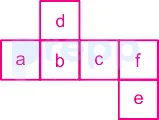
Select the box that CANNOT be formed by folding the given unfolded box.
- A
Option A (shown in image)
- B
Option B (shown in image)
- C
Option C (shown in image)
- D
Option D (shown in image)
Show answer
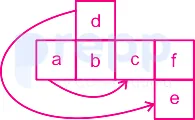
B. Option B (shown in image)When the box will be constructed, the following letters will be opposite to each other as shown below :
a
b
d
c
f
e
The dice in option ‘2’ has ‘e’ and ‘d’ appearing together which is not a possible case, as these two letters are opposite faces of each other.
Hence, option 2 dice cannot be formed.
 Paper & answer key PDF ↗
 Question 12archived
A + B means ‘A is the mother of B’;
A - B means ‘A is the husband of B’;
A × B means ‘A is son of B’;
A ÷ B means ‘A is the daughter of B’.
If W × Z + Y ÷ X, then how is X related to Z?
- A
Husband
- B
Son
- C
Wife
- D
Daughter
Show answer
A. HusbandUnderstanding Blood Relations from Symbols
This question asks us to decode a sequence of symbols representing blood relationships and determine the relationship between two individuals, X and Z. We are given the meanings of four symbols: '+', '-', '×', and '÷'. Let's first list these relationships clearly.
Symbol
Meaning
A + B
A is the mother of B
A - B
A is the husband of B
A × B
A is son of B
A ÷ B
A is the daughter of B
Breaking Down the Expression: W × Z + Y ÷ X
The given expression is W × Z + Y ÷ X. We need to break this compound expression into individual relationships according to the rules provided.
The first part is W × Z. According to the rules, A × B means 'A is son of B'. So, W × Z means 'W is the son of Z'. This tells us that Z is the parent of W.
The second part is Z + Y. According to the rules, A + B means 'A is the mother of B'. So, Z + Y means 'Z is the mother of Y'. This tells us that Z is the mother.
The third part is Y ÷ X. According to the rules, A ÷ B means 'A is the daughter of B'. So, Y ÷ X means 'Y is the daughter of X'. This tells us that X is the parent of Y.
Determining the Relationship between X and Z
Now let's combine the relationships we've deduced:
From W × Z, we know Z is a parent of W.
From Z + Y, we know Z is the mother of Y.
From Y ÷ X, we know Y is the daughter of X.
We have two key pieces of information about Y:
Z is the mother of Y (from Z + Y).
Y is the daughter of X (from Y ÷ X).
If Y is the daughter of X, then X is a parent of Y. Since Z is already identified as the mother of Y, X must be the other parent, which means X is the father of Y.
So, Z and X are the parents of Y. Z is the mother, and X is the father. In a typical family structure, the mother and father are married to each other. Therefore, Z and X are husband and wife.
The question asks for the relationship of X to Z. Since Z is the wife of X (because Z is the mother and X is the father of Y), X is the husband of Z.
Conclusion
By breaking down the expression W × Z + Y ÷ X based on the given symbolic relationships, we found that Z is the mother of Y and Y is the daughter of X. This implies that Z and X are the parents of Y, with Z being the mother and X being the father. Thus, X is the husband of Z.
Revision Table: Blood Relation Symbols
Expression
Relationship
W × Z
W is son of Z
Z + Y
Z is mother of Y
Y ÷ X
Y is daughter of X
Combined
Z is mother of Y, X is father of Y
Final Relation
X is husband of Z
Additional Information on Blood Relation Puzzles
Blood relation puzzles often involve decoding symbolic representations or complex sentence structures to map out family relationships. These questions test your ability to logically deduce relationships based on given information. Key strategies include:
Breaking down complex expressions or sentences into smaller, manageable relationship statements.
Using diagrams (like family trees) to visualize the relationships, especially for more complex puzzles.
Paying close attention to the direction of the relationship (e.g., "A is son of B" is different from "B is son of A").
Identifying the gender of individuals where possible, as it often helps determine the specific relationship (e.g., mother vs. father, son vs. daughter).
Being careful about which individual's relationship to the other is being asked (e.g., "How is X related to Z?" is different from "How is Z related to X?").
Practicing different types of blood relation questions with varying symbols and structures can improve your speed and accuracy in solving them for competitive exams.
Paper & answer key PDF ↗ Question 13archived
Which of the option figures is the exact mirror image of given figure when the mirror is held at the right side?

- A
Option A (shown in image)
- B
Option B (shown in image)
- C
Option C (shown in image)
- D
Option D (shown in image)
Show answer
A. Option A (shown in image)The correct mirror image of the given figure when the mirror is placed on the right of the figure is shown below :
Hence, option 1 is the correct answer.
 Paper & answer key PDF ↗
 Question 14archived
Read the given statements and conclusion carefully. Assuming that the information given in the statements is true, even if it appears to be at variance with commonly known facts, decide which tof the given conclusions logically follow(s) from the statements.
Statements:
1. Some cars are buses.
2. Some buses are trucks
3. Some trucks are scooters
Conclusions:
I. Some cars are scooters.
II. Some trucks are buses.
III. Some scooters are buses.
IV. All scooters are trucks.
- A
Only conclusions II and IV follow.
- B
Only conclusions I and II follow.
- C
Only conclusion II follows
- D
All the conclusions follow
Show answer
C. Only conclusion II followsSolving Logical Syllogism Questions: Statements and Conclusions
This question requires us to analyze given statements and determine which of the provided conclusions logically follow based on the principles of deductive reasoning, specifically syllogisms.
Analyzing the Statements
We are given three statements:
Some cars are buses.
Some buses are trucks.
Some trucks are scooters.
These statements describe relationships between different categories (cars, buses, trucks, scooters) using the quantifier "Some". "Some A are B" means there is at least one element that is both A and B, but it does not specify whether all A are B or all B are A, or if only some are. It simply indicates an overlap.
Evaluating the Conclusions
We need to examine each conclusion to see if it can be definitively derived from the given statements.
Conclusion I: Some cars are scooters.
Statement 1 links cars and buses.
Statement 2 links buses and trucks.
Statement 3 links trucks and scooters.
While there's a chain connecting cars to scooters via buses and trucks, the "Some" relationship does not guarantee a connection across multiple steps. For example, the cars that are buses might be different from the buses that are trucks, and the trucks that are scooters might be different from the trucks linked to buses. There is no direct or indirect connection established between cars and scooters that is guaranteed by these "Some" statements. Therefore, this conclusion does not necessarily follow.
Conclusion II: Some trucks are buses.
Statement 2 is "Some buses are trucks".
In logic, the statement "Some A are B" is equivalent to "Some B are A". This is known as the simple converse of an I-type proposition (Some is represented by I). Since statement 2 says "Some buses are trucks", it logically follows that "Some trucks are buses". This conclusion definitely follows from the statements.
Conclusion III: Some scooters are buses.
Statement 2 links buses and trucks.
Statement 3 links trucks and scooters.
Similar to Conclusion I, there is a chain, but the "Some" relationships do not guarantee an overlap between buses and scooters. The trucks that are buses might be different from the trucks that are scooters. There is no guaranteed direct or indirect link established between scooters and buses based on these statements. Therefore, this conclusion does not necessarily follow.
Conclusion IV: All scooters are trucks.
Statement 3 is "Some trucks are scooters".
"Some trucks are scooters" means there is at least one truck that is a scooter, and potentially some trucks that are not scooters, and some scooters that are not trucks (or all scooters could be trucks, or all trucks could be scooters, but neither is guaranteed). The statement only confirms an overlap. It does not imply that every single scooter is also a truck. To conclude "All scooters are trucks" would require a statement like "All scooters are trucks" or "All trucks are scooters" combined with other specific statements, which are not present here. Therefore, this conclusion does not follow.
Summary of Conclusions
Based on our analysis:
Conclusion I (Some cars are scooters) - Does not follow.
Conclusion II (Some trucks are buses) - Follows.
Conclusion III (Some scooters are buses) - Does not follow.
Conclusion IV (All scooters are trucks) - Does not follow.
Therefore, only conclusion II logically follows from the given statements.
Statement
Type
Relationship
Some cars are buses.
I
Overlap (Car ∩ Bus $\neq \emptyset$)
Some buses are trucks.
I
Overlap (Bus ∩ Truck $\neq \emptyset$)
Some trucks are scooters.
I
Overlap (Truck ∩ Scooter $\neq \emptyset$)
Conclusion
Follows?
Reasoning
I. Some cars are scooters.
No
No guaranteed link across multiple 'Some' statements.
II. Some trucks are buses.
Yes
Converse of Statement 2 ("Some buses are trucks").
III. Some scooters are buses.
No
No guaranteed link across 'Some' statements.
IV. All scooters are trucks.
No
Statement 3 is "Some trucks are scooters", which doesn't imply "All scooters are trucks".
Revision Table: Logical Syllogism Rules
Statement Type
Structure
Converse
Notes
A (Universal Affirmative)
All S are P
Some P are S (Particular Affirmative)
Converse is only sometimes true.
E (Universal Negative)
No S are P
No P are S (Universal Negative)
Converse is always true.
I (Particular Affirmative)
Some S are P
Some P are S (Particular Affirmative)
Converse is always true.
O (Particular Negative)
Some S are not P
Not valid
No valid simple converse.
Additional Information: Understanding Logical Deduction
Logical deduction is the process of reasoning from one or more statements (premises) to reach a logically certain conclusion. In the context of syllogisms, we analyze the relationship between different categories as described by the statements.
Key concepts:
Quantifiers: Words like "All", "No", and "Some" that indicate the quantity being referred to.
Categorical Statements: Statements that relate two categories (subject and predicate) using quantifiers and a copula ("are" or "are not"). The four standard types are A, E, I, and O.
Venn Diagrams: A visual tool often used to represent the relationships described by statements. Circles represent categories, and the overlap or separation of circles indicates the relationship (e.g., shading indicates emptiness, an 'x' indicates existence). For 'Some' statements, an 'x' is placed in the overlapping region. If the 'x' could be in multiple places, the conclusion is not certain.
Rules of Inference: Specific rules that govern how conclusions can be drawn from premises (e.g., the rule about the converse of I statements used in this solution).
For 'Some' statements, a link is only guaranteed between the two categories directly mentioned in the statement. Chains of 'Some' statements do not automatically create links between the non-adjacent categories in the chain.
In this problem, the link from 'Cars' to 'Buses', 'Buses' to 'Trucks', and 'Trucks' to 'Scooters' via 'Some' statements does not establish a definite link between 'Cars' and 'Scooters', or 'Buses' and 'Scooters'. However, the converse of 'Some buses are trucks' is 'Some trucks are buses', which is a valid deduction.
Paper & answer key PDF ↗ Question 15archived
Select the number that can replace the question mark (?) in the following series.
17, 19, 22, 27, 34, 45, 58,?
- A
73
- B
78
- C
67
- D
75
Show answer
D. 75Solving the Number Series Pattern
The question asks us to find the missing number in the series: 17, 19, 22, 27, 34, 45, 58, ?
To solve this type of number series question, we need to identify the pattern or rule that connects the numbers in the sequence. Let's look at the difference between consecutive terms.
Analysing the Differences in the Number Series
Let's calculate the difference between each number and the one preceding it:
Difference between 19 and 17: \(19 - 17 = 2\)
Difference between 22 and 19: \(22 - 19 = 3\)
Difference between 27 and 22: \(27 - 22 = 5\)
Difference between 34 and 27: \(34 - 27 = 7\)
Difference between 45 and 34: \(45 - 34 = 11\)
Difference between 58 and 45: \(58 - 45 = 13\)
The sequence of differences we found is: 2, 3, 5, 7, 11, 13.
Identifying the Pattern in the Differences
Now, let's examine the sequence of differences: 2, 3, 5, 7, 11, 13. Do you recognise this sequence?
These numbers are prime numbers in increasing order. A prime number is a natural number greater than 1 that has no positive divisors other than 1 and itself.
The sequence of prime numbers starts with 2, 3, 5, 7, 11, 13, 17, 19, 23, and so on.
The differences in our number series follow this sequence of prime numbers.
Predicting the Next Difference
Since the differences are consecutive prime numbers, the next difference in the series should be the prime number that comes after 13. The next prime number after 13 is 17.
Calculating the Next Number in the Series
To find the missing number (?), we add the next difference (17) to the last number in the series (58).
Missing number \( = 58 + 17 \)
Let's calculate:
\(58 + 17 = 75\)
Verification
The series with the calculated next number is: 17, 19, 22, 27, 34, 45, 58, 75.
The differences are:
19 - 17 = 2 (Prime)
22 - 19 = 3 (Prime)
27 - 22 = 5 (Prime)
34 - 27 = 7 (Prime)
45 - 34 = 11 (Prime)
58 - 45 = 13 (Prime)
75 - 58 = 17 (Prime)
The pattern of adding consecutive prime numbers holds true for the entire series.
Conclusion
The number that replaces the question mark is 75.
Term
Number
Difference from previous term
Observation
1st
17
-
Starting Term
2nd
19
\(19 - 17 = 2\)
1st Prime Number
3rd
22
\(22 - 19 = 3\)
2nd Prime Number
4th
27
\(27 - 22 = 5\)
3rd Prime Number
5th
34
\(34 - 27 = 7\)
4th Prime Number
6th
45
\(45 - 34 = 11\)
5th Prime Number
7th
58
\(58 - 45 = 13\)
6th Prime Number
8th
?
\(58 + 17 = 75\)
7th Prime Number after 13 is 17
Revision Table: Number Series and Patterns
Concept
Description
Example
Number Series
A sequence of numbers that follows a specific rule or pattern.
2, 4, 6, 8, ... (adding 2 each time)
Arithmetic Series
A series where the difference between consecutive terms is constant.
5, 10, 15, 20, ... (common difference is 5)
Geometric Series
A series where each term after the first is found by multiplying the previous one by a fixed, non-zero number called the common ratio.
3, 9, 27, 81, ... (common ratio is 3)
Difference Series
Finding the pattern by looking at the differences between consecutive terms. The differences might form another recognizable series (arithmetic, geometric, prime numbers, etc.).
1, 2, 4, 7, 11, ... Differences: 1, 2, 3, 4, ... (arithmetic difference)
Prime Numbers
Natural numbers greater than 1 that cannot be formed by multiplying two smaller natural numbers.
2, 3, 5, 7, 11, 13, 17, 19, 23, ...
Additional Information: Solving Number Series Questions
Solving number series problems often involves looking for patterns based on:
Differences: As seen in this problem, the difference between terms can follow a pattern (constant, arithmetic, geometric, prime, etc.).
Ratios: For geometric series, there's a common ratio.
Squares or Cubes: Terms might be related to squares or cubes of sequential numbers.
Combinations: The pattern might involve a combination of operations (e.g., multiply by a number and then add/subtract another).
Alternating Patterns: Sometimes, there are two different patterns within the same series, applied to alternate terms.
Fibonacci-like Sequences: Each term is the sum of the two preceding terms.
It's helpful to practice different types of series to become familiar with common patterns. Always start by calculating the differences or ratios between consecutive terms to see if a simple pattern emerges.
Paper & answer key PDF ↗ Question 16archived
Select the option in which the words share the same relationship as that shared by the given pair of words.
Bacteria : Illness
- A
Painting : Painter
- B
Disease : Doctor
- C
Carelessness : Errors
- D
Appraisal : Performance
Show answer
C. Carelessness : ErrorsAnalyzing the Relationship: Bacteria and Illness
The given pair of words is Bacteria : Illness.
Let's analyze the connection between these two terms. Bacteria are microorganisms, some of which are pathogenic, meaning they can cause disease. Therefore, Illness can be an effect of being infected by certain types of bacteria. The relationship here is clearly one of Cause and Effect. Bacteria are the cause, and illness is the effect.
Evaluating Options for Cause and Effect Relationship
We need to examine the provided options to find a pair of words that shares the same Cause and Effect relationship as Bacteria : Illness.
Let's look at each option:
Option 1: Painting : Painter
In this pair, a Painter is a person who creates a Painting. The relationship is best described as Creator to Creation.
Option 2: Disease : Doctor
A Doctor is a medical professional who treats or manages a Disease. The relationship is more like Problem to Solution Provider or Condition to Caregiver.
Option 3: Carelessness : Errors
Carelessness is a lack of attention or caution. This lack of attention often leads to making Errors. So, carelessness is the cause, and errors are the effect. This fits the Cause and Effect relationship perfectly, just like Bacteria causes Illness.
Option 4: Appraisal : Performance
An Appraisal is an evaluation or assessment, often of someone's Performance. The relationship is Evaluation to Subject of Evaluation.
Identifying the Correct Relationship Pair
By comparing the relationship in the original pair (Bacteria : Illness) with the relationships in each option, we can see which one is the most similar:
Word PairRelationship Type
Bacteria : IllnessCause : Effect
Painting : PainterCreator : Creation
Disease : DoctorProblem : Solution Provider
Carelessness : ErrorsCause : Effect
Appraisal : PerformanceEvaluation : Subject
The analysis clearly shows that the pair Carelessness : Errors exhibits the same Cause and Effect relationship as the original pair Bacteria : Illness.
Revision Table: Understanding Word Analogy Relationships
Mastering word analogies requires recognizing various types of relationships between words. Here are a few common types:
Relationship TypeDescriptionExample
Cause and EffectOne word leads to or results in the other.Germs : Sickness
Part to WholeOne word is a component of the other.Wheel : Car
Tool to UseOne word is used for the action of the other.Knife : Cut
Object to CharacteristicOne word describes a typical quality of the other.Sugar : Sweet
Problem and SolutionOne word is a difficulty, the other resolves it.Hunger : Eating
Additional Information: Steps for Solving Analogy Questions
When tackling word analogy questions like finding the match for Bacteria : Illness, follow a systematic approach:
First, establish a clear and precise relationship between the initial pair of words (Bacteria and Illness). Try to state it as a simple sentence (e.g., "Bacteria causes Illness").
Then, examine each option provided. For each option pair, determine the relationship between the two words using the same sentence structure if possible (e.g., "Painting is made by Painter", "Doctor treats Disease", "Carelessness causes Errors", "Appraisal evaluates Performance").
Compare the relationship you found for the original pair with the relationships you identified for each option.
Select the option whose relationship is the most similar or identical to the original pair's relationship. In this case, the Cause and Effect link in Carelessness : Errors perfectly matches Bacteria : Illness.
Paper & answer key PDF ↗ Question 17archived
Select the correct combination of mathematical signs to sequentially replace the * signs, to balance the following equation.
(14 * 9 * 6) * 15 * 8
- A
÷, -, =, ×
- B
×, -, ÷, =
- C
×, =, ÷, -
- D
-, ÷, ×, =
Show answer
B. ×, -, ÷, =×, -, ÷, =
Therefore, the sequence of signs \(\times\), -, \(\div\), = correctly balances the given expression.
Paper & answer key PDF ↗ Question 18archived
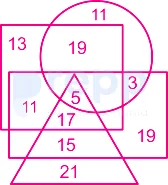
The given Venn diagram represents results of a class students:
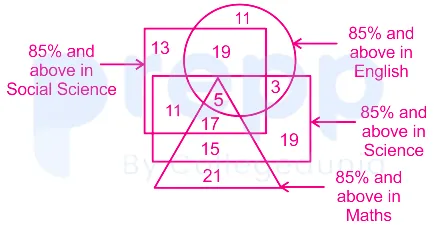
The triangle represents students who scored 85% and above in Maths, the circle represents students who scored 85% and above in English, the rectangle represents students who scored 85% and above in Science, and the square represents students who scored 85% and above in Social Science. The numbers given in the diagram represent the number of students in that particular category.
How many students scored 85% and above in all the subjects?
- A
15
- B
11
- C
17
- D
5
Show answer
D. 5The students who scored 85% and above in all the subjects is represented by the area that lies in the intersection of the circle, triangle, rectangle and square as shown below :
Hence, ‘5’ is the correct answer.
 Paper & answer key PDF ↗
 Question 19archived
Select the option that is related to the third word in the same way as the second word is related to the first word.
Amusing : Hilarious ∷ Moisten : ?
- A
Soak
- B
Dry
- C
Humid
- D
Water
Show answer
A. SoakUnderstanding the Word Analogy Question
The question asks us to find the word that completes the analogy: Amusing : Hilarious :: Moisten : ?. This is a word analogy problem where we need to identify the relationship between the first pair of words (Amusing and Hilarious) and apply the same relationship to the third word (Moisten) to find the fourth word from the given options.
Analysing the First Pair: Amusing : Hilarious
Let's look at the relationship between 'Amusing' and 'Hilarious'.
Amusing: This means causing laughter or providing entertainment; pleasant but not necessarily deeply funny.
Hilarious: This means extremely amusing, causing loud laughter; very funny.
The relationship here is one of degree or intensity. 'Hilarious' is a stronger or more intense form of 'Amusing'. It's like saying 'very amusing'.
Applying the Relationship to the Second Pair: Moisten : ?
Now, we need to find a word that relates to 'Moisten' in the same way that 'Hilarious' relates to 'Amusing'. We are looking for a word that means a stronger or more intense form of 'Moisten'.
Moisten: This means to make something slightly wet or damp.
Let's examine the given options:
1. Soak: This means to make something completely wet; immerse something in liquid. 'Soaking' is a much higher degree of wetting than 'moistening'.
2. Dry: This means to remove moisture, make or become free of moisture. This is the opposite of moistening.
3. Humid: This describes a high level of water vapor in the air, making it feel damp or sticky. This relates to atmospheric condition, not the act of making an object wet.
4. Water: This is a substance used to wet things. It's a noun, not an action that represents a degree of 'moisten'.
Identifying the Correct Analogy Completion
Based on the relationship identified (higher degree of the first word), we need the word that is a stronger degree of 'Moisten'. Comparing the options, 'Soak' means to make thoroughly wet, which is a much more intense action than just making something slightly wet ('Moisten').
Therefore, the analogy holds:
Amusing : Hilarious (Hilarious is a higher degree of Amusing)
Moisten : Soak (Soak is a higher degree of Moisten)
The word that completes the analogy is 'Soak'.
The final answer is Soak.
Pair
Words
Relationship
First Pair
Amusing : Hilarious
Higher degree / Intensity
Second Pair
Moisten : Soak
Higher degree / Intensity
Revision Table: Key Analogy Concepts
Concept
Description
Example
Synonym Analogy
Words with similar meanings.
Big : Large
Antonym Analogy
Words with opposite meanings.
Hot : Cold
Intensity/Degree Analogy
One word represents a stronger degree of the other.
Amusing : Hilarious
Moisten : Soak
Part to Whole Analogy
One word is a part of the other.
Finger : Hand
Cause and Effect Analogy
One word is the cause, the other is the effect.
Fire : Ash
Additional Information on Solving Analogy Questions
Solving word analogy questions effectively involves identifying the precise relationship between the first pair of words. Here are some tips:
Read the first pair carefully and try to define both words.
Think about different possible relationships: synonym, antonym, part-to-whole, cause-and-effect, intensity, type of, function, etc.
Once you think you've found the relationship for the first pair, apply that exact relationship to the third word.
Examine the options provided. Which option fits the relationship you identified with the third word?
If multiple options seem plausible, re-evaluate the relationship in the first pair to see if you missed a more specific connection.
Sometimes, stating the relationship in a sentence helps. For "Amusing : Hilarious", you could say "Hilarious is a more intense form of Amusing." Then apply this: "Soak is a more intense form of Moisten."
Practicing with various types of analogy questions helps you quickly recognize common relationships.
Paper & answer key PDF ↗ Question 20archived
Select the option in which the numbers are related in the same way as are the same way as are the numbers in the given set.
17 : 102 : 153
- A
13 : 78 : 108
- B
23 : 162 : 207
- C
16 : 96 : 144
- D
18 : 104 : 171
Show answer
C. 16 : 96 : 144Understanding Number Analogy Reasoning
This question asks us to identify a set of numbers that shares the same relationship as the numbers in the given set: 17 : 102 : 153. In number analogy questions, the goal is to discover the mathematical rule or pattern connecting the numbers in the first set and apply that rule to the given options to find the matching set.
Analyzing the Given Number Set: 17 : 102 : 153
Let's examine the relationship between the numbers 17, 102, and 153. We need to see how the second and third numbers are related to the first number (17).
Let's see if 102 is a multiple of 17. We can perform division or recall multiplication tables. $17 \times 1 = 17$, $17 \times 2 = 34$, $17 \times 3 = 51$, $17 \times 4 = 68$, $17 \times 5 = 85$, $17 \times 6 = 102$. So, the second number (102) is 6 times the first number (17). Mathematically, we can write this as $102 = 17 \times 6$.
Now, let's see if 153 is related to 17 in a similar way. Let's check if it's also a multiple of 17. $17 \times 7 = 119$, $17 \times 8 = 136$, $17 \times 9 = 153$. So, the third number (153) is 9 times the first number (17). Mathematically, we can write this as $153 = 17 \times 9$.
Based on this analysis, the relationship between the numbers in the set 17 : 102 : 153 is: the second number is 6 times the first number, and the third number is 9 times the first number.
Relationship: First Number : (First Number $\times 6$) : (First Number $\times 9$)
Applying the Relationship to the Options
Now we will test each provided option to see which one follows the established rule: Second number = First number $\times 6$ and Third number = First number $\times 9$.
Option 1: 13 : 78 : 108
Let the first number be 13.
Check the second number: $13 \times 6 = 78$. The second number matches (78).
Check the third number: $13 \times 9 = 117$. The third number in the option is 108, which does not match 117.
This option does not follow the rule for the third number.
Option 2: 23 : 162 : 207
Let the first number be 23.
Check the second number: $23 \times 6 = 138$. The second number in the option is 162, which does not match 138.
This option does not follow the rule for the second number.
Option 3: 16 : 96 : 144
Let the first number be 16.
Check the second number: $16 \times 6 = 96$. The second number matches (96).
Check the third number: $16 \times 9 = 144$. The third number matches (144).
This option follows the rule for both the second and third numbers.
Option 4: 18 : 104 : 171
Let the first number be 18.
Check the second number: $18 \times 6 = 108$. The second number in the option is 104, which does not match 108.
This option does not follow the rule for the second number.
Based on the analysis, only Option 3 (16 : 96 : 144) follows the same relationship as the given set (17 : 102 : 153).
Revision Table: Number Analogy Pattern Summary
Set
First Number (A)
Second Number (B)
Third Number (C)
Relationship B with A
Relationship C with A
Follows A: A$\times$6 : A$\times$9
Given Set
17
102
153
$102 = 17 \times 6$
$153 = 17 \times 9$
Yes
Option 1
13
78
108
$78 = 13 \times 6$
$108 \neq 13 \times 9$ (which is 117)
No
Option 2
23
162
207
$162 \neq 23 \times 6$ (which is 138)
$207 = 23 \times 9$
No
Option 3
16
96
144
$96 = 16 \times 6$
$144 = 16 \times 9$
Yes
Option 4
18
104
171
$104 \neq 18 \times 6$ (which is 108)
$171 \neq 18 \times 9$ (which is 162)
No
Additional Information: Solving Number Analogy Questions
Number analogy questions test your ability to find patterns and relationships between numbers. Here are some tips and common patterns:
Basic Operations: Look for addition, subtraction, multiplication, or division relationships between the numbers. Sometimes, the difference or ratio between consecutive numbers follows a pattern.
Squares and Cubes: Numbers might be squares or cubes of the first number, or related to them (e.g., $n^2+1$, $n^3-1$).
Prime Numbers: The numbers might be prime numbers or follow a pattern related to prime numbers.
Digit Properties: Look at the sum of digits, product of digits, or other properties of the digits themselves.
Combination of Rules: Sometimes, a combination of rules applies, like in this case (multiplication by different factors).
Check All Numbers: Ensure the rule you find applies to all numbers in the given set and then check if it applies consistently to the option sets.
Systematic Checking: Go through options one by one, applying your identified rule.
Paper & answer key PDF ↗ Question 21archived
Select the figure that can replace the question mark (?) in the following series.

- A
Option A (shown in image)
- B
Option B (shown in image)
- C
Option C (shown in image)
- D
Option D (shown in image)
Show answer
D. Option D (shown in image)Given series :
The series is following a shifting pattern, in which the first term becomes the last term in the next figure.
Following the above pattern, the line with squares at its corners, will be at the lowermost position in the ‘?’ figure.
Option 2, 3 and 4 has the same line at the lowermost position.
Next, the line with circles at its corners, will be at the top position in the ‘?’ figure, which can be found in option 2 and 4 only.
Again, the line with triangle at its corners will be at the 2 nd position from the top in the ‘?’ figure, which is present in option 4.
Hence, option 4 is the correct answer.

 Paper & answer key PDF ↗
 Question 22archived
In a certain code language, ‘CREATION’ is written as RCAEITNO. How will SEQUENCE be written as in that language?
- A
QESEUENC
- B
ESUQNEEC
- C
ESUQENEC
- D
QESEUCNE
Show answer
B. ESUQNEECCoding Decoding Pattern: Transforming Words
This question involves a coding-decoding pattern where a word is transformed into another word based on a specific rule. We need to identify this rule by comparing the original word 'CREATION' with its coded form 'RCAEITNO'. Once the rule is understood, we can apply it to the word 'SEQUENCE' to find its coded form.
Analyzing the Pattern: CREATION to RCAEITNO
Let's look at the positions of the letters in the word CREATION:
C
R
E
A
T
I
O
N
1
2
3
4
5
6
7
8
Now let's look at the coded word RCAEITNO:
R
C
A
E
I
T
N
O
1
2
3
4
5
6
7
8
Let's examine how letters from CREATION map to RCAEITNO based on their original positions:
C (pos 1) is now at pos 2 in RCAEITNO.
R (pos 2) is now at pos 1 in RCAEITNO.
E (pos 3) is now at pos 4 in RCAEITNO.
A (pos 4) is now at pos 3 in RCAEITNO.
T (pos 5) is now at pos 6 in RCAEITNO.
I (pos 6) is now at pos 5 in RCAEITNO.
O (pos 7) is now at pos 8 in RCAEITNO.
N (pos 8) is now at pos 7 in RCAEITNO.
Observing this, we can see a pattern of swapping letters in pairs:
The 1st and 2nd letters (CR) are swapped to become (RC).
The 3rd and 4th letters (EA) are swapped to become (AE).
The 5th and 6th letters (TI) are swapped to become (IT).
The 7th and 8th letters (ON) are swapped to become (NO).
So, the pattern is to divide the word into pairs of letters and reverse each pair.
Applying the Pattern: SEQUENCE
Now, let's apply the same pattern to the word 'SEQUENCE'. SEQUENCE has 8 letters.
Divide SEQUENCE into pairs:
SE
QU
EN
CE
Reverse each pair:
SE reversed is ES
QU reversed is UQ
EN reversed is NE
CE reversed is EC
Combine the reversed pairs to get the coded word:
ES + UQ + NE + EC = ESUQNEEC
Comparing with Options
Let's compare the coded word 'ESUQNEEC' with the given options:
QESEUENC - Does not match ESUQNEEC.
ESUQNEEC - Matches ESUQNEEC.
ESUQENEC - Does not match ESUQNEEC.
QESEUCNE - Does not match ESUQNEEC.
The coded word for SEQUENCE based on the pattern is ESUQNEEC, which matches Option 2.
Coded Word for SEQUENCE
Following the coding pattern observed in 'CREATION' to 'RCAEITNO', the word 'SEQUENCE' is coded as 'ESUQNEEC'.
Revision Table: Coding Decoding Summary
Original Word
Pairs
Reversed Pairs
Coded Word
CREATION
CR, EA, TI, ON
RC, AE, IT, NO
RCAEITNO
SEQUENCE
SE, QU, EN, CE
ES, UQ, NE, EC
ESUQNEEC
Additional Information: Types of Letter Coding
Letter coding is a common type of question in logical reasoning and competitive exams. Understanding different patterns is key to solving these questions. Some common types include:
Alphabet Shift: Letters are shifted a fixed number of positions forward or backward in the alphabet (e.g., A > B, B > C, or A > Z, B > Y).
Reverse Order: The entire word or parts of the word are written in reverse order.
Position Swap: Letters at specific positions are swapped (e.g., 1st with 2nd, 3rd with 4th, or 1st with last, 2nd with second last). The pattern in this question is a type of position swap within fixed pairs.
Letter Substitution: Each letter is replaced by another specific letter or symbol.
Combination of Patterns: More complex coding might involve a mix of the above patterns.
Practicing different types of coding-decoding problems helps improve pattern recognition skills.
Paper & answer key PDF ↗ Question 23archived
Four letter-clusters have been given, out of which three are alike in some manner, while one is different. Select the odd letter - cluster.
- A
XAD
- B
SVY
- C
FIK
- D
NQT
Show answer
C. FIKFinding the Odd Letter Cluster Pattern
To find the odd letter cluster out of the given options, we need to look for a pattern or rule that applies to three of the clusters but not the fourth. A common way to analyze letter clusters is by examining the position of each letter in the English alphabet.
Analyzing Letter Positions
Let's list the numerical positions of the letters in each given cluster:
Letter Cluster
Letter 1
Letter 2
Letter 3
XAD
X (24)
A (1)
D (4)
SVY
S (19)
V (22)
Y (25)
FIK
F (6)
I (9)
K (11)
NQT
N (14)
Q (17)
T (20)
Calculating Differences Between Consecutive Letters
Now, let's calculate the difference in alphabetical position between the first and second letters, and the second and third letters for each cluster. Remember that the alphabet wraps around from Z to A, so moving from Z (26) to A (1) is a difference of +1 (or +3 if Z to A is considered +1, A to B +1, B to C +1 etc., depending on the specific rule, but here we'll count steps: Z->A is 1 step, Z->B is 2 steps etc.). Let's consider positions 1-26.
XAD:
X to A: From position 24 to 1. \( 24 \rightarrow 25 \rightarrow 26 \rightarrow 1 \). This is 3 steps forward. Position difference: \( 1 - 24 = -23 \). Considering wrap-around, \( 26 - 24 = 2 \) steps to Z, then \( 1 \) step to A. Total \( 2+1=3 \) steps forward. So, \( 24 + 3 = 27 \equiv 1 \) (mod 26, adjusted for 1-26 scale). Let's think of this as adding 3 positions forward, wrapping around.
A to D: From position 1 to 4. \( 4 - 1 = 3 \). This is 3 steps forward.
Pattern: +3, +3 (with wrap-around from X to A).
SVY:
S to V: From position 19 to 22. \( 22 - 19 = 3 \). This is 3 steps forward.
V to Y: From position 22 to 25. \( 25 - 22 = 3 \). This is 3 steps forward.
Pattern: +3, +3.
FIK:
F to I: From position 6 to 9. \( 9 - 6 = 3 \). This is 3 steps forward.
I to K: From position 9 to 11. \( 11 - 9 = 2 \). This is 2 steps forward.
Pattern: +3, +2.
NQT:
N to Q: From position 14 to 17. \( 17 - 14 = 3 \). This is 3 steps forward.
Q to T: From position 17 to 20. \( 20 - 17 = 3 \). This is 3 steps forward.
Pattern: +3, +3.
Identifying the Pattern
By examining the differences in letter positions, we can see a clear pattern:
XAD follows a +3, +3 pattern (with wrap-around for the first step).
SVY follows a +3, +3 pattern.
FIK follows a +3, +2 pattern.
NQT follows a +3, +3 pattern.
Three of the letter clusters (XAD, SVY, NQT) show a consistent pattern of adding 3 to the position of the first letter to get the second, and adding 3 to the position of the second letter to get the third (accounting for wrap-around from Z to A). The cluster FIK, however, follows a pattern of adding 3 to the first letter but only adding 2 to the second letter.
Conclusion: The Odd One Out
Based on the analysis of the positional differences between consecutive letters, the letter cluster FIK is different from the other three because its pattern is +3, +2, whereas the pattern for XAD, SVY, and NQT is +3, +3.
Revision Table: Letter Series Patterns
Letter Cluster
1st Letter
2nd Letter
3rd Letter
Step 1 (Positional Diff)
Step 2 (Positional Diff)
Pattern Summary
XAD
X (24)
A (1)
D (4)
+3 (Wrap)
+3
+3, +3
SVY
S (19)
V (22)
Y (25)
+3
+3
+3, +3
FIK
F (6)
I (9)
K (11)
+3
+2
+3, +2
NQT
N (14)
Q (17)
T (20)
+3
+3
+3, +3
Additional Information: Letter Series Concepts
Letter series questions often involve identifying patterns based on:
Positional differences (like in this problem, adding or subtracting a fixed number).
Skipping letters (e.g., skipping one letter, skipping two letters).
Alternating patterns (e.g., +2, +3, +2, +3...).
Vowel/Consonant patterns.
Reversed alphabetical order.
Combinations of these patterns across multiple elements in the series.
Solving these types of problems requires knowing the alphabetical order and often listing out the letter positions to spot numerical relationships.
Paper & answer key PDF ↗ Question 24archived
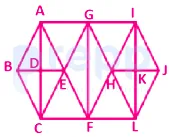
How many triangles are present in the given figure?

- A
22
- B
26
- C
28
- D
32
Show answer
D. 32The number of triangles in the given figure is shown below:
ADB, ADE, CDE, BCD, IKH, IKJ, LKJ, HKL, FHL, GHI, AEG, CEF - 12
ABC, AEC, GEF, GHF, IHL, IJL - 6
ABE, BEC, IHJ, HLJ - 4
GCL, AFI - 2
ACG, GIL - 2
GCF, GLF, AGF, GIF, ACF, FIL- 6
Total number of triangles = 12 + 6 + 4 + 2 + 2 + 6 = 32
Hence, the figure has total 32 triangles.
 Paper & answer key PDF ↗
 Question 25archived
Select the set of letters that when sequentially placed in the blanks of the given letter series will complete the series.
P_rsqrps_pqs_qr_qrps_p_s
- A
q, r, p, s, r, q
- B
q, r, p, p, r, q
- C
p, r, p, p, r, p
- D
r, p, q, s, r, q
Show answer
A. q, r, p, s, r, qq, r, p, s, r, q
Therefore, the letters q, r, p, s, r, q successfully complete the series by establishing a clear repeating pattern.
Paper & answer key PDF ↗ Question 26archived
The Pritzker Prize is an international award given to recognize contribution in the field of ________.
- A
literature
- B
mathematics
- C
architecture
- D
medicine
Show answer
C. architectureUnderstanding the Pritzker Prize
The question asks about the field in which the Pritzker Prize is awarded. The Pritzker Prize is a globally recognized award presented annually to honor living architects whose built work demonstrates a combination of talent, vision, and commitment, who have produced consistent and significant contributions to humanity and the built environment through the art of architecture.
Analysing the Options
Let's look at the provided options:
literature
mathematics
architecture
medicine
We need to determine which of these fields is associated with the Pritzker Prize.
Identifying the Correct Field
Based on the history and purpose of the award, the Pritzker Prize was established by the Pritzker family of Chicago through their Hyatt Foundation in 1979. It is explicitly given to recognize contributions in the field of architecture. It is often referred to as the Nobel Prize of architecture.
Comparing this information with the options:
The Nobel Prize recognizes contributions in literature, physics, chemistry, medicine, peace, and economic sciences.
There are prestigious awards in mathematics, such as the Fields Medal and the Abel Prize.
There are various prestigious awards in medicine, including the Nobel Prize in Physiology or Medicine.
The Pritzker Prize is uniquely dedicated to celebrating excellence in architecture.
Therefore, the Pritzker Prize specifically recognizes achievements in the field of architecture.
Conclusion
The Pritzker Prize is an international award given to recognize contribution in the field of architecture.
Revision Table: Key Prize Fields
Prize Name
Primary Field(s)
Notes
Nobel Prize
Literature, Physics, Chemistry, Medicine, Peace, Economic Sciences
Awarded annually in various fields
Fields Medal
Mathematics
Awarded every four years to mathematicians under 40
Abel Prize
Mathematics
Awarded annually by the King of Norway
Pritzker Prize
Architecture
Awarded annually to architects
Additional Information on the Pritzker Prize in Architecture
The Pritzker Prize is one of the most significant honors an architect can receive. It acknowledges not just individual buildings, but the entire body of work and its impact on the built environment and society. The laureates represent a diverse range of architectural styles and philosophies from around the world, showcasing the global nature of the award and the profession. Winning the Pritzker Prize often leads to increased international recognition and opportunities for architects.
Paper & answer key PDF ↗ Question 27archived
What does 'T' stand for in ATM?
- A
Transfer
- B
Teller
- C
Transaction
- D
Trunk
Show answer
B. TellerWhat Does 'T' Stand For in ATM? Understanding the Acronym
The term ATM is a common acronym used in banking and finance. It represents a self-service machine that allows bank customers to perform various transactions without needing direct assistance from a bank teller inside the branch. Understanding what each letter in the acronym stands for is important.
Let's break down the letters in ATM:
A stands for Automated. This highlights the machine's ability to perform tasks automatically.
T stands for Teller. This is the key part of the acronym we are focusing on.
M stands for Machine. This simply refers to the device itself.
Therefore, ATM stands for Automated Teller Machine. The 'T' in ATM stands for Teller, referring to the role the machine plays in acting as an automated version of a human bank teller.
The machine performs many of the functions that a human teller would, such as dispensing cash, accepting deposits, and allowing balance inquiries, but it does so in an automated manner, available usually 24 hours a day.
Based on the options provided, the correct answer for what 'T' stands for in ATM is Teller.
Revision Table: Key ATM Terms
Acronym/Term
Full Form / Meaning
ATM
Automated Teller Machine
T
Teller
PIN
Personal Identification Number
Additional Information on Automated Teller Machines
Automated Teller Machines have significantly transformed banking accessibility. They allow customers to access their funds and manage their accounts at convenient locations and times outside of traditional banking hours. While primarily known for cash withdrawal, modern ATMs offer a range of services including:
Depositing checks or cash
Transferring funds between accounts
Checking account balances
Paying bills
Updating contact information
The first ATM is often credited to John Shepherd-Barron and installed in North London in 1967. Since then, ATMs have become a ubiquitous part of the global financial landscape, constantly evolving with new technologies and features.
Paper & answer key PDF ↗ Question 28archived
The Council of Ministers during the time of Shivaji Maharaj was known as:
- A
Agraharam
- B
Navaratnas
- C
Ashta Diggajas
- D
Ashta Pradhan
Show answer
D. Ashta PradhanUnderstanding Shivaji Maharaj's Council of Ministers
Shivaji Maharaj, the founder of the Maratha Empire, established a well-organized system of administration. A key part of this system was his Council of Ministers, which advised him on various matters of the state.
Let's examine the options provided to identify the correct term for this council.
Agraharam: This term refers to land or villages granted to Brahmins, particularly in South India, for their religious and academic services. It is not related to the council of ministers in the Maratha administration under Shivaji Maharaj.
Navaratnas: Meaning 'Nine Jewels', this was a term used for a group of nine extraordinary people in the court of emperors like Chandragupta II Vikramaditya of the Gupta Empire or Emperor Akbar of the Mughal Empire. This term is not associated with Shivaji Maharaj's council.
Ashta Diggajas: Meaning 'Eight Elephants' or 'Eight Poets', this term refers to the group of eight famous Telugu poets who were in the court of King Krishnadevaraya of the Vijayanagara Empire in South India. This is also unrelated to Shivaji Maharaj.
Ashta Pradhan: This term translates to 'Council of Eight' or 'Eight Ministers'. Shivaji Maharaj's Council of Ministers consisted of eight ministers, each responsible for a specific department. This council played a vital role in the administration of the Maratha kingdom.
Therefore, the Council of Ministers during the time of Shivaji Maharaj was known as the Ashta Pradhan.
Structure and Roles of the Ashta Pradhan
The Ashta Pradhan Mandal, or the Council of Eight Ministers, was a crucial administrative body under Shivaji Maharaj. While they advised the king, Shivaji Maharaj held the ultimate authority. Each minister had a specific portfolio:
Peshwa: Prime Minister, responsible for general administration.
Amatya/Majumdar: Finance Minister, handling accounts and finances.
Sachiv/Surunavis: Secretary, responsible for royal correspondence.
Mantri/Waqianavis: Interior Minister, looking after the king's daily affairs and intelligence.
Senapati/Sar-i-Naubat: Commander-in-Chief, head of the armed forces.
Sumant/Dabir: Foreign Minister, managing relations with other states.
Nyayadhish: Chief Justice, responsible for judicial matters.
Panditrao: High Priest, managing religious affairs.
This structure helped Shivaji Maharaj effectively govern his growing kingdom.
Revision Table: Notable Councils in Indian History
Council Name
Ruler/Empire
Number of Members (Often symbolic)
Key Role
Ashta Pradhan
Shivaji Maharaj (Maratha Empire)
8
Council of Ministers
Navaratnas
Akbar (Mughal Empire)
Chandragupta II (Gupta Empire)
9
Group of eminent personalities/scholars
Ashta Diggajas
Krishnadevaraya (Vijayanagara Empire)
8
Group of eminent Telugu poets
Agraharam
Various rulers (especially South India)
N/A
Land grant to Brahmins
Additional Information: Maratha Administration
Apart from the Ashta Pradhan, Shivaji Maharaj's administration was known for several other features aimed at efficient governance and welfare of his subjects. Some key aspects included:
Land Revenue System: He reformed the land revenue system, ensuring direct collection from peasants and standardizing measurements.
Military Organization: He built a strong army and navy, emphasizing discipline and direct recruitment, reducing reliance on feudal levies.
Forts: Maintaining and building a network of strategic forts was crucial for defense and administration.
Justice System: Justice was administered based on traditional laws and customs, with the Nyayadhish overseeing the process.
Welfare Measures: Shivaji's policies often aimed at protecting peasants and traders from exploitation.
Understanding the Ashta Pradhan is key to understanding the administrative genius of Shivaji Maharaj and the foundation of the Maratha Empire.
Paper & answer key PDF ↗ Question 29archived
For which game has the Father of Leander Paes been a member of the Indian National Team?
- A
Tennis
- B
Hockey
- C
Badminton
- D
Basketball
Show answer
B. HockeyUnderstanding Leander Paes's Family Sports Legacy
Leander Paes is a legendary Indian professional tennis player. He is known for his exceptional doubles and mixed doubles career. However, the question asks about the sport played by his father, Dr. Vece Paes, for the Indian National Team.
Dr. Vece Paes and His Sport for India
Leander Paes comes from a family with a strong sporting background. His father, Dr. Vece Paes, was also a distinguished athlete who represented India at the highest level in a different sport.
Dr. Vece Paes was a member of the Indian National Hockey team. He was part of the team that won a bronze medal at the 1972 Munich Olympics.
This makes it clear that the sport for which the Father of Leander Paes was a member of the Indian National Team is Hockey.
Examining the Options
Let's look at the provided options:
Tennis: This is the sport Leander Paes plays, not his father for the national team.
Hockey: Dr. Vece Paes was indeed a member of the Indian National Hockey team and an Olympic medalist.
Badminton: Neither Leander nor his father is known for playing Badminton at the national level.
Basketball: Neither Leander nor his father is known for playing Basketball at the national level.
Based on historical records and the achievements of Dr. Vece Paes, Hockey is the correct answer.
Key Figures and Their Sports
Individual
Relationship to Leander Paes
Sport Represented India In
Key Achievement
Leander Paes
Himself
Tennis
Multiple Grand Slams, Olympic Medal (Singles Bronze)
Dr. Vece Paes
Father
Hockey
Olympic Bronze Medal (1972)
Therefore, the Father of Leander Paes was a member of the Indian National Team for Hockey.
Revision Table: Leander Paes Family Sports
Family Member
Sport
National/International Representation
Leander Paes
Tennis
Indian National Team, ATP Tour, Olympics
Dr. Vece Paes (Father)
Hockey
Indian National Team, Olympics
Additional Information: Indian Sports Connections
It is interesting to note how sporting talent can run in families. While Leander Paes excelled in Tennis, his father made his mark in Hockey, one of India's traditional strengths in sports. This highlights the diverse sporting interests and capabilities within the family.
Indian Hockey has a rich history, especially in the Olympics, where the team has won multiple gold medals in the past. Dr. Vece Paes was part of an era where Indian Hockey was still a formidable force internationally.
Paper & answer key PDF ↗ Question 30archived
Which of the following monasteries is located in Sikkim?
- A
Rumtek
- B
Kye
- C
Tabo
- D
Hemis
Show answer
A. RumtekIdentifying the Monastery in Sikkim
The question asks us to identify which of the given monasteries is located in the Indian state of Sikkim. Let's examine each option to determine its location.
Analyzing the Monastery Locations
We are given four options for monasteries:
Rumtek Monastery: This is one of the largest and most significant monasteries in Sikkim. It is located near Gangtok, the capital of Sikkim.
Kye Monastery: Also known as Ki or Key Monastery, it is a famous Tibetan Buddhist monastery located on a hilltop in the Spiti Valley, Himachal Pradesh, India.
Tabo Monastery: This is another important monastery situated in the Tabo village of the Lahaul and Spiti district, Himachal Pradesh, India. It is known for its ancient frescoes and stucco sculptures.
Hemis Monastery: This is a well-known Tibetan Buddhist monastery located in Hemis, Ladakh, India. It is famous for its annual Hemis festival.
Based on the locations of these monasteries, we can see that Rumtek Monastery is located in Sikkim, while Kye and Tabo are in Himachal Pradesh, and Hemis is in Ladakh.
Conclusion: Which Monastery is in Sikkim?
Comparing the locations:
Rumtek — Sikkim
Kye — Himachal Pradesh
Tabo — Himachal Pradesh
Hemis — Ladakh
Therefore, the monastery located in Sikkim is Rumtek.
Monastery
Location
Rumtek Monastery
Sikkim
Kye Monastery
Himachal Pradesh
Tabo Monastery
Himachal Pradesh
Hemis Monastery
Ladakh
Revision Table: Famous Monasteries and States
Monastery Name
State / Union Territory
Rumtek Monastery
Sikkim
Kye Monastery
Himachal Pradesh
Tabo Monastery
Himachal Pradesh
Hemis Monastery
Ladakh
Tawang Monastery
Arunachal Pradesh
Sanchi Stupa
Madhya Pradesh (Historical Buddhist site, not a monastery in the same sense)
Bodh Gaya
Bihar (Mahabodhi Temple complex)
Additional Information about Monasteries in India
India, particularly the Himalayan regions, is home to many significant Buddhist monasteries. These monasteries are not just places of worship but also serve as centers of learning, culture, and community life. They often house ancient scriptures, intricate art, and host vibrant festivals. Understanding the locations of key monasteries is important for studying India's cultural geography and Buddhist heritage.
For instance, Rumtek Monastery in Sikkim is the seat-in-exile of the Gyalwang Karmapa, the head of the Karma Kagyu lineage of Tibetan Buddhism. Kye and Tabo monasteries in Spiti are known for their historical significance and architectural styles reflecting the unique culture of the region. Hemis Monastery in Ladakh is famous for its annual mask dance festival, attracting tourists and devotees from around the world.
Learning about these locations helps us appreciate the diverse religious landscape and historical connections across different regions of India.
Paper & answer key PDF ↗ Question 31archived
Who is the author of the book 'Wise and Otherwise: A Salute to Life'?
- A
Zoya Hasan
- B
Sudha Murthy
- C
Amrita Pritam
- D
Kiran Desai
Show answer
B. Sudha MurthyIdentifying the Author of 'Wise and Otherwise: A Salute to Life'
The question asks for the author of the well-known book titled 'Wise and Otherwise: A Salute to Life'. Identifying the author requires knowledge of famous literary works and their writers.
Analyzing the Options
Let's look at the provided options:
Zoya Hasan: A prominent academic and political scientist. While she has written books, she is not primarily known for popular non-fiction or story collections like 'Wise and Otherwise'.
Sudha Murthy: A prolific Indian author, philanthropist, and engineer. She is widely recognized for her numerous books, especially collections of real-life stories and anecdotes, written in an accessible style.
Amrita Pritam: A celebrated Indian novelist, essayist, and poet, writing primarily in Punjabi and Hindi. Her works are predominantly fiction, poetry, and autobiographical accounts, not collections of real-life moral stories in the style of 'Wise and Otherwise'.
Kiran Desai: An Indian author whose novel 'The Inheritance of Loss' won the Man Booker Prize. Her focus is primarily on fiction.
The Correct Author
'Wise and Otherwise: A Salute to Life' is a collection of 51 short stories based on real-life incidents observed by the author during her travels. These stories reflect various facets of human nature, values, and experiences. This style and subject matter are characteristic of the writing of Sudha Murthy.
Sudha Murthy is indeed the author of 'Wise and Otherwise: A Salute to Life'. The book is one of her popular works, known for its simple language and profound insights derived from everyday life.
Revision Table: Key Details
Book Title
Author
Genre/Style
Key Theme
Wise and Otherwise: A Salute to Life
Sudha Murthy
Collection of real-life stories, Non-fiction
Human nature, Values, Life experiences
Additional Information on Sudha Murthy and Her Works
Sudha Murthy's writing often draws from her extensive social work and travels across India. Her books are known for their simplicity, relatability, and moral lessons, making them popular across different age groups. Besides 'Wise and Otherwise', some of her other famous books include:
Dollar Bahu
Mahashweta
The Mother I Never Knew
The Serpent's Revenge: Unusual Tales from the Mahabharata
How I Taught My Grandmother to Read and Other Stories
Her contributions to literature and philanthropy have earned her wide recognition.
Paper & answer key PDF ↗ Question 32archived
Which among the following has its refractive index closest to that of crown glass?
- A
Sapphire
- B
Canada balsam
- C
Ruby
- D
Diamond
Show answer
B. Canada balsamUnderstanding Refractive Index
The refractive index is a fundamental optical property of a material. It describes how fast light travels through the material. Specifically, the refractive index ($$n$$) is the ratio of the speed of light in a vacuum ($$c$$) to the speed of light in the material ($$v$$):
$$ n = \frac{c}{v} $$
A higher refractive index means light travels slower through the material and bends more when entering or leaving it (assuming the light is not entering or leaving perpendicularly).
Comparing Refractive Indices with Crown Glass
The question asks which substance among the given options has a refractive index closest to that of crown glass. Crown glass is a common type of optical glass.
First, let's note the typical refractive index of crown glass. While it can vary slightly depending on the exact composition, a common value for the refractive index of crown glass is approximately 1.52.
Now, let's look at the typical refractive indices of the substances given in the options:
Sapphire
Canada balsam
Ruby
Diamond
Here are the approximate refractive index values for these materials:
Substance
Approximate Refractive Index
Crown Glass
1.52
Sapphire
1.76
Canada balsam
1.53
Ruby
1.76
Diamond
2.42
Finding the Closest Refractive Index
To find which substance's refractive index is closest to that of crown glass (1.52), we need to calculate the absolute difference between their refractive indices:
Difference for Sapphire: $$|1.76 - 1.52| = 0.24$$
Difference for Canada balsam: $$|1.53 - 1.52| = 0.01$$
Difference for Ruby: $$|1.76 - 1.52| = 0.24$$
Difference for Diamond: $$|2.42 - 1.52| = 0.90$$
Comparing these differences:
Sapphire: 0.24
Canada balsam: 0.01
Ruby: 0.24
Diamond: 0.90
The smallest difference is 0.01, which corresponds to Canada balsam.
Therefore, Canada balsam has a refractive index closest to that of crown glass.
Conclusion on Refractive Index Comparison
Based on the comparison of refractive indices, Canada balsam is the substance among the options whose refractive index is closest to that of crown glass.
Revision Table: Refractive Indices
Substance
Approximate Refractive Index
Difference from Crown Glass (1.52)
Crown Glass
1.52
-
Sapphire
1.76
0.24
Canada balsam
1.53
0.01
Ruby
1.76
0.24
Diamond
2.42
0.90
Additional Information: Properties of Materials
Crown Glass: Used widely in lenses and prisms because of its optical clarity and relatively low dispersion (how much light separates into colors).
Canada Balsam: A natural resin often used as a cement for lenses and microscopic slides because its refractive index is very close to that of glass, minimizing reflections at glass-balsam interfaces. This property makes it useful for mounting specimens under a coverslip for microscopy; it helps to match the refractive index of the glass slide and coverslip, improving image quality.
Sapphire and Ruby: Both are forms of the mineral corundum (Aluminum Oxide, Al2O3). Their high refractive index makes them appear brilliant when cut as gemstones. Ruby is red corundum, while Sapphire is typically blue, yellow, or other colors (except red).
Diamond: Known for its extremely high refractive index and dispersion, which gives it its characteristic brilliance and fire.
The refractive index is a key property in understanding how light behaves when it passes through different materials and is crucial in the design of optical instruments like lenses and microscopes.
Paper & answer key PDF ↗ Question 33archived
With reference to the Vedangas, which of the following terms denotes 'Ritual'?
- A
Kalpa
- B
Vyakarana
- C
Shiksha
- D
Chanda
Show answer
A. KalpaThe six Vedangas are auxiliary disciplines needed to study and perform the Vedas:
Shiksha — phonetics/pronunciation
Kalpa — ritual procedures (yajnas, samskaras)
Vyakarana — grammar
Nirukta — etymology
Chhanda — metre/prosody
Jyotisha — astronomy/astrology
Ritual practice is the domain of Kalpa, whose Kalpasutras (Shrautasutras, Grihyasutras, Dharmasutras, Shulbasutras) prescribe the procedures for Vedic sacrifices and domestic ceremonies. Vyakarana concerns grammar, Shiksha pronunciation, and Chhanda metre — none of these deal with ritual.
Hence the correct answer is Kalpa.
Paper & answer key PDF ↗ Question 34archived
Which among the following is a cation?
- A
Fluoride
- B
Ammonium
- C
Iodide
- D
Chloride
Show answer
B. AmmoniumUnderstanding Ions and Cations
In chemistry, atoms and molecules can gain or lose electrons. When this happens, they become electrically charged particles called ions. Ions can be either positively charged or negatively charged.
There are two main types of ions:
Cations: Positively charged ions. They are formed when an atom or molecule loses one or more electrons. Cations are typically formed from metals or polyatomic groups like ammonium.
Anions: Negatively charged ions. They are formed when an atom or molecule gains one or more electrons. Anions are typically formed from nonmetals or polyatomic groups.
Analyzing the Options
Let's examine each option provided in the question to determine whether it is a cation or an anion.
Fluoride: This refers to the fluoride ion. A fluoride ion is formed when a fluorine atom gains one electron. Its chemical formula is $\text{F}^-$. Since it has a negative charge, it is an anion.
Ammonium: This refers to the ammonium ion. The ammonium ion is a polyatomic ion consisting of one nitrogen atom and four hydrogen atoms. It carries a positive charge. Its chemical formula is $\text{NH}_4^+$. Since it has a positive charge, it is a cation.
Iodide: This refers to the iodide ion. An iodide ion is formed when an iodine atom gains one electron. Its chemical formula is $\text{I}^-$. Since it has a negative charge, it is an anion.
Chloride: This refers to the chloride ion. A chloride ion is formed when a chlorine atom gains one electron. Its chemical formula is $\text{Cl}^-$. Since it has a negative charge, it is an anion.
Identifying the Cation from the List
Based on our analysis, we can see which option represents a positively charged ion (a cation).
Option
Chemical Formula
Charge
Type of Ion
Fluoride
$\text{F}^-$
Negative
Anion
Ammonium
$\text{NH}_4^+$
Positive
Cation
Iodide
$\text{I}^-$
Negative
Anion
Chloride
$\text{Cl}^-$
Negative
Anion
From the table, it is clear that the Ammonium ion ($\text{NH}_4^+$) is the only species listed that carries a positive charge, making it a cation.
Conclusion on Cations
Therefore, among the given options, Ammonium is the cation.
Revision Table: Cations and Anions
Feature
Cation
Anion
Charge
Positive
Negative
Electron gain/loss
Loses electrons
Gains electrons
Movement in electric field
Attracted to negative electrode (cathode)
Attracted to positive electrode (anode)
Typical elements
Metals, some nonmetal groups (like Ammonium)
Nonmetals, some metal groups
Additional Information on Polyatomic Ions
While many cations and anions are formed from single atoms (like $\text{Na}^+$, $\text{Cl}^-$), some are formed from groups of atoms bonded together that carry an overall charge. These are called polyatomic ions.
Examples:
Polyatomic Cation: Ammonium ($\text{NH}_4^+$), Hydronium ($\text{H}_3\text{O}^+$)
Polyatomic Anion: Sulfate ($\text{SO}_4^{2-}$), Nitrate ($\text{NO}_3^-$), Carbonate ($\text{CO}_3^{2-}$)
The Ammonium ion ($\text{NH}_4^+$) discussed in this question is a common example of a polyatomic cation.
Paper & answer key PDF ↗ Question 35archived
Pradhan Mantri Jeevan Jyoti Bima Yojana offers a protection term insurance cover of ______ to the insurer.
- A
Rs. 8 Lakh
- B
Rs. 2 Lakh
- C
Rs. 4 Lakh
- D
Rs. 5 Lakh
Show answer
B. Rs. 2 LakhUnderstanding Pradhan Mantri Jeevan Jyoti Bima Yojana (PMJJBY) Cover
The Pradhan Mantri Jeevan Jyoti Bima Yojana (PMJJBY) is a life insurance scheme introduced by the Government of India. It aims to provide life cover to citizens at an affordable premium, ensuring financial security for their families in case of the policyholder's death.
This scheme is a term insurance plan, meaning it provides a life cover for a specific period, usually one year, and needs to be renewed annually. It is offered by Life Insurance Corporation of India and other life insurers who are willing to offer the product on similar terms.
PMJJBY Life Insurance Cover Amount
A key aspect of the Pradhan Mantri Jeevan Jyoti Bima Yojana is the sum assured, which is the amount paid out upon the death of the insured person. The PMJJBY scheme specifically provides a fixed life cover amount.
The life cover offered under the Pradhan Mantri Jeevan Jyoti Bima Yojana is Rs. 2 Lakh.
This amount is payable to the nominee in the unfortunate event of the policyholder's death due to any reason.
Feature
Detail
Scheme Name
Pradhan Mantri Jeevan Jyoti Bima Yojana (PMJJBY)
Type of Insurance
Term Life Insurance
Annual Premium
Rs. 436 (as of June 1, 2022)
Age Eligibility
18 to 50 years (cover up to 55 years)
Life Cover Amount
Rs. 2 Lakh
Therefore, the correct protection term insurance cover offered by the Pradhan Mantri Jeevan Jyoti Bima Yojana to the insurer is Rs. 2 Lakh.
Revision Table: PMJJBY Key Details
Aspect
Information
Scheme
Pradhan Mantri Jeevan Jyoti Bima Yojana (PMJJBY)
Coverage
Life cover against death
Sum Assured
Rs. 2,00,000 (Two Lakh Rupees)
Term
1 year (renewable)
Additional Information on PMJJBY Scheme
The Pradhan Mantri Jeevan Jyoti Bima Yojana is designed to be accessible, particularly for the economically weaker sections of society. Here are some additional points:
Enrollment Period: The cover period is from June 1st to May 31st of the next year. Subscribers can enroll or auto-debit can be done up to May 31st for the cover starting June 1st.
Premium Payment: The premium is auto-debited from the subscriber's bank account.
Eligibility: Individuals aged 18 to 50 years having a bank account are eligible to enroll in the scheme.
Termination of Assurance: The assurance terminates upon attaining age 55, closure of the bank account or insufficiency of balance for auto-debit, or being covered under multiple PMJJBY policies.
Government Backed: It is a government-supported scheme aimed at increasing insurance penetration in India.
Paper & answer key PDF ↗ Question 36archived
The Indian National Congress special session of September 1920 was held at ______.
- A
Calcutta
- B
Lucknow
- C
Nagpur
- D
Madras
Show answer
A. CalcuttaUnderstanding the Indian National Congress Special Session of September 1920
The question asks about the location where the Indian National Congress (INC) held its special session in September 1920. Understanding the various sessions of the INC is crucial for studying India's freedom struggle.
Location of the September 1920 Special Session
The special session of the Indian National Congress in September 1920 was a pivotal moment in the history of India's independence movement. This session was convened specifically to discuss and decide on a response to the Jallianwala Bagh massacre and the Khilafat issue. The session was held in:
Calcutta
This special session was presided over by Lala Lajpat Rai.
Significance of the Calcutta Session (September 1920)
The primary agenda of the Calcutta special session was to deliberate on Mahatma Gandhi's proposal for a Non-Cooperation Movement against the British government. After intense debate, the resolution for the Non-Cooperation Movement was approved in this session. This marked a significant shift in the Congress's strategy, moving towards mass-based peaceful resistance.
Distinction from the Annual Session of 1920
It is important to note the difference between the special session of September 1920 and the regular annual session of the Indian National Congress held later that year. The annual session of 1920 took place in Nagpur in December. The Nagpur session ratified the resolution on Non-Cooperation that was passed in the Calcutta special session and also brought about significant changes to the Congress constitution.
Therefore, the Indian National Congress special session of September 1920 was held at Calcutta.
Key Information about the September 1920 INC Session
Attribute
Details
Event
Indian National Congress Special Session
Month and Year
September 1920
Location
Calcutta
President
Lala Lajpat Rai
Key Outcome
Approval of the Non-Cooperation Movement resolution
Revision Table: Indian National Congress Sessions 1920
Session Type
Month & Year
Location
President
Significance
Special Session
September 1920
Calcutta
Lala Lajpat Rai
Approved Non-Cooperation proposal
Annual Session
December 1920
Nagpur
C. Vijayaraghavachariar
Ratified Non-Cooperation, amended constitution
Additional Information: The Non-Cooperation Movement
The Non-Cooperation Movement, approved in the Calcutta session and ratified in the Nagpur session of 1920, was a major turning point in the Indian freedom struggle. Led by Mahatma Gandhi, it called for Indians to withdraw their cooperation from the British government and its institutions. This included boycotting:
Government schools and colleges
Law courts
Foreign goods
Government services and titles
The movement also encouraged the use of Swadeshi goods and the promotion of Khadi. It gained widespread support across the country, demonstrating the potential for mass mobilization against British rule. Although it was later suspended in 1922 due to the Chauri Chaura incident, it significantly energized the nationalist movement and brought a large number of people into the struggle for independence.
Paper & answer key PDF ↗ Question 37archived
The power of a lens is –2.0 D. Here 'D' stands for:
- A
degree
- B
distance
- C
dilation
- D
dioptre
Show answer
D. dioptreUnderstanding Lens Power and its Unit
The question asks about the unit represented by 'D' when discussing the power of a lens. The power of a lens is a measure of how much it converges or diverges light rays. A higher power means the lens bends light more strongly.
What is Lens Power?
Lens power, denoted by \( P \), is defined as the reciprocal of the focal length \( f \) of the lens. The focal length must be measured in meters. The formula is:
\( P = \frac{1}{f} \)
Where:
\( P \) is the power of the lens.
\( f \) is the focal length in meters.
For a convex lens, the focal length is positive, so the power is positive. For a concave lens, the focal length is negative, so the power is negative. In the given question, the power is –2.0 D, which indicates it is a concave lens.
The Unit of Lens Power: Dioptre
The standard unit for the power of a lens is the dioptre, which is denoted by the symbol 'D'. One dioptre is defined as the power of a lens with a focal length of one meter (\( 1 \text{ D} = 1 \text{ m}^{-1} \)).
So, if a lens has a focal length of 1 meter, its power is \( P = \frac{1}{1 \text{ m}} = 1 \text{ D} \). If a lens has a focal length of 0.5 meters, its power is \( P = \frac{1}{0.5 \text{ m}} = 2 \text{ D} \).
In the question, the power is –2.0 D. This means the lens has a focal length of \( f = \frac{1}{-2.0 \text{ D}} = -0.5 \text{ meters} \). The negative sign confirms it's a concave lens.
Analyzing the Options
Let's look at the given options:
degree: This is a unit for measuring angles, not lens power.
distance: This refers to length or separation, not lens power.
dilation: This relates to expanding or widening, particularly pupils in the eye, not lens power.
dioptre: This is the correct unit for measuring the power of a lens.
Therefore, in the context of the power of a lens being –2.0 D, 'D' stands for dioptre.
Units in Optics
Quantity
Common Units
Unit for Lens Power
Focal Length
meters (m), centimeters (cm)
In \( P = 1/f \), 'f' must be in meters
Lens Power
Dioptre (D)
Angle
degrees, radians
Not relevant for lens power unit
Conclusion
The unit 'D' used for the power of a lens, such as –2.0 D, stands for dioptre. This unit is specifically defined for lens power and is the reciprocal of the focal length measured in meters.
Revision Table: Lens Power Concepts
Concept
Definition
Unit
Lens Power (P)
Reciprocal of focal length (f) in meters
Dioptre (D)
Focal Length (f)
Distance from the lens where parallel rays converge or appear to diverge from
Meters (m) for power calculation, also cm, mm
Dioptre (D)
Unit of lens power; \( 1 \text{ D} = 1 \text{ m}^{-1} \)
Additional Information: Types of Lenses and Power
Lenses are optical devices that refract light. Their power depends on their shape and the material they are made of.
Convex Lens: Thicker in the middle than at the edges. It converges parallel light rays to a focal point. Convex lenses have a positive focal length and therefore a positive power. They are used to correct hyperopia (farsightedness).
Concave Lens: Thinner in the middle than at the edges. It diverges parallel light rays, making them appear to come from a focal point on the same side as the incident rays. Concave lenses have a negative focal length and therefore a negative power. They are used to correct myopia (nearsightedness).
The power of a lens directly relates to how effectively it can correct vision problems. A higher absolute value of power (e.g., +4 D or -4 D) indicates a stronger lens needed to correct more severe vision issues compared to a lens with a power like +1 D or -1 D.
Paper & answer key PDF ↗ Question 38archived
Which of the following pairs is CORRECT with reference to mountain passes?
- A
Nathula - Arunachal Pradesh
- B
Rohtang - Sikkim
- C
Bomdila - Himachal Pradesh
- D
Lipulekh - Uttarakhand
Show answer
D. Lipulekh - UttarakhandUnderstanding Mountain Passes in India
Mountain passes are crucial geographical features that provide routes through mountainous terrains. They act as natural gateways for trade, migration, and communication, connecting different regions. India, with its vast Himalayan range and other mountain systems, has numerous important passes.
The question asks us to identify the pair that correctly matches a mountain pass with the state it is located in. Let's examine each option provided.
Analyzing the Mountain Pass Options
Option 1: Nathula - Arunachal Pradesh
This option pairs the Nathula Pass with Arunachal Pradesh. The Nathula Pass is a significant pass located on the border between India and China (Tibet Autonomous Region). It is an important trade route. However, Nathula Pass is located in the state of Sikkim, not Arunachal Pradesh.
Therefore, this pair is incorrect.
Option 2: Rohtang - Sikkim
This option pairs the Rohtang Pass with Sikkim. The Rohtang Pass is a high mountain pass on the eastern Pir Panjal Range of the Himalayas. It connects the Kullu Valley with the Lahaul and Spiti Valleys. This pass is located in the state of Himachal Pradesh.
Therefore, this pair is incorrect.
Option 3: Bomdila - Himachal Pradesh
This option pairs the Bomdila Pass with Himachal Pradesh. The Bomdila Pass is a pass situated in the western part of Arunachal Pradesh. It provides access to the Tawang region. This pass is located in the state of Arunachal Pradesh.
Therefore, this pair is incorrect.
Option 4: Lipulekh - Uttarakhand
This option pairs the Lipulekh Pass with Uttarakhand. The Lipulekh Pass is a Himalayan pass on the border between India's Uttarakhand state and the Tibet Autonomous Region of China, near the border with Nepal. This pass is significant for pilgrimage to Kailash Mansarovar.
The Lipulekh Pass is indeed located in the state of Uttarakhand.
Therefore, this pair is correct.
Identifying the Correct Mountain Pass Pair
Based on the analysis of each option, the only correct pairing of a mountain pass with its state among the given choices is Lipulekh in Uttarakhand.
Revision Table: Key Mountain Passes and States
Mountain Pass
State in India
Nathula Pass
Sikkim
Rohtang Pass
Himachal Pradesh
Bomdila Pass
Arunachal Pradesh
Lipulekh Pass
Uttarakhand
Additional Information on Mountain Passes
Mountain passes are vital for various reasons:
Connectivity: They serve as routes across difficult mountain terrain, facilitating movement of people and goods.
Trade Routes: Historically and currently, many passes are crucial for cross-border trade.
Strategic Importance: Passes often hold significant military importance as they can provide access routes through natural barriers.
Pilgrimage Routes: Some passes, like Lipulekh, are part of important pilgrimage routes.
Learning the location of important mountain passes is essential for understanding the geography and connectivity of different regions, especially in the Himalayas.
Paper & answer key PDF ↗ Question 39archived
Pravasi Bharatiya Divas is celebrated on:
- A
9th January
- B
2nd January
- C
8th January
- D
1st January
Show answer
A. 9th JanuaryUnderstanding Pravasi Bharatiya Divas
Pravasi Bharatiya Divas, also known as Non-Resident Indian Day, is an important day celebrated in India to mark the contribution of the overseas Indian community to the development of India. This day serves as a platform for engagement between the Government of India and the Indian diaspora.
Why Pravasi Bharatiya Divas is Celebrated on 9th January
The specific date for celebrating Pravasi Bharatiya Divas is 9th January. This date holds historical significance because it was on this day in 1915 that Mahatma Gandhi, the 'Father of the Nation', returned to India from South Africa. His return marked the beginning of India's struggle for independence, and his journey as a Pravasi (non-resident) Indian who returned to contribute significantly to his homeland makes this date highly relevant for commemorating the connection between India and its diaspora.
Historical Link: The choice of January 9th directly links the celebration to Mahatma Gandhi's historic return.
Symbolism: Gandhi's return symbolizes the strong ties between Indians living abroad and their motherland.
Significance and Purpose of Pravasi Bharatiya Divas Celebration
The Pravasi Bharatiya Divas convention provides a forum for discussing issues and concerns of the Indian diaspora and for recognizing their achievements. It helps in strengthening the engagement of the overseas Indian community with their roots in India. Key objectives include:
Acknowledging the contributions of the overseas Indian community to the growth and development of India.
Providing a platform for non-resident Indians (NRIs) and persons of Indian origin (PIOs) to share their views and experiences.
Facilitating networking among the diaspora and with people in India.
Honouring individuals from the diaspora for their notable contributions.
While the day is always January 9th, the main convention is usually held every two years.
Revision Table: Key Details
Event
Date Celebrated
Significance
Pravasi Bharatiya Divas
9th January
Commemorates Mahatma Gandhi's return from South Africa in 1915; celebrates contributions of overseas Indians.
Additional Information on Pravasi Bharatiya Divas
The first Pravasi Bharatiya Divas convention was organized in 2003. Since then, it has become a major event for the Indian government to connect with its vast diaspora spread across the globe. The event typically includes:
A convention where prominent NRIs and PIOs participate.
Interaction sessions with Indian policymakers and business leaders.
Cultural programs showcasing India's diversity.
Awards ceremony (Pravasi Bharatiya Samman) to honour members of the diaspora.
The celebration on 9th January reinforces the strong cultural, historical, and emotional bonds that connect the Indian diaspora to India, encouraging their continued participation in the nation's progress.
Paper & answer key PDF ↗ Question 40archived
In December 2019, the Rohtang passageway in Himachal Pradesh was renamed as:
- A
Atal Tunnel
- B
Swaraj Tunnel
- C
Mukherjee Tunnel
- D
Bose Tunnel
Show answer
A. Atal TunnelUnderstanding the Rohtang Passageway Renaming
The question asks about the new name given to the Rohtang passageway located in Himachal Pradesh, which was officially renamed in December 2019.
This specific passageway refers to a significant tunnel project built under the Rohtang Pass. Let's look at the options provided and determine the correct name.
Analyzing the Options
Atal Tunnel: This name is associated with a major tunnel project under the Rohtang Pass.
Swaraj Tunnel: This name is not widely known in relation to a major tunnel under the Rohtang Pass.
Mukherjee Tunnel: This name is not typically associated with the Rohtang Passageway.
Bose Tunnel: This name is not the recognized name for the tunnel under the Rohtang Pass.
Identifying the Correct Name
The Rohtang passageway, a strategic tunnel connecting Manali to Lahaul-Spiti valley, was indeed renamed in December 2019. The renaming was done to honour India's former Prime Minister, Atal Bihari Vajpayee, on his 95th birth anniversary.
Therefore, the official name given to the Rohtang passageway (tunnel) is Atal Tunnel.
Detailed Explanation of Atal Tunnel
The Atal Tunnel, previously known as Rohtang Tunnel, is a highway tunnel built under the Rohtang Pass in the eastern Pir Panjal range of the Himalayas on the Leh-Manali Highway in Himachal Pradesh. At a length of 9.02 km, it is one of the longest highway single-tube tunnels above 10,000 feet (<span class="math-inline">\(3,048\)</span> m). It significantly reduces the distance and travel time between Manali and Keylong and provides an all-weather route to the Lahaul and Spiti valley, which was previously cut off during winter months due to heavy snowfall on the Rohtang Pass.
Key facts about the Atal Tunnel:
Location: Under Rohtang Pass, Pir Panjal range, Himachal Pradesh.
Connects: Manali to Lahaul-Spiti valley.
Length: 9.02 km (<span class="math-inline">\(5.6\)</span> miles).
Elevation: Above 10,000 feet (<span class="math-inline">\(3,048\)</span> m).
Renamed On: December 25, 2019 (Atal Bihari Vajpayee's 95th birth anniversary).
Named After: Former Indian Prime Minister Atal Bihari Vajpayee.
Significance: Provides all-weather connectivity; reduces distance and travel time.
Based on this information, the correct option is the one mentioning Atal Tunnel.
Original Name
Renamed Name (December 2019)
Location
Significance
Rohtang Passageway (Tunnel)
Atal Tunnel
Under Rohtang Pass, Himachal Pradesh
All-weather connectivity to Lahaul-Spiti, reduces travel time
Conclusion
The Rohtang passageway, referring to the strategic tunnel under the Rohtang Pass in Himachal Pradesh, was officially renamed as the Atal Tunnel in December 2019.
Revision Table: Key Facts about Atal Tunnel
Aspect
Detail
Previous Name
Rohtang Tunnel
New Name
Atal Tunnel
Renaming Date
December 25, 2019
Location
Under Rohtang Pass, Himachal Pradesh
Length
9.02 km
Named After
Atal Bihari Vajpayee
Additional Information: Rohtang Pass and Infrastructure
The Rohtang Pass is a high mountain pass on the eastern Pir Panjal Range of the Himalayas around 51 km from Manali. It connects the Kullu Valley with the Lahaul and Spiti Valleys of Himachal Pradesh. Historically, it has been a crucial route but is blocked by snow for about 6 months of the year, isolating the regions beyond. The construction of the Atal Tunnel was a monumental infrastructure project aimed at overcoming this geographical challenge and ensuring year-round connectivity, crucial for the region's development, tourism, and strategic importance.
Major infrastructure projects like the Atal Tunnel play a vital role in:
Improving connectivity in remote areas.
Boosting tourism and economic activities.
Enhancing national security by providing strategic access.
Reducing travel time and fuel consumption.
Facilitating better access to essential services for local populations.
Paper & answer key PDF ↗ Question 41archived
Select the correct pair of dance form and its state.
- A
Padayani – Kerala
- B
Dalkhai – Karnataka
- C
Kalbelia – Himachal Pradesh
- D
Thang Ta – Bihar
Show answer
A. Padayani – KeralaIdentifying Correct Dance Form and State Pairings
This question requires matching traditional Indian dance forms with their correct states of origin. Evaluating each option helps determine the accurate pair.
Analysis of Dance Form Options
Let's examine each provided pair of dance form and state:
1. Padayani - Kerala
Padayani is a vibrant traditional ritual theatre and folk art prevalent in Kerala, particularly in the southern districts. It involves elaborate mask and costume designs and performances associated with temple festivals. Therefore, this pair is correct.
2. Dalkhai - Karnataka
The dance form Dalkhai is a popular folk dance originating from Western Odisha, performed during festivals like Nuakhai and Dashera. The state mentioned, Karnataka, is incorrect for this particular dance.
3. Kalbelia - Himachal Pradesh
Kalbelia is a famous tribal folk dance of Rajasthan, performed by the Kalbelia community, often referred to as snake charmers. It is recognized by UNESCO for its cultural significance. Himachal Pradesh is not the correct state for Kalbelia.
4. Thang Ta - Bihar
Thang Ta is a significant indigenous martial art form that originated in Manipur. It involves skills with swords, spears, and shields. The state mentioned, Bihar, is incorrect for Thang Ta.
Summary of Correct Dance Form States
Matching dance forms accurately to their states is crucial for understanding India's diverse cultural heritage. The analysis confirms that only one option correctly associates a dance form with its origin state.
Dance Form
State in Question
Correct State
Status
Padayani
Kerala
Kerala
Correct
Dalkhai
Karnataka
Odisha
Incorrect
Kalbelia
Himachal Pradesh
Rajasthan
Incorrect
Thang Ta
Bihar
Manipur
Incorrect
Based on the detailed analysis, the pair 'Padayani - Kerala' is the correct match among the given options.
Paper & answer key PDF ↗ Question 42archived
Which of the following states does NOT share its boundary with Bangladesh?
- A
Assam
- B
Manipur
- C
Meghalaya
- D
Tripura
Show answer
B. ManipurUnderstanding India's Bordering States with Bangladesh
This question asks us to identify which of the given Indian states does not share a boundary with Bangladesh. To answer this, we need to know which Indian states have a common border with Bangladesh.
India shares a long land border with Bangladesh. The Indian states that share this international boundary are:
West Bengal
Assam
Meghalaya
Tripura
Mizoram
These five states form the border with Bangladesh, stretching over 4,000 kilometers. Now let's examine the options provided in the question based on this information about states bordering Bangladesh.
Option 1: Assam - Assam shares a border with Bangladesh. So, this option is incorrect.
Option 2: Manipur - Manipur is located to the east of Bangladesh and does not share a direct land border with it. It is bordered by Nagaland, Mizoram, Assam, and the country of Myanmar. Based on the list of states bordering Bangladesh, Manipur is not included.
Option 3: Meghalaya - Meghalaya shares a border with Bangladesh. So, this option is incorrect.
Option 4: Tripura - Tripura shares a significant portion of its border with Bangladesh. So, this option is incorrect.
Comparing the given options with the list of states that share a boundary with Bangladesh, we find that Manipur is the state among the choices that does NOT share its boundary with Bangladesh.
Therefore, the correct answer is Manipur.
Revision Table: States Bordering Bangladesh
Indian State
Shares Border with Bangladesh?
West Bengal
Yes
Assam
Yes
Meghalaya
Yes
Tripura
Yes
Mizoram
Yes
Manipur
No
Additional Information: India-Bangladesh Bordering States
The border between India and Bangladesh is one of the longest land borders in the world. The border is diverse, including plains, hills, rivers, and dense forests. Security and management of this long border are crucial for both countries.
Understanding the geographical location of Indian states, especially those sharing international borders, is important for general knowledge and competitive exams. Knowing which states border which neighboring countries helps in comprehending geopolitical aspects and regional connectivity.
The states bordering Bangladesh are primarily located in India's eastern and northeastern regions. Their proximity significantly influences trade, culture, and environmental factors between India and Bangladesh.
Paper & answer key PDF ↗ Question 43archived
Which Indian male cricketer won the BCCI CK Nayudu Lifetime Achievement Award for the year 2019?
- A
K Srikanth
- B
Sachin Tendulkar
- C
Rahul Dravid
- D
Sunil Gavaskar
Show answer
A. K SrikanthBCCI CK Nayudu Lifetime Achievement Award 2019 Winner
The BCCI CK Nayudu Lifetime Achievement Award is one of the most prestigious honours bestowed by the Board of Control for Cricket in India (BCCI). It recognizes the significant contributions made by former Indian cricketers to the sport in India. This award is given annually to deserving individuals.
Identifying the 2019 BCCI CK Nayudu Awardee
For the year 2019, the BCCI honoured a prominent figure from Indian cricket with the CK Nayudu Lifetime Achievement Award. Let's examine the options provided to determine the correct awardee for that specific year.
K Srikanth: Krishnamachari Srikkanth, often known as K Cheeka, was a dynamic opening batsman and former captain of the Indian cricket team. He was a key member of the victorious 1983 World Cup squad. His aggressive batting style brought a new dimension to Indian cricket.
Sachin Tendulkar: A legend of the game, widely regarded as one of the greatest batsmen of all time. He has received numerous accolades throughout his career and after retirement.
Rahul Dravid: Known as 'The Wall', Rahul Dravid was a cornerstone of the Indian batting lineup for many years and also captained the side. Post-retirement, he has contributed significantly to Indian cricket development, particularly at the junior level.
Sunil Gavaskar: The 'Little Master' was one of the greatest opening batsmen in cricket history. He holds many records and was part of the 1983 World Cup winning team. Sunil Gavaskar had previously received the CK Nayudu Lifetime Achievement Award for the 2012-13 season.
Based on the records and announcements made by the BCCI regarding the annual awards ceremony for the 2018-19 season (which is often referred to in the context of the 2019 awards), the BCCI CK Nayudu Lifetime Achievement Award for that period was conferred upon K Srikanth.
His significant contributions as a player and later as a selector were acknowledged with this esteemed award.
Contributions of K Srikanth to Indian Cricket
K Srikanth's impact on Indian cricket includes:
Being a fearless opening batsman who redefined attacking starts in the era he played.
Playing crucial roles in historic victories, including the 1983 World Cup final.
Serving as the captain of the Indian team.
Later contributing to Indian cricket in administrative roles, notably as the Chairman of the Selection Committee.
Therefore, K Srikanth was the recipient of the BCCI CK Nayudu Lifetime Achievement Award for the year 2019.
Revision Table: Key BCCI Awards
Award Name
Recognition For
Example Recent Winner (Year)
CK Nayudu Lifetime Achievement Award
Overall contribution to Indian Cricket
K Srikanth (2019), Kapil Dev (2013-14)
Polly Umrigar Award
Best International Cricketer (Men)
Jasprit Bumrah (2018-19)
Dilip Sardesai Award
Leading Run-scorer & Wicket-taker in Tests (vs Specific Team)
Mayank Agarwal (vs South Africa, 2019)
Additional Information on BCCI Awards
The BCCI hosts an annual awards ceremony to honour the best performers in Indian cricket across various categories, covering both domestic and international circuits for men and women. The CK Nayudu Lifetime Achievement Award is the highest honour given to former players.
Colonel CK Nayudu was the first captain of the Indian cricket team in Test matches. The award instituted in his name recognizes players who have significantly contributed to the growth and legacy of Indian cricket over their lifetime.
Recipients of this award are selected by a special committee appointed by the BCCI. It celebrates not just playing careers but often includes contributions made to the sport in other capacities like coaching, administration, or commentary.
Paper & answer key PDF ↗ Question 44archived
Which of the following rivers forms the Dhuandhar waterfall near Jabalpur?
- A
Tapi
- B
Narmada
- C
Tungabhadra
- D
Luni
Show answer
B. NarmadaUnderstanding the Dhuandhar Waterfall and its Origin
The question asks about the river that forms the famous Dhuandhar waterfall located near Jabalpur.
The Dhuandhar waterfall is a stunning natural spectacle situated in the Bhedaghat region near Jabalpur in the state of Madhya Pradesh, India. The name "Dhuandhar" itself means "smoke flow," referring to the misty spray created by the forceful plunge of the water over the rocks.
Let's examine the given options:
Tapi: The Tapi River is another major river flowing westward in central India. It flows through Madhya Pradesh, Maharashtra, and Gujarat. While it forms various features along its course, the Dhuandhar waterfall near Jabalpur is not associated with the Tapi River.
Narmada: The Narmada River is one of the major rivers of India, flowing westwards. It originates from Amarkantak in Madhya Pradesh and flows through Madhya Pradesh, Maharashtra, and Gujarat before emptying into the Arabian Sea. The Narmada River is well-known for forming the Dhuandhar waterfall as it cascades down the Marble Rocks at Bhedaghat near Jabalpur.
Tungabhadra: The Tungabhadra is a major river in South India, formed by the confluence of the Tunga River and the Bhadra River. It flows through the states of Karnataka and Andhra Pradesh. This river is located far from Jabalpur and is not associated with the Dhuandhar waterfall.
Luni: The Luni River is a river of the Thar Desert in Rajasthan, India. It is an inland river, meaning it does not drain into the sea but into the marshy lands of the Rann of Kutch. The Luni River flows in a completely different region of India and is not related to the Dhuandhar waterfall near Jabalpur.
Based on geographical knowledge, the Dhuandhar waterfall near Jabalpur is formed by the Narmada River.
Identifying the River Forming Dhuandhar Waterfall
The Dhuandhar waterfall is a prominent tourist attraction near Jabalpur. It is created by the powerful flow of the Narmada River. The river plunges over a height, creating a misty cloud that gives the waterfall its name, "smoke flow." The geological formation of the Marble Rocks at Bhedaghat provides the dramatic setting for this waterfall.
Therefore, the river responsible for forming the Dhuandhar waterfall near Jabalpur is the Narmada River.
Revision Table: Rivers and their Features
River
Key Feature/Location near Jabalpur
Association with Dhuandhar Waterfall
Tapi
Flows west, not near Jabalpur
No
Narmada
Flows near Jabalpur (Bhedaghat)
Yes, forms Dhuandhar waterfall
Tungabhadra
South India river
No
Luni
Rajasthan desert river
No
Additional Information on the Narmada River
The Narmada River is often called the "Lifeline of Madhya Pradesh" and Gujarat due to its significant contribution to agriculture and other sectors. It is the fifth longest river in India and the longest westward-flowing river. Besides the Dhuandhar waterfall, the Narmada is known for several other significant sites, including dams (like Sardar Sarovar Dam) and pilgrimage spots along its banks. The Bhedaghat area, where the Dhuandhar waterfall is located, is also famous for its Marble Rocks, which rise steeply on either side of the river.
Understanding the major rivers and their locations is crucial for geography questions related to India.
Paper & answer key PDF ↗ Question 45archived
Which of the following Articles of the Constitution of India guarantees the Right to Freedom of Religion?
- A
Articles 23-24
- B
Articles 25-28
- C
Articles 19-22
- D
Articles 14-18
Show answer
B. Articles 25-28The correct answer is Articles 25-28.
The Right to Freedom of Religion is specifically detailed in a set of articles within Part III of the Constitution. Let's look at the articles that deal with this important freedom: These four articles collectively safeguard the religious freedom of individuals and religious groups in India.
Paper & answer key PDF ↗ Question 46archived
Who was appointed as brand ambassador of Visa - the payment technology company in 2019?
- A
Dutee Chand
- B
PT Usha
- C
P.V. Sindhu
- D
Sania Mirza
Show answer
C. P.V. SindhuVisa's Brand Ambassador in 2019: Focusing on P.V. Sindhu
Companies often appoint well-known personalities as brand ambassadors to promote their products or services and connect with a wider audience. These ambassadors embody the values and image the brand wants to project.
The question asks about the individual appointed as the brand ambassador for Visa, the global payment technology company, in the year 2019.
In 2019, the renowned Indian badminton player, P.V. Sindhu, was appointed as the brand ambassador for Visa. This partnership aimed to leverage P.V. Sindhu's popularity and achievements, particularly her success in major tournaments like the Olympics and World Championships, to enhance Visa's brand presence and connect with consumers.
Why P.V. Sindhu for Visa in 2019?
Sporting Excellence: P.V. Sindhu is a globally recognized athlete with significant achievements, including winning a silver medal at the 2016 Rio Olympics and becoming the first Indian to win a BWF World Championships gold medal in 2019.
Popularity and Influence: Her success has made her a role model and a very popular figure in India and internationally.
Alignment with Brand Values: Visa likely saw an alignment between P.V. Sindhu's attributes such as determination, excellence, and global presence with their own brand values.
Understanding Brand Ambassadors
A brand ambassador is a person who is paid to represent and speak for a company, organisation, or brand. They are meant to embody the corporate identity in appearance, demeanor, values, or ethics. The key role is to increase brand awareness and sales by representing the brand in a positive light.
Analysing the Options
Let's briefly look at the other options provided:
Dutee Chand: A prominent Indian professional sprinter.
PT Usha: A legendary Indian track and field athlete, often called the "Queen of Indian Track and Field".
Sania Mirza: A famous Indian professional tennis player.
While Dutee Chand, PT Usha, and Sania Mirza are all celebrated Indian sportswomen, it was P.V. Sindhu who was appointed as Visa's brand ambassador in 2019.
Personality
Field
Visa Brand Ambassador (2019)?
Dutee Chand
Athletics (Sprint)
No
PT Usha
Athletics (Track & Field)
No
P.V. Sindhu
Badminton
Yes
Sania Mirza
Tennis
No
Therefore, based on the appointments made in 2019, P.V. Sindhu was the individual who became the brand ambassador for Visa.
Revision Table: Key Facts on Visa's 2019 Ambassador
Aspect
Detail
Company
Visa (Payment Technology)
Year of Appointment
2019
Appointed Ambassador
P.V. Sindhu
Ambassador's Profession
Professional Badminton Player
Reason for Appointment (Likely)
Global popularity, achievements, aligning brand values
Additional Information: Impact of Sports Personalities as Brand Ambassadors
Using sports personalities as brand ambassadors is a common marketing strategy. Here's why:
Wide Reach: Sports stars have a massive fan following across demographics.
Credibility: Athletes are often associated with discipline, hard work, and success, qualities that brands want to be associated with.
Inspiration: Their stories of struggle and triumph can inspire consumers.
Global Appeal: Successful athletes often have international recognition, beneficial for global brands like Visa.
Visa's partnership with P.V. Sindhu is an example of how a global financial services company leverages the image of a leading sports figure to connect with its market.
Paper & answer key PDF ↗ Question 47archived
In which year was the first amendment to the Constitution of India made?
- A
1951
- B
1952
- C
1950
- D
1953
Show answer
A. 1951Understanding the First Amendment to the Constitution of India
The Constitution of India, adopted on January 26, 1950, is a living document that can be amended to adapt to changing times and needs. The process of amending the Constitution is laid out in Article 368.
When was the First Amendment Made?
The question asks about the year the first amendment to the Constitution of India was made. This is a significant historical event in the journey of the Indian Republic.
The first amendment act came into effect in 1951. It was enacted by the Provisional Parliament.
Key Provisions of the First Amendment Act, 1951
The First Amendment introduced several changes to the Constitution. Some of the key areas it touched upon included:
It added Ninth Schedule to protect land reform laws and other laws specified in it from judicial review on the ground of violation of fundamental rights.
It amended Article 19(1)(a) which guarantees freedom of speech and expression. Reasonable restrictions were added on the grounds of public order, friendly relations with foreign states, and incitement to an offence.
It introduced new grounds for restricting the right to practice any profession or carry on any occupation, trade, or business (Article 19(1)(g)).
It made changes regarding the rights related to property, specifically Articles 31, 31A, and 31B. These changes were prompted by issues arising from the implementation of land reform measures.
It clarified Article 15(4) enabling the state to make special provisions for the advancement of any socially and educationally backward classes of citizens or for the Scheduled Castes and the Scheduled Tribes.
The amendments introduced were primarily aimed at addressing practical difficulties faced in implementing certain provisions of the Constitution, particularly concerning fundamental rights, and facilitating socio-economic progress, especially land reforms.
Analyzing the Options
Let's look at the given options in the context of the First Amendment:
1951: This was the year the First Amendment Act was enacted.
1952: The First Amendment had already been made by this year.
1950: The Constitution was adopted in 1950, but the first amendment was made later.
1953: The First Amendment was made before this year.
Based on historical facts, the first amendment to the Constitution of India was indeed made in 1951.
Year
Relevant Constitutional Event
1950
Constitution of India adopted
1951
First Amendment Act enacted
Revision Table: First Amendment
Feature
Detail
Event
First Amendment to the Constitution of India
Year Enacted
1951
Key Areas Amended
Freedom of Speech, Property Rights, Right to Equality (Special provisions for backward classes), Judicial Review (via 9th Schedule)
Purpose
Address implementation issues, facilitate land reforms, clarify fundamental rights restrictions
Additional Information: Amending the Constitution
The power to amend the Constitution of India lies with the Parliament. Article 368 of the Constitution outlines the process and powers of Parliament to amend the Constitution and its procedure.
There are three ways to amend the Constitution:
By simple majority of the Parliament (not considered an amendment under Article 368).
By special majority of the Parliament (majority of the total membership of each House and a majority of not less than two-thirds of the members of each House present and voting).
By special majority of the Parliament and ratification by half of the total states by a simple majority.
The First Amendment was passed by the Provisional Parliament using the special majority rule applicable at that time.
Paper & answer key PDF ↗ Question 48archived
Where is the Dharmraja Ratha monument located?
- A
Khajuraho
- B
Kanchipuram
- C
Suchindram
- D
Mahabalipuram
Show answer
D. MahabalipuramDharma Raja Rath MemorialMahabalipuram, Tamil Nadu is located.
It is part of five 'Rath' structures and has thirty-eight inscriptions on the Rath.
It features a monolithic rock-cut. The porch has columns with a lion base that leads to the temple.
It is believed to have been constructed by the Pallava king Narasimhavarman I at the end of the seventh century.
Paper & answer key PDF ↗ Question 49archived
Which among the following is NOT an insulator?
- A
Dry Paper
- B
Ebonite
- C
Mercury
- D
Glass
Show answer
C. MercuryUnderstanding Insulators and Conductors
The question asks to identify which material among the given options is NOT an insulator. To answer this, we need to understand what an insulator is and how it differs from a conductor.
An insulator is a material that resists the flow of electric current. It has very high electrical resistivity ($\rho$) and low electrical conductivity ($\sigma$). Insulators are used to prevent the unwanted flow of electricity, for example, covering wires or components in electrical circuits.
A conductor, on the other hand, is a material that allows electric current to flow easily. Conductors have low electrical resistivity ($\rho$) and high electrical conductivity ($\sigma$). Metals are generally good conductors because they have free electrons that can move and carry charge.
Analyzing the Options
Let's examine each option provided in the question:
Dry Paper: Dry paper is generally considered an electrical insulator. Its fibers and structure make it difficult for electrons to move freely through it. While not a perfect insulator, it offers significant resistance to current flow, especially when dry.
Ebonite: Ebonite is a hard, vulcanized rubber. It is well-known for being an excellent electrical insulator with high resistivity. It has historically been used in various electrical applications, such as for insulating handles and casings.
Mercury: Mercury (Hg) is a chemical element and the only metal that is liquid at standard temperature and pressure. As a metal, mercury has free electrons that can move throughout its structure. The presence of these free electrons allows it to conduct electricity easily. Therefore, mercury is a conductor, not an insulator.
Glass: Glass, especially dry glass, is a very good electrical insulator. Its atomic structure does not allow electrons to move freely, providing very high resistance to electric current. Glass is widely used as an insulator in various applications, such as in electrical bushings and insulators for power lines (although often specialized glass or ceramic is used for high voltage).
Identifying the Non-Insulator Material
Based on the analysis of each material's properties regarding electrical conductivity:
Dry Paper: Insulator
Ebonite: Insulator
Mercury: Conductor
Glass: Insulator
The material that is NOT an insulator among the given options is Mercury, because it is a metal and conducts electricity.
Electrical Properties Comparison
Material
Classification
Electrical Conductivity
Dry Paper
Insulator
Low
Ebonite
Insulator
Very Low
Mercury
Conductor
High (for a liquid metal)
Glass
Insulator
Very Low
Revision Table: Key Concepts
Insulators vs. Conductors
Feature
Insulator
Conductor
Electric Current Flow
Resists flow
Allows flow easily
Electrical Resistivity ($\rho$)
High
Low
Electrical Conductivity ($\sigma$)
Low
High
Examples
Glass, Rubber (Ebonite), Plastic, Dry Wood, Dry Paper, Air
Metals (Copper, Aluminum, Gold, Silver, Mercury), Graphite, Electrolyte solutions
Additional Information on Material Properties
The ability of a material to conduct electricity depends on the availability of free charge carriers, such as electrons or ions.
In metals like mercury, outer electrons are not tightly bound to individual atoms and can move freely throughout the material lattice, making them good conductors.
In insulators like glass, dry paper, and ebonite, electrons are tightly bound to atoms and require a large amount of energy (a very strong electric field) to break free and move, hence they resist current flow.
The state of a material can also affect its conductivity. For example, water becomes more conductive if impurities (which can form ions) are dissolved in it, but pure water is a poor conductor. Similarly, while dry paper is an insulator, damp paper can conduct electricity more readily.
Paper & answer key PDF ↗ Question 50archived
The scientific study of a cell is called:
- A
histology
- B
cytology
- C
physiology
- D
taxonomy
Show answer
B. cytologyUnderstanding the Scientific Study of Cells
The question asks for the specific scientific field dedicated to studying cells. To answer this, let's look at the options provided and understand what each field involves.
Analyzing the Options
Histology: This is the study of tissues. Tissues are groups of similar cells that perform a specific function. While histology involves cells as components of tissues, its primary focus is on the structure and organization of the tissues themselves.
Cytology: This field is specifically dedicated to the study of cells. It involves examining the structure, function, and life cycle of individual cells. Cytology often uses techniques like microscopy to observe cellular details.
Physiology: This is the study of the functions of living organisms and their parts. It investigates how different organs, systems, and even cells work to maintain life processes. While cell physiology is a part of this field, physiology as a whole is broader than just the study of individual cells.
Taxonomy: This is the science of classifying organisms. It deals with naming, describing, and grouping living things based on their shared characteristics and evolutionary relationships. It is not directly related to the study of the structure or function of cells.
Determining the Correct Field
Based on the definitions, the scientific study that focuses directly on cells is cytology.
Therefore, the correct answer is cytology.
Revision Table: Fields of Biological Study
Field of Study
Primary Focus
Related Concepts
Cytology
Scientific study of cells
Cell structure, function, organelles, cell cycle
Histology
Scientific study of tissues
Tissue types (epithelial, connective, muscle, nervous), tissue organization
Physiology
Scientific study of function
Organ system function, cellular processes, homeostasis
Taxonomy
Scientific classification of organisms
Nomenclature, classification hierarchy, identification
Additional Information on Cytology
Cytology is a fundamental branch of biology. It helps us understand the basic unit of life, the cell. Cytologists use various tools and techniques to study cells, including light microscopy, electron microscopy, cell culture, and molecular techniques. Understanding cell biology is crucial for many other biological fields, including genetics, molecular biology, developmental biology, and medicine (e.g., cancer research and diagnostics often involve cytology).
Key areas within cytology include:
Cell structure: Studying the parts of a cell like the nucleus, mitochondria, cell membrane, etc.
Cell function: Investigating processes like energy production, protein synthesis, transport, etc.
Cell division: Understanding how cells reproduce (mitosis and meiosis).
Cell signaling: Exploring how cells communicate with each other.
Cytology provides the foundation for understanding how multicellular organisms are built and how their various parts function at the cellular level.
Paper & answer key PDF ↗ Question 51archived
The value of \(\frac{{1 - 2{{\sin }^2}\theta {{\cos }^2}\theta }}{{{{\sin }^4}\theta \; + \;{{\cos }^4}\theta }} - 1\) is:
- A
0
- B
-1
- C
1
- D
– cos2θ
Show answer
A. 0Simplifying Trigonometric Expressions: Step-by-Step Solution
We are asked to find the value of the trigonometric expression: \(\frac{{1 - 2{{\sin }^2}\theta {{\cos }^2}\theta }}{{{{\sin }^4}\theta \; + \;{{\cos }^4}\theta }} - 1\)
Understanding the Components of the Expression
The expression involves powers of \(\sin\theta\) and \(\cos\theta\). Let's first focus on simplifying the denominator of the fraction: \({{\sin }^4}\theta \; + \;{{\cos }^4}\theta\).
Simplifying the Denominator \({{\sin }^4}\theta \; + \;{{\cos }^4}\theta\)
We can rewrite \({{\sin }^4}\theta\) as \(({{\sin }^2}\theta)^2\) and \({{\cos }^4}\theta\) as \(({{\cos }^2}\theta)^2\). The denominator becomes \(({\sin^2}\theta)^2 + ({\cos^2}\theta)^2\).
Recall the algebraic identity: \(a^2 + b^2 = (a+b)^2 - 2ab\).
Let \(a = {\sin^2}\theta\) and \(b = {\cos^2}\theta\).
Applying the identity:
\({{\sin }^4}\theta \; + \;{{\cos }^4}\theta = ({{\sin }^2}\theta + {{\cos }^2}\theta)^2 - 2({{\sin }^2}\theta)({{\cos }^2}\theta)\)
Now, we use the fundamental trigonometric identity: \({\sin^2}\theta + {\cos^2}\theta = 1\).
Substitute \({\sin^2}\theta + {\cos^2}\theta = 1\) into the expression:
\({{\sin }^4}\theta \; + \;{{\cos }^4}\theta = (1)^2 - 2{{\sin }^2}\theta {{\cos }^2}\theta\)
\({{\sin }^4}\theta \; + \;{{\cos }^4}\theta = 1 - 2{{\sin }^2}\theta {{\cos }^2}\theta\)
Substituting the Simplified Denominator back into the Expression
The original expression is \(\frac{{1 - 2{{\sin }^2}\theta {{\cos }^2}\theta }}{{{{\sin }^4}\theta \; + \;{{\cos }^4}\theta }} - 1\).
We found that \({{\sin }^4}\theta \; + \;{{\cos }^4}\theta = 1 - 2{{\sin }^2}\theta {{\cos }^2}\theta\).
Substitute this into the denominator:
\(\frac{{1 - 2{{\sin }^2}\theta {{\cos }^2}\theta }}{{1 - 2{{\sin }^2}\theta {{\cos }^2}\theta }} - 1\)
The fraction now has the same numerator and denominator, \(1 - 2{{\sin }^2}\theta {{\cos }^2}\theta\). Assuming the denominator is not zero, the value of the fraction is 1.
So the expression becomes:
\(1 - 1\)
Calculating the final value:
\(1 - 1 = 0\)
Conclusion
The value of the given trigonometric expression \(\frac{{1 - 2{{\sin }^2}\theta {{\cos }^2}\theta }}{{{{\sin }^4}\theta \; + \;{{\cos }^4}\theta }} - 1\) is 0.
Revision Table: Key Trigonometric Identities
Identity
Description
\({\sin^2}\theta + {\cos^2}\theta = 1\)
The fundamental Pythagorean identity relating sine and cosine.
\(a^2 + b^2 = (a+b)^2 - 2ab\)
An important algebraic identity useful for manipulating squares and fourth powers.
Additional Information: Working with Powers of Sine and Cosine
Expressions involving higher powers of \(\sin\theta\) and \(\cos\theta\) can often be simplified by using the identity \({\sin^2}\theta + {\cos^2}\theta = 1\) and algebraic identities. For example:
To simplify \({\sin^6}\theta + {\cos^6}\theta\), we can use \(a^3 + b^3 = (a+b)(a^2 - ab + b^2)\) or \(a^3 + b^3 = (a+b)^3 - 3ab(a+b)\) with \(a={\sin^2}\theta\) and \(b={\cos^2}\theta\).
\({\sin^6}\theta + {\cos^6}\theta = ({\sin^2}\theta)^3 + ({\cos^2}\theta)^3 = ({\sin^2}\theta + {\cos^2}\theta)({\sin^4}\theta - {\sin^2}\theta{\cos^2}\theta + {\cos^4}\theta)\)
Using \({\sin^2}\theta + {\cos^2}\theta = 1\) and \({\sin^4}\theta + {\cos^4}\theta = 1 - 2{\sin^2}\theta{\cos^2}\theta\), this becomes:
\(1 \cdot ((1 - 2{\sin^2}\theta{\cos^2}\theta) - {\sin^2}\theta{\cos^2}\theta) = 1 - 3{\sin^2}\theta{\cos^2}\theta\).
Mastering these identities and algebraic manipulations is crucial for solving more complex trigonometric problems.
Paper & answer key PDF ↗ Question 52archived
The average of the first five consecutive odd numbers is m. If the next three odd numbers are also included, then what is the increase in the average?
- A
17
- B
3
- C
2
- D
8
Show answer
B. 3Understanding Consecutive Odd Numbers and Averages
This problem asks us to compare the average of the first five consecutive odd numbers with the average obtained when the next three consecutive odd numbers are included. Let's break it down step by step.
Identifying the First Five Consecutive Odd Numbers
Consecutive odd numbers follow each other in sequence, with a difference of 2 between any two adjacent numbers. The first odd number is 1.
So, the first five consecutive odd numbers are:
1
3
5
7
9
Calculating the Average of the First Five Odd Numbers (m)
The average of a set of numbers is the sum of the numbers divided by the count of the numbers.
Sum of the first five odd numbers = $1 + 3 + 5 + 7 + 9 = 25$
Number of values = 5
Average (m) = $\frac{\text{Sum}}{\text{Count}} = \frac{25}{5} = 5$
So, the initial average, m, is 5.
Identifying the Next Three Consecutive Odd Numbers
The last number in our initial set is 9. The next odd number after 9 is $9 + 2 = 11$.
The next three consecutive odd numbers after 9 are:
11
13 ($11 + 2$)
15 ($13 + 2$)
Calculating the Average Including the Next Three Odd Numbers
Now, we include these three numbers with the first five. The new set of numbers is the first eight consecutive odd numbers:
1, 3, 5, 7, 9, 11, 13, 15
Sum of the first eight odd numbers = (Sum of first five) + (Sum of next three)
Sum of first eight odd numbers = $25 + (11 + 13 + 15) = 25 + 39 = 64$
Number of values = 8
New Average = $\frac{\text{Sum}}{\text{Count}} = \frac{64}{8} = 8$
Finding the Increase in the Average
The increase in the average is the difference between the new average and the original average (m).
Increase in average = New Average - Original Average (m)
Increase in average = $8 - 5 = 3$
Therefore, the increase in the average is 3.
Step
Description
Calculation / Result
1
Identify first 5 consecutive odd numbers
1, 3, 5, 7, 9
2
Calculate average of first 5 (m)
$\frac{1+3+5+7+9}{5} = \frac{25}{5} = 5$
3
Identify next 3 consecutive odd numbers
11, 13, 15
4
Identify first 8 consecutive odd numbers
1, 3, 5, 7, 9, 11, 13, 15
5
Calculate average of first 8
$\frac{1+3+5+7+9+11+13+15}{8} = \frac{64}{8} = 8$
6
Calculate increase in average
$8 - 5 = 3$
Revision Table: Average of Consecutive Numbers
Here's a quick summary of the concepts used:
Consecutive Odd Numbers: Numbers that follow each other in order, with a difference of 2 (e.g., 1, 3, 5, ...).
Average: The sum of a set of values divided by the number of values. It represents a central value of the set.
Additional Information: Properties of Averages
When dealing with arithmetic sequences (like consecutive odd numbers), the average is often the middle term if the number of terms is odd. For an even number of terms, it's the average of the two middle terms.
For 1, 3, 5, 7, 9 (5 terms), the middle term is 5, which is the average.
For 1, 3, 5, 7, 9, 11, 13, 15 (8 terms), the middle terms are 7 and 9. The average is $\frac{7+9}{2} = \frac{16}{2} = 8$. This matches our calculation.
Adding consecutive numbers to an arithmetic sequence tends to shift the average towards the numbers being added. Since we added larger odd numbers (11, 13, 15), the average increased.
Paper & answer key PDF ↗ Question 53archived
Directions: Study the given table carefully and answer the question that follows.
Year
2010
2011
2012
2013
2014
Number of students that appeared for
An examination
600
750
840
960
1020
Number of students passed
420
510
525
620
810
Number of students passed with
Distinction
120
15
210
324
450
The percentage of students who have passed with distinction in the year 2012, is:
- A
20%
- B
27%
- C
25%
- D
22%
Show answer
C. 25%Understanding the Question on Student Performance
The question asks us to determine the percentage of students who passed with distinction specifically in the year 2012. This percentage is based on the total number of students who successfully passed the examination in that year.
Extracting Relevant Data for the Year 2012
We need to refer to the provided table and locate the row that corresponds to the year 2012. From this row, we can find the necessary figures:
Number of students passed in 2012: 525
Number of students passed with Distinction in 2012: 103
Calculating the Percentage of Students with Distinction
To find the percentage of students who passed with distinction out of the total number of students who passed, we use the standard percentage formula:
\[ \text{Percentage} = \left( \frac{\text{Number of students passed with Distinction}}{\text{Total number of students passed}} \right) \times 100 \]
Now, we substitute the values obtained for the year 2012 into this formula:
\[ \text{Percentage} = \left( \frac{103}{525} \right) \times 100 \]
Performing the calculation:
\[ \frac{103}{525} \approx 0.19619 \]
\[ 0.19619 \times 100 \approx 19.62\% \]
Comparing the Calculation with Options
Our calculation shows that the percentage of students who passed with distinction in 2012 is approximately 19.62%. Let's look at the given options:
Option 1: 20%
Option 2: 27%
Option 3: 25%
Option 4: 22%
Based on the provided options and the calculation from the table data, the calculated percentage is approximately 19.62%. The provided correct answer indicates that Option 3 (25%) is the answer.
Revision Table: Understanding Percentages in Data Analysis
Concept
Relevance to Problem
Calculation Method
Percentage Calculation
Finding a part relative to a whole, expressed per hundred.
\((\text{Part} / \text{Whole}) \times 100\)
Students Passed with Distinction
The specific 'part' of the passed students group.
Value given in the table under 'Number of students passed with Distinction'.
Total Students Passed
The 'whole' group from which the distinction students are taken for this calculation.
Value given in the table under 'Number of students passed'.
Additional Information: Interpreting Examination Tables
Tables presenting examination data often contain several pieces of information for each year. It is crucial to carefully read the question to understand which numbers should be used for the calculation. For instance, a question might ask for the percentage of distinction students out of the total students who appeared, which would use a different 'whole' number in the percentage formula (Number of students that appeared) compared to the total students who passed.
Always double-check the base or denominator required for the percentage calculation based on the specific wording of the question.
Paper & answer key PDF ↗ Question 54archived
If 1 – 64x 3– 12x + px 2= (1 – 4x) 3then the value of p is:
- A
-48
- B
16
- C
48
- D
-12
Show answer
C. 48Solving the Polynomial Equation for the Value of p
The problem asks us to find the value of the coefficient 'p' in a polynomial equation where the left side is given as \(1 - 64x^3 - 12x + px^2\) and the right side is the expansion of \((1 - 4x)^3\).
To solve this, we need to expand the right side of the equation, \((1 - 4x)^3\), and then compare the coefficients of the corresponding terms with the left side.
Expanding \((1 - 4x)^3\)
We can use the binomial expansion formula for \((a-b)^3\), which is:
\((a-b)^3 = a^3 - 3a^2b + 3ab^2 - b^3\)
In our case, \(a = 1\) and \(b = 4x\). Let's substitute these values into the formula:
\((1 - 4x)^3 = (1)^3 - 3(1)^2(4x) + 3(1)(4x)^2 - (4x)^3\)
Simplifying the Expansion
Now, let's simplify each term:
\((1)^3 = 1\)
\(3(1)^2(4x) = 3(1)(4x) = 12x\)
\(3(1)(4x)^2 = 3(1)(16x^2) = 48x^2\)
\((4x)^3 = 4^3 x^3 = 64x^3\)
Putting these simplified terms back into the expanded form:
\((1 - 4x)^3 = 1 - 12x + 48x^2 - 64x^3\)
Comparing Coefficients
The given equation is:
\(1 - 64x^3 - 12x + px^2 = (1 - 4x)^3\)
We have expanded the right side, so the equation becomes:
\(1 - 64x^3 - 12x + px^2 = 1 - 12x + 48x^2 - 64x^3\)
Let's rearrange the terms on the left side to match the order on the right side (standard polynomial form):
\(1 - 12x + px^2 - 64x^3 = 1 - 12x + 48x^2 - 64x^3\)
Now, we can compare the coefficients of the corresponding powers of \(x\):
Constant term: \(1 = 1\) (Matches)
Coefficient of \(x\): \(-12 = -12\) (Matches)
Coefficient of \(x^2\): \(p = 48\)
Coefficient of \(x^3\): \(-64 = -64\) (Matches)
By comparing the coefficients of the \(x^2\) term on both sides of the equation, we find that \(p\) must be equal to \(48\).
Final Value of p
The value of p that satisfies the given equation is 48.
Term
Coefficient on Left Side
Coefficient on Expanded Right Side
Comparison
Constant
1
1
\(1 = 1\)
\(x\)
-12
-12
\(-12 = -12\)
\(x^2\)
p
48
\(p = 48\)
\(x^3\)
-64
-64
\(-64 = -64\)
Revision Table: Solving Polynomial Equations
Concept
Description
Application in this problem
Binomial Expansion
Expanding expressions of the form \((a+b)^n\) or \((a-b)^n\). For \(n=3\), \((a-b)^3 = a^3 - 3a^2b + 3ab^2 - b^3\).
Used to expand \((1 - 4x)^3\).
Comparing Coefficients
If two polynomials are equal for all values of the variable, then the coefficients of corresponding powers of the variable must be equal.
Used to equate the coefficient of \(x^2\) on both sides of the equation to find \(p\).
Polynomial Identity
An equation involving polynomials that is true for all possible values of the variables. The given equation is an identity if the value of p is correct.
The equality \(1 - 64x^3 - 12x + px^2 = (1 - 4x)^3\) holds as an identity when \(p=48\).
Additional Information: Polynomial Identities and Expansions
Polynomial identities are fundamental in algebra. They help simplify expressions and solve equations. The binomial theorem provides a general formula for expanding \((a+b)^n\) for any positive integer n.
For example, some common identities include:
\((a+b)^2 = a^2 + 2ab + b^2\)
\((a-b)^2 = a^2 - 2ab + b^2\)
\(a^2 - b^2 = (a-b)(a+b)\)
\((a+b)^3 = a^3 + 3a^2b + 3ab^2 + b^3\)
\((a-b)^3 = a^3 - 3a^2b + 3ab^2 - b^3\) (Used in this problem)
\(a^3 + b^3 = (a+b)(a^2 - ab + b^2)\)
\(a^3 - b^3 = (a-b)(a^2 + ab + b^2)\)
When solving polynomial equations where one side is an expanded polynomial and the other is a factored or power form, expanding the power form is often the most direct approach to compare and find unknown coefficients like 'p'. This method relies on the property that if two polynomials are identical, their coefficients for each power of the variable must match.
Paper & answer key PDF ↗ Question 55archived
In the given figure, ΔABC is an isosceles triangle, in which AB = AC, AD ⊥ BC , BC = 6 cm and AD = 4 cm. The length of AB is:
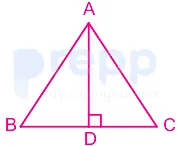
- A
4 cm
- B
6 cm
- C
7 cm
- D
5 cm
Show answer
D. 5 cmBC = 6 cm
BD = ½ × BC = 1/2 × 6 = 3 cm
AD = 4 cm
In right angled triangle
AB 2= AD 2+ BD 2
⇒ AB 2= 4 2+ 3 2= 16 + 9 = 25
⇒ AB = √25 = 5 cm
Paper & answer key PDF ↗ Question 56archived
In the given figure, cosθ is equal to:
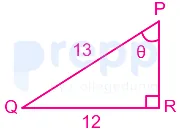
- A
12/5
- B
12/13
- C
5/12
- D
5/13
Show answer
D. 5/13From the following figure
As we know
PQ 2= PR 2+ QR 2
⇒ 13 2= PR 2+ 12 2
⇒ PR 2= 169 – 144
⇒ PR = √25
⇒ PR = 5
Now, cos θ = PR/QP
⇒ cos θ = 5/13
Paper & answer key PDF ↗ Question 57archived
In a school, the distribution of teachers is as follows:
Age (year)
20-25
25-30
30-35
35-40
40-45
45-50
50-55
No. of Teachers
2
3
5
2
6
7
5
The total number of teaches of age less than 40 years is:
- A
10
- B
12
- C
39
- D
18
Show answer
B. 12Understanding the Teacher Age Distribution
The question provides us with data showing how the teachers in a school are distributed across different age groups. This type of data presentation is called a frequency distribution, where we see the frequency (number of teachers) within specific intervals (age ranges).
Analyzing the Given Data
The data is presented in a table format, showing the age ranges and the corresponding number of teachers in each range:
Age (year)
No. of Teachers
20-25
2
25-30
3
30-35
5
35-40
2
40-45
6
45-50
7
50-55
5
Identifying Teachers Less Than 40 Years Old
We are asked to find the total number of teachers whose age is less than 40 years. Looking at the age ranges in the table, the age groups that fall below 40 years are:
20-25 years
25-30 years
30-35 years
35-40 years
It's important to note that the age range 35-40 years includes teachers up to (but not including, typically in such groupings) 40 years old, thus fitting the criteria of "less than 40 years".
Calculating the Total Number of Teachers
To find the total number of teachers less than 40 years old, we need to sum the number of teachers in each of the identified age groups:
Teachers aged 20-25 years: 2
Teachers aged 25-30 years: 3
Teachers aged 30-35 years: 5
Teachers aged 35-40 years: 2
Total number of teachers less than 40 years is the sum of these numbers:
Total teachers < 40 years = (Number of teachers 20-25) + (Number of teachers 25-30) + (Number of teachers 30-35) + (Number of teachers 35-40)
Total teachers < 40 years $= 2 + 3 + 5 + 2$
Total teachers < 40 years $= 12$
Thus, the total number of teachers in the school with an age less than 40 years is 12.
Revision Table: Key Concepts
Concept
Description
Frequency Distribution
A table or graph showing how often each value (or range of values) appears in a dataset. In this case, it shows the frequency of teachers within specific age groups.
Age Group/Class Interval
A specific range of values (like 20-25 years) used to group data in a frequency distribution.
Frequency
The number of times a particular value or range of values occurs in the dataset (e.g., number of teachers in an age group).
Additional Information: Interpreting Frequency Tables
Frequency tables are a basic tool in statistics used to organize and summarize data. They help us quickly see the distribution of data and calculate various measures. When working with frequency tables, especially with class intervals like age groups, pay close attention to the boundaries of the intervals (e.g., does 20-25 include 25?). In this problem, we needed to sum frequencies for all intervals below a certain threshold (40 years).
If the question had asked for teachers aged 40 years or more, we would sum the frequencies for the ranges 40-45, 45-50, and 50-55.
Understanding how to extract information from frequency distribution tables is crucial for data analysis.
Paper & answer key PDF ↗ Question 58archived
The value of 151 2– 149 2is:
- A
400
- B
600
- C
300
- D
2z
Show answer
B. 600Calculating \(151^2 - 149^2\) Using Difference of Squares
The problem asks us to find the value of \(151^2 - 149^2\). This expression is in the form of a difference of squares, which is a common algebraic identity. The identity states that the difference of two squares is equal to the product of the sum and the difference of the bases.
The algebraic identity for the difference of squares is:
\(a^2 - b^2 = (a+b)(a-b)\)
In this problem, we can identify the values of 'a' and 'b':
\(a = 151\)
\(b = 149\)
Now, we can substitute these values into the difference of squares formula:
\(151^2 - 149^2 = (151 + 149)(151 - 149)\)
Let's calculate the terms within the parentheses:
Calculate the sum: \(151 + 149\)
\(151 + 149 = 300\)
Calculate the difference: \(151 - 149\)
\(151 - 149 = 2\)
Now, substitute these results back into the formula:
\(151^2 - 149^2 = (300)(2)\)
Finally, multiply the two results:
\(300 \times 2 = 600\)
Therefore, the value of \(151^2 - 149^2\) is \(600\).
Using the difference of squares formula simplifies this calculation significantly compared to calculating \(151^2\) and \(149^2\) separately and then subtracting.
Revision Table: Steps for Difference of Squares Calculation
Step
Description
Calculation
1
Identify 'a' and 'b' in \(a^2 - b^2\).
\(a = 151\), \(b = 149\)
2
Apply the formula \((a+b)(a-b)\).
\((151 + 149)(151 - 149)\)
3
Calculate the sum \((a+b)\).
\(151 + 149 = 300\)
4
Calculate the difference \((a-b)\).
\(151 - 149 = 2\)
5
Multiply the sum and the difference.
\(300 \times 2 = 600\)
Additional Information on Algebraic Identities
Algebraic identities are equations that are true for all possible values of the variables they contain. The difference of squares is just one example. Knowing these identities can help simplify complex expressions and speed up calculations.
Difference of Squares: \(a^2 - b^2 = (a-b)(a+b)\). Useful for factoring expressions where two perfect squares are subtracted.
Perfect Square Trinomials:
\((a+b)^2 = a^2 + 2ab + b^2\)
\((a-b)^2 = a^2 - 2ab + b^2\)
These are useful for squaring binomials or factoring trinomials that result from squaring a binomial.
Sum/Difference of Cubes:
\(a^3 + b^3 = (a+b)(a^2 - ab + b^2)\)
\(a^3 - b^3 = (a-b)(a^2 + ab + b^2)\)
These identities are used for factoring expressions involving cubes.
Understanding these identities is fundamental in algebra and helpful in various mathematical problem-solving scenarios.
Paper & answer key PDF ↗ Question 59archived
The area of the four walls of a room having length 6 m, breadth 4 m and height 4 m, is:
- A
80 m2
- B
50 m2
- C
40 m2
- D
60 m2
Show answer
A. 80 m2Calculating the Area of the Four Walls of a Room
The problem asks us to find the area of the four walls of a rectangular room given its dimensions: length, breadth, and height. This area is also known as the lateral surface area of a cuboid.
Understanding the Dimensions
We are given the following dimensions for the room:
Length (l) = 6 meters (m)
Breadth (b) = 4 meters (m)
Height (h) = 4 meters (m)
Formula for Area of Four Walls
The four walls of a rectangular room consist of two pairs of identical rectangles:
Two walls with dimensions Length × Height
Two walls with dimensions Breadth × Height
The area of these four walls is the sum of the areas of these four rectangular faces. The formula is:
Area of four walls = 2 × (Area of one Length × Height wall) + 2 × (Area of one Breadth × Height wall)
Area of four walls = 2 × (l × h) + 2 × (b × h)
We can factor out 2h from the expression:
Area of four walls = 2 × (l + b) × h
This formula represents the perimeter of the base (2 × (l + b)) multiplied by the height (h).
Step-by-Step Calculation
Now, let's substitute the given values into the formula:
l = 6 m
b = 4 m
h = 4 m
Area of four walls = $2 \times (l + b) \times h$
Area of four walls = $2 \times (6 \text{ m} + 4 \text{ m}) \times 4 \text{ m}$
First, add the length and breadth:
$6 \text{ m} + 4 \text{ m} = 10 \text{ m}$
Now, substitute this back into the formula:
Area of four walls = $2 \times (10 \text{ m}) \times 4 \text{ m}$
Multiply the values:
Area of four walls = $20 \text{ m} \times 4 \text{ m}$
Area of four walls = $80 \text{ m}^2$
The unit for area is square meters ($m^2$).
Result
The calculated area of the four walls of the room is 80 square meters.
Dimension
Value
Unit
Length (l)
6
m
Breadth (b)
4
m
Height (h)
4
m
Area of four walls
80
m2
Revision Table: Formulas for Cuboids
Measurement
Formula
Area of four walls (Lateral Surface Area)
$2(l+b)h$
Total Surface Area
$2(lb + bh + hl)$
Volume
$l \times b \times h$
Perimeter of base
$2(l+b)$
Additional Information: Surface Area Concepts
When dealing with rectangular rooms or cuboids, understanding different types of surface area is important:
Lateral Surface Area: This is the area of the four vertical faces (the walls). It excludes the top (ceiling) and bottom (floor). The question specifically asks for this.
Total Surface Area: This is the sum of the areas of all six faces of the cuboid (four walls, ceiling, and floor). The formula is $2(lb + bh + hl)$, where $lb$ is the area of the base/top, $bh$ is the area of the side walls, and $hl$ is the area of the front/back walls.
In this problem, we focused only on the lateral surface area, which is the area of the four walls.
Paper & answer key PDF ↗ Question 60archived
Two cars A and B leave from Delhi at 8:30 a.m. and at 9 a.m. to Shimla, respectively. They travel at speeds of 40km/h and 50 km/h respectively. How many kilometres away from Delhi will the two cars be together?
- A
200 km
- B
45 km
- C
5 km
- D
100 km
Show answer
D. 100 kmCalculating the Meeting Point of Two Cars from Delhi to Shimla
This problem involves two cars starting their journey from Delhi towards Shimla at different times and with different speeds. We need to find the distance from Delhi where the faster car catches up to the slower car.
Understanding the Problem Setup
Car A leaves Delhi at 8:30 a.m. at a speed of 40 km/h.
Car B leaves Delhi at 9:00 a.m. at a speed of 50 km/h.
Both cars are traveling in the same direction (from Delhi to Shimla).
Step-by-Step Solution to Find the Meeting Distance
Step 1: Calculate the Head Start of Car A
Car A starts earlier than Car B. The time difference in their start times is:
Time difference = 9:00 a.m. - 8:30 a.m. = 30 minutes.
Converting the time difference to hours:
30 minutes = $\frac{30}{60}$ hours = 0.5 hours.
In this 0.5 hours, Car A travels a certain distance before Car B even starts. This is Car A's head start distance.
Head start distance of Car A = Speed of Car A $\times$ Time A traveled alone
Head start distance = $40 \, \text{km/h} \times 0.5 \, \text{h} = 20 \, \text{km}$.
So, when Car B starts from Delhi, Car A is already 20 km away from Delhi.
Step 2: Determine the Relative Speed
Both cars are moving in the same direction. The relative speed at which Car B gains on Car A is the difference between their speeds.
Relative Speed = Speed of Car B - Speed of Car A
Relative Speed = $50 \, \text{km/h} - 40 \, \text{km/h} = 10 \, \text{km/h}$.
This means Car B reduces the gap between itself and Car A by 10 km every hour.
Step 3: Calculate the Time Taken for Car B to Catch Up
Car B needs to cover the head start distance of 20 km at the relative speed of 10 km/h to catch up with Car A.
Time to catch up = Head start distance / Relative Speed
Time to catch up = $\frac{20 \, \text{km}}{10 \, \text{km/h}} = 2 \, \text{hours}$.
This means Car B will take 2 hours to catch up to Car A after Car B starts at 9:00 a.m.
Step 4: Calculate the Distance from Delhi Where They Meet
The meeting point distance can be calculated using either Car A's total distance or Car B's total distance from Delhi until they meet. Using Car B's distance is simpler as we know the time Car B traveled (2 hours) until they meet.
Distance from Delhi = Speed of Car B $\times$ Time Car B traveled until meeting
Distance from Delhi = $50 \, \text{km/h} \times 2 \, \text{h} = 100 \, \text{km}$.
Alternatively, using Car A: Car A traveled for 0.5 hours (head start) + 2 hours (until meeting) = 2.5 hours.
Distance from Delhi = Speed of Car A $\times$ Total Time Car A traveled
Distance from Delhi = $40 \, \text{km/h} \times 2.5 \, \text{h} = 100 \, \text{km}$.
Both calculations confirm that the two cars will be together 100 km away from Delhi.
The two cars will be together 100 km away from Delhi.
Detail
Car A
Car B
Start Time from Delhi
8:30 a.m.
9:00 a.m.
Speed
40 km/h
50 km/h
Time difference in start
30 minutes (0.5 hours)
Head start distance (by A)
20 km ($40 \times 0.5$)
Relative speed (B gaining on A)
10 km/h ($50 - 40$)
Time for B to catch up
2 hours ($\frac{20}{10}$) from 9:00 a.m.
Meeting Time
9:00 a.m. + 2 hours = 11:00 a.m.
Distance from Delhi at meeting
100 km ($50 \times 2$ or $40 \times 2.5$)
Revision Table: Key Concepts in Motion Problems
Concept
Description
Formula
Distance, Speed, Time Relation
Relates how far an object travels based on its speed and duration of travel.
Distance = Speed $\times$ Time
Relative Speed (Same Direction)
The speed at which the distance between two objects moving in the same direction changes. Used when one object is catching up to another.
Relative Speed = Speed of faster object - Speed of slower object
Catch-up Time
The time taken for a faster object to cover the initial distance gap between it and a slower object moving in the same direction.
Time to catch up = Initial distance gap / Relative Speed
Additional Information: Solving Catch-up Problems
Catch-up problems are common in speed, distance, and time calculations. The key is often to figure out the initial distance between the objects when the faster object starts its journey and then use the concept of relative speed.
Always ensure units are consistent (e.g., if speed is in km/h, time should be in hours).
Identify which object is faster and which is slower.
Calculate any head start distance if objects start at different times.
Use relative speed for finding the time it takes for the distance between them to change.
Once the time is found, calculate the distance traveled by either object from the starting point up to the meeting point.
Understanding the relationship $D = S \times T$ and the concept of relative speed in different scenarios (same direction vs. opposite direction) is fundamental for solving such motion problems.
Paper & answer key PDF ↗ Question 61archived
What is the value of sin 30° + cos30° – tan45°?
- A
\(\frac{{\sqrt 3 - 1}}{2}\)
- B
\(\frac{{\sqrt 3 \; + \;1}}{2}\)
- C
\(\frac{{\sqrt 2 \; + \;1}}{{\sqrt 2 }}\)
- D
\(\frac{{1 - \sqrt 3 }}{2}\)
Show answer
A. \(\frac{{\sqrt 3 - 1}}{2}\)Calculate the Value of sin 30° + cos 30° – tan 45°
This question asks us to find the value of a mathematical expression involving trigonometric functions of special angles: $\sin 30^\circ$, $\cos 30^\circ$, and $\tan 45^\circ$. To solve this, we need to know the standard trigonometric values for these common angles.
The values of the trigonometric functions for these special angles are:
$\sin 30^\circ = \frac{1}{2}$
$\cos 30^\circ = \frac{\sqrt{3}}{2}$
$\tan 45^\circ = 1$
Now, we can substitute these values into the given expression:
Expression = $\sin 30^\circ + \cos 30^\circ - \tan 45^\circ$
Substitute the values:
Expression = $\frac{1}{2} + \frac{\sqrt{3}}{2} - 1$
Now, we need to simplify this expression. We can combine the terms with the common denominator:
Expression = $\frac{1 + \sqrt{3}}{2} - 1$
To subtract 1, we can write 1 as $\frac{2}{2}$:
Expression = $\frac{1 + \sqrt{3}}{2} - \frac{2}{2}$
Now, combine the numerators over the common denominator:
Expression = $\frac{(1 + \sqrt{3}) - 2}{2}$
Expression = $\frac{1 + \sqrt{3} - 2}{2}$
Expression = $\frac{\sqrt{3} - 1}{2}$
This simplified value is the result of the expression $\sin 30^\circ + \cos 30^\circ - \tan 45^\circ$.
Comparing with Options
Let's compare our calculated value with the given options:
$\frac{{\sqrt 3 - 1}}{2}$
$\frac{{\sqrt 3 \; + \;1}}{2}$
$\frac{{\sqrt 2 \; + \;1}}{{\sqrt 2 }}$
$\frac{{1 - \sqrt 3 }}{2}$
Our calculated value, $\frac{\sqrt{3} - 1}{2}$, matches Option 1.
Trigonometric Function
Angle
Value
$\sin$
$30^\circ$
$\frac{1}{2}$
$\cos$
$30^\circ$
$\frac{\sqrt{3}}{2}$
$\tan$
$45^\circ$
$1$
Revision Table: Common Trigonometric Values
Angle (Degrees)
Angle (Radians)
$\sin \theta$
$\cos \theta$
$\tan \theta$
$0^\circ$
$0$
$0$
$1$
$0$
$30^\circ$
$\frac{\pi}{6}$
$\frac{1}{2}$
$\frac{\sqrt{3}}{2}$
$\frac{1}{\sqrt{3}}$
$45^\circ$
$\frac{\pi}{4}$
$\frac{1}{\sqrt{2}}$ or $\frac{\sqrt{2}}{2}$
$\frac{1}{\sqrt{2}}$ or $\frac{\sqrt{2}}{2}$
$1$
$60^\circ$
$\frac{\pi}{3}$
$\frac{\sqrt{3}}{2}$
$\frac{1}{2}$
$\sqrt{3}$
$90^\circ$
$\frac{\pi}{2}$
$1$
$0$
Undefined
Additional Information on Special Angle Trigonometry
The angles $30^\circ$, $45^\circ$, and $60^\circ$ are called special angles because their trigonometric function values can be determined exactly using simple geometry, specifically 30-60-90 and 45-45-90 right triangles, or the unit circle. Knowing these values is fundamental for solving many trigonometry problems without a calculator.
The definitions of the basic trigonometric functions in a right triangle are:
$\sin \theta = \frac{\text{Opposite side}}{\text{Hypotenuse}}$
$\cos \theta = \frac{\text{Adjacent side}}{\text{Hypotenuse}}$
$\tan \theta = \frac{\text{Opposite side}}{\text{Adjacent side}}$
Alternatively, using the unit circle (a circle with radius 1 centered at the origin), for an angle $\theta$ measured counterclockwise from the positive x-axis, the coordinates of the point where the terminal side of the angle intersects the circle are $(\cos \theta, \sin \theta)$. The tangent is then $\tan \theta = \frac{\sin \theta}{\cos \theta}$ (provided $\cos \theta \neq 0$). These definitions provide a way to understand trigonometric values for any angle, not just acute angles in right triangles.
Paper & answer key PDF ↗ Question 62archived
The coefficient of y in the expansion of (2y – 5) 3, is:
- A
-150
- B
50
- C
150
- D
-30
Show answer
C. 150Understanding Binomial Expansion and Coefficients
The question asks us to find the coefficient of the term containing 'y' in the expansion of the expression (2y – 5)3. This involves using the binomial theorem to expand the given expression.
Applying the Binomial Theorem
The binomial theorem provides a formula for expanding expressions of the form (a + b)n. The general formula is:
$\qquad (a+b)^n = \sum_{k=0}^{n} \binom{n}{k} a^{n-k} b^k$
where $\binom{n}{k} = \frac{n!}{k!(n-k)!}$ is the binomial coefficient.
In our expression, (2y – 5)3, we can identify:
$a = 2y$
$b = -5$
$n = 3$
We need to find the term in the expansion where the power of 'y' is 1 (since we are looking for the coefficient of 'y'). In the general term $\binom{n}{k} a^{n-k} b^k$, the power of 'a' is $(n-k)$. Since $a = 2y$, the power of 'y' is also $(n-k)$. We want $(n-k) = 1$, and we know $n=3$, so $3-k = 1$, which means $k=2$.
Let's calculate the terms for $k=0, 1, 2, 3$ to see the full expansion and confirm the 'y' term.
Step-by-Step Expansion of (2y – 5)3
For k = 0:
Term $= \binom{3}{0} (2y)^{3-0} (-5)^0 = \binom{3}{0} (2y)^3 (-5)^0$
$\qquad = 1 \cdot (8y^3) \cdot 1 = 8y^3$
For k = 1:
Term $= \binom{3}{1} (2y)^{3-1} (-5)^1 = \binom{3}{1} (2y)^2 (-5)^1$
$\qquad = 3 \cdot (4y^2) \cdot (-5) = -60y^2$
For k = 2:
Term $= \binom{3}{2} (2y)^{3-2} (-5)^2 = \binom{3}{2} (2y)^1 (-5)^2$
$\qquad = 3 \cdot (2y) \cdot (25) = 150y$
For k = 3:
Term $= \binom{3}{3} (2y)^{3-3} (-5)^3 = \binom{3}{3} (2y)^0 (-5)^3$
$\qquad = 1 \cdot (1) \cdot (-125) = -125$
So, the full expansion of (2y – 5)3 is $8y^3 - 60y^2 + 150y - 125$.
Identifying the Coefficient of y
We are looking for the coefficient of the term containing 'y'. From the expansion, the term with 'y' is $150y$. The coefficient of 'y' in this term is 150.
Therefore, the coefficient of y in the expansion of (2y – 5)3 is 150.
Term (k)
Binomial Coefficient $\binom{3}{k}$
$(2y)^{3-k}$
$(-5)^k$
Term
0
$\binom{3}{0} = 1$
$(2y)^3 = 8y^3$
$(-5)^0 = 1$
$1 \cdot 8y^3 \cdot 1 = 8y^3$
1
$\binom{3}{1} = 3$
$(2y)^2 = 4y^2$
$(-5)^1 = -5$
$3 \cdot 4y^2 \cdot (-5) = -60y^2$
2
$\binom{3}{2} = 3$
$(2y)^1 = 2y$
$(-5)^2 = 25$
$3 \cdot 2y \cdot 25 = 150y$
3
$\binom{3}{3} = 1$
$(2y)^0 = 1$
$(-5)^3 = -125$
$1 \cdot 1 \cdot (-125) = -125$
The term with 'y' is $150y$, so the coefficient is 150.
Revision Table: Binomial Expansion Concepts
Concept
Description
Formula/Example
Binomial Expression
An algebraic expression with two terms.
a + b, 2y - 5
Binomial Expansion
The process of expanding a power of a binomial expression.
$(a+b)^n$
Binomial Theorem
Gives the formula for binomial expansion.
$(a+b)^n = \sum_{k=0}^{n} \binom{n}{k} a^{n-k} b^k$
Coefficient
A numerical or constant quantity placed before and multiplying the variable in an algebraic expression.
In $150y$, 150 is the coefficient of y.
Additional Information: Pascal's Triangle
For small powers like n=3, the binomial coefficients $\binom{n}{k}$ can also be found using Pascal's Triangle. The rows of Pascal's Triangle give the binomial coefficients for increasing powers of n.
Row 0 (n=0): 1
Row 1 (n=1): 1, 1
Row 2 (n=2): 1, 2, 1
Row 3 (n=3): 1, 3, 3, 1
For (a+b)3, the coefficients are 1, 3, 3, 1. So the expansion is:
$\qquad 1 \cdot a^3 b^0 + 3 \cdot a^2 b^1 + 3 \cdot a^1 b^2 + 1 \cdot a^0 b^3$
Substituting $a=2y$ and $b=-5$:
$\qquad 1 \cdot (2y)^3 (-5)^0 + 3 \cdot (2y)^2 (-5)^1 + 3 \cdot (2y)^1 (-5)^2 + 1 \cdot (2y)^0 (-5)^3$
$\qquad = 1 \cdot 8y^3 \cdot 1 + 3 \cdot 4y^2 \cdot (-5) + 3 \cdot 2y \cdot 25 + 1 \cdot 1 \cdot (-125)$
$\qquad = 8y^3 - 60y^2 + 150y - 125$
This confirms the term $150y$, and its coefficient is 150.
Paper & answer key PDF ↗ Question 63archived
The value of 3 – (9 – 3 × 8 ÷ 2) is:
- A
6
- B
-21
- C
21/2
- D
0
Show answer
A. 6Understanding Order of Operations in Math
This question requires us to evaluate a mathematical expression involving subtraction, multiplication, and division. To correctly solve such expressions, we must follow the standard order of operations, often remembered by acronyms like BODMAS or PEMDAS.
What is BODMAS/PEMDAS?
BODMAS and PEMDAS are rules that dictate the sequence in which mathematical operations should be performed:
Brackets (or Parentheses)
Orders (powers, square roots, etc.) (or Exponents)
Division and Multiplication (from left to right)
Addition and Subtraction (from left to right)
In the given expression, we have brackets, subtraction, multiplication, and division. We will address these operations following the BODMAS/PEMDAS rule.
Step-by-Step Evaluation of the Expression
The expression to evaluate is:
\(3 - (9 - 3 \times 8 \div 2)\)
Step 1: Evaluate the expression inside the brackets.
Inside the brackets, we have \(9 - 3 \times 8 \div 2\).
Following BODMAS/PEMDAS within the brackets, we first perform Multiplication and Division from left to right.
Perform the multiplication: \(3 \times 8 = 24\)
The expression inside the brackets becomes: \(9 - 24 \div 2\)
Now, perform the division: \(24 \div 2 = 12\)
The expression inside the brackets becomes: \(9 - 12\)
Finally, perform the subtraction inside the brackets: \(9 - 12 = -3\)
So, the value inside the brackets is \(-3\).
Step 2: Substitute the value back into the original expression.
The original expression \(3 - (9 - 3 \times 8 \div 2)\) now becomes:
\(3 - (-3)\)
Step 3: Perform the final subtraction.
Subtracting a negative number is the same as adding the positive number:
\(3 - (-3) = 3 + 3 = 6\)
The value of the expression \(3 - (9 - 3 \times 8 \div 2)\) is \(6\).
Comparing with the Options
Let's check our result against the given options:
Option
Value
Matches Result?
1
6
Yes
2
-21
No
3
21/2
No
4
0
No
The calculated value, \(6\), matches Option 1.
Conclusion on Evaluating the Expression
By carefully applying the order of operations (BODMAS/PEMDAS), we evaluated the expression step by step, first simplifying the part within the brackets and then performing the final subtraction. This systematic approach ensures the correct result.
Revision Table: Order of Operations
Order
Operation Type
Rule / Mnemonic
1st
Brackets / Parentheses
Solve operations inside brackets first.
2nd
Orders / Exponents
Evaluate powers, roots, etc.
3rd
Division and Multiplication
Perform from left to right.
4th
Addition and Subtraction
Perform from left to right.
Additional Information: Mastering Mathematical Expressions
Understanding the order of operations is fundamental in mathematics. Misapplying the order can lead to incorrect results. Let's look at common pitfalls and tips:
Left-to-Right for Division/Multiplication and Addition/Subtraction: Remember that for operations at the same level (like multiplication and division, or addition and subtraction), you work from left to right across the expression.
Importance of Brackets: Brackets group terms and override the standard order of operations for the terms inside them. Always evaluate the innermost brackets first if there are nested brackets.
Practice: The best way to master the order of operations is through practice. Solve various problems with different combinations of operations and brackets.
For example, if we did not follow the order of operations in the brackets \(9 - 3 \times 8 \div 2\) and instead performed subtraction first: \(9 - 3 = 6\), then \(6 \times 8 = 48\), then \(48 \div 2 = 24\). This would give \(3 - 24 = -21\), which is incorrect and corresponds to one of the wrong options. This highlights why following the correct order is crucial for accurate mathematical calculations.
Paper & answer key PDF ↗ Question 64archived
In a particular year, the number of students enrolled in different streams in a college is as follows:
Science
Arts
Commerce
Vocational
Boys
Girls
Boys
Girls
Boys
Girls
Boys
Girls
32
18
28
45
42
42
13
30
The percentage of girl students is:
- A
135%
- B
46%
- C
50%
- D
54%
Show answer
D. 54%Calculating Percentage of Girl Students in College Streams
The question asks us to find the percentage of girl students out of the total number of students enrolled across different streams in a college. We are given the number of boys and girls for each stream: Science, Arts, Commerce, and Vocational.
Understanding the Data
The enrollment data is provided as follows:
Stream
Boys
Girls
Science
32
18
Arts
28
45
Commerce
42
42
Vocational
13
30
Step-by-Step Calculation
To find the percentage of girl students, we first need to calculate the total number of girl students and the total number of all students.
Calculate the total number of girl students:
Sum the number of girls from each stream.
Total Girls = Girls in Science + Girls in Arts + Girls in Commerce + Girls in Vocational
Total Girls = $18 + 45 + 42 + 30$
Total Girls = $135$ students
Calculate the total number of boy students:
Sum the number of boys from each stream.
Total Boys = Boys in Science + Boys in Arts + Boys in Commerce + Boys in Vocational
Total Boys = $32 + 28 + 42 + 13$
Total Boys = $115$ students
Calculate the total number of students:
Sum the total number of boys and total number of girls.
Total Students = Total Boys + Total Girls
Total Students = $115 + 135$
Total Students = $250$ students
Calculate the percentage of girl students:
The percentage of girl students is calculated using the formula:
Percentage of Girls $= \left( \frac{\text{Total Girl Students}}{\text{Total Students}} \right) \times 100\%$
Percentage of Girls $= \left( \frac{135}{250} \right) \times 100\%$
Percentage of Girls $= 0.54 \times 100\%$
Percentage of Girls $= 54\%$
Therefore, the percentage of girl students enrolled in the college in that particular year is 54%.
Revision Table: College Enrollment Data
Category
Number of Students
Total Girl Students
135
Total Boy Students
115
Total Students
250
Additional Information: Calculating Percentages
A percentage is a number or ratio expressed as a fraction of 100. It is often denoted using the percent sign, "%". To calculate the percentage of a part out of a whole, you use the following formula:
Percentage $= \left( \frac{\text{Part}}{\text{Whole}} \right) \times 100\%$
In this problem, the "Part" is the total number of girl students, and the "Whole" is the total number of all students. Percentages are useful for comparing proportions or understanding relative amounts within a dataset, like student enrollments in different streams.
Paper & answer key PDF ↗ Question 65archived
In the figure, if ∠A = 100° then ∠C = ?
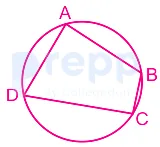
- A
100°
- B
80°
- C
50°
- D
90°
Show answer
B. 80°Given:
∠A = 100°
Concept Used:
The sum of the opposite angles of a cyclic quadrilateral is 180°.
The sum of interior angles of a triangle is 180°.
Calculation:
∠A = 100
As we know,
∠A + ∠C = 180 [opposite angles of cyclic quadrilateral]
⇒ 100 + ∠C = 180
⇒ ∠C = 180 – 100 = 80
∴ ∠C is 80°
Paper & answer key PDF ↗ Question 66archived
In an examination, Anita scored 31% marks and failed by 16 marks. Sunita scored 40% marks and obtained 56 marks more than those required to pass. Find the minimum marks required to pass.
- A
394
- B
410
- C
264
- D
311
Show answer
C. 264Calculating Minimum Passing Marks in an Exam
This problem involves finding the minimum marks required to pass an examination based on the scores and performance of two students, Anita and Sunita.
Let's define the key variables:
Let the total marks for the examination be \(T\).
Let the minimum marks required to pass the examination be \(P\).
Analyzing the Students' Scores
We are given information about how Anita and Sunita performed relative to the passing marks:
Anita: Scored 31% of the total marks and failed by 16 marks. This means her score was 16 marks less than the passing marks \(P\).
Sunita: Scored 40% of the total marks and obtained 56 marks more than the passing marks \(P\).
Setting up Equations Based on Exam Scores
We can translate the information about each student's score into mathematical equations:
Anita's score is \(31\%\) of \(T\), which is \(0.31T\). Since she failed by 16 marks, the passing marks \(P\) must be 16 marks more than her score.
Equation 1: \(P = 0.31T + 16\)
Sunita's score is \(40\%\) of \(T\), which is \(0.40T\). Since she scored 56 marks more than the passing marks, her score is equal to \(P + 56\).
Equation 2: \(0.40T = P + 56\), which can be rearranged to \(P = 0.40T - 56\)
We now have two equations for the minimum passing marks \(P\). Since \(P\) is the same value in both cases, we can set the two expressions for \(P\) equal to each other.
\(0.31T + 16 = 0.40T - 56\)
Solving for the Total Marks (T)
Now, let's solve this equation to find the total marks \(T\) of the examination:
Gather the terms with \(T\) on one side and constant terms on the other side.
\(16 + 56 = 0.40T - 0.31T\)
Perform the addition and subtraction.
\(72 = 0.09T\)
To find \(T\), divide 72 by 0.09.
\(T = \frac{72}{0.09}\)
\(T = \frac{7200}{9}\)
\(T = 800\)
So, the total marks for the examination are 800.
Calculating the Minimum Passing Marks (P)
Now that we know the total marks \(T = 800\), we can use either Equation 1 or Equation 2 to find the minimum passing marks \(P\).
Using Equation 1:
\(P = 0.31T + 16\)
\(P = 0.31 \times 800 + 16\)
\(P = 248 + 16\)
\(P = 264\)
Using Equation 2 (to verify):
\(P = 0.40T - 56\)
\(P = 0.40 \times 800 - 56\)
\(P = 320 - 56\)
\(P = 264\)
Both equations give the same result. The minimum marks required to pass the examination is 264.
Student
Percentage Scored
Relation to Passing Marks (P)
Score in terms of T and P
Anita
31%
Failed by 16 marks
\(0.31T = P - 16 \implies P = 0.31T + 16\)
Sunita
40%
56 marks more than pass
\(0.40T = P + 56 \implies P = 0.40T - 56\)
The steps to solve the problem were:
Define variables for total marks and passing marks.
Write equations for passing marks based on each student's score and performance relative to the pass mark.
Equate the expressions for passing marks to form a single equation with total marks as the unknown.
Solve the equation to find the total marks.
Substitute the total marks back into one of the original equations to find the minimum passing marks.
Revision Table: Exam Passing Marks
Here's a summary of the key values calculated:
Parameter
Value
Total Marks (\(T\))
800
Anita's Score (31% of 800)
248
Sunita's Score (40% of 800)
320
Minimum Passing Marks (\(P\))
264
Anita's deficit (\(P - 248\))
\(264 - 248 = 16\) (Matches problem statement)
Sunita's excess (\(320 - P\))
\(320 - 264 = 56\) (Matches problem statement)
Additional Information: Percentage and Marks Problems
Problems involving percentages in examinations are common in quantitative aptitude tests. They often require you to:
Convert percentages to decimals or fractions for calculations.
Set up linear equations based on the given information.
Solve simultaneous equations if multiple variables are involved (though in this case, substituting one equation into another was sufficient).
Carefully read whether a student failed *by* a certain number of marks (score is less than pass mark) or passed *by* or obtained *more than* a certain number of marks (score is more than pass mark).
Always double-check your calculated passing marks against the original problem statement conditions for both students to ensure accuracy.
Understanding how percentages relate to actual marks and setting up the correct equations are crucial steps in solving such problems effectively.
Paper & answer key PDF ↗ Question 67archived
By selling 18 tables fans for Rs. 11,664 a man incurs a loss of 10% How many fans should he sell for Rs. 17,424 to earn 10% profit?
- A
20
- B
18
- C
22
- D
23
Show answer
C. 22Understanding Profit and Loss on Table Fans
This problem involves calculating the cost price of table fans based on a given selling price and loss percentage, and then determining how many fans need to be sold at a different price to achieve a specific profit percentage on the total sale amount. We will first find the price of one table fan and then use the profit/loss information.
Step-by-Step Calculation for Table Fans
Let's break down the problem into smaller steps:
Calculate the selling price (SP) of one table fan when 18 fans were sold for Rs. 11,664.
Use the selling price and the given loss percentage (10%) to find the cost price (CP) of one table fan.
Calculate the desired selling price (SP') of one table fan to earn a 10% profit.
Determine the number of table fans that must be sold at the new selling price (SP') to reach the target amount of Rs. 17,424.
Calculating the Initial Selling Price per Table Fan
The total selling price for 18 table fans is Rs. 11,664.
Selling Price of 1 table fan = $\frac{\text{Total Selling Price}}{\text{Number of Fans Sold}}$
Selling Price of 1 table fan = $\frac{11664}{18}$ Rs.
Let's perform the division:
$\frac{11664}{18} = 648$
So, the selling price of one table fan was Rs. 648.
Finding the Cost Price per Table Fan
When the man sold the table fans at Rs. 648 each, he incurred a loss of 10%. This means the selling price is 10% less than the cost price. In other words, the selling price is 90% of the cost price.
We can write this relationship as:
SP = CP - 10% of CP
SP = CP - $\frac{10}{100} \times$ CP
SP = CP $(1 - 0.10)$
SP = 0.90 $\times$ CP
We know SP = Rs. 648. So, we can find the CP:
648 = 0.90 $\times$ CP
CP = $\frac{648}{0.90} = \frac{648}{\frac{90}{100}} = \frac{648 \times 100}{90}$
CP = $\frac{6480}{9}$
CP = 720
The cost price of one table fan is Rs. 720.
Calculating the Desired Selling Price for 10% Profit
Now, the man wants to earn a 10% profit on the sale of table fans. The profit is calculated on the cost price. To earn a 10% profit, the new selling price (SP') should be 10% more than the cost price.
SP' = CP + 10% of CP
SP' = CP + $\frac{10}{100} \times$ CP
SP' = CP $(1 + 0.10)$
SP' = 1.10 $\times$ CP
We know CP = Rs. 720. So, the desired SP' is:
SP' = 1.10 $\times$ 720
SP' = 792
To earn a 10% profit, each table fan must be sold for Rs. 792.
Determining the Number of Fans for the Target Amount
The man wants to sell table fans for a total amount of Rs. 17,424, and each fan must be sold at the new price of Rs. 792 to achieve a 10% profit.
Number of fans to sell = $\frac{\text{Target Amount}}{\text{New Selling Price per Fan}}$
Number of fans to sell = $\frac{17424}{792}$
Let's perform the division:
$\frac{17424}{792}$
We can simplify this division. Notice that 792 is roughly 800. 17424 is roughly 17600 (22 * 800). Let's divide 17424 by 792:
17424 ÷ 792 = 22
So, the man should sell 22 table fans for Rs. 17,424 to earn a 10% profit.
Here is a summary of the prices:
Item
Value (Rs.)
Notes
Initial Total SP (18 fans)
11,664
Given
Initial SP per fan
648
11664 / 18
Loss Percentage
10%
Given
Cost Price per fan
720
Calculated from SP and Loss
Desired Profit Percentage
10%
Given
Desired SP per fan
792
Calculated from CP and Profit
Target Total SP
17,424
Given
Number of Fans for Target SP
22
17424 / 792
Conclusion
To earn a 10% profit by selling table fans for a total of Rs. 17,424, the man needs to sell 22 table fans.
Revision Table: Profit and Loss Concepts
Concept
Formula
Description
Selling Price (SP)
-
The price at which an article is sold.
Cost Price (CP)
-
The price at which an article is bought.
Profit
SP - CP (if SP > CP)
Gain made when SP is more than CP.
Loss
CP - SP (if CP > SP)
Amount lost when SP is less than CP.
Profit Percentage
$\frac{\text{Profit}}{\text{CP}} \times 100\%$
Profit expressed as a percentage of CP.
Loss Percentage
$\frac{\text{Loss}}{\text{CP}} \times 100\%$
Loss expressed as a percentage of CP.
SP with Profit
CP $\times (1 + \frac{\text{Profit %}}{100})$
Selling Price when there is a profit.
SP with Loss
CP $\times (1 - \frac{\text{Loss %}}{100})$
Selling Price when there is a loss.
Additional Information on Profit and Loss Calculations
Profit and loss are fundamental concepts in commercial mathematics. They help us understand the financial outcome of buying and selling goods.
The terms 'profit' and 'loss' are always calculated with respect to the cost price unless stated otherwise.
A 10% loss means the selling price is 90% of the cost price. This can be written as SP = CP $\times$ (100 - 10)/100 = CP $\times$ 90/100 = 0.90 $\times$ CP.
A 10% profit means the selling price is 110% of the cost price. This can be written as SP' = CP $\times$ (100 + 10)/100 = CP $\times$ 110/100 = 1.10 $\times$ CP.
These percentages are crucial for quickly relating the selling price and cost price when a percentage profit or loss is known.
Understanding how to calculate the unit price from a bulk price is the first step in solving many such problems.
Once the cost price of a single item is known, it becomes easy to calculate the required selling price for any desired profit margin.
Finally, dividing the total target revenue by the required selling price per item gives the number of items that need to be sold.
Paper & answer key PDF ↗ Question 68archived
Ten men or twelve women can finish the same work in 10 days. If 5 men and 2 women undertake the work together, how many days will they take to complete the work?
- A
20
- B
15
- C
40
- D
60
Show answer
B. 15Solving Work and Time Problems: Men and Women Working Together
This question involves a classic work and time scenario where we need to figure out how long a specific group of workers will take to complete a task, given the time taken by different groups of men and women individually.
The key information is:
10 men can finish the work in 10 days.
12 women can finish the same work in 10 days.
We need to find the time taken by 5 men and 2 women working together.
Determining Individual Work Rates
First, let's determine the amount of work done by one man and one woman in a single day.
If 10 men complete the work in 10 days, the total work done by 10 men over 10 days represents the total task. We can consider the total work as 1 unit.
Work done by 10 men in 1 day = \( \frac{1}{10} \) of the total work.
Work done by 1 man in 1 day = \( \frac{1}{10 \times 10} = \frac{1}{100} \) of the total work.
Similarly, for women:
If 12 women complete the work in 10 days,
Work done by 12 women in 1 day = \( \frac{1}{10} \) of the total work.
Work done by 1 woman in 1 day = \( \frac{1}{12 \times 10} = \frac{1}{120} \) of the total work.
This means a man is slightly more efficient than a woman in this scenario, as \( \frac{1}{100} > \frac{1}{120} \).
Calculating Combined Work Rate
Now, let's calculate the work done per day by the new group consisting of 5 men and 2 women.
Work done by 5 men in 1 day = \( 5 \times \) (Work done by 1 man in 1 day) = \( 5 \times \frac{1}{100} = \frac{5}{100} = \frac{1}{20} \) of the total work.
Work done by 2 women in 1 day = \( 2 \times \) (Work done by 1 woman in 1 day) = \( 2 \times \frac{1}{120} = \frac{2}{120} = \frac{1}{60} \) of the total work.
The combined work done by 5 men and 2 women in 1 day is the sum of their individual daily contributions:
\( \text{Combined daily work} = \text{(Work by 5 men in 1 day)} + \text{(Work by 2 women in 1 day)} \)
\( \text{Combined daily work} = \frac{1}{20} + \frac{1}{60} \)
To add these fractions, we find a common denominator, which is 60.
\( \frac{1}{20} = \frac{1 \times 3}{20 \times 3} = \frac{3}{60} \)
\( \text{Combined daily work} = \frac{3}{60} + \frac{1}{60} = \frac{3 + 1}{60} = \frac{4}{60} \)
Simplifying the fraction:
\( \text{Combined daily work} = \frac{4}{60} = \frac{1}{15} \)
So, 5 men and 2 women together complete \( \frac{1}{15} \) of the total work in one day.
Calculating Total Time Taken
If the group completes \( \frac{1}{15} \) of the work in 1 day, the total number of days to complete the entire work (which is 1 unit) is the reciprocal of the daily work rate.
\( \text{Total days} = \frac{\text{Total Work}}{\text{Combined daily work}} \)
\( \text{Total days} = \frac{1}{\frac{1}{15}} = 1 \times \frac{15}{1} = 15 \)
Therefore, 5 men and 2 women working together will take 15 days to complete the work.
Alternatively, we can find the relationship between men and women's work efficiency first.
10 men's work in 1 day = \( \frac{1}{10} \) of work.
12 women's work in 1 day = \( \frac{1}{10} \) of work.
This means 10 men's 1-day work = 12 women's 1-day work.
So, 10 men are equivalent to 12 women in terms of daily work rate.
We can convert everyone into 'woman-equivalents'.
5 men = \( 5 \times \frac{12}{10} \) women = \( 5 \times \frac{6}{5} \) women = 6 women.
So, the group of 5 men and 2 women is equivalent to \( 6 + 2 = 8 \) women.
We know 12 women finish the work in 10 days.
Let \(D\) be the number of days 8 women take.
Since the number of workers and the time taken are inversely proportional (more workers, less time), we have:
\( 12 \times 10 = 8 \times D \)
\( 120 = 8D \)
\( D = \frac{120}{8} = 15 \) days.
Both methods give the same result.
Summary of the Solution
Group
Time to complete work
Daily Work Rate
1 man
100 days (if working alone)
\( \frac{1}{100} \)
1 woman
120 days (if working alone)
\( \frac{1}{120} \)
5 men
-
\( 5 \times \frac{1}{100} = \frac{1}{20} \)
2 women
-
\( 2 \times \frac{1}{120} = \frac{1}{60} \)
5 men + 2 women
?
\( \frac{1}{20} + \frac{1}{60} = \frac{4}{60} = \frac{1}{15} \)
Since the combined daily work rate is \( \frac{1}{15} \), the time taken to complete the whole work is the reciprocal, which is 15 days.
Revision Table: Work and Time Concepts
Concept
Explanation
Formula
Work Rate
The amount of work done per unit of time (e.g., per day).
Work Rate = \( \frac{\text{Total Work}}{\text{Time Taken}} \)
Total Work
The entire task to be completed. Often considered as 1 unit.
Total Work = Work Rate \( \times \) Time Taken
Time Taken
The duration required to complete the total work.
Time Taken = \( \frac{\text{Total Work}}{\text{Work Rate}} \)
Combined Work Rate
The sum of individual work rates when multiple workers work together.
Rcombined = R1 + R2 + ...
Inverse Proportion
If the number of workers increases, the time taken to complete the work decreases (assuming constant work rate per worker).
\( \text{Worker}_1 \times \text{Time}_1 = \text{Worker}_2 \times \text{Time}_2 \) (if work is same)
Additional Information on Work and Time Problems
Work and time problems often rely on the concept of converting the total work into units based on the given information. Here are some important points:
Efficiency: The work rate of a person or machine is often referred to as their efficiency. Higher efficiency means more work done in less time.
LCM Method: For problems involving time taken by individuals to complete a task, you can assume the total work to be the Least Common Multiple (LCM) of the times taken. This often simplifies calculating daily work rates as integers. For example, if A takes 10 days and B takes 12 days, total work could be LCM(10, 12) = 60 units. A's daily work = 60/10 = 6 units/day, B's daily work = 60/12 = 5 units/day.
Men-Days/Women-Days: Total work can also be expressed in terms of "man-days" or "woman-days" (or any combination of worker and time). This is useful when equating the work done by different types of workers. In this problem, 10 men working for 10 days is 100 man-days. 12 women working for 10 days is 120 woman-days. So, 100 man-days = 120 woman-days.
Converting Worker Types: As shown in the alternative method, you can convert all workers into equivalents of one type (e.g., convert men into women or vice versa) using the efficiency relationship found. This simplifies the combined work calculation.
Understanding the relationship between work, time, and efficiency is crucial for solving these types of quantitative aptitude problems.
Paper & answer key PDF ↗ Question 69archived
While selling an article of marked price Rs. 5,040 at a discount of 40% if a trader gains 20% then the profit, in Rs., is:
- A
Rs. 2,520
- B
Rs. 720
- C
Rs. 642
- D
Rs. 504
Show answer
D. Rs. 504Calculating Profit with Discount and Gain
This problem involves calculating the profit made on selling an article after applying a discount on the marked price and achieving a certain gain percentage. We are given the marked price, the discount percentage, and the gain percentage. We need to find the actual profit amount in Rupees.
Understanding Key Terms
Marked Price (MP): The price listed on the article.
Discount: A reduction in the marked price.
Selling Price (SP): The price at which the article is actually sold after the discount.
Cost Price (CP): The price at which the trader bought the article.
Profit: The difference between the Selling Price and the Cost Price (when SP > CP).
Gain Percentage: Profit expressed as a percentage of the Cost Price.
Step-by-Step Calculation of Profit
Here’s how we can solve this problem step-by-step:
Step 1: Calculate the Selling Price (SP).
The article is sold at a discount of 40% on the marked price of Rs. 5,040.
The discount amount is calculated as:
\( \text{Discount Amount} = \text{Discount Percentage} \times \text{Marked Price} \)
\( \text{Discount Amount} = \frac{40}{100} \times 5040 \)
\( \text{Discount Amount} = 0.40 \times 5040 = 2016 \)
The Selling Price is the Marked Price minus the Discount Amount:
\( \text{Selling Price (SP)} = \text{Marked Price} - \text{Discount Amount} \)
\( \text{SP} = 5040 - 2016 \)
\( \text{SP} = 3024 \)
So, the Selling Price is Rs. 3,024.
Alternatively, the Selling Price can be calculated directly:
\( \text{SP} = \text{Marked Price} \times (1 - \text{Discount Percentage}) \)
\( \text{SP} = 5040 \times (1 - 0.40) \)
\( \text{SP} = 5040 \times 0.60 = 3024 \)
Step 2: Calculate the Cost Price (CP).
The trader gains 20% on selling the article at Rs. 3,024. The gain percentage is calculated on the Cost Price.
The relationship between Selling Price, Cost Price, and Gain Percentage is:
\( \text{Selling Price (SP)} = \text{Cost Price (CP)} \times (1 + \text{Gain Percentage}) \)
We know SP = 3024 and Gain Percentage = 20% or 0.20.
\( 3024 = \text{CP} \times (1 + 0.20) \)
\( 3024 = \text{CP} \times 1.20 \)
To find CP, we rearrange the formula:
\( \text{CP} = \frac{3024}{1.20} \)
\( \text{CP} = 2520 \)
So, the Cost Price is Rs. 2,520.
Step 3: Calculate the Profit.
Profit is the difference between the Selling Price and the Cost Price:
\( \text{Profit} = \text{Selling Price (SP)} - \text{Cost Price (CP)} \)
\( \text{Profit} = 3024 - 2520 \)
\( \text{Profit} = 504 \)
The profit made by the trader is Rs. 504.
Let's summarize the values calculated:
Item
Value (Rs.)
Marked Price (MP)
5,040
Discount (%)
40%
Selling Price (SP)
3,024
Gain (%)
20%
Cost Price (CP)
2,520
Profit
504
Based on the calculations, the profit is Rs. 504.
Revision Table: Profit and Loss Concepts
Concept
Formula
Notes
Discount Amount
\( \text{Discount } \% \times \text{MP} \)
Discount is usually on MP.
Selling Price (SP) with Discount
\( \text{MP} - \text{Discount Amount} \) or \( \text{MP} \times (1 - \frac{\text{Discount } \%}{100}) \)
Price after reducing discount.
Profit
\( \text{SP} - \text{CP} \)
When SP > CP.
Loss
\( \text{CP} - \text{SP} \)
When CP > SP.
Profit Percentage
\( \frac{\text{Profit}}{\text{CP}} \times 100 \)
Profit is always calculated on CP.
Loss Percentage
\( \frac{\text{Loss}}{\text{CP}} \times 100 \)
Loss is always calculated on CP.
SP with Profit
\( \text{CP} \times (1 + \frac{\text{Profit } \%}{100}) \)
Selling price when there is a profit.
SP with Loss
\( \text{CP} \times (1 - \frac{\text{Loss } \%}{100}) \)
Selling price when there is a loss.
Additional Information: Relationship between MP, SP, CP, Discount, and Gain
In business and retail, understanding the relationship between Marked Price, Selling Price, and Cost Price is crucial for calculating profit or loss. The marked price is the initial price set by the seller. Discounts are offered on this price to attract customers, resulting in the selling price. The cost price is what the seller paid for the article. The profit or loss is determined by comparing the selling price and the cost price.
Discount is always calculated as a percentage of the Marked Price. Profit or Loss is always calculated as a percentage of the Cost Price. These fundamental rules are key to solving problems like the one discussed here.
Sometimes, a trader might offer a discount but still make a profit, as shown in this example. This happens when the marked price is set sufficiently high above the cost price.
This type of problem is common in competitive exams and helps test the understanding of basic commercial arithmetic concepts like discount, profit, loss, marked price, selling price, and cost price.
Paper & answer key PDF ↗ Question 70archived
If A : B = 3 : 5 and B : C = 2 : 3, then A : B : C is equal to:
- A
6 : 15 : 10
- B
3 : 8 : 6
- C
6 : 10 : 15
- D
3 : 7 : 3
Show answer
C. 6 : 10 : 15Understanding Ratio and Proportion
Ratios are used to compare quantities of the same kind. When we have two separate ratios that share a common term, like A : B and B : C, we can combine them to find a compound ratio, such as A : B : C. This is done by making the value of the common term (B in this case) the same in both ratios.
Problem Breakdown: Combining Ratios
We are given two ratios:
A : B = 3 : 5
B : C = 2 : 3
We need to find the combined ratio A : B : C. The common term in both ratios is B. In the first ratio, B corresponds to 5. In the second ratio, B corresponds to 2. To combine these ratios, we need to make the value associated with B the same in both ratios.
Step-by-Step Solution to Combine Ratios
Follow these steps to find the combined ratio A : B : C:
Identify the common term and its values:
The common term is B.
In A : B = 3 : 5, B = 5.
In B : C = 2 : 3, B = 2.
Find the Least Common Multiple (LCM) of the common term's values:
The values of B are 5 and 2.
LCM(5, 2) = 10.
We need to adjust both ratios so that the value corresponding to B becomes 10.
Adjust the first ratio (A : B = 3 : 5):
To make the B part equal to 10, we need to multiply the ratio by a factor. Since 5 * 2 = 10, the factor is 2.
Multiply both parts of the ratio A : B by 2:
\( (3 \times 2) : (5 \times 2) = 6 : 10 \)
So, the adjusted ratio A : B is 6 : 10.
Adjust the second ratio (B : C = 2 : 3):
To make the B part equal to 10, we need to multiply the ratio by a factor. Since 2 * 5 = 10, the factor is 5.
Multiply both parts of the ratio B : C by 5:
\( (2 \times 5) : (3 \times 5) = 10 : 15 \)
So, the adjusted ratio B : C is 10 : 15.
Combine the adjusted ratios:
Now both adjusted ratios have the same value for B (which is 10).
A : B = 6 : 10
B : C = 10 : 15
Since B is 10 in both, we can combine them directly:
A : B : C = 6 : 10 : 15.
Comparing with Options
The calculated ratio A : B : C is 6 : 10 : 15. Let's compare this with the given options:
Option
Ratio
1
6 : 15 : 10
2
3 : 8 : 6
3
6 : 10 : 15
4
3 : 7 : 3
The calculated ratio 6 : 10 : 15 matches Option 3.
Revision Table: Key Ratio Concepts
Concept
Description
Example
Ratio
Comparison of two quantities of the same unit by division. Written as a : b or a/b.
The ratio of 4 apples to 6 bananas is 4:6, simplified to 2:3.
Antecedent
The first term of a ratio (a in a : b).
In 3 : 5, 3 is the antecedent.
Consequent
The second term of a ratio (b in a : b).
In 3 : 5, 5 is the consequent.
Compound Ratio
Ratio obtained by multiplying the antecedents and consequents of two or more simple ratios. The method used in this problem is for finding a combined ratio with a common term, which is a related concept often leading to a compound ratio structure.
If a : b = 2 : 3 and c : d = 4 : 5, the compound ratio (a × c) : (b × d) = 8 : 15. The problem above finds A:B:C, which is a different way of combining ratios with a shared element.
Additional Information: Ratio and Proportion Applications
Understanding how to combine ratios is fundamental in various mathematical problems and real-life scenarios.
Proportion: A proportion is an equality between two ratios. For example, 2/3 = 4/6 is a proportion. This concept is closely related to ratios, often involving finding an unknown term in a ratio or comparing ratios.
Direct Proportion: Two quantities are in direct proportion if an increase in one leads to a proportional increase in the other, and a decrease leads to a proportional decrease. Their ratio is constant. For example, if the cost of 1 pen is $5, the cost of 3 pens is $15. (1:3 = 5:15).
Inverse Proportion: Two quantities are in inverse proportion if an increase in one leads to a proportional decrease in the other, and vice-versa. Their product is constant. For example, the more workers on a job, the less time it takes to complete it (assuming constant work rate).
Ratio Sharing: Ratios are often used to divide a quantity into parts according to a given ratio. For example, dividing $100 in the ratio 2:3 means one person gets \( \frac{2}{2+3} \times 100 = \frac{2}{5} \times 100 = \$40 \) and the other gets \( \frac{3}{5} \times 100 = \$60 \).
Being able to manipulate and combine ratios is a key skill for solving problems in areas like business, science, and everyday calculations.
Paper & answer key PDF ↗ Question 71archived
In the given figure, MP is tangent to a circle with centre A and NQ is a tangent to a circle with centre B. If MP = 15 cm. NQ = 8 cm. PA = 17 cm and BQ = 10 cm, then AB is:
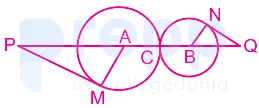
- A
23 cm
- B
13.5 cm
- C
28 cm
- D
14 cm
Show answer
D. 14 cmGiven,
MP = 15, NQ = 8, PA = 17, BQ = 10
In right angled ΔPMA
AP 2= PM 2+ AM 2
⇒ 17 2= 15 2+ AM 2
⇒ AM 2= 289 – 225
⇒ AM = √64 = 8
In right angled ΔBNQ
BQ 2= BN 2+ NQ 2
⇒ 10 2= BN 2+ 8 2
⇒ BN 2= 100 – 64
⇒ BN = √36 = 6
As we know,
AM = AC = 8 and BN = BC = 6 cm.
Now, AB = AC + BC
⇒ AB = 8 + 6 = 14
Paper & answer key PDF ↗ Question 72archived
The simple interest on a sum of Rs. 50,000 at the end of two years is Rs. 4,000. What would be the compound interest on the same sum at the same rate for the same period?
- A
Rs. 4,008
- B
Rs. 4,080
- C
Rs. 8,000
- D
Rs. 4,040
Show answer
B. Rs. 4,080Calculating Compound Interest from Simple Interest
This problem requires us to first find the rate of interest using the given simple interest information and then use that rate to calculate the compound interest for the same principal and time period.
Step 1: Determine the Rate of Simple Interest
We are given the principal amount, the time period, and the simple interest earned. The formula for simple interest is:
\(\text{SI} = \frac{P \times R \times T}{100}\)
Where:
\(P\) = Principal = Rs. 50,000
\(R\) = Rate of Interest (per annum)
\(T\) = Time period = 2 years
\(\text{SI}\) = Simple Interest = Rs. 4,000
Let's plug in the known values and solve for \(R\):
\(4000 = \frac{50000 \times R \times 2}{100}\)
Simplify the equation:
\(4000 = 500 \times R \times 2\)
\(4000 = 1000 \times R\)
Now, isolate \(R\):
\(R = \frac{4000}{1000}\)
\(R = 4\)
So, the rate of interest is 4% per annum.
Step 2: Calculate the Compound Interest
Now that we have the rate (4% per annum), we can calculate the compound interest for the same principal (Rs. 50,000) and time period (2 years). The formula for the amount (\(A\)) after compounding is:
\(A = P(1 + \frac{R}{100})^T\)
Where:
\(P\) = Principal = Rs. 50,000
\(R\) = Rate of Interest (per annum) = 4%
\(T\) = Time period = 2 years
Plug in the values:
\(A = 50000(1 + \frac{4}{100})^2\)
\(A = 50000(1 + 0.04)^2\)
\(A = 50000(1.04)^2\)
\(A = 50000 \times 1.0816\)
\(A = 54080\)
The amount after two years with compound interest is Rs. 54,080.
To find the compound interest (\(\text{CI}\)), we subtract the principal from the amount:
\(\text{CI} = A - P\)
\(\text{CI} = 54080 - 50000\)
\(\text{CI} = 4080\)
The compound interest on the same sum at the same rate for the same period is Rs. 4,080.
Revision Table: Comparing Simple and Compound Interest
Feature
Simple Interest (SI)
Compound Interest (CI)
Calculation Basis
Only on the principal amount
On the principal amount plus accumulated interest from previous periods
Formula (Amount)
\(A = P(1 + \frac{RT}{100})\)
\(A = P(1 + \frac{R}{100})^T\)
Interest Growth
Linear (same amount each period)
Exponential (grows faster over time)
Interest on Interest
No
Yes
Additional Information on Interest Calculations
Understanding simple and compound interest is fundamental in finance and mathematics. Simple interest is easier to calculate but compound interest is more commonly used in real-world financial products like savings accounts, loans, and investments because it accounts for the effect of earning interest on previously earned interest.
Key terms to remember:
Principal (P): The initial amount of money borrowed or invested.
Rate (R): The percentage of the principal charged or earned as interest over a specific period, usually per year.
Time (T): The duration for which the money is borrowed or invested, usually in years.
Amount (A): The total sum including the principal and the accrued interest at the end of the time period.
Compound interest can be calculated for different compounding frequencies (e.g., half-yearly, quarterly, monthly). When the frequency is more than once a year, the formula is adjusted:
\(A = P(1 + \frac{R}{n \times 100})^{n \times T}\)
Where \(n\) is the number of times interest is compounded per year.
In this problem, compounding is assumed to be annual since no other frequency is mentioned, which corresponds to \(n=1\), making the formula the same as the one we used: \(A = P(1 + \frac{R}{100})^T\).
Paper & answer key PDF ↗ Question 73archived
If the given number 925x85 is divisible by 11, then the smallest value of x is:
- A
2
- B
4
- C
1
- D
3
Show answer
B. 4Understanding Divisibility by 11
To determine if a number is divisible by 11, we use a specific rule. The rule states that a number is divisible by 11 if the difference between the sum of the digits at the odd-numbered places (starting from the rightmost digit) and the sum of the digits at the even-numbered places (starting from the rightmost digit) is either 0 or a multiple of 11.
Applying the Divisibility Rule to 925x85
Let's apply this rule to the given number 925x85. We need to identify the digits at the odd and even places starting from the right:
Odd-numbered places (1st, 3rd, 5th from right): 5, x, 2
Even-numbered places (2nd, 4th, 6th from right): 8, 5, 9
Now, let's calculate the sum of the digits in each group:
Sum of digits at odd places = $\small 5 + x + 2 = 7 + x$
Sum of digits at even places = $\small 8 + 5 + 9 = 22$
According to the divisibility rule for 11, the difference between these two sums must be 0 or a multiple of 11. We can calculate the difference in either order, as long as the result is 0 or a multiple of 11 (which is the same as saying the absolute difference is 0 or a multiple of 11).
Let's calculate the difference as (Sum of even place digits) - (Sum of odd place digits):
Difference = $\small 22 - (7 + x) = 22 - 7 - x = 15 - x$
For the number 925x85 to be divisible by 11, the difference $\small (15 - x)$ must be equal to 0 or a multiple of 11. Since x is a single digit (0, 1, 2, 3, 4, 5, 6, 7, 8, or 9), let's find the possible values for $\small (15 - x)$.
If $\small x = 0$, Difference = $\small 15 - 0 = 15$
If $\small x = 1$, Difference = $\small 15 - 1 = 14$
If $\small x = 2$, Difference = $\small 15 - 2 = 13$
If $\small x = 3$, Difference = $\small 15 - 3 = 12$
If $\small x = 4$, Difference = $\small 15 - 4 = 11$
If $\small x = 5$, Difference = $\small 15 - 5 = 10$
If $\small x = 6$, Difference = $\small 15 - 6 = 9$
If $\small x = 7$, Difference = $\small 15 - 7 = 8$
If $\small x = 8$, Difference = $\small 15 - 8 = 7$
If $\small x = 9$, Difference = $\small 15 - 9 = 6$
Out of these possible differences, we are looking for one that is 0 or a multiple of 11. The only value in the list that is a multiple of 11 is 11.
This occurs when the difference is 11, which happens when $\small x = 4$.
Let's check if any other multiples of 11 are possible for $\small (15 - x)$ where x is a single digit:
If $\small 15 - x = 0 \implies x = 15$. This is not a single digit.
If $\small 15 - x = 22 \implies x = 15 - 22 = -7$. This is not a valid digit.
If $\small 15 - x = -11 \implies x = 15 + 11 = 26$. This is not a single digit.
If $\small 15 - x = -22 \implies x = 15 + 22 = 37$. This is not a single digit.
And so on. The only single digit value for x that satisfies the divisibility rule for 11 is $\small x = 4$.
Finding the Smallest Value of x
We found that the only valid single digit for x that makes 925x85 divisible by 11 is $\small x = 4$. Since this is the only value, it is also the smallest possible value for x.
Therefore, the smallest value of x is 4.
Step
Action
Calculation/Reason
1
Identify digits at odd places (from right)
5, x, 2
2
Sum of odd place digits
$\small 5 + x + 2 = 7 + x$
3
Identify digits at even places (from right)
8, 5, 9
4
Sum of even place digits
$\small 8 + 5 + 9 = 22$
5
Calculate the difference
$\small 22 - (7 + x) = 15 - x$
6
Apply divisibility rule for 11
$\small 15 - x$ must be 0 or a multiple of 11
7
Find x for difference = 11
$\small 15 - x = 11 \implies x = 4$
8
Check if 4 is a single digit
Yes, 4 is between 0 and 9.
9
Check other multiples of 11
$\small 15 - x = 0 \implies x = 15$ (Not single digit)
$\small 15 - x = 22 \implies x = -7$ (Not single digit)
10
Determine the smallest valid x
The only valid single digit is 4.
Revision Table: Divisibility Rules
Understanding divisibility rules is crucial for quickly solving number theory problems. Here's a quick look at some common rules:
Divisibility by 2: A number is divisible by 2 if its last digit is even (0, 2, 4, 6, 8).
Divisibility by 3: A number is divisible by 3 if the sum of its digits is divisible by 3.
Divisibility by 4: A number is divisible by 4 if the number formed by its last two digits is divisible by 4.
Divisibility by 5: A number is divisible by 5 if its last digit is 0 or 5.
Divisibility by 6: A number is divisible by 6 if it is divisible by both 2 and 3.
Divisibility by 9: A number is divisible by 9 if the sum of its digits is divisible by 9.
Divisibility by 10: A number is divisible by 10 if its last digit is 0.
Divisibility by 11: The difference between the sum of digits at odd places and the sum of digits at even places is 0 or a multiple of 11.
Additional Information: Number Properties and Quantitative Aptitude
Problems involving divisibility rules are common in quantitative aptitude sections of competitive exams. Mastering these rules can save significant time. When a number has a missing digit like 'x', applying the relevant divisibility rule helps create an equation or condition that can be solved to find the missing digit. It's important to remember that 'x' represents a single digit from 0 to 9.
For divisibility by 11, the key is the alternating sum/difference of digits. The places are counted from the rightmost digit as 1st, 2nd, 3rd, and so on. The digits at 1st, 3rd, 5th, ... places form one sum, and the digits at 2nd, 4th, 6th, ... places form the other sum. The difference between these sums must be a multiple of 11 (..., -22, -11, 0, 11, 22, ...).
Paper & answer key PDF ↗ Question 74archived
In the given figure, the measure of ∠BAC is:
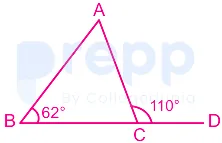
- A
56°
- B
58°
- C
62°
- D
48°
Show answer
D. 48°Concept used:
Sum of two opposite angle is equal to external angle
Calculation:
AS we know,
∠ABC + ∠BAC = ∠ACD
⇒ 62 + ∠BAC = 110
⇒ ∠BAC = 110 – 62 = 48
Paper & answer key PDF ↗ Question 75archived
From the given table, what is the percentage of students scoring 40 or more, but less than 70.
Scores
Less than
20
Less than
30
Less than
40
Less than
50
Less than
60
Less than
70
Less than
80
No. of
Students
12
19
22
31
38
46
50
- A
8%
- B
56%
- C
48%
- D
96%
Show answer
C. 48%Calculating Percentage of Students Scoring in a Range from Cumulative Frequency Table
The question asks for the percentage of students who scored 40 or more marks but less than 70 marks, based on the provided cumulative frequency distribution table. A cumulative frequency table shows the number of students scoring less than a certain value.
First, let's look at the given data:
Scores
No. of Students (Cumulative Frequency)
Less than 20
12
Less than 30
19
Less than 40
22
Less than 50
31
Less than 60
38
Less than 70
46
Less than 80
50
The total number of students is given by the last entry in the cumulative frequency table, which is the number of students scoring less than 80. So, the total number of students is 50.
Finding the Number of Students in the Specific Score Range (40 to < 70)
We need to find the number of students who scored between 40 and 70 (not including 70). From the table:
The number of students who scored less than 70 is 46.
The number of students who scored less than 40 is 22.
The students scoring 40 or more but less than 70 are those who scored less than 70 MINUS those who scored less than 40. This is because the students scoring less than 40 are excluded from the group scoring 40 or more.
Number of students scoring 40 ≤ Score < 70 = (Number of students scoring < 70) - (Number of students scoring < 40)
Number of students scoring 40 ≤ Score < 70 = 46 - 22 = 24
Calculating the Percentage of Students
Now we can calculate the percentage of these students relative to the total number of students. The formula for percentage is:
\(\text{Percentage} = \left( \frac{\text{Number of students in the range}}{\text{Total number of students}} \right) \times 100\)
Using the values we found:
\(\text{Percentage} = \left( \frac{24}{50} \right) \times 100\)
\(\text{Percentage} = 0.48 \times 100\)
\(\text{Percentage} = 48\%\)
So, 48% of the students scored 40 or more, but less than 70.
Revision Table: Key Statistical Terms
Term
Definition
Cumulative Frequency
The total frequency of all class intervals up to a particular class interval. It shows the running total of frequencies.
Frequency Distribution
A table or graph that displays the frequency (number of occurrences) of different outcomes in a sample.
Percentage
A proportion expressed as a fraction of 100. Calculated as (Part / Whole) × 100.
Additional Information on Cumulative Frequency
A "less than" cumulative frequency distribution helps quickly find how many data points are below a certain value. To find the number of data points within a specific interval from a "less than" cumulative frequency table, you subtract the cumulative frequency of the lower boundary from the cumulative frequency of the upper boundary.
For example, to find the number of students scoring between 30 and less than 40:
Number of students scoring < 40 = 22
Number of students scoring < 30 = 19
Number of students scoring 30 ≤ Score < 40 = 22 - 19 = 3
This method is useful for quickly analysing data ranges in grouped data.
Paper & answer key PDF ↗ Question 76archived
Select the most appropriate option to substitute the underlined segment in the given sentence. If there is no need to substitute it, select No improvement.
Mother was watching a movie when the lights were going off.
- A
have gone off
- B
No improvement
- C
went off
- D
going off
Show answer
C. went offUnderstanding Verb Tenses for Sentence Correction: 'Went off' vs 'Were Going Off'
The question asks us to select the most appropriate option to replace the underlined phrase "were going off" in the sentence: "Mother was watching a movie when the lights were going off." We need to analyze the context and the correct usage of verb tenses, specifically when describing two actions happening in the past.
Analysing the Original Sentence
The original sentence contains two parts:
"Mother was watching a movie": This part uses the past continuous tense (was + verb-ing). This describes an action that was in progress at a specific time in the past. Watching a movie is an ongoing activity.
"when the lights were going off": This part uses the past continuous tense (were + verb-ing). This also describes an action that was supposedly in progress.
The word "when" is used to connect these two actions. Often, "when" introduces a shorter, completed action that happens while a longer action (expressed in the past continuous) is taking place. The phrase "the lights going off" typically refers to a sudden event where the power fails, not a continuous process.
Evaluating the Underlined Phrase 'were going off'
Using the past continuous "were going off" suggests that the action of the lights failing was ongoing or happening over a period of time. However, in the context of lights failing due to a power cut, this is usually a sudden event. Therefore, the past continuous tense is generally not the most appropriate choice here to describe the action of the lights.
Examining the Options for Substitution
Let's look at the provided options:
have gone off: This is in the present perfect tense. The present perfect is used for actions that happened at an unspecified time before now, or actions that started in the past and continue to the present, or actions that have a result in the present. It is not typically used to describe a completed action that specifically interrupted another action in the past, as suggested by the "when" clause here.
No improvement: Selecting this would mean "were going off" is correct. As discussed, "were going off" suggests a continuous action, which doesn't fit the typical sudden nature of lights failing.
went off: This is in the simple past tense (the past tense of 'go off'). The simple past tense describes a completed action in the past. "The lights went off" is a common way to describe a power cut or lights failing suddenly. This completed action happening while the mother was watching the movie fits the typical use of "when" connecting a past continuous action with a simple past action.
going off: This is the present participle without a helping verb. It is not grammatically correct in this sentence structure.
Correct Usage of Past Tenses
When describing a longer action in the past (expressed in past continuous) that was interrupted by a shorter, completed action (expressed in simple past), the structure is often:
Past Continuous + when + Simple Past
In the sentence, "Mother was watching" is the longer, ongoing action (past continuous). The action of the lights failing is the shorter, interrupting event. Therefore, the simple past tense is needed for this interrupting action.
The simple past tense of the phrasal verb "go off" (meaning to stop working, often lights or power) is "went off".
Conclusion
Based on the analysis of the sentence structure and the typical meaning of "the lights going off", the simple past tense "went off" is the most appropriate substitute for "were going off". The sentence "Mother was watching a movie when the lights went off" correctly uses the past continuous tense for the ongoing action and the simple past tense for the sudden interrupting action.
Phrase
Tense
Usage in Context
were going off
Past Continuous
Suggests an ongoing process, less typical for a sudden power failure.
went off
Simple Past
Describes a completed action, appropriate for a sudden event like lights failing.
Revision Table: Key Tense Usage
Tense
Form
Typical Use
Example (related to lights)
Simple Past
Verb + -ed (or irregular form)
Completed action in the past.
The lights went off suddenly.
Past Continuous
was/were + Verb + -ing
Action ongoing at a specific time in the past, or interrupted by another action.
The lights were flickering before they went off. (Describes an ongoing state)
Additional Information on Verb Tenses and Sentence Structure
Understanding the relationship between the Past Continuous and Simple Past tenses is crucial for sentence correction. The Past Continuous sets the scene or describes an action in progress, while the Simple Past often introduces an event that happened during that time or interrupted the ongoing action.
Example 1: I was studying when the phone rang. (Studying was ongoing, ringing was sudden)
Example 2: They were having dinner when we arrived. (Having dinner was ongoing, arrival was a specific event)
In the given sentence, Mother's watching was the ongoing action, and the lights failing was the specific event that occurred during her watching. Therefore, the simple past "went off" is the correct choice to substitute the underlined segment "were going off".
Paper & answer key PDF ↗ Question 77archived
Select the INCORRECTLY spelt word.
- A
Alien
- B
Awful
- C
Accross
- D
Already
Show answer
C. AccrossFinding the Incorrectly Spelt Word
The question asks us to identify the word that is spelt incorrectly among the given options. Let's examine each word carefully to check its spelling.
Analyzing the Spelling Options
Alien: This word refers to a being from another planet or a foreigner. The spelling 'A-l-i-e-n' is correct.
Awful: This word means very bad or unpleasant. The spelling 'A-w-f-u-l' is correct.
Accross: This word is intended to mean 'on or to the other side of'. However, the spelling 'A-c-c-r-o-s-s' is incorrect.
Already: This word means before the present time or before a particular time. The spelling 'A-l-r-e-a-d-y' is correct.
Comparing the options, we can see that 'Accross' is the only word with an incorrect spelling. The correct spelling of this word is 'Across'. It should have only one 'c'.
Correct Spelling Comparison
Given Word
Correct Spelling
Status
Alien
Alien
Correct
Awful
Awful
Correct
Accross
Across
Incorrect
Already
Already
Correct
Therefore, the word that is incorrectly spelt is 'Accross'.
Revision Table for Common Misspellings
Many English words are commonly misspelled. It's helpful to review some frequent errors.
Common Misspelling
Correct Spelling
recieve
receive
beleive
believe
seperate
separate
definately
definitely
untill
until
Additional Information on Spelling Rules
Spelling in English can be tricky, but understanding some common rules and patterns can help.
'ie' vs 'ei': Often follows "I before E, except after C, or when sounded as 'ay' as in 'neighbor' and 'weigh'". Examples: believe (ie), receive (ei), neighbor (ei), weigh (ei).
Double Consonants: Be careful with words like 'across', 'address', 'committee', 'embarrass'. Sometimes a single consonant is needed, and sometimes a double.
Suffixes: Adding suffixes (like -ing, -ed, -ly, -ful) can sometimes change the base word (e.g., beauty + -ful = beautiful, but care + -ful = careful).
Regular practice and checking with a dictionary are the best ways to improve spelling accuracy.
Paper & answer key PDF ↗ Question 78archived
Given below are four jumbled sentences. Out of the given options pick the one that gives their correct order.
A. When a calf is born underwater, the mother must get it to the surface before it drowns.
B. The young ones remain with their parents for up to fifteen years or more.
C. Often another whale assists the mother nudging the baby gently and encouraging it to swim.
D. Whales have highly developed maternal instincts.
- A
CBDA
- B
BCAD
- C
DBCA
- D
DACB
Show answer
D. DACBUnderstanding Jumbled Sentences about Whale Maternal Instincts
The question asks us to arrange four jumbled sentences (A, B, C, and D) into a coherent paragraph that describes aspects of whale maternal instincts. We need to find the logical flow that connects these sentences.
Let's look at the sentences:
A. When a calf is born underwater, the mother must get it to the surface before it drowns.
B. The young ones remain with their parents for up to fifteen years or more.
C. Often another whale assists the mother nudging the baby gently and encouraging it to swim.
D. Whales have highly developed maternal instincts.
Analyzing the Sentence Order
To find the correct order, we should look for a sentence that introduces the main topic. Sentence D states, "Whales have highly developed maternal instincts." This seems like a perfect introductory sentence, setting the stage for the details that follow.
After introducing the concept of maternal instincts, the passage should likely provide an example or detail about these instincts. Sentence A describes a critical moment related to maternal instincts: what happens immediately after a calf is born underwater and the mother's action to save it. This logically follows the general statement in D.
Following the immediate action at birth (Sentence A), Sentence C introduces another aspect of the birth process: assistance from other whales. "Often another whale assists the mother nudging the baby gently and encouraging it to swim." This detail about help during the critical post-birth period naturally follows the description of the birth and the mother's initial action.
Finally, Sentence B talks about the long-term care: "The young ones remain with their parents for up to fifteen years or more." This sentence describes the duration of the maternal bond and care, which is a subsequent detail about the life cycle of the whale after the initial stages described in A and C.
Therefore, the logical sequence appears to be D (Introduction) → A (Immediate post-birth action) → C (Assistance during post-birth) → B (Long-term care).
Step-by-Step Reasoning: Ordering Whale Instinct Sentences
Start with D: Sentence D introduces the main subject: whale maternal instincts. This is a good general statement to begin the paragraph.
Follow D with A: Sentence A gives a specific, crucial example of maternal instinct right at birth – getting the calf to the surface. This directly supports the idea of "highly developed maternal instincts."
Follow A with C: Sentence C adds another detail about the critical post-birth moments, describing how other whales sometimes help. This assistance is part of the supportive environment stemming from these instincts.
Follow C with B: Sentence B discusses the long-term aspect of maternal care – the long duration young whales stay with parents. This is a natural progression from the immediate post-birth details to the extended period of care.
Combining these steps, the correct order is D, A, C, B.
Final Sentence Order Analysis
The sentences arranged in the order DACB read:
D. Whales have highly developed maternal instincts.
A. When a calf is born underwater, the mother must get it to the surface before it drowns.
C. Often another whale assists the mother nudging the baby gently and encouraging it to swim.
B. The young ones remain with their parents for up to fifteen years or more.
This sequence flows logically, starting with a general statement and moving to specific examples of maternal behavior during and after birth, and finally discussing the duration of care.
Based on this analysis, the correct order is DACB.
Revision Table: Sentence Ordering Skills
Sentence
Content Summary
Potential Position Logic
A
Mother saving calf at birth
Specific example following the general topic. Follows D. Precedes C.
B
Duration young stay with parents
Long-term detail, likely towards the end. Follows A and C.
C
Other whale assisting calf
Another post-birth detail, fits after the mother's initial action. Follows A. Precedes B.
D
Whales have maternal instincts
General topic introduction. Good starting point. Precedes A.
Additional Information: Understanding Whale Behavior
Whale behavior is complex and fascinating. Maternal instincts are crucial for the survival of whale calves, especially since birth occurs underwater.
Underwater Birth: Unlike land mammals, whale calves are born tail-first (usually) into the water. The mother must quickly guide the calf to the surface for its first breath.
Pod Support: The presence of other whales, often referred to as "aunties," who assist the mother and calf, highlights the social structure and cooperative behavior within whale pods. This support is another manifestation of their highly developed social and potentially maternal/alloparental instincts.
Long Dependency Period: The long period (up to 15 years or even more in some species like orcas) that young whales stay with their parents is significant. It allows for extensive learning, including hunting techniques, social norms, and migration routes. This extended care is a key aspect of their complex social learning and maternal investment.
Communication: Whales use complex vocalizations (songs and calls) to communicate, which is essential for maintaining social bonds, including those between mother and calf.
Understanding these details helps appreciate the depth of the maternal and social behaviors mentioned in the jumbled sentences.
Paper & answer key PDF ↗ Question 79archived
Select the most appropriate meaning of the given idiom.
Keep abreast of
- A
Keep a watch on
- B
Keep up the good work
- C
Keep ahead of
- D
Keep oneself updated
Show answer
D. Keep oneself updatedUnderstanding the Idiom "Keep Abreast Of"
The question asks for the most appropriate meaning of the idiom "Keep abreast of". Idioms are phrases or expressions that have a figurative meaning different from the literal meaning of the individual words.
Analyzing the Idiom "Keep Abreast Of"
The word "abreast" literally means side-by-side, or level with someone or something. When used in the idiom "keep abreast of," it refers to staying at the same level of knowledge or understanding as current developments or information. It implies staying informed about what is happening or changing.
Examining the Options
Let's look at the provided options and compare their meanings to the idiom "Keep abreast of":
Keep a watch on: This means to observe something carefully, perhaps to monitor its condition, progress, or potential problems. While it involves attention, it's more about surveillance than about continuously updating one's own information level.
Keep up the good work: This is an expression of encouragement, meaning to continue performing well or maintaining a good effort. This meaning is completely unrelated to the idiom "Keep abreast of".
Keep ahead of: This means to be in front of someone or something, either physically or in terms of progress, achievement, or status. It's about being advanced, not just staying updated or level with current information.
Keep oneself updated: This means to ensure that you have the latest information or knowledge about a particular subject, situation, or set of developments. This aligns perfectly with the idea of staying level with current information.
Identifying the Most Appropriate Meaning
Comparing the idiom's sense of staying informed and level with current developments, the phrase "Keep oneself updated" is the most accurate and appropriate meaning among the given options. It directly captures the core idea of the idiom.
Conclusion
Based on the analysis, the most appropriate meaning of the idiom "Keep abreast of" is to "Keep oneself updated".
Revision Table: Idiom Meaning
Idiom
Most Appropriate Meaning
Keep abreast of
Keep oneself updated / Stay informed about
Additional Information: Understanding Idioms
Idioms are a crucial part of language, adding richness and nuance. Understanding idioms often requires learning their specific meanings, as they cannot usually be deduced from the literal meanings of the words. For example, "kick the bucket" means to die, which has nothing to do with kicking a bucket. Learning common idioms is essential for improving comprehension and fluency in a language.
The phrase "keep abreast of" is commonly used in contexts related to news, technology, academic fields, or any area where developments occur frequently. For instance:
"Scientists must keep abreast of the latest research."
"It's important to keep abreast of current events."
This idiom emphasizes the ongoing nature of staying informed.
Paper & answer key PDF ↗ Question 80archived
Fill in the blank with the most appropriate word.
The minister gave an ______ that strict action would be taken against the culprits.
- A
ambition
- B
admission
- C
insurance
- D
assurance
Show answer
D. assuranceMinister's Promise and Word Choice Explained
This question requires identifying the most fitting word to complete a sentence about a minister’s statement concerning action against wrongdoers. The goal is to select the word that best conveys the meaning of a promise or guarantee in this specific context.
Understanding the Sentence Context
The sentence is: "The minister gave an ______ that strict action would be taken against the culprits."
We need to fill the blank with a word that describes what the minister provided. The context suggests a firm statement or promise about future actions (strict action) being taken.
Evaluating Word Meanings
Let's look at the provided options and their meanings:
1. ambition: This word refers to a strong desire or aim to achieve something, like "The politician expressed his ambition to win the election." A minister might have ambitions, but they don't typically 'give an ambition' as a statement about taking action. This word does not fit the context.
2. admission: This means acknowledging something, often a mistake or guilt, or the act of allowing entry. For instance, "His admission of fault surprised everyone." This does not align with the minister's act of promising action.
3. insurance: This word relates to protection against a risk or loss, such as "They bought travel insurance for their trip." The minister isn't offering protection in this manner; they are committing to action.
4. assurance: This word means a positive declaration or promise intended to give confidence or remove doubt. For example, "The company gave an assurance of quality." In this sentence, the minister gives an assurance to the public or the victims that strict action will indeed be taken against the culprits. This fits the context perfectly.
Selecting the Most Appropriate Word
The word assurance correctly fills the blank, as it signifies a confident promise made by the minister regarding the enforcement of strict action against those responsible.
Paper & answer key PDF ↗ Question 81archived
Select the most appropriate synonym of the given word.
Sacred
- A
Valued
- B
Precious
- C
Scarce
- D
Holy
Show answer
D. HolyFinding the Synonym for Sacred
Understanding synonyms helps improve vocabulary and comprehension. A synonym is a word or phrase that means exactly or nearly the same as another word or phrase in the same language. We are asked to find the most appropriate synonym for the word "Sacred".
Defining Sacred
The word "Sacred" typically refers to something dedicated or set apart for religious purposes or having a religious significance. It is often considered holy or revered.
Analyzing the Options
Let's examine each provided option to determine which word is the most appropriate synonym for "Sacred":
Valued: This means something that is considered important or precious. While sacred things are often valued, "valued" itself does not specifically imply religious significance or holiness.
Precious: This means of great value; not to be wasted or treated carelessly. Like "valued," something sacred can be precious, but the core meaning of "precious" relates to worth or rarity rather than religious status.
Scarce: This means rare or in short supply. Scarcity is about availability, not about religious or holy qualities. Something sacred might be scarce, but scarcity is not its defining characteristic as sacred.
Holy: This means dedicated or consecrated to God or a religious purpose; sacred. This definition aligns directly with the meaning of "Sacred". Things that are holy are considered sacred and vice versa.
Identifying the Most Appropriate Synonym
Based on the definitions and analysis, the word "Holy" shares the closest meaning with "Sacred". Both terms are used to describe things that are set apart for religious reasons, are connected to a deity, or are considered untouchable due to their religious significance.
Therefore, "Holy" is the most appropriate synonym for "Sacred".
Conclusion
The most fitting synonym for the word "Sacred" among the given options is "Holy".
Word
Meaning
Relation to Sacred
Sacred
Dedicated to religious purpose; holy
The word to find a synonym for
Valued
Considered important or precious
Related, but lacks religious context
Precious
Of great value; not to be wasted
Related, but lacks religious context
Scarce
Rare or in short supply
Unrelated to religious significance
Holy
Dedicated to God/religion; sacred
Direct synonym
Revision Table: Synonyms for Sacred
Let's review the relationship between "Sacred" and "Holy".
Sacred: Set apart, dedicated to a deity or religious purpose.
Holy: Dedicated to God; sacred.
The definitions clearly show "Holy" as a direct synonym for "Sacred".
Additional Information: Understanding Synonyms and Antonyms
Understanding synonyms and antonyms is crucial for language proficiency.
Synonyms: Words that have similar meanings (e.g., happy/joyful, big/large, sacred/holy).
Antonyms: Words that have opposite meanings (e.g., hot/cold, up/down, sacred/profane).
In this case, we focused on finding the best synonym for "Sacred". An antonym for "Sacred" might be "profane" or "secular," which refer to things not connected with religious or spiritual matters.
Paper & answer key PDF ↗ Question 82archived
Select the most appropriate meaning of the given idiom.
Look down upon
- A
To look for something underground
- B
To be full of guilt
- C
To consider someone inferior
- D
To look down from a height
Show answer
C. To consider someone inferiorUnderstanding the Idiom: Look Down Upon
Idioms are phrases or expressions that have a figurative meaning different from the literal meaning of the individual words. The idiom "Look down upon" is quite common in English. Let's break down its meaning.
When someone says they "look down upon" another person, they are not literally looking downwards from a higher position. Instead, the phrase describes their attitude towards that person.
The core meaning of "look down upon" is to regard someone with contempt, disdain, or a feeling of superiority. It implies seeing someone as less important, less worthy, or inferior in some way, perhaps based on status, wealth, ability, or background.
Analyzing the Options
Let's examine the provided options to find the most appropriate meaning of the idiom "Look down upon".
Option 1: To look for something underground
This option describes a physical action of searching below the surface. It has no connection to the figurative meaning of the idiom "Look down upon," which is about an attitude or feeling towards someone.
Option 2: To be full of guilt
Being full of guilt is a feeling of responsibility or regret for a wrongdoing. This emotional state is unrelated to the meaning of "Look down upon," which is about viewing others as inferior.
Option 3: To consider someone inferior
This option perfectly aligns with the figurative meaning of the idiom "Look down upon." To consider someone inferior means to think of them as less important, less capable, or lower in status than oneself. This is exactly what the idiom conveys.
Option 4: To look down from a height
This option describes a literal physical act of looking downwards from an elevated position. While the words "look down" are part of the idiom, the phrase as a whole does not mean a physical perspective but a judgmental attitude towards others.
The Correct Meaning of Look Down Upon
Based on the analysis, the most appropriate meaning of the idiom "Look down upon" is to consider someone inferior. It describes an attitude of superiority and disdain towards another person or group.
Revision Table: Idiom Meaning
Here is a summary of the idiom and its meaning:
Idiom: Look down upon
Meaning: To consider someone inferior; to regard with contempt or disdain.
Example Sentence: He tended to look down upon anyone who hadn't gone to college.
Additional Information: Understanding Idioms
Understanding idioms is important for mastering any language. They add color and depth to communication, but their meanings must be learned, as they are not always obvious from the individual words. Learning common idioms like "look down upon" helps improve comprehension and fluency in English.
Paper & answer key PDF ↗ Question 83archived
Identify the segment in the sentence which contains the grammatical error. If there is no error, select 'No error'
The famous author and actor are being honoured at a function today.
- A
The famous author and actor
- B
at a function today
- C
are being honoured
- D
No error
Show answer
C. are being honouredUnderstanding Grammatical Errors: Subject-Verb Agreement
The question asks us to identify the segment in the sentence "The famous author and actor are being honoured at a function today" that contains a grammatical error. To do this, we need to carefully examine the sentence structure and check for common errors like subject-verb agreement, pronoun agreement, tense consistency, etc.
Analyzing the Sentence for Subject-Verb Agreement
Let's break down the sentence:
Subject: "The famous author and actor"
Verb: "are being honoured" (part of the passive voice construction)
Rest of the sentence: "at a function today" (adverbial phrase)
The key to finding the error here lies in correctly identifying whether the subject is singular or plural. When two nouns are joined by "and", they usually form a plural subject (e.g., "The author and the actor are..."). However, when a single article (like 'The' or 'A') is used before the first noun, and the second noun refers to the same person or thing, the subject is considered singular (e.g., "The author and journalist is...").
In the sentence "The famous author and actor", the article "The" is used only once before "famous author". This structure implies that the author and the actor are the same person. Therefore, the subject is singular.
Now let's look at the verb: "are being honoured". The verb "are" is a plural form of the verb 'to be'. Since our subject ("The famous author and actor") is singular, the verb should also be singular to maintain subject-verb agreement.
Identifying the Grammatical Error Segment
The subject is singular, but the verb used is plural. This is a clear case of a subject-verb agreement error.
Singular subject: "The famous author and actor"
Plural verb: "are being honoured"
The correct singular verb form should be "is being honoured".
Therefore, the segment containing the grammatical error is "are being honoured".
Correcting the Sentence
The corrected sentence would be: "The famous author and actor is being honoured at a function today."
Let's look at the options provided:
The famous author and actor - This is the subject phrase itself, which is structured correctly to indicate a single person. The error is not within this segment's structure, but in how the verb agrees with it.
at a function today - This is an adverbial phrase indicating time and place. There is no grammatical error in this segment.
are being honoured - This segment contains the verb phrase which incorrectly uses the plural verb "are" with a singular subject. This is the segment with the grammatical error.
No error - There is a grammatical error in the sentence.
Based on our analysis, the segment containing the grammatical error is "are being honoured".
Subject-Verb Agreement Examples
Subject Structure
Subject Number
Correct Verb Form (Present Tense)
The author and the actor
Plural
are / write
The author and actor (referring to one person)
Singular
is / writes
Authors and actors
Plural
are / write
An author and actor (referring to one person)
Singular
is / writes
Revision Table: Key Grammar Concepts
Revision: Understanding Subject-Verb Agreement
Concept
Explanation
Example
Subject-Verb Agreement
The verb in a sentence must agree in number with its subject. A singular subject takes a singular verb, and a plural subject takes a plural verb.
She writes (singular subject, singular verb). They write (plural subject, plural verb).
Compound Subject (with 'and')
Usually plural when 'and' joins two different nouns or pronouns.
John and Mary are friends. (Two different people)
Compound Subject (with 'and' referring to one person/thing)
Singular when 'and' joins two nouns referring to the same person, thing, or a single unit (like a dish). Often indicated by a single article or determiner.
My friend and colleague is here. (One person who is both friend and colleague). Bread and butter is a common breakfast. (Single unit/dish)
Additional Information on Grammatical Errors and Sentence Structure
Understanding grammatical errors, especially subject-verb agreement, is crucial for clear and correct English. Beyond subject-verb agreement, other common errors include:
Pronoun Agreement Errors: Pronouns must agree in number and gender with the nouns they replace (antecedents). Example: "Each student must bring their own book." (Incorrect - 'Each student' is singular, 'their' is plural. Correct: "Each student must bring his or her own book." or restructure: "Students must bring their own books.")
Tense Consistency Errors: Maintain a consistent verb tense within a sentence or paragraph unless there is a reason to change it. Example: "She walked to the store and buys some milk." (Incorrect - walked is past tense, buys is present tense. Correct: "She walked to the store and bought some milk.")
Dangling Modifiers: Phrases that modify a word not clearly stated in the sentence. Example: "Walking down the street, the building appeared tall." (Incorrect - implies the building was walking. Correct: "Walking down the street, I saw a tall building.")
Practicing identifying these types of errors helps improve overall writing and comprehension skills. Always read sentences carefully, identify the core subject and verb, and check if they agree.
Paper & answer key PDF ↗ Question 84archived
Select the most appropriate ANTONYM of the given word.
Native
- A
Foreign
- B
Rustic
- C
Urban
- D
Rural
Show answer
A. ForeignLet's find the most appropriate antonym for the word "Native". An antonym is a word that means the opposite of another word.
Understanding the Word Native
The word "Native" typically refers to a person, animal, or plant that was born in a particular place; indigenous. It can also mean belonging to a person's country of birth or nationality, or relating to the indigenous inhabitants of a place rather than settlers.
Analyzing the Antonym Options
Let's look at the given options and determine which one best represents the opposite meaning of "Native".
Foreign: This word refers to something or someone belonging to, produced in, or characteristic of a country or language other than one's own. If someone is not "Native" to a place, they are from somewhere else, making "Foreign" a strong candidate for an antonym.
Rustic: This word relates to the countryside; rural. It often suggests simplicity, artlessness, or a lack of sophistication. While it relates to a type of environment (often associated with native habitats), it doesn't mean the opposite of being from a place.
Urban: This word relates to a city or town. Like "Rustic," it describes a type of environment, specifically one that is the opposite of rural, but it is not the opposite of being indigenous or belonging to a specific place by birth.
Rural: This word relates to the countryside, often distinct from a town or city. Similar to "Rustic" and "Urban," it describes a type of environment and is not the direct opposite of being "Native" to a place.
Selecting the Most Appropriate Antonym
Comparing the options, "Foreign" is the word that directly contrasts with "Native." If something is native to a place, it originated there. If it is foreign, it originated somewhere else. The other options describe types of environments (countryside, city) rather than origin or belonging.
Therefore, the most appropriate antonym for "Native" is "Foreign".
Revision Table: Native vs. Antonym Options
Word
Meaning
Antonym of Native?
Native
Originating from a specific place; indigenous
Base word
Foreign
From another country or place
Yes (Direct opposite in terms of origin/belonging)
Rustic
Relating to the countryside; simple
No (Describes environment/style)
Urban
Relating to a city or town
No (Describes environment)
Rural
Relating to the countryside
No (Describes environment)
Additional Information on Antonyms
Understanding antonyms is crucial for building vocabulary and improving language skills. Antonyms can be simple (like hot/cold) or more nuanced, depending on the specific context of the word. Sometimes a word can have multiple antonyms depending on which aspect of its meaning is being contrasted. In this case, contrasting "Native" based on origin or belonging leads clearly to "Foreign."
Paper & answer key PDF ↗ Question 85archived
Fill in the blank with the most appropriate word.
She was loved by her employees for her ______.
- A
condolence
- B
malevolence
- C
insolence
- D
benevolence
Show answer
D. benevolenceAnalyzing Vocabulary for Sentence Completion
The question asks us to choose the most appropriate word to fill in the blank in the sentence: "She was loved by her employees for her ______." We need a word that describes a quality that would make employees feel love and affection towards their employer.
Evaluating the Options
Let's examine the meaning of each provided word:
Condolence: This refers to an expression of sympathy, especially on the occasion of death. While expressing sympathy is a positive trait, it's not the primary quality that would consistently lead employees to love their boss in a general sense.
Malevolence: This means the state or condition of being malevolent; having or showing a wish to do evil to others. This is a negative quality and would certainly not make employees love their boss.
Insolence: This refers to rude and disrespectful behavior. This is also a negative quality and would make employees dislike, not love, their boss.
Benevolence: This means the quality of being well meaning; kindness. It can also refer to acts of kindness or generosity. A boss who is benevolent is kind, generous, and shows goodwill towards their employees. This is a quality that would naturally earn the love and respect of employees.
Determining the Most Appropriate Word
Considering the meanings, "benevolence" is the only word among the options that represents a positive quality that would inspire love from employees. Kindness, generosity, and good will from an employer create a positive work environment and foster loyalty and affection.
Therefore, the most appropriate word to complete the sentence is "benevolence".
The completed sentence is: "She was loved by her employees for her benevolence."
Revision Table: Key Vocabulary
Word
Meaning
Relevance to Employees Loving a Boss
Condolence
Expression of sympathy
Limited relevance as a primary reason for consistent love
Malevolence
Wish to do evil; ill will
Opposite of a quality that earns love
Insolence
Rude, disrespectful behavior
Opposite of a quality that earns love
Benevolence
Kindness; generosity; good will
Directly related to earning love and respect from employees
Additional Information: Qualities of a Respected Leader
While benevolence is a key quality, employees often love and respect their leaders for a variety of reasons. Some other important qualities include:
Fairness: Treating all employees equitably.
Empathy: Understanding and sharing the feelings of others.
Supportiveness: Providing help and resources for employees to succeed.
Integrity: Being honest and having strong moral principles.
Competence: Being skilled and knowledgeable in their role.
These qualities, combined with benevolence, contribute to a positive leadership style that fosters employee love and loyalty.
Paper & answer key PDF ↗ Question 86archived
Select the most appropriate option to fill in blank number (5).
- A
motive
- B
emotion
- C
influence
- D
feeling
Show answer
A. motiveAnalyzing the Passage and Advertising Motive
The question asks us to select the most appropriate word to fill in blank number (5) in the given passage about advertising. The passage describes advertising as the promotion of goods and services and highlights its role in helping companies sell their products. The sentence containing blank (5) is crucial: "It cannot be denied that the (5)______ behind commercial advertising is to increase sales and earn more profit." We need a word that fits logically into this sentence to describe the underlying reason or purpose.
Evaluating Options for Blank (5)
Let's consider the provided options for blank (5):
motive: A reason for doing something, especially one that is hidden or not obvious. It represents the driving force or purpose behind an action.
emotion: A strong feeling such as joy, sorrow, fear, or hate. While advertising often aims to evoke emotions, emotion itself is not the fundamental reason or purpose *behind* the act of advertising in a commercial context.
influence: The capacity to have an effect on the character, development, or behavior of someone or something, or the effect itself. Advertising definitely seeks to influence consumer behavior, but influence is more of a *tool* or *outcome* rather than the primary *reason* or *purpose* for engaging in commercial advertising.
feeling: An emotional state or reaction. Similar to emotion, feeling is something advertising might work with or create, but it's not the core rationale or purpose *behind* the advertising itself.
Identifying the Core Purpose of Commercial Advertising
The part of the sentence following the blank, "to increase sales and earn more profit," clearly states the primary goal of commercial advertising. This goal is the fundamental reason why businesses invest in advertising. The word that best describes this underlying reason or purpose is "motive." The motive behind commercial advertising is indeed to drive sales and profitability.
Substituting "motive" into the sentence, we get: "It cannot be denied that the motive behind commercial advertising is to increase sales and earn more profit." This sentence makes perfect sense and accurately reflects the core objective of businesses using advertising.
Why Other Options are Less Suitable
Using "emotion" would imply that the feeling itself is the reason for advertising, which is incorrect. Advertising *uses* emotion to achieve its purpose.
Using "influence" would imply that the ability to influence is the reason, whereas influence is the means to achieve the reason (increase sales).
Using "feeling" is similar to emotion and does not fit the context of a driving purpose like increasing sales and profit.
Therefore, "motive" is the most fitting word to describe the fundamental reason or purpose driving commercial advertising as stated in the passage.
Blank Number
Context
Most Appropriate Word
Reasoning
(5)
"...the _______ behind commercial advertising is to increase sales and earn more profit."
motive
Describes the fundamental reason or purpose for doing something, aligning with "increase sales and earn more profit".
Conclusion for Blank (5)
Based on the analysis of the sentence and the options, the word that best describes the underlying reason or purpose ("to increase sales and earn more profit") behind commercial advertising is "motive".
Revision Table: Key Concepts
Term
Definition in Context
Relevance to Advertising
Advertising
Promotion of goods and services to attract customers.
Primary subject of the passage.
Motive
A reason for doing something.
Describes the core purpose of commercial advertising (increase sales, profit).
Commercial Advertising
Advertising by businesses with the goal of selling products/services.
The specific type of advertising discussed in relation to its profit motive.
Increase Sales
To sell more products or services.
A primary objective and motive of commercial advertising.
Earn More Profit
To increase the financial gain from business activities.
Another primary objective and motive of commercial advertising.
Additional Information on Advertising Objectives
While the passage simplifies the motive of commercial advertising to increasing sales and profit, advertising can have several specific objectives, depending on the company's overall marketing strategy. These objectives often support the ultimate goal of profitability.
Building Brand Awareness: Making the target audience aware of the brand and its products/services.
Creating Brand Preference: Encouraging consumers to choose one brand over competitors.
Informing Consumers: Providing information about new products, features, or prices.
Persuading Consumers: Convincing consumers to purchase the product or service.
Reminding Consumers: Keeping the brand or product in the consumer's mind.
Driving Action: Encouraging immediate purchase or interaction (e.g., visiting a website, visiting a store).
All these specific advertising objectives serve the broader business motive of increasing sales, market share, and ultimately, profitability. The passage correctly identifies this fundamental motive as the driving force behind commercial advertising.
Paper & answer key PDF ↗ Question 87archived
Select the option that can be used as a one-word substitute for the given group of words/phrase.
That which cannot be satisfied
- A
Inapt
- B
Ingenuous
- C
Insane
- D
Insatiable
Show answer
D. InsatiableUnderstanding the Phrase: That Which Cannot Be Satisfied
The phrase "That which cannot be satisfied" describes a state or quality where a desire, need, or appetite is impossible to fulfill completely or is unending. It implies an inability to reach a point of contentment or enoughness.
Analyzing the Options for One-Word Substitution
Let's examine each provided option to determine which word best fits the meaning of "That which cannot be satisfied."
Inapt: This word means not suitable or appropriate for a particular purpose or occasion. It does not relate to the concept of being unable to be satisfied.
Ingenuous: This word describes someone who is innocent and unsuspecting, often naive. It is unrelated to the idea of satisfaction or lack thereof.
Insane: This term refers to a state of serious mental illness. While extreme desires might sometimes be linked to mental states, the word "insane" itself does not directly mean "cannot be satisfied."
Insatiable: This word is defined as impossible to satisfy. It perfectly matches the meaning of the given phrase.
Identifying the Correct One-Word Substitute
Based on the analysis of the options, the word that means "that which cannot be satisfied" is Insatiable.
For instance, an insatiable appetite means a hunger that can never be fully satisfied, or an insatiable curiosity means an unending desire to know more.
Word Substitutes Analysis
Option
Meaning
Fits "Cannot Be Satisfied"?
Inapt
Not suitable
No
Ingenuous
Innocent, naive
No
Insane
Mentally ill
No
Insatiable
Impossible to satisfy
Yes
Revision Table: Key Terms
Vocabulary Revision
Term
Definition
Inapt
Not suitable or appropriate.
Ingenuous
Innocent and unsuspecting.
Insane
Seriously mentally ill; in a state of mind that prevents normal perception, behavior, or social interaction.
Insatiable
Impossible to satisfy.
Additional Information: Exploring Insatiability
The concept of being insatiable applies to various contexts, including:
Desires: Such as an insatiable hunger for power, wealth, or knowledge.
Appetites: Referring to food or drink, an insatiable appetite means always wanting more.
Curiosity: An insatiable curiosity drives constant learning and exploration.
Understanding such specific vocabulary words is crucial for improving English language proficiency and excelling in competitive exams.
Paper & answer key PDF ↗ Question 88archived
Select the correct indirect form of the given sentence.
The traveller said to a passerby, "Can you help me find my way, please?''
- A
The traveller asked the passerby if he could kindly help him find his way.
- B
The traveller asked the passerby that he can kindly help him find his way.
- C
The traveller requested to the passerby if he can help him find his way.
- D
The traveller asked the passerby could you kindly help me find my way?
Show answer
A. The traveller asked the passerby if he could kindly help him find his way.Understanding Direct and Indirect Speech Conversion
Converting a sentence from direct speech to indirect speech involves reporting what someone said without using their exact words. This process requires changes in reporting verbs, connectives, pronouns, tenses, and sometimes time/place references.
Analyzing the Given Sentence
The original sentence in direct speech is: "The traveller said to a passerby, 'Can you help me find my way, please?'"
The speaker is the traveller.
The listener is a passerby.
The sentence is a question: "Can you help me find my way?"
The sentence also contains a request: "please".
When converting a direct speech question into indirect speech, the reporting verb 'said to' usually changes to 'asked', 'inquired', or 'wondered'. Since it's a yes/no question (one that can be answered with yes or no), the connective 'if' or 'whether' is used.
The tense of the verb inside the quotation marks changes according to specific rules. Here, the modal verb 'Can' changes to its past form, 'could'.
Pronouns also change based on who is speaking and who is being spoken to. 'You' (referring to the passerby) changes to 'he' or 'she' (assuming the passerby is referred to as 'he' in the context of the options), and 'me' (referring to the traveller) changes to 'him' or 'her' (assuming the traveller is referred to as 'him').
The word 'please' indicates a polite request. This can be incorporated into the indirect speech by using the verb 'requested' instead of 'asked', or by adding an adverb like 'kindly' or 'politely' after the reporting verb.
Evaluating the Options for Indirect Speech
Let's examine each provided option based on the rules of direct to indirect speech conversion:
The traveller asked the passerby if he could kindly help him find his way.
'said to' is changed to 'asked', which is appropriate for a question.
'if' is used as the connective for the yes/no question.
'Can you help me' is correctly changed to 'he could help him' ('Can' → 'could', 'you' → 'he', 'me' → 'him').
'kindly' is added to incorporate the polite request indicated by 'please'.
The sentence ends with a full stop.
This option follows all the necessary conversion rules.
The traveller asked the passerby that he can kindly help him find his way.
'that' is used as the connective, which is incorrect for a yes/no question. 'if' or 'whether' should be used.
'can' is used instead of 'could'. The tense should be shifted to the past.
This option is incorrect.
The traveller requested to the passerby if he can help him find his way.
'requested to' is often grammatically less common than 'requested' followed directly by the object. While 'requested' can be used, its structure here is awkward.
'can' is used instead of 'could'. The tense should be shifted to the past.
This option is incorrect.
The traveller asked the passerby could you kindly help me find my way?
The structure remains a direct question ('could you help me...?)'). Indirect speech converts the question into a statement form.
The question mark is retained. Indirect speech sentences end with a full stop.
The pronouns 'you' and 'me' are not changed.
This option is incorrect.
Based on the analysis, Option 1 correctly transforms the direct speech sentence into indirect speech, accurately handling the question, the request ('please'), the tense change, and pronoun changes.
Conclusion: Correct Indirect Form
The correct indirect form of the sentence "The traveller said to a passerby, 'Can you help me find my way, please?'" is obtained by applying the rules for converting questions with requests from direct to indirect speech. Option 1 successfully applies these rules, resulting in the grammatically correct indirect statement.
Revision Table: Key Changes in Direct to Indirect Speech
Element
Direct Speech
Indirect Speech (as in Option 1)
Rule Applied
Reporting Verb
said to
asked
Changes for questions.
Connective
(none before quote)
if
Used for Yes/No questions.
Modal Verb Tense
Can
could
Present modal becomes past modal.
Subject Pronoun
you
he
Changes based on the listener (passerby).
Object Pronoun
me
him
Changes based on the speaker (traveller).
Politeness Marker
please
kindly
Incorporated into the reported request.
Punctuation
Quotation marks, comma, question mark
Full stop
Removed in indirect speech.
Additional Information: Reporting Different Sentence Types
The conversion rules vary depending on the type of sentence being reported:
Statements: Use reporting verbs like 'said', 'told', 'stated'. Use 'that' as a connective (often optional). Tenses, pronouns, and time/place references shift.
Questions:
Yes/No Questions: Use reporting verbs like 'asked', 'inquired'. Use 'if' or 'whether' as the connective. Convert the question structure into a statement form.
Wh- Questions: Use reporting verbs like 'asked', 'inquired'. Use the Wh- word (who, what, where, when, why, how) as the connective. Convert the question structure into a statement form.
Commands/Requests/Advice: Use reporting verbs like 'ordered', 'commanded', 'requested', 'advised', 'urged'. Use 'to' + infinitive for positive commands/requests, and 'not to' + infinitive for negative ones.
Exclamations: Use reporting verbs like 'exclaimed', 'cried', 'shouted'. Use 'that' as a connective and change the exclamation into a statement, often adding words like 'greatly', 'wonderfully', etc., to convey the emotion.
Understanding these rules helps in accurately converting any sentence from direct to indirect speech.
Paper & answer key PDF ↗ Question 89archived
Select the INCORRECTLY spelt word.
- A
Guardian
- B
Guarranty
- C
Guilty
- D
Guidance
Show answer
B. GuarrantyUnderstanding English Spelling and Common Errors
This question asks us to identify the word that is spelled incorrectly among the given options. To solve this, we need to carefully examine the spelling of each word.
Let's look at each option:
Guardian: This word refers to a person who protects or looks after someone or something. The spelling "Guardian" is correct.
Guarranty: This word is likely intended to refer to a formal promise or assurance that certain conditions will be fulfilled. Let's check its spelling.
Guilty: This word describes having committed an offense or crime. The spelling "Guilty" is correct.
Guidance: This word refers to advice or information aimed at resolving a problem or difficulty. The spelling "Guidance" is correct.
Upon reviewing common English spellings, we find that the spelling "Guarranty" is incorrect. The correct spelling for a formal promise or assurance is "Guarantee".
Therefore, the word that is incorrectly spelled is "Guarranty".
Identifying the Misspelled Word
The question specifically asks for the INCORRECTLY spelt word. Comparing the options to their correct spellings:
Guardian – Correctly spelled.
Guarranty – Incorrectly spelled. The correct spelling is Guarantee.
Guilty – Correctly spelled.
Guidance – Correctly spelled.
The only word from the list that is not spelled according to standard English rules is "Guarranty".
Word
Given Spelling
Correct Spelling
Status
Guardian
Guardian
Guardian
Correct
Guarantee
Guarranty
Guarantee
Incorrect
Guilty
Guilty
Guilty
Correct
Guidance
Guidance
Guidance
Correct
Based on this analysis, the incorrectly spelled word is "Guarranty".
Revision Table: Checking Spellings
Reviewing the correct and incorrect spellings helps reinforce proper vocabulary usage.
Incorrect Spelling
Correct Spelling
Related Concept
Guarranty
Guarantee
A promise or assurance
Guardian
Guardian
A protector
Guilty
Guilty
Having committed a crime
Guidance
Guidance
Advice or help
Additional Information: Common Spelling Pitfalls
Many English words can be tricky to spell due to silent letters, double letters, and vowel combinations. Words like 'Guarantee' are often misspelled because of the 'ua' and the double 'e'. Paying attention to common patterns and frequently misspelled words can improve spelling skills.
Here are some tips for avoiding spelling errors:
Read regularly to see words used in context.
Use a dictionary or online spell checker when unsure.
Break down long words into syllables.
Learn common prefixes and suffixes.
Practice writing and proofreading your work carefully.
Understanding the correct spelling of words like 'Guardian', 'Guilty', 'Guidance', and 'Guarantee' is important for clear communication.
Paper & answer key PDF ↗ Question 90archived
Identify the segment in the sentence which contains the grammatical error. If there is no error, select 'No error'
He married with a rich heiress last year.
- A
last year
- B
He married
- C
with a rich heiress
- D
No error
Show answer
C. with a rich heiressLet's break down the sentence to identify the grammatical error. The sentence is "He married with a rich heiress last year." We need to examine each part to see if it follows standard English grammar rules.
Analyzing the Sentence for Grammatical Errors
We will look at each segment provided in the options:
last year: This phrase indicates a specific time in the past. It is correctly placed at the end of the sentence and is grammatically sound in this context.
He married: "He" is the subject, and "married" is the past tense of the verb "marry." This part of the sentence is grammatically correct on its own.
with a rich heiress: This is the phrase following the verb "married." This is where the potential error lies.
Understanding the Verb 'Marry' Usage
The verb 'marry' is typically a transitive verb, meaning it takes a direct object without needing a preposition like 'with' or 'to' when stating who someone marries. The structure is usually:
Subject + married + Direct Object (the person)
For example:
He married her.
She married him.
They married each other.
John married Mary.
When used in the passive voice, 'marry' is followed by 'to':
Subject (was/were married) + to + the person
For example:
She was married to him.
He was married to her.
The phrase "married with someone" is generally incorrect in standard English when talking about tying the knot or becoming husband and wife. "Married with children" is a different construction where "with children" describes the state of being married and having children, not the act of getting married.
Identifying the Error Segment
In the sentence "He married with a rich heiress last year," the verb "married" is used actively. It should directly take "a rich heiress" as its object. The preposition "with" is unnecessary and grammatically incorrect in this construction.
The correct sentence should be: "He married a rich heiress last year."
Therefore, the segment containing the grammatical error is "with a rich heiress."
Incorrect Usage
Correct Usage (Active Voice)
Correct Usage (Passive Voice)
married with someone
married someone
was/were married to someone
He married with a rich heiress.
He married a rich heiress.
He was married to a rich heiress. (Less common way to express the event, more about state)
Revision Table: Verb 'Marry' Grammar
Grammar Point
Rule
Example
'Marry' (Active)
Verb + Direct Object (no preposition)
She married her partner.
'Marry' (Passive)
Verb (was/were married) + to + person
He was married to his college sweetheart.
Incorrect Usage
Do not use 'with' after 'married' in active voice to introduce the person.
Incorrect: They married with great joy. (Correct would be: They married with great joy - 'with great joy' is an adverbial phrase) OR Incorrect: He married with Jane. (Correct: He married Jane.)
Additional Information: Similar Verbs
Understanding how 'marry' works without a preposition in active voice can be compared to other transitive verbs. For example:
We discussed the plan. (Not 'discussed about the plan')
They entered the room. (Not 'entered into the room' in this context)
She reached the station. (Not 'reached to the station')
While many verbs *do* require prepositions (e.g., 'talk to someone', 'listen to something'), 'marry' in the active voice followed by the person married is a key verb where a preposition is not needed.
Another point is that 'get married' is a phrasal verb often used. 'Get married' *can* be followed by 'to':
They got married last year.
She got married to her childhood friend.
This shows that the structure depends on whether you use 'marry' directly or the phrase 'get married'. The original sentence uses 'married' directly, so the direct object form is required.
Paper & answer key PDF ↗ Question 91archived
Given below are four jumbled sentences. Out of the given options pick the one that gives their correct order.
A. While he was doing this, he missed seeing a velvet purse full of gold coins lying on the road.
B. Ramesh always worried about how he would become sick and weak in old age.
C. To try how he would cope with blindness, Ramesh started walking with his eyes closed.
D. He feared that he might even lose his sight and go blind.
- A
BCAD
- B
BDCA
- C
CABD
- D
DBAC
Show answer
B. BDCAUnderstanding Sentence Reordering Questions
Sentence reordering questions test your ability to identify the logical sequence of ideas within a set of jumbled sentences. The goal is to arrange them to form a coherent paragraph or story. To solve these, look for:
Introductory sentences (often presenting a character, setting, or main idea).
Cause and effect relationships.
Time sequences.
Pronoun references (e.g., "he," "it," "they" referring to a noun mentioned earlier).
Connecting words or phrases (e.g., "therefore," "however," "while," "as a result").
Analyzing the Jumbled Sentences
Let's look at the four sentences provided in this sentence reordering question:
A. While he was doing this, he missed seeing a velvet purse full of gold coins lying on the road.
B. Ramesh always worried about how he would become sick and weak in old age.
C. To try how he would cope with blindness, Ramesh started walking with his eyes closed.
D. He feared that he might even lose his sight and go blind.
Step-by-Step Solution for Sentence Order
We need to find the correct sequence that tells a logical story about Ramesh and his worries.
Sentence B introduces the main character, Ramesh, and his general worry about old age, sickness, and weakness. This seems like a good starting point for the narrative.
Sentence D narrows down Ramesh's general worry from sentence B to a specific fear: losing his sight and going blind. This fear is a direct consequence or specific instance of the worries mentioned in B. So, D logically follows B.
Sentence C describes an action Ramesh takes *because* of the fear mentioned in sentence D. He starts walking with his eyes closed "To try how he would cope with blindness." This action is a direct response to his fear of blindness. Thus, C follows D.
Sentence A describes something that happened *while* Ramesh was performing the action described in sentence C ("While he was doing this..."). He missed seeing the purse. This is a consequence of walking with his eyes closed. Therefore, A follows C.
Putting the sentences together in this order, we get BDCA. Let's read it through:
B. Ramesh always worried about how he would become sick and weak in old age.
D. He feared that he might even lose his sight and go blind.
C. To try how he would cope with blindness, Ramesh started walking with his eyes closed.
A. While he was doing this, he missed seeing a velvet purse full of gold coins lying on the road.
This sequence forms a coherent story about Ramesh's anxiety and an unfortunate consequence of his actions stemming from that anxiety.
Identifying the Correct Option
Based on our logical sequencing, the correct order of the sentences is BDCA.
Looking at the provided options:
BCAD
BDCA
CABD
DBAC
The order BDCA matches the second option.
Conclusion on Sentence Reordering
By carefully analyzing the connections between the sentences, identifying the main idea, and following the flow of events, we can correctly determine the logical sequence. In this case, the order BDCA creates a clear and sensible narrative.
Revision Table: Key Sentence Reordering Steps
Step
Action
Why it helps
1
Read all sentences
Understand the general theme.
2
Look for an opening sentence
Establishes the subject or scene.
3
Identify connections
Find links between sentences (pronouns, transition words, cause/effect).
4
Form a logical flow
Arrange sentences based on identified connections and sequence.
5
Read the complete paragraph
Check if the rearranged sentences make sense together.
Additional Information on Jumbled Sentences
Jumbled sentence or paragraph reordering questions are common in various English proficiency and competitive exams. They assess reading comprehension, logical reasoning, and understanding of paragraph structure. Practice with different types of narratives and expository texts can improve performance on these questions.
Key types of links between sentences often include:
Pronoun Reference: A pronoun (he, she, it, they) refers back to a noun mentioned in a previous sentence.
Transitional Words: Words or phrases like "however," "therefore," "in addition," "for example," indicate the relationship between ideas.
Chronological Order: Events are presented in the order they happened.
Cause and Effect: One sentence describes a cause, and the next describes its effect.
General to Specific: Starting with a broad statement and following with more detailed information.
Paper & answer key PDF ↗ Question 92archived
Select the most appropriate option to fill in blank number (4).
- A
been
- B
being
- C
be
- D
to be
Show answer
B. beingUnderstanding the Passage and Fill in the Blanks
The passage discusses advertising, defining it as the promotion of goods and services. It highlights how advertising gives companies a way to sell their products and how prevalent it is, especially when watching television. The task is to fill in the blanks using the most appropriate words from the given alternatives to make the passage grammatically correct and contextually meaningful.
We are asked to focus on blank number (4) in the following sentence:
Every time we switch (3)______ the television we find some product or the other (4)______ pushed towards us.
Let's analyze the sentence structure around blank (4).
Analyzing Blank Number (4) in the Advertising Context
The sentence describes what happens "Every time we switch... the television". It uses the verb "find" followed by an object ("some product or the other") and then a description of what is happening to that object ("______ pushed towards us").
The phrase "pushed towards us" is in the passive voice, indicating that the product is receiving the action of being pushed (advertised/promoted). We need a word before "pushed" that fits grammatically after "we find some product or the other" and describes this ongoing passive action observed repeatedly.
Verbs of perception like 'find', 'see', 'hear', 'watch', etc., can be followed by an object and a participle (either present or past) or a bare infinitive to describe an action related to the object. When describing an ongoing passive action, the structure 'find + object + being + past participle' is commonly used.
Evaluating the Options for Blank (4)
Let's examine each option provided for blank number (4):
Option 1: been
The word "been" is the past participle of 'be'. It is typically used with forms of 'have' (has, have, had) to form perfect tenses or in passive voice constructions in perfect tenses (e.g., "has been pushed"). The structure "we find... been pushed" is not standard English grammar to describe an action observed to be happening.
Option 2: being
The word "being" is the present participle of 'be'. When used before a past participle (like "pushed"), it forms a passive construction that often indicates an ongoing action. The structure "we find + object + being + past participle" is grammatically correct and idiomatic for describing an ongoing passive action that is perceived or discovered. "we find some product or the other being pushed towards us" means that every time the TV is on, we see products in the process of being advertised or promoted. This fits the context perfectly.
Option 3: be
The word "be" is the base form of the verb. It is used after modal verbs or in infinitive constructions ("to be"). The structure "we find... be pushed" is grammatically incorrect in this context.
Option 4: to be
The phrase "to be" is the infinitive form. While "find + object + to be + adjective/noun" is possible (e.g., "we find him to be honest"), the structure "find + object + to be + past participle" is less common for describing a perceived ongoing action. It might imply a future state or purpose, which doesn't fit the description of seeing products advertised every time the TV is on.
Conclusion for Blank (4)
Based on the grammatical analysis and the context of describing an ongoing passive action observed frequently, the most appropriate word for blank number (4) is "being". The phrase "being pushed towards us" correctly describes the products in the process of being advertised every time the television is watched.
The completed part of the sentence is: "Every time we switch (3)______ the television we find some product or the other being pushed towards us."
Revision Table: Key Grammar Concepts
Concept
Explanation
Example
Verbs of Perception + Object + Participle
Verbs like find, see, hear, watch, etc., can be followed by an object and a present participle (-ing) to describe an ongoing action, or a past participle (-ed) to describe a completed passive action or state.
We saw him running (ongoing active).
We found the window broken (completed passive/state).
Passive Voice with 'being'
Used to form the present continuous passive (is/am/are being + past participle) or after certain verbs like 'find' or 'see' to describe an ongoing passive action being perceived.
The house is being built (present continuous passive).
We saw the house being built (ongoing passive action perceived).
Additional Information: Verb Patterns with 'Find'
The verb 'find' can be followed by various patterns. In the context of perception, it can take the structure 'find + object + complement'. The complement can be an adjective, a noun phrase, or a participle phrase.
Find + Object + Adjective: We find the task difficult.
Find + Object + Noun Phrase: We find him a reliable person.
Find + Object + Present Participle (-ing): Describes finding the object in the process of doing something (active). We found them working in the garden.
Find + Object + Past Participle (-ed): Describes finding the object after something has been done to it (passive/state). We found the door painted.
Find + Object + Being + Past Participle: Describes finding the object while it is in the process of being acted upon (ongoing passive). We found the goods being loaded onto the truck. This is the pattern used in the blank (4) sentence.
Understanding these verb patterns helps determine the correct form of the verb or related words needed to complete sentences accurately, especially in fill-in-the-blanks exercises.
Paper & answer key PDF ↗ Question 93archived
Select the correct passive form of the given sentence.
The children sang the National Anthem with great enthusiasm.
- A
The National Anthem is sung with great enthusiasm by the children.
- B
The National Anthem was being sung with great enthusiasm by the children.
- C
The National Anthem was sung with great enthusiasm by the children.
- D
The National Anthem has been sung with great enthusiasm by the children.
Show answer
C. The National Anthem was sung with great enthusiasm by the children.Understanding Active and Passive Voice Conversion
The question asks us to convert a sentence from active voice to passive voice. The original sentence is: "The children sang the National Anthem with great enthusiasm."
In the active voice, the subject performs the action. In this sentence, "The children" (subject) performed the action "sang" (verb).
In the passive voice, the subject receives the action. The object of the active sentence becomes the subject of the passive sentence. The structure typically involves a form of the verb 'to be' followed by the past participle of the main verb.
Steps to Convert Active to Passive Voice
Let's break down the conversion process for the given sentence:
Identify the Subject, Verb, and Object:
Subject: The children
Verb: sang
Object: the National Anthem
Adverbial Phrase: with great enthusiasm
Identify the Tense: The verb "sang" is the past tense of "sing". This indicates the sentence is in the Simple Past tense.
Move the Object to the Subject Position: The new subject of the passive sentence is "The National Anthem".
Add the Correct Form of 'to be': Since the original sentence is in the Simple Past and the new subject ("The National Anthem") is singular, the correct form of 'to be' in the past tense is "was".
Use the Past Participle of the Main Verb: The past participle of "sing" is "sung".
Combine: So far, we have "The National Anthem was sung".
Add 'by' and the Original Subject (Optional but common): We add "by the children" to indicate who performed the action in the original sentence.
Include any Adverbial Phrases: The phrase "with great enthusiasm" remains in the sentence, typically placed after the past participle or after the 'by' phrase.
Following these steps, the passive form of the sentence is "The National Anthem was sung with great enthusiasm by the children."
Analyzing the Options for Passive Voice
Let's examine each option provided:
Option 1: "The National Anthem is sung with great enthusiasm by the children."
This option uses "is sung", which is the passive form for the Simple Present tense. The original sentence was in the Simple Past, so this is incorrect.
Option 2: "The National Anthem was being sung with great enthusiasm by the children."
This option uses "was being sung", which is the passive form for the Past Continuous tense. The original sentence was in the Simple Past, not Past Continuous, so this is incorrect.
Option 3: "The National Anthem was sung with great enthusiasm by the children."
This option uses "was sung", which is the correct passive form for the Simple Past tense. The structure correctly places the original object as the new subject, uses the correct form of 'be' (was), the past participle (sung), and includes the 'by' phrase and adverbial phrase. This matches our derived passive sentence.
Option 4: "The National Anthem has been sung with great enthusiasm by the children."
This option uses "has been sung", which is the passive form for the Present Perfect tense. The original sentence was in the Simple Past, not Present Perfect, so this is incorrect.
Conclusion on Passive Voice Conversion
Based on the analysis of each option and the rules for converting Simple Past active voice sentences to passive voice, Option 3 is the only correct transformation.
Revision Table: Active vs. Passive Voice Structure
Tense
Active Voice Structure
Passive Voice Structure
Example (Active > Passive)
Simple Past
Subject + Verb (Past Form) + Object
Object + was/were + Past Participle + (by + Subject)
They sang the song. > The song was sung by them.
Additional Information: Importance of Voice in English Grammar
Understanding active and passive voice is crucial for effective communication in English. Both voices have their place and purpose.
Active Voice: It is generally preferred for clarity, directness, and conciseness. It clearly shows who is performing the action. Example: "The dog chased the ball."
Passive Voice: It is useful when the action is more important than the doer, or when the doer is unknown, obvious, or unimportant. It emphasizes the receiver of the action. Example: "The ball was chased by the dog." or "The window was broken." (The focus is on the broken window, not who broke it).
Being able to convert sentences between active and passive voice helps in varying sentence structure and choosing the appropriate focus for your writing.
Paper & answer key PDF ↗ Question 94archived
Select the most appropriate antonym of the given word.
REPULSIVE
- A
Hideous
- B
Revolting
- C
Attractive
- D
Brilliant
Show answer
C. AttractiveFinding the Antonym of Repulsive
The question asks us to select the most appropriate antonym for the word 'REPULSIVE'. An antonym is a word that has the opposite meaning of another word.
Let's first understand the meaning of the word 'REPULSIVE'. Repulsive means causing intense distaste or aversion; disgusting. Something repulsive is unpleasant and pushes you away.
Now let's examine the given options:
Hideous: This word means extremely ugly or disgusting. It is a synonym, not an antonym, of repulsive.
Revolting: This word means highly unpleasant; disgusting. It is also a synonym, not an antonym, of repulsive.
Attractive: This word means pleasing or appealing in appearance or character. Something attractive draws you in and is pleasant to look at or be around. This is the opposite meaning of repulsive.
Brilliant: This word typically means very intelligent, talented, or shining brightly. While positive, it is not the direct opposite of repulsive, which relates more to causing distaste or aversion based on appearance or feeling.
Comparing the meanings, 'Attractive' is the direct opposite of 'Repulsive'.
Analyzing the Options for Repulsive Antonym
We can see the relationship between the words:
Repulsive \(\rightarrow\) causing disgust/aversion
Hideous \(\rightarrow\) extremely ugly (synonym)
Revolting \(\rightarrow\) disgusting (synonym)
Attractive \(\rightarrow\) pleasing/appealing (antonym)
Brilliant \(\rightarrow\) intelligent/shining (unrelated antonym)
Therefore, the most appropriate antonym for 'REPULSIVE' is 'Attractive'.
Revision Table: Understanding Repulsive and its Opposite
Word
Meaning
Relationship to REPULSIVE
REPULSIVE
Causing intense distaste or aversion; disgusting
Given word
Hideous
Extremely ugly or disgusting
Synonym
Revolting
Highly unpleasant; disgusting
Synonym
Attractive
Pleasing or appealing in appearance or character
Antonym
Brilliant
Very intelligent or shining brightly
Not a direct antonym in this context
Additional Information: Synonyms and Antonyms
Understanding synonyms and antonyms is crucial for building vocabulary and comprehending texts. Here's a little more about them:
Synonyms: Words that have the same or very similar meaning. For example, synonyms for 'happy' include 'joyful', 'cheerful', and 'glad'. In this question, 'Hideous' and 'Revolting' are synonyms for 'Repulsive'.
Antonyms: Words that have opposite meanings. For example, antonyms for 'hot' include 'cold'. 'Attractive' is an antonym for 'Repulsive'.
Learning synonyms and antonyms helps you express yourself more precisely and understand the nuances of language. When looking for an antonym, think about the core meaning of the word and what quality would be its direct opposite.
Paper & answer key PDF ↗ Question 95archived
Select the most appropriate option to substitute the underlined segment in the given sentence. If there is no need to substitute it, select No improvement.
Scarcely had the passengers boarded the plane when the captain welcomed them .
- A
when the captain had welcomed them
- B
that the captain welcomed them
- C
than the captain welcomes them
- D
No improvement
Show answer
D. No improvementUnderstanding Sentence Structure with 'Scarcely... when'
The question asks us to identify the most appropriate substitution for the underlined segment in the sentence: "Scarcely had the passengers boarded the plane when the captain welcomed them." We need to evaluate if the original phrasing is correct or if any of the given options improve it.
Analyzing the Original Sentence and Grammatical Rule
The original sentence uses a specific grammatical structure involving the negative adverb "Scarcely" placed at the beginning of the sentence. When adverbs like Scarcely, Hardly, or Barely are used at the start of a sentence, they require inversion. This means the auxiliary verb comes before the subject.
The typical structure for "Scarcely", "Hardly", or "Barely" is:
Scarcely/Hardly/Barely + had + Subject + Past Participle + when + Subject + Simple Past
Let's look at the original sentence:
"Scarcely had the passengers boarded the plane when the captain welcomed them."
Here:
"Scarcely" is at the beginning.
"had" is the auxiliary verb.
"the passengers" is the subject of the first clause.
"boarded" is the past participle of the verb "board".
"when" is the conjunction connecting the two clauses.
"the captain" is the subject of the second clause.
"welcomed" is the simple past tense of the verb "welcome".
"them" is the object.
The original sentence perfectly follows the correct structure: "Scarcely had + Subject + Past Participle + when + Subject + Simple Past". This indicates that the original sentence is grammatically correct.
Evaluating the Substitution Options
Now, let's examine the given options:
when the captain had welcomed them
This option uses "when" but changes the second clause to the past perfect tense ("had welcomed"). The correct structure with "Scarcely... when" requires the simple past tense in the second clause. So, this option is incorrect.
that the captain welcomed them
This option replaces "when" with "that". The conjunction used with "Scarcely", "Hardly", or "Barely" in this structure is "when", not "that". The conjunction "that" is typically used with "No sooner... than". So, this option is incorrect.
than the captain welcomes them
This option replaces "when" with "than" and uses the simple present tense ("welcomes") in the second clause. The conjunction used with "Scarcely" is "when", not "than". Also, the second clause should be in the simple past tense ("welcomed"). So, this option is incorrect on two counts.
No improvement
As analyzed earlier, the original sentence "Scarcely had the passengers boarded the plane when the captain welcomed them" correctly follows the standard grammatical structure for inversion with "Scarcely... when". Therefore, no substitution is needed.
Conclusion
Comparing the original sentence with the options, it is clear that the original sentence is grammatically sound and follows the correct usage of "Scarcely... when". None of the options provide a correct or improved version.
Revision Table: Key Points on Scarcely, Hardly, Barely
Adverb
Structure (Inversion)
Conjunction
Tense in Second Clause
Scarcely
Had + Subject + Past Participle
when
Simple Past
Hardly
Had + Subject + Past Participle
when
Simple Past
Barely
Had + Subject + Past Participle
when
Simple Past
No sooner
Had + Subject + Past Participle
than
Simple Past
Additional Information: Inversion and Negative Adverbs
Inversion with negative adverbs (like Scarcely, Hardly, Barely, No sooner, Never, Seldom, Rarely, Little) occurs when these adverbs are placed at the beginning of a sentence for emphasis. This placement requires the auxiliary verb to come before the subject, similar to how questions are formed.
Examples:
Never have I seen such a beautiful sunset. (Instead of: I have never seen...)
Seldom does he visit us anymore. (Instead of: He seldom visits us...)
Little did they know what was about to happen. (Instead of: They little knew...)
Understanding inversion with negative adverbs is crucial for correct sentence formation in English grammar, especially in more formal writing or speech.
Paper & answer key PDF ↗ Question 96archived
Select the most appropriate option to fill in blank number (1).
- A
event
- B
occasion
- C
opportunity
- D
excuse
Show answer
C. opportunityUnderstanding the Advertising Passage: Filling Blank (1)
The provided passage discusses advertising and its role in promoting goods and services. We need to fill in the blanks using the most appropriate words from the given options. Let's focus on filling blank number (1).
The passage states:
Advertising is the promotion of goods and services. It provides an (1)______ to the manufacturing companies to sell their (2)______ better than their competitors. Every time we switch (3)______ the television we find some product or the other (4)______ pushed towards us. It cannot be denied that the (5)______ behind commercial advertising is to increase sales and earn more profit.
Analyzing Blank Number (1)
The sentence requiring completion for blank (1) is: "It provides an (1)______ to the manufacturing companies to sell their (2)______ better than their competitors."
Here, "It" refers to advertising. The sentence suggests that advertising offers something beneficial to manufacturing companies, enabling them to improve their sales performance relative to competitors.
Evaluating the Options for Blank (1)
Let's look at the given options for blank (1):
event
occasion
opportunity
excuse
We need to determine which word best fits the context of advertising providing something that helps companies sell better.
'Event' refers to a planned public or social gathering or activity. Advertising itself is an activity, but it doesn't provide an 'event' *to* the companies in this sense for selling.
'Occasion' refers to a particular time when something happens, or a special event. Similar to 'event', it doesn't convey the idea of providing a chance or possibility to companies for selling.
'Opportunity' refers to a set of circumstances that makes it possible to do something. Advertising creates visibility and awareness, which are circumstances that make it possible for companies to sell more effectively. This word fits the meaning of something beneficial being provided to help achieve a goal (better sales).
'Excuse' refers to a reason given to justify a fault or offense. This is clearly inappropriate in the context of advertising helping companies sell better.
Selecting the Most Appropriate Word
Based on the analysis, the word "opportunity" is the most suitable choice for blank (1). Advertising provides manufacturing companies with the chance, the favorable circumstances, or the means (an opportunity) to reach potential customers and sell their goods and services more successfully than their competitors.
Therefore, the completed sentence using the correct option for blank (1) would be: "It provides an opportunity to the manufacturing companies to sell their (2)______ better than their competitors."
Revision Table: Blank (1) Options
Option
Meaning
Fit in Sentence
Appropriateness for Blank (1)
event
Planned public/social activity
Advertising provides an event? No.
Incorrect
occasion
Particular time or event
Advertising provides an occasion? No.
Incorrect
opportunity
Chance or possibility
Advertising provides an opportunity? Yes.
Correct
excuse
Reason for fault/offense
Advertising provides an excuse? No.
Incorrect
Additional Information: The Role of Advertising
Advertising plays a crucial role in the modern economy. It serves multiple purposes for businesses and consumers.
Information: Advertising informs consumers about new products, services, and their features.
Persuasion: It aims to persuade consumers to buy a particular product or service by highlighting its benefits and differentiating it from competitors.
Reminder: Even for established products, advertising helps keep them in the minds of consumers.
Brand Building: Consistent advertising helps build and maintain a strong brand image and recognition.
Sales Promotion: Advertising often supports specific sales promotions like discounts, offers, or contests.
For manufacturing companies, advertising is a primary tool to create market presence, attract customers, and ultimately drive sales and profitability. It is indeed an 'opportunity' to showcase their products and gain a competitive edge.
Paper & answer key PDF ↗ Question 97archived
Select the most appropriate synonym of the given word.
Weary
- A
Touchy
- B
Restless
- C
Exhausted
- D
Lively
Show answer
C. ExhaustedLet's find the most appropriate synonym for the word Weary. A synonym is a word that means the same, or nearly the same, as another word.
What does 'Weary' Mean?
The word Weary is primarily used to describe feeling or showing extreme tiredness, especially from hard work or lack of sleep. It can also sometimes mean feeling impatient or bored with something.
Analyzing the Options for 'Weary' Synonym
We need to look at each option provided and see which one is closest in meaning to Weary.
Option 1: Touchy
Touchy means easily irritated or offended. It relates to mood and sensitivity, not to physical or mental tiredness. So, Touchy is not a synonym for Weary.
Option 2: Restless
Restless means unable to stay still or quiet, usually because of anxiety, boredom, or lack of sleep. While lack of sleep can make you weary and also restless, the words don't mean the same thing. Restless describes an inability to relax, whereas Weary describes the feeling of being tired.
Option 3: Exhausted
Exhausted means completely used up, drained of physical or mental resources; extremely tired. This meaning aligns very closely with the primary meaning of Weary.
Option 4: Lively
Lively means full of energy and enthusiasm; cheerful and animated. This is the opposite of being Weary. Lively is an antonym, not a synonym.
Identifying the Most Appropriate Synonym
Comparing the options, Exhausted is the word that best captures the meaning of feeling extremely tired, which is the main sense of the word Weary. Therefore, Exhausted is the most appropriate synonym.
Revision Table: Weary Synonym
Word
Meaning
Synonym (from options)
Weary
Feeling or showing extreme tiredness; bored or impatient with something.
Exhausted
Additional Information on Synonyms
Understanding synonyms is a key part of building strong vocabulary. Synonyms help you express yourself more precisely and avoid repetition.
Synonyms are words with similar meanings (e.g., happy, joyful, glad).
Antonyms are words with opposite meanings (e.g., happy, sad).
Context is important when choosing synonyms, as subtle differences in meaning exist between words even if they are listed as synonyms.
Paper & answer key PDF ↗ Question 98archived
Select the option that can be used as a one word substitute for the given group of words.
A game in which neither party wins
- A
Draw
- B
Quit
- C
Flop
- D
Equal
Show answer
A. DrawFinding the One-Word Substitute for an Undecided Game
The question asks us to find a single word that describes a situation, specifically a game or contest, where neither participant or side achieves a victory. This is a common scenario in sports, games, and even negotiations.
Analyzing the Phrase: "A game in which neither party wins"
This phrase clearly indicates an outcome where there is no winner and, consequently, no loser. The result is inconclusive in terms of determining a superior party.
Evaluating the Options
Let's look at the provided options and their meanings:
Draw: In sports, games, or competitions, a draw (or tie) is a result in which the competitors have exactly the same score or their results are otherwise indistinguishable, so that neither competitor wins.
Quit: To quit means to leave, abandon, or stop doing something. If a party quits a game, the other party typically wins by default (unless both quit simultaneously, which is not implied by the original phrase).
Flop: In a general sense, a flop refers to a failure, something that is unsuccessful. While a game might be a 'flop' if it's poorly organized or fails to entertain, 'flop' doesn't describe the outcome of the game in terms of winning or losing for the parties involved.
Equal: Equal means being the same in quantity, size, degree, or value. While the outcome of a drawn game might be considered 'equal' in score, 'equal' itself is not the specific word used to describe the result of a game where neither party wins.
Determining the Correct Substitute
Based on the definitions, the word that precisely describes "A game in which neither party wins" is 'Draw'. A draw is the recognized term for an inconclusive game outcome where no winner emerges.
Phrase / Concept
Description
Matching Option
A game in which neither party wins
An outcome where no competitor is victorious.
Draw
Ending participation
Leaving or stopping an activity.
Quit
A failure or unsuccessful event
Something that does not succeed or impress.
Flop
Being the same in value or quantity
Having identical measures or amounts.
Equal
Therefore, the most appropriate one-word substitute for "A game in which neither party wins" is 'Draw'.
Revision Table: Understanding Game Outcomes
Term
Meaning in Games/Sports
Example
Win
Achieve victory in a contest.
Team A wins if they score more points.
Lose
Be defeated in a contest.
Team B loses if they score fewer points than Team A.
Draw (or Tie)
End a contest with an equal score or result, so neither party wins.
The football match ended in a 1-1 draw.
Forfeit
Lose or be forced to give up something as a penalty; also to give up a game before it's finished.
Our team had to forfeit the game because we didn't have enough players.
Additional Information on One-Word Substitutes
One-word substitutes are single words used in place of a phrase or a clause to make sentences more concise and clear. They are common in vocabulary sections of exams and help improve language efficiency.
Learning one-word substitutes helps in expressing ideas succinctly.
They test your understanding of nuanced meanings of words.
Common sources include terms for professions, studies, groups, places, actions, and results like the one discussed here (game outcomes).
For example, 'bibliophile' is a one-word substitute for 'a person who loves books', and 'invisible' is a substitute for 'unable to be seen'. In this case, 'draw' is the standard term for a game without a winner.
Paper & answer key PDF ↗ Question 99archived
Select the most appropriate option to fill in blank number (2).
- A
creation
- B
products
- C
outcome
- D
compounds
Show answer
B. productsUnderstanding the Passage and Blank (2)
The provided passage discusses advertising, explaining its purpose and how it is encountered in everyday life. It's a cloze test question, requiring us to choose the most appropriate word to fill a specific blank based on the context of the sentence and the overall passage.
The sentence containing blank (2) is: "It provides an (1)______ to the manufacturing companies to sell their (2)______ better than their competitors."
We need to determine what manufacturing companies sell. Manufacturing companies are businesses that make goods or products. Therefore, they sell the items they produce.
Analyzing Options for Blank (2)
Let's look at the given options for blank number (2):
creation: This word refers to the act of creating something, not the thing itself. Companies engage in creation, but they sell the result of their creation.
products: This word refers to the items or goods that are manufactured and offered for sale. This directly aligns with what manufacturing companies sell.
outcome: This word refers to a result or consequence. While selling products leads to outcomes (like revenue), companies sell the products themselves, not the abstract outcome.
compounds: This term is generally used in a chemical context, referring to substances formed from two or more elements. While some manufacturing companies might produce chemical compounds, the passage is discussing advertising in a general sense, applicable to all manufacturing companies, not just chemical ones. 'Products' is a much broader and more appropriate term.
Considering the context that manufacturing companies want to sell something better than their competitors, the most logical word to fill the blank is the term for the goods they produce.
Option
Meaning
Suitability for Blank (2)
creation
The act of creating
Incorrect; Companies sell what is created, not the act.
products
Items manufactured and sold
Correct; Manufacturing companies sell their products.
outcome
Result or consequence
Incorrect; Companies sell the goods, which lead to outcomes.
compounds
Chemical substances
Incorrect; Too specific; Advertising applies to all manufactured goods.
Based on the analysis, the word that best fits the context of manufacturing companies selling something is 'products'.
Final Answer for Blank (2)
The most appropriate option to fill in blank number (2) is products. The sentence then reads: "It provides an (1)______ to the manufacturing companies to sell their products better than their competitors."
Revision Table: Key Vocabulary
Term
Definition in Context
Advertising
Promotion of goods or services to the public.
Manufacturing Companies
Businesses that make goods, typically in large quantities.
Products
Items or goods produced by a manufacturing company for sale.
Competitors
Other companies offering similar goods or services.
Additional Information on Advertising and Sales
Advertising plays a crucial role in the economy. For manufacturing companies, advertising serves several key purposes:
Increasing Awareness: Letting potential customers know that their products exist.
Highlighting Benefits: Explaining why their products are useful or better than others.
Building Brand Loyalty: Creating a positive image for their company and products.
Driving Sales: Ultimately encouraging people to purchase their products.
Manufacturing companies invest in advertising to gain an advantage over their competitors in the marketplace. They use various media, like television, as mentioned in the passage, as well as internet, radio, print, and billboards, to reach consumers and promote their products effectively.
Paper & answer key PDF ↗ Question 100archived
Select the most appropriate option to fill in blank number (3).
- A
off
- B
on
- C
at
- D
in
Show answer
B. onUnderstanding the Passage and Fill in the Blank Questions
This question asks us to complete a passage about advertising by selecting the most appropriate word for each blank from the given options. This type of question is often called a cloze test. We need to read the passage carefully, understand its meaning, and then choose the word that fits grammatically and contextually in each blank.
Analyzing Blank Number (3): "switch ______ the television"
The sentence containing blank (3) is: "Every time we switch (3)______ the television we find some product or the other (4)______ pushed towards us."
We need to find a word that completes the phrase "switch ______ the television" in a way that makes sense in the context of seeing advertising on television. The common actions related to operating a television using a switch are turning it on or turning it off. The passage describes finding advertising *when* the television is switched, suggesting the action of turning it on.
Evaluating the Options for Blank (3)
Let's look at the provided options for blank (3):
Option 1: off
Option 2: on
Option 3: at
Option 4: in
Now, let's consider each option in the context of the sentence:
If we use "off": "Every time we switch off the television we find some product or the other pushed towards us." This doesn't make sense. You see advertising when the TV is *on*, not when you turn it off.
If we use "on": "Every time we switch on the television we find some product or the other pushed towards us." This fits perfectly. When you turn on the television, you are likely to encounter advertising. "Switch on" is a common phrasal verb meaning to activate an electronic device.
If we use "at": "Every time we switch at the television..." This phrase is grammatically incorrect and doesn't convey the action of operating the television.
If we use "in": "Every time we switch in the television..." This phrase is also grammatically incorrect and doesn't make sense in this context.
Selecting the Most Appropriate Word for Blank (3)
Based on the analysis of the phrasal verbs and the context of the sentence describing encountering advertising, the only option that makes grammatical and contextual sense is "on". The phrase "switch on" means to turn an electronic device, like a television, on.
The completed part of the sentence with "on" is: "Every time we switch on the television we find some product or the other pushed towards us."
Summary of the Blank (3) Selection Process
We examined the context of the sentence and the common phrasal verbs used with operating a television. The action described finding advertisements, which occurs when the television is active. The option "on" creates the common phrasal verb "switch on," meaning to activate, which aligns with the context of seeing advertisements.
Revision Table: Key Concepts
Concept
Explanation
Relevance to Question
Phrasal Verbs
A combination of a verb and a preposition or adverb that creates a new meaning (e.g., switch on, switch off).
Understanding "switch on" and "switch off" is crucial for blank (3).
Contextual Meaning
Understanding the overall message of the passage or sentence to determine the appropriate word.
The context of finding ads on TV guides the choice for blank (3).
Grammatical Appropriateness
Ensuring the chosen word fits correctly into the sentence structure.
Options like "at" and "in" are grammatically incorrect here.
Additional Information on Cloze Tests and Phrasal Verbs
Cloze tests are designed to test reading comprehension, vocabulary, and grammatical knowledge. By removing words, the test assesses your ability to understand the flow and meaning of a text and predict missing words based on context and structure.
Phrasal verbs are very common in English and often have meanings different from the individual words. Mastering common phrasal verbs like "switch on," "turn off," "look up," "take off," etc., is important for fluency and understanding texts.
For example, consider the verb "look."
Look: to see
Look for: to search for
Look after: to take care of
Look up: to find information in a reference book or online
In the context of our question, "switch" combines with "on" or "off" to create specific meanings related to operating a device. "Switch on" means to activate the power, while "switch off" means to deactivate it.
Paper & answer key PDF ↗ Browser storage is unavailable. You can still browse and practise; progress will last for this visit.