Question 1archived
A group of three friends, K, L and M, are sitting in a café. Their average age is 24 years. Another friend ‘N’ joins the group and the new average age of the group becomes 23 years. If another friend ‘R’, whose age is 2 years more than that of ‘N’, replace ‘K’, then the average age of L, M, N and R becomes 22.5 years. What is the age of K?
- A
22 years
- B
24 years
- C
20 years
- D
25 years
Show answer
B. 24 yearsSolving the Average Age Problem: Finding K's Age
This problem involves calculating the ages of friends based on changes in their average age as the group composition changes. We are given information about the average age of different combinations of friends: K, L, M; K, L, M, N; and L, M, N, R. We are also told that the age of R is 2 years more than the age of N. Our goal is to find the age of K.
Setting up Equations from the Given Information
Let the ages of the friends be K, L, M, N, and R respectively.
Initially, the average age of K, L, and M is 24 years.
\[ \frac{K + L + M}{3} = 24 \]
Multiplying both sides by 3, we get the total age of K, L, and M:
\[ K + L + M = 24 \times 3 \]
\[ K + L + M = 72 \quad \text{(Equation 1)} \]
When friend N joins the group, the average age of K, L, M, and N becomes 23 years.
\[ \frac{K + L + M + N}{4} = 23 \]
Multiplying both sides by 4, we get the total age of K, L, M, and N:
\[ K + L + M + N = 23 \times 4 \]
\[ K + L + M + N = 92 \quad \text{(Equation 2)} \]
Friend R, whose age is 2 years more than N's age, replaces K. The new group is L, M, N, and R, and their average age is 22.5 years.
\[ \frac{L + M + N + R}{4} = 22.5 \]
Multiplying both sides by 4, we get the total age of L, M, N, and R:
\[ L + M + N + R = 22.5 \times 4 \]
\[ L + M + N + R = 90 \quad \text{(Equation 3)} \]
We are given the relationship between the ages of R and N:
\[ R = N + 2 \quad \text{(Equation 4)} \]
Solving the Equations Step-by-Step
Now we will use these equations to find the age of K.
Use Equation 1 and Equation 2 to find the age of N.
Substitute the value of \(K + L + M\) from Equation 1 into Equation 2:
\[ (K + L + M) + N = 92 \]
\[ 72 + N = 92 \]
Subtract 72 from both sides to find N:
\[ N = 92 - 72 \]
\[ N = 20 \text{ years} \]
So, the age of friend N is 20 years.
Use Equation 4 and the age of N to find the age of R.
\[ R = N + 2 \]
\[ R = 20 + 2 \]
\[ R = 22 \text{ years} \]
So, the age of friend R is 22 years.
Use the ages of N and R and Equation 3 to find the sum of the ages of L and M.
\[ L + M + N + R = 90 \]
Substitute the values of N and R:
\[ L + M + 20 + 22 = 90 \]
\[ L + M + 42 = 90 \]
Subtract 42 from both sides to find \(L + M\):
\[ L + M = 90 - 42 \]
\[ L + M = 48 \text{ years} \]
So, the sum of the ages of L and M is 48 years.
Use the sum of the ages of L and M and Equation 1 to find the age of K.
\[ K + L + M = 72 \]
Substitute the value of \(L + M\):
\[ K + 48 = 72 \]
Subtract 48 from both sides to find K:
\[ K = 72 - 48 \]
\[ K = 24 \text{ years} \]
Thus, the age of friend K is 24 years.
Based on our calculations, the age of K is 24 years.
Age Calculation Summary
Step
Equation Used
Result
1
Eq 1 & Eq 2
N = 20 years
2
Eq 4
R = 22 years
3
Eq 3
L + M = 48 years
4
Eq 1
K = 24 years
Revision Table: Key Information and Results
Group
Number of Friends
Average Age
Total Age
K, L, M
3
24
72
K, L, M, N
4
23
92
L, M, N, R
4
22.5
90
Additional Information: Understanding Averages and Algebraic Problems
This problem is a classic example of an age-based word problem that requires setting up and solving linear equations. Understanding how averages work is key.
Average: The average (or mean) of a set of numbers is calculated by summing all the numbers in the set and then dividing by the count of numbers in the set. Mathematically, \( \text{Average} = \frac{\text{Sum of values}}{\text{Number of values}} \).
Total Sum: From the definition of average, we can also find the total sum of values if we know the average and the count: \( \text{Sum of values} = \text{Average} \times \text{Number of values} \). This principle was used repeatedly in this problem to convert average ages into total ages.
Algebraic Substitution: We used substitution to solve the system of equations. This involves expressing one variable or a group of variables (like \(K + L + M\)) in terms of its value and substituting it into another equation to simplify it and solve for other variables.
Word Problems: Converting the information given in a word problem into mathematical equations is the crucial first step in solving such problems. Each piece of information or condition usually translates into one or more equations.
Practicing different types of average and age problems helps in mastering the skill of translating verbal descriptions into mathematical models and solving them systematically.
Paper & answer key PDF ↗ Question 2archived
If the following words are arranged as per their order in the English dictionary, which word will come fifth in the sequence?
1. Weekly
2. Weather
3. Weird
4. Weaver
5. Weight
6. Wielded
- A
Weekly
- B
Weight
- C
Wielded
- D
Weird
Show answer
D. WeirdArranging Words in Alphabetical Dictionary Order
To determine which word comes fifth when arranged in alphabetical order, we need to compare the given words letter by letter, just like you would find them in a dictionary. The words are:
Weekly
Weather
Weird
Weaver
Weight
Wielded
Let's compare these words based on their letters from left to right:
1. All words start with 'W'.
2. All words have 'We' as the first two letters.
3. Now, let's look at the third letter of each word:
Weekly: W-e-e
Weather: W-e-a
Weird: W-e-i
Weaver: W-e-a
Weight: W-e-i
Wielded: W-i-e
Comparing the third letters (e, a, i, a, i, i), 'a' comes first in the alphabet, followed by 'e', and then 'i'. So, words starting with 'Wea' will come first, then 'Wee', and then 'Wei' and 'Wie'.
Let's refine the order based on the third letter:
Words starting with 'Wea': Weather, Weaver
Words starting with 'Wee': Weekly
Words starting with 'Wei': Weird, Weight
Words starting with 'Wie': Wielded
4. Now compare within the groups:
'Wea' group: Weather, Weaver. Compare the fourth letter: Weather (t), Weaver (v). 't' comes before 'v'. So, the order is Weaver, Weather.
'Wei' group: Weird, Weight. Compare the fourth letter: Weird (i), Weight (g). 'g' comes before 'i'. So, the order is Weight, Weird.
Let's put the words in order based on these comparisons:
1. Weaver (Weaver vs. Weather - 'v' after 'a' in third letter comparison was wrong, should re-compare from third letter onwards correctly).
Let's restart the step-by-step comparison carefully.
Words: Weekly, Weather, Weird, Weaver, Weight, Wielded
1. All start with 'W'.
2. All start with 'We' except Wielded which starts with 'Wi'. 'e' comes before 'i', so Wielded will come later.
Words starting with 'We': Weekly, Weather, Weird, Weaver, Weight.
Word starting with 'Wi': Wielded.
3. Compare words starting with 'We': Weekly, Weather, Weird, Weaver, Weight. Look at the third letter:
Weekly: W-e-e
Weather: W-e-a
Weird: W-e-i
Weaver: W-e-a
Weight: W-e-i
Third letters are 'e', 'a', 'i', 'a', 'i'. 'a' comes first, then 'e', then 'i'.
Words with 'Wea': Weather, Weaver.
Words with 'Wee': Weekly.
Words with 'Wei': Weird, Weight.
Word with 'Wie': Wielded.
4. Compare words with 'Wea': Weather (Weat), Weaver (Weav). Fourth letter: 't' vs 'v'. 't' comes before 'v'. So, Weaver comes before Weather.
Order: Weaver, Weather.
5. Words with 'Wei': Weird (Weird), Weight (Weig). Fourth letter: 'i' vs 'g'. 'g' comes before 'i'. So, Weight comes before Weird.
Order: Weight, Weird.
Putting it all together in alphabetical order:
1. Weaver (Weaver vs. Weather - 'v' vs 't' comparison error in previous attempt) - Re-evaluating Wea-words: Weaver, Weather. Fourth letter 'v' vs 't'. 't' comes before 'v'. So, Weather comes before Weaver. Let's correct this.
Revised Step-by-step comparison:
Words: Weekly, Weather, Weird, Weaver, Weight, Wielded
1. Compare all words letter by letter.
2. All start with 'W'. All start with 'We' except 'Wielded' which starts with 'Wi'. 'e' < 'i', so 'Wielded' is last for now.
Remaining words: Weekly, Weather, Weird, Weaver, Weight.
3. Compare these 'We' words by the third letter: 'e', 'a', 'i', 'a', 'i'. 'a' < 'e' < 'i'.
Words with 'Wea': Weather, Weaver.
Words with 'Wee': Weekly.
Words with 'Wei': Weird, Weight.
4. Compare 'Wea' words: Weather (Weat), Weaver (Weav). Fourth letter: 't' vs 'v'. 't' < 'v'. So, Weather comes before Weaver.
Order: Weather, Weaver.
5. Compare 'Wei' words: Weird (Weird), Weight (Weig). Fourth letter: 'i' vs 'g'. 'g' < 'i'. So, Weight comes before Weird.
Order: Weight, Weird.
6. The word with 'Wee' is Weekly. 'e' comes between 'a' and 'i'. So Weekly comes after the 'Wea' words (Weather, Weaver) and before the 'Wei' words (Weight, Weird).
Combined order of 'We' words: Weather, Weaver, Weekly, Weight, Weird.
7. Finally, add 'Wielded' which starts with 'Wi'. 'i' comes after 'e'. So Wielded comes last.
The final alphabetical order is:
Weather
Weaver
Weekly
Weight
Weird
Wielded
The fifth word in this sequence is Weird.
Rank
Word
Comparison Key
1
Weather
Weather ('a' is 3rd letter, 't' is 4th)
2
Weaver
Weaver ('a' is 3rd letter, 'v' is 4th; 't' < 'v')
3
Weekly
Weekly ('e' is 3rd letter)
4
Weight
Weight ('i' is 3rd letter, 'g' is 4th)
5
Weird
Weird ('i' is 3rd letter, 'r' is 4th; 'g' < 'r')
6
Wielded
Wielded ('i' is 2nd letter; 'e' < 'i')
Therefore, the word that comes fifth in the sequence when arranged alphabetically is Weird.
Revision Table: Alphabetical Arrangement Concepts
Understanding how to arrange words alphabetically is a basic skill used in various tests and everyday life. Here's a quick summary of the key concept:
Always compare words starting from the first letter on the left.
If the first letters are the same, move to the second letter, and so on.
The word with the letter that appears earlier in the alphabet at the first point of difference comes first.
If one word is a prefix of another (e.g., 'cat' and 'catalog'), the shorter word (cat) comes first. This rule wasn't applicable here, but it's good to remember.
Additional Information: Word Order and Dictionary Skills
The ability to quickly arrange words in alphabetical order is fundamental to using dictionaries, indexes, and sorted lists. This type of question tests your logical reasoning and attention to detail. Practicing with different sets of words, especially those with similar spellings, helps improve speed and accuracy. Understanding alphabetical order is key to navigating information organized in this standard sequence.
Paper & answer key PDF ↗ Question 3archived
The sequence of folding a piece of paper and the manner in which the folded paper has been cut is shown in the following figures. How would this paper look when unfolded?

- A
Option A (shown in image)
- B
Option B (shown in image)
- C
Option C (shown in image)
- D
Option D (shown in image)
Show answer
C. Option C (shown in image)The paper when unfolded looks like,
Hence, option 3 is the correct answer.
 Paper & answer key PDF ↗
 Question 4archived
Select the cube that can be formed by folding the given sheet (unfolded box) along the lines.
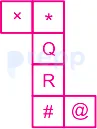
- A
Option A (shown in image)
- B
Option B (shown in image)
- C
Option C (shown in image)
- D
Option D (shown in image)
Show answer
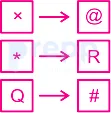
D. Option D (shown in image)The cube when folded will have the faces opposite to each other as mentioned below.
Among the given options, option 4 correctly represents the faces of the cube when folded.
Hence, option 4 is the correct answer.
 Paper & answer key PDF ↗
 Question 5archived
Select the set of letters that when sequentially placed in the blanks of the given letter series will complete the series.
_m_ln_mlmnk_k_nl
- A
k, l, k, l, m
- B
k, n, k, l, m
- C
m, n, k, l, m
- D
l, n, k, l, n
Show answer
B. k, n, k, l, mFinding the Pattern in the Letter Series
The problem asks us to find the correct set of letters that will complete the given letter series. We need to identify the underlying pattern by placing the letters from the options into the blanks and observing the resulting sequence.
The given letter series with blanks is:
_ m _ l n _ m l m n k _ k _ n l
Let's first count the total number of positions and the number of blanks. There are 16 positions in the series, with 5 blanks. We need to fill these 5 blanks with the 5 letters provided in each option sequence.
Testing the Options for Series Completion
We will test each option by substituting the letters into the blanks sequentially (first letter into the first blank, second into the second blank, and so on).
Testing Option 1: k, l, k, l, m
Original series: _ m _ l n _ m l m n k _ k _ n l
Applying k, l, k, l, m:
k m l l n k m l m n k l k m n l
Resulting series: kml l n k m l m n k l k m n l
Let's look for a repeating pattern in this 16-character series. Potential pattern lengths could be 4 (16/4=4 groups) or 8 (16/8=2 groups). Let's try grouping by 4:
kml l
nkm l
m n k l
k m n l
The segments are not identical. This option does not produce a clear repeating pattern.
Testing Option 2: k, n, k, l, m
Original series: _ m _ l n _ m l m n k _ k _ n l
Applying k, n, k, l, m:
1st blank (pos 1): k
2nd blank (pos 3): n
3rd blank (pos 6): k
4th blank (pos 12): l
5th blank (pos 14): m
Let's fill the blanks:
k m n l n k m l m n k l k m n l
Resulting series: kmnlnkmlmnklkmnl
Let's examine this 16-character series for a repeating pattern. Let's try grouping by 4:
k m n l
n k m l
m n k l
k m n l
Again, the segments are not identical. Let's re-check the placement of letters from Option 2 into the blanks of the original series.
Original series: `_ m _ l n _ m l m n k _ k _ n l` (16 characters)
Blanks are at positions: 1, 3, 6, 12, 14.
Letters from Option 2: k (for 1st blank), n (for 2nd), k (for 3rd), l (for 4th), m (for 5th).
Position 1: `k`
Position 2: `m`
Position 3: `n`
Position 4: `l`
Position 5: `n`
Position 6: `k`
Position 7: `m`
Position 8: `l`
Position 9: `m`
Position 10: `n`
Position 11: `k`
Position 12: `l`
Position 13: `k`
Position 14: `m`
Position 15: `n`
Position 16: `l`
The resulting complete series is: k m n l n k m l m n k l k m n l
Let's look at this series again, grouping by 4:
k m n l
n k m l
m n k l
k m n l
It seems my previous test resulted in the same series but I might have misread the pattern. Let's re-examine the grouping by 4 carefully:
Segment 1: kmnl (Positions 1-4)
Segment 2: nkml (Positions 5-8)
Segment 3: mnkl (Positions 9-12)
Segment 4: kmnl (Positions 13-16)
Segments 1 and 4 are identical (`kmnl`). Segments 2 (`nkml`) and 3 (`mnkl`) are different from segment 1 and from each other. This doesn't appear to be a simple repeating pattern of 4.
Let's re-read the question and options to ensure I haven't missed anything. The question asks for the set of letters that "when sequentially placed in the blanks... will complete the series." The options are sequences of letters. The blank positions are defined by the underscores in the given series string.
Given series: _ m _ l n _ m l m n k _ k _ n l
Let's use 0-based indexing for clarity:
Indices: 0 1 2 3 4 5 6 7 8 9 10 11 12 13 14 15
Series: `_ m _ l n _ m l m n k _ k _ n l`
Blanks are at indices: 0, 2, 5, 11, 13.
Letters from Option 2: k, n, k, l, m.
Applying letters to blanks (0-based index):
Index 0: k
Index 2: n
Index 5: k
Index 11: l
Index 13: m
Let's fill the series:
Original: _ m _ l n _ m l m n k _ k _ n l
Fill 0: k m _ l n _ m l m n k _ k _ n l
Fill 2: k m n l n _ m l m n k _ k _ n l
Fill 5: k m n l n k m l m n k _ k _ n l
Fill 11: k m n l n k m l m n k l k _ n l
Fill 13: k m n l n k m l m n k l k m n l
The resulting complete series is: kmnlnkmlmnklkmnl
Let's group this 16-character series into segments of 4:
Segment 1: kmnl
Segment 2: nkml
Segment 3: mnkl
Segment 4: kmnl
Still the same result. Segments 1 and 4 are `kmnl`. Segments 2 and 3 are different. There must be a simpler repeating pattern intended.
Let's re-read the letters in the original series very carefully. `_ m _ l n _ m l m n k _ k _ n l`. It seems the characters given are exactly 16, and the underscores are exactly 5. This matches the options (5 letters).
Let's look at the original series again: `_ m _ l n _ m l m n k _ k _ n l`.
What if the pattern length is different? Length 16 can be divided by 2, 4, 8, 16. We tried 4. Let's try 8:
Segment 1: `kmnlnkml`
Segment 2: `mnklkmnl`
These are not identical. Let's look at the options again and the structure of the original series.
Notice the sequence `mlmnk` appears in the original series starting at index 6 (0-based).
Let's revisit Option 2 and the filled series: `kmnlnkmlmnklkmnl`
Let's look for chunks that repeat or shift. Could the repeating unit be longer than 4? Could it be 8? Let's try breaking the original series into groups of 8 based on where the blanks fall, and see if applying option 2 makes them similar.
Original: `_ m _ l n _ m l | m n k _ k _ n l`
Applying `k, n, k, l, m` to blanks at 0, 2, 5, 11, 13:
Segment 1 (Indices 0-7): `k m n l n k m l`
Segment 2 (Indices 8-15): `m n k l k m n l`
These are not identical. Let's check the possibility of a simpler pattern. Maybe the pattern `kmnl` repeats, but one or two letters are shifted or changed in subsequent repetitions?
Let's go back to the filled series from Option 2: `kmnlnkmlmnklkmnl`
Let's look at the segments of 4 again:
`kmnl`
`nkml`
`mnkl`
`kmnl`
The first and last segments are `kmnl`. The middle two segments `nkml` and `mnkl` are variations of `kmnl`. Specifically, in `nkml`, `kmnl` seems to be cyclically shifted left by one position (kmnl -> mnkl -> nklm -> klmn...). This doesn't match. What if the pattern is `kmnl` and there's a shift in which letters are fixed vs blanks?
Let's re-examine the original series: `_ m _ l n _ m l m n k _ k _ n l`
Let's write down the series with positions (0-indexed) and indicate blanks:
IndexCharacterBlank?
0_Yes
1mNo
2_Yes
3lNo
4nNo
5_Yes
6mNo
7lNo
8mNo
9nNo
10kNo
11_Yes
12kNo
13_Yes
14nNo
15lNo
Blanks are at indices 0, 2, 5, 11, 13. Option 2 letters: k, n, k, l, m.
Filling these gives: k m n l n k m l m n k l k m n l
Let's try grouping this filled series by 4 again:
kmnl | nkml | mnkl | kmnl
Perhaps the pattern is not perfect repetition. Look closely: kmnl, nkml, mnkl, kmnl.
Let's look at the fixed characters in the original series:
_ m _ l n _ m l m n k _ k _ n l
Positions: 1 3 4 6 7 8 9 10 12 14 15
Chars: m l n m l m n k k n l
Let's see what happens when we fill with Option 2 (k, n, k, l, m):
IndexOriginalFilled (Option 2)
0_k
1mm
2_n
3ll
4nn
5_k
6mm
7ll
8mm
9nn
10kk
11_l
12kk
13_m
14nn
15ll
Filled series: kmnlnkmlmnklkmnl
Let's re-examine the segments of 4:
kmnl | nkml | mnkl | kmnl
Okay, looking at this again, there is a pattern. The characters 'k', 'm', 'n', 'l' are involved in each segment, but their order changes. It appears to be a cyclic shift pattern.
Segment 1: k m n l
Segment 2: n k m l (Shift `kmnl` right by 1, ignore last char: l k m n -> nkml?) No. Shift `kmnl` right by 3: n l k m -> nkml. No.
Segment 3: m n k l (Shift `kmnl` right by 2: l k m n -> mnkl. No.)
Segment 4: k m n l
Let's look at the letters in order within each segment:
Seg 1: k, m, n, l
Seg 2: n, k, m, l
Seg 3: m, n, k, l
Seg 4: k, m, n, l
Notice the sequence of letters `k, m, n, l` appears in Segments 1 and 4. In Segment 2, the order is `n, k, m, l`. In Segment 3, the order is `m, n, k, l`.
Let's look at the second segment relative to the first: `kmnl` -> `nkml`. The 'k' moved to the second position, 'm' to the third, 'n' to the first, 'l' stayed at the fourth. This is a specific rearrangement.
Let's look at the third segment relative to the second: `nkml` -> `mnkl`. The 'n' moved to the second, 'k' to the third, 'm' to the first, 'l' stayed at the fourth. Again, a specific rearrangement.
Let's look at the fourth segment relative to the third: `mnkl` -> `kmnl`. The 'm' moved to the second, 'n' to the third, 'k' to the first, 'l' stayed at the fourth.
This suggests the fourth character in each block is always 'l'. Let's verify this in the filled series: `kmnl nk ml mn kl kmnl`. Yes, the 4th, 8th, 12th, and 16th characters are all 'l'.
Now let's look at the first three characters in each block:
Block 1: kmn
Block 2: nkm
Block 3: mnk
Block 4: kmn
The sequence `kmn` is repeated in Blocks 1 and 4. Block 2 (`nkm`) is a cyclic shift of `kmn` (kmn -> mnk -> nkm). Specifically, it's shifted right by 2 positions (kmn -> nkm). Block 3 (`mnk`) is also a cyclic shift of `kmn` (kmn -> mnk). It's shifted right by 1 position.
So the pattern is: A 4-character block where the last character is always 'l', and the first three characters cycle through `kmn`, `nkm`, `mnk`, and then repeat `kmn`. The complete pattern sequence for the blocks is `kmnl`, `nkml`, `mnkl`, `kmnl`.
This repeating pattern is formed when the blanks are filled with the letters `k, n, k, l, m` from Option 2.
Conclusion on the Letter Series Pattern
By placing the letters k, n, k, l, m into the blanks of the series _ m _ l n _ m l m n k _ k _ n l, we get the complete series kmnlnkmlmnklkmnl. This series can be broken down into four segments of four characters each: kmnl, nkml, mnkl, and kmnl. The pattern involves a fixed 'l' at the end of each segment and a cyclic shift of the letters 'k', 'm', 'n' in the first three positions of each segment (kmn -> nkm -> mnk -> kmn). This confirms that Option 2 successfully completes the letter series with a discernible pattern.
Revision Table: Letter Series Analysis
AspectDescription
Original Series_ m _ l n _ m l m n k _ k _ n l (16 characters)
Number of Blanks5
Letters from Option 2k, n, k, l, m
Blanks (0-indexed)0, 2, 5, 11, 13
Complete Series (Option 2)kmnlnkmlmnklkmnl
Segments (Groups of 4)kmnl, nkml, mnkl, kmnl
Identified PatternRepeating 4-character blocks where the last character is 'l' and the first three ('k', 'm', 'n') follow a cyclic shift pattern.
Additional Information on Letter Series Patterns
Letter series problems are a common type of question in logical reasoning tests. They require identifying a specific rule or pattern that governs the sequence of letters.
Common types of patterns include:
Simple Repetition: A block of letters repeats exactly. (e.g., abcabcabc)
Alternating Series: Two or more different patterns alternate.
Increasing/Decreasing Gap: The number of letters between consecutive letters in a pattern increases or decreases.
Alphabetical Progression/Regression: Letters move forward or backward in the alphabet by a fixed or varying number of steps.
Skipping Letters: Letters are skipped in a regular pattern based on their alphabetical position.
Cyclic Shift: The letters within a repeating block are shifted cyclically in subsequent blocks. This is the type of pattern observed in the problem above (kmnl -> nkml -> mnkl -> kmnl).
Combination of Patterns: A series might combine elements of different pattern types.
To solve letter series questions effectively, it's helpful to:
Count the total number of elements and blanks.
Look for repeating blocks of letters.
Divide the series into segments based on the length of potential repeating blocks (often determined by the total length or obvious repetitions).
Examine the relationship between consecutive letters or blocks (e.g., skipping, shifting, alphabetical distance).
Test the options systematically to see which one creates a consistent pattern.
Paper & answer key PDF ↗ Question 6archived
Select the option that is related to the third word in the same way as the second word is related to the first word.
Crop : Farmer ∷ Food : ?
- A
Kitchen
- B
Vegetables
- C
Chef
- D
Utensil
Show answer
C. ChefUnderstanding Analogies: Crop and Food Relationships
The question asks us to find the word that relates to 'Food' in the same way that 'Farmer' relates to 'Crop'. This type of question is called an analogy, where we look for the relationship between the first pair of words and apply that same relationship to the third word to find the fourth word.
Analyzing the First Pair: Crop : Farmer
Let's look at the relationship between 'Crop' and 'Farmer'. A Farmer is a person whose job it is to cultivate and produce Crops. So, the relationship is about a producer or worker and the product they create or handle extensively.
Crop: The product being grown or produced.
Farmer: The person who grows or produces the Crop.
The relationship is: Producer/Worker : Product
Applying the Relationship to the Second Pair: Food : ?
Now we need to find a word that acts as the Producer/Worker for 'Food'. Let's examine the given options:
Kitchen: A Kitchen is a place where food is prepared. It is not a person who produces food.
Vegetables: Vegetables are ingredients used to make Food. They are a type of food, not a person who produces prepared food.
Chef: A Chef is a skilled cook who prepares food, often in a restaurant or other establishment. This person produces prepared Food.
Utensil: A Utensil is a tool used in the preparation or eating of Food. It is not a person who produces food.
Selecting the Best Fit for Food
Comparing the relationship 'Producer/Worker : Product' with the options for 'Food':
Farmer (Producer/Worker) produces Crop (Product).
We need to find the Producer/Worker who produces Food (Product).
Based on our analysis, a Chef is the person whose profession involves preparing and producing Food. This fits the same relationship pattern as Farmer : Crop.
Conclusion for the Food Analogy
The relationship between Crop and Farmer is that the Farmer is the producer of the Crop. Applying this same relationship to Food, the producer of Food is a Chef. Therefore, the word that completes the analogy Food : ? is Chef.
Revision Table: Analogy Breakdown
Pair
Word 1
Relationship
Word 2
First Pair
Crop
is produced/grown by
Farmer
Second Pair
Food
is prepared/produced by
Chef
Additional Information: Types of Analogies and Related Concepts
Word analogies test your ability to identify relationships between pairs of words. Some common types of relationships include:
Part to Whole: e.g., Finger : Hand
Tool to Worker: e.g., Pen : Writer
Action to Object: e.g., Read : Book
Cause and Effect: e.g., Rain : Flood
Synonyms or Antonyms: e.g., Happy : Joyful, Hot : Cold
In this specific question, the relationship is primarily 'Producer/Worker to Product'. While a Farmer produces raw crops, a Chef takes ingredients (including crops) and produces prepared Food. The core idea is the primary agent responsible for creating the final item.
Paper & answer key PDF ↗ Question 7archived
Four number-pairs have been given, out of which three are alike in some manner and one is different. Select the number-pair that is different.
- A
18, 9
- B
16, 7
- C
56, 2
- D
28, 5
Show answer
D. 28, 5Finding the Different Number Pair
In this question, we are given four pairs of numbers. We need to identify the pair that follows a different pattern compared to the other three pairs. Let's examine each pair to find a common rule or pattern.
Analyzing the Number Pairs
Let's look at the relationship between the first and second numbers in each pair. A common pattern in such problems involves operations like addition, subtraction, multiplication, division, or properties related to digits of the numbers.
Let's consider the sum of the digits of the first number in each pair and compare it to the second number.
Pair 1: (18, 9)
The first number is 18. Sum of digits of 18 = \(1 + 8 = 9\).
The second number is 9.
Here, the second number is equal to the sum of the digits of the first number.
Pair 2: (16, 7)
The first number is 16. Sum of digits of 16 = \(1 + 6 = 7\).
The second number is 7.
Here also, the second number is equal to the sum of the digits of the first number.
Pair 3: (56, 2)
The first number is 56. Sum of digits of 56 = \(5 + 6 = 11\).
The second number is 2.
The sum of digits of 56 is 11, which is not 2. However, if we repeatedly sum the digits of 11: \(1 + 1 = 2\).
So, the second number is equal to the repeated sum of the digits of the first number until a single digit is obtained.
Pair 4: (28, 5)
The first number is 28. Sum of digits of 28 = \(2 + 8 = 10\).
The second number is 5.
The sum of digits of 28 is 10. Repeated sum of digits of 10 is \(1 + 0 = 1\).
The second number is 5, which is not equal to 1.
Identifying the Different Pair
Based on our analysis:
For (18, 9), the sum of digits of 18 is 9, which matches the second number.
For (16, 7), the sum of digits of 16 is 7, which matches the second number.
For (56, 2), the repeated sum of digits of 56 is 2, which matches the second number.
For (28, 5), the repeated sum of digits of 28 is 1, which does not match the second number (5).
Therefore, the number pair (28, 5) does not follow the same pattern as the other three pairs.
Conclusion
The number-pair that is different is (28, 5).
Revision Table: Analyzing Number Pairs
Number Pair
First Number
Sum of Digits (First Number)
Repeated Sum of Digits
Second Number
Follows Pattern?
(18, 9)
18
\(1+8=9\)
9
9
Yes
(16, 7)
16
\(1+6=7\)
7
7
Yes
(56, 2)
56
\(5+6=11\)
\(1+1=2\)
2
Yes
(28, 5)
28
\(2+8=10\)
\(1+0=1\)
5
No
Additional Information: Number Series and Pattern Recognition
Questions involving finding the different number pair or the next number in a series are common in logical reasoning and quantitative aptitude tests. They require identifying a rule or pattern that connects the numbers. These patterns can be simple arithmetic operations (addition, subtraction, multiplication, division), or more complex ones involving squares, cubes, prime numbers, Fibonacci sequence, or even digit-based operations like the sum or product of digits. Practice with various types of patterns helps in quickly identifying the rule in such problems. Always test your assumed pattern against all given elements to ensure its consistency.
Paper & answer key PDF ↗ Question 8archived
Select the combination of letters that when sequentially placed in the blanks of the given series will complete the series.
_uvwuv_wvtuw_uvwuv_wv_uw
- A
t t u t v
- B
t v w t t
- C
t u t u t
- D
t t t t t
Show answer
D. t t t t tUnderstanding the Letter Series Completion Problem
This question asks us to find a combination of letters from the given options that will correctly fill the blanks in the series, thereby completing a logical pattern. The series is: _uvwuv_wvtuw_uvwuv_wv_uw.
Our task is to identify the underlying rule or pattern in the series once the blanks are filled. We have five blanks, and each option provides a sequence of five letters to fill them in order.
Analysing the Given Letter Series
Let's first count the total number of positions in the series, including the blanks:
_ u v w u v _ w v t u w _ u v w u v _ w v _ u w
Counting the positions, we find there are 24 positions in total. There are 5 blanks in the series.
The positions of the blanks are:
1st position
7th position
13th position
19th position
22nd position
We need to test each option by placing the letters sequentially into these blank positions to see which option creates a discernible pattern.
Testing the Options
Let's try filling the blanks with the letters from each option and examine the resulting series.
Option 1: t t u t v
Filling the blanks (at positions 1, 7, 13, 19, 22) with t, t, u, t, v:
t u v w u v t w v t u w u u v w u v t w v v u w
This sequence does not immediately reveal a simple repeating pattern.
Option 2: t v w t t
Filling the blanks with t, v, w, t, t:
t u v w u v v w v t u w w u v w u v t w v t u w
This sequence also does not show a clear repeating pattern.
Option 3: t u t u t
Filling the blanks with t, u, t, u, t:
t u v w u v u w v t u w t u v w u v u w v t u w
Still no obvious simple repeating block.
Option 4: t t t t t
Filling the blanks with t, t, t, t, t:
t u v w u v t w v t u w t u v w u v t w v t u w
Identifying the Repeating Pattern with Option 4
Let's look closely at the series generated using Option 4:
t u v w u v t w v t u w t u v w u v t w v t u w
Let's try to break this series into smaller segments to find a repeating sequence.
Consider the first 12 characters: tuvwuvtwvtuw
Now consider the next 12 characters (from position 13 to 24): tuvwuvtwvtuw
We can see that the 12-character sequence tuvwuvtwvtuw repeats exactly twice to form the entire 24-character series.
The series can be represented as:
\( (\text{tuvwuvtwvtuw}) (\text{tuvwuvtwvtuw}) \)
Verifying the Blank Positions
Let's check if filling the original blank positions with 't' aligns with this repeating pattern:
The repeating pattern is tuvwuvtwvtuw (12 characters).
The full series is formed by this pattern repeating from position 1 and again from position 13.
Original blank positions: 1, 7, 13, 19, 22
Blank at position 1: This is the 1st character of the 1st pattern block. The 1st character of tuvwuvtwvtuw is 't'. Matches 't' from Option 4.
Blank at position 7: This is the 7th character of the 1st pattern block. The 7th character of tuvwuvtwvtuw is 't'. Matches 't' from Option 4.
Blank at position 13: This is the 1st character of the 2nd pattern block (position \(13 = 12 + 1\)). The 1st character of tuvwuvtwvtuw is 't'. Matches 't' from Option 4.
Blank at position 19: This is the 7th character of the 2nd pattern block (position \(19 = 12 + 7\)). The 7th character of tuvwuvtwvtuw is 't'. Matches 't' from Option 4.
Blank at position 22: This is the 10th character of the 2nd pattern block (position \(22 = 12 + 10\)). The 10th character of tuvwuvtwvtuw is 't'. Matches 't' from Option 4.
All the blank positions are correctly filled by 't' according to the repeating pattern tuvwuvtwvtuw.
Conclusion
When the blanks in the series _uvwuv_wvtuw_uvwuv_wv_uw are filled with the letters t, t, t, t, t from Option 4, the resulting series is tuvwuvtwvtuwtuvwuvtwvtuw. This series consists of the 12-character block tuvwuvtwvtuw repeated exactly twice. Therefore, Option 4 provides the correct sequence to complete the letter series based on a repeating pattern.
Blank Position
Letter from Option 4
Position in Filled Series
Letter in Repeating Pattern (tuvwuvtwvtuw)
Matches Pattern?
1st
t
1
1st letter: t
Yes
2nd
t
7
7th letter: t
Yes
3rd
t
13
1st letter (2nd block): t
Yes
4th
t
19
7th letter (2nd block): t
Yes
5th
t
22
10th letter (2nd block): t
Yes
Revision Table: Key Steps in Solving Letter Series
Step
Description
1
Count total positions and blanks in the series.
2
Note down the positions of the blanks.
3
Test each option by filling the letters into the blanks.
4
Examine the resulting series for repeating patterns or logical sequences.
5
Verify if the letters used to fill the blanks align with the identified pattern.
6
Select the option that successfully completes a logical pattern.
Additional Information: Types of Letter Series Patterns
Letter series problems in reasoning can follow various patterns. Recognizing these common types can help solve problems faster.
Repeating Series: A block of letters repeats itself throughout the series (e.g., ABCABCABC...). This was the pattern in the solved problem.
Alphabetic Jump/Sequence: The pattern is based on the positions of letters in the alphabet (e.g., A, C, E, G... where each letter jumps by one position).
Skipping Letters: Letters are skipped in a specific order (e.g., AB, DE, GH...).
Reverse Order: Letters appear in reverse alphabetical order or reverse sequence.
Mixed Patterns: A combination of the above patterns might be used, potentially involving numerical relationships based on letter positions (A=1, B=2, etc.).
Alternating Patterns: Two or more different patterns might alternate within the same series.
Practice with different types of letter series helps in quickly identifying the specific pattern used in a question.
Paper & answer key PDF ↗ Question 9archived
Which of the option figures is the exact mirror image of the given figure when the mirror is held at the right side?

- A
Option A (shown in image)
- B
Option B (shown in image)
- C
Option C (shown in image)
- D
Option D (shown in image)
Show answer
A. Option A (shown in image)The exact mirror image of the given figure when the mirror is held at the right sideis,
Hence, option 1 is the correct answer.
 Paper & answer key PDF ↗
 Question 10archived
The two given expressions on both the side of the ‘=’ sign will have the same value if two numbers from either side or both side are interchanged. Select the correct numbers to be interchanged from the given options.
4 + 6 × 7 – 27 ÷ 3 = 7 × 8 – 4 + 39 ÷ 3
- A
6, 4
- B
8, 7
- C
3, 4
- D
6, 8
Show answer
D. 6, 8Interchanging the numbers using BODMAS rule,
Option 1 → 6, 4
6 + 4 × 7 – 27 ÷ 3 = 7 × 8 – 6 + 39 ÷ 3
6 + 4 × 7 – 9 = 7 × 8 – 6 + 13
6 + 28 – 9 = 56 – 6 + 13
34 – 9 = 69 – 6
25 is not equal to 63
Option 2 → 8, 7
4 + 6 × 8 – 27 ÷ 3 = 8 × 7 – 4 + 39 ÷ 3
4 + 6 × 8 – 9 = 8 × 7 – 4 + 13
4 + 48 – 9 = 56 – 4 + 13
52 – 9 = 69 – 4
43 is not equal to 65
Option 3 → 3, 4
3 + 6 × 7 – 27 ÷ 4 = 7 × 8 – 3 + 39 ÷ 4
3 + 6 × 7 – 6.75 = 7 × 8 – 3 + 9.75
3 + 42 – 6.75 = 56 – 3 + 9.75
45 – 6.75 = 65.75 – 3
38.25 is not equal to 62.75
Option 4 → 6, 8
4 + 8 × 7 – 27 ÷ 3 = 7 × 6 – 4 + 39 ÷ 3
4 + 8 × 7 – 9 = 7 × 6 – 4 + 13
4 + 56 – 9 = 42 – 4 + 13
60 – 9 = 55 – 4
51 = 51
Hence, option 4 is the correct answer.
Paper & answer key PDF ↗ Question 11archived
Study the given pattern carefully and select the number that can replace the question mark (?) in it.
10
4
7
5
15
7
8
25
14
3
6
12
10
?
14
65
- A
18
- B
16
- C
10
- D
14
Show answer
B. 16Solving the Number Pattern Grid
The question presents a sequence of numbers: 1047515782514361210?1465. Based on typical pattern-based questions, this sequence can be interpreted as numbers arranged in a grid or matrix. Looking at the structure and the numbers provided before and after the question mark, it is highly probable that the numbers form a 4x4 grid, with the last two numbers '65' being extraneous or part of a separate pattern/incomplete row.
Let's arrange the numbers into a 4x4 grid:
Column 1
Column 2
Column 3
Column 4
10
4
7
5
15
7
8
2
5
14
3
6
12
10
?
14
We need to find a pattern or relationship between the numbers in this grid that holds true for the first three rows/columns and then apply it to the fourth row/column to find the missing number.
Let's examine possible relationships, such as row sums, column sums, or relationships between numbers within rows or columns.
Analyzing Column Sums in the Pattern
Let's calculate the sum of the numbers in each column:
Column 1 Sum: \(10 + 15 + 5 + 12 = 42\)
Column 2 Sum: \(4 + 7 + 14 + 10 = 35\)
Column 3 Sum: \(7 + 8 + 3 + ? = 18 + ?\)
Column 4 Sum: \(5 + 2 + 6 + 14 = 27\)
Now let's look for a relationship between these column sums.
Identifying the Pattern Logic
Let's try adding the sums of specific columns:
Sum of Column 1 and Column 4: \(42 + 27 = 69\)
Sum of Column 2 and Column 3: \(35 + (18 + ?) = 53 + ?\)
If we assume that the sum of Column 1 and Column 4 is equal to the sum of Column 2 and Column 3, we can set up an equation:
\( \text{Sum(Col 1)} + \text{Sum(Col 4)} = \text{Sum(Col 2)} + \text{Sum(Col 3)} \)
\( 42 + 27 = 35 + (18 + ?) \)
\( 69 = 53 + ? \)
Now, we can solve for the missing number (?):
\( ? = 69 - 53 \)
\( ? = 16 \)
Verifying the Pattern
Let's check if this pattern holds true for each row individually. The identified pattern is based on the sum of the columns, not individual rows. The logic states that the total sum of elements in C1 + C4 equals the total sum of elements in C2 + C3 across the entire grid.
The value calculated for the question mark (?) is 16. This is one of the options provided.
Thus, based on the pattern where the sum of elements in the first and fourth columns equals the sum of elements in the second and third columns, the missing number is 16.
Final Answer Derivation
By applying the identified pattern (Sum of Column 1 + Sum of Column 4 = Sum of Column 2 + Sum of Column 3) to the grid, we found that the missing number is 16.
Column 1 Sum = 42
Column 2 Sum = 35
Column 3 Sum = 18 + ?
Column 4 Sum = 27
\( 42 + 27 = 35 + 18 + ? \)
\( 69 = 53 + ? \)
\( ? = 69 - 53 \)
\( ? = 16 \)
The number that replaces the question mark is 16.
Revision Table: Key Pattern Analysis
Feature
Analysis
Finding
Grid Structure
Interpreted sequence as a 4x4 matrix.
Confirmed likely structure for analysis.
Row Sums
Calculated sums for each row (26, 32, 28, 36+?).
No simple additive pattern observed in row sums.
Column Sums
Calculated sums for each column (42, 35, 18+?, 27).
Identified a potential relationship between sums of columns.
Pattern Logic
Tested relationship: Sum(C1) + Sum(C4) = Sum(C2) + Sum(C3).
Pattern holds true and allowed calculation of ?.
Missing Number
Solved for ? using the established pattern.
? = 16.
Additional Information: Tips for Solving Pattern Puzzles
Pattern puzzles, especially those presented in a grid format, test your logical reasoning and numerical skills. Here are some strategies that can be helpful:
Look for simple arithmetic progressions: Check if numbers increase or decrease by a constant value in rows or columns.
Consider sums or differences: Add or subtract numbers in rows, columns, or diagonals. The sum or difference might follow a pattern or be constant.
Look for products or quotients: Sometimes the relationship involves multiplication or division.
Check for patterns in digits: Sum of digits or other properties of the numbers themselves might form a pattern.
Combine operations: The pattern might involve a combination of operations, e.g., (A + B) - C = D.
Examine relationships between grid sections: Look for relationships between the top half and bottom half, or left side and right side of the grid.
Test relationships between adjacent cells: The number in a cell might be related to its neighbors.
Always test the identified pattern on all known parts of the grid to ensure consistency before applying it to find the missing element. In this specific puzzle, the pattern was found by summing the columns.
Paper & answer key PDF ↗ Question 12archived
Which of the following sets is best represented by the given Venn diagram.

- A
House, Window, Tenant
- B
Paragraph, Sentence, Pen
- C
Weeks, Years, Months
- D
Truck, Ships, Transport
Show answer
C. Weeks, Years, MonthsThe set which is represented by the given Venn diagram is,
Weeks, Months, Years
In years we have months and in months we have weeks.
Hence, option 3 is the correct answer.
 Paper & answer key PDF ↗
 Question 13archived
Select the letter-cluster that can replace the question mark (?) in the following series.
qDx, nHs, kLn, hPi, ?
- A
EtD
- B
eSd
- C
eTd
- D
fTe
Show answer
C. eTdSolving the Letter-Cluster Series Pattern
The question asks us to find the next term in the given letter-cluster series: qDx, nHs, kLn, hPi, ?
To solve this type of series question, we need to analyze the pattern followed by the letters at each position within the clusters.
Analyzing the First Letter of Each Cluster
Let's look at the first letter of each cluster:
q (from qDx)
n (from nHs)
k (from kLn)
h (from hPi)
? (the first letter of the next cluster)
Let's find the position of these letters in the English alphabet (A=1, B=2, ..., Z=26):
q is the 17th letter.
n is the 14th letter.
k is the 11th letter.
h is the 8th letter.
Now, let's find the difference between consecutive letters' positions:
n (14) - q (17) = -3
k (11) - n (14) = -3
h (8) - k (11) = -3
The pattern for the first letter is a consistent decrease of 3 in the alphabetical position.
To find the first letter of the next cluster, we subtract 3 from the position of 'h' (which is 8):
\(8 - 3 = 5\)
The 5th letter of the alphabet is 'e'. So, the first letter of the next cluster is 'e'.
Analyzing the Second Letter of Each Cluster
Now, let's look at the second letter of each cluster:
D (from qDx)
H (from nHs)
L (from kLn)
P (from hPi)
? (the second letter of the next cluster)
Let's find the position of these letters in the English alphabet:
D is the 4th letter.
H is the 8th letter.
L is the 12th letter.
P is the 16th letter.
Let's find the difference between consecutive letters' positions:
H (8) - D (4) = +4
L (12) - H (8) = +4
P (16) - L (12) = +4
The pattern for the second letter is a consistent increase of 4 in the alphabetical position.
To find the second letter of the next cluster, we add 4 to the position of 'P' (which is 16):
\(16 + 4 = 20\)
The 20th letter of the alphabet is 'T'. So, the second letter of the next cluster is 'T'.
Analyzing the Third Letter of Each Cluster
Finally, let's look at the third letter of each cluster:
x (from qDx)
s (from nHs)
n (from kLn)
i (from hPi)
? (the third letter of the next cluster)
Let's find the position of these letters in the English alphabet:
x is the 24th letter.
s is the 19th letter.
n is the 14th letter.
i is the 9th letter.
Let's find the difference between consecutive letters' positions:
s (19) - x (24) = -5
n (14) - s (19) = -5
i (9) - n (14) = -5
The pattern for the third letter is a consistent decrease of 5 in the alphabetical position.
To find the third letter of the next cluster, we subtract 5 from the position of 'i' (which is 9):
\(9 - 5 = 4\)
The 4th letter of the alphabet is 'd'. So, the third letter of the next cluster is 'd'.
Combining the Patterns
By combining the next letters found for each position, we get the next letter-cluster:
First letter: e
Second letter: T
Third letter: d
The next letter-cluster in the series is eTd.
Revision Table: Summary of Patterns
Letter Position
Series
Pattern (Change in Position)
Next Letter Calculation
Next Letter
First
q, n, k, h, ?
-3
Position of h (8) - 3 = 5
e
Second
D, H, L, P, ?
+4
Position of P (16) + 4 = 20
T
Third
x, s, n, i, ?
-5
Position of i (9) - 5 = 4
d
Therefore, the letter-cluster that replaces the question mark is eTd.
Additional Information: Understanding Letter Series and Pattern Recognition
Letter series questions are common in logical reasoning tests. They require you to identify a specific pattern in the sequence of letters. These patterns can involve:
Adding or subtracting a constant number to the alphabetical position of letters.
Increasing or decreasing the number added or subtracted in each step (e.g., +1, +2, +3...).
Alternating patterns (e.g., +2, -1, +2, -1...).
Skipping letters based on a rule.
Vowel/consonant patterns.
Using reverse alphabetical order.
When solving letter-cluster series like qDx, nHs, kLn, hPi, you should break down the cluster and analyze the pattern for each letter position independently. Assigning numerical values based on alphabetical order is a very helpful technique to make the patterns visible.
Paper & answer key PDF ↗ Question 14archived
A + B means ‘A is the father of B’;
A – B means ‘A is the sister of B’;
A × B means ‘A is the brother of B’;
A ÷ B means ‘A is the daughter of B’.
If, R + S × T – V ÷ U, then how is S related to U?
- A
Husband
- B
Brother
- C
Son
- D
Daughter
Show answer
C. SonAnalyzing Blood Relations in the Given Expression
The question provides a set of coded relationships and an expression involving these codes. We need to decode the expression to determine the relationship between S and U.
Understanding the Relationship Codes
Here are the given codes and their meanings:
A + B means ‘A is the father of B’
A – B means ‘A is the sister of B’
A × B means ‘A is the brother of B’
A ÷ B means ‘A is the daughter of B’
Decoding the Expression: R + S × T – V ÷ U
Let's break down the given expression part by part:
R + S: According to the first rule, R + S means 'R is the father of S'.
S × T: According to the third rule, S × T means 'S is the brother of T'. This tells us S is male. Since R is the father of S, R is also the father of T.
T – V: According to the second rule, T – V means 'T is the sister of V'. This tells us T is female. Since S is the brother of T, and T is the sister of V, S, T, and V are siblings. R is the father of S, T, and V.
V ÷ U: According to the fourth rule, V ÷ U means 'V is the daughter of U'. This tells us V is female.
Establishing the Family Relationship
From the decoding, we have the following relationships:
R is the father of S.
S is the brother of T.
T is the sister of V.
V is the daughter of U.
Combining these, we know that S, T, and V are siblings. R is their father. V is the daughter of U. Since V is a daughter of both R (through being a sibling of S whose father is R) and U, U must be the other parent of V. As R is the father, U must be the mother.
Therefore, U is the mother of S, T, and V. R and U are the parents of S, T, and V.
Determining the Relationship between S and U
We need to find out how S is related to U.
U is the mother of S.
S is a child of U.
From the expression S × T, we know S is the brother of T, which means S is male.
Since S is a male child of U, S is the son of U.
Conclusion
Based on the step-by-step decoding of the blood relation codes and the given expression, S is the son of U.
Expression Part
Relationship
Deduction
R + S
R is father of S
R is male
S × T
S is brother of T
S is male, S and T are siblings
T – V
T is sister of V
T is female, S, T, V are siblings
V ÷ U
V is daughter of U
V is female, U is parent of V
Combined
S, T, V siblings; R parent of S,T,V; U parent of V
R is father, U must be mother. R & U are parents of S,T,V
S to U
S is child of U, S is male
S is son of U
Revision Table: Key Relationship Types
Symbol
Relationship
+
Father
–
Sister
×
Brother
÷
Daughter
Additional Information: Solving Blood Relation Puzzles
Solving blood relation puzzles involves carefully decoding the relationships given in a coded form or descriptive sentences. It is often helpful to draw a family tree or diagram to visualize the connections between different individuals. Pay close attention to the gender of individuals where specified by the codes or relationships.
Break down the given information into smaller parts.
Identify the gender of each person whenever possible.
Combine the smaller relationships to build a complete family structure.
Finally, trace the path between the two individuals whose relationship is asked.
Practice with different types of blood relation problems improves speed and accuracy.
Paper & answer key PDF ↗ Question 15archived
Select the option figure in which the given figure is embedded (rotation is NOT allowed).

- A
Option A (shown in image)
- B
Option B (shown in image)
- C
Option C (shown in image)
- D
Option D (shown in image)
Show answer
D. Option D (shown in image)The given figure is embedded in
Hence, option 4 is the correct answer.
 Paper & answer key PDF ↗
 Question 16archived
In a certain code language, ‘VERBAL’ is written as ‘QNMYXK’ and ‘REACH’ is written as ‘MNXZF’. How will ‘BRAVE’ be written as in that language?
- A
KMQXN
- B
YNXQM
- C
YMXQN
- D
KQNMX
Show answer
C. YMXQNUnderstanding the Coding Decoding Problem
This problem involves a coding language where words are coded into different sets of letters. We are given the codes for two words, 'VERBAL' and 'REACH', and asked to find the code for 'BRAVE' in the same language.
To solve this type of coding decoding question, we first need to identify the pattern or rule used for coding the given words. Often, in such cases, it is a direct substitution cipher where each letter in the original word is replaced by a specific letter in the code word, regardless of its position.
Analyzing the Given Codes
Let's look at the provided examples:
'VERBAL' is coded as 'QNMYXK'
'REACH' is coded as 'MNXZF'
We can try to find a consistent mapping for each letter by comparing the original words and their codes. Let's list the letters and their corresponding codes based on the given information:
Original Word
Coded Word
V
Q
E
N
R
M
B
Y
A
X
L
K
R
M
E
N
A
X
C
Z
H
F
By examining the list, we can see if the mapping is consistent. Let's consolidate the unique mappings we found:
V maps to Q
E maps to N (consistent in both words)
R maps to M (consistent in both words)
B maps to Y
A maps to X (consistent in both words)
L maps to K
C maps to Z
H maps to F
Since the mappings for the letters 'R', 'E', and 'A' are the same in both 'VERBAL' and 'REACH', it confirms that this is likely a direct letter-to-letter substitution code.
Coding the Word 'BRAVE'
Now that we have established the substitution rule, we can apply it to the word 'BRAVE'. We need to find the corresponding code for each letter in 'BRAVE' based on the mappings derived from 'VERBAL' and 'REACH'.
B maps to Y (from VERBAL)
R maps to M (from VERBAL and REACH)
A maps to X (from VERBAL and REACH)
V maps to Q (from VERBAL)
E maps to N (from VERBAL and REACH)
Putting these coded letters together in the order they appear in 'BRAVE', we get:
B → Y
R → M
A → X
V → Q
E → N
So, the word 'BRAVE' is coded as 'YMXQN'.
Comparing with Options
Let's compare our coded word 'YMXQN' with the given options:
Option 1: KMQXN
Option 2: YNXQM
Option 3: YMXQN
Option 4: KQNMX
Our derived code 'YMXQN' matches Option 3.
Conclusion on Coding Decoding
By carefully analyzing the given examples of coded words and their corresponding original words, we were able to determine the letter-by-letter substitution rule. Applying this rule to the word 'BRAVE' allowed us to find its code in the given language.
Revision Table: Letter Mappings
Original Letter
Coded Letter
V
Q
E
N
R
M
B
Y
A
X
L
K
C
Z
H
F
Additional Information on Coding Decoding
Coding decoding problems are common in logical reasoning sections of competitive exams. They test your ability to identify patterns and apply rules. While this problem used a simple direct substitution, other types of coding can involve:
Positional Changes: Letters might change their positions within the word or code.
Letter Shifting: Letters might be shifted forward or backward in the alphabet by a fixed number of positions (e.g., A becomes C, B becomes D, etc.).
Opposite Letters: Letters might be replaced by their corresponding letters from the opposite end of the alphabet (e.g., A becomes Z, B becomes Y, etc.).
Mixed Patterns: A combination of the above methods might be used.
Practicing various types of coding decoding questions helps in quickly identifying the pattern and solving the problem accurately.
Paper & answer key PDF ↗ Question 17archived
In a certain code language, BREATHER is coded as 29512859. How will AVIATION be coded as in that language?
- A
12910965
- B
12912954
- C
14912956
- D
14912965
Show answer
D. 14912965Understanding Coding Decoding Logic
This question asks us to decipher a coding rule applied to the word BREATHER to get the code 29512859, and then apply the same rule to find the code for AVIATION.
Let's analyze the given example: BREATHER is coded as 29512859.
We can try to find a pattern by looking at the position of each letter in the English alphabet:
A = 1
B = 2
C = 3
...
Z = 26
Let's map the letters of BREATHER to their alphabetical positions and compare them with the given code:
Letter
Alphabetical Position
Given Code Digit
B
2
2
R
18
9
E
5
5
A
1
1
T
20
2
H
8
8
E
5
5
R
18
9
Observing the pattern, we can see that for single-digit positions (B=2, E=5, A=1, H=8), the code digit is the position itself. For double-digit positions (R=18, T=20), the code digit seems to be the sum of the digits of the position:
R (18th letter): Sum of digits is \(1 + 8 = 9\). This matches the code digit 9.
T (20th letter): Sum of digits is \(2 + 0 = 2\). This matches the code digit 2.
So, the rule is: The code for a letter is the sum of the digits of its alphabetical position.
Applying the Coding Rule to AVIATION
Now let's apply this rule to the word AVIATION:
Letter
Alphabetical Position
Sum of Digits
Coded Digit
A
1
1
1
V
22
\(2 + 2 = 4\)
4
I
9
9
9
A
1
1
1
T
20
\(2 + 0 = 2\)
2
I
9
9
9
O
15
\(1 + 5 = 6\)
6
N
14
\(1 + 4 = 5\)
5
Combining the coded digits for each letter in sequence, we get the code for AVIATION:
14912965
Verifying the AVIATION Code
The calculated code for AVIATION is 14912965.
Let's check the given options:
Option 1: 12910965 (Does not match)
Option 2: 12912954 (Does not match)
Option 3: 14912956 (Does not match)
Option 4: 14912965 (Matches our result)
Therefore, the correct code for AVIATION based on the established coding rule is 14912965.
Revision Table: Alphabetical Positions and Digit Sums
Understanding the basic alphabetical positions is crucial for solving such coding decoding problems. Here's a quick reference:
Letter
Position
Digit Sum
A
1
1
B
2
2
...
...
...
I
9
9
J
10
\(1+0=1\)
...
...
...
N
14
\(1+4=5\)
O
15
\(1+5=6\)
...
...
...
R
18
\(1+8=9\)
S
19
\(1+9=10 \rightarrow 1+0=1\)*
T
20
\(2+0=2\)
...
...
...
V
22
\(2+2=4\)
...
...
...
Z
26
\(2+6=8\)
*Note: In some coding schemes, double-digit sums might be further reduced until a single digit is obtained. However, in this specific question's pattern, the sum of digits like \(1+8=9\) or \(2+0=2\) was used directly. If the sum was 10 or more, we might expect further reduction depending on the specific rule.
Additional Information on Coding Decoding Questions
Coding-decoding questions are common in reasoning sections of competitive exams. They test your ability to identify patterns in rules applied to letters, words, or numbers.
Common types of coding rules include:
Letter Shifting: Letters are shifted forward or backward by a fixed number of positions.
Reverse Alphabetical Order: Using positions from the end of the alphabet (Z=1, Y=2, etc.).
Substitution: One letter is substituted for another based on a specific rule.
Direct Letter to Number: Using the alphabetical position directly.
Sum/Product of Digits: As seen in this problem, manipulating the digits of the alphabetical position.
Consonant/Vowel based rules: Different rules for vowels and consonants.
Reverse Word Order: The letters in the word are reversed before applying a rule.
Practicing various types of coding decoding problems helps in quickly identifying the underlying pattern.
Paper & answer key PDF ↗ Question 18archived
Select the option that is related to the third number in the same way as the second number is related to the first number and the sixth number is related to the fifth number:
78 : 117 ∷ 90 : ? ∷ 108 : 162
- A
135
- B
144
- C
117
- D
126
Show answer
A. 135Solving Number Analogy Problems
Number analogy questions test your ability to find the relationship between pairs of numbers and apply that relationship to find a missing number. In this specific analogy problem, we are given two complete pairs and one incomplete pair:
78 : 117
90 : ?
108 : 162
The symbol '∷' indicates that the ratio or relationship between the first pair (78:117) is the same as the ratio or relationship between the second pair (90:?) and the third pair (108:162).
Finding the Relationship in the Given Pairs
Let's examine the relationship between the numbers in the complete pairs (78, 117) and (108, 162).
Analyzing the First Pair (78 : 117)
We can look for common relationships like addition, subtraction, multiplication, division, or a ratio. Let's calculate the ratio of the second number to the first number:
\(\text{Ratio} = \frac{\text{Second Number}}{\text{First Number}} = \frac{117}{78}\)
To simplify this fraction, we can find the greatest common divisor (GCD) or divide by common factors. Both 117 and 78 are divisible by 3:
\(\frac{117 \div 3}{78 \div 3} = \frac{39}{26}\)
Both 39 and 26 are divisible by 13:
\(\frac{39 \div 13}{26 \div 13} = \frac{3}{2}\)
So, the ratio is \(\frac{3}{2}\), or 1.5. This means \(117 = \frac{3}{2} \times 78\).
Analyzing the Third Pair (108 : 162)
Let's apply the same ratio calculation to the third pair:
\(\text{Ratio} = \frac{\text{Second Number}}{\text{First Number}} = \frac{162}{108}\)
Simplify the fraction. Both are divisible by 2:
\(\frac{162 \div 2}{108 \div 2} = \frac{81}{54}\)
Both are divisible by 9:
\(\frac{81 \div 9}{54 \div 9} = \frac{9}{6}\)
Both are divisible by 3:
\(\frac{9 \div 3}{6 \div 3} = \frac{3}{2}\)
Again, the ratio is \(\frac{3}{2}\), or 1.5. This confirms that \(162 = \frac{3}{2} \times 108\).
The relationship between the numbers in each pair is consistent: the second number is always \(\frac{3}{2}\) times the first number.
Finding the Missing Number in the Second Pair (90 : ?)
Now, we apply the discovered rule to the second pair (90 : ?). The missing number is the second number, and the first number is 90. Using the relationship, the missing number should be \(\frac{3}{2}\) times 90.
\(\text{Missing Number} = \frac{3}{2} \times 90\)
We can calculate this as:
\(\text{Missing Number} = 3 \times \left(\frac{90}{2}\right)\)
\(\text{Missing Number} = 3 \times 45\)
\(\text{Missing Number} = 135\)
Comparing with Options
The calculated missing number is 135. Let's check the given options:
135
144
117
126
The calculated value 135 matches Option 1.
Therefore, the missing number in the analogy 90 : ? is 135.
Final Solution Analysis
The core of solving this number analogy was identifying the consistent mathematical relationship (multiplication by \(\frac{3}{2}\)) present across the given pairs and applying it to the pair with the missing term.
Pair
Relationship Calculation
Result
78 : 117
\(117 \div 78\) or \(78 \times 1.5\)
\(\frac{3}{2}\) or 117
90 : ?
\(90 \times 1.5\)
135
108 : 162
\(162 \div 108\) or \(108 \times 1.5\)
\(\frac{3}{2}\) or 162
Revision Table: Key Concepts in Number Analogies
Concept
Description
How it Applies Here
Analogy
A comparison between two things for the purpose of explanation or clarification, showing a relationship.
Comparing number pairs to find a common relationship.
Ratio
The quantitative relationship between two amounts showing the number of times one value contains or is contained within the other.
Used to find the multiplicative relationship (\(\frac{3}{2}\)) between numbers in pairs.
Pattern Recognition
Identifying recurring sequences or relationships in data.
Essential skill to find the consistent rule (\(\times \frac{3}{2}\)) across the pairs.
Additional Information: Types of Number Relationships in Analogies
Number analogy problems can involve various types of relationships. Recognizing these common types can help solve problems faster:
Arithmetic Operations: Addition, subtraction, multiplication, division. Sometimes a combination (\(x \rightarrow ax+b\)).
Squares and Cubes: The second number might be the square, cube, square root, or cube root of the first number, or related to them.
Prime Numbers: Relationships might involve consecutive prime numbers or properties of prime numbers.
Digit Operations: Sum of digits, product of digits, reversing digits, etc.
Sequences: The numbers might follow a specific sequence rule (like arithmetic or geometric progression) across the terms of the analogy.
Ratio/Proportion: As seen in this problem, the ratio between the numbers in each pair is constant.
Systematically checking for these common relationships can help you solve most number analogy questions.
Paper & answer key PDF ↗ Question 19archived
Read the given statements and conclusions carefully, Assuming that the information given in the statements is true, even if it appears to be at variance with commonly known facts, decide which of the given conclusions logically follow from the statements.
Statements:
1. All books are magazines
2. Some books are novels.
Conclusions:
I. Some magazines are books
II. No magazine is a book
III. No novel is a magazine
IV. Some novels are books.
- A
Only conclusions I and II follow.
- B
Only conclusions I, II and IV follow
- C
Only conclusions II and III follow
- D
Only conclusions I and IV follow
Show answer
D. Only conclusions I and IV followAnalyzing Statements and Conclusions
This question requires us to analyze the given statements and determine which of the provided conclusions logically follow based on those statements alone, assuming the statements are true.
Given Statements:
All books are magazines.
Some books are novels.
Given Conclusions:
Some magazines are books
No magazine is a book
No novel is a magazine
Some novels are books.
Step-by-Step Conclusion Analysis
Let's evaluate each conclusion based on the truth of the given statements.
Evaluating Conclusion I: Some magazines are books
Statement 1 says, "All books are magazines." This means that every single item belonging to the category 'books' is also part of the category 'magazines'. If all books are magazines, then there are definitely some items within the 'magazines' category that are 'books' (specifically, all the books). Therefore, the conclusion "Some magazines are books" logically follows from Statement 1.
Evaluating Conclusion II: No magazine is a book
Statement 1 clearly states, "All books are magazines." This directly implies that there are indeed things that are both magazines and books. The conclusion "No magazine is a book" directly contradicts Statement 1. Thus, this conclusion does not follow from the given statements.
Evaluating Conclusion III: No novel is a magazine
Let's combine the information from both statements. Statement 2 tells us, "Some books are novels." This means there is at least one book that is also a novel. Statement 1 says, "All books are magazines." This means everything that is a book is also a magazine. Therefore, any item that is a book is also a magazine. Since there are some books that are novels (from Statement 2), and all books are magazines (from Statement 1), it must be true that those specific books which are novels are also magazines. This leads to the conclusion that "Some novels are magazines." The given conclusion "No novel is a magazine" contradicts this deduction. Thus, this conclusion does not follow.
Evaluating Conclusion IV: Some novels are books
Statement 2 is "Some books are novels." The conclusion is "Some novels are books." In logical reasoning, for a statement of the form "Some A are B", its converse "Some B are A" is always true. If it is true that "Some books are novels," then it is equally true that "Some novels are books." This conclusion is a direct restatement of Statement 2 in a different order, and it logically follows.
Summary of Conclusions
Conclusion I: Some magazines are books - Follows (from Statement 1).
Conclusion II: No magazine is a book - Does not follow (contradicts Statement 1).
Conclusion III: No novel is a magazine - Does not follow (contradicts the deduction from Statements 1 and 2).
Conclusion IV: Some novels are books - Follows (from Statement 2).
Based on our analysis, only conclusions I and IV logically follow from the given statements.
Revision Table: Statements and Conclusions Logic
Statement Type
Original Statement (Example)
Logically Following Conclusion (Example)
All A are B
All dogs are mammals.
Some mammals are dogs.
Some A are B
Some students are artists.
Some artists are students.
No A is B
No cat is a dog.
No dog is a cat.
Additional Information on Logical Deduction
In logical reasoning, we must strictly adhere to the information provided in the statements, even if they seem unusual compared to real-world facts. We use rules of logic to deduce conclusions. Venn diagrams can be a helpful visual tool to represent the relationship between categories described in the statements and check the validity of conclusions. For instance, "All books are magazines" would be represented by a circle for 'Books' completely inside a circle for 'Magazines'. "Some books are novels" would be represented by an overlapping area between the 'Books' circle and a 'Novels' circle. The overlap must be within the 'Books' circle, which is itself inside the 'Magazines' circle, showing the connection between novels and magazines through books.
Understanding the implications of "All", "Some", and "No" statements is crucial for solving syllogism-based questions.
Paper & answer key PDF ↗ Question 20archived
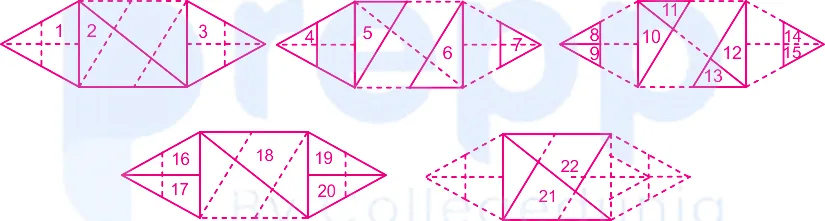
How many triangles are present in the given figure?

- A
20
- B
18
- C
23
- D
22
Show answer
D. 22The number of triangles in the given figure is,
Hence, “22” is the correct answer.
 Paper & answer key PDF ↗
 Question 21archived
Select the option in which the numbers are related in the same way as are the numbers in the given set.
(343, 98, 21)
- A
(1331, 242, 33)
- B
(217, 72, 18)
- C
(1728, 288, 24)
- D
(512, 126, 27)
Show answer
A. (1331, 242, 33)Finding the Relationship in the Given Set of Numbers
The question asks us to find a set of numbers from the options that shares the same relationship as the numbers in the given set (343, 98, 21).
Let's analyze the relationship between the numbers in the set (343, 98, 21).
We can observe that:
The first number, 343, is a perfect cube. Specifically, $343 = 7 \times 7 \times 7 = 7^3$.
The third number, 21, is a multiple of 7. Specifically, $21 = 3 \times 7$.
The second number, 98, is also related to 7. We can see that $98 = 2 \times 49$, and $49 = 7 \times 7 = 7^2$. So, $98 = 2 \times 7^2$.
Therefore, the relationship between the numbers (343, 98, 21) can be expressed using a base number, which is 7 in this case. If we let the base number be $x$, the relationship is $(x^3, 2x^2, 3x)$. For the given set, $x=7$, so we have $(7^3, 2 \times 7^2, 3 \times 7) = (343, 2 \times 49, 21) = (343, 98, 21)$.
Now, we need to check which option follows this same pattern.
Analyzing the Options Based on the Relationship $(x^3, 2x^2, 3x)$
Option 1: (1331, 242, 33)
Let's check if the first number is a perfect cube. $1331 = 11 \times 11 \times 11 = 11^3$. So, the base number $x$ could be 11.
Now let's check if the second number follows the pattern $2x^2$ with $x=11$. $2x^2 = 2 \times 11^2 = 2 \times 121 = 242$. This matches the second number in the option.
Finally, let's check if the third number follows the pattern $3x$ with $x=11$. $3x = 3 \times 11 = 33$. This matches the third number in the option.
Since all three numbers in Option 1 follow the relationship $(x^3, 2x^2, 3x)$ with $x=11$, this option is related in the same way as the given set.
Option 2: (217, 72, 18)
Let's check the first number, 217. Is it a perfect cube? $6^3 = 216$ and $7^3 = 343$. 217 is not a perfect cube.
This option does not fit the $(x^3, 2x^2, 3x)$ pattern.
Option 3: (1728, 288, 24)
Let's check the first number, 1728. Is it a perfect cube? $12^3 = 1728$. So, the base number $x$ could be 12.
Now let's check the second number with $x=12$. $2x^2 = 2 \times 12^2 = 2 \times 144 = 288$. This matches the second number.
Finally, let's check the third number with $x=12$. $3x = 3 \times 12 = 36$. The third number in the option is 24, which does not match 36.
This option does not fit the $(x^3, 2x^2, 3x)$ pattern.
Option 4: (512, 126, 27)
Let's check the first number, 512. Is it a perfect cube? $8^3 = 512$. So, the base number $x$ could be 8.
Now let's check the second number with $x=8$. $2x^2 = 2 \times 8^2 = 2 \times 64 = 128$. The second number in the option is 126, which does not match 128.
This option does not fit the $(x^3, 2x^2, 3x)$ pattern.
Conclusion
The only option that follows the same relationship $(x^3, 2x^2, 3x)$ as the given set (343, 98, 21) is Option 1, (1331, 242, 33), where the base number $x$ is 11.
Set
First Number
Relationship
Base $x$
Second Number
Relationship
Third Number
Relationship
Pattern Match?
Given Set
343
$7^3$
7
98
$2 \times 7^2$
21
$3 \times 7$
Yes
Option 1
1331
$11^3$
11
242
$2 \times 11^2 = 242$
33
$3 \times 11 = 33$
Yes
Option 2
217
Not $x^3$
-
-
-
-
-
No
Option 3
1728
$12^3$
12
288
$2 \times 12^2 = 288$
24
$3 \times 12 = 36$ (Mismatch)
No
Option 4
512
$8^3$
8
126
$2 \times 8^2 = 128$ (Mismatch)
-
-
No
Revision Table: Number Relationships and Cubes
Concept
Description
Example
Perfect Cube
A number obtained by multiplying an integer by itself three times ($n^3$).
$7^3 = 343$, $11^3 = 1331$
Square of a Number
A number obtained by multiplying an integer by itself ($n^2$).
$7^2 = 49$, $11^2 = 121$
Numerical Pattern
A sequence or set of numbers that follow a specific rule or relationship.
$(x^3, 2x^2, 3x)$ where $x$ is a base number.
Additional Information: Analyzing Number Series and Patterns
Analyzing number series and patterns is a common type of problem in reasoning and quantitative aptitude tests. These problems require identifying the underlying rule that connects the numbers in a given set or sequence.
Common types of patterns include:
Arithmetic progression (constant difference)
Geometric progression (constant ratio)
Squares and cubes of numbers
Combinations of arithmetic and geometric operations
Differences between consecutive terms forming another pattern
Digital sum, product, or other properties of digits
Relationships based on primes, composites, etc.
To solve such problems, it is helpful to:
Look for simple relationships first (addition, subtraction, multiplication, division).
Check for squares, cubes, or powers of numbers.
Analyze the differences or ratios between consecutive terms.
Break down the numbers into their factors or digits.
Test the identified pattern against all numbers in the set and then against the options.
In this specific problem, recognizing the first number as a perfect cube was a key step to uncovering the pattern based on powers of a base number.
Paper & answer key PDF ↗ Question 22archived
Four letter-cluster have been given, out of which three are alike in some manner, while one is different. Select the odd letter-cluster.
- A
VINE
- B
LAIM
- C
SWJK
- D
NOHA
Show answer
C. SWJKAnalyzing Letter Clusters for Reasoning Patterns
This question asks us to identify the letter cluster that is different from the other three. To solve this type of reasoning problem, we need to look for a common pattern or rule that applies to three of the letter clusters, while the remaining one does not follow that rule. Let's examine each option closely.
Examining Each Option
Analysis of VINE
The letter cluster is VINE. Let's look at the types of letters (vowels and consonants) within this cluster.
V is a consonant.
I is a vowel.
N is a consonant.
E is a vowel.
The pattern of letters in VINE is Consonant, Vowel, Consonant, Vowel (CVCV).
Analysis of LAIM
The letter cluster is LAIM. Let's look at the types of letters (vowels and consonants) within this cluster.
L is a consonant.
A is a vowel.
I is a vowel.
M is a consonant.
The pattern of letters in LAIM is Consonant, Vowel, Vowel, Consonant (CVVC).
Analysis of SWJK
The letter cluster is SWJK. Let's look at the types of letters (vowels and consonants) within this cluster.
S is a consonant.
W is a consonant.
J is a consonant.
K is a consonant.
The pattern of letters in SWJK is Consonant, Consonant, Consonant, Consonant (CCCC).
Analysis of NOHA
The letter cluster is NOHA. Let's look at the types of letters (vowels and consonants) within this cluster.
N is a consonant.
O is a vowel.
H is a consonant.
A is a vowel.
The pattern of letters in NOHA is Consonant, Vowel, Consonant, Vowel (CVCV).
Identifying the Pattern Among Letter Clusters
Let's summarise the vowel and consonant patterns we found for each letter cluster in a table.
Letter Cluster
Letter 1
Letter 2
Letter 3
Letter 4
Vowel/Consonant Pattern
VINE
V (Consonant)
I (Vowel)
N (Consonant)
E (Vowel)
CVCV
LAIM
L (Consonant)
A (Vowel)
I (Vowel)
M (Consonant)
CVVC
SWJK
S (Consonant)
W (Consonant)
J (Consonant)
K (Consonant)
CCCC
NOHA
N (Consonant)
O (Vowel)
H (Consonant)
A (Vowel)
CVCV
Observing the patterns, we can see that VINE, LAIM, and NOHA all contain at least one vowel (in fact, VINE, LAIM, and NOHA all contain two vowels). The letter cluster SWJK, however, contains only consonants and no vowels.
Conclusion: The Odd Letter Cluster
Based on the presence or absence of vowels, the pattern that makes one letter cluster different is that SWJK is the only cluster composed entirely of consonants. The other three clusters (VINE, LAIM, and NOHA) contain both vowels and consonants.
Therefore, the odd letter cluster is SWJK.
Revision Table: Letter Cluster Patterns
Here is a quick summary of the analysis for identifying the odd letter cluster:
Letter Cluster
Letters
Vowels
Consonants
Composition
VINE
V, I, N, E
I, E
V, N
Contains Vowels and Consonants
LAIM
L, A, I, M
A, I
L, M
Contains Vowels and Consonants
SWJK
S, W, J, K
None
S, W, J, K
Contains Only Consonants
NOHA
N, O, H, A
O, A
N, H
Contains Vowels and Consonants
This table clearly shows why SWJK is the odd one out based on its composition.
Additional Information: Reasoning Pattern Types
Odd one out questions in reasoning often test your ability to identify patterns based on various criteria. Some common types of patterns include:
Alphabetical Position: Patterns based on the position of letters in the English alphabet (A=1, B=2, ...). This could involve differences between consecutive letters, sums of positions, etc.
Vowels and Consonants: Patterns based on the type of letters used, as seen in this problem.
Letter Sequence: Patterns based on skipping letters or following a specific sequence (e.g., AB CD EF, AZ BY CX).
Symmetry or Structure: Sometimes the visual structure or symmetry of the letters can form a pattern.
Always look for the simplest and most consistent pattern that applies to the majority of the given items.
Paper & answer key PDF ↗ Question 23archived
Select the figure that can replace the question mark (?) in the following series.

- A
Option A (shown in image)
- B
Option B (shown in image)
- C
Option C (shown in image)
- D
Option D (shown in image)
Show answer
A. Option A (shown in image)The pattern followed is,
The ‘%’ symbol is moving clock – wise by two places.
And,
The symbols ‘$’ is moving anti clock – wise by two places and ‘O’ is moving anti – wise by one place.
The figure which will come next in the pattern is,
Hence, option 1 is the correct answer.
 Paper & answer key PDF ↗
 Question 24archived
Four words have been given, out of which three are alike in some manner, while one is different. Select the odd word.
- A
Copper
- B
Iron
- C
Silver
- D
Brass
Show answer
D. BrassOdd Word Out Question Analysis
The question asks us to identify the word that is different from the other three among the given four words: Copper, Iron, Silver, and Brass. This type of question is common in verbal reasoning and tests our ability to classify and find patterns or differences.
Understanding the Given Words: Copper, Iron, Silver, Brass
Let's look at each word and its general classification:
Copper: Copper is a chemical element with the symbol Cu. It is known to be a pure metal.
Iron: Iron is a chemical element with the symbol Fe. It is also a pure metal.
Silver: Silver is a chemical element with the symbol Ag. It is another example of a pure metal.
Brass: Brass is not a pure element. It is an alloy, which is a mixture of metals, primarily composed of copper and zinc.
Identifying the Difference: Metals vs. Alloys
The key difference among the given words lies in their fundamental nature. Copper, Iron, and Silver are all pure chemical elements that fall under the category of metals. They appear directly on the periodic table.
Brass, on the other hand, is a material created by combining two or more elements, where at least one is a metal. In the case of Brass, it's typically a combination of Copper and Zinc. Such a mixture is called an alloy.
Step-by-Step Reasoning to Find the Odd Word
We can use the classification of the words as either pure metals or alloys to find the odd one out:
Examine the nature of Copper: It is a pure metal (an element).
Examine the nature of Iron: It is a pure metal (an element).
Examine the nature of Silver: It is a pure metal (an element).
Examine the nature of Brass: It is an alloy (a mixture of metals).
Compare the classifications: Three words (Copper, Iron, Silver) are pure metals, while one word (Brass) is an alloy.
The word that fits a different category is the odd one out.
Conclusion: Why Brass is the Odd Word Out
Based on the analysis, Copper, Iron, and Silver are all pure metallic elements. Brass is an alloy made from a combination of metals. Therefore, Brass is different from the other three words because it is an alloy, while the others are pure metals.
The odd word among Copper, Iron, Silver, and Brass is Brass.
Revision Table: Metals and Alloys
Word
Classification
Notes
Copper
Pure Metal (Element)
Chemical element Cu
Iron
Pure Metal (Element)
Chemical element Fe
Silver
Pure Metal (Element)
Chemical element Ag
Brass
Alloy
Mixture of Copper and Zinc
Additional Information: Understanding Metals and Alloys
Metals: Metals are chemical elements that typically have properties like being good conductors of heat and electricity, shiny appearance (lustrous), malleable (can be hammered into sheets), and ductile (can be drawn into wires). Examples include Gold, Aluminum, Lead, besides Copper, Iron, and Silver.
Alloys: Alloys are substances formed by mixing two or more chemical elements, at least one of which is a metal. The mixing is usually done when the elements are in a molten state. Alloys often have properties that are different from the pure metals they are made from, sometimes improving strength, hardness, or corrosion resistance. Common examples include Steel (Iron and Carbon), Bronze (Copper and Tin), Stainless Steel (Iron, Chromium, Nickel), and Brass (Copper and Zinc).
Paper & answer key PDF ↗ Question 25archived
Select the number that can replace the question mark (?) in the following series.
11, 12, 36, 41, ?, 296
- A
123
- B
287
- C
205
- D
48
Show answer
B. 287Analyzing the Number Series Pattern
The question asks us to find the missing number in the given series: 11, 12, 36, 41, ?, 296.
To solve this type of number series problem, we need to identify the mathematical relationship or pattern between consecutive terms.
Step-by-Step Pattern Identification
Let's examine the transitions between the known terms:
From 11 to 12: The difference is $12 - 11 = 1$. This is an addition of 1.
From 12 to 36: The relationship could be addition or multiplication. $36 - 12 = 24$, which doesn't seem to follow the addition of 1. Let's check multiplication: $12 \times 3 = 36$. This is multiplication by 3.
From 36 to 41: The difference is $41 - 36 = 5$. This is an addition of 5.
So far, the pattern of operations is Addition, Multiplication, Addition. The numbers involved are 1, 3, and 5.
Let's look at the numbers used in the operations: 1, 3, 5. These are consecutive odd numbers.
The operations seem to be alternating between addition (+) and multiplication (x). The numbers being added or multiplied are increasing odd numbers (1, 3, 5, ...).
Predicting the Next Steps in the Series Pattern
Following the identified pattern:
Start with the first term (11).
Add the first odd number (1): $11 + 1 = 12$ (Matches the second term).
Multiply by the second odd number (3): $12 \times 3 = 36$ (Matches the third term).
Add the third odd number (5): $36 + 5 = 41$ (Matches the fourth term).
The next operation should be multiplication. The next odd number after 5 is 7. So, we should multiply the current term (41) by 7.
$41 \times 7 = 287$. This is the missing number.
To verify, the next operation should be addition, using the next odd number after 7, which is 9. We should add 9 to the calculated term (287).
$287 + 9 = 296$ (Matches the last term in the series).
Confirming the Missing Number
The pattern holds true: Add 1, Multiply by 3, Add 5, Multiply by 7, Add 9.
The sequence of operations and numbers is:
From Term
To Term
Operation & Number
Result
11
12
$+ 1$
$11 + 1 = 12$
12
36
$\times 3$
$12 \times 3 = 36$
36
41
$+ 5$
$36 + 5 = 41$
41
?
$\times 7$
$41 \times 7 = 287$
287
296
$+ 9$
$287 + 9 = 296$
The missing number that replaces the question mark (?) is 287.
Revision Table: Number Series Patterns
Understanding common patterns can help in solving number series questions quickly.
Pattern Type
Description
Example
Arithmetic Progression
Constant difference between terms.
2, 5, 8, 11, ... (+3)
Geometric Progression
Constant ratio between terms.
3, 6, 12, 24, ... (x2)
Difference Series
The differences between consecutive terms form a pattern (e.g., AP, GP).
1, 2, 4, 7, 11, ... (Differences: +1, +2, +3, +4)
Alternating Operations
Operations like addition and multiplication alternate.
This problem (11 (+1) 12 (x3) 36 (+5) 41 (x7) 287 (+9) 296)
Specific Number Series
Involving squares, cubes, prime numbers, Fibonacci sequence, etc.
1, 4, 9, 16, ... ($1^2, 2^2, 3^2, 4^2$)
Additional Information: Tips for Solving Number Series
Look for the difference between consecutive terms. Is it constant? Increasing? Decreasing? Following a pattern?
Look for the ratio between consecutive terms. Is it constant?
Check for alternating patterns in operations (+, x, -, /).
Examine if the numbers involved in the operations (like the +1, x3, +5, x7, +9 in this case) follow a pattern.
Consider squares, cubes, or other special numbers related to the terms.
If the numbers are large, consider division or subtraction patterns. If they grow fast, consider multiplication or powers.
Paper & answer key PDF ↗ Question 26archived
Which of the following pairs is associated with the taxation system of the Marathas?
- A
Polaj and Parauti
- B
Iqta and Jagir
- C
Zat and Sawar
- D
Chauth and Sardeshmukh
Show answer
D. Chauth and SardeshmukhUnderstanding Maratha Taxation System: Chauth and Sardeshmukh
The question asks about the taxation system associated with the Marathas. The Maratha administration, particularly under Shivaji Maharaj and his successors, developed distinct methods for collecting revenue, both from their own territory and from areas under their influence or control.
Identifying the Maratha Taxation Terms
Let's examine the options provided and see which pair is connected to the Maratha taxation system:
Polaj and Parauti
Iqta and Jagir
Zat and Sawar
Chauth and Sardeshmukh
Analyzing Each Option
Option 1: Polaj and Parauti
Polaj and Parauti were terms related to land classification based on cultivation frequency, primarily used during the Mughal period for assessing land revenue. Polaj referred to land annually cultivated, while Parauti was land left fallow for a short period to recover fertility. These terms are not directly associated with the unique taxation system levied by the Marathas on territories outside their direct rule.
Option 2: Iqta and Jagir
Iqta and Jagir were systems of land grants in lieu of salary or service. The Iqta system was prevalent during the Delhi Sultanate period, where land was assigned to military commanders and officials. The Jagir system was the Mughal equivalent. Neither of these terms represents the specific taxes collected by the Marathas from neighbouring territories.
Option 3: Zat and Sawar
Zat and Sawar were components of the Mansabdari system, the administrative and military ranking system of the Mughal Empire. Zat denoted the personal rank and corresponding salary of a Mansabdar, while Sawar indicated the number of cavalrymen the Mansabdar was required to maintain. These terms relate to military and administrative hierarchy, not taxation methods.
Option 4: Chauth and Sardeshmukh
Chauth and Sardeshmukh are the most well-known terms associated with the taxation system of the Marathas, particularly in territories that were not under their direct administrative control but were subject to their military power or influence. These were essentially protection or tribute payments.
Chauth: This term literally means "one-fourth". It was a regular tax or tribute amounting to ${}^{1}/_{4}$ (one-fourth) of the revenue of a district or territory. It was levied by the Marathas on areas that were either hostile or under their sphere of influence. In return for paying Chauth, the Marathas promised not to raid the territory and offered a degree of protection from other external threats.
Sardeshmukh: This was an additional levy of ${}^{1}/_{10}$ (one-tenth) of the total revenue. The Marathas, particularly Shivaji Maharaj, claimed to be the hereditary Sardeshmukh (chief headman) of the Maratha country. This tax was claimed on the basis of this hereditary claim, distinct from the protection offered for Chauth. It was seen as a superior right over the land revenue.
These two levies, Chauth and Sardeshmukh, were defining features of the Maratha revenue system as applied to non-Maratha territories and played a significant role in their expansion and resource generation.
Based on the analysis, the pair directly associated with the taxation system of the Marathas is Chauth and Sardeshmukh.
Term Pair
Associated With
Relevance to Maratha Taxation
Polaj and Parauti
Mughal land classification
No direct association with Maratha taxes like Chauth/Sardeshmukh.
Iqta and Jagir
Delhi Sultanate / Mughal land grants
Systems for assigning land revenue rights for service, not Maratha taxes.
Zat and Sawar
Mughal Mansabdari system
Military/administrative ranks, not Maratha taxation terms.
Chauth and Sardeshmukh
Maratha Confederacy
Key taxes levied by Marathas, representing tribute and hereditary claim.
Conclusion on Maratha Taxation
The Maratha taxation system included various components, but Chauth and Sardeshmukh were unique levies imposed outside their core territory, reflecting their military power and claims. Understanding these terms is crucial to understanding Maratha history and administration.
Revision Table: Key Historical Terms
Term
Period/Empire
Description
Chauth
Marathas
${}^{1}/_{4}$ revenue as protection tax.
Sardeshmukh
Marathas
Additional ${}^{1}/_{10}$ revenue based on hereditary claim.
Polaj
Mughals
Annually cultivated land.
Parauti
Mughals
Land left fallow temporarily.
Iqta
Delhi Sultanate
Land grant in lieu of salary.
Jagir
Mughals
Land grant in lieu of salary (Mughal).
Zat
Mughals
Personal rank in Mansabdari.
Sawar
Mughals
Cavalry contingent in Mansabdari.
Additional Information: Maratha Administration and Revenue
Beyond Chauth and Sardeshmukh collected from external territories, the Maratha administration also had a system for collecting land revenue within their own kingdom, known as Swarajya. The system aimed at direct collection from peasants where possible, reducing the role of intermediaries. Revenue assessment was often based on measurement of land, though other methods existed. The emphasis was generally on fair assessment and ensuring the prosperity of the peasants, although practices varied over time and under different rulers. The income from Swarajya formed the stable base, while Chauth and Sardeshmukh supplemented resources significantly, funding military campaigns and expansion.
Paper & answer key PDF ↗ Question 27archived
The Arid Forest Research Institute is located in ______.
- A
Jaipur
- B
Jodhpur
- C
Dehradun
- D
Ahmedabad
Show answer
B. JodhpurUnderstanding the Arid Forest Research Institute (AFRI) Location
The question asks about the location of the Arid Forest Research Institute.
Forest research institutes in India are crucial for developing sustainable forestry practices, especially in diverse ecological zones. The Arid Forest Research Institute (AFRI) is one such specialized institute focusing on the unique challenges of forestry in arid and semi-arid regions.
Let's consider the options provided:
Jaipur
Jodhpur
Dehradun
Ahmedabad
The Arid Forest Research Institute is specifically established to conduct research related to forestry and agroforestry in the arid and semi-arid areas of Rajasthan, Gujarat, Dadra & Nagar Haveli and Delhi states/UTs. This type of research requires it to be located within or very near such an ecological zone.
Among the given options, Jodhpur is a major city located in the Thar Desert region of Rajasthan, which is characterized by an arid climate. This makes it a suitable location for an institute dedicated to arid forest research.
Dehradun, on the other hand, is home to the Forest Research Institute (FRI), which is a much older and broader institution focusing on forestry research in general, not specifically arid regions. Jaipur and Ahmedabad are also important cities but Jodhpur is more centrally located within the typical arid landscape that AFRI studies.
Therefore, the Arid Forest Research Institute is located in Jodhpur.
Location of Key Forest Research Institutes in India
India has several specialized forest research institutes under the Indian Council of Forestry Research and Education (ICFRE). Knowing their locations can be helpful.
Institute
Location
Focus Area
Forest Research Institute (FRI)
Dehradun, Uttarakhand
General Forestry Research
Arid Forest Research Institute (AFRI)
Jodhpur, Rajasthan
Forestry in Arid & Semi-Arid Regions
Institute of Wood Science and Technology (IWST)
Bengaluru, Karnataka
Wood Science and Technology
Institute of Forest Genetics and Tree Breeding (IFGTB)
Coimbatore, Tamil Nadu
Forest Genetics and Tree Breeding
Institute of Forest Productivity (IFP)
Ranchi, Jharkhand
Forest Productivity
This table shows that the Arid Forest Research Institute (AFRI) is indeed located in Jodhpur.
Conclusion on AFRI Location
Based on the objective and geographical focus of the Arid Forest Research Institute, its location in Jodhpur is logical and correct. Jodhpur provides the necessary environmental context for studying forestry challenges in arid conditions.
Revision Table: Arid Forest Research
Key points to remember about the Arid Forest Research Institute:
Name: Arid Forest Research Institute (AFRI)
Location: Jodhpur, Rajasthan, India
Parent Body: Indian Council of Forestry Research and Education (ICFRE)
Focus: Research on forestry, agroforestry, and resource management in arid and semi-arid regions.
Importance: Develops techniques for tree plantation, soil conservation, and sustainable resource use in dry areas.
Additional Information: Forestry Research in Arid Regions
Research in arid and semi-arid regions is vital because these areas cover a significant portion of India's landmass and are particularly vulnerable to desertification and climate change. The work done at AFRI focuses on:
Identifying suitable tree and plant species that can thrive in low rainfall and harsh conditions.
Developing water conservation techniques for forestry.
Studying soil erosion and methods to prevent it in dry environments.
Promoting agroforestry models that integrate trees with agriculture to benefit farmers in arid zones.
Researching sustainable utilization of forest products from arid regions.
Understanding the specific challenges of arid environments helps in developing targeted solutions for their ecological restoration and sustainable development.
Paper & answer key PDF ↗ Question 28archived
With which sport is Archana Kamath associated?
- A
Lawn Tennis
- B
Table Tennis
- C
Squash
- D
Badminton
Show answer
B. Table TennisArchana Kamath and Her Sport Association
Archana Kamath is a prominent Indian sports personality who has made a name for herself in the field of competitive sports.
When identifying the sport Archana Kamath is associated with from the given options, it's important to know her primary area of expertise and achievements.
Based on her career and participation in national and international events, Archana Kamath is widely recognized for her skills in Table Tennis.
She has represented India in various Table Tennis tournaments and is considered one of the rising stars in Indian Table Tennis.
Therefore, the sport associated with Archana Kamath is Table Tennis.
Identifying Archana Kamath's Sport
Let's look at the given options:
Lawn Tennis: This sport involves playing with rackets on a large court, typically outdoors. Archana Kamath is not known for playing Lawn Tennis.
Table Tennis: Also known as ping-pong, this sport is played with small rackets and a lightweight ball on a table divided by a net. Archana Kamath is an established Table Tennis player.
Squash: This is a racket sport played by two players in a four-walled court. Archana Kamath is not associated with Squash.
Badminton: This racket sport is played with a shuttlecock across a net. Archana Kamath is not a Badminton player.
Considering her professional career and public profile, Archana Kamath's association is firmly with Table Tennis.
Revision Table Tennis and Sports Terms
Term
Description
Relevance to Table Tennis
Racket (or Paddle)
The equipment used by players to hit the ball.
Essential equipment in Table Tennis.
Ball
A small, lightweight celluloid or plastic sphere.
Used in Table Tennis gameplay.
Net
Divides the table into two halves.
Part of the standard Table Tennis setup.
Serve
The act of starting a point by hitting the ball.
Fundamental part of Table Tennis rules.
Additional Information on Indian Sports Personalities
India has produced many talented athletes across various sports. Knowing the sport associated with prominent personalities is important for general knowledge and competitive exams.
Many young Indian athletes like Archana Kamath are achieving success in sports beyond cricket, including Table Tennis, Badminton, Wrestling, and more.
Table Tennis is gaining popularity in India, with several players competing at international levels, bringing recognition to the sport in the country.
Staying updated with current sports events and key athletes helps in answering questions related to sports personalities.
Paper & answer key PDF ↗ Question 29archived
Which female Indian cricketer won the BCCI C.K. Nayudu Lifetime Achievement Award for 2019?
- A
Shantha Rangaswamy
- B
Anjum Chopra
- C
Jhulan Goswami
- D
Diana Edulji
Show answer
B. Anjum ChopraBCCI C.K. Nayudu Lifetime Achievement Award 2019 Recipient
The BCCI C.K. Nayudu Lifetime Achievement Award is one of the most prestigious honours in Indian cricket. It is presented by the Board of Control for Cricket in India (BCCI) to individuals who have made significant contributions to Indian cricket.
Let's look at the context of the question, which asks about the recipient for the year 2019 specifically among female Indian cricketers.
Analysing the Candidates for the 2019 Award
The options provided are prominent figures in Indian women's cricket:
Shantha Rangaswamy
Anjum Chopra
Jhulan Goswami
Diana Edulji
All these cricketers have had remarkable careers and have contributed immensely to the sport in India. However, the award is given for a specific year. For the BCCI awards ceremony held in January 2020 (for the 2018-19 season, often referred to as the 2019 awards), the C.K. Nayudu Lifetime Achievement Award recipients were:
Krishnamachari Srikkanth (Men's cricket)
Anjum Chopra (Women's cricket)
Therefore, for the year 2019, the female Indian cricketer who received the BCCI C.K. Nayudu Lifetime Achievement Award was Anjum Chopra.
About Anjum Chopra
Anjum Chopra is a former captain of the Indian women's cricket team. She was a left-handed batter. She has had a long and successful career and has been a commentator and consultant after retirement, continuing her association with the sport.
Other Notable Cricketers and the Award
It is worth noting that other cricketers listed have also been recognised with prestigious awards, including the C.K. Nayudu Award in different years:
Diana Edulji: A legendary former captain and slow left-arm orthodox bowler. She received the C.K. Nayudu Award in 2007. She was also part of the Committee of Administrators (CoA) for BCCI.
Shantha Rangaswamy: Another pioneering former captain and batter. She was the first woman to receive the C.K. Nayudu Lifetime Achievement Award in 2017.
Jhulan Goswami: One of the greatest fast bowlers in women's cricket history. She is a contemporary legend and holds records for most wickets in ODIs. As of the 2019 award year, she was still an active player, making her ineligible for a lifetime achievement award at that point.
Based on the records for the awards given out for the 2019 period, Anjum Chopra was the recipient among female cricketers.
Award Year
Female Recipient
Male Recipient
2017
Shantha Rangaswamy
Lalchand Rajput
2018
Shubhangi Kulkarni
Anshuman Gaekwad
2019
Anjum Chopra
Krishnamachari Srikkanth
Confirming the information, Anjum Chopra was indeed honoured with the BCCI C.K. Nayudu Lifetime Achievement Award for her contributions to Indian cricket in the year 2019.
Revision Table: BCCI Awards
Award Name
Purpose
Awarded To
C.K. Nayudu Lifetime Achievement Award
Honouring significant contributions to Indian cricket over a career.
Former players (men and women), coaches, administrators, etc.
Polly Umrigar Award
Best International Cricketer (Men).
Male player excelling in international matches.
Best International Cricketer (Women)
Best International Cricketer (Women).
Female player excelling in international matches.
Additional Information: Indian Women's Cricket Pioneers
The history of Indian women's cricket is rich with pioneering figures. The cricketers mentioned in the options represent different eras and achievements:
Shantha Rangaswamy: Captained India in their first-ever Test match in 1976. Known for her aggressive batting.
Diana Edulji: A prominent captain and one of the leading bowlers in the early years of Indian women's cricket. Advocated strongly for the sport.
Anjum Chopra: A prolific run-scorer and successful captain across formats. Led India in World Cups.
Jhulan Goswami: Holds the record for the most wickets in Women's One Day Internationals. A recipient of the Arjuna Award and Padma Shri.
These individuals, among others, laid the foundation for the growth and recognition of women's cricket in India.
Paper & answer key PDF ↗ Question 30archived
Which of the following statements is correct with reference to the Karachi Session of the Congress (1931)?
- A
Mahatma Gandhi presided over the session
- B
The Gandhi-Irwin Pact was ratified
- C
The Quit-India Resolution was passed
- D
The Khilafat movement was launched at this event
Show answer
B. The Gandhi-Irwin Pact was ratifiedUnderstanding the Karachi Session of Congress (1931)
The Indian National Congress held its 45th session in Karachi in March 1931. This session was historically significant for several reasons, occurring shortly after important political developments in India.
Analyzing the Statements about the Karachi Session
Let's examine each statement provided in the options to determine its correctness with reference to the Karachi Session of the Congress (1931).
Statement 1: Mahatma Gandhi presided over the session
This statement is incorrect. The Karachi Session of 1931 was presided over by Sardar Vallabhbhai Patel. Mahatma Gandhi attended the session and was a key figure, but he did not preside.
Statement 2: The Gandhi-Irwin Pact was ratified
This statement is correct. The Gandhi-Irwin Pact, which was signed on 5th March 1931, was presented before the Karachi Session for approval. The Congress officially ratified this pact during this session, despite some opposition regarding the execution of Bhagat Singh, Sukhdev, and Rajguru just days before the session.
Statement 3: The Quit-India Resolution was passed
This statement is incorrect. The Quit India Resolution was a pivotal moment in the Indian independence movement, but it was passed much later, in 1942, during the All India Congress Committee session in Bombay (now Mumbai).
Statement 4: The Khilafat movement was launched at this event
This statement is incorrect. The Khilafat movement was an earlier movement that began around 1919-1920. It was concerned with the status of the Caliph of the Ottoman Empire after World War I and had significant support in India as part of the anti-British sentiment. It was not launched at the Karachi Session in 1931.
Key Outcome of the Karachi Session 1931
Apart from ratifying the Gandhi-Irwin Pact, another landmark achievement of the Karachi Session 1931 was the adoption of the Resolution on Fundamental Rights and Economic Programme. This resolution outlined what the Congress envisioned as the basic rights and economic policies for independent India. It included provisions like freedom of speech, press, assembly, association, equality before the law, protection of culture, and minimum wages.
Based on the analysis, the correct statement regarding the Karachi Session of the Congress (1931) is that the Gandhi-Irwin Pact was ratified.
Event/Statement
Associated Year/Session
Karachi Session of Congress
1931
President of Karachi Session (1931)
Sardar Vallabhbhai Patel
Gandhi-Irwin Pact Ratification
Karachi Session (1931)
Quit-India Resolution
1942 (Bombay Session)
Khilafat Movement Launch
Around 1919-1920
Revision Table: Important Congress Sessions & Events
Session/Event
Year
Key Significance
Khilafat Movement
1919-1924
Protest against the abolition of the Caliphate; united Hindus and Muslims initially.
Gandhi-Irwin Pact
1931 (March 5)
Agreement between Gandhi and Viceroy Irwin, leading to the suspension of Civil Disobedience and participation in Round Table Conference.
Karachi Session
1931 (March)
Ratified Gandhi-Irwin Pact; adopted Resolution on Fundamental Rights and National Economic Programme; presided by Sardar Patel.
Quit India Movement
1942
Major civil disobedience movement demanding end of British rule in India.
Additional Information on Gandhi-Irwin Pact and Karachi Session
The Gandhi-Irwin Pact was a significant step. In exchange for Congress suspending the Civil Disobedience Movement and agreeing to attend the Second Round Table Conference, the British government agreed to withdraw ordinances, release political prisoners (except those convicted of violence), and permit collection of salt near the coast.
The Karachi Session 1931 is also notable for articulating the socio-economic goals of the Congress for free India, which included state ownership of key industries and services, protection for peasants and workers, and secularism. This was the first time the Congress explicitly laid down a vision for the economic structure of independent India.
Paper & answer key PDF ↗ Question 31archived
The first electron shell which is the nearest to the nucleus never holds more than 'n' electrons, where 'n' is equal to:
- A
8
- B
4
- C
2
- D
6
Show answer
C. 2Understanding Electron Shells and Electron Capacity
Atoms are made up of a nucleus at the center, surrounded by electrons orbiting in specific energy levels or shells. These electron shells are sometimes referred to as energy levels, and they are numbered starting from the one closest to the nucleus. The shell closest to the nucleus is called the first electron shell (n=1), the next is the second electron shell (n=2), and so on.
The First Electron Shell (n=1)
The number of electrons that can occupy a particular electron shell is limited. Each shell can hold a maximum number of electrons, which increases as you move further away from the nucleus. The first electron shell is the simplest case.
It is the shell with the lowest energy level.
It is designated by the principal quantum number n=1.
It is the shell nearest to the nucleus.
Maximum Electrons in the First Shell
The electron capacity of a shell depends on the subshells it contains. The first electron shell (n=1) contains only one type of subshell, which is the 's' subshell. An 's' subshell contains only one orbital, and each atomic orbital can hold a maximum of two electrons.
Therefore, for the first electron shell:
Number of subshells = 1 (only 's')
Number of orbitals in 's' subshell = 1
Maximum electrons per orbital = 2
Total maximum electrons in the first shell = (Number of orbitals) × (Maximum electrons per orbital)
Total maximum electrons in the first shell = 1 × 2 = 2
This means the first electron shell, which is the nearest to the nucleus, can never hold more than 2 electrons.
While there is a general formula to calculate the maximum number of electrons in a shell (using the principal quantum number 'n'), given by $2n^2$, applying it to the first shell (n=1) confirms this:
Maximum electrons for n=1 = $2 \times (1)^2 = 2 \times 1 = 2$.
This confirms that the maximum number of electrons the first shell can hold is 2.
Revision Table: Electron Shell Capacity
Electron Shell (n)
Nearest/Furthest
Number of Subshells
Maximum Electrons ($2n^2$)
1
Nearest to nucleus
1 ('s')
2
2
Further than shell 1
2 ('s', 'p')
8
3
Further than shell 2
3 ('s', 'p', 'd')
18
4
Further than shell 3
4 ('s', 'p', 'd', 'f')
32
Additional Information on Electron Configuration
Understanding electron shells and their capacity is fundamental to predicting how atoms will interact and form chemical bonds. The arrangement of electrons in these shells and subshells determines an element's chemical properties. The filling of electrons follows specific rules like the Aufbau principle, Hund's rule, and the Pauli exclusion principle. The fact that the first shell holds only 2 electrons explains why Hydrogen (1 electron) and Helium (2 electrons) have relatively simple electron configurations and unique properties compared to elements with electrons in higher shells.
Paper & answer key PDF ↗ Question 32archived
The Act that transferred the power from the British East India Company to the British Crown in India was:
- A
Government of India Act, 1858
- B
Government of India Act, 1835
- C
Government of India Act, 1947
- D
Government of India Act, 1833
Show answer
A. Government of India Act, 1858Understanding the Transfer of Power in India
The question asks about the specific Act that resulted in the transfer of administrative control from the British East India Company to the direct rule of the British Crown in India. This was a pivotal moment in the history of British India.
The Impact of the Indian Mutiny of 1857
The major event that directly led to this significant transfer of power was the Indian Mutiny of 1857. This large-scale uprising exposed the weaknesses and administrative failures of the British East India Company's rule. Following the suppression of the Mutiny, the British government felt the necessity to take direct control of Indian administration to ensure stability and tighten their grip on the territory.
Government of India Act, 1858: The Key Legislation
In response to the Mutiny and the perceived failure of Company rule, the British Parliament passed the Government of India Act in 1858. This Act is historically significant because it:
Formally abolished the rule of the British East India Company.
Transferred the powers of government, territories, and revenues to the British Crown.
Ended the dual control system of the Board of Control and the Court of Directors.
Created the office of the Secretary of State for India, who was a member of the British cabinet and was responsible for Indian affairs to the British Parliament.
Appointed a Viceroy as the direct representative of the British Crown in India.
Therefore, the Government of India Act, 1858, was the legislation that directly facilitated the transfer of power from the Company to the Crown.
Analyzing Other Options
Let's briefly look at the other options to understand why they are not the correct answer:
Government of India Act, 1833: This Act renewed the Charter of the East India Company for another 20 years. It centralized the administration in India, making the Governor-General of Bengal the Governor-General of India and stripping the Governors of Bombay and Madras of their legislative powers. While significant, it did not transfer power from the Company to the Crown; it reinforced Company rule under tighter governmental control.
Government of India Act, 1835: This appears to be an incorrect date or option as there is no prominent Government of India Act passed in 1835 that relates to power transfer from the Company. The significant Act closest to this period is the 1833 Act.
Government of India Act, 1947: This Act is related to the Partition of India and the grant of independence to India and Pakistan. It marked the end of British rule (Crown rule) in India, not the transfer of power from the Company to the Crown.
Based on this analysis, the Government of India Act, 1858, is the correct answer as it explicitly transferred the power from the British East India Company to the British Crown.
Comparison of Acts Regarding Power Transfer
Act
Year
Key Impact on Rule
Government of India Act
1833
Centralized Company rule under a Governor-General of India.
Government of India Act
1858
Transferred power from British East India Company to the British Crown.
Government of India Act
1947
Ended British Crown rule, granted independence.
Revision Table: Important Acts in British India
Key Government of India Acts
Act
Year
Significance
Regulating Act
1773
First step by British Govt. to control & regulate affairs of East India Company in India.
Pitt's India Act
1784
Established system of Double Government (Board of Control & Court of Directors).
Charter Act
1813
Ended Company's trade monopoly in India (except trade in tea & trade with China).
Charter Act
1833
Ended Company's commercial activities, made it purely administrative body. Centralized administration.
Charter Act
1853
Introduced open competition for civil services. Separated legislative & executive functions of Governor-General's Council.
Government of India Act
1858
Transferred power from Company to Crown. Ended Double Government. Created Secretary of State for India.
Additional Information: The Aftermath of 1858
The transfer of power in 1858 marked the beginning of 'Crown Rule' or 'Direct Rule' in India, which lasted until India's independence in 1947. The British monarchy, represented by the Viceroy, became the sovereign authority. This period saw significant administrative, economic, and social changes implemented directly under the supervision of the British government. The portfolio system was introduced in the Viceroy's Executive Council, and legislative councils were gradually expanded to include Indian representatives, though their powers remained limited.
Paper & answer key PDF ↗ Question 33archived
Which among the following is the food tube?
- A
Oesophagus
- B
Thymus
- C
Larynx
- D
Aorta
Show answer
A. OesophagusIdentifying the Food Tube: Oesophagus Explained
The human body has several tubes and vessels, each serving a specific function. The question asks to identify the structure specifically referred to as the "food tube". This term typically refers to the part of the digestive system that transports food from the mouth to the stomach.
Analyzing the Options
Let's examine each option provided:
Oesophagus: This is a muscular tube that connects the pharynx (throat) with the stomach. Its primary function is to transport food from the mouth down to the stomach through a process called peristalsis (wave-like muscle contractions). Because it serves as the direct pathway for food, it is commonly known as the food tube.
Thymus: The thymus is a gland located behind the sternum (breastbone) and between the lungs. It is part of the lymphatic system and plays a crucial role in the development of T cells, which are important for the immune system. It is not involved in the transport or digestion of food.
Larynx: Also known as the voice box, the larynx is located in the neck, above the trachea (windpipe). It is part of the respiratory system and contains the vocal cords. While it is close to the pharynx, it is involved in breathing and producing sound, not in transporting food. There is a flap called the epiglottis that covers the opening of the larynx during swallowing to prevent food from entering the airway.
Aorta: The aorta is the largest artery in the body. It originates from the left ventricle of the heart and carries oxygenated blood to the rest of the body. It is a major component of the circulatory system and has no role in the transport of food through the digestive tract.
Based on the functions of these structures, the oesophagus is clearly the one responsible for carrying food, earning it the name "food tube".
Conclusion
The structure among the given options that acts as the pathway for food from the pharynx to the stomach is the oesophagus. Therefore, the oesophagus is correctly identified as the food tube.
Structure
Primary System
Main Function Related to Food
Oesophagus
Digestive System
Transports food from pharynx to stomach
Thymus
Immune/Lymphatic System
Involved in immune cell development (not food)
Larynx
Respiratory System
Voice production, protects airway during swallowing (not food transport)
Aorta
Circulatory System
Transports oxygenated blood (not food)
Revision Table: Key Terms
Term
Definition
Oesophagus
Muscular tube connecting the pharynx to the stomach.
Thymus
Lymphoid organ crucial for T cell maturation.
Larynx
Voice box, located in the neck, involved in breathing and voice production.
Aorta
Largest artery carrying oxygenated blood from the heart.
Peristalsis
Wave-like muscular contractions that move food through the digestive tract.
Additional Information on the Oesophagus and Swallowing
Swallowing is a complex process involving both voluntary and involuntary actions. Once food is chewed and mixed with saliva to form a bolus, it is pushed into the pharynx. From the pharynx, the bolus enters the oesophagus. The oesophagus is about 25 centimeters (10 inches) long in adults. Its walls are made up of layers of muscle that contract and relax in a coordinated manner (peristalsis) to push the food down towards the stomach, even against gravity.
At the lower end of the oesophagus, there is a muscular ring called the lower oesophageal sphincter. This sphincter relaxes to allow food to enter the stomach and then contracts to prevent stomach contents from flowing back into the oesophagus (acid reflux).
Understanding the roles of different organs in the body is fundamental to anatomy and physiology. The term "food tube" is a descriptive way to refer to the oesophagus due to its primary function in the digestive pathway.
Paper & answer key PDF ↗ Question 34archived
In which year was NABARD established?
- A
1979
- B
1981
- C
1978
- D
1982
Show answer
D. 1982Understanding NABARD and its Establishment
The question asks about the establishment year of the National Bank for Agriculture and Rural Development (NABARD). NABARD is a very important financial institution in India, playing a crucial role in agricultural and rural development.
Let's look closely at the options provided:
1979
1981
1978
1982
To determine the correct year, we need to recall the history of NABARD's formation.
When was NABARD Established? Key Facts
NABARD was established based on the recommendations of the Committee to Review Arrangements for Institutional Credit for Agriculture and Rural Development (CRAFICARD), headed by Shri B. Sivaraman. The Parliament of India passed the NABARD Act in 1981. Following the enactment of this Act, NABARD was actually established and came into existence on a specific date.
The establishment date is a key piece of information for anyone studying Indian financial institutions and rural development.
Detailed Explanation of NABARD's Establishment Year
The National Bank for Agriculture and Rural Development (NABARD) was established on July 12, 1982. This was done through an Act of the Parliament, the NABARD Act, 1981. It took over the functions of the Agricultural Credit Department (ACD) and Rural Planning and Credit Cell (RPCC) of the Reserve Bank of India (RBI) and the Agricultural Refinance and Development Corporation (ARDC).
Therefore, the correct year of NABARD's establishment is 1982.
Functions of NABARD
NABARD serves as the apex regulatory body for overall regulation and licensing of regional rural banks and cooperative banks in India. Its primary role is to promote sustainable and equitable agriculture and rural prosperity through effective credit support, related services, and institutional development.
Key functions include:
Providing refinance facilities to eligible financial institutions for financing production and marketing activities in rural areas.
Undertaking developmental functions such as institution building, training, and research.
Supervising cooperative banks and Regional Rural Banks (RRBs).
Acting as a facilitator for rural development projects.
Analysing the Options for NABARD's Establishment
Let's compare the options with the historical fact:
Option
Year
Is it the establishment year?
1
1979
No
2
1981
No (This is the year the Act was passed)
3
1978
No
4
1982
Yes
Based on the facts, NABARD was established in 1982. Option 4 correctly states this year.
Conclusion on NABARD's Establishment Year
The National Bank for Agriculture and Rural Development (NABARD) was established in 1982. This institution is vital for providing credit and promoting development in India's agricultural sector and rural areas.
Revision Table: Key Dates for NABARD
Event
Year
CRAFICARD Committee Recommendation
1979 (Report submitted)
NABARD Act Passed by Parliament
1981
NABARD Established
1982 (July 12)
Additional Information on NABARD and Rural Banking
NABARD is not a direct lending institution to farmers. It provides refinance to banks and other financial institutions which then lend directly to farmers and other rural entities. It is supervised by the Department of Financial Services of the Ministry of Finance, Government of India. The Reserve Bank of India (RBI) is a major shareholder. Understanding NABARD's role is crucial for comprehending India's rural financial architecture and development strategies.
Paper & answer key PDF ↗ Question 35archived
Which of the following is an east flowing river?
- A
Brahmani
- B
Sabarmati
- C
Sharavati
- D
Mahi
Show answer
A. BrahmaniUnderstanding East Flowing Rivers in India
Rivers in India primarily flow in two major directions: east towards the Bay of Bengal or west towards the Arabian Sea. The direction of flow is largely determined by the topography, particularly the slope of the land and the presence of mountain ranges like the Western Ghats, which act as a major water divide.
Analyzing the Given River Options
Let's examine the flow direction of each river listed in the options:
Brahmani River: The Brahmani is a major river in Odisha, eastern India. It is formed by the confluence of the Sankh and South Koel rivers. The Brahmani flows through the states of Jharkhand and Odisha before joining the Baitarani River to form a large deltaic region that drains into the Bay of Bengal near Dharma Port. Thus, the Brahmani is an east flowing river.
Sabarmati River: The Sabarmati River originates in the Aravalli Range of Rajasthan and flows south-westwards through Rajasthan and Gujarat. It empties into the Gulf of Cambay (Khambhat) of the Arabian Sea. Therefore, the Sabarmati is a west flowing river.
Sharavati River: The Sharavati River is located entirely within the state of Karnataka. It originates in the Western Ghats and flows westwards, discharging into the Arabian Sea. It is famous for the Jog Falls, formed by its waters. The Sharavati is a west flowing river.
Mahi River: The Mahi River originates in the Vindhya Range in Madhya Pradesh, flows through Rajasthan and Gujarat, and empties into the Arabian Sea through the Gulf of Cambay. The Mahi River is notable for flowing through two states, cutting the Tropic of Cancer twice. The Mahi is a west flowing river.
Based on the analysis of each river's flow direction, only the Brahmani River flows towards the east into the Bay of Bengal.
Summary of River Flow Directions
River Name
Origin
Major States
Flow Direction
Outflow
Brahmani
Confluence of Sankh & South Koel
Jharkhand, Odisha
East
Bay of Bengal
Sabarmati
Aravalli Range
Rajasthan, Gujarat
West
Arabian Sea (Gulf of Cambay)
Sharavati
Western Ghats
Karnataka
West
Arabian Sea
Mahi
Vindhya Range
Madhya Pradesh, Rajasthan, Gujarat
West
Arabian Sea (Gulf of Cambay)
The question asks for an east flowing river among the options provided. From our analysis, the Brahmani River fits this description.
Revision Table: East vs West Flowing Rivers
Here's a quick review of the distinction:
East Flowing Rivers: Generally longer, form large deltas at their mouth, drain into the Bay of Bengal. Examples include Ganga, Brahmaputra, Mahanadi, Godavari, Krishna, Kaveri, and Brahmani.
West Flowing Rivers: Generally shorter (especially those originating in Western Ghats), do not form deltas (form estuaries instead), drain into the Arabian Sea. Examples include Narmada, Tapi, Sabarmati, Mahi, Periyar, and Sharavati.
Additional Information on Indian Rivers
The Peninsular Plateau of India has a general eastward slope, which is why most major peninsular rivers are east flowing. The Western Ghats, running along the western coast, act as a major water divide, causing rivers originating on their western slopes to flow west into the Arabian Sea and those originating on their eastern slopes to flow east into the Bay of Bengal. Exceptions exist, like the Narmada and Tapi rivers, which flow west through rift valleys.
Paper & answer key PDF ↗ Question 36archived
How many degrees does the Earth rotate about its own axis in one hour?
- A
10
- B
15
- C
20
- D
24
Show answer
B. 15Understanding Earth's Rotation Rate
The question asks how many degrees the Earth rotates about its own axis in one hour. This is a fundamental concept related to Earth's daily motion and how we measure time.
Earth completes one full rotation on its axis approximately every 24 hours. A full rotation is a circle, which measures 360 degrees.
To find out how many degrees Earth rotates in one hour, we need to divide the total degrees in a full rotation by the total number of hours it takes to complete that rotation.
Calculating Degrees of Rotation Per Hour
Here is the calculation:
Total degrees in one rotation: 360 degrees
Time taken for one rotation: 24 hours
Rotation per hour is calculated as:
$\text{Degrees per hour} = \frac{\text{Total degrees}}{\text{Total hours}}$
$\text{Degrees per hour} = \frac{360^\circ}{24 \text{ hours}}$
Now, let's perform the division:
$\frac{360}{24}$
We can simplify this fraction:
$\frac{360 \div 12}{24 \div 12} = \frac{30}{2}$
$\frac{30}{2} = 15$
So, the Earth rotates 15 degrees about its axis in one hour.
Analyzing the Options
Let's look at the given options based on our calculation:
Option
Degrees
Matches Calculation?
1
10
No
2
15
Yes
3
20
No
4
24
No
Our calculated value of 15 degrees per hour matches Option 2.
Conclusion on Earth's Hourly Rotation
Based on the calculation, the Earth rotates 15 degrees on its axis every hour. This consistent rate of rotation is why we have a cycle of day and night and is used in navigation and timekeeping.
Revision Table: Key Earth Rotation Facts
Concept
Value
Total degrees in one full rotation
$360^\circ$
Time for one full rotation
Approx. 24 hours (sidereal day is slightly different)
Rotation rate per hour
$15^\circ/\text{hour}$
Additional Information on Earth's Rotation and Time
The Earth's rotation rate of 15 degrees per hour is directly linked to the concept of time zones. Since the Earth rotates 360 degrees in 24 hours, each hour corresponds to a segment of $360/24 = 15$ degrees of longitude. This is why standard time zones are often centered on longitudes that are multiples of 15 degrees.
The rotation is counter-clockwise when viewed from above the North Pole, which is why the sun appears to rise in the east and set in the west.
While we use 24 hours for convenience, the exact time it takes for Earth to complete one rotation relative to distant stars (a sidereal day) is slightly shorter, about 23 hours, 56 minutes, and 4 seconds. However, for calculating the average rate relative to the sun (which defines the 24-hour solar day), using 24 hours is appropriate for this type of calculation.
Paper & answer key PDF ↗ Question 37archived
Which of the following states does NOT share its boundary with Bhutan?
- A
Sikkim
- B
Arunachal Pradesh
- C
Meghalaya
- D
West Bengal
Show answer
C. MeghalayaUnderstanding India's Bordering States with Bhutan
This question asks us to identify which of the given Indian states does NOT share its international boundary with the Kingdom of Bhutan. To answer this, we need to know which Indian states are located along the border with Bhutan.
Indian States Sharing Boundary with Bhutan
Bhutan, a country in the eastern Himalayas, shares a border with four Indian states. These states are:
Sikkim in the west
West Bengal in the south
Assam in the south
Arunachal Pradesh in the east
The total length of the India-Bhutan border is approximately 699 kilometers.
Analysing the Given Options
Let's examine the provided options based on the list of states that share a boundary with Bhutan:
Sikkim: Sikkim is listed as one of the states sharing a border with Bhutan (specifically in the west).
Arunachal Pradesh: Arunachal Pradesh is also listed as a state bordering Bhutan (specifically in the east).
Meghalaya: Meghalaya is located to the south of Assam and does NOT share a direct international boundary with Bhutan. Meghalaya shares its international boundary primarily with Bangladesh.
West Bengal: West Bengal shares a significant portion of its northern border with Bhutan.
Identifying the Non-Bordering State
Based on the analysis, Meghalaya is the state among the options that does NOT share its boundary with Bhutan. The other three states—Sikkim, Arunachal Pradesh, and West Bengal—all share a border with Bhutan.
Indian States Sharing Border with Bhutan
State
Shares Border with Bhutan?
Sikkim
Yes
Arunachal Pradesh
Yes
Meghalaya
No
West Bengal
Yes
Assam
Yes
Therefore, the state that does NOT share its boundary with Bhutan is Meghalaya.
Revision Table: India's Neighbouring Countries and Bordering States
India's International Borders
Neighbouring Country
Indian Bordering States
Bangladesh
West Bengal, Assam, Meghalaya, Tripura, Mizoram
Bhutan
Sikkim, West Bengal, Assam, Arunachal Pradesh
China
Jammu & Kashmir (union territory), Himachal Pradesh, Uttarakhand, Sikkim, Arunachal Pradesh
Myanmar
Arunachal Pradesh, Nagaland, Manipur, Mizoram
Nepal
Uttarakhand, Uttar Pradesh, Bihar, West Bengal, Sikkim
Pakistan
Gujarat, Rajasthan, Punjab, Jammu & Kashmir (union territory), Ladakh (union territory)
Additional Information: Geography of North Eastern India
Understanding the geography of North Eastern India is helpful for questions involving state boundaries. Meghalaya is situated south of Assam and its landscape is dominated by the Garo, Khasi, and Jaintia Hills. It is known for high rainfall, particularly in Mawsynram and Cherrapunji.
Bhutan lies to the north of Assam and West Bengal, and east of Sikkim. Its mountainous terrain forms a natural border in many areas. The four Indian states bordering Bhutan form a crucial part of India's strategic border regions.
Paper & answer key PDF ↗ Question 38archived
Which country hosted the 13 th South Asian Games?
- A
India
- B
Bhutan
- C
Maldives
- D
Nepal
Show answer
D. NepalUnderstanding the South Asian Games
The South Asian Games (SAG) is a major multi-sport event held among athletes from South Asian countries. The governing body of these games is the South Asia Olympic Council (SAOC). The games are usually held every two years, bringing together athletes from nations like India, Pakistan, Bangladesh, Sri Lanka, Nepal, Bhutan, and Maldives.
Identifying the 13th South Asian Games Host Country
The question asks about the country that hosted the 13th edition of the South Asian Games. This specific edition of the South Asian Games was a significant event for the region. The host country is responsible for organizing the venues, accommodation, and overall logistics for the thousands of athletes, coaches, and officials participating.
The 13th South Asian Games were originally scheduled for 2019, but faced some delays. Ultimately, the games were held in December 2019. The host country played a crucial role in bringing together the participating nations for this sporting spectacle.
Let's look at the options provided:
India
Bhutan
Maldives
Nepal
Out of these options, the country that successfully hosted the 13th South Asian Games was Nepal. This marked the third time Nepal hosted the games, having previously done so in 1984 and 1999. The events were primarily held in Kathmandu, Pokhara, and Janakpur.
Key Details of the 13th South Asian Games Hosted by Nepal
Here is a summary of the key aspects of the 13th South Asian Games:
Detail
Information
Event
13th South Asian Games
Host Country
Nepal
Main Host Cities
Kathmandu, Pokhara, Janakpur
Dates
1-10 December 2019
Participating Nations
7 (India, Pakistan, Bangladesh, Sri Lanka, Nepal, Bhutan, Maldives)
Sports
26
Hosting the South Asian Games is a matter of pride and requires significant infrastructure and organizational effort from the host country. Nepal's successful hosting of the 13th edition contributed to promoting sports and regional cooperation in South Asia.
Revision Table: South Asian Games Hosts
Edition
Year
Host Country
1st
1984
Nepal
8th
1999
Nepal
12th
2016
India
13th
2019
Nepal
Additional Information on South Asian Games
The South Asian Games provide a platform for athletes from the region to compete and showcase their talent. The games are modeled after the Olympic Games, with opening and closing ceremonies, a torch relay, and a medal system.
Key aspects of the South Asian Games include:
Participation is limited to countries in the South Asia region.
It helps foster friendly relations and understanding among the member nations.
The selection of the host country is usually done by the South Asia Olympic Council.
A wide variety of sports, both traditional and modern, are included in the games program.
Understanding the history and host nations of major regional sports events like the South Asian Games is important for general knowledge and competitive exams.
Paper & answer key PDF ↗ Question 39archived
In July 2019, which among the following operations was launched by the BSF to fortify the Pakistan border in Punjab and Jammu?
- A
Chakravyuh
- B
Vayuputra
- C
Garuda
- D
Sudarshan
Show answer
D. SudarshanUnderstanding BSF Operations on the Pakistan Border
The question asks about a specific operation launched by the Border Security Force (BSF) in July 2019. This operation aimed to strengthen the Indian border with Pakistan in the regions of Punjab and Jammu. Understanding the names and purposes of various security operations is important for general awareness and defense-related topics.
Identifying the Fortification Operation
In July 2019, the BSF indeed conducted a major exercise along the Pakistan border in Punjab and Jammu. The primary objective was to review and enhance the security apparatus and preparedness along the border, especially in response to prevailing security challenges.
Based on official information and reports from that period, the name of this large-scale exercise was 'Sudarshan'. It involved significant troop movement, detailed checks of defense infrastructure, and assessment of overall preparedness.
Operation Sudarshan Details
Operation Sudarshan was a comprehensive exercise conducted by the BSF. Key aspects included:
Objective: To strengthen the defense preparedness and infrastructure along the India-Pakistan border.
Regions Covered: The exercise focused on the international border areas in Punjab and Jammu.
Timing: It was carried out in July 2019.
Scope: Involved detailed scrutiny of border fencing, observation posts, patrol capabilities, and response mechanisms.
This operation was a crucial step by the BSF to ensure the security and integrity of the border under their charge.
Analyzing the Options
Let's look at the given options:
Chakravyuh: While 'Chakravyuh' is a term associated with strategic formations, it was not the name of the specific BSF operation for border fortification in July 2019.
Vayuputra: This name does not correspond to a known BSF border operation launched in July 2019.
Garuda: 'Garuda' is often associated with operations or exercises, particularly in the context of air forces or joint military drills (like India-France Garuda air exercise). It was not the name of this BSF operation.
Sudarshan: As discussed, 'Sudarshan' was the name of the BSF's exercise in July 2019 aimed at fortifying the Pakistan border in Punjab and Jammu.
Conclusion on Operation Name
Therefore, the operation launched by the BSF in July 2019 to fortify the Pakistan border in Punjab and Jammu was named Sudarshan.
Revision Table: Key BSF Operations
Operation Name
Focus Area/Purpose
Period (if specified)
Operation Sudarshan
Fortification of Pakistan border (Punjab & Jammu)
July 2019
Operation Alert
Anti-infiltration along Pakistan border
Periodic (e.g., before Republic Day/Independence Day)
Operation Dhruv
Counter-insurgency operations
Context-dependent
Additional Information on Border Security
The Border Security Force (BSF) is one of India's Central Armed Police Forces (CAPF). Its primary role is to guard India's land border during peacetime and prevent transnational crime. BSF is responsible for guarding the borders with Pakistan and Bangladesh.
BSF operates under the Ministry of Home Affairs.
Continuous vigilance and periodic large-scale operations like Sudarshan are crucial for maintaining border security.
The border areas in Punjab and Jammu with Pakistan are considered sensitive zones requiring high levels of preparedness due to geopolitical reasons and attempts at infiltration.
Paper & answer key PDF ↗ Question 40archived
Under which of the following Amendments to the Constitution of India is defection to another party after election made illegal?
- A
61st
- B
92nd
- C
86th
- D
52nd
Show answer
D. 52ndUnderstanding the Anti-Defection Law in India
The question asks about the specific Constitutional Amendment in India that made changing parties after being elected (known as defection) illegal. This is a crucial aspect of India's parliamentary democracy, aimed at bringing stability to governments by discouraging frequent floor-crossing by legislators.
The 52nd Constitutional Amendment and Anti-Defection
The issue of political defection became prominent in India after the general election of 1967, with several instances of legislators changing parties leading to instability in state governments. To address this, the Indian Parliament enacted a law to deter defection.
This law was introduced through the 52nd Amendment Act, 1985. This amendment added the Tenth Schedule to the Constitution of India. The Tenth Schedule lays down the provisions related to the disqualification of members of Parliament and state legislatures on the grounds of defection.
According to the Tenth Schedule, a member of a legislative body can be disqualified if:
They voluntarily give up their membership of the political party on whose ticket they were elected.
They vote or abstain from voting in the House contrary to any direction issued by their political party, without obtaining prior permission from the party, and such act has not been condoned by the party within fifteen days.
An independent member joins a political party after the election.
A nominated member joins a political party after the expiry of six months from the date on which they take their seat in the House.
The purpose of this amendment was to curb the menace of political defection and strengthen the foundation of Indian parliamentary democracy by ensuring that legislators remain loyal to their parties.
Analysis of the Options
Let's look at the other options provided to understand why they are not related to the anti-defection law:
61st Amendment (1989): This amendment reduced the voting age for elections to the Lok Sabha and the State Legislative Assemblies from 21 years to 18 years.
92nd Amendment (2003): This amendment amended the Eighth Schedule of the Constitution to include four more languages, viz. Bodo, Dogri, Maithili, and Santhali, thereby increasing the total number of recognized languages to 22.
86th Amendment (2002): This amendment made elementary education a fundamental right for children between the ages of 6 and 14 years by inserting Article 21A. It also changed Article 45 and added a new Fundamental Duty under Article 51A.
52nd Amendment (1985): As discussed above, this amendment added the Tenth Schedule to the Constitution, dealing with the disqualification of members on the grounds of defection.
Based on the analysis, the amendment that made defection illegal is the 52nd Amendment.
Amendment Number
Year
Key Provision
52nd
1985
Introduced the Tenth Schedule (Anti-Defection Law)
61st
1989
Reduced voting age from 21 to 18
86th
2002
Made elementary education a Fundamental Right (Article 21A)
92nd
2003
Added Bodo, Dogri, Maithili, Santhali to 8th Schedule
Conclusion
The law against defection, a significant step towards ensuring political stability and party discipline in India, was enacted through the 52nd Constitutional Amendment Act of 1985.
Revision Table: Key Constitutional Amendments
Amendment
Year
Significance
52nd
1985
Anti-Defection Law (Tenth Schedule)
61st
1989
Lowered voting age
86th
2002
Right to Education
92nd
2003
Languages in 8th Schedule
Additional Information: Anti-Defection Law Details
The anti-defection law is complex and has seen further developments and interpretations over time.
The decision on disqualification due to defection rests with the presiding officer of the House (Speaker in Lok Sabha/Assembly, Chairman in Rajya Sabha/Council).
There are certain exceptions under the law, such as the merger of a party with another party if at least two-thirds of the members of the legislative party concerned have agreed to such merger.
The law aims to prevent legislators from switching parties for personal gain or political bargaining, which could destabilize elected governments.
The validity of the presiding officer's decision on defection is subject to judicial review, as ruled by the Supreme Court.
Understanding the 52nd Amendment and the Tenth Schedule is essential for comprehending the framework governing political parties and legislators in India.
Paper & answer key PDF ↗ Question 41archived
The Battle of Chausa was fought between Humayun and which of the following ruler?
- A
Krishnadeva Raya
- B
Sher Shah Suri
- C
Nadir Shah
- D
Hemu
Show answer
B. Sher Shah SuriUnderstanding the Battle of Chausa
The question asks about the opponents in the famous Battle of Chausa. This was a significant conflict in the history of medieval India, particularly involving the early Mughal Empire and the emerging Sur dynasty.
The Battle of Chausa: Key Participants
The Battle of Chausa was primarily fought between:
Humayun: The second emperor of the Mughal Empire, son of Babur.
Sher Shah Suri: An ambitious Afghan leader who later founded the Sur Empire.
This battle was a major confrontation that tested the strength of the nascent Mughal rule against the challenges posed by regional powers, especially the Afghans led by Sher Shah.
Outcome of the Battle of Chausa
Fought in 1539, the Battle of Chausa resulted in a decisive victory for Sher Shah Suri. Humayun's forces were routed, and Humayun himself narrowly escaped death by swimming across the Ganges River with the help of a water carrier (Nizam). This victory significantly boosted Sher Shah's power and prestige, paving the way for his eventual challenge to Mughal authority over North India.
Let's consider the other options provided:
Krishnadeva Raya: He was a famous ruler of the Vijayanagara Empire in South India, a contemporary of Babur (Humayun's father), but was not involved in battles against Humayun in the northern plains.
Nadir Shah: He was a Persian invader who sacked Delhi in 1739, much later than the period of Humayun's reign (1530-1540 and 1555-1556).
Hemu: Also known as Hemchandra Vikramaditya, he was a Hindu general who served the Sur dynasty after Sher Shah. He fought against Humayun's son, Akbar, in the Second Battle of Panipat in 1556, not against Humayun at Chausa.
Therefore, based on historical records, the Battle of Chausa was fought between Humayun and Sher Shah Suri.
Key Details of the Battle of Chausa
Event
Battle of Chausa
Year
1539
Location
Chausa (near Buxar, Bihar)
Opponents
Humayun (Mughal) vs. Sher Shah Suri (Afghan/Sur)
Outcome
Decisive victory for Sher Shah Suri
Revision Table: Important Battles and Rulers
Comparing Historical Battles
Battle
Year
Combatants
Significance
First Battle of Panipat
1526
Babur vs. Ibrahim Lodi
Establishment of Mughal Rule
Battle of Chausa
1539
Humayun vs. Sher Shah Suri
Sher Shah's rise, Humayun's defeat
Battle of Kannauj (Bilgram)
1540
Humayun vs. Sher Shah Suri
Sher Shah establishes Sur Empire, Humayun exiled
Second Battle of Panipat
1556
Akbar vs. Hemu
Consolidation of Mughal Rule
Additional Information on Sher Shah Suri and Humayun
Sher Shah Suri:
Original name was Farid Khan.
Known for his administrative reforms, including land revenue systems, road building (like the Grand Trunk Road), and currency reform (introduction of Rupiya).
Ruled for a short period (1540-1545) but laid the groundwork for later administrative practices in India.
Humayun:
His reign was marked by struggles with Sher Shah Suri and other rivals.
Lost his empire to Sher Shah after the Battle of Kannauj (Bilgram) in 1540.
Spent 15 years in exile, mostly in the Safavid court of Persia.
Regained his throne in 1555 but died shortly after in 1556.
The Battle of Chausa was a crucial turning point, demonstrating the vulnerability of the early Mughal state and the strategic genius of Sher Shah Suri.
Paper & answer key PDF ↗ Question 42archived
Which of the following is a heritage site of Madhya Pradesh?
- A
Bhimbetka
- B
Lepakshi
- C
Sasaram
- D
Hampi
Show answer
A. BhimbetkaIdentifying Madhya Pradesh Heritage Sites
The question asks us to identify which of the given options is a heritage site located in the state of Madhya Pradesh in India. India is rich in cultural and historical sites, many of which are recognized nationally and internationally as heritage sites.
Analyzing the Options for Madhya Pradesh Heritage Sites
Let's look at each option to determine its location and status:
Bhimbetka: The Rock Shelters of Bhimbetka are famous for their prehistoric cave paintings. These shelters are located in the Raisen district of Madhya Pradesh. Bhimbetka is a UNESCO World Heritage Site.
Lepakshi: Lepakshi is known for its Veerabhadra Temple and the large Nandi sculpture. It is located in the Anantapur district of Andhra Pradesh.
Sasaram: Sasaram is historically significant, particularly for the tomb of Sher Shah Suri. It is located in the Sasaram district of Bihar.
Hampi: Hampi is renowned for the ruins of the Vijayanagara Empire. It is a UNESCO World Heritage Site and is located in the state of Karnataka.
Determining the Correct Madhya Pradesh Heritage Site
Based on the analysis of each option's location:
Bhimbetka is in Madhya Pradesh.
Lepakshi is in Andhra Pradesh.
Sasaram is in Bihar.
Hampi is in Karnataka.
The question specifically asks for a heritage site of Madhya Pradesh. Out of the given options, only Bhimbetka is located in Madhya Pradesh.
Therefore, Bhimbetka is the correct answer.
Revision Table: Heritage Sites and Locations
Site Name
State Located In
Heritage Status (Notable)
Bhimbetka
Madhya Pradesh
UNESCO World Heritage Site
Lepakshi
Andhra Pradesh
State Heritage Site (Notable Temple/Sculpture)
Sasaram
Bihar
Historical Site (Notable Tomb)
Hampi
Karnataka
UNESCO World Heritage Site
Additional Information on Heritage Sites
Heritage sites are places recognized for their outstanding universal value, either cultural or natural. These sites are preserved for future generations.
UNESCO World Heritage Sites: These are sites listed by the United Nations Educational, Scientific and Cultural Organization for their special cultural or physical significance. Bhimbetka and Hampi are examples from the options provided.
National Heritage Sites: Sites declared by a country's government (like the Archaeological Survey of India in India) as being of national importance.
State Heritage Sites: Sites recognized by individual state governments for their significance within the state.
Understanding the location and significance of various historical and cultural places is important for general knowledge and history studies.
Paper & answer key PDF ↗ Question 43archived
Which of the following monuments is NOT a part of the Qutub Complex?
- A
Quwwat-ul-Islam Mosque
- B
Qutub Minar
- C
Alai Darwaza
- D
Buland Darwaza
Show answer
D. Buland DarwazaIdentifying Monuments of the Qutub Complex
The question asks us to identify which of the listed monuments is not a part of the famous Qutub Complex in Delhi. The Qutub Complex is a UNESCO World Heritage Site that houses several historical monuments and structures built during different periods of the Delhi Sultanate.
Components of the Qutub Complex
The core structures within the Qutub Complex include:
Qutub Minar: A towering minaret, the most prominent structure.
Quwwat-ul-Islam Mosque: One of the earliest mosques built in Delhi after the Islamic conquest.
Alai Darwaza: The southern gateway of the Quwwat-ul-Islam Mosque, built by Alauddin Khalji.
Iron Pillar of Delhi: An ancient pillar known for its rust-resistant composition.
Iltutmish's Tomb: The tomb of the second Sultan of Delhi, Iltutmish.
Alai Minar: An unfinished minaret started by Alauddin Khalji.
Analyzing the Options
Let's examine each option provided in the question:
Quwwat-ul-Islam Mosque: As mentioned above, the Quwwat-ul-Islam Mosque is a central part of the Qutub Complex, built by Qutb-ud-din Aibak.
Qutub Minar: This is the most famous monument within the complex and gives the complex its name. Construction was started by Qutb-ud-din Aibak and completed by Iltutmish.
Alai Darwaza: This is the southern gateway to the Quwwat-ul-Islam Mosque, added by Alauddin Khalji, and is definitely part of the Qutub Complex.
Buland Darwaza: The Buland Darwaza is a magnificent gateway, but it is located in Fatehpur Sikri, near Agra, Uttar Pradesh. It was built by Mughal Emperor Akbar to commemorate his victory over Gujarat. It is not located in Delhi and is not part of the Qutub Complex.
Based on the locations and historical context of these monuments, the Buland Darwaza is the one that does not belong to the Qutub Complex.
Conclusion
Comparing the options with the known structures of the Qutub Complex, we can determine the monument that is not located within it.
Monument
Location / Complex
Part of Qutub Complex?
Quwwat-ul-Islam Mosque
Qutub Complex, Delhi
Yes
Qutub Minar
Qutub Complex, Delhi
Yes
Alai Darwaza
Qutub Complex, Delhi
Yes
Buland Darwaza
Fatehpur Sikri, Uttar Pradesh
No
Therefore, the monument that is NOT a part of the Qutub Complex is the Buland Darwaza.
Revision Table: Key Monuments
Monument Name
Location
Significance
Qutub Minar
Delhi
Tallest brick minaret, UNESCO site
Quwwat-ul-Islam Mosque
Delhi
Early Delhi Sultanate mosque
Alai Darwaza
Delhi
Gateway to Quwwat-ul-Islam Mosque
Buland Darwaza
Fatehpur Sikri
Akbar's victory gate
Additional Information on Indian Monuments
Understanding the locations and historical contexts of India's famous monuments is crucial for history and general knowledge. Many complexes, like the Qutub Complex, bring together structures from different rulers and periods, reflecting the evolution of architecture and power.
The Qutub Complex showcases early Indo-Islamic architecture.
Fatehpur Sikri was a capital city built by Akbar, and its monuments, including the Buland Darwaza, reflect Mughal architecture.
Distinguishing between monuments located in Delhi, Agra, Fatehpur Sikri, and other historical sites helps in understanding the geography and history of India more clearly.
Paper & answer key PDF ↗ Question 44archived
The SASTRA - Ramanujan Prize is awarded in the field of ________.
- A
Dance
- B
Chemistry
- C
Mathematics
- D
Literature
Show answer
C. MathematicsSASTRA Ramanujan Prize: Understanding the Award Field
The SASTRA Ramanujan Prize is a distinguished international award presented each year. It aims to recognize mathematicians who have made exceptional contributions to the subject.
Identifying the Prize's Field of Award
The SASTRA Ramanujan Prize specifically celebrates outstanding work and innovation within the academic and research domain of Mathematics. This is the core focus of the award.
Connection to Srinivasa Ramanujan
The prize was instituted by SASTRA University in India. It is named in honor of Srinivasa Ramanujan, a globally renowned Indian mathematician celebrated for his extraordinary contributions to mathematical analysis, number theory, infinite series, and continued fractions. His profound impact solidifies Mathematics as the designated field for this prestigious award.
Analysis of Award Options
Let's examine the options provided to understand why Mathematics is the correct choice:
Dance: This option refers to the art form of expression through movement. It is not related to the SASTRA Ramanujan Prize's focus.
Chemistry: This is a scientific field concerned with the properties and behavior of matter. The SASTRA Ramanujan Prize is not awarded for contributions in Chemistry.
Mathematics: This option correctly identifies the field. The prize specifically honors achievements and advancements made in mathematical research, aligning with the legacy of Srinivasa Ramanujan.
Literature: This field involves written works, particularly those valued for artistic merit. It falls outside the scope of the SASTRA Ramanujan Prize.
Therefore, the SASTRA Ramanujan Prize is exclusively dedicated to recognizing significant achievements in the field of Mathematics.
Paper & answer key PDF ↗ Question 45archived
Which ISO certification pertains to Environmental Management Systems?
- A
14001
- B
27001
- C
9001
- D
22000
Show answer
A. 14001Understanding ISO Certification for Environmental Management Systems
ISO certifications are internationally recognized standards that help organizations demonstrate their commitment to quality, environmental responsibility, security, and other important aspects of business operations. Each standard is specific to a particular area.
Let's look at the options provided and identify which one pertains to Environmental Management Systems.
ISO 14001: This standard sets out the criteria for an environmental management system. It provides a framework that a company or organization can follow to set up an effective environmental management system (EMS). It helps organizations improve their environmental performance through more efficient use of resources and reduction of waste.
ISO 27001: This standard relates to Information Security Management Systems (ISMS). It provides requirements for establishing, implementing, operating, monitoring, reviewing, maintaining, and improving a documented ISMS within the context of an organization's overall business risks.
ISO 9001: This is perhaps the most widely known ISO standard. It pertains to Quality Management Systems (QMS). It helps organizations ensure their customers consistently receive high-quality products and services.
ISO 22000: This standard relates to Food Safety Management Systems. It provides a framework for organizations throughout the food chain, from farm to fork, to ensure food safety.
Based on the description of each standard, the ISO certification that specifically pertains to Environmental Management Systems is ISO 14001.
Why Other ISO Standards Are Not Related to Environmental Management
The other options cover different areas of management:
ISO 27001 focuses on protecting information and data security.
ISO 9001 focuses on managing quality to meet customer requirements and improve satisfaction.
ISO 22000 focuses on ensuring the safety of food products throughout the supply chain.
None of these standards directly address the requirements and framework for managing an organization's environmental impact, which is the purpose of ISO 14001.
Revision Table: Summary of Key ISO Standards
ISO Standard
Focus Area
Brief Description
ISO 14001
Environmental Management
Framework for effective environmental management system (EMS).
ISO 27001
Information Security
Requirements for Information Security Management System (ISMS).
ISO 9001
Quality Management
Ensures quality products/services and customer satisfaction.
ISO 22000
Food Safety
Ensures food safety across the supply chain.
Additional Information on Environmental Management Systems
Implementing an Environmental Management System (EMS) based on ISO 14001 helps organizations:
Identify and control their environmental impact.
Reduce waste and energy consumption.
Improve environmental performance.
Comply with environmental laws and regulations.
Enhance their reputation among stakeholders.
Achieving ISO 14001 certification demonstrates an organization's commitment to environmental sustainability and responsible practices.
Paper & answer key PDF ↗ Question 46archived
Ozone at the higher level of the atmosphere is a product of ______ acting on oxygen molecules.
- A
gamma rays
- B
x-rays
- C
IR radiation
- D
UV radiation
Show answer
D. UV radiationCorrect Answer: Option 4 – UV Radiation
Explanation:
Ozone (O₃) in the stratosphere is formed when ultraviolet (UV) radiation acts on oxygen (O₂) molecules.
How Ozone is Formed:
Splitting of Oxygen Molecules
High-energy UV rays break oxygen molecules into free oxygen atoms:
O₂ → O + O (in the presence of UV radiation)
Formation of Ozone
The free oxygen atoms combine with oxygen molecules to form ozone:
O + O₂ → O₃
Thus, UV radiation is responsible for the formation of ozone in the upper atmosphere.
Paper & answer key PDF ↗ Question 47archived
Who is the author of the book 'Hajar Churashir Ki Maa'?
- A
Sugathakumari
- B
Rita Kothari
- C
Mahasweta Devi
- D
Krishna Sobti
Show answer
C. Mahasweta DeviUnderstanding the Question: Identifying the Author
The question asks us to identify the author of the renowned book titled 'Hajar Churashir Ki Maa'. This requires knowledge of famous literary works and their creators, which is a common topic in general awareness and literature sections of various examinations.
About 'Hajar Churashir Ki Maa'
'Hajar Churashir Ki Maa' is a powerful and moving novel that explores complex social and political themes, particularly focusing on the Naxalite movement in West Bengal during the late 1960s and early 1970s. The title translates to "Mother of 1084". The story centers on the grief and political awakening of a mother whose son is found dead, identified only as body number 1084.
Identifying the Author: Mahasweta Devi
The author of 'Hajar Churashir Ki Maa' is the celebrated Indian writer Mahasweta Devi. She was a Bengali fiction writer and social activist. Her work is known for its focus on the lives of tribal people, the poor, and the marginalized, often critiquing social injustices and exploitation. Mahasweta Devi was a prolific writer, producing numerous novels, short stories, and essays.
Significance of Mahasweta Devi
Mahasweta Devi received numerous prestigious awards for her contributions to literature and social activism.
Some of her notable awards include the Sahitya Akademi Award, Jnanpith Award, Ramon Magsaysay Award, and Padma Vibhushan.
Her writings have been translated into many languages and adapted into films, bringing her powerful narratives to a wider audience.
'Hajar Churashir Ki Maa' is considered one of her most significant works, reflecting the turbulent political climate of the time and its impact on individuals and families.
Examining Other Options
While the other options are also notable Indian writers, they are not the author of 'Hajar Churashir Ki Maa':
Sugathakumari was a renowned Malayalam poet and activist.
Rita Kothari is a well-known academic, author, and translator focusing on language and culture in South Asia.
Krishna Sobti was a celebrated Hindi fiction writer known for her distinctive narrative style and exploration of women's identities and sexuality.
Famous Authors and Their Works: A Quick Look
Author
Language
Notable Works
Mahasweta Devi
Bengali
'Hajar Churashir Ki Maa', 'Aranyer Adhikar' (Right to the Forest), 'Rudali'
Sugathakumari
Malayalam
'Raathrimazha' (Night Rain), 'Ambalamani' (Temple Bell)
Rita Kothari
English
'Translating India', 'Decentring Translation'
Krishna Sobti
Hindi
'Zindaginama', 'Mitro Marjani', 'Dar Se Bichhudi'
Conclusion
Based on the analysis of the book and the options provided, Mahasweta Devi is the correct author of 'Hajar Churashir Ki Maa'. Knowing key authors and their works is crucial for general knowledge and literature-based questions in competitive exams.
Revision Table: Key Takeaways
Book Title
Author
Hajar Churashir Ki Maa
Mahasweta Devi
Additional Information: Mahasweta Devi's Impact
Mahasweta Devi's work goes beyond literature; it serves as a form of activism. Through her stories, she gave voice to the voiceless and highlighted the struggles of marginalized communities. Her unflinching portrayal of reality and social issues made her a significant figure not just in literature but also in social and political discourse in India. Her legacy continues to inspire writers and activists alike.
Paper & answer key PDF ↗ Question 48archived
In the context of rivers and their tributaries, which of the following pairs is correct:
- A
Godavari – Kabini
- B
Indus – Subansiri
- C
Krishna – Manjra
- D
Alaknanda – Pindar
Show answer
D. Alaknanda – PindarUnderstanding Rivers and Tributaries
The question asks to identify the correct pair among the given options, where the first river is the main river and the second is its tributary. A tributary is a stream or river that flows into a larger main river or a lake. Identifying the correct relationships requires knowledge of the major river systems in India.
Analyzing River-Tributary Pairs
Let's examine each option provided in the question:
Option 1: Godavari – Kabini
This option pairs the Godavari River with the Kabini River. The Godavari is a major river in South India. The Kabini River, however, is a significant tributary of the Kaveri River. The Kaveri is another major river system in South India, separate from the Godavari basin. Therefore, the pair Godavari – Kabini is incorrect.
Option 2: Indus – Subansiri
This option pairs the Indus River with the Subansiri River. The Indus River is a major transboundary river flowing through India and Pakistan. The Subansiri River is a tributary of the Brahmaputra River. The Brahmaputra flows through Northeast India, Bangladesh, and China (where it is known as Yarlung Tsangpo). The Indus and Brahmaputra are distinct river systems. Thus, the pair Indus – Subansiri is incorrect.
Option 3: Krishna – Manjra
This option pairs the Krishna River with the Manjra River. The Krishna River is a major river in South India. The Manjra River (also known as Manjira) is a major tributary of the Godavari River, flowing through Maharashtra, Karnataka, and Telangana. It joins the Godavari River at Kandakurthi in Telangana. Therefore, the pair Krishna – Manjra is incorrect.
Option 4: Alaknanda – Pindar
This option pairs the Alaknanda River with the Pindar River. The Alaknanda River is a Himalayan river in Uttarakhand, India, and is one of the two headstreams of the Ganges River (the other being the Bhagirathi). The Pindar River is a river that originates from the Pindari glacier in the Bageshwar district of Uttarakhand. The Pindar River is a significant tributary of the Alaknanda River, and they meet at Karnaprayag, one of the Panch Prayag (five confluences) of the Alaknanda. This confluence point is considered sacred. Therefore, the pair Alaknanda – Pindar is correct.
Conclusion on Correct River-Tributary Pair
Based on the analysis of each option, only the pair Alaknanda – Pindar correctly identifies a river and its tributary.
Main River
Given Tributary
Actual Tributary of
Correctness
Godavari
Kabini
Kaveri
Incorrect
Indus
Subansiri
Brahmaputra
Incorrect
Krishna
Manjra
Godavari
Incorrect
Alaknanda
Pindar
Alaknanda
Correct
The correct pair is Alaknanda – Pindar.
Revision Table: Major Indian Rivers and Tributaries
Here is a brief overview of some major Indian rivers and their important tributaries for quick revision.
River System
Major Tributaries
Ganges (Ganga)
Yamuna, Ghaghara, Gandak, Kosi, Son
Indus
Jhelum, Chenab, Ravi, Sutlej, Beas (collectively known as Panjnad)
Brahmaputra
Dibang, Lohit, Subansiri, Manas, Teesta
Godavari
Penganga, Wardha, Wainganga, Manjra, Indravati, Sabari
Krishna
Bhima, Tungabhadra, Koyna, Ghataprabha, Malaprabha, Musi
Kaveri
Hemavati, Arkavathy, Kabini, Bhavani, Amaravati, Noyyal
Narmada
Amravati, Bhukhi, Chandoshi, Kolar, Sher, Shakkar, Tawa
Tapi
Purna, Girna, Bori, Panjhara
Mahanadi
Seonath, Jonk, Hasdeo, Mand, Ib, Ong, Tel
Additional Information on Alaknanda and Panch Prayag
The Alaknanda River plays a crucial role in the geography and culture of Uttarakhand. It is known for its confluences with several other rivers, forming the "Panch Prayag" or "Five Confluences." These confluences are significant pilgrimage sites:
Vishnuprayag: Alaknanda meets Dhauliganga.
Nandprayag: Alaknanda meets Nandakini.
Karnaprayag: Alaknanda meets Pindar.
Rudraprayag: Alaknanda meets Mandakini.
Devprayag: Alaknanda meets Bhagirathi (forming the Ganges).
The Pindar River joining the Alaknanda at Karnaprayag is one of these important confluences, confirming Pindar as a tributary of Alaknanda.
Paper & answer key PDF ↗ Question 49archived
In January 2020, with which country did India sign a MoU for content exchange programme between All India Radio and Betar?
- A
Sri Lanka
- B
Nepal
- C
Bangladesh
- D
Bhutan
Show answer
C. BangladeshUnderstanding the India-Bangladesh Content Exchange MoU
The question asks about a significant agreement signed in January 2020 between India and which country for a content exchange program involving their national broadcasters, All India Radio (AIR) and Betar. This type of agreement is common between countries to promote cultural ties and share information.
Let's look at the options provided:
Sri Lanka
Nepal
Bangladesh
Bhutan
The agreement in question, specifically the Memorandum of Understanding (MoU) signed in January 2020 for content exchange between All India Radio (AIR) and Betar, was between India and Bangladesh.
This MoU aimed to facilitate the exchange of programmes between the public broadcasters of the two countries. Such exchanges often include content related to culture, education, science, information, and entertainment, helping citizens of both nations understand each other better.
Therefore, the country with which India signed this particular MoU for content exchange between All India Radio and Betar in January 2020 was Bangladesh.
Details of the Content Exchange Agreement
The MoU between Prasar Bharati (representing All India Radio and Doordarshan) and Bangladesh Betar was a step towards enhancing cooperation in the broadcasting sector. Key aspects include:
Participants: All India Radio (India) and Betar (Bangladesh).
Purpose: Exchange of radio programmes covering various themes.
Timing: Signed in January 2020.
Significance: Strengthens bilateral relations and cultural ties through public broadcasting.
Revision Table: Key Information at a Glance
Aspect
Detail
Agreement Type
MoU for Content Exchange
Countries Involved
India and Bangladesh
Indian Entity
All India Radio (AIR)
Bangladeshi Entity
Betar
Date of Signing
January 2020
Additional Information: India-Bangladesh Relations and Broadcasting
India and Bangladesh share close historical, cultural, and economic ties. Cooperation in the media and broadcasting sector is an important part of their bilateral relationship. Agreements like the content exchange MoU help in:
Promoting mutual understanding.
Sharing perspectives on regional and global issues.
Facilitating cultural exchange and appreciation.
Enhancing technical cooperation in broadcasting.
Public broadcasters like All India Radio and Bangladesh Betar play a crucial role in disseminating information and fostering connections between communities in both countries. The January 2020 MoU was a specific instance of this ongoing cooperation.
Paper & answer key PDF ↗ Question 50archived
Under which Article can the Parliament amend the Constitution?
- A
Article 374
- B
Article 368
- C
Article 269
- D
Article 74
Show answer
B. Article 368Understanding How Parliament Amends the Constitution
The Constitution of India is a living document, and provisions are included within it to allow for changes or amendments over time. This power to amend the Constitution is vested primarily in the Parliament of India.
The question asks specifically which Article of the Constitution grants this power to the Parliament. Let's examine the options provided:
Article 374
Article 368
Article 269
Article 74
We need to identify the correct Article that deals with the amendment of the Constitution by the Parliament.
Article 368: The Power of Parliament to Amend the Constitution
Article 368 of the Constitution of India is the core article that deals with the power of Parliament to amend the Constitution and the procedure for doing so. It is located in Part XX of the Constitution.
Article 368 outlines the following:
It grants constituent power to the Parliament, enabling it to amend the Constitution by way of addition, variation, or repeal of any provision.
It prescribes the procedure for such amendments, which typically involves a bill passed by each House of Parliament by a special majority (a majority of the total membership of that House and a majority of not less than two-thirds of the members of that House present and voting).
For certain provisions related to the federal structure of the Constitution, the amendment also requires ratification by the legislatures of not less than one-half of the States by a simple majority.
Therefore, Article 368 is the definitive article regarding the Parliament's power to amend the Constitution.
Analysis of Other Articles
Let's briefly look at the other articles mentioned in the options to understand why they are not related to the amendment of the Constitution:
Article 374: This article deals with provisions as to Judges of the Federal Court and proceedings pending before the Federal Court or His Majesty in Council. It is a transitional provision and not related to constitutional amendment.
Article 269: This article deals with Taxes levied and collected by the Union but assigned to the States, primarily concerning taxes on the sale or purchase of goods in the course of inter-State trade or commerce. It relates to Union-State financial relations, not constitutional amendment.
Article 74: This article states that there shall be a Council of Ministers with the Prime Minister at the head to aid and advise the President. It defines the relationship between the President and the Council of Ministers and is not related to constitutional amendment.
Based on this analysis, only Article 368 empowers the Parliament to amend the Constitution.
Conclusion on Constitutional Amendment Article
The power and procedure for amending the Constitution of India are clearly laid down in Article 368. This article is fundamental to the flexibility and adaptability of the Indian Constitution.
Thus, the correct answer is Article 368.
Revision Table: Constitutional Articles Overview
Article
Subject Matter
Relevance to Amendment?
Article 74
Council of Ministers to aid and advise President
No
Article 269
Taxes levied and collected by Union but assigned to States
No
Article 368
Power of Parliament to amend the Constitution and procedure therefor
Yes
Article 374
Provisions as to Judges of Federal Court and pending proceedings
No
Additional Information on Constitutional Amendment
The procedure laid down in Article 368 ensures that the Constitution cannot be amended easily, thereby protecting its basic structure while allowing for necessary changes. The Supreme Court of India, in various landmark judgments (like the Kesavananda Bharati case), has held that the Parliament's amending power under Article 368 is not absolute and cannot be used to alter the 'basic structure' of the Constitution.
Amendments can broadly be classified into three types, although Article 368 primarily deals with two of them:
Amendment by simple majority of Parliament (not explicitly under Article 368, but treated as ordinary legislation).
Amendment by special majority of Parliament (under Article 368).
Amendment by special majority of Parliament and ratification by half of the state legislatures (under Article 368).
Understanding Article 368 is crucial for comprehending the dynamic nature of the Indian Constitution.
Paper & answer key PDF ↗ Question 51archived
24 students collected money for donation. The average contribution was Rs. 50. Later on, their teacher also contributed some money. Now the average contribution is Rs. 56. The teacher’s contribution is:
- A
Rs. 56
- B
Rs. 200
- C
Rs. 106
- D
Rs. 194
Show answer
B. Rs. 200Understanding the Average Contribution Problem
This problem involves calculating the contribution made by an individual (the teacher) based on changes in the average contribution of a group. The key concept here is the relationship between the average, the total sum, and the number of items or contributors.
The formula for the average is:
\[ \text{Average} = \frac{\text{Total Contribution}}{\text{Number of Contributors}} \]
From this, we can derive the formula for the total contribution:
\[ \text{Total Contribution} = \text{Average} \times \text{Number of Contributors} \]
Step-by-Step Calculation of Teacher's Contribution
Let's break down the problem into two stages: before the teacher contributes and after the teacher contributes.
Stage 1: Contribution by Students Only
Number of students = 24
Average contribution by students = Rs. 50
Using the formula for total contribution, we can find the total money collected by the 24 students:
\[ \text{Total contribution by students} = \text{Average contribution by students} \times \text{Number of students} \]
\[ \text{Total contribution by students} = 50 \times 24 \]
\[ \text{Total contribution by students} = 1200 \text{ Rs.} \]
So, the initial total contribution from the 24 students was Rs. 1200.
Stage 2: Contribution by Students and Teacher
Number of students = 24
Number of teacher = 1
Total number of contributors = Number of students + Number of teacher = 24 + 1 = 25
New average contribution (students + teacher) = Rs. 56
Now, let's find the new total contribution from all 25 contributors (students and teacher):
\[ \text{Total contribution (students + teacher)} = \text{New average contribution} \times \text{Total number of contributors} \]
\[ \text{Total contribution (students + teacher)} = 56 \times 25 \]
To calculate \(56 \times 25\):
\[ 56 \times 25 = 56 \times \frac{100}{4} = \frac{5600}{4} = 1400 \]
So, the new total contribution after the teacher contributed is Rs. 1400.
Calculating the Teacher's Contribution
The difference between the new total contribution and the initial total contribution by students is the teacher's contribution.
\[ \text{Teacher's contribution} = \text{Total contribution (students + teacher)} - \text{Total contribution by students} \]
\[ \text{Teacher's contribution} = 1400 - 1200 \]
\[ \text{Teacher's contribution} = 200 \text{ Rs.} \]
Therefore, the teacher's contribution is Rs. 200.
Summary of Teacher's Contribution Calculation
Here is a quick summary of the steps:
Calculate the total contribution by the initial group of students: \(24 \text{ students} \times 50 \text{ Rs/student} = 1200 \text{ Rs}\).
Determine the new number of contributors after the teacher joins: \(24 \text{ students} + 1 \text{ teacher} = 25 \text{ contributors}\).
Calculate the new total contribution for the entire group: \(25 \text{ contributors} \times 56 \text{ Rs/contributor} = 1400 \text{ Rs}\).
Subtract the initial total contribution from the new total contribution to find the teacher's contribution: \(1400 \text{ Rs} - 1200 \text{ Rs} = 200 \text{ Rs}\).
The teacher contributed Rs. 200.
Revision Table: Average Contribution Concepts
Concept
Formula
Explanation
Average
\(\frac{\text{Sum of Quantities}}{\text{Number of Quantities}}\)
The sum of all values divided by the count of values.
Total Sum
\(\text{Average} \times \text{Number of Quantities}\)
The total value obtained by multiplying the average by the count.
Change in Total Sum
New Total - Old Total
The difference in the total value after a change occurs.
Additional Information: Average Problems
Average problems often involve finding a missing value when the average of a group changes due to the addition or removal of an item or person. The key is always to work with the total sum. By finding the total sum before and after the change, you can easily determine the value of the item or person that caused the change. This approach is versatile and can be applied to various scenarios, such as finding a new score needed to achieve a certain average, or finding the value of a removed item.
Paper & answer key PDF ↗ Question 52archived
If a + 1/a = 5 then a 3+ 1/a 3is
- A
10
- B
140
- C
110
- D
80
Show answer
C. 110Solving Algebraic Equations: Finding a³ + 1/a³
This problem asks us to find the value of \(a^3 + \frac{1}{a^3}\) given the condition \(a + \frac{1}{a} = 5\). This type of problem can be solved efficiently using algebraic identities.
We are given:
\(a + \frac{1}{a} = 5\)
We need to find:
\(a^3 + \frac{1}{a^3}\)
A useful algebraic identity for this problem is the cube of a sum:
\((x+y)^3 = x^3 + y^3 + 3xy(x+y)\)
We can apply this identity by setting \(x = a\) and \(y = \frac{1}{a}\). Let's cube the given equation \(a + \frac{1}{a} = 5\):
\(\left(a + \frac{1}{a}\right)^3 = 5^3\)
Now, expand the left side using the identity \((x+y)^3 = x^3 + y^3 + 3xy(x+y)\) where \(x=a\) and \(y=\frac{1}{a}\):
\(\left(a + \frac{1}{a}\right)^3 = a^3 + \left(\frac{1}{a}\right)^3 + 3 \cdot a \cdot \frac{1}{a} \left(a + \frac{1}{a}\right)\)
Simplify the term \(3 \cdot a \cdot \frac{1}{a}\). Since \(a \cdot \frac{1}{a} = 1\) (assuming \(a \ne 0\), which must be true if \(a + \frac{1}{a} = 5\)), the expression becomes:
\(\left(a + \frac{1}{a}\right)^3 = a^3 + \frac{1}{a^3} + 3 \left(a + \frac{1}{a}\right)\)
We know that \(\left(a + \frac{1}{a}\right) = 5\) and \(\left(a + \frac{1}{a}\right)^3 = 5^3 = 125\). Substitute these values back into the expanded identity:
\(125 = a^3 + \frac{1}{a^3} + 3(5)\)
Simplify the equation:
\(125 = a^3 + \frac{1}{a^3} + 15\)
To find the value of \(a^3 + \frac{1}{a^3}\), subtract 15 from both sides of the equation:
\(a^3 + \frac{1}{a^3} = 125 - 15\)
\(a^3 + \frac{1}{a^3} = 110\)
Thus, the value of \(a^3 + \frac{1}{a^3}\) is 110.
Revision Table: Useful Algebraic Identities
Identity
Formula
Square of a sum
\((x+y)^2 = x^2 + y^2 + 2xy\)
Square of a difference
\((x-y)^2 = x^2 + y^2 - 2xy\)
Difference of squares
\(x^2 - y^2 = (x-y)(x+y)\)
Cube of a sum
\((x+y)^3 = x^3 + y^3 + 3xy(x+y)\)
Cube of a difference
\((x-y)^3 = x^3 - y^3 - 3xy(x-y)\)
Sum of cubes
\(x^3 + y^3 = (x+y)(x^2 - xy + y^2)\)
Difference of cubes
\(x^3 - y^3 = (x-y)(x^2 + xy + y^2)\)
Additional Information: Understanding the Cube of Sum Identity
The identity \((x+y)^3 = x^3 + y^3 + 3xy(x+y)\) is derived by multiplying \((x+y)\) by \((x+y)^2\). We know \((x+y)^2 = x^2 + 2xy + y^2\).
So, \((x+y)^3 = (x+y)(x^2 + 2xy + y^2)\).
Multiply term by term:
\((x+y)^3 = x(x^2 + 2xy + y^2) + y(x^2 + 2xy + y^2)\)
\((x+y)^3 = (x \cdot x^2 + x \cdot 2xy + x \cdot y^2) + (y \cdot x^2 + y \cdot 2xy + y \cdot y^2)\)
\((x+y)^3 = (x^3 + 2x^2y + xy^2) + (x^2y + 2xy^2 + y^3)\)
Combine like terms (\(2x^2y + x^2y = 3x^2y\) and \(xy^2 + 2xy^2 = 3xy^2\)):
\((x+y)^3 = x^3 + 3x^2y + 3xy^2 + y^3\)
Now, factor \(3xy\) from the terms \(3x^2y + 3xy^2\):
\(3x^2y + 3xy^2 = 3xy(x + y)\)
Substitute this back into the expression:
\((x+y)^3 = x^3 + y^3 + 3xy(x+y)\)
This confirms the identity used to solve the problem. It is particularly useful when dealing with expressions like \(a + \frac{1}{a}\) because the term \(xy\) simplifies to \(a \cdot \frac{1}{a} = 1\).
Paper & answer key PDF ↗ Question 53archived
Two cyclists X and Y start at the same time from place A and go towards place B at a speed of 6 km/h and 8 km/h, respectively. Despite stopping for 15 minutes during the journey, Y reaches 10 minutes earlier than X. The distance between the places A and B is:
- A
6 km
- B
16.5 km
- C
10 km
- D
8 km
Show answer
C. 10 kmUnderstanding the Cyclist Problem
This question involves two cyclists, X and Y, traveling the same distance but at different speeds and with one stopping during the journey. We are given their speeds and the time difference in their arrival, including Y's stop time. The goal is to find the distance between the starting point A and the ending point B.
Let's break down the information given:
Cyclist X speed: 6 km/h
Cyclist Y speed: 8 km/h
Cyclist Y stopping time: 15 minutes
Cyclist Y reaches 10 minutes earlier than Cyclist X.
We need to find the distance between A and B.
Setting up the Equations for Time and Distance
Let the distance between place A and place B be \(d\) kilometers.
The relationship between distance, speed, and time is: Time = Distance / Speed.
Time taken by Cyclist X
Cyclist X travels the distance \(d\) at a speed of 6 km/h. So, the time taken by X is:
\[ \text{Time}_X = \frac{d}{6} \text{ hours} \]
Time taken by Cyclist Y (Travel Time)
Cyclist Y travels the distance \(d\) at a speed of 8 km/h. The time Y spends cycling is:
\[ \text{Time}_{Y, \text{travel}} = \frac{d}{8} \text{ hours} \]
Cyclist Y's Total Elapsed Time
Cyclist Y stopped for 15 minutes. We need to convert this to hours:
\[ 15 \text{ minutes} = \frac{15}{60} \text{ hours} = \frac{1}{4} \text{ hours} \]
Y's total elapsed time from start to finish is the travel time plus the stopping time:
\[ \text{Time}_{Y, \text{total}} = \text{Time}_{Y, \text{travel}} + \text{Stopping time} = \frac{d}{8} + \frac{1}{4} \text{ hours} \]
Using the Time Difference to Find Distance
We are told that Cyclist Y reaches 10 minutes earlier than Cyclist X. This means Cyclist X takes 10 minutes longer than Cyclist Y's total elapsed time.
First, convert the time difference to hours:
\[ 10 \text{ minutes} = \frac{10}{60} \text{ hours} = \frac{1}{6} \text{ hours} \]
According to the problem, the time taken by X is 10 minutes (or 1/6 hour) more than the total elapsed time taken by Y.
\[ \text{Time}_X = \text{Time}_{Y, \text{total}} + \frac{1}{6} \text{ hours} \]
Substitute the expressions for Time\(_X\) and Time\(_{Y, \text{total}}\):
\[ \frac{d}{6} = \left( \frac{d}{8} + \frac{1}{4} \right) + \frac{1}{6} \]
Solving the Equation for the Distance \(d\)
Now we solve the equation for \(d\):
\[ \frac{d}{6} = \frac{d}{8} + \frac{1}{4} + \frac{1}{6} \]
To eliminate the denominators, find the least common multiple (LCM) of 6, 8, and 4. The LCM of 6, 8, and 4 is 24.
Multiply every term in the equation by 24:
\[ 24 \times \frac{d}{6} = 24 \times \frac{d}{8} + 24 \times \frac{1}{4} + 24 \times \frac{1}{6} \]
\[ 4d = 3d + 6 + 4 \]
Simplify the right side of the equation:
\[ 4d = 3d + 10 \]
Subtract \(3d\) from both sides of the equation:
\[ 4d - 3d = 10 \]
\[ d = 10 \]
So, the distance between place A and place B is 10 kilometers.
Verification
Let's check if this distance fits the conditions:
Distance \(d = 10\) km.
Time taken by X = \(10 \text{ km} / 6 \text{ km/h} = 10/6 = 5/3\) hours.
Time taken by Y (travel) = \(10 \text{ km} / 8 \text{ km/h} = 10/8 = 5/4\) hours.
Y's stopping time = 15 minutes = 1/4 hours.
Y's total elapsed time = Y's travel time + stopping time = \(5/4 + 1/4 = 6/4 = 3/2\) hours.
Time taken by X = \(5/3\) hours.
Time taken by Y (total elapsed) = \(3/2\) hours.
Difference in time = Time\(_X\) - Time\(_{Y, \text{total}}\) = \(5/3 - 3/2\).
Find a common denominator (LCM of 3 and 2 is 6): \(10/6 - 9/6 = 1/6\) hours.
1/6 hours = \( (1/6) \times 60 \) minutes = 10 minutes.
The calculation shows that Time\(_X\) is 10 minutes more than Time\(_{Y, \text{total}}\), which means Y reached 10 minutes earlier than X. This matches the condition given in the problem statement.
Final Answer
The distance between places A and B is 10 km.
Revision Table: Speed, Time, and Distance
Concept
Formula
Units (Example: km, hours)
Distance
Speed \(\times\) Time
km
Speed
Distance / Time
km/h
Time
Distance / Speed
hours
Additional Information: Relative Speed Concepts
While this problem was solved by calculating individual times, some problems involving two objects moving can be approached using relative speed. However, relative speed is typically more useful when objects are moving towards or away from each other, or when one object is trying to catch up to another. In this specific problem, since the cyclists start at the same time from the same point and go towards the same destination, calculating individual times and considering the time difference (including stops) is a direct and clear method.
Key considerations in such problems:
Ensure all units (speed, time, distance) are consistent (e.g., km, hours, km/h).
Account for any stops or delays in the journey time.
Carefully interpret time differences (e.g., 'earlier than', 'later than').
Paper & answer key PDF ↗ Question 54archived
Amit and Sunil together can complete a work in 9 days, Sunil and Dinesh together can complete the same work in 12 days, and Amit and Dinesh together can complete the same work in 18 days. In how many days will they complete the work if Amit, Sunil and Dinesh work together?
- A
16 days
- B
12 days
- C
8 days
- D
14 days
Show answer
C. 8 daysUnderstanding Work and Time Problems
This problem involves calculating the time taken by individuals and pairs to complete a task. A fundamental concept in these types of problems is the idea of a 'work rate'. The work rate is the amount of work done per unit of time. If a person can complete a work in $D$ days, their work rate per day is $\frac{1}{D}$ of the total work.
Analyzing the Given Information
We are given the time taken by three different pairs to complete the same work:
Amit and Sunil together complete the work in 9 days.
Sunil and Dinesh together complete the work in 12 days.
Amit and Dinesh together complete the work in 18 days.
Let's denote the work rate of Amit as $R_A$, the work rate of Sunil as $R_S$, and the work rate of Dinesh as $R_D$ (all in work/day).
Calculating Work Rates from Pairs
Based on the definition of work rate, we can write the following equations:
Work rate of Amit and Sunil combined: $R_A + R_S = \frac{1}{9}$ work/day
Work rate of Sunil and Dinesh combined: $R_S + R_D = \frac{1}{12}$ work/day
Work rate of Amit and Dinesh combined: $R_A + R_D = \frac{1}{18}$ work/day
Finding the Combined Work Rate of All Three
To find the combined work rate of Amit, Sunil, and Dinesh ($R_A + R_S + R_D$), we can add the three equations above:
$(R_A + R_S) + (R_S + R_D) + (R_A + R_D) = \frac{1}{9} + \frac{1}{12} + \frac{1}{18}$
This simplifies to:
$2R_A + 2R_S + 2R_D = \frac{1}{9} + \frac{1}{12} + \frac{1}{18}$
$2(R_A + R_S + R_D) = \frac{1}{9} + \frac{1}{12} + \frac{1}{18}$
Now, let's find the sum of the fractions on the right side. The least common multiple (LCM) of 9, 12, and 18 is 36.
$\frac{1}{9} = \frac{1 \times 4}{9 \times 4} = \frac{4}{36}$
$\frac{1}{12} = \frac{1 \times 3}{12 \times 3} = \frac{3}{36}$
$\frac{1}{18} = \frac{1 \times 2}{18 \times 2} = \frac{2}{36}$
So, the sum is:
$\frac{4}{36} + \frac{3}{36} + \frac{2}{36} = \frac{4 + 3 + 2}{36} = \frac{9}{36} = \frac{1}{4}$
Therefore, we have:
$2(R_A + R_S + R_D) = \frac{1}{4}$ work/day
To find the combined work rate of Amit, Sunil, and Dinesh, we divide the sum by 2:
$R_A + R_S + R_D = \frac{1}{4} \div 2 = \frac{1}{4} \times \frac{1}{2} = \frac{1}{8}$ work/day
This is the combined work rate of Amit, Sunil, and Dinesh working together.
Calculating Time Taken by Amit, Sunil, and Dinesh Together
If the combined work rate of Amit, Sunil, and Dinesh is $\frac{1}{8}$ work/day, the time taken by them to complete the entire work (which is 1 unit of work) is the reciprocal of their combined work rate.
Time = $\frac{1}{\text{Combined Work Rate}}$
Time = $\frac{1}{\frac{1}{8}}$ days
Time = $1 \times 8 = 8$ days
So, Amit, Sunil, and Dinesh will complete the work together in 8 days.
Group
Time Taken (Days)
Work Rate (Work/Day)
Amit + Sunil
9
$\frac{1}{9}$
Sunil + Dinesh
12
$\frac{1}{12}$
Amit + Dinesh
18
$\frac{1}{18}$
2 $\times$ (Amit + Sunil + Dinesh)
-
$\frac{1}{9} + \frac{1}{12} + \frac{1}{18} = \frac{1}{4}$
Amit + Sunil + Dinesh
-
$\frac{1}{4} \div 2 = \frac{1}{8}$
Revision Table: Time and Work Concepts
Concept
Explanation
Formula
Work Rate
Amount of work done per unit of time.
Rate = $\frac{\text{Work Done}}{\text{Time Taken}}$
Time Taken
Total time required to complete the work.
Time = $\frac{\text{Work Done}}{\text{Rate}}$
Combined Rate
Sum of individual rates when working together.
$R_{total} = R_1 + R_2 + ...$
Work Done
Rate multiplied by time.
Work = Rate $\times$ Time
Additional Information: Solving Similar Work Problems
Problems involving time and work often require finding individual efficiencies or rates first. If you needed to find the individual time taken by Amit, Sunil, or Dinesh, you could use the combined rate ($R_A + R_S + R_D = \frac{1}{8}$) and subtract the paired rates. For example:
To find Dinesh's rate ($R_D$): $R_D = (R_A + R_S + R_D) - (R_A + R_S) = \frac{1}{8} - \frac{1}{9}$.
To find Amit's rate ($R_A$): $R_A = (R_A + R_S + R_D) - (R_S + R_D) = \frac{1}{8} - \frac{1}{12}$.
To find Sunil's rate ($R_S$): $R_S = (R_A + R_S + R_D) - (R_A + R_D) = \frac{1}{8} - \frac{1}{18}$.
Once individual rates are known, you can find the time each person would take individually (Time = 1 / Rate).
Paper & answer key PDF ↗ Question 55archived
The coefficient of x in (x – 3y) 3is:
- A
3y2
- B
27y2
- C
-3y2
- D
-27y2
Show answer
B. 27y2Finding the Coefficient of x in Binomial Expansion
The question asks for the coefficient of the term containing 'x' in the expansion of the expression \((x - 3y)^3\). This is a binomial expansion problem. We can use the binomial theorem or the formula for the cube of a binomial, which is \((a+b)^3 = a^3 + 3a^2b + 3ab^2 + b^3\).
Applying the Binomial Expansion Formula
In our expression, \((x - 3y)^3\), we can identify \(a = x\) and \(b = -3y\). Now, let's substitute these values into the formula:
\[(x + (-3y))^3 = (x)^3 + 3(x)^2(-3y) + 3(x)(-3y)^2 + (-3y)^3\]
Expanding Each Term
Let's calculate each term separately:
The first term is \((x)^3 = x^3\).
The second term is \(3(x)^2(-3y) = 3x^2(-3y) = -9x^2y\).
The third term is \(3(x)(-3y)^2 = 3x(-3)^2(y)^2 = 3x(9y^2) = 27xy^2\).
The fourth term is \((-3y)^3 = (-3)^3(y)^3 = -27y^3\).
Combining the Terms
Putting all the terms together, the full expansion of \((x - 3y)^3\) is:
\[(x - 3y)^3 = x^3 - 9x^2y + 27xy^2 - 27y^3\]
Identifying the Coefficient of x
We are looking for the coefficient of the term containing 'x'. In the expanded form, the terms are \(x^3\), \(-9x^2y\), \(27xy^2\), and \(-27y^3\).
The term containing 'x' raised to the power of 1 (which is what 'the coefficient of x' usually refers to unless specified otherwise) is \(27xy^2\).
The coefficient of 'x' in the term \(27xy^2\) is the part that multiplies 'x', which is \(27y^2\).
Comparing with Options
Let's compare our result with the given options:
\(3y^2\)
\(27y^2\)
\(-3y^2\)
\(-27y^2\)
Our calculated coefficient of x, which is \(27y^2\), matches the second option.
Therefore, the coefficient of x in \((x - 3y)^3\) is \(27y^2\).
Revision Table: Key Steps for Binomial Expansion
Step
Description
Example (\((a+b)^3\))
1
Identify 'a' and 'b' in the binomial.
\(a=x\), \(b=-3y\)
2
Recall the binomial expansion formula.
\((a+b)^3 = a^3 + 3a^2b + 3ab^2 + b^3\)
3
Substitute 'a' and 'b' into the formula.
\((x)^3 + 3(x)^2(-3y) + 3(x)(-3y)^2 + (-3y)^3\)
4
Expand and simplify each term.
\(x^3 - 9x^2y + 27xy^2 - 27y^3\)
5
Identify the required term and its coefficient.
Term with x is \(27xy^2\), coefficient is \(27y^2\).
Additional Information on Binomial Coefficients
The binomial theorem provides a systematic way to expand expressions of the form \((a+b)^n\) for any positive integer \(n\).
The general formula is:
\[(a+b)^n = \sum_{k=0}^{n} \binom{n}{k} a^{n-k} b^k\]
where \(\binom{n}{k} = \frac{n!}{k!(n-k)!}\) is the binomial coefficient, also read as "n choose k".
For \((x - 3y)^3\), \(n=3\), \(a=x\), and \(b=-3y\). The terms are generated for \(k=0, 1, 2, 3\):
\(k=0\): \(\binom{3}{0} x^{3-0} (-3y)^0 = 1 \cdot x^3 \cdot 1 = x^3\)
\(k=1\): \(\binom{3}{1} x^{3-1} (-3y)^1 = 3 \cdot x^2 \cdot (-3y) = -9x^2y\)
\(k=2\): \(\binom{3}{2} x^{3-2} (-3y)^2 = 3 \cdot x^1 \cdot (9y^2) = 27xy^2\)
\(k=3\): \(\binom{3}{3} x^{3-3} (-3y)^3 = 1 \cdot x^0 \cdot (-27y^3) = -27y^3\)
The expansion is \(x^3 - 9x^2y + 27xy^2 - 27y^3\), confirming our previous calculation. The term with \(x^1\) (i.e., \(x\)) is \(27xy^2\), and its coefficient is \(27y^2\).
Paper & answer key PDF ↗ Question 56archived
Solve the following. sin 0° sin 30° sin 45° sin 60° sin 90° = ?
- A
4
- B
0
- C
√4/8
- D
1
Show answer
B. 0Solving Trigonometric Product: sin 0° to sin 90°
The problem asks us to find the value of the product of the sine of several standard angles: sin 0°, sin 30°, sin 45°, sin 60°, and sin 90°.
To solve this, we need to recall the standard trigonometric values for these angles.
Standard Sine Values
The sine values for the given angles are:
sin $0^\circ = 0$
sin $30^\circ = \frac{1}{2}$
sin $45^\circ = \frac{\sqrt{2}}{2}$
sin $60^\circ = \frac{\sqrt{3}}{2}$
sin $90^\circ = 1$
Substituting Values into the Expression
Now, we substitute these standard sine values into the given expression:
sin $0^\circ$ sin $30^\circ$ sin $45^\circ$ sin $60^\circ$ sin $90^\circ = (0) \times \left(\frac{1}{2}\right) \times \left(\frac{\sqrt{2}}{2}\right) \times \left(\frac{\sqrt{3}}{2}\right) \times (1)$
Performing the Calculation
We need to multiply all these values together. The key observation here is that one of the terms in the product is sin $0^\circ$, which is equal to 0.
When we multiply any number or set of numbers by zero, the result is always zero.
So, the calculation is:
$0 \times \frac{1}{2} \times \frac{\sqrt{2}}{2} \times \frac{\sqrt{3}}{2} \times 1 = 0$
Final Result
The value of sin $0^\circ$ sin $30^\circ$ sin $45^\circ$ sin $60^\circ$ sin $90^\circ$ is $0$.
Revision Table: Standard Trigonometric Values
Angle ($\theta$)
sin($\theta$)
cos($\theta$)
tan($\theta$)
$0^\circ$
0
1
0
$30^\circ$
$\frac{1}{2}$
$\frac{\sqrt{3}}{2}$
$\frac{1}{\sqrt{3}}$
$45^\circ$
$\frac{\sqrt{2}}{2}$ or $\frac{1}{\sqrt{2}}$
$\frac{\sqrt{2}}{2}$ or $\frac{1}{\sqrt{2}}$
1
$60^\circ$
$\frac{\sqrt{3}}{2}$
$\frac{1}{2}$
$\sqrt{3}$
$90^\circ$
1
0
Undefined
Additional Information: Properties of Sine Function
The sine function, denoted as sin($\theta$), is one of the fundamental trigonometric functions. It relates an angle of a right-angled triangle to the ratio of the length of the side opposite the angle to the length of the hypotenuse. For angles on the unit circle, sin($\theta$) is the y-coordinate of the point where the terminal side of the angle intersects the unit circle.
The domain of sin($\theta$) is all real numbers.
The range of sin($\theta$) is $[-1, 1]$.
The sine function is periodic with a period of $360^\circ$ or $2\pi$ radians. This means sin($\theta + 360^\circ$) = sin($\theta$).
The graph of sin($\theta$) starts at 0 for $\theta = 0^\circ$, increases to 1 at $90^\circ$, decreases to 0 at $180^\circ$, decreases to -1 at $270^\circ$, and increases back to 0 at $360^\circ$.
Understanding these basic values and properties is crucial for solving various trigonometric problems.
Paper & answer key PDF ↗ Question 57archived
If (cos 2θ –1)(1 + tan 2θ) + 2tan 2θ = 1, 0° ≤ θ ≤ 90° then θ is:
- A
90°
- B
60°
- C
30°
- D
45°
Show answer
D. 45°Let's solve the equation step-by-step to find the value of θ:
We start with the given equation: \(( \cos^2 \theta - 1)(1+ \tan^2 \theta) + 2 \tan^2 \theta = 1\)
Recall the Pythagorean identities:
\(\tan^2 \theta = \sec^2 \theta - 1\)
\(\cos^2 \theta = 1 - \sin^2 \theta\)
We substitute \(\tan^2 \theta\) with \(\sec^2 \theta - 1\) in the given equation: \(( \cos^2 \theta - 1)(\sec^2 \theta) + 2(\sec^2 \theta - 1) = 1\)
Simplify \(\cos^2 \theta - 1\): \(- \sin^2 \theta = -1 + \cos^2 \theta\)
Substitute the identity, \(\sec^2 \theta = 1 + \tan^2 \theta\), to simplify: \((-1 + \cos^2 \theta)(1 + \tan^2 \theta) + 2\tan^2 \theta = 1\)
Further simplify by combining like terms: \((- \sin^2 \theta)(1 + \tan^2 \theta) + 2\tan^2 \theta = 1\) leads to \(- \sin^2 \theta - \tau^2 \theta (\sin^2 \theta) + 2\tan^2 \theta = 1\)
Consider values of common angles. At θ = 45°:
\(\cos 45^\circ = \frac{\sqrt{2}}{2}\)
\(\tan 45^\circ = 1\)
Substitute these values: \((\frac{1}{2} - 1)(1 + 1^2) + 2(1^2) = 1\) simplifies to: \((-\frac{1}{2})(2) + 2 = 1\) which calculates to: \(-1 + 2 = 1\) (which satisfies the equation)
Therefore, the solution is θ = 45°.
Paper & answer key PDF ↗ Question 58archived
The following table shows the daily earnings of 45 skilled workers.
Earnings (in Rs.)
700 to 800
800 to 900
900 to 1,000
1,000 to 1,100
1,100 to 1,200
1,200 to 1,300
Number of workers
4
15
10
10
4
2
How many workers earn less than Rs. 1,100 in a day?
- A
29
- B
10
- C
39
- D
43
Show answer
C. 39Understanding the Daily Earnings Data
The question provides a frequency distribution table showing the daily earnings of 45 skilled workers. The table groups workers based on ranges of daily earnings and indicates how many workers fall into each range. We are asked to find the total number of workers who earn less than Rs. 1,100 per day.
Earnings (in Rs.)
Number of workers
700 to 800
4
800 to 900
15
900 to 1,000
10
1,000 to 1,100
10
1,100 to 1,200
4
1,200 to 1,300
2
Calculating Workers Earning Less Than Rs. 1,100
To find the number of workers who earn less than Rs. 1,100, we need to sum the number of workers in all the earning ranges that are below Rs. 1,100. The ranges in the table that are less than Rs. 1,100 are:
700 to 800 Rs.
800 to 900 Rs.
900 to 1,000 Rs.
1,000 to 1,100 Rs.
We need to add up the number of workers corresponding to these ranges:
Number of workers earning 700 to 800 Rs. = 4
Number of workers earning 800 to 900 Rs. = 15
Number of workers earning 900 to 1,000 Rs. = 10
Number of workers earning 1,000 to 1,100 Rs. = 10
The total number of workers earning less than Rs. 1,100 is the sum of these values:
\text{Total workers earning < Rs. 1,100} = \text{Workers (700-800)} + \text{Workers (800-900)} + \text{Workers (900-1000)} + \text{Workers (1000-1100)}
\text{Total workers earning < Rs. 1,100} = 4 + 15 + 10 + 10
\text{Total workers earning < Rs. 1,100} = 39
Therefore, 39 skilled workers earn less than Rs. 1,100 in a day.
Detailed Steps to Find Workers Earning Less Than Rs. 1,100
Identify the earning ranges listed in the table.
Determine which of these ranges represent earnings less than Rs. 1,100.
These ranges are 700-800, 800-900, 900-1,000, and 1,000-1,100.
Read the number of workers corresponding to each of these identified ranges from the table.
Sum these numbers to get the total count of workers earning less than Rs. 1,100.
Revision Table: Daily Earnings Analysis
Earnings Range (Rs.)
Number of Workers (Frequency)
Cumulative Frequency (Workers earning less than upper limit)
700 to 800
4
4 (less than 800)
800 to 900
15
4 + 15 = 19 (less than 900)
900 to 1,000
10
19 + 10 = 29 (less than 1,000)
1,000 to 1,100
10
29 + 10 = 39 (less than 1,100)
1,100 to 1,200
4
39 + 4 = 43 (less than 1,200)
1,200 to 1,300
2
43 + 2 = 45 (less than 1,300)
From the cumulative frequency column, we can directly see that 39 workers earn less than Rs. 1,100.
Additional Information: Frequency Distribution and Cumulative Frequency
A frequency distribution table organizes data into classes or intervals and shows the number of observations (frequency) that fall into each class. This table helps summarize large datasets.
Cumulative frequency is the running total of frequencies. It shows the total number of observations less than or equal to the upper boundary of a particular class interval. In this problem, calculating the cumulative frequency helps us quickly find the number of workers earning less than a specific amount.
For example:
The frequency for the 800-900 range is 15.
The cumulative frequency for the < 900 group is the sum of frequencies for 700-800 and 800-900, which is 4 + 15 = 19. This means 19 workers earn less than Rs. 900.
Using the cumulative frequency concept confirms our result that 39 workers earn less than Rs. 1,100.
Paper & answer key PDF ↗ Question 59archived
In the given figure, if AB = 10 cm, CD = 7 cm, SD = 4 cm and AS = 5 cm, then BC = ?
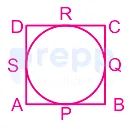
- A
9 cm
- B
8 cm
- C
7.5 cm
- D
6 cm
Show answer
B. 8 cmFrom the following figure, Give, AB = 10, CD = 7, SD = 4 and AS = 5.
As we know,
CD + AB = AD + BC
⇒ 7 + 10 = (AS + SD) + BC
⇒ 17 = 4 + 5 + BC
⇒ BC = 17 – 9
∴ BC = 8
Paper & answer key PDF ↗ Question 60archived
In a triangle, if the measures of two sides are 5 cm and 8 cm, then the third side can be:
- A
3 cm
- B
2 cm
- C
4 cm
- D
14 cm
Show answer
C. 4 cmThe question asks about the possible length of the third side of a triangle, given that the measures of the other two sides are 5 cm and 8 cm. To solve this, we need to apply a fundamental principle of geometry known as the Triangle Inequality Theorem.
Understanding the Triangle Inequality Theorem
The Triangle Inequality Theorem states that the sum of the lengths of any two sides of a triangle must be greater than the length of the third side. Conversely, the difference between the lengths of any two sides of a triangle must be less than the length of the third side.
Let the lengths of the three sides of a triangle be $a$, $b$, and $c$. The theorem can be expressed with the following inequalities:
$a + b > c$
$a + c > b$
$b + c > a$
These three inequalities can be combined into a single range for the third side, $c$, if we know sides $a$ and $b$: $|a - b| < c < a + b$.
Applying the Theorem to Find the Third Side Range
Given the two sides of the triangle are 5 cm and 8 cm. Let these be $a = 5$ cm and $b = 8$ cm. Let the length of the third side be $c$.
According to the Triangle Inequality Theorem, the third side $c$ must be greater than the difference between the other two sides and less than the sum of the other two sides.
Difference: $|8 \text{ cm} - 5 \text{ cm}| = |3 \text{ cm}| = 3 \text{ cm}$.
Sum: $8 \text{ cm} + 5 \text{ cm} = 13 \text{ cm}$.
So, the length of the third side, $c$, must satisfy the inequality:
$\qquad 3 \text{ cm} < c < 13 \text{ cm}$
This means the third side must be longer than 3 cm but shorter than 13 cm.
Evaluating the Given Options for the Third Side
Now let's check which of the given options falls within this valid range ($3 < c < 13$).
Option
Length (cm)
Is $3 < \text{Length} < 13$?
Validity
1
3
$3 < 3 < 13$? No ($3 < 3$ is false)
Invalid
2
2
$3 < 2 < 13$? No ($3 < 2$ is false)
Invalid
3
4
$3 < 4 < 13$? Yes ($3 < 4$ is true and $4 < 13$ is true)
Valid
4
14
$3 < 14 < 13$? No ($14 < 13$ is false)
Invalid
Based on the analysis, only the length 4 cm satisfies the condition that the third side must be greater than 3 cm and less than 13 cm.
Conclusion on Possible Third Side Length
For a triangle with two sides measuring 5 cm and 8 cm, the third side must have a length greater than 3 cm and less than 13 cm. Out of the given options, only 4 cm falls within this valid range.
Revision Table: Key Concepts for Triangle Sides
Concept
Description
Rule/Inequality
Triangle Inequality Theorem
Sum of two sides is greater than the third side.
$a + b > c$, $a + c > b$, $b + c > a$
Range of Third Side
Given two sides $a$ and $b$, the third side $c$ is between their difference and sum.
$|a - b| < c < a + b$
Side Lengths Must Be Positive
Length of any side cannot be zero or negative.
$a > 0$, $b > 0$, $c > 0$
Additional Information on Triangle Geometry
Understanding the relationships between the side lengths of a triangle is crucial in geometry. The Triangle Inequality Theorem is a fundamental rule that defines whether three given lengths can actually form a triangle. If the lengths do not satisfy the theorem, they cannot be the sides of a valid triangle.
For example, side lengths of 3 cm, 5 cm, and 8 cm cannot form a triangle because $3 + 5 = 8$, which is not greater than the third side 8. Similarly, 2 cm, 5 cm, and 8 cm cannot form a triangle because $2 + 5 = 7$, which is not greater than 8.
The type of triangle (e.g., equilateral, isosceles, scalene) is determined by the relationships between the side lengths, but the existence of the triangle itself is governed by the Triangle Inequality Theorem.
Paper & answer key PDF ↗ Question 61archived
In a wallet, there are notes of the denominations Rs. 10 and Rs. 50. The total number of notes is 12. The number of Rs. 10 and Rs. 50 notes are in the ratio of 1 : 2. Total money in the wallet is:
- A
Rs. 280
- B
Rs. 360
- C
Rs. 440
- D
Rs. 110
Show answer
C. Rs. 440Finding Total Money in Wallet with Denominations
This problem asks us to calculate the total amount of money in a wallet containing notes of two different denominations: Rs. 10 and Rs. 50. We are given the total number of notes and the ratio of the number of notes for each denomination.
Understanding the Problem Details
Denominations: Rs. 10 and Rs. 50.
Total number of notes: 12.
Ratio of Rs. 10 notes to Rs. 50 notes: 1 : 2.
Our goal is to find the total value of all notes in the wallet.
Step-by-Step Calculation
Step 1: Determine the Number of Each Type of Note
The ratio of the number of Rs. 10 notes to Rs. 50 notes is 1 : 2. This means for every 1 Rs. 10 note, there are 2 Rs. 50 notes.
Let the common ratio factor be $k$.
Number of Rs. 10 notes $= 1 \times k = k$
Number of Rs. 50 notes $= 2 \times k = 2k$
The total number of notes is 12. So, the sum of the number of Rs. 10 notes and Rs. 50 notes must equal 12.
\(k + 2k = 12\)
\(3k = 12\)
To find the value of $k$, divide both sides by 3:
\(k = \frac{12}{3}\)
\(k = 4\)
Now we can find the actual number of notes for each denomination:
Number of Rs. 10 notes $= k = 4$
Number of Rs. 50 notes $= 2k = 2 \times 4 = 8$
Let's check if the total number of notes is correct: \(4 + 8 = 12\). Yes, it matches the given total.
Step 2: Calculate the Total Value of Each Type of Note
Now that we know the number of notes for each denomination, we can calculate the total value contributed by each type of note.
Value from Rs. 10 notes = (Number of Rs. 10 notes) $\times$ (Value of each Rs. 10 note)
Value from Rs. 10 notes = \(4 \times 10 = 40\) Rs.
Value from Rs. 50 notes = (Number of Rs. 50 notes) $\times$ (Value of each Rs. 50 note)
Value from Rs. 50 notes = \(8 \times 50 = 400\) Rs.
Step 3: Calculate the Total Money in the Wallet
The total money in the wallet is the sum of the values from the Rs. 10 notes and the Rs. 50 notes.
Total money = Value from Rs. 10 notes + Value from Rs. 50 notes
Total money = \(40 + 400\)
Total money = \(440\) Rs.
The total money in the wallet is Rs. 440.
Summary of Results
Denomination
Ratio Part
Calculated Number of Notes
Value per Note (Rs.)
Total Value (Rs.)
Rs. 10
1
4
10
\(4 \times 10 = 40\)
Rs. 50
2
8
50
\(8 \times 50 = 400\)
Total Notes: 12
Total Money: \(40 + 400 = 440\)
Revision Table: Understanding Ratios and Money Problems
Concept
Description
How it was used here
Ratio
A comparison of two quantities. If the ratio is $a:b$, the quantities can be represented as $ak$ and $bk$ for some factor $k$.
The ratio 1:2 for notes meant the number of notes were $1k$ and $2k$.
Total Quantity
The sum of individual quantities.
The total number of notes (12) was the sum of the number of Rs. 10 notes and Rs. 50 notes ($k + 2k$).
Calculating Total Value
Multiply the number of items by the value per item and sum up for all types of items.
Calculated total value by (Number of Rs. 10 notes $\times$ 10) + (Number of Rs. 50 notes $\times$ 50).
Additional Information: Solving Similar Money Problems
Problems involving different denominations of currency and ratios are common in competitive exams. Here are some tips for solving them:
Identify Denominations and Quantities: Clearly list the different values of currency notes or coins involved and any given totals (like total number of items or total value).
Use Variables for Unknowns: If counts or values are unknown, assign variables (like $x$, $y$, or $k$).
Set up Equations: Translate the problem statement into mathematical equations. Ratios often lead to expressions like $ax$ and $bx$. Total counts or values provide equations like $ax + bx = \text{Total}$.
Solve the Equations: Use algebraic methods to find the value of the variables.
Calculate the Final Answer: Once the number of each item is known, calculate the required total value or count.
Check Your Work: Substitute the calculated numbers back into the original problem statement to ensure they satisfy all conditions (total number of notes, total value, ratio, etc.).
Paper & answer key PDF ↗ Question 62archived
In the given figure, if AB = 8 cm, AC = 10 cm, ∠ABD = 90° and AD = 17 cm, then the measure of CD is:
- A
10 cm
- B
8 cm
- C
9 cm
- D
11 cm
Show answer
C. 9 cmAB = 8 cm, AC = 10 cm and AD = 17 cm
∠ABD = 90°
As we know,
In ΔABC,
AC 2= AB 2 + BC 2
⇒ 10 2= 8 2+ BC 2
⇒ BC 2 = 100 – 64 = 36
⇒ BC = √36 = 6 cm
In ΔABD,
AD 2= AB 2 + BD 2
⇒ 17 2= 8 2+ BD 2
⇒ BD 2 = 289 – 64 = 225
⇒ BD = √225 = 15 cm
∴ CD = BD – BC = 15 – 6 = 9 cm
Paper & answer key PDF ↗ Question 63archived
In a school, 4% of the students did not appear for the annual exams. 10% of the students who appeared for the exams could not pass the exam. Out of the remaining students, 50% got distinction marks and 432 students passed the exam but could not get distinction marks. The total number of students in the school is:
- A
878
- B
960
- C
1200
- D
1000
Show answer
D. 1000The correct answer is 1000.
A percentage of the students who appeared. A percentage of the students who passed. Carefully reading the question and identifying these bases helps set up the problem correctly. You can approach these problems by using variables (like S for total students) or by assuming a base value like 100 or 1000, calculating the numbers at each step, and then scaling to the given final number.
Paper & answer key PDF ↗ Question 64archived
In the given figure, if ∠APO = 35°, then which of the following options is correct?
- A
∠BPO = 35°
- B
∠BPO = 55°
- C
∠APB = 80°
- D
∠APB = 60°
Show answer
A. ∠BPO = 35°From the following figure,
∠APO = 35°
As we know,
∠APO = ∠BPO = 35° (ΔAPO ≅ ΔBPO)
Paper & answer key PDF ↗ Question 65archived
The largest number which should replace * in the number 2365*4 to make the number divisible by 4 is:
- A
8
- B
2
- C
9
- D
0
Show answer
A. 8Finding the Largest Digit for Divisibility by 4
The question asks us to find the largest digit that can replace the asterisk (*) in the number 2365*4 such that the resulting number is divisible by 4.
To solve this, we need to use the divisibility rule for 4.
Understanding the Divisibility Rule of 4
A whole number is divisible by 4 if the number formed by its last two digits is divisible by 4.
In the given number, 2365*4, the last two digits are *4. Here, the asterisk (*) represents a single digit (from 0 to 9).
We need to find which digit, when placed in the position of *, makes the two-digit number *4 divisible by 4. We are looking for the largest such digit from the given options.
Testing the Options
Let's test each option provided by replacing * with the given digit and checking if the number formed by the last two digits is divisible by 4.
Option
Digit for *
Last Two Digits
Is divisible by 4?
Calculation
1
8
84
Yes
\(84 \div 4 = 21\)
2
2
24
Yes
\(24 \div 4 = 6\)
3
9
94
No
\(94 \div 4 = 23.5\) (not a whole number)
4
0
04 (which is 4)
Yes
\(4 \div 4 = 1\)
Based on our test:
If * is 8, the last two digits are 84, which is divisible by 4.
If * is 2, the last two digits are 24, which is divisible by 4.
If * is 9, the last two digits are 94, which is not divisible by 4.
If * is 0, the last two digits are 04 (or 4), which is divisible by 4.
So, the digits from the options that make the number divisible by 4 are 8, 2, and 0.
Identifying the Largest Digit
The question asks for the largest number (digit) among the options that satisfies the condition. Comparing the valid digits (8, 2, and 0), the largest digit is 8.
Therefore, when * is replaced by 8, the number becomes 236584. The last two digits, 84, are divisible by 4, making the entire number 236584 divisible by 4.
Among the given options, 8 is the largest digit that makes the number divisible by 4.
Revision Table: Divisibility Rules Review
Divisibility Rule
Condition
Example
By 2
The last digit is even (0, 2, 4, 6, or 8).
148 (last digit 8 is even)
By 3
The sum of the digits is divisible by 3.
123 (1+2+3=6, 6 is divisible by 3)
By 4
The number formed by the last two digits is divisible by 4.
5724 (24 is divisible by 4)
By 5
The last digit is 0 or 5.
250 (last digit 0)
By 6
The number is divisible by both 2 and 3.
132 (even, 1+3+2=6 divisible by 3)
By 10
The last digit is 0.
780 (last digit 0)
Additional Information: Applying Divisibility Rules
Divisibility rules are helpful shortcuts to determine if a number is divisible by another number without performing long division. The rule for 4 is based on the fact that 100 is divisible by 4. Any number can be written as \(100n + \text{last two digits}\). Since \(100n\) is always divisible by 4, the divisibility of the entire number depends only on the divisibility of the last two digits by 4.
In this specific problem, the digits that could replace * such that *4 is divisible by 4 (within the range 0-9) are:
0 (*4 = 04 = 4, 4 is divisible by 4)
2 (*4 = 24, 24 is divisible by 4)
4 (*4 = 44, 44 is divisible by 4)
6 (*4 = 64, 64 is divisible by 4)
8 (*4 = 84, 84 is divisible by 4)
The options provided include 0, 2, and 8, which are all valid digits. Among these, 8 is the largest. If 4 or 6 were options, we would also consider them. However, since 8 is an option and is larger than 0 and 2, and makes the number divisible by 4, it is the correct answer as per the question asking for the largest number from the options.
Paper & answer key PDF ↗ Question 66archived
The lengths of the diagonals of a rhombus are 16 cm and 12 cm. Its area is:
- A
69 cm2
- B
48 cm2
- C
28 cm2
- D
96 cm2
Show answer
D. 96 cm2Understanding the Rhombus and its Area
The problem asks us to find the area of a rhombus given the lengths of its diagonals. A rhombus is a special type of parallelogram where all four sides are equal in length. A key property of a rhombus is that its diagonals are perpendicular bisectors of each other.
The area of a rhombus can be calculated using a specific formula that involves the lengths of its diagonals. If the lengths of the diagonals are \(d_1\) and \(d_2\), the area (\(A\)) of the rhombus is given by:
\(A = \frac{1}{2} \times d_1 \times d_2\)
Calculating the Area of the Rhombus
We are given the lengths of the diagonals of the rhombus:
Diagonal 1 (\(d_1\)) = 16 cm
Diagonal 2 (\(d_2\)) = 12 cm
Now, we can plug these values into the formula for the area of a rhombus:
\(A = \frac{1}{2} \times d_1 \times d_2\)
\(A = \frac{1}{2} \times 16 \text{ cm} \times 12 \text{ cm}\)
First, multiply the lengths of the diagonals:
\(16 \times 12 = 192\)
So, the product of the diagonals is 192 cm\(^2\). Now, multiply this by \(\frac{1}{2}\):
\(A = \frac{1}{2} \times 192 \text{ cm}^2\)
\(A = 96 \text{ cm}^2\)
The calculated area of the rhombus is 96 cm\(^2\).
Comparing with Given Options
Let's compare our calculated area with the provided options:
Option 1: 69 cm\(^2\)
Option 2: 48 cm\(^2\)
Option 3: 28 cm\(^2\)
Option 4: 96 cm\(^2\)
Our calculated area, 96 cm\(^2\), matches Option 4.
Conclusion on Rhombus Area Calculation
Using the formula \(A = \frac{1}{2} \times d_1 \times d_2\) and the given diagonal lengths of 16 cm and 12 cm, the area of the rhombus is found to be 96 cm\(^2\).
Revision Table: Rhombus Formulas
Concept
Formula
Notes
Area of Rhombus
\(A = \frac{1}{2} d_1 d_2\)
Using diagonals \(d_1\) and \(d_2\)
Area of Rhombus
\(A = \text{base} \times \text{height}\)
Like a parallelogram
Perimeter of Rhombus
\(P = 4a\)
Where \(a\) is the side length
Side length (\(a\)) using diagonals
\(a = \frac{1}{2}\sqrt{d_1^2 + d_2^2}\)
Based on Pythagorean theorem
Additional Information on Rhombus Properties
A rhombus has several interesting properties that are useful in geometry problems:
All four sides are equal in length.
Opposite sides are parallel (a rhombus is a parallelogram).
Opposite angles are equal.
Adjacent angles are supplementary (sum to 180 degrees).
The diagonals bisect each other at right angles (90 degrees). This property is crucial for using the diagonal formula for area and for finding the side length using the Pythagorean theorem.
The diagonals bisect the angles of the rhombus.
A square is a special type of rhombus where all angles are 90 degrees (and thus diagonals are equal).
Understanding these properties helps in solving various problems related to rhombuses, including finding perimeter, side lengths, angles, and area using different given information.
Paper & answer key PDF ↗ Question 67archived
Solve the following
113 × 87 = ?
- A
10169
- B
9831
- C
10000
- D
10026
Show answer
B. 9831Solving the Multiplication Problem 113 × 87
The question asks us to find the product of 113 and 87. This is a basic multiplication problem. We need to calculate \(113 \times 87\).
Step-by-Step Multiplication Process
To multiply 113 by 87, we can use the standard long multiplication method. This involves multiplying 113 by the units digit of 87 (which is 7) and then by the tens digit of 87 (which is 8, representing 80), and finally adding the results.
Step 1: Multiply by the units digit
Multiply 113 by 7:
\(7 \times 3 = 21\). Write down 1, carry over 2.
\(7 \times 1 = 7\). Add the carried over 2: \(7 + 2 = 9\). Write down 9.
\(7 \times 1 = 7\). Write down 7.
So, \(113 \times 7 = 791\).
Step 2: Multiply by the tens digit
Multiply 113 by 80 (which is the same as multiplying 113 by 8 and adding a zero at the end):
Write down a 0 in the units place as we are multiplying by a tens number (80).
\(8 \times 3 = 24\). Write down 4, carry over 2.
\(8 \times 1 = 8\). Add the carried over 2: \(8 + 2 = 10\). Write down 0, carry over 1.
\(8 \times 1 = 8\). Add the carried over 1: \(8 + 1 = 9\). Write down 9.
So, \(113 \times 80 = 9040\).
Step 3: Add the results
Now, add the results from Step 1 and Step 2:
\(791 + 9040\)
Let's add vertically:
7
9
1
+
9
0
4
0
9
8
3
1
The sum is 9831.
Conclusion
The result of the multiplication \(113 \times 87\) is 9831.
Multiplication Revision Table
Understanding basic multiplication facts is crucial for performing larger multiplications. Here is a small revision table for simple products:
×
1
2
5
10
1
1
2
5
10
2
2
4
10
20
5
5
10
25
50
Remember that multiplication is a fundamental arithmetic operation.
Additional Information on Multiplication
Multiplication has several properties that can sometimes simplify calculations or help in understanding the operation:
Commutative Property: The order of the numbers does not change the product. For example, \(a \times b = b \times a\). So, \(113 \times 87 = 87 \times 113\).
Associative Property: The grouping of numbers does not change the product when multiplying three or more numbers. For example, \((a \times b) \times c = a \times (b \times c)\).
Distributive Property: Multiplication distributes over addition. For example, \(a \times (b + c) = (a \times b) + (a \times c)\). We could potentially use this here by writing 87 as \(80 + 7\): \(113 \times (80 + 7) = (113 \times 80) + (113 \times 7)\), which is exactly what we did in the step-by-step calculation above.
Using estimation can also help check if your multiplication result is reasonable. 113 is close to 110, and 87 is close to 90. \(110 \times 90 = 9900\). Our answer 9831 is close to 9900, suggesting our calculation is likely correct.
Paper & answer key PDF ↗ Question 68archived
The value of \(\frac{{\sin 30^\circ \sin 60^\circ }}{{\cos 60^\circ \cos 30^\circ }} - \tan 45^\circ \) is:
- A
5
- B
0
- C
2
- D
\(\frac{{2 - \sqrt 2 }}{2}\)
Show answer
B. 0The problem asks us to find the value of a trigonometric expression involving standard angles: \(30^\circ\), \(60^\circ\), and \(45^\circ\). To solve this, we need to know the sine, cosine, and tangent values for these specific angles.
Evaluating Trigonometric Expression: Step-by-Step
First, let's list the required trigonometric values for the angles \(30^\circ\), \(60^\circ\), and \(45^\circ\).
Angle
\(\sin\)
\(\cos\)
\(\tan\)
\(30^\circ\)
\(\frac{1}{2}\)
\(\frac{\sqrt{3}}{2}\)
\(\frac{1}{\sqrt{3}}\)
\(45^\circ\)
\(\frac{1}{\sqrt{2}}\)
\(\frac{1}{\sqrt{2}}\)
\(1\)
\(60^\circ\)
\(\frac{\sqrt{3}}{2}\)
\(\frac{1}{2}\)
\(\sqrt{3}\)
The given expression is:
\(\frac{{\sin 30^\circ \sin 60^\circ }}{{\cos 60^\circ \cos 30^\circ }} - \tan 45^\circ \)
Now, substitute the values from the table into the expression:
\(\frac{{\left(\frac{1}{2}\right) \times \left(\frac{\sqrt{3}}{2}\right) }}{{\left(\frac{1}{2}\right) \times \left(\frac{\sqrt{3}}{2}\right) }} - 1 \)
Let's calculate the numerator and the denominator separately:
Numerator: \(\sin 30^\circ \sin 60^\circ = \frac{1}{2} \times \frac{\sqrt{3}}{2} = \frac{1 \times \sqrt{3}}{2 \times 2} = \frac{\sqrt{3}}{4}\)
Denominator: \(\cos 60^\circ \cos 30^\circ = \frac{1}{2} \times \frac{\sqrt{3}}{2} = \frac{1 \times \sqrt{3}}{2 \times 2} = \frac{\sqrt{3}}{4}\)
Substitute these back into the expression:
\(\frac{{\frac{\sqrt{3}}{4}}}{{\frac{\sqrt{3}}{4}}} - 1 \)
The fraction \(\frac{{\frac{\sqrt{3}}{4}}}{{\frac{\sqrt{3}}{4}}}\) simplifies to \(1\) because the numerator and the denominator are the same and non-zero.
So, the expression becomes:
\(1 - 1\)
Final Result of Trigonometric Expression
Performing the subtraction, we get:
\(1 - 1 = 0\)
Thus, the value of the given trigonometric expression is \(0\).
Revision Table: Key Trigonometric Concepts
Here's a quick summary of the key values used in this problem:
Trigonometric Ratio
Value
\(\sin 30^\circ\)
\(\frac{1}{2}\)
\(\sin 60^\circ\)
\(\frac{\sqrt{3}}{2}\)
\(\cos 30^\circ\)
\(\frac{\sqrt{3}}{2}\)
\(\cos 60^\circ\)
\(\frac{1}{2}\)
\(\tan 45^\circ\)
\(1\)
Additional Information on Trigonometric Ratios
The problem involves the ratios sine, cosine, and tangent. Recall that the tangent of an angle can also be expressed in terms of sine and cosine:
\(\tan \theta = \frac{\sin \theta}{\cos \theta}\)
Using this identity, the fraction part of the expression \(\frac{{\sin 30^\circ \sin 60^\circ }}{{\cos 60^\circ \cos 30^\circ }}\) could also be written as:
\(\frac{\sin 30^\circ}{\cos 30^\circ} \times \frac{\sin 60^\circ}{\cos 60^\circ} = \tan 30^\circ \times \tan 60^\circ\)
\(\tan 30^\circ = \frac{1}{\sqrt{3}}\) and \(\tan 60^\circ = \sqrt{3}\)
So, \(\tan 30^\circ \times \tan 60^\circ = \frac{1}{\sqrt{3}} \times \sqrt{3} = 1\)
This confirms that the fraction part is indeed \(1\), leading to the same final answer \(1 - \tan 45^\circ = 1 - 1 = 0\). Understanding these relationships can provide alternative ways to solve trigonometric problems.
Paper & answer key PDF ↗ Question 69archived
A manufacturer sells cooking gas stoves to shopkeepers at 10% profit, and in turn, they sell the cooking gas stoves to the customer to earn a 15% profit. If a customer gets a cooking gas stove for Rs. 7,590, then what is the manufacturing cost?
- A
Rs. 6,000
- B
Rs. 6,500
- C
Rs. 5,000
- D
Rs. 5,090
Show answer
A. Rs. 6,000Calculating Manufacturing Cost with Sequential Profits
This problem involves calculating the original manufacturing cost of a cooking gas stove, working backward from the final price paid by the customer, considering the profit margins added at two stages: by the manufacturer and by the shopkeeper.
Understanding the Profit Stages
There are two key transactions here:
The manufacturer sells the cooking gas stove to the shopkeeper, adding a 10% profit on their manufacturing cost.
The shopkeeper sells the cooking gas stove to the customer, adding a 15% profit on the price they paid to the manufacturer.
We know the final price the customer paid and need to find the initial manufacturing cost.
Step-by-Step Solution
Let's denote the costs at each stage:
Let the manufacturing cost be \(C_m\). This is the price the manufacturer produces the stove for.
The price at which the manufacturer sells to the shopkeeper is \(C_s\). This price includes the manufacturer's profit.
The price at which the shopkeeper sells to the customer is \(C_c\). This price includes the shopkeeper's profit.
Manufacturer's Transaction
The manufacturer makes a 10% profit on the manufacturing cost \(C_m\). The selling price to the shopkeeper \(C_s\) is the manufacturing cost plus the profit.
Manufacturer's Profit = 10% of \(C_m\) = \(0.10 \times C_m\)
Selling Price to Shopkeeper \(C_s = C_m + (0.10 \times C_m) = C_m (1 + 0.10) = 1.10 \times C_m\)
So, \(C_s = 1.10 \times C_m\).
Shopkeeper's Transaction
The shopkeeper makes a 15% profit on the price they paid, which is \(C_s\). The selling price to the customer \(C_c\) is the shopkeeper's cost (\(C_s\)) plus their profit.
Shopkeeper's Profit = 15% of \(C_s\) = \(0.15 \times C_s\)
Selling Price to Customer \(C_c = C_s + (0.15 \times C_s) = C_s (1 + 0.15) = 1.15 \times C_s\)
So, \(C_c = 1.15 \times C_s\).
Connecting the Costs and Solving
We have the relationships:
\(C_s = 1.10 \times C_m\)
\(C_c = 1.15 \times C_s\)
We know the customer price \(C_c\) is Rs. 7,590. We can substitute the first equation into the second one:
\(C_c = 1.15 \times (1.10 \times C_m)\)
\(C_c = (1.15 \times 1.10) \times C_m\)
\(C_c = 1.265 \times C_m\)
Now, substitute the known value of \(C_c = 7590\):
\(7590 = 1.265 \times C_m\)
To find \(C_m\), we need to divide the customer price by the combined profit factor:
\(C_m = \frac{7590}{1.265}\)
Performing the division:
\(C_m = 6000\)
So, the original manufacturing cost of the cooking gas stove was Rs. 6,000.
Verification
Let's check our answer:
Manufacturing cost = Rs. 6,000
Manufacturer's profit (10% of 6000) = \(0.10 \times 6000 = 600\)
Price to shopkeeper = \(6000 + 600 = 6600\)
Shopkeeper's profit (15% of 6600) = \(0.15 \times 6600 = 990\)
Price to customer = \(6600 + 990 = 7590\)
This matches the given customer price, so our calculation is correct.
Stage
Calculation
Cost/Price
Manufacturing Cost
\(C_m\)
Rs. 6,000
Manufacturer's Selling Price (Shopkeeper's Cost)
\(C_m \times 1.10\)
\(6000 \times 1.10 = 6600\)
Shopkeeper's Selling Price (Customer's Cost)
\(C_s \times 1.15\)
\(6600 \times 1.15 = 7590\)
Conclusion
The manufacturing cost of the cooking gas stove is Rs. 6,000.
Revision Table: Profit and Cost Calculation
Term
Definition
Formula Example (Profit P on Cost C)
Cost Price (CP)
The initial cost incurred (e.g., manufacturing cost for manufacturer, purchase price for shopkeeper).
N/A (Starting point)
Selling Price (SP)
The price at which an item is sold.
SP = CP + Profit
Profit
The gain made after selling an item; SP > CP.
Profit = SP - CP
Profit Percentage
Profit expressed as a percentage of the Cost Price.
Profit % = \(\left(\frac{\text{Profit}}{\text{CP}}\right) \times 100\)
Calculating SP from CP and Profit %
SP = CP \(\times \left(1 + \frac{\text{Profit \%}}{100}\right)\)
If CP=100, Profit=10%, SP = \(100 \times (1 + 0.10) = 110\)
Calculating CP from SP and Profit %
CP = \(\frac{\text{SP}}{\left(1 + \frac{\text{Profit \%}}{100}\right)}\)
If SP=110, Profit=10%, CP = \(\frac{110}{(1 + 0.10)} = \frac{110}{1.10} = 100\)
Additional Information: Sequential Profit Calculations
Problems involving sequential profits or discounts require careful calculation at each step. The profit percentage at one stage is calculated on the selling price of the previous stage (which becomes the cost price for the current stage).
In this problem:
Manufacturer's profit is on Manufacturing Cost.
Shopkeeper's profit is on the price they paid to the manufacturer.
If there were a third stage (e.g., a retailer buying from the shopkeeper), their profit would be calculated on the price they paid to the shopkeeper. You cannot simply add the percentages (10% + 15% is not 25% of the manufacturing cost) because the second profit is based on a higher value than the first.
The overall increase from the initial cost to the final price is a cumulative effect of the percentage increases applied sequentially.
Paper & answer key PDF ↗ Question 70archived
A shopkeeper marked a computer table for Rs. 7,200. He allows a discount of 10% on it and yet makes a profit of 8%. What will be his gain percentage if he does NOT allow any discount?
- A
18%
- B
2%
- C
9%
- D
20%
Show answer
D. 20%20%
6480) and Profit Percentage (8%): \(\text{CP} = \frac{6480}{\left(1 + \frac{8}{100}\right)}\) \(\text{CP} = \frac{6480}{\left(1 + 0.08\right)}\) \(\text{CP} = \frac{6480}{1.08}\) \(\text{CP} = 6000\) Thus, the cost price of the computer table is Rs.
Paper & answer key PDF ↗ Question 71archived
During a medical check-up, the heights of 40 students in a class were recorded as shown in the following table.
Height (in cm)
Less than 175
Less than 170
Less than 165
Less than 160
Less than 155
Less than 150
Number of students
40
35
25
16
8
4
How many students have a height of 165 cm or more?
- A
25
- B
10
- C
15
- D
16
Show answer
C. 15Understanding Student Height Data from a Table
The question provides data on the heights of 40 students recorded during a medical check-up. The data is presented in a cumulative frequency table, specifically showing the number of students whose height is 'less than' a certain value.
Let's look at the given table:
Height (in cm)
Number of students (Cumulative Frequency)
Less than 175
40
Less than 170
35
Less than 165
25
Less than 160
16
Less than 155
8
Less than 150
4
This table tells us the total number of students is 40 (since 40 students have height less than 175 cm, which is the maximum category shown, and it aligns with the problem stating 40 students in total).
Calculating Students with Height 165 cm or More
We are asked to find the number of students who have a height of 165 cm or more. The table directly provides the number of students whose height is less than 165 cm. According to the table:
Number of students with height less than 165 cm = 25
The total number of students in the class is 40.
The students with a height of 165 cm or more are all the students except those who have a height less than 165 cm.
Therefore, to find the number of students with a height of 165 cm or more, we can subtract the number of students with height less than 165 cm from the total number of students.
Number of students with height $\geq$ 165 cm = Total number of students - Number of students with height < 165 cm
Number of students with height $\geq$ 165 cm = $40 - 25$
Number of students with height $\geq$ 165 cm = $15$
So, there are 15 students who have a height of 165 cm or more.
Final Answer Derivation
Based on our calculation using the cumulative frequency data provided in the table, the number of students with a height of 165 cm or more is 15.
Revision Table: Key Concepts
Concept
Explanation
How it Applies Here
Cumulative Frequency
The running total of frequencies. In a 'less than' table, it shows the count of data points below a certain value.
The given table is a 'less than' cumulative frequency distribution for student heights.
Total Frequency
The sum of all frequencies; the total number of observations.
The last entry in the 'less than' cumulative frequency table (Less than 175 cm is 40) represents the total number of students, which is 40.
Finding $\geq$ Value
To find the number of observations greater than or equal to a value from a 'less than' cumulative table, subtract the cumulative frequency at that value from the total frequency.
We subtract the number of students less than 165 cm (25) from the total number of students (40) to find students $\geq$ 165 cm.
Additional Information: Cumulative Frequency
Cumulative frequency is a way of summarizing data that shows the total number of values that fall below a certain point. There are two main types:
'Less Than' Cumulative Frequency: This shows the total number of observations less than the upper limit of each class interval. The table provided in the question is an example of this.
'Greater Than' Cumulative Frequency: This shows the total number of observations greater than or equal to the lower limit of each class interval.
Cumulative frequency tables are useful for quickly determining the number or proportion of observations that lie above or below certain values, which is often needed in statistical analysis and probability calculations.
In this specific student height problem, the 'less than' table made it easy to find the number of students shorter than a certain height. To find the number of students taller than or equal to a certain height, we used the total count and the 'less than' count.
Paper & answer key PDF ↗ Question 72archived
The number of students enrolled in different streams in a college is shown in the following table.
Science
Arts
Commerce
Vocational
Girls
Boys
Girls
Boys
Girls
Boys
Girls
Boys
35
18
25
47
45
40
10
30
The ratio of the total number of boys to that of girls in the college is:
- A
1 : 1
- B
23 : 27
- C
13 : 12
- D
27 : 23
Show answer
D. 27 : 23Calculating the Ratio of Boys to Girls in College Streams
This problem asks us to find the ratio of the total number of boys to the total number of girls enrolled in a college, based on the provided data about student distribution across different streams.
The enrollment data for students in Science, Arts, Commerce, and Vocational streams is given in a table, separated by gender.
Analyzing the Student Enrollment Data
Let's first look at the data presented in the table:
Stream
Girls
Boys
Science
35
18
Arts
25
47
Commerce
45
40
Vocational
10
30
Calculating the Total Number of Boys
To find the total number of boys in the college, we need to sum up the number of boys enrolled in each stream:
Number of boys in Science = 18
Number of boys in Arts = 47
Number of boys in Commerce = 40
Number of boys in Vocational = 30
Total number of boys $= 18 + 47 + 40 + 30$
Total number of boys $= 65 + 40 + 30$
Total number of boys $= 105 + 30$
Total number of boys $= 135$
So, the total number of boys enrolled in the college is 135.
Calculating the Total Number of Girls
Similarly, to find the total number of girls in the college, we sum up the number of girls enrolled in each stream:
Number of girls in Science = 35
Number of girls in Arts = 25
Number of girls in Commerce = 45
Number of girls in Vocational = 10
Total number of girls $= 35 + 25 + 45 + 10$
Total number of girls $= 60 + 45 + 10$
Total number of girls $= 105 + 10$
Total number of girls $= 115$
So, the total number of girls enrolled in the college is 115.
Finding the Ratio of Total Boys to Total Girls
The question asks for the ratio of the total number of boys to that of girls. This ratio is calculated as:
Ratio $= \frac{\text{Total number of boys}}{\text{Total number of girls}}$
Ratio $= \frac{135}{115}$
To simplify this ratio, we need to find the greatest common divisor (GCD) of 135 and 115. Both numbers end in 5, so they are divisible by 5.
$135 \div 5 = 27$
$115 \div 5 = 23$
So, the ratio simplifies to $\frac{27}{23}$.
The ratio of the total number of boys to that of girls is $27 : 23$.
Conclusion
Based on the calculations, the ratio of the total number of boys to that of girls in the college is $27 : 23$.
Revision Table: Key Calculations
Category
Calculation
Total
Total Boys
18 + 47 + 40 + 30
135
Total Girls
35 + 25 + 45 + 10
115
Ratio (Boys : Girls)
135 : 115 (simplified by dividing by 5)
27 : 23
Additional Information on Ratios and Data Analysis
Understanding ratios is fundamental in data analysis. A ratio is a comparison of two numbers of the same kind. It is often written with a colon (:) or as a fraction.
Simplifying Ratios: Just like fractions, ratios should be simplified to their lowest terms by dividing both parts by their greatest common divisor (GCD). In our case, the GCD of 135 and 115 was 5.
Order Matters: The order in which a ratio is stated is important. The ratio of boys to girls (Boys : Girls) is different from the ratio of girls to boys (Girls : Boys). If the question asked for the ratio of girls to boys, the answer would be 115 : 135, which simplifies to 23 : 27.
Data Interpretation: This problem is an example of data interpretation, where information presented in a table is analyzed to answer a specific question. It requires careful reading of the table and accurate arithmetic calculations.
Applications of Ratios: Ratios are used in many real-world situations, such as scaling recipes, mixing ingredients, comparing quantities, and analyzing statistical data like demographic proportions.
Paper & answer key PDF ↗ Question 73archived
Amir borrowed a sum of Rs. 25,000 on simple interest. Bhola borrowed the same amount on compound interest (interest compounded yearly). At the end of 2 years, Bhola had to pay Rs. 160 more interest than Amir. The rate of interest charged per annum is:
- A
8%
- B
\(3\frac{1}{8}\% \;\)
- C
16/25%
- D
8/25%
Show answer
A. 8%The correct answer is 8%.
Difference (CI - SI): The difference between compound interest and simple interest arises because compound interest earns "interest on interest," while simple interest does not. This difference grows larger over longer periods and at higher interest rates. For the first year, simple interest and compound interest are equal (assuming yearly compounding). The difference starts appearing from the second year onwards.
Paper & answer key PDF ↗ Question 74archived
The following table shows the income (In Rs.) for a particular month, together with their source, with respect to 5 employees (A, B, C, D, and E)
A
B
C
D
E
Salary
52,000
48,500
42,000
31,000
25,000
Overtime
0
0
1,500
2,500
3,200
Arrears
5,500
4,500
4,000
3,000
1,500
Bonus
3,500
3,000
2,500
2,000
2,000
Miscellaneous income
5,000
3,000
2,000
1,500
0
Total
66,000
59,000
52,000
40,000
31,700
How many employees got more than a total of Rs. 10,000 as income other than salary?
- A
3
- B
2
- C
4
- D
1
Show answer
B. 2The correct answer is 2.
Performing calculations based on the required data. Comparing calculated values with given thresholds. Counting or summarizing the results according to the question's requirement. Data interpretation questions often involve addition, subtraction, multiplication, division, percentages, and ratios, applied to data presented in tables, charts (bar graphs, pie charts, line graphs), or caselets.
Paper & answer key PDF ↗ Question 75archived
Solve the following. \(\frac{4}{3} \div \frac{1}{6} \times 2 - 1 = \;?\)
- A
3
- B
15
- C
8
- D
-2
Show answer
B. 15Solving the Fraction Expression
This guide provides a step-by-step solution for the mathematical expression involving fractions, division, multiplication, and subtraction: \(\frac{4}{3} \div \frac{1}{6} \times 2 - 1\). Understanding the correct order of operations is essential for accurately solving this problem.
BODMAS Rule for Calculations
To correctly solve mathematical expressions with multiple operations, we follow the BODMAS order of operations:
Brackets
Orders (like powers and square roots)
Division
Multiplication
Addition
Subtraction
It's important to note that Division and Multiplication are performed from left to right as they appear in the expression. Similarly, Addition and Subtraction are also performed from left to right.
Step-by-Step Solution
Let's break down the calculation of \(\frac{4}{3} \div \frac{1}{6} \times 2 - 1\):
Division Operation: We start with the division part because it comes first from left to right before multiplication.
\(\frac{4}{3} \div \frac{1}{6}\)
Dividing by a fraction involves multiplying by its reciprocal. The reciprocal of \(\frac{1}{6}\) is \(\frac{6}{1}\).
\(\frac{4}{3} \times \frac{6}{1}\)
Multiply the numerators together and the denominators together:
\(\frac{4 \times 6}{3 \times 1} = \frac{24}{3}\)
Simplify the fraction:
\(\frac{24}{3} = 8\)
Multiplication Operation: Next, we take the result from the division (which is 8) and multiply it by 2.
\(8 \times 2\)
\(8 \times 2 = 16\)
Subtraction Operation: Finally, we perform the subtraction using the result from the multiplication (which is 16) and subtract 1.
\(16 - 1\)
\(16 - 1 = 15\)
Final Calculation Result
After performing all the operations in the correct order (division, then multiplication, then subtraction), the value of the expression \(\frac{4}{3} \div \frac{1}{6} \times 2 - 1\) is 15.
Paper & answer key PDF ↗ Question 76archived
Select the correct option to fill in blank 2.
- A
by
- B
with
- C
to
- D
on
Show answer
C. toUnderstanding the Passage and Blank (2)
The passage describes the city of Agra and how the famous Taj Mahal (Agra's marble-marvel) is so dominant that other historical structures are often forgotten or ignored. The sentence containing blank (2) reads: "Agra's marble-marvel has such an overwhelming presence (1)______ other monuments in the town have been relegated (2) ______ oblivion." We need to select the most appropriate option to fill in blank (2).
The key verb here is "relegated". To relegate means to assign to a lower position, rank, or status; or to consign or dismiss to an obscure position or condition.
The phrase "relegated to oblivion" is a common idiomatic expression. Oblivion means the state of being forgotten, especially by the public.
Therefore, the sentence means that the other monuments have been moved or assigned to a state of being forgotten because of the overwhelming presence of the Taj Mahal.
Analyzing Options for Blank (2) - Prepositions with Relegate
Let's look at the options provided for blank (2) and consider which preposition correctly follows "relegated" in this context:
by: The preposition "by" is usually used to indicate the agent doing something (e.g., "the work was done by him") or a means of transport (e.g., "travel by train"). It doesn't fit here to indicate the state or condition something is moved into.
with: The preposition "with" usually indicates accompaniment (e.g., "go with me") or possession (e.g., "a person with talent"). It does not fit the context of being moved into a state of oblivion.
to: The preposition "to" is often used to indicate movement towards a point, place, or state (e.g., "go to the store", "reduced to tears"). It is the correct preposition used in the idiom "relegated to oblivion", indicating the state or condition the monuments have been moved into.
on: The preposition "on" usually indicates position on a surface (e.g., "sit on the chair") or a topic (e.g., "talk on politics"). It does not fit the context of being moved into a state of oblivion.
Correct Preposition for 'Relegated'
The verb "relegate" when used to indicate moving something to a specific state, position, or category, is typically followed by the preposition "to". For example:
He was relegated to the reserve team.
The issue was relegated to secondary importance.
Her achievements were relegated to a footnote in history.
In the given sentence, the monuments are being moved to the state of "oblivion". Thus, the correct preposition is "to".
The complete phrase is "relegated to oblivion".
Filling the Blank
Based on the analysis, the most appropriate option for blank (2) is "to".
The sentence fragment with the filled blank is: "...other monuments in the town have been relegated to oblivion."
Revision Table: Prepositions
Preposition
Common Use
Fits Blank (2)?
Reason
by
Agent, means of transport
No
Does not indicate the state moved into
with
Accompaniment, possession
No
Does not fit the context of 'oblivion'
to
Direction, state, destination
Yes
Correct preposition for 'relegated to oblivion'
on
Surface, topic
No
Does not indicate the state moved into
Additional Information on Cloze Tests and Vocabulary
Cloze tests assess your understanding of context, vocabulary, grammar, and prepositions. To perform well in cloze tests, it is helpful to:
Read the entire passage first to understand the general meaning and context.
Look at the words immediately before and after the blank.
Consider the grammatical function of the missing word (e.g., verb, noun, preposition, conjunction).
Try each option in the blank to see which one makes grammatical and contextual sense.
Pay attention to collocations and idiomatic expressions (like "relegated to oblivion").
Understanding common phrasal verbs and prepositional phrases is crucial for many blanks in such passages.
Paper & answer key PDF ↗ Question 77archived
Select the most appropriate meaning of the given idiom.
Pull a fast one
- A
Progress fast
- B
Believe someone easily
- C
Take quick action
- D
Trick someone
Show answer
D. Trick someoneUnderstanding the Idiom: Pull a Fast One
The idiom "pull a fast one" is a common expression in English. Understanding idioms is crucial for improving vocabulary and comprehension in competitive exams and everyday communication.
Let's break down the meaning of "pull a fast one".
Meaning of "Pull a Fast One"
When someone "pulls a fast one", it means they are trying to deceive or trick someone. This often involves a clever or dishonest action intended to gain an advantage or get away with something.
It implies an act of trickery or cheating.
The action is often done quickly or slyly to avoid detection.
The goal is usually to mislead or take advantage of another person.
Analyzing the Options
Now let's look at the given options and see which one best matches the meaning of the idiom "pull a fast one".
Progress fast: This option suggests moving quickly towards a goal. This meaning is related to speed or advancement but has nothing to do with tricking or deceiving someone. Therefore, this option is incorrect.
Believe someone easily: This describes a person who is gullible or easily fooled. The idiom "pull a fast one" describes the action of the trickster, not the state of the person being tricked. So, this option is incorrect.
Take quick action: This option refers to acting rapidly. While "pulling a fast one" might be done quickly, the core meaning is the deception, not just the speed of action. Many quick actions are not deceptive. This option is incorrect.
Trick someone: This option directly describes the act of deceiving or outsmarting someone, which is the precise meaning of the idiom "pull a fast one". This aligns perfectly with how the idiom is used.
Conclusion
Based on the analysis of the idiom and the options, the most appropriate meaning of "pull a fast one" is to trick someone.
Revision Table: Idiom Analysis
Idiom
Meaning
Example Sentence
Pull a fast one
To trick or deceive someone, often cleverly or dishonestly.
He tried to pull a fast one on the teacher by copying his friend's homework.
Additional Information: Learning English Idioms
Idioms are phrases or expressions whose meaning cannot be deduced from the literal meanings of the individual words. Learning common idioms is vital for mastering the English language. Here are a few tips:
Learn idioms in context.
Group idioms by theme (e.g., idioms about feelings, time, actions).
Use idioms in your own sentences to practice.
Review them regularly.
Understanding idioms like "pull a fast one" helps in understanding native speakers and improves your own fluency and expression.
Paper & answer key PDF ↗ Question 78archived
Select the most appropriate antonym of the given word.
HASTE
- A
Lose
- B
Rush
- C
Delay
- D
Dash
Show answer
C. DelayFinding the Antonym of HASTE
The question asks us to select the most appropriate antonym for the word "HASTE". An antonym is a word that has the opposite meaning of another word.
Let's first understand the meaning of the word HASTE.
HASTE: Speed or urgency of movement or action; excessive speed or urgency. It implies doing something quickly, sometimes perhaps too quickly or carelessly.
Now let's examine the given options:
Lose: This word typically means to be deprived of or cease to have or retain (something); fail to win a game or contest. This is not related to speed or urgency.
Rush: This word means to move with urgent haste. This is a synonym of HASTE, not an antonym.
Delay: This word means to make someone or something late or slow; to postpone or defer something. This is the opposite of speed and urgency.
Dash: This word means to run or travel somewhere in a great hurry. This is similar in meaning to Rush and Haste, often implying a quick movement. It is a synonym or a closely related term.
Comparing the meaning of HASTE with the options, we see that "Delay" is the word that expresses the opposite idea of speed or urgency.
Therefore, the most appropriate antonym of HASTE is Delay.
Revision Table: Word Meanings and Antonyms
Word
Meaning
Antonym
HASTE
Speed or urgency
Delay
Lose
Be deprived of; fail to win
Find, Win
Rush
Move with urgent haste (Synonym of Haste)
Slow down, Linger
Delay
Postpone; slow down
HASTE, Speed up
Dash
Run in a great hurry (Synonym of Rush/Haste)
Saunter, Stroll
Additional Information on Antonyms and Synonyms
Understanding antonyms and synonyms is crucial for building vocabulary and improving comprehension. They help us grasp the nuances of language.
Synonym: A word or phrase that means exactly or nearly the same as another word or phrase in the same language. For example, 'happy' is a synonym of 'joyful'.
Antonym: A word that is opposite in meaning to another word. For example, 'hot' is an antonym of 'cold'.
Some words can have multiple antonyms or synonyms depending on the context in which they are used. It's always helpful to consider the specific way a word is used in a sentence when determining its opposite or similar meaning.
Paper & answer key PDF ↗ Question 79archived
Select the correct indirect form of the given sentence.
Mahesh said to Rita, "Don't play in the sun."
- A
Mahesh advised Rita not to play in the sun.
- B
Mahesh told to Rita to not play in the sun.
- C
Mahesh requested Rita that don't play in the sun.
- D
Mahesh ordered Rita that not play in the sun.
Show answer
A. Mahesh advised Rita not to play in the sun.Understanding Indirect Speech Conversion
The question asks us to convert a sentence from direct speech into its correct indirect form. The given sentence is, "Mahesh said to Rita, 'Don't play in the sun.'" This sentence is an imperative sentence because it gives a command or instruction. Specifically, it's a negative imperative because it uses "Don't".
Converting Negative Imperative Sentences to Indirect Speech
When converting imperative sentences from direct speech to indirect speech, the reporting verb (like 'said to') changes to a verb that reflects the purpose of the imperative, such as 'advised', 'told', 'ordered', 'requested', 'forbade', etc. The imperative verb form changes into a 'to + infinitive' construction.
For negative imperative sentences (those starting with 'Don't'), the structure in indirect speech becomes 'not to + infinitive'. The reporting verb is followed by the object (the person being addressed), and then the 'not to + infinitive' phrase.
Analyzing the Options
Let's examine each option based on these rules:
Option
Sentence
Analysis
1
Mahesh advised Rita not to play in the sun.
The reporting verb 'advised' is suitable. It is followed by the object 'Rita' and then the negative infinitive 'not to play'. This structure correctly follows the rules for converting a negative imperative sentence.
2
Mahesh told to Rita to not play in the sun.
The phrase 'told to Rita' is grammatically incorrect; it should be 'told Rita'. While 'to not play' is sometimes used, 'not to play' is the standard form for negative infinitives in this context. The incorrect use of 'told to' makes this option wrong.
3
Mahesh requested Rita that don't play in the sun.
'Requested' might imply politeness, but the structure 'requested Rita that don't play' is incorrect. The conjunction 'that' is not typically used with verbs like 'requested' followed by an infinitive clause in this way. Also, the imperative 'don't play' has not been converted to an infinitive form.
4
Mahesh ordered Rita that not play in the sun.
'Ordered' implies a command with authority, which might or might not fit the context. However, the structure 'ordered Rita that not play' is grammatically incorrect. The conjunction 'that' is wrong, and the full negative infinitive form 'not to play' is missing the 'to'.
Identifying the Correct Indirect Form
Based on the analysis, Option 1 correctly applies the rules for converting the negative imperative sentence "Don't play in the sun" into indirect speech. The reporting verb 'advised' fits well, and the structure 'advised Rita not to play' is the correct transformation of the negative imperative.
Conclusion
The correct indirect form of the sentence "Mahesh said to Rita, 'Don't play in the sun.'" is "Mahesh advised Rita not to play in the sun." This conversion uses the appropriate reporting verb and the correct 'not to + infinitive' structure for the negative imperative.
Revision Table: Key Points for Indirect Speech (Imperatives)
Direct Speech Type
Reporting Verb Change
Verb Form Change
Example Conversion
Positive Imperative (e.g., "Play")
Advised, told, ordered, requested, etc.
To + infinitive (e.g., "to play")
He said, "Play." → He told me to play.
Negative Imperative (e.g., "Don't play")
Advised, told, ordered, requested, forbade, etc.
Not to + infinitive (e.g., "not to play") OR reporting verb 'forbade' + to + infinitive (e.g., "to play")
He said, "Don't play." → He advised me not to play.
OR He forbade me to play.
Additional Information on Reported Speech
Reported speech, also known as indirect speech, is used to report what someone said without using their exact words. The tense of the verb in the reported clause often changes (backshifts), and pronouns and time/place expressions may also change to reflect the new context of reporting. However, for imperative sentences converted using 'to + infinitive' or 'not to + infinitive', the tense backshift rules for the main verb in the reported clause are not applicable because the verb becomes part of an infinitive phrase.
Common reporting verbs for imperatives include:
Advised
Told
Ordered
Requested
Warned
Forbade
Suggested (less common with 'to + infinitive', often followed by a gerund or 'that' clause)
Choosing the right reporting verb depends on the context and the relationship between the speaker and the listener. 'Advised' is suitable when the speaker is giving counsel or recommendation. 'Ordered' implies authority, while 'requested' implies a polite ask.
Paper & answer key PDF ↗ Question 80archived
Select the most appropriate synonym of the given word.
DISHEARTENED
- A
disgraced
- B
depressed
- C
disliked
- D
disgusted
Show answer
B. depressedUnderstanding the Word: DISHEARTENED
The question asks us to select the most appropriate synonym for the word "DISHEARTENED" from the given options. A synonym is a word or phrase that means exactly or nearly the same as another word or phrase in the same language.
Let's first understand the meaning of the word DISHEARTENED.
DISHEARTENED means having lost determination, hope, or confidence. It describes a feeling of discouragement and a loss of spirit or morale.
Analyzing the Options
Now let's look at the meanings of the given options:
disgraced: Having lost respect or reputation; humiliated. This relates to public perception and honor, not necessarily a personal feeling of losing hope.
depressed: In a state of low spirits, sadness, or unhappiness; feeling dejected. This describes a state of low mood and lack of energy or enthusiasm, often associated with losing hope or feeling down.
disliked: Not liked; regarded with aversion or distaste. This is about being the object of someone else's negative feeling, not a personal state of mind related to hope or determination.
disgusted: Feeling or expressing revulsion or strong disapproval caused by something unpleasant or offensive. This is a reaction of revulsion or strong disapproval, which is different from losing hope or determination.
Comparing Meanings
Let's compare how each option relates to the core meaning of DISHEARTENED (losing hope/determination):
Word
Meaning
Relation to DISHEARTENED (Losing hope/determination)
DISHEARTENED
Lost determination, hope, or confidence
Base word
Disgraced
Lost respect/reputation
Different focus (external perception vs. internal state)
Depressed
Low spirits, dejected, unhappy
Closely related, captures the feeling of being down due to loss of hope or morale
Disliked
Not liked by others
Unrelated (external feeling towards someone vs. internal state)
Disgusted
Feeling revulsion/strong disapproval
Different emotion
Selecting the Most Appropriate Synonym
Based on the meanings, "depressed" is the closest synonym for "disheartened." While "depressed" can indicate a longer-term clinical condition, it also commonly describes a temporary state of low spirits and dejection caused by disappointment or loss of hope, which aligns well with being disheartened.
When someone is disheartened, they feel discouraged and low in spirits because something has reduced their hope or enthusiasm. This feeling is very similar to being depressed or dejected in that moment.
Therefore, among the given options, "depressed" is the most appropriate synonym for DISHEARTENED.
Revision Table: Key Vocabulary
Word
Meaning
Part of Speech
DISHEARTENED
Having lost determination, hope, or confidence; discouraged.
Adjective
Disgraced
Having lost respect or reputation.
Adjective / Verb (past participle)
Depressed
In a state of low spirits or sadness; dejected.
Adjective / Verb (past participle)
Disliked
Not liked; regarded with aversion.
Adjective / Verb (past participle)
Disgusted
Feeling or showing revulsion or strong disapproval.
Adjective / Verb (past participle)
Synonym
A word or phrase that means exactly or nearly the same as another word or phrase.
Noun
Additional Information: Expanding Vocabulary
Learning synonyms and antonyms is a great way to expand your vocabulary. While "depressed" is a good synonym for "disheartened" in many contexts, other words that convey a similar meaning might include:
Discouraged
Dejected
Demoralized
Downcast
Low-spirited
Antonyms for DISHEARTENED could be words like:
Encouraged
Heartened
Optimistic
Enthusiastic
Spirited
Paying attention to the nuances in meaning between similar words helps in using language more precisely.
Paper & answer key PDF ↗ Question 81archived
Direction: Select the most appropriate meaning of the given idiom.
See eye to eye
- A
See clearly
- B
Stare at someone
- C
Be suspicious
- D
Agree with someone
Show answer
D. Agree with someoneUnderstanding the Idiom: See Eye to Eye
Idioms are phrases or expressions whose meaning cannot be deduced simply from the ordinary meaning of its individual words. Understanding common idioms is important for improving English comprehension and communication.
The idiom "See eye to eye" is frequently used in everyday conversation. Let's break down its meaning and see how it relates to the given options.
Meaning of the Idiom "See Eye to Eye"
When two or more people "see eye to eye", it means they agree with each other on a particular subject or topic. It signifies having the same opinion or perspective. It is often used when people have a shared understanding or are in harmony regarding their views.
Analyzing the Options for "See Eye to Eye"
Let's examine each option to find the most appropriate meaning of the idiom "See eye to eye".
Option 1: See clearly
This option refers to having good vision or understanding something without confusion. While understanding is involved when people "see eye to eye", this phrase doesn't mean having perfect visual clarity. It specifically refers to agreement in opinion. Therefore, this option is not the correct meaning of the idiom.
Option 2: Stare at someone
This option describes looking at someone intently for a long period. While physically looking someone in the eye can happen, the idiom "see eye to eye" is not about the physical act of staring. It is entirely about shared opinions or agreement. So, this option is incorrect.
Option 3: Be suspicious
Being suspicious means having a feeling that something is wrong or someone is dishonest. This is the opposite of agreeing with someone or having a shared positive view. The idiom "see eye to eye" implies harmony, not suspicion. Thus, this option is wrong.
Option 4: Agree with someone
This option directly matches the established meaning of the idiom "See eye to eye". When you agree with someone, you share the same opinion or viewpoint. This is exactly what the idiom conveys. Therefore, this is the most appropriate meaning.
Why "Agree with Someone" is the Correct Meaning
The idiom "See eye to eye" is universally understood to mean that individuals are in agreement. For example:
"My brother and I don't always see eye to eye on politics." (Meaning: We don't always agree on politics.)
"Fortunately, the committee members could see eye to eye on the new proposal." (Meaning: The committee members could agree on the new proposal.)
These examples clearly demonstrate that "see eye to eye" means to agree or share the same opinion.
Summary of Idiom Meaning
Idiom
Meaning
See eye to eye
To agree with someone; to have the same opinion or perspective.
Based on the analysis of the options and the common usage of the idiom, the most appropriate meaning of "See eye to eye" is "Agree with someone".
Revision Table: Idioms and Meanings
Idiom
Common Meaning
See eye to eye
To agree
Break a leg
Good luck
Bite the bullet
Endure a difficult situation with courage
Hit the nail on the head
Say or do exactly the right thing
Additional Information: Related Concepts
Understanding idioms is a key part of mastering conversational English. Idioms add color and depth to language, but they can be tricky because their meaning isn't literal. Learning idioms like "see eye to eye" helps you understand native speakers and use language more naturally.
Antonyms for "see eye to eye" could include phrases indicating disagreement, such as "to be at odds" or "to disagree."
Paper & answer key PDF ↗ Question 82archived
Given below are four jumbled sentences. Out of the given options pick the one that gives their correct order.
A. These are generated by a violent undersea disturbance or ocean activity.
B. Once generated, they travel outward on the ocean surface in all directions.
C. A tsunami is made up of a series of very long waves.
D. Spreading thus, they look like ripples caused by throwing a rock in a pond.
- A
BADC
- B
CBDA
- C
CABD
- D
BDCA
Show answer
C. CABDUnderstanding Jumbled Sentences and Tsunami Description
This question requires us to arrange four jumbled sentences into a coherent paragraph describing tsunamis. To do this effectively, we need to read each sentence carefully and understand its content and how it relates to the others.
Sentence A: These are generated by a violent undersea disturbance or ocean activity. (Explains the cause/origin)
Sentence B: Once generated, they travel outward on the ocean surface in all directions. (Describes what happens after generation)
Sentence C: A tsunami is made up of a series of very long waves. (Defines what a tsunami is)
Sentence D: Spreading thus, they look like ripples caused by throwing a rock in a pond. (Provides an analogy for the spreading)
Analyzing the Flow of Information
A logical paragraph usually starts with a definition or introduction of the topic, followed by details about its origin, characteristics, actions, and perhaps an analogy or concluding remark.
Let's consider the sentences in this context:
Sentence C provides a basic definition of a tsunami. This is a good starting point for introducing the topic.
After defining a tsunami, explaining how it is generated (Sentence A) is a natural next step. The word "These" in Sentence A refers back to the "series of very long waves" mentioned in Sentence C.
Once generated (as explained in A), Sentence B describes their immediate action: traveling outward. The phrase "Once generated" directly links to the generation process discussed in A.
Finally, Sentence D uses an analogy ("look like ripples") to further describe the process of "Spreading thus," which refers back to the outward travel mentioned in Sentence B.
Determining the Correct Sequence
Following the logical flow from definition to generation, travel, and description:
Start with the definition: C
Explain the generation: A (links to C via "These")
Describe the movement after generation: B (links to A via "Once generated")
Provide an analogy for the spreading movement: D (links to B via "Spreading thus")
This sequence forms the order CABD.
Evaluating the Options
Let's look at the provided options and see which one matches our logical sequence:
Option
Sequence
Analysis
1
BADC
Starts with travel (B) before definition (C) and generation (A). Illogical.
2
CBDA
Defines (C), travels outward (B), gives analogy (D), then explains generation (A). Generation usually comes before travel. Illogical flow.
3
CABD
Defines (C), explains generation (A), describes travel (B), gives analogy for spreading (D). Follows a logical progression.
4
BDCA
Starts with travel (B) and analogy (D) before definition (C) and generation (A). Illogical.
The sequence CABD creates a coherent and logically flowing paragraph about tsunamis, starting with what they are, then how they are caused, how they travel, and finally an analogy for their appearance while spreading.
Final Answer Derivation
Based on the analysis of the sentences and their logical flow, the correct order is CABD.
The final arrangement is:
A tsunami is made up of a series of very long waves.
These are generated by a violent undersea disturbance or ocean activity.
Once generated, they travel outward on the ocean surface in all directions.
Spreading thus, they look like ripples caused by throwing a rock in a pond.
This forms a complete and easy-to-understand description of a tsunami.
Revision Table: Jumbled Sentence Analysis
Sentence
Function
Keywords/Clues
Links To
A
Cause/Generation
"These are generated", "undersea disturbance"
Links from C ("These" refers to waves)
B
Action/Travel
"Once generated", "travel outward"
Links from A (happens "Once generated" by A)
C
Definition
"A tsunami is made up of", "very long waves"
Starts the topic
D
Analogy/Description
"Spreading thus", "look like ripples"
Links from B ("Spreading thus" refers to traveling outward)
Additional Information: Understanding Tsunamis
Tsunamis are often incorrectly called "tidal waves," but they are not related to tides. They are powerful ocean waves caused by large-scale disturbances, most commonly underwater earthquakes (especially those causing vertical displacement of the seabed), but also by volcanic eruptions, landslides, or even meteor impacts. Unlike regular wind-generated waves that only affect the surface, tsunamis are deep-ocean waves, involving the entire water column from the surface to the seabed. In the deep ocean, they have small amplitudes (heights) but very long wavelengths and travel at very high speeds (like a jet plane). As they approach shallower coastal waters, their speed decreases, but their amplitude increases dramatically, resulting in the destructive walls of water that hit the coast.
Paper & answer key PDF ↗ Question 83archived
Select the correct option to fill in blank 1.
- A
If
- B
that
- C
than
- D
but
Show answer
B. thatFilling Blanks in the Agra Passage: Blank 1 Analysis
The question asks us to complete a passage about monuments in Agra by selecting the most appropriate word for each blank from the given alternatives. We will focus on filling the first blank in this analysis.
Understanding the Sentence with Blank 1
The sentence containing blank (1) reads: "Agra's marble-marvel has such an overwhelming presence (1)______ other monuments in the town have been relegated (2) ______ oblivion."
The sentence describes the strong impact of Agra's famous marble monument (likely the Taj Mahal) and its effect on other historical structures in the city.
Analyzing Options for Blank 1
Let's examine the provided options for blank (1):
If: This word is typically used to introduce a conditional clause (e.g., "If it rains, we will stay inside"). It does not fit the structure "such an overwhelming presence if...".
that: This word is often used after "such" followed by a noun phrase (like "such an overwhelming presence") to introduce a clause explaining the result or consequence of the described quality or state. The structure "such... that..." is common in English grammar to link a cause or degree to an effect. For example, "It was such a cold day that the water froze."
than: This word is used for making comparisons (e.g., "taller than," "more beautiful than"). It does not fit the structure "such an overwhelming presence than...".
but: This word is used to introduce a contrast or something contrary to what has just been mentioned. It does not fit the structure "such an overwhelming presence but...".
Applying the Correct Word to Blank 1
The sentence "Agra's marble-marvel has such an overwhelming presence (1)______ other monuments in the town have been relegated ______ oblivion" uses the phrase "such an overwhelming presence". This structure strongly suggests a consequence or result is about to be described. The word "that" is the correct choice to introduce the result clause ("other monuments in the town have been relegated to oblivion"). The completed phrase becomes "such an overwhelming presence that...", meaning the presence is so overwhelming that the other monuments are overshadowed and forgotten.
Conclusion for Blank 1
Based on the grammatical structure and meaning required in the sentence, the most appropriate word to fill blank (1) is "that". It correctly completes the "such... that..." construction, indicating the result of the overwhelming presence of Agra's marble-marvel.
Revision Table: Key Concepts
Grammar Concept
Explanation
Example
Such... that...
Used to show the result or consequence of something. 'Such' is followed by a noun phrase, and 'that' introduces the result clause.
It was such a good book that I couldn't put it down.
Relegated to oblivion
Means to be put into a less important position or state of being forgotten.
Smaller towns were relegated to oblivion by the growth of cities.
Additional Information: Monuments in Agra
Agra is famous for the Taj Mahal, which is often referred to as the "marble-marvel". However, as the passage mentions, Agra has many other historical monuments. The passage specifically mentions the "Red Taj", which is a tomb built by Ann Hessing for her husband, a Dutch officer, and is made of red sandstone, unlike the white marble Taj Mahal. Exploring these other monuments provides a broader understanding of Agra's rich history.
Paper & answer key PDF ↗ Question 84archived
Select the correct option to fill in blank 3.
- A
their
- B
a
- C
the
- D
an
Show answer
C. theUnderstanding the Passage and Blank 3
The passage describes the prominent presence of Agra's famous monument, the Taj Mahal ("marble-marvel"), which overshadows other historical structures in the same location. It mentions that among the approximately 60 other monuments in that specific location, the Red Taj is noteworthy. The question asks us to fill in blank (3) which comes before the word "town".
Analyzing Options for Blank 3
Let's look at the options provided for blank (3):
Option 1: <p>their</p>
Option 2: <p>a</p>
Option 3: <p>the</p>
Option 4: <p>an</p>
We need to choose the most appropriate word to fit grammatically and contextually before "town" in the phrase "in (3) ______ town".
Determining the Correct Article for 'Town'
The passage refers to "Agra's marble-marvel" and "other monuments in the town". This implies a specific town, which is Agra. When we refer to a specific place or entity that has already been mentioned or is understood from the context, we typically use the definite article "the".
"Their" is a possessive determiner and is used to show possession by multiple people or things. It doesn't fit before "town" here.
"A" is an indefinite article used before a singular countable noun starting with a consonant sound when referring to a general or non-specific item. The passage is talking about a specific town (Agra), not just any town.
"An" is an indefinite article used before a singular countable noun starting with a vowel sound. It doesn't fit phonetically before "town" and is also used for non-specific items.
"The" is the definite article used before singular or plural nouns when the noun is specific or has already been mentioned or is implied. In this context, "the town" refers to Agra, the specific location of the monuments being discussed.
Therefore, using "the" clearly indicates that we are talking about the specific town where these monuments are located, which is consistent with the preceding sentence mentioning "the town".
Let's insert "the" into the blank:
"Amongst such 60 odd monuments in the town, the Red Taj is the most..."
This makes perfect sense in the context of the passage.
Final Answer for Blank 3
Based on the analysis, the most appropriate option to fill in blank (3) is "the".
Revision Table: Articles a, An, The
Article
Type
Usage
Examples
A
Indefinite
Used before singular countable nouns starting with a consonant sound, referring to a non-specific item.
a cat, a book, a town
An
Indefinite
Used before singular countable nouns starting with a vowel sound, referring to a non-specific item.
an apple, an hour, an idea
The
Definite
Used before singular or plural nouns when referring to a specific item or something already mentioned/understood.
the sun, the Earth, the book I read, the town where the monument is
Additional Information: Determiners and Specificity
Articles (a, an, the) are a type of determiner. Determiners are words that come before nouns to specify quantity, possession, or specificity. Articles are crucial for indicating whether a noun is specific or general.
Indefinite Articles (a, an): They introduce a noun for the first time or refer to a general instance of something. "I saw a dog" could be any dog.
Definite Article (the): It refers back to a noun that has already been mentioned, or to something that is unique or understood by both the speaker and listener. "The dog was barking loudly" refers to the specific dog previously mentioned. In the passage, "the town" is specific because it's the town containing Agra's marble-marvel.
Understanding the difference between indefinite and definite articles is key to using them correctly in sentences and passages like the one analysed here.
Paper & answer key PDF ↗ Question 85archived
Select the INCORRECTLY spelt word.
- A
Edible
- B
Delegait
- C
Rebel
- D
Monarch
Show answer
B. DelegaitIdentifying Incorrectly Spelled Words
The question asks us to find the word among the given options that is spelled incorrectly.
Let's examine each word provided in the options:
Option 1: Edible
Option 2: Delegait
Option 3: Rebel
Option 4: Monarch
Analyzing the Spelling of Each Word
We will check the standard spelling of each word to determine which one is incorrect.
Word
Spelling Check
Correct/Incorrect
Edible
This word means fit or suitable to be eaten. The spelling 'Edible' is correct.
Correct
Delegait
This word is intended to be 'Delegate', which means a person sent or authorized to represent others, in particular, an elected representative sent to a conference. The spelling 'Delegait' is incorrect. The correct spelling is 'Delegate'.
Incorrect
Rebel
This word can be a noun meaning a person who rises in opposition or armed resistance against an established government or leader, or a verb meaning to rise in opposition or armed resistance. The spelling 'Rebel' is correct.
Correct
Monarch
This word means a sovereign head of state, especially a king, queen, or emperor. The spelling 'Monarch' is correct.
Correct
Conclusion on Incorrect Spelling
Based on our analysis, the word that is spelled incorrectly is 'Delegait'. The standard and correct spelling of this word is 'Delegate'. The other words, 'Edible', 'Rebel', and 'Monarch', are all spelled correctly according to standard English dictionaries.
Revision Table: Correcting the Incorrect Spelling
Incorrect Spelling
Correct Spelling
Delegait
Delegate
Additional Information on Common Spelling Errors
Identifying incorrectly spelled words is a common task that requires familiarity with standard English spellings. Errors often occur due to:
Similar sounding words (homophones).
Words with silent letters.
Confusion with vowel combinations (like 'ai' vs 'ate' in this case).
Adding unnecessary letters or omitting necessary ones.
Practicing spelling rules and checking words when unsure are good ways to improve spelling accuracy.
Paper & answer key PDF ↗ Question 86archived
Select the most appropriate option to fill in the blank.
The poor man was ______ entry to the restaurant.
- A
devoid
- B
derived
- C
deluded
- D
denied
Show answer
D. deniedAnalyzing the Sentence for the Correct Word Choice
The question asks us to fill in the blank in the sentence: "The poor man was ______ entry to the restaurant." We need to choose the word that best fits the meaning of the sentence, describing what happened to the poor man regarding entry to the restaurant.
Let's look at the options provided and understand their meanings:
Devoid: This means entirely lacking or free from. For example, "devoid of emotion." If we use "devoid," the sentence "The poor man was devoid entry to the restaurant" doesn't make grammatical sense.
Derived: This means obtained from or originating from something else. For example, "knowledge derived from experience." Using "derived" in the sentence, "The poor man was derived entry to the restaurant," does not fit the context.
Deluded: This means to make someone believe something that is not true, often misleading them. For example, "He was deluded into thinking he would get rich." "The poor man was deluded entry to the restaurant" does not make sense in terms of permission or access.
Denied: This means to refuse someone something requested or desired, or to refuse permission for something. For example, "He was denied access to the building." This word fits perfectly in the context of being refused permission to enter the restaurant.
Based on the meanings of the words, the most appropriate word to fill the blank is "denied," as it indicates that the poor man was not allowed to enter the restaurant.
The completed sentence is: "The poor man was denied entry to the restaurant."
Revision Table: Understanding Vocabulary in Context
Word
Meaning
Context in Sentence
Fit?
Devoid
Lacking; without
Implies "without entry", grammatically incorrect here.
No
Derived
Obtained from
Implies "obtained entry", opposite of the likely meaning.
No
Deluded
Misled; deceived
Refers to belief, not permission to enter.
No
Denied
Refused permission
Implies permission to enter was refused.
Yes
Additional Information on Denied Entry and Vocabulary
The phrase "denied entry" is a common expression used to indicate that someone was not allowed to enter a place. This can happen for various reasons, such as not meeting entry requirements, being on a prohibited list, or, as implied in the sentence, possibly due to discrimination based on socioeconomic status.
Understanding vocabulary is crucial for sentence completion questions. It requires knowing the precise meaning of words and how they function grammatically within a sentence. In this case, the passive voice "was ______ entry" requires a past participle that acts as an adjective or part of the passive verb phrase, describing the state of the poor man regarding entry.
Synonyms for "denied" in the context of permission might include refused, prohibited, or barred. Antonyms might include granted, allowed, or permitted.
Paper & answer key PDF ↗ Question 87archived
Select the most appropriate option to fill in the blank.
Have you ______ for a job in this company?
- A
supplied
- B
appointed
- C
applied
- D
approved
Show answer
C. appliedAnalyzing the Question: Seeking Employment
The question asks about a specific action someone might have taken concerning employment at a company. The blank needs to be filled with a verb that fits the context "Have you ______ for a job in this company?". This sentence structure implies asking if the person has formally sought a job at that particular company.
Understanding the Options
Let's examine the meaning of each provided option and how it fits the context of asking about seeking a job:
Supplied: This verb means to provide something. While you might supply documents or information *for* a job application, "supplied for a job" does not describe the act of seeking the job itself.
Appointed: This verb means to formally assign someone to a job or position. This happens *after* the hiring process, when a person is selected for a role. It is not the action of seeking the job.
Applied: This verb means to make a formal application or request, especially for a job, a place at a school, or a loan. The phrase "applied for a job" is the standard way to express that someone has formally sought employment.
Approved: This verb means to officially agree to or accept something. Your application might be approved, or you might be approved *for* a job, but you don't "approve for a job" as the action of seeking it.
Selecting the Most Appropriate Word: Applied for a Job
Considering the meanings and common English usage, the verb that correctly fits the blank to ask if someone has sought employment at the company is "applied". The complete sentence "Have you applied for a job in this company?" is grammatically correct and conveys the intended meaning.
Comparison of Options
Option
Meaning in Job Context
Fits "____ for a job in this company"?
Supplied
Provided something (e.g., documents)
No
Appointed
Assigned to a job
No
Applied
Made a formal request for a job
Yes
Approved
Officially accepted
No
Therefore, "applied" is the most appropriate word to fill in the blank.
Revision Table: Common Phrasal Verbs for Employment
Here is a quick look at some common phrasal verbs and phrases related to jobs and employment:
Apply for (a job/position)
Interview for (a role)
Work at / Work for (a company)
Hire someone
Get fired / Laid off
Quit / Resign from (a job)
Take up (a job/position)
Additional Information: The Meaning of 'Apply'
The verb 'apply' is widely used when seeking admission, access, or employment. When you 'apply for' something, you are making a formal request, usually in writing. In the context of jobs, an application typically involves submitting a resume or CV and a cover letter, and potentially filling out an application form. This makes 'applied' the correct choice when asking about the initial action of seeking a job at a company.
Paper & answer key PDF ↗ Question 88archived
In the sentence identify the segment which contains the grammatical error.
We had a long discussion at a cup of coffee.
- A
a long discussion
- B
of coffee
- C
We had
- D
at a cup
Show answer
D. at a cupIdentifying Grammatical Errors in English Sentences
The question asks us to pinpoint the segment within the sentence "We had a long discussion at a cup of coffee" that contains a grammatical error. To do this, we need to examine each part of the sentence and how the words relate to each other, focusing particularly on prepositions and their usage in context.
Analyzing the Sentence Structure
Let's break down the sentence: "We had a long discussion at a cup of coffee."
"We had": This is the subject ("We") and the verb ("had", simple past of "have"). This part seems grammatically correct in establishing the action.
"a long discussion": This is the direct object of the verb "had". It describes what they had. This phrase is grammatically sound.
"at a cup": This segment uses the preposition "at". Prepositions show the relationship between a noun or pronoun and other words in the sentence. "at" is typically used for specific points in space or time (e.g., at the corner, at 3 o'clock, at the party).
"of coffee": This phrase specifies what the cup contained. "a cup of coffee" is a standard phrase.
Identifying the Error: Preposition Usage
The core of the sentence involves having a discussion in a specific setting or context. The phrase "at a cup of coffee" uses the preposition "at" in a way that is not standard English when referring to the context of an activity like drinking coffee during a discussion. A discussion usually takes place over or during an activity like having coffee, not literally "at" the cup itself.
Common and correct ways to phrase this would be:
"We had a long discussion over a cup of coffee." (This implies the discussion happened while they were having coffee).
"We had a long discussion while having a cup of coffee."
The preposition "at" in "at a cup of coffee" is unidiomatic and grammatically incorrect in this context.
Examining the Options
Let's look at the provided options again:
a long discussion: As analyzed, this phrase is grammatically correct as the object of the verb.
of coffee: This is a correct part of the phrase "a cup of coffee".
We had: This is the subject and verb, correctly forming the beginning of the sentence.
at a cup: This segment contains the problematic preposition "at", which is incorrectly used in relation to the context of having coffee during the discussion.
Therefore, the segment containing the grammatical error is "at a cup".
Sentence Segment
Grammatical Correctness
Explanation
We had
Correct
Subject and verb form correctly.
a long discussion
Correct
Direct object is correctly formed.
at a cup
Incorrect
The preposition "at" is misused in this context. Should likely be "over".
of coffee
Correct
Part of the correct phrase "a cup of coffee".
The error lies specifically in the use of the preposition "at" preceding "a cup". The correct preposition in this context, referring to the circumstance or accompaniment of the discussion, would typically be "over".
Conclusion on Grammatical Error
Based on the analysis, the segment "at a cup" contains the grammatical error due to the incorrect use of the preposition "at" in the context of having a discussion during coffee.
Revision Table: Preposition Usage with "Discussion"
Preposition
Usage Context
Example
about/on
Topic of discussion
Discussion about/on the project.
with
Person(s) involved
Discussion with colleagues.
over
During an activity (meal, coffee, etc.)
Discussion over lunch. Discussion over coffee.
at
Specific location/event (less common with "discussion" referring to context)
(Correct usage examples for "at"): We met at the cafe. The meeting was at 2 PM.
Additional Information on Prepositions of Place and Context
Prepositions like "at", "in", and "on" are fundamental but can be tricky. While "at" is used for specific points or locations, "in" is used for enclosed spaces or areas, and "on" is for surfaces or lines. However, prepositions also convey more abstract relationships like context or time.
In the sentence "We had a long discussion at a cup of coffee," the speaker is trying to describe the circumstances surrounding the discussion. The physical cup itself isn't the location of the discussion; rather, having coffee is the activity or context. This is why "over" is more appropriate, as it implies "while having" or "during the course of".
Understanding idiomatic expressions and common prepositional phrases is crucial for identifying and correcting grammatical errors related to prepositions. Many preposition usages are fixed phrases that native speakers learn through exposure.
For example:
Arrive at the station (specific point)
Arrive in Paris (large area/city)
Sit on the chair (surface)
Talk about the movie (topic)
The incorrect use of "at a cup" highlights the importance of choosing the preposition that accurately reflects the relationship being described, whether it's physical location, time, topic, or accompanying circumstance.
Paper & answer key PDF ↗ Question 89archived
Select the correct option to fill in blank 5.
- A
building
- B
built
- C
to build
- D
build
Show answer
B. builtAnalyzing Blank 5 in the Passage Completion Question
The question asks us to select the most appropriate word to fill in blank 5 in the provided passage about Agra's monuments. The passage discusses how the dominance of the Taj Mahal overshadows other historical sites in Agra, highlighting the Red Taj as a notable exception. The sentence containing blank 5 is:
"The tomb in red sandstone was (5) ______ by Ann Hessing, widow of a Dutch officer, after his death in 1803."
We need to choose the correct word that fits grammatically and contextually in this sentence.
Understanding the Sentence Structure and Blank 5
The sentence describes an action performed on "The tomb in red sandstone". The structure "was ______ by Ann Hessing" is characteristic of the passive voice in English. The passive voice is used when the subject of the sentence is the receiver of the action (the tomb is receiving the action of being built), and the performer of the action (Ann Hessing) is mentioned after "by".
The structure for the simple past tense passive voice is: Subject + was/were + past participle of the main verb + by + doer (optional).
In our sentence, "The tomb in red sandstone" is the subject, "was" is the form of 'to be', and the blank requires the past participle of the verb that describes how the tomb came into existence. The doer is "Ann Hessing".
Evaluating the Options for Blank 5
Let's examine the given options:
building: This is the present participle (-ing form) of the verb 'build'. If used after 'was', it would typically be part of the past continuous tense (active voice: "she was building the tomb") or past continuous passive ("the tomb was being built by her"), or used as a noun or adjective. Neither "was building" nor "was being building" fits the structure "was ______ by".
built: This is the past participle of the verb 'build'. When used after 'was' or 'were', it forms the simple past tense passive voice ("was built"). This structure perfectly matches the requirement "was ______ by" to indicate that the tomb was constructed by Ann Hessing.
to build: This is the infinitive form of the verb 'build'. Using "was to build" would imply a future action planned at a past time or a command/obligation, which does not fit the context of the tomb being completed in 1803.
build: This is the base form (or present tense form) of the verb 'build'. It is not the past participle needed for the passive voice structure "was ______ by". "was build" is grammatically incorrect.
Selecting the Most Appropriate Option for Blank 5
Based on the grammatical analysis of the passive voice structure "was ______ by", the required word is the past participle of the verb 'build', which is 'built'. This fits correctly into the sentence:
"The tomb in red sandstone was built by Ann Hessing, widow of a Dutch officer, after his death in 1803."
This sentence accurately conveys that Ann Hessing constructed the tomb.
Option
Word
Grammatical Form
Fits Blank 5?
Reason
1
building
Present Participle
No
Doesn't form passive voice 'was building' or 'was being building' here.
2
built
Past Participle
Yes
Forms passive voice 'was built', fitting 'was ______ by'.
3
to build
Infinitive
No
Implies future action or obligation, not completed past action.
4
build
Base Form
No
Incorrect form for passive voice 'was build'.
Conclusion for Blank 5
The most appropriate option to fill blank 5 and complete the sentence correctly in passive voice is 'built'.
Revision Table: Key Grammar Concepts
Concept
Explanation
Example (Passive Voice)
Passive Voice
Sentence structure where the subject receives the action. Formed with 'to be' + past participle.
The letter was written by John.
Past Participle
A verb form used in perfect tenses and passive voice. Often ends in -ed for regular verbs, but irregular verbs have unique forms (e.g., build > built).
build > built, write > written, see > seen
Simple Past Passive
Used for actions completed in the past where the receiver of the action is the subject. Structure: was/were + past participle.
The bridge was built in 1900.
Additional Information: Historical Context and Grammar
The passage provides a brief historical context about monuments in Agra, specifically mentioning the Taj Mahal and the Red Taj. While the passage is about history, the question for blank 5 is primarily a test of English grammar, specifically the correct use of verb forms in the passive voice.
The passive voice is frequently used in historical writing to describe events where the focus is on what happened rather than who did it, or when the doer is less important or unknown. In this case, the doer (Ann Hessing) is mentioned, but the structure still focuses on the tomb being the recipient of the action.
Understanding verb forms (base form, past tense, past participle, present participle) is crucial for constructing grammatically correct sentences in various tenses and voices.
Cloze tests like this require careful reading of the surrounding text to understand the context, meaning, and the grammatical structure needed for each blank.
Paying attention to keywords like "was ______ by" immediately signals the need for a passive voice construction, narrowing down the possible correct verb forms significantly.
Paper & answer key PDF ↗ Question 90archived
Select the INCORRECTLY spelt word
- A
Opportunity
- B
Omision
- C
Obsolete
- D
Obscure
Show answer
B. OmisionIdentify the Incorrectly Spelt Word
The question asks us to identify the word that is not spelt correctly from the given options. Let's examine each word carefully to determine its correct spelling.
Analyzing Each Option's Spelling
We will look at each provided word and check if it follows standard English spelling rules.
Opportunity: This word refers to a chance for advancement or progress. The spelling "Opportunity" is correct.
Omision: This word is intended to mean the act of leaving something out or failing to do something. However, the spelling "Omision" is incorrect. The correct spelling is Omission.
Obsolete: This word means no longer produced or used; out of date. The spelling "Obsolete" is correct.
Obscure: This word means not discovered or known about; uncertain. The spelling "Obscure" is correct.
Based on the analysis, the word "Omision" is incorrectly spelt.
Why "Omission" is the Correct Spelling
Many English words derived from Latin roots ending in '-mit' or '-miss' use '-ssion' when forming the noun, especially when the verb ends in '-mit' (like 'omit' becoming 'omission'). Other examples include 'permit' → 'permission', 'submit' → 'submission'.
Summary of Spelling Analysis
Here is a quick summary of the spelling status of each word:
Word
Spelling Status
Correct Spelling (if applicable)
Opportunity
Correct
Opportunity
Omision
Incorrect
Omission
Obsolete
Correct
Obsolete
Obscure
Correct
Obscure
Therefore, the word that is incorrectly spelt is Omision.
Revision Table: Common Spelling Errors
Reviewing common errors can help improve spelling skills. Here are a few examples:
Common Misspelling
Correct Spelling
A lot (incorrect as one word)
Alot
Their / There / They're
(Homophones, often confused)
recieve
receive
seperate
separate
Additional Information on English Spelling Rules
English spelling can be tricky due to its history and influences from various languages. Understanding common patterns and rules can be beneficial.
The 'i' before 'e' rule: "i before e, except after c, or when sounded as 'a' as in neighbor and weigh." While this rule has many exceptions, it's a starting point (e.g., believe, receive, beige).
Adding suffixes: Rules for adding suffixes like -ing, -ed, -ly, -sion, -ssion often depend on the ending of the base word. For instance, dropping the final 'e' before adding '-ing' (make → making).
Double consonants: Sometimes the final consonant of a word is doubled before adding a suffix, especially in shorter words where the last syllable is stressed and ends in a single consonant preceded by a single vowel (e.g., run → running, begin → beginning).
Regular practice and exposure to correct spellings through reading are the best ways to improve vocabulary and spelling accuracy.
Paper & answer key PDF ↗ Question 91archived
Select the word which means the same as the group of words given.
To increase the speed
- A
Accelerate
- B
Assimilate
- C
Activate
- D
Exhilarate
Show answer
A. AccelerateUnderstanding Words for Increasing Speed
The question asks us to select the word that means the same as the group of words "To increase the speed". Let's look at the meanings of the given options to find the correct match.
We need a single word that clearly defines the action of making something move faster.
Analyzing the Vocabulary Options
Here is an analysis of each word provided in the options:
Word
Meaning
Accelerate
To begin to move more quickly; to increase speed.
Assimilate
To absorb and integrate people, ideas, or culture into a wider society or culture. Or, to absorb food or other substances into the body.
Activate
To make something active or operative.
Exhilarate
To make someone feel very happy, animated, or elated.
Identifying the Correct Meaning for "To Increase the Speed"
Based on the analysis above:
Accelerate directly means "to increase the speed". For example, a car accelerates when the driver presses the gas pedal.
Assimilate is related to absorbing or integrating, not speed.
Activate is about making something work or start, not necessarily increasing its speed.
Exhilarate is about making someone feel happy or excited, not changing speed.
Therefore, the word that means the same as "To increase the speed" is "Accelerate".
Revision Table: Vocabulary Definitions
Let's summarize the key meanings of the words:
Word
Core Meaning
Accelerate
Increase speed
Assimilate
Absorb/Integrate
Activate
Make active/Operative
Exhilarate
Make happy/Excited
Additional Information on Related Vocabulary
Understanding related terms can help expand your vocabulary:
Decelerate: The opposite of accelerate; to reduce speed.
Velocity: The speed of something in a given direction.
Tempo: The speed or pace of something, often used in music or general context.
Expedite: To make an action or process happen sooner or be accomplished more quickly. While similar to increasing speed, expedite is usually about a process, not necessarily physical motion speed.
By comparing the meanings, it's clear that "Accelerate" is the precise word for "To increase the speed".
Paper & answer key PDF ↗ Question 92archived
Select the correct passive form of the given sentence.
A child could understand his theory.
- A
His theory is being understood by a child.
- B
His theory can be understood by a child.
- C
His theory could be understood by a child.
- D
His theory was understood by a child.
Show answer
C. His theory could be understood by a child.Understanding Passive Voice with Modal Verbs
Changing a sentence from active voice to passive voice involves rearranging the sentence structure and modifying the verb form. In active voice, the subject performs the action. In passive voice, the action is performed on the subject.
The given sentence is: "A child could understand his theory."
This sentence is in the active voice. Let's identify the components:
Subject: A child
Modal Verb: could
Verb (Base Form): understand
Object: his theory
When changing a sentence containing a modal verb (like could, can, will, would, shall, should, may, might, must) from active to passive voice, the structure follows a specific pattern:
Active Voice Structure (with Modals): Subject + Modal + Verb (base form) + Object
Passive Voice Structure (with Modals): Object + Modal + be + Verb (past participle) + by + Subject
Applying this rule to the sentence "A child could understand his theory":
The Object ("his theory") becomes the new subject.
The Modal Verb ("could") remains the same.
We add "be" after the modal verb.
The base form of the verb ("understand") is changed to its past participle form ("understood").
The original subject ("a child") is introduced with "by".
Following these steps, the passive voice form of the sentence is: "His theory could be understood by a child."
Analyzing the Options
Let's examine the given options based on the passive voice structure for modal verbs:
Option 1: "His theory is being understood by a child."
This uses the structure 'is being understood', which is the passive form of the present continuous tense (e.g., "A child is understanding his theory"). This does not match the original sentence's use of the modal verb 'could'. Therefore, this option is incorrect.
Option 2: "His theory can be understood by a child."
This uses the structure 'can be understood'. While it follows the modal passive structure (Modal + be + V3 + by + Subject), it changes the modal verb from 'could' to 'can'. 'Could' often implies past ability or possibility, whereas 'can' implies present ability or possibility. Changing the modal alters the meaning, so this option is incorrect.
Option 3: "His theory could be understood by a child."
This uses the structure 'could be understood by a child'. This perfectly matches the derived passive structure: Object ("His theory") + Modal ("could") + be + Past Participle ("understood") + by + Subject ("a child"). This correctly transforms the original active sentence into its passive equivalent while retaining the modal verb 'could'. Therefore, this option is correct.
Option 4: "His theory was understood by a child."
This uses the structure 'was understood', which is the passive form of the simple past tense (e.g., "A child understood his theory"). This does not match the original sentence's use of the modal verb 'could'. Therefore, this option is incorrect.
Based on the analysis, the correct passive form of the sentence "A child could understand his theory" is "His theory could be understood by a child."
Revision Table: Active vs. Passive with Modals
Structure Element
Active Voice (with Modal)
Passive Voice (with Modal)
Subject/Object Position
Subject first, Object last
Object first, Subject last (introduced with 'by')
Verb Form
Modal + Base Verb (V1)
Modal + be + Past Participle (V3)
Example (using 'could understand')
A child could understand his theory.
His theory could be understood by a child.
Additional Information on Modal Passive Voice
Modal verbs add specific meanings like possibility, ability, permission, obligation, etc., to the main verb. When converting a sentence with a modal verb to passive voice, it's crucial to keep the original modal verb to preserve the intended meaning.
Sentences with modal verbs are generally easy to convert to passive voice because the structure is quite consistent: Modal + be + V3.
Common modal verbs include can, could, may, might, must, should, will, would, shall. Semi-modal verbs like 'have to' or 'ought to' also follow a similar pattern: have to + be + V3, ought to + be + V3.
Example: Active: You must finish the report. Passive: The report must be finished by you.
Example: Active: They will build a new bridge. Passive: A new bridge will be built by them.
The "by + subject" part can sometimes be omitted in the passive voice if the subject is unknown, obvious, or unimportant (e.g., "His theory could be understood"). However, in this specific question's options, the subject is retained.
Paper & answer key PDF ↗ Question 93archived
Given below are four jumbled sentences. Out of the given options pick the one that gives their correct order.
A. These lotteries organized by State Governments sell dreams.
B. Lured by this, millions of poor people waste their hard-earned money.
C. Crores of rupees and gold are offered as prizes.
D. People buy lotteries hoping to become rich overnight.
- A
CBAD
- B
CABD
- C
DBCA
- D
DACB
Show answer
D. DACBUnderstanding Jumbled Sentences and Sentence Reordering
Jumbled sentences questions require you to arrange a given set of sentences in a logical and coherent order to form a meaningful paragraph. The key is to identify the flow of ideas, look for connecting words, pronouns, and thematic links between sentences.
Analyzing the Jumbled Sentences
Let's look at the four sentences provided:
A. These lotteries organized by State Governments sell dreams.
B. Lured by this, millions of poor people waste their hard-earned money.
C. Crores of rupees and gold are offered as prizes.
D. People buy lotteries hoping to become rich overnight.
We need to find the correct order that forms a logical paragraph about people buying lotteries.
Step-by-Step Logic for Correct Sentence Order
Let's examine each sentence to see where it might fit in the sequence:
Sentence D: "People buy lotteries hoping to become rich overnight." This sentence introduces the main subject: people buying lotteries and their motivation. This often serves as a good opening sentence for a paragraph.
Sentence A: "These lotteries organized by State Governments sell dreams." The phrase "These lotteries" refers back to the lotteries mentioned in sentence D. Sentence A explains what these lotteries do - they "sell dreams," which aligns with the motivation in sentence D ("hoping to become rich overnight"). So, A logically follows D.
Sentence C: "Crores of rupees and gold are offered as prizes." This sentence provides concrete details about the "dreams" that lotteries sell (A). The huge prizes are what make people hope to become rich (D) and are part of selling the "dreams" (A). So, C supports and elaborates on A. DAC seems like a strong sequence.
Sentence B: "Lured by this, millions of poor people waste their hard-earned money." The phrase "Lured by this" likely refers to the "dreams" sold (A) and the promise of huge "prizes" (C). Sentence B describes a negative consequence of people buying lotteries (D) because they are attracted by the promises (A and C). B seems to be the concluding sentence, showing the impact of the lottery system described in DAC.
Confirming the Order DACB
Let's read the sentences in the order DACB:
D. People buy lotteries hoping to become rich overnight.
A. These lotteries organized by State Governments sell dreams.
C. Crores of rupees and gold are offered as prizes.
B. Lured by this, millions of poor people waste their hard-earned money.
This arrangement forms a coherent paragraph:
It starts by introducing the topic: people buying lotteries and why (D).
It then describes the nature of these lotteries (A).
It follows up by detailing how they sell dreams (C).
Finally, it presents the negative consequence (B).
The transition words and ideas flow smoothly: "People buy lotteries" \(\rightarrow\) "These lotteries" \(\rightarrow\) details of the "dreams" (prizes) \(\rightarrow\) "Lured by this" (dreams/prizes) leads to wasting money.
Therefore, the correct order of the jumbled sentences is DACB.
Revision Table: Checking Sentence Connections
Order
Sentence
Connection/Reasoning
D
People buy lotteries hoping to become rich overnight.
Introduces the topic (people buying lotteries) and their motivation. Good starting point.
A
These lotteries organized by State Governments sell dreams.
"These lotteries" refers back to D. Explains the nature of lotteries mentioned in D, linking to the motivation in D.
C
Crores of rupees and gold are offered as prizes.
Provides specific details (prizes) that support the idea in A ("sell dreams") and the motivation in D.
B
Lured by this, millions of poor people waste their hard-earned money.
"Lured by this" refers to the dreams/prizes from A and C. Describes the consequence of the actions in D, driven by A and C. Fits logically as a concluding thought.
Additional Information on Sentence Arrangement Skills
Mastering sentence arrangement, also known as paragraph completion or jumbled paragraphs, is crucial for verbal ability sections in many exams. Here are some tips:
Look for the opening sentence: It often introduces the main topic or idea and doesn't start with pronouns (like he, she, it, they) or conjunctions (like but, and, however) that refer to a previous sentence.
Identify linking words: Words like 'therefore', 'however', 'similarly', 'for example', 'this', 'these', 'it', 'they' indicate connections to preceding sentences.
Find concluding sentences: These often summarize the main point or provide a final thought or consequence.
Follow the flow of ideas: Ideas progress logically, often from general to specific, cause to effect, or problem to solution.
Look for noun-pronoun relationships: A sentence might introduce a noun (e.g., "students"), and a subsequent sentence might refer to it using a pronoun ("They...").
Identify time or sequence indicators: Words like 'first', 'then', 'next', 'finally', 'before', 'after' indicate chronological order.
Paper & answer key PDF ↗ Question 94archived
Select the most appropriate option to substitute the underlined segment in the given sentence. If there is no need to substitute it, select No improvement.
If they will get married , they will probably settle in Mumbai.
- A
If they had got married
- B
If they will be getting married
- C
If they get married
- D
No improvement
Show answer
C. If they get marriedUnderstanding Conditional Sentences and Tense Agreement
This question tests the understanding of conditional sentences in English grammar, specifically focusing on the correct tense usage in the 'if' clause and the main clause for future real possibilities.
Analyzing the Original Sentence Structure
The sentence provided is: "If they will get married , they will probably settle in Mumbai."
This sentence is a conditional statement. Conditional sentences typically consist of two clauses:
An 'if' clause (or conditional clause) that states the condition.
A main clause (or result clause) that states the result or consequence.
In the given sentence:
'If' clause: "If they will get married"
Main clause: "they will probably settle in Mumbai"
Identifying the Grammatical Rule for Future Conditionals
For a conditional sentence discussing a possible or likely situation in the future (often called the First Conditional or Type 1 Conditional), the standard grammatical structure is:
If-clause: Present Simple Tense
Main clause: Future Simple Tense (will + base verb)
For example: "If it rains tomorrow, we will cancel the picnic."
Evaluating the Underlined Segment
The underlined segment is "If they will get married". This uses the Future Simple tense ("will get married") in the 'if' clause.
According to the rule for future conditionals (Type 1), using "will" in the 'if' clause is generally incorrect when referring to a likely future condition. The 'if' clause should be in the Present Simple tense.
Examining the Substitution Options
Let's analyze each option to find the correct substitution for "If they will get married":
Option 1: "If they had got married" - This uses the Past Perfect tense. This tense is used in Type 3 conditionals (unreal past conditions), which doesn't fit the context of a likely future event.
Option 2: "If they will be getting married" - This still uses "will" in the 'if' clause (Future Continuous tense). This is grammatically incorrect for standard Type 1 conditionals.
Option 3: "If they get married" - This uses the Present Simple tense. This correctly follows the grammatical rule for the 'if' clause in a Type 1 future conditional sentence.
Option 4: "No improvement" - This is incorrect because the original underlined segment ("If they will get married") contains a grammatical error in this context.
Determining the Most Appropriate Substitution
Based on the standard rules for conditional sentences (Type 1), the 'if' clause requires the Present Simple tense when the main clause uses the Future Simple tense to indicate a likely future outcome.
The correct structure is:
If + Subject + Present Simple Verb..., Subject + will + Base Verb...
Applying this rule, the Present Simple form "get married" is the correct choice for the 'if' clause.
Therefore, the corrected sentence becomes: "If they get married, they will probably settle in Mumbai."
Option 3, "If they get married", is the most appropriate substitution.
Keywords considered: Conditional sentences, If-clause, Main clause, Present Simple tense, Future Simple tense, Tense agreement, Substitution.
Paper & answer key PDF ↗ Question 95archived
Select the most appropriate one word substitution for the given group of words.
Pertaining to an individual from birth
- A
Chronic
- B
Congenital
- C
Habitual
- D
Anomaly
Show answer
B. CongenitalUnderstanding the Phrase: Pertaining to an Individual From Birth
The question asks for a single word that describes something related to a person from the moment they are born. This could refer to traits, conditions, or characteristics that are present at birth.
Analyzing the Given Options
Let's look at the meanings of the given options to find the one that best fits the description "pertaining to an individual from birth".
What is Chronic?
The word 'Chronic' is used to describe something that is long-lasting, especially a medical condition or a problem. It implies a condition that persists over a long period, rather than starting specifically at birth.
Meaning: Lasting for a long time.
Usage: Often used for illnesses like chronic pain or chronic fatigue syndrome.
Relevance to "from birth": Does not specifically mean starting at birth, only that it lasts a long time.
What is Congenital?
The word 'Congenital' is specifically used to describe a condition or trait that is present at birth. It comes from the Latin words "con-" meaning 'with' and "genitalis" meaning 'pertaining to birth'.
Meaning: Existing at or dating from birth.
Usage: Commonly used for medical conditions like congenital heart defects or congenital deafness.
Relevance to "from birth": Directly means present from birth.
What is Habitual?
The word 'Habitual' describes something done or experienced regularly, or a person who acts in a certain way out of habit. It relates to customs or practices, not necessarily something present from birth.
Meaning: Done or doing constantly or as a habit.
Usage: Habitual smoker, habitual offender.
Relevance to "from birth": Relates to established patterns of behaviour, not origins at birth.
What is Anomaly?
The word 'Anomaly' refers to something that deviates from what is standard, normal, or expected. It is unusual or unexpected. While an anomaly might be present from birth (a congenital anomaly), the word itself just means unusualness, not specifically from birth.
Meaning: Something that deviates from what is standard, normal, or expected.
Usage: Weather anomaly, genetic anomaly.
Relevance to "from birth": Describes something unusual, not necessarily when it began.
Why 'Congenital' is the Correct One Word Substitution
Comparing the meanings of the options with the phrase "pertaining to an individual from birth", the word 'Congenital' is the only one whose primary definition means "existing at or dating from birth". Therefore, it is the most appropriate one-word substitution.
Word
Meaning
Pertaining to Birth?
Chronic
Long-lasting
No (Pertains to duration)
Congenital
Present from birth
Yes (Pertains to origin)
Habitual
Done by habit
No (Pertains to custom/frequency)
Anomaly
Unusual deviation
No (Pertains to normality/expectation)
Revision Table: One Word Substitutions
Phrase
One Word Substitution
Pertaining to an individual from birth
Congenital
Lasting for a long time (e.g., illness)
Chronic
Done as a habit
Habitual
Deviation from the norm
Anomaly
Additional Information: Understanding Congenital Conditions
'Congenital' is a term frequently used in medicine to describe conditions or traits that are present at birth, regardless of whether they are caused by genetics, environment, or other factors during pregnancy. Examples include congenital heart disease, congenital disabilities, or even congenital beauty marks.
It is important to distinguish 'congenital' from 'hereditary'. A hereditary condition is passed down through genes from parents, but it may or may not be apparent at birth. A congenital condition is present at birth, but it may or may not be hereditary (it could be caused by factors during pregnancy that are not genetic).
Paper & answer key PDF ↗ Question 96archived
Select the correct option to fill in blank 4.
- A
elegant
- B
adequate
- C
active
- D
efficient
Show answer
A. elegantUnderstanding the Passage and Blank 4
The passage describes the monuments in Agra, highlighting that the Taj Mahal's prominence often overshadows others. It specifically mentions the Red Taj as one of the notable, less famous monuments in the town. We need to select the most appropriate word to fill in blank 4, which describes the Red Taj.
The sentence containing blank 4 is: "Amongst such 60 odd monuments in (3) ______ town, the Red Taj is the most (4) ______ and relatively well-preserved."
The blank requires an adjective that describes the Red Taj, fitting the context that it is the "most ______ and relatively well-preserved" among many others.
Analyzing the Options for Blank 4
Let's examine the meaning of each option provided for blank 4:
elegant: Graceful, stylish, or beautiful in form or appearance. This word is often used to describe buildings, art, or structures.
adequate: Sufficient or satisfactory in quality or amount; just enough. This word implies meeting a minimum requirement, not necessarily standing out or being notable.
active: Engaged in action; busy or lively. This word refers to something in motion or operational, which doesn't describe a monument.
efficient: Achieving maximum productivity with minimum wasted effort or expense. This word relates to processes or systems, not typically the aesthetic or historical significance of a monument.
Selecting the Most Appropriate Word
The sentence implies that the Red Taj is a significant monument among the 60 others. Describing it as "most ______ and relatively well-preserved" suggests a positive quality that makes it noteworthy. Among the given options, "elegant" is the only word that appropriately describes a monument in terms of its aesthetic appeal or notable quality.
Let's substitute "elegant" into the sentence: "Amongst such 60 odd monuments in (3) ______ town, the Red Taj is the most elegant and relatively well-preserved." This makes logical sense; a monument can be described as elegant, and being the "most elegant" among others fits with it being a relatively well-preserved and noteworthy structure.
The other options do not fit the context:
"most adequate" doesn't suggest it stands out positively.
"most active" doesn't apply to a static monument.
"most efficient" doesn't apply to a monument's description in this context.
Therefore, "elegant" is the most fitting word for blank 4.
Option
Meaning
Fit in Context
elegant
Graceful, stylish, beautiful
Yes, describes a monument's quality positively.
adequate
Sufficient, satisfactory
No, doesn't imply it stands out as notable.
active
Engaged in action
No, doesn't describe a static structure.
efficient
Productive with minimum waste
No, not relevant to describing a monument's appearance/significance.
Final Answer Justification
Based on the analysis of the passage context and the meanings of the options, the word "elegant" is the most suitable choice to describe the Red Taj as a notable and well-preserved monument among others in Agra. It conveys a positive quality related to its appearance and significance.
Revision Table: Cloze Test Vocabulary
Word
Part of Speech
Common Meaning
Example Usage
Elegant
Adjective
Graceful, stylish, refined
The architecture of the old building was quite elegant.
Adequate
Adjective
Sufficient, satisfactory
The supplies were adequate for the trip.
Active
Adjective
Moving, involved in action
He leads a very active lifestyle.
Efficient
Adjective
Operating effectively without waste
The new system is much more efficient.
Additional Information: Cloze Test Strategies
Solving cloze tests effectively requires understanding vocabulary, grammar, and context. Here are some tips:
Read the entire passage first to get a general sense of the topic and flow.
Focus on the sentence containing the blank. Look at the words immediately before and after the blank.
Consider the part of speech needed for the blank (noun, verb, adjective, adverb, etc.).
Examine the options provided. Consider the meaning of each word.
Substitute each option into the blank and see which one makes the most sense grammatically and contextually.
Pay attention to tone and style of the passage.
If unsure, eliminate options that are clearly incorrect based on meaning or grammar.
After filling in all blanks, read the complete passage again to ensure it flows logically and makes sense.
Paper & answer key PDF ↗ Question 97archived
Select the most appropriate antonym of the given word.
FICKLE
- A
Flighty
- B
Stable
- C
Subtle
- D
Crafty
Show answer
B. StableUnderstanding the Antonym of FICKLE
The question asks us to identify the most appropriate antonym for the word "FICKLE". An antonym is a word that has the opposite meaning of another word. To find the correct antonym, we first need to understand the meaning of "FICKLE".
Meaning of FICKLE
The word FICKLE describes someone or something that changes frequently, especially in their loyalties, interests, or affection. A fickle person is not constant or loyal. They tend to change their minds or feelings often and unpredictably.
Synonyms for FICKLE include:
Changeable
Volatile
Erratic
Capricious
Unpredictable
Inconstant
Flighty
Analyzing the Options for the Antonym of FICKLE
Let's look at the given options and determine which one means the opposite of FICKLE.
Flighty: This word means capricious and irresponsible; prone to flights of fancy. As we saw in the synonyms list, 'flighty' is actually a synonym for 'fickle', meaning changeable or unpredictable. Therefore, it is not an antonym.
Stable: This word means not likely to change or fail; firmly established. A stable person or situation is constant, reliable, and not prone to sudden changes. This is the opposite of being fickle.
Subtle: This word means delicate or precise as to be difficult to analyze or describe; or cleverly indirect. It relates to being hard to notice or understand, not to being changeable or constant. Therefore, it is not an antonym for fickle.
Crafty: This word means clever at achieving one's aims by indirect or deceitful methods. It relates to being cunning or sly, not to being changeable or constant. Therefore, it is not an antonym for fickle.
Identifying the Correct Antonym
Based on the meanings of the words, "Stable" is the word that most directly represents the opposite of "FICKLE". While "FICKLE" implies frequent, unpredictable changes and lack of constancy, "Stable" implies firmness, reliability, and lack of change.
Word
Meaning
Relationship to FICKLE
FICKLE
Changing frequently; not constant or loyal
Original word
Flighty
Capricious and irresponsible; unpredictable
Synonym
Stable
Not likely to change; firmly established; constant
Antonym
Subtle
Delicate, indirect, or hard to notice
Unrelated
Crafty
Clever in a cunning or deceitful way
Unrelated
Therefore, the most appropriate antonym for FICKLE is Stable.
Revision Table: Antonyms of FICKLE
Understanding antonyms helps improve vocabulary. Here's a quick summary related to FICKLE.
Word
Antonyms
FICKLE
Stable, Constant, Steadfast, Loyal, Reliable
Additional Information on Antonyms and Synonyms
Antonyms and synonyms are important concepts in English vocabulary. They help us express ideas more precisely and understand the nuances between words.
Antonyms: Words with opposite meanings (e.g., hot and cold, up and down, fickle and stable).
Synonyms: Words with similar meanings (e.g., happy and joyful, big and large, fickle and flighty).
Learning pairs or groups of antonyms and synonyms can significantly enhance your understanding and use of the English language for exams and everyday communication.
Paper & answer key PDF ↗ Question 98archived
Select the most appropriate option to substitute the underlined segment in the given sentence. If there is no need to substitute it, select No improvement.
They stopped to laugh as soon as the teacher entered the classroom.
- A
No improvement
- B
stopped laugh
- C
stopped laughing
- D
stop laughing
Show answer
C. stopped laughingUnderstanding the Verb 'Stop' in English Grammar
The question asks us to select the most appropriate option to replace the underlined phrase "stopped to laugh" in the sentence "They stopped to laugh as soon as the teacher entered the classroom." To answer this, we need to understand how the verb 'stop' is used, particularly when followed by another verb.
The verb 'stop' can be followed by either a 'to-infinitive' or a 'gerund' (-ing form), but the meaning changes depending on which form is used.
Stop + to-infinitive: This means stopping one action in order to do something else. It indicates the purpose for stopping.
Example: He stopped to buy a newspaper. (He stopped what he was doing, like walking, so that he could buy a newspaper).
Stop + gerund (-ing form): This means ceasing an activity or action. It indicates that the activity itself has ended.
Example: He stopped smoking last year. (He no longer does the activity of smoking).
Analyzing the Original Sentence and Context
The original sentence is "They stopped to laugh as soon as the teacher entered the classroom." The context implies that the people were laughing and they ceased the action of laughing when the teacher entered. If we use "stopped to laugh," it would mean they stopped doing something else (like talking or playing) in order to laugh, which doesn't fit the scenario where the teacher's entry caused them to stop their laughter.
Evaluating the Options for Sentence Correction
Let's look at the provided options and see which one correctly fits the meaning required by the sentence context:
Option 1: No improvement
As discussed, "stopped to laugh" means stopping another activity for the purpose of laughing. This does not match the likely situation where laughter ceased upon the teacher's arrival. Therefore, improvement is needed.
Option 2: stopped laugh
This option is grammatically incorrect. The verb 'stop' cannot be directly followed by the base form of another verb ('laugh') in this way.
Option 3: stopped laughing
This option uses the gerund form 'laughing' after 'stopped'. "Stopped laughing" means they ceased the activity of laughing. This perfectly fits the context: they were laughing, and they stopped that action when the teacher entered the classroom. This is the correct grammatical structure and meaning for this situation.
Option 4: stop laughing
This option uses the base form 'stop' instead of the past tense 'stopped', which is required because the sentence is in the past tense ("entered"). Also, while "stop laughing" is a correct phrase (e.g., as a command "Stop laughing!"), in the context of the past event, the past tense "stopped" is necessary.
Based on the analysis, the most appropriate substitution for "stopped to laugh" is "stopped laughing" because it correctly indicates that the action of laughing ceased.
Correct Sentence Construction with 'Stop'
Here's a summary of the usage:
Structure
Meaning
Example
Stop + to-infinitive
Stop doing one thing in order to do another
We stopped to admire the view.
Stop + gerund (-ing)
Cease or finish an activity
They stopped talking when he entered.
Conclusion
The original phrase "stopped to laugh" is grammatically correct but conveys a meaning that does not fit the context of ceasing laughter upon the teacher's entry. The option "stopped laughing" correctly expresses the cessation of the activity of laughing. Therefore, this is the appropriate substitution.
Revision Table: Grammar Concepts
Reviewing key grammar points related to this question:
Verbs followed by infinitives vs. gerunds.
The specific different meanings when 'stop' is followed by an infinitive versus a gerund.
Understanding sentence context to determine the intended meaning.
Additional Information: Verbs Followed by Infinitives or Gerunds
Many verbs in English can be followed by either an infinitive or a gerund. Some verbs change meaning depending on which form is used (like 'stop', 'remember', 'forget', 'try'). Other verbs have very little change in meaning ('start', 'begin', 'continue'). Some verbs are typically followed only by an infinitive ('want', 'need', 'decide') and others only by a gerund ('enjoy', 'finish', 'avoid'). Understanding these patterns is crucial for sentence correction and fluent English usage.
Paper & answer key PDF ↗ Question 99archived
Select the most appropriate synonym of the given word.
CORDIAL
- A
warm
- B
hard
- C
rude
- D
cold
Show answer
A. warmUnderstanding the Word 'Cordial'
The question asks for the most appropriate synonym of the word CORDIAL. A synonym is a word or phrase that means exactly or nearly the same as another word or phrase in the same language. To find the correct synonym, we need to understand the meaning of CORDIAL.
The word CORDIAL describes someone's behaviour or attitude as warm, friendly, and polite. It suggests genuine pleasantness and sincerity.
Analyzing the Options for 'Cordial' Synonym
Let's look at the given options and compare their meanings to the meaning of CORDIAL:
warm: This word describes a feeling or atmosphere that is friendly, kind, and pleasant. This meaning aligns very closely with the definition of CORDIAL.
hard: This word usually describes something that is firm, solid, or difficult. It does not relate to friendliness or politeness.
rude: This word means offensively impolite or discourteous. This is the opposite of CORDIAL.
cold: This word can describe a lack of warmth, either physically or emotionally. In the context of behaviour, it means unfriendly, distant, or lacking emotion. This is also the opposite of CORDIAL.
Determining the Best Synonym
Comparing the meanings, the word that is closest in meaning to CORDIAL is warm. Both words convey a sense of friendliness, pleasantness, and openness in attitude or greeting.
Synonym of Cordial: The Correct Answer
Based on the analysis of the word meaning and the options, the most appropriate synonym for CORDIAL is warm.
Word
Meaning
Relationship to CORDIAL
CORDIAL
Warm and friendly
Original word
warm
Friendly, kind, pleasant
Synonym
hard
Firm, difficult
Unrelated
rude
Impolite, discourteous
Antonym
cold
Unfriendly, distant
Antonym
Revision Table: Mastering Vocabulary
Word
Synonym
Antonym
Example Sentence
CORDIAL
Warm, Friendly, Welcoming
Rude, Cold, Hostile, Unfriendly
They received a cordial welcome at the meeting.
Additional Information: Expanding Your Vocabulary
Understanding synonyms and antonyms is crucial for improving vocabulary and comprehension. Words often have subtle differences in meaning or usage, so always consider the context in which a word is used.
Learning synonyms helps you use a wider range of words to express similar ideas, making your language more varied and precise.
Learning antonyms helps clarify the meaning of a word by understanding what it is not.
Context is key: While "warm" is a synonym for "cordial" in the sense of friendliness, "warm" has other meanings (e.g., referring to temperature) where it would not be a synonym for "cordial". Always consider the specific context of the sentence or situation.
Paper & answer key PDF ↗ Question 100archived
In the sentence identify the segment which contains the grammatical error.
The both children go to the same school.
- A
same school
- B
to the
- C
The both
- D
children go
Show answer
C. The bothIdentifying Grammatical Error in Sentence Structure
The question asks us to identify the specific segment within the sentence "The both children go to the same school" that contains a grammatical error. We need to carefully examine each part of the sentence to find the mistake.
Analyzing Sentence Segments
Let's break down the sentence and analyze the provided options:
"same school": This segment refers to the destination. The words "same school" function correctly here, indicating that both children attend the identical school. There is no grammatical error in this part.
"to the": This phrase correctly indicates the direction or destination of the action ("go"). It is a standard prepositional phrase used appropriately in the sentence.
"children go": "Children" is the plural subject of the sentence, and "go" is the correct plural verb form that agrees with the subject. This part of the sentence is grammatically sound.
"The both": This is the segment identified as containing the error. In English grammar, the determiner 'the' and the quantifier 'both' have specific usage rules when used together or with a noun.
Understanding Determiner and Quantifier Usage
The error lies in the incorrect placement and usage of the words 'The' and 'both'.
'Both' is a determiner or pronoun that refers specifically to two people or things.
'The' is a definite article.
Correct Usage: When referring to two specific items or people, 'both' typically precedes 'the' when 'the' is used. For example, the correct ways to phrase this would be:
"Both the children go to the same school."
"The two children go to the same school."
"Both children go to the same school." (Here, 'both' acts as a predeterminer directly modifying 'children').
Incorrect Usage: The structure "The both" is grammatically incorrect because the definite article 'the' is placed before the quantifier 'both'. This order is not standard in English.
Conclusion on the Grammatical Error
The segment "The both" violates standard English grammatical rules regarding the order of determiners and quantifiers. The correct construction would involve placing 'both' before 'the' (Both the children) or using 'the two' (The two children). Therefore, "The both" is the segment containing the grammatical error.
Paper & answer key PDF ↗ Browser storage is unavailable. You can still browse and practise; progress will last for this visit.