Question 1archived
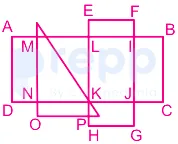
How many rectangles are there in the given figure?

- A
13
- B
17
- C
11
- D
15
Show answer
B. 17The total number of rectangles in the given figure is,
Rectangles: ABCD, AMND, ALKD, AIJD, MLKN, LIJK, MIJN, IBCJ, LBCK, MBCN, EFGH, EFLI, EFJK, KJGH, LIHG, NKOP, MLPO
Hence, “17” is the correct answer.
 Paper & answer key PDF ↗
 Question 2archived
Select the option that depicts how the given transparent sheet of paper would appear if it is folded at the dotted line.

- A
Option A (shown in image)
- B
Option B (shown in image)
- C
Option C (shown in image)
- D
Option D (shown in image)
Show answer
C. Option C (shown in image)The paper when folded appears like,
Hence, figure 3 is the correct answer.
 Paper & answer key PDF ↗
 Question 3archived
A product was marked for sale with a label price, which is at 20% discount on the printed price. At the time of sale, the shopkeeper gave an additional 10% discount on the label price. If a customer bought the product at Rs. 468, then what is the printed price of the product?
- A
Rs. 700
- B
Rs. 600
- C
Rs. 520
- D
Rs. 650
Show answer
D. Rs. 650Calculating the Printed Price with Multiple Discounts
Let's break down this problem involving discounts on a product to find its original printed price. We are given the final selling price after two consecutive discounts: first on the printed price to get the label price, and then another on the label price to get the final selling price.
Understanding the Pricing Terms
Printed Price: This is the initial price marked on the product before any discounts. This is what we need to find.
Label Price: This is the price after the first discount is applied to the printed price.
Selling Price: This is the final price the customer pays after all discounts are applied to the label price.
Step-by-Step Calculation
Let \(P\) be the Printed Price (in Rs.).
Step 1: Calculate the Label Price
The label price is at a 20% discount on the printed price. This means the label price is \(100\% - 20\% = 80\%\) of the printed price.
Label Price \(L = P - 20\%\) of \(P\)
In terms of calculation:
\(L = P - 0.20 \times P\)
\(L = (1 - 0.20) \times P\)
\(L = 0.80 \times P\)
Step 2: Calculate the Selling Price from the Label Price
The shopkeeper gave an additional 10% discount on the label price at the time of sale. This means the selling price is \(100\% - 10\% = 90\%\) of the label price.
Selling Price \(S = L - 10\%\) of \(L\)
In terms of calculation:
\(S = L - 0.10 \times L\)
\(S = (1 - 0.10) \times L\)
\(S = 0.90 \times L\)
Step 3: Use the Given Selling Price to Find the Label Price
We are given that the customer bought the product at Rs. 468. So, \(S = 468\).
Substitute this into the equation from Step 2:
\(468 = 0.90 \times L\)
Now, solve for \(L\):
\(L = \frac{468}{0.90}\)
\(L = \frac{468}{\frac{90}{100}}\)
\(L = \frac{468 \times 100}{90}\)
\(L = \frac{46800}{90}\)
\(L = 520\)
So, the Label Price was Rs. 520.
Step 4: Use the Label Price to Find the Printed Price
Now we use the equation from Step 1:
\(L = 0.80 \times P\)
Substitute the calculated value of \(L = 520\):
\(520 = 0.80 \times P\)
Now, solve for \(P\):
\(P = \frac{520}{0.80}\)
\(P = \frac{520}{\frac{80}{100}}\)
\(P = \frac{520 \times 100}{80}\)
\(P = \frac{52000}{80}\)
\(P = 650\)
So, the Printed Price of the product is Rs. 650.
Summary of Prices
Price Type
Calculation/Value
Printed Price
Rs. 650
20% Discount on Printed Price
\(0.20 \times 650 = 130\)
Label Price
\(650 - 130 = 520\)
10% Discount on Label Price
\(0.10 \times 520 = 52\)
Selling Price
\(520 - 52 = 468\)
The calculated selling price (Rs. 468) matches the given selling price, confirming our steps are correct.
Therefore, the printed price of the product is Rs. 650.
Revision Table: Key Concepts
Concept
Explanation
Formula/Relationship
Discount
A reduction in price. Usually expressed as a percentage of the original price.
Discount Amount = Discount Rate \(\times\) Original Price
Selling Price after Discount
The price after the discount is subtracted from the original price.
Selling Price = Original Price - Discount Amount
Selling Price = Original Price \(\times\) (1 - Discount Rate)
Consecutive Discounts
Applying one discount after another on the successively reduced price. The second discount is applied to the price after the first discount.
Not simply adding the discount percentages. Each discount is applied to a different base price.
Additional Information: Successive Discounts
It is important to note that two successive discounts of 20% and 10% are not equivalent to a single discount of \(20\% + 10\% = 30\%\). This is because the second discount is applied to a smaller base (the label price), not the original printed price.
Let's verify this with an example:
If the printed price was Rs. 100:
Single 30% discount: Selling price = \(100 - 0.30 \times 100 = 100 - 30 = 70\)
Successive 20% and 10% discounts:
Price after 20% discount (Label Price) = \(100 - 0.20 \times 100 = 80\)
Price after additional 10% discount (Selling Price) = \(80 - 0.10 \times 80 = 80 - 8 = 72\)
As you can see, Rs. 70 is different from Rs. 72. The effective single discount equivalent to successive discounts of \(d_1\%\) and \(d_2\%\) is given by the formula:
\(Effective Discount = (d_1 + d_2 - \frac{d_1 \times d_2}{100})\%\)
For 20% and 10%:
\(Effective Discount = (20 + 10 - \frac{20 \times 10}{100})\%\)
\(Effective Discount = (30 - \frac{200}{100})\%\)
\(Effective Discount = (30 - 2)\%\)
\(Effective Discount = 28\%\)
This means the customer effectively received a 28% discount on the original printed price. Let's check this: 28% of Rs. 650 is \(0.28 \times 650 = 182\). Selling Price = \(650 - 182 = 468\), which matches the given selling price.
Paper & answer key PDF ↗ Question 4archived
‘Wheat’ is related to ‘Bread’ in the same way as ‘Sugarcane’ is related to ‘_______’.
- A
Grass
- B
Jaggery
- C
Ketchup
- D
Mayonnaise
Show answer
B. JaggeryUnderstanding Analogies: Wheat, Bread, and Sugarcane
Analogy questions test your ability to understand the relationship between a pair of words and apply that same relationship to another pair. In this question, we are given the relationship between ‘Wheat’ and ‘Bread’ and asked to find the word that has the same relationship with ‘Sugarcane’.
Identifying the Relationship between Wheat and Bread
Let's first look at the given pair: ‘Wheat’ and ‘Bread’. What is the connection between these two? Bread is a food product that is typically made from Wheat. So, the relationship is that the second word is a product made from the first word (Source → Product).
Applying the Relationship to Sugarcane
Now we need to find a word from the options that is a product made from ‘Sugarcane’. Let's examine each option:
Grass: Sugarcane is botanically a type of grass, but grass itself is not a primary product made from sugarcane in the same way bread is made from wheat.
Jaggery: Jaggery is a traditional sweetener made by concentrating sugarcane juice. It is a product directly derived from Sugarcane. This fits the Source → Product relationship we identified.
Ketchup: Ketchup is a sauce, usually made from tomatoes. It is not related to Sugarcane.
Mayonnaise: Mayonnaise is a condiment made from oil, egg yolk, and vinegar. It is not related to Sugarcane.
Conclusion based on the Relationship
Comparing the relationship of ‘Wheat’ to ‘Bread’ (Source → Product) with the options for ‘Sugarcane’, we find that ‘Jaggery’ is a product made from ‘Sugarcane’. Therefore, the relationship is consistent.
Thus, ‘Sugarcane’ is related to ‘Jaggery’ in the same way as ‘Wheat’ is related to ‘Bread’.
Revision Table: Analogy Pairs
Source
Product Made From Source
Analogy Pair
Wheat
Bread
Wheat : Bread
Sugarcane
Jaggery
Sugarcane : Jaggery
Additional Information: Jaggery and Sugarcane Products
Jaggery is a natural sweetener produced from sugarcane juice or palm sap. It is widely consumed in Asia, Africa, and Latin America. Besides Jaggery, other common products made from Sugarcane include:
Granulated Sugar (common table sugar)
Molasses
Ethanol (biofuel)
Rum (alcoholic beverage distilled from molasses or sugarcane juice)
Bagasse (fibrous residue used as fuel or in paper/board manufacturing)
Understanding the various products derived from a source material is helpful for solving analogies based on the Source → Product relationship.
Paper & answer key PDF ↗ Question 5archived
Select the number that can replace the question mark (?) in the following series.
1537, 1539, 1543, ?, 1557, 1567
- A
1550
- B
1549
- C
1553
- D
1546
Show answer
B. 1549Finding the Missing Number in the Series
The question asks us to find the number that should replace the question mark (?) in the given number series: 1537, 1539, 1543, ?, 1557, 1567.
To solve number series questions, we need to identify the pattern or rule that connects the consecutive terms in the series. This usually involves looking at the differences, sums, products, divisions, squares, cubes, or a combination of these operations between terms.
Analyzing the Series Pattern
Let's look at the differences between the consecutive terms we are given:
Difference between the 2nd and 1st term: \(1539 - 1537 = 2\)
Difference between the 3rd and 2nd term: \(1543 - 1539 = 4\)
We can see the differences are 2 and 4. This suggests that the differences between terms might be increasing. Let's assume the differences follow a simple pattern, such as an arithmetic progression.
If the differences are increasing by a constant value, the next difference after 4 could be \(4 + 2 = 6\), then \(6 + 2 = 8\), and so on.
Predicting the Missing Term
Based on the observed pattern (differences 2, 4), let's assume the next difference (between the 3rd term and the missing term) is 6. So, the missing term would be:
\(\text{Missing Term} = \text{3rd Term} + \text{Next Difference}\)
\(\text{Missing Term} = 1543 + 6\)
\(\text{Missing Term} = 1549\)
Verifying the Pattern with Subsequent Terms
Now, let's check if this predicted missing term (1549) fits the rest of the series. According to our assumed pattern of differences (2, 4, 6, 8, 10, ...), the next difference should be \(6 + 2 = 8\). Let's add this difference to our predicted missing term:
\(1549 + 8 = 1557\)
This matches the 5th term in the given series. This strengthens our hypothesis about the pattern of differences.
Let's check the next difference, which should be \(8 + 2 = 10\). Let's add this difference to the 5th term:
\(1557 + 10 = 1567\)
This matches the last term in the given series.
The pattern of differences between consecutive terms is indeed 2, 4, 6, 8, 10. These differences form an arithmetic progression with a common difference of 2.
Summary of the Series and Differences
Here is the series showing the differences:
Term
Value
Difference from Previous Term
1st
1537
-
2nd
1539
\(1539 - 1537 = 2\)
3rd
1543
\(1543 - 1539 = 4\)
4th (?)
1549
\(1549 - 1543 = 6\)
5th
1557
\(1557 - 1549 = 8\)
6th
1567
\(1567 - 1557 = 10\)
The missing number that fits this pattern is 1549.
Conclusion
The pattern in the series is that the difference between consecutive terms increases by 2 each time. Starting with a difference of 2, the differences are 2, 4, 6, 8, 10. Using this pattern, the missing number is 1543 plus the next difference, which is 6, resulting in 1549.
Revision Table: Number Series Patterns
Understanding common types of number series patterns is key to solving such problems quickly.
Pattern Type
Description
Example
Arithmetic Series
Constant difference between terms.
2, 5, 8, 11, ... (Difference is 3)
Geometric Series
Constant ratio between terms.
3, 6, 12, 24, ... (Ratio is 2)
Difference Series
Differences between terms follow a pattern (e.g., arithmetic or geometric).
1, 2, 4, 7, 11, ... (Differences are 1, 2, 3, 4)
Mixed Series
Combination of two or more simple series, or alternating operations.
10, 20, 15, 25, 20, 30, ... (Alternating +10, -5)
Fibonacci or Similar
Each term is the sum of the previous two terms (or similar relation).
1, 1, 2, 3, 5, 8, ... (1+1=2, 1+2=3, etc.)
Additional Information: Solving Number Series Problems
Here are some tips for approaching number series questions in competitive exams or aptitude tests:
Look for simple patterns first: arithmetic or geometric progressions.
Calculate the differences between consecutive terms. If the differences form a pattern, you have a difference series. Sometimes, you might need to calculate the differences of the differences (as in this problem).
Look for ratios between consecutive terms, especially if the numbers are growing or shrinking rapidly.
Check for alternating patterns, where two different rules might apply to alternate terms.
Consider squares, cubes, square roots, or cube roots, especially if the numbers are large or involve perfect squares/cubes.
Prime numbers or other special sequences might be involved.
Practice solving various types of number series problems to become familiar with common patterns.
Stay calm and systematically try different approaches if the pattern isn't immediately obvious.
Identifying the pattern of differences was the key to solving this specific number series problem.
Paper & answer key PDF ↗ Question 6archived
Select the letter-cluster that can replace the question mark (?) in the following series.
DAG, FCI, ? JGM, LIO
- A
HEK
- B
IFL
- C
HKE
- D
GDJ
Show answer
A. HEKAnalyzing the Letter Cluster Series Pattern
The question asks us to find the letter-cluster that completes the given series: DAG, FCI, ?, JGM, LIO. To solve this type of letter cluster series problem, we need to identify the pattern followed by the letters in each position across the clusters.
Pattern Identification in Letter Clusters
Let's examine the letters in the first, second, and third positions of each cluster separately.
Analyzing the First Letter Pattern
The first letters in the series are D, F, ?, J, L.
D is the 4th letter of the alphabet.
F is the 6th letter of the alphabet.
J is the 10th letter of the alphabet.
L is the 12th letter of the alphabet.
Let's look at the alphabetical position numbers: 4, 6, ?, 10, 12.
The difference between the known consecutive positions is:
F (6) - D (4) = 2
L (12) - J (10) = 2
It appears there is a consistent increase of 2 in the alphabetical position for the first letter of each successive cluster.
Following this pattern, the first letter of the missing cluster should be the letter that is 2 positions after F (6th letter). The 6th letter is F, so $6 + 2 = 8$. The 8th letter of the alphabet is H.
So, the first letter of the missing cluster is H.
Analyzing the Second Letter Pattern
The second letters in the series are A, C, ?, G, I.
A is the 1st letter of the alphabet.
C is the 3rd letter of the alphabet.
G is the 7th letter of the alphabet.
I is the 9th letter of the alphabet.
Let's look at the alphabetical position numbers: 1, 3, ?, 7, 9.
The difference between the known consecutive positions is:
C (3) - A (1) = 2
I (9) - G (7) = 2
It appears there is a consistent increase of 2 in the alphabetical position for the second letter of each successive cluster.
Following this pattern, the second letter of the missing cluster should be the letter that is 2 positions after C (3rd letter). The 3rd letter is C, so $3 + 2 = 5$. The 5th letter of the alphabet is E.
So, the second letter of the missing cluster is E.
Analyzing the Third Letter Pattern
The third letters in the series are G, I, ?, M, O.
G is the 7th letter of the alphabet.
I is the 9th letter of the alphabet.
M is the 13th letter of the alphabet.
O is the 15th letter of the alphabet.
Let's look at the alphabetical position numbers: 7, 9, ?, 13, 15.
The difference between the known consecutive positions is:
I (9) - G (7) = 2
O (15) - M (13) = 2
It appears there is a consistent increase of 2 in the alphabetical position for the third letter of each successive cluster.
Following this pattern, the third letter of the missing cluster should be the letter that is 2 positions after I (9th letter). The 9th letter is I, so $9 + 2 = 11$. The 11th letter of the alphabet is K.
So, the third letter of the missing cluster is K.
Combining the Patterns to Find the Missing Cluster
By analyzing the pattern for each letter position, we found the missing letters:
First letter: H
Second letter: E
Third letter: K
Combining these letters, the missing letter-cluster is HEK.
Let's verify the complete series with HEK: DAG, FCI, HEK, JGM, LIO.
First letters: D(4) $\xrightarrow{+2}$ F(6) $\xrightarrow{+2}$ H(8) $\xrightarrow{+2}$ J(10) $\xrightarrow{+2}$ L(12) - Correct.
Second letters: A(1) $\xrightarrow{+2}$ C(3) $\xrightarrow{+2}$ E(5) $\xrightarrow{+2}$ G(7) $\xrightarrow{+2}$ I(9) - Correct.
Third letters: G(7) $\xrightarrow{+2}$ I(9) $\xrightarrow{+2}$ K(11) $\xrightarrow{+2}$ M(13) $\xrightarrow{+2}$ O(15) - Correct.
The pattern holds for all three positions.
Revision Table: Letter Series Analysis
Cluster
1st Letter (Position)
2nd Letter (Position)
3rd Letter (Position)
DAG
D (4)
A (1)
G (7)
FCI
F (6)
C (3)
I (9)
HEK
H (8)
E (5)
K (11)
JGM
J (10)
G (7)
M (13)
LIO
L (12)
I (9)
O (15)
The table clearly shows the +2 pattern for each letter's position in the series.
Additional Information: Solving Letter Pattern Questions
Letter series and letter cluster series questions are common in logical reasoning sections of competitive exams. They test your ability to identify patterns in sequences of letters.
Here are some common types of patterns you might encounter:
Alphabetical Position: The pattern is based on the position of letters in the standard English alphabet (A=1, B=2, ..., Z=26). The pattern could involve adding, subtracting, multiplying, or dividing positions, or a combination of these operations.
Skipping Letters: The pattern involves skipping a fixed or variable number of letters between consecutive terms in the series.
Reverse Alphabetical Order: The series might follow a pattern moving backward through the alphabet.
Vowel/Consonant Patterns: The series might alternate between vowels and consonants or follow a pattern based on their presence.
Combination of Patterns: Some series might combine different types of patterns, for example, one pattern for the first letter, a different pattern for the second, and so on (as seen in this question).
Reverse Order within Cluster: The letters within a single cluster might be in reverse alphabetical order or follow another internal pattern.
To solve these questions, it's helpful to write down the alphabetical position of each letter or mentally visualize the alphabet. Practice with different types of series helps in quickly recognizing the underlying pattern.
Paper & answer key PDF ↗ Question 7archived
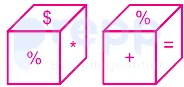
Two different positions of the same dice are shown. Select the symbol that will be on the face opposite to the one showing ‘=’.
- A
*
- B
%
- C
#
- D
$
Show answer
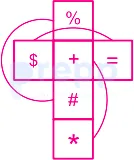
D. $The logic follows here is :-
According to the given figures,
‘*’ is opposite to ‘+’
‘#’ is opposite to ‘%’
And,
‘=’ will be on the face opposite to ‘$’
Hence, “$” is the correct answer.
 Paper & answer key PDF ↗
 Question 8archived
Select the option that is related to the third term in the same way as the second term is related to the first term and sixth term is related to fifth term.
72 : 14 :: 87 : ? :: 96 : 54
- A
15
- B
29
- C
56
- D
52
Show answer
C. 56Solving Number Analogy Questions
This question asks us to find the missing term in a number analogy. We are given three pairs of numbers: 72 : 14, 87 : ?, and 96 : 54. The relationship between the numbers in the first pair is the same as the relationship in the third pair, and this same relationship applies to the second pair, which has the missing term.
Analyzing the Pattern in Number Analogy
Let's examine the given pairs to identify the pattern or rule connecting the first number to the second number in each pair.
Analyzing the First Pair: 72 : 14
We need to find how 72 is related to 14. Let's look at the digits of 72, which are 7 and 2.
Sum of digits: ${7 + 2 = 9}$ (This is not 14)
Difference of digits: ${7 - 2 = 5}$ (This is not 14)
Product of digits: ${7 \times 2 = 14}$ (This matches the second number, 14)
The pattern seems to be that the second number is the product of the digits of the first number.
Analyzing the Third Pair: 96 : 54
Let's check if the same pattern holds for the third pair, 96 : 54. The digits of 96 are 9 and 6.
Sum of digits: ${9 + 6 = 15}$ (This is not 54)
Difference of digits: ${9 - 6 = 3}$ (This is not 54)
Product of digits: ${9 \times 6 = 54}$ (This matches the second number, 54)
The pattern is consistent across both given pairs.
Applying the Pattern to Find the Missing Term
The identified pattern is that the second term is obtained by multiplying the digits of the first term.
Now, let's apply this pattern to the second pair: 87 : ?
The first number is 87. Its digits are 8 and 7.
According to the pattern, the missing term will be the product of the digits of 87.
Missing term = ${8 \times 7}$
${8 \times 7 = 56}$
So, the missing term is 56.
Verifying the Solution
Let's summarize the pairs with the found missing term:
First Term
Second Term
Relation
Calculation
72
14
Product of digits
${7 \times 2 = 14}$
87
56
Product of digits
${8 \times 7 = 56}$
96
54
Product of digits
${9 \times 6 = 54}$
The pattern holds true for all pairs with 56 as the missing term.
Conclusion
The missing term in the analogy 72 : 14 :: 87 : ? :: 96 : 54 is 56, based on the pattern where the second number is the product of the digits of the first number.
Revision Table - Number Analogy Pattern
Concept
Description
Example (from question)
Number Analogy
Finding the relationship between numbers in one pair and applying it to another.
72 : 14 :: 87 : ?
Pattern Identification
Discovering the rule connecting the terms in the given pairs.
Second term = Product of digits of the first term.
Applying the Pattern
Using the discovered rule to find the unknown term.
For 87 : ?, calculate ${8 \times 7}$.
Additional Information - Reasoning Skills
Solving number analogy problems like this helps improve logical reasoning and pattern recognition skills. These types of questions often appear in various aptitude tests and competitive exams. Common patterns involve arithmetic operations (addition, subtraction, multiplication, division), squares, cubes, digit manipulation (sum, product, difference of digits), and sometimes more complex logical rules. Practicing different types of analogies is key to mastering this topic.
Paper & answer key PDF ↗ Question 9archived
Select the option in which the number set shares the same relationship as that shared by given number set.
(17, 24, 45)
- A
(12, 19, 40)
- B
(15, 20, 43)
- C
(18, 23, 46)
- D
(19, 26, 34)
Show answer
A. (12, 19, 40)Understanding Number Set Relationships
The question asks us to find the option that shares the same numerical relationship as the given number set (17, 24, 45).
To solve this, we first need to analyze the pattern or rule that connects the three numbers in the given set. Let the given set be represented as \((a, b, c)\), where \(a=17\), \(b=24\), and \(c=45\).
Analyzing the Given Number Set (17, 24, 45)
Let's look for a relationship between these numbers.
Consider the difference between the first two numbers: \(b - a = 24 - 17 = 7\).
Now, let's see how the third number (45) relates to the first two and their difference.
We can try to express the third number \(c\) using \(a\) and \(b\).
Let's explore potential relationships:
Perhaps the third number is related to the difference between the first two. Let \(d = b - a = 7\).
Is \(c = a + k \times d\)? \(45 = 17 + k \times 7\). \(28 = k \times 7\). This gives \(k=4\). So, \(c = a + 4(b-a)\).
Is \(c = b + m \times d\)? \(45 = 24 + m \times 7\). \(21 = m \times 7\). This gives \(m=3\). So, \(c = b + 3(b-a)\).
Let's simplify both potential rules:
Rule 1: \(c = a + 4(b-a) = a + 4b - 4a = 4b - 3a\)
Rule 2: \(c = b + 3(b-a) = b + 3b - 3a = 4b - 3a\)
Both relationships simplify to the same rule: \(c = 4b - 3a\). This is the rule we will test on the given options.
Testing the Options for the Same Relationship
We will apply the rule \(c = 4b - 3a\) to each option set \((a', b', c')\) and check if the calculated value of \(4b' - 3a'\) equals \(c'\).
Option 1: (12, 19, 40)
Here, \(a' = 12\), \(b' = 19\), and \(c' = 40\). Let's calculate \(4b' - 3a'\):
\[4 \times 19 - 3 \times 12 = 76 - 36 = 40\]
The calculated value (40) matches \(c'\) (40). Therefore, this set shares the same relationship.
Option 2: (15, 20, 43)
Here, \(a' = 15\), \(b' = 20\), and \(c' = 43\). Let's calculate \(4b' - 3a'\):
\[4 \times 20 - 3 \times 15 = 80 - 45 = 35\]
The calculated value (35) does not match \(c'\) (43). This set does not share the same relationship.
Option 3: (18, 23, 46)
Here, \(a' = 18\), \(b' = 23\), and \(c' = 46\). Let's calculate \(4b' - 3a'\):
\[4 \times 23 - 3 \times 18 = 92 - 54 = 38\]
The calculated value (38) does not match \(c'\) (46). This set does not share the same relationship.
Option 4: (19, 26, 34)
Here, \(a' = 19\), \(b' = 26\), and \(c' = 34\). Let's calculate \(4b' - 3a'\):
\[4 \times 26 - 3 \times 19 = 104 - 57 = 47\]
The calculated value (47) does not match \(c'\) (34). This set does not share the same relationship.
Conclusion
Based on our analysis, only Option 1 (12, 19, 40) follows the same rule \(c = 4b - 3a\) as the given set (17, 24, 45).
Set
\(a\)
\(b\)
\(c\)
Calculate \(4b - 3a\)
Matches \(c\)?
(17, 24, 45)
17
24
45
\(4 \times 24 - 3 \times 17 = 96 - 51 = 45\)
Yes
Option 1: (12, 19, 40)
12
19
40
\(4 \times 19 - 3 \times 12 = 76 - 36 = 40\)
Yes
Option 2: (15, 20, 43)
15
20
43
\(4 \times 20 - 3 \times 15 = 80 - 45 = 35\)
No
Option 3: (18, 23, 46)
18
23
46
\(4 \times 23 - 3 \times 18 = 92 - 54 = 38\)
No
Option 4: (19, 26, 34)
19
26
34
\(4 \times 26 - 3 \times 19 = 104 - 57 = 47\)
No
Revision Table: Key Concepts in Number Puzzles
Concept
Description
Example Application (using set (17, 24, 45))
Difference
Finding the difference between consecutive numbers.
\(24 - 17 = 7\)
Arithmetic Progression
A sequence where the difference between consecutive terms is constant.
Not directly applicable here, difference changes from (17,24) to (24,45).
Algebraic Relation
Expressing the relationship between numbers using variables and equations.
\(c = 4b - 3a\)
Pattern Recognition
Identifying underlying rules or sequences in numbers.
Discovering the \(c = 4b - 3a\) pattern.
Additional Information: Solving Number Series and Pattern Questions
Questions involving number sets and series often require identifying the underlying mathematical pattern or rule. Here are some common approaches:
Look for Differences: Calculate the differences between consecutive numbers. If the first differences are constant, it's an arithmetic progression. If the second differences are constant, it's a quadratic relationship, and so on.
Look for Ratios: Check if there's a constant ratio between consecutive numbers (geometric progression).
Look for Combinations: The pattern might involve a combination of operations (e.g., multiply by a number and add/subtract another, or relate the third number to the sum/difference of the first two).
Look for Position-Based Rules: Sometimes the rule depends on the position of the number in the sequence (e.g., \(n^2 + 1\) for the \(n\)-th term).
Use Algebra: Represent the numbers with variables (like \(a, b, c\)) and try to form an equation that holds true for the given set. Then test this equation on the options. This method was effective in finding the \(c = 4b - 3a\) rule for this problem.
Prime Numbers, Squares, Cubes: Check if the numbers are related to prime numbers, perfect squares, or cubes.
Systematic testing of these possibilities is key to solving such logical reasoning problems effectively.
Paper & answer key PDF ↗ Question 10archived
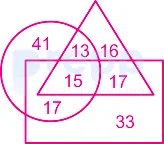
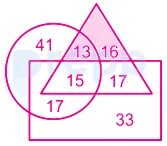
In the given Venn diagram, the ‘rectangle’ represents ‘engineers’, the ‘circle’ represents ‘managers’, and the ‘triangle’ represents ‘married’, The numbers given in the diagram represent the number of persons in that particular category.
How many people are married but NOT engineers?
- A
29
- B
70
- C
13
- D
16
Show answer
A. 29According to the given information,
The shaded part represents people who are married, but not engineers = 16 + 13 = 29.
Hence, “29” is the correct answer.
 Paper & answer key PDF ↗
 Question 11archived
A + B means ‘A is the wife of B’;
A - B means ‘B is the daughter of A’;
A × B means ‘B is the brother of A’;
A ÷ B means ‘A is the father of B’;
If, P + R × T - Q + S ÷ U, then how is P related to the mother of U?
- A
Paternal grandmother
- B
Mother
- C
Aunt
- D
Maternal grandmother
Show answer
C. AuntUnderstanding Blood Relations from Coded Language
This question tests your ability to decode relationships represented by symbols and then determine the relationship between two individuals based on a given expression. We need to carefully analyze the meaning of each symbol and then build the family tree based on the expression.
Decoding the Symbols
Let's break down the meaning of each symbol provided:
A + B means ‘A is the wife of B’
A - B means ‘B is the daughter of A’
A × B means ‘B is the brother of A’
A ÷ B means ‘A is the father of B’
Analyzing the Expression: P + R × T - Q + S ÷ U
Now, let's apply these meanings to the given expression step-by-step:
P + R: According to the rule A + B means ‘A is the wife of B’, P + R means ‘P is the wife of R’. This tells us P is female and R is male.
R × T: According to the rule A × B means ‘B is the brother of A’, R × T means ‘T is the brother of R’. This tells us R and T are siblings, and T is male.
T - Q: According to the rule A - B means ‘B is the daughter of A’, T - Q means ‘Q is the daughter of T’. This tells us T is the parent of Q, and Q is female.
Q + S: According to the rule A + B means ‘A is the wife of B’, Q + S means ‘Q is the wife of S’. This tells us Q is female and S is male.
S ÷ U: According to the rule A ÷ B means ‘A is the father of B’, S ÷ U means ‘S is the father of U’. This tells us S is male and S is a parent of U.
Building the Family Connections
Let's consolidate the relationships we've found:
P is the wife of R.
T is the brother of R.
Q is the daughter of T.
Q is the wife of S.
S is the father of U.
Summary of Derived Relationships
Relationship Part
Meaning
Implied Gender
P + R
P is wife of R
P (Female), R (Male)
R × T
T is brother of R
R (Sibling), T (Male)
T - Q
Q is daughter of T
T (Parent), Q (Female)
Q + S
Q is wife of S
Q (Female), S (Male)
S ÷ U
S is father of U
S (Male), U (Child)
Identifying the "Mother of U"
From S ÷ U, we know S is the father of U. From Q + S, we know Q is the wife of S. Since S is the father and Q is the wife, Q must be the mother of U.
Determining P's Relationship to the Mother of U
We need to find out how P is related to Q (the mother of U).
P is the wife of R.
R is the brother of T.
T is the father of Q.
So, P is married to R, who is the brother of Q's father (T). This makes R the paternal uncle of Q. Since P is R's wife, P is the paternal aunt of Q. Q is the mother of U.
Therefore, P is the aunt of the mother of U.
Conclusion
Based on the analysis of the coded blood relations and the given expression, P is the aunt of Q, who is the mother of U. Thus, P is related to the mother of U as an Aunt.
Revision Table: Blood Relations Concepts
Key Terms in Blood Relations
Relationship
Description
Father's Father
Paternal Grandfather
Father's Mother
Paternal Grandmother
Mother's Father
Maternal Grandfather
Mother's Mother
Maternal Grandmother
Father's Brother
Paternal Uncle
Father's Sister
Paternal Aunt
Mother's Brother
Maternal Uncle
Mother's Sister
Maternal Aunt
Spouse's Brother
Brother-in-law
Spouse's Sister
Sister-in-law
Brother's Son
Nephew
Brother's Daughter
Niece
Sister's Son
Nephew
Sister's Daughter
Niece
Additional Information: Solving Blood Relation Questions
Solving blood relation questions using coded language or complex descriptions often involves building a diagram or a family tree. Here are some tips:
Start with the main person whose relationship is being asked about or the person mentioned first in the expression.
Work through the expression segment by segment, drawing lines to connect individuals and marking their gender if determined.
Use symbols or notations for gender (e.g., + for male, - for female) and relationships (e.g., double line for marriage, single line for siblings, vertical line for parent-child).
Break down complex relations into simpler steps. For example, "father of husband's brother" can be broken down into "husband's brother" (brother-in-law) and then "father of brother-in-law" (father-in-law).
Be careful with possessives (e.g., "A's father" vs. "father of A").
Practice decoding different types of symbols and expressions.
Always re-read the question to ensure you are finding the relationship between the correct two individuals and the direction of the relationship (e.g., how is A related to B vs. how is B related to A).
Paper & answer key PDF ↗ Question 12archived
In a certain code language, ‘JUPITER is written as ‘JVOJSFR’. How will ‘NEPTUNE’ be written as in that language?
- A
NDPSVME
- B
NGOUTOE
- C
NFOUTOE
- D
NFOSTOE
Show answer
C. NFOUTOEUnderstanding the Coding Language Pattern
This question asks us to decode a word based on a pattern observed in a given coded pair. The word 'JUPITER' is coded as 'JVOJSFR'. We need to find the pattern of transformation from 'JUPITER' to 'JVOJSFR' and then apply the same pattern to the word 'NEPTUNE'.
Analyzing the JUPITER - JVOJSFR Coding
Let's look at each letter of 'JUPITER' and its corresponding letter in 'JVOJSFR':
Original Letter (JUPITER)
Coded Letter (JVOJSFR)
Transformation
J
J
No change
U
V
U is followed by V (+1 position in alphabet)
P
O
P is preceded by O (-1 position in alphabet)
I
J
I is followed by J (+1 position in alphabet)
T
S
T is preceded by S (-1 position in alphabet)
E
F
E is followed by F (+1 position in alphabet)
R
R
No change
Observing the transformations, we can see a clear pattern:
The 1st and 7th letters remain unchanged.
The 2nd, 4th, and 6th letters are shifted one position forward (+1) in the alphabet.
The 3rd and 5th letters are shifted one position backward (-1) in the alphabet.
The pattern of transformation for each letter position is: No change, +1, -1, +1, -1, +1, No change.
Applying the Pattern to NEPTUNE
Now, let's apply this same pattern to the word 'NEPTUNE', which also has 7 letters:
First letter (N): No change → N
Second letter (E): +1 position → The letter after E is F
Third letter (P): -1 position → The letter before P is O
Fourth letter (T): +1 position → The letter after T is U
Fifth letter (U): -1 position → The letter before U is T
Sixth letter (N): +1 position → The letter after N is O
Seventh letter (E): No change → E
Combining these letters, the coded word for 'NEPTUNE' is NFOUTOE.
Comparing with Options
Let's compare our derived code 'NFOUTOE' with the given options:
Option 1: NDPSVME (Does not match)
Option 2: NGOUTOE (Does not match the third letter)
Option 3: NFOUTOE (Matches our derived code)
Option 4: NFOSTOE (Does not match the fifth letter)
The coded word 'NFOUTOE' matches Option 3.
Revision Table: Coding Pattern Summary
Here's a quick summary of the coding logic used:
Position
1st
2nd
3rd
4th
5th
6th
7th
Transformation
No Change
+1
-1
+1
-1
+1
No Change
Additional Information: Coding and Decoding Concepts
Coding and decoding questions are common in reasoning sections of competitive exams. They test your ability to identify patterns and rules in letter or number sequences and apply them to new cases. Types of coding can include:
Letter Coding: Letters are replaced with other letters based on a specific rule (like positional shift, skipping letters, reversing order, etc.). This question is an example of letter coding with positional shifts.
Number Coding: Words are coded using numbers. This could be based on the alphabetical position of letters or other numerical relationships.
Symbol Coding: Letters or words are coded using symbols.
Mixed Coding: A combination of letters, numbers, and symbols might be used.
Sentence Coding: Entire sentences or phrases are coded, often with multiple words being coded together, requiring you to figure out which code corresponds to which word.
To solve coding-decoding problems, always start by carefully analyzing the given example(s) to find the underlying rule or pattern. Once the pattern is clear, apply it consistently to the word or sequence you need to decode.
Paper & answer key PDF ↗ Question 13archived
Arrange the following words in a logical and meaningful order (according to population).
1. Andhra Pradesh
2. Madhya Pradesh
3. Arunachal Pradesh
4. Uttar Pradesh
5. Himachal Pradesh
- A
4-2-1-5-3
- B
4-2-1-3-5
- C
4-1-2-3-5
- D
4-1-2-5-3
Show answer
A. 4-2-1-5-3Arranging Indian States by Population Order
This question asks us to arrange five specific Indian states based on their population size. The order required is logical and meaningful, implying arrangement either from highest to lowest population or lowest to highest. Given the options, the arrangement is from the highest population to the lowest population.
The states provided and their corresponding numbers are:
1. Andhra Pradesh
2. Madhya Pradesh
3. Arunachal Pradesh
4. Uttar Pradesh
5. Himachal Pradesh
To arrange these states by population, we need to consider their approximate population figures. Based on recent demographic data, we can compare their populations:
State
Number
Approximate Population (Latest Estimates/Census)
Uttar Pradesh
4
Around 240 million
Madhya Pradesh
2
Around 85 million
Andhra Pradesh
1
Around 50 million
Himachal Pradesh
5
Around 7 million
Arunachal Pradesh
3
Around 1.4 million
Arranging these states from the highest population to the lowest population, we get the following order:
Uttar Pradesh (Highest Population)
Madhya Pradesh
Andhra Pradesh
Himachal Pradesh
Arunachal Pradesh (Lowest Population)
Now, we match this population order with the numbers assigned to each state in the question:
Uttar Pradesh is number 4
Madhya Pradesh is number 2
Andhra Pradesh is number 1
Himachal Pradesh is number 5
Arunachal Pradesh is number 3
Therefore, the correct sequence of numbers representing the states in descending order of population is 4-2-1-5-3.
Revision Table: Indian State Population Ranking
Rank (by Population)
State Name
Assigned Number
1
Uttar Pradesh
4
2
Madhya Pradesh
2
3
Andhra Pradesh
1
4
Himachal Pradesh
5
5
Arunachal Pradesh
3
Additional Information: Understanding State Populations
Population distribution across states in India is highly uneven. States like Uttar Pradesh and Bihar have very large populations, while many North-Eastern states and smaller states in other regions have much smaller populations. This variation affects political representation, resource allocation, and economic planning.
Population data is crucial for:
Determining electoral constituencies.
Distributing central government funds to states.
Planning for infrastructure, education, and healthcare facilities.
Understanding demographic trends and their impact on society.
Comparing populations of states helps in understanding the scale and diversity of India's population distribution.
Paper & answer key PDF ↗ Question 14archived
Which two signs should be interchanged to make the given equation correct?
121 + 11 – 42 × 6 ÷ 7 = 83
- A
× and -
- B
+ and ÷
- C
÷ and ×
- D
– and ÷
Show answer
C. ÷ and ×Understanding the Mathematical Problem
The question asks us to find which two mathematical signs in the given equation must be swapped with each other to make the equation mathematically correct. The initial equation is:
\(121 + 11 – 42 × 6 ÷ 7 = 83\)
We need to test each given option by interchanging the specified signs and then evaluate the resulting equation using the standard order of operations (BODMAS/PEMDAS).
Applying the Order of Operations (BODMAS/PEMDAS)
To correctly evaluate mathematical expressions, we follow the order of operations:
B/P: Brackets or Parentheses first.
O/E: Orders (powers, square roots) or Exponents next.
DM: Division and Multiplication (from left to right).
AS: Addition and Subtraction (from left to right).
Evaluating Each Sign Interchange Option
Option 1: Interchanging × and –
If we swap the multiplication (×) and subtraction (–) signs, the equation becomes:
\(121 + 11 \times 42 – 6 ÷ 7\)
Now, let's evaluate this using BODMAS:
First, Division and Multiplication (from left to right):
\(121 + (11 \times 42) – (6 ÷ 7)\)
\(121 + 462 – \frac{6}{7}\)
Next, Addition and Subtraction (from left to right):
\((121 + 462) – \frac{6}{7}\)
\(583 – \frac{6}{7}\)
This result is approximately \(583 - 0.857 = 582.143\), which is not equal to 83. So, this option is incorrect.
Option 2: Interchanging + and ÷
If we swap the addition (+) and division (÷) signs, the equation becomes:
\(121 ÷ 11 – 42 × 6 + 7\)
Now, let's evaluate this using BODMAS:
First, Division and Multiplication (from left to right):
\((121 ÷ 11) – (42 × 6) + 7\)
\(11 – 252 + 7\)
Next, Addition and Subtraction (from left to right):
\((11 + 7) – 252\)
\(18 – 252\)
\(-234\)
This result is -234, which is not equal to 83. So, this option is incorrect.
Option 3: Interchanging ÷ and ×
If we swap the division (÷) and multiplication (×) signs, the equation becomes:
\(121 + 11 – 42 ÷ 6 × 7\)
Now, let's evaluate this using BODMAS:
First, Division and Multiplication (from left to right):
\(121 + 11 – (42 ÷ 6) × 7\)
\(121 + 11 – (7) × 7\)
\(121 + 11 – 49\)
Next, Addition and Subtraction (from left to right):
\((121 + 11) – 49\)
\(132 – 49\)
\(83\)
This result is 83, which matches the right-hand side of the original equation. So, this is the correct interchange.
Option 4: Interchanging – and ÷
If we swap the subtraction (–) and division (÷) signs, the equation becomes:
\(121 + 11 ÷ 42 × 6 – 7\)
Now, let's evaluate this using BODMAS:
First, Division and Multiplication (from left to right):
\(121 + (11 ÷ 42) × 6 – 7\)
\(121 + (\frac{11}{42}) × 6 – 7\)
\(121 + (\frac{11 \times 6}{42}) – 7\)
\(121 + (\frac{66}{42}) – 7\)
\(121 + (\frac{11}{7}) – 7\)
Next, Addition and Subtraction (from left to right):
\((121 + \frac{11}{7}) – 7\)
\((\frac{121 \times 7 + 11}{7}) – 7\)
\((\frac{847 + 11}{7}) – 7\)
\(\frac{858}{7} – 7\)
This result is approximately \(122.57 - 7 = 115.57\), which is not equal to 83. So, this option is incorrect.
Conclusion: Correct Sign Interchange
By testing each option and applying the order of operations (BODMAS/PEMDAS), we found that interchanging the division (÷) and multiplication (×) signs makes the equation \(121 + 11 – 42 \div 6 × 7\) evaluate to 83. Therefore, the correct signs to interchange are ÷ and ×.
Revision Table: Basic Mathematical Operations
Sign
Operation
Example
+
Addition
\(5 + 3 = 8\)
–
Subtraction
\(8 – 3 = 5\)
×
Multiplication
\(4 × 2 = 8\)
÷
Division
\(10 ÷ 2 = 5\)
Additional Information: Solving Equation Puzzles
These types of problems, often found in quantitative aptitude tests, require careful application of mathematical rules. Here are some tips:
Always remember the order of operations (BODMAS/PEMDAS).
Test each option systematically to avoid errors.
Be careful with fractions or decimals that might arise during division.
Practice solving similar puzzles to improve speed and accuracy.
Paper & answer key PDF ↗ Question 15archived
Four number–pairs have been given, out of which three are alike in some manner and one is different, Select the number–pair that is different.
- A
14 : 227
- B
11 : 146
- C
17 : 290
- D
10 : 123
Show answer
C. 17 : 290Finding the Odd Number Pair in Reasoning Questions
This question asks us to identify the number pair that is different from the other three, based on a hidden pattern or rule. We are given four number pairs, and we need to analyze them to find the relationship between the first and second number in each pair.
Analyzing the Number Pairs
Let's examine each number pair to find a possible relationship between the first number and the second number. Often, these patterns involve squaring, cubing, multiplication, or simple addition/subtraction, sometimes combined with the number itself or a small constant.
Consider the given pairs:
Pair 1: 14 : 227
Pair 2: 11 : 146
Pair 3: 17 : 290
Pair 4: 10 : 123
Let's try to find a pattern involving the square of the first number. Let the first number be \(n\) and the second number be \(m\).
Analysis of Pair 1: 14 : 227
The first number is 14. Let's consider its square:
\(14^2 = 196\)
The second number is 227. How can we get 227 from 196? The difference is \(227 - 196 = 31\). So, \(14^2 + 31 = 227\). This doesn't seem like a straightforward relationship involving a small constant or the number itself.
Let's consider the square of the next consecutive number, \(14+1=15\):
\(15^2 = 225\)
The second number is 227. We can get 227 by adding 2 to 225: \(225 + 2 = 227\). So, the relationship for this pair could be \((14+1)^2 + 2 = 227\).
This suggests a potential pattern: \((n+1)^2 + 2 = m\), where \(n\) is the first number and \(m\) is the second number.
Analysis of Pair 2: 11 : 146
Let's test the proposed pattern \((n+1)^2 + 2\) with \(n=11\).
\((11+1)^2 + 2 = 12^2 + 2 = 144 + 2 = 146\)
This matches the second number (146). So, Pair 2 follows the pattern \((n+1)^2 + 2\).
Analysis of Pair 3: 17 : 290
Let's test the proposed pattern \((n+1)^2 + 2\) with \(n=17\).
\((17+1)^2 + 2 = 18^2 + 2 = 324 + 2 = 326\)
The second number in this pair is 290, which does not match 326. This pair might follow a different pattern or be the odd one out.
Let's look at the square of the first number, 17:
\(17^2 = 289\)
The second number is 290. We can get 290 by adding 1 to 289: \(289 + 1 = 290\). So, the relationship for this pair seems to be \(n^2 + 1 = m\).
Analysis of Pair 4: 10 : 123
Let's test the proposed pattern \((n+1)^2 + 2\) with \(n=10\).
\((10+1)^2 + 2 = 11^2 + 2 = 121 + 2 = 123\)
This matches the second number (123). So, Pair 4 also follows the pattern \((n+1)^2 + 2\).
Identifying the Different Pair
Based on our analysis:
Pair 1 (14 : 227) follows the pattern \((n+1)^2 + 2\), as \((14+1)^2 + 2 = 15^2 + 2 = 225 + 2 = 227\).
Pair 2 (11 : 146) follows the pattern \((n+1)^2 + 2\), as \((11+1)^2 + 2 = 12^2 + 2 = 144 + 2 = 146\).
Pair 3 (17 : 290) follows the pattern \(n^2 + 1\), as \(17^2 + 1 = 289 + 1 = 290\).
Pair 4 (10 : 123) follows the pattern \((n+1)^2 + 2\), as \((10+1)^2 + 2 = 11^2 + 2 = 121 + 2 = 123\).
Pairs 1, 2, and 4 follow the same pattern \((n+1)^2 + 2\), while Pair 3 follows a different pattern \(n^2 + 1\). Therefore, the number pair 17 : 290 is the one that is different.
Here's a summary in a table:
Number Pair
First Number (\(n\))
Second Number (\(m\))
Pattern \((n+1)^2 + 2\)
Pattern \(n^2 + 1\)
Fits Pattern \((n+1)^2 + 2\)?
14 : 227
14
227
\((14+1)^2 + 2 = 15^2 + 2 = 225 + 2 = 227\)
\(14^2 + 1 = 196 + 1 = 197\)
Yes
11 : 146
11
146
\((11+1)^2 + 2 = 12^2 + 2 = 144 + 2 = 146\)
\(11^2 + 1 = 121 + 1 = 122\)
Yes
17 : 290
17
290
\((17+1)^2 + 2 = 18^2 + 2 = 324 + 2 = 326\)
\(17^2 + 1 = 289 + 1 = 290\)
No
10 : 123
10
123
\((10+1)^2 + 2 = 11^2 + 2 = 121 + 2 = 123\)
\(10^2 + 1 = 100 + 1 = 101\)
Yes
The table clearly shows that only the pair 17 : 290 does not fit the pattern \((n+1)^2 + 2\).
Conclusion
The number pair that is different from the other three is 17 : 290 because it follows the pattern \(n^2 + 1\), while the other three pairs follow the pattern \((n+1)^2 + 2\).
Revision Table: Number Pair Reasoning
Let's quickly review the key aspects of solving this type of reasoning question:
Concept
Description
How it Applies Here
Pattern Recognition
Identifying the rule or relationship between elements (numbers, letters, figures).
We looked for a pattern between the first and second number in each pair.
Squaring Numbers
Calculating the square of a number (\(n^2\)).
Squaring the first number (or the next number) was key to finding the pattern.
Odd One Out
Identifying the item that does not fit the pattern followed by others.
We found that one number pair didn't follow the same squaring + constant pattern as the rest.
Additional Information: Number Series and Patterns
Number pair questions are a type of reasoning problem that tests your ability to identify patterns. These patterns can be simple or complex. Here are some common types of patterns you might encounter in such questions:
Arithmetic Progression: Adding or subtracting a constant value repeatedly.
Geometric Progression: Multiplying or dividing by a constant value repeatedly.
Squares and Cubes: Patterns involving \(n^2\), \(n^3\), \((n+k)^2\), \((n+k)^3\), etc., often with addition or subtraction of a constant or the number itself.
Prime Numbers: Patterns based on the sequence of prime numbers.
Fibonacci Sequence: Each number is the sum of the two preceding ones (e.g., 0, 1, 1, 2, 3, 5, 8...).
Alternating Patterns: Different patterns applying to alternate terms in a series or alternate pairs.
Digit Operations: Patterns based on the sum, product, or other operations on the digits of the numbers.
Solving these problems requires practice and systematic checking of different possible relationships between the given numbers.
Paper & answer key PDF ↗ Question 16archived
Four words have been given, out of which three are alike in some manner and one is different. Select the odd word.
- A
Chennai
- B
Gangtok
- C
Hyderabad
- D
Aurangabad
Show answer
D. AurangabadFinding the Odd Word: Chennai, Gangtok, Hyderabad, Aurangabad
In questions like this, we are given a set of words, and we need to find the one word that doesn't fit the pattern or group shared by the others. This type of question tests our ability to identify common characteristics and differences.
Let's look at the given words:
Chennai
Gangtok
Hyderabad
Aurangabad
Now, let's consider what these cities are known for or their significance, especially in the context of India.
Chennai is the capital city of the Indian state of Tamil Nadu.
Gangtok is the capital city of the Indian state of Sikkim.
Hyderabad is the capital city of the Indian state of Telangana. (It was also the joint capital of Andhra Pradesh and Telangana until 2024).
Aurangabad is a major city in the state of Maharashtra.
By examining the status of each city, we can see a pattern:
Chennai is a state capital.
Gangtok is a state capital.
Hyderabad is a state capital.
Aurangabad is not a state capital. The capital of Maharashtra is Mumbai.
The characteristic shared by Chennai, Gangtok, and Hyderabad is that they are all capital cities of Indian states. Aurangabad does not share this characteristic.
Therefore, Aurangabad is the word that is different from the others.
Identifying the Odd Word: Step-by-Step
Examine each word provided in the list.
Look for potential relationships, classifications, or characteristics shared by the words (e.g., type of city, location, geographical feature, category).
Determine if a common characteristic applies to all but one word.
The word that does not share the common characteristic is the odd one out.
In this specific case:
All words are names of cities in India.
We checked if they are capitals of states.
Chennai, Gangtok, and Hyderabad fit the category "State Capital".
Aurangabad does not fit this category.
This confirms that Aurangabad is the odd word.
Revision Table: Indian State Capitals
City
State
Is it a State Capital?
Chennai
Tamil Nadu
Yes
Gangtok
Sikkim
Yes
Hyderabad
Telangana
Yes
Aurangabad
Maharashtra
No (Mumbai is the capital)
The table above clearly shows why Aurangabad is the outlier in this group.
Additional Information: Odd Word Out Questions
Odd word out, or classification, questions are common in reasoning sections of exams. They require analytical skills to spot patterns and exceptions. The words can be related based on various criteria:
Category: E.g., fruits vs. vegetables, types of transport.
Properties: E.g., colors vs. shapes, living vs. non-living things.
Function: E.g., tools that cut vs. tools that measure.
Location/Geography: E.g., cities vs. rivers, places in one country vs. another.
Mathematical Relationships: E.g., prime numbers vs. composite numbers, even vs. odd numbers (when words represent numbers).
To solve these questions effectively, it's helpful to have general knowledge about different categories and look for the simplest, most obvious relationship first.
Paper & answer key PDF ↗ Question 17archived
Select the figure that can replace the question mark (?) in the following series.

- A
Option A (shown in image)
- B
Option B (shown in image)
- C
Option C (shown in image)
- D
Option D (shown in image)
Show answer
D. Option D (shown in image)The pattern followed here is the given symbols in the images are rotating in an anti-clockwise direction and circle is rotating 90º clockwise.
The arrow and pentagon are getting flipped, The triangle is shifted as it is.
The image which will come next in the pattern is,
Hence, figure 4 is the correct answer.
 Paper & answer key PDF ↗
 Question 18archived
In a certain code language, ‘EARTH’ is coded as ‘8201815’. How will ‘ORBIT’ be coded as in that language?
- A
17113912
- B
18172372
- C
20921815
- D
37681026
Show answer
C. 20921815Solving Coding Decoding Puzzles
This question involves a classic coding-decoding scenario. We are given a word and its coded form, and we need to decipher the rule applied to convert the word into the code. Once the rule is identified, we apply it to another word to find its corresponding code.
Analyzing the Given Code: EARTH to 8201815
Let's examine the word 'EARTH' and the given code '8201815'. The word 'EARTH' has 5 letters, while the code '8201815' consists of 7 digits. This suggests that the code likely represents numerical values associated with the letters, possibly related to their positions in the alphabet. Let's list the letters of EARTH and their standard alphabetical positions (A=1, B=2, ..., Z=26):
E is the 5th letter
A is the 1st letter
R is the 18th letter
T is the 20th letter
H is the 8th letter
The sequence of alphabet positions is 5, 1, 18, 20, 8. The code is 8201815. Comparing these two sequences, we can observe a potential pattern. The code '8201815' appears to be formed by joining the alphabet positions, but in a different order.
Discovering the Coding Logic
Let's try reversing the word 'EARTH'. The reversed word is 'HTRAE'. Now, let's look at the alphabet positions of the letters in the reversed word:
H is the 8th letter
T is the 20th letter
R is the 18th letter
A is the 1st letter
E is the 5th letter
The sequence of alphabet positions for the reversed word 'HTRAE' is 8, 20, 18, 1, 5. When these numbers are concatenated (joined together), we get 8201815. This exactly matches the given code for 'EARTH'.
So, the coding logic is:
Reverse the word.
Find the alphabet position for each letter in the reversed word.
Concatenate these alphabet positions to form the code.
Applying the Logic to ORBIT
Now, we will apply this logic to the word 'ORBIT'.
Step 1: Reverse the word 'ORBIT'.
The reversed word is 'TIBRO'.
Step 2: Find the alphabet position for each letter in 'TIBRO'.
T is the 20th letter
I is the 9th letter
B is the 2nd letter
R is the 18th letter
O is the 15th letter
The sequence of alphabet positions is 20, 9, 2, 18, 15.
Step 3: Concatenate the alphabet positions.
Joining the numbers 20, 9, 2, 18, and 15 gives us 20921815.
Final Code for ORBIT
Following the discovered coding pattern, the code for 'ORBIT' is 20921815.
Conclusion
By analyzing the given example 'EARTH' coded as '8201815', we identified the logic as reversing the word and then concatenating the alphabet positions of the letters in the reversed order. Applying this logic to 'ORBIT' results in the code 20921815.
Word
Reversed Word
Letters in Reversed Word
Alphabet Position
Concatenated Code
EARTH
HTRAE
H
8
8201815
T
20
R
18
A
1
E
5
ORBIT
TIBRO
T
20
20921815
I
9
B
2
R
18
O
15
Revision Table: Key Concepts in Coding Decoding
Concept
Explanation
Example Pattern Type
Letter to Number Coding
Letters are replaced by numbers, often based on their alphabet position.
Direct position, reverse position, sum/difference, etc.
Letter to Letter Coding
Letters are replaced by other letters based on a shift or pattern.
Caesar cipher, jumping positions, adjacent letters, etc.
Word Reversal
The order of letters or numbers in the code is reversed.
Coding based on reversed word or reversed number sequence.
Position-based Coding
The code depends on the position of a letter within the word or its alphabet rank.
Alphabet position mapping, vowel/consonant positions.
Additional Information: Tips for Solving Coding Problems
Always compare the length of the original word and the code. This gives clues about the type of coding (e.g., one letter to one number/letter, one letter to multiple numbers/letters).
List the alphabet positions (A=1, B=2, ...) and reverse alphabet positions (Z=1, Y=2, ...). Many codes use these directly or indirectly.
Look for common patterns like reversal, shifting, alternating operations, or grouping of letters.
Test your hypothesis on the given example. If it works, apply it to the word you need to code.
Check the options provided. They can sometimes offer hints or help confirm your logic.
Paper & answer key PDF ↗ Question 19archived
Read the given statement(s) and conclusions carefully. Assuming that the information given in the statements is true, even if it appears to be at variance with commonly known facts, decide which of the given conclusions logically follow(s) from the statement(s).
Statements:
All singers are dancers.
No dancer is a plumber.
Conclusions:
I. No plumber is a singer.
II. Some singers are plumbers.
III. Some dancers are singers.
- A
Only conclusions II and III follow.
- B
Only conclusions I and III follow.
- C
Only conclusions II follows.
- D
Only conclusion I follows.
Show answer
B. Only conclusions I and III follow.Understanding the Logic Statements and Conclusions
This question asks us to analyze two statements and determine which of the given conclusions logically follow from them, assuming the statements are true.
Analyzing the Statements
We are given the following statements:
All singers are dancers.
No dancer is a plumber.
Let's represent these statements using basic set notation or visualize them using a Venn diagram. Let S be the set of Singers, D be the set of Dancers, and P be the set of Plumbers.
Statement 1: All S are D. This means the set of Singers (S) is completely contained within the set of Dancers (D). Mathematically, this can be represented as \( S \subseteq D \).
Statement 2: No D is P. This means there is no overlap between the set of Dancers (D) and the set of Plumbers (P). Mathematically, this can be represented as \( D \cap P = \emptyset \).
Drawing Logical Inferences
From the two statements, we can draw inferences:
Since all singers are dancers (\( S \subseteq D \)), and no dancer is a plumber (\( D \cap P = \emptyset \)), it must be that no singer can be a plumber. If a singer were a plumber, then that person would be both a singer (and therefore a dancer) and a plumber, which contradicts the statement that no dancer is a plumber.
So, a logical inference from the statements is: No singer is a plumber. Mathematically, this means \( S \cap P = \emptyset \). The contrapositive of "No singer is a plumber" is "No plumber is a singer", which also follows.
Analyzing the Conclusions
Now let's evaluate each conclusion based on our analysis of the statements:
Conclusion I: No plumber is a singer.
As derived from the statements, we concluded that no singer is a plumber (\( S \cap P = \emptyset \)). This is equivalent to saying no plumber is a singer (\( P \cap S = \emptyset \)). Therefore, Conclusion I logically follows from the given statements.
Conclusion II: Some singers are plumbers.
Our derivation shows that no singer is a plumber (\( S \cap P = \emptyset \)). This conclusion claims the opposite – that there is at least one singer who is also a plumber. This directly contradicts our derived inference. Therefore, Conclusion II does not follow from the given statements.
Conclusion III: Some dancers are singers.
Statement 1 says "All singers are dancers". If the set of singers is not empty (which is a standard assumption in these types of questions unless explicitly stated otherwise), then there is at least one singer. Since every singer is a dancer, this means there is at least one person who is both a singer and a dancer. Thus, there is some overlap between the set of dancers and the set of singers. This means "Some dancers are singers" is true if there are any singers. Therefore, Conclusion III logically follows from the given statements.
Summary of Conclusions
Conclusion I: Follows
Conclusion II: Does not follow
Conclusion III: Follows
Based on the analysis, only conclusions I and III logically follow from the given statements.
Statement/Conclusion
Analysis
Logically Follows?
Statement 1: All singers are dancers.
\( S \subseteq D \)
Given
Statement 2: No dancer is a plumber.
\( D \cap P = \emptyset \)
Given
Inference: No singer is a plumber.
\( S \cap P = \emptyset \)
Yes (from Statements 1 & 2)
Conclusion I: No plumber is a singer.
\( P \cap S = \emptyset \)
Yes (Equivalent to Inference)
Conclusion II: Some singers are plumbers.
\( S \cap P \neq \emptyset \)
No (Contradicts Inference)
Conclusion III: Some dancers are singers.
\( D \cap S \neq \emptyset \) (if S is non-empty)
Yes (From Statement 1)
Final Answer Derivation
Comparing our findings with the options provided, the option stating that only conclusions I and III follow is the correct one.
Revision Table: Syllogism Rules Overview
This problem involves categorical syllogisms. Understanding basic rules can be helpful.
Type of Statement
Form
Example
Universal Affirmative (A)
All X are Y
All singers are dancers.
Universal Negative (E)
No X is Y
No dancer is a plumber.
Particular Affirmative (I)
Some X are Y
Some dancers are singers.
Particular Negative (O)
Some X are not Y
Some dancers are not plumbers.
In a valid syllogism with two universal premises and a universal conclusion (like deriving "No singer is a plumber"), the middle term (Dancers) must be distributed in at least one premise. In "All singers are dancers", Dancers is not distributed. In "No dancer is a plumber", Dancers is distributed. This allows for a valid conclusion about Singers and Plumbers.
Also, remember that "All A are B" implies "Some B are A" if A is not an empty set.
Additional Information: Key Concepts in Logic
Understanding terms like 'statements', 'conclusions', 'logical consequence', and basic types of categorical propositions is fundamental to solving such problems.
Statement: A declarative sentence that is either true or false. In logic problems, we assume the given statements are true.
Conclusion: A judgment or decision reached by reasoning. We need to determine if the conclusion's truth is guaranteed by the truth of the statements.
Logical Consequence: A conclusion is a logical consequence of a set of statements if it is impossible for the statements to be true and the conclusion false.
Categorical Proposition: A proposition that relates two categories (or terms). The types are Universal Affirmative (All), Universal Negative (No), Particular Affirmative (Some), and Particular Negative (Some... not).
Venn diagrams are often a very intuitive way to visualize these relationships and check the validity of conclusions.
Paper & answer key PDF ↗ Question 20archived
Four letter-clusters have been given, out of which three are alike in some manner and one is different, Select the odd letter-cluster.
- A
ABF
- B
FGL
- C
MNR
- D
IJN
Show answer
B. FGLFinding the Odd Letter-Cluster
In this type of reasoning question, we are given a set of items (in this case, letter-clusters) and need to find the one that does not follow the same pattern or rule as the others. We need to examine the relationship between the letters within each cluster.
Let's analyze each letter-cluster by looking at the positional value of each letter in the English alphabet:
Letter-Cluster
Letters and Positions
Difference between letters
ABF
A(1), B(2), F(6)
B - A = 2 - 1 = +1
F - B = 6 - 2 = +4
FGL
F(6), G(7), L(12)
G - F = 7 - 6 = +1
L - G = 12 - 7 = +5
MNR
M(13), N(14), R(18)
N - M = 14 - 13 = +1
R - N = 18 - 14 = +4
IJN
I(9), J(10), N(14)
J - I = 10 - 9 = +1
N - J = 14 - 10 = +4
Let's observe the pattern in the differences between consecutive letters in each cluster:
ABF: The second letter is 1 position after the first letter (+1). The third letter is 4 positions after the second letter (+4).
FGL: The second letter is 1 position after the first letter (+1). The third letter is 5 positions after the second letter (+5).
MNR: The second letter is 1 position after the first letter (+1). The third letter is 4 positions after the second letter (+4).
IJN: The second letter is 1 position after the first letter (+1). The third letter is 4 positions after the second letter (+4).
From the analysis, we can see that in the letter-clusters ABF, MNR, and IJN, the pattern of differences between consecutive letters is +1, +4. However, in the letter-cluster FGL, the pattern of differences is +1, +5.
Therefore, the letter-cluster FGL is the odd one out because it follows a different pattern (+1, +5) compared to the other three (+1, +4).
Revision Table: Analyzing Letter-Cluster Patterns
Cluster
Pattern (Difference)
Follows (+1, +4) pattern?
ABF
+1, +4
Yes
FGL
+1, +5
No
MNR
+1, +4
Yes
IJN
+1, +4
Yes
Additional Information on Letter Series Reasoning
Letter series or letter-cluster reasoning questions test your ability to identify patterns in sequences of letters. These patterns can be based on various rules:
Positional value of letters in the alphabet (A=1, B=2, ..., Z=26).
Difference or sum of positional values between consecutive letters.
Skipping letters (e.g., skipping one letter, two letters, etc.).
Vowel/Consonant patterns.
Reverse alphabetical order patterns.
Combinations of the above.
To solve these questions, it's helpful to write down the alphabetical positions or differences between letters for each option and look for a consistent rule followed by most options, with one exception.
Paper & answer key PDF ↗ Question 21archived
Select the correct mirror image of the given figure when a mirror is placed on the right side of the figure.

- A
Option A (shown in image)
- B
Option B (shown in image)
- C
Option C (shown in image)
- D
Option D (shown in image)
Show answer
D. Option D (shown in image)The correct mirror image of the given figure when a mirror is placed on the right side of the figure is,
Hence, figure 4 is the correct answer.
 Paper & answer key PDF ↗
 Question 22archived
Select the option in which the words share the same relationship as that shared by the given pair of words.
Dentist : Doctor
- A
Chemistry : Science
- B
Line : Circle
- C
Biology : Astrology
- D
Algebra : Geometry
Show answer
A. Chemistry : ScienceUnderstanding the Analogy: Dentist and Doctor Relationship
The question asks us to find a pair of words that shares the same relationship as the given pair: Dentist : Doctor.
First, let's analyze the relationship between Dentist and Doctor. A Dentist is a medical professional who specializes in the care of teeth and gums. A Doctor is a general term for a medical professional. Therefore, a Dentist is a specific type or specialization of a Doctor. The relationship is 'A is a type of B'.
Analyzing the Options for Analogous Relationship
Now, let's examine each option to see which one exhibits the same 'is a type of' relationship.
Chemistry : Science
Chemistry is the scientific study of the properties and behavior of matter. Science is a broad field of study involving the systematic observation, experimentation, and theoretical explanation of phenomena. Chemistry is a major branch or type of Science. This relationship ('Chemistry is a type of Science') matches the relationship between Dentist and Doctor ('Dentist is a type of Doctor').
Line : Circle
A Line is a straight, one-dimensional figure that has no thickness and extends infinitely in both directions. A Circle is a round plane figure whose boundary (the circumference) consists of points equidistant from a fixed center point. Both are geometric concepts, but a Line is not a type of Circle, nor is a Circle a type of Line. Their relationship is not 'is a type of'.
Biology : Astrology
Biology is the natural science that studies life and living organisms. Astrology is a collection of belief systems, traditions, and practices which hold that the relative positions of celestial objects and related phenomena have an influence on human lives and the terrestrial world. Biology is a science, but Astrology is generally considered a pseudoscience or a belief system, not a type of science in the academic sense, and certainly not a type of Biology. Their relationship is not 'is a type of'.
Algebra : Geometry
Algebra is the branch of mathematics that deals with symbols and the rules for manipulating those symbols; it is a generalizing of arithmetic. Geometry is the branch of mathematics concerned with the properties and relations of points, lines, surfaces, solids, and higher dimensional analogs. Both are branches of Mathematics, but Algebra is not a type of Geometry, and Geometry is not a type of Algebra. They are distinct but related branches. Their relationship is not 'is a type of'.
Identifying the Matching Relationship
Comparing the relationships:
Dentist : Doctor → Dentist is a type of Doctor.
Chemistry : Science → Chemistry is a type of Science.
Line : Circle → Not 'is a type of'.
Biology : Astrology → Not 'is a type of'.
Algebra : Geometry → Not 'is a type of'.
The pair "Chemistry : Science" shares the same 'is a type of' relationship as "Dentist : Doctor".
Analogy Relationship Comparison
Pair
Relationship Analysis
Matches 'is a type of'?
Dentist : Doctor
Dentist is a type/specialization of Doctor
Yes
Chemistry : Science
Chemistry is a type/branch of Science
Yes
Line : Circle
Distinct geometric concepts
No
Biology : Astrology
Science vs. Belief System
No
Algebra : Geometry
Distinct branches of Mathematics
No
Revision Table: Key Analogy Concepts
Analogy Types
Relationship Type
Example
Explanation
Part to Whole
Finger : Hand
A Finger is a part of a Hand.
Type of / Category
Dog : Mammal
A Dog is a type of Mammal.
Cause and Effect
Rain : Flood
Rain can cause a Flood.
Tool and User
Pen : Writer
A Pen is used by a Writer.
Opposites
Hot : Cold
Hot is the opposite of Cold.
Additional Information: Solving Verbal Analogies
Verbal analogies test your ability to recognize the relationship between two words and find another pair of words that shares the same relationship. To solve them effectively:
Identify the relationship between the first pair of words. Be as specific as possible.
Express this relationship as a phrase or sentence (e.g., "A is a type of B", "A is used to do B").
Apply the same phrase or sentence to each option pair.
Choose the option where the relationship holds true.
Consider different possible relationships if your first attempt doesn't yield a clear answer.
Practice with various types of analogies to become familiar with common relationships.
Paper & answer key PDF ↗ Question 23archived
Study the given pattern carefully and select the number that can replace the question mark (?) in it.
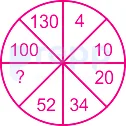
- A
82
- B
96
- C
64
- D
74
Show answer
D. 74The pattern followed here is,
4 + 6 = 10
10 + 10 = 20
20 + 14 = 34
34 + 18 = 52
52 + 22 = 74
74 + 26 = 100
100 + 30 = 130
Hence, “74” is the correct answer.
Paper & answer key PDF ↗ Question 24archived
Select the letter that can replace the question mark (?) in the following series.
A, E, J, ?, W
- A
P
- B
S
- C
R
- D
Q
Show answer
A. PAnalyzing the Letter Series Pattern
The question asks us to identify the letter that correctly completes the given series: A, E, J, ?, W. To solve letter series problems, we typically look for a pattern in the alphabetical positions of the letters or the difference between consecutive letters.
Finding the Pattern in the Series
Let's first assign numerical values to each letter based on its position in the English alphabet (A=1, B=2, C=3, ..., Z=26).
A corresponds to 1
E corresponds to 5
J corresponds to 10
W corresponds to 23
Now, let's look at the differences between the numerical values of consecutive letters:
Difference between E and A: $5 - 1 = 4$
Difference between J and E: $10 - 5 = 5$
We observe a pattern where the difference between consecutive letters increases by 1 each time (4, 5). Following this pattern, the next difference should be $5 + 1 = 6$.
Determining the Missing Letter
Applying the pattern, we add the next difference (6) to the numerical value of the letter J (10) to find the numerical value of the missing letter:
Numerical value of missing letter = Numerical value of J + Expected difference
Numerical value of missing letter = $10 + 6 = 16$
The letter corresponding to the numerical value 16 in the English alphabet is P.
Verifying the Pattern
Let's check if the next difference in the series (between P and W) follows the pattern. The numerical value of P is 16, and the numerical value of W is 23.
Difference between W and P: $23 - 16 = 7$
The sequence of differences is 4, 5, 6, 7. This confirms that the pattern is adding consecutive integers starting from 4.
Conclusion
Based on the established pattern of adding 4, 5, 6, 7 to the numerical position of the letters, the missing letter in the series A, E, J, ?, W is P.
Letter
Alphabetical Position
Difference from Previous
A
1
-
E
5
$5 - 1 = 4$
J
10
$10 - 5 = 5$
P
16
$16 - 10 = 6$
W
23
$23 - 16 = 7$
Revision Table: Letter Series Patterns
Pattern Type
Description
Example
Constant Difference
Add or subtract the same value each time.
A, C, E, G (+2)
Increasing/Decreasing Difference
The difference between terms changes by a constant value.
A, C, F, K (+2, +3, +4)
Alternating Pattern
Different patterns applied to alternate terms or segments.
A, Z, B, Y, C, X (Letter +1, Letter -1)
Skip Letter Pattern
Skip a fixed number of letters in the alphabet.
A, D, G, J (Skip 2 letters each time)
Additional Information: Solving Alphabetical Reasoning Questions
Alphabetical reasoning questions are common in competitive exams. They test your ability to identify patterns in sequences of letters. Here are some tips for solving them:
Write down the English alphabet and its corresponding numerical positions (1-26). This is a quick reference.
Calculate the difference between consecutive letters. Look for arithmetic progressions (constant difference), or differences that increase or decrease predictably.
Consider other possible patterns like skipping letters, alternating sequences, or patterns involving vowels and consonants.
If the series involves both letters and numbers, analyze the patterns for each element separately.
Practice with various types of letter series to recognize common patterns quickly.
Paper & answer key PDF ↗ Question 25archived
Select the option in which the given figure is embedded (rotation is not allowed).

- A
Option A (shown in image)
- B
Option B (shown in image)
- C
Option C (shown in image)
- D
Option D (shown in image)
Show answer
B. Option B (shown in image)The given figure is embedded in,
Hence, figure 2 is the correct answer.
 Paper & answer key PDF ↗
 Question 26archived
How many members did the International Monetary Fund (IMF) have as of January 2020?
- A
164
- B
182
- C
189
- D
174
Show answer
C. 189The question asks about the number of members in the International Monetary Fund (IMF) as of a specific date, January 2020. Determining the exact membership count of international organizations at a particular time is important for understanding their scope and influence.
The International Monetary Fund is a major international financial institution. Its membership changes over time as new countries join or, less commonly, leave. To answer this question accurately, we need to recall or find the official membership count for the IMF on the specified date.
Understanding IMF Membership in January 2020
As of January 2020, the International Monetary Fund had a specific number of member countries. This number reflects the global reach and participation in the organization's efforts to promote international monetary cooperation, secure financial stability, facilitate international trade, promote high employment and sustainable economic growth, and reduce poverty around the world.
Checking historical records or official IMF data for January 2020 confirms the membership count.
Key Facts about the IMF
The IMF was established in 1944 at the Bretton Woods conference and began operations in 1945. Its headquarters are in Washington, D.C.
The primary mission includes tracking the global economy and the economies of member countries.
It provides loans to countries facing economic difficulties.
It offers technical assistance and training to help countries manage their economies effectively.
Membership is open to any country that controls its foreign relations and is willing and able to fulfill the obligations of membership set forth in the IMF's Articles of Agreement.
IMF Membership Count Analysis
Let's look at the options provided for the number of IMF members in January 2020:
164
182
189
174
Historical data shows that the membership had reached 189 by 2016 with the addition of Nauru and remained at this number through January 2020. The most recent member to join after this period, bringing the total to 190, was Andorra in October 2020.
Therefore, the number of members in the IMF as of January 2020 was 189.
Organization
Date
Number of Members
International Monetary Fund (IMF)
January 2020
189
Revision Table: IMF Membership Facts
Fact
Detail
Organization
International Monetary Fund (IMF)
Date of Count
January 2020
Number of Members
189
Additional Information: IMF's Role
Beyond its membership numbers, the IMF plays a crucial role in the global financial system. Its activities can be broadly categorized into three areas:
Surveillance: The IMF monitors the economic and financial policies of its member countries and provides advice on how to foster economic stability and growth. This includes annual consultations with member countries (known as Article IV consultations) and reports on the global economic outlook.
Financial Assistance: The IMF provides loans to member countries experiencing balance of payments problems, often under programs that require the country to implement specific policy reforms. These loans are financed through quotas paid by member countries.
Capacity Development: The IMF provides technical assistance and training to help member countries build stronger economic institutions and develop skilled human resources. This support covers areas such as fiscal policy, monetary policy, banking supervision, and economic statistics.
Understanding the IMF's membership and its functions helps in appreciating its significance in international economics and finance.
Paper & answer key PDF ↗ Question 27archived
Iranian Major General Qasem Soleimani was recently (2020) assassinated by the US military in ______.
- A
Pakistan
- B
Iraq
- C
Saudi Arabia
- D
United Arab Emirates
Show answer
B. IraqUnderstanding the Assassination of Qasem Soleimani in Iraq
The question asks about the location where Iranian Major General Qasem Soleimani was assassinated by the US military in 2020. This was a significant international event.
Qasem Soleimani was a high-ranking military officer in the Islamic Revolutionary Guard Corps (IRGC) and commanded its Quds Force. He was a prominent figure in Iranian foreign policy and military operations in the Middle East.
In early 2020, a US drone strike targeted and killed Qasem Soleimani. The location of this strike is the key piece of information requested by the question.
Analysing the Options
Let's look at the provided options:
Pakistan: Pakistan is a neighbouring country to Iran, but the assassination did not take place there.
Iraq: Iraq is another neighbouring country to Iran, and it has been a region where both US and Iranian influence and forces operate.
Saudi Arabia: Saudi Arabia is a major regional rival of Iran, but the assassination did not occur in Saudi Arabia.
United Arab Emirates: The UAE is located across the Persian Gulf from Iran, but it was not the site of this event.
Confirming the Location of the Assassination
The US military strike that killed Qasem Soleimani took place near the Baghdad International Airport in Baghdad, Iraq, on January 3, 2020. Therefore, the assassination occurred in Iraq.
Summary of the Event Location
The assassination of Qasem Soleimani by the US military happened in Iraq, specifically near the airport in the capital city, Baghdad. This makes 'Iraq' the correct answer among the given options.
Location of Qasem Soleimani's Assassination
Individual
Assassinated By
Year
Location
Major General Qasem Soleimani
US military
2020
Iraq
Revision Table: Key Facts about Qasem Soleimani's Assassination
Detail
Information
Person Assassinated
Qasem Soleimani, Iranian Major General, Commander of Quds Force
Date of Assassination
January 3, 2020
Assassination Location
Near Baghdad International Airport, Baghdad, Iraq
Responsible Party
US military (via drone strike)
Significance
Escalation of tensions between the US and Iran
Additional Information on Qasem Soleimani and Iraq
Qasem Soleimani was a powerful figure involved in Iran's regional strategy, particularly in countries like Iraq, Syria, and Lebanon. His presence and activities in Iraq were significant due to Iran's influence on various Shia militia groups within the country.
The assassination took place while Soleimani was travelling in a convoy near Baghdad International Airport. Abu Mahdi al-Muhandis, a leader of the Iraqi Popular Mobilization Forces (PMF), was also killed in the same strike.
The event led to a significant increase in tensions between the United States and Iran, with concerns about potential retaliation and further conflict in the region.
Understanding the political and military landscape of Iraq is crucial to understanding why this event occurred there, given the complex interplay of Iraqi, Iranian, and US interests and forces operating within the country's borders.
Paper & answer key PDF ↗ Question 28archived
What is the name of the phenomena (driven by the scattering of light) in which mountain tops acquire a rosy or orange hue around sunrise and sunset ?
- A
Brillouin scattering
- B
Circle of confusion
- C
Alpenglow
- D
Barrel distortion
Show answer
C. AlpenglowUnderstanding Alpenglow: Rosy Mountain Tops at Sunrise and Sunset
The question asks about the atmospheric phenomenon that causes mountain tops to appear rosy or orange around sunrise and sunset. This striking visual effect is driven by the scattering of sunlight in the Earth's atmosphere.
What is Alpenglow?
The phenomenon described is known as Alpenglow. It occurs when the sun is below the horizon (before sunrise or after sunset), but its light still illuminates the upper parts of mountains. During these times, sunlight travels a longer path through the atmosphere. This longer path causes the shorter wavelengths of light (blue, green) to be scattered away more effectively by atmospheric particles (like air molecules and dust) compared to the longer wavelengths (red, orange).
This phenomenon is called Rayleigh scattering, which is strongly dependent on wavelength ($\propto 1/\lambda^4$). As a result, the light that reaches the mountain tops after traveling this long path is enriched in red and orange hues, giving the mountains a distinctive rosy or orange glow.
Analyzing the Options
Let's examine the given options:
Brillouin scattering: This is an inelastic scattering of light by acoustic phonons (vibrations) in a medium. It is a microscopic effect related to material properties and not the large-scale atmospheric phenomenon observed on mountain tops.
Circle of confusion: In optics and photography, the circle of confusion is an optical spot that appears in an image when a point light source is not perfectly in focus. It has no relation to the color of mountain tops at sunrise/sunset.
Alpenglow: As explained above, this is the term specifically used for the reddish illumination of mountain peaks before sunrise or after sunset, caused by the scattering of sunlight.
Barrel distortion: This is a type of optical aberration in which straight lines in a scene appear to curve outwards in a photographic image, especially near the edges. It is a property of lenses, not an atmospheric phenomenon affecting light color.
Based on the analysis, Alpenglow is the correct term for the described phenomenon.
Summary of Options
Option
Description
Relevant to Question?
Brillouin scattering
Inelastic scattering of light by acoustic phonons.
No
Circle of confusion
Optical spot when light is out of focus.
No
Alpenglow
Rosy/orange illumination of mountain tops at sunrise/sunset due to light scattering.
Yes
Barrel distortion
Optical aberration causing lines to curve outwards.
No
Therefore, the phenomenon where mountain tops acquire a rosy or orange hue around sunrise and sunset, driven by the scattering of light, is called Alpenglow.
Revision Table: Key Concepts
Term
Definition
Relation to Alpenglow
Alpenglow
Atmospheric optical phenomenon where mountain tops are illuminated by reddish light.
This is the name of the phenomenon.
Rayleigh Scattering
Scattering of light by particles much smaller than the wavelength of the light (e.g., air molecules). More effective for shorter wavelengths.
This is the physical mechanism causing Alpenglow (and also why the sky is blue).
Sunrise/Sunset
Times when the sun is low on the horizon or just below it.
Conditions under which Alpenglow is typically observed due to the long path of sunlight through the atmosphere.
Additional Information: Other Atmospheric Scattering Effects
While Rayleigh scattering explains Alpenglow and the blue sky, other atmospheric scattering effects also occur:
Mie Scattering: Scattering of light by particles roughly equal to or larger than the wavelength of light (e.g., dust, water droplets). This scattering is less wavelength-dependent and explains why clouds appear white (all wavelengths are scattered equally).
Tyndall Effect: The scattering of light as a light beam passes through a colloid. Similar to Mie scattering, it causes the beam to become visible.
These scattering phenomena are responsible for various atmospheric optical effects we observe daily.
Paper & answer key PDF ↗ Question 29archived
Which of these is the energy conversion that happens in the process called photosynthesis?
- A
Potential energy to chemical energy
- B
Heat energy to light energy
- C
Heat energy to chemical energy
- D
Light energy to chemical energy
Show answer
D. Light energy to chemical energyUnderstanding Energy Conversion in Photosynthesis
Photosynthesis is a vital biological process carried out by plants, algae, and some bacteria. It is how they produce their own food, which is essentially stored chemical energy.
The Process of Photosynthesis
Photosynthesis uses sunlight, water, and carbon dioxide to create glucose (a type of sugar) and oxygen. The key energy transformation happens at the very beginning of this process.
Energy Conversion Explained
The primary energy source for photosynthesis is light energy, typically from the sun. This light energy is captured by pigments like chlorophyll found in the chloroplasts of plant cells. Inside the chloroplasts, this light energy is used to power a series of chemical reactions.
These reactions convert carbon dioxide and water into glucose. Glucose molecules store energy in their chemical bonds. Therefore, the light energy absorbed from the sun is converted and stored as chemical energy in the bonds of glucose molecules.
The overall simplified equation for photosynthesis is:
\( \text{6CO}_2 + \text{6H}_2\text{O} + \text{Light Energy} \rightarrow \text{C}_6\text{H}_{12}\text{O}_6 + \text{6O}_2 \)
This equation clearly shows light energy as an input leading to the creation of glucose (\( \text{C}_6\text{H}_{12}\text{O}_6 \)), which holds chemical energy.
Analyzing the Options
Potential energy to chemical energy: While chemical energy is a form of potential energy (stored energy), photosynthesis converts an external energy source (light) into chemical energy, not potential energy itself into chemical energy.
Heat energy to light energy: This conversion is not related to photosynthesis. Processes like incandescence convert heat to light.
Heat energy to chemical energy: While some chemosynthetic organisms might use chemical energy derived from heat vents, photosynthesis specifically uses light energy, not heat energy, for the primary conversion to chemical energy.
Light energy to chemical energy: As explained above, photosynthesis captures light energy and stores it in the chemical bonds of glucose molecules. This is the fundamental energy conversion.
Based on the process, the energy conversion in photosynthesis is the transformation of light energy into chemical energy.
Energy Conversion in Photosynthesis
Input Energy
Conversion Process
Output Stored Energy
Light Energy (e.g., sunlight)
Photosynthesis (via pigments like chlorophyll)
Chemical Energy (stored in glucose bonds)
Revision Table: Photosynthesis Energy Conversion
Key Concepts for Photosynthesis Energy Conversion
Concept
Explanation
Photosynthesis Definition
Process converting light energy into chemical energy in glucose.
Energy Source
Light energy (primarily sunlight).
Energy Storage Form
Chemical energy in the bonds of organic molecules (glucose).
Key Organelle
Chloroplasts in plant cells.
Key Pigment
Chlorophyll (captures light energy).
Additional Information: Photosynthesis Components
Understanding the components involved helps clarify the energy conversion:
Reactants: Carbon dioxide (\( \text{CO}_2 \)) from the air and water (\( \text{H}_2\text{O} \)) absorbed from the soil.
Energy Input: Light energy, which drives the reaction.
Products: Glucose (\( \text{C}_6\text{H}_{12}\text{O}_6 \)), a sugar that serves as food and energy storage for the plant, and oxygen (\( \text{O}_2 \)), released as a byproduct.
The light-dependent reactions of photosynthesis capture light energy and convert it into chemical energy carriers (ATP and NADPH), which are then used in the light-independent reactions (Calvin cycle) to convert carbon dioxide into glucose, effectively storing the energy in the glucose molecule's chemical bonds.
Paper & answer key PDF ↗ Question 30archived
Only one Indian batsman has scored a triple century in test cricket other than Virender Sehwag. Name this batsman.
- A
Shikhar Dhawan
- B
Rohit Sharma
- C
Karun Nair
- D
Ajinkya Rahane
Show answer
C. Karun NairUnderstanding Indian Triple Centurions in Test Cricket
A triple century in Test cricket is one of the rarest and most significant milestones a batsman can achieve. It means scoring 300 runs or more in a single innings. This feat requires exceptional skill, concentration, endurance, and temperament.
In the history of Indian Test cricket, this prestigious achievement has been reached by only two batsmen.
Virender Sehwag's Triple Centuries
Virender Sehwag was the first Indian batsman to score a triple century in Test cricket. He achieved this milestone twice:
His first triple century was a score of 309 against Pakistan in Multan in 2004. This innings earned him the nickname 'Multan of Multan'.
His second triple century was a score of 319 against South Africa in Chennai in 2008. This is currently the highest individual score by an Indian batsman in Test cricket.
Identifying the Other Indian Triple Centurion
The question asks for the only other Indian batsman, besides Virender Sehwag, who has scored a triple century in Test cricket. Let's look at the options provided:
Shikhar Dhawan: A dynamic opening batsman, but he has not scored a triple century in Test matches. His highest Test score is 190.
Rohit Sharma: A prolific scorer in limited-overs cricket and now a successful Test batsman. However, he has not reached a triple century in Tests. His highest Test score is 212.
Karun Nair: A middle-order batsman who achieved this remarkable feat.
Ajinkya Rahane: A skilled middle-order batsman, often serving as vice-captain, but he has not scored a triple century in Test cricket. His highest Test score is 188.
Based on cricket records, Karun Nair is the only Indian batsman other than Virender Sehwag to have scored a triple century in Test cricket.
Karun Nair's Historic Triple Century
Karun Nair scored his triple century against England in the fifth Test match in Chennai in December 2016. His score was an unbeaten 303 runs. This was a momentous occasion as it made him only the second Indian after Virender Sehwag to achieve this incredible milestone.
Conclusion
Therefore, the Indian batsman who has scored a triple century in Test cricket other than Virender Sehwag is Karun Nair.
Revision Table: Indian Batsmen with Triple Centuries in Test Cricket
Batsman
Score
Opponent
Venue
Year
Virender Sehwag
309
Pakistan
Multan
2004
Virender Sehwag
319
South Africa
Chennai
2008
Karun Nair
303* (not out)
England
Chennai
2016
Additional Information on Test Cricket Batting Records
The highest individual score in Test cricket history is 400* by Brian Lara of West Indies.
Scoring a triple century (\(\ge 300\) runs) is rarer than scoring a century (\(\ge 100\) runs) or a double century (\(\ge 200\) runs).
Karun Nair's innings was only his third Test innings, making his triple century a remarkable achievement very early in his Test career.
Paper & answer key PDF ↗ Question 31archived
Who is the only scientist in the world to have won the Nobel prize in Chemistry twice?
- A
Madame Curie
- B
Linus Carl Pauling
- C
Roger D. Kornberg
- D
Frederick Sanger
Show answer
D. Frederick SangerUnderstanding the Double Chemistry Nobel Prize Winner
This question requires identifying the specific scientist who holds the unique distinction of winning the Nobel Prize in Chemistry two times. It's important to examine the records of Nobel laureates to find this individual.
Frederick Sanger's Historic Achievement
Frederick Sanger is the scientist recognized for winning the Nobel Prize in Chemistry twice.
The first award came in 1958. Sanger received this prize for his research on the structure of proteins, particularly his success in determining the complete amino acid sequence of insulin.
His second Nobel Prize in Chemistry was awarded in 1980. He shared this prize with Walter Gilbert for their pioneering work on determining the base sequences in nucleic acids, which was fundamental for advancements in molecular biology.
Analysis of Other Notable Scientists
It's useful to consider the other scientists mentioned to confirm why they are not the answer to this specific question:
Madame Curie: Marie Curie is a highly distinguished scientist who won Nobel Prizes in two different scientific fields. She was awarded the Nobel Prize in Physics in 1903 (shared) and the Nobel Prize in Chemistry in 1911.
Linus Carl Pauling: Linus Pauling also achieved the remarkable feat of winning two Nobel Prizes, but in different fields and both unshared. He won the Nobel Prize in Chemistry in 1954 and the Nobel Prize in Peace in 1962.
Roger D. Kornberg: Roger D. Kornberg won the Nobel Prize in Chemistry in 2006 for his studies concerning the molecular basis of eukaryotic transcription. He has received the prize only once.
Conclusion on Chemistry Laureates
Reviewing the achievements of these renowned scientists confirms that Frederick Sanger is the sole recipient of the Nobel Prize in Chemistry on two separate occasions, making him the correct answer.
Paper & answer key PDF ↗ Question 32archived
Bhavai and Kalbelia as traditional dance forms, owe their genesis to which Indian state?
- A
Assam
- B
Rajasthan
- C
Punjab
- D
Haryana
Show answer
B. RajasthanUnderstanding Bhavai and Kalbelia Dance Origins
The question asks about the Indian state where the traditional dance forms of Bhavai and Kalbelia originated. Let's explore these vibrant dance styles to find their home state.
What are Bhavai and Kalbelia Dances?
Bhavai dance is a folk dance popular in Rajasthan and also in parts of Gujarat. It is known for its performers balancing a number of earthen pots or brass pitchers on their heads while performing intricate spins and graceful movements. Dancers may also perform on the edge of a sword or a glass, showcasing remarkable skill and balance.
Kalbelia dance is a folk dance performed by the women of the Kalbelia community of Rajasthan. It is also known as the 'Sapera Dance' or 'Snake Charmer's Dance'. The dancers wear long, black skirts embroidered with silver threads, which mimic the movement of a serpent. The music is provided by men playing traditional instruments like the 'poongi' (a wind instrument used by snake charmers), dufli, khanjari, morchang, khuralio, and dholak. The dance movements are fluid and graceful, resembling the actions of a snake.
Origin State Analysis
Both Bhavai and Kalbelia dances are widely recognized as traditional dance forms from the state of Rajasthan. The Kalbelia dance, in particular, has gained international recognition and is inscribed on the UNESCO Representative List of the Intangible Cultural Heritage of Humanity.
Let's look at the options provided:
Assam: Known for Bihu dance.
Rajasthan: Known for Ghoomar, Kalbelia, Bhavai, Kathputli, etc.
Punjab: Known for Bhangra and Gidda.
Haryana: Known for Raas Leela, Phag dance, Dhamal dance, etc.
Based on the origins of these dance forms, Rajasthan is the state from which both Bhavai and Kalbelia originate.
Dance Form
Origin State
Key Features
Bhavai
Rajasthan (also Gujarat)
Balancing pots, performing on sword/glass edge
Kalbelia
Rajasthan
Performed by Kalbelia community, snake-like movements, specific traditional music
Therefore, the state that is the genesis of both Bhavai and Kalbelia traditional dance forms is Rajasthan.
Revision Table: Indian Folk Dances
State
Popular Folk Dances
Assam
Bihu, Bagurumba, Bhortal Dance, Sattriya (Classical)
Rajasthan
Ghoomar, Kalbelia, Bhavai, Gair, Chirmi, Kathputli
Punjab
Bhangra, Gidda, Daankara, Jhumar
Haryana
Phag, Dhamal, Loor, Gugga, Khoria, Gagor
Additional Information on Rajasthan Dances
Rajasthan, known as the 'Land of Kings', has a rich cultural heritage reflected in its diverse folk music and dance forms. These dances are not just entertainment but are deeply connected to the social customs, religious beliefs, and daily lives of the people. The colourful costumes, traditional music, and energetic performances make these dances a significant part of India's cultural tapestry.
The Kalbelia dance, particularly, highlights the history and lifestyle of the Kalbelia community, who were traditionally snake charmers. The dance movements and costumes reflect their past occupation and adaptation. Similarly, Bhavai dance requires immense skill and practice, often passed down through generations, demonstrating the dedication of the artists.
Paper & answer key PDF ↗ Question 33archived
The 3 rd Khelo India Youth Games 2020 is hosted by which Indian state?
- A
Kerala
- B
Karnataka
- C
Punjab
- D
Assam
Show answer
D. AssamUnderstanding the Khelo India Youth Games
The Khelo India Youth Games is a national-level multi-sport event held annually in India for athletes under the age of 17 (U17) and under the age of 21 (U21). It is organized to promote grassroots sports and identify young talent across various disciplines.
Focusing on the 3rd Khelo India Youth Games 2020
The question asks about the host state for the 3rd Khelo India Youth Games held in 2020. It's important to know the specific edition and year as the host state changes each time.
The 3rd edition of the Khelo India Youth Games took place in January 2020. This major sporting event brought together thousands of young athletes from across India to compete in various sports.
Let's examine the options provided to identify the host state:
Kerala
Karnataka
Punjab
Assam
Researching the history of the Khelo India Youth Games confirms the host state for the 3rd edition.
The 3rd Khelo India Youth Games in 2020 was hosted by the state of Assam. The primary venue for the games was Guwahati, the largest city in Assam.
Here is a brief overview of the host states for the initial editions of the Khelo India Youth Games:
Edition
Year
Host State
Host City
1st
2018
Delhi
Delhi
2nd
2019
Maharashtra
Pune
3rd
2020
Assam
Guwahati
4th
2021 (held in 2022)
Haryana
Panchkula
5th
2022 (held in 2023)
Madhya Pradesh
Bhopal
As shown in the table, the 3rd Khelo India Youth Games 2020 was indeed hosted by Assam.
Summary of the 3rd Khelo India Youth Games 2020 Host
Based on the historical data and official records of the event, the state that hosted the 3rd Khelo India Youth Games in 2020 was Assam.
Revision Table: Khelo India Games
Event
Edition
Year
Host
Khelo India Youth Games
1st
2018
Delhi
Khelo India Youth Games
2nd
2019
Maharashtra
Khelo India Youth Games
3rd
2020
Assam
Khelo India Youth Games
4th
2021 (held 2022)
Haryana
Khelo India Youth Games
5th
2022 (held 2023)
Madhya Pradesh
Khelo India University Games
1st
2020
Odisha
Khelo India University Games
2nd
2021 (held 2022)
Karnataka
Khelo India University Games
3rd
2022 (held 2023)
Uttar Pradesh
Additional Information: About Khelo India
The Khelo India programme was launched by the Ministry of Youth Affairs and Sports to revive the sports culture at the grassroots level in India. It aims to build a strong framework for sports in the country and establish India as a great sporting nation.
Key components of the Khelo India programme include:
Developing community sports
Promoting indigenous games
Establishing sports academies
Organizing annual sports competitions like the Khelo India Youth Games and Khelo India University Games.
Paper & answer key PDF ↗ Question 34archived
What is the name of the phenomena in physics and astronomy which involves the splitting of a spectral line into two or more components of slightly different frequencies when the light source is placed in a magnetic field?
- A
Raman Effect
- B
Alpenglow Effect
- C
Lumen Effect
- D
Zeeman Effect
Show answer
D. Zeeman EffectUnderstanding the Zeeman Effect in Physics and Astronomy
The question asks about a specific phenomenon observed in physics and astronomy where a spectral line splits into multiple components when the light source is placed in a magnetic field. This splitting also involves a slight difference in the frequencies of these components.
Let's examine the options provided:
Raman Effect: This involves the inelastic scattering of photons by matter, leading to shifts in the energy of photons. It is primarily related to molecular vibrations and rotations and does not describe the splitting of spectral lines specifically due to a magnetic field.
Alpenglow Effect: This is an atmospheric optical phenomenon, specifically a reddish glow sometimes observed on mountains around sunrise or sunset. It is caused by the scattering of sunlight and is not related to spectral lines or magnetic fields in physics or astronomy labs or objects.
Lumen Effect: Lumen is a unit of luminous flux, a measure of the total amount of visible light emitted by a source. It is a photometric unit, not a physical phenomenon describing the interaction of light sources with magnetic fields.
Zeeman Effect: This is the phenomenon where a spectral line is split into several components in the presence of a static magnetic field. This effect was discovered by Dutch physicist Pieter Zeeman in 1896. The splitting and the frequency shifts are dependent on the strength of the magnetic field. This description perfectly matches the phenomenon described in the question.
Therefore, the phenomenon described, involving the splitting of spectral lines in a magnetic field, is known as the Zeeman Effect.
Phenomenon
Description
Relation to Magnetic Field & Spectral Splitting
Raman Effect
Inelastic scattering of light by molecules
Not directly related to magnetic field induced spectral splitting.
Alpenglow Effect
Atmospheric optical phenomenon (mountain glow)
Not a physics/astronomy effect on spectral lines in magnetic fields.
Lumen Effect
Unit of luminous flux (light quantity)
Not a physical phenomenon involving spectral lines or magnetic fields.
Zeeman Effect
Splitting of spectral lines in a magnetic field
Directly matches the phenomenon described in the question.
Revision Table: Key Effects
Effect
Core Concept
Zeeman Effect
Splitting of spectral lines by a magnetic field
Raman Effect
Inelastic light scattering by matter
Alpenglow
Atmospheric light scattering (mountain glow)
Lumen
Unit of luminous flux
Additional Information on the Zeeman Effect
The Zeeman Effect is a crucial tool in physics and astronomy. It allows scientists to study the magnetic fields of distant objects like stars, sunspots, and galaxies by observing the light they emit. The amount of splitting and the polarization of the split spectral lines provide information about the strength and direction of the magnetic field.
There are two types of Zeeman Effect:
Normal Zeeman Effect: Occurs for spectral lines arising from singlet states (total spin angular momentum is zero). The line splits into three components.
Anomalous Zeeman Effect: Occurs for spectral lines arising from states with non-zero total spin. The splitting pattern is more complex than just three lines.
This effect is a direct consequence of the interaction between the magnetic moment of atoms (associated with the orbital and spin angular momentum of electrons) and the external magnetic field.
Paper & answer key PDF ↗ Question 35archived
Who among the following is the current (January 2020) Governor of Kerala?
- A
B.D. Mishra
- B
Satya Pal Mallik
- C
Lalji Tandon
- D
Arif Mohammed Khan
Show answer
D. Arif Mohammed KhanFinding the Governor of Kerala in January 2020
The question asks us to identify the individual who held the position of Governor of Kerala in January 2020. The Governor is the constitutional head of a state in India, appointed by the President of India for a term of five years. This role is crucial in the state's governance.
Understanding the Role of a Governor
The Governor of a state plays several important roles:
Acting as the representative of the central government in the state.
Appointing the Chief Minister and other ministers.
Summoning, proroguing, and dissolving the state legislature.
Giving assent to bills passed by the state legislature.
Exercising discretionary powers in certain situations.
Identifying the specific individual holding this office at a particular time, such as January 2020, requires checking the official records or reliable sources for that period.
Analyzing the Options Provided
We are given four options for the Governor of Kerala in January 2020:
B.D. Mishra
Satya Pal Mallik
Lalji Tandon
Arif Mohammed Khan
Let's briefly consider the positions held by these individuals around the time in question, January 2020, to determine who was the Governor of Kerala.
Name
Common State/Role around Jan 2020
B.D. Mishra
Governor of Arunachal Pradesh
Satya Pal Mallik
Governor of Goa (moved from J&K, then Meghalaya)
Lalji Tandon
Governor of Madhya Pradesh
Arif Mohammed Khan
Governor of Kerala
Identifying the Governor of Kerala in January 2020
Based on the analysis of the individuals listed in the options and their appointments around January 2020, we can determine who was the Governor of Kerala.
B.D. Mishra was the Governor of Arunachal Pradesh.
Satya Pal Mallik was the Governor of Goa at that time.
Lalji Tandon was the Governor of Madhya Pradesh.
Arif Mohammed Khan was appointed as the Governor of Kerala in September 2019 and continued in that position through January 2020 and beyond.
Therefore, the individual who held the position of Governor of Kerala in January 2020 was Arif Mohammed Khan.
Conclusion on Kerala Governor in January 2020
To definitively answer the question "Who among the following is the current (January 2020) Governor of Kerala?", we confirm that Arif Mohammed Khan was serving as the Governor of Kerala during that specific period.
Revision Table: Key Governors around January 2020
Governor
State (as of Jan 2020)
Arif Mohammed Khan
Kerala
B.D. Mishra
Arunachal Pradesh
Satya Pal Mallik
Goa
Lalji Tandon
Madhya Pradesh
Additional Information on State Governors
The Governor of a state is appointed by the President of India under Article 153 of the Constitution. The Governor acts on the advice of the Council of Ministers headed by the Chief Minister, except in certain matters where the Constitution grants discretionary powers. The role of the Governor is often discussed in the context of federal relations between the Union and the States.
The tenure of a Governor is typically five years, but they hold office during the pleasure of the President, which means their term can be terminated earlier. They can also be transferred to another state.
Paper & answer key PDF ↗ Question 36archived
Four multi-storied illegal constructions - Jain Coral Cove, H20 Holy Faith, Alfa Serene and Golden Kayaloram - were razed to the ground in January 2020 following Supreme Court instructions. In which state did this happen?
- A
Karnataka
- B
Goa
- C
Kerala
- D
Tamil Nadu
Show answer
C. KeralaUnderstanding the Maradu Flats Demolition Case in Kerala
The question asks about the state where four specific multi-storied illegal constructions - Jain Coral Cove, H20 Holy Faith, Alfa Serene and Golden Kayaloram - were demolished in January 2020 following instructions from the Supreme Court of India.
This widely reported event involved the demolition of residential apartment complexes that were built in violation of coastal regulation zone norms. The buildings were located in the Maradu municipality area.
Location of the Illegal Constructions
The four illegal constructions mentioned are:
Jain Coral Cove
H20 Holy Faith
Alfa Serene
Golden Kayaloram
These buildings were situated in Maradu, which is a municipality located in the Ernakulam district of the state of Kerala, India.
The Supreme Court Order and Demolition
The Supreme Court had ordered the demolition of these illegal constructions after finding that they were built in violation of environmental laws, specifically the Coastal Regulation Zone (CRZ) rules. The deadline for demolition was set by the Supreme Court, leading to the controlled implosions carried out in January 2020.
The demolition of these multi-storied illegal constructions was a significant event highlighting issues of illegal construction and environmental regulations.
Identifying the State
Since the constructions were located in Maradu, Ernakulam district, the state where this event took place is Kerala.
Illegal Constructions Demolished in Maradu, 2020
Building Name
Location (Municipality)
District
State
Jain Coral Cove
Maradu
Ernakulam
Kerala
H20 Holy Faith
Maradu
Ernakulam
Kerala
Alfa Serene
Maradu
Ernakulam
Kerala
Golden Kayaloram
Maradu
Ernakulam
Kerala
Therefore, the state where the four multi-storied illegal constructions - Jain Coral Cove, H20 Holy Faith, Alfa Serene, and Golden Kayaloram - were razed to the ground in January 2020 following Supreme Court instructions is Kerala.
Revision Table: Key Facts on Maradu Demolitions
Event
Details
What happened?
Demolition of four multi-storied illegal constructions.
Buildings Involved
Jain Coral Cove, H20 Holy Faith, Alfa Serene, Golden Kayaloram.
When?
January 2020.
Why?
Violation of Coastal Regulation Zone (CRZ) norms; following Supreme Court orders.
Where?
Maradu municipality, Ernakulam district, Kerala.
Additional Information: Coastal Regulation Zone (CRZ) Norms
Coastal Regulation Zone (CRZ) norms in India are regulations issued under the Environment (Protection) Act, 1986, to protect the coastal environment. These norms restrict or regulate construction activities in coastal areas to prevent environmental damage and maintain ecological balance. Violations of these norms, as was the case with the Maradu flats, can lead to legal action and demolition orders by courts.
Paper & answer key PDF ↗ Question 37archived
Name the two Indian actors who shared the National Best Act or Award (Male) in the 66th National Film Awards 2019.
- A
Nana Patekar and Mohanlal
- B
Ranbir Kapoor and Akshay Kumar
- C
Ayushmann Khurrana and Vicky Kaushal
- D
Amitabh Bachchan and Ranbir Kapoor
Show answer
C. Ayushmann Khurrana and Vicky KaushalUnderstanding the National Film Awards
The National Film Awards are among the most prestigious film awards in India. They are presented by the Directorate of Film Festivals, an organization set up by the Ministry of Information and Broadcasting, to honour the best films and artists of Indian cinema. These awards are highly respected and are announced annually, recognizing excellence across various categories for feature films, non-feature films, and best writing on cinema.
66th National Film Awards 2019: Best Actor Award (Male)
The question specifically asks about the 66th National Film Awards presented in 2019. These awards honoured the best films released in India during the year 2018. One of the key categories is the National Best Actor Award (Male), which recognizes outstanding performance by a male actor in a leading role.
In the 66th National Film Awards, the award for the National Best Actor (Male) was notably shared by two actors for their performances in different films. This is not uncommon in the National Film Awards where a tie can occur.
The two actors who shared this esteemed award were:
Ayushmann Khurrana
Vicky Kaushal
Ayushmann Khurrana received the award for his performance in the Hindi film 'Andhadhun'. Vicky Kaushal was honoured for his role in the Hindi film 'Uri: The Surgical Strike'.
Analyzing the Options
Let's look at the provided options in the context of the 66th National Film Awards 2019:
Option 1: Nana Patekar and Mohanlal - While both are celebrated actors who have won National Awards in the past, they did not share the Best Actor award in the 66th National Film Awards 2019.
Option 2: Ranbir Kapoor and Akshay Kumar - Neither of these actors received or shared the National Best Actor award in the 66th National Film Awards 2019.
Option 3: Ayushmann Khurrana and Vicky Kaushal - As confirmed by the results of the 66th National Film Awards, Ayushmann Khurrana and Vicky Kaushal indeed shared the National Best Actor Award (Male) for their respective films 'Andhadhun' and 'Uri: The Surgical Strike'.
Option 4: Amitabh Bachchan and Ranbir Kapoor - Amitabh Bachchan has won multiple National Awards, but he and Ranbir Kapoor did not share the Best Actor award in the 66th National Film Awards 2019.
Based on the official results, the pair who shared the National Best Actor Award (Male) at the 66th National Film Awards 2019 was Ayushmann Khurrana and Vicky Kaushal.
National Best Actor Award (Male) - 66th National Film Awards (2019)
Actor
Film
Language
Ayushmann Khurrana
Andhadhun
Hindi
Vicky Kaushal
Uri: The Surgical Strike
Hindi
Revision Table: Key National Film Awards Points
Important Details about National Film Awards
Aspect
Description
Governing Body
Directorate of Film Festivals (Ministry of Information and Broadcasting)
Purpose
To honour artistic and technical excellence in Indian cinema
Frequency
Annually
Awards for 2018 films
66th National Film Awards, presented in 2019
Shared Awards
Possible in various categories, including Best Actor
Additional Information: Noteworthy Aspects of 66th National Film Awards
The 66th National Film Awards recognized cinematic achievements across India for films released in 2018. Besides the shared Best Actor award, other significant winners included:
Best Actress: Keerthy Suresh (for 'Mahanati')
Best Feature Film: 'Hellaro' (Gujarati)
Best Director: Aditya Dhar (for 'Uri: The Surgical Strike')
Best Popular Film Providing Wholesome Entertainment: 'Badhaai Ho'
Best Film on Social Issues: 'Pad Man'
Sharing an award like the National Best Actor is a significant event, highlighting the exceptional quality of performances in a particular year.
Paper & answer key PDF ↗ Question 38archived
The city of Vijayawada lies on the banks of which of these rivers?
- A
Godavari
- B
Tapti
- C
Krishna
- D
Mahanadi
Show answer
C. KrishnaUnderstanding Vijayawada's Location on River Banks
The question asks us to identify the river that flows by the city of Vijayawada. Cities are often located near rivers for various reasons, including water supply, transportation, and fertile land. Let's examine the given options.
Analyzing the Options for Vijayawada River
Godavari: The Godavari River is one of the major rivers in India, but it flows through other regions and cities, not Vijayawada.
Tapti: The Tapti (or Tapi) River is located in Central India and flows into the Arabian Sea. It is not associated with Vijayawada, which is in Andhra Pradesh.
Krishna: The Krishna River is another major river in India, flowing through the states of Maharashtra, Karnataka, Telangana, and Andhra Pradesh before emptying into the Bay of Bengal. Vijayawada is a prominent city located on the banks of the Krishna River.
Mahanadi: The Mahanadi River primarily flows through the states of Chhattisgarh and Odisha and into the Bay of Bengal. It is not the river associated with Vijayawada.
Identifying the River for Vijayawada
Based on geographical knowledge, Vijayawada is famously situated on the banks of the Krishna River. The river plays a significant role in the city's geography and culture. The Krishna River forms the northern boundary of the city for a considerable stretch.
Confirming the Location: Vijayawada and Krishna River
Let's consolidate the information:
City
Associated River
Vijayawada
Krishna
Nasik, Rajahmundry
Godavari
Surat
Tapti
Cuttack
Mahanadi
This table clearly shows the correct association. Vijayawada is located on the banks of the Krishna River.
Conclusion on Vijayawada's River
Therefore, the city of Vijayawada lies on the banks of the Krishna River.
Revision Table: Key Rivers and Cities
Here is a quick summary to help remember the locations of major cities on river banks:
River
Notable City on its Bank
Krishna
Vijayawada, Sangli
Godavari
Nashik, Rajahmundry, Nanded
Tapti (Tapi)
Surat, Betul
Mahanadi
Cuttack, Sambalpur
Ganges
Varanasi, Patna, Allahabad (Prayagraj), Kanpur, Haridwar
Yamuna
Delhi, Agra, Mathura, Allahabad (Prayagraj)
Additional Information: The Krishna River
The Krishna River is one of the longest rivers in India, originating from Mahabaleshwar in Maharashtra. It flows eastward for about 1,400 kilometers and is a crucial source of irrigation and drinking water for the regions it passes through. Vijayawada, located in Andhra Pradesh, is a significant city along its course, known for the Prakasham Barrage built across the river.
Paper & answer key PDF ↗ Question 39archived
Name the author of the 2019 released book - 'The Scent of God'.
- A
Githa Hariharan
- B
Saikat Majumdar
- C
Himanjali Sankar
- D
Nayantara Sehgal
Show answer
B. Saikat MajumdarIdentifying the Author of 'The Scent of God' (2019 Book)
The question asks to identify the author of the book titled 'The Scent of God', which was released in the year 2019.
Let's look at the provided options and determine the correct author for 'The Scent of God'.
Githa Hariharan: Githa Hariharan is a well-known Indian author, but 'The Scent of God' is not attributed to her.
Saikat Majumdar: Saikat Majumdar is an Indian novelist and critic. His novel 'The Scent of God' was indeed published in 2019 and received critical acclaim. This aligns with the information provided in the question.
Himanjali Sankar: Himanjali Sankar is an author and editor. While she has published novels, 'The Scent of God' is not one of her works.
Nayantara Sehgal: Nayantara Sehgal is a prominent Indian writer, part of the Nehru-Gandhi family. Her body of work is extensive, but 'The Scent of God' is not among her books.
Based on literary records and publications, the author of the 2019 book 'The Scent of God' is Saikat Majumdar.
Detailed Analysis of the Options
To confirm the author of 'The Scent of God', we can verify the publication details of the book.
Saikat Majumdar's Work:
Saikat Majumdar's novels include 'Silverfish' (2007), 'The Firebird' (2015), 'The Scent of God' (2019), and 'The Middle Finger' (2022).
His novel 'The Scent of God', published in 2019, is a significant work exploring themes of faith, desire, and education.
Considering this, Saikat Majumdar is confirmed as the author of the 2019 book 'The Scent of God'. The other authors listed have their own notable works, but 'The Scent of God' is not among them.
Revision Table: Prominent Indian Authors and Their Works
Author
Known For (Selected Works)
Note
Saikat Majumdar
The Scent of God (2019), The Firebird, The Middle Finger
Author of 'The Scent of God'
Githa Hariharan
The Thousand Faces of Night, Fugitive Histories, I Have Become the Trees
Winner of Commonwealth Writers Prize
Nayantara Sehgal
Rich Like Us, Prison and Chocolate Cake, Lesser Breeds
Sahitya Akademi Award winner
Himanjali Sankar
Temporary People, The Promise and the Product
Author and editor
Additional Information on Saikat Majumdar
Saikat Majumdar is an English professor and novelist. His academic background often influences the themes explored in his literary works, which frequently delve into complex human relationships, societal structures, and philosophical ideas. 'The Scent of God' is a notable example of his ability to weave intricate narratives around compelling subjects.
Paper & answer key PDF ↗ Question 40archived
Name the company that has acquired an online travel portal Yatra Online Inc., for an enterprise value of $337.8 million, in an all-stock transaction.
- A
Ebix Inc.
- B
Make my trip.com
- C
Trip Advisor
- D
Trivago
Show answer
A. Ebix Inc.Understanding the Yatra Online Acquisition
This question asks us to identify the company that completed a significant acquisition in the online travel sector, specifically purchasing Yatra Online Inc. Let's look at the details provided: the acquisition was for an enterprise value of $337.8 million and was conducted as an all-stock transaction.
Identifying the Acquirer of Yatra Online Inc.
Based on business news and reports regarding major mergers and acquisitions in the online travel space, the company that acquired Yatra Online Inc. under these specific terms was Ebix Inc.
Let's break down the key terms:
Acquisition: This is when one company purchases most, if not all, of another company's shares to gain control of that company.
Enterprise Value: This is a measure of a company's total value, often used as a more comprehensive alternative to simple market capitalization. It includes market capitalization plus debt, minority interest, and preferred shares, minus total cash and cash equivalents. The enterprise value for the Yatra Online acquisition was stated as $337.8 million.
All-Stock Transaction: In this type of transaction, the acquiring company uses its own stock (shares) as currency to pay for the acquired company, rather than paying with cash.
Analyzing the Options for the Yatra Acquisition
The options provided are potential acquirers. We need to determine which one is associated with the acquisition of Yatra Online Inc. for the mentioned value and transaction type.
Ebix Inc.: Ebix is a company known for its on-demand software and e-commerce services. They have made several acquisitions in various sectors, including travel and finance, over the years. News reports confirm Ebix Inc. acquired Yatra Online Inc. in an all-stock deal valued around the stated figure.
Make my trip.com: MakeMyTrip is another major online travel company, a competitor to Yatra Online Inc. While consolidation happens in the industry, MakeMyTrip was not the company that acquired Yatra in this specific deal.
Trip Advisor: Trip Advisor is a well-known travel website providing reviews and booking services. While they are in the travel sector, they were not the acquirer of Yatra Online Inc. in this transaction.
Trivago: Trivago is a global hotel search platform. Like Trip Advisor and MakeMyTrip, Trivago operates in the travel industry but was not the company that acquired Yatra Online Inc. in the specified deal.
Therefore, based on the facts of the Yatra Online Inc. acquisition deal ($337.8 million enterprise value, all-stock transaction), the acquiring company was Ebix Inc.
Revision Table: Key Details of Yatra Acquisition
Detail
Description
Acquired Company
Yatra Online Inc.
Acquiring Company
Ebix Inc.
Enterprise Value
$337.8 million
Transaction Type
All-Stock Transaction
Additional Information on Business Acquisitions and the Online Travel Market
Acquisitions like the one involving Yatra Online Inc. and Ebix Inc. are common in rapidly evolving markets such as online travel. Companies use acquisitions to grow their market share, expand into new services or regions, eliminate competition, or gain access to new technology.
An all-stock transaction can be beneficial for several reasons:
It conserves the acquiring company's cash reserves.
It can be tax-efficient for the shareholders of the acquired company (often deferring capital gains tax).
It aligns the interests of the shareholders of both companies going forward, as the previous owners of the acquired company now become shareholders in the combined entity.
The online travel market is highly competitive, with companies constantly seeking ways to attract and retain customers, offer more services, and achieve economies of scale through consolidation.
Paper & answer key PDF ↗ Question 41archived
The recent revoked 'Article 370' is associated with which of these states of India?
- A
Kashmir
- B
Nagaland
- C
Assam
- D
Sikkim
Show answer
A. KashmirUnderstanding Article 370 and its Revocation
The question asks about the state associated with the recently revoked 'Article 370' of the Indian Constitution. Article 370 granted special status to a particular region of India.
Let's analyze the options provided:
Kashmir: This region, specifically the erstwhile state of Jammu and Kashmir, was granted special status under Article 370. This article allowed Jammu and Kashmir to have its own constitution, a separate flag, and autonomy over internal administration, except for matters of defence, external affairs, and communications.
Nagaland: Nagaland has specific provisions under Article 371A, which grants special status to protect Naga customary law and social practices. This is distinct from Article 370.
Assam: Assam has specific provisions under Article 371B, which relate to the Committee of the Legislative Assembly consisting of members elected from the tribal areas of the state. This is also distinct from Article 370.
Sikkim: Sikkim has specific provisions under Article 371F, which include unique provisions like the protection of the rights and interests of different sections of the population. This is different from Article 370.
In August 2019, the Government of India effectively revoked Article 370 through a presidential order, subsequently leading to the reorganization of the state of Jammu and Kashmir into two union territories: Jammu and Kashmir and Ladakh. This action ended the special status previously enjoyed by Jammu and Kashmir under Article 370.
Therefore, the state associated with the recently revoked 'Article 370' is the erstwhile state of Jammu and Kashmir, commonly referred to in this context as Kashmir.
Statement Analysis
Based on the analysis, the following associations are correct:
Article 370 - Associated with Jammu and Kashmir (often referred to as Kashmir).
Article 371A - Associated with Nagaland.
Article 371B - Associated with Assam.
Article 371F - Associated with Sikkim.
The question specifically asks about the 'revoked' Article 370, which directly points to the state that lost its special status, which was Jammu and Kashmir.
Article
Associated State/Region
Status
Article 370
Jammu and Kashmir
Revoked (Special Status Ended)
Article 371A
Nagaland
Special Provisions Exist
Article 371B
Assam
Special Provisions Exist
Article 371F
Sikkim
Special Provisions Exist
Conclusion on Article 370 Association
The historical context and the legislative action of 2019 confirm that Article 370 was uniquely associated with Jammu and Kashmir, leading to its special status and subsequent revocation. Among the given options, 'Kashmir' is the correct region linked to this article.
Revision Table: Key Constitutional Articles
Article
Subject
Article 370
Temporary provisions with respect to the State of Jammu and Kashmir (now revoked)
Article 371 to 371J
Special provisions for various states like Nagaland, Assam, Sikkim, etc.
Additional Information on Revocation of Article 370
The revocation of Article 370 and Article 35A (which stemmed from Article 370) in August 2019 significantly altered the constitutional relationship of Jammu and Kashmir with the rest of India. The reorganization also led to the creation of the Union Territory of Ladakh, separating it from Jammu and Kashmir. This move aimed to fully integrate the region under the same laws and constitutional framework as the rest of the country, ending its previous autonomy.
Paper & answer key PDF ↗ Question 42archived
Who was the then Governor-General of British India, when ‘Sati Pratha’ became illegal and punishable?
- A
Lord Wellesley
- B
Lord William Bentinck
- C
Lord Cornwallis
- D
Warren Hastings
Show answer
B. Lord William BentinckAbolition of Sati Pratha: Governor-General of British India
The question asks about the Governor-General of British India at the time when the practice of 'Sati Pratha' was declared illegal and punishable.
Sati Pratha was a historical practice among some Hindu communities where a recently widowed woman would immolate herself, either voluntarily or under coercion, on her husband's funeral pyre. This practice was seen as barbaric and inhumane by social reformers and many officials.
During the British rule in India, there were growing demands and efforts to abolish this practice. Key figures like Raja Ram Mohan Roy strongly advocated against Sati Pratha and worked towards its prohibition.
The crucial step towards making Sati illegal was taken during the tenure of Lord William Bentinck. He served as the Governor-General of Bengal from 1828 to 1835 and later as the first Governor-General of British India.
On December 4, 1829, Regulation XVII was passed by the Bengal Presidency. This regulation declared Sati illegal and punishable as culpable homicide.
Let's look at the options provided:
Lord Wellesley: Served as Governor-General from 1798 to 1805. His tenure is known for the Subsidiary Alliance system and expansion of British territory. Sati Pratha was not legally abolished during his time.
Lord William Bentinck: Served as Governor-General from 1828 to 1835. His tenure is famous for social reforms, including the abolition of Sati Pratha in 1829 and the suppression of Thuggee.
Lord Cornwallis: Served as Governor-General from 1786 to 1793 and again briefly in 1805. His tenure is known for judicial and land reforms (Permanent Settlement). Sati Pratha was not legally abolished during his time.
Warren Hastings: Served as Governor of Bengal from 1772 to 1774 and the first Governor-General of Bengal from 1774 to 1785. His tenure saw administrative consolidation and early conflicts. Sati Pratha was not legally abolished during his time.
Based on the historical facts, Lord William Bentinck was the Governor-General when Sati Pratha was made illegal and punishable through Regulation XVII of 1829.
figure class="table"
Governor-General
Period
Key Actions Regarding Sati Pratha
Warren Hastings
1774-1785
No legal abolition
Lord Cornwallis
1786-1793, 1805
No legal abolition
Lord Wellesley
1798-1805
No legal abolition
Lord William Bentinck
1828-1835
Abolished Sati Pratha (Regulation XVII, 1829)
Revision Table: Key Social Reforms in British India
figure class="table"
Reform
Year
Governor-General
Key Figure/Movement
Abolition of Sati Pratha
1829
Lord William Bentinck
Raja Ram Mohan Roy
Suppression of Thuggee
1830s
Lord William Bentinck
William Sleeman
Legalization of Widow Remarriage
1856
Lord Canning
Ishwar Chandra Vidyasagar
Raising Age of Consent for Marriage
1891
Lord Lansdowne
Social Reformers
Additional Information: Lord William Bentinck and His Reforms
Lord William Bentinck's period as Governor-General is significant for several administrative and social reforms. Besides the abolition of Sati and suppression of Thuggee, he also made efforts towards:
Financial reforms to reduce expenditure.
Educational reforms, including the promotion of English education following Macaulay's Minutes.
Abolition of provincial courts of appeal and circuit.
Ending female infanticide in certain regions.
His reformist approach marked a shift towards greater intervention in Indian social practices by the British administration, often influenced by liberal ideas prevailing in Britain and demands from Indian social reformers.
Paper & answer key PDF ↗ Question 43archived
Who is the author of the delightful and anecdotal history of Indian cricket titled - 'A Corner of a Foreign Field: The Indian History of a British Sport '?
- A
Romila Thapar
- B
Bipin Chandra
- C
Ramachandra Guha
- D
Sanjay Singh
Show answer
C. Ramachandra GuhaIdentifying the Author of 'A Corner of a Foreign Field' on Indian Cricket History
The question asks us to identify the author of the notable book titled 'A Corner of a Foreign Field: The Indian History of a British Sport', which is described as a delightful and anecdotal history of Indian cricket.
This book explores the fascinating journey of cricket in India, from its colonial roots to its transformation into a national passion. It delves into the social, political, and cultural aspects intertwined with the sport's development in the subcontinent.
Let's examine the provided options:
Romila Thapar: A renowned Indian historian, primarily known for her work on ancient India.
Bipin Chandra: A prominent Indian historian, specializing in modern Indian history and economic nationalism.
Ramachandra Guha: A distinguished Indian historian and writer, known for his extensive work on environmental history, social history, and notably, the history of cricket in India.
Sanjay Singh: While there are individuals with this name, none are widely recognized as the author of this specific historical work on cricket.
Based on the subject matter of the book – the history of Indian cricket – and the author's known expertise, we can determine the correct author.
Ramachandra Guha is widely recognized for his significant contributions to historical writing, including comprehensive works on the history of cricket. His book, 'A Corner of a Foreign Field: The Indian History of a British Sport', is considered a definitive account of how cricket became an integral part of Indian society and culture.
Therefore, the author of this book is Ramachandra Guha.
Revision Table: Key Information
Book Title
Subject
Author
A Corner of a Foreign Field: The Indian History of a British Sport
History of Indian Cricket
Ramachandra Guha
Additional Information: Ramachandra Guha and Cricket History
Ramachandra Guha is not only a historian but also a keen follower and writer on cricket. His writings often explore the sport's deep connections to Indian society, politics, and identity. 'A Corner of a Foreign Field' is one of his most celebrated works in this area, offering insights into how cricket was shaped by and, in turn, shaped India's modern history. The book highlights key figures, moments, and controversies that defined Indian cricket through different eras, providing a rich tapestry of anecdotal history.
Paper & answer key PDF ↗ Question 44archived
Which of the following is an INCORRECT sequence of Mughal rulers?
- A
Babur, Humayun, Akbar
- B
Jahangir, Shah Jahan, Aurangzeb
- C
Akbar, Jahangir, Shah Jahan
- D
Akbar, Shah Jahan, Jahangir
Show answer
D. Akbar, Shah Jahan, JahangirUnderstanding the Sequence of Mughal Rulers
The question asks us to identify the sequence of Mughal rulers that is INCORRECT. To answer this, we need to know the correct chronological order in which the major Mughal emperors reigned.
Chronological Order of Major Mughal Emperors
The key major Mughal emperors ruled in the following order:
Babur (Founder of the Mughal Empire in India)
Humayun (Son of Babur)
Akbar (Son of Humayun)
Jahangir (Son of Akbar)
Shah Jahan (Son of Jahangir)
Aurangzeb (Son of Shah Jahan)
This sequence represents the direct line of succession for the early and prominent Mughal emperors.
Analyzing the Given Sequences
Let's examine each option based on the correct chronological order of Mughal rulers:
Option 1: Babur, Humayun, Akbar. This sequence correctly follows the father-son succession from the founder, Babur, to his grandson, Akbar. This is a correct sequence of Mughal rulers.
Option 2: Jahangir, Shah Jahan, Aurangzeb. This sequence correctly follows the father-son succession from Jahangir to his grandson, Aurangzeb. This is a correct sequence of Mughal rulers.
Option 3: Akbar, Jahangir, Shah Jahan. This sequence correctly follows the father-son succession from Akbar to his grandson, Shah Jahan. This is a correct sequence of Mughal rulers.
Option 4: Akbar, Shah Jahan, Jahangir. Let's compare this with the correct order (Akbar → Jahangir → Shah Jahan). In this option, Shah Jahan is placed between Akbar and Jahangir. However, Jahangir ruled immediately after Akbar, and Shah Jahan ruled immediately after Jahangir. Therefore, the sequence Akbar, Shah Jahan, Jahangir is incorrect as per the historical timeline of Mughal rulers. Shah Jahan was the son of Jahangir, not his predecessor.
Based on this analysis, the INCORRECT sequence of Mughal rulers among the given options is Akbar, Shah Jahan, Jahangir.
Option
Sequence
Correctness based on Chronology
1
Babur, Humayun, Akbar
Correct
2
Jahangir, Shah Jahan, Aurangzeb
Correct
3
Akbar, Jahangir, Shah Jahan
Correct
4
Akbar, Shah Jahan, Jahangir
Incorrect
Therefore, the sequence "Akbar, Shah Jahan, Jahangir" is the one that does not follow the correct order of succession of the Mughal rulers.
Revision Table: Key Mughal Emperors and Reign Periods
Emperor
Reign Period (Approximate)
Relationship to Previous
Babur
1526 – 1530
Founder
Humayun
1530 – 1540 & 1555 – 1556
Son of Babur
Akbar
1556 – 1605
Son of Humayun
Jahangir
1605 – 1627
Son of Akbar
Shah Jahan
1628 – 1658
Son of Jahangir
Aurangzeb
1658 – 1707
Son of Shah Jahan
Additional Information: Mughal Dynasty Succession
The succession within the Mughal dynasty was generally from father to son, though often contested. The early emperors laid the foundation and expanded the empire. Akbar is known for his administrative reforms and religious tolerance. Jahangir and Shah Jahan presided over a period of cultural and architectural flourishing. Aurangzeb expanded the empire to its greatest extent but faced numerous challenges which contributed to its decline after his death. Understanding this succession is fundamental to studying Mughal history.
Paper & answer key PDF ↗ Question 45archived
When does the entire earth experience equal days and nights?
- A
Day of equinox
- B
At orbital plane
- C
Day of winter solstice
- D
Day of summer solstice
Show answer
A. Day of equinoxUnderstanding Equal Day and Night on Earth
The question asks about the specific time when the entire planet Earth experiences approximately equal durations of daylight and darkness. This phenomenon is a direct result of how the Earth is tilted relative to the Sun during its orbit.
What Causes Equal Day and Night?
The Earth's axis is tilted at an angle of about 23.5 degrees relative to its orbital plane around the Sun. This tilt is the primary reason we have seasons. As the Earth orbits the Sun, different parts of the Earth receive more direct sunlight at different times of the year.
Equal day and night occur when the Earth's tilt is neither towards nor away from the Sun. At these specific points in Earth's orbit, the Sun is directly overhead the equator at noon. This means that the distribution of sunlight is balanced across both the Northern and Southern Hemispheres, leading to nearly equal hours of daylight and darkness everywhere on Earth.
Analyzing the Options
Day of equinox: The term "equinox" comes from Latin words meaning "equal night" (aequus - equal, nox - night). Equinoxes happen twice a year, around March 20th/21st (Spring or Vernal Equinox) and September 22nd/23rd (Autumnal or Fall Equinox). On these days, the Sun's rays are perpendicular to the Earth's axis of rotation, and the subsolar point is on the equator. This results in close to 12 hours of daylight and 12 hours of night everywhere on the globe.
At orbital plane: The orbital plane is the flat plane containing Earth's orbit around the Sun. Being 'at the orbital plane' doesn't refer to a specific point in time or a condition for equal day and night. Earth is always within its orbital plane as it travels around the Sun.
Day of winter solstice: The winter solstice (around December 21st/22nd) occurs when one hemisphere (e.g., Northern Hemisphere) is tilted furthest away from the Sun. This hemisphere experiences its shortest day and longest night, while the opposite hemisphere experiences its longest day and shortest night. So, days and nights are unequal globally.
Day of summer solstice: The summer solstice (around June 20th/21st) occurs when one hemisphere (e.g., Northern Hemisphere) is tilted furthest towards the Sun. This hemisphere experiences its longest day and shortest night, while the opposite hemisphere experiences its shortest day and longest night. Again, days and nights are unequal globally.
Conclusion
Based on the understanding of how Earth's tilt and orbit affect the distribution of sunlight, the day when the entire Earth experiences equal day and night is the day of the equinox.
Revision Table: Earth's Annual Events
Event
Approximate Date
Sun Position Relative to Equator
Daylight/Night Relation Globally
Vernal (Spring) Equinox
March 20/21
Directly over Equator
~12 hours day / ~12 hours night everywhere
Summer Solstice
June 20/21
Directly over Tropic of Cancer ($23.5^\circ$ N)
Unequal; Longest day in Northern Hemisphere, shortest in Southern Hemisphere
Autumnal (Fall) Equinox
September 22/23
Directly over Equator
~12 hours day / ~12 hours night everywhere
Winter Solstice
December 21/22
Directly over Tropic of Capricorn ($23.5^\circ$ S)
Unequal; Shortest day in Northern Hemisphere, longest in Southern Hemisphere
Additional Information on Earth's Seasons and Light Distribution
The Earth's rotation on its axis causes day and night. Its revolution around the Sun, combined with the axial tilt, causes the seasons and variations in day length throughout the year, except at the equator where day length is consistently close to 12 hours year-round.
During the equinoxes, the terminator (the line separating day from night) passes through both the North and South Poles. This is why all latitudes on Earth experience roughly equal amounts of daylight and darkness.
While it's called "equal day and night," the actual duration might not be precisely 12 hours due to factors like atmospheric refraction (which bends sunlight, making the sun visible slightly before sunrise and after sunset) and the size of the sun's disk. However, the equinoxes represent the closest time to equal day and night across the entire planet.
Paper & answer key PDF ↗ Question 46archived
Which of the following is an Indian Research Station in the Antarctica Region?
- A
Orcadas
- B
Maitri
- C
Mawson
- D
Hope Bay
Show answer
B. MaitriUnderstanding Research Stations in Antarctica
Antarctica is a unique continent dedicated primarily to peaceful scientific research. Many countries from around the world have established research stations there to study its climate, geology, biology, and impact on global systems. These stations are vital for collecting data on critical issues like climate change and atmospheric science.
India's Presence in Antarctica: Research Stations
India has a significant presence in Antarctica through its scientific research program, managed by the National Centre for Polar and Ocean Research (NCPOR). Over the years, India has established multiple research bases on the continent.
Let's look at the options provided and determine which one is an Indian research station:
Orcadas: This is a research station operated by Argentina. It is one of the oldest continuously occupied stations in Antarctica.
Maitri: This is indeed one of India's permanent research stations in Antarctica. It was established in 1989 and is located on the Schirmacher Oasis. Maitri serves as a base for scientific expeditions and research activities during both summer and winter.
Mawson: This station is operated by Australia. It is located in Mac Robertson Land and is a key base for Australian Antarctic research.
Hope Bay: This is a research base belonging to Argentina, known as Esperanza Base. It is located at the northern tip of the Antarctic Peninsula.
Based on the information, Maitri is the Indian research station among the given options.
India has had other stations in Antarctica as well:
Dakshin Gangotri: India's first research base, established in 1983. It was submerged in ice and decommissioned as an operational base in 1989, now serving as a historical site and supply base.
Bharati: India's third operational research station, commissioned in 2012. It is located east of Maitri on the Larsmann Hills and focuses on oceanography and the study of the Indian Ocean Plate.
Identifying the Indian Research Station
The question asks for an Indian Research Station in the Antarctica Region from the given options. Comparing the options with known Indian stations, we find that Maitri is one of India's active and prominent research bases in Antarctica.
Station Name
Country
Status
Maitri
India
Operational Permanent Base
Dakshin Gangotri
India
Decommissioned (Historical/Supply Base)
Bharati
India
Operational Permanent Base
Orcadas
Argentina
Operational Permanent Base
Mawson
Australia
Operational Permanent Base
Hope Bay (Esperanza Base)
Argentina
Operational Permanent Base
Therefore, from the given choices, Maitri is the correct identification of an Indian Research Station in Antarctica.
Revision Table: Antarctica Research Stations
Station
Country
Establishment Year (India)
Key Focus (India)
Dakshin Gangotri
India
1983
Initial foothold, now historical/supply
Maitri
India
1989
Geology, polar sciences, logistics
Bharati
India
2012
Oceanography, plate tectonics, glaciology
Additional Information: India's Antarctica Program
India's scientific journey to Antarctica began in 1981 with the first expedition. The program is part of India's commitment to polar research and is crucial for studying global phenomena. The research conducted at these stations covers various disciplines, including meteorology, glaciology, geology, biology, environmental science, and atmospheric studies.
India is a signatory to the Antarctic Treaty, which reserves the continent for peaceful scientific investigation and prohibits military activities. India's research activities contribute valuable data to international scientific collaboration.
Paper & answer key PDF ↗ Question 47archived
From which of the following states does 2019 Padma Vibhushan winner, Teejan Bai hail?
- A
Gujarat
- B
Odisha
- C
Chhattisgarh
- D
Telangana
Show answer
C. ChhattisgarhUnderstanding the Question: Teejan Bai and Her Origin State
The question asks about the state from which the renowned 2019 Padma Vibhushan awardee, Teejan Bai, hails. To answer this, we need to identify her native state or the state most closely associated with her life and career, particularly her traditional art form.
Who is Teejan Bai?
Teejan Bai is a celebrated folk singer from India. She is a leading exponent of Pandeconi, a traditional performing art form that involves narrating tales from the epic Mahabharata. Her powerful voice and dramatic style have earned her national and international recognition.
Padma Vibhushan 2019 Awardee
In recognition of her immense contribution to the art of Pandeconi and folk music, Teejan Bai was conferred with the Padma Vibhushan award in 2019. This is one of the highest civilian honours in India.
Teejan Bai's Home State: Chhattisgarh
Teejan Bai was born and brought up in the state of Chhattisgarh, India. She is deeply rooted in the culture and traditions of Chhattisgarh, and her art form, Pandeconi, is a significant part of the state's cultural heritage. She learned and perfected her craft in this region.
Therefore, Teejan Bai hails from Chhattisgarh.
Key Information about Teejan Bai
Aspect
Detail
Recipient
Teejan Bai
Award
Padma Vibhushan
Year
2019
Art Form
Pandeconi (a traditional performing art form of Chhattisgarh)
State of Origin
Chhattisgarh
Analysing the Options for Teejan Bai's State
Let's look at the given options:
Option 1: Gujarat - Incorrect. Teejan Bai is not associated with Gujarat.
Option 2: Odisha - Incorrect. Teejan Bai does not hail from Odisha.
Option 3: Chhattisgarh - Correct. Teejan Bai is a native of Chhattisgarh and her art form, Pandeconi, is prominent there.
Option 4: Telangana - Incorrect. Teejan Bai has no known connection to Telangana.
Based on her origin and association with Pandeconi, Chhattisgarh is the correct state.
Revision Table: Teejan Bai and Padma Awards
Teejan Bai has received multiple Padma awards over the years for her contribution to Pandeconi and folk art.
Padma Awards Received by Teejan Bai
Award
Year
Padma Shri
1987
Padma Bhushan
2003
Padma Vibhushan
2019
Additional Information on Pandeconi and Chhattisgarh Culture
Pandeconi is a vibrant folk singing style from Chhattisgarh that involves the narration of stories from the Mahabharata. There are two main styles: Vedamati, where the performer sits and narrates, and Kapalik, where the performer stands and adds dramatic flair and gestures.
Teejan Bai is particularly famous for her unique Kapalik style of Pandeconi, bringing the epic tales to life with her expressive performances. She has played a significant role in preserving and popularizing this traditional art form globally, making Chhattisgarh's cultural heritage known to a wider audience.
Paper & answer key PDF ↗ Question 48archived
Former union minister and former Karnataka CM, D.V. Sadananda Gowda is a cabinet minister in the current central cabinet (February-2020). What is his portfolio?
- A
Law and Justice
- B
Chemicals and Fertilizers
- C
Public Distribution
- D
Tribal Affairs
Show answer
B. Chemicals and FertilizersUnderstanding D.V. Sadananda Gowda's Cabinet Portfolio in February 2020
The question asks about the cabinet portfolio held by Shri D.V. Sadananda Gowda, a former Union Minister and former Chief Minister of Karnataka, in the central cabinet as of February 2020.
Who is D.V. Sadananda Gowda?
Shri D.V. Sadananda Gowda is a prominent Indian politician. He has held various significant positions throughout his career, including serving as the Chief Minister of Karnataka and as a Union Minister in the central government.
Analyzing the Portfolio in February 2020
As of February 2020, Shri D.V. Sadananda Gowda was part of the central cabinet. To answer the question, we need to identify the specific ministry he was heading during that period.
Let's look at the provided options:
Law and Justice
Chemicals and Fertilizers
Public Distribution
Tribal Affairs
Based on official records and cabinet compositions from February 2020, Shri D.V. Sadananda Gowda held the portfolio of Chemicals and Fertilizers.
Confirming the Correct Portfolio
In February 2020, Shri D.V. Sadananda Gowda was indeed the Union Minister for Chemicals and Fertilizers. This ministry is responsible for policy, planning, development, and regulation of the chemicals, petrochemicals, pharmaceuticals, and fertilizers industries in India.
Let's summarize his portfolio as of February 2020:
Minister
Portfolio (February 2020)
Shri D.V. Sadananda Gowda
Minister of Chemicals and Fertilizers
Therefore, the correct portfolio among the given options for Shri D.V. Sadananda Gowda in the central cabinet in February 2020 was Chemicals and Fertilizers.
Revision Table: D.V. Sadananda Gowda Portfolio
Question Aspect
Detail
Minister
D.V. Sadananda Gowda
Time Period
February 2020
Role
Cabinet Minister in Central Government
Portfolio
Chemicals and Fertilizers
Additional Information: Union Cabinet Portfolios
The Union Cabinet is the primary decision-making body in the Government of India. It consists of senior ministers appointed by the Prime Minister. Each cabinet minister is typically assigned a specific portfolio, which is a ministry or department they are responsible for overseeing.
Portfolios cover various sectors like finance, defence, home affairs, agriculture, chemicals, fertilizers, etc.
Ministers head their respective ministries, formulate policies, and ensure their implementation.
The allocation of portfolios is decided by the Prime Minister.
Portfolios can be changed during the tenure of the government.
Understanding the portfolios held by ministers at different times is important for following the functioning of the government.
Paper & answer key PDF ↗ Question 49archived
Who among the following is known as the 'father of Muslim renaissance' in Bengal?
- A
Ameer Ali
- B
Nawab Salimullah Khan
- C
Nawab Abdul Latif Khan
- D
Sir Sayed Ahmed Khan
Show answer
C. Nawab Abdul Latif KhanUnderstanding the Muslim Renaissance in Bengal
The term 'Muslim renaissance' in Bengal refers to the period of intellectual, social, and educational awakening among the Muslim community in 19th and early 20th-century Bengal. This movement aimed to address the educational backwardness and socio-economic challenges faced by Muslims during the British colonial era. Several prominent figures contributed to this movement, but one individual is particularly recognized for his pioneering efforts in promoting modern education.
Identifying the 'Father of Muslim Renaissance' in Bengal
The question asks about the individual known as the 'father of Muslim renaissance' in Bengal. Let's examine the options provided:
Ameer Ali: A prominent lawyer, scholar, and political activist who played a significant role in Muslim politics and founded the Central National Mahomedan Association. While important, his primary focus was not the initial educational upliftment effort associated with the 'father' title.
Nawab Salimullah Khan: A Nawab of Dhaka who was instrumental in the formation of the All India Muslim League in 1906. His contributions were significant, but primarily in the political sphere and at a later stage of the movement.
Nawab Abdul Latif Khan: An educator and social reformer who worked tirelessly to promote English education among Bengali Muslims in the mid-19th century. He founded the Mohammedan Literary Society of Calcutta in 1863, which played a crucial role in bringing Western knowledge and ideas to the Muslim community.
Sir Syed Ahmed Khan: A towering figure of Muslim reform, but his activities were primarily centered in North India, where he founded the Aligarh Muslim University. While his influence was pan-Indian, he is not specifically associated as the 'father of Muslim renaissance' in Bengal.
Based on historical accounts and his foundational work in promoting modern education, Nawab Abdul Latif Khan is widely regarded as the pioneer and is often referred to as the 'father of Muslim renaissance' in Bengal.
Contributions of Nawab Abdul Latif Khan
Nawab Abdul Latif Khan's key contributions included:
Advocating for the acceptance of English education among Muslims, which was initially viewed with suspicion by some sections of the community.
Founding the Mohammedan Literary Society, which served as a platform for intellectual discussions and encouraged Muslims to engage with Western knowledge and government policies.
Working with the government to establish schools and colleges for Muslims.
Promoting social reform and challenging conservative attitudes that hindered progress.
His efforts laid the groundwork for future generations of Muslim leaders and intelligentsia in Bengal.
Conclusion: Who is the Father of Muslim Renaissance?
Considering his pioneering role in educational and social reform specifically within the Bengal Muslim community during the crucial formative period of the renaissance, Nawab Abdul Latif Khan fits the description of the 'father of Muslim renaissance' in Bengal.
Therefore, the correct answer is Nawab Abdul Latif Khan.
Revision Table: Key Figures of Muslim Awakening
Figure
Primary Region of Work
Key Contribution(s)
Nawab Abdul Latif Khan
Bengal
Promoting English education, Mohammedan Literary Society
Ameer Ali
Bengal/All India
Political activism, Central National Mahomedan Association
Nawab Salimullah Khan
Bengal (Dhaka)
Formation of All India Muslim League
Sir Syed Ahmed Khan
North India (Aligarh)
Aligarh Movement, Promoting modern education, MAO College (later AMU)
Additional Information on Muslim Renaissance
The Muslim renaissance movement in Bengal was a complex process influenced by various factors, including the aftermath of the 1857 revolt, the socio-economic condition of Muslims under British rule, and the rise of Bengali Hindu intelligentsia. Figures like Nawab Abdul Latif recognized the need for Muslims to adapt to modern times, particularly by embracing Western education, to improve their position in society and secure government employment.
The term 'renaissance' implies a revival or reawakening, and in this context, it refers to the efforts to revitalize the Muslim community's intellectual, educational, and social standing.
Paper & answer key PDF ↗ Question 50archived
The American scientist Edwin Hubble's name is associated with which of these theories?
- A
Partial Coherence of Light Theory
- B
Lattice Gauge Theory
- C
The Big Bang Theory
- D
Quantum Chromodynamics Theory
Show answer
C. The Big Bang TheoryUnderstanding Edwin Hubble's Contribution to Cosmology
The question asks to identify the theory associated with the American scientist Edwin Hubble. Edwin Hubble was a pioneering astronomer whose observations in the early 20th century revolutionized our understanding of the universe.
Edwin Hubble's Key Discovery
Edwin Hubble's most significant contribution was his empirical evidence for the expansion of the universe. Through meticulous observations of distant galaxies using the Hooker Telescope at Mount Wilson Observatory, he measured their distances and redshifts. Redshift is the phenomenon where light from a celestial object shifts towards the red end of the spectrum, indicating that the object is moving away from the observer.
Hubble discovered a relationship, now known as Hubble's Law, stating that galaxies are moving away from us with a velocity that is proportional to their distance. The farther away a galaxy is, the faster it is receding.
Connecting Hubble's Work to the Big Bang Theory
Hubble's discovery of the expanding universe provided crucial observational support for the Big Bang Theory. The Big Bang Theory is the prevailing cosmological model for the observable universe from the earliest known periods through its subsequent large-scale evolution. It postulates that the universe originated from an extremely hot and dense state that rapidly expanded.
An expanding universe, as observed by Edwin Hubble, is a direct prediction of the Big Bang Theory. If the universe is currently expanding, then extrapolating backwards in time suggests it must have been much smaller, denser, and hotter in the past, leading towards the initial Big Bang state.
Analyzing the Given Options
Let's briefly look at why the other options are not primarily associated with Edwin Hubble:
Partial Coherence of Light Theory: This relates to the properties of light waves and optics, not directly associated with Hubble's cosmological work.
Lattice Gauge Theory: This is a theoretical framework in quantum field theory used to study non-perturbative aspects, particularly in particle physics. It is not related to Edwin Hubble.
Quantum Chromodynamics Theory: Also known as QCD, this is a theory describing the strong interaction between quarks and gluons in particle physics. It is not associated with Edwin Hubble.
Therefore, based on his groundbreaking observations providing evidence for the expansion of the universe, Edwin Hubble's name is most famously associated with supporting the Big Bang Theory.
Conclusion
Edwin Hubble's work on the expansion of the universe provided empirical evidence that became a cornerstone supporting the Big Bang Theory. His observations were fundamental in establishing the model of a dynamic, expanding cosmos.
Theory
Primary Association
Associated with Edwin Hubble?
Partial Coherence of Light Theory
Optics, Wave Properties of Light
No
Lattice Gauge Theory
Quantum Field Theory, Particle Physics
No
The Big Bang Theory
Cosmology, Origin and Evolution of the Universe
Yes (Provides strong evidence)
Quantum Chromodynamics Theory
Particle Physics, Strong Nuclear Force
No
Revision Table: Key Concepts
Concept
Description
Relevance to Hubble
Redshift
Shift of light towards longer (red) wavelengths, indicating motion away from observer.
Measured by Hubble to determine galaxy velocities.
Hubble's Law
Velocity of galaxy recession is proportional to its distance ($v = H_0 \cdot d$).
Hubble's key discovery, showing cosmic expansion.
Cosmic Expansion
The increase in distance between galaxies over time.
The phenomenon directly observed by Hubble.
Big Bang Theory
Cosmological model describing universe evolution from an initial hot, dense state.
Expansion evidence supports this theory.
Additional Information: Hubble and the Expanding Universe
While Edwin Hubble is strongly associated with the evidence for the Big Bang Theory through his expansion discovery, it's important to note that Belgian priest and cosmologist Georges Lemaître independently proposed a similar idea about an expanding universe (which he called the "hypothesis of the primeval atom") slightly before Hubble published his distance-velocity relation. However, Hubble's observational data provided the compelling evidence that convinced the scientific community of cosmic expansion, making his work foundational to modern cosmology and the acceptance of the Big Bang Theory.
Hubble's constant ($H_0$), the constant of proportionality in Hubble's Law, is one of the most important parameters in cosmology as it relates the rate of expansion to the distance. Measuring the precise value of $H_0$ is an ongoing area of research.
Paper & answer key PDF ↗ Question 51archived
If 7 cos 2θ + 3sin 2θ = 6, 0° < θ < 90°, then the value of \(\frac{{{\rm{co}}{{\rm{t}}^2}2{\rm{\theta }} + {\rm{se}}{{\rm{c}}^2}2{\rm{\theta }}}}{{{\rm{ta}}{{\rm{n}}^2}2{\rm{\theta }} - {\rm{si}}{{\rm{n}}^2}2{\rm{\theta }}}}\) is:
- A
49/45
- B
28/27
- C
52/27
- D
26/15
Show answer
C. 52/277 cos 2θ + 3sin 2θ = 6,
⇒ 4 cos 2θ + 3 cos 2θ + 3sin 2θ = 6
⇒ 4 cos 2θ + 3 = 6
⇒ 4 cos 2θ = 6 – 3
⇒ 4 cos 2θ = 3
⇒ cos 2θ = 3/4
⇒ cos θ = √(3/4) = √3/2
⇒ cos θ = cos 30
⇒ θ = 30
Now,
\( \Rightarrow \frac{{{\rm{co}}{{\rm{t}}^2}2{\rm{\theta }} + {\rm{se}}{{\rm{c}}^2}2{\rm{\theta }}}}{{{\rm{ta}}{{\rm{n}}^2}2{\rm{\theta }} - {\rm{si}}{{\rm{n}}^2}2{\rm{\theta }}}}\)
\( \Rightarrow \frac{{{\rm{co}}{{\rm{t}}^2}60 + {\rm{se}}{{\rm{c}}^2}60}}{{{\rm{ta}}{{\rm{n}}^2}60 - {\rm{si}}{{\rm{n}}^2}60}}\)
\( \Rightarrow \frac{{{{\left( {\frac{1}{{\sqrt 3 }}} \right)}^2} + {2^2}}}{{{{\left( {\sqrt 3 } \right)}^2} - {{\left( {\frac{{\sqrt 3 }}{2}} \right)}^2}}}\)
\( \Rightarrow \frac{{\frac{1}{3} + 4}}{{3 - \frac{3}{4}}}\)
\(\Rightarrow \frac{{\frac{{13}}{3}}}{{\frac{9}{4}}}\)
⇒ (13/3) × (4/9)
⇒ 52/27
Paper & answer key PDF ↗ Question 52archived
Four men and 6 women can complete a certain piece of work in 5 days whereas three men and 4 women can complete it in 7 days. How many men should assist 25 women to complete \(2\frac{1}{2}\) times the same work in 5 days?
- A
10
- B
4
- C
8
- D
5
Show answer
D. 5Step 1: Set up work-rate equations. Let M = work done by 1 man in 1 day, W = work done by 1 woman in 1 day. Assume total work = 1 unit.
From scenario 1: \((4M + 6W) \times 5 = 1\), so \(20M + 30W = 1\).
From scenario 2: \((3M + 4W) \times 7 = 1\), so \(21M + 28W = 1\).
Step 2: Solve the system. Equating: \(20M + 30W = 21M + 28W\) gives \(M = 2W\).
Substituting in \(20M + 30W = 1\): \(40W + 30W = 1\), so \(W = \frac{1}{70}\) and \(M = \frac{1}{35}\).
Step 3: New scenario. Let n men assist 25 women to complete \(2\frac{1}{2} = \frac{5}{2}\) units of work in 5 days.
\((nM + 25W) \times 5 = \frac{5}{2}\)
\(nM + 25W = \frac{1}{2}\)
Substitute \(M = \frac{1}{35}, W = \frac{1}{70}\):
\(\frac{n}{35} + \frac{25}{70} = \frac{1}{2}\)
\(\frac{2n}{70} + \frac{25}{70} = \frac{35}{70}\)
\(2n + 25 = 35\)
\(2n = 10 \Rightarrow n = 5\)
Answer: 5 men.
Paper & answer key PDF ↗ Question 53archived
A sells an article to B at a loss of 20%, B sells it to C at a profit of 12.5% and C sells it to D at a loss of 8%. If D buys it for Rs. 248.40, then what is the difference between the loss incurred by A and C’?
- A
Rs. 39.20
- B
Rs. 38.40
- C
Rs. 36.80
- D
Rs. 42.60
Show answer
B. Rs. 38.40Calculating Profit and Loss in a Transaction Chain
This problem involves a series of transactions where an article is sold from one person to another, with each sale involving either a profit or a loss. We are given the final selling price (which is the cost price for the last buyer) and need to work backward to find the initial cost price and calculate specific losses.
Let's denote the Cost Price for each person as CP followed by their initial (e.g., CPA for A, CPB for B, etc.) and Selling Price as SP followed by their initial.
Working Backwards to Find Cost Prices
We know that D buys the article for Rs. 248.40. This means the selling price from C to D (SPC) is Rs. 248.40. Therefore, the Cost Price for D (CPD) is Rs. 248.40.
Now, let's find the cost price for C (CPC).
C sells to D at a loss of 8%. This means SPC is 8% less than CPC.
The selling price SPC is 100% - 8% = 92% of CPC.
So, $\text{SPC} = \text{CPC} \times (1 - 0.08) = \text{CPC} \times 0.92$.
We have $\text{CPC} = \frac{\text{SPC}}{0.92} = \frac{248.40}{0.92}$.
$\text{CPC} = \frac{248.40}{0.92} = \frac{24840}{92} = 270$.
The Cost Price for C is Rs. 270.
Next, let's find the cost price for B (CPB).
B sells to C at a profit of 12.5%. This means SPB is 12.5% more than CPB.
12.5% as a fraction is $\frac{12.5}{100} = \frac{125}{1000} = \frac{1}{8}$.
The selling price SPB is 100% + 12.5% = 112.5% of CPB, or $1 + \frac{1}{8} = \frac{9}{8}$ times CPB.
So, $\text{SPB} = \text{CPB} \times (1 + 0.125) = \text{CPB} \times 1.125 = \text{CPB} \times \frac{9}{8}$.
We know that C's cost price (CPC) is B's selling price (SPB). So, $\text{CPB} \times \frac{9}{8} = 270$.
$\text{CPB} = 270 \times \frac{8}{9} = 30 \times 8 = 240$.
The Cost Price for B is Rs. 240.
Finally, let's find the cost price for A (CPA).
A sells to B at a loss of 20%. This means SPA is 20% less than CPA.
The selling price SPA is 100% - 20% = 80% of CPA.
So, $\text{SPA} = \text{CPA} \times (1 - 0.20) = \text{CPA} \times 0.80$.
We know that B's cost price (CPB) is A's selling price (SPA). So, $\text{CPA} \times 0.80 = 240$.
$\text{CPA} = \frac{240}{0.80} = \frac{2400}{8} = 300$.
The Cost Price for A is Rs. 300.
Let's summarize the cost and selling prices:
Person
Cost Price (CP)
Selling Price (SP)
Profit/Loss %
Result (Profit/Loss)
A
Rs. 300
Rs. 240 (Sold to B)
20% Loss
Loss
B
Rs. 240 (Bought from A)
Rs. 270 (Sold to C)
12.5% Profit
Profit
C
Rs. 270 (Bought from B)
Rs. 248.40 (Sold to D)
8% Loss
Loss
D
Rs. 248.40 (Bought from C)
N/A
N/A
N/A
Calculating the Losses Incurred
Now we need to calculate the actual loss incurred by A and C.
Loss by A: A's loss is the difference between CPA and SPA.
Loss by A = $\text{CPA} - \text{SPA} = 300 - 240 = 60$.
The loss incurred by A is Rs. 60.
Loss by C: C's loss is the difference between CPC and SPC.
Loss by C = $\text{CPC} - \text{SPC} = 270 - 248.40$.
Loss by C = $270.00 - 248.40 = 21.60$.
The loss incurred by C is Rs. 21.60.
Finding the Difference Between Losses
The question asks for the difference between the loss incurred by A and C.
Difference = Loss by A - Loss by C
Difference = $60 - 21.60$.
Difference = $38.40$.
The difference between the loss incurred by A and C is Rs. 38.40.
Revision Table: Key Calculations
Item
Value
Cost Price for D (CPD)
Rs. 248.40
Cost Price for C (CPC)
Rs. 270
Cost Price for B (CPB)
Rs. 240
Cost Price for A (CPA)
Rs. 300
Loss by A
Rs. 60
Loss by C
Rs. 21.60
Difference in Loss (A - C)
Rs. 38.40
Additional Information: Profit and Loss Concepts
Understanding profit and loss percentages is crucial for solving such problems. Here's a quick recap:
Cost Price (CP): The price at which an article is bought.
Selling Price (SP): The price at which an article is sold.
Profit: Occurs when SP > CP. Profit = SP - CP.
Loss: Occurs when SP < CP. Loss = CP - SP.
Profit Percentage: $\text{Profit} \% = \frac{\text{Profit}}{\text{CP}} \times 100$.
Loss Percentage: $\text{Loss} \% = \frac{\text{Loss}}{\text{CP}} \times 100$.
When dealing with percentages:
If there is a profit of R%, SP = CP $\times (1 + \frac{R}{100})$.
If there is a loss of R%, SP = CP $\times (1 - \frac{R}{100})$.
In chain transactions, the selling price for one person becomes the cost price for the next person in the chain. Working backward from the final price is often an effective strategy when the final price is known.
Paper & answer key PDF ↗ Question 54archived
The value of \(\frac{{\left( {cos9^\circ + sin81^\circ } \right)\left( {sec9^\circ + cosec81^\circ } \right)}}{{\left( {2si{n^2}63^\circ + 1 + 2si{n^2}{{27}^0}} \right)}}\) is:
- A
1/2
- B
4/3
- C
1
- D
2
Show answer
B. 4/3Let's find the value of the given trigonometric expression. The expression is:
\(\frac{{\left( {cos9^\circ + sin81^\circ} \right)\left( {sec9^\circ + cosec81^\circ} \right)}}{{\left( {2si{n^2}63^\circ + 1 + 2si{n^2}{{27}^0}} \right)}}\)
We will simplify the numerator and the denominator separately using trigonometric identities.
Simplifying the Numerator of the Trigonometric Expression
The numerator is \(\left( {cos9^\circ + sin81^\circ } \right)\left( {sec9^\circ + cosec81^\circ } \right)\).
We can use the complementary angle identities:
\(sin(90^\circ - \theta) = cos\theta\)
\(cosec(90^\circ - \theta) = sec\theta\)
Using these identities, we can rewrite \(sin81^\circ\) and \(cosec81^\circ\):
\(sin81^\circ = sin(90^\circ - 9^\circ) = cos9^\circ\)
\(cosec81^\circ = cosec(90^\circ - 9^\circ) = sec9^\circ\)
Substitute these back into the numerator expression:
Numerator = \((cos9^\circ + cos9^\circ)(sec9^\circ + sec9^\circ)\)
Numerator = \((2cos9^\circ)(2sec9^\circ)\)
Numerator = \(4 \cdot cos9^\circ \cdot sec9^\circ\)
We know that \(sec\theta = \frac{1}{cos\theta}\). So, \(sec9^\circ = \frac{1}{cos9^\circ}\).
Numerator = \(4 \cdot cos9^\circ \cdot \frac{1}{cos9^\circ}\)
Numerator = \(4 \cdot 1\)
Numerator = \(4\)
So, the simplified numerator is 4.
Simplifying the Denominator of the Trigonometric Expression
The denominator is \(\left( {2si{n^2}63^\circ + 1 + 2si{n^2}{{27}^0}} \right)\).
We can use the complementary angle identity \(sin(90^\circ - \theta) = cos\theta\).
Rewrite \(sin27^\circ\):
\(sin27^\circ = sin(90^\circ - 63^\circ) = cos63^\circ\)
Substitute this back into the denominator expression:
Denominator = \(2si{n^2}63^\circ + 1 + 2(cos63^\circ)^2\)
Denominator = \(2si{n^2}63^\circ + 1 + 2co{s^2}63^\circ\)
Rearrange and factor out 2 from the terms with sine and cosine squared:
Denominator = \(2(si{n^2}63^\circ + co{s^2}63^\circ) + 1\)
We use the fundamental trigonometric identity: \(sin^2\theta + cos^2\theta = 1\).
Here, \(\theta = 63^\circ\), so \(si{n^2}63^\circ + co{s^2}63^\circ = 1\).
Substitute this into the denominator expression:
Denominator = \(2(1) + 1\)
Denominator = \(2 + 1\)
Denominator = \(3\)
So, the simplified denominator is 3.
Calculating the Final Value
Now we have the simplified numerator and denominator:
Numerator = 4
Denominator = 3
The value of the expression is \(\frac{\text{Numerator}}{\text{Denominator}} = \frac{4}{3}\).
Therefore, the value of the given trigonometric expression is \(\frac{4}{3}\).
Step
Action
Result
1
Simplify Numerator using complementary angles
\((2cos9^\circ)(2sec9^\circ) = 4cos9^\circ sec9^\circ\)
2
Use \(sec\theta = 1/cos\theta\) in Numerator
\(4cos9^\circ \cdot \frac{1}{cos9^\circ} = 4\)
3
Simplify Denominator using complementary angles
\(2sin^263^\circ + 1 + 2cos^263^\circ\)
4
Factor and use \(sin^2\theta + cos^2\theta = 1\) in Denominator
\(2(sin^263^\circ + cos^263^\circ) + 1 = 2(1) + 1 = 3\)
5
Divide Numerator by Denominator
\(4/3\)
Revision Table: Key Trigonometric Identities
Identity Type
Identity
Use in Problem
Complementary Angle
\(sin(90^\circ - \theta) = cos\theta\)
Used to change \(sin81^\circ\) to \(cos9^\circ\) and \(sin27^\circ\) to \(cos63^\circ\).
Complementary Angle
\(cosec(90^\circ - \theta) = sec\theta\)
Used to change \(cosec81^\circ\) to \(sec9^\circ\).
Reciprocal
\(sec\theta = \frac{1}{cos\theta}\)
Used to simplify \(cos9^\circ sec9^\circ\).
Pythagorean
\(sin^2\theta + cos^2\theta = 1\)
Used to simplify \(sin^263^\circ + cos^263^\circ\).
Additional Information on Trigonometric Values and Identities
Trigonometry deals with the relationships between the sides and angles of triangles. Fundamental identities are crucial for simplifying expressions and solving equations.
Complementary Angles: Two angles are complementary if their sum is \(90^\circ\). Trigonometric functions of complementary angles have specific relationships, as seen in \(sin(90^\circ - \theta) = cos\theta\) and \(tan(90^\circ - \theta) = cot\theta\).
Reciprocal Identities: These identities relate functions that are reciprocals of each other, like \(sec\theta = \frac{1}{cos\theta}\), \(cosec\theta = \frac{1}{sin\theta}\), and \(cot\theta = \frac{1}{tan\theta}\).
Pythagorean Identities: These identities are derived from the Pythagorean theorem and the unit circle. The most common one is \(sin^2\theta + cos^2\theta = 1\). Others include \(1 + tan^2\theta = sec^2\theta\) and \(1 + cot^2\theta = cosec^2\theta\).
Simplification Techniques: When simplifying trigonometric expressions, look for opportunities to use identities, factor, find common denominators, or convert all terms to sine and cosine. Often, complementary angle identities are useful when different angles (like \(9^\circ\) and \(81^\circ\) or \(63^\circ\) and \(27^\circ\)) appear together, as they suggest a relationship based on \(90^\circ\).
Mastering these identities is key to solving more complex trigonometric problems like the one presented.
Paper & answer key PDF ↗ Question 55archived
If 12x 2– 21x + 1 = 0, then what is the value of 9x 2+ (16x 2) –1 ?
- A
429/8
- B
417/16
- C
453/8
- D
465/16
Show answer
B. 417/16Evaluating Algebraic Expression from a Quadratic Equation
We are given the quadratic equation \(12x^2 – 21x + 1 = 0\) and asked to find the value of the expression \(9x^2 + (16x^2)^{-1}\), which can be rewritten as \(9x^2 + \frac{1}{16x^2}\).
Let's use the given quadratic equation to establish a relationship between terms involving \(x\).
Steps to Evaluate the Expression
We will manipulate the given equation to find a related expression that helps us evaluate the target expression.
Start with the given equation: \(12x^2 – 21x + 1 = 0\).
Since \(x=0\) is not a solution (substituting \(x=0\) gives \(1=0\)), we can divide the entire equation by \(x\).
\[\frac{12x^2}{x} – \frac{21x}{x} + \frac{1}{x} = \frac{0}{x}\]
\[12x – 21 + \frac{1}{x} = 0\]
Rearrange the terms to get the variable terms together:
\[12x + \frac{1}{x} = 21\]
The expression we need to evaluate, \(9x^2 + \frac{1}{16x^2}\), contains \(x^2\) and \(\frac{1}{x^2}\) terms. We can obtain these terms by squaring the equation \(12x + \frac{1}{x} = 21\). Square both sides:
\[\left(12x + \frac{1}{x}\right)^2 = 21^2\]
Expand the left side using the identity \((a+b)^2 = a^2 + 2ab + b^2\):
\[(12x)^2 + 2(12x)\left(\frac{1}{x}\right) + \left(\frac{1}{x}\right)^2 = 21^2\]
\[144x^2 + 24\left(\frac{x}{x}\right) + \frac{1}{x^2} = 441\]
\[144x^2 + 24 + \frac{1}{x^2} = 441\]
Isolate the terms with \(x^2\) and \(\frac{1}{x^2}\):
\[144x^2 + \frac{1}{x^2} = 441 – 24\]
\[144x^2 + \frac{1}{x^2} = 417\]
Now, let's look at the expression we need to evaluate: \(9x^2 + \frac{1}{16x^2}\). Compare it with the result we obtained: \(144x^2 + \frac{1}{x^2} = 417\).
Notice that \(144 = 16 \times 9\). This suggests we can divide our derived equation by 16 to transform the \(144x^2\) term into \(9x^2\). Let's divide both sides of \(144x^2 + \frac{1}{x^2} = 417\) by 16:
\[\frac{144x^2 + \frac{1}{x^2}}{16} = \frac{417}{16}\]
\[\frac{144x^2}{16} + \frac{\frac{1}{x^2}}{16} = \frac{417}{16}\]
\[9x^2 + \frac{1}{16x^2} = \frac{417}{16}\]
Thus, the value of the expression \(9x^2 + (16x^2)^{-1}\) is \(\frac{417}{16}\).
Revision Table: Concepts in Algebra Problems
Concept
Explanation
Application Here
Quadratic Equation
Equation with the highest power of the variable being 2, like \(ax^2+bx+c=0\).
The problem starts with \(12x^2 - 21x + 1 = 0\).
Algebraic Manipulation
Rewriting equations or expressions using algebraic rules.
Dividing by \(x\), rearranging, squaring both sides, dividing by a constant.
Reciprocal
For a number \(a\), its reciprocal is \(1/a\) or \(a^{-1}\).
The expression involves \((16x^2)^{-1} = \frac{1}{16x^2}\).
Squaring Binomials
Using \((a+b)^2 = a^2+2ab+b^2\) or \((a-b)^2 = a^2-2ab+b^2\).
Essential for squaring \(12x + 1/x\).
Additional Information: Solving for Expressions
Many algebra problems require evaluating expressions without explicitly solving for the variable. This is often done by manipulating the given equation(s) to directly yield the value of the desired expression or a related expression that can be easily converted.
Why not solve for x? Solving \(12x^2 – 21x + 1 = 0\) for \(x\) using the quadratic formula would give \(x = \frac{21 \pm \sqrt{21^2 - 4(12)(1)}}{2(12)} = \frac{21 \pm \sqrt{441 - 48}}{24} = \frac{21 \pm \sqrt{393}}{24}\). Substituting these values of \(x\) into \(9x^2 + \frac{1}{16x^2}\) would involve working with square roots and fractions, which is much more complicated than the manipulation technique shown above.
Recognizing Patterns: Look for ways to transform the given equation into a form that resembles the expression you need to evaluate. In this case, seeing \(12x\) and \(1/x\) in the equation after dividing by \(x\) suggested squaring to get \(x^2\) and \(1/x^2\). The coefficients \(144\) and \(1\) in the derived equation \(144x^2 + \frac{1}{x^2} = 417\) are related to \(9\) and \(1/16\) in the target expression \(9x^2 + \frac{1}{16x^2}\) through a simple division by 16.
Paper & answer key PDF ↗ Question 56archived
Two circles of radii 7 cm and 5 cm intersect each other at P and Q, and the distance between their centres is 10 cm. The length (in cm) of the common chord PQ is:
- A
\(\frac{{4\sqrt {66} }}{5}\)
- B
\(\frac{{3\sqrt {74} }}{5}\)
- C
\(\frac{{3\sqrt {66} }}{5}\)
- D
\(\frac{{2\sqrt {74} }}{5}\)
Show answer
A. \(\frac{{4\sqrt {66} }}{5}\)Understanding the Problem of Intersecting Circles
The question asks us to find the length of the common chord shared by two circles that intersect each other. We are given the radii of the two circles and the distance between their centers. This is a standard geometry problem involving intersecting circles.
Let the two circles be $C_1$ and $C_2$.
Radius of $C_1$, let's call it $R_1 = 7$ cm.
Radius of $C_2$, let's call it $R_2 = 5$ cm.
The distance between their centers, let's call it $d = 10$ cm.
The two circles intersect at two points, P and Q. The line segment PQ is the common chord.
Key Geometric Principle
A fundamental property of two intersecting circles is that the line segment connecting their centers is the perpendicular bisector of their common chord. This means the line passing through the centers cuts the common chord into two equal halves and is at a 90-degree angle to the chord.
Let the centers of the circles be $O_1$ and $O_2$. Let the common chord PQ intersect the line segment $O_1O_2$ at point M. According to the property:
$O_1O_2 \perp PQ$
$PM = MQ$
We need to find the length of the common chord PQ, which is $2 \times PM$ (or $2 \times MQ$).
Setting up the Equations using Pythagorean Theorem
Consider the triangles formed. We have a line segment $O_1O_2$ with length $d = 10$ cm. Let the distance from $O_1$ to M be $x$. Then the distance from $O_2$ to M will be $d - x = 10 - x$. Let the length of PM (which is half the chord) be $y$. So, $PQ = 2y$.
Now we can use the Pythagorean theorem in the right-angled triangles $\triangle O_1MP$ and $\triangle O_2MP$.
In $\triangle O_1MP$:
Hypotenuse = $O_1P = R_1 = 7$ cm
One leg = $O_1M = x$
Other leg = $PM = y$
By Pythagorean theorem, $O_1P^2 = O_1M^2 + PM^2$.
$\quad R_1^2 = x^2 + y^2$
$\quad 7^2 = x^2 + y^2$
$\quad 49 = x^2 + y^2$ (Equation 1)
In $\triangle O_2MP$:
Hypotenuse = $O_2P = R_2 = 5$ cm
One leg = $O_2M = 10 - x$
Other leg = $PM = y$
By Pythagorean theorem, $O_2P^2 = O_2M^2 + PM^2$.
$\quad R_2^2 = (10 - x)^2 + y^2$
$\quad 5^2 = (10 - x)^2 + y^2$
$\quad 25 = (100 - 20x + x^2) + y^2$ (Equation 2)
Solving for the Distance from Center to Chord
We now have a system of two equations with two variables ($x$ and $y$). We can solve for $x$ first.
From Equation 1, we can express $y^2$ as: $y^2 = 49 - x^2$.
Substitute this expression for $y^2$ into Equation 2:
$\quad 25 = 100 - 20x + x^2 + (49 - x^2)$
The $x^2$ terms cancel out:
$\quad 25 = 100 - 20x + 49$
Combine the constants:
$\quad 25 = 149 - 20x$
Rearrange to solve for $x$:
$\quad 20x = 149 - 25$
$\quad 20x = 124$
$\quad x = \frac{124}{20}$
Simplify the fraction:
$\quad x = \frac{31}{5}$ cm
So, the distance from the center of the circle with radius 7 cm to the point M on the chord is $\frac{31}{5}$ cm.
Calculating Half the Length of the Common Chord
Now that we have the value of $x$, we can find $y^2$ using Equation 1:
$\quad y^2 = 49 - x^2$
Substitute $x = \frac{31}{5}$:
$\quad y^2 = 49 - \left(\frac{31}{5}\right)^2$
$\quad y^2 = 49 - \frac{961}{25}$
To subtract, find a common denominator (25):
$\quad y^2 = \frac{49 \times 25}{25} - \frac{961}{25}$
$\quad y^2 = \frac{1225}{25} - \frac{961}{25}$
$\quad y^2 = \frac{1225 - 961}{25}$
$\quad y^2 = \frac{264}{25}$
Now find $y$ by taking the square root:
$\quad y = \sqrt{\frac{264}{25}}$
$\quad y = \frac{\sqrt{264}}{\sqrt{25}}$
$\quad y = \frac{\sqrt{4 \times 66}}{5}$
$\quad y = \frac{\sqrt{4} \times \sqrt{66}}{5}$
$\quad y = \frac{2\sqrt{66}}{5}$ cm
So, half the length of the common chord is $\frac{2\sqrt{66}}{5}$ cm.
Final Calculation: Length of the Common Chord
The length of the common chord PQ is $2y$.
$\quad PQ = 2 \times y$
$\quad PQ = 2 \times \frac{2\sqrt{66}}{5}$
$\quad PQ = \frac{4\sqrt{66}}{5}$ cm
The length of the common chord is $\frac{4\sqrt{66}}{5}$ cm.
Revision Table: Intersecting Circle Properties
Concept
Description
Relevance to Common Chord
Radii ($R_1, R_2$)
Distances from circle centers to points on the circumference.
Used as hypotenuses in right triangles formed with the common chord.
Distance between Centers ($d$)
Length of the line segment connecting the two centers ($O_1O_2$).
This line contains the point M where the common chord is bisected.
Common Chord (PQ)
The line segment connecting the two intersection points of the circles.
The length we need to calculate. It is bisected perpendicularly by the line of centers.
Line of Centers ($O_1O_2$)
The line passing through the centers of the two circles.
Perpendicularly bisects the common chord. Divides the distance $d$ into segments related to radii and chord length.
Pythagorean Theorem
$a^2 + b^2 = c^2$ for a right-angled triangle.
Used to relate the radii, distances from centers to the chord, and half the chord length.
Additional Information: Related Circle Concepts
Tangent: A line that touches a circle at exactly one point. At the point of tangency, the radius is perpendicular to the tangent.
Secant: A line that intersects a circle at two points. A chord is a segment of a secant line.
Concentric Circles: Circles that share the same center but have different radii. They do not intersect unless one radius is 0.
Orthogonal Circles: Two circles are orthogonal if their tangents at each point of intersection are perpendicular.
Paper & answer key PDF ↗ Question 57archived
How many numbers are there from 200 to 800 which are neither divisible by 5 nor by 7?
- A
411
- B
410
- C
407
- D
413
Show answer
A. 411Finding Numbers Not Divisible by 5 or 7
The question asks us to find the count of numbers in the range from 200 to 800 (inclusive) that are neither divisible by 5 nor by 7. This means we need to count numbers that are not multiples of 5 AND not multiples of 7 within this specific range.
First, let's determine the total number of integers in the given range [200, 800].
Total numbers = Last number - First number + 1
Total numbers = $800 - 200 + 1 = 601$
So, there are 601 integers from 200 to 800.
We are looking for numbers that are *not* divisible by 5 and *not* divisible by 7. This is equivalent to finding the total number of integers and subtracting the number of integers that *are* divisible by 5 or 7.
We can use the Principle of Inclusion-Exclusion to find the number of integers divisible by 5 or 7 in the range [200, 800]. The formula for the union of two sets A and B is $|A \cup B| = |A| + |B| - |A \cap B|$.
Let A be the set of numbers divisible by 5 in the range [200, 800].
Let B be the set of numbers divisible by 7 in the range [200, 800].
A $\cap$ B is the set of numbers divisible by both 5 and 7, which means divisible by the least common multiple (LCM) of 5 and 7. Since 5 and 7 are prime numbers, LCM(5, 7) = $5 \times 7 = 35$. So, A $\cap$ B is the set of numbers divisible by 35 in the range [200, 800].
The number of multiples of an integer 'k' in the range [a, b] is given by the formula $\lfloor \frac{b}{k} \rfloor - \lfloor \frac{a-1}{k} \rfloor$.
Calculating Numbers Divisible by 5
Count of numbers divisible by 5 in [200, 800]:
$|A| = \lfloor \frac{800}{5} \rfloor - \lfloor \frac{200-1}{5} \rfloor = \lfloor 160 \rfloor - \lfloor \frac{199}{5} \rfloor = 160 - \lfloor 39.8 \rfloor = 160 - 39 = 121$
There are 121 numbers divisible by 5 in the given range.
Calculating Numbers Divisible by 7
Count of numbers divisible by 7 in [200, 800]:
$|B| = \lfloor \frac{800}{7} \rfloor - \lfloor \frac{200-1}{7} \rfloor = \lfloor 114.28... \rfloor - \lfloor \frac{199}{7} \rfloor = 114 - \lfloor 28.42... \rfloor = 114 - 28 = 86$
There are 86 numbers divisible by 7 in the given range.
Calculating Numbers Divisible by 35
Count of numbers divisible by 35 in [200, 800] (numbers divisible by both 5 and 7):
$|A \cap B| = \lfloor \frac{800}{35} \rfloor - \lfloor \frac{200-1}{35} \rfloor = \lfloor 22.85... \rfloor - \lfloor \frac{199}{35} \rfloor = 22 - \lfloor 5.68... \rfloor = 22 - 5 = 17$
There are 17 numbers divisible by 35 in the given range.
Applying Inclusion-Exclusion Principle
Now, we find the number of integers divisible by 5 or 7 in the range [200, 800] using the principle of inclusion-exclusion:
$|A \cup B| = |A| + |B| - |A \cap B| = 121 + 86 - 17 = 207 - 17 = 190$
There are 190 numbers in the range [200, 800] that are divisible by 5 or 7 (or both).
Finding Numbers Neither Divisible by 5 Nor 7
To find the numbers that are neither divisible by 5 nor by 7, we subtract the count of numbers divisible by 5 or 7 from the total count of numbers in the range:
Numbers neither divisible by 5 nor 7 = Total numbers - Numbers divisible by 5 or 7
Numbers neither divisible by 5 nor 7 = $601 - 190 = 411$
Thus, there are 411 numbers from 200 to 800 that are neither divisible by 5 nor by 7.
Calculation
Count
Total numbers in [200, 800]
601
Numbers divisible by 5 in [200, 800]
121
Numbers divisible by 7 in [200, 800]
86
Numbers divisible by 35 in [200, 800]
17
Numbers divisible by 5 or 7 in [200, 800] ($121 + 86 - 17$)
190
Numbers neither divisible by 5 nor 7 ($601 - 190$)
411
Revision Table - Number Divisibility
Let's summarize the key values calculated:
Total numbers in the range [200, 800]: 601
Count of multiples of 5: 121
Count of multiples of 7: 86
Count of multiples of 35 (LCM of 5 and 7): 17
Count of multiples of 5 or 7: $121 + 86 - 17 = 190$
Count of numbers neither divisible by 5 nor 7: $601 - 190 = 411$
Additional Information - Inclusion-Exclusion Principle
The Principle of Inclusion-Exclusion is a counting technique used to find the number of elements in the union of multiple sets. For two sets, A and B, it states that the number of elements in the union is the sum of the number of elements in each set minus the number of elements in their intersection. This is because the intersection is counted twice (once in A and once in B) when you simply add $|A| + |B|$. Subtracting $|A \cap B|$ corrects this double counting.
In this problem, we applied it to the sets of numbers divisible by 5 and 7 in the given range. The numbers divisible by both 5 and 7 are multiples of their least common multiple, which is 35.
The formula $\lfloor \frac{b}{k} \rfloor - \lfloor \frac{a-1}{k} \rfloor$ is a standard way to count multiples of 'k' in the inclusive range [a, b]. $\lfloor x \rfloor$ denotes the floor function, which gives the greatest integer less than or equal to x. $\lfloor \frac{b}{k} \rfloor$ counts all multiples of k up to b. $\lfloor \frac{a-1}{k} \rfloor$ counts all multiples of k up to a-1. Subtracting the latter from the former gives the count of multiples of k specifically within the range [a, b].
Paper & answer key PDF ↗ Question 58archived
A sum of Rs. 8,000 invested at 10% p.a. amounts to Rs. 9,261 in a certain time, interest compounded half–yearly. What will be the compound interest (in Rs) on the same sum for the same time at double the earlier rate of interest, when interest is compounded annually?
- A
Rs. 2,500
- B
Rs. 2,480
- C
Rs. 2,560
- D
Rs. 2,520
Show answer
C. Rs. 2,560Understanding the Compound Interest Problem
This question involves two parts related to compound interest. First, we need to determine the time period for an initial investment based on how it grew with half-yearly compounding. Second, we need to calculate the compound interest for the same principal and time period, but at a different rate and compounded annually.
Step 1: Determine the Time Period
The initial sum is Rs. 8,000, which amounts to Rs. 9,261 at a rate of 10% p.a. compounded half-yearly. The formula for the amount A when interest is compounded half-yearly is:
\[ A = P \left(1 + \frac{R/2}{100}\right)^{2T} \]
Where:
\( A \) is the Amount
\( P \) is the Principal
\( R \) is the annual Rate of Interest
\( T \) is the Time in years
Alternatively, if we consider the rate per compounding period \( r = R/2 \) and the number of compounding periods \( n = 2T \), the formula is:
\[ A = P \left(1 + \frac{r}{100}\right)^n \]
Given:
\( P = 8000 \)
\( A = 9261 \)
\( R = 10\% \) p.a.
The rate per half-year is \( r = \frac{10\%}{2} = 5\% \).
Substituting the values into the formula:
\[ 9261 = 8000 \left(1 + \frac{5}{100}\right)^n \]
\[ 9261 = 8000 \left(1 + \frac{1}{20}\right)^n \]
\[ 9261 = 8000 \left(\frac{21}{20}\right)^n \]
Divide both sides by 8000:
\[ \frac{9261}{8000} = \left(\frac{21}{20}\right)^n \]
We need to find the power \( n \) such that \( (\frac{21}{20})^n = \frac{9261}{8000} \). Let's look at the numerator and denominator:
\( 9261 = 21 \times 21 \times 21 = 21^3 \)
\( 8000 = 20 \times 20 \times 20 = 20^3 \)
So, the equation becomes:
\[ \left(\frac{21}{20}\right)^3 = \left(\frac{21}{20}\right)^n \]
By comparing the powers on both sides, we find \( n = 3 \). This means there are 3 compounding periods.
Since compounding is half-yearly, the time in years \( T \) is half the number of half-yearly periods:
\[ T = \frac{n}{2} = \frac{3}{2} = 1.5 \text{ years} \]
So, the certain time is 1.5 years.
Step 2: Calculate Compound Interest at the New Rate and Compounding Frequency
Now, we need to calculate the compound interest on the same sum (Rs. 8,000) for the same time (1.5 years) at double the earlier rate (2 * 10% = 20% p.a.), when interest is compounded annually.
Given for the second investment:
Principal \( P = 8000 \)
Annual Rate \( R = 20\% \)
Time \( T = 1.5 \) years
Compounding Frequency: Annually
When the time period is not a whole number of years (like 1.5 years) and compounding is annual, we calculate the amount for the whole number of years using the compound interest formula and then calculate simple interest for the remaining fractional part of the year on the accumulated amount.
Amount after 1 full year:
\[ A_{\text{1 year}} = P \left(1 + \frac{R}{100}\right)^1 \]
\[ A_{\text{1 year}} = 8000 \left(1 + \frac{20}{100}\right)^1 \]
\[ A_{\text{1 year}} = 8000 \left(1 + 0.20\right) \]
\[ A_{\text{1 year}} = 8000 \times 1.20 = 9600 \]
Now, calculate the simple interest for the remaining 0.5 years on Rs. 9600 at 20% p.a.
Simple Interest (SI) for fractional period:
\[ \text{SI} = \text{Principal} \times \frac{\text{Rate}}{100} \times \text{Time} \]
\[ \text{SI} = 9600 \times \frac{20}{100} \times 0.5 \]
\[ \text{SI} = 9600 \times 0.20 \times 0.5 \]
\[ \text{SI} = 9600 \times 0.10 = 960 \]
The total amount after 1.5 years is the amount after 1 year plus the simple interest for the remaining 0.5 years:
\[ \text{Total Amount} = A_{\text{1 year}} + \text{SI} = 9600 + 960 = 10560 \]
The compound interest (CI) is the total amount minus the principal:
\[ \text{CI} = \text{Total Amount} - \text{Principal} \]
\[ \text{CI} = 10560 - 8000 = 2560 \]
The compound interest on the same sum for the same time at double the earlier rate, compounded annually, is Rs. 2,560.
Summary of Calculations
Identified initial principal, amount, rate, and compounding frequency to find the time period.
Used the compound interest formula for half-yearly compounding to find the number of half-years (n=3), which gave a time of 1.5 years.
Used the calculated time (1.5 years), the same principal (Rs. 8000), and the new rate (20% p.a.) with annual compounding.
Calculated the amount after the first full year and then simple interest for the remaining fractional year.
Summed the amount after the full year and the simple interest for the fraction year to get the total amount.
Subtracted the principal from the total amount to find the compound interest.
The final answer is Rs. 2,560.
Revision Table: Key Concepts
Concept
Description
Formula Example
Compound Interest (CI)
Interest calculated on the initial principal and also on the accumulated interest from previous periods.
\( A = P(1+r/100)^n \), \( CI = A - P \)
Compounding Half-Yearly
Interest is added to the principal every six months. Annual rate R becomes R/2 per half-year. Time T years becomes 2T half-years.
\( A = P(1 + \frac{R/2}{100})^{2T} \)
Compounding Annually
Interest is added to the principal once a year.
\( A = P(1 + \frac{R}{100})^T \) (for integer T)
Fractional Time Period (Annual Compounding)
For T years and a fraction (e.g., 1.5 years), calculate amount for T years compoundly, then SI on that amount for the fraction.
\( A = P(1+R/100)^{\lfloor T \rfloor} \times (1 + \frac{\text{fraction of year} \times R}{100}) \)
Additional Information on Compound Interest Calculation
Compound interest is a powerful concept in finance because it allows investments to grow exponentially over time. Understanding how different compounding frequencies affect the final amount is crucial.
Frequency Matters: The more frequently interest is compounded (e.g., quarterly, monthly, daily), the higher the final amount will be, assuming the same annual rate and principal. This is because interest starts earning interest sooner.
Nominal vs. Effective Rate: The annual rate (like 10% p.a. or 20% p.a. in the problem) is often called the nominal rate. When compounding happens more than once a year, the actual rate earned over a full year is higher than the nominal rate; this is called the effective annual rate (EAR). For 10% p.a. compounded half-yearly, the EAR is \( (1 + \frac{0.10}{2})^2 - 1 = (1.05)^2 - 1 = 1.1025 - 1 = 0.1025 \), or 10.25%.
Calculating for Fractional Years: As seen in the problem, when annual compounding is specified but the time is not a whole number of years, we combine compound interest calculation for the whole years and simple interest calculation for the fractional part on the accumulated amount. This is a standard approach unless continuous compounding or other specific methods are indicated.
Mastering these calculations is key for solving compound interest problems in competitive exams and real-world financial scenarios.
Paper & answer key PDF ↗ Question 59archived
The value of \(\frac{{8 \div \left[ {\left( {8 - 3} \right) \div \left\{ {\left( {4 \div 4of8} \right) + 4 - 4 \times 4 \div 8} \right\} - 2} \right]}}{{8 \times 8 \div 4 - 8 \div 8of2 - 7}}\) is:
- A
16/170
- B
2/17
- C
17/8
- D
8/3
Show answer
D. 8/3Understanding the Problem: Evaluating a Complex Expression
The question asks us to find the numerical value of a complex mathematical expression involving various operations like addition, subtraction, multiplication, division, and the special operation 'of'. To correctly evaluate this expression, we need to strictly follow the order of operations, commonly known as BODMAS or PEMDAS.
BODMAS Rule Explained
The BODMAS rule dictates the sequence in which operations should be performed:
Brackets first (Parentheses) - Evaluate expressions inside brackets: (), {}, [].
Orders (Exponents or 'of') - Evaluate powers, square roots, and the 'of' operation. Remember that 'of' means multiplication but is performed before regular multiplication and division.
Division and Multiplication - Perform these operations from left to right as they appear.
Addition and Subtraction - Perform these operations from left to right as they appear.
We will evaluate the given expression by first simplifying the numerator and then the denominator, following the BODMAS rule precisely.
Evaluating the Numerator
Let the numerator be \(N\). The expression for the numerator is:
\(N = 8 \div \left[ {\left( {8 - 3} \right) \div \left\{ {\left( {4 \div 4of8} \right) + 4 - 4 \times 4 \div 8} \right\} - 2} \right]\)
We start with the innermost brackets and 'of' operation:
Inside the innermost parentheses: \(8 - 3 = 5\).
Inside the curly braces, evaluate 'of' first: \(4of8 = 4 \times 8 = 32\).
Now, inside the curly braces, substitute the result of 'of': \(\left\{ {\left( {4 \div 32} \right) + 4 - 4 \times 4 \div 8} \right\}\).
Perform division and multiplication inside curly braces from left to right:
\(4 \div 32 = \frac{4}{32} = \frac{1}{8}\).
\(4 \times 4 = 16\).
\(16 \div 8 = 2\).
Substitute these results back into the curly braces: \(\left\{ \frac{1}{8} + 4 - 2 \right\}\).
Perform addition and subtraction inside curly braces from left to right:
\(\frac{1}{8} + 4 = \frac{1}{8} + \frac{32}{8} = \frac{33}{8}\).
\(\frac{33}{8} - 2 = \frac{33}{8} - \frac{16}{8} = \frac{17}{8}\).
So, the expression inside the curly braces is \(\frac{17}{8}\).
Now, let's evaluate the expression inside the square brackets:
\(\left[ {\left( {8 - 3} \right) \div \left\{ \frac{17}{8} \right\} - 2} \right] = \left[ 5 \div \frac{17}{8} - 2 \right]\)
Perform division inside square brackets: \(5 \div \frac{17}{8} = 5 \times \frac{8}{17} = \frac{40}{17}\).
Substitute this back: \(\left[ \frac{40}{17} - 2 \right]\).
Perform subtraction inside square brackets: \(\frac{40}{17} - 2 = \frac{40}{17} - \frac{34}{17} = \frac{6}{17}\).
So, the expression inside the square brackets is \(\frac{6}{17}\).
Finally, evaluate the outermost operation for the numerator:
\(N = 8 \div \left[ \frac{6}{17} \right] = 8 \times \frac{17}{6}\)
Simplify the multiplication:
\(N = \frac{8 \times 17}{6} = \frac{4 \times 2 \times 17}{3 \times 2} = \frac{4 \times 17}{3} = \frac{68}{3}\).
The value of the numerator is \(\frac{68}{3}\).
Evaluating the Denominator
Let the denominator be \(D\). The expression for the denominator is:
\(D = 8 \times 8 \div 4 - 8 \div 8of2 - 7\)
Following BODMAS, evaluate 'of' first:
\(8of2 = 8 \times 2 = 16\).
Substitute this back: \(D = 8 \times 8 \div 4 - 8 \div 16 - 7\)
Perform multiplication and division from left to right:
\(8 \times 8 = 64\).
\(64 \div 4 = 16\).
\(8 \div 16 = \frac{8}{16} = \frac{1}{2}\).
Substitute these results back: \(D = 16 - \frac{1}{2} - 7\)
Perform subtraction from left to right:
\(16 - \frac{1}{2} = \frac{32}{2} - \frac{1}{2} = \frac{31}{2}\).
\(\frac{31}{2} - 7 = \frac{31}{2} - \frac{14}{2} = \frac{17}{2}\).
The value of the denominator is \(\frac{17}{2}\).
Final Calculation
The value of the entire expression is the numerator divided by the denominator:
Value \( = \frac{N}{D} = \frac{68/3}{17/2}\)
To divide fractions, we multiply the numerator by the reciprocal of the denominator:
Value \( = \frac{68}{3} \times \frac{2}{17}\)
We can simplify before multiplying. Notice that \(68 = 4 \times 17\).
Value \( = \frac{4 \times 17}{3} \times \frac{2}{17} = \frac{4 \times \cancel{17}}{3} \times \frac{2}{\cancel{17}}\)
Value \( = \frac{4 \times 2}{3} = \frac{8}{3}\)
The value of the expression is \(\frac{8}{3}\).
Summary of Evaluation Steps
Part
Step
Calculation
Result
Numerator Inner ({})
(8-3)
\(8-3\)
\(5\)
4of8
\(4 \times 8\)
\(32\)
(4 \(\div\) 4of8)
\(4 \div 32\)
\(\frac{1}{8}\)
4 \(\times\) 4 \(\div\) 8
\(16 \div 8\)
\(2\)
{\(\frac{1}{8}\) + 4 - 2}
\(\frac{1}{8} + 2\)
\(\frac{17}{8}\)
[5 \(\div\) {\(\frac{17}{8}\)} - 2]
\([\frac{40}{17} - 2]\)
\(\frac{6}{17}\)
Numerator Final
8 \(\div\) [\(\frac{6}{17}\)]
\(8 \times \frac{17}{6}\)
\(\frac{68}{3}\)
Denominator
8of2
\(8 \times 2\)
\(16\)
8 \(\times\) 8 \(\div\) 4 - 8 \(\div\) 16 - 7
\(64 \div 4 - \frac{1}{2} - 7\)
\(16 - \frac{1}{2} - 7\)
\(16 - \frac{1}{2} - 7\)
\(\frac{31}{2} - 7\)
\(\frac{17}{2}\)
Final Value
Numerator \(\div\) Denominator
\(\frac{68/3}{17/2}\)
\(\frac{8}{3}\)
The final value of the given expression is \(\frac{8}{3}\).
Revision Table: Key BODMAS Concepts
Operation
Order
Notes
Brackets (Parentheses)
1st
Innermost to outermost: (), {}, []
Orders (Exponents, Roots) & 'of'
2nd
'of' is multiplication but higher priority than \(\times\) and \(\div\)
Division and Multiplication
3rd
Left to right
Addition and Subtraction
4th
Left to right
Additional Information: Importance of Order of Operations
Following the correct order of operations is crucial in mathematics. If the order is not followed, the result can be drastically different, leading to an incorrect answer. The BODMAS/PEMDAS rule provides a standard convention that ensures everyone arrives at the same result when evaluating a numerical expression. This rule is fundamental not only for solving textbook problems but also in various fields like computer programming, engineering, and finance where complex calculations are performed. Understanding the priority of operators, especially the subtle difference in precedence between 'of' and standard multiplication/division, is key to mastering these types of simplification problems.
Paper & answer key PDF ↗ Question 60archived
If x + y + z = 3, and x 2+ y 2+ z 2= 101, then what is the value of \(\sqrt {{x^3} + {y^3} + {z^3} - 3xyz}\) ?
- A
24
- B
21
- C
19
- D
28
Show answer
B. 21Solving Algebraic Expressions: Finding \(\sqrt {{x^3} + {y^3} + {z^3} - 3xyz}\)
We are given two equations involving three variables, \(x\), \(y\), and \(z\):
\(x + y + z = 3\)
\(x^2 + y^2 + z^2 = 101\)
We need to find the value of the expression \(\sqrt {{x^3} + {y^3} + {z^3} - 3xyz}\).
This problem involves a well-known algebraic identity related to the sum of cubes. The identity is:
$$x^3 + y^3 + z^3 - 3xyz = (x+y+z)(x^2 + y^2 + z^2 - xy - yz - zx)$$
Let's analyze the components we have and what we need. We are given \(x+y+z\) and \(x^2 + y^2 + z^2\). However, the identity requires \(xy + yz + zx\), which is not directly given.
We can find the value of \(xy + yz + zx\) using another fundamental identity:
$$(x+y+z)^2 = x^2 + y^2 + z^2 + 2(xy + yz + zx)$$
We can substitute the given values into this identity:
$$(3)^2 = 101 + 2(xy + yz + zx)$$
Simplify the equation:
$$9 = 101 + 2(xy + yz + zx)$$
Now, isolate the term \(2(xy + yz + zx)\):
$$2(xy + yz + zx) = 9 - 101$$
$$2(xy + yz + zx) = -92$$
Divide by 2 to find the value of \(xy + yz + zx\):
$$xy + yz + zx = \frac{-92}{2}$$
$$xy + yz + zx = -46$$
Now we have all the parts needed for the first identity: \(x+y+z = 3\), \(x^2 + y^2 + z^2 = 101\), and \(xy + yz + zx = -46\).
Substitute these values into the identity for \(x^3 + y^3 + z^3 - 3xyz\):
$$x^3 + y^3 + z^3 - 3xyz = (x+y+z)(x^2 + y^2 + z^2 - (xy + yz + zx))$$
$$x^3 + y^3 + z^3 - 3xyz = (3)(101 - (-46))$$
$$x^3 + y^3 + z^3 - 3xyz = (3)(101 + 46)$$
$$x^3 + y^3 + z^3 - 3xyz = (3)(147)$$
Calculate the product:
$$3 \times 147 = 441$$
So, the value of \(x^3 + y^3 + z^3 - 3xyz\) is 441.
The problem asks for the value of the square root of this expression:
$$\sqrt {{x^3} + {y^3} + {z^3} - 3xyz} = \sqrt{441}$$
To find the square root of 441, we can recognize that \(441 = 21 \times 21\), or \(21^2\).
$$\sqrt{441} = \sqrt{21^2} = 21$$
Thus, the value of \(\sqrt {{x^3} + y^3 + {z^3} - 3xyz}\) is 21.
Step-by-Step Solution Summary
Identify the target expression: \(\sqrt {{x^3} + {y^3} + {z^3} - 3xyz}\).
Recall the algebraic identity: \(x^3 + y^3 + z^3 - 3xyz = (x+y+z)(x^2 + y^2 + z^2 - xy - yz - zx)\).
Use the identity \((x+y+z)^2 = x^2 + y^2 + z^2 + 2(xy + yz + zx)\) to find \(xy + yz + zx\).
Substitute given values into the second identity: \((3)^2 = 101 + 2(xy + yz + zx)\).
Solve for \(xy + yz + zx\): \(9 = 101 + 2(xy + yz + zx) \implies 2(xy + yz + zx) = -92 \implies xy + yz + zx = -46\).
Substitute \(x+y+z=3\), \(x^2+y^2+z^2=101\), and \(xy+yz+zx=-46\) into the first identity.
Calculate \(x^3 + y^3 + z^3 - 3xyz = (3)(101 - (-46)) = 3 \times 147 = 441\).
Calculate the square root of the result: \(\sqrt{441} = 21\).
Given Values
Calculated Values
Algebraic Identities Used
\(x+y+z = 3\)
\(xy + yz + zx = -46\)
\((x+y+z)^2 = x^2 + y^2 + z^2 + 2(xy + yz + zx)\)
\(x^2 + y^2 + z^2 = 101\)
\(x^3 + y^3 + z^3 - 3xyz = 441\)
\(x^3 + y^3 + z^3 - 3xyz = (x+y+z)(x^2 + y^2 + z^2 - xy - yz - zx)\)
\(\sqrt{441} = 21\)
Definition of square root
Revision Table: Key Algebraic Identities
Identity
Description
\((a+b+c)^2 = a^2 + b^2 + c^2 + 2(ab+bc+ca)\)
Square of the sum of three terms. Useful for relating sums of variables to sums of squares and pairwise products.
\(a^3 + b^3 + c^3 - 3abc = (a+b+c)(a^2 + b^2 + c^2 - ab - bc - ca)\)
Factorization of the sum/difference of cubes involving three terms. Crucial for problems like the one solved.
If \(a+b+c=0\), then \(a^3+b^3+c^3 = 3abc\)
A special case of the identity above, useful when the sum of terms is zero.
Additional Information: Understanding Algebraic Expressions
Algebraic expressions are combinations of variables and constants using mathematical operations like addition, subtraction, multiplication, and division. Simplifying or evaluating these expressions often relies on recognizing and applying fundamental algebraic identities or formulas.
In this problem, the expressions \(x+y+z\), \(x^2+y^2+z^2\), and \(x^3+y^3+z^3-3xyz\) are all examples of symmetric polynomials, meaning that if you swap any two variables, the expression remains unchanged. The identities used here are important tools for manipulating such symmetric expressions.
The term \(xy+yz+zx\) is often denoted by \(\Sigma xy\), and \(x^2+y^2+z^2\) by \(\Sigma x^2\). The identity \((x+y+z)^2 = x^2 + y^2 + z^2 + 2(xy + yz + zx)\) can be written as \((\Sigma x)^2 = \Sigma x^2 + 2 \Sigma xy\).
Knowing these identities helps in solving problems where sums of powers of variables are involved, given sums of lower powers or simple sums of variables.
Paper & answer key PDF ↗ Question 61archived
Places A and B are 144 km apart. Two cars start simultaneously, one from A and the other from B. If they move in the same direction, they meet after 12 hours, but if they move towards each other they meet after 9/8 hours. The speed (in km/h) of the car moving at a faster speed is:
- A
70
- B
64
- C
60
- D
72
Show answer
A. 70Let's break down this speed problem involving two cars. We are given the distance between two places and the times it takes for two cars, starting simultaneously, to meet under two different conditions: moving in the same direction and moving towards each other. We need to find the speed of the faster car.
Understanding the Problem: Car Speeds and Distances
We have two cars starting from points A and B, which are 144 km apart. Let the speed of the car starting from A be \(v_A\) km/h and the speed of the car starting from B be \(v_B\) km/h. Without loss of generality, let's assume the car starting from A is the faster one, so \(v_A > v_B\). The distance between A and B is \(D = 144\) km.
The key to solving this problem is understanding the concept of relative speed.
Case 1: Cars Moving in the Same Direction
When two objects move in the same direction, their relative speed is the difference between their individual speeds. If the faster car starts behind the slower car and they meet, the faster car effectively closes the initial distance between them. In this case, the relative speed is \(v_A - v_B\).
They meet after 12 hours. The distance covered by the relative speed is the initial distance between A and B, which is 144 km.
We use the formula: Distance = Speed × Time.
\(D = (v_A - v_B) \times \text{Time}\)
\(144 = (v_A - v_B) \times 12\)
Now, we can find the relative speed:
\(v_A - v_B = \frac{144}{12}\)
\(v_A - v_B = 12\)
This gives us our first equation:
Equation (1): \(v_A - v_B = 12\)
Case 2: Cars Moving Towards Each Other
When two objects move towards each other, their relative speed is the sum of their individual speeds. The rate at which the distance between them decreases is the sum of their speeds. In this case, the relative speed is \(v_A + v_B\).
They meet after \(\frac{9}{8}\) hours. The initial distance between them is 144 km.
Using the formula: Distance = Speed × Time.
\(D = (v_A + v_B) \times \text{Time}\)
\(144 = (v_A + v_B) \times \frac{9}{8}\)
Now, we can find the relative speed:
\(v_A + v_B = \frac{144}{\frac{9}{8}}\)
\(v_A + v_B = 144 \times \frac{8}{9}\)
\(v_A + v_B = (16 \times 9) \times \frac{8}{9}\)
\(v_A + v_B = 16 \times 8\)
\(v_A + v_B = 128\)
This gives us our second equation:
Equation (2): \(v_A + v_B = 128\)
Solving for the Speeds
We now have a system of two linear equations with two variables \(v_A\) and \(v_B\):
\(v_A - v_B = 12\)
\(v_A + v_B = 128\)
We can solve this system to find the values of \(v_A\) and \(v_B\).
Add Equation (1) and Equation (2):
\((v_A - v_B) + (v_A + v_B) = 12 + 128\)
\(v_A - v_B + v_A + v_B = 140\)
\(2v_A = 140\)
\(v_A = \frac{140}{2}\)
\(v_A = 70\)
So, the speed of the car starting from A is 70 km/h.
Now substitute the value of \(v_A\) into either equation to find \(v_B\). Using Equation (1):
\(70 - v_B = 12\)
\(v_B = 70 - 12\)
\(v_B = 58\)
So, the speed of the car starting from B is 58 km/h.
Identifying the Faster Speed
We assumed \(v_A > v_B\). Our calculated speeds are \(v_A = 70\) km/h and \(v_B = 58\) km/h. Since \(70 > 58\), our assumption was correct. The faster speed is \(v_A\).
The speed of the car moving at a faster speed is 70 km/h.
Let's check this with the given options:
70 km/h
64 km/h
60 km/h
72 km/h
Our calculated faster speed is 70 km/h, which matches the first option.
Scenario
Relative Speed
Time to Meet
Distance
Equation
Same Direction
\(v_A - v_B\)
12 hours
144 km
\(v_A - v_B = 12\)
Towards Each Other
\(v_A + v_B\)
\(\frac{9}{8}\) hours
144 km
\(v_A + v_B = 128\)
Revision Table: Key Concepts
Concept
Explanation
Formula
Relative Speed (Same Direction)
Difference in speeds when objects move in the same direction. Used when one object catches up to another.
\(|v_1 - v_2|\)
Relative Speed (Opposite Direction)
Sum of speeds when objects move towards each other or away from each other.
\(v_1 + v_2\)
Distance, Speed, Time
Fundamental relationship between distance, speed, and time.
Distance = Speed × Time
Additional Information: Relative Speed Details
Relative speed is a crucial concept in kinematics, especially when dealing with the motion of two or more objects. It simplifies problems by allowing us to consider the motion of one object with respect to another, rather than with respect to a stationary point.
Why difference for the same direction? Imagine you are driving at 60 km/h and another car is driving in front of you at 50 km/h. The distance between you decreases at a rate of 60 - 50 = 10 km/h. This is your relative speed towards the car in front. If they start at the same point and move in the same direction, the distance *between* them increases at the difference of their speeds. If they start apart and the faster one is behind, the distance between them decreases at the difference of their speeds until they meet.
Why sum for opposite directions? Imagine you are walking towards a friend. The distance between you decreases because both of you are moving. If you walk at 5 km/h and your friend walks at 4 km/h towards you, the distance between you reduces by 5 + 4 = 9 km every hour. This is the sum of your speeds.
In this problem, the distance between A and B is the distance that is closed by the relative speed in both scenarios.
Paper & answer key PDF ↗ Question 62archived
A sum of Rs. x was divided between A, B, C and D in the ratio 1/3 : 1/5 : 1/6 : 1/9. If the difference between the shares of B and D is Rs. 832, then the value of x is:
- A
Rs. 7,592
- B
Rs. 7,488
- C
Rs. 7,696
- D
Rs. 7,384
Show answer
A. Rs. 7,592Understanding the Ratio Problem
The problem asks us to find the total sum of money, denoted by \( x \), which was divided among four people, A, B, C, and D, according to a given ratio. The ratio provided is in fractional form, and we are also given the difference between the shares of B and D.
Converting Fractional Ratio to Whole Number Ratio
The given ratio is \( \frac{1}{3} : \frac{1}{5} : \frac{1}{6} : \frac{1}{9} \). To work with this ratio easily, we should convert it into a whole number ratio. We can do this by finding the least common multiple (LCM) of the denominators (3, 5, 6, and 9) and multiplying each fraction by the LCM.
The denominators are 3, 5, 6, and 9.
Prime factorization of the denominators:
\(3 = 3\)
\(5 = 5\)
\(6 = 2 \times 3\)
\(9 = 3 \times 3\)
The LCM is the product of the highest powers of all prime factors involved: \(2^1 \times 3^2 \times 5^1 = 2 \times 9 \times 5 = 90\).
Now, multiply each part of the ratio by the LCM, 90:
Share of A proportional part: \( \frac{1}{3} \times 90 = 30 \)
Share of B proportional part: \( \frac{1}{5} \times 90 = 18 \)
Share of C proportional part: \( \frac{1}{6} \times 90 = 15 \)
Share of D proportional part: \( \frac{1}{9} \times 90 = 10 \)
So, the whole number ratio for A : B : C : D is 30 : 18 : 15 : 10.
Setting Up Shares and Total Sum
Let the actual shares of A, B, C, and D be \( 30k \), \( 18k \), \( 15k \), and \( 10k \) respectively, where \( k \) is a constant.
The total sum \( x \) is the sum of all the shares:
\( x = 30k + 18k + 15k + 10k \)
\( x = (30 + 18 + 15 + 10)k \)
\( x = 73k \)
Using the Given Difference to Find k
We are given that the difference between the shares of B and D is Rs. 832.
Share of B = \( 18k \)
Share of D = \( 10k \)
The difference is: \( \text{Share of B} - \text{Share of D} = 18k - 10k = 8k \)
According to the problem, this difference is Rs. 832.
\( 8k = 832 \)
Now, solve for \( k \):
\( k = \frac{832}{8} \)
\( k = 104 \)
Calculating the Total Sum x
We found that the total sum \( x = 73k \) and \( k = 104 \). Substitute the value of \( k \) into the equation for \( x \):
\( x = 73 \times 104 \)
Let's calculate the product:
\( 73 \times 104 = 73 \times (100 + 4) = 73 \times 100 + 73 \times 4 \)
\( 7300 + 292 \)
\( 7300 + 200 + 92 = 7500 + 92 = 7592 \)
So, the value of \( x \) is Rs. 7,592.
Summary of Steps
Convert the fractional ratio to a whole number ratio using the LCM of the denominators.
Represent the shares as multiples of the ratio parts (e.g., 30k, 18k, etc.).
Formulate an equation based on the given difference between two shares.
Solve the equation to find the value of the constant \( k \).
Calculate the total sum \( x \) by summing all the shares or multiplying the sum of ratio parts by \( k \).
Calculation Summary
Description
Value/Expression
Fractional Ratio (A:B:C:D)
\( \frac{1}{3} : \frac{1}{5} : \frac{1}{6} : \frac{1}{9} \)
LCM of Denominators (3, 5, 6, 9)
90
Whole Number Ratio (A:B:C:D)
30 : 18 : 15 : 10
Shares in terms of k
30k, 18k, 15k, 10k
Difference between B and D shares
\( 18k - 10k = 8k \)
Given Difference
Rs. 832
Equation
\( 8k = 832 \)
Value of k
\( k = 104 \)
Total Sum x
\( 73k = 73 \times 104 \)
Result
Rs. 7,592
Revision Table: Ratio and Proportion Concepts
Ratio and Proportion Key Points
Concept
Description
Example
Ratio
A comparison of two or more quantities of the same kind, often written as a:b.
If A:B = 2:3, A's share is 2 parts, B's share is 3 parts.
Fractional Ratio
A ratio where the terms are fractions.
\( \frac{1}{2} : \frac{1}{4} \)
Converting Fractional Ratio
Multiply each term by the LCM of the denominators to get a whole number ratio.
LCM of 2, 4 is 4. \( \frac{1}{2}\times 4 : \frac{1}{4}\times 4 = 2:1 \)
Sum of Ratio Parts
If a sum is divided in ratio a:b:c, the total sum is proportional to a+b+c.
Sum is proportional to 2+3+1 = 6 parts.
Additional Information: Solving Ratio Problems
Ratio and proportion problems often involve dividing a quantity into parts based on a given ratio. Here are some key things to remember when solving such problems:
Understand the Ratio: A ratio A:B means that for every A units of one quantity, there are B units of another quantity. The total number of parts is A+B.
Handle Units: Ensure that all quantities in the ratio are in the same units. In this problem, we dealt with proportional parts, so units weren't a direct issue until the final monetary sum.
Constant Multiplier (k): Using a constant multiplier \( k \) for each part of the ratio (e.g., 2k, 3k) helps represent the actual values of the quantities while maintaining the ratio.
Formulate Equations: Look for information given in the problem, such as the total sum, the difference between two parts, or the value of a specific part. Use this information to form an equation involving the constant \( k \).
Solve for k: Once the equation is formed, solve it to find the value of the constant \( k \). This value connects the ratio parts to the actual values.
Calculate Required Values: Use the value of \( k \) to find the actual values of the individual shares or the total sum, as required by the question.
Checking Your Answer: After finding the total sum or individual shares, you can check if the calculated values satisfy all the conditions given in the problem, like the difference between shares.
Paper & answer key PDF ↗ Question 63archived
If the selling price of an article is 8% more than the cost price and the discount offered is 10% on the marked price of the article, then what is the ratio of the cost price to the marked price?
- A
8 : 9
- B
3 : 4
- C
5 : 6
- D
4 : 5
Show answer
C. 5 : 6Understanding the Relationship Between Cost Price, Selling Price, and Marked Price
This problem involves the relationship between the cost price (CP), selling price (SP), and marked price (MP) of an article, considering a percentage profit on CP and a percentage discount on MP. We are given information about how the selling price relates to both the cost price and the marked price, and we need to find the ratio of the cost price to the marked price.
Given Information:
Selling Price (SP) is 8% more than the Cost Price (CP).
Discount offered is 10% on the Marked Price (MP).
Step-by-Step Calculation of CP to MP Ratio
Relating Selling Price and Cost Price
The selling price is 8% more than the cost price. This means the selling price is the cost price plus 8% of the cost price.
Mathematically, we can write this as:
\[ SP = CP + 8\% \text{ of } CP \]
\[ SP = CP + \frac{8}{100} \times CP \]
\[ SP = CP + 0.08 \times CP \]
\[ SP = (1 + 0.08) \times CP \]
\[ SP = 1.08 \times CP \quad (Equation 1) \]
Relating Selling Price and Marked Price
A discount of 10% is offered on the marked price. The selling price is the marked price minus the discount.
The discount amount is 10% of the marked price:
\[ \text{Discount} = 10\% \text{ of } MP = \frac{10}{100} \times MP = 0.10 \times MP \]
The selling price is the marked price minus the discount:
\[ SP = MP - \text{Discount} \]
\[ SP = MP - 0.10 \times MP \]
\[ SP = (1 - 0.10) \times MP \]
\[ SP = 0.90 \times MP \quad (Equation 2) \]
Equating the Expressions for Selling Price
We now have two different expressions for the selling price (SP) from Equation 1 and Equation 2. Since both expressions represent the same selling price, we can set them equal to each other:
\[ 1.08 \times CP = 0.90 \times MP \]
Finding the Ratio of Cost Price to Marked Price
To find the ratio of the cost price (CP) to the marked price (MP), which is \(\frac{CP}{MP}\), we rearrange the equation:
\[ \frac{CP}{MP} = \frac{0.90}{1.08} \]
To simplify this ratio, we can multiply the numerator and denominator by 100 to remove the decimals:
\[ \frac{CP}{MP} = \frac{0.90 \times 100}{1.08 \times 100} = \frac{90}{108} \]
Now, we simplify the fraction \(\frac{90}{108}\) by finding the greatest common divisor (GCD) of 90 and 108.
Factors of 90: 1, 2, 3, 5, 6, 9, 10, 15, 18, 30, 45, 90
Factors of 108: 1, 2, 3, 4, 6, 9, 12, 18, 27, 36, 54, 108
The greatest common divisor is 18. Divide both the numerator and the denominator by 18:
\[ \frac{90 \div 18}{108 \div 18} = \frac{5}{6} \]
So, the ratio of the cost price to the marked price is 5 : 6.
Ratio of CP to MP
The ratio of Cost Price to Marked Price is \(\frac{CP}{MP} = \frac{5}{6}\), or CP : MP = 5 : 6.
Concept
Formula/Relation
Selling Price (Profit)
\(SP = CP + \text{Profit}\) or \(SP = CP \times \left(1 + \frac{\text{Profit %}}{100}\right)\)
Selling Price (Discount)
\(SP = MP - \text{Discount}\) or \(SP = MP \times \left(1 - \frac{\text{Discount %}}{100}\right)\)
Profit Amount
\(SP - CP\)
Discount Amount
\(MP - SP\)
Revision Table: Profit, Loss, and Discount Concepts
Term
Definition
Calculation Note
Cost Price (CP)
The original price at which an article is purchased.
Base for calculating profit or loss percentage.
Selling Price (SP)
The price at which an article is sold.
Determines profit or loss.
Marked Price (MP)
The price listed or marked on the article.
Base for calculating discount percentage.
Profit
When SP > CP.
Profit % = \(\left(\frac{SP - CP}{CP}\right) \times 100\)
Loss
When SP < CP.
Loss % = \(\left(\frac{CP - SP}{CP}\right) \times 100\)
Discount
Reduction offered on the Marked Price.
Discount % = \(\left(\frac{MP - SP}{MP}\right) \times 100\)
Additional Information on CP, SP, and MP Relationships
In problems involving profit and discount, the selling price acts as a bridge between the cost price and the marked price. Profit or loss is always calculated based on the cost price, while the discount is always calculated based on the marked price.
The percentage profit tells you how much SP is above CP, and the percentage discount tells you how much SP is below MP. By expressing SP in terms of CP and also in terms of MP, we can establish a direct relationship between CP and MP, as demonstrated in the solution above.
If SP is X% more than CP, \(SP = CP \times (1 + \frac{X}{100})\).
If SP is Y% less than CP (Loss), \(SP = CP \times (1 - \frac{Y}{100})\).
If Discount is D% on MP, \(SP = MP \times (1 - \frac{D}{100})\).
These formulas are crucial for solving problems involving the relationships between these three prices and their associated percentages.
Paper & answer key PDF ↗ Question 64archived
If secθ + tanθ = p, 0°< θ < 90°, then \(\frac{{{p^2} - 1}}{{{p^2} + 1}}\) is equal to:
- A
sin θ
- B
cosec θ
- C
cos θ
- D
2 cosec θ
Show answer
A. sin θSolving Trigonometry Problems: Evaluating (p²-1)/(p²+1)
This question asks us to find the value of a specific expression involving 'p', where 'p' is defined in terms of secant and tangent of an angle θ. We are given the relationship \(\sec \theta + \tan \theta = p\) for an acute angle \(0^\circ < \theta < 90^\circ\).
Understanding the Problem Statement
We are given:
An equation: \(\sec \theta + \tan \theta = p\)
Range of angle: \(0^\circ < \theta < 90^\circ\) (acute angle)
We need to evaluate: \(\frac{{{p^2} - 1}}{{{p^2} + 1}}\)
Since θ is an acute angle, we know that \(\sec \theta\), \(\tan \theta\), and all other trigonometric ratios are positive.
Using Fundamental Trigonometric Identities
We know the fundamental identity relating secant and tangent:
\[ {\sec ^2}\theta - {\tan ^2}\theta = 1 \]
This identity can be factored as a difference of squares:
\[ \left( {\sec \theta - \tan \theta } \right)\left( {\sec \theta + \tan \theta } \right) = 1 \]
We are given \(\sec \theta + \tan \theta = p\). Substituting this into the factored identity:
\[ \left( {\sec \theta - \tan \theta } \right)p = 1 \]
Since \(0^\circ < \theta < 90^\circ\), \(\sec \theta\) and \(\tan \theta\) are positive, and \(\sec \theta = \frac{1}{{\cos \theta}}\) and \(\tan \theta = \frac{{\sin \theta }}{{\cos \theta}}\). Since \(\theta\) is acute, \(\cos \theta > 0\), and \(\sec \theta > 1\). Also, \(\tan \theta > 0\). Thus \(p = \sec \theta + \tan \theta > 0\). We can divide by \(p\):
\[ \sec \theta - \tan \theta = \frac{1}{p} \]
Now we have a system of two linear equations in terms of \(\sec \theta\) and \(\tan \theta\):
\(\sec \theta + \tan \theta = p\)
\(\sec \theta - \tan \theta = \frac{1}{p}\)
Solving for sec θ and tan θ
Let's solve this system for \(\sec \theta\) and \(\tan \theta\) in terms of \(p\).
Add equation (1) and equation (2):
\[ \left( {\sec \theta + \tan \theta } \right) + \left( {\sec \theta - \tan \theta } \right) = p + \frac{1}{p} \]
\[ 2\sec \theta = \frac{{{p^2} + 1}}{p} \]
\[ \sec \theta = \frac{{{p^2} + 1}}{{2p}} \]
Subtract equation (2) from equation (1):
\[ \left( {\sec \theta + \tan \theta } \right) - \left( {\sec \theta - \tan \theta } \right) = p - \frac{1}{p} \]
\[ 2\tan \theta = \frac{{{p^2} - 1}}{p} \]
\[ \tan \theta = \frac{{{p^2} - 1}}{{2p}} \]
Evaluating the Expression \(\frac{{{p^2} - 1}}{{{p^2} + 1}}\)
We need to evaluate the expression \(\frac{{{p^2} - 1}}{{{p^2} + 1}}\). We have found expressions for \(\sec \theta\) and \(\tan \theta\) in terms of \(p\):
\[ \tan \theta = \frac{{{p^2} - 1}}{{2p}} \quad \text{and} \quad \sec \theta = \frac{{{p^2} + 1}}{{2p}} \]
Let's look at the ratio \(\frac{{\tan \theta }}{{\sec \theta }}\):
\[ \frac{{\tan \theta }}{{\sec \theta }} = \frac{{\frac{{{p^2} - 1}}{{2p}}}}{{\frac{{{p^2} + 1}}{{2p}}}} \]
We can cancel the common term \(2p\) from the numerator and the denominator (since \(p \ne 0\)):
\[ \frac{{\tan \theta }}{{\sec \theta }} = \frac{{{p^2} - 1}}{{{p^2} + 1}} \]
Now, let's simplify the left side using the definitions of tangent and secant:
\[ \frac{{\tan \theta }}{{\sec \theta }} = \frac{{\frac{{\sin \theta }}{{\cos \theta }}}}{{\frac{1}{{\cos \theta }}}} \]
\[ \frac{{\tan \theta }}{{\sec \theta }} = \frac{{\sin \theta }}{{\cos \theta }} \times \cos \theta = \sin \theta \]
Therefore, we have:
\[ \frac{{{p^2} - 1}}{{{p^2} + 1}} = \sin \theta \]
The expression \(\frac{{{p^2} - 1}}{{{p^2} + 1}}\) is equal to \(\sin \theta\).
Summary of Steps
Here's a quick overview of the process to find the value of the expression \(\frac{{{p^2} - 1}}{{{p^2} + 1}}\) when \(\sec \theta + \tan \theta = p\):
Start with the given equation \(\sec \theta + \tan \theta = p\).
Use the identity \(\sec^2 \theta - \tan^2 \theta = 1\) to find \(\sec \theta - \tan \theta = 1/p\).
Solve the system of equations for \(\sec \theta\) and \(\tan \theta\) in terms of \(p\). We found \(\tan \theta = \frac{{{p^2} - 1}}{{2p}}\) and \(\sec \theta = \frac{{{p^2} + 1}}{{2p}}\).
Calculate the ratio \(\frac{{\tan \theta }}{{\sec \theta }}\) which simplifies to \(\frac{{{p^2} - 1}}{{{p^2} + 1}}\).
Simplify \(\frac{{\tan \theta }}{{\sec \theta }}\) using the definitions of tan and sec in terms of sin and cos. \(\frac{{\tan \theta }}{{\sec \theta }} = \sin \theta\).
Conclude that \(\frac{{{p^2} - 1}}{{{p^2} + 1}} = \sin \theta\).
Given
Derived from Identity
\(\sec \theta + \tan \theta = p\)
\(\sec \theta - \tan \theta = \frac{1}{p}\)
Result from Solving System
Equivalent Expression
\(\sec \theta = \frac{{{p^2} + 1}}{{2p}}\)
\(\frac{{\tan \theta }}{{\sec \theta }} = \frac{{{p^2} - 1}}{{{p^2} + 1}}\)
\(\tan \theta = \frac{{{p^2} - 1}}{{2p}}\)
Final Answer Derivation
The value of the expression \(\frac{{{p^2} - 1}}{{{p^2} + 1}}\) is equal to \(\sin \theta\).
Revision Table: Key Trigonometry Concepts
Concept
Description
Formula
Secant (\(\sec \theta\))
Reciprocal of cosine
\(\sec \theta = \frac{1}{{\cos \theta}}\)
Tangent (\(\tan \theta\))
Ratio of sine to cosine
\(\tan \theta = \frac{{\sin \theta }}{{\cos \theta}}\)
Trigonometric Identity
An equation involving trigonometric functions that is true for all values of the angle where the functions are defined.
Example: \({\sec ^2}\theta - {\tan ^2}\theta = 1\)
Acute Angle
An angle between \(0^\circ\) and \(90^\circ\). In this range, all basic trigonometric functions (sin, cos, tan, cosec, sec, cot) are positive.
\(0^\circ < \theta < 90^\circ\)
Additional Information: Solving Trigonometric Equations
Problems involving sums and differences of trigonometric functions like \(\sec \theta + \tan \theta\) often utilize fundamental identities, particularly the difference of squares. The identity \({\sec ^2}\theta - {\tan ^2}\theta = 1\) is very useful when dealing with \(\sec \theta\) and \(\tan \theta\). Similarly, the identity \({\csc ^2}\theta - {\cot ^2}\theta = 1\) is useful for problems involving \(\csc \theta\) and \(\cot \theta\).
When you have equations like:
\(\sec \theta + \tan \theta = a\)
\(\sec \theta - \tan \theta = b\)
You can easily solve for \(\sec \theta\) by adding the two equations: \(2\sec \theta = a+b\), so \(\sec \theta = \frac{a+b}{2}\). You can solve for \(\tan \theta\) by subtracting the second from the first: \(2\tan \theta = a-b\), so \(\tan \theta = \frac{a-b}{2}\). This technique is often applied in problems similar to this one.
In this specific problem, we had \(\sec \theta + \tan \theta = p\) and we derived \(\sec \theta - \tan \theta = \frac{1}{p}\). Following the pattern above, we get:
\[ \sec \theta = \frac{{p + \frac{1}{p}}}{2} = \frac{{\frac{{{p^2} + 1}}{p}}}{2} = \frac{{{p^2} + 1}}{{2p}} \]
\[ \tan \theta = \frac{{p - \frac{1}{p}}}{2} = \frac{{\frac{{{p^2} - 1}}{p}}}{2} = \frac{{{p^2} - 1}}{{2p}} \]
These are exactly the expressions we used in the step-by-step solution.
Paper & answer key PDF ↗ Question 65archived
The average age of a number of persons in a group was calculated as 35 years, which was 2.5 years more than the correct average as there was an error in recording the age to two persons as 38.5 years and 40 years instead of 29 years and 22 years respectively. The number of persons in the group was:
- A
15
- B
12
- C
11
- D
13
Show answer
C. 11Understanding the Average Age Problem
This question involves a common type of problem related to averages, specifically dealing with errors in calculation. We are given an incorrectly calculated average age for a group of persons and information about the specific errors made in recording the ages of two individuals. Our goal is to determine the total number of persons in the group.
The average of a set of numbers is calculated by dividing the sum of the numbers by the count of the numbers. In this case, the average age is the sum of the ages of all persons divided by the number of persons.
\(\text{Average} = \frac{\text{Sum of Ages}}{\text{Number of Persons}}\)
Calculating the Correct Average Age
We are told that the calculated average age was 35 years. This calculated average was 2.5 years more than the correct average age. Therefore, the correct average age is less than the calculated average age by 2.5 years.
Correct Average Age = Calculated Average Age - Difference
Correct Average Age = \(35 \text{ years} - 2.5 \text{ years}\)
Correct Average Age = \(32.5 \text{ years}\)
Identifying the Error in the Sum of Ages
The error in the average age is caused by errors made in recording the ages of two persons. Let's find the difference between the recorded ages and the correct ages for these two persons.
Person 1: Recorded age was 38.5 years, correct age was 29 years.
Person 2: Recorded age was 40 years, correct age was 22 years.
Let's calculate the sum of the incorrectly recorded ages and the sum of the correct ages for these two persons.
Sum of Incorrectly Recorded Ages = Age of Person 1 (Incorrect) + Age of Person 2 (Incorrect)
Sum of Incorrectly Recorded Ages = \(38.5 + 40 = 78.5\) years
Sum of Correct Ages = Age of Person 1 (Correct) + Age of Person 2 (Correct)
Sum of Correct Ages = \(29 + 22 = 51\) years
The difference between the sum of recorded ages and the sum of correct ages represents the total error added to the sum of ages for the entire group.
Error in Sum of Ages = Sum of Incorrectly Recorded Ages - Sum of Correct Ages
Error in Sum of Ages = \(78.5 - 51 = 27.5\) years
This means that the total sum of ages used in the incorrect calculation was 27.5 years higher than the actual total sum of ages for the group.
Relating Error in Sum to Error in Average
The error in the total sum of ages directly affects the average. The average is the total sum divided by the number of persons. If the sum is inflated by 27.5 years, this inflation is spread across all the persons in the group, leading to a higher calculated average.
Let \(n\) be the number of persons in the group.
The difference in the total sum (\(\Delta \text{Sum}\)) is related to the difference in the average (\(\Delta \text{Avg}\)) by the formula:
\(\Delta \text{Sum} = \Delta \text{Avg} \times n\)
We know the error in the sum of ages is 27.5 years (\(\Delta \text{Sum} = 27.5\)).
We know the difference between the calculated average and the correct average is 2.5 years (\(\Delta \text{Avg} = 2.5\)).
Substituting these values into the formula:
\(27.5 = 2.5 \times n\)
Calculating the Number of Persons
To find the number of persons (\(n\)), we need to solve the equation:
\(2.5 \times n = 27.5\)
Divide both sides by 2.5:
\(n = \frac{27.5}{2.5}\)
To simplify the division, we can multiply both the numerator and the denominator by 10 to remove the decimal points:
\(n = \frac{27.5 \times 10}{2.5 \times 10} = \frac{275}{25}\)
Now, perform the division:
\(\frac{275}{25} = \frac{5 \times 55}{5 \times 5} = \frac{55}{5} = 11\)
So, the number of persons in the group was 11.
Summary of Calculation Steps
Step
Description
Calculation
1
Calculate Correct Average
\(35 - 2.5 = 32.5\)
2
Calculate Sum of Incorrect Ages
\(38.5 + 40 = 78.5\)
3
Calculate Sum of Correct Ages
\(29 + 22 = 51\)
4
Calculate Error in Sum
\(78.5 - 51 = 27.5\)
5
Use Formula \(\Delta \text{Sum} = \Delta \text{Avg} \times n\)
\(27.5 = 2.5 \times n\)
6
Solve for \(n\)
\(n = \frac{27.5}{2.5} = 11\)
The number of persons in the group is 11.
Revision Table: Key Concepts
Concept
Definition/Relevance
Average
Sum of values divided by the count of values.
Error in Average
Difference between the calculated average and the true average. Caused by errors in input values.
Error in Sum
Difference between the sum of recorded values and the sum of correct values. Directly impacts the average calculation.
Relationship
Error in Sum = Error in Average \(\times\) Number of Items. This relationship is key to solving problems like this.
Additional Information: Handling Average Problems
When dealing with average problems, especially those involving errors, it's helpful to think about the total sum. The average is just the total sum distributed equally among the items. Any change or error in an item's value directly changes the total sum, which in turn changes the average.
If a value is added to the dataset, the sum increases, affecting the average.
If a value is removed, the sum decreases, affecting the average.
If a value is incorrectly recorded (like in this problem), the sum used for calculation is incorrect, leading to an incorrect average.
The difference between the incorrect sum and the correct sum is the total error introduced. This total error, when divided by the number of items, gives the error in the average. This is why \(\Delta \text{Sum} = \Delta \text{Avg} \times n\) is a fundamental relationship here.
In problems where multiple values are recorded incorrectly, calculate the net change in the total sum by comparing the sum of incorrect values with the sum of correct values. Use this net change as the \(\Delta \text{Sum}\).
Paper & answer key PDF ↗ Question 66archived
If 2x 2+ y 2+8z 2– 2√2xy + 4√2yz – 8zx = (Ax + y + Bz) 2, then the value of (A 2+ B 2– AB)is:
- A
18
- B
16
- C
6
- D
14
Show answer
D. 14Solving Algebraic Expansion by Comparing Coefficients
The question asks us to find the value of \(A^2 + B^2 - AB\) given the equation \(2x^2 + y^2 + 8z^2 - 2\sqrt{2}xy + 4\sqrt{2}yz - 8zx = (Ax + y + Bz)^2\). To solve this, we need to expand the right side of the equation and then compare the coefficients of the corresponding terms on both sides.
Expanding the Right Side of the Equation
The right side of the equation is \((Ax + y + Bz)^2\). We can expand this using the algebraic identity \((a+b+c)^2 = a^2 + b^2 + c^2 + 2ab + 2ac + 2bc\). Here, \(a = Ax\), \(b = y\), and \(c = Bz\).
Expanding \((Ax + y + Bz)^2\):
\((Ax + y + Bz)^2 = (Ax)^2 + (y)^2 + (Bz)^2 + 2(Ax)(y) + 2(Ax)(Bz) + 2(y)(Bz)\)
This simplifies to:
\((Ax + y + Bz)^2 = A^2x^2 + y^2 + B^2z^2 + 2Axy + 2ABxz + 2Byz\)
Rearranging the terms to match the order on the left side:
\((Ax + y + Bz)^2 = A^2x^2 + y^2 + B^2z^2 + 2Axy + 2Byz + 2ABxz\)
Comparing Coefficients
Now, we compare the coefficients of the corresponding terms on both sides of the given equation:
Left Side: \(2x^2 + y^2 + 8z^2 - 2\sqrt{2}xy + 4\sqrt{2}yz - 8zx\)
Right Side: \(A^2x^2 + y^2 + B^2z^2 + 2Axy + 2Byz + 2ABxz\)
Comparing coefficients of \(x^2\): \(A^2 = 2\). This implies \(A = \sqrt{2}\) or \(A = -\sqrt{2}\).
Comparing coefficients of \(y^2\): \(1 = 1\). This is consistent.
Comparing coefficients of \(z^2\): \(B^2 = 8\). This implies \(B = \sqrt{8} = 2\sqrt{2}\) or \(B = -\sqrt{8} = -2\sqrt{2}\).
Comparing coefficients of \(xy\): \(2A = -2\sqrt{2}\). Dividing by 2, we get \(A = -\sqrt{2}\).
Comparing coefficients of \(yz\): \(2B = 4\sqrt{2}\). Dividing by 2, we get \(B = 2\sqrt{2}\).
Comparing coefficients of \(zx\) (or \(xz\)): \(2AB = -8\). Dividing by 2, we get \(AB = -4\).
Determining the Values of A and B
From the coefficient comparison, we have the following specific values for A and B:
From the \(xy\) term: \(A = -\sqrt{2}\)
From the \(yz\) term: \(B = 2\sqrt{2}\)
Let's verify if these values satisfy the equation obtained from the \(zx\) term: \(AB = -4\).
\(AB = (-\sqrt{2})(2\sqrt{2})\)
\(AB = -2(\sqrt{2} \times \sqrt{2})\)
\(AB = -2(2)\)
\(AB = -4\)
The values \(A = -\sqrt{2}\) and \(B = 2\sqrt{2}\) satisfy all the coefficient equations.
Calculating the Value of \(A^2 + B^2 - AB\)
Now that we have the values of A and B, we can calculate the required expression \(A^2 + B^2 - AB\).
\(A = -\sqrt{2}\)
\(B = 2\sqrt{2}\)
First, calculate \(A^2\) and \(B^2\):
\(A^2 = (-\sqrt{2})^2 = (-1)^2 \times (\sqrt{2})^2 = 1 \times 2 = 2\)
\(B^2 = (2\sqrt{2})^2 = 2^2 \times (\sqrt{2})^2 = 4 \times 2 = 8\)
Next, calculate \(AB\):
\(AB = (-\sqrt{2})(2\sqrt{2}) = -(\sqrt{2} \times 2\sqrt{2}) = -(2 \times \sqrt{2} \times \sqrt{2}) = -(2 \times 2) = -4\)
Finally, substitute these values into \(A^2 + B^2 - AB\):
\(A^2 + B^2 - AB = 2 + 8 - (-4)\)
\(A^2 + B^2 - AB = 10 + 4\)
\(A^2 + B^2 - AB = 14\)
The value of \(A^2 + B^2 - AB\) is 14.
Revision Table: Key Steps in Solving the Equation
Step
Description
Formula/Method Used
1
Expand the squared term \((Ax+y+Bz)^2\)
\((a+b+c)^2 = a^2+b^2+c^2+2ab+2ac+2bc\)
2
Compare coefficients of \(x^2, y^2, z^2, xy, yz, zx\) on both sides
Equating coefficients of like terms in an identity
3
Solve the resulting equations for A and B
Algebraic manipulation
4
Verify the values of A and B with all equations
Substitution
5
Calculate the final expression \(A^2 + B^2 - AB\)
Substitution and arithmetic
Additional Information: Perfect Square Trinomials and Expansions
The problem involves recognizing the expansion of a perfect square trinomial, specifically the square of a trinomial \((a+b+c)\). The general form \((a+b+c)^2 = a^2 + b^2 + c^2 + 2ab + 2ac + 2bc\) is fundamental here. The given equation \(2x^2 + y^2 + 8z^2 - 2\sqrt{2}xy + 4\sqrt{2}yz - 8zx\) represents such an expansion. By carefully examining the terms on the left side, we can relate them to the terms in the expanded form \(A^2x^2 + y^2 + B^2z^2 + 2Axy + 2Byz + 2ABxz\). Notice the signs of the cross terms (\(xy\), \(yz\), \(zx\)) are crucial for determining the signs of A and B. The term \(-2\sqrt{2}xy\) indicates that either A or the coefficient of y (which is 1) must be negative relative to the other; since y has a positive coefficient in the original \((Ax+y+Bz)\), A must be negative. Similarly, the term \(+4\sqrt{2}yz\) indicates that y and Bz have the same sign relative to each other; since y is positive, Bz must be positive, and since z has coefficient B, B must be positive. The term \(-8zx\) confirms that A and B have opposite signs, which matches our findings (\(A = -\sqrt{2}\) and \(B = 2\sqrt{2}\)). This method of comparing coefficients is a powerful technique for solving equations involving polynomial identities.
Paper & answer key PDF ↗ Question 67archived
A, B and C donate 8%, 7% and 9%, of their salaries, respectively to a charitable trust. The salaries of A and B are same and the different between their donations is Rs. 259. The total donation of A and B is Rs. 1,185 more than that of C. the total donation of A and C is what percentage of the total salaries of A, B and C? (Correct to one decimal place)
- A
7.1%
- B
5.8%
- C
6.2%
- D
6.4%
Show answer
B. 5.8%Understanding the Salary and Donation Problem
This problem involves calculating percentages of salaries donated by three individuals, A, B, and C, and then finding a specific percentage based on their total donations and salaries. We are given information about the percentage of salary each person donates, the relationship between the salaries of A and B, the difference in donations between A and B, and the relationship between the total donations of A and B, and the donation of C.
Step-by-Step Solution to the Donation Calculation
Let's break down the problem and solve it step by step.
Assume the salary of A is \( S_A \), the salary of B is \( S_B \), and the salary of C is \( S_C \).
From the problem statement, we know:
A donates 8% of \( S_A \). Donation of A = \( 0.08 S_A \).
B donates 7% of \( S_B \). Donation of B = \( 0.07 S_B \).
C donates 9% of \( S_C \). Donation of C = \( 0.09 S_C \).
We are told that the salaries of A and B are the same. So, \( S_A = S_B \). Let's call this common salary \( S \).
\( S_A = S \)
\( S_B = S \)
The difference between the donations of A and B is Rs. 259.
\( \text{Donation of A} - \text{Donation of B} = 259 \)
\( 0.08S - 0.07S = 259 \)
\( 0.01S = 259 \)
To find the salary \( S \), we divide 259 by 0.01:
\( S = \frac{259}{0.01} = 25900 \)
So, the salary of A is Rs. 25900, and the salary of B is Rs. 25900.
Now we can calculate the individual donations of A and B:
Donation of A = \( 0.08 \times 25900 = 2072 \)
Donation of B = \( 0.07 \times 25900 = 1813 \)
The total donation of A and B is:
\( \text{Total Donation (A + B)} = 2072 + 1813 = 3885 \)
We are given that the total donation of A and B is Rs. 1,185 more than that of C.
\( \text{Total Donation (A + B)} = \text{Donation of C} + 1185 \)
\( 3885 = \text{Donation of C} + 1185 \)
\( \text{Donation of C} = 3885 - 1185 = 2700 \)
We know that the donation of C is 9% of \( S_C \).
\( 0.09 S_C = 2700 \)
To find the salary of C, \( S_C \), we divide 2700 by 0.09:
\( S_C = \frac{2700}{0.09} = \frac{270000}{9} = 30000 \)
So, the salary of C is Rs. 30000.
The question asks for the total donation of A and C as a percentage of the total salaries of A, B, and C.
First, calculate the total donation of A and C:
\( \text{Total Donation (A + C)} = \text{Donation of A} + \text{Donation of C} = 2072 + 2700 = 4772 \)
Next, calculate the total salaries of A, B, and C:
\( \text{Total Salaries (A + B + C)} = S_A + S_B + S_C = 25900 + 25900 + 30000 = 81800 \)
Now, calculate the percentage of the total donation of A and C relative to the total salaries of A, B, and C:
\( \text{Percentage} = \left( \frac{\text{Total Donation (A + C)}}{\text{Total Salaries (A + B + C)}} \right) \times 100 \)
\( \text{Percentage} = \left( \frac{4772}{81800} \right) \times 100 \)
\( \text{Percentage} = \frac{477200}{81800} = \frac{4772}{818} \)
Performing the division:
\( \frac{4772}{818} \approx 5.8337... \)
Rounding the percentage to one decimal place:
\( \text{Percentage} \approx 5.8\% \)
Let's summarize the key values found:
Item
Value
Salary of A
Rs. 25900
Salary of B
Rs. 25900
Salary of C
Rs. 30000
Donation of A
Rs. 2072
Donation of B
Rs. 1813
Donation of C
Rs. 2700
Total Donation (A + C)
Rs. 4772
Total Salaries (A + B + C)
Rs. 81800
The total donation of A and C is 4772, and the total salaries of A, B, and C is 81800. The required percentage is \( (4772 / 81800) \times 100 \), which is approximately 5.8%.
Revision Table: Key Information Recap
Concept
Detail
Percentage Donation
A: 8%, B: 7%, C: 9%
Salaries A & B
Same salary (\(S\))
Difference in A & B Donation
Rs. 259 (used to find \(S\))
Total Donation (A+B) vs C
(A+B) = C + 1185 (used to find \(S_C\))
Target Calculation
(Donation of A + Donation of C) as % of (Salary A + Salary B + Salary C)
Result Precision
Correct to one decimal place
Additional Information: Percentage Concepts
Understanding percentages is fundamental to solving problems like this one. A percentage is a number or ratio expressed as a fraction of 100. It is often denoted using the percent sign, "%".
To calculate a percentage of a number: Multiply the number by the percentage and divide by 100. For example, 8% of 25900 is \( (8/100) \times 25900 \).
To express one number as a percentage of another: Divide the first number by the second number and multiply by 100. For example, to find what percentage 4772 is of 81800, we calculate \( (4772 / 81800) \times 100 \).
Working with decimals: Percentages can also be expressed as decimals. For instance, 8% is equivalent to 0.08. This is often easier for calculations, as shown in the solution steps.
This problem combines the concept of calculating percentages with algebraic manipulation to find unknown values (salaries) before performing the final percentage calculation.
Paper & answer key PDF ↗ Question 68archived
The area of a field in the shape of a regular hexagon is 2400√3 m 2. The cost of fencing the field at Rs. 16.80/metre is:
- A
Rs. 4,032
- B
Rs. 3,024
- C
Rs. 3,528
- D
Rs. 4,536
Show answer
A. Rs. 4,032Calculating Fencing Cost for a Regular Hexagon
The problem asks us to find the cost of fencing a field shaped like a regular hexagon, given its area and the cost per metre of fencing. To find the fencing cost, we first need to determine the perimeter of the hexagonal field. The perimeter of a regular hexagon is the sum of the lengths of its six equal sides. We can find the side length using the given area.
Understanding the Properties of a Regular Hexagon
A regular hexagon is a polygon with six equal sides and six equal interior angles. It can be divided into six identical equilateral triangles meeting at the center.
Calculating the Side Length from the Area
The area of a regular hexagon with side length 'a' is given by the formula:
$\text{Area} = \frac{3\sqrt{3}}{2} a^2$
We are given the area is $2400\sqrt{3}$ m$^2$. We can set up the equation:
$2400\sqrt{3} = \frac{3\sqrt{3}}{2} a^2$
Now, let's solve for the side length 'a'.
Divide both sides by $\sqrt{3}$:
$2400 = \frac{3}{2} a^2$
Multiply both sides by $\frac{2}{3}$:
$a^2 = 2400 \times \frac{2}{3}$
$a^2 = 800 \times 2$
$a^2 = 1600$
Take the square root of both sides:
$a = \sqrt{1600}$
$a = 40$ metres
So, the side length of the regular hexagonal field is 40 metres.
Calculating the Perimeter of the Hexagon
The perimeter of a regular hexagon is 6 times its side length.
$\text{Perimeter} = 6 \times a$
Using the side length $a = 40$ m:
$\text{Perimeter} = 6 \times 40$ m
$\text{Perimeter} = 240$ metres
Calculating the Fencing Cost
The cost of fencing is given per metre, and we have the total perimeter to be fenced. The cost per metre is Rs. 16.80.
$\text{Total Fencing Cost} = \text{Perimeter} \times \text{Cost per metre}$
$\text{Total Fencing Cost} = 240 \text{ m} \times \text{Rs. } 16.80/\text{m}$
$\text{Total Fencing Cost} = \text{Rs. } (240 \times 16.80)$
Let's perform the multiplication:
Calculation Step
Value
$240 \times 10$
2400
$240 \times 6$
1440
$240 \times 0.80$
$240 \times \frac{8}{10} = 24 \times 8 = 192$
Total ($240 \times 16.80$)
$2400 + 1440 + 192 = 3840 + 192 = 4032$
The total cost of fencing the field is Rs. 4,032.
Summary of Steps:
Use the given area of the regular hexagon to find the side length 'a'.
Calculate the perimeter of the regular hexagon using the side length ($6a$).
Multiply the perimeter by the cost per metre to find the total fencing cost.
Let's verify our steps and calculations:
Area formula: $\frac{3\sqrt{3}}{2} a^2$. If $a=40$, Area = $\frac{3\sqrt{3}}{2} (40)^2 = \frac{3\sqrt{3}}{2} \times 1600 = 3\sqrt{3} \times 800 = 2400\sqrt{3}$, which matches the given area.
Perimeter: $6 \times 40 = 240$ m.
Cost: $240 \times 16.80 = 4032$.
The calculations are correct.
Revision Table: Regular Hexagon Calculations
Property
Formula (side 'a')
Calculated Value
Area
$\frac{3\sqrt{3}}{2} a^2$
$2400\sqrt{3}$ m$^2$ (Given)
Side Length (a)
Derived from Area
40 m
Perimeter
$6a$
240 m
Fencing Cost
Perimeter $\times$ Rate
Rs. 4,032
Additional Information: Geometry Concepts
Understanding basic geometric shapes and their formulas is crucial for solving problems like this. Here are a few related concepts:
Polygons: Closed figures made up of straight line segments.
Regular Polygons: Polygons where all sides are equal in length and all interior angles are equal.
Perimeter: The total distance around the boundary of a 2D shape.
Area: The amount of surface a 2D shape covers.
Equilateral Triangle: A triangle with all three sides of equal length and all three angles equal to 60 degrees. A regular hexagon can be divided into six congruent equilateral triangles.
Knowing the relationship between a regular hexagon and equilateral triangles can help derive the area formula if you forget it. The area of an equilateral triangle with side 'a' is $\frac{\sqrt{3}}{4} a^2$. Since a regular hexagon is made of six such triangles, its area is $6 \times \frac{\sqrt{3}}{4} a^2 = \frac{3\sqrt{3}}{2} a^2$.
Paper & answer key PDF ↗ Question 69archived
In ∆ABC, AC = 8.4 cm and BC = 14 cm, P is a point on AB such that CP = 11.2 cm and ∠ACP =∠B. what is the length (in cm) of BP?
- A
3.6
- B
3.78
- C
4.12
- D
2.8
Show answer
B. 3.78Finding the Length of BP in ▵ABC Using Similar Triangles
We are given a triangle ▵ABC with specific side lengths and a point P on side AB. We need to find the length of the segment BP.
Given Information:
AC = 8.4 cm
BC = 14 cm
P is a point on AB
CP = 11.2 cm
∠ACP = ∠B
Analyzing the Geometry Problem
We have a triangle ABC and a line segment CP inside it, where P lies on the side AB. We are given an angle condition: ∠ACP is equal to ∠B. This angle condition often suggests looking for similar triangles.
Identifying Similar Triangles
Let's consider ▵ACP and ▵ABC. We can compare their angles:
We are given that ∠ACP = ∠B.
The angle ∠CAP is common to both triangles (∠CAP = ∠BAC).
Since two angles of ▵ACP are equal to two angles of ▵ABC, the third angle must also be equal.
In ▵ACP, the third angle is ∠APC.
In ▵ABC, the third angle is ∠ACB.
Therefore, ∠APC = ∠ACB.
By the Angle-Angle-Angle (AAA) similarity criterion, ▵ACP is similar to ▵ABC. It is important to list the vertices in the correct order to match corresponding angles: ▵ACP ~ ▵ABC.
Setting up Proportions from Similar Triangles
Since ▵ACP ~ ▵ABC, the ratios of corresponding sides are equal. The corresponding sides are opposite the equal angles:
Side opposite ∠ACP (in ▵ACP) is AP. Side opposite ∠B (in ▵ABC) is AC. Ratio: $\frac{AP}{AC}$
Side opposite ∠CAP (in ▵ACP) is CP. Side opposite ∠BAC (in ▵ABC) is BC. Ratio: $\frac{CP}{BC}$
Side opposite ∠APC (in ▵ACP) is AC. Side opposite ∠ACB (in ▵ABC) is AB. Ratio: $\frac{AC}{AB}$
So, the proportionality relationship is:
$$ \frac{AP}{AC} = \frac{CP}{BC} = \frac{AC}{AB} $$
Calculating the Lengths
We are given AC = 8.4 cm, BC = 14 cm, and CP = 11.2 cm. We want to find BP. Let AP = $x$ and BP = $y$. Then AB = AP + BP = $x + y$.
Using the proportions, we can find the length of AP first:
$$ \frac{AP}{AC} = \frac{CP}{BC} $$
$$ \frac{x}{8.4} = \frac{11.2}{14} $$
Solving for $x$ (AP):
$$ x = \frac{11.2}{14} \times 8.4 $$
$$ x = 0.8 \times 8.4 $$
$$ x = 6.72 \text{ cm} $$
So, AP = 6.72 cm.
Now, let's find the length of AB using another part of the proportion:
$$ \frac{AC}{AB} = \frac{CP}{BC} $$
$$ \frac{8.4}{AB} = \frac{11.2}{14} $$
Solving for AB:
$$ AB = \frac{8.4 \times 14}{11.2} $$
$$ AB = \frac{117.6}{11.2} $$
$$ AB = 10.5 \text{ cm} $$
Alternatively, we can use $\frac{AP}{AC} = \frac{AC}{AB}$:
$$ \frac{6.72}{8.4} = \frac{8.4}{AB} $$
$$ AB = \frac{8.4 \times 8.4}{6.72} $$
$$ AB = \frac{70.56}{6.72} $$
$$ AB = 10.5 \text{ cm} $$
Both methods give the same result for AB.
Finally, we can find the length of BP. Since P is on AB, AB = AP + BP.
$$ BP = AB - AP $$
$$ BP = 10.5 - 6.72 $$
$$ BP = 3.78 \text{ cm} $$
Thus, the length of BP is 3.78 cm.
Segment
Length (cm)
AC
8.4
BC
14
CP
11.2
AP
6.72
AB
10.5
BP
3.78
Revision Table: Key Concepts Used
Concept
Description
Application in Problem
Similar Triangles
Triangles with the same shape; corresponding angles are equal, and corresponding sides are proportional.
Identifying ▵ACP ~ ▵ABC based on angle equality.
AAA Similarity Criterion
If all three angles of one triangle are equal to the corresponding angles of another triangle, then the triangles are similar.
Used to prove ▵ACP ~ ▵ABC from ∠A=∠A and ∠ACP=∠B.
Proportional Sides
In similar triangles, the ratio of the lengths of corresponding sides is constant.
Setting up $\frac{AP}{AC} = \frac{CP}{BC} = \frac{AC}{AB}$ to solve for unknown lengths.
Segment Addition Postulate
If point P is on segment AB, then AP + PB = AB.
Used to find BP after calculating AB and AP.
Additional Information: Understanding Similar Triangles in Geometry
Similar triangles are a fundamental concept in geometry, widely used to find unknown lengths or angles when direct measurement is difficult or impossible. The key idea is that if two triangles are similar, their shapes are identical, just scaled differently. This scaling means the ratio between any pair of corresponding sides in one triangle is the same as the ratio between the corresponding pair of sides in the other triangle.
There are several criteria for proving triangle similarity:
AAA (Angle-Angle-Angle): If all three pairs of corresponding angles are equal. As shown in this problem, if two pairs are equal, the third pair must also be equal, so AA is sufficient.
SAS (Side-Angle-Side): If two pairs of corresponding sides are proportional, and the included angles are equal.
SSS (Side-Side-Side): If all three pairs of corresponding sides are proportional.
In our problem, the angle condition ∠ACP = ∠B combined with the shared angle ∠A immediately allowed us to use the AAA criterion (▵ACP ~ ▵ABC). Once similarity is established, setting up the correct proportions between corresponding sides is crucial for solving the problem.
When setting up proportions, it's helpful to consistently match corresponding vertices. If ▵XYZ ~ ▵PQR, then the ratios are $\frac{XY}{PQ} = \frac{YZ}{QR} = \frac{ZX}{RP}$.
Paper & answer key PDF ↗ Question 70archived
The chords AB and CD of a circle intersect at E. if AE = 12 cm, BE = 20.25 cm and CE = 3 DE, then the length (in cm) of CE is:
- A
27
- B
18
- C
25.5
- D
28.5
Show answer
A. 27Solving Intersecting Chords Problem
This problem involves two chords, AB and CD, intersecting inside a circle at point E. To solve this, we need to use the property related to intersecting chords within a circle.
Understanding the Intersecting Chords Theorem
The Intersecting Chords Theorem (also known as the Power of a Point Theorem when the point is inside the circle) states that when two chords intersect inside a circle, the product of the segments of one chord is equal to the product of the segments of the other chord.
For chords AB and CD intersecting at point E, the theorem can be stated as:
\(\text{AE} \times \text{BE} = \text{CE} \times \text{DE}\)
Applying the Theorem to the Given Information
We are given the following lengths:
AE = 12 cm
BE = 20.25 cm
CE = 3 DE
We need to find the length of CE.
Setting up the Equation
Let's use the intersecting chords theorem equation:
\(\text{AE} \times \text{BE} = \text{CE} \times \text{DE}\)
Substitute the given values for AE and BE:
\(12 \times 20.25 = \text{CE} \times \text{DE}\)
Now, we use the relationship CE = 3 DE. This means that \(\text{DE} = \frac{\text{CE}}{3}\).
Substitute this into the equation:
\(12 \times 20.25 = \text{CE} \times \left(\frac{\text{CE}}{3}\right)\)
Solving for CE
First, calculate the product on the left side:
\(12 \times 20.25 = 243\)
So the equation becomes:
\(243 = \frac{\text{CE}^2}{3}\)
Now, multiply both sides by 3 to isolate \(\text{CE}^2\):
\(\text{CE}^2 = 243 \times 3\)
\(\text{CE}^2 = 729\)
To find CE, take the square root of 729:
\(\text{CE} = \sqrt{729}\)
We need to find the number that, when multiplied by itself, equals 729. We can test some values:
\(20^2 = 400\)
\(30^2 = 900\)
The number is between 20 and 30. Since 729 ends in 9, its square root must end in 3 or 7.
\(23^2 = 529\)
\(27^2 = 729\)
So, \(\sqrt{729} = 27\).
Therefore, the length of CE is 27 cm.
Verification
If CE = 27 cm, then DE = CE/3 = 27/3 = 9 cm.
According to the theorem, \(\text{AE} \times \text{BE} = \text{CE} \times \text{DE}\).
\(12 \times 20.25 = 243\)
\(27 \times 9 = 243\)
The equation holds true, confirming our answer.
Segment
Length (cm)
AE
12
BE
20.25
CE
27
DE
9
Revision Table: Circle Theorems
Theorem Name
Description
Equation (Point E)
Location of E
Intersecting Chords Theorem (Power of a Point)
When two chords intersect inside a circle, the product of the segments of one chord equals the product of the segments of the other.
\(\text{AE} \times \text{BE} = \text{CE} \times \text{DE}\)
Inside the circle
Intersecting Secants Theorem (Power of a Point)
If two secants from an external point E intersect a circle at points A, B (on one secant) and C, D (on the other), the product of the external segment and the whole segment is equal for both secants.
\(\text{EA} \times \text{EB} = \text{EC} \times \text{ED}\)
Outside the circle
Secant-Tangent Theorem (Power of a Point)
If a tangent segment from an external point E touches a circle at point A, and a secant segment from E intersects the circle at points B and C, the square of the tangent segment length equals the product of the external secant segment and the whole secant segment.
\(\text{EA}^2 = \text{EB} \times \text{EC}\)
Outside the circle
Additional Information: Power of a Point
The concept used in this problem is part of a broader theorem called the Power of a Point Theorem. This theorem describes a property of a point relative to a circle. The "power" of a point E with respect to a circle is a value that is constant for any line passing through E and intersecting the circle. If the point E is inside the circle, the power is negative, and the product \(\text{AE} \times \text{BE}\) (where A and B are intersection points on a line through E) is equal to \(-\text{power}\). If the point E is outside the circle, the power is positive, and the product \(\text{EA} \times \text{EB}\) is equal to the power.
In the case of intersecting chords inside the circle, the product of the segment lengths from the intersection point E along each chord is constant. This constant product is what the theorem utilizes.
The theorem is a fundamental result in geometry and is useful for solving problems involving lengths of segments formed by intersecting lines and circles.
Paper & answer key PDF ↗ Question 71archived
In ∆ABC, ∠B = 72° and ∠C = 44°, Side BC is produced to D. The bisectors of ∠B and ∠ACD meet at E. what is the measure of ∠BEC?
- A
36°
- B
32°
- C
46°
- D
58°
Show answer
B. 32°Finding ∠BEC in & मुनाफा;ABC with Angle Bisectors
We are given a triangle & मुनाफा;ABC with the following angle measures:
∠B = 72°
∠C = 44°
The side BC is produced to point D, creating an exterior angle ∠ACD. We are also told that the bisector of ∠B and the bisector of the exterior angle ∠ACD meet at point E. Our goal is to find the measure of ∠BEC.
Calculating Angles in & मुनाफा;ABC
First, let's find the measure of the third angle in & मुनाफा;ABC, which is ∠BAC. The sum of angles in any triangle is 180°.
So, in & मुनाफा;ABC:
\(\angle\text{BAC} + \angle\text{B} + \angle\text{C} = 180^\circ\)
Substituting the given values:
\(\angle\text{BAC} + 72^\circ + 44^\circ = 180^\circ\)
\(\angle\text{BAC} + 116^\circ = 180^\circ\)
\(\angle\text{BAC} = 180^\circ - 116^\circ\)
\(\angle\text{BAC} = 64^\circ\)
Understanding Angle Bisectors
An angle bisector is a line segment or ray that divides an angle into two equal angles. In this problem:
BE is the bisector of ∠B, so ∠EBC = ∠B / 2.
CE is the bisector of ∠ACD, so ∠ECD = ∠ACD / 2.
Using the Property of Angle Bisectors
There is a specific property regarding the angle formed by the bisector of an interior angle and the bisector of the corresponding exterior angle of a triangle. The angle formed at their intersection is equal to half the measure of the angle at the third vertex of the triangle.
In our case, BE is the bisector of the interior angle ∠B, and CE is the bisector of the exterior angle ∠ACD at vertex C. They meet at E. The third vertex is A.
Therefore, the measure of ∠BEC is half the measure of ∠BAC.
\(\angle\text{BEC} = \frac{1}{2} \angle\text{BAC}\)
Calculating ∠BEC
We have already calculated ∠BAC = 64°. Now we can find ∠BEC:
\(\angle\text{BEC} = \frac{1}{2} \times 64^\circ\)
\(\angle\text{BEC} = 32^\circ\)
Alternatively, we could solve this using the sum of angles in & मुनाफा;BEC, but the property provides a more direct method. Let's quickly verify the angle components for the longer method:
∠EBC = ∠B / 2 = 72° / 2 = 36°.
Exterior angle ∠ACD = ∠A + ∠B (Exterior Angle Theorem) = 64° + 72° = 136°.
∠ECD = ∠ACD / 2 = 136° / 2 = 68°.
In & मुनाफा;BEC, ∠ECB = ∠C + ∠ECD = 44° + 68° = 112°.
Now, in & मुनाफा;BEC: ∠BEC + ∠EBC + ∠ECB = 180°
∠BEC + 36° + 112° = 180°
∠BEC + 148° = 180°
∠BEC = 180° - 148° = 32°.
Both methods yield the same result, confirming our answer.
Summary of Angle Measures
Angle
Measure
∠B
72°
∠C
44°
∠BAC (Calculated)
64°
∠ACD (Calculated Exterior)
136°
∠EBC (∠B / 2)
36°
∠ECD (∠ACD / 2)
68°
∠BEC (Calculated)
32°
Revision Table: Triangle Angle Properties
Concept
Description
Formula
Sum of angles in a triangle
The sum of the interior angles of any triangle is always 180°.
\(\angle\text{A} + \angle\text{B} + \angle\text{C} = 180^\circ\)
Exterior Angle Theorem
The measure of an exterior angle of a triangle is equal to the sum of the measures of the two non-adjacent interior angles.
\(\angle\text{ACD} = \angle\text{A} + \angle\text{B}\) (for exterior angle at C)
Angle Bisector Property (Interior & Exterior)
The angle formed by the bisector of an interior angle and the bisector of the corresponding exterior angle at another vertex is half the angle at the third vertex.
\(\angle\text{BEC} = \frac{1}{2} \angle\text{BAC}\) (where BE bisects ∠B, CE bisects exterior ∠ACD)
Additional Information: Exploring Angle Bisectors
Angle bisectors are important lines in geometry. When we talk about bisectors meeting at a point, it's often related to concurrency points of a triangle.
Incenter: The point where the three interior angle bisectors of a triangle meet is called the incenter. The incenter is equidistant from the sides of the triangle and is the center of the triangle's inscribed circle.
Excenters: A triangle has three excenters. An excenter is the intersection point of two exterior angle bisectors and the interior angle bisector of the third vertex. The problem here involves the intersection of one interior bisector and one exterior bisector, but point E itself is not one of the standard triangle concurrency points like incenter or excenter directly unless specific vertices are considered. The property used (∠BEC = ∠BAC / 2) specifically relates the angle formed by *an* interior bisector and *an* exterior bisector corresponding to a different vertex to the third vertex's angle.
Understanding these properties and definitions helps in solving various geometry problems involving angles and angle bisectors in triangles.
Paper & answer key PDF ↗ Question 72archived
What is the ratio of the total number of motorcycles of type B produced in 2016 and 2018 to the total number of motorcycles of types D produced in 2013, 2015 and 2016?
- A
2 : 3
- B
3 : 4
- C
1 : 2
- D
3 : 5
Show answer
D. 3 : 5Analyzing Motorcycle Production Data for Ratio Calculation
The question asks us to find the ratio of the total production of motorcycles of type B in the years 2016 and 2018 to the total production of motorcycles of type D in the years 2013, 2015, and 2016, based on the provided table showing motorcycle production over six years.
Years ⟶ Motorcycles (type)
2013
2014
2015
2016
2017
2018
A
95
84
85
89
80
98
B
98
87
89
88
96
92
C
104
89
95
92
100
110
D
103
100
102
95
104
120
Calculating Total Production for Type B Motorcycles
First, let's find the total production of type B motorcycles in the specified years, which are 2016 and 2018. We look at the row for Type B and find the values under the 2016 and 2018 columns.
Production of Type B in 2016 = 88 thousand
Production of Type B in 2018 = 92 thousand
Total production of Type B motorcycles in 2016 and 2018 is the sum of these values:
Total Type B production = 88 + 92 = 180 thousand
Using LaTeX for the calculation:
\( \text{Total Type B (2016, 2018)} = 88 + 92 = 180 \)
Calculating Total Production for Type D Motorcycles
Next, let's find the total production of type D motorcycles in the specified years, which are 2013, 2015, and 2016. We look at the row for Type D and find the values under the 2013, 2015, and 2016 columns.
Production of Type D in 2013 = 103 thousand
Production of Type D in 2015 = 102 thousand
Production of Type D in 2016 = 95 thousand
Total production of Type D motorcycles in 2013, 2015, and 2016 is the sum of these values:
Total Type D production = 103 + 102 + 95 = 300 thousand
Using LaTeX for the calculation:
\( \text{Total Type D (2013, 2015, 2016)} = 103 + 102 + 95 = 300 \)
Determining the Ratio of Motorcycle Production
The question asks for the ratio of the total number of motorcycles of type B produced in 2016 and 2018 to the total number of motorcycles of types D produced in 2013, 2015 and 2016.
Ratio = (Total Type B production in 2016 and 2018) : (Total Type D production in 2013, 2015, and 2016)
Ratio = 180 : 300
To simplify the ratio, we can divide both numbers by their greatest common divisor. Both 180 and 300 are divisible by 60.
\( \frac{180}{60} = 3 \)
\( \frac{300}{60} = 5 \)
So, the simplified ratio is 3 : 5.
Using LaTeX for the ratio simplification:
\( \text{Ratio} = \frac{180}{300} = \frac{18}{30} = \frac{3}{5} \)
Thus, the ratio is 3:5.
Revision Table: Key Calculations
Category
Years
Production (in thousands)
Total
Type B
2016
88
88 + 92 = 180
Type B
2018
92
Type D
2013
103
103 + 102 + 95 = 300
Type D
2015
102
Type D
2016
95
Ratio
Total Type B : Total Type D
180 : 300 = 3 : 5
Additional Information on Ratios and Data Interpretation
Understanding ratios is crucial when analyzing data from tables. A ratio compares two quantities. In this problem, we compared the total production of one type of motorcycle over specific years to the total production of another type over different years. Simplifying the ratio helps in understanding the proportional relationship between the quantities.
Ratio: A ratio is a way to compare two or more numbers. It shows how many times one number contains another. Ratios can be written as a:b, a/b, or "a to b".
Simplifying Ratios: To simplify a ratio, divide all parts of the ratio by their greatest common divisor (GCD). This gives the ratio in its simplest form.
Data Tables: Tables organize data into rows and columns, making it easier to read and extract specific information needed for calculations and comparisons like ratios. Each cell in the table contains a specific data point corresponding to the intersection of a row (e.g., motorcycle type) and a column (e.g., year).
This problem demonstrates how to extract specific data points from a table, perform calculations based on those points, and then express the result as a simplified ratio, a common task in data interpretation questions.
Paper & answer key PDF ↗ Question 73archived
By what percentage is the total production of type A motorcycles over six years, less than the production of all types of motorcycles in 2013 and 2016?
- A
31.6
- B
30.5
- C
32.8
- D
32.2
Show answer
B. 30.5Analyzing Motorcycle Production Data
The question asks us to compare the total production of type A motorcycles over six years (2013-2018) with the combined total production of all types of motorcycles in two specific years, 2013 and 2016. We need to find out by what percentage the total production of type A is less than the combined production in 2013 and 2016.
First, let's look at the production data provided in the table (in thousands):
Years ⟶
2013
2014
2015
2016
2017
2018
Motorcycles (type)
A
95
84
85
89
80
98
B
98
87
89
88
96
92
C
104
89
95
92
100
110
D
103
100
102
95
104
120
Calculating Total Production of Type A Motorcycles
To find the total production of type A motorcycles over the six years (2013 to 2018), we sum the production for each year:
Production of Type A = Production in 2013 + 2014 + 2015 + 2016 + 2017 + 2018
Total production of Type A motorcycles = $95 + 84 + 85 + 89 + 80 + 98$ thousand
Total production of Type A motorcycles = $531$ thousand
Calculating Total Production in 2013 and 2016
Next, we calculate the total production of all types of motorcycles in the year 2013 and the year 2016.
Total production in 2013 = Production of A + B + C + D in 2013
Total production in 2013 = $95 + 98 + 104 + 103$ thousand
Total production in 2013 = $400$ thousand
Total production in 2016 = Production of A + B + C + D in 2016
Total production in 2016 = $89 + 88 + 92 + 95$ thousand
Total production in 2016 = $364$ thousand
Now, we find the combined production of all types in 2013 and 2016:
Combined production (2013 and 2016) = Total production in 2013 + Total production in 2016
Combined production (2013 and 2016) = $400 + 364$ thousand
Combined production (2013 and 2016) = $764$ thousand
Calculating the Percentage Difference
We need to find by what percentage the total production of type A motorcycles ($531$ thousand) is less than the combined production in 2013 and 2016 ($764$ thousand).
First, find the difference:
Difference = Combined production (2013 and 2016) - Total production of Type A
Difference = $764 - 531$ thousand
Difference = $233$ thousand
Now, calculate the percentage this difference represents compared to the combined production in 2013 and 2016. The formula for percentage less than is:
Percentage Less Than = $\left( \frac{\text{Difference}}{\text{Reference Value}} \right) \times 100$
Here, the Reference Value is the combined production in 2013 and 2016, which is $764$ thousand.
Percentage Less Than = $\left( \frac{233}{764} \right) \times 100$
Percentage Less Than $\approx 0.30497 \times 100$
Percentage Less Than $\approx 30.497\%$
Rounding to one decimal place, we get approximately 30.5%.
Motorcycle Production Analysis Result
Based on the calculations, the total production of type A motorcycles over six years is approximately 30.5% less than the total production of all types of motorcycles in 2013 and 2016 combined.
Revision Table: Key Calculations
This table summarizes the key calculations performed to arrive at the solution.
Description
Calculation
Result (thousands)
Total Type A Production (2013-2018)
$95 + 84 + 85 + 89 + 80 + 98$
531
Total Production in 2013
$95 + 98 + 104 + 103$
400
Total Production in 2016
$89 + 88 + 92 + 95$
364
Combined Production (2013 & 2016)
$400 + 364$
764
Difference (Combined - Type A)
$764 - 531$
233
Percentage Less Than
$\left( \frac{233}{764} \right) \times 100$
$\approx 30.5\%$
Additional Information: Understanding Data Interpretation
Data interpretation questions often involve analyzing tables, charts, or graphs to extract information and perform calculations. Key skills include:
Reading and understanding the data presented.
Identifying the specific information needed for the question.
Performing basic arithmetic operations (addition, subtraction, multiplication, division).
Calculating percentages, ratios, averages, etc., as required by the question.
Being careful with units (in this case, thousands).
Rounding the final answer to the requested precision or matching it with the options provided.
In this problem, we specifically used the concept of calculating "percentage less than", which is a common type of percentage comparison. It's crucial to identify the correct reference value (the value you are comparing against) for the denominator in the percentage calculation.
Paper & answer key PDF ↗ Question 74archived
During 2014, the production of which type of motorcycle was more than 25% of the total production of all types of motorcycles in 2017?
- A
A
- B
B
- C
D
- D
C
Show answer
C. DAnalyzing Motorcycle Production Data
The question asks us to determine which type of motorcycle had a production in 2014 that was more than 25% of the total production of all types of motorcycles in 2017. To answer this, we need to use the data provided in the table showing motorcycle production over six years.
Years →
Motorcycles (type)
2013
2014
2015
2016
2017
2018
A
95
84
85
89
80
98
B
98
87
89
88
96
92
C
104
89
95
92
100
110
D
103
100
102
95
104
120
Step-by-Step Data Analysis
First, let's find the total production of all types of motorcycles in the year 2017. We sum the production values for types A, B, C, and D for 2017:
Total production in 2017 = Production of A in 2017 + Production of B in 2017 + Production of C in 2017 + Production of D in 2017
Total production in 2017 = \(80 + 96 + 100 + 104\)
Total production in 2017 = \(380\) thousand motorcycles.
Next, we need to calculate 25% of this total production in 2017:
\(25\%\) of total production in 2017 = \(0.25 \times \text{Total production in } 2017\)
\(25\%\) of total production in 2017 = \(0.25 \times 380\)
\(25\%\) of total production in 2017 = \(95\) thousand motorcycles.
Now, we need to look at the production of each type of motorcycle in the year 2014 and compare it with the calculated value of 95 thousand. We are looking for the type whose production in 2014 was more than 95 thousand.
Production of Type A in 2014 = 84 thousand. Is 84 > 95? No.
Production of Type B in 2014 = 87 thousand. Is 87 > 95? No.
Production of Type C in 2014 = 89 thousand. Is 89 > 95? No.
Production of Type D in 2014 = 100 thousand. Is 100 > 95? Yes.
Based on the comparison, only the production of Type D motorcycles in 2014 was more than 25% of the total production in 2017.
Identifying the Motorcycle Type
The analysis shows that Type D is the only motorcycle type whose production in 2014 (100 thousand) exceeded 25% of the total production in 2017 (95 thousand).
Revision Table: Key Calculations
Calculation
Value (in thousands)
Total Production in 2017
380
25% of Total Production in 2017
95
Production of Type A in 2014
84
Production of Type B in 2014
87
Production of Type C in 2014
89
Production of Type D in 2014
100
Additional Information: Data Interpretation Basics
Data interpretation questions often involve analyzing tables, charts, or graphs to extract information and perform calculations. This question requires basic arithmetic and percentage calculations. Understanding how to read tables, locate specific data points (like production for a specific year and type), and apply mathematical operations (like summation and percentage calculation) is crucial for solving such problems.
Tables: Data tables organize information in rows and columns, making it easy to compare values across different categories or time periods.
Percentages: A percentage represents a part of a whole, expressed as a fraction of 100. To calculate a percentage of a number, you convert the percentage to a decimal (divide by 100) and multiply it by the number.
Comparison: Often, questions ask for comparisons between different data points or between a data point and a calculated threshold, requiring you to use inequality signs (>, <, ≥, ≤).
Practicing with various types of data representation helps improve skills in interpreting data accurately and efficiently for exams.
Paper & answer key PDF ↗ Question 75archived
What is the percentage increase in the total production of all types of motorcycles from 2014 to 2018?
- A
\(16\frac{2}{3}\)
- B
\(14\frac{3}{7}\)
- C
\(17\frac{1}{3}\)
- D
\(14\frac{2}{7}\)
Show answer
A. \(16\frac{2}{3}\)Analyzing Motorcycle Production Data
The question asks for the percentage increase in the total production of all types of motorcycles from the year 2014 to the year 2018, based on the provided table.
Years →
Motorcycles (type)↓
2013
2014
2015
2016
2017
2018
A
95
84
85
89
80
98
B
98
87
89
88
96
92
C
104
89
95
92
100
110
D
103
100
102
95
104
120
To find the percentage increase in total production, we first need to calculate the total production of all motorcycle types in 2014 and in 2018.
Calculating Total Production in 2014 and 2018
Total production in 2014: Sum the production of types A, B, C, and D in 2014.
\( \text{Total Production}_{2014} = 84 + 87 + 89 + 100 \)
\( \text{Total Production}_{2014} = 360 \text{ thousand motorcycles} \)
Total production in 2018: Sum the production of types A, B, C, and D in 2018.
\( \text{Total Production}_{2018} = 98 + 92 + 110 + 120 \)
\( \text{Total Production}_{2018} = 420 \text{ thousand motorcycles} \)
Calculating Percentage Increase
The formula for percentage increase is:
\( \text{Percentage Increase} = \left( \frac{\text{New Value} - \text{Original Value}}{\text{Original Value}} \right) \times 100 \)
In this case, the original value is the total production in 2014, and the new value is the total production in 2018.
Increase in production:
\( \text{Increase} = \text{Total Production}_{2018} - \text{Total Production}_{2014} \)
\( \text{Increase} = 420 - 360 = 60 \text{ thousand motorcycles} \)
Percentage Increase:
\( \text{Percentage Increase} = \left( \frac{60}{360} \right) \times 100 \)
\( \text{Percentage Increase} = \left( \frac{1}{6} \right) \times 100 \)
\( \text{Percentage Increase} = \frac{100}{6} \)
\( \text{Percentage Increase} = \frac{50}{3} \)
To express this as a mixed fraction:
\( \frac{50}{3} = 16 \text{ with a remainder of } 2 \)
So, \( \frac{50}{3} = 16 \frac{2}{3} \)
The percentage increase in the total production of all types of motorcycles from 2014 to 2018 is \(16\frac{2}{3}\)%.
Therefore, the correct percentage increase is \(16\frac{2}{3}\).
Motorcycle Production Data Analysis Revision
Understanding how to calculate percentage change from tabular data is crucial for data interpretation questions. Here's a quick recap:
Identify the start and end points (years in this case).
Calculate the total value for the starting point.
Calculate the total value for the ending point.
Calculate the difference (increase or decrease).
Divide the difference by the original value (starting point).
Multiply by 100 to get the percentage change.
Additional Information on Percentage Change Calculations
Percentage change is a fundamental concept used in many areas, such as economics, finance, and statistics, to show how a value has changed over time. It's a standardized way to compare changes, regardless of the absolute size of the initial value.
If the new value is greater than the original value, the percentage change is a percentage increase.
If the new value is less than the original value, the percentage change is a percentage decrease. In this case, the formula would yield a negative result, but it's usually reported as a positive percentage decrease.
Percentage change can be applied to various types of data, including production figures, sales, population, and prices.
Understanding the base (the original value) is key, as the percentage change is always relative to this base.
Paper & answer key PDF ↗ Question 76archived
Select the correct passive form of the given sentence.
Did the problems you had to face discourage you?
- A
Were you discouraged by the problems you had to face?
- B
Are you discouraged by the problems you had to face?
- C
Are you being discouraged by the problems you had to face?
- D
Have you been discouraged by the problems you have to face?
Show answer
A. Were you discouraged by the problems you had to face?Understanding Active and Passive Voice Transformation
Sentence transformation is an important concept in English grammar, focusing on changing the structure of a sentence while retaining its original meaning. One common type of transformation is changing a sentence from active voice to passive voice.
In the active voice, the subject performs the action. In the passive voice, the subject receives the action.
Let's analyze the given sentence:
Active Sentence: Did the problems you had to face discourage you?
This is an interrogative (question) sentence in the Simple Past Tense.
Subject: the problems you had to face
Verb: discourage (past tense auxiliary 'Did' is used for the question)
Object: you
To convert an interrogative sentence in the Simple Past Tense from active to passive voice, we follow these steps:
Identify the object of the active sentence. This object becomes the subject of the passive sentence. (Object: 'you' becomes Subject: 'you')
Use the correct form of the auxiliary verb 'to be' for the new subject and tense. For Simple Past Passive, use 'was' or 'were'. Since the new subject is 'you', we use 'were'.
Use the past participle of the main verb. (Main verb: 'discourage', Past Participle: 'discouraged')
Introduce the original subject as the agent using 'by'. (Original Subject: 'the problems you had to face' becomes Agent: 'by the problems you had to face')
Since it's a question, the auxiliary verb ('Were') comes before the new subject ('you').
Applying these steps:
Auxiliary verb: Were
New Subject: you
Past Participle: discouraged
Agent: by the problems you had to face
Putting it together, the passive question is: Were you discouraged by the problems you had to face?
Analyzing the Options for Passive Form
Let's examine the given options based on our transformation:
Option 1: Were you discouraged by the problems you had to face?
This matches our derived passive form exactly. It uses the correct auxiliary verb ('Were') and past participle ('discouraged') for a Simple Past passive question.
Option 2: Are you discouraged by the problems you had to face?
This option uses 'Are', which is the auxiliary verb for the Simple Present passive. The original sentence is in the Simple Past, so this is incorrect.
Option 3: Are you being discouraged by the problems you had to face?
This option uses 'Are being discouraged', which is the structure for the Present Continuous passive. The original sentence is in the Simple Past, so this is incorrect.
Option 4: Have you been discouraged by the problems you have to face?
This option uses 'Have you been discouraged', which is the structure for the Present Perfect passive. Also, it changes "you had to face" to "you have to face", altering the tense and meaning of the subordinate clause. The original sentence is in the Simple Past, so this is incorrect.
Based on the analysis, only Option 1 correctly transforms the Simple Past active interrogative sentence into its passive voice equivalent.
Sentence Type
Active Voice Structure (Simple Past Question)
Passive Voice Structure (Simple Past Question)
Interrogative
Did + Subject + Verb (base form) + Object?
Was/Were + New Subject + Verb (Past Participle) + by + Original Subject?
Revision Table: Active vs. Passive Voice Key Points
Feature
Active Voice
Passive Voice
Focus
Performer of the action (Subject)
Receiver of the action (Object becomes Subject)
Structure (Simple Past)
Subject + Verb (Past Tense) + Object
Subject + was/were + Verb (Past Participle) + by + Agent (optional)
Use Case
When the performer of the action is important or known
When the action or the receiver of the action is more important than the performer, or when the performer is unknown/irrelevant
Additional Information on Passive Voice Use
The passive voice is often used in specific contexts:
When the agent (performer of the action) is unknown: The window was broken last night.
When the agent is obvious or general: The law was passed by the government.
When the action is more important than the agent, common in scientific or technical writing: The experiment was conducted under controlled conditions.
To avoid mentioning the agent, perhaps to be diplomatic: Mistakes were made.
Understanding the tense of the original sentence is crucial for correctly converting it to the passive voice. Each tense has a specific passive voice structure.
Paper & answer key PDF ↗ Question 77archived
Select the INCORRECTLY spelt word.
- A
Influence
- B
Impeach
- C
Ignorance
- D
Itinerent
Show answer
D. ItinerentFinding the Incorrectly Spelt Word
The question asks us to identify the word that is spelt incorrectly among the given options. Let's examine each word carefully to check its spelling.
Analyzing Each Option for Correct Spelling
We will go through each provided word and determine if its spelling is correct according to standard English usage.
Influence: This word means the capacity to have an effect on the character, development, or behaviour of someone or something, or the effect itself. The spelling 'Influence' is correct.
Impeach: This word means to call into question the integrity or validity of something, or to charge the holder of a public office with misconduct. The spelling 'Impeach' is correct.
Ignorance: This word means lack of knowledge or information. The spelling 'Ignorance' is correct.
Itinerent: This word is intended to refer to someone who travels from place to place, typically for work. However, the spelling 'Itinerent' is incorrect. The correct spelling is 'Itinerant'.
Identifying the Incorrect Spelling
Based on our analysis, three of the words are spelt correctly, while one is spelt incorrectly. The incorrectly spelt word is 'Itinerent'.
The correct spelling for the word meaning travelling from place to place is:
Itinerant
Conclusion on Incorrectly Spelt Word
Therefore, the word that is INCORRECTLY spelt is 'Itinerent'.
Word
Spelling Status
Correct Spelling (if applicable)
Influence
Correct
N/A
Impeach
Correct
N/A
Ignorance
Correct
N/A
Itinerent
Incorrect
Itinerant
Revision Table: Spelling Rules and Common Errors
Reviewing common spelling rules and frequently confused words helps in identifying errors like the one in this question.
Pay attention to vowel combinations, like '-ent' vs. '-ant'.
Practice spelling words that sound similar but have different spellings and meanings (homophones).
Learn common prefixes and suffixes and how they affect root words.
Regularly check spellings using a dictionary or reliable online resources.
Additional Information: Vocabulary Building for Spelling Improvement
Expanding your vocabulary naturally improves spelling skills as you encounter and use words correctly. Understanding the origin and structure of words can also help.
Reading widely exposes you to correct spellings in context.
Using new words in writing reinforces their correct spelling.
Studying word roots, prefixes, and suffixes can help deduce spellings.
Paper & answer key PDF ↗ Question 78archived
Select the most appropriate ANTONYM of the given word.
Sparse
- A
Abundant
- B
Tranquil
- C
Costly
- D
Scanty
Show answer
A. AbundantUnderstanding the Antonym of Sparse
The question asks for the most appropriate antonym of the word 'Sparse'. An antonym is a word that has the opposite meaning of another word. To find the correct antonym, we need to understand the meaning of 'Sparse' and the meaning of each given option.
Meaning of Sparse
The word 'Sparse' describes something that is thinly dispersed or scattered. It means that there is only a small amount of something, or that it is spread over a large area, not being dense or crowded. Think of a desert with sparse vegetation – plants are few and far between.
Analyzing the Options for Sparse Antonym
Let's look at the meaning of each option:
Abundant: This word means existing or available in large quantities; plentiful. If something is abundant, there is a lot of it.
Tranquil: This word means free from disturbance; calm. It relates to peace or stillness.
Costly: This word means costing a lot of money; expensive. It relates to price.
Scanty: This word means small or insufficient in quantity or amount. It suggests a lack of something.
Now, let's compare the meaning of 'Sparse' with each option to find the antonym:
Word
Meaning
Relationship to 'Sparse'
Sparse
Thinly dispersed, not dense, small in quantity
The base word
Abundant
Large quantities, plentiful
Opposite of sparse
Tranquil
Calm, peaceful
Unrelated meaning
Costly
Expensive
Unrelated meaning
Scanty
Small or insufficient in quantity
Similar meaning (synonym)
Identifying the Most Appropriate Antonym
Based on the meanings, 'Sparse' means thinly spread or small in amount, while 'Abundant' means present in large quantities or plentiful. These two words have directly opposite meanings.
'Tranquil' and 'Costly' are unrelated to the quantity or density described by 'Sparse'. 'Scanty' actually has a meaning very similar to 'Sparse', describing something small or insufficient in amount, making it a synonym, not an antonym.
Therefore, the most appropriate antonym for 'Sparse' is 'Abundant'.
Conclusion on Sparse Antonym
The word 'Sparse' describes something that is not dense or is available in small quantities. Its opposite would be something that is plentiful or available in large quantities. Among the given options, 'Abundant' fits this description perfectly.
Word
Antonym
Synonym
Sparse
Abundant, Plentiful, Dense
Scanty, Scarce, Meagre
Revision Table: Sparse Vocabulary
Word
Meaning
Example Usage
Sparse
Thinly scattered or distributed; not dense.
The population in the rural area is very sparse.
Abundant
Existing or available in large quantities; plentiful.
There is an abundant supply of fresh water in the region.
Tranquil
Free from disturbance; calm.
She sought a tranquil place to meditate.
Costly
Costing a lot of money; expensive.
Buying a house in the city can be a costly affair.
Scanty
Small or insufficient in quantity or amount.
The crop yield was scanty due to the drought.
Additional Information on Antonyms and Synonyms
Understanding antonyms and synonyms is crucial for building a strong vocabulary. Antonyms help us understand words by contrasting their meanings, while synonyms help us understand words by finding similar terms. Many English words have multiple antonyms or synonyms depending on the specific context in which they are used.
For example, while 'Abundant' is a primary antonym for 'Sparse', other words like 'Dense' (especially when talking about population or foliage) or 'Plentiful' can also serve as antonyms depending on the specific usage of 'Sparse'. Similarly, 'Scanty', 'Scarce', and 'Meagre' are all synonyms for 'Sparse', each with slightly different connotations.
Practicing identifying antonyms and synonyms is a great way to improve comprehension and expression in English.
Paper & answer key PDF ↗ Question 79archived
Select the word which means the same as the group of words given.
One who is preoccupied with his own interests
- A
Optimist
- B
Pessimist
- C
Atheist
- D
Egoist
Show answer
D. EgoistUnderstanding the Question: One Who is Preoccupied with His Own Interests
The question asks us to find a single word that accurately describes a person whose primary focus and concern are their own interests. This type of question is known as a one-word substitution, a common part of vocabulary and English language tests.
To answer this, we need to examine the meaning of each provided option and determine which one best fits the description "preoccupied with his own interests". Let's break down each term.
Analysing the Options for Preoccupied with Own Interests
Optimist: An optimist is a person who is hopeful and confident about the future. They tend to see the good side of things. This is about a person's general outlook on life and the future, not specifically about being focused on their own interests. Therefore, 'Optimist' is not the correct word for someone preoccupied with their own interests.
Pessimist: A pessimist is a person who tends to see the worst aspect of things or believes that the worst will happen. This is the opposite outlook to an optimist and is also about a general attitude towards life and outcomes, not about self-interest. So, 'Pessimist' does not fit the description of someone preoccupied with his own interests.
Atheist: An atheist is a person who does not believe in the existence of God or gods. This term relates to religious or spiritual beliefs (or lack thereof). It has no connection to whether a person is preoccupied with their own interests. Hence, 'Atheist' is incorrect.
Egoist: An egoist is a person who is excessively concerned with their own needs, wishes, or interests, and gives relatively little attention to others. The word 'ego' relates to the self, and an 'egoist' is someone centered on the self, often to the exclusion of others' concerns. Being "preoccupied with his own interests" perfectly matches the definition of an egoist.
Conclusion: Identifying the Correct Term
Based on the analysis of each option, the word that means the same as "One who is preoccupied with his own interests" is 'Egoist'. An egoist is fundamentally driven by self-interest and focuses primarily on their own well-being, desires, and advantages.
Term
Definition
Fits "Preoccupied with Own Interests"?
Optimist
A hopeful person
No
Pessimist
One who expects the worst
No
Atheist
Non-believer in God(s)
No
Egoist
Excessively concerned with self-interest
Yes
Revision Table: One-Word Substitutions
Phrase
One-Word Substitution
One who is preoccupied with his own interests
Egoist
One who looks on the bright side of things
Optimist
One who looks on the dark side of things
Pessimist
One who does not believe in God
Atheist
Additional Information: Related Concepts
Understanding related terms can further clarify the meaning of egoist and similar concepts:
Egotist: Often confused with egoist, an egotist is a person who is excessively conceited or boastful, talking excessively about themselves. While related to the self, it focuses more on talking about oneself rather than purely acting out of self-interest, though the two often overlap.
Altruist: An altruist is the opposite of an egoist. An altruist is a person who acts out of selfless concern for the well-being of others.
Selfish: This is a more common term similar to egoist, describing someone lacking consideration for others; concerned chiefly with one's own personal profit or pleasure. 'Egoist' often implies a more philosophical or deep-seated focus on self, while 'selfish' is a broader term for self-centered behaviour.
Being able to distinguish between these words is crucial for vocabulary questions. The core meaning of 'egoist' aligns perfectly with the description of someone preoccupied with their own interests.
Paper & answer key PDF ↗ Question 80archived
Given below are four jumbled sentences. Out of the given options pick the one that gives their correct order.
A. Upon returning from his travels, he was forced to live in a house where his large family lived.
B. Vaikom Muhammad Basheer was a Malayalam fiction writer from Vaikom in Kerala.
C. The household was always noisy and full of chaos, no place for a writer surely!
D. Apart from family members, myriads of domestic animals also treated the house as their own.
- A
BDCA
- B
BADC
- C
BCDA
- D
BCAD
Show answer
B. BADCUnderstanding Sentence Rearrangement
Sentence rearrangement questions ask us to put jumbled sentences into a correct, logical order to form a coherent paragraph. To solve these, we look for connections between sentences, often starting with an introductory sentence that introduces the main topic or person.
Analyzing the Jumbled Sentences
Let's look at the provided sentences about Vaikom Muhammad Basheer:
A. Upon returning from his travels, he was forced to live in a house where his large family lived.
B. Vaikom Muhammad Basheer was a Malayalam fiction writer from Vaikom in Kerala.
C. The household was always noisy and full of chaos, no place for a writer surely!
D. Apart from family members, myriads of domestic animals also treated the house as their own.
Finding the Logical Flow for Correct Sentence Order
We need to find the best starting sentence and then see which sentences logically follow. Often, a sentence introducing the main subject or setting is a good starting point.
Sentence B introduces Vaikom Muhammad Basheer. This is a strong candidate for the first sentence as it sets the context by naming the person.
Sentence A talks about his return and living situation. This logically follows sentence B, which introduces him. He returned to live in a house where his large family lived.
Sentence D provides more detail about the house mentioned in A. It describes who else lived there besides the family members – many domestic animals.
Sentence C describes the atmosphere of the house (noisy, chaotic), which is a consequence of having a large family and many animals living there, as mentioned in A and D. This sentence serves as a conclusion about the living environment.
Following this logic, the order should be:
B (Introduce Basheer)
A (Describe his living situation after returning)
D (Elaborate on the inhabitants of the house)
C (Describe the resulting atmosphere of the house)
This gives us the order BADC.
Reconstructing the Paragraph (BADC Order)
Let's read the sentences in the order BADC:
B. Vaikom Muhammad Basheer was a Malayalam fiction writer from Vaikom in Kerala.
A. Upon returning from his travels, he was forced to live in a house where his large family lived.
D. Apart from family members, myriads of domestic animals also treated the house as their own.
C. The household was always noisy and full of chaos, no place for a writer surely!
This sequence forms a clear and logical paragraph, starting with the introduction of Basheer, moving to his living situation, detailing the inhabitants, and finally describing the environment.
Checking Other Options
Let's briefly consider why other orders might not be as logical:
BDCA: Starts with B (good), follows with D (jumps to animals before mentioning the family in A), then C (describes chaos before fully establishing occupants), ends with A (out of place after describing the chaos).
BCDA: Starts with B (good), follows with C (describes chaos immediately after introduction, without explaining why it's chaotic), then D (introduces animals after describing chaos), ends with A (introduces living situation after describing atmosphere and animals).
BCAD: Starts with B (good), follows with C (describes chaos without context), then A (introduces living situation), ends with D (introduces animals after describing chaos and living situation).
The order BADC provides the most natural progression of ideas.
Revision Table: Sentence Rearrangement Strategy
Step
Action
Goal
1
Read all sentences carefully.
Understand the general topic and context.
2
Identify the introductory sentence.
Look for sentences that introduce a person, topic, or setting.
3
Find connecting sentences.
Look for pronoun references (he, it, this), transition words (upon returning, apart from), or cause-and-effect relationships.
4
Determine the logical flow.
Think about how the events or descriptions would unfold chronologically or logically.
5
Read the paragraph in the potential order.
Check if the sentences flow smoothly and make sense together.
Additional Information: Coherence in Paragraphs
A well-structured paragraph is coherent, meaning the ideas are connected logically and flow smoothly from one sentence to the next. This is achieved through:
Topic Sentence: Usually, but not always, at the beginning, stating the main point. (In this case, B acts like a topic sentence).
Logical Order: Arranging sentences so that one leads naturally to the next (e.g., chronological, spatial, cause and effect, general to specific). The BADC order uses a general-to-specific structure about the living situation.
Transitions: Using words or phrases (like "Upon returning," "Apart from") to link ideas and show the relationship between sentences.
Pronoun Reference: Using pronouns (like "he") to refer back to previously mentioned nouns, creating continuity.
Mastering these elements helps in both writing and understanding coherent paragraphs, which is key to solving sentence rearrangement questions.
Paper & answer key PDF ↗ Question 81archived
Select the most appropriate option to fill in the blank.
Being a millionaire, he is leading a ______ life.
- A
conducive
- B
expensive
- C
luxurious
- D
destitute
Show answer
C. luxuriousVocabulary Builder: Describing a Millionaire's Life
This question asks us to select the most appropriate word to fill in the blank in the sentence: "Being a millionaire, he is leading a ______ life." We need to consider the word that best describes the typical lifestyle associated with being a millionaire.
Analyzing the Context: Being a Millionaire
The phrase "Being a millionaire" tells us that the person has a significant amount of wealth. Millionaires typically have financial freedom and resources far beyond what is needed for basic necessities. Their lifestyle often reflects this wealth.
Examining the Options
Let's look at the meaning of each provided option:
conducive: This word means making a certain situation or outcome likely or possible. For example, "Good study habits are conducive to success." It describes something that helps or is favorable for something else. It does not describe a type of life itself.
expensive: This word describes something that costs a lot of money, such as an expensive car or an expensive meal. While a millionaire's life involves many expensive things, 'expensive' primarily describes items or actions, not the overall *nature* or *quality* of the life being led in this context.
luxurious: This word means extremely comfortable, elegant, or enjoyable in a way that involves great expense. It describes a life filled with comfort, fine possessions, and often leisure, which is strongly associated with having vast wealth.
destitute: This word means without money, food, a home, or possessions. It describes a state of extreme poverty. This is the complete opposite of being a millionaire.
Why 'Luxurious' is the Best Fit
Considering the wealth implied by being a millionaire, the word that most accurately and comprehensively describes the kind of life they lead, characterized by great comfort, elegance, and the ability to afford expensive things, is 'luxurious'. While their life might involve expensive items, 'luxurious' captures the overall lifestyle associated with wealth much better than 'expensive'. 'Conducive' and 'destitute' are clearly inappropriate.
Completing the Sentence
By choosing 'luxurious', the sentence becomes:
"Being a millionaire, he is leading a luxurious life."
This sentence makes perfect sense and logically connects the state of being a millionaire with leading a life of luxury.
Revision Table: Understanding Vocabulary
Word
Meaning
Fit with 'Millionaire's Life'
Conducive
Making a situation likely/possible
Does not describe the life itself.
Expensive
Costing a lot of money
Describes possessions/activities, not the overall life quality as well as 'luxurious'.
Luxurious
Extremely comfortable, elegant, costly
Highly appropriate; directly describes a life of wealth and comfort.
Destitute
Extremely poor
Opposite of being a millionaire; inappropriate.
Additional Information: Describing Wealthy Lifestyles
When describing the lifestyle of a wealthy person, several words might be used, depending on the specific aspect being highlighted:
Affluent: Having a lot of money; wealthy. Often used to describe people or areas with a high level of wealth.
Opulent: Characterized by rich abundance and luxury. Similar to luxurious, often emphasizing grandeur and richness.
Lavish: Sumptuously rich, elaborate, or luxurious. Can describe spending or lifestyle.
Extravagant: Lacking restraint in spending money or using resources. Can imply excessive or wasteful spending, not always positively connoted.
In the context of the sentence, 'luxurious' is the most common and direct descriptor of a comfortable, elegant, and costly life enabled by being a millionaire.
Paper & answer key PDF ↗ Question 82archived
Select the most appropriate option to fill in blank 1.
- A
at
- B
to
- C
on
- D
in
Show answer
D. inUnderstanding Fill in the Blanks Passages
This question asks us to complete a passage by filling in the blanks with the most appropriate words from the given alternatives. The passage tells the story of Milton Hershey and the founding of his chocolate manufacturing plant.
Analyzing Blank 1 in the Milton Hershey Passage
The sentence containing blank 1 is: "He opened his chocolate manufacturing plant (1)______ 1905."
We need to choose the correct preposition to place before the year "1905". The options provided are:
at
to
on
in
Choosing the Correct Preposition for the Year 1905
Let's consider the usage of prepositions of time, specifically with years.
The preposition "at" is typically used for specific points in time (e.g., at 3 o'clock, at midnight, at noon). It is not used with years.
The preposition "to" indicates direction or a range (e.g., from Monday to Friday, went to the store). It is not used before a single year like 1905 in this context.
The preposition "on" is typically used for specific days or dates (e.g., on Monday, on July 4th, on my birthday). It is not used with just a year.
The preposition "in" is used for longer periods of time, such as months, seasons, decades, centuries, and years (e.g., in July, in summer, in the 20th century, in the 1990s, in 1905).
Since the blank is followed by the year "1905", the correct preposition to use is "in".
Therefore, the completed sentence is: "He opened his chocolate manufacturing plant in 1905."
Based on the rules of English grammar regarding prepositions of time, "in" is the most appropriate option for blank 1.
Revision Table: Prepositions of Time Examples
Preposition
Usage with Time
Example
in
Years, Months, Seasons, Centuries, Decades, longer periods
in 1905, in July, in summer, in the 19th century, in the 1920s, in the past
on
Specific days or dates
on Monday, on July 4th, on Christmas Day, on my birthday
at
Specific times, holidays without "Day"
at 3 o'clock, at noon, at midnight, at dawn, at dusk, at Christmas, at Easter
Additional Information: Prepositions in Context
Prepositions are small but important words that show the relationship between a noun or pronoun and other words in a sentence. In the context of time, prepositions like "in", "on", and "at" help specify when an action happened or will happen. Understanding the specific rules for using these prepositions with different time units (like years, months, days, or specific times) is crucial for accurate and clear communication in English.
While the basic rules cover most cases, there are sometimes idiomatic uses of prepositions. However, for common time references like years, the rule of using "in" is standard and widely applicable.
Paper & answer key PDF ↗ Question 83archived
Select the most appropriate option to fill in blank 2.
- A
needed
- B
considered
- C
kneaded
- D
distributed
Show answer
A. neededUnderstanding the Fill in the Blank Question
The question asks us to select the most appropriate word to fill in the second blank in a passage about Milton Hershey and his chocolate factory. The passage describes how Hershey returned to his birthplace, opened a chocolate plant, and used local fresh milk.
The sentence with the blank is: "With access to all the fresh milk he (2)______, he began producing the finest milk chocolate."
We need to choose the word that logically completes the phrase "all the fresh milk he ______" in the context of manufacturing chocolate.
Analyzing Options for Blank 2
Let's examine each option provided for blank 2:
needed: If Milton Hershey had access to all the fresh milk he 'needed' for his chocolate production, it means he had a sufficient supply. This fits perfectly with the idea of him using the milk to produce chocolate.
considered: If he had access to all the fresh milk he 'considered', it doesn't make sense in the context of manufacturing. 'Considered' relates to thinking or evaluating, not using resources for production.
kneaded: 'Kneaded' is typically used for working dough or similar materials, usually with hands. It is not applicable to milk, which is a liquid ingredient used in chocolate making.
distributed: 'Distributed' means to spread or give out. If he had access to all the fresh milk he 'distributed', it would mean he was giving the milk away, which contradicts the idea of using it for his own chocolate manufacturing plant.
Determining the Most Appropriate Word for Blank 2
Based on the analysis, the word that makes the most sense in the context of a chocolate manufacturing plant needing milk as an ingredient is "needed". Access to all the milk he needed implies he had enough supply for his production.
Let's read the sentence with the chosen word:
"With access to all the fresh milk he needed, he began producing the finest milk chocolate."
This sentence is grammatically correct and fits the meaning of the passage, explaining how access to local dairy resources facilitated the production of milk chocolate.
Final Answer for Blank 2
The most appropriate option to fill in blank 2 is "needed".
Blank Number
Sentence Context
Most Appropriate Word
Reasoning
2
With access to all the fresh milk he (2)______, he began producing...
needed
Describes having a sufficient supply of milk required for chocolate production.
Revision Table: Key Concepts
Concept
Explanation
Relevance to Question
Context Clues
Using surrounding words and sentences to understand the meaning and determine the correct word choice.
Essential for selecting the word that fits the meaning of the passage about Milton Hershey's factory.
Vocabulary Analysis
Understanding the precise meanings of the given options ("needed", "considered", "kneaded", "distributed").
Helps in eliminating options that do not fit the context of chocolate manufacturing using milk.
Grammar and Sentence Structure
Ensuring the chosen word makes the sentence grammatically correct and logically complete.
Verifying that "he needed" forms a valid phrase in the sentence structure.
Additional Information: Milton Hershey and Chocolate Production
Milton Hershey's decision to locate his chocolate plant in the heart of dairy country was strategic. Access to a large supply of fresh milk was crucial for developing and mass-producing milk chocolate. This availability of milk, combined with his innovative production techniques, allowed The Hershey Company to become one of the world's largest chocolate manufacturers.
Key aspects of milk chocolate production often involve:
Sourcing high-quality cocoa beans.
Processing cocoa into cocoa liquor, cocoa butter, and cocoa powder.
Combining cocoa products with milk (fresh, condensed, or powdered) and sugar.
Refining the mixture to create a smooth texture.
Conching the chocolate to develop flavor and texture.
Tempering the chocolate for proper crystallization and finish.
Molding and packaging the final products.
Having reliable access to the necessary ingredients, like the fresh milk Milton Hershey needed, is fundamental to the success and scale of food manufacturing operations like his famous chocolate factory.
Paper & answer key PDF ↗ Question 84archived
Select the most appropriate option to fill in blank 3.
- A
who
- B
that
- C
when
- D
what
Show answer
B. thatAnalyzing the Passage and Fill in the Blank
The passage describes the return of Milton Hershey to his hometown and the establishment of his chocolate manufacturing plant. It highlights its location in dairy country, access to fresh milk, and its growth into the world's largest chocolate factory. The question asks us to fill in blank (3) with the most appropriate option.
Let's look at the sentence containing blank (3):
"The plant (3)______ opened in a small Pennsylvania village is today the (4)______ chocolate factory in the world."
This sentence refers to "The plant" and then describes it using the phrase "opened in a small Pennsylvania village". The blank needs a word to connect "The plant" to this descriptive phrase, acting as a relative pronoun or conjunction that refers back to "plant".
Evaluating the Options for Blank (3)
We are given four options: 'who', 'that', 'when', and 'what'. Let's consider each one:
who: This relative pronoun is used to refer to people. The subject here is "The plant," which is an inanimate object, not a person. Therefore, 'who' is not appropriate.
that: This can be used as a relative pronoun to refer to things (like a plant) or people. It introduces a relative clause that provides more information about the noun it refers to. In the sentence, "that opened in a small Pennsylvania village" describes which plant is being discussed. This fits grammatically and makes sense in the context.
when: This word is used to refer to time. The phrase "opened in a small Pennsylvania village" describes the location and nature of the plant, not a specific time. Therefore, 'when' is not appropriate.
what: This word is often used to introduce a noun clause or to refer to 'the thing(s) that'. It typically does not function as a relative pronoun modifying a specific noun like "The plant" in this structure. Using 'what' here would create an ungrammatical sentence ("The plant what opened..."). Therefore, 'what' is not appropriate.
Determining the Most Appropriate Option
Based on the analysis, the word needed for blank (3) is a relative pronoun that refers to "The plant" and introduces a descriptive clause. The word 'that' serves this purpose correctly.
Let's insert 'that' into the sentence:
"The plant that opened in a small Pennsylvania village is today the (4)______ chocolate factory in the world."
This sentence is grammatically correct and conveys the intended meaning: the specific plant which was opened in that village is now the world's largest chocolate factory.
Therefore, the most appropriate option to fill in blank (3) is 'that'.
The completed section of the passage for blank 3 would read:
The plant that opened in a small Pennsylvania village is today the ...
Revision Table: Understanding Relative Pronouns
Relative Pronoun
Usage
Example (referring to a thing)
Example (referring to a person)
who
Refers to people
N/A
The person who called.
whom
Refers to people (object)
N/A
The person whom I met.
whose
Shows possession (people or things)
The book whose cover is torn.
The student whose homework is late.
which
Refers to things or animals
The car which is red.
N/A
that
Refers to people, things, or animals (can often replace who/which in restrictive clauses)
The plant that opened...
The person that called.
Additional Information: Relative Clauses
A relative clause (also known as an adjective clause) is a type of dependent clause that functions like an adjective. It modifies a noun or pronoun. Relative clauses typically begin with relative pronouns like 'who', 'whom', 'whose', 'which', or 'that', or relative adverbs like 'when', 'where', or 'why'.
In the sentence from the passage, "that opened in a small Pennsylvania village" is a relative clause.
It modifies the noun "plant," specifying which plant is being discussed.
The relative pronoun 'that' connects the clause to the noun it modifies.
This type of clause provides essential information and is often called a restrictive relative clause.
Understanding how relative clauses work and the function of relative pronouns like 'that' is crucial for filling in blanks in passages like this.
Paper & answer key PDF ↗ Question 85archived
Select the most appropriate option to fill in blank 4.
- A
larger
- B
most largest
- C
largest
- D
large
Show answer
C. largestUnderstanding Fill-in-the-Blanks: Milton Hershey Passage
This question asks us to complete a passage about Milton Hershey and his chocolate factory. We need to choose the most appropriate word from the given options for blank (4).
Let's look at the sentence containing blank (4):
"The plant ______ opened in a small Pennsylvania village is today the (4)______ chocolate factory in the world."
We need to choose the word that best describes the size of the chocolate factory today, in comparison to all other chocolate factories globally, based on the phrase "in the world".
Analyzing the Options for Blank (4)
Let's examine each option provided for blank (4):
larger: This is the comparative degree of the adjective 'large'. The comparative degree is typically used when comparing two things (e.g., "This factory is larger than that one"). The sentence talks about the factory's size "in the world", which implies comparing it to all other factories, not just one other. So, 'larger' is not appropriate here.
most largest: This is grammatically incorrect. 'Largest' is already the superlative form of 'large'. We use 'most' before some longer adjectives to form the superlative (e.g., 'most beautiful'), but not with short adjectives like 'large' which form their superlative by adding '-est'.
largest: This is the superlative degree of the adjective 'large'. The superlative degree is used when comparing three or more things, or when stating that something possesses a quality to the highest degree within a group or context (e.g., "the largest building in the city"). The phrase "in the world" indicates that we are comparing this factory to all others globally, aiming to describe its size at the highest level. 'Largest' fits this context perfectly.
large: This is the positive degree of the adjective 'large'. It describes size without making a comparison (e.g., "It is a large factory"). The sentence, however, is clearly making a comparison on a global scale ("in the world"), so the positive degree is not sufficient.
Choosing the Best Fit
The phrase "in the world" signals that we need a word that describes the factory's size compared to all other factories globally. This requires the superlative degree of the adjective 'large'. Out of the options, 'largest' is the correct superlative form and accurately conveys that the factory is the biggest of its kind on a global scale.
Degrees of Adjectives Summary
Adjectives have different forms to show comparison:
Positive Degree: Describes a quality without comparison (e.g., large).
Comparative Degree: Compares two things (e.g., larger).
Superlative Degree: Compares three or more things or indicates the highest degree (e.g., largest).
Revision Table: Degrees of Comparison for 'Large'
Degree
Adjective Form
Example Usage
Positive
large
This is a large building.
Comparative
larger
This building is larger than that one.
Superlative
largest
This is the largest building in the city.
Additional Information: Superlative Adjectives
Superlative adjectives are used to describe an item which is at the upper or lower limit of a quality (e.g., the tallest, the smallest, the fastest, the slowest, the best, the worst). They are often used with the definite article 'the'. The form depends on the adjective:
For most one-syllable adjectives, add '-est' (e.g., tall - tallest, old - oldest).
For some two-syllable adjectives, add '-est' or use 'most' (e.g., simple - simplest/most simple).
For most adjectives with two or more syllables, use 'most' (e.g., beautiful - most beautiful, important - most important).
Some adjectives have irregular comparative and superlative forms (e.g., good - better - best, bad - worse - worst).
In the sentence from the passage, "the (4)______ chocolate factory in the world", the context "in the world" requires the superlative form to indicate it is the top factory in terms of size globally. 'Largest' correctly fulfills this requirement.
Paper & answer key PDF ↗ Question 86archived
Select the most appropriate option to fill in blank 5.
- A
favourites
- B
collections
- C
choices
- D
selections
Show answer
A. favouritesReading Passage Analysis and Blank Filling
The provided passage tells the story of Milton Hershey returning to his birthplace and establishing a chocolate manufacturing plant in 1905. It highlights the factory's location in dairy country, providing access to fresh milk, which enabled the production of fine milk chocolate. The passage then describes the factory's growth into the largest chocolate factory globally and mentions that the confections made there are popular worldwide.
We are asked to select the most appropriate word to fill in blank 5.
The sentence containing blank 5 reads: "The confections created here are (5)______ around the world."
Let's examine the options for blank 5:
favourites: This word suggests that the confections are preferred or most liked by people around the world.
collections: This word suggests that people gather or accumulate these confections. While possible, it doesn't describe their status or popularity in a general sense.
choices: This word suggests that the confections are options among others that people can choose. While true, "favourites" indicates a higher level of preference or popularity.
selections: Similar to "choices," this implies that the confections are chosen or selected. "Favourites" is a stronger term to describe global popularity and desirability.
The passage talks about the factory being the largest in the world and producing fine milk chocolate. This context suggests that the confections are highly regarded and widely enjoyed. The word "favourites" accurately conveys that these confections are popular and well-liked by people globally.
Therefore, the most appropriate word to fill in blank 5 is "favourites".
Let's read the sentence with the chosen word:
"The confections created here are favourites around the world."
This sentence makes perfect sense in the context of a world-famous chocolate factory producing highly popular products.
Choosing the Best Word for Blank 5
When filling blanks in a reading passage, it's crucial to consider the context, the surrounding words, and the overall meaning of the paragraph. For blank 5, we needed a word that describes the status of the confections made by the factory on a global scale.
"Favourites" implies high popularity and preference.
"Collections", "choices", and "selections" describe actions or states that are less direct indicators of the product's success and popularity compared to "favourites".
The word "favourites" fits seamlessly and enhances the meaning of the sentence, emphasizing the global appeal of the chocolates.
Revision Table: Blank 5 Options
Option
Meaning in Context
Fit for Blank 5
favourites
Products that are most liked or preferred.
Good fit, implies global popularity.
collections
Items that are gathered or accumulated.
Less suitable, doesn't directly describe popularity.
choices
Options that can be chosen.
Less suitable, "favourites" is stronger for global appeal.
selections
Items that have been selected.
Less suitable, "favourites" better conveys desirability.
Additional Information: Reading Comprehension Skills
Filling in blanks in a passage tests your vocabulary and understanding of context. To excel at such questions, consider the following tips:
Read the entire passage once to understand the general topic and flow.
Read the sentence with the blank carefully.
Look at the words immediately before and after the blank for clues.
Consider the part of speech required for the blank (noun, verb, adjective, adverb).
Try inserting each option into the blank and see which one makes the most grammatical and contextual sense.
Eliminate options that are clearly incorrect based on grammar or meaning.
Sometimes, multiple options might seem possible, but one will be more appropriate or precise in that specific context.
Paper & answer key PDF ↗ Question 87archived
The question below consists of a set of labelled sentences. Out of the four options given, select the most logical order of the sentences to form a coherent paragraph.
A. Even the most ill-equipped laboratory would have been better than their shed.
B. Thus, they did not allow any difficulties to come in their way.
C. But their mind was set upon the discovery of radium.
D. The Curies had to work in extreme poverty.
- A
ABCD
- B
ADBC
- C
DBCA
- D
DACB
Show answer
D. DACBUnderstanding Sentence Rearrangement
The question asks us to arrange a set of four labelled sentences (A, B, C, and D) into a coherent and logical paragraph. To do this, we need to identify the main subject and follow the flow of information or ideas presented in the sentences.
Let's examine each sentence:
A. Even the most ill-equipped laboratory would have been better than their shed.
B. Thus, they did not allow any difficulties to come in their way.
C. But their mind was set upon the discovery of radium.
D. The Curies had to work in extreme poverty.
We need to find a sentence that introduces the main topic or context. Sentence D, "The Curies had to work in extreme poverty," sets the scene by stating the difficult circumstances the Curies faced. This seems like a good starting point.
Now let's see which sentence logically follows D. Sentence A describes just how bad their working conditions were due to their poverty, comparing their shed unfavourably even to a poor laboratory. This elaborates on the "extreme poverty" mentioned in D. So, D followed by A makes sense.
After highlighting the extreme difficulty in A, sentence C introduces a contrast ("But") and explains their motivation: "their mind was set upon the discovery of radium." This explains why they endured the conditions described in A and D. So, A followed by C creates a logical link.
Finally, sentence B is a concluding statement using "Thus," which indicates a consequence. It states that because their mind was set on the discovery (as stated in C), they overcame the difficulties (described in D and A). So, C followed by B provides a logical conclusion to the paragraph.
Let's check the sequence DACB:
D. The Curies had to work in extreme poverty. (Introduces the difficulty)
A. Even the most ill-equipped laboratory would have been better than their shed. (Details the extent of the difficulty/poverty)
C. But their mind was set upon the discovery of radium. (Explains the motivation despite difficulties, using a contrast)
B. Thus, they did not allow any difficulties to come in their way. (Concludes based on the motivation and overcoming difficulties)
This order forms a coherent paragraph describing the challenging conditions faced by the Curies, their dedication to their goal (radium discovery), and how this dedication helped them overcome their difficulties.
The final logical order of the sentences is DACB.
Sentence
Role in Paragraph
D
Introduction (Context of difficulty)
A
Elaboration (Specific detail of difficulty)
C
Contrast/Motivation (Reason for persistence)
B
Conclusion (Outcome of their motivation)
Revision Table: Sentence Order Analysis
Order
Flow Analysis
Coherent?
ABCD
A (Bad lab) -> B (Thus...) - B needs a preceding reason. Illogical start and flow.
No
ADBC
A (Bad lab) -> D (Poverty) - D is context, A details it. Order A then D is reversed.
No
DBCA
D (Poverty) -> B (Thus...) - B needs a reason *why* they didn't allow difficulties. C provides this reason. Order D-B skips the reason.
No
DACB
D (Poverty) -> A (Details poverty) -> C (Motivation despite poverty) -> B (Conclusion from motivation). Follows a logical sequence.
Yes
Additional Information on Coherent Paragraphs
A coherent paragraph is one where all the sentences are logically connected and flow smoothly from one idea to the next. Achieving coherence often involves:
Topic Sentence: Starting with a sentence that introduces the main idea (like sentence D here).
Logical Progression: Arranging sentences so that ideas develop step-by-step. This could be chronological, cause-and-effect, problem-solution, or general-to-specific, as seen in this example (general poverty to specific bad conditions to reason for overcoming to the final result).
Transition Words and Phrases: Using words like "Thus," "Therefore," "However," "Moreover," "But" (as in sentences B and C) to connect ideas and show relationships between sentences.
Pronoun Reference: Using pronouns (though not prominent in this specific example) that clearly refer back to previously mentioned nouns.
Repetition of Keywords: Repeating key terms or synonyms naturally to maintain focus on the topic.
By paying attention to these elements, one can effectively arrange jumbled sentences into a well-structured and meaningful paragraph.
Paper & answer key PDF ↗ Question 88archived
Select the most appropriate meaning of the given idiom.
Hold water
- A
To be deep
- B
To be busy
- C
To be valid
- D
To be fickle
Show answer
C. To be validUnderstanding the Idiom: Hold Water
The idiom "hold water" is commonly used to describe something that is sound, logical, valid, and able to withstand examination or criticism. It's often used when discussing arguments, theories, statements, or explanations.
When we say an argument or statement "holds water," we mean it is reasonable and can be believed or accepted as true or correct. If something "doesn't hold water," it means it is weak, illogical, or untrue and would not stand up to scrutiny.
Analyzing the Options for 'Hold Water'
Let's look at the given options and see which one best fits the meaning of the idiom "hold water":
Option 1: To be deep
This option suggests complexity or profoundness. The idiom "hold water" is not related to depth. For example, a complex theory might "hold water," but the idiom itself doesn't mean the theory is deep; it means the theory is valid. So, this option is incorrect.
Option 2: To be busy
This option refers to being occupied with tasks or activities. The idiom "hold water" has no connection to being busy. So, this option is incorrect.
Option 3: To be valid
This option means to be true, logical, or acceptable based on fact or reason. This meaning perfectly aligns with the idiom "hold water," which describes an argument or statement that is sound and can be justified.
Option 4: To be fickle
This option means to be changeable or inconstant, especially in one's loyalties or affections. The idiom "hold water" is the opposite of being fickle; it suggests stability and soundness. So, this option is incorrect.
Determining the Most Appropriate Meaning
Based on the analysis, the most appropriate meaning of the idiom "hold water" among the given options is "To be valid".
Example of 'Hold Water' in a Sentence
Here is an example demonstrating the use of the idiom "hold water":
His explanation for being late didn't really hold water; it sounded like he was making excuses.
In this sentence, "didn't really hold water" means his explanation was not valid or believable.
Idiom
Most Appropriate Meaning
Example Usage
Hold water
To be valid
Does his alibi hold water?
Revision Table: Idioms Related to Validity/Truth
Idiom
Meaning
Bear scrutiny
To be able to withstand detailed examination
Stand up
To be proved true or valid (referring to a story, statement, etc.)
Ring true
To sound true or genuine
Additional Information on English Idioms
Idioms are phrases or expressions whose meaning cannot be deduced simply from the ordinary meanings of their individual words. They are a crucial part of mastering any language, including English, as they add color and nuance to communication.
Learning idioms helps improve comprehension of native speakers and written texts.
Using idioms can make your English sound more natural and fluent.
The meaning of an idiom is often culturally specific and must be learned as a whole unit.
Context is key to understanding which meaning of an idiom is being used, as some idioms can have multiple meanings depending on the situation.
Understanding idioms like "hold water" is essential for interpreting the intended meaning in conversations and writings correctly.
Paper & answer key PDF ↗ Question 89archived
Select the most appropriate option to fill in the blank.
Children under five years are ______ from passport biometrics.
- A
acquitted
- B
escaped
- C
allowed
- D
exempted
Show answer
D. exemptedUnderstanding Passport Biometrics for Children Under Five
The question asks us to select the most appropriate word to complete the sentence: "Children under five years are ______ from passport biometrics." This sentence discusses a specific rule or policy regarding passport application requirements for young children.
Analyzing the Options
Let's look at the meaning of each word provided as an option:
Acquitted: This term is used in legal contexts, meaning declared not guilty of a criminal charge. It is not relevant to passport procedures or biometrics.
Escaped: This means to get away from a place of confinement or a dangerous situation. It does not fit the context of official requirements like providing biometrics for a passport.
Allowed: This means permitted or given permission. If children were "allowed from" biometrics, it would imply they are permitted to avoid it, but "allowed from" is not standard phrasing. "Allowed to" would mean they are permitted to provide biometrics, which contradicts the typical rule for very young children.
Exempted: This means freed from an obligation or liability imposed on others. When someone is exempted from something, they are not required to do it. This fits perfectly with the structure "exempted from..." and the common rule that very young children are not required to provide biometric data for passports.
Why 'Exempted' is the Correct Term for Children's Passport Biometrics
Government regulations for passport applications often have different rules based on age. Providing biometrics, such as fingerprints and facial scans, is a standard requirement for most adult passport applicants. However, collecting clear biometric data from very young children, particularly those under the age of five, can be difficult. Also, their physical features, like fingerprints, change significantly as they grow.
For these practical reasons, many countries have policies that exempt children below a certain age (commonly five or six years old) from the requirement to provide fingerprints. They might still require a photograph (facial biometrics), but often the fingerprinting requirement is waived.
Therefore, the word that correctly describes being freed from the obligation of providing passport biometrics is exempted.
Option
Meaning
Fit in Sentence Context?
Acquitted
Freed from legal charge
No
Escaped
Got away from confinement
No
Allowed
Permitted ("allowed from" is incorrect phrasing)
No
Exempted
Freed from an obligation
Yes
The completed sentence reads: Children under five years are exempted from passport biometrics.
Revision Table: Key Concepts
Term
Definition
Relevance to Passport Biometrics
Biometrics
Measurable biological characteristics used for identification (e.g., fingerprints, facial scan).
A common requirement for modern passports and visas to enhance security.
Exemption
Being freed from a requirement or obligation.
Often applied to specific groups, like young children or the elderly, for certain procedures like biometric collection.
Passport
An official document issued by a government, certifying the holder's identity and citizenship and entitling them to travel under its protection to and from foreign countries.
Biometrics are a part of the security features of modern passports.
Additional Information: Passport and Visa Biometric Rules
Biometric data collection is increasingly common for international travel documents like passports and visas. The primary goal is to improve security and prevent identity fraud. Here are some points to consider:
Age Limits: The specific age for exemption from biometric requirements can vary by country. While five is a common threshold for fingerprint exemption, some countries might have different rules. Facial photographs are typically required even for infants.
Visa Applications: Many countries also require biometrics as part of the visa application process. Similar age exemptions often apply for very young children or sometimes the elderly or infirm.
Technology: Biometric technology captures unique physical traits. For passports, this usually includes fingerprints (collected via electronic scanner) and a digital photograph that meets specific standards for facial recognition.
Why Exempt Young Children? Collecting reliable fingerprints from infants and toddlers is technically challenging. Their print patterns are not fully developed or stable and their hands are small. Furthermore, their physical appearance changes rapidly, potentially making stored biometric data less effective for future identification compared to adults.
Understanding these specific rules, like the exemption for children under five from passport biometrics, is important when applying for travel documents.
Paper & answer key PDF ↗ Question 90archived
Select the word which means the same as the group of words given.
A geometrical figure with eight sides
- A
Hexagon
- B
Pentagon
- C
Octagon
- D
Heptagon
Show answer
C. OctagonUnderstanding Geometrical Figure Names
The question asks us to identify the name of a geometrical figure that has exactly eight sides. Geometrical figures with straight sides are called polygons, and their names often indicate the number of sides they have.
Analyzing the Options for Geometric Figures
Let's look at each option provided and determine the number of sides associated with that geometric figure name:
Geometric Figure Name
Number of Sides
Hexagon
Six (6)
Pentagon
Five (5)
Octagon
Eight (8)
Heptagon
Seven (7)
Based on this analysis:
A Hexagon has 6 sides.
A Pentagon has 5 sides.
An Octagon has 8 sides.
A Heptagon has 7 sides.
Identifying the Figure with Eight Sides
The question specifically asks for the geometrical figure with eight sides. Comparing this requirement to our analysis of the options, we can see that the name for a figure with eight sides is Octagon.
Therefore, the word which means the same as the group of words "A geometrical figure with eight sides" is Octagon.
Revision Table: Common Polygons by Number of Sides
Number of Sides
Polygon Name
3
Triangle
4
Quadrilateral
5
Pentagon
6
Hexagon
7
Heptagon
8
Octagon
9
Nonagon
10
Decagon
Additional Information about Polygons and Sides
A polygon is a closed two-dimensional shape made up of straight line segments. Each segment is called a side, and where two sides meet is called a vertex (plural: vertices). The number of sides a polygon has also equals the number of vertices and interior angles it possesses.
Understanding the prefixes used in polygon names is helpful:
"Penta-" means five.
"Hexa-" means six.
"Hepta-" means seven.
"Octa-" means eight.
"Nona-" means nine.
"Deca-" means ten.
These prefixes, combined with "-gon" (from Greek, meaning angle), form the names of polygons.
Paper & answer key PDF ↗ Question 91archived
In the sentence identify the segment which contains the grammatical error.
I am believing you have submitted all the necessary documents.
- A
all the
- B
you have submitted
- C
necessary documents
- D
I am believing
Show answer
D. I am believingIdentifying Grammatical Errors in Sentences
The question asks us to find the segment in the given sentence that contains a grammatical error. The sentence is: "I am believing you have submitted all the necessary documents."
To identify the error, let's examine the structure and word choice in the sentence. We should pay close attention to verb forms and how they are used.
Let's look at the verb "believing" in the phrase "I am believing". The verb "believe" is typically considered a stative verb. Stative verbs describe states of being, feelings, thoughts, opinions, senses, possession, etc., rather than actions. Unlike action verbs, stative verbs are generally not used in continuous (or progressive) tenses (like present continuous, past continuous, etc.).
Examples of stative verbs include:
Verbs of thinking/opinion: believe, know, understand, think (when expressing an opinion), agree, imagine, remember.
Verbs of feeling: love, like, hate, want, wish, prefer, feel (when expressing an opinion).
Verbs of senses (passive): see, hear, smell, taste, seem, look (when describing appearance), sound, feel (when describing texture).
Verbs of possession: have, own, possess, belong.
Verbs of being/description: be, exist, appear, seem, consist of, contain, include, depend.
In the sentence "I am believing you have submitted...", "believe" expresses a state of mind or opinion. Therefore, it should typically be used in a simple tense, such as the simple present tense ("I believe"), rather than the present continuous tense ("I am believing").
The correct way to express the idea would be "I believe you have submitted all the necessary documents."
Now let's look at the given options:
all the
you have submitted
necessary documents
I am believing
Comparing these options with our analysis, the segment "I am believing" contains the grammatical error because the stative verb "believe" is incorrectly used in the present continuous tense.
Explanation of the Grammatical Error
The error lies in using the present continuous form "am believing" with the stative verb "believe". Stative verbs describe a state or condition which is usually permanent or ongoing, rather than a temporary action. Continuous tenses are typically used for actions happening at the moment of speaking or temporary situations.
For example:
Correct: I believe in honesty. (Simple present for a state/opinion)
Incorrect: I am believing in honesty.
Correct: She knows the answer. (Simple present for a state of knowledge)
Incorrect: She is knowing the answer.
Sometimes stative verbs can be used in continuous forms, but usually, their meaning changes significantly (e.g., "He is having a party" - 'have' as an action verb meaning 'to host'; "She is thinking about the problem" - 'think' as an action verb meaning 'to actively ponder'). However, "believe" in the sense of holding an opinion or faith does not typically take a continuous form.
Identifying the Error Segment
Based on the rule regarding stative verbs and their use in continuous tenses, the segment "I am believing" is grammatically incorrect in this context. It should be "I believe". Therefore, this segment contains the error.
Revision Table: Grammatical Error Check
Sentence Segment
Analysis
Grammatical Correctness
I am believing
Uses present continuous with stative verb 'believe' in the sense of opinion/state.
Incorrect
you have submitted
Present perfect tense, correctly formed and used here to indicate a completed action relevant to the present.
Correct
all the necessary documents
Noun phrase with articles and adjectives, correctly used.
Correct
Additional Information: Stative vs. Action Verbs
Understanding the difference between stative and action verbs is crucial for using verb tenses correctly.
Action Verbs: Describe physical or mental actions. They can typically be used in continuous tenses to describe actions in progress. Examples: run, eat, read, write, think (meaning 'ponder'), listen.
Stative Verbs: Describe states, conditions, or relationships that are relatively static. They are generally not used in continuous tenses. Examples: believe, know, feel (meaning 'have an opinion'), seem, own, love, hate.
Some verbs can be both stative and action verbs depending on their meaning in a sentence. For example, the verb 'have' can be stative (e.g., "I have a car" - possession) or action (e.g., "I am having lunch" - eating). The verb 'feel' can be stative (e.g., "I feel happy" - state of being/emotion, but can sometimes be continuous) or action (e.g., "I am feeling the texture of the fabric" - physical action). The verb 'think' can be stative (e.g., "I think it will rain" - opinion) or action (e.g., "I am thinking about my vacation" - pondering).
In the context of the given sentence, "believe" clearly falls into the stative category expressing an opinion or state of mind, hence the error in using the continuous form.
Paper & answer key PDF ↗ Question 92archived
Select the most appropriate meaning of the given idiom.
Bring to light
- A
Praise in public
- B
Cheer someone
- C
Reveal clearly
- D
Brighten up
Show answer
C. Reveal clearlyUnderstanding the Idiom: Bring to Light Meaning
Idioms are phrases or expressions whose meaning cannot be deduced simply from the ordinary meanings of their individual words. The idiom "bring to light" is commonly used in English to describe a specific action.
What does 'Bring to Light' Mean?
The phrase "bring to light" essentially means to make something known that was previously secret, hidden, or unknown. Think of something being in darkness (unknown) and then being brought into the light (made known). It's about revelation or exposure.
Analyzing the Options for 'Bring to Light'
Let's look at the given options and see which one best matches the meaning of the idiom:
Option 1: Praise in public
This means to express approval or admiration for someone openly. This meaning is not related to uncovering secrets or revealing hidden information.
Option 2: Cheer someone
This means to encourage or make someone feel happier. This meaning is related to emotional support, not revealing facts or information.
Option 3: Reveal clearly
This means to make something known or visible in a way that is easy to understand or see. This aligns perfectly with the idea of bringing something out of darkness (obscurity) and into the light (clarity and visibility).
Option 4: Brighten up
This can mean to become happier (for a person) or to make a place visually brighter. Neither of these meanings fits the context of revealing information.
Why 'Reveal Clearly' is the Correct Meaning
Based on the analysis, the meaning of "bring to light" is most accurately captured by "Reveal clearly". The idiom implies making something known or evident, often something that was hidden, obscure, or not previously understood. When something is brought to light, its truth or existence is revealed, making it clear to others.
For example:
The investigation helped bring to light the details of the historical event. (The investigation helped to reveal clearly the details).
New evidence could bring to light new possibilities in the case. (New evidence could reveal clearly new possibilities).
Therefore, the most appropriate meaning of the idiom "bring to light" is to reveal something clearly, often something that was previously hidden or unknown.
Revision Table: Idiom Meanings
Idiom
Common Meaning
Related Concept
Bring to light
Reveal clearly; make known
Exposure, discovery, revelation
Praise in public
Applaud openly
Acknowledgement, commendation
Cheer someone
Encourage or comfort
Support, upliftment
Brighten up
Become happier or lighter
Mood improvement, illumination
Additional Information on Idioms
Idioms are a crucial part of mastering English vocabulary and comprehension for exams. They add richness and nuance to the language. Understanding idioms like "bring to light" requires learning their specific figurative meanings, as the literal interpretation of the words won't provide the correct sense.
Learning idioms improves reading comprehension.
Using idioms correctly enhances writing and speaking skills.
Many competitive exams test knowledge of common English idioms.
Context is key when trying to understand or use an idiom.
Regular practice with idiom lists and usage in sentences is highly recommended for students preparing for vocabulary-based tests.
Paper & answer key PDF ↗ Question 93archived
In the sentence identify the segment which contains the grammatical error.
No sooner did we receive your message when we heaved a sigh of relief.
- A
did we receive
- B
a sigh of relief
- C
when we heaved
- D
your message
Show answer
C. when we heavedIdentifying the Grammatical Error in the Sentence
The question asks us to find the part of the sentence that contains a grammatical error. The given sentence is:
"No sooner did we receive your message when we heaved a sigh of relief."
To identify the error, we need to examine the structure and the use of conjunctions in the sentence.
Understanding the 'No Sooner... Than' Construction
The phrase 'No sooner' is used to indicate that one event happens immediately after another. It follows a specific grammatical structure, often involving inversion (like "did we receive"). Crucially, 'No sooner' is a correlative conjunction that pairs with 'than', not 'when'.
The correct structure is: No sooner + auxiliary verb + subject + main verb + ... + than + clause.
For example:
No sooner had I arrived than it started raining.
No sooner did he finish his work than he left the office.
Analyzing the Given Sentence Segment by Segment
Let's break down the original sentence and compare it to the correct structure:
"No sooner did we receive your message when we heaved a sigh of relief."
"No sooner did we receive": This part follows the correct inverted structure for 'No sooner' (No sooner + auxiliary verb 'did' + subject 'we' + main verb 'receive'). There is no error here.
"your message": This is the object of the verb 'receive'. There is no error here.
"when we heaved": This is the part that introduces the second event. According to the rule, 'No sooner' must be followed by 'than', not 'when'. This segment contains the grammatical error.
"a sigh of relief": This is the object of the verb 'heaved'. There is no error here.
Locating the Grammatical Error
Based on our analysis, the conjunction 'when' is incorrectly used instead of 'than' with 'No sooner'. Therefore, the segment "when we heaved" contains the grammatical error.
Corrected Sentence
The grammatically correct sentence should be:
"No sooner did we receive your message than we heaved a sigh of relief."
Revision Table: Correlative Conjunctions
Correlative Conjunction Pair
Usage
Example
No sooner ... than
Indicates one event follows immediately after another. Often uses inversion after 'No sooner'.
No sooner had she spoken than he burst into tears.
Hardly/Scarcely/Barely ... when
Similar meaning to 'No sooner... than', also indicating one event follows closely after another. Often uses inversion after Hardly/Scarcely/Barely.
Hardly had I stepped out when it began to snow.
Not only ... but also
Connects two related ideas or items, adding emphasis.
He is not only intelligent but also hardworking.
Either ... or
Used to present a choice between two options.
You can either stay or leave.
Neither ... nor
Used to negate two options.
She is neither rich nor famous.
Additional Information: Inversion with Negative Adverbials
The structure seen with 'No sooner did we receive' is an example of inversion. Inversion occurs when the auxiliary verb comes before the subject. This often happens when a sentence begins with a negative adverbial phrase like 'No sooner', 'Hardly', 'Scarcely', 'Barely', 'Never', 'Seldom', 'Rarely', etc.
The pattern is:
Negative adverbial + auxiliary verb + subject + main verb + ...
Examples:
Never have I seen such a beautiful sunset.
Seldom do they visit us now.
Rarely does she arrive late.
Understanding inversion helps in correctly structuring sentences that begin with these negative phrases, including sentences using 'No sooner... than'.
Paper & answer key PDF ↗ Question 94archived
Select the most appropriate synonym of the given word.
Solitary
- A
Singular
- B
Sensible
- C
Stubborn
- D
Splendid
Show answer
A. SingularUnderstanding the Question: Finding the Solitary Synonym
The question asks us to choose the most appropriate synonym for the word "Solitary" from the given options. A synonym is a word that has the same or nearly the same meaning as another word.
Defining Solitary: Meaning of the Word
The word "Solitary" generally means:
Done or existing alone.
Single; not accompanied by others.
Remote from others (referring to a place).
For example, a person living a solitary life lives alone. A solitary tree might stand alone in a field.
Analyzing the Options: Synonyms for Solitary
Let's examine each option to see which one is the most appropriate synonym for "Solitary".
Option 1: Singular
The word "Singular" means:
Of or relating to a single person or thing.
Unique; individual.
In its sense of meaning 'single' or 'one', "Singular" is very close in meaning to "Solitary", which also carries the sense of being alone or one of something.
Option 2: Sensible
The word "Sensible" means:
Having or showing pragmatism (practicality).
Done or chosen in accordance with good sense.
Aware of or able to perceive something.
"Sensible" relates to logic, practicality, or perception. It has no connection to the meaning of being alone or single like "Solitary".
Option 3: Stubborn
The word "Stubborn" means:
Having or showing obstinate determination not to change one's attitude or position on something.
Difficult to move, remove, or cope with.
"Stubborn" describes someone unwilling to change their mind or something difficult to deal with. This meaning is completely different from "Solitary".
Option 4: Splendid
The word "Splendid" means:
Magnificent; very impressive.
Excellent; very good.
"Splendid" is used to describe something grand, beautiful, or excellent. It does not relate to being alone or single.
Why Singular is the Best Synonym for Solitary
Comparing the meanings, "Singular" is the only option that shares a core meaning with "Solitary" – the idea of being 'single' or 'one'. While "Solitary" often emphasizes being alone or isolated, and "Singular" can emphasize uniqueness, the sense of being 'single' or 'not plural' is common to both words. Therefore, "Singular" is the most appropriate synonym among the given choices.
Word
Meaning related to "Single/Alone"
Overall Meaning
Solitary
Yes (existing alone, single)
Existing alone, single, remote
Singular
Yes (of or relating to a single person or thing)
Single, unique, individual
Sensible
No
Practical, aware
Stubborn
No
Unwilling to change, difficult
Splendid
No
Magnificent, excellent
Revision Table: Comparing Solitary and Options
Word
Relevance as Synonym for Solitary
Reason
Singular
Most Appropriate
Shares the meaning of 'single' or 'one'.
Sensible
Not Appropriate
Means practical or aware.
Stubborn
Not Appropriate
Means unwilling to change.
Splendid
Not Appropriate
Means magnificent or excellent.
Additional Information: Exploring Synonyms and Solitary Meanings
While "Singular" is the best fit here, other common synonyms for "Solitary" include:
Lonely (emphasizes feeling alone)
Isolated (emphasizes being separated)
Single (direct synonym for 'one')
Alone (emphasizes being by oneself)
Remote (for places, far from others)
The best synonym can sometimes depend on the specific context in which "Solitary" is used (e.g., a solitary person vs. a solitary building vs. a solitary decision). However, in a general sense, "Singular" is the closest among the provided options because of the shared meaning of 'single'.
Paper & answer key PDF ↗ Question 95archived
Select the most appropriate ANTONYM of the given word.
Friendship
- A
Arrogance
- B
Enmity
- C
Slavery
- D
Amity
Show answer
B. EnmityFinding the Antonym of Friendship
Understanding antonyms is an important part of building vocabulary for exams. An antonym is a word that means the opposite of another word. We are asked to find the most appropriate antonym for the word "Friendship".
First, let's define "Friendship".
Friendship: A relationship between people who like each other and enjoy each other's company; the state of being friends. It implies mutual affection, trust, support, and goodwill.
Now let's examine the given options to find the word that represents the opposite of friendship.
Arrogance: This refers to an exaggerated sense of one's own importance or abilities. It is a personality trait related to pride and self-importance, not the opposite of a relationship state like friendship. Therefore, arrogance is not the antonym of friendship.
Enmity: This refers to the state or feeling of being actively opposed or hostile to someone or something; deep-seated ill will. Enmity represents a state of hostility, dislike, and opposition between individuals or groups, which is directly contrary to the positive and affectionate relationship of friendship.
Slavery: This refers to a state of being owned by another person and treated as property. It describes a condition of servitude and lack of freedom. While it is a relationship between people, it is not the opposite of friendship in terms of emotional connection or mutual regard. Therefore, slavery is not the antonym of friendship.
Amity: This refers to a friendly relationship. It is another word for friendship or goodwill between people or states. Amity is a synonym or a closely related concept to friendship, not an antonym.
Comparing the options, enmity stands out as the state or feeling that is most directly opposite to the positive relationship and mutual affection characterized by friendship. While friendship involves liking and support, enmity involves dislike and hostility.
Conclusion on Friendship's Antonym
Based on the analysis of the definitions, Enmity is the most appropriate antonym for Friendship. It represents a state of active opposition and hostility, which is the opposite of the goodwill and affection in friendship.
Therefore, the antonym of Friendship is Enmity.
Revision Table: Word and Antonym
Word
Meaning
Appropriate Antonym
Reason for Antonym
Friendship
Mutual affection and support between people
Enmity
Deep-seated hostility and opposition
Additional Information on Antonyms and Related Concepts
Exploring words related to positive and negative relationships can deepen understanding of vocabulary. Here are a few related terms:
Cordiality: Warmth and friendliness. Similar to amity and friendship.
Hostility: Unfriendliness or opposition. Very similar in meaning to enmity.
Animosity: Strong hostility, ill will, or antagonism. Also close in meaning to enmity.
Accord: Agreement or harmony. Related to the peaceful aspect of friendship or amity.
Discord: Disagreement or lack of harmony. Opposite of accord, often associated with enmity.
Understanding the nuances between terms like enmity, hostility, and animosity can further refine one's vocabulary.
Paper & answer key PDF ↗ Question 96archived
Select the INCORRECTLY spelt word.
- A
Denial
- B
Diliver
- C
Deter
- D
Decision
Show answer
B. DiliverIdentifying the Incorrectly Spelt Word
The question asks us to identify the word that is spelt incorrectly from the given options. To do this, we need to examine each word and check its standard English spelling.
Denial: This word means the act of refusing something or stating that something is not true. The spelling 'Denial' is correct.
Diliver: This word is intended to mean the act of bringing goods, letters, or people to a place, or the act of giving a speech or presentation. The spelling 'Diliver' is incorrect. The correct spelling is 'Deliver'.
Deter: This word means to discourage someone from doing something by making them afraid of the difficulties or consequences. The spelling 'Deter' is correct.
Decision: This word means a choice that you make about something after thinking about several possibilities. The spelling 'Decision' is correct.
Comparing the spellings, we find that 'Diliver' is the only word among the options that is spelt incorrectly. The correct spelling is 'Deliver'.
Spelling Check of Options
Given Word
Status
Correct Spelling (if applicable)
Denial
Correctly Spelt
-
Diliver
Incorrectly Spelt
Deliver
Deter
Correctly Spelt
-
Decision
Correctly Spelt
-
Based on the analysis, the incorrectly spelt word is 'Diliver'.
Revision Table: Common Spelling Errors
Reviewing Common Misspellings
Common Misspelling
Correct Spelling
Tip
recieve
receive
'i' before 'e' except after 'c'
beleive
believe
'i' before 'e' except after 'c'
seperate
separate
Remember 'a par ate' in separate
definately
definitely
Look for the word 'finite' within 'definitely'
untill
until
'until' has only one 'l' at the end
Additional Information: Improving Spelling Skills
Improving your spelling skills is a continuous process. Here are some tips:
Read regularly: Reading exposes you to correct spellings in context.
Use a dictionary: When in doubt, always look up the word.
Practice writing: The more you write, the more familiar you become with word forms.
Learn common rules: Understand basic spelling rules, like the 'i' before 'e' rule, adding suffixes, etc.
Keep a list of difficult words: Note down words you often misspell and practice them.
Use mnemonics: Create memory aids for tricky words.
Proofread carefully: Always check your writing for errors.
Focusing on commonly misspelled words and understanding phonetic patterns can greatly help in mastering English spelling.
Paper & answer key PDF ↗ Question 97archived
Select the most appropriate option to substitute the underlined segment in the given sentence. If there is no need to substitute it , select 'No substitution'.
Your advice will benefit to me.
- A
benefit me
- B
benefit from me
- C
No substitution
- D
benefit for me
Show answer
A. benefit meUnderstanding the Grammatical Error: "Benefit to Me"
The question asks us to identify the most appropriate way to rephrase the underlined part of the sentence: "Your advice will benefit to me." This sentence contains a common grammatical error related to the usage of the verb "benefit."
The verb "benefit" can be used in a couple of ways, but using the preposition "to" immediately after it when followed by the person receiving the benefit is generally incorrect in standard English.
Analyzing the Verb "Benefit"
The verb "benefit" means to be helped by something or to help someone. It can be used transitively or intransitively.
Transitive Use: Benefit + Object (someone or something). This means the subject provides a benefit directly to the object. Example: "The new policy will benefit everyone." (The policy helps everyone).
Intransitive Use: Benefit + from + Object (something). This means the subject receives a benefit from something. Example: "I will benefit from your advice." (I will receive help from your advice).
In the original sentence, "Your advice will benefit to me," the intended meaning is that the advice will help or be advantageous to the speaker ("me"). The construction "benefit to me" is ungrammatical.
Evaluating the Options for Substitution
Let's look at the provided options to see which one correctly substitutes the phrase "benefit to me":
Option 1: benefit me
This uses "benefit" transitively. "Your advice will benefit me" directly means "Your advice will help me" or "Your advice will be advantageous to me." This is grammatically correct and fits the intended meaning of the original sentence.
Option 2: benefit from me
This means the advice will receive a benefit from the speaker ("me"). This completely changes the meaning of the sentence and doesn't make sense in this context.
Option 3: No substitution
The original phrase "benefit to me" is grammatically incorrect, so a substitution is needed.
Option 4: benefit for me
While you might say "This is a benefit for me" (using "benefit" as a noun), the verb "benefit" is not typically followed by "for" when referring to the person receiving the benefit. "Benefit me" is the standard transitive construction.
Determining the Correct Substitution
Based on the analysis of the verb "benefit" and the options, the phrase "benefit me" is the correct and most appropriate substitution for the grammatically incorrect "benefit to me." It accurately conveys that the advice will directly help the speaker.
Conclusion
The original sentence "Your advice will benefit to me" contains a grammatical error. The verb "benefit" when directly followed by the person receiving the advantage should be used transitively without a preposition. The correct phrasing is "Your advice will benefit me."
Revision Table: Verb Usage of "Benefit"
Construction
Type
Example
Notes
Benefit + Object
Transitive Verb
The rain benefited the crops.
Subject helps the object.
Benefit + from + Object
Intransitive Verb
He benefited from the experience.
Subject receives help/advantage from the object.
Be a benefit + to + Object
Noun Phrase
His guidance was a benefit to me.
Uses "benefit" as a noun.
Benefit + to + Object (Person)
Incorrect Verb Usage
Your advice will benefit to me.
Avoid this construction.
Additional Information on Sentence Correction and Verb Usage
Sentence correction questions often test your knowledge of correct verb usage, prepositions, subject-verb agreement, and other grammatical rules. Understanding how common verbs like "benefit" function in different sentence structures is crucial.
Key points to remember:
Pay close attention to prepositions used after verbs. Many verbs have specific prepositions they pair with (phrasal verbs) or are used transitively without any preposition.
If a verb acts directly on an object (the object receives the action), it is likely being used transitively and may not require a preposition between the verb and the object.
If the verb indicates receiving something from a source, it often requires a preposition like "from."
Practicing identifying these common errors will improve your sentence correction skills.
Paper & answer key PDF ↗ Question 98archived
Select the most appropriate option to substitute the underlined segment in the given sentence. If there is no need to substitute it, select No substitution.
Where you left your bag yesterday?
- A
Where were you leaving
- B
Where did you left
- C
No substitution
- D
Where did you leave
Show answer
D. Where did you leaveUnderstanding Sentence Substitution for Grammar Improvement
The question asks us to find the most appropriate option to replace the underlined part of the sentence: "Where you left your bag yesterday?". The goal is to correct any grammatical errors in the original phrasing, specifically related to forming a question about a past action.
Analyzing the Original Sentence
The original sentence is "Where you left your bag yesterday?". This sentence is trying to ask a question about the location of a bag in the past ("yesterday"). However, the structure is incorrect for a standard question in the simple past tense in English.
In English questions, especially in the simple past tense, we typically use an auxiliary verb (like 'did') before the subject, and the main verb should be in its base form.
Grammar Rules for Past Simple Questions
The standard structure for forming 'Wh-' questions (questions starting with words like 'Where', 'What', 'When', 'Why', 'Who') in the simple past tense is:
\( \text{Wh- word} + \text{did} + \text{Subject} + \text{Base form of the Main Verb} + \text{?} \)
For example:
Where did you go yesterday?
What did she eat for lunch?
When did they arrive?
The original sentence "Where you left your bag yesterday?" deviates from this structure because it is missing the auxiliary verb 'did' and uses the past tense form 'left' instead of the base form 'leave' after the subject 'you'.
Evaluating the Substitution Options
Let's examine each option provided to see which one correctly follows the grammar rules for asking about a past action.
Option 1: Where were you leaving
This phrase uses the past continuous tense ("were leaving"). The past continuous is used for actions that were ongoing at a specific time in the past. The sentence is asking about the completed action of leaving the bag, not an ongoing action. Therefore, this option is not appropriate.
Option 2: Where did you left
This option correctly includes the auxiliary verb 'did' for a past simple question. However, it uses the past tense form of the main verb, 'left'. As per the rule, after 'did' (or 'didn't') in simple past questions and negative sentences, we must use the base form of the verb. The base form of 'left' is 'leave'. So, "did you left" is grammatically incorrect.
Option 3: No substitution
As analyzed earlier, the original sentence "Where you left your bag yesterday?" is grammatically incorrect due to the missing auxiliary 'did' and the incorrect form of the main verb. Therefore, substitution is necessary, and this option is incorrect.
Option 4: Where did you leave
This option follows the correct structure for a past simple 'Wh-' question:
'Where' (Wh- word)
'did' (auxiliary verb)
'you' (Subject)
'leave' (Base form of the Main Verb 'to leave')
'your bag yesterday?' (rest of the sentence)
This structure is grammatically correct and asks the intended question clearly.
Conclusion on Sentence Substitution
Based on the analysis of the grammar rules for forming questions in the simple past tense, Option 4, "Where did you leave", is the only grammatically correct substitute for the underlined segment "Where you left". It correctly uses the auxiliary verb 'did' followed by the base form of the verb 'leave' to form a question about a past event.
Revision Table: Simple Past Question Forms
Sentence Type
Structure
Example
Affirmative
Subject + Verb (past tense) + ...
You left your bag there.
Negative
Subject + did not (didn't) + Base Verb + ...
You didn't leave your bag here.
Yes/No Question
Did + Subject + Base Verb + ...?
Did you leave your bag?
Wh- Question
Wh- word + did + Subject + Base Verb + ...?
Where did you leave your bag?
Additional Information on Auxiliary Verbs
Auxiliary verbs, also known as helping verbs (like 'do', 'be', 'have'), are essential for forming different sentence structures, including questions and negative sentences. In the simple past tense, 'did' (the past form of 'do') is the main auxiliary verb used for questions and negative statements involving most verbs (except 'be' and modal verbs).
When 'did' is used, the main verb always reverts to its base form. This is a key rule to remember when constructing past simple questions and negatives.
Incorrect: Did you went?
Correct: Did you go?
Incorrect: She didn't saw.
Correct: She didn't see.
Applying this rule helps ensure your past simple questions are grammatically accurate.
Paper & answer key PDF ↗ Question 99archived
Select the correct indirect form of the given sentence.
The lawyer said to me, "There is no proof of your involvement in this case."
- A
The lawyer told that there is no proof of my involvement in that case.
- B
The lawyer said me that there was no proof of my involvement in this case.
- C
The lawyer told me that there was no proof of my involvement in that case.
- D
The lawyer told me that there is no proof of your involvement in this case.
Show answer
C. The lawyer told me that there was no proof of my involvement in that case.Understanding Direct and Indirect Speech Conversion
Converting a sentence from direct speech to indirect speech involves several changes in the reporting verb, pronouns, tense, and words indicating time or place. The given sentence is in direct speech: "The lawyer said to me, 'There is no proof of your involvement in this case.'"
Let's break down the conversion process for this specific sentence:
Reporting Verb Change: The reporting verb is "said to me". When the direct speech is a statement and there is an object (me) after the reporting verb, "said to" changes to "told". So, "The lawyer said to me" becomes "The lawyer told me".
Conjunction: A conjunction, usually "that", is used to introduce the reported speech in statements.
Pronoun Change: The pronoun "your" in the direct speech refers to the person being spoken to, which is "me". So, "your" changes to "my" in indirect speech.
Tense Change: The verb in the reported speech is "is" (present tense). Since the reporting verb "said" is in the past tense, the tense in the reported speech usually changes to the corresponding past tense. "is" changes to "was".
Change in Words Indicating Proximity: The word "this" indicating proximity in time or place usually changes to "that" in indirect speech. So, "this case" becomes "that case".
Applying these changes to the sentence:
Direct Speech: The lawyer said to me, "There is no proof of your involvement in this case."
Indirect Speech: The lawyer told me that there was no proof of my involvement in that case.
Analyzing the Options for Indirect Speech
Let's evaluate each provided option based on the correct indirect speech transformation rules:
Option 1: The lawyer told that there is no proof of my involvement in that case.
Change of reporting verb "said to me" to "told": Correct.
Inclusion of conjunction "that": Correct.
Pronoun change "your" to "my": Correct.
Tense change "is" to "was": Incorrect ("is" is retained).
Change of "this" to "that": Correct.
Missing object "me" after "told": Incorrect. "Told" usually requires an object.
This option is incorrect primarily because the tense and the object after 'told' are not changed correctly.
Option 2: The lawyer said me that there was no proof of my involvement in this case.
Change of reporting verb "said to me" to "said me": Incorrect ("said to" should change to "told" when followed by an object).
Inclusion of conjunction "that": Correct.
Pronoun change "your" to "my": Correct.
Tense change "is" to "was": Correct.
Change of "this" to "that": Incorrect ("this" is retained).
This option is incorrect because the reporting verb and the word "this" are not changed correctly.
Option 3: The lawyer told me that there was no proof of my involvement in that case.
Change of reporting verb "said to me" to "told me": Correct.
Inclusion of conjunction "that": Correct.
Pronoun change "your" to "my": Correct.
Tense change "is" to "was": Correct.
Change of "this" to "that": Correct.
This option correctly applies all the necessary changes for tense, pronouns, reporting verb, and demonstrative adjective/pronoun.
Option 4: The lawyer told me that there is no proof of your involvement in this case.
Change of reporting verb "said to me" to "told me": Correct.
Inclusion of conjunction "that": Correct.
Pronoun change "your" to "my": Incorrect ("your" is retained).
Tense change "is" to "was": Incorrect ("is" is retained).
Change of "this" to "that": Incorrect ("this" is retained).
This option is incorrect because the pronoun, tense, and the word "this" are not changed correctly.
Based on the analysis, Option 3 is the correct indirect form of the given sentence.
Revision Table: Key Changes in Indirect Speech
Direct Speech Element
Change in Indirect Speech
Example (from sentence)
said to + object
told + object
said to me → told me
Statements (use "that")
Conjunction "that"
...that...
Pronouns (based on context)
Adjusted pronouns
your → my
Present Tense
Past Tense (if reporting verb is past)
is → was
this
that
this case → that case
Additional Information on Indirect Speech Conversion
Converting direct speech to indirect speech is a fundamental aspect of grammar. Here are a few more points to remember:
Universal Truths/Facts: If the reported speech states a universal truth or a fact, the tense usually does not change, even if the reporting verb is in the past tense. E.g., "The teacher said, 'The Earth is round.'" → "The teacher said that the Earth is round."
Modals: Modals also change. E.g., 'can' becomes 'could', 'may' becomes 'might', 'will' becomes 'would', 'shall' becomes 'should' or 'would'.
Questions: For interrogative sentences, the reporting verb changes to 'asked', 'enquired', etc. Conjunctions like 'if' or 'whether' are used for yes/no questions, and wh-words (what, where, when, etc.) are used for wh-questions. The sentence structure changes from interrogative to assertive.
Commands/Requests: For imperative sentences, the reporting verb changes to 'ordered', 'requested', 'advised', 'forbade', etc. The verb in the reported speech is usually preceded by 'to' (infinitive).
Mastering these rules helps in accurately transforming direct conversations into reported narratives.
Paper & answer key PDF ↗ Question 100archived
Select the most appropriate synonym for the given word.
Fury
- A
Crime
- B
Sin
- C
Anger
- D
Risk
Show answer
C. AngerFury: Meaning and Context
The question asks us to find the most appropriate synonym for the word Fury. To do this effectively, we first need to understand what Fury means.
Fury describes a state of extreme, often uncontrolled, anger or rage. It denotes intense, wild, or violent anger. Think of it as a very powerful emotional state of wrath.
Evaluating Options for Fury Synonym
Let's look at each option given and see how it relates to the meaning of Fury:
Crime: This term refers to an illegal act that is punishable by law. For example, shoplifting is a crime. This is unrelated to the emotional state of Fury.
Sin: This word usually refers to an act that violates religious or moral principles. For instance, breaking a commandment could be considered a sin. While strong emotions like fury might sometimes lead to actions considered sinful, sin itself is not a synonym for Fury.
Anger: This describes a strong feeling of annoyance, displeasure, or hostility. It is a common emotion that can range in intensity. This term is very closely related to Fury.
Risk: This word means the chance or possibility of danger, loss, or harm. For example, there is a risk of injury in sports. This word has no connection to the meaning of Fury.
Identifying the Best Synonym for Fury
Now, let's compare the options to find the best synonym for Fury:
The options Crime and Risk are clearly incorrect because they do not relate to emotions or anger.
The option Sin relates to morality and religion, which is different from the definition of Fury.
The option Anger describes the core emotion associated with Fury. While Fury often implies a more intense or extreme level of anger, anger is the most fitting synonym among the choices provided. Fury can be considered a more potent form of anger.
Therefore, based on the analysis, Anger is the most appropriate synonym for Fury among the given options.
Paper & answer key PDF ↗ Browser storage is unavailable. You can still browse and practise; progress will last for this visit.