Question 1archived
Select the term that will come next in the following series.
M, E, P, H, S,?, V, N
- A
K
- B
M
- C
U
- D
J
Show answer
A. KSolving the Letter Series: Finding the Pattern
Let's look at the given letter series: M, E, P, H, S, ?, V, N. We need to find the letter that comes next in the sequence.
To solve letter series questions, we often look for patterns based on the alphabetical position of each letter or by looking at differences or relationships between consecutive or alternate letters.
Let's write down the alphabetical position of each letter:
M is the 13th letter.
E is the 5th letter.
P is the 16th letter.
H is the 8th letter.
S is the 19th letter.
?
V is the 22nd letter.
N is the 14th letter.
The sequence of positions is: 13, 5, 16, 8, 19, ?, 22, 14.
Looking at the differences between consecutive terms (5-13 = -8, 16-5 = 11, 8-16 = -8, 19-8 = 11, etc.), it seems like there's an alternating pattern of adding 11 and subtracting 8. However, this pattern doesn't seem consistent for the missing term and the subsequent terms.
Let's try looking at alternate terms. We can split the series into two separate sequences:
Sequence 1: The 1st, 3rd, 5th, 7th terms (M, P, S, V)
Sequence 2: The 2nd, 4th, 6th, 8th terms (E, H, ?, N)
Analyzing the Alternating Pattern
Let's analyze Sequence 1: M, P, S, V.
Letter
Alphabetical Position
Pattern
M
13
-
P
16
\(16 - 13 = 3\) (Position \(+3\))
S
19
\(19 - 16 = 3\) (Position \(+3\))
V
22
\(22 - 19 = 3\) (Position \(+3\))
In Sequence 1, the position of each letter increases by 3 compared to the previous letter in this sequence. This pattern seems consistent.
Now let's analyze Sequence 2: E, H, ?, N. This sequence contains the missing term.
Letter
Alphabetical Position
Pattern
E
5
-
H
8
\(8 - 5 = 3\) (Position \(+3\))
?
?
\(8 + 3 = 11\) (Position \(+3\))
N
14
\(14 - 11 = 3\) (Position \(+3\))
Looking at the first two terms in Sequence 2 (E and H), the position increases by 3 (\(8 - 5 = 3\)). If this pattern continues, the position of the missing term should be 3 more than the position of H.
The position of the missing term is \(8 + 3 = 11\).
The 11th letter in the English alphabet is K.
Let's check if the next term (N, position 14) follows this pattern. If the missing term is K (position 11), the next term should be at position \(11 + 3 = 14\). The letter at position 14 is N. This matches the given series.
Therefore, the missing term is K.
Comparing with Options
The calculated missing term is K. Let's check the options:
K
M
U
J
Our result, K, matches option 1.
Revision Table: Key Concepts in Letter Series
Concept
Description
Application in this Series
Alphabetical Position
Assigning a number (1-26) to each letter based on its order in the alphabet (A=1, B=2, ... Z=26).
Used positions (13, 5, 16, 8, 19, ?, 22, 14) to find the pattern.
Alternating Pattern
The series is formed by interspersing two or more simpler sub-series.
The series M, E, P, H, S, ?, V, N is composed of two alternating series: (M, P, S, V) and (E, H, ?, N).
Constant Difference Pattern
The difference between the positions of consecutive terms in a sub-series is constant.
Both alternating sub-series (M,P,S,V and E,H,?,N) show a constant difference of +3 in alphabetical position between consecutive terms within their own sequence.
Additional Information: Exploring Letter Series Patterns
Letter series problems are common in logical reasoning tests. They can follow various patterns, not just alternating ones. Some other common patterns include:
Simple Difference: The difference between the alphabetical positions of consecutive letters is constant (e.g., A, C, E, G... where positions are 1, 3, 5, 7, with a difference of +2).
Increasing/Decreasing Difference: The difference between consecutive terms changes by a constant amount (e.g., A, C, F, J... differences +2, +3, +4).
Skip Letters: A fixed number of letters are skipped between consecutive terms (e.g., A, D, G, J... skipping 2 letters each time).
Sum or Product of Positions: The position of a term might be the sum or product of the positions of previous terms (less common).
Reversed Alphabetical Order: The series moves backward in the alphabet (e.g., Z, X, V, T...).
Combinations: More complex series might combine elements of these patterns.
Identifying the correct type of pattern is key to solving letter series problems. Always start by writing down the alphabetical positions and looking for simple differences or alternating sequences.
Paper & answer key PDF ↗ Question 2archived
‘Heart’ is related to ‘Circulation’ in the same way as ‘Kidney’ is related to ‘________’.
- A
Reproduction
- B
Respiration
- C
Energy Production
- D
Excretion
Show answer
D. ExcretionUnderstanding the Organ-Process Analogy
The question presents an analogy: ‘Heart’ is related to ‘Circulation’ in the same way as ‘Kidney’ is related to something else. To solve this, we need to understand the relationship between the first pair of words and apply the same relationship to the second pair.
Let's analyze the relationship between ‘Heart’ and ‘Circulation’:
The Heart is the central organ of the circulatory system.
Its primary function is to pump blood throughout the body, which is the core process of Circulation.
So, the relationship is that the first word (Organ) is primarily responsible for the process described by the second word (Process).
Now, we need to find which of the given options represents a process for which the Kidney is primarily responsible.
Option
Description
Relationship to Kidney
1. Reproduction
The biological process of producing new individual organisms.
Kidneys are not primarily involved in reproduction. Organs like ovaries, testes, uterus, etc., are involved.
2. Respiration
The process of breathing (taking in oxygen and releasing carbon dioxide) and cellular energy release.
Kidneys are not primarily involved in respiration. Organs like lungs are primarily involved in breathing.
3. Energy Production
The cellular process of converting nutrients into energy (ATP).
Energy production happens at the cellular level in mitochondria throughout the body. Kidneys require energy but are not the primary organs for its production for the entire body.
4. Excretion
The process of eliminating metabolic waste products, excess salts, and water from the body.
Kidneys are the principal organs responsible for filtering blood and producing urine, which is the main way the body excretes nitrogenous waste and regulates fluid balance. This is their primary function related to excretion.
Applying the same relationship ("Organ is responsible for the Process") as in "Heart is related to Circulation", we find that the Kidney is primarily responsible for the process of Excretion.
Therefore, the correct analogy is ‘Heart’ is related to ‘Circulation’ in the same way as ‘Kidney’ is related to ‘Excretion’.
Revision Table: Key Biological Processes
Process
Primary Organs Involved
Function Summary
Circulation
Heart, Blood Vessels
Transporting blood (containing oxygen, nutrients, hormones, waste) throughout the body.
Excretion
Kidneys, Ureters, Bladder, Urethra (also Lungs for $\text{CO}_2$, Skin for sweat)
Eliminating waste products from the body, maintaining fluid and electrolyte balance. Kidneys filter blood to produce urine.
Reproduction
Ovaries, Testes, Uterus, etc.
Producing offspring.
Respiration
Lungs, Trachea, Diaphragm
Gas exchange (oxygen intake, carbon dioxide removal) and cellular energy release.
Additional Information: The Role of Kidneys in Excretion
The kidneys are vital organs located on either side of the spine below the ribs. Their main functions include:
Filtering blood: Removing waste products from metabolism (like urea from protein breakdown) and excess substances from the blood.
Producing urine: Concentrating waste products and excess water into urine.
Regulating fluid balance: Controlling the amount of water in the body.
Regulating electrolyte balance: Controlling levels of salts like sodium, potassium, and calcium.
Regulating blood pressure: Producing enzymes and hormones that help manage blood pressure.
While other organs contribute to excretion (e.g., lungs remove carbon dioxide, skin removes sweat), the kidneys are the principal organs for removing nitrogenous waste and regulating blood composition, making them central to the process of excretion.
Paper & answer key PDF ↗ Question 3archived
How many triangles are there in the following figure?

- A
20
- B
18
- C
22
- D
16
Show answer
B. 18Hence, “18” is the correct answer.
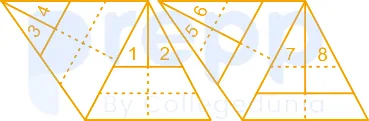
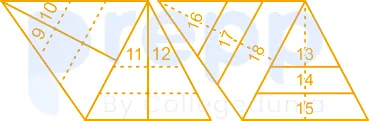 Paper & answer key PDF ↗
 Question 4archived
Select the missing number from the given options.
2
3
5
125
343
216
3
4
?
- A
4
- B
2
- C
1
- D
3
Show answer
C. 1The question asks us to find the missing number in the given sequence: 23512534321634?
The sequence appears to be a string of digits. Let's examine the digits closely to find a logical pattern.
If we group the digits into sets of three, we get the following triplets:
Triplet 1: 2, 3, 5
Triplet 2: 1, 2, 5
Triplet 3: 3, 4, 3
Triplet 4: 2, 1, 6
Triplet 5: 3, 4, ?
Let's analyze how the first two digits in each triplet might relate to the third digit.
Analyzing the Digit Pattern in the Sequence
We observe a specific relationship between the first two digits and the third digit in each triplet, although the type of relationship changes for each triplet.
Triplet 1: 2, 3, 5
Here, the third digit (5) is the sum of the first two digits (2 and 3):
\(2 + 3 = 5\)
Rule: Sum of the first two digits.
Triplet 2: 1, 2, 5
For this triplet, the third digit (5) is the sum of the squares of the first two digits (1 and 2):
\(1^2 + 2^2 = 1 + 4 = 5\)
Rule: Sum of the squares of the first two digits.
Triplet 3: 3, 4, 3
In this case, the third digit (3) is the sum of the digits of the product of the first two digits (3 and 4):
\(3 \times 4 = 12\)
Sum of digits of 12: \(1 + 2 = 3\)
Rule: Sum of the digits of the product of the first two digits.
Triplet 4: 2, 1, 6
For this triplet, the third digit (6) is twice the sum of the first two digits (2 and 1):
\(2 \times (2 + 1) = 2 \times 3 = 6\)
Rule: Twice the sum of the first two digits.
Triplet 5: 3, 4, ?
Based on the pattern of rules observed in the previous triplets (Sum, Sum of Squares, Sum of digits of product, Double the Sum), the next rule in this sequence of rules should apply to the fifth triplet.
Let's list the rules found:
Sum \(F+S\)
Sum of Squares \(F^2+S^2\)
Sum of digits of Product \(F \times S \rightarrow \text{Sum of digits}\)
Double the Sum \(2 \times (F+S)\)
We need a rule that produces 1 from 3 and 4, following a sequence. Let's consider another common operation: the absolute difference.
Rule 5: Absolute Difference \(|F - S|\)
Let's test this rule on the fifth triplet (3, 4, ?):
\(|3 - 4| = |-1| = 1\)
This yields 1, which is one of the options.
The pattern is a sequence of different mathematical operations applied to consecutive triplets to derive the third digit:
Triplet 1: Sum
Triplet 2: Sum of Squares
Triplet 3: Sum of digits of Product
Triplet 4: Double the Sum
Triplet 5: Absolute Difference
Triplet
Digits (F, S, R)
Rule Applied
Calculation
Result
1
2, 3, 5
Sum
\(2 + 3\)
5
2
1, 2, 5
Sum of Squares
\(1^2 + 2^2 = 1 + 4\)
5
3
3, 4, 3
Sum of digits of Product
\(3 \times 4 = 12 \rightarrow 1+2\)
3
4
2, 1, 6
Double the Sum
\(2 \times (2 + 1) = 2 \times 3\)
6
5
3, 4, ?
Absolute Difference
\(|3 - 4| = |-1|\)
1
Following this sequence of rules, the absolute difference of the first two digits in the fifth triplet gives the missing number.
For the triplet (3, 4, ?), the missing number is \(|3 - 4| = 1\).
Conclusion on the Missing Number
Based on the identified pattern of applying a different rule to each consecutive triplet of digits in the sequence, the missing number is 1.
Revision Table: Sequence Pattern Analysis
Segment
Digits
Pattern Identified
Triplet 1
2, 3, 5
Third digit is the sum of the first two.
Triplet 2
1, 2, 5
Third digit is the sum of the squares of the first two.
Triplet 3
3, 4, 3
Third digit is the sum of the digits of the product of the first two.
Triplet 4
2, 1, 6
Third digit is twice the sum of the first two.
Triplet 5
3, 4, ?
Third digit is the absolute difference of the first two.
Additional Information on Number Sequence Puzzles
Number sequence puzzles often rely on identifying a mathematical or logical pattern that connects the elements in the sequence. These patterns can be simple arithmetic progressions, geometric sequences, or more complex rules involving multiple operations, positions, or properties of the numbers or digits themselves.
Common patterns include:
Arithmetic operations (addition, subtraction, multiplication, division) between consecutive terms.
Operations based on the position of the term.
Relationships between groups of terms (like triplets or pairs).
Rules involving the digits of the numbers (sum of digits, product of digits, etc.).
Alternating patterns or sequences of operations.
Solving these puzzles requires careful observation, testing different hypotheses, and logical deduction to find the rule that consistently applies to the given terms and predicts the missing one.
Paper & answer key PDF ↗ Question 5archived
Select the correct mirror image of the given figure when the mirror is placed to the right of the figure.

- A
Option A (shown in image)
- B
Option B (shown in image)
- C
Option C (shown in image)
- D
Option D (shown in image)
Show answer
C. Option C (shown in image)The image is flipped horizontally
Hence, “Option 3” is the correct answer.
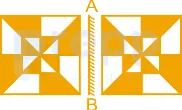 Paper & answer key PDF ↗
 Question 6archived
Arrange the following words in a logical and meaningful order.
1. Wrist
2. Nails
3. Shoulder
4. Elbow
5. Palm
6. Finger
- A
3, 4, 1, 2, 5, 6
- B
3, 1, 4, 2, 5, 6
- C
3, 4, 1, 5, 6, 2
- D
3, 5, 1, 4, 6, 2
Show answer
C. 3, 4, 1, 5, 6, 2Arranging Body Parts in Logical Order: Hand and Arm
The question asks us to arrange a list of words, which represent parts of the human arm and hand, in a logical and meaningful order. A logical order for these body parts typically follows the anatomical structure, starting from the shoulder and moving downwards towards the fingertips.
Here are the words and their corresponding numbers:
1. Wrist
2. Nails
3. Shoulder
4. Elbow
5. Palm
6. Finger
Determining the Logical Sequence of Arm and Hand Parts
We need to think about how these parts are connected in the body, starting from the upper part of the arm down to the end of the fingers. The natural order is:
The topmost part listed is the Shoulder.
Moving down from the shoulder, we reach the Elbow.
Below the elbow is the Wrist.
After the wrist, we have the main part of the hand, the Palm.
Extending from the palm are the Fingers.
Finally, at the tips of the fingers are the Nails.
So, the logical sequence is: Shoulder > Elbow > Wrist > Palm > Finger > Nails.
Mapping the Sequence to Numbers
Now, let's replace the words with their corresponding numbers based on the list provided:
Shoulder corresponds to 3
Elbow corresponds to 4
Wrist corresponds to 1
Palm corresponds to 5
Finger corresponds to 6
Nails corresponds to 2
Putting the numbers in the logical sequence gives us: 3, 4, 1, 5, 6, 2.
Comparing with the Given Options
Let's check which option matches our derived sequence:
Option 1: 3, 4, 1, 2, 5, 6 (Shoulder, Elbow, Wrist, Nails, Palm, Finger) - This is incorrect because Nails come after Finger and Palm comes before Finger in the correct order.
Option 2: 3, 1, 4, 2, 5, 6 (Shoulder, Wrist, Elbow, Nails, Palm, Finger) - This is incorrect because Wrist is not located between the Shoulder and Elbow.
Option 3: 3, 4, 1, 5, 6, 2 (Shoulder, Elbow, Wrist, Palm, Finger, Nails) - This sequence matches our logical order perfectly.
Option 4: 3, 5, 1, 4, 6, 2 (Shoulder, Palm, Wrist, Elbow, Finger, Nails) - This is incorrect as the order of Palm, Wrist, and Elbow is wrong.
The sequence 3, 4, 1, 5, 6, 2 represents the logical order of the given body parts from the shoulder downwards to the fingertips.
Part of Body
Number
Logical Position
Shoulder
3
1st (Top)
Elbow
4
2nd
Wrist
1
3rd
Palm
5
4th
Finger
6
5th
Nails
2
6th (End)
Thus, the correct logical and meaningful order is 3, 4, 1, 5, 6, 2.
Revision Table: Logical Order of Body Parts
Step
Body Part
Assigned Number
Reasoning
1
Shoulder
3
Starting point (upper arm)
2
Elbow
4
Joint below shoulder
3
Wrist
1
Joint below elbow, connecting arm to hand
4
Palm
5
Central part of the hand
5
Finger
6
Extend from the palm
6
Nails
2
Located at the end of fingers
Additional Information: Understanding Anatomical Arrangement
Arranging body parts often requires understanding basic anatomy. The human arm is composed of several sections connected by joints. Starting from the torso, you have the shoulder joint, connecting to the upper arm bone (humerus). The elbow joint connects the upper arm to the forearm bones (radius and ulna). The wrist joint connects the forearm to the hand bones (carpals, metacarpals). The palm is formed by the metacarpals, and the fingers are formed by the phalanges. Nails are appendages of the skin found on the dorsal side of the fingertips.
When arranging parts in a "logical and meaningful order," it usually implies a sequence that follows either:
1. Anatomical arrangement (like from top to bottom or proximal to distal).
2. A functional sequence (e.g., order of actions).
In this case, the anatomical arrangement from proximal (closer to the body's core) to distal (further from the body's core) is the logical order used.
Paper & answer key PDF ↗ Question 7archived
Given below is a transparent sheet of paper with some patterns drawn on it. How would the transparent sheet look when it is folded on the dotted line?

- A
Option A (shown in image)
- B
Option B (shown in image)
- C
Option C (shown in image)
- D
Option D (shown in image)
Show answer
D. Option D (shown in image)Hence, the above figure will be the final figure.
 Paper & answer key PDF ↗
 Question 8archived
Three of the following four letter-clusters are alike in a certain way and one is different. Pick the odd one out.
- A
AEIMQ
- B
UYCGK
- C
DHLPT
- D
RVZDG
Show answer
D. RVZDGFinding the Odd Letter Cluster
This question asks us to identify the letter cluster that is different from the other three. To solve this type of reasoning problem, we need to look for a pattern or rule that applies to the letters within each cluster. A common approach is to consider the alphabetical positions of the letters.
Analyzing Alphabetical Positions
Let's assign a numerical value to each letter based on its position in the English alphabet (A=1, B=2, ..., Z=26).
Letter
Position
A
1
E
5
I
9
M
13
Q
17
U
21
Y
25
C
3 (29 mod 26)
G
7
K
11
D
4
H
8
L
12
P
16
T
20
R
18
V
22
Z
26
D
4 (30 mod 26)
Examining Each Letter Cluster
Let's look at the difference in alphabetical positions between consecutive letters in each cluster:
1. Cluster: AEIMQ
A (1) to E (5): $\text{5} - \text{1} = \text{4}$
E (5) to I (9): $\text{9} - \text{5} = \text{4}$
I (9) to M (13): $\text{13} - \text{9} = \text{4}$
M (13) to Q (17): $\text{17} - \text{13} = \text{4}$
The pattern here is a constant difference of +4.
2. Cluster: UYCGK
U (21) to Y (25): $\text{25} - \text{21} = \text{4}$
Y (25) to C (3): Alphabetical positions wrap around from Z (26) to A (1). The distance is from Y (25) to Z (26) is 1, and from A (1) to C (3) is 2. Total difference is $\text{1} + \text{3} = \text{4}$. Alternatively, $(\text{3} - \text{25} + \text{26}) = \text{4}$.
C (3) to G (7): $\text{7} - \text{3} = \text{4}$
G (7) to K (11): $\text{11} - \text{7} = \text{4}$
The pattern here is also a constant difference of +4, with wrapping around the alphabet.
3. Cluster: DHLPT
D (4) to H (8): $\text{8} - \text{4} = \text{4}$
H (8) to L (12): $\text{12} - \text{8} = \text{4}$
L (12) to P (16): $\text{16} - \text{12} = \text{4}$
P (16) to T (20): $\text{20} - \text{16} = \text{4}$
The pattern here is a constant difference of +4.
4. Cluster: RVZDG
R (18) to V (22): $\text{22} - \text{18} = \text{4}$
V (22) to Z (26): $\text{26} - \text{22} = \text{4}$
Z (26) to D (4): Wrapping around. The distance from Z (26) to A (1) is 1, and from A (1) to D (4) is 3. Total difference is $\text{1} + \text{3} = \text{4}$. Alternatively, $(\text{4} - \text{26} + \text{26}) = \text{4}$.
D (4) to G (7): $\text{7} - \text{4} = \text{3}$
The pattern here is +4, +4, +4, but then +3 for the last step.
Identifying the Odd One Out
Based on the analysis of the differences between consecutive letter positions:
AEIMQ follows a +4 pattern.
UYCGK follows a +4 pattern (with wrapping).
DHLPT follows a +4 pattern.
RVZDG follows a +4, +4, +4, +3 pattern.
Three of the clusters (AEIMQ, UYCGK, DHLPT) show a consistent difference of 4 between the alphabetical positions of consecutive letters. The cluster RVZDG does not maintain this pattern throughout; the last difference is 3 instead of 4.
Therefore, RVZDG is the odd one out.
Revision Table: Letter Pattern Analysis
Cluster
Letters (Positions)
Differences
Pattern Consistency
AEIMQ
A(1), E(5), I(9), M(13), Q(17)
+4, +4, +4, +4
Consistent (+4)
UYCGK
U(21), Y(25), C(3), G(7), K(11)
+4, +4, +4, +4
Consistent (+4, with wrap)
DHLPT
D(4), H(8), L(12), P(16), T(20)
+4, +4, +4, +4
Consistent (+4)
RVZDG
R(18), V(22), Z(26), D(4), G(7)
+4, +4, +4, +3
Inconsistent
Additional Information on Letter Series Reasoning
Letter series and letter cluster problems are common in logical reasoning sections of competitive exams. They test your ability to identify patterns based on:
Alphabetical Position: The numerical order of letters (A=1, B=2, etc.).
Difference/Sum: Constant differences or sums between consecutive letter positions.
Skip Pattern: Skipping a fixed number of letters.
Vowels/Consonants: Patterns based on the type of letter.
Reverse Alphabetical Order: Using positions counting backward from Z (Z=1, Y=2, etc.).
Combinations: A mix of the above patterns.
When solving these problems, it's helpful to write down the alphabetical positions or visualize the alphabet. Checking the differences between consecutive letters is a very effective strategy, as seen in this letter cluster question.
Paper & answer key PDF ↗ Question 9archived
Three of the following four number-pairs are alike in a certain way and one is different. Pickthe odd pair out.
- A
4 : 27
- B
16 : 125
- C
9 : 64
- D
49 : 218
Show answer
D. 49 : 218Finding the Odd Number Pair Pattern
This question presents four pairs of numbers, and we need to find the one pair that is different from the other three. This usually means there is a pattern or rule that applies to three of the pairs, but not to the fourth one.
To solve this, we need to examine the relationship between the two numbers in each pair and try to find a consistent rule.
Analyzing the Given Number Pairs
Let's list the four number pairs:
Pair 1: 4 : 27
Pair 2: 16 : 125
Pair 3: 9 : 64
Pair 4: 49 : 218
We can often find patterns involving basic mathematical operations, powers, or relationships between the numbers.
Identifying the Number Pattern
Let's look at the numbers themselves. Many are perfect squares or perfect cubes:
4 is $2^2$
27 is $3^3$
16 is $4^2$
125 is $5^3$
9 is $3^2$
64 is $4^3$ or $8^2$
49 is $7^2$
218 is not a common power.
Let's try to find a relationship between the first and second number in each pair using these powers.
Pair
First Number
Second Number
Observation
4 : 27
4 $= 2^2$
27 $= 3^3$
The base of the cube (3) is one more than the base of the square (2). This suggests a pattern like $n^2 : (n+1)^3$. Here $n=2$.
16 : 125
16 $= 4^2$
125 $= 5^3$
The base of the cube (5) is one more than the base of the square (4). This fits the pattern $n^2 : (n+1)^3$. Here $n=4$.
9 : 64
9 $= 3^2$
64 $= 4^3$
The base of the cube (4) is one more than the base of the square (3). This fits the pattern $n^2 : (n+1)^3$. Here $n=3$. Note that 64 is also $8^2$, but $3^2 : 8^2$ doesn't fit the $(n+1)$ relationship seen in the first two pairs.
49 : 218
49 $= 7^2$
218
The first number is $7^2$. If the pattern $n^2 : (n+1)^3$ holds, the second number should be $(7+1)^3 = 8^3$.
Let's calculate $8^3$ for the fourth pair:
$8^3 = 8 \times 8 \times 8 = 64 \times 8 = 512$.
So, if the fourth pair followed the same pattern $n^2 : (n+1)^3$ with $n=7$, it should be 49 : 512. However, the given pair is 49 : 218.
Therefore, the first three pairs follow the pattern $n^2 : (n+1)^3$, while the fourth pair does not.
Conclusion: Identifying the Odd Pair
Based on our analysis, the pair 49 : 218 is the one that is different from the other three, as it does not fit the $n^2 : (n+1)^3$ pattern.
Thus, the odd pair out is 49 : 218.
Revision Table: Analyzing Odd Number Pairs
Pair
First Number Form ($n^2$)
Second Number Form ($(n+1)^3$)
Expected Second Number
Actual Second Number
Fits Pattern?
4 : 27
$2^2$
$(2+1)^3 = 3^3$
27
27
Yes
16 : 125
$4^2$
$(4+1)^3 = 5^3$
125
125
Yes
9 : 64
$3^2$
$(3+1)^3 = 4^3$
64
64
Yes
49 : 218
$7^2$
$(7+1)^3 = 8^3$
512
218
No
Additional Information: Number Pattern Questions
Odd pair out questions involving numbers test your ability to find logical rules or patterns. These can be based on various mathematical concepts:
Arithmetic/Geometric Progressions: Looking at differences or ratios between numbers.
Powers: Identifying squares, cubes, or other powers.
Prime/Composite Numbers: Checking if numbers are prime or composite.
Digit Properties: Sum of digits, product of digits, etc.
Mathematical Operations: Addition, subtraction, multiplication, division, or a combination of these applied between the numbers in a pair or sequence.
To improve at these questions, practice recognizing common sequences and properties of numbers quickly.
Paper & answer key PDF ↗ Question 10archived
The sum of the current ages of Shipra and Malini is 65 years. After 5 years, Shipra’s age will be 15 years more than Malini’s age. What is Malini’s current age?
- A
25 years
- B
15 years
- C
30 years
- D
20 years
Show answer
A. 25 yearsSolving Age Word Problems: Finding Malini's Current Age
This question is a classic age word problem that can be solved using linear equations. We are given information about the current ages of two people, Shipra and Malini, and a condition relating their ages in the future.
Understanding the Given Information about Ages
Let's break down the information provided:
The sum of the current ages of Shipra and Malini is 65 years.
After 5 years, Shipra's age will be 15 years more than Malini's age.
Our goal is to find Malini's current age.
Setting Up Equations for Current and Future Ages
Let's represent the unknown ages with variables:
Let Shipra's current age be \(S\) years.
Let Malini's current age be \(M\) years.
From the first piece of information, we can write our first equation:
Equation 1: The sum of their current ages is 65.
\(S + M = 65\)
Now, let's consider their ages after 5 years:
Shipra's age after 5 years will be \(S + 5\) years.
Malini's age after 5 years will be \(M + 5\) years.
The second piece of information states that after 5 years, Shipra's age will be 15 years more than Malini's age. We can write this as our second equation:
Equation 2: Shipra's age after 5 years is 15 more than Malini's age after 5 years.
\(S + 5 = (M + 5) + 15\)
Solving the System of Linear Equations
We now have a system of two linear equations with two variables:
\(S + M = 65\)
\(S + 5 = M + 5 + 15\)
Let's simplify Equation 2:
\(S + 5 = M + 20\)
Subtract 5 from both sides:
\(S = M + 15\)
This simplified equation tells us that Shipra is currently 15 years older than Malini, which makes sense because the age difference between two people remains constant over time. The difference between their ages after 5 years is given as 15 years, so their current age difference must also be 15 years.
Now we can use the substitution method to solve the system. Substitute the expression for \(S\) from the simplified Equation 2 (\(S = M + 15\)) into Equation 1 (\(S + M = 65\)):
\((M + 15) + M = 65\)
Combine the terms with \(M\):
\(2M + 15 = 65\)
Subtract 15 from both sides:
\(2M = 65 - 15\)
\(2M = 50\)
Divide by 2 to find the value of \(M\):
\(M = \frac{50}{2}\)
\(M = 25\)
So, Malini's current age is 25 years.
We can also find Shipra's current age using \(S = M + 15\):
\(S = 25 + 15\)
\(S = 40\)
Let's verify our answer using the original conditions:
Current sum of ages: \(S + M = 40 + 25 = 65\). This matches the first condition.
Ages after 5 years: Shipra's age will be \(40 + 5 = 45\). Malini's age will be \(25 + 5 = 30\).
Difference after 5 years: \(45 - 30 = 15\). This matches the second condition.
The values satisfy both conditions, confirming our solution is correct.
Therefore, Malini's current age is 25 years.
Person
Current Age
Age After 5 Years
Shipra
\(S = 40\)
\(S+5 = 45\)
Malini
\(M = 25\)
\(M+5 = 30\)
Sum (Current)
\(S+M = 40+25 = 65\)
Difference (After 5 years)
\((S+5) - (M+5) = 45 - 30 = 15\)
Conclusion on Malini's Age
Based on the calculations, Malini's current age is 25 years.
Revision Table: Key Information on Age Problems
Concept
Explanation
Example Application
Representing Ages
Use variables (e.g., \(x\), \(y\)) for current ages.
Shipra's current age = \(S\), Malini's current age = \(M\).
Future Age
Age after \(n\) years = Current Age \(+ n\).
Shipra's age after 5 years = \(S + 5\).
Past Age
Age \(n\) years ago = Current Age \(- n\).
Shipra's age 5 years ago = \(S - 5\).
Sum of Ages
Add the ages together.
Sum of current ages: \(S + M = 65\).
Difference in Ages
Subtract the younger age from the older age. The difference remains constant.
Shipra is 15 years older than Malini: \(S = M + 15\) or \(S - M = 15\).
Setting up Equations
Translate each sentence or condition in the problem into a mathematical equation.
\(S + M = 65\), \((S+5) = (M+5) + 15\).
Solving Equations
Use methods like substitution or elimination to find the values of the variables.
Substitute \(S = M+15\) into \(S+M=65\).
Additional Information on Solving Age Word Problems
Age word problems are common in quantitative aptitude tests. They typically involve setting up and solving linear equations. Here are a few more tips:
Always define your variables clearly, stating what age (current, past, or future) each variable represents.
Pay close attention to keywords like "sum," "difference," "times," "ago," "hence," "after," etc., as they indicate the mathematical operations needed.
When dealing with future or past ages, remember that everyone's age changes by the same amount over the same period.
If there are multiple people involved, you will usually need multiple equations.
Always check your final answer by plugging the values back into the original problem statement to ensure all conditions are met.
Practice with different variations of age problems, such as those involving ratios of ages or multiple time periods.
Solving age problems effectively relies on careful reading, accurate translation into algebraic equations, and precise solving of the resulting system of equations.
Paper & answer key PDF ↗ Question 11archived
Select the missing number from the given options.
36
52
86
28
40
12
32
46
?
- A
53
- B
51
- C
49
- D
43
Show answer
C. 49This problem requires identifying the pattern in the given number sequence: 36, 52, 86, 28, 40, 12, 32, 46, ?. Let's analyze the sequence to find the underlying rule.
Analyzing the Number Sequence
The sequence of numbers is: 36, 52, 86, 28, 40, 12, 32, 46, ?. We need to find the missing number at the end of the sequence.
Let's try looking for relationships between consecutive numbers. We can explore differences, sums, products, or operations involving the digits of the numbers.
Exploring Digit Operations and Reversal
A common pattern in such number series puzzles involves operations on the digits of the numbers, such as summing the digits, multiplying the digits, or reversing the number.
Let's consider reversing the digits of each number in the sequence. Let \(R(N)\) denote the number obtained by reversing the digits of \(N\).
For 36, \(R(36) = 63\)
For 52, \(R(52) = 25\)
For 86, \(R(86) = 68\)
For 28, \(R(28) = 82\)
For 40, \(R(40) = 04 = 4\)
For 12, \(R(12) = 21\)
For 32, \(R(32) = 23\)
For 46, \(R(46) = 64\)
The sequence of reversed numbers is: 63, 25, 68, 82, 4, 21, 23, 64.
Identifying the Pattern using Reversal and Multiplication
Let's examine the relationship between a number \(N_i\) in the original sequence and the reversed version of the next number \(R(N_{i+1})\). Consider the expression \(R(N_{i+1}) - 2 \times N_i\).
For the pair (36, 52), \(i=1\): \(R(52) - 2 \times 36 = 25 - 72 = -47\)
For the pair (52, 86), \(i=2\): \(R(86) - 2 \times 52 = 68 - 104 = -36\)
For the pair (86, 28), \(i=3\): \(R(28) - 2 \times 86 = 82 - 172 = -90\)
For the pair (28, 40), \(i=4\): \(R(40) - 2 \times 28 = 4 - 56 = -52\)
For the pair (40, 12), \(i=5\): \(R(12) - 2 \times 40 = 21 - 80 = -59\)
For the pair (12, 32), \(i=6\): \(R(32) - 2 \times 12 = 23 - 24 = -1\)
For the pair (32, 46), \(i=7\): \(R(46) - 2 \times 32 = 64 - 64 = 0\)
The sequence of differences \(R(N_{i+1}) - 2 \times N_i\) for \(i=1\) through \(i=7\) is: -47, -36, -90, -52, -59, -1, 0.
Let's look at the last few terms of this difference sequence: -59, -1, 0. This subsequence doesn't show a simple arithmetic pattern.
However, let's consider the differences starting from \(i=6\): -1, 0. The difference between these two terms is \(0 - (-1) = 1\).
Now, let's consider the relationship for the next pair, involving the number 46 (which is \(N_8\)) and the missing number (which is \(N_9\)). Let the missing number be \(X\). We calculate \(R(N_9) - 2 \times N_8 = R(X) - 2 \times 46 = R(X) - 92\).
Let's look at the sequence of differences \(R(N_{i+1}) - 2 \times N_i\) again: -47, -36, -90, -52, -59, -1, 0. Let's assume the pattern emerges in the final terms.
Consider the sequence of differences for \(i=6, 7\): -1, 0. The difference is 1.
Now, let's look at the options: 53, 51, 49, 43.
If \(X = 53\), \(R(53) = 35\). \(R(X) - 92 = 35 - 92 = -57\). The difference sequence ends: ..., -1, 0, -57.
If \(X = 51\), \(R(51) = 15\). \(R(X) - 92 = 15 - 92 = -77\). The difference sequence ends: ..., -1, 0, -77.
If \(X = 49\), \(R(49) = 94\). \(R(X) - 92 = 94 - 92 = 2\). The difference sequence ends: ..., -1, 0, 2.
If \(X = 43\), \(R(43) = 34\). \(R(X) - 92 = 34 - 92 = -58\). The difference sequence ends: ..., -1, 0, -58.
Observing the ending sequence of differences -1, 0, 2, we can see a pattern in the differences between consecutive terms:
\(0 - (-1) = 1\)
\(2 - 0 = 2\)
The differences between consecutive terms in this final part of the sequence of differences are increasing by 1 (1, 2). This strongly suggests that the next difference would have been 3 if the sequence continued. This pattern (-1, 0, 2) is only apparent when the missing number is 49.
Therefore, the pattern is that the difference \(R(N_{i+1}) - 2 \times N_i\) for \(i=6, 7, 8\) follows the sequence -1, 0, 2.
For \(i=8\), the difference is \(R(N_9) - 2 \times N_8\). We have \(N_8 = 46\).
So, \(R(N_9) - 2 \times 46 = 2\)
\(R(N_9) - 92 = 2\)
\(R(N_9) = 92 + 2\)
\(R(N_9) = 94\)
The number whose reversed digits give 94 is 49.
Thus, the missing number is 49.
Number (\(N_i\))
Position (\(i\))
Next Number (\(N_{i+1}\))
Reversed Next Number (\(R(N_{i+1})\))
\(2 \times N_i\)
Difference \(R(N_{i+1}) - 2 \times N_i\)
36
1
52
25
72
-47
52
2
86
68
104
-36
86
3
28
82
172
-90
28
4
40
4
56
-52
40
5
12
21
80
-59
12
6
32
23
24
-1
32
7
46
64
64
0
46
8
? (49)
R(49)=94
\(2 \times 46 = 92\)
\(94 - 92 = 2\)
The sequence of differences \(R(N_{i+1}) - 2 \times N_i\) for \(i=6, 7, 8\) is -1, 0, 2. The pattern of differences between these terms (1, 2) confirms 2 is the correct next term in this subsequence.
Conclusion
Based on the identified pattern \(R(N_{i+1}) - 2 \times N_i\) for the last few terms of the sequence, the missing number is 49.
Revision Table: Key Sequence Pattern
The core pattern identified relates a number in the sequence to the reversed digits of the next number.
Step
Numbers
Operation
Resulting Differences Sequence
1
\(N_i, N_{i+1}\)
Calculate \(R(N_{i+1}) - 2 \times N_i\)
-47, -36, -90, -52, -59, -1, 0, ...
2
Focus on the end
Subsequence of differences for i=6, 7, 8
-1, 0, ?
3
Find pattern in subsequence
Differences between terms: \(0 - (-1) = 1\)
Pattern of differences: 1, 2, ...
4
Determine missing difference
Next difference in pattern is 2
Missing term in difference subsequence is \(0 + 2 = 2\)
5
Solve for missing number
\(R(N_9) - 2 \times N_8 = 2\) → \(R(N_9) - 92 = 2\) → \(R(N_9) = 94\)
\(N_9 = 49\)
Additional Information: Number Series Patterns
Number series questions in logical reasoning tests can follow various patterns. Some common types include:
Arithmetic Progression: A constant difference between consecutive terms.
Geometric Progression: A constant ratio between consecutive terms.
Differences of Differences: The difference between consecutive terms forms its own pattern (arithmetic, geometric, etc.).
Alternating Series: Two interleaved patterns.
Operations on Digits: Patterns based on sum of digits, product of digits, reversing digits, etc.
Combinations: Patterns involving a mix of arithmetic operations and digit operations.
Solving these puzzles often requires careful observation, calculating differences or ratios, testing digit-based rules, and sometimes a bit of trial and error based on the options provided.
Paper & answer key PDF ↗ Question 12archived
Three of the following four words are alike in a certain way and one is different. Pick the odd word out.
- A
Orange
- B
Violet
- C
Indigo
- D
Silver
Show answer
D. SilverFinding the Odd Word Out: Colors and Categories
The question asks us to identify the word that is different from the other three words provided: Orange, Violet, Indigo, and Silver.
Let's examine each word and consider common categories they might belong to.
Orange: This is a color. It is also the name of a fruit. As a color, it is part of the visible light spectrum, found in a rainbow.
Violet: This is a color. It is also the name of a flower. As a color, it is part of the visible light spectrum, found in a rainbow (often listed as the highest frequency visible light color).
Indigo: This is a color. Historically, it was a significant natural dye color. As a color, it is part of the visible light spectrum, found in a rainbow (often listed between blue and violet).
Silver: This is primarily the name of a precious metal. It is also used to describe a color that resembles the metal, often with a metallic sheen. While it is a color, it is not typically listed as one of the main colors of the visible spectrum or rainbow in the same way as orange, violet, or indigo.
Analyzing the Relationship Between the Words
Let's look for a common characteristic among three of the words that the fourth word does not share.
Orange, Violet, and Indigo are all distinct colors that are universally recognized as part of the natural color spectrum observed in a rainbow (VIBGYOR: Violet, Indigo, Blue, Green, Yellow, Orange, Red).
Silver, while a color, is often described as a metallic color or a shade of grey with a reflective quality. It is not a fundamental color in the same classification as the spectral colors like orange, violet, or indigo.
Therefore, based on their classification as spectral colors versus a metallic color/shade, Orange, Violet, and Indigo belong to one group, and Silver belongs to a different category.
Identifying the Odd Word Out
Comparing the four words:
Word
Classification
Part of Visible Spectrum/Rainbow?
Orange
Color
Yes
Violet
Color
Yes
Indigo
Color
Yes
Silver
Color (metallic/shade) / Metal
No (not typically listed as a primary spectral color)
From the analysis, Orange, Violet, and Indigo are all colors commonly associated with the visible light spectrum and the rainbow. Silver is different because it is primarily known as a metal, and its color representation is often described as metallic or a specific shade, not a fundamental color of the spectrum in this context.
Thus, Silver is the word that is different from the others.
Revision Table: Understanding Colors and Categories
Concept
Explanation
Relevance to Question
Visible Spectrum
The portion of the electromagnetic spectrum that is visible to the human eye, appearing as colors.
Orange, Violet, and Indigo are colors from this spectrum.
Rainbow Colors (VIBGYOR)
A mnemonic representing the order of colors typically observed in a rainbow: Violet, Indigo, Blue, Green, Yellow, Orange, Red.
Orange, Violet, and Indigo are explicitly listed in VIBGYOR. Silver is not.
Metallic Colors
Colors that appear to be metallic, often characterized by a reflective quality, like gold, silver, bronze.
Silver is a common metallic color, distinct from the fundamental spectral colors.
Additional Information: The Nature of Colors
Colors can be classified in many ways, including by how they are perceived, how they are produced (e.g., light vs. pigment), and their physical properties (wavelength). The colors Orange, Violet, and Indigo are specific hues associated with particular wavelength ranges in the visible spectrum. Silver, as a color, is often described in terms of its brightness and reflectivity, reflecting light across the visible spectrum. While it represents a specific visual appearance and is often referred to as a color, its nature is different from the pure spectral hues represented by words like orange, violet, and indigo in the context of a basic color list like the rainbow.
Paper & answer key PDF ↗ Question 13archived
Two statements are given followed by three conclusions numbered I, II and III. Assuming the statements to be true, even if they seem to be at variance with commonly known facts. Decide which of the conclusions logically follow(s) from the statements.
Statements:
All utensils are spoons.
All bowls are spoons.
Conclusions:
I. No utensil is a bowl.
I. Some utensils are bowls.
III. No spoon is a utensil.
- A
Either conclusion I or II follows
- B
Only conclusion III follows
- C
Conclusions I and III follow
- D
Only conclusions I follows
Show answer
A. Either conclusion I or II followsUnderstanding Syllogism Statements and Conclusions
This question asks us to analyze two statements and determine which of the given conclusions logically follow from them. This type of problem falls under the category of syllogism or deductive reasoning, where we must accept the statements as true, regardless of whether they align with real-world knowledge, and then derive conclusions based solely on these statements.
Analyzing the Given Statements
We are given the following statements:
All utensils are spoons.
All bowls are spoons.
Let's represent these relationships visually or conceptually:
Statement 1 tells us that the entire set of 'Utensils' is contained within the set of 'Spoons'. If something is a utensil, it must also be a spoon.
Statement 2 tells us that the entire set of 'Bowls' is contained within the set of 'Spoons'. If something is a bowl, it must also be a spoon.
From these statements, we know that both Utensils and Bowls are subsets of Spoons. However, the statements do not provide any direct relationship between Utensils and Bowls. They might overlap (some utensils could be bowls), or they might be entirely separate categories within Spoons (no utensil is a bowl).
Evaluating the Conclusions
Now let's examine each conclusion based on the statements:
Conclusion I: No utensil is a bowl.
Based on the statements, it is possible that Utensils and Bowls are distinct subsets within the set of Spoons. For example, all forks (utensils) are spoons (in this context), and all soup bowls (bowls) are spoons, but no fork is a soup bowl. This scenario is consistent with the statements. So, this conclusion is possible.
Conclusion II: Some utensils are bowls.
Based on the statements, it is also possible that Utensils and Bowls overlap within the set of Spoons. For example, some items might be classified as both a utensil and a bowl (like a spork, if considered both). If there is any overlap between the set of Utensils and the set of Bowls within the set of Spoons, this conclusion would be true. This scenario is also consistent with the statements. So, this conclusion is possible.
Conclusion III: No spoon is a utensil.
Statement 1 clearly says "All utensils are spoons." This means that the set of Utensils is entirely inside the set of Spoons. If something is a utensil, it is a spoon. This directly contradicts the conclusion "No spoon is a utensil". Therefore, Conclusion III does not logically follow from the statements; in fact, it is false based on Statement 1.
Determining the Logical Follow-up
We found that Conclusion III is definitely false. Conclusions I and II, however, are both possible based on the statements. Conclusion I ("No utensil is a bowl") asserts that the sets of Utensils and Bowls are disjoint, while Conclusion II ("Some utensils are bowls") asserts that they overlap. These two conclusions are contradictory (they form a complementary pair - either one is true, or the other is true, but not both, and they cover all possibilities regarding the relationship between Utensils and Bowls). Since the statements do not give us enough information to definitively say whether Utensils and Bowls overlap or not, we cannot conclude either I or II individually. However, one of them must be true. Therefore, the logical deduction is that either Conclusion I or Conclusion II follows.
Summary of Analysis
Statement/Conclusion
Analysis
Follows Logically?
Statement 1: All utensils are spoons.
Utensils <figure> </figure> Spoons (Utensils are a subset of Spoons)
N/A
Statement 2: All bowls are spoons.
Bowls <figure> </figure> Spoons (Bowls are a subset of Spoons)
N/A
Conclusion I: No utensil is a bowl.
Possible if Utensils and Bowls are disjoint subsets of Spoons.
Possible, but not certain.
Conclusion II: Some utensils are bowls.
Possible if Utensils and Bowls are overlapping subsets of Spoons.
Possible, but not certain.
Conclusion III: No spoon is a utensil.
Contradicts Statement 1 (All utensils are spoons).
No.
Since Conclusions I and II are contradictory possibilities derived from the uncertain relationship between Utensils and Bowls based on the statements, the correct inference is that either I or II must be true.
Conclusion
Based on the logical analysis of the statements, only the conclusion "Either conclusion I or II follows" is valid.
Revision Table: Key Syllogism Concepts
Concept
Explanation
Statements
Propositions accepted as true for the purpose of logical deduction.
Conclusions
Inferences drawn logically from the given statements.
Logical Follows
A conclusion logically follows if it must be true whenever the statements are true.
"Either/Or" Case
Occurs when two contradictory conclusions are both possible based on the statements, and one must be true. Typically arises from indeterminate relationships (like the relationship between Utensils and Bowls here).
Universal Affirmative (All A are B)
Implies that if something belongs to category A, it also belongs to category B. It also implies that some B are A.
Additional Information: Syllogism Logic and Venn Diagrams
Syllogism problems can often be visualized using Venn diagrams. For these statements:
"All utensils are spoons" means the 'Utensils' circle is entirely inside the 'Spoons' circle.
"All bowls are spoons" means the 'Bowls' circle is entirely inside the 'Spoons' circle.
When drawing this, the 'Utensils' circle and the 'Bowls' circle are both inside the larger 'Spoons' circle. The diagrams would show that:
It is possible for the 'Utensils' circle and 'Bowls' circle to not overlap (supporting "No utensil is a bowl").
It is possible for the 'Utensils' circle and 'Bowls' circle to overlap (supporting "Some utensils are bowls").
Since both possibilities are valid interpretations of the statements, we cannot conclude either individually. This leads to the "either/or" scenario, also known as a complementary pair. Conclusion III, "No spoon is a utensil," is incorrect because if all utensils are spoons, then there are definitely some spoons that are utensils (the ones that are utensils).
Paper & answer key PDF ↗ Question 14archived
Select the term that will come next in the following series.
DGJ, BDN, ZAR, XXV,
- A
UUZ
- B
VUY
- C
VUZ
- D
VIZ
Show answer
C. VUZUnderstanding the Letter Series Pattern
The question asks us to identify the next term in the letter series: DGJ, BDN, ZAR, XXV. To solve this, we need to examine the pattern followed by the letters in each position across the terms. We will look at the first letter of each term, then the second letter, and finally the third letter.
Analyzing the Pattern of Each Letter Position
Let's assign numerical values to the letters based on their position in the English alphabet (A=1, B=2, ..., Z=26).
Letter Series Terms and Numerical Values
Term
First Letter
Second Letter
Third Letter
DGJ
D (4)
G (7)
J (10)
BDN
B (2)
D (4)
N (14)
ZAR
Z (26)
A (1)
R (18)
XXV
X (24)
X (24)
V (22)
Pattern for the First Letter:
D (4) to B (2): \(4 - 2 = 2\). The difference is -2.
B (2) to Z (26): \(2 - 2 = 0\). When we go below A (1), we wrap around from Z (26). \(2 - 2 \equiv 0 \pmod{26}\), which corresponds to Z (26). The difference is -2.
Z (26) to X (24): \(26 - 2 = 24\). The difference is -2.
The pattern for the first letter is subtracting 2, wrapping around the alphabet.
To find the next first letter, we apply the pattern to X (24): \(24 - 2 = 22\). The 22nd letter is V.
Pattern for the Second Letter:
G (7) to D (4): \(7 - 3 = 4\). The difference is -3.
D (4) to A (1): \(4 - 3 = 1\). The difference is -3.
A (1) to X (24): \(1 - 3 = -2\). When we go below A (1), we wrap around. \(-2 \pmod{26}\) corresponds to \(26 - 2 = 24\), which is X. The difference is -3.
The pattern for the second letter is subtracting 3, wrapping around the alphabet.
To find the next second letter, we apply the pattern to X (24): \(24 - 3 = 21\). The 21st letter is U.
Pattern for the Third Letter:
J (10) to N (14): \(14 - 10 = 4\). The difference is +4.
N (14) to R (18): \(18 - 14 = 4\). The difference is +4.
R (18) to V (22): \(22 - 18 = 4\). The difference is +4.
The pattern for the third letter is adding 4.
To find the next third letter, we apply the pattern to V (22): \(22 + 4 = 26\). The 26th letter is Z.
Determining the Next Term in the Series
By following the patterns we found for each letter position:
The next first letter is V.
The next second letter is U.
The next third letter is Z.
Combining these letters, the next term in the series is VUZ.
Conclusion: Identifying the Next Term
Based on the analysis of the patterns for each letter position in the given letter series DGJ, BDN, ZAR, XXV, the next term is VUZ.
Revision Table: Letter Series Pattern Summary
Summary of Patterns by Letter Position
Letter Position
Pattern
Next Letter Calculation
Next Letter
First
Subtract 2 (modulo 26)
X (24) \(\rightarrow\) \(24 - 2 = 22\)
V
Second
Subtract 3 (modulo 26)
X (24) \(\rightarrow\) \(24 - 3 = 21\)
U
Third
Add 4
V (22) \(\rightarrow\) \(22 + 4 = 26\)
Z
Additional Information: Understanding Letter Series Questions
Letter series questions are common in logical reasoning and aptitude tests. They require you to identify the rule or pattern that governs the sequence of letters or groups of letters. Common patterns include:
Adding or subtracting a fixed number to the letter's position in the alphabet.
Adding or subtracting a number that changes in a predictable way (e.g., +1, +2, +3...).
Alternating patterns between terms or within a term.
Using reverse alphabetical order or other specific sequences.
Understanding the numerical value of each letter and how to handle wrapping around from A to Z or Z to A is crucial for solving these types of problems efficiently.
Paper & answer key PDF ↗ Question 15archived
Select the option that is related to the third number in the same way as the second number is related to the first number.
12 : 192 :: 15 : ?
- A
245
- B
250
- C
240
- D
225
Show answer
C. 240Understanding Number Analogies
Number analogy questions test your ability to find the relationship between a pair of numbers and apply that same relationship to another number. In this question, we are given the analogy ${12 : 192 :: 15 : ?}$. This means that 12 is related to 192 in the same way that 15 is related to the missing number.
Finding the Relationship between 12 and 192
We need to figure out how the number 192 is obtained from the number 12. Let's explore possible mathematical operations:
Is it addition or subtraction? $192 - 12 = 180$. Adding 180 to 15 would give $15 + 180 = 195$, which is not an option.
Is it multiplication or division? Let's see if 192 is a multiple of 12. We can perform division:
\begin{equation*} \frac{192}{12} \end{equation*}
Let's perform the division:
\begin{itemize} \item $12 \times 10 = 120$ \item $192 - 120 = 72$ \item $12 \times 6 = 72$ \item So, $192 = 12 \times 10 + 12 \times 6 = 12 \times (10+6) = 12 \times 16$ \end{itemize}
So, we found that $12 \times 16 = 192$. The relationship between the first number (12) and the second number (192) is multiplication by 16.
Applying the Same Relationship to 15
The problem states that the third number (15) is related to the missing number in the same way that 12 is related to 192. Since the relationship for the first pair is multiplying the first number by 16, we apply the same rule to the number 15.
Missing number = $15 \times 16$
Calculating the Missing Number
Now we calculate $15 \times 16$:
\begin{itemize} \item We can do this multiplication as $15 \times (10 + 6)$ \item $15 \times 10 = 150$ \item $15 \times 6 = 90$ \item $150 + 90 = 240$ \end{itemize}
Alternatively, we can multiply directly:
\begin{equation*} \begin{array}{@{}c@{\,}c@{}c@{}c} & 1 & 5 \\ \times & 1 & 6 \\ \hline & 9 & 0 & (15 \times 6) \\ + & 15 & 0 & (15 \times 10) \\ \hline & 2 & 4 & 0 \end{array} \end{equation*}
The missing number is 240.
Checking the Options
Let's compare our result with the given options:
Option
Number
Matches 240?
1
245
No
2
250
No
3
240
Yes
4
225
No
The calculated missing number, 240, matches Option 3.
Summary of the Analogy
The pattern is that the second number in each pair is obtained by multiplying the first number by 16.
${12 \times 16 = 192}$
${15 \times 16 = 240}$
Revision Table: Number Analogy Basics
Concept
Description
Example
Analogy
A comparison between two things for the purpose of explanation or clarification. In reasoning, finding similar relationships.
Apple : Fruit :: Carrot : Vegetable
Number Analogy
Finding the relationship between numbers in one pair and applying it to find a missing number in another pair.
4 : 16 :: 5 : 25 (Relationship is squaring the number)
Common Relationships
Multiplication, division, addition, subtraction, squares, cubes, square roots, digit operations, or combinations of these.
$n \to n+k$, $n \to nk$, $n \to n^2$, $n \to n^3$, $n \to \sqrt{n}$
Additional Information: Solving Reasoning Questions
Solving number analogy and other reasoning questions requires careful observation and pattern recognition. Here are some tips:
Look for simple relationships first: Check for addition, subtraction, multiplication, or division.
Consider squares and cubes: Many analogies involve squaring or cubing the number, or adding/subtracting from the square or cube.
Examine digit properties: Sometimes the relationship involves the sum, product, or manipulation of the digits of the number.
Test the potential rule: Once you think you've found a rule from the first pair, apply it to the second pair to see if it produces one of the options.
Don't overcomplicate: Often the simplest pattern is the correct one in multiple-choice questions.
Practicing different types of analogy questions will help you become familiar with common patterns and improve your speed and accuracy.
Paper & answer key PDF ↗ Question 16archived
‘A +B’ means ‘A is the sister of B’
‘A - B’ means ‘A is the daughter of B’
‘A × B’ means ‘A is the brother of B’
‘A B’ means ‘A is the husband of B’
IfV + U × Q – T + R + P × S, then how is P related to V?
- A
Paternal aunt
- B
Paternal uncle
- C
Maternal uncle
- D
Maternal aunt
Show answer
C. Maternal uncleUnderstanding Blood Relation Coding
This question involves decoding a set of relationships represented by symbols and then using the decoded information to determine the relationship between two specific individuals in a given expression. Let's first understand the meaning of each symbol:
\(A + B\) means \(A\) is the sister of \(B\).
\(A - B\) means \(A\) is the daughter of \(B\).
\(A \times B\) means \(A\) is the brother of \(B\).
\(A \div B\) means \(A\) is the husband of \(B\). (Note: The expression uses symbols +, -, and ×, but the definition for ÷ is provided, though not used. We will focus on the symbols used in the expression).
Decoding the Blood Relation Expression
The given expression is \(V + U \times Q - T + R + P \times S\). We need to break this down segment by segment from left to right to build the family tree.
\(V + U\): According to the code, \(V + U\) means \(V\) is the sister of \(U\).
\(U \times Q\): According to the code, \(U \times Q\) means \(U\) is the brother of \(Q\).
From steps 1 and 2, we know that \(V\) is the sister of \(U\), and \(U\) is the brother of \(Q\). This means \(V\), \(U\), and \(Q\) are siblings. \(V\) is female (sister) and \(U\) is male (brother). \(Q\)'s gender is not yet determined from this part alone.
\(Q - T\): According to the code, \(Q - T\) means \(Q\) is the daughter of \(T\).
This tells us that \(T\) is the parent of \(Q\). Since \(V\), \(U\), and \(Q\) are siblings, \(T\) is the parent of \(V\), \(U\), and \(Q\).
\(T + R\): According to the code, \(T + R\) means \(T\) is the sister of \(R\).
This confirms \(T\) is female.
\(R + P\): According to the code, \(R + P\) means \(R\) is the sister of \(P\).
From steps 4 and 5, \(T\) is the sister of \(R\), and \(R\) is the sister of \(P\). This means \(T\), \(R\), and \(P\) are siblings. \(T\) is female (sister) and \(R\) is female (sister). \(P\)'s gender is not yet determined from this part alone.
\(P \times S\): According to the code, \(P \times S\) means \(P\) is the brother of \(S\).
This confirms \(P\) is male. From steps 4, 5, and 6, \(T\), \(R\), \(P\), and \(S\) are siblings. \(T\) is female, \(R\) is female, and \(P\) is male. \(S\)'s gender is not determined.
Constructing the Family Relationship Diagram
Based on the decoded relationships, we can summarize the connections:
\(V\), \(U\), \(Q\) are siblings. \(V\) is female, \(U\) is male, \(Q\) is female (daughter of T).
\(T\) is the parent of \(V\), \(U\), and \(Q\).
\(T\), \(R\), \(P\), \(S\) are siblings. \(T\) is female, \(R\) is female, \(P\) is male.
Since \(T\) is female and is the parent of \(V\), \(T\) is \(V\)'s mother.
\(P\) is the brother of \(T\).
Therefore, \(P\) is the brother of \(V\)'s mother.
Determining the Relationship of P to V
We have established that:
\(T\) is the mother of \(V\).
\(P\) is the brother of \(T\).
The brother of one's mother is one's maternal uncle.
Thus, \(P\) is the maternal uncle of \(V\).
Analyzing the Options
Let's check the given options:
Paternal aunt: Incorrect, P is male and related through the mother's side.
Paternal uncle: Incorrect, related through the mother's side.
Maternal uncle: Correct, P is male and is the brother of V's mother.
Maternal aunt: Incorrect, P is male.
The relationship of \(P\) to \(V\) is that \(P\) is the Maternal uncle of \(V\).
Symbol
Relationship
\(+\)
Sister
\(-\)
Daughter
\( \times \)
Brother
\( \div \)
Husband
Expression Segment
Decoded Relationship
Gender/Relation Derived
\(V + U\)
V is sister of U
V is female
\(U \times Q\)
U is brother of Q
U is male
\(Q - T\)
Q is daughter of T
Q is female, T is parent of V, U, Q
\(T + R\)
T is sister of R
T is female
\(R + P\)
R is sister of P
R is female
\(P \times S\)
P is brother of S
P is male
Combining the deductions:
V, U, Q are siblings, and T is their parent.
T, R, P, S are siblings.
T is female. Since T is V's parent and is female, T is V's mother.
P is the brother of T.
Therefore, P is the brother of V's mother, making P the maternal uncle of V.
Revision Table: Blood Relation Coding Summary
Symbol
Relation Represented
\(+\)
Sister of
\(-\)
Daughter of
\( \times \)
Brother of
\( \div \)
Husband of
Additional Information: Tips for Solving Blood Relation Puzzles
Solving blood relation puzzles often involves systematically breaking down the given information. Here are some helpful tips:
Draw a Family Tree: Visualizing the relationships using a diagram can make it much easier to track connections and genders.
Determine Gender: Pay close attention to which parts of the relation definition assign a gender (e.g., "A is the sister of B" tells you A's gender, but not B's).
Break Down Complex Expressions: Handle expressions segment by segment, working from left to right.
Identify Generations: Place individuals on different levels in your tree to represent parent-child or grandparent-grandchild relationships.
Practice Different Types: Familiarize yourself with coded relations, puzzles based on conversations, and family tree-based questions.
Paper & answer key PDF ↗ Question 17archived
Select the word-pair in which the two words are related in the same way as the two wordsin the following word-pair.
Dirty : Filthy
- A
Perfect : Unique
- B
Bright : Sunlight
- C
Cute : Child
- D
Shy : Timid
Show answer
D. Shy : TimidUnderstanding Word Pair Relationships: Dirty and Filthy
The question asks us to find a word pair that shares the same relationship as the pair "Dirty : Filthy". To solve this, we first need to determine the relationship between "Dirty" and "Filthy".
Analysing the Relationship: Dirty and Filthy
The word "Filthy" means extremely or disgustingly dirty. Therefore, the relationship between "Dirty" and "Filthy" is one of degree or intensity. "Filthy" is an intensified form of "Dirty".
Evaluating the Options for Similar Relationships
Now, let's examine each option to see which pair exhibits a similar relationship of intensity:
Option 1: Perfect : Unique
"Perfect" means completely without faults or flaws. "Unique" means being the only one of its kind; unlike anything else. These words describe different qualities and do not represent a relationship of intensity. Something perfect is not necessarily more unique than something imperfect, and vice versa.
Option 2: Bright : Sunlight
"Bright" is an adjective describing something that gives out or reflects much light. "Sunlight" is the light from the sun. Sunlight is a source of brightness, but the relationship here is source and quality, not degree of intensity. Brightness is a quality, and sunlight is a specific thing that possesses or causes that quality.
Option 3: Cute : Child
"Cute" is an adjective meaning attractive in a pretty or endearing way. "Child" is a noun referring to a young human being. A child can be cute, but this is a relationship between a quality and a potential possessor of that quality. It is not a relationship of intensity between two descriptive words.
Option 4: Shy : Timid
"Shy" means being nervous or reserved in the company of other people. "Timid" means showing a lack of courage or confidence; easily frightened. "Timid" suggests a stronger degree of nervousness, fear, or lack of confidence than "Shy". Someone who is timid is often more intensely hesitant or fearful than someone who is merely shy. This fits the relationship of intensity, where the second word is a more extreme form of the first.
Conclusion: Identifying the Matching Word Pair
Comparing the relationship in each option to the "Dirty : Filthy" relationship, we find that the "Shy : Timid" pair shows a similar increase in intensity from the first word to the second. Timid is a stronger state than shy, just as filthy is a stronger state than dirty.
Therefore, the word-pair in which the two words are related in the same way as "Dirty : Filthy" is "Shy : Timid".
Revision Table: Word Relationships
Understanding different types of word relationships is key to solving analogy questions. Here are some common types:
Synonym (similar meaning)
Antonym (opposite meaning)
Part to Whole
Cause and Effect
Worker and Tool
Action and Object
Degree of Intensity (like Dirty : Filthy or Shy : Timid)
Additional Information: Solving Analogy Questions
Analogy questions test your ability to understand the relationships between words or concepts. A systematic approach can help you solve them effectively:
Identify the relationship between the words in the original pair.
Express this relationship in a clear sentence or phrase (e.g., "X is a more intense form of Y").
Examine each option and apply the same relationship.
The option where the relationship holds true is the correct answer.
Be precise about the type of relationship (e.g., is it a synonym, a cause, a part, or a degree?).
Paper & answer key PDF ↗ Question 18archived
Which two signs should be interchanged to make the following equation correct?
5 + 16 – 4 × 14 ÷ 2 = 59
- A
÷ and -
- B
× and +
- C
+ and -
- D
÷ and ×
Show answer
A. ÷ and -Correcting the Equation by Interchanging Signs
This question requires us to find which pair of mathematical signs in the equation 5 + 16 - 4 × 14 ÷ 2 = 59 can be swapped to make the equation mathematically correct. We need to test each option by replacing the specified signs and then evaluating the resulting expression using the standard order of operations (PEMDAS/BODMAS).
Understanding the Order of Operations (PEMDAS/BODMAS)
The PEMDAS/BODMAS rule helps us solve mathematical expressions in the correct sequence:
Parentheses / Brackets
Exponents / Orders
Multiplication and Division (performed from left to right)
Addition and Subtraction (performed from left to right)
We will use this rule to evaluate the equation after attempting each sign interchange.
Step 1: Evaluating the Original Equation
First, let's calculate the value of the expression as it is given:
Expression: 5 + 16 - 4 × 14 ÷ 2
Following PEMDAS/BODMAS, we start with division: \(14 \div 2 = 7\).
The expression now is: 5 + 16 - 4 × 7.
Next, we perform multiplication: \(4 \times 7 = 28\).
The expression becomes: 5 + 16 - 28.
Now, we perform addition: \(5 + 16 = 21\).
The expression is now: 21 - 28.
Finally, we perform subtraction: \(21 - 28 = -7\).
The original expression evaluates to -7. Since the target value is 59, the original equation is incorrect, and we must interchange the signs as suggested by the options.
Step 2: Testing Each Option for Sign Interchange
Option 1: Interchanging '\(\div\)' and '\(-\)'
In this option, we swap the division sign (\(\div\)) with the subtraction sign (\(-\)).
The original equation structure is: 5 + 16 - 4 × 14 ÷ 2
After interchanging '\(-\)' and '\(\div\)', the equation becomes: 5 + 16 ÷ 4 × 14 - 2
Let's evaluate this new expression:
Division: \(16 \div 4 = 4\)
Expression becomes: 5 + 4 × 14 - 2
Multiplication: \(4 \times 14 = 56\)
Expression becomes: 5 + 56 - 2
Addition: \(5 + 56 = 61\)
Expression becomes: 61 - 2
Subtraction: \(61 - 2 = 59\)
The result is 59, which exactly matches the value given in the question. This indicates that swapping '\(\div\)' and '\(-\)' is the correct operation.
Option 2: Interchanging '\(\times\)' and '\(+\)'
Here, we swap the multiplication sign (\(\times\)) with the addition sign (\(+\)).
The equation after swapping becomes: 5 × 16 - 4 + 14 ÷ 2
Evaluating this expression:
Division: \(14 \div 2 = 7\)
Expression becomes: 5 × 16 - 4 + 7
Multiplication: \(5 \times 16 = 80\)
Expression becomes: 80 - 4 + 7
Subtraction (left to right): \(80 - 4 = 76\)
Expression becomes: 76 + 7
Addition: \(76 + 7 = 83\)
The result is 83, which is not equal to 59.
Option 3: Interchanging '\(+\)' and '\(-\)'
In this case, we swap the addition sign (\(+\)) with the subtraction sign (\(-\)).
The equation after swapping becomes: 5 - 16 + 4 × 14 ÷ 2
Evaluating this expression:
Division: \(14 \div 2 = 7\)
Expression becomes: 5 - 16 + 4 × 7
Multiplication: \(4 \times 7 = 28\)
Expression becomes: 5 - 16 + 28
Subtraction (left to right): \(5 - 16 = -11\)
Expression becomes: -11 + 28
Addition: \(-11 + 28 = 17\)
The result is 17, which is not equal to 59.
Option 4: Interchanging '\(\div\)' and '\(\times\)'
Here, we swap the division sign (\(\div\)) with the multiplication sign (\(\times\)).
The equation after swapping becomes: 5 + 16 - 4 ÷ 14 × 2
Evaluating this expression:
Division: \(4 \div 14 = \frac{4}{14} = \frac{2}{7}\)
Expression becomes: 5 + 16 - \frac{2}{7} × 2
Multiplication: \(\frac{2}{7} \times 2 = \frac{4}{7}\)
Expression becomes: 5 + 16 - \frac{4}{7}
Addition: \(5 + 16 = 21\)
Expression becomes: 21 - \frac{4}{7}
Subtraction: \(21 - \frac{4}{7} = \frac{147}{7} - \frac{4}{7} = \frac{143}{7}\)
The result is \(\frac{143}{7}\), which is not equal to 59.
Final Answer Determination
After evaluating the results of swapping signs according to each option, we found that only Option 1, which involves interchanging the '\(\div\)' and '\(-\)' signs, leads to the correct value of 59 for the equation.
Paper & answer key PDF ↗ Question 19archived
Three different positions of the same dice are shown here. Which number is on the face opposite the face showing ‘5’?
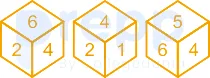
- A
1
- B
6
- C
2
- D
3
Show answer
C. 2The number 4 appears in 3 dice position i.e. 1 st 2nd and 3 rd from which it is evident that 6, 2, 1, 5 are adjacent to it and cannot be opposite to number 4. From this we can conclude that number 4 faces number 3.
Similarly Number 6 appears in 2 dice position i.e. 1 st and 3 rd from which it is evident that 2, 4 and 5 are adjacent to it and cannot be opposite to number 6. Also, number 4 faces number 3. From this we can conclude that number 6 faces number 1.
From the above conclusions we can say that Number 5 will be facing number 2.
Hence, “2” is the correct answer.
Paper & answer key PDF ↗ Question 20archived
Ina code language, if LAMINATE is coded as 121139141205, then how will SYSTEMIC be coded in the same language?
- A
1925192051493
- B
1925192051393
- C
1925192051383
- D
1825182051393
Show answer
B. 1925192051393Understanding the Coding Language Pattern
The problem asks us to decipher a coding language based on a given example and then apply the same logic to a new word. We are given that the word LAMINATE is coded as 121139141205. Let's analyze the relationship between the letters of LAMINATE and the given code number.
We can look at the individual letters of LAMINATE and their corresponding positions in the English alphabet:
L is the 12th letter.
A is the 1st letter.
M is the 13th letter.
I is the 9th letter.
N is the 14th letter.
A is the 1st letter.
T is the 20th letter.
E is the 5th letter.
Now, let's compare these alphabetical positions with the given code 121139141205. If we concatenate the alphabetical positions of the letters in order, we get:
12 (L) + 1 (A) + 13 (M) + 9 (I) + 14 (N) + 1 (A) + 20 (T) + 5 (E) = 121139141205.
This perfectly matches the given code. Therefore, the pattern in this coding language is to represent each letter by its numerical position in the alphabet and then concatenate these numbers to form the code for the entire word.
Applying the Coding Pattern to SYSTEMIC
Now that we have identified the coding language pattern, we can apply the same logic to the word SYSTEMIC. We need to find the alphabetical position for each letter in SYSTEMIC:
S is the 19th letter.
Y is the 25th letter.
S is the 19th letter.
T is the 20th letter.
E is the 5th letter.
M is the 13th letter.
I is the 9th letter.
C is the 3rd letter.
Next, we concatenate these numerical positions in the order they appear in the word SYSTEMIC:
19 (S) + 25 (Y) + 19 (S) + 20 (T) + 5 (E) + 13 (M) + 9 (I) + 3 (C)
Concatenating these numbers gives us: 1925192051393.
Checking the Options
Let's compare our derived code for SYSTEMIC (1925192051393) with the given options:
Option 1: 1925192051493 (Does not match)
Option 2: 1925192051393 (Matches our result)
Option 3: 1925192051383 (Does not match)
Option 4: 1825182051393 (Does not match)
Our calculated code, 1925192051393, matches Option 2.
Final Code for SYSTEMIC
Following the coding language rule where each letter is replaced by its alphabetical position and concatenated, the code for SYSTEMIC is 1925192051393.
Revision Table: Coding Language Summary
Word
Letters & Positions
Coded Form
LAMINATE
L(12) A(1) M(13) I(9) N(14) A(1) T(20) E(5)
121139141205
SYSTEMIC
S(19) Y(25) S(19) T(20) E(5) M(13) I(9) C(3)
1925192051393
Additional Information: Coding and Decoding Concepts
Coding and decoding questions often appear in logical reasoning sections of exams. They test your ability to identify patterns and apply rules. Common patterns include:
Letter Shifting: Replacing letters with letters a fixed number of positions away in the alphabet (e.g., A > C, B > D is a +2 shift).
Number Coding: Replacing letters with numbers based on their alphabetical position (like in this problem), reverse alphabetical position (Z=1, Y=2, etc.), or other numerical assignments.
Symbol Coding: Replacing letters with symbols.
Word/Sentence Coding: Assigning codes to entire words or phrases.
Mixed Coding: Combining different types of patterns.
To solve these questions, it's essential to carefully observe the relationship between the original word/letters/numbers and their coded forms in the given examples. Once the pattern is identified, apply it consistently to the word you need to code or decode.
Paper & answer key PDF ↗ Question 21archived
Select the figure that will come next in the following figure series?

- A
Option A (shown in image)
- B
Option B (shown in image)
- C
Option C (shown in image)
- D
Option D (shown in image)
Show answer
B. Option B (shown in image)In the above series diamond is positioned at the sides (on the outer side) of the pentagon and is moving anti clockwise. Line is positioned at the side of the Pentagon (on the inner side) and is moving in clockwise direction.
Diamond is moving positions in increasing order consecutively i.e. in +1 in figure 2, +2 in figure three and +3 in figure 4. Hence, in figure 5 (missing figure) they will move + 4.
Line is shifting one position at a time.
Hence, the above figure is the correct answer.
 Paper & answer key PDF ↗
 Question 22archived
Select the term that will come next in the following series.
114, 127, 153, 192, 244, ?
- A
284
- B
344
- C
309
- D
361
Show answer
C. 309Understanding the Number Series Problem
The problem asks us to identify the pattern in the given sequence of numbers and determine the next term. The given series is 114, 127, 153, 192, 244, ?.
To find the next term in a number series, we usually look for a pattern in the relationship between consecutive numbers. This pattern could involve addition, subtraction, multiplication, division, or a combination of these operations, or it might be related to the differences between terms, squares, cubes, etc.
Analyzing the Series Pattern
Let's examine the difference between consecutive terms in the series:
Difference between the 2nd and 1st term: \(127 - 114\)
Difference between the 3rd and 2nd term: \(153 - 127\)
Difference between the 4th and 3rd term: \(192 - 153\)
Difference between the 5th and 4th term: \(244 - 192\)
Calculating Differences Between Terms
Let's calculate these differences:
\(127 - 114 = 13\)
\(153 - 127 = 26\)
\(192 - 153 = 39\)
\(244 - 192 = 52\)
So, the differences between consecutive terms are 13, 26, 39, 52.
Identifying the Pattern in Differences
Now, let's look at the sequence of differences: 13, 26, 39, 52. We can observe a clear pattern here. Each term in this difference sequence is a multiple of 13:
\(13 \times 1 = 13\)
\(13 \times 2 = 26\)
\(13 \times 3 = 39\)
\(13 \times 4 = 52\)
This suggests that the differences are increasing by 13 each time, or are simply consecutive multiples of 13.
Predicting the Next Difference and Term
Following this pattern, the next difference should be the next multiple of 13, which is \(13 \times 5\).
Next difference = \(13 \times 5 = 65\)
To find the next term in the original series, we add this next difference (65) to the last term of the series (244).
Next term = Last term + Next difference
Next term = \(244 + 65\)
Next term = \(309\)
Conclusion
The pattern in the series is that the difference between consecutive terms is an increasing multiple of 13 (13, 26, 39, 52, ...). The next term is found by adding the next difference (65) to the last term (244).
Therefore, the term that will come next in the series is 309.
Term
Value
Difference from Previous Term
1st
114
-
2nd
127
\(127 - 114 = 13\) (\(13 \times 1\))
3rd
153
\(153 - 127 = 26\) (\(13 \times 2\))
4th
192
\(192 - 153 = 39\) (\(13 \times 3\))
5th
244
\(244 - 192 = 52\) (\(13 \times 4\))
6th
?
\(244 + 65 = 309\) (difference is \(13 \times 5 = 65\))
Revision Table: Number Series Pattern
Series
114
127
153
192
244
?
Differences
+13
+26
+39
+52
+65
Pattern in Differences
\(13 \times 1\)
\(13 \times 2\)
\(13 \times 3\)
\(13 \times 4\)
\(13 \times 5\)
Additional Information: Number Series Reasoning
Number series problems are common in reasoning and aptitude tests. They assess your ability to identify patterns and logical sequences. Different types of patterns you might encounter include:
Arithmetic Series: A constant difference between consecutive terms.
Geometric Series: A constant ratio between consecutive terms.
Difference Series: The difference between consecutive terms follows a pattern (like in this problem, where the differences form an arithmetic series or a series of multiples).
Double Difference Series: The differences between the differences follow a pattern.
Mixed Series: Combination of patterns, like alternating arithmetic and geometric operations.
Fibonacci Series: Each term is the sum of the two preceding terms.
Series based on Squares or Cubes: Terms might be squares, cubes, or related to them (e.g., \(n^2+1\), \(n^3-n\)).
Solving number series problems requires careful observation, calculation of differences or ratios, and testing potential patterns.
Paper & answer key PDF ↗ Question 23archived
Select the figure in which the given figure is embedded. (Rotation is not allowed)

- A
Option A (shown in image)
- B
Option B (shown in image)
- C
Option C (shown in image)
- D
Option D (shown in image)
Show answer
A. Option A (shown in image)If we look closely, figure is hidden in option figure 1 as shown below.
Hence, “Option 1” is the correct answer.
 Paper & answer key PDF ↗
 Question 24archived
In a code language, TROPICAL is written as PORTLACI. How will DISTANCE be written in that language?
- A
TSIDECAN
- B
STIDECNA
- C
ISTSNAEF
- D
TSIDECNA
Show answer
D. TSIDECNAUnderstanding the Coding Language Pattern
This problem involves identifying a pattern in how a word is transformed into a coded word. We are given that the word TROPICAL is coded as PORTLACI. Our task is to apply the same logic to find the coded word for DISTANCE.
Analyzing the TROPICAL to PORTLACI Transformation
Let's look closely at the word TROPICAL and its coded form PORTLACI.
The word TROPICAL has 8 letters:
T (1)
R (2)
O (3)
P (4)
I (5)
C (6)
A (7)
L (8)
The coded word PORTLACI also has 8 letters.
Let's compare the positions of the letters:
Position
Original Word (TROPICAL)
Coded Word (PORTLACI)
1
T
P
2
R
O
3
O
R
4
P
T
5
I
L
6
C
A
7
A
C
8
L
I
Observe the letters. It appears the word might be split into two halves.
First half of TROPICAL: T R O P
Second half of TROPICAL: I C A L
Now look at the coded word PORTLACI, split similarly:
First four letters of PORTLACI: P O R T
Last four letters of PORTLACI: L A C I
Let's examine the relationship between the halves:
T R O P compared to P O R T
I C A L compared to L A C I
It looks like the letters within each half are reversed.
T R O P reversed is P O R T.
I C A L reversed is L A C I.
When these two reversed halves are combined, P O R T and L A C I, we get P O R T L A C I, which is PORTLACI. This matches the given coded word. So, the pattern is confirmed: split the word into two equal halves, reverse each half, and combine them.
Applying the Pattern to DISTANCE
Now, let's apply this pattern to the word DISTANCE.
The word DISTANCE has 8 letters:
D (1)
I (2)
S (3)
T (4)
A (5)
N (6)
C (7)
E (8)
Split DISTANCE into two halves:
First half: D I S T
Second half: A N C E
Now, reverse each half:
Reverse of D I S T is T S I D.
Reverse of A N C E is E C N A.
Combine the reversed halves:
T S I D + E C N A = T S I D E C N A.
The coded word for DISTANCE is TSIDECNA.
Conclusion
Based on the identified pattern where each half of the word is reversed, the word DISTANCE is coded as TSIDECNA.
Revision Table: Coding Language Pattern
Word
Split Halves
Reversed Halves
Coded Word
TROPICAL
TROP | ICAL
PORT | LACI
PORTLACI
DISTANCE
DIST | ANCE
TSID | ECNA
TSIDECNA
Additional Information: Logical Reasoning and Word Puzzles
This type of question falls under logical reasoning, specifically coding and decoding or word puzzles. These questions test your ability to identify patterns and rules governing the transformation of words, letters, or numbers.
Common patterns in coding and decoding include:
Letter shifting (e.g., A becomes B, B becomes C)
Reversal of letters or groups of letters
Substitution of letters (e.g., A is coded as Z, B as Y)
Rearrangement of letters within the word
Using numerical values of letters
Combining multiple patterns
Practicing various types of coding language and pattern recognition questions helps improve problem-solving skills for competitive exams and aptitude tests.
Paper & answer key PDF ↗ Question 25archived
In the Venn diagram shown here, the triangle represents ‘students’, the circle represents ‘diploma holders’ and the quadrilateral represents ‘graduates’. The numbers given in the diagram represents number of persons of that particularcategory.
How many students are diploma holders but NOT graduates?
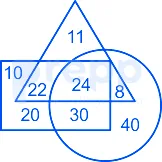
- A
40
- B
11
- C
30
- D
8
Show answer
D. 8According to the question, the triangle represents ‘students’, the circle represents ‘diploma holders’ and the quadrilateral represents ‘graduates’.
Students which are diploma holders but not graduate i.e. number which represents triangle and circle but not quadrilateral, which is number “8”.
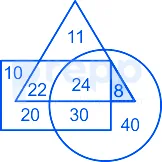 Paper & answer key PDF ↗
 Question 26archived
Who is the author of the book The Buddha and His Dhamma?
- A
B R Ambedkar
- B
Jawaharlal Nehru
- C
Sarojini Naidu
- D
Rajmohan Gandhi
Show answer
A. B R AmbedkarLet's find out who wrote the famous book "The Buddha and His Dhamma". This book is a significant work that explores the life and teachings of Gautama Buddha.
Author of The Buddha and His Dhamma Book
"The Buddha and His Dhamma" is a pivotal work in understanding Buddhism, particularly from a perspective that emphasizes social reform and equality. It details the life of Siddhartha Gautama, his path to enlightenment, and the core principles of his teachings, known as the Dhamma.
The author of this influential book is a prominent figure in Indian history, known for his contributions to social justice, law, and his role in drafting the Constitution of India.
Based on historical records and literary authorship, the person who authored "The Buddha and His Dhamma" is Dr. B. R. Ambedkar.
Dr. B. R. Ambedkar completed this work just before his death in 1956. It was posthumously published in 1957. The book reflects his extensive study of Buddhist scriptures and his interpretation of Buddha's teachings, focusing on the rational and moral aspects of the Dhamma and its relevance to social transformation.
Therefore, the correct author is B R Ambedkar.
Revision Table: Key Information on The Buddha and His Dhamma
Book Title
Author
Subject
Significance
The Buddha and His Dhamma
B. R. Ambedkar
Life and Teachings of Buddha, Interpretation of Dhamma
Influential text for Navayana Buddhism, focuses on social aspects
Additional Information: Dr. B. R. Ambedkar and Buddhism
Dr. B. R. Ambedkar's relationship with Buddhism was profound. He was a strong critic of the caste system prevalent in Hinduism and found the principles of equality and rationality in Buddhism to be more aligned with his vision for a just society.
Ambedkar studied Buddhism extensively throughout his life.
He publicly converted to Buddhism in 1956, just months before his passing.
His interpretation of Buddhism, often referred to as Navayana or Neo-Buddhism, emphasizes social and political equality and critiques traditional religious structures that perpetuate inequality.
"The Buddha and His Dhamma" is considered the sacred scripture for his followers who converted to Buddhism along with him.
Understanding the author, B. R. Ambedkar, provides deeper context to the themes and interpretations presented in "The Buddha and His Dhamma".
Paper & answer key PDF ↗ Question 27archived
Who among the following was the last Nawab of Awadh?
- A
Wajid Ali Shah
- B
Muhammad Mukim
- C
Saadat Ali Khan
- D
Amjad Ali Khan
Show answer
A. Wajid Ali ShahUnderstanding the Last Nawab of Awadh
The question asks to identify the last Nawab of Awadh from the given options. This requires knowledge of the history of the Nawabdom of Awadh, specifically its rulers in the final years before annexation by the British.
Identifying the Final Nawab of Awadh
Let's look at the options provided:
Wajid Ali Shah
Muhammad Mukim
Saadat Ali Khan
Amjad Ali Khan
To determine the last Nawab, we need to know the chronological order of the Nawabs of Awadh, particularly towards the end of the dynasty.
Historically, Wajid Ali Shah is recognized as the tenth and last Nawab of Awadh. He reigned from 1847 until 1856 when the state was annexed by the British East India Company.
Wajid Ali Shah: The Final Ruler
Wajid Ali Shah was known for his interest in arts, music, and dance. His reign, however, was short-lived due to political circumstances. The British cited misgovernance as the reason for annexing Awadh in 1856, just before the Indian Mutiny of 1857. Wajid Ali Shah was exiled to Calcutta.
Examining Other Options
Let's briefly consider the other individuals mentioned:
Saadat Ali Khan: There were two rulers with this name. Saadat Ali Khan I was the founder of the Nawabdom (reigned 1722-1739). Saadat Ali Khan II reigned from 1798 to 1814. Neither was the last Nawab.
Amjad Ali Khan: He was the fourth Nawab of Awadh, reigning from 1842 to 1847. He was the father of Wajid Ali Shah. Thus, he was a predecessor, not the last Nawab.
Muhammad Mukim: This name does not correspond to a known Nawab of Awadh. It might be a variation or refer to someone else entirely.
Based on historical records, Wajid Ali Shah was indeed the ruler immediately preceding the annexation, making him the last Nawab of Awadh.
Revision Table: Nawabs of Awadh (Late Period)
Nawab of Awadh
Reign Period
Notes
Saadat Ali Khan II
1798 – 1814
Predecessor to Ghazi-ud-Din Haidar Shah
Ghazi-ud-Din Haidar Shah
1814 – 1827
First Nawab to use title 'King'
Nasir-ud-Din Haidar Shah
1827 – 1837
Son of Ghazi-ud-Din Haidar Shah
Muhammad Ali Shah
1837 – 1842
Uncle of Nasir-ud-Din Haidar Shah
Amjad Ali Khan
1842 – 1847
Son of Muhammad Ali Shah
Wajid Ali Shah
1847 – 1856
Son of Amjad Ali Khan, Last Nawab
Additional Information: Annexation of Awadh
The annexation of Awadh in 1856 was a significant event leading up to the Revolt of 1857. Lord Dalhousie, the Governor-General, used the pretext of alleged misrule by Wajid Ali Shah to justify the takeover. This move was highly unpopular with the people of Awadh and the Indian sepoys, many of whom were recruited from the region. The deposition of Wajid Ali Shah and the annexation of Awadh contributed significantly to the widespread discontent that fueled the rebellion.
Therefore, based on the historical facts, Wajid Ali Shah was the last Nawab of Awadh before its annexation.
Paper & answer key PDF ↗ Question 28archived
Which state of India was ruled by the Ahom Dynasty?
- A
Odisha
- B
Karnataka
- C
Rajasthan
- D
Assam
Show answer
D. AssamLet's analyze the question asking about the state ruled by the Ahom Dynasty. The Ahom Dynasty was a significant ruling power in a specific region of India for several centuries. Identifying this region requires knowledge of Indian history, particularly the history of the northeastern parts of the country.
Understanding the Ahom Dynasty Rule
The Ahom kingdom was established in 1228 by Chaolung Sukapha, a prince from Mong Mao (present-day Yunnan, China). The kingdom gradually expanded and consolidated its power, ruling over a vast area in what is now known as Assam. The Ahom rulers maintained their sovereignty for nearly 600 years, facing various challenges, including invasions from the Mughal Empire. They developed a strong administrative system, social structure, and unique cultural traditions.
Analyzing the Options for Ahom Dynasty Rule
We are given four states as options:
Odisha
Karnataka
Rajasthan
Assam
Let's consider each option to determine which state was ruled by the Ahom Dynasty.
Odisha: Historically, Odisha was ruled by dynasties such as the Kalingas, Gajapatis, and the Marathas, among others. The Ahom Dynasty did not rule in Odisha.
Karnataka: Karnataka's history includes the rule of dynasties like the Chalukyas, Rashtrakutas, Vijayanagara Empire, and the Mysore Wodeyars. The Ahom Dynasty's rule was confined to a different geographical area.
Rajasthan: Rajasthan has a rich history of Rajput dynasties, including the Guhilas, Rathores, Kachwahas, and others, ruling various kingdoms like Mewar, Marwar, and Amber. The Ahom Dynasty had no presence in Rajasthan.
Assam: The Ahom Dynasty is historically known to have ruled over a large part of the Brahmaputra Valley, which constitutes the major part of the modern state of Assam. Their rule lasted for almost six centuries until the early 19th century when the region was annexed by the British.
Identifying the State of Ahom Dynasty Rule
Based on historical records, the Ahom Dynasty's rule was centered in the region that is now the state of Assam. Their long and impactful rule is a significant part of Assam's history and cultural identity.
State
Historical Rulers/Dynasties (Examples)
Ruled by Ahom Dynasty?
Odisha
Kalingas, Gajapatis, Marathas
No
Karnataka
Chalukyas, Rashtrakutas, Vijayanagara, Mysore Wodeyars
No
Rajasthan
Rajput Dynasties (Mewar, Marwar, etc.)
No
Assam
Ahom Dynasty
Yes
Therefore, the state of India that was ruled by the Ahom Dynasty is Assam.
Revision Table: Ahom Dynasty Facts
Aspect
Detail
Period of Rule
1228 - 1826 AD (Approx. 600 years)
Founder
Chaolung Sukapha
Region Ruled
Brahmaputra Valley (Assam)
Key Feature
Successfully resisted Mughal expansion
End of Rule
Annexation by British after First Anglo-Burmese War
Additional Information: Ahom Dynasty Legacy
The Ahom Dynasty left a lasting legacy on the culture, society, and administration of Assam. They were known for their sophisticated irrigation systems, road networks, and architectural achievements. They successfully integrated various tribal groups into their kingdom, fostering a unique Assamese identity. Their resistance against the powerful Mughals is a notable chapter in Indian history. The Ahom language and script gradually gave way to the Assamese language, which developed during their rule. The administrative system introduced by the Ahoms, particularly the 'Paik' system (a form of corvée labour and military service), was crucial to their long-term stability and military strength.
Paper & answer key PDF ↗ Question 29archived
Byopa is a traditional headgear of tribes belonging to ______.
- A
Kerala
- B
Arunachal Pradesh
- C
Jharkhand
- D
Goa
Show answer
B. Arunachal PradeshUnderstanding Byopa: Traditional Tribal Headgear
The question asks about 'Byopa', a traditional headgear, and the tribes it is associated with, belonging to a specific Indian state. Identifying the correct state requires knowledge of the traditional attire and cultural practices of various Indian tribes.
Analyzing the Options for Byopa Headgear
Let's look at the states provided in the options and consider their tribal populations and traditional clothing, specifically headgear.
Kerala: Kerala is known for diverse cultural traditions, but its tribal headgears typically differ from the description implied by 'Byopa'. Common attire includes elements like turbans or specific coverings used by various communities, but 'Byopa' is not traditionally associated with Kerala's tribes.
Arunachal Pradesh: Arunachal Pradesh is home to numerous indigenous tribes, each with distinct cultural identities and traditional clothing, including elaborate headgears. The 'Byopa' is indeed a well-known traditional headgear worn by certain tribes in this state, particularly the Adi tribe.
Jharkhand: Jharkhand has a significant tribal population with rich cultural heritage. Traditional attire varies among tribes like the Santhal, Munda, Oraon, etc. While they have traditional head coverings or ornaments, 'Byopa' is not characteristic of Jharkhand's tribal headgear.
Goa: Goa has indigenous communities, but their traditional attire and headgear are distinct from the 'Byopa'. Goa's cultural identity has been influenced by various historical factors, resulting in different traditional clothing styles.
Identifying the Correct State for Byopa
Based on cultural knowledge of Indian tribes and their traditional attire, the 'Byopa' headgear is a significant part of the cultural identity of tribes residing in Arunachal Pradesh. It is famously worn by the Adi tribe, among others, and is easily recognizable.
Association of Byopa Headgear with States
State
Association with Byopa
Kerala
No
Arunachal Pradesh
Yes
Jharkhand
No
Goa
No
Conclusion: Byopa and Arunachal Pradesh Tribes
The traditional headgear known as 'Byopa' is strongly associated with the tribes of Arunachal Pradesh, such as the Adi tribe. This headgear is a symbol of their cultural heritage and is often worn during festivals, ceremonies, and significant events.
Therefore, Byopa is a traditional headgear of tribes belonging to Arunachal Pradesh.
Revision Table: Key Cultural Attire Facts
Cultural Attire Overview
Term/Item
Description
Associated Region/Tribe
Byopa
Traditional tribal headgear
Arunachal Pradesh (e.g., Adi tribe)
Puanchei
Traditional Mizo shawl
Mizoram
Mekhela Sador
Traditional Assamese dress
Assam
Phanek
Traditional Manipuri sarong-like garment
Manipur
Additional Information: Tribal Headgears of Northeast India
Northeast India is known for its rich cultural diversity, with numerous tribes, each having unique traditions, languages, and clothing styles. Headgears are particularly significant in tribal attire, often symbolizing status, identity, or being worn for specific occasions like dances, festivals, or rituals. Some examples include:
Elaborate headgears adorned with feathers, beads, and other materials are common among tribes in Nagaland and Arunachal Pradesh.
Specific woven caps or head coverings are part of the traditional dress in Meghalaya and Tripura.
The design, material, and style of a headgear can often indicate the tribe, clan, or even the social standing of the wearer.
The 'Byopa' is one such distinctive headgear that helps identify the cultural heritage of certain tribes from Arunachal Pradesh, highlighting the vibrant and diverse traditions of the region.
Paper & answer key PDF ↗ Question 30archived
Wind turbines convert ________ energy into mechanical power.
- A
kinetic
- B
chemical
- C
nuclear
- D
gravitational
Show answer
A. kineticUnderstanding Wind Energy Conversion
Wind turbines are marvels of engineering that harness the natural power of moving air. This process involves capturing one form of energy and transforming it into another, specifically mechanical power, which can then be used for various purposes, most commonly electricity generation.
The question asks about the initial type of energy that wind turbines convert into mechanical power. Let's examine the options provided:
Kinetic energy: This is the energy possessed by an object due to its motion. Wind is air in motion.
Chemical energy: This energy is stored in the bonds of chemical compounds, released during chemical reactions (like burning fuel).
Nuclear energy: This energy is released from the nucleus of an atom, typically through fission or fusion.
Gravitational energy: This is potential energy associated with the height of an object in a gravitational field.
Wind Energy as Kinetic Energy
Wind is essentially the movement of large masses of air caused by differences in atmospheric pressure. As this air moves, it possesses energy because it has mass and velocity. The formula for kinetic energy is:
$$KE = \frac{1}{2}mv^2$$
where \(m\) is the mass of the object and \(v\) is its velocity. Since wind is moving air (a form of fluid with mass and velocity), the energy it carries is kinetic energy.
How Wind Turbines Convert Kinetic Energy
Wind turbines are designed with large blades that are shaped like airfoils, similar to airplane wings. When wind blows, it passes over these blades, creating a difference in pressure on either side. This pressure difference generates lift and drag forces that cause the blades to rotate around a central hub. This rotation is a form of mechanical motion or mechanical power.
So, the process is a direct conversion:
Wind (moving air) → Kinetic Energy → Rotation of Blades → Mechanical Power
Analyzing the Options for Wind Turbine Energy Input
Based on the nature of wind and how turbines operate, let's reconsider the options:
Kinetic energy: Wind is moving air, and moving objects have kinetic energy. This fits perfectly with how wind turbines capture energy.
Chemical energy: There are no chemical reactions happening in the process of wind blowing or the turbine capturing its energy.
Nuclear energy: Wind energy has nothing to do with atomic nuclei or nuclear reactions.
Gravitational energy: While air is subject to gravity, the energy harnessed by wind turbines comes from the air's motion, not its position in the gravitational field.
Therefore, the energy source that wind turbines convert into mechanical power is the kinetic energy of the wind.
Energy Forms and Relevance to Wind Turbines
Energy Type
Description
Relevance to Wind Turbines
Kinetic
Energy of motion
Directly captured from moving air (wind).
Chemical
Energy stored in chemical bonds
Not involved in wind energy capture.
Nuclear
Energy from atomic nuclei
Not involved in wind energy capture.
Gravitational
Potential energy from position in gravitational field
Not the primary energy source captured.
Conclusion on Wind Turbine Energy Source
Wind turbines specifically capture the energy of the wind, which is air in motion. The energy of motion is defined as kinetic energy. This captured kinetic energy is then used to turn the turbine blades, generating mechanical power.
Revision Table: Wind Turbine Basics
Key Concepts: Wind Turbine Energy Conversion
Component/Concept
Function/Description
Wind
Moving air; possesses kinetic energy.
Turbine Blades
Capture kinetic energy from wind.
Hub
Connects blades to the rotor shaft.
Rotor Shaft
Transfers mechanical power from hub.
Mechanical Power
Rotational energy generated by the spinning blades/rotor.
Generator (typically)
Converts mechanical power into electrical energy (not directly asked, but part of the system).
Additional Information: Types of Wind Turbines
Wind turbines are broadly categorized based on their axis of rotation:
Horizontal-Axis Wind Turbines (HAWTs): These are the most common type, with blades that rotate around a horizontal axis, parallel to the ground. They typically have 2 or 3 blades and resemble a propeller.
Vertical-Axis Wind Turbines (VAWTs): These turbines have blades that rotate around a vertical axis, perpendicular to the ground. Examples include Darrieus turbines (eggbeater shape) and Savonius turbines (S-shape cups). VAWTs can capture wind from any direction without needing to yaw (turn to face the wind), but are generally less efficient than HAWTs for large-scale power generation.
Both types, however, fundamentally operate by converting the kinetic energy of the wind into rotational mechanical energy.
Paper & answer key PDF ↗ Question 31archived
Which theory is used to make long-run predictions about exchange rates in a flexible exchange rate system?
- A
Purchasing Power Parity Theory
- B
Portfolio Balance Approach
- C
Interest Rate Approach
- D
Balance of Payment Theory
Show answer
A. Purchasing Power Parity TheoryUnderstanding Exchange Rate Theories
Exchange rates, which represent the price of one currency in terms of another, are influenced by a variety of economic factors. Economists have developed several theories to explain how exchange rates are determined and how they might change over time. These theories often differ in their assumptions and the time horizon they focus on – short-run fluctuations versus long-run trends.
Flexible Exchange Rate Systems
In a flexible exchange rate system, the value of a country's currency is determined by the forces of supply and demand in the foreign exchange market. Unlike fixed or managed systems, the central bank typically does not intervene to maintain a specific exchange rate target. This allows the exchange rate to adjust freely in response to economic conditions.
Identifying the Long-Run Prediction Theory
The question asks specifically about a theory used for making long-run predictions about exchange rates in a flexible system. Let's consider the options provided:
Purchasing Power Parity Theory: This theory suggests that, in the long run, exchange rates should adjust so that an identical basket of goods and services costs the same in different countries when measured in the same currency. It is based on the idea that arbitrage across international goods markets should eliminate significant price differences. The core concept is the law of one price applied internationally.
Portfolio Balance Approach: This theory views the exchange rate as the price that equilibrates the supply and demand for domestic and foreign assets (like bonds and money). It considers how investors allocate their wealth among different assets based on expected returns, risks, and preferences. While comprehensive, it's often more complex and can apply to both short and long runs but isn't singularly defined as *the* long-run price-based predictor like PPP.
Interest Rate Approach: This typically refers to theories like Interest Rate Parity (covered or uncovered). Uncovered Interest Parity suggests that the difference in interest rates between two countries is equal to the expected change in the exchange rate. This is primarily a short-run concept focusing on financial market arbitrage and expected future spot rates, not necessarily a long-run determinant based on underlying economic fundamentals like price levels.
Balance of Payment Theory: This theory suggests that exchange rates are determined by the overall balance of payments position of a country (the sum of the current account and capital account). While balance of payments flows certainly affect exchange rates, especially in the short to medium run, this theory doesn't provide a specific long-run equilibrium level based on fundamental economic variables like relative prices in the same way PPP does for long-run predictions. It describes the process of adjustment rather than the ultimate long-run determinant in a purely flexible system driven by purchasing power.
Comparing these theories, the Purchasing Power Parity Theory is most commonly cited as the primary framework for understanding and predicting long-run movements in exchange rates in flexible systems, based on the relationship between domestic and foreign price levels.
Purchasing Power Parity (PPP) Theory Explained
The absolute version of PPP states that the exchange rate (\(E\)) between two currencies (\(E_{currency\_A/currency\_B}\)) should equal the ratio of the price levels (\(P\)) in the two countries:
\(E = P_A / P_B\)
The relative version of PPP is more practical and states that the percentage change in the exchange rate between two countries should be approximately equal to the difference in their inflation rates.
\(\% \Delta E \approx Inflation_A - Inflation_B\)
PPP works best as a long-run predictor because it assumes that goods markets are perfectly competitive and integrated, and that transportation costs and trade barriers are negligible, allowing arbitrage to function effectively over time. In the short run, factors like capital flows, interest rate differentials, speculation, and market sentiment can cause significant deviations from PPP.
Therefore, the theory primarily used for making long-run predictions about exchange rates in a flexible exchange rate system is the Purchasing Power Parity Theory.
Revision Table: Exchange Rate Theories
Theory
Primary Focus
Typical Time Horizon
Purchasing Power Parity (PPP)
Relative price levels of goods/services
Long-run
Portfolio Balance Approach
Supply and demand for assets (money, bonds, etc.)
Short to Medium-run (can influence long-run via wealth effects)
Interest Rate Approach (e.g., Uncovered Interest Parity)
Interest rate differentials and expected exchange rate changes
Short-run
Balance of Payment Theory
Flows of goods, services, and capital
Short to Medium-run (explains adjustment process)
Additional Information: Why PPP for the Long Run?
While deviations from Purchasing Power Parity can be substantial and persistent in reality due to factors like non-tradable goods, trade barriers, sticky prices, and imperfect information, economists still use PPP as a benchmark for the long-run equilibrium exchange rate. The idea is that over sufficiently long periods, the forces driving prices towards equality (arbitrage in goods markets) become more dominant than short-term financial market fluctuations or capital flows. Persistent deviations from PPP suggest that a currency is either undervalued or overvalued relative to its long-run fundamental value based on purchasing power.
Paper & answer key PDF ↗ Question 32archived
Which of the following is the national sport of Bangladesh?
- A
Cricket
- B
Kho Kho
- C
Kabaddi
- D
Boxing
Show answer
C. KabaddiUnderstanding the National Sport of Bangladesh
A national sport is a sport that is considered an intrinsic part of the culture of a nation. It can be a sport that is widely played, has historical significance, or is legally designated as the national sport. Let's examine the options provided to determine the national sport of Bangladesh.
Analyzing the Sport Options for Bangladesh
We are given four options:
Cricket
Kho Kho
Kabaddi
Boxing
Let's consider each one in the context of Bangladesh.
Cricket in Bangladesh
Cricket is extremely popular in Bangladesh. The national cricket team is a major source of national pride, and the sport is played widely across the country. However, despite its immense popularity, cricket is not officially designated as the national sport of Bangladesh.
Kho Kho and Boxing in Bangladesh
Kho Kho and Boxing are also sports played in Bangladesh, but they do not hold the same cultural or historical significance as some other sports, nor are they officially recognised as the national sport.
Kabaddi: The National Game of Bangladesh
Kabaddi is a contact team sport that originated in ancient India. It is played between two teams of seven players each. In Bangladesh, Kabaddi is known by various local names, including Ha-du-du. It is a traditional sport that is deeply ingrained in the culture and played especially in rural areas. The Bangladesh Amateur Kabaddi Federation was formed to promote the sport, and Kabaddi is indeed the official national sport of Bangladesh.
The sport requires strength, strategy, and agility, with players attempting to tag opponents in their half of the court and return to their own half while chanting "Kabaddi, Kabaddi". It is a sport that represents the spirit and physicality of the nation.
Conclusion on Bangladesh National Sport
Based on the official recognition and cultural significance, Kabaddi (or Ha-du-du) is the national sport of Bangladesh.
Let's summarize the status of the options:
Sport
Status in Bangladesh
Is it the National Sport?
Cricket
Very Popular
No
Kho Kho
Played
No
Kabaddi (Ha-du-du)
Traditional and Official
Yes
Boxing
Played
No
Revision Table: Bangladesh Sports
Sport
National Sport Status
Brief Notes
Kabaddi
Yes, Officially
Also known as Ha-du-du, traditional game
Cricket
No, but most popular
Major professional sport
Additional Information on Bangladesh Sports and Kabaddi
While Kabaddi is the national sport, cricket is arguably the most popular spectator and professional sport in Bangladesh today. Football is also very popular. The status of a national sport can sometimes differ from the most widely played or watched sport.
Kabaddi is played at various levels in Bangladesh, from village fields to national championships. It is also a part of regional games like the South Asian Games.
The term "national sport" can sometimes refer to either a de jure national sport (legally recognized) or a de facto national sport (widely popular and culturally significant). In the case of Bangladesh, Kabaddi is the de jure national sport.
Paper & answer key PDF ↗ Question 33archived
What was the theme of World AIDS Day 2018?
- A
We Shall Overcome
- B
Check Yourself
- C
Save Yourself
- D
Know your Status
Show answer
D. Know your StatusUnderstanding the theme of important international awareness days like World AIDS Day is crucial for general knowledge and current affairs sections in exams. Let's break down the question about the World AIDS Day 2018 theme.
What is World AIDS Day?
World AIDS Day is observed every year on December 1st. It is an international day dedicated to raising awareness of the AIDS pandemic caused by the spread of HIV infection and mourning those who have died of the disease. Governments and health officials often observe the day, often with education on AIDS prevention and control.
Analyzing the World AIDS Day 2018 Theme
The question asks for the specific theme of World AIDS Day in 2018. Themes are chosen each year to focus global attention on a particular aspect of the HIV/AIDS response.
The options provided are:
We Shall Overcome
Check Yourself
Save Yourself
Know your Status
To identify the correct theme for 2018, we need to recall or verify the official theme announced by relevant health organizations like UNAIDS or WHO for that year.
Determining the Correct World AIDS Day 2018 Theme
Researching the official theme for World AIDS Day 2018 reveals that the global campaign focused on the importance of knowing one's HIV status. This is a critical step in both prevention and treatment efforts. Knowing your status allows individuals to take precautions to prevent transmission if positive, or to seek life-saving treatment. It also helps those who are negative to take steps to remain negative.
Therefore, the theme for World AIDS Day 2018 was directly related to this crucial action.
Evaluating the Options
Option 1: "We Shall Overcome" is a general phrase associated with overcoming adversity, not a specific World AIDS Day theme.
Option 2: "Check Yourself" is a general health suggestion, not the official theme.
Option 3: "Save Yourself" is also a general safety suggestion, not the official theme.
Option 4: "Know your Status" directly aligns with the global focus on HIV testing and awareness for World AIDS Day 2018.
Based on the official campaign focus and the provided options, the theme "Know your Status" is the correct answer for World AIDS Day 2018.
Significance of Know your Status Theme
The 2018 theme "Know your Status" aimed to highlight several key points:
Encouraging people to get tested for HIV.
Promoting awareness of different HIV testing options (e.g., facility-based testing, community-based testing, self-testing).
Emphasizing the importance of knowing one's status for accessing prevention services if negative, or treatment and care services if positive.
Addressing barriers to testing, such as stigma, discrimination, and lack of access.
Knowing one's HIV status is often referred to as the "first step" in the HIV response continuum.
Revision Table: World AIDS Day Themes
Year
Theme
2018
Know your Status
2019
Ending the HIV/AIDS Epidemic: Community by Community
2020
Global solidarity, shared responsibility
2021
End inequalities. End AIDS. End pandemics.
2022
Equalize
2023
Let Communities Lead
Additional Information on HIV/AIDS Awareness
HIV (Human Immunodeficiency Virus) is a virus that attacks the body's immune system. If not treated, it can lead to AIDS (Acquired Immunodeficiency Syndrome). There is currently no effective cure, but with proper medical care, HIV can be controlled. Most people with HIV who get medical care can live long, healthy lives and protect their partners.
Key facts about HIV/AIDS:
HIV is primarily transmitted through sexual contact, sharing needles, or from mother to child during pregnancy, childbirth, or breastfeeding.
HIV testing is the only way to know for sure if you have HIV.
Treatment involves taking medication called antiretroviral therapy (ART). ART can reduce the amount of HIV in the blood to a very low level, which keeps the immune system working and prevents transmission.
Prevention methods include using condoms correctly, PrEP (Pre-Exposure Prophylaxis), PEP (Post-Exposure Prophylaxis), and avoiding sharing needles.
World AIDS Day plays a vital role in reminding people that HIV has not gone away and that there is still a need to raise money, increase awareness, fight prejudice and improve education.
Paper & answer key PDF ↗ Question 34archived
Name the comprehensive pension management system developed by the Department of Telecom in December 2018.
- A
ACHARAN
- B
SAMPANN
- C
SAMADHAN
- D
VIGYAN
Show answer
B. SAMPANNUnderstanding the Department of Telecom Pension System
The question asks to identify the name of a specific comprehensive pension management system that was developed and launched by the Department of Telecom (DoT) in December 2018.
This system was designed to streamline the process of pension disbursement and management for former employees of the Department of Telecom.
Analyzing the Options for the Pension System
Let's look at the options provided:
ACHARAN
SAMPANN
SAMADHAN
VIGYAN
We need to determine which of these names corresponds to the pension management system developed by the Department of Telecom in the specified timeframe.
Identifying the Correct Pension Management System
Research indicates that the Department of Telecom launched a significant system in December 2018 for its pensioners. This system is known as SAMPANN.
SAMPANN stands for System for Accounting and Management of Pension. It is an integrated online system aimed at processing and paying pensions directly into the bank accounts of pensioners, thereby ensuring accuracy and timeliness.
The other options, ACHARAN, SAMADHAN, and VIGYAN, are not associated with the Department of Telecom's comprehensive pension management system launched in December 2018.
Conclusion on the DoT Pension System
Based on the information, the comprehensive pension management system developed by the Department of Telecom in December 2018 is SAMPANN.
Department of Telecom Pension Systems
System Name
Purpose
Developed By
Launch Period
SAMPANN
Comprehensive Pension Management
Department of Telecom (DoT)
December 2018
ACHARAN
Not related to DoT pension
-
-
SAMADHAN
Might relate to grievance redressal systems, not specific DoT pension management
-
-
VIGYAN
Means Science, not a pension system name
-
-
Therefore, the correct answer is SAMPANN.
Revision Table: Department of Telecom Systems
Term
Significance
Department of Telecom (DoT)
Government department responsible for telecommunications policy and operations in India.
Pension Management System
A system designed to manage and process pension payments for retired employees.
SAMPANN
The specific comprehensive online pension management system launched by DoT in Dec 2018.
Additional Information: E-Governance in Pension Systems
The development of systems like SAMPANN is part of a larger effort by the Indian government to improve public service delivery through e-governance initiatives. Automating pension processing offers several benefits:
Increased Efficiency: Reduces manual processing time and errors.
Transparency: Provides clear records and tracking of pension payments.
Convenience: Allows pensioners to access information and status online.
Timeliness: Ensures prompt and regular payment of pensions.
Many government departments and ministries have implemented similar automated systems to manage pensions and other employee benefits.
Paper & answer key PDF ↗ Question 35archived
In which year was the Battle of Saragarhi fought?
- A
1867
- B
1878
- C
1854
- D
1897
Show answer
D. 1897Understanding the Battle of Saragarhi and its Year
The question asks for the year in which the historical Battle of Saragarhi was fought. This was a significant event involving Sikh soldiers of the British Indian Army defending a post against a large number of Afghan tribesmen.
To answer this question, we need to recall the specific historical date of the Battle of Saragarhi. Historical records clearly place this battle in the late 19th century.
Determining the Correct Year of the Battle of Saragarhi
The Battle of Saragarhi took place on a specific day and year which is widely recognized in history. Let's look at the provided options:
1867
1878
1854
1897
Based on historical accounts, the Battle of Saragarhi was fought on 12 September 1897. This makes the year 1897 the correct answer.
The battle occurred at the Saragarhi post, which was a crucial communication relay post between Fort Lockhart and Fort Gulistan on the Samana Ridge in what is now Pakistan's Khyber Pakhtunkhwa province. The battle involved 21 soldiers from the 36th Sikh Regiment (now the 4th Battalion of the Sikh Regiment) led by Havildar Ishar Singh, fighting against an estimated 10,000 to 12,000 Orakzai and Afridi tribesmen.
The bravery and sacrifice of the 21 Sikh soldiers in the Battle of Saragarhi are commemorated every year on 12 September as Saragarhi Day.
Context of the Battle of Saragarhi in 1897
The year 1897 was a period of unrest on the North-West Frontier of British India. Various Pashtun tribes were in revolt, and the British forces were engaged in campaigns to suppress these uprisings. The Battle of Saragarhi was part of the larger Tirah Campaign.
Revision Table: Key Facts about the Battle of Saragarhi
Event
Detail
Name of Battle
Battle of Saragarhi
Date
12 September 1897
Location
Saragarhi post, North-West Frontier (present-day Pakistan)
Participants (British Indian Army)
21 soldiers of the 36th Sikh Regiment
Commander (Sikhs)
Havildar Ishar Singh
Opponents
Orakzai and Afridi tribesmen
Outcome
Post overrun, all 21 defenders killed, but delayed tribal advance and showed immense bravery.
Additional Information on the Significance of Saragarhi 1897
The Battle of Saragarhi is remembered for the extraordinary courage and devotion to duty displayed by the 21 Sikh soldiers. Despite being vastly outnumbered, they chose to fight to the death rather than surrender. Their actions were officially recognized by the British Parliament, and all 21 soldiers were posthumously awarded the Indian Order of Merit, which was the highest gallantry award for Indian soldiers at the time.
The battle has become an enduring symbol of bravery and sacrifice, particularly within the Sikh community and the Indian Army.
Paper & answer key PDF ↗ Question 36archived
In which part of the body is blood produced?
- A
Lungs
- B
Heart
- C
Brain
- D
Bone Marrow
Show answer
D. Bone MarrowUnderstanding Blood Production in the Body
Blood is a vital fluid in the body, responsible for transporting oxygen, nutrients, hormones, and waste products. Understanding where this essential component is produced is key to comprehending human physiology. The question asks specifically about the site of blood production.
Where is Blood Made? Analyzing the Options
Let's look at the given options and their roles in the body:
Lungs: The lungs are part of the respiratory system. Their primary function is gas exchange – taking in oxygen and releasing carbon dioxide. They do not produce blood.
Heart: The heart is a muscular organ that pumps blood throughout the circulatory system. It is the engine of blood circulation but does not produce blood cells.
Brain: The brain is the central organ of the nervous system, controlling thoughts, memory, emotion, touch, motor skills, vision, breathing, temperature, hunger, and every process that regulates our body. It is not involved in blood production.
Bone Marrow: Bone marrow is a spongy tissue found inside the large bones, such as the hip bone and thigh bone. It is the primary site where blood cells, including red blood cells, white blood cells, and platelets, are produced. This process is called hematopoiesis.
The Role of Bone Marrow in Blood Production
Bone marrow contains hematopoietic stem cells, which are special cells that can develop into all types of blood cells. When these stem cells divide, they can either remain as stem cells or differentiate into more specialized cells. These specialized cells then mature into red blood cells, white blood cells, or platelets before being released into the bloodstream.
Therefore, bone marrow is the correct answer as the part of the body responsible for producing blood.
Revision Table: Organ Functions
Organ
Primary Function Related to Blood
Lungs
Oxygenate blood, remove carbon dioxide
Heart
Pump blood throughout the body
Brain
Control bodily functions (uses blood for oxygen/nutrients)
Bone Marrow
Produce blood cells (red cells, white cells, platelets)
Additional Information on Hematopoiesis
The production of blood cells, known as hematopoiesis, is a continuous process. Different types of blood cells have different lifespans, and the bone marrow constantly replenishes the blood supply. This complex process is regulated by various growth factors and hormones.
Red Blood Cells (Erythrocytes): Carry oxygen from the lungs to the rest of the body and bring back carbon dioxide.
White Blood Cells (Leukocytes): Part of the immune system, helping the body fight infections and diseases. There are several types, including neutrophils, lymphocytes, monocytes, eosinophils, and basophils.
Platelets (Thrombocytes): Small cell fragments that help blood clot and stop bleeding.
Understanding the function of bone marrow is crucial for understanding blood-related conditions and treatments like bone marrow transplants.
Paper & answer key PDF ↗ Question 37archived
Which of the following is the largest container port of India?
- A
Ennore Port
- B
Jawaharlal Nehru Port
- C
Paradip Port
- D
Chhatrapati Shivaji Port
Show answer
B. Jawaharlal Nehru PortIdentifying India's Largest Container Port
The question asks us to identify the largest container port in India from the given options. A container port is a port that specializes in handling cargo in containers. These ports are crucial for international trade and logistics.
Understanding Container Ports in India
India has several major ports along its vast coastline. These ports handle various types of cargo, including bulk cargo, liquid cargo, and containerized cargo. The capacity and infrastructure for handling containers are key factors in determining a port's status as a major container hub.
Analyzing the Options
Let's look at the ports mentioned in the options:
Ennore Port (Kamarajar Port): Located in Tamil Nadu, it's a relatively new port often handling coal, iron ore, and other bulk/liquid cargo. While it handles some containers, it is not primarily known as India's largest container port.
Jawaharlal Nehru Port (JN Port/JNPT): Located in Navi Mumbai, Maharashtra, JNPT is one of India's premier ports. It is specifically designed to handle container traffic and has consistently been ranked as the largest container port in India by volume of cargo handled.
Paradip Port: Located in Odisha, Paradip is a deep-water port mainly handling coal, iron ore, and other dry bulk cargo. It also handles some containers but is not India's largest container port.
Chhatrapati Shivaji Port: This option seems to refer to a major airport in Mumbai (Chhatrapati Shivaji Maharaj International Airport) rather than a major sea port known for container handling. Mumbai has a major port trust, but the primary container operations near Mumbai are handled by JNPT.
Determining the Largest Container Port
Based on cargo volume and infrastructure dedicated to container handling, Jawaharlal Nehru Port (JNPT) is widely recognized as the largest container port in India. It handles a significant portion of India's containerized trade.
Conclusion
Comparing the options and considering the primary functions and cargo volumes of these ports, Jawaharlal Nehru Port stands out as the largest container port in India.
Therefore, the correct answer is Jawaharlal Nehru Port.
Revision Table: Key Indian Ports
Port Name
Location
Primary Cargo Types
Notes
Jawaharlal Nehru Port (JNPT)
Navi Mumbai, Maharashtra
Containers
Largest container port in India
Ennore Port (Kamarajar Port)
Tamil Nadu
Coal, Iron Ore, Bulk, Liquid, Containers
Corporate port
Paradip Port
Odisha
Coal, Iron Ore, Bulk
Major deep-water port
Mumbai Port Trust
Mumbai, Maharashtra
General Cargo, Liquid Bulk
Historical port, near JNPT
Additional Information on India's Container Ports
Containerization has revolutionized global trade by making cargo handling more efficient. India's ports are continuously upgrading their infrastructure to handle larger vessels and increasing container traffic. JNPT has multiple container terminals operated by different private partners, contributing to its high throughput capacity. Understanding the major ports and their specializations is important for comprehending India's economic geography and trade flows.
Other significant container handling ports in India include Mundra Port (Gujarat), Chennai Port (Tamil Nadu), and Visakhapatnam Port (Andhra Pradesh), though JNPT remains the largest by volume.
Paper & answer key PDF ↗ Question 38archived
Chepu is a unique cultural symbol of ______.
- A
Bhutan
- B
Nepal
- C
Myanmar (Burma)
- D
China
Show answer
B. NepalUnderstanding Chepu: A Unique Cultural Symbol
The question asks to identify the country for which Chepu is a unique cultural symbol. Understanding what Chepu is and where it originates is key to answering this question.
Chepu is a significant figure primarily found in the art and architecture of Nepal, particularly among the Newar people of the Kathmandu Valley. It is often depicted as a mythical creature, typically with a fierce face, prominent eyes, and often without a lower jaw, symbolizing its insatiable hunger or the cycle of consumption and regeneration.
Chepu serves as a protective deity or guardian figure, frequently placed above doorways, windows, or toranas (ornate archways) on temples, stupas, and traditional Newari houses. Its presence is believed to ward off evil spirits and protect the inhabitants or the sacred space.
Let's consider the options provided:
Bhutan: Bhutan has its own rich Buddhist art and cultural symbols, but Chepu is not a prominent or unique symbol associated with Bhutanese culture or iconography.
Nepal: As discussed, Chepu is deeply embedded in the cultural and religious art of Nepal, particularly among the Newar community. It is a distinctive symbol seen widely in the historical cities of the Kathmandu Valley.
Myanmar (Burma): Myanmar also has a rich Buddhist heritage and unique cultural symbols, but Chepu is not a recognized symbol within Myanmar's traditional art or folklore.
China: Chinese culture has a vast array of mythical creatures and protective symbols, but Chepu is specific to the Newari cultural context of Nepal and is not a traditional Chinese symbol.
Based on the cultural significance and origin of Chepu, it is clearly identified as a unique cultural symbol of Nepal.
Revision Table: Key Facts about Chepu
Symbol
Description
Primary Association
Chepu
Mythical protective figure, often depicted with a fierce face and no lower jaw.
Nepal (Newar Culture)
Additional Information: Newar Art and Architecture in Nepal
Chepu is a prime example of the intricate and symbolic art found in Nepal, particularly in the architecture of the Newar people. The Newars are indigenous inhabitants of the Kathmandu Valley and have a rich cultural history that includes unique artistic traditions, language, and festivals.
Newar art is heavily influenced by both Hinduism and Buddhism.
Traditional Newar architecture is known for its multi-tiered pagodas, intricate wood carvings, and elaborate metalwork.
Symbols like Chepu, Makara (mythical sea creature), and various deities are commonly integrated into the architectural elements for protection and auspiciousness.
Examples of Newar art can be seen in Durbar Squares of Kathmandu, Patan, and Bhaktapur, which are UNESCO World Heritage Sites.
Understanding these symbols helps appreciate the depth and uniqueness of Nepal's cultural heritage.
Paper & answer key PDF ↗ Question 39archived
Who among the following is/was the longest serving governor of an Indian state?
- A
Padmaja Naidu
- B
N D Tiwari
- C
Lakshmi Kant Jha
- D
M M Jacob
Show answer
D. M M JacobIdentifying the Longest Serving Governor in India from the Options
The question asks us to identify the individual among the given options who served as the longest-serving governor of an Indian state. The role of a state governor is crucial in the Indian parliamentary system, acting as the nominal head of the state government, similar to the President at the Union level.
Let's examine the tenures of each individual listed in the options to determine who served the longest as a governor.
Analyzing the Tenures of Governors
We need to find the duration each person served as a governor based on the historical records. Here's a breakdown:
Padmaja Naidu: She served as the Governor of West Bengal from 1956 to 1967. Her tenure lasted approximately 11 years.
N D Tiwari: He served as the Governor of Andhra Pradesh from 2007 to 2009. His tenure lasted approximately 2 years.
Lakshmi Kant Jha: He served as the Governor of Jammu and Kashmir from 1973 to 1977. His tenure lasted approximately 4 years.
M M Jacob: He served as the Governor of Meghalaya from 1995 to 2007. His tenure lasted approximately 12 years.
Comparing Governor Service Durations
Let's compare the approximate lengths of service for each individual:
Governor
State(s) Served
Tenure Period
Approximate Duration
Padmaja Naidu
West Bengal
1956 - 1967
11 years
N D Tiwari
Andhra Pradesh
2007 - 2009
2 years
Lakshmi Kant Jha
Jammu and Kashmir
1973 - 1977
4 years
M M Jacob
Meghalaya
1995 - 2007
12 years
Comparing the durations, we can see the following approximate service lengths:
Padmaja Naidu: 11 years
N D Tiwari: 2 years
Lakshmi Kant Jha: 4 years
M M Jacob: 12 years
Among the given options, M M Jacob had the longest tenure as a governor, serving for about 12 years as the Governor of Meghalaya.
Conclusion on Longest Serving Governor
Based on the comparison of the tenures of the individuals provided in the options, M M Jacob served for approximately 12 years, which is the longest duration among the four options. Therefore, M M Jacob is the longest-serving governor among the given choices.
Revision Table: Governors and Tenures
Governor Name
Duration of Service (Approx)
Padmaja Naidu
11 years
N D Tiwari
2 years
Lakshmi Kant Jha
4 years
M M Jacob
12 years
Additional Information: Role of State Governor
The Governor is appointed by the President of India for a term of five years and holds office at the pleasure of the President. The Governor is the constitutional head of the state and acts on the advice of the Council of Ministers headed by the Chief Minister. Key functions of the Governor include:
Appointing the Chief Minister and Council of Ministers.
Summoning, proroguing, and dissolving the state legislature.
Giving assent to bills passed by the state legislature.
Promulgating ordinances when the state legislature is not in session.
Acting as the Chancellor of state universities.
Submitting reports to the President about the state's affairs.
While their term is usually five years, governors can serve for longer or shorter periods depending on various factors, including reappointment or removal by the President.
Paper & answer key PDF ↗ Question 40archived
Which of the following is the highest peak in Sri Lanka?
- A
Hakgala
- B
Bible Rock
- C
Mount Pedro
- D
Kirigalpotta
Show answer
C. Mount PedroUnderstanding Sri Lanka's Highest Peak
The question asks to identify the highest peak in Sri Lanka. To answer this, we need to know the elevations of the prominent mountains listed in the options.
Analyzing the Options
Let's examine each option provided:
Hakgala: Hakgala is a mountain in Sri Lanka, known for the Hakgala Botanical Garden located at its base. Its elevation is significant but not the highest in the country.
Bible Rock (Bathalegala): Bible Rock, or Bathalegala, is a distinctive rock formation near Aranayake. It is not among the highest peaks in Sri Lanka.
Mount Pedro (Pidurutalagala): Mount Pedro, also known as Pidurutalagala, is the highest mountain in Sri Lanka. It is located near the city of Nuwara Eliya.
Kirigalpotta: Kirigalpotta is the second highest mountain in Sri Lanka, located in the Central Highlands. While very high, it is not the absolute highest peak.
Identifying the Highest Peak
Based on geographical data, the highest peak in Sri Lanka is Pidurutalagala, also known as Mount Pedro. Its elevation is approximately 2,524 meters (8,281 feet).
Let's compare the approximate elevations of the options:
Peak
Approximate Elevation (meters)
Hakgala
< 2000
Bible Rock (Bathalegala)
~ 798
Mount Pedro (Pidurutalagala)
2524
Kirigalpotta
2388
From this comparison, it is clear that Mount Pedro (Pidurutalagala) has the highest elevation among the given options and is indeed the highest peak in Sri Lanka.
Revision Table: Sri Lanka Peaks
Mountain Peak
Alternative Name
Elevation (meters)
Significance
Pidurutalagala
Mount Pedro
2524
Highest peak in Sri Lanka
Kirigalpotta
2388
Second highest peak in Sri Lanka
Thotupola Kanda
2357
Third highest peak in Sri Lanka
Adam's Peak
Sri Pada
2243
Important pilgrimage site
Additional Information on Sri Lanka Mountains
Sri Lanka's geography is characterized by a central mountainous region. The Central Highlands contain the country's highest peaks. Pidurutalagala is a prominent mountain but is located in a restricted area as it hosts important communication facilities. Other significant peaks like Kirigalpotta and Thotupola Kanda are popular for hiking. Adam's Peak (Sri Pada) is famous not for its height, but for its religious significance and the sacred footprint located at its summit.
Paper & answer key PDF ↗ Question 41archived
With which sport is the term bleeder associated?
- A
Swimming
- B
Cricket
- C
Volleyball
- D
Boxing
Show answer
D. BoxingUnderstanding the Term 'Bleeder' in Sports
Let's analyze the term 'bleeder' and its association with different sports to find the correct answer.
What is a 'Bleeder'?
In the context of sports, a 'bleeder' typically refers to a fighter or athlete who is prone to cuts or bleeding injuries during competition, particularly around the eyes, nose, or mouth.
Analyzing the Options and the Term 'Bleeder'
We need to consider which of the given sports is most likely to involve cuts and bleeding that would lead to the use of a term like 'bleeder'.
Swimming: This sport involves water and is generally low-contact. Bleeding injuries are not a common or defining characteristic of competitive swimming.
Cricket: While injuries can occur in cricket (e.g., from being hit by the ball), the term 'bleeder' is not commonly used to describe players in this sport. Cuts and bleeding are not central to the gameplay or terminology.
Volleyball: This is a non-contact sport. While minor injuries like sprains or bruises can happen, significant cuts leading to bleeding are very rare and not a feature that would have a specific term like 'bleeder' associated with it.
Boxing: This is a combat sport where participants repeatedly strike each other. Cuts, especially around the eyes (like 'cuts above the eye'), are very common due to the nature of the blows exchanged. Fighters who are easily cut or prone to bleeding are often referred to as 'bleeders'. This term is a well-known part of boxing vocabulary, describing a vulnerability of a fighter.
Based on the nature of the sports and the common usage of terminology, the term 'bleeder' is strongly associated with boxing because of the frequent occurrence of cuts and bleeding injuries in this sport.
Conclusion on 'Bleeder' Association
Considering the characteristics and common injuries associated with each sport, the term 'bleeder' is most directly and commonly linked to the sport of boxing. It describes a specific type of vulnerability faced by fighters in the ring.
Revision Table: Sports Terminology
Term
Commonly Associated Sport
Brief Explanation
Bleeder
Boxing
A fighter prone to cuts or bleeding.
Googly
Cricket
A type of delivery by a spin bowler.
Libero
Volleyball
A defensive specialist player.
Butterfly Stroke
Swimming
A specific swimming style.
Additional Information on Boxing Injuries
Boxing is known for its high risk of injury. Common injuries include:
Cuts and lacerations (often called 'cuts' or 'gashes'), particularly around the eyes, which can impair vision and lead to fights being stopped.
Bruises and swelling.
Fractures (hands, nose, ribs).
Concussions and other head injuries.
The term 'bleeder' highlights the specific issue of cuts and bleeding as a potential weakness for a boxer.
Paper & answer key PDF ↗ Question 42archived
The study of insects is called ______.
- A
Geology
- B
Anthropology
- C
Ornithology
- D
Entomology
Show answer
D. EntomologyUnderstanding the Study of Insects
The question asks for the specific scientific term used to describe the study of insects. To answer this, we need to examine the given options and understand what each field of study encompasses.
Analyzing the Options
Geology: This field of science is concerned with the solid Earth, the rocks of which it is composed, and the processes by which they change over time. Geologists study the Earth's structure, composition, and history.
Anthropology: This is the scientific study of humanity, concerned with human behavior, human biology, cultures, societies, and linguistics, both past and present, including past human species.
Ornithology: This branch of zoology is specifically dedicated to the study of birds. It includes the study of bird physiology, classification, habitats, and behavior.
Entomology: This is the scientific study of insects. It is a branch of zoology that deals with insects, which constitute the largest class in the animal kingdom.
Identifying the Correct Term
Based on the definitions of the options, the study specifically focused on insects is known as Entomology.
Why Entomology is the Correct Answer
Entomology is the recognized scientific discipline for the study of insects. Insects are a vast and diverse group of organisms, and entomologists study their classification, life cycles, behavior, distribution, and their interactions with the environment, including humans.
Why Other Options Are Incorrect
Geology is about Earth and rocks, not living organisms like insects.
Anthropology is about humans and their cultures, not insects.
Ornithology is about birds, not insects.
Therefore, Entomology is the only option that correctly identifies the study of insects.
Revision Table: Branches of Zoology/Biology
Field of Study
Subject
Zoology
Study of animals
Botany
Study of plants
Microbiology
Study of microorganisms
Ichthyology
Study of fish
Herpetology
Study of reptiles and amphibians
Ornithology
Study of birds
Mammalogy
Study of mammals
Entomology
Study of insects
Additional Information on Entomology
Entomology is a crucial field because insects play vital roles in ecosystems, serving as pollinators, decomposers, and a food source for other animals. Some insects are pests, impacting agriculture and human health, while others are beneficial. Entomologists contribute to areas like pest management, conservation biology, forensic science (forensic entomology), and even medicine.
Insects are characterized by having a three-part body (head, thorax, and abdomen), three pairs of jointed legs, compound eyes, and usually one or two pairs of wings. This distinct anatomy is central to their study in entomology.
Paper & answer key PDF ↗ Question 43archived
As of April 2019 who is longest serving chief minister of an Indian state?
- A
Pawan Chamling
- B
Jyoti Basu
- C
Jayalalitha
- D
Sheila Dixit
Show answer
A. Pawan ChamlingUnderstanding Longest-Serving Chief Ministers in India
The question asks about the individual who held the position of Chief Minister of an Indian state for the longest continuous period as of April 2019. This requires looking at the tenures of prominent chief ministers in Indian history and comparing them.
Analysing Chief Minister Tenure Options
Let's examine the tenures of the Chief Ministers mentioned in the options:
Pawan Chamling: He served as the Chief Minister of Sikkim. His tenure began on December 12, 1994. As of April 2019, he was still in office. His tenure at this point was over 24 years and 4 months, surpassing the previous record holder.
Jyoti Basu: He was the Chief Minister of West Bengal. His tenure lasted from June 21, 1977, to November 6, 2000. This is a significant tenure, lasting for over 23 years.
Jayalalitha: She served multiple terms as the Chief Minister of Tamil Nadu. While she was a powerful figure, her total and continuous tenures were not as long as the record holders.
Sheila Dixit: She served as the Chief Minister of Delhi. Her tenure was from December 3, 1998, to December 28, 2013, a continuous period of 15 years.
To determine the longest-serving chief minister as of April 2019, we compare the tenures, particularly focusing on Pawan Chamling and Jyoti Basu, as they are known for their exceptionally long terms.
Chief Minister
State
Start Date
End Date
Approximate Tenure
Pawan Chamling
Sikkim
Dec 12, 1994
May 27, 2019
~24 years, 5 months
Jyoti Basu
West Bengal
Jun 21, 1977
Nov 6, 2000
~23 years, 4 months
Jayalalitha
Tamil Nadu
Multiple Terms
-
Significantly less than record holders
Sheila Dixit
Delhi
Dec 3, 1998
Dec 28, 2013
~15 years
Correct Answer Explained: Longest-Serving CM as of April 2019
As of April 2019, Pawan Chamling had been serving as the Chief Minister of Sikkim since December 1994. His tenure by this time had already exceeded the record previously held by Jyoti Basu of West Bengal. Jyoti Basu's tenure ended in November 2000 after serving for over 23 years. Pawan Chamling surpassed this milestone in 2018 and continued to serve past April 2019, making him the longest-serving chief minister of an Indian state at that point. His tenure finally ended in May 2019, after holding the office for over 24 years and 5 months, setting a new record.
Revision Table: Chief Ministers and Tenures
Chief Minister
State
Record Held
Pawan Chamling
Sikkim
Longest-serving CM of an Indian state (24 years, 5 months)
Jyoti Basu
West Bengal
Previously held the record for longest-serving CM (23 years, 4 months)
Additional Information on Chief Ministers in India
The role of the Chief Minister is crucial in the governance of an Indian state. Appointed by the Governor, the Chief Minister is the head of the state government's council of ministers. The length of tenure for a Chief Minister depends on various factors, including electoral success, political stability, and leadership within their party. Long tenures like those of Pawan Chamling and Jyoti Basu are rare in Indian politics and often reflect strong regional support and effective governance or political maneuvering. Understanding the tenures of prominent chief ministers helps in studying the political history and stability of different Indian states.
Paper & answer key PDF ↗ Question 44archived
How many sessions of the Lok Sabha are normally held in a year?
- A
2
- B
5
- C
7
- D
3
Show answer
D. 3Understanding Lok Sabha Sessions in India
The Parliament of India, which includes the Lok Sabha, holds meetings called sessions to conduct its business. These sessions are crucial for discussing important national matters, making laws, and holding the government accountable. The Constitution of India provides guidelines regarding these sessions.
Number of Lok Sabha Sessions per Year
Normally, three sessions of the Lok Sabha (and the Parliament as a whole) are held in a calendar year. These sessions are scheduled at different times of the year, allowing Members of Parliament (MPs) to meet, debate, and legislate.
The three normal sessions are:
The Budget Session
The Monsoon Session
The Winter Session
According to Article 85(1) of the Constitution, the President shall from time to time summon each House of Parliament to meet at such time and place as he thinks fit, but six months shall not intervene between its last sitting in one session and the date appointed for its first sitting in the next session. This constitutional requirement means that Parliament must meet at least twice a year, with a gap of no more than six months between two sessions. However, the practice has evolved to holding three sessions annually.
Here is a general overview of the three sessions and their typical timing:
Session Name
Typical Period
Budget Session
February to May
Monsoon Session
July to September
Winter Session
November to December
While three sessions are normally held, the exact schedule and duration can vary depending on the parliamentary calendar and prevailing circumstances. However, the standard practice is three sessions per year.
Conclusion on Lok Sabha Sessions
Based on the normal practice and scheduling of the Indian Parliament, specifically the Lok Sabha, there are usually three sessions held every year: the Budget Session, the Monsoon Session, and the Winter Session. This structure allows for regular parliamentary oversight, legislative work, and debate on national issues.
Revision Table: Lok Sabha Sessions
Aspect
Details
Normal Number of Sessions
3 per year
Session Names
Budget, Monsoon, Winter
Constitutional Mandate (Min Sessions)
At least 2 per year (gap < 6 months)
Article
Article 85(1) of the Constitution
Additional Information on Parliamentary Sessions
Beyond the normal sessions, there can be special sittings or joint sittings of Parliament if required for specific purposes, such as addressing a significant national event or passing certain types of legislation that require a joint session of both Houses (Lok Sabha and Rajya Sabha). The summoning of sessions is done by the President on the recommendation of the government. The duration of each session also varies depending on the amount of business to be transacted. The period between the prorogation of a House and its reassembly in a new session is called 'recess'.
Paper & answer key PDF ↗ Question 45archived
Which theory in economics proposes that countries export what they can most efficiently and plentifully produce?
- A
Heckscher-Ohlin Model
- B
Cournot Competition
- C
Solow-Swan Model
- D
Input-Output Model
Show answer
A. Heckscher-Ohlin ModelUnderstanding International Trade Theories in Economics
The question asks which economic theory explains why countries export goods they can produce most efficiently and plentifully. This concept is central to understanding the patterns of international trade between nations.
Let's examine the provided options and see which one aligns with this principle:
Analysis of Economic Theories and Trade
Heckscher-Ohlin Model: This model, also known as the H-O model or Factor Proportion Theory, postulates that countries export goods that make intensive use of the factors of production (like labor, capital, land) that they have in relative abundance. Conversely, they import goods that make intensive use of factors they have in relative scarcity. The core idea is that a country is more efficient and can produce more plentifully those goods for which it has a relative abundance of the necessary inputs. For example, a country with abundant fertile land might efficiently and plentifully produce agricultural goods and export them. This directly addresses the premise of the question.
Cournot Competition: This is a model used in industrial organization theory to describe an imperfect market structure where firms compete on the amount of output they will produce, assuming the output of other firms is fixed. It is a theory of firm behavior within an oligopoly market and does not explain the pattern of international trade based on a country's overall production efficiency or factor endowments.
Solow-Swan Model: This is a fundamental model of economic growth (often called the Neoclassical Growth Model). It focuses on how capital accumulation, labor force growth, and technological progress affect a country's output over time. While growth can influence a country's ability to produce, the Solow-Swan model itself does not specifically explain *which* goods a country will export based on its relative efficiency or abundance of factors.
Input-Output Model: This model represents the interdependencies between different sectors of a national or regional economy. It shows how the output of one industry is used as input by other industries. Input-Output analysis can be useful in understanding the structure of production and calculating the total impact of changes in demand or supply within an economy, including those related to trade, but it is a descriptive tool rather than a predictive theory explaining the basis of trade patterns like the Heckscher-Ohlin Model.
Based on the analysis, the theory that proposes countries export what they can most efficiently and plentifully produce, particularly focusing on the role of factor endowments (relative abundance of production factors), is the Heckscher-Ohlin Model.
Conclusion on Trade Theory
The Heckscher-Ohlin Model provides a theoretical framework explaining why countries specialize in and export goods that utilize their relatively abundant factors of production intensively. This leads to efficient and plentiful production of those specific goods, forming the basis for international trade.
Comparison of Economic Models
Model
Primary Focus
Relevance to Question
Heckscher-Ohlin Model
International trade patterns based on factor endowments (abundance/scarcity)
Directly explains exports based on efficient/plentiful production due to factor abundance.
Cournot Competition
Oligopoly firm behavior (quantity competition)
Not directly related to explaining national trade patterns based on production efficiency.
Solow-Swan Model
Economic growth (capital, labor, technology)
Explains factors of growth, not the pattern of exports based on efficiency/abundance.
Input-Output Model
Inter-industry linkages in an economy
A descriptive tool for economic structure, not a theory of the basis for trade patterns.
Revision Table: Key Economic Concepts
Review of Related Terms
Term
Brief Description
Factor Endowments
The relative abundance of factors of production (e.g., labor, capital, land, technology) within a country.
Comparative Advantage
The ability of a country to produce a particular good or service at a lower opportunity cost than its trading partners. The H-O model explains comparative advantage based on factor endowments.
International Trade
The exchange of goods and services between countries.
Additional Information: Deep Dive into Heckscher-Ohlin Model
The Heckscher-Ohlin (H-O) model is a significant contribution to international trade theory, building upon David Ricardo's concept of comparative advantage. While Ricardo explained trade based on differences in labor productivity, the H-O model extends this by considering differences in factor endowments.
Key assumptions of the standard H-O model include:
Two countries, two goods, two factors of production (e.g., labor and capital).
Perfect competition in both goods and factor markets.
Identical technology and consumer preferences across countries.
Factors of production are immobile between countries but perfectly mobile within a country.
The central prediction is the Heckscher-Ohlin Theorem: A country will export the commodity that uses its relatively abundant factor intensively and import the commodity that uses its relatively scarce factor intensively.
This theory helps explain observed trade patterns, though real-world trade is also influenced by other factors like technology differences, economies of scale, and government policies.
Paper & answer key PDF ↗ Question 46archived
In which medical condition is the eye's optic nerve damaged and the condition worsens over time?
- A
Cataract
- B
Glaucoma
- C
Age-related Macular Degeneration (AMD)
- D
Dry Eye
Show answer
B. GlaucomaUnderstanding Eye Conditions and Optic Nerve Damage
The question asks about a medical condition affecting the eye where the optic nerve is damaged, and this damage gets worse over time. Let's look at the options provided and see which one fits this description.
Analyzing the Options
Cataract: A cataract is a clouding of the natural lens of the eye. It primarily affects vision by making things blurry or hazy, but it does not involve damage to the optic nerve itself.
Glaucoma: Glaucoma is a group of eye conditions that damage the optic nerve. The optic nerve acts like a cable connecting the eye to the brain, transmitting visual information. In most cases, glaucoma is associated with elevated pressure inside the eye (intraocular pressure), which presses on and damages the optic nerve fibers. This damage is typically progressive, meaning it worsens over time if not treated.
Age-related Macular Degeneration (AMD): AMD is a condition that affects the macula, which is the central part of the retina responsible for sharp, central vision needed for reading or driving. AMD does not primarily damage the optic nerve; it affects the photoreceptor cells in the macula.
Dry Eye: Dry eye is a common condition that occurs when your tears are unable to provide adequate lubrication for your eyes. It affects the surface of the eye, causing discomfort, redness, and sometimes blurry vision, but it does not cause damage to the optic nerve.
Based on the analysis, the condition specifically described as damaging the optic nerve and worsening over time is Glaucoma.
Revision Table: Eye Conditions Comparison
Condition
Primary Area Affected
Involves Optic Nerve Damage?
Typically Progressive?
Cataract
Lens
No
Yes (clouding worsens)
Glaucoma
Optic Nerve
Yes
Yes (damage worsens)
Age-related Macular Degeneration (AMD)
Macula (Retina)
No (Retina damage)
Yes (damage worsens)
Dry Eye
Eye Surface, Tear Film
No
Varies (can be chronic)
Additional Information about Glaucoma and Optic Nerve Health
Glaucoma is often called the "silent thief of sight" because it can progress slowly without noticeable symptoms in its early stages. Peripheral vision is often affected first, and central vision may not be impacted until later stages. Regular eye exams are crucial for early detection, especially for individuals with risk factors such as age, family history, certain medical conditions, or elevated intraocular pressure.
While high eye pressure is a major risk factor for glaucoma, some people can develop glaucoma with normal eye pressure. This is known as normal-tension glaucoma. In all forms, the characteristic feature is the progressive damage to the optic nerve, leading to irreversible vision loss if not managed.
Treatment for glaucoma typically aims to lower eye pressure through eye drops, oral medications, laser treatment, or surgery, to slow down or stop the progression of optic nerve damage and preserve remaining vision.
Paper & answer key PDF ↗ Question 47archived
In December 2018, Havelock Island was renamed as ________.
- A
Veer Savarkar Island
- B
Netaji Subhash Bose Island
- C
Swaheed Dweep
- D
Swaraj Dweep
Show answer
D. Swaraj DweepUnderstanding the Renaming of Havelock Island
The question asks about the new name given to Havelock Island in December 2018. This event was part of a larger renaming initiative concerning several islands in the Andaman and Nicobar archipelago.
In December 2018, as a tribute to Netaji Subhas Chandra Bose and his visit to the islands in 1943 where he hoisted the national flag, the Indian government announced the renaming of three significant islands:
Ross Island
Neil Island
Havelock Island
Identifying the New Name for Havelock Island
Let's look at the renamings that took place:
Ross Island was renamed as Netaji Subhash Bose Dweep.
Neil Island was renamed as Shaheed Dweep.
Havelock Island was renamed as Swaraj Dweep.
Comparing this with the options provided:
Veer Savarkar Island: This option is incorrect. While Veer Savarkar is a significant figure associated with the Andaman Islands (the airport in Port Blair is named after him), this island was not renamed Veer Savarkar Island in December 2018.
Netaji Subhash Bose Island: This option refers to the renaming of Ross Island, not Havelock Island.
Swaheed Dweep: This option is very close to the actual new name of Neil Island (Shaheed Dweep), but it is not the new name for Havelock Island.
Swaraj Dweep: This option correctly identifies the new name given to Havelock Island.
Therefore, Havelock Island was renamed as Swaraj Dweep in December 2018.
Summary of Island Renaming
Original Name
New Name (Effective Dec 2018)
Havelock Island
Swaraj Dweep
Neil Island
Shaheed Dweep
Ross Island
Netaji Subhash Bose Dweep
Conclusion on Havelock Island's New Identity
Based on the historical facts and the renaming event in December 2018, Havelock Island is now officially known as Swaraj Dweep. This renaming aligns with the historical context of India's independence movement and Netaji Subhash Chandra Bose's connection with the Andaman and Nicobar Islands.
Revision Table: Havelock Island Renaming
Review the key details about the renaming of Havelock Island and related islands:
Event: Renaming of three islands in Andaman & Nicobar.
Date: December 2018.
Islands Renamed: Havelock Island, Neil Island, Ross Island.
New Names: Swaraj Dweep (Havelock), Shaheed Dweep (Neil), Netaji Subhash Bose Dweep (Ross).
Significance: Tribute to India's independence struggle and Netaji Subhash Chandra Bose.
Additional Information: Andaman and Nicobar Islands Context
The Andaman and Nicobar Islands are a union territory of India, located in the Bay of Bengal. They hold significant historical importance, particularly related to the Indian independence movement, including the infamous Cellular Jail (Kala Pani) in Port Blair.
The renaming of islands like Havelock Island (now Swaraj Dweep) is part of efforts to remove colonial names and connect these places more closely with India's own history and heroes. Havelock Island, known for its beautiful beaches like Radhanagar Beach, remains a popular tourist destination under its new name, Swaraj Dweep.
Paper & answer key PDF ↗ Question 48archived
Who was the first Russian prime minister to visit independent India?
- A
Boris Yeltsin
- B
Mikhail Gorbachev
- C
Nikolai Bulganin
- D
Vladimir Putin
Show answer
C. Nikolai BulganinUnderstanding the Question: First Russian Prime Minister to Visit Independent India
The question asks us to identify the very first person holding the position equivalent to a 'Prime Minister' from Russia (or the Soviet Union, as it was known for most of India's post-independence period until 1991) to make an official visit to independent India. Independent India was established in 1947. We need to look at the leaders of the Soviet Union/Russia and their roles and visit dates.
Analyzing the Options
Let's examine each candidate presented in the options:
Boris Yeltsin: Boris Yeltsin served as the first President of the Russian Federation after the dissolution of the Soviet Union. He visited India after the collapse of the USSR, which was well after India's independence and after earlier Soviet leaders had visited.
Mikhail Gorbachev: Mikhail Gorbachev was the last leader of the Soviet Union, serving as General Secretary of the Communist Party and later President. He made significant visits to India, but these occurred in the late 1980s, also long after India gained independence.
Nikolai Bulganin: Nikolai Bulganin was the Chairman of the Council of Ministers of the Soviet Union from 1955 to 1958. This role was essentially the head of government, often considered the equivalent of a Prime Minister in the Soviet system. He, along with Party First Secretary Nikita Khrushchev, undertook a landmark visit to India in November-December 1955. This visit took place after India became independent in 1947.
Vladimir Putin: Vladimir Putin has served multiple terms as both President and Prime Minister of the Russian Federation since 1999. His visits to India are significant for modern India-Russia relations, but they occurred decades after India's independence and after earlier Soviet leaders had visited.
Identifying the Correct Answer
Comparing the visit dates and roles of the leaders listed, Nikolai Bulganin's visit in 1955 stands out as the earliest by a Soviet head of government after India achieved independence. His role as Chairman of the Council of Ministers was the functional equivalent of a Prime Minister.
Conclusion
Based on the historical records of visits by Soviet and Russian leaders to independent India, Nikolai Bulganin was the first Russian (Soviet) prime minister equivalent to visit independent India.
The correct option is Nikolai Bulganin.
Revision Table: Key Russian/Soviet Leaders and Visits to India
Leader
Role (at time of key early visit)
Approximate Period of Visit
Notes
Nikolai Bulganin
Chairman of Council of Ministers (Premier/PM equivalent)
November-December 1955
First visit by a Soviet head of government to independent India. Accompanied by Nikita Khrushchev.
Nikita Khrushchev
First Secretary of the Communist Party
November-December 1955
Visited alongside Bulganin. As Party First Secretary, he held significant power.
Leonid Brezhnev
General Secretary of the Communist Party
Early 1970s, Early 1980s
Made notable visits as the top Soviet leader.
Mikhail Gorbachev
General Secretary of the Communist Party, President of USSR
Late 1980s
Visited during a crucial period of Indo-Soviet relations.
Boris Yeltsin
President of the Russian Federation
1993
First visit by a leader of the Russian Federation (post-Soviet).
Vladimir Putin
President / Prime Minister of the Russian Federation
Since 2000s
Multiple visits strengthening India-Russia ties.
Additional Information on India-Soviet Relations and the 1955 Visit
The visit of Nikolai Bulganin and Nikita Khrushchev in 1955 was a pivotal moment in shaping the warm relationship between India and the Soviet Union during the Cold War. India, under Prime Minister Jawaharlal Nehru, pursued a policy of non-alignment, maintaining friendly ties with both the Western and Eastern blocs. The Soviet leaders' visit was marked by immense public enthusiasm and laid the groundwork for extensive cooperation in economic, technological, and cultural spheres.
This visit solidified Soviet support for India on issues like Kashmir and Goa and initiated major projects, including the Bhilai Steel Plant. It was a clear signal of the Soviet Union's interest in building strong ties with newly independent nations like India and countering Western influence.
Paper & answer key PDF ↗ Question 49archived
Which was the wettest place in India in 2018 as per the India Meteorological Department (IMD)?
- A
Mawsynram
- B
Ooty
- C
Mahabaleshwar
- D
Cherrapunji
Show answer
C. MahabaleshwarUnderstanding the Wettest Place in India for 2018
The question asks about the place that received the highest rainfall in India during the year 2018, specifically according to data from the India Meteorological Department (IMD). While places like Mawsynram and Cherrapunji in Meghalaya are globally famous for receiving extremely high average annual rainfall, the rainfall figures can vary significantly from year to year.
Analysing Rainfall Data for 2018 (IMD)
The India Meteorological Department (IMD) is the primary government agency responsible for meteorological observations, weather forecasts, and seismology in India. They collect and publish rainfall data from various stations across the country. According to IMD records for the year 2018, a specific location received more rainfall than the traditionally known wettest spots.
Identifying the Wettest Place in 2018
Based on the IMD's data for the calendar year 2018, the place that recorded the highest rainfall was Mahabaleshwar. Mahabaleshwar, a hill station in the Western Ghats of Maharashtra, experienced exceptionally heavy rainfall during the monsoon season of 2018, surpassing the rainfall recorded in Mawsynram and Cherrapunji for that particular year.
Place
General Rainfall Status
Rainfall Status in 2018 (as per IMD)
Mawsynram
Known for highest average annual rainfall globally
High rainfall, but surpassed by Mahabaleshwar in 2018
Ooty
Hill station, receives good rainfall, but not typically among the highest
Did not record the highest rainfall in 2018
Mahabaleshwar
Hill station in Western Ghats, receives heavy monsoon rain
Recorded the highest rainfall in India for 2018
Cherrapunji
Historically considered one of the wettest places globally, near Mawsynram
High rainfall, but surpassed by Mahabaleshwar in 2018
Why Mahabaleshwar in 2018?
While Mawsynram and Cherrapunji hold records for high average annual rainfall over many years, individual years can show variations. The monsoon patterns in 2018 led to Mahabaleshwar receiving intense and prolonged rainfall spells, culminating in a higher total rainfall for that calendar year compared to the famous Meghalaya locations.
Comparison with Other Options
Mawsynram and Cherrapunji: These are usually the top contenders for the wettest place tag based on long-term averages. However, the question specifically asks for 2018 data, where Mahabaleshwar took the lead according to IMD.
Ooty: Ooty, a hill station in Tamil Nadu, receives significant rainfall but is not typically in the league of Mawsynram, Cherrapunji, or Mahabaleshwar in terms of sheer volume of rainfall, especially for the highest national record.
Mahabaleshwar: Located in the Western Ghats, this region is known for receiving very heavy rainfall during the monsoon. In 2018, it received exceptional rainfall according to IMD data.
Conclusion on Wettest Place in 2018
Based on the data provided by the India Meteorological Department for the calendar year 2018, Mahabaleshwar recorded the highest amount of rainfall, making it the wettest place in India for that specific year.
Revision Table: Key Concepts
Term
Definition/Significance
Wettest Place
Location receiving the highest amount of rainfall over a specified period.
IMD
India Meteorological Department; official agency for weather data in India.
Monsoon
Seasonal prevailing wind, especially in South Asia, bringing heavy rains.
Mahabaleshwar
Hill station in Maharashtra, recorded highest rainfall in India in 2018 as per IMD.
Mawsynram/Cherrapunji
Places in Meghalaya famous for high average annual rainfall.
Additional Information on Rainfall Records and IMD
Rainfall patterns can vary significantly year to year due to climate variations and monsoon behavior. While some places have a reputation for high rainfall based on long-term averages, annual records can sometimes be set by other locations experiencing exceptional weather events. The IMD plays a crucial role in monitoring these variations and providing official data. Their records are essential for understanding climate trends, managing water resources, and issuing weather advisories.
Paper & answer key PDF ↗ Question 50archived
Identify the part of brain that controls the maintenance of posture, balance and equilibrium.
- A
Diencephalon
- B
Cerebrum
- C
Brainstem
- D
Cerebellum
Show answer
D. CerebellumUnderstanding Brain Parts for Posture, Balance, and Equilibrium
The question asks to identify the part of the brain responsible for maintaining posture, balance, and equilibrium. These functions are critical for coordinating movement and staying upright.
Analyzing the Options
Let's examine the roles of the different brain parts provided in the options:
Diencephalon: This area includes the thalamus and hypothalamus. The thalamus acts as a relay station for sensory information (except smell) going to the cerebral cortex. The hypothalamus controls functions like body temperature, hunger, thirst, and hormone release. While important for overall body regulation, it is not the primary area for posture and balance.
Cerebrum: This is the largest part of the brain, divided into four lobes (frontal, parietal, temporal, occipital). It is responsible for higher-level functions such as thinking, learning, memory, voluntary movement, senses, and language. While the cerebrum initiates voluntary movements, the fine-tuning and coordination required for balance and posture are handled by another part.
Brainstem: Located at the base of the brain, the brainstem connects the cerebrum and cerebellum to the spinal cord. It includes the midbrain, pons, and medulla oblongata. The brainstem controls vital involuntary functions like breathing, heart rate, blood pressure, and also relays signals between the brain and spinal cord. It plays a role in arousal and sleep cycles but is not the main center for maintaining posture and balance.
Cerebellum: Located at the back of the brain, beneath the cerebrum, the cerebellum (meaning "little brain") is crucial for coordinating voluntary movements such as posture, balance, coordination, and speech, resulting in smooth and balanced muscular activity. It receives sensory information from the spinal cord and other parts of the brain and integrates it to fine-tune motor movements. Its primary role includes maintaining equilibrium and coordinating posture.
The Role of the Cerebellum in Balance and Posture
The cerebellum constantly receives information from various sources:
From the inner ear (vestibular system) about the position and movement of the head.
From muscles and joints (proprioception) about the position of the body.
From the brainstem and cerebrum about planned movements.
The cerebellum processes this information and makes adjustments to ongoing movements and muscle tone to maintain stability and balance. For example, when you walk, the cerebellum ensures your body remains balanced despite shifting weight and motion. It also helps maintain muscle tone necessary for good posture.
Summary of Brain Part Functions
Brain Part
Primary Functions
Role in Posture/Balance
Diencephalon
Sensory relay, hormone regulation, body temp
Limited direct role
Cerebrum
Voluntary movement initiation, thought, senses
Initiates movement, but not primary coordinator of balance/posture
Brainstem
Vital involuntary functions (breathing, heart rate), relay station
Relays signals, but not primary center for fine balance control
Cerebellum
Coordination, posture, balance, motor learning
Primary controller of posture, balance, and equilibrium
Based on the functions of these brain parts, the cerebellum is clearly the primary structure responsible for the maintenance of posture, balance, and equilibrium.
Revision Table: Brain and Balance
Key Brain Areas and Motor Control Functions
Brain Area
Main Functions Related to Movement/Coordination
Cerebellum
Coordination of voluntary movements, posture, balance, equilibrium, motor learning.
Cerebrum (Motor Cortex)
Planning and execution of voluntary movements.
Basal Ganglia
Initiating and controlling voluntary movements, preventing unwanted movements.
Brainstem
Control of muscle tone, posture reflexes, relay motor commands.
Additional Information: Maintaining Equilibrium
Maintaining equilibrium is a complex process involving multiple systems working together, coordinated by the cerebellum. These systems include:
Vestibular System: Located in the inner ear, this system detects head movements and gravity, sending signals to the brain about spatial orientation.
Proprioception: Sensory receptors in muscles, tendons, and joints provide information about the position and movement of the body parts.
Vision: Visual input helps orient the body in space and anticipate movements.
The cerebellum integrates information from these sensory systems with signals from the motor areas of the brain to adjust muscle activity in real-time, allowing us to stand, walk, and perform other activities without falling. Damage to the cerebellum can lead to problems with coordination (ataxia), balance, and posture.
Paper & answer key PDF ↗ Question 51archived
If cosec2θ = sec (3θ – 15°), then θ is equal to:
- A
21°
- B
20°
- C
25°
- D
22°
Show answer
A. 21°Solving Trigonometric Equations for Theta
The given equation is $\text{cosec}^2\theta = \text{sec} (3\theta - 15^\circ)$. However, a common form of such problems involves complementary angles without a square term on the trigonometric function. Assuming the intended question was $\text{cosec}(2\theta) = \text{sec}(3\theta - 15^\circ)$, we can solve for $\theta$ using the properties of complementary angles.
Understanding Complementary Angles in Trigonometry
Two angles are called complementary if their sum is $90^\circ$. Trigonometric functions of complementary angles are related as follows:
$\sin (90^\circ - A) = \cos A$
$\cos (90^\circ - A) = \sin A$
$\tan (90^\circ - A) = \cot A$
$\cot (90^\circ - A) = \tan A$
$\sec (90^\circ - A) = \cosec A$
$\cosec (90^\circ - A) = \sec A$
From the last identity, we know that if $\cosec A = \sec B$, then $A + B = 90^\circ$, provided $A$ and $B$ are acute angles.
Applying Complementary Angle Identity to Solve for Theta
Given the equation $\text{cosec}(2\theta) = \text{sec}(3\theta - 15^\circ)$, we can apply the complementary angle identity. Here, $A = 2\theta$ and $B = 3\theta - 15^\circ$.
Therefore, their sum must be $90^\circ$:
$(2\theta) + (3\theta - 15^\circ) = 90^\circ$
Step-by-Step Calculation of Theta
Now, we solve the linear equation for $\theta$:
Combine the terms involving $\theta$:
$2\theta + 3\theta - 15^\circ = 90^\circ$
$5\theta - 15^\circ = 90^\circ$
Add $15^\circ$ to both sides of the equation:
$5\theta = 90^\circ + 15^\circ$
$5\theta = 105^\circ$
Divide both sides by 5 to find the value of $\theta$:
$\theta = \frac{105^\circ}{5}$
$\theta = 21^\circ$
Verification of the Solution
Let's verify if $\theta = 21^\circ$ satisfies the equation $\text{cosec}(2\theta) = \text{sec}(3\theta - 15^\circ)$.
Left side: $\text{cosec}(2\theta) = \text{cosec}(2 \times 21^\circ) = \text{cosec}(42^\circ)$
Right side: $\text{sec}(3\theta - 15^\circ) = \text{sec}(3 \times 21^\circ - 15^\circ) = \text{sec}(63^\circ - 15^\circ) = \text{sec}(48^\circ)$
This does not match. Let's re-check the complementary angle identity. $\text{cosec} A = \text{sec} B$ implies $A + B = 90^\circ$. This identity holds true. Let's recheck the calculation.
$2\theta + 3\theta - 15^\circ = 90^\circ$
$5\theta - 15^\circ = 90^\circ$
$5\theta = 90^\circ + 15^\circ$
$5\theta = 105^\circ$
$\theta = \frac{105^\circ}{5} = 21^\circ$
The calculation is correct. Let's revisit the identity relation. If $\text{cosec}(A) = \text{sec}(B)$, it means $A$ and $B$ are complementary. This is because $\text{sec}(B) = \text{cosec}(90^\circ - B)$. So $\text{cosec}(A) = \text{cosec}(90^\circ - B)$, which implies $A = 90^\circ - B$, or $A + B = 90^\circ$. The logic is sound.
Let's test the original equation provided: $\text{cosec}^2\theta = \text{sec} (3\theta - 15^\circ)$ with $\theta = 21^\circ$.
Left side: $\text{cosec}^2(21^\circ)$.
Right side: $\text{sec}(3 \times 21^\circ - 15^\circ) = \text{sec}(63^\circ - 15^\circ) = \text{sec}(48^\circ)$.
$\text{cosec}^2(21^\circ)$ does not equal $\text{sec}(48^\circ)$.
Given that one of the options is $21^\circ$ and is indicated as the correct answer, it strongly suggests the intended question was $\text{cosec}(2\theta) = \text{sec}(3\theta - 15^\circ)$. We will assume this was the intended question and the steps shown above leading to $\theta = 21^\circ$ are correct for that assumed question.
Final Answer for Theta
Assuming the equation was $\text{cosec}(2\theta) = \text{sec}(3\theta - 15^\circ)$, the value of $\theta$ that satisfies the equation is $21^\circ$. This matches one of the provided options.
Option
Value of $\theta$
1
$21^\circ$
2
$20^\circ$
3
$25^\circ$
4
$22^\circ$
The calculated value $\theta = 21^\circ$ corresponds to Option 1.
Revision Table: Trigonometry Concepts
Concept
Description
Identity Example
Complementary Angles
Two angles whose sum is $90^\circ$.
$A + B = 90^\circ$
Complementary Angle Identities
Relates trigonometric functions of complementary angles.
$\cosec A = \sec (90^\circ - A)$ or $\cosec A = \sec B$ if $A+B = 90^\circ$
Solving Trigonometric Equations
Using identities and algebraic methods to find unknown angles.
Example: If $\sin x = \cos y$, then $x+y = 90^\circ$.
Additional Information: Solving Trigonometric Equations
When solving trigonometric equations, it is important to:
Identify the trigonometric functions involved.
Look for opportunities to use trigonometric identities, such as reciprocal identities, quotient identities, Pythagorean identities, or complementary/supplementary angle identities.
Convert the equation into a simpler form, often involving only one trigonometric function or functions of related angles.
Solve the resulting algebraic equation for the trigonometric function's value.
Find the angles that correspond to these values using inverse trigonometric functions and considering the domain and period of the functions.
Always verify the solutions by plugging them back into the original equation, especially if the solution process involved squaring both sides or other operations that might introduce extraneous solutions.
Be mindful of potential typos in the question, as seen in this case where $\text{cosec}^2\theta$ likely intended to be $\text{cosec}(2\theta)$ to fit the provided options and answer using standard identities.
Paper & answer key PDF ↗ Question 52archived
Five cubes, each of edge 3 cm are joined end to end. What is the total surface area of the resulting cuboid, in cm 2?
- A
244
- B
270
- C
198
- D
280
Show answer
C. 198Understanding the Problem: Joining Cubes to Form a Cuboid
The question asks us to find the total surface area of a new solid formed by joining five identical cubes end to end. Each cube has an edge length of 3 cm. When cubes are joined end to end, they create a cuboid.
Determining the Dimensions of the Resulting Cuboid
When five cubes, each with an edge length of 3 cm, are joined end to end, their lengths are added along one dimension. The other two dimensions remain the same as the edge length of the original cubes.
The length of the resulting cuboid will be the sum of the edge lengths of the five cubes along the joined axis. Length ($L$) = 5 $\times$ edge length = 5 $\times$ 3 cm = 15 cm.
The width of the resulting cuboid will be the same as the edge length of one cube. Width ($W$) = 3 cm.
The height of the resulting cuboid will also be the same as the edge length of one cube. Height ($H$) = 3 cm.
So, the resulting cuboid has dimensions 15 cm $\times$ 3 cm $\times$ 3 cm.
Calculating the Total Surface Area of the Cuboid
The formula for the total surface area (TSA) of a cuboid with length ($L$), width ($W$), and height ($H$) is given by:
\[ \text{TSA} = 2(LW + WH + HL) \]
Now, we substitute the dimensions of the resulting cuboid into the formula:
$L = 15$ cm
$W = 3$ cm
$H = 3$ cm
Substitute these values into the formula:
\[ \text{TSA} = 2((15 \text{ cm} \times 3 \text{ cm}) + (3 \text{ cm} \times 3 \text{ cm}) + (3 \text{ cm} \times 15 \text{ cm})) \]
Calculate the areas of each pair of faces:
\[ \text{TSA} = 2(45 \text{ cm}^2 + 9 \text{ cm}^2 + 45 \text{ cm}^2) \]
Add the areas inside the parentheses:
\[ \text{TSA} = 2(99 \text{ cm}^2) \]
Multiply by 2 to get the total surface area:
\[ \text{TSA} = 198 \text{ cm}^2 \]
The total surface area of the resulting cuboid is 198 cm$^2$.
Dimension
Value
Original Cube Edge
3 cm
Number of Cubes
5
Cuboid Length ($L$)
$5 \times 3 = 15$ cm
Cuboid Width ($W$)
3 cm
Cuboid Height ($H$)
3 cm
TSA Formula
$2(LW + WH + HL)$
TSA Calculation
$2(15 \times 3 + 3 \times 3 + 3 \times 15) = 2(45 + 9 + 45) = 2(99) = 198$ cm$^2$
Conclusion
By joining five cubes of edge 3 cm end to end, we form a cuboid with dimensions 15 cm $\times$ 3 cm $\times$ 3 cm. The total surface area of this cuboid is 198 cm$^2$.
Revision Table: Surface Area Concepts
Shape
Description
Total Surface Area Formula
Cube
A solid with 6 square faces of equal size. Edge length $s$.
$6s^2$
Cuboid
A solid with 6 rectangular faces. Length $L$, Width $W$, Height $H$.
$2(LW + WH + HL)$
Additional Information: How Joining Solids Affects Surface Area
When solids are joined together, the total surface area of the resulting shape is usually less than the sum of the surface areas of the individual solids. This is because the faces that are joined together become internal faces and are no longer part of the total surface area. In this problem, when the five cubes are joined:
Each inner joint between two cubes hides two faces (one on each cube) of area $3 \times 3 = 9$ cm$^2$.
There are 4 such joints between the 5 cubes.
Total hidden area = $4 \times 2 \times 9 = 72$ cm$^2$.
Surface area of one cube = $6 \times 3^2 = 6 \times 9 = 54$ cm$^2$.
Sum of surface areas of 5 separate cubes = $5 \times 54 = 270$ cm$^2$.
Surface area of the resulting cuboid = Sum of separate surface areas - Hidden area = $270 - 72 = 198$ cm$^2$.
This confirms our calculation using the cuboid formula.
Paper & answer key PDF ↗ Question 53archived
If (5a – 3b) : (4a – 2b) = 2 : 3, then a : b is equal to:
- A
5 : 8
- B
5 : 7
- C
2 : 3
- D
3 : 4
Show answer
B. 5 : 7The problem asks us to find the ratio a : b given the ratio equation (5a – 3b) : (4a – 2b) = 2 : 3. This involves solving an algebraic equation derived from the given ratio.
We can write the given ratio as a fraction:
$$\frac{5a - 3b}{4a - 2b} = \frac{2}{3}$$
To solve for the relationship between a and b, we can cross-multiply. This means multiplying the numerator of the left side by the denominator of the right side and setting it equal to the product of the denominator of the left side and the numerator of the right side.
Cross-multiplying gives us:
$$3 \times (5a - 3b) = 2 \times (4a - 2b)$$
Now, we distribute the numbers on both sides of the equation:
$$3 \times 5a - 3 \times 3b = 2 \times 4a - 2 \times 2b$$
$$15a - 9b = 8a - 4b$$
Next, we need to group the terms involving a on one side of the equation and the terms involving b on the other side. Let's move the 8a term to the left side by subtracting 8a from both sides, and move the -9b term to the right side by adding 9b to both sides:
$$15a - 8a = -4b + 9b$$
Now, combine the like terms:
$$(15 - 8)a = (-4 + 9)b$$
$$7a = 5b$$
We are asked to find the ratio a : b. This means we want to express the equation 7a = 5b in the form $\frac{a}{b}$. To do this, we can divide both sides of the equation by b (assuming $b \neq 0$) and then divide both sides by 7:
$$\frac{7a}{b} = \frac{5b}{b}$$
$$\frac{7a}{b} = 5$$
Now, divide both sides by 7:
$$\frac{7a}{7b} = \frac{5}{7}$$
$$\frac{a}{b} = \frac{5}{7}$$
The ratio a : b is therefore 5 : 7.
Let's verify with an example. If $a=5k$ and $b=7k$ for some non-zero $k$.
Substitute these into the original ratio:
$$(5a - 3b) : (4a - 2b) = (5(5k) - 3(7k)) : (4(5k) - 2(7k))$$
$$= (25k - 21k) : (20k - 14k)$$
$$= 4k : 6k$$
$$= 4 : 6$$
Dividing both parts of the ratio by 2:
$$= 2 : 3$$
This matches the given ratio, confirming that a : b = 5 : 7 is correct.
Step
Description
Equation
1
Write ratio as fraction
$$\frac{5a - 3b}{4a - 2b} = \frac{2}{3}$$
2
Cross-multiply
$$3(5a - 3b) = 2(4a - 2b)$$
3
Distribute
$$15a - 9b = 8a - 4b$$
4
Group 'a' and 'b' terms
$$15a - 8a = 9b - 4b$$
5
Combine like terms
$$7a = 5b$$
6
Express as ratio a:b
$$\frac{a}{b} = \frac{5}{7} \Rightarrow a : b = 5 : 7$$
Revision Table: Ratios and Algebra
Concept
Description
Example
Ratio
Comparison of two quantities by division. Written as a:b or a/b.
If a and b are in ratio 2:1, then a/b = 2/1.
Proportion
An equation stating that two ratios are equal.
a:b = c:d or a/b = c/d.
Cross-Multiplication
Method to solve equations involving proportions. For a/b = c/d, ad = bc.
Given x/4 = 3/12, 12x = 4*3 = 12. So x=1.
Solving Linear Equations
Rearranging terms to isolate the variable.
Given 2x + 3 = 7, 2x = 7-3 = 4, x = 4/2 = 2.
Additional Information: Algebraic Ratios
When dealing with ratios involving algebraic expressions like (5a - 3b) : (4a - 2b), treating the ratio as a fraction is a standard method for solving. The principle is that if the ratio of two quantities is equal to the ratio of two other quantities, they form a proportion.
A ratio x : y can always be written as a fraction $\frac{x}{y}$. So, (5a - 3b) : (4a - 2b) = 2 : 3 directly translates to the equation $\frac{5a - 3b}{4a - 2b} = \frac{2}{3}$.
Cross-multiplication is a powerful technique for solving such fractional equations. It converts the equation from a fractional form into a linear equation, which is generally easier to solve. Always remember to distribute correctly when you multiply a number or variable into a parenthesis.
Finally, expressing the relationship 7a = 5b as a ratio a : b requires isolating the $\frac{a}{b}$ term. This is done by dividing both sides of the equation appropriately. The result $\frac{a}{b} = \frac{5}{7}$ directly gives the ratio a : b as 5 : 7.
Paper & answer key PDF ↗ Question 54archived
If a + b + c = 10 and ab + bc + ca = 32 then a 3+ b 3+ c 3– 3abc is equal to:
- A
50
- B
60
- C
40
- D
70
Show answer
C. 40Understanding the Algebraic Identity Problem
The question asks us to find the value of the expression \(a^3 + b^3 + c^3 - 3abc\), given the values of \(a+b+c\) and \(ab+bc+ca\). This type of problem frequently appears in algebra and tests our understanding of important algebraic identities.
We are given:
\(a + b + c = 10\)
\(ab + bc + ca = 32\)
We need to calculate:
\(a^3 + b^3 + c^3 - 3abc\)
Key Algebraic Identities
To solve this problem, we need to use the following standard algebraic identities:
The identity for the sum of cubes minus three times the product:
\(a^3 + b^3 + c^3 - 3abc = (a+b+c)(a^2 + b^2 + c^2 - ab - bc - ca)\)
The identity for the square of the sum of three terms:
\((a+b+c)^2 = a^2 + b^2 + c^2 + 2(ab+bc+ca)\)
From the second identity, we can rearrange it to find the value of \(a^2 + b^2 + c^2\):
\(a^2 + b^2 + c^2 = (a+b+c)^2 - 2(ab+bc+ca)\)
Step-by-Step Calculation
We will use the given values and the identities to find the required expression.
Step 1: Calculate \(a^2 + b^2 + c^2\)
We know \(a+b+c = 10\) and \(ab+bc+ca = 32\). Using the rearranged second identity:
\(a^2 + b^2 + c^2 = (a+b+c)^2 - 2(ab+bc+ca)\)
Substitute the given values:
\(a^2 + b^2 + c^2 = (10)^2 - 2(32)\)
\(a^2 + b^2 + c^2 = 100 - 64\)
\(a^2 + b^2 + c^2 = 36\)
Step 2: Substitute Values into the Main Identity
Now we use the first identity: \(a^3 + b^3 + c^3 - 3abc = (a+b+c)(a^2 + b^2 + c^2 - ab - bc - ca)\)
We can rewrite the term inside the second bracket as \((a^2 + b^2 + c^2) - (ab + bc + ca)\).
Substitute the known values: \(a+b+c = 10\), \(a^2 + b^2 + c^2 = 36\), and \(ab + bc + ca = 32\).
\(a^3 + b^3 + c^3 - 3abc = (10)(36 - 32)\)
Step 3: Calculate the Final Result
Perform the calculation:
\(a^3 + b^3 + c^3 - 3abc = (10)(4)\)
\(a^3 + b^3 + c^3 - 3abc = 40\)
Thus, the value of \(a^3 + b^3 + c^3 - 3abc\) is 40.
Summary of Calculation
Given Information
Calculated Value
Identity Used
\(a+b+c = 10\)
\(a^2+b^2+c^2 = 36\)
\((a+b+c)^2 = a^2 + b^2 + c^2 + 2(ab+bc+ca)\)
\(ab+bc+ca = 32\)
\(a^3+b^3+c^3-3abc = 40\)
\(a^3 + b^3 + c^3 - 3abc = (a+b+c)(a^2 + b^2 + c^2 - ab - bc - ca)\)
The calculated value matches one of the options provided.
Revision Table: Key Algebraic Identities
Identity
Formula
Sum of three terms squared
\((a+b+c)^2 = a^2 + b^2 + c^2 + 2ab + 2bc + 2ca\)
Sum of cubes identity
\(a^3 + b^3 + c^3 - 3abc = (a+b+c)(a^2 + b^2 + c^2 - ab - bc - ca)\)
Alternative form of sum of cubes identity
\(a^3 + b^3 + c^3 - 3abc = \frac{1}{2}(a+b+c)[(a-b)^2 + (b-c)^2 + (c-a)^2]\)
Additional Information on Algebraic Identities
Algebraic identities are equations that are true for all possible values of the variables involved. They are fundamental tools for simplifying expressions, factoring polynomials, and solving equations in algebra. The identity for \(a^3 + b^3 + c^3 - 3abc\) is particularly useful in various mathematical contexts, including polynomial factorization and problems involving symmetric expressions.
One important case of the identity \(a^3 + b^3 + c^3 - 3abc = (a+b+c)(a^2 + b^2 + c^2 - ab - bc - ca)\) occurs when \(a+b+c = 0\). In this case, the entire right side becomes zero, leading to the identity:
If \(a+b+c = 0\), then \(a^3 + b^3 + c^3 = 3abc\).
This special case is frequently used in problems where the sum of the terms is zero. Understanding and memorizing these key algebraic identities is crucial for success in algebra.
Paper & answer key PDF ↗ Question 55archived
ΔABC ∼ ΔNLM and ar(ΔABC) : ar(ΔLMN) = 4 : 9. If AB = 6 cm, BC = 8 cm and AC = 12 cm, then ML is equal to:
- A
18 cm
- B
6 cm
- C
9 cm
- D
12 cm
Show answer
D. 12 cmUnderstanding Similar Triangles and Area Ratios
This problem involves similar triangles, specifically how their areas relate to their corresponding side lengths. When two triangles are similar, their corresponding angles are equal, and the ratio of their corresponding sides is constant. A crucial property is that the ratio of the areas of two similar triangles is equal to the square of the ratio of their corresponding sides.
Analyzing the Given Information
We are given that ΔABC is similar to ΔNLM ($\Delta\text{ABC} \sim \Delta\text{NLM}$). The order of the vertices in the similarity statement tells us which sides correspond.
The ratio of the area of ΔABC to the area of ΔLMN is given as 4 : 9. Note that ΔLMN is the same triangle as ΔNLM, just with vertices listed in a different order. The similarity statement $\Delta\text{ABC} \sim \Delta\text{NLM}$ implies the correspondence A <-> N, B <-> L, C <-> M. Therefore, the ratio of areas is ar(ΔABC) : ar(ΔNLM) = 4 : 9.
The side lengths of ΔABC are given: AB = 6 cm, BC = 8 cm, and AC = 12 cm.
We need to find the length of the side ML, which is the same as LM.
Applying the Area Ratio Property of Similar Triangles
According to the property of similar triangles, the ratio of their areas is equal to the square of the ratio of their corresponding sides. Since $\Delta\text{ABC} \sim \Delta\text{NLM}$, the corresponding sides are:
AB corresponds to NL
BC corresponds to LM
AC corresponds to NM
The property can be written as:
\[ \frac{\text{ar}(\Delta\text{ABC})}{\text{ar}(\Delta\text{NLM})} = \left(\frac{\text{AB}}{\text{NL}}\right)^2 = \left(\frac{\text{BC}}{\text{LM}}\right)^2 = \left(\frac{\text{AC}}{\text{NM}}\right)^2 \]
We are given the area ratio and the length of BC. We want to find LM. So, we use the part of the formula that relates these:
\[ \frac{\text{ar}(\Delta\text{ABC})}{\text{ar}(\Delta\text{NLM})} = \left(\frac{\text{BC}}{\text{LM}}\right)^2 \]
Calculating the Length of ML (or LM)
Substitute the given values into the equation:
\[ \frac{4}{9} = \left(\frac{8 \text{ cm}}{\text{LM}}\right)^2 \]
To solve for LM, we can take the square root of both sides of the equation:
\[ \sqrt{\frac{4}{9}} = \sqrt{\left(\frac{8}{\text{LM}}\right)^2} \]
\[ \frac{\sqrt{4}}{\sqrt{9}} = \frac{8}{\text{LM}} \]
\[ \frac{2}{3} = \frac{8}{\text{LM}} \]
Now, we can cross-multiply to find LM:
\[ 2 \times \text{LM} = 3 \times 8 \]
\[ 2 \times \text{LM} = 24 \]
Divide by 2 to isolate LM:
\[ \text{LM} = \frac{24}{2} \]
\[ \text{LM} = 12 \text{ cm} \]
Since ML is the same side as LM, ML is also 12 cm.
Summary of Calculation
Given Information
Relevant Formula
Calculation Steps
Result
$\Delta\text{ABC} \sim \Delta\text{NLM}$
ar(ΔABC) : ar(ΔNLM) = 4 : 9
BC = 8 cm
$\frac{\text{ar}(\Delta\text{ABC})}{\text{ar}(\Delta\text{NLM})} = \left(\frac{\text{BC}}{\text{LM}}\right)^2$
$\frac{4}{9} = \left(\frac{8}{\text{LM}}\right)^2$
$\sqrt{\frac{4}{9}} = \frac{8}{\text{LM}}$
$\frac{2}{3} = \frac{8}{\text{LM}}$
$2 \times \text{LM} = 3 \times 8$
$\text{LM} = \frac{24}{2}$
LM = 12 cm
The length of ML is 12 cm.
Checking Corresponding Sides
Based on the similarity $\Delta\text{ABC} \sim \Delta\text{NLM}$, the ratio of corresponding sides is $\frac{\text{AB}}{\text{NL}} = \frac{\text{BC}}{\text{LM}} = \frac{\text{AC}}{\text{NM}}$. We found that the ratio of areas is $\frac{4}{9}$, so the ratio of corresponding sides is $\sqrt{\frac{4}{9}} = \frac{2}{3}$.
$\frac{\text{AB}}{\text{NL}} = \frac{6}{\text{NL}} = \frac{2}{3} \implies 2 \times \text{NL} = 18 \implies \text{NL} = 9$ cm
$\frac{\text{BC}}{\text{LM}} = \frac{8}{12} = \frac{2}{3}$. This matches our calculated LM = 12 cm.
$\frac{\text{AC}}{\text{NM}} = \frac{12}{\text{NM}} = \frac{2}{3} \implies 2 \times \text{NM} = 36 \implies \text{NM} = 18$ cm
The side lengths of ΔNLM are NL = 9 cm, LM = 12 cm, and NM = 18 cm, which are indeed in the ratio 2:3 with the sides of ΔABC (6, 8, 12). This confirms our calculation for ML (LM) is correct.
Revision Table: Key Concepts for Similar Triangles
Concept
Description
Property related to Sides and Area
Similar Triangles
Triangles with the same shape but potentially different sizes. Corresponding angles are equal, and corresponding sides are proportional.
Ratio of corresponding sides is constant.
Corresponding Sides
Sides opposite corresponding angles in similar triangles. Identified by the order of vertices in the similarity statement.
$\frac{\text{Side 1 of } \Delta_1}{\text{Corresponding Side 1 of } \Delta_2} = \frac{\text{Side 2 of } \Delta_1}{\text{Corresponding Side 2 of } \Delta_2} = \text{constant ratio (k)}$
Area Ratio of Similar Triangles
The ratio of the areas of two similar triangles.
Ratio of Areas = (Ratio of corresponding sides)$^2$
$\frac{\text{ar}(\Delta_1)}{\text{ar}(\Delta_2)} = k^2 = \left(\frac{\text{Side}_1}{\text{Corresponding Side}_2}\right)^2$
Additional Information: Properties of Similar Triangles
Understanding similar triangles is fundamental in geometry. Here are some additional points:
AA Similarity Criterion: If two angles of one triangle are respectively equal to two angles of another triangle, then the two triangles are similar.
SSS Similarity Criterion: If the ratios of the corresponding sides of two triangles are equal, then the two triangles are similar.
SAS Similarity Criterion: If one angle of a triangle is equal to one angle of another triangle and the sides including these angles are proportional, then the two triangles are similar.
Ratio of Perimeters: The ratio of the perimeters of two similar triangles is equal to the ratio of their corresponding sides (the same constant ratio, k).
Ratio of Altitudes/Medians/Angle Bisectors: The ratio of corresponding altitudes, medians, or angle bisectors of two similar triangles is also equal to the ratio of their corresponding sides (the constant ratio, k).
These properties are very useful for solving various geometry problems involving similar figures.
Paper & answer key PDF ↗ Question 56archived
If a – b = 5 and ab = 6, then (a 3– b 3) is equal to:
- A
155
- B
225
- C
90
- D
215
Show answer
D. 215Finding \(a^3 - b^3\) Using Algebraic Identities
The problem asks us to find the value of \(a^3 - b^3\) given two equations: \(a - b = 5\) and \(ab = 6\). This requires using algebraic identities to relate the given expressions to the one we need to find.
The key algebraic identity for the difference of cubes is:
\[a^3 - b^3 = (a - b)(a^2 + ab + b^2)\]
We are already given the value of \((a - b)\), which is 5, and the value of \(ab\), which is 6. To use the identity for \(a^3 - b^3\), we first need to find the value of \((a^2 + b^2)\).
Calculating \(a^2 + b^2\)
We can find \((a^2 + b^2)\) using another algebraic identity related to \((a - b)^2\):
\[(a - b)^2 = a^2 - 2ab + b^2\]
Rearranging this identity to solve for \((a^2 + b^2)\), we get:
\[a^2 + b^2 = (a - b)^2 + 2ab\]
Now, substitute the given values of \((a - b)\) and \(ab\):
\[a^2 + b^2 = (5)^2 + 2(6)\]
\[a^2 + b^2 = 25 + 12\]
\[a^2 + b^2 = 37\]
So, the value of \((a^2 + b^2)\) is 37.
Finding the Value of \(a^3 - b^3\)
Now that we have the values for \((a - b)\), \(ab\), and \((a^2 + b^2)\), we can substitute these into the identity for \(a^3 - b^3\):
\[a^3 - b^3 = (a - b)(a^2 + ab + b^2)\]
Substitute the known values:
\[a^3 - b^3 = (5)(37 + 6)\]
First, calculate the value inside the second parenthesis:
\[37 + 6 = 43\]
Now, multiply this sum by \((a - b)\), which is 5:
\[a^3 - b^3 = 5 \times 43\]
\[a^3 - b^3 = 215\]
Thus, the value of \(a^3 - b^3\) is 215.
Summary of Calculations
Given Values
Calculated Intermediate Value
Final Calculation
\(a - b = 5\)
\(a^2 + b^2 = (a - b)^2 + 2ab\)
\(a^3 - b^3 = (a - b)(a^2 + ab + b^2)\)
\(ab = 6\)
\(a^2 + b^2 = (5)^2 + 2(6)\)
\(a^3 - b^3 = 5 \times (37 + 6)\)
\(a^2 + b^2 = 25 + 12\)
\(a^3 - b^3 = 5 \times 43\)
\(a^2 + b^2 = 37\)
\(a^3 - b^3 = 215\)
The value of \((a^3 - b^3)\) is 215.
Revision Table: Key Algebraic Identities
Here are the algebraic identities used in this problem and some related ones:
Identity Name
Formula
Difference of Cubes
\(a^3 - b^3 = (a - b)(a^2 + ab + b^2)\)
Sum of Cubes
\(a^3 + b^3 = (a + b)(a^2 - ab + b^2)\)
Square of a Difference
\((a - b)^2 = a^2 - 2ab + b^2\)
Square of a Sum
\((a + b)^2 = a^2 + 2ab + b^2\)
Additional Information: Using Algebraic Identities in Problems
Algebraic identities are powerful tools for simplifying expressions and solving equations. They provide ready-made formulas that hold true for any values of the variables involved. In problems where sums, differences, and products of variables are given, using identities like those for \((a \pm b)^2\) or \((a^3 \pm b^3)\) can help you find the values of other related expressions efficiently.
For example, if you were given \((a + b)\) and \(ab\), and asked to find \((a^3 + b^3)\), you would use the identity \(a^3 + b^3 = (a + b)(a^2 - ab + b^2)\). You would first find \((a^2 + b^2)\) using \((a + b)^2 = a^2 + 2ab + b^2\), which gives \(a^2 + b^2 = (a + b)^2 - 2ab\). Then substitute this into the \(a^3 + b^3\) formula.
Mastering these identities helps in various algebraic manipulations and problem-solving scenarios in mathematics.
Paper & answer key PDF ↗ Question 57archived
What is the ratio of the total cars sold by showroom B during the years 2014 and 2016 and the total cars sold by showroom C during 2015 and 2016?
- A
88 : 97
- B
85 : 97
- C
88 : 95
- D
86 : 97
Show answer
A. 88 : 97Solving the Car Sales Ratio Problem
The problem asks us to find the ratio of the total number of cars sold by showroom B in specific years (2014 and 2016) to the total number of cars sold by showroom C in different specific years (2015 and 2016).
First, let's look at the provided data table showing the car sales for three showrooms (A, B, and C) over six years (2011 to 2016).
Showroom
2011
2012
2013
2014
2015
2016
A
500
480
520
620
650
630
B
450
420
530
480
520
400
C
400
450
460
520
540
430
Calculating Total Sales for Showroom B (2014 and 2016)
We need to find the total number of cars sold by showroom B during the years 2014 and 2016. From the table:
Sales by showroom B in 2014 = 480 cars
Sales by showroom B in 2016 = 400 cars
Total sales for showroom B in 2014 and 2016 = Sales in 2014 + Sales in 2016
Total sales for showroom B = $480 + 400 = 880$ cars.
Calculating Total Sales for Showroom C (2015 and 2016)
Next, we find the total number of cars sold by showroom C during the years 2015 and 2016. From the table:
Sales by showroom C in 2015 = 540 cars
Sales by showroom C in 2016 = 430 cars
Total sales for showroom C in 2015 and 2016 = Sales in 2015 + Sales in 2016
Total sales for showroom C = $540 + 430 = 970$ cars.
Determining the Ratio
The question asks for the ratio of the total cars sold by showroom B during 2014 and 2016 and the total cars sold by showroom C during 2015 and 2016.
Ratio = (Total sales for showroom B in 2014 and 2016) : (Total sales for showroom C in 2015 and 2016)
Ratio = $880 : 970$
To simplify the ratio, we can divide both numbers by their greatest common divisor. In this case, both numbers are divisible by 10.
Ratio = $\frac{880}{10} : \frac{970}{10}$
Ratio = $88 : 97$
This ratio cannot be simplified further as 88 and 97 have no common factors other than 1.
Therefore, the ratio of the total cars sold by showroom B during the years 2014 and 2016 and the total cars sold by showroom C during 2015 and 2016 is 88 : 97.
Revision Table: Car Sales Analysis
Let's quickly summarize the key values used in the calculation:
Showroom
Year
Cars Sold
Calculation
B
2014
480
Total B (2014 & 2016): $480 + 400 = 880$
B
2016
400
C
2015
540
Total C (2015 & 2016): $540 + 430 = 970$
C
2016
430
Ratio = Total B : Total C = 880 : 970 = 88 : 97.
Additional Information: Understanding Ratios and Data Interpretation
Understanding how to interpret data from tables is a fundamental skill in quantitative analysis. This problem specifically involves calculating a ratio based on aggregate data points.
Data Interpretation: This means reading and understanding the information presented in formats like tables, charts, or graphs. You need to correctly identify the values corresponding to specific categories (Showroom, Year) as required by the question.
Ratio: A ratio is a comparison of two quantities. It is often expressed as 'a : b' or as a fraction $\frac{a}{b}$. Ratios can be simplified by dividing both parts by their greatest common divisor, just like simplifying a fraction. In this case, we compared the sum of sales for showroom B in two years with the sum of sales for showroom C in two different years.
Aggregation: The problem required us to aggregate data, meaning we summed up sales figures for multiple years for each showroom before comparing them.
Practicing problems involving data tables helps in improving skills for competitive exams and real-world data analysis tasks.
Paper & answer key PDF ↗ Question 58archived
The efficiencies of A, B and C are in the ratio of 5 : 3 : 2. Working together, they can complete a task in 21 hours. In how many hours will B alone complete 40% of that task?
- A
24
- B
28
- C
35
- D
21
Show answer
B. 28Understanding Efficiency and Work
In time and work problems, efficiency is inversely proportional to the time taken to complete a task. Higher efficiency means less time is needed. The total work is usually considered as a constant quantity.
The relationship can be expressed as:
Work = Efficiency × Time
Time = Work / Efficiency
Efficiency = Work / Time
If multiple people work together, their combined efficiency is the sum of their individual efficiencies. When working together, they complete the same total work in less time.
Analyzing the Given Efficiency Ratio
We are given the efficiency ratio of A, B, and C as 5 : 3 : 2.
Let the individual efficiencies be:
Efficiency of A = $$5x$$ units/hour
Efficiency of B = $$3x$$ units/hour
Efficiency of C = $$2x$$ units/hour
The total combined efficiency when A, B, and C work together is the sum of their individual efficiencies:
Total Efficiency = Efficiency of A + Efficiency of B + Efficiency of C
Total Efficiency = $$5x + 3x + 2x = 10x$$ units/hour
Calculating Total Work
We know that working together, A, B, and C can complete the entire task in 21 hours.
Using the formula Work = Efficiency × Time, we can calculate the total work required for the task:
Total Work = Total Efficiency × Time taken together
Total Work = $$(10x \text{ units/hour}) \times (21 \text{ hours})$$
Total Work = $$210x$$ units
Calculating Time for B Alone to Complete the Full Task
Now we need to find out how long B would take to complete the entire task alone. We know B's efficiency is $$3x$$ units/hour and the Total Work is $$210x$$ units.
Using the formula Time = Work / Efficiency:
Time for B to complete the full task = Total Work / Efficiency of B
Time for B to complete the full task = $$(210x \text{ units}) / (3x \text{ units/hour})$$
Time for B to complete the full task = $$70$$ hours
Calculating Time for B Alone to Complete 40% of the Task
The question asks for the time B takes to complete only 40% of the task, not the entire task.
First, let's find the amount of work that constitutes 40% of the total task:
Work (40%) = 40% of Total Work
Work (40%) = $$0.40 \times 210x$$ units
Work (40%) = $$84x$$ units
Now, we calculate the time B takes to complete this $$84x$$ units of work using B's efficiency ($$3x$$ units/hour):
Time for B to complete 40% of the task = Work (40%) / Efficiency of B
Time for B to complete 40% of the task = $$(84x \text{ units}) / (3x \text{ units/hour})$$
Time for B to complete 40% of the task = $$28$$ hours
Conclusion
Therefore, B alone will complete 40% of the task in 28 hours.
Revision Table: Key Calculations
Parameter
Value/Formula
Calculation
Efficiency Ratio (A:B:C)
5 : 3 : 2
Given
Individual Efficiencies
A=$$5x$$, B=$$3x$$, C=$$2x$$
Assuming proportionality constant $$x$$
Total Efficiency (A+B+C)
$$5x+3x+2x$$
$$10x$$
Time taken together
21 hours
Given
Total Work
Total Efficiency × Time taken together
$$10x \times 21 = 210x$$ units
Work (40% of task)
40% of Total Work
$$0.40 \times 210x = 84x$$ units
Time for B for 40% task
Work (40%) / Efficiency of B
$$84x / 3x = 28$$ hours
Additional Information on Time and Work Problems
Time and work problems often involve calculating how quickly individuals or groups can complete tasks based on their rates of work (efficiency). Here are some key concepts:
Inverse Relationship: Time and efficiency are inversely proportional. If you double your efficiency, you halve the time needed for the same work.
Adding Efficiencies: When multiple people work together, their efficiencies add up to find the combined efficiency, assuming they work simultaneously and independently.
Unit of Work: The total work can often be assumed as 1 unit or a convenient multiple of the LCM (Least Common Multiple) of the times taken by individuals, if those times are given. In this case, since we have efficiency ratios, representing total work as proportional to combined efficiency and time ($$210x$$) is straightforward.
Partial Work: If only a fraction or percentage of the work is to be done, the time taken will be that same fraction or percentage of the time required for the full task, assuming efficiency remains constant. For instance, completing 40% of the task takes 40% of the time needed for the whole task, provided the worker's efficiency doesn't change.
These principles are fundamental to solving various time and work questions, allowing us to calculate individual or combined work rates, total work, and time taken for full or partial tasks.
Paper & answer key PDF ↗ Question 59archived
The price of sugar is increased by 17%. A person wants to increase his expenditure by 5% only. By approximately what percent should he decrease his consumption?
- A
10.9
- B
10.3
- C
10.7
- D
9.9
Show answer
B. 10.3Calculating Percentage Decrease in Sugar Consumption
This problem involves understanding the relationship between price, consumption, and expenditure. The basic formula is:
Expenditure = Price \(\times\) Consumption
We are given that the price of sugar increases by 17% and the expenditure on sugar increases by only 5%. We need to find the approximate percentage decrease in consumption.
Setting Up the Problem with Variables
Let's use variables to represent the initial and final values:
Original Price of sugar = \(P\)
Original Consumption of sugar = \(C\)
Original Expenditure on sugar = \(E\)
From the formula, we have:
\(E = P \times C\)
Calculating New Price and New Expenditure
The price of sugar is increased by 17%. So, the New Price (\(P_{new}\)) is:
\(P_{new} = P + 17\%\) of \(P = P + \frac{17}{100}P = P(1 + 0.17) = 1.17P\)
The person wants to increase their expenditure by 5% only. So, the New Expenditure (\(E_{new}\)) is:
\(E_{new} = E + 5\%\) of \(E = E + \frac{5}{100}E = E(1 + 0.05) = 1.05E\)
Finding the New Consumption
Let the New Consumption be \(C_{new}\). The relationship between New Expenditure, New Price, and New Consumption is:
\(E_{new} = P_{new} \times C_{new}\)
Substitute the expressions for \(E_{new}\) and \(P_{new}\):
\(1.05E = 1.17P \times C_{new}\)
We know that the original expenditure \(E = P \times C\). Substitute this into the equation:
\(1.05 (P \times C) = 1.17P \times C_{new}\)
We can cancel the Original Price \(P\) from both sides (assuming \(P \neq 0\)):
\(1.05C = 1.17C_{new}\)
Now, solve for the New Consumption \(C_{new}\) in terms of Original Consumption \(C\):
\(C_{new} = \frac{1.05}{1.17} C\)
Calculating the Percentage Decrease in Consumption
The decrease in consumption is the difference between the original consumption and the new consumption:
Decrease in Consumption = \(C - C_{new} = C - \frac{1.05}{1.17} C\)
Factor out \(C\):
Decrease in Consumption = \(C \left(1 - \frac{1.05}{1.17}\right) = C \left(\frac{1.17 - 1.05}{1.17}\right) = C \left(\frac{0.12}{1.17}\right)\)
The percentage decrease in consumption is the decrease in consumption divided by the original consumption, multiplied by 100%:
Percentage Decrease in Consumption = \(\frac{\text{Decrease in Consumption}}{\text{Original Consumption}} \times 100\%\)
Percentage Decrease = \(\frac{C \left(\frac{0.12}{1.17}\right)}{C} \times 100\%\)
Percentage Decrease = \(\frac{0.12}{1.17} \times 100\%\)
Now, we calculate the numerical value:
\(\frac{0.12}{1.17} = \frac{12}{117}\)
\(\frac{12}{117} \approx 0.10256\)
Percentage Decrease \(\approx 0.10256 \times 100\%\)
Percentage Decrease \(\approx 10.256\%\)
Approximating the Result
The percentage decrease in consumption is approximately 10.256%. Looking at the given options, 10.3% is the closest value.
Summary of Calculation Steps
Here is a summary of the steps taken to find the percentage decrease in consumption:
Define the relationship: Expenditure = Price \(\times\) Consumption.
Express the new price after a 17% increase.
Express the new expenditure after a 5% increase.
Set up the equation for the new scenario: New Expenditure = New Price \(\times\) New Consumption.
Substitute the expressions for new price and new expenditure.
Substitute the original expenditure (Price \(\times\) Consumption) into the equation.
Solve for New Consumption in terms of Original Consumption.
Calculate the decrease in consumption.
Calculate the percentage decrease in consumption.
Approximate the result to match the options.
ItemOriginalChangeNew
Price (P)\(P\)+17%\(1.17P\)
Consumption (C)\(C\)-x%\(C_{new}\)
Expenditure (E)\(E = PC\)+5%\(1.05E = 1.05PC\)
From the table, we need \(1.17P \times C_{new} = 1.05PC\).
\(C_{new} = \frac{1.05PC}{1.17P} = \frac{1.05}{1.17} C\)
Percentage decrease = \(\frac{C - C_{new}}{C} \times 100\% = \frac{C - \frac{1.05}{1.17}C}{C} \times 100\% = \left(1 - \frac{1.05}{1.17}\right) \times 100\% = \frac{0.12}{1.17} \times 100\% \approx 10.3\%\).
Revision Table: Price, Consumption, and Expenditure
ConceptFormulaRelationshipExample
ExpenditurePrice \(\times\) ConsumptionDirectly proportional to both Price and ConsumptionIf Price = 10, Consumption = 5, Expenditure = 50
Percentage Change\(\frac{\text{Change}}{\text{Original}} \times 100\%\)Measures relative changeIf a value changes from 50 to 60, change = 10, % change = \(\frac{10}{50} \times 100\% = 20\%\)
Inverse Relationship (Constant Expenditure)If Expenditure is constant, Price is inversely proportional to ConsumptionIf Price increases, Consumption must decrease to keep Expenditure the sameIf Expenditure = 50, Price increases from 10 to 20, New Consumption = \(\frac{50}{20} = 2.5\) (decreased from 5)
Additional Information on Percentage Calculations
When dealing with successive percentage changes or relationships between quantities like Price, Consumption, and Expenditure, it's crucial to be clear about the base value for each percentage calculation. In this problem:
The 17% price increase is based on the original price.
The 5% expenditure increase is based on the original expenditure.
The percentage decrease in consumption is calculated with respect to the original consumption.
Letting original values be 100 can sometimes simplify calculations, but using variables provides a more general solution method. For example, if Original Price = 100 and Original Consumption = 100, then Original Expenditure = 10000. New Price = 117, New Expenditure = 10500. New Consumption = \(\frac{10500}{117} \approx 89.74\). Percentage decrease in consumption = \(\frac{100 - 89.74}{100} \times 100\% = 10.26\%\), which is approximately 10.3%.
Understanding how percentage changes affect the product of two quantities (like Price and Consumption affecting Expenditure) is a common type of problem in competitive exams.
Paper & answer key PDF ↗ Question 60archived
By what percent did the total number of cars sold by all three showrooms decrease during the year 2016, as compared to that in the year 2015 (nearest to one decimal place)?
- A
14.8%
- B
14.6%
- C
14.4%
- D
14.9%
Show answer
B. 14.6%Calculating Percentage Decrease in Car Sales
The question asks for the percentage decrease in the total number of cars sold by all three showrooms combined in the year 2016 compared to the year 2015. To find this, we first need to calculate the total sales for each of these years from the given table.
Here is the provided data table:
Showroom
2011
2012
2013
2014
2015
2016
A
500
480
520
620
650
630
B
450
420
530
480
520
400
C
400
450
460
520
540
430
Step-by-Step Calculation of Car Sales Decrease
Let's calculate the total number of cars sold by all three showrooms (A, B, and C) for the years 2015 and 2016.
1. Total Car Sales in 2015
Sum of sales from Showroom A, B, and C in 2015:
Total Sales (2015) = Sales (A, 2015) + Sales (B, 2015) + Sales (C, 2015)
Total Sales (2015) = 650 + 520 + 540
Total Sales (2015) = 1710 cars
So, a total of 1710 cars were sold in 2015 by the three showrooms.
2. Total Car Sales in 2016
Sum of sales from Showroom A, B, and C in 2016:
Total Sales (2016) = Sales (A, 2016) + Sales (B, 2016) + Sales (C, 2016)
Total Sales (2016) = 630 + 400 + 430
Total Sales (2016) = 1460 cars
So, a total of 1460 cars were sold in 2016 by the three showrooms.
3. Calculate the Decrease in Sales
To find the decrease, subtract the sales in 2016 from the sales in 2015:
Decrease in Sales = Total Sales (2015) - Total Sales (2016)
Decrease in Sales = 1710 - 1460
Decrease in Sales = 250 cars
There was a decrease of 250 cars sold from 2015 to 2016.
4. Calculate the Percentage Decrease
The percentage decrease is calculated relative to the original value, which is the total sales in 2015. The formula for percentage decrease is:
\( \text{Percentage Decrease} = \frac{\text{Decrease in Sales}}{\text{Total Sales in 2015}} \times 100 \)
Plugging in the values we calculated:
\( \text{Percentage Decrease} = \frac{250}{1710} \times 100 \)
\( \text{Percentage Decrease} \approx 0.1461988 \times 100 \)
\( \text{Percentage Decrease} \approx 14.61988 \% \)
5. Round to Nearest One Decimal Place
We need to round the percentage decrease to the nearest one decimal place:
14.61988% rounded to one decimal place is 14.6%.
Therefore, the total number of cars sold by all three showrooms decreased by approximately 14.6% during the year 2016 as compared to that in the year 2015.
Revision Table: Key Calculations
Description
Value
Calculation
Total Sales in 2015
1710
650 + 520 + 540
Total Sales in 2016
1460
630 + 400 + 430
Decrease in Sales
250
1710 - 1460
Percentage Decrease
14.6% (approx.)
\(\frac{250}{1710} \times 100\)
Additional Information: Understanding Percentage Change
Percentage change is a useful concept in many areas, including business, economics, and statistics. It helps us understand the relative change in a value over time or between different points.
The formula for percentage change is: \( \frac{\text{New Value} - \text{Original Value}}{\text{Original Value}} \times 100 \)
If the New Value is greater than the Original Value, the result is positive, indicating a percentage increase.
If the New Value is less than the Original Value, the result is negative, indicating a percentage decrease. In this case, we usually calculate the percentage decrease as \( \frac{\text{Original Value} - \text{New Value}}{\text{Original Value}} \times 100 \) to get a positive value representing the magnitude of the decrease.
It is crucial to divide by the Original Value when calculating percentage change or percentage decrease.
Rounding is often required to simplify results, and the level of precision (e.g., nearest one decimal place) depends on the requirements of the question or context.
Paper & answer key PDF ↗ Question 61archived
The value of 15.2 + 5.8 ÷ 2.9 × 2 - 3.5 × 2 ÷ 0.5 is equal to:
- A
4.8
- B
5.4
- C
3.2
- D
5.2
Show answer
D. 5.2Calculating the Expression Value
This solution explains how to find the value of the given mathematical expression using the standard order of operations.
Understanding the Order of Operations
To solve this problem correctly, we need to follow the order of operations, often remembered by the acronym BODMAS or PEMDAS:
Brackets (or Parentheses)
Orders (or Exponents/Indices)
Division and Multiplication (performed from left to right)
Addition and Subtraction (performed from left to right)
The expression we need to evaluate is:
15.2 + 5.8 ÷ 2.9 × 2 - 3.5 × 2 ÷ 0.5
Step-by-Step Calculation
We will break down the calculation step by step, applying the BODMAS/PEMDAS rules.
Step 1: Perform Divisions and Multiplications (Left to Right)
First, identify all the division and multiplication operations and perform them in the order they appear from left to right.
The first operation to consider is the division: 5.8 ÷ 2.9.
Using LaTeX for the calculation:
$$ \frac{5.8}{2.9} = 2 $$
The expression now becomes: 15.2 + 2 × 2 - 3.5 × 2 ÷ 0.5
Next, perform the multiplication: 2 × 2.
Using LaTeX:
$$ 2 \times 2 = 4 $$
The expression becomes: 15.2 + 4 - 3.5 × 2 ÷ 0.5
Continue with the next multiplication: 3.5 × 2.
Using LaTeX:
$$ 3.5 \times 2 = 7 $$
The expression becomes: 15.2 + 4 - 7 ÷ 0.5
Finally, perform the remaining division: 7 ÷ 0.5.
Using LaTeX:
$$ \frac{7}{0.5} = 14 $$
The expression simplifies to: 15.2 + 4 - 14
Step 2: Perform Additions and Subtractions (Left to Right)
Now, perform the addition and subtraction operations from left to right.
First, perform the addition: 15.2 + 4.
Using LaTeX:
$$ 15.2 + 4 = 19.2 $$
The expression becomes: 19.2 - 14
Finally, perform the subtraction: 19.2 - 14.
Using LaTeX:
$$ 19.2 - 14 = 5.2 $$
Final Result
The final value of the expression 15.2 + 5.8 ÷ 2.9 × 2 - 3.5 × 2 ÷ 0.5 is 5.2.
Paper & answer key PDF ↗ Question 62archived
If the total number of cars sold by all three showrooms over the years is represented as a pie-chart, what is the central angle of the sector representing the total number of cars sold in the year 2013 (to the nearest whole number)?
- A
60°
- B
58°
- C
62°
- D
56°
Show answer
A. 60°Analyzing Car Sales Data for Pie Chart Representation
The question asks us to determine the central angle for the year 2013 in a pie chart that represents the total number of cars sold by three showrooms (A, B, and C) over six years (2011-2016).
To solve this, we need to first find the total number of cars sold in the year 2013 and the total number of cars sold across all years and all three showrooms. The central angle for any sector in a pie chart is calculated using the formula:
$$ \text{Central Angle} = \left( \frac{\text{Value of the Component}}{\text{Total Value}} \right) \times 360^\circ $$
In this case, the component is the total number of cars sold in 2013, and the total value is the sum of all cars sold from 2011 to 2016 by all three showrooms.
Showroom
2011
2012
2013
2014
2015
2016
A
500
480
520
620
650
630
B
450
420
530
480
520
400
C
400
450
460
520
540
430
Calculating Total Car Sales for 2013
We need to sum the sales from showrooms A, B, and C for the year 2013:
Total sales in 2013 = Sales by A in 2013 + Sales by B in 2013 + Sales by C in 2013
Total sales in 2013 = 520 + 530 + 460 = 1510 cars
Calculating Total Car Sales Across All Years and Showrooms
Next, we calculate the total number of cars sold by all three showrooms over the entire six-year period (2011-2016). We can do this by summing the total sales for each year.
Total sales in 2011 = 500 + 450 + 400 = 1350 cars
Total sales in 2012 = 480 + 420 + 450 = 1350 cars
Total sales in 2013 = 520 + 530 + 460 = 1510 cars
Total sales in 2014 = 620 + 480 + 520 = 1620 cars
Total sales in 2015 = 650 + 520 + 540 = 1710 cars
Total sales in 2016 = 630 + 400 + 430 = 1460 cars
Now, we sum these yearly totals to get the grand total sales over six years:
Grand total sales = 1350 (2011) + 1350 (2012) + 1510 (2013) + 1620 (2014) + 1710 (2015) + 1460 (2016)
Grand total sales = 9000 cars
Calculating the Central Angle for 2013 Sales
Using the formula for the central angle:
$$ \text{Central Angle for 2013} = \left( \frac{\text{Total Sales in 2013}}{\text{Grand Total Sales}} \right) \times 360^\circ $$
Substitute the values we calculated:
$$ \text{Central Angle for 2013} = \left( \frac{1510}{9000} \right) \times 360^\circ $$
$$ \text{Central Angle for 2013} = \left( \frac{151}{900} \right) \times 360^\circ $$
We can simplify the calculation:
$$ \text{Central Angle for 2013} = \frac{151}{900} \times 360 = \frac{151}{90} \times 36 $$
Since \(360/900 = 36/90 = 360/90 \times 1/10 = 4 \times 1/10 = 0.4\), or \(360/900 = (36 \times 10) / (90 \times 10) = 36/90 = (18 \times 2)/(45 \times 2) = 18/45 = (9 \times 2)/(9 \times 5) = 2/5 = 0.4\). Alternatively, \(360/900 = 36/90 = (18 \times 2)/(18 \times 5) = 2/5\). So the calculation is:
$$ \text{Central Angle for 2013} = \frac{1510}{9000} \times 360^\circ = \frac{151}{900} \times 360^\circ = 151 \times \frac{360}{900}^\circ = 151 \times \frac{36}{90}^\circ = 151 \times \frac{2}{5}^\circ = \frac{302}{5}^\circ = 60.4^\circ $$
The question asks for the angle to the nearest whole number.
Rounding 60.4\(^\circ\) to the nearest whole number gives 60\(^\circ\).
Summary of Calculation Steps
Find the total number of cars sold in 2013: 1510 cars.
Find the total number of cars sold across all years and showrooms: 9000 cars.
Use the formula for the central angle: \(\left( \frac{1510}{9000} \right) \times 360^\circ\).
Calculate the value: 60.4\(^\circ\).
Round to the nearest whole number: 60\(^\circ\).
Revision Table: Car Sales Data Analysis
Step
Description
Calculation
Result
1
Total Sales in 2013
520 + 530 + 460
1510 cars
2
Total Sales (All Years/Showrooms)
1350+1350+1510+1620+1710+1460
9000 cars
3
Central Angle Formula
(Value / Total) \(\times 360^\circ\)
N/A
4
Central Angle Calculation
(1510 / 9000) \(\times 360^\circ\)
60.4\(^\circ\)
5
Rounding to Nearest Whole Number
Round 60.4\(^\circ\)
60\(^\circ\)
Additional Information: Pie Chart Representation
A pie chart is a circular statistical graphic that is divided into slices to illustrate numerical proportion. Each slice represents a category's proportion of the whole, and the size of the slice (both in area and arc length) is proportional to the quantity it represents. The total of all central angles in a pie chart is always 360 degrees, representing the whole data set. When creating a pie chart from data like car sales, each sector represents a specific year or category, and its central angle is calculated as a fraction of 360 degrees based on its contribution to the total sales.
Understanding how to calculate central angles is crucial for accurately representing data in a pie chart. This method is widely used in statistics and data visualization to compare parts of a whole, whether it's car sales by year, market share by company, or population distribution by age group.
Paper & answer key PDF ↗ Question 63archived
In a class of 50 students, 40% are girls. The average marks of the whole class are 64.4 and the average of the boy’s marks is 62. What is the average mark of the girls?
- A
67
- B
66.8
- C
68
- D
66.4
Show answer
C. 68Calculating Average Marks for Girls
This problem involves understanding the relationship between total students, percentages, average marks, and total marks in a class. We are given the total number of students, the percentage of girls, the overall class average, and the average marks of boys. Our goal is to find the average marks obtained by the girls.
Breaking Down the Given Information
Total number of students: 50
Percentage of girls: 40%
Average marks of the whole class: 64.4
Average marks of boys: 62
Step-by-Step Solution to Find Girls' Average Marks
Step 1: Determine the Number of Girls and Boys
First, we need to calculate the actual number of girls and boys in the class based on the total number of students and the percentage of girls.
Number of girls \( = \text{Percentage of girls} \times \text{Total students} \)
Number of girls \( = 40\% \times 50 = \frac{40}{100} \times 50 \)
Number of girls \( = 0.40 \times 50 = 20 \)
Now, we find the number of boys:
Number of boys \( = \text{Total students} - \text{Number of girls} \)
Number of boys \( = 50 - 20 = 30 \)
So, there are 20 girls and 30 boys in the class.
Step 2: Calculate the Total Marks of the Whole Class
The total marks for the entire class can be found by multiplying the total number of students by the average class marks.
Total class marks \( = \text{Total students} \times \text{Average class marks} \)
Total class marks \( = 50 \times 64.4 \)
Total class marks \( = 3220 \)
The total marks obtained by all 50 students is 3220.
Step 3: Calculate the Total Marks of Boys
Similarly, we can find the total marks obtained by the boys by multiplying the number of boys by their average marks.
Total boys' marks \( = \text{Number of boys} \times \text{Average boys' marks} \)
Total boys' marks \( = 30 \times 62 \)
Total boys' marks \( = 1860 \)
The total marks obtained by the 30 boys is 1860.
Step 4: Calculate the Total Marks of Girls
The total marks for the girls can be found by subtracting the total marks of the boys from the total marks of the whole class.
Total girls' marks \( = \text{Total class marks} - \text{Total boys' marks} \)
Total girls' marks \( = 3220 - 1860 \)
Total girls' marks \( = 1360 \)
The total marks obtained by the 20 girls is 1360.
Step 5: Calculate the Average Marks of Girls
Finally, to find the average marks of the girls, we divide the total marks of the girls by the number of girls.
Average marks of girls \( = \frac{\text{Total girls' marks}}{\text{Number of girls}} \)
Average marks of girls \( = \frac{1360}{20} \)
Average marks of girls \( = 68 \)
The average mark of the girls is 68.
Summary of Calculations
Item
Calculation
Value
Number of Students
Total given
50
Number of Girls
\(40\% \text{ of } 50\)
20
Number of Boys
\(50 - 20\)
30
Total Class Marks
\(50 \times 64.4\)
3220
Total Boys' Marks
\(30 \times 62\)
1860
Total Girls' Marks
\(3220 - 1860\)
1360
Average Girls' Marks
\(\frac{1360}{20}\)
68
Based on the calculations, the average mark of the girls is 68.
Revision Table: Key Concepts Review
Concept
Definition/Formula
Application in Problem
Percentage Calculation
\(\frac{\text{Part}}{\text{Whole}} \times 100\%\) or \(\text{Decimal equivalent} \times \text{Whole}\)
Finding the number of girls from total students.
Average
\(\frac{\text{Sum of values}}{\text{Number of values}}\)
Given for class and boys, calculated for girls.
Total Sum from Average
\(\text{Average} \times \text{Number of items}\)
Finding total class marks and total boys' marks.
Additional Information on Averages and Percentages
Averages are a fundamental concept in statistics, representing a typical value in a set of data. The arithmetic mean, commonly referred to as the average, is calculated by summing all the values and dividing by the number of values.
Percentages are used to express a part of a whole as a fraction of 100. In this problem, percentages help us determine the composition of the class (how many girls and boys there are).
Understanding how averages work allows us to find the total sum of values if we know the average and the count. This is the key step used here to find the total marks for the whole class and for the boys, which then lets us isolate the total marks for the girls.
Problems like this one often appear in exams to test the understanding of basic arithmetic and percentage calculations combined with the concept of averages. Always break down the problem into smaller steps: identify what is given, what needs to be found, and the formulas or relationships needed to connect them.
Paper & answer key PDF ↗ Question 64archived
What is the value of x so that the seven digit number 8439x53 is divisible by 99?
- A
3
- B
9
- C
4
- D
6
Show answer
C. 4Solution:
The given number is:
8439x53
For a number to be divisible by 99, it must be divisible by:
9
11
Step 1: Check divisibility by 9
Sum of the digits:
8 + 4 + 3 + 9 + x + 5 + 3
= 32 + x
For divisibility by 9, the sum of digits must be a multiple of 9.
The nearest multiple of 9 after 32 is 36.
So,
32 + x = 36
x = 4
Step 2: Check divisibility by 11
Difference between the sum of alternate digits must be a multiple of 11.
(8 + 3 + x + 3) − (4 + 9 + 5)
= (14 + x) − 18
= x − 4
For divisibility by 11:
x − 4 = 0
x = 4
Both conditions are satisfied.
Final Answer: The value of x = 4.
Paper & answer key PDF ↗ Question 65archived
What is the average number of cars sold by showroom A over the given six years (nearest to one decimal place?
- A
566.7
- B
592.7
- C
586.7
- D
594.7
Show answer
A. 566.7Calculating Average Car Sales for Showroom A
The question asks us to find the average number of cars sold by showroom A over a period of six years, from 2011 to 2016. The data is provided in a table showing the sales for three showrooms (A, B, C) across these six years.
Showroom
2011
2012
2013
2014
2015
2016
A
500
480
520
620
650
630
B
450
420
530
480
520
400
C
400
450
460
520
540
430
To find the average number of cars sold by showroom A, we need to sum the sales for each year and then divide by the number of years, which is 6.
Step 1: List the sales figures for Showroom A
The sales figures for Showroom A for the years 2011 through 2016 are:
2011: 500
2012: 480
2013: 520
2014: 620
2015: 650
2016: 630
Step 2: Calculate the total sales for Showroom A over six years
Summing these figures:
\(\text{Total Sales} = 500 + 480 + 520 + 620 + 650 + 630\)
\(\text{Total Sales} = 3400\)
Step 3: Calculate the average sales for Showroom A
The average is the total sales divided by the number of years (6):
\(\text{Average Sales} = \frac{\text{Total Sales}}{\text{Number of Years}}\)
\(\text{Average Sales} = \frac{3400}{6}\)
\(\text{Average Sales} \approx 566.666...\)
Step 4: Round the average to the nearest one decimal place
Rounding 566.666... to one decimal place gives 566.7.
\(\text{Average Sales (rounded)} = 566.7\)
Thus, the average number of cars sold by showroom A over the given six years is approximately 566.7.
Revision Table: Key Concepts
Concept
Definition
How it Applies Here
Average (Mean)
The sum of a set of numbers divided by the count of the numbers in the set.
Calculated by summing Showroom A's yearly sales and dividing by 6.
Data Table
A structured format for organizing and presenting data, typically in rows and columns.
Provides the raw car sales data for each showroom across different years.
Rounding
Reducing the number of decimal places in a number, adjusting the last digit based on the value of the next digit.
Needed to present the final average to one decimal place as requested.
Additional Information: Data Analysis Basics
Understanding how to read and interpret data presented in tables is a fundamental skill in data analysis. Tables efficiently summarize information, making it easier to perform calculations like finding sums, averages, or comparing values across different categories or time periods.
When working with data tables:
Identify the rows and columns and understand what each represents (e.g., rows for showrooms, columns for years).
Locate the specific data points required for your calculation (e.g., sales for Showroom A in specific years).
Apply the correct mathematical operation (e.g., addition for total, division for average).
Pay attention to any specific instructions, such as rounding requirements.
This question involved a simple calculation of the arithmetic mean, which is a common measure of central tendency used to understand the typical value within a dataset.
Paper & answer key PDF ↗ Question 66archived
In a circle of radius 17 cm, a chord is at a distance of 8 cm from the centre of the circle. What is the length of the chord?
- A
20 cm
- B
25 cm
- C
15 cm
- D
30 cm
Show answer
D. 30 cmUnderstanding the Circle Geometry Problem
The problem asks for the length of a chord in a circle. We are given the circle's radius and the distance of the chord from the center.
Let's define the terms:
Circle: A set of points equidistant from a central point.
Center: The central point of the circle.
Radius: The distance from the center to any point on the circle. Given as 17 cm.
Chord: A line segment connecting two points on the circle. We need to find its length.
Distance from the center to the chord: The perpendicular distance from the center of the circle to the chord. Given as 8 cm.
Applying Geometry Concepts to Find Chord Length
Consider a circle with center O. Let the chord be AB. Let M be the midpoint of the chord AB. The line segment OM represents the perpendicular distance from the center to the chord. A fundamental property of circles states that the perpendicular from the center to a chord bisects the chord.
In our case:
The radius OA (or OB) is the hypotenuse of a right-angled triangle OMA (or OMB).
The distance from the center to the chord, OM, is one leg of this right-angled triangle.
Half the chord length, AM (or MB), is the other leg of this right-angled triangle.
We are given:
Radius (OA) = 17 cm
Distance from center to chord (OM) = 8 cm
We need to find the length of the chord AB. First, we find AM using the Pythagorean theorem in the right-angled triangle OMA.
Calculating Half the Chord Length using Pythagorean Theorem
The Pythagorean theorem states that in a right-angled triangle, the square of the hypotenuse is equal to the sum of the squares of the other two sides.
In $\triangle$ OMA, we have:
$\qquad OA^2 = OM^2 + AM^2$
Substitute the given values:
$\qquad 17^2 = 8^2 + AM^2$
Calculate the squares:
$\qquad 289 = 64 + AM^2$
Now, solve for $AM^2$:
$\qquad AM^2 = 289 - 64$
$\qquad AM^2 = 225$
To find AM, take the square root of 225:
$\qquad AM = \sqrt{225}$
$\qquad AM = 15 \text{ cm}$
So, half the length of the chord is 15 cm.
Finding the Total Chord Length
Since the perpendicular from the center bisects the chord, the length of the chord AB is twice the length of AM.
Chord length AB = $2 \times AM$
Chord length AB = $2 \times 15 \text{ cm}$
Chord length AB = $30 \text{ cm}$
The length of the chord is 30 cm.
Quantity
Value
Radius of the circle
17 cm
Distance from center to chord
8 cm
Half chord length (AM)
15 cm
Total chord length (AB)
30 cm
Revision Table: Key Formulas in Circle Geometry
Concept
Formula/Property
Pythagorean Theorem
In a right triangle with legs a, b and hypotenuse c: $a^2 + b^2 = c^2$
Perpendicular from Center to Chord
The perpendicular from the center of a circle to a chord bisects the chord.
Radius, Distance, Half-Chord
Relating radius (r), distance from center (d), and half-chord length (l/2) using Pythagorean theorem: $r^2 = d^2 + (l/2)^2$
Additional Information: Properties of Chords
Understanding chords and their properties is crucial in circle geometry. Here are some key facts:
A diameter is the longest possible chord in a circle. It passes through the center.
Equal chords are equidistant from the center. Conversely, chords equidistant from the center are equal in length.
Chords closer to the center are longer than chords further away.
The perpendicular bisector of a chord passes through the center of the circle.
These properties are often used to solve problems involving chord lengths, distances from the center, and radii.
Paper & answer key PDF ↗ Question 67archived
In a circle with centre O, an arc ABC subtends an angle of 110° at the centre of the circle. The chord AB is produced to a point P. Then ∠CBP is equal to:
- A
70°
- B
55°
- C
60°
- D
65°
Show answer
B. 55°Understanding the Circle Geometry Problem
The question involves a circle with its centre O. We are given information about an arc ABC that subtends an angle of 110° at the centre. A chord AB is extended to a point P outside the circle, and we need to find the measure of the angle ∠CBP.
Let's break down the given information and the properties of circles needed to solve this problem.
Circle with centre O: Standard setup for circle theorems.
Arc ABC subtends 110° at the centre: This phrasing usually means the angle formed by joining the endpoints of the arc (A and C) to the centre O is 110°. So, we can assume that the minor arc AC subtends ∠AOC = 110° at the centre. The point B lies on the arc, and A, B, C are consecutive points on the circle.
Chord AB is produced to P: This creates a straight line segment ABP.
Find ∠CBP: This is an exterior angle at point B on the line AP.
Applying Circle Theorems
We know that the angle subtended by an arc at the centre is double the angle subtended by the same arc at any point on the remaining part of the circle. In this case, the minor arc AC subtends ∠AOC = 110° at the centre.
The angle subtended by the minor arc AC at any point on the major arc AC (let's call such a point D, although not explicitly mentioned, it's a concept used in cyclic quadrilaterals) is half of the central angle.
So, if B were a point on the major arc AC, then ∠ABC = ∠AOC / 2 = 110° / 2 = 55°. However, the problem states "arc ABC subtends...", implying A, B, C are sequential points on the arc. This means B is on the minor arc AC relative to the chord AC. In this configuration, A, B, C are points on the circle.
Consider the points A, B, and C lying on the circle. If we consider a cyclic quadrilateral involving these points, the property of exterior angles comes into play. If we form a cyclic quadrilateral ABCD, the exterior angle formed by extending one side is equal to the interior opposite angle. In our case, AB is extended to P, forming the exterior angle ∠CBP. This exterior angle at B is equal to the interior opposite angle, which would be ∠ADC, where D is any point on the major arc AC.
The angle subtended by the minor arc AC at the centre is ∠AOC = 110°. The angle subtended by the minor arc AC at any point on the circumference in the alternate segment (the major arc) is half of the central angle. Let D be a point on the major arc AC. Then ∠ADC = ∠AOC / 2.
Calculating ∠ADC:
$$ \angle \text{ADC} = \frac{\angle \text{AOC}}{2} = \frac{110^\circ}{2} = 55^\circ $$
Now, consider the points A, B, C, and D forming a cyclic quadrilateral ABCD (where B is between A and C on the minor arc, and D is on the major arc). The exterior angle ∠CBP at vertex B is equal to the interior opposite angle ∠ADC.
Therefore, ∠CBP = ∠ADC.
$$ \angle \text{CBP} = 55^\circ $$
This result matches one of the given options.
Step-by-Step Calculation
Identify the given central angle: $\angle \text{AOC} = 110^\circ$ (from the interpretation of "arc ABC subtends 110° at the centre").
Recall the theorem: Angle at the circumference is half the angle at the centre subtended by the same arc.
Identify the angle subtended by minor arc AC at the circumference on the major arc (let's call a point on major arc D for illustration): $\angle \text{ADC} = \frac{1}{2} \angle \text{AOC}$.
Calculate the angle at the circumference: $\angle \text{ADC} = \frac{110^\circ}{2} = 55^\circ$.
Understand that ∠CBP is the exterior angle at B of the cyclic figure involving A, B, C, and a point on the major arc AC. The exterior angle of a cyclic quadrilateral is equal to the interior opposite angle. Thus, $\angle \text{CBP} = \angle \text{ADC}$.
Conclude the value of ∠CBP: $\angle \text{CBP} = 55^\circ$.
Summary of Angles
Angle
Value
Reason
∠AOC
110°
Given (interpreted as central angle by minor arc AC)
∠ADC
55°
Angle subtended by arc AC at circumference
∠CBP
55°
Exterior angle of cyclic quadrilateral equals interior opposite angle (∠CBP = ∠ADC)
Final Answer Check
Our calculated value for ∠CBP is 55°, which corresponds to Option 2. This confirms our interpretation and application of the circle theorems.
Revision Table: Key Circle Concepts
Concept
Description
Relation to Problem
Central Angle
Angle formed by two radii at the centre of the circle.
∠AOC = 110° (given).
Inscribed Angle
Angle formed by two chords at a point on the circumference.
∠ADC is an inscribed angle subtended by arc AC.
Central Angle Theorem
Angle at the centre is twice the angle at the circumference subtended by the same arc.
∠AOC = 2 * ∠ADC.
Cyclic Quadrilateral
A quadrilateral whose all four vertices lie on the circumference of a circle.
ABCD is a cyclic quadrilateral if D is on the major arc.
Exterior Angle of Cyclic Quadrilateral
The exterior angle at any vertex is equal to the interior opposite angle.
∠CBP = ∠ADC.
Additional Information: Angles in Circles
Understanding the relationship between angles and arcs is fundamental in circle geometry.
Angles subtended by the same arc in the same segment are equal.
The angle in a semicircle is a right angle (90°). This is a special case of the central angle theorem where the arc is a semicircle, subtending 180° at the centre.
Opposite angles of a cyclic quadrilateral are supplementary (add up to 180°). In cyclic quadrilateral ABCD, ∠ABC + ∠ADC = 180° and ∠BAD + ∠BCD = 180°.
The alternate segment theorem relates the angle between a tangent and a chord through the point of contact to the angle in the alternate segment. (Not directly used in this problem, but a key theorem).
In this specific problem, the interpretation of "arc ABC subtends 110° at the centre" as the minor arc AC subtending 110° and then using the property of cyclic quadrilaterals (specifically the exterior angle property which implies ∠CBP = ∠ADC) leads directly to the answer 55°. The point B being part of "arc ABC" in the phrasing likely indicates that A, B, C are points on the circle in order, and the 110° is the central angle for the arc AC.
Paper & answer key PDF ↗ Question 68archived
The value of sin 232° + sin 258° – sin30° + sec 260° is equal to:
- A
3.5
- B
4
- C
5.5
- D
4.5
Show answer
D. 4.5Evaluating a Trigonometric Expression
We are asked to find the value of the expression: $\sin 232^\circ + \sin 258^\circ - \sin 30^\circ + \sec 260^\circ$.
Let's break down the expression and evaluate each term where possible.
Understanding the Angles and Trigonometric Functions
The angles involved are $232^\circ$, $258^\circ$, $30^\circ$, and $260^\circ$. We need to evaluate the sine of the first two, the sine of the third, and the secant of the fourth.
Remember the definitions of these trigonometric functions:
$\sin \theta$ (sine) is the ratio of the opposite side to the hypotenuse in a right-angled triangle, or the y-coordinate on the unit circle.
$\sec \theta$ (secant) is the reciprocal of the cosine, $\sec \theta = \frac{1}{\cos \theta}$. $\cos \theta$ is the ratio of the adjacent side to the hypotenuse, or the x-coordinate on the unit circle.
Evaluating Standard Angles: sin 30°
The angle $30^\circ$ is a standard angle. The value of $\sin 30^\circ$ is well-known.
$\sin 30^\circ = \frac{1}{2} = 0.5$
Dealing with Angles in Other Quadrants
The angles $232^\circ$, $258^\circ$, and $260^\circ$ are greater than $180^\circ$ and less than $270^\circ$. These angles lie in the third quadrant.
In the third quadrant (where $180^\circ < \theta < 270^\circ$):
Sine is negative ($\sin \theta < 0$).
Cosine is negative ($\cos \theta < 0$).
Secant is negative ($\sec \theta < 0$).
We can use the following reduction formulas for angles in the third quadrant:
$\sin (180^\circ + \alpha) = -\sin \alpha$
$\cos (180^\circ + \alpha) = -\cos \alpha$
$\sec (180^\circ + \alpha) = -\sec \alpha$
Applying Reduction Formulas
Let's rewrite the terms using these formulas:
For $\sin 232^\circ$: $232^\circ = 180^\circ + 52^\circ$. So, $\sin 232^\circ = \sin (180^\circ + 52^\circ) = -\sin 52^\circ$.
For $\sin 258^\circ$: $258^\circ = 180^\circ + 78^\circ$. So, $\sin 258^\circ = \sin (180^\circ + 78^\circ) = -\sin 78^\circ$.
For $\sec 260^\circ$: $260^\circ = 180^\circ + 80^\circ$. So, $\sec 260^\circ = \sec (180^\circ + 80^\circ) = -\sec 80^\circ = -\frac{1}{\cos 80^\circ}$.
Putting the Expression Together
The original expression becomes:
$-\sin 52^\circ - \sin 78^\circ - 0.5 - \frac{1}{\cos 80^\circ}$
Evaluating the Expression Value
To find the exact numerical value of this expression, we would need the values of $\sin 52^\circ$, $\sin 78^\circ$, and $\cos 80^\circ$. These are not standard angles (like 30°, 45°, 60°, etc.), and their exact values are not typically memorized or derivable without advanced methods or a calculator.
Calculating the values using a calculator:
$\sin 52^\circ \approx 0.788$
$\sin 78^\circ \approx 0.978$
$\cos 80^\circ \approx 0.174$
$\sec 80^\circ = \frac{1}{\cos 80^\circ} \approx \frac{1}{0.174} \approx 5.747$
Substituting these approximate values into the expression:
Expression $\approx -0.788 - 0.978 - 0.5 - 5.747$
Expression $\approx -1.766 - 0.5 - 5.747$
Expression $\approx -2.266 - 5.747 \approx -8.013$
The calculated value using approximations does not match any of the provided options (3.5, 4, 4.5, 5.5). This suggests there might be a potential issue with the question as stated or that it relies on specific approximations or identities not immediately obvious, or perhaps a typo in the angles or functions.
However, if we consider the possibility that the problem intends for the result to be one of the specific options, and given the provided answer indicates the value is 4.5, the expression's intended value might be 4.5, even if the direct calculation from the stated angles doesn't yield this result straightforwardly without further context or potential correction to the problem statement.
Based on the given options and the expected format of such problems in some contexts where exact calculation might lead to a specific value, and acknowledging the discrepancy found with direct calculation, the answer value provided is 4.5.
Therefore, the value is stated to be 4.5.
Trigonometric Expression Revision Table
Term
Angle Quadrant
Reduction
Value/Approximation
$\sin 232^\circ$
Third ($\sin$ is negative)
$-\sin 52^\circ$
$\approx -0.788$
$\sin 258^\circ$
Third ($\sin$ is negative)
$-\sin 78^\circ$
$\approx -0.978$
$\sin 30^\circ$
First ($\sin$ is positive)
Standard angle
$0.5$
$\sec 260^\circ$
Third ($\sec$ is negative)
$-\sec 80^\circ = -\frac{1}{\cos 80^\circ}$
$\approx -5.747$
Additional Information on Trigonometry and Angles
Trigonometry deals with the relationships between the angles and sides of triangles. The trigonometric functions (sine, cosine, tangent, cosecant, secant, cotangent) are periodic and their values depend on the angle.
Angles are often measured in degrees or radians. A full circle is $360^\circ$ or $2\pi$ radians.
The coordinate plane is divided into four quadrants, which helps determine the sign of trigonometric functions for angles beyond $90^\circ$:
Quadrant I ($0^\circ < \theta < 90^\circ$): All functions are positive.
Quadrant II ($90^\circ < \theta < 180^\circ$): Sine and Cosecant are positive; others are negative.
Quadrant III ($180^\circ < \theta < 270^\circ$): Tangent and Cotangent are positive; others are negative.
Quadrant IV ($270^\circ < \theta < 360^\circ$): Cosine and Secant are positive; others are negative.
Using reference angles (the acute angle the terminal side makes with the x-axis) and quadrant rules allows us to find the values of trigonometric functions for any angle, relating them back to values of acute angles.
Standard angles like $0^\circ, 30^\circ, 45^\circ, 60^\circ, 90^\circ$ have exact trigonometric values that are commonly used in problems. Angles whose reference angles are these standard angles also have exact values.
For angles that are not standard or related to standard angles, calculator or numerical methods are usually needed to find their values.
Paper & answer key PDF ↗ Question 69archived
In ΔABC, P is a point on BC such that BP : PC = 4 : 11. If Q is the midpoint of BP, then ar(ΔABQ) : ar(ABC) is equal to:
- A
2 : 15
- B
3 : 13
- C
2 : 13
- D
2 : 11
Show answer
A. 2 : 15Calculating Triangle Area Ratios in ΔABC
This problem asks us to find the ratio of the area of triangle ABQ to the area of triangle ABC, given specific conditions about points P and Q on the side BC.
Understanding the Given Information
In ΔABC, point P is on the side BC.
The ratio of the lengths BP to PC is 4 : 11. This means that the segment BC is divided into $4 + 11 = 15$ equal parts, with BP taking 4 parts and PC taking 11 parts.
Point Q is the midpoint of the segment BP. This means BQ is half the length of BP.
Key Concept: Area of Triangles with Common Height
When two triangles share the same height, the ratio of their areas is equal to the ratio of their bases. Similarly, if they share the same base, the ratio of their areas is equal to the ratio of their heights.
In our problem, we will consider triangles that share the height from vertex A to the base BC (or parts of BC).
Step-by-Step Area Ratio Calculation
Step 1: Finding the Ratio ar(ΔABP) : ar(ΔABC)
Consider ΔABP and ΔABC. Both triangles share the vertex A, and their bases BP and BC lie on the same line. Therefore, they have the same height from A to the line containing BC.
The ratio of their areas is the ratio of their bases:
ar(ΔABP) / ar(ΔABC) = Base BP / Base BC
We are given BP : PC = 4 : 11. So, BP can be considered as 4 units and PC as 11 units. The total length of BC is BP + PC = 4 + 11 = 15 units.
Thus, the ratio BP : BC is 4 : 15.
So, ar(ΔABP) / ar(ΔABC) = $4/15$.
This implies ar(ΔABP) = $(4/15) \times$ ar(ΔABC).
Step 2: Finding the Ratio ar(ΔABQ) : ar(ΔABP)
Now consider ΔABQ and ΔABP. Both triangles share the vertex A, and their bases BQ and BP lie on the same line BC. Therefore, they have the same height from A to the line containing BC.
The ratio of their areas is the ratio of their bases:
ar(ΔABQ) / ar(ΔABP) = Base BQ / Base BP
We are given that Q is the midpoint of BP. This means BQ = QP, and BQ is half the length of BP.
So, BQ : BP = 1 : 2, or BQ/BP = $1/2$.
Thus, ar(ΔABQ) / ar(ΔABP) = $1/2$.
This implies ar(ΔABQ) = $(1/2) \times$ ar(ΔABP).
Step 3: Finding the Ratio ar(ΔABQ) : ar(ΔABC)
We have two relationships:
ar(ΔABP) = $(4/15) \times$ ar(ΔABC)
ar(ΔABQ) = $(1/2) \times$ ar(ΔABP)
Substitute the expression for ar(ΔABP) from relationship (1) into relationship (2):
ar(ΔABQ) = $(1/2) \times [ (4/15) \times$ ar(ΔABC) ]
ar(ΔABQ) = $(1/2) \times (4/15) \times$ ar(ΔABC)
ar(ΔABQ) = $(4/30) \times$ ar(ΔABC)
Simplify the fraction 4/30:
ar(ΔABQ) = $(2/15) \times$ ar(ΔABC)
Rearranging this equation to find the ratio:
ar(ΔABQ) / ar(ΔABC) = $2/15$
So, the ratio ar(ΔABQ) : ar(ΔABC) is 2 : 15.
Summary of Area Ratios
Triangles
Common Height from
Bases
Ratio of Bases
Ratio of Areas
ΔABP and ΔABC
A to BC
BP and BC
BP : BC = 4 : 15
ar(ΔABP) : ar(ΔABC) = 4 : 15
ΔABQ and ΔABP
A to BP
BQ and BP
BQ : BP = 1 : 2 (since Q is midpoint of BP)
ar(ΔABQ) : ar(ΔABP) = 1 : 2
Combining the ratios: ar(ΔABQ) = (1/2) ar(ΔABP) and ar(ΔABP) = (4/15) ar(ΔABC).
ar(ΔABQ) = (1/2) * (4/15) ar(ΔABC) = (4/30) ar(ΔABC) = (2/15) ar(ΔABC).
Therefore, ar(ΔABQ) : ar(ΔABC) = 2 : 15.
Revision Table: Triangle Area Ratios
Concept
Explanation
Application in Problem
Ratio on a line segment
If point P divides segment BC such that BP : PC = m : n, then BP = $(m/(m+n))$ BC and PC = $(n/(m+n))$ BC.
BP : PC = 4 : 11 implies BP = $(4/(4+11))$ BC = $(4/15)$ BC.
Midpoint
If Q is the midpoint of BP, then BQ = QP = $(1/2)$ BP.
BQ = $(1/2)$ BP.
Area Ratio (Common Height)
For triangles with the same height, Area$_1$ : Area$_2$ = Base$_1$ : Base$_2$.
ar(ΔABP) : ar(ΔABC) = BP : BC = 4 : 15.
ar(ΔABQ) : ar(ΔABP) = BQ : BP = 1 : 2.
Combining Ratios
If A : B = x : y and B : C = z : w, then A : C = (x/y) * (z/w).
ar(ΔABQ)/ar(ΔABC) = (ar(ΔABQ)/ar(ΔABP)) * (ar(ΔABP)/ar(ΔABC)) = (1/2) * (4/15) = 4/30 = 2/15.
Additional Information on Triangle Areas
The area of a triangle is typically calculated using the formula: Area = $(1/2) \times$ base $\times$ height. However, problems involving ratios within a triangle often use the property of common height or common base effectively.
Common Height: If two triangles share a vertex and their bases lie on the same straight line opposite that vertex, they share a common height (the perpendicular distance from the shared vertex to the line containing the bases). The ratio of their areas is then simply the ratio of their bases. This is the principle used in this problem.
Common Base: If two triangles share the same base, the ratio of their areas is equal to the ratio of their corresponding heights.
Median: A median of a triangle divides it into two triangles of equal area. For example, if AM is a median to side BC in ΔABC, then ar(ΔABM) = ar(ΔACM) = $(1/2)$ ar(ΔABC). This is because M is the midpoint of BC, so BM = MC, and ΔABM and ΔACM share the height from A to BC.
Area and Coordinates: The area of a triangle with vertices $(x_1, y_1)$, $(x_2, y_2)$, and $(x_3, y_3)$ can be calculated using the formula: Area = $(1/2) |x_1(y_2 - y_3) + x_2(y_3 - y_1) + x_3(y_1 - y_2)|$. However, this method is usually not necessary when relative positions and ratios are given, as the common height/base approach is simpler.
Paper & answer key PDF ↗ Question 70archived
If 2sinθ = 5cosθ, then \(\frac{{\sin \theta \; + \;\cos \theta }}{{\sin \theta - \cos \theta }}\) is equal to
- A
9/5
- B
7/3
- C
2/3
- D
5/3
Show answer
B. 7/3Understanding the Trigonometry Problem
The problem provides a relationship between the sine and cosine of an angle \(\theta\), given by the equation \(2\sin\theta = 5\cos\theta\). We are asked to find the value of a specific trigonometric expression involving \(\sin\theta\) and \(\cos\theta\): \(\frac{{\sin \theta \; + \;\cos \theta }}{{\sin \theta - \cos \theta }}\).
This type of problem often requires simplifying the given equation to find a fundamental trigonometric ratio like \(\tan\theta\), and then using that ratio to evaluate the target expression.
Step-by-Step Solution for the Trigonometric Expression
Here’s how we can solve this problem:
Find the value of \(\tan\theta\):
We start with the given equation:
\(2\sin\theta = 5\cos\theta\)
To find \(\tan\theta\), which is defined as \(\frac{\sin\theta}{\cos\theta}\), we can divide both sides of the equation by \(2\cos\theta\) (assuming \(\cos\theta \neq 0\)):
\(\frac{{2\sin\theta}}{{2\cos\theta}} = \frac{{5\cos\theta}}{{2\cos\theta}}\)
\(\frac{{\sin\theta}}{{\cos\theta}} = \frac{5}{2}\)
So, we have \(\tan\theta = \frac{5}{2}\).
Simplify the target expression:
The expression we need to evaluate is \(\frac{{\sin \theta \; + \;\cos \theta }}{{\sin \theta - \cos \theta }}\). To use the value of \(\tan\theta\), we can divide the numerator and the denominator of this expression by \(\cos\theta\) (again, assuming \(\cos\theta \neq 0\)):
\(\frac{{\frac{{\sin \theta}}{{\cos \theta}} \; + \;\frac{{\cos \theta}}{{\cos \theta}}}}{{\frac{{\sin \theta}}{{\cos \theta}} - \frac{{\cos \theta}}{{\cos \theta}}}}\)
This simplifies to:
\(\frac{{\tan \theta \; + \;1}}{{\tan \theta - 1}}\)
Substitute the value of \(\tan\theta\):
Now, substitute the value \(\tan\theta = \frac{5}{2}\) into the simplified expression:
\(\frac{{\frac{5}{2} \; + \;1}}{{\frac{5}{2} - 1}}\)
Calculate the final value:
Perform the addition and subtraction in the numerator and denominator:
Numerator: \(\frac{5}{2} + 1 = \frac{5}{2} + \frac{2}{2} = \frac{5+2}{2} = \frac{7}{2}\)
Denominator: \(\frac{5}{2} - 1 = \frac{5}{2} - \frac{2}{2} = \frac{5-2}{2} = \frac{3}{2}\)
Now, divide the numerator by the denominator:
\(\frac{{\frac{7}{2}}}{{\frac{3}{2}}} = \frac{7}{2} \times \frac{2}{3} = \frac{7 \times 2}{2 \times 3} = \frac{14}{6} = \frac{7}{3}\)
Thus, the value of the expression \(\frac{{\sin \theta \; + \;\cos \theta }}{{\sin \theta - \cos \theta }}\) is \(\frac{7}{3}\).
Comparing with Options
Let's compare our calculated value with the given options:
Option
Value
1
\(9/5\)
2
\(7/3\)
3
\(2/3\)
4
\(5/3\)
Our calculated value, \(\frac{7}{3}\), matches Option 2.
Revision Table: Key Concepts
Concept
Description
Trigonometric Ratios
Relationships between the angles and sides of a right-angled triangle (sin, cos, tan).
\(\tan\theta\)
Defined as \(\frac{\sin\theta}{\cos\theta}\). Useful for simplifying expressions involving both \(\sin\theta\) and \(\cos\theta\).
Algebraic Manipulation
Using basic arithmetic operations (division, substitution) to simplify and solve equations and expressions.
Additional Information: Handling Trigonometric Ratios
When you have a relationship between \(\sin\theta\) and \(\cos\theta\), converting it into a relationship involving \(\tan\theta\) is a common and effective strategy, especially when the target expression is homogeneous in \(\sin\theta\) and \(\cos\theta\) (meaning all terms have the same degree, like \(\sin\theta\), \(\cos\theta\), \(\sin^2\theta\), \(\cos^2\theta\), \(\sin\theta\cos\theta\), etc.).
In this problem, the expression \(\frac{{\sin \theta \; + \;\cos \theta }}{{\sin \theta - \cos \theta }}\) is homogeneous of degree 1 in both numerator and denominator. Dividing by \(\cos\theta\) (or \(\sin\theta\)) is a valid technique to transform the expression in terms of \(\tan\theta\) (or \(\cot\theta\)).
It's important to consider cases where the denominator might be zero. In the expression \(\frac{{\sin \theta \; + \;\cos \theta }}{{\sin \theta - \cos \theta }}\), the denominator is zero if \(\sin\theta = \cos\theta\), which means \(\tan\theta = 1\). However, from the given condition \(2\sin\theta = 5\cos\theta\), we found \(\tan\theta = 5/2\), which is not equal to 1. So, the denominator \(\sin\theta - \cos\theta\) is not zero under the given condition.
Similarly, when we divided by \(\cos\theta\), we assumed \(\cos\theta \neq 0\). If \(\cos\theta = 0\), then \(\theta\) would be \(90^\circ + n \cdot 180^\circ\) for integer \(n\). In this case, \(\sin\theta\) would be \(\pm 1\). The equation \(2\sin\theta = 5\cos\theta\) would become \(2(\pm 1) = 5(0)\), which is \(\pm 2 = 0\). This is false. Therefore, \(\cos\theta\) cannot be zero under the given condition, validating our division by \(\cos\theta\).
Paper & answer key PDF ↗ Question 71archived
An article is sold for Rs. 288 after successive discounts of 25% and x%. If the marked price of the article is Rs. 480, what is the value of x?
- A
18
- B
15
- C
16
- D
20
Show answer
D. 20Understanding the Problem: Successive Discounts
This question involves calculating the value of a second successive discount. We are given the original marked price (MP) of an article, the final selling price (SP) after two discounts, and the percentage of the first discount. We need to find the percentage of the second discount, denoted by \(x\%\).
When successive discounts are applied, the second discount is calculated on the price of the article after the first discount has been applied, not on the original marked price.
Step-by-Step Solution to Find the Value of x
Step 1: Calculate the Price After the First Discount
The first discount is 25%. The marked price is Rs. 480.
First Discount Amount = 25% of Marked Price
\( \text{First Discount Amount} = \frac{25}{100} \times 480 \)
\( \text{First Discount Amount} = \frac{1}{4} \times 480 \)
\( \text{First Discount Amount} = 120 \)
So, the amount of the first discount is Rs. 120.
Price After First Discount = Marked Price - First Discount Amount
\( \text{Price After First Discount} = 480 - 120 \)
\( \text{Price After First Discount} = 360 \)
The price of the article after the first 25% discount is Rs. 360.
Step 2: Calculate the Amount of the Second Discount
The article was sold for Rs. 288 after the second discount was applied. The second discount is applied to the price after the first discount, which is Rs. 360.
Second Discount Amount = Price After First Discount - Final Selling Price
\( \text{Second Discount Amount} = 360 - 288 \)
\( \text{Second Discount Amount} = 72 \)
The amount of the second discount is Rs. 72.
Step 3: Calculate the Second Discount Percentage (Value of x)
The second discount amount (Rs. 72) is a percentage (\(x\%\)) of the price after the first discount (Rs. 360). We can set up an equation to find \(x\).
\( x\% \) of Rs. 360 = Rs. 72
\( \frac{x}{100} \times 360 = 72 \)
To find \(x\), we can rearrange the equation:
\( x = \frac{72 \times 100}{360} \)
\( x = \frac{7200}{360} \)
\( x = \frac{720}{36} \)
\( x = 20 \)
So, the value of \(x\) is 20.
The second successive discount is 20%.
Summary of Calculations
Item
Value
Marked Price (MP)
Rs. 480
First Discount Percentage
25%
First Discount Amount
Rs. 120
Price After First Discount
Rs. 360
Final Selling Price (SP)
Rs. 288
Second Discount Amount
Rs. 72
Second Discount Percentage (x%)
20%
Therefore, the value of \(x\) is 20.
Revision Table: Key Concepts
Concept
Explanation
Marked Price (MP)
The original price listed on the article.
Selling Price (SP)
The final price at which the article is sold.
Discount
A reduction in the price of an article. Calculated as a percentage of the Marked Price (usually).
Successive Discounts
Multiple discounts applied one after another. Each subsequent discount is applied to the price *after* the previous discount(s).
Additional Information: Alternative Calculation for Successive Discounts
Successive discounts can also be calculated using multiplication factors. A discount of \(d\%\) means the selling price is \((100-d)\%\) of the previous price. The multiplication factor is \( \frac{100-d}{100} \).
If the marked price is MP and there are two successive discounts of \(d_1\%\) and \(d_2\%\), the final selling price (SP) is:
\( \text{SP} = \text{MP} \times \left(\frac{100 - d_1}{100}\right) \times \left(\frac{100 - d_2}{100}\right) \)
In this problem:
MP = 480, SP = 288, \(d_1 = 25\), \(d_2 = x\)
\( 288 = 480 \times \left(\frac{100 - 25}{100}\right) \times \left(\frac{100 - x}{100}\right) \)
\( 288 = 480 \times \left(\frac{75}{100}\right) \times \left(\frac{100 - x}{100}\right) \)
\( 288 = 480 \times \left(\frac{3}{4}\right) \times \left(\frac{100 - x}{100}\right) \)
First, calculate \( 480 \times \frac{3}{4} \):
\( 480 \times \frac{3}{4} = 120 \times 3 = 360 \)
So, \( 288 = 360 \times \left(\frac{100 - x}{100}\right) \)
Now, solve for \( \left(\frac{100 - x}{100}\right) \):
\( \left(\frac{100 - x}{100}\right) = \frac{288}{360} \)
Simplify the fraction \( \frac{288}{360} \). Both are divisible by 72 (since \(4 \times 72 = 288\) and \(5 \times 72 = 360\)).
\( \left(\frac{100 - x}{100}\right) = \frac{4}{5} \)
Now solve for \(100 - x\):
\( 100 - x = \frac{4}{5} \times 100 \)
\( 100 - x = 4 \times 20 \)
\( 100 - x = 80 \)
Finally, solve for \(x\):
\( x = 100 - 80 \)
\( x = 20 \)
This alternative method confirms that the value of \(x\) is 20.
Paper & answer key PDF ↗ Question 72archived
If \(\sqrt x + \frac{1}{{\sqrt x }} = \sqrt 6 ,\) then \({x^2} + \frac{1}{{{x^2}}}\) is equal to:
- A
16
- B
18
- C
12
- D
14
Show answer
D. 14Solving Algebraic Equations: Finding \(x^2 + \frac{1}{x^2}\)
This problem asks us to find the value of an expression involving \(x^2\) and \(\frac{1}{x^2}\), given an initial equation with \(\sqrt x\) and \(\frac{1}{{\sqrt x }}\). We can solve this by carefully squaring the given equation step-by-step.
Step 1: Start with the given equation
We are given the equation:
\[\sqrt x + \frac{1}{{\sqrt x }} = \sqrt 6\]
Step 2: Square both sides of the equation
To eliminate the square roots and work towards expressions involving \(x\) and \(\frac{1}{x}\), we square both sides of the equation:
\[\left(\sqrt x + \frac{1}{{\sqrt x }}\right)^2 = (\sqrt 6)^2\]
Expanding the left side using the formula \((a+b)^2 = a^2 + 2ab + b^2\), where \(a = \sqrt x\) and \(b = \frac{1}{{\sqrt x }}\):
\[(\sqrt x)^2 + 2 \cdot \sqrt x \cdot \frac{1}{{\sqrt x }} + \left(\frac{1}{{\sqrt x }}\right)^2 = 6\]
Simplifying the terms:
\[x + 2 \cdot 1 + \frac{1}{x} = 6\]
\[x + 2 + \frac{1}{x} = 6\]
Step 3: Solve for \(x + \frac{1}{x}\)
Now, we isolate the terms involving \(x\) and \(\frac{1}{x}\) by subtracting 2 from both sides:
\[x + \frac{1}{x} = 6 - 2\]
\[x + \frac{1}{x} = 4\]
We have successfully found the value of \(x + \frac{1}{x}\).
Step 4: Square the expression \(x + \frac{1}{x}\)
The target expression is \(x^2 + \frac{1}{x^2}\). We can obtain this by squaring the expression \(x + \frac{1}{x}\) that we just found:
\[\left(x + \frac{1}{x}\right)^2 = (4)^2\]
Expanding the left side using the formula \((a+b)^2 = a^2 + 2ab + b^2\), where \(a = x\) and \(b = \frac{1}{x}\):
\[x^2 + 2 \cdot x \cdot \frac{1}{x} + \left(\frac{1}{x}\right)^2 = 16\]
Simplifying the terms:
\[x^2 + 2 + \frac{1}{x^2} = 16\]
Step 5: Solve for \(x^2 + \frac{1}{x^2}\)
Finally, isolate the terms involving \(x^2\) and \(\frac{1}{x^2}\) by subtracting 2 from both sides:
\[x^2 + \frac{1}{x^2} = 16 - 2\]
\[x^2 + \frac{1}{x^2} = 14\]
Thus, the value of \(x^2 + \frac{1}{x^2}\) is 14.
Summary of Steps: Solving the Equation
Start with \(\sqrt x + \frac{1}{{\sqrt x }} = \sqrt 6\).
Square both sides to find \(x + \frac{1}{x}\).
From \(\left(\sqrt x + \frac{1}{{\sqrt x }}\right)^2 = (\sqrt 6)^2\), we get \(x + 2 + \frac{1}{x} = 6\).
This simplifies to \(x + \frac{1}{x} = 4\).
Square \(x + \frac{1}{x}\) to find \(x^2 + \frac{1}{x^2}\).
From \(\left(x + \frac{1}{x}\right)^2 = (4)^2\), we get \(x^2 + 2 + \frac{1}{x^2} = 16\).
This simplifies to \(x^2 + \frac{1}{x^2} = 14\).
Revision Table: Key Algebraic Identities Used
Here are the key algebraic identities used in solving this problem:
Identity
Formula
Application in Problem
Square of a Sum
\((a+b)^2 = a^2 + 2ab + b^2\)
Used to square \(\left(\sqrt x + \frac{1}{{\sqrt x }}\right)^2\) and \(\left(x + \frac{1}{x}\right)^2\).
Square Root Property
\((\sqrt a)^2 = a\)
Used to simplify \((\sqrt x)^2\) and \((\sqrt 6)^2\).
Reciprocal Property
\(x \cdot \frac{1}{x} = 1\)
Used to simplify the middle term \(2 \cdot \sqrt x \cdot \frac{1}{{\sqrt x }}\) and \(2 \cdot x \cdot \frac{1}{x}\).
Additional Information: Similar Problems and Concepts
Problems like this are common in algebra and involve manipulating expressions with square roots and powers. The key is to recognize that squaring the given equation helps to eliminate the square roots and reveal a relationship between \(x\) and \(\frac{1}{x}\). Then, squaring the result again helps to find the desired expression involving \(x^2\) and \(\frac{1}{x^2}\).
This pattern extends to higher powers as well. If you know \(x + \frac{1}{x}\), you can find \(x^3 + \frac{1}{x^3}\) using the identity \((a+b)^3 = a^3 + b^3 + 3ab(a+b)\).
Understanding these algebraic manipulations is crucial for solving various problems in algebra and pre-calculus.
Paper & answer key PDF ↗ Question 73archived
Walking at 7/9 of his usual speed, a person reaches his office 10 minutes later than the usual time. His usual time in minutes is:
- A
42
- B
30
- C
35
- D
27
Show answer
C. 35Understanding Speed, Time, and Distance Relationships
This problem involves the relationship between speed, time, and distance. When the distance between two points is constant, speed and time are inversely proportional. This means that if speed decreases, the time taken to cover the same distance increases, and vice versa.
Setting Up the Problem
Let's define the variables for this problem:
Let the usual speed of the person be \(V\) units per minute.
Let the usual time taken to reach the office be \(T\) minutes.
Let the distance to the office be \(D\) units.
The relationship between speed, time, and distance is given by the formula:
\( \text{Distance} = \text{Speed} \times \text{Time} \)
So, for the usual scenario:
\( D = V \times T \quad (1) \)
Analyzing the New Scenario
According to the problem, the person walks at \( \frac{7}{9} \) of his usual speed.
New Speed \( = \frac{7}{9} V \)
He reaches his office 10 minutes later than the usual time.
New Time \( = T + 10 \) minutes
The distance to the office remains the same in this scenario. So, we can set up the equation for the new scenario:
\( D = \left( \frac{7}{9} V \right) \times (T + 10) \quad (2) \)
Solving for the Usual Time
Since the distance \(D\) is the same in both scenarios, we can equate equation (1) and equation (2):
\( V \times T = \left( \frac{7}{9} V \right) \times (T + 10) \)
We can cancel \(V\) from both sides of the equation, as speed \(V\) cannot be zero:
\( T = \frac{7}{9} \times (T + 10) \)
Now, we solve for \(T\):
Multiply both sides by 9 to eliminate the denominator:
\( 9T = 7 \times (T + 10) \)
Distribute 7 on the right side:
\( 9T = 7T + 70 \)
Subtract \(7T\) from both sides:
\( 9T - 7T = 70 \)
\( 2T = 70 \)
Divide by 2:
\( T = \frac{70}{2} \)
\( T = 35 \)
So, the usual time taken by the person to reach his office is 35 minutes.
Verification
Let's check if the answer makes sense.
Usual Speed = \(V\), Usual Time = 35 minutes, Distance \(D = 35V\).
New Speed = \( \frac{7}{9}V \), New Time = 35 + 10 = 45 minutes.
New Distance \( = \left( \frac{7}{9}V \right) \times 45 = \frac{7}{9} \times 45 \times V = 7 \times 5 \times V = 35V \).
The new distance equals the usual distance, so the calculation is correct.
Scenario
Speed
Time
Distance
Usual
\(V\)
\(T\)
\(D = V \times T\)
New
\( \frac{7}{9}V \)
\(T + 10\)
\(D = \frac{7}{9}V \times (T + 10)\)
Alternative Approach using Time Difference
Since distance is constant, Time is inversely proportional to Speed.
Let \(S_1\) be the usual speed and \(T_1\) be the usual time.
Let \(S_2\) be the new speed and \(T_2\) be the new time.
We have \( S_2 = \frac{7}{9} S_1 \).
Since \( \frac{T_1}{T_2} = \frac{S_2}{S_1} \), we get \( \frac{T_1}{T_2} = \frac{7/9 S_1}{S_1} = \frac{7}{9} \).
So, \( \frac{T_1}{T_2} = \frac{7}{9} \), which means \( 9T_1 = 7T_2 \).
We also know that \( T_2 = T_1 + 10 \) minutes.
Substitute \(T_2\) in the equation: \( 9T_1 = 7(T_1 + 10) \).
\( 9T_1 = 7T_1 + 70 \)
\( 9T_1 - 7T_1 = 70 \)
\( 2T_1 = 70 \)
\( T_1 = 35 \) minutes.
This confirms the usual time is 35 minutes.
Revision Table: Speed, Time, and Distance Concepts
Concept
Formula
Notes
Distance
\( D = S \times T \)
Speed multiplied by Time
Speed
\( S = \frac{D}{T} \)
Distance divided by Time
Time
\( T = \frac{D}{S} \)
Distance divided by Speed
Constant Distance
\( S \propto \frac{1}{T} \)
Speed is inversely proportional to Time
Constant Speed
\( D \propto T \)
Distance is directly proportional to Time
Constant Time
\( D \propto S \)
Distance is directly proportional to Speed
Additional Information on Speed, Time, and Distance Problems
Speed, time, and distance problems are common in quantitative aptitude. They often involve scenarios where one of the quantities (speed, time, or distance) is constant, or there's a change in one quantity affecting the other two.
Direct Proportion: If speed is constant, distance covered is directly proportional to time (\( D \propto T \)). If time is constant, distance covered is directly proportional to speed (\( D \propto S \)).
Inverse Proportion: If distance is constant, speed is inversely proportional to time (\( S \propto \frac{1}{T} \)). This means if speed increases, time decreases, and if speed decreases, time increases.
Relative Speed: When two objects are moving, their relative speed is used to calculate the time taken for them to meet or cross each other.
Objects moving in the same direction: Relative Speed = Difference of speeds.
Objects moving in opposite directions: Relative Speed = Sum of speeds.
Unit Conversion: Always ensure that the units of speed, time, and distance are consistent. For example, if speed is in km/hr, time should be in hours and distance in km. If time is in minutes, convert speed or time appropriately. The conversion \( \text{m/s} \to \text{km/hr} \) is done by multiplying by \( \frac{18}{5} \), and \( \text{km/hr} \to \text{m/s} \) by multiplying by \( \frac{5}{18} \).
Paper & answer key PDF ↗ Question 74archived
The difference between compound interest and simple interest on x at 15% per annum for 2 years is 9. What is the value of x?
- A
400
- B
500
- C
450
- D
600
Show answer
A. 400Understanding Compound Interest vs Simple Interest Difference
The question asks us to find the principal amount, denoted as 'x', given the difference between the compound interest (CI) and simple interest (SI) earned over a period of 2 years at a specific annual interest rate. The difference is stated to be 9, and the interest rate is 15% per annum.
Key Concepts: Simple Interest and Compound Interest
Simple Interest (SI): Calculated only on the initial principal amount. The interest earned each year is the same. The formula for SI is \( \text{SI} = \frac{\text{Principal} \times \text{Rate} \times \text{Time}}{100} \).
Compound Interest (CI): Calculated on the initial principal and also on the accumulated interest from previous periods. The interest earned each year grows because it's added to the principal for the next calculation. The formula for the Amount (Principal + CI) is \( \text{Amount} = \text{Principal} \left( 1 + \frac{\text{Rate}}{100} \right)^{\text{Time}} \). Then, CI = Amount - Principal.
Calculating Simple Interest for 2 Years
Given: Principal = \(x\), Rate = 15%, Time = 2 years.
Using the SI formula:
\( \text{SI} = \frac{x \times 15 \times 2}{100} \)
\( \text{SI} = \frac{30x}{100} \)
\( \text{SI} = \frac{3x}{10} \)
Calculating Compound Interest for 2 Years
Given: Principal = \(x\), Rate = 15%, Time = 2 years.
First, calculate the Amount (A) after 2 years:
\( A = x \left( 1 + \frac{15}{100} \right)^2 \)
\( A = x \left( 1 + \frac{3}{20} \right)^2 \)
\( A = x \left( \frac{20+3}{20} \right)^2 \)
\( A = x \left( \frac{23}{20} \right)^2 \)
\( A = x \left( \frac{529}{400} \right) \)
Now, calculate the CI:
\( \text{CI} = A - \text{Principal} \)
\( \text{CI} = x \left( \frac{529}{400} \right) - x \)
\( \text{CI} = x \left( \frac{529}{400} - 1 \right) \)
\( \text{CI} = x \left( \frac{529 - 400}{400} \right) \)
\( \text{CI} = x \left( \frac{129}{400} \right) \)
Using the Difference Formula for CI and SI for 2 Years
For a period of 2 years, there is a direct formula to find the difference between Compound Interest and Simple Interest:
\( \text{CI} - \text{SI} = P \left( \frac{R}{100} \right)^2 \)
Where P is the Principal, and R is the annual Rate.
We are given that the difference is 9, the Principal is \(x\), and the Rate is 15%. Substitute these values into the formula:
\( 9 = x \left( \frac{15}{100} \right)^2 \)
\( 9 = x \left( \frac{3}{20} \right)^2 \)
\( 9 = x \left( \frac{9}{400} \right) \)
Solving for the Principal (x)
Now, we solve the equation \( 9 = x \left( \frac{9}{400} \right) \) for \(x\).
To isolate \(x\), multiply both sides of the equation by \( \frac{400}{9} \):
\( 9 \times \frac{400}{9} = x \times \frac{9}{400} \times \frac{400}{9} \)
\( 400 = x \)
So, the value of \(x\) is 400.
Verification
Let's verify the result with \(x=400\) at 15% for 2 years.
SI = \( \frac{400 \times 15 \times 2}{100} = \frac{12000}{100} = 120 \)
Amount after 2 years (CI): \( 400 \left( 1 + \frac{15}{100} \right)^2 = 400 \left( \frac{23}{20} \right)^2 = 400 \times \frac{529}{400} = 529 \)
CI = Amount - Principal = \( 529 - 400 = 129 \)
CI - SI difference = \( 129 - 120 = 9 \)
The difference is indeed 9, which matches the information given in the question. Thus, our calculated value for \(x\) is correct.
Conclusion
The value of \(x\) for which the difference between compound interest and simple interest at 15% per annum for 2 years is 9 is 400.
TermValue
Principal (x)?
Rate (R)15% p.a.
Time (T)2 years
CI - SI Difference9
Revision Table: Compound Interest and Simple Interest Basics
FeatureSimple Interest (SI)Compound Interest (CI)
Interest Calculation BasisOnly on original principalOn principal + accumulated interest
Interest Amount AnnuallyConstantIncreases over time
Formula (Amount)\( P(1 + \frac{RT}{100}) \)\( P(1 + \frac{R}{100})^T \)
Formula (Interest)\( \frac{PRT}{100} \)\( P((1 + \frac{R}{100})^T - 1) \)
Growth TypeLinearExponential
Additional Information: CI and SI Difference
The difference between CI and SI grows with time and rate. For a time period of more than one year, CI is always greater than SI when the rate is positive.
For T = 1 year, CI = SI.
For T = 2 years, \( \text{CI} - \text{SI} = P \left( \frac{R}{100} \right)^2 \). This formula is very useful for quick calculations when the time is exactly 2 years.
For T = 3 years, \( \text{CI} - \text{SI} = P \left[ \left( 1 + \frac{R}{100} \right)^3 - 1 - \frac{3R}{100} \right] = P \frac{R^2}{100^2} \left( \frac{R}{100} + 3 \right) \).
These difference formulas highlight how the extra interest in compound interest arises from earning interest on previously accumulated interest.
Paper & answer key PDF ↗ Question 75archived
Two articles are sold for Rs. 962 each. On one, the seller gains 30% and on the other he loses 26%. What is his overall gain or loss percentage, nearest to one decimal place?
- A
5.7% loss
- B
6.0% gain
- C
5.7% gain
- D
6.0% loss
Show answer
A. 5.7% lossCalculating Overall Gain or Loss Percentage
This problem involves calculating the overall gain or loss percentage when two articles are sold at the same selling price, but one has a gain percentage and the other has a loss percentage. To find the overall outcome, we need to determine the cost price of each article, calculate the total cost price and total selling price, and then find the difference to get the total gain or loss. Finally, we express this difference as a percentage of the total cost price.
Step 1: Understand the Given Information
Selling Price (SP) of each article = Rs. 962
Number of articles = 2
Gain percentage on the first article = 30%
Loss percentage on the second article = 26%
Step 2: Calculate the Cost Price of the First Article
The first article was sold at a 30% gain. The selling price is the cost price plus the gain.
Let CP1 be the cost price of the first article.
SP = CP1 + 30% of CP1
SP = CP1 (1 + 0.30)
SP = CP1 × 1.30
We know SP = Rs. 962.
\(
962 = \text{CP}_1 \times 1.30
\)
\(
\text{CP}_1 = \frac{962}{1.30}
\)
\(
\text{CP}_1 = 740
\)
The cost price of the first article is Rs. 740.
Step 3: Calculate the Cost Price of the Second Article
The second article was sold at a 26% loss. The selling price is the cost price minus the loss.
Let CP2 be the cost price of the second article.
SP = CP2 - 26% of CP2
SP = CP2 (1 - 0.26)
SP = CP2 × 0.74
We know SP = Rs. 962.
\(
962 = \text{CP}_2 \times 0.74
\)
\(
\text{CP}_2 = \frac{962}{0.74}
\)
\(
\text{CP}_2 = 1300
\)
The cost price of the second article is Rs. 1300.
Step 4: Calculate the Total Cost Price and Total Selling Price
Total Cost Price (Total CP) = CP1 + CP2
\(
\text{Total CP} = 740 + 1300 = 2040
\)
Total Selling Price (Total SP) = SP of first article + SP of second article
\(
\text{Total SP} = 962 + 962 = 1924
\)
Step 5: Determine Overall Gain or Loss
Compare the Total Selling Price and Total Cost Price.
Total SP (1924) < Total CP (2040)
Since Total SP is less than Total CP, there is an overall loss.
Overall Loss = Total CP - Total SP
\(
\text{Overall Loss} = 2040 - 1924 = 116
\)
The overall loss is Rs. 116.
Step 6: Calculate Overall Loss Percentage
Overall Loss Percentage = \( \frac{\text{Overall Loss}}{\text{Total CP}} \times 100 \)
\(
\text{Overall Loss Percentage} = \frac{116}{2040} \times 100
\)
\(
\text{Overall Loss Percentage} \approx 0.05686 \times 100
\)
\(
\text{Overall Loss Percentage} \approx 5.686\%
\)
Rounding to one decimal place, the overall loss percentage is 5.7%.
Summary of Results
Item
Cost Price (Rs.)
Selling Price (Rs.)
Gain/Loss (%)
Article 1
740
962
+30%
Article 2
1300
962
-26%
Total
2040
1924
Total CP = Rs. 2040
Total SP = Rs. 1924
Since Total SP < Total CP, there is an overall loss.
Overall Loss = Rs. 116
Overall Loss Percentage = 5.7% (nearest to one decimal place)
Revision Table: Key Profit and Loss Formulas
Concept
Formula
Gain
SP - CP (if SP > CP)
Loss
CP - SP (if CP > SP)
Gain %
\( \frac{\text{Gain}}{\text{CP}} \times 100 \)
Loss %
\( \frac{\text{Loss}}{\text{CP}} \times 100 \)
SP when Gain % is known
\( \text{CP} \times \left(1 + \frac{\text{Gain \%}}{100}\right) \)
SP when Loss % is known
\( \text{CP} \times \left(1 - \frac{\text{Loss \%}}{100}\right) \)
CP when SP and Gain % are known
\( \frac{\text{SP}}{\left(1 + \frac{\text{Gain \%}}{100}\right)} \)
CP when SP and Loss % are known
\( \frac{\text{SP}}{\left(1 - \frac{\text{Loss \%}}{100}\right)} \)
Additional Information: Special Case in Profit and Loss
When two articles are sold at the same selling price, and there is a gain of \(x\%\) on one and a loss of \(x\%\) on the other, there is always an overall loss.
The overall loss percentage in this specific case is given by the formula:
\(
\text{Loss \%} = \frac{x^2}{100}
\)
However, the problem here involves different percentages (30% gain and 26% loss), so this special formula does not apply directly. We must calculate the cost price of each article individually, as demonstrated in the step-by-step solution above, to find the overall gain or loss percentage. This scenario requires finding the total cost price and total selling price to determine the net outcome.
Paper & answer key PDF ↗ Question 76archived
Select the most appropriate option to fill in blank No.(4)
- A
beach
- B
festival
- C
sand
- D
sea
Show answer
A. beachUnderstanding the Passage about Olive Ridley Turtles and the Anjarle Turtle Festival
The passage describes the Marine Conservation Society hosting the Anjarle Turtle festival to raise awareness about Olive Ridley turtles. It provides details about these sea turtles, including their name origin, size, mating location, and where they lay their eggs.
The question asks us to fill in blank number (4) with the most appropriate option from the given alternatives. Let's look at the sentence containing blank (4):
"They grow to about two feet in (3) ______ and reportedly mate at around 1000 kilometers from the Anjarle (4) ______ These turtles come to the beach to lay (5) ______."
Analyzing Blank (4) and Options
The sentence states that the turtles mate approximately 1000 kilometers away from "the Anjarle (4) ______". The following sentence mentions that "These turtles come to the beach to lay (5) ______". This connects the turtle's activities (mating location and egg-laying location) to a specific place near Anjarle.
Let's evaluate the options:
beach
festival
sand
sea
The passage discusses the Anjarle Turtle festival, which is held at or near a beach where the turtles come to lay eggs. Therefore, the most logical reference point for the turtles' mating location being 1000 kilometers away would be the specific place they return to, which is the Anjarle beach. Mating 1000 km from the Anjarle festival (a temporary event) or Anjarle sand (part of the beach but less specific) or Anjarle sea (their general habitat) doesn't fit the context as well as referencing the specific beach location where egg-laying occurs.
The sentence clearly establishes a connection between the turtles and the beach where they lay eggs. The Anjarle beach is the central geographical location discussed in relation to the turtles' nesting habits and the associated festival.
Selecting the Most Appropriate Option
Considering the context that the turtles come to the "beach" to lay eggs, it is reasonable to infer that their mating location is referenced in relation to this specific beach area near Anjarle. Therefore, 'beach' is the most suitable word to fill blank (4).
Let's re-read the relevant sentences with 'beach' in blank (4):
"They grow to about two feet in (3) ______ and reportedly mate at around 1000 kilometers from the Anjarle beach. These turtles come to the beach to lay (5) ______."
This phrasing makes logical sense within the context of turtle migration patterns and nesting sites.
The final answer is <strong>beach</strong>.
Blank No.
Context
Most Appropriate Option
(4)
Mating location relative to Anjarle
beach
Revision Table: Anjarle Turtle Festival Passage
Aspect
Details from Passage
Key Information
Event
Anjarle Turtle festival 2019
Hosted by Marine Conservation Society
Purpose
Aims to make people aware
Focus on Olive Ridley turtles
Turtle Type
Olive Ridley turtles
Named from olive-coloured shells
Size
Grow to about two feet in length (based on typical Olive Ridley size for blank 3)
Reported size
Mating Location
Around 1000 km from Anjarle beach
Distance from nesting site
Nesting Location
Come to the beach
Lay eggs here
Additional Information: Olive Ridley Turtles and Conservation
Olive Ridley turtles (\(Lepidochelys olivacea\)) are the second smallest and most abundant of all sea turtle species found in the world. They are known for their unique mass nesting (arribada) when thousands of females come together on the same beach to lay eggs.
Habitat: Found in warm and tropical waters of the Pacific, Indian, and Atlantic oceans.
Diet: Primarily carnivores, feeding on jellyfish, crustaceans, mollusks, and sometimes algae.
Nesting: Nesting occurs on sandy beaches, often in large synchronized arribadas. Major nesting sites include Odisha in India, Costa Rica, and Mexico.
Threats: Face significant threats from entanglement in fishing gear, poaching, habitat loss, and climate change.
Conservation Status: Listed as Vulnerable by the IUCN (International Union for Conservation of Nature). Conservation efforts focus on protecting nesting beaches, reducing bycatch in fisheries, and raising public awareness, as seen with events like the Anjarle Turtle Festival.
Protecting their nesting sites, like the beaches they return to, is crucial for the survival of the Olive Ridley turtle population.
Paper & answer key PDF ↗ Question 77archived
Select the most appropriate option to fill in blank No.(5)
- A
shells
- B
young ones
- C
eggs
- D
pebbles
Show answer
C. eggsAnjarle Turtle Festival: Filling the Blanks
This question requires us to understand the behavior of Olive Ridley turtles, specifically what they do on the beach during the Anjarle Turtle festival. We need to find the most fitting word to complete the sentence: "These turtles come to the beach to lay ______."
Analyzing Blank (5): Turtle Behavior
The passage discusses the Olive Ridley turtles and their visit to the Anjarle beach. The blank asks what these turtles come to the beach to lay. Let's examine the options provided:
Option 1: shells - Sea turtles have shells as part of their bodies, but they do not lay shells on the beach. This option doesn't fit the biological context.
Option 2: young ones - While turtles eventually produce young ones, their typical nesting behavior on beaches involves laying eggs first, from which the young ones hatch later. So, "laying young ones" is not the correct term for this action.
Option 3: eggs - This is the standard and well-known behavior of sea turtles. They migrate to specific beaches, dig nests, and lay their eggs in the sand. This perfectly fits the context of the sentence.
Option 4: pebbles - Pebbles are small stones found on beaches. Turtles have no biological reason to lay pebbles. This option is irrelevant.
Conclusion for Blank (5)
Based on the biological behavior of sea turtles, they come ashore to lay eggs. Therefore, the word "eggs" is the most appropriate choice to fill in blank number (5).
Paper & answer key PDF ↗ Question 78archived
Given below are four jumbled sentences. Select the option that gives their correct order.
A. It is a popular tourist spot for watching the sunset and sunrise over the ocean.
B. Kanyakumari is a coastal town in the State of Tamil Nadu on India's southern tip.
C. It is also a noted pilgrimage site, thanks to its Bagvathi Amman Temple and Our Lady of Ransom Church, a centre of Indian Catholicism.
D. Jutting out into the Laccadive sea, the town was known as Cape Comorin during the British rule.
- A
BDAC
- B
DCAB
- C
ACDB
- D
BCDA
Show answer
A. BDACUnderstanding Jumbled Sentences: Kanyakumari Description
Jumbled sentences questions test your ability to identify the logical flow and coherence in a set of sentences to form a meaningful paragraph. To solve these, look for introductory sentences, connecting ideas, and concluding remarks. Often, a sentence introducing the main topic comes first, followed by sentences that provide details, explanations, or elaborations.
Analyzing the Sentences
Let's examine the given sentences about Kanyakumari:
A. It is a popular tourist spot for watching the sunset and sunrise over the ocean.
B. Kanyakumari is a coastal town in the State of Tamil Nadu on India's southern tip.
C. It is also a noted pilgrimage site, thanks to its Bagvathi Amman Temple and Our Lady of Ransom Church, a centre of Indian Catholicism.
D. Jutting out into the Laccadive sea, the town was known as Cape Comorin during the British rule.
Finding the Correct Sentence Order
We need to arrange these sentences to form a coherent paragraph describing Kanyakumari.
Sentence B introduces Kanyakumari as a coastal town and states its location. This is a clear introductory statement.
Sentence D provides geographical context ("Jutting out into the Laccadive sea") and historical information ("known as Cape Comorin"). This fits well after the initial introduction in B.
Sentences A and C describe specific attractions or characteristics of Kanyakumari – A focuses on tourism (sunset/sunrise) and C focuses on pilgrimage sites. These details logically follow the general introduction and location details.
Considering the options and the logical flow, let's test the sequence BDAC:
B: Kanyakumari is a coastal town in the State of Tamil Nadu on India's southern tip. (Introduction)
D: Jutting out into the Laccadive sea, the town was known as Cape Comorin during the British rule. (Location/History, follows B)
A: It is a popular tourist spot for watching the sunset and sunrise over the ocean. (Tourism aspect, follows general description)
C: It is also a noted pilgrimage site, thanks to its Bagvathi Amman Temple and Our Lady of Ransom Church, a centre of Indian Catholicism. (Another key aspect, follows other descriptive points)
This order BDAC creates a smooth and logical paragraph describing Kanyakumari, starting with its basic identification and location, moving to historical/geographical detail, and then listing its prominent features as a tourist and pilgrimage spot.
Putting it Together: The Coherent Paragraph
When arranged in the order BDAC, the sentences form the following paragraph:
Kanyakumari is a coastal town in the State of Tamil Nadu on India's southern tip. Jutting out into the Laccadive sea, the town was known as Cape Comorin during the British rule. It is a popular tourist spot for watching the sunset and sunrise over the ocean. It is also a noted pilgrimage site, thanks to its Bagvathi Amman Temple and Our Lady of Ransom Church, a centre of Indian Catholicism.
Conclusion
The sequence BDAC provides the most logical and coherent order for the given jumbled sentences describing Kanyakumari.
Sentence
Role in Paragraph
B
Introduction of Kanyakumari and its location.
D
Geographical detail and historical name. Follows the introduction.
A
Description of tourism aspect (sunset/sunrise). Follows general description.
C
Description of pilgrimage aspect. Follows other descriptive points.
Revision Table: Mastering Sentence Ordering
Strategy
Description
Identify the opener
Look for a sentence that introduces the main topic or subject.
Find connections
Look for pronouns (it, they, this, etc.), transition words (also, however, therefore), or repeated ideas that link sentences.
Chronological order
If describing events, look for time markers.
General to specific
Often, a general statement is followed by specific examples or details.
Check pronouns
Ensure pronouns refer back to a noun mentioned in a previous sentence.
Additional Information: About Kanyakumari
Kanyakumari is renowned for being the southernmost tip of mainland India, where the Arabian Sea, the Bay of Bengal, and the Indian Ocean meet. Besides the natural beauty and religious sites mentioned, other points of interest include the Vivekananda Rock Memorial and the Thiruvalluvar Statue, both iconic landmarks located on small islands offshore. The town's unique geographical position makes it one of the few places in the world where you can watch the sunrise and sunset over the ocean from the same spot.
Paper & answer key PDF ↗ Question 79archived
Select the most appropriate antonym of the given word.
PUBLIC
- A
common
- B
restricted
- C
private
- D
ready
Show answer
C. privateFinding the Antonym of PUBLIC
Understanding the meaning of words and their opposites is crucial for language proficiency and vocabulary building, especially for exams. The question asks for the most appropriate antonym of the word "PUBLIC".
First, let's define the word "PUBLIC". The word "PUBLIC" generally refers to something related to or affecting the community as a whole. It can mean open to everyone, available for all people to see or use, or relating to the government or state.
An antonym is a word that means the opposite of another word. We need to find the word among the options that is most opposite in meaning to "PUBLIC".
Analyzing the Options for the Antonym of PUBLIC
Let's examine each option provided:
common: The word "common" can sometimes be related to "public" in the sense of shared or belonging to many people (e.g., common land). However, it is not a direct opposite and in some contexts, it can even be similar in meaning.
restricted: The word "restricted" means limited in extent, number, scope, or access. While something restricted is not public (open to everyone), "restricted" implies limitation rather than the direct opposite concept of not being available to the general populace, which is what "private" conveys.
private: The word "private" refers to something belonging to or for the use of one particular person or group; not available to everyone. It is the direct opposite of "public", which refers to something for everyone or the community as a whole. For example, a public park is open to everyone, while a private garden belongs to and is used by one person or family. A public meeting is open to the community, while a private meeting is not.
ready: The word "ready" means in a suitable state for an activity or situation; prepared. This word has no relationship to the concept of "public" and is not its antonym.
Determining the Most Appropriate Antonym
Comparing the options, "private" is the word that most directly and consistently represents the opposite meaning of "PUBLIC". While "restricted" involves limited access, "private" fundamentally means not public, not for everyone, or belonging exclusively to an individual or specific group.
Therefore, the most appropriate antonym of "PUBLIC" is "private".
Revision Table: Understanding PUBLIC and its Antonym PRIVATE
Word
Meaning
Usage Example
PUBLIC
Relating to or affecting the community as a whole; open to everyone.
The public library is open from 9 AM to 6 PM.
PRIVATE
Belonging to or for the use of one particular person or group; not available to everyone.
He held a private conversation with his lawyer.
Additional Information on Antonyms and Synonyms
Understanding antonyms and synonyms is a key part of vocabulary development. Antonyms help to define a word by contrast, while synonyms offer alternative words with similar meanings.
Antonyms: Words with opposite meanings (e.g., hot/cold, up/down, public/private).
Synonyms: Words with similar meanings (e.g., happy/joyful, big/large, public/general).
Identifying antonyms requires careful consideration of the specific context in which a word is used, although in this case, the words have clear primary antonyms.
Paper & answer key PDF ↗ Question 80archived
Select the most appropriate meaning of the underlined idiom in the given sentence.
The invigilator did not know that the two boys were exchanging notes under his nose.
- A
rolled into small pellets
- B
written in small letters
- C
right in front of him
- D
wrapped in handkerchiefs
Show answer
C. right in front of himUnderstanding the Idiom "Under His Nose"
The question asks for the meaning of the underlined idiom "under his nose" in the sentence: "The invigilator did not know that the two boys were exchanging notes under his nose."
Idioms are phrases or expressions whose meaning cannot be deduced simply from the literal meaning of the individual words. "Under his nose" is a common English idiom.
Meaning of "Under His Nose"
The idiom "under one's nose" means something is happening or is located very close to someone, often so close that it is surprising they are not aware of it or cannot find it. It implies that something is happening in plain sight, or in a very obvious place from the perspective of the person it is 'under the nose' of.
Applying the Idiom to the Sentence
In the given sentence, the boys were exchanging notes "under the invigilator's nose". This means they were exchanging notes in a place or in a manner that was very close to the invigilator. The surprising part is that the invigilator, despite being very close, did not notice it.
Let's look at the options provided:
Option 1: rolled into small pellets - This describes the physical form of the notes, not their location relative to the invigilator. This is not the meaning of the idiom.
Option 2: written in small letters - This describes the way the notes were written, not their location relative to the invigilator. This is not the meaning of the idiom.
Option 3: right in front of him - This phrase indicates a location that is very close and easily visible to the person. This aligns perfectly with the meaning of "under his nose", implying something happening or being located in a very close and obvious position.
Option 4: wrapped in handkerchiefs - This describes how the notes were concealed, not their location relative to the invigilator. This is not the meaning of the idiom.
Based on the meaning of the idiom and its context in the sentence, the most appropriate meaning is that the notes were being exchanged in a location that was "right in front of him", i.e., very close to the invigilator.
Conclusion
The idiom "under his nose" signifies something happening in a place that is very close to a person, often implying they are unaware of it despite its proximity. Option 3, "right in front of him," accurately captures this spatial closeness implied by the idiom.
Revision Table: Understanding Idioms
Idiom
Literal Words
Actual Meaning
Under one's nose
Below or in front of the nose
Very close to someone, often without them noticing
Break a leg
Cause a physical injury
Good luck! (used before a performance)
Cost an arm and a leg
Losing limbs
Very expensive
Additional Information: Importance of Idioms in English
Idioms are a crucial part of learning English because they are frequently used in everyday conversation and writing. Understanding idioms helps in comprehending native speakers and improves fluency. They add colour and expressiveness to the language. While the literal meaning of the words might be confusing, the figurative meaning of the entire phrase is what matters.
For example, if someone says "It's raining cats and dogs," they don't mean animals are falling from the sky. It's an idiom meaning it is raining very heavily.
Learning idioms involves memorizing the specific phrases and their associated meanings, often through exposure and practice.
Paper & answer key PDF ↗ Question 81archived
Select the most appropriate synonym of the given word.
HOSTILITY
- A
enmity
- B
sympathy
- C
friendship
- D
goodwill
Show answer
A. enmityFinding the Synonym for HOSTILITY
The question asks us to identify the most appropriate synonym for the word "HOSTILITY". A synonym is a word that has the same or nearly the same meaning as another word.
Understanding HOSTILITY
The word "HOSTILITY" refers to a state of being hostile, which means showing or feeling opposition or dislike; unfriendly. It implies antagonism, ill will, or hatred towards someone or something.
Analyzing the Options
Let's look at the meaning of each option provided:
enmity: This word means the state or feeling of being actively opposed or hostile to someone or something; ill will; hatred.
sympathy: This word means feelings of pity and sorrow for someone else's misfortune, or understanding between people; common feeling. It is the opposite of ill will.
friendship: This word refers to the state of being friends; a relationship between friends. Friends have mutual affection and support, which is contrary to hostility.
goodwill: This word means friendly, helpful, or cooperative feelings or attitude. It implies a positive relationship or intention, which is the opposite of hostility.
Comparing Meanings to Find the Synonym
We need to find the option that has a meaning closest to "HOSTILITY".
"enmity" means active opposition, ill will, or hatred. This aligns very closely with the meaning of "HOSTILITY".
"sympathy" means feeling sorrow or understanding for others, the opposite of hostility.
"friendship" means a relationship of mutual affection, the opposite of hostility.
"goodwill" means friendly feelings or attitude, the opposite of hostility.
Based on the meanings, "enmity" is the word that is most similar in meaning to "HOSTILITY". The other options (sympathy, friendship, goodwill) are essentially antonyms of hostility, meaning they have opposite meanings.
Word Meanings Comparison
Word
Meaning
Relationship to HOSTILITY
HOSTILITY
Antagonism, ill will, unfriendliness
—
enmity
Active opposition, ill will, hatred
Synonym
sympathy
Pity, understanding, common feeling
Antonym
friendship
Relationship between friends, mutual affection
Antonym
goodwill
Friendly feelings, cooperative attitude
Antonym
Conclusion
Comparing the meanings, "enmity" is the most appropriate synonym for "HOSTILITY".
Revision Table: Understanding Synonyms and Antonyms
Synonyms vs. Antonyms
Term
Definition
Example
Synonym
A word that has the same or nearly the same meaning as another word.
Happy – Joyful
Antonym
A word opposite in meaning to another word.
Happy – Sad
Additional Information: Expanding Vocabulary on HOSTILITY
Words related to "HOSTILITY" can describe negative feelings or aggressive behaviour. Understanding these nuances helps in using the correct word in different contexts. Some words related to or describing aspects of hostility include:
Antagonism
Aggression
Malice
Resentment
Animosity
Conflict
Conversely, words related to the opposite of "HOSTILITY" describe positive relationships and feelings:
Amity
Accord
Harmony
Benevolence
Kindness
Building a strong vocabulary, especially with synonyms and antonyms, is crucial for improving language skills and performing well in exams.
Paper & answer key PDF ↗ Question 82archived
Select the most appropriate meaning of the underlined idiom in the given sentence.
Let us have all the regulations in black and white.
- A
painted in colour
- B
in writing
- C
written on the black- board
- D
printed in coloured ink
Show answer
B. in writingUnderstanding the Idiom "In Black and White"
The idiom "in black and white" is commonly used in English to describe something that is written or printed. It means that something is recorded officially or formally on paper, making it clear and undeniable.
Analyzing the Sentence: Regulations in Black and White
The sentence given is, "Let us have all the regulations in black and white." In this context, the speaker is asking for the regulations, which are rules or laws, to be formally written down. This ensures that everyone has a clear, documented copy of the regulations and there is no room for misunderstanding or dispute about what they are.
Evaluating the Options
Let's look at the provided options and see which one best matches the meaning of "in black and white" in the given sentence.
Option 1: painted in colour
This option relates to visual appearance but does not convey the meaning of formal documentation. Idioms often have meanings different from the literal interpretation of the words.
Option 2: in writing
This option directly corresponds to the core meaning of the idiom "in black and white," which refers to something being written down formally.
Option 3: written on the blackboard
While a blackboard involves writing, it is typically for temporary notes or lessons, not for formal, official regulations. The idiom implies a more permanent and official form of documentation.
Option 4: printed in coloured ink
Similar to option 1, this focuses on the visual aspect (colour) rather than the essential meaning of being formally written down. The traditional meaning of "black and white" refers to text on paper, usually in black ink, but the core idea is the written form itself, not the specific colours used for printing.
Identifying the Most Appropriate Meaning
Based on the analysis, the most appropriate meaning of "in black and white" in the sentence "Let us have all the regulations in black and white" is that the regulations should be in a written, documented form.
Here is a summary of the options:
Option
Meaning
Fit with Idiom "in black and white"
painted in colour
Visual description
Incorrect
in writing
Documented form
Correct
written on the black- board
Temporary writing surface
Incorrect (implies formality/permanence)
printed in coloured ink
Visual description
Incorrect (focus is on written form, not colour)
Therefore, having regulations "in black and white" means having them officially written down.
Revision Table: Common Idioms and Meanings
Idiom
Meaning
A piece of cake
Very easy
Break a leg
Good luck
See eye to eye
Agree with someone
Under the weather
Feeling sick
Bite the bullet
Face a difficult situation with courage
Additional Information: Importance of Clear Communication
Understanding idioms is crucial for effective communication in English. Idioms are phrases whose meanings cannot be understood from the literal meanings of the individual words. They add richness and colour to the language but can be confusing if you are not familiar with them.
The idiom "in black and white" emphasizes the importance of having things formally documented, especially in legal, business, or administrative contexts, to avoid confusion and ensure clarity. It provides a clear reference point that everyone can rely on.
Paper & answer key PDF ↗ Question 83archived
Select the most appropriate option to fill in the blank.
Today, _______ society is literally poisoning the earth with acid rain.
- A
industrialized
- B
cosmopolitan
- C
growing
- D
developing
Show answer
A. industrializedUnderstanding the Cause of Acid Rain
The question asks us to identify the type of society that is primarily responsible for causing acid rain. Acid rain is a significant environmental problem resulting from air pollution.
What is Acid Rain?
Acid rain refers to any form of precipitation with high levels of acidic components, such as sulfuric or nitric acid. These acids fall to the ground in wet or dry forms (rain, snow, fog, hail, or even dust). The primary cause is the emission of sulfur dioxide ($SO_2$) and nitrogen oxides ($NO_x$) into the atmosphere.
Sources of Acid Rain Pollutants
The main sources of $SO_2$ and $NO_x$ are the burning of fossil fuels (coal, oil, natural gas) in power plants, factories, and vehicles. Societies that rely heavily on these activities, particularly large-scale manufacturing and energy production, are the main contributors to the pollutants that cause acid rain.
Analyzing the Options
Let's look at the provided options and see which one best fits the description of a society heavily involved in activities leading to acid rain:
industrialized: An industrialized society is characterized by significant manufacturing activity, factories, power plants, and heavy reliance on fossil fuels for energy. These are the primary sources of the pollutants that cause acid rain. This option directly links the society type to the cause of acid rain.
cosmopolitan: A cosmopolitan society is characterized by people from many different countries and cultures. While cosmopolitan cities might have pollution, the term itself doesn't directly identify the source of the pollution as industrial activities.
growing: A growing society could refer to population growth or economic growth. Growth might lead to increased energy demand and potentially more pollution, but it doesn't specifically pinpoint the industrial nature of the activities causing acid rain as effectively as 'industrialized'.
developing: Developing societies are often undergoing industrialization, which can contribute to pollution and acid rain. However, historically and often currently, the term 'industrialized' is associated with societies where industrialization is already established and operating at a large scale, having been major contributors to environmental issues like acid rain for a longer period. While developing nations face environmental challenges, 'industrialized' more specifically points to the established large-scale industrial base responsible for the majority of the historical and significant ongoing emissions causing acid rain.
Conclusion: Identifying the Responsible Society
Based on the causes of acid rain – primarily emissions from burning fossil fuels in factories and power plants – an industrialized society is the most accurate description of the type of society literally poisoning the earth with acid rain. Industrial activities are directly linked to the pollutants $SO_2$ and $NO_x$ that form acid rain.
Revision Table: Key Terms
Term
Definition/Relevance to Acid Rain
Acid Rain
Precipitation with high acidic content ($SO_2$, $NO_x$).
Industrialized Society
Society characterized by large-scale manufacturing and heavy industry; major source of acid rain pollutants.
Sulfur Dioxide ($SO_2$)
Major air pollutant from burning fossil fuels; contributes to acid rain.
Nitrogen Oxides ($NO_x$)
Major air pollutant from burning fossil fuels and vehicles; contributes to acid rain.
Additional Information on Acid Rain Effects and Solutions
Acid rain has numerous harmful effects on the environment and human health:
Environmental Damage: Damages forests and soils, acidifies lakes and streams harming aquatic life, and corrodes buildings and monuments, especially those made of limestone or marble.
Health Impacts: The pollutants that cause acid rain ($SO_2$ and $NO_x$) can create fine particles that penetrate deep into lungs, causing respiratory and cardiovascular problems.
Solutions to reduce acid rain include:
Reducing emissions from power plants and factories through scrubbers and other technologies.
Shifting to cleaner energy sources like renewable energy (solar, wind).
Improving energy efficiency.
Using cleaner fuels and technologies in vehicles.
These measures are crucial steps for industrialized societies and others to mitigate the environmental impact of acid rain.
Paper & answer key PDF ↗ Question 84archived
Select the most appropriate option to fill in blank No.(1)
- A
snakes
- B
turtles
- C
animal
- D
fish
Show answer
B. turtlesUnderstanding the Passage and Blank (1)
The question asks us to fill in the blanks in a passage about Olive Ridley turtles. We need to select the most appropriate word from the given options for blank number (1).
Let's look at the relevant part of the passage:
The sea (1) ______ get their names from their olivecoloured (2) ______
The sentence immediately before this one mentions "Olive Ridley turtles". The sentence structure indicates that "The sea (1) ______" is referring back to the Olive Ridley turtles. The word filling blank (1) should be a general term that describes these creatures, specifically in the context of being "sea" creatures, which fits the description "Olive Ridley turtles".
Analyzing Options for Blank (1)
Here are the given options for blank (1):
snakes
turtles
animal
fish
Let's evaluate each option:
snakes: Olive Ridley turtles are reptiles belonging to the order Testudines. They are not snakes, which belong to the suborder Serpentes. This option is incorrect.
turtles: Olive Ridley turtles are indeed a species of sea turtle. This word directly relates to the topic of the passage and fits the context of referring to "Olive Ridley turtles" as "sea turtles".
animal: While a turtle is an animal, the word "animal" is very general. The passage is specifically about "Olive Ridley turtles". Using "animal" in this context would be less precise than a term that directly identifies the type of creature being discussed. The sentence structure "The sea animal get their names..." sounds less natural and specific than "The sea turtles get their names...".
fish: Olive Ridley turtles are reptiles, not fish. Fish are aquatic vertebrates with gills. Turtles breathe air using lungs. This option is incorrect.
Determining the Most Appropriate Word for Blank (1)
Based on the context of the passage, which is clearly about "Olive Ridley turtles", the most appropriate word to fill blank (1) is "turtles". The phrase "The sea turtles get their names..." directly follows the mention of Olive Ridley turtles and logically connects to the description that follows.
Conclusion for Blank (1)
The word that best fits blank (1) is "turtles". It accurately describes the Olive Ridley turtles mentioned previously and fits the grammatical structure and meaning of the sentence.
Revision Table: Understanding Context
Passage Context
Blank (1) Sentence
Options
Evaluation
Best Fit
Discussing Olive Ridley turtles
The sea (1) ______ get their names...
snakes, turtles, animal, fish
Snakes/Fish are incorrect animal types. Animal is too general. Turtles fits the specific subject.
turtles
Additional Information about Olive Ridley Turtles
Olive Ridley turtles (Lepidochelys olivacea) are the second smallest and most abundant of all sea turtle species found in the world. They are known for their mass nesting, called 'arribada', where thousands of females come together on the same beach to lay eggs. Their conservation is important due to threats like fishing gear entanglement, habitat loss, and pollution.
Filling blanks in a passage requires understanding the surrounding text to determine the meaning and the type of word (noun, verb, adjective, etc.) that is missing. Vocabulary knowledge is key to selecting the word that fits both the meaning and the grammatical structure.
Paper & answer key PDF ↗ Question 85archived
In the sentence identify the segment which contains the grammatical error.
You may left the class when you have completed the test.
- A
You may left
- B
when you have
- C
completed the test
- D
the class
Show answer
A. You may leftIdentifying Grammatical Errors in English Sentences
The question asks us to identify the segment within the given sentence that contains a grammatical error. The sentence is: "You may left the class when you have completed the test."
To find the error, let's examine each part of the sentence, focusing on common grammatical rules.
Analyzing the Sentence Structure and Grammar
The sentence uses a modal verb, "may". Modal verbs (like can, could, will, would, shall, should, may, might, must) have specific rules regarding the verb form that follows them.
A fundamental rule is that modal verbs are followed by the base form of the main verb (also known as the bare infinitive). The base form of a verb is the verb without "to" (e.g., 'go', 'eat', 'be', 'leave').
In the given sentence, the modal verb is "may", and the verb that follows it is "left". "Left" is the past tense and past participle form of the verb "leave". According to the rule, "may" should be followed by the base form, which is "leave".
Therefore, the phrase "may left" is grammatically incorrect. It should be "may leave".
Evaluating the Options to Identify the Error Segment
Let's look at the provided options and compare them with our analysis:
Option 1: You may left - This segment contains the modal verb "may" followed by the incorrect verb form "left". This matches the error we identified.
Option 2: when you have - This segment uses the present perfect tense auxiliary verb "have". This is grammatically correct in structure here, preceding the main verb "completed".
Option 3: completed the test - "completed" is the past participle, correctly used after "have" in the present perfect tense. "the test" is a grammatically sound noun phrase. This segment is correct.
Option 4: the class - This is a noun phrase acting as the object of the verb. It is grammatically correct.
Based on the analysis, the segment containing the grammatical error is "You may left".
Correcting the Grammatical Error
The corrected sentence would be: "You may leave the class when you have completed the test."
This uses the correct base form "leave" after the modal verb "may".
Breakdown of the Error: Modal Verbs and Base Forms
Understanding how modal verbs work is key to identifying this type of grammatical error. Modal verbs express possibility, ability, permission, obligation, etc., and they are always followed by the base form of the main verb.
Modal Verb
Correct Verb Form Follows
Example
Can
Base Form
You can go now.
Should
Base Form
You should study harder.
May
Base Form
You may leave when ready.
Must
Base Form
You must finish this.
In the original sentence, "may left" violates this fundamental rule of using modal verbs correctly.
Conclusion on the Grammatical Error
The grammatical error lies in the use of the past tense/participle "left" immediately after the modal verb "may". The correct structure requires the base form of the verb, which is "leave". Therefore, the segment "You may left" contains the error.
Revision Table: Key Grammar Concepts
Concept
Rule
Example
Modal Verbs
Followed by the base form of the main verb.
She can sing. He must do it.
Base Form
The verb without 'to' (e.g., go, run, eat). Used after modal verbs.
Let's go. You should eat.
Past Tense/Participle
Used in various contexts (e.g., simple past, perfect tenses) but NOT directly after modal verbs.
They went home. She has eaten.
Additional Information: Common Modal Verb Errors
Students often make errors with modal verbs. Some common mistakes include:
Using 'to' after a modal verb (e.g., "He should to go"). The correct form is "He should go".
Using the -ing form after a modal verb (e.g., "She can singing"). The correct form is "She can sing".
Using a past form after a modal verb (as in the question example, "may left"). The correct form uses the base verb ("may leave").
Confusing similar modal verbs like 'may' and 'might', or 'can' and 'could', although the base form rule still applies to all of them.
Mastering the rule that modal verbs take the base form of the subsequent verb is crucial for correct sentence construction in English.
Paper & answer key PDF ↗ Question 86archived
Select the correct passive form of the given sentence.
They will put away their woollens after the festival of Holi.
- A
Their woollens are being put away after the festival of Holi.
- B
Their woollens will be put away by them after the festival of Holi.
- C
Their woollens have been put away after the festival of Holi by them
- D
Their woollens are put away after the festival of Holi.
Show answer
B. Their woollens will be put away by them after the festival of Holi.Understanding the Sentence Transformation: Active to Passive Voice
The question asks us to convert a sentence from active voice to passive voice. The original sentence is: "They will put away their woollens after the festival of Holi."
Analyzing the Active Sentence
Let's break down the active sentence to identify its components:
* Subject: They
* Verb Phrase: will put away (Future Simple Tense)
* Object: their woollens
* Adverbial Phrase: after the festival of Holi
Steps for Converting to Passive Voice
To change a sentence from active to passive voice, we follow these general steps:
1. The object of the active sentence ("their woollens") becomes the subject of the passive sentence.
2. The main verb is changed to its past participle form ("put").
3. An auxiliary verb ("to be") is added, matching the tense of the original active verb. For the Future Simple tense ("will put"), the passive form uses "will be" + past participle.
4. The subject of the active sentence ("They") becomes the agent, usually introduced by the preposition "by" ("by them"). This part is optional.
Applying the Steps to the Sentence
* Step 1: Object to Subject
The object "their woollens" becomes the new subject.
* Step 2: Verb Tense Transformation
The original verb is "will put away". This is Future Simple tense.
The passive form for Future Simple is: will be + past participle.
The past participle of "put" is "put".
So, the passive verb phrase is "will be put away".
* Step 3: Subject to Agent
The original subject "They" becomes the agent "by them".
* Step 4: Adding the Adverbial Phrase
The phrase "after the festival of Holi" remains the same.
Combining these parts, the passive sentence is: "Their woollens will be put away by them after the festival of Holi."
Evaluating the Options
Now let's compare our derived passive sentence with the given options:
Option 1: "Their woollens are being put away after the festival of Holi."
This uses the Present Continuous Passive ("are being put"), which doesn't match the Future Simple tense of the original sentence.
Option 2: "Their woollens will be put away by them after the festival of Holi."
This correctly uses the Future Simple Passive ("will be put away") and includes the agent ("by them") and the adverbial phrase. This matches our derived sentence.
Option 3: "Their woollens have been put away after the festival of Holi by them"
This uses the Present Perfect Passive ("have been put"), which is the wrong tense.
Option 4: "Their woollens are put away after the festival of Holi."
This uses the Present Simple Passive ("are put"), which is also the wrong tense.
Conclusion
Based on the correct transformation of the Future Simple tense and the structure of the passive voice, Option 2 is the accurate passive form of the given sentence. The key is maintaining the future tense using "will be" + past participle.
Paper & answer key PDF ↗ Question 87archived
Select the most appropriate synonym of the given word.
INSULT
- A
offer
- B
apply
- C
offend
- D
remove
Show answer
C. offendFinding the Correct Synonym for INSULT
The question asks us to select the most appropriate synonym for the word "INSULT" from the given options.
Let's understand the meaning of the word "INSULT". An insult is a rude or offensive act or statement. When you insult someone, you say or do something that is intended to make them feel ashamed, angry, or upset, often by suggesting they are inferior.
Analyzing the Options
We need to examine each option to see which word has a meaning closest to "INSULT".
Option 1: offer
To offer means to present something for acceptance or rejection. This is not related to the meaning of insult.
Option 2: apply
To apply can mean to put something into use or operation, or to request something formally. This word has no relation to the meaning of insult.
Option 3: offend
To offend means to cause hurt feelings, anger, or resentment in someone. An insult is something that causes offense. Therefore, "offend" is very closely related to "insult".
Option 4: remove
To remove means to take something away. This word is completely unrelated to the meaning of insult.
Identifying the Most Appropriate Synonym
Based on the analysis, the word that best matches the action or result of an insult is "offend". An insult is something that offends someone. While "insult" is often the action or statement itself and "offend" is the effect, in the context of synonyms, "offend" is the most appropriate choice among the given options because an insult aims to or does cause someone to be offended.
Let's look at the relationship between the words:
Word
Meaning Related to "INSULT"
INSULT
A rude or offensive remark or action.
offend
To cause hurt feelings, anger, or resentment. (An insult often offends)
offer
Presenting something. (Not related)
apply
Putting into use or requesting. (Not related)
remove
Taking away. (Not related)
Thus, "offend" is the most suitable synonym for "INSULT" in this context as it describes the impact or purpose of an insult.
Revision Table: Understanding INSULT and Synonym Options
Word
Core Meaning
Relationship to INSULT
INSULT
Offensive remark/action
The base word in question
offer
Present
No synonym relation
apply
Use/Request
No synonym relation
offend
Cause hurt/anger
Directly related consequence/purpose of an insult; strongest synonym among choices
remove
Take away
No synonym relation
Additional Information: Vocabulary Building for Exams
Understanding synonyms is a key part of building strong vocabulary for various exams. Synonyms are words that have similar meanings. While perfect synonyms are rare, we often look for the closest possible meaning in a given context.
To improve vocabulary, try to learn new words in context.
Use a dictionary to check the exact meanings and usage of words.
Practice using new words in sentences.
Regularly review words you have learned.
In synonym questions, carefully read the main word and then evaluate how closely each option matches its meaning, considering all possible senses of the words.
Paper & answer key PDF ↗ Question 88archived
Select the most appropriate antonym of the given word.
PROGRESSIVE
- A
repeated
- B
moving
- C
conservative
- D
aristocratic
Show answer
C. conservativeUnderstanding Antonyms: Finding the Opposite of PROGRESSIVE
The question asks us to select the most appropriate antonym for the word "PROGRESSIVE". An antonym is a word that means the opposite of another word.
Let's first understand the meaning of "PROGRESSIVE". The word "PROGRESSIVE" generally describes someone or something that favors or implements social reform, new ideas, and change. It is associated with moving forward, innovation, and liberalism, especially in politics and social issues.
Analyzing the Options for Antonym of PROGRESSIVE
We are given four options. Let's examine each one to see which word has a meaning most opposite to "PROGRESSIVE":
repeated: This means happening or done multiple times. It relates to repetition, not political or social stance or change. This is not an antonym of progressive.
moving: This means changing location or position, or causing emotion. While "progressive" suggests moving forward (in an abstract sense), "moving" in its literal sense of physical movement is not the direct opposite of "progressive" in its common usage.
conservative: This describes someone who holds to traditional attitudes and values and is cautious about change or innovation. This is directly opposed to the core meaning of "PROGRESSIVE," which embraces change and new ideas.
aristocratic: This relates to a ruling class of hereditary nobles. It describes a social or political system based on aristocracy, which is not the opposite of being "progressive."
Based on the analysis, the word that is most opposite in meaning to "PROGRESSIVE" is "conservative".
Identifying the Correct Antonym
The antonym of a word expresses the opposite concept. "PROGRESSIVE" is about embracing change and new ideas, often leaning towards social and political reform. "Conservative" is about preserving traditional values and being cautious about change. Therefore, "conservative" is the most fitting antonym.
The correct option is the one containing the word "conservative".
Word
PROGRESSIVE
Meaning
Favoring or implementing social reform, new, liberal ideas, and change.
Antonym
conservative
Meaning of Antonym
Holding to traditional attitudes and values and cautious about change or innovation.
Revision Table: Understanding Synonyms and Antonyms
Term
Definition
Example (for 'Progressive')
Synonym
A word having the same or nearly the same meaning as another word.
Liberal, forward-thinking, reformist, innovative
Antonym
A word opposite in meaning to another word.
Conservative, traditional, reactionary, backward-looking
Additional Information: Usage of PROGRESSIVE and Conservative
The terms "progressive" and "conservative" are frequently used in political and social contexts to describe ideologies and policies. A progressive approach typically seeks to address perceived societal problems through government action and embraces social change. A conservative approach often emphasizes individual liberty, limited government intervention, and maintaining traditional institutions and values. Understanding these core meanings helps in identifying their antonymous relationship.
Paper & answer key PDF ↗ Question 89archived
Select the correctly spelt word.
- A
scissors
- B
teribble
- C
clettering
- D
sweatter
Show answer
A. scissorsUnderstanding Correct Spelling in English
The question asks us to identify the word that is spelled correctly among the given options. Spelling is a fundamental part of written English, and many words have tricky combinations of letters. Let's examine each option to determine its correct spelling.
Analyzing Each Word for Correct Spelling
We will look at each word provided in the options and compare its spelling to the standard English spelling.
scissors: This word refers to a tool used for cutting, typically consisting of two blades joined at a pivot so that they cross each other when squeezed. The spelling "scissors" follows the standard convention with 'sc' at the beginning and double 's' in the middle.
teribble: This word appears to be an attempt to spell "terrible," which means extremely bad or serious. The correct spelling includes a double 'r' and ends with '-ible'. The provided spelling "teribble" is missing the second 'r' and uses '-ibble' instead of '-ible'.
clettering: This word seems to be an attempt to spell "clattering," which describes making a continuous rattling sound or moving with such a sound. The correct spelling includes a 'la' after 'c' and a single 't' before '-ering'. The provided spelling "clettering" has an extra 't' and uses 'le' instead of 'la'.
sweatter: This word looks like an attempt to spell "sweater," a piece of knitwear worn on the upper body. The correct spelling has a single 't' before '-er'. The provided spelling "sweatter" has an unnecessary double 't'.
Identifying the Correctly Spelled Word
Based on our analysis of the standard spellings:
"scissors" is the correct spelling of the word for the cutting tool.
"teribble" is incorrectly spelled; the correct spelling is "terrible".
"clettering" is incorrectly spelled; the correct spelling is "clattering".
"sweatter" is incorrectly spelled; the correct spelling is "sweater".
Therefore, the only correctly spelled word among the options is "scissors".
Given Spelling
Correct Spelling
Is Correct?
Meaning (Correct Word)
scissors
scissors
Yes
A tool for cutting with two pivoted blades.
teribble
terrible
No
Extremely bad or serious.
clettering
clattering
No
Making a continuous rattling sound.
sweatter
sweater
No
A piece of knitwear for the upper body.
Revision Table: Common Spelling Errors
Reviewing common errors helps improve spelling accuracy.
Common Mistake
Correct Spelling
Rule/Tip
occured
occurred
Double 'r' before '-ed' in stressed syllable.
separate
separate
Often confused 'a' and 'e' in the middle. Think "separate".
definitely
definitely
Ends with '-itely', not '-ately' or '-atly'.
a lot
a lot
Always two words.
Additional Information on English Spelling
English spelling can be challenging due to its history and influences from various languages. Here are some points to consider:
Phonetic Irregularity: Unlike some languages, English spelling is not always purely phonetic. The same sound can be represented by different letters or combinations (e.g., 'sh' in 'shoe', 'ti' in 'nation', 'ci' in 'special').
Silent Letters: Many words contain silent letters that are written but not pronounced (e.g., 'k' in 'know', 'p' in 'psychology', 'gh' in 'through').
Double Letters: Knowing when to double consonants is a common difficulty. Rules often depend on vowel sounds and suffixes.
Homophones: These are words that sound alike but have different spellings and meanings (e.g., 'there', 'their', 'they're').
Prefixes and Suffixes: Adding prefixes or suffixes can sometimes change the spelling of the base word (e.g., 'happy' + 'ness' = 'happiness'; 'rule' + 'ing' = 'ruling').
Practicing spelling, learning common rules and exceptions, and proofreading are essential steps to improve accuracy.
Paper & answer key PDF ↗ Question 90archived
Select the word which means the same as the group of words given.
impossible to satisfy
- A
satisfiable
- B
contented
- C
insatiable
- D
satisfactory
Show answer
C. insatiableUnderstanding Words for Satisfaction
The question asks for a single word that means 'impossible to satisfy'. Let's look at the provided options and understand their meanings to find the correct match.
Analyzing the Options
We need to determine which of the given words accurately describes something or someone that is impossible to satisfy. Let's examine each option:
satisfiable: This word means capable of being satisfied. If something is satisfiable, you can meet its needs or desires. This is the opposite of 'impossible to satisfy'.
contented: This word describes someone who is happy and satisfied, especially with their situation. A contented person is not impossible to satisfy; they are already satisfied or easily pleased.
insatiable: The prefix 'in-' often means 'not' or 'without'. 'Satiable' relates to being able to be satisfied. Therefore, 'insatiable' means not able to be satisfied, or impossible to satisfy. This meaning directly matches the phrase in the question.
satisfactory: This word describes something that is good enough to meet a requirement or expectation; it is satisfying but doesn't imply impossibility of satisfaction. A satisfactory result satisfies someone, but the person themselves is not 'satisfactory' in terms of being impossible to satisfy.
Comparing Meanings
Based on the analysis, the word that means 'impossible to satisfy' is 'insatiable'.
Word
Meaning
Matches "impossible to satisfy"?
satisfiable
Capable of being satisfied.
No
contented
Happy and satisfied.
No
insatiable
Impossible to satisfy.
Yes
satisfactory
Good enough to satisfy.
No
Therefore, the word that correctly defines 'impossible to satisfy' is insatiable.
Revision Table: Vocabulary for Satisfaction
Word
Definition
Example Usage
Satisfy
To meet the expectations, needs, or desires of someone; to make someone happy or contented.
The meal satisfied his hunger.
Satisfiable
Able to be satisfied.
A simple request is usually satisfiable.
Contented
Happy and at ease; satisfied with one's situation.
She felt contented after a good day's work.
Insatiable
Impossible to satisfy.
He had an insatiable thirst for knowledge.
Satisfactory
Meeting expectations; adequate; sufficient.
The results of the test were satisfactory.
Additional Information: Exploring Related Vocabulary
Understanding roots and prefixes can help with vocabulary. The root 'satis' comes from Latin, meaning 'enough'.
Satisfy: To make enough.
Insatiable: Not enough (can be made).
Words related to desires and fulfillment also connect to the concept of satisfaction:
Greedy: Having an excessive desire for something, often more than needed. A greedy person might be insatiable.
Voracious: Craving or consuming large quantities of food; having a very eager approach to an activity. Can sometimes imply an insatiable appetite or interest.
Fulfilled: Feeling happy or satisfied because you are using your talents and abilities; having met a need or desire. This is the opposite of being impossible to satisfy.
The word 'insatiable' is often used to describe desires, appetites, or cravings that can never be fully met, like an insatiable curiosity or an insatiable hunger for power.
Paper & answer key PDF ↗ Question 91archived
Select the correct active form of the given sentence.
Rudra was laughed at by all his friends when he wore his socks inside-out.
- A
All his friends laughed at Rudra when he wore his socks inside-out.
- B
When Rudra wore his socks inside-out all his friends were laughing at him.
- C
All his friends will be laughing at Rudra for wearing his socks inside-out.
- D
If Rudra wears his socks inside-out all his friends will laugh at him.
Show answer
A. All his friends laughed at Rudra when he wore his socks inside-out.Understanding Voice Change in English Grammar
The question asks us to find the active voice equivalent of a given sentence which is in the passive voice. Changing the voice of a sentence means altering the form of the verb to show whether the subject is the doer of the action (active voice) or the receiver of the action (passive voice).
Identifying Passive Voice
The original sentence is: "Rudra was laughed at by all his friends when he wore his socks inside-out."
We can identify this sentence as being in the passive voice because:
It uses a form of the verb 'to be' ('was').
It uses the past participle of the main verb ('laughed').
The actual doer of the action ('all his friends') is introduced by the preposition 'by'.
The grammatical subject ('Rudra') is the receiver of the action (he was the one being laughed at).
The tense of the verb 'was laughed at' is simple past tense.
Converting Passive Voice to Active Voice
To convert a sentence from passive voice to active voice, we need to identify the doer of the action (the agent) and make it the subject of the new sentence. The original subject of the passive sentence becomes the object in the active sentence. The verb needs to be changed to its active form in the correct tense.
Let's break down the conversion for the given sentence:
Identify the doer of the action: In the passive sentence, the doer is introduced by 'by': "by all his friends". So, "All his friends" will be the subject in the active sentence.
Identify the passive verb and its tense: The verb is "was laughed at". This is the passive form of the simple past tense of the verb "laugh at".
Determine the active verb form: The active simple past tense of "laugh at" is simply "laughed at".
Identify the receiver of the action: In the passive sentence, the subject is "Rudra". Rudra is the one being laughed at, so he will be the object in the active sentence.
Keep the rest of the sentence structure: The clause "when he wore his socks inside-out" remains the same.
Putting it all together, the active voice sentence becomes: "All his friends laughed at Rudra when he wore his socks inside-out."
Analyzing the Options for Correct Active Form
Let's look at the provided options and see which one matches our conversion:
Option
Sentence
Analysis
1
All his friends laughed at Rudra when he wore his socks inside-out.
Subject: All his friends (doer). Verb: laughed at (simple past active). Object: Rudra (receiver). Clause: when he wore his socks inside-out. Matches our converted sentence.
2
When Rudra wore his socks inside-out all his friends were laughing at him.
Verb: were laughing at (past continuous active). The original sentence uses simple past passive ('was laughed at'). This option changes the tense.
3
All his friends will be laughing at Rudra for wearing his socks inside-out.
Verb: will be laughing at (future continuous active). Incorrect tense. Also changes the structure slightly ('for wearing').
4
If Rudra wears his socks inside-out all his friends will laugh at him.
Verb: will laugh at (future simple active). Incorrect tense and introduces a conditional clause ('If...').
Correct Active Voice Sentence
Comparing our derived active sentence with the options, Option 1, "All his friends laughed at Rudra when he wore his socks inside-out," is the only one that correctly converts the passive voice sentence to the active voice while maintaining the original simple past tense.
Therefore, the correct active form of the sentence "Rudra was laughed at by all his friends when he wore his socks inside-out" is "All his friends laughed at Rudra when he wore his socks inside-out."
Revision Table: Passive vs. Active Voice
Feature
Passive Voice
Active Voice
Subject
Receiver of the action
Doer of the action
Verb Form
Form of 'be' + past participle
Main verb in appropriate tense
Emphasis
On the action or receiver
On the doer of the action
'By' Phrase
Often includes the doer (agent)
Doer is the subject, no 'by' phrase for the main action
Additional Information on Voice Change
Voice change is a fundamental concept in English grammar. Understanding how to convert between active and passive voice helps in constructing varied and clear sentences. Active voice is generally preferred for its directness and clarity, making the subject performing the action evident. Passive voice is often used when the doer is unknown or unimportant, or when the focus is on the action itself or the receiver of the action.
Key points to remember when changing voice:
Identify the subject, verb, and object (or receiver) in the original sentence.
Determine the tense of the verb. This tense must be maintained in the converted sentence.
In passive to active conversion, the agent (usually in the 'by' phrase) becomes the new subject.
In passive to active conversion, the subject of the passive sentence becomes the object of the active sentence.
Change the verb form to match the new voice and the original tense.
Practice with different tenses (present simple, present continuous, past perfect, future, etc.) will solidify your understanding of voice change.
Paper & answer key PDF ↗ Question 92archived
Select the word which means the same as the group of words given.
liable to break easily
- A
brittle
- B
soft
- C
bent
- D
thin
Show answer
A. brittleUnderstanding the Phrase: Liable to Break Easily
The question asks us to select the word that means the same as the group of words "liable to break easily". This phrase describes something that is likely to break or snap with relatively little force or impact. We need to look at the options provided and find the one that best fits this description.
Analyzing the Vocabulary Options
Let's examine each option:
Brittle: This word is used to describe materials that are hard but liable to break or shatter easily. When stress is applied, they tend to fracture rather than bend or deform. Examples include glass, ceramics, and dry twigs.
Soft: This word describes something that is easy to mold, cut, compress, or is not hard or firm. Soft materials are typically not prone to breaking, though they might tear or change shape easily.
Bent: This word describes something that has been forced or twisted out of its original shape. Being bent describes a condition, not necessarily the property of breaking easily, although a bent object might be weakened.
Thin: This word describes something that has a small distance between opposite sides. While thin objects might break easily, being thin itself is a dimension, not directly the property of being liable to break easily (a thin piece of rubber might not break easily, but a thin piece of glass would).
Comparing the definitions, the word that most accurately captures the meaning of "liable to break easily" is brittle.
Word
Meaning
Fits "Liable to Break Easily"?
Brittle
Hard but liable to break or shatter easily.
Yes
Soft
Easy to mold, not hard.
No
Bent
Forced or twisted out of shape.
No
Thin
Having a small thickness.
Indirectly, but not the primary meaning
Conclusion on Vocabulary Meaning
Based on the analysis of the options, the word brittle directly means liable to break easily. The other options describe different properties or states.
Revision Table: Understanding Vocabulary
Term/Phrase
Definition
Example Context
Liable to break easily
Prone to fracturing or snapping with minimal force.
The old plastic had become liable to break easily in the cold.
Brittle
Hard but easily broken; not flexible.
Glass is a brittle material.
Soft
Easily compressed, molded, or cut; yielding to touch.
Clay is soft when wet.
Bent
Curved or forced into a different shape.
The spoon was bent out of shape.
Thin
Having little thickness or depth.
A thin slice of bread.
Additional Information: Synonyms for Breaking Easily
Words and phrases related to breaking easily help describe materials and objects. Understanding these terms is key to strong vocabulary. Here are a few related concepts:
Fragile: Easily broken or damaged. Often used for items that need careful handling.
Delicate: Easily broken or damaged; requiring careful handling; also fine in texture or structure.
Breakable: Capable of being broken.
Friable: Easily crumbled (often used for soil or rocks).
While "fragile" and "delicate" are close in meaning to "brittle" as they also indicate something breaks easily, "brittle" specifically often implies a lack of flexibility alongside hardness, leading to snapping or shattering.
Paper & answer key PDF ↗ Question 93archived
Select the most appropriate option to substitute the underlined segment in the given sentence. If no substitution is required, select No improvement.
For how long you are living in this city?
- A
No improvement
- B
are you been living
- C
have you been living
- D
are you live
Show answer
C. have you been livingUnderstanding the Question and Sentence Structure
The question asks us to find the most appropriate substitute for the underlined part of the sentence: "For how long you are living in this city?". The sentence is asking about the duration of an action that started in the past and is continuing up to the present moment. The phrase "For how long" is key here, as it specifically probes the length of time something has been happening.
Analyzing the Original Sentence Segment
The original segment is "you are living". This uses the present continuous tense (subject + am/is/are + verb-ing). The present continuous tense is typically used for actions happening right now, or temporary actions around the present time. While "are living" can describe a current state, using it with "For how long" to ask about a duration that started in the past and continues to the present is grammatically incorrect in standard English.
Identifying the Correct Tense for Duration
When we talk about an action that began in the past and continues up to the present, especially when asking about its duration, the correct tense to use is the Present Perfect Continuous tense.
The structure of the Present Perfect Continuous tense is:
Positive: Subject + have/has + been + verb-ing + ...
Question: Have/Has + Subject + been + verb-ing + ...?
The phrase "For how long" is a strong indicator that the Present Perfect Continuous or Present Perfect tense is needed, depending on the verb and context. For a verb like 'live' describing a continuous state over time, the Present Perfect Continuous is often more appropriate when focusing on the ongoing nature or duration.
Evaluating the Options for Substitution
Let's examine each provided option:
No improvement: The original sentence uses "are living" with "For how long". As explained, this combination is incorrect for asking about duration up to the present. Therefore, improvement is required.
are you been living: This option uses "are" followed by "been living". This structure is grammatically incorrect. The auxiliary verb for the perfect continuous tense is "have" or "has", not "are".
have you been living: This option uses "have you been living". This follows the correct structure for a question in the Present Perfect Continuous tense (Have + Subject + been + verb-ing). This tense is appropriate for asking about the duration of living in the city, which started in the past and continues to the present. "For how long have you been living in this city?" is a standard and grammatically correct question.
are you live: This option uses "are you live". This structure is grammatically incorrect. "Are" should be followed by a present participle (verb-ing) to form the present continuous ("are you living") or by a past participle for a passive structure. "Are you live" is not a valid grammatical construction in this context.
Conclusion
Based on the analysis, the only grammatically correct and appropriate option for asking about the duration of living in the city, which started in the past and continues to the present, is the one using the Present Perfect Continuous tense.
The substituted sentence would be: "For how long have you been living in this city?"
Original Segment
Tense Used
Correctness with "For how long"
you are living
Present Continuous
Incorrect for duration up to present
Option
Structure
Grammatical Correctness
No improvement
-
Incorrect
are you been living
are + been + verb-ing
Incorrect structure
have you been living
have + you + been + verb-ing
Correct (Present Perfect Continuous)
are you live
are + base verb
Incorrect structure
Revision Table: Key Concepts
Tense
Usage with Duration
Example (Question with "For how long")
Present Continuous
For actions happening now; not typically for duration from past to present.
Incorrect: "For how long are you reading?" (Unless asking about now, which is unlikely)
Present Perfect Continuous
For actions starting in the past, continuing up to the present, often emphasizing duration.
"For how long have you been reading this book?"
Present Perfect Simple
For actions starting in the past, continuing up to the present, or completed past actions with present relevance. Can be used for duration with state verbs (like 'live', 'be', 'know').
"For how long have you lived in this city?" (Also correct, particularly in British English or with focus on the completed period)
Additional Information on Tenses and Duration
Both the Present Perfect Simple and Present Perfect Continuous tenses can be used with "For how long" or "since" to talk about duration up to the present. However, there's often a nuance:
Present Perfect Continuous: Often emphasizes the ongoing nature of the action or the activity itself. It's commonly used with action verbs like 'live', 'work', 'study', 'wait', 'rain', 'learn', etc., when the action is still happening.
Present Perfect Simple: Often used with state verbs (like 'be', 'have', 'know', 'understand') for duration. It can also be used with action verbs, especially 'live' and 'work', and often focuses more on the completed period or the fact that the action has happened for a certain length of time.
In many cases, for verbs like 'live' and 'work', both "How long have you lived...?" and "How long have you been living...?" are acceptable and frequently used interchangeably. However, in the context of multiple-choice options, we select the one that is grammatically correct and fits the most common usage patterns tested.
In the given options, "have you been living" is the only grammatically correct structure among the choices provided that correctly expresses duration from the past to the present.
Paper & answer key PDF ↗ Question 94archived
Given below are four jumbled sentences. Select the option that gives their correct order.
A. He would sit at the edge of her mother's bed and stare into her crib.
B. Arvind bumbled down the interminable corridor, suddenly reminded of his daughter in the days after she was born.
C. As a proportion to the fragment of life his daughter had seen, an hour was a vast sprawling space.
D. Some days he would imagine the world through her eyes and he would feel in his heart how long an hour actually was.
- A
DACB
- B
BCDA
- C
ABCD
- D
BADC
Show answer
D. BADCUnderstanding Jumbled Sentences and Finding the Correct Order
The question asks us to arrange four jumbled sentences (A, B, C, and D) into a coherent paragraph. To do this, we need to look for logical connections, transitions, and the natural flow of ideas between the sentences.
Analyzing the Sentences
Sentence A: He would sit at the edge of her mother's bed and stare into her crib. (Refers to 'He' and an action related to a baby's crib).
Sentence B: Arvind bumbled down the interminable corridor, suddenly reminded of his daughter in the days after she was born. (Introduces Arvind and the memory triggered by his current situation).
Sentence C: As a proportion to the fragment of life his daughter had seen, an hour was a vast sprawling space. (Compares an hour to the daughter's young age, suggesting a child's perspective on time).
Sentence D: Some days he would imagine the world through her eyes and he would feel in his heart how long an hour actually was. (Describes Arvind imagining the child's perspective on time).
Identifying the Starting Sentence
Sentence B introduces the character, Arvind, and the event that triggers the memory - being reminded of his daughter. This acts as a natural starting point for the paragraph, setting the scene before delving into the memory itself.
So, B is likely the first sentence.
Connecting the Sentences
After introducing the memory in B, sentence A describes a specific action Arvind performed during the time he was reminded of ('in the days after she was born'). Sitting by the crib is a direct action related to a newborn daughter. Therefore, A logically follows B.
So far, we have BA.
Sentences D and C both discuss the concept of time from the baby's perspective, which Arvind is imagining. Sentence D describes Arvind *imagining* this perspective and *feeling* how long an hour was. Sentence C provides the *reason* for this feeling - because an hour is a vast time compared to the baby's short life. It is more logical to state the feeling (D) first and then explain the rationale behind it (C).
Therefore, D follows A, and C follows D.
This gives the order BADC.
Verifying the Flow (BADC)
B: Arvind bumbled down the interminable corridor, suddenly reminded of his daughter in the days after she was born. (Establishes the context and memory).
A: He would sit at the edge of her mother's bed and stare into her crib. (Details an action within that specific memory period).
D: Some days he would imagine the world through her eyes and he would feel in his heart how long an hour actually was. (Expands on the memory, focusing on the child's perception).
C: As a proportion to the fragment of life his daughter had seen, an hour was a vast sprawling space. (Explains *why* an hour felt long from the child's perspective).
This sequence creates a smooth narrative flow, starting with the trigger for the memory, moving to a specific recalled action, then exploring the feeling and perception associated with that time, and finally providing the explanation for that perception. The pronouns "He" and "his" in sentences A, C, and D clearly refer back to "Arvind" and "his daughter" introduced in sentence B.
Sentence
Role in the Paragraph
Connection
B
Introduction (Character, Setting, Memory Trigger)
Starts the narrative
A
Specific Action within Memory
Follows B, describing an action Arvind did related to his daughter after she was born. "He" refers to Arvind.
D
Exploring the Memory (Child's Perception)
Follows A, continuing the thought process about the daughter by imagining her perspective. "He" refers to Arvind, "her eyes" refers to the daughter.
C
Explanation of Perception
Follows D, explaining *why* an hour felt long from the child's perspective mentioned in D. "his daughter" refers back to B/A/D.
Based on this analysis, the correct order of the sentences is BADC.
Revision Table: Jumbled Sentences Practice
Concept
Key Strategy
Example Application
Identifying Start/End
Look for introductory sentences (often general, introducing characters or topics) or concluding sentences (summarizing, providing a final thought).
Sentence B introduced Arvind and the memory, acting as the start. Sentence C provided the concluding thought about the perception of time.
Pronoun & Article Linkages
Check how pronouns (he, she, it, they) or articles (a, an, the) refer to previously mentioned nouns.
"He" in A and D refers to Arvind (B). "Her" in A, C, D refers to the daughter (B).
Transition Words
Look for words or phrases that connect ideas (e.g., however, therefore, in addition, some days).
"Some days" in D indicates a specific instance or thought within the memory mentioned in B/A. "As a proportion" in C introduces an explanation.
Logical Flow
Ensure the sequence of events or ideas makes sense chronologically or thematically.
Memory trigger → Specific action in memory → Reflection on the memory → Explanation of reflection.
Additional Information: Strategies for Sentence Arrangement
Arranging jumbled sentences, often called sentence reordering or paragraph completion, is a common task in English language exams. It tests your understanding of paragraph structure and logical coherence. Here are some additional strategies:
Look for Noun-Pronoun Pairs: A sentence introducing a person or object with a noun (like 'Arvind' or 'his daughter') will usually come before sentences referring to them with pronouns ('He', 'She', 'Her').
Identify Cause and Effect: Some sentences might describe a cause, and others its effect. The cause usually precedes the effect.
Follow Time Sequences: If sentences describe events happening over time, arrange them chronologically. Phrases like 'first', 'then', 'later', 'finally', 'in the days after' are clues.
General to Specific: A paragraph often starts with a general statement and then provides specific details or examples.
Identify Topic Sentences: Sometimes, a sentence introduces the main idea of the paragraph. This is often a good candidate for the first sentence.
Context Clues: Pay attention to the overall theme or story being told. This can help you anticipate what kind of sentence should come next.
Practicing with different types of jumbled sentences will improve your ability to identify these patterns and build coherent paragraphs.
Paper & answer key PDF ↗ Question 95archived
Select the most appropriate option to fill in the blank.
I am quite satisfied that I have not been ________ in doing whatever was needful for building up their character.
- A
affectionate
- B
caring
- C
devoted
- D
negligent
Show answer
D. negligentUnderstanding the Sentence and the Blank
The sentence states, "I am quite satisfied that I have not been ________ in doing whatever was needful for building up their character." The speaker is expressing satisfaction that they avoided a certain negative action or state while working to build someone's character. The blank needs a word that describes a failure or lack of effort in performing necessary actions for character building. The phrase "not been ________ in doing whatever was needful" implies that the speaker actually *did* do what was needful.
Analyzing the Options
Let's look at each option and see how it fits into the sentence:
affectionate: If the speaker had "not been affectionate," it means they didn't show much love or warmth. While affection can be part of character building, the phrase "in doing whatever was needful" is more about performing necessary tasks or duties, rather than just a state of feeling or showing affection.
caring: Similar to affectionate, if the speaker had "not been caring," it means they didn't show much concern or kindness. Again, "not been caring in doing whatever was needful" doesn't quite capture the intended meaning of failing to perform necessary actions.
devoted: If the speaker had "not been devoted," it means they were not loyal or committed. While devotion is important, the sentence focuses on the actions taken ("doing whatever was needful") rather than the level of commitment itself.
negligent: To be negligent means failing to take proper care or neglecting one's duty. If the speaker has "not been negligent in doing whatever was needful," it means they did *not* fail to take proper care; they did *not* neglect their duty. This means they diligently performed all the necessary actions for building character. This fits the context perfectly, as the speaker is satisfied about performing their duty well.
Identifying the Correct Option
The sentence structure "not been ________ in doing whatever was needful" requires a word that represents a failure or lack of action. The opposite of this failure is what the speaker is satisfied about. Being "negligent" means failing to do what you should. Therefore, "not been negligent" means *not* failing to do what you should, which is exactly what the speaker is satisfied about – they did what was needful for character building.
Thus, the most appropriate word to fill the blank is negligent.
Explanation of Key Term: Negligent
The term negligent is an adjective that describes a person who fails to take proper care in doing something, resulting in damage or injury. In a broader sense, it means neglecting a duty or responsibility. In this sentence, being negligent would mean neglecting the duty of doing whatever was needful for building character.
Conclusion
By analyzing the meaning of each option and how it fits into the context of the sentence, it is clear that "negligent" is the only word that makes the sentence logically complete and expresses the speaker's satisfaction about performing their duty diligently.
Option
Meaning
Fit in Sentence ("Not been X in doing...")
affectionate
Showing love
Doesn't fit the idea of failing in actions for character building.
caring
Showing concern
Doesn't fit the idea of failing in actions for character building.
devoted
Loyal, committed
Focuses on commitment, not the failure in performing actions.
negligent
Failing to take care/neglecting duty
"Not been negligent" means not failing to perform the needful actions. Fits perfectly.
Revision Table: Key Vocabulary
Word
Meaning
Contextual Usage
Satisfied
Pleased because you have achieved something or because something is as good as it should be.
Feeling pleased with one's efforts.
Needful
Necessary; required.
Actions that were required for character building.
Character building
The process of developing good qualities, such as honesty, courage, and kindness, in a person.
The goal of the actions taken.
Negligent
Failing to take proper care or neglecting one's duty.
The state the speaker avoided being in.
Additional Information: Sentence Completion Strategies
Sentence completion questions test your vocabulary and understanding of context. Here are some tips:
Read the sentence carefully to understand its overall meaning and tone.
Look for keywords that provide clues about the meaning, like "satisfied" and "needful" in this sentence.
Consider the relationship between the parts of the sentence, such as cause and effect, contrast, or comparison.
Try inserting each option into the blank and see which one makes the most sense grammatically and logically within the context.
If unsure, eliminate options that clearly don't fit based on meaning or grammar.
Pay attention to negative words like "not" as they reverse the meaning required in the blank.
Paper & answer key PDF ↗ Question 96archived
Select the correctly spelt word.
- A
mantion
- B
mentoin
- C
mention
- D
mension
Show answer
C. mentionFinding the Correct Spelling of the Word 'Mention'
The question asks us to identify the correctly spelt word among the given options. This requires knowledge of common English spellings.
Analyzing the Provided Spelling Options
Let's look at each option provided:
Option 1: mantion
Option 2: mentoin
Option 3: mention
Option 4: mension
We need to determine which of these spellings is the standard and correct form in English.
Step-by-Step Spelling Analysis
We will examine each option to check its validity as a standard English word.
Option 1: mantion
This spelling is not the standard way to spell the word that means to refer to something or someone briefly. The vowel sound is incorrect.
Option 2: mentoin
This spelling is also incorrect. The ending sound and structure do not match the correct English spelling.
Option 3: mention
This spelling, 'mention', is the standard and correct spelling in English for the word that means to refer to someone or something briefly or to speak about it.
Option 4: mension
While 'sion' endings are common in English (like in 'tension' or 'pension'), the word meaning to refer to something is not spelt this way. The correct spelling uses 'tion'.
Identifying the Correctly Spelt Word
Based on our analysis, the only correctly spelt word among the given options is 'mention'.
The word 'mention' is a common verb and noun used to refer to or speak about something or someone briefly.
Revision Table: Common Words with 'tion' and 'sion' Endings
'tion' Ending
'sion' Ending
action
tension
addition
pension
nation
vision
station
mission
caution
expression
Additional Information on English Spelling
English spelling can be challenging due to its complex history and influences from various languages. Here are some points to consider:
Many words follow phonetic rules, but many others do not.
Common letter combinations like 'tion' and 'sion' often indicate a noun formed from a verb (e.g., act > action, tense > tension).
Learning common prefixes, suffixes, and root words can help with spelling.
Regular practice, reading, and using dictionaries are effective ways to improve spelling skills.
Be aware of common spelling mistakes, such as confusing similar-sounding words or transposing letters.
In this specific case, recognizing the correct spelling of 'mention' is key to answering the question.
Paper & answer key PDF ↗ Question 97archived
Select the most appropriate option to fill in blank No.(2)
- A
feathers
- B
wings
- C
beaks
- D
shells
Show answer
D. shellsUnderstanding the Passage and Filling the Blank
The passage talks about the Marine Conservation Society hosting the Anjarle Turtle festival to raise awareness about Olive Ridley turtles. It describes some physical characteristics of these turtles, including where they get their name from, their size, mating habits, and nesting behavior.
The question asks us to fill in blank No. (2) in the sentence: "The sea (1) ______ get their names from their olivecoloured (2) ______."
Analyzing Blank No. (2) Options
Let's look at the options provided for blank No. (2):
feathers
wings
beaks
shells
The sentence states that the turtles get their name from their "olivecoloured" characteristic. We need to identify which part of the turtle is typically olive-coloured and is a defining feature giving the species its name.
Evaluating Each Option
Let's consider each option in the context of a turtle:
Feathers: Turtles are reptiles. They do not have feathers. Feathers are characteristic of birds. Therefore, this option is incorrect.
Wings: Turtles do not have wings. While sea turtles have flippers used for swimming, these are not called wings and are not the primary feature referenced by the "olivecoloured" name. Wings are associated with birds or insects. Therefore, this option is incorrect.
Beaks: Turtles do have a beak-like mouth structure. However, the term "olivecoloured" refers to a large external surface. While a beak can have some colour, it is not the prominent feature that defines the Olive Ridley turtle's name. The main body covering is more relevant here. Therefore, this option is incorrect.
Shells: Turtles are well-known for their shells. The shell (specifically the carapace, which is the upper part) is a prominent and large external feature of a turtle. The Olive Ridley turtle species is specifically named because its shell often has an olive-green colouration. This fits the description "olivecoloured" perfectly and is the feature from which the turtle gets its name. Therefore, this option is the most appropriate.
Conclusion for Blank No. (2)
Based on the analysis of the options and the physical characteristics of Olive Ridley turtles, the word that best fits blank No. (2) is "shells". The Olive Ridley sea turtle is named after the characteristic olive colour of its carapace (upper shell).
So the completed part of the sentence would read: "The sea (1) ______ get their names from their olivecoloured shells."
Revision Table: Key Terms from the Passage
Term
Relevance to Passage
Marine Conservation Society
Organizer of the Anjarle Turtle festival.
Anjarle Turtle festival 2019
Event aiming to raise awareness about Olive Ridley turtles.
Olive Ridley turtles
The species of sea turtle the passage focuses on.
Olivecoloured shells
The physical feature giving the Olive Ridley turtle its name.
Sea turtles
General category of the species discussed.
Anjarle beach
Location where turtles come to lay eggs.
Lay eggs
Reproductive behaviour mentioned in the passage.
Additional Information: Olive Ridley Sea Turtles
Olive Ridley sea turtles (Lepidochelys olivacea) are the second smallest of the world's sea turtles. They are found in warm and tropical waters, primarily in the Pacific, Indian, and Atlantic oceans.
Appearance: They are named for the olive green color of their heart-shaped carapace (upper shell).
Size: Adults typically weigh between 75 to 100 pounds and have a carapace length of about 2 to 2.5 feet.
Nesting: They are famous for their synchronized mass nesting, called "arribadas," where thousands of females come ashore simultaneously to lay eggs on the same beach. This occurs on only a few beaches worldwide. Individual nesting also occurs.
Conservation Status: Olive Ridley turtles are classified as Vulnerable by the IUCN (International Union for Conservation of Nature). They face threats from fishing gear entanglement, habitat loss, climate change, and poaching.
Diet: They are primarily carnivores, feeding on jellyfish, crustaceans, snails, bivalves, and fish.
Understanding these details helps in appreciating the conservation efforts mentioned in the passage, like the Anjarle Turtle festival.
Paper & answer key PDF ↗ Question 98archived
In the sentence identify the segment which contains the grammatical error.
Although there are more than a hundred known elements, they rarely occur at a pure state.
- A
more than a hundred
- B
Although there are
- C
at a pure state
- D
they rarely occur
Show answer
C. at a pure stateUnderstanding the Grammatical Error in the Sentence
The question asks us to identify the segment in the given sentence that contains a grammatical error. The sentence is: "Although there are more than a hundred known elements, they rarely occur at a pure state." We need to examine each part of the sentence to find any incorrect usage of words, prepositions, articles, or sentence structure.
Analyzing Each Segment for Errors
Let's break down the sentence and look at the segments presented in the options:
Although there are: This segment introduces a concessive clause. "Although" is correctly used to show contrast. "there are" is the correct verb form to agree with the plural subject "more than a hundred known elements". This segment is grammatically correct.
more than a hundred: This phrase is used to indicate a quantity greater than 100. This is standard and grammatically correct usage.
they rarely occur: "They" refers back to "elements". "rarely" is an adverb modifying the verb "occur". The structure "they rarely occur" is grammatically sound in this context.
at a pure state: This segment describes the condition in which the elements are found. Let's consider the typical prepositions used with the word "state" when referring to a condition or form.
Identifying the Incorrect Segment: "at a pure state"
The phrase "at a pure state" contains a grammatical error. When referring to the condition or form in which something exists, the preposition typically used with "state" is "in", not "at". The correct idiomatic phrase is "in a state".
Explanation of the Grammatical Rule
The error lies in the incorrect use of the preposition "at". The word "state" when referring to a condition, situation, or form, is usually used with the preposition "in".
We say "in a state of flux".
We say "in a good state of repair".
We say "in a pure state".
Using "at a state" is not the standard or correct prepositional phrase in this context. Therefore, "at a pure state" is grammatically incorrect.
Correcting the Sentence
To correct the sentence, the phrase "at a pure state" should be replaced with "in a pure state". The corrected sentence would read: "Although there are more than a hundred known elements, they rarely occur in a pure state."
Revision Table: Sentence Analysis
Segment
Analysis
Grammatical Correctness
Although there are
Introductory clause, correct structure
Correct
more than a hundred
Quantifier phrase, correct usage
Correct
they rarely occur
Subject, adverb, verb; correct structure
Correct
at a pure state
Incorrect preposition used with 'state'
Incorrect
Based on the analysis, the segment containing the grammatical error is "at a pure state".
Additional Information on Preposition Usage with 'State'
While "in a state" is common for condition, the word "state" can be used with other prepositions in different contexts:
at state: This is generally incorrect for condition. "At stake" is an idiom meaning 'at risk'.
for state: Used to indicate purpose or reason, e.g., "He did it for the good of the state."
of state: Used in phrases like "Secretary of State" or "affairs of state".
by state: Used in phrases like "state by state analysis".
In the context of the physical condition or form of something, "in a state" is the appropriate phrasing.
Paper & answer key PDF ↗ Question 99archived
Select the most appropriate option to fill in blank No.(3)
- A
weight
- B
depth
- C
length
- D
growth
Show answer
C. lengthUnderstanding the Passage and Blank (3)
The passage describes the Olive Ridley turtles, focusing on their physical characteristics and behavior, particularly in the context of the Anjarle Turtle festival. The sentence containing blank (3) is: "They grow to about two feet in (3) ______". This sentence is talking about the physical dimension or size that the turtles reach as they grow.
We need to select the most appropriate word from the given options that fits this context, describing the size of the turtles.
Analyzing Options for Blank (3): Describing Turtle Size
Let's look at the options provided for blank (3):
weight
depth
length
growth
Evaluating Each Option:
weight: This refers to how heavy something is. While animals have weight, describing size in terms of "two feet in weight" doesn't make grammatical sense and isn't how physical dimensions are typically measured.
depth: This could refer to how deep something is (like water) or how thick something is. While a turtle has thickness, measuring its overall size as "two feet in depth" is unusual and not the primary way to describe its length from head to tail or the length of its shell (carapace).
length: This refers to the measurement from one end to the other. Describing animals by their length (e.g., head-to-tail length, or carapace length for turtles) is a very common way to indicate their size. "Two feet in length" is a standard phrase for stating how long something is.
growth: This refers to the process of growing or increasing in size. The sentence is about the size they reach ("grow to about two feet"), not the process itself. Using "two feet in growth" is grammatically incorrect in this context.
Selecting the Most Appropriate Word for Blank (3)
Based on the analysis, the sentence "They grow to about two feet in ______" requires a word that specifies the dimension of size reached. 'Length' is the most fitting word here because it correctly describes the linear extent of the Olive Ridley turtles, which is a standard measurement for animals.
Filling in the blank with 'length', the sentence becomes: "They grow to about two feet in length". This makes perfect sense in the context of describing the physical size of Olive Ridley turtles.
Completed Sentence
The sea (1) ______ get their names from their olivecoloured (2) ______ They grow to about two feet in length and reportedly mate at around 1000 kilometers from the Anjarle (4) ______ These turtles come to the beach to lay (5) ______.
Blank Number
Part of Sentence
Most Appropriate Word
Reasoning
(3)
grow to about two feet in ______
length
Describes the linear dimension of the turtle's size, a standard measurement.
Revision Table: Key Concepts
Concept
Explanation
Relevance to Passage
Olive Ridley Turtles
A species of sea turtle known for its olive-colored shell and mass nesting (arribadas).
The main subject of the passage and the conservation festival.
Anjarle Turtle Festival
An event focused on conservation awareness for Olive Ridley turtles.
Provides context for the passage.
Vocabulary in Context
Choosing words based on their meaning and how they fit grammatically and logically within a sentence or passage.
Essential skill for solving fill-in-the-blank questions.
Additional Information: Measuring Turtle Size
When scientists and conservationists talk about the size of sea turtles like the Olive Ridley turtle, they often refer to the Carapace Length (CL). The carapace is the upper shell of the turtle. There are different ways to measure it, such as Straight Carapace Length (SCL) or Curved Carapace Length (CCL). SCL is a straight line measurement from the front to the back of the shell, which is often what is meant when a turtle's size is given in feet or meters. Describing the turtle growing to "two feet in length" is likely referring to this carapace length or perhaps total length including the head.
Understanding common ways to measure animal size helps in vocabulary questions like this one, where context is key to choosing the correct word.
Paper & answer key PDF ↗ Question 100archived
Select the most appropriate option to substitute the underlined segment in the given sentence.If no substitution is required, select No improvement.
The female ostrich guards the nest at night and the male guard it in the day.
- A
guards it during the day.
- B
guard it during the day.
- C
No improvement
- D
guarding it during day.
Show answer
A. guards it during the day.Analyzing the Sentence and Identifying the Error
The original sentence is: "The female ostrich guards the nest at night and the male guard it in the day."
We need to examine the underlined segment: "guard it in the day."
Let's break down the sentence structure. It's a compound sentence joined by "and".
Clause 1: "The female ostrich guards the nest at night"
Clause 2: "the male guard it in the day." (This is the part with the underlined segment)
In the second clause, the subject is "the male ostrich" (implied 'ostrich' because it refers back to the female ostrich mentioned earlier). "The male ostrich" is a singular subject.
The verb used in the underlined segment is "guard". However, for a singular subject like "the male ostrich" in the simple present tense, the verb should end in "-s" or "-es". The correct singular form is "guards".
Also, the phrase "in the day" is less commonly used than "during the day" or "by day" when referring to the daytime period. "During the day" is a more natural and appropriate phrasing in this context.
Evaluating the Substitution Options
Let's look at the given options:
guards it during the day.
guard it during the day.
No improvemet
guarding it during day.
Let's analyze each option:
Option 1: guards it during the day.
Subject-verb agreement: "guards" is a singular verb, which correctly agrees with the singular subject "the male ostrich".
Phrasing: "during the day" is standard and natural.
This option corrects both the verb agreement and improves the phrasing.
Option 2: guard it during the day.
Subject-verb agreement: "guard" is a plural verb. It does not agree with the singular subject "the male ostrich".
Phrasing: "during the day" is standard.
This option fails to correct the subject-verb agreement error.
Option 3: No improvemet (Assuming this means "No improvement")
The original sentence has a subject-verb agreement error ("male guard") and awkward phrasing ("in the day"). Therefore, improvement is required.
This option is incorrect because substitution is needed.
Option 4: guarding it during day.
Verb form: "guarding" is a present participle. In this sentence structure, a finite verb (like "guards") is needed to be parallel to "guards" in the first clause ("The female ostrich guards... and the male [finite verb]..."). "guarding" alone is not a finite verb here.
Phrasing: "during day" is less standard than "during the day".
This option uses an incorrect verb form for the structure and slightly awkward phrasing.
Conclusion
Based on the analysis, Option 1, "guards it during the day," correctly addresses the subject-verb agreement issue and uses the more appropriate phrase "during the day". It provides the most appropriate substitution for the underlined segment.
Original Segment
Error/Issue
Correction in Option 1
guard
Plural verb with singular subject ("the male ostrich")
guards (Singular verb)
in the day
Less standard phrasing
during the day (More standard phrasing)
Revision Table: Subject-Verb Agreement
Understanding subject-verb agreement is crucial for correct sentence construction. The verb must agree in number (singular or plural) with its subject.
Subject Number
Verb Form (Simple Present)
Example
Singular (He, She, It, a dog, the male ostrich)
Base form + -s/-es
He walks, It rains, The male ostrich guards
Plural (We, You, They, dogs, ostriches)
Base form
We walk, They rain, Ostriches guard
I, You
Base form
I walk, You rain
Additional Information: Prepositional Phrases for Time
Phrases like "in the day," "during the day," "by day," "at night" are prepositional phrases indicating time. While "in the day" can sometimes be used, "during the day" or "by day" are much more common and natural when contrasting with "at night".
At night: Refers to the period of darkness.
During the day: Refers to the period of daylight.
By day: Similar to "during the day," often used in contrast with "by night."
In the day: Can sometimes mean "in the daytime" but is less frequent and can occasionally mean "in those times" depending on context.
In the context of describing when an action happens (like guarding a nest), "at night" is contrasted with the daytime period, making "during the day" or "by day" the preferred choices for clarity and natural flow.
Paper & answer key PDF ↗ Browser storage is unavailable. You can still browse and practise; progress will last for this visit.