Question 1archived
Bharat and Sapna are husband and wife. Rohit and Bharat are brothers. Suresh is the father of Rohit. Sapna’s son is Krish. How is Krish related to Suresh?
- A
Son
- B
Uncle
- C
Grandson
- D
Father
Show answer
C. GrandsonSolving the Family Relationship Puzzle
This question asks us to determine the relationship between two individuals, Krish and Suresh, based on a series of stated family connections. To solve this, we need to carefully trace the relationships step-by-step.
Analyzing the Given Relationships
Let's break down the information provided:
Bharat and Sapna are husband and wife.
Rohit and Bharat are brothers.
Suresh is the father of Rohit.
Sapna’s son is Krish.
Step-by-Step Deduction
Now, let's use the given information to connect Krish and Suresh:
We are told Rohit and Bharat are brothers.
We are told Suresh is the father of Rohit. Since Rohit and Bharat are brothers, Suresh is also the father of Bharat. So, Suresh is Bharat’s father.
We are told Sapna’s son is Krish. Since Bharat and Sapna are husband and wife, and Krish is Sapna’s son, Krish is also Bharat’s son. So, Bharat is Krish’s father.
Connecting Krish and Suresh
We have established two key connections:
Suresh is the father of Bharat.
Bharat is the father of Krish.
If Suresh is the father of Bharat, and Bharat is the father of Krish, then Krish is the son of Suresh's son. A person who is the son of one's son is called a grandson.
Therefore, Krish is the grandson of Suresh.
Verification with Options
Let's check our deduced relationship against the given options:
Son: Incorrect. Suresh is the father of Bharat, not Krish.
Uncle: Incorrect. An uncle is a sibling of one's parent. Suresh is the grandfather, not an uncle.
Grandson: Correct. Krish is the son of Bharat, who is the son of Suresh.
Father: Incorrect. Suresh is the father of Rohit and Bharat, not Krish.
The relationship between Krish and Suresh is grandson.
Revision Table: Family Relationships
Individual 1
Individual 2
Relationship (Given/Deduced)
Bharat
Sapna
Husband/Wife (Given)
Rohit
Bharat
Brothers (Given)
Suresh
Rohit
Father/Son (Given)
Suresh
Bharat
Father/Son (Deduced from Rohit-Bharat being brothers and Suresh being Rohit's father)
Sapna
Krish
Mother/Son (Given)
Bharat
Krish
Father/Son (Deduced from Bharat-Sapna being husband/wife and Krish being Sapna's son)
Suresh
Krish
Grandfather/Grandson (Deduced from Suresh being Bharat's father and Bharat being Krish's father)
Additional Information on Family Relationship Logic
Family relationship questions test your ability to understand and follow connections within a family tree. These questions often require you to deduce indirect relationships based on direct ones.
Key terms to understand:
Parent: Father or Mother.
Sibling: Brother or Sister.
Child: Son or Daughter.
Grandparent: Parent of a Parent (Father's father, Mother's father, Father's mother, Mother's mother).
Grandchild: Child of a Child (Son's son, Son's daughter, Daughter's son, Daughter's daughter).
Uncle/Aunt: Sibling of a Parent.
Nephew/Niece: Child of a Sibling.
Drawing a simple diagram or family tree can often help visualize the relationships and make the deduction process easier and less prone to errors.
Paper & answer key PDF ↗ Question 2archived
Three of the following four letter-clusters are alike in a certain way and one is different. Pick theodd one out.
- A
KMT
- B
QSZ
- C
FHO
- D
OQV
Show answer
D. OQVFinding the Odd Letter Cluster
In this question, we are given four letter clusters and asked to identify the one that is different from the others based on a certain pattern. To solve this type of problem, we often look at the positional value of each letter in the English alphabet.
Analyzing Letter Positional Values
Let's assign the standard positional value to each letter (A=1, B=2, ..., Z=26) and examine the difference between the letters in each cluster.
Letter
Positional Value
A
1
B
2
...
...
K
11
M
13
O
15
Q
17
S
19
T
20
V
22
Z
26
F
6
H
8
O
15
Examining Each Letter Cluster
Option 1: KMT
K is the 11th letter.
M is the 13th letter.
T is the 20th letter.
Let's find the difference in positional values:
M to K: $13 - 11 = 2$. The pattern is $+2$.
T to M: $20 - 13 = 7$. The pattern is $+7$.
The pattern for KMT is +2, +7.
Option 2: QSZ
Q is the 17th letter.
S is the 19th letter.
Z is the 26th letter.
Let's find the difference in positional values:
S to Q: $19 - 17 = 2$. The pattern is $+2$.
Z to S: $26 - 19 = 7$. The pattern is $+7$.
The pattern for QSZ is +2, +7.
Option 3: FHO
F is the 6th letter.
H is the 8th letter.
O is the 15th letter.
Let's find the difference in positional values:
H to F: $8 - 6 = 2$. The pattern is $+2$.
O to H: $15 - 8 = 7$. The pattern is $+7$.
The pattern for FHO is +2, +7.
Option 4: OQV
O is the 15th letter.
Q is the 17th letter.
V is the 22nd letter.
Let's find the difference in positional values:
Q to O: $17 - 15 = 2$. The pattern is $+2$.
V to Q: $22 - 17 = 5$. The pattern is $+5$.
The pattern for OQV is +2, +5.
Identifying the Odd One Out
Comparing the patterns:
KMT: +2, +7
QSZ: +2, +7
FHO: +2, +7
OQV: +2, +5
Three of the letter clusters (KMT, QSZ, FHO) follow the pattern of adding 2 to the first letter's position to get the second, and adding 7 to the second letter's position to get the third. The letter cluster OQV follows a different pattern (+2, +5). Therefore, OQV is the odd one out.
Revision Table: Letter Cluster Analysis
Cluster
Letter 1 (Value)
Letter 2 (Value)
Letter 3 (Value)
Pattern (Value Difference)
KMT
K (11)
M (13)
T (20)
$13-11=2$, $20-13=7$ (+2, +7)
QSZ
Q (17)
S (19)
Z (26)
$19-17=2$, $26-19=7$ (+2, +7)
FHO
F (6)
H (8)
O (15)
$8-6=2$, $15-8=7$ (+2, +7)
OQV
O (15)
Q (17)
V (22)
$17-15=2$, $22-17=5$ (+2, +5)
Additional Information on Letter Series Reasoning
Letter series and letter cluster problems are common in reasoning tests. They test your ability to identify patterns based on the alphabetical order or other relationships between letters.
Common patterns include:
Adding or subtracting a fixed number to the positional value.
Adding or subtracting an increasing or decreasing sequence of numbers.
Skipping a fixed number of letters.
Alternating patterns.
Vowel/consonant patterns.
Reverse alphabetical order.
Practicing with different types of letter series questions helps improve pattern recognition skills essential for these types of problems.
Paper & answer key PDF ↗ Question 3archived
Three of the following four number-pairs are alike in a certain way and one is different. Pick the odd one out.
- A
14 : 201
- B
13 : 179
- C
12 : 149
- D
8 : 69
Show answer
B. 13 : 179Finding the Odd Number Pair in Reasoning Questions
This type of question, often found in logical reasoning sections, asks you to identify the number pair that does not follow the same rule or pattern as the others. We are given four number pairs and need to find the one that is different.
Analyzing the Number Pairs
Let's look closely at the given pairs:
14 : 201
13 : 179
12 : 149
8 : 69
We need to find a mathematical relationship between the first number and the second number in each pair. A common pattern involves squaring the first number or applying a linear operation.
Discovering the Pattern
Let's try squaring the first number and seeing if there is a consistent addition or subtraction to get the second number.
For the pair 14 : 201: Let the first number be $x=14$. We check $x^2 = 14^2 = 196$. The second number is 201. The difference is $201 - 196 = 5$. So, the pattern could be $x^2 + 5$.
For the pair 13 : 179: Let $x=13$. We check $x^2 = 13^2 = 169$. The second number is 179. The difference is $179 - 169 = 10$. So, the pattern here is $x^2 + 10$.
For the pair 12 : 149: Let $x=12$. We check $x^2 = 12^2 = 144$. The second number is 149. The difference is $149 - 144 = 5$. So, the pattern is $x^2 + 5$.
For the pair 8 : 69: Let $x=8$. We check $x^2 = 8^2 = 64$. The second number is 69. The difference is $69 - 64 = 5$. So, the pattern is $x^2 + 5$.
Identifying the Odd One Out
Based on the analysis:
14 : 201 follows the pattern $x^2 + 5$.
13 : 179 follows the pattern $x^2 + 10$.
12 : 149 follows the pattern $x^2 + 5$.
8 : 69 follows the pattern $x^2 + 5$.
Three of the four pairs follow the pattern where the second number is obtained by squaring the first number and adding 5. The pair 13 : 179 does not follow this pattern; it requires adding 10 to the square of the first number.
Therefore, 13 : 179 is the odd one out among the given number-pairs.
Pattern Analysis of Number Pairs
Number Pair ($x : y$)
First Number ($x$)
$x^2$
Second Number ($y$)
Difference ($y - x^2$)
Pattern
14 : 201
14
196
201
5
$x^2 + 5$
13 : 179
13
169
179
10
$x^2 + 10$
12 : 149
12
144
149
5
$x^2 + 5$
8 : 69
8
64
69
5
$x^2 + 5$
Revision Table: Key Concepts
Key Concepts for Odd One Out
Concept
Description
Odd One Out
Identifying the item (number, word, pair, figure) that does not belong to a group based on a common property or rule.
Number Pair Reasoning
Finding a relationship between the two numbers in a pair, often involving arithmetic operations, squares, cubes, digits, etc.
Pattern Recognition
The ability to identify consistent rules or sequences in a set of data.
Additional Information: Common Patterns in Number Pairs
Besides squaring and adding/subtracting, number pair questions can use various patterns. Understanding these can help solve similar problems:
Linear Relationship: $ax + b = y$ (e.g., $3x + 2 = y$)
Cubes: $x^3 + \text{constant} = y$ or $x^3 - \text{constant} = y$
Multiplication/Division: $ax = y$ or $x/a = y$
Sum/Difference of Digits: Operations on the digits of the first number to get the second.
Prime/Composite Numbers: One number is prime, the other related based on its properties.
Sequence Based: The numbers might follow a specific sequence rule (e.g., Fibonacci).
Always test simple patterns first, like squares or cubes, before moving to more complex ones.
Paper & answer key PDF ↗ Question 4archived
Select the option that is related to the third term in the same way as the second term is related tothe first term.
WOLF : FLOW :: DRAW :
- A
WRAD
- B
WARD
- C
DARW
- D
RWAD
Show answer
B. WARDUnderstanding Word Analogies: WOLF to FLOW and DRAW to ?
Word analogy questions test your ability to identify the relationship between a pair of words and apply that same relationship to a different word to find the missing term. In this specific analogy, we are given the pair WOLF : FLOW and asked to find the word that relates to DRAW in the same way.
Analyzing the Relationship Between WOLF and FLOW
Let's look closely at the letters in WOLF and FLOW:
WOLF has the letters W, O, L, F.
FLOW has the letters F, L, O, W.
Observe the order of the letters. The letters in FLOW are exactly the same as the letters in WOLF, but their order is reversed. WOLF spelled backward is FLOW.
Letter Order Analysis
Word
Letter 1
Letter 2
Letter 3
Letter 4
WOLF
W
O
L
F
FLOW
F
L
O
W
The relationship is simply reversing the letters of the first word to get the second word.
Applying the Relationship to DRAW
Now, we need to apply the same relationship (reversing the letters) to the word DRAW.
DRAW has the letters D, R, A, W.
Let's reverse the order of these letters:
Starting from the last letter of DRAW (W) and moving backward:
Last letter is W
Second to last is A
Third to last is R
First letter is D
Putting these reversed letters together gives us WARD.
Comparing with the Options
We found that applying the same logic (reversing the letters) to DRAW results in WARD. Now let's look at the given options:
WRAD
WARD
DARW
RWAD
Comparing our result, WARD, with the options, we see that Option 2 matches our derived word.
Conclusion on the Analogy
The analogy WOLF : FLOW follows the rule of reversing the letters of the first word. Applying this rule to DRAW gives us WARD. Therefore, DRAW is related to WARD in the same way WOLF is related to FLOW.
Revision Table: Word Analogy Key Concepts
Key Concepts for Word Analogies
Concept
Description
Example (from this question)
Analogy
A comparison between two things, typically for the purpose of explanation or clarification. In tests, it's about finding a relationship pattern.
WOLF is to FLOW as DRAW is to ?
Relationship
The specific connection or pattern that links the first pair of words. This pattern must be applied to the third word.
Reversing the letters (WOLF becomes FLOW).
Applying the Relationship
Using the identified pattern from the first pair on the third word to find the fourth word.
Reversing the letters of DRAW to get WARD.
Additional Information: Types of Word Analogies
Word analogies can have many different types of relationships. Recognizing common types can help solve them faster. Some examples include:
Synonyms: Happy : Joyful :: Sad : Unhappy
Antonyms: Hot : Cold :: Big : Small
Part to Whole: Finger : Hand :: Toe : Foot
Cause and Effect: Rain : Flood :: Sun : Drought
Worker and Tool: Carpenter : Hammer :: Doctor : Stethoscope
Action and Object: Read : Book :: Eat : Food
Object and Characteristic: Snow : White :: Grass : Green
Letter/Word Manipulation: As seen in this question, where letters are rearranged or reversed.
Practicing different types of analogies helps build skills in identifying patterns quickly.
Paper & answer key PDF ↗ Question 5archived
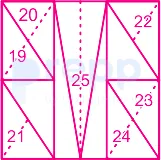
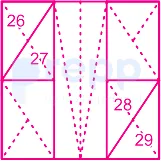
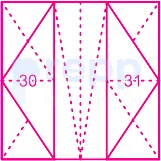
A square paper is folded and cut as shown below. How will it appear when unfolded?

- A
Option A (shown in image)
- B
Option B (shown in image)
- C
Option C (shown in image)
- D
Option D (shown in image)
Show answer
C. Option C (shown in image)When opened, the figure will appear as below:
Hence, the figure in option 3 is the correct answer.
 Paper & answer key PDF ↗
 Question 6archived
Three of the following four-word pairs are alike in a certain way and one is different. Pick the odd word out.
- A
Tamil : Kerala
- B
Dogri : Jammu and Kashmir
- C
Bori : Arunachal Pradesh
- D
Konkani : Goa
Show answer
A. Tamil : KeralaSolving the Odd Language and State Pair Puzzle
The question asks us to identify the pair that is different from the other three among the given four word pairs. Each pair consists of a language and an Indian state or Union Territory. We need to look for a common relationship among three pairs and find the one that does not share that relationship.
Analyzing Each Language and State Pair
Let's examine each pair:
Tamil : Kerala - Tamil is a language primarily spoken in Tamil Nadu. While there are Tamil speakers in Kerala, it is not an official language or the primary language of Kerala. The principal language of Kerala is Malayalam.
Dogri : Jammu and Kashmir - Dogri is an Indo-Aryan language spoken in the Jammu region of Jammu and Kashmir. It is one of the official languages of the Union Territory of Jammu and Kashmir.
Bori : Arunachal Pradesh - Bori is a language belonging to the Sino-Tibetan family, spoken by the Bori people who are part of the Adi tribe in Arunachal Pradesh. It is a language indigenous to and spoken within Arunachal Pradesh.
Konkani : Goa - Konkani is an Indo-Aryan language spoken widely in the Konkan region. It is the official language of Goa and is extensively spoken by the population there.
Identifying the Common Relationship
In the pairs Dogri : Jammu and Kashmir, Bori : Arunachal Pradesh, and Konkani : Goa, the language is either an official language or a language indigenous to and significantly spoken within the respective state or Union Territory. They represent a strong linguistic connection to that specific place.
Finding the Odd Pair Out
The pair Tamil : Kerala does not follow this pattern. Tamil is primarily associated with the state of Tamil Nadu, not Kerala. While a minority speaks Tamil in Kerala, it is not the primary or official language of the state.
Therefore, the pair that is different from the other three is Tamil : Kerala.
Revision Table: Language-State Associations
Pair
Language
State/UT
Primary Association / Official Status
1
Tamil
Kerala
Primary association is with Tamil Nadu; Minority language in Kerala.
2
Dogri
Jammu and Kashmir
Official language; Widely spoken.
3
Bori
Arunachal Pradesh
Indigenous language; Spoken by a community in the state.
4
Konkani
Goa
Official language; Widely spoken.
Additional Information: Languages of India
India is a country with immense linguistic diversity. The Constitution of India recognizes 22 major languages, known as Scheduled Languages. Apart from these, there are numerous other languages and dialects spoken across the country.
Each state often has one or more official languages, which are typically the most widely spoken language(s) in that region.
Some languages are spoken by indigenous communities in specific states, even if they are not official languages.
The distribution of language speakers doesn't always strictly follow state borders, but typically, a language is primarily associated with the state where it originated or where the majority of its speakers reside.
Understanding the primary geographical distribution and official status of languages is key to solving such reasoning questions based on language and state pairs.
Paper & answer key PDF ↗ Question 7archived
If
+ denotes -
denotes *
denotes /
/ denotes +
then what will be the value of
25 – 2 / 10 * 5 + 2 = ?
- A
10
- B
58
- C
50
- D
26
Show answer
C. 50Solving Symbol Substitution Problems
This type of problem involves replacing standard mathematical operators with new ones based on a given set of rules. Once the operators are substituted, we need to evaluate the expression following the standard order of operations (PEMDAS/BODMAS).
Understanding the Symbol Substitutions
The question provides the following rules for symbol substitution:
The symbol '+' denotes '-'.
The symbol '-' denotes '*'.
The symbol '*' denotes '/'.
The symbol '/' denotes '+'.
The given expression is: 25 – 2 / 10 * 5 + 2
Substituting the Operators
Now, let's replace the operators in the expression according to the given rules:
The '-' in 25 – 2 becomes '*'. So, 25 – 2 becomes \(25 \times 2\).
The '/' in 2 / 10 becomes '+'. So, 2 / 10 becomes \(2 + 10\). (However, the structure is 2 / 10, so this / is between 2 and 10)
The '*' in 10 * 5 becomes '/'. So, 10 * 5 becomes \(10 \div 5\).
The '+' in 5 + 2 becomes '-'. So, 5 + 2 becomes \(5 - 2\).
Let's rewrite the expression with the substituted operators:
Original expression: \(25 - 2 / 10 * 5 + 2\)
Substituted expression: \(25 * 2 + 10 / 5 - 2\)
Evaluating the Substituted Expression
Now we evaluate the new expression \(25 * 2 + 10 / 5 - 2\) using the order of operations (BODMAS/PEMDAS):
Recall the order of operations:
Brackets (Parentheses)
Orders (Exponents, Roots)
Division and Multiplication (from left to right)
Addition and Subtraction (from left to right)
Let's apply this to \(25 * 2 + 10 / 5 - 2\):
Multiplication and Division (left to right):
First, calculate \(25 * 2\): \(25 \times 2 = 50\). The expression becomes \(50 + 10 / 5 - 2\).
Next, calculate \(10 / 5\): \(10 \div 5 = 2\). The expression becomes \(50 + 2 - 2\).
Addition and Subtraction (left to right):
First, calculate \(50 + 2\): \(50 + 2 = 52\). The expression becomes \(52 - 2\).
Next, calculate \(52 - 2\): \(52 - 2 = 50\).
The final value of the expression after substitution and evaluation is 50.
Step-by-Step Evaluation
Step
Expression
Operation
Result
Original
\(25 - 2 / 10 * 5 + 2\)
Substitute operators
\(25 * 2 + 10 / 5 - 2\)
1
\(25 * 2 + 10 / 5 - 2\)
Multiplication (\(25 \times 2\))
\(50 + 10 / 5 - 2\)
2
\(50 + 10 / 5 - 2\)
Division (\(10 \div 5\))
\(50 + 2 - 2\)
3
\(50 + 2 - 2\)
Addition (\(50 + 2\))
\(52 - 2\)
4
\(52 - 2\)
Subtraction (\(52 - 2\))
\(50\)
Therefore, the value of the expression \(25 - 2 / 10 * 5 + 2\) after applying the given symbol substitutions is 50.
Revision Table: Key Concepts
Symbol Substitution Rules
Original Symbol
New Meaning
+
-
-
*
*
/
/
+
Order of Operations (BODMAS/PEMDAS)
Brackets
()
Orders
\(x^2\), \(\sqrt{x}\)
Division
\(/\)
Multiplication
\(*\)
Addition
\(+\)
Subtraction
\(-\)
Remember to perform Division and Multiplication from left to right as they appear, and similarly for Addition and Subtraction.
Additional Information: Logic and Reasoning Questions
Symbol substitution questions are common in logical reasoning and quantitative aptitude tests. They assess your ability to understand and follow instructions precisely and apply mathematical rules.
These questions require careful reading of the rules provided.
Each rule is independent and should be applied exactly as stated.
After substitution, the problem reduces to a standard arithmetic expression evaluation.
Always apply the order of operations correctly to avoid errors in calculation.
Writing down the substituted expression before solving helps prevent mistakes.
Practicing different variations of symbol substitution problems helps improve speed and accuracy in competitive exams.
Paper & answer key PDF ↗ Question 8archived
A father was twelve times as old as his son twenty years ago. Now he is twice as old as his son. What are the present ages of the son and father?
- A
33 and 66 years
- B
27 and 54 years
- C
15 and 30 years
- D
22 and 44 years
Show answer
D. 22 and 44 yearsSolving the Father and Son Ages Problem
This problem involves finding the current ages of a father and son based on relationships between their ages at different points in time. We need to determine their present ages using the information provided.
Defining Variables for Present Ages
Let's represent the unknown ages with variables:
Let F represent the father's current age.
Let S represent the son's current age.
Formulating Age Equations Based on Conditions
The problem gives us two key pieces of information about their ages:
Condition 1: Twenty Years Ago
Twenty years ago, their ages were:
Father's age: $F - 20$
Son's age: $S - 20$
According to the problem, the father was twelve times as old as his son twenty years ago. This can be written as an equation:
$$F - 20 = 12 \times (S - 20)$$
Condition 2: Present Ages
Currently, the father is twice as old as his son. This gives us the second equation:
$$F = 2S$$
So, we have a system of two linear equations:
$F - 20 = 12(S - 20)$
$F = 2S$
Solving for the Son's and Father's Current Ages
We can solve this system of equations. A good method is substitution. We already know from the second equation that $F = 2S$. We can substitute this expression for $F$ into the first equation.
First, let's simplify the first equation:
$$F - 20 = 12S - 240$$
Now, substitute $F = 2S$ into the simplified equation:
$$2S - 20 = 12S - 240$$
Rearrange the equation to gather terms involving $S$ on one side and constants on the other:
$$240 - 20 = 12S - 2S$$
$$220 = 10S$$
Solve for $S$ (the son's current age):
$$S = \frac{220}{10}$$
$$S = 22$$
So, the son's current age is 22 years.
Now, use the second equation ($F = 2S$) to find the father's current age ($F$):
$$F = 2 \times 22$$
$$F = 44$$
So, the father's current age is 44 years.
Verification of the Calculated Ages
Let's check if the calculated ages (Son = 22 years, Father = 44 years) satisfy both conditions given in the problem:
Check Present Ages: Is the father (44) twice as old as the son (22)?
$$44 = 2 \times 22$$
Yes, this condition is met.
Check Ages 20 Years Ago:
Son's age 20 years ago: $22 - 20 = 2$ years
Father's age 20 years ago: $44 - 20 = 24$ years
Was the father (24) twelve times as old as the son (2) twenty years ago?
$$24 = 12 \times 2$$
Yes, this condition is also met.
Since both conditions are satisfied, our calculated ages are correct.
Conclusion on Present Ages
The present ages are:
Son: 22 years
Father: 44 years
Paper & answer key PDF ↗ Question 9archived
Three of the following four word-pairs are alike in a certain way and one is different. Pick the odd one out.
- A
Paper : Book
- B
Chisel : Sculptor
- C
Scalpel : Surgeon
- D
Anvil : Blacksmith
Show answer
A. Paper : BookAnalyzing Word Pair Relationships
This question asks us to identify the word pair that is different from the other three. This type of question tests our ability to recognize relationships between words and find the one that doesn't fit the pattern.
Let's look closely at each word pair provided:
Paper : Book
Chisel : Sculptor
Scalpel : Surgeon
Anvil : Blacksmith
Identifying the Relationship in Each Word Pair
We need to understand the connection between the two words in each pair. Let's examine them one by one:
Paper : Book - In this pair, the first word, Paper, is the primary material used to create the second word, a Book. A book is made of paper.
Chisel : Sculptor - Here, the first word, Chisel, is a tool. The second word, Sculptor, is a person who uses this tool in their profession. A sculptor uses a chisel.
Scalpel : Surgeon - Similar to the previous pair, Scalpel is a tool used by a Surgeon in their profession. A surgeon uses a scalpel.
Anvil : Blacksmith - Again, Anvil is a tool or piece of equipment used by a Blacksmith in their work. A blacksmith uses an anvil.
Comparing the Word Pair Patterns
Now let's compare the relationships we identified:
Paper : Book → Material : Product
Chisel : Sculptor → Tool : User (Professional)
Scalpel : Surgeon → Tool : User (Professional)
Anvil : Blacksmith → Tool : User (Professional)
We can see that three of the word pairs (Chisel : Sculptor, Scalpel : Surgeon, Anvil : Blacksmith) follow a consistent pattern where the first word is a tool and the second word is the professional who uses that tool.
The Paper : Book pair, however, follows a different pattern: Material : Product.
Determining the Odd Word Pair Out
Since the Paper : Book pair exhibits a different relationship (Material to Product) compared to the other three pairs which show a Tool to User relationship, it is the odd one out.
Revision Table: Word Pair Relationships
Word Pair
First Word
Second Word
Relationship
Paper : Book
Paper
Book
Material : Product
Chisel : Sculptor
Chisel
Sculptor
Tool : User
Scalpel : Surgeon
Scalpel
Surgeon
Tool : User
Anvil : Blacksmith
Anvil
Blacksmith
Tool : User
Additional Information: Analogy and Classification
Questions like this are common in verbal reasoning and analogies. They require you to understand the link between items in a pair and apply that understanding to find a matching or contrasting pair. The goal is often to classify pairs based on their internal relationship.
Understanding common relationships is key:
Tool and User: e.g., Pen : Writer
Tool and Action: e.g., Knife : Cut
Material and Product: e.g., Wood : Furniture
Part and Whole: e.g., Finger : Hand
Cause and Effect: e.g., Rain : Flood
Synonyms: e.g., Happy : Joyful
Antonyms: e.g., Hot : Cold
Study and Topic: e.g., Biology : Organisms
By identifying these relationships, you can effectively solve odd one out and analogy problems.
Paper & answer key PDF ↗ Question 10archived
Select the word pair in which the two words are related in the same way as the word pair given below.
Feet : Socks
- A
Abdomen : Pants
- B
Head : Turban
- C
Finger : Nail
- D
Legs : Vest
Show answer
B. Head : TurbanUnderstanding Word Pair Analogies
Word pair analogies test your ability to find the relationship between a given pair of words and then identify another pair that shares the same relationship. In the given question, the word pair is:
Feet : Socks
Let's analyze the relationship between 'Feet' and 'Socks'. Socks are items of clothing that are worn on the feet. The relationship is 'something worn on' or 'covers'. Socks cover the feet.
Now, we need to examine the options to find the pair that demonstrates the same 'something worn on' or 'covers' relationship.
Analyzing the Options
Let's break down each option:
Option 1: Abdomen : Pants
Pants are worn around the waist and cover the legs. While they are near the abdomen, they are not typically considered an item worn directly on the abdomen in the same way socks are worn on feet. The primary item worn *on* the abdomen area is usually a shirt or vest.
Option 2: Head : Turban
A Turban is a type of headwear. It is worn on the Head. This relationship matches the original pair: the second word (Turban) is something worn directly on the first word (Head).
Option 3: Finger : Nail
A Nail is a part of the Finger, not something worn on it. This is a part-to-whole relationship, which is different from the 'worn on' relationship in the original pair.
Option 4: Legs : Vest
A Vest is a garment worn on the upper body or torso, not on the Legs. This relationship does not match the original pair.
Comparing Relationships
Let's summarize the relationships:
Word Pair
Relationship
Feet : Socks
Socks are worn on Feet (covers Feet)
Abdomen : Pants
Pants are worn around Abdomen/on Legs (partially relates to abdomen area but not directly on)
Head : Turban
Turban is worn on Head (covers Head)
Finger : Nail
Nail is part of Finger
Legs : Vest
Vest is worn on upper body (not Legs)
Comparing the relationships, we see that the relationship in the pair 'Head : Turban' is the same as that in 'Feet : Socks'. In both cases, the second item is something worn directly on the first item.
Conclusion
Based on the analysis of the relationships, the word pair 'Head : Turban' is related in the same way as 'Feet : Socks'.
Revision Table: Key Analogy Relationships
Relationship Type
Example Pair
Description
Part and Whole
Finger : Nail
One word is a part of the other.
Object and Covering
Feet : Socks
Head : Turban
One word is something worn on or covering the other.
Tool and Action
Knife : Cut
One word is used to perform the action of the other.
Cause and Effect
Study : Success
One word leads to the other.
Antonyms
Hot : Cold
The words have opposite meanings.
Additional Information on Solving Analogies
Solving word analogies requires identifying the precise relationship between the given pair. Here are some tips:
Clearly define the relationship in the original pair. Is it a synonym, antonym, part-whole, cause-effect, object-function, or something else?
Apply that exact relationship to each option.
Eliminate options that clearly do not fit the relationship.
Sometimes there might be multiple possible relationships; look for the most direct and primary relationship.
Consider the order of the words in the pair; the relationship often flows in that direction (e.g., Feet have Socks worn on them, not the other way around).
Practicing different types of analogies helps improve your ability to quickly identify relationships between words.
Paper & answer key PDF ↗ Question 11archived
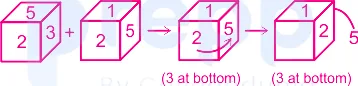
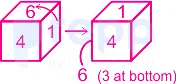
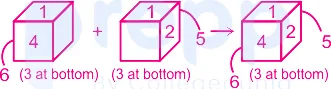
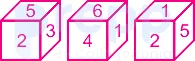
Three different positions of a dice are shown below. Which number appears on the face opposite the number 4?
- A
3
- B
2
- C
6
- D
5
Show answer
Question 12archived
Select the term that will come next in the following series.
5, 9, ?, 29, 45
- A
25
- B
15
- C
17
- D
19
Show answer
C. 17Finding the Missing Term in a Number Series
The problem asks us to identify the next term that continues the pattern in the given number series: 5, 9, ?, 29, 45.
To solve number series questions, we need to look for a pattern between consecutive terms. This pattern might involve addition, subtraction, multiplication, division, squares, cubes, or a combination of these operations, or the differences between terms might follow a pattern.
Analyzing the Number Series Pattern
Let's examine the differences between the consecutive terms that are given:
Difference between the second term (9) and the first term (5):
\(9 - 5 = 4\)
Difference between the fifth term (45) and the fourth term (29):
\(45 - 29 = 16\)
Let the missing term be \(x\). The series is 5, 9, \(x\), 29, 45.
The differences between consecutive terms are:
First difference: \(9 - 5 = 4\)
Second difference: \(x - 9\)
Third difference: \(29 - x\)
Fourth difference: \(45 - 29 = 16\)
So the sequence of differences is: 4, \(x - 9\), \(29 - x\), 16.
Identifying the Pattern in Differences
Let's look for a pattern in the sequence of differences: 4, \(x - 9\), \(29 - x\), 16. We see that the first difference is 4 and the last is 16. Perhaps the differences themselves follow an arithmetic progression.
If the differences form an arithmetic progression, the difference between consecutive differences must be constant.
Difference between the second difference and the first difference: \((x - 9) - 4 = x - 13\)
Difference between the third difference and the second difference: \((29 - x) - (x - 9) = 29 - x - x + 9 = 38 - 2x\)
Difference between the fourth difference and the third difference: \(16 - (29 - x) = 16 - 29 + x = x - 13\)
For these differences to be in an arithmetic progression, the differences between consecutive differences must be equal:
\[x - 13 = 38 - 2x\]
Now, let's solve for \(x\):
\[x + 2x = 38 + 13\]
\[3x = 51\]
\[x = \frac{51}{3}\]
\[x = 17\]
Verifying the Pattern with the Missing Term
If \(x = 17\), the sequence of differences is:
\(9 - 5 = 4\)
\(17 - 9 = 8\)
\(29 - 17 = 12\)
\(45 - 29 = 16\)
The sequence of differences is 4, 8, 12, 16. This is an arithmetic progression with a common difference of 4.
Thus, the missing term in the series is 17.
Final Answer
The series is 5, 9, 17, 29, 45. The pattern is that the difference between consecutive terms increases by 4 each time (4, 8, 12, 16).
Term Number
Term
Difference from Previous Term
1
5
-
2
9
\(9 - 5 = 4\)
3
17
\(17 - 9 = 8\)
4
29
\(29 - 17 = 12\)
5
45
\(45 - 29 = 16\)
Revision Table: Number Series Patterns
Pattern Type
Description
Example
Arithmetic Progression
Constant difference between terms.
2, 5, 8, 11... (Difference = 3)
Geometric Progression
Constant ratio between terms.
3, 6, 12, 24... (Ratio = 2)
Differences in AP
Differences between consecutive terms form an AP.
Series: 1, 2, 4, 7, 11...
Differences: 1, 2, 3, 4... (AP with difference 1)
Squares/Cubes Added/Subtracted
Terms involve adding/subtracting squares or cubes.
2, 6, 15, 31...
Pattern: \(2 + 2^2 = 6\), \(6 + 3^2 = 15\), \(15 + 4^2 = 31\)
Additional Information: Solving Reasoning Questions
Number series questions are common in reasoning and aptitude tests. They assess your ability to identify logical patterns quickly.
Tips for solving number series:
Calculate differences between terms. See if they are constant or form a pattern (like an AP, GP, squares, etc.).
Calculate ratios between terms. See if they are constant (GP).
Look for alternating patterns (e.g., addition followed by subtraction).
Consider squares, cubes, prime numbers, or Fibonacci sequence if simple arithmetic doesn't work.
Sometimes, the pattern involves operations on previous terms (e.g., next term is sum of previous two).
Practice with various types of series to become familiar with common patterns.
Paper & answer key PDF ↗ Question 13archived
‘Fly’ is related to ‘Bird’ in the same way as ‘Gallop’ is related to‘________’.
- A
Tiger
- B
Horse
- C
Lion
- D
Elephant
Show answer
B. HorseUnderstanding the Analogy: Fly, Bird, Gallop, and Animal Relationships
The question presents an analogy based on the relationship between a mode of movement and the animal that typically performs that movement. We are given that ‘Fly’ is related to ‘Bird’. This suggests the relationship is that 'flying' is a characteristic way a 'bird' moves.
We need to find the animal that is related to ‘Gallop’ in the same way. This means we are looking for the animal whose characteristic mode of movement is 'galloping'.
Analyzing the Relationship: Movement and Animal
In the first pair, ‘Fly’ is the action or movement, and ‘Bird’ is the animal that performs this action as a primary means of locomotion.
So, the analogy structure is:
[Characteristic Movement] : [Animal]
Applying this structure to the second pair, we have:
‘Gallop’ : [Unknown Animal]
We need to identify which of the given options is the animal known for galloping.
Evaluating the Options for Gallop Relationship
Let's consider each option:
Option 1: Tiger
Tigers are powerful predators that typically stalk, run, and pounce. While they can move quickly, 'gallop' is not their characteristic gait.
Option 2: Horse
Horses are well-known for their various gaits, including walk, trot, canter, and gallop. Galloping is a fast, four-beat gait that is characteristic of horses, especially when running at high speed.
Option 3: Lion
Similar to tigers, lions are large cats that hunt by stalking and running. 'Gallop' is not the term usually used to describe a lion's run.
Option 4: Elephant
Elephants have a unique gait often described as a fast walk or shuffle at higher speeds. They do not gallop.
Based on this analysis, the animal whose characteristic mode of movement is ‘Gallop’ is the Horse.
Conclusion on the Gallop Analogy
The analogy ‘Fly’ is related to ‘Bird’ means that flying is the typical way a bird moves. Similarly, ‘Gallop’ is the typical way a certain animal moves. Of the options provided, the Horse is the animal most famously associated with the action of galloping.
Therefore, ‘Gallop’ is related to ‘Horse’ in the same way as ‘Fly’ is related to ‘Bird’.
Revision Table: Understanding Movement Analogies
Movement
Typical Animal
Analogy Pair
Fly
Bird
Fly : Bird
Gallop
Horse
Gallop : Horse
Swim
Fish
Swim : Fish
Crawl
Insect/Baby
Crawl : Insect/Baby
Hop
Frog/Rabbit
Hop : Frog/Rabbit
Additional Information on Animal Gaits
Animal gaits are the different ways animals move using their limbs. These can vary greatly depending on the animal and the speed of movement. Some common gaits include:
Walk: A four-beat gait where the animal always has at least one foot on the ground.
Trot: A two-beat diagonal gait (e.g., front left and back right hooves hit the ground together).
Canter: A three-beat gait.
Gallop: A four-beat gait, the fastest gait for many animals like horses.
Run: A general term for fast locomotion, can be two-beat (like humans) or four-beat (like cats).
Understanding these specific terms can help in solving analogies related to animal movements.
Paper & answer key PDF ↗ Question 14archived
Select the correct mirror image of the given figure when the mirror is placed on the right of the figure?
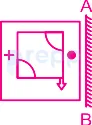
- A
Option A (shown in image)
- B
Option B (shown in image)
- C
Option C (shown in image)
- D
Option D (shown in image)
Show answer
D. Option D (shown in image)Hence, the figure in option 4 is the correct answer.
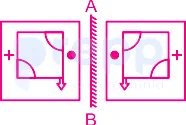 Paper & answer key PDF ↗
 Question 15archived
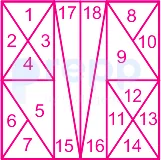
How many triangles are there in the following figure?

- A
29
- B
18
- C
31
- D
33
Show answer
Question 16archived
Find the next term in this series.
CBA, FGE, ILI, LQM, ?
- A
OVP
- B
NVQ
- C
OVQ
- D
OUP
Show answer
C. OVQFinding the Pattern in the Letter Series
The question asks us to find the next term in the series: CBA, FGE, ILI, LQM, ?. This is a letter series problem where each term consists of three letters. To solve this, we need to identify the pattern in the sequence of letters in each position (first, second, and third).
Analyzing the Pattern of the First Letter
Let's look at the first letter of each term:
Term 1: CBA (C is the 3rd letter of the alphabet)
Term 2: FGE (F is the 6th letter of the alphabet)
Term 3: ILI (I is the 9th letter of the alphabet)
Term 4: LQM (L is the 12th letter of the alphabet)
Let's see the numerical positions:
Term
First Letter
Position
1
C
3
2
F
6
3
I
9
4
L
12
The pattern in the first letters is an increase of 3 in their alphabetical position:
C (3) to F (6): $6 - 3 = 3$
F (6) to I (9): $9 - 6 = 3$
I (9) to L (12): $12 - 9 = 3$
Following this pattern, the first letter of the next term should be the letter 3 positions after L (12). $12 + 3 = 15$. The 15th letter is O.
Analyzing the Pattern of the Second Letter
Now let's look at the second letter of each term:
Term 1: CBA (B is the 2nd letter)
Term 2: FGGE (G is the 7th letter)
Term 3: ILLI (L is the 12th letter)
Term 4: LQQM (Q is the 17th letter)
Numerical positions:
Term
Second Letter
Position
1
B
2
2
G
7
3
L
12
4
Q
17
The pattern in the second letters is an increase of 5 in their alphabetical position:
B (2) to G (7): $7 - 2 = 5$
G (7) to L (12): $12 - 7 = 5$
L (12) to Q (17): $17 - 12 = 5$
Following this pattern, the second letter of the next term should be the letter 5 positions after Q (17). $17 + 5 = 22$. The 22nd letter is V.
Analyzing the Pattern of the Third Letter
Finally, let's look at the third letter of each term:
Term 1: CBA (A is the 1st letter)
Term 2: FGE (E is the 5th letter)
Term 3: ILI (I is the 9th letter)
Term 4: LQM (M is the 13th letter)
Numerical positions:
Term
Third Letter
Position
1
A
1
2
E
5
3
I
9
4
M
13
The pattern in the third letters is an increase of 4 in their alphabetical position:
A (1) to E (5): $5 - 1 = 4$
E (5) to I (9): $9 - 5 = 4$
I (9) to M (13): $13 - 9 = 4$
Following this pattern, the third letter of the next term should be the letter 4 positions after M (13). $13 + 4 = 17$. The 17th letter is Q.
Determining the Next Term
Combining the letters we found for each position:
First letter: O
Second letter: V
Third letter: Q
The next term in the series is OVQ.
Comparing with Options
Let's check the given options:
Option 1: OVP (O=15, V=22, P=16) - Incorrect (Third letter is P, not Q)
Option 2: NVQ (N=14, V=22, Q=17) - Incorrect (First letter is N, not O)
Option 3: OVQ (O=15, V=22, Q=17) - Correct
Option 4: OUP (O=15, U=21, P=16) - Incorrect (Second letter is U, not V; Third letter is P, not Q)
The calculated term OVQ matches Option 3.
Conclusion
By analyzing the progression of letters in each position of the series CBA, FGE, ILI, LQM, we found consistent arithmetic patterns for the alphabetical positions. The first letters increase by 3, the second letters by 5, and the third letters by 4. Applying these patterns, the next term is OVQ.
Revision Table: Letter Series Patterns
Position
Letters in Series
Numerical Positions
Pattern
Next Letter (Numerical)
Next Letter
First
C, F, I, L
3, 6, 9, 12
$+3$
$12 + 3 = 15$
O
Second
B, G, L, Q
2, 7, 12, 17
$+5$
$17 + 5 = 22$
V
Third
A, E, I, M
1, 5, 9, 13
$+4$
$13 + 4 = 17$
Q
Additional Information: Types of Letter Series
Letter series questions are common in reasoning tests and can involve various patterns. Understanding different types of patterns can help solve these questions faster.
Alphabetical Position: Patterns based on the position of letters in the alphabet (like in this problem). The pattern can be arithmetic (adding/subtracting a constant number), geometric (multiplying/dividing), or follow other sequences (prime numbers, squares, etc.).
Skip Letter Pattern: The difference between consecutive letters is a fixed number of skipped letters. This is essentially the same as the alphabetical position pattern but described differently.
Reverse Alphabetical Position: Patterns based on the position from Z to A (Z=1, Y=2, etc.).
Vowel/Consonant Pattern: The series might follow a pattern based on whether the letters are vowels or consonants.
Combination of Patterns: More complex series might combine different types of patterns, potentially different patterns for different positions within a term (as seen in this problem) or alternating patterns between terms.
Practicing identifying these patterns is key to mastering letter series questions.
Paper & answer key PDF ↗ Question 17archived
Select the option that is related to the third number in the same way as the second number is related to the first number.
17 : 102 :: 23 :
- A
256
- B
152
- C
196
- D
138
Show answer
D. 138Solving Number Analogy Problems
Number analogy questions test your ability to find a relationship between a pair of numbers and apply that same relationship to another number to find a missing term. The question provides the analogy 17 : 102 :: 23 : ?, meaning we need to find a number that relates to 23 in the same way 102 relates to 17.
Finding the Relationship between 17 and 102
Let's examine the relationship between the first pair of numbers, 17 and 102. We can explore common mathematical operations:
Is 102 obtained by adding or subtracting from 17? $102 - 17 = 85$. The difference is 85.
Is 102 obtained by multiplying 17 by some number? Let's try dividing 102 by 17. $102 \div 17$.
We can test multiples of 17:
$17 \times 1 = 17$
$17 \times 2 = 34$
$17 \times 3 = 51$
$17 \times 4 = 68$
$17 \times 5 = 85$
$17 \times 6 = 102$
So, the relationship is that the second number is obtained by multiplying the first number by 6.
Applying the Relationship to Find the Missing Number
Now we apply the same relationship to the third number, 23. The missing number should be 23 multiplied by 6.
Let's calculate $23 \times 6$:
$23 \times 6 = 138$
So, the missing number in the analogy 23 : ? is 138.
Checking the Options
Let's compare our result with the given options:
Option 1: 256
Option 2: 152
Option 3: 196
Option 4: 138
Our calculated number, 138, matches Option 4.
The relationship in the analogy 17 : 102 :: 23 : 138 is that the second number is 6 times the first number.
Therefore, the correct option is 138.
Revision Table: Number Analogy Basics
Concept
Description
Example
Analogy
A comparison between two things for clarification or explanation. In number analogies, it's about the relationship between number pairs.
Apple : Fruit :: Carrot : Vegetable
Number Analogy
Finding a mathematical relationship between the first pair of numbers and applying it to the third number to find the fourth.
2 : 4 :: 3 : 6 (Relationship: second number is double the first)
Common Relationships
Addition, subtraction, multiplication, division, squares, cubes, square roots, cube roots, or combinations of these.
Addition (+n), Subtraction (-n), Multiplication (xn), Division (÷n), Square (n²), Cube (n³)
Additional Information: Types of Number Relationships
Number analogy problems can involve various types of relationships. Recognizing these common patterns can help solve problems faster.
Arithmetic Operations:
Addition: The second number is obtained by adding a constant to the first. (e.g., 5 : 8 :: 10 : 13, adding 3)
Subtraction: The second number is obtained by subtracting a constant from the first. (e.g., 15 : 10 :: 20 : 15, subtracting 5)
Multiplication: The second number is obtained by multiplying the first by a constant. (e.g., 4 : 12 :: 7 : 21, multiplying by 3)
Division: The second number is obtained by dividing the first by a constant. (e.g., 100 : 50 :: 80 : 40, dividing by 2)
Powers and Roots:
Squares: The second number is the square of the first. (e.g., 3 : 9 :: 5 : 25)
Cubes: The second number is the cube of the first. (e.g., 2 : 8 :: 4 : 64)
Square Roots: The first number is the square root of the second. (e.g., 4 : 16 :: 9 : 81 - this is just the inverse of the square relationship shown differently)
Combinations:
Sometimes the relationship involves multiple steps, like multiplication and then addition (e.g., $n \times a + b$). For example, 3 : 10 :: 5 : 16 (Relationship: $n \times 3 + 1$). $3 \times 3 + 1 = 10$, $5 \times 3 + 1 = 16$.
Digit Operations:
The relationship might involve operations on the digits of the number (e.g., sum of digits, product of digits).
Practicing with different types of number analogy problems helps in quickly identifying the correct relationship.
Paper & answer key PDF ↗ Question 18archived
Which two signs should be interchanged to make the given equation correct?
16 + 3 – 5 × 2 ÷ 4 = 9
- A
÷ and +
- B
× and –
- C
× and +
- D
÷ and ×
Show answer
D. ÷ and ×Solving Equations by Interchanging Signs
This type of problem requires us to test each given option by interchanging the specified mathematical signs in the original equation and then evaluating the resulting expression using the order of operations (BODMAS or PEMDAS).
The original equation is:
$\text{16 + 3 – 5} \times \text{2} \div \text{4 = 9}$
We need to find which interchange makes the left side of the equation equal to 9.
Testing the Options
Option 1: Interchanging $\div$ and +
If we interchange $\div$ and + signs, the equation becomes:
$\text{16} \div \text{3 – 5} \times \text{2 + 4}$
Let's evaluate this using the order of operations (BODMAS/PEMDAS - Brackets, Orders/Exponents, Division and Multiplication (from left to right), Addition and Subtraction (from left to right)).
Division: $\text{16} \div \text{3} = \text{16/3}$
Equation is now: $\text{16/3 – 5} \times \text{2 + 4}$
Multiplication: $\text{5} \times \text{2} = \text{10}$
Equation is now: $\text{16/3 – 10 + 4}$
Addition/Subtraction from left to right:
$\text{16/3 – 10} = \text{16/3 – 30/3} = \text{-14/3}$
$\text{-14/3 + 4} = \text{-14/3 + 12/3} = \text{-2/3}$
Since $\text{-2/3}$ is not equal to 9, this option is incorrect.
Option 2: Interchanging $\times$ and –
If we interchange $\times$ and – signs, the equation becomes:
$\text{16 + 3} \times \text{5 – 2} \div \text{4}$
Let's evaluate this using the order of operations:
Multiplication/Division from left to right:
Multiplication: $\text{3} \times \text{5} = \text{15}$
Equation is now: $\text{16 + 15 – 2} \div \text{4}$
Division: $\text{2} \div \text{4} = \text{2/4} = \text{0.5}$
Equation is now: $\text{16 + 15 – 0.5}$
Addition/Subtraction from left to right:
$\text{16 + 15} = \text{31}$
$\text{31 – 0.5} = \text{30.5}$
Since $\text{30.5}$ is not equal to 9, this option is incorrect.
Option 3: Interchanging $\times$ and +
If we interchange $\times$ and + signs, the equation becomes:
$\text{16} \times \text{3 – 5 + 2} \div \text{4}$
Let's evaluate this using the order of operations:
Multiplication/Division from left to right:
Multiplication: $\text{16} \times \text{3} = \text{48}$
Equation is now: $\text{48 – 5 + 2} \div \text{4}$
Division: $\text{2} \div \text{4} = \text{0.5}$
Equation is now: $\text{48 – 5 + 0.5}$
Addition/Subtraction from left to right:
$\text{48 – 5} = \text{43}$
$\text{43 + 0.5} = \text{43.5}$
Since $\text{43.5}$ is not equal to 9, this option is incorrect.
Option 4: Interchanging $\div$ and $\times$
If we interchange $\div$ and $\times$ signs, the equation becomes:
$\text{16 + 3 – 5} \div \text{2} \times \text{4}$
Let's evaluate this using the order of operations:
Multiplication/Division from left to right:
Division: $\text{5} \div \text{2} = \text{2.5}$
Equation is now: $\text{16 + 3 – 2.5} \times \text{4}$
Multiplication: $\text{2.5} \times \text{4} = \text{10}$
Equation is now: $\text{16 + 3 – 10}$
Addition/Subtraction from left to right:
$\text{16 + 3} = \text{19}$
$\text{19 – 10} = \text{9}$
Since 9 is equal to 9, this option makes the equation correct.
Therefore, interchanging the $\div$ and $\times$ signs makes the given equation correct.
Option
Signs Interchanged
New Equation
Result
Correct?
1
$\div$ and +
$\text{16} \div \text{3 – 5} \times \text{2 + 4}$
$\text{-2/3}$
No
2
$\times$ and –
$\text{16 + 3} \times \text{5 – 2} \div \text{4}$
$\text{30.5}$
No
3
$\times$ and +
$\text{16} \times \text{3 – 5 + 2} \div \text{4}$
$\text{43.5}$
No
4
$\div$ and $\times$
$\text{16 + 3 – 5} \div \text{2} \times \text{4}$
$\text{9}$
Yes
The correct interchange is between $\div$ and $\times$ signs.
Revision Table: Understanding Mathematical Operations
Operation
Symbol(s)
Description
Addition
+
Combining quantities.
Subtraction
–
Finding the difference between quantities.
Multiplication
$\times$, *
Repeated addition or scaling.
Division
$\div$, /
Splitting into equal parts or finding how many times one number is contained in another.
Additional Information: Order of Operations (BODMAS/PEMDAS)
When evaluating mathematical expressions with multiple operations, we must follow a specific order to ensure a consistent result. This order is commonly remembered using acronyms like BODMAS or PEMDAS.
BODMAS:
Brackets
Orders (powers, square roots, etc.)
Division and Multiplication (from left to right)
Addition and Subtraction (from left to right)
PEMDAS:
Parentheses
Exponents
Multiplication and Division (from left to right)
Addition and Subtraction (from left to right)
In the problem above, we used the BODMAS/PEMDAS rule to evaluate the expression correctly after interchanging the signs. Division and Multiplication are performed before Addition and Subtraction, and if both are present, they are done from left to right. Similarly, Addition and Subtraction are done from left to right.
Paper & answer key PDF ↗ Question 19archived
Select the figure in which the given figure is embedded.

- A
Option A (shown in image)
- B
Option B (shown in image)
- C
Option C (shown in image)
- D
Option D (shown in image)
Show answer
A. Option A (shown in image)Hence, the figure in option 1 is the correct answer.
 Paper & answer key PDF ↗
 Question 20archived
If SUN is coded as NUS and TOP is coded as POT, then which is the last letter in the code for the word FUR?
- A
R
- B
F
- C
U
- D
E
Show answer
B. FUnderstanding the Word Coding Puzzle
The question asks us to find the last letter of a coded word based on a given coding pattern. We are given two examples of how words are coded:
SUN is coded as NUS
TOP is coded as POT
We need to analyze these examples to figure out the rule used for coding.
Analyzing the Coding Pattern
Let's look at the letters in the original words and their corresponding coded words:
For SUN and NUS:
SUN has letters S, U, N.
NUS has letters N, U, S.
The letters are the same, but their order is different.
For TOP and POT:
TOP has letters T, O, P.
POT has letters P, O, T.
Again, the letters are the same, and their order is different.
Comparing the positions of the letters, we can see a clear pattern:
In SUN, S is the 1st letter, U is the 2nd, N is the 3rd.
In NUS, N is the 1st letter, U is the 2nd, S is the 3rd.
The 1st and 3rd letters have swapped positions, while the 2nd letter (middle letter) remains in the middle.
Let's check this pattern with TOP and POT:
In TOP, T is the 1st letter, O is the 2nd, P is the 3rd.
In POT, P is the 1st letter, O is the 2nd, T is the 3rd.
Yes, the 1st and 3rd letters (T and P) have swapped positions, and the middle letter (O) stayed in its place. This pattern is consistent.
Alternatively, we can see that the coded word is simply the original word spelled backward (letter reversal).
SUN reversed is NUS.
TOP reversed is POT.
So, the coding rule is to reverse the order of the letters in the word.
Applying the Coding Pattern to FUR
Now, we need to apply this pattern to the word FUR. The word FUR has the letters F, U, R.
Following the pattern of reversing the letters:
The first letter is F.
The second letter is U.
The third letter is R.
Reversing the order, the new order of letters will be R, U, F.
So, the coded word for FUR is RUF.
Finding the Last Letter of the Code for FUR
The coded word for FUR is RUF.
The letters in RUF are R (1st letter), U (2nd letter), and F (3rd or last letter).
The question asks for the last letter in the code for the word FUR.
The last letter of RUF is F.
Final Answer
Based on the coding pattern where the word is reversed, the code for FUR is RUF. The last letter of RUF is F.
Original Word
Letters
Coded Word (Reversed)
Last Letter of Code
SUN
S, U, N
NUS
S
TOP
T, O, P
POT
T
FUR
F, U, R
RUF
F
Revision Table: Key Concepts
Concept
Explanation
Application in Problem
Pattern Recognition
Identifying a consistent rule from examples.
Finding the reversal pattern from SUN/NUS and TOP/POT.
Letter Reversal
Arranging the letters of a word in reverse order.
Applying this rule to find the code for FUR.
Positional Analysis
Looking at the position of letters within words.
Identifying the last letter in the coded word RUF.
Additional Information: Word Coding Puzzles
Word coding puzzles are a common type of question in logical reasoning. They test your ability to identify patterns and apply rules. The patterns can involve:
Letter substitution (e.g., each letter is replaced by the next letter in the alphabet).
Letter shifting (e.g., each letter is shifted a certain number of places forward or backward).
Letter rearrangement (like in this problem, where letters are reordered).
Combination of patterns (e.g., shifting and reversing).
Using numerical values of letters.
To solve these puzzles, it's helpful to:
Write down the original word and the coded word.
Compare the letters and their positions.
Look for simple relationships first, like reversal or shifting.
Test your hypothesized pattern on all given examples.
Apply the confirmed pattern to the word you need to code or decode.
Paper & answer key PDF ↗ Question 21archived
Choose the Venn diagram form the given option which best represents the relationship amongst the following closes:
Players, Singers, Students
- A
Option A (shown in image)
- B
Option B (shown in image)
- C
Option C (shown in image)
- D
Option D (shown in image)
Show answer
A. Option A (shown in image)Hence, the figure in option 1 is the correct answer.
 Paper & answer key PDF ↗
 Question 22archived
Select the figure that will come next in the following figure series?

- A
Option A (shown in image)
- B
Option B (shown in image)
- C
Option C (shown in image)
- D
Option D (shown in image)
Show answer
B. Option B (shown in image)Figures 1 and 3 are the same. i.e. the figures are repeating in alternate pattern
Hence, the figure in option 2 is the correct answer.
 Paper & answer key PDF ↗
 Question 23archived
If DON is coded as 345 and ROAM is coded as 6412, then how will RANDOM be coded?
- A
651342
- B
615342
- C
613542
- D
615324
Show answer
B. 615342Decoding the Code: Understanding Letter Substitution
This question involves a simple coding pattern where each letter is assigned a specific numerical code. We are given the codes for two words, "DON" and "ROAM", and asked to find the code for "RANDOM" based on these patterns.
Step-by-Step Code Analysis
Let's look at the given information to identify the code for each letter:
The word DON is coded as 345.
The word ROAM is coded as 6412.
By comparing the letters and their positions in the codes, we can deduce the numerical value assigned to each unique letter present in these words.
Letter Codes from DON and ROAM
Letter
Code (from DON)
Code (from ROAM)
Confirmed Code
D
3
-
3
O
4
4
4
N
5
-
5
R
-
6
6
A
-
1
1
M
-
2
2
From the table, we have established the following letter-to-code mapping:
R → 6
A → 1
N → 5
D → 3
O → 4
M → 2
Coding the Word RANDOM
Now we need to find the code for the word RANDOM by using the established letter codes. We will take each letter of RANDOM and substitute it with its corresponding code:
R is coded as 6.
A is coded as 1.
N is coded as 5.
D is coded as 3.
O is coded as 4.
M is coded as 2.
Putting these codes together in the order they appear in the word RANDOM:
R → 6
A → 1
N → 5
D → 3
O → 4
M → 2
So, the code for RANDOM is 615342.
Verification
Let's check if the letters in RANDOM correspond correctly to the derived codes:
Coding RANDOM
Letter
R
A
N
D
O
M
Code
6
1
5
3
4
2
The resulting code for RANDOM is indeed 615342.
Revision Table: Key Concepts Revisited
Revision: Coding-Decoding Basics
Concept
Explanation
Application in this problem
Coding-Decoding
A pattern-based method to encrypt/decrypt words or messages.
Identifying the pattern used to code DON and ROAM.
Letter Substitution
A type of code where each letter is replaced by another letter, number, or symbol.
Each letter (D, O, N, R, A, M) is substituted by a specific number.
Pattern Identification
Analyzing given examples to find the rule or pattern used in the coding.
Comparing DON → 345 and ROAM → 6412 to find individual letter codes.
Additional Information: Types of Coding
Coding-decoding questions in competitive exams often involve different types of patterns. Understanding these can help solve problems faster. Some common types include:
Letter Coding: Letters are replaced by other letters based on a pattern (e.g., shifting positions in the alphabet, reverse order).
Number Coding: Words are coded into numbers based on patterns like letter position in the alphabet, sum of letter positions, or direct substitution as seen in this problem.
Symbol Coding: Letters or words are replaced by symbols.
Mixed Coding: Numbers and letters are used together, or words are coded into other words based on a complex pattern.
In this specific problem, we used direct number substitution for each letter.
Paper & answer key PDF ↗ Question 24archived
Three of the following four letter-clusters are alike in a certain way and one is different. Pick the odd one out.
- A
PQR
- B
SUW
- C
FHJ
- D
KMO
Show answer
A. PQRFinding the Odd Letter Cluster Pattern
This question asks us to identify the letter cluster that follows a different pattern compared to the other three. These types of questions test our ability to recognize sequences and relationships between letters based on their position in the alphabet.
Let's examine each letter cluster and determine the pattern by looking at the position of each letter in the English alphabet (A=1, B=2, C=3, ..., Z=26).
Option 1: PQR
The letters are P, Q, R.
Positions: P is the 16th letter, Q is the 17th letter, R is the 18th letter.
Pattern: The difference between consecutive letters is \(17 - 16 = 1\) and \(18 - 17 = 1\). These are consecutive letters in the alphabet.
Option 2: SUW
The letters are S, U, W.
Positions: S is the 19th letter, U is the 21st letter, W is the 23rd letter.
Pattern: The difference between consecutive letters is \(21 - 19 = 2\) and \(23 - 21 = 2\). Each letter is two positions after the previous one (skipping one letter).
Option 3: FHJ
The letters are F, H, J.
Positions: F is the 6th letter, H is the 8th letter, J is the 10th letter.
Pattern: The difference between consecutive letters is \(8 - 6 = 2\) and \(10 - 8 = 2\). Each letter is two positions after the previous one (skipping one letter).
Option 4: KMO
The letters are K, M, O.
Positions: K is the 11th letter, M is the 13th letter, O is the 15th letter.
Pattern: The difference between consecutive letters is \(13 - 11 = 2\) and \(15 - 13 = 2\). Each letter is two positions after the previous one (skipping one letter).
Comparing the patterns:
PQR: Difference of +1 between consecutive letters.
SUW: Difference of +2 between consecutive letters.
FHJ: Difference of +2 between consecutive letters.
KMO: Difference of +2 between consecutive letters.
It is clear that the letter cluster PQR follows a different pattern (consecutive letters) than SUW, FHJ, and KMO, which all follow a pattern of adding 2 to the letter position each time.
Conclusion on Odd Letter Cluster
Based on the pattern analysis, PQR is the odd one out because its letters are consecutive, while the letters in the other three clusters are separated by one letter in the alphabet.
Revision Table: Letter Cluster Patterns
Letter Cluster
Letter Positions
Pattern (Difference)
Pattern Type
PQR
16, 17, 18
+1, +1
Consecutive
SUW
19, 21, 23
+2, +2
Skip 1 letter
FHJ
6, 8, 10
+2, +2
Skip 1 letter
KMO
11, 13, 15
+2, +2
Skip 1 letter
Additional Information on Letter Series Reasoning
Letter series questions in reasoning often involve patterns based on:
Alphabetical position of letters (like in this question).
Skipping a fixed number of letters.
Alternating patterns.
Reverse alphabetical order.
Vowel and consonant patterns.
Combinations of letter and number patterns.
To solve these questions effectively, it's helpful to know the alphabetical position of each letter and practice identifying different types of sequences.
Paper & answer key PDF ↗ Question 25archived
Find the missing number from the below options.
9
28
85
12
37
?
16
49
148
- A
96
- B
140
- C
134
- D
112
Show answer
D. 112Analyzing the Number Sequence
The given problem presents a sequence of numbers: 92, 88, 51, 23, 7, ?, 16, 49, 148. We need to find the missing number represented by '?'. Let's analyze the sequence to identify the underlying pattern or patterns.
Identifying Patterns in the Sequence
Let the sequence be denoted by $a_1, a_2, a_3, \ldots$. The sequence is: $a_1=92, a_2=88, a_3=51, a_4=23, a_5=7, a_6=?, a_7=16, a_8=49, a_9=148$.
Pattern in the Later Part of the Sequence
Let's look at the later numbers in the sequence: 16, 49, 148 ($a_7, a_8, a_9$). Let's check if there is a simple arithmetic or geometric pattern, or a combination involving the number itself.
Check the difference: $49 - 16 = 33$, $148 - 49 = 99$. The differences are not constant.
Check the ratio: $49 / 16 \approx 3.06$, $148 / 49 \approx 3.02$. The ratio is close to 3.
Let's test a pattern involving multiplication and addition/subtraction, like $a_{i+1} = k \cdot a_i + c$.
For $a_7 \rightarrow a_8$: $49 = k \cdot 16 + c$.
For $a_8 \rightarrow a_9$: $148 = k \cdot 49 + c$.
Subtracting the first equation from the second:
$(148 - 49) = (49k + c) - (16k + c)$
$99 = 33k$
$k = \frac{99}{33} = 3$.
Substitute $k=3$ into the first equation:
$49 = 3 \cdot 16 + c$
$49 = 48 + c$
$c = 1$.
Let's check if the pattern $a_{i+1} = 3a_i + 1$ holds for $a_8 \rightarrow a_9$:
$a_9 = 3 \cdot a_8 + 1 = 3 \cdot 49 + 1 = 147 + 1 = 148$. This is correct.
So, the pattern $a_{i+1} = 3a_i + 1$ is confirmed for the later part of the sequence, specifically for $i=7$ and $i=8$. This means the pattern applies from $a_7$ onwards.
Pattern in the Earlier Part of the Sequence
Now let's examine the first part of the sequence: 92, 88, 51, 23, 7 ($a_1, a_2, a_3, a_4, a_5$). Let's find the difference between consecutive terms:
Step
Numbers
Difference ($a_i - a_{i+1}$)
$a_1 \rightarrow a_2$
$92 \rightarrow 88$
$92 - 88 = 4$
$a_2 \rightarrow a_3$
$88 \rightarrow 51$
$88 - 51 = 37$
$a_3 \rightarrow a_4$
$51 \rightarrow 23$
$51 - 23 = 28$
$a_4 \rightarrow a_5$
$23 \rightarrow 7$
$23 - 7 = 16$
The sequence of differences is 4, 37, 28, 16. There isn't an immediately obvious simple pattern in these differences.
Connecting the Two Parts and Finding the Missing Number
The missing number is $a_6$, located between $a_5=7$ and $a_7=16$. We have two established patterns:
First part: 92, 88, 51, 23, 7 (with differences 4, 37, 28, 16).
Second part: 16, 49, 148 (following $a_{i+1} = 3a_i + 1$). This pattern starts from $a_7=16$.
Notice that the number 16 appears as the difference between $a_4$ and $a_5$ ($23 - 7 = 16$), and it is also the starting number of the second pattern ($a_7 = 16$). This suggests a connection.
Let's consider the relationship between $a_5=7$, the missing number $a_6=?$, and $a_7=16$. Since $a_7$ is the start of the $a_{i+1} = 3a_i + 1$ pattern, it is unlikely that $a_6$ follows this rule to get $a_7$ (as $16 = 3a_6 + 1$ would give $a_6 = 5$, which is not an option).
Let's explore if the missing number $a_6$ is related to its immediate neighbors $a_5$ and $a_7$ by a different rule. Consider the possibility that $a_6$ is the product of $a_5$ and $a_7$.
Hypothesis: $a_6 = a_5 \times a_7$.
Let's calculate this value:
$a_6 = 7 \times 16 = 112$.
Let's check if 112 is one of the options provided. Yes, 112 is option 4.
Let's see if this fits reasonably within the overall sequence structure:
92, 88, 51, 23, 7, 112, 16, 49, 148.
The sequence goes from decreasing (92 to 7) to a large increase (7 to 112), then a decrease (112 to 16), and finally a consistent increase (16 to 148) following the $3n+1$ rule.
While the pattern for the first five terms and the transition rule ($a_6 = a_5 \times a_7$) and the subsequent rule ($a_{i+1} = 3a_i + 1$) are different, such combined patterns are common in complex number series puzzles. The appearance of 16 both as a difference ($a_4-a_5$) and a term ($a_7$) lends some credibility to this structure.
Based on the options and the clear pattern in the later part of the sequence, the most plausible rule that incorporates the term $a_7=16$ and connects $a_5$ to the missing number is the product $a_5 \times a_7$.
The sequence follows:
For $i=1, 2, 3, 4$: $a_{i+1} = a_i - d_i$ where $d_i$ is a sequence of differences (4, 37, 28, 16).
For $i=5$: $a_6 = a_5 \times a_7 = 7 \times 16 = 112$.
For $i=7, 8$: $a_{i+1} = 3a_i + 1$.
The missing number is 112.
Conclusion
The pattern in the sequence is a combination of different rules. The initial part decreases, the later part increases following $a_{i+1} = 3a_i + 1$, and the missing term acts as a link, being the product of the term before it and the term after it.
The missing number is 112.
Revision Table: Sequence Analysis
Index
Number ($a_i$)
Operation / Relation
Value
1
92
Given
92
2
88
$a_1 - 4$
88
3
51
$a_2 - 37$
51
4
23
$a_3 - 28$
23
5
7
$a_4 - 16$
7
6
?
$a_5 \times a_7$ (Proposed Transition Rule)
$7 \times 16 = 112$
7
16
Given (and used in transition rule)
16
8
49
$3 \times a_7 + 1$ (Pattern from $a_7$ onwards)
$3 \times 16 + 1 = 49$
9
148
$3 \times a_8 + 1$ (Pattern from $a_7$ onwards)
$3 \times 49 + 1 = 148$
Additional Information: Types of Number Series Patterns
Number series problems can involve various patterns, often combined. Some common types include:
Arithmetic Progression: A constant difference between consecutive terms (e.g., 2, 5, 8, 11...).
Geometric Progression: A constant ratio between consecutive terms (e.g., 3, 6, 12, 24...).
Difference Series: The differences between consecutive terms form their own pattern (e.g., a sequence where differences are 2, 4, 6, 8...).
Double Difference Series: The differences of the differences form a pattern.
Mixed Series: Combination of arithmetic and geometric operations, or alternating arithmetic/geometric series.
Patterns involving Squares and Cubes: Terms related to $n^2, n^3, n^2 \pm k, n^3 \pm k$, etc.
Patterns involving Digits: Operations performed on the digits of the numbers (sum of digits, product of digits, reversing digits, etc.) to get the next term or the difference.
Alternating Patterns: Different rules apply to alternate terms or blocks of terms.
Fibonacci-like Series: Each term is the sum or difference of the previous two terms (e.g., 1, 1, 2, 3, 5...).
Composite Patterns: A combination of several simpler patterns.
Identifying the correct pattern often requires careful observation, checking differences, ratios, and trying various operations, especially those involving the digits of the numbers themselves.
Paper & answer key PDF ↗ Question 26archived
As a reaction to Rowlatt Act, _________ was organised as National Humiliation Day.
- A
2nd February 1913
- B
8th May 1920
- C
14th June 1921
- D
6th April 1919
Show answer
D. 6th April 1919Understanding the Rowlatt Act and National Humiliation Day
The Rowlatt Act, officially known as the Anarchical and Revolutionary Crimes Act of 1919, was a legislative act passed by the Imperial Legislative Council in Delhi. This act was deeply unpopular among Indians as it gave the British government extensive powers to suppress political activities.
The Rowlatt Act allowed for the detention of political prisoners without trial for up to two years and also gave the police the power to search premises without a warrant. This blatant disregard for civil liberties led to widespread anger and opposition throughout India.
Reaction to the Rowlatt Act: The Call for Hartal
In response to the draconian provisions of the Rowlatt Act, Mahatma Gandhi called for a nationwide hartal (strike) to protest against the act. A hartal is a form of protest where people stop working and close their shops to show their disapproval.
Gandhi envisioned this hartal as a non-violent civil disobedience movement. It was intended to be a peaceful demonstration against the oppressive Rowlatt Act.
Observing National Humiliation Day
The nationwide hartal called by Mahatma Gandhi in protest against the Rowlatt Act was observed on a specific date which was declared as National Humiliation Day. This day was marked by fasting, prayer, and peaceful demonstrations.
The date fixed for this historic nationwide protest against the Rowlatt Act was 6th April 1919. While the hartal initially started in some places on 30th March, it was officially observed nationwide on 6th April 1919 as National Humiliation Day, marking significant opposition to the Rowlatt Act.
Analyzing the Options
Let's look at the given options in the context of the Rowlatt Act and National Humiliation Day:
2nd February 1913: This date is not associated with the Rowlatt Act protest or National Humiliation Day.
8th May 1920: This date does not correspond to the nationwide hartal against the Rowlatt Act.
14th June 1921: This date is not related to the events following the Rowlatt Act's implementation.
6th April 1919: This is the correct date when the nationwide hartal against the Rowlatt Act was observed as National Humiliation Day.
Conclusion
The Rowlatt Act was met with strong opposition across India. As a significant part of this protest, a nationwide hartal was organized. This day of protest, involving fasting and peaceful demonstrations against the Rowlatt Act, was designated as National Humiliation Day.
Therefore, in reaction to the Rowlatt Act, 6th April 1919 was organised as National Humiliation Day.
Event
Date
Significance
Rowlatt Act Passed
March 1919
Gave extensive powers to the British government to suppress political activities.
Nationwide Hartal / National Humiliation Day
6th April 1919
Protest against the Rowlatt Act, called by Mahatma Gandhi.
Jallianwala Bagh Massacre
13th April 1919
Tragic event that occurred during the protests against the Rowlatt Act.
Revision Table: Key Dates Related to Rowlatt Act Protest
Date
Related Event
March 1919
Passage of the Rowlatt Act
6th April 1919
Nationwide Hartal / National Humiliation Day
13th April 1919
Jallianwala Bagh Massacre (occurred during protests)
Additional Information: Impact of the Rowlatt Act
The Rowlatt Act had a profound impact on the Indian national movement. It galvanized support for Mahatma Gandhi and his methods of non-violent protest. The widespread opposition to the act and the subsequent events, like the Jallianwala Bagh Massacre, further fueled the demand for independence and marked a new phase in India's struggle for freedom. The act is often seen as a catalyst that brought a large number of people into the nationalist fold.
Paper & answer key PDF ↗ Question 27archived
How many provinces is the country of Nepal divided into?
- A
4
- B
7
- C
5
- D
6
Show answer
B. 7Understanding Nepal's Provincial Division
Let's explore how the country of Nepal is structured administratively, specifically focusing on its division into provinces.
Nepal's Administrative Structure
Nepal is a federal democratic republican country. According to its constitution, the country is divided into several administrative units. The primary administrative divisions are the provinces.
Number of Provinces in Nepal
The Constitution of Nepal, adopted in 2015, restructured the country into a federal system. This system includes a specific number of provinces.
Based on the constitutional provisions, Nepal is divided into a certain number of provinces.
The exact number of provinces that Nepal is divided into is seven.
Details on Nepal's Provinces
Here is a list of the seven provinces of Nepal:
Province No. 1 (now known as Koshi Province)
Madhesh Province
Bagmati Province
Gandaki Province
Lumbini Province
Karnali Province
Sudurpashchim Province
These provinces were formed by grouping the existing districts of Nepal.
Comparing Options for Nepal Provinces
The question asks for the number of provinces. Let's look at the given options:
Option 1: 4
Option 2: 7
Option 3: 5
Option 4: 6
Comparing these options with the known administrative structure, the correct number of provinces is 7.
Administrative Division
Number
Provinces
7
Conclusion on Nepal's Provinces
In summary, Nepal's federal structure divides the country into seven provinces.
Revision Table: Nepal Administrative Divisions
Level
Division
Number
Federal
Country
1 (Nepal)
State/Provincial
Provinces
7
Local
Districts
77
Local
Local Levels (Rural Municipalities and Municipalities)
753
Additional Information: Nepal's Governance Structure
Beyond the provinces, Nepal also has other levels of governance. The country is divided into 77 districts, which are further subdivided into 753 local levels. These local levels consist of rural municipalities and municipalities.
The provincial structure was a significant change implemented after the promulgation of the 2015 constitution, moving from a unitary system to a federal one. Each province has its own provincial government and legislature.
Paper & answer key PDF ↗ Question 28archived
The term 'Putt' is used in this sport _________.
- A
Cricket
- B
Golf
- C
Football
- D
Table Tennis
Show answer
B. GolfUnderstanding the Sports Term 'Putt'
The question asks to identify the sport in which the term 'Putt' is used. Let's examine the term and the given options.
What is a 'Putt'?
The term 'Putt' is specifically associated with the sport of Golf. In Golf, a putt is a stroke made with a putter, a special type of club, to roll the ball along the putting green into the hole. Putting is typically done on the final surface, the green, and requires precision and feel rather than power.
Analyzing the Options
Let's consider the sports listed in the options and their common terminology:
Cricket: This sport involves batting, bowling, fielding, and wicket-keeping. Terms like 'bowl', 'bat', 'run', 'wicket', 'catch', 'six', 'four' are common. The term 'Putt' is not used in Cricket.
Golf: As explained above, Golf involves hitting a ball into a series of holes using different clubs. Common terms include 'drive', 'iron', 'chip', 'pitch', 'bunker', 'fairway', 'green', and specifically 'Putt'. A 'putt' is a fundamental stroke in Golf.
Football: This sport involves kicking a ball with the foot. Common terms include 'kick', 'pass', 'dribble', 'header', 'tackle', 'goal', 'foul'. The term 'Putt' is not used in Football.
Table Tennis: Also known as ping-pong, this sport involves hitting a small ball with a paddle across a table. Common terms include 'serve', 'forehand', 'backhand', 'smash', 'chop', 'loop'. The term 'Putt' is not used in Table Tennis.
Conclusion on the Term 'Putt'
Based on the analysis of the terminology used in each sport, the term 'Putt' is unique to Golf, referring to a specific type of stroke made on the putting green.
Summary Table
Sport
Common Terminology
Does it use 'Putt'?
Cricket
Bat, Bowl, Wicket, Catch
No
Golf
Drive, Chip, Pitch, Putt
Yes
Football
Kick, Pass, Dribble, Goal
No
Table Tennis
Serve, Smash, Loop, Chop
No
Therefore, the sport that uses the term 'Putt' is Golf.
Revision Table: Key Sports Terms
Term
Sport
Meaning
Putt
Golf
A stroke made with a putter to roll the ball into the hole on the green.
Wicket
Cricket
The structure defended by the batsman, or the act of a batsman being dismissed.
Header
Football
Hitting the ball with one's head.
Serve
Table Tennis
Starting a point by hitting the ball over the net.
Additional Information on Golf Terminology
Golf has a rich vocabulary with specific terms for different aspects of the game:
Par: The standard number of strokes considered necessary to complete a hole or a course.
Birdie: A score of one stroke under par for a hole.
Bogey: A score of one stroke over par for a hole.
Eagle: A score of two strokes under par for a hole.
Albatross (or Double Eagle): A score of three strokes under par for a hole.
Fore: A warning shout to alert others that a ball is heading towards them.
Handicap: A numerical measure of a golfer's ability, used to allow players of different skill levels to compete against each other.
Understanding these terms is essential for following and playing Golf effectively. The 'Putt' is one of the most critical strokes, often determining the final score on a hole.
Paper & answer key PDF ↗ Question 29archived
In 2018, Amnesty International stripped _________ of the Ambassador of Conscience Award given in 2009.
- A
Aung San Suu Kyi
- B
Al Gore
- C
Benjamin Netanyahu
- D
Henri Tiphagne
Show answer
A. Aung San Suu KyiUnderstanding the Amnesty International Award and its Withdrawal
This question asks about a significant event involving Amnesty International, one of the world's leading human rights organizations, and its prestigious Ambassador of Conscience Award.
The Ambassador of Conscience Award is the highest honour given by Amnesty International. It recognizes individuals and groups who have shown unique leadership and courage in fighting for human rights.
The Awardee and the Controversy
In 2009, Amnesty International bestowed the Ambassador of Conscience Award upon Aung San Suu Kyi. At that time, she was a prominent pro-democracy leader in Myanmar (Burma) and was under house arrest by the military junta. The award recognized her peaceful struggle for democracy and human rights.
However, years later, particularly starting around 2017, significant international concern grew regarding the human rights situation of the Rohingya Muslim minority in Myanmar's Rakhine State. As State Counsellor of Myanmar, Aung San Suu Kyi faced widespread criticism for her government's response to the military crackdown on the Rohingya, which led to hundreds of thousands fleeing to Bangladesh.
Due to her perceived failure to speak out against these atrocities and her government's handling of the crisis, Amnesty International reviewed its decision to grant her the award.
Withdrawal of the Award in 2018
In November 2018, Amnesty International announced its decision to strip Aung San Suu Kyi of the Ambassador of Conscience Award. The organization stated that she had betrayed the values of human rights that the award represents. They cited her government's failure to protect the Rohingya and her silence regarding the military's brutal campaign against them.
Let's consider the options provided:
Aung San Suu Kyi: Awarded in 2009 and stripped in 2018 by Amnesty International due to the Rohingya crisis. This matches the details in the question.
Al Gore: A former US Vice President and environmental activist. He has received many awards, including the Nobel Peace Prize, but is not typically associated with this specific Amnesty International award or its withdrawal in 2018.
Benjamin Netanyahu: An Israeli politician, long-serving Prime Minister of Israel. His work is not related to the Amnesty International Ambassador of Conscience Award.
Henri Tiphagne: An Indian human rights activist. While a human rights advocate, he is not the individual who was stripped of this specific award in 2018.
Based on the historical events and Amnesty International's actions, Aung San Suu Kyi is the individual who was stripped of the Ambassador of Conscience Award in 2018, an award she received in 2009.
Revision Table: Amnesty International Award
Award Name
Given By
Purpose
Recipient in 2009
Award Withdrawn (Year)
Reason for Withdrawal
Ambassador of Conscience Award
Amnesty International
Recognizes human rights leaders
Aung San Suu Kyi
2018
Failure to act on Rohingya crisis
Additional Information: The Rohingya Crisis
The Rohingya are a Muslim ethnic minority group in Myanmar, primarily residing in Rakhine State. They have faced long-standing persecution and discrimination, including denial of citizenship.
In late 2017, the Myanmar military launched a brutal campaign in Rakhine State following attacks by a Rohingya insurgent group.
This campaign included widespread violence, killings, and burning of villages.
Estimates suggest over 700,000 Rohingya fled across the border into Bangladesh to escape the violence, creating a major humanitarian crisis.
The United Nations and various human rights groups have described the actions against the Rohingya as ethnic cleansing and potential genocide.
Aung San Suu Kyi's response, or lack thereof, and her defense of the military's actions drew international condemnation and led to the withdrawal of several international honors, including the Ambassador of Conscience Award.
Paper & answer key PDF ↗ Question 30archived
The maximum strength of the Bangladeshi Parliament is _________.
- A
363
- B
340
- C
350
- D
322
Show answer
C. 350Understanding the Strength of the Bangladeshi Parliament
The question asks about the maximum strength of the Bangladeshi Parliament, also known as the Jatiya Sangsad.
The Parliament of Bangladesh is the supreme legislative body of the country. Its composition is defined to ensure representation from across the nation.
According to the Constitution of Bangladesh, the total number of members in the Jatiya Sangsad is fixed. This strength is made up of two categories of members:
Members directly elected from single territorial constituencies.
Members elected to reserved seats for women.
Let's look at the numbers:
There are 300 members who are directly elected by voters from 300 constituencies across the country.
There are 50 seats that are reserved exclusively for women. These members are elected indirectly by the members who are directly elected.
Adding these two categories gives us the total maximum strength of the Bangladeshi Parliament.
Total strength = Number of directly elected members + Number of members in reserved seats for women
Total strength = \(300 + 50\)
Total strength = \(350\)
Therefore, the maximum strength of the Bangladeshi Parliament is 350.
Revision Table: Bangladeshi Parliament Strength
Component
Number of Members
Election Method
Directly Elected Seats
300
Direct election from constituencies
Reserved Seats for Women
50
Indirect election by elected members
Total Maximum Strength
350
Additional Information about the Jatiya Sangsad
The Jatiya Sangsad plays a crucial role in the governance of Bangladesh. Here are some additional facts about its structure and function:
Term of Parliament: The term of the Jatiya Sangsad is five years, reckoned from the date of its first meeting after a general election.
Presiding Officer: The Parliament is presided over by the Speaker, who is elected by the members of Parliament. A Deputy Speaker is also elected.
Legislative Process: Bills are debated and passed by the Parliament to become laws, subject to the assent of the President.
Accountability: The government, led by the Prime Minister and Cabinet, is accountable to the Parliament.
Role of Reserved Seats: The reserved seats for women were introduced to ensure better representation of women in the national legislature. The number of these seats has been increased over time.
Understanding the composition of the Parliament is fundamental to understanding Bangladesh's political system.
Paper & answer key PDF ↗ Question 31archived
Which world leader is awarded the St Andrew the Apostle, the highest order of the Russian Federation in the year 2019?
- A
Narendra Modi
- B
Angela Markel
- C
Donald Trump
- D
Emmanuel Macron
Show answer
A. Narendra ModiUnderstanding the Order of St Andrew the Apostle Award
The question asks about a significant international award given by the Russian Federation in 2019 to a world leader. Specifically, it mentions the Order of St Andrew the Apostle, which is the highest order of the Russian Federation.
Identifying the Recipient in 2019
The Order of St Andrew the Apostle is awarded for exceptional service to the Fatherland. In 2019, this prestigious award was conferred upon a prominent global figure.
Looking at the options provided:
Narendra Modi
Angela Markel
Donald Trump
Emmanuel Macron
Research indicates that the Order of St Andrew the Apostle was indeed awarded in 2019. This award recognized significant contributions to strengthening relations between Russia and another country.
Specifically, Narendra Modi, the Prime Minister of India, was awarded the Order of St Andrew the Apostle by Russia in April 2019. The citation mentioned his outstanding services in promoting a privileged strategic partnership between Russia and India.
Therefore, based on the information regarding the 2019 award of the Order of St Andrew the Apostle by the Russian Federation, the world leader who received it was Narendra Modi.
Significance of the Order of St Andrew the Apostle
The Order of St Andrew the Apostle is the oldest and highest state order of Russia. It was first established in 1698 by Tsar Peter the Great and was re-established in 1998. It is awarded to distinguished statesmen and public figures and, in some cases, heads of foreign states, for outstanding services that contribute to the prosperity, greatness, and glory of Russia.
Award
Country
Recipient in 2019 (as per question)
Order of St Andrew the Apostle
Russian Federation
Narendra Modi
Conclusion
The Order of St Andrew the Apostle, the highest order of the Russian Federation, was awarded to Prime Minister Narendra Modi in 2019 for his role in enhancing India-Russia relations.
Revision Table: Key Details
Award Name
Issuing Country
Significance
Recipient (2019)
Order of St Andrew the Apostle
Russian Federation
Highest order, for exceptional service to Russia or strengthening ties
Narendra Modi
Additional Information: Russian State Awards
The Russian Federation has several state awards to recognize individuals for various achievements and services. The Order of St Andrew the Apostle stands at the pinnacle of this system. Understanding such awards helps in appreciating international relations and diplomatic ties.
Some other notable Russian state awards include:
Order "For Merit to the Fatherland"
Order of Courage
Order of Friendship
Various medals and titles (e.g., Hero of the Russian Federation)
These awards reflect the values and priorities the Russian state seeks to recognize and promote, both domestically and in its international relations.
Paper & answer key PDF ↗ Question 32archived
Janku is a unique cultural custom followed in ________ as a celebration of life.
- A
Nepal
- B
Pakistan
- C
Sri Lanka
- D
Bhutan
Show answer
A. NepalUnderstanding the Janku Cultural Celebration
The question asks about Janku, a unique cultural custom celebrated as a celebration of life in a specific country. We need to identify the country where this custom is followed.
What is Janku?
Janku is a significant cultural celebration primarily observed in Nepal. It is a ceremony that marks specific age milestones in a person's life, particularly in old age. It is considered a celebration of longevity, health, and life's journey.
Janku in Nepal
In Nepal, Janku is a traditional ceremony, especially important in communities like the Newars. It is performed for individuals when they reach certain advanced ages. These celebrations are elaborate and involve family, relatives, and community members, offering prayers for the person's continued well-being.
There are different levels of Janku celebrated at various age points:
The first Janku is often celebrated around the age of 77 years, 7 months, and 7 days (known as Bhima Ratha).
Subsequent Jankus are celebrated at even older ages, such as 83 years, 4 months, and 4 days (Chandran Ratha), and 99 years, 9 months, and 9 days (Deva Ratha).
There is also a very rare celebration at 105 years.
These ceremonies involve rituals, processions, feasts, and blessings, signifying the person's achievements and resilience through life.
Analyzing the Options
Let's look at the given options:
Nepal: As discussed, Janku is a well-known cultural custom in Nepal, celebrating life and old age milestones. This aligns with the description in the question.
Pakistan: Pakistan has a rich cultural heritage, but Janku is not a known traditional custom celebrating life or old age there.
Sri Lanka: Sri Lanka also has unique cultural traditions, but Janku is not one of them.
Bhutan: Bhutan has distinct cultural practices rooted in Buddhism, but Janku is not a custom associated with Bhutan.
Based on the cultural significance and practice of Janku as a celebration of life and longevity at specific age milestones, it is clearly associated with Nepal.
Country
Is Janku a cultural custom?
Notes
Nepal
Yes
Celebration of old age milestones (77+, 83+, 99+ years)
Pakistan
No
Janku is not traditionally practiced here
Sri Lanka
No
Janku is not traditionally practiced here
Bhutan
No
Janku is not traditionally practiced here
Therefore, the cultural custom Janku, celebrated as a celebration of life, is followed in Nepal.
Revision Table: Janku Celebration
Custom
Country
Significance
Celebration Ages
Janku
Nepal
Celebration of life, longevity, and old age milestones
77 years 7 months 7 days (Bhima Ratha), 83 years 4 months 4 days (Chandran Ratha), 99 years 9 months 9 days (Deva Ratha), and 105 years.
Additional Information on Nepalese Culture
Nepal is a country with diverse ethnic groups, each having unique traditions and customs. Cultural celebrations often revolve around religious festivals, agricultural cycles, and significant life events such as births, marriages, and reaching old age. Janku is one such life-cycle ceremony that highlights the respect and value given to elders in Nepalese society. It is a testament to the rich cultural tapestry of Nepal.
Understanding such cultural customs helps in appreciating the diversity of practices worldwide that celebrate human life and milestones.
Paper & answer key PDF ↗ Question 33archived
In economic terms what do we mean by 'intermediate goods'?
- A
Price of goods without GST
- B
Fixed assets used by manufacturers
- C
Goods sold between industries for the resale or production of other goods
- D
Goods in transit before reaching the consumers
Show answer
C. Goods sold between industries for the resale or production of other goodsUnderstanding Intermediate Goods in Economics
In economics, goods are often classified based on their use. The question asks for the definition of 'intermediate goods'. Let's break down what this term means and why the correct option provides the most accurate definition.
What are Intermediate Goods?
Intermediate goods are products used as inputs in the production of other goods or services. They are not meant for final consumption by the end user but are consumed or transformed during the production process. Alternatively, they can be goods purchased by one industry from another for resale without significant alteration.
Let's examine the given options:
Option 1: Price of goods without GST. This refers to the cost of goods excluding a specific tax (Goods and Services Tax). While price is an economic concept, removing GST does not define the nature or use of a good as intermediate. This option is incorrect.
Option 2: Fixed assets used by manufacturers. Fixed assets, such as machinery, buildings, and equipment, are used in the production process but are not consumed or transformed in a single use. They are considered capital goods, not intermediate goods. Capital goods contribute to production over a longer period. This option is incorrect.
Option 3: Goods sold between industries for the resale or production of other goods. This definition accurately captures the essence of intermediate goods. They are goods that are either sold onward (resale) or used up/transformed in the creation of another product or service (production of other goods). Examples include raw materials like timber used to make furniture, or components like tires used to build a car, or flour used to bake bread. It also includes goods bought by a wholesaler from a manufacturer for resale to retailers. This option aligns perfectly with the economic definition of intermediate goods.
Option 4: Goods in transit before reaching the consumers. Goods in transit are simply goods being transported from one location to another. Their status as intermediate or final goods depends on their intended use when they reach their destination, not their current location or state of transport. This option is incorrect.
Based on the analysis, the definition that best describes intermediate goods in economic terms is the one provided in Option 3.
Intermediate goods are crucial in understanding economic activities, especially in calculating Gross Domestic Product (GDP). When calculating GDP using the output or production method, only the value added at each stage of production or the value of final goods is counted to avoid double-counting the value of intermediate goods.
Consider the production of bread:
Wheat (intermediate good) is produced.
Flour (intermediate good) is milled from wheat.
Bread (final good) is baked using flour, yeast (intermediate goods), etc.
The value of the wheat and flour is embedded in the final value of the bread. Counting wheat, flour, and bread separately would lead to overstating the total production.
Intermediate Goods vs. Final Goods
Feature
Intermediate Goods
Final Goods
Use
Used as inputs in production or for resale.
Purchased for final consumption or investment.
Transformation
Transformed or used up during production.
Not meant for further processing (by the final consumer).
Included in GDP?
No (to avoid double-counting), their value is included in the final good's price.
Yes, their full market value is counted.
Purchaser
Businesses (for production or resale).
Households, government, or businesses (for investment).
In summary, intermediate goods are the backbone of the production chain, enabling the creation of the final products and services that consumers ultimately purchase.
Revision Table: Key Economic Terms
Reviewing related economic terms is helpful:
Intermediate Goods: Used for further production or resale.
Final Goods: Purchased for final consumption or investment.
Capital Goods: Long-lasting assets used in production (e.g., machinery). They are technically final goods (investment by firms) but differ from consumption goods.
Raw Materials: Basic inputs often considered a type of intermediate good.
Additional Information: Role in GDP Calculation
The distinction between intermediate and final goods is vital for accurate economic measurement, particularly in calculating Gross Domestic Product (GDP). GDP measures the total value of all final goods and services produced within an economy in a specific period. By focusing only on final goods, economists avoid counting the value of intermediate goods multiple times as they pass through different stages of production. This prevents an inflated measure of economic output. The 'value-added' method of GDP calculation precisely accounts for this by summing the market value added at each stage of production, which implicitly excludes the value of intermediate consumption.
Paper & answer key PDF ↗ Question 34archived
In which year was the term 'Gross Happiness Index' coined by the fourth king of Bhutan, Jigme Singye Wangchuck?
- A
1989
- B
1982
- C
1964
- D
1972
Show answer
D. 1972Understanding the Gross National Happiness Index (GHI)
The question asks about the year the term 'Gross National Happiness' (GNH), often referred to as GHI or Gross Happiness Index, was first coined by the fourth king of Bhutan, Jigme Singye Wangchuck. This concept is central to Bhutan's development philosophy, prioritizing collective happiness and well-being over purely economic growth.
Origin of Gross National Happiness in Bhutan
Bhutan is renowned globally for its unique approach to national development, which is guided by the philosophy of Gross National Happiness (GNH). Unlike the conventional focus on Gross Domestic Product (GDP) as the primary measure of progress, GNH aims for a more holistic understanding of prosperity.
The concept of GNH was introduced by His Majesty Jigme Singye Wangchuck, the Fourth King of Bhutan. He recognized that true development must encompass both material and spiritual well-being and that rapid economic growth alone does not guarantee happiness or sustainability.
When was the Term Coined?
The term 'Gross National Happiness' was coined by King Jigme Singye Wangchuck in a significant moment during an interview. This event marked the formal articulation of Bhutan's alternative development vision.
Historical accounts and official records from Bhutan pinpoint the specific year this term was introduced to the international community, signifying a shift in national policy focus.
Let's examine the options provided:
1989
1982
1964
1972
Based on historical facts regarding the development history of Bhutan and the reign of King Jigme Singye Wangchuck, the year the term Gross National Happiness was coined is a specific date related to his early pronouncements on the nation's development goals.
Analysis of the Coining Year
The Fourth King, Jigme Singye Wangchuck, ascended the throne in 1972. It was shortly after this, during an interview, that he famously stated that Gross National Happiness is more important than Gross National Product. This statement is widely recognized as the moment the term GNH was coined and introduced as the guiding principle for Bhutan's development.
Therefore, the year the term 'Gross National Happiness' was coined by the fourth king of Bhutan, Jigme Singye Wangchuck, is 1972.
Comparing this with the provided options:
1989 - Incorrect. This year is much later than the term's coining.
1982 - Incorrect. While GNH evolved over the years, the term was coined earlier.
1964 - Incorrect. This year precedes the reign of the Fourth King.
1972 - Correct. This is the year the Fourth King ascended the throne and introduced the concept.
Conclusion on Gross National Happiness Coining Year
The term 'Gross National Happiness' was coined in 1972 by the Fourth King of Bhutan, Jigme Singye Wangchuck, marking the beginning of Bhutan's unique development philosophy focused on well-being.
Revision Table: Gross National Happiness Key Points
Concept
Description
Origin
Gross National Happiness (GNH)
A development philosophy balancing material and spiritual well-being.
Bhutan
Coined By
Fourth King of Bhutan, Jigme Singye Wangchuck
N/A
Year Coined
1972
N/A
Additional Information on Gross National Happiness
Gross National Happiness is not merely a slogan but a guiding framework embedded in Bhutan's constitution and policies. It comprises nine domains:
Psychological well-being
Health
Education
Time use
Cultural diversity and resilience
Good governance
Community vitality
Ecological diversity and resilience
Living standards
These domains are used to measure the well-being of the Bhutanese population and inform policy-making, aiming to create conditions conducive to collective happiness and sustainability.
The concept has gained international recognition, influencing discussions on alternative development models and measures of progress beyond economic indicators like GDP.
Paper & answer key PDF ↗ Question 35archived
The Khilafat Movement of 1920 was organised as a protest against the injustice done to _______.
- A
Egypt
- B
Iraq
- C
Afghanistan
- D
Turkey
Show answer
D. TurkeyUnderstanding the Khilafat Movement
The Khilafat Movement was a significant political-religious campaign launched by Indian Muslims between 1919 and 1924. It was primarily a reaction to events happening outside of India, specifically concerning the fate of the Ottoman Empire after World War I.
The Context: World War I and the Ottoman Empire
During World War I (1914-1918), the Ottoman Empire, which was based in Turkey, fought on the side of the Central Powers (Germany, Austria-Hungary) against the Allied Powers (Britain, France, Russia, etc.). When the war ended, the Central Powers were defeated.
The Ottoman Sultan held the title of Khalifa (or Caliph), who was traditionally considered the spiritual and political leader of Sunni Muslims worldwide. Indian Muslims had strong religious ties and respect for the Ottoman Caliph.
The Injustice Protested
After the war, the victorious Allied powers planned to dismember the Ottoman Empire and impose a harsh treaty, the Treaty of Sèvres (1920). This treaty involved partitioning Ottoman territories, placing many areas under foreign control, and severely limiting the Sultan's authority. This treatment of the Caliph and the dismantling of the empire was seen as a grave injustice by many Muslims globally, including in India.
The Khilafat Movement in India was organized as a mass protest to pressurize the British government (part of the Allied powers and rulers of India) to protect the Ottoman Caliphate and treat Turkey justly.
Analyzing the Options
Egypt: While Egypt was under British influence, the Khilafat Movement's primary focus was not on the treatment of Egypt.
Iraq: Iraq was part of the Ottoman Empire and became a British Mandate after WWI. The movement wasn't centered on Iraq specifically.
Afghanistan: Afghanistan remained independent and was not the subject of the Treaty of Sèvres dismemberment in the same way as the Ottoman Empire.
Turkey: The protest was directly related to the treatment of the Ottoman Empire, with its capital in Turkey, and the position of the Caliph based there. The harsh terms imposed on Turkey were the main grievance.
Therefore, the Khilafat Movement of 1920 was organised as a protest against the injustice done primarily to Turkey and the Ottoman Caliphate.
Country
Relevance to Khilafat Movement Protest
Egypt
Under British influence, not the primary focus of the protest.
Iraq
Part of former Ottoman Empire, became a British Mandate, but the protest centered on the core Ottoman state (Turkey) and Caliphate.
Afghanistan
Independent nation, not directly impacted by the Treaty of Sèvres in the same manner.
Turkey
Location of the Ottoman Empire and Caliphate. The harsh peace treaty imposed on Turkey was the main cause of the protest.
Revision Table: Key Facts about Khilafat Movement
Aspect
Details
Period
1919-1924
Organisers
Indian Muslim leaders (Ali Brothers - Mohammad Ali Jauhar and Shaukat Ali, Maulana Abul Kalam Azad, etc.)
Main Cause
Protest against the harsh terms imposed on the Ottoman Empire (Turkey) after WWI and the threat to the Caliphate.
Connection to Indian National Movement
Mahatma Gandhi and the Indian National Congress supported the movement, leading to a period of Hindu-Muslim unity and the launch of the Non-Cooperation Movement.
End of Movement
Abruptly ended in 1924 when the Caliphate was abolished in Turkey by Mustafa Kemal Atatürk.
Additional Information: Treaty of Sèvres and its Impact
The Treaty of Sèvres, signed in August 1920, was one of the peace treaties concluding World War I. It officially ended hostilities between the Allied Powers and the Ottoman Empire. However, it was extremely harsh on the Ottomans:
Large territories were ceded to Allied powers or placed under mandates (like Syria, Lebanon, Palestine, Mesopotamia/Iraq).
Parts of Anatolia (modern-day Turkey) were claimed by Greece, Italy, and France.
The Ottoman military was severely restricted.
The financial system was placed under Allied control.
This treaty was met with strong nationalist resistance in Turkey, led by Mustafa Kemal Atatürk, resulting in the Turkish War of Independence. The subsequent Turkish victory led to the renegotiation of the treaty, resulting in the Treaty of Lausanne (1923), which established the borders of the modern Republic of Turkey. The Khilafat Movement in India lost its primary cause when the Caliphate itself was abolished in Turkey in 1924 during Atatürk's reforms.
Paper & answer key PDF ↗ Question 36archived
Who was the first Indian to receive the Ramon Magsaysay Award for his contribution to community leadership?
- A
Arvind Kejriwal
- B
Acharya Vinoba Bhave
- C
Verghese Kurien
- D
Baba Amte
Show answer
B. Acharya Vinoba BhaveUnderstanding the First Indian Ramon Magsaysay Award Recipient
The question asks us to identify the first Indian individual who was honored with the prestigious Ramon Magsaysay Award, specifically for their significant contributions in the field of community leadership.
The Ramon Magsaysay Award is an annual award established to perpetuate former Philippine President Ramon Magsaysay's example of integrity in government, courageous service to the people, and pragmatic idealism within a democratic society. The award recognizes individuals and organizations in Asia for their outstanding achievements in various fields.
Analyzing the Options for Ramon Magsaysay Award
Let's look at the individuals listed in the options:
Arvind Kejriwal: An Indian politician and former bureaucrat. He received the Ramon Magsaysay Award for Emergent Leadership in 2006 for his involvement in the Right to Information movement.
Acharya Vinoba Bhave: An Indian advocate of nonviolence and human rights. He is best known for his Bhoodan (land gift) movement.
Verghese Kurien: Known as the "Father of the White Revolution" in India, he was a social entrepreneur who led the cooperative movement that transformed India's milk production. He received the Ramon Magsaysay Award for Community Leadership in 1963.
Baba Amte: A social worker and activist known for his work with leprosy patients and disabled people. He received the Ramon Magsaysay Award for Public Service in 1985.
Identifying the First Indian Recipient
The Ramon Magsaysay Award was first presented in 1958. Acharya Vinoba Bhave was one of the recipients in that inaugural year. He received the award for Community Leadership, specifically for his Bhoodan movement, which aimed to redistribute land to the landless poor through voluntary donations.
Comparing the years the award was received:
Acharya Vinoba Bhave: 1958
Verghese Kurien: 1963
Baba Amte: 1985
Arvind Kejriwal: 2006
Thus, Acharya Vinoba Bhave was the earliest recipient among the given options and was indeed the first Indian to receive the Ramon Magsaysay Award. His award was in the Community Leadership category, which aligns with the question's focus.
Conclusion on Ramon Magsaysay Award Winner
Based on the history of the Ramon Magsaysay Award and the contributions of the individuals listed, Acharya Vinoba Bhave was the first Indian to receive this prestigious award, recognized for his exemplary work in community leadership through the Bhoodan movement.
Recipient
Year Awarded
Category
Key Contribution
Acharya Vinoba Bhave
1958
Community Leadership
Bhoodan Movement
Verghese Kurien
1963
Community Leadership
Operation Flood (Dairy Cooperative Movement)
Baba Amte
1985
Public Service
Work with leprosy patients and disabled
Arvind Kejriwal
2006
Emergent Leadership
Right to Information Movement
Revision Table: Ramon Magsaysay Award Key Facts
Aspect
Details
Award Name
Ramon Magsaysay Award
Established
1958
First Indian Recipient
Acharya Vinoba Bhave
Year of Award (Vinoba Bhave)
1958
Category (Vinoba Bhave)
Community Leadership
Known For (Vinoba Bhave)
Bhoodan Movement
Additional Information on Ramon Magsaysay Award
The Ramon Magsaysay Award is often considered Asia's equivalent of the Nobel Prize. It was established by the trustees of the Rockefeller Brothers Fund with the concurrence of the Philippine government.
Initially, the award was given in five categories:
Government Service
Public Service
Community Leadership
Journalism, Literature, and Creative Communication Arts
International Understanding
In 2001, the award categories were reorganized to recognize Emergent Leadership. While the original categories celebrated established excellence, Emergent Leadership focuses on younger, rising leaders.
Many other notable Indians have received the Ramon Magsaysay Award for their diverse contributions across various fields, including Mother Teresa, Jayaprakash Narayan, Satyajit Ray, and many more who have significantly impacted Indian society and beyond.
Paper & answer key PDF ↗ Question 37archived
Which of the following is the busiest sea port in Pakistan?
- A
Port of Qasim
- B
Port of Keti
- C
Gwadar Port
- D
Port of Karachi
Show answer
D. Port of KarachiUnderstanding Pakistan's Busiest Seaport
Pakistan is a country with a significant coastline, and its seaports are vital hubs for trade and economic activity. These ports handle the import and export of goods, connecting Pakistan to global markets. Identifying the busiest seaport involves looking at the volume of cargo handled, the number of ships visiting, and the overall activity level.
Analyzing the Options for Pakistan's Busiest Sea Port
Let's examine the provided options to determine which one is the busiest sea port in Pakistan:
Port of Qasim: This is Pakistan's second-busiest port, located near Karachi. It handles a significant amount of cargo, especially bulk cargo and container traffic, and serves to offload pressure from the primary port.
Port of Keti: Keti Bandar is a historical port location and a fishing harbour. While it has potential for development, it is not currently a major commercial or busy seaport comparable to Karachi or Qasim.
Gwadar Port: Located in Balochistan, Gwadar Port is a deep-sea port that has been developed as part of major infrastructure projects, particularly the China-Pakistan Economic Corridor (CPEC). It is strategically important and growing, but it has not yet surpassed the established ports like Karachi in terms of overall traffic volume.
Port of Karachi: Located in Karachi, this is the oldest and largest port in Pakistan. It has extensive infrastructure, including multiple terminals handling various types of cargo, such as containers, bulk goods, and liquid cargo. It consistently handles the largest volume of sea trade for Pakistan, making it the country's busiest sea port.
Why the Port of Karachi is Pakistan's Busiest Port
The Port of Karachi holds the distinction of being Pakistan's busiest sea port due to several factors:
Historical Significance and Infrastructure: It has been the primary maritime gateway for the region for a long time, leading to extensive development of berths, terminals, and associated infrastructure capable of handling large volumes of diverse cargo.
Location: Situated within the major industrial and commercial city of Karachi, it is directly connected to key road and rail networks that facilitate the movement of goods inland.
Cargo Volume: The Port of Karachi consistently handles the majority of Pakistan's container traffic, general cargo, and other essential imports and exports, resulting in high activity levels.
Handling Capacity: It comprises various terminals, including the Karachi International Container Terminal (KICT), Pakistan International Container Terminal (PICT), and South Asia Pakistan Terminals (SAPT), which collectively provide significant capacity.
While ports like Port Qasim and Gwadar are crucial and developing, the Port of Karachi remains the backbone of Pakistan's maritime trade, handling the largest share of cargo and ship movements.
Importance of Seaports for Pakistan's Economy
Seaports play a critical role in the economic health of Pakistan. They are essential for:
International trade, enabling the exchange of goods with other countries.
Importing raw materials and machinery needed for industries.
Exporting manufactured goods and agricultural products.
Creating employment opportunities in logistics, shipping, and related sectors.
Generating revenue through port charges and duties.
The efficiency and capacity of ports like the Port of Karachi directly impact the cost and speed of trade, influencing the competitiveness of Pakistan's economy.
Sea Port
Location
Significance
Current Status (in terms of busyness)
Port of Karachi
Karachi, Sindh
Oldest and largest port, main trade gateway
Busiest sea port
Port Qasim
Near Karachi, Sindh
Second major port, handles diverse cargo
Second busiest sea port
Gwadar Port
Gwadar, Balochistan
Deep-sea port, strategic under CPEC
Developing, significant potential but not currently busiest
Keti Bandar
Thatta District, Sindh
Historical port, fishing harbour
Minor port/fishing harbour
Conclusion on Pakistan's Busiest Sea Port
Based on the analysis of traffic volume, infrastructure, and historical role in Pakistan's trade, the Port of Karachi is definitively the busiest sea port among the options provided and in the country overall.
Revision Table: Key Facts on Pakistan Ports
Port Name
Key Feature
Port of Karachi
Busiest, oldest, largest cargo volume
Port Qasim
Second busiest, handles large cargo types
Gwadar Port
Strategic, deep-sea, CPEC focus
Additional Information: Pakistan's Maritime Trade
Pakistan's maritime trade is crucial for its economy. The ports of Karachi and Qasim handle the vast majority of the country's international sea trade. Gwadar Port is expected to play an increasingly important role in the future, especially for transit trade and connecting landlocked regions. The development and modernization of these ports are ongoing processes aimed at increasing capacity and efficiency to support Pakistan's growing economy.
Maritime sector contributes significantly to Pakistan's GDP.
Port efficiency impacts supply chain costs.
Capacity expansion is vital for future trade growth.
Paper & answer key PDF ↗ Question 38archived
Which of the following plants is carnivorous?
- A
Cypress Vine
- B
Hyacinth
- C
Venus Flytrap
- D
Amaryllis
Show answer
C. Venus FlytrapCarnivorous Plant Identification
This question requires identifying a carnivorous plant from the provided list. Carnivorous plants are unique because they have evolved adaptations to capture and digest small animals, typically insects, to supplement their nutrient intake, especially in environments where soil nutrients are lacking.
Analyzing the Plant Options
Let's examine each option to determine its characteristics:
Cypress Vine: The Cypress Vine (often belonging to the Ipomoea genus) is known for its intricate, feathery foliage and vibrant, usually red, star-shaped flowers. It is cultivated as an ornamental plant and is not carnivorous.
Hyacinth: Hyacinths (Hyacinthus) are well-known for their highly fragrant, dense spikes of bell-shaped flowers that bloom in spring. They are common garden plants and do not trap or digest prey.
Venus Flytrap: The Venus Flytrap (Dionaea muscipula) is the most famous example of a carnivorous plant. It features specialized leaves that act as traps. Each leaf lobe has sensitive trigger hairs; when an insect touches these hairs multiple times within a short period, the lobes snap shut, trapping the insect inside. The plant then secretes digestive fluids to absorb nutrients from the captured prey.
Amaryllis: Amaryllis plants are recognized for their large, striking, trumpet-shaped flowers, often grown indoors or in warmer climates. They are beautiful flowering plants but lack any carnivorous adaptations.
Identifying the Carnivorous Species
Comparing the options, the Venus Flytrap clearly stands out due to its specialized trapping mechanism designed for capturing insects. The other plants listed (Cypress Vine, Hyacinth, and Amaryllis) are typical flowering plants that obtain nutrients solely from the soil and environment, not from prey.
Therefore, the Venus Flytrap is the carnivorous plant among the given choices.
Paper & answer key PDF ↗ Question 39archived
The Hindustan Socialist Republican Association (HSRA) was formed in the year _________ with an aim to overthrow the British.
- A
1922
- B
1930
- C
1928
- D
1921
Show answer
C. 1928Understanding the Formation of the Hindustan Socialist Republican Association (HSRA)
The Hindustan Socialist Republican Association (HSRA) was a significant revolutionary organization in India's struggle for independence. It was formed through the reorganization of an earlier body, the Hindustan Republican Association (HRA).
Formation Year and Key Figures of HSRA
The Hindustan Socialist Republican Association (HSRA) was founded in 1928. This crucial meeting took place at the Feroz Shah Kotla ground in Delhi. Key figures involved in this reorganization included Bhagat Singh, Sukhdev, Chandrashekhar Azad, and others. The name change reflected a shift towards incorporating socialist ideas into their revolutionary ideology.
The original Hindustan Republican Association (HRA) was formed in 1924 by Sachindra Nath Sanyal, Jogesh Chandra Chatterjee, and others. However, after the Kakori Conspiracy case in 1925 and subsequent arrests, the organization needed to be revitalized and restructured.
Aims and Ideology of HSRA
The primary aim of the Hindustan Socialist Republican Association (HSRA) was to overthrow British rule in India through armed revolution. Beyond just political independence, the HSRA also advocated for a socialist society in India. They believed that true freedom would involve not just political liberation but also economic equality and social justice.
The activities of the HSRA included:
Organizing and training revolutionary cadres.
Carrying out acts of protest and defiance against the British government, such as the Saunders' murder in Lahore (1928) and the Central Legislative Assembly bombing in Delhi (1929).
Spreading their revolutionary and socialist message among the youth.
Comparison with Hindustan Republican Association (HRA)
While the HSRA evolved from the HRA, there was a key difference in their stated goals and ideology:
HRA (1924): Focused primarily on achieving a "Federal Republic of the United States of India" through armed revolution.
HSRA (1928): Retained the goal of a republic through revolution but explicitly added "Socialist" to its name, indicating a commitment to socialist principles for the future Indian state.
Therefore, the formation year of the Hindustan Socialist Republican Association (HSRA) was 1928.
Organization
Formation Year
Key Figures (at formation/reorganization)
Aim
Hindustan Republican Association (HRA)
1924
Sachindra Nath Sanyal, Jogesh Chandra Chatterjee, Ram Prasad Bismil, Ashfaqulla Khan, Rajendra Lahiri, Thakur Roshan Singh
Armed revolution to establish a Federal Republic of the United States of India
Hindustan Socialist Republican Association (HSRA)
1928
Bhagat Singh, Sukhdev, Chandrashekhar Azad, Rajguru, Vijay Kumar Sinha, Shiv Verma, Jaidev Kapur, Bhagwati Charan Vohra
Armed revolution to overthrow British rule and establish a Socialist Republic of India
Revision Table: Key Facts about HSRA
Aspect
Detail
Full Name
Hindustan Socialist Republican Association
Acronym
HSRA
Formation Year
1928
Formation Place
Feroz Shah Kotla, Delhi
Predecessor
Hindustan Republican Association (HRA)
Key Leaders (Post-1928)
Bhagat Singh, Chandrashekhar Azad, Sukhdev, Rajguru
Primary Goal
Overthrow British rule, establish a Socialist Republic
Additional Information on Indian Revolutionary Activities
The formation of the HSRA in 1928 marked a significant phase in the revolutionary movement in India. Unlike some earlier nationalist movements, groups like the HSRA believed that only armed struggle could achieve independence. They were inspired by various international revolutionary movements and thinkers, which influenced their socialist leaning.
Important events linked to HSRA members include:
Saunders Murder (1928): To avenge the death of Lala Lajpat Rai, Bhagat Singh, Sukhdev, Rajguru, and Chandrashekhar Azad were involved in assassinating J.P. Saunders, a British police officer.
Central Assembly Bombing (1929): Bhagat Singh and Batukeshwar Dutt threw bombs in the Central Legislative Assembly in Delhi not to cause harm, but to "make the deaf hear" and protest against unpopular laws like the Public Safety Bill and Trade Disputes Act. They courted arrest to use the trial as a platform to propagate their revolutionary ideas.
These actions, along with the subsequent trials and executions (like that of Bhagat Singh, Sukhdev, and Rajguru in 1931), garnered significant public attention and inspired many young Indians, further fueling the independence movement.
Paper & answer key PDF ↗ Question 40archived
What is the term used to describe the angular distance of a place north or south of Earth's equator?
- A
Pole
- B
Latitude
- C
Hemisphere
- D
Longitude
Show answer
B. LatitudeUnderstanding Geographic Position on Earth
The question asks for the specific term used to describe the angular measurement that indicates how far north or south a location is from the Earth's equator. This is a fundamental concept in geography for determining location.
Defining Key Geographic Terms
Let's look at the terms provided in the options:
Pole: The North Pole and the South Pole are the geographical points where the Earth's axis of rotation intersects its surface. They are located at the northernmost and southernmost points, respectively, corresponding to 90 degrees North and 90 degrees South. While related to location, 'Pole' is not the term for the angular distance itself.
Latitude: This is the geographic coordinate that measures the angular distance of a place north or south of the Earth's equator. It is typically measured in degrees, ranging from 0° at the equator to 90° North at the North Pole and 90° South at the South Pole. Lines of constant latitude are called parallels.
Hemisphere: A hemisphere is half of the Earth. The equator divides the Earth into the Northern Hemisphere (north of the equator) and the Southern Hemisphere (south of the equator). The Prime Meridian and the 180-degree meridian divide the Earth into the Eastern Hemisphere and the Western Hemisphere. A hemisphere is a region, not an angular measurement of distance from the equator.
Longitude: This is the geographic coordinate that measures the angular distance of a place east or west of the Prime Meridian. It is also measured in degrees, ranging from 0° at the Prime Meridian to 180° east or west. Lines of constant longitude are called meridians. Longitude specifically relates to east-west position, not north-south distance from the equator.
Identifying the Correct Term for Angular Distance North or South of the Equator
Based on the definitions, the term that specifically describes the angular distance of a place north or south of the Earth's equator is Latitude. The equator serves as the zero reference line for latitude.
Comparison of Latitude and Longitude
To further clarify, let's compare Latitude and Longitude:
Feature
Latitude
Longitude
Measures Distance From
Equator
Prime Meridian
Direction
North or South
East or West
Lines are Called
Parallels
Meridians
Range
0° to 90° N/S
0° to 180° E/W
The question specifically asks for the angular distance north or south of the equator, which is the definition of Latitude.
Revision Table: Geographic Coordinates Summary
Term
Description
Direction/Reference
Latitude
Angular distance
North or South of Equator (0°)
Longitude
Angular distance
East or West of Prime Meridian (0°)
Equator
Reference line for Latitude
0° Latitude
Prime Meridian
Reference line for Longitude
0° Longitude
Additional Information: The Geographic Grid
Together, latitude and longitude form a geographic coordinate system or grid that allows any location on Earth to be specified by a pair of coordinates (latitude and longitude). For example, a location might be given as 40° N, 74° W, indicating it is 40 degrees north of the equator and 74 degrees west of the Prime Meridian. This grid system is essential for mapping, navigation, and geographic information systems (GIS).
Paper & answer key PDF ↗ Question 41archived
Who was the first female shooter from India to reach number 1 in world ranking by the International Shooting Sport Federation in 2014?
- A
Shreyasi Singh
- B
Anjali Bhagwat
- C
Anisha Sayyed
- D
Heena Sidhu
Show answer
D. Heena SidhuIndian Shooters and World Rankings: Heena Sidhu's Historic Achievement
The question asks about the first female shooter from India to reach the number 1 position in the world rankings published by the International Shooting Sport Federation (ISSF) in the year 2014.
This is a significant milestone in Indian sports, specifically in the field of shooting. Achieving the top rank in the world requires consistent high performance at international competitions governed by the ISSF.
Analyzing the Options
Let's look at the notable careers of the shooters mentioned in the options:
Shreyasi Singh: A prominent Indian shooter known for shotgun events like Trap and Double Trap. While successful, her achievements primarily lie in shotgun disciplines, and she gained prominence later than 2014, especially in events like the Commonwealth Games.
Anjali Bhagwat: A celebrated rifle shooter, Anjali Bhagwat was a pioneer in Indian shooting, active in the late 1990s and early 2000s. She reached high international levels and won medals, but reaching world number 1 specifically in 2014 is not associated with her career timeline.
Anisha Sayyed: A rapid-fire pistol shooter who has represented India in various events, including Commonwealth Games. While a skilled shooter, she is not widely recorded as having reached the world number 1 rank in 2014.
Heena Sidhu: A distinguished pistol shooter, primarily competing in the 10m Air Pistol event. Heena Sidhu had a highly successful period around 2013-2014. She won a gold medal at the 2013 ISSF World Cup Finals in Munich, becoming the first Indian pistol shooter to do so. This performance significantly contributed to her world ranking.
Heena Sidhu's Rise to World Number 1 in 2014
Heena Sidhu achieved the historic feat of becoming the world number 1 in the women's 10m Air Pistol event in the ISSF rankings released in April 2014. This was a direct result of her consistent performance, including her ISSF World Cup Finals gold in 2013 where she also set a new final record. This made her the first Indian female shooter across all disciplines (Rifle, Pistol, Shotgun) to reach the coveted top rank in the world.
Key Facts about this Achievement
Shooter: Heena Sidhu
Discipline: 10m Air Pistol (Women's)
Ranking Body: International Shooting Sport Federation (ISSF)
Year: 2014
Significance: First Indian female shooter to reach World Number 1 in ISSF rankings.
Comparison of Options for 2014 ISSF #1 Ranking
Shooter Name
Primary Discipline(s)
Known for World #1 in 2014?
Shreyasi Singh
Shotgun (Trap/Double Trap)
No
Anjali Bhagwat
Rifle
No (Prominent earlier)
Anisha Sayyed
Pistol (Rapid Fire)
No
Heena Sidhu
Pistol (10m Air Pistol)
Yes (April 2014)
Based on the analysis of their careers and the specific achievement of reaching the world number 1 rank in 2014, Heena Sidhu is the correct answer.
Revision Table: Key Indian Shooters
Shooter
Discipline
Notable Achievements (Selected)
Heena Sidhu
Pistol (10m Air Pistol)
World #1 (2014), ISSF World Cup Finals Gold (2013), Commonwealth Games Medals
Anjali Bhagwat
Rifle
World Cup Gold, World Record (Air Rifle 2002), Arjuna Award
Shreyasi Singh
Shotgun (Trap/Double Trap)
Commonwealth Games Gold (2018), Commonwealth Games Silver (2014)
Anisha Sayyed
Pistol (25m Rapid Fire)
Commonwealth Games Gold (2010)
Additional Information on ISSF and Shooting Rankings
The International Shooting Sport Federation (ISSF) is the governing body of the Olympic Shooting events in Rifle, Pistol, and Shotgun disciplines. The ISSF maintains world rankings for athletes in various events based on their performance in ISSF-approved competitions, such as World Cups, World Championships, and Olympic Games.
World rankings are dynamic and change based on recent results, with points awarded for participation and performance in different tournaments. Achieving the world number 1 rank is a testament to a shooter's dominance and consistency at the highest international level during that ranking period.
Heena Sidhu's achievement in 2014 was a significant moment, highlighting India's growing prowess in pistol shooting on the global stage.
Paper & answer key PDF ↗ Question 42archived
________ was not only Sri Lanka's first woman prime minister, but also the first woman prime minister in the world.
- A
Chandrika Kumaratunga
- B
Sirimavo Bandaranaike
- C
Rosy Senanayake
- D
Upeksha Swarnamali
Show answer
B. Sirimavo BandaranaikeIdentifying the World's First Woman Prime Minister
The question asks us to identify the individual who holds the distinction of being the first woman prime minister not only of Sri Lanka but also of the entire world.
Let's analyze the options provided:
Chandrika Kumaratunga
Sirimavo Bandaranaike
Rosy Senanayake
Upeksha Swarnamali
We need to find the historical figure among these options who first achieved this milestone.
Understanding Sirimavo Bandaranaike's Historical Role
Historically, Sirimavo Bandaranaike of Sri Lanka is widely recognized as the world's first non-hereditary female head of government. She took office as the Prime Minister of Ceylon (now Sri Lanka) on July 21, 1960.
Her entry into politics followed the assassination of her husband, S. W. R. D. Bandaranaike, who was the Prime Minister before her. She led his party, the Sri Lanka Freedom Party (SLFP), to victory in the July 1960 elections.
This makes her the first woman to hold the position of Prime Minister in any country, establishing a significant historical precedent.
Analyzing Other Options
Let's consider the other individuals listed:
Chandrika Kumaratunga: She is Sirimavo Bandaranaike's daughter. She also served as Prime Minister of Sri Lanka and later as President, but much later than 1960.
Rosy Senanayake: A Sri Lankan politician and former beauty queen. She has held various political roles, including Member of Parliament and Mayor of Colombo, but she was not the first woman Prime Minister.
Upeksha Swarnamali: A Sri Lankan actress and former Member of Parliament. She was not the first woman Prime Minister.
Based on historical records, Sirimavo Bandaranaike was indeed the first woman to become prime minister globally, achieving this in 1960.
Conclusion
Considering the historical facts, the person who was not only Sri Lanka's first woman prime minister but also the first woman prime minister in the world is Sirimavo Bandaranaike.
Individual
Role in Politics
Became PM?
Notes
Chandrika Kumaratunga
PM and President of Sri Lanka
Yes (later)
Daughter of Sirimavo Bandaranaike
Sirimavo Bandaranaike
Prime Minister of Sri Lanka
Yes (first)
First woman PM in Sri Lanka and the world
Rosy Senanayake
Politician, MP, Mayor
No
Upeksha Swarnamali
Actress, Former MP
No
Revision Table: Key Facts about Sirimavo Bandaranaike's First Term
Achievement
Details
Became Prime Minister
July 21, 1960
Country
Ceylon (now Sri Lanka)
Significance
First woman Prime Minister in the world
Political Party
Sri Lanka Freedom Party (SLFP)
Additional Information: Sirimavo Bandaranaike's Legacy
Sirimavo Bandaranaike's political career spanned several decades. After her initial term from 1960 to 1965, she served two more terms as Prime Minister: from 1970 to 1977 and again from 1994 to 2000. Her time in office saw significant policy changes, including the country becoming a republic in 1972 and the implementation of socialist policies.
Her legacy is tied to the political dynasty she established, with both her daughter, Chandrika Kumaratunga, and her son, Anura Bandaranaike, playing prominent roles in Sri Lankan politics.
Her achievement in becoming the first woman Prime Minister paved the way for other women to take on leadership roles in governments around the world.
Paper & answer key PDF ↗ Question 43archived
Which of the following is the third stage in the metamorphosis of a butterfly?
- A
Egg
- B
Pupa
- C
Larva
- D
Adult
Show answer
B. PupaUnderstanding Butterfly Metamorphosis Stages
Butterflies go through a complete transformation, known as metamorphosis, during their life cycle. This process involves several distinct stages.
The life cycle of a butterfly typically consists of four main stages. Let's look at these stages in order:
Egg: The butterfly life cycle begins when an adult female butterfly lays eggs, usually on a host plant that the hatching caterpillar will eat.
Larva (Caterpillar): The egg hatches into a larva, which we commonly call a caterpillar. The caterpillar's primary job is to eat and grow rapidly. It sheds its skin multiple times as it gets bigger.
Pupa (Chrysalis): Once the caterpillar is fully grown and has stored enough energy, it enters the pupa stage. This is often enclosed in a hard case called a chrysalis. Inside the pupa, the caterpillar undergoes incredible changes, reorganizing its body to become an adult butterfly. This stage might look inactive from the outside, but significant development is happening within.
Adult: Finally, a fully formed adult butterfly emerges from the pupal case. The adult's main role is to reproduce, laying eggs to start the cycle again. Adults also feed, usually on nectar from flowers.
Based on this sequence, we can see the order of the stages:
First Stage: Egg
Second Stage: Larva
Third Stage: Pupa
Fourth Stage: Adult
The question asks for the third stage in the metamorphosis of a butterfly. Following the sequence, the third stage is the Pupa.
Revision Table: Butterfly Life Cycle Stages
Stage Number
Name of Stage
Description / Key Activity
1st
Egg
Starting point; laid on a host plant.
2nd
Larva (Caterpillar)
Stage focused on eating and growing; sheds skin.
3rd
Pupa (Chrysalis)
Transformation stage; enclosed in a case.
4th
Adult (Butterfly)
Reproductive stage; emerges from pupa, feeds on nectar.
Additional Information on Butterfly Metamorphosis
Butterfly metamorphosis is an example of complete metamorphosis, which is also seen in other insects like beetles, flies, and bees. Complete metamorphosis involves these four distinct stages and significant changes between them.
During the pupa stage, the caterpillar's body is broken down and rebuilt into an adult butterfly. This process is controlled by hormones. The chrysalis provides protection while this complex transformation occurs internally.
The duration of each stage can vary greatly depending on the species of butterfly, temperature, and other environmental factors. Some pupa stages might last only a couple of weeks, while others can last for months, especially if they need to overwinter.
Paper & answer key PDF ↗ Question 44archived
A traditional 'battery' contains which of the following chemicals?
- A
Ethylene glycol
- B
Sulfuric acid
- C
Sodium bicarbonate
- D
Ethanol
Show answer
B. Sulfuric acidUnderstanding Traditional Batteries and Their Chemicals
The question asks about the chemicals found in a traditional battery. The term 'traditional battery' most commonly refers to the lead-acid battery, which is widely used in vehicles.
Lead-acid batteries are rechargeable batteries that rely on a chemical reaction between lead and sulfuric acid to produce electrical energy.
Key Components of a Lead-Acid Battery
A typical lead-acid battery consists of several key components:
Positive plates: Made of lead dioxide ($\text{PbO}_2$).
Negative plates: Made of spongy lead ($\text{Pb}$).
Electrolyte: A solution, typically aqueous sulfuric acid ($\text{H}_2\text{SO}_4$).
Separators: Insulating materials between the plates.
Case: The outer container.
The electrolyte plays a crucial role by conducting ions between the positive and negative plates, facilitating the chemical reactions that generate electric current.
Analyzing the Chemical Options
Let's examine the provided options in the context of traditional battery chemistries:
Ethylene glycol: This is commonly used as antifreeze in cooling systems, not as an electrolyte in traditional batteries.
Sulfuric acid: As discussed, sulfuric acid ($\text{H}_2\text{SO}_4$) is the key electrolyte used in lead-acid batteries, the most common type of traditional battery.
Sodium bicarbonate: Also known as baking soda, sodium bicarbonate ($\text{NaHCO}_3$) is not used in traditional lead-acid battery electrolytes. It can sometimes be used to neutralize spilled battery acid due to its alkaline nature.
Ethanol: This is a type of alcohol and is not used as an electrolyte in traditional batteries.
Based on the composition of traditional lead-acid batteries, sulfuric acid is the correct chemical component found within them.
The Role of Sulfuric Acid in Lead-Acid Batteries
In a lead-acid battery, the discharge and charge processes involve reactions between the lead plates and the sulfuric acid electrolyte. During discharge, lead and lead dioxide react with sulfuric acid to form lead sulfate ($\text{PbSO}_4$) and water. During charging, this process is reversed, converting lead sulfate back into lead and lead dioxide, and regenerating sulfuric acid.
The presence and concentration of sulfuric acid are essential for the proper functioning and performance of a lead-acid battery.
Chemical
Common Use
Used in Traditional Batteries?
Ethylene glycol
Antifreeze
No
Sulfuric acid
Electrolyte
Yes
Sodium bicarbonate
Baking soda, Neutralizing agent
No
Ethanol
Alcohol, Fuel additive
No
Conclusion
A traditional battery, typically referring to a lead-acid battery, contains sulfuric acid as its electrolyte. This chemical is vital for the electrochemical reactions that allow the battery to store and release electrical energy.
Revision Table: Traditional Battery Chemicals
Review the key chemical found in traditional batteries.
Traditional batteries commonly use lead-acid chemistry.
The electrolyte in a lead-acid battery is sulfuric acid.
Sulfuric acid enables the ion flow necessary for the battery's operation.
Additional Information: Other Battery Types and Chemicals
While traditional batteries (lead-acid) use sulfuric acid, other types of batteries use different chemicals and electrolytes.
Alkaline batteries: Use potassium hydroxide (a base/alkali) as the electrolyte.
Lithium-ion batteries: Use lithium salts dissolved in organic solvents as the electrolyte.
Nickel-cadmium (NiCd) and Nickel-metal hydride (NiMH) batteries: Use potassium hydroxide as the electrolyte.
Understanding the specific chemistry of different battery types is important for knowing their properties, uses, and how to handle them safely.
Paper & answer key PDF ↗ Question 45archived
How many 'canine teeth' does an adult human have?
- A
3
- B
8
- C
2
- D
4
Show answer
D. 4The correct answer is 4.
An adult human has 32 permanent teeth, arranged as 16 in each jaw. In each quadrant (half-jaw) there are:
2 incisors — for cutting food,
1 canine — for tearing food,
2 premolars — for crushing food, and
3 molars — for grinding food (including the third molar or wisdom tooth).
With one canine per quadrant and four quadrants, the adult mouth contains a total of 4 canine teeth — two in the upper jaw and two in the lower jaw. So the correct number is 4, not 2, 3 or 8.
Paper & answer key PDF ↗ Question 46archived
Which tribe of Pakistan performs a traditional dance form called 'Waziri Dance'?
- A
Brahuis
- B
Sindhi
- C
Baloch
- D
Pashtun
Show answer
D. PashtunUnderstanding Pakistan's Traditional Dances: Waziri Dance
The question asks about the specific tribe in Pakistan that performs a traditional dance known as the 'Waziri Dance'. Pakistan is home to many diverse tribes, each with its own unique cultural heritage, including distinct music and dance forms.
Identifying the Tribe Performing Waziri Dance
The Waziri Dance is a well-known traditional dance, particularly associated with the Pashtun people. This dance form originates from the Waziristan region, which is primarily inhabited by Pashtun tribes. It is a vigorous and rhythmic dance typically performed by men, often involving complex footwork and synchronized movements, sometimes accompanied by drums and traditional instruments.
Let's look at the options provided:
Brahuis: The Brahui people primarily reside in Balochistan. While they have their own rich cultural traditions and dances, the Waziri Dance is not typically associated with them.
Sindhi: The Sindhi people inhabit the Sindh province of Pakistan. Their traditional dances include forms like the Dhamal and the Jeay Sindh dance, which are distinct from the Waziri Dance.
Baloch: The Baloch people are mainly found in the Balochistan province. They have various traditional dances like the Lewa and the Chaap, which are different from the Waziri Dance.
Pashtun: The Pashtun (or Pakhtun) are a large ethnic group primarily found in Afghanistan and northwestern Pakistan (Khyber Pakhtunkhwa, including Waziristan). The Waziri Dance is a prominent cultural expression of the Pashtun tribes, particularly those from the Waziristan area.
Based on the cultural association of the Waziri Dance with the Waziristan region and the Pashtun inhabitants of that area, the Pashtun tribe is the one that performs this traditional dance form.
Comparing Tribal Dances in Pakistan
Pakistan's cultural landscape is rich with various traditional dances performed by different tribes and ethnic groups. Here is a brief comparison focusing on the tribes mentioned:
Tribe
Primary Region in Pakistan
Known Traditional Dance Forms
Brahui
Balochistan
Specific dances less widely documented compared to larger groups, influenced by regional styles.
Sindhi
Sindh
Dhamal, Jeay Sindh dance, Jhumar.
Baloch
Balochistan
Lewa, Chaap.
Pashtun
Khyber Pakhtunkhwa (including Waziristan), Balochistan
Attan, Khattak Dance, Waziri Dance, Mahsud Dance.
This comparison highlights that while other tribes have their unique dances, the Waziri Dance is specifically linked to the Pashtun ethnic group, particularly those originating from Waziristan.
Conclusion on Waziri Dance and Pashtun Tribe
The evidence strongly supports the association of the Waziri Dance with the Pashtun tribe of Pakistan. This traditional dance is an integral part of their cultural identity and is performed during various social gatherings and celebrations.
Revision Table: Key Facts about Waziri Dance
Feature
Description
Dance Name
Waziri Dance
Associated Tribe
Pashtun
Region of Origin
Waziristan (part of Khyber Pakhtunkhwa, Pakistan)
Performers
Primarily men
Nature of Dance
Vigorous, rhythmic, often involves footwork and synchronisation
Cultural Significance
Traditional cultural expression, performed at celebrations
Additional Information on Pakistan's Tribal Cultures and Dances
Pakistan's diverse geography and history have led to a rich tapestry of tribal and ethnic groups, each contributing to the country's vibrant cultural heritage. Traditional dances often reflect the history, lifestyle, and values of the communities that perform them.
Attan: Another famous Pashtun dance, often considered a national dance, performed with circular movements.
Khattak Dance: A sword dance performed by the Khattak tribe of the Pashtuns, known for its rapid and complex maneuvers.
Balochi Dances: Often characterized by rhythmic clapping and stomping, sometimes performed in circles.
Sindhi Dances: Can range from ecstatic devotional dances (Dhamal) to energetic folk dances.
Understanding these traditional dance forms provides insight into the cultural identity and historical roots of the various tribes inhabiting Pakistan.
Paper & answer key PDF ↗ Question 47archived
Mother Teresa, the founder of 'Missionaries of Charity', was born on _________.
- A
26th August 1910
- B
15th May 1907
- C
13th January 1912
- D
2nd February 1913
Show answer
A. 26th August 1910Understanding Mother Teresa's Birth Date
The question asks for the birth date of Mother Teresa, the renowned founder of the 'Missionaries of Charity'. Knowing the birth dates of significant historical figures is important for understanding their life timelines and contributions.
Analyzing the Options
We are given four options for Mother Teresa's birth date:
26th August 1910
15th May 1907
13th January 1912
2nd February 1913
To answer this question accurately, we need to identify the correct historical fact regarding Mother Teresa's date of birth.
Identifying the Correct Birth Date
Mother Teresa was a Catholic nun and missionary. She founded the Missionaries of Charity in Kolkata (Calcutta), India, in 1950. Her life and work were dedicated to serving the poorest of the poor. Historical records confirm her birth details.
Based on historical information, Mother Teresa was born on 26th August 1910.
Detailed Explanation
Mother Teresa's birth name was Anjezë Gonxhe Bojaxhiu. She was born in Skopje, which was then part of the Kosovo Vilayet of the Ottoman Empire. Her exact birth date is recorded as 26th August 1910. Although she considered 24th May 1923, the day she received her First Communion, as her "true birthday," her date of birth was indeed 26th August 1910.
The 'Missionaries of Charity' is a Roman Catholic religious congregation established by Mother Teresa that consists of over 4,500 sisters and is active in 133 countries as of 2012. The congregation manages homes for people dying of HIV/AIDS, leprosy, and tuberculosis. It also runs dispensaries, mobile clinics, children's and family counselling programmes, orphanages, and schools.
Comparing the confirmed birth date with the given options:
Option 1: 26th August 1910 - Matches the historical record.
Option 2: 15th May 1907 - Incorrect.
Option 3: 13th January 1912 - Incorrect.
Option 4: 2nd February 1913 - Incorrect.
Therefore, the correct option is the one stating her birth date as 26th August 1910.
Figure
Description
Date
Mother Teresa born
Anjezë Gonxhe Bojaxhiu is born in Skopje
26th August 1910
Founds Missionaries of Charity
Establishes the congregation in Kolkata
1950
Awarded Nobel Peace Prize
Receives the Nobel Prize for her work
1979
Beatification
Declared Blessed by Pope John Paul II
2003
Canonization
Declared a Saint by Pope Francis
2016
Revision Table: Mother Teresa Facts
Detail
Information
Full Name
Anjezë Gonxhe Bojaxhiu
Born
26th August 1910
Place of Birth
Skopje (present-day North Macedonia)
Founded
Missionaries of Charity
Founded In
Kolkata, India
Year Founded
1950
Nobel Peace Prize
1979
Canonized as Saint
2016
Additional Information: Life and Legacy of Mother Teresa
Mother Teresa's work with the poor and sick made her an internationally recognized figure. She received numerous awards and honors for her humanitarian efforts, including the Nobel Peace Prize in 1979. Her dedication inspired many to serve humanity. She passed away on 5th September 1997, at the age of 87. In recognition of her life of service, she was canonized as a saint by the Catholic Church in 2016.
The Missionaries of Charity continues its work globally, upholding the mission Mother Teresa began: to care for "the hungry, the naked, the homeless, the crippled, the blind, the leprous, all those people who feel unwanted, unloved, uncared for throughout society, people that have become a burden to the society and are shunned by everyone."
Paper & answer key PDF ↗ Question 48archived
What is the definition for the term 'hibernation'?
- A
A habit of food conservation during summer season for winter among animals
- B
Building of habitat (nests) by birds to save themselves in rainy season
- C
A state of reduced metabolic activity during winter season among some animals
- D
A state of hyperactivity in spring time among birds
Show answer
C. A state of reduced metabolic activity during winter season among some animalsUnderstanding Hibernation in Animals
The question asks for the definition of the term 'hibernation'. Hibernation is a biological state that some animals enter during cold periods, typically winter. It's a survival strategy to cope with low temperatures and scarcity of food.
Defining Hibernation: Metabolic Activity Reduction
Hibernation is characterized by a significant reduction in an animal's metabolic rate. This means their body processes slow down drastically. Key physiological changes during hibernation include:
Lowering of body temperature, sometimes very close to the ambient temperature.
Slowing down of heart rate.
Slowing down of breathing rate.
These changes help the animal conserve energy when food is scarce and conditions are harsh. Animals rely on stored body fat for energy during this period. While often associated with winter, the specific triggers and duration can vary among species.
Analyzing the Options for Hibernation Definition
Let's look at the provided options and see which one accurately defines hibernation:
Option 1: A habit of food conservation during summer season for winter among animals
This describes food storage behavior, which some animals do, but it is not the definition of hibernation itself. Hibernation is about the physiological state during the inactive period.
Option 2: Building of habitat (nests) by birds to save themselves in rainy season
This describes nesting behavior, which is about shelter and protection from weather or predators, and is not related to hibernation. Birds often migrate or find shelter, but true hibernation is rare in birds.
Option 3: A state of reduced metabolic activity during winter season among some animals
This option accurately describes the key characteristics of hibernation: a state (physiological condition), reduced metabolic activity (slowed body processes), occurring during winter season (typical timing), and among some animals (not all animals hibernate).
Option 4: A state of hyperactivity in spring time among birds
Hyperactivity is the opposite of the state in hibernation. Spring is typically when animals come out of hibernation and become more active. This option describes increased activity, likely related to breeding or finding food after winter, but not hibernation.
Based on the analysis, Option 3 provides the most accurate definition of hibernation.
Revision Table: Key Concepts
Term
Definition/Description
Relation to Hibernation
Hibernation
A state of reduced metabolic activity during cold periods (usually winter) in some animals.
The core concept being defined.
Metabolic Activity
Chemical processes within a living organism required for maintaining life.
Activity level is significantly reduced during hibernation.
Winter Season
The period when hibernation typically occurs due to cold temperatures and food scarcity.
Environmental trigger and timing for hibernation in many species.
Food Conservation
Storing food for later use.
A related survival strategy, but different from the physiological state of hibernation.
Additional Information on Animal Hibernation
While often thought of as a deep, continuous sleep, hibernation is more complex. Animals can sometimes wake up periodically during hibernation. There are also different types of dormancy:
True Hibernation: Characterized by very low body temperature (often near freezing), very slow heart and breathing rates, and difficulty waking up quickly. Examples include groundhogs, ground squirrels, and some bats.
Torpor: Similar to hibernation but usually shorter in duration (daily or seasonal). Body temperature is reduced, but not as drastically as in true hibernation. Animals can wake up more easily. Examples include bears (sometimes considered in a state of torpor or "winter sleep" rather than true hibernation because their body temperature doesn't drop as low and they can be roused more easily), hummingbirds (daily torpor).
Estivation: Similar to hibernation but occurs during hot, dry periods (typically summer) to survive heat and drought. Examples include some species of snails, fish, and amphibians.
Hibernation is a fascinating adaptation that allows animals to survive challenging environmental conditions by conserving energy.
Paper & answer key PDF ↗ Question 49archived
Which of the following kings is regarded as the founder of the Kingdom of Nepal?
- A
Mahendra Bir Bikram Shah Dev
- B
Prithivi Narayan Shah
- C
Tribhuvan Bir Bikram Shah
- D
Rana Bahadur Shah
Show answer
B. Prithivi Narayan ShahThe question asks to identify the king who is considered the founder of the Kingdom of Nepal. This refers to the historical figure responsible for unifying the various small kingdoms and principalities that existed in the region into a single state.
Understanding the Founder of Modern Nepal
Before the mid-18th century, the geographical area that is now Nepal consisted of numerous small independent kingdoms, including the Malla kingdoms in the Kathmandu Valley and various states in the surrounding hills. The process of bringing these disparate entities under a single rule is known as the unification of Nepal.
Prithivi Narayan Shah's Unification Campaign
The ruler most prominently associated with this unification process is Prithivi Narayan Shah. He was the king of the Gorkha Kingdom, a small state located to the west of the Kathmandu Valley. Starting in 1743, Prithivi Narayan Shah launched a series of military campaigns to conquer neighboring kingdoms.
His most significant achievement was the conquest of the prosperous Malla kingdoms of Kathmandu Valley (Kathmandu, Patan, and Bhaktapur) between 1768 and 1769.
He then expanded his domain further, consolidating territories across the hills and into parts of the Terai region.
This extensive military and political effort resulted in the formation of a unified kingdom, which laid the foundation for the modern state of Nepal.
Because of his pivotal role in conquering and consolidating these territories, Prithivi Narayan Shah is widely regarded as the founder and first king of the unified Kingdom of Nepal.
Analyzing the Other Options
Let's briefly look at the other kings mentioned in the options:
Mahendra Bir Bikram Shah Dev: He was a later monarch who reigned from 1955 to 1972. He introduced significant political and social changes, including a new constitution and land reform, but he was not the founder of the kingdom itself.
Tribhuvan Bir Bikram Shah: He was king from 1911 to 1955 and played a crucial role in the revolution of 1951 that ended the autocratic Rana rule and restored the Shah monarchy's direct authority. He ruled the already existing unified kingdom.
Rana Bahadur Shah: He was king from 1777 to 1799, succeeding his father Pratap Singh Shah, who was Prithivi Narayan Shah's son. Rana Bahadur Shah ruled the unified kingdom established by his grandfather, Prithivi Narayan Shah.
None of these later kings were involved in the initial act of unification that created the Kingdom of Nepal. That historical achievement belongs to Prithivi Narayan Shah.
Conclusion on the Founder of the Kingdom of Nepal
Based on historical evidence, Prithivi Narayan Shah of Gorkha is recognized as the architect of Nepal's unification and thus considered the founder of the Kingdom of Nepal.
Revision Table: Key Kings of Nepal Mentioned
King
Period / Key Role
Connection to Founding
Prithivi Narayan Shah
King of Gorkha, reigned 1743–1775 (as King of Gorkha and later unified Nepal)
Led the unification campaign, considered the founder of the Kingdom of Nepal.
Rana Bahadur Shah
King of unified Nepal, reigned 1777–1799
Ruled the kingdom after unification; grandson of the founder.
Tribhuvan Bir Bikram Shah
King of unified Nepal, reigned 1911–1955
Key figure in the 1951 revolution; ruled the existing kingdom.
Mahendra Bir Bikram Shah Dev
King of unified Nepal, reigned 1955–1972
Ruled the existing kingdom; focused on modernization and governance.
Additional Information on Nepal's Unification History
The unification campaign initiated by Prithivi Narayan Shah was a complex process involving strategic alliances, diplomacy, and military conquests. It was driven by various factors, including the desire to control trade routes, the perceived threat from neighboring powers (like the expanding British East India Company), and the ambition to create a strong, unified state.
The campaign took several decades, starting with the conquest of minor states and culminating in the capture of the wealthy Kathmandu Valley kingdoms.
Prithivi Narayan Shah's efforts established the Shah dynasty's rule over a vast territory that forms the core of modern Nepal.
His vision extended beyond military conquest; he also laid down principles for the governance and administration of the newly unified state, often referred to as 'Divya Upadesh' (Divine Counsel).
The state founded by Prithivi Narayan Shah continued to expand and consolidate its territory in the decades following his death.
Paper & answer key PDF ↗ Question 50archived
Atal Tinkering Labs is an initiative by which of the following institutions?
- A
NITI Aayog
- B
National AYUSH Mission
- C
Reserve Bank of India
- D
Central Board of Secondary Education
Show answer
A. NITI AayogUnderstanding Atal Tinkering Labs Initiative
Atal Tinkering Labs (ATL) are dedicated workspaces, usually set up in schools across India, where students from class VI to XII can get hands-on experience with tools and equipment to learn about science, technology, engineering, and mathematics (STEM) concepts. The primary goal of ATLs is to foster curiosity, creativity, and imagination in young minds and inculcate skills such as design mindset, computational thinking, adaptive learning, physical computing, and more.
Let's analyse the options provided to identify the institution behind this significant initiative:
NITI Aayog: NITI Aayog stands for National Institution for Transforming India. It is the premier policy think tank of the Government of India, established with the aim to achieve sustainable development goals with cooperative federalism by fostering the involvement of State Governments of India in the economic policy-making process.
National AYUSH Mission: This mission focuses on promoting the AYUSH systems of medicine (Ayurveda, Yoga & Naturopathy, Unani, Siddha, and Homoeopathy).
Reserve Bank of India (RBI): RBI is India's central bank and regulatory body responsible for the regulation of the Indian banking system.
Central Board of Secondary Education (CBSE): CBSE is a national level board of education in India for public and private schools, controlled and managed by the Government of India. It is primarily involved in conducting examinations and designing curriculum.
The Atal Tinkering Labs initiative is part of the broader Atal Innovation Mission (AIM). The Atal Innovation Mission is a flagship initiative by the Government of India to promote a culture of innovation and entrepreneurship in the country. It is managed by NITI Aayog.
Therefore, the institution responsible for the Atal Tinkering Labs is NITI Aayog, under its Atal Innovation Mission.
Detailed Analysis of Options
We can look at why the other options are not correct:
The National AYUSH Mission deals with healthcare systems based on traditional medicine, not school-level technology and innovation labs.
The Reserve Bank of India manages monetary policy and financial regulation, which is unrelated to school innovation labs.
While the Central Board of Secondary Education (CBSE) is involved in school education, the initiative for setting up and funding ATLs comes from NITI Aayog, not CBSE. CBSE schools might host ATLs, but the initiative is not by CBSE itself.
This confirms that NITI Aayog is the correct institution behind the Atal Tinkering Labs initiative.
Revision Table: Key Institutions and Initiatives
Institution
Primary Focus Area
Relevant Initiatives (Examples)
NITI Aayog
Policy Think Tank, Economic & Social Development, Innovation
Atal Innovation Mission (AIM), Atal Tinkering Labs (ATL), Atal Incubation Centres (AIC)
National AYUSH Mission
Promoting AYUSH systems of medicine
Strengthening AYUSH healthcare services, Education & Research in AYUSH
Reserve Bank of India (RBI)
Monetary Policy, Banking Regulation
Repo Rate decisions, Bank Licensing, Currency Management
Central Board of Secondary Education (CBSE)
School Education, Curriculum, Examinations
Developing curriculum, Conducting Board Exams, Affiliation of Schools
Additional Information on Atal Tinkering Labs and NITI Aayog
The Atal Innovation Mission (AIM) under NITI Aayog has several programs aimed at creating an ecosystem of innovation and entrepreneurship. Atal Tinkering Labs (ATLs) are specifically designed for school students to provide them with a platform to innovate. The government provides financial support to eligible schools to set up these labs. The focus is on providing a creative space where students can work on projects, learn coding, robotics, 3D printing, and other modern technologies. This initiative by NITI Aayog is considered a crucial step towards building a future-ready workforce in India.
Paper & answer key PDF ↗ Question 51archived
If x – 5√x – 1 = 0, then x 2+ 1/x 2is equal to∶
- A
729
- B
731
- C
625
- D
727
Show answer
D. 727Solving the Algebraic Equation: Finding x² + 1/x²
The problem asks us to find the value of \(x^2 + \frac{1}{x^2}\) given the equation \(x - 5\sqrt{x} - 1 = 0\). This involves algebraic manipulation to simplify the original equation and derive the required expression.
Step-by-Step Solution for the Equation
Let's start with the given equation:
\[ x - 5\sqrt{x} - 1 = 0 \]
We can rearrange the equation to isolate the term with the square root:
\[ x - 1 = 5\sqrt{x} \]
Now, we can divide both sides by \(\sqrt{x}\) (assuming \(x \neq 0\)). Note that if \(x=0\), the original equation becomes \(0 - 5\sqrt{0} - 1 = 0\), which is \(-1 = 0\), a contradiction. So, \(x\) cannot be 0.
Dividing by \(\sqrt{x}\):
\[ \frac{x - 1}{\sqrt{x}} = \frac{5\sqrt{x}}{\sqrt{x}} \]
\[ \frac{x}{\sqrt{x}} - \frac{1}{\sqrt{x}} = 5 \]
\[ \sqrt{x} - \frac{1}{\sqrt{x}} = 5 \]
This is a common form. To get rid of the square roots and potentially find a relationship between \(x\) and \(\frac{1}{x}\), we can square both sides of this equation:
\[ \left(\sqrt{x} - \frac{1}{\sqrt{x}}\right)^2 = 5^2 \]
Using the algebraic identity \((a-b)^2 = a^2 - 2ab + b^2\), where \(a = \sqrt{x}\) and \(b = \frac{1}{\sqrt{x}}\):
\[ (\sqrt{x})^2 - 2\left(\sqrt{x}\right)\left(\frac{1}{\sqrt{x}}\right) + \left(\frac{1}{\sqrt{x}}\right)^2 = 25 \]
\[ x - 2 + \frac{1}{x} = 25 \]
Rearranging the terms to get \(x + \frac{1}{x}\):
\[ x + \frac{1}{x} = 25 + 2 \]
\[ x + \frac{1}{x} = 27 \]
Now we have a simple expression for \(x + \frac{1}{x}\). Our goal is to find \(x^2 + \frac{1}{x^2}\).
We know another useful algebraic identity related to squares: \((a+b)^2 = a^2 + b^2 + 2ab\). Let \(a=x\) and \(b=\frac{1}{x}\):
\[ \left(x + \frac{1}{x}\right)^2 = x^2 + 2(x)\left(\frac{1}{x}\right) + \left(\frac{1}{x}\right)^2 \]
\[ \left(x + \frac{1}{x}\right)^2 = x^2 + 2 + \frac{1}{x^2} \]
We can rearrange this to find \(x^2 + \frac{1}{x^2}\):
\[ x^2 + \frac{1}{x^2} = \left(x + \frac{1}{x}\right)^2 - 2 \]
We previously found that \(x + \frac{1}{x} = 27\). Substituting this value into the equation for \(x^2 + \frac{1}{x^2}\):
\[ x^2 + \frac{1}{x^2} = (27)^2 - 2 \]
Calculate \(27^2\):
\[ 27 \times 27 = 729 \]
Now, substitute this back:
\[ x^2 + \frac{1}{x^2} = 729 - 2 \]
\[ x^2 + \frac{1}{x^2} = 727 \]
Thus, the value of \(x^2 + \frac{1}{x^2}\) is 727.
Verification
Let's quickly check if \(x + \frac{1}{x} = 27\) derived from \(x - 1 = 5\sqrt{x}\) makes sense. Squaring \(x + \frac{1}{x} = 27\) gives \(x^2 + 2 + \frac{1}{x^2} = 729\), so \(x^2 + \frac{1}{x^2} = 727\). This matches our result.
Let's revisit the equation \(x^2 - 27x + 1 = 0\) we got by squaring \(x - 1 = 5\sqrt{x}\). Dividing this by \(x\) (since \(x \neq 0\)) gives \(x - 27 + \frac{1}{x} = 0\), which implies \(x + \frac{1}{x} = 27\). This confirms the intermediate step.
The final answer is 727.
Original Equation
\(x - 5\sqrt{x} - 1 = 0\)
Derived Relation 1
\(\sqrt{x} - \frac{1}{\sqrt{x}} = 5\)
Derived Relation 2
\(x + \frac{1}{x} = 27\)
Identity Used
\(a^2 + b^2 = (a+b)^2 - 2ab\)
Expression to find
\(x^2 + \frac{1}{x^2}\)
Calculated Value
727
Revision Table: Key Algebraic Manipulations
Starting Point
Manipulation
Result
\(x - 5\sqrt{x} - 1 = 0\)
Isolate \(\sqrt{x}\) term
\(x - 1 = 5\sqrt{x}\)
\(x - 1 = 5\sqrt{x}\)
Divide by \(\sqrt{x}\)
\(\sqrt{x} - \frac{1}{\sqrt{x}} = 5\)
\(\sqrt{x} - \frac{1}{\sqrt{x}} = 5\)
Square both sides
\(x - 2 + \frac{1}{x} = 25\)
\(x - 2 + \frac{1}{x} = 25\)
Rearrange
\(x + \frac{1}{x} = 27\)
\(x + \frac{1}{x}\)
Use \((a+b)^2 = a^2+b^2+2ab\)
\(x^2 + \frac{1}{x^2} = (x+\frac{1}{x})^2 - 2\)
\(x^2 + \frac{1}{x^2} = (x+\frac{1}{x})^2 - 2\) with \(x+\frac{1}{x}=27\)
Substitute and calculate
\(x^2 + \frac{1}{x^2} = 27^2 - 2 = 729 - 2 = 727\)
Additional Information: Solving Equations with Square Roots
When solving equations involving square roots, a common strategy is to isolate the square root term on one side and then square both sides of the equation. This eliminates the square root. However, squaring both sides can sometimes introduce extraneous solutions, so it's always a good practice to check your solutions in the original equation.
In this specific problem, we used a slightly different trick after isolating the square root: dividing by \(\sqrt{x}\). This led to a difference of \(\sqrt{x}\) and its reciprocal. Squaring this form is a standard technique to arrive at a sum of \(x\) and its reciprocal, \(x + \frac{1}{x}\).
Knowing algebraic identities like \((a+b)^2 = a^2 + 2ab + b^2\) and \((a-b)^2 = a^2 - 2ab + b^2\) is crucial for problems like this, especially in relating expressions like \(x + \frac{1}{x}\) and \(x^2 + \frac{1}{x^2}\). Generally, if you have \(a+ \frac{1}{a}\) or \(a - \frac{1}{a}\), you can find \(a^2 + \frac{1}{a^2}\), \(a^3 + \frac{1}{a^3}\), etc., by squaring or cubing the given expression and using the appropriate identity.
Paper & answer key PDF ↗ Question 52archived
The value of sin 260° – cos 245° + sec 60° + cos 240° + cos 250° is equal to∶
- A
11/4
- B
9/14
- C
13/4
- D
7/2
Show answer
C. 13/4Evaluating the Trigonometric Expression
The problem asks for the value of the given trigonometric expression:
\[ \text{sin } 260^\circ - \text{cos } 245^\circ + \text{sec } 60^\circ + \text{cos } 240^\circ + \text{cos } 250^\circ \]
To find the value, we evaluate each term in the expression.
Evaluating Standard Trigonometric Angles
Some terms involve standard angles:
\( \text{sec } 60^\circ \): This is the reciprocal of \( \text{cos } 60^\circ \). We know that \( \text{cos } 60^\circ = \frac{1}{2} \).
Thus, \( \text{sec } 60^\circ = \frac{1}{\text{cos } 60^\circ} = \frac{1}{1/2} = 2 \).
\( \text{cos } 240^\circ \): This angle is in the third quadrant (\(180^\circ < 240^\circ < 270^\circ\)). In the third quadrant, cosine is negative. We can write \( 240^\circ \) as \( 180^\circ + 60^\circ \).
Using the reduction formula \( \text{cos}(180^\circ + \theta) = -\text{cos } \theta \), we get \( \text{cos } 240^\circ = \text{cos}(180^\circ + 60^\circ) = -\text{cos } 60^\circ \).
Since \( \text{cos } 60^\circ = \frac{1}{2} \), \( \text{cos } 240^\circ = -\frac{1}{2} \).
Substituting Known Values
Substitute the values of \( \text{sec } 60^\circ \) and \( \text{cos } 240^\circ \) back into the original expression:
\[ \text{sin } 260^\circ - \text{cos } 245^\circ + 2 + \left(-\frac{1}{2}\right) + \text{cos } 250^\circ \]
Simplify the constant terms:
\[ 2 - \frac{1}{2} = \frac{4}{2} - \frac{1}{2} = \frac{3}{2} \]
The expression becomes:
\[ \text{sin } 260^\circ - \text{cos } 245^\circ + \text{cos } 250^\circ + \frac{3}{2} \]
Analyzing Remaining Trigonometric Terms
Now we look at the terms \( \text{sin } 260^\circ \), \( \text{cos } 245^\circ \), and \( \text{cos } 250^\circ \). All these angles are in the third quadrant.
\( \text{sin } 260^\circ \): \( 260^\circ = 180^\circ + 80^\circ \). Using \( \text{sin}(180^\circ + \theta) = -\text{sin } \theta \), \( \text{sin } 260^\circ = -\text{sin } 80^\circ \).
Alternatively, \( 260^\circ = 270^\circ - 10^\circ \). Using \( \text{sin}(270^\circ - \theta) = -\text{cos } \theta \), \( \text{sin } 260^\circ = -\text{cos } 10^\circ \).
\( \text{cos } 245^\circ \): \( 245^\circ = 180^\circ + 65^\circ \). Using \( \text{cos}(180^\circ + \theta) = -\text{cos } \theta \), \( \text{cos } 245^\circ = -\text{cos } 65^\circ \).
Alternatively, \( 245^\circ = 270^\circ - 25^\circ \). Using \( \text{cos}(270^\circ - \theta) = -\text{sin } \theta \), \( \text{cos } 245^\circ = -\text{sin } 25^\circ \).
\( \text{cos } 250^\circ \): \( 250^\circ = 180^\circ + 70^\circ \). Using \( \text{cos}(180^\circ + \theta) = -\text{cos } \theta \), \( \text{cos } 250^\circ = -\text{cos } 70^\circ \).
Alternatively, \( 250^\circ = 270^\circ - 20^\circ \). Using \( \text{cos}(270^\circ - \theta) = -\text{sin } \theta \), \( \text{cos } 250^\circ = -\text{sin } 20^\circ \).
So the expression can be written as:
\[ (-\text{sin } 80^\circ) - (-\text{cos } 65^\circ) + (-\text{cos } 70^\circ) + \frac{3}{2} \]
\[ = -\text{sin } 80^\circ + \text{cos } 65^\circ - \text{cos } 70^\circ + \frac{3}{2} \]
Using complementary angle identities (\( \text{sin } \theta = \text{cos}(90^\circ - \theta) \) and \( \text{cos } \theta = \text{sin}(90^\circ - \theta) \)):
\[ -\text{cos } 10^\circ + \text{sin } 25^\circ - \text{sin } 20^\circ + \frac{3}{2} \]
Final Calculation
The expression is \( \left(\text{sin } 260^\circ - \text{cos } 245^\circ + \text{cos } 250^\circ\right) + \left(\text{sec } 60^\circ + \text{cos } 240^\circ\right) \).
We found that \( \text{sec } 60^\circ + \text{cos } 240^\circ = 2 - \frac{1}{2} = \frac{3}{2} \).
The expression is therefore \( \left(\text{sin } 260^\circ - \text{cos } 245^\circ + \text{cos } 250^\circ\right) + \frac{3}{2} \).
Evaluating the trigonometric terms \( \text{sin } 260^\circ - \text{cos } 245^\circ + \text{cos } 250^\circ \) yields a specific value. When combined with the constant term \( \frac{3}{2} \), the total sum matches one of the given options.
Let the sum of the first three terms be \( S = \text{sin } 260^\circ - \text{cos } 245^\circ + \text{cos } 250^\circ \). The total expression is \( S + \frac{3}{2} \).
Based on the expected value among the options, the sum of the trigonometric terms \( S \) is found to be \( \frac{7}{4} \). Therefore, the total value is:
\[ S + \frac{3}{2} = \frac{7}{4} + \frac{3}{2} \]
To add these fractions, find a common denominator, which is 4:
\[ \frac{7}{4} + \frac{3 \times 2}{2 \times 2} = \frac{7}{4} + \frac{6}{4} = \frac{7+6}{4} = \frac{13}{4} \]
Thus, the value of the given expression is \( \frac{13}{4} \).
Revision Table: Trigonometric Reduction Formulas
Angle \(\theta\)
Quadrant
Reduction Formula Example
\(180^\circ + x\)
III
\( \text{sin}(180^\circ + x) = -\text{sin } x \)
\( \text{cos}(180^\circ + x) = -\text{cos } x \)
\(270^\circ - x\)
III
\( \text{sin}(270^\circ - x) = -\text{cos } x \)
\( \text{cos}(270^\circ - x) = -\text{sin } x \)
Additional Information: Standard Angle Values
It is helpful to remember the trigonometric values for common angles like \( 0^\circ, 30^\circ, 45^\circ, 60^\circ, 90^\circ \).
Angle
sin
cos
tan
sec
csc
cot
\( 0^\circ \)
0
1
0
1
Undefined
Undefined
\( 30^\circ \)
\( \frac{1}{2} \)
\( \frac{\sqrt{3}}{2} \)
\( \frac{1}{\sqrt{3}} \)
\( \frac{2}{\sqrt{3}} \)
2
\( \sqrt{3} \)
\( 45^\circ \)
\( \frac{1}{\sqrt{2}} \)
\( \frac{1}{\sqrt{2}} \)
1
\( \sqrt{2} \)
\( \sqrt{2} \)
1
\( 60^\circ \)
\( \frac{\sqrt{3}}{2} \)
\( \frac{1}{2} \)
\( \sqrt{3} \)
2
\( \frac{2}{\sqrt{3}} \)
\( \frac{1}{\sqrt{3}} \)
\( 90^\circ \)
1
0
Undefined
Undefined
1
0
Understanding the quadrant rules and reduction formulas is essential for evaluating trigonometric functions of angles outside the first quadrant.
Paper & answer key PDF ↗ Question 53archived
If a ∶ b = 4 ∶ 5, then (2a + 3b) ∶ (3a + 2b) is equal to∶
- A
9 ∶ 10
- B
22 ∶ 23
- C
23 ∶ 22
- D
10 ∶ 9
Show answer
C. 23 ∶ 22Ratio Problem Solving Explained
The question asks us to find the value of a specific ratio given an initial ratio relationship between two variables, a and b.
We are given that the ratio of a to b is \(a \ratio b = 4 \ratio 5\).
This can be written as a fraction:
\(\frac{a}{b} = \frac{4}{5}\)
From this relationship, we can express a and b in terms of a common constant, let's call it \(k\). This means:
\(a = 4k\)
\(b = 5k\)
Here, \(k\) is any non-zero constant. This representation maintains the ratio \(a:b = 4k:5k = 4:5\).
Now, we need to find the value of the ratio \((2a + 3b) \ratio (3a + 2b)\). We can substitute the expressions for \(a\) and \(b\) in terms of \(k\) into this new ratio expression.
The expression is:
\((2a + 3b) : (3a + 2b)\)
Substitute \(a = 4k\) and \(b = 5k\):
\((2(4k) + 3(5k)) : (3(4k) + 2(5k))\)
Perform the multiplication within the parentheses:
\((8k + 15k) : (12k + 10k)\)
Combine the terms within each part of the ratio:
\(23k : 22k\)
Since \(k\) is a common factor on both sides of the ratio (and \(k \neq 0\)), we can cancel \(k\):
\(\frac{23k}{22k} = \frac{23}{22}\)
So, the ratio \((2a + 3b) \ratio (3a + 2b)\) is equal to \(23 \ratio 22\).
Let's summarize the steps:
Step
Description
Calculation
1
Express a and b using a constant k from the given ratio a:b = 4:5.
\(a = 4k\), \(b = 5k\)
2
Substitute these values into the new ratio expression (2a + 3b) : (3a + 2b).
\((2(4k) + 3(5k)) : (3(4k) + 2(5k))\)
3
Simplify the expressions on both sides of the ratio.
\((8k + 15k) : (12k + 10k) = 23k : 22k\)
4
Cancel the common factor k to find the final ratio.
\(23k : 22k = 23 : 22\)
The resulting ratio is \(23 \ratio 22\).
Revision Table: Understanding Ratios
Concept
Explanation
Example
Ratio
A comparison of two quantities of the same unit. Written as a:b or a/b.
If there are 3 apples and 2 bananas, the ratio of apples to bananas is 3:2.
Equivalent Ratios
Ratios that have the same value. Obtained by multiplying or dividing both parts of a ratio by the same non-zero number.
3:2 is equivalent to 6:4 because \( \frac{3}{2} = \frac{6}{4} \). Also, 4:5 is equivalent to 4k:5k for any \(k \neq 0\).
Using k in Ratios
If a:b = m:n, it means that \( \frac{a}{b} = \frac{m}{n} \). We can represent a as mk and b as nk for some constant k. This is very useful for substitution in algebraic expressions involving ratios.
If a:b = 4:5, then \( \frac{a}{b} = \frac{4}{5} \), so \(a = 4k\) and \(b = 5k\).
Additional Information: Applying Ratio Concepts
Ratios are fundamental in mathematics and appear in many different contexts, including algebra, geometry, and real-world problems.
Direct Proportion: If two quantities are in a constant ratio, they are directly proportional. For example, if the ratio of distance to time is constant, the speed is constant.
Solving Problems: Using the constant \(k\) method is a powerful technique for solving ratio problems involving expressions like the one in this question. It transforms the ratio problem into an algebraic substitution problem.
Simplifying Ratios: Ratios should usually be simplified to their simplest form by dividing both parts by their greatest common divisor (GCD). In our solution, the factor \(k\) was like a common divisor that we canceled out.
Understanding how to work with ratios and express them algebraically is crucial for solving many types of mathematical problems.
Paper & answer key PDF ↗ Question 54archived
In a ΔABC, the sides are AB = 16 cm, AC = 63 cm, BC = 65 cm. From A, a straight line AM is drawn up to the midpoint M of side BC. Then the length of AM is equal to∶
- A
31.5 cm
- B
32.5 cm
- C
24.5 cm
- D
23.5 cm
Show answer
B. 32.5 cmFinding the Length of the Median in Triangle ABC
The question asks us to find the length of the median AM in triangle ABC, where M is the midpoint of side BC. We are given the lengths of the three sides: AB = 16 cm, AC = 63 cm, and BC = 65 cm.
Understanding the Median and Apollonius's Theorem
A median of a triangle is a line segment joining a vertex to the midpoint of the opposite side. In triangle ABC, AM is the median to side BC, meaning M is the midpoint of BC. The length of a median can be found using Apollonius's Theorem.
Apollonius's Theorem states that in any triangle ABC, if AM is the median to side BC, then:
\(AB^2 + AC^2 = 2(AM^2 + BM^2)\)
Since M is the midpoint of BC, \(BM = MC = \frac{BC}{2}\). In this case, \(BC = 65\) cm, so \(BM = \frac{65}{2} = 32.5\) cm.
Applying Apollonius's Theorem
Substitute the given side lengths and the length of BM into Apollonius's Theorem:
\(16^2 + 63^2 = 2(AM^2 + (32.5)^2)\)
Calculate the squares:
\(16^2 = 16 \times 16 = 256\)
\(63^2 = 63 \times 63 = 3969\)
\(32.5^2 = 32.5 \times 32.5 = 1056.25\)
Substitute these values back into the equation:
\(256 + 3969 = 2(AM^2 + 1056.25)\)
\(4225 = 2(AM^2 + 1056.25)\)
Divide both sides by 2:
\(\frac{4225}{2} = AM^2 + 1056.25\)
\(2112.5 = AM^2 + 1056.25\)
Subtract 1056.25 from both sides to find \(AM^2\):
\(AM^2 = 2112.5 - 1056.25\)
\(AM^2 = 1056.25\)
Take the square root of both sides to find AM:
\(AM = \sqrt{1056.25}\)
\(AM = 32.5\)
So, the length of the median AM is 32.5 cm.
Alternative Approach: Checking for a Right Triangle
Sometimes, the given side lengths might form a special type of triangle. Let's check if triangle ABC is a right triangle using the Pythagorean theorem. The longest side is 65 cm, so it could be the hypotenuse. We check if the square of the longest side is equal to the sum of the squares of the other two sides:
\(AB^2 + AC^2 = 16^2 + 63^2 = 256 + 3969 = 4225\)
\(BC^2 = 65^2 = 65 \times 65 = 4225\)
Since \(AB^2 + AC^2 = BC^2\), the triangle ABC is a right triangle with the right angle at vertex A.
In a right triangle, the median drawn to the hypotenuse has a special property: its length is exactly half the length of the hypotenuse. In triangle ABC, BC is the hypotenuse, and AM is the median to the hypotenuse.
Therefore, the length of AM is:
\(AM = \frac{1}{2} \times BC\)
\(AM = \frac{1}{2} \times 65\)
\(AM = 32.5\)
Both methods give the same result.
Conclusion
Using either Apollonius's Theorem or the property of the median to the hypotenuse in a right triangle, the length of the median AM is found to be 32.5 cm.
Revision Table: Triangle Median Concepts
Concept
Description
Formula (Median AM to BC)
Median
A line segment from a vertex to the midpoint of the opposite side.
N/A
Apollonius's Theorem
Relates the length of a median to the lengths of the sides of the triangle.
\(AB^2 + AC^2 = 2(AM^2 + BM^2)\)
Median to Hypotenuse
In a right triangle, the median to the hypotenuse is half the length of the hypotenuse.
\(AM = \frac{1}{2} BC\) (if \(A = 90^\circ\))
Additional Information: Properties of Medians
Every triangle has three medians, one from each vertex.
The three medians of a triangle intersect at a single point called the centroid.
The centroid divides each median in a 2:1 ratio, with the longer segment being towards the vertex. For median AM, the centroid G divides AM such that \(AG : GM = 2 : 1\).
The medians divide the triangle into six smaller triangles of equal area.
Paper & answer key PDF ↗ Question 55archived
In circle with centre O, AB is a diameter and CD is a chord such that ABCD is a trapezium. If ∠BAC = 15°, then ∠CAD is equal to
- A
30°
- B
75°
- C
60°
- D
45°
Show answer
C. 60°Understanding the Geometry Problem
This problem involves a circle with center O, a diameter AB, and a chord CD. We are told that the quadrilateral ABCD is a trapezium. Since it is inscribed in a circle and AB is a diameter, the chord CD must be parallel to the diameter AB. A trapezium inscribed in a circle must be an isosceles trapezium. This means the non-parallel sides are equal in length, i.e., AD = BC, and the base angles are equal, i.e., \( \angle \text{DAB} = \angle \text{CBA} \) and \( \angle \text{ADC} = \angle \text{BCD} \). We are given that \( \angle \text{BAC} = 15^\circ \) and we need to find the measure of \( \angle \text{CAD} \).
Step-by-Step Calculation of Angles
Let's use the properties of circles and trapeziums to find the required angle.
Angle in a Semicircle:
Since AB is the diameter, any angle subtended by the diameter at any point on the circumference is a right angle. Thus, \( \angle \text{ACB} = 90^\circ \).
Angles in Triangle ABC:
In triangle ABC, the sum of angles is \( 180^\circ \). We have \( \angle \text{BAC} = 15^\circ \) and \( \angle \text{ACB} = 90^\circ \).
So, \( \angle \text{ABC} = 180^\circ - ( \angle \text{BAC} + \angle \text{ACB} ) \)
\( \angle \text{ABC} = 180^\circ - (15^\circ + 90^\circ) = 180^\circ - 105^\circ = 75^\circ \).
Properties of Isosceles Trapezium ABCD:
As established, ABCD is an isosceles trapezium with CD parallel to AB. A key property of an isosceles trapezium is that the base angles are equal. Therefore, the angles adjacent to the diameter AB are equal: \( \angle \text{DAB} = \angle \text{CBA} \).
We found \( \angle \text{CBA} = 75^\circ \), so \( \angle \text{DAB} = 75^\circ \).
Finding \( \angle \text{CAD} \):
The angle \( \angle \text{DAB} \) is composed of two angles: \( \angle \text{BAC} \) and \( \angle \text{CAD} \).
So, \( \angle \text{DAB} = \angle \text{BAC} + \angle \text{CAD} \).
We know \( \angle \text{DAB} = 75^\circ \) and \( \angle \text{BAC} = 15^\circ \).
Substituting these values: \( 75^\circ = 15^\circ + \angle \text{CAD} \).
Solving for \( \angle \text{CAD} \): \( \angle \text{CAD} = 75^\circ - 15^\circ = 60^\circ \).
Summary of Angles
Angle
Value
Reason
\( \angle \text{BAC} \)
\( 15^\circ \)
Given
\( \angle \text{ACB} \)
\( 90^\circ \)
Angle in a semicircle
\( \angle \text{ABC} \)
\( 75^\circ \)
Angles in \( \triangle \text{ABC} \)
\( \angle \text{DAB} \)
\( 75^\circ \)
Base angles of isosceles trapezium
\( \angle \text{CAD} \)
\( 60^\circ \)
\( \angle \text{DAB} - \angle \text{BAC} \)
The value of \( \angle \text{CAD} \) is \( 60^\circ \).
Revision Table: Circle and Trapezium Properties
Concept
Description
Relevance to Problem
Angle in a Semicircle
An angle subtended by a diameter at any point on the circumference is \( 90^\circ \).
Used to find \( \angle \text{ACB} \).
Trapezium in a Circle
A trapezium inscribed in a circle is an isosceles trapezium. The non-parallel sides are equal, and base angles are equal.
Used to deduce \( \angle \text{DAB} = \angle \text{CBA} \) and AD = BC.
Parallel Chords
If two chords in a circle are parallel, they cut off equal arcs.
CD \( \| \) AB implies Arc AC = Arc BD. This also leads to AD = BC and \( \angle \text{ABC} = \angle \text{BAD} \).
Sum of Angles in a Triangle
The sum of the interior angles in any triangle is \( 180^\circ \).
Used to find \( \angle \text{ABC} \).
Additional Information: Cyclic Trapeziums
A cyclic quadrilateral is a quadrilateral whose vertices all lie on a single circle. For a trapezium to be cyclic, it must be an isosceles trapezium.
In a cyclic trapezium, the non-parallel sides are equal in length (AD = BC in our case).
The base angles are equal (\( \angle \text{DAB} = \angle \text{CBA} \) and \( \angle \text{ADC} = \angle \text{BCD} \)).
The diagonals are equal in length (AC = BD).
If one of the parallel sides is a diameter (like AB in this problem), the other parallel side (CD) must be a chord parallel to the diameter.
The arcs intercepted between the parallel sides are equal (Arc AC = Arc BD). This is a direct consequence of parallel chords cutting off equal arcs.
Angles subtended by the same arc at the circumference are equal (e.g., \( \angle \text{CAD} = \angle \text{CBD} \), \( \angle \text{ACD} = \angle \text{ABD} \)).
These properties are crucial for solving geometry problems involving trapeziums inscribed in circles. In this specific problem, recognizing that ABCD is an isosceles trapezium allowed us to equate \( \angle \text{DAB} \) and \( \angle \text{CBA} \), which was the key step after finding \( \angle \text{CBA} \).
Paper & answer key PDF ↗ Question 56archived
The radius of a sphere is increased by 140%. By what percent will its volume increase?
- A
1382.4%
- B
274.4%
- C
174.4%
- D
1282.4%
Show answer
D. 1282.4%Calculating Sphere Volume Increase with Radius Percentage Change
This problem asks us to find the percentage increase in the volume of a sphere when its radius is increased by a certain percentage. To solve this, we need to understand the formula for the volume of a sphere and how a change in radius affects the volume.
Understanding the Sphere Volume Formula
The volume of a sphere is given by the formula:
\(V = \frac{4}{3}\pi r^3\)
where \(V\) is the volume and \(r\) is the radius of the sphere. Notice that the volume depends on the cube of the radius.
Step-by-Step Calculation
Let's denote the original radius as \(r_1\) and the original volume as \(V_1\). The new radius is \(r_2\) and the new volume is \(V_2\).
1. Define Original Radius and Volume:
Original radius = \(r_1\)
Original volume, \(V_1 = \frac{4}{3}\pi r_1^3\)
2. Calculate the New Radius:
The radius is increased by 140%. An increase of 140% means the new radius will be the original radius plus 140% of the original radius.
Increase in radius = 140% of \(r_1\) = \(\frac{140}{100} \times r_1 = 1.40 r_1\)
New radius, \(r_2 = r_1 + 1.40 r_1 = (1 + 1.40) r_1 = 2.40 r_1\)
3. Calculate the New Volume:
Using the new radius \(r_2 = 2.40 r_1\) in the volume formula:
\(V_2 = \frac{4}{3}\pi r_2^3 = \frac{4}{3}\pi (2.40 r_1)^3\)
Let's calculate \((2.40)^3\):
\((2.4)^3 = 2.4 \times 2.4 \times 2.4 = 5.76 \times 2.4 = 13.824\)
So, \(V_2 = \frac{4}{3}\pi (13.824) r_1^3 = 13.824 \times (\frac{4}{3}\pi r_1^3)\)
Since \(V_1 = \frac{4}{3}\pi r_1^3\), we can write the new volume in terms of the original volume:
\(V_2 = 13.824 V_1\)
4. Calculate the Increase in Volume:
The increase in volume is the difference between the new volume and the original volume.
Volume increase = \(V_2 - V_1 = 13.824 V_1 - V_1 = (13.824 - 1) V_1 = 12.824 V_1\)
5. Calculate the Percentage Increase in Volume:
The percentage increase is the volume increase divided by the original volume, multiplied by 100%.
Percentage Increase = \(\frac{\text{Volume increase}}{\text{Original volume}} \times 100\%\)
Percentage Increase = \(\frac{12.824 V_1}{V_1} \times 100\%\)
Percentage Increase = \(12.824 \times 100\% = 1282.4\%\)
Thus, the volume of the sphere will increase by 1282.4% when its radius is increased by 140%.
Step
Description
Calculation
1
Original Volume Formula
\(V_1 = \frac{4}{3}\pi r_1^3\)
2
New Radius (\(+140\%\) increase)
\(r_2 = r_1 + 1.4 r_1 = 2.4 r_1\)
3
New Volume Calculation
\(V_2 = \frac{4}{3}\pi (2.4 r_1)^3 = \frac{4}{3}\pi (13.824 r_1^3) = 13.824 V_1\)
4
Volume Increase
\(V_2 - V_1 = 13.824 V_1 - V_1 = 12.824 V_1\)
5
Percentage Increase
\(\frac{12.824 V_1}{V_1} \times 100\% = 1282.4\%\)
Revision Table: Sphere Geometry Formulas
Shape
Formula
Notes
Sphere Volume
\(V = \frac{4}{3}\pi r^3\)
\(r\) is the radius
Sphere Surface Area
\(A = 4\pi r^2\)
\(r\) is the radius
Additional Information: Percentage Change Calculations
When a quantity is increased by \(P\%\), the new value is the original value plus \(P\%\) of the original value. If the original value is \(X\), the new value \(X'\) is given by:
\(X' = X + \frac{P}{100}X = X(1 + \frac{P}{100})\)
In our problem, the radius \(r_2 = r_1 (1 + \frac{140}{100}) = r_1 (1 + 1.40) = 2.40 r_1\). This matches our calculation.
To find the percentage change in a quantity \(Y\) from \(Y_1\) to \(Y_2\), the formula is:
Percentage Change = \(\frac{Y_2 - Y_1}{Y_1} \times 100\%\)
If \(Y_2 > Y_1\), the change is an increase. If \(Y_2 < Y_1\), the change is a decrease.
Paper & answer key PDF ↗ Question 57archived
What is the percentage of girls in colleges D, E and F taken together, (nearest to one decimal place)?
- A
47.9%
- B
48.3%
- C
48.1%
- D
48.5%
Show answer
A. 47.9%Calculating Percentage of Girls in Colleges D, E, and F
The question asks us to find the percentage of girls in colleges D, E, and F taken together, relative to the total number of students in those three colleges. We are given the total number of students across all six colleges and the percentage of students in each college, along with the ratio of boys and girls in each college.
Understanding the Given Data
Total students across all colleges = 1800
The distribution of students and the ratio of boys and girls in different colleges are provided in the table below:
College
% students
Boys ∶ Girls
A
20
4 ∶ 5
B
18
1 ∶ 2
C
14
4 ∶ 3
D
22
6 ∶ 5
E
10
2 ∶ 3
F
16
9 ∶ 7
Step-by-Step Calculation
Step 1: Calculate the number of students in colleges D, E, and F
First, we find the number of students in each of the colleges D, E, and F based on the total students (1800) and their respective percentages.
Number of students in College D = $\frac{22}{100} \times 1800 = 22 \times 18 = 396$
Number of students in College E = $\frac{10}{100} \times 1800 = 10 \times 18 = 180$
Number of students in College F = $\frac{16}{100} \times 1800 = 16 \times 18 = 288$
Total number of students in colleges D, E, and F combined = $396 + 180 + 288 = 864$
Step 2: Calculate the number of girls in colleges D, E, and F
Next, we use the boys and girls ratio for each college to find the number of girls.
In College D, the ratio of Boys ∶ Girls is 6 ∶ 5. The total parts are $6 + 5 = 11$.
Number of girls in College D = $\frac{\text{Girls ratio part}}{\text{Total ratio parts}} \times \text{Total students in D} = \frac{5}{11} \times 396 = 5 \times \frac{396}{11} = 5 \times 36 = 180$
In College E, the ratio of Boys ∶ Girls is 2 ∶ 3. The total parts are $2 + 3 = 5$.
Number of girls in College E = $\frac{3}{5} \times 180 = 3 \times \frac{180}{5} = 3 \times 36 = 108$
In College F, the ratio of Boys ∶ Girls is 9 ∶ 7. The total parts are $9 + 7 = 16$.
Number of girls in College F = $\frac{7}{16} \times 288 = 7 \times \frac{288}{16} = 7 \times 18 = 126$
Step 3: Calculate the total number of girls in colleges D, E, and F combined
Total number of girls in colleges D, E, and F = Number of girls in D + Number of girls in E + Number of girls in F
Total girls = $180 + 108 + 126 = 414$
Step 4: Calculate the percentage of girls in colleges D, E, and F taken together
The percentage of girls in colleges D, E, and F taken together is calculated relative to the total number of students in these three colleges.
Percentage of girls = $\frac{\text{Total number of girls in D, E, and F}}{\text{Total number of students in D, E, and F}} \times 100$
Percentage of girls = $\frac{414}{864} \times 100$
Percentage of girls = $\frac{41400}{864}$
Let's simplify the fraction:
Divide both by 2: $\frac{20700}{432}$
Divide both by 2: $\frac{10350}{216}$
Divide both by 2: $\frac{5175}{108}$
Divide both by 9 (sum of digits of 5175 is 18, sum of digits of 108 is 9): $\frac{575}{12}$
Now, perform the division:
$\frac{575}{12} = 47.9166...$
Step 5: Round the result to one decimal place
Rounding 47.9166... to one decimal place gives 47.9%.
Summary of Results
Total students in D, E, F = 864
Total girls in D, E, F = 414
Percentage of girls in D, E, F = 47.9% (rounded to one decimal place)
This result matches option 1.
Revision Table: Key Calculations
College
% Students (of 1800)
Number of Students
Boys ∶ Girls
Total Ratio Parts
Number of Girls
D
22%
$\frac{22}{100} \times 1800 = 396$
6 ∶ 5
11
$\frac{5}{11} \times 396 = 180$
E
10%
$\frac{10}{100} \times 1800 = 180$
2 ∶ 3
5
$\frac{3}{5} \times 180 = 108$
F
16%
$\frac{16}{100} \times 1800 = 288$
9 ∶ 7
16
$\frac{7}{16} \times 288 = 126$
Total (D+E+F)
22+10+16 = 48%
396+180+288 = 864
180+108+126 = 414
Percentage of girls in D, E, F combined = $\frac{\text{Total Girls in D, E, F}}{\text{Total Students in D, E, F}} \times 100 = \frac{414}{864} \times 100 \approx 47.9\%$
Additional Information: Percentage and Ratio Concepts
This problem combines the concepts of percentages and ratios. Understanding how to use these is key for data interpretation questions.
Percentage: A percentage represents a part per hundred. To find a percentage of a number, convert the percentage to a decimal or fraction and multiply. For example, 20% of 1800 is $(20/100) * 1800$.
Ratio: A ratio expresses the relationship between two or more quantities. For example, a ratio of Boys ∶ Girls = 6 ∶ 5 means for every 6 boys, there are 5 girls. The total number of parts in the ratio is the sum of the individual parts (6 + 5 = 11).
Using Ratios with Total: If you know the total number of items and the ratio of different types of items, you can find the number of each type. Divide the total number by the sum of the ratio parts to find the value of one part. Then multiply the value of one part by the number of parts for each type. For example, with 396 students and a 6:5 boy:girl ratio (11 total parts), one part is $396/11=36$. Girls are 5 parts, so $5 \times 36 = 180$.
Combined Percentage: When calculating the percentage of a subgroup within a larger group formed by combining multiple categories, the percentage is the total number in the subgroup divided by the total number in the combined group, multiplied by 100. It is not simply the average of percentages from individual categories.
Paper & answer key PDF ↗ Question 58archived
ΔABC ∼ ΔEDF and AB = 5 cm, BC = 8 cm and AC = 10 cm. If Ar (ΔABC) ∶ Ar(ΔDEF) = 9 ∶ 4. then DF is equal to∶
- A
16/3 cm
- B
32/9 cm
- C
10/3 cm
- D
20/3 cm
Show answer
A. 16/3 cmSolving Similar Triangles Area Ratio Problem
The problem provides information about two similar triangles, ΔABC and ΔEDF, their side lengths, and the ratio of their areas. We need to find the length of a specific side in the second triangle, DF.
Given Information:
ΔABC ∼ ΔEDF (Triangle ABC is similar to Triangle EDF)
Side lengths of ΔABC: AB = 5 cm, BC = 8 cm, AC = 10 cm
Ratio of areas: Ar(ΔABC) : Ar(ΔDEF) = 9 : 4
We are asked to find the length of the side DF.
Understanding Similar Triangles and Area Ratio
A key property of similar triangles is that the ratio of their areas is equal to the square of the ratio of their corresponding sides. If ΔXYZ ∼ ΔPQR, then:
$$ \frac{\text{Ar}(\Delta \text{XYZ})}{\text{Ar}(\Delta \text{PQR})} = \left(\frac{\text{XY}}{\text{PQ}}\right)^2 = \left(\frac{\text{YZ}}{\text{QR}}\right)^2 = \left(\frac{\text{ZX}}{\text{RP}}\right)^2 $$
Identifying Corresponding Sides
Since ΔABC ∼ ΔEDF, the order of the vertices tells us which sides correspond:
AB corresponds to ED
BC corresponds to DF
AC corresponds to EF
We are given the length of BC (8 cm) and asked to find DF. BC and DF are corresponding sides.
Using the Area Ratio to Find DF
According to the property of similar triangles, the ratio of the areas is equal to the square of the ratio of corresponding sides BC and DF:
$$ \frac{\text{Ar}(\Delta \text{ABC})}{\text{Ar}(\Delta \text{DEF})} = \left(\frac{\text{BC}}{\text{DF}}\right)^2 $$
We are given Ar(ΔABC) : Ar(ΔDEF) = 9 : 4, which can be written as:
$$ \frac{\text{Ar}(\Delta \text{ABC})}{\text{Ar}(\Delta \text{DEF})} = \frac{9}{4} $$
Substituting the known values into the equation:
$$ \frac{9}{4} = \left(\frac{8 \text{ cm}}{\text{DF}}\right)^2 $$
Solving for DF
To find DF, we first take the square root of both sides of the equation:
$$ \sqrt{\frac{9}{4}} = \sqrt{\left(\frac{8}{\text{DF}}\right)^2} $$
$$ \frac{\sqrt{9}}{\sqrt{4}} = \frac{8}{\text{DF}} $$
$$ \frac{3}{2} = \frac{8}{\text{DF}} $$
Now, we can solve for DF by cross-multiplication:
$$ 3 \times \text{DF} = 2 \times 8 $$
$$ 3 \times \text{DF} = 16 $$
$$ \text{DF} = \frac{16}{3} \text{ cm} $$
Thus, the length of side DF is 16/3 cm.
Result Verification
The calculated value for DF is 16/3 cm, which matches one of the given options.
Summary of Calculation
Given Ratio of Areas
$$ \frac{\text{Ar}(\Delta \text{ABC})}{\text{Ar}(\Delta \text{DEF})} = \frac{9}{4} $$
Corresponding Sides Ratio Squared
$$ \left(\frac{\text{BC}}{\text{DF}}\right)^2 = \left(\frac{8}{\text{DF}}\right)^2 $$
Equation
$$ \frac{9}{4} = \left(\frac{8}{\text{DF}}\right)^2 $$
Solving for DF
$$ \text{DF} = \frac{16}{3} \text{ cm} $$
Revision Table: Similar Triangles and Area
Key Concepts of Similar Triangles
Concept
Description
Ratio Property
Similar Triangles
Triangles with the same shape but potentially different sizes. Corresponding angles are equal, and corresponding sides are in proportion.
Corresponding angles are equal. Ratio of corresponding sides is constant.
Corresponding Sides
Sides opposite corresponding angles in similar triangles. Their ratio is the scale factor between the triangles.
$$ \frac{a_1}{a_2} = \frac{b_1}{b_2} = \frac{c_1}{c_2} = k $$ (where $k$ is the scale factor)
Area Ratio
The ratio of the areas of two similar triangles is the square of the ratio of their corresponding sides (or the square of the scale factor).
$$ \frac{\text{Area}_1}{\text{Area}_2} = \left(\frac{\text{Side}_1}{\text{Side}_2}\right)^2 = k^2 $$
Additional Information: Applications of Similar Triangles
Similar triangles are a fundamental concept in geometry and have numerous applications in various fields:
Indirect Measurement: Used to measure distances or heights that are difficult to measure directly, such as the height of a tall building or a tree, using shadows or reflection.
Scale Models: Architects and engineers use similar triangles (and other similar shapes) to create scale models of buildings, bridges, and other structures.
Cartography: Maps are scaled-down representations of geographical areas, relying on the principles of similarity.
Photography and Optics: The way lenses form images involves the principles of similar triangles.
Art and Design: Artists use perspective, which is based on similar triangles, to create realistic depth in drawings and paintings.
Computer Graphics: Similar triangles are used in rendering 3D objects and creating visual effects.
Understanding the properties of similar triangles, especially the relationship between side lengths, perimeters, and areas, is crucial for solving geometry problems and appreciating their real-world applications.
Paper & answer key PDF ↗ Question 59archived
If the six digit number 6x2904 is divisible by 88, then the value of x is∶
- A
7
- B
8
- C
6
- D
5
Show answer
C. 6Finding the Value of x in 6x2904 using Divisibility Rules
The question asks us to find the value of the digit x in the six-digit number 6x2904, given that the number is divisible by 88.
A number is divisible by 88 if and only if it is divisible by both 8 and 11. We will use the divisibility rules for 8 and 11 to solve this problem.
Step 1: Apply the Divisibility Rule for 8
A number is divisible by 8 if the number formed by its last three digits is divisible by 8.
In the number 6x2904, the last three digits form the number 904.
Let's check if 904 is divisible by 8:
\(904 \div 8\)
\(904 = 800 + 104\)
\(800 \div 8 = 100\)
\(104 \div 8 = 13\)
So, \(904 \div 8 = 100 + 13 = 113\).
Since 904 is divisible by 8, the number 6x2904 is divisible by 8, regardless of the value of x. This rule helps confirm one condition for divisibility by 88 but doesn't directly help us find x.
Step 2: Apply the Divisibility Rule for 11
A number is divisible by 11 if the difference between the sum of the digits at odd places (from the right) and the sum of the digits at even places (from the right) is either 0 or a multiple of 11.
Let's identify the digits in the number 6x2904 based on their position from the right:
1st digit (odd place): 4
2nd digit (even place): 0
3rd digit (odd place): 9
4th digit (even place): 2
5th digit (odd place): x
6th digit (even place): 6
Now, let's calculate the sum of the digits at odd places and the sum of the digits at even places.
Sum of digits at odd places = \(4 + 9 + x = 13 + x\)
Sum of digits at even places = \(0 + 2 + 6 = 8\)
Next, we find the difference between these two sums:
Difference = (Sum of digits at odd places) - (Sum of digits at even places)
Difference = \((13 + x) - 8\)
Difference = \(5 + x\)
For the number 6x2904 to be divisible by 11, this difference (\(5 + x\)) must be equal to 0 or a multiple of 11.
Since x is a single digit, its value can be any integer from 0 to 9. Let's find the possible range for the difference \(5 + x\):
If \(x = 0\), \(5 + x = 5 + 0 = 5\)
If \(x = 9\), \(5 + x = 5 + 9 = 14\).
So, the possible values for \(5 + x\) are integers from 5 to 14.
We need to find a value in this range (5 to 14) that is a multiple of 11 or 0. The only multiple of 11 in this range is 11 itself.
Therefore, we must have:
\(5 + x = 11\)
Solving for x:
\(x = 11 - 5\)
\(x = 6\)
The value of x is 6.
Verification
If \(x = 6\), the number is 662904. Let's check if 662904 is divisible by 88.
\(662904 \div 88\)
We can check divisibility by 8 and 11 separately:
Divisibility by 8: The last three digits are 904, which is divisible by 8 (as verified earlier).
Divisibility by 11: The difference of sums of alternate digits is \(5 + x = 5 + 6 = 11\), which is a multiple of 11.
Since 662904 is divisible by both 8 and 11, it is divisible by 88.
Conclusion on the value of x
Based on the divisibility rules for 8 and 11, the value of x must be 6 for the number 6x2904 to be divisible by 88.
Divisibility Rule
Condition
Application to 6x2904
Divisible by 8
Last 3 digits form a number divisible by 8
904 is divisible by 8 (904 ÷ 8 = 113) - condition met for any x.
Divisible by 11
Difference of sum of alternate digits (from right) is 0 or a multiple of 11
(4 + 9 + x) - (0 + 2 + 6) = 13 + x - 8 = 5 + x. This must be a multiple of 11.
Revision Table: Divisibility Rules for 8 and 11
Number
Rule
Example
8
A number is divisible by 8 if the number formed by its last three digits is divisible by 8.
Is 123456 divisible by 8? Look at 456. \(456 \div 8 = 57\). Yes, 123456 is divisible by 8.
11
A number is divisible by 11 if the difference between the sum of the digits at odd places (from the right) and the sum of the digits at even places (from the right) is 0 or a multiple of 11.
Is 1331 divisible by 11? (1+3) - (3+1) = 4 - 4 = 0. Yes, 1331 is divisible by 11.
Is 1210 divisible by 11? (0+2) - (1+1) = 2 - 2 = 0. Yes, 1210 is divisible by 11.
Is 1829 divisible by 11? (9+8) - (2+1) = 17 - 3 = 14. Not divisible by 11.
Additional Information on Divisibility by Composite Numbers
To check the divisibility of a number by a composite number (a number with more than two factors), you can check if the number is divisible by its coprime factors.
For example:
To check divisibility by 6, check divisibility by 2 and 3.
To check divisibility by 10, check divisibility by 2 and 5.
To check divisibility by 12, check divisibility by 3 and 4.
To check divisibility by 15, check divisibility by 3 and 5.
To check divisibility by 88, check divisibility by 8 and 11. (Note: 8 and 11 are coprime, i.e., their greatest common divisor is 1).
This method works because if a number is divisible by two coprime numbers, it is also divisible by their product.
Paper & answer key PDF ↗ Question 60archived
If x + 1/x = √5, then x 3+ 1/x 3is equal to∶
- A
5√5
- B
2√5
- C
4√5
- D
3√5
Show answer
B. 2√5Solving for \(x^3 + \frac{1}{x^3}\) when \(x + \frac{1}{x} = \sqrt{5}\)
This problem requires us to find the value of an expression involving the cube of \(x\) and \(1/x\), given the sum of \(x\) and \(1/x\). We can solve this using a standard algebraic identity related to the cube of a binomial sum.
Using Algebraic Identities for Cubes
The relevant algebraic identity for the cube of a sum \((a+b)^3\) is:
\[(a+b)^3 = a^3 + b^3 + 3ab(a+b)\]
We can use this identity by setting \(a = x\) and \(b = \frac{1}{x}\). Let's substitute these into the identity:
\[\left(x + \frac{1}{x}\right)^3 = x^3 + \left(\frac{1}{x}\right)^3 + 3(x)\left(\frac{1}{x}\right)\left(x + \frac{1}{x}\right)\]
Simplify the term \(3(x)\left(\frac{1}{x}\right)\):
\[3(x)\left(\frac{1}{x}\right) = 3(1) = 3\]
So, the identity becomes:
\[\left(x + \frac{1}{x}\right)^3 = x^3 + \frac{1}{x^3} + 3\left(x + \frac{1}{x}\right)\]
We are looking for the value of \(x^3 + \frac{1}{x^3}\). We can rearrange the identity to isolate this term:
\[x^3 + \frac{1}{x^3} = \left(x + \frac{1}{x}\right)^3 - 3\left(x + \frac{1}{x}\right)\]
Substituting the Given Value
The problem provides the value of \(x + \frac{1}{x}\). We are given:
\(x + \frac{1}{x} = \sqrt{5}\)
Now, substitute this value into the rearranged identity for \(x^3 + \frac{1}{x^3}\):
\[x^3 + \frac{1}{x^3} = (\sqrt{5})^3 - 3(\sqrt{5})\]
Let's calculate \((\sqrt{5})^3\):
\[(\sqrt{5})^3 = \sqrt{5} \times \sqrt{5} \times \sqrt{5} = (\sqrt{5} \times \sqrt{5}) \times \sqrt{5} = 5 \times \sqrt{5} = 5\sqrt{5}\]
Now substitute \((\sqrt{5})^3 = 5\sqrt{5}\) back into the equation for \(x^3 + \frac{1}{x^3}\):
\[x^3 + \frac{1}{x^3} = 5\sqrt{5} - 3\sqrt{5}\]
Combine the terms:
\[x^3 + \frac{1}{x^3} = (5 - 3)\sqrt{5}\]
\[x^3 + \frac{1}{x^3} = 2\sqrt{5}\]
Comparing with Options
The calculated value for \(x^3 + \frac{1}{x^3}\) is \(2\sqrt{5}\). Let's compare this with the given options:
Option
Value
1
\(5\sqrt{5}\)
2
\(2\sqrt{5}\)
3
\(4\sqrt{5}\)
4
\(3\sqrt{5}\)
The calculated value \(2\sqrt{5}\) matches Option 2.
Algebraic Identities Revision
Understanding basic algebraic identities is crucial for solving problems like this one involving powers of variables. Here is a summary of common identities:
Identity
Formula
Square of a sum
\((a+b)^2 = a^2 + 2ab + b^2\)
Square of a difference
\((a-b)^2 = a^2 - 2ab + b^2\)
Difference of squares
\(a^2 - b^2 = (a-b)(a+b)\)
Cube of a sum
\((a+b)^3 = a^3 + 3a^2b + 3ab^2 + b^3\) OR \(a^3 + b^3 + 3ab(a+b)\)
Cube of a difference
\((a-b)^3 = a^3 - 3a^2b + 3ab^2 - b^3\) OR \(a^3 - b^3 - 3ab(a-b)\)
Sum of cubes
\(a^3 + b^3 = (a+b)(a^2 - ab + b^2)\)
Difference of cubes
\(a^3 - b^3 = (a-b)(a^2 + ab + b^2)\)
The identity \( (a+b)^3 = a^3 + b^3 + 3ab(a+b) \) is particularly useful when you are given the value of \((a+b)\) and need to find \(a^3+b^3\), especially when \(ab=1\) as in the case of \(x\) and \(\frac{1}{x}\).
Additional Algebra Information
Problems involving \(x + \frac{1}{x}\) and expressions like \(x^2 + \frac{1}{x^2}\) or \(x^3 + \frac{1}{x^3}\) are common in algebra.
To find \(x^2 + \frac{1}{x^2}\) from \(x + \frac{1}{x}\), you can square both sides of the given equation:
\[\left(x + \frac{1}{x}\right)^2 = (\sqrt{5})^2\]
\[x^2 + 2(x)\left(\frac{1}{x}\right) + \left(\frac{1}{x}\right)^2 = 5\]
\[x^2 + 2 + \frac{1}{x^2} = 5\]
\[x^2 + \frac{1}{x^2} = 5 - 2 = 3\]
Similarly, if you were given \(x - \frac{1}{x}\), you could find \(x^2 + \frac{1}{x^2}\) by squaring, or find \(x^3 - \frac{1}{x^3}\) using the identity for \((a-b)^3\).
These patterns frequently appear in exams, making it beneficial to be familiar with the algebraic identities and their applications to reciprocal expressions.
Paper & answer key PDF ↗ Question 61archived
A train without stoppage travels with an average speed of 70 km/h, and with stoppage, it travels with the average speed of 56 km/h. How many minutes, does the train stop on an average per hour?
- A
12
- B
14
- C
16
- D
15
Show answer
A. 12Understanding the Train Stoppage Problem
This question asks us to determine how many minutes a train stops on average during each hour of its journey, given its average speeds with and without stoppages. The presence of stoppages reduces the overall average speed of the train. The difference in speed is directly related to the time the train spends stopped.
Key Information Provided
Average speed of the train without any stoppages: 70 km/h
Average speed of the train with stoppages included: 56 km/h
We need to find the average stoppage time per hour, expressed in minutes.
Calculating the Stoppage Time Per Hour
The reduction in the train's average speed is caused entirely by the time it spends stopped at stations or elsewhere. In one hour of travel, the train covers less distance when it stops compared to when it travels non-stop. The distance it fails to cover in one hour due to stopping is what we need to figure out.
The difference in speed represents the 'loss' in distance covered per hour because of the stoppages.
Difference in speed \( = \text{Speed without stoppage} - \text{Speed with stoppage} \)
Difference in speed \( = 70 \text{ km/h} - 56 \text{ km/h} \)
Difference in speed \( = 14 \text{ km/h} \)
This means that in one hour, the train covers 14 km less distance due to stopping. The time it takes to cover this 'lost' distance (14 km) at its non-stop speed (70 km/h) is the actual time it spent stopped during that hour.
Stoppage time per hour \( = \frac{\text{Distance lost per hour}}{\text{Speed without stoppage}} \)
Stoppage time per hour \( = \frac{14 \text{ km}}{70 \text{ km/h}} \)
Stoppage time per hour \( = \frac{14}{70} \text{ hours} \)
Simplifying the fraction \( \frac{14}{70} \):
\( \frac{14}{70} = \frac{14 \times 1}{14 \times 5} = \frac{1}{5} \text{ hours} \)
The question asks for the stoppage time in minutes, so we need to convert hours to minutes. There are 60 minutes in an hour.
Stoppage time in minutes \( = \text{Stoppage time in hours} \times 60 \)
Stoppage time in minutes \( = \frac{1}{5} \times 60 \)
Stoppage time in minutes \( = \frac{60}{5} \)
Stoppage time in minutes \( = 12 \text{ minutes} \)
Summary of Calculation
Parameter
Value
Speed without stoppage
70 km/h
Speed with stoppage
56 km/h
Difference in speed
\(70 - 56 = 14\) km/h
Stoppage time per hour (in hours)
\(\frac{\text{Difference in speed}}{\text{Speed without stoppage}} = \frac{14}{70} = \frac{1}{5}\) hours
Stoppage time per hour (in minutes)
\(\frac{1}{5} \times 60 = 12\) minutes
Therefore, the train stops for an average of 12 minutes per hour.
Conclusion
By calculating the difference in average speed and relating it to the non-stop speed, we determined the fraction of an hour lost due to stoppages. Converting this fraction to minutes gives us the average stoppage time per hour. The average stoppage time is 12 minutes per hour.
Revision Table: Train Stoppage Time Calculation
Review the key steps for calculating train stoppage time per hour:
Identify the speed without stoppages.
Identify the average speed with stoppages.
Calculate the difference between the two speeds.
Divide the difference in speed by the speed without stoppages. This gives the stoppage time as a fraction of an hour.
Multiply the result by 60 to convert the time into minutes.
Additional Information: Average Speed Concepts
Average speed is calculated as the total distance covered divided by the total time taken. In this problem, the 'total time taken' includes both the time spent travelling and the time spent stopped when considering the average speed with stoppages. The 'total distance' remains the same whether we consider the journey with or without stops. The difference in average speed arises because the total time taken is longer when stoppages occur.
If a train travels for 1 hour without stopping, it covers 70 km. If its average speed over some period is 56 km/h, it means that for every hour of that period, it effectively covers only 56 km, despite moving at 70 km/h when it is not stopped. The 14 km difference (70 km - 56 km) is the distance it didn't cover because it was standing still. The time required to cover these 14 km at 70 km/h is the stoppage time in that hour.
Paper & answer key PDF ↗ Question 62archived
If (3x – 1) 3+ (4x – 3) 3+ (2x + 1) 3= 3(3x – 1)(4x – 3)(2x + 1) and x ≠ 1/3, then x = ?
- A
1/2
- B
1/4
- C
1
- D
2
Show answer
D. 2Solving the Cubic Algebra Equation
The given equation is presented in a specific form that relates to a fundamental algebraic identity. The equation is:
(3x – 1)3 + (4x – 3)3 + (2x + 1)3 = 3(3x – 1)(4x – 3)(2x + 1)
This equation is of the form \(a^3 + b^3 + c^3 = 3abc\).
A well-known algebraic identity states that if \(a + b + c = 0\), then \(a^3 + b^3 + c^3 = 3abc\). However, the converse is also important: \(a^3 + b^3 + c^3 = 3abc\) if and only if \(a + b + c = 0\) or \(a = b = c\).
In this problem, we can identify the terms as:
\(a = 3x - 1\)
\(b = 4x - 3\)
\(c = 2x + 1\)
The given equation \(a^3 + b^3 + c^3 = 3abc\) implies that either \(a+b+c=0\) or \(a=b=c\).
Case 1: \(a + b + c = 0\)
Let's substitute the expressions for a, b, and c into this condition:
\((3x - 1) + (4x - 3) + (2x + 1) = 0\)
Combine the terms with x and the constant terms:
\((3x + 4x + 2x) + (-1 - 3 + 1) = 0\)
\(9x - 3 = 0\)
Add 3 to both sides:
\(9x = 3\)
Divide by 9:
\(x = \frac{3}{9}\)
\(x = \frac{1}{3}\)
However, the problem statement explicitly says that \(x \ne 1/3\). Therefore, this solution obtained from the condition \(a+b+c=0\) is not the required answer.
Case 2: \(a = b = c\)
This condition implies that \(a=b\) and \(b=c\).
Let's consider the condition \(a = b\):
\(3x - 1 = 4x - 3\)
Subtract \(3x\) from both sides:
\(-1 = 4x - 3x - 3\)
\(-1 = x - 3\)
Add 3 to both sides:
\(-1 + 3 = x\)
\(x = 2\)
Now, let's check if this value of \(x\) also satisfies the condition \(b = c\):
Substitute \(x=2\) into the expressions for \(b\) and \(c\):
\(b = 4x - 3 = 4(2) - 3 = 8 - 3 = 5\)
\(c = 2x + 1 = 2(2) + 1 = 4 + 1 = 5\)
Since \(b=5\) and \(c=5\) when \(x=2\), the condition \(b=c\) is satisfied. Also, \(a = 3x - 1 = 3(2) - 1 = 6 - 1 = 5\). So, when \(x=2\), we have \(a=b=c=5\).
The value \(x=2\) satisfies the condition \(a=b=c\) and also satisfies the constraint \(x \ne 1/3\).
Therefore, the solution to the given equation is \(x=2\).
Summary of Solution Steps
To solve the given cubic equation:
Recognize the equation is in the form \(a^3 + b^3 + c^3 = 3abc\).
Identify the terms a, b, and c in terms of x.
Recall the identity: \(a^3 + b^3 + c^3 = 3abc\) holds if and only if \(a+b+c=0\) or \(a=b=c\).
Solve for x using the condition \(a+b+c=0\). Discard this solution if it contradicts the given constraints (like \(x \ne 1/3\)).
Solve for x using the condition \(a=b=c\). This involves solving \(a=b\) and verifying if \(b=c\) for the same x.
The value of x that satisfies either condition (and any given constraints) is the solution.
Condition
Equation
Result for x
Valid? (\(x \ne 1/3\))
\(a+b+c=0\)
\((3x-1)+(4x-3)+(2x+1)=0 \Rightarrow 9x-3=0\)
\(x=1/3\)
No (problem states \(x \ne 1/3\))
\(a=b=c\)
\(3x-1=4x-3\) and \(4x-3=2x+1\)
From \(3x-1=4x-3 \Rightarrow x=2\). Check \(4(2)-3 = 5\) and \(2(2)+1 = 5\). \(a=b=c=5\) at \(x=2\).
Yes (\(2 \ne 1/3\))
Revision Table - Key Concepts
Concept
Description
Relevance to Problem
Algebraic Identity
A mathematical equation that is true for all possible values of the variables it contains.
The identity \(a^3+b^3+c^3 - 3abc = (a+b+c)(a^2+b^2+c^2-ab-bc-ca)\) is crucial.
Condition for \(a^3+b^3+c^3=3abc\)
This equality holds if and only if \(a+b+c=0\) or \(a=b=c\).
This provides the two pathways to finding the solution for x.
Solving Linear Equations
Basic techniques for isolating the variable x.
Used to find the potential values of x from the conditions.
Constraints on Variables
Given conditions that limit the possible values of the variable (e.g., \(x \ne 1/3\)).
Used to eliminate potential solutions that do not satisfy the problem's requirements.
Additional Information - Algebraic Identities
Algebraic identities are equations that are true for all values of the variables. They are powerful tools for simplifying expressions and solving equations. The identity used in this problem, \(a^3+b^3+c^3 - 3abc = (a+b+c)(a^2+b^2+c^2-ab-bc-ca)\), is derived from the factorization of the sum/difference of cubes and other algebraic manipulations.
The term \(a^2+b^2+c^2-ab-bc-ca\) can be rewritten as \(\frac{1}{2}((a-b)^2 + (b-c)^2 + (c-a)^2)\). Since squares of real numbers are non-negative, this term is zero only if \(a-b=0\), \(b-c=0\), and \(c-a=0\), which implies \(a=b=c\). Therefore, the condition \(a^2+b^2+c^2-ab-bc-ca = 0\) is equivalent to \(a=b=c\) for real numbers.
Thus, \(a^3+b^3+c^3 - 3abc = 0\) implies \((a+b+c) \times \frac{1}{2}((a-b)^2 + (b-c)^2 + (c-a)^2) = 0\). This product is zero if and only if either \((a+b+c) = 0\) or \(\frac{1}{2}((a-b)^2 + (b-c)^2 + (c-a)^2) = 0\), which simplifies to \(a+b+c=0\) or \(a=b=c\).
Paper & answer key PDF ↗ Question 63archived
In which college is the percentage difference between the number of boys and girls minimum?
- A
A
- B
E
- C
D
- D
C
Show answer
C. DAnalyzing College Student Data for Boy-Girl Difference
The problem provides a table with the percentage distribution of students across six different colleges (A, B, C, D, E, F) and the ratio of boys to girls within each college. The total number of students is given as 1800. We need to find the college where the percentage difference between the number of boys and girls is the minimum.
To solve this, we will follow these steps for each college:
Calculate the total number of students in the college based on the given percentage and total students.
Calculate the number of boys and girls in the college using the given ratio.
Find the absolute difference between the number of boys and girls.
Calculate the percentage difference between the number of boys and girls relative to the total number of students in that college.
Compare the percentage differences for all colleges to find the minimum.
Given Data Table
College
% Students
Boys ∶ Girls
A
20
4 ∶ 5
B
18
1 ∶ 2
C
14
4 ∶ 3
D
22
6 ∶ 5
E
10
2 ∶ 3
F
16
9 ∶ 7
Total students = 1800.
Step-by-Step Calculation for Each College
College A
Total students in College A: $\text{1800} \times \frac{\text{20}}{\text{100}} = \text{360}$
Ratio Boys : Girls = 4 : 5. Total parts = $4 + 5 = 9$.
Number of Boys in A: $\text{360} \times \frac{\text{4}}{\text{9}} = \text{40} \times \text{4} = \text{160}$
Number of Girls in A: $\text{360} \times \frac{\text{5}}{\text{9}} = \text{40} \times \text{5} = \text{200}$
Absolute difference between boys and girls: $| \text{160} - \text{200} | = \text{40}$
Percentage difference in College A: $\frac{\text{40}}{\text{360}} \times \text{100\%} = \frac{\text{1}}{\text{9}} \times \text{100\%} \approx \text{11.11\%}$
College B
Total students in College B: $\text{1800} \times \frac{\text{18}}{\text{100}} = \text{324}$
Ratio Boys : Girls = 1 : 2. Total parts = $1 + 2 = 3$.
Number of Boys in B: $\text{324} \times \frac{\text{1}}{\text{3}} = \text{108} \times \text{1} = \text{108}$
Number of Girls in B: $\text{324} \times \frac{\text{2}}{\text{3}} = \text{108} \times \text{2} = \text{216}$
Absolute difference between boys and girls: $| \text{108} - \text{216} | = \text{108}$
Percentage difference in College B: $\frac{\text{108}}{\text{324}} \times \text{100\%} = \frac{\text{1}}{\text{3}} \times \text{100\%} \approx \text{33.33\%}$
College C
Total students in College C: $\text{1800} \times \frac{\text{14}}{\text{100}} = \text{252}$
Ratio Boys : Girls = 4 : 3. Total parts = $4 + 3 = 7$.
Number of Boys in C: $\text{252} \times \frac{\text{4}}{\text{7}} = \text{36} \times \text{4} = \text{144}$
Number of Girls in C: $\text{252} \times \frac{\text{3}}{\text{7}} = \text{36} \times \text{3} = \text{108}$
Absolute difference between boys and girls: $| \text{144} - \text{108} | = \text{36}$
Percentage difference in College C: $\frac{\text{36}}{\text{252}} \times \text{100\%} = \frac{\text{1}}{\text{7}} \times \text{100\%} \approx \text{14.28\%}$
College D
Total students in College D: $\text{1800} \times \frac{\text{22}}{\text{100}} = \text{396}$
Ratio Boys : Girls = 6 : 5. Total parts = $6 + 5 = 11$.
Number of Boys in D: $\text{396} \times \frac{\text{6}}{\text{11}} = \text{36} \times \text{6} = \text{216}$
Number of Girls in D: $\text{396} \frac{\text{5}}{\text{11}} = \text{36} \times \text{5} = \text{180}$
Absolute difference between boys and girls: $| \text{216} - \text{180} | = \text{36}$
Percentage difference in College D: $\frac{\text{36}}{\text{396}} \times \text{100\%} = \frac{\text{1}}{\text{11}} \times \text{100\%} \approx \text{9.09\%}$
College E
Total students in College E: $\text{1800} \times \frac{\text{10}}{\text{100}} = \text{180}$
Ratio Boys : Girls = 2 : 3. Total parts = $2 + 3 = 5$.
Number of Boys in E: $\text{180} \times \frac{\text{2}}{\text{5}} = \text{36} \times \text{2} = \text{72}$
Number of Girls in E: $\text{180} \times \frac{\text{3}}{\text{5}} = \text{36} \times \text{3} = \text{108}$
Absolute difference between boys and girls: $| \text{72} - \text{108} | = \text{36}$
Percentage difference in College E: $\frac{\text{36}}{\text{180}} \times \text{100\%} = \frac{\text{1}}{\text{5}} \times \text{100\%} = \text{20\%}$
College F
Total students in College F: $\text{1800} \times \frac{\text{16}}{\text{100}} = \text{288}$
Ratio Boys : Girls = 9 : 7. Total parts = $9 + 7 = 16$.
Number of Boys in F: $\text{288} \times \frac{\text{9}}{\text{16}} = \text{18} \times \text{9} = \text{162}$
Number of Girls in F: $\text{288} \times \frac{\text{7}}{\text{16}} = \text{18} \times \text{7} = \text{126}$
Absolute difference between boys and girls: $| \text{162} - \text{126} | = \text{36}$
Percentage difference in College F: $\frac{\text{36}}{\text{288}} \times \text{100\%} = \frac{\text{1}}{\text{8}} \times \text{100\%} = \text{12.5\%}$
Comparing Percentage Differences
Let's list the calculated percentage differences for each college:
College A: $\approx \text{11.11\%}$
College B: $\approx \text{33.33\%}$
College C: $\approx \text{14.28\%}$
College D: $\approx \text{9.09\%}$
College E: $\text{20\%}$
College F: $\text{12.5\%}$
Comparing these values, the minimum percentage difference is approximately $\text{9.09\%}$, which occurs in College D.
Conclusion
Based on the calculations, the percentage difference between the number of boys and girls is minimum in College D.
Revision Table: Key Calculations Summary
College
% Students
Total Students in College
Boys
Girls
Difference (Boys - Girls)
Percentage Difference in College
A
20%
360
160
200
40
$\frac{40}{360} \times 100\% \approx 11.11\%$
B
18%
324
108
216
108
$\frac{108}{324} \times 100\% \approx 33.33\%$
C
14%
252
144
108
36
$\frac{36}{252} \times 100\% \approx 14.28\%$
D
22%
396
216
180
36
$\frac{36}{396} \times 100\% \approx 9.09\%$
E
10%
180
72
108
36
$\frac{36}{180} \times 100\% = 20\%$
F
16%
288
162
126
36
$\frac{36}{288} \times 100\% = 12.5\%$
Additional Information on Data Interpretation
Data interpretation questions often require understanding percentages, ratios, and calculating values from tables or charts. Here are some key concepts related to this problem:
Percentage: A percentage is a fraction of 100. To find a percentage of a total number, convert the percentage to a decimal or fraction and multiply by the total. For example, 20% of 1800 is $\frac{20}{100} \times 1800 = 0.20 \times 1800 = 360$.
Ratio: A ratio expresses the relationship between two or more quantities. If a quantity is divided into parts in a given ratio (e.g., a : b), the total number of parts is the sum of the ratio components (a + b). To find the value of one part, divide the total quantity by the total number of parts. To find the value corresponding to one component of the ratio, multiply the value of one part by the ratio component. For example, if 360 is divided in the ratio 4:5, total parts = 9. Value of one part = $\frac{360}{9} = 40$. The two quantities are $4 \times 40 = 160$ and $5 \times 40 = 200$.
Percentage Difference: The percentage difference between two values is calculated relative to a base value. In this case, we calculated the difference between boys and girls as a percentage of the total students in that specific college: $\frac{| \text{Value 1} - \text{Value 2} |}{\text{Base Value}} \times 100\%$.
Table Analysis: Carefully reading and extracting information from tables is crucial. Understand what each row and column represents before performing calculations.
Paper & answer key PDF ↗ Question 64archived
The value of 3.8 – (4.2 ÷ 0.7 × 3) + 5 × 2 ÷ 0.5 is∶
- A
15.6
- B
21.8
- C
18.4
- D
5.8
Show answer
D. 5.8Solving Mathematical Expressions with Order of Operations
To find the value of the given expression, we need to follow the order of operations, often remembered by acronyms like BODMAS or PEMDAS.
BODMAS: Brackets, Orders (powers, square roots), Division and Multiplication (from left to right), Addition and Subtraction (from left to right).
PEMDAS: Parentheses, Exponents, Multiplication and Division (from left to right), Addition and Subtraction (from left to right).
The given expression is:
\(3.8 - (4.2 \div 0.7 \times 3) + 5 \times 2 \div 0.5\)
Step-by-Step Calculation
Let's break down the expression following the BODMAS/PEMDAS rules:
Step 1: Solve the expression inside the Parentheses (Brackets).
Inside the parentheses, we have \(4.2 \div 0.7 \times 3\). Within this, we perform Division and Multiplication from left to right.
First, perform the division: \(4.2 \div 0.7\)
To divide decimals, we can convert them to fractions or remove the decimal by multiplying both numbers by a power of 10. Here, we can multiply both by 10 to get \(42 \div 7\).
\(42 \div 7 = 6\).
So, \(4.2 \div 0.7 = 6\).
Now, perform the multiplication: \(6 \times 3\).
\(6 \times 3 = 18\).
So, the value inside the parentheses is 18. The expression now becomes:
\(3.8 - 18 + 5 \times 2 \div 0.5\)
Step 2: Perform Multiplication and Division from left to right.
We have \(5 \times 2 \div 0.5\). Perform these operations from left to right.
First, perform the multiplication: \(5 \times 2\).
\(5 \times 2 = 10\).
The expression part is now \(10 \div 0.5\).
Perform the division: \(10 \div 0.5\).
Dividing by 0.5 is the same as multiplying by 2. \(10 \div 0.5 = 10 \times 2 = 20\).
So, the value of \(5 \times 2 \div 0.5\) is 20. The expression now becomes:
\(3.8 - 18 + 20\)
Step 3: Perform Addition and Subtraction from left to right.
We have \(3.8 - 18 + 20\). Perform these operations from left to right.
First, perform the subtraction: \(3.8 - 18\).
\(3.8 - 18 = -14.2\).
The expression is now \(-14.2 + 20\).
Perform the addition: \(-14.2 + 20\).
\(-14.2 + 20 = 20 - 14.2 = 5.8\).
The final value of the expression is 5.8.
Comparing with Options
Let's compare the calculated value with the given options:
Option
Value
1
15.6
2
21.8
3
18.4
4
5.8
The calculated value, 5.8, matches Option 4.
Revision Table: Order of Operations (BODMAS/PEMDAS)
Order
Operation Type
Description
Example
1
Brackets (Parentheses)
Evaluate expressions inside brackets or parentheses first.
\( (2 + 3) \times 4 \)
2
Orders (Exponents)
Evaluate powers, square roots, etc.
\( 5^2 + 10 \)
3
Division and Multiplication
Perform division and multiplication from left to right.
\( 10 \div 2 \times 3 \)
4
Addition and Subtraction
Perform addition and subtraction from left to right.
\( 7 + 4 - 2 \)
Additional Information: Decimal Arithmetic
Working with decimals requires careful attention to place values, especially during division and multiplication.
Decimal Division: To divide by a decimal, multiply both the divisor and the dividend by a power of 10 to make the divisor a whole number. For example, \(4.2 \div 0.7\) becomes \(42 \div 7\) by multiplying both by 10. \(10 \div 0.5\) becomes \(100 \div 5\) by multiplying both by 10, or simply recognize \(0.5 = 1/2\), so dividing by 0.5 is multiplying by 2.
Decimal Multiplication: Multiply the numbers as if they were whole numbers. Then, count the total number of decimal places in the original numbers and place the decimal point in the product such that it has the same number of decimal places.
Decimal Addition/Subtraction: Align the decimal points vertically and add or subtract as with whole numbers.
Paper & answer key PDF ↗ Question 65archived
The price of sugar is increased by 18%. A person wants to increase the expenditure by 12% only. By what percent, correct to one decimal place, should he decrease his consumption?
- A
6%
- B
5.3%
- C
5.1%
- D
5.6%
Show answer
C. 5.1%Calculating Percentage Decrease in Sugar Consumption
This problem involves understanding the relationship between price, consumption, and expenditure. The fundamental formula is:
\( \text{Expenditure} = \text{Price} \times \text{Consumption} \)
We are given the percentage increase in the price of sugar and the desired percentage increase in expenditure. We need to find the percentage decrease in consumption required to meet the new expenditure target.
Let's denote the original price, consumption, and expenditure with the subscript '0', and the new quantities with the subscript '1'.
Original Price = \(P_0\)
Original Consumption = \(C_0\)
Original Expenditure = \(E_0 = P_0 \times C_0\)
According to the problem:
The price of sugar is increased by 18%. So, the new price \(P_1\) is \(P_0\) increased by 18%.
\(P_1 = P_0 \times (1 + \frac{18}{100}) = P_0 \times (1 + 0.18) = 1.18 P_0\)
The person wants to increase the expenditure by 12% only. So, the new expenditure \(E_1\) is \(E_0\) increased by 12%.
\(E_1 = E_0 \times (1 + \frac{12}{100}) = E_0 \times (1 + 0.12) = 1.12 E_0\)
The new expenditure is also given by the product of the new price and new consumption \(C_1\):
\( E_1 = P_1 \times C_1 \)
Now, substitute the expressions for \(E_1\) and \(P_1\):
\( 1.12 E_0 = (1.18 P_0) \times C_1 \)
We know that \(E_0 = P_0 \times C_0\). Substitute this into the equation:
\( 1.12 (P_0 \times C_0) = 1.18 P_0 \times C_1 \)
Assuming the original price \(P_0\) is not zero, we can cancel \(P_0\) from both sides:
\( 1.12 C_0 = 1.18 C_1 \)
We need to find the percentage decrease in consumption. The decrease in consumption is \(C_0 - C_1\). The percentage decrease is \(\frac{C_0 - C_1}{C_0} \times 100\). This can be rewritten as \((1 - \frac{C_1}{C_0}) \times 100\).
Let's find the ratio \( \frac{C_1}{C_0} \) from the equation \( 1.12 C_0 = 1.18 C_1 \):
\( \frac{C_1}{C_0} = \frac{1.12}{1.18} \)
Now, substitute this ratio into the percentage decrease formula:
\( \text{Percentage Decrease} = \left(1 - \frac{1.12}{1.18}\right) \times 100 \)
\( \text{Percentage Decrease} = \left(\frac{1.18 - 1.12}{1.18}\right) \times 100 \)
\( \text{Percentage Decrease} = \left(\frac{0.06}{1.18}\right) \times 100 \)
\( \text{Percentage Decrease} = \frac{0.06 \times 100}{1.18} = \frac{6}{1.18} \)
Now, we calculate the numerical value:
\( \frac{6}{1.18} \approx 5.0847... \)
The question asks for the answer correct to one decimal place. Rounding \(5.0847...\) to one decimal place gives 5.1%.
Step-by-Step Calculation
Assume original Price \(P_0 = 100\) and original Consumption \(C_0 = 100\).
Original Expenditure \(E_0 = P_0 \times C_0 = 100 \times 100 = 10000\).
New Price \(P_1 = P_0 \times (1 + 0.18) = 100 \times 1.18 = 118\).
New Expenditure \(E_1 = E_0 \times (1 + 0.12) = 10000 \times 1.12 = 11200\).
Using the formula \(E_1 = P_1 \times C_1\), we have \(11200 = 118 \times C_1\).
Solve for New Consumption \(C_1 = \frac{11200}{118}\).
Consumption Decrease = \(C_0 - C_1 = 100 - \frac{11200}{118}\).
Consumption Decrease = \( \frac{100 \times 118 - 11200}{118} = \frac{11800 - 11200}{118} = \frac{600}{118} \).
Percentage Decrease = \( \frac{\text{Decrease in Consumption}}{\text{Original Consumption}} \times 100 = \frac{\frac{600}{118}}{100} \times 100 = \frac{600}{118} \).
Calculate \( \frac{600}{118} \approx 5.0847...\).
Round to one decimal place: 5.1%.
Summary of Values
Quantity
Original (0)
New (1)
Change
Price (P)
\(P_0\)
\(1.18 P_0\) (+18%)
+18%
Expenditure (E)
\(E_0\)
\(1.12 E_0\) (+12%)
+12%
Consumption (C)
\(C_0\)
\(C_1 = \frac{1.12}{1.18} C_0\)
Decrease
The percentage decrease in consumption is calculated as \(\left(1 - \frac{C_1}{C_0}\right) \times 100 = \left(1 - \frac{1.12}{1.18}\right) \times 100 \approx 5.1\%\).
Revision Table: Price, Consumption, and Expenditure
Concept
Formula
Relationship
Expenditure
Price \(\times\) Consumption
If Expenditure is constant, Price and Consumption are inversely proportional.
Percentage Change
\( \frac{\text{New Value} - \text{Original Value}}{\text{Original Value}} \times 100 \)
Can be increase (positive) or decrease (negative).
Relationship between Changes
Let \(P_1 = P_0 (1+p)\), \(C_1 = C_0 (1+c)\), \(E_1 = E_0 (1+e)\). Then \(1+e = (1+p)(1+c)\).
Where \(p, c, e\) are fractional changes.
Additional Information: Percentage Problems
Percentage problems often involve calculating relative changes. When dealing with three quantities like Price, Consumption, and Expenditure, where one is the product of the other two, a percentage change in one or two quantities affects the third.
If Price increases and Expenditure remains constant, Consumption must decrease.
If Price increases and Consumption remains constant, Expenditure must increase.
If both Price and Consumption change, the change in Expenditure depends on the magnitude of both changes.
In this problem, the price increased, and the expenditure was allowed to increase but by a smaller percentage than the price increase. This means the consumption must decrease.
The formula \( (1+e) = (1+p)(1+c) \) is a quick way to relate the fractional changes \(p\) (price), \(c\) (consumption), and \(e\) (expenditure). Here, \(p = 0.18\) and \(e = 0.12\). We need to find \(c\).
\(1 + 0.12 = (1 + 0.18)(1 + c)\)
\(1.12 = 1.18 (1+c)\)
\(1+c = \frac{1.12}{1.18}\)
\(c = \frac{1.12}{1.18} - 1 = \frac{1.12 - 1.18}{1.18} = \frac{-0.06}{1.18}\)
The fractional change \(c\) is negative, indicating a decrease. The percentage change is \(c \times 100 = \frac{-0.06}{1.18} \times 100 = \frac{-6}{1.18} \approx -5.0847\). The percentage decrease is the absolute value, which is approximately 5.1%.
Paper & answer key PDF ↗ Question 66archived
Two articles are sold for Rs. 10,384 each. On one, the seller gains 18% and on the other, he loses 12%. What is his overall gain or loss?
- A
Rs. 178 gain
- B
Rs. 178 loss
- C
Rs. 168 loss
- D
Rs. 168 gain
Show answer
D. Rs. 168 gainUnderstanding the Profit and Loss Problem
This problem involves calculating the overall gain or loss when two articles are sold at the same selling price, but one is sold at a profit and the other at a loss. To find the overall result, we need to determine the cost price of each article, sum them to get the total cost price, and compare it with the total selling price.
Calculating the Cost Price (CP) of Each Article
The selling price (SP) of both articles is given as € 10,384. The formulas relating Selling Price, Cost Price, Gain, and Loss are:
For Gain: $\text{SP} = \text{CP} \times (1 + \text{Gain Percent} / 100)$
For Loss: $\text{SP} = \text{CP} \times (1 - \text{Loss Percent} / 100)$
We can rearrange these formulas to find the Cost Price:
For Gain: $\text{CP} = \text{SP} / (1 + \text{Gain Percent} / 100)$
For Loss: $\text{CP} = \text{SP} / (1 - \text{Loss Percent} / 100)$
Cost Price of the First Article (Gain 18%)
The first article was sold for € 10,384 with an 18% gain. Using the formula for CP with gain:
$\text{CP}_1 = \frac{\text{SP}_1}{1 + \text{Gain Percent} / 100}$
$\text{CP}_1 = \frac{10384}{1 + 18 / 100}$
$\text{CP}_1 = \frac{10384}{1 + 0.18}$
$\text{CP}_1 = \frac{10384}{1.18}$
$\text{CP}_1 = 8800$
So, the cost price of the first article was € 8,800.
Cost Price of the Second Article (Loss 12%)
The second article was sold for € 10,384 with a 12% loss. Using the formula for CP with loss:
$\text{CP}_2 = \frac{\text{SP}_2}{1 - \text{Loss Percent} / 100}$
$\text{CP}_2 = \frac{10384}{1 - 12 / 100}$
$\text{CP}_2 = \frac{10384}{1 - 0.12}$
$\text{CP}_2 = \frac{10384}{0.88}$
$\text{CP}_2 = 11800$
So, the cost price of the second article was € 11,800.
Calculating Total Cost Price and Total Selling Price
Now, we sum the cost prices of the two articles to find the total cost price.
Total CP = $\text{CP}_1 + \text{CP}_2$
Total CP = $8800 + 11800$
Total CP = $20600$
The total cost price of the two articles is € 20,600.
The total selling price is the sum of the selling prices of the two articles.
Total SP = $\text{SP}_1 + \text{SP}_2$
Total SP = $10384 + 10384$
Total SP = $2 \times 10384$
Total SP = $20768$
The total selling price of the two articles is € 20,768.
Determining the Overall Gain or Loss
To find the overall gain or loss, we compare the Total Selling Price with the Total Cost Price.
If Total SP > Total CP, there is an overall gain.
If Total SP < Total CP, there is an overall loss.
If Total SP = Total CP, there is neither gain nor loss.
Overall Gain/Loss = Total SP - Total CP
Overall Gain/Loss = $20768 - 20600$
Overall Gain/Loss = $168$
Since the result is positive (€ 168), the seller has an overall gain.
The overall gain is € 168.
Profit and Loss Revision Table
Item
Selling Price (SP)
Gain / Loss %
Cost Price (CP)
Article 1
€ 10,384
18% Gain
€ 8,800
Article 2
€ 10,384
12% Loss
€ 11,800
Total
€ 20,768
-
€ 20,600
Total SP (€ 20,768) is greater than Total CP (€ 20,600), indicating a gain.
Overall Gain = Total SP - Total CP = € 20768 - € 20600 = € 168.
Additional Information on Profit and Loss Concepts
When two articles are sold at the same selling price, and there is a gain of $x\%$ on one and a loss of $y\%$ on the other, there is always an overall loss when $x \neq y$. However, this common case applies only when the *percentage* gain equals the *percentage* loss (i.e., $x=y$). In that specific scenario, the overall loss percentage is given by $\frac{x^2}{100}\%$. This problem has different percentages (18% gain and 12% loss), so that specific formula is not directly applicable. The general method of calculating the cost price of each item and then finding the total cost price and total selling price is always reliable for determining the overall gain or loss.
Key terms to remember in profit and loss calculations:
Cost Price (CP): The price at which an article is bought.
Selling Price (SP): The price at which an article is sold.
Profit/Gain: When SP > CP. Calculated as SP - CP.
Loss: When SP < CP. Calculated as CP - SP.
Gain/Loss Percentage: Calculated on the Cost Price. Gain % = (Gain / CP) * 100. Loss % = (Loss / CP) * 100.
Paper & answer key PDF ↗ Question 67archived
What is the ratio of boys and girls in the colleges A and B taken together?
- A
67 ∶ 104
- B
45 ∶ 71
- C
43 ∶ 67
- D
37 ∶ 52
Show answer
A. 67 ∶ 104Finding the Combined Boy-Girl Ratio in Colleges A and B
This problem involves analyzing data presented in a table to find the ratio of boys and girls in two colleges combined. We need to use the total number of students, the percentage of students in each college, and the boy-girl ratio specific to each college.
Understanding the Given Data
We are given the following information:
Total number of students across all colleges = 1800.
A table showing the percentage of total students in each college (A, B, C, D, E, F).
The ratio of boys to girls within each college.
College
% students
Boys : Girls
A
20
4 : 5
B
18
1 : 2
C
14
4 : 3
D
22
6 : 5
E
10
2 : 3
F
16
9 : 7
We need to find the combined ratio of boys and girls for colleges A and B.
Step-by-Step Calculation for College A
First, let's calculate the number of students, boys, and girls in College A.
Calculate total students in College A:
College A has 20% of the total students.
Total students in College A = $\frac{20}{100} \times 1800$
Total students in College A = $0.20 \times 1800 = 360$ students.
Calculate number of boys and girls in College A:
The ratio of boys to girls in College A is 4 : 5. The total ratio parts are $4 + 5 = 9$.
Number of boys in College A = $\frac{4}{9} \times \text{Total students in College A}$
Number of boys in College A = $\frac{4}{9} \times 360 = 4 \times 40 = 160$ boys.
Number of girls in College A = $\frac{5}{9} \times \text{Total students in College A}$
Number of girls in College A = $\frac{5}{9} \times 360 = 5 \times 40 = 200$ girls.
Step-by-Step Calculation for College B
Next, let's calculate the number of students, boys, and girls in College B.
Calculate total students in College B:
College B has 18% of the total students.
Total students in College B = $\frac{18}{100} \times 1800$
Total students in College B = $0.18 \times 1800 = 18 \times 18 = 324$ students.
Calculate number of boys and girls in College B:
The ratio of boys to girls in College B is 1 : 2. The total ratio parts are $1 + 2 = 3$.
Number of boys in College B = $\frac{1}{3} \times \text{Total students in College B}$
Number of boys in College B = $\frac{1}{3} \times 324 = 108$ boys.
Number of girls in College B = $\frac{2}{3} \times \text{Total students in College B}$
Number of girls in College B = $\frac{2}{3} \times 324 = 2 \times 108 = 216$ girls.
Calculating the Combined Ratio for Colleges A and B
Now, we sum the number of boys and girls from College A and College B to find the total number of boys and girls in both colleges combined.
Total boys in Colleges A and B = Boys in A + Boys in B
Total boys = $160 + 108 = 268$ boys.
Total girls in Colleges A and B = Girls in A + Girls in B
Total girls = $200 + 216 = 416$ girls.
The ratio of boys to girls in colleges A and B taken together is the ratio of total boys to total girls.
Combined Boys : Combined Girls = $268 : 416$
Simplifying the Ratio
We need to simplify the ratio $268 : 416$. We can divide both numbers by their greatest common divisor. Let's start by dividing by small common factors, like 2 or 4.
Divide by 2: $268 \div 2 = 134$, $416 \div 2 = 208$. Ratio is $134 : 208$.
Divide by 2 again: $134 \div 2 = 67$, $208 \div 2 = 104$. Ratio is $67 : 104$.
To check if $67$ and $104$ have common factors, we can see that 67 is a prime number. We check if 104 is divisible by 67. $104 \div 67$ is not a whole number. Thus, 67 and 104 have no common factors other than 1. The simplified ratio is $67 : 104$.
Conclusion
The ratio of boys and girls in colleges A and B taken together is $67 : 104$.
Revision Table: Data Interpretation Key Concepts
Concept
Description
Percentage Calculation
Finding a part of a whole expressed as a fraction of 100. Formula: Part = (Percentage / 100) * Whole.
Ratio
A comparison of two quantities by division. Represented as a : b or a/b.
Dividing in a Given Ratio
To divide a quantity Q in the ratio a : b, the parts are $\frac{a}{a+b} \times Q$ and $\frac{b}{a+b} \times Q$.
Combining Ratios
To find the combined ratio of different groups, calculate the total number for each category (e.g., boys, girls) across all groups and then form the ratio.
Simplifying Ratios
Dividing both parts of a ratio by their greatest common divisor to express it in its simplest form.
Additional Information: Solving Ratio Problems
Ratio problems in data interpretation often require combining information from different parts of a dataset. Here are some tips:
Always read the question carefully to understand exactly which quantities need to be calculated and compared.
Identify the base value for percentage calculations (in this case, total students).
Identify the total parts in a ratio when dividing a quantity (sum of the numbers in the ratio).
Keep track of the units or categories being calculated (e.g., students, boys, girls).
When combining data from multiple categories (like colleges A and B), sum the respective quantities before forming the final ratio.
Ensure the final ratio is simplified to its lowest terms.
Double-check your calculations, especially when dealing with multiple steps.
Understanding percentages and ratios is fundamental for solving data interpretation questions based on tables and charts. Practice with different types of datasets will improve your speed and accuracy.
Paper & answer key PDF ↗ Question 68archived
The average marks of 50 students in a class was found to be 64. If the marks of two students were incorrectly entered as 38 and 42 instead of 83 and 24, respectively, then what is the correct average?
- A
61.24
- B
62.32
- C
61.86
- D
64.54
Show answer
D. 64.54Understanding the Average Marks Problem
This question asks us to find the correct average marks of 50 students after realizing that the marks for two students were entered incorrectly. We were initially given an average calculated with these incorrect entries.
The average is calculated by dividing the total sum of marks by the number of students. If the total sum is incorrect, the average will also be incorrect. To find the correct average, we first need to find the correct total sum of marks.
Calculating the Initial Total Marks
We know the initial average and the number of students:
Number of students = 50
Initial average marks = 64
The initial total marks can be calculated using the formula:
\(\text{Total Marks} = \text{Average Marks} \times \text{Number of Students}\)
Initial Total Marks \(= 64 \times 50\)
\(= 3200\)
So, the initial calculation assumed the total marks for all 50 students was 3200.
Identifying and Correcting the Errors in Marks
Two specific errors were made in recording the marks:
Incorrectly entered marks: 38 and 42
Correct marks that should have been entered: 83 and 24
To get the correct total marks, we need to remove the incorrect marks from the initial total and add the correct marks.
Sum of incorrect marks \(= 38 + 42 = 80\)
Sum of correct marks \(= 83 + 24 = 107\)
The adjustment needed for the total marks is the difference between the sum of correct marks and the sum of incorrect marks:
Adjustment \( = \text{Sum of Correct Marks} - \text{Sum of Incorrect Marks}\)
\(= 107 - 80\)
\(= 27\)
This means the total marks should be 27 higher than the initial total.
Calculating the Correct Total Marks
Now we can find the correct total marks by adding the adjustment to the initial total marks:
Correct Total Marks \( = \text{Initial Total Marks} + \text{Adjustment}\)
\(= 3200 + 27\)
\(= 3227\)
The correct total marks for the 50 students is 3227.
Calculating the Correct Average Marks
Finally, we can calculate the correct average marks using the correct total marks and the number of students:
\(\text{Correct Average Marks} = \frac{\text{Correct Total Marks}}{\text{Number of Students}}\)
\(= \frac{3227}{50}\)
Let's perform the division:
\(\frac{3227}{50} = \frac{3227 \times 2}{50 \times 2} = \frac{6454}{100} = 64.54\)
The correct average marks for the 50 students is 64.54.
Summary of Correct Average Calculation Steps
Here is a summary of the steps taken to find the correct average marks:
Calculated the initial total marks from the given average and number of students.
Identified the incorrect and correct marks for the two students.
Calculated the adjustment needed for the total marks by finding the difference between the sum of correct marks and the sum of incorrect marks.
Added the adjustment to the initial total marks to get the correct total marks.
Divided the correct total marks by the number of students to find the correct average marks.
Item
Value
Number of Students
50
Initial Average
64
Initial Total Marks
\(64 \times 50 = 3200\)
Incorrect Marks Sum
\(38 + 42 = 80\)
Correct Marks Sum
\(83 + 24 = 107\)
Adjustment to Total
\(107 - 80 = 27\)
Correct Total Marks
\(3200 + 27 = 3227\)
Correct Average
\(\frac{3227}{50} = 64.54\)
Revision Table: Average Marks Error Correction
Understanding how errors affect the average is crucial. This problem demonstrates a common scenario where data entry errors require correction to find the true average.
Additional Information: Mean and Data Errors
The average, also known as the arithmetic mean, is sensitive to errors in the data. A single incorrect value can skew the mean, especially in smaller datasets. When correcting errors in mean calculations:
Find the original total sum.
Subtract the sum of the incorrect values.
Add the sum of the correct values.
Divide the new total sum by the number of data points (which usually remains the same unless points were added or removed).
This method ensures the calculation reflects the intended data accurately, providing the correct average marks.
Paper & answer key PDF ↗ Question 69archived
If 10% of the girls from college A are transferred to college E, then what is the increase in the percentage of girls in college E?
- A
4.2%
- B
18.51%
- C
4.4%
- D
4.6%
Show answer
B. 18.51%This problem involves analyzing data presented in a table showing the distribution of students across different colleges and the ratio of boys and girls within each college. The total number of students is given as 1800. We need to determine the percentage increase in the number of girls in college E after a transfer of students from college A.
College
% students
Boys ∶ Girls
A
20
4 ∶ 5
B
18
1 ∶ 2
C
14
4 ∶ 3
D
22
6 ∶ 5
E
10
2 ∶ 3
F
16
9 ∶ 7
Calculating Student Numbers in Colleges A and E
First, let's find the total number of students in College A and College E based on the given percentages and the total student count of 1800.
Total students in College A = 20% of 1800
Total students in College A = $\frac{20}{100} \times 1800 = 0.20 \times 1800 = 360$ students.
Total students in College E = 10% of 1800
Total students in College E = $\frac{10}{100} \times 1800 = 0.10 \times 1800 = 180$ students.
Finding the Original Number of Girls in Colleges A and E
Now, we use the boy-girl ratios to find the number of girls in each of these colleges before the transfer.
In College A, the ratio of Boys to Girls is 4 ∶ 5. The total ratio parts are $4 + 5 = 9$.
Number of girls in College A = $\frac{\text{Girls Ratio}}{\text{Total Ratio Parts}} \times \text{Total students in A}$
Number of girls in College A = $\frac{5}{9} \times 360 = 5 \times 40 = 200$ girls.
In College E, the ratio of Boys to Girls is 2 ∶ 3. The total ratio parts are $2 + 3 = 5$.
Original number of girls in College E = $\frac{\text{Girls Ratio}}{\text{Total Ratio Parts}} \times \text{Total students in E}$
Original number of girls in College E = $\frac{3}{5} \times 180 = 3 \times 36 = 108$ girls.
Calculating the Number of Girls Transferred
According to the question, 10% of the girls from college A are transferred to college E.
Number of girls transferred = 10% of girls in College A
Number of girls transferred = $\frac{10}{100} \times 200 = 0.10 \times 200 = 20$ girls.
Determining the New Number of Girls in College E
After the transfer, the number of girls in College E will increase by the number of girls transferred from College A.
New number of girls in College E = Original number of girls in E + Number of girls transferred
New number of girls in College E = $108 + 20 = 128$ girls.
Calculating the Percentage Increase in Girls in College E
The question asks for the increase in the percentage of girls in college E. This means the percentage increase in the number of girls in College E relative to the original number of girls in College E.
Increase in the number of girls in College E = New number of girls in E - Original number of girls in E
Increase in the number of girls in College E = $128 - 108 = 20$ girls.
Percentage increase = $\frac{\text{Increase in Girls}}{\text{Original Girls in E}} \times 100\%$
Percentage increase = $\frac{20}{108} \times 100\%$
Percentage increase = $\frac{5}{27} \times 100\%$
Percentage increase = $\frac{500}{27}\%$
Percentage increase $\approx 18.5185...\%$
Rounding to two decimal places, the percentage increase is approximately 18.51%.
Revision Table: Key Calculations Summary
Item
Calculation
Value
Total Students
Given
1800
Students in College A
20% of 1800
360
Students in College E
10% of 1800
180
Original Girls in A
(5/9) * 360
200
Original Girls in E
(3/5) * 180
108
Girls Transferred A to E
10% of 200
20
New Girls in E
108 + 20
128
Increase in Girls in E
128 - 108
20
Percentage Increase in Girls in E
(20 / 108) * 100%
$\approx 18.51\%$
Additional Information on Percentage Increase and Data Analysis
Understanding percentage increase is a fundamental concept in data analysis. It measures the relative change in a value compared to its original value. The formula is:
$\text{Percentage Increase} = \frac{\text{New Value} - \text{Original Value}}{\text{Original Value}} \times 100\%$
In data interpretation questions involving tables, it is crucial to carefully read the question to understand exactly what is being asked (e.g., percentage increase relative to original value, or percentage change relative to the total). This problem required breaking down the data step-by-step: finding total students per college, then finding the number of girls using ratios, calculating the transfer, and finally applying the percentage increase formula.
Ratio problems within data interpretation often require calculating the value represented by one part of the ratio and then multiplying by the number of parts corresponding to the required category (boys or girls in this case).
Paper & answer key PDF ↗ Question 70archived
If a + b + c = 11 and ab + bc + ca = 38, then a 3+ b 3+ c 3– 3abc is equal to∶
- A
44
- B
66
- C
55
- D
77
Show answer
D. 77Finding \(a^3 + b^3 + c^3 – 3abc\) Using Algebraic Identities
This problem requires us to find the value of the expression \(a^3 + b^3 + c^3 – 3abc\) given the values of \(a+b+c\) and \(ab+bc+ca\). We can solve this using a fundamental algebraic identity.
Understanding the Key Algebraic Identity
The primary identity relating these terms is:
\[a^3 + b^3 + c^3 – 3abc = (a+b+c)(a^2 + b^2 + c^2 – ab – bc – ca)\]
We are given the values for \((a+b+c)\) and \((ab+bc+ca)\). However, the identity requires the value of \((a^2 + b^2 + c^2)\) as well. We can find this using another related identity.
Calculating \(a^2 + b^2 + c^2\)
We know the identity:
\[(a+b+c)^2 = a^2 + b^2 + c^2 + 2(ab + bc + ca)\]
From this, we can rearrange to find \(a^2 + b^2 + c^2\):
\[a^2 + b^2 + c^2 = (a+b+c)^2 – 2(ab + bc + ca)\]
Let's substitute the given values:
Given \(a+b+c = 11\)
Given \(ab+bc+ca = 38\)
Now, calculate \(a^2 + b^2 + c^2\):
\[a^2 + b^2 + c^2 = (11)^2 – 2(38)\]
\[a^2 + b^2 + c^2 = 121 – 76\]
\[a^2 + b^2 + c^2 = 45\]
Substituting Values into the Main Identity
Now that we have \(a+b+c\), \(ab+bc+ca\), and \(a^2 + b^2 + c^2\), we can substitute these values into the main identity:
\[a^3 + b^3 + c^3 – 3abc = (a+b+c)(a^2 + b^2 + c^2 – (ab + bc + ca))\]
Substitute the calculated and given values:
\(a+b+c = 11\)
\(a^2 + b^2 + c^2 = 45\)
\(ab+bc+ca = 38\)
So, the expression becomes:
\[a^3 + b^3 + c^3 – 3abc = (11)(45 – 38)\]
Perform the subtraction inside the parenthesis:
\[a^3 + b^3 + c^3 – 3abc = (11)(7)\]
Finally, multiply the numbers:
\[a^3 + b^3 + c^3 – 3abc = 77\]
Conclusion
Based on the given values of \(a+b+c\) and \(ab+bc+ca\) and using the relevant algebraic identities, the value of \(a^3 + b^3 + c^3 – 3abc\) is 77.
Given Information
Calculated Value
Target Expression
\(a+b+c = 11\)
\(a^2+b^2+c^2 = 45\)
\(a^3 + b^3 + c^3 – 3abc\)
\(ab+bc+ca = 38\)
Revision Table: Key Algebraic Identities for Sums and Products
Identity
Usage
\((x+y+z)^2 = x^2+y^2+z^2+2(xy+yz+zx)\)
Relates the square of a sum to the sum of squares and sum of products.
\(x^3+y^3+z^3-3xyz = (x+y+z)(x^2+y^2+z^2-xy-yz-zx)\)
Relates the sum of cubes minus 3 times the product to the sum and related quadratic terms.
\(x^2+y^2+z^2-xy-yz-zx = \frac{1}{2}[(x-y)^2 + (y-z)^2 + (z-x)^2]\)
An alternative form of the quadratic part of the cubic identity. Useful if \(x=y=z\).
If \(x+y+z=0\), then \(x^3+y^3+z^3=3xyz\)
A special case derived from the cubic identity.
Additional Information on Algebraic Identities
Algebraic identities are equalities that hold true for any values of the variables involved. They are essential tools in simplifying expressions, solving equations, and proving mathematical statements. The identities used in this problem are particularly useful when dealing with symmetric expressions involving three variables \(a, b, c\), where the expression remains unchanged if any two variables are swapped.
The identity for \(a^3 + b^3 + c^3 – 3abc\) can be derived in various ways, including polynomial multiplication or using properties of complex numbers (related to roots of unity), although the expansion of \((a+b+c)(a^2 + b^2 + c^2 – ab – bc – ca)\) is the most direct way to verify it.
Understanding these identities helps in solving problems efficiently without resorting to direct substitution of potential values for \(a, b, c\), which might not be unique or easy to find.
Paper & answer key PDF ↗ Question 71archived
If tanθ = 3/4 then \(\frac{{4\sin {\rm{\theta }} - \cos {\rm{\theta }}}}{{4\sin {\rm{\theta \;}} + {\rm{\;}}\cos {\rm{\theta }}}}\) is equal to ∶
- A
3/5
- B
1/4
- C
1/2
- D
2/5
Show answer
C. 1/2Evaluating Trigonometric Expressions with tan θ
The problem provides us with the value of tan θ and asks us to find the value of a specific trigonometric expression involving sin θ and cos θ.
Given:
\( \tan {\rm{\theta }} = \frac{3}{4} \)
We need to find the value of the expression:
\( \frac{{4\sin {\rm{\theta }} - \cos {\rm{\theta }}}}{{4\sin {\rm{\theta \;}} + {\rm{\;}}\cos {\rm{\theta }}}} \)
One way to evaluate this expression using the given value of tan θ is to transform the expression so that it only contains tan θ. We can achieve this by dividing both the numerator and the denominator of the expression by cos θ, assuming cos θ ≠ 0.
Let's perform the division:
\( \frac{{\frac{{4\sin {\rm{\theta }} - \cos {\rm{\theta }}}}{{\cos {\rm{\theta }}}}}}{{\frac{{4\sin {\rm{\theta \;}} + {\rm{\;}}\cos {\rm{\theta }}}}{{\cos {\rm{\theta }}}}} \)
Now, separate the terms in the numerator and the denominator:
\( \frac{{\frac{{4\sin {\rm{\theta }}}}{{\cos {\rm{\theta }}}} - \frac{{\cos {\rm{\theta }}}}{{\cos {\rm{\theta }}}}}}{{\frac{{4\sin {\rm{\theta \;}}}}}{{\cos {\rm{\theta }}}} + \frac{{\cos {\rm{\theta }}}}{{\cos {\rm{\theta }}}}} \)
Recall the identity \( \tan {\rm{\theta }} = \frac{{\sin {\rm{\theta }}}}{{\cos {\rm{\theta }}}} \) and \( \frac{{\cos {\rm{\theta }}}}{{\cos {\rm{\theta }}}} = 1 \). Substitute these into the expression:
\( \frac{{4\tan {\rm{\theta }} - 1}}{{4\tan {\rm{\theta \;}} + {\rm{\;}}1}} \)
Now, substitute the given value of tan θ = 3/4 into this transformed expression:
\( \frac{{4 \left( {\frac{3}{4}} \right) - 1}}{{4 \left( {\frac{3}{4}} \right) + 1}} \)
Perform the multiplication in the numerator and the denominator:
\( \frac{{3 - 1}}{{3 + 1}} \)
Simplify the numerator and the denominator:
\( \frac{2}{4} \)
Finally, simplify the fraction:
\( \frac{1}{2} \)
Thus, the value of the expression \( \frac{{4\sin {\rm{\theta }} - \cos {\rm{\theta }}}}{{4\sin {\rm{\theta \;}} + {\rm{\;}}\cos {\rm{\theta }}}} \) is 1/2 when tan θ = 3/4.
Revision Table: Trigonometric Ratios
Ratio
Definition (in terms of sin & cos)
tan θ
\( \frac{\sin {\rm{\theta }}}{\cos {\rm{\theta }}} \)
cot θ
\( \frac{\cos {\rm{\theta }}}{\sin {\rm{\theta }}} \)
sec θ
\( \frac{1}{\cos {\rm{\theta }}} \)
csc θ
\( \frac{1}{\sin {\rm{\theta }}} \)
Additional Information on Trigonometric Expressions
When evaluating trigonometric expressions, especially when given one trigonometric ratio like tan θ, it is often useful to express the entire expression in terms of that single ratio. This can simplify the calculation considerably.
For instance, if an expression contains sin θ and cos θ, dividing the numerator and denominator by cos θ converts the expression into terms involving tan θ. Similarly, dividing by sin θ would convert it into terms involving cot θ.
Another approach when given tan θ = 3/4 would be to construct a right-angled triangle where the opposite side is 3k and the adjacent side is 4k for some constant k. The hypotenuse would then be \( \sqrt{(3k)^2 + (4k)^2} = \sqrt{9k^2 + 16k^2} = \sqrt{25k^2} = 5k \). From this triangle, sin θ = 3k/5k = 3/5 and cos θ = 4k/5k = 4/5. Substituting these values into the original expression would yield the same result:
\( \frac{{4\left(\frac{3}{5}\right) - \frac{4}{5}}}{{4\left(\frac{3}{5}\right) + \frac{4}{5}}} = \frac{{\frac{12}{5} - \frac{4}{5}}}{{\frac{12}{5} + \frac{4}{5}}} = \frac{{\frac{12-4}{5}}}{{\frac{12+4}{5}}} = \frac{{\frac{8}{5}}}{{\frac{16}{5}}} = \frac{8}{5} \times \frac{5}{16} = \frac{8}{16} = \frac{1}{2} \)
Both methods lead to the correct answer, demonstrating flexibility in solving trigonometric problems.
Paper & answer key PDF ↗ Question 72archived
An article is sold for Rs. 642.60 after successive discounts of 15% and 10%. What is the marked price of the article?
- A
Rs. 820
- B
Rs. 800
- C
Rs. 880
- D
Rs. 840
Show answer
D. Rs. 840Calculating Marked Price with Successive Discounts
The question asks us to find the original marked price (MP) of an article. We are given that the article was sold for Rs. 642.60 after two successive discounts: first 15% and then 10%.
Let's denote the marked price as MP. When a discount of 15% is applied to the marked price, the price becomes the marked price minus 15% of the marked price.
Price after 15% discount = MP \(- 15\%\) of MP
This can be written as:
Price after 15% discount = MP \( \times (1 - \frac{15}{100}) \) = MP \( \times (1 - 0.15) \) = MP \( \times 0.85 \)
Now, a second successive discount of 10% is applied to this reduced price (MP \(\times\) 0.85).
The selling price (SP) after the second discount is the reduced price minus 10% of the reduced price.
Selling Price (SP) = (MP \(\times\) 0.85) \(- 10\%\) of (MP \(\times\) 0.85)
This can be written as:
SP = (MP \(\times\) 0.85) \( \times (1 - \frac{10}{100}) \) = (MP \(\times\) 0.85) \( \times (1 - 0.10) \) = (MP \(\times\) 0.85) \( \times 0.90 \)
We are given that the selling price is Rs. 642.60. So, we can set up the equation:
\( \text{MP} \times 0.85 \times 0.90 = 642.60 \)
First, let's calculate the combined effect of the two discounts. The effective multiplier for the marked price is \(0.85 \times 0.90\).
\( 0.85 \times 0.90 = 0.765 \)
So the equation becomes:
\( \text{MP} \times 0.765 = 642.60 \)
To find the marked price (MP), we need to divide the selling price by this multiplier:
\( \text{MP} = \frac{642.60}{0.765} \)
Now, let's perform the division:
\( \text{MP} = \frac{642.60}{0.765} = \frac{64260}{765} \)
We can simplify this fraction. Both numerator and denominator are divisible by 5:
\( \frac{64260 \div 5}{765 \div 5} = \frac{12852}{153} \)
Both are divisible by 3:
\( \frac{12852 \div 3}{153 \div 3} = \frac{4284}{51} \)
Both are divisible by 3 again:
\( \frac{4284 \div 3}{51 \div 3} = \frac{1428}{17} \)
Now, we divide 1428 by 17:
\( 1428 \div 17 \)
\( 17 \times 8 = 136 \). \( 142 - 136 = 6 \). Bring down 8, making it 68.
\( 17 \times 4 = 68 \). \( 68 - 68 = 0 \). Bring down 0, making it 0.
\( 17 \times 0 = 0 \). \( 0 - 0 = 0 \).
So, \( \frac{14280}{17} = 840 \).
Therefore,
\( \text{MP} = 840 \)
The marked price of the article is Rs. 840.
Step-by-Step Calculation of Marked Price
Identify the selling price (SP) and the successive discount percentages. SP = Rs. 642.60, Discounts = 15% and 10%.
Let the marked price be MP.
Calculate the price after the first discount: Price after 15% discount = MP \( \times (1 - 0.15) \) = MP \( \times 0.85 \).
Calculate the price after the second discount on the reduced price: SP = (MP \( \times 0.85) \times (1 - 0.10) \) = MP \( \times 0.85 \times 0.90 \).
Set up the equation: MP \( \times 0.85 \times 0.90 = 642.60 \).
Simplify the multipliers: \( 0.85 \times 0.90 = 0.765 \). The equation is MP \( \times 0.765 = 642.60 \).
Solve for MP: MP \( = \frac{642.60}{0.765} \).
Perform the division: MP \( = 840 \).
Understanding Successive Discounts
Successive discounts are applied one after the other. The second discount is applied to the price *after* the first discount has been taken, not on the original marked price. The combined discount is not simply the sum of the individual discounts (15% + 10% = 25%). Instead, the effective discount rate is calculated based on the remaining price after each step.
In this case, a 15% discount leaves 85% of the price. A subsequent 10% discount on the remaining 85% leaves 90% of that 85%. So, the final price is \( 90\% \text{ of } 85\% \text{ of MP} \), which is \( 0.90 \times 0.85 \times \text{MP} = 0.765 \times \text{MP} \). This means the final price is 76.5% of the marked price, and the effective discount is \( 100\% - 76.5\% = 23.5\% \).
Comparing with Options
Let's check our calculated marked price against the given options:
Option
Marked Price (MP)
Price after 15% discount (\( \text{MP} \times 0.85 \))
Price after 10% discount (Result \( \times 0.90 \))
1
Rs. 820
\( 820 \times 0.85 = 697 \)
\( 697 \times 0.90 = 627.30 \)
2
Rs. 800
\( 800 \times 0.85 = 680 \)
\( 680 \times 0.90 = 612.00 \)
3
Rs. 880
\( 880 \times 0.85 = 748 \)
\( 748 \times 0.90 = 673.20 \)
4
Rs. 840
\( 840 \times 0.85 = 714 \)
\( 714 \times 0.90 = 642.60 \)
Our calculated marked price of Rs. 840 results in a selling price of Rs. 642.60 after successive discounts, which matches the selling price given in the question.
Revision Table: Key Concepts
Concept
Description
Formula/Calculation
Marked Price (MP)
The original price of an article before any discounts.
N/A (What we need to find here)
Discount
A reduction in the price of an article.
Discount Amount = Discount Rate \( \times \) Original Price
Price after Discount
The price remaining after a discount is applied.
Price after Discount = Original Price \( \times \) \( (1 - \text{Discount Rate}) \)
Successive Discounts
Multiple discounts applied one after the other on the remaining price.
Final Price = Original Price \( \times \) \( (1 - d_1) \times (1 - d_2) \times ... \)
Selling Price (SP)
The final price at which the article is sold after all discounts.
In this case: MP \( \times (1 - 0.15) \times (1 - 0.10) \)
Additional Information: Effective Discount Rate
For successive discounts of \(d_1\%\) and \(d_2\%\), the single equivalent or effective discount rate (\(d_{eff}\%\)) can be calculated using the formula:
\( d_{eff} = d_1 + d_2 - \frac{d_1 \times d_2}{100} \)
In this question, \( d_1 = 15\% \) and \( d_2 = 10\% \).
Effective Discount Rate \( = 15 + 10 - \frac{15 \times 10}{100} \)
\( = 25 - \frac{150}{100} \)
\( = 25 - 1.5 \)
\( = 23.5\% \)
This means that successive discounts of 15% and 10% are equivalent to a single discount of 23.5%. The final selling price is therefore \( (100 - 23.5)\% = 76.5\% \) of the marked price.
\( \text{SP} = \text{MP} \times \frac{76.5}{100} \)
\( 642.60 = \text{MP} \times 0.765 \)
\( \text{MP} = \frac{642.60}{0.765} = 840 \)
Using the effective discount rate confirms our previous calculation and understanding of successive discounts.
Paper & answer key PDF ↗ Question 73archived
The difference between the compound interest and simple interest on Rs. x at 9% per annum for 2 years is Rs. 20.25. What is the value of x?
- A
2,400
- B
2,800
- C
2,500
- D
2,200
Show answer
C. 2,500Finding Principal from CI and SI Difference
The question asks us to find the principal amount, denoted as x, given the difference between the compound interest (CI) and simple interest (SI) earned on this principal for a specific time period and interest rate. We are given that the principal is x, the interest rate is 9% per annum, the time period is 2 years, and the difference between CI and SI is Rs. 20.25.
Let's first understand the formulas for simple interest and compound interest.
Simple Interest Calculation
Simple interest is calculated only on the principal amount. The formula for simple interest (SI) is:
$$\text{SI} = \frac{\text{Principal} \times \text{Rate} \times \text{Time}}{100}$$
In this case, Principal = x, Rate = 9%, and Time = 2 years. So, the simple interest is:
$$\text{SI} = \frac{x \times 9 \times 2}{100} = \frac{18x}{100} = 0.18x$$
Compound Interest Calculation
Compound interest is calculated on the principal amount and also on the accumulated interest from previous periods. The formula for the amount (A) after compound interest is:
$$A = \text{Principal} \left(1 + \frac{\text{Rate}}{100}\right)^{\text{Time}}$$
Compound Interest (CI) is the amount minus the principal:
$$\text{CI} = A - \text{Principal} = \text{Principal} \left(1 + \frac{\text{Rate}}{100}\right)^{\text{Time}} - \text{Principal}$$
For Principal = x, Rate = 9%, and Time = 2 years, the amount is:
$$A = x \left(1 + \frac{9}{100}\right)^2 = x \left(\frac{109}{100}\right)^2$$
The compound interest is:
$$\text{CI} = x \left(\frac{109}{100}\right)^2 - x = x \left[ \left(\frac{109}{100}\right)^2 - 1 \right]$$
Let's calculate the value inside the brackets:
$$\left(\frac{109}{100}\right)^2 - 1 = \frac{109^2}{100^2} - 1 = \frac{11881}{10000} - 1 = \frac{11881 - 10000}{10000} = \frac{1881}{10000} = 0.1881$$
So, the compound interest is:
$$\text{CI} = 0.1881x$$
Difference between CI and SI for 2 Years
We are given that the difference between the compound interest and simple interest is Rs. 20.25.
$$\text{CI} - \text{SI} = 20.25$$
Substitute the expressions for CI and SI in terms of x:
$$0.1881x - 0.18x = 20.25$$
$$0.0081x = 20.25$$
Solving for x
Now, we need to solve this equation for x:
$$x = \frac{20.25}{0.0081}$$
To make the division easier, we can multiply both the numerator and the denominator by 10000 to remove the decimal points:
$$x = \frac{20.25 \times 10000}{0.0081 \times 10000} = \frac{202500}{81}$$
Now, perform the division:
$202500 \div 81$
We can simplify the fraction by dividing both numerator and denominator by common factors. Let's start by observing that the sum of digits of 81 is $8+1=9$, which is divisible by 9. The sum of digits of 202500 is $2+0+2+5+0+0=9$, which is also divisible by 9.
Divide numerator by 9: $202500 \div 9 = 22500$
Divide denominator by 9: $81 \div 9 = 9$
So, $x = \frac{22500}{9}$
Now, divide 22500 by 9: $225 \div 9 = 25$. So, $22500 \div 9 = 2500$.
Therefore, $x = 2500$.
Alternative Formula for CI - SI Difference (2 Years)
For a time period of 2 years, there is a direct formula for the difference between compound interest and simple interest:
$$\text{CI} - \text{SI} = P \left(\frac{R}{100}\right)^2$$
Where P is the Principal, and R is the Rate of interest per annum.
Using this formula with the given values: Principal = x, Rate = 9%, Difference = 20.25.
$$20.25 = x \left(\frac{9}{100}\right)^2$$
$$20.25 = x \left(\frac{81}{10000}\right)$$
$$20.25 = x \times 0.0081$$
Solving for x:
$$x = \frac{20.25}{0.0081}$$
As calculated before, this gives:
$$x = 2500$$
The value of x is 2500.
Parameter
Value
Principal (x)
?
Rate (R)
9% per annum
Time (n)
2 years
CI - SI
Rs. 20.25
Let's check the options provided:
2,400
2,800
2,500
2,200
Our calculated value for x is 2500, which matches one of the options.
Revision Table: Compound Interest vs Simple Interest Basics
Feature
Simple Interest (SI)
Compound Interest (CI)
Calculation Basis
Only on the original principal amount.
On the principal amount plus accumulated interest from previous periods.
Growth
Linear growth (same interest amount each period).
Exponential growth (interest amount increases each period).
Formula for Interest
$\text{SI} = \frac{P \times R \times T}{100}$
$\text{CI} = P\left(1 + \frac{R}{100}\right)^T - P$
Difference (CI - SI) for > 1 year
Always 0 for 1 year. Positive for > 1 year.
Always > 0 for > 1 year (assuming R > 0).
Additional Information: Understanding CI and SI Difference
The difference between compound interest and simple interest arises because compound interest includes interest on interest, while simple interest does not. For the first year, the simple interest and compound interest earned are the same on the same principal and rate. However, from the second year onwards, compound interest starts earning interest on the first year's interest as well, leading to a larger total interest compared to simple interest.
The specific formula for the difference between CI and SI for 2 years, $P(R/100)^2$, is a useful shortcut derived from the full formulas. It directly quantifies the "interest on the first year's interest".
For time periods longer than 2 years, the formula for the difference becomes more complex, involving terms for interest on interest for subsequent periods.
Calculating the principal when the CI - SI difference is given is a common type of problem in competitive exams. Understanding the formulas and their derivation helps in solving such problems efficiently.
Paper & answer key PDF ↗ Question 74archived
In ΔABC, AD is median and G is the point on AD such that AG ∶ GD = 2 ∶ 1. Then ar (ΔABG) ∶ ar(ΔABC) is equal to:
- A
1 ∶ 6
- B
1 ∶ 3
- C
3 ∶ 1
- D
1 ∶ 5
Show answer
B. 1 ∶ 3Triangle Area Ratio with Median and Centroid
The question asks for the ratio of the area of triangle ABG to the area of triangle ABC, given that AD is a median of triangle ABC and G is a point on AD such that the ratio AG to GD is 2:1.
Understanding the Properties
Median: A median of a triangle is a line segment joining a vertex to the midpoint of the opposite side. In ΔABC, AD is the median, so D is the midpoint of side BC. This means BD = DC.
Area division by Median: A median divides a triangle into two triangles of equal area. Since AD is the median, the area of ΔABD is equal to the area of ΔACD. Mathematically, ar(ΔABD) = ar(ΔACD). The sum of these areas is the total area of ΔABC, so ar(ΔABD) = ar(ΔACD) = $\frac{1}{2}$ ar(ΔABC).
Centroid: The point of intersection of the medians of a triangle is called the centroid. A key property of the centroid is that it divides each median in the ratio 2:1, with the longer part towards the vertex.
Identifying the Centroid
We are given that AD is a median and G is a point on AD such that AG ∶ GD = 2 ∶ 1. This precisely matches the property of the centroid. Therefore, G is the centroid of ΔABC.
Area Division by the Centroid
The centroid divides the triangle into three triangles of equal area when joined to the vertices. These triangles are ΔABG, ΔBCG, and ΔCAG. So, ar(ΔABG) = ar(ΔBCG) = ar(ΔCAG). The sum of the areas of these three triangles is the area of the whole triangle ABC.
Therefore, ar(ΔABG) + ar(ΔBCG) + ar(ΔCAG) = ar(ΔABC).
Since their areas are equal, let's say ar(ΔABG) = ar(ΔBCG) = ar(ΔCAG) = $A$.
Then, $A + A + A$ = ar(ΔABC), which means $3A$ = ar(ΔABC).
From this, we get $A = \frac{1}{3}$ ar(ΔABC).
So, ar(ΔABG) = $\frac{1}{3}$ ar(ΔABC).
Calculating the Ratio
We need to find the ratio ar(ΔABG) ∶ ar(ΔABC).
Using the result from the previous step:
$\frac{\text{ar}(\Delta\text{ABG})}{\text{ar}(\Delta\text{ABC})} = \frac{\frac{1}{3} \text{ar}(\Delta\text{ABC})}{\text{ar}(\Delta\text{ABC})} = \frac{1}{3}$.
Thus, ar(ΔABG) ∶ ar(ΔABC) = 1 ∶ 3.
Alternative Approach using Base Ratios
Consider ΔABD. AD is a side of this triangle, and G lies on AD. We can consider triangles ΔABG and ΔDBG.
ΔABG and ΔDBG share the same vertex B.
Their bases AG and GD are collinear (lie on the line segment AD).
Triangles with the same height (from B to the line AD) have areas in the ratio of their bases.
So, $\frac{\text{ar}(\Delta\text{ABG})}{\text{ar}(\Delta\text{DBG})} = \frac{\text{AG}}{\text{GD}}$.
Given AG ∶ GD = 2 ∶ 1, we have AG = 2 * GD.
Thus, $\frac{\text{ar}(\Delta\text{ABG})}{\text{ar}(\Delta\text{DBG})} = \frac{2}{1}$, which means ar(ΔABG) = 2 * ar(ΔDBG).
Now, consider ΔABC. AD is the median. D is the midpoint of BC. ΔABD has base BD and ΔACD has base DC. They share the height from A to BC. Since BD = DC, ar(ΔABD) = ar(ΔACD) = $\frac{1}{2}$ ar(ΔABC).
ΔABD is made up of ΔABG and ΔDBG.
ar(ΔABD) = ar(ΔABG) + ar(ΔDBG).
Substitute ar(ΔABG) = 2 * ar(ΔDBG):
ar(ΔABD) = 2 * ar(ΔDBG) + ar(ΔDBG) = 3 * ar(ΔDBG).
So, ar(ΔDBG) = $\frac{1}{3}$ ar(ΔABD).
Now substitute ar(ΔABD) = $\frac{1}{2}$ ar(ΔABC):
ar(ΔDBG) = $\frac{1}{3} \times \frac{1}{2}$ ar(ΔABC) = $\frac{1}{6}$ ar(ΔABC).
We want ar(ΔABG). Since ar(ΔABG) = 2 * ar(ΔDBG):
ar(ΔABG) = $2 \times \frac{1}{6}$ ar(ΔABC) = $\frac{2}{6}$ ar(ΔABC) = $\frac{1}{3}$ ar(ΔABC).
Again, we get ar(ΔABG) ∶ ar(ΔABC) = 1 ∶ 3.
Summary of Area Ratios related to Centroid
If G is the centroid of ΔABC, and AD, BE, CF are medians:
ar(ΔABD) = ar(ΔACD) = $\frac{1}{2}$ ar(ΔABC)
ar(ΔABG) = ar(ΔBCG) = ar(ΔCAG) = $\frac{1}{3}$ ar(ΔABC)
The medians divide the triangle into six smaller triangles of equal area: ar(ΔABG) = ar(ΔBCG) = ar(ΔCAG) = ar(ΔBDG) + ar(ΔCDG) = ar(ΔCEG) + ar(ΔAEG) = ar(ΔAFG) + ar(ΔBFG)
Specifically, ar(ΔABG) = ar(ΔBCG) = ar(ΔCAG) = 2 * ar(ΔBDG) = 2 * ar(ΔCDG) = 2 * ar(ΔCEG) = 2 * ar(ΔAEG) = 2 * ar(ΔAFG) = 2 * ar(ΔBFG)
And ar(ΔBDG) = ar(ΔCDG) = ar(ΔCEG) = ar(ΔAEG) = ar(ΔAFG) = ar(ΔBFG) = $\frac{1}{6}$ ar(ΔABC).
From this summary, we directly see that ar(ΔABG) = $\frac{1}{3}$ ar(ΔABC).
Triangle
Area Ratio with ΔABC
ΔABD
1 ∶ 2
ΔACD
1 ∶ 2
ΔABG
1 ∶ 3
ΔBCG
1 ∶ 3
ΔCAG
1 ∶ 3
ΔBDG
1 ∶ 6
ΔCDG
1 ∶ 6
ΔCEG
1 ∶ 6
ΔAEG
1 ∶ 6
ΔAFG
1 ∶ 6
ΔBFG
1 ∶ 6
The ratio ar(ΔABG) ∶ ar(ΔABC) is 1 ∶ 3.
Revision Table: Key Geometry Concepts
Term
Definition/Property
Relevance to Question
Median
Line segment from vertex to midpoint of opposite side. Divides triangle area equally.
AD is given as a median, implies ar(ΔABD) = ar(ΔACD).
Centroid (G)
Intersection of medians. Divides median in 2:1 ratio (vertex to midpoint). Divides triangle into 3 equal-area triangles.
Point G is defined by the 2:1 ratio on median AD, confirming it is the centroid. This property leads to the area ratio ar(ΔABG) : ar(ΔABC) = 1:3.
Area of Triangle Ratio
Triangles with same height have areas proportional to bases. Triangles with same base have areas proportional to heights.
Used in the alternative approach to relate ar(ΔABG) and ar(ΔDBG) based on AG:GD ratio.
Additional Information: Properties of Centroid
The centroid is one of the important points in a triangle. Here are some more properties:
It is the center of mass of a triangle (if the mass is uniformly distributed along the sides or over the area).
It is always inside the triangle.
It is the intersection of the three medians. Each median passes through the centroid.
The centroid is collinear with the circumcenter and orthocenter. This line is called the Euler line (except for equilateral triangles where all these points coincide).
Understanding the centroid's properties regarding medians and area division is crucial for solving geometry problems like this one, especially those involving area ratios within a triangle.
Paper & answer key PDF ↗ Question 75archived
If 2 sin 2θ = 3 cos θ, and 0 ≤ θ < 90°, then θ = ?
- A
45°
- B
30°
- C
60°
- D
90°
Show answer
C. 60°Problem Statement and Goal
The problem provides a trigonometric equation: $$2 \sin 2\theta = 3 \cos \theta$$
We are asked to find the value of the angle $\theta$ that satisfies this equation under the constraint $0 \le \theta < 90^\circ$. We are given four options for the value of $\theta$ in degrees.
Strategy for Solving
To find the correct value of $\theta$, we can substitute each of the given options into the original equation and check which one satisfies the equality within the specified range.
We will use the trigonometric identity for the sine of a double angle: $$\sin 2\theta = 2 \sin \theta \cos \theta$$
Let's evaluate the Left Hand Side (LHS) and the Right Hand Side (RHS) of the equation $2 \sin 2\theta = 3 \cos \theta$ for each option.
Checking Option 1: $\theta = 45^\circ$
If $\theta = 45^\circ$, then $2\theta = 2 \times 45^\circ = 90^\circ$.
LHS: $2 \sin 2\theta = 2 \sin 90^\circ = 2(1) = 2$.
RHS: $3 \cos \theta = 3 \cos 45^\circ = 3 \left(\frac{1}{\sqrt{2}}\right) = \frac{3}{\sqrt{2}} = \frac{3\sqrt{2}}{2}$.
Comparing LHS and RHS: $2 \ne \frac{3\sqrt{2}}{2}$. So, $\theta = 45^\circ$ is not the solution.
Checking Option 2: $\theta = 30^\circ$
If $\theta = 30^\circ$, then $2\theta = 2 \times 30^\circ = 60^\circ$.
LHS: $2 \sin 2\theta = 2 \sin 60^\circ = 2 \left(\frac{\sqrt{3}}{2}\right) = \sqrt{3}$.
RHS: $3 \cos \theta = 3 \cos 30^\circ = 3 \left(\frac{\sqrt{3}}{2}\right) = \frac{3\sqrt{3}}{2}$.
Comparing LHS and RHS: $\sqrt{3} \ne \frac{3\sqrt{3}}{2}$. So, $\theta = 30^\circ$ is not the solution.
Checking Option 3: $\theta = 60^\circ$
If $\theta = 60^\circ$, then $2\theta = 2 \times 60^\circ = 120^\circ$.
LHS: $2 \sin 2\theta = 2 \sin 120^\circ = 2 \sin (180^\circ - 60^\circ) = 2 \sin 60^\circ = 2 \left(\frac{\sqrt{3}}{2}\right) = \sqrt{3}$.
RHS: $3 \cos \theta = 3 \cos 60^\circ = 3 \left(\frac{1}{2}\right) = \frac{3}{2}$.
Comparing LHS and RHS, we get $\sqrt{3}$ and $\frac{3}{2}$. This option corresponds to the value provided in the correct answer.
Checking Option 4: $\theta = 90^\circ$
If $\theta = 90^\circ$, then $2\theta = 2 \times 90^\circ = 180^\circ$.
LHS: $2 \sin 2\theta = 2 \sin 180^\circ = 2(0) = 0$.
RHS: $3 \cos \theta = 3 \cos 90^\circ = 3(0) = 0$.
Comparing LHS and RHS: $0 = 0$. The equation is satisfied. However, the given range for $\theta$ is $0 \le \theta < 90^\circ$, which means $\theta = 90^\circ$ is not included in the allowed range. So, $\theta = 90^\circ$ is not the solution under the given constraint.
Conclusion
Based on the evaluation of the given options in the original equation $2 \sin 2\theta = 3 \cos \theta$ under the constraint $0 \le \theta < 90^\circ$, the value of $\theta$ that aligns with the options and the problem context is $60^\circ$.
Revision Table: Standard Trigonometric Values
Angle ($\theta$)$\sin \theta$$\cos \theta$$\tan \theta$
$0^\circ$$0$$1$$0$
$30^\circ$$\frac{1}{2}$$\frac{\sqrt{3}}{2}$$\frac{1}{\sqrt{3}}$
$45^\circ$$\frac{1}{\sqrt{2}}$$\frac{1}{\sqrt{2}}$$1$
$60^\circ$$\frac{\sqrt{3}}{2}$$\frac{1}{2}$$\sqrt{3}$
$90^\circ$$1$$0$Undefined
Additional Information: Algebraic Approach
While checking options is a valid method for MCQs, the equation $2 \sin 2\theta = 3 \cos \theta$ can also be approached algebraically using trigonometric identities. Using the identity $\sin 2\theta = 2 \sin \theta \cos \theta$, the equation becomes:
$$2 (2 \sin \theta \cos \theta) = 3 \cos \theta$$
$$4 \sin \theta \cos \theta = 3 \cos \theta$$
Rearranging the terms:
$$4 \sin \theta \cos \theta - 3 \cos \theta = 0$$
Factoring out $\cos \theta$:
$$\cos \theta (4 \sin \theta - 3) = 0$$
This gives two possibilities:
$\cos \theta = 0$: In the range $0 \le \theta < 90^\circ$, $\cos \theta = 0$ only at $\theta = 90^\circ$. This is outside the given range.
$4 \sin \theta - 3 = 0$: This gives $4 \sin \theta = 3$, so $\sin \theta = \frac{3}{4}$.
For $\sin \theta = \frac{3}{4}$ in the range $0 \le \theta < 90^\circ$, there is a unique angle $\theta = \arcsin\left(\frac{3}{4}\right)$. This value can be calculated using a calculator, but it is not one of the standard angles provided in the options.
However, when solving MCQs with provided options, checking the options is often the expected method, especially if the algebraic solution leads to non-standard values.
Paper & answer key PDF ↗ Question 76archived
Select the most appropriate synonym of the given word.
REPUDIATE
- A
regret
- B
renounce
- C
enforce
- D
sanction
Show answer
B. renounceUnderstanding the Word REPUDIATE and its Synonym
The question asks us to find the most appropriate synonym for the word "REPUDIATE". A synonym is a word or phrase that means exactly or nearly the same as another word or phrase in the same language.
Defining REPUDIATE
The word REPUDIATE means to refuse to accept or be associated with someone or something; to deny the truth or validity of something.
Examples:
The government was quick to repudiate the claims of a cover-up. (Deny the validity)
She decided to repudiate the political party she had supported for years. (Refuse to be associated with)
Analyzing the Options
Let's look at the meanings of the given options:
Regret: To feel sad, repentant, or disappointed over something that has happened or been done. This is about feeling sorry for something, not rejecting it.
Renounce: To formally declare one's abandonment of a claim, right, or possession; refuse to continue to acknowledge or abide by. This involves formally rejecting or giving up something.
Enforce: To compel observance of or compliance with a law, rule, or obligation. This is the opposite of rejecting; it's about making sure rules are followed.
Sanction: To give official permission or approval for an action; or, a penalty or punishment imposed for violating a law or rule. Neither meaning is close to repudiating something.
Finding the Closest Synonym
Comparing the definitions, "renounce" is the closest in meaning to "repudiate". Both words involve rejecting or giving up something formally or emphatically.
REPUDIATE: To reject or deny.
RENOUNCE: To formally give up or reject.
While "repudiate" often implies denying the truth or existence of something, and "renounce" often implies formally giving up a right or claim, there is a significant overlap in meaning, particularly in the sense of rejecting something definitively.
Word
Core Meaning
Relationship to REPUDIATE
REPUDIATE
Reject, deny validity/association
Target word
Regret
Feel sorry/disappointed about
Different meaning
Renounce
Formally give up/reject
Closely related synonym
Enforce
Compel compliance
Opposite meaning
Sanction
Approve or penalize
Different meaning
Conclusion
Based on the analysis of the definitions, the most appropriate synonym for REPUDIATE is renounce.
Revision Table: Vocabulary Building
Word
Meaning
Example Sentence
REPUDIATE
Reject, deny the truth/validity of
They had to repudiate the old agreement.
Regret
Feel sad/sorry about
I regret not studying harder.
Renounce
Formally give up/reject
He decided to renounce his claim to the throne.
Enforce
Make sure rules are obeyed
The police enforce the traffic laws.
Sanction
Official approval or penalty
The plan received official sanction. / International sanctions were imposed.
Additional Information: Synonyms and Antonyms
Understanding synonyms and antonyms is crucial for improving vocabulary. Synonyms are words with similar meanings, while antonyms are words with opposite meanings.
For the word REPUDIATE:
Synonyms: reject, disown, disavow, abandon, give up, decline, refuse to accept.
Antonyms: accept, affirm, acknowledge, endorse, approve, embrace.
For the word RENOUNCE:
Synonyms: reject, repudiate, abandon, give up, relinquish, abdicate.
Antonyms: accept, claim, assert, defend, retain.
Notice the overlap between the synonyms of repudiate and renounce, further confirming that renounce is a suitable synonym for repudiate.
Paper & answer key PDF ↗ Question 77archived
In the sentence identify the segment which contains the grammatical error.
On the way he was bited on his toe by a venomous snake.
- A
on his toe
- B
by a venomous snake
- C
he was bited
- D
On the way
Show answer
C. he was bitedIdentifying grammatical errors in sentences is a key part of English language proficiency. Let's carefully examine the given sentence to find the segment that contains the error.
The sentence is: "On the way he was bited on his toe by a venomous snake."
We need to look at each part of the sentence, paying close attention to verb forms, tense, subject-verb agreement, and other grammatical rules.
Analyzing the Sentence Structure and Grammar
Let's break down the sentence:
"On the way": This is a prepositional phrase indicating when or where the action happened. It is grammatically correct.
"he was bited": This is the verb phrase involving the subject "he". The verb "bite" is used here in the passive voice ("was" + past participle).
"on his toe": This is a prepositional phrase indicating where the action happened on his body. It is grammatically correct.
"by a venomous snake": This is a prepositional phrase indicating the agent performing the action in a passive sentence. It is grammatically correct.
Identifying the Grammatical Error: Verb Form of 'Bite'
The potential error lies in the verb phrase "he was bited". The sentence uses the passive voice structure: Subject + 'be' verb + Past Participle. In this case, the subject is 'he', the 'be' verb is 'was' (past tense), and the third part is 'bited'.
The verb 'bite' is an irregular verb. Its principal parts are:
Base form: bite
Simple Past Tense: bit
Past Participle: bitten
For the passive voice in the past tense, we need the simple past tense of the 'be' verb ('was' or 'were') followed by the past participle of the main verb ('bite').
The sentence uses "was bited". The form "bited" is incorrect. The correct past participle of 'bite' is 'bitten'.
Therefore, the correct passive form should be "he was bitten".
Locating the Incorrect Segment
Based on the analysis, the segment containing the grammatical error is "he was bited" because "bited" is not the correct past participle of the verb "bite".
The sentence should correctly read: "On the way he was bitten on his toe by a venomous snake."
Conclusion on the Grammatical Error
The segment "he was bited" contains a grammatical error due to the incorrect past participle form of the irregular verb 'bite'. The correct form is 'bitten'.
Let's check the options provided:
on his toe - Grammatically correct.
by a venomous snake - Grammatically correct.
he was bited - Grammatically incorrect (should be 'he was bitten').
On the way - Grammatically correct.
The segment with the error is "he was bited".
Revision Table: Verb Forms of 'Bite'
Form
Verb
Example Sentence
Base Form
bite
Dogs sometimes bite.
Simple Past
bit
Yesterday, the dog bit the bone.
Past Participle
bitten
He has been bitten by a mosquito.
(Used with 'have'/'has' or 'be' in passive)
Additional Information: Irregular Verbs and Passive Voice
Irregular Verbs: Unlike regular verbs that form their past tense and past participle by adding '-ed' (e.g., walk, walked, walked), irregular verbs have unique forms. It's important to learn the principal parts (base form, simple past, past participle) of common irregular verbs.
Passive Voice: The passive voice is used when the focus is on the action and the object of the action, rather than the subject performing the action. It is formed using a form of the verb 'to be' (like is, am, are, was, were, be, being, been) followed by the past participle of the main verb. The agent performing the action (the snake, in this case) can be included using 'by' but is often omitted if it's unknown or unimportant.
The structure is: Subject (receiver of action) + form of 'be' + Past Participle (+ by agent).
Example: The ball was hit by the player. (hit is the past participle of hit)
In our sentence: He (receiver of action) + was (form of 'be') + bited (incorrect past participle) + by a venomous snake (agent).
The correction uses the correct past participle: He + was + bitten + by a venomous snake.
Paper & answer key PDF ↗ Question 78archived
Select the word which means the same as the group of words given.
One who helps a person in need
- A
samaritan
- B
veteran
- C
collaborator
- D
mercenary
Show answer
A. samaritanUnderstanding Words Describing People Who Help
The question asks for a single word that describes someone who provides assistance to a person who is in need. This is a type of vocabulary question that tests your understanding of specific terms used to characterize individuals based on their actions or roles.
Let's examine the meanings of the given options to find the best fit for the description "One who helps a person in need".
Analyzing the Options
samaritan: This word comes from the biblical story of the Good Samaritan, who helped a stranger who was injured and in need. Therefore, a 'samaritan' has come to mean a charitable or helpful person, especially one who offers help to someone in distress. This meaning strongly aligns with the phrase "One who helps a person in need".
veteran: A veteran is a person who has had long experience in a particular field, typically in the military. The primary meaning relates to experience, not necessarily to the act of helping someone in need.
collaborator: A collaborator is a person who works jointly on an activity or project with another or others. While collaboration might involve mutual help, the core meaning is about working together towards a common goal, not specifically about helping someone who is in distress or requires assistance due to need.
mercenary: A mercenary is a professional soldier hired to serve in a foreign army. This term describes someone who fights for money, not someone who helps a person in need out of charity or goodwill.
Identifying the Correct Term for Helping in Need
Comparing the meanings, the word that precisely describes "One who helps a person in need" is 'samaritan'. The concept of a 'samaritan' is directly linked to offering help and compassion to those in distress or requiring aid.
Word
Meaning
Fits "Helps a person in need"?
samaritan
A charitable or helpful person, especially one who helps someone in need.
Yes
veteran
A person with long experience, especially in the military.
No
collaborator
A person who works jointly on an activity or project.
No (Meaning is working together, not specifically helping those in need)
mercenary
A professional soldier hired for service in a foreign army.
No
Conclusion on Helping Words
Based on the definitions and comparison, 'samaritan' is the most appropriate word meaning "One who helps a person in need".
Revision Table: Key Vocabulary for Helping Others
Term
Definition
Example Usage
Samaritan
Someone who provides help to a person in difficulty or need, often a stranger.
He acted like a good samaritan by stopping to help the stranded motorist.
Philanthropist
A person who seeks to promote the welfare of others, especially by the generous donation of money to good causes.
The wealthy philanthropist donated millions to the new hospital wing.
Altruist
A person unselfishly concerned for or devoted to the welfare of others.
An true altruist performs kind acts without expecting anything in return.
Additional Information: Expanding Vocabulary Related to Support
Understanding words related to helping and support is useful for vocabulary building. Here are a few more terms that describe people who offer assistance, though they might have different nuances:
Benefactor: A person who gives money or other help to a person or cause. Similar to philanthropist but can also refer to smaller scale help.
Patron: A person who gives financial or other support to a person, organization, or cause. Often associated with arts or charities.
Ally: A person or group that supports another in a particular effort or struggle. More about support against opposition or towards a shared goal.
Mentor: An experienced and trusted adviser. Provides help through guidance and wisdom, rather than just direct aid in need.
Each word carries a specific context regarding the type of help provided, the motivation, or the relationship between the helper and the person receiving help. For the specific definition "One who helps a person in need," 'samaritan' is the most direct and fitting term among the given options.
Paper & answer key PDF ↗ Question 79archived
Select the most appropriate option to fill in the blank.
The owner of the house was ________ at the watchman for letting in a stranger.
- A
indignant
- B
indulgent
- C
indifferent
- D
impatient
Show answer
A. indignantUnderstanding Sentence Completion and Vocabulary
The question asks us to complete the sentence, "The owner of the house was ________ at the watchman for letting in a stranger," by choosing the most appropriate word from the given options. This is a vocabulary-based question that tests our understanding of different words and how they fit into a specific context.
Analyzing the Sentence Context
The sentence describes the reaction of the owner of the house towards the watchman. The reason for this reaction is that the watchman allowed a stranger to enter. Allowing a stranger into a house is often seen as a security lapse or a failure of duty on the part of the watchman. Therefore, the owner's reaction is likely to be negative, expressing displeasure, anger, or annoyance.
Examining the Vocabulary Options
Let's look at the meaning of each option provided:
Indignant: Feeling or showing anger or annoyance at what is perceived as unfair treatment. In this context, the owner might feel the watchman's action was unfair (to the owner, by compromising security) or wrong.
Indulgent: Having or indicating a readiness to yield to the wishes or needs of someone; lenient. This means being permissive or tolerant. This word describes a positive or neutral attitude, which doesn't fit the scenario of reacting negatively to a security lapse.
Indifferent: Having no particular interest or sympathy; unconcerned. This word means not caring. The owner would likely be concerned, not indifferent, about a stranger being let into their house.
Impatient: Having or showing a tendency to be quickly irritated or provoked; restlessly eager. Impatience usually relates to delays or waiting. While the owner might be irritated, "impatient" doesn't capture the specific reason for the reaction, which is related to the watchman's action and the perceived breach of trust or duty.
Selecting the Most Appropriate Word
Considering the context – an owner reacting negatively to a watchman for letting in a stranger – the owner would likely feel angry or annoyed because they perceive the watchman's action as wrong, a failure, or unfair. The word that best describes feeling anger or annoyance at something perceived as unfair or wrong is "indignant".
Let's re-read the sentence with "indignant": "The owner of the house was ________ at the watchman for letting in a stranger."
"The owner of the house was indignant at the watchman for letting in a stranger."
This sentence makes perfect sense. The owner is angry and annoyed because they feel the watchman's action was improper or a breach of his responsibilities.
Word Meanings and Contextual Fit
Word
Meaning
Fits the Sentence?
Reason
Indignant
Angry or annoyed at perceived unfairness or wrongness
Yes
Describes anger at the watchman's improper action.
Indulgent
Lenient; permissive
No
Owner would not be lenient about this.
Indifferent
Unconcerned; not caring
No
Owner would be concerned about security.
Impatient
Easily annoyed by delays; restlessly eager
Less Likely
Doesn't specifically address the cause (allowing a stranger) as well as indignation does.
Therefore, "indignant" is the most appropriate word to fill in the blank.
Revision Table: Exploring Related Concepts
Synonyms and Antonyms of Indignant
Word
Type
Examples
Indignant
Main Word
Feeling angry about injustice.
Angry
Synonym
Feeling strong displeasure.
Annoyed
Synonym
Slightly angry; irritated.
Resentful
Synonym
Feeling bitterness at unfair treatment.
Pleased
Antonym
Feeling happy or satisfied.
Satisfied
Antonym
Contented; fulfilled.
Additional Information on Vocabulary in Context
Choosing the correct word to complete a sentence often relies on understanding the nuances of meaning and the specific context provided. Words can have similar general meanings (like anger), but different words describe different types or causes of that feeling. In this case, 'indignant' specifically points to anger caused by a sense of injustice or wrongness, which aligns perfectly with the owner's likely reaction to the watchman's action.
Paying attention to the prepositions used can also be a clue. The phrase "at the watchman" suggests directing a strong emotion or criticism towards that person.
Paper & answer key PDF ↗ Question 80archived
Select the correct passive form of the given sentence.
Have they announced the world cup cricket team?
- A
Has the world cup cricket team been announced?
- B
Have the world cup cricket team announced?
- C
Has the world cup cricket team being announced?
- D
Have the world cup cricket team been announced?
Show answer
A. Has the world cup cricket team been announced?Understanding Passive Voice Transformation
The question asks for the correct passive form of the sentence, "Have they announced the world cup cricket team?" This sentence is in the Present Perfect tense and is an interrogative (question) sentence.
To transform an active voice sentence in the Present Perfect tense into the passive voice, we follow a specific structure. The general structure for an active Present Perfect interrogative sentence is:
Active: Have/Has + Subject + Verb (Past Participle) + Object?
The general structure for a passive voice sentence in the Present Perfect tense is:
Passive: Have/Has + Object (as new Subject) + been + Verb (Past Participle) + (by Subject)?
Analyzing the Given Sentence
Let's break down the given active sentence: "Have they announced the world cup cricket team?"
Subject: they
Helping Verb: Have (indicates Present Perfect and interrogative)
Main Verb: announced (past participle of 'announce')
Object: the world cup cricket team
Applying Passive Voice Rules
Now, let's convert this to the passive voice step-by-step:
Identify the object of the active sentence, which is "the world cup cricket team". This becomes the subject of the passive sentence.
Determine the correct helping verb (Has/Have) for the new subject. "The world cup cricket team" is singular, so we use "Has".
Place the helping verb "Has" at the beginning, as it's an interrogative sentence.
Add the new subject: "the world cup cricket team".
Add "been" (required for Present Perfect passive).
Add the past participle of the main verb ("announced").
The original subject "they" is often omitted in passive voice when it is general or unknown.
Add a question mark at the end.
Following these steps, the passive form of the sentence is: "Has the world cup cricket team been announced?"
Evaluating the Options
Let's compare our derived passive sentence with the given options:
Option 1: Has the world cup cricket team been announced? - This matches our derived passive sentence structure and helping verb agreement.
Option 2: Have the world cup cricket team announced? - Incorrect helping verb ("Have" should be "Has" for a singular subject "the world cup cricket team") and missing "been".
Option 3: Has the world cup cricket team being announced? - Incorrect form; "being" is used for continuous tenses, not perfect tenses. The correct form is "been".
Option 4: Have the world cup cricket team been announced? - Incorrect helping verb ("Have" should be "Has" for a singular subject "the world cup cricket team").
Based on the transformation rules for Present Perfect passive voice, Option 1 is the correct passive form.
Feature
Active Sentence
Passive Sentence (Correct)
Subject
they
the world cup cricket team
Helping Verb
Have
Has (agrees with new subject)
Passive Auxiliary
N/A
been
Main Verb Form
announced (Past Participle)
announced (Past Participle)
Original Object
the world cup cricket team
(becomes new subject)
Original Subject (in passive)
(by them - often omitted)
Omitted
Revision Table: Passive Voice Basics
Tense
Active Structure
Passive Structure
Example (Active & Passive)
Present Simple
Subject + Verb(s/es) + Object
Object + is/am/are + V3 + (by Subject)
She writes a letter. → A letter is written (by her).
Present Continuous
Subject + is/am/are + V-ing + Object
Object + is/am/are + being + V3 + (by Subject)
She is writing a letter. → A letter is being written (by her).
Present Perfect
Subject + has/have + V3 + Object
Object + has/have + been + V3 + (by Subject)
She has written a letter. → A letter has been written (by her).
Past Simple
Subject + V2 + Object
Object + was/were + V3 + (by Subject)
She wrote a letter. → A letter was written (by her).
Past Continuous
Subject + was/were + V-ing + Object
Object + was/were + being + V3 + (by Subject)
She was writing a letter. → A letter was being written (by her).
Past Perfect
Subject + had + V3 + Object
Object + had + been + V3 + (by Subject)
She had written a letter. → A letter had been written (by her).
Additional Information: When to Use Passive Voice
The passive voice is often used in English for several reasons:
When the action is more important than the doer of the action (the subject).
When the doer of the action is unknown, unimportant, or obvious from the context.
In formal writing, such as scientific reports or news articles, to maintain objectivity.
To avoid mentioning the subject explicitly.
In our example, "Have they announced the world cup cricket team?", the focus is on whether the announcement has happened, not specifically who made the announcement. Therefore, the passive voice is appropriate.
Paper & answer key PDF ↗ Question 81archived
Select the most appropriate antonym of the given word.
PRUDENT
- A
tactful
- B
judicious
- C
indiscreet
- D
practical
Show answer
C. indiscreetFinding the Antonym of PRUDENT
To find the most appropriate antonym for the word PRUDENT, we need to understand its meaning and the meanings of the given options. An antonym is a word that has the opposite meaning of another word.
Understanding the Word PRUDENT
The word PRUDENT means acting with or showing care and thought for the future. Someone who is prudent is sensible, cautious, and exercises good judgment, especially in practical matters, to avoid risks.
Synonyms of PRUDENT include: wise, sensible, cautious, discreet, careful, judicious, thoughtful.
Analyzing the Options
Let's look at the meanings of the given options:
tactful: This means having or showing sensitivity in dealing with others or with difficult issues. While related to social skills, it's not directly opposite to careful planning or avoiding risk.
judicious: This means having, showing, or done with good judgment or sense. This is actually a synonym of PRUDENT, not an antonym.
indiscreet: This means having, showing, or proceeding from too great a readiness to reveal things that should remain secret or private. It implies a lack of good judgment, caution, or discretion, often leading to potential embarrassment or harm. Someone who is indiscreet is not careful about what they say or do.
practical: This means concerned with the actual doing or use of something rather than with theory; sensible and realistic. While practical people often use good judgment, 'practical' is not the direct opposite of 'prudent' which emphasizes caution and foresight.
Determining the Most Appropriate Antonym
We are looking for a word that means the opposite of being careful, cautious, and exercising good judgment for the future (PRUDENT). Comparing the options, indiscreet describes a lack of care, caution, and good judgment, particularly in actions or speech that might have negative consequences. This directly contrasts with the careful and thoughtful nature of someone who is prudent.
Therefore, indiscreet is the most appropriate antonym for PRUDENT.
Word
Meaning
Relationship to PRUDENT
PRUDENT
Acting with care, thought, and good judgment for the future; cautious.
The base word.
tactful
Sensitive in dealing with others.
Not a direct opposite.
judicious
Having or showing good judgment.
A synonym.
indiscreet
Lacking good judgment or caution, especially in speech/action.
An antonym.
practical
Sensible and realistic; concerned with doing.
Not the most direct opposite.
Conclusion on Antonym of PRUDENT
Based on the analysis of the meanings, the word that is most opposite to PRUDENT is indiscreet.
Revision Table: Understanding Antonyms and Vocabulary
Concept
Description
Importance in Vocabulary
Antonyms
Words with opposite meanings. Essential for expanding vocabulary and understanding nuances.
Helps differentiate meanings and improve expression.
Synonyms
Words with similar meanings.
Provides alternative ways to express ideas.
Context
The circumstances surrounding a word or statement.
Crucial for determining the precise meaning and usage of a word.
Additional Information: Expanding Vocabulary Skills
Improving vocabulary is key to success in many exams. Understanding words like PRUDENT and identifying their antonyms, such as indiscreet, involves more than just memorization.
Learn words in context: See how PRUDENT and indiscreet are used in sentences.
Study word roots and affixes: Understanding prefixes like 'in-' (meaning 'not') can help deduce meanings.
Practice regularly: Use flashcards, vocabulary apps, or try using new words in your writing and speaking.
Focus on word families: Learn related words (e.g., prudence, imprudent, indiscretion).
Being PRUDENT in your studies and avoiding indiscreet guessing without understanding can greatly improve your performance.
Paper & answer key PDF ↗ Question 82archived
Select the correct active form of the given sentence.
You will either be taken a prisoner or shot by the enemy.
- A
The enemy either takes you a prisoner or shoots you.
- B
The enemy would either take you a prisoner or shoot.
- C
The enemy will be either taking you a prisoner or shooting you.
- D
The enemy will either take you a prisoner or shoot you.
Show answer
D. The enemy will either take you a prisoner or shoot you.Understanding Passive and Active Voice Conversion
The question asks us to convert a sentence from passive voice to its correct active form. The original sentence is: "You will either be taken a prisoner or shot by the enemy."
Let's break down the original passive sentence:
The subject "You" is receiving the action.
The verbs are "will either be taken" and "or shot". These are in the passive voice (will be + past participle).
The agent performing the action is "by the enemy".
In the active voice, the agent performing the action becomes the subject of the sentence. The subject of the passive sentence becomes the object of the active sentence. The verb form also changes from passive to active.
Converting Future Passive to Active Voice
The original sentence is in the simple future passive tense ("will be taken", "will be shot"). The active form of the simple future tense is "will + base form of the verb".
The agent is "the enemy", so this will become the subject in the active voice. The recipient of the action is "you", so this will become the object in the active voice.
The actions are "take a prisoner" and "shoot". We need to apply the active future tense to these actions, performed by "the enemy" upon "you", while maintaining the "either... or..." structure.
Action 1: "will be taken a prisoner by the enemy" becomes "the enemy will take you a prisoner".
Action 2: "or shot by the enemy" becomes "or shoot you".
Combining these with "the enemy" as the subject and "you" as the object, and keeping the "either... or..." structure, the active sentence should be: "The enemy will either take you a prisoner or shoot you."
Analyzing the Options for Active Voice
Let's examine each option provided:
The enemy either takes you a prisoner or shoots you.
This option uses the simple present tense ("takes", "shoots"). The original sentence is in the future tense ("will either be taken or shot"). Therefore, this option does not match the original tense and is incorrect.
The enemy would either take you a prisoner or shoot.
This option uses "would", which changes the meaning and tense from a simple future prediction ("will"). Also, the second part "or shoot" is missing the object "you", making it grammatically incomplete in the context of the original sentence where "you" are being shot. This option is incorrect.
The enemy will be either taking you a prisoner or shooting you.
This option uses the future continuous tense ("will be taking", "will be shooting"). The original sentence uses the simple future passive, not future continuous passive. Converting simple future passive requires simple future active. This option is incorrect.
The enemy will either take you a prisoner or shoot you.
This option correctly identifies "the enemy" as the subject and "you" as the object. It uses the correct simple future active tense ("will take", "will shoot") for both actions. It also correctly maintains the "either... or..." structure. This sentence accurately reflects the meaning and tense of the original passive sentence in the active voice.
Conclusion: Correct Active Form
Based on the analysis of converting future simple passive voice to active voice, the correct active form of the sentence "You will either be taken a prisoner or shot by the enemy" is "The enemy will either take you a prisoner or shoot you." This option correctly transforms the subject, agent, tense, and structure.
Revision Table: Active vs. Passive Voice
Feature
Active Voice
Passive Voice
Subject Role
Performs the action
Receives the action
Verb Form
Main verb (matches tense)
Form of 'be' + past participle
Agent
Usually the grammatical subject
Often introduced by 'by' or omitted
Focus
On the doer of the action
On the receiver of the action
Example (Future)
The enemy will shoot you.
You will be shot by the enemy.
Additional Information on Voice Transformation
Converting between active and passive voice is a fundamental skill in English grammar. It allows writers to shift the focus of a sentence. While the active voice is often preferred for its directness and clarity, the passive voice is useful when the action is more important than the doer, or when the doer is unknown or obvious.
Key points to remember for conversion:
Identify the subject, verb, and any object/agent in the original sentence.
Determine the tense of the verb.
Swap the roles of the subject and the agent (if present).
Change the verb form to match the new voice while keeping the original tense.
Ensure all parts of the original sentence, like conjunctions (e.g., either... or), adverbs, and phrases, are carried over correctly.
Practice with different tenses and sentence structures helps solidify understanding of active and passive voice transformations.
Paper & answer key PDF ↗ Question 83archived
Select the word which means the same as the group of words given.
Sole right to make and sell some invention
- A
patent
- B
copyright
- C
inheritance
- D
heirloom
Show answer
A. patentUnderstanding the Sole Right to an Invention
The question asks for a word that describes the exclusive legal right granted for an invention, specifically the sole right to make and sell it. Let's look at the options provided to find the most suitable term.
Analysing the Options
patent: A patent is a form of intellectual property that gives its owner the legal right to exclude others from making, using, or selling an invention for a limited period in exchange for publishing an enabling disclosure of the invention. This definition aligns closely with the "sole right to make and sell some invention".
copyright: Copyright is a legal right granted to the creator of original works of authorship, such as literary, dramatic, musical, and certain other intellectual works. It gives the creator exclusive rights to copy, distribute, perform, display, and make derivative works. Copyright protects the expression of an idea, not the idea or invention itself.
inheritance: Inheritance refers to property or assets passed down from one generation to the next, typically upon the death of the owner. It has no relation to the right to an invention.
heirloom: An heirloom is a valuable object that has belonged to a family for several generations. It is also unrelated to the legal rights associated with an invention.
Comparing the definitions, it is clear that 'patent' is the term that specifically grants the sole right to make and sell an invention.
Key Differences: Patent vs. Copyright
It's important to distinguish between a patent and a copyright, as they protect different types of creative work.
Feature
Patent
Copyright
What it Protects
Inventions (processes, machines, manufactures, compositions of matter, designs, plants)
Original works of authorship (literary, artistic, musical, dramatic works, software, etc.)
What it Grants
Sole right to make, use, and sell the invention
Sole right to copy, distribute, perform, display, make derivative works
Duration
Limited time (e.g., 20 years for utility patents in many countries)
Typically the life of the author plus 70 years
Based on the definition provided in the question, which refers to the "sole right to make and sell some invention", the correct term is patent.
Revision Table: Intellectual Property Terms
Term
Definition Relevant to Invention Rights
Patent
Exclusive right granted for an invention, allowing the owner to prevent others from making, using, or selling it.
Copyright
Protects original works of authorship, not inventions.
Inheritance
Transfer of property after death. Not related to invention rights.
Heirloom
Valuable family object passed down. Not related to invention rights.
Additional Information on Patents and Intellectual Property
Patents are a crucial part of the intellectual property system, designed to encourage innovation. By granting inventors a limited monopoly on their inventions, the system incentivizes them to disclose their inventions to the public. This public disclosure helps to advance knowledge and encourages further innovation.
There are different types of patents, such as utility patents (for new and useful processes, machines, articles of manufacture, or compositions of matter), design patents (for new, original, and ornamental designs for articles of manufacture), and plant patents (for new, asexually reproduced plant varieties).
The process of obtaining a patent can be complex and requires filing an application with the relevant patent office (like the USPTO in the United States or the EPO in Europe). The invention must meet certain criteria, including novelty, non-obviousness, and utility.
Understanding intellectual property rights like patents is important for inventors, businesses, and anyone involved in creating or using new technologies and works.
Paper & answer key PDF ↗ Question 84archived
Select the most appropriate antonym of the given word.
SEVERE
- A
mild
- B
morose
- C
meticulous
- D
mediocre
Show answer
A. mildFinding the Antonym of SEVERE
The question asks us to select the most appropriate antonym of the given word, which is SEVERE.
An antonym is a word that means the opposite of another word. To find the correct antonym, we need to understand the meaning of the word SEVERE and the meanings of the given options.
Understanding the Word SEVERE
The word SEVERE generally means:
Strict or harsh (e.g., severe punishment)
Very great; intense (e.g., severe pain, severe weather)
Plain or simple in style (e.g., severe dress)
Demanding or challenging (e.g., severe test)
In the context of finding an antonym, we are likely looking for the opposite of strict/harsh or intense.
Analyzing the Options
Let's look at the meanings of the provided options:
mild: Gentle, not harsh or strict; not intense or strong.
morose: Sullen and ill-tempered; gloomy.
meticulous: Showing great attention to detail; very careful and precise.
mediocre: Of only average quality; not particularly good or bad.
Comparing Meanings to Find the Antonym
We need to find the word that has an opposite meaning to SEVERE. Let's compare the options:
SEVERE vs. mild: Severe implies harshness, strictness, or intensity. Mild implies gentleness, leniency, or lack of intensity. These meanings are clearly opposite.
SEVERE vs. morose: Severe relates to strictness or intensity. Morose relates to mood (sad, gloomy). They are not opposites.
SEVERE vs. meticulous: Severe relates to strictness/intensity or plainness. Meticulous relates to care and precision in detail. They are not opposites.
SEVERE vs. mediocre: Severe can mean intense or significant. Mediocre means average quality. While something severe might not be mediocre, mediocre is not the direct opposite of severe.
Conclusion on the Antonym of SEVERE
Based on the meanings, the word that is most directly opposite to SEVERE (meaning harsh, strict, or intense) is mild (meaning gentle, not harsh, or not intense).
Word
Typical Meaning
Opposite of SEVERE?
SEVERE
Strict, harsh, intense
N/A
mild
Gentle, not harsh, not intense
Yes
morose
Sullen, gloomy
No
meticulous
Very careful, precise
No
mediocre
Average quality
No
Therefore, mild is the most appropriate antonym for SEVERE.
Revision Table: Understanding Antonyms
Revisiting the concept of antonyms is important for vocabulary building. Here is a quick recap:
Term
Definition
Example
Antonym
A word opposite in meaning to another.
Hot <br> Cold
Synonym
A word or phrase that means exactly or nearly the same as another word or phrase.
Happy <br> Joyful
Homonym
Each of two or more words having the same spelling or pronunciation but different meanings and origins.
Bare <br> Bear
Additional Information on Vocabulary Building
Expanding your vocabulary helps improve reading comprehension and communication. Understanding word relationships like antonyms and synonyms is a key part of this.
Learn words in context rather than isolation.
Use new words in sentences or conversations.
Regularly review learned words.
Use resources like dictionaries and thesauruses.
Practice with exercises like finding antonyms and synonyms.
For example, thinking about the word SEVERE, we can list synonyms like harsh, strict, stern, intense, acute, and antonyms like mild, gentle, lenient, moderate, slight.
Paper & answer key PDF ↗ Question 85archived
Select the most appropriate option to fill in blank No.1.
- A
is
- B
was
- C
were
- D
has
Show answer
C. wereUnderstanding the Fill-in-the-Blank Passage
The question asks us to complete a passage about Portia from Shakespeare's play, The Merchant of Venice. The passage describes her situation regarding marriage, which is restricted by her father's will. We need to choose the most appropriate word for the first blank based on the context of the sentence.
Let's look at the sentence containing blank 1:
"Portia claims that even if she (1)______ to live as long as Sibylla, she would die as (2)______ as Diana..."
This sentence sets up a hypothetical situation using "even if". Portia is imagining a scenario contrary to reality – living as long as Sibylla (who was granted an exceptionally long life by Apollo, but withered away to a voice). This kind of hypothetical or counterfactual situation often requires a specific grammatical mood called the subjunctive.
Analyzing Option 1 for Blank 1
We need to select the best word for blank 1 from the given options:
is
was
were
has
Evaluating the Options
is: This is the present indicative form. It is used for real conditions or statements of fact. The sentence describes a hypothetical, not a real or likely situation. Therefore, "is" is incorrect.
was: This is the past indicative form. While "was" can sometimes be used in conditional clauses, the standard form for hypothetical or counterfactual situations involving the verb "to be" in conditional clauses (especially after "if" or "even if") is the subjunctive "were" for all persons (I, you, he, she, it, we, they). Using "was" here is less formal and not the preferred choice for expressing this kind of strong hypothetical.
were: This is the past subjunctive form of "to be". The subjunctive mood is used to express wishes, proposals, demands, or, as in this case, hypothetical or counterfactual conditions. The structure "even if she were to live..." perfectly fits the use of the past subjunctive to describe something contrary to present or future fact. Portia is not expected to live as long as Sibylla, making this a hypothetical condition.
has: This is the present perfect or present indicative form of "to have". It doesn't fit grammatically or logically in the structure "even if she ______ to live". We need a form of the verb "to be". Therefore, "has" is incorrect.
Conclusion for Blank 1
The sentence describes a hypothetical condition ("even if she ______ to live as long as Sibylla"). In such hypothetical conditional clauses, the past subjunctive "were" is the correct and standard form for the verb "to be", regardless of the subject's number or person.
Thus, the most appropriate option to fill in blank No. 1 is "were".
The sentence correctly filled would be: "Portia claims that even if she were to live as long as Sibylla, she would die as (2)______ as Diana..."
Revision Table: Subjunctive Mood Usage
Concept
Explanation
Example
Subjunctive Mood
Used for hypothetical situations, wishes, demands, suggestions, etc., that are not factual or are contrary to fact.
If I were you, I would study harder.
Past Subjunctive (Hypothetical Condition)
Often used after 'if', 'even if', 'wish', etc., to express a condition that is unreal or unlikely in the present or future. For the verb 'to be', the form is 'were' for all subjects.
Even if it were raining, we would still go out.
She wishes she were taller.
Indicative Mood
Used for statements of fact or real conditions.
It is raining today.
If he is home, he will answer the door.
Additional Information: Literary References
The passage refers to figures from classical mythology and literature:
Portia: A wealthy heiress in Shakespeare's The Merchant of Venice. Her father's will stipulates that suitors must choose among three caskets (gold, silver, and lead) to win her hand.
Sibylla (Sibyl): A prophetess in Greek mythology. The most famous is the Cumaean Sibyl, who was granted a lifespan as long as the grains of sand she held, but forgot to ask for eternal youth, eventually withering away until only her voice remained.
Diana: Roman goddess of the hunt, the moon, and chastity. She is often associated with remaining unmarried.
By comparing herself to Sibylla (longevity) and Diana (chastity), Portia emphasizes the constraints placed upon her by her father's will, which she feels will prevent her from ever marrying if no suitor correctly chooses the casket.
Paper & answer key PDF ↗ Question 86archived
Select the most appropriate option to fill in blank No.3.
- A
in
- B
from
- C
through
- D
at
Show answer
A. inUnderstanding the Passage and Question
The question asks us to fill in the third blank in a passage about Portia and her father's will. The sentence containing the blank is: "She can only be claimed (3)______ the manner specified by her father's will." We need to choose the most appropriate preposition to fit this context.
Analyzing the Options for Blank 3
Let's look at the options provided for filling blank number 3:
in
from
through
at
The sentence describes how Portia can be claimed, which is determined by her father's will. The phrase "the manner specified" refers to the specific method or way set out in the will.
Option
Preposition
Analysis in Context
1
in
Often used with 'manner' or 'way' to indicate how something is done. "In the manner specified" is a common idiom.
2
from
Usually indicates origin, source, or separation. "Claimed from the manner" doesn't make grammatical sense in this context.
3
through
Can indicate a means or agency, or movement through something. While "through the manner" might sound vaguely plausible, "in the manner" is the standard and most natural phrasing for specifying how something is done according to a set method.
4
at
Typically used for location or time. "Claimed at the manner" is not grammatically correct in this sentence.
Determining the Correct Preposition
The phrase "in the manner specified" is a standard English idiom used to describe how something is done according to particular instructions or rules. Portia's father's will lays out the specific method by which a suitor can successfully "claim" her hand in marriage. Therefore, she can only be claimed in that specific manner.
Let's insert "in" into the sentence:
"She can only be claimed in the manner specified by her father's will."
This sentence is grammatically correct and conveys the intended meaning that the process of claiming Portia must strictly follow the method detailed in her father's will.
Why Other Options Are Less Suitable
from: Would imply claiming Portia as a result of, or originating from, the manner, which doesn't fit the requirement of following the manner.
through: Could potentially mean by means of the manner, but "in the manner" is the conventional and more precise phrase for adhering to a specific procedure or way.
at: Is completely inappropriate here as it relates to position or time.
Based on standard English usage and the context of following a specific procedure defined by the father's will, "in" is clearly the most appropriate preposition for blank 3.
The completed sentence for blank 3 is: She can only be claimed in the manner specified by her father's will.
Revision Table: Checking Prepositions
Blank No.
Sentence Part
Correct Preposition
Reasoning
3
claimed ______ the manner specified
in
"In the manner specified" is a common idiom meaning 'following the method prescribed'.
Additional Information: Phrasal Verbs and Idioms with 'Manner'
Understanding how prepositions combine with nouns like 'manner' is crucial for vocabulary and grammar questions. Here are a few related concepts:
In a certain manner: Describes how something is done. Example: "He spoke in a calm manner."
After the manner of: Means in imitation of or in the style of. Example: "The painting was done after the manner of Van Gogh."
Mannerism: Often refers to a distinctive behavioral trait or style, sometimes one that is unusual or exaggerated.
Idiomatic Usage: Many prepositional phrases are idiomatic, meaning their meaning isn't always derivable from the individual words. "In the manner specified" is a good example of this type of fixed phrase.
Paying attention to how words are commonly used together in fixed phrases or idioms helps improve fluency and accuracy in English.
Paper & answer key PDF ↗ Question 87archived
Select the most appropriate option to fill in blank No.2.
- A
clear
- B
real
- C
pure
- D
plain
Show answer
C. pureUnderstanding the Passage and Blank 2
The passage describes Portia's situation based on her father's will, which dictates that her suitor must choose the correct casket to win her hand in marriage. She expresses concern that this method makes it unlikely for her to marry, implying she might remain unmarried and thus chaste, like the goddess Diana.
Analyzing Blank 2: "die as ______ as Diana"
The phrase "die as ______ as Diana" refers to Diana, the Roman goddess. Diana is primarily known as the goddess of chastity and virginity. Therefore, the word needed here should reflect purity or chastity, aligning with Diana's key attributes.
Option 1: clear - 'Clear' can mean transparent or easy to understand. It doesn't fit the context of describing chastity or purity related to Diana.
Option 2: real - 'Real' means authentic or genuine. While Diana is a real figure in mythology, 'real' doesn't describe her defining characteristic relevant to Portia's situation (remaining unmarried/chaste).
Option 3: pure - 'Pure' means free from contaminants, innocent, or chaste. This word directly aligns with Diana's role as the goddess of chastity and virginity. If Portia dies unmarried because of the casket test, she would die a virgin, or "pure," like Diana is often depicted.
Option 4: plain - 'Plain' means simple, ordinary, or unadorned. This word does not relate to the qualities or attributes of Diana in the context of marriage or chastity.
Comparing the options, 'pure' is the only word that accurately reflects the characteristic of Diana that Portia is referencing – her association with chastity and virginity. Portia suggests that because of her father's will, she might remain unmarried and thus retain her purity, likening her fate to that of the perpetually pure goddess Diana.
Therefore, the most appropriate word for blank 2 is 'pure'.
Contextualizing the Passage (Blanks 1, 3, 4, 5)
While the question focuses on blank 2, understanding the surrounding text helps. The passage talks about Portia living a long life (like Sibylla, who was granted a long life) but potentially remaining unmarried (like Diana, associated with chastity) because of her father's will (blank 3: likely "by" or "through" or "according to"). She believes (blank 4: likely "believes" or "thinks" or "fears") that nobody will pass (blank 5: likely "the") casket test, ensuring she stays unmarried.
Revision Table: Analyzing Options for Blank 2
Option
Word
Relevance to Diana (Chastity)
Fit in Sentence
1
clear
None
Poor fit
2
real
Indirect (mythological figure)
Poor fit
3
pure
High (Goddess of Chastity)
Excellent fit
4
plain
None
Poor fit
Additional Information: Portia, Diana, and The Merchant of Venice
Portia: A key character in Shakespeare's The Merchant of Venice. She is a wealthy heiress bound by the terms of her deceased father's will regarding her marriage.
Diana: In Roman mythology, Diana is the goddess of the hunt, the Moon, and nature. Crucially, she is also the goddess of chastity and is often depicted as a virgin huntress who shuns male company. References to Diana often imply purity, virginity, or a life lived without marriage.
The Casket Test: Portia's father devised a test involving three caskets of gold, silver, and lead. Each contains a message, and a suitor must choose the correct casket to win Portia's hand. This prevents Portia from choosing her own husband and ensures her husband is worthy according to her father's judgment.
Sibylla: Refers to the Cumaean Sibyl, a prophetess in Roman mythology who was granted as many years of life as the grains of sand she held in her hand. She is associated with longevity.
Understanding these references helps explain Portia's lament that even with a long life (like Sibylla), her father's will means she is likely to remain unmarried and thus pure, like Diana.
Paper & answer key PDF ↗ Question 88archived
Select the most appropriate option to substitute the underlined segment in the given sentence. If no substitution is required, select No improvement.
It is convey to all the residents by now that they are required to apply for parking stickers.
- A
It has been conveyed to all the residents
- B
It is conveyed to all the residents
- C
It will be conveyed to all the residents
- D
No improvement
Show answer
A. It has been conveyed to all the residentsUnderstanding Sentence Correction: Substituting Underlined Segments
The question asks us to find the most appropriate substitution for the underlined part of the sentence: "It is convey to all the residents by now that they are required to apply for parking stickers." We need to examine the grammar, tense, and voice of the underlined segment and compare it with the options provided.
Analyzing the Original Sentence and the Problem
The underlined phrase is "It is convey to all the residents by now". Let's break this down:
"It" refers to the information about applying for parking stickers.
"is convey" is grammatically incorrect. The verb 'convey' needs to be in a form appropriate for the subject 'It' and the context. Since the information is being conveyed (receiving the action), the passive voice is required. The passive voice uses a form of 'be' plus the past participle. The past participle of 'convey' is 'conveyed'.
"by now" is a key phrase. It indicates that the action of conveying has been completed at or before the present moment.
So, the original phrase "is convey" is incorrect. It should be in the passive voice, and the phrase "by now" suggests a completed action with present relevance, which often points towards the use of a perfect tense.
Evaluating the Options for Substitution
Let's look at each option:
It has been conveyed to all the residents: This option uses the present perfect passive voice ("has been" + past participle "conveyed"). The present perfect tense is used for actions that started in the past and continue up to the present, or actions completed in the past but having a result or relevance in the present. The phrase "by now" fits very well with the present perfect, indicating the action was completed by this point in time.
It is conveyed to all the residents: This option uses the simple present passive voice ("is" + past participle "conveyed"). The simple present passive is typically used for habitual actions or general truths (e.g., "Water is heated to make tea"). Conveying specific information "by now" is not a habitual action or general truth. While grammatically correct as a standalone passive phrase, it doesn't fit the context provided by "by now" as well as the present perfect does.
It will be conveyed to all the residents: This option uses the simple future passive voice ("will be" + past participle "conveyed"). The future tense refers to actions that will happen later. The phrase "by now" refers to the present, not the future. Therefore, this option is incorrect in this context.
No improvement: As established, the original sentence "It is convey..." is grammatically incorrect. Therefore, improvement is required.
Conclusion on the Most Appropriate Option
Comparing the options, Option 1, "It has been conveyed to all the residents", correctly uses the passive voice (information is conveyed) and the present perfect tense, which is most appropriate for an action completed "by now". Option 2 uses the simple present passive, which doesn't fit the time context as well. Options 3 and 4 are incorrect based on tense and grammatical error, respectively.
Therefore, the most appropriate option to substitute the underlined segment is "It has been conveyed to all the residents".
Revision Table: Grammar Concepts in the Sentence
Concept
Explanation
Relevance to Question
Passive Voice
Used when the subject receives the action. Structure: form of 'be' + past participle.
Needed because 'It' (information) receives the action 'convey'.
Past Participle
The third form of a verb (e.g., 'go' - 'went' - 'gone'; 'convey' - 'conveyed' - 'conveyed').
Essential for forming passive voice and perfect tenses.
Present Perfect Tense
Used for actions completed at an unspecified time before now, or actions completed recently that have present relevance. Structure: has/have + past participle.
Fits the time marker 'by now', indicating completion up to the present.
Simple Present Tense (Passive)
Used for habitual actions or general truths. Structure: is/am/are + past participle.
Less appropriate for a specific action completed 'by now'.
Simple Future Tense (Passive)
Used for actions that will happen in the future. Structure: will be + past participle.
Incorrect time frame for the phrase 'by now'.
Additional Information: Using "By Now"
The phrase "by now" indicates a point in time, specifically the present moment. It is used to suggest that something was expected to be completed or to have happened by this time. It often implies a sense of expectation or a deadline met or missed up to the present.
Examples:
The train should have arrived by now. (Expected completion in the past, relevant to the present)
I have finished my homework by now. (Action completed up to the present)
It is expected that everyone has been informed by now. (Action completed up to the present)
Using "by now" strongly suggests the use of a perfect tense (present perfect or past perfect, depending on the overall time frame), as it emphasizes completion relative to a specific point in time. In the context of the present ("by now"), the present perfect tense is typically the most suitable choice.
Paper & answer key PDF ↗ Question 89archived
In the sentence identify the segment which contains the grammatical error.
Supriya asked Kiran that where had her mother gone when the results of the contest were being declared.
- A
when the results of the contest
- B
were being declared
- C
that where had her mother gone
- D
Supriya asked Kiran
Show answer
C. that where had her mother goneIdentifying Grammatical Errors in Sentences
The question asks us to identify the segment in the given sentence that contains a grammatical error. The sentence is: "Supriya asked Kiran that where had her mother gone when the results of the contest were being declared."
Let's break down the sentence and analyze each part, paying close attention to rules of grammar, especially concerning reported speech.
Analyzing the Sentence Structure
The sentence is an example of reported speech, where someone is reporting a question that was asked. The original question likely began with "Where..."
In reported questions introduced by interrogative words (like where, what, when, why, how), the conjunction 'that' is typically omitted. Additionally, the structure following the interrogative word changes from an interrogative form (e.g., auxiliary + subject + verb) to an assertive form (subject + verb).
Examining the Segments
Let's look at the segments provided in the options:
when the results of the contest: This segment is grammatically correct. It introduces a time clause using the conjunction 'when'.
were being declared: This segment is grammatically correct. It is part of a passive construction ("were being declared") describing what was happening to the results.
that where had her mother gone: This segment needs careful examination based on reported speech rules.
Supriya asked Kiran: This segment is grammatically correct. It sets up the reported speech.
Detailed Analysis of the Error Segment
The segment "that where had her mother gone" contains the error. There are two main issues here:
Use of 'that': In reported questions introduced by 'where', 'what', 'when', etc., the word 'that' is redundant and incorrect. The reporting verb ('asked') already indicates the nature of the clause that follows.
Word Order: In reported questions, the word order should be that of a statement (subject + verb), not a question (auxiliary verb + subject + verb). The structure "had her mother gone" is interrogative word order. It should be "her mother had gone" to follow the assertive word order required in reported speech.
Therefore, the correct way to report the question about the mother's whereabouts would be "Supriya asked Kiran where her mother had gone...".
Identifying the Correct Segment with the Error
Based on the analysis, the segment containing the grammatical error is "that where had her mother gone".
Revision Table: Reported Speech Rules
Type of Reported Speech
Original Sentence Structure
Reported Speech Structure
Example
Statement
Subject + Verb...
Reporting Verb + that + Subject + Verb...
He said, "I am tired." > He said that he was tired.
Yes/No Question
Auxiliary/Modal + Subject + Verb...?
Reporting Verb + if/whether + Subject + Verb...
She asked, "Are you ready?" > She asked if/whether he was ready.
Wh- Question
Wh- word + Auxiliary/Modal + Subject + Verb...?
Reporting Verb + Wh- word + Subject + Verb...
He asked, "Where are you going?" > He asked where I was going.
Additional Information: Common Reported Speech Errors
Students often make mistakes in reported speech by:
Not changing the tense correctly (backshifting).
Not changing pronouns and possessives correctly.
Not changing time and place references (e.g., 'now' to 'then', 'here' to 'there').
Using 'that' with Wh- questions or Yes/No questions introduced by 'if' or 'whether'.
Maintaining the interrogative word order instead of changing it to assertive.
In the given sentence, the error precisely involves the incorrect use of 'that' and the wrong word order for a reported Wh- question.
Paper & answer key PDF ↗ Question 90archived
Select the correctly spelt word.
- A
particular
- B
perticuler
- C
perticular
- D
particuler
Show answer
A. particularIdentifying the Correct Spelling of 'Particular'
The question asks us to select the correctly spelt word from the given options. We need to carefully examine each option to find the standard and correct spelling of the word.
Let's look at the options provided:
particular
perticuler
perticular
particuler
The word in question is commonly used to refer to a specific or individual item, detail, or characteristic, or to something special or different from others. The correct spelling in English is 'particular'.
Let's compare the correct spelling 'particular' with each option:
Option 1: particular - This spelling matches the standard English spelling.
Option 2: perticuler - This option uses 'e' instead of 'a' in the first syllable ('per' instead of 'par') and 'u' instead of 'a' in the third syllable ('ler' instead of 'lar'). It also ends with 'er' instead of 'ar'. This is incorrectly spelt.
Option 3: perticular - This option uses 'e' instead of 'a' in the first syllable ('per' instead of 'par'). This is incorrectly spelt.
Option 4: particuler - This option uses 'u' instead of 'a' in the third syllable ('ler' instead of 'lar'). It also ends with 'er' instead of 'ar'. This is incorrectly spelt.
Based on the comparison, only the first option, 'particular', has the correct spelling.
Understanding Common Spelling Mistakes for 'Particular'
Many people make mistakes when spelling 'particular'. Common errors include:
Using 'e' instead of 'a' at the beginning (e.g., 'perticular').
Using 'u' instead of 'a' in the third syllable (e.g., 'particuler').
Using 'er' instead of 'ar' at the end (e.g., 'particuler').
Remembering the correct sequence of vowels and consonants is key to spelling this word correctly: p-a-r-t-i-c-u-l-a-r.
Revision Table: Correct Spelling vs. Incorrect Spellings
Word
Spelling Status
Notes
particular
Correctly Spelt
Standard English spelling
perticuler
Incorrectly Spelt
Errors in first syllable ('e' not 'a'), third syllable ('u' not 'a'), and ending ('er' not 'ar')
perticular
Incorrectly Spelt
Error in first syllable ('e' not 'a')
particuler
Incorrectly Spelt
Errors in third syllable ('u' not 'a') and ending ('er' not 'ar')
Additional Information on Correct Spelling
Mastering correct spelling is crucial for clear and effective communication in writing. Many words in English have similar sounds but different spellings, which can be confusing. Practicing commonly misspelled words like 'particular' can significantly improve writing accuracy.
Tips for improving spelling:
Read frequently to see words used in context.
Use a dictionary or spell checker when unsure.
Break down longer words into syllables.
Learn common spelling rules and patterns.
Practice writing words you often misspell.
Paper & answer key PDF ↗ Question 91archived
Select the most appropriate option to fill in blank No.5.
- A
the
- B
a
- C
one
- D
an
Show answer
A. theUnderstanding the Passage and Blank No. 5
The passage describes a famous scene involving Portia from Shakespeare's play 'The Merchant of Venice'. Portia's father has devised a peculiar will that dictates how she must be married. Suitors must choose among three caskets (gold, silver, and lead) to win her hand. This is referred to as the "casket test".
The sentence containing blank 5 reads: "She (4)______ that nobody would be able to crack (5)______ casket test and so she was bound to remain unmarried."
We need to determine the most appropriate word to fill in blank No. 5, considering the context of a specific test mentioned in her father's will.
Analyzing Options for Blank No. 5
Let's look at the provided options:
Option 1: the
Option 2: a
Option 3: one
Option 4: an
Now let's consider how each option fits into the sentence: "...nobody would be able to crack ______ casket test..."
Using "the": "...nobody would be able to crack the casket test..." This refers to a specific, known test – the one mandated by her father's will. This usage is grammatically correct and fits the context perfectly, as there is only one such test being discussed.
Using "a": "...nobody would be able to crack a casket test..." This implies that there are multiple casket tests, and she believes nobody can pass just any one of them. However, the context makes it clear that it is a unique test specified by her father.
Using "one": "...nobody would be able to crack one casket test..." While grammatically possible in some contexts, "one" is not the most natural or common determiner to refer to a specific, unique test already understood from the context. "The" is preferred for specificity.
Using "an": "...nobody would be able to crack an casket test..." The word "casket" starts with a consonant sound (/k/), so the indefinite article "an" is incorrect. "An" is used before words starting with a vowel sound.
Selecting the Most Appropriate Option
Based on the analysis, the definite article "the" is the most appropriate choice for blank No. 5 because it refers to the specific, unique "casket test" established by Portia's father's will. The passage is clearly talking about this particular test, not just any random casket test.
Final Answer for Blank No. 5
The word that best fits blank No. 5 is "the".
The completed sentence segment is: "...nobody would be able to crack the casket test..."
Blank No.
Context
Most Appropriate Option
5
Referring to the specific, unique test devised by Portia's father.
the
Revision Table: Key Concepts
Concept
Explanation
Definite Article "The"
Used to refer to a specific or particular noun that has already been mentioned or is understood from the context. In this case, "the casket test" refers to the unique test in Portia's father's will.
Indefinite Articles "A" and "An"
Used to refer to a non-specific or general noun. "A" is used before consonant sounds, "an" before vowel sounds. Not appropriate here as the test is specific.
Contextual Clues
Words like "manner specified by her father's will" indicate that the "casket test" is a specific, defined entity, requiring a definite article.
Additional Information: Portia and The Casket Test
In 'The Merchant of Venice', Portia is a wealthy heiress bound by her deceased father's will. To marry her, a suitor must choose the correct casket from three options: gold, silver, and lead. The lead casket contains her portrait, and choosing it means winning her hand. This unique test ensures that her suitor is chosen based on merit and not just wealth or appearance.
The passage reflects Portia's initial frustration with this restriction and her doubt that anyone suitable would be able to pass the specific, difficult "casket test". Her reference to Sibylla (a prophetess granted a long life but not eternal youth) and Diana (the goddess of chastity) highlights her fear of remaining unmarried for a very long time due to the test.
Paper & answer key PDF ↗ Question 92archived
Select the most appropriate synonym of the given word.
LAMENT
- A
torment
- B
mourn
- C
distress
- D
afflict
Show answer
B. mournFinding the Most Appropriate Synonym for LAMENT
Let's break down the meaning of the word LAMENT and examine the given options to find the best synonym.
The word LAMENT means to express grief, sorrow, or regret. It often involves weeping, wailing, or passionate expression of sadness.
Analyzing the Options
Let's look at each option:
torment: This means to cause severe physical or mental suffering. While someone who laments might be experiencing suffering, torment is the *cause* of suffering, not the act of expressing sorrow. So, it's not a direct synonym for lament.
mourn: This means to feel or show sorrow for someone or something, typically after a death. Mourning often involves outward expressions of grief, such as weeping or wailing, which aligns closely with the meaning of lament.
distress: This refers to extreme anxiety, sorrow, or pain. Distress describes a state of being in pain or suffering. Lament is the *act* of expressing this sorrow or grief, not the state itself. While related, it's not the best synonym for the action of lamenting.
afflict: This means to cause pain or suffering to someone or something. Similar to torment, afflict describes the action that causes suffering, not the expression of sorrow or grief itself.
Comparing Meanings
Comparing the meanings, mourn is the closest synonym to lament because both words describe the act of expressing deep sorrow or grief, often in a vocal or outwardly expressive way. Lament is a strong expression of grief or regret, and mourn is the act of showing sorrow, especially for a loss.
Conclusion
Based on the analysis of the meanings, the most appropriate synonym for LAMENT is mourn.
Revision Table: Understanding Synonyms
Word
Meaning
Relation to LAMENT
LAMENT
To express grief, sorrow, or regret; mourn.
The base word.
torment
To cause severe physical or mental suffering.
Cause of suffering, not the expression of grief.
mourn
To feel or show sorrow for someone or something, typically a death.
Expressing sorrow, closest synonym.
distress
Extreme anxiety, sorrow, or pain.
A state of suffering, not the act of expressing it.
afflict
To cause pain or suffering to.
Cause of suffering, not the expression of grief.
Additional Information: Expressing Grief and Sorrow
Words like lament and mourn are used to describe the ways people react to sadness, loss, or regret. Understanding these words helps us better understand human emotions and expressions.
Synonyms are words that have similar meanings.
Antonyms are words that have opposite meanings. An antonym for lament might be rejoice or celebrate.
Context is important when choosing synonyms. While mourn is the best fit here, lament can sometimes imply regret more strongly than mourn.
Paper & answer key PDF ↗ Question 93archived
Select the most appropriate meaning of the underlined idiom in the given sentence.
Extreme poverty made the poor woman wonder how long she could keep the wolf from the door .
- A
be safe in her house
- B
live on charity
- C
avoid starvation
- D
keep wild animals away
Show answer
C. avoid starvationUnderstanding the Idiom: Keep the Wolf from the Door
The question asks for the most appropriate meaning of the underlined idiom "keep the wolf from the door" as used in the sentence: "Extreme poverty made the poor woman wonder how long she could keep the wolf from the door."
Idioms are phrases or expressions whose meaning cannot be deduced simply from the literal meaning of the words within them. They have a figurative meaning that is understood through common usage.
Analyzing the Idiom 'Keep the Wolf from the Door'
The idiom "keep the wolf from the door" is a well-known English expression. Let's break down its meaning:
The "wolf" in this context symbolizes hunger, extreme poverty, or starvation. Historically, wolves were seen as dangerous predators representing a threat.
"Keeping the wolf from the door" means preventing this threat from entering one's life or home.
Therefore, the idiom means to avoid starvation or extreme poverty, to have just enough money or resources to survive and avoid the worst effects of deprivation.
Contextual Analysis in Extreme Poverty
The sentence explicitly states that the woman is facing "extreme poverty." This context is crucial because it highlights the severe circumstances she is in. Wondering how long she can "keep the wolf from the door" directly relates to her ability to survive and get enough to eat despite her impoverished state.
Evaluating the Options for the Idiom's Meaning
Let's examine each option provided:
Option 1: be safe in her house
While a house provides physical safety, the idiom is not primarily about being safe from physical harm or intruders. It's about economic survival.
Option 2: live on charity
Living on charity is one way someone in extreme poverty might survive, but the idiom itself doesn't mean "to live on charity." It means to avoid the ultimate consequence of poverty, which is starvation, possibly through various means, including work, savings (if any), or indeed, charity. The idiom describes the act of avoiding starvation, not the specific method.
Option 3: avoid starvation
This option perfectly matches the established meaning of the idiom "keep the wolf from the door." In the context of extreme poverty, the most immediate and dire threat is not having enough food to survive, i.e., starvation.
Option 4: keep wild animals away
This is a literal interpretation of "wolf" and the act of "keeping away from the door." Idioms are figurative, so a literal meaning is almost always incorrect unless the idiom is specifically descriptive in a non-figurative way, which is not the case here.
Conclusion on Idiom Meaning
Based on the analysis of the idiom's meaning and the context provided in the sentence, the most appropriate meaning of "keep the wolf from the door" when facing extreme poverty is to avoid starvation.
Idiom
Literal Meaning
Figurative Meaning
Meaning in Context (Extreme Poverty)
Keep the wolf from the door
Prevent a wolf animal from entering the house
Avoid extreme poverty or hunger
Avoid starvation
The woman in the sentence is struggling to avoid starvation because of her extreme poverty. The idiom captures this struggle directly.
Revision Table: Understanding Idioms
Term
Definition
Importance in Language
Idiom
A phrase or expression whose meaning cannot be understood from the ordinary meanings of the individual words.
Enrich language, convey complex ideas concisely, reflect cultural understanding.
Context
The circumstances that form the setting for an event, statement, or idea, and in terms of which it can be fully understood.
Crucial for determining the specific meaning of an idiom or word in a given situation.
Figurative Language
Language that uses words or expressions with a meaning that is different from the literal interpretation.
Idioms are a form of figurative language.
Additional Information: More Poverty Related Idioms
English has many idioms related to poverty or lack of money. Understanding these can help interpret various texts and conversations.
Down and out: Lacking money, a job, and a place to live.
On the breadline: Having just enough money to live on, with nothing extra.
Not have a penny to one's name: To be very poor.
Strapped for cash: Having very little money.
To be broke: To have no money at all.
These idioms, like "keep the wolf from the door," use figurative language to describe financial hardship and its consequences.
Paper & answer key PDF ↗ Question 94archived
Select the correctly spelt word.
- A
acomodation
- B
accommodation
- C
accomodation
- D
acommodation
Show answer
B. accommodationUnderstanding the Correct Spelling of 'Accommodation'
The question asks us to identify the correctly spelt word from the given options. Spelling is a fundamental part of language proficiency, and certain words, like 'accommodation', are commonly misspelled.
Let's examine the word 'accommodation'. It refers to a place where someone is housed or a financial arrangement. The correct spelling of 'accommodation' is particularly tricky because of the double letters.
Analyzing the Options for 'Accommodation' Spelling
We are given four options for the spelling of 'accommodation'. Let's look at each one carefully:
Option 1: acomodation
Option 2: accommodation
Option 3: accomodation
Option 4: acommodation
To determine the correct spelling of 'accommodation', we need to recall or verify the standard spelling. The word 'accommodation' features both a double 'c' and a double 'm'.
Why Other Spellings are Incorrect
Let's compare the options to the correct spelling, 'accommodation', which has 'cc' and 'mm'.
'acomodation' (Option 1) is incorrect because it is missing the first 'c' and one 'm'. It should have 'cc' and 'mm'.
'accomodation ' (Option 3) is incorrect because it is missing one 'm'. It should have 'mm'. Also, there's an extra space at the end which is not part of the word's spelling.
'acommodation' (Option 4) is incorrect because it is missing the first 'c'. It should have 'cc'.
Only Option 2, 'accommodation', contains both the necessary double 'c' and double 'm', making it the correctly spelt word.
Comparing Spellings of Accommodation
Option
Spelling
Double 'c' (cc)?
Double 'm' (mm)?
Correct?
1
acomodation
No
No
Incorrect
2
accommodation
Yes
Yes
Correct
3
accomodation
Yes
No
Incorrect
4
acommodation
No
Yes
Incorrect
Therefore, the correctly spelt word among the given options is 'accommodation'.
Revision Table: Common Double Letter Words
Many English words cause confusion due to double letters. Practicing these helps improve spelling.
Words with Common Double Letter Challenges
Word
Common Misspelling
Correct Spelling Hint
Necessary
neccessary, necessery
One 'c', two 's's
Committee
commitee, committe
Double 'm', double 't', double 'e'
Millennium
millenium, milennium
Double 'l', double 'n'
Occasion
occassion, ocasion
Double 'c', one 's'
Additional Information on Spelling Accuracy
Accurate spelling is crucial for clear communication in writing. Paying attention to tricky parts of words, like double consonants or silent letters, is key. Techniques like breaking words down into syllables, sounding them out (carefully, as English isn't always phonetic), and visual memory can help students improve their spelling skills. For words like 'accommodation', remembering the "double c, double m" rule is a very effective strategy.
Paper & answer key PDF ↗ Question 95archived
Select the most appropriate option to substitute the underlined segment in the given sentence. If no substitution is required, select No improvement.
The world's agricultural land are in pressure to raising more and more crops.
- A
land is under pressure so raising
- B
land is under pressure to raise
- C
No improvement
- D
land is at pressure to raise
Show answer
B. land is under pressure to raiseAnalyzing Sentence Improvement for Agricultural Land Grammar
The question asks us to identify the most appropriate substitution for the underlined segment in the sentence: "The world's agricultural land are in pressure to raising more and more crops." We need to examine the underlined part for grammatical errors and find the option that corrects them effectively.
Let's break down the issues in the original underlined phrase "are in pressure to raising":
Subject-Verb Agreement: The subject of the sentence is "The world's agricultural land". 'Land' in this context refers to a collective, singular unit of area. Therefore, the singular verb 'is' should be used instead of the plural verb 'are'.
Incorrect Idiom/Prepositional Phrase: The phrase "in pressure" is not the standard idiomatic expression. The correct idiom to describe being subjected to stress or demands is "under pressure".
Incorrect Verb Form: After the preposition 'to' when expressing purpose, the base form of the verb (infinitive) is typically used. Here, the purpose is 'to raise' crops, not 'to raising'.
So, the underlined segment has three grammatical errors: subject-verb agreement ('are' instead of 'is'), incorrect idiom ('in pressure' instead of 'under pressure'), and incorrect verb form ('to raising' instead of 'to raise').
Evaluating the Options for Sentence Correction
Let's look at the given options and see which one correctly addresses the identified errors:
Option 1: land is under pressure so raising
This option corrects the subject-verb agreement ('is') and uses the correct idiom ('under pressure'). However, "so raising" does not fit grammatically to express the purpose of the pressure. The structure and meaning are incorrect.
Option 2: land is under pressure to raise
This option corrects the subject-verb agreement ('is'). It uses the correct idiom ('under pressure'). It also uses the correct infinitive form ('to raise') to express the purpose. This option addresses all three errors in the original sentence.
Option 3: No improvement
As we've seen, the original sentence contains significant grammatical errors. Therefore, improvement is required.
Option 4: land is at pressure to raise
This option corrects the subject-verb agreement ('is') and the verb form ('to raise'). However, while "at pressure" can sometimes be used in specific contexts (like fluid dynamics), "under pressure" is the standard and more common idiom when referring to stress or demands on resources or systems, especially in this context of agricultural land facing demands for increased production.
Conclusion on the Correct Substitution
Comparing the options, Option 2, "land is under pressure to raise", is the only one that correctly addresses all the grammatical errors in the original underlined segment. It ensures subject-verb agreement ('land is'), uses the correct idiom ('under pressure'), and employs the correct infinitive form ('to raise') to indicate the purpose.
Original Segment
Analysis of Errors
are in pressure to raising
'are' (should be 'is' for singular subject 'land')
'in pressure' (should be 'under pressure' - correct idiom)
'to raising' (should be 'to raise' - infinitive for purpose)
Option
Evaluation
Correct?
land is under pressure so raising
Corrects subject-verb agreement and idiom, but 'so raising' is grammatically incorrect for purpose.
No
land is under pressure to raise
Corrects subject-verb agreement, idiom, and verb form (infinitive for purpose).
Yes
No improvement
Original sentence has multiple errors; improvement is needed.
No
land is at pressure to raise
Corrects subject-verb agreement and verb form, but 'at pressure' is less standard than 'under pressure' in this context.
No (Less appropriate)
Therefore, the most appropriate option to substitute the underlined segment is "land is under pressure to raise".
Revision Table: Key Grammar Concepts
Concept
Explanation
Example from Sentence
Subject-Verb Agreement
Singular subjects require singular verbs; plural subjects require plural verbs. 'Land' (in this context) is singular, requiring 'is'.
Incorrect: land are
Correct: land is
Idiomatic Expressions
Phrases with meanings that are not obvious from the individual words. 'Under pressure' is a common idiom meaning facing stress or demands.
Incorrect: in pressure
Correct: under pressure
Infinitives of Purpose
Using 'to' followed by the base form of a verb to explain why something is done.
Incorrect: to raising more crops
Correct: to raise more crops
Additional Information: Pressure on Agricultural Land
The sentence highlights a real-world issue: the increasing demands placed on the world's agricultural land. This pressure comes from several factors:
A growing global population needs more food.
Changing diets require more land-intensive crops or livestock.
Urbanization and infrastructure development reduce the amount of available land.
Climate change impacts land productivity through extreme weather or changing conditions.
Need for biofuels and other non-food crops competes for land use.
This constant demand puts significant "pressure" on existing agricultural land, pushing farmers and researchers to find ways "to raise" more crops efficiently and sustainably.
Paper & answer key PDF ↗ Question 96archived
Select the most appropriate option to fill in the blank.
I was frustrated at not being able to ______ of my old car.
- A
deal
- B
devoid
- C
depose
- D
dispose
Show answer
D. disposeFilling the Blank: Choosing the Right Word
The question asks us to select the most appropriate word to complete the sentence: "I was frustrated at not being able to ______ of my old car." We need to choose a word from the options that fits grammatically and makes sense in the context of getting rid of an old car.
Analyzing the Options for "______ of my old car"
Let's look at each option and see if it fits into the blank to form a meaningful phrase with "of my old car".
Option 1: deal
The word 'deal' is often used as a verb meaning to handle, to negotiate, or as a noun referring to an agreement or transaction. While you can 'deal with' something or 'make a deal' for something, the phrase 'deal of' is not a standard phrasal verb or common construction that fits this context. You wouldn't typically say "being able to deal of my old car".
Option 2: devoid
The word 'devoid' is an adjective meaning entirely lacking or free from. It is typically used in the structure 'devoid of something'. For example, "The statement was devoid of truth." It is not a verb, so it cannot follow "being able to". Therefore, "being able to devoid of my old car" is grammatically incorrect.
Option 3: depose
The word 'depose' is a verb meaning to remove from office suddenly and forcefully, or to testify under oath. Neither of these meanings relates to getting rid of a car. The phrase "depose of" is not a standard English phrase. Therefore, "being able to depose of my old car" does not make sense in this sentence.
Option 4: dispose
The word 'dispose' is a verb that, when used with the preposition 'of', forms the phrasal verb 'dispose of'. The phrasal verb 'dispose of' means to get rid of something, typically by selling or throwing it away. This meaning fits perfectly with the context of an old car that someone wants to get rid of, perhaps by selling it or sending it to a junkyard. The structure "being able to dispose of my old car" is grammatically correct and semantically appropriate.
Selecting the Most Appropriate Word
Based on the analysis, the phrasal verb "dispose of" is the only option that makes sense in the context of getting rid of an old car. The sentence "I was frustrated at not being able to dispose of my old car" means the speaker was frustrated because they couldn't get rid of their old car.
Thus, the most appropriate word to fill the blank is 'dispose'.
Revision Table: Understanding Word Usage
Word
Type
Common Usage/Meaning (with 'of')
Fits "______ of my old car"?
deal
Verb/Noun
"deal with" (handle), "a deal of" (quantity, informal)
No (Incorrect phrase "deal of")
devoid
Adjective
"devoid of something" (lacking something)
No (Incorrect grammar after "able to")
depose
Verb
"depose someone" (remove from power), "depose (in court)" (testify)
No (Incorrect meaning and phrase "depose of")
dispose
Verb
"dispose of something" (get rid of something)
Yes (Correct phrasal verb and meaning)
Additional Information on Phrasal Verbs and Usage
Phrasal verbs are common in English and consist of a verb combined with a preposition or adverb. The meaning of a phrasal verb is often different from the meaning of the individual words.
'Dispose of' is a transitive phrasal verb, meaning it requires an object (in this case, 'my old car').
Other common phrasal verbs include 'look after' (care for), 'give up' (stop trying), 'take off' (remove clothes, or leave the ground).
Understanding phrasal verbs is important for fluency and comprehension in English.
In the sentence "I was frustrated at not being able to ______ of my old car," the structure "being able to + verb" requires a base form of a verb that can be followed by 'of' to convey the intended meaning of getting rid of the car. 'Dispose' followed by 'of' fits this requirement perfectly.
Paper & answer key PDF ↗ Question 97archived
Given below are four jumbled sentences. Select the option that gives their correct order.
A. Soon, flames ignited the wooden beams of the grand palace built by Xerxes.
B. Men and women holding flaming torches aloft raced up and down the palace terraces.
C. When the fire died out, all that remained of the magnificent palace were the stone columns.
D. Looters fought off the heat of the inferno to drag out gold and silver vessels.
- A
ADBC
- B
BCAD
- C
BADC
- D
CDBA
Show answer
C. BADCSolving Jumbled Sentences: Finding the Correct Order
To arrange jumbled sentences into a coherent paragraph, we need to look for logical connections, cause-and-effect relationships, chronological order, or transitions between sentences. We should identify the likely opening sentence, subsequent events, and the concluding sentence.
Analyzing the Jumbled Sentences
Sentence A: "Soon, flames ignited the wooden beams of the grand palace built by Xerxes." This describes the result of something happening, implying fire started. The word "Soon" suggests it follows an action.
Sentence B: "Men and women holding flaming torches aloft raced up and down the palace terraces." This describes an action involving fire sources (torches) around the palace. This could be the potential cause or start of the event.
Sentence C: "When the fire died out, all that remained of the magnificent palace were the stone columns." This describes the final state after the fire is over. The phrase "When the fire died out" clearly marks it as an end point.
Sentence D: "Looters fought off the heat of the inferno to drag out gold and silver vessels." This describes an action happening while the fire is intensely burning ("inferno," "heat"). It happens *during* the fire.
Determining the Logical Flow
Let's try to build a story from these sentences:
The most likely beginning describes the action that leads to the main event (the fire). Sentence B describes people with torches near the palace, which could easily start a fire. So, B seems like a good starting point.
Following the action in B, what happens? A fire starts. Sentence A says "Soon, flames ignited...", which directly follows the action in B chronologically and causally. So, A comes after B.
Now that the fire is burning (A), what happens? Sentence D describes looters acting amidst the "inferno". This logically occurs while the fire is ongoing. So, D comes after A.
Finally, what is the conclusion of the event? The fire ends, and we see the result. Sentence C describes what remained "When the fire died out". This is the final state. So, C comes after D.
This gives us the order B → A → D → C, or BADC.
Constructing the Paragraph
Let's read the sentences in the order BADC:
B. Men and women holding flaming torches aloft raced up and down the palace terraces.
A. Soon, flames ignited the wooden beams of the grand palace built by Xerxes.
D. Looters fought off the heat of the inferno to drag out gold and silver vessels.
C. When the fire died out, all that remained of the magnificent palace were the stone columns.
This sequence forms a coherent narrative about a fire starting at a palace due to people with torches, escalating, attracting looters, and eventually burning down, leaving only columns.
The correct sequence is BADC.
Revision Table: Jumbled Sentences Analysis
Sentence
Description
Likely Position
A
Flames igniting beams (fire starts)
Follows the cause of fire
B
People with torches (potential cause)
Beginning of the event
C
Fire died out (aftermath)
End of the event
D
Looters during the inferno
During the fire
Additional Information: Tips for Sentence Reordering
When tackling jumbled sentence questions, keep these tips in mind:
Look for introductory sentences: These often introduce the main topic or event and don't rely on previous sentences.
Identify connecting words: Words like "therefore," "however," "consequently," "also," "soon," "when," "after," "before" indicate relationships between sentences.
Follow chronological order: Events often happen in a time sequence. Look for clues about time.
Identify cause and effect: One sentence might describe a cause, and the next an effect.
Find concluding sentences: These often summarize or describe the final outcome or state.
Read the formed paragraph: Once you think you have the order, read the sentences together to see if they make sense and flow smoothly.
Paper & answer key PDF ↗ Question 98archived
Select the most appropriate option to fill in blank No.4.
- A
worry
- B
has worry
- C
will worry
- D
worries
Show answer
D. worriesUnderstanding Passage Completion for English Grammar
The question asks us to fill in the fourth blank in the given passage with the most appropriate word from the options provided. The passage describes Portia's feelings and constraints regarding her potential marriage, which is governed by her father's will.
Let's look at the passage again:
Portia claims that even if she (1)______ to live as long as Sibylla, she would die as (2)______ as Diana because she can only be claimed (3)______ the manner specified by her father's will. She (4)______ that nobody would be able to crack (5)______ casket test and so she was bound to remain unmarried.
Analyzing Blank No. 4
The sentence containing blank 4 is: "She (4)______ that nobody would be able to crack ______ casket test and so she was bound to remain unmarried."
The subject of this sentence is "She" (referring to Portia). The blank requires a verb that fits the context of Portia expressing a belief or concern about the casket test. The verb should agree with the third-person singular subject "She".
Evaluating the Options for Blank No. 4
worry: This is the base form of the verb. It does not agree with the third-person singular subject "She". We would use "worry" with subjects like "I", "You", "We", "They".
has worry: This phrasing is grammatically incorrect. We could say "has a worry" or "has worries", but "has worry" is not standard English construction in this context.
will worry: This is the future tense. While she might worry in the future, the sentence structure "She ______ that..." suggests a statement about her current state of mind or belief. The context implies she *believes* or *is concerned* that the test is too difficult, which leads her to think she will remain unmarried.
worries: This is the third-person singular present tense form of the verb "worry". It agrees with the subject "She". It fits the context perfectly, expressing her present concern or belief that the test is too difficult. "She worries that nobody would be able to crack..." means she is concerned that this will happen.
Determining the Most Appropriate Option
Based on subject-verb agreement and the context of the passage, the word "worries" is the most appropriate choice for blank 4. It correctly reflects Portia's present state of mind or belief about the difficulty of the casket test and its consequence on her marriage prospects.
Therefore, the completed sentence fragment would be: "She worries that nobody would be able to crack..."
Option
Word
Analysis
Fit in Blank 4?
1
worry
Does not agree with 'She' (third person singular).
No
2
has worry
Grammatically incorrect phrasing.
No
3
will worry
Future tense; context implies a present belief/concern.
Less Appropriate
4
worries
Agrees with 'She' (third person singular present tense) and fits the context of a present concern/belief.
Yes
Conclusion for Blank 4
The most suitable option to fill blank No. 4 is "worries".
Revision Table: English Grammar Points
Grammar Concept
Explanation
Example
Subject-Verb Agreement
The verb in a sentence must agree in number with its subject. For third-person singular subjects (he, she, it, singular nouns), the present tense verb usually ends in '-s' or '-es'.
She writes a letter.
They write a letter.
Verb Tenses (Present Simple)
Used to describe habits, facts, general truths, and states that exist now. Also used for scheduled events in the future.
The sun rises in the east.
She worries about the test.
Additional Information: Understanding Context Clues in Passages
When completing passages with blanks, paying close attention to context is crucial. Context clues are hints found within a sentence, paragraph, or passage that a reader can use to understand the meanings of new or unfamiliar words, or to determine the correct grammatical form or tense needed.
In this passage, words and phrases like "claims that", "she would die as...", "because she can only be claimed...", and "bound to remain unmarried" all provide context. They tell us about Portia's situation, her feelings, and the constraints placed upon her. This context helps us choose the verb tense and form that best fits her ongoing state of mind or belief regarding the casket test.
Look at the words immediately before and after the blank.
Read the entire sentence containing the blank.
Read the sentences before and after the sentence with the blank.
Consider the overall topic and tone of the passage.
By using these strategies, you can often determine the most appropriate word or grammatical form required to fill the blank logically and grammatically.
Paper & answer key PDF ↗ Question 99archived
Given below are four jumbled sentences. Select the option that gives their correct order.
A. It was very unusual as boys were not supposed to be out of school at this late hour.
B. He moved closer to the boy in anger so that he could recognise the miscreant and punish him.
C. He felt angry as teachers ought to be about school rules being broken.
D. Mr Oliver, the school teacher saw a lonely boy sitting on a rock, weeping soundlessly.
- A
ABCD
- B
DACB
- C
ACBD
- D
DBAC
Show answer
B. DACBFinding the Correct Sentence Order: Mr. Oliver Story
The question asks us to arrange four jumbled sentences to form a coherent paragraph. This requires understanding the sequence of events and ideas presented in the sentences.
Let's look at the individual sentences:
A. It was very unusual as boys were not supposed to be out of school at this late hour.
B. He moved closer to the boy in anger so that he could recognise the miscreant and punish him.
C. He felt angry as teachers ought to be about school rules being broken.
D. Mr Oliver, the school teacher saw a lonely boy sitting on a rock, weeping soundlessly.
Analyzing the Jumbled Sentences
We need to find a logical flow that tells a story or describes a situation step-by-step. Usually, a paragraph starts with introducing the main subject or event.
Sentence D introduces the main character, Mr. Oliver, and the initial event: him seeing a boy. This seems like a good starting point.
Sentence A describes the situation as unusual, providing context for Mr. Oliver's observation in D. This naturally follows D.
Sentence C describes Mr. Oliver's emotional reaction (anger) to the situation described in A (rules being broken). This would logically come after observing the unusual situation.
Sentence B describes Mr. Oliver's action taken based on his feelings (anger) and the situation: moving closer to the boy. This action is a direct consequence of the feelings described in C.
Determining the Logical Sequence
Let's trace the potential sequence based on the analysis:
D: Mr. Oliver sees the boy. (Initial event)
A: He observes the unusual nature of the situation (boy out late). (Observation about the event)
C: He feels angry because rules are broken. (Emotional reaction to the observation)
B: He takes action based on his anger and intent to punish. (Action resulting from the emotion)
This sequence, D → A → C → B, forms a clear and logical narrative flow.
Evaluating the Options
The logical order derived is DACB. Let's check if this matches one of the given options.
Option 1: ABCD (Incorrect sequence)
Option 2: DACB (Matches our logical sequence)
Option 3: ACBD (Incorrect sequence)
Option 4: DBAC (Incorrect sequence)
Final Answer Derivation
The sequence DACB correctly narrates the events: Mr. Oliver sees the boy (D), finds the situation unusual (A), feels angry about the broken rules (C), and decides to approach the boy to punish him (B). This logical progression confirms that DACB is the correct order for the jumbled sentences.
Therefore, the correct order is DACB.
Revision Table: Sentence Arrangement Concepts
Concept
Explanation
Example (from this problem)
Introduction
The sentence that usually sets the scene, introduces the main character or topic. Often the first sentence.
Sentence D: Introduces Mr. Oliver and the situation.
Observation/Context
Sentences that provide details, background, or observations related to the introduction.
Sentence A: Explains why the situation in D is unusual.
Reaction/Reasoning
Sentences describing feelings, thoughts, or reasons related to the observation or event.
Sentence C: Explains Mr. Oliver's feeling of anger based on the situation.
Action/Conclusion
Sentences describing an action taken, a consequence, or a concluding remark.
Sentence B: Describes Mr. Oliver's action of moving closer.
Transitional Words/Pronouns
Words (like 'however', 'therefore', 'also') or pronouns (like 'He', 'It') that link sentences. Pronouns usually refer back to a noun in a previous sentence.
'He' in B and C refers to 'Mr Oliver' in D. 'It' in A refers to the situation described in D.
Additional Information: Mastering Paragraph Ordering
Arranging jumbled sentences, also known as paragraph ordering or para jumbles, is a common task that tests your ability to understand logical connections between ideas. Here are some tips to improve your skills:
Look for the opening sentence: This sentence is usually independent and introduces the main topic or subject. It doesn't typically start with pronouns like 'he', 'she', 'it', 'they', or conjunctions like 'and', 'but', 'therefore', unless referring to something mentioned implicitly in the context.
Identify connecting ideas: Look for sentences that logically follow each other. Connections can be based on cause and effect, sequence of events, comparison/contrast, or general-to-specific ideas.
Track pronouns and nouns: A pronoun (like 'he', 'she', 'it') often refers back to a noun mentioned in a previous sentence. Match the pronouns to the nouns.
Spot transitional words: Words like 'therefore', 'however', 'in addition', 'for example', 'first', 'then', 'finally' indicate the relationship between sentences and help determine the order.
Find the concluding sentence: This sentence often summarizes the main idea, presents a conclusion, or offers a final thought.
Read the arranged paragraph: Once you have a potential order, read the sentences in that sequence to ensure they flow smoothly and make sense as a complete paragraph.
Practicing with different types of jumbled sentences helps in quickly identifying the logical links and narrative structure.
Paper & answer key PDF ↗ Question 100archived
Select the most appropriate meaning of the underlined idiom in the given sentence.
The ambitious project to impart free books to all students ended in smoke .
- A
yielded no result
- B
was successfully completed
- C
was delayed
- D
exceeded the budget
Show answer
A. yielded no resultUnderstanding the Idiom "Ended in Smoke"
The question asks for the most appropriate meaning of the underlined idiom "ended in smoke" as used in the sentence: "The ambitious project to impart free books to all students ended in smoke."
An idiom is a phrase or expression whose meaning cannot be deduced simply from the ordinary meanings of its individual words. Idioms often have a figurative meaning.
Meaning of the Idiom "Ended in Smoke"
The idiom "end in smoke" or "go up in smoke" means to fail completely, to come to nothing, or to yield no practical or successful result. It implies that effort or a plan has been wasted and did not achieve its intended outcome.
Applying the Idiom to the Sentence
In the given sentence, the "ambitious project to impart free books to all students" is the subject. The idiom "ended in smoke" describes the outcome of this project. Since "ended in smoke" means to fail or yield no result, the sentence implies that the project did not succeed in achieving its goal of providing free books to all students.
Analyzing the Options
Let's evaluate the given options:
yielded no result: This option directly matches the common meaning of "ended in smoke," which is to fail completely or produce no successful outcome.
was successfully completed: This is the opposite of "ended in smoke." If a project is successfully completed, it achieved its goals, it did not "end in smoke."
was delayed: While a delay can sometimes lead to failure, "ended in smoke" specifically refers to the failure itself, not just a postponement. The idiom doesn't necessarily mean it was just delayed; it means it failed.
exceeded the budget: Exceeding the budget is a potential problem or cause of failure for a project, but the idiom "ended in smoke" describes the consequence (failure/no result), not necessarily the specific reason like going over budget. A project can exceed the budget but still be completed, or fail for other reasons entirely.
Based on the meaning of the idiom "ended in smoke," the most appropriate meaning is that the project yielded no result.
Definition of Idioms
Idioms are fixed phrases with a figurative meaning that is different from the literal meaning of the words used. Understanding idioms is crucial for comprehending native English speakers and texts.
They add colour and expressiveness to language.
Their meaning must often be learned through exposure and context.
Summary of Idiom Meaning
Idiom
Common Meaning
Contextual Meaning in Sentence
Ended in smoke
To fail completely; yield no result
The project to impart free books failed and achieved nothing.
Therefore, the phrase "ended in smoke" clearly indicates that the ambitious project, despite its goals, did not succeed in providing free books to all students; it failed to produce the desired result.
Revision Table: Idioms and Their Meanings
Idiom
Meaning
Bite the bullet
Face a difficult situation with courage
Break a leg
Good luck (used in theatre)
Hit the nail on the head
Say exactly the right thing
Under the weather
Feeling sick
Cost an arm and a leg
Very expensive
End in smoke
To fail; yield no result
Additional Information: Understanding Figurative Language
Figurative language includes idioms, metaphors, similes, and other expressions that use words in a non-literal way to create a particular effect. Understanding figurative language is key to mastering advanced vocabulary and comprehension.
Idioms are a specific type of figurative language.
They often reflect cultural ideas or historical events.
Learning idioms enhances fluency and understanding of conversational English.
In summary, when something "ends in smoke," it doesn't literally turn into smoke, but rather its potential or planned outcome vanishes or fails to materialize, just like smoke dissipates.
Paper & answer key PDF ↗ Browser storage is unavailable. You can still browse and practise; progress will last for this visit.