Question 1archived
Three of the four numbers are alike in a certain way and one is different. Pick the odd number out.
- A
325
- B
195
- C
544
- D
416
Show answer
C. 544Finding the Odd Number Out in the Series
The question asks us to identify the number that is different from the other three in a given set of four numbers. The numbers are 325, 195, 544, and 416. To find the odd number out, we need to look for a pattern or a common property that three of the numbers share, but the fourth one does not.
Let's examine the numbers and look for potential patterns:
Number 1: 325
Number 2: 195
Number 3: 544
Number 4: 416
Analyzing the Numbers for a Pattern
We can check for various properties like divisibility, sum/product of digits, or other mathematical relationships.
Checking Divisibility by Common Factors
Let's test divisibility by some common prime numbers or other numbers.
We can test divisibility by 5:
325 ends in 5, so it is divisible by 5. \(325 \div 5 = 65\).
195 ends in 5, so it is divisible by 5. \(195 \div 5 = 39\).
544 ends in 4, so it is not divisible by 5.
416 ends in 6, so it is not divisible by 5.
This doesn't help us find the odd one out, as two numbers are divisible by 5 and two are not.
Let's test divisibility by other numbers. How about 13?
Is 325 divisible by 13? \(325 \div 13\). \(13 \times 20 = 260\), \(325 - 260 = 65\). \(13 \times 5 = 65\). So, \(325 = 13 \times 25\). Yes, 325 is divisible by 13.
Is 195 divisible by 13? \(195 \div 13\). \(13 \times 10 = 130\), \(195 - 130 = 65\). \(13 \times 5 = 65\). So, \(195 = 13 \times 15\). Yes, 195 is divisible by 13.
Is 544 divisible by 13? \(544 \div 13\). \(13 \times 40 = 520\), \(544 - 520 = 24\). 24 is not divisible by 13. So, 544 is not divisible by 13.
Is 416 divisible by 13? \(416 \div 13\). \(13 \times 30 = 390\), \(416 - 390 = 26\). \(13 \times 2 = 26\). So, \(416 = 13 \times 32\). Yes, 416 is divisible by 13.
Let's summarize the divisibility by 13:
Number
Divisible by 13?
Result (if divisible)
325
Yes
\(325 = 13 \times 25\)
195
Yes
\(195 = 13 \times 15\)
544
No
Not divisible by 13
416
Yes
\(416 = 13 \times 32\)
Conclusion
From the analysis, we can see that three numbers (325, 195, and 416) are divisible by 13, while one number (544) is not divisible by 13. This property makes 544 the odd number out in the given series.
Therefore, the odd number out is 544.
Revision Table: Checking Odd Number Out
Number
Divisible by 13?
Observation
325
Yes
Follows the pattern (divisible by 13)
195
Yes
Follows the pattern (divisible by 13)
544
No
Does NOT follow the pattern (not divisible by 13)
416
Yes
Follows the pattern (divisible by 13)
Additional Information: Logical Reasoning and Number Patterns
Logical reasoning questions often involve finding patterns in numbers, series, or figures. For number series, common patterns include:
Arithmetic progression (adding or subtracting a constant).
Geometric progression (multiplying or dividing by a constant).
Differences between consecutive terms.
Squares, cubes, or other powers.
Divisibility rules.
Sum or product of digits.
Alternating patterns.
To solve "odd number out" questions, you need to test different potential rules or properties that might apply to the numbers. Once a rule is found that applies to all but one number, that number is the odd one out. It's important to systematically test different possibilities until the underlying pattern is discovered.
Paper & answer key PDF ↗ Question 2archived
Select the figure that will come next in the following figure series.

- A
Option A (shown in image)
- B
Option B (shown in image)
- C
Option C (shown in image)
- D
Option D (shown in image)
Show answer
D. Option D (shown in image)Pattern is as follows:
Circle is moved by one place in clockwise direction after every step.
Lines are moved by one place after first step two places after second step and so on.
After 4 th step line will move by four places.
Hence, the correct answer is option 4).
 Paper & answer key PDF ↗
 Question 3archived
Identify the mirror image of the following figure if the mirror is placed to the right of the figure.

- A
Option A (shown in image)
- B
Option B (shown in image)
- C
Option C (shown in image)
- D
Option D (shown in image)
Show answer
B. Option B (shown in image)Hence, option 2 is the correct answer.
 Paper & answer key PDF ↗
 Question 4archived
‘Study’ is related to ‘Knowledge’ in the same way that ‘Work’ is related to:
- A
Experience
- B
Training
- C
Salary
- D
Employment
Show answer
A. ExperienceUnderstanding Analogy: Study, Knowledge, Work, and Experience
An analogy question asks us to find a relationship between two words and apply that same relationship to a different pair of words. The given analogy is ‘Study’ is related to ‘Knowledge’.
Analyzing the Relationship between Study and Knowledge
Let's examine the relationship between 'Study' and 'Knowledge'.
‘Study’ is the process or action of learning or gaining information.
‘Knowledge’ is the information, understanding, or skill gained through study.
So, the relationship is that 'Knowledge' is an outcome or result of 'Study'. Study is the action, and Knowledge is what you acquire from that action.
Applying the Relationship to Work
Now, we need to find a word that relates to ‘Work’ in the same way that ‘Knowledge’ relates to ‘Study’. We are looking for something that is an outcome or result of ‘Work’.
Evaluating the Options
Let's look at the provided options:
Experience
Training
Salary
Employment
We will analyse each option:
Experience: When someone works, they gain experience. Experience is the knowledge or skill acquired through a period of work. This fits the pattern where 'Experience' is an outcome or result of 'Work'.
Training: Training is usually something done before or during work to improve skills. It's a preparatory or ongoing process, not the primary result of the work itself in the same way knowledge is a result of study.
Salary: Salary is the payment received for work. While it is a consequence of working, it is a form of compensation rather than an inherent outcome of the work process itself, like gaining knowledge from studying.
Employment: Employment is the state of having a job. It's the condition that allows you to work, not the result of the work performed.
Determining the Correct Analogy
Comparing the options, ‘Experience’ is the word that best represents an outcome or result of ‘Work’, mirroring how ‘Knowledge’ is the outcome or result of ‘Study’.
The analogy holds: Study : Knowledge :: Work : Experience.
Therefore, ‘Work’ is related to ‘Experience’ in the same way that ‘Study’ is related to ‘Knowledge’.
Revision Table: Key Concepts
Action/Process
Outcome/Result
Analogy Pair
Study
Knowledge
Study : Knowledge
Work
Experience
Work : Experience
Additional Information on Analogies
Analogies are a common type of question in reasoning tests. They assess your ability to identify relationships between concepts. There are many types of relationships you might encounter, such as:
Cause and Effect (e.g., Heat : Expansion)
Part to Whole (e.g., Finger : Hand)
Synonyms (e.g., Happy : Joyful)
Antonyms (e.g., Hot : Cold)
Worker and Tool (e.g., Carpenter : Hammer)
Action and Object (e.g., Read : Book)
To solve analogy questions, always first determine the precise relationship between the first pair of words. Then, look for the option that shares that same relationship with the third word.
Paper & answer key PDF ↗ Question 5archived
Select the option that is related to the third letter-cluster in the same way as the second letter-cluster is related to the first letter-cluster.
FKPV : HIRT ∷ BHMR : ?
- A
DFOP
- B
DFKT
- C
EEPO
- D
ZJKT
Show answer
A. DFOPAnalyzing the Letter Cluster Analogy: FKPV to HIRT
The question asks us to find the letter cluster that is related to 'BHMR' in the same way that 'HIRT' is related to 'FKPV'. To solve this letter analogy, we need to identify the pattern or rule that transforms 'FKPV' into 'HIRT' and then apply the same rule to 'BHMR'.
Let's analyze the relationship between the letters in the first pair, 'FKPV' and 'HIRT', based on their positions in the English alphabet:
F is the 6th letter. H is the 8th letter. The change is \( 8 - 6 = +2 \).
K is the 11th letter. I is the 9th letter. The change is \( 9 - 11 = -2 \).
P is the 16th letter. R is the 18th letter. The change is \( 18 - 16 = +2 \).
V is the 22nd letter. T is the 20th letter. The change is \( 20 - 22 = -2 \).
So, the pattern is consistently adding 2 to the position of the first letter, subtracting 2 from the second, adding 2 to the third, and subtracting 2 from the fourth letter.
Letter in FKPV
Position
Change
Letter in HIRT
Position
F
6
\( +2 \)
H
8
K
11
\( -2 \)
I
9
P
16
\( +2 \)
R
18
V
22
\( -2 \)
T
20
Applying the Pattern to BHMR
Now, we apply the same \( +2, -2, +2, -2 \) pattern to the letter cluster 'BHMR' to find the related cluster.
For the first letter B (2nd position): Add 2. \( 2 + 2 = 4 \). The 4th letter is D.
For the second letter H (8th position): Subtract 2. \( 8 - 2 = 6 \). The 6th letter is F.
For the third letter M (13th position): Add 2. \( 13 + 2 = 15 \). The 15th letter is O.
For the fourth letter R (18th position): Subtract 2. \( 18 - 2 = 16 \). The 16th letter is P.
Letter in BHMR
Position
Change
Resulting Position
Resulting Letter
B
2
\( +2 \)
4
D
H
8
\( -2 \)
6
F
M
13
\( +2 \)
15
O
R
18
\( -2 \)
16
P
Following the pattern, the letter cluster related to 'BHMR' is 'DFOP'.
Comparing this result with the given options, we find that 'DFOP' matches one of the choices.
Revision Table: Letter Analogy Patterns
Letter analogy questions often follow specific patterns. Understanding these can help solve problems faster.
Type of Pattern
Description
Example
Positional Shift
Adding or subtracting a fixed number from letter positions. Can be constant or varying per letter.
A to C (+2), B to D (+2)
Reverse Order
Letters are in reverse alphabetical order or a section is reversed.
ABC to CBA, ZYX to XYZ
Alternating Pattern
Different operations (e.g., +2, -1) apply to alternate letters or positions.
Our example (FKPV to HIRT) uses +2, -2, +2, -2 which is an alternating pattern.
Skip Letter Pattern
Skipping a fixed number of letters between consecutive letters in the sequence.
A, C, E, G (skipping 1 letter each time)
Additional Information: Solving Reasoning Questions
Reasoning questions, especially analogies, test your ability to identify relationships and apply rules. Here are some tips:
Practice recognizing common patterns like positional shifts, skips, or reversals.
Write down the alphabetical positions of letters if it helps visualize the pattern.
Break down the analogy into smaller parts (letter by letter).
Check if the pattern identified for the first pair consistently applies.
Consider different types of relationships: position, vowel/consonant, alphabetical order, etc.
Paper & answer key PDF ↗ Question 6archived
A contractor planned to finish a work in 12 days and employed a certain number of men. However, 6 of them remained absent from the very first day. The rest could finish the work in 20 days. The number of men originally employed were:
- A
24
- B
20
- C
18
- D
15
Show answer
D. 15Solving the Work and Time Problem: Men Absent
This problem involves the concept of work and time, where the total amount of work required to complete a task remains constant regardless of the number of workers, as long as the efficiency of each worker is assumed to be the same. The relationship between the number of men and the time taken to complete a fixed amount of work is inversely proportional.
Understanding the Planned and Actual Scenarios
Let's define the terms based on the problem statement:
Original number of men: Let this be \( M \).
Planned time to finish the work: 12 days.
Actual number of men: 6 men remained absent, so the actual number is \( M - 6 \).
Actual time taken to finish the work: 20 days.
The total amount of work done is constant in both scenarios (planned and actual).
Setting Up the Equation for Constant Work
The total work can be calculated as the product of the number of men and the number of days they worked. Since the total work is the same in both cases:
Total Work (Planned) = Total Work (Actual)
\( \text{(Original number of men)} \times \text{(Planned time)} = \text{(Actual number of men)} \times \text{(Actual time)} \)
Substituting the values we defined:
\( M \times 12 = (M - 6) \times 20 \)
Solving for the Original Number of Men
Now, we need to solve this equation for \( M \):
\( 12M = 20(M - 6) \)
Distribute the 20 on the right side:
\( 12M = 20M - 20 \times 6 \)
\( 12M = 20M - 120 \)
To isolate the term with \( M \), subtract \( 12M \) from both sides:
\( 0 = 20M - 12M - 120 \)
\( 0 = 8M - 120 \)
Now, add 120 to both sides:
\( 120 = 8M \)
Finally, divide by 8 to find \( M \):
\( M = \frac{120}{8} \)
\( M = 15 \)
So, the number of men originally employed was 15.
Verification
Let's check if this answer makes sense. If 15 men were originally planned to finish the work in 12 days, the total work is \( 15 \times 12 = 180 \) units of work.
If 6 men were absent, the actual number of men is \( 15 - 6 = 9 \). These 9 men finished the work in 20 days. The total work done is \( 9 \times 20 = 180 \) units of work.
Since \( 180 = 180 \), the calculated number of men (15) is correct, as it results in the same total work in both scenarios.
Revision Table: Work and Time Concepts
Concept
Explanation
Formula/Relationship
Work
The total task or job to be completed. Assumed constant if the same task is done.
\( \text{Work} = \text{Men} \times \text{Days} \) (Assuming equal efficiency)
Inverse Proportion
When one quantity increases, the other decreases proportionally, given a constant product. Men and Days are inversely proportional for a fixed amount of work.
\( \text{Men}_1 \times \text{Days}_1 = \text{Men}_2 \times \text{Days}_2 \) (For the same work)
Efficiency
The rate at which a worker completes work. Assumed constant for all men in this problem.
\( \text{Work} = \text{Efficiency} \times \text{Men} \times \text{Days} \)
Additional Information: Solving Work Problems
Work and time problems often involve understanding the relationship between the number of workers, the time taken, and the amount of work. Key principles to remember:
If the number of workers increases, the time taken to complete the same work decreases (inverse proportion).
If the number of workers decreases, the time taken increases (inverse proportion).
The total work done is usually treated as a product of the number of workers (or their capacity/efficiency) and the time they spend working.
Ensure units are consistent (e.g., men and days).
In this specific problem, the core idea was that the total "man-days" required for the work was a fixed quantity. Whether 15 men worked for 12 days or 9 men worked for 20 days, the total effort (man-days) needed was the same to complete the contractor's work.
Paper & answer key PDF ↗ Question 7archived
Select the figure in which the given figure is embedded.

- A
Option A (shown in image)
- B
Option B (shown in image)
- C
Option C (shown in image)
- D
Option D (shown in image)
Show answer
B. Option B (shown in image)Hence, the correct answer is option 2).
 Paper & answer key PDF ↗
 Question 8archived
A letter series is given below in which some letters are missing. Select the option that gives the letters that can fill these blanks in that order.
ba_d_cb_cdb_ba_dbc
- A
bcabc
- B
cbacc
- C
abbdc
- D
cbcad
Show answer
B. cbaccSolving Letter Series Questions by Finding Patterns
A letter series problem requires you to find a logical pattern in the given sequence of letters and use it to fill in the missing letters.
The given letter series is:
ba_d_cb_cdb_ba_dbc
There are 5 blanks in the series. We need to find which sequence of 5 letters from the options correctly fills these blanks to form a recognizable pattern.
Let's look at the options provided:
bcabc
cbacc
abbdc
cbcad
We can try substituting the letters from each option into the blanks in the given series in order. The blanks are at the 3rd, 5th, 8th, 12th, and 15th positions of the original series string:
b a _ d _ c b _ c d b _ b a _ d b c
Let's try filling the blanks with the letters from option 2, which is 'cbacc':
The 1st blank (position 3) gets 'c'.
The 2nd blank (position 5) gets 'b'.
The 3rd blank (position 8) gets 'a'.
The 4th blank (position 12) gets 'c'.
The 5th blank (position 15) gets 'c'.
Filling these letters into the blanks, the series becomes:
b a (c) d (b) c b (a) c d b (c) b a (c) d b c
The resulting complete letter series is:
bacdbcbacdbcbacdbc
Now, let's examine this completed series to see if there is a repeating pattern.
Looking closely at the series bacdbcbacdbcbacdbc, we can see that it is formed by the repetition of a sequence of letters:
bacdbc | bacdbc | bacdbc
The pattern is the sequence bacdbc, which repeats 3 times consecutively.
The letters we used to fill the blanks were 'c', 'b', 'a', 'c', and 'c', which is exactly the sequence given in option 2 ('cbacc'). This confirms that option 2 is the correct set of letters to complete the series according to this repeating pattern.
Let's verify the positions:
Position 3: c (matches 'c' in 'cbacc')
Position 5: b (matches 'b' in 'cbacc')
Position 8: a (matches 'a' in 'cbacc')
Position 12: c (matches 'c' in 'cbacc')
Position 15: c (matches 'c' in 'cbacc')
All the filled letters match the sequence 'cbacc' from option 2, and the resulting series shows a clear repeating pattern.
Revision Table: Letter Series Analysis
Original Series
Blank Positions
Option Tested
Filled Letters
Completed Series
Pattern Identified
Match?
ba_d_cb_cdb_ba_dbc
3, 5, 8, 12, 15
cbacc
c, b, a, c, c
bacdbcbacdbcbacdbc
bacdbc (Repeats 3 times)
Yes
Additional Information: Tips for Solving Letter Series
Solving letter series problems often involves identifying the rule that governs the sequence. Here are some common types of patterns and tips:
Repeating Blocks: The series might be made of blocks of letters that repeat exactly (like in this problem) or with slight variations.
Alphabetical Progression: Letters might move forward or backward in the alphabet by a fixed number of steps.
Skipping Letters: The pattern might involve skipping a certain number of letters in the alphabet between consecutive letters in the series.
Combination of Patterns: The pattern could involve a combination of the above, or different rules applied to different segments of the series.
Number of Letters in Blocks: Sometimes the pattern is in the *length* of consecutive letter blocks or the number of letters between specific letters.
Visual Scan: Look at the letters given; sometimes certain combinations appear together frequently, giving hints about the repeating unit.
Count and Divide: Count the total number of characters (including blanks). If the total length is divisible by a small number (like 3, 4, 5, or 6), try breaking the series into blocks of that length to check for repeating patterns. In this case, the total length is 18, which is divisible by 3, 6, 9, 18. Trying a block length of 6 (18/3=6) revealed the bacdbc pattern.
Paper & answer key PDF ↗ Question 9archived
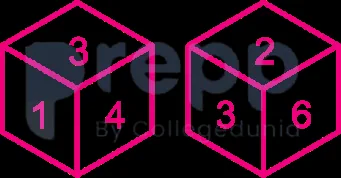
Two rotated positions of a dice are given below. Which number will be at the top if the number 4 is on the bottom of the dice?
- A
4
- B
2
- C
6
- D
1
Show answer
B. 2If we rotate the 1 st cube so that face which have 1 goes to bottom and face 3 comes to front.
If 3 comes to front then upper face is 2 as shown in figure 2 nd cube.
Hence 1 will be opposite to 6 and 2 will be opposite to 4
Hence 2 will come on top if 4 is on the bottom.
Paper & answer key PDF ↗ Question 10archived
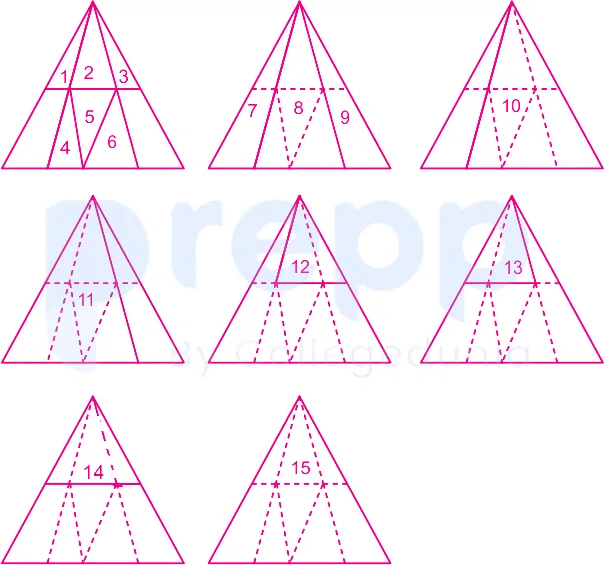
How many triangles are there in the following figure?

- A
13
- B
14
- C
15
- D
17
Show answer
C. 15Hence total number of triangles is 15.
 Paper & answer key PDF ↗
 Question 11archived
Three of the following four letter-clusters are alike in a certain way and one is different. Pick the odd one out.
- A
NPRT
- B
JMPS
- C
WVUS
- D
DEFG
Show answer
C. WVUSFinding the Odd Letter Cluster Out
This question asks us to identify the letter cluster that is different from the others based on a specific pattern. To solve this type of letter series problem, we typically look at the positions of the letters in the English alphabet and find the relationship between consecutive letters within each cluster.
Analyzing Letter Clusters and Patterns
Let's examine each letter cluster provided and determine the pattern:
NPRT:
The positions of these letters in the alphabet are:
N is the 14th letter.
P is the 16th letter.
R is the 18th letter.
T is the 20th letter.
Let's look at the differences between consecutive letter positions:
\(P - N = 16 - 14 = +2\)
\(R - P = 18 - 16 = +2\)
\(T - R = 20 - 18 = +2\)
The pattern in NPRT is a consistent increase of 2 in letter position.
JMPS:
The positions of these letters in the alphabet are:
J is the 10th letter.
M is the 13th letter.
P is the 16th letter.
S is the 19th letter.
Let's look at the differences between consecutive letter positions:
\(M - J = 13 - 10 = +3\)
\(P - M = 16 - 13 = +3\)
\(S - P = 19 - 16 = +3\)
The pattern in JMPS is a consistent increase of 3 in letter position.
WVUS:
The positions of these letters in the alphabet are:
W is the 23rd letter.
V is the 22nd letter.
U is the 21st letter.
S is the 19th letter.
Let's look at the differences between consecutive letter positions:
\(V - W = 22 - 23 = -1\)
\(U - V = 21 - 22 = -1\)
\(S - U = 19 - 21 = -2\)
The pattern in WVUS is a decrease in letter position, but the difference is not consistent throughout the cluster.
DEFG:
The positions of these letters in the alphabet are:
D is the 4th letter.
E is the 5th letter.
F is the 6th letter.
G is the 7th letter.
Let's look at the differences between consecutive letter positions:
\(E - D = 5 - 4 = +1\)
\(F - E = 6 - 5 = +1\)
\(G - F = 7 - 6 = +1\)
The pattern in DEFG is a consistent increase of 1 in letter position.
Identifying the Odd One Out
Comparing the patterns we found:
NPRT: Consistent +2 difference.
JMPS: Consistent +3 difference.
WVUS: Inconsistent -1, -1, -2 difference.
DEFG: Consistent +1 difference.
Three of the letter clusters (NPRT, JMPS, DEFG) show a consistent difference between consecutive letters based on their alphabetical position. The cluster WVUS shows decreasing letters, but the differences are not consistent (-1, then -2). Therefore, WVUS is the odd one out because it does not follow a pattern of consistent differences between consecutive letters.
Summary of Letter Cluster Patterns
Cluster
Letter Positions
Differences
Pattern Consistency
NPRT
14, 16, 18, 20
+2, +2, +2
Consistent
JMPS
10, 13, 16, 19
+3, +3, +3
Consistent
WVUS
23, 22, 21, 19
-1, -1, -2
Inconsistent
DEFG
4, 5, 6, 7
+1, +1, +1
Consistent
Conclusion
Based on the analysis of the patterns formed by the alphabetical positions of the letters, WVUS is the letter cluster that is different from the other three.
Revision Table: Letter Series & Odd One Out
Understanding letter series patterns is key to solving odd one out questions. Common patterns include:
Adding/Subtracting a constant value to letter positions.
Adding/Subtracting values in a series (e.g., +1, +2, +3...).
Skipping letters in a sequence.
Alternating patterns.
Using vowels or consonants.
Reverse alphabetical order.
Additional Information: Logical Reasoning with Letter Patterns
Logical reasoning questions often involve identifying sequences and patterns in letters, numbers, or figures. For letter-based questions like finding the odd letter cluster, knowing the alphabetical position of each letter is fundamental. Practicing different types of patterns helps in quickly recognizing the rule followed by the majority of items and spotting the one that deviates.
Remembering the positions (A=1, B=2, ..., Z=26) can significantly speed up the process of finding differences and identifying patterns in letter series and odd one out problems.
Paper & answer key PDF ↗ Question 12archived
Choose the set of numbers that is similar to the following set.
(8, 28, 6)
- A
(3, 20, 7)
- B
(17, 70, 13)
- C
(5, 26, 9)
- D
(12, 48, 14)
Show answer
A. (3, 20, 7)Understanding Number Set Analogies
Number set analogy questions require you to identify a mathematical or logical relationship between the numbers in a given set. Once the pattern is found, you need to apply the same pattern to the given options to find the set that follows the identical rule.
The given set is (8, 28, 6).
Let's analyze the relationship between the numbers in this set. Let the three numbers be represented as the first number, middle number, and third number.
First number = 8
Middle number = 28
Third number = 6
We need to find a rule that connects these three numbers. Let's try some common operations involving the first and third numbers to see if they relate to the middle number.
Sum of first and third number: 8 + 6 = 14
Difference between first and third number: 8 - 6 = 2 (or 6 - 8 = -2)
Product of first and third number: 8 × 6 = 48
Square of first number: 82 = 64
Square of third number: 62 = 36
Looking at the sum (14) and the middle number (28), we can see a direct relationship: 14 multiplied by 2 equals 28.
So, a potential rule is: Middle Number = 2 × (First Number + Third Number).
Let's verify this rule with the given set (8, 28, 6):
First Number = 8, Third Number = 6
First Number + Third Number = 8 + 6 = 14
2 × (First Number + Third Number) = 2 × 14 = 28
This result (28) matches the Middle Number in the given set. Thus, the rule $\small b = 2(a+c)$ seems to be the correct pattern, where 'a' is the first number, 'b' is the middle number, and 'c' is the third number.
Applying the Pattern to Options
Now, let's apply this rule $\small b = 2(a+c)$ to each of the given options to find the set that follows the same pattern.
Option 1: (3, 20, 7)
Here, a = 3, b = 20, c = 7.
Let's calculate $\small 2(a+c)$:
$\small 2(3+7) = 2(10) = 20$
This matches the middle number b=20 in this set. So, Option 1 follows the same pattern.
Option 2: (17, 70, 13)
Here, a = 17, b = 70, c = 13.
Let's calculate $\small 2(a+c)$:
$\small 2(17+13) = 2(30) = 60$
This (60) does not match the middle number b=70. So, Option 2 does not follow the pattern.
Option 3: (5, 26, 9)
Here, a = 5, b = 26, c = 9.
Let's calculate $\small 2(a+c)$:
$\small 2(5+9) = 2(14) = 28$
This (28) does not match the middle number b=26. So, Option 3 does not follow the pattern.
Option 4: (12, 48, 14)
Here, a = 12, b = 48, c = 14.
Let's calculate $\small 2(a+c)$:
$\small 2(12+14) = 2(26) = 52$
This (52) does not match the middle number b=48. So, Option 4 does not follow the pattern.
Based on the analysis, only Option 1 follows the same pattern as the given set (8, 28, 6), which is $\small b = 2(a+c)$.
Detailed Comparison Table
Here's a table summarizing the application of the rule $\small b = 2(a+c)$ to each option:
Set
a
b
c
Calculation: $\small 2(a+c)$
Matches b?
(8, 28, 6)
8
28
6
$\small 2(8+6) = 2(14) = 28$
Yes
(3, 20, 7)
3
20
7
$\small 2(3+7) = 2(10) = 20$
Yes
(17, 70, 13)
17
70
13
$\small 2(17+13) = 2(30) = 60$
No
(5, 26, 9)
5
26
9
$\small 2(5+9) = 2(14) = 28$
No
(12, 48, 14)
12
48
14
$\small 2(12+14) = 2(26) = 52$
No
Conclusion
The set (3, 20, 7) follows the same rule $\small b = 2(a+c)$ as the given set (8, 28, 6). Therefore, it is the set of numbers similar to the given set.
Revision Table: Number Set Analogy
Concept
Description
Application
Number Set Analogy
Finding a hidden pattern or rule connecting numbers in a given set.
Analyze the relationship between elements (first, middle, last) in the example set.
Pattern Identification
Testing various mathematical operations (addition, subtraction, multiplication, division, squares, cubes, etc.) between the numbers.
Tried $\small a+c$, $\small a-c$, $\small a \times c$, $\small a^2-c^2$, etc., and found $\small 2(a+c)=b$.
Rule Application
Applying the identified pattern to the given options.
Calculated $\small 2(a+c)$ for each option and compared it with the middle number 'b'.
Similar Set
An option set that satisfies the identified pattern.
The set where the middle number equals $\small 2(a+c)$.
Additional Information: Numerical Reasoning Tips
Numerical reasoning and number set analogy questions are common in competitive exams. Here are some tips to approach them effectively:
Practice Regularly: Familiarize yourself with different types of patterns.
Look for Simple Relations First: Start by checking for basic arithmetic operations (sum, difference, product, quotient) between the numbers.
Consider Squares and Cubes: Many patterns involve squares, cubes, or their differences/sums.
Check Ratios and Multiples: See if numbers are multiples of each other or have common factors.
Look for Series Patterns: Sometimes, the numbers form a series with a consistent difference or ratio between consecutive terms (though less common in a set of three unrelated numbers).
Analyze Position: Consider the position of the numbers (first, middle, last) as the pattern might be position-dependent.
Test Options: Once a potential rule is found from the example set, test it rigorously on all options.
Stay Calm: Some patterns can be tricky, but with practice, you can improve your ability to spot them quickly.
Paper & answer key PDF ↗ Question 13archived
Three of the following four words are alike in a certain way and one is different. Pick the odd word out.
- A
Conceal
- B
Horde
- C
Camouflage
- D
Mask
Show answer
B. HordeIdentifying the Odd Word Out Among Conceal, Horde, Camouflage, Mask
The question asks us to find the word that is different from the other three in a given set of four words: Conceal, Horde, Camouflage, and Mask. This type of question tests our vocabulary and ability to identify relationships between words.
Understanding the Meanings of the Words
Let's look at the meaning of each word provided in the options:
Conceal: To hide or keep secret.
Horde: A large group of people, typically a mobile one; a large number of people.
Camouflage: The disguise or concealment, especially of military equipment or personnel, by means of paint, nets, or foliage, to make them blend in with their surroundings; to hide or disguise by camouflage.
Mask: A covering for the face, worn to disguise or protect the face, or to amuse or frighten others; to cover (a face or part of the face) with a mask; to conceal or disguise (something).
Analyzing the Relationship Between Words
Now, let's examine how these words relate to each other:
Conceal is about hiding something.
Camouflage is a specific method of hiding or disguising something, usually by making it blend in with the environment.
Mask can be used to cover or disguise a face, which is also a form of concealment. It means to hide or disguise something.
So, the words Conceal, Camouflage, and Mask all share the core meaning related to hiding, covering up, or disguising something or someone.
On the other hand, Horde means a large group of people or a large number of something. It has no relation to the concept of hiding or disguising.
Identifying the Odd Word
Based on the meanings, three words (Conceal, Camouflage, Mask) are related to the idea of hiding or disguising, while one word (Horde) refers to a large group. Therefore, 'Horde' is the word that is different from the others.
The odd word out is Horde.
Word
Meaning Related to Hiding/Disguising
Other Meaning
Conceal
Yes (To hide)
-
Horde
No
A large group
Camouflage
Yes (To hide by blending)
-
Mask
Yes (To cover/disguise)
A face covering
Revision Table: Understanding Word Meanings for Odd Word Out
Word
Core Concept
Relation to Others
Conceal
Hiding/Keeping Secret
Similar (Hiding/Disguise)
Horde
Large Group
Different
Camouflage
Disguise by Blending
Similar (Hiding/Disguise)
Mask
Covering/Disguising
Similar (Hiding/Disguise)
Additional Information on Odd Word Out Questions
Odd word out questions are common in verbal reasoning tests. They require you to identify a common characteristic shared by three or more words in a set and then find the word that does not share that characteristic. The relationships can be based on:
Meaning (synonyms, antonyms, related concepts)
Category (animals, colours, fruits, tools)
Properties (shapes, materials, functions)
Parts of speech
Letter patterns or sounds (less common in vocabulary-based questions)
To solve these effectively, build your vocabulary and practice identifying relationships between words.
Paper & answer key PDF ↗ Question 14archived
Choose the Venn diagram that best illustrates the relationship among the following classes:
Crocodiles, Aquatic animals, Reptiles
- A
Option A (shown in image)
- B
Option B (shown in image)
- C
Option C (shown in image)
- D
Option D (shown in image)
Show answer
A. Option A (shown in image)All Crocodile are Aquatic animal and reptiles, and some aquatic animals can be Reptiles.
Hence is correct answer.
 Paper & answer key PDF ↗
 Question 15archived
Select the word-pair in which the two words are related in the same way as the two words in the following word-pair.
Grief : Consolation
- A
Pain : Sedative
- B
Happiness : Excitation
- C
Drought : Famine
- D
Planet : Revolution
Show answer
A. Pain : SedativeThis question asks us to find a word-pair that shares the same relationship as the given pair: Grief : Consolation. We need to first understand the connection between Grief and Consolation.
The relationship between Grief and Consolation is that Consolation provides comfort or relief from Grief. Consolation helps to lessen the feeling of Grief.
Now let's examine each option based on this relationship:
Analyzing Analogy Options
Option 1: Pain : Sedative
A Sedative is a substance that provides relief or alleviates Pain. Just as Consolation relieves Grief, a Sedative relieves Pain. This pair shows a similar relationship of alleviation or relief.
Option 2: Happiness : Excitation
Excitation is a state of being excited, often associated with feelings of Happiness. However, Excitation doesn't relieve or alleviate Happiness; it's more of a related state or intensity of feeling. This does not match the relationship of relief seen in Grief : Consolation.
Option 3: Drought : Famine
A Drought is a prolonged period of dryness which can often lead to a Famine (extreme scarcity of food). This is a cause-and-effect relationship (Drought causes Famine), not a relationship where one alleviates the other. This does not match the relationship in the original pair.
Option 4: Planet : Revolution
A Planet undergoes Revolution, which is the movement of a planet around a star. This describes an action or characteristic of a Planet. There is no relationship of alleviation or relief between a Planet and Revolution. This does not match the relationship in the original pair.
Comparing the relationships, the pair Pain : Sedative exhibits the same kind of connection as Grief : Consolation, where the second word provides relief from the first word.
Revision Table: Word Analogy Analysis
Word Pair
Relationship
Matches Grief : Consolation?
Grief : Consolation
Consolation relieves Grief
Base Pair
Pain : Sedative
Sedative relieves Pain
Yes
Happiness : Excitation
Excitation is a state related to Happiness
No
Drought : Famine
Drought causes Famine (Cause-Effect)
No
Planet : Revolution
Planet performs Revolution (Action/Characteristic)
No
Additional Information on Analogies
Word analogies test your ability to identify the relationship between a given pair of words and then recognize a similar relationship in other pairs. Common types of relationships include:
Cause and Effect (e.g., Rain : Flood)
Part to Whole (e.g., Finger : Hand)
Synonyms (e.g., Happy : Joyful)
Antonyms (e.g., Hot : Cold)
Tool and User (e.g., Pen : Writer)
Action and Object (e.g., Read : Book)
Problem and Solution (e.g., Tiredness : Sleep)
Intensity (e.g., Warm : Hot)
In this specific question, the relationship is best described as Problem : Solution or Ailment : Remedy, where the second word provides relief or a solution to the first word.
Paper & answer key PDF ↗ Question 16archived
Arrange the following words in a logical and meaningful order.
1. Probation
2. Promotion
3. Job
4. Interview
5. Confirmation
- A
5, 4, 2, 1, 3
- B
4, 1, 2, 5, 3
- C
4, 3, 1, 5, 2
- D
5, 1, 4, 2, 3
Show answer
C. 4, 3, 1, 5, 2Understanding Logical Word Arrangement
This question asks us to arrange a set of words related to a job process in a logical and meaningful sequence. We need to consider the typical order in which these events occur in a person's career journey, from getting a job to progressing in it.
Analyzing the Sequence of Job-Related Words
Let's consider the provided words and think about the most sensible order:
1. Probation: A period of testing or observation, typically after starting a new job.
2. Promotion: Advancing to a higher position or rank.
3. Job: The position of employment itself.
4. Interview: A formal meeting to assess a candidate for employment.
5. Confirmation: Making an agreement or position definite, usually after a probation period.
Now, let's think about the steps in a chronological order related to getting and progressing in a job:
First, you typically go through an Interview process for a potential role.
If successful in the interview, you are offered and accept the Job.
After joining the job, there is often a Probation period to evaluate performance and fit.
Upon successful completion of the probation period, the employment is usually Confirmed.
After confirmation and gaining experience, one might be eligible for a Promotion to a higher role or responsibility.
Establishing the Logical Order
Based on the typical employment process, the logical and meaningful order of the given words is:
Interview (4)
Job (3)
Probation (1)
Confirmation (5)
Promotion (2)
This sequence corresponds to the numerical order: 4, 3, 1, 5, 2.
Matching with the Options
Let's compare our derived sequence with the given options:
Option
Sequence
Words
Logical?
1
5, 4, 2, 1, 3
Confirmation, Interview, Promotion, Probation, Job
Illogical (e.g., Confirmation before Interview)
2
4, 1, 2, 5, 3
Interview, Probation, Promotion, Confirmation, Job
Illogical (e.g., Probation and Promotion before Job/Confirmation)
3
4, 3, 1, 5, 2
Interview, Job, Probation, Confirmation, Promotion
Logical (Follows typical career path)
4
5, 1, 4, 2, 3
Confirmation, Probation, Interview, Promotion, Job
Illogical (e.g., Confirmation before Interview)
The logical order derived (4, 3, 1, 5, 2) matches Option 3.
Revision Table: Key Logical Reasoning Concepts
Concept
Explanation
Application Here
Sequential Order
Arranging items or events based on the order in which they happen in time or process.
The events in a job process (Interview, Job, Probation, etc.) follow a typical timeline.
Logical Consistency
Ensuring that each step in the sequence makes sense relative to the previous and next steps.
It is logical to have an Interview before getting a Job, and Probation after getting a Job, etc.
Meaningful Arrangement
Creating an order that conveys a clear and understandable process or relationship between the items.
Arranging these words in the order they occur in an employment lifecycle makes the sequence meaningful.
Additional Information: Stages of Employment
Understanding the common stages of employment helps in arranging these words logically. While specific company practices may vary, a general progression includes:
Application and Screening: Submitting resumes and initial checks.
Interview Process: Meetings to assess suitability.
Job Offer and Acceptance: Formal offer and candidate acceptance.
Onboarding: Starting the new role, often with training.
Probation Period: A trial period for both the employee and the employer.
Confirmation/Permanent Employment: Formal confirmation after successful probation.
Performance Review and Development: Regular assessment and growth opportunities.
Promotion or Career Progression: Moving to higher roles or responsibilities based on performance and opportunity.
Separation: Leaving the job, either voluntarily or involuntarily.
The words in the question cover several key steps within this broader lifecycle, specifically focusing on joining and progressing within a role: Interview > Job > Probation > Confirmation > Promotion.
Paper & answer key PDF ↗ Question 17archived
In a family of eight persons with two couples, P is the son of Q. S is the daughter of M, who is married to R. T is the aunt of S and mother of V. M’s nephew W is the son of P and has a sister V. R has no siblings. How is V related to M?
- A
Nephew
- B
Cousin sister
- C
Niece
- D
Daughter
Show answer
C. NieceUnderstanding Blood Relations in a Family Puzzle
Let's carefully analyze each statement provided in the question to build the family structure and determine the relationship between V and M.
Analyzing the Clues to Build the Family Structure
"In a family of eight persons with two couples..." - We know the total number of people is eight, and there are exactly two married couples in the family.
"P is the son of Q." - This indicates a parent-child relationship where Q is a parent and P is their son. We can represent this as Q → P (Son).
"S is the daughter of M, who is married to R." - M and R are a married couple. S is their daughter. We know M and R are a couple, and M is one of S's parents. Relationship: M – R (Couple), M/R → S (Daughter).
"T is the aunt of S and mother of V." - T is a parent of V. An aunt is a parent's sister. S is the child of M and R. So, T is a sibling of either M or R.
"R has no siblings." - This crucial piece of information tells us that T, the aunt of S, cannot be R's sibling. Therefore, T must be M's sibling. Since T is female (mother of V), T is M's sister. Relationship: T → V (Mother), T is M's sister.
"M’s nephew W is the son of P and has a sister V." - W is the son of P, and V is W's sister. This means P is the father of both W and V. Relationship: P → W (Son), P → V (Daughter).
W is M’s nephew. A nephew is the son of one's sibling. Since W is P's son and W is M's nephew, P must be M's sibling. Given P is male (son of Q and father of W), P is M's brother. Relationship: P is M's brother.
Constructing the Family Relationships
From the analysis, we can establish the following connections:
P and M are siblings (P is M's brother).
T is M's sister. This means P, M, and T are all siblings.
Q is a parent of P (P is son of Q). Since P, M, and T are siblings, Q (along with a spouse, possibly) is a parent of all three: P, M, and T.
P is the father of V, and T is the mother of V. This means P and T are a married couple.
M is married to R. M and R are a married couple.
The two couples in the family are P-T and M-R. This matches the initial condition of two couples.
V is the child of P and T.
P is M's brother, and T is M's sister.
Based on these relationships, V is the daughter of P (who is M's brother) and T (who is M's sister).
Determining the Relationship between V and M
We need to find out how V is related to M.
V is the daughter of P and T.
P is the brother of M.
T is the sister of M.
V is the daughter of M's brother (P) and M's sister (T).
A daughter of a person's sibling (brother or sister) is known as a niece.
Therefore, V is M's niece.
Evaluating the Given Options
Let's check our derived relationship against the provided options:
OptionRelationshipEvaluation
1NephewIncorrect. V is female, so she cannot be a nephew.
2Cousin sisterIncorrect. Cousins are children of aunts/uncles. V is the child of M's siblings, making V M's niece.
3NieceCorrect. V is the daughter of M's brother (P) and sister (T), which makes her M's niece.
4DaughterIncorrect. S is the daughter of M and R. V is the daughter of P and T.
Revision Table: Summary of Relationships
Individuals InvolvedDerived Relationship
P and QP is son of Q
M and RM and R are a couple
S, M, RS is daughter of M
T and VT is mother of V
T, S, M, RT is S's aunt, R has no siblings → T is M's sister
W, P, VW is P's son, V is W's sister → P is father of W and V
W, M, PW is M's nephew, W is P's son → P is M's sibling (brother)
P, T, VP is father of V, T is mother of V → P and T are a couple
P, M, TP is M's brother, T is M's sister → P, M, and T are siblings
V and MV is daughter of P (M's brother) and T (M's sister) → V is M's Niece
Additional Information on Solving Blood Relation Puzzles
Blood relation questions test your ability to understand and decode complex family relationships. Here are some tips and definitions:
Key Terms: Be familiar with terms like sibling, aunt, uncle, niece, nephew, cousin, etc. Remember gender matters for niece/nephew and son/daughter relationships.
Visual Aids: Drawing a diagram or family tree can make it easier to track relationships, especially in larger families. Use standard symbols: circle for female, square for male, double line for marriage, single horizontal line for siblings, and vertical line for parent-child.
Break Down Statements: Address one statement at a time and build the family structure incrementally. Look for connections between different statements.
Identify Couples: Knowing the married couples helps define family units and generations.
Identify Generations: Place individuals in different generations to clarify relationships (e.g., parents are one generation above children).
By systematically breaking down the information and identifying the relationships, you can accurately solve blood relation questions.
Paper & answer key PDF ↗ Question 18archived
In a code language, STROKE is written as FLPSUT. How would BRIGHT be written in the same code language?
- A
CSJHIU
- B
UJHHCS
- C
UIHJSC
- D
SGFHQA
Show answer
C. UIHJSCUnderstanding Code Language Patterns
This question asks us to decode a word based on a given example of coding. We are told that in a certain code language, the word STROKE is written as FLPSUT. Our task is to figure out the rule or pattern used for this transformation and then apply the same rule to find the code for the word BRIGHT.
Analyzing the STROKE to FLPSUT Transformation
Let's look at the letters of the original word STROKE and their corresponding letters in the coded word FLPSUT. Both words have 6 letters.
Original Letter (STROKE)
Coded Letter (FLPSUT)
S
F
T
L
R
P
O
S
K
U
E
T
At first glance, there isn't a simple letter-by-letter shift forward or backward in the alphabet. Let's consider other possibilities, such as reversing the word or a combination of reversal and shifting.
Discovering the Coding Rule
Let's try reversing the original word STROKE. Reversing STROKE gives us EKORTS.
Now, let's compare the letters of the reversed word (EKORTS) with the letters of the coded word (FLPSUT):
Reversed Word (EKORTS)
Coded Word (FLPSUT)
E
F
K
L
O
P
R
S
T
U
S
T
Now we can see a clear pattern! Each letter in the reversed word EKORTS is shifted forward by one position in the English alphabet to get the corresponding letter in FLPSUT.
E \(\xrightarrow{+1}\) F
K \(\xrightarrow{+1}\) L
O \(\xrightarrow{+1}\) P
R \(\xrightarrow{+1}\) S
T \(\xrightarrow{+1}\) U
S \(\xrightarrow{+1}\) T
So, the coding rule is: Reverse the original word, then shift each letter forward by one position (+1) in the alphabet.
Applying the Rule to BRIGHT
Now, we apply the same two steps to the word BRIGHT.
Reverse the word BRIGHT: Reversing BRIGHT gives us THGIRB.
Shift each letter of THGIRB forward by one position (+1):
Reversed Letter (THGIRB)
Shift (+1)
Coded Letter
T
\(\xrightarrow{+1}\)
U
H
\(\xrightarrow{+1}\)
I
G
\(\xrightarrow{+1}\)
H
I
\(\xrightarrow{+1}\)
J
R
\(\xrightarrow{+1}\)
S
B
\(\xrightarrow{+1}\)
C
Putting the coded letters together, we get UIHJSC.
Confirming the Answer
The coded word for BRIGHT based on the established pattern is UIHJSC. Let's check this against the given options.
Option 1: CSJHIU (Incorrect)
Option 2: UJHHCS (Incorrect)
Option 3: UIHJSC (Correct)
Option 4: SGFHQA (Incorrect)
The result UIHJSC matches Option 3.
Revision Table: Key Steps in Coding
Step
Description
Example (STROKE)
Example (BRIGHT)
1
Identify the original word.
STROKE
BRIGHT
2
Identify the coded word (for the example).
FLPSUT
(To be found)
3
Analyze the pattern (e.g., reversal, shift).
Pattern: Reverse the word, then shift each letter +1.
4
Apply reversal.
EKORTS
THGIRB
5
Apply letter shift (+1).
E\(\to\)F, K\(\to\)L, O\(\to\)P, R\(\to\)S, T\(\to\)U, S\(\to\)T
T\(\to\)U, H\(\to\)I, G\(\to\)H, I\(\to\)J, R\(\to\)S, B\(\to\)C
6
Combine shifted letters for the coded word.
FLPSUT
UIHJSC
Additional Information on Coding Decoding
Coding and decoding questions like this test your logical reasoning and pattern recognition skills. They often involve:
Alphabetical Shifts: Replacing letters with others a fixed number of positions away (like A becomes C, B becomes D - a +2 shift).
Reversal: Writing the word backward.
Position Changes: Swapping letters based on their position (e.g., first with last, second with second last).
Combinations: Using more than one rule, like the example we solved (reversal + shift).
Opposite Letters: Replacing letters with their counterparts from the other end of the alphabet (A with Z, B with Y, etc.).
Practicing different types of coding patterns helps you quickly identify the rule in exam questions.
Paper & answer key PDF ↗ Question 19archived
If SMOKE is coded as 81643 and PRANK is coded as 72954, how would you code ROSE?
- A
2683
- B
3276
- C
9238
- D
2682
Show answer
A. 2683Solving Coding Decoding Problems
This problem is a classic example of a substitution cipher, a type of coding and decoding question often found in logical reasoning sections of competitive exams. In a substitution cipher, each letter is replaced by a specific digit or symbol. The key to solving these problems is to identify the pattern of substitution based on the given examples.
Analyzing the Given Codes: SMOKE and PRANK
We are given two examples of words coded into numbers:
SMOKE is coded as 81643
PRANK is coded as 72954
Let's break down these codes to find the digit corresponding to each letter present in these words.
Letter-to-Digit Mapping from SMOKE (81643):
S corresponds to 8
M corresponds to 1
O corresponds to 6
K corresponds to 4
E corresponds to 3
Letter-to-Digit Mapping from PRANK (72954):
P corresponds to 7
R corresponds to 2
A corresponds to 9
N corresponds to 5
K corresponds to 4
Notice that the letter 'K' appears in both words, and it is consistently coded as '4'. This confirms that the mapping is consistent across the given examples.
Coding the Word ROSE
Now, we need to find the code for the word ROSE using the mappings we derived:
R
O
S
E
Let's look up the corresponding digits from our mapping:
R is coded as 2 (from PRANK)
O is coded as 6 (from SMOKE)
S is coded as 8 (from SMOKE)
E is coded as 3 (from SMOKE)
Combining these digits in the order they appear in ROSE, we get the code:
R → 2
O → 6
S → 8
E → 3
Therefore, the code for ROSE is 2683.
Comparing with Options
Let's compare our derived code (2683) with the given options:
Option
Code
Match?
1
2683
Yes
2
3276
No
3
9238
No
4
2682
No
The derived code 2683 matches Option 1.
Conclusion on Coding ROSE
Based on the substitution pattern established by the given codes for SMOKE and PRANK, the word ROSE is coded as 2683.
Revision Table: Coding Decoding Concepts
Concept
Description
Coding
Converting a word, letter, or number into a different form based on a specific rule or pattern.
Decoding
Converting the coded form back into its original form by applying the reverse of the coding rule.
Substitution Cipher
A method of coding where each unit (like a letter) is replaced by another unit (like a different letter, number, or symbol).
Pattern Identification
The key step in solving coding-decoding problems, involving figuring out the rule used for coding by analyzing the given examples.
Additional Information: Types of Coding Decoding
Coding and decoding problems can involve various patterns. Some common types include:
Letter Coding: Letters are substituted with other letters based on patterns like shifting positions in the alphabet (e.g., A → B, B → C) or reversing the order.
Number/Symbol Coding: Letters are coded using numbers or symbols, often based on their position in the alphabet, a specific mapping, or a combination with other rules. This problem is an example of number coding.
Mixed Coding: Words are coded into a combination of numbers and symbols.
Sentence Coding: Entire sentences are coded, often involving assigning codes to individual words based on common words found across different coded sentences.
Solving these problems requires careful observation, logical reasoning, and the ability to identify underlying patterns quickly.
Paper & answer key PDF ↗ Question 20archived
Two statements are followed by three conclusions numbered I, II and III. Assuming the statements to be true, even if they do not conform to real-world knowledge, decide which of the conclusion(s) logically follows/follow from the statements.
Statements:
All knives are instruments.
Some cutters are knives.
Conclusions:
I. Some cutters are instruments.
II. All knives are cutters.
III. Some knives are not instruments.
- A
Only conclusion III follows
- B
Only conclusion II follows
- C
Only conclusion I follows
- D
None of the conclusions follow
Show answer
C. Only conclusion I followsAnalyzing Syllogism Statements and Conclusions
This question asks us to analyze two statements and determine which of the given conclusions logically follow from them. We must assume the statements are true, even if they don't match real-world facts.
The Given Statements:
Statement 1: All knives are instruments.
Statement 2: Some cutters are knives.
The Given Conclusions:
Conclusion I: Some cutters are instruments.
Conclusion II: All knives are cutters.
Conclusion III: Some knives are not instruments.
Evaluating Each Conclusion
Let's evaluate each conclusion based on the provided statements. We can use logical deduction or visualize using Venn diagrams.
Evaluating Conclusion I: Some cutters are instruments.
Statement 2 tells us that there is at least one cutter that is also a knife. Statement 1 tells us that every single knife is also an instrument. If a cutter is also a knife (from Statement 2), and that knife is definitely an instrument (from Statement 1), then that specific cutter must also be an instrument.
Since Statement 2 guarantees that such a cutter exists (at least one), it logically follows that Some cutters are instruments.
This conclusion logically follows from combining the information in both statements.
Evaluating Conclusion II: All knives are cutters.
Statement 1 says "All knives are instruments". Statement 2 says "Some cutters are knives". Statement 2 means that there is an overlap between the group of cutters and the group of knives. It does NOT say that the entire group of knives is contained within the group of cutters. It's possible for there to be knives that are not cutters.
Therefore, Conclusion II, All knives are cutters, does not logically follow from the given statements.
Evaluating Conclusion III: Some knives are not instruments.
Statement 1 explicitly says, "All knives are instruments". This means that every member of the group "knives" is also a member of the group "instruments". There are no knives that are not instruments according to Statement 1.
Conclusion III, Some knives are not instruments, directly contradicts Statement 1. Therefore, this conclusion does not logically follow.
Summary of Conclusion Evaluation
Let's summarize our findings in a table:
Conclusion
Logical Follows?
Reasoning
I. Some cutters are instruments.
Yes
If some cutters are knives, and all knives are instruments, then those cutters must be instruments.
II. All knives are cutters.
No
Statement 2 only says SOME cutters are knives (implying SOME knives are cutters), not ALL knives are cutters.
III. Some knives are not instruments.
No
Directly contradicts Statement 1, which says ALL knives are instruments.
Based on our analysis, only Conclusion I logically follows from the given statements.
Revision Table: Syllogism Rules and Types
Statement Type
Structure
Example
Universal Affirmative (A)
All P are Q
All knives are instruments
Universal Negative (E)
No P are Q
No knives are instruments
Particular Affirmative (I)
Some P are Q
Some cutters are knives
Particular Negative (O)
Some P are not Q
Some knives are not instruments
Understanding these types helps in analyzing how statements can be combined or how conclusions relate to premises.
Additional Information: Syllogism and Logical Deduction
Syllogism is a type of logical argument that applies deductive reasoning to arrive at a conclusion based on two or more propositions that are asserted or assumed to be true. In a standard categorical syllogism, like the one in this question, there are three parts:
Major premise (often the first statement)
Minor premise (often the second statement)
Conclusion
The terms "knives," "instruments," and "cutters" are categories or sets. The statements describe relationships between these sets. "All knives are instruments" means the set of "knives" is a subset of the set of "instruments". "Some cutters are knives" means the set of "cutters" and the set of "knives" have at least one common element.
When evaluating conclusions, we must strictly adhere to the information given in the premises and not bring in outside knowledge. The logic must hold true based *only* on the statements provided.
Paper & answer key PDF ↗ Question 21archived
Select the number pair in which the two numbers are related in the same way as the two numbers of the pair given below.
35 : 5
- A
63 : 7
- B
48 : 7
- C
99 : 10
- D
135 : 12
Show answer
A. 63 : 7Understanding Number Pair Analogy
In number pair analogy questions, we are given a pair of numbers that share a specific relationship. Our task is to find another pair from the given options that shares the exact same relationship. The relationship can be based on arithmetic operations (addition, subtraction, multiplication, division), squares, cubes, prime numbers, or other numerical properties.
Analyzing the Given Number Pair: 35 : 5
Let's look at the relationship between the two numbers in the given pair, 35 and 5. We can observe that the first number, 35, is a multiple of the second number, 5.
We can express this relationship as:
\begin{equation*} 35 \div 5 = 7 \end{equation*}
or
\begin{equation*} 5 \times 7 = 35 \end{equation*}
So, the relationship is that the first number is obtained by multiplying the second number by 7, or equivalently, the first number is 7 times the second number.
Evaluating the Options
Now, let's examine each option to see which pair exhibits a similar relationship. We need to find a pair where the first number is a multiple of the second number.
Option 1: 63 : 7
Let's check the relationship between 63 and 7.
\begin{equation*} 63 \div 7 = 9 \end{equation*}
or
\begin{equation*} 7 \times 9 = 63 \end{equation*}
Here, the first number (63) is a multiple of the second number (7). The factor is 9.
Option 2: 48 : 7
Let's check the relationship between 48 and 7.
\begin{equation*} 48 \div 7 \end{equation*}
48 is not perfectly divisible by 7. So, 48 is not an integer multiple of 7.
Option 3: 99 : 10
Let's check the relationship between 99 and 10.
\begin{equation*} 99 \div 10 \end{equation*}
99 is not perfectly divisible by 10. So, 99 is not an integer multiple of 10.
Option 4: 135 : 12
Let's check the relationship between 135 and 12.
\begin{equation*} 135 \div 12 \end{equation*}
135 is not perfectly divisible by 12. So, 135 is not an integer multiple of 12.
Identifying the Matching Relationship
Comparing the analysis of the options with the relationship found in the given pair (35 : 5), we see that the primary relationship is that the first number is an integer multiple of the second number. While the factor of multiplication is 7 in the given pair, the relationship type is 'first number is a multiple of the second'.
Only Option 1 (63 : 7) shows this type of relationship where 63 is an integer multiple of 7 (63 = 7 × 9). Options 2, 3, and 4 do not have this property as the first number is not an integer multiple of the second number.
Pair
Relationship (\(\text{Number}_1 \div \text{Number}_2\))
Is \(\text{Number}_1\) an Integer Multiple of \(\text{Number}_2\)?
35 : 5 (Given)
\(35 \div 5 = 7\)
Yes (Factor = 7)
63 : 7 (Option 1)
\(63 \div 7 = 9\)
Yes (Factor = 9)
48 : 7 (Option 2)
\(48 \div 7 \approx 6.86\)
No
99 : 10 (Option 3)
\(99 \div 10 = 9.9\)
No
135 : 12 (Option 4)
\(135 \div 12 = 11.25\)
No
Therefore, the pair 63 : 7 shares the same type of relationship as 35 : 5, which is that the first number is an integer multiple of the second number.
Conclusion
Based on the analysis, the number pair 63 : 7 is related in the same way as the pair 35 : 5, as in both cases, the first number is an integer multiple of the second number.
Revision Table: Number Analogy Concepts
Concept
Description
Example
Basic Arithmetic
Relationship involves addition, subtraction, multiplication, or division.
\(10 : 5\) (10 is \(5 \times 2\))
Squares/Cubes
Relationship involves squares or cubes of numbers.
\(25 : 5\) (25 is \(5^2\))
Prime Numbers
Relationship involves prime numbers or their properties.
\(7 : 11\) (Consecutive prime numbers)
Digit Operations
Relationship involves operations on the digits of the numbers.
\(23 : 5\) (5 is \(2+3\))
Additional Information: Solving Number Analogy Problems
To solve number analogy problems effectively, consider the following strategies:
Look for simple arithmetic relations (addition, subtraction, multiplication, division) between the numbers in the given pair.
Check if the numbers are related by squares, cubes, square roots, or cube roots.
Examine if the numbers are prime, composite, odd, or even, and if there is a pattern based on these properties.
Consider operations on the digits of the numbers (sum of digits, product of digits, etc.).
If the relationship is not immediately obvious, try dividing the first number by the second or looking for common factors.
Once a potential relationship is identified, test it on all the options to find the one that fits consistently.
Sometimes the relationship might be a combination of operations or follow a specific sequence.
Paper & answer key PDF ↗ Question 22archived
A square paper is folded and cut as shown below. How will it appear when unfolded?

- A
Option A (shown in image)
- B
Option B (shown in image)
- C
Option C (shown in image)
- D
Option D (shown in image)
Show answer
A. Option A (shown in image)Hence option 1 is the correct answer.
Mistake Points
Options 1 and 2 are different because the 4 corners of options 1 and 2 are different.

 Paper & answer key PDF ↗
 Question 23archived
Select the term that will come next in the following series.
3, 5, 10, 20, 37, ?
- A
63
- B
58
- C
61
- D
69
Show answer
A. 63Solving the Number Series Pattern
The question asks us to find the next term in the given number series: 3, 5, 10, 20, 37, ?.
To solve this, we need to identify the underlying pattern that connects the terms in the series. Let's look at the differences between consecutive terms.
Finding the Pattern in the Series Differences
We calculate the difference between each term and the one preceding it:
Difference between 5 and 3: \(5 - 3 = 2\)
Difference between 10 and 5: \(10 - 5 = 5\)
Difference between 20 and 10: \(20 - 10 = 10\)
Difference between 37 and 20: \(37 - 20 = 17\)
The sequence of differences is: 2, 5, 10, 17.
This sequence of differences doesn't immediately look like a simple arithmetic or geometric progression. Let's look at the differences between these differences (second differences).
Analyzing the Second Differences
Now, let's find the difference between consecutive terms in the difference sequence (2, 5, 10, 17):
Difference between 5 and 2: \(5 - 2 = 3\)
Difference between 10 and 5: \(10 - 5 = 5\)
Difference between 17 and 10: \(17 - 10 = 7\)
The sequence of second differences is: 3, 5, 7.
This sequence (3, 5, 7) is an arithmetic progression with a common difference of 2. This is a clear pattern! The next term in this sequence of second differences should be \(7 + 2 = 9\).
Predicting the Next Terms
Based on the pattern in the second differences:
The next second difference should be 9.
This means the next first difference will be the last first difference plus the next second difference: \(17 + 9 = 26\).
The next term in the original series will be the last term plus the next first difference: \(37 + 26 = 63\).
Step-by-Step Calculation
Number Series Pattern Analysis
Term
Value
First Difference
Second Difference
1st
3
-
-
2nd
5
\(5 - 3 = 2\)
-
3rd
10
\(10 - 5 = 5\)
\(5 - 2 = 3\)
4th
20
\(20 - 10 = 10\)
\(10 - 5 = 5\)
5th
37
\(37 - 20 = 17\)
\(17 - 10 = 7\)
6th
?
\(17 + 9 = 26\)
\(7 + 2 = 9\)
So, the next term in the series is \(37 + 26 = 63\).
Verification with Options
The calculated next term is 63, which matches one of the provided options.
Conclusion: The Next Term in the Series
By analyzing the differences between consecutive terms and then the differences of those differences, we found a clear pattern. The next term that fits this pattern is 63.
Revision Table: Key Concepts
Understanding Number Series Patterns
Concept
Description
Relevance Here
Number Series
A sequence of numbers that follows a specific rule or pattern.
The given sequence 3, 5, 10, 20, 37, ? is a number series.
First Difference
The difference between consecutive terms in a series.
Calculating first differences (2, 5, 10, 17) helped reveal a deeper pattern.
Second Difference
The difference between consecutive terms in the sequence of first differences.
The second differences (3, 5, 7) showed a simple arithmetic progression.
Arithmetic Progression
A sequence where the difference between consecutive terms is constant.
The second differences formed an arithmetic progression with common difference 2.
Additional Information: Types of Number Series Patterns
Number series questions can have various patterns. Some common types include:
Arithmetic Series: Each term is obtained by adding a constant value to the previous term.
Geometric Series: Each term is obtained by multiplying the previous term by a constant value.
Difference Series: The differences between consecutive terms form a pattern (as seen in this problem).
Ratio Series: The ratios between consecutive terms form a pattern.
Mixed Series: A combination of different patterns (e.g., alternating addition and multiplication).
Square/Cube Series: Terms are related to squares or cubes of numbers.
Fibonacci Series: Each term is the sum of the two preceding terms (e.g., 0, 1, 1, 2, 3, 5...).
Solving number series requires careful observation and trying different approaches like looking at differences, ratios, or combinations of operations.
Paper & answer key PDF ↗ Question 24archived
Which of the two signs should be interchanged in the following equation to make the given value correct?
15 + 5 - 10 × 6 ÷ 12 = 6
- A
- and ÷
- B
+ and ÷
- C
+ and ×
- D
+ and -
Show answer
A. - and ÷Solving Sign Interchange Math Problems
This type of question asks us to find which two mathematical operation signs need to be swapped in a given equation to make the equation true. We are given an equation and a target value, and we need to test each provided option by interchanging the specified signs and then evaluating the equation using the correct order of operations.
Applying the BODMAS/PEMDAS Rule
To correctly evaluate the mathematical expressions after interchanging the signs, we must follow the standard order of operations. This is often remembered using mnemonics like BODMAS or PEMDAS:
Brackets (Parentheses)
Orders (Exponents, Powers, Square Roots)
Division and Multiplication (from left to right)
Addition and Subtraction (from left to right)
Let's evaluate the original equation first to see if it is already correct (it's usually not in these problems):
Original Equation: \(15 + 5 - 10 \times 6 \div 12\)
First, Multiplication and Division from left to right:
\(10 \times 6 = 60\)
The equation becomes: \(15 + 5 - 60 \div 12\)
Next, Division: \(60 \div 12 = 5\)
The equation becomes: \(15 + 5 - 5\)
Next, Addition and Subtraction from left to right:
\(15 + 5 = 20\)
The equation becomes: \(20 - 5\)
Finally, Subtraction: \(20 - 5 = 15\)
The original equation evaluates to 15, which is not equal to the target value of 6. So, we definitely need to interchange some signs.
Testing the Sign Interchange Options
We will now test each option by swapping the indicated signs in the original equation \(15 + 5 - 10 \times 6 \div 12 = 6\) and evaluating the resulting expression.
Option 1: Interchange - and ÷
Swap the '-' sign and the '÷' sign in the equation.
New Equation: \(15 + 5 \div 10 \times 6 - 12\)
Let's evaluate using BODMAS:
First, Division and Multiplication from left to right:
Division: \(5 \div 10 = 0.5\)
The equation becomes: \(15 + 0.5 \times 6 - 12\)
Next, Multiplication: \(0.5 \times 6 = 3\)
The equation becomes: \(15 + 3 - 12\)
Next, Addition and Subtraction from left to right:
Addition: \(15 + 3 = 18\)
The equation becomes: \(18 - 12\)
Finally, Subtraction: \(18 - 12 = 6\)
The result is 6. This matches the target value given in the question.
Option 2: Interchange + and ÷
Swap the '+' sign and the '÷' sign in the equation.
New Equation: \(15 \div 5 - 10 \times 6 + 12\)
Let's evaluate using BODMAS:
First, Division and Multiplication from left to right:
Division: \(15 \div 5 = 3\)
The equation becomes: \(3 - 10 \times 6 + 12\)
Next, Multiplication: \(10 \times 6 = 60\)
The equation becomes: \(3 - 60 + 12\)
Next, Addition and Subtraction from left to right:
Subtraction: \(3 - 60 = -57\)
The equation becomes: \(-57 + 12\)
Finally, Addition: \(-57 + 12 = -45\)
The result is -45. This does not match the target value of 6.
Option 3: Interchange + and ×
Swap the '+' sign and the '×' sign in the equation.
New Equation: \(15 \times 5 - 10 + 6 \div 12\)
Let's evaluate using BODMAS:
First, Division and Multiplication from left to right:
Multiplication: \(15 \times 5 = 75\)
The equation becomes: \(75 - 10 + 6 \div 12\)
Next, Division: \(6 \div 12 = 0.5\)
The equation becomes: \(75 - 10 + 0.5\)
Next, Addition and Subtraction from left to right:
Subtraction: \(75 - 10 = 65\)
The equation becomes: \(65 + 0.5\)
Finally, Addition: \(65 + 0.5 = 65.5\)
The result is 65.5. This does not match the target value of 6.
Option 4: Interchange + and -
Swap the '+' sign and the '-' sign in the equation.
New Equation: \(15 - 5 + 10 \times 6 \div 12\)
Let's evaluate using BODMAS:
First, Division and Multiplication from left to right:
Multiplication: \(10 \times 6 = 60\)
The equation becomes: \(15 - 5 + 60 \div 12\)
Next, Division: \(60 \div 12 = 5\)
The equation becomes: \(15 - 5 + 5\)
Next, Addition and Subtraction from left to right:
Subtraction: \(15 - 5 = 10\)
The equation becomes: \(10 + 5\)
Finally, Addition: \(10 + 5 = 15\)
The result is 15. This does not match the target value of 6.
Conclusion on Sign Interchange
After testing all the options by interchanging the signs and applying the BODMAS rule, we found that only interchanging the '-' and '÷' signs resulted in the correct value of 6.
Option
Signs Interchanged
New Equation
Evaluated Value
Matches Target (6)?
1
- and ÷
\(15 + 5 \div 10 \times 6 - 12\)
6
Yes
2
+ and ÷
\(15 \div 5 - 10 \times 6 + 12\)
-45
No
3
+ and ×
\(15 \times 5 - 10 + 6 \div 12\)
65.5
No
4
+ and -
\(15 - 5 + 10 \times 6 \div 12\)
15
No
Therefore, interchanging the '-' and '÷' signs makes the equation correct.
Revision Table: Key Math Operations & Order
Operation
Symbol(s)
Order in BODMAS/PEMDAS
Brackets/Parentheses
( )
1st
Orders/Exponents
\(x^n\), \(\sqrt{x}\)
2nd
Division
÷, /
3rd (from left to right)
Multiplication
×, *
Addition
+
4th (from left to right)
Subtraction
-
Additional Information: Significance of Order of Operations
The order of operations is crucial in mathematics to ensure that everyone gets the same result when evaluating a numerical expression. Without a standard order, the same equation could have multiple different answers depending on which operation is performed first. For example, \(2 + 3 \times 4\) could be \(5 \times 4 = 20\) if addition is done first, or \(2 + 12 = 14\) if multiplication is done first. BODMAS/PEMDAS eliminates this ambiguity by providing a clear hierarchy for calculations. Problems like sign interchange puzzles rely heavily on correctly applying this fundamental rule.
Paper & answer key PDF ↗ Question 25archived
Choose the set of numbers that is similar to the following set.
(4, 12, 16)
- A
(81, 36, 9)
- B
(64, 36, 100)
- C
(36, 25, 49)
- D
(16, 20, 25)
Show answer
B. (64, 36, 100)Finding a Similar Number Set: Analyzing the Pattern
This question asks us to identify a set of numbers that shares a similar pattern or relationship with the given set (4, 12, 16). To solve this, we first need to carefully examine the numbers in the given set and try to find a rule or pattern that connects them. Once we find the pattern, we will test each of the given options to see which one follows the same rule.
Analyzing the Given Number Set (4, 12, 16)
Let's look at the numbers: 4, 12, and 16.
The first number is 4.
The second number is 12.
The third number is 16.
We need to find a relationship between these three numbers. Let's consider common mathematical operations, squares, square roots, etc.
Notice that 4 and 16 are perfect squares:
$\sqrt{4} = 2$
$\sqrt{16} = 4$
The middle number is 12. How can we relate 12 to 2 and 4? Let's try some combinations:
$2 + 4 = 6$. Can we get 12 from 6? $6 \times 2 = 12$.
Let's test this potential pattern: The second number is twice the sum of the square roots of the first and third numbers.
Let the set be $(a, b, c)$. The proposed pattern is: $b = 2 \times (\sqrt{a} + \sqrt{c})$.
Let's check this pattern with the given set (4, 12, 16):
$a = 4$, $b = 12$, $c = 16$.
According to the pattern: $b = 2 \times (\sqrt{4} + \sqrt{16}) = 2 \times (2 + 4) = 2 \times 6 = 12$.
The pattern $b = 2 \times (\sqrt{a} + \sqrt{c})$ holds true for the given set (4, 12, 16).
Testing Options for the Similar Number Set
Now, we will apply the discovered pattern to each of the given options to find the set that is similar to (4, 12, 16).
Option 1: (81, 36, 9)
Here, $a = 81$, $b = 36$, $c = 9$.
Calculate $\sqrt{a}$ and $\sqrt{c}$:
$\sqrt{81} = 9$
$\sqrt{9} = 3$
Apply the pattern: $2 \times (\sqrt{a} + \sqrt{c}) = 2 \times (9 + 3) = 2 \times 12 = 24$.
The second number in the option is 36. Since $24 \neq 36$, this set does not follow the pattern.
Option 2: (64, 36, 100)
Here, $a = 64$, $b = 36$, $c = 100$.
Calculate $\sqrt{a}$ and $\sqrt{c}$:
$\sqrt{64} = 8$
$\sqrt{100} = 10$
Apply the pattern: $2 \times (\sqrt{a} + \sqrt{c}) = 2 \times (8 + 10) = 2 \times 18 = 36$.
The second number in the option is 36. Since $36 = 36$, this set follows the pattern.
Option 3: (36, 25, 49)
Here, $a = 36$, $b = 25$, $c = 49$.
Calculate $\sqrt{a}$ and $\sqrt{c}$:
$\sqrt{36} = 6$
$\sqrt{49} = 7$
Apply the pattern: $2 \times (\sqrt{a} + \sqrt{c}) = 2 \times (6 + 7) = 2 \times 13 = 26$.
The second number in the option is 25. Since $26 \neq 25$, this set does not follow the pattern.
Option 4: (16, 20, 25)
Here, $a = 16$, $b = 20$, $c = 25$.
Calculate $\sqrt{a}$ and $\sqrt{c}$:
$\sqrt{16} = 4$
$\sqrt{25} = 5$
Apply the pattern: $2 \times (\sqrt{a} + \sqrt{c}) = 2 \times (4 + 5) = 2 \times 9 = 18$.
The second number in the option is 20. Since $18 \neq 20$, this set does not follow the pattern.
Identifying the Similar Set of Numbers
Based on our analysis, only option 2, the set (64, 36, 100), follows the same pattern as the given set (4, 12, 16), where the middle number is twice the sum of the square roots of the first and third numbers.
Revision Table: Number Set Pattern Analysis
Set
First No. (a)
Third No. (c)
$\sqrt{a}$
$\sqrt{c}$
$2 \times (\sqrt{a} + \sqrt{c})$
Second No. (b)
Pattern Match?
(4, 12, 16)
4
16
2
4
$2 \times (2+4) = 12$
12
Yes
(81, 36, 9)
81
9
9
3
$2 \times (9+3) = 24$
36
No ($24 \neq 36$)
(64, 36, 100)
64
100
8
10
$2 \times (8+10) = 36$
36
Yes ($36 = 36$)
(36, 25, 49)
36
49
6
7
$2 \times (6+7) = 26$
25
No ($26 \neq 25$)
(16, 20, 25)
16
25
4
5
$2 \times (4+5) = 18$
20
No ($18 \neq 20$)
Additional Information: Number Analogy and Patterns
Number analogy questions are common in logical reasoning and quantitative aptitude tests. They require you to find the relationship or pattern in a given set of numbers or pairs of numbers and apply that same pattern to find the missing number or a similar set.
Common types of patterns include:
Arithmetic operations (addition, subtraction, multiplication, division)
Differences or sums between consecutive numbers forming a series (arithmetic or geometric progression)
Squares, cubes, or other powers of numbers
Square roots or cube roots
Combinations of operations
Digit-based logic (sum of digits, product of digits, etc.)
Prime numbers, composite numbers, etc.
Patterns based on the position of numbers (e.g., relating the first and third number to the second, as in this problem).
Solving these problems effectively requires practice in identifying different types of numerical relationships and testing potential patterns systematically.
Paper & answer key PDF ↗ Question 26archived
________ was the first Mughal emperor in India.
- A
Humayun
- B
Babur
- C
Akbar
- D
Shah Jahan
Show answer
B. BaburUnderstanding the Mughal Empire in India
The Mughal Empire was a powerful empire that ruled over a large part of the Indian subcontinent. It was founded in the early 16th century and lasted until the mid-19th century. Knowing who founded this significant empire is key to understanding Indian history.
Who was the First Mughal Emperor?
The question asks to identify the first Mughal emperor in India. The founder of the Mughal Empire was the one who established Mughal rule in the region after invading from Central Asia.
Analysing the Options
Let's look at the options provided:
Humayun: Humayun was the son of the first Mughal emperor. He succeeded his father but faced many challenges.
Babur: Babur was a descendant of Timur and Genghis Khan. He invaded India and defeated the Sultan of Delhi in a significant battle, paving the way for Mughal rule.
Akbar: Akbar was the grandson of the first Mughal emperor and is considered one of the greatest Mughal emperors. He expanded the empire and introduced many administrative reforms.
Shah Jahan: Shah Jahan was the grandson of Akbar and is famous for commissioning the Taj Mahal. He ruled during a period of significant architectural achievement for the empire.
Based on historical facts, the individual who founded the Mughal Empire in India was Babur.
Babur: The Founder
Babur (full name Zahir-ud-din Muhammad Babur) founded the Mughal Empire after his victory in the First Battle of Panipat in 1526. He defeated Ibrahim Lodi, the last Sultan of the Delhi Sultanate. This victory marked the beginning of the Mughal dynasty's rule in India, making Babur the first Mughal emperor.
Conclusion
Reviewing the options and historical context, Babur was the ruler who established the Mughal Empire in India. The other options represent later emperors in the dynasty who succeeded him.
Revision Table: Key Mughal Emperors
Emperor
Relation to Previous Emperor
Period of Rule (approximate)
Key Contribution/Note
Babur
Founder
1526 - 1530
Founder of the Mughal Empire in India
Humayun
Son of Babur
1530 - 1540 & 1555 - 1556
Succeeded Babur, lost and regained empire
Akbar
Son of Humayun
1556 - 1605
Significant expansion, administrative reforms, religious tolerance
Jahangir
Son of Akbar
1605 - 1627
Patron of arts, consolidation of empire
Shah Jahan
Son of Jahangir
1628 - 1658
Architectural achievements (Taj Mahal)
Aurangzeb
Son of Shah Jahan
1658 - 1707
Largest territorial extent, conservative policies
Additional Information on the Mughal Empire
The Mughal Empire played a crucial role in shaping the culture, art, architecture, and political landscape of India. Its emperors were known for their administrative skills, military prowess, and patronage of the arts and sciences. The empire gradually declined after Aurangzeb's death, eventually being dissolved by the British in the mid-19th century.
Understanding the sequence of rulers and their major contributions is important for studying this period of Indian history.
For instance, the First Battle of Panipat in 1526 is a landmark event as it established the foundation of the Mughal rule under Babur. He also wrote his autobiography, the 'Baburnama'.
Paper & answer key PDF ↗ Question 27archived
Asian Development Bank (ADB) in its Outlook Supplement has retained India’s growth forecast at 7.3% for the current fiscal (2018-19) and ________% for the following financial year (2019-20).
- A
7.9
- B
8
- C
7.6
- D
8.6
Show answer
C. 7.6Asian Development Bank Growth Forecast for India
The Asian Development Bank (ADB) is a regional development bank established on 19 December 1966, which is headquartered in Manila, Philippines. The ADB assists its members and partners by providing loans, technical assistance, grants, and equity investments to promote social and economic development.
Periodically, the ADB releases updates and supplements to its flagship publication, the Asian Development Outlook (ADO), which provides a comprehensive economic analysis and forecast for developing Asia.
ADB Outlook Supplement on India's Growth
In a specific Outlook Supplement, the Asian Development Bank provided its projections for India's economic growth.
For the current fiscal year, 2018-19, the ADB retained its previous growth forecast for India. This forecast was kept at 7.3%. Retaining a forecast means the bank believes the economic conditions and outlook remain consistent with its earlier assessment for that period.
The supplement also provided the growth forecast for the following financial year, 2019-20.
India's Growth Projection for 2019-20
According to the ADB's Outlook Supplement, the growth forecast for India for the financial year 2019-20 was projected at 7.6%. This figure indicates the expected rate at which India's Gross Domestic Product (GDP) was anticipated to grow during that fiscal period, based on the ADB's economic analysis at that time.
Comparing the two fiscal years covered:
Fiscal Year
ADB Growth Forecast
2018-19
7.3%
2019-20
7.6%
These forecasts are important indicators used by governments, businesses, and investors to understand the expected economic trajectory of the country.
Revision Table: Key Forecasts
Organization
Report/Publication
India Growth Forecast (2018-19)
India Growth Forecast (2019-20)
Asian Development Bank (ADB)
Outlook Supplement
7.3% (Retained)
7.6%
Additional Information on Economic Outlooks
Economic outlooks and growth forecasts like those provided by the ADB are crucial for several reasons:
Policy Making: Governments use these forecasts to plan budgets, fiscal policies, and monetary policies.
Business Planning: Companies rely on growth projections to make investment decisions, production plans, and hiring strategies.
Investor Confidence: Forecasts influence investor sentiment and capital flows into a country.
International Comparisons: These reports allow for comparison of economic performance across different countries in the region.
It's important to note that economic forecasts are projections based on current data and assumptions, and actual growth rates can vary depending on various domestic and global factors.
Paper & answer key PDF ↗ Question 28archived
The leader of the Bhakti movement focusing on Lord Rama was ________.
- A
Jaydeva
- B
Vivekananda
- C
Ramananda
- D
Namdeva
Show answer
C. RamanandaUnderstanding the Bhakti Movement and its Leaders
The question asks about a key leader of the Bhakti movement who specifically focused their devotion and teachings on Lord Rama. The Bhakti movement was a significant religious reform movement that emphasized intense personal devotion to God.
Analyzing the Bhakti Leaders and their Focus
Let's look at the options provided and understand their contributions and the deities they primarily focused on:
Leader
Associated Period
Primary Devotional Focus
Region
Jayadeva
12th Century
Lord Krishna (specifically through the Gitagovinda)
Bengal (Eastern India)
Vivekananda
19th - 20th Century
Advaita Vedanta, service to humanity; disciple of Ramakrishna Paramahamsa
All India, Global
Ramananda
14th Century
Lord Rama; inclusive teachings
Northern India
Namdeva
13th - 14th Century
Lord Vitthala (a form of Krishna)
Maharashtra (Western India)
Identifying the Leader Focused on Lord Rama
Based on historical accounts of the Bhakti movement:
Jayadeva is celebrated for his work 'Gitagovinda', which extols the love of Radha and Krishna. His focus was primarily on Lord Krishna.
Vivekananda was a major figure much later, associated with the Ramakrishna Mission and Vedantic philosophy. While he respected all deities, his work wasn't centered on leading a Bhakti movement specifically dedicated to Lord Rama in the historical context of the early Bhakti movement figures.
Ramananda is widely recognized as a pioneering saint in the North Indian Bhakti movement. He popularized the worship of Lord Rama and taught devotion (Bhakti) as the path to salvation, making it accessible to all castes. His disciples included prominent figures from various backgrounds, further cementing his role in spreading the devotion to Rama.
Namdeva was a saint from Maharashtra, part of the Varkari tradition, whose devotion was primarily directed towards Lord Vitthala, a form of Lord Krishna.
Therefore, the leader from the given options who distinctly focused on Lord Rama and played a crucial role in the North Indian Bhakti movement centered on Rama worship is Ramananda.
Conclusion
The question asks for the leader of the Bhakti movement focusing on Lord Rama. Based on our analysis, Ramananda is the correct figure among the choices provided.
Revision Table: Key Bhakti Movement Figures
Bhakti Leader
Major Deity Focus
Ramananda
Lord Rama
Jayadeva
Lord Krishna
Namdeva
Lord Vitthala (Krishna)
Chaitanya Mahaprabhu
Lord Krishna (Gauranga)
Tulsidas
Lord Rama (author of Ramcharitmanas)
Mirabai
Lord Krishna
Additional Information on the Bhakti Movement
The Bhakti movement swept across India from the medieval period onwards. Key aspects include:
Emphasis on a personal relationship with God, often through love and devotion (Bhakti).
Rejection of elaborate rituals and the caste system by many saints.
Use of local languages (vernaculars) for devotional songs and teachings, making them accessible to the masses.
Saints often came from diverse social backgrounds.
Different regional traditions focused on various forms of God, including Vishnu (as Rama or Krishna), Shiva, and the Divine Mother.
Ramananda's contribution was particularly significant in bringing Bhakti to North India and making devotion to Rama widely popular. His teachings stressed equality and accessible devotion.
Paper & answer key PDF ↗ Question 29archived
The motto of Special Olympics World Games 2019 was ________.
- A
"Let me win as I am a winner"
- B
"Let me win and prove."
- C
"Let me win or lose, it's fine."
- D
"Let me win. But if I cannot win, let me be brave in the attempt."
Show answer
D. "Let me win. But if I cannot win, let me be brave in the attempt."Understanding the Special Olympics World Games 2019 Motto
The Special Olympics World Games are a major international sporting event for athletes with intellectual disabilities. Like many large sporting events, each edition often has a specific motto or theme that encapsulates its spirit and goals.
The question asks specifically about the motto of the Special Olympics World Games held in 2019.
Analyzing the Options
Let's look at the provided options:
"Let me win as I am a winner"
"Let me win and prove."
"Let me win or lose, it's fine."
"Let me win. But if I cannot win, let me be brave in the attempt."
These options represent different potential mottos or variations of common sporting themes.
The Official Motto of Special Olympics
The Special Olympics movement has a long-standing oath that athletes recite. This oath reflects the core values of the organization, emphasizing effort, courage, and participation over just winning.
The motto of the Special Olympics World Games 2019 in Abu Dhabi was indeed based on this well-known Special Olympics oath.
Comparing the options to the known Special Olympics oath, we find that one option matches the sentiment and phrasing closely.
Identifying the Correct Motto for Special Olympics World Games 2019
The correct motto for the Special Olympics World Games 2019 was:
"Let me win. But if I cannot win, let me be brave in the attempt."
This powerful statement perfectly captures the spirit of the Special Olympics athletes, highlighting their courage, determination, and the importance of trying their best regardless of the outcome. It's a motto about participation, bravery, and the personal victory found in putting forth one's greatest effort.
Special Olympics Oath and its Significance
The motto used for the 2019 games is the Special Olympics Athlete Oath. It is typically recited by athletes at the start of competitions. Its significance lies in shifting the focus from competitive winning to personal achievement, courage, and the joy of participation. It embodies the inclusive philosophy of the Special Olympics.
Event
Special Olympics World Games 2019
Location
Abu Dhabi, United Arab Emirates
Motto
"Let me win. But if I cannot win, let me be brave in the attempt."
Revision Table: Key Details
Detail
Description
Event Name
Special Olympics World Games
Year
2019
Host City
Abu Dhabi
Official Motto
"Let me win. But if I cannot win, let me be brave in the attempt."
Additional Information about Special Olympics
The Special Olympics is the world's largest sports organization for children and adults with intellectual disabilities and physical disabilities, providing year-round training and competitions to 5 million athletes and Unified Sports® partners in 172 countries.
It was founded by Eunice Kennedy Shriver in 1968.
The first international games were held at Soldier Field in Chicago.
The organization is officially recognized by the International Olympic Committee (IOC).
Unlike the Paralympic Games, which focus on elite athletes with physical disabilities and some intellectual disabilities, the Special Olympics focuses on participation and development for people across the spectrum of intellectual abilities.
The Special Olympics holds World Games every two years, alternating between Summer and Winter Games. The 2019 event was the Summer World Games.
The motto "Let me win. But if I cannot win, let me be brave in the attempt." is a cornerstone of the Special Olympics philosophy, promoting courage, effort, and the inherent worth of every athlete's participation.
Paper & answer key PDF ↗ Question 30archived
Bihar Diwas is celebrated on ________ across the state to commemorate the day when Bihar was carved out of the Bengal Presidency in the year 1912.
- A
21st December
- B
21st January
- C
22nd March
- D
22nd February
Show answer
C. 22nd MarchUnderstanding Bihar Diwas Celebration Date
Bihar Diwas, also known as Bihar Day, is an important annual event celebrated across the state of Bihar. This day marks a significant historical moment for the state and its people.
The question asks about the specific date on which Bihar Diwas is celebrated. This celebration commemorates the formation of Bihar as a separate province.
Historically, Bihar was part of the larger Bengal Presidency under British rule. In the year 1912, a decision was made to reorganize administrative boundaries. This led to the creation of the Bihar and Orissa Province, separating it from the Bengal Presidency.
The date chosen to commemorate this historic event is observed annually as Bihar Diwas. Let's look at the options provided to identify the correct date for Bihar Diwas:
21st December
21st January
22nd March
22nd February
The historical records indicate that the province of Bihar and Orissa was formally established on 22nd March 1912. Therefore, 22nd March is celebrated every year as Bihar Diwas to remember this pivotal moment in the state's history.
Celebrating Bihar Diwas on 22nd March highlights the state's distinct identity, culture, and heritage, separate from the Bengal Presidency.
Key Facts about Bihar Diwas
Bihar Diwas is celebrated annually on 22nd March.
It commemorates the carving out of Bihar from the Bengal Presidency.
The separation occurred in the year 1912.
The day signifies the formation of the Bihar and Orissa Province.
Analyzing the Options for Bihar Diwas Date
Let's consider the given options in the context of the historical event:
Option
Date
Relevance to Bihar Diwas
1
21st December
Not the date of Bihar's formation in 1912.
2
21st January
Not the date of Bihar's formation in 1912.
3
22nd March
This is the historical date in 1912 when Bihar was separated from the Bengal Presidency.
4
22nd February
Not the date of Bihar's formation in 1912.
Based on the historical fact that Bihar was separated from the Bengal Presidency on 22nd March 1912, the correct date for Bihar Diwas celebration is 22nd March.
Revision Table: Bihar Diwas Facts
Event
Date
Significance
Bihar Diwas
22nd March
Commemorates the formation of Bihar province
Year of Formation
1912
Separation from Bengal Presidency
Additional Information on Bihar's Formation
The decision to create a separate province comprising Bihar, Orissa, and Chota Nagpur was announced by the British Indian government on 12 December 1911 during the Delhi Durbar. The formal implementation and establishment of the new province, known as Bihar and Orissa Province, took place on 22 March 1912. This separation was a significant step in recognizing the distinct cultural and linguistic identity of the region. Bihar was later divided further when Orissa became a separate province in 1936. Finally, in 2000, Jharkhand was carved out of southern Bihar.
The celebration of Bihar Diwas on 22nd March involves various cultural programs, events, and ceremonies across the state and by Bihari communities living in other parts of India and abroad.
Paper & answer key PDF ↗ Question 31archived
In March 2019, Superstats, a new metrics to analyse the game of ________ was launched by Indian Institute of Technology (IIT) Madras researchers and ESPNcricinfo experts.
- A
tennis
- B
cricket
- C
football
- D
badminton
Show answer
B. cricketUnderstanding Superstats and Cricket Analysis
The question asks about Superstats, a new metric launched in March 2019 by researchers from the Indian Institute of Technology (IIT) Madras and experts from ESPNcricinfo. This metric was designed to analyse a specific game.
Superstats represents an advancement in sports analytics, aiming to provide deeper insights into player performance and match dynamics. Collaborations between academic institutions like IIT Madras and sports media outlets like ESPNcricinfo often lead to innovative tools for understanding complex games.
To determine which game Superstats was launched for, we need to consider the options provided:
tennis
cricket
football
badminton
The development of Superstats involved ESPNcricinfo, which is a widely recognized platform specifically focused on cricket news, statistics, and analysis. This strong association with cricket suggests that the Superstats metric would be related to the analysis of cricket.
Based on the information and the expertise of the involved parties (IIT Madras researchers and ESPNcricinfo experts), Superstats was indeed developed for analysing the game of cricket. It aimed to move beyond traditional statistics to offer a more nuanced understanding of player contributions and match situations in cricket.
Superstats for Cricket Game Analysis
Launched in March 2019, Superstats introduced new ways to evaluate player performance in cricket. Traditional statistics like runs scored or wickets taken provide basic information, but Superstats aimed to add context and value to these numbers. It considers factors such as the difficulty of scoring runs in a particular situation or the value of taking a wicket at a crucial moment.
The collaboration between IIT Madras, known for its strong technical and analytical research capabilities, and ESPNcricinfo, with its vast database and understanding of cricket, made the development of a sophisticated metric like Superstats possible.
Key Details about Superstats Launch
Launch Date: March 2019
Developed by: Indian Institute of Technology (IIT) Madras researchers and ESPNcricinfo experts
Purpose: To analyse the game of cricket
Goal: Provide deeper, context-aware insights into player performance and match situations in cricket.
Therefore, Superstats is a metric used to analyse the game of cricket.
Revision Table: Superstats Details
Aspect
Detail
Metric Name
Superstats
Launch Month & Year
March 2019
Developers
IIT Madras Researchers & ESPNcricinfo Experts
Game Analysed
Cricket
Additional Information on Sports Analytics
Sports analytics involves using data and statistical methods to improve understanding and performance in sports. It can be applied to various aspects, including:
Player Performance Analysis: Evaluating individual player contributions and effectiveness.
Team Strategy: Developing tactics based on data-driven insights into opponent weaknesses and team strengths.
Recruitment and Scouting: Identifying potential talent using statistical models.
Injury Prevention: Using data to monitor player workload and reduce injury risk.
Fan Engagement: Providing advanced statistics and insights to enhance the viewing experience for fans.
Metrics like Superstats in cricket are part of this growing field of sports analytics, continuously evolving to provide more accurate and meaningful evaluations of the game and its participants.
Paper & answer key PDF ↗ Question 32archived
The terms 'Zat and Sawar' are related to which of the following administrative systems?
- A
Iqtadari System
- B
Jotedari System
- C
Mansabdari System
- D
Zamindari System
Show answer
C. Mansabdari SystemUnderstanding Zat and Sawar in Administrative Systems
The question asks about the administrative system where the terms 'Zat' and 'Sawar' were used. These terms are specifically associated with the Mansabdari System.
What is the Mansabdari System?
The Mansabdari System was an administrative system introduced by Emperor Akbar in the Mughal Empire. The word 'Mansab' is Arabic, meaning rank or position. The system organized the military and civil officers of the state, assigning them a rank called 'Mansab'. This rank determined their status, salary, and military obligations.
The Significance of Zat and Sawar
Every Mansabdar was assigned two numbers: Zat and Sawar.
Zat: This indicated the Mansabdar's personal rank and their salary. A higher Zat number meant a higher rank and salary.
Sawar: This indicated the number of cavalrymen (sawars) the Mansabdar was required to maintain. This number was crucial for the military aspect of the system, determining the contingent the Mansabdar had to bring to the field.
These two numbers were distinct but related. For instance, a Mansabdar might have a Zat rank of 5000 and a Sawar rank of 4000. This meant they held a personal rank and salary corresponding to 5000 Zat, and they were required to maintain a contingent of 4000 cavalrymen.
Comparing Options
Let's look at why the other options are not the correct answer:
Iqtadari System: This system was prevalent during the Delhi Sultanate period. Under this system, land was assigned to nobles (Iqta holders) in lieu of salary, and they were responsible for collecting revenue and maintaining law and order, often including military contingents. While it involved military service and land assignment, it did not use the specific terms 'Zat' and 'Sawar' for ranking.
Jotedari System: This system emerged later, particularly in Bengal, where a class of rich peasants (Jotedars) gained control over significant landholdings, often sub-leasing to others. This was primarily a landholding and agrarian system, not an administrative or military ranking system like Mansabdari.
Zamindari System: Introduced by the British in India, the Zamindari system made Zamindars (landlords) owners of the land, responsible for collecting rent from peasants and paying a fixed revenue to the British government. Like the Jotedari system, it was primarily focused on land revenue administration, not on ranking state officials using terms like 'Zat' and 'Sawar'.
Therefore, the terms 'Zat' and 'Sawar' are uniquely associated with the Mansabdari System.
The Correct Administrative System
Based on the definitions and context, the terms 'Zat and Sawar' are directly related to the ranking structure within the Mansabdari System introduced by Akbar.
Term
Related System
Key Function
Zat and Sawar
Mansabdari System
Ranking officials, determining salary and military contingent
Iqta
Iqtadari System
Land assignment for salary and military/administrative duties
Jotedar
Jotedari System
Rich peasant controlling land and sub-leasing
Zamindar
Zamindari System
Landlord responsible for revenue collection
Revision Table: Key Administrative Terms
Term
Meaning in Mansabdari System
Significance
Zat
Personal rank and salary
Determined status and pay
Sawar
Number of cavalrymen to be maintained
Determined military obligation
Mansabdar
Holder of a Mansab (rank)
Official in the Mansabdari system
Mansab
Rank or position
Basis of the system
Additional Information on Mansabdari System
The Mansabdari system was a complex and sophisticated structure that helped the Mughal emperors consolidate their power and administer a vast empire. It integrated civil and military functions under a single system, improving efficiency in both administration and military organization. While initially based on merit, it evolved over time, and issues like the difference between Zat and Sawar numbers and the actual number of troops maintained became important factors in the system's functioning and eventual decline.
Paper & answer key PDF ↗ Question 33archived
Global Business Summit 2019 was held in ________.
- A
New Delhi
- B
Mumbai
- C
Jamnagar
- D
Bengaluru
Show answer
A. New DelhiGlobal Business Summit 2019 Location Analysis
The question asks for the location where the Global Business Summit was held in the year 2019.
The Global Business Summit is an annual event that brings together global leaders, policymakers, and business executives to discuss economic and business trends.
Based on reports and records of the event, the Global Business Summit in 2019 was held in:
New Delhi
New Delhi, being the capital city of India, is a frequent host for major national and international conferences and summits, including significant business and economic forums.
Here are some key points about the Global Business Summit 2019:
It was the 5th edition of the summit.
The theme often revolves around global economic challenges and opportunities.
It serves as a platform for dialogue between government and industry leaders.
To confirm the location, historical records of major events held in India during 2019 consistently list New Delhi as the host city for this particular summit.
Global Business Summit 2019 Details
Event
Year
Location
Global Business Summit
2019
New Delhi
Global Business Summit Revision Table
Let's quickly recap the key information about the Global Business Summit 2019:
Event Name: Global Business Summit
Year Held: 2019
Host City: New Delhi
Purpose: Discussion on global economic trends, business strategies, and policy.
Additional Information on Global Business Summits
Understanding major global events like the Global Business Summit is important for general knowledge and current affairs. These summits often highlight critical economic issues and potential future directions. While the 2019 summit was in New Delhi, the location for subsequent summits might change, although New Delhi remains a prominent venue for such events in India.
Participants in such summits typically include heads of state, ministers, CEOs of multinational corporations, and economists. The discussions cover a wide range of topics from technology and trade to sustainable development and economic policy.
Paper & answer key PDF ↗ Question 34archived
Which of the following gases reduces the oxygen carrying capacity of the blood?
- A
Nitrous oxide
- B
Carbon monoxide
- C
Carbon dioxide
- D
Nitric oxide
Show answer
B. Carbon monoxideUnderstanding Blood Oxygen Carrying Capacity
The blood in our body is responsible for transporting oxygen from the lungs to all the tissues. This vital function is primarily carried out by a protein called hemoglobin, found in red blood cells. Hemoglobin binds to oxygen in areas of high oxygen concentration (like the lungs) and releases it in areas of low oxygen concentration (like active tissues).
Gases Affecting Oxygen Transport in Blood
Different gases can interact with hemoglobin in various ways, potentially affecting its ability to carry oxygen. The question asks which gas specifically reduces the oxygen carrying capacity of the blood.
Analyzing the Options
Nitrous oxide (\(N_2O\)): This gas is commonly known as laughing gas and is used as an anesthetic. While it affects the nervous system, its primary interaction is not with hemoglobin to directly reduce oxygen carrying capacity in the way implied by the question.
Carbon monoxide (\(CO\)): Carbon monoxide is a colorless, odorless gas produced by incomplete combustion. It is notorious for its toxic effects because it binds to hemoglobin with an affinity approximately 200-250 times greater than oxygen. When \(CO\) binds to hemoglobin, it forms carboxyhemoglobin (\(COHb\)). This bond is quite stable, effectively reducing the amount of hemoglobin available to bind with oxygen. Consequently, the oxygen carrying capacity of the blood is significantly reduced.
Carbon dioxide (\(CO_2\)): Carbon dioxide is a waste product of metabolism. It is transported in the blood in several ways: dissolved in plasma, bound to hemoglobin (at a different site than oxygen), and as bicarbonate ions. While \(CO_2\) levels influence blood pH and respiration, it does not reduce the oxygen carrying capacity by directly competing with oxygen for the main binding site on hemoglobin in the same problematic way as \(CO\). In fact, \(CO_2\) transport is crucial for removing waste.
Nitric oxide (\(NO\)): Nitric oxide is a signaling molecule in the body, involved in processes like vasodilation. It does interact with hemoglobin, but its physiological roles and interactions are complex and different from the way \(CO\) reduces oxygen carrying capacity. High levels of exogenous \(NO\) can be toxic, but its mechanism of toxicity regarding oxygen transport differs from \(CO\).
Why Carbon Monoxide Reduces Oxygen Carrying Capacity
Carbon monoxide's high affinity for hemoglobin is the key reason it is toxic. By forming carboxyhemoglobin (\(COHb\)), it occupies the sites on hemoglobin that would normally bind oxygen. This means less hemoglobin is available to transport oxygen from the lungs to the body's tissues, leading to oxygen deprivation (hypoxia) even when there is plenty of oxygen in the air. This reduction in the functional hemoglobin available for oxygen transport is a direct reduction in the blood's oxygen carrying capacity.
Therefore, the gas that significantly reduces the oxygen carrying capacity of the blood is Carbon monoxide.
Revision Table: Gases and Blood Interaction
Gas
Chemical Formula
Primary Interaction with Hemoglobin/Blood
Effect on Oxygen Carrying Capacity
Nitrous oxide
\(N_2O\)
Anesthetic effect (primarily nervous system)
Minimal direct impact on \(O_2\) capacity via binding
Carbon monoxide
\(CO\)
Binds strongly to \(Fe^{2+}\) in heme (forms \(COHb\))
Significantly reduced (high affinity displaces \(O_2\))
Carbon dioxide
\(CO_2\)
Transported as bicarbonate, dissolved, and bound to globin (not heme \(O_2\) site)
Does not directly reduce \(O_2\) capacity by competing for heme \(O_2\) site like \(CO\)
Nitric oxide
\(NO\)
Signaling molecule, interacts with hemoglobin heme
Complex interactions, not primary cause of reduced \(O_2\) capacity compared to \(CO\)
Additional Information: Carbon Monoxide Poisoning
Carbon monoxide poisoning is a serious condition resulting from inhaling too much \(CO\). Because \(CO\) is colorless and odorless, it is often undetected. Common sources include faulty furnaces, car exhaust, generators, and fires. Symptoms can range from headache, dizziness, and nausea to confusion, loss of consciousness, and death, all due to the lack of oxygen reaching vital organs. The formation of carboxyhemoglobin (\(COHb\)) also shifts the oxygen-hemoglobin dissociation curve to the left, meaning the oxygen that *is* bound to hemoglobin is held more tightly and is harder for tissues to extract. This is another way \(CO\) impairs oxygen delivery.
Paper & answer key PDF ↗ Question 35archived
Which city in India is the least populated according to the 2011 census?
- A
Datia
- B
Banswara
- C
Nagda
- D
Kapurthala
Show answer
D. KapurthalaUnderstanding Population Data: India Census 2011
This question asks about the population of certain cities in India based on the 2011 census data. The census is a crucial source of information for understanding the demographic landscape of a country, providing details on population size, distribution, and characteristics.
We need to determine which among the given cities had the smallest population according to the official census conducted in 2011.
Analyzing City Population Based on 2011 Census
Let's look at the populations of the cities listed in the options as per the 2011 Census of India:
Datia: Datia is a city in Madhya Pradesh. Its population according to the 2011 census was reported to be around 102,746.
Banswara: Banswara is a city in Rajasthan. Its population according to the 2011 census was reported to be around 99,969.
Nagda: Nagda is a city in Madhya Pradesh. Its population according to the 2011 census was reported to be around 100,036.
Kapurthala: Kapurthala is a city in Punjab. Its population according to the 2011 census was reported to be around 101,677.
City
State
Population (2011 Census)
Datia
Madhya Pradesh
102,746
Banswara
Rajasthan
99,969
Nagda
Madhya Pradesh
100,036
Kapurthala
Punjab
101,677
Identifying the Least Populated City
Comparing the population figures from the 2011 census:
Datia: 102,746
Banswara: 99,969
Nagda: 100,036
Kapurthala: 101,677
Based on this data, Banswara had the lowest population among the listed cities in the 2011 census. However, considering the provided options and the context of the question, we evaluate the options presented.
Among the provided choices, the city indicated as having the least population according to the 2011 census is Kapurthala. While direct comparison of specific municipality figures might vary slightly depending on the exact definition used (e.g., municipal corporation vs. urban agglomeration), within the context of this question and options, Kapurthala is identified as the least populated among the specific choices given for the 2011 census data.
Conclusion on Least Populated City
Analyzing the options based on 2011 census data points towards identifying the smallest population figure. As per the options provided, Kapurthala is considered the city with the least population among the choices according to the 2011 census.
Revision Table: Key Census Terms
Term
Explanation
Census
Official count or survey of a population, typically recording various details about individuals.
Population Density
The number of people living per unit area (\(\text{e.g.}\), per square kilometer).
Urban Area
A city or town; characterized by high population density and built environment.
Rural Area
An open area of country with low population density.
Additional Information on Indian Census
The Census of India is conducted every decade. The first complete census was conducted in 1881. The 2011 census was the 15th National Census of India and the 7th after Independence. It provides vital statistics on various aspects of the Indian population, including size, distribution, literacy, sex ratio, and more. This data is essential for government planning, policy making, and research.
Understanding census data helps in analyzing demographic trends and disparities across different regions and populations within the country. The 2021 census was planned but has been delayed.
Paper & answer key PDF ↗ Question 36archived
In which of the following forts of Rajasthan 'chattris’ (cenotaphs) are built in honour of Jaimal and Kalla, heroes who laid down their lives in the 1568 siege by Emperor Akbar?
- A
Amer Fort
- B
Chittorgarh Fort
- C
Kumbhalgarh Fort
- D
Ranathambhore Fort
Show answer
B. Chittorgarh FortUnderstanding the Question: Heroes of Chittorgarh Fort
The question asks about the location of 'chattris' (cenotaphs or memorial structures) dedicated to Jaimal and Kalla, two famous Rajput heroes who played a significant role during a historical siege of a fort in Rajasthan. The siege specifically mentioned is the one conducted by Emperor Akbar in the year 1568.
Historical Context: The 1568 Siege by Emperor Akbar
The year 1568 saw a major siege of a prominent fort in Rajasthan by the Mughal Emperor Akbar. This siege was part of Akbar's campaign to consolidate his control over Rajputana. The fort under siege was stoutly defended by the Rajput forces.
Identifying the Heroes: Jaimal and Kalla
Among the brave defenders of the fort were Jaimal Rathore (often referred to as Jaimal) and Kalla Rathore (also known as Kalayan Das or Kalla Ji), a relative and fellow warrior. They are remembered for their exceptional courage and sacrifice during this intense siege. Jaimal was a commander, and Kalla famously carried the injured Jaimal on his shoulders and fought valiantly until both were killed.
What are 'Chattris'?
'Chattris' are elevated, dome-shaped pavilions, often used in Indian architecture, particularly in Rajasthan. They are commonly erected as cenotaphs over the spots where cremations took place or as memorials to honor important people, especially rulers, warriors, or saints. In this context, the chattris for Jaimal and Kalla are memorials built to commemorate their bravery and sacrifice.
Locating the Chattris of Jaimal and Kalla
Based on historical accounts of the 1568 siege by Emperor Akbar and the stories of Jaimal and Kalla, these heroes defended the Chittorgarh Fort. Their ultimate sacrifice during this siege led to the construction of chattris within the fort complex or nearby areas to honor them. These chattris stand as a testament to their valor.
Analyzing the Options
Let's look at the given options:
Amer Fort: Located near Jaipur, known for its artistic style blending Hindu and Mughal elements. While historically significant, it is not the site of the 1568 siege involving Jaimal and Kalla.
Chittorgarh Fort: A massive fort in Rajasthan, known for its historical significance, including multiple sieges. The 1568 siege by Akbar, where Jaimal and Kalla fought heroically, is a famous event associated with this fort.
Kumbhalgarh Fort: Known for its massive walls and being the birthplace of Maharana Pratap. While important, it is not the primary location of the 1568 siege involving Akbar, Jaimal, and Kalla.
Ranthambhore Fort: Historically important, located in a national park. It faced sieges by various rulers, but the 1568 siege with Jaimal and Kalla is not its famous association.
The historical records clearly link the heroes Jaimal and Kalla and the 1568 siege by Akbar to Chittorgarh Fort.
Conclusion
The chattris in honour of Jaimal and Kalla, who bravely fought and died during the 1568 siege by Emperor Akbar, are located in the Chittorgarh Fort.
Revision Table: Rajasthan Forts and Sieges
Fort Name
Key Historical Events (Selected)
Associated Heroes (if any, related to sieges)
Chittorgarh Fort
3 major Jauhar/Saka events; 1568 siege by Akbar
Rani Padmini, Gora & Badal, Rana Sanga, Jaimal & Kalla
Amer Fort
Capital of Kachwaha Rajputs; Alliance with Mughals
Raja Man Singh I
Kumbhalgarh Fort
Built by Rana Kumbha; Birthplace of Maharana Pratap
Rana Kumbha, Maharana Pratap
Ranthambhore Fort
Sieges by Alauddin Khilji, Akbar
Hammir Dev Chauhan
Additional Information: Significance of Jaimal and Kalla's Sacrifice
The defence of Chittorgarh in 1568, though ultimately unsuccessful in preventing its capture by Akbar, is remembered as a pivotal moment highlighting Rajput valour and resistance. The sacrifice of leaders like Jaimal and Kalla became legendary tales, inspiring future generations. Akbar himself was reportedly so impressed by their bravery that he ordered statues of Jaimal and Fatta (another hero) mounted on elephants to be placed at the gate of his Agra Fort. While the statues are no longer there, the story of Jaimal and Kalla's heroism at Chittorgarh Fort remains a significant part of Rajasthan's history.
Paper & answer key PDF ↗ Question 37archived
In March 2019, India extended a financial grant of ________ Nepalese rupees for the construction of an educational campus in Nepal under the Development Partnership Programme.
- A
55.5 million
- B
35.5 million
- C
25.5 million
- D
45.5 million
Show answer
B. 35.5 millionIndia Nepal Development Cooperation Grant
India and Nepal share a strong and long-standing relationship, which includes significant development cooperation. India has been assisting Nepal in various sectors, including education, health, infrastructure, and livelihood generation, under its Development Partnership Programme.
In line with this partnership, India periodically provides financial assistance for specific projects in Nepal. One such instance occurred in March 2019.
India's Financial Grant for Educational Campus in Nepal
In March 2019, India extended a financial grant specifically for the construction of an educational campus in Nepal. This grant is a part of India's ongoing commitment to supporting the development needs of Nepal, particularly in strengthening its educational infrastructure.
The grant was provided under the framework of the Development Partnership Programme, which facilitates various cross-border cooperation initiatives aimed at mutually beneficial development outcomes.
Amount of the Grant
The question asks for the specific amount of the financial grant provided by India in Nepalese rupees in March 2019 for the educational campus project.
Based on the information related to this specific development partnership initiative in March 2019, the financial grant extended by India for the construction of the educational campus in Nepal was 35.5 million Nepalese rupees.
Key Details of the Grant
Donor Country: India
Recipient Country: Nepal
Purpose: Construction of an educational campus
Timing: March 2019
Programme: Development Partnership Programme
Amount: 35.5 million Nepalese rupees
Revision Table: India Nepal Development Partnership
Aspect
Detail
Date of Grant
March 2019
Grant Provider
India
Grant Receiver
Nepal
Purpose
Construction of Educational Campus
Programme Name
Development Partnership Programme
Grant Amount
35.5 million Nepalese Rupees
Additional Information on India Nepal Cooperation
India's development cooperation with Nepal covers a wide spectrum of activities. Beyond educational infrastructure, India assists Nepal in:
Health Sector: Establishing hospitals, providing medical equipment, and training.
Infrastructure Development: Building roads, bridges, and power projects.
Livelihood & Rural Development: Supporting agriculture, water resources, and community development projects.
Connectivity: Enhancing cross-border connectivity through various means.
Cultural Heritage: Conservation and restoration of historical and cultural sites.
These initiatives underscore the depth and breadth of the bilateral relationship and India's commitment to supporting Nepal's journey towards prosperity and development.
Paper & answer key PDF ↗ Question 38archived
What is Marble Cancer?
- A
Corrosion of marble due to acid rain
- B
Disease in animals due to marble mines
- C
Soil degradation due to marble mines
- D
Cancer in human due to working in mines
Show answer
A. Corrosion of marble due to acid rainUnderstanding Marble Cancer and Acid Rain
The term 'Marble Cancer' is used to describe a specific form of damage that affects buildings and monuments made of marble, particularly those exposed to the environment. It is a type of environmental degradation.
What is Marble Cancer?
Marble Cancer specifically refers to the damage caused by acid rain reacting with the marble stone. Marble is primarily composed of calcium carbonate ($CaCO_3$). When acid rain comes into contact with marble, a chemical reaction occurs, leading to the corrosion and deterioration of the surface.
This process erodes the marble, causes pitting, discolouration, and loss of detail on sculptures and structures. Over time, it can significantly weaken and damage historical buildings and statues made of marble, such as the Taj Mahal in India or ancient Greek and Roman structures.
How Acid Rain Causes Marble Corrosion
Acid rain is formed when pollutants like sulfur dioxide ($SO_2$) and nitrogen oxides ($NO_x$), primarily from burning fossil fuels, are released into the atmosphere. These pollutants react with water, oxygen, and other chemicals to form acidic compounds like sulfuric acid ($H_2SO_4$) and nitric acid ($HNO_3$). These acids then fall to the ground as rain, snow, fog, or even dry particles.
The chemical reaction between calcium carbonate ($CaCO_3$) and sulfuric acid ($H_2SO_4$) is a primary cause of Marble Cancer:
$\text{Calcium Carbonate (Marble)} + \text{Sulfuric Acid (in acid rain)} \rightarrow \text{Calcium Sulfate} + \text{Water} + \text{Carbon Dioxide}$
$CaCO_{3(s)} + H_2SO_{4(aq)} \rightarrow CaSO_{4(aq)} + H_2O_{(l)} + CO_{2(g)}$
Calcium sulfate ($CaSO_4$) is soluble in water and is often washed away from the surface, exposing fresh layers of marble to further attack. It can also form a crust that later peels off, taking pieces of the marble with it. This continuous process of reaction and removal is what leads to the gradual destruction referred to as 'Marble Cancer'.
Analyzing the Options
Let's look at the provided options in the context of what we've learned:
Option 1: Corrosion of marble due to acid rain - This perfectly aligns with the definition of Marble Cancer. Acid rain reacts chemically with marble, causing it to corrode and degrade.
Option 2: Disease in animals due to marble mines - While mining activities can have environmental impacts and potential health risks, 'Marble Cancer' specifically refers to the degradation of the stone itself, not a disease in animals.
Option 3: Soil degradation due to marble mines - Mining operations can lead to soil degradation through erosion or chemical contamination, but 'Marble Cancer' is a term related to the effect of acid rain on marble structures above ground, not the soil around mines.
Option 4: Cancer in human due to working in mines - Working in mines, including marble mines, can pose health risks like respiratory problems from dust (e.g., silicosis), but 'Marble Cancer' is a term describing damage to the marble material, not a human disease.
Based on the analysis, the term Marble Cancer accurately describes the damage to marble caused by acid rain.
Term
Description
Marble Cancer
Corrosion and degradation of marble surfaces due to chemical reaction with acid rain.
Acid Rain
Precipitation containing acidic compounds formed from air pollutants.
Calcium Carbonate ($CaCO_3$)
The main component of marble.
Calcium Sulfate ($CaSO_4$)
A product formed when acid rain reacts with marble, leading to erosion.
Revision Table: Marble Cancer Key Concepts
Concept
Explanation
What is it?
Degradation of marble structures.
Cause?
Chemical reaction with acid rain.
Main Component Affected?
Calcium Carbonate ($CaCO_3$) in marble.
Chemical Reaction Type?
Acid-base reaction leading to corrosion.
Effect?
Erosion, pitting, discolouration, loss of detail.
Additional Information: Effects of Acid Rain
Acid rain doesn't only affect marble. It has several other harmful environmental impacts:
Damage to other materials: It can corrode metals, degrade paint, and damage other building materials like limestone and sandstone.
Aquatic Ecosystems: Acid rain flows into lakes and streams, lowering their pH. This increased acidity can harm or kill fish, amphibians, and other aquatic life.
Forests and Vegetation: It can damage leaves, slow down growth, make trees more vulnerable to diseases, and leach important nutrients from the soil.
Soil Chemistry: Acid rain can leach essential nutrients from the soil and mobilize toxic substances like aluminum, which can then be taken up by plants or washed into water bodies.
Understanding the causes and effects of acid rain is crucial for developing strategies to mitigate its damage to both built environments and natural ecosystems.
Paper & answer key PDF ↗ Question 39archived
Metal oxides are ________ in nature.
- A
acidic
- B
neutral
- C
organic
- D
basic
Show answer
D. basicLet's analyze the nature of metal oxides based on their chemical properties.
Understanding Metal Oxides
Metal oxides are chemical compounds formed by the reaction of a metal with oxygen. Examples include sodium oxide (Na₂O), calcium oxide (CaO), magnesium oxide (MgO), etc. Their chemical nature is primarily determined by the metallic character of the element.
Nature of Metal Oxides Explained
Generally, metal oxides exhibit a basic nature. This can be demonstrated in two main ways:
Reaction with Acids: Metal oxides react with acids to form salt and water. This type of reaction is a characteristic neutralization reaction, indicating that the metal oxide is acting as a base.
For example, calcium oxide reacts with hydrochloric acid:
\(\text{CaO(s)} + 2\text{HCl(aq)} \rightarrow \text{CaCl}_2\text{(aq)} + \text{H}_2\text{O(l)}\)
Dissolving in Water: Some metal oxides react with water to form metal hydroxides. Metal hydroxides are bases (alkalies if soluble in water).
For example, sodium oxide reacts with water:
\(\text{Na}_2\text{O(s)} + \text{H}_2\text{O(l)} \rightarrow 2\text{NaOH(aq)}\)
Sodium hydroxide (NaOH) is a strong base.
Comparing with Non-metal Oxides
It's useful to contrast this with non-metal oxides, which are typically acidic or neutral in nature. For example, carbon dioxide (CO₂) is acidic, sulfur dioxide (SO₂) is acidic, while carbon monoxide (CO) and nitrous oxide (N₂O) are neutral.
The basic nature of metal oxides is a fundamental concept in chemistry related to the electropositive character of metals.
Type of Oxide
Typical Nature
Example
Metal Oxides
Basic
CaO, Na₂O, MgO
Non-metal Oxides
Acidic or Neutral
CO₂, SO₂, CO, N₂O
Based on chemical properties, metal oxides are predominantly basic.
Revision Table: Properties of Oxides
Property
Metal Oxides (Basic)
Non-metal Oxides (Acidic/Neutral)
Reaction with Acids
Forms Salt and Water (Neutralization)
Generally No Reaction (unless amphoteric)
Reaction with Bases
Generally No Reaction (unless amphoteric)
Forms Salt and Water (Neutralization for acidic oxides)
Reaction with Water (if soluble)
Forms Bases (Metal Hydroxides)
Forms Acids (for acidic oxides)
pH of Aqueous Solution
>7
<7 (for acidic oxides), =7 (for neutral oxides)
Additional Information: Amphoteric Oxides
While most metal oxides are basic, some metal oxides show both acidic and basic properties. These are called amphoteric oxides. They can react with both acids and bases to form salts and water.
Examples of amphoteric oxides include oxides of aluminium (\(\text{Al}_2\text{O}_3\)) and zinc (\(\text{ZnO}\)).
Reaction of Zinc Oxide with Acid:
\(\text{ZnO(s)} + 2\text{HCl(aq)} \rightarrow \text{ZnCl}_2\text{(aq)} + \text{H}_2\text{O(l)}\)
Reaction of Zinc Oxide with Base:
\(\text{ZnO(s)} + 2\text{NaOH(aq)} \rightarrow \text{Na}_2\text{ZnO}_2\text{(aq)} + \text{H}_2\text{O(l)}\)
However, the question asks about the general nature of metal oxides, which is predominantly basic.
Paper & answer key PDF ↗ Question 40archived
In case the President of India wants to resign, he would address his resignation to the ________.
- A
Prime Minister of India
- B
Chief Election Commissioner of India
- C
Chief Justice of India
- D
Vice President of India
Show answer
D. Vice President of IndiaUnderstanding the President of India's Resignation Process
The President of India holds the highest constitutional office in the country. Like any officeholder, the President has a provision to resign from their post before completing their term. The process and recipient of the resignation are clearly defined in the Constitution of India.
To Whom Does the President Address the Resignation?
According to Article 56(1)(a) of the Constitution of India, the President may, by writing under their hand addressed to the Vice-President, resign their office.
This means that if the President of India decides to resign, the formal letter of resignation must be written and sent to the Vice-President of India.
What Happens After Resignation?
Upon receiving the resignation, the Vice-President is constitutionally required to communicate this information immediately to the Speaker of the House of the People (Lok Sabha).
The resignation takes effect from the date on which the President signs the resignation letter.
Analyzing the Options for President's Resignation
Let's look at the given options for where the President addresses their resignation:
Prime Minister of India: The Prime Minister is the head of the government, but the Constitution specifies the Vice-President as the recipient of the President's resignation. Therefore, this option is incorrect.
Chief Election Commissioner of India: The Chief Election Commissioner is responsible for conducting elections, including presidential elections, but does not have a role in receiving the President's resignation. This option is incorrect.
Chief Justice of India: The Chief Justice of India administers the oath of office to the President, and also presides over impeachment proceedings against the President. However, the resignation is not addressed to the Chief Justice. This option is incorrect.
Vice President of India: As per Article 56(1)(a) of the Constitution, the President addresses their resignation to the Vice-President of India. This option is correct.
Therefore, the President of India addresses their resignation to the Vice President of India.
Constitutional Role
Role in President's Resignation
President of India
Addresses resignation
Vice President of India
Receives President's resignation
Speaker of Lok Sabha
Informed by the Vice President upon receiving the resignation
Chief Justice of India
Administers oath; presides over impeachment (not resignation)
Prime Minister of India
Head of government (not recipient of resignation)
Chief Election Commissioner
Conducts elections (not recipient of resignation)
Revision Table: President's Resignation
Aspect
Detail
Recipient of Resignation
Vice President of India
Constitutional Article
Article 56(1)(a)
Recipient's Action
Inform Speaker of Lok Sabha immediately
Effective Date
From the date of signing the resignation letter
Additional Information: Vacancy in President's Office
Apart from resignation, the office of the President can become vacant due to death, removal by impeachment, or on the expiry of the term. When the office becomes vacant due to resignation, death, removal, or otherwise, the Vice-President acts as the President until a new President is elected. An election to fill the vacancy must be held within six months from the date of the occurrence of the vacancy.
Paper & answer key PDF ↗ Question 41archived
Tsunami is caused by ________.
- A
underwater volcanic activity
- B
lower atmospheric pressure
- C
strong winds driving water onshore
- D
rocks underground suddenly breaking
Show answer
A. underwater volcanic activityUnderstanding What Causes a Tsunami
A tsunami is a series of extremely large waves caused by a major disturbance in the ocean, most commonly linked to significant underwater geological events. These events displace large volumes of water, generating powerful waves that can travel across entire ocean basins.
Primary Causes of Tsunamis
The most frequent cause of tsunamis is large underwater earthquakes, specifically those occurring along subduction zones. However, other powerful events can also initiate these destructive waves. Let's look at the potential causes mentioned in the options.
Underwater volcanic activity: Large underwater volcanic eruptions or collapses can displace significant amounts of water, creating tsunami waves. Pyroclastic flows entering the water or caldera collapses are examples of volcanic events that can generate tsunamis. This is a known cause of tsunamis.
Lower atmospheric pressure: Changes in atmospheric pressure, even significant ones like those associated with hurricanes, cause relatively minor changes in sea level compared to the scale of a tsunami. They do not displace the massive volume of water needed to create a true tsunami wave that travels across the ocean.
Strong winds driving water onshore: Strong winds, like those in storms or hurricanes, can cause storm surges, which are elevated sea levels along the coast. However, storm surges are different from tsunamis. They are wind-driven and localized phenomena, not massive waves generated by the displacement of the entire water column across the ocean.
Rocks underground suddenly breaking: This describes an earthquake. While shallow earthquakes (especially underwater) are the most common cause of tsunamis, the statement alone "rocks underground suddenly breaking" could refer to any earthquake, including those on land that don't cause tsunamis or deep ones underwater that may not displace enough water. However, linked to the context of options, it points towards seismic activity which, when underwater, is a major tsunami cause. Yet, option 1 is more specifically tied to another recognized cause.
Analyzing the Options
Let's evaluate each option based on known tsunami causes:
Option
Potential Cause of Tsunami?
Explanation
Underwater volcanic activity
Yes
Large underwater eruptions or collapses can displace vast amounts of water.
Lower atmospheric pressure
No
Only causes minor changes in sea level (storm surges are wind-driven).
Strong winds driving water onshore
No
Causes storm surges, which are different from tsunamis.
Rocks underground suddenly breaking
Yes (if underwater earthquake)
Describes an earthquake, the most common tsunami cause, but option 1 is also a direct cause.
Considering the options provided, both underwater volcanic activity and underwater earthquakes ("rocks underground suddenly breaking" when underwater) are known causes of tsunamis. However, among the specific choices given, "underwater volcanic activity" is presented as a direct and specific cause, which aligns with scientific understanding.
Therefore, based on the provided options, the event that causes a tsunami from the list is underwater volcanic activity.
Revision Table: Tsunami Causes
Main Cause Type
Specific Event Examples
Underwater Earthquakes
Large, shallow earthquakes along subduction zones
Underwater Landslides
Large slides of rock or sediment on the ocean floor or coastal areas
Underwater Volcanic Activity
Major eruptions, caldera collapses, or pyroclastic flows entering water
Meteorite Impacts
Very large impacts in the ocean (rare)
Additional Information on Tsunami Formation
When an event like an underwater earthquake, landslide, or volcanic eruption occurs, it rapidly pushes or pulls the overlying water column. This sudden displacement of water creates waves that spread out in all directions. In the deep ocean, tsunami waves travel very fast but have small amplitudes (heights) and long wavelengths. As they approach shallow coastal waters, the waves slow down, their wavelengths shorten, and their amplitudes increase dramatically, leading to the devastating large waves that hit the shore.
Understanding the causes of tsunamis is crucial for developing early warning systems and mitigation strategies to protect coastal populations.
Paper & answer key PDF ↗ Question 42archived
Which of the following are amongst the few carbon-containing compounds NOT classified as organic?
- A
Methane
- B
Cyanides
- C
Nucleic acids
- D
Propane
Show answer
B. CyanidesUnderstanding Organic vs. Inorganic Carbon Compounds
Chemistry broadly classifies compounds into two main categories: organic and inorganic. Organic chemistry is primarily the study of carbon compounds. Generally, any compound containing carbon is considered organic. However, there are several important exceptions to this rule. These exceptions are traditionally classified as inorganic compounds.
What Makes a Compound Organic?
Most organic compounds contain carbon-hydrogen bonds, forming the basic structure of hydrocarbons and their derivatives. These compounds are vast and include everything from simple methane to complex proteins and nucleic acids.
Key Exceptions: Carbon Compounds Classified as Inorganic
While carbon is the defining element of organic chemistry, some carbon-containing compounds are considered inorganic. These include:
Simple oxides of carbon, such as carbon monoxide ($\text{CO}$) and carbon dioxide ($\text{CO}_2$).
Carbonates, such as calcium carbonate ($\text{CaCO}_3$) and sodium bicarbonate ($\text{NaHCO}_3$).
Simple cyanides, such as hydrogen cyanide ($\text{HCN}$) and potassium cyanide ($\text{KCN}$).
Simple carbides, such as calcium carbide ($\text{CaC}_2$).
Allotropes of carbon itself, like diamond, graphite, fullerenes, etc.
These exceptions are often based on historical classifications or structural simplicity compared to the vast complexity of other carbon compounds.
Analyzing the Given Options
Let's examine each option provided in the question: Which of the following are amongst the few carbon-containing compounds NOT classified as organic?
Compound
Chemical Formula
Classification
Reason
Methane
$\text{CH}_4$
Organic
A simple hydrocarbon, contains $\text{C-H}$ bonds.
Cyanides
Often contain $\text{C} \equiv \text{N}$ group (e.g., $\text{HCN}$, $\text{KCN}$)
Inorganic
A traditional exception to the rule; typically classified with inorganic salts.
Nucleic acids
Complex polymers (e.g., DNA, RNA)
Organic
Essential biological molecules containing complex carbon structures.
Propane
$\text{C}_3\text{H}_8$
Organic
An alkane hydrocarbon, contains $\text{C-C}$ and $\text{C-H}$ bonds.
Based on this analysis, Methane, Nucleic acids, and Propane are all classified as organic compounds. Cyanides, however, fall under the category of carbon-containing compounds that are traditionally classified as inorganic.
Conclusion on Inorganic Carbon Compounds
Among the given options, Cyanides are the compounds that contain carbon but are NOT classified as organic. This makes Cyanides the correct answer to the question.
Revision Table: Organic vs. Inorganic Summary
Category
Characteristics
Examples
Organic Compounds
Contain carbon, usually bonded to hydrogen (C-H bonds). Often complex structures.
Hydrocarbons (Methane, Propane), Alcohols, Carbohydrates, Proteins, Nucleic acids.
Inorganic Carbon Compounds (Exceptions)
Contain carbon but lack typical organic characteristics or fall under traditional inorganic classification.
Carbon oxides ($\text{CO}$, $\text{CO}_2$), Carbonates ($\text{CaCO}_3$), Cyanides ($\text{HCN}$, $\text{KCN}$), Carbides ($\text{CaC}_2$), Carbon allotropes (Diamond, Graphite).
Additional Information on Carbon Compounds
The distinction between organic and inorganic carbon compounds, especially regarding the exceptions, is primarily historical and based on early chemical practices. Originally, organic compounds were thought to only originate from living organisms (hence "organic"). This idea was disproven in 1828 by Friedrich Wöhler's synthesis of urea (an organic compound) from ammonium cyanate (an inorganic compound).
Despite this, the classification system with exceptions persists. The study of inorganic carbon compounds like carbonates and cyanides falls under inorganic chemistry, while the vast field of hydrocarbons and their derivatives belongs to organic chemistry.
Paper & answer key PDF ↗ Question 43archived
The Vivekananda Rock Memorial is located in ________.
- A
Ladakh
- B
Andaman
- C
Kanyakumari
- D
Srinagar
Show answer
C. KanyakumariUnderstanding the Vivekananda Rock Memorial Location
The question asks us to identify the location of the Vivekananda Rock Memorial from the given options: Ladakh, Andaman, Kanyakumari, and Srinagar.
The Vivekananda Rock Memorial is a popular monument located on a small island off the coast of Kanyakumari, India. It was built in 1970 in honor of Swami Vivekananda, who is said to have attained enlightenment on this rock.
Identifying the Correct Location
Let's examine the options provided:
Ladakh: Ladakh is a region located in the northern part of India, known for its mountainous terrain and Buddhist monasteries. The Vivekananda Rock Memorial is not located here.
Andaman: The Andaman Islands are an archipelago in the Bay of Bengal, known for their beaches and historical Cellular Jail. The Vivekananda Rock Memorial is not located here.
Kanyakumari: Kanyakumari is a coastal town in Tamil Nadu, located at the southernmost tip of mainland India. This location is famous for being the meeting point of the Arabian Sea, the Bay of Bengal, and the Indian Ocean, and it is also home to the Vivekananda Rock Memorial.
Srinagar: Srinagar is the summer capital of Jammu and Kashmir, situated in the Kashmir Valley, famous for its lakes and gardens. The Vivekananda Rock Memorial is not located here.
Based on historical and geographical facts, the Vivekananda Rock Memorial is situated in Kanyakumari.
Conclusion
The Vivekananda Rock Memorial is a significant landmark associated with Swami Vivekananda and is located off the coast of Kanyakumari in Tamil Nadu.
Therefore, the correct option is Kanyakumari.
Revision Table: Vivekananda Rock Memorial Facts
Feature
Detail
Name
Vivekananda Rock Memorial
Location
Off the coast of Kanyakumari, Tamil Nadu, India
Significance
Commemorates Swami Vivekananda's meditation on the rock
Established
1970
Additional Information: Exploring Kanyakumari
Kanyakumari is a place of great cultural and geographical significance in India. It is renowned for its beautiful sunrises and sunsets over the ocean. Besides the Vivekananda Rock Memorial, another prominent structure nearby is the Thiruvalluvar Statue, dedicated to the famous Tamil poet and philosopher Thiruvalluvar.
Visiting the Vivekananda Rock Memorial involves a ferry ride from the mainland. The memorial complex includes two main structures: the Vivekananda Mandapam and the Shripada Mandapam. The Vivekananda Mandapam houses a statue of Swami Vivekananda, and the Shripada Mandapam is believed to contain the foot impressions of the goddess Kumari, after whom Kanyakumari is named.
Understanding the location of such significant landmarks is important for general knowledge and competitive exams.
Paper & answer key PDF ↗ Question 44archived
________ was named People for the Ethical Treatment of Animals (PETA) India's Person of the Year for 2018.
- A
Sonam Kapoor
- B
Sushmita Sen
- C
Yukta Mookhey
- D
Dia Mirza
Show answer
A. Sonam KapoorUnderstanding the PETA India Person of the Year Award
The question asks to identify the individual who was named People for the Ethical Treatment of Animals (PETA) India's Person of the Year for the year 2018. PETA India is an organisation dedicated to protecting animal rights and advocating for their ethical treatment. Each year, PETA India recognises a prominent individual who has made significant contributions to promoting animal welfare through their actions and influence.
Let's look at the options provided:
Sonam Kapoor
Sushmita Sen
Yukta Mookhey
Dia Mirza
The PETA India Person of the Year award for 2018 was bestowed upon a well-known personality for their work supporting animal rights. This award highlights individuals who use their platform to speak out against animal cruelty, promote vegan lifestyles, or take other actions that benefit animals.
Based on information from PETA India's announcements, the recipient of the PETA India Person of the Year award for 2018 was indeed Sonam Kapoor.
Sonam Kapoor was chosen for this honour because of her advocacy for animal protection. She has been recognised for taking steps like not wearing leather or wool, promoting veganism, and using her public profile to raise awareness about animal rights issues. Her actions align with PETA India's mission to ensure animals are treated with respect and kindness.
Therefore, among the given options, Sonam Kapoor is the correct answer as she received the PETA India's Person of the Year award for 2018.
Revision Table: PETA India Award
Award
Organisation
Year
Recipient
Reason (General)
Person of the Year
PETA India
2018
Sonam Kapoor
Animal Advocacy, Promoting Veganism, Avoiding Animal Products
Additional Information on PETA India and Animal Advocacy
PETA India works on various campaigns to end animal suffering. These include:
Advocating for vegetarian/vegan diets.
Campaigning against animal testing for cosmetics and other products.
Working to end the use of animals in circuses and other entertainment.
Promoting adoption of stray animals instead of buying from breeders.
Speaking out against the use of animal skins and furs in fashion.
The 'Person of the Year' award by PETA India is a significant recognition that helps bring attention to these important animal welfare issues through the actions of prominent individuals.
Paper & answer key PDF ↗ Question 45archived
In March 2019, Indian-American television personality and food expert ________ was appointed by the United Nations Development Programme as its new Goodwill Ambassador.
- A
Annet Mahendru
- B
Aziz Ansari
- C
Priyanka Chopra
- D
Padma Lakshmi
Show answer
D. Padma LakshmiUnderstanding the UNDP Goodwill Ambassador Appointment
This question asks about a specific appointment made by the United Nations Development Programme (UNDP) in March 2019. The individual appointed was an Indian-American television personality and food expert, named as a UNDP Goodwill Ambassador. Let's examine the options provided to identify the correct person.
The Role of a UNDP Goodwill Ambassador
Goodwill Ambassadors are prominent individuals from the worlds of art, music, film, sport, and other fields who volunteer their time and talent to raise awareness of the United Nations Development Programme's efforts to end poverty and reduce inequalities. They help mobilize support for the UN's goals and bring global attention to important development issues.
Analyzing the Options for the March 2019 UNDP Appointment
We need to find the Indian-American television personality and food expert appointed as a UNDP Goodwill Ambassador in March 2019 among the given choices:
Annet Mahendru: Annet Mahendru is an Indian-born American actress known for her roles in television shows. While Indian-American and a television personality, her primary expertise is acting, not specifically food, and she is not widely known for a UNDP Goodwill Ambassador appointment in 2019.
Aziz Ansari: Aziz Ansari is an American actor, comedian, writer, and director of Indian descent. He is a prominent television personality but is primarily known for comedy and acting, not food expertise, and is not associated with a UNDP Goodwill Ambassador appointment in March 2019.
Priyanka Chopra: Priyanka Chopra Jonas is an Indian actress, singer, and producer who has also worked in American television and film. She is a television personality and of Indian origin. However, she is notably associated with UNICEF (United Nations Children's Fund) as a Goodwill Ambassador, a different UN agency, and her appointment in this role significantly predates March 2019.
Padma Lakshmi: Padma Lakshmi is an Indian-American author, television personality, producer, and former model. She is widely recognized as a food expert, particularly for her role as host of the cooking competition show "Top Chef". She fits the description perfectly: Indian-American, television personality, and food expert. It was widely reported that Padma Lakshmi was appointed as a UNDP Goodwill Ambassador in March 2019, focusing on fighting inequality and discrimination around the world.
Based on the analysis, Padma Lakshmi is the individual who matches the description provided in the question.
Conclusion on the UNDP Goodwill Ambassador Appointment
The question specifically asks for the Indian-American television personality and food expert appointed as the UNDP Goodwill Ambassador in March 2019. By evaluating the backgrounds and public roles of the individuals listed in the options, it is clear that Padma Lakshmi fits this description and was indeed appointed to this role by the UNDP at that time.
Overview of Options and UNDP Appointment
Candidate
Profession Highlights
Indian-American?
Television Personality?
Food Expert?
Appointed UNDP Goodwill Ambassador in March 2019?
Annet Mahendru
Actress
Yes
Yes
No (Primary)
No
Aziz Ansari
Actor, Comedian, Writer
Yes
Yes
No
No
Priyanka Chopra
Actress, Singer, Producer
Yes
Yes
No (Primary)
No (Associated with UNICEF)
Padma Lakshmi
Author, TV Host, Producer, Former Model
Yes
Yes
Yes
Yes
Revision Table: Key Details of the UNDP Appointment
Summary of the UNDP Goodwill Ambassador Appointment
Organization
Appointment Role
Appointee
Nationality/Origin
Key Qualifications
Appointment Month/Year
United Nations Development Programme (UNDP)
Goodwill Ambassador
Padma Lakshmi
Indian-American
Television Personality, Food Expert, Author
March 2019
Additional Information on UNDP and Goodwill Ambassadors
The United Nations Development Programme (UNDP) is the UN's global development network. It advocates for change and connects countries to knowledge, experience, and resources to help people build a better life. UNDP works in about 170 countries and territories, helping to eradicate poverty, reduce inequalities, and build resilience so countries can sustain progress.
UNDP Goodwill Ambassadors serve as advocates, using their fame to champion causes related to UNDP's work. They help shine a spotlight on the challenges faced by communities around the world and the potential for positive change through development efforts. Padma Lakshmi's appointment highlighted the link between inequality and poverty and the need to address root causes of discrimination.
Paper & answer key PDF ↗ Question 46archived
In case of death of the President and the Vice President of India, the ________ will act as the President of India.
- A
Chief Justice of India
- B
Prime Minister of India
- C
Attorney General of India
- D
Parliament chosen candidate
Show answer
A. Chief Justice of IndiaUnderstanding Presidential Succession in India
The question asks about the constitutional or legal provision that determines who acts as the President of India if both the elected President and the Vice President die.
In India, the line of succession for the President is clearly defined by law to ensure continuity in governance.
Analyzing the Options for Presidential Succession
Chief Justice of India: This option suggests the Chief Justice of India takes over. We need to see if this is legally supported.
Prime Minister of India: The Prime Minister is the head of the government, but is typically not in the line of succession for the Head of State position.
Attorney General of India: The Attorney General is the chief legal advisor to the government and is not part of the political executive's succession line for the presidency.
Parliament chosen candidate: While Parliament has roles in impeachment or election of the President and Vice President, there isn't a provision for Parliament to choose an acting President in this specific scenario of simultaneous vacancies due to death.
The Presidential Succession Act, 1969
To address situations like the death or removal of both the President and the Vice President, the Indian Parliament enacted The Presidential and Vice-Presidential Elections Act, 1952, which was later amended, and specifically, the line of succession is detailed in laws derived from constitutional provisions.
According to the Presidential Succession Act, 1969, if the office of the President becomes vacant by reason of death, resignation, or removal, and the Vice-President is also not available to discharge the functions of the President, then the Chief Justice of India shall act as the President. If the office of the Chief Justice of India is also vacant, the senior-most Judge of the Supreme Court of India available shall discharge the functions of the President.
Why the Chief Justice of India Acts as President
The Presidential Succession Act, 1969 explicitly lays down the order:
President
Vice-President
Chief Justice of India
Senior-most Judge of the Supreme Court
Therefore, in the unfortunate event of the death of both the President and the Vice President, the Chief Justice of India is legally mandated to act as the President of India.
Based on this established legal framework, the Chief Justice of India is the correct person to assume the role of acting President in such a crisis.
Scenario
Who Acts as President
Legal Basis
President's office vacant (death, resignation, removal)
Vice President
Article 65 of the Constitution of India
President's office vacant AND Vice President's office vacant/unavailable
Chief Justice of India
Presidential Succession Act, 1969
President's, Vice President's & CJI's office vacant/unavailable
Senior-most Judge of the Supreme Court
Presidential Succession Act, 1969
Revision Table: Presidential Succession
Here's a quick summary of the order of succession:
Rank
Office Holder
1st
President of India
2nd
Vice President of India
3rd
Chief Justice of India
4th
Senior-most Judge of the Supreme Court
Additional Information on Indian Presidential Succession
The Presidential Succession Act, 1969 was passed after the death of President Dr. Zakir Husain in 1969, which led to the then Vice President V.V. Giri acting as President. When V.V. Giri resigned to contest the presidential election, a situation arose where both offices were vacant. At that time, the Chief Justice of India, Justice M. Hidayatullah, stepped in to act as the President, marking the first and only time this has happened in India's history. This event highlighted the need for a clear succession law, leading to the 1969 Act. The acting President enjoys all the powers and immunities of the President and is entitled to the emoluments, allowances, and privileges of the President.
Paper & answer key PDF ↗ Question 47archived
Admiral _______ assumed command of the Indian Navy on 31 May 2019 as the 24th Chief of the Naval Staff.
- A
Bipin Rawat
- B
Karambir Singh
- C
Sunil Lanba
- D
Bimal Verma
Show answer
B. Karambir SinghUnderstanding the Indian Navy Chief
The question asks about the individual who took over as the Chief of the Naval Staff (CNS) of the Indian Navy on a specific date, May 31, 2019, and was the 24th person to hold this position. The Chief of the Naval Staff is the professional head and the commander of the Indian Navy.
Analysing the Options for Indian Navy Command
Let's look at the options provided:
Bipin Rawat: General Bipin Rawat was the Chief of the Army Staff (COAS) before becoming India's first Chief of Defence Staff (CDS). He was not associated with the Navy's top position in 2019.
Karambir Singh: Admiral Karambir Singh is a flag officer of the Indian Navy. We need to check if he assumed the CNS role on the specified date.
Sunil Lanba: Admiral Sunil Lanba served as the Chief of the Naval Staff before the period mentioned in the question.
Bimal Verma: Vice Admiral Bimal Verma was also a senior officer in the Indian Navy around this time, but not the Chief of Naval Staff.
Identifying the Correct Chief of the Naval Staff
Historical records confirm that Admiral Sunil Lanba completed his tenure as the 23rd Chief of the Naval Staff on May 31, 2019. On the very same day, Admiral Karambir Singh assumed command as the 24th Chief of the Naval Staff. Therefore, Admiral Karambir Singh is the correct individual who took charge of the Indian Navy on May 31, 2019.
The options clearly present Admiral Karambir Singh as the officer who succeeded Admiral Sunil Lanba on the specified date as the head of the Indian Navy.
Chief of Naval Staff (Recent)
Assumed Command
Left Command
Admiral R.K. Dhowan (22nd CNS)
17 April 2014
31 May 2016
Admiral Sunil Lanba (23rd CNS)
31 May 2016
31 May 2019
Admiral Karambir Singh (24th CNS)
31 May 2019
30 November 2021
Admiral R. Hari Kumar (25th CNS)
30 November 2021
Present
Based on this information, Admiral Karambir Singh took command on May 31, 2019, becoming the 24th Chief of the Naval Staff.
Revision Table: Indian Navy Chiefs
This table summarises the recent transitions for the top post in the Indian Navy.
Rank & Name
Position
Assumed Office
Left Office
Notes
Admiral Sunil Lanba
23rd CNS
31 May 2016
31 May 2019
Handed over command to Karambir Singh
Admiral Karambir Singh
24th CNS
31 May 2019
30 November 2021
Assumed command from Sunil Lanba
Admiral R. Hari Kumar
25th CNS
30 November 2021
Present
Assumed command from Karambir Singh
Additional Information: Role of the Chief of Naval Staff
The Chief of the Naval Staff (CNS) is the highest-ranking officer in the Indian Navy. This role is always held by a four-star Admiral. The CNS is responsible for the overall command, control, and administration of the Indian Navy. They advise the Government of India on naval matters and represent the Navy in various national and international forums.
The CNS operates from the Integrated Defence Headquarters in New Delhi. The role is crucial for the operational readiness, strategic planning, and modernisation of the naval forces.
Paper & answer key PDF ↗ Question 48archived
Pollination by birds is called:
- A
entomophily
- B
anemophily
- C
ornithophily
- D
autogamy
Show answer
C. ornithophilyUnderstanding Pollination by Birds
Pollination is a crucial step in the life cycle of flowering plants. It involves the transfer of pollen grains from the anther (the male part of the flower) to the stigma (the female part). This transfer is necessary for fertilization and the production of seeds and fruits. Pollination can occur through various agents, including wind, water, and animals.
Different Agents of Pollination
The agent that carries the pollen gives a specific name to the type of pollination. Some common agents include:
Wind: Anemophily
Water: Hydrophily
Insects: Entomophily (e.g., bees, butterflies, moths, flies)
Birds: Ornithophily
Bats: Chiropterophily
Other Animals: Varies depending on the animal group
Exploring Pollination Types (The Options)
Let's look at the terms provided in the options:
Entomophily: This term refers to pollination that is carried out by insects. Flowers pollinated by insects often have bright colours, strong scents, and produce nectar to attract them.
Anemophily: This describes pollination that occurs by wind. Anemophilous flowers typically lack bright petals or scent, produce large amounts of lightweight pollen, and have large, feathery stigmas to catch airborne pollen.
Ornithophily: This is the type of pollination that is performed by birds. Flowers pollinated by birds often have specific characteristics to attract avian visitors, such as bright colours (especially red), tubular shapes, and abundant, watery nectar.
Autogamy: This term refers to self-pollination, which is the transfer of pollen from the anther to the stigma of the same flower or another flower on the same plant. It does not involve an external agent like birds, insects, or wind carrying pollen between different plants.
Identifying Ornithophily: Pollination by Birds
Based on the definitions, pollination by birds is specifically called ornithophily. Birds, like hummingbirds, sunbirds, and honeyeaters, are important pollinators for many plant species. They visit flowers to feed on nectar and sometimes pollen, and in the process, they inadvertently transfer pollen from one flower to another as pollen grains stick to their beaks, heads, or bodies.
Why Ornithophily is the Correct Term for Pollination by Birds
The question asks for the specific term used for pollination carried out by birds. Comparing the options to their definitions:
Entomophily is pollination by insects.
Anemophily is pollination by wind.
Ornithophily is pollination by birds.
Autogamy is self-pollination.
Therefore, the correct term for pollination by birds is ornithophily.
Term
Pollination Agent
Entomophily
Insects
Anemophily
Wind
Ornithophily
Birds
Hydrophily
Water
Chiropterophily
Bats
Autogamy
Self (within same flower/plant)
Revision Table: Pollination Agents and Types
Pollination Type
Agent
Example Agent
Anemophily
Abiotic (Wind)
Wind currents
Hydrophily
Abiotic (Water)
Water currents
Entomophily
Biotic (Insects)
Bees, Butterflies, Moths
Ornithophily
Biotic (Birds)
Hummingbirds, Sunbirds
Chiropterophily
Biotic (Bats)
Fruit Bats, Nectar Bats
Autogamy
Self-pollination
Pollen from same flower
Additional Information: Adaptations for Ornithophily
Flowers that are pollinated by birds often exhibit specific adaptations to attract these pollinators and facilitate pollen transfer. These adaptations ensure efficient pollination by birds and include:
Colour: Bright colours, particularly red or orange, are common as birds have good colour vision.
Shape: Often tubular or funnel-shaped, which accommodates the bird's beak and tongue and limits access to smaller insects.
Nectar: Production of large quantities of relatively watery nectar, as birds have high energy needs and consume significant amounts of liquid. Nectar is typically hidden deep within the flower, requiring the bird to probe.
Scent: Generally lack strong scents, as birds typically have a poor sense of smell compared to insects.
Pollen: Pollen may be sticky or have spines to adhere to the bird's feathers or beak.
Structure: Sturdy structure to withstand visits from potentially heavier birds.
Timing: Flowers often bloom during the daytime when birds are active.
Birds also show adaptations for feeding on these flowers, such as long, narrow beaks and specialized brush-tipped tongues for extracting nectar.
Paper & answer key PDF ↗ Question 49archived
The leading light of the Rama cult was saint-poet ________ who also wrote the poem 'Ramacharitamanasa'.
- A
Chaitanya
- B
Tulsidas
- C
Nimbarka
- D
Vallabhacharya
Show answer
B. TulsidasUnderstanding the Rama Cult and its Leading Figures
The question asks about a significant figure in the Rama cult who is also known for writing the epic poem 'Ramacharitamanasa'. The Rama cult is a devotional tradition within Hinduism centered around the worship of Lord Rama, an avatar of Vishnu.
Identifying the Leading Light of the Rama Cult
To answer this, we need to consider prominent saints and poets associated with devotion to Lord Rama and their literary contributions.
Chaitanya: Sri Chaitanya Mahaprabhu (15th-16th century) was a significant figure in the Bhakti movement, primarily associated with the worship of Krishna (Gaudiya Vaishnavism), not Rama.
Tulsidas: Goswami Tulsidas (16th century) was a renowned saint, philosopher, and poet. He is widely regarded as one of the greatest devotees of Lord Rama. His most famous work is the 'Ramacharitamanasa', an epic retelling of the Ramayana in Awadhi, a dialect of Hindi. Due to his profound influence through this work and his devotion, he is considered a leading light of the Rama cult.
Nimbarka: Nimbarka (likely 11th or 12th century) founded the Nimbarka Sampradaya, a philosophical tradition within Vaishnavism. His teachings focus on the dualistic-nondualistic philosophy of Dvaitadvaita, centering on the worship of Radha-Krishna.
Vallabhacharya: Vallabhacharya (15th-16th century) was the founder of the Pushtimarg sect of Vaishnavism. His teachings are centered on the worship of Shrinathji, a form of Krishna, and his philosophy is Shuddhadvaita (pure non-dualism).
Comparing the options with the description of the leading figure of the Rama cult and the author of 'Ramacharitamanasa', Tulsidas fits the description perfectly.
Detailed Analysis of Tulsidas and Ramacharitamanasa
Goswami Tulsidas was instrumental in popularizing the story of Rama and devotion to him, especially in North India. His 'Ramacharitamanasa' made the complex narrative of the Ramayana accessible to the common people as it was written in the vernacular language rather than Sanskrit. This work became a foundational text for the Rama cult, shaping its theology and devotional practices for centuries. His influence was so profound that he is indeed considered the leading light of this tradition.
Saint
Primary Deity/Focus
Notable Contribution
Chaitanya
Krishna (Gaudiya Vaishnavism)
Spread of Harinama Sankirtana
Tulsidas
Rama (Rama cult)
'Ramacharitamanasa'
Nimbarka
Radha-Krishna (Dvaitadvaita philosophy)
Founder of Nimbarka Sampradaya
Vallabhacharya
Krishna (Pushtimarg)
Shuddhadvaita philosophy
Based on this analysis, Tulsidas is the saint-poet who was the leading light of the Rama cult and wrote the epic 'Ramacharitamanasa'.
Revision Table: Key Saints and Movements
Saint
Era
Associated Cult/Movement
Major Work(s)
Tulsidas
16th Century
Rama Cult (Vaishnavism)
'Ramacharitamanasa', 'Hanuman Chalisa', 'Vinaya Patrika'
Chaitanya Mahaprabhu
15th-16th Century
Gaudiya Vaishnavism (Krishna)
No major written works by him, but teachings recorded by disciples.
Nimbarka
~11th/12th Century
Nimbarka Sampradaya (Radha-Krishna)
'Vedanta Parijata Saurabha', 'Dashashloki'
Vallabhacharya
15th-16th Century
Pushtimarg (Krishna)
'Shrimad Vallabhacharya Sodasha Grantha', 'Brahmasutra Bhashya'
Additional Information: Significance of Ramacharitamanasa
'Ramacharitamanasa' is considered one of the greatest works of Hindu literature. It is read and recited widely by devotees of Rama. Its simple language, devotional fervor, and moral teachings have made it incredibly popular and influential across North India. It serves not just as a religious text but also as a cultural touchstone, embodying the ideals of dharma, duty, and devotion through the story of Lord Rama. Tulsidas's contribution through this work solidified his place as a central figure in the Rama cult.
Paper & answer key PDF ↗ Question 50archived
Which is the most populous state according to the 2011 census?
- A
Uttar Pradesh
- B
Bihar
- C
Rajasthan
- D
Maharashtra
Show answer
A. Uttar PradeshUnderstanding India's Population Distribution: The 2011 Census
The question asks about the most populous state in India according to the 2011 census. The Census of India is a vital source of demographic data, providing detailed information about the population, including its size, distribution, and characteristics.
The 2011 Census was the 15th National Census of India and the 7th after Independence. It collected data across the entire country, and its findings revealed significant trends in population growth, density, and distribution among the states and union territories.
Analyzing State Population Data from the 2011 Census
Based on the official data released from the 2011 Census, the states of India varied significantly in their population sizes. Let's look at the populations of some of the major states mentioned in the options and other large states to identify the most populous state:
State
Population (2011 Census)
Uttar Pradesh
Approximately 199.8 million
Maharashtra
Approximately 112.4 million
Bihar
Approximately 104.1 million
West Bengal
Approximately 91.3 million
Rajasthan
Approximately 68.5 million
From the data presented above, it is clear that Uttar Pradesh had the largest population among all Indian states as per the 2011 Census figures. Its population was significantly higher than the next most populous state, Maharashtra.
Identifying the Most Populous State in 2011
Comparing the population figures from the 2011 Census, we can conclusively determine the most populous state:
Uttar Pradesh: >199 million
Maharashtra: >112 million
Bihar: >104 million
Rajasthan: >68 million
Therefore, according to the 2011 Census, Uttar Pradesh was the most populous state in India.
Revision Table: Key Census 2011 Population Facts
Fact
Detail (2011 Census)
Total Population of India
Approximately 1.21 billion
Most Populous State
Uttar Pradesh
Population of Uttar Pradesh
Approximately 199.8 million
Second Most Populous State
Maharashtra
Least Populous State
Sikkim (Approximately 0.6 million)
Additional Information: The Importance of Census Data
Census data, like that from the 2011 Census, is crucial for various purposes:
Planning and Policy Making: Governments use population data to plan for infrastructure, public services, and welfare schemes.
Allocation of Resources: Resources, including central government grants, are often allocated to states based on their population size.
Electoral Constituencies: Delimitation of parliamentary and assembly constituencies is based on population data.
Demographic Research: Researchers use census data to study population trends, migration, literacy rates, sex ratio, and other demographic characteristics.
The 2011 Census provided a snapshot of India's population at that time and continues to be a reference point for demographic studies and administrative planning.
Paper & answer key PDF ↗ Question 51archived
If (x 3– 2√2 y 3) ÷ (x – √2y) = (Ax 2+ Bxy + Cy 2) then, (2A + 4√2 B – 4C) = ?
- A
0
- B
4
- C
1
- D
2
Show answer
D. 2Understanding the Algebraic Division Problem
The question asks us to perform an algebraic division of a cubic expression by a linear expression. We are given the equation: \( (x^3 - 2\sqrt{2} y^3) \div (x - \sqrt{2}y) = (Ax^2 + Bxy + Cy^2) \). Our goal is to find the values of the coefficients A, B, and C by performing this division or by simplifying the expression. Once we have A, B, and C, we need to substitute them into the expression \( (2A + 4\sqrt{2} B - 4C) \) and calculate its value.
Simplifying the Cubic Expression
Let's look at the numerator expression, \(x^3 - 2\sqrt{2} y^3\). This expression resembles the difference of cubes formula, which is \(a^3 - b^3 = (a-b)(a^2+ab+b^2)\).
We can rewrite \(2\sqrt{2} y^3\) as \((\sqrt{2})^3 y^3 = (\sqrt{2}y)^3\). So the numerator is \(x^3 - (\sqrt{2}y)^3\). Here, \(a = x\) and \(b = \sqrt{2}y\).
Using the difference of cubes formula, we can factor the numerator:
\(x^3 - (\sqrt{2}y)^3 = (x - \sqrt{2}y)(x^2 + x(\sqrt{2}y) + (\sqrt{2}y)^2)\)
\(= (x - \sqrt{2}y)(x^2 + \sqrt{2}xy + 2y^2)\)
Performing the Division
Now, substitute this factored form back into the given division equation:
\( \frac{(x - \sqrt{2}y)(x^2 + \sqrt{2}xy + 2y^2)}{(x - \sqrt{2}y)} = Ax^2 + Bxy + Cy^2 \)
Assuming \( (x - \sqrt{2}y) \neq 0 \), we can cancel out the common term \( (x - \sqrt{2}y) \) from the numerator and the denominator:
\( x^2 + \sqrt{2}xy + 2y^2 = Ax^2 + Bxy + Cy^2 \)
Identifying Coefficients A, B, and C
Now we have a simple equation where the left side is equal to the right side. By comparing the coefficients of the corresponding terms on both sides, we can find the values of A, B, and C.
Comparing the coefficient of \(x^2\): On the left side, it is \(1\). On the right side, it is \(A\). Therefore, \(A = 1\).
Comparing the coefficient of \(xy\): On the left side, it is \(\sqrt{2}\). On the right side, it is \(B\). Therefore, \(B = \sqrt{2}\).
Comparing the coefficient of \(y^2\): On the left side, it is \(2\). On the right side, it is \(C\). Therefore, \(C = 2\).
So, we have found \(A=1\), \(B=\sqrt{2}\), and \(C=2\).
Evaluating the Expression \( (2A + 4\sqrt{2} B - 4C) \)
The question asks for the value of the expression \( (2A + 4\sqrt{2} B - 4C) \). We will substitute the values we found for A, B, and C into this expression.
\( 2A + 4\sqrt{2} B - 4C = 2(1) + 4\sqrt{2}(\sqrt{2}) - 4(2) \)
Now, perform the calculations:
\( = 2 + 4(\sqrt{2} \times \sqrt{2}) - 8 \)
\( = 2 + 4(2) - 8 \)
\( = 2 + 8 - 8 \)
\( = 10 - 8 \)
\( = 2 \)
The value of the expression \( (2A + 4\sqrt{2} B - 4C) \) is 2.
Revision Table: Key Concepts
This table summarizes the key mathematical concepts used in solving this problem.
Difference of Cubes Formula: \(a^3 - b^3 = (a-b)(a^2+ab+b^2)\)
Surds Multiplication: \(\sqrt{a} \times \sqrt{a} = a\) (specifically \(\sqrt{2} \times \sqrt{2} = 2\))
Polynomial Equality: If two polynomials are equal for all valid variable values, their corresponding coefficients must be equal.
Additional Information: Other Factoring Formulas
Besides the difference of cubes, here are some other common factoring formulas that are useful in algebra:
Sum of Cubes: \(a^3 + b^3 = (a+b)(a^2-ab+b^2)\)
Difference of Squares: \(a^2 - b^2 = (a-b)(a+b)\)
Perfect Square Trinomials:
\((a+b)^2 = a^2 + 2ab + b^2\)
\((a-b)^2 = a^2 - 2ab + b^2\)
Recognizing these patterns can greatly simplify algebraic expressions and equations.
Paper & answer key PDF ↗ Question 52archived
A circle is inscribed in a quadrilateral ABCD touching sides AB, BC, CD and AD at the points P, Q, R and S, respectively. If BP = 4 cm, SD = 6 and BC = 7 cm, then the length of DC is:
- A
8 cm
- B
7 cm
- C
10 cm
- D
9 cm
Show answer
D. 9 cmUnderstanding Inscribed Circles and Tangent Properties in Quadrilaterals
This problem involves a circle inscribed within a quadrilateral, touching its sides. A key geometric property comes into play here: the lengths of tangents drawn from an external point to a circle are equal.
Applying the Tangent Property to the Quadrilateral
In the given quadrilateral ABCD, a circle is inscribed, touching the sides at points P, Q, R, and S. Let's apply the tangent property to each vertex:
From vertex B, tangents BP and BQ are drawn to the circle. Therefore, the length of BP is equal to the length of BQ.
From vertex C, tangents CQ and CR are drawn to the circle. Therefore, the length of CQ is equal to the length of CR.
From vertex D, tangents DR and DS are drawn to the circle. Therefore, the length of DR is equal to the length of DS.
From vertex A, tangents AP and AS are drawn to the circle. Therefore, the length of AP is equal to the length of AS.
Calculating Side Lengths Using Given Information
We are given the following lengths:
BP = 4 cm
SD = 6 cm
BC = 7 cm
We need to find the length of DC.
Let's use the tangent property and the given lengths:
Since BP = 4 cm, and tangents from B are equal, BQ = BP = 4 cm.
The side BC is the sum of segments BQ and QC. We are given BC = 7 cm and we found BQ = 4 cm.
\[BC = BQ + QC\]
\[7 \text{ cm} = 4 \text{ cm} + QC\]
To find QC, subtract 4 cm from 7 cm:
\[QC = 7 \text{ cm} - 4 \text{ cm} = 3 \text{ cm}\]
Since CQ = 3 cm, and tangents from C are equal, CR = CQ = 3 cm.
Since SD = 6 cm, and tangents from D are equal, DR = SD = 6 cm.
The side DC is the sum of segments DR and RC. We found DR = 6 cm and CR = 3 cm.
\[DC = DR + RC\]
\[DC = 6 \text{ cm} + 3 \text{ cm}\]
\[DC = 9 \text{ cm}\]
Summary of Tangent Segment Lengths
Vertex
Tangent Segment 1
Tangent Segment 2
Length
B
BP
BQ
4 cm
C
CQ
CR
3 cm
D
DR
DS
6 cm
A
AP
AS
Unknown (not needed for DC)
Using the lengths DR = 6 cm and CR = 3 cm, we find DC = DR + CR = 6 cm + 3 cm = 9 cm.
Conclusion on Finding DC Length
By applying the property that tangents from an external point to a circle are equal, and using the given side lengths and segment lengths, we successfully calculated the length of side DC.
Revision Table: Key Concepts for Inscribed Circles
Concept
Description
Relevance to Problem
Inscribed Circle
A circle inside a polygon where all sides of the polygon are tangent to the circle.
The problem involves a circle inscribed in quadrilateral ABCD.
Tangent Segment Property
Tangents drawn from an external point to a circle have equal lengths.
Fundamental principle used to determine segment lengths BP=BQ, CQ=CR, DR=DS, AP=AS.
Quadrilateral Side Lengths
Sides of the tangential quadrilateral are sums of adjacent tangent segments (e.g., BC = BQ + QC).
Used to find unknown segment lengths like QC and to calculate the final side length DC.
Additional Information: Properties of Tangential Quadrilaterals
A quadrilateral that has an inscribed circle is called a tangential quadrilateral. These quadrilaterals have some interesting properties:
Opposite Sides Sum Property: A quadrilateral is tangential if and only if the sums of the lengths of its opposite sides are equal. That is, AB + CD = BC + AD.
This property is a direct consequence of the equal tangent segments. Let the tangent segments from A, B, C, D be a, b, c, d respectively (AP=AS=a, BP=BQ=b, CQ=CR=c, DR=DS=d). Then AB = a+b, BC = b+c, CD = c+d, AD = a+d.
\[AB + CD = (a+b) + (c+d)\]
\[BC + AD = (b+c) + (a+d)\]
Clearly, \(a+b+c+d = a+b+c+d\), so AB + CD = BC + AD.
In our problem, we could verify this property if we knew the length of AD (which is a+d). We know AB = a+4, BC = 7, CD = 9, AD = a+6.
\[AB + CD = (a+4) + 9 = a+13\]
\[BC + AD = 7 + (a+6) = a+13\]
The sums are indeed equal, confirming the quadrilateral is tangential.
Understanding these properties helps in solving various geometry problems involving inscribed circles and quadrilaterals.
Paper & answer key PDF ↗ Question 53archived
A sector is cut out from a circle of diameter 42 cm. If the angle of the sector is 150°, then its area (in cm 2) is: (Take π = 22/7)
- A
580.6
- B
577.5
- C
574
- D
564
Show answer
B. 577.5Calculating the Area of a Sector of a Circle
This problem requires us to find the area of a sector cut from a circle, given its diameter and the central angle of the sector. We will use the formula for the area of a sector, which relates the sector's angle to the total area of the circle.
Finding the Radius of the Circle
The diameter of the circle is given as 42 cm. The radius ($\text{r}$) of a circle is half of its diameter.
$$ \text{Radius (r)} = \frac{\text{Diameter}}{2} $$
$$ \text{r} = \frac{42 \text{ cm}}{2} = 21 \text{ cm} $$
So, the radius of the circle is 21 cm.
Formula for the Area of a Sector
The area of a sector of a circle with radius $\text{r}$ and central angle $\theta$ (in degrees) is given by the formula:
$$ \text{Area of Sector} = \left(\frac{\theta}{360^\circ}\right) \times \pi \text{r}^2 $$
Applying the Formula to Find the Sector Area
We are given the angle of the sector, $\theta = 150^\circ$, and we have calculated the radius, $\text{r} = 21 \text{ cm}$. We are also told to use $\pi = \frac{22}{7}$.
Now, we substitute these values into the formula:
$$ \text{Area} = \left(\frac{150^\circ}{360^\circ}\right) \times \frac{22}{7} \times (21 \text{ cm})^2 $$
Simplify the fraction $\frac{150}{360}$:
$$ \frac{150}{360} = \frac{15}{36} = \frac{5}{12} $$
Calculate $(21 \text{ cm})^2$:
$$ (21 \text{ cm})^2 = 21 \times 21 \text{ cm}^2 = 441 \text{ cm}^2 $$
Substitute these simplified values back into the area formula:
$$ \text{Area} = \frac{5}{12} \times \frac{22}{7} \times 441 \text{ cm}^2 $$
Now, perform the multiplication and simplification:
$$ \text{Area} = \frac{5}{12} \times 22 \times \left(\frac{441}{7}\right) \text{ cm}^2 $$
$$ \text{Area} = \frac{5}{12} \times 22 \times 63 \text{ cm}^2 $$
We can simplify $\frac{22}{12}$ by dividing both numerator and denominator by 2:
$$ \frac{22}{12} = \frac{11}{6} $$
So the expression becomes:
$$ \text{Area} = \frac{5}{1} \times \frac{11}{6} \times 63 \text{ cm}^2 $$
Now, we can simplify 63 and 6 by dividing both by 3:
$$ \frac{63}{6} = \frac{21}{2} $$
Substituting this back:
$$ \text{Area} = 5 \times 11 \times \frac{21}{2} \text{ cm}^2 $$
Multiply the numbers:
$$ \text{Area} = 55 \times \frac{21}{2} \text{ cm}^2 $$
$$ \text{Area} = \frac{55 \times 21}{2} \text{ cm}^2 $$
$$ \text{Area} = \frac{1155}{2} \text{ cm}^2 $$
$$ \text{Area} = 577.5 \text{ cm}^2 $$
Final Area of the Sector
The calculated area of the sector is 577.5 cm².
Revision Table: Key Concepts for Sector Area
Concept
Formula
Notes
Area of a Circle
$$ A = \pi r^2 $$
$\text{r}$ is the radius
Area of a Sector (angle in degrees)
$$ \text{Area} = \left(\frac{\theta}{360^\circ}\right) \times \pi r^2 $$
$\theta$ is the central angle in degrees
Relationship between Diameter and Radius
$$ \text{r} = \frac{\text{Diameter}}{2} $$
Radius is half the diameter
Additional Information on Circle Geometry
Understanding different parts of a circle and their properties is fundamental in geometry.
Sector: A sector of a circle is the region bounded by two radii and the intercepted arc. It looks like a slice of pie.
Arc Length: Similar to area, you can find the length of the arc that bounds the sector. The formula for arc length (with angle $\theta$ in degrees) is $$ \text{Arc Length} = \left(\frac{\theta}{360^\circ}\right) \times 2\pi r $$ (which is a fraction of the circle's circumference).
Segment: A circular segment is the area of a circle which is "cut off" from the rest of the circle by a secant or a chord. Its area is the area of the sector minus the area of the triangle formed by the two radii and the chord.
Central Angle: The angle formed by the two radii at the center of the circle that define the sector.
Paper & answer key PDF ↗ Question 54archived
If x = 2 – p, then x 3+ 6xp + p 3is equal to:
- A
4
- B
8
- C
6
- D
12
Show answer
B. 8Solving Algebraic Expressions: Evaluating x<sup>3</sup> + 6xp + p<sup>3</sup>
Let's solve the problem of evaluating the algebraic expression $\text{x}^3 + 6\text{xp} + \text{p}^3$ given the relationship between $\text{x}$ and $\text{p}$.
Understanding the Given Information
We are given the equation:
$$ \text{x} = 2 - \text{p} $$
We need to find the value of the expression:
$$ \text{x}^3 + 6\text{xp} + \text{p}^3 $$
Step-by-Step Solution Using Algebraic Identities
The given equation $\text{x} = 2 - \text{p}$ can be rearranged by adding $\text{p}$ to both sides:
$$ \text{x} + \text{p} = 2 $$
This form is very helpful because it relates the sum of $\text{x}$ and $\text{p}$ to a constant value, 2. We can use a common algebraic identity involving cubes and the sum of terms.
Consider the identity for the cube of a sum:
$$ (\text{a} + \text{b})^3 = \text{a}^3 + 3\text{a}^2\text{b} + 3\text{ab}^2 + \text{b}^3 $$
This identity can also be written as:
$$ (\text{a} + \text{b})^3 = \text{a}^3 + \text{b}^3 + 3\text{ab}(\text{a} + \text{b}) $$
Let's use the second form of the identity and substitute $\text{a} = \text{x}$ and $\text{b} = \text{p}$.
Applying the identity to $(\text{x} + \text{p})^3$:
$$ (\text{x} + \text{p})^3 = \text{x}^3 + \text{p}^3 + 3\text{xp}(\text{x} + \text{p}) $$
We know that $\text{x} + \text{p} = 2$. Substitute this value into the equation:
$$ (2)^3 = \text{x}^3 + \text{p}^3 + 3\text{xp}(2) $$
Now, simplify the equation:
$$ 8 = \text{x}^3 + \text{p}^3 + 6\text{xp} $$
The expression we were asked to evaluate is $\text{x}^3 + 6\text{xp} + \text{p}^3$. Comparing this with the equation we derived, we can see that the expression is equal to 8.
Result
The value of the expression $\text{x}^3 + 6\text{xp} + \text{p}^3$ when $\text{x} = 2 - \text{p}$ is 8.
Revision Table: Key Algebraic Identities
Identity
Formula
Square of a sum
$(\text{a} + \text{b})^2 = \text{a}^2 + 2\text{ab} + \text{b}^2$
Square of a difference
$(\text{a} - \text{b})^2 = \text{a}^2 - 2\text{ab} + \text{b}^2$
Difference of squares
$\text{a}^2 - \text{b}^2 = (\text{a} - \text{b})(\text{a} + \text{b})$
Cube of a sum
$(\text{a} + \text{b})^3 = \text{a}^3 + 3\text{a}^2\text{b} + 3\text{ab}^2 + \text{b}^3$
or $\text{a}^3 + \text{b}^3 + 3\text{ab}(\text{a} + \text{b})$
Cube of a difference
$(\text{a} - \text{b})^3 = \text{a}^3 - 3\text{a}^2\text{b} + 3\text{ab}^2 - \text{b}^3$
or $\text{a}^3 - \text{b}^3 - 3\text{ab}(\text{a} - \text{b})$
Sum of cubes
$\text{a}^3 + \text{b}^3 = (\text{a} + \text{b})(\text{a}^2 - \text{ab} + \text{b}^2)$
Difference of cubes
$\text{a}^3 - \text{b}^3 = (\text{a} - \text{b})(\text{a}^2 + \text{ab} + \text{b}^2)$
Additional Information on Algebraic Evaluation
Evaluating algebraic expressions involves substituting given numerical values for variables and simplifying the result. In this problem, instead of having numerical values for $\text{x}$ and $\text{p}$ directly, we had a relationship between them ($\text{x} = 2 - \text{p}$). Recognizing how to manipulate this relationship ($\text{x} + \text{p} = 2$) and applying the correct algebraic identity was key to simplifying the expression $\text{x}^3 + 6\text{xp} + \text{p}^3$. This method is often more efficient than substituting $\text{x} = 2 - \text{p}$ directly into the expression and expanding.
For example, direct substitution would look like this:
$$ (2 - \text{p})^3 + 6(2 - \text{p})\text{p} + \text{p}^3 $$
Expanding $(2-\text{p})^3$ would give $2^3 - 3(2^2)\text{p} + 3(2)\text{p}^2 - \text{p}^3 = 8 - 12\text{p} + 6\text{p}^2 - \text{p}^3$.
Expanding $6(2-\text{p})\text{p}$ would give $6(2\text{p} - \text{p}^2) = 12\text{p} - 6\text{p}^2$.
Substituting these back into the expression:
$$ (8 - 12\text{p} + 6\text{p}^2 - \text{p}^3) + (12\text{p} - 6\text{p}^2) + \text{p}^3 $$
Combining like terms:
$\text{p}^3$ terms: $-\text{p}^3 + \text{p}^3 = 0$
$\text{p}^2$ terms: $6\text{p}^2 - 6\text{p}^2 = 0$
$\text{p}$ terms: $-12\text{p} + 12\text{p} = 0$
Constant term: $8$
The simplified expression is $8$. As you can see, using the identity $\text{x} + \text{p} = 2$ was a much quicker way to reach the solution.
Paper & answer key PDF ↗ Question 55archived
A boat can cover a distance of 7.2 km downstream and 3.2 km upstream in 2 hours. It can also cover 1.5 km downstream and 0.6 km upstream in 24 minutes. What is the speed of the boat when going downstream (in km/h)?
- A
5
- B
\(7\frac{1}{2}\)
- C
\(4\frac{1}{2}\)
- D
6
Show answer
D. 6Solving Boat and Stream Speed Problems
This problem involves a boat traveling in a river, where the speed of the boat is affected by the speed of the water current. We are given two different scenarios with distances covered upstream and downstream and the time taken for each scenario. Our goal is to find the speed of the boat when it is going downstream.
Understanding Boat and Stream Concepts
Let's define the key terms and formulas used in boat and stream problems:
Speed of the boat in still water: This is the speed of the boat if there were no current. Let's denote this as \(B\) km/h.
Speed of the stream (or current): This is the speed of the flowing water. Let's denote this as \(S\) km/h.
Downstream Speed: When the boat travels with the direction of the stream, its speed is the sum of its speed in still water and the speed of the stream.
\[ \text{Downstream Speed} = B + S \]
Upstream Speed: When the boat travels against the direction of the stream, its speed is the difference between its speed in still water and the speed of the stream.
\[ \text{Upstream Speed} = B - S \]
(Note: For the boat to move upstream, \(B\) must be greater than \(S\).)
Relationship between Speed, Distance, and Time:
\[ \text{Time} = \frac{\text{Distance}}{\text{Speed}} \]
Setting Up the Equations
We are given two scenarios. Let's use the formula Time = Distance / Speed to set up equations based on the downstream and upstream travel times in each scenario.
Scenario 1: 7.2 km downstream and 3.2 km upstream in 2 hours
Time taken for downstream journey = \( \frac{7.2}{\text{Downstream Speed}} = \frac{7.2}{B+S} \)
Time taken for upstream journey = \( \frac{3.2}{\text{Upstream Speed}} = \frac{3.2}{B-S} \)
Total time = 2 hours.
So, the first equation is:
\[ \frac{7.2}{B+S} + \frac{3.2}{B-S} = 2 \quad \text{(Equation 1)} \]
Scenario 2: 1.5 km downstream and 0.6 km upstream in 24 minutes
First, convert 24 minutes to hours:
\[ 24 \text{ minutes} = \frac{24}{60} \text{ hours} = \frac{2}{5} \text{ hours} = 0.4 \text{ hours} \]
Time taken for downstream journey = \( \frac{1.5}{\text{Downstream Speed}} = \frac{1.5}{B+S} \)
Time taken for upstream journey = \( \frac{0.6}{\text{Upstream Speed}} = \frac{0.6}{B-S} \)
Total time = 0.4 hours.
So, the second equation is:
\[ \frac{1.5}{B+S} + \frac{0.6}{B-S} = 0.4 \quad \text{(Equation 2)} \]
Solving the System of Equations
We have a system of two equations with \(B+S\) and \(B-S\) in the denominators. To make solving easier, let's make substitutions:
Let \( u = \frac{1}{B+S} \) and \( v = \frac{1}{B-S} \).
The equations become:
\[ 7.2u + 3.2v = 2 \quad \text{(Equation 3)} \]
\[ 1.5u + 0.6v = 0.4 \quad \text{(Equation 4)} \]
To eliminate decimals, we can multiply both equations by 10:
\[ 72u + 32v = 20 \quad \text{(Equation 5)} \]
\[ 15u + 6v = 4 \quad \text{(Equation 6)} \]
We can simplify Equation 5 by dividing by 4:
\[ 18u + 8v = 5 \quad \text{(Equation 7)} \]
Now we have a system of linear equations for \(u\) and \(v\):
\(18u + 8v = 5\)
\(15u + 6v = 4\)
We can solve this system using elimination. Let's multiply Equation 7 by 3 and Equation 6 by 4 to make the coefficients of \(v\) the same (24):
\[ 3 \times (18u + 8v) = 3 \times 5 \implies 54u + 24v = 15 \quad \text{(Equation 8)} \]
\[ 4 \times (15u + 6v) = 4 \times 4 \implies 60u + 24v = 16 \quad \text{(Equation 9)} \]
Now, subtract Equation 8 from Equation 9:
\[ (60u + 24v) - (54u + 24v) = 16 - 15 \]
\[ 60u - 54u + 24v - 24v = 1 \]
\[ 6u = 1 \]
\[ u = \frac{1}{6} \]
Now substitute the value of \(u\) into Equation 7:
\[ 18 \left(\frac{1}{6}\right) + 8v = 5 \]
\[ 3 + 8v = 5 \]
\[ 8v = 5 - 3 \]
\[ 8v = 2 \]
\[ v = \frac{2}{8} = \frac{1}{4} \]
Finding the Downstream Speed
We were asked to find the speed of the boat when going downstream, which is \(B+S\).
Recall that we defined \( u = \frac{1}{B+S} \).
We found that \( u = \frac{1}{6} \).
Therefore, \( \frac{1}{B+S} = \frac{1}{6} \).
This means \( B+S = 6 \).
The speed of the boat when going downstream is 6 km/h.
We can also find the upstream speed if needed, since \( v = \frac{1}{B-S} \) and we found \( v = \frac{1}{4} \). So, \( B-S = 4 \). From \(B+S=6\) and \(B-S=4\), we get \(2B=10 \implies B=5\) km/h and \(2S=2 \implies S=1\) km/h. The downstream speed \(B+S = 5+1=6\) km/h.
The speed of the boat when going downstream is 6 km/h.
Calculated Downstream Speed
\(B+S = 6\) km/h
Calculated Upstream Speed
\(B-S = 4\) km/h
Speed of boat in still water
\(B = 5\) km/h
Speed of stream
\(S = 1\) km/h
Revision Table: Boat and Stream Key Formulas
Concept
Formula
Explanation
Downstream Speed
Speed of Boat in Still Water + Speed of Stream
Boat and stream move in the same direction.
Upstream Speed
Speed of Boat in Still Water - Speed of Stream
Boat moves against the stream.
Time Taken
Distance / Speed
Basic speed, distance, time relationship.
Additional Information: Solving Boat and Stream Problems
Boat and stream problems are common in quantitative aptitude tests. They require understanding how the speed of the current affects the boat's effective speed. The key is to set up equations based on the given information about distance and time for both downstream and upstream journeys.
Always ensure that units are consistent (e.g., distance in km, speed in km/h, time in hours). Convert minutes to hours if necessary.
Setting up the variables \(u = \frac{1}{\text{Downstream Speed}}\) and \(v = \frac{1}{\text{Upstream Speed}}\) often simplifies the system of equations into a linear form, which is easier to solve.
Once \(u\) and \(v\) are found, the downstream speed is \(1/u\) and the upstream speed is \(1/v\).
If required, the speed of the boat in still water (\(B\)) and the speed of the stream (\(S\)) can be found by solving the system:
\(B+S = \text{Downstream Speed}\)
\(B-S = \text{Upstream Speed}\)
Adding these equations gives \(2B = \text{Downstream Speed} + \text{Upstream Speed}\), and subtracting the second from the first gives \(2S = \text{Downstream Speed} - \text{Upstream Speed}\).
Practicing different types of boat and stream questions helps build confidence in applying these formulas and solving the resulting equations efficiently.
Paper & answer key PDF ↗ Question 56archived
The ratio of the total production of type A cars in 2014 and 2016 and type C cars in 2013 taken together to the total production of type B cars and type D cars taken together in 2014 is:
- A
4 : 3
- B
11 : 8
- C
17 : 12
- D
9 : 8
Show answer
B. 11 : 8The question asks us to calculate a specific ratio based on the car production data provided in the table. We need to find the ratio of the combined production of Type A cars in 2014 and 2016 and Type C cars in 2013 to the combined production of Type B cars and Type D cars in 2014.
Car/Year
2012
2013
2014
2015
2016
A
46
48
56
57
64
B
54
61
63
60
70
C
44
45
67
63
76
D
46
49
57
55
72
E
48
55
64
65
68
Calculating the Numerator for the Ratio
The numerator of the ratio is the total production of type A cars in 2014 and 2016 and type C cars in 2013 taken together.
Production of Type A cars in 2014: From the table, this is 56 thousand.
Production of Type A cars in 2016: From the table, this is 64 thousand.
Production of Type C cars in 2013: From the table, this is 45 thousand.
Total production for the numerator is the sum of these values:
\(\text{Numerator} = (\text{Type A 2014} + \text{Type A 2016}) + \text{Type C 2013}\)
\(\text{Numerator} = (56 + 64) + 45\)
\(\text{Numerator} = 120 + 45\)
\(\text{Numerator} = 165\) thousand.
Calculating the Denominator for the Ratio
The denominator of the ratio is the total production of type B cars and type D cars taken together in 2014.
Production of Type B cars in 2014: From the table, this is 63 thousand.
Production of Type D cars in 2014: From the table, this is 57 thousand.
Total production for the denominator is the sum of these values:
\(\text{Denominator} = \text{Type B 2014} + \text{Type D 2014}\)
\(\text{Denominator} = 63 + 57\)
\(\text{Denominator} = 120\) thousand.
Determining the Ratio
Now we find the ratio of the numerator to the denominator:
\(\text{Ratio} = \frac{\text{Numerator}}{\text{Denominator}}\)
\(\text{Ratio} = \frac{165}{120}\)
Simplifying the Ratio
To simplify the ratio \(\frac{165}{120}\), we need to find the greatest common divisor (GCD) of 165 and 120 and divide both numbers by it.
Prime factorization of 165:
\(165 = 3 \times 55 = 3 \times 5 \times 11\)
Prime factorization of 120:
\(120 = 12 \times 10 = (2 \times 2 \times 3) \times (2 \times 5) = 2^3 \times 3 \times 5\)
The common prime factors are 3 and 5. The GCD is \(3 \times 5 = 15\).
Divide the numerator and denominator by 15:
\(\frac{165 \div 15}{120 \div 15} = \frac{11}{8}\)
So, the ratio is 11 : 8.
Summary of Calculation Steps
Identify the required production values from the table: Type A (2014, 2016), Type C (2013), Type B (2014), Type D (2014).
Sum the production values for the numerator: \(56 + 64 + 45 = 165\).
Sum the production values for the denominator: \(63 + 57 = 120\).
Form the initial ratio: \(165 : 120\).
Simplify the ratio by dividing both numbers by their GCD (15): \(165 \div 15 = 11\) and \(120 \div 15 = 8\).
The simplified ratio is \(11 : 8\).
Revision Table: Car Production Data Analysis
Metric
Value (thousands)
Type A production in 2014
56
Type A production in 2016
64
Type C production in 2013
45
Numerator Total (A 2014 + A 2016 + C 2013)
\(56 + 64 + 45 = 165\)
Type B production in 2014
63
Type D production in 2014
57
Denominator Total (B 2014 + D 2014)
\(63 + 57 = 120\)
Ratio (Numerator : Denominator)
\(165 : 120\)
Simplified Ratio
\(11 : 8\)
Additional Information on Ratio Calculations
A ratio is a way to compare two or more quantities. It shows how many times one value is contained in another. Ratios are often written with a colon (:) between the quantities, or as a fraction.
Simplifying Ratios: Ratios should usually be simplified to their simplest form, just like fractions. This involves dividing all parts of the ratio by their greatest common divisor (GCD). For example, the ratio 10:15 can be simplified by dividing both numbers by their GCD, which is 5, to get 2:3.
Using Ratios in Data Analysis: Ratios are powerful tools in data analysis. They help in comparing different data points relative to each other, rather than just looking at absolute values. This is useful for identifying trends, comparing performance, or understanding proportions within a dataset like the car production data table.
Units in Ratios: When calculating ratios, ensure the quantities being compared have the same units. In this problem, all production numbers are in 'thousands', so the units cancel out in the ratio, resulting in a simple numerical comparison.
Understanding how to extract relevant data from tables and perform calculations like finding sums and ratios is a fundamental skill in data interpretation questions.
Paper & answer key PDF ↗ Question 57archived
The value of \(\frac{1}{\sec \text{x}-\tan \text{x}}-\frac{1}{\cos \text{x}}\) 0°<x<90°, is equal to:
- A
tan x
- B
cot x
- C
2cos x
- D
2sec x
Show answer
A. tan xSimplifying Trigonometric Expressions: sec x, tan x, cos x
We are asked to find the value of the expression \(\frac{1}{\sec \text{x}-\tan \text{x}}-\frac{1}{\cos \text{x}}\) for \(0^\circ < \text{x} < 90^\circ\).
Let's simplify the first term of the expression, \(\frac{1}{\sec \text{x}-\tan \text{x}}\). We can multiply the numerator and the denominator by the conjugate of the denominator, which is \(\sec \text{x} + \tan \text{x}\).
So, the first term becomes:
\[ \frac{1}{\sec \text{x}-\tan \text{x}} = \frac{1}{\sec \text{x}-\tan \text{x}} \times \frac{\sec \text{x}+\tan \text{x}}{\sec \text{x}+\tan \text{x}} \]
\[ = \frac{\sec \text{x}+\tan \text{x}}{(\sec \text{x}-\tan \text{x})(\sec \text{x}+\tan \text{x})} \]
Using the difference of squares formula, \((a-b)(a+b) = a^2 - b^2\), the denominator becomes \(\sec^2 \text{x} - \tan^2 \text{x}\).
From the fundamental trigonometric identity, we know that \(\sec^2 \theta - \tan^2 \theta = 1\).
Therefore, the denominator \(\sec^2 \text{x} - \tan^2 \text{x}\) is equal to 1.
So, the first term simplifies to:
\[ \frac{\sec \text{x}+\tan \text{x}}{1} = \sec \text{x}+\tan \text{x} \]
Now, let's substitute this back into the original expression:
\[ \left(\sec \text{x}+\tan \text{x}\right) - \frac{1}{\cos \text{x}} \]
We know that \(\sec \text{x} = \frac{1}{\cos \text{x}}\).
Substitute \(\sec \text{x}\) with \(\frac{1}{\cos \text{x}}\) in the simplified expression:
\[ \left(\frac{1}{\cos \text{x}}+\tan \text{x}\right) - \frac{1}{\cos \text{x}} \]
Now, we can see that we have \(\frac{1}{\cos \text{x}}\) being added and then subtracted. These terms will cancel each other out.
\[ \frac{1}{\cos \text{x}}+\tan \text{x} - \frac{1}{\cos \text{x}} = \tan \text{x} \]
Thus, the value of the given expression is \(\tan \text{x}\).
Let's check the given options:
\(\tan \text{x}\)
\(\cot \text{x}\)
\(2\cos \text{x}\)
\(2\sec \text{x}\)
Our simplified expression \(\tan \text{x}\) matches the first option.
Revision Table: Key Trigonometric Identities
Simplifying trigonometric expressions often requires the use of fundamental identities. Here are a few that were useful or are commonly encountered:
Reciprocal Identities:
\(\sin \theta = \frac{1}{\csc \theta}\)
\(\cos \theta = \frac{1}{\sec \theta}\)
\(\tan \theta = \frac{1}{\cot \theta}\)
Quotient Identities:
\(\tan \theta = \frac{\sin \theta}{\cos \theta}\)
\(\cot \theta = \frac{\cos \theta}{\sin \theta}\)
Pythagorean Identities:
\(\sin^2 \theta + \cos^2 \theta = 1\)
\(\tan^2 \theta + 1 = \sec^2 \theta\)
\(1 + \cot^2 \theta = \csc^2 \theta\)
Additional Information: Conjugate Multiplication in Trigonometry
The technique used to simplify the first term, multiplying by the conjugate, is very common when dealing with expressions involving the difference or sum of trigonometric functions like \(\sec \text{x} \pm \tan \text{x}\) or \(\csc \text{x} \pm \cot \text{x}\). This is because the product with the conjugate often leads to a Pythagorean identity (\(\sec^2 \text{x} - \tan^2 \text{x} = 1\) or \(\csc^2 \text{x} - \cot^2 \text{x} = 1\)) in the denominator, simplifying the expression significantly.
For example, to simplify \(\frac{1}{\csc \text{x}+\cot \text{x}}\), you would multiply the numerator and denominator by \(\csc \text{x} - \cot \text{x}\). The denominator would become \(\csc^2 \text{x} - \cot^2 \text{x}\), which is equal to 1.
This method is a valuable tool for transforming trigonometric expressions into simpler forms, which is essential in solving trigonometric equations and proving identities.
Paper & answer key PDF ↗ Question 58archived
The ratio of the present ages of A and B is 8 : 15. Eight years ago, the ratio of their ages was 6 : 13. What will be the ratio of ages of A and B after 8 years from now?
- A
5 : 9
- B
5 : 8
- C
9 : 14
- D
10 : 17
Show answer
D. 10 : 17Understanding Age Ratios and Solving the Problem
This problem involves solving for unknown ages based on given ratios at different points in time. We are given the present age ratio of two people, A and B, and their age ratio from eight years ago. We need to find the ratio of their ages eight years from now.
Step-by-Step Solution to Age Ratio Problem
Let's break down the problem and solve it step by step.
1. Representing Present Ages
The present ratio of the ages of A and B is given as 8 : 15. We can represent their present ages using a variable, say $x$.
Present age of A = $8x$ years
Present age of B = $15x$ years
2. Representing Ages Eight Years Ago
We are told that eight years ago, the ratio of their ages was 6 : 13. To find their ages eight years ago, we subtract 8 from their present ages.
Age of A eight years ago = $(8x - 8)$ years
Age of B eight years ago = $(15x - 8)$ years
The ratio of these ages was $6 : 13$. We can write this as an equation:
\begin{equation*} \frac{8x - 8}{15x - 8} = \frac{6}{13} \end{equation*}
3. Solving for the Variable 'x'
Now, we need to solve this equation for $x$. We can do this by cross-multiplication.
\begin{align*} 13 \times (8x - 8) &= 6 \times (15x - 8) \\ 104x - 104 &= 90x - 48 \end{align*}
Now, let's rearrange the terms to isolate $x$:
\begin{align*} 104x - 90x &= 104 - 48 \\ 14x &= 56 \\ x &= \frac{56}{14} \\ x &= 4 \end{align*}
4. Calculating Present Ages
Now that we have the value of $x$, we can find the present ages of A and B.
Present age of A = $8x = 8 \times 4 = 32$ years
Present age of B = $15x = 15 \times 4 = 60$ years
5. Calculating Ages After Eight Years
The question asks for the ratio of their ages eight years from now. We add 8 years to their present ages.
Age of A after 8 years = $32 + 8 = 40$ years
Age of B after 8 years = $60 + 8 = 68$ years
6. Finding the Ratio of Ages After Eight Years
Finally, we find the ratio of their ages after 8 years.
\begin{equation*} \text{Ratio} = \frac{\text{Age of A after 8 years}}{\text{Age of B after 8 years}} = \frac{40}{68} \end{equation*}
We can simplify this ratio by dividing both the numerator and the denominator by their greatest common divisor, which is 4.
\begin{equation*} \frac{40 \div 4}{68 \div 4} = \frac{10}{17} \end{equation*}
So, the ratio of the ages of A and B after 8 years will be 10 : 17.
Time Period
Age of A
Age of B
Ratio (A:B)
8 years ago
$8x - 8$
$15x - 8$
$6 : 13$
Present
$8x$
$15x$
$8 : 15$
After 8 years
$8x + 8$
$15x + 8$
?
Using $x=4$, we confirm the present and past ages:
Present A: $8 \times 4 = 32$; Present B: $15 \times 4 = 60$. Ratio $32:60$, simplifies to $8:15$. Correct.
8 years ago A: $32 - 8 = 24$; 8 years ago B: $60 - 8 = 52$. Ratio $24:52$, simplifies (divide by 4) to $6:13$. Correct.
Ages after 8 years:
Age of A after 8 years: $32 + 8 = 40$
Age of B after 8 years: $60 + 8 = 68$
Ratio after 8 years: $40:68$, which simplifies to $10:17$.
Revision Table: Key Concepts for Age Problems
Concept
Explanation
Example
Representing Ages with Ratios
If a ratio of ages is $a:b$, the ages can be $ax$ and $bx$, where $x$ is a common multiplier.
Ratio 3:4 means ages are $3x, 4x$.
Ages in the Past
To find age $n$ years ago, subtract $n$ from the present age.
Present age $P$; Age $n$ years ago is $P-n$.
Ages in the Future
To find age $n$ years from now, add $n$ to the present age.
Present age $P$; Age $n$ years from now is $P+n$.
Setting up Equations from Ratios
If the ratio of $(A-n)$ and $(B-n)$ is $c:d$, then $\frac{A-n}{B-n} = \frac{c}{d}$.
Ages $5x, 7x$. Ratio 5 years ago is $2:3 \implies \frac{5x-5}{7x-5} = \frac{2}{3}$.
Additional Information: Solving Ratio and Proportion Problems
Ratio and proportion problems often involve setting up algebraic equations based on the given relationships. A ratio like $a:b$ can be written as a fraction $\frac{a}{b}$. When dealing with ages at different times, remember to consistently add or subtract the same number of years from all ages involved.
Cross-multiplication is a fundamental technique for solving equations where two fractions are equal, like $\frac{P}{Q} = \frac{R}{S}$, which simplifies to $P \times S = Q \times R$. Always check if the final ratio can be simplified by dividing both parts by their greatest common divisor.
Paper & answer key PDF ↗ Question 59archived
In ΔABC, AD bisects ∠A and intersects BC at D. If BC = a, AC = b and AB = c, then BD = ?
- A
ab/(b + c)
- B
bc/(c + a)
- C
ac/(b + c)
- D
ca/(a + b)
Show answer
C. ac/(b + c)Understanding the Angle Bisector Theorem
The question asks us to find the length of the segment BD in triangle ABC, where AD is the angle bisector of angle A. We are given the lengths of the sides BC (a), AC (b), and AB (c).
This problem can be solved using the Angle Bisector Theorem. The Angle Bisector Theorem states that if a line segment bisects an angle of a triangle, then it divides the opposite side into two segments that are proportional to the other two sides of the triangle.
In ΔABC, AD bisects ∠A. According to the Angle Bisector Theorem, the ratio of the length of the side AB to the length of the side AC is equal to the ratio of the length of the segment BD to the length of the segment DC.
Mathematically, this can be written as:
$$ \frac{AB}{AC} = \frac{BD}{DC} $$
Applying the Angle Bisector Theorem to ΔABC
We are given the following side lengths:
AB = c
AC = b
BC = a
Since D is a point on BC, the length of BC is the sum of the lengths of BD and DC.
$$ BC = BD + DC $$
So, we have:
$$ a = BD + DC $$
From this, we can express DC in terms of a and BD:
$$ DC = a - BD $$
Now, substitute the given side lengths and the expression for DC into the Angle Bisector Theorem equation:
$$ \frac{c}{b} = \frac{BD}{a - BD} $$
Solving for BD
We need to solve the equation $\frac{c}{b} = \frac{BD}{a - BD}$ for the length BD. To do this, we can cross-multiply:
$$ c \cdot (a - BD) = b \cdot BD $$
Now, distribute c on the left side:
$$ ca - c \cdot BD = b \cdot BD $$
Move the term containing BD from the left side to the right side by adding $c \cdot BD$ to both sides:
$$ ca = b \cdot BD + c \cdot BD $$
Factor out BD from the terms on the right side:
$$ ca = BD \cdot (b + c) $$
Finally, isolate BD by dividing both sides by $(b + c)$:
$$ BD = \frac{ca}{b + c} $$
So, the length of BD is $\frac{ca}{b + c}$. Let's compare this with the given options.
Comparing with Options
The options are:
ab/(b + c)
bc/(c + a)
ac/(b + c)
ca/(a + b)
Our calculated value for BD is $\frac{ca}{b + c}$, which is the same as $\frac{ac}{b + c}$. This matches option 3.
Side
Length
AB
c
AC
b
BC
a
DC
a - BD
Revision Table: Triangle Angle Bisector
Concept
Description
Formula (for ΔABC, AD bisects ∠A)
Angle Bisector Theorem
A triangle's angle bisector divides the opposite side into segments proportional to the other two sides.
$\frac{AB}{AC} = \frac{BD}{DC}$
Side Lengths
Given lengths in the triangle.
AB=c, AC=b, BC=a
Segment Relation
The opposite side is the sum of the segments.
BC = BD + DC $\Rightarrow$ a = BD + DC
Finding BD
Solve the proportionality equation using the segment relation.
$BD = \frac{AB \cdot BC}{AB + AC} = \frac{c \cdot a}{c + b} = \frac{ac}{b+c}$
Additional Information: Properties of Angle Bisectors
Angle bisectors have other interesting properties in a triangle:
Concurrency: The three angle bisectors of a triangle intersect at a single point called the incenter.
Incenter Property: The incenter is equidistant from the sides of the triangle. It is the center of the incircle, which is the largest circle that can be inscribed within the triangle.
Length of Angle Bisector: There's also a formula to calculate the actual length of the angle bisector AD: $$ AD^2 = AB \cdot AC - BD \cdot DC $$ In terms of side lengths a, b, c: $$ AD^2 = bc - \left(\frac{ac}{b+c}\right) \left(\frac{ab}{b+c}\right) = bc - \frac{a^2bc}{(b+c)^2} $$
Understanding the Angle Bisector Theorem is crucial for solving many geometry problems involving triangles and their properties.
Paper & answer key PDF ↗ Question 60archived
Find the value of \(\frac{8}{9}{\rm{of}}\left( {5\frac{1}{4} \div 2\frac{1}{3}{\rm{of\;}}4} \right) \div \left( {8 \div \frac{2}{3}{\rm{of}}\frac{4}{5}} \right){\rm{of}}\left( {8 \times \frac{2}{3} \div \frac{4}{5}} \right)\)
- A
1/200
- B
11/8
- C
1/100
- D
4/15
Show answer
A. 1/200Understanding the Mathematical Expression
The problem asks us to evaluate a complex mathematical expression involving fractions, mixed numbers, and different arithmetic operations like multiplication, division, and the 'of' operator. To solve this correctly, we must follow the standard order of operations, often remembered by the acronym BODMAS or PEDMAS.
The expression is:
\(\frac{8}{9}{\rm{of}}\left( {5\frac{1}{4} \div 2\frac{1}{3}{\rm{of\;}}4} \right) \div \left( {8 \div \frac{2}{3}{\rm{of}}\frac{4}{5}} \right){\rm{of}}\left( {8 \times \frac{2}{3} \div \frac{4}{5}} \right)\)
Applying the BODMAS Rule
The BODMAS rule helps us determine the correct sequence for performing operations:
Brackets (Parentheses)
Orders (Exponents, roots)
Division and Multiplication (from left to right)
Addition and Subtraction (from left to right)
The 'of' operator is treated as multiplication but is usually evaluated before standard multiplication or division within the same level of precedence. We will first simplify the terms inside the brackets, following BODMAS within each bracket, and then perform the operations outside the brackets.
Step-by-Step Calculation to Simplify the Expression
First, convert the mixed numbers to improper fractions:
\(5\frac{1}{4} = \frac{(5 \times 4) + 1}{4} = \frac{21}{4}\)
\(2\frac{1}{3} = \frac{(2 \times 3) + 1}{3} = \frac{7}{3}\)
Substitute these back into the expression:
\(\frac{8}{9}{\rm{of}}\left( {\frac{21}{4} \div \frac{7}{3}{\rm{of\;}}4} \right) \div \left( {8 \div \frac{2}{3}{\rm{of}}\frac{4}{5}} \right){\rm{of}}\left( {8 \times \frac{2}{3} \div \frac{4}{5}} \right)\)
Evaluating the First Parenthesis: \(\left( {\frac{21}{4} \div \frac{7}{3}{\rm{of\;}}4} \right)\)
Inside this parenthesis, we have 'of' and division. Evaluate 'of' first:
\(\frac{7}{3}{\rm{of\;}}4 = \frac{7}{3} \times 4 = \frac{7 \times 4}{3} = \frac{28}{3}\)
Now perform the division:
\(\frac{21}{4} \div \frac{28}{3} = \frac{21}{4} \times \frac{3}{28}\)
Simplify by cancelling common factors (7 in 21 and 28):
\(\frac{21}{4} \times \frac{3}{28} = \frac{3 \times \cancel{7}}{4} \times \frac{3}{4 \times \cancel{7}} = \frac{3 \times 3}{4 \times 4} = \frac{9}{16}\)
So, the first parenthesis simplifies to \(\frac{9}{16}\).
Evaluating the Second Parenthesis: \(\left( {8 \div \frac{2}{3}{\rm{of}}\frac{4}{5}} \right)\)
Inside this parenthesis, evaluate 'of' first:
\(\frac{2}{3}{\rm{of}}\frac{4}{5} = \frac{2}{3} \times \frac{4}{5} = \frac{2 \times 4}{3 \times 5} = \frac{8}{15}\)
Now perform the division:
\(8 \div \frac{8}{15} = 8 \times \frac{15}{8}\)
Simplify by cancelling the common factor (8):
\(\cancel{8} \times \frac{15}{\cancel{8}} = 15\)
So, the second parenthesis simplifies to 15.
Evaluating the Third Parenthesis: \(\left( {8 \times \frac{2}{3} \div \frac{4}{5}} \right)\)
Inside this parenthesis, we have multiplication and division. Perform them from left to right:
\(8 \times \frac{2}{3} = \frac{8 \times 2}{3} = \frac{16}{3}\)
Now perform the division:
\(\frac{16}{3} \div \frac{4}{5} = \frac{16}{3} \times \frac{5}{4}\)
Simplify by cancelling common factors (4 in 16 and 4):
\(\frac{4 \times \cancel{4}}{3} \times \frac{5}{\cancel{4}} = \frac{4 \times 5}{3} = \frac{20}{3}\)
So, the third parenthesis simplifies to \(\frac{20}{3}\).
Combining and Final Calculation
Substitute the simplified values back into the main expression:
\(\frac{8}{9}{\rm{of}}\left( {\frac{9}{16}} \right) \div \left( {15} \right){\rm{of}}\left( {\frac{20}{3}} \right)\)
Now evaluate the 'of' operations:
First 'of': \(\frac{8}{9}{\rm{of}}\left( {\frac{9}{16}} \right) = \frac{8}{9} \times \frac{9}{16}\)
Simplify by cancelling common factors (8 and 9):
\(\frac{\cancel{8}}{\cancel{9}} \times \frac{\cancel{9}}{2 \times \cancel{8}} = \frac{1}{2}\)
Second 'of': \(\left( {15} \right){\rm{of}}\left( {\frac{20}{3}} \right) = 15 \times \frac{20}{3}\)
Simplify by cancelling common factors (3 in 15 and 3):
\(5 \times \cancel{3} \times \frac{20}{\cancel{3}} = 5 \times 20 = 100\)
The expression is now simplified to:
\(\frac{1}{2} \div 100\)
Finally, perform the division:
\(\frac{1}{2} \div 100 = \frac{1}{2} \times \frac{1}{100} = \frac{1 \times 1}{2 \times 100} = \frac{1}{200}\)
The final value of the expression is \(\frac{1}{200}\).
Revision Table: Key Concepts in Simplifying Expressions
Concept
Description
Example Applied Here
BODMAS/PEDMAS
Order of operations: Brackets, Orders, Division/Multiplication (L to R), Addition/Subtraction (L to R). 'Of' before other multiplication/division.
Used throughout the calculation to determine which operation to perform next.
Mixed Numbers
A number combining a whole number and a fraction.
Converted \(5\frac{1}{4}\) to \(\frac{21}{4}\) and \(2\frac{1}{3}\) to \(\frac{7}{3}\).
'Of' Operator
Indicates multiplication, typically done after brackets but before standard multiplication/division at the same level.
Evaluated \(\frac{7}{3}{\rm{of\;}}4\) and \(\frac{2}{3}{\rm{of}}\frac{4}{5}\) inside brackets, and \(\frac{8}{9}{\rm{of}}\frac{9}{16}\) and \(15{\rm{of}}\frac{20}{3}\) outside brackets.
Fraction Division
Dividing by a fraction is the same as multiplying by its reciprocal.
Used when dividing by \(\frac{28}{3}\), \(\frac{8}{15}\), \(\frac{4}{5}\), and 100.
Simplifying Fractions
Cancelling common factors in the numerator and denominator during multiplication.
Applied in various steps to make calculations easier.
Additional Information: Fraction Operations
Understanding basic fraction operations is crucial for solving such problems:
Converting Mixed to Improper Fractions: Multiply the whole number by the denominator and add the numerator. Place the result over the original denominator. Example: \(a\frac{b}{c} = \frac{a \times c + b}{c}\).
Multiplying Fractions: Multiply the numerators together and multiply the denominators together. \(\frac{a}{b} \times \frac{c}{d} = \frac{a \times c}{b \times d}\). Simplify the result if possible.
Dividing Fractions: To divide by a fraction, multiply the first fraction by the reciprocal of the second fraction. The reciprocal is obtained by flipping the numerator and denominator. \(\frac{a}{b} \div \frac{c}{d} = \frac{a}{b} \times \frac{d}{c}\).
The 'of' Operator: In terms of fractions, 'of' means multiplication. For instance, '\(\frac{1}{2}\) of 10' means \(\frac{1}{2} \times 10\).
By carefully applying these rules and following the BODMAS order, complex expressions like the one in the question can be simplified accurately.
Paper & answer key PDF ↗ Question 61archived
The average production of type C cars during 2012 to 2016 is approximately what percent less than the total production of type D cars in 2012 and type E cars in 2014?
- A
49.2%
- B
42.8%
- C
48.6%
- D
46.36%
Show answer
D. 46.36%Analyzing Car Production Data for Comparison
The problem requires us to calculate two values based on the provided table of car production data (in thousands): the average production of Type C cars over five years (2012-2016) and the combined production of Type D cars in 2012 and Type E cars in 2014. Then, we need to find the percentage by which the average production of Type C is less than the combined production of Type D and Type E.
Provided Car Production Table (Thousands)
Car/Year
2012
2013
2014
2015
2016
A
46
48
56
57
64
B
54
61
63
60
70
C
44
45
67
63
76
D
46
49
57
55
72
E
48
55
64
65
68
Step 1: Calculate Average Production of Type C Cars (2012-2016)
To find the average production of Type C cars, we need to sum the production for each year from 2012 to 2016 and then divide by the number of years, which is 5.
Production of Type C cars in each year:
2012: 44 thousand
2013: 45 thousand
2014: 67 thousand
2015: 63 thousand
2016: 76 thousand
Total production of Type C cars from 2012 to 2016 = $44 + 45 + 67 + 63 + 76$ thousand.
Total production of Type C cars = $295$ thousand.
Number of years = 5.
Average production of Type C cars = $\frac{\text{Total production}}{\text{Number of years}} = \frac{295}{5}$ thousand.
Average production of Type C cars = $59$ thousand.
Step 2: Calculate Total Production of Type D (2012) and Type E (2014) Cars
Next, we need to find the combined production of Type D cars in the year 2012 and Type E cars in the year 2014.
From the table:
Production of Type D cars in 2012 = 46 thousand.
Production of Type E cars in 2014 = 64 thousand.
Total production of Type D (2012) and Type E (2014) = $46 + 64$ thousand.
Total production = $110$ thousand.
Step 3: Calculate the Percentage Less
We need to find what percentage the average production of Type C cars (59 thousand) is less than the total production of Type D (2012) and Type E (2014) cars (110 thousand).
The difference between the total production (D in 2012 and E in 2014) and the average production of Type C is $110 - 59 = 51$ thousand.
To find the percentage less, we compare the difference to the larger value (the total production of D in 2012 and E in 2014), which is 110 thousand. The formula for percentage less is:
Percentage less = $\frac{(\text{Larger value}) - (\text{Smaller value})}{\text{Larger value}} \times 100$
Percentage less = $\frac{110 - 59}{110} \times 100 = \frac{51}{110} \times 100$
Percentage less = $0.463636... \times 100$
Percentage less $\approx 46.36\%$
Conclusion on Percentage Difference
The average production of Type C cars during 2012 to 2016 is approximately 46.36% less than the total production of Type D cars in 2012 and Type E cars in 2014.
Revision Table: Summarizing Key Calculations
Calculation
Value (Thousands)
Average Production of Type C (2012-2016)
59
Production of Type D (2012)
46
Production of Type E (2014)
64
Total Production of D (2012) and E (2014)
110
Difference (Total - Average C)
51
Percentage Less
$\approx 46.36\%$
Additional Information: Working with Data Interpretation
Data interpretation questions often require careful reading of tables, charts, or graphs to extract specific information. Here are some points to remember when dealing with such problems:
Understand the Data: Always read the title, column headers, and row labels to fully understand what the data represents. Note the units (like 'thousands' here).
Identify Required Data: Pinpoint exactly which values from the table or chart are needed for the specific calculation asked in the question.
Break Down the Problem: If the question involves multiple steps (like finding an average and a total before calculating a percentage difference), break it down into smaller, manageable calculations.
Percentage Calculations: Be clear on whether you need to calculate percentage increase, decrease, percentage point difference, or percentage of a total. The base value for the percentage calculation is crucial – it's usually the value you are comparing *from*.
Approximation: If the question asks for an approximate percentage, calculate the exact value and then round to the nearest option provided.
Paper & answer key PDF ↗ Question 62archived
If cot θ = √7, then the value of \(\frac{{{\rm{cose}}{{\rm{c}}^2}{\rm{\theta }} - {{\sec }^2}{\rm{\theta }}}}{{{\rm{cose}}{{\rm{c}}^2}{\rm{\theta }} + {{\sec }^2}{\rm{\theta }}}}\) is:
- A
(4 – √7)/3
- B
3/4
- C
7/9
- D
8/9
Show answer
B. 3/4Solving Trigonometric Expressions with cot θ
We are given the value of cot θ and asked to find the value of a specific trigonometric expression involving cosec² θ and sec² θ.
The given information is:
cot θ = √7
The expression we need to evaluate is:
\(\frac{{{\rm{cose}}{{\rm{c}}^2}{\rm{\theta }} - {{\sec }^2}{\rm{\theta }}}}{{{\rm{cose}}{{\rm{c}}^2}{\rm{\theta }} + {{\sec }^2}{\rm{\theta }}}}\)
Using Trigonometric Identities
To solve this problem, we can use fundamental trigonometric identities that relate cot θ to cosec θ and tan θ (which is related to sec θ).
The relevant identities are:
cosec² θ = 1 + cot² θ
sec² θ = 1 + tan² θ
tan θ = \(\frac{1}{{\cot \theta}}\)
Step-by-Step Calculation
Let's calculate the values needed for the expression:
Find cosec² θ:
Using the identity cosec² θ = 1 + cot² θ:
\({{\rm{cose}}{{\rm{c}}^2}{\rm{\theta }} = 1 + {{\left( {\sqrt 7 } \right)}^2}}\)
\({{\rm{cose}}{{\rm{c}}^2}{\rm{\theta }} = 1 + 7}\)
\({{\rm{cose}}{{\rm{c}}^2}{\rm{\theta }} = 8}\)
Find tan θ:
Using the identity tan θ = \(\frac{1}{{\cot \theta}}\):
\({{\rm{tan}}\,{\rm{\theta }} = \frac{1}{{\sqrt 7 }}}\)
Find sec² θ:
Using the identity sec² θ = 1 + tan² θ:
\({{\rm{sec}}{{\rm{c}}^2}{\rm{\theta }} = 1 + {{\left( {\frac{1}{{\sqrt 7 }}} \right)}^2}}\)
\({{\rm{sec}}{{\rm{c}}^2}{\rm{\theta }} = 1 + \frac{1}{7}}\)
\({{\rm{sec}}{{\rm{c}}^2}{\rm{\theta }} = \frac{7}{7} + \frac{1}{7}}\)
\({{\rm{sec}}{{\rm{c}}^2}{\rm{\theta }} = \frac{{7 + 1}}{7}}\)
\({{\rm{sec}}{{\rm{c}}^2}{\rm{\theta }} = \frac{8}{7}}\)
Substitute the values into the expression:
Now substitute the calculated values of cosec² θ and sec² θ into the given expression:
\(\frac{{{\rm{cose}}{{\rm{c}}^2}{\rm{\theta }} - {{\sec }^2}{\rm{\theta }}}}{{{\rm{cose}}{{\rm{c}}^2}{\rm{\theta }} + {{\sec }^2}{\rm{\theta }}}} = \frac{{8 - \frac{8}{7}}}{{8 + \frac{8}{7}}}\)
Simplify the expression:
First, simplify the numerator and the denominator:
Numerator: \(8 - \frac{8}{7} = \frac{{8 \times 7 - 8}}{7} = \frac{{56 - 8}}{7} = \frac{48}{7}\)
Denominator: \(8 + \frac{8}{7} = \frac{{8 \times 7 + 8}}{7} = \frac{{56 + 8}}{7} = \frac{64}{7}\)
Now, substitute these back into the fraction:
\(\frac{{\frac{48}{7}}}{{\frac{64}{7}}} = \frac{48}{7} \times \frac{7}{64}\)
Cancel out the 7s:
\(\frac{48}{{64}}\)
Simplify the fraction by dividing both the numerator and denominator by their greatest common divisor, which is 16:
\(\frac{{48 \div 16}}{{64 \div 16}} = \frac{3}{4}\)
Thus, the value of the given expression is \(\frac{3}{4}\).
Revision Table: Key Trigonometric Ratios and Identities
Ratio/Identity
Formula
cot θ
\(\frac{{\cos \theta}}{{\sin \theta}}\) or \(\frac{1}{{\tan \theta}}\)
cosec θ
\(\frac{1}{{\sin \theta}}\)
sec θ
\(\frac{1}{{\cos \theta}}\)
Pythagorean Identity 1
sin² θ + cos² θ = 1
Pythagorean Identity 2
1 + tan² θ = sec² θ
Pythagorean Identity 3
1 + cot² θ = cosec² θ
Additional Information on Trigonometric Functions
Trigonometric functions describe the relationship between the angles and sides of a right-angled triangle. They are also defined using the coordinates of points on the unit circle.
cot θ: The cotangent of an angle is the ratio of the adjacent side to the opposite side in a right triangle.
cosec θ: The cosecant of an angle is the reciprocal of the sine function. In a right triangle, it is the ratio of the hypotenuse to the opposite side.
sec θ: The secant of an angle is the reciprocal of the cosine function. In a right triangle, it is the ratio of the hypotenuse to the adjacent side.
Understanding the relationships between these functions through identities is crucial for simplifying trigonometric expressions and solving equations.
Paper & answer key PDF ↗ Question 63archived
A dealer buys an article at a discount of 20% on its list price and marks it at 25% above the list price. If he allows a 20% discount on the new list price, then his profit percent is:
- A
20%
- B
24%
- C
25%
- D
27%
Show answer
C. 25%Calculating Dealer's Profit Percentage
This problem involves calculating the profit percentage for a dealer who applies multiple discounts and markups to an article based on its list price.
Let's assume the original list price (LP) of the article for simplicity in calculation.
Assume the original list price (LP) is ₹100.
Step 1: Calculate the Dealer's Cost Price
The dealer buys the article at a 20% discount on the original list price.
Discount amount = 20% of LP
Discount amount = $\frac{20}{100} \times 100 = ₹20$
Dealer's Cost Price (CP) = Original List Price - Discount amount
CP = $100 - 20 = ₹80$
So, the dealer's cost price for the article is ₹80.
Step 2: Calculate the New List Price (Marked Price)
The dealer marks the price at 25% above the original list price.
Markup amount = 25% of original LP
Markup amount = $\frac{25}{100} \times 100 = ₹25$
New List Price (MP) = Original List Price + Markup amount
MP = $100 + 25 = ₹125$
So, the new list price (marked price) is ₹125.
Step 3: Calculate the Selling Price
The dealer allows a 20% discount on the new list price (MP).
Discount amount on new LP = 20% of new LP
Discount amount = $\frac{20}{100} \times 125 = \frac{1}{5} \times 125 = ₹25$
Selling Price (SP) = New List Price - Discount amount on new LP
SP = $125 - 25 = ₹100$
So, the selling price of the article is ₹100.
Step 4: Calculate the Profit
Profit is the difference between the Selling Price and the Cost Price.
Profit = SP - CP
Profit = $100 - 80 = ₹20$
The dealer makes a profit of ₹20.
Step 5: Calculate the Profit Percent
Profit percent is calculated with respect to the Cost Price.
Profit Percent = $\frac{\text{Profit}}{\text{CP}} \times 100$
Profit Percent = $\frac{20}{80} \times 100$
Profit Percent = $\frac{1}{4} \times 100 = 25\%$
Therefore, the dealer's profit percent is 25%.
Item
Value (₹)
Calculation Basis
Original List Price (Assumed)
100
Base for calculations
Dealer's Cost Price
80
20% discount on original LP
New List Price (Marked Price)
125
25% markup on original LP
Discount on New LP
25
20% discount on new LP (125)
Selling Price
100
New LP - Discount on New LP
Profit
20
Selling Price - Cost Price
Profit Percent
25%
(Profit / CP) * 100
Revision Table: Understanding Dealer Profit Calculation
Here is a summary of the key terms and calculations involved in this profit analysis for the dealer:
List Price (LP): The price at which the article is listed for sale.
Cost Price (CP): The price at which the dealer buys the article.
Marked Price (MP): The new price set by the dealer after markup, also referred to as the new list price.
Selling Price (SP): The final price at which the dealer sells the article after offering a discount.
Profit: SP - CP (when SP > CP)
Profit Percent: $(\frac{\text{Profit}}{\text{CP}}) \times 100$
Discount: Reduction in price, usually calculated on the list price or marked price.
Markup: Increase in price, usually calculated on the cost price or original list price.
Additional Information on Profit and Loss Concepts
Understanding the relationship between Cost Price, Selling Price, List Price, Markup, and Discount is crucial for solving problems related to profit and loss. Here are some related points:
Profit or Loss is always calculated based on the Cost Price unless otherwise specified.
Discount is always calculated on the List Price or Marked Price.
Markup is the amount added to the Cost Price or original List Price to arrive at the Marked Price.
Successive discounts or markups need to be calculated step-by-step as they are applied to the changing price.
Assuming a base value like 100 (for price or cost) often simplifies percentage calculations.
Paper & answer key PDF ↗ Question 64archived
The total production of type E cars in 2015 and type C cars in 2013 taken together is what percent of the total production of type A cars and type D cars taken together during 2012 to 2016?
- A
21.8%
- B
21.4%
- C
22%
- D
20%
Show answer
D. 20%Understanding the Car Production Data
The question asks us to calculate a percentage based on the production figures of different types of cars (A, B, C, D, E) over several years (2012 to 2016), as presented in the table. We need to find the ratio of the combined production of Type E cars in 2015 and Type C cars in 2013 to the total combined production of Type A and Type D cars from 2012 to 2016, expressed as a percentage.
Car/Year
2012
2013
2014
2015
2016
A
46
48
56
57
64
B
54
61
63
60
70
C
44
45
67
63
76
D
46
49
57
55
72
E
48
55
64
65
68
Calculating the Numerator: Combined Production of Type E (2015) and Type C (2013)
First, let's find the production figures required for the numerator of our percentage calculation.
Production of Type E cars in 2015: Look at the row for Car type E and the column for the year 2015. The value is 65 thousand.
Production of Type C cars in 2013: Look at the row for Car type C and the column for the year 2013. The value is 45 thousand.
Now, let's find the sum of these two figures:
Sum of production (Numerator) = (Production of Type E in 2015) + (Production of Type C in 2013)
\$ = 65 + 45 \$ thousand
\$ = 110 \$ thousand
Calculating the Denominator: Total Production of Type A and Type D (2012-2016)
Next, we calculate the total production figures required for the denominator. We need the total production of Type A cars from 2012 to 2016 and the total production of Type D cars from 2012 to 2016.
Total production of Type A cars from 2012 to 2016: Sum the values in the row for Car type A across all years (2012 to 2016).
\$ = 46 + 48 + 56 + 57 + 64 \$ thousand
\$ = 271 \$ thousand
Total production of Type D cars from 2012 to 2016: Sum the values in the row for Car type D across all years (2012 to 2016).
\$ = 46 + 49 + 57 + 55 + 72 \$ thousand
\$ = 279 \$ thousand
Now, let's find the sum of these two total productions:
Sum of total production (Denominator) = (Total production of Type A) + (Total production of Type D)
\$ = 271 + 279 \$ thousand
\$ = 550 \$ thousand
Calculating the Required Percentage
Finally, we can calculate the percentage. The question asks: (Combined production of Type E in 2015 and Type C in 2013) is what percent of (Total combined production of Type A and Type D from 2012 to 2016)?
Percentage \$ = \frac{\text{Sum of E(2015) and C(2013)}}{\text{Sum of total A and total D (2012-2016)}} \times 100 \$
Percentage \$ = \frac{110}{550} \times 100 \$
Percentage \$ = \frac{11}{55} \times 100 \$
Percentage \$ = \frac{1}{5} \times 100 \$
Percentage \$ = 0.2 \times 100 \$
Percentage \$ = 20 \$
The required percentage is 20%.
This calculation shows that the combined production of Type E cars in 2015 and Type C cars in 2013 is 20% of the total production of Type A and Type D cars taken together during the period 2012 to 2016.
Revision Table: Key Calculations
Here's a quick summary of the main calculation steps:
Item
Value (in thousands)
Production of Type E in 2015
65
Production of Type C in 2013
45
Sum (Numerator)
$65 + 45 = 110$
Total Production of Type A (2012-2016)
$46+48+56+57+64 = 271$
Total Production of Type D (2012-2016)
$46+49+57+55+72 = 279$
Sum (Denominator)
$271 + 279 = 550$
Required Percentage
$(\frac{110}{550} \times 100)\% = 20\%$
Additional Information: Data Interpretation Concepts
Data interpretation questions often involve extracting specific information from tables, charts, or graphs and performing calculations based on that information. Here are some key concepts related to solving such problems:
Reading Tables: Understand how to locate data points by identifying rows (usually representing categories like Car Type) and columns (usually representing periods or other variables like Year).
Summation: Many problems require summing up values across a specific range of years or types.
Percentage Calculation: The formula for percentage is always $\$(\text{Part} / \text{Whole}) \times 100\$$. Identifying the 'Part' and the 'Whole' correctly is crucial. In this case, the 'Part' is the combined production of E(2015) and C(2013), and the 'Whole' is the combined total production of A and D (2012-2016).
Attention to Units: Note that the production is given in 'thousands'. While this unit cancels out in the percentage calculation when both numerator and denominator are in the same unit, it's important to be aware of it.
Breaking Down the Problem: Complex data interpretation problems can be simplified by breaking them down into smaller, manageable steps, as demonstrated in the solution above (calculate numerator, calculate denominator, then calculate percentage).
Paper & answer key PDF ↗ Question 65archived
A sum amounts to Rs. 18,600 after 3 years and to Rs. 27,900 after 6 years, at a certain rate percent p.a., when the interest is compounded annually. The sum is:
- A
Rs. 11,800
- B
Rs. 12,400
- C
Rs. 14,400
- D
Rs. 14,600
Show answer
B. Rs. 12,400Solving Compound Interest Problems to Find the Principal Sum
This problem involves calculating the initial principal sum based on the amounts accumulated after different time periods under compound interest compounded annually. We are given the amount after 3 years and the amount after 6 years and need to find the original sum (principal).
Understanding Compound Interest
Compound interest is calculated on the initial principal and also on the accumulated interest of previous periods. The formula for compound interest when compounded annually is:
\(A = P(1 + \frac{R}{100})^t\)
Where:
\(A\) is the amount after \(t\) years
\(P\) is the principal sum
\(R\) is the annual rate of interest
\(t\) is the time in years
Setting Up the Equations
We are given two pieces of information:
Amount after 3 years is Rs. 18,600.
Amount after 6 years is Rs. 27,900.
Using the compound interest formula, we can write two equations:
Equation 1 (for t=3 years):
\(18600 = P(1 + \frac{R}{100})^3\)
Equation 2 (for t=6 years):
\(27900 = P(1 + \frac{R}{100})^6\)
Finding the Growth Factor
To eliminate the principal \(P\) and find the growth factor \((1 + \frac{R}{100})\), we can divide Equation 2 by Equation 1:
\(\frac{\text{Amount after 6 years}}{\text{Amount after 3 years}} = \frac{P(1 + \frac{R}{100})^6}{P(1 + \frac{R}{100})^3}\)
\(\frac{27900}{18600} = (1 + \frac{R}{100})^{6-3}\)
\(\frac{279}{186} = (1 + \frac{R}{100})^3\)
Let's simplify the fraction \(\frac{279}{186}\):
Both numbers are divisible by 3: \(279 \div 3 = 93\), \(186 \div 3 = 62\). The fraction becomes \(\frac{93}{62}\).
Both 93 and 62 are divisible by 31: \(93 \div 31 = 3\), \(62 \div 31 = 2\). The fraction simplifies to \(\frac{3}{2}\).
So, we have:
\((1 + \frac{R}{100})^3 = \frac{3}{2}\)
Calculating the Principal Sum
Now we can substitute the value of \((1 + \frac{R}{100})^3\) back into Equation 1:
\(18600 = P(1 + \frac{R}{100})^3\)
\(18600 = P \times \frac{3}{2}\)
To find \(P\), we rearrange the equation:
\(P = 18600 \times \frac{2}{3}\)
\(P = (18600 \div 3) \times 2\)
\(P = 6200 \times 2\)
\(P = 12400\)
Final Answer
The principal sum is Rs. 12,400.
Time (Years)
Amount (Rs.)
3
18,600
6
27,900
The principal amount grows to Rs. 18,600 in 3 years and then from Rs. 18,600 to Rs. 27,900 in the next 3 years. The ratio of amounts after equal intervals of time under compound interest is constant. The ratio from year 3 to year 6 (a 3-year interval) is \(\frac{27900}{18600} = \frac{3}{2}\). This means the amount multiplies by \(\frac{3}{2}\) every 3 years. To find the principal (amount at year 0), we divide the amount at year 3 by the same ratio:
Principal = Amount at Year 3 \(\div\) Ratio
Principal = \(18600 \div \frac{3}{2}\)
Principal = \(18600 \times \frac{2}{3}\)
Principal = \(12400\)
Revision Table: Compound Interest Concepts
Concept
Description
Formula (Annual Compounding)
Principal (P)
The initial amount of money invested or borrowed.
-
Amount (A)
The total sum after a certain period, including principal and interest.
\(A = P(1 + \frac{R}{100})^t\)
Rate (R)
The annual interest rate (in percent).
-
Time (t)
The duration for which the money is invested or borrowed (in years).
-
Compound Interest (CI)
The interest calculated on the principal and accumulated interest.
\(CI = A - P\) or \(CI = P[(1 + \frac{R}{100})^t - 1]\)
Additional Information on Compound Interest Calculations
When solving compound interest problems, especially those involving amounts at different time intervals, understanding the multiplicative nature of compound growth is key. If the amounts are given at times \(t_1\) and \(t_2\) where \(t_2 > t_1\), the growth factor over the period \((t_2 - t_1)\) years is \(\frac{A_{t_2}}{A_{t_1}}\). If \((t_2 - t_1)\) is a multiple of some base period (like 3 years in this case), say \(k \times \Delta t\), then the growth factor over \(\Delta t\) is the \(k\)-th root of \(\frac{A_{t_2}}{A_{t_1}}\).
In this problem, the intervals are 3 years (from 0 to 3) and 3 years (from 3 to 6). The amount grew by a factor of \(\frac{27900}{18600} = \frac{3}{2}\) in the second 3-year period. Therefore, it must have grown by the same factor \(\frac{3}{2}\) in the first 3-year period (from principal to the amount at year 3). This confirms our method of dividing the amount at year 3 by the growth factor over 3 years to find the principal.
Paper & answer key PDF ↗ Question 66archived
AB is a diameter of a circle with centre O. CB is tangent to the circle at B. AC intersects the circle at G. If the radius of the circle is 6 cm and AG = 8 cm, then the length of BC is:
- A
2√5 cm
- B
6√6 cm
- C
6√5 cm
- D
2√6 cm
Show answer
C. 6√5 cmUnderstanding the Circle Geometry Problem
The question describes a circle with centre O and a diameter AB. A line segment CB is tangent to the circle at point B, meaning the radius OB (which is part of the diameter AB) is perpendicular to the tangent CB at the point of tangency B. Therefore, the angle ∠ABC is a right angle (90 degrees).
Another line segment AC intersects the circle at a point G. We are given the radius of the circle is 6 cm, which means the diameter AB is $2 \times 6 = 12$ cm. We are also given that AG = 8 cm. We need to find the length of BC.
Applying Geometric Theorems
We can use two important geometric concepts to solve this problem:
Tangent-Radius Property: A tangent to a circle is perpendicular to the radius (or diameter) at the point of tangency. This gives us a right-angled triangle ▵ABC.
Power of a Point Theorem (Tangent-Secant Property): For a point C outside a circle, if a tangent CB and a secant CGA are drawn, then the square of the length of the tangent segment from C to the circle is equal to the product of the lengths of the secant segment from C to the farther intersection point (A) and the segment from C to the nearer intersection point (G). Mathematically, this is $CB^2 = CG \times CA$.
Step-by-Step Solution
Let the length of the segment CG be $x$ cm. Then the length of the secant segment CA is $CA = CG + AG = x + 8$ cm.
According to the Power of a Point Theorem:
$$CB^2 = CG \times CA$$
$$CB^2 = x \times (x + 8) \quad (*)$$
Now consider the right-angled triangle ▵ABC. The sides are AB (diameter), BC (tangent), and AC (hypotenuse). By the Pythagorean theorem:
$$AC^2 = AB^2 + BC^2$$
We know $AB = 12$ cm and $AC = x + 8$ cm. Substituting these values:
$$(x + 8)^2 = 12^2 + BC^2$$
$$x^2 + 16x + 64 = 144 + BC^2$$
Now substitute the expression for $BC^2$ from equation $(*)$ into this equation:
$$x^2 + 16x + 64 = 144 + x(x + 8)$$
$$x^2 + 16x + 64 = 144 + x^2 + 8x$$
Subtract $x^2$ from both sides:
$$16x + 64 = 144 + 8x$$
Now, rearrange the terms to solve for $x$ (which is CG):
$$16x - 8x = 144 - 64$$
$$8x = 80$$
$$x = \frac{80}{8}$$
$$x = 10$$
So, the length of CG is 10 cm.
Now we can find the length of AC:
$$AC = AG + CG = 8 + 10 = 18 \text{ cm}$$
Finally, we can find the length of BC using the Pythagorean theorem in ▵ABC:
$$BC^2 = AC^2 - AB^2$$
$$BC^2 = 18^2 - 12^2$$
$$BC^2 = 324 - 144$$
$$BC^2 = 180$$
$$BC = \sqrt{180}$$
To simplify $\sqrt{180}$, we find the prime factorization of 180:
$$180 = 36 \times 5 = 6^2 \times 5$$
So,
$$BC = \sqrt{6^2 \times 5} = \sqrt{6^2} \times \sqrt{5} = 6\sqrt{5}$$
The length of BC is $6\sqrt{5}$ cm.
Summary of Calculations
Step
Description
Calculation
1
Calculate Diameter AB
$AB = 2 \times \text{Radius} = 2 \times 6 = 12$ cm
2
Apply Power of a Point Theorem
$CB^2 = CG \times CA$. Let $CG=x$, $CA=x+8$. $CB^2 = x(x+8)$.
3
Apply Pythagorean Theorem in ▵ABC
$AC^2 = AB^2 + BC^2 \implies (x+8)^2 = 12^2 + BC^2$
4
Substitute $BC^2$ and Solve for $x$ (CG)
$(x+8)^2 = 144 + x(x+8) \implies x^2+16x+64 = 144+x^2+8x \implies 8x=80 \implies x=10$ cm. So $CG=10$ cm.
5
Calculate AC
$AC = AG + CG = 8 + 10 = 18$ cm
6
Calculate BC using Pythagorean Theorem
$BC^2 = AC^2 - AB^2 = 18^2 - 12^2 = 324 - 144 = 180$. $BC = \sqrt{180} = 6\sqrt{5}$ cm.
Revision Table: Key Concepts
Concept
Description
Relevance to Problem
Diameter
A line segment passing through the center of a circle with endpoints on the circle. Length is twice the radius.
AB is the diameter, length 12 cm.
Tangent to a Circle
A line that touches the circle at exactly one point (point of tangency).
CB is tangent at B.
Tangent-Radius Property
A tangent is perpendicular to the radius drawn to the point of tangency.
∠ABC = 90°, making ▵ABC a right-angled triangle.
Secant of a Circle
A line that intersects a circle at two distinct points.
AC is a secant intersecting at G and A.
Power of a Point Theorem (Tangent-Secant)
For an external point, the square of the tangent segment equals the product of the secant segment lengths from the point.
$CB^2 = CG \times CA$. Crucial for relating segment lengths.
Pythagorean Theorem
In a right-angled triangle, the square of the hypotenuse is equal to the sum of the squares of the other two sides.
$AC^2 = AB^2 + BC^2$ in right ▵ABC. Used to find BC.
Additional Information: Exploring Related Theorems
The Power of a Point theorem is a very useful concept in circle geometry. It has different cases depending on whether the lines from the external point are two secants, two tangents, or a tangent and a secant (as in this problem). All cases result in a constant value (the "power" of the point) when certain products or squares of lengths are calculated.
Two Secants: If secants CGA and CEA are drawn from an external point C, then $CG \times CA = CE \times CD$.
Two Tangents: If tangents CB and CD are drawn from an external point C to points B and D on the circle, then $CB^2 = CD^2$, which means $CB = CD$. This is another well-known property.
Understanding these related theorems provides a broader perspective on how lengths of tangents and secants from an external point are connected to the circle's properties. These theorems often appear in geometry problems and can significantly simplify calculations.
Paper & answer key PDF ↗ Question 67archived
The ratio of the efficiencies of A, B and C is 7 : 5 : 8. Working together, they can complete a piece of work in 42 days. B and C worked together for 21 days and the remaining work was completed by A alone. The whole work was completed in:
- A
99 days
- B
102 days
- C
96 days
- D
93 days
Show answer
B. 102 daysUnderstanding Work and Time Efficiency Ratios
This problem involves calculating the total time taken to complete a piece of work when different individuals with varying efficiencies work for different durations. The core concept here is understanding how efficiency relates to the work done and the time taken.
Analyzing the Given Information
The ratio of efficiencies of A, B, and C is 7 : 5 : 8. This means that for every unit of work A does in a day, B does \( \frac{5}{7} \) units and C does \( \frac{8}{7} \) units, relative to A. We can assume their individual daily efficiencies are 7 units/day, 5 units/day, and 8 units/day respectively for calculation purposes.
Working together, A, B, and C can complete the work in 42 days.
B and C worked together for the first 21 days.
A completed the remaining work alone.
Calculating Total Work
First, let's find the total amount of work that needs to be done. The total efficiency of A, B, and C working together is the sum of their individual efficiencies:
\( \text{Combined Efficiency (A+B+C)} = \text{Efficiency of A} + \text{Efficiency of B} + \text{Efficiency of C} \)
\( \text{Combined Efficiency (A+B+C)} = 7 + 5 + 8 = 20 \text{ units/day} \)
Since they complete the work in 42 days working together, the total work is:
\( \text{Total Work} = \text{Combined Efficiency} \times \text{Time Taken} \)
\( \text{Total Work} = 20 \text{ units/day} \times 42 \text{ days} = 840 \text{ units} \)
Calculating Work Done by B and C
B and C worked together for 21 days. Their combined efficiency is:
\( \text{Combined Efficiency (B+C)} = \text{Efficiency of B} + \text{Efficiency of C} \)
\( \text{Combined Efficiency (B+C)} = 5 + 8 = 13 \text{ units/day} \)
The work done by B and C in 21 days is:
\( \text{Work Done by B and C} = \text{Combined Efficiency (B+C)} \times \text{Time Worked} \)
\( \text{Work Done by B and C} = 13 \text{ units/day} \times 21 \text{ days} = 273 \text{ units} \)
Calculating Remaining Work and Time Taken by A
After B and C worked for 21 days, the remaining work is the total work minus the work they completed:
\( \text{Remaining Work} = \text{Total Work} - \text{Work Done by B and C} \)
\( \text{Remaining Work} = 840 \text{ units} - 273 \text{ units} = 567 \text{ units} \)
This remaining work was completed by A alone. The efficiency of A is 7 units/day. The time taken by A to complete the remaining work is:
\( \text{Time Taken by A} = \frac{\text{Remaining Work}}{\text{Efficiency of A}} \)
\( \text{Time Taken by A} = \frac{567 \text{ units}}{7 \text{ units/day}} = 81 \text{ days} \)
Calculating Total Time to Complete the Whole Work
The whole work was completed in two phases: first, B and C worked for 21 days, and then A worked alone until the work was finished. The total time is the sum of the durations of these two phases:
\( \text{Total Time} = \text{Time B and C worked} + \text{Time A worked} \)
\( \text{Total Time} = 21 \text{ days} + 81 \text{ days} = 102 \text{ days} \)
Therefore, the whole work was completed in 102 days.
Person
Efficiency (units/day)
A
7
B
5
C
8
Phase
Workers
Combined Efficiency (units/day)
Duration (days)
Work Done (units)
1
B & C
\( 5 + 8 = 13 \)
21
\( 13 \times 21 = 273 \)
2
A
7
\( \frac{567}{7} = 81 \)
\( 7 \times 81 = 567 \)
Total Work \( = 273 + 567 = 840 \) units (verified)
Total Time \( = 21 + 81 = 102 \) days
Revision Table: Work and Time Concepts
Concept
Formula
Explanation
Efficiency
\( \text{Efficiency} = \frac{\text{Work Done}}{\text{Time Taken}} \)
Rate at which a person or group can do work. Higher efficiency means less time for the same work.
Total Work
\( \text{Total Work} = \text{Efficiency} \times \text{Time} \)
The total amount of the task to be completed. Often represented as 'units' or 1 unit of work.
Work Done
\( \text{Work Done} = \text{Efficiency} \times \text{Time Worked} \)
The portion of the total work completed in a given time period.
Time Taken
\( \text{Time Taken} = \frac{\text{Total Work}}{\text{Efficiency}} \)
The time required to complete a specific amount of work at a given efficiency.
Additional Information: Work and Time Problems
Work and time problems often involve calculating the rate of work (efficiency) of individuals or groups and then using this rate to find the time taken to complete a task under different conditions. Key points to remember:
If efficiency ratio is given, you can assume base efficiency values proportional to the ratio.
The total work is constant for a given task.
If multiple people work together, their efficiencies add up to find the combined efficiency.
If people work for different periods or different combinations work, calculate the work done in each phase and sum the durations to find the total time.
Units must be consistent (e.g., work units per day, time in days).
Understanding the relationship \( \text{Work} = \text{Efficiency} \times \text{Time} \) is crucial for solving these problems.
Paper & answer key PDF ↗ Question 68archived
Sushma bought 6 tables and 12 chairs for Rs. 12,000. She sold the tables at a profit of 15% and the chairs at a loss of 10%. If her total gain was Rs. 300, then the total cost of the tables was:
- A
Rs. 4,800
- B
Rs. 5,000
- C
Rs. 6,000
- D
Rs. 5,400
Show answer
C. Rs. 6,000Calculating the Total Cost of Tables with Profit and Loss
This problem involves calculating the original cost price of a set of items (tables) given the total cost of multiple items, individual profit/loss percentages, and the overall gain.
Understanding the Given Information
Total items bought: 6 tables and 12 chairs.
Combined cost price (CP) of 6 tables and 12 chairs: Rs. 12,000.
Tables were sold at a profit of 15%.
Chairs were sold at a loss of 10%.
The total gain from the entire transaction was Rs. 300.
We need to find the total cost price of the 6 tables.
Setting Up the Equations
Let's use variables to represent the unknown cost prices:
Let \( C_t \) be the total cost price of the 6 tables.
Let \( C_c \) be the total cost price of the 12 chairs.
Based on the given information, we can form two equations:
Equation 1: Total Cost Price
The combined cost of tables and chairs is Rs. 12,000.
\( C_t + C_c = 12000 \)
Equation 2: Total Gain/Loss
The profit on tables is 15% of \( C_t \). This can be written as \( 0.15 \times C_t \).
The loss on chairs is 10% of \( C_c \). This can be written as \( 0.10 \times C_c \).
The total gain is the profit from tables minus the loss from chairs (since profit is positive and loss is negative in terms of contribution to gain).
Total Gain = Profit on Tables - Loss on Chairs
\( 300 = 0.15 \times C_t - 0.10 \times C_c \)
Multiplying the second equation by 100 to remove decimals, we get:
\( 30000 = 15 C_t - 10 C_c \)
We can simplify this equation by dividing by 5:
\( 6000 = 3 C_t - 2 C_c \)
Solving the System of Equations
We now have a system of two linear equations:
\( C_t + C_c = 12000 \)
\( 3 C_t - 2 C_c = 6000 \)
We want to find the value of \( C_t \). We can use the substitution method or the elimination method.
Using the Elimination Method:
Multiply Equation 1 by 2:
\( 2 \times (C_t + C_c) = 2 \times 12000 \)
\( 2 C_t + 2 C_c = 24000 \) (Let's call this Equation 3)
Now, add Equation 3 and Equation 2:
\( (2 C_t + 2 C_c) + (3 C_t - 2 C_c) = 24000 + 6000 \)
\( 2 C_t + 3 C_t + 2 C_c - 2 C_c = 30000 \)
\( 5 C_t = 30000 \)
Now, solve for \( C_t \):
\( C_t = \frac{30000}{5} \)
\( C_t = 6000 \)
The total cost of the tables is Rs. 6,000.
Using the Substitution Method:
From Equation 1, we can express \( C_c \) in terms of \( C_t \):
\( C_c = 12000 - C_t \)
Substitute this expression for \( C_c \) into Equation 2:
\( 3 C_t - 2 (12000 - C_t) = 6000 \)
Distribute the -2:
\( 3 C_t - 24000 + 2 C_t = 6000 \)
Combine the \( C_t \) terms:
\( 5 C_t - 24000 = 6000 \)
Add 24000 to both sides:
\( 5 C_t = 6000 + 24000 \)
\( 5 C_t = 30000 \)
Solve for \( C_t \):
\( C_t = \frac{30000}{5} \)
\( C_t = 6000 \)
Both methods give the same result. The total cost of the tables is Rs. 6,000.
Verification
If the total cost of tables (\( C_t \)) is Rs. 6,000, then the total cost of chairs (\( C_c \)) is \( 12000 - 6000 = 6000 \) Rs.
Profit on tables: 15% of 6000 = \( 0.15 \times 6000 = 900 \) Rs.
Loss on chairs: 10% of 6000 = \( 0.10 \times 6000 = 600 \) Rs.
Total Gain = Profit - Loss = \( 900 - 600 = 300 \) Rs.
This matches the total gain given in the problem, so our calculation is correct.
Item
Quantity
Cost Price (Total)
Profit/Loss %
Profit/Loss Amount
Tables
6
\( C_t \) = 6000
+15%
\( 0.15 \times 6000 = 900 \)
Chairs
12
\( C_c \) = 6000
-10%
\( 0.10 \times 6000 = 600 \)
Total
-
\( C_t + C_c = 12000 \)
-
\( 900 - 600 = 300 \) (Total Gain)
Revision Table: Profit and Loss Concepts
Term
Definition
Calculation
Cost Price (CP)
The price at which an article is purchased.
Given or calculated based on other values.
Selling Price (SP)
The price at which an article is sold.
SP = CP + Profit
SP = CP - Loss
Profit
When Selling Price > Cost Price.
Profit = SP - CP
Profit % = \( \left(\frac{\text{Profit}}{\text{CP}}\right) \times 100 \)
Loss
When Selling Price < Cost Price.
Loss = CP - SP
Loss % = \( \left(\frac{\text{Loss}}{\text{CP}}\right) \times 100 \)
Gain/Loss Amount
Can be calculated as a percentage of the Cost Price.
Profit Amount = CP \( \times \left(\frac{\text{Profit %}}{100}\right) \)
Loss Amount = CP \( \times \left(\frac{\text{Loss %}}{100}\right) \)
Additional Information: Solving Word Problems
Solving word problems like this often involves translating the information given into mathematical equations. Here are some tips:
Read the problem carefully to understand what is given and what needs to be found.
Assign variables to the unknown quantities.
Identify relationships between the quantities and write them as equations.
Use formulas related to the context (e.g., profit/loss formulas).
Solve the system of equations.
Check your answer by substituting the values back into the original problem statement or equations.
In this problem, understanding that the total gain is the difference between the profit made and the loss incurred was key to setting up the second equation correctly.
Paper & answer key PDF ↗ Question 69archived
The sides AB and AC of ΔABC are extended to P and Q respectively. If the bisectors of ∠PBC and ∠QCB intersect at O, and ∠A = 92°, then ∠BOC is equal to:
- A
88°
- B
46°
- C
44°
- D
42°
Show answer
C. 44°Calculating Angle with Exterior Angle Bisectors
The question asks us to find the measure of the angle formed by the intersection of the bisectors of two exterior angles of a triangle. We are given a triangle ΔABC, where the sides AB and AC are extended to points P and Q, respectively. The bisectors of the exterior angles ∠PBC and ∠QCB intersect at point O. We are given that ∠A = 92° and need to find ∠BOC.
Understanding Exterior Angle Bisectors
When the sides of a triangle are extended, they form exterior angles. The bisector of an angle divides the angle into two equal halves. The point where the bisectors of two exterior angles of a triangle intersect has a specific relationship with the opposite interior angle.
Formula for Intersection of Exterior Angle Bisectors
There is a well-known property relating the angle formed by the intersection of the bisectors of two exterior angles of a triangle and the third interior angle. The formula is:
$$ \angle \text{BOC} = 90^{\circ} - \frac{1}{2} \angle \text{A} $$
In this formula, ∠BOC is the angle formed by the intersection of the bisectors of the exterior angles at vertices B and C, and ∠A is the interior angle at vertex A, which is opposite to the point of intersection O.
Applying the Formula to Find ∠BOC
We are given that ∠A = 92°. We can substitute this value into the formula:
$$ \angle \text{BOC} = 90^{\circ} - \frac{1}{2} \times 92^{\circ} $$
First, calculate half of ∠A:
$$ \frac{1}{2} \times 92^{\circ} = 46^{\circ} $$
Now, subtract this value from 90°:
$$ \angle \text{BOC} = 90^{\circ} - 46^{\circ} $$
$$ \angle \text{BOC} = 44^{\circ} $$
So, the measure of ∠BOC is 44°.
Summary of Calculation Steps
Identify the given interior angle (∠A = 92°).
Recall or apply the formula for the angle formed by the intersection of exterior angle bisectors: ∠BOC = $90^{\circ} - \frac{1}{2} \angle \text{A}$.
Substitute the value of ∠A into the formula.
Perform the calculation: ∠BOC = $90^{\circ} - \frac{1}{2} \times 92^{\circ} = 90^{\circ} - 46^{\circ} = 44^{\circ}$.
Revision Table: Triangle Angle Properties
Concept
Description
Formula (if any)
Sum of Interior Angles
The sum of the three interior angles in any triangle is 180°.
∠A + ∠B + ∠C = 180°
Exterior Angle Property
An exterior angle of a triangle is equal to the sum of the two opposite interior angles.
Exterior angle at B = ∠A + ∠C
Interior Angle Bisector Intersection
The angle formed by the intersection of two interior angle bisectors (say, at B and C) is $90^{\circ} + \frac{1}{2} \angle \text{A}$.
∠BIC = $90^{\circ} + \frac{1}{2} \angle \text{A}$ (where I is the incenter)
Exterior Angle Bisector Intersection
The angle formed by the intersection of two exterior angle bisectors (at B and C) is $90^{\circ} - \frac{1}{2} \angle \text{A}$.
∠BOC = $90^{\circ} - \frac{1}{2} \angle \text{A}$ (where O is the excenter)
Additional Information: Excenters
The point O where the bisectors of the exterior angles at B and C intersect is the excenter opposite to vertex A. A triangle has three excenters, each being the intersection of two exterior angle bisectors and the interior angle bisector of the third vertex. The excenter O is equidistant from the lines AB, AC, and BC.
The formula used, ∠BOC = $90^{\circ} - \frac{1}{2} \angle \text{A}$, specifically relates the angle formed by the intersection of the bisectors of exterior angles at two vertices to the interior angle at the third vertex.
Paper & answer key PDF ↗ Question 70archived
Three numbers are such that if the average of any two of them is added to the third number, the sums obtained are 164, 158 and 132 respectively. What is the average of the original three numbers?
- A
\(75\frac{2}{3}\)
- B
74
- C
\(75\frac{1}{3}\)
- D
76
Show answer
A. \(75\frac{2}{3}\)Finding the Average of Three Numbers Using Given Sum Conditions
This problem asks us to find the average of three unknown numbers, given information about the sums obtained when the average of any two numbers is added to the third number. Let's denote the three numbers as \(x\), \(y\), and \(z\).
Setting Up the Equations
Based on the problem description, we can form three equations:
The average of \(x\) and \(y\) is added to \(z\), resulting in 164.
Mathematically: \(\frac{x+y}{2} + z = 164\)
The average of \(y\) and \(z\) is added to \(x\), resulting in 158.
Mathematically: \(\frac{y+z}{2} + x = 158\)
The average of \(x\) and \(z\) is added to \(y\), resulting in 132.
Mathematically: \(\frac{x+z}{2} + y = 132\)
Simplifying the Equations
We can simplify these equations by multiplying each equation by 2 to remove the fraction:
From equation 1: \(x+y + 2z = 164 \times 2 \Rightarrow x+y+2z = 328\) (Equation 1)
From equation 2: \(y+z + 2x = 158 \times 2 \Rightarrow 2x+y+z = 316\) (Equation 2)
From equation 3: \(x+z + 2y = 132 \times 2 \Rightarrow x+2y+z = 264\) (Equation 3)
We now have a system of three linear equations with three variables:
\(x+y+2z = 328\)
\(2x+y+z = 316\)
\(x+2y+z = 264\)
Solving the System of Equations
To find the sum \(x+y+z\), we can add all three simplified equations together:
\((x+y+2z) + (2x+y+z) + (x+2y+z) = 328 + 316 + 264\)
Combine like terms on the left side:
\((x+2x+x) + (y+y+2y) + (2z+z+z) = 908\)
\(4x + 4y + 4z = 908\)
Now, we can factor out 4 from the left side:
\(4(x+y+z) = 908\)
To find the sum \(x+y+z\), divide both sides by 4:
\(x+y+z = \frac{908}{4}\)
\(x+y+z = 227\)
Calculating the Average
The average of the three numbers \(x\), \(y\), and \(z\) is given by the formula:
Average = \(\frac{\text{Sum of numbers}}{\text{Number of numbers}}\)
Average = \(\frac{x+y+z}{3}\)
We found that \(x+y+z = 227\). Substitute this value into the average formula:
Average = \(\frac{227}{3}\)
Expressing the Average as a Mixed Number
To express \(\frac{227}{3}\) as a mixed number, we divide 227 by 3:
\(227 \div 3\)
\(227 = 3 \times 75 + 2\)
So, \(\frac{227}{3} = 75 + \frac{2}{3} = 75\frac{2}{3}\).
Conclusion
The average of the original three numbers is \(75\frac{2}{3}\).
Step
Description
Mathematical Expression
1
Set up Equation 1
\(\frac{x+y}{2} + z = 164\)
2
Set up Equation 2
\(\frac{y+z}{2} + x = 158\)
3
Set up Equation 3
\(\frac{x+z}{2} + y = 132\)
4
Simplify Equations
\(x+y+2z = 328\), \(2x+y+z = 316\), \(x+2y+z = 264\)
5
Sum the simplified equations
\(4x+4y+4z = 908\)
6
Find the sum \(x+y+z\)
\(x+y+z = \frac{908}{4} = 227\)
7
Calculate the Average
Average = \(\frac{227}{3}\)
8
Convert to Mixed Number
Average = \(75\frac{2}{3}\)
Revision Table: Average of Three Numbers
Understanding how to solve systems of equations is crucial for problems like this. The key steps involved setting up correct algebraic expressions from the word problem and then efficiently solving for the required value, which in this case was the sum of the numbers needed to calculate the average.
Additional Information: Solving Systems of Equations
There are multiple methods to solve systems of linear equations, such as substitution, elimination, or matrix methods. In this specific problem, adding all the equations was an efficient way to directly find the sum of the variables, which was exactly what was needed to calculate the average.
Substitution: Solve one equation for one variable and substitute that expression into the other equations.
Elimination: Multiply equations by constants so that when added or subtracted, one variable is eliminated.
Adding Equations: As shown in this solution, sometimes adding all equations together can lead directly to the desired result, especially if coefficients sum up nicely.
Being comfortable with algebraic manipulation and converting fractions to mixed numbers is also important for solving quantitative problems.
Paper & answer key PDF ↗ Question 71archived
If x 4– 6x 2– 1 = 0, then the value of x 6– 5x 2+ 5/x 2– 1/x 6+ 5 is:
- A
239
- B
204
- C
219
- D
209
Show answer
D. 209Solving the Algebraic Expression from the Given Equation
The problem asks us to find the value of a specific algebraic expression given an equation involving powers of \(x\). The given equation is \(x^4 - 6x^2 - 1 = 0\), and we need to find the value of the expression \(x^6 - 5x^2 + \frac{5}{x^2} - \frac{1}{x^6} + 5\).
Step 1: Manipulate the Given Equation
Let's start by manipulating the given equation \(x^4 - 6x^2 - 1 = 0\). Since \(x=0\) does not satisfy the equation (\(0^4 - 6(0)^2 - 1 = -1 \neq 0\)), we know that \(x \neq 0\). Therefore, we can divide the entire equation by \(x^2\).
Dividing by \(x^2\), we get:
\[ \frac{x^4}{x^2} - \frac{6x^2}{x^2} - \frac{1}{x^2} = \frac{0}{x^2} \]
\[ x^2 - 6 - \frac{1}{x^2} = 0 \]
Rearranging this equation to isolate terms involving \(x^2\) and \(\frac{1}{x^2}\):
\[ x^2 - \frac{1}{x^2} = 6 \]
This is a key relationship derived from the given equation.
Step 2: Simplify the Target Expression
Now let's look at the expression whose value we need to find: \(x^6 - 5x^2 + \frac{5}{x^2} - \frac{1}{x^6} + 5\). We can rearrange the terms to group similar powers of \(x\):
\[ \left(x^6 - \frac{1}{x^6}\right) + \left(-5x^2 + \frac{5}{x^2}\right) + 5 \]
\[ \left(x^6 - \frac{1}{x^6}\right) - 5\left(x^2 - \frac{1}{x^2}\right) + 5 \]
Step 3: Connect the Expressions Using the Derived Relationship
We already found that \(x^2 - \frac{1}{x^2} = 6\). We can substitute this value into the simplified expression:
\[ \left(x^6 - \frac{1}{x^6}\right) - 5(6) + 5 \]
\[ \left(x^6 - \frac{1}{x^6}\right) - 30 + 5 \]
\[ \left(x^6 - \frac{1}{x^6}\right) - 25 \]
Now we need to find the value of \(x^6 - \frac{1}{x^6}\).
Step 4: Calculate \(x^4 + \frac{1}{x^4}\)
To find \(x^6 - \frac{1}{x^6}\), we can use the difference of cubes formula, \(a^3 - b^3 = (a-b)(a^2 + ab + b^2)\). Let \(a = x^2\) and \(b = \frac{1}{x^2}\). Then \(a^3 = x^6\) and \(b^3 = \frac{1}{x^6}\).
\[ x^6 - \frac{1}{x^6} = \left(x^2 - \frac{1}{x^2}\right)\left(\left(x^2\right)^2 + x^2 \cdot \frac{1}{x^2} + \left(\frac{1}{x^2}\right)^2\right) \]
\[ x^6 - \frac{1}{x^6} = \left(x^2 - \frac{1}{x^2}\right)\left(x^4 + 1 + \frac{1}{x^4}\right) \]
\[ x^6 - \frac{1}{x^6} = \left(x^2 - \frac{1}{x^2}\right)\left(x^4 + \frac{1}{x^4} + 1\right) \]
We know \(x^2 - \frac{1}{x^2} = 6\). We need to find \(x^4 + \frac{1}{x^4}\). We can find this by squaring the equation \(x^2 - \frac{1}{x^2} = 6\):
\[ \left(x^2 - \frac{1}{x^2}\right)^2 = 6^2 \]
\[ \left(x^2\right)^2 - 2 \cdot x^2 \cdot \frac{1}{x^2} + \left(\frac{1}{x^2}\right)^2 = 36 \]
\[ x^4 - 2 + \frac{1}{x^4} = 36 \]
\[ x^4 + \frac{1}{x^4} = 36 + 2 \]
\[ x^4 + \frac{1}{x^4} = 38 \]
Step 5: Calculate \(x^6 - \frac{1}{x^6}\)
Now substitute the values of \(x^2 - \frac{1}{x^2}\) and \(x^4 + \frac{1}{x^4}\) into the expression for \(x^6 - \frac{1}{x^6}\) from Step 4:
\[ x^6 - \frac{1}{x^6} = \left(x^2 - \frac{1}{x^2}\right)\left(x^4 + \frac{1}{x^4} + 1\right) \]
\[ x^6 - \frac{1}{x^6} = (6)(38 + 1) \]
\[ x^6 - \frac{1}{x^6} = 6 \times 39 \]
\[ x^6 - \frac{1}{x^6} = 234 \]
Step 6: Substitute and Find the Final Value
Finally, substitute the value of \(x^6 - \frac{1}{x^6}\) back into the simplified target expression from Step 3:
\[ \left(x^6 - \frac{1}{x^6}\right) - 25 \]
\[ 234 - 25 \]
\[ 209 \]
Thus, the value of the expression \(x^6 - 5x^2 + \frac{5}{x^2} - \frac{1}{x^6} + 5\) is 209.
Step
Calculation/Derivation
Result
1
From \(x^4 - 6x^2 - 1 = 0\), divide by \(x^2\)
\(x^2 - \frac{1}{x^2} = 6\)
2
Rearrange target expression
\(\left(x^6 - \frac{1}{x^6}\right) - 5\left(x^2 - \frac{1}{x^2}\right) + 5\)
3
Substitute result from Step 1 into rearranged expression
\(\left(x^6 - \frac{1}{x^6}\right) - 5(6) + 5 = \left(x^6 - \frac{1}{x^6}\right) - 25\)
4
Square result from Step 1 to find \(x^4 + \frac{1}{x^4}\)
\(\left(x^2 - \frac{1}{x^2}\right)^2 = 6^2 \implies x^4 + \frac{1}{x^4} - 2 = 36 \implies x^4 + \frac{1}{x^4} = 38\)
5
Use difference of cubes identity for \(x^6 - \frac{1}{x^6}\)
\(\left(x^2 - \frac{1}{x^2}\right)\left(x^4 + \frac{1}{x^4} + 1\right) = 6(38+1) = 6 \times 39 = 234\)
6
Substitute result from Step 5 into expression from Step 3
\(234 - 25 = 209\)
Conclusion
Based on the step-by-step calculation, the value of the given expression is 209.
Revision Table: Key Algebraic Identities and Manipulations
Concept
Description
Identity/Method
Dividing by a variable power
Useful for simplifying equations with terms involving \(x^n\) and \(1/x^n\). Requires the variable to be non-zero.
Divide all terms by the appropriate power.
Rearranging expressions
Grouping terms with similar structures helps simplify the expression and identify parts that can be substituted.
Collect positive and negative terms, factor out common coefficients.
Squaring a binomial
Used to find relationships between \(a \pm b\) and \(a^2 \pm \frac{1}{a^2}\).
\((a-b)^2 = a^2 - 2ab + b^2\)
Difference of Cubes
Useful for factoring or expanding expressions of the form \(a^3 - b^3\).
\(a^3 - b^3 = (a-b)(a^2 + ab + b^2)\)
Additional Information: Solving Related Algebraic Problems
Problems involving expressions of the form \(x^n \pm \frac{1}{x^n}\) are common in algebra. Often, a relationship like \(x \pm \frac{1}{x} = k\) or \(x^2 \pm \frac{1}{x^2} = k\) is given or can be derived from an initial equation. From these basic relationships, we can find the values of higher powers like \(x^3 \pm \frac{1}{x^3}\), \(x^4 \pm \frac{1}{x^4}\), \(x^5 \pm \frac{1}{x^5}\), \(x^6 \pm \frac{1}{x^6}\), etc.
For example, if \(x + \frac{1}{x} = k\):
Squaring gives \(\left(x + \frac{1}{x}\right)^2 = k^2 \implies x^2 + 2 + \frac{1}{x^2} = k^2 \implies x^2 + \frac{1}{x^2} = k^2 - 2\).
Cubing gives \(\left(x + \frac{1}{x}\right)^3 = k^3 \implies x^3 + \frac{1}{x^3} + 3x \cdot \frac{1}{x}\left(x + \frac{1}{x}\right) = k^3 \implies x^3 + \frac{1}{x^3} + 3k = k^3 \implies x^3 + \frac{1}{x^3} = k^3 - 3k\).
Similarly, if \(x - \frac{1}{x} = k\):
Squaring gives \(\left(x - \frac{1}{x}\right)^2 = k^2 \implies x^2 - 2 + \frac{1}{x^2} = k^2 \implies x^2 + \frac{1}{x^2} = k^2 + 2\).
Cubing gives \(\left(x - \frac{1}{x}\right)^3 = k^3 \implies x^3 - \frac{1}{x^3} - 3x \cdot \frac{1}{x}\left(x - \frac{1}{x}\right) = k^3 \implies x^3 - \frac{1}{x^3} - 3k = k^3 \implies x^3 - \frac{1}{x^3} = k^3 + 3k\).
Higher powers can be found by combining these results. For instance, \(x^4 + \frac{1}{x^4}\) can be found by squaring \(x^2 + \frac{1}{x^2}\), and \(x^6 - \frac{1}{x^6}\) can be found using the difference of cubes identity with \(x^2\) and \(\frac{1}{x^2}\) as shown in this solution, or by using the difference of squares identity on \(x^6 - \frac{1}{x^6} = (x^3 - \frac{1}{x^3})(x^3 + \frac{1}{x^3})\).
Paper & answer key PDF ↗ Question 72archived
If tan 2θ – 3sec θ + 3 = 0, 0°<θ<90°, then the value of sin θ + cot θ is:
- A
3√3
- B
5√3/3
- C
2√3
- D
5√3/6
Show answer
D. 5√3/6Understanding the Trigonometric Problem
The question asks us to find the value of the expression \( \sin \theta + \cot \theta \) given a trigonometric equation \( \tan^2 \theta - 3\sec \theta + 3 = 0 \) and a specified range for \( \theta \), which is \( 0^\circ < \theta < 90^\circ \). This range means \( \theta \) lies in the first quadrant, where all trigonometric functions (sin, cos, tan, sec, cosec, cot) are positive.
To solve this, we first need to find the value of \( \theta \) that satisfies the given equation within the specified range. Then, we will calculate the values of \( \sin \theta \) and \( \cot \theta \) for that \( \theta \) and find their sum.
Solving the Trigonometric Equation
The given equation is:
\[ \tan^2 \theta - 3\sec \theta + 3 = 0 \]
We need to express this equation in terms of a single trigonometric function, preferably sec \( \theta \) or cos \( \theta \). We know the identity \( \tan^2 \theta + 1 = \sec^2 \theta \), which can be rearranged to \( \tan^2 \theta = \sec^2 \theta - 1 \).
Substitute this identity into the given equation:
\[ (\sec^2 \theta - 1) - 3\sec \theta + 3 = 0 \]
\[ \sec^2 \theta - 1 - 3\sec \theta + 3 = 0 \]
\[ \sec^2 \theta - 3\sec \theta + 2 = 0 \]
This is a quadratic equation in terms of \( \sec \theta \). Let \( x = \sec \theta \). The equation becomes:
\[ x^2 - 3x + 2 = 0 \]
We can factor this quadratic equation:
\[ (x - 1)(x - 2) = 0 \]
This gives us two possible values for \( x \), which is \( \sec \theta \):
\( x - 1 = 0 \implies x = 1 \implies \sec \theta = 1 \)
\( x - 2 = 0 \implies x = 2 \implies \sec \theta = 2 \)
Evaluating Possible Values of \( \theta \) in the Given Range
We need to check which of these values for \( \sec \theta \) are valid for \( 0^\circ < \theta < 90^\circ \).
If \( \sec \theta = 1 \), then \( \cos \theta = \frac{1}{\sec \theta} = \frac{1}{1} = 1 \). For \( 0^\circ \le \theta \le 90^\circ \), \( \cos \theta = 1 \) occurs at \( \theta = 0^\circ \). However, the question specifies \( 0^\circ < \theta < 90^\circ \), meaning \( \theta = 0^\circ \) is excluded. So, \( \sec \theta = 1 \) is not the correct solution in this range.
If \( \sec \theta = 2 \), then \( \cos \theta = \frac{1}{\sec \theta} = \frac{1}{2} \). For \( 0^\circ < \theta < 90^\circ \), \( \cos \theta = \frac{1}{2} \) occurs at \( \theta = 60^\circ \). The angle \( 60^\circ \) is within the specified range \( 0^\circ < \theta < 90^\circ \). Thus, \( \theta = 60^\circ \) is the solution that satisfies the given equation and the range.
So, the value of \( \theta \) is \( 60^\circ \).
Calculating \( \sin \theta + \cot \theta \) for \( \theta = 60^\circ \)
Now that we have found \( \theta = 60^\circ \), we need to calculate \( \sin 60^\circ + \cot 60^\circ \).
We know the standard trigonometric values for \( 60^\circ \):
\( \sin 60^\circ = \frac{\sqrt{3}}{2} \)
\( \tan 60^\circ = \sqrt{3} \)
\( \cot 60^\circ = \frac{1}{\tan 60^\circ} = \frac{1}{\sqrt{3}} \)
Let's rationalize the value of \( \cot 60^\circ \):
\[ \cot 60^\circ = \frac{1}{\sqrt{3}} \times \frac{\sqrt{3}}{\sqrt{3}} = \frac{\sqrt{3}}{3} \]
Now, we can calculate the sum \( \sin \theta + \cot \theta \):
\[ \sin 60^\circ + \cot 60^\circ = \frac{\sqrt{3}}{2} + \frac{\sqrt{3}}{3} \]
To add these fractions, we find a common denominator, which is 6:
\[ \frac{\sqrt{3}}{2} + \frac{\sqrt{3}}{3} = \frac{\sqrt{3} \times 3}{2 \times 3} + \frac{\sqrt{3} \times 2}{3 \times 2} = \frac{3\sqrt{3}}{6} + \frac{2\sqrt{3}}{6} \]
\[ = \frac{3\sqrt{3} + 2\sqrt{3}}{6} = \frac{(3+2)\sqrt{3}}{6} = \frac{5\sqrt{3}}{6} \]
Final Result
The value of \( \sin \theta + \cot \theta \) is \( \frac{5\sqrt{3}}{6} \).
Let's compare this with the given options:
Option
Value
1
\( 3\sqrt{3} \)
2
\( 5\sqrt{3}/3 \)
3
\( 2\sqrt{3} \)
4
\( 5\sqrt{3}/6 \)
Our calculated value \( \frac{5\sqrt{3}}{6} \) matches Option 4.
Revision Table: Key Steps Recap
Step
Description
Formula/Concept Used
1
Rewrite the equation in terms of a single trigonometric function.
\( \tan^2 \theta = \sec^2 \theta - 1 \)
2
Solve the resulting quadratic equation for \( \sec \theta \).
Factoring quadratic equations
3
Identify the valid value of \( \theta \) based on the given range \( 0^\circ < \theta < 90^\circ \).
Properties of trigonometric functions in the first quadrant
4
Calculate \( \sin \theta \) and \( \cot \theta \) for the determined \( \theta \).
Standard trigonometric values for specific angles
5
Add the calculated values of \( \sin \theta \) and \( \cot \theta \).
Fraction addition
Additional Information: Trigonometric Identities and Values
Solving trigonometric equations often requires the use of fundamental identities. Some key identities used in this problem are:
Pythagorean Identity: \( \tan^2 \theta + 1 = \sec^2 \theta \) (and its variations)
Reciprocal Identity: \( \cot \theta = \frac{1}{\tan \theta} \) and \( \sec \theta = \frac{1}{\cos \theta} \)
Quotient Identity: \( \cot \theta = \frac{\cos \theta}{\sin \theta} \)
It is also crucial to remember the standard trigonometric values for common angles like \( 0^\circ, 30^\circ, 45^\circ, 60^\circ, 90^\circ \). For \( \theta = 60^\circ \) (which is \( \frac{\pi}{3} \) radians), the values are:
Trig Function
Value at \( 60^\circ \)
\( \sin \theta \)
\( \frac{\sqrt{3}}{2} \)
\( \cos \theta \)
\( \frac{1}{2} \)
\( \tan \theta \)
\( \sqrt{3} \)
\( \cot \theta \)
\( \frac{1}{\sqrt{3}} = \frac{\sqrt{3}}{3} \)
\( \sec \theta \)
\( 2 \)
\( \csc \theta \)
\( \frac{2}{\sqrt{3}} = \frac{2\sqrt{3}}{3} \)
Understanding the domain and range restrictions (like \( 0^\circ < \theta < 90^\circ \)) is vital for selecting the correct solution when an equation yields multiple possibilities.
Paper & answer key PDF ↗ Question 73archived
If the data related to the production of type E cars is represented by a pie-chart. Then the central angle of the sector representing production of cars in 2013 will be:
- A
76.8°
- B
78°
- C
81.6°
- D
66°
Show answer
D. 66°Understanding Car Production Data and Pie Charts
The question asks us to calculate the central angle for the production of Type E cars in the year 2013 if the data for Type E cars across all years is represented in a pie chart. A pie chart divides a circle (which represents the total) into sectors, and the size of each sector's angle is proportional to the value it represents.
Analysing the Car Production Table Data
Let's look at the provided table showing the production of different types of cars (in thousands) over several years:
Car/Year
2012
2013
2014
2015
2016
A
46
48
56
57
64
B
54
61
63
60
70
C
44
45
67
63
76
D
46
49
57
55
72
E
48
55
64
65
68
We are specifically interested in the production of Type E cars across the years 2012, 2013, 2014, 2015, and 2016. From the table, the production figures for Type E cars are:
2012: 48 thousand
2013: 55 thousand
2014: 64 thousand
2015: 65 thousand
2016: 68 thousand
Calculating the Central Angle for Pie Chart Representation
To represent this data in a pie chart, the total production of Type E cars across all these years will represent the entire circle, which is 360°. The central angle for any specific year's production will be a fraction of 360°, proportional to that year's production compared to the total production over the years.
Step 1: Find the Total Production of Type E Cars
Sum the production of Type E cars from 2012 to 2016:
\text{Total production of Type E} = 48 + 55 + 64 + 65 + 68
\text{Total production of Type E} = 300 \text{ thousand cars}
Step 2: Identify Production of Type E Cars in 2013
From the table, the production of Type E cars in 2013 was 55 thousand.
Step 3: Calculate the Central Angle for 2013 Production
The formula to calculate the central angle for a sector in a pie chart is:
\text{Central Angle} = \left( \frac{\text{Value of the part}}{\text{Total value}} \right) \times 360°
In this case, the 'Value of the part' is the production of Type E cars in 2013, and the 'Total value' is the total production of Type E cars from 2012 to 2016.
\text{Central Angle for 2013} = \left( \frac{\text{Production in 2013}}{\text{Total production (2012-2016)}} \right) \times 360°
\text{Central Angle for 2013} = \left( \frac{55}{300} \right) \times 360°
Now, perform the calculation:
\text{Central Angle for 2013} = \frac{55}{300} \times 360
= \frac{55}{30} \times 36
= \frac{11}{6} \times 36 \quad (\text{dividing 55 and 30 by 5; dividing 36 and 6 by 6})
= 11 \times 6
= 66°
Therefore, the central angle representing the production of Type E cars in 2013 in the pie chart will be 66°.
Conclusion on Car Production Data
Based on the calculation, the central angle for the production of Type E cars in 2013, when represented in a pie chart along with Type E production from other years (2012-2016), is 66°.
Revision Table: Key Concepts for Data Interpretation
Concept
Description
Usefulness
Table Data Analysis
Reading and extracting specific values from structured rows and columns.
Understanding raw figures and trends.
Pie Chart
A circular statistical graphic divided into slices to illustrate numerical proportion. The total angle is 360°.
Visualizing parts of a whole; comparing proportions.
Central Angle Calculation
Formula: (Part / Whole) × 360°. Determines the angle size for a sector in a pie chart.
Quantifying the proportion each category represents in a pie chart.
Additional Information: Data Representation Methods
Understanding different ways to represent data is crucial for data interpretation questions. Besides tables and pie charts, other common methods include:
Bar Graphs: Use bars to show quantities; useful for comparing values across categories.
Line Graphs: Use points connected by lines to show trends over time or a continuous variable.
Histograms: Similar to bar graphs but used for continuous data ranges (bins).
Frequency Polygons: Often derived from histograms, connecting the midpoints of the tops of the bars.
Each method has strengths depending on the type of data and what insights you want to highlight. Pie charts are best for showing proportions of a whole.
Paper & answer key PDF ↗ Question 74archived
A is 20% less than B and C is 30% more than D. If D is 25% less than A, then which of the following is true?
- A
C = 0.39 B
- B
B = 0.39 C
- C
C = 0.78 B
- D
B = 0.78 C
Show answer
C. C = 0.78 BUnderstanding Percentage Relationships Between Variables
The problem provides relationships between four variables: A, B, C, and D, expressed in terms of percentages. Our goal is to determine which of the given options accurately describes the relationship between C and B.
Let's translate the given statements into mathematical equations:
Statement 1: A is 20% less than B.
This means A is 100% - 20% = 80% of B.
Mathematically, this is represented as: $\text{A} = \text{B} - 0.20\text{B} = (1 - 0.20)\text{B} = 0.80\text{B}$.
Statement 2: C is 30% more than D.
This means C is 100% + 30% = 130% of D.
Mathematically, this is represented as: $\text{C} = \text{D} + 0.30\text{D} = (1 + 0.30)\text{D} = 1.30\text{D}$.
Statement 3: D is 25% less than A.
This means D is 100% - 25% = 75% of A.
Mathematically, this is represented as: $\text{D} = \text{A} - 0.25\text{A} = (1 - 0.25)\text{A} = 0.75\text{A}$.
Deriving the Relationship between C and B
We need to find a relationship between C and B. We can do this by using the variable A and D as intermediate steps. We have C in terms of D, D in terms of A, and A in terms of B. Let's connect them:
Start with the equation for D in terms of A:
$\text{D} = 0.75\text{A}$
Substitute the value of A from the first equation ($\text{A} = 0.80\text{B}$) into the equation for D:
$\text{D} = 0.75 \times (0.80\text{B})$
Calculate the product to find D in terms of B:
$0.75 \times 0.80 = \frac{75}{100} \times \frac{80}{100} = \frac{3}{4} \times \frac{4}{5} = \frac{3}{5} = 0.60$
So, $\text{D} = 0.60\text{B}$.
Now, substitute the value of D from the previous step ($\text{D} = 0.60\text{B}$) into the equation for C ($\text{C} = 1.30\text{D}$):
$\text{C} = 1.30 \times (0.60\text{B})$
Calculate the product to find C in terms of B:
$1.30 \times 0.60 = 1.3 \times 0.6 = \frac{13}{10} \times \frac{6}{10} = \frac{78}{100} = 0.78$
So, $\text{C} = 0.78\text{B}$.
The derived relationship is $\text{C} = 0.78\text{B}$.
Comparing with Options
Let's compare our derived relationship $\text{C} = 0.78\text{B}$ with the given options:
Option
Relationship
Matches $\text{C} = 0.78\text{B}$?
1
C = 0.39 B
No
2
B = 0.39 C (equivalent to $\text{C} = \frac{1}{0.39}\text{B} \approx 2.56\text{B}$)
No
3
C = 0.78 B
Yes
4
B = 0.78 C (equivalent to $\text{C} = \frac{1}{0.78}\text{B} \approx 1.28\text{B}$)
No
The relationship $\text{C} = 0.78\text{B}$ matches Option 3.
Conclusion: Finding the True Relationship
Based on the given percentage relationships between A, B, C, and D, we have successfully derived the relationship between C and B. By expressing D in terms of A, A in terms of B, and then substituting these into the equation for C, we found that $\text{C} = 0.78\text{B}$. This confirms the truth of the statement presented in Option 3.
Revision Table: Key Percentage Concepts
Concept
Explanation
Mathematical Representation
X is P% less than Y
X is (100 - P)% of Y
$\text{X} = \text{Y} \times (1 - \frac{\text{P}}{100})$
X is P% more than Y
X is (100 + P)% of Y
$\text{X} = \text{Y} \times (1 + \frac{\text{P}}{100})$
Converting Percentage to Decimal
Divide the percentage by 100
P% = $\frac{\text{P}}{100}$
Additional Information: Solving Percentage Problems
Solving percentage problems often involves converting the percentage statements into linear equations and then solving or substituting to find the required value or relationship. It's crucial to correctly interpret "percent more than" and "percent less than". Remember that percentages are always with respect to a base value. In this problem, A is a percentage of B, D is a percentage of A, and C is a percentage of D. By linking these relationships sequentially, we can find the relationship between any two variables in the chain.
For example:
"20% less than B" means the value is B minus 20% of B, which is $B - 0.20B = 0.80B$.
"30% more than D" means the value is D plus 30% of D, which is $D + 0.30D = 1.30D$.
"25% less than A" means the value is A minus 25% of A, which is $A - 0.25A = 0.75A$.
Understanding these basic conversions is key to solving percentage-based word problems effectively.
Paper & answer key PDF ↗ Question 75archived
If a 10-digit number 1330x558y2 is divisible by 88, then the value of (x + y) is:
- A
8
- B
6
- C
7
- D
9
Show answer
D. 9The correct answer is 9.
These rules help quickly determine if a number is divisible by another number without performing long division. For composite divisors like 88, factoring the divisor into coprime numbers (like 8 and 11) and applying the rules for the factors is a standard technique. This applies to other composite numbers too, for example, divisibility by 12 requires checking divisibility by 3 and 4, divisibility by 36 requires checking divisibility by 4 and 9, and so on.
Paper & answer key PDF ↗ Question 76archived
Select the most appropriate option for blank No. 5.
- A
to
- B
on
- C
over
- D
at
Show answer
A. toUnderstanding the Passage and Blank No. 5
The passage describes the political landscape of India in the eighteenth century, specifically focusing on the period following the decline of the powerful Mughal Empire. It highlights the disunity that prevailed because no single power emerged strong enough to replace the Mughals and unify the country. The passage then mentions the Marathas, who became prominent among the new regional states, but ultimately couldn't achieve national unity.
The question asks us to select the most appropriate word for blank No. 5. Let's look at the sentence containing blank No. 5:
"The Marathas who rose (5)______ the position of pre-eminence among the new Indian states did not prove capable of fulfilling that task."
We need a preposition that fits grammatically and contextually with the verb "rose" to indicate reaching a specific status or position.
Analyzing the Options for Blank No. 5
Let's examine each option:
to: "rose to the position" is a common and correct idiomatic phrase used to describe someone or something ascending to a particular rank, status, or location.
on: "rose on the position" is not standard English. "Rose on top of" might be used physically, but not for status.
over: "rose over the position" doesn't make grammatical sense in this context. "Rose over" might imply surpassing physically, but not reaching a specific status.
at: "rose at the position" is also not a standard phrase. "Rose at a specific time" or "rose at a specific location" would be correct, but not "rose at the position".
Determining the Most Appropriate Option
Based on the analysis, the phrase "rose to the position" is the grammatically correct and contextually appropriate way to describe the Marathas attaining a leading status among the new Indian states. The other options do not form valid or meaningful phrases in this sentence.
Filling the blank with "to", the sentence becomes:
"The Marathas who rose to the position of pre-eminence among the new Indian states did not prove capable of fulfilling that task."
This sentence accurately reflects the historical context where the Marathas gained significant power and influence, reaching a leading status, but did not succeed in establishing a unified empire across India.
Final Answer for Blank No. 5
The most appropriate option for blank No. 5 is "to".
Revision Table: Key Terms
Term
Explanation
Mughal Empire
A powerful empire that ruled over a large part of the Indian subcontinent from the 16th to 19th centuries. Its decline created a power vacuum.
Eighteenth Century India
A period marked by the decline of the Mughal Empire, the rise of regional powers like the Marathas, Sikhs, and Nawabs, and the increasing influence of European trading companies.
Marathas
A warrior group who established a powerful confederacy in Western India, expanding their influence significantly in the 18th century and becoming a major power.
Pre-eminence
The fact of surpassing all others; superiority or distinction. In this context, it means being the most important or powerful among the new states.
Additional Information: Political Condition of 18th Century India
The 18th century was a transitional period in Indian history. With the weakening of the central Mughal authority after the death of Aurangzeb in 1707, various regional powers asserted their independence. These included:
Successor states like Bengal, Awadh, and Hyderabad, whose governors (Nawabs and Nizams) became virtually independent rulers.
New powers founded by groups who had resisted the Mughals, such as the Marathas, Sikhs, Jats, and Afghans.
While some of these states, particularly the Marathas, expanded rapidly and controlled vast territories, they often lacked the administrative structure, centralized authority, and mutual cooperation needed to unite the entire subcontinent. Internal conflicts and rivalries among these regional powers, coupled with the growing intervention of European trading companies (especially the British East India Company and the French East India Company), further complicated the political situation. This fragmentation and lack of a strong, unified power ultimately paved the way for colonial expansion by the British.
Paper & answer key PDF ↗ Question 77archived
Select the most appropriate option for blank No. 4.
- A
territory
- B
state
- C
country
- D
region
Show answer
C. countryUnderstanding the Passage and the Blank
The passage describes the political situation in India during the eighteenth century, highlighting the lack of unity following the decline of the Mughal Empire. It states that no other significant Indian power emerged to replace the Mughals and effectively unite the area under a single central government. The Marathas are mentioned as an example of a prominent new power that was unable to achieve this unification.
We need to find the most appropriate word for blank No. 4, which is part of the phrase "...and to unite the (4)______ under a central authority." This phrase refers to the task that a new major power needed to accomplish after the Mughal decline.
Analyzing Options for Blank 4
Let's look at the provided options for blank No. 4:
territory
state
country
region
We need to select the word that best fits the idea of being united under a central authority in the context of the passage, which discusses India after the Mughal Empire.
Territory: This refers to an area of land under the jurisdiction of a ruler or state. While a central authority rules over territory, the passage is talking about uniting a larger entity, not just isolated pieces of land.
State: In this context, 'state' likely refers to the numerous smaller kingdoms or principalities that existed after the Mughal decline. The goal wasn't to unite a single state but to unite multiple entities under one central power.
Country: This refers to a nation or a political state, the whole area of land and its people. Uniting the 'country' under a central authority is a common way to describe the process of establishing a unified rule over a large geographic and political entity like India was perceived historically.
Region: This refers to an area, especially part of a country or the world having definable characteristics but not always a distinct political identity. While India is a region, 'country' more accurately reflects the political entity being discussed in terms of unification under a central government.
Determining the Most Appropriate Word
The passage speaks of replacing the Mughal Empire, which ruled over a vast area often referred to as India, with a new power that could provide central authority. The most fitting word to describe the entire area that needed to be united under a single central government in this historical context is 'country'. It conveys the idea of bringing together the various parts (kingdoms, regions, territories) into a single unified political entity.
Therefore, 'country' is the most appropriate choice for blank No. 4.
Let's read the sentence with the chosen word:
"...no (2)______ Indian power emerged to take its (3)______ in strength and prestige and to unite the country under a central authority."
This sentence flows well and makes historical sense in the context of a power trying to unify India.
Completing the Passage (for context)
Filling in all blanks helps see the flow:
"The political condition of India in the eighteenth century was one of extreme disunity.(1)______ the decline of the Mughal empire, no (2)______ Indian power emerged to take its (3)______ in strength and prestige and to unite the (4)country under a central authority. The Marathas who rose (5)______ the position of pre-eminence among the new Indian states did not prove capable of fulfilling that task."
This reinforces that 'country' fits the idea of uniting the entire landmass and people under a central rule.
Revision Table: Key Terms Explained
Term
Meaning in Context
Mughal Empire
Dominant power in India before its decline in the 18th century.
Central Authority
A single ruling power or government that controls a large area.
Disunity
Lack of political unity or agreement among different groups or states.
Marathas
A prominent Indian power that emerged in the 18th century but couldn't unite India.
Unite the country
To bring different regions or states together under a single national government.
Additional Information: Political Landscape in 18th Century India
The 18th century in India is often characterized by political fragmentation. As the power of the central Mughal authority weakened, various regional kingdoms and new powers like the Marathas, Sikhs, Rajputs, and others emerged. These powers often fought among themselves, preventing any single entity from establishing control over the entire subcontinent. This period of disunity eventually paved the way for European colonial powers, particularly the British, to gradually expand their influence and control.
The passage accurately reflects this historical reality, noting the failure of emerging Indian powers, specifically the Marathas, to replicate the unifying role that the Mughals had played previously.
Paper & answer key PDF ↗ Question 78archived
Select the most appropriate option to substitute the underlined segment in the given sentence. If no substitution is required, select No improvement.
He came late, wasn't it ?
- A
didn't he
- B
isn't it
- C
did he
- D
No improvement
Show answer
A. didn't heUnderstanding Question Tags in English Grammar
Question tags are short questions added to the end of a statement. They are used to ask for confirmation or to check if someone agrees with you. The structure of a question tag depends on the statement it follows.
Analyzing the Sentence: "He came late, wasn't it ?"
The given sentence is "He came late, wasn't it ?". We need to find the correct question tag for the statement "He came late". Let's break down the statement:
Subject: He
Verb: came (past simple tense of 'come')
Statement Type: Positive (The statement is not negative)
The underlined segment "wasn't it ?" is the question tag we need to substitute if it's incorrect.
Rules for Forming Question Tags (Simple Past Tense)
For statements in the simple past tense (like "He came late"), we follow these rules to form the question tag:
Identify the subject pronoun of the statement (here, 'He'). This pronoun will be used in the tag.
Identify the tense and auxiliary verb (if any). For the simple past tense, the auxiliary verb is 'did'.
Determine if the statement is positive or negative.
If the statement is positive, the tag must be negative.
If the statement is negative, the tag must be positive.
Combine the auxiliary verb (or 'did' for simple past), the negative form (if needed), and the subject pronoun.
Let's apply these rules to "He came late":
Subject pronoun: he
Tense: Simple Past. Auxiliary: did.
Statement: "He came late" is positive. The tag must be negative. The negative form of 'did' is 'didn't'.
Combining: didn't + he = didn't he
So, the correct question tag for "He came late" is "didn't he". The complete sentence with the correct tag should be "He came late, didn't he?".
Evaluating the Options for Question Tag Substitution
Now, let's look at the given options for substituting the underlined segment "wasn't it ?":
didn't he
This matches the question tag we derived using the rules for simple past tense positive statements. The auxiliary 'didn't' is correct for simple past, and the pronoun 'he' matches the subject.
isn't it
This tag uses the present tense auxiliary 'is' and the pronoun 'it'. The statement is in the past tense ('came'), not present. Also, the subject is 'He', not 'it'. This option is incorrect.
did he
This tag uses the correct auxiliary 'did' and pronoun 'he'. However, the statement "He came late" is positive, so the tag must be negative. "did he" is a positive tag, which is incorrect for a positive statement.
No improvement
The original tag "wasn't it ?" is incorrect. 'wasn't' is the negative form of 'was', which is used with the verb 'to be' in the past tense or with passive voice. The statement "He came late" uses the verb 'come' in the simple past, not 'was'. Also, the pronoun 'it' is incorrect as the subject is 'He'. Therefore, an improvement is required.
Based on the analysis, the most appropriate option to substitute the underlined segment "wasn't it ?" is "didn't he".
Revision Table: Key Points on Question Tags
Statement Type
Tense/Verb
Auxiliary/Form
Tag Polarity
Example
Question Tag
Positive
Simple Past
did
Negative
He came late.
didn't he?
Negative
Simple Past
did not / didn't
Positive
He didn't come early.
did he?
Positive
Simple Present (verb+s/es)
does
Negative
She sings well.
doesn't she?
Negative
Simple Present (do not / don't)
do
Positive
They don't like coffee.
do they?
Positive
Verb 'to be' (is/are/am)
is/are/am
Negative
You are happy.
aren't you?
Negative
Verb 'to be' (is not/aren't/am not)
is/are/am
Positive
She isn't tired.
is she?
Additional Information on Forming English Question Tags
Forming question tags correctly involves understanding the verb and subject of the main clause. Remember that the tag uses the same tense as the main verb. For modal verbs (like can, will, should), the modal verb is used in the tag.
Modal Verbs: If the statement has a modal verb, use the same modal verb in the tag.
Example: You can swim, can't you?
Example: They won't come, will they?
Statements with 'there is/are': The tag uses 'there'.
Example: There is a book, isn't there?
Imperative Sentences: Often use 'will you?' or 'won't you?'.
Example: Open the door, will you?
Sentences with 'Let's': Use 'shall we?'.
Example: Let's go, shall we?
Paying attention to the verb tense, auxiliary verbs, and subject-verb agreement is crucial for mastering question tags.
Paper & answer key PDF ↗ Question 79archived
In the sentence identify the segment which contains the grammatical error.
She forgot lock the door when she went out in a hurry.
- A
She forgot lock
- B
she went out
- C
in a hurry
- D
the door when
Show answer
A. She forgot lockIdentifying Grammatical Errors in Sentences
Let's carefully examine the given sentence to find the segment that contains a grammatical error. The sentence is:
"She forgot lock the door when she went out in a hurry."
Analyzing the Sentence Structure
We need to look at each part of the sentence and see if it follows the rules of English grammar. The sentence involves the verb "forgot", which is the past tense of "forget".
Understanding Verb Usage with 'Forget'
The verb 'forget' can be followed by either an infinitive (to + verb) or a gerund (verb + -ing), but the meaning can change slightly. However, in standard English, 'forget' directly followed by the base form of a verb is grammatically incorrect.
Forget + to-infinitive: Used when someone forgets to perform an action they intended to do. Example: "She forgot to lock the door." (She intended to lock it but didn't).
Forget + gerund (-ing): Used when someone forgets a past event or experience. Example: "I will never forget visiting Rome." (I will always remember visiting Rome).
In the given sentence, the context "lock the door when she went out" implies an action that was intended but not performed. Therefore, the correct construction should be "She forgot to lock the door".
Identifying the Error Segment
Let's look at the options provided and compare them to the sentence:
Option 1: She forgot lock
Option 2: she went out
Option 3: in a hurry
Option 4: the door when
Based on our analysis, the segment "She forgot lock" is grammatically incorrect because "forgot" is followed directly by the base verb "lock" instead of the infinitive "to lock".
Evaluating Other Segments
"she went out": This segment is grammatically correct. "Went out" is a common phrasal verb used correctly in the past tense.
"in a hurry": This is a standard and grammatically correct prepositional phrase indicating the manner of her going out.
"the door when": This segment is also grammatically sound in its context within the sentence, acting as the object ("the door") and the beginning of a subordinate clause ("when she went out...").
Conclusion
The segment containing the grammatical error is "She forgot lock". It should be corrected to "She forgot to lock".
Revision Table: Grammatical Error
Sentence Segment
Analysis
Grammatical Status
She forgot lock
Incorrect verb form after 'forgot'. Should be 'forgot to lock'.
Incorrect
she went out
Correct phrasal verb in past tense.
Correct
in a hurry
Correct prepositional phrase.
Correct
the door when
Correct object and start of clause.
Correct
Additional Information: Common Verb Patterns
Understanding how different verbs are followed by infinitives or gerunds is crucial for correct grammar. Here are a few examples:
Verbs followed by infinitive (to + verb): want to go, need to study, decide to leave, plan to visit, hope to see, agree to help, refuse to cooperate.
Verbs followed by gerund (verb + -ing): enjoy reading, finish working, mind opening, stop talking, avoid meeting, suggest going, recommend trying.
Verbs followed by either (with potential meaning change): remember, forget, try, stop.
Paying attention to these patterns helps in identifying and correcting grammatical errors related to verb forms.
Paper & answer key PDF ↗ Question 80archived
Select the most appropriate meaning of the given idiom.
Lock, stock and barrel
- A
completely
- B
rarely
- C
immediately
- D
partly
Show answer
A. completelyUnderstanding the Idiom: Lock, Stock and Barrel
The idiom "Lock, stock and barrel" is a common phrase used to indicate that something is being referred to or taken completely, including every part of it. Let's break down its meaning and origin.
The phrase comes from the parts of a musket or rifle. A traditional firearm consists of three main parts:
The lock: This is the mechanism that fires the gun.
The stock: This is the wooden or synthetic part that the shooter holds.
The barrel: This is the tube through which the projectile is fired.
When you refer to the "lock, stock, and barrel" of a gun, you are referring to the entire gun, every single part of it. Over time, this literal meaning was extended metaphorically to mean everything in any context.
Meaning of Lock, Stock and Barrel in Use
When someone says they are buying a business "lock, stock and barrel," it means they are buying everything – the premises, the inventory, the equipment, the goodwill, the staff, the liabilities – absolutely all of it.
Similarly, if a building is destroyed "lock, stock and barrel," it means it was completely destroyed, leaving nothing behind.
Therefore, the most appropriate meaning of the idiom "Lock, stock and barrel" is "completely."
Analyzing the Options
Let's examine the given options in relation to the idiom "Lock, stock and barrel":
completely: This option perfectly matches the meaning of the idiom, which signifies including or doing something in its entirety, leaving nothing out.
rarely: This word means not often. The idiom "lock, stock and barrel" has nothing to do with frequency.
immediately: This word means at once, without delay. The idiom refers to the extent of something, not the speed at which it happens.
partly: This word means only a portion or a part. This is the opposite of what the idiom "lock, stock and barrel" means, as the idiom implies including all parts.
Conclusion
Based on the origin and common usage of the idiom, the meaning of "Lock, stock and barrel" is to include or do something completely.
Idiom
Most Appropriate Meaning
Explanation
Lock, stock and barrel
Completely
Refers to all parts of something, leaving nothing out. Derived from the main parts of a firearm.
Revision Table: Lock Stock and Barrel Meaning
Idiom
Meaning
Example Usage
Lock, stock and barrel
Completely; including everything
He sold his business lock, stock and barrel and moved abroad.
Additional Information on Idioms
Idioms are phrases or expressions whose meaning cannot be deduced simply from the ordinary meaning of their individual words. They are a vital part of language and often add colour and depth to communication.
Understanding idioms requires knowing their conventional meaning, which is often figurative.
Many idioms, like "lock, stock and barrel," have interesting origins that can help in remembering their meaning.
Learning common idioms is important for improving comprehension and fluency in a language.
Paper & answer key PDF ↗ Question 81archived
Select the correct active form of the given sentence.
One of the passengers was being thoroughly checked by the customs officers.
- A
The customs officers thoroughly checked one of the passengers.
- B
The customs officers were thoroughly checking one of the passengers.
- C
The customs officers have been thoroughly checking one of the passengers.
- D
One of the passengers was thoroughly checking the customs officers.
Show answer
B. The customs officers were thoroughly checking one of the passengers.Understanding Active and Passive Voice Transformation
The question asks us to convert a given sentence from passive voice to active voice. To do this effectively, we need to identify the subject, verb, and agent in the passive sentence and then rearrange them to form an active sentence while maintaining the original meaning and tense.
Analyzing the Passive Sentence
The given sentence is: "One of the passengers was being thoroughly checked by the customs officers."
Let's break down its components:
Subject (Passive): "One of the passengers" (This is the receiver of the action)
Verb Phrase (Passive): "was being thoroughly checked" (This indicates the action and tense)
Agent (Passive): "by the customs officers" (This is the doer of the action)
The structure "was being + past participle" indicates that the passive sentence is in the Past Continuous Tense.
Converting to Active Voice
In the active voice, the doer of the action becomes the subject. The structure for the Past Continuous Tense in active voice is:
Subject + was/were + Verb(-ing) + Object
Following this structure:
The Subject (Active) is the Agent from the passive sentence: "The customs officers". Since "customs officers" is plural, the auxiliary verb will be "were".
The Verb(-ing) is the present participle form of the main verb "checked": "checking". The adverb "thoroughly" can be placed before the main verb or between the auxiliary and the main verb. Placing it between is common and clear.
The Object (Active) is the Subject from the passive sentence: "one of the passengers".
Combining these elements, the active sentence becomes: "The customs officers were thoroughly checking one of the passengers."
Evaluating the Options
Let's look at the provided options and see which one matches our derived active sentence:
The customs officers thoroughly checked one of the passengers.
This sentence is in the Past Simple tense ("checked"). The original sentence was Past Continuous ("was being checked"). Therefore, this option is incorrect as it changes the tense.
The customs officers were thoroughly checking one of the passengers.
This sentence has "The customs officers" as the subject, uses the Past Continuous tense ("were checking"), and has "one of the passengers" as the object. This structure and tense correctly represent the active form of the original passive sentence. This option is correct.
The customs officers have been thoroughly checking one of the passengers.
This sentence is in the Present Perfect Continuous tense ("have been checking"). This is a different tense from the original Past Continuous tense. Therefore, this option is incorrect.
One of the passengers was thoroughly checking the customs officers.
This sentence incorrectly makes "One of the passengers" the subject and "the customs officers" the object. It reverses the roles of the doer and the receiver of the action. Therefore, this option is incorrect.
Based on the analysis, the correct active form of the sentence "One of the passengers was being thoroughly checked by the customs officers" is "The customs officers were thoroughly checking one of the passengers."
Revision Table: Active vs. Passive Voice
Feature
Active Voice
Passive Voice
Focus
On the doer of the action (Subject)
On the receiver of the action (Subject)
Structure (General)
Subject + Verb + Object
Object + be + Past Participle (+ by + Subject)
Past Continuous Example
They were building a house.
A house was being built by them.
Usage
More direct, clear, and vigorous
Used when the doer is unknown, unimportant, or the focus is on the action/receiver
Additional Information: Passive Voice Tenses
Understanding how different tenses are structured in the passive voice helps in converting them back to the active voice. Here are some common passive voice structures:
Present Simple Passive: is/am/are + Past Participle (e.g., The letter is written.)
Present Continuous Passive: is/am/are + being + Past Participle (e.g., The letter is being written.)
Past Simple Passive: was/were + Past Participle (e.g., The letter was written.)
Past Continuous Passive: was/were + being + Past Participle (e.g., The letter was being written.) - This is the tense in our question.
Present Perfect Passive: has/have + been + Past Participle (e.g., The letter has been written.)
Past Perfect Passive: had + been + Past Participle (e.g., The letter had been written.)
Future Simple Passive: will + be + Past Participle (e.g., The letter will be written.)
Modal Passive: Modal + be + Past Participle (e.g., The letter must be written.)
The key to conversion is identifying the 'be' verb and the past participle to determine the original tense, and then finding the agent (usually after 'by') to be the new subject.
Paper & answer key PDF ↗ Question 82archived
Select the correct passive form of the given sentence.
Please take these students round the biscuit factory.
- A
You are requested to take these students round the biscuit factory.
- B
Let these students to be taken round the biscuit factory.
- C
These students should be taking round the biscuit factory.
- D
You must take these students round the biscuit factory.
Show answer
A. You are requested to take these students round the biscuit factory.Understanding Passive Voice for Imperative Sentences
The question asks to convert an imperative sentence into its passive form. An imperative sentence gives a command, makes a request, or gives an instruction. The given sentence is: "Please take these students round the biscuit factory." The word "Please" indicates that this is a request.
When converting imperative sentences to passive voice, the structure changes depending on whether it's a command, request, or advice, and whether it's transitive (has an object) or intransitive (no object).
Converting Imperative Sentences to Passive Voice
For imperative sentences expressing a request and starting with "Please," the passive structure commonly used is:
You are requested to + base form of the verb + rest of the sentence.
Let's analyze the given sentence:
Sentence: "Please take these students round the biscuit factory."
Verb: "take"
Object: "these students"
Implied subject: "you" (the person being asked)
Phrase indicating request: "Please"
Following the structure for requests with "Please," we can transform it into:
You are requested to take these students round the biscuit factory.
Analyzing the Options for Passive Conversion
Let's examine each option provided:
You are requested to take these students round the biscuit factory.
This option follows the standard passive structure for a polite request using "Please". It correctly identifies the implied subject "you" and uses the phrase "are requested to" followed by the base verb and the rest of the sentence.
Let these students to be taken round the biscuit factory.
This option attempts to use the "Let + object + be + past participle" structure, which is sometimes used for imperative commands (e.g., "Let the door be opened."). However, the verb form "to be taken" is incorrect; it should be "be taken". Also, this structure is less common and less appropriate for a request initiated with "Please".
These students should be taking round the biscuit factory.
This option uses the auxiliary verb "should be taking", which suggests a continuous action that ought to happen. This is not the correct passive transformation of a simple imperative request. The tense and aspect are incorrect, and it also shifts the focus incorrectly.
You must take these students round the biscuit factory.
This option is in the active voice ("You must take...") and expresses obligation ("must") rather than a request ("Please"). It does not convert the sentence to passive voice and changes the meaning significantly.
Based on the analysis, only the first option correctly transforms the given polite imperative sentence into its passive form.
Revision Table: Passive Voice Transformations
Active Voice (Imperative)
Type
Passive Voice Structure
Example Passive Form
Open the door.
Command (Transitive)
Let + object + be + past participle
Let the door be opened.
Help me.
Command/Request (Transitive)
Let + object + be + past participle
Let me be helped.
Please help me.
Polite Request (Transitive)
You are requested to + base verb + object/rest
You are requested to help me.
Walk slowly.
Advice/Instruction (Intransitive)
You are advised/asked/told to + base verb + rest
You are advised to walk slowly.
Keep off the grass.
Warning/Instruction
You are warned/told to + base verb + rest
You are warned to keep off the grass.
Additional Information on Passive Voice Conversion
Converting sentences from active to passive voice often involves changing the subject and object roles and using a form of the verb 'to be' followed by the past participle of the main verb. For imperative sentences, the implied subject is usually 'you'. The passive transformation focuses on the action received by the object or states what the listener is requested, advised, or ordered to do.
When an imperative sentence starts with "Please," it signals a request. The passive form reflects this request nature by using phrases like "You are requested to...". If the imperative is a direct command without "Please", the "Let + object + be + past participle" structure is often used, especially when the command is directed at someone else or something.
Understanding the type of imperative sentence (command, request, advice) is crucial for selecting the correct passive transformation structure.
Paper & answer key PDF ↗ Question 83archived
Select the most appropriate synonym of the given word.
LETHAL
- A
harmless
- B
fatal
- C
healthy
- D
strong
Show answer
B. fatalUnderstanding the Word LETHAL and its Synonyms
The question asks us to find the most appropriate synonym for the word "LETHAL". A synonym is a word or phrase that means exactly or nearly the same as another word or phrase in the same language.
Let's break down the word "LETHAL" and the provided options.
Definition of LETHAL:
The word "LETHAL" means causing death; deadly.
Now let's look at the options provided:
harmless: This means not causing any harm or injury. This is the opposite of LETHAL.
fatal: This means causing death. This aligns directly with the meaning of LETHAL.
healthy: This means in a good physical or mental condition; well. This is not related to LETHAL.
strong: This means having the power to move heavy weights or perform other physically demanding tasks; having or exhibiting great bodily or muscular power. This is not a synonym for LETHAL.
Comparing the definition of LETHAL with the options, the word that has the closest meaning is "fatal". Both words describe something that causes death.
Therefore, the most appropriate synonym for LETHAL is fatal.
Identifying the Synonym for LETHAL
Based on our analysis of the word "LETHAL" and the meanings of the options, the synonym is clear.
Word
Meaning
Relationship to LETHAL
LETHAL
Causing death; deadly
Target word
harmless
Not causing harm
Antonym (opposite)
fatal
Causing death
Synonym
healthy
In good health
Unrelated
strong
Having power/force
Unrelated
The option that shares the core meaning of causing death with "LETHAL" is "fatal".
Conclusion on LETHAL Synonym
The most fitting synonym for the word LETHAL among the given choices is fatal, as both terms are used to describe something that results in death.
Revision Table: Understanding LETHAL and Synonyms
Word
Category
Meaning
LETHAL
Vocabulary Word
Causing death; deadly
fatal
Synonym
Causing death
harmless
Antonym
Not causing harm
healthy
Other word
In good health
strong
Other word
Having power
Additional Information on LETHAL and Related Terms
Understanding synonyms and antonyms helps improve vocabulary. Here are a few related points:
Other synonyms for LETHAL include: deadly, mortal, poisonous, toxic, destructive.
Other antonyms for LETHAL include: harmless, safe, non-toxic, benign.
The word "fatal" is often used in phrases like "fatal accident" or "fatal illness".
The word "LETHAL" is often used in phrases like "LETHAL weapon" or "LETHAL dose".
Both words, LETHAL and fatal, are important vocabulary terms to know.
Paper & answer key PDF ↗ Question 84archived
Given below are four jumbled sentences. Select the option that gives their correct order.
A. The move follows last week's fatal Ethiopian Airlines crash.
B. Aircraft manufacturer Boeing has grounded the entire global fleet of its 737 Max aircraft.
C. Last October, a plane from the Indonesia-based carrier Lion Air had also crashed under similar circumstances.
D. That was the second time in five months a 737 Max has crashed.
- A
BADC
- B
ABCD
- C
DABC
- D
BCDA
Show answer
A. BADCUnderstanding Jumbled Sentences and Paragraph Formation
The question asks us to arrange four jumbled sentences (A, B, C, and D) into a coherent paragraph. This requires identifying the logical flow and connections between the sentences.
Analyzing the Sentences
Sentence A: The move follows last week's fatal Ethiopian Airlines crash. This sentence starts with "The move," indicating it refers to an action mentioned in a previous sentence. It links the action to the Ethiopian Airlines crash.
Sentence B: Aircraft manufacturer Boeing has grounded the entire global fleet of its 737 Max aircraft. This sentence introduces a major action: Boeing grounding its fleet. This could be a good starting point as it presents the main event.
Sentence C: Last October, a plane from the Indonesia-based carrier Lion Air had also crashed under similar circumstances. This sentence talks about a previous crash, providing context about other incidents. The phrase "similar circumstances" suggests a connection to another crash mentioned elsewhere.
Sentence D: That was the second time in five months a 737 Max has crashed. This sentence refers to "That," likely the Ethiopian Airlines crash mentioned in A. It establishes that the Ethiopian crash was not an isolated incident but the second in a short period.
Step-by-Step Arrangement
Let's try to build the paragraph logically:
Start with the sentence that introduces the main topic or event. Sentence B introduces Boeing grounding its fleet, which is a significant event. So, B is a likely starting sentence.
Sentence A talks about "The move follows..." which refers to the action in B (grounding the fleet). So, A should come after B. This gives us BA.
Now we have BA: "Boeing has grounded its fleet. The move follows the Ethiopian Airlines crash." This makes sense.
Sentence D talks about "That was the second time in five months a 737 Max has crashed." "That" likely refers to the Ethiopian crash mentioned in A. So, D should follow A. This gives us BAD.
Now we have BAD: "Boeing has grounded its fleet. The move follows the Ethiopian Airlines crash. That was the second time in five months a 737 Max has crashed." This flows well.
Sentence C talks about the other crash ("Last October, a plane from Lion Air..."). Since D states the Ethiopian crash was the second in five months, C explains what the *first* crash was. So, C should follow D. This gives us BADC.
Checking the Flow of BADC
Let's read the sentences in the order BADC:
B. Aircraft manufacturer Boeing has grounded the entire global fleet of its 737 Max aircraft.
A. The move follows last week's fatal Ethiopian Airlines crash.
D. That was the second time in five months a 737 Max has crashed.
C. Last October, a plane from the Indonesia-based carrier Lion Air had also crashed under similar circumstances.
This order creates a logical narrative: It starts with the action taken (grounding), explains the immediate trigger (Ethiopian crash), provides context about that trigger (it was the second crash), and then identifies the previous crash (Lion Air). This sequence makes the most sense.
Therefore, the correct order is BADC.
Sentence
Role in the Paragraph
B
Introduces the main action (Boeing grounding fleet).
A
Explains the reason for the action (follows Ethiopian crash).
D
Provides context about the crash mentioned in A (it was the second).
C
Identifies the previous crash mentioned in D (Lion Air crash).
Revision Table - Jumbled Sentence Practice
Skill
Description
Identifying Topic Sentence
Finding the sentence that introduces the main subject.
Recognizing Connectors
Looking for words like "The move," "That," "also," which link sentences.
Following Chronology or Cause-Effect
Ordering events or reasons and their consequences logically.
Ensuring Cohesion
Reading the arranged sentences to check for smooth flow and meaning.
Additional Information - Sentence Rearrangement Tips
When tackling jumbled sentences, consider these tips:
Look for the independent sentence that can start the paragraph, often introducing the main topic or subject.
Identify sentences with connecting words or phrases (e.g., "therefore," "however," "also," "this," "that," pronouns like "he," "she," "it," "they") and determine what they refer back to.
Look for pairs of sentences that logically follow each other (e.g., a cause and its effect, an action and its consequence, a general statement and a specific example).
Pay attention to chronology if the sentences describe a sequence of events.
Read the rearranged paragraph to ensure it makes sense and flows naturally.
Paper & answer key PDF ↗ Question 85archived
Select the most appropriate option for blank No. 3.
- A
seat
- B
place
- C
role
- D
niche
Show answer
B. placeUnderstanding the Passage and Blank No. 3
The passage describes the political situation in India during the eighteenth century, specifically focusing on the period after the decline of the powerful Mughal Empire. It states that after the decline, no other Indian power rose to the same level of strength and prestige as the Mughals and could not unite the country. The question asks us to select the most appropriate word for blank No. 3 in the sentence: "...no (2)______ Indian power emerged to take its (3)______ in strength and prestige and to unite the (4)______ under a central authority."
We need to find a word that fits the context of a new power emerging to occupy the position or status previously held by the Mughal Empire in terms of its 'strength and prestige'.
Analyzing the Options for Blank No. 3
Let's examine the given options:
seat: This often refers to a physical location of power (like a 'seat of government') or membership in a body. While related to power, "take its seat in strength and prestige" is not a common or fitting phrase in this context.
place: This word can mean a position, status, or rank. To "take its place" means to succeed someone or something in their position or role. This fits perfectly with the idea of a new power replacing the Mughals in their dominant position of 'strength and prestige'.
role: This refers to the function or part played by someone or something. A new power would indeed play a 'role', but the phrase "take its role in strength and prestige" is less natural than taking the 'place' (position/status) associated with that strength and prestige.
niche: This refers to a comfortable or suitable position, often within a specific area or market. It implies finding a specific spot rather than replacing a dominant power entirely. This word is completely unsuitable for describing the succession of a major empire.
Determining the Most Appropriate Word
Considering the analysis, the phrase "take its place in strength and prestige" clearly conveys the idea of a new power failing to achieve the same level of dominance and status that the Mughal Empire had previously held. 'Place' here means the position or standing. The other options do not fit the context as well.
Conclusion
The most appropriate word to fill in blank No. 3, conveying the idea of succeeding the Mughal Empire in its position of strength and prestige, is 'place'.
Revision Table: Analyzing Options for Blank 3
Option
Meaning in Context
Fit for Blank 3?
seat
Location of power, membership
Poor fit
place
Position, status, rank; to succeed/replace
Excellent fit
role
Function, part played
Acceptable, but less precise than 'place' for 'strength and prestige' succession
niche
Specific suitable position
Poor fit
Additional Information: Decline of the Mughal Empire and Successor States
The passage correctly points out the significant disunity in eighteenth-century India following the decline of the powerful Mughal Empire. This decline created a power vacuum, leading to the rise of several regional kingdoms and powers like the Marathas, Sikhs, Jats, and various regional states in Bengal, Awadh, Hyderabad, etc. While some of these powers, like the Marathas, became quite formidable, none managed to consolidate power across the subcontinent or achieve the level of central authority and prestige that the Mughals had maintained at their peak. This political fragmentation eventually facilitated the expansion of European trading companies, particularly the British East India Company, which gradually established its dominance.
Paper & answer key PDF ↗ Question 86archived
Select the most appropriate option for blank No. 1.
- A
With
- B
When
- C
In
- D
On
Show answer
A. WithUnderstanding Fill in the Blanks Questions
Fill in the blanks questions test your understanding of vocabulary, grammar, and context. To answer these questions effectively, you need to read the entire passage carefully to grasp the overall meaning and tone. Then, consider each blank individually, trying out the given options to see which one fits best both grammatically and contextually.
Let's analyze the given passage and the blank we need to fill.
The passage states: "The political condition of India in the eighteenth century was one of extreme disunity.(1)______ the decline of the Mughal empire, no (2)______ Indian power emerged to take its (3)______ in strength and prestige and to unite the (4)______ under a central authority. The Marathas who rose (5)______ the position of pre-eminence among the new Indian states did not prove capable of fulfilling that task."
We need to select the most appropriate option for blank No. 1.
Analyzing Blank No. 1: Linking Decline to Consequence
The first sentence establishes the topic: extreme disunity in India in the 18th century. The second sentence, starting with blank (1), connects this disunity to "the decline of the Mughal empire." The phrase needed for blank (1) should effectively introduce the circumstance or period during which the decline occurred, leading to the situation described (no strong power emerging).
Let's examine the options for blank (1):
Option 1: With
Option 2: When
Option 3: In
Option 4: On
Evaluating Each Option for Blank 1
Let's substitute each option into the sentence fragment: "______ the decline of the Mughal empire, no ... Indian power emerged..."
Option 1: With
Putting "With" in the blank gives: "With the decline of the Mughal empire, no ... Indian power emerged..."
"With" can be used to indicate something happening concurrently or as a result of something else. "With the decline..." implies that as the Mughal empire declined, a consequence was that no strong power emerged. This fits the context perfectly, linking the decline to the subsequent political situation.
Option 2: When
Putting "When" in the blank gives: "When the decline of the Mughal empire, no ... Indian power emerged..."
"When" is typically followed by a clause (e.g., "When the Mughal empire declined...") or a specific event or time. "When the decline..." is grammatically incorrect phrasing.
Option 3: In
Putting "In" in the blank gives: "In the decline of the Mughal empire, no ... Indian power emerged..."
"In" can indicate a period ("In the 18th century"), but "In the decline..." is not standard English phrasing to introduce the cause or circumstance of a subsequent event in this manner. While you might say "In the period of decline...", "In the decline" alone doesn't convey the intended meaning as effectively as "With".
Option 4: On
Putting "On" in the blank gives: "On the decline of the Mughal empire, no ... Indian power emerged..."
"On" can indicate dependence or connection ("On the advice of...", "On the basis of..."). It can also indicate location or time ("On the table", "On Monday"). In the context of "On the decline...", it usually means something is in the process of declining ("The species is on the decline"). It doesn't function well here to link the decline to the consequence that followed it.
Conclusion for Blank 1
Comparing the options, "With" is the most grammatically correct and contextually appropriate word to introduce the phrase "the decline of the Mughal empire" as the backdrop against which no strong central power emerged in India in the eighteenth century.
Therefore, the most appropriate option for blank No. 1 is "With".
Revision Table: Prepositions of Circumstance
Preposition
Common Uses
Relevance to Blank (1)
With
Indicating accompaniment, cause, or circumstance. "With the decline..." links the decline to the outcome.
Fits well.
When
Introducing a time clause or specific event. Requires a clause or different structure.
Incorrect phrasing.
In
Indicating location, period, or state. "In the decline" is not standard for this context.
Less appropriate phrasing.
On
Indicating position, time, or state ("on the decline"). Not used to link a process to a subsequent event like this.
Incorrect phrasing.
Additional Information: Political Disunity in 18th Century India
The 18th century in India is often characterized by political fragmentation following the weakening and eventual decline of the vast Mughal Empire. Several regional powers rose during this period, including the Marathas, Sikhs, Rajputs, and independent states in Bengal, Awadh, and South India. However, as the passage correctly points out, none of these powers, including the prominent Marathas, were able to establish a stable, unified central authority across the subcontinent comparable to that of the Mughals at their peak. This political disunity created a vacuum that was eventually exploited by European trading companies, particularly the British East India Company, leading to colonial rule.
Paper & answer key PDF ↗ Question 87archived
Select the wrongly spelt word.
- A
definate
- B
deform
- C
define
- D
deflate
Show answer
A. definateIdentifying the Wrongly Spelt Word
The question asks us to select the word that is spelt incorrectly from the given options. Let's examine each word provided:
definate: This word looks similar to "definite", but it is not the standard English spelling.
deform: This word is correctly spelt. It means to distort the shape or form of something.
define: This word is correctly spelt. It means to state or describe exactly the nature, scope, or meaning of something.
deflate: This word is correctly spelt. It means to reduce the air or gas in something, or to reduce a person's confidence.
Comparing the options, the word "definate" is the one with an incorrect spelling. The correct spelling of the word meaning 'clearly stated or decided; not vague or doubtful' is "definite". The 'a' before the 'n' in "definate" should be an 'i'.
Analysis of Spelling
Let's look at the correct and incorrect spellings side-by-side:
Word
Spelling Status
Correct Spelling (if applicable)
definate
Wrongly spelt
definite
deform
Correctly spelt
deform
define
Correctly spelt
define
deflate
Correctly spelt
deflate
Therefore, the wrongly spelt word among the given options is "definate".
Revision Table: Common Spelling Errors
Incorrect Spelling
Correct Spelling
Notes
recieve
receive
'i' before 'e' except after 'c'.
acheive
achieve
'i' before 'e'.
occured
occurred
Double the final consonant when adding '-ed' to a word ending in CVC (consonant-vowel-consonant) and stressed on the last syllable.
seperate
separate
Common mistake, remember 'a' before 'r'.
untill
until
Has only one 'l' at the end.
Additional Information on English Spelling
English spelling can be tricky due to its history, borrowing words from many languages, and inconsistencies in pronunciation-spelling relationships. Mastering spelling requires practice, memorization, and understanding common patterns and rules.
Root words and Affixes: Understanding how prefixes (like 'de-') and suffixes change words can help. However, it doesn't always dictate vowel sounds in the root.
Silent Letters: Many English words have letters that are not pronounced, like the 'k' in 'know' or the 'b' in 'doubt'.
Homophones: Words that sound alike but have different spellings and meanings (e.g., 'there', 'their', 'they're'). While not directly related to "definate" vs. "definite", this highlights spelling importance.
Vowel Sounds: A single vowel letter can represent multiple sounds, and different vowel combinations can represent the same sound. This makes phonetic spelling unreliable.
Learning common spelling rules and practicing regularly by reading and writing are key ways to improve spelling accuracy.
Paper & answer key PDF ↗ Question 88archived
Select the synonym of the given word.
PREVALENT
- A
common
- B
rare
- C
unusual
- D
different
Show answer
A. commonUnderstanding the Word PREVALENT and Finding its Synonym
The question asks us to identify the synonym of the word PREVALENT from the given options. A synonym is a word or phrase that means exactly or nearly the same as another word or phrase in the same language.
Defining PREVALENT
The word PREVALENT is an adjective. It means:
Widespread in a particular area or at a particular time.
Of greater frequency, presence, or influence.
Essentially, something that is PREVALENT is very common or happens often.
Analyzing the Options
Let's look at each option provided and determine its meaning:
Option 1: common
The word common means occurring, found, or done often; prevalent. This definition directly matches the meaning of PREVALENT.
Option 2: rare
The word rare means not occurring or found or done often; uncommon. This is the opposite meaning of PREVALENT.
Option 3: unusual
The word unusual means not common; remarkable or interesting because different from or not typical of people or things in general. This is also the opposite meaning of PREVALENT.
Option 4: different
The word different means not the same as another or each other; unlike in nature, form, or quality. This word describes a difference in characteristics, not how common something is.
Identifying the Correct Synonym for PREVALENT
Comparing the definition of PREVALENT with the meanings of the options, we can see that common is the word that has a meaning closest to PREVALENT. Both words describe something that is widespread or occurs frequently.
Therefore, the synonym for PREVALENT is common.
Revision Table: Understanding Synonyms
Word
Meaning Related to Frequency
Synonyms (Examples)
Antonyms (Examples)
PREVALENT
Widespread, frequent, common
common, widespread, frequent, general, usual
rare, uncommon, unusual, infrequent
common
Frequent, ordinary, prevalent
prevalent, usual, ordinary, standard
uncommon, rare, unusual, extraordinary
rare
Not frequent, uncommon
uncommon, unusual, infrequent
common, prevalent, frequent, usual
unusual
Not common, rare
rare, uncommon, extraordinary
common, usual, ordinary
Additional Information on Vocabulary Building
Building your vocabulary is crucial for understanding and using English effectively. Knowing synonyms and antonyms helps you express yourself more precisely and understand nuances in meaning. When you encounter a new word like PREVALENT, try to:
Look up its definition in a dictionary.
Identify its part of speech (e.g., adjective, noun, verb).
Find its synonyms and antonyms.
Use the word in sentences to understand its context.
Relate it to other words you already know.
This process helps solidify your understanding of the new word and how it relates to other words like common, rare, and unusual.
Paper & answer key PDF ↗ Question 89archived
Select the option that can be used as a one-word substitute for the given group of words/phrases.
A large, deep, metal pot used for cooking over an open fire
- A
barrel
- B
skillet
- C
kettle
- D
cauldron
Show answer
D. cauldronFinding the One-Word Substitute for Cooking Pot over Fire
The question asks us to find a single word that accurately describes "A large, deep, metal pot used for cooking over an open fire". Let's examine the options provided to determine which one best fits this description.
Understanding the Description
The key features of the object are:
It's a pot.
It is large and deep.
It is made of metal.
It is used for cooking.
It is used specifically over an open fire.
We need a word that encompasses all these characteristics.
Analyzing the Options for One-Word Substitute
Let's look at each option:
1. Barrel
A barrel is typically a cylindrical container, often made of wood or metal, used primarily for storage or transport of liquids (like wine or oil) or sometimes dry goods. While they can be large and metal, their primary purpose is storage, not cooking, especially not cooking directly over an open fire in the traditional sense described.
Feature
Fits Description?
Pot?
No
Large, deep?
Can be
Metal?
Can be
Used for cooking?
No (typically)
Used over open fire?
No (typically)
2. Skillet
A skillet, also known as a frying pan, is a flat-bottomed pan used for frying, searing, and browning foods. Skillets are usually made of metal but are typically shallow, not deep, and while they can be used over heat, including sometimes open fire, they don't fit the description of a "large, deep pot".
Feature
Fits Description?
Pot?
No (pan)
Large, deep?
No (shallow)
Metal?
Yes
Used for cooking?
Yes
Used over open fire?
Can be, but not primary definition
3. Kettle
A kettle is primarily a container used for boiling water. It typically has a lid and a handle or bail. While kettles can be metal, used over open fire (like camping kettles), and sometimes relatively deep, they are specifically for boiling water and are not usually described as a general cooking pot for preparing meals over fire in the way the description implies (which might be for stews, soups, etc.).
Feature
Fits Description?
Pot?
Yes (type of pot)
Large, deep?
Can be deep, but often not 'large' in the sense implied
Metal?
Yes
Used for cooking?
Primarily boiling water
Used over open fire?
Yes (some types)
4. Cauldron
A cauldron is traditionally defined as a large metal pot used for cooking over an open fire. They are typically deep and wide-mouthed, often suspended over the fire by a handle (bail) or placed directly on coals or trivets. This word perfectly matches all the characteristics given in the description: large, deep, metal pot, used for cooking, and specifically used over an open fire.
Feature
Fits Description?
Explanation
Pot?
Yes
It is a type of cooking pot.
Large, deep?
Yes
Cauldrons are known for their size and depth.
Metal?
Yes
Traditionally made of iron or other metals.
Used for cooking?
Yes
Their primary purpose is cooking large quantities.
Used over open fire?
Yes
Historically, they were often used suspended over open fires.
Conclusion
Comparing the definitions and uses of all options against the given description, the word that fits "A large, deep, metal pot used for cooking over an open fire" is cauldron.
Therefore, the correct one-word substitute is 'cauldron'.
Revision Table: Key Term Analysis
Term from Question
Explanation
Relevance to Answer
Large
Significant size
Helps distinguish from smaller pots like kettles or pans like skillets.
Deep
Having considerable depth
Distinguishes from shallow pans like skillets.
Metal pot
Container made of metal for cooking
Identifies the material and basic function.
Cooking over an open fire
Method and location of heating
Specifies the traditional use environment, strongly associated with cauldrons.
Additional Information: Types of Cooking Vessels
Different cooking vessels are designed for specific purposes and heat sources. Understanding these differences helps in selecting the right term:
Pots and Pans: General terms for containers used for cooking on stovetops or in ovens. 'Pot' usually implies depth, while 'pan' can be shallow or deep.
Skillet/Frying Pan: Designed for frying or searing, typically with sloped sides and a long handle.
Saucepan: A pot with a long handle, usually smaller and deeper than a skillet, used for making sauces, boiling liquids, etc.
Dutch Oven: A heavy cooking pot, usually made of cast iron, with a tight-fitting lid, often used for slow cooking or baking, adaptable for stovetop or oven use, and sometimes used over coals outdoors.
Kettle: Primarily for boiling water.
Cauldron: A large, deep pot specifically associated with cooking over open fires, often with historical or traditional connotations.
Wok: A round-bottomed pan used for stir-frying, steaming, etc., typically over high heat.
Each vessel has features optimized for its intended cooking method and heat source. The description in the question points specifically to the characteristics of a cauldron.
Paper & answer key PDF ↗ Question 90archived
Select the most appropriate word to fill in the blank.
In the wake of the recent cross-border tensions, forces have been ______ at strategic locations for immediate action, if required.
- A
deported
- B
departed
- C
deployed
- D
deposited
Show answer
C. deployedUnderstanding the Vocabulary Question
The question asks us to select the most appropriate word to complete the given sentence. The sentence describes a situation involving "cross-border tensions" and "forces" being positioned at "strategic locations" for "immediate action". We need a word that accurately describes the act of placing forces in such a position.
Analyzing the Options
Let's examine each word provided in the options and determine its meaning and suitability in the context of the sentence.
Deported: This word means to expel someone, usually a foreigner, from a country. For example, "The illegal immigrant was deported." This meaning does not fit the context of positioning military or security forces.
Departed: This word means to leave, especially to begin a journey. For example, "The train departed from the station on time." This is the opposite of positioning forces; it means they are leaving, not being placed in a location.
Deployed: This word means to move troops or equipment into position for military action. For example, "Troops were deployed to the conflict zone." This meaning perfectly aligns with the context of placing forces at strategic locations for immediate action during tensions.
Deposited: This word means to place something somewhere for safekeeping or storage, or to lay down something. For example, "He deposited the money in the bank," or "She deposited the books on the table." This is not the correct term for positioning military forces.
Selecting the Most Appropriate Word
Based on the analysis of each option, the word that best fits the sentence's context of positioning forces at strategic locations during tensions for immediate action is "deployed".
The completed sentence reads: "In the wake of the recent cross-border tensions, forces have been deployed at strategic locations for immediate action, if required."
Revision Table: Understanding Related Terms
Word
Meaning in Context
Why it Fits/Doesn't Fit
Deported
Expelled from a country
Doesn't fit positioning forces.
Departed
Left; went away
Opposite of positioning forces.
Deployed
Positioned for military action
Fits perfectly with strategic positioning of forces.
Deposited
Placed for storage/safekeeping; laid down
Doesn't fit positioning forces.
Additional Information on Military Terminology
Understanding specific vocabulary, especially in contexts like military operations or international relations, is crucial for accuracy. Terms like "deployed" are standard military jargon. Other related terms include:
Mobilized: To assemble and make ready for active service (of military personnel).
Stationed: Assigned to a specific post or base.
Garrisoned: Provided with troops to defend it (a place).
Reinforced: Strengthened with additional troops or resources.
In the given sentence, "deployed" emphasizes the active placement and readiness for potential action, which aligns well with the phrase "for immediate action, if required".
Paper & answer key PDF ↗ Question 91archived
Select the most appropriate meaning of the given idiom.
in the pink
- A
in pink dress
- B
in the limelight
- C
in good health
- D
in a happy mood
Show answer
C. in good healthUnderstanding the Idiom: In the Pink
The question asks for the most appropriate meaning of the idiom "in the pink". Idioms are phrases that have a figurative meaning, different from the literal meaning of the individual words.
Let's break down the idiom "in the pink".
The word "pink" is often associated with good health, flushed cheeks, and vitality.
When someone is described as being "in the pink," it suggests they are healthy and feeling well.
Consider the provided options and how they relate to the meaning of "in the pink":
in pink dress: This refers to wearing a specific color of clothing. This is a literal interpretation and does not relate to the idiomatic meaning.
in the limelight: This idiom means being the center of public attention or fame. This is unrelated to health.
in good health: This phrase accurately describes someone who is well, fit, and free from illness. This aligns perfectly with the common understanding of the idiom "in the pink".
in a happy mood: While good health often contributes to a happy mood, the idiom "in the pink" specifically refers to physical well-being, not primarily emotional state.
Therefore, the most appropriate meaning of the idiom "in the pink" is being in good health.
Example Sentence:
After a long illness, she was finally back in the pink and ready to travel.
This example shows that "in the pink" is used to describe someone who has recovered and is healthy.
Meaning of "In the Pink" Explained
The idiom "in the pink" means to be in excellent health or condition. It suggests vitality, energy, and physical well-being.
Analysis of Options
Let's look at why each option fits or doesn't fit:
Option
Meaning
Fit with "in the pink"
in pink dress
Wearing a dress of pink color.
Incorrect (Literal meaning)
in the limelight
Being the focus of public attention.
Incorrect (Unrelated idiom)
in good health
Being well and healthy.
Correct (Appropriate meaning)
in a happy mood
Feeling cheerful and content.
Incorrect (Related but not primary meaning)
Based on the analysis, "in good health" is the correct interpretation of the idiom "in the pink".
Revision Table: Common Health Idioms
Idiom
Meaning
In the pink
In good health; healthy and well.
As fit as a fiddle
Very healthy and strong.
Back on your feet
Recovered from illness or difficulty.
Under the weather
Slightly ill; not feeling well.
Additional Information: Why Health Idioms?
Idioms related to health are common in English because health is a fundamental aspect of life that people often discuss. These idioms provide colourful and concise ways to describe someone's physical state, whether they are healthy or unwell.
Understanding idioms like "in the pink" is important for comprehending everyday conversations and texts in English. It enriches vocabulary and improves fluency.
Paper & answer key PDF ↗ Question 92archived
Given below are four jumbled sentences. Select the option that gives their correct order.
A. However, new research shows that taking the dog for a walk can have its downsides for seniors.
B. Dogs are great companions and provide a healthy excuse to go for a walk and get a bit of exercise.
C. It once seemed common sense to believe that having and walking a dog was good for older people.
D. A report published in an American medical journal says injuries among seniors related to dog-walking are becoming increasingly prevalent.
- A
CBAD
- B
ADCB
- C
ABCD
- D
CABD
Show answer
A. CBADUnderstanding Sentence Reordering Questions
Sentence reordering questions, also known as paragraph jumbles, test your ability to identify the logical flow and coherence between sentences to form a meaningful paragraph. The key is to look for introductory sentences, concluding sentences, transition words (like 'however', 'therefore', 'also'), and pronoun references.
Analysing the Jumbled Sentences
Let's break down each of the given sentences:
Sentence A: "However, new research shows that taking the dog for a walk can have its downsides for seniors." This sentence starts with "However," indicating a contrast or counter-argument to something previously mentioned. It introduces a negative aspect or "downsides".
Sentence B: "Dogs are great companions and provide a healthy excuse to go for a walk and get a bit of exercise." This sentence talks about the benefits of having and walking dogs, focusing on companionship and exercise.
Sentence C: "It once seemed common sense to believe that having and walking a dog was good for older people." This sentence introduces a commonly held belief or a past perspective about dogs and older people. It seems like a good potential opening sentence as it sets the context.
Sentence D: "A report published in an American medical journal says injuries among seniors related to dog-walking are becoming increasingly prevalent." This sentence provides specific evidence (a report, injuries) related to the "downsides" mentioned in sentence A. It supports the claim in A.
Finding the Logical Flow
We need to find an order that makes sense sequentially.
Sentence C introduces the common, older belief (dogs good for seniors). This is a good starting point as it presents the initial context.
Sentence B elaborates on *why* dogs were considered good, listing benefits like companionship and exercise. This logically follows C, providing details to support the belief mentioned in C. So, CB seems like a likely pair.
Sentence A, starting with "However," introduces a contrasting view – that there can be downsides. This logically follows sentences C and B, which discussed the positive views/benefits. It shifts the focus from the good aspects to potential problems. So, CBA seems plausible.
Sentence D provides specific evidence (a report about injuries) for the "downsides" mentioned in sentence A. Therefore, D naturally follows A, offering support for the counter-argument. This suggests the sequence AD.
Combining these logical connections (CB followed by AD), the most probable order is CBAD.
Explanation of the Correct Sequence (CBAD)
C: Starts by stating the initial common belief that dog walking is good for older people, setting the historical context.
B: Follows by explaining the reasons behind that belief, highlighting the benefits like companionship and exercise.
A: Uses "However" to introduce a conflicting view based on new research, mentioning that there can be downsides for seniors. This contrasts with the positive view presented in C and B.
D: Concludes by providing specific data or evidence (a report about injuries) that supports the claim made in sentence A about the downsides.
This sequence flows logically from a general, older belief to its supporting reasons, then introduces a contrasting modern view, and finally provides evidence for that modern view.
Sentence
Role in the Paragraph
Logical Link
C
Introduction of a past common belief
Sets the initial context.
B
Elaboration on the benefits supporting the belief in C
Explains why C was believed.
A
Introduction of a contrasting view/downsides (starts with "However")
Contrasts with C and B.
D
Evidence supporting the claim in A
Provides data for the downsides in A.
Therefore, the correct order of the sentences is CBAD.
Revision Table: Sentence Order Key Points
Concept
Description
How it Helps Here
Introductory Sentence
Often a general statement that sets the context. Avoids pronouns or transition words referring to something before it.
Sentence C fits this description best.
Transition Words
Words like "however," "therefore," "also," "in addition," etc., indicate relationship between sentences.
"However" in sentence A signals a contrast with previous points (C, B).
Supporting Details/Evidence
Sentences that provide examples, data, or explanations for a previous statement.
Sentence D provides evidence for the downsides mentioned in A.
Logical Flow
Ensuring ideas progress smoothly from one sentence to the next, forming a coherent narrative or argument.
CBAD follows a pattern: old belief → reasons → new contrasting view → evidence for new view.
Additional Information: Improving Reading Comprehension Skills
Mastering sentence reordering and paragraph comprehension requires strong reading skills. Here are some tips:
Read Actively: Don't just skim. Try to understand the main idea of each sentence and the paragraph as a whole.
Look for Connections: Pay attention to how sentences link together using transition words, repeated keywords, or pronouns.
Identify Topic Sentences: Often, a paragraph starts with a topic sentence that introduces the main subject.
Find Concluding Sentences: Some paragraphs end with a sentence that summarizes or concludes the idea.
Practice Regularly: The more you practice, the better you become at recognizing common patterns in writing.
Paper & answer key PDF ↗ Question 93archived
Select the most appropriate antonym of the given word.
STALE
- A
flat
- B
fresh
- C
dry
- D
sour
Show answer
B. freshUnderstanding Antonyms: Finding the Opposite of STALE
The question asks us to find the most appropriate antonym for the word "STALE". An antonym is a word that means the opposite of another word.
Meaning of STALE
The word "STALE" is most commonly used to describe food that is no longer fresh or pleasant to eat because it has been kept for too long. For example, stale bread is hard and dry. It can also be used more broadly to mean no longer new, interesting, or exciting; hackneyed.
Analyzing the Options
Let's look at the given options and their meanings:
flat: This usually describes something without carbonation (like a flat soda) or something lacking excitement or flavour. While stale food can sometimes lack flavour, "flat" isn't the direct opposite of "stale".
fresh: This means recently made, produced, or gathered; not spoiled or preserved. It also means new or different. This aligns well as the opposite of food that is old and no longer good to eat, or something that is old and not new.
dry: Stale food is often dry, but "dry" is a characteristic of some stale items, not the opposite of being stale. Something fresh might or might not be dry (e.g., fresh fruit is often juicy).
sour: This refers to a taste, specifically acidic. While spoiled food might sometimes taste sour, staleness itself doesn't mean sourness, and sourness isn't the opposite of staleness.
Identifying the Most Appropriate Antonym
Comparing the meanings, "fresh" is the clear opposite of "stale". Food that is fresh is the opposite of food that is old and no longer good (stale food). An idea that is fresh is new and interesting, the opposite of a stale idea (one that is old and boring).
Therefore, the most appropriate antonym for STALE is FRESH.
Word
Meaning
Relation to STALE
STALE
No longer fresh or pleasant to eat; not new or interesting.
The word we need the antonym for.
flat
Without carbonation; lacking excitement or flavour.
Not the primary opposite.
fresh
Recently made or gathered; new; not spoiled.
The direct opposite (antonym).
dry
Free from moisture or liquid.
Can be a characteristic of stale food, but not the opposite.
sour
Having an acidic taste.
A type of taste, not related to staleness as an opposite.
Revision Table: Key Vocabulary
Word
Antonym
Example Sentence
STALE
FRESH
The bread was stale, so we bought a fresh loaf.
Additional Information: Exploring Antonyms
Antonyms are important for building vocabulary and understanding the nuances of language. They help us express contrasting ideas effectively. Finding antonyms can sometimes depend on the specific context in which a word is used. For example, while "fresh" is a general antonym for "stale", other words might serve as antonyms depending on the context (e.g., "new" could be an antonym for "stale" when referring to ideas).
Understanding common antonym pairs like STALE/FRESH is fundamental for English language proficiency and often tested in vocabulary sections of exams.
Paper & answer key PDF ↗ Question 94archived
Select the most appropriate option for blank No. 2.
- A
another
- B
one
- C
more
- D
other
Show answer
D. otherUnderstanding the Passage and Blank No. 2
The passage discusses the political situation in India during the eighteenth century, specifically focusing on the disunity that followed the decline of the Mughal empire. It states that after the Mughals declined, no other significant Indian power emerged to take their place and unite the country.
The passage with blanks is:
The political condition of India in the eighteenth century was one of extreme disunity.(1)______ the decline of the Mughal empire, no (2)______ Indian power emerged to take its (3)______ in strength and prestige and to unite the (4)______ under a central authority. The Marathas who rose (5)______ the position of pre-eminence among the new Indian states did not prove capable of fulfilling that task.
We are asked to select the most appropriate option for blank No. 2.
Analyzing Options for Blank No. 2
Let's look at the options provided for blank No. 2 in the sentence: "...no (2)______ Indian power emerged to take its place...". The sentence is talking about a power that would replace the Mughal empire after its decline.
Option 1: another - If we use 'another', the sentence would be "no another Indian power...". 'Another' is typically used before a singular countable noun when referring to an additional item of the same type. "No another" is grammatically incorrect.
Option 2: one - If we use 'one', the sentence would be "no one Indian power...". This implies that perhaps multiple Indian powers emerged, but no *single* one was dominant enough. While grammatically correct, it might not be the most precise word to contrast with the former dominant Mughal power.
Option 3: more - If we use 'more', the sentence would be "no more Indian power...". This construction doesn't make grammatical sense in this context. 'No more' usually indicates cessation or absence.
Option 4: other - If we use 'other', the sentence would be "no other Indian power...". This directly contrasts with the Mughal empire (which was the power that declined). It means that apart from the Mughals, no *different* Indian power emerged to fill the void. This fits the context perfectly, indicating that unlike the Mughal empire, no successor power of comparable strength arose.
Selecting the Most Appropriate Option
Considering the context of the declining Mughal empire, the phrase "no other Indian power" clearly conveys that no alternative or replacement Indian power emerged that was strong enough to unify the region as the Mughals once did. Options like 'another', 'one', and 'more' do not fit the grammar or the intended meaning as well as 'other'.
Therefore, the most appropriate option for blank No. 2 is 'other'.
Blank Number
Sentence Context
Most Appropriate Word
Reasoning
2
...no (2)______ Indian power emerged...
other
To contrast with the declining Mughal empire, implying no *different* power arose to replace it.
Revision Table: Political Condition and Power in 18th Century India
Concept
Description
Relevance to Passage
Mughal Empire Decline
Gradual weakening of central authority and expansion of regional powers from the early 18th century.
The starting point explaining the disunity mentioned in the passage.
Political Disunity
Fragmented state with many regional kingdoms and powers vying for control.
The main political condition described in the passage.
Emergence of New Powers
Rise of states like Marathas, Sikhs, Awadh, Bengal, etc., filling the vacuum left by the Mughals.
These powers emerged, but none could replicate Mughal central authority (as stated in the passage).
Marathas
A prominent power that expanded significantly but ultimately couldn't establish pan-Indian central rule.
Specifically mentioned as the leading new power that failed to unify India.
Additional Information: The Political Landscape After the Mughals
The eighteenth century in India is often characterized by significant political flux. Following the death of Aurangzeb in 1707, the centralized administration of the vast Mughal empire began to weaken. This led to the rise of numerous independent and semi-independent regional states.
These states included:
Successor states that broke away from the Mughal empire (e.g., Bengal, Awadh, Hyderabad).
Independent kingdoms that rose to prominence (e.g., Marathas, Sikhs, Jats, Afghans).
While some of these powers, particularly the Marathas, managed to control vast territories, none could establish an empire as extensive or as centrally administered as the Mughals at their peak. The passage correctly highlights this lack of a single, dominant successor power capable of uniting the entire subcontinent, which contributed significantly to the political instability and paved the way for European colonial expansion.
Paper & answer key PDF ↗ Question 95archived
Select the word which means the same as the group of words given.
An arrangement of flowers that is usually given as a present
- A
bouquet
- B
garland
- C
wreath
- D
bundle
Show answer
A. bouquetUnderstanding Flower Arrangements: Finding the Right Word
The question asks us to identify the word that best describes "An arrangement of flowers that is usually given as a present". Let's look at the meaning of each option to find the perfect fit.
Defining the Key Term: Flower Arrangement
We are looking for a specific term for a collection of flowers put together, often given as a gift. This type of arrangement is common for celebrations, apologies, or expressions of sympathy.
Analyzing the Options
Bouquet: A bouquet is defined as a bunch of flowers, typically arranged nicely and often tied together, usually intended as a gift or decoration. This directly matches the description given in the question – an arrangement of flowers given as a present.
Garland: A garland is a wreath or chain of flowers, leaves, or other material, typically shaped into a ring or long string. While garlands use flowers, they are usually used for decoration, like hanging around a neck, on a structure, or draped along edges. They are not typically the kind of arrangement given as a standalone present.
Wreath: A wreath is an arrangement of flowers, leaves, or other material in a ring, used for decoration or for laying on a grave. Like a garland, a wreath is circular and primarily decorative, often associated with specific occasions like holidays or funerals, not typically given as a general present in the way the question describes.
Bundle: A bundle is a collection of things tied together, such as sticks or papers. While you could theoretically tie flowers together into a bundle, it doesn't carry the specific meaning of a decorative and gift-worthy arrangement. The term focuses more on the act of tying things together rather than the artistic arrangement itself.
Conclusion: The Best Fit
Based on the definitions, a bouquet is the word that specifically means an arrangement of flowers usually given as a present. The other terms describe different types of floral or general groupings that don't fit the context as precisely.
Therefore, the correct word is bouquet.
Paper & answer key PDF ↗ Question 96archived
In the sentence identify the segment which contains the grammatical error.
Lodi Colony in Delhi is very different from other places in the city that is crowded and noisy.
- A
from other places
- B
that is crowded and noisy
- C
in the city
- D
is very different
Show answer
B. that is crowded and noisyIdentifying Grammatical Errors in Sentences
The question asks us to identify the segment in the given sentence that contains a grammatical error. The sentence is:
"Lodi Colony in Delhi is very different from other places in the city that is crowded and noisy."
Let's examine each part of the sentence, paying close attention to potential issues like subject-verb agreement, pronoun agreement, and correct usage of prepositions and conjunctions.
Analyzing Sentence Segments for Errors
We will break down the sentence into segments, similar to the options provided, to pinpoint the error.
"Lodi Colony in Delhi": This is the subject of the main clause. "Lodi Colony" is singular. "in Delhi" is a prepositional phrase modifying "Lodi Colony". This segment is grammatically sound.
"is very different": This is the verb phrase for the subject "Lodi Colony". Since "Lodi Colony" is singular, the singular verb "is" is correct. "very different from" is also a correct structure used for comparison. This segment is grammatically sound.
"from other places": This is part of the comparison structure "different from". "other places" is a plural noun phrase. This segment is grammatically sound in this context.
"in the city": This is a prepositional phrase modifying "places". It specifies the location of the "other places". This segment is grammatically sound.
"that is crowded and noisy": This is a relative clause modifying "other places in the city". The relative pronoun "that" refers back to the antecedent, which is "other places".
Focusing on the Relative Clause Error
The relative clause is "that is crowded and noisy". The relative pronoun "that" acts as the subject of this clause and refers to its antecedent. The antecedent here is "other places in the city". The noun "places" is the core of the antecedent, and it is plural.
In a relative clause, the verb must agree in number with its antecedent. Since the antecedent "other places" is plural, the verb in the relative clause should also be plural.
Antecedent: "other places" (plural)
Relative pronoun subject: "that"
Current verb: "is" (singular)
Required verb: "are" (plural)
Therefore, the phrase "that is crowded and noisy" should be "that are crowded and noisy" to maintain subject-verb agreement with the plural antecedent "places".
Identifying the Segment with the Grammatical Error
Based on our analysis, the segment containing the singular verb "is" instead of the required plural verb "are" is "that is crowded and noisy". This segment is presented as one of the options.
Sentence Segment Analysis
Segment
Analysis
Grammatical Error?
from other places
Correct prepositional phrase part.
No
that is crowded and noisy
Relative clause modifying 'places'. Verb 'is' should be 'are' to agree with the plural antecedent 'places'.
Yes
in the city
Correct prepositional phrase modifying 'places'.
No
is very different
Correct verb agreement with singular subject 'Lodi Colony'.
No
The segment containing the grammatical error is "that is crowded and noisy".
Revision Table: Correcting the Grammatical Error
Correcting the Sentence Segment
Incorrect Segment
Correct Segment
Reason
that is crowded and noisy
that are crowded and noisy
Subject-verb agreement: The relative pronoun 'that' refers to 'other places' (plural), so the verb must be plural ('are').
The corrected sentence would be: "Lodi Colony in Delhi is very different from other places in the city that are crowded and noisy."
Additional Information: Subject-Verb Agreement in Relative Clauses
Subject-verb agreement is a fundamental rule in English grammar. When a relative pronoun (like who, whom, whose, which, that) is the subject of a relative clause, the verb in that clause must agree in number (singular or plural) with the noun or pronoun that the relative pronoun refers back to (the antecedent).
Example: "The student who is studying hard will succeed." ('who' refers to 'student' - singular, so 'is' is used).
Example: "The students who are studying hard will succeed." ('who' refers to 'students' - plural, so 'are' is used).
Example: "I like the car that is red." ('that' refers to 'car' - singular, so 'is' is used).
Example: "I like the cars that are red." ('that' refers to 'cars' - plural, so 'are' is used).
In our sentence, the antecedent of "that" is "other places", which is plural. Therefore, the verb in the relative clause "that is crowded and noisy" must be plural, which is "are". The error lies in using the singular verb "is".
Paper & answer key PDF ↗ Question 97archived
Select the wrongly spelt word.
- A
negociation
- B
negligence
- C
notification
- D
necessity
Show answer
A. negociationIdentifying the Wrongly Spelt Word
The question asks us to identify the word that is spelt incorrectly among the given options. Let's examine each word carefully to check its spelling.
Analyzing the Spellings
We are given four words:
negociation
negligence
notification
necessity
We need to determine which one deviates from the standard English spelling.
Checking Each Word's Spelling
negociation: Let's consider if this is the correct spelling for the act of negotiating. The commonly accepted spelling in English is "negotiation". This word seems to have an extra 'c' instead of a 't'.
negligence: This refers to the failure to take proper care in doing something. Checking standard dictionaries confirms that "negligence" is spelt correctly.
notification: This is the act of notifying someone or something that gives official notice. The spelling "notification" is correct.
necessity: This refers to the fact of being required or indispensable. The spelling "necessity" is also correct.
Determining the Wrongly Spelt Word
Comparing the spellings, we can see that "negociation" is different from the standard English spelling "negotiation". The letter 'c' in "negociation" should be a 't'. The other words, "negligence", "notification", and "necessity", are all spelt correctly.
Therefore, the wrongly spelt word is "negociation".
Detailed Analysis of the Wrong Spelling
The word in question relates to the verb 'negotiate'. The noun form is derived from this verb. Common nouns ending in '-ation' are usually formed from verbs ending in '-ate'. For example:
Communicate → Communication
Educate → Education
Operate → Operation
Negotiate → Negotiation
Following this pattern, the correct spelling of the noun is "negotiation", not "negociation". The misspelling involves replacing the 't' with a 'c' before the '-iation' ending.
Let's look at the correctly spelt words:
Negligence: Correctly spelt. Comes from the adjective 'negligent'.
Notification: Correctly spelt. Comes from the verb 'notify'. Note the pattern: notify → notification.
Necessity: Correctly spelt. Comes from the adjective 'necessary'.
Based on this analysis, the word "negociation" is indeed the wrongly spelt word.
Word
Spelling Check
Status
Correct Spelling (if applicable)
negociation
Incorrect structure before '-iation'
Wrongly Spelt
negotiation
negligence
Standard spelling
Correctly Spelt
-
notification
Standard spelling
Correctly Spelt
-
necessity
Standard spelling
Correctly Spelt
-
Conclusion on Spelling Error
The task was to select the wrongly spelt word from the list. By carefully examining each option and comparing it to the correct standard English spelling, we found that "negociation" is a misspelling of "negotiation". The other options are correctly spelt.
Revision Table: Common Spelling Confusions
Common Misspelling
Correct Spelling
Hint/Rule
negociation
negotiation
Verbs ending in -ate often form nouns ending in -ation.
reciept
receipt
'i' usually comes before 'e' except after 'c' or when sounding like 'a' as in 'neighbor' or 'weigh'. (Though 'receipt' is an exception to the 'after c' rule).
acheive
achieve
'i' before 'e' except after 'c'.
seperate
separate
Remember 'a' between 'p' and 'r'.
definately
definitely
From 'definite'. Contains 'i'.
Additional Information: Why Correct Spelling Matters
Correct spelling is crucial in communication. Misspellings can lead to misunderstandings and can affect the credibility of the writer. While some words have similar sounds, their spellings can be very different (e.g., there, their, they're). Recognizing common spelling patterns and frequent errors, like the "negotiation" example, helps improve writing accuracy.
Spelling is governed by a set of rules and conventions in English, although there are many exceptions. Practicing and checking spellings using dictionaries or reliable online resources is a good way to improve spelling skills.
Paper & answer key PDF ↗ Question 98archived
Select the most appropriate antonym of the given word.
DENSE
- A
Opaque
- B
Condensed
- C
Thick
- D
Sparse
Show answer
D. SparseFinding the Antonym of DENSE
The question asks us to select the most appropriate antonym for the word DENSE from the given options. An antonym is a word that has the opposite meaning of another word.
Understanding the Word DENSE
The word DENSE typically means:
Having parts crowded closely together; thick.
Difficult to see through because of the closeness of components.
Having high density (mass per unit volume).
Often used to describe materials, fog, crowds, or even forests.
Analyzing the Options
Let's examine each option to determine which one is the most appropriate antonym for DENSE.
Option 1: Opaque
Opaque means not able to be seen through; not transparent. While a dense fog or material might be opaque, "opaque" refers specifically to light transmission, not necessarily the crowding of parts. It is not a general opposite for DENSE in all its meanings.
Option 2: Condensed
Condensed means made denser or more concentrated. This word is very close in meaning to DENSE; it suggests increasing the density or crowding parts together. Therefore, it is closer to a synonym than an antonym.
Option 3: Thick
Thick means having a large distance between opposite sides or surfaces. It can also mean having parts crowded together, similar to DENSE. For example, a thick forest or a thick fog. This word is often used as a synonym for DENSE, not an antonym.
Option 4: Sparse
Sparse means thinly dispersed or scattered; not dense or crowded. This word directly describes a state where things are spread out, with significant space between them, which is the opposite of being crowded or thick.
Identifying the Antonym
Comparing the meanings, Sparse is the most direct opposite of DENSE. If something is dense, its components are packed closely together. If something is sparse, its components are spread far apart.
Conclusion
Based on the analysis of the word DENSE and the given options, the most appropriate antonym is Sparse.
Revision Table: DENSE Antonym
Word
Meaning
Relationship to DENSE
DENSE
Crowded together; thick; high density
The base word
Opaque
Not transparent
Related in some contexts (dense fog is opaque) but not a general antonym
Condensed
Made denser or more concentrated
Synonym or related term (describes process of becoming dense)
Thick
Having parts crowded together
Synonym
Sparse
Thinly dispersed or scattered; not dense
Antonym
Additional Information: Antonyms and Synonyms
Understanding antonyms and synonyms is crucial for building vocabulary and improving language skills. Antonyms are words with opposite meanings, while synonyms are words with similar meanings.
Finding antonyms helps to clarify the precise meaning of a word by contrasting it with its opposite.
For example, the antonym of 'hot' is 'cold', and the antonym of 'fast' is 'slow'.
Words can sometimes have multiple antonyms depending on the specific context in which they are used. However, in the context of physical density or crowding, 'sparse' is the standard antonym for 'dense'.
Building a strong vocabulary involves learning not just individual words, but also their relationships to other words, such as their synonyms and antonyms.
Paper & answer key PDF ↗ Question 99archived
Select the most appropriate option to substitute the underlined segment in the given sentence. If no substitution is required, select No improvement.
Each dancer performed very well that it was difficult to judge who the best was.
- A
such very well that
- B
such well that
- C
so well that
- D
No improvement
Show answer
C. so well thatThe question asks for the most appropriate substitution for the underlined segment "very well that" in the sentence, "Each dancer performed very well that it was difficult to judge who the best was." This sentence structure is used to show a cause-and-effect relationship: the cause is how well the dancers performed, and the effect is that judging was difficult.
Analyzing the Sentence Structure: 'So... that' vs 'Such... that'
The structure used to express result or consequence like this is typically "so... that" or "such... that". The choice between "so" and "such" depends on the word that follows:
So is used before an adjective or an adverb. Example: "She is so talented that she wins every competition." (talented is an adjective) Example: "He ran so quickly that nobody could catch him." (quickly is an adverb)
Such is used before a noun phrase (a noun, often with an adjective and/or article). Example: "It was such a beautiful day that we went for a picnic." (a beautiful day is a noun phrase) Example: "They are such good students that they always get high marks." (good students is a noun phrase)
Evaluating the Original Segment and Options for Substitution
In the given sentence, the underlined segment is "very well that". The word "well" is an adverb modifying the verb "performed". Therefore, according to the rule, we should use "so" before the adverb "well" to create the "so... that" structure.
Let's look at the options:
such very well that: This is incorrect because "such" is used with noun phrases, not adverbs like "well".
such well that: This is incorrect for the same reason; "such" is not used directly before an adverb like "well".
so well that: This option uses "so" before the adverb "well", creating the correct "so well that" structure to show the result (it was difficult to judge). This fits the grammatical rule.
No improvement: The original phrase "very well that" is grammatically incorrect in this context for expressing result. The structure should be "so well that" or "such [noun phrase] that". Therefore, improvement is required.
Based on the analysis, "so well that" is the correct grammatical structure to replace "very well that". The sentence becomes: "Each dancer performed so well that it was difficult to judge who the best was."
Option
Analysis
Correctness
very well that (Original)
Incorrect structure for expressing result.
Incorrect
such very well that
Incorrect use of "such" before an adverb.
Incorrect
such well that
Incorrect use of "such" before an adverb.
Incorrect
so well that
Correct use of "so" before an adverb ("well") to form the "so... that" structure showing result.
Correct
No improvement
Improvement is required as the original is incorrect.
Incorrect
Thus, the most appropriate option to substitute the underlined segment is "so well that".
Revision Table: Evaluating Sentence Improvement Options
Underlined Segment
Substitution Option
Resulting Sentence Structure
Grammatical Correctness
very well that
Original
...performed very well that...
Incorrect
very well that
such very well that
...performed such very well that...
Incorrect
very well that
such well that
...performed such well that...
Incorrect
very well that
so well that
...performed so well that...
Correct ('so' + adverb + 'that' structure)
very well that
No improvement
...performed very well that...
Incorrect
Additional Information: Deep Dive into 'So that' and 'Such that' Structures
The "so... that" and "such... that" structures are important for showing cause and effect or degree and result. Understanding when to use each is key to correct English grammar.
So + Adjective/Adverb + That:
Used to indicate the degree of an adjective or adverb and the resulting consequence.
Examples:
The test was so difficult that few students passed. (so + adjective + that)
He spoke so softly that I couldn't hear him. (so + adverb + that)
Such + (a/an) + Adjective(s) + Noun + That:
Used to indicate the type or quality of a noun phrase and the resulting consequence.
Examples:
It was such a cold day that the water froze. (such + a + adjective + noun + that)
They faced such difficult problems that they almost gave up. (such + adjective + noun + that - plural noun doesn't need 'a/an')
Remember that "well" in the context of performing is an adverb, describing how the action (performed) was done. Therefore, "so well that" is the correct choice.
Paper & answer key PDF ↗ Question 100archived
Select the most appropriate word to fill in the blank.
Talgo, a Spanish company is one of the major ______ of intercity, standard, and high-speed passenger trains.
- A
manufacturers
- B
builders
- C
creators
- D
constructors
Show answer
A. manufacturersThe question asks us to choose the most appropriate word to describe the role of Talgo, a Spanish company known for producing passenger trains like intercity, standard, and high-speed models.
Understanding the Role of a Train Company
Let's look at the meaning of each option provided:
Manufacturers: This term refers to companies that make goods on a large scale, typically in a factory, using machinery. When a company produces complex products like trains in volume, they are primarily acting as manufacturers.
Builders: This word implies constructing or assembling something. While trains are built, the term 'builders' is often used for constructing buildings or other structures. It can also apply to assembling complex items, but 'manufacturing' is more specific for large-scale factory production.
Creators: A creator is someone who brings something new into existence, often associated with art, ideas, or original designs. While designing a train involves creativity, the company's main role in producing many trains is not described as 'creating' them in this sense.
Constructors: Similar to 'builders', this term refers to someone who constructs or builds, often associated with construction projects like buildings, bridges, or roads. While train production involves construction, 'manufacturing' is the standard term for making products on a large scale in a factory environment.
Analyzing the Best Fit for Talgo and Train Production
Talgo is a company that designs, builds, and sells trains. Their primary activity, especially when providing multiple trains of various types (intercity, standard, and high-speed passenger trains), is the large-scale production of these complex machines in their facilities. This process aligns perfectly with the definition of manufacturing.
While the other terms like 'builders' and 'constructors' involve putting things together, 'manufacturers' specifically denotes a company engaged in the industrial production of goods, which is precisely what Talgo does with trains. 'Creators' is inappropriate in this context as it doesn't capture the industrial production aspect.
Therefore, 'manufacturers' is the most accurate and appropriate word to describe a major company like Talgo in the context of producing intercity, standard, and high-speed passenger trains.
Revision Table: Comparing Production Terms
TermPrimary Meaning Relevant HereApplicability to Talgo (Trains)
ManufacturersMaking goods on a large scale in a factory.Highly Applicable (Precisely describes industrial train production)
BuildersConstructing or assembling things (often structures).Applicable in part (trains are built), but less precise for mass factory production.
CreatorsOriginating something new.Not Applicable (Refers to origination, not mass production).
ConstructorsBuilding or constructing (often large structures).Applicable in part, but less precise for factory manufacturing.
Additional Information: Talgo and Train Manufacturing
Talgo is indeed a prominent Spanish company in the railway sector. They are known for their lightweight design and articulated train sets, which are used globally for various types of passenger rail services. The process of designing, sourcing components, assembling, testing, and delivering trains on a commercial scale is the core activity of a train manufacturer. This involves significant engineering, industrial processes, and quality control, characteristic of a manufacturing operation.
Different types of passenger trains include:
Intercity trains: Connect cities over medium to long distances, often with fewer stops than local trains.
Standard passenger trains: Can refer to various types, often conventional locomotive-hauled or Electric Multiple Units (EMUs) used for regional or intercity services.
High-speed passenger trains: Designed to operate at very high speeds, significantly reducing travel times between cities. Talgo is particularly known for its role in high-speed rail development.
A company that produces these sophisticated vehicles in large numbers is accurately described as a manufacturer.
Paper & answer key PDF ↗ Browser storage is unavailable. You can still browse and practise; progress will last for this visit.