Question 1archived
Select the term that will come in the place of ‘?’.
7, 11, 19, 31, ?, 67
- A
47
- B
43
- C
51
- D
45
Show answer
A. 47Solving the Number Series Puzzle
The question asks us to find the missing term in the given number series: 7, 11, 19, 31, ?, 67.
To solve a number series problem, we need to identify the pattern or the rule that connects consecutive terms in the series.
Analyzing the Number Series Pattern
Let's look at the differences between successive terms in the series:
Difference between the second term (11) and the first term (7): \(11 - 7 = 4\)
Difference between the third term (19) and the second term (11): \(19 - 11 = 8\)
Difference between the fourth term (31) and the third term (19): \(31 - 19 = 12\)
Let's list the differences we found:
4, 8, 12, ...
Identifying the Pattern in Differences
Now, let's examine the sequence of differences (4, 8, 12). We can see a pattern here:
The difference between the second difference (8) and the first difference (4): \(8 - 4 = 4\)
The difference between the third difference (12) and the second difference (8): \(12 - 8 = 4\)
It appears that the differences between the terms are increasing by 4 each time. This is an arithmetic progression of the differences.
Predicting the Next Difference in the Number Series
Following this pattern, the next difference should be 4 more than the last difference we found (12). So, the next difference is:
\(12 + 4 = 16\)
Finding the Missing Term in the Number Series
The missing term is the term that comes after 31. According to our pattern, the difference between the missing term and 31 should be 16. Therefore, the missing term is:
\(31 + 16 = 47\)
Verifying the Number Series Pattern
Let's check if this pattern holds for the subsequent term (67). If the pattern continues, the difference between the term 67 and our calculated missing term (47) should be the next value in the sequence of differences.
The sequence of differences is 4, 8, 12, 16. The next difference should be \(16 + 4 = 20\).
Let's calculate the difference between 67 and 47:
\(67 - 47 = 20\)
Since this difference is indeed 20, our identified pattern is correct, and the missing term is 47.
Conclusion: The Missing Number
The sequence with the missing term filled in is: 7, 11, 19, 31, 47, 67.
The pattern is that each term is obtained by adding a value to the previous term, where these added values form the series 4, 8, 12, 16, 20, ...
Revision Table: Number Series Analysis
Term Number
Term Value
Difference from Previous Term
1
7
-
2
11
\(11 - 7 = 4\)
3
19
\(19 - 11 = 8\)
4
31
\(31 - 19 = 12\)
5
47
\(47 - 31 = 16\) (Predicted)
6
67
\(67 - 47 = 20\) (Verification)
Additional Information: Types of Number Series
Number series questions are common in aptitude tests. They can follow various patterns:
Arithmetic Series: The difference between consecutive terms is constant (e.g., 2, 4, 6, 8...).
Geometric Series: The ratio between consecutive terms is constant (e.g., 2, 4, 8, 16...).
Difference Series: The differences between consecutive terms form a pattern (like the one in this problem, where differences form an arithmetic series).
Double Difference Series: The differences of the differences form a pattern.
Mixed Series: Combining two or more patterns or interleaved series.
Fibonacci Series: Each term is the sum of the two preceding terms (e.g., 0, 1, 1, 2, 3, 5...).
Square or Cube Series: Terms are squares or cubes of numbers, or variations involving squares/cubes.
To solve number series problems effectively, practice identifying different types of patterns, starting with basic arithmetic or geometric progressions and then looking at the differences between terms.
Paper & answer key PDF ↗ Question 2archived
Choose the Venn diagram that best illustrates the relationship among the following classes:
Women, Entrepreneurs, Engineers.
- A
Option A (shown in image)
- B
Option B (shown in image)
- C
Option C (shown in image)
- D
Option D (shown in image)
Show answer
A. Option A (shown in image)The most appropriate venn diagram that illustrate relationship between Women, Entrepreneurs and Engineers is:
Hence, the figure in option 1 is the correct answer.
 Paper & answer key PDF ↗
 Question 3archived
In a code language if VERY is written as UDQX, then in the same language how will you write the word URGENT?
- A
TQFDMS
- B
QFDTMS
- C
MSQTFD
- D
TMSQFD
Show answer
A. TQFDMSUnderstanding the Coding Language Pattern
The question asks us to decode the word URGENT based on the coding pattern observed in the word VERY being written as UDQX. To solve this, we first need to analyze the relationship between the letters in VERY and UDQX.
Analyzing the Word VERY and its Code UDQX
Let's compare the corresponding letters:
V corresponds to U
E corresponds to D
R corresponds to Q
Y corresponds to X
Now, let's look at their positions in the English alphabet:
V is one letter after U in the alphabet. So, U is the letter just before V.
E is one letter after D in the alphabet. So, D is the letter just before E.
R is one letter after Q in the alphabet. So, Q is the letter just before R.
Y is one letter after X in the alphabet. So, X is the letter just before Y.
The pattern identified is that each letter in the original word VERY is replaced by the letter that comes immediately before it in the standard English alphabet sequence.
We can represent this relationship mathematically as: Original Letter $\rightarrow$ Original Letter - 1 Position.
For example:
V (22nd letter) $\rightarrow$ U (21st letter)
E (5th letter) $\rightarrow$ D (4th letter)
R (18th letter) $\rightarrow$ Q (17th letter)
Y (25th letter) $\rightarrow$ X (24th letter)
Applying the Pattern to URGENT
Now, we will apply the same rule to the word URGENT. We need to find the letter that comes immediately before each letter in URGENT.
For U: The letter immediately before U is T.
For R: The letter immediately before R is Q.
For G: The letter immediately before G is F.
For E: The letter immediately before E is D.
For N: The letter immediately before N is M.
For T: The letter immediately before T is S.
Combining these letters, the coded word for URGENT is TQFDMS.
Comparing with Options
Let's check the given options:
Option
Coded Word
1
TQFDMS
2
QFDTMS
3
MSQTFD
4
TMSQFD
Our derived coded word for URGENT is TQFDMS, which matches Option 1.
Conclusion
Following the pattern where each letter is replaced by the letter preceding it in the alphabet, the word URGENT is coded as TQFDMS.
Revision Table: Coding Language Summary
Original Word
Coded Word
Pattern Applied
VERY
UDQX
Each letter $\rightarrow$ Letter before it
URGENT
TQFDMS
Each letter $\rightarrow$ Letter before it
Additional Information: Substitution Ciphers and Reasoning
The type of coding language used in this problem is a simple substitution cipher. In a substitution cipher, each letter of the plaintext (original message) is replaced by another letter, number, or symbol according to a specific rule.
The pattern observed here, shifting each letter by a fixed number of positions down (or up) the alphabet, is a specific type of substitution cipher called a Caesar cipher. In this case, it's a Caesar cipher with a shift of 1 position backwards (or -1 shift).
Solving these types of coding language questions requires careful observation of the pattern between the given words and applying that pattern consistently to the new word. It tests your logical reasoning and pattern recognition skills.
Alphabet Series: Knowledge of the alphabet order is crucial.
Pattern Recognition: Identify the rule connecting the original letters to the coded letters (e.g., shift, reversal, skip).
Consistent Application: Apply the identified rule strictly to the new word.
Paper & answer key PDF ↗ Question 4archived
Select the figure that will come next in the following figure series.

- A
Option A (shown in image)
- B
Option B (shown in image)
- C
Option C (shown in image)
- D
Option D (shown in image)
Show answer
A. Option A (shown in image)Each figure has three elements with three symbols. In each consecutive figure, the bottom most element moves to topmost position. Also, in each consecutive figure three symbols move from left side to right side or vice versa.
Hence, the final figure will be as given in the above diagram.
 Paper & answer key PDF ↗
 Question 5archived
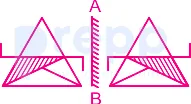
Identify the mirror image of the following figure when the mirror is placed to the right of the figure.

- A
Option A (shown in image)
- B
Option B (shown in image)
- C
Option C (shown in image)
- D
Option D (shown in image)
Show answer
A. Option A (shown in image)Hence, the mirror image will be figure 1
 Paper & answer key PDF ↗
 Question 6archived
Three of the following four letter-clusters are alike in a certain way and one is different. Pick the odd one out.
- A
GKRV
- B
BFMQ
- C
EHPS
- D
DGKL
Show answer
D. DGKLTo find the odd one out, we convert letters to their numerical positions (A=1, B=2, ..., Z=26).
Option 1: GKRV
G=7, K=11, R=18, V=22 | Differences: 4, 7, 4 | Pattern: 7+22 = 11+18 (29)
Option 2: BFMQ
B=2, F=6, M=13, Q=17 | Differences: 4, 7, 4 | Pattern: 2+17 = 6+13 (19)
Option 3: EHPS
E=5, H=8, P=16, S=19 | Differences: 3, 8, 3 | Pattern: 5+19 = 8+16 (24)
Option 4: DGKL
D=4, G=7, K=11, L=12 | Differences: 3, 4, 1 | Pattern: 4+12 ≠ 7+11 (16 ≠ 18)
Conclusion: In Options 1, 2, and 3, the first and last gaps are identical, and the sum of outer letters equals the sum of inner letters. Option 4 (DGKL) is the odd one out.
Paper & answer key PDF ↗ Question 7archived
Arrange the following words in a logical and meaningful order.
1. Cloud
2. Rainbow
3. Devastation
4. Rain
5. Low Pressure
6. Flood
- A
1, 5, 4, 2, 6, 3
- B
5, 1, 4, 2, 6, 3
- C
5, 4, 1, 2, 3, 6
- D
5, 1, 2, 4, 6, 3
Show answer
B. 5, 1, 4, 2, 6, 3Understanding Word Arrangement for Logical Reasoning
This question asks us to arrange a given set of words in a logical and meaningful order. To solve this, we need to consider the sequence of events or phenomena represented by each word and determine the most natural progression.
Let's list the words and their corresponding numbers:
Cloud
Rainbow
Devastation
Rain
Low Pressure
Flood
Now, let's think about how these events typically unfold, especially in the context of weather and its potential consequences:
Weather changes often begin with changes in atmospheric pressure. A low-pressure system (5) is a common precursor to unsettled weather.
Low pressure can lead to the formation of clouds (1).
Clouds often bring rain (4).
Rain is necessary for a rainbow (2) to appear, which typically happens when sunlight interacts with raindrops.
Heavy or prolonged rain can cause rivers to overflow or areas to become submerged, leading to a flood (6).
A flood can cause significant damage and destruction, which is referred to as devastation (3).
Considering this sequence, the most logical order is:
Low Pressure (5)
Cloud (1)
Rain (4)
Rainbow (2)
Flood (6)
Devastation (3)
Therefore, the logical and meaningful arrangement of the words is 5, 1, 4, 2, 6, 3.
Revision Table: Analyzing Logical Order
Step
Word (Number)
Explanation
1
Low Pressure (5)
Initiates weather changes; often leads to cloud formation.
2
Cloud (1)
Forms due to atmospheric conditions, including low pressure.
3
Rain (4)
Precipitation falling from clouds.
4
Rainbow (2)
An optical phenomenon appearing after rain or during rain with sun.
5
Flood (6)
Caused by excessive rain or water overflow.
6
Devastation (3)
The consequence of severe events like floods.
Additional Information on Logical Reasoning
Logical reasoning questions often require understanding the relationships between concepts, events, or objects. Arranging words in a logical sequence tests your ability to identify cause-and-effect relationships, chronological order, or hierarchical structures. Different types of logical sequences include:
Chronological Sequence: Arranging events in the order they happen in time (e.g., Birth, Childhood, Adolescence, Adulthood).
Cause and Effect Sequence: Arranging events where one leads to another (e.g., Study, Pass Exam, Graduate, Get Job).
Part to Whole Sequence: Arranging items from a component to the complete entity (e.g., Letter, Word, Sentence, Paragraph).
Specific to General Sequence: Arranging items from a narrow category to a broader one (e.g., Sparrow, Bird, Animal, Living Being).
For this particular question, the sequence is a mix of chronological and cause-and-effect relationships, starting from atmospheric conditions and leading to a natural phenomenon (rain, rainbow) and then potential consequences (flood, devastation).
Paper & answer key PDF ↗ Question 8archived
A series is given with one term missing. Select the correct alternative from the given ones that will complete the series.
3, 13, 31, ?, 91
- A
69
- B
48
- C
57
- D
63
Show answer
C. 57Understanding the Number Series Problem
The question asks us to find the missing term in a given number series. A number series follows a specific pattern, and our task is to identify this pattern to determine the missing number.
The given series is: 3, 13, 31, ?, 91
Finding the Pattern in the Series
To find the missing term in a number series, we usually look at the difference between consecutive terms. Let's calculate the differences for the known terms:
Difference between the 2nd and 1st term: \(13 - 3 = 10\)
Difference between the 3rd and 2nd term: \(31 - 13 = 18\)
So far, the differences are 10 and 18. Let's look at the difference between these differences (the second difference):
Difference between the 2nd difference and 1st difference: \(18 - 10 = 8\)
This suggests that the differences between consecutive terms might be increasing by a constant value, which is 8. Let's assume this pattern continues.
Calculating the Missing Term
If the second difference is consistently 8, then the difference between the 4th term (the missing term) and the 3rd term should be the previous difference (18) plus 8.
Next difference = Previous difference + 8
Next difference = \(18 + 8 = 26\)
Now, we can find the missing 4th term by adding this difference (26) to the 3rd term (31).
Missing term = 3rd term + Next difference
Missing term = \(31 + 26 = 57\)
Verifying the Pattern with the Last Term
Let's check if the pattern holds for the last term in the series (91). If the pattern of increasing differences by 8 is correct, the difference between the 5th term (91) and the 4th term (57) should be the difference between the 4th and 3rd term (26) plus 8.
Expected next difference = Difference between 4th and 3rd term + 8
Expected next difference = \(26 + 8 = 34\)
Now, let's calculate the actual difference between the 5th term (91) and the calculated 4th term (57):
Actual difference = \(91 - 57 = 34\)
Since the actual difference (34) matches the expected next difference (34), our calculated missing term (57) is correct and the pattern is confirmed.
Completed Number Series
The completed number series is: 3, 13, 31, 57, 91
The differences between consecutive terms are:
\(13 - 3 = 10\)
\(31 - 13 = 18\)
\(57 - 31 = 26\)
\(91 - 57 = 34\)
The differences are 10, 18, 26, 34. The second differences are:
\(18 - 10 = 8\)
\(26 - 18 = 8\)
\(34 - 26 = 8\)
The second difference is a constant 8, which confirms our pattern.
Conclusion on Missing Number Series Term
The missing term in the series 3, 13, 31, ?, 91 is 57.
Term Number
Series Value
Difference from Previous Term
Second Difference
1st
3
-
-
2nd
13
\(13 - 3 = 10\)
-
3rd
31
\(31 - 13 = 18\)
\(18 - 10 = 8\)
4th (Missing)
57
\(57 - 31 = 26\)
\(26 - 18 = 8\)
5th
91
\(91 - 57 = 34\)
\(34 - 26 = 8\)
Revision Table: Number Series Patterns
Pattern Type
Description
Example
Arithmetic Series
Constant difference between consecutive terms.
2, 5, 8, 11, ... (Difference is 3)
Geometric Series
Constant ratio between consecutive terms.
3, 6, 12, 24, ... (Ratio is 2)
Differences Increasing/Decreasing Arithmetically
The difference between terms forms an arithmetic series (as in this problem).
3, 13, 31, 57, ... (Differences 10, 18, 26, ... increase by 8)
Squared/Cubed Series
Terms are related to squares or cubes of numbers.
1, 4, 9, 16, ... (\(1^2, 2^2, 3^2, 4^2\))
Combined Patterns
A combination of arithmetic, geometric, or other operations.
Often involves adding/subtracting/multiplying a sequence of numbers.
Additional Information: Solving Missing Term Questions
When tackling missing term problems in number series, here are some common strategies:
Look for Differences: Calculate the difference between consecutive terms. If the differences are constant, it's an arithmetic series. If the differences form a new pattern (like an arithmetic series itself), look at the "difference of differences" (second differences), "difference of difference of differences" (third differences), and so on.
Look for Ratios: Calculate the ratio between consecutive terms. If the ratio is constant, it's a geometric series.
Check for Squares or Cubes: See if the terms are related to the squares or cubes of natural numbers (1, 4, 9, 16... or 1, 8, 27, 64...). They might be slightly adjusted (e.g., \(n^2 + 1\) or \(n^3 - 1\)).
Consider Alternating Patterns: Some series might have two different patterns alternating between terms.
Look for Prime Numbers or Fibonacci Sequence: Sometimes the pattern involves known sequences like prime numbers (2, 3, 5, 7, 11...) or the Fibonacci sequence (1, 1, 2, 3, 5, 8...).
Examine the Position of the Term: The value of a term might be a function of its position in the series (e.g., Term \(n\) = \(2n + 1\) or Term \(n\) = \(n^2 - n\)).
Systematic calculation of differences or ratios is often the first step in solving most number series problems.
Paper & answer key PDF ↗ Question 9archived
Select the option that is related to the third letter cluster in the same way as the second letter cluster is related to the first letter cluster.
CDAF : XWZU :: DEFC : ?
- A
WVXU
- B
WVUX
- C
VWXU
- D
XWYV
Show answer
B. WVUXSolving Letter Cluster Analogies
This question asks us to find the relationship between the first pair of letter clusters and apply the same relationship to the third letter cluster to find the fourth one. The given analogy is:
CDAF : XWZU :: DEFC : ?
Analyzing the Relationship between CDAF and XWZU
Let's examine the relationship between the letters in the first cluster (CDAF) and the corresponding letters in the second cluster (XWZU). We can look at their positions in the English alphabet.
C is the 3rd letter.
D is the 4th letter.
A is the 1st letter.
F is the 6th letter.
And for the second cluster:
X is the 24th letter.
W is the 23rd letter.
Z is the 26th letter.
U is the 21st letter.
Let's compare the positions of the corresponding letters:
C (3) and X (24): $3 + 24 = 27$
D (4) and W (23): $4 + 23 = 27$
A (1) and Z (26): $1 + 26 = 27$
F (6) and U (21): $6 + 21 = 27$
The pattern here is that the sum of the alphabetical positions of each corresponding pair of letters is 27. This indicates an "opposite letter" relationship, where each letter in the first cluster is replaced by its opposite letter in the alphabet to form the second cluster.
In the English alphabet (A-Z), 'A' is opposite 'Z', 'B' is opposite 'Y', 'C' is opposite 'X', and so on. The position numbers of opposite letters always add up to 27.
Applying the Relationship to DEFC
Now, we apply the same "opposite letter" relationship to the third letter cluster, DEFC, to find the missing fourth cluster.
For D (4th letter), the opposite letter is the $(27 - 4) = 23$rd letter, which is W.
For E (5th letter), the opposite letter is the $(27 - 5) = 22$nd letter, which is V.
For F (6th letter), the opposite letter is the $(27 - 6) = 21$st letter, which is U.
For C (3rd letter), the opposite letter is the $(27 - 3) = 24$th letter, which is X.
Combining these opposite letters in order, we get WVUX.
Therefore, DEFC is related to WVUX in the same way that CDAF is related to XWZU.
Conclusion
The missing letter cluster in the analogy DEFC : ? is WVUX.
Letter in DEFC
Position
Required Position for Opposite
Opposite Letter
D
4
$27 - 4 = 23$
W
E
5
$27 - 5 = 22$
V
F
6
$27 - 6 = 21$
U
C
3
$27 - 3 = 24$
X
Revision Table: Letter Analogy Patterns
Letter analogy questions often follow specific patterns. Understanding these helps in solving them quickly.
Pattern Type
Description
Example
Alphabetical Position
Based on the position number of letters (A=1, B=2, ...). Could be adding/subtracting a constant, multiplying, etc.
AC : EG (Add 4 to each letter's position)
Reverse Alphabetical Position / Opposite Letters
Based on the position from the end of the alphabet (Z=1, Y=2, ...) or the relationship where position + opposite position = 27.
AZ : BY (Opposite letters)
Skipping Letters
Letters are formed by skipping a fixed number of letters in sequence.
ACE : GIK (Skip one letter between each pair)
Vowel/Consonant Pattern
Relationship based on whether the letter is a vowel or a consonant.
AEIOU : ?
Reversal/Rearrangement
Letters within the cluster are rearranged in a specific order (e.g., reverse the order, swap first two).
CDAB : ABCD
Additional Information: Mastering Verbal Reasoning
Verbal reasoning questions, including analogies, test your ability to identify relationships between words, letters, or concepts. Practicing various types of analogy questions is key to mastering this section in competitive exams.
Key strategies for solving letter analogies:
Write down the alphabetical positions of the letters.
Look for patterns in position numbers (addition, subtraction, multiplication, division, sequence).
Check for opposite letter relationships (sum of positions is 27).
See if letters are skipped or in sequence (e.g., every second letter).
Consider if the pattern involves vowels and consonants.
If it's a cluster, check for patterns within the cluster or between corresponding letters of different clusters.
Regular practice with different types of letter analogy problems will help you quickly identify the underlying pattern.
Paper & answer key PDF ↗ Question 10archived
A letter series is given below in which some letters are missing. Select the option that gives the letters that can fill these blanks in that order.
a_ca_bab_ad_abc_db
- A
bdcba
- B
bcdba
- C
bdcab
- D
bddac
Show answer
A. bdcbaSolving the Letter Series Completion Problem
The problem asks us to find the missing letters in a given letter series. We are provided with the series and four options, each containing a sequence of letters that can fill the blanks in order.
The given letter series is: a_ca_bab_ad_abc_db
Let's count the total number of characters in the series, including the blanks:
a (1) _ (2) c (3) a (4) _ (5) b (6) a (7) b (8) _ (9) a (10) d (11) _ (12) a (13) b (14) c (15) _ (16) d (17) b (18)
The series has a total of 18 positions, with blanks at positions 2, 5, 9, 12, 16, and 18. There are 6 blanks in total.
However, the options provided contain only 5 letters. This indicates a potential discrepancy, but we will proceed by testing the options by filling the first 5 blanks (at positions 2, 5, 9, 12, 16) and observing the resulting pattern, keeping in mind the last character at position 18 is 'b'.
Let's test Option 1: bdcba. We will place these letters into the blanks at positions 2, 5, 9, 12, and 16:
Blank at position 2 gets 'b'. Series becomes: abca_bab_ad_abc_db
Blank at position 5 gets 'd'. Series becomes: abcadbab_ad_abc_db
Blank at position 9 gets 'c'. Series becomes: abcadbabcad_abc_db
Blank at position 12 gets 'b'. Series becomes: abcadbabcadbabc_db
Blank at position 16 gets 'a'. Series becomes: abcadbabcadbabacdb
The series after filling the first 5 blanks with bdcba is: abcadbabcadbacadb
Let's re-check the filling process carefully with the original series structure:
Original series: a _ c a _ b a b _ a d _ a b c _ d b
Fill blanks 2, 5, 9, 12, 16 with b, d, c, b, a:
Position 1: a
Position 2 (blank 1): b
Position 3: c
Position 4: a
Position 5 (blank 2): d
Position 6: b
Position 7: a
Position 8: b
Position 9 (blank 3): c
Position 10: a
Position 11: d
Position 12 (blank 4): b
Position 13: a
Position 14: b
Position 15: c
Position 16 (blank 5): a
Position 17: d
Position 18: b
The resulting filled series is: abcadbabcadbabcadb
Now, let's look for a repeating pattern in abcadbabcadbabcadb. We can try dividing it into equal parts. Since the total length is 18, possible block lengths are 2, 3, 6, 9, 18.
If we divide into blocks of 6: abcadb | abcadb | abcadb
We observe that the series consists of the block abcadb repeated three times consecutively.
Let's check if this pattern matches the original series with the filled letters:
Original series structure with blanks at 2, 5, 9, 12, 16, 18:
a_ca_b a b_a d_a b c_d b
Comparing with the pattern abcadb:
Block 1 (pos 1-6): a_ca_b needs 'b' at pos 2 and 'd' at pos 5 to become abcadb. The letters needed are 'b', 'd'.
Block 2 (pos 7-12): ab_ad_ needs 'c' at pos 9 and 'b' at pos 12 to become abcadb. The letters needed are 'c', 'b'.
Block 3 (pos 13-18): abc_db needs 'a' at pos 16 and 'b' at pos 18 to become abcadb. The letters needed are 'a', 'b'.
The letters required to fill the blanks at positions 2, 5, 9, 12, 16, 18 according to the abcadb pattern would be b, d, c, b, a, b. The option providing the filling letters is bdcba, which matches the required letters for the first five blanks (positions 2, 5, 9, 12, 16).
Thus, filling the first five blanks with bdcba reveals the repeating pattern abcadb, where the last character of the series 'b' (at position 18) completes the third repetition of the pattern.
Let's quickly consider why other options wouldn't work. If we fill the blanks at positions 2, 5, 9, 12, 16 with any other option (bcdba, bdcab, or bddac), the resulting sequence does not form a simple, clear repeating block pattern like abcadb.
Therefore, Option 1 provides the correct sequence of letters to fill the blanks and complete the series with a repeating pattern.
Revision Table: Analyzing Options
OptionLetters to fill blanks (2, 5, 9, 12, 16)Resulting Series (18 characters)Pattern Analysis
1. bdcbab, d, c, b, aabcadbabcadbabcadbRepeats abcadb (Length 6) three times. Clear pattern.
2. bcdbab, c, d, b, aabcacbabdabcadbNo obvious repeating pattern.
3. bdcabb, d, c, a, babcadbabcadbabcbdbNo obvious repeating pattern.
4. bddacb, d, d, a, cabcadbabdadaccadbNo obvious repeating pattern.
Additional Information on Letter Series
Letter series completion is a common type of question in logical reasoning. These questions present a sequence of letters that follow a specific rule or pattern. The pattern can be based on various principles, including:
Repeating Blocks: A specific sequence of letters repeats throughout the series. This was the pattern found in the problem above.
Alphabetical Progression: Letters advance or recede by a fixed number of steps in the alphabet (e.g., A, C, E, G...).
Skipping Letters: Letters are skipped in a specific order (e.g., AbC dE FgH...).
Combination of Patterns: The series might involve a combination of letter progressions, skips, or repeating elements within a block.
Position-Based Patterns: The pattern might relate to the position of the letter in the sequence or the position in the alphabet.
To solve letter series problems, one should look for:
The total number of elements (including blanks).
Possible repeating blocks by dividing the total length by small integers.
Relationships between consecutive letters or groups of letters.
The letters provided in the options to see which sequence creates a recognizable pattern.
Practice with different types of letter series helps improve pattern recognition skills necessary for solving these problems.
Paper & answer key PDF ↗ Question 11archived
A square paper is folded and cut as shown below. How will it appear when unfold?

- A
Option A (shown in image)
- B
Option B (shown in image)
- C
Option C (shown in image)
- D
Option D (shown in image)
Show answer
B. Option B (shown in image)Hence, when the paper will be folded and cut as given in the question, the answer figure will be as given above.
 Paper & answer key PDF ↗
 Question 12archived
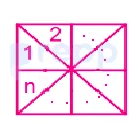
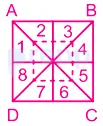
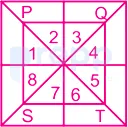
How many triangles are there in the following figure?

- A
36
- B
28
- C
32
- D
24
Show answer
Question 13archived
Three of the following four letter-clusters are alike in a certain way and one is different. Pick the odd one out.
- A
EFST
- B
ABOP
- C
CDQR
- D
GHTV
Show answer
D. GHTVFinding the Odd Letter Cluster Out
The question asks us to identify the letter cluster that is different from the other three based on a certain pattern or rule. To solve this type of question, we need to examine the relationship between the letters in each cluster, often using their positions in the English alphabet.
Analyzing Letter Positions
Let's assign numerical values to each letter based on its position in the alphabet (A=1, B=2, ..., Z=26). Then we can look for patterns or differences in these values for each letter cluster.
Letter Cluster
Letters
Positions
Relationship (within pair)
Relationship (between pairs)
EFST
E, F, S, T
5, 6, 19, 20
$F = E + 1$ ($6 = 5 + 1$)
$T = S + 1$ ($20 = 19 + 1$)
$S = F + 13$ ($19 = 6 + 13$)
ABOP
A, B, O, P
1, 2, 15, 16
$B = A + 1$ ($2 = 1 + 1$)
$P = O + 1$ ($16 = 15 + 1$)
$O = B + 13$ ($15 = 2 + 13$)
CDQR
C, D, Q, R
3, 4, 17, 18
$D = C + 1$ ($4 = 3 + 1$)
$R = Q + 1$ ($18 = 17 + 1$)
$Q = D + 13$ ($17 = 4 + 13$)
GHTV
G, H, T, V
7, 8, 20, 22
$H = G + 1$ ($8 = 7 + 1$)
$V = T + 2$ ($22 = 20 + 2$)
$T = H + 12$ ($20 = 8 + 12$)
Identifying the Pattern
Let's observe the relationships from the table:
In EFST, ABOP, and CDQR, the first two letters are consecutive (positions differ by 1, e.g., E, F; A, B; C, D).
In EFST, ABOP, and CDQR, the last two letters are also consecutive (positions differ by 1, e.g., S, T; O, P; Q, R).
In EFST, ABOP, and CDQR, the position of the third letter is 13 more than the position of the second letter (e.g., $19 = 6 + 13$; $15 = 2 + 13$; $17 = 4 + 13$).
Now let's look at GHTV:
In GHTV, the first two letters are consecutive (G, H; positions differ by 1).
In GHTV, the last two letters are not consecutive (T, V; positions differ by 2, $V = T + 2$).
In GHTV, the position of the third letter is 12 more than the position of the second letter ($20 = 8 + 12$).
Determining the Odd One Out
Based on the analysis, the first three letter clusters (EFST, ABOP, CDQR) follow a consistent pattern where: the first two letters are consecutive, the last two letters are consecutive, and the gap between the second and third letter's position is 13.
The letter cluster GHTV follows the first part of the pattern (first two letters consecutive), but it deviates in the second and third parts: the last two letters are not consecutive (they differ by 2 positions), and the gap between the second and third letter's position is 12, not 13.
Therefore, GHTV is the odd one out.
Revision Table: Letter Patterns
Understanding patterns in letter sequences is crucial for various reasoning questions. Common patterns include:
Pattern Type
Description
Example
Consecutive Letters
Letters appear in alphabetical order, next to each other.
ABCD, PQR
Alphabetical Gap
Letters are separated by a fixed number of letters in the alphabet.
ACEG (gap of 1 letter), PRTV (gap of 1 letter)
Reverse Alphabetical Order
Letters appear in reverse alphabetical order.
ZYXW, TSR
Skipping Letters
Letters skip a fixed number of letters, but not necessarily consecutive gaps.
AZBY (A+25=Z, Z-25=A, B+23=Y, Y-23=B using position arithmetic)
Vowel/Consonant Patterns
Patterns based on vowels (A, E, I, O, U) and consonants.
AEIO, BCDF
Combination Patterns
A combination of the above patterns, possibly applied to different parts of a word or cluster.
As seen in this question: consecutive pairs with a fixed gap between pairs.
Additional Information: Alphabetical Reasoning
Alphabetical reasoning questions test your ability to identify sequences and patterns using the English alphabet. These questions can involve letters, groups of letters, or even combinations of letters and numbers.
Key strategies for solving alphabetical reasoning problems:
Write down the alphabet and its positions (1-26) for quick reference.
Look for patterns in consecutive letters, alternating letters, or groups of letters.
Check for differences in letter positions (e.g., +1, +2, -3).
Consider if the pattern involves vowels or consonants.
Look for reverse alphabetical order or skipping patterns.
If multiple letters are involved, the pattern might apply across positions (1st to 2nd, 2nd to 3rd) or across corresponding letters in different groups.
Sometimes, the pattern involves adding or subtracting a constant number or a sequence of numbers to the letter positions.
Practicing different types of letter series and analogy questions will help improve your speed and accuracy in identifying complex patterns.
Paper & answer key PDF ↗ Question 14archived
Two statements are followed by three conclusions numbered I, II and III. Assuming the statements to be true, even if they do not conform to real-world knowledge, decide which of the conclusion(s) logically follows from the statements.
Statements:
All ponds are pools.
Some wells are ponds.
Conclusions:
I. Some ponds are not wells.
II. Some wells are pools.
III. All pools are wells.
- A
Only conclusion III follows
- B
Only conclusion II follows
- C
Only conclusion I follows
- D
None of the conclusions follow
Show answer
B. Only conclusion II followsUnderstanding Syllogism Statements and Conclusions
This question asks us to analyze a syllogism problem. We are given two statements and three conclusions. Our task is to determine which of the conclusions logically follow from the given statements, assuming the statements are true.
Analyzing the Statements
Let's break down the given statements:
Statement 1: All ponds are pools. This means that the set of 'ponds' is entirely contained within the set of 'pools'. If something is a pond, it must also be a pool. We can represent this as $\text{Ponds} \subseteq \text{Pools}$.
Statement 2: Some wells are ponds. This means there is at least one 'well' that is also a 'pond'. There is an overlap between the set of 'wells' and the set of 'ponds'. We can represent this as $\text{Wells} \cap \text{Ponds} \neq \emptyset$.
Visualizing with Venn Diagrams
We can use Venn diagrams to visualize these relationships. Let P represent Ponds, Po represent Pools, and W represent Wells.
Statement 1: The circle for Ponds is drawn completely inside the circle for Pools.
Statement 2: The circle for Wells overlaps with the circle for Ponds. Since the Ponds circle is inside the Pools circle, the overlap between Wells and Ponds will also be inside the Pools circle.
Consider the region where Wells and Ponds overlap. According to Statement 2, this region is not empty. According to Statement 1, anything in the Ponds circle is also in the Pools circle. Therefore, the region where Wells and Ponds overlap is necessarily also within the Pools circle.
Statement
Relationship
All ponds are pools.
Every pond is a pool.
Some wells are ponds.
There is at least one well that is also a pond.
Evaluating the Conclusions
Now, let's check each conclusion based on the statements:
Conclusion I: Some ponds are not wells.
We know that some wells are ponds (from Statement 2). This means there is an intersection between Wells and Ponds.
However, Statement 2 only guarantees that the intersection is not empty. It does not tell us anything about the part of Ponds that might not be in Wells.
It is possible that all ponds are wells (if the set of Ponds is completely inside the set of Wells). In that case, this conclusion "Some ponds are not wells" would be false.
Since this conclusion is not necessarily true in all possible scenarios permitted by the statements, it does not logically follow.
Conclusion II: Some wells are pools.
We know that some wells are ponds (from Statement 2). Let's call one such entity 'X'. So, X is a well and X is a pond.
We also know that all ponds are pools (from Statement 1). Since X is a pond, X must also be a pool.
Therefore, X is a well and X is a pool. This means there is at least one well that is a pool.
This conclusion logically follows from the statements.
Conclusion III: All pools are wells.
We know some wells are pools (from Conclusion II, which we found to be true).
However, Statement 1 only tells us that all ponds are pools. It doesn't give us information about the entire set of pools. The set of pools could be much larger than the set of ponds and wells combined.
It is entirely possible that many pools are neither wells nor ponds.
This conclusion does not logically follow from the statements.
Summary of Conclusions
Conclusion
Logically Follows?
Reasoning
I. Some ponds are not wells.
No
Not necessarily true; could be false if all ponds are wells.
II. Some wells are pools.
Yes
Derived from Statement 1 (All P are Po) and Statement 2 (Some W are P). If some W are P, and all P are Po, then some W are Po.
III. All pools are wells.
No
Statements don't provide information about the entire set of pools in relation to wells.
Based on the analysis, only Conclusion II logically follows from the given statements.
Revision Table: Key Syllogism Concepts
Term
Meaning in Syllogism
Example (Abstract)
All A are B
Every member of set A is also a member of set B. A is a subset of B ($\text{A} \subseteq \text{B}$).
All dogs are mammals.
Some A are B
There is at least one member of set A that is also a member of set B. The intersection of A and B is not empty ($\text{A} \cap \text{B} \neq \emptyset$).
Some students are athletes.
No A are B
No member of set A is a member of set B. Sets A and B are disjoint ($\text{A} \cap \text{B} = \emptyset$).
No cats are dogs.
Some A are not B
There is at least one member of set A that is not a member of set B. The part of A outside B is not empty ($\text{A} \setminus \text{B} \neq \emptyset$).
Some birds cannot fly.
Additional Information: Drawing Valid Conclusions
Syllogism questions test your ability to draw conclusions based *only* on the given statements, regardless of real-world facts. The key is to follow the logical structure.
Validity vs. Truth: A conclusion is valid if it *must* be true whenever the premises (statements) are true. It doesn't matter if the conclusion seems false in the real world; if it logically follows from the given (assumed true) statements, it is valid within the context of the syllogism.
"Some" means "at least one": In syllogism, "some" means "at least one" and possibly "all". This is crucial for evaluating conclusions like "Some A are not B" or "All A are B" when only a "some" relationship is given.
Negative Conclusions: Be careful with negative conclusions (like "Some ponds are not wells") when the statements are positive. Often, a definite negative conclusion cannot be drawn from purely positive statements unless a contradiction arises.
Converse Relationships: "All A are B" does NOT mean "All B are A". Similarly, "Some A are B" implies "Some B are A", but "Some A are not B" does NOT imply "Some B are not A".
By carefully analyzing the relationships described in the statements and using tools like Venn diagrams or logical rules, you can accurately determine which conclusions are logically supported.
Paper & answer key PDF ↗ Question 15archived
Select the word pair in which the two words are related in the same way as the two words in the following word – pair.
Author : Book
- A
Mother : Son
- B
Doctor : Medicine
- C
Reptile : Crawl
- D
Spider : Web
Show answer
D. Spider : WebUnderstanding Word Analogy: Author and Book
The question asks us to find a word pair that shares the same relationship as the pair "Author : Book". To solve word analogy problems, we first need to identify the specific relationship between the words in the given pair. In the pair "Author : Book", the relationship is that an Author creates or produces a Book. The Author is the person who writes the book; the Book is the product of the Author's work. This is a creator-creation relationship.
Analyzing the Options
Now, let's examine each option to see which one exhibits a similar creator-creation relationship.
Option 1: Mother : Son
In this pair, a Mother gives birth to a Son. This is a biological parent-offspring relationship. While a mother 'creates' a son in a biological sense, it's different from the intellectual or artistic creation by an Author. The primary relationship here is familial/biological.
Option 2: Doctor : Medicine
A Doctor prescribes or uses Medicine to treat patients. Medicine is a tool or treatment used by a Doctor. The relationship is user/prescriber and tool/treatment. This is not a creator-creation relationship where the Doctor creates the Medicine (unless they are also a pharmacist or chemist, which is not the primary relationship implied).
Option 3: Reptile : Crawl
A Reptile is an animal, and Crawl is a way that many reptiles move. The relationship is subject and action/movement. This describes a characteristic behaviour of a reptile, not something it creates.
Option 4: Spider : Web
A Spider spins or creates a Web. The Spider is the animal that produces the web; the Web is the structure created by the Spider. This fits the creator-creation relationship perfectly, similar to how an Author creates a Book.
Comparing Relationships
Let's summarize the relationships:
Word Pair
Relationship
Author : Book
Creator : Creation (Author creates Book)
Mother : Son
Biological Parent : Offspring
Doctor : Medicine
User/Prescriber : Tool/Treatment
Reptile : Crawl
Subject : Action
Spider : Web
Creator : Creation (Spider creates Web)
Comparing the original pair "Author : Book" with the options, we see that "Spider : Web" has the same creator-creation relationship.
Conclusion
The word pair that shares the same relationship as "Author : Book" is "Spider : Web" because in both cases, the first word represents the creator and the second word represents the creation.
Revision Table: Word Analogy Concepts
Understanding common types of word analogies helps in solving these questions quickly.
Analogy Type
Description
Example
Creator : Creation
One word creates the other.
Poet : Poem, Painter : Painting, Spider : Web
Part : Whole
One word is a part of the other.
Finger : Hand, Page : Book, Wheel : Car
Cause : Effect
One word leads to the other.
Rain : Flood, Study : Success, Virus : Illness
Object : Function
One word performs the action described by the other.
Knife : Cut, Pen : Write, Ear : Hear
Antonyms
Words with opposite meanings.
Hot : Cold, Up : Down, Good : Bad
Synonyms
Words with similar meanings.
Happy : Joyful, Big : Large, Fast : Quick
Additional Information: Solving Word Analogy Problems
Here are some tips for tackling word analogy questions like "Author : Book".
Identify the Relationship: Focus on the specific connection between the words in the given pair (e.g., creator-creation, part-whole, action-object). Be as precise as possible.
Form a Sentence: Try to express the relationship in a simple sentence. For "Author : Book", you could say "An Author creates a Book".
Test Options with the Sentence: Apply the same sentence structure to each option.
An Author creates a Book.
A Mother creates a Son? (Not quite the same type of creation).
A Doctor creates Medicine? (No, prescribes/uses).
A Reptile creates Crawl? (No, performs the action).
A Spider creates a Web? (Yes, fits the pattern).
Consider Multiple Relationships: Sometimes words can have more than one relationship. Evaluate which relationship is most direct and evident in the original pair and the options.
Eliminate Incorrect Options: Rule out options that clearly do not fit the identified relationship.
Practicing with different types of analogies helps improve your ability to recognize relationships quickly and accurately.
Paper & answer key PDF ↗ Question 16archived
Three of the following four pairs are alike in a certain way and one is different. Pick the odd one out.
- A
Study room : Table lamp
- B
Kitchen : Frying pan
- C
Garden : Ladle
- D
Bathroom : Shower
Show answer
C. Garden : LadleUnderstanding the Odd Pair Reasoning Question
This type of question asks us to identify the item or pair that does not fit with the others in a given set. We need to look for a common relationship or pattern among three of the pairs and find the one that does not follow that pattern. This is a common type of logical reasoning problem.
Analyzing the Given Pairs
We are given four pairs, each consisting of an area or room and an object. Let's examine the relationship between the elements in each pair:
Study room : Table lamp - A table lamp is an object commonly found in a study room. It provides light for activities like reading or working. The object is associated with the area based on typical use and location.
Kitchen : Frying pan - A frying pan is an object commonly found in a kitchen. It is a tool used for cooking food. The object is associated with the area based on typical use and location.
Garden : Ladle - A ladle is an object commonly found in a kitchen. It is a tool used for serving liquids like soup or stew. It is not typically found or used in a garden.
Bathroom : Shower - A shower is an object (a fixture) commonly found in a bathroom. It is used for bathing. The object is associated with the area based on typical use and location.
Identifying the Odd Pair
Based on the analysis, we can see a clear pattern in three of the pairs:
Study room : Table lamp - The object (Table lamp) is typically found and used in the area (Study room).
Kitchen : Frying pan - The object (Frying pan) is typically found and used in the area (Kitchen).
Bathroom : Shower - The object (Shower) is typically found and used in the area (Bathroom).
In these three pairs, the second item is an object that is commonly located in and used for activities performed in the area mentioned by the first item.
Now let's look at the remaining pair:
Garden : Ladle - A ladle is a kitchen utensil, not something typically found or used in a garden. The relationship of common location and use seen in the other pairs does not hold true for this pair.
Therefore, the pair "Garden : Ladle" is the odd one out because the object is not commonly associated with the area in the same way as in the other pairs.
Conclusion
Comparing all the pairs, the consistent relationship is that the second item is an object typically found or used in the area specified by the first item. The pair "Garden : Ladle" does not fit this pattern. Hence, it is the odd one out.
Pair
Area
Object
Commonly Found/Used in Area?
Relationship
Study room : Table lamp
Study room
Table lamp
Yes
Typical location and use
Kitchen : Frying pan
Kitchen
Frying pan
Yes
Typical location and use
Garden : Ladle
Garden
Ladle
No
Not typical location/use
Bathroom : Shower
Bathroom
Shower
Yes
Typical location and use
The pair that is different from the others is Garden : Ladle.
Revision Table: Key Concepts in Odd One Out Questions
Concept
Description
How it Applies Here
Identifying Pattern
Look for a common rule, relationship, or characteristic shared by most items/pairs.
The pattern is 'Object is typically found/used in the Area'.
Finding the Exception
Identify the item/pair that does NOT follow the established pattern.
'Garden : Ladle' does not follow the 'typical location and use' pattern.
Relationship Analysis
Examine how the elements within each item/pair are related to each other.
Analyzing the relationship between the room/area and the object.
Additional Information: Types of Reasoning Questions
Odd one out questions are part of logical reasoning, which tests your ability to identify patterns, analyze relationships, and make deductions. Other types of reasoning questions include:
Analogies (finding a similar relationship between two pairs).
Series completion (finding the next item in a sequence based on a pattern).
Classification (grouping items based on shared characteristics).
Coding-Decoding (understanding rules used to code messages).
Blood Relations (solving problems based on family relationships).
Practicing different types of reasoning questions helps improve analytical and problem-solving skills.
Paper & answer key PDF ↗ Question 17archived
In a code language, SEDATIVE is coded as ATDESEVI. How would PERSONAL be coded in that language?
- A
SOERPANL
- B
SOPERLAN
- C
OSREPLAN
- D
SOREPLAN
Show answer
D. SOREPLANUnderstanding the Coding Language Pattern
This question involves a coding pattern where the letters of a word are rearranged according to a specific rule to form the coded word. We are given the word SEDATIVE and its code ATDESEVI. Our task is to identify this rule and apply it to the word PERSONAL to find its code.
Analyzing the SEDATIVE to ATDESEVI Code
Let's write the original word SEDATIVE and its coded form ATDESEVI, assigning positions to each letter.
Original Word: SEDATIVE
S
E
D
A
T
I
V
E
Original Position:
1
2
3
4
5
6
7
8
Coded Word: ATDESEVI
A
T
D
E
S
E
V
I
Coded Position:
1
2
3
4
5
6
7
8
Now, let's observe which letter from the original word appears at which position in the coded word.
The letter 'A' from original position 4 is at coded position 1.
The letter 'T' from original position 5 is at coded position 2.
The letter 'D' from original position 3 is at coded position 3.
The letter 'E' (first one) from original position 2 is at coded position 4.
The letter 'S' from original position 1 is at coded position 5.
The letter 'E' (second one) from original position 8 is at coded position 6.
The letter 'V' from original position 7 is at coded position 7.
The letter 'I' from original position 6 is at coded position 8.
We can represent this positional rearrangement rule as a mapping from the original position to the coded position:
Original Position
1
2
3
4
5
6
7
8
Coded Position
5
4
3
1
2
8
7
6
This means the letter that was originally at position 1 moves to position 5 in the code, the letter at position 2 moves to position 4, and so on.
Applying the Coding Pattern to PERSONAL
Now, let's apply this same rule to the word PERSONAL. PERSONAL also has 8 letters.
Original Word: PERSONAL
P
E
R
S
O
N
A
L
Original Position:
1
2
3
4
5
6
7
8
Using the rule (Original Pos → Coded Pos): 1→5, 2→4, 3→3, 4→1, 5→2, 6→8, 7→7, 8→6, let's find the letter for each coded position:
Coded Position 1 gets the letter from Original Position 4 (S).
Coded Position 2 gets the letter from Original Position 5 (O).
Coded Position 3 gets the letter from Original Position 3 (R).
Coded Position 4 gets the letter from Original Position 2 (E).
Coded Position 5 gets the letter from Original Position 1 (P).
Coded Position 6 gets the letter from Original Position 8 (L).
Coded Position 7 gets the letter from Original Position 7 (A).
Coded Position 8 gets the letter from Original Position 6 (N).
Arranging these letters in the coded positions 1 through 8:
Coded Position:
1
2
3
4
5
6
7
8
Letter:
S
O
R
E
P
L
A
N
The coded word for PERSONAL is SOREPLAN.
Comparing with Options
Let's compare our result SOREPLAN with the given options:
SOERPANL
SOPERLAN
OSREPLAN
SOREPLAN
Our derived coded word, SOREPLAN, matches option 4.
Conclusion
The coding language used is based on a specific positional rearrangement of the letters in the original word. By identifying this pattern from SEDATIVE being coded as ATDESEVI, we applied the same logic to PERSONAL to find its code.
Revision Table: Coding Pattern Analysis
Original Word
Coded Word
Pattern Type
Rule (Original Pos → Coded Pos)
SEDATIVE
ATDESEVI
Positional Rearrangement
1→5, 2→4, 3→3, 4→1, 5→2, 6→8, 7→7, 8→6
PERSONAL
SOREPLAN
Positional Rearrangement
Same rule: 1→5, 2→4, 3→3, 4→1, 5→2, 6→8, 7→7, 8→6
Additional Information on Coding-Decoding Reasoning
Coding-Decoding is a common topic in reasoning questions. It tests your ability to decipher a rule or pattern based on a given example and then apply it to find the code for another word or message. Patterns can be based on:
Letter Shifting: Each letter is shifted a fixed number of places forward or backward in the alphabet (e.g., A becomes C, B becomes D, etc.).
Positional Rearrangement: The letters in the word are rearranged based on their positions (as seen in this question).
Direct Letter Coding: Each letter in the original word is directly replaced by a specific letter or symbol.
Mixed Patterns: A combination of the above or other complex rules.
To solve coding-decoding problems, always start by comparing the original word and its code. Look for differences in letters, positions, or any consistent transformation. Writing down the words and their positions can be very helpful in identifying positional rearrangement patterns.
Paper & answer key PDF ↗ Question 18archived
What will be the value of the following equation if ‘÷’ means ‘addition’, ‘+’ means 'subtraction', ‘-' means ‘multiplication’ and ‘×’ means ‘division’?
72 × 9 - 3 ÷ 8 + 2 = ?
- A
30
- B
35
- C
25
- D
40
Show answer
A. 30Understanding the Mathematical Expression with Symbol Replacements
The question asks us to evaluate a given mathematical expression after replacing the standard arithmetic operators with new meanings as defined in the problem statement. This type of problem tests our ability to carefully follow instructions and apply the correct order of operations (BODMAS/PEMDAS).
Decoding the Symbol Replacement Rules
Let's list the symbol replacement rules provided:
The symbol '÷' (division) means 'addition' (+).
The symbol '+' (addition) means 'subtraction' (-).
The symbol '-' (subtraction) means 'multiplication' (×).
The symbol '×' (multiplication) means 'division' (÷).
Applying the Rules to the Given Equation
The original equation is:
\(72 \times 9 - 3 \div 8 + 2 = ?\)
Now, we replace the operators based on the given rules:
'×' becomes '÷'
'-' becomes '×'
'÷' becomes '+'
'+' becomes '-'
So, the modified equation becomes:
\(72 \div 9 \times 3 + 8 - 2 = ?\)
Evaluating the Modified Equation using BODMAS/PEMDAS
We need to evaluate the modified expression following the order of operations (BODMAS/PEMDAS - Brackets, Orders (powers/roots), Division and Multiplication (from left to right), Addition and Subtraction (from left to right)).
The expression is: \(72 \div 9 \times 3 + 8 - 2\)
Step 1: Division (D)
Perform the division operation first:
\(72 \div 9 = 8\)
The expression is now:
\(8 \times 3 + 8 - 2\)
Step 2: Multiplication (M)
Perform the multiplication operation:
\(8 \times 3 = 24\)
The expression is now:
\(24 + 8 - 2\)
Step 3: Addition (A) and Subtraction (S)
Perform addition and subtraction from left to right:
First, Addition:
\(24 + 8 = 32\)
The expression is now:
\(32 - 2\)
Next, Subtraction:
\(32 - 2 = 30\)
Final Result of the Evaluation
After applying the symbol replacements and following the order of operations, the value of the expression \(72 \times 9 - 3 \div 8 + 2\) under the given rules is 30.
Revision Table: Symbol Replacements and Evaluation
Original Symbol
New Meaning
Operation in BODMAS
÷
+ (Addition)
Addition/Subtraction (Last)
+
- (Subtraction)
Addition/Subtraction (Last)
-
× (Multiplication)
Multiplication/Division (Middle)
×
÷ (Division)
Multiplication/Division (Middle)
Step
Expression
Operation Performed
Result
Original
\(72 \times 9 - 3 \div 8 + 2\)
N/A
N/A
After Replacement
\(72 \div 9 \times 3 + 8 - 2\)
N/A
N/A
1 (Division)
\(8 \times 3 + 8 - 2\)
\(72 \div 9\)
8
2 (Multiplication)
\(24 + 8 - 2\)
\(8 \times 3\)
24
3 (Addition)
\(32 - 2\)
\(24 + 8\)
32
4 (Subtraction)
\(30\)
\(32 - 2\)
30
Additional Information on Order of Operations (BODMAS/PEMDAS)
The order of operations is a set of rules that dictate the sequence in which mathematical operations should be performed to ensure a single correct answer. The acronyms BODMAS or PEMDAS are commonly used to remember this order:
BODMAS: Brackets, Orders (powers and square roots etc.), Division, Multiplication, Addition, Subtraction.
PEMDAS: Parentheses, Exponents, Multiplication, Division, Addition, Subtraction.
Both acronyms represent the same order, just with slightly different names for the steps. Multiplication and Division have the same priority and should be performed from left to right as they appear. Similarly, Addition and Subtraction have the same priority and should be performed from left to right.
In this problem, after replacing the symbols, we had division and multiplication before addition and subtraction, so we performed division first, then multiplication, then addition, and finally subtraction, following the left-to-right rule for operations of the same priority level.
Paper & answer key PDF ↗ Question 19archived
‘Room’ is related to ‘Ceiling’ in the same way as ‘Mouth’ is related to:
- A
Lip
- B
Teeth
- C
Throat
- D
Palate
Show answer
D. PalateUnderstanding the Analogy: Room and Mouth Reasoning
This question asks us to find the relationship between two pairs of words. The first pair is 'Room' and 'Ceiling'. We need to identify how these two are related and then apply the same relationship to the word 'Mouth' to find its corresponding word from the given options.
Analysing the First Pair: Room and Ceiling
Let's think about the relationship between a Room and a Ceiling.
A Room is an enclosed space within a building.
The Ceiling is the upper interior surface of a Room.
So, the Ceiling represents the upper boundary or the roof of the interior space of a Room.
Applying the Relationship to the Second Word: Mouth
Now, let's consider the word Mouth and apply the same relationship. We are looking for the upper boundary or the roof of the interior space of the Mouth. Let's examine the options provided:
Lip: Lips are the outer fleshy folds that surround the opening of the Mouth. They are part of the boundary, but not the upper interior surface or roof.
Teeth: Teeth are hard structures inside the Mouth used for chewing. They form part of the boundaries (sides and front) but are not the upper interior surface.
Throat: The throat is the part of the neck behind the Mouth and nasal cavity. It's connected to the Mouth but is not the upper interior surface of the Mouth itself.
Palate: The Palate is the roof of the Mouth, separating the Mouth cavity from the nasal cavity. It forms the upper interior surface of the Mouth.
Comparing the options, the Palate fits the description of being the upper boundary or the roof of the Mouth, just as the Ceiling is the upper boundary or roof of the Room.
Conclusion
The analogy is based on the relationship of an interior space to its upper boundary or roof. Since the Ceiling is the upper boundary of a Room, the word that represents the upper boundary of the Mouth is the Palate.
Revision Table: Key Concepts
Here is a quick summary of the analogy components:
Interior Space
Upper Boundary / Roof
Room
Ceiling
Mouth
Palate
Additional Information: Exploring Analogies in Reasoning
Analogies are a common type of verbal reasoning question. They test your ability to identify relationships between pairs of words and apply that relationship to a different pair. Common types of relationships include:
Part to Whole (e.g., Finger : Hand)
Cause and Effect (e.g., Rain : Flood)
Worker and Tool (e.g., Carpenter : Hammer)
Synonyms (e.g., Happy : Joyful)
Antonyms (e.g., Hot : Cold)
Study and Topic (e.g., Biology : Life)
Object and Function (e.g., Knife : Cut)
Location (e.g., Fish : Water)
Characteristic (e.g., Snow : White)
To solve analogy questions, always try to determine the precise relationship between the first pair of words before looking at the options. Then, examine each option to see which one shares the most similar relationship with the third word provided in the question.
Paper & answer key PDF ↗ Question 20archived
Three of the following four words are alike in a certain way and one is different. Pick the odd word out.
- A
Cessation
- B
Valediction
- C
Intermission
- D
Closure
Show answer
C. IntermissionFinding the Odd Word Out: Analysing Word Meanings
The question asks us to identify the word that is different from the others in a given set of four words: Cessation, Valediction, Intermission, and Closure. To do this, we need to understand the meaning of each word.
Understanding the Meanings of the Words
Cessation: This word means the act or process of ending or being brought to an end. It signifies a stop or a halt, usually of something that has been going on.
Valediction: This refers to an act of saying farewell, or a farewell speech. While it involves parting, it is fundamentally linked to an ending or departure.
Intermission: This means a pause or a break, particularly in a performance, conference, or other activity. It signifies a temporary stop before the activity resumes.
Closure: This word means the act or process of closing something, such as a business or an event. It also refers to a sense of resolution or completion, bringing something to an end.
Comparing the Word Meanings
Let's look at how the meanings relate to each other:
Word
Meaning
Nature of Stop/End
Cessation
Ending, Stopping
Final (usually)
Valediction
Farewell, Saying Goodbye
Implies departure/ending
Intermission
Pause, Break
Temporary
Closure
Ending, Completion, Resolution
Final
From the table and the definitions, we can see that Cessation, Valediction (in the context of leaving), and Closure all convey the idea of an end, completion, or stopping something in a relatively final sense. Valediction is about a farewell, which is the act of concluding one's presence or involvement.
On the other hand, Intermission specifically means a temporary pause or break. The activity is expected to continue after the intermission.
Identifying the Odd Word Out
Three words (Cessation, Valediction, Closure) are related to the concept of an end or completion. One word (Intermission) is related to a temporary break or pause.
Therefore, the word that is different from the others is Intermission because it signifies a temporary stop, whereas the other three words signify a more permanent end or conclusion.
Revision Table: Understanding Vocabulary for Odd Word Out Questions
Concept
Key takeaway
Example Words
Odd Word Out
Finding the word that doesn't fit the pattern (meaning, category, etc.)
Apple, Banana, Carrot, Orange (Carrot is the odd one - vegetable)
Synonym
Words with similar meanings
Happy and Joyful
Antonym
Words with opposite meanings
Big and Small
Word Categories
Grouping words based on type (e.g., fruits, emotions, actions)
Run, Jump, Sing (Actions)
Additional Information: Vocabulary Building Strategies
Improving your vocabulary is key to solving questions like "Odd Word Out" or analogies. Here are some strategies:
Read Widely: Reading books, articles, and news exposes you to new words in context.
Use a Dictionary: Look up words you don't know. Pay attention to different meanings and uses.
Study Root Words, Prefixes, and Suffixes: Understanding these can help you guess the meaning of unfamiliar words.
Learn Synonyms and Antonyms: Grouping words by similar and opposite meanings helps build connections.
Use Flashcards or Vocabulary Apps: Practice recalling word meanings.
Use New Words: Try to incorporate new words into your writing and speaking.
Paper & answer key PDF ↗ Question 21archived
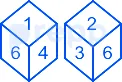
Two rotated positions of a dice are given below. Which number will be at the top if the number 1 is on the bottom of the dice?
- A
5
- B
6
- C
2
- D
3
Show answer
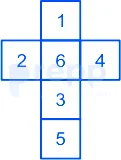
D. 3Here, 1, 4, 3, 2 are adjacent to 6.
Also, by changing the second position with respect to 6, we get:
6 - 4 - 1
6 - 2 - 3
This implies that the pairs of opposite faces should be (5, 6), (4, 2), and (1, 3)
Hence, 3 will be at the top if 1 is at the bottom of the dice.
 Paper & answer key PDF ↗
 Question 22archived
Select the figure in which the given figure is embedded. (Rotation is not allowed)

- A
Option A (shown in image)
- B
Option B (shown in image)
- C
Option C (shown in image)
- D
Option D (shown in image)
Show answer
A. Option A (shown in image)Hence, the above figure is the answer figure.
 Paper & answer key PDF ↗
 Question 23archived
Select the number pair in which the two numbers are related in the same way as the two numbers of the pair given below.
35 : 6
- A
85 : 9
- B
120 : 11
- C
26 : 5
- D
64 : 8
Show answer
B. 120 : 11Finding the Pattern in Number Pairs Analogy
This question asks us to identify the relationship between the two numbers in the given pair and then find another pair among the options that shares the same relationship. The given pair is 35 : 6.
Let's try to find a pattern connecting 35 and 6.
We can see that 35 is close to the square of 6.
Let's calculate the square of the second number, which is 6. $\text{6}^2 = 36$.
The first number, 35, is one less than the square of the second number. $36 - 1 = 35$.
So, the relationship seems to be: First Number = (Second Number)$^2$ - 1.
Let's represent this algebraically: If the pair is $N_1 : N_2$, then $N_1 = N_2^2 - 1$.
Checking the Options for the Same Relationship
Now, we will test each option to see which pair follows the same rule ($N_1 = N_2^2 - 1$).
Option 1: 85 : 9
Here, $N_1 = 85$ and $N_2 = 9$. Let's calculate $N_2^2 - 1$.
$9^2 - 1 = 81 - 1 = 80$.
Since 80 is not equal to 85, this pair does not follow the same rule.
Option 2: 120 : 11
Here, $N_1 = 120$ and $N_2 = 11$. Let's calculate $N_2^2 - 1$.
$11^2 - 1 = 121 - 1 = 120$.
Since 120 is equal to 120, this pair follows the same rule as the given pair 35 : 6.
Option 3: 26 : 5
Here, $N_1 = 26$ and $N_2 = 5$. Let's calculate $N_2^2 - 1$.
$5^2 - 1 = 25 - 1 = 24$.
Since 24 is not equal to 26, this pair does not follow the same rule. (Note: This pair follows the rule $N_1 = N_2^2 + 1$).
Option 4: 64 : 8
Here, $N_1 = 64$ and $N_2 = 8$. Let's calculate $N_2^2 - 1$.
$8^2 - 1 = 64 - 1 = 63$.
Since 63 is not equal to 64, this pair does not follow the same rule. (Note: This pair follows the rule $N_1 = N_2^2$).
Based on the analysis, only Option 2 (120 : 11) exhibits the same relationship ($N_1 = N_2^2 - 1$) as the original pair (35 : 6).
Revision Table: Number Pair Relationships
Given Pair / Option
Numbers ($N_1 : N_2$)
Relationship Check ($N_2^2 - 1$)
Does it Match $N_1$?
Given Pair
35 : 6
$6^2 - 1 = 36 - 1 = 35$
Yes
Option 1
85 : 9
$9^2 - 1 = 81 - 1 = 80$
No (80 $\ne$ 85)
Option 2
120 : 11
$11^2 - 1 = 121 - 1 = 120$
Yes
Option 3
26 : 5
$5^2 - 1 = 25 - 1 = 24$
No (24 $\ne$ 26)
Option 4
64 : 8
$8^2 - 1 = 64 - 1 = 63$
No (63 $\ne$ 64)
Additional Information: Solving Number Analogy Problems
Number analogy questions are common in reasoning tests. They require you to find the logical connection between a pair of numbers and apply it to find a similar pair. Here are some common types of relationships to look for:
Arithmetic Operations: Addition, subtraction, multiplication, division.
Squares and Cubes: The numbers might be squares or cubes, or related to them (e.g., $N^2$, $N^2+1$, $N^2-1$, $N^3$, $N^3+1$, $N^3-1$).
Prime Numbers: The numbers might be prime, or related to prime numbers.
Digits: Relationships between the digits of the numbers (e.g., sum of digits, product of digits).
Sequences: The numbers might follow a specific sequence rule.
Combinations: A combination of the above rules.
It's important to test various common patterns systematically when trying to solve these problems.
Paper & answer key PDF ↗ Question 24archived
Select the option that is related to the third term in the same way as the second term is related to the first term.
LAMP : PALM :: MALE
- A
ELAM
- B
MEAL
- C
EAML
- D
LAME
Show answer
C. EAMLSolving Word Analogies: LAMP to PALM Transformation
This question is a word analogy where you need to find the relationship between the first pair of words (LAMP and PALM) and apply the same relationship to the third word (MALE) to find the fourth word.
Analyzing the Relationship between LAMP and PALM
Let's look at the letters in both words and their positions:
LAMP:
L is at position 1
A is at position 2
M is at position 3
P is at position 4
PALM:
P is at position 1
A is at position 2
L is at position 3
M is at position 4
Notice that PALM contains the exact same letters as LAMP, just rearranged. Let's try to identify a rule based on the position of the letters.
Consider the letters from LAMP and where they end up in PALM:
The letter 'L' from position 1 in LAMP is at position 3 in PALM.
The letter 'A' from position 2 in LAMP is at position 2 in PALM.
The letter 'M' from position 3 in LAMP is at position 4 in PALM.
The letter 'P' from position 4 in LAMP is at position 1 in PALM.
So, the positional transformation rule is:
Letter at position 1 moves to position 3
Letter at position 2 stays at position 2
Letter at position 3 moves to position 4
Letter at position 4 moves to position 1
We can represent this positional mapping as:
Position 1 → Position 3
Position 2 → Position 2
Position 3 → Position 4
Position 4 → Position 1
Applying the Rule to MALE
Now, let's apply this same positional transformation rule to the word MALE.
MALE:
M is at position 1
A is at position 2
L is at position 3
E is at position 4
Using the rule:
The letter at position 1 (M) moves to the new position 3.
The letter at position 2 (A) stays at the new position 2.
The letter at position 3 (L) moves to the new position 4.
The letter at position 4 (E) moves to the new position 1.
Let's construct the new word based on these new positions:
New Position 1 gets the letter from old Position 4 (E).
New Position 2 gets the letter from old Position 2 (A).
New Position 3 gets the letter from old Position 1 (M).
New Position 4 gets the letter from old Position 3 (L).
Putting these letters together in order of the new positions (1, 2, 3, 4), we get EAML.
Checking the Options
Let's compare the word we derived, EAML, with the given options:
ELAM
MEAL
EAML
LAME
The word EAML matches option 3.
Therefore, based on the positional transformation rule derived from LAMP : PALM, the word related to MALE in the same way is EAML.
Revision Table: Word Analogy Pattern
Original Word
Letters & Positions
Transformation Rule (Positional Mapping)
Transformed Word
New Letter Positions
LAMP
L(1), A(2), M(3), P(4)
1→3, 2→2, 3→4, 4→1
PALM
P(1 from old 4), A(2 from old 2), L(3 from old 1), M(4 from old 3)
MALE
M(1), A(2), L(3), E(4)
1→3, 2→2, 3→4, 4→1
EAML
E(1 from old 4), A(2 from old 2), M(3 from old 1), L(4 from old 3)
Additional Information on Word Analogies and Logical Reasoning
Word analogies are a common type of question in logical reasoning and verbal ability tests. They assess your ability to identify the relationship between a pair of words and apply that same relationship to another pair.
Common types of relationships found in word analogies include:
Synonyms or Antonyms
Part to Whole
Cause and Effect
Worker and Tool
Action and Object
Degree of Intensity
Positional rearrangements (like in this question)
Letter patterns (skipping letters, alphabetical order, etc.)
To solve word analogies, it's crucial to first clearly define the relationship between the given pair. Sometimes, the relationship might be simple like synonyms, while other times, it might involve more complex patterns like positional changes or letter manipulations, as seen in the LAMP : PALM :: MALE : EAML example.
Practice with various types of analogies helps in quickly recognizing the underlying pattern and applying it correctly to find the missing term.
Paper & answer key PDF ↗ Question 25archived
Choose the set of numbers that is similar to the following set.
(6, 9, 18)
- A
(18, 27, 56)
- B
(8, 14, 24)
- C
(14, 21, 42)
- D
(10, 15, 35)
Show answer
C. (14, 21, 42)Finding Similar Number Sets by Pattern Analysis
The problem asks us to find a set of numbers from the given options that follows a similar pattern or rule as the set (6, 9, 18).
To solve this, we first need to analyze the relationship between the numbers in the given set (6, 9, 18). Let's look at the relationships between consecutive numbers:
Relationship between the first and second number: 9 compared to 6.
Relationship between the second and third number: 18 compared to 9.
Analyzing the Pattern in (6, 9, 18)
Let's examine the ratios between consecutive numbers:
Ratio of second to first number: $\frac{9}{6} = \frac{3}{2} = 1.5$
Ratio of third to second number: $\frac{18}{9} = 2$
So, the pattern observed is:
The second number is 1.5 times the first number.
The third number is 2 times the second number.
We can write this as:
Second Number = First Number $\times$ 1.5
Third Number = Second Number $\times$ 2
Checking Options for Similar Pattern
Now, let's apply this pattern to each of the given options to see which one follows the same rule.
Option 1: (18, 27, 56)
Second/First: $\frac{27}{18} = \frac{3}{2} = 1.5$. This matches the first part of the pattern.
Third/Second: $\frac{56}{27}$. Is this equal to 2? $27 \times 2 = 54$. $56 \neq 54$. This does not match the second part of the pattern.
So, Option 1 is not the similar set.
Option 2: (8, 14, 24)
Second/First: $\frac{14}{8} = \frac{7}{4} = 1.75$. This does not match 1.5.
So, Option 2 is not the similar set.
Option 3: (14, 21, 42)
Second/First: $\frac{21}{14} = \frac{3}{2} = 1.5$. This matches the first part of the pattern.
Third/Second: $\frac{42}{21} = 2$. This matches the second part of the pattern.
Both parts of the pattern match the set (14, 21, 42).
So, Option 3 is a similar set.
Option 4: (10, 15, 35)
Second/First: $\frac{15}{10} = \frac{3}{2} = 1.5$. This matches the first part of the pattern.
Third/Second: $\frac{35}{15} = \frac{7}{3}$. Is this equal to 2? $\frac{7}{3} \neq 2$. This does not match the second part of the pattern.
So, Option 4 is not the similar set.
Conclusion: Identifying the Similar Set
Based on the pattern analysis, the set that is similar to (6, 9, 18) is (14, 21, 42) because it follows the same pattern where the second number is 1.5 times the first, and the third number is 2 times the second.
Set
Second/First Ratio
Third/Second Ratio
Matches Pattern (1.5, 2)?
(6, 9, 18)
$\frac{9}{6} = 1.5$
$\frac{18}{9} = 2$
Yes (Base Pattern)
(18, 27, 56)
$\frac{27}{18} = 1.5$
$\frac{56}{27} \approx 2.07$
No
(8, 14, 24)
$\frac{14}{8} = 1.75$
$\frac{24}{14} \approx 1.71$
No
(14, 21, 42)
$\frac{21}{14} = 1.5$
$\frac{42}{21} = 2$
Yes
(10, 15, 35)
$\frac{15}{10} = 1.5$
$\frac{35}{15} \approx 2.33$
No
Revision Table: Number Pattern Analysis
Concept
Description
How it Applies Here
Pattern Recognition
Identifying a rule or sequence in a set of numbers or objects.
We identified the multiplication pattern (×1.5, ×2) in the given set.
Ratio
A comparison of two quantities by division.
Used ratios (Second/First, Third/Second) to define the relationship between numbers.
Similar Sets
Sets that follow the same underlying rule or pattern.
We looked for an option set where the numbers had the same ratios as the original set.
Additional Information: Types of Number Patterns
Number patterns can be based on various rules, including:
Arithmetic Progression: Adding a constant value each time (e.g., 2, 4, 6, 8... adding 2).
Geometric Progression: Multiplying by a constant value each time (e.g., 3, 6, 12, 24... multiplying by 2).
Fibonacci Sequence: Each number is the sum of the two preceding ones (e.g., 0, 1, 1, 2, 3, 5, 8...).
Square Numbers: The result of multiplying an integer by itself (e.g., 1, 4, 9, 16...).
Cube Numbers: The result of multiplying an integer by itself three times (e.g., 1, 8, 27, 64...).
Combined Operations: Patterns involving more than one operation, like the one in this question (multiply by 1.5, then multiply by 2).
Analyzing the differences or ratios between terms are common methods to identify the pattern in a number set.
Paper & answer key PDF ↗ Question 26archived
Which of the following is NOT a vocal form of Hindustani classical music?
- A
Pakhawaj
- B
Tarana
- C
Drupad
- D
Dhamar
Show answer
A. PakhawajUnderstanding Hindustani Classical Music Forms
Hindustani classical music has a rich tradition encompassing various forms, broadly categorized into vocal and instrumental. The question asks us to identify which of the given options is NOT a vocal form. Let's examine each option to determine its nature.
Analysing the Options
We will look at each term provided in the options and understand what it represents in the context of Indian classical music.
Pakhawaj: The Pakhawaj is a barrel-shaped percussion instrument from India. It is a double-headed drum, traditionally used as an accompaniment instrument for various forms of Hindustani classical music and dance, particularly Dhrupad and Kathak. It is played with the hands.
Tarana: Tarana is a style of vocal music in Hindustani classical music. It consists of catchy melodies set to rhythmic patterns using syllables like 'nom', 'tom', 'dre', 'dheem', 'tanana', etc., rather than conventional words. It is primarily a vocal form.
Dhrupad: Dhrupad is one of the oldest and grandest forms of Hindustani classical music. It is a devotional vocal form known for its emphasis on maintaining the purity of the raga and tala. It is characterized by a long, elaborate alaap (unmetered exploration of the raga) followed by composed sections. It is a significant vocal form.
Dhamar: Dhamar is another traditional vocal form in Hindustani classical music. It is closely associated with Dhrupad and is typically sung in the Dhamar tala, a 14-beat cycle. The text of a Dhamar composition usually relates to the festival of Holi and the playful interaction between Radha and Krishna. It is specifically a vocal form.
Identifying the Non-Vocal Form
Based on the analysis above:
Pakhawaj is a musical instrument.
Tarana is a vocal form.
Dhrupad is a vocal form.
Dhamar is a vocal form.
Therefore, the option that is NOT a vocal form of Hindustani classical music is Pakhawaj.
Classification of Options
Option
Type
Vocal Form?
Pakhawaj
Musical Instrument (Percussion)
No
Tarana
Vocal Form
Yes
Dhrupad
Vocal Form
Yes
Dhamar
Vocal Form
Yes
Conclusion
The Pakhawaj is a percussion instrument, not a vocal form. Tarana, Dhrupad, and Dhamar are all recognized vocal forms within the Hindustani classical music tradition.
Revision Table: Key Terms in Hindustani Music
Important Terms Related to Hindustani Classical Music
Term
Description
Category (Vocal/Instrumental/Other)
Raga
Melodic framework or structure
Other (Melody)
Tala
Rhythmic cycle or pattern
Other (Rhythm)
Alaap
Unmetered melodic improvisation in a raga
Vocal or Instrumental
Gat
Composed piece in instrumental music
Instrumental
Bandish
Composed piece in vocal music
Vocal
Additional Information on Hindustani Classical Music Forms
Hindustani classical music includes a variety of vocal and instrumental styles. Understanding these forms is crucial for appreciating the depth of this music tradition.
Major Vocal Forms: Apart from Dhrupad, Dhamar, and Tarana, other prominent vocal forms include Khayal (the most common modern form), Thumri, Dadra, Ghazal, and Bhajan.
Khayal: Developed later than Dhrupad, Khayal is a more liberal and expressive form, focusing on melodic improvisation around a short composition (Bandish).
Thumri and Dadra: These are semi-classical vocal forms often based on romantic or devotional themes, known for their lyrical beauty and flexibility.
Instrumental Forms: Instrumental music often follows the structure of vocal music (Alaap, Jor, Jhala, Gat) but is adapted for specific instruments like Sitar, Sarod, Flute, Santoor, Violin, etc. Percussion instruments like Tabla and Pakhawaj provide rhythmic accompaniment.
The Role of Instruments: Instruments can be melodic (like Sitar, Sarod) or rhythmic (like Tabla, Pakhawaj, Tanpura). The Tanpura provides the constant drone that defines the pitch center for the performance.
Paper & answer key PDF ↗ Question 27archived
Who was the first woman judge of the Delhi High Court?
- A
Anna Chandi
- B
Sujata Manohar
- C
Ruma Pal
- D
Leila Seth
Show answer
D. Leila SethFinding the First Woman Judge of Delhi High Court
The question asks to identify the first woman judge appointed to the Delhi High Court.
Let's analyze the options provided:
Anna Chandi
Sujata Manohar
Ruma Pal
Leila Seth
We are looking for the specific judge who holds the distinction of being the first woman judge in the Delhi High Court.
Identifying the Correct Judge
Historical records confirm that Justice Leila Seth was a pioneering figure in the Indian judiciary. She was indeed the first woman to become a judge of the Delhi High Court.
Justice Leila Seth broke several barriers:
She was the first woman judge of the Delhi High Court.
She was also the first woman Chief Justice of a High Court in India (Himachal Pradesh High Court).
Comparing this information with the given options, it becomes clear that Leila Seth is the correct answer.
Analysis of Other Options
While the other judges mentioned are also prominent figures in the Indian legal system, they do not hold the specific distinction of being the first woman judge of the Delhi High Court:
Anna Chandi: She was the first woman judge in India (appointed to a lower court in 1937) and later the first woman High Court judge in India (Kerala High Court in 1959).
Sujata Manohar: She served as a judge of the Bombay High Court, Kerala High Court (as Chief Justice), and later became a judge of the Supreme Court of India.
Ruma Pal: She served as a judge of the Calcutta High Court and later became a judge of the Supreme Court of India.
Based on the historical facts, only Leila Seth served as the first woman judge specifically in the Delhi High Court.
Conclusion
The first woman judge of the Delhi High Court was Justice Leila Seth.
Judge Name
Notable Distinction
Anna Chandi
First woman High Court judge in India (Kerala HC)
Sujata Manohar
Supreme Court Judge
Ruma Pal
Supreme Court Judge
Leila Seth
First woman judge of Delhi High Court; First woman Chief Justice of a High Court (Himachal Pradesh HC)
Revision Table: Key Indian Women Judges
Judge
Significance
Court(s) Served
Anna Chandi
First woman judge in India (lower court); First woman High Court judge (India)
Kerala High Court
Leila Seth
First woman judge of Delhi High Court; First woman Chief Justice of a High Court (India)
Delhi High Court, Himachal Pradesh High Court
Fathima Beevi
First woman judge of the Supreme Court of India
Supreme Court of India
Sujata Manohar
Woman judge of the Supreme Court of India
Bombay High Court, Kerala High Court, Supreme Court of India
Ruma Pal
Woman judge of the Supreme Court of India (longest serving woman SC judge)
Calcutta High Court, Supreme Court of India
Additional Information on Indian Judiciary
The Indian judiciary has seen significant contributions from women judges since the first appointments. Breaking barriers in high courts and the Supreme Court has paved the way for greater representation. Understanding the roles and contributions of these pioneering women is important for understanding the history and evolution of the Indian legal system.
High Courts are the principal civil courts of original jurisdiction in each state and union territory. A High Court consists of a Chief Justice and such other judges as the President of India may from time to time deem necessary to appoint.
Paper & answer key PDF ↗ Question 28archived
The Khajuraho Temples are located in the state of ________.
- A
Andhra Pradesh
- B
Uttarakhand
- C
Uttar Pradesh
- D
Madhya Pradesh
Show answer
D. Madhya PradeshKhajuraho Temples Location: Madhya Pradesh
The question asks about the location of the famous Khajuraho Temples in India. These temples are renowned for their stunning architecture and intricate sculptures, particularly their erotic art.
Let's analyze the given options to pinpoint the correct location of the Khajuraho Temples.
Andhra Pradesh: This state in South India is known for sites like Tirupati and Charminar, but not the Khajuraho Temples.
Uttarakhand: Located in the Himalayas, Uttarakhand is known for pilgrimage sites like Badrinath and Kedarnath, and hill stations, but not the Khajuraho Temples.
Uttar Pradesh: This northern state is home to major historical and cultural sites including Agra (Taj Mahal) and Varanasi, but the Khajuraho Temples are not situated here.
Madhya Pradesh: Located in central India, Madhya Pradesh is indeed the state where the Khajuraho Temples are located. Specifically, they are near the town of Khajuraho in the Chhatarpur district of Madhya Pradesh.
The Khajuraho Group of Monuments is a UNESCO World Heritage Site, recognized for its unique artistic achievement. The temples were built by the Chandela dynasty between 950 and 1050 CE.
Therefore, based on historical and geographical facts, the Khajuraho Temples are located in Madhya Pradesh.
Analysis of Khajuraho Temple Location Options
Option
State
Is Khajuraho Located Here?
Reason
1
Andhra Pradesh
No
Known for Southern Indian sites, not Khajuraho.
2
Uttarakhand
No
Himalayan state, known for pilgrimage and nature.
3
Uttar Pradesh
No
Northern state with sites like Agra and Varanasi.
4
Madhya Pradesh
Yes
Khajuraho Group of Monuments is in Chhatarpur district, Madhya Pradesh.
Revision Table: Key Facts about Khajuraho Temples
Aspect
Detail
Location
Khajuraho, Chhatarpur district, Madhya Pradesh, India
Built by
Chandela Dynasty
Period of Construction
950 - 1050 CE
Type of Monuments
Hindu and Jain Temples
UNESCO World Heritage Site
Yes (Inscribed in 1986)
Significance
Architecture, Sculptures (including erotic art)
Additional Information: Exploring Khajuraho and Madhya Pradesh
Madhya Pradesh, often called the "Heart of India," is a state rich in history, culture, and natural beauty. Besides the famous Khajuraho Temples, it is home to several other significant sites:
Sanchi Stupa: Another UNESCO World Heritage site known for Buddhist monuments.
Bhimbetka Rock Shelters: A UNESCO site showcasing prehistoric cave paintings.
Gwalior Fort: An imposing fort with a long history.
Wildlife Sanctuaries: Including Kanha and Bandhavgarh National Parks, famous for tigers.
The Chandela dynasty, which built the Khajuraho Temples, was a powerful ruling family in Central India during the medieval period. Their temples are celebrated for their intricate carvings and unique architectural style, representing a peak in North Indian temple architecture.
Paper & answer key PDF ↗ Question 29archived
Which one of the following was NOT a condition laid down in the Gandhi-Irwin Pact?
- A
Withdrawal of tax on khadi production
- B
Removal of salt tax; allowing to produce, trade and sell legally
- C
The Indian National Congress should stop the civil disobedience movement
- D
Participation in the Round Table Conference by the Indian National Congress
Show answer
A. Withdrawal of tax on khadi productionUnderstanding the Gandhi-Irwin Pact
The Gandhi-Irwin Pact was a political agreement signed on 5 March 1931 between Mahatma Gandhi and the then Viceroy of India, Lord Irwin. This pact was significant because it marked a truce between the Indian National Congress, led by Gandhi, and the British government in India. The agreement came after the widely successful Civil Disobedience Movement.
The main objective of the pact was to discontinue the Civil Disobedience Movement and pave the way for the Indian National Congress to participate in the Second Round Table Conference in London.
Key Conditions Agreed Upon in the Gandhi-Irwin Pact
The Gandhi-Irwin Pact laid down several conditions agreed upon by both sides. Let's examine the typical demands and agreements that were part of this historic pact:
Cessation of Civil Disobedience: The Indian National Congress agreed to call off the Civil Disobedience Movement. This directly relates to one of the options provided.
Participation in Round Table Conference: Congress agreed to participate in the upcoming Second Round Table Conference, which was aimed at discussing future constitutional reforms for India. This is another point mentioned in the options.
Release of Political Prisoners: The British government agreed to release all political prisoners who were not convicted of violence.
Withdrawal of Ordinances: The government agreed to withdraw the ordinances that were promulgated to curb the Civil Disobedience Movement.
Salt Laws Relaxation: A key agreement was the relaxation of salt laws. People living in coastal areas were allowed to collect, manufacture, and sell salt for their personal use, although commercial sale was still restricted. This directly addresses another option.
Return of Confiscated Land: Land that was confiscated during the movement and not yet sold to third parties was agreed to be returned.
Peaceful Picketing: The government agreed to permit peaceful picketing of liquor, opium, and foreign cloth shops.
Analyzing the Given Conditions
Let's look at the conditions listed in the options and see which ones were part of the Gandhi-Irwin Pact:
Removal of salt tax; allowing to produce, trade and sell legally. While the pact allowed collection and sale of salt for personal use in coastal areas, it didn't completely remove the salt tax or allow unrestricted commercial trade and sale everywhere. However, it did address the salt issue significantly, offering relief compared to the previous strict laws. This point, in essence, captures the spirit of one of the key concessions by the government regarding salt.
The Indian National Congress should stop the civil disobedience movement. This was a fundamental condition from the government's side, and Congress agreed to it.
Participation in the Round Table Conference by the Indian National Congress. This was another crucial agreement from Congress's side, enabling future negotiations.
Based on historical records of the Gandhi-Irwin Pact, the conditions regarding stopping the Civil Disobedience Movement, participating in the Round Table Conference, and the relaxation of salt laws (allowing production and sale for personal use in coastal areas) were indeed part of the agreement.
Condition Not Included in the Gandhi-Irwin Pact
The condition about the "Withdrawal of tax on khadi production" was not a demand put forth by Gandhi or a condition agreed upon in the Gandhi-Irwin Pact. The negotiations primarily focused on issues related to the Civil Disobedience Movement, political prisoners, salt laws, and Congress's participation in constitutional talks. While Gandhi was a staunch proponent of khadi and its promotion, the pact did not include any specific clause regarding the taxation of khadi production.
Therefore, among the given options, the withdrawal of tax on khadi production was not a condition laid down in the Gandhi-Irwin Pact.
Summary of Key Gandhi-Irwin Pact Points
Agreed By Congress
Agreed By Government (Lord Irwin)
Suspend Civil Disobedience Movement
Release political prisoners (non-violent)
Participate in the Second Round Table Conference
Withdraw ordinances
Allow collection/manufacture/sale of salt near coast (for personal use)
Return confiscated land (if not sold)
Permit peaceful picketing
Revision Table: Gandhi-Irwin Pact Details
Reviewing the key aspects helps solidify understanding:
When: 5 March 1931
Who: Mahatma Gandhi (representing Indian National Congress) and Lord Irwin (Viceroy of India)
Context: End of the first phase of the Civil Disobedience Movement
Purpose: To reach a truce and enable Congress participation in the Second Round Table Conference
Additional Information on Gandhi-Irwin Pact
Although the Gandhi-Irwin Pact was seen as a temporary truce, it was significant for several reasons. It elevated the political status of the Indian National Congress by bringing them to the negotiating table as equals with the Viceroy. It also led to the release of many political prisoners, which was a major demand. However, some leaders and sections of the population were not entirely satisfied with the pact, feeling that Gandhi should have pressed for more concessions, such as commutation of the death sentence for Bhagat Singh and his comrades.
The pact demonstrated the effectiveness of the Civil Disobedience Movement in pressuring the British government to negotiate with Indian leaders.
Paper & answer key PDF ↗ Question 30archived
The ________ was a group of seven Members of Parliament from the United Kingdom, constituted to suggest constitutional reforms for British India.
- A
Sargent Commission
- B
Fraser Commission
- C
Hunter Commission
- D
Simon Commission
Show answer
D. Simon CommissionUnderstanding Constitutional Reforms for British India
The question asks to identify the specific group of seven Members of Parliament from the United Kingdom that was formed to propose constitutional changes for British India. Several commissions were sent to India during the British Raj, each with a different purpose. We need to look at the options and determine which one matches the description of a seven-member parliamentary group focused on constitutional reforms.
Analyzing the Options
Let's examine each option provided:
Sargent Commission: This commission, established in 1944, dealt with post-war educational development in India. Its recommendations were related to education reform, not primarily constitutional reform.
Fraser Commission: This commission, also known as the Police Commission, was appointed in 1902 by Lord Curzon. Its purpose was to inquire into the administration of the police force in British India and suggest reforms for it. This was not related to constitutional structure.
Hunter Commission: There are two significant Hunter Commissions in Indian history. One was the Indian Education Commission of 1882, focused on education. The other was the Disorders Inquiry Committee (often called the Hunter Commission) of 1919, formed to investigate the disturbances in Bombay, Delhi, and Punjab, particularly the Jallianwala Bagh massacre. Neither of these was a group of seven British MPs tasked with overall constitutional reforms.
Simon Commission: Officially the Indian Statutory Commission, this group was appointed in November 1927 (though it arrived in India in 1928). It consisted of seven Members of the British Parliament and was chaired by Sir John Simon. Its specific mandate was to review the working of the Government of India Act 1919 and to propose further constitutional reforms for British India. This description perfectly matches the details given in the question.
The Role of the Simon Commission in British India
The Simon Commission is historically significant because it was a crucial step in the constitutional history of British India. Key points about the commission include:
Composition: It comprised seven members, all from the British Parliament.
Purpose: To study the constitutional system of India established by the Government of India Act 1919 and recommend changes.
Controversy: The commission faced widespread protests in India because it did not include any Indian members, leading to the slogan "Simon Go Back".
Based on the analysis, the group of seven Members of Parliament constituted to suggest constitutional reforms for British India was the Simon Commission.
Comparison of Commissions
Commission
Year Formed
Primary Focus
Number of Members (Relevant context)
Sargent Commission
1944
Education Reforms
Not a group of 7 British MPs for constitutional reform
Fraser Commission
1902
Police Administration Reforms
Not a group of 7 British MPs for constitutional reform
Hunter Commission (1882)
1882
Education
Not a group of 7 British MPs for constitutional reform
Hunter Commission (1919)
1919
Jallianwala Bagh/Disorders
Not a group of 7 British MPs for constitutional reform
Simon Commission
1927 (Appointed)
Constitutional Reforms (Reviewing 1919 Act)
Seven British Members of Parliament
The table above clearly shows that the Simon Commission is the only one among the options that fits the description of a seven-member parliamentary group focused on constitutional reforms for British India.
Revision Table: Key Commissions in British India
Important Commissions and Their Purpose
Commission Name
Year
Key Area
Hunter Commission (Education)
1882
Education
Fraser Commission
1902
Police Administration
Hunter Commission (Disorders)
1919
Jallianwala Bagh Massacre Investigation
Simon Commission
1927-1930
Constitutional Reforms
Sargent Commission
1944
Post-War Education Plan
Additional Information: The Simon Commission and Indian Response
The Simon Commission's exclusion of Indian members was seen as a deliberate insult by Indian leaders, including the Indian National Congress and the Muslim League. This led to widespread boycotts and protests across India upon its arrival in 1928. While the commission submitted its report in 1930, its recommendations were largely rejected by Indian political factions. However, the report and the subsequent discussions, including the Round Table Conferences, significantly influenced the Government of India Act 1935, which introduced major constitutional changes.
The primary goal of the Simon Commission was to determine the extent to which India was ready for further constitutional advancement and to recommend the next steps towards responsible government. Their report suggested abolishing diarchy (dual government) in the provinces and establishing provincial autonomy, among other recommendations.
Paper & answer key PDF ↗ Question 31archived
Bariatric surgery makes changes to a person's ________.
- A
Lungs
- B
Digestive system
- C
Nasal passage
- D
heart
Show answer
B. Digestive systemUnderstanding Bariatric Surgery and Body Changes
Bariatric surgery is a type of medical procedure primarily performed to help individuals struggling with obesity lose weight. These surgeries work by making significant changes to a person's digestive system.
Let's look at the options provided in the question:
Lungs: The lungs are part of the respiratory system, responsible for breathing. Bariatric surgery does not directly alter the lungs.
Digestive system: This system includes the stomach, intestines, esophagus, and other organs involved in breaking down food and absorbing nutrients. Bariatric surgeries like gastric bypass, sleeve gastrectomy, and adjustable gastric band specifically modify the stomach and/or intestines to limit food intake or reduce nutrient absorption.
Nasal passage: The nasal passage is part of the respiratory system and the sense of smell. Bariatric surgery does not involve the nasal passage.
Heart: The heart is part of the cardiovascular system, responsible for pumping blood. While weight loss from bariatric surgery can improve heart health, the surgery itself does not change the heart's structure.
Therefore, bariatric surgery directly impacts and makes changes to the digestive system.
How Bariatric Surgery Affects the Digestive System
Different types of bariatric surgery modify the digestive system in various ways:
Sleeve Gastrectomy: A large part of the stomach is removed, creating a smaller, tube-shaped stomach pouch. This reduces the amount of food that can be held and affects hunger hormones.
Roux-en-Y Gastric Bypass: The stomach is divided into a small upper pouch and a larger lower pouch. The small intestine is then rearranged to connect to both pouches. This limits food intake and reduces nutrient absorption.
Adjustable Gastric Band: An inflatable band is placed around the upper part of the stomach to create a small pouch above the band. The band can be adjusted to control the size of the opening into the rest of the stomach.
These procedures alter the anatomy and function of the stomach and intestines, which are key components of the digestive system, leading to weight loss.
Summary of Bariatric Surgery Impact
Based on the analysis of the surgery's procedures, it is clear that bariatric surgery's primary target is the digestive system.
Body System
Affected by Bariatric Surgery?
Reason
Lungs
No
Part of the respiratory system.
Digestive system
Yes
Stomach and intestines are modified.
Nasal passage
No
Part of the respiratory/olfactory system.
Heart
No
Part of the cardiovascular system; health may improve but structure isn't changed by the surgery itself.
The changes made during bariatric surgery directly affect how food is processed and absorbed by the body, which are functions of the digestive system.
Revision Table: Key Concepts of Bariatric Surgery
Term
Definition/Relevance to Bariatric Surgery
Bariatric Surgery
Weight-loss surgery that modifies the digestive system.
Digestive System
The body system including the stomach and intestines, altered by bariatric surgery.
Obesity
A condition often treated with bariatric surgery.
Stomach
Organ frequently reduced in size or bypassed during bariatric surgery.
Intestines
Part of the digestive tract that may be rerouted or altered in bariatric surgery.
Additional Information: Health Benefits of Bariatric Surgery
While primarily a weight-loss procedure, bariatric surgery can also lead to significant improvements or remission of several obesity-related health conditions, often referred to as metabolic surgery due to its positive effects on metabolism. These can include:
Type 2 diabetes
High blood pressure
High cholesterol
Sleep apnea
Joint pain
These health improvements occur as a result of the weight loss and metabolic changes initiated by the surgery's impact on the digestive system.
Paper & answer key PDF ↗ Question 32archived
________ is the largest river island in the world.
- A
Munroe
- B
Majuli
- C
Bahvani
- D
Umananda
Show answer
B. MajuliIdentifying the World's Largest River Island
Let's look into the question asking about the largest river island in the world. A river island is a piece of land within a river, formed by the deposition of sediment. These islands can vary greatly in size.
The question asks us to identify the specific island that holds the title of the world's largest river island from the given options: Munroe, Majuli, Bahvani, and Umananda.
Analyzing the Options
Let's consider each option:
Munroe Island: This is an island located at the confluence of the Ashtamudi Lake and the Kallada River in Kollam district, Kerala, India. While it is a beautiful island destination, it is not the largest river island in the world.
Majuli: This island is located in the Brahmaputra River in Assam, India. It is widely recognized as the largest river island globally. Majuli is not only significant for its size but also for its unique cultural landscape, serving as the cultural capital of Assamese civilization.
Bahvani Island: Bhavani Island is a river island in the Krishna River, located near Vijayawada, Andhra Pradesh, India. It is primarily known as a tourist spot and is significantly smaller than Majuli.
Umananda Island: Umananda Island is the smallest inhabited river island in the Brahmaputra River, located near Guwahati, Assam, India. It is famous for a Shiva temple located there and is much smaller than Majuli.
Comparing the sizes and recognition of these islands, Majuli stands out as the largest river island among the options and globally.
Therefore, the largest river island in the world is Majuli.
River Island
Location
Significance
Majuli
Brahmaputra River, Assam, India
Largest river island in the world
Munroe
Ashtamudi Lake/Kallada River, Kerala, India
Tourist destination
Bahvani
Krishna River, Andhra Pradesh, India
Tourist spot
Umananda
Brahmaputra River, Assam, India
Smallest inhabited river island (in Brahmaputra), known for temple
Revision Table: Key River Islands
Island Name
Associated River/Waterbody
Location
Key Feature
Majuli
Brahmaputra River
Assam, India
World's Largest River Island
Munroe
Ashtamudi Lake/Kallada River
Kerala, India
Confluence Island
Bahvani
Krishna River
Andhra Pradesh, India
Tourist Island
Umananda
Brahmaputra River
Assam, India
Smallest Inhabited River Island
Additional Information on River Islands
River islands are fascinating geographical features formed through various processes like sediment deposition, changes in river flow, or erosion. They are distinct from oceanic islands or islands in lakes. The size of river islands can fluctuate due to the dynamic nature of river systems, including erosion during floods and deposition of new sediment.
Majuli, the largest river island, is a significant cultural and ecological hotspot. However, it also faces severe erosion challenges from the Brahmaputra River, leading to a reduction in its size over the years. Conservation efforts are underway to protect this unique island environment and its rich biodiversity and cultural heritage.
Other notable large river islands exist around the world, such as Bananal Island in Brazil (Araguaia River), though Majuli is generally considered the largest *true* river island formed by river dynamics rather than a split river course creating a large area of land between channels.
Paper & answer key PDF ↗ Question 33archived
Varkala, Chowara, Chavakkad and Nattika are beaches in the state of ________.
- A
Karnataka
- B
Tamil Nadu
- C
Kerala
- D
Maharashtra
Show answer
C. KeralaIdentifying Famous Beaches in Indian States
This question asks us to identify the Indian state where a group of specific beaches is located. The beaches mentioned are Varkala, Chowara, Chavakkad, and Nattika.
India has a long coastline with numerous beautiful beaches spread across various states. Knowing the location of famous beaches is often part of general awareness, especially in geography and tourism-related contexts.
Analysis of the Beaches: Varkala, Chowara, Chavakkad, and Nattika
Let's examine the location of each of these beaches:
Varkala Beach: Famous for its unique cliff formations adjacent to the Arabian Sea, Varkala Beach is a well-known tourist spot.
Chowara Beach: Located near Kovalam, Chowara Beach is another picturesque coastal area.
Chavakkad Beach: Known for its tranquil environment and the point where a river meets the sea, Chavakkad Beach is a popular local destination.
Nattika Beach: This beach is part of the coastal stretch in the Thrissur district and is known for its serene beauty and fishing activities.
These beaches are all situated along the southwestern coast of India.
Locating the State of Varkala, Chowara, Chavakkad, and Nattika Beaches
Upon checking the geographical location of Varkala, Chowara, Chavakkad, and Nattika beaches, it is found that they are all located within the state of Kerala.
Kerala, located on the Malabar Coast, is renowned for its backwaters, hill stations, and particularly its beautiful beaches along the Arabian Sea.
Let's consider the given options:
Karnataka: Karnataka has a coastline but Varkala, Chowara, Chavakkad, and Nattika are not located there.
Tamil Nadu: Tamil Nadu is on the southeastern coast, and these beaches are on the southwestern coast.
Kerala: Kerala is on the southwestern coast, and all four listed beaches are indeed located in Kerala.
Maharashtra: Maharashtra is further north on the western coast, and these beaches are not found there.
Therefore, the state where Varkala, Chowara, Chavakkad, and Nattika beaches are located is Kerala.
Beaches and their Location State
Beach Name
Located In/Near
State
Varkala Beach
Varkala, Thiruvananthapuram District
Kerala
Chowara Beach
Near Kovalam, Thiruvananthapuram District
Kerala
Chavakkad Beach
Chavakkad, Thrissur District
Kerala
Nattika Beach
Nattika, Thrissur District
Kerala
Conclusion on Beach Locations
Based on geographical knowledge and verification, Varkala, Chowara, Chavakkad, and Nattika are prominent beaches found in the state of Kerala.
Revision Table: Key Beach Locations
Beach Name
State
Varkala
Kerala
Chowara
Kerala
Chavakkad
Kerala
Nattika
Kerala
Additional Information: Kerala's Coastal Tourism
Kerala is a major tourist destination in India, known for its diverse geography including lush Western Ghats mountains, serene backwaters, and beautiful beaches. The state's coastline along the Arabian Sea is dotted with numerous beaches that attract both domestic and international tourists.
Some other famous beaches in Kerala include Kovalam Beach, Poovar Beach, Marari Beach, Alappuzha Beach, and Muzhappilangad Drive-in Beach.
Understanding the location of these popular tourist spots helps in gaining a better perspective on the geography and tourism landscape of India.
Paper & answer key PDF ↗ Question 34archived
The National Board for Micro, Small and Medium Enterprises meets once every ________ months in a year.
- A
3
- B
2
- C
4
- D
6
Show answer
A. 3Understanding the National Board for MSME Meetings
The question asks about the frequency of meetings of the National Board for Micro, Small and Medium Enterprises (MSMEs).
The National Board for MSME is an advisory body constituted by the Central Government under the Micro, Small and Medium Enterprises Development (MSMED) Act, 2006. Its primary role is to examine matters relating to the promotion and development of the MSME sector and provide recommendations to the government.
Meeting Frequency of the National Board for MSME
As per Section 3(4) of the MSMED Act, 2006: "The Board shall meet at least once in every three months in a year at such time and place and observe such rules of procedure in regard to the transaction of business at its meetings as may be prescribed."
Therefore, the National Board for MSME meets once every 3 months in a year. Hence, the correct answer is 3.
Revision Table: National Board for MSME
AspectDetails
Body NameNational Board for Micro, Small and Medium Enterprises (MSME)
Governing ActMSMED Act, 2006
Relevant ProvisionSection 3(4)
Meeting FrequencyAt least once every 3 months
PurposeAdvisory body to the Central Government on MSME development
Additional Information: MSME Sector
The MSME sector is a cornerstone of the Indian economy, contributing significantly to GDP, employment, manufacturing output, and exports, especially in rural and semi-urban areas.
Paper & answer key PDF ↗ Question 35archived
Which of the following acid is found in Apple?
- A
Sulphuric Acid
- B
Nitric Acid
- C
Malic Acid
- D
Formic Acid
Show answer
C. Malic AcidUnderstanding Acids in Fruits: Focus on Apple Acid
Fruits naturally contain various organic acids that contribute to their taste, aroma, and nutritional value. The type and amount of acid present vary significantly depending on the fruit.
The question asks about the specific acid commonly found in Apple.
Identifying the Primary Acid in Apple
Apples are well-known for their crisp texture and often slightly tart or sour taste. This characteristic taste is largely due to the presence of organic acids. Several acids might be present in an Apple, but one acid is typically the most abundant and responsible for the dominant flavor profile.
Let's look at the options provided:
Sulphuric Acid
Nitric Acid
Malic Acid
Formic Acid
Analysing each option in the context of natural fruit composition:
Sulphuric Acid ($\text{H}_2\text{SO}_4$) and Nitric Acid ($\text{HNO}_3$) are strong mineral acids primarily used in industrial processes and laboratories. They are not naturally found in significant amounts in edible fruits like Apple.
Formic Acid ($\text{HCOOH}$) is the simplest carboxylic acid and is found in nature, notably in the venom of ant stings and bee stings, and also in some plants, but it is not the characteristic acid of Apple.
Malic Acid ($\text{C}_4\text{H}_6\text{O}_5$) is an organic dicarboxylic acid. It is widely found in nature and is a primary acid in many fruits, including Apple, grapes, cherries, and plums. It is especially prominent in Apple and contributes significantly to the tartness associated with this fruit.
Based on the natural occurrence and common composition of Apple, Malic Acid is the acid most abundantly found in this fruit.
Common Acids in Fruits: A Quick Look
Acid
Common Source(s)
Citric Acid
Citrus fruits (lemons, oranges), berries
Malic Acid
Apple, grapes, cherries, plums, rhubarb
Tartaric Acid
Grapes, tamarind
Ascorbic Acid (Vitamin C)
Many fruits (citrus, strawberries, kiwis)
Oxalic Acid
Spinach, rhubarb, berries
As seen in the table, Malic acid is strongly associated with Apple.
Conclusion
The acid predominantly found in Apple is Malic Acid. The other options, Sulphuric Acid, Nitric Acid, and Formic Acid, are not the primary acids characteristic of Apple.
Revision Table: Apple Acid Key Facts
Topic
Details
Primary Acid in Apple
Malic Acid
Chemical Nature of Malic Acid
Organic dicarboxylic acid
Contribution to Apple
Provides tart/sour taste
Other Sources of Malic Acid
Grapes, cherries, plums
Additional Information: Beyond Malic Acid in Apple
While Malic Acid is the most abundant acid in Apple, other acids are also present in smaller quantities, such as citric acid and quinic acid. The ratio of these acids, along with sugars, contributes to the overall unique flavour profile of different Apple varieties.
Malic acid is also used commercially as a food additive to impart a tart taste, often found in candies, beverages, and apple cider.
Paper & answer key PDF ↗ Question 36archived
________ was the first and only Muslim woman to ever sit on the throne of Delhi.
- A
Razia Sultan
- B
Shajar Al Durr
- C
Gevher Nesibe
- D
Fatima Al Fihri
Show answer
A. Razia SultanUnderstanding the First Muslim Woman Ruler of Delhi
The question asks to identify the first and only Muslim woman who reigned as a monarch from the throne of Delhi. This is a significant historical point in the history of the Delhi Sultanate.
Analyzing the Options for Delhi's Woman Ruler
Let's examine the given options to determine who among them fits the description of ruling from Delhi:
Razia Sultan: Razia Sultan was the daughter of Iltutmish, a prominent ruler of the Delhi Sultanate. After some political turmoil, she ascended to the throne of Delhi in 1236 CE. She ruled for a few years and is widely recognized by historians as the only Muslim woman to have ruled the Delhi Sultanate as a sovereign monarch.
Shajar Al Durr: Shajar Al Durr was a powerful figure in the history of Egypt, specifically associated with the Mamluk dynasty in Cairo. She briefly ruled as Sultan of Egypt in the 13th century. Her rule was centered in Egypt, not Delhi.
Gevher Nesibe: Gevher Nesibe Hatun was a princess of the Seljuk Sultanate of Rûm (in Anatolia, modern Turkey) in the 13th century. She is known for funding a complex that included a hospital and a medical school. Her historical context is Anatolia, not Delhi.
Fatima Al Fihri: Fatima Al Fihri was an Arab Muslim woman who founded the Al Quaraouiyine mosque and university in Fez, Morocco, in the 9th century. She is celebrated for her contribution to education and religious institutions, but she was not a ruler in Delhi or anywhere else.
Identifying the Correct Muslim Woman Ruler of Delhi
Based on the analysis of the options, Razia Sultan is the only individual who ruled from the throne of Delhi among the choices provided. She succeeded her brother Rukn ud din Firuz and proved to be a capable ruler, although her reign was short-lived due to opposition from nobles who were reluctant to be ruled by a woman.
Therefore, Razia Sultan is the correct answer as the first and only Muslim woman monarch of Delhi.
Revision Table: Key Facts about Razia Sultan's Reign
Aspect
Detail
Name
Razia Sultan (or Raziyat-ud-din Sultana)
Dynasty
Mamluk Dynasty (Delhi Sultanate)
Father
Iltutmish
Reign Period
1236 – 1240 CE
Significance
First and only Muslim woman ruler of Delhi
Additional Information on Delhi Sultanate Rulers
The Delhi Sultanate was a series of five dynasties that ruled over parts of the Indian subcontinent from 1206 to 1526. It was established after the Ghurid conquest of Delhi.
Important points regarding the Delhi Sultanate and its rulers:
The first dynasty was the Mamluk Dynasty (also known as the Slave Dynasty), founded by Qutb ud-Din Aibak.
Iltutmish, Razia Sultan's father, consolidated the Sultanate's power and is considered one of its most important rulers.
Razia Sultan's reign was marked by her attempts to rule independently and overcome challenges from Turkish nobles who were against female rule.
Her reign ended tragically, but her place in history as a unique female ruler of Delhi remains significant.
Understanding the context of the Delhi Sultanate helps appreciate the historical significance of Razia Sultan's rule.
Paper & answer key PDF ↗ Question 37archived
The Banking Regulation Act was passed in India in ________.
- A
1965
- B
1949
- C
1974
- D
1951
Show answer
B. 1949Understanding the Banking Regulation Act in India
The question asks for the year in which the Banking Regulation Act was enacted in India. This is a significant piece of legislation that governs the functioning of banking companies in the country.
The Enactment Year of the Banking Regulation Act
The Banking Regulation Act, 1949, is a crucial statute that provides a framework for the supervision and regulation of all banking firms in India. Initially passed as the Banking Companies Act, 1949, it was later renamed the Banking Regulation Act, 1949, in March 1966.
The Act extends to the whole of India and is designed to protect the interests of depositors and to ensure the sound operation of banks.
Let's look at the provided options:
1965
1949
1974
1951
Based on historical records and legal history, the Banking Regulation Act was passed in the year 1949.
Significance of 1949 for Banking Regulation
The year 1949 was pivotal for the Indian banking sector. Following India's independence, there was a need for comprehensive legislation to regulate banking activities, ensure financial stability, and build public trust in the banking system. The enactment of the Banking Regulation Act provided the Reserve Bank of India (RBI) with the necessary powers to supervise, control, and regulate banking institutions effectively.
Therefore, the correct year for the passing of the Banking Regulation Act in India is 1949.
Key Features of the Banking Regulation Act, 1949
The Act covers various aspects of banking operations, including:
Licensing of banking companies.
Share capital and reserves requirements.
Management structure and board of directors.
Restrictions on loans and advances.
Submission of returns and balance sheets.
Amalgamation of banking companies.
Inspection and supervision by the RBI.
Liquidation of banking companies.
These provisions collectively aim to ensure that banks function in a manner that protects depositors' money and contributes to the overall economic stability.
Revision Table: Banking Regulation Act Key Facts
Aspect
Detail
Act Name (Initial)
Banking Companies Act, 1949
Act Name (Current)
Banking Regulation Act, 1949
Year Passed
1949
Effective From
16th March 1949
Governing Authority
Reserve Bank of India (RBI)
Additional Information: Evolution of Banking Regulation in India
While the Banking Regulation Act, 1949, is the cornerstone, banking regulation in India has evolved over time. The Reserve Bank of India Act, 1934, established the central bank itself. Subsequent amendments and related laws have further strengthened the regulatory framework to address changing economic conditions and the increasing complexity of financial markets. The Act continues to be amended to incorporate new regulatory requirements, such as those related to cooperative banks, technological advancements, and international banking standards.
Understanding the Banking Regulation Act, 1949, is fundamental to understanding the legal framework governing the banking sector in India.
Paper & answer key PDF ↗ Question 38archived
What is India's rank in 2019 World Happiness Report?
- A
160th
- B
130th
- C
150th
- D
140th
Show answer
D. 140thUnderstanding India's Rank in the 2019 World Happiness Report
The World Happiness Report is a landmark survey of the state of global happiness that ranks 156 countries by how happy their citizens perceive themselves to be. The report is released annually by the United United Nations Sustainable Development Solutions Network.
The ranking is based on a wide range of data, including responses from global surveys asking citizens to rate their own lives. Key factors considered in the report often include:
GDP per capita
Social support
Healthy life expectancy
Freedom to make life choices
Generosity
Perceptions of corruption
Each country is assigned a happiness score, which is then used to determine its rank relative to other countries.
India's Position in the 2019 World Happiness Ranking
The 2019 World Happiness Report provided insights into the happiness levels across the globe. India's performance in this specific year was a subject of notable discussion.
According to the findings of the 2019 report, India was ranked significantly lower compared to many other countries. The precise ranking for India in the 2019 World Happiness Report was 140th.
This ranking reflected the country's performance across the various indicators used by the report to measure happiness and well-being among the population during that period.
Key Takeaways from the 2019 Report
The 2019 report highlighted trends in happiness across different regions and noted factors contributing to changes in national scores. While the top positions were held by Nordic countries, many South Asian nations, including India, received lower rankings.
Understanding the factors that contribute to this ranking helps in focusing efforts towards improving the overall well-being and happiness of the population.
The rank of 140th place for India in the 2019 World Happiness Report is a specific data point from that year's analysis.
Revision Table: World Happiness Report Key Details
Report
Focus
India's Rank (2019)
Key Factors
World Happiness Report
Global Happiness Survey
140th
GDP, Social Support, Health, Freedom, Generosity, Corruption
Additional Information: World Happiness Index
The World Happiness Index, as presented in the World Happiness Report, is an important tool for policymakers and researchers to understand and compare the subjective well-being of populations across the world. It emphasizes that while economic factors are important, non-economic factors like social connections, freedom, and trust also play crucial roles in determining happiness levels.
The methodology involves asking a representative sample of people in each country to evaluate their current life using the mental image of a ladder, where 0 represents the worst possible life and 10 represents the best possible life (this is known as the Cantril ladder).
Year-to-year changes in rankings can occur due to various reasons, including economic performance, social changes, political events, and even natural disasters, all of which can impact the factors measured by the report.
Paper & answer key PDF ↗ Question 39archived
The Pradhan Mantri Shram Yogi Mandhan Yojana was launched by ________.
- A
Arun Jaitley
- B
Narendra Modi
- C
Ram Nath Kovind
- D
Smriti Zubin Irani
Show answer
B. Narendra ModiUnderstanding the Pradhan Mantri Shram Yogi Mandhan Yojana
The question asks about the individual who launched the Pradhan Mantri Shram Yogi Mandhan Yojana. This scheme is an important government initiative aimed at providing social security to unorganized workers.
The Pradhan Mantri Shram Yogi Mandhan Yojana (PM-SYM) is a voluntary and contributory pension scheme intended for unorganized workers.
Let's consider the options provided:
Arun Jaitley
Narendra Modi
Ram Nath Kovind
Smriti Zubin Irani
Upon reviewing the details of the scheme's launch, it is known that the Pradhan Mantri Shram Yogi Mandhan Yojana was launched by the current Prime Minister of India.
Based on the options and the launch details, the individual who launched the Pradhan Mantri Shram Yogi Mandhan Yojana is Narendra Modi.
Key Features of Pradhan Mantri Shram Yogi Mandhan Yojana
This pension scheme has several key features:
It is meant for unorganized workers with monthly income of ≤ ₹15,000.
The entry age is between 18 and 40 years.
It is a voluntary and contributory scheme.
The government provides a matching contribution equal to the beneficiary's contribution.
Beneficiaries receive a minimum assured pension of ₹3,000 per month after attaining the age of 60 years.
If the beneficiary dies after attaining 60 years, the spouse is eligible for 50% of the pension as family pension.
The launch of such a significant social security scheme is typically done by the head of the government, which in India is the Prime Minister.
Therefore, the Pradhan Mantri Shram Yogi Mandhan Yojana was launched by Narendra Modi.
Scheme Name
Launched By
Beneficiaries
Pradhan Mantri Shram Yogi Mandhan Yojana (PM-SYM)
Narendra Modi
Unorganized Workers
Revision Table: Pradhan Mantri Shram Yogi Mandhan Yojana
Aspect
Detail
Scheme Purpose
Pension for Unorganized Workers
Launch Date
February 2019
Launched By
Narendra Modi
Target Group
Unorganized Workers (e.g., street vendors, rickshaw pullers, agricultural workers, etc.)
Monthly Income Limit
≤ ₹15,000
Entry Age
18-40 years
Assured Pension
₹3,000 per month after 60 years
Additional Information: Pradhan Mantri Shram Yogi Mandhan Yojana Details
The Pradhan Mantri Shram Yogi Mandhan Yojana is a crucial step towards providing financial security in old age for the large segment of India's workforce engaged in the unorganized sector. The scheme is managed by the Life Insurance Corporation of India (LIC) and administered by the Ministry of Labour and Employment.
The monthly contribution required from the beneficiary varies depending on the entry age. The younger the age, the lower the monthly contribution. The same amount is contributed by the Central Government.
This scheme helps ensure a basic income flow for unorganized workers after they are no longer able to work, reducing their dependency on others.
Paper & answer key PDF ↗ Question 40archived
________ is the oldest golf course outside the United Kingdom.
- A
Classic Golf Resort, New Delhi
- B
Tollygunge Golf Club, Kolkata
- C
Royal Calcutta Golf Club, Kolkata
- D
Royal Springs Golf Course, Srinagar
Show answer
C. Royal Calcutta Golf Club, KolkataUnderstanding the Oldest Golf Course Outside the UK
The question asks to identify the oldest golf course located outside of the United Kingdom. This requires knowledge of historical golf course establishments around the world.
Analyzing the Options
Let's look at the provided options and evaluate their significance regarding the history of golf courses, particularly those outside the UK:
Classic Golf Resort, New Delhi: This is a modern golf course designed by Jack Nicklaus, located in Gurgaon near New Delhi. It was established much later than the historical period relevant to the oldest golf courses.
Tollygunge Golf Club, Kolkata: While a historic and prestigious club in Kolkata, it is primarily known for equestrian sports and golf. It was founded in 1895, which is relatively old for a club in India, but not the oldest golf course in the region or outside the UK.
Royal Calcutta Golf Club, Kolkata: This club, located in Kolkata, India, has a long and rich history related to the development of golf outside Scotland and England.
Royal Springs Golf Course, Srinagar: This is a relatively new golf course, inaugurated in 2001, located in Srinagar, Jammu and Kashmir. It is known for its scenic beauty but is not historically old.
Identifying the Oldest Golf Course
Based on historical records, the Royal Calcutta Golf Club holds the distinction of being the oldest golf club and course located outside of the United Kingdom. It was established in 1829.
Detailed Explanation: Royal Calcutta Golf Club
The Royal Calcutta Golf Club (RCGC) was founded by a group of golf enthusiasts in Kolkata (then Calcutta) in 1829. Initially located in Dum Dum, it later moved to its present site in Tollygunge in 1910. The club received royal patronage from King George V and Queen Mary in 1911, which is why 'Royal' was added to its name. Its establishment pre-dates many famous golf clubs and courses both in the UK and around the world. Its early founding date makes it a significant landmark in the global history of golf, firmly establishing it as the oldest golf course outside the cradle of golf in Scotland and England.
Conclusion
Considering the founding dates and historical significance, the Royal Calcutta Golf Club, Kolkata is the correct answer as it is the oldest golf course outside the United Kingdom.
Golf Course
Location
Key Information
Classic Golf Resort
New Delhi (Gurgaon)
Modern course, established much later.
Tollygunge Golf Club
Kolkata
Founded in 1895, not the oldest.
Royal Calcutta Golf Club
Kolkata
Founded in 1829, oldest outside UK.
Royal Springs Golf Course
Srinagar
Modern course, established in 2001.
Revision Table: Key Facts about Oldest Golf Course
Here is a quick summary regarding the oldest golf course outside the UK:
Name: Royal Calcutta Golf Club
Location: Kolkata, India
Established: 1829
Significance: Oldest golf club/course outside the United Kingdom.
Additional Information: Golf History Outside UK
The establishment of the Royal Calcutta Golf Club marked an early expansion of the game of golf beyond its traditional homes in Scotland and England. This shows how British presence and enthusiasm for the sport led to its spread in various parts of the world during the 19th century. Other early golf courses outside the UK were established in places like Canada (Royal Montreal Golf Club, 1873) and the United States (St. Andrews Golf Club of New York, 1888), but the Royal Calcutta Golf Club significantly pre-dates these.
Paper & answer key PDF ↗ Question 41archived
The highest railway station in India is located in the state of ________.
- A
Sikkim
- B
Uttar Pradesh
- C
West Bengal
- D
Nagaland
Show answer
C. West BengalThe question asks about the state in India where the highest railway station is located. This is a specific geographical fact about India's railway network.
Understanding India's Highest Railway Station Location
India has a vast and varied railway system, including lines that traverse mountainous regions. When we talk about the highest railway station, we are referring to the station situated at the highest altitude above sea level that is operational.
The highest railway station in India is Ghoom (or Ghum) railway station. It is located in the state of West Bengal.
Ghoom station is part of the famous Darjeeling Himalayan Railway, which is a UNESCO World Heritage Site. The altitude of Ghoom station is approximately 2,258 meters (7,407 feet) above sea level.
Analysing the Options for the Highest Railway Station
Let's look at the provided options and see why West Bengal is the correct one:
Sikkim: Sikkim is a state in the Himalayas, known for its mountainous terrain. While it has railway connectivity, it does not host the highest railway station in India.
Uttar Pradesh: Uttar Pradesh is a large state in northern India, mostly consisting of plains. It does not have high-altitude railway stations that would qualify as the highest in India.
West Bengal: West Bengal is a state in eastern India. The northern part of West Bengal extends into the Himalayan foothills, home to the Darjeeling Himalayan Railway and the Ghoom station, which holds the record for the highest railway station in India.
Nagaland: Nagaland is a state in Northeast India. It is also a hilly state but does not have the highest railway station in India.
Based on the location of the Ghoom railway station, the highest railway station in India is situated in West Bengal.
Revision Table: Highest Railway Station Key Facts
Fact
Detail
Highest Railway Station in India
Ghoom (or Ghum)
State
West Bengal
Railway Line
Darjeeling Himalayan Railway
Approximate Altitude
2,258 meters (7,407 feet)
Additional Information on High Altitude Railways in India
While Ghoom is the highest railway station by altitude, other railway lines in India also reach significant heights, particularly in the Himalayan regions. The Darjeeling Himalayan Railway itself is an engineering marvel that climbs steep gradients using narrow gauge tracks.
Understanding the geography of Indian states helps in identifying regions likely to host high-altitude infrastructure like railway stations.
Paper & answer key PDF ↗ Question 42archived
Who amongst the following succeeded the Mughal throne in the year 1556?
- A
Shah Jahan
- B
Jehangir
- C
Sher Shah Suri
- D
Akbar
Show answer
D. AkbarUnderstanding Mughal Succession in 1556
The question asks about the succession to the Mughal throne in the specific year 1556. To answer this, we need to recall the line of Mughal emperors and the key years of their reigns.
The Mughal Empire in India was founded by Babur. His son was Humayun, who faced significant challenges and even lost the throne for a period before regaining it shortly before his death. It was upon Humayun's death that the succession took place in 1556.
Let's look at the options provided and their relevance to the year 1556:
Shah Jahan: Shah Jahan was a later Mughal emperor, known for building the Taj Mahal. His reign was much later than 1556.
Jehangir: Jehangir was the son of Akbar and the fourth Mughal emperor. His reign also occurred much later than 1556.
Sher Shah Suri: Sher Shah Suri was not a Mughal emperor. He was the founder of the Sur Empire, which briefly interrupted Mughal rule. He died much earlier than 1556 (in 1545).
Akbar: Akbar was the son of Humayun. Upon Humayun's sudden death in 1556, Akbar, who was still a young boy, was proclaimed the new Mughal emperor. His long and impactful reign began in 1556.
Therefore, the individual who succeeded the Mughal throne in the year 1556 was Akbar.
Here is a summary of the early Mughal emperors and their reign periods for context:
Emperor
Relation to Previous
Reign Period
Babur
Founder
1526 – 1530
Humayun
Son of Babur
1530 – 1540, 1555 – 1556
Akbar
Son of Humayun
1556 – 1605
Jehangir
Son of Akbar
1605 – 1627
Shah Jahan
Son of Jehangir
1628 – 1658
Revision Table: Key Mughal Emperors and Reigns
Understanding the timeline of the Mughal emperors is crucial for questions like this. The table above clearly shows that Akbar's reign started in 1556.
Additional Information: Akbar's Ascension
When Emperor Humayun died in 1556 from a fall, his son Akbar was only thirteen years old. He was in Punjab at the time with his guardian, Bairam Khan. To ensure a smooth transition and prevent any challenges to the throne, Akbar was formally enthroned at Kalanaur, Punjab, on February 14, 1556. The early years of his reign were managed by Bairam Khan, who played a vital role in consolidating the empire, notably by defeating the forces of Hemu in the Second Battle of Panipat later in 1556. Akbar's reign became one of the most significant periods in Indian history, known for its expansion, administrative reforms, and cultural synthesis.
Paper & answer key PDF ↗ Question 43archived
Rickets is a disease associated with the deficiency of ________.
- A
Vitamin A
- B
Vitamin B
- C
Vitamin C
- D
Vitamin D
Show answer
D. Vitamin DUnderstanding Rickets and Vitamin Deficiency
Rickets is a medical condition primarily affecting children, characterized by softened and weakened bones. This leads to deformities, such as bowed legs, thickened wrists and ankles, and a projected breastbone. The underlying cause of rickets is almost always a deficiency in certain nutrients essential for bone development and mineralization. Let's explore the specific vitamin linked to this disease.
The Role of Vitamin D in Preventing Rickets
Vitamin D is crucial for maintaining healthy bones. Its primary function related to bone health is to help the body absorb calcium and phosphorus from the digestive system. Calcium and phosphorus are the main minerals that make up bone tissue, providing strength and rigidity. When there isn't enough Vitamin D, the body cannot absorb sufficient calcium and phosphorus, regardless of how much is consumed in the diet. This mineral deficiency prevents the bones from hardening properly, leading to the softening and weakening seen in rickets.
Vitamin D can be obtained through:
Exposure to sunlight (the skin synthesizes Vitamin D when exposed to UV-B rays).
Certain foods, such as fatty fish, fortified milk, and cereals.
Vitamin D supplements.
Why Other Vitamins Are Not the Primary Cause of Rickets
While all vitamins are important for overall health, a deficiency in Vitamin A, B, or C does not directly cause rickets. Each of these vitamins plays different roles in the body:
Vitamin A: Important for vision, immune function, and cell growth. Deficiency can lead to night blindness and other issues.
Vitamin B (complex): A group of vitamins essential for metabolism, nerve function, and energy production. Deficiencies can cause various problems like fatigue, nerve damage, and anemia.
Vitamin C: An antioxidant important for immune function, collagen synthesis, and wound healing. Deficiency leads to scurvy.
None of these are directly involved in the absorption of calcium and phosphorus in the way that Vitamin D is.
Conclusion: Identifying the Deficiency for Rickets
Based on the critical role of Vitamin D in calcium and phosphorus absorption, its deficiency directly impairs bone mineralization, leading to rickets. Therefore, rickets is most strongly associated with a lack of Vitamin D.
Vitamin Deficiencies and Associated Diseases
Vitamin
Key Role
Deficiency Disease
Vitamin A
Vision, Immune Function
Night blindness, Xerophthalmia
Vitamin B1 (Thiamine)
Energy Metabolism
Beriberi
Vitamin C (Ascorbic Acid)
Collagen Synthesis, Antioxidant
Scurvy
Vitamin D
Calcium/Phosphorus Absorption, Bone Health
Rickets (in children), Osteomalacia (in adults)
Revision Table: Rickets and Vitamin D Connection
Let's summarize the key points about rickets and its cause:
What is Rickets? A disease in children causing soft, weak, and deformed bones.
What causes Rickets? Primarily a deficiency of Vitamin D.
How does Vitamin D help bones? It helps the body absorb calcium and phosphorus needed for bone strength.
What happens without enough Vitamin D? Bones don't get enough calcium and phosphorus and remain soft.
Additional Information on Vitamin D and Bone Health
Vitamin D deficiency is a global health issue. Besides sunlight exposure, dietary sources like fortified foods and supplements are important, especially in regions with limited sun exposure or for individuals with darker skin tones who may synthesize less Vitamin D from the sun. In adults, severe Vitamin D deficiency can lead to a similar condition called osteomalacia, which also causes soft bones and bone pain.
Maintaining adequate levels of Vitamin D is essential throughout life for preventing bone diseases and ensuring overall skeletal health.
Paper & answer key PDF ↗ Question 44archived
The Indian Passport was ranked ________ in the 'Global Passport Index Report 2019'.
- A
77th
- B
65th
- C
56th
- D
67th
Show answer
D. 67thUnderstanding the Global Passport Index
The Global Passport Index is a ranking system that evaluates passports based on the number of destinations their holders can access without a prior visa. This index is a useful tool for understanding the global mobility afforded by different countries' passports.
Indian Passport Rank in Global Passport Index 2019
According to the 'Global Passport Index Report' for the year 2019, the Indian Passport held a specific rank among the passports of various countries. This ranking reflects the visa-free or visa-on-arrival access Indian passport holders had to other nations around the world in that particular year.
Based on the 2019 report, the Indian Passport was ranked 67th.
This rank signifies that the Indian passport provided visa-free or visa-on-arrival access to a certain number of countries, placing it at the 67th position globally in terms of travel freedom for its citizens during 2019.
Analyzing the Options for Indian Passport Ranking 2019
The question asks for the specific rank of the Indian Passport in the 2019 Global Passport Index. Let's look at the provided options:
77th
65th
56th
67th
Comparing these options with the information about the 2019 Global Passport Index report, the rank of the Indian Passport for that year was 67th.
Revision Table: Key Facts on Indian Passport Rank 2019
Report
Year
Indian Passport Rank
Global Passport Index
2019
67th
Additional Information on Passport Rankings
Passport rankings like the Global Passport Index are typically calculated based on exclusive data from the International Air Transport Association (IATA). The number of destinations a passport holder can visit visa-free is the primary criterion. These rankings can fluctuate year to year based on changes in visa policies between countries. A higher rank generally indicates greater travel freedom.
The index considers travel destinations including countries and territories.
Visa-free access is the most favorable, followed by visa-on-arrival or electronic travel authorization (ETA).
Destinations requiring a pre-departure visa are counted as zero for the visa-free score.
Understanding these rankings provides insight into a country's diplomatic relations and its citizens' global mobility.
Paper & answer key PDF ↗ Question 45archived
Article ________ of the Constitution of India gives the Election Commission the power to supervise elections to the Parliament and state legislatures.
- A
342
- B
314
- C
324
- D
341
Show answer
C. 324Understanding the Election Commission and its Powers
The Election Commission of India is an autonomous constitutional authority responsible for administering election processes in India at national and state levels. This body ensures that elections to the Parliament, State Legislatures, the offices of President, and Vice President are conducted freely and fairly.
The question asks about the specific Article of the Constitution of India that grants the Election Commission the power to supervise elections to the Parliament and state legislatures. This crucial power is laid down in Part XV of the Constitution, which deals with Elections.
Article 324: Powers of the Election Commission
Let's examine the options provided:
Option 1: Article 342 - This article is related to Scheduled Tribes.
Option 2: Article 314 - This article was repealed; it previously dealt with the rights of certain services.
Option 3: Article 324 - This article explicitly deals with the powers of the Election Commission.
Option 4: Article 341 - This article is related to Scheduled Castes.
Article 324 of the Constitution of India states:
"The superintendence, direction and control of the preparation of the electoral rolls for, and the conduct of, all elections to Parliament and to the Legislature of every State and of elections to the offices of President and Vice-President held under this Constitution shall be vested in a Commission (referred to in this Constitution as the Election Commission)."
This clearly indicates that Article 324 provides the Election Commission with the authority to supervise, direct, and control elections to both the Parliament and the state legislatures.
Therefore, Article 324 is the correct provision that vests these significant powers in the Election Commission of India.
Article Number
Subject
Relevance to Election Commission Powers
Article 324
Superintendence, direction and control of elections
Directly grants power to supervise elections to Parliament and state legislatures.
Article 342
Scheduled Tribes
No direct relevance.
Article 314
Repealed (Rights of certain services)
No relevance.
Article 341
Scheduled Castes
No direct relevance.
Based on the constitutional provisions, Article 324 is the correct answer.
Revision Table: Key Articles on Elections
Article
Subject Matter
Article 324
Superintendence, direction and control of elections to Parliament, State Legislatures, President, and Vice-President.
Article 325
No person to be ineligible for inclusion in electoral roll on grounds of religion, race, caste or sex.
Article 326
Elections to the House of the People and to the Legislative Assemblies of States to be on the basis of adult suffrage.
Article 327
Power of Parliament to make provision with respect to elections to Legislatures.
Article 328
Power of Legislature of a State to make provision with respect to elections to such Legislature.
Article 329
Bar to interference by courts in electoral matters.
Additional Information: Role of Election Commission of India
The Election Commission of India (ECI) is a permanent and independent body established by the Constitution of India directly to ensure free and fair elections in the country. Key functions of the ECI derived from Article 324 and subsequent laws include:
Determining the territorial constituencies for elections.
Preparing and periodically revising electoral rolls and registering eligible voters.
Notifying the dates and schedules of elections.
Scrutinising the nomination papers of candidates.
Recognising political parties and allotting election symbols.
Acting as a court for settling disputes related to granting recognition to political parties and allotment of symbols.
Appointing officers for inquiring into election disputes.
Determining the code of conduct to be observed by political parties and candidates during elections.
These functions underscore the critical role the Election Commission plays in upholding democracy in India, all primarily rooted in the powers granted by Article 324.
Paper & answer key PDF ↗ Question 46archived
Minimum Support Price (MSP) is recommended by ________.
- A
The Farmers' Welfare Society
- B
The Food Safety and Standards Authority of India
- C
The Commission for Agricultural Costs and Prices
- D
The Commission for Weights and Measures
Show answer
C. The Commission for Agricultural Costs and PricesUnderstanding Minimum Support Price (MSP) in Agriculture
The Minimum Support Price (MSP) is a form of market intervention by the Government of India to insure agricultural producers against any sharp fall in farm prices. The main objectives are to support farmers and ensure food security for the nation. MSP provides a safety net to farmers by guaranteeing a minimum price for certain crops.
The Body Recommending Minimum Support Price (MSP)
In India, the crucial responsibility of recommending the Minimum Support Prices (MSP) for various crops rests with a specific government body. This recommendation is made after taking into account various factors related to the cost of production, market trends, demand and supply, and the potential impact on consumers and the economy.
The body responsible for this recommendation is the Commission for Agricultural Costs and Prices (CACP). The CACP is an attached office of the Ministry of Agriculture & Farmers Welfare, Government of India. It is an advisory body that recommends the MSPs for mandated crops. Based on the recommendations of the CACP, the Cabinet Committee on Economic Affairs (CCEA) of the Union Government takes the final decision on the level of MSPs.
Analyzing the Options Provided for MSP Recommendation
Let's look at the given options to identify the correct body that recommends the Minimum Support Price:
The Farmers' Welfare Society: This is a general term and not a specific government body responsible for MSP recommendations. While farmers' welfare is the goal of MSP, this society doesn't recommend the prices.
The Food Safety and Standards Authority of India: FSSAI is the statutory body responsible for protecting and promoting public health through the regulation and supervision of food safety. It deals with food quality and standards, not agricultural price recommendations like MSP.
The Commission for Agricultural Costs and Prices: This is the correct body. As discussed, the CACP specifically advises the government on agricultural pricing policies, including recommending the MSP for various crops.
The Commission for Weights and Measures: This commission deals with weights and measures standards, ensuring accuracy in trade and commerce. It has no role in agricultural pricing or MSP recommendations.
Why the Commission for Agricultural Costs and Prices (CACP) is Key
The Commission for Agricultural Costs and Prices (CACP) plays a vital role in the agricultural policy framework of India. It calculates the cost of cultivation for different crops across various states and considers factors like input costs, labour costs, and expected returns. These detailed calculations and analyses form the basis of its recommendations for the Minimum Support Prices. The aim is to ensure a remunerative price environment for farmers, encouraging investment and production, while also balancing the interests of consumers and the overall economy.
Revision Table: Key Bodies in Agriculture & Food
Body
Primary Role
Relation to MSP
Commission for Agricultural Costs and Prices (CACP)
Advises on agricultural price policy
Recommends Minimum Support Price (MSP)
Cabinet Committee on Economic Affairs (CCEA)
Takes policy decisions on economic matters
Takes final decision on MSP based on CACP recommendation
Food Safety and Standards Authority of India (FSSAI)
Ensures food safety standards
No role in MSP recommendation
Commission for Weights and Measures
Deals with measurement standards
No role in agricultural prices
Additional Information on Minimum Support Price (MSP)
The Minimum Support Price (MSP) system is a crucial part of India's agricultural policy. Here are some additional points about MSP:
Crops Covered: MSP is currently announced for 22 mandated crops and Fair and Remunerative Price (FRP) for sugarcane. The mandated crops include cereals, pulses, oilseeds, and commercial crops.
Announcement: MSPs are announced by the Government of India at the beginning of the sowing season for certain crops.
Implementation: While CACP recommends MSP, agencies like the Food Corporation of India (FCI) and state agencies undertake procurement operations based on the announced MSP, primarily for cereals like wheat and paddy.
Factors for Recommendation: CACP considers several factors including cost of production, changes in input prices, input-output price parity, trends in market prices, demand and supply, inter-crop price parity, terms of trade between agriculture and non-agriculture sectors, minimum support price levels, and their effect on the cost of living.
Understanding the role of the Commission for Agricultural Costs and Prices (CACP) is fundamental to comprehending how agricultural prices, specifically the Minimum Support Price, are determined and recommended in India.
Paper & answer key PDF ↗ Question 47archived
________ is the oldest member of the 16th Lok Sabha.
- A
Farooq Abdullah
- B
Ram Jethmalani
- C
Murli Manohar Joshi
- D
Lal Krishna Advani
Show answer
D. Lal Krishna AdvaniIdentifying the Oldest Member of the 16th Lok Sabha
The question asks to identify the oldest member among the given options who served in the 16th Lok Sabha. The 16th Lok Sabha was constituted after the Indian general election held in April–May 2014 and lasted until 2019.
Analyzing the Options
Let's look at the individuals provided in the options and their association with the 16th Lok Sabha and their ages:
Farooq Abdullah: Born on 8 March 1937. He was elected to the 16th Lok Sabha in a by-election in 2017 from Srinagar.
Ram Jethmalani: Born on 14 September 1923. He was a prominent lawyer and politician. However, during the period of the 16th Lok Sabha (2014-2019), he was a member of the Rajya Sabha, not the Lok Sabha.
Murli Manohar Joshi: Born on 5 January 1934. He was elected to the 16th Lok Sabha from Kanpur constituency.
Lal Krishna Advani: Born on 8 November 1927. He was elected to the 16th Lok Sabha from Gandhinagar constituency.
Determining the Oldest Member
Comparing the birth years of the Lok Sabha members among the options:
Lal Krishna Advani: 1927
Murli Manohar Joshi: 1934
Farooq Abdullah: 1937
Ram Jethmalani, though older than Lal Krishna Advani (born 1923 vs 1927), was not a member of the 16th Lok Sabha; he was in the Rajya Sabha during that term.
Among the members of the 16th Lok Sabha listed as options, Lal Krishna Advani was born in 1927, making him the oldest among these particular individuals serving in the 16th Lok Sabha.
Member
Year of Birth
Member of 16th Lok Sabha (2014-2019)?
Farooq Abdullah
1937
Yes (from 2017)
Ram Jethmalani
1923
No (Rajya Sabha)
Murli Manohar Joshi
1934
Yes
Lal Krishna Advani
1927
Yes
Based on this comparison, Lal Krishna Advani was the oldest member among the given options who were part of the 16th Lok Sabha.
Revision Table: 16th Lok Sabha Facts
Aspect
Detail
Term
2014 - 2019
Formed After
2014 Indian General Election
Oldest Member (among options)
Lal Krishna Advani
L.K. Advani's Constituency
Gandhinagar, Gujarat
Murli Manohar Joshi's Constituency
Kanpur, Uttar Pradesh
Additional Information: Pro-tem Speaker
Often, the oldest member of the new Lok Sabha is chosen as the Pro-tem Speaker. The Pro-tem Speaker administers the oath to the newly elected members and presides over the election of the Speaker.
For the 16th Lok Sabha, Kamal Nath was appointed as the Pro-tem Speaker. He was born in 1946.
While the oldest member is often considered for the Pro-tem Speaker role, it is not a mandatory rule, and the appointed Pro-tem Speaker is not necessarily the absolute oldest member of the house, but typically a senior, experienced member.
The question specifically asks for the oldest *member* among the *given options* who was in the 16th Lok Sabha.
Paper & answer key PDF ↗ Question 48archived
Which of the following is NOT a symptom of Wilson's disease?
- A
Fluid build-up in the legs or abdomen
- B
Night blindness
- C
Problems with speech, swallowing or physical coordination
- D
Uncontrolled movements or muscle stiffness
Show answer
B. Night blindnessUnderstanding Wilson's Disease Symptoms
Wilson's disease is a rare inherited genetic disorder. It affects how your body handles copper. Normally, the liver uses a protein to send excess copper into the digestive tract to be removed from the body. In Wilson's disease, this process doesn't work correctly, causing copper to build up to toxic levels in the liver, brain, and other vital organs, like the eyes and kidneys. This buildup can lead to serious health problems.
Identifying Wilson's Disease Symptoms
The symptoms of Wilson's disease vary widely depending on which organs are most affected and the amount of copper buildup. Common signs and symptoms often appear between the ages of five and 35, but they can occur earlier or later in life. Let's examine the options provided:
Fluid build-up in the legs or abdomen: This condition, known as edema or ascites, is often a sign of significant liver damage. Since Wilson's disease frequently impacts the liver, leading to conditions like cirrhosis, fluid accumulation is a recognized symptom.
Night blindness: While Wilson's disease can affect the eyes, the most characteristic sign is the presence of Kayser-Fleischer rings – golden-brown or greenish-brown rings around the cornea. Specific visual impairments like night blindness are not typically listed as primary or direct symptoms of Wilson's disease itself, although vision changes can occur in some cases due to neurological effects or other complications.
Problems with speech, swallowing or physical coordination: Neurological symptoms are very common in Wilson's disease, especially when copper affects the brain. Difficulty speaking (dysarthria), trouble swallowing (dysphagia), and impaired coordination, tremors, or balance issues are hallmark signs.
Uncontrolled movements or muscle stiffness: These neurological symptoms, which can include tremors, rigidity, dystonia (involuntary muscle contractions causing twisting or repetitive movements), and general clumsiness, are frequently observed in individuals with Wilson's disease due to copper deposition in the brain.
Conclusion on Wilson's Disease Symptoms
Based on the typical clinical presentation of Wilson's disease, fluid buildup in the legs or abdomen, speech and swallowing difficulties, coordination problems, and uncontrolled movements or muscle stiffness are all recognized symptoms related to liver and neurological involvement. Night blindness, however, is not a commonly cited primary symptom associated with Wilson's disease, making it the exception among the choices.
Paper & answer key PDF ↗ Question 49archived
During photosynthesis, green plants use energy from sunlight to synthesise ________ from carbon dioxide and water.
- A
Galactose
- B
Fructose
- C
Sucrose
- D
Glucose
Show answer
D. GlucoseUnderstanding Photosynthesis: Creating Energy for Plants
Photosynthesis is a vital process that occurs in green plants and some other organisms. It's how they convert light energy into chemical energy, stored in the form of sugar. This process is the foundation of most food chains on Earth.
The process of photosynthesis requires specific ingredients: carbon dioxide ($\text{CO}_2$) from the air, water ($\text{H}_2\text{O}$) absorbed from the soil, and energy from sunlight. Inside the plant cells, mainly in the leaves, these inputs are used to synthesise organic compounds.
Inputs and Primary Output of Photosynthesis
The main inputs for photosynthesis are:
Carbon dioxide ($\text{CO}_2$)
Water ($\text{H}_2\text{O}$)
Sunlight energy
Using these, plants produce:
A type of sugar (carbohydrate)
Oxygen ($\text{O}_2$) as a byproduct
The general equation for photosynthesis is often represented as:
$\text{6CO}_2 + \text{6H}_2\text{O} + \text{Light Energy} \rightarrow \text{C}_6\text{H}_{12}\text{O}_6 + \text{6O}_2$
Here, $\text{C}_6\text{H}_{12}\text{O}_6$ represents a simple sugar. The primary sugar directly synthesized during photosynthesis is a monosaccharide.
Identifying the Sugar Synthesized in Photosynthesis
Let's look at the options provided in the context of photosynthesis:
Galactose: This is a monosaccharide sugar, but it is not the primary sugar produced during the initial stages of photosynthesis.
Fructose: This is also a monosaccharide, often found alongside glucose. While plants produce fructose, glucose is the initial product synthesized directly from carbon dioxide and water using sunlight energy.
Sucrose: This is a disaccharide, meaning it's made of two simpler sugars (glucose and fructose) linked together. Sucrose is often used for transporting sugar throughout the plant, but it's synthesized from the monosaccharides produced during photosynthesis, not directly created in the initial light-dependent or light-independent reactions.
Glucose: This is a monosaccharide sugar. It is the fundamental carbohydrate synthesized as the primary product of photosynthesis. Plants use glucose as an energy source, convert it into storage forms like starch, or use it to build structural components like cellulose.
Therefore, the sugar that green plants primarily synthesize from carbon dioxide and water using energy from sunlight is glucose.
Revision Table: Key Components of Photosynthesis
Component
Role in Photosynthesis
Sunlight Energy
Provides the energy needed to power the process.
Carbon Dioxide ($\text{CO}_2$)
Source of carbon atoms for building sugar molecules.
Water ($\text{H}_2\text{O}$)
Source of hydrogen atoms and electrons; also splits to release oxygen.
Chlorophyll
Pigment that captures light energy.
Glucose ($\text{C}_6\text{H}_{12}\text{O}_6$)
The primary sugar product, a form of chemical energy.
Oxygen ($\text{O}_2$)
Byproduct released into the atmosphere.
Additional Information on Photosynthesis Products
Once glucose is synthesized, it can be used immediately for energy through respiration, converted into starch for storage, or transformed into other sugars like fructose and then combined with glucose to form sucrose for transport.
Starch is a common storage carbohydrate in plants, allowing them to save excess energy produced during photosynthesis for later use, such as during the night or in periods of low light.
Cellulose, a structural carbohydrate, is also built from glucose units and is a major component of plant cell walls.
Paper & answer key PDF ↗ Question 50archived
Who became the first Indian golfer to win on the 'Ladies European Tour' in 2016?
- A
Diksha Dagar
- B
Vani Kapoor
- C
Gursimar Badwal
- D
Aditi Ashok
Show answer
D. Aditi AshokUnderstanding the Question: Indian Golfers on the Ladies European Tour
The question asks about a significant achievement in Indian golf history: identifying the first Indian golfer to win on the 'Ladies European Tour'. Specifically, it asks who achieved this milestone in the year 2016.
The Ladies European Tour (LET) is a professional golf tour for women, primarily based in Europe, but with events held globally. Winning an LET event is a major accomplishment for any golfer, and for an Indian golfer, it represents breaking new ground on the international stage.
Identifying the First Indian Winner on the Ladies European Tour
To answer this question, we need to recall the prominent Indian women golfers and their achievements on the international circuits, particularly the Ladies European Tour, in 2016.
Several talented Indian golfers have competed internationally, but the achievement of being the first to win on the Ladies European Tour in 2016 is attributed to a specific player.
Analyzing the Options
Let's look at the provided options:
Diksha Dagar
Vani Kapoor
Gursimar Badwal
Aditi Ashok
We need to determine which of these golfers achieved the historic first win on the Ladies European Tour in 2016.
Researching the records of Indian golfers on the Ladies European Tour reveals that Aditi Ashok made history in 2016. She won the Hero Women's Indian Open, which was co-sanctioned by the Ladies European Tour and the Women's Golf Association of India (WGAI). This victory marked her as the first Indian woman to win a Ladies European Tour title.
Let's consider the other options in the context of this question:
Diksha Dagar: While a successful Indian golfer with wins on the Ladies European Tour, her first LET victory came later than 2016 (in 2019).
Vani Kapoor: A prominent Indian golfer, but she did not achieve the first LET win in 2016.
Gursimar Badwal: Another professional Indian golfer, but not the one who secured the first LET victory in 2016.
Therefore, based on the historical records of the Ladies European Tour and Indian golf, Aditi Ashok was the golfer who achieved this specific milestone in 2016.
Conclusion: Aditi Ashok's Historic Win
The first Indian golfer to win on the 'Ladies European Tour' in 2016 was indeed Aditi Ashok. Her victory at the Hero Women's Indian Open in November 2016 was a landmark moment for Indian golf, paving the way for future generations.
Golfer
First LET Win
Year of First LET Win
Aditi Ashok
Hero Women's Indian Open
2016
Diksha Dagar
Investec South African Women's Open
2019
Vani Kapoor
Not applicable (as of 2016)
-
Gursimar Badwal
Not applicable (as of 2016)
-
Revision Table: Key Facts on Indian LET Wins
Reviewing key facts helps reinforce understanding:
Event: Hero Women's Indian Open 2016
Winner: Aditi Ashok
Significance: First ever Ladies European Tour win by an Indian woman.
Year: 2016
Additional Information: Aditi Ashok's Career and LET Success
Aditi Ashok is a highly accomplished Indian professional golfer. After her historic win in 2016, she went on to win another LET event, the Qatar Ladies Open, in the same year. These early successes on the Ladies European Tour highlighted her potential and brought significant attention to golf in India. She later also joined the LPGA Tour, the premier women's professional golf tour in the world, and has continued to represent India at major international events, including the Olympics.
Paper & answer key PDF ↗ Question 51archived
In ΔABC, D is a point on AC such that AB = BD = DC, if ∠BAD = 70°, then the measure of ∠B is:
- A
80°
- B
75°
- C
85°
- D
70°
Show answer
B. 75°Understanding the Geometry Problem
The problem asks us to find the measure of angle B (∠ABC) in a triangle ΔABC. We are given that point D is on side AC, and that the lengths of segments AB, BD, and DC are all equal. We are also given that ∠BAD is 70°.
Analyzing the Given Information
We are given the following conditions:
Triangle is ΔABC.
D is a point on AC.
AB = BD = DC.
∠BAD = 70°.
The equality of side lengths AB = BD and BD = DC tells us that we have two isosceles triangles within ΔABC: ΔABD and ΔBDC.
Solving for the Angles
Step 1: Analyze ΔABD
In ΔABD, we are given that AB = BD. This makes ΔABD an isosceles triangle. In an isosceles triangle, the angles opposite the equal sides are equal.
The side opposite AB is ∠BDA.
The side opposite BD is ∠BAD.
Therefore, ∠BDA = ∠BAD.
We are given ∠BAD = 70°.
So, ∠BDA = 70°.
The sum of angles in any triangle is 180°. In ΔABD, the angles are ∠BAD, ∠ABD, and ∠BDA.
$\angle BAD + \angle ABD + \angle BDA = 180^{\circ}$
$70^{\circ} + \angle ABD + 70^{\circ} = 180^{\circ}$
$140^{\circ} + \angle ABD = 180^{\circ}$
$\angle ABD = 180^{\circ} - 140^{\circ} = 40^{\circ}$
So, ∠ABD = 40°.
Step 2: Analyze ∠BDC
Angles ∠BDA and ∠BDC form a linear pair on the straight line AC. A linear pair of angles are supplementary, meaning their sum is 180°.
$\angle BDA + \angle BDC = 180^{\circ}$
We found ∠BDA = 70°.
$70^{\circ} + \angle BDC = 180^{\circ}$
$\angle BDC = 180^{\circ} - 70^{\circ} = 110^{\circ}$
So, ∠BDC = 110°.
Step 3: Analyze ΔBDC
In ΔBDC, we are given that BD = DC. This makes ΔBDC an isosceles triangle. The angles opposite the equal sides are equal.
The side opposite BD is ∠BCD (or ∠DCB).
The side opposite DC is ∠DBC.
Therefore, ∠DBC = ∠DCB.
Let's call this angle $x$. So, ∠DBC = $x$ and ∠DCB = $x$.
The sum of angles in ΔBDC is 180°. The angles are ∠BDC, ∠DBC, and ∠DCB.
$\angle BDC + \angle DBC + \angle DCB = 180^{\circ}$
We found ∠BDC = 110°.
$110^{\circ} + x + x = 180^{\circ}$
$110^{\circ} + 2x = 180^{\circ}$
$2x = 180^{\circ} - 110^{\circ}$
$2x = 70^{\circ}$
$x = \frac{70^{\circ}}{2} = 35^{\circ}$
So, ∠DBC = 35° and ∠DCB = 35°.
Step 4: Find ∠ABC
The angle ∠ABC is the sum of ∠ABD and ∠DBC.
$\angle ABC = \angle ABD + \angle DBC$
We found ∠ABD = 40° and ∠DBC = 35°.
$\angle ABC = 40^{\circ} + 35^{\circ} = 75^{\circ}$
Therefore, the measure of ∠B is 75°.
Summary of Angle Measures
Here is a summary of the angles we found:
Triangle
Side Equality
Known Angle
Calculated Angles
ΔABD
AB = BD
∠BAD = 70°
∠BDA = 70°, ∠ABD = 40°
ΔBDC
BD = DC
∠BDC = 110° (linear pair with ∠BDA)
∠DBC = 35°, ∠DCB = 35°
Finally, ∠ABC = ∠ABD + ∠DBC = 40° + 35° = 75°.
Conclusion
By using the properties of isosceles triangles and the sum of angles in a triangle, we determined that the measure of ∠B in ΔABC is 75°.
Revision Table: Triangle Angles and Properties
Concept
Description
Isosceles Triangle
A triangle with two sides of equal length. The angles opposite the equal sides are also equal.
Sum of Angles in a Triangle
The sum of the interior angles of any triangle is always 180°.
Linear Pair
Two adjacent angles that form a straight line. Their sum is always 180°.
Additional Information: Solving Geometry Problems
When solving geometry problems involving triangles and angles, it's helpful to:
Draw a clear diagram and label all given information.
Identify any special types of triangles (like isosceles, equilateral, right-angled) based on given side lengths or angles.
Use properties specific to those triangle types (e.g., equal base angles in an isosceles triangle).
Look for relationships between angles (e.g., angles on a straight line, vertically opposite angles, angles in a triangle adding up to 180°).
Break down complex shapes into simpler ones (like ΔABC being divided into ΔABD and ΔBDC).
Use variables for unknown angles and set up equations based on geometric properties.
In this specific problem, recognizing the isosceles triangles ΔABD and ΔBDC based on the equal side lengths AB=BD and BD=DC was key to finding the angles.
Paper & answer key PDF ↗ Question 52archived
The total production of type B cars during 2013 to 2016 is approximately what percent less than total production of cars in 2017?
- A
35%
- B
38%
- C
40%
- D
32%
Show answer
A. 35%Analyzing Car Production Data
The question asks us to compare the total production of Type B cars over a four-year period (2013-2016) with the total production of all types of cars in a single year (2017) and express the difference as a percentage.
Let's first look at the provided data table:
Years ↓
Cars↓
2013
2014
2015
2016
2017
A
48
47
50
61
64
B
47
55
58
54
66
C
52
58
62
66
72
D
60
53
56
65
66
E
43
47
54
64
62
Step-by-Step Calculation
Step 1: Calculate the total production of Type B cars from 2013 to 2016.
We need to sum the production figures for Type B cars for the years 2013, 2014, 2015, and 2016.
Production of Type B in 2013 = 47 thousand
Production of Type B in 2014 = 55 thousand
Production of Type B in 2015 = 58 thousand
Production of Type B in 2016 = 54 thousand
Total production of Type B cars (2013-2016) = \(47 + 55 + 58 + 54 = 214\) thousand cars.
Step 2: Calculate the total production of all cars in 2017.
We need to sum the production figures for all car types (A, B, C, D, E) for the year 2017.
Production of Type A in 2017 = 64 thousand
Production of Type B in 2017 = 66 thousand
Production of Type C in 2017 = 72 thousand
Production of Type D in 2017 = 66 thousand
Production of Type E in 2017 = 62 thousand
Total production of all cars in 2017 = \(64 + 66 + 72 + 66 + 62 = 330\) thousand cars.
Step 3: Find the difference between the total production in 2017 and the total production of Type B cars (2013-2016).
Difference = Total production in 2017 - Total production of Type B (2013-2016)
Difference = \(330 - 214 = 116\) thousand cars.
This difference represents how much less the Type B production (2013-2016) was compared to the total 2017 production.
Step 4: Calculate the percentage less.
The question asks what percentage less the Type B production (2013-2016) is compared to the total production in 2017. The comparison base is the total production in 2017.
Percentage Less = \(\frac{\text{Difference}}{\text{Total production in 2017}} \times 100\)
Percentage Less = \(\frac{116}{330} \times 100\)
Let's calculate the value:
\(\frac{116}{330} \times 100 \approx 0.351515... \times 100\)
\(\approx 35.15\%\)
The calculated percentage less is approximately 35.15%. We need to find the option that is closest to this value.
Option 1: 35%
Option 2: 38%
Option 3: 40%
Option 4: 32%
The value 35.15% is closest to 35%.
Conclusion
The total production of type B cars during 2013 to 2016 is approximately 35% less than the total production of cars in 2017.
Revision Table: Key Calculations
Description
Calculation
Result (thousands)
Total Production of Type B (2013-2016)
47 + 55 + 58 + 54
214
Total Production in 2017
64 + 66 + 72 + 66 + 62
330
Difference
330 - 214
116
Percentage Less
(116 / 330) * 100
~35.15%
Additional Information: Data Interpretation and Percentage Calculations
Data interpretation questions require careful reading of the question and accurate extraction of data from tables or charts. This problem involved calculating a percentage difference, specifically "percentage less than".
When calculating "A is what percentage less than B", the formula is:
\(\frac{B - A}{B} \times 100\)
In our case, A is the total production of Type B (2013-2016) and B is the total production in 2017. The base for the percentage calculation is always the value after the words "less than" or "more than".
Understanding percentage calculations is crucial for many quantitative aptitude problems. Always double-check which value is the base for the percentage calculation.
Paper & answer key PDF ↗ Question 53archived
A train travelling at 44 km/h crosses a man walking with a speed of 8 km/h, in the same direction, in 15 seconds. If the train crosses a woman coming from the opposite direction in 10 seconds, then what is the speed (in km/h) of the woman?
- A
8.5
- B
9
- C
10.5
- D
10
Show answer
D. 10Solving Train Speed and Relative Motion Problems
This problem involves understanding the concept of relative speed when objects are moving in the same direction and in opposite directions. When a train crosses a person (or a pole, or anything with negligible length), the distance covered by the train is equal to its own length.
Understanding Relative Speed
When two objects move in the same direction, their relative speed is the difference between their speeds. If speeds are \(v_1\) and \(v_2\) (with \(v_1 > v_2\)), relative speed = \(v_1 - v_2\).
When two objects move in the opposite direction, their relative speed is the sum of their speeds. If speeds are \(v_1\) and \(v_2\), relative speed = \(v_1 + v_2\).
Step 1: Calculate the Train's Length using the First Scenario
The train is travelling at 44 km/h and crosses a man walking at 8 km/h in the same direction in 15 seconds.
Train speed (\(V_T\)) = 44 km/h
Man's speed (\(V_M\)) = 8 km/h
Direction: Same
Relative speed of the train with respect to the man (since the train is faster) is the difference in their speeds:
\(V_{\text{relative, man}} = V_T - V_M = 44 \text{ km/h} - 8 \text{ km/h} = 36 \text{ km/h}\)
The time taken to cross the man is 15 seconds. To use this with speed in km/h, we convert seconds to hours:
\(15 \text{ seconds} = \frac{15}{3600} \text{ hours} = \frac{1}{240} \text{ hours}\)
The distance covered by the train while crossing the man is equal to the length of the train (let's call it L).
Distance = Relative Speed × Time
\(L = 36 \text{ km/h} \times \frac{1}{240} \text{ hours} = \frac{36}{240} \text{ km}\)
Simplify the fraction:
\(L = \frac{6 \times 6}{6 \times 40} \text{ km} = \frac{6}{40} \text{ km} = \frac{3}{20} \text{ km}\)
So, the length of the train is \( \frac{3}{20} \) km.
Step 2: Calculate the Woman's Speed using the Second Scenario
The train crosses a woman coming from the opposite direction in 10 seconds.
Train speed (\(V_T\)) = 44 km/h
Woman's speed (\(V_W\)) = ? km/h (This is what we need to find)
Direction: Opposite
Relative speed of the train with respect to the woman is the sum of their speeds because they are moving in opposite directions:
\(V_{\text{relative, woman}} = V_T + V_W = (44 + V_W) \text{ km/h}\)
The time taken to cross the woman is 10 seconds. Convert this to hours:
\(10 \text{ seconds} = \frac{10}{3600} \text{ hours} = \frac{1}{360} \text{ hours}\)
The distance covered by the train while crossing the woman is again the length of the train, which we found to be \( \frac{3}{20} \) km.
Distance = Relative Speed × Time
\(\frac{3}{20} \text{ km} = (44 + V_W) \text{ km/h} \times \frac{1}{360} \text{ hours}\)
Now, we solve for \(V_W\):
\(\frac{3}{20} = \frac{44 + V_W}{360}\)
Multiply both sides by 360:
\(\frac{3}{20} \times 360 = 44 + V_W\)
\(3 \times \frac{360}{20} = 44 + V_W\)
\(3 \times 18 = 44 + V_W\)
\(54 = 44 + V_W\)
Subtract 44 from both sides:
\(V_W = 54 - 44\)
\(V_W = 10 \text{ km/h}\)
The speed of the woman is 10 km/h.
Scenario
Train Speed
Other Object Speed
Direction
Relative Speed
Time
Length of Train
Train crosses Man
44 km/h
8 km/h (Man)
Same
44 - 8 = 36 km/h
15 sec (\( \frac{1}{240} \) h)
\(36 \times \frac{1}{240} = \frac{3}{20}\) km
Train crosses Woman
44 km/h
\(V_W\) km/h (Woman)
Opposite
44 + \(V_W\) km/h
10 sec (\( \frac{1}{360} \) h)
\( (44 + V_W) \times \frac{1}{360} \) km
Equating the length of the train from both scenarios:
\( \frac{3}{20} = \frac{44 + V_W}{360} \)
\( 3 \times 360 = 20 \times (44 + V_W) \)
\( 1080 = 880 + 20V_W \)
\( 200 = 20V_W \)
\( V_W = \frac{200}{20} = 10 \)
The speed of the woman is 10 km/h.
Revision Table: Key Concepts for Train Problems
Concept
Explanation
Formula/Notes
Relative Speed (Same Direction)
Difference in speeds when objects move in the same direction.
\(v_{\text{rel}} = |v_1 - v_2|\)
Relative Speed (Opposite Direction)
Sum of speeds when objects move towards or away from each other.
\(v_{\text{rel}} = v_1 + v_2\)
Train crossing a Point Object (Person, Pole, etc.)
Distance covered is the length of the train.
Distance = Length of Train
Train crossing a Lengthy Object (Platform, Bridge, other Train)
Distance covered is the length of the train + length of the object.
Distance = Length of Train + Length of Object
Speed, Distance, Time Relation
Fundamental relationship. Ensure units are consistent.
Speed = Distance / Time
Additional Information: Units Conversion for Speed Calculations
In train problems, speeds are often given in km/h and time in seconds. It's important to convert units to be consistent.
To convert km/h to m/s: Multiply by \( \frac{5}{18} \). (Since 1 km = 1000 m and 1 hour = 3600 seconds, \( \frac{1000}{3600} = \frac{10}{36} = \frac{5}{18} \)).
To convert m/s to km/h: Multiply by \( \frac{18}{5} \).
To convert km/h to km/s: Divide by 3600.
To convert seconds to hours: Divide by 3600.
In this problem, we converted time (seconds) to hours to match the speed units (km/h). Alternatively, we could have converted speeds to m/s and train length to meters.
Train speed: \(44 \text{ km/h} \times \frac{5}{18} = \frac{220}{18} = \frac{110}{9} \text{ m/s}\)
Man speed: \(8 \text{ km/h} \times \frac{5}{18} = \frac{40}{18} = \frac{20}{9} \text{ m/s}\)
Relative speed (same direction): \( \frac{110}{9} - \frac{20}{9} = \frac{90}{9} = 10 \text{ m/s}\)
Length of train: \(10 \text{ m/s} \times 15 \text{ seconds} = 150 \text{ meters}\).
Now using the second scenario:
Train speed: \( \frac{110}{9} \text{ m/s}\)
Woman speed: \(V_W \text{ km/h} \times \frac{5}{18} = \frac{5V_W}{18} \text{ m/s}\)
Relative speed (opposite direction): \( \frac{110}{9} + \frac{5V_W}{18} \text{ m/s}\)
Time: 10 seconds.
Length of train: \( (\frac{110}{9} + \frac{5V_W}{18}) \times 10 = 150 \)
\( \frac{110}{9} + \frac{5V_W}{18} = 15 \)
Multiply by 18 (LCM of 9 and 18):
\( 2 \times 110 + 5V_W = 15 \times 18 \)
\( 220 + 5V_W = 270 \)
\( 5V_W = 270 - 220 \)
\( 5V_W = 50 \)
\( V_W = \frac{50}{5} = 10 \)
This gives the woman's speed in km/h directly because the conversion factor was included in the term \( \frac{5V_W}{18} \). If we solved for the speed in m/s, we would then convert it back to km/h.
Both methods (working entirely in km/h with time in hours, or converting everything to m/s) yield the same result.
Paper & answer key PDF ↗ Question 54archived
The value of \(\frac{1}{{\sin {\rm{\theta }}}} - \frac{{{{\cot }^2}{\rm{\theta }}}}{{1{\rm{\;}} + {\rm{\;cosec\;\theta }}}}\) is:
- A
2
- B
-1
- C
0
- D
1
Show answer
D. 1Simplify Trigonometric Expression: \(\frac{1}{{\sin {\rm{\theta }}}} - \frac{{{{\cot }^2}{\rm{\theta }}}}{{1{\rm{\;}} + {\rm{\;cosec\;\theta }}}}\)
We are asked to find the value of the given trigonometric expression.
The given expression is:
\({\rm{Expression}} = \frac{1}{{\sin {\rm{\theta }}}} - \frac{{{{\cot }^2}{\rm{\theta }}}}{{1{\rm{\;}} + {\rm{\;cosec\;\theta }}}}\)
Using Trigonometric Identities
To simplify this expression, we can use fundamental trigonometric identities. Recall the following identities:
The reciprocal identity: \(\frac{1}{{\sin {\rm{\theta }}}} = {\rm{cosec\;\theta }}\)
The Pythagorean identity relating cotangent and cosecant: \(1{\rm{\;}} + {\rm{\;cot}}^2{\rm{\theta }} = {\rm{cosec}}^2{\rm{\theta }}\). From this, we can derive \(\cot^2{\rm{\theta }} = {\rm{cosec}}^2{\rm{\theta }} - 1\).
Substituting Identities into the Expression
Let's substitute these identities into the given expression:
\({\rm{Expression}} = {\rm{cosec\;\theta }} - \frac{{{\rm{cosec}}^2{\rm{\theta }} - 1}}{{1{\rm{\;}} + {\rm{\;cosec\;\theta }}}}\)
Simplifying the Second Term
Now, consider the numerator of the second term, \({\rm{cosec}}^2{\rm{\theta }} - 1\). This is in the form of a difference of squares, \(a^2 - b^2\), where \(a = {\rm{cosec\;\theta }}\) and \(b = 1\). We can factor it as \((a-b)(a+b)\):
\({\rm{cosec}}^2{\rm{\theta }} - 1 = ({\rm{cosec\;\theta }} - 1)({\rm{cosec\;\theta }} + 1)\)
Substitute this back into the expression:
\({\rm{Expression}} = {\rm{cosec\;\theta }} - \frac{{({\rm{cosec\;\theta }} - 1)({\rm{cosec\;\theta }} + 1)}}{{1{\rm{\;}} + {\rm{\;cosec\;\theta }}}}\)
Notice that the term \(({\rm{cosec\;\theta }} + 1)\) appears in both the numerator and the denominator of the second term. Assuming \(1 + {\rm{cosec\;\theta }} \neq 0\), we can cancel this common term:
\({\rm{Expression}} = {\rm{cosec\;\theta }} - ({\rm{cosec\;\theta }} - 1)\)
Final Simplification
Now, we simplify the expression by removing the parentheses. Remember to distribute the negative sign:
\({\rm{Expression}} = {\rm{cosec\;\theta }} - {\rm{cosec\;\theta }} + 1\)
The terms \({\rm{cosec\;\theta }}\) and \( - {\rm{cosec\;\theta }}\) cancel each other out:
\({\rm{Expression}} = 1\)
The value of the expression \(\frac{1}{{\sin {\rm{\theta }}}} - \frac{{{{\cot }^2}{\rm{\theta }}}}{{1{\rm{\;}} + {\rm{\;cosec\;\theta }}}}\) is 1.
Revision Table: Key Trigonometric Identities
Identity Type
Identity
Reciprocal Identity
\(\frac{1}{{\sin {\rm{\theta }}}} = {\rm{cosec\;\theta }}\)
Pythagorean Identity
\(1{\rm{\;}} + {\rm{\;cot}}^2{\rm{\theta }} = {\rm{cosec}}^2{\rm{\theta }}\)
Derived Identity
\(\cot^2{\rm{\theta }} = {\rm{cosec}}^2{\rm{\theta }} - 1\)
Algebraic Identity (Difference of Squares)
\(a^2 - b^2 = (a-b)(a+b)\)
Additional Information: Understanding Trigonometric Simplification
Simplifying trigonometric expressions is a common task in trigonometry. It often involves using fundamental identities to rewrite the expression in a simpler form or to find its exact value. Key identities include reciprocal identities, quotient identities, Pythagorean identities, and angle sum/difference formulas.
When simplifying, look for opportunities to:
Convert all terms to sine and cosine.
Use Pythagorean identities to replace squared terms.
Factor expressions, especially using difference of squares or perfect square trinomials.
Find a common denominator if fractions are involved.
Cancel common factors in the numerator and denominator.
Practicing with various expressions helps in recognizing patterns and applying the appropriate identities efficiently.
Paper & answer key PDF ↗ Question 55archived
In a circle with center O and radius 10 cm, PQ and RS are two parallel chords of lengths x cm and 12 cm, respectively, and both the chords are on the opposite side of O. If the distance between PQ and RS is 14 cm, the value of x is:
- A
20
- B
18
- C
15
- D
16
Show answer
D. 16Understanding the Circle Geometry Problem
This problem involves a circle, its center, radius, and two parallel chords located on opposite sides of the center. We are given the radius of the circle, the length of one chord, and the distance between the two parallel chords. Our goal is to find the length of the other parallel chord.
Analyzing the Given Information
Let's list the key details provided in the question:
Center of the circle: O
Radius of the circle (r): 10 cm
Chord PQ length: x cm
Chord RS length: 12 cm
PQ and RS are parallel (PQ || RS)
PQ and RS are on opposite sides of the center O
Distance between chord PQ and chord RS: 14 cm
We need to find the value of x.
Applying Circle Properties
A fundamental property of a circle is that the perpendicular from the center to a chord bisects the chord. Let's use this property:
Draw a perpendicular from O to PQ. Let this perpendicular intersect PQ at point M. OM ⊥ PQ. Since OM bisects PQ, PM = MQ = \( \frac{x}{2} \) cm.
Draw a perpendicular from O to RS. Let this perpendicular intersect RS at point N. ON ⊥ RS. Since ON bisects RS, RN = NS = \( \frac{12}{2} = 6 \) cm.
Since PQ and RS are parallel and on opposite sides of the center O, the distance between the chords is the sum of the perpendicular distances from the center to each chord. That is, the distance between PQ and RS is OM + ON.
Given the distance is 14 cm, we have: \( OM + ON = 14 \) cm.
Using the Pythagorean Theorem
We can form right-angled triangles using the radius, half-chord length, and the distance from the center to the chord. The radius is the hypotenuse in these triangles.
Step 1: Find the distance of chord RS from the center (ON)
Consider the right-angled triangle ONS. We have:
Hypotenuse OS = Radius = 10 cm
Side NS = Half the length of chord RS = 6 cm
Side ON = Distance from O to RS
By the Pythagorean theorem \( (a^2 + b^2 = c^2) \):
\( ON^2 + NS^2 = OS^2 \)
\( ON^2 + 6^2 = 10^2 \)
\( ON^2 + 36 = 100 \)
\( ON^2 = 100 - 36 \)
\( ON^2 = 64 \)
\( ON = \sqrt{64} \)
\( ON = 8 \) cm.
The distance of chord RS from the center O is 8 cm.
Step 2: Find the distance of chord PQ from the center (OM)
We know that the total distance between the chords is 14 cm, and this distance is the sum of OM and ON (since O is between the chords).
\( OM + ON = 14 \)
Substitute the value of ON we just found:
\( OM + 8 = 14 \)
\( OM = 14 - 8 \)
\( OM = 6 \) cm.
The distance of chord PQ from the center O is 6 cm.
Step 3: Find half the length of chord PQ (PM)
Now consider the right-angled triangle OMP. We have:
Hypotenuse OP = Radius = 10 cm
Side OM = Distance from O to PQ = 6 cm
Side PM = Half the length of chord PQ
By the Pythagorean theorem \( (a^2 + b^2 = c^2) \):
\( OM^2 + PM^2 = OP^2 \)
\( 6^2 + PM^2 = 10^2 \)
\( 36 + PM^2 = 100 \)
\( PM^2 = 100 - 36 \)
\( PM^2 = 64 \)
\( PM = \sqrt{64} \)
\( PM = 8 \) cm.
Half the length of chord PQ is 8 cm.
Step 4: Find the length of chord PQ (x)
The length of chord PQ is \( x = 2 \times PM \).
\( x = 2 \times 8 \)
\( x = 16 \) cm.
Summary of Calculations
Item
Value/Calculation
Radius (r)
10 cm
Half chord RS (NS)
12 / 2 = 6 cm
Distance ON (O to RS)
\( \sqrt{10^2 - 6^2} = \sqrt{100 - 36} = \sqrt{64} = 8 \) cm
Distance OM + ON
14 cm
Distance OM (O to PQ)
14 - ON = 14 - 8 = 6 cm
Half chord PQ (PM)
\( \sqrt{10^2 - 6^2} = \sqrt{100 - 36} = \sqrt{64} = 8 \) cm
Chord PQ length (x)
2 * PM = 2 * 8 = 16 cm
The value of x, which is the length of chord PQ, is 16 cm.
Revision Table: Key Concepts
Concept
Description
Relevance to Problem
Perpendicular from Center to Chord
A line segment drawn from the center of a circle perpendicular to a chord bisects the chord.
Used to find half the chord lengths (PM and NS).
Pythagorean Theorem
In a right-angled triangle, the square of the hypotenuse is equal to the sum of the squares of the other two sides \( (a^2 + b^2 = c^2) \).
Used to find the distances from the center to the chords (OM and ON) and the half-chord length (PM).
Parallel Chords on Opposite Sides
When two parallel chords are on opposite sides of the center, the distance between them is the sum of their distances from the center.
Used to relate OM, ON, and the given distance (14 cm).
Additional Information: Chords in a Circle
Chords are fundamental components in circle geometry. Here are some related points:
A chord is a line segment connecting two points on the circumference of a circle.
The longest chord in a circle is the diameter, which passes through the center.
Equal chords are equidistant from the center. Conversely, chords equidistant from the center are equal in length.
Chords closer to the center are longer than chords farther from the center. In this problem, since OM (6 cm) < ON (8 cm), the chord PQ (16 cm) is longer than chord RS (12 cm), which aligns with this property.
Parallel chords cut off equal arcs.
Understanding these properties is crucial for solving various problems involving chords and circles.
Paper & answer key PDF ↗ Question 56archived
The total production of type B cars in 2015 and type C cars in 2013 is what percent more that the total production of type E cars in 2013 and 2014? (Correct to one decimal place)
- A
22.2
- B
24.8
- C
23.4
- D
25.6
Show answer
A. 22.2Analyzing Car Production Data
The question asks us to calculate the percentage by which the combined production of type B cars in 2015 and type C cars in 2013 is more than the combined production of type E cars in 2013 and 2014. We will use the data provided in the table to find the required production figures.
Years ↓
Cars↓
2013
2014
2015
2016
2017
A
48
47
50
61
64
B
47
55
58
54
66
C
52
58
62
66
72
D
60
53
56
65
66
E
43
47
54
64
62
Step-by-Step Calculation
First, let's find the production values needed from the table:
Production of type B cars in 2015 = 58 thousand
Production of type C cars in 2013 = 52 thousand
Production of type E cars in 2013 = 43 thousand
Production of type E cars in 2014 = 47 thousand
Next, we calculate the total production for the first group (type B in 2015 and type C in 2013):
Total 1 = (Production of B in 2015) + (Production of C in 2013)
Total 1 = $58 + 52 = 110$ thousand cars.
Then, we calculate the total production for the second group (type E in 2013 and type E in 2014):
Total 2 = (Production of E in 2013) + (Production of E in 2014)
Total 2 = $43 + 47 = 90$ thousand cars.
Now, we need to find out what percentage Total 1 is more than Total 2. The formula for percentage increase is:
Percentage Increase = $\frac{\text{(Total 1)} - \text{(Total 2)}}{\text{(Total 2)}} \times 100$
Substitute the calculated values into the formula:
Percentage Increase = $\frac{110 - 90}{90} \times 100$
Percentage Increase = $\frac{20}{90} \times 100$
Percentage Increase = $\frac{2}{9} \times 100$
Percentage Increase = $0.2222... \times 100$
Percentage Increase $\approx 22.22$
Rounding the result to one decimal place, we get $22.2\%$.
Thus, the total production of type B cars in 2015 and type C cars in 2013 is 22.2 percent more than the total production of type E cars in 2013 and 2014.
Revision Table: Car Production Analysis
Item
Year
Production (thousands)
Type B Cars
2015
58
Type C Cars
2013
52
Total 1 (B 2015 + C 2013)
110
Type E Cars
2013
43
Type E Cars
2014
47
Total 2 (E 2013 + E 2014)
90
Percentage Difference
$\frac{110 - 90}{90} \times 100$
22.2% (approx.)
Additional Information: Percentage Increase Concepts
Understanding percentage change is crucial in data analysis. A percentage increase tells us how much a quantity has grown relative to its original value.
The formula for percentage increase is $\frac{\text{New Value} - \text{Original Value}}{\text{Original Value}} \times 100$.
In this problem, 'Total 2' acts as the 'Original Value' or the base for comparison, and 'Total 1' is the 'New Value'. We are finding how much 'Total 1' is greater than 'Total 2', expressed as a percentage of 'Total 2'.
It's important to correctly identify the base value (the denominator) in the percentage change calculation, as this affects the result. The question asks "what percent more than...", indicating the comparison is made relative to the second quantity mentioned (total production of Type E cars in 2013 and 2014).
Paper & answer key PDF ↗ Question 57archived
The ratio of the total production of type A cars in 2017 and type D cars in 2015 to the total production of type B and type E cars in 2013 is:
- A
4 : 3
- B
7 : 8
- C
8 : 7
- D
3 : 4
Show answer
A. 4 : 3Understanding the Car Production Data Table
The question asks us to calculate a specific ratio based on the car production data provided in the table. The table shows the production (in thousands) of five different types of cars (A, B, C, D, E) over five different years (2013, 2014, 2015, 2016, 2017).
Years →
2013
2014
2015
2016
2017
Cars ↓
A
48
47
50
61
64
B
47
55
58
54
66
C
52
58
62
66
72
D
60
53
56
65
66
E
43
47
54
64
62
We need to find the ratio of two sums of car production:
The total production of type A cars in 2017 and type D cars in 2015.
The total production of type B cars and type E cars in 2013.
Step-by-Step Calculation of the Ratio
Step 1: Find the production of type A cars in 2017.
Look at the row for Car A and the column for the year 2017. The value is 64 thousand.
Production of type A cars in 2017 = $64$ thousand.
Step 2: Find the production of type D cars in 2015.
Look at the row for Car D and the column for the year 2015. The value is 56 thousand.
Production of type D cars in 2015 = $56$ thousand.
Step 3: Calculate the first total production sum.
This is the sum of production of type A cars in 2017 and type D cars in 2015.
Sum 1 = (Production of A in 2017) $+$ (Production of D in 2015)
Sum 1 = $64 + 56 = 120$ thousand.
Step 4: Find the production of type B cars in 2013.
Look at the row for Car B and the column for the year 2013. The value is 47 thousand.
Production of type B cars in 2013 = $47$ thousand.
Step 5: Find the production of type E cars in 2013.
Look at the row for Car E and the column for the year 2013. The value is 43 thousand.
Production of type E cars in 2013 = $43$ thousand.
Step 6: Calculate the second total production sum.
This is the sum of production of type B cars in 2013 and type E cars in 2013.
Sum 2 = (Production of B in 2013) $+$ (Production of E in 2013)
Sum 2 = $47 + 43 = 90$ thousand.
Step 7: Calculate the required ratio.
The ratio is (Sum 1) : (Sum 2).
Ratio = $120 : 90$
To simplify the ratio, we can divide both numbers by their greatest common divisor. Both 120 and 90 are divisible by 10, and then by 3.
Ratio = $\frac{120}{90} = \frac{12}{9} = \frac{4}{3}$
So, the ratio is $4 : 3$.
Ratio Calculation Summary
Let's summarize the values found:
Production of A in 2017 = 64
Production of D in 2015 = 56
Total (A 2017 + D 2015) = $64 + 56 = 120$
Production of B in 2013 = 47
Production of E in 2013 = 43
Total (B 2013 + E 2013) = $47 + 43 = 90$
Ratio = $120 : 90 = 4 : 3$
Revision Table: Key Values for Ratio Calculation
Component
Car Type
Year
Production (thousands)
First Sum Part 1
A
2017
64
First Sum Part 2
D
2015
56
Second Sum Part 1
B
2013
47
Second Sum Part 2
E
2013
43
Additional Information: Working with Data Tables and Ratios
Data tables are commonly used to present information in a structured format, making it easy to extract specific data points. Questions based on data tables often involve calculations like sums, averages, percentages, and ratios.
Ratios: A ratio is a way to compare two quantities. It shows how many times one quantity contains another. A ratio $a:b$ can also be written as a fraction $\frac{a}{b}$.
Simplifying Ratios: Ratios should usually be simplified to their lowest terms by dividing both parts of the ratio by their greatest common divisor (GCD). For example, the ratio $120:90$ is simplified by dividing both numbers by 30, resulting in $4:3$.
Data Extraction: Carefully read the question to identify exactly which data points are needed from the table (specific car type, specific year).
Calculation Steps: Break down the problem into smaller steps, like calculating the required sums separately before finding the ratio. This helps avoid errors.
Paper & answer key PDF ↗ Question 58archived
If the data related to the production of type D cars is represented by a pie-chart, then the central angle of the sector representing the production of the cars in 2016 of type D will be:
- A
77°
- B
67.2°
- C
78°
- D
79.2°
Show answer
C. 78°Calculating Central Angle for Pie Chart Sector
The question asks us to find the central angle for the sector representing the production of Type D cars in the year 2016, when the data for Type D cars across all years is represented in a pie chart.
Understanding Pie Charts and Central Angles
A pie chart is a circular statistical graphic, which is divided into slices to illustrate numerical proportion. In a pie chart, the total of all categories represents the whole circle, which is 360 degrees. The size of each slice (sector) is proportional to the quantity it represents. The central angle of a sector is calculated as:
$$\text{Central Angle} = \left( \frac{\text{Value of Category}}{\text{Total Value of All Categories}} \right) \times 360^\circ$$
Extracting Relevant Data for Type D Cars
First, let's look at the production data provided in the table for Type D cars across the years 2013 to 2017.
Years →
2013
2014
2015
2016
2017
Cars↓ D
60
53
56
65
66
We need the production of Type D cars in 2016 and the total production of Type D cars over all the given years (2013-2017).
Production of Type D cars in 2016 = 65 thousand units.
Total production of Type D cars from 2013 to 2017 = Production in 2013 + Production in 2014 + Production in 2015 + Production in 2016 + Production in 2017.
Calculating Total Production of Type D Cars
Let's sum the production for Type D cars for each year:
Total Production (Type D) = $$60 + 53 + 56 + 65 + 66$$
Total Production (Type D) = $$300 \text{ thousand units}$$
Calculating the Central Angle for 2016 Production
Now, we can calculate the central angle for the sector representing the production of Type D cars in 2016 using the formula:
$$\text{Central Angle}_{2016} = \left( \frac{\text{Production of Type D in 2016}}{\text{Total Production of Type D}} \right) \times 360^\circ$$
Plugging in the values:
$$\text{Central Angle}_{2016} = \left( \frac{65}{300} \right) \times 360^\circ$$
We can simplify the calculation:
$$\text{Central Angle}_{2016} = \frac{65}{300} \times 360^\circ$$
$$\text{Central Angle}_{2016} = \frac{65}{30 \times 10} \times 36 \times 10^\circ$$
$$\text{Central Angle}_{2016} = \frac{65}{30} \times 36^\circ$$
Divide both 30 and 36 by their common factor, 6:
$$\text{Central Angle}_{2016} = \frac{65}{5} \times 6^\circ$$
Now, divide 65 by 5:
$$\text{Central Angle}_{2016} = 13 \times 6^\circ$$
$$\text{Central Angle}_{2016} = 78^\circ$$
So, the central angle for the sector representing the production of Type D cars in 2016 is 78 degrees.
Conclusion
The central angle corresponding to the production of Type D cars in 2016 in a pie chart representing the total production of Type D cars from 2013 to 2017 is 78°.
Revision Table: Pie Chart Central Angle Calculation
Concept
Description
Formula
Pie Chart
Represents parts of a whole as sectors of a circle.
Whole circle = 360°
Central Angle
The angle at the center of the circle subtended by a sector.
$$\left( \frac{\text{Part}}{\text{Whole}} \right) \times 360^\circ$$
Calculation Steps
1. Find the total value.
2. Find the value of the specific part.
3. Apply the formula.
Additional Information: Data Representation
Data can be represented visually in various ways to make it easier to understand and analyze. Some common methods include:
Bar Graphs: Used to compare quantities across different categories. The height or length of bars represents the values.
Line Graphs: Used to show trends over time or across ordered categories. Points are plotted and connected by lines.
Histograms: Similar to bar graphs but used for continuous data, grouping values into bins. The bars touch each other.
Pie Charts: As discussed, used to show the proportion of different categories out of a whole. Best suited when the number of categories is small.
Tables: Organize data in rows and columns for precise viewing of values.
Choosing the right type of data representation depends on the nature of the data and what aspects you want to highlight.
Paper & answer key PDF ↗ Question 59archived
If a + b + c = 2, a 2+ b 2+ c 2= 26, then the value of a 3+ b 3+ c 3– 3abc is:
- A
74
- B
71
- C
78
- D
69
Show answer
A. 74Understanding the Algebraic Identity Problem
This problem requires us to find the value of the expression $\small a^3+b^3+c^3 - 3abc$ given the values of $\small a+b+c$ and $\small a^2+b^2+c^2$. This is a classic application of an important algebraic identity.
Key Algebraic Identity for $\small a^3+b^3+c^3 - 3abc$
The fundamental algebraic identity connecting these terms is:
$\small a^3+b^3+c^3 - 3abc = (a+b+c)(a^2+b^2+c^2 - ab - bc - ca)$
We can also write the second factor as $\small a^2+b^2+c^2 - (ab+bc+ca)$.
To use this identity, we are given $\small a+b+c = 2$ and $\small a^2+b^2+c^2 = 26$. However, we need the value of $\small ab+bc+ca$.
Finding the Value of $\small ab+bc+ca$
We can find the value of $\small ab+bc+ca$ using another common algebraic identity:
$\small (a+b+c)^2 = a^2+b^2+c^2 + 2(ab+bc+ca)$
We know $\small (a+b+c) = 2$ and $\small a^2+b^2+c^2 = 26$. Substituting these values into the identity:
$\small (2)^2 = 26 + 2(ab+bc+ca)$
$\small 4 = 26 + 2(ab+bc+ca)$
Now, we solve for $\small ab+bc+ca$:
$\small 4 - 26 = 2(ab+bc+ca)$
$\small -22 = 2(ab+bc+ca)$
$\small ab+bc+ca = \frac{-22}{2}$
$\small ab+bc+ca = -11$
Calculating the Value of $\small a^3+b^3+c^3 - 3abc$
Now we have all the components needed for the main algebraic identity:
$\small a+b+c = 2$
$\small a^2+b^2+c^2 = 26$
$\small ab+bc+ca = -11$
Substitute these values into the identity $\small a^3+b^3+c^3 - 3abc = (a+b+c)(a^2+b^2+c^2 - (ab+bc+ca))$:
$\small a^3+b^3+c^3 - 3abc = (2)(26 - (-11))$
$\small a^3+b^3+c^3 - 3abc = (2)(26 + 11)$
$\small a^3+b^3+c^3 - 3abc = (2)(37)$
$\small a^3+b^3+c^3 - 3abc = 74$
Conclusion of the Algebraic Problem Solution
The value of $\small a^3+b^3+c^3 - 3abc$ is $\small 74$. This matches one of the given options.
Revision Table: Key Identities
Identity
Formula
Square of sum of three terms
$\small (a+b+c)^2 = a^2+b^2+c^2 + 2(ab+bc+ca)$
Cubic identity
$\small a^3+b^3+c^3 - 3abc = (a+b+c)(a^2+b^2+c^2 - ab - bc - ca)$
Alternate form of Cubic identity
$\small a^3+b^3+c^3 - 3abc = (a+b+c)\left(\frac{1}{2}((a-b)^2+(b-c)^2+(c-a)^2)\right)$
Additional Information on Algebraic Identities
Algebraic identities are equalities that hold true for any values of the variables involved. They are powerful tools for simplifying expressions, factoring polynomials, and solving equations.
The identity for $\small a^3+b^3+c^3 - 3abc$ has a special case: if $\small a+b+c = 0$, then $\small a^3+b^3+c^3 = 3abc$. This is because the factor $\small (a+b+c)$ becomes zero, making the entire expression $\small a^3+b^3+c^3 - 3abc$ equal to zero.
Understanding and remembering these core algebraic identities is crucial for solving many problems in algebra and beyond.
Paper & answer key PDF ↗ Question 60archived
The value of 16 ÷ 4 of 4 × [3 ÷ 4 of {4 × 3 ÷ (3 + 3)}] ÷ (2 ÷ 4 of 8) is:
- A
16
- B
48
- C
9
- D
6
Show answer
D. 6Understanding BODMAS and Solving Math Expressions
To find the value of the given mathematical expression, we need to follow the order of operations, commonly known as BODMAS or PEMDAS. This rule helps us solve expressions in the correct sequence to arrive at the unique and accurate answer. The expression is:
\(16 \div 4 \text{ of } 4 \times [3 \div 4 \text{ of } \{4 \times 3 \div (3 + 3)\}] \div (2 \div 4 \text{ of } 8)\)
Let's break down the BODMAS rule:
Brackets (Parentheses): Solve the operations inside brackets first, starting from the innermost ones.
Orders (Exponents): Evaluate powers or roots.
Division and Multiplication: Perform division and multiplication from left to right. Note that 'of' is evaluated before regular multiplication/division.
Addition and Subtraction: Perform addition and subtraction from left to right.
Step-by-Step BODMAS Solution
We will solve the given mathematical expression step-by-step according to the BODMAS rule.
Step 1: Solve the innermost Brackets
The innermost bracket is \((3 + 3)\).
\((3 + 3) = 6\)
The expression now looks like:
\(16 \div 4 \text{ of } 4 \times [3 \div 4 \text{ of } \{4 \times 3 \div 6\}] \div (2 \div 4 \text{ of } 8)\)
Step 2: Solve the Curly Braces
The expression inside the curly braces is \(\{4 \times 3 \div 6\}\). According to BODMAS, we perform multiplication and division from left to right.
First, multiply: \(4 \times 3 = 12\)
Then, divide: \(12 \div 6 = 2\)
So, \(\{4 \times 3 \div (3 + 3)\} = 2\). The expression becomes:
\(16 \div 4 \text{ of } 4 \times [3 \div 4 \text{ of } 2] \div (2 \div 4 \text{ of } 8)\)
Step 3: Solve the Square Brackets
The expression inside the square brackets is \([3 \div 4 \text{ of } 2]\). The term 'of' is evaluated before division.
First, evaluate 'of': \(4 \text{ of } 2 = 4 \times 2 = 8\)
Then, perform the division: \(3 \div 8 = \frac{3}{8}\)
So, \([3 \div 4 \text{ of } \{4 \times 3 \div (3 + 3)\}] = \frac{3}{8}\). The expression is now:
\(16 \div 4 \text{ of } 4 \times \frac{3}{8} \div (2 \div 4 \text{ of } 8)\)
Step 4: Solve the last Parenthesis
The expression in the last parenthesis is \((2 \div 4 \text{ of } 8)\). Again, evaluate 'of' first.
First, evaluate 'of': \(4 \text{ of } 8 = 4 \times 8 = 32\)
Then, perform the division: \(2 \div 32 = \frac{2}{32}\)
Simplifying the fraction: \(\frac{2}{32} = \frac{1}{16}\)
So, \((2 \div 4 \text{ of } 8) = \frac{1}{16}\). The expression is now:
\(16 \div 4 \text{ of } 4 \times \frac{3}{8} \div \frac{1}{16}\)
Step 5: Evaluate the initial 'of' term
In the first part of the expression, we have \(16 \div 4 \text{ of } 4\). Evaluate 'of' first.
Evaluate 'of': \(4 \text{ of } 4 = 4 \times 4 = 16\)
Then, perform the division: \(16 \div 16 = 1\)
So, \(16 \div 4 \text{ of } 4 = 1\). The expression is simplified to:
\(1 \times \frac{3}{8} \div \frac{1}{16}\)
Step 6: Perform Multiplication and Division from left to right
Now we have a simple expression with multiplication and division. We evaluate from left to right.
First, multiply: \(1 \times \frac{3}{8} = \frac{3}{8}\)
Then, perform the division: \(\frac{3}{8} \div \frac{1}{16}\)
Dividing by a fraction is the same as multiplying by its reciprocal:
\(\frac{3}{8} \div \frac{1}{16} = \frac{3}{8} \times \frac{16}{1}\)
Step 7: Final Calculation
Multiply the fractions and simplify:
\(\frac{3}{8} \times \frac{16}{1} = \frac{3 \times 16}{8 \times 1} = \frac{48}{8}\)
Finally, divide:
\(\frac{48}{8} = 6\)
Thus, the value of the expression is 6.
Final Answer Derivation
Following the BODMAS rule systematically for the expression \(16 \div 4 \text{ of } 4 \times [3 \div 4 \text{ of } \{4 \times 3 \div (3 + 3)\}] \div (2 \div 4 \text{ of } 8)\) leads to the value 6.
Step
Operation
Calculation
Expression State
1
Innermost Bracket
\(3+3=6\)
\(16 \div 4 \text{ of } 4 \times [3 \div 4 \text{ of } \{4 \times 3 \div 6\}] \div (2 \div 4 \text{ of } 8)\)
2
Curly Braces
\(4 \times 3 \div 6 = 12 \div 6 = 2\)
\(16 \div 4 \text{ of } 4 \times [3 \div 4 \text{ of } 2] \div (2 \div 4 \text{ of } 8)\)
3
Square Brackets ('of')
\(4 \text{ of } 2 = 8\)
\(16 \div 4 \text{ of } 4 \times [3 \div 8] \div (2 \div 4 \text{ of } 8)\)
4
Square Brackets (Division)
\(3 \div 8 = \frac{3}{8}\)
\(16 \div 4 \text{ of } 4 \times \frac{3}{8} \div (2 \div 4 \text{ of } 8)\)
5
Last Parenthesis ('of')
\(4 \text{ of } 8 = 32\)
\(16 \div 4 \text{ of } 4 \times \frac{3}{8} \div (2 \div 32)\)
6
Last Parenthesis (Division)
\(2 \div 32 = \frac{1}{16}\)
\(16 \div 4 \text{ of } 4 \times \frac{3}{8} \div \frac{1}{16}\)
7
Initial 'of'
\(4 \text{ of } 4 = 16\)
\(16 \div 16 \times \frac{3}{8} \div \frac{1}{16}\)
8
Initial Division
\(16 \div 16 = 1\)
\(1 \times \frac{3}{8} \div \frac{1}{16}\)
9
Multiplication
\(1 \times \frac{3}{8} = \frac{3}{8}\)
\(\frac{3}{8} \div \frac{1}{16}\)
10
Final Division
\(\frac{3}{8} \times \frac{16}{1} = \frac{48}{8} = 6\)
\(6\)
Revision Table: BODMAS Order of Operations
Understanding the correct order of operations is crucial for solving mathematical expressions accurately.
Order
Operation Type
Examples
1
Brackets / Parentheses
\(( \ ) , \{ \}, [ \ ]\)
2
Orders / Exponents
\(a^n, \sqrt{a}\)
3
'Of'
\(a \text{ of } b\) (means \(a \times b\), evaluated before \(\div\) or \(\times\))
4
Division and Multiplication
\(\div, \times\) (Left to Right)
5
Addition and Subtraction
\(+, -\) (Left to Right)
Additional Information on Solving Math Expressions
When solving complex math expressions, paying close attention to the symbols and their order is vital. Errors often occur when the BODMAS rule is not strictly followed, especially regarding the 'of' operation which takes precedence over standard multiplication and division, and the left-to-right rule for division and multiplication when they appear together, and similarly for addition and subtraction.
Parentheses can be nested, meaning brackets within brackets. Always start with the innermost set of brackets and work outwards. For example, \( [ \{ (a+b) \times c \} \div d ] \).
Fractions in an expression should be treated as implied brackets. For example, \(\frac{a+b}{c-d}\) means \((a+b) \div (c-d)\).
Practice with various types of expressions helps solidify the understanding of the BODMAS rule and improves speed and accuracy in calculations.
Paper & answer key PDF ↗ Question 61archived
The average of eleven numbers is 54. The average of the first four numbers is 48 and that of the next four numbers is 25% more than the average of the first four. The ninth number is 8 greater than the 11 th number and the tenth number is 4 greater than the 11 th number. What is the average of the 9 th and the 10 th numbers?
- A
54
- B
56
- C
52.6
- D
54.4
Show answer
B. 56Understanding Average and Calculating with Numbers
The question asks us to find the average of the 9th and 10th numbers given information about the average of eleven numbers and subgroups of these numbers, along with relationships between the last three numbers. We will use the definition of average (sum divided by count) to solve this problem step-by-step.
Step 1: Calculate the Total Sum of the Eleven Numbers
The average of eleven numbers is given as 54.
The total sum of these eleven numbers is the average multiplied by the count of numbers:
\[ \text{Total Sum} = \text{Average} \times \text{Count} \]
\[ \text{Total Sum of 11 numbers} = 54 \times 11 \]
\[ \text{Total Sum of 11 numbers} = 594 \]
Step 2: Calculate the Sum of the First Four Numbers
The average of the first four numbers is given as 48.
The sum of the first four numbers is:
\[ \text{Sum of first 4 numbers} = \text{Average} \times \text{Count} \]
\[ \text{Sum of first 4 numbers} = 48 \times 4 \]
\[ \text{Sum of first 4 numbers} = 192 \]
Step 3: Calculate the Average and Sum of the Next Four Numbers
The average of the next four numbers is 25% more than the average of the first four numbers (48).
First, calculate 25% of 48:
\[ 25\% \text{ of } 48 = \frac{25}{100} \times 48 = \frac{1}{4} \times 48 = 12 \]
The average of the next four numbers is 48 + 12 = 60.
The sum of the next four numbers is:
\[ \text{Sum of next 4 numbers} = \text{Average} \times \text{Count} \]
\[ \text{Sum of next 4 numbers} = 60 \times 4 \]
\[ \text{Sum of next 4 numbers} = 240 \]
Step 4: Determine the Sum of the Remaining Three Numbers (9th, 10th, and 11th)
The sum of all eleven numbers is the sum of the first four, plus the sum of the next four, plus the sum of the remaining three numbers (9th, 10th, and 11th).
\[ \text{Total Sum} = (\text{Sum of first 4}) + (\text{Sum of next 4}) + (\text{Sum of 9th, 10th, 11th}) \]
We can find the sum of the 9th, 10th, and 11th numbers by subtracting the sums of the first four and next four from the total sum:
\[ \text{Sum of 9th, 10th, 11th} = \text{Total Sum} - (\text{Sum of first 4} + \text{Sum of next 4}) \]
\[ \text{Sum of 9th, 10th, 11th} = 594 - (192 + 240) \]
\[ \text{Sum of 9th, 10th, 11th} = 594 - 432 \]
\[ \text{Sum of 9th, 10th, 11th} = 162 \]
Step 5: Set up Equations Based on the Relationships Between the Last Three Numbers
Let the 11th number be represented by the variable \(x\).
The ninth number is 8 greater than the 11th number. So, the 9th number is \(x + 8\).
The tenth number is 4 greater than the 11th number. So, the 10th number is \(x + 4\).
The sum of the 9th, 10th, and 11th numbers is \( (x + 8) + (x + 4) + x \).
Step 6: Solve for the Value of the 11th Number (\(x\))
We know the sum of the 9th, 10th, and 11th numbers is 162. We can set up an equation:
\[ (x + 8) + (x + 4) + x = 162 \]
Combine like terms:
\[ 3x + 12 = 162 \]
Subtract 12 from both sides:
\[ 3x = 162 - 12 \]
\[ 3x = 150 \]
Divide by 3:
\[ x = \frac{150}{3} \]
\[ x = 50 \]
So, the 11th number is 50.
Step 7: Find the Values of the 9th and 10th Numbers
Using the value of \(x = 50\):
9th number = \(x + 8 = 50 + 8 = 58\).
10th number = \(x + 4 = 50 + 4 = 54\).
Step 8: Calculate the Average of the 9th and 10th Numbers
The average of the 9th and 10th numbers is the sum of these two numbers divided by 2.
\[ \text{Average of 9th and 10th} = \frac{\text{9th number} + \text{10th number}}{2} \]
\[ \text{Average of 9th and 10th} = \frac{58 + 54}{2} \]
\[ \text{Average of 9th and 10th} = \frac{112}{2} \]
\[ \text{Average of 9th and 10th} = 56 \]
The average of the 9th and 10th numbers is 56.
Number Group
Count
Average
Sum
First 4
4
48
\(48 \times 4 = 192\)
Next 4
4
\(48 + 25\%\) of \(48 = 60\)
\(60 \times 4 = 240\)
9th, 10th, 11th
3
Calculated
\(594 - (192 + 240) = 162\)
Total 11 Numbers
11
54
\(54 \times 11 = 594\)
We found that the 9th number is 58 and the 10th number is 54. Their average is \( (58+54)/2 = 112/2 = 56 \).
Revision Table: Key Calculations for Average Problems
Concept
Formula
Application in this Problem
Average
\( \text{Average} = \frac{\text{Sum of numbers}}{\text{Count of numbers}} \)
Used to find sums from given averages.
Sum from Average
\( \text{Sum} = \text{Average} \times \text{Count} \)
\(54 \times 11\), \(48 \times 4\), \(60 \times 4\).
Percentage Increase
New Value = Original Value \( + \) Percentage Increase
\(48 + 25\%\) of \(48\) to find the new average.
Solving Linear Equations
Isolate the variable
Solving \(3x + 12 = 162\) for \(x\).
Additional Information: Solving Average and Number Problems
Average problems often involve working with the relationship between sum, count, and average. When dealing with subgroups of numbers within a larger set, the sum of the subgroups must equal the total sum of the set. Problems like this one, which also include relationships between individual numbers, require setting up algebraic equations to find the unknown values. It's important to carefully read the relationships described (e.g., 'greater than', 'less than', 'percentage more than') and translate them into correct mathematical expressions. Always check your final answer to ensure it makes sense in the context of the original problem.
Paper & answer key PDF ↗ Question 62archived
\(\left( {\frac{1}{{1{\rm{\;}} + {\rm{\;}}{{\sin }^2}{\rm{\theta }}}}{\rm{}} + {\rm{}}\frac{1}{{1{\rm{\;}} + {\rm{\;\;cose}}{{\rm{c}}^2}{\rm{\theta }}}}} \right){\rm{}} = {\rm{}}?\)
- A
2
- B
1
- C
cosec2 θ
- D
sin2 θ
Show answer
B. 1Simplify Trigonometric Expression with Sine and Cosecant
This problem asks us to simplify a trigonometric expression involving $\sin^2 \theta$ and $\text{cosec}^2 \theta$. To do this, we need to use the fundamental relationship between the sine and cosecant functions.
The given expression is:
\(\left( {\frac{1}{{1{\rm{\;}} + {\rm{\;}}{{\sin }^2}{\rm{\theta }}}}{\rm{}} + {\rm{}}\frac{1}{{1{\rm{\;}} + {\rm{\;\;cose}}{{\rm{c}}^2}{\rm{\theta }}}}} \right)\)
We know that the cosecant function is the reciprocal of the sine function. The identity is:
\(\text{cosec } \theta = \frac{1}{\sin \theta}\)
Squaring both sides of this identity, we get:
\(\text{cosec}^2 \theta = \frac{1}{\sin^2 \theta}\)
Now, let's substitute this identity into the second term of the given expression:
The second term is \(\frac{1}{{1{\rm{\;}} + {\rm{\;\;cose}}{{\rm{c}}^2}{\rm{\theta }}}}\). Replacing \(\text{cosec}^2 \theta\) with \(\frac{1}{\sin^2 \theta}\), we get:
\(\frac{1}{{1{\rm{\;}} + {\rm{\;}}\frac{1}{{{\rm{\;}}{{\sin }^2}{\rm{\theta }}}}}}\)
To simplify the denominator, we find a common denominator:
\(1{\rm{\;}} + {\rm{\;}}\frac{1}{{{\rm{\;}}{{\sin }^2}{\rm{\theta }}}} = \frac{{\;{{\sin }^2}{\rm{\theta }}}}{{\;{{\sin }^2}{\rm{\theta }}}}{\rm{\;}} + {\rm{\;}}\frac{1}{{{\rm{\;}}{{\sin }^2}{\rm{\theta }}}} = \frac{{\;{{\sin }^2}{\rm{\theta }}} + 1}{{{\rm{\;}}{{\sin }^2}{\rm{\theta }}}}\)
So, the second term becomes:
\(\frac{1}{{\frac{{\;{{\sin }^2}{\rm{\theta }}} + 1}{{{\rm{\;}}{{\sin }^2}{\rm{\theta }}}}}}\)
When dividing by a fraction, we multiply by its reciprocal:
\(1{\rm{\;}} \times {\rm{\;}}\frac{{{\rm{\;}}{{\sin }^2}{\rm{\theta }}}}{{\;{{\sin }^2}{\rm{\theta }}} + 1}} = \frac{{{\rm{\;}}{{\sin }^2}{\rm{\theta }}}}{{\;{{\sin }^2}{\rm{\theta }}} + 1}}}\)
Now, substitute this back into the original expression:
\(\left( {\frac{1}{{1{\rm{\;}} + {\rm{\;}}{{\sin }^2}{\rm{\theta }}}}{\rm{}} + {\rm{}}\frac{{{\rm{\;}}{{\sin }^2}{\rm{\theta }}}}{{\;{{\sin }^2}{\rm{\theta }}} + 1}}} \right)\)
Notice that the denominators of both fractions are the same (\(1 + \sin^2 \theta\) is the same as \(\sin^2 \theta + 1\)). We can add the numerators directly:
\(\frac{1{\rm{\;}} + {\rm{\;}}{{\sin }^2}{\rm{\theta }}}{{1{\rm{\;}} + {\rm{\;}}{{\sin }^2}{\rm{\theta }}}}\)
Assuming \(1 + \sin^2 \theta \neq 0\) (which is always true since \(\sin^2 \theta \ge 0\)), the numerator and the denominator are identical. Therefore, the fraction simplifies to 1.
\(\frac{1{\rm{\;}} + {\rm{\;}}{{\sin }^2}{\rm{\theta }}}{{1{\rm{\;}} + {\rm{\;}}{{\sin }^2}{\rm{\theta }}}} = 1\)
Thus, the simplified value of the expression is 1.
Let's compare this result with the given options:
Option 1: 2
Option 2: 1
Option 3: \(\text{cosec}^2 \theta\)
Option 4: \(\sin^2 \theta\)
Our simplified result, 1, matches Option 2.
The final answer is 1.
Revision Table: Key Trigonometric Identities
Identity Type
Identity
Reciprocal Identity
\(\text{cosec } \theta = \frac{1}{\sin \theta}\)
Reciprocal Identity
\(\sec \theta = \frac{1}{\cos \theta}\)
Reciprocal Identity
\(\cot \theta = \frac{1}{\tan \theta}\)
Quotient Identity
\(\tan \theta = \frac{\sin \theta}{\cos \theta}\)
Quotient Identity
\(\cot \theta = \frac{\cos \theta}{\sin \theta}\)
Pythagorean Identity
\(\sin^2 \theta + \cos^2 \theta = 1\)
Pythagorean Identity
\(1 + \tan^2 \theta = \sec^2 \theta\)
Pythagorean Identity
\(1 + \cot^2 \theta = \text{cosec}^2 \theta\)
Additional Information on Simplifying Trigonometric Expressions
Simplifying trigonometric expressions often involves using fundamental identities to rewrite parts of the expression in terms of other trigonometric functions. The goal is usually to reduce the expression to a single term or a constant, or to make it easier to work with in equations.
Always look for opportunities to use reciprocal, quotient, or Pythagorean identities.
Convert all functions to sine and cosine if simplification isn't obvious. This is a common strategy.
Look for algebraic manipulations like finding common denominators (as we did in this problem), factoring, or expanding.
Sometimes, multiplying by a conjugate can help simplify expressions involving sums or differences in the denominator.
Practice recognizing common patterns that relate to the identities.
Understanding and memorizing the core trigonometric identities is crucial for simplifying expressions and solving trigonometric equations.
Paper & answer key PDF ↗ Question 63archived
Some fruits are bought at a rate of 11 for Rs. 100 and an equal number at a rate of 9 for Rs. 100. If all the fruits are sold at a rate of 10 for Rs. 100, then what is the gain or loss percent in the entire transaction?
- A
Loss, 1%
- B
Gain, 1%
- C
Gain, 5%
- D
Loss, 5%
Show answer
A. Loss, 1%Let's break down this problem step-by-step to calculate the overall gain or loss percentage in the entire transaction involving buying and selling fruits.
The problem states that fruits are bought in two lots of equal numbers, but at different rates, and then all are sold at a single rate. We need to find the total cost price, the total selling price, and then the percentage gain or loss.
Understanding the Fruit Buying and Selling Rates
First lot: 11 fruits are bought for Rs. 100.
Second lot: An equal number of fruits are bought at the rate of 9 for Rs. 100.
Selling rate: All the fruits are sold at the rate of 10 for Rs. 100.
Calculating the Cost Price (CP) of Fruits
Since an equal number of fruits are bought in each lot, let's assume a convenient number of fruits for each lot. A good number to choose would be the Least Common Multiple (LCM) of 11 and 9, which is $11 \times 9 = 99$.
Let's assume 99 fruits were bought in the first lot and 99 fruits were bought in the second lot. The total number of fruits is $99 + 99 = 198$ fruits.
Cost Price of the First Lot (99 Fruits)
Rate is 11 fruits for Rs. 100.
Cost of 1 fruit = Rs. $\frac{100}{11}$
Cost of 99 fruits = Rs. $\frac{100}{11} \times 99 = 100 \times 9 = \text{Rs. } 900$.
Cost Price of the Second Lot (99 Fruits)
Rate is 9 fruits for Rs. 100.
Cost of 1 fruit = Rs. $\frac{100}{9}$
Cost of 99 fruits = Rs. $\frac{100}{9} \times 99 = 100 \times 11 = \text{Rs. } 1100$.
Total Cost Price (CP)
Total CP = Cost of First Lot + Cost of Second Lot
Total CP = Rs. $900 + \text{Rs. } 1100 = \text{Rs. } 2000$.
So, the total cost price for 198 fruits is Rs. 2000.
Calculating the Selling Price (SP) of Fruits
All 198 fruits are sold at the rate of 10 fruits for Rs. 100.
Cost of 1 fruit = Rs. $\frac{100}{10} = \text{Rs. } 10$.
Selling Price of 198 fruits = $10 \times 198 = \text{Rs. } 1980$.
So, the total selling price for 198 fruits is Rs. 1980.
Determining Gain or Loss
Total Cost Price (CP) = Rs. 2000
Total Selling Price (SP) = Rs. 1980
Since Total SP < Total CP, there is a Loss in the transaction.
Loss = Total CP - Total SP
Loss = Rs. $2000 - \text{Rs. } 1980 = \text{Rs. } 20$.
Calculating the Loss Percentage
Loss Percentage is calculated on the Cost Price.
Loss % = $\left( \frac{\text{Loss}}{\text{Total CP}} \right) \times 100\%$
Loss % = $\left( \frac{20}{2000} \right) \times 100\%$
Loss % = $\left( \frac{1}{100} \right) \times 100\%$
Loss % = $1\%$.
Thus, there is a loss of 1% in the entire transaction.
Transaction
Rate
Number of Fruits (Assumed)
Cost/Selling Price
Buying (Lot 1)
11 for Rs. 100
99
$\frac{100}{11} \times 99 = 900$
Buying (Lot 2)
9 for Rs. 100
99
$\frac{100}{9} \times 99 = 1100$
Total Buying
198
$900 + 1100 = 2000$ (Total CP)
Selling
10 for Rs. 100
198
$\frac{100}{10} \times 198 = 10 \times 198 = 1980$ (Total SP)
Comparing Total CP (Rs. 2000) and Total SP (Rs. 1980), we see a loss of Rs. 20. The loss percentage is calculated as $(20/2000) \times 100\% = 1\%$.
Revision Table: Key Concepts
Concept
Explanation
Cost Price (CP)
The price at which an article is bought.
Selling Price (SP)
The price at which an article is sold.
Profit
When SP > CP (SP - CP).
Loss
When CP > SP (CP - SP).
Profit %
$\left( \frac{\text{Profit}}{\text{CP}} \right) \times 100\%$
Loss %
$\left( \frac{\text{Loss}}{\text{CP}} \right) \times 100\%$
Additional Information on Profit and Loss Calculations
When dealing with different rates for buying or selling, it's often helpful to calculate the price per unit item (in this case, per fruit) or work with a total number of items that is easy to manage (like using the LCM for the number of fruits). In problems where equal numbers are bought at different rates, choosing a multiple of the numbers of items in the rates simplifies the calculations significantly.
The overall gain or loss percentage is always calculated on the total cost price of the entire transaction, unless otherwise specified.
Paper & answer key PDF ↗ Question 64archived
Sudha saves 15% of her income. If her expenditure increases by 20% and savings increase by 60%, then by what percent has her income increased?
- A
24
- B
30
- C
35
- D
26
Show answer
D. 26Understanding the Relationship Between Income, Savings, and Expenditure
In personal finance, a fundamental relationship exists:
$$ \text{Income} = \text{Expenditure} + \text{Savings} $$
This means that whatever amount of money is earned (income) is either spent (expenditure) or kept aside for future use (savings).
Solving the Income, Expenditure, and Savings Problem
Let's break down the problem step-by-step to determine the percentage increase in Sudha's income.
Step 1: Assume an Initial Income
To make calculations easier, let's assume Sudha's initial income is a round number, say $100.
Initial Income = $100
Step 2: Calculate Initial Savings and Expenditure
We are told that Sudha saves 15% of her income.
Initial Savings = 15% of Initial Income
Initial Savings = $\frac{15}{100} \times 100 = \text{\$}15$
Now we can find her initial expenditure using the basic relationship:
Initial Expenditure = Initial Income − Initial Savings
Initial Expenditure = $100 - 15 = \text{\$}85$
Item
Initial Amount ($)
Income
100
Savings
15
Expenditure
85
Step 3: Calculate New Expenditure and New Savings
The problem states that her expenditure increases by 20% and her savings increase by 60%.
Calculating New Expenditure:
Increase in Expenditure = 20% of Initial Expenditure
Increase in Expenditure = $\frac{20}{100} \times 85 = \frac{1}{5} \times 85 = \text{\$}17$
New Expenditure = Initial Expenditure + Increase in Expenditure
New Expenditure = $85 + 17 = \text{\$}102$
Calculating New Savings:
Increase in Savings = 60% of Initial Savings
Increase in Savings = $\frac{60}{100} \times 15 = \frac{3}{5} \times 15 = 3 \times 3 = \text{\$}9$
New Savings = Initial Savings + Increase in Savings
New Savings = $15 + 9 = \text{\$}24$
Item
Initial Amount ($)
Percentage Change
Change ($)
New Amount ($)
Expenditure
85
+20%
+17
102
Savings
15
+60%
+9
24
Step 4: Calculate New Income
Using the fundamental relationship again, the new income is the sum of the new expenditure and new savings.
New Income = New Expenditure + New Savings
New Income = $102 + 24 = \text{\$}126$
Item
New Amount ($)
Expenditure
102
Savings
24
Income
126
Step 5: Calculate the Percentage Increase in Income
The initial income was $100, and the new income is $126. The increase in income is:
Increase in Income = New Income − Initial Income
Increase in Income = $126 - 100 = \text{\$}26$
To find the percentage increase, we compare the increase to the initial income:
$$ \text{Percentage Increase} = \frac{\text{Increase in Income}}{\text{Initial Income}} \times 100 $$
$$ \text{Percentage Increase} = \frac{26}{100} \times 100 = 26\% $$
Therefore, Sudha's income has increased by 26%.
Conclusion on Income Increase
By starting with an assumed income and calculating the initial and new values for savings and expenditure based on the given percentages, we found that the new income is 126 when the initial income was 100. This represents a 26% increase in her income.
Revision Table: Key Calculations for Income Problem
Item
Initial Value ($)
Percentage Change
Change ($)
New Value ($)
Income
100
?
?
126
Expenditure
85
+20%
+17
102
Savings
15
+60%
+9
24
Additional Information: Percentage Change Calculations
Percentage change is a common concept in quantitative aptitude problems. It is calculated using the formula:
$$ \text{Percentage Change} = \frac{\text{New Value} - \text{Original Value}}{\text{Original Value}} \times 100 $$
Or, if you know the original value and the percentage change, the new value can be found as:
$$ \text{New Value} = \text{Original Value} \times \left(1 + \frac{\text{Percentage Increase}}{100}\right) $$
or
$$ \text{New Value} = \text{Original Value} \times \left(1 - \frac{\text{Percentage Decrease}}{100}\right) $$
In this problem, we used these principles to find the new expenditure and new savings amounts before determining the total new income and its overall percentage increase.
Paper & answer key PDF ↗ Question 65archived
PQRS is a cyclic quadrilateral. If ∠P is thrice ∠R and ∠S is 5 times ∠Q, what is the sum of ∠Q and ∠R?
- A
75°
- B
65°
- C
72°
- D
70°
Show answer
A. 75°Understanding Cyclic Quadrilaterals and Angles
A cyclic quadrilateral is a quadrilateral whose vertices all lie on a single circle. A key property of a cyclic quadrilateral is that the sum of its opposite angles is always 180 degrees.
In the given problem, PQRS is a cyclic quadrilateral. This means:
The sum of opposite angles ∠P and ∠R is 180°. So, ∠P + ∠R = 180°.
The sum of opposite angles ∠S and ∠Q is 180°. So, ∠S + ∠Q = 180°.
Setting up Equations from Given Relationships
We are given additional information about the angles:
∠P is thrice ∠R, which can be written as ∠P = 3∠R.
∠S is 5 times ∠Q, which can be written as ∠S = 5∠Q.
Solving for Angles Q and R
We can use the properties of the cyclic quadrilateral and the given relationships to find the values of ∠Q and ∠R.
Finding ∠R
We know that ∠P + ∠R = 180° and ∠P = 3∠R. Substitute the value of ∠P from the second equation into the first equation:
$$3\angle R + \angle R = 180^\circ$$
Combine the terms involving ∠R:
$$4\angle R = 180^\circ$$
Divide by 4 to find ∠R:
$$\angle R = \frac{180^\circ}{4}$$
$$\angle R = 45^\circ$$
Finding ∠Q
We know that ∠S + ∠Q = 180° and ∠S = 5∠Q. Substitute the value of ∠S from the second equation into the first equation:
$$5\angle Q + \angle Q = 180^\circ$$
Combine the terms involving ∠Q:
$$6\angle Q = 180^\circ$$
Divide by 6 to find ∠Q:
$$\angle Q = \frac{180^\circ}{6}$$
$$\angle Q = 30^\circ$$
Calculating the Sum of ∠Q and ∠R
The question asks for the sum of ∠Q and ∠R. Now that we have found their values, we can calculate their sum:
$$\text{Sum} = \angle Q + \angle R$$
$$\text{Sum} = 30^\circ + 45^\circ$$
$$\text{Sum} = 75^\circ$$
The sum of ∠Q and ∠R is 75°.
Angle
Calculated Value
∠R
45°
∠Q
30°
Sum (∠Q + ∠R)
75°
Revision Table: Cyclic Quadrilateral Properties
Property
Description
Application in Problem
Opposite angles sum to 180°
In a cyclic quadrilateral, $\angle A + \angle C = 180^\circ$ and $\angle B + \angle D = 180^\circ$.
Used $\angle P + \angle R = 180^\circ$ and $\angle S + \angle Q = 180^\circ$.
Exterior angle property
An exterior angle is equal to the interior opposite angle.
Not directly used in this specific problem, but a key cyclic quadrilateral property.
Vertices on a circle
All four vertices lie on the circumference of a circle.
Defines the figure PQRS as cyclic.
Additional Information: Types of Quadrilaterals
Quadrilaterals are four-sided polygons. They can be classified based on their properties. Some common types include:
Parallelogram: Opposite sides are parallel and equal. Opposite angles are equal. Diagonals bisect each other.
Rectangle: A parallelogram with four right angles. Diagonals are equal.
Rhombus: A parallelogram with all four sides equal. Diagonals bisect each other at right angles.
Square: A rectangle that is also a rhombus (all sides equal and four right angles). Diagonals are equal and bisect each other at right angles.
Trapezoid (or Trapezium): Has at least one pair of parallel sides.
Isosceles Trapezoid: A trapezoid where the non-parallel sides are equal, and base angles are equal.
Kite: Two pairs of adjacent sides are equal. Diagonals are perpendicular.
Cyclic quadrilaterals can belong to some of these categories (e.g., rectangles and squares are always cyclic), but the property of opposite angles summing to 180° is specific to cyclic quadrilaterals.
Paper & answer key PDF ↗ Question 66archived
If 3√3 x 3– 2√2 y 3= (x √3 – y √2)(Ax 2+ By 2+ Cxy) then the value of (A × B) ÷ C is:
- A
6√6
- B
6√3
- C
√6
- D
√3
Show answer
C. √6Understanding the Problem: Algebraic Factorization
The question asks us to find the value of a specific expression involving coefficients \(A\), \(B\), and \(C\). These coefficients are defined by a given equation where a difference of cubes expression is factored into two parts: a linear term and a quadratic term. The equation is:
\(3\sqrt{3} x^3 - 2\sqrt{2} y^3 = (x \sqrt{3} - y \sqrt{2})(Ax^2 + By^2 + Cxy)\)
Our task is to factor the left side of the equation, \(3\sqrt{3} x^3 - 2\sqrt{2} y^3\), and compare the result with the right side to identify the values of \(A\), \(B\), and \(C\). Once we have these values, we can calculate \((A \times B) \div C\).
Applying the Difference of Cubes Formula
The expression \(3\sqrt{3} x^3 - 2\sqrt{2} y^3\) looks like a difference of cubes. Recall the difference of cubes formula:
\(a^3 - b^3 = (a - b)(a^2 + ab + b^2)\)
Let's rewrite the terms in \(3\sqrt{3} x^3 - 2\sqrt{2} y^3\) in the form of cubes:
\(3\sqrt{3}\) can be written as \((\sqrt{3})^3\), since \((\sqrt{3})^2 = 3\), so \((\sqrt{3})^3 = \sqrt{3} \times 3 = 3\sqrt{3}\). Thus, \(3\sqrt{3} x^3 = (\sqrt{3})^3 x^3 = (\sqrt{3}x)^3\).
\(2\sqrt{2}\) can be written as \((\sqrt{2})^3\), since \((\sqrt{2})^2 = 2\), so \((\sqrt{2})^3 = \sqrt{2} \times 2 = 2\sqrt{2}\). Thus, \(2\sqrt{2} y^3 = (\sqrt{2})^3 y^3 = (\sqrt{2}y)^3\).
So, the expression becomes:
\((\sqrt{3}x)^3 - (\sqrt{2}y)^3\)
Now, this is in the form \(a^3 - b^3\), where \(a = \sqrt{3}x\) and \(b = \sqrt{2}y\). Applying the difference of cubes formula:
\((\sqrt{3}x)^3 - (\sqrt{2}y)^3 = (\sqrt{3}x - \sqrt{2}y)((\sqrt{3}x)^2 + (\sqrt{3}x)(\sqrt{2}y) + (\sqrt{2}y)^2)\)
Expanding and Simplifying the Factored Expression
Let's simplify the terms inside the second parenthesis:
\((\sqrt{3}x)^2 = (\sqrt{3})^2 x^2 = 3x^2\)
\((\sqrt{3}x)(\sqrt{2}y) = \sqrt{3}\sqrt{2} xy = \sqrt{6} xy\)
\((\sqrt{2}y)^2 = (\sqrt{2})^2 y^2 = 2y^2\)
Substituting these back into the factored expression:
\((\sqrt{3}x)^3 - (\sqrt{2}y)^3 = (\sqrt{3}x - \sqrt{2}y)(3x^2 + \sqrt{6}xy + 2y^2)\)
Comparing with the Given Equation
We are given that:
\(3\sqrt{3} x^3 - 2\sqrt{2} y^3 = (x \sqrt{3} - y \sqrt{2})(Ax^2 + By^2 + Cxy)\)
From our factorization, we have:
\(3\sqrt{3} x^3 - 2\sqrt{2} y^3 = (\sqrt{3}x - \sqrt{2}y)(3x^2 + 2y^2 + \sqrt{6}xy)\)
Note that \(x \sqrt{3} - y \sqrt{2}\) is the same as \(\sqrt{3}x - \sqrt{2}y\).
Comparing the second factor in both expressions:
\(Ax^2 + By^2 + Cxy = 3x^2 + 2y^2 + \sqrt{6}xy\)
By comparing the coefficients of the corresponding terms (\(x^2\), \(y^2\), and \(xy\)) on both sides, we can find the values of \(A\), \(B\), and \(C\):
Coefficient of \(x^2\): \(A = 3\)
Coefficient of \(y^2\): \(B = 2\)
Coefficient of \(xy\): \(C = \sqrt{6}\)
Calculating the Value of \((A \times B) \div C\)
Now we need to compute \((A \times B) \div C\) using the values \(A=3\), \(B=2\), and \(C=\sqrt{6}\).
\((A \times B) \div C = (3 \times 2) \div \sqrt{6}\)
\(= 6 \div \sqrt{6}\)
To simplify \(\frac{6}{\sqrt{6}}\), we rationalize the denominator by multiplying the numerator and the denominator by \(\sqrt{6}\):
\(\frac{6}{\sqrt{6}} = \frac{6 \times \sqrt{6}}{\sqrt{6} \times \sqrt{6}} = \frac{6\sqrt{6}}{6}\)
\(= \sqrt{6}\)
Thus, the value of \((A \times B) \div C\) is \(\sqrt{6}\).
Final Answer Summary
By factoring the expression \(3\sqrt{3} x^3 - 2\sqrt{2} y^3\) using the difference of cubes formula and comparing it with the given equation, we found the coefficients \(A=3\), \(B=2\), and \(C=\sqrt{6}\). Calculating \((A \times B) \div C\) gives us \(\sqrt{6}\).
Variable
Value
A
3
B
2
C
√6
(A × B) ÷ C
√6
Revision Table: Key Concepts in Algebraic Factorization
Concept
Description
Formula Example
Difference of Cubes
A binomial form \(a^3 - b^3\) that can be factored into \((a-b)(a^2 + ab + b^2)\).
\(x^3 - 8 = (x-2)(x^2 + 2x + 4)\)
Sum of Cubes
A binomial form \(a^3 + b^3\) that can be factored into \((a+b)(a^2 - ab + b^2)\).
\(y^3 + 27 = (y+3)(y^2 - 3y + 9)\)
Rationalizing Denominators
The process of removing a radical (like \(\sqrt{})\) from the denominator of a fraction.
\(\frac{1}{\sqrt{2}} = \frac{1 \times \sqrt{2}}{\sqrt{2} \times \sqrt{2}} = \frac{\sqrt{2}}{2}\)
Coefficient Comparison
Equating the coefficients of corresponding terms in two equal polynomial expressions to find unknown values.
If \(Px^2 + Qx + R = 3x^2 + 5x + 1\), then \(P=3, Q=5, R=1\).
Additional Information: Recognizing Cube Forms
Recognizing numbers that are perfect cubes or can be expressed as cubes of radicals is crucial for applying the sum or difference of cubes formulas. For example:
Perfect cubes: \(1^3=1\), \(2^3=8\), \(3^3=27\), \(4^3=64\), \(5^3=125\), etc.
Cube of \(\sqrt{2}\): \((\sqrt{2})^3 = \sqrt{2} \times \sqrt{2} \times \sqrt{2} = 2\sqrt{2}\)
Cube of \(\sqrt{3}\): \((\sqrt{3})^3 = \sqrt{3} \times \sqrt{3} \times \sqrt{3} = 3\sqrt{3}\)
Cube of \(\sqrt{a}\): \((\sqrt{a})^3 = a\sqrt{a}\)
In this problem, recognizing that \(3\sqrt{3} = (\sqrt{3})^3\) and \(2\sqrt{2} = (\sqrt{2})^3\) was the key step to identifying the expression as a difference of cubes.
Paper & answer key PDF ↗ Question 67archived
If a 10-digit number 2094x843y2 is divisible by 88, then the value of (5x— 7y) for the largest possible value of x, is:
- A
3
- B
5
- C
2
- D
6
Show answer
B. 5Understanding Divisibility by 88
The problem asks us to find the value of the expression (5x - 7y) for the largest possible value of x, given that the 10-digit number 2094x843y2 is divisible by 88.
A number is divisible by 88 if and only if it is divisible by both 8 and 11, since 88 = 8 × 11 and 8 and 11 are coprime numbers.
Applying the Divisibility Rule of 8
A number is divisible by 8 if the number formed by its last three digits is divisible by 8.
In the given number 2094x843y2, the last three digits form the number 3y2. For the original number to be divisible by 8, 3y2 must be divisible by 8.
Here, y is a single digit from 0 to 9. Let's test the possible values for y:
If y = 0, the number is 302. $302 \div 8 = 37$ with a remainder. Not divisible by 8.
If y = 1, the number is 312. $312 \div 8 = 39$. Divisible by 8. So, y=1 is a possible value.
If y = 2, the number is 322. $322 \div 8 = 40$ with a remainder. Not divisible by 8.
If y = 3, the number is 332. $332 \div 8 = 41$ with a remainder. Not divisible by 8.
If y = 4, the number is 342. $342 \div 8 = 42$ with a remainder. Not divisible by 8.
If y = 5, the number is 352. $352 \div 8 = 44$. Divisible by 8. So, y=5 is a possible value.
If y = 6, the number is 362. $362 \div 8 = 45$ with a remainder. Not divisible by 8.
If y = 7, the number is 372. $372 \div 8 = 46$ with a remainder. Not divisible by 8.
If y = 8, the number is 382. $382 \div 8 = 47$ with a remainder. Not divisible by 8.
If y = 9, the number is 392. $392 \div 8 = 49$. Divisible by 8. So, y=9 is a possible value.
Thus, the possible values for y are 1, 5, or 9.
Applying the Divisibility Rule of 11
A number is divisible by 11 if the difference between the sum of the digits at the odd positions (from the right) and the sum of the digits at the even positions (from the right) is either 0 or a multiple of 11.
The given number is 2094x843y2.
Let's list the digits and their positions from the right:
Digit
2
0
9
4
x
8
4
3
y
2
Position (from right)
10
9
8
7
6
5
4
3
2
1
Position Type
Even
Odd
Even
Odd
Even
Odd
Even
Odd
Even
Odd
Sum of digits at odd positions (1st, 3rd, 5th, 7th, 9th): $2 + 3 + 8 + 4 + 0 = 17$.
Sum of digits at even positions (2nd, 4th, 6th, 8th, 10th): $y + 4 + x + 9 + 2 = x + y + 15$.
The difference is (Sum of odd position digits) - (Sum of even position digits):
$$ \text{Difference} = (17) - (x + y + 15) $$
$$ \text{Difference} = 17 - x - y - 15 $$
$$ \text{Difference} = 2 - x - y $$
This difference must be 0 or a multiple of 11. Since x and y are single digits (0-9), the maximum value of $x+y$ is $9+9=18$ and the minimum is $0+0=0$.
So, $x+y$ is between 0 and 18. The difference $2 - (x+y)$ will be between $2-18 = -16$ and $2-0 = 2$.
The only multiple of 11 in the range [-16, 2] is 0.
Therefore, $2 - x - y = 0$, which implies $x + y = 2$.
Let's double-check the alternating sum calculation, starting from the leftmost digit with a positive sign and alternating:
$$ +2 - 0 + 9 - 4 + x - 8 + 4 - 3 + y - 2 $$
$$ = (2 + 9 + x + 4 + y) - (0 + 4 + 8 + 3 + 2) $$
$$ = (15 + x + y) - (17) $$
$$ = x + y - 2 $$
This result matches the previous calculation approach using odd/even positions from the right if we consider the overall difference magnitude being a multiple of 11. Let's check the signs again.
Odd positions from right: $2 (+), 3 (+), 8 (+), 4 (+), 0 (+)$. Sum = $2+3+8+4+0 = 17$.
Even positions from right: $y (-), 4 (-), x (-), 9 (-), 2 (-)$. Sum = $y+4+x+9+2 = x+y+15$.
Alternating sum from right to left: $2 - y + 3 - 4 + 8 - x + 4 - 9 + 0 - 2$
$= (2+3+8+4+0) - (y+4+x+9+2)$
$= 17 - (x+y+15) = 2 - x - y$. This is correct.
However, another convention for the alternating sum starts from the leftmost digit with a positive sign:
$+2 - 0 + 9 - 4 + x - 8 + 4 - 3 + y - 2$
$= (2 + 9 + x + 4 + y) - (0 + 4 + 8 + 3 + 2)$
$= (15 + x + y) - (17)$
$= x + y - 2$.
This difference must be 0 or a multiple of 11.
As established, $x+y$ is between 0 and 18.
So $x+y-2$ is between $0-2 = -2$ and $18-2 = 16$.
The only multiple of 11 in this range is 0.
So, $x + y - 2 = 0$, which gives $x + y = 2$.
Let's reconsider the alternating sum rule calculation from right to left with signs:
$2 \times (+1) + y \times (-1) + 3 \times (+1) + 4 \times (-1) + 8 \times (+1) + x \times (-1) + 9 \times (+1) + 0 \times (-1) + 2 \times (+1)$
This isn't quite right. The rule is sum of digits at odd positions minus sum of digits at even positions, positions counted from the right.
Let's retry the standard right-to-left alternating sum:
$2094x843y2$
Positions from right: 1 2 3 4 5 6 7 8 9 10
Digits: 2 y 3 4 8 x 4 9 0 2
Sum of digits at odd positions (1, 3, 5, 7, 9): $2 + 3 + 8 + 4 + 0 = 17$.
Sum of digits at even positions (2, 4, 6, 8, 10): $y + 4 + x + 9 + 2 = x + y + 15$.
Difference = (Sum of odd position digits) - (Sum of even position digits)
Difference = $17 - (x + y + 15) = 17 - x - y - 15 = 2 - x - y$.
This difference must be 0 or a multiple of 11.
As before, $2 - x - y$ is between -16 and 2. The only multiple of 11 in this range is 0.
So, $2 - x - y = 0$, which implies $x + y = 2$.
Okay, let's re-examine the calculation from a reliable source regarding the divisibility by 11 sign convention. The most common convention is indeed (Sum of digits at odd positions from right) - (Sum of digits at even positions from right). My calculation $17 - (x+y+15) = 2 - x - y$ seems correct based on this convention.
If the difference must be a multiple of 11, then $2 - x - y = 11k$ for some integer k.
Given $0 \le x \le 9$ and $0 \le y \le 9$, we have $0 \le x+y \le 18$.
So $2 - 18 \le 2 - (x+y) \le 2 - 0$
$-16 \le 2 - x - y \le 2$.
The only multiple of 11 in the range [-16, 2] is 0.
So $2 - x - y = 0$, which means $x + y = 2$.
Now let's use the alternative calculation method (left to right with alternating signs) and see if it matches:
$+2 - 0 + 9 - 4 + x - 8 + 4 - 3 + y - 2 = x + y - 2$.
This difference must be 0 or a multiple of 11.
Since $0 \le x+y \le 18$, the range for $x+y-2$ is $[-2, 16]$.
The only multiple of 11 in this range is 0 or 11.
If $x+y-2 = 0$, then $x+y = 2$.
If $x+y-2 = 11$, then $x+y = 13$.
So, from the divisibility by 11 rule, we have two possibilities for the sum $x+y$:
Case A: $x + y = 2$
Case B: $x + y = 13$
Combining Divisibility Rules
We need to find pairs (x, y) that satisfy both the divisibility by 8 rule (y = 1, 5, or 9) and the divisibility by 11 rule ($x+y=2$ or $x+y=13$). We also need to find the pair that gives the largest possible value of x.
Let's check Case A: $x + y = 2$
Possible y values are 1, 5, 9.
If y = 1: $x + 1 = 2 \Rightarrow x = 1$. This gives the pair (x, y) = (1, 1). x=1 is a valid digit.
If y = 5: $x + 5 = 2 \Rightarrow x = -3$. x must be a digit (0-9). Not valid.
If y = 9: $x + 9 = 2 \Rightarrow x = -7$. x must be a digit (0-9). Not valid.
From Case A, only one valid pair: (1, 1). x = 1.
Let's check Case B: $x + y = 13$
Possible y values are 1, 5, 9.
If y = 1: $x + 1 = 13 \Rightarrow x = 12$. x must be a digit (0-9). Not valid.
If y = 5: $x + 5 = 13 \Rightarrow x = 8$. This gives the pair (x, y) = (8, 5). x=8 is a valid digit.
If y = 9: $x + 9 = 13 \Rightarrow x = 4$. This gives the pair (x, y) = (4, 9). x=4 is a valid digit.
From Case B, two valid pairs: (8, 5) and (4, 9). x values are 8 and 4.
Combining results from Case A and Case B, the possible (x, y) pairs are (1, 1), (8, 5), and (4, 9).
The corresponding x values are 1, 8, and 4.
We need the pair with the largest possible value of x. Comparing 1, 8, and 4, the largest value is 8.
The pair with the largest x is (x, y) = (8, 5).
Calculating the Expression (5x - 7y)
We need to find the value of (5x - 7y) for x = 8 and y = 5.
Substitute the values:
$$ 5x - 7y = 5(8) - 7(5) $$
$$ = 40 - 35 $$
$$ = 5 $$
The value of (5x - 7y) for the largest possible value of x is 5.
Revision Table: Key Steps Summarized
Step
Action
Result
1
Apply Divisibility Rule of 8 to 3y2
Possible y values: 1, 5, 9
2
Apply Divisibility Rule of 11 to 2094x843y2 (alternating sum)
$x + y - 2$ is a multiple of 11. $x+y=2$ or $x+y=13$.
3
Combine results for y and (x+y)
Possible (x, y) pairs: (1, 1), (8, 5), (4, 9)
4
Identify the pair with the largest x
(x, y) = (8, 5)
5
Calculate (5x - 7y) for (8, 5)
$5(8) - 7(5) = 40 - 35 = 5$
Additional Information on Divisibility Rules
Divisibility rules are helpful shortcuts to determine if a number is divisible by another number without performing long division.
Divisibility by 8: A number is divisible by 8 if its last three digits form a number divisible by 8. For example, 1240 is divisible by 8 because 240 is divisible by 8 ($240 \div 8 = 30$).
Divisibility by 11: A number is divisible by 11 if the alternating sum of its digits is a multiple of 11 (including 0). To calculate the alternating sum, start from the rightmost digit, assign it a positive sign, and alternate signs for subsequent digits to the left. Sum the resulting signed digits. For example, for the number 13531, the alternating sum is $1 - 3 + 5 - 3 + 1 = 1$. Since 1 is not a multiple of 11, 13531 is not divisible by 11. For 1331, the sum is $1 - 3 + 3 - 1 = 0$, which is a multiple of 11, so 1331 is divisible by 11 ($1331 \div 11 = 121$).
Divisibility by Composite Numbers: To check divisibility by a composite number like 88, break it down into its coprime factors (numbers with no common factors other than 1). For 88, the coprime factors are 8 and 11. If a number is divisible by both 8 and 11, it is divisible by 88. Other examples: Divisibility by 6 means divisible by 2 and 3. Divisibility by 12 means divisible by 3 and 4.
Paper & answer key PDF ↗ Question 68archived
The radii of three concentric circles are in the ratio of 4 : 5 : 7. What is the ratio of the area between the two inner circles to that between the two outer circles?
- A
4 : 7
- B
5 : 9
- C
3 : 8
- D
4 : 5
Show answer
C. 3 : 8Solving the Concentric Circles Area Ratio Problem
This problem asks for the ratio of the area between the two inner concentric circles to the area between the two outer concentric circles, given their radii are in the ratio 4 : 5 : 7.
Understanding Concentric Circles and Area
Concentric circles are circles that share the same center point. The area of a circle with radius $R$ is given by the formula $\text{Area} = \pi R^2$. The area between two concentric circles with radii $R_1$ (inner) and $R_2$ (outer, $R_2 > R_1$) is the difference between their areas: $\text{Area}_{\text{between}} = \pi R_2^2 - \pi R_1^2 = \pi (R_2^2 - R_1^2)$.
Setting Up the Radii
The radii of the three concentric circles are in the ratio 4 : 5 : 7. Let's represent the actual radii using a common factor, $r$.
Radius of the innermost circle ($R_1$) = $4r$
Radius of the middle circle ($R_2$) = $5r$
Radius of the outermost circle ($R_3$) = $7r$
Calculating Areas of the Circles
Using the formula $\text{Area} = \pi R^2$, we can find the area of each circle:
Area of innermost circle ($A_1$) = $\pi (4r)^2 = \pi (16r^2) = 16\pi r^2$
Area of middle circle ($A_2$) = $\pi (5r)^2 = \pi (25r^2) = 25\pi r^2$
Area of outermost circle ($A_3$) = $\pi (7r)^2 = \pi (49r^2) = 49\pi r^2$
Calculating Area Between Inner and Outer Circles
We need to find the area between the two inner circles and the area between the two outer circles.
Area between the two inner circles (between $R_1$ and $R_2$) = $A_2 - A_1$
$\text{Area}_{\text{inner ring}} = 25\pi r^2 - 16\pi r^2 = 9\pi r^2$
Area between the two outer circles (between $R_2$ and $R_3$) = $A_3 - A_2$
$\text{Area}_{\text{outer ring}} = 49\pi r^2 - 25\pi r^2 = 24\pi r^2$
Determining the Ratio of Areas
The question asks for the ratio of the area between the two inner circles to that between the two outer circles.
Ratio = $\frac{\text{Area}_{\text{inner ring}}}{\text{Area}_{\text{outer ring}}} = \frac{9\pi r^2}{24\pi r^2}$
We can cancel out $\pi r^2$ from the numerator and the denominator, as long as $r$ is not zero (which it cannot be for circles with positive radii).
Ratio = $\frac{9}{24}$
Now, simplify the fraction by dividing both the numerator and the denominator by their greatest common divisor, which is 3.
Ratio = $\frac{9 \div 3}{24 \div 3} = \frac{3}{8}$
So, the ratio of the area between the two inner circles to that between the two outer circles is 3 : 8.
Summary of Areas and Ratio
Circle
Radius
Area
Innermost
$4r$
$16\pi r^2$
Middle
$5r$
$25\pi r^2$
Outermost
$7r$
$49\pi r^2$
Area Region
Calculation
Area
Between inner two (Inner Ring)
$A_2 - A_1 = 25\pi r^2 - 16\pi r^2$
$9\pi r^2$
Between outer two (Outer Ring)
$A_3 - A_2 = 49\pi r^2 - 25\pi r^2$
$24\pi r^2$
Ratio of Inner Ring Area to Outer Ring Area = $9\pi r^2 : 24\pi r^2 = 9 : 24 = 3 : 8$.
Revision Table: Key Concepts
Concept
Definition/Formula
Concentric Circles
Circles sharing the same center.
Area of a Circle
$\pi R^2$, where $R$ is the radius.
Area Between Two Concentric Circles (Annulus)
$\pi (R_{\text{outer}}^2 - R_{\text{inner}}^2)$.
Ratio
A comparison of two quantities.
Additional Information: Working with Ratios
When given a ratio like $a:b:c$, we can represent the actual values as $ak, bk, ck$ for some constant $k$. In this problem, the radii ratio 4:5:7 allowed us to use $4r, 5r, 7r$. When calculating ratios of areas (which are squared values of radii), the $r^2$ term cancels out, meaning the final ratio is independent of the specific value of $r$. This is a common property when dealing with ratios in geometric problems.
The region between two concentric circles is sometimes called an annulus. Calculating the area of an annulus involves subtracting the area of the inner circle from the area of the outer circle.
Paper & answer key PDF ↗ Question 69archived
If (1 + tan 2θ) + [1 + (tan 2θ) -1 ] = k, then √k = ?
- A
sin θ cos θ
- B
cosec θ cos θ
- C
sin θ sec θ
- D
cosec θ sec θ
Show answer
D. cosec θ sec θSolving the Trigonometry Problem for √k
The question asks us to find the value of $\sqrt{k}$ given the equation $(1 + \tan 2\theta) + [1 + (\tan 2\theta) -1 ] = k$. The notation in the question might be slightly ambiguous. However, based on the common types of trigonometric identities and the provided options, it is highly probable that the intended equation was related to sums of squares of trigonometric functions. A likely intended question that leads to one of the given options is $(1 + \tan^2 \theta) + (1 + \cot^2 \theta) = k$. We will solve the problem based on this probable intended question.
Let's assume the intended equation is:
$k = (1 + \tan^2 \theta) + (1 + \cot^2 \theta)$
We can use fundamental trigonometric identities to simplify this expression. The relevant identities are:
$1 + \tan^2 x = \sec^2 x$
$1 + \cot^2 x = \cosec^2 x$
Using these identities with $x = \theta$, we can rewrite the equation for $k$:
$k = (\sec^2 \theta) + (\cosec^2 \theta)$
Now, let's express $\sec^2 \theta$ and $\cosec^2 \theta$ in terms of $\sin \theta$ and $\cos \theta$.
$\sec \theta = \frac{1}{\cos \theta} \implies \sec^2 \theta = \frac{1}{\cos^2 \theta}$
$\cosec \theta = \frac{1}{\sin \theta} \implies \cosec^2 \theta = \frac{1}{\sin^2 \theta}$
Substitute these into the equation for $k$:
$k = \frac{1}{\cos^2 \theta} + \frac{1}{\sin^2 \theta}$
To combine these fractions, we find a common denominator, which is $\sin^2 \theta \cos^2 \theta$.
$k = \frac{\sin^2 \theta}{\sin^2 \theta \cos^2 \theta} + \frac{\cos^2 \theta}{\sin^2 \theta \cos^2 \theta}$
$k = \frac{\sin^2 \theta + \cos^2 \theta}{\sin^2 \theta \cos^2 \theta}$
We use the fundamental trigonometric identity $\sin^2 \theta + \cos^2 \theta = 1$.
$k = \frac{1}{\sin^2 \theta \cos^2 \theta}$
The question asks for $\sqrt{k}$.
$\sqrt{k} = \sqrt{\frac{1}{\sin^2 \theta \cos^2 \theta}}$
Assuming $\sin \theta \cos \theta \neq 0$, we can take the square root:
$\sqrt{k} = \frac{1}{|\sin \theta \cos \theta|}$
In the context of multiple-choice questions like this, we often consider the positive square root and assume the domain of $\theta$ is such that the expression is well-defined and positive, or we consider the principal values. Therefore, we take:
$\sqrt{k} = \frac{1}{\sin \theta \cos \theta}$
Now, let's compare this with the given options. We can rewrite $\frac{1}{\sin \theta \cos \theta}$ using reciprocal identities:
$\frac{1}{\sin \theta} = \cosec \theta$
$\frac{1}{\cos \theta} = \sec \theta$
So,
$\sqrt{k} = \left(\frac{1}{\sin \theta}\right) \times \left(\frac{1}{\cos \theta}\right) = \cosec \theta \sec \theta$
This matches one of the provided options.
Let's verify the options:
Option 1: $\sin \theta \cos \theta$
Option 2: $\cosec \theta \cos \theta = \frac{1}{\sin \theta} \cos \theta = \cot \theta$
Option 3: $\sin \theta \sec \theta = \sin \theta \frac{1}{\cos \theta} = \tan \theta$
Option 4: $\cosec \theta \sec \theta = \frac{1}{\sin \theta} \frac{1}{\cos \theta} = \frac{1}{\sin \theta \cos \theta}$
Our result for $\sqrt{k}$ matches Option 4.
Revision Table: Key Trigonometric Identities Used
Identity
Description
$\sin^2 x + \cos^2 x = 1$
Pythagorean Identity
$1 + \tan^2 x = \sec^2 x$
Pythagorean Identity
$1 + \cot^2 x = \cosec^2 x$
Pythagorean Identity
$\sec x = \frac{1}{\cos x}$
Reciprocal Identity
$\cosec x = \frac{1}{\sin x}$
Reciprocal Identity
Additional Information on Trigonometric Functions and Identities
Trigonometric functions relate the angles of a right triangle to the ratios of its sides. They are periodic functions important in geometry, physics, and engineering. Fundamental identities, like the Pythagorean identities and reciprocal identities used in this problem, are crucial for simplifying trigonometric expressions and solving equations.
Sine ($\sin \theta$): Ratio of the opposite side to the hypotenuse in a right triangle.
Cosine ($\cos \theta$): Ratio of the adjacent side to the hypotenuse.
Tangent ($\tan \theta$): Ratio of the opposite side to the adjacent side, $\tan \theta = \frac{\sin \theta}{\cos \theta}$.
Secant ($\sec \theta$): Reciprocal of cosine, $\sec \theta = \frac{1}{\cos \theta}$.
Cosecant ($\cosec \theta$): Reciprocal of sine, $\cosec \theta = \frac{1}{\sin \theta}$.
Cotangent ($\cot \theta$): Reciprocal of tangent, $\cot \theta = \frac{1}{\tan \theta} = \frac{\cos \theta}{\sin \theta}$.
Understanding these basic definitions and identities is key to solving trigonometry problems. While the original question's notation was unconventional, recognizing patterns related to identities helps in interpreting the likely intended problem.
Paper & answer key PDF ↗ Question 70archived
The area of a ΔABC is one unit. DE is a straight line parallel to BC, joining the points D and E on AB and AC respectively such that AD : DB = 1 : 6. The ratio of the areas of ΔADE and ΔABC is:
- A
1 : 36
- B
1 : 7
- C
1 : 6
- D
1 : 49
Show answer
D. 1 : 49Understanding the Problem: Triangle Area Ratio with Parallel Lines
The question asks for the ratio of the areas of two triangles, ΔADE and ΔABC, given that DE is a straight line parallel to BC, with points D on AB and E on AC. We are also given the ratio of segments on side AB, AD : DB = 1 : 6.
We know that when a line is drawn parallel to one side of a triangle intersecting the other two sides, it divides the two sides proportionally, and it creates a smaller triangle that is similar to the original triangle.
Analyzing the Triangle Similarity
In ΔABC, the line segment DE is parallel to BC, with D on AB and E on AC.
Consider ΔADE and ΔABC:
∠DAE is common to both triangles (∠DAE = ∠BAC).
Since DE || BC, the corresponding angles are equal: ∠ADE = ∠ABC and ∠AED = ∠ACB.
Because two pairs of corresponding angles are equal, by the Angle-Angle (AA) similarity criterion, ΔADE is similar to ΔABC.
We can write this as: $\Delta ADE \sim \Delta ABC$.
Using Side Ratios in Similar Triangles
For similar triangles, the ratio of corresponding sides is constant. The corresponding sides are AD and AB, AE and AC, and DE and BC.
We are given the ratio AD : DB = 1 : 6. This means that for every 1 unit length of AD, DB has a length of 6 units. Therefore, the total length of AB is AD + DB. If we let AD be $k$ units, then DB is $6k$ units. So, AB = $k + 6k = 7k$ units.
The ratio of the corresponding sides AD and AB is:
$\frac{AD}{AB} = \frac{k}{7k} = \frac{1}{7}$
Since $\Delta ADE \sim \Delta ABC$, the ratio of all corresponding sides is 1/7.
$\frac{AD}{AB} = \frac{AE}{AC} = \frac{DE}{BC} = \frac{1}{7}$
Ratio of Areas of Similar Triangles
A fundamental property of similar triangles states that the ratio of their areas is equal to the square of the ratio of their corresponding sides.
Area($\Delta$ADE) / Area($\Delta$ABC) = (Ratio of corresponding sides)$^2$
Using the ratio of sides we found (1/7):
$\frac{\text{Area}(\Delta ADE)}{\text{Area}(\Delta ABC)} = \left(\frac{AD}{AB}\right)^2 = \left(\frac{1}{7}\right)^2$
$\frac{\text{Area}(\Delta ADE)}{\text{Area}(\Delta ABC)} = \frac{1^2}{7^2} = \frac{1}{49}$
Calculating the Final Ratio
The ratio of the areas of ΔADE and ΔABC is 1/49, which can be written as 1 : 49.
The fact that the area of ΔABC is one unit is additional information that isn't needed to find the ratio of the areas. If we needed the area of ΔADE, we would use this information: Area(ΔADE) / 1 = 1/49, so Area(ΔADE) = 1/49 square units.
Conclusion
Based on the similarity of ΔADE and ΔABC due to DE || BC, and the given ratio AD : DB = 1 : 6 leading to a side ratio AD : AB = 1 : 7, the ratio of their areas is the square of the side ratio.
Ratio of areas = $(1/7)^2 = 1/49$.
Step
Description
Calculation/Reason
1
Identify similar triangles
ΔADE $\sim$ ΔABC (AA Similarity, DE || BC)
2
Determine side ratio AD:AB
AD:DB = 1:6 ⇒ AD = 1 part, DB = 6 parts ⇒ AB = AD + DB = 7 parts. Ratio AD:AB = 1:7.
3
Relate area ratio to side ratio
Ratio of areas = (Ratio of corresponding sides)$^2$
4
Calculate area ratio
Area(ΔADE) : Area(ΔABC) = (AD/AB)$^2$ = $(1/7)^2 = 1/49$.
Revision Table: Key Concepts for Triangle Area Questions
Concept
Description
Relevance
Similar Triangles
Triangles with the same shape but potentially different sizes. Corresponding angles are equal, corresponding sides are proportional.
Essential for relating ΔADE and ΔABC.
AA Similarity Criterion
If two angles of one triangle are equal to two angles of another triangle, the triangles are similar.
Used to prove ΔADE $\sim$ ΔABC.
Basic Proportionality Theorem (Thales's Theorem)
If a line parallel to one side of a triangle intersects the other two sides, it divides the two sides proportionally.
Confirms AE/EC = AD/DB, reinforcing proportionality.
Ratio of Areas of Similar Triangles
The ratio of the areas of two similar triangles is equal to the square of the ratio of their corresponding sides.
The core theorem used to solve the problem.
Additional Information: Extensions and Related Concepts
Understanding triangle similarity and the properties of parallel lines within triangles is crucial for many geometry problems. Here are a few related ideas:
Converse of BPT: If a line divides two sides of a triangle proportionally, then the line is parallel to the third side.
Midpoint Theorem: A special case of BPT where the line segment connects the midpoints of two sides. The segment is parallel to the third side and half its length. The area of the small triangle formed is 1/4th the area of the original triangle.
Altitude Ratio: In similar triangles, the ratio of corresponding altitudes is equal to the ratio of corresponding sides.
Perimeter Ratio: In similar triangles, the ratio of their perimeters is equal to the ratio of their corresponding sides.
These concepts build upon the fundamental understanding of similarity and proportionality, allowing you to solve a wider range of geometry problems involving triangles and parallel lines.
Paper & answer key PDF ↗ Question 71archived
A person borrowed a certain sum at 10% p.a. for three years, interest being compounded annually. At the end of two years, he repaid a sum of Rs. 6,634 and at the end of the third year, he cleared off the debt by paying Rs.13,200. What was the sum borrowed by him?
- A
Rs. 16,400
- B
Rs. 16,500
- C
Rs. 15,400
- D
Rs. 15,600
Show answer
C. Rs. 15,400Solving Compound Interest Loan with Partial Repayment
This problem involves calculating the initial amount borrowed (principal) for a loan with compound interest, where a partial payment is made during the loan term, and the remaining amount is paid at the end.
Let the sum borrowed be \(P\).
The interest rate is 10% per annum, compounded annually.
The loan term is three years.
Step-by-Step Calculation of the Borrowed Sum
We need to work backward from the final payment at the end of the third year.
Year 1 Calculations
The amount at the end of the first year is the principal plus the interest for the year.
Principal at start of Year 1: \(P\)
Interest for Year 1: \(P \times 10\% = 0.10P\)
Amount at end of Year 1: \(P + 0.10P = 1.1P\)
Year 2 Calculations
The amount at the end of Year 1 becomes the principal for Year 2.
Principal at start of Year 2: \(1.1P\)
Interest for Year 2: \(1.1P \times 10\% = 0.11P\)
Amount at end of Year 2 (before repayment): \(1.1P + 0.11P = 1.21P\)
At the end of Year 2, a repayment of Rs. 6,634 is made.
Amount outstanding after repayment at end of Year 2: \(1.21P - 6634\)
Year 3 Calculations
The outstanding amount at the end of Year 2 becomes the principal for Year 3.
Principal at start of Year 3: \(1.21P - 6634\)
Interest for Year 3: \((1.21P - 6634) \times 10\% = 0.10(1.21P - 6634)\)
Amount at end of Year 3: \((1.21P - 6634) + 0.10(1.21P - 6634) = 1.1(1.21P - 6634)\)
This amount at the end of Year 3 is used to clear the debt, and the payment made is Rs. 13,200.
Setting up the Equation
The amount due at the end of Year 3 equals the final payment:
\(1.1(1.21P - 6634) = 13200\)
Solving for the Borrowed Sum (P)
Now, we solve this equation for \(P\):
Divide both sides by 1.1:
\[1.21P - 6634 = \frac{13200}{1.1}\]
\[1.21P - 6634 = 12000\]
Add 6634 to both sides:
\[1.21P = 12000 + 6634\]
\[1.21P = 18634\]
Divide by 1.21 to find P:
\[P = \frac{18634}{1.21}\]
\[P = 15400\]
The sum borrowed by the person was Rs. 15,400.
Summary of Loan Calculations
Period
Opening Principal
Interest (10%)
Amount Before Payment
Payment
Closing Balance
Year 1
\(P\)
\(0.1P\)
\(1.1P\)
0
\(1.1P\)
Year 2
\(1.1P\)
\(0.11P\)
\(1.21P\)
6634
\(1.21P - 6634\)
Year 3
\(1.21P - 6634\)
\(0.1(1.21P - 6634)\)
\(1.1(1.21P - 6634)\)
13200
0
From the table, the closing balance at the end of Year 3 is 0, which means \(1.1(1.21P - 6634) = 13200\). Solving this equation gives \(P = 15400\).
Revision Table: Compound Interest Loan Repayment
Here is a quick overview of the steps involved in solving problems with compound interest and partial repayments:
Understand the compound interest formula: \(A = P(1 + r)^n\).
For problems with repayments, calculate the amount at the time of repayment.
Subtract the repayment amount to find the new principal for the next period.
Continue compounding interest on the remaining balance.
Work backward from the final payment if the initial principal is unknown.
Additional Information: Compound Interest Concepts
Compound interest is interest calculated on the initial principal and also on the accumulated interest from previous periods. This means that interest earns interest.
Compounding Frequency: Interest can be compounded annually, semi-annually, quarterly, monthly, etc. The more frequently interest is compounded, the faster the amount grows. In this problem, it is compounded annually.
Formula: The general formula for compound amount is \(A = P(1 + r/n)^{nt}\), where:
\(A\) = the future value of the investment/loan, including interest
\(P\) = the principal investment/loan amount
\(r\) = the annual interest rate (as a decimal)
\(n\) = the number of times that interest is compounded per year
\(t\) = the number of years the money is invested/borrowed for
In our problem, \(n=1\) (compounded annually), so the formula simplifies to \(A = P(1 + r)^t\).
Paper & answer key PDF ↗ Question 72archived
If \(\frac{{\cos {\rm{\theta }}}}{{1 - \sin {\rm{\theta }}}}{\rm{}} + {\rm{}}\frac{{\cos {\rm{\theta }}}}{{1{\rm{\;}} + {\rm{\;}}\sin {\rm{\theta }}}}{\rm{}} = {\rm{}}4,{\rm{\;}}0^\circ < {\rm{\theta }} < 90^\circ ,\) then the value of (tan θ + cosec θ) is:
- A
(5√2)/3
- B
(4√3)/3
- C
(5√3)/3
- D
(5√2)/2
Show answer
C. (5√3)/3Solving Trigonometric Equations for Values
This problem requires us to solve a given trigonometric equation for the angle \(\theta\) and then use that angle to find the value of a trigonometric expression involving \(\tan \theta\) and \(\operatorname{cosec} \theta\).
Step-by-Step Solution to the Trigonometric Problem
We are given the equation:
\[\frac{{\cos {\rm{\theta }}}}{{1 - \sin {\rm{\theta }}}}{\rm{}} + {\rm{}}\frac{{\cos {\rm{\theta }}}}{{1{\rm{\;}} + {\rm{\;}}\sin {\rm{\theta }}}}{\rm{}} = {\rm{}}4\]
with the condition \(0^\circ < {\rm{\theta }} < 90^\circ\).
Step 1: Combine the terms on the left-hand side.
To combine the fractions, we find a common denominator, which is \((1 - \sin \theta)(1 + \sin \theta)\). Using the identity \((a-b)(a+b) = a^2 - b^2\), this simplifies to \(1^2 - \sin^2 \theta = 1 - \sin^2 \theta\). Using the fundamental trigonometric identity \(\sin^2 \theta + \cos^2 \theta = 1\), we know that \(1 - \sin^2 \theta = \cos^2 \theta\). Thus, the common denominator is \(\cos^2 \theta\).
Now, rewrite the left-hand side with the common denominator:
\[\frac{{\cos {\rm{\theta }}}(1 + \sin {\rm{\theta }})}{(1 - \sin {\rm{\theta }})(1 + \sin {\rm{\theta }})}{\rm{}} + {\rm{}}\frac{{\cos {\rm{\theta }}}(1 - \sin {\rm{\theta }})}{(1{\rm{\;}} + {\rm{\;}}\sin {\rm{\theta }})(1 - \sin {\rm{\theta }})}\]
\[= \frac{{\cos {\rm{\theta }}} + {\cos {\rm{\theta }}}\sin {\rm{\theta }}}{\cos^2 {\rm{\theta }}} {\rm{}} + {\rm{}}\frac{{\cos {\rm{\theta }}} - {\cos {\rm{\theta }}}\sin {\rm{\theta }}}{\cos^2 {\rm{\theta }}}\]
\[= \frac{{\cos {\rm{\theta }}} + {\cos {\rm{\theta }}}\sin {\rm{\theta }} + {\cos {\rm{\theta }}} - {\cos {\rm{\theta }}}\sin {\rm{\theta }}}{\cos^2 {\rm{\theta }}}\]
\[= \frac{2{\cos {\rm{\theta }}}}{\cos^2 {\rm{\theta }}}\]
Step 2: Simplify the combined expression.
Assuming \(\cos \theta \neq 0\) (which is true for \(0^\circ < \theta < 90^\circ\)), we can cancel one \(\cos \theta\) term from the numerator and denominator:
\[\frac{2{\cos {\rm{\theta }}}}{\cos^2 {\rm{\theta }}} = \frac{2}{\cos {\rm{\theta }}}\]
Step 3: Solve the simplified equation for \(\cos \theta\).
The original equation now becomes:
\[\frac{2}{\cos {\rm{\theta }}} = 4\]
To solve for \(\cos \theta\), we can rearrange the equation:
\[2 = 4 \cos {\rm{\theta }}\]
\[\cos {\rm{\theta }} = \frac{2}{4}\]
\[\cos {\rm{\theta }} = \frac{1}{2}\]
Step 4: Determine the value of \(\theta\).
We found that \(\cos \theta = \frac{1}{2}\). We are given that \(0^\circ < \theta < 90^\circ\). In this range, the angle whose cosine is \(\frac{1}{2}\) is \(60^\circ\).
\[{\rm{\theta }} = 60^\circ\]
Step 5: Calculate the value of \((\tan \theta + \operatorname{cosec} \theta)\).
Now we need to find the value of the expression \((\tan \theta + \operatorname{cosec} \theta)\) for \(\theta = 60^\circ\).
First, find \(\tan 60^\circ\). From the standard trigonometric values, \(\tan 60^\circ = \sqrt{3}\).
Next, find \(\operatorname{cosec} 60^\circ\). \(\operatorname{cosec} \theta\) is the reciprocal of \(\sin \theta\). The value of \(\sin 60^\circ\) is \(\frac{\sqrt{3}}{2}\). Therefore,
\[\operatorname{cosec} 60^\circ = \frac{1}{\sin 60^\circ} = \frac{1}{\frac{\sqrt{3}}{2}} = \frac{2}{\sqrt{3}}\]
To rationalize the denominator, multiply the numerator and denominator by \(\sqrt{3}\):
\[\operatorname{cosec} 60^\circ = \frac{2}{\sqrt{3}} \times \frac{\sqrt{3}}{\sqrt{3}} = \frac{2\sqrt{3}}{3}\]
Finally, add the values of \(\tan 60^\circ\) and \(\operatorname{cosec} 60^\circ\):
\[\tan 60^\circ + \operatorname{cosec} 60^\circ = \sqrt{3} + \frac{2\sqrt{3}}{3}\]
To add these terms, find a common denominator, which is 3:
\[\sqrt{3} + \frac{2\sqrt{3}}{3} = \frac{3\sqrt{3}}{3} + \frac{2\sqrt{3}}{3} = \frac{3\sqrt{3} + 2\sqrt{3}}{3} = \frac{5\sqrt{3}}{3}\]
The value of \((\tan \theta + \operatorname{cosec} \theta)\) is \(\frac{5\sqrt{3}}{3}\).
This matches one of the given options.
Revision Table: Standard Trigonometric Values
It's helpful to remember the trigonometric values for standard angles like \(0^\circ, 30^\circ, 45^\circ, 60^\circ, 90^\circ\). Here is a table for quick reference:
Angle \(\theta\)
\(\sin \theta\)
\(\cos \theta\)
\(\tan \theta\)
\(\operatorname{cosec} \theta\)
\(\sec \theta\)
\(\cot \theta\)
\(0^\circ\)
\(0\)
\(1\)
\(0\)
Undefined
\(1\)
Undefined
\(30^\circ\)
\(\frac{1}{2}\)
\(\frac{\sqrt{3}}{2}\)
\(\frac{1}{\sqrt{3}}\)
\(2\)
\(\frac{2}{\sqrt{3}}\)
\(\sqrt{3}\)
\(45^\circ\)
\(\frac{1}{\sqrt{2}}\)
\(\frac{1}{\sqrt{2}}\)
\(1\)
\(\sqrt{2}\)
\(\sqrt{2}\)
\(1\)
\(60^\circ\)
\(\frac{\sqrt{3}}{2}\)
\(\frac{1}{2}\)
\(\sqrt{3}\)
\(\frac{2}{\sqrt{3}}\)
\(2\)
\(\frac{1}{\sqrt{3}}\)
\(90^\circ\)
\(1\)
\(0\)
Undefined
\(1\)
Undefined
\(0\)
Additional Information on Trigonometric Identities
This problem utilized several key trigonometric concepts and identities. Understanding these is crucial for solving trigonometry problems.
Reciprocal Identities: These define the reciprocal trigonometric functions:
\(\operatorname{cosec} \theta = \frac{1}{\sin \theta}\)
\(\sec \theta = \frac{1}{\cos \theta}\)
\(\cot \theta = \frac{1}{\tan \theta}\)
Pythagorean Identities: These are derived from the Pythagorean theorem:
\(\sin^2 \theta + \cos^2 \theta = 1\)
\(1 + \tan^2 \theta = \sec^2 \theta\)
\(1 + \cot^2 \theta = \operatorname{cosec}^2 \theta\)
The identity \(\sin^2 \theta + \cos^2 \theta = 1\) was used in this problem to simplify the denominator \((1 - \sin \theta)(1 + \sin \theta)\) to \(\cos^2 \theta\).
Algebraic Identities: The difference of squares identity \((a-b)(a+b) = a^2 - b^2\) was also used when simplifying the common denominator.
Practicing with these identities and standard angle values will help you solve more complex trigonometric equations and expressions efficiently.
Paper & answer key PDF ↗ Question 73archived
In ΔACE, B and D are the points on side AC and CE, respectively, such that BD || AE and AE/BD = 8/3. What is the ratio of the area of ΔBDC to that of ΔAEC?
- A
8 : 11
- B
9 : 64
- C
9 : 16
- D
3 : 8
Show answer
B. 9 : 64Understanding the Geometry Problem
The question describes a triangle ΔACE with points B and D on sides AC and CE respectively. A key piece of information is that the line segment BD is parallel to the side AE (<strong>BD || AE</strong>). We are also given the ratio of the lengths of AE to BD as 8/3 (<strong>AE/BD = 8/3</strong>). Our goal is to find the ratio of the area of ΔBDC to the area of ΔAEC (Area(ΔBDC) : Area(ΔAEC)).
Identifying Similar Triangles
When a line is drawn parallel to one side of a triangle, intersecting the other two sides, it creates a smaller triangle that is similar to the original triangle. In this problem, since <strong>BD || AE</strong>, and B is on AC and D is on CE, ΔBDC and ΔAEC are <strong>similar triangles</strong>. Let's see why:
<strong>∠BCD = ∠ACE</strong>: This angle is common to both triangles.
<strong>∠CBD = ∠CAE</strong>: These are corresponding angles because <strong>BD || AE</strong> and AC is a transversal line.
<strong>∠CDB = ∠CEA</strong>: These are also corresponding angles because <strong>BD || AE</strong> and CE is a transversal line.
Since all three angles of ΔBDC are equal to the corresponding angles of ΔAEC, we can confirm that <strong>ΔBDC ~ ΔAEC</strong> by the AAA (Angle-Angle-Angle) similarity criterion.
Ratio of Corresponding Sides
For similar triangles, the ratio of their corresponding sides is constant. We are given <strong>AE/BD = 8/3</strong>. This means the ratio of the larger side (AE) to the smaller corresponding side (BD) is 8/3. For the similarity from ΔBDC to ΔAEC, we should use the ratio of sides from the smaller triangle to the larger triangle.
So, the ratio of corresponding sides is:
$$\frac{\text{BD}}{\text{AE}} = \frac{\text{BC}}{\text{AC}} = \frac{\text{DC}}{\text{EC}}$$
From the given information, <strong>AE/BD = 8/3</strong>, which implies <strong>BD/AE = 3/8</strong>.
Thus, the ratio of corresponding sides of ΔBDC to ΔAEC is 3/8.
Ratio of Areas of Similar Triangles
A fundamental property of <strong>similar triangles</strong> is that the ratio of their areas is equal to the square of the ratio of their corresponding sides.
Area($\Delta$BDC) / Area($\Delta$AEC) = (Ratio of corresponding sides)$^2$
Using the ratio BD/AE = 3/8, we get:
$$\frac{\text{Area}(\Delta\text{BDC})}{\text{Area}(\Delta\text{AEC})} = \left(\frac{\text{BD}}{\text{AE}}\right)^2 = \left(\frac{3}{8}\right)^2$$
Calculating the square:
$$\left(\frac{3}{8}\right)^2 = \frac{3^2}{8^2} = \frac{9}{64}$$
Therefore, the ratio of the area of ΔBDC to that of ΔAEC is <strong>9 : 64</strong>.
Summary of Steps
Here is a quick recap of how we found the area ratio:
Identified <strong>ΔBDC</strong> and <strong>ΔAEC</strong> as <strong>similar triangles</strong> due to <strong>BD || AE</strong>.
Used the given ratio <strong>AE/BD = 8/3</strong> to find the ratio of corresponding sides of ΔBDC to ΔAEC, which is <strong>BD/AE = 3/8</strong>.
Applied the property that the <strong>ratio of areas of similar triangles</strong> is the square of the ratio of their corresponding sides.
Calculated the square of the ratio of sides: $$(3/8)^2 = 9/64$$.
The ratio of the area of ΔBDC to that of ΔAEC is 9 : 64.
Revision Table: Triangle Similarity and Area Ratio
Concept
Description
Application in Problem
Similar Triangles
Triangles with the same shape but different sizes. Corresponding angles are equal, and corresponding sides are proportional.
ΔBDC is similar to ΔAEC because <strong>BD || AE</strong> creates equal corresponding angles.
AAA Similarity
If all three angles of one triangle are equal to the three corresponding angles of another triangle, the triangles are similar.
Used to prove <strong>ΔBDC ~ ΔAEC</strong> based on shared and corresponding angles.
Ratio of Corresponding Sides
The constant ratio between the lengths of corresponding sides in similar triangles.
Given <strong>AE/BD = 8/3</strong>, so <strong>BD/AE = 3/8</strong> is the ratio for ΔBDC to ΔAEC.
Ratio of Areas
For similar triangles, the ratio of their areas is the square of the ratio of their corresponding sides.
Area(ΔBDC) / Area(ΔAEC) = $$(BD/AE)^2 = (3/8)^2 = 9/64$$.
Additional Information: Properties of Parallel Lines in Triangles
The presence of a line parallel to one side of a triangle has several important geometric consequences beyond creating similar triangles:
<strong>Basic Proportionality Theorem (Thales Theorem):</strong> If a line parallel to one side of a triangle intersects the other two sides, then it divides the two sides proportionally. In ΔACE with <strong>BD || AE</strong>, this means <strong>CB/BA = CD/DE</strong>.
<strong>Converse of BPT:</strong> If a line divides any two sides of a triangle in the same ratio, then the line must be parallel to the third side.
<strong>Formation of a Trapezoid:</strong> The figure ABDE forms a trapezoid (or trapezium) with parallel sides BD and AE. While not directly used to find the area ratio of the triangles in this specific method, understanding the shapes formed can be useful in other problems.
Understanding these properties is crucial for solving various geometry problems involving parallel lines and triangles.
Paper & answer key PDF ↗ Question 74archived
If \({\rm{a\;}} + {\rm{\;}}\frac{1}{{\rm{a}}}{\rm{\;}} = {\rm{\;}}3,\) then \(\left( {{{\rm{a}}^4}{\rm{\;}} + {\rm{\;}}\frac{1}{{{{\rm{a}}^4}}}} \right)\) is equal to:
- A
77
- B
81
- C
47
- D
27
Show answer
C. 47Finding the Value of \({\rm{a}}^4{\rm{\;}} + {\rm{\;}}\frac{1}{{{\rm{a}}^4}}\) Given \({\rm{a\;}} + {\rm{\;}}\frac{1}{{\rm{a}}}{\rm{\;}} = {\rm{\;}}3\)
We are given the equation \({\rm{a\;}} + {\rm{\;}}\frac{1}{{\rm{a}}}{\rm{\;}} = {\rm{\;}}3\) and we need to find the value of \({\rm{a}}^4{\rm{\;}} + {\rm{\;}}\frac{1}{{{\rm{a}}^4}}\).
To achieve this, we can use algebraic identities. We will first find the value of \({\rm{a}}^2{\rm{\;}} + {\rm{\;}}\frac{1}{{{\rm{a}}^2}}\) by squaring the given expression, and then square the result again to find the value of \({\rm{a}}^4{\rm{\;}} + {\rm{\;}}\frac{1}{{{\rm{a}}^4}}\).
Step-by-Step Calculation
Step 1: Square the given equation
Start with the given equation:
\({\rm{a\;}} + {\rm{\;}}\frac{1}{{\rm{a}}}{\rm{\;}} = {\rm{\;}}3\)
Square both sides of the equation:
\(\left( {{\rm{a\;}} + {\rm{\;}}\frac{1}{{\rm{a}}}} \right)^2{\rm{\;}} = {\rm{\;}}3^2\)
Using the algebraic identity \({\left( {x + y} \right)^2} = {x^2} + 2xy + {y^2}\), where \(x = {\rm{a}}\) and \(y = \frac{1}{{\rm{a}}}\):
\({{\rm{a}}^2}{\rm{\;}} + {\rm{\;}}2\left( {\rm{a}} \right)\left( {\frac{1}{{\rm{a}}}} \right){\rm{\;}} + {\rm{\;}}\left( {\frac{1}{{\rm{a}}}} \right)^2{\rm{\;}} = {\rm{\;}}9\)
Simplify the middle term:
\({{\rm{a}}^2}{\rm{\;}} + {\rm{\;}}2{\rm{\;}} + {\rm{\;}}\frac{1}{{{{\rm{a}}^2}}}{\rm{\;}} = {\rm{\;}}9\)
Subtract 2 from both sides:
\({{\rm{a}}^2}{\rm{\;}} + {\rm{\;}}\frac{1}{{{{\rm{a}}^2}}}{\rm{\;}} = {\rm{\;}}9{\rm{\;}} - {\rm{\;}}2\)
\({{\rm{a}}^2}{\rm{\;}} + {\rm{\;}}\frac{1}{{{{\rm{a}}^2}}}{\rm{\;}} = {\rm{\;}}7\)
So, the value of \({\rm{a}}^2{\rm{\;}} + {\rm{\;}}\frac{1}{{{\rm{a}}^2}}\) is 7.
Step 2: Square the result from Step 1
Now we have the equation:
\({{\rm{a}}^2}{\rm{\;}} + {\rm{\;}}\frac{1}{{{{\rm{a}}^2}}}{\rm{\;}} = {\rm{\;}}7\)
Square both sides of this equation:
\(\left( {{{\rm{a}}^2}{\rm{\;}} + {\rm{\;}}\frac{1}{{{{\rm{a}}^2}}}} \right)^2{\rm{\;}} = {\rm{\;}}7^2\)
Using the algebraic identity \({\left( {x + y} \right)^2} = {x^2} + 2xy + {y^2}\) again, where \(x = {{\rm{a}}^2}\) and \(y = \frac{1}{{{{\rm{a}}^2}}}\):
\(\left( {{{\rm{a}}^2}} \right)^2{\rm{\;}} + {\rm{\;}}2\left( {{{\rm{a}}^2}} \right)\left( {\frac{1}{{{{\rm{a}}^2}}}} \right){\rm{\;}} + {\rm{\;}}\left( {\frac{1}{{{{\rm{a}}^2}}}} \right)^2{\rm{\;}} = {\rm{\;}}49\)
Simplify the terms:
\({{\rm{a}}^4}{\rm{\;}} + {\rm{\;}}2{\rm{\;}} + {\rm{\;}}\frac{1}{{{{\rm{a}}^4}}}{\rm{\;}} = {\rm{\;}}49\)
Subtract 2 from both sides:
\({{\rm{a}}^4}{\rm{\;}} + {\rm{\;}}\frac{1}{{{{\rm{a}}^4}}}{\rm{\;}} = {\rm{\;}}49{\rm{\;}} - {\rm{\;}}2\)
\({{\rm{a}}^4}{\rm{\;}} + {\rm{\;}}\frac{1}{{{{\rm{a}}^4}}}{\rm{\;}} = {\rm{\;}}47\)
Thus, the value of \({\rm{a}}^4{\rm{\;}} + {\rm{\;}}\frac{1}{{{\rm{a}}^4}}\) is 47.
Summary of Calculations
Step
Equation
Result
Given
\({\rm{a\;}} + {\rm{\;}}\frac{1}{{\rm{a}}}{\rm{\;}} = {\rm{\;}}3\)
Square Step 1
\(\left( {{\rm{a\;}} + {\rm{\;}}\frac{1}{{\rm{a}}}} \right)^2{\rm{\;}} = {\rm{\;}}3^2\)
\({{\rm{a}}^2}{\rm{\;}} + {\rm{\;}}\frac{1}{{{{\rm{a}}^2}}}{\rm{\;}} = {\rm{\;}}7\)
Square Step 2
\(\left( {{{\rm{a}}^2}{\rm{\;}} + {\rm{\;}}\frac{1}{{{{\rm{a}}^2}}}} \right)^2{\rm{\;}} = {\rm{\;}}7^2\)
\({{\rm{a}}^4}{\rm{\;}} + {\rm{\;}}\frac{1}{{{{\rm{a}}^4}}}{\rm{\;}} = {\rm{\;}}47\)
The final answer is 47.
Revision Table: Algebraic Identities and Squaring
Identity/Concept
Description
Example Used Here
\({\left( {x + y} \right)^2} = {x^2} + 2xy + {y^2}\)
The square of a binomial sum.
Applied to \(\left( {{\rm{a\;}} + {\rm{\;}}\frac{1}{{\rm{a}}}} \right)^2\) and \(\left( {{{\rm{a}}^2}{\rm{\;}} + {\rm{\;}}\frac{1}{{{{\rm{a}}^2}}}} \right)^2\).
Reciprocal Property: \(x \cdot \frac{1}{x} = 1\)
A number multiplied by its reciprocal equals 1.
Used to simplify \({\rm{a}} \cdot \frac{1}{{\rm{a}}} = 1\) and \({{\rm{a}}^2} \cdot \frac{1}{{{{\rm{a}}^2}}} = 1\) in the expansions.
Exponent Rule: \((x^m)^n = x^{mn}\)
Raising a power to another power.
Used for \(({{\rm{a}}^2})^2 = {{\rm{a}}^4}\) and \((\frac{1}{{{\rm{a}}^2}})^2 = \frac{1}{{{{\rm{a}}^4}}}\).
Additional Information: Extending the Pattern
This problem demonstrates a common pattern in algebra. If you have \(x + \frac{1}{x}\) equal to some value, you can find \(x^2 + \frac{1}{x^2}\), \(x^4 + \frac{1}{x^4}\), \(x^8 + \frac{1}{x^8}\), and so on, by repeatedly squaring the expression.
For example, if we needed \({\rm{a}}^8{\rm{\;}} + {\rm{\;}}\frac{1}{{{\rm{a}}^8}}\), we would square the result of \({\rm{a}}^4{\rm{\;}} + {\rm{\;}}\frac{1}{{{\rm{a}}^4}}{\rm{\;}} = {\rm{\;}}47\):
\(\left( {{{\rm{a}}^4}{\rm{\;}} + {\rm{\;}}\frac{1}{{{{\rm{a}}^4}}}} \right)^2{\rm{\;}} = {\rm{\;}}47^2\)
\({{\rm{a}}^8}{\rm{\;}} + {\rm{\;}}2{\rm{\;}} + {\rm{\;}}\frac{1}{{{{\rm{a}}^8}}}{\rm{\;}} = {\rm{\;}}2209\)
\({{\rm{a}}^8}{\rm{\;}} + {\rm{\;}}\frac{1}{{{{\rm{a}}^8}}}{\rm{\;}} = {\rm{\;}}2209{\rm{\;}} - {\rm{\;}}2{\rm{\;}} = {\rm{\;}}2207\)
This technique is useful in various algebraic problems.
Paper & answer key PDF ↗ Question 75archived
To do a certain work, the ratio of the efficiencies of A, B and C is 7 : 5 : 6. Working together, they can complete the same work in 35 days. B and C work together for 21 days. The remaining work will be completed by A alone in:
- A
60 days
- B
57 days
- C
50 days
- D
54 days
Show answer
B. 57 daysUnderstanding the Work and Time Problem
This problem involves concepts of work, time, and efficiency. Efficiency is the rate at which work is done. If the efficiency is higher, the time taken to complete the same work is lower.
The problem gives us the ratio of efficiencies of three individuals A, B, and C, the time they take to complete the entire work together, and the time B and C work together. We need to find the time A takes to finish the remaining work alone.
Step-by-Step Solution
1. Determine the Total Work
The ratio of efficiencies of A, B, and C is given as 7 : 5 : 6. We can assume their individual efficiencies are 7 units per day, 5 units per day, and 6 units per day, respectively.
Efficiency of A = 7 units/day
Efficiency of B = 5 units/day
Efficiency of C = 6 units/day
When A, B, and C work together, their combined efficiency is the sum of their individual efficiencies:
Combined Efficiency (A+B+C) = Efficiency of A + Efficiency of B + Efficiency of C
\( \text{Combined Efficiency (A+B+C)} = 7 + 5 + 6 = 18 \text{ units/day} \)
They can complete the entire work in 35 days working together. Total work is calculated as combined efficiency multiplied by the time taken:
Total Work = Combined Efficiency (A+B+C) \(\times\) Time Taken
\( \text{Total Work} = 18 \text{ units/day} \times 35 \text{ days} = 630 \text{ units} \)
So, the total work to be done is 630 units.
2. Calculate Work Done by B and C
B and C work together for 21 days. First, find their combined efficiency:
Combined Efficiency (B+C) = Efficiency of B + Efficiency of C
\( \text{Combined Efficiency (B+C)} = 5 + 6 = 11 \text{ units/day} \)
Now, calculate the work done by B and C in 21 days:
Work done by (B+C) = Combined Efficiency (B+C) \(\times\) Time Worked
\( \text{Work done by (B+C)} = 11 \text{ units/day} \times 21 \text{ days} = 231 \text{ units} \)
So, B and C together completed 231 units of work.
3. Determine the Remaining Work
The remaining work is the total work minus the work done by B and C:
Remaining Work = Total Work - Work done by (B+C)
\( \text{Remaining Work} = 630 \text{ units} - 231 \text{ units} = 399 \text{ units} \)
There are 399 units of work remaining.
4. Calculate Time for A to Complete Remaining Work
The remaining work is to be completed by A alone. We know the efficiency of A is 7 units per day.
Time taken by A = Remaining Work \(\div\) Efficiency of A
\( \text{Time taken by A} = \frac{399 \text{ units}}{7 \text{ units/day}} \)
\( \text{Time taken by A} = 57 \text{ days} \)
Therefore, A will complete the remaining work in 57 days.
Summary of Calculations
Description
Calculation
Result
Assumed Efficiencies (A:B:C)
7:5:6
7, 5, 6 units/day
Combined Efficiency (A+B+C)
7 + 5 + 6
18 units/day
Total Work
18 units/day \(\times\) 35 days
630 units
Combined Efficiency (B+C)
5 + 6
11 units/day
Work Done by (B+C) in 21 days
11 units/day \(\times\) 21 days
231 units
Remaining Work
630 units - 231 units
399 units
Time for A to complete remaining work
399 units \(\div\) 7 units/day
57 days
Conclusion on Work Completion
Based on the efficiency ratios and the work already completed by B and C, the remaining work of 399 units will take A, with an efficiency of 7 units/day, exactly 57 days to complete alone.
Revision Table: Key Work and Time Concepts
Concept
Definition
Formula
Efficiency
Rate of doing work per unit time.
\( \text{Efficiency} = \frac{\text{Work}}{\text{Time}} \)
Total Work
The entire task to be completed. Can be represented as 1 unit or a numerical value derived from efficiency and time.
\( \text{Total Work} = \text{Efficiency} \times \text{Time} \)
Time Taken
Duration required to complete a certain amount of work.
\( \text{Time Taken} = \frac{\text{Work}}{\text{Efficiency}} \)
Additional Information: Solving Efficiency Problems
Problems involving work and time with efficiency ratios can be solved by assuming a convenient unit of work or using the given ratios directly as efficiency values (as we did here). Key steps often include:
Calculating total work based on combined efficiency and total time.
Calculating work done by individuals or groups over specific periods.
Finding remaining work.
Calculating time needed for remaining work by a specific individual or group based on their efficiency.
Understanding the inverse relationship between efficiency and time (for a fixed amount of work) is crucial: higher efficiency means less time, lower efficiency means more time.
Paper & answer key PDF ↗ Question 76archived
Select the most appropriate option for blank No. 1.
- A
until
- B
but
- C
so
- D
because
Show answer
B. butAnalyzing the First Blank in the Passage about Canada's Population
The question asks us to select the most appropriate word to fill the first blank in the given passage about Canada's size and population distribution. Let's look at the sentence containing the first blank:
"Canada is three times the size of India (1)______ its population is only about 26 million."
This sentence presents two facts: Canada's large size (three times India) and its relatively small population (only about 26 million). We need a word that connects these two ideas logically and grammatically.
Let's evaluate the given options:
Option 1: until - The word 'until' is typically used to indicate a point in time or condition up to which something happens. For example, "We waited until noon." It does not fit here because it doesn't express a relationship between the size and population.
Option 2: but - The word 'but' is used as a conjunction to introduce a statement that contrasts with something that has already been mentioned, or introduces something unexpected. The large size of Canada contrasts with its small population. Saying "Canada is large, but its population is small" makes perfect sense.
Option 3: so - The word 'so' is often used to indicate a consequence or result. For example, "It was raining, so we stayed inside." Canada's small population is not a result of its large size; in fact, one might expect a larger population in a larger country.
Option 4: because - The word 'because' is used to introduce a reason or cause. For example, "We stayed inside because it was raining." Canada's large size is not the reason for its small population.
Based on the analysis, the word that best expresses the contrast between Canada's large size and its small population is 'but'. It connects the two parts of the sentence smoothly and logically, highlighting the unexpected difference between the vast territory and the relatively low number of inhabitants.
Therefore, the most appropriate option for blank No. 1 is 'but'.
Revision Table: Key Concepts
Term
Explanation
Usage in Sentence
Conjunction
A word used to connect clauses or sentences or to coordinate words in the same clause.
e.g., and, but, or, so, because
Contrast
A difference or unlikeness between two things.
Expressed using conjunctions like 'but', 'however', 'whereas'.
'But'
Used to introduce a contrasting statement or clause.
Canada is large, but its population is small.
Additional Information: Contrasting Conjunctions
Conjunctions play a crucial role in connecting ideas within sentences. When we want to show a contrast between two ideas, we use specific conjunctions. Some common contrasting conjunctions include:
But: Used to connect two contrasting statements or clauses. It often implies that the second part is unexpected given the first part.
However: Used to introduce a statement that contrasts with or contradicts something that has been said previously. Often used at the beginning of a sentence or clause, separated by commas.
Yet: Similar to 'but', it introduces a contrasting or surprising element. It can also be used as an adverb meaning 'until now'.
Whereas: Used to compare two things and show that there is a difference between them. Often used to introduce a subordinate clause.
Understanding these conjunctions helps in choosing the correct word to create clear and logical relationships between different parts of a sentence or passage, like in the case of describing Canada's population distribution.
Paper & answer key PDF ↗ Question 77archived
Select the antonym of the given word.
COMIC
- A
amusing
- B
tragic
- C
awkward
- D
absurd
Show answer
B. tragicUnderstanding the Antonym of COMIC
The question asks us to identify the word that has the opposite meaning to the given word, which is COMIC. Finding an antonym involves understanding the core meaning of the word and then selecting the option that represents the opposite concept.
Defining COMIC
The word COMIC typically refers to something that is funny, humorous, or related to comedy. It often evokes laughter or amusement.
What is an Antonym?
An antonym is a word or phrase that means the opposite of another word or phrase. For example, the antonym of 'hot' is 'cold'.
Analyzing the Options for COMIC
Let's look at the meaning of each option provided:
amusing: This word means causing laughter or providing entertainment. It is closely related in meaning to COMIC, making it a synonym rather than an antonym.
tragic: This word relates to tragedy, which is a genre of drama based on human suffering that occurs in a dramatic performance such as a stage play or a film. It typically involves serious or distressing events and has an unhappy ending. The emotions evoked are usually sadness, sorrow, or grief, which are the opposite of the amusement associated with COMIC.
awkward: This describes something that is embarrassing, uncomfortable, or difficult to handle. While sometimes awkward situations can be unintentionally funny, the core meaning isn't the direct opposite of COMIC.
absurd: This means wildly unreasonable, illogical, or inappropriate. Absurdity can be a feature of comedy (absurdist comedy), so it shares a connection with COMIC rather than being its opposite.
Identifying the Correct Antonym
Comparing the meanings, the word tragic stands out as having a meaning directly opposite to COMIC. While COMIC relates to humor and laughter, tragic relates to sorrow and distress.
Therefore, the correct antonym for COMIC among the given choices is tragic.
Paper & answer key PDF ↗ Question 78archived
Select the synonym of the given word.
DRAG
- A
rest
- B
push
- C
rush
- D
pull
Show answer
D. pullFinding the Synonym for DRAG
Let's analyze the meaning of the word "DRAG" and the given options to find the correct synonym.
Meaning of DRAG
The word "DRAG" typically means to pull something or someone along forcibly or with effort. It often implies pulling something heavy or pulling something that is resisting movement, often along the ground or another surface.
Examples of using "DRAG":
She had to drag the heavy box across the floor.
The current was so strong it dragged the boat downstream.
Analyzing the Options
Let's look at the meaning of each option provided:
rest: This means to cease work or movement in order to relax, sleep, or recover strength. It is the opposite of moving or pulling something.
push: This means to move something away from oneself or the origin of the motion using force. This is the opposite action of pulling.
rush: This means to move with urgent haste. While it involves movement, it describes speed and urgency, not the method of movement (pulling vs. pushing).
pull: This means to exert force on someone or something so as to cause movement toward the source of the force. This is exactly what "DRAG" describes doing to an object, often with effort.
Comparing Meanings and Identifying the Synonym
Comparing the meaning of "DRAG" with the options, we can see that "pull" is the action of moving something towards oneself using force, which aligns directly with the primary meaning of "DRAG". The other options, "rest," "push," and "rush," have meanings that are unrelated or opposite to "DRAG."
Therefore, the closest synonym for "DRAG" among the given options is "pull".
Here is a quick comparison:
Word
Meaning
Relationship to DRAG
DRAG
To pull something along, often with effort
Target word
rest
To stop moving/working
Opposite
push
To move something away
Opposite action
rush
To move quickly
Different concept (speed vs. method)
pull
To move something towards oneself
Synonym
Conclusion
Based on the analysis of the definitions, the word that is a synonym for DRAG is pull.
Revision Table: DRAG Synonym
Let's review the key word and its synonym.
Word
Synonym
DRAG
pull
Additional Information on Synonyms
Synonyms are words that have similar meanings. Understanding synonyms is important for building vocabulary and expressing ideas in different ways.
Using synonyms can make your writing more interesting and varied.
The best synonym often depends on the specific context in which the word is used. While "pull" is a general synonym for "drag," "drag" often implies more effort, resistance, or movement along a surface than a simple "pull." However, among the given options, "pull" is the closest match.
Antonyms are words with opposite meanings (e.g., "drag" and "push").
Practicing identifying synonyms and antonyms helps improve language skills.
Paper & answer key PDF ↗ Question 79archived
In the sentence identify the segment which contains the grammatical error.
The river Yamuna has many non-native species like goldfish that is affecting its ecosystem.
- A
The river Yamuna
- B
has many non-native species
- C
its eco-system
- D
that is affecting
Show answer
D. that is affectingIdentifying Grammatical Errors in Sentences
Understanding how to identify grammatical errors is a key skill in English language proficiency. This question asks us to find the segment in the given sentence that contains a grammatical mistake. The sentence is:
"The river Yamuna has many non-native species like goldfish that is affecting its ecosystem."
Let's examine each part of the sentence carefully to pinpoint any potential errors.
Analyzing Sentence Segments for Grammatical Errors
We will break down the sentence according to the options provided and check their grammatical correctness:
"The river Yamuna": This is the subject phrase. "The river Yamuna" is a singular noun phrase (referring to one river). This segment is grammatically correct.
"has many non-native species": "has" is the verb agreeing with the singular subject "The river Yamuna". "many non-native species" is the direct object, which is plural. This part of the sentence is grammatically sound.
"its eco-system": "its" is a possessive pronoun referring back to "The river Yamuna". It correctly shows that the ecosystem belongs to the river Yamuna. This segment is grammatically correct.
"that is affecting": This is a relative clause modifying "many non-native species". The relative pronoun "that" refers to the antecedent "many non-native species". Since the antecedent "many non-native species" is plural, the verb in the relative clause must also be plural to agree with "that" (which represents the plural antecedent). The verb "is affecting" is singular. The correct form should be "are affecting". This segment contains a subject-verb agreement error within the relative clause.
Understanding the Grammatical Error
The error lies in the verb agreement within the relative clause "that is affecting".
The relative pronoun "that" refers to the noun phrase immediately preceding it, which is "many non-native species".
"Many non-native species" is a plural noun phrase.
Therefore, the relative pronoun "that" in this context represents a plural subject.
The verb following "that" must agree with this plural subject.
"is affecting" is a singular verb form (present continuous tense for a singular subject).
The correct plural verb form is "are affecting" (present continuous tense for a plural subject).
So, the correct sentence should be: "The river Yamuna has many non-native species like goldfish that are affecting its ecosystem."
Identifying the Erroneous Segment
Based on our analysis, the segment containing the grammatical error is "that is affecting".
Sentence Segment
Analysis
Error Present?
The river Yamuna
Subject phrase, singular.
No
has many non-native species
Verb agrees with singular subject; object is plural.
No
its eco-system
Possessive pronoun 'its' correctly refers to 'The river Yamuna'.
No
that is affecting
Relative pronoun 'that' refers to plural 'species'; verb 'is affecting' is singular. Subject-verb agreement error.
Yes
Therefore, the segment "that is affecting" is the one with the grammatical error.
Revision Table: Grammatical Concepts
Concept
Explanation
Example
Subject-Verb Agreement
A verb must agree in number (singular or plural) with its subject. Singular subjects take singular verbs (often ending in -s in present tense), and plural subjects take plural verbs (usually without -s).
She writes. (Singular subject, singular verb)
They write. (Plural subject, plural verb)
Relative Clause
A clause introduced by a relative pronoun (like who, whom, whose, which, that) that modifies a noun or pronoun. The verb in the relative clause must agree with the antecedent of the relative pronoun.
The student who studies passes. ('who' refers to singular 'student')
The students who study pass. ('who' refers to plural 'students')
Pronoun-Antecedent Agreement
A pronoun must agree in number and gender with the noun or pronoun it refers to (its antecedent).
The dog wagged its tail. ('its' refers to singular 'dog')
The dogs wagged their tails. ('their' refers to plural 'dogs')
Additional Information: Non-Native Species and Ecosystems
Non-native species, also known as invasive species, are organisms introduced into an area outside their native range. They can have significant impacts on the local ecosystem.
Impacts on Ecosystems: Non-native species can outcompete native species for resources, prey on native species, introduce diseases, or alter the habitat. This can lead to a decrease in biodiversity and disrupt the natural balance of the ecosystem.
Example - Goldfish: While often kept as pets, released goldfish can survive and reproduce in freshwater environments like rivers. They can grow much larger in the wild, consume native plants and invertebrates, and stir up sediment, affecting water quality and the habitat for other species.
Ecological Consequences: The presence and spread of non-native species are considered a major threat to global biodiversity, often altering the structure and function of affected ecosystems.
Understanding grammatical structures like subject-verb agreement is essential for clearly communicating the ecological effects of non-native species.
Paper & answer key PDF ↗ Question 80archived
Select the correct passive form of the given sentence.
Show these visitors the butterfly farm.
- A
Let these visitors be shown the butterfly farm.
- B
Let these visitors be showing the butterfly farm.
- C
These visitors should be showed the butterfly farm.
- D
You must show these visitors the butterfly farm.
Show answer
A. Let these visitors be shown the butterfly farm.Understanding Passive Voice for Imperative Sentences
The question asks us to convert an active imperative sentence into its passive form. An imperative sentence gives a command, makes a request, or offers advice. The subject, 'you', is usually implied.
The given sentence is:
Show these visitors the butterfly farm.
In this sentence:
The implied subject is 'You'.
The verb is 'Show'.
'these visitors' is the indirect object.
'the butterfly farm' is the direct object.
Rules for Converting Imperative Sentences to Passive Voice
For imperative sentences (commands), the passive voice is typically formed using one of the following structures:
Using 'Let': Let + object + be + past participle
Using 'You are requested/ordered/advised to + verb': This form is used when the imperative is a request, order, or advice, often depending on the context or implied tone.
In this specific sentence, which contains both an indirect object ('these visitors') and a direct object ('the butterfly farm'), the 'Let' structure is commonly used, and we can often make the indirect object the subject of the passive construction.
Applying the Passive Voice Rule
Using the 'Let' structure with the indirect object ('these visitors') as the subject of the passive construction:
Let + indirect object + be + past participle of the verb + direct object
Let + these visitors + be + shown + the butterfly farm.
The past participle of the verb 'Show' is 'shown'.
This gives us the passive sentence: Let these visitors be shown the butterfly farm.
Analyzing the Options
Let's look at the provided options:
Option 1: Let these visitors be shown the butterfly farm.
This option follows the structure Let + indirect object + be + past participle + direct object. It correctly uses 'be shown', the passive form of 'show'. This matches our derived passive sentence.
Option 2: Let these visitors be showing the butterfly farm.
This option uses 'be showing', which is a continuous form, not the passive form needed here. The passive requires the past participle ('shown').
Option 3: These visitors should be showed the butterfly farm.
While 'should be' + past participle is a passive structure, it's not the standard 'Let' form for a direct imperative. Furthermore, 'showed' is generally considered the simple past tense, whereas 'shown' is the correct past participle needed for passive voice ('be shown').
Option 4: You must show these visitors the butterfly farm.
This sentence is in the active voice ('You' is the subject performing the action 'show'). It is also a modal construction, not a passive transformation of the original imperative.
Based on the rules for converting imperative sentences to passive voice, Option 1 is the correct transformation.
Revision Table: Active vs. Passive Imperative
Form
Structure
Example (Active)
Example (Passive)
Active (Imperative)
(You) + Base Verb + Object(s)
Open the door.
N/A
Passive (Imperative)
Let + Object + be + Past Participle
N/A
Let the door be opened.
Active (Imperative with two objects)
(You) + Base Verb + Indirect Object + Direct Object
Give him the book.
N/A
Passive (Imperative with two objects)
Let + Indirect Object + be + Past Participle + Direct Object
N/A
Let him be given the book.
Passive (Imperative with two objects - alternate)
Let + Direct Object + be + Past Participle + to/for Indirect Object
N/A
Let the book be given to him.
Additional Information on Passive Voice Transformations
Converting sentences between active and passive voice is a key concept in English grammar. The passive voice is used when the focus is on the action and the object receiving the action, rather than the subject performing the action.
In passive voice, the object of the active sentence becomes the subject.
A form of the verb 'to be' (be, is, am, are, was, were, been) is used, followed by the past participle of the main verb.
The original subject of the active sentence can be included in the passive sentence after 'by' (the 'agent'), but it is often omitted, especially in imperative transformations or when the agent is unknown or unimportant.
For imperative sentences specifically, the 'Let' construction is direct and common. Other forms like 'You are ordered to...', 'You are requested to...', or 'You are advised to...' are used when the imperative implies a specific type of command, request, or advice, and the context makes that clear.
In the sentence "Show these visitors the butterfly farm," the passive construction "Let these visitors be shown the butterfly farm" shifts the focus to the visitors and the action being done to them (being shown the farm), rather than focusing on 'you' performing the action.
Paper & answer key PDF ↗ Question 81archived
Select the most appropriate word to fill in the blank.
A painting competition was held in the colony and Kavya was ______ winner in the age group 3-5 years.
- A
described
- B
supposed
- C
publicized
- D
declared
Show answer
D. declaredPainting Competition Winner Selection
The question asks us to find the most suitable word to complete the sentence about Kavya's status in a painting competition. The sentence describes an event where Kavya participated and achieved a specific result.
Understanding the Context
The sentence is: "A painting competition was held in the colony and Kavya was ______ winner in the age group 3-5 years." We need a verb that correctly describes how someone becomes known as the winner of a competition.
Analyzing Word Choices
Let's look at the meaning of each option to see which one best fits the context of announcing a winner:
described: This means to give an account or representation of something in words. You can describe a painting or a person, but you aren't typically 'described' as a winner. It doesn't fit the context of announcing a result.
supposed: This means to be expected or thought to be something. Saying Kavya was 'supposed' the winner implies an expectation or assumption, not an official outcome. Competitions have results that are announced, not just assumed.
publicized: This means to make something widely known or advertise it. While the winner's name is often publicized, the act of officially designating someone as the winner is more specific. 'Publicized' focuses on spreading the news, not the formal announcement of the winner itself.
declared: This means to state something formally, officially, or categorically. In the context of a competition, the judges or organizers officially announce or 'declare' who the winner is. This word accurately reflects the formal process of naming a winner.
Why 'Declared' is the Best Fit
The word 'declared' perfectly captures the action of officially announcing Kavya as the winner of her age group in the painting competition. It signifies a formal decision and announcement by the authorities of the competition. The other options do not convey this sense of official announcement as effectively.
Therefore, the completed sentence would be: "A painting competition was held in the colony and Kavya was declared winner in the age group 3-5 years."
Paper & answer key PDF ↗ Question 82archived
Select the most appropriate option to substitute the underlined segment in the given sentence. If no substitution is required, select No improvement.
They didn't see you, is it ?
- A
have they
- B
no improvement
- C
wasn't it
- D
did they
Show answer
D. did theyUnderstanding Tag Questions in English Grammar
Tag questions are short questions added to the end of a statement. They are used to ask for confirmation or to keep a conversation going. The basic rules for forming tag questions are:
If the main statement is positive, the tag question is negative.
If the main statement is negative, the tag question is positive.
The tense and auxiliary verb (or main verb 'be') in the tag question must match the tense and auxiliary verb in the main statement.
The pronoun in the tag question refers to the subject of the main statement.
Analyzing the Given Sentence
The sentence is "They didn't see you, is it ?". Let's look at the main statement: "They didn't see you".
Subject: They
Verb: didn't see (did not see)
Auxiliary Verb: did (used in the past simple negative)
Tense: Past Simple
Polarity: Negative (because of "didn't")
Based on the rules, the tag question for a negative statement in the past simple using the auxiliary 'did' and the subject 'They' should be positive, use 'did', and use the pronoun 'they'. Therefore, the correct tag question should be "did they?".
The tag provided, "is it", does not match the tense (Past Simple vs Present Simple 'is') or the subject ('They' vs 'it') of the main statement. Therefore, a substitution is required.
Evaluating the Options for Substitution
Let's examine the given options:
Option 1: have they
This tag uses the auxiliary 'have'. This would be appropriate if the main statement used 'have' as an auxiliary (e.g., in the present perfect tense, "They haven't seen you, have they?"). However, the main statement uses 'didn't' (past simple auxiliary 'did'). So, this option is incorrect.
Option 2: no improvement
As analyzed above, the tag "is it" is not grammatically correct for the statement "They didn't see you". It does not match the tense or the subject. Therefore, improvement is required, and this option is incorrect.
Option 3: wasn't it
This tag uses the auxiliary 'was' and the pronoun 'it'. This would be appropriate for a statement like "It was raining, wasn't it?" or "He wasn't happy, was he?". However, the main statement uses 'didn't' and the subject is 'They'. So, this option is incorrect.
Option 4: did they
This tag uses the auxiliary 'did' and the pronoun 'they'. This matches the auxiliary verb ('did') and subject ('They') of the main statement "They didn't see you". Since the main statement is negative ("didn't see"), the tag question is positive ("did they"). This follows all the rules for forming tag questions.
Conclusion
Comparing the options with the rules of tag questions, the only grammatically correct substitution for the underlined segment "is it ?" is "did they ?". The completed sentence would be "They didn't see you, did they?".
Statement Type
Auxiliary/Verb in Statement
Subject in Statement
Correct Tag Question Structure
Negative
did (Past Simple)
They
Positive 'did' + Pronoun 'they'
"They didn't see you"
didn't (did not)
They
did they?
Revision Table: Key Tag Question Rules
Rule Aspect
Positive Statement
Negative Statement
Example
Polarity
Negative Tag
Positive Tag
She is happy, isn't she?
She isn't happy, is she?
Auxiliary/Tense
Matches statement
Matches statement
You can swim, can't you?
He didn't call, did he?
Subject
Uses subject pronoun
Uses subject pronoun
The dogs barked, didn't they?
Mary is here, isn't she?
Additional Information on Tag Questions
Tag questions are an important part of conversational English. While the basic rules apply, there are some special cases to be aware of:
Statements with "I am": The tag is usually "aren't I?". (e.g., I am late, aren't I?)
Statements with "Let's": The tag is "shall we?". (e.g., Let's go, shall we?)
Statements with "There is/are": The tag uses "there". (e.g., There is a problem, isn't there?)
Statements with "This/That is": The tag uses "it". (e.g., This is your book, isn't it?)
Statements with "These/Those are": The tag uses "they". (e.g., Those are nice, aren't they?)
Imperative sentences (commands): The tag can be "will you?", "won't you?", "can you?", etc. (e.g., Open the door, will you?)
Statements with indefinite pronouns like "everyone", "somebody", "nobody": The tag uses "they". (e.g., Everyone is here, aren't they? Nobody called, did they?)
Statements with hardly, scarcely, never, seldom: These are treated as negative statements, so the tag is positive. (e.g., He never smiles, does he?)
Understanding these variations helps in using tag questions correctly in different contexts. The key is always to pay attention to the auxiliary verb, tense, subject, and polarity of the main statement.
Paper & answer key PDF ↗ Question 83archived
Select the most appropriate meaning of the given idiom.
butterflies in the stomach
- A
being angry
- B
being dangerous
- C
being nervous
- D
being hungry
Show answer
C. being nervousUnderstanding the Idiom: Butterflies in the Stomach
The question asks for the most appropriate meaning of the idiom "butterflies in the stomach". Idioms are phrases where the meaning is not obvious from the individual words. They have a figurative meaning that is commonly understood by native speakers.
The idiom "butterflies in the stomach" describes a specific physical sensation that people often experience when they are feeling nervous or anxious about something. It's a fluttering or queasy feeling in the stomach area. This feeling is strongly associated with anticipation, fear, or excitement before an important event, like a performance, an exam, a job interview, or meeting someone new.
Analyzing the Options for Butterflies in the Stomach Meaning
Let's look at the given options and see which one best matches the common understanding of the idiom "butterflies in the stomach":
Option 1: being angry
Being angry typically involves feelings of frustration or hostility, often accompanied by physical signs like a flushed face or clenched fists. This feeling is not described by "butterflies in the stomach."
Option 2: being dangerous
The idiom describes an internal feeling, not an external quality like being dangerous. Someone who is dangerous poses a threat. This is completely unrelated to the sensation of "butterflies in the stomach."
Option 3: being nervous
Nervousness is a feeling of worry, apprehension, or unease. This often comes with physical sensations like trembling, sweating, increased heart rate, and the distinct "butterflies in the stomach" feeling. This option aligns perfectly with the idiom's meaning.
Option 4: being hungry
Hunger is a feeling caused by the need for food, often felt as pangs or emptiness in the stomach. While it involves the stomach, the physical sensation and the emotional state are different from feeling nervous or having "butterflies in the stomach."
Conclusion: Identifying the Correct Meaning
Based on the analysis of the idiom and the options, the feeling of "butterflies in the stomach" is a direct physical manifestation of nervousness. Therefore, the most appropriate meaning of the idiom is "being nervous".
Revision Table: Key Concepts
Idiom
Common Meaning
Physical Feeling
Associated Emotion
Butterflies in the stomach
Being nervous or anxious
Fluttering or queasy sensation in the stomach
Nervousness, anxiety, anticipation (sometimes excited anticipation)
Additional Information: More About Idioms
Idioms are a vital part of learning English vocabulary and language fluency. They add color and depth to communication.
Learning idioms helps understand native speakers better.
Using idioms can make your English sound more natural.
The meaning is usually figurative, not literal.
They often reflect cultural experiences or observations.
Examples of other common idioms:
Break a leg (meaning good luck)
Hit the books (meaning to study)
Bite the bullet (meaning to face a difficult situation)
Understanding the context is key to correctly interpreting idioms like "butterflies in the stomach".
Paper & answer key PDF ↗ Question 84archived
Select the wrongly spelt word.
- A
Hasitate
- B
Hazard
- C
Hazy
- D
Hasty
Show answer
A. HasitateIdentifying the Wrongly Spelt Word
The question asks us to select the word that is spelt incorrectly from the given options. Let's examine each option carefully to determine its spelling accuracy.
Analyzing Each Option's Spelling
Option 1: Hasitate
Option 2: Hazard
Option 3: Hazy
Option 4: Hasty
We need to check if each word is a standard English word and if its spelling is correct.
The word 'Hazard' is a correctly spelt English word. It refers to a danger or risk.
The word 'Hazy' is a correctly spelt English word. It means characterized by haze; misty, or unclear.
The word 'Hasty' is a correctly spelt English word. It means done with excessive speed or urgency; hurried.
The word 'Hasitate' is not a correctly spelt English word. The correct spelling for the intended word is 'Hesitate'.
Focusing on the Incorrect Spelling: Hasitate
The spelling 'Hasitate' contains an error. The correct and commonly used spelling is 'Hesitate'.
The word 'Hesitate' means to pause before saying or doing something, especially through uncertainty or reluctance.
Comparing Incorrect and Correct Spelling
Incorrect Spelling
Correct Spelling
Meaning
Hasitate
Hesitate
To pause or be reluctant before doing something.
Hazard
Hazard
A danger or risk.
Hazy
Hazy
Characterized by haze; unclear.
Hasty
Hasty
Done quickly without careful thought.
Based on this analysis, 'Hasitate' is the wrongly spelt word among the given options.
Revision Table: Common Spelling Errors
Commonly Misspelt Word
Correct Spelling
recieve
receive
beleive
believe
acommodate
accommodate
seperate
separate
Additional Information: Improving English Spelling
Improving English spelling involves several strategies:
Practice Reading: Reading widely exposes you to correct spellings.
Learn Rules: Understanding basic spelling rules (like 'i before e except after c') can be helpful, though English has many exceptions.
Use a Dictionary: Always check spellings when unsure.
Practice Writing: The more you write, the more familiar you become with correct spellings.
Proofread: Always review your writing for errors.
Paper & answer key PDF ↗ Question 85archived
Select the antonym of the given word.
GATHER
- A
distract
- B
dispute
- C
display
- D
disperse
Show answer
D. disperseUnderstanding Antonyms: Finding the Opposite of GATHER
The question asks us to find the antonym of the word "GATHER". An antonym is a word that means the opposite of another word.
What does GATHER mean?
The word GATHER means to bring together or collect things or people.
Example: The students began to gather their books after the class.
Example: People started to gather in the town square for the festival.
Analyzing the Options
Let's look at the given options and see which one has a meaning opposite to GATHER.
distract: To distract means to prevent someone from concentrating on something. This is not the opposite of bringing together or collecting.
dispute: To dispute means to argue about something. This is not the opposite of bringing together or collecting.
display: To display means to put something in a prominent place so people can see it. This is not the opposite of bringing together or collecting, although you might gather things before displaying them.
disperse: To disperse means to scatter, spread out, or move away in different directions. This is the opposite of bringing things or people together.
Identifying the Antonym
Comparing the meaning of GATHER (bringing together) with the options, the word that means the opposite is DISPERSE (scattering or moving apart).
Therefore, the antonym of GATHER is DISPERSE.
Detailed Comparison: GATHER vs. DISPERSE
Word
Meaning
Relationship to GATHER
GATHER
To bring together; collect
The word in question
DISPERSE
To scatter; spread out; move away
The opposite of bringing together
Understanding antonyms helps improve vocabulary and comprehension. By knowing the meaning of a word, you can often deduce its opposite or antonym.
Revision Table: Key Vocabulary
Word
Meaning
Antonym (if applicable)
GATHER
To bring together or collect
Disperse
DISPERSE
To scatter or spread out
Gather
DISTRACT
To prevent from concentrating
Focus
DISPUTE
To argue about something
Agree, Concord
DISPLAY
To show or exhibit
Hide, Conceal
Additional Information on Antonyms and Synonyms
Antonyms are words with opposite meanings, while synonyms are words with similar meanings. Learning both can greatly enhance your understanding and use of the English language.
Antonyms often come in pairs, like hot and cold, up and down, large and small.
Sometimes a word can have more than one antonym, depending on the context.
Synonyms can also be helpful in understanding a word's meaning by providing alternatives.
For example, synonyms for GATHER include: collect, assemble, congregate.
Synonyms for DISPERSE include: scatter, distribute, dissipate.
Practicing identifying antonyms and synonyms is a good way to prepare for vocabulary questions in exams.
Paper & answer key PDF ↗ Question 86archived
Select the most appropriate option for blank No. 3.
- A
into
- B
on
- C
in
- D
at
Show answer
C. inUnderstanding Prepositions in the Canada Population Passage
The question asks us to select the most appropriate option to fill in blank No. 3 in the given passage about Canada's size and population distribution. The relevant sentence is: "The average (2)______ of population is less than three persons per square kilometer (3)______ Canada."
We need to choose the correct preposition for blank (3) that fits grammatically and contextually. The phrase describes the average density of population and specifies the geographical area where this density applies, which is Canada.
Analyzing Options for Blank 3
Let's look at the options provided for blank No. 3:
Option 1: into
Option 2: on
Option 3: in
Option 4: at
We need to determine which preposition correctly indicates location within a large geographical area like a country.
Evaluating Preposition Usage
Into: This preposition typically indicates movement towards the inside of something (e.g., "walk into the room"). It is not used to describe a static location or density within a country.
On: This preposition is used for surfaces (e.g., "on the table"), lines (e.g., "on the coast"), or streets (e.g., "on Maple Street"). While one might say "on the map of Canada," it's not the correct preposition to express the average density *within* the country's area.
In: This preposition is commonly used to indicate location within a large geographical area such as a country, city, or continent (e.g., "in India," "in London," "in Asia"). It is also used for enclosed spaces or areas (e.g., "in a box," "in the park"). Describing the average density of population *within* Canada fits this usage perfectly.
At: This preposition is usually used for specific points (e.g., "at the bus stop"), specific addresses (e.g., "at 10 Downing Street"), or locations seen as points (e.g., "at the airport"). It is not typically used to describe something that applies across the entire area of a country.
Determining the Correct Preposition
The sentence states the average density of population per square kilometer and specifies that this figure applies to Canada. The most natural and grammatically correct way to express location within a country's boundaries when discussing something that covers the area is to use the preposition "in". The average density exists "in" Canada.
Let's substitute the options into the sentence:
"less than three persons per square kilometer into Canada" - Incorrect usage.
"less than three persons per square kilometer on Canada" - Incorrect usage for average density across the area.
"less than three persons per square kilometer in Canada" - Correct usage.
"less than three persons per square kilometer at Canada" - Incorrect usage for this context.
Therefore, the most appropriate option for blank No. 3 is "in".
Preposition Suitability for Blank 3
Option
Preposition
Suitability for "______ Canada" in this context
1
into
Incorrect (implies movement)
2
on
Incorrect (for area density)
3
in
Correct (location within a country)
4
at
Incorrect (for general location in a large area)
Conclusion
Based on the analysis of the usage of prepositions of place, "in" is the correct preposition to indicate the location where the average population density applies, which is within the country of Canada. This choice makes the sentence grammatically correct and contextually meaningful within the passage about Canada's population.
Revision Table: Canada Population Passage Blank 3
Revision Summary for Blank 3
Blank Number
Context
Correct Preposition
Reason
3
Average density ______ Canada
in
'In' is used for locations within large areas like countries.
Additional Information: Prepositions of Place (In, On, At)
Understanding the correct use of prepositions like 'in', 'on', and 'at' is crucial for accurate English grammar, especially when discussing locations. Here's a quick guide:
In: Used for large areas (countries, cities, continents), enclosed spaces (rooms, boxes), bodies of water (rivers, oceans), and periods of time (months, years). Examples: in India, in New York, in the water, in December, in 2023.
On: Used for surfaces (tables, floors, walls), lines (coasts, borders, rivers), specific days (on Monday), and means of communication/media (on the phone, on the internet, on TV). Examples: on the table, on the beach, on Friday, on the radio.
At: Used for specific points or locations (addresses, bus stops, airports), events (at a party), and times (at 3 o'clock, at midnight). Examples: at 123 Main Street, at the station, at the concert, at noon.
In the context of geographical areas, 'in' is typically used for countries, regions, states, and cities (viewed as areas), while 'at' might be used for specific points within a city or for a building location (at the library, at the corner). 'On' is less common for large land areas unless referring to something on the border or coast, or perhaps on a specific feature like a mountain range.
Paper & answer key PDF ↗ Question 87archived
Select the most appropriate option for blank No. 4.
- A
rough
- B
differing
- C
uneven
- D
infrequent
Show answer
C. unevenUnderstanding Passage Completion Questions
Passage completion questions test your vocabulary and ability to understand the context of a written passage. You need to read the passage carefully, paying attention to the meaning of each sentence and how they connect. For each blank, consider the words around it and the overall theme of the passage to choose the most appropriate option.
Analyzing the Passage and Blank 4
The passage describes Canada's population size, density, and distribution. Let's look at the sentence containing blank 4:
"The distribution of population is highly (4)______."
The sentence immediately following this explains *why* the distribution is described this way: "Nearly 80 per cent of the people live in a narrow belt less than 300 kilometer wide along the southern border. The rest of the country has a very sparse population due to excessive cold."
This indicates that the population is not spread out evenly across Canada. It is concentrated in one area (the narrow belt) and very sparse in others (the rest of the country). We need a word for blank 4 that describes this non-uniform spread.
Evaluating the Options for Blank 4
Let's examine the given options for blank No. 4:
rough: This word usually describes a surface or texture that is not smooth. It does not fit in the context of population distribution across a country.
differing: While population density 'differs' from place to place, 'differing' is not the standard or most appropriate adjective to describe the *distribution* itself in this context.
uneven: This means not level, smooth, or consistent. When describing distribution, 'uneven' means that something is not spread out uniformly or equally. This perfectly fits the description in the following sentence, where most people are in one small area and few are in the large remaining area.
infrequent: This word means not happening often. It is used for events or occurrences, not for the spatial distribution of something like population.
Determining the Most Appropriate Option
Based on the context provided by the sentence that follows blank 4, the population of Canada is concentrated in one area and sparse in others. This means the population is not distributed uniformly across the country. The word that best describes a non-uniform or inconsistent spread is 'uneven'.
Option
Meaning
Fit with Context
rough
Not smooth or level
Does not fit population distribution
differing
Becoming different; varying
Describes variation, but 'uneven' is more specific for non-uniform spatial spread
uneven
Not level or smooth; not consistent or uniform
Fits perfectly; describes a non-uniform spatial distribution
infrequent
Not occurring often
Does not fit population distribution
Therefore, 'uneven' is the most appropriate word to describe the distribution of population in Canada as detailed in the passage.
Revision Table: Passage Completion Keywords
Keyword
Relevance to Passage Completion
How it Helps
Context
Understanding surrounding text
Helps infer meaning of missing words
Vocabulary
Knowing word meanings
Essential for choosing correct options
Grammar
Sentence structure and word form
Ensures chosen word fits grammatically
Cohesion
How sentences link logically
Helps maintain flow and meaning
Additional Information: Canada Population Distribution
The passage highlights a key geographical feature of Canada's population:
Sparse overall density: Despite its vast size, Canada has a relatively small population, leading to a low average population density (less than three persons per square kilometer as mentioned).
Concentration near the border: A large majority of Canadians live within a few hundred kilometers of the border with the United States. This area has more moderate climate conditions and historical settlement patterns.
Vast, sparsely populated areas: Large parts of Canada, especially in the north, are very sparsely populated due to the harsh climate and challenging terrain.
This unequal distribution across the country is a significant characteristic of Canada's geography and demographics. The term 'uneven distribution' accurately captures this reality.
Paper & answer key PDF ↗ Question 88archived
Given below are four jumbled sentences. Select the option that gives their correct order.
A. It is one of the highly developed countries of the world.
B. It stretches from the Atlantic Ocean in the east to the Pacific Ocean in the west.
C. The USA consists of 50 states including Alaska and Hawai.
D. The United States of America (USA) is the 4th largest country in the world.
- A
ADCB
- B
CBDA
- C
CBAD
- D
DBCA
Show answer
D. DBCAOrdering Jumbled Sentences About the USA
The question asks us to arrange four jumbled sentences (A, B, C, and D) into a logical sequence that forms a coherent paragraph describing the United States of America (USA). To do this, we need to read each sentence and identify the main topic and how the ideas connect.
Sentence A: It discusses the USA's development status.
Sentence B: It describes the geographical extent of the USA.
Sentence C: It mentions the composition of the USA in terms of states.
Sentence D: It introduces the USA and states its size rank.
Let's analyze the sentences to find the best starting point and the flow of information.
Sentence D introduces the subject, "The United States of America (USA)," and provides a general fact about its size ("4th largest country in the world"). This makes it a strong candidate for the opening sentence.
After introducing the country and its size rank, a logical next step is often to describe its physical characteristics or location. Sentence B describes its geographical spread "from the Atlantic Ocean in the east to the Pacific Ocean in the west." This fits well after mentioning its size, explaining *how* large it is geographically.
Following the geographical description, we can move to the country's composition. Sentence C states that "The USA consists of 50 states including Alaska and Hawai." This provides details about the internal structure of the country mentioned in the previous sentences.
Finally, Sentence A discusses the USA's development status: "It is one of the highly developed countries of the world." This presents a characteristic of the USA that can logically follow descriptions of its size, geography, and structure.
Thus, the most logical order is D-B-C-A.
Let's read the sentences in this order:
The United States of America (USA) is the 4th largest country in the world. (D)
It stretches from the Atlantic Ocean in the east to the Pacific Ocean in the west. (B)
The USA consists of 50 states including Alaska and Hawai. (C)
It is one of the highly developed countries of the world. (A)
This sequence forms a coherent and smooth paragraph about the USA, starting with its introduction and size, moving to its geographical extent and composition, and finally mentioning its development status.
Comparing this order (DBCA) with the given options, we find that Option 4 matches our derived sequence.
Revision Table: Jumbled Sentences Practice
Step
Action
Why it helps
1
Read all sentences carefully.
Understand the topic and general meaning of each sentence.
2
Identify the opening sentence.
Look for a sentence that introduces the main subject or topic without referring to previous information.
3
Look for connecting ideas.
Find sentences that logically follow the opening sentence or connect to each other using pronouns, transition words, or related concepts.
4
Determine the concluding sentence (optional but helpful).
Sometimes a sentence summarizes or provides a final thought.
5
Formulate a sequence.
Arrange the sentences based on the logical connections found.
6
Read the formed paragraph.
Check if the sequence makes sense and reads smoothly. Adjust if needed.
Additional Information: Paragraph Structure and Cohesion
A well-structured paragraph typically has the following characteristics:
Topic Sentence: Often at the beginning, it introduces the main idea of the paragraph. (Similar to our opening sentence D).
Supporting Sentences: These sentences provide details, examples, explanations, or evidence related to the topic sentence. (Sentences B and C support the description of the USA).
Concluding Sentence (Optional): This sentence might summarize the main points or transition to the next paragraph.
Cohesion: The sentences are linked together smoothly using pronouns (like 'It' in sentences A and B referring back to 'The USA'), transition words (though none explicit here, the ideas flow naturally), and repetition of key concepts. This creates a unified whole.
In jumbled sentence questions, understanding how sentences relate to each other and following a logical flow (general to specific, cause to effect, time sequence, etc.) is crucial. Here, the flow is from general introduction and size to specific geographic details and composition, ending with a general characteristic (development status).
Paper & answer key PDF ↗ Question 89archived
Select the correct active form of the given sentence.
The injured were being moved to the hospital by the police.
- A
The injured was moving the police to the hospital.
- B
The police has been moving the injured to the hospital.
- C
The police moved the injured to the hospital.
- D
The police were moving the injured to the hospital.
Show answer
D. The police were moving the injured to the hospital.Understanding Active and Passive Voice Conversion
This question asks us to identify the correct active form of a given passive sentence. Understanding the difference between active and passive voice is crucial for converting sentences correctly. In an active sentence, the subject performs the action. In a passive sentence, the subject receives the action, and the doer of the action is often indicated in a 'by' phrase.
Analyzing the Passive Sentence
Let's break down the given passive sentence:
"The injured were being moved to the hospital by the police."
The subject is "The injured" (they are receiving the action).
The verb phrase is "were being moved" (this is in the Past Continuous Passive tense).
The agent (the doer of the action) is "the police" (indicated by the 'by' phrase).
The rest of the sentence provides additional information ("to the hospital").
Converting to Active Voice: Step-by-Step
To convert a passive sentence to an active one, we follow these steps:
Identify the agent (the doer of the action) in the passive sentence. This will become the subject of the active sentence. In our sentence, the agent is "the police".
Identify the subject of the passive sentence. This will become the object of the active sentence. In our sentence, the subject is "the injured".
Determine the tense of the passive verb. "were being moved" is Past Continuous Passive.
Convert the verb to the corresponding active tense, using the new subject. The Past Continuous Active form for the verb "move" with a plural subject ("the police", treated as plural here) is "were moving".
Put the sentence together with the new subject, the active verb, and the new object, including any remaining parts of the sentence.
Following these steps:
New Subject: The police
Active Verb (Past Continuous): were moving
New Object: the injured
Rest of the sentence: to the hospital
This gives us the active sentence: "The police were moving the injured to the hospital."
Evaluating the Options
Now let's look at the given options and compare them to our derived active sentence.
Option 1: "The injured was moving the police to the hospital."
Incorrect. This sentence makes "The injured" the subject performing the action, which is the opposite of the original sentence's meaning. Also, the verb tense "was moving" doesn't match the original passive tense correctly, and the subject/object are swapped.
Option 2: "The police has been moving the injured to the hospital."
Incorrect. This sentence has the correct subject ("The police") and object ("the injured"), but the verb tense "has been moving" is Present Perfect Continuous, not Past Continuous as required by the original sentence.
Option 3: "The police moved the injured to the hospital."
Incorrect. This sentence has the correct subject ("The police") and object ("the injured"), but the verb tense "moved" is Simple Past, not Past Continuous as required by the original sentence.
Option 4: "The police were moving the injured to the hospital."
Correct. This sentence has "The police" as the subject, "the injured" as the object, and the verb "were moving" which is in the Past Continuous Active tense, matching the original Past Continuous Passive tense. The meaning is also preserved.
Based on the analysis, the correct active form of the sentence "The injured were being moved to the hospital by the police" is "The police were moving the injured to the hospital."
Revision Table: Active and Passive Voice Conversion
Here is a brief table summarizing the tense conversion between passive and active voice for the Past Continuous tense:
Tense
Passive Voice Structure
Active Voice Structure
Past Continuous
Subject + was/were + being + Past Participle + (by Agent)
Agent + was/were + Verb(-ing) + Object
Additional Information: Understanding Voice in Grammar
Voice is a grammatical term used to describe the relationship between the verb and the subject of the sentence. There are two main types of voice in English: active voice and passive voice.
Active Voice: The subject of the sentence performs the action. This voice is generally preferred as it is clearer, more direct, and more concise. Example: "The dog chased the ball." (Subject "dog" performs the action "chased").
Passive Voice: The subject of the sentence receives the action. The doer of the action may or may not be mentioned, usually in a 'by' phrase. Passive voice is useful when the doer of the action is unknown, unimportant, or when you want to emphasize the receiver of the action. Example: "The ball was chased by the dog." (Subject "ball" receives the action "was chased").
Converting between active and passive voice allows you to change the emphasis of a sentence while keeping the meaning largely the same.
Paper & answer key PDF ↗ Question 90archived
Select the word which means the same as the group of words given.
a family of young animals
- A
offspring
- B
nest
- C
clutch
- D
brood
Show answer
D. broodUnderstanding the Term for a Family of Young Animals
The question asks us to select the single word that means the same as "a family of young animals". This is a vocabulary question testing our knowledge of specific terms used to describe groups of animals.
Let's look at the given options:
offspring: This term refers to the descendants of a person or animal. It means the children or young produced. While young animals are offspring, the word 'offspring' itself refers to the individuals or all descendants collectively, not specifically a single family unit of young animals.
nest: A nest is a structure or place built or chosen by a bird or other animal to lay eggs and shelter its young. The nest is the home, not the family itself.
clutch: This term typically refers to a group of eggs or young birds hatched at the same time from one nest. It is very close in meaning to 'brood', but 'brood' often more broadly refers to the family unit of young, sometimes including the parent(s). 'Clutch' focuses more specifically on the group hatched from the same batch of eggs.
brood: This word refers to a family of young animals, especially birds or fowl, produced at one hatching or birth. It specifically denotes the group of young animals that are part of the same family unit. This meaning perfectly matches the definition given in the question.
Comparing the meanings, 'brood' is the most accurate word to describe a family of young animals.
Comparing Vocabulary Terms: Brood vs. Other Options
To further clarify, let's see how these terms relate to each other:
Young animals are the offspring of the parents.
Some animals are born or hatched in a nest.
A group of eggs laid at one time is a clutch.
The young animals that hatch or are born together as a family are a brood.
Therefore, the term that specifically means "a family of young animals" is 'brood'.
Term
Meaning
Offspring
Descendants of a person or animal; young produced
Nest
A structure or place for laying eggs and sheltering young
Clutch
A group of eggs or young (especially birds) hatched at the same time
Brood
A family of young animals (especially birds) produced at one hatching or birth
Revision Table: Animal Group Terms
Term
Definition Related to Young Animals
Offspring
The young individuals themselves (descendants)
Nest
The home where some young animals are raised
Clutch
A specific group of eggs or young hatched together
Brood
A family unit of young animals
Additional Information: Collective Nouns for Animals
The English language has many specific collective nouns for groups of animals. While 'brood' refers to a family of young, here are a few other examples of collective nouns:
A pride of lions
A flock of sheep or birds
A school of fish
A pack of wolves or dogs
A herd of cattle or elephants
Learning these specific terms, like 'brood' for a family of young animals, helps in precise communication and expands vocabulary for tests and general knowledge.
Paper & answer key PDF ↗ Question 91archived
The National war memorial is ______ to our Armed Forces.
- A
devoted
- B
dedicated
- C
inscribed
- D
honoured
Show answer
B. dedicatedUnderstanding the National War Memorial's Purpose
The question asks us to identify the most appropriate word to complete the sentence: "The National war memorial is ______ to our Armed Forces." We need to consider the meaning of each option and how it fits the context of a memorial built to honour military personnel.
Analyzing the Options
Let's look at the meaning of each word provided in the options:
Devoted: This word usually describes strong loyalty, affection, or dedication towards a person, cause, or activity. While the nation might be devoted to its Armed Forces, a physical structure like a memorial isn't typically described as being 'devoted' in this personal or emotional sense.
Dedicated: This means to set aside or formally commit something to a particular purpose, person, or cause. A building, monument, or space can be dedicated to honouring someone or remembering an event. This fits perfectly with the idea of a memorial being specifically designated to remember and honour the Armed Forces.
Inscribed: This refers to writing or carving words or symbols onto a surface. Names of soldiers are inscribed on war memorials, but the memorial itself isn't 'inscribed to' the Armed Forces; it is something on which things are inscribed.
Honoured: To honour someone means to show respect and admiration. The Armed Forces are the ones being honoured at the memorial, not the memorial being 'honoured to' them. The memorial is a place where honour is paid.
Selecting the Correct Term
Based on the meanings, 'dedicated' is the most suitable word to describe the relationship between the National War Memorial and the Armed Forces. The memorial was built and formally set aside (dedicated) for the specific purpose of honouring the service, sacrifice, and valour of the Indian Armed Forces.
Therefore, the sentence correctly reads: "The National war memorial is dedicated to our Armed Forces."
Revision Table: Key Terms Explained
Term
Meaning in Context
Fit with "National War Memorial is ______ to Armed Forces"
Devoted
Loyal, affectionate commitment
Does not fit; memorial is a structure, not a person with feelings.
Dedicated
Set aside for a specific purpose or group
Fits well; the memorial is built and set aside to honour the Armed Forces.
Inscribed
Written or carved on a surface
Does not fit; refers to text on the memorial, not the memorial's purpose itself.
Honoured
Shown respect or admiration
Does not fit; the Armed Forces are honoured *at* the memorial, the memorial isn't 'honoured to' them.
Additional Information on National War Memorial
The National War Memorial in India is a monument built to honour and remember soldiers of the Indian Armed Forces who sacrificed their lives defending the nation. It is located in New Delhi and stands as a symbol of gratitude and respect from the nation to its brave military personnel. Memorials like this serve as important sites for national remembrance, paying tribute to service and sacrifice.
Paper & answer key PDF ↗ Question 92archived
Select the most appropriate option for blank No. 2.
- A
frequency
- B
quantity
- C
consistency
- D
density
Show answer
D. densitySolving the Canada Population Cloze Test - Blank 2
The passage describes the geographical size and population characteristics of Canada. The question asks us to select the most appropriate word for blank No. 2.
Let's look at the sentence containing blank No. 2:
"The average (2)______ of population is less than three persons per square kilometer (3)______ Canada."
We need a word that describes a characteristic of population measured "per square kilometer". This phrase directly relates to how spread out or concentrated the population is over a specific area.
Let's examine the given options:
frequency: This term refers to how often something happens. It is not used to describe population in relation to area.
quantity: This refers to the amount or number of something. While population is a quantity, "average quantity of population per square kilometer" is not the standard or most appropriate term in this context.
consistency: This refers to reliability or uniformity. It does not fit the context of measuring population per unit area.
density: This term is used to describe the amount of something (like population) within a given space or volume. Population density is a standard geographical and demographic measure calculated as the number of people per unit area (e.g., per square kilometer or per square mile). The phrase "persons per square kilometer" is the unit of measurement for population density.
Given the context "less than three persons per square kilometer", the word that correctly completes the sentence and fits the standard terminology is "density". The sentence is discussing the average population density of Canada.
Understanding Population Density
Population density is a key concept in geography and demography. It tells us how crowded or sparse an area is. The formula is simple:
\(\text{Population Density} = \frac{\text{Total Population}}{\text{Land Area}}\)
In the passage, the figure "less than three persons per square kilometer" is a direct measure of Canada's low average population density.
Eliminating Other Options for Blank 2
'Frequency' is incorrect because the sentence isn't talking about how often the population changes or interacts.
'Quantity' refers to the total number, but the sentence talks about population *per square kilometer*, which is a ratio involving area, not just a total quantity.
'Consistency' is incorrect because the passage later mentions the population distribution is "highly uneven", which contradicts the idea of consistency.
Therefore, 'density' is the only option that makes sense in the context of "persons per square kilometer".
The completed sentence for blank 2 is: "The average density of population is less than three persons per square kilometer..."
Revision Table: Key Vocabulary
Term
Definition
Relevance to Passage
Population Density
The number of people living per unit of area (e.g., square kilometer).
Directly relates to "persons per square kilometer", the core concept for blank 2.
Frequency
The rate at which something occurs or is repeated over a particular period of time.
Not related to population spread over area.
Quantity
An amount or number of something.
Population is a quantity, but the blank requires a term describing population *per area*.
Consistency
Steadfast adherence to the same principles, course, form, or material; uniformity.
Describes uniformity, not population spread over area.
Additional Information: Canada's Population Distribution
The passage highlights an important fact about Canada: despite its vast size, its population is relatively small and heavily concentrated near the southern border with the United States. This is due to several factors, including the extremely cold climate across much of the northern part of the country, the availability of resources, and historical settlement patterns.
The concept of population density helps explain this. While the *average* density is very low (less than 3 people/km²), certain areas, particularly large cities like Toronto, Vancouver, and Montreal, have very high population densities. The passage correctly notes that the distribution is "highly uneven" or "highly unequal".
Understanding terms like "population density" is crucial for interpreting geographical and demographic information presented in passages like this.
Paper & answer key PDF ↗ Question 93archived
Given below are four jumbled sentences. Select the option that gives their correct order.
A. What was supposed to be a holiday of a lifetime turned into a dangerous experience for 1,300 passengers on a cruise ship off the coast of Norway.
B. The Norwegian Government decided to evacuate the passengers with the help of helicopters.
C. The ship broke down in rough seas and high-speed winds caused it to rock heavily from side to side.
D. From the first 371 evacuated passengers, 17 had to be taken to hospital.
- A
CABD
- B
ABCD
- C
CBDA
- D
ACBD
Show answer
D. ACBDUnderstanding Jumbled Sentences and Correct Order
Arranging jumbled sentences involves identifying the logical sequence of events or ideas presented in the sentences. This often requires looking for connections between sentences, such as cause and effect, chronological order, or a general-to-specific flow. The goal is to create a coherent and meaningful paragraph.
Analyzing the Jumbled Sentences
Let's examine each sentence given in the jumbled list:
Sentence A: "What was supposed to be a holiday of a lifetime turned into a dangerous experience for 1,300 passengers on a cruise ship off the coast of Norway." - This sentence introduces the main topic and setting: a dangerous situation on a cruise ship. It serves as a good opening sentence.
Sentence B: "The Norwegian Government decided to evacuate the passengers with the help of helicopters." - This sentence describes an action taken in response to the dangerous situation. It logically follows the description of the problem.
Sentence C: "The ship broke down in rough seas and high-speed winds caused it to rock heavily from side to side." - This sentence explains the reason or cause for the "dangerous experience" mentioned in sentence A. It provides the specific details of what went wrong with the cruise ship.
Sentence D: "From the first 371 evacuated passengers, 17 had to be taken to hospital." - This sentence describes a consequence or outcome of the evacuation process mentioned in sentence B. It provides a specific detail about the results of the rescue operation.
Determining the Correct Sequence of Sentences
Based on the analysis, we can establish a logical flow:
Start with the introduction of the problem: Sentence A sets the scene and introduces the dangerous cruise ship situation.
Explain the cause of the problem: Sentence C directly explains why the experience was dangerous – the ship broke down due to rough weather. So, C follows A.
Describe the response to the problem: Sentence B talks about the government's decision to evacuate the passengers, which is a logical action taken because of the situation described in A and C. So, B follows C.
Detail the outcome of the response: Sentence D provides information about what happened to some of the evacuated passengers, a result directly following the evacuation. So, D follows B.
This logical progression gives us the order A $\rightarrow$ C $\rightarrow$ B $\rightarrow$ D, which corresponds to the sequence ACBD.
Order
Sentence
Reason
1st
A
Introduces the main topic and situation (dangerous cruise experience).
2nd
C
Explains the cause of the dangerous situation described in A (ship breakdown).
3rd
B
Describes the action taken in response to the situation (evacuation).
4th
D
Details a consequence of the action taken in B (passengers needing hospitalization).
Confirming the Correct Order (ACBD)
Let's read the sentences in the ACBD order to ensure they form a coherent paragraph:
A. What was supposed to be a holiday of a lifetime turned into a dangerous experience for 1,300 passengers on a cruise ship off the coast of Norway.
C. The ship broke down in rough seas and high-speed winds caused it to rock heavily from side to side.
B. The Norwegian Government decided to evacuate the passengers with the help of helicopters.
D. From the first 371 evacuated passengers, 17 had to be taken to hospital.
This sequence flows logically, presenting the problem, its cause, the response, and the outcome.
Revision Table: Jumbled Sentence Arrangement
Skill
Key Strategy
Example from this Question
Identifying Opener
Look for introductory sentences that set the scene or topic.
Sentence A introduces the cruise ship incident.
Finding Connections
Look for cause-and-effect relationships, pronouns, or transition words.
Sentence C explains the cause ("broke down") for the "dangerous experience" in A. Sentence D is an outcome of the "evacuation" in B.
Establishing Flow
Determine the chronological or logical progression of events/ideas.
Problem (A), Cause (C), Response (B), Outcome (D).
Additional Information on Sentence Sequencing
Sentence sequencing questions test your ability to understand the coherence and cohesion of a text. Coherence refers to the logical connection of ideas, while cohesion refers to the grammatical and lexical links between sentences. Mastering this skill is crucial for reading comprehension and writing.
Common types of relationships between sentences include:
Chronological: Events are presented in the order they happened.
Cause and Effect: One sentence describes a cause, and the next describes its effect.
Problem and Solution: A problem is stated, followed by a solution or response.
General to Specific: A general statement is made, followed by specific details or examples.
Paying attention to keywords, pronouns (like "it," "they," "this"), and transition words (like "therefore," "however," "consequently") can help identify the links between jumbled sentences.
Paper & answer key PDF ↗ Question 94archived
In the sentence identify the segment which contains the grammatical error.
We will rest for some time when we will reach the top.
- A
when we will
- B
for sometime
- C
reach the top
- D
We will rest
Show answer
A. when we willIdentifying Grammatical Errors in Sentences
Let's analyze the given sentence to find the grammatical error. The sentence is: "We will rest for some time when we will reach the top."
This sentence has a main clause ("We will rest for some time") and a subordinate clause introduced by the time conjunction "when" ("when we will reach the top").
Understanding Time Clauses with Future Tense
A common grammar rule in English is that when the main clause of a sentence is in the future tense, the subordinate clause introduced by a time conjunction like 'when', 'while', 'as soon as', 'before', 'after', or 'until' should typically be in the simple present tense, not the future tense.
The time clause tells us *when* the action in the main clause will happen. The simple present tense in the time clause indicates a future event that acts as a condition or trigger for the future action in the main clause.
Structure:
Future Tense Main Clause + Time Conjunction + Simple Present Tense Clause
For example:
Correct: "I will call you when I arrive." (Not "when I will arrive")
Correct: "They will eat dinner after they finish their work." (Not "after they will finish")
Analyzing the Sentence for Grammatical Error
Applying the rule to our sentence:
Main clause: "We will rest for some time" (Future tense - Correct)
Time conjunction: "when"
Subordinate clause: "we will reach the top" (Uses future tense "will reach")
According to the rule, the subordinate clause after "when" should be in the simple present tense. So, "we will reach the top" should be "we reach the top".
The segment containing the error is therefore "when we will".
Evaluating the Options
Let's look at the given options and see which one matches the segment with the grammatical error:
Option 1: when we will
This segment contains the incorrect future tense "will" within the time clause. This matches our identification of the error.
Option 2: for sometime
"for some time" is a correct phrase meaning 'for a period of time'. There is no grammatical error in this segment.
Option 3: reach the top
"reach the top" is the verb phrase and object. The error isn't in these specific words themselves, but in the tense marker ("will") used before "reach" in the time clause.
Option 4: We will rest
This is the main clause and it is correctly in the future tense, following the structure required for this type of sentence. There is no grammatical error in this segment.
Based on the analysis, the segment containing the grammatical error is "when we will".
The corrected sentence would be: "We will rest for some time when we reach the top."
Summary of Sentence Analysis
Sentence Part
Segment
Grammar Analysis
Error Found?
Main Clause
We will rest
Future Simple Tense
No
Duration
for some time
Correct phrase
No
Time Conjunction
when
Correct conjunction
No
Subordinate Clause Verb
we will reach
Future Simple Tense (Incorrect in time clause)
Yes
Subordinate Clause Object
the top
Correct object
No
Revision Table: Time Clauses and Tenses
Common Time Conjunctions and Clause Tenses
Main Clause Tense
Time Conjunctions
Time Clause Tense
Example
Future Simple (will + verb)
when, while, as soon as, before, after, until, by the time
Simple Present (verb / verb+s)
I will wait here until you come back.
Present Simple (verb / verb+s)
when, whenever, while, as soon as, before, after
Simple Present (verb / verb+s)
He listens to music while he studies.
Past Simple (verb+ed / irregular)
when, while, as, after, before, until
Past Simple (verb+ed / irregular) OR Past Continuous (was/were + verb+ing)
They left after they finished dinner. / He was reading while I was cooking.
Additional Information: Why Simple Present for Future Time Clauses?
Using the simple present tense in a time clause after words like 'when' or 'as soon as' when the main clause is future is a grammatical convention in English. It treats the event in the time clause as a point of reference or a condition that must be met for the main future action to occur.
Think of it as setting the stage for the future action. The stage is set "when we reach the top". Once the stage is set, the action ("We will rest") can take place.
This rule applies specifically to time clauses, not necessarily to all clauses starting with 'when'. 'When' can also introduce noun clauses or adjective clauses, which might follow different tense rules.
However, in the context of expressing future actions contingent on or sequenced by another future event, the time clause uses the simple present.
Paper & answer key PDF ↗ Question 95archived
Select the most appropriate option for blank No. 5.
- A
subsist
- B
remain
- C
survive
- D
live
Show answer
D. liveSolving the Canada Population Passage: Filling Blank 5
This question asks us to choose the most appropriate word to fill in blank number 5 in the given passage about Canada's size and population distribution. The passage describes how, despite being much larger than India, Canada has a much smaller population, and this population is unevenly distributed.
Analyzing the Sentence for Blank 5
The sentence containing blank 5 is: "Nearly 80 per cent of the people (5)______ in a narrow belt less than 300 kilometer wide along the southern border." This sentence is describing where a large percentage of Canada's population resides or dwells.
Evaluating the Options for Blank 5
Let's look at the meaning of each option provided for blank 5:
subsist: This word means to maintain or support oneself, especially at a minimum level. For example, "They subsist on rice and beans." It refers more to sustenance than to the act of residing in a place.
remain: This word means to stay in a place or state. For example, "Please remain seated." While people do 'remain' in a place, 'live' is a more direct and common term for permanent or long-term habitation.
survive: This word means to continue to live or exist, especially despite danger or hardship. For example, "Few survived the accident." It implies overcoming difficulty, which is not the primary meaning intended in this context describing general habitation.
live: This word means to reside in a place; dwell. For example, "They live in a small town." This is the most common and appropriate verb to describe where people make their homes or reside.
Determining the Most Appropriate Word
The sentence is stating that a large percentage of the population makes their homes or resides in a particular area. The word that best fits this meaning is "live". The other options do not accurately convey the idea of people dwelling or residing in a location as part of the general population distribution.
Therefore, the sentence reads most naturally and correctly as: "Nearly 80 per cent of the people live in a narrow belt less than 300 kilometer wide along the southern border."
Conclusion for Blank 5
Based on the analysis of the context and the meaning of the words, the most appropriate option for blank 5 is 'live'.
Revision Table: Understanding Vocabulary in Context
Word
Common Meaning
Fit in Passage Context
Subsist
Maintain oneself at a minimum level
No - refers to sustenance, not habitation.
Remain
Stay in a place/state
Possible, but 'live' is more specific to dwelling.
Survive
Continue to live despite hardship
No - implies overcoming difficulty, not general habitation.
Live
Reside in a place; dwell
Yes - directly describes where people inhabit.
Additional Information: Canada's Population Geography
The passage highlights a key aspect of Canada's population geography: most Canadians live relatively close to the border with the United States. This uneven distribution is primarily due to the climate; the northern regions experience extremely cold temperatures and harsh conditions, making them less suitable for large-scale human settlement compared to the more temperate southern areas.
Understanding vocabulary is crucial for success in cloze tests and reading comprehension exercises. Always consider the context of the sentence and the overall passage when choosing words to fill in blanks.
Paper & answer key PDF ↗ Question 96archived
Select the wrongly spelt word.
- A
remittance
- B
reminascant
- C
remnant
- D
remembrance
Show answer
B. reminascantAnalyzing the Spellings to Find the Wrongly Spelt Word
The question asks us to select the word that is spelt incorrectly from the given options. To do this, we need to examine each word and determine its correct spelling.
Examining Each Option
Let's look at each provided word:
remittance: This word is spelt correctly. It means a sum of money sent, especially in payment.
reminascant: This word is spelt incorrectly. The correct spelling is reminiscent. The word 'reminiscent' means tending to remind one of something.
remnant: This word is spelt correctly. It refers to a small remaining quantity of something.
remembrance: This word is spelt correctly. It means the action of remembering something.
Identifying the Incorrect Spelling
Based on our analysis, the word reminascant is the one that is spelt wrongly. The correct spelling for the word meaning 'tending to remind one of something' is reminiscent.
Therefore, the wrongly spelt word is 'reminascant'.
Revision Table: Correct vs. Incorrect Spelling
Given Spelling
Correct Spelling
Is it Wrong?
Meaning (for correct word)
remittance
remittance
No
A sum of money sent, especially in payment.
reminascant
reminiscent
Yes
Tending to remind one of something.
remnant
remnant
No
A small remaining quantity of something.
remembrance
remembrance
No
The action of remembering something.
Additional Information on Common Spelling Errors
Spelling errors are frequent, especially with words that sound similar or have complex letter combinations. The word 'reminiscent' is often misspelt because of the vowel sounds in the middle ('i' vs. 'a').
Always double-check words you are unsure about.
Pay attention to prefixes and suffixes; they often follow specific rules.
Practice writing difficult words multiple times.
Learn common root words, prefixes, and suffixes to understand word structure better.
Identifying wrongly spelt words helps improve vocabulary and writing accuracy for exams and everyday communication.
Paper & answer key PDF ↗ Question 97archived
Select the most appropriate option to substitute the underlined segment in the given sentence. If no substitution is required, select No improvement.
We had never seen so strong blizzard . The wind speed was 130 km per hour .
- A
no improvement
- B
such strong a blizzard
- C
so strong the blizzard
- D
such a strong blizzard
Show answer
D. such a strong blizzardUnderstanding Grammar Substitution and Sentence Improvement
The question asks us to find the most appropriate substitution for the underlined segment "so strong blizzard" in the sentence: "We had never seen so strong blizzard. The wind speed was 130 km per hour." This involves understanding how to use intensifiers like "so" and "such" correctly with adjectives and nouns.
Analyzing the Original Sentence Segment: "so strong blizzard"
The phrase "so strong blizzard" uses the intensifier "so" with an adjective ("strong") followed by a singular count noun ("blizzard"). While "so" can be used to intensify an adjective (e.g., "The blizzard was so strong"), when the adjective is followed by a singular count noun, the structure typically requires "such" or a different structure with "so".
"So" is usually used with adjectives or adverbs without a following noun (e.g., "so cold", "so quickly").
"So" can be used with an adjective + 'a/an' + noun, but usually only when followed by a 'that' clause showing result (e.g., "It was so strong a blizzard that...").
"Such" is commonly used with 'a/an' + adjective + singular count noun to express intensity (e.g., "such a cold day", "such a strong wind").
Based on standard English grammar, "so strong blizzard" is grammatically incorrect in this context when referring to a singular count noun like "blizzard" without a following 'that' clause.
Evaluating the Substitution Options
Let's examine the given options for substituting "so strong blizzard":
no improvement: As explained above, "so strong blizzard" is not the correct structure for a singular count noun without a 'that' clause. Therefore, improvement is required.
such strong a blizzard: This option uses "such" with the adjective "strong" and the noun "blizzard", but the order of the article "a" is incorrect. The correct order should be "such a strong blizzard".
so strong the blizzard: This structure is also not standard for expressing intensity with a singular noun in this way. "So strong" can be used predicatively ("The blizzard was so strong") or with a 'that' clause, but not typically with "the" followed by the noun in this intensifying construction.
such a strong blizzard: This option uses the structure "such + a + adjective + singular count noun". This is the standard and correct way to express intensity with a singular count noun. For example, "It was such a strong blizzard." This fits the context of the sentence perfectly.
Comparison of Options
Option
Structure/Correctness
Explanation
so strong blizzard
Incorrect
Missing article and uses 'so' incorrectly before adjective + singular count noun without 'that' clause.
no improvement
Incorrect
The original phrase needs correction.
such strong a blizzard
Incorrect
Incorrect order of article ('a') and adjective ('strong').
so strong the blizzard
Incorrect
Incorrect structure for expressing intensity with 'the' + noun.
such a strong blizzard
Correct
Uses the standard structure 'such + a + adjective + singular count noun' for intensity.
Conclusion
Based on the analysis, the phrase "such a strong blizzard" is the grammatically correct and most appropriate substitution for "so strong blizzard" in the given sentence. It follows the correct structure for expressing intensity with a singular count noun.
Revision Table: Key Grammar Points
Structure
Example
Notes
so + adjective/adverb
The wind was so strong.
Used predicatively or before adjective/adverb alone.
so + adjective + a/an + noun + that clause
It was so strong a blizzard that we couldn't see.
Less common, usually with a result clause.
such + a/an + adjective + singular count noun
We had never seen such a strong blizzard.
Standard structure for intensity with singular count nouns.
such + adjective + plural/uncount noun
We had never seen such strong winds.
We had never seen such bad weather.
Used with plural or uncount nouns.
Additional Information: Intensifiers "So" and "Such"
The words "so" and "such" are used as intensifiers, meaning they make the adjective or adverb stronger. However, they follow different grammatical patterns, especially when a noun is involved.
So:
Typically modifies adjectives or adverbs: "He ran so fast." "She was so happy."
Can be used before 'much', 'many', 'little' (quantity), 'few': "so much noise", "so many people".
When used before an adjective + noun, it usually requires a 'that' clause to indicate consequence: "It was so cold a day that the water froze." (This structure is less common than 'such').
Such:
Typically modifies a noun phrase (an adjective + noun or just a noun): "such happiness", "such a beautiful day".
The structure is 'such + a/an + adjective + singular count noun' or 'such + adjective + plural/uncount noun'.
It can also be followed by a 'that' clause to show consequence: "It was such a strong blizzard that we stayed indoors."
Understanding the context and the type of word (adjective, adverb, singular/plural/uncount noun) following the intensifier is crucial for choosing between "so" and "such". In the given sentence, we have "strong" (adjective) followed by "blizzard" (singular count noun), making "such a strong blizzard" the correct choice.
Paper & answer key PDF ↗ Question 98archived
Select the synonym of the given word.
ENGULF
- A
encroach
- B
enshrine
- C
envelop
- D
entangle
Show answer
C. envelopUnderstanding the Synonym of ENGULF
The question asks us to find the synonym for the word ENGULF from the given options. A synonym is a word that has the same or nearly the same meaning as another word.
Let's break down the meaning of ENGULF and the meanings of the options provided to find the correct synonym.
What Does ENGULF Mean?
The word ENGULF is a verb. It means to surround and cover completely, or to flow over and enclose something. Think of waves engulfing a small boat, or a fog engulfing a landscape. It implies being completely swallowed up or covered.
Analyzing the Options for ENGULF
Now let's look at the meanings of the options:
encroach: To intrude on someone's territory or rights, or to advance gradually beyond usual limits. For example, weeds can encroach on a garden.
enshrine: To place a precious object in a container, or to preserve a right or tradition so it is protected and respected. For example, a memory might be enshrined in a song.
envelop: To wrap up, cover, or surround completely. For example, a cloak might envelop a person, or smoke might envelop a building.
entangle: To twist together or entwine into a confused mass, or to involve in difficulties or complications. For example, fishing lines can become entangled, or someone might get entangled in a legal problem.
Finding the Closest Synonym for ENGULF
Comparing the meaning of ENGULF (to surround and cover completely) with the options:
Encroach is about intrusion or gradual advancement beyond limits, not complete surrounding.
Enshrine is about preserving or protecting, not surrounding or covering.
Envelop is about wrapping, covering, or surrounding completely. This meaning is very close to ENGULF.
Entangle is about twisting together or involving in complications, not surrounding or covering.
Based on the definitions, the word that means to surround and cover completely, similar to ENGULF, is envelop.
Word
Meaning
ENGULF
To surround and cover completely; flow over and enclose.
encroach
Intrude; advance beyond limits.
enshrine
Preserve; place in a container.
envelop
Wrap up, cover, or surround completely.
entangle
Twist together; involve in complications.
Therefore, envelop is the most fitting synonym for ENGULF among the given options.
Revision Table: Understanding Vocabulary
Word
Type
Key Meaning
Example Usage
ENGULF
Verb
Surround/cover completely
The fog began to engulf the town.
encroach
Verb
Intrude/trespass
The sea is gradually encroaching on the coast.
enshrine
Verb
Preserve/protect
The constitution enshrines the right to vote.
envelop
Verb
Cover/wrap completely
A sense of peace seemed to envelop her.
entangle
Verb
Twist/complicate
He became entangled in a legal dispute.
Additional Information on Synonyms and Vocabulary
Understanding synonyms is a key part of building vocabulary. Synonyms help us to express ideas in different ways and add variety to our language. While some synonyms are very close in meaning, others might have slight differences in nuance or usage. For example, "big" and "large" are synonyms, but we might say "big brother" rather than "large brother."
When learning new words, it's helpful to:
Look up the definition.
See how the word is used in sentences.
Identify synonyms and antonyms.
Practice using the word in your own writing and speaking.
For words like ENGULF and envelop, visualizing the action they describe can help solidify their meanings.
Paper & answer key PDF ↗ Question 99archived
Select the most appropriate meaning of the given idiom.
out of the woods
- A
no longer in sight
- B
no longer young
- C
no longer in trouble
- D
no longer famous
Show answer
C. no longer in troubleUnderstanding the Idiom: "Out of the Woods"
Idioms are phrases or expressions whose meaning cannot be deduced simply from the ordinary meanings of the individual words. The idiom "out of the woods" is a common one in English.
Meaning of "Out of the Woods"
The phrase "out of the woods" is typically used to describe a situation where someone or something has emerged from a difficult, dangerous, or critical state and is now in a safer or less precarious position. Think of being lost in a dense forest (the "woods") – getting out means finding safety and clear ground.
Analyzing the Options
Let's look at the given options and determine which one best fits the meaning of the idiom "out of the woods".
Option 1: no longer in sight
This means something has disappeared or is not visible anymore. This is not the meaning of "out of the woods".
Option 2: no longer young
This refers to age. The idiom "out of the woods" has nothing to do with age.
Option 3: no longer in trouble
This means that a difficult situation, a problem, or a danger has passed. This aligns perfectly with the core meaning of "out of the woods". If you are in trouble (e.g., facing a health crisis, financial difficulties, or a dangerous situation), being "out of the woods" means the trouble has significantly lessened or ended.
Option 4: no longer famous
This relates to losing popularity or recognition. The idiom "out of the woods" is unrelated to fame.
Based on the analysis, the most appropriate meaning of the idiom "out of the woods" is "no longer in trouble".
Example Usage
Here's an example to help understand the idiom:
After a serious illness, the doctor said the patient was finally "out of the woods," meaning they were no longer in critical danger and were recovering.
Idiom Meaning Comparison
Idiom
Meaning
Out of the woods
No longer in trouble, danger, or difficulty.
Revision Table: Common Idioms and Meanings
Let's review the meaning of "out of the woods" and some other common idioms.
Common Idioms
Idiom
Meaning
Out of the woods
Safe from danger or difficulty.
Break a leg
Good luck (often used for performers).
Bite the bullet
To face a difficult situation with courage.
Hit the nail on the head
To describe exactly what is causing a situation or problem.
Additional Information on Idiom Usage
Understanding idioms is crucial for mastering a language as they are frequently used in everyday conversation and writing. They add color and depth to communication.
When you encounter an idiom you don't know, try to:
Look it up in a dictionary or online resource.
Infer the meaning from the context in which it is used.
Pay attention to how native speakers use the idiom.
Learning idioms like "out of the woods" helps improve vocabulary and comprehension skills.
Paper & answer key PDF ↗ Question 100archived
Select the word which means the same as the group of words given.
A person appointed by two parties to resolve a dispute
- A
Broker
- B
Auditor
- C
Valuer
- D
Arbitrator
Show answer
D. ArbitratorUnderstanding the Term for Dispute Resolution
The question asks us to identify the single word that means "A person appointed by two parties to resolve a dispute". This describes a specific role in conflict resolution where an impartial third party is chosen by the people involved in a disagreement to help them find a solution or make a decision for them.
Analyzing the Options
Let's look at the provided options and see which one best fits the description:
Broker: A broker is a person who buys and sells goods or assets for others. They facilitate transactions but are not typically involved in resolving disputes between the parties in the way described.
Auditor: An auditor is a person who conducts an official financial inspection of a company or individual. Their role is focused on verifying financial records, not resolving general disputes between parties.
Valuer: A valuer is a person who assesses the monetary value of something, such as property or assets. They provide an expert opinion on worth but do not resolve disputes between parties about the core issue of the disagreement itself.
Arbitrator: An arbitrator is an independent person or body officially appointed to settle a dispute. This process, called arbitration, is an alternative to going to court. The parties in disagreement agree to have the arbitrator hear their cases and make a binding decision to resolve the conflict.
Identifying the Correct Word
Based on the analysis of the options, the word that precisely matches the description "A person appointed by two parties to resolve a dispute" is Arbitrator. An arbitrator acts as a neutral third party selected by the disputing parties to listen to their arguments and evidence and then make a decision to settle the dispute.
Detailed Explanation of Arbitrator
Arbitration is a form of alternative dispute resolution (ADR). It is a private process where disputing parties agree that one or several individuals (the arbitrators) can make a decision about the dispute after receiving evidence and hearing arguments. It is different from mediation, where a mediator helps parties reach their own agreement, as an arbitrator typically makes a ruling. The appointment of an arbitrator is crucial, as both parties must agree on the person or process for selection.
Comparing Roles
Here's a simple comparison of the roles mentioned in the options:
Role
Primary Function
Involvement in Dispute Resolution
Broker
Facilitating transactions
Minimal/Indirect
Auditor
Examining financial records
None related to resolving general disputes
Valuer
Assessing monetary value
Provides information, doesn't resolve the core dispute
Arbitrator
Settling disputes
Directly appointed to resolve conflicts
Therefore, the role that involves being appointed by two parties specifically to resolve a dispute is that of an Arbitrator.
Revision Table: Key Terms
Term
Meaning in Context
Dispute
A disagreement, argument, or debate.
Resolve
To settle or find a solution to a problem or difficulty.
Appointed
Selected or designated to fill a position or role.
Arbitrator
A neutral third party chosen to settle a dispute.
Additional Information: Alternative Dispute Resolution (ADR)
Arbitration is a key method within Alternative Dispute Resolution (ADR). ADR methods are ways to resolve disputes without going to court litigation. Other common ADR methods include:
Mediation: A neutral third party (mediator) helps the parties negotiate a settlement. The mediator does not make a decision.
Conciliation: Similar to mediation, but the conciliator may take a more active role in suggesting solutions.
Negotiation: Parties communicate directly to reach an agreement without a third party.
Arbitration is often preferred for its speed, cost-effectiveness compared to litigation, and the ability for parties to choose an arbitrator with expertise in the subject matter of the dispute. The decision made by an arbitrator is often legally binding.
Paper & answer key PDF ↗ Browser storage is unavailable. You can still browse and practise; progress will last for this visit.